International Physics Olympiad
IPhO 1992
Espoo (Helsinki), Finland · 3 theory problems with complete solutions
Problem 1: A Rotating Satellite
The figure shows a satellite which is circling the Earth in an approximately circular orbit in the Earth’s equatorial plane. The satellite consists of a massless central body P and four small peripheral bodies B. The four bodies B each have mass \(m\): they are fastened to P by means of long thin wires of length \(r\) that do not stretch. All these five bodies, P and the four bodies B, are coplanar with the equatorial plane, and they can rotate within this plane. The four radial wires are linked to each other by further thin wires which keep the angles between the radial wires constant at \(90^\circ\).
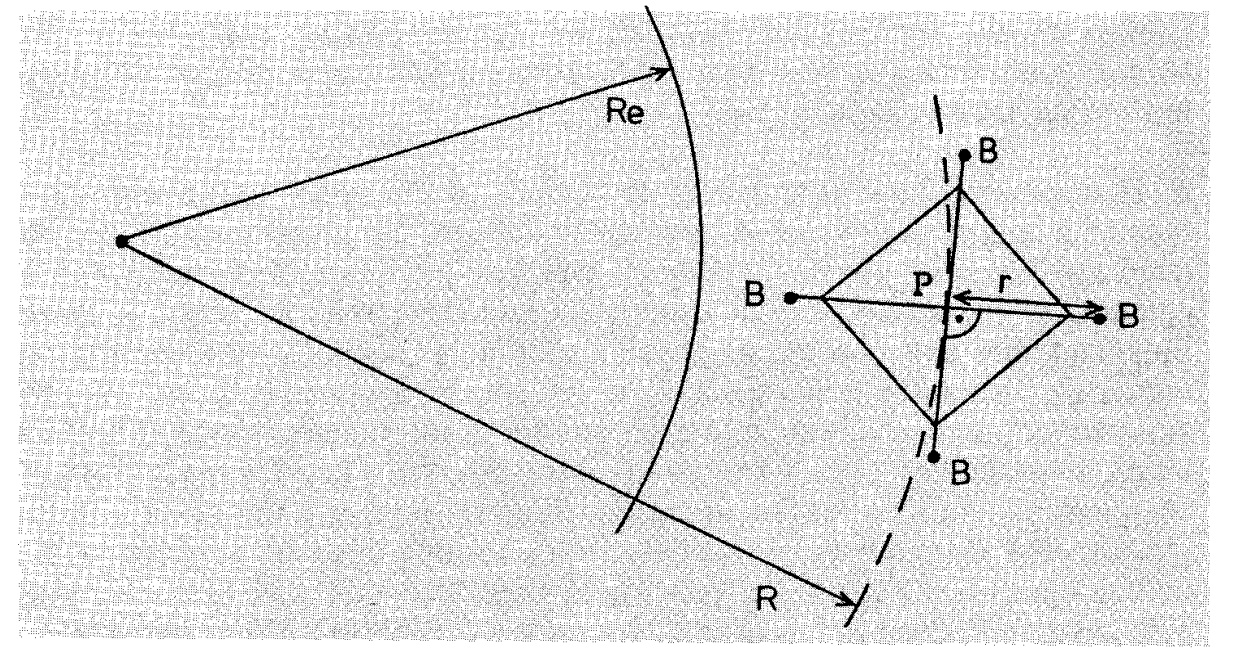
The link wires are included in the system in order to prevent oscillatory movement of the individual bodies B which would otherwise make the analysis of the movements extremely complicated. All the bodies B rotate around P at the same angular velocity, which is \(\omega\) with respect to the fixed stars. Thus, the satellite behaves as a rigid body.
Analyze the following questions for the general case, considering all possible situations, including both senses of rotation of the bodies B. Also obtain numerical values for certain of the quantities found in questions (1) and (2)—the quantities required and the necessary numerical data are listed at the end of the problem.
1) The drawing shows the satellite in the position where for the various wires, \(\mathbf r\) is parallel, anti-parallel or perpendicular to \(\mathbf R\). (The vector \(\mathbf r\) runs from body P to a body B and has length \(r\); the vector \(\mathbf R\) runs from the centre of mass of the Earth to the body P.)
Determine the force exerted by a radial wire on one of the bodies B in each of these four positions. These positions correspond approximately to the maximum and minimum forces.
2) Inside the four bodies B there are four identical machines, powered by solar energy, connected to the radial wires. Each machine pulls the wire in, towards B, for a short time whenever there is near maximum force in the wire (as indicated in the previous question), and lets the same length of wire out again when the tension is at a minimum. The length of wire that is pulled in and let out is \(1\%\) of the mean length of the radial wire. The mean length does not change with time.
What is the net power converted by one machine, averaged over one rotation of the satellite?
The net power is defined as \(\dfrac{W_1-W_2}{T}\), where \(W_1\) is the work that the machine performs on the wire when pulling it in, \(W_2\) is the work that the wire performs on the machine when it is reeled out and \(T\) is the period of rotation.
3) Discuss the changes in the motion of the satellite that are caused by the action of the machines. In particular, analyze any changes that may occur in each of the situations listed in the table overleaf.
Fill in the table with your results and comments, and don’t forget to hand it in.
Data:
Numerical answers are required in the following situation:
The radius of the orbit of the central body is given by \(R=R_E+500\ \mathrm{km}\).
The mean length of the radial wires is \(r=100\ \mathrm{km}\).
Thus the diameter of the satellite system is \(200\ \mathrm{km}\).The bodies B have masses \(m=1000\ \mathrm{kg}\).
Initially the four bodies B rotate, as referred to the stars, around the central body P at \(10\) revolutions/hour.
The masses of the wires are negligible and the central body P is massless.
Advice:
Consider both senses of rotation for \(\omega\).
Exact solutions are not expected. Results with \(5\%\) accuracy are fully acceptable.
Ignore the gravitational effect of the moon and the sun.Useful data:
Quantity Value Mass of Earth \(M_E=5.97\times10^{24}\ \mathrm{kg}\) Gravitational constant \(G=6.673\times10^{-11}\ \mathrm{m^3\,kg^{-1}\,s^{-2}}\) Radius of Earth at the equator \(R_E=6378\ \mathrm{km}\) Denote the product \(M_EG\) by \(K\). \(K=3.983\times10^{14}\ \mathrm{m^3\,s^{-2}}\) Country code:
ANSWER TABLE
Fill in this table as part of your answer. Write down equalities or inequalities and/or short explanations where necessary.
The quantity indicated below … increases if … decreases if … stays unchanged if … stays unchanged in all situations. orbital velocity of the satellite Yes ☐ No ☐ radius \(R\) of the orbit of the satellite Yes ☐ No ☐ angular velocity \(\omega\) of the satellite Yes ☐ No ☐ gravitational potential energy of the satellite Yes ☐ No ☐ Could the satellite reach a higher orbit as a result of the work done by the machines?
Yes ☐
No ☐Could the satellite reach an arbitrarily high orbit, practically leaving the gravitational influence of Earth? Why?
Answer: ……………………………………………………………………
Official English text of the problem.
Problem 2: The Longitudinal Motion of a Linear Molecule
In this problem you will analyze the longitudinal motion of a linear molecule, i.e., the motion along the molecular axis. The rotational motion and the bending of the molecule are not considered. The molecule is assumed to consist of \(N\) atoms of mass \(m_1, m_2, \ldots, m_N\), respectively. Each atom is assumed to be connected to its neighbors by a chemical bond. Each bond is approximated by a massless spring which obeys Hooke’s law with spring constants \(k_1, k_2, \ldots, k_{N-1}\). The molecule is shown in Fig. 1.
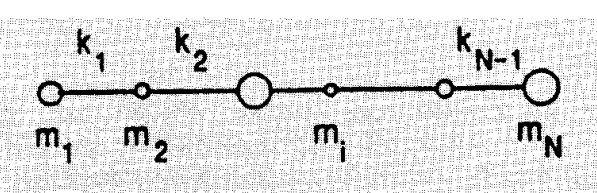
Fig.1. A linear molecule with \(N\) atoms.
Use the following facts when solving this problem: The longitudinal vibrational motion of a linear molecule consists of a superposition of separate vibrational motions called normal vibrations, or normal modes. In a normal mode all atoms vibrate in simple harmonic motion with the same frequency and pass through their equilibrium positions simultaneously.
Questions
1) Let \(x_i\) be the displacement of atom \(i\) from its equilibrium position. Express the force \(F_i\) acting on each atom as a function of the displacements \(x_1, x_2, \ldots, x_N\) and the spring constants \(k_1, k_2, \ldots, k_{N-1}\). What relationship is there among the forces \(F_1, F_2, \ldots, F_N\)? Using this relationship, derive a relationship between the displacements \(x_1, x_2, \ldots, x_N\) and give a physical interpretation of this relationship.
2) Analyze the motion of a diatomic molecule AB (Fig. 2). The value of the spring constant is \(k\). Derive an expression for the forces acting on atoms A and B. Determine the possible types of motion of the molecule. Determine the corresponding vibrational frequencies and interpret the result. In particular, how is it possible for the atoms to vibrate with the same frequency even though their masses are not the same?
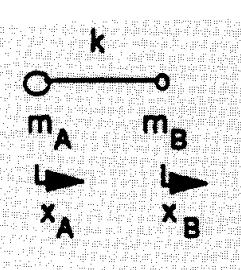
Fig.2. The diatomic molecule AB
3) Analyze the motion of the triatomic molecule \(\mathrm{BA_2}\) (Fig. 3)
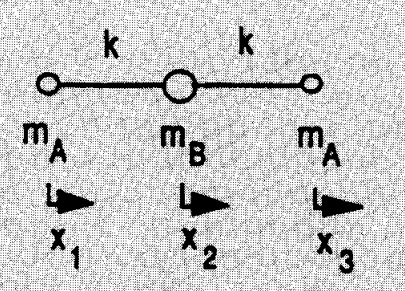
Fig.3. The triatomic molecule \(\mathrm{BA_2}\).
Express the net force on each atom as a function of its displacement only. Deduce the possible motions of the molecule and the corresponding vibrational frequencies.
4) The frequencies of the two longitudinal modes of vibration of the \(\mathrm{CO_2}\) molecule are \(3.998\times10^{13}\ \mathrm{Hz}\) and \(7.042\times10^{13}\ \mathrm{Hz}\), respectively. Determine a numerical value for the spring constant of the CO bond.
How well do you think this approximation for the bond structure of the molecule describes the vibrational motion of the real molecule?
The atomic mass of the carbon atom = \(12\ \mathrm{amu}\) and that of the oxygen atom = \(16\ \mathrm{amu}\). The atomic mass unit = \(1.660\times10^{-27}\ \mathrm{kg}\).
Official English text of the problem.
Problem 3: A Satellite in Sunshine
In this problem you will calculate the temperature of a space satellite. The satellite is assumed to be a sphere with a diameter of 1 m. All of the satellite remains at a uniform temperature. All of the spherical surface of the satellite is coated with the same kind of coating. The satellite is located near the earth but is not in the earth's shadow.
The surface temperature of the sun (its blackbody surface temperature) \(T_{\mathrm{sun}} = 6000\ \mathrm{K}\) and its radius is \(6.96 \times 10^8\ \mathrm{m}\). The distance between the sun and the earth is \(1.5 \times 10^{11}\ \mathrm{m}\). The sunlight heats the satellite to a temperature at which the blackbody emission from the satellite equals the power absorbed from the sunlight. The power per unit area emitted by a black body is given by Stefan-Boltzmann's law \(P = \sigma T^4\) where \(\sigma\) is the universal constant \(5.67 \times 10^{-8}\ \mathrm{W\,m^{-2}K^{-4}}\). In the first approximation, you can assume that both the sun and the satellite absorb all electromagnetic radiation incident upon them.
1) Find an expression for the temperature \(T\) of the satellite. What is the numerical value of this temperature?
2) The blackbody radiation spectrum \(u(T,f)\) of a body at temperature \(T\) obeys Planck's radiation law
\[ u(T,f)\,df = \frac{8\pi k^4T^4}{c^3h^3} \frac{\eta^3\,d\eta}{e^\eta-1} \]
where \(\eta = hf/kT\) and \(u(T,f)df\) is the energy density of the electromagnetic radiation in a frequency interval \([f,f+df]\). In the equation \(h = 6.6 \times 10^{-34}\ \mathrm{J\,s}\) is Planck's constant, \(k = 1.4 \times 10^{-23}\ \mathrm{J\,K^{-1}}\) is Boltzmann's constant and \(c = 3.0 \times 10^8\ \mathrm{m\,s^{-1}}\) is the speed of light.
The blackbody spectrum, integrated over all frequencies \(f\) and directions of emission, gives the total radiated power per unit area \(P = \sigma T^4\) as expressed in the Stefan-Boltzmann law given above.
\[ \sigma = \frac{2\pi^5k^4}{15c^2h^3} \]
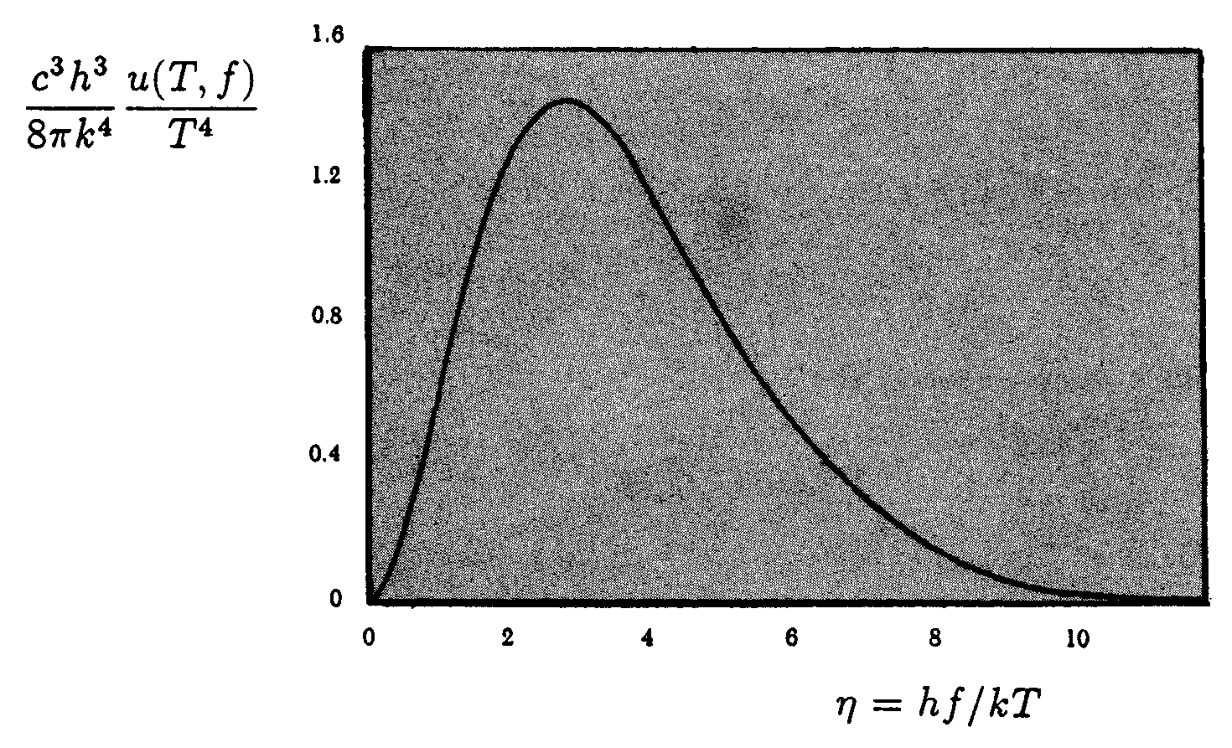
The figure shows the normalized spectrum
\[ \frac{c^3h^3}{8\pi k^4}\frac{u(T,f)}{T^4} \]
as a function of \(\eta\).
In many applications it is necessary to keep the satellite as cool as possible. To cool the satellite, engineers use a reflective coating that reflects light above a cut-off frequency but does not prevent heat radiation at lower frequency from escaping. Assume that this (sharp) cut-off frequency corresponds to \(hf/k = 1200\ \mathrm{K}\).
What is the new equilibrium temperature of the satellite? The exact answer is not needed. Therefore, do not perform any tedious integrations; make approximations where necessary. The integral over the entire range is
\[ \int_0^\infty \frac{\eta^3\,d\eta}{e^\eta-1} = \frac{\pi^4}{15} \]
and the maximum of \(\eta^3/(e^\eta-1)\) occurs at \(\eta = 2.82\). For small \(\eta\) you can expand the exponential function as \(e^\eta \simeq 1+\eta\).
3) If we now have a real satellite, with extending solar panels that generate electricity, the dissipated heat in the electronics inside the satellite acts as an extra source of heat. Assuming that the power of the internal heat source is 1 kW, what is the equilibrium temperature of the satellite in case 2 above?
4) A manufacturer advertises a special paint in the following way:
"This paint will reflect more than 90% of all incoming radiation (both visible light and infrared) but it will radiate at all frequencies (visible light and infrared) as a black body, thus removing lots of heat from the satellite. Thus the paint will help keep the satellite as cool as possible."
Can such paint exist? Why or why not?
5) What properties should a coating have in order to raise the temperature of a spherical body similar to that of the satellite considered here above the temperature calculated in 1)?
Official English text of the problem.
Internationale Physik-Olympiade
IPhO 1992
Espoo (Helsinki), Finnland · 3 Theorieaufgaben mit vollständigen Lösungen
Aufgabe 1: Ein rotierender Satellit
Die Abbildung zeigt einen Satelliten, der die Erde auf einer annähernd kreisförmigen Bahn in der Äquatorebene der Erde umkreist. Der Satellit besteht aus einem masselosen Zentralkörper P und vier kleinen äußeren Körpern B. Die vier Körper B haben jeweils die Masse \(m\): Sie sind mit langen, dünnen, nicht dehnbaren Drähten der Länge \(r\) an P befestigt. Alle fünf Körper, P und die vier Körper B, liegen in der Äquatorebene und können innerhalb dieser Ebene rotieren. Die vier radialen Drähte sind durch weitere dünne Drähte miteinander verbunden, welche die Winkel zwischen den radialen Drähten konstant bei \(90^\circ\) halten.
Die Verbindungsdrähte sind Teil des Systems, um Schwingungsbewegungen der einzelnen Körper B zu verhindern, die die Analyse der Bewegungen andernfalls äußerst kompliziert machen würden. Alle Körper B rotieren mit derselben Winkelgeschwindigkeit um P; diese beträgt bezüglich der Fixsterne \(\omega\). Der Satellit verhält sich somit wie ein starrer Körper.
Untersuchen Sie die folgenden Fragen für den allgemeinen Fall und berücksichtigen Sie dabei alle möglichen Situationen, einschließlich beider Drehrichtungen der Körper B. Bestimmen Sie außerdem Zahlenwerte für einige der in den Fragen (1) und (2) ermittelten Größen — die gesuchten Größen und die erforderlichen Zahlenangaben sind am Ende der Aufgabe aufgeführt.
1) Die Zeichnung zeigt den Satelliten in der Stellung, in der für die verschiedenen Drähte \(\mathbf r\) parallel, antiparallel oder senkrecht zu \(\mathbf R\) ist. (Der Vektor \(\mathbf r\) verläuft vom Körper P zu einem Körper B und hat die Länge \(r\); der Vektor \(\mathbf R\) verläuft vom Massenmittelpunkt der Erde zum Körper P.)
Bestimmen Sie die Kraft, die ein radialer Draht auf einen der Körper B in jeder dieser vier Stellungen ausübt. Diese Stellungen entsprechen näherungsweise den maximalen und minimalen Kräften.
2) Im Inneren der vier Körper B befinden sich vier identische, mit Sonnenenergie betriebene Maschinen, die mit den radialen Drähten verbunden sind. Jede Maschine zieht den Draht jeweils dann für kurze Zeit in Richtung B ein, wenn die Kraft im Draht nahezu maximal ist (wie in der vorherigen Frage angegeben), und lässt dieselbe Drahtlänge wieder heraus, wenn die Zugkraft minimal ist. Die eingezogene und wieder herausgelassene Drahtlänge beträgt \(1\%\) der mittleren Länge des radialen Drahtes. Die mittlere Länge ändert sich nicht mit der Zeit.
Wie groß ist die von einer Maschine umgesetzte Nettoleistung, gemittelt über eine Umdrehung des Satelliten?
Die Nettoleistung ist definiert als \(\dfrac{W_1-W_2}{T}\), wobei \(W_1\) die Arbeit ist, welche die Maschine beim Einziehen am Draht verrichtet, \(W_2\) die Arbeit ist, welche der Draht beim Herauslassen an der Maschine verrichtet, und \(T\) die Rotationsperiode ist.
3) Erörtern Sie die Änderungen der Bewegung des Satelliten, die durch den Betrieb der Maschinen hervorgerufen werden. Untersuchen Sie insbesondere die Änderungen, die in den einzelnen, in der Tabelle auf der Rückseite aufgeführten Situationen auftreten können.
Tragen Sie Ihre Ergebnisse und Anmerkungen in die Tabelle ein und vergessen Sie nicht, diese abzugeben.
Angaben:
Zahlenwerte werden für die folgende Situation verlangt:
Der Bahnradius des Zentralkörpers ist gegeben durch \(R=R_E+500\ \mathrm{km}\).
Die mittlere Länge der radialen Drähte beträgt \(r=100\ \mathrm{km}\).
Der Durchmesser des Satellitensystems beträgt somit \(200\ \mathrm{km}\).Die Körper B haben die Massen \(m=1000\ \mathrm{kg}\).
Anfangs rotieren die vier Körper B, bezogen auf die Sterne, mit \(10\) Umdrehungen/Stunde um den Zentralkörper P.
Die Massen der Drähte sind vernachlässigbar, und der Zentralkörper P ist masselos.
Hinweise:
Berücksichtigen Sie beide Drehrichtungen für \(\omega\).
Exakte Lösungen werden nicht erwartet. Ergebnisse mit einer Genauigkeit von \(5\%\) sind völlig ausreichend.
Vernachlässigen Sie die Gravitationswirkung von Mond und Sonne.Nützliche Daten:
Größe Wert Masse der Erde \(M_E=5.97\times10^{24}\ \mathrm{kg}\) Gravitationskonstante \(G=6.673\times10^{-11}\ \mathrm{m^3\,kg^{-1}\,s^{-2}}\) Erdradius am Äquator \(R_E=6378\ \mathrm{km}\) Bezeichnen Sie das Produkt \(M_EG\) mit \(K\). \(K=3.983\times10^{14}\ \mathrm{m^3\,s^{-2}}\) Ländercode:
ANTWORTTABELLE
Füllen Sie diese Tabelle als Teil Ihrer Antwort aus. Tragen Sie, wo nötig, Gleichungen oder Ungleichungen und/oder kurze Erläuterungen ein.
Die unten angegebene Größe … nimmt zu, wenn … nimmt ab, wenn … bleibt unverändert, wenn … bleibt in allen Situationen unverändert. Bahngeschwindigkeit des Satelliten Ja ☐ Nein ☐ Radius \(R\) der Umlaufbahn des Satelliten Ja ☐ Nein ☐ Winkelgeschwindigkeit \(\omega\) des Satelliten Ja ☐ Nein ☐ Gravitative potenzielle Energie des Satelliten Ja ☐ Nein ☐ Könnte der Satellit infolge der von den Maschinen verrichteten Arbeit eine höhere Umlaufbahn erreichen?
Ja ☐
Nein ☐Könnte der Satellit eine beliebig hohe Umlaufbahn erreichen und damit praktisch den Gravitationseinfluss der Erde verlassen? Warum?
Antwort: ……………………………………………………………………
Aufgabentext aus dem offiziellen englischen Text übersetzt.
Aufgabe 2: Die Longitudinalbewegung eines linearen Moleküls
In dieser Aufgabe untersuchen Sie die Longitudinalbewegung eines linearen Moleküls, d. h. die Bewegung entlang der Molekülachse. Die Rotationsbewegung und die Biegung des Moleküls werden nicht berücksichtigt. Es wird angenommen, dass das Molekül aus \(N\) Atomen mit den Massen \(m_1, m_2, \ldots, m_N\) besteht. Jedes Atom sei durch eine chemische Bindung mit seinen Nachbarn verbunden. Jede Bindung wird durch eine masselose Feder angenähert, die dem Hookeschen Gesetz gehorcht; die Federkonstanten sind \(k_1, k_2, \ldots, k_{N-1}\). Das Molekül ist in Abb. 1 dargestellt.
Abb. 1. Ein lineares Molekül mit \(N\) Atomen.
Verwenden Sie bei der Lösung dieser Aufgabe die folgenden Tatsachen: Die longitudinale Schwingungsbewegung eines linearen Moleküls besteht aus einer Überlagerung einzelner Schwingungsbewegungen, die als Normalschwingungen oder Normalmoden bezeichnet werden. In einer Normalmode führen alle Atome harmonische Schwingungen mit derselben Frequenz aus und durchlaufen ihre Gleichgewichtslagen gleichzeitig.
Fragen
1) Sei \(x_i\) die Auslenkung des Atoms \(i\) aus seiner Gleichgewichtslage. Drücken Sie die auf jedes Atom wirkende Kraft \(F_i\) als Funktion der Auslenkungen \(x_1, x_2, \ldots, x_N\) und der Federkonstanten \(k_1, k_2, \ldots, k_{N-1}\) aus. Welche Beziehung besteht zwischen den Kräften \(F_1, F_2, \ldots, F_N\)? Leiten Sie mithilfe dieser Beziehung eine Beziehung zwischen den Auslenkungen \(x_1, x_2, \ldots, x_N\) her und geben Sie eine physikalische Deutung dieser Beziehung an.
2) Untersuchen Sie die Bewegung eines zweiatomigen Moleküls AB (Abb. 2). Die Federkonstante hat den Wert \(k\). Leiten Sie einen Ausdruck für die auf die Atome A und B wirkenden Kräfte her. Bestimmen Sie die möglichen Bewegungsarten des Moleküls. Bestimmen Sie die zugehörigen Schwingungsfrequenzen und deuten Sie das Ergebnis. Wie ist es insbesondere möglich, dass die Atome mit derselben Frequenz schwingen, obwohl ihre Massen unterschiedlich sind?
Abb. 2. Das zweiatomige Molekül AB
3) Untersuchen Sie die Bewegung des dreiatomigen Moleküls \(\mathrm{BA_2}\) (Abb. 3)
Abb. 3. Das dreiatomige Molekül \(\mathrm{BA_2}\).
Drücken Sie die resultierende Kraft auf jedes Atom als Funktion ausschließlich seiner eigenen Auslenkung aus. Leiten Sie die möglichen Bewegungen des Moleküls und die zugehörigen Schwingungsfrequenzen ab.
4) Die Frequenzen der beiden longitudinalen Schwingungsmoden des \(\mathrm{CO_2}\)-Moleküls betragen \(3.998\times10^{13}\ \mathrm{Hz}\) bzw. \(7.042\times10^{13}\ \mathrm{Hz}\). Bestimmen Sie einen Zahlenwert für die Federkonstante der CO-Bindung.
Wie gut beschreibt Ihrer Meinung nach diese Näherung für die Bindungsstruktur des Moleküls die Schwingungsbewegung des realen Moleküls?
Die Atommasse des Kohlenstoffatoms = \(12\ \mathrm{amu}\) und die des Sauerstoffatoms = \(16\ \mathrm{amu}\). Die atomare Masseneinheit = \(1.660\times10^{-27}\ \mathrm{kg}\).
Aufgabentext aus dem offiziellen englischen Text übersetzt.
Aufgabe 3: Ein Satellit im Sonnenlicht
In dieser Aufgabe berechnen Sie die Temperatur eines Satelliten im Weltraum. Der Satellit wird als Kugel mit einem Durchmesser von 1 m angenommen. Im gesamten Satelliten herrscht eine einheitliche Temperatur. Die gesamte Kugeloberfläche des Satelliten ist mit derselben Beschichtung versehen. Der Satellit befindet sich in der Nähe der Erde, jedoch nicht im Erdschatten.
Die Oberflächentemperatur der Sonne (ihre Oberflächentemperatur als schwarzer Körper) beträgt \(T_{\mathrm{sun}} = 6000\ \mathrm{K}\), und ihr Radius beträgt \(6.96 \times 10^8\ \mathrm{m}\). Der Abstand zwischen Sonne und Erde beträgt \(1.5 \times 10^{11}\ \mathrm{m}\). Das Sonnenlicht erwärmt den Satelliten auf eine Temperatur, bei der die vom Satelliten als schwarzer Körper abgestrahlte Leistung gleich der aus dem Sonnenlicht absorbierten Leistung ist. Die von einem schwarzen Körper pro Flächeneinheit abgestrahlte Leistung ist durch das Stefan-Boltzmann-Gesetz \(P = \sigma T^4\) gegeben, wobei \(\sigma\) die universelle Konstante \(5.67 \times 10^{-8}\ \mathrm{W\,m^{-2}K^{-4}}\) ist. In erster Näherung können Sie annehmen, dass sowohl die Sonne als auch der Satellit sämtliche auf sie einfallende elektromagnetische Strahlung absorbieren.
1) Bestimmen Sie einen Ausdruck für die Temperatur \(T\) des Satelliten. Welchen Zahlenwert hat diese Temperatur?
2) Das Spektrum der Schwarzkörperstrahlung \(u(T,f)\) eines Körpers bei der Temperatur \(T\) gehorcht dem Planckschen Strahlungsgesetz
\[ u(T,f)\,df = \frac{8\pi k^4T^4}{c^3h^3} \frac{\eta^3\,d\eta}{e^\eta-1} \]
wobei \(\eta = hf/kT\) gilt und \(u(T,f)df\) die Energiedichte der elektromagnetischen Strahlung in einem Frequenzintervall \([f,f+df]\) ist. In dieser Gleichung ist \(h = 6.6 \times 10^{-34}\ \mathrm{J\,s}\) die Plancksche Konstante, \(k = 1.4 \times 10^{-23}\ \mathrm{J\,K^{-1}}\) die Boltzmann-Konstante und \(c = 3.0 \times 10^8\ \mathrm{m\,s^{-1}}\) die Lichtgeschwindigkeit.
Die Integration des Schwarzkörperspektrums über alle Frequenzen \(f\) und Abstrahlrichtungen ergibt die gesamte abgestrahlte Leistung pro Flächeneinheit \(P = \sigma T^4\), wie sie durch das oben angegebene Stefan-Boltzmann-Gesetz beschrieben wird.
\[ \sigma = \frac{2\pi^5k^4}{15c^2h^3} \]
Die Abbildung zeigt das normierte Spektrum
\[ \frac{c^3h^3}{8\pi k^4}\frac{u(T,f)}{T^4} \]
als Funktion von \(\eta\).
Bei vielen Anwendungen muss der Satellit möglichst kühl gehalten werden. Zur Kühlung des Satelliten verwenden Ingenieure eine reflektierende Beschichtung, die Licht oberhalb einer Grenzfrequenz reflektiert, das Entweichen von Wärmestrahlung bei niedrigeren Frequenzen jedoch nicht verhindert. Nehmen Sie an, dass diese (scharfe) Grenzfrequenz \(hf/k = 1200\ \mathrm{K}\) entspricht.
Wie hoch ist die neue Gleichgewichtstemperatur des Satelliten? Eine exakte Antwort ist nicht erforderlich. Führen Sie daher keine aufwendigen Integrationen durch, sondern verwenden Sie bei Bedarf Näherungen. Das Integral über den gesamten Bereich lautet
\[ \int_0^\infty \frac{\eta^3\,d\eta}{e^\eta-1} = \frac{\pi^4}{15} \]
und das Maximum von \(\eta^3/(e^\eta-1)\) liegt bei \(\eta = 2.82\). Für kleine \(\eta\) können Sie die Exponentialfunktion in der Form \(e^\eta \simeq 1+\eta\) entwickeln.
3) Betrachten wir nun einen realen Satelliten mit ausladenden Solarmodulen, die elektrische Energie erzeugen, so wirkt die in der Elektronik im Inneren des Satelliten entstehende Verlustwärme als zusätzliche Wärmequelle. Wie hoch ist die Gleichgewichtstemperatur des Satelliten im obigen Fall 2, wenn die Leistung der inneren Wärmequelle 1 kW beträgt?
4) Ein Hersteller wirbt für einen Spezialanstrich folgendermaßen:
„Dieser Anstrich reflektiert mehr als 90% der gesamten einfallenden Strahlung (sowohl sichtbares Licht als auch Infrarotstrahlung), strahlt jedoch bei allen Frequenzen (sichtbares Licht und Infrarotstrahlung) wie ein schwarzer Körper ab und führt dadurch viel Wärme vom Satelliten ab. Somit trägt der Anstrich dazu bei, den Satelliten möglichst kühl zu halten.“
Kann es einen solchen Anstrich geben? Warum beziehungsweise warum nicht?
5) Welche Eigenschaften sollte eine Beschichtung haben, um die Temperatur eines kugelförmigen Körpers, der dem hier betrachteten Satelliten ähnelt, über die in 1) berechnete Temperatur zu erhöhen?
Aufgabentext aus dem offiziellen englischen Text übersetzt.
Uluslararası Fizik Olimpiyatı
IPhO 1992
Espoo (Helsinki), Finlandiya · 3 teori sorusu, tam çözümleriyle
Soru 1: Dönen Bir Uydu
Şekilde, Dünya'nın ekvator düzleminde yaklaşık dairesel bir yörüngede Dünya'nın çevresinde dolanan bir uydu gösterilmektedir. Uydu, kütlesiz bir merkezî P cismi ile çevredeki dört küçük B cisminden oluşmaktadır. Dört B cisminin her birinin kütlesi \(m\)'dir: bu cisimler, uzunluğu \(r\) olan, uzamayan uzun ve ince tellerle P'ye bağlanmıştır. P ve dört B cisminden oluşan bu beş cismin tümü ekvator düzlemiyle aynı düzlemdedir ve bu düzlem içinde dönebilmektedir. Dört radyal tel, aralarındaki açıları sabit ve \(90^\circ\) tutan başka ince tellerle birbirine bağlanmıştır.
Bağlantı telleri, B cisimlerinin ayrı ayrı salınım hareketi yapmasını önlemek amacıyla sisteme eklenmiştir; aksi hâlde bu salınımlar hareketlerin analizini son derece karmaşık hâle getirirdi. B cisimlerinin tümü, P çevresinde sabit yıldızlara göre \(\omega\) olan aynı açısal hızla dönmektedir. Dolayısıyla uydu bir katı cisim gibi davranmaktadır.
Aşağıdaki soruları, B cisimlerinin her iki dönme yönü de dâhil olmak üzere olası tüm durumları göz önüne alarak genel durum için inceleyiniz. Ayrıca (1) ve (2) numaralı sorularda bulunan bazı niceliklerin sayısal değerlerini de elde ediniz; istenen nicelikler ve gerekli sayısal veriler sorunun sonunda listelenmiştir.
1) Çizimde uydu, farklı teller için \(\mathbf r\)'nin \(\mathbf R\)'ye paralel, zıt paralel veya dik olduğu konumda gösterilmektedir. (\(\mathbf r\) vektörü P cisminden bir B cismine yönelir ve uzunluğu \(r\)'dir; \(\mathbf R\) vektörü Dünya'nın kütle merkezinden P cismine yönelir.)
Bu dört konumun her birinde, radyal bir telin B cisimlerinden birine uyguladığı kuvveti belirleyiniz. Bu konumlar yaklaşık olarak en büyük ve en küçük kuvvetlere karşılık gelmektedir.
2) Dört B cisminin içinde, güneş enerjisiyle çalışan ve radyal tellere bağlı dört özdeş makine bulunmaktadır. Her makine, teldeki kuvvet en büyük değerine yaklaştığında (önceki soruda belirtildiği gibi), kısa bir süre boyunca teli içeriye, B'ye doğru çeker ve gerilme en küçük değerindeyken aynı uzunlukta teli yeniden dışarı salar. İçeri çekilen ve dışarı salınan tel uzunluğu, radyal telin ortalama uzunluğunun \(1\%\)'idir. Ortalama uzunluk zamanla değişmez.
Bir makinenin dönüştürdüğü net gücün, uydunun bir dönüşü boyunca alınan ortalaması nedir?
Net güç \(\dfrac{W_1-W_2}{T}\) olarak tanımlanmaktadır; burada \(W_1\), makinenin teli içeri çekerken tel üzerinde yaptığı iş, \(W_2\), tel dışarı salınırken telin makine üzerinde yaptığı iş ve \(T\) dönme periyodudur.
3) Makinelerin çalışmasının uydunun hareketinde yol açtığı değişiklikleri tartışınız. Özellikle, arka sayfadaki tabloda listelenen durumların her birinde meydana gelebilecek değişiklikleri analiz ediniz.
Tabloyu sonuçlarınız ve yorumlarınızla doldurunuz ve teslim etmeyi unutmayınız.
Veriler:
Aşağıdaki durum için sayısal cevaplar istenmektedir:
Merkezî cismin yörüngesinin yarıçapı \(R=R_E+500\ \mathrm{km}\) olarak verilmektedir.
Radyal tellerin ortalama uzunluğu \(r=100\ \mathrm{km}\)'dir.
Dolayısıyla uydu sisteminin çapı \(200\ \mathrm{km}\)'dir.B cisimlerinin kütleleri \(m=1000\ \mathrm{kg}\)'dır.
Başlangıçta dört B cismi, yıldızlara göre merkezî P cismi çevresinde saatte \(10\) devir yapmaktadır.
Tellerin kütleleri ihmal edilebilir ve merkezî P cismi kütlesizdir.
Öneriler:
\(\omega\) için her iki dönme yönünü de göz önüne alınız.
Tam çözümler beklenmemektedir. \(5\%\) doğrulukta sonuçlar tamamen kabul edilebilir.
Ay'ın ve Güneş'in kütleçekim etkisini ihmal ediniz.Yararlı veriler:
Nicelik Değer Dünya'nın kütlesi \(M_E=5.97\times10^{24}\ \mathrm{kg}\) Kütleçekim sabiti \(G=6.673\times10^{-11}\ \mathrm{m^3\,kg^{-1}\,s^{-2}}\) Dünya'nın ekvatordaki yarıçapı \(R_E=6378\ \mathrm{km}\) \(M_EG\) çarpımını \(K\) ile gösteriniz. \(K=3.983\times10^{14}\ \mathrm{m^3\,s^{-2}}\) Ülke kodu:
CEVAP TABLOSU
Cevabınızın bir parçası olarak bu tabloyu doldurunuz. Gerekli yerlerde eşitlikler veya eşitsizlikler ve/veya kısa açıklamalar yazınız.
Aşağıda belirtilen nicelik … şu koşulda artar: … şu koşulda azalır: … şu koşulda değişmez: … her durumda değişmez. uydunun yörünge hızı Evet ☐ Hayır ☐ uydunun yörüngesinin \(R\) yarıçapı Evet ☐ Hayır ☐ uydunun \(\omega\) açısal hızı Evet ☐ Hayır ☐ uydunun kütleçekim potansiyel enerjisi Evet ☐ Hayır ☐ Uydu, makinelerin yaptığı iş sonucunda daha yüksek bir yörüngeye ulaşabilir mi?
Evet ☐
Hayır ☐Uydu, pratikte Dünya'nın kütleçekim etkisinden çıkacak kadar, istenildiği kadar yüksek bir yörüngeye ulaşabilir mi? Neden?
Cevap: ……………………………………………………………………
Soru metni resmi İngilizce metinden çevrilmiştir.
Soru 2: Doğrusal Bir Molekülün Boyuna Hareketi
Bu soruda doğrusal bir molekülün boyuna hareketini, yani molekül ekseni boyunca hareketini inceleyeceksiniz. Molekülün dönme hareketi ve bükülmesi dikkate alınmamaktadır. Molekülün, kütleleri sırasıyla \(m_1, m_2, \ldots, m_N\) olan \(N\) atomdan oluştuğu varsayılmaktadır. Her atomun komşularına bir kimyasal bağla bağlı olduğu kabul edilmektedir. Her bağ, Hooke yasasına uyan kütlesiz bir yayla modellenmektedir; yay sabitleri \(k_1, k_2, \ldots, k_{N-1}\) değerlerindedir. Molekül Şekil 1'de gösterilmiştir.
Şekil 1. \(N\) atomlu doğrusal bir molekül.
Bu soruyu çözerken şu bilgilerden yararlanın: Doğrusal bir molekülün boyuna titreşim hareketi, normal titreşimler veya normal modlar olarak adlandırılan ayrı titreşim hareketlerinin üst üste binmesinden oluşur. Bir normal modda bütün atomlar aynı frekansta basit harmonik hareket yapar ve denge konumlarından aynı anda geçer.
Sorular
1) \(x_i\), \(i\) atomunun denge konumundan yer değiştirmesi olsun. Her atoma etki eden \(F_i\) kuvvetini, \(x_1, x_2, \ldots, x_N\) yer değiştirmelerinin ve \(k_1, k_2, \ldots, k_{N-1}\) yay sabitlerinin fonksiyonu olarak ifade edin. \(F_1, F_2, \ldots, F_N\) kuvvetleri arasında nasıl bir bağıntı vardır? Bu bağıntıyı kullanarak \(x_1, x_2, \ldots, x_N\) yer değiştirmeleri arasında bir bağıntı türetin ve bu bağıntının fiziksel yorumunu yapın.
2) İki atomlu AB molekülünün (Şekil 2) hareketini inceleyin. Yay sabitinin değeri \(k\)'dir. A ve B atomlarına etki eden kuvvetler için bir ifade türetin. Molekülün olası hareket türlerini belirleyin. Bunlara karşılık gelen titreşim frekanslarını belirleyin ve sonucu yorumlayın. Özellikle, kütleleri aynı olmadığı hâlde atomların aynı frekansta titreşmesi nasıl mümkün olur?
Şekil 2. İki atomlu AB molekülü
3) Üç atomlu \(\mathrm{BA_2}\) molekülünün (Şekil 3) hareketini inceleyin.
Şekil 3. Üç atomlu \(\mathrm{BA_2}\) molekülü.
Her atoma etki eden net kuvveti yalnızca o atomun yer değiştirmesinin fonksiyonu olarak ifade edin. Molekülün olası hareketlerini ve bunlara karşılık gelen titreşim frekanslarını çıkarın.
4) \(\mathrm{CO_2}\) molekülünün iki boyuna titreşim modunun frekansları sırasıyla \(3.998\times10^{13}\ \mathrm{Hz}\) ve \(7.042\times10^{13}\ \mathrm{Hz}\)'dir. CO bağının yay sabiti için sayısal bir değer belirleyin.
Molekülün bağ yapısı için kullanılan bu yaklaşımın, gerçek molekülün titreşim hareketini ne ölçüde iyi betimlediğini düşünüyorsunuz?
Karbon atomunun atom kütlesi = \(12\ \mathrm{amu}\) ve oksijen atomunun atom kütlesi = \(16\ \mathrm{amu}\). Atomik kütle birimi = \(1.660\times10^{-27}\ \mathrm{kg}\).
Soru metni resmi İngilizce metinden çevrilmiştir.
Soru 3: Güneş Işığındaki Bir Uydu
Bu soruda bir uzay uydusunun sıcaklığını hesaplayacaksınız. Uydunun, çapı 1 m olan bir küre olduğu varsayılmaktadır. Uydunun her noktası aynı sıcaklıkta kalmaktadır. Uydunun küresel yüzeyinin tamamı aynı tür kaplamayla kaplanmıştır. Uydu, Dünya'nın yakınında bulunmaktadır ancak Dünya'nın gölgesinde değildir.
Güneş'in yüzey sıcaklığı (kara cisim yüzey sıcaklığı) \(T_{\mathrm{sun}} = 6000\ \mathrm{K}\), yarıçapı ise \(6.96 \times 10^8\ \mathrm{m}\)'dir. Güneş ile Dünya arasındaki uzaklık \(1.5 \times 10^{11}\ \mathrm{m}\)'dir. Güneş ışığı uyduyu, uydunun kara cisim olarak yaydığı ışınım gücünün güneş ışığından soğurulan güce eşit olduğu sıcaklığa kadar ısıtır. Bir kara cismin birim alanından yayılan güç, Stefan-Boltzmann yasası \(P = \sigma T^4\) ile verilir; burada \(\sigma\), \(5.67 \times 10^{-8}\ \mathrm{W\,m^{-2}K^{-4}}\) değerindeki evrensel sabittir. İlk yaklaşımda hem Güneş'in hem de uydunun üzerlerine gelen tüm elektromanyetik ışınımı soğurduğunu varsayabilirsiniz.
1) Uydunun \(T\) sıcaklığı için bir ifade bulunuz. Bu sıcaklığın sayısal değeri nedir?
2) \(T\) sıcaklığındaki bir cismin kara cisim ışınım tayfı \(u(T,f)\), Planck ışınım yasasına uyar:
\[ u(T,f)\,df = \frac{8\pi k^4T^4}{c^3h^3} \frac{\eta^3\,d\eta}{e^\eta-1} \]
Burada \(\eta = hf/kT\) ve \(u(T,f)df\), \([f,f+df]\) frekans aralığındaki elektromanyetik ışınımın enerji yoğunluğudur. Denklemde \(h = 6.6 \times 10^{-34}\ \mathrm{J\,s}\) Planck sabiti, \(k = 1.4 \times 10^{-23}\ \mathrm{J\,K^{-1}}\) Boltzmann sabiti ve \(c = 3.0 \times 10^8\ \mathrm{m\,s^{-1}}\) ışık hızıdır.
Kara cisim tayfının tüm \(f\) frekansları ve yayılma doğrultuları üzerinden integrali alındığında, yukarıda verilen Stefan-Boltzmann yasasında ifade edildiği gibi, birim alandan yayılan toplam güç \(P = \sigma T^4\) elde edilir.
\[ \sigma = \frac{2\pi^5k^4}{15c^2h^3} \]
Şekil, normalize edilmiş
\[ \frac{c^3h^3}{8\pi k^4}\frac{u(T,f)}{T^4} \]
tayfını \(\eta\)'nın bir fonksiyonu olarak göstermektedir.
Birçok uygulamada uydunun olabildiğince soğuk tutulması gerekir. Mühendisler, uyduyu soğutmak için bir kesim frekansının üzerindeki ışığı yansıtan, ancak daha düşük frekanslı ısıl ışınımın dışarı çıkmasını engellemeyen yansıtıcı bir kaplama kullanırlar. Bu (keskin) kesim frekansının \(hf/k = 1200\ \mathrm{K}\) değerine karşılık geldiğini varsayınız.
Uydunun yeni denge sıcaklığı nedir? Kesin cevap gerekli değildir. Bu nedenle, zahmetli integraller hesaplamayınız; gerektiğinde yaklaşımlar yapınız. Tüm aralık üzerinden alınan integral
\[ \int_0^\infty \frac{\eta^3\,d\eta}{e^\eta-1} = \frac{\pi^4}{15} \]
olup \(\eta^3/(e^\eta-1)\) ifadesi en büyük değerini \(\eta = 2.82\)'de alır. Küçük \(\eta\) değerleri için üstel fonksiyonu \(e^\eta \simeq 1+\eta\) biçiminde açabilirsiniz.
3) Şimdi, elektrik üreten ve dışarı doğru uzanan güneş panellerine sahip gerçek bir uyduyu ele alırsak, uydu içindeki elektronik devrelerde açığa çıkan ısı ek bir ısı kaynağı görevi görür. İç ısı kaynağının gücünün 1 kW olduğunu varsayarak, yukarıdaki 2. durumda uydunun denge sıcaklığı nedir?
4) Bir üretici, özel bir boyanın reklamını şöyle yapmaktadır:
"Bu boya, üzerine gelen tüm ışınımın (hem görünür ışığın hem de kızılötesinin) %90'ından fazlasını yansıtacak, ancak tüm frekanslarda (görünür ışık ve kızılötesi) bir kara cisim gibi ışınım yayarak uydudan çok miktarda ısı uzaklaştıracaktır. Böylece boya, uydunun olabildiğince soğuk tutulmasına yardımcı olacaktır."
Böyle bir boya var olabilir mi? Neden olabilir ya da neden olamaz?
5) Burada ele alınan uyduya benzer küresel bir cismin sıcaklığını 1)'de hesaplanan sıcaklığın üzerine çıkarmak için bir kaplama hangi özelliklere sahip olmalıdır?
Soru metni resmi İngilizce metinden çevrilmiştir.
Olimpiada Internacional de Física
IPhO 1992
Espoo (Helsinki), Finlandia · 3 problemas teóricos con soluciones completas
Problema 1: Un satélite en rotación
La figura muestra un satélite que gira alrededor de la Tierra en una órbita aproximadamente circular situada en el plano ecuatorial terrestre. El satélite consta de un cuerpo central P sin masa y cuatro pequeños cuerpos periféricos B. Cada uno de los cuatro cuerpos B tiene una masa \(m\): están unidos a P mediante hilos largos y delgados de longitud \(r\) que no se estiran. Estos cinco cuerpos, P y los cuatro cuerpos B, se encuentran en el plano ecuatorial y pueden girar dentro de este plano. Los cuatro hilos radiales están unidos entre sí mediante otros hilos delgados que mantienen constantes en \(90^\circ\) los ángulos entre los hilos radiales.
Los hilos de unión se incluyen en el sistema para impedir el movimiento oscilatorio de los cuerpos B individuales, que de otro modo complicaría enormemente el análisis de los movimientos. Todos los cuerpos B giran alrededor de P con la misma velocidad angular, que es \(\omega\) con respecto a las estrellas fijas. Por tanto, el satélite se comporta como un sólido rígido.
Analice las siguientes cuestiones para el caso general, considerando todas las situaciones posibles, incluidos ambos sentidos de rotación de los cuerpos B. Obtenga también valores numéricos para algunas de las magnitudes halladas en las cuestiones (1) y (2): las magnitudes solicitadas y los datos numéricos necesarios se indican al final del problema.
1) El dibujo muestra el satélite en la posición en la que, para los distintos hilos, \(\mathbf r\) es paralelo, antiparalelo o perpendicular a \(\mathbf R\). (El vector \(\mathbf r\) va desde el cuerpo P hasta un cuerpo B y tiene longitud \(r\); el vector \(\mathbf R\) va desde el centro de masas de la Tierra hasta el cuerpo P.)
Determine la fuerza que ejerce un hilo radial sobre uno de los cuerpos B en cada una de estas cuatro posiciones. Estas posiciones corresponden aproximadamente a las fuerzas máxima y mínima.
2) En el interior de los cuatro cuerpos B hay cuatro máquinas idénticas, alimentadas por energía solar y conectadas a los hilos radiales. Cada máquina recoge el hilo, tirando de él hacia B, durante un breve intervalo de tiempo siempre que la fuerza en el hilo está cerca de su valor máximo (como se indica en la cuestión anterior), y vuelve a soltar la misma longitud de hilo cuando la tensión es mínima. La longitud de hilo que se recoge y se suelta es el \(1\%\) de la longitud media del hilo radial. La longitud media no cambia con el tiempo.
¿Cuál es la potencia neta transformada por una máquina, promediada sobre una rotación del satélite?
La potencia neta se define como \(\dfrac{W_1-W_2}{T}\), donde \(W_1\) es el trabajo que la máquina realiza sobre el hilo al recogerlo, \(W_2\) es el trabajo que el hilo realiza sobre la máquina al soltarlo y \(T\) es el período de rotación.
3) Discuta los cambios en el movimiento del satélite causados por la acción de las máquinas. En particular, analice los cambios que puedan producirse en cada una de las situaciones enumeradas en la tabla del reverso.
Complete la tabla con sus resultados y comentarios, y no olvide entregarla.
Datos:
Se requieren respuestas numéricas para la siguiente situación:
El radio de la órbita del cuerpo central viene dado por \(R=R_E+500\ \mathrm{km}\).
La longitud media de los hilos radiales es \(r=100\ \mathrm{km}\).
Por tanto, el diámetro del sistema del satélite es \(200\ \mathrm{km}\).Los cuerpos B tienen masas \(m=1000\ \mathrm{kg}\).
Inicialmente, los cuatro cuerpos B giran, con respecto a las estrellas, alrededor del cuerpo central P a \(10\) revoluciones/hora.
Las masas de los hilos son despreciables y el cuerpo central P no tiene masa.
Recomendaciones:
Considere ambos sentidos de rotación para \(\omega\).
No se esperan soluciones exactas. Los resultados con una precisión del \(5\%\) son plenamente aceptables.
Ignore el efecto gravitatorio de la Luna y del Sol.Datos útiles:
Magnitud Valor Masa de la Tierra \(M_E=5.97\times10^{24}\ \mathrm{kg}\) Constante de gravitación universal \(G=6.673\times10^{-11}\ \mathrm{m^3\,kg^{-1}\,s^{-2}}\) Radio de la Tierra en el ecuador \(R_E=6378\ \mathrm{km}\) Denote el producto \(M_EG\) por \(K\). \(K=3.983\times10^{14}\ \mathrm{m^3\,s^{-2}}\) Código del país:
TABLA DE RESPUESTAS
Complete esta tabla como parte de su respuesta. Escriba igualdades o desigualdades y/o explicaciones breves cuando sea necesario.
La magnitud indicada a continuación … aumenta si … disminuye si … permanece constante si … permanece constante en todas las situaciones. velocidad orbital del satélite Sí ☐ No ☐ radio \(R\) de la órbita del satélite Sí ☐ No ☐ velocidad angular \(\omega\) del satélite Sí ☐ No ☐ energía potencial gravitatoria del satélite Sí ☐ No ☐ ¿Podría el satélite alcanzar una órbita más alta como resultado del trabajo realizado por las máquinas?
Sí ☐
No ☐¿Podría el satélite alcanzar una órbita arbitrariamente alta, abandonando prácticamente la influencia gravitatoria de la Tierra? ¿Por qué?
Respuesta: ……………………………………………………………………
Enunciado traducido del texto oficial en inglés.
Problema 2: El movimiento longitudinal de una molécula lineal
En este problema analizará el movimiento longitudinal de una molécula lineal, es decir, el movimiento a lo largo del eje molecular. No se consideran el movimiento de rotación ni la flexión de la molécula. Se supone que la molécula consta de \(N\) átomos de masas \(m_1, m_2, \ldots, m_N\), respectivamente. Se supone que cada átomo está unido a sus vecinos mediante un enlace químico. Cada enlace se aproxima mediante un resorte sin masa que obedece la ley de Hooke, con constantes elásticas \(k_1, k_2, \ldots, k_{N-1}\). La molécula se muestra en la Fig. 1.
Fig.1. Una molécula lineal con \(N\) átomos.
Utilice los siguientes hechos para resolver este problema: el movimiento vibratorio longitudinal de una molécula lineal consiste en una superposición de movimientos vibratorios independientes denominados vibraciones normales o modos normales. En un modo normal, todos los átomos vibran con movimiento armónico simple a la misma frecuencia y pasan simultáneamente por sus posiciones de equilibrio.
Preguntas
1) Sea \(x_i\) el desplazamiento del átomo \(i\) respecto de su posición de equilibrio. Exprese la fuerza \(F_i\) que actúa sobre cada átomo en función de los desplazamientos \(x_1, x_2, \ldots, x_N\) y de las constantes elásticas \(k_1, k_2, \ldots, k_{N-1}\). ¿Qué relación existe entre las fuerzas \(F_1, F_2, \ldots, F_N\)? Utilizando esta relación, deduzca una relación entre los desplazamientos \(x_1, x_2, \ldots, x_N\) y dé una interpretación física de esta relación.
2) Analice el movimiento de una molécula diatómica AB (Fig. 2). El valor de la constante elástica es \(k\). Deduzca una expresión para las fuerzas que actúan sobre los átomos A y B. Determine los tipos de movimiento posibles de la molécula. Determine las frecuencias de vibración correspondientes e interprete el resultado. En particular, ¿cómo es posible que los átomos vibren con la misma frecuencia aunque sus masas sean distintas?
Fig.2. La molécula diatómica AB
3) Analice el movimiento de la molécula triatómica \(\mathrm{BA_2}\) (Fig. 3)
Fig.3. La molécula triatómica \(\mathrm{BA_2}\).
Exprese la fuerza neta sobre cada átomo únicamente en función de su propio desplazamiento. Deduzca los movimientos posibles de la molécula y las frecuencias de vibración correspondientes.
4) Las frecuencias de los dos modos longitudinales de vibración de la molécula de \(\mathrm{CO_2}\) son \(3.998\times10^{13}\ \mathrm{Hz}\) y \(7.042\times10^{13}\ \mathrm{Hz}\), respectivamente. Determine un valor numérico para la constante elástica del enlace CO.
¿En qué medida cree que esta aproximación de la estructura de enlaces de la molécula describe el movimiento vibratorio de la molécula real?
La masa atómica del átomo de carbono = \(12\ \mathrm{amu}\) y la del átomo de oxígeno = \(16\ \mathrm{amu}\). La unidad de masa atómica = \(1.660\times10^{-27}\ \mathrm{kg}\).
Enunciado traducido del texto oficial en inglés.
Problema 3: Un satélite a la luz del Sol
En este problema calculará la temperatura de un satélite espacial. Se supone que el satélite es una esfera de 1 m de diámetro. Todo el satélite se mantiene a una temperatura uniforme. Toda la superficie esférica del satélite está recubierta con el mismo tipo de revestimiento. El satélite se encuentra cerca de la Tierra, pero no está en su sombra.
La temperatura superficial del Sol (su temperatura superficial de cuerpo negro) es \(T_{\mathrm{sun}} = 6000\ \mathrm{K}\) y su radio es \(6.96 \times 10^8\ \mathrm{m}\). La distancia entre el Sol y la Tierra es \(1.5 \times 10^{11}\ \mathrm{m}\). La luz solar calienta el satélite hasta una temperatura a la que la emisión de cuerpo negro del satélite iguala la potencia absorbida de la luz solar. La potencia emitida por unidad de superficie por un cuerpo negro viene dada por la ley de Stefan-Boltzmann \(P = \sigma T^4\), donde \(\sigma\) es la constante universal \(5.67 \times 10^{-8}\ \mathrm{W\,m^{-2}K^{-4}}\). En una primera aproximación, puede suponer que tanto el Sol como el satélite absorben toda la radiación electromagnética que incide sobre ellos.
1) Obtenga una expresión para la temperatura \(T\) del satélite. ¿Cuál es el valor numérico de esta temperatura?
2) El espectro de radiación de cuerpo negro \(u(T,f)\) de un cuerpo a temperatura \(T\) obedece la ley de radiación de Planck
\[ u(T,f)\,df = \frac{8\pi k^4T^4}{c^3h^3} \frac{\eta^3\,d\eta}{e^\eta-1} \]
donde \(\eta = hf/kT\) y \(u(T,f)df\) es la densidad de energía de la radiación electromagnética en un intervalo de frecuencias \([f,f+df]\). En la ecuación, \(h = 6.6 \times 10^{-34}\ \mathrm{J\,s}\) es la constante de Planck, \(k = 1.4 \times 10^{-23}\ \mathrm{J\,K^{-1}}\) es la constante de Boltzmann y \(c = 3.0 \times 10^8\ \mathrm{m\,s^{-1}}\) es la velocidad de la luz.
El espectro de cuerpo negro, integrado sobre todas las frecuencias \(f\) y direcciones de emisión, da la potencia total radiada por unidad de superficie \(P = \sigma T^4\), tal como se expresa en la ley de Stefan-Boltzmann indicada anteriormente.
\[ \sigma = \frac{2\pi^5k^4}{15c^2h^3} \]
La figura muestra el espectro normalizado
\[ \frac{c^3h^3}{8\pi k^4}\frac{u(T,f)}{T^4} \]
en función de \(\eta\).
En muchas aplicaciones es necesario mantener el satélite lo más frío posible. Para enfriar el satélite, los ingenieros utilizan un revestimiento reflectante que refleja la luz por encima de una frecuencia de corte, pero que no impide que escape la radiación térmica de menor frecuencia. Suponga que esta frecuencia de corte (abrupto) corresponde a \(hf/k = 1200\ \mathrm{K}\).
¿Cuál es la nueva temperatura de equilibrio del satélite? No se necesita la respuesta exacta. Por tanto, no realice integraciones tediosas; haga aproximaciones cuando sea necesario. La integral sobre todo el intervalo es
\[ \int_0^\infty \frac{\eta^3\,d\eta}{e^\eta-1} = \frac{\pi^4}{15} \]
y el máximo de \(\eta^3/(e^\eta-1)\) se alcanza en \(\eta = 2.82\). Para valores pequeños de \(\eta\), puede desarrollar la función exponencial como \(e^\eta \simeq 1+\eta\).
3) Si ahora tenemos un satélite real, con paneles solares desplegados que generan electricidad, el calor disipado en los componentes electrónicos del interior del satélite actúa como una fuente adicional de calor. Suponiendo que la potencia de la fuente interna de calor es de 1 kW, ¿cuál es la temperatura de equilibrio del satélite en el caso 2 anterior?
4) Un fabricante anuncia una pintura especial de la siguiente manera:
«Esta pintura reflejará más del 90% de toda la radiación incidente (tanto la luz visible como la infrarroja), pero radiará a todas las frecuencias (luz visible e infrarroja) como un cuerpo negro, eliminando así una gran cantidad de calor del satélite. Por tanto, la pintura ayudará a mantener el satélite lo más frío posible».
¿Puede existir una pintura así? ¿Por qué sí o por qué no?
5) ¿Qué propiedades debería tener un revestimiento para elevar la temperatura de un cuerpo esférico similar al satélite considerado aquí por encima de la temperatura calculada en 1)?
Enunciado traducido del texto oficial en inglés.
国际物理奥林匹克
IPhO 1992
芬兰埃斯波(赫尔辛基) · 3 道理论题及完整解答
题目 1:旋转的卫星
图中所示的卫星在地球赤道平面内沿近似圆形轨道绕地球运行。卫星由一个质量为零的中心物体 P 和四个外围小物体 B 组成。四个物体 B 的质量均为 \(m\):它们通过长度为 \(r\) 的不可伸长的细长绳与 P 相连。这五个物体,即 P 和四个物体 B,均位于赤道平面内,并可在此平面内转动。四根径向绳之间还用细绳相互连接,使径向绳之间的夹角始终保持为 \(90^\circ\)。
系统中设置这些连接绳是为了防止各个物体 B 发生振荡,否则运动分析将变得极其复杂。所有物体 B 都以相同的角速度绕 P 转动,相对于恒星的角速度为 \(\omega\)。因此,卫星的运动如同一个刚体。
请针对一般情形分析以下问题,考虑所有可能的情况,包括物体 B 的两个转动方向。还需对问题 (1) 和 (2) 中求出的某些量给出数值——所要求的量及所需数值数据列在题目末尾。
1) 图中所示的卫星处于这样的位置:对于不同的绳,\(\mathbf r\) 与 \(\mathbf R\) 平行同向、平行反向或垂直。(矢量 \(\mathbf r\) 从物体 P 指向一个物体 B,长度为 \(r\);矢量 \(\mathbf R\) 从地球质心指向物体 P。)
求在这四个位置中,径向绳分别对相应物体 B 施加的力。这些位置近似对应于力的最大值和最小值。
2) 四个物体 B 内部各装有一台相同的太阳能驱动机器,与径向绳相连。每当绳中的力接近最大值时(如上一问所述),各机器便在短时间内将绳向 B 内收进;当张力最小时,再放出相同长度的绳。收进和放出的绳长为径向绳平均长度的 \(1\%\)。平均长度不随时间变化。
一台机器转换的净功率在卫星转动一周内的平均值是多少?
净功率定义为 \(\dfrac{W_1-W_2}{T}\),其中 \(W_1\) 是机器收绳时对绳所做的功,\(W_2\) 是放绳时绳对机器所做的功,\(T\) 是转动周期。
3) 讨论机器的作用所引起的卫星运动变化。特别是,分析背面表格中所列各量可能发生的变化。
将你的结果和说明填入表格,并且不要忘记提交。
数据:
请对以下情况给出数值答案:
中心物体的轨道半径为 \(R=R_E+500\ \mathrm{km}\)。
径向绳的平均长度为 \(r=100\ \mathrm{km}\)。
因此,卫星系统的直径为 \(200\ \mathrm{km}\)。物体 B 的质量为 \(m=1000\ \mathrm{kg}\)。
初始时,四个物体 B 相对于恒星以每小时 \(10\) 周的转速绕中心物体 P 转动。
绳的质量可忽略不计,中心物体 P 的质量为零。
提示:
考虑 \(\omega\) 的两个转动方向。
不要求精确解。精度为 \(5\%\) 的结果完全可以接受。
忽略月球和太阳的引力作用。有用数据:
物理量 数值 地球质量 \(M_E=5.97\times10^{24}\ \mathrm{kg}\) 万有引力常量 \(G=6.673\times10^{-11}\ \mathrm{m^3\,kg^{-1}\,s^{-2}}\) 地球赤道半径 \(R_E=6378\ \mathrm{km}\) 将乘积 \(M_EG\) 记为 \(K\)。 \(K=3.983\times10^{14}\ \mathrm{m^3\,s^{-2}}\) 国家代码:
答题表
请填写此表,作为答案的一部分。必要时写出等式或不等式,和/或简短说明。
下列物理量…… 在何种条件下增大…… 在何种条件下减小…… 在何种条件下保持不变…… 在所有情况下均保持不变。 卫星的轨道速度 是 ☐ 否 ☐ 卫星的轨道半径 \(R\) 是 ☐ 否 ☐ 卫星的角速度 \(\omega\) 是 ☐ 否 ☐ 卫星的引力势能 是 ☐ 否 ☐ 机器做功能否使卫星到达更高的轨道?
是 ☐
否 ☐卫星能否到达任意高的轨道,实际上脱离地球的引力影响?为什么?
答案:……………………………………………………………………
题目译自官方英文原文。
题目 2:线性分子的纵向运动
本题将分析线性分子的纵向运动,即沿分子轴线方向的运动。不考虑分子的转动和弯曲。假设分子由 \(N\) 个原子组成,其质量分别为 \(m_1, m_2, \ldots, m_N\)。假设每个原子都通过化学键与相邻原子连接。将每个化学键近似为遵守胡克定律的无质量弹簧,其劲度系数分别为 \(k_1, k_2, \ldots, k_{N-1}\)。该分子如图 1 所示。
图 1. 由 \(N\) 个原子组成的线性分子。
解答本题时,请使用以下事实:线性分子的纵向振动是若干独立振动的叠加,这些独立振动称为简正振动或简正模。在一个简正模中,所有原子都以相同的频率做简谐运动,并同时通过各自的平衡位置。
问题
1) 设 \(x_i\) 为原子 \(i\) 相对于其平衡位置的位移。将作用于每个原子的力 \(F_i\) 表示为位移 \(x_1, x_2, \ldots, x_N\) 和劲度系数 \(k_1, k_2, \ldots, k_{N-1}\) 的函数。各力 \(F_1, F_2, \ldots, F_N\) 之间存在什么关系?利用这一关系,推导位移 \(x_1, x_2, \ldots, x_N\) 之间的关系,并说明这一关系的物理意义。
2) 分析双原子分子 AB 的运动(图 2)。弹簧的劲度系数为 \(k\)。推导作用于原子 A 和 B 的力的表达式。确定该分子可能的运动类型。确定相应的振动频率,并解释所得结果。特别是,为什么两个原子的质量不同,却能以相同的频率振动?
图 2. 双原子分子 AB
3) 分析三原子分子 \(\mathrm{BA_2}\) 的运动(图 3)
图 3. 三原子分子 \(\mathrm{BA_2}\)。
将每个原子所受的合力表示为仅与该原子自身位移有关的函数。推导该分子可能的运动及相应的振动频率。
4) \(\mathrm{CO_2}\) 分子的两个纵向振动模的频率分别为 \(3.998\times10^{13}\ \mathrm{Hz}\) 和 \(7.042\times10^{13}\ \mathrm{Hz}\)。求 CO 键劲度系数的数值。
你认为,这种对分子化学键结构的近似能在多大程度上描述真实分子的振动?
碳原子的原子质量 = \(12\ \mathrm{amu}\),氧原子的原子质量 = \(16\ \mathrm{amu}\)。原子质量单位 = \(1.660\times10^{-27}\ \mathrm{kg}\)。
题目译自官方英文原文。
题目 3:阳光下的卫星
在本题中,你将计算一颗空间卫星的温度。假设卫星是一个直径为 1 m 的球体。卫星各处始终保持相同的温度。卫星的整个球面都涂有同一种涂层。卫星位于地球附近,但不在地球的阴影中。
太阳的表面温度(其黑体表面温度)为 \(T_{\mathrm{sun}} = 6000\ \mathrm{K}\),半径为 \(6.96 \times 10^8\ \mathrm{m}\)。太阳与地球之间的距离为 \(1.5 \times 10^{11}\ \mathrm{m}\)。阳光使卫星升温,直到卫星的黑体辐射功率等于它从阳光中吸收的功率。黑体单位面积的辐射功率由斯特藩–玻尔兹曼定律 \(P = \sigma T^4\) 给出,其中 \(\sigma\) 是普适常量,数值为 \(5.67 \times 10^{-8}\ \mathrm{W\,m^{-2}K^{-4}}\)。作为第一步近似,可以假设太阳和卫星都吸收照射到它们上的全部电磁辐射。
1) 求卫星温度 \(T\) 的表达式。这个温度的数值是多少?
2) 温度为 \(T\) 的物体,其黑体辐射谱 \(u(T,f)\) 遵循普朗克辐射定律
\[ u(T,f)\,df = \frac{8\pi k^4T^4}{c^3h^3} \frac{\eta^3\,d\eta}{e^\eta-1} \]
其中 \(\eta = hf/kT\),而 \(u(T,f)df\) 是频率区间 \([f,f+df]\) 内电磁辐射的能量密度。式中,\(h = 6.6 \times 10^{-34}\ \mathrm{J\,s}\) 是普朗克常量,\(k = 1.4 \times 10^{-23}\ \mathrm{J\,K^{-1}}\) 是玻尔兹曼常量,\(c = 3.0 \times 10^8\ \mathrm{m\,s^{-1}}\) 是光速。
将黑体辐射谱对所有频率 \(f\) 和辐射方向积分,就得到单位面积的总辐射功率 \(P = \sigma T^4\),即上述斯特藩–玻尔兹曼定律所给出的结果。
\[ \sigma = \frac{2\pi^5k^4}{15c^2h^3} \]
图中给出了归一化谱
\[ \frac{c^3h^3}{8\pi k^4}\frac{u(T,f)}{T^4} \]
随 \(\eta\) 的变化关系。
在许多应用中,需要使卫星的温度尽可能低。为了冷却卫星,工程师使用一种反射涂层,它能反射频率高于某一截止频率的光,但不妨碍较低频率的热辐射逸出。假设这一(突变的)截止频率对应于 \(hf/k = 1200\ \mathrm{K}\)。
卫星新的平衡温度是多少?不需要给出精确答案。因此,不要进行繁琐的积分;在必要时作出近似。对整个范围的积分为
\[ \int_0^\infty \frac{\eta^3\,d\eta}{e^\eta-1} = \frac{\pi^4}{15} \]
而 \(\eta^3/(e^\eta-1)\) 在 \(\eta = 2.82\) 处取得最大值。当 \(\eta\) 很小时,可以将指数函数展开为 \(e^\eta \simeq 1+\eta\)。
3) 现在考虑一颗真实的卫星,它带有向外伸展的太阳能电池板,用于发电。卫星内部电子设备耗散的热量构成一个额外的热源。假设内部热源的功率为 1 kW,在上述第 2) 问的情况下,卫星的平衡温度是多少?
4) 某制造商以如下方式宣传一种特殊涂料:
“这种涂料能反射全部入射辐射(包括可见光和红外线)的 90% 以上,同时却能像黑体一样在所有频率(可见光和红外线)上辐射,从而带走卫星的大量热量。因此,这种涂料有助于使卫星的温度尽可能低。”
这样的涂料可能存在吗?为什么?
5) 为了使一个与本题所考虑的卫星类似的球形物体的温度高于第 1) 问中计算出的温度,涂层应具有哪些性质?
题目译自官方英文原文。
Международная физическая олимпиада
IPhO 1992
Эспоо (Хельсинки), Финляндия · 3 теоретические задачи с полными решениями
Задача 1: Вращающийся спутник
На рисунке изображён спутник, обращающийся вокруг Земли по приблизительно круговой орбите в плоскости земного экватора. Спутник состоит из центрального тела P, масса которого равна нулю, и четырёх небольших периферийных тел B. Каждое из четырёх тел B имеет массу \(m\): они прикреплены к P длинными тонкими нерастяжимыми тросами длиной \(r\). Все эти пять тел, P и четыре тела B, находятся в плоскости экватора и могут вращаться в этой плоскости. Четыре радиальных троса соединены друг с другом дополнительными тонкими тросами, которые поддерживают постоянные углы \(90^\circ\) между радиальными тросами.
Соединительные тросы включены в систему, чтобы предотвратить колебания отдельных тел B, которые в противном случае чрезвычайно усложнили бы анализ движения. Все тела B вращаются вокруг P с одной и той же угловой скоростью, равной \(\omega\) относительно неподвижных звёзд. Таким образом, спутник ведёт себя как твёрдое тело.
Разберите следующие вопросы в общем случае, рассмотрев все возможные ситуации, включая оба направления вращения тел B. Получите также численные значения некоторых величин, найденных в вопросах (1) и (2): искомые величины и необходимые численные данные приведены в конце условия задачи.
1) На рисунке спутник показан в положении, в котором для разных тросов вектор \(\mathbf r\) сонаправлен, противоположно направлен или перпендикулярен вектору \(\mathbf R\). (Вектор \(\mathbf r\) направлен от тела P к телу B и имеет длину \(r\); вектор \(\mathbf R\) направлен от центра масс Земли к телу P.)
Определите силу, с которой радиальный трос действует на одно из тел B, в каждом из этих четырёх положений. Эти положения приблизительно соответствуют максимальной и минимальной силам.
2) Внутри четырёх тел B находятся четыре одинаковых механизма, работающих от солнечной энергии и соединённых с радиальными тросами. Каждый механизм в течение короткого времени втягивает трос внутрь, к B, всякий раз, когда сила натяжения троса близка к максимальной (как указано в предыдущем вопросе), и снова выпускает такую же длину троса, когда натяжение минимально. Длина втягиваемого и выпускаемого участка троса составляет \(1\%\) средней длины радиального троса. Средняя длина не изменяется со временем.
Какова результирующая мощность, преобразуемая одним механизмом, в среднем за один оборот спутника?
Результирующая мощность определяется как \(\dfrac{W_1-W_2}{T}\), где \(W_1\) — работа, которую механизм совершает над тросом при его втягивании, \(W_2\) — работа, которую трос совершает над механизмом при выпускании троса, а \(T\) — период вращения.
3) Обсудите изменения движения спутника, вызванные работой механизмов. В частности, проанализируйте изменения, которые могут происходить в каждой из ситуаций, перечисленных в таблице на обороте.
Внесите в таблицу свои результаты и комментарии и не забудьте её сдать.
Данные:
Численные ответы требуются для следующей ситуации:
Радиус орбиты центрального тела равен \(R=R_E+500\ \mathrm{km}\).
Средняя длина радиальных тросов равна \(r=100\ \mathrm{km}\).
Таким образом, диаметр системы спутника составляет \(200\ \mathrm{km}\).Массы тел B равны \(m=1000\ \mathrm{kg}\).
Первоначально четыре тела B вращаются относительно звёзд вокруг центрального тела P с частотой \(10\) оборотов в час.
Массами тросов можно пренебречь, а масса центрального тела P равна нулю.
Указания:
Рассмотрите оба направления вращения для \(\omega\).
Точных решений не требуется. Результаты с точностью \(5\%\) вполне приемлемы.
Пренебрегите гравитационным воздействием Луны и Солнца.Полезные данные:
Величина Значение Масса Земли \(M_E=5.97\times10^{24}\ \mathrm{kg}\) Гравитационная постоянная \(G=6.673\times10^{-11}\ \mathrm{m^3\,kg^{-1}\,s^{-2}}\) Радиус Земли на экваторе \(R_E=6378\ \mathrm{km}\) Обозначьте произведение \(M_EG\) через \(K\). \(K=3.983\times10^{14}\ \mathrm{m^3\,s^{-2}}\) Код страны:
ТАБЛИЦА ОТВЕТОВ
Заполните эту таблицу как часть вашего ответа. При необходимости запишите равенства или неравенства и/или краткие пояснения.
Указанная ниже величина … увеличивается, если … уменьшается, если … остаётся неизменной, если … остаётся неизменной во всех ситуациях. орбитальная скорость спутника Да ☐ Нет ☐ радиус \(R\) орбиты спутника Да ☐ Нет ☐ угловая скорость \(\omega\) спутника Да ☐ Нет ☐ гравитационная потенциальная энергия спутника Да ☐ Нет ☐ Может ли спутник выйти на более высокую орбиту в результате работы, совершённой механизмами?
Да ☐
Нет ☐Может ли спутник выйти на сколь угодно высокую орбиту, практически покинув область гравитационного влияния Земли? Почему?
Ответ: ……………………………………………………………………
Условие переведено с официального английского текста.
Задача 2: Продольное движение линейной молекулы
В этой задаче вам предстоит исследовать продольное движение линейной молекулы, то есть движение вдоль её оси. Вращение и изгиб молекулы не рассматриваются. Предполагается, что молекула состоит из \(N\) атомов с массами \(m_1, m_2, \ldots, m_N\) соответственно. Считается, что каждый атом соединён со своими соседями химической связью. Каждая связь моделируется невесомой пружиной, подчиняющейся закону Гука; жёсткости пружин равны \(k_1, k_2, \ldots, k_{N-1}\). Молекула показана на рис. 1.
Рис. 1. Линейная молекула из \(N\) атомов.
При решении задачи используйте следующие сведения: продольное колебательное движение линейной молекулы представляет собой суперпозицию отдельных колебаний, называемых нормальными колебаниями, или нормальными модами. В нормальной моде все атомы совершают гармонические колебания с одной и той же частотой и одновременно проходят через свои положения равновесия.
Вопросы
1) Пусть \(x_i\) — смещение атома \(i\) из положения равновесия. Выразите силу \(F_i\), действующую на каждый атом, через смещения \(x_1, x_2, \ldots, x_N\) и жёсткости пружин \(k_1, k_2, \ldots, k_{N-1}\). Какое соотношение связывает силы \(F_1, F_2, \ldots, F_N\)? Используя это соотношение, выведите соотношение между смещениями \(x_1, x_2, \ldots, x_N\) и объясните его физический смысл.
2) Исследуйте движение двухатомной молекулы AB (рис. 2). Жёсткость пружины равна \(k\). Получите выражения для сил, действующих на атомы A и B. Определите возможные типы движения молекулы. Найдите соответствующие частоты колебаний и объясните полученный результат. В частности, как атомы могут колебаться с одной и той же частотой, если их массы различны?
Рис. 2. Двухатомная молекула AB
3) Исследуйте движение трёхатомной молекулы \(\mathrm{BA_2}\) (рис. 3)
Рис. 3. Трёхатомная молекула \(\mathrm{BA_2}\).
Выразите равнодействующую сил, действующих на каждый атом, только через смещение этого атома. Определите возможные движения молекулы и соответствующие частоты колебаний.
4) Частоты двух продольных нормальных колебаний молекулы \(\mathrm{CO_2}\) равны \(3.998\times10^{13}\ \mathrm{Hz}\) и \(7.042\times10^{13}\ \mathrm{Hz}\) соответственно. Найдите численное значение жёсткости связи CO.
Как вы считаете, насколько хорошо такое приближённое представление связей в молекуле описывает колебательное движение реальной молекулы?
Масса атома углерода = \(12\ \mathrm{amu}\), а масса атома кислорода = \(16\ \mathrm{amu}\). Атомная единица массы = \(1.660\times10^{-27}\ \mathrm{kg}\).
Условие переведено с официального английского текста.
Задача 3: Спутник в солнечном свете
В этой задаче вам предстоит рассчитать температуру космического спутника. Предполагается, что спутник представляет собой сферу диаметром 1 м. Температура всех частей спутника одинакова. На всю сферическую поверхность спутника нанесено одинаковое покрытие. Спутник находится вблизи Земли, но не в её тени.
Температура поверхности Солнца (температура его поверхности как абсолютно чёрного тела) составляет \(T_{\mathrm{sun}} = 6000\ \mathrm{K}\), а его радиус равен \(6.96 \times 10^8\ \mathrm{m}\). Расстояние между Солнцем и Землёй равно \(1.5 \times 10^{11}\ \mathrm{m}\). Солнечный свет нагревает спутник до температуры, при которой мощность излучения спутника как абсолютно чёрного тела равна мощности поглощаемого солнечного света. Мощность излучения абсолютно чёрного тела с единицы площади определяется законом Стефана — Больцмана \(P = \sigma T^4\), где \(\sigma\) — универсальная постоянная, равная \(5.67 \times 10^{-8}\ \mathrm{W\,m^{-2}K^{-4}}\). В первом приближении можно считать, что и Солнце, и спутник поглощают всё падающее на них электромагнитное излучение.
1) Найдите выражение для температуры \(T\) спутника. Каково численное значение этой температуры?
2) Спектр излучения абсолютно чёрного тела \(u(T,f)\) при температуре \(T\) подчиняется закону излучения Планка
\[ u(T,f)\,df = \frac{8\pi k^4T^4}{c^3h^3} \frac{\eta^3\,d\eta}{e^\eta-1} \]
где \(\eta = hf/kT\), а \(u(T,f)df\) — плотность энергии электромагнитного излучения в интервале частот \([f,f+df]\). В этом уравнении \(h = 6.6 \times 10^{-34}\ \mathrm{J\,s}\) — постоянная Планка, \(k = 1.4 \times 10^{-23}\ \mathrm{J\,K^{-1}}\) — постоянная Больцмана, а \(c = 3.0 \times 10^8\ \mathrm{m\,s^{-1}}\) — скорость света.
Интегрирование спектра абсолютно чёрного тела по всем частотам \(f\) и направлениям излучения даёт полную мощность излучения с единицы площади \(P = \sigma T^4\), как и в приведённом выше законе Стефана — Больцмана.
\[ \sigma = \frac{2\pi^5k^4}{15c^2h^3} \]
На рисунке показан нормированный спектр
\[ \frac{c^3h^3}{8\pi k^4}\frac{u(T,f)}{T^4} \]
как функция \(\eta\).
Во многих случаях необходимо поддерживать как можно более низкую температуру спутника. Для охлаждения спутника инженеры используют отражающее покрытие, которое отражает свет с частотами выше некоторой граничной частоты, но не препятствует выходу теплового излучения с более низкими частотами. Предположим, что эта (резкая) граница по частоте соответствует \(hf/k = 1200\ \mathrm{K}\).
Какова новая равновесная температура спутника? Точный ответ не требуется. Поэтому не выполняйте трудоёмкого интегрирования; при необходимости используйте приближения. Интеграл по всему диапазону равен
\[ \int_0^\infty \frac{\eta^3\,d\eta}{e^\eta-1} = \frac{\pi^4}{15} \]
а максимум \(\eta^3/(e^\eta-1)\) достигается при \(\eta = 2.82\). При малых \(\eta\) экспоненту можно разложить в ряд: \(e^\eta \simeq 1+\eta\).
3) Рассмотрим теперь реальный спутник с выдвижными солнечными батареями, вырабатывающими электроэнергию. Тепло, выделяемое электронной аппаратурой внутри спутника, служит дополнительным источником нагрева. Предполагая, что мощность внутреннего источника тепла равна 1 кВт, найдите равновесную температуру спутника в случае 2, рассмотренном выше.
4) Производитель рекламирует специальную краску следующим образом:
«Эта краска будет отражать более 90% всего падающего излучения (как видимого света, так и инфракрасного излучения), но при этом будет излучать на всех частотах (в видимом и инфракрасном диапазонах) как абсолютно чёрное тело, отводя тем самым большое количество тепла от спутника. Таким образом, краска поможет поддерживать как можно более низкую температуру спутника».
Может ли существовать такая краска? Почему?
5) Какими свойствами должно обладать покрытие, чтобы повысить температуру сферического тела, подобного рассмотренному здесь спутнику, по сравнению с температурой, рассчитанной в пункте 1)?
Условие переведено с официального английского текста.
الأولمبياد الدولي للفيزياء
IPhO 1992
إسبو (هلسنكي)، فنلندا · 3 مسائل نظرية مع حلول كاملة
المسألة 1: قمر صناعي دوّار
يوضح الشكل قمرًا صناعيًا يدور حول الأرض في مدار دائري تقريبًا يقع في المستوى الاستوائي للأرض. يتكون القمر الصناعي من جسم مركزي عديم الكتلة P وأربعة أجسام طرفية صغيرة B. كتلة كل واحد من الأجسام الأربعة B هي \(m\): وهي مثبتة بالجسم P بواسطة أسلاك طويلة رفيعة غير قابلة للاستطالة، طول كل منها \(r\). تقع هذه الأجسام الخمسة جميعها، أي P والأجسام الأربعة B، في المستوى الاستوائي، ويمكنها الدوران ضمن هذا المستوى. وترتبط الأسلاك الشعاعية الأربعة بعضها ببعض بأسلاك رفيعة إضافية تحافظ على ثبات الزوايا بين الأسلاك الشعاعية عند \(90^\circ\).
أُدرجت أسلاك الربط في المنظومة لمنع الحركة الاهتزازية للأجسام B كلٍّ على حدة، إذ إن هذه الحركة ستجعل تحليل الحركات بالغ التعقيد. تدور الأجسام B جميعها حول P بالسرعة الزاوية نفسها، وهي \(\omega\) بالنسبة إلى النجوم الثابتة. وبذلك يتصرف القمر الصناعي كجسم صلب.
حلّل الأسئلة الآتية في الحالة العامة، مع مراعاة جميع الحالات الممكنة، بما فيها اتجاها دوران الأجسام B. واحسب أيضًا قيمًا عددية لبعض الكميات التي تجدها في السؤالين (1) و(2)؛ وقد أُدرجت الكميات المطلوبة والمعطيات العددية اللازمة في نهاية المسألة.
1) يوضح الرسم القمر الصناعي في الوضع الذي يكون فيه \(\mathbf r\)، للأسلاك المختلفة، موازيًا للمتجه \(\mathbf R\) وفي اتجاهه، أو موازيًا له ومعاكسًا لاتجاهه، أو عموديًا عليه. (يمتد المتجه \(\mathbf r\) من الجسم P إلى أحد الأجسام B وطوله \(r\)؛ ويمتد المتجه \(\mathbf R\) من مركز كتلة الأرض إلى الجسم P.)
حدّد القوة التي يؤثر بها سلك شعاعي في أحد الأجسام B في كل واحد من هذه الأوضاع الأربعة. تقابل هذه الأوضاع تقريبًا القيمتين العظمى والصغرى للقوة.
2) توجد داخل الأجسام الأربعة B أربع آلات متماثلة تعمل بالطاقة الشمسية، وهي متصلة بالأسلاك الشعاعية. تسحب كل آلة السلك إلى الداخل، نحو B، لمدة قصيرة كلما اقتربت القوة في السلك من قيمتها العظمى (كما ورد في السؤال السابق)، ثم تطلق الطول نفسه من السلك مجددًا عندما يكون الشد عند قيمته الصغرى. يبلغ طول الجزء الذي يُسحب من السلك ويُطلق \(1\%\) من متوسط طول السلك الشعاعي. ولا يتغير متوسط الطول مع الزمن.
ما صافي القدرة التي تحوّلها آلة واحدة، محسوبًا كمتوسط على دورة واحدة للقمر الصناعي؟
يُعرّف صافي القدرة بأنه \(\dfrac{W_1-W_2}{T}\)، حيث \(W_1\) هو الشغل الذي تبذله الآلة على السلك عند سحبه إلى الداخل، و\(W_2\) هو الشغل الذي يبذله السلك على الآلة عند إطلاقه إلى الخارج، و\(T\) هو زمن الدورة.
3) ناقش التغيرات في حركة القمر الصناعي التي يسببها عمل الآلات. وعلى وجه الخصوص، حلّل أي تغيرات قد تحدث في كل حالة من الحالات الواردة في الجدول على الصفحة التالية.
املأ الجدول بنتائجك وتعليقاتك، ولا تنسَ تسليمه.
المعطيات:
تُطلب إجابات عددية في الحالة الآتية:
يُعطى نصف قطر مدار الجسم المركزي بالعلاقة \(R=R_E+500\ \mathrm{km}\).
متوسط طول الأسلاك الشعاعية هو \(r=100\ \mathrm{km}\).
ومن ثم فإن قطر منظومة القمر الصناعي هو \(200\ \mathrm{km}\).كتلة كل من الأجسام B هي \(m=1000\ \mathrm{kg}\).
في البداية تدور الأجسام الأربعة B، بالنسبة إلى النجوم، حول الجسم المركزي P بمعدل \(10\) دورات/ساعة.
كتل الأسلاك مهملة، والجسم المركزي P عديم الكتلة.
إرشادات:
راعِ كلا اتجاهي الدوران لـ \(\omega\).
لا يُتوقع الحصول على حلول دقيقة تمامًا. وتُقبل تمامًا نتائج بدقة \(5\%\).
أهمل تأثير جاذبية القمر والشمس.معطيات مفيدة:
الكمية القيمة كتلة الأرض \(M_E=5.97\times10^{24}\ \mathrm{kg}\) ثابت الجذب العام \(G=6.673\times10^{-11}\ \mathrm{m^3\,kg^{-1}\,s^{-2}}\) نصف قطر الأرض عند خط الاستواء \(R_E=6378\ \mathrm{km}\) ارمز إلى حاصل الضرب \(M_EG\) بالرمز \(K\). \(K=3.983\times10^{14}\ \mathrm{m^3\,s^{-2}}\) رمز البلد:
جدول الإجابة
املأ هذا الجدول بوصفه جزءًا من إجابتك. اكتب مساويات أو متباينات و/أو تفسيرات قصيرة حيث يلزم.
الكمية المبينة أدناه … تزداد إذا … تنقص إذا … تبقى ثابتة إذا … تبقى ثابتة في جميع الحالات. السرعة المدارية للقمر الصناعي نعم ☐ لا ☐ نصف قطر \(R\) مدار القمر الصناعي نعم ☐ لا ☐ السرعة الزاوية \(\omega\) للقمر الصناعي نعم ☐ لا ☐ طاقة وضع الجاذبية للقمر الصناعي نعم ☐ لا ☐ هل يمكن أن يصل القمر الصناعي إلى مدار أعلى نتيجة الشغل الذي تبذله الآلات؟
نعم ☐
لا ☐هل يمكن أن يصل القمر الصناعي إلى مدار ذي ارتفاع كبير كيفما نشاء، بحيث يغادر عمليًا نطاق تأثير جاذبية الأرض؟ ولماذا؟
الإجابة: ……………………………………………………………………
نص المسألة مترجم عن النص الإنجليزي الرسمي.
المسألة 2: الحركة الطولية لجزيء خطي
ستحلل في هذه المسألة الحركة الطولية لجزيء خطي، أي الحركة على امتداد محور الجزيء. ولا تؤخذ الحركة الدورانية ولا انحناء الجزيء في الحسبان. يُفترض أن الجزيء يتكون من \(N\) ذرة كتلها \(m_1, m_2, \ldots, m_N\)، على الترتيب. ويُفترض أن كل ذرة متصلة بالذرات المجاورة لها برابطة كيميائية. وتُقرَّب كل رابطة بنابض عديم الكتلة يخضع لقانون هوك، وتكون ثوابت النوابض \(k_1, k_2, \ldots, k_{N-1}\). يوضح الشكل 1 الجزيء.
الشكل 1. جزيء خطي يتكون من \(N\) ذرة.
استخدم الحقائق الآتية عند حل هذه المسألة: تتكون الحركة الاهتزازية الطولية لجزيء خطي من تراكب حركات اهتزازية منفصلة تُسمى الاهتزازات الطبيعية، أو الأنماط الطبيعية. في النمط الطبيعي، تهتز جميع الذرات حركة توافقية بسيطة بالتردد نفسه، وتمر بمواضع اتزانها في الوقت نفسه.
الأسئلة
1) لتكن \(x_i\) إزاحة الذرة \(i\) عن موضع اتزانها. عبّر عن القوة \(F_i\) المؤثرة في كل ذرة بدلالة الإزاحات \(x_1, x_2, \ldots, x_N\) وثوابت النوابض \(k_1, k_2, \ldots, k_{N-1}\). ما العلاقة بين القوى \(F_1, F_2, \ldots, F_N\)؟ باستخدام هذه العلاقة، اشتق علاقة بين الإزاحات \(x_1, x_2, \ldots, x_N\)، وقدّم تفسيرًا فيزيائيًا لها.
2) حلّل حركة جزيء ثنائي الذرة AB (الشكل 2). قيمة ثابت النابض هي \(k\). اشتق تعبيرًا للقوى المؤثرة في الذرتين A وB. حدّد أنواع الحركة الممكنة للجزيء. وحدّد ترددات الاهتزاز المقابلة لها، وفسّر النتيجة. وعلى وجه الخصوص، كيف يمكن للذرتين أن تهتزا بالتردد نفسه رغم اختلاف كتلتيهما؟
الشكل 2. الجزيء ثنائي الذرة AB
3) حلّل حركة الجزيء ثلاثي الذرات \(\mathrm{BA_2}\) (الشكل 3)
الشكل 3. الجزيء ثلاثي الذرات \(\mathrm{BA_2}\).
عبّر عن محصلة القوى المؤثرة في كل ذرة بدلالة إزاحتها وحدها. واستنتج الحركات الممكنة للجزيء وترددات الاهتزاز المقابلة لها.
4) ترددا نمطي الاهتزاز الطوليين لجزيء \(\mathrm{CO_2}\) هما \(3.998\times10^{13}\ \mathrm{Hz}\) و\(7.042\times10^{13}\ \mathrm{Hz}\)، على الترتيب. حدّد قيمة عددية لثابت النابض للرابطة CO.
إلى أي مدى تعتقد أن هذا التقريب لبنية روابط الجزيء يصف الحركة الاهتزازية للجزيء الحقيقي؟
الكتلة الذرية لذرة الكربون = \(12\ \mathrm{amu}\)، والكتلة الذرية لذرة الأكسجين = \(16\ \mathrm{amu}\). وحدة الكتلة الذرية = \(1.660\times10^{-27}\ \mathrm{kg}\).
نص المسألة مترجم عن النص الإنجليزي الرسمي.
المسألة 3: قمر صناعي في ضوء الشمس
في هذه المسألة ستحسب درجة حرارة قمر صناعي فضائي. يُفترض أن القمر الصناعي كرة قطرها 1 m. وتبقى درجة الحرارة موحَّدة في جميع أجزائه. ويُغطّى سطحه الكروي كله بالنوع نفسه من الطلاء. يقع القمر الصناعي بالقرب من الأرض، لكنه ليس في ظلها.
درجة حرارة سطح الشمس (درجة حرارة سطحها بوصفه جسمًا أسود) هي \(T_{\mathrm{sun}} = 6000\ \mathrm{K}\)، ونصف قطرها \(6.96 \times 10^8\ \mathrm{m}\). والمسافة بين الشمس والأرض هي \(1.5 \times 10^{11}\ \mathrm{m}\). يسخّن ضوء الشمس القمر الصناعي إلى درجة حرارة تصبح عندها قدرة الإشعاع المنبعث منه بوصفه جسمًا أسود مساوية للقدرة التي يمتصها من ضوء الشمس. تُعطى القدرة المنبعثة من وحدة المساحة لجسم أسود بقانون ستيفان–بولتزمان \(P = \sigma T^4\)، حيث \(\sigma\) هو الثابت العام \(5.67 \times 10^{-8}\ \mathrm{W\,m^{-2}K^{-4}}\). في التقريب الأول، يمكنك افتراض أن الشمس والقمر الصناعي كليهما يمتصان جميع الإشعاعات الكهرومغناطيسية الساقطة عليهما.
1) أوجد تعبيرًا لدرجة حرارة القمر الصناعي \(T\). ما القيمة العددية لهذه الدرجة؟
2) يخضع طيف إشعاع الجسم الأسود \(u(T,f)\) لجسم عند درجة حرارة \(T\) لقانون بلانك للإشعاع
\[ u(T,f)\,df = \frac{8\pi k^4T^4}{c^3h^3} \frac{\eta^3\,d\eta}{e^\eta-1} \]
حيث \(\eta = hf/kT\)، و\(u(T,f)df\) هي كثافة طاقة الإشعاع الكهرومغناطيسي في مجال الترددات \([f,f+df]\). في هذه المعادلة، \(h = 6.6 \times 10^{-34}\ \mathrm{J\,s}\) هو ثابت بلانك، و\(k = 1.4 \times 10^{-23}\ \mathrm{J\,K^{-1}}\) هو ثابت بولتزمان، و\(c = 3.0 \times 10^8\ \mathrm{m\,s^{-1}}\) هي سرعة الضوء.
يعطي تكامل طيف الجسم الأسود على جميع الترددات \(f\) واتجاهات الانبعاث القدرة الإشعاعية الكلية لكل وحدة مساحة \(P = \sigma T^4\)، كما يعبّر عنها قانون ستيفان–بولتزمان الوارد أعلاه.
\[ \sigma = \frac{2\pi^5k^4}{15c^2h^3} \]
يبيّن الشكل الطيف المُطبَّع
\[ \frac{c^3h^3}{8\pi k^4}\frac{u(T,f)}{T^4} \]
بدلالة \(\eta\).
في كثير من التطبيقات، يلزم إبقاء القمر الصناعي عند أدنى درجة حرارة ممكنة. ولتبريده، يستخدم المهندسون طلاءً عاكسًا يعكس الضوء الذي يتجاوز تردده تردد قطع معيّنًا، لكنه لا يمنع خروج الإشعاع الحراري ذي الترددات المنخفضة. افترض أن تردد القطع هذا (ذي الحد الحاد) يقابل \(hf/k = 1200\ \mathrm{K}\).
ما درجة حرارة الاتزان الجديدة للقمر الصناعي؟ لا تلزم إجابة دقيقة. لذلك، لا تُجرِ أي تكاملات شاقة؛ واستخدم التقريبات حيث يلزم. التكامل على المجال بأكمله هو
\[ \int_0^\infty \frac{\eta^3\,d\eta}{e^\eta-1} = \frac{\pi^4}{15} \]
وتبلغ \(\eta^3/(e^\eta-1)\) قيمتها العظمى عند \(\eta = 2.82\). عندما تكون \(\eta\) صغيرة، يمكنك توسيع الدالة الأسية على الصورة \(e^\eta \simeq 1+\eta\).
3) إذا كان لدينا الآن قمر صناعي حقيقي مزوَّد بألواح شمسية ممتدة تولّد الكهرباء، فإن الحرارة المتبددة في الأجهزة الإلكترونية داخله تعمل مصدرًا إضافيًا للحرارة. بافتراض أن قدرة مصدر الحرارة الداخلي هي 1 kW، فما درجة حرارة اتزان القمر الصناعي في الحالة 2 أعلاه؟
4) يعلن أحد المصنّعين عن طلاء خاص بالطريقة الآتية:
"سيعكس هذا الطلاء أكثر من 90% من جميع الإشعاعات الواردة (الضوء المرئي والأشعة تحت الحمراء معًا)، لكنه سيُشعّ عند جميع الترددات (الضوء المرئي والأشعة تحت الحمراء) كجسم أسود، وبذلك يزيل كمية كبيرة من الحرارة من القمر الصناعي. ومن ثم سيساعد الطلاء على إبقاء القمر الصناعي عند أدنى درجة حرارة ممكنة."
هل يمكن أن يوجد مثل هذا الطلاء؟ ولماذا يمكن ذلك أو لا يمكن؟
5) ما الخصائص التي ينبغي أن يتصف بها طلاء لرفع درجة حرارة جسم كروي مماثل للقمر الصناعي المدروس هنا إلى ما فوق درجة الحرارة المحسوبة في 1)؟
نص المسألة مترجم عن النص الإنجليزي الرسمي.