International Physics Olympiad
IPhO 1991
Havana, Cuba · 3 theory problems with complete solutions
Problem 1: Spinning ball bouncing on the floor
The figure 1.1 shows a solid, homogeneous ball radius \(R\). Before falling to the floor its center of mass is at rest, but the ball is spinning with angular velocity \(\omega_0\) about a horizontal axis through its center. The lowest point of the ball is at a height \(h\) above the floor.
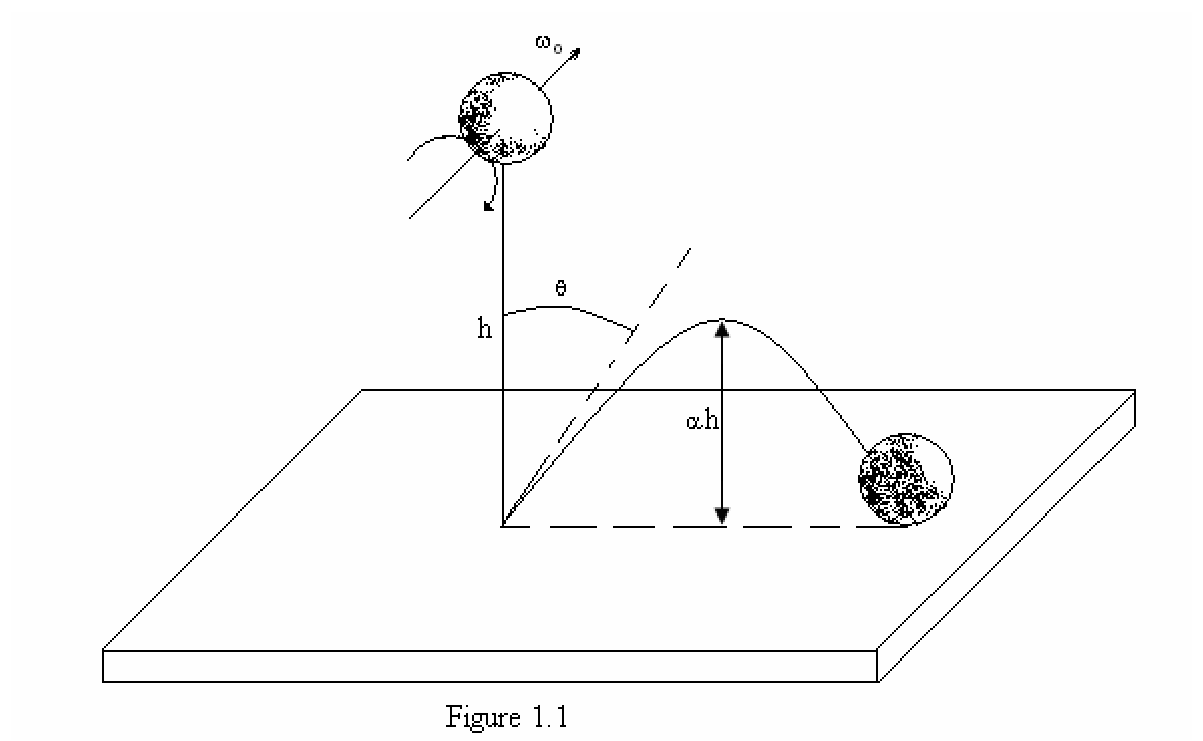
Figure 1.1
When released, the ball falls under gravity, and rebounds to a new height such that its lowest point is now \(ah\) above the floor. The deformation of the ball and the floor on impact may be considered negligible. Ignore the presence of the air. The impact time, although, is finite.
The mass of the ball is \(m\), the acceleration due the gravity is \(g\), the dynamic coefficient of friction between the ball and the floor is \(\mu_k\), and the moment of inertia of the ball about the given axis is: \[ I=\frac{2mR^2}{5} \]
You are required to consider two situations, in the first, the ball slips during the entire impact time, and in the second the slipping stops before the end of the impact time.
Situation I: slipping throughout the impact.
Find:
a) \(\tan\theta\), where \(\theta\) is the rebound angle indicated in the diagram;
b) the horizontal distance traveled in flight between the first and second impacts;
c) the minimum value of \(\omega_0\) for this situations.Situation II: slipping for part of the impacts.
Find, again:
a) \(\tan\theta\);
b) the horizontal distance traveled in flight between the first and second impacts.
Taking both of the above situations into account, sketch the variation of \(\tan\theta\) with \(\omega_0\).Official English text of the problem.
Problem 2: Charged balls moving along a square loop in an electric field (relativity)
In a square loop with a side length \(L\), a large number of balls of negligible radius and each with a charge \(q\) are moving at a speed \(u\) with a constant separation \(a\) between them, as seen from a frame of reference that is fixed with respect to the loop. The balls are arranged on the loop like the beads on a necklace, \(L\) being much greater than \(a\), as indicated in the figure 2.1. The no conducting wire forming the loop has a homogeneous charge density per unit length in the in the frame of the loop. Its total charge is equal and opposite to the total charge of the balls in that frame.
Consider the situation in which the loop moves with velocity \(v\) parallel to its side \(AB\) (fig. 2.1) through a homogeneous electric field of strength \(E\) which is perpendicular to the loop velocity and makes an angle \(\theta\) with the plane of the loop.
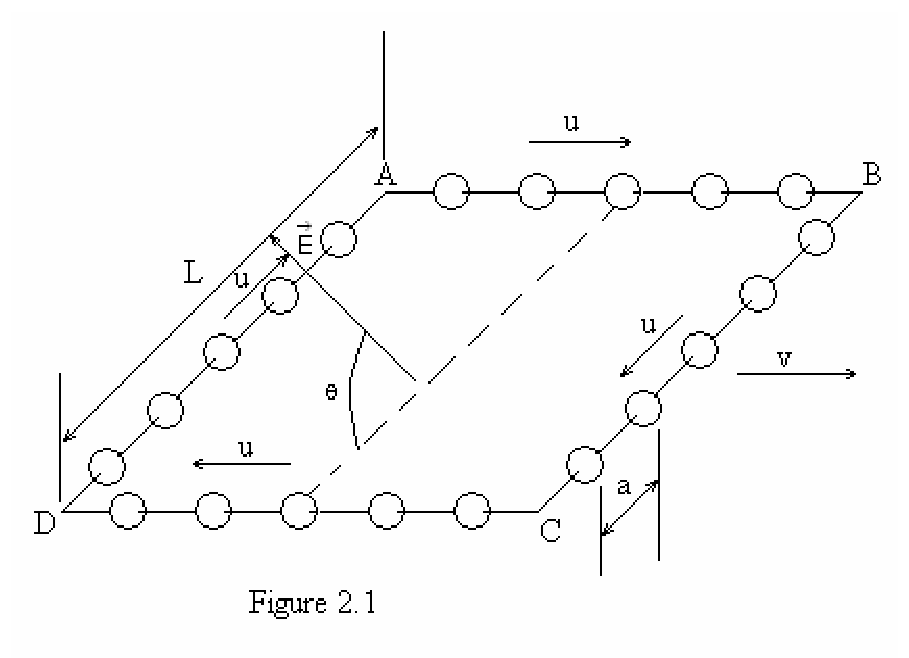
Figure 2.1
Taking into account relativistic effects, calculate the following magnitudes in the frame of reference of an observer who sees the loop moving with velocity \(v\):
a) The spacing between the balls on each of the side of the loop, \(a_{AB}\), \(a_{BC}\), \(a_{CD}\), y \(a_{DA}\).
b) The value of the net charge of the loop plus balls on each of the side of the loop: \(Q_{AB}\), \(Q_{BC}\), \(Q_{CD}\) y, \(Q_{DA}\)
c) The modulus \(M\) of the electrically produced torque tending to rotate the system of the loop and the balls.
d) The energy \(W\) due to the interaction of the system, consisting of the loop and the balls with the electric field.
All the answers should be given in terms of quantities specified in the problem.
Note. The electric charge of an isolated object is independent of the frame of reference in which the measurements takes place. Any electromagnetic radiation effects should be ignored.
Some formulae of special relativity
Consider a reference frame \(S'\) moving with velocity \(V\) with reference to another reference frame \(S\). The axes of the frames are parallel, and their origins coincide a \(t=0\). \(V\) is directed along the positive direction of the \(x\) axis.
Relativistic sum of velocities
If a particle is moving with velocity \(u'\) in the \(x'\) direction , as measured in \(S'\), the velocity of the particle measured in \(S\) is given by:
\[ u=\frac{u'+V}{1+\dfrac{u'V}{c^2}} \]
Relativistic Contraction
If an object at rest in frame \(S\) has length \(L_0\) in the \(x\)-direction, an observer in frame \(S'\) (moving at velocity \(V\) in the \(x\)-direction} will measure its length to be:
\[ L=L_0\sqrt{1-\frac{v^2}{c^2}} \]
Official English text of the problem.
Problem 3: Cooling Atoms by laser
To study the properties of isolated atoms with a high degree of precision they must be kept almost at rest for a length of time. A method has recently been developed to do this. It is called “laser cooling” and is illustrated by the problem below.
In a vacuum chamber a well collimated beam of \(\mathrm{Na}^{23}\) atoms (coming from the evaporation of a sample at \(10^3\ \mathrm{K}\)) is illuminated head-on with a high intensity laser beam (fig. 3.1). The frequency of laser is chosen so there will be resonant absorption of a photon by those atoms whose velocity is \(v_0\). When the light is absorbed, these atoms are exited to the first energy level, which has a mean value \(E\) above the ground state and uncertainty of \(\Gamma\) (fig. 3.2).
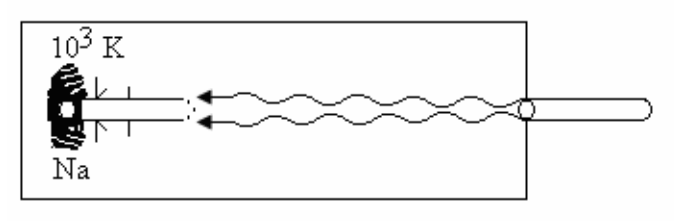
Figure 3.1
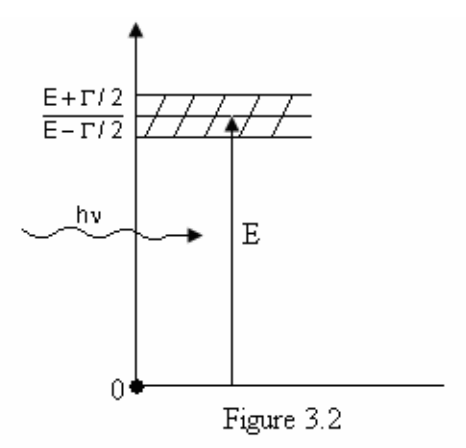
Figure 3.2
For this process, the atom’s decrease in velocity \(\Delta v_1\) is given by \(\Delta v_1=v_1-v_0\). Light is then emitted by the atom as it returns to its ground state. The atom’s velocity changes by \(\Delta v'=v'_1-v_1\) and its direction of motion changes by an angle \(\varphi\) (fig. 3.3).
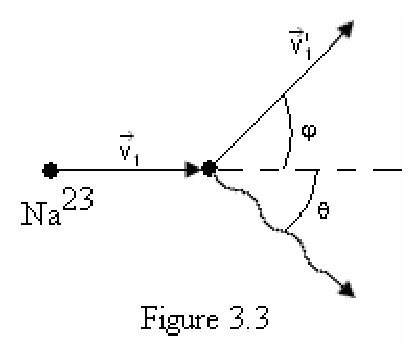
Figure 3.3
This sequence of absorption and emission takes place many times until the velocity of the atoms has decreased by a given amount \(\Delta v\) such that resonant absorption of light at frequency \(\nu\) no longer occurs. It is then necessary to change the frequency of laser so as to maintain resonant absorption. The atoms moving at the new velocity are further slowed down until some of them have a velocity close to zero.
As first approximation we may ignore any atomic interaction processes apart from the spontaneous absorption and emission light described above.
Furthermore, we may assume the laser to be so intense that the atoms spend practically no time in the ground state.Questions
a) Find the laser frequency needed ensure the resonant absorption of the light by those atoms whose kinetic energy of the atoms inside the region behind the collimator. Also find the reduction in the velocity of these atoms, \(\Delta v_1\), after the absorption process.
b) Light of the frequency calculated in question a) is absorbed by atoms which velocities lie within a range \(\Delta v_0\). Calculate this velocity range.
c) When an atom emits light, its direction of motion changes by \(\varphi\) from initial direction. Calculate \(\varphi\).
d) Find the maximum possible velocity decrease \(\Delta v\) for a given frequency.
e) What is the approximate number \(N\) of absorption-emission events necessary to reduce the velocity of an atom from is initial value \(v_0\)
-found in question a) above- almost to zero? Assume the atom travels in a straight line.f) Find the time \(t\) that the process in question e takes. Calculate the distance \(\Delta S\) an atom travels in this time.
Data
\[ \begin{aligned} E&=3{,}36\cdot10^{-19}\ \mathrm{J}\\ \Gamma&=7{,}0\cdot10^{-27}\ \mathrm{J}\\ c&=3\cdot10^8\ \mathrm{ms^{-1}}\\ m_p&=1{,}67\cdot10^{-27}\ \mathrm{kg}\\ h&=6{,}62\cdot10^{-34}\ \mathrm{Js}\\ k&=1{,}38\cdot10^{-23}\ \mathrm{JK^{-1}} \end{aligned} \]
where \(c\) is speed of light, \(h\) is Planck’s constant, \(k\) is the Boltzmann constant, and \(m_p\) is the mass of proton.
Official English text of the problem.
Internationale Physik-Olympiade
IPhO 1991
Havanna, Kuba · 3 Theorieaufgaben mit vollständigen Lösungen
Aufgabe 1: Rotierende Kugel beim Aufprall auf den Boden
Abbildung 1.1 zeigt eine massive, homogene Kugel mit dem Radius \(R\). Bevor sie auf den Boden fällt, ruht ihr Schwerpunkt, die Kugel rotiert jedoch mit der Winkelgeschwindigkeit \(\omega_0\) um eine horizontale Achse durch ihren Mittelpunkt. Der tiefste Punkt der Kugel befindet sich in einer Höhe \(h\) über dem Boden.
Abbildung 1.1
Nach dem Loslassen fällt die Kugel unter dem Einfluss der Schwerkraft und springt auf eine neue Höhe zurück, bei der ihr tiefster Punkt nun \(ah\) über dem Boden liegt. Die Verformung der Kugel und des Bodens beim Stoß kann als vernachlässigbar angesehen werden. Vernachlässigen Sie den Einfluss der Luft. Die Stoßdauer ist jedoch endlich.
Die Masse der Kugel beträgt \(m\), die Fallbeschleunigung \(g\), der Gleitreibungskoeffizient zwischen Kugel und Boden \(\mu_k\), und das Trägheitsmoment der Kugel bezüglich der angegebenen Achse ist: \[ I=\frac{2mR^2}{5} \]
Untersuchen Sie zwei Situationen: In der ersten gleitet die Kugel während der gesamten Stoßdauer, in der zweiten endet das Gleiten vor dem Ende der Stoßdauer.
Situation I: Gleiten während des gesamten Stoßes.
Bestimmen Sie:
a) \(\tan\theta\), wobei \(\theta\) der in der Abbildung angegebene Rückprallwinkel ist;
b) die während des Fluges zwischen dem ersten und dem zweiten Stoß zurückgelegte horizontale Strecke;
c) den Mindestwert von \(\omega_0\) für diese Situation.Situation II: Gleiten während eines Teils des Stoßes.
Bestimmen Sie erneut:
a) \(\tan\theta\);
b) die während des Fluges zwischen dem ersten und dem zweiten Stoß zurückgelegte horizontale Strecke.
Skizzieren Sie unter Berücksichtigung beider oben genannten Situationen den Verlauf von \(\tan\theta\) in Abhängigkeit von \(\omega_0\).Aufgabentext aus dem offiziellen englischen Text übersetzt.
Aufgabe 2: Geladene Kugeln, die sich entlang einer quadratischen Schleife in einem elektrischen Feld bewegen (Relativitätstheorie)
Auf einer quadratischen Schleife mit der Seitenlänge \(L\) bewegt sich eine große Anzahl von Kugeln mit vernachlässigbarem Radius und jeweils der Ladung \(q\) mit der Geschwindigkeit \(u\) und einem konstanten Abstand \(a\) voneinander, betrachtet in einem Bezugssystem, das relativ zur Schleife ruht. Die Kugeln sind auf der Schleife wie die Perlen einer Halskette angeordnet, wobei \(L\) viel größer als \(a\) ist, wie in Abbildung 2.1 dargestellt. Der nichtleitende Draht, der die Schleife bildet, hat im Ruhesystem der Schleife eine homogene Ladungsdichte pro Längeneinheit. Seine Gesamtladung ist in diesem Bezugssystem betragsmäßig gleich der Gesamtladung der Kugeln und hat das entgegengesetzte Vorzeichen.
Betrachten Sie die Situation, in der sich die Schleife mit der Geschwindigkeit \(v\) parallel zu ihrer Seite \(AB\) (Abb. 2.1) durch ein homogenes elektrisches Feld der Stärke \(E\) bewegt, das senkrecht zur Geschwindigkeit der Schleife steht und mit der Ebene der Schleife einen Winkel \(\theta\) bildet.
Abbildung 2.1
Berechnen Sie unter Berücksichtigung relativistischer Effekte die folgenden Größen im Bezugssystem eines Beobachters, für den sich die Schleife mit der Geschwindigkeit \(v\) bewegt:
a) Die Abstände zwischen den Kugeln auf den einzelnen Seiten der Schleife, \(a_{AB}\), \(a_{BC}\), \(a_{CD}\) und \(a_{DA}\).
b) Die Nettoladung von Schleife und Kugeln auf jeder Seite der Schleife: \(Q_{AB}\), \(Q_{BC}\), \(Q_{CD}\) und \(Q_{DA}\)
c) Den Betrag \(M\) des elektrisch erzeugten Drehmoments, das das System aus Schleife und Kugeln zu drehen versucht.
d) Die Energie \(W\) aufgrund der Wechselwirkung des aus Schleife und Kugeln bestehenden Systems mit dem elektrischen Feld.
Alle Antworten sind durch die in der Aufgabe angegebenen Größen auszudrücken.
Hinweis. Die elektrische Ladung eines isolierten Körpers ist unabhängig vom Bezugssystem, in dem die Messung erfolgt. Jegliche Effekte elektromagnetischer Strahlung sind zu vernachlässigen.
Einige Formeln der speziellen Relativitätstheorie
Betrachten Sie ein Bezugssystem \(S'\), das sich mit der Geschwindigkeit \(V\) relativ zu einem anderen Bezugssystem \(S\) bewegt. Die Achsen der Bezugssysteme sind parallel, und ihre Ursprünge fallen bei \(t=0\) zusammen. \(V\) ist in die positive Richtung der \(x\)-Achse gerichtet.
Relativistische Geschwindigkeitsaddition
Bewegt sich ein Teilchen mit der in \(S'\) gemessenen Geschwindigkeit \(u'\) in \(x'\)-Richtung, so ist seine in \(S\) gemessene Geschwindigkeit gegeben durch:
\[ u=\frac{u'+V}{1+\dfrac{u'V}{c^2}} \]
Relativistische Längenkontraktion
Hat ein im Bezugssystem \(S\) ruhender Körper in \(x\)-Richtung die Länge \(L_0\), so misst ein Beobachter im Bezugssystem \(S'\) (das sich mit der Geschwindigkeit \(V\) in \(x\)-Richtung bewegt) für seine Länge:
\[ L=L_0\sqrt{1-\frac{v^2}{c^2}} \]
Aufgabentext aus dem offiziellen englischen Text übersetzt.
Aufgabe 3: Kühlung von Atomen mit einem Laser
Um die Eigenschaften isolierter Atome mit hoher Genauigkeit untersuchen zu können, müssen diese für eine gewisse Zeit nahezu in Ruhe gehalten werden. Kürzlich wurde eine Methode entwickelt, die dies ermöglicht. Sie wird als „Laserkühlung“ bezeichnet und anhand der folgenden Aufgabe veranschaulicht.
In einer Vakuumkammer wird ein gut kollimierter Strahl von \(\mathrm{Na}^{23}\)-Atomen (die durch Verdampfen einer Probe bei \(10^3\ \mathrm{K}\) entstehen) frontal mit einem Laserstrahl hoher Intensität bestrahlt (Abb. 3.1). Die Laserfrequenz wird so gewählt, dass Atome mit der Geschwindigkeit \(v_0\) ein Photon resonant absorbieren. Bei der Absorption des Lichts werden diese Atome auf das erste angeregte Energieniveau angehoben, das im Mittel um \(E\) über dem Grundzustand liegt und eine Unschärfe von \(\Gamma\) aufweist (Abb. 3.2).
Abbildung 3.1
Abbildung 3.2
Bei diesem Vorgang ist die Geschwindigkeitsabnahme \(\Delta v_1\) des Atoms durch \(\Delta v_1=v_1-v_0\) gegeben. Anschließend emittiert das Atom Licht, während es in seinen Grundzustand zurückkehrt. Die Geschwindigkeit des Atoms ändert sich um \(\Delta v'=v'_1-v_1\), und seine Bewegungsrichtung ändert sich um einen Winkel \(\varphi\) (Abb. 3.3).
Abbildung 3.3
Diese Folge von Absorption und Emission wiederholt sich viele Male, bis die Geschwindigkeit der Atome um einen bestimmten Betrag \(\Delta v\) abgenommen hat, sodass keine resonante Absorption von Licht der Frequenz \(\nu\) mehr stattfindet. Dann muss die Laserfrequenz geändert werden, um die resonante Absorption aufrechtzuerhalten. Die Atome, die sich mit der neuen Geschwindigkeit bewegen, werden weiter abgebremst, bis einige von ihnen eine Geschwindigkeit nahe null haben.
In erster Näherung können wir alle atomaren Wechselwirkungsprozesse außer der oben beschriebenen spontanen Absorption und Emission von Licht vernachlässigen.
Außerdem dürfen wir annehmen, dass der Laser so intensiv ist, dass die Atome praktisch keine Zeit im Grundzustand verbringen.Fragen
a) Bestimmen Sie die Laserfrequenz, die erforderlich ist, um die resonante Absorption des Lichts durch diejenigen Atome sicherzustellen, deren kinetische Energie der Atome innerhalb des Bereichs hinter dem Kollimator. Bestimmen Sie außerdem die Geschwindigkeitsabnahme dieser Atome, \(\Delta v_1\), nach dem Absorptionsvorgang.
b) Licht mit der in Frage a) berechneten Frequenz wird von Atomen absorbiert, deren Geschwindigkeiten innerhalb eines Bereichs \(\Delta v_0\) liegen. Berechnen Sie diesen Geschwindigkeitsbereich.
c) Wenn ein Atom Licht emittiert, ändert sich seine Bewegungsrichtung um \(\varphi\) gegenüber der ursprünglichen Richtung. Berechnen Sie \(\varphi\).
d) Bestimmen Sie die maximal mögliche Geschwindigkeitsabnahme \(\Delta v\) bei einer gegebenen Frequenz.
e) Wie groß ist näherungsweise die Anzahl \(N\) der Absorptions-Emissions-Vorgänge, die erforderlich ist, um die Geschwindigkeit eines Atoms von ihrem Anfangswert \(v_0\)
– der oben in Frage a) bestimmt wurde – auf nahezu null zu verringern? Nehmen Sie an, dass sich das Atom geradlinig bewegt.f) Bestimmen Sie die Zeit \(t\), die der Vorgang in Frage e benötigt. Berechnen Sie die Strecke \(\Delta S\), die ein Atom in dieser Zeit zurücklegt.
Gegebene Daten
\[ \begin{aligned} E&=3{,}36\cdot10^{-19}\ \mathrm{J}\\ \Gamma&=7{,}0\cdot10^{-27}\ \mathrm{J}\\ c&=3\cdot10^8\ \mathrm{ms^{-1}}\\ m_p&=1{,}67\cdot10^{-27}\ \mathrm{kg}\\ h&=6{,}62\cdot10^{-34}\ \mathrm{Js}\\ k&=1{,}38\cdot10^{-23}\ \mathrm{JK^{-1}} \end{aligned} \]
Dabei ist \(c\) die Lichtgeschwindigkeit, \(h\) die Planck-Konstante, \(k\) die Boltzmann-Konstante und \(m_p\) die Masse des Protons.
Aufgabentext aus dem offiziellen englischen Text übersetzt.
Uluslararası Fizik Olimpiyatı
IPhO 1991
Havana, Küba · 3 teori sorusu, tam çözümleriyle
Soru 1: Dönerek yerden seken top
Şekil 1.1'de yarıçapı \(R\) olan, içi dolu, homojen bir top gösterilmektedir. Yere düşmeden önce kütle merkezi durmaktadır; ancak top, merkezinden geçen yatay bir eksen etrafında \(\omega_0\) açısal hızıyla dönmektedir. Topun en alt noktası yerden \(h\) yüksekliğindedir.
Şekil 1.1
Serbest bırakıldığında top yerçekimi etkisiyle düşer ve en alt noktası yerden \(ah\) yüksekte olacak şekilde yeni bir yüksekliğe seker. Çarpışma sırasında topun ve zeminin şekil değiştirmesi ihmal edilebilir. Havanın etkisini ihmal ediniz. Bununla birlikte çarpışma süresi sonludur.
Topun kütlesi \(m\), yerçekimi ivmesi \(g\), top ile zemin arasındaki kinetik sürtünme katsayısı \(\mu_k\) olup topun verilen eksene göre eylemsizlik momenti şöyledir: \[ I=\frac{2mR^2}{5} \]
İki durumu ele almanız istenmektedir: birincisinde top çarpışma süresinin tamamı boyunca kayar; ikincisinde ise kayma, çarpışma süresi sona ermeden durur.
Durum I: çarpışma boyunca kayma.
Bulunuz:
a) \(\theta\), şekilde gösterilen sekme açısı olmak üzere \(\tan\theta\);
b) birinci ve ikinci çarpışmalar arasında uçuş sırasında alınan yatay yol;
c) bu durum için \(\omega_0\)'ın en küçük değeri.Durum II: çarpışmanın bir bölümünde kayma.
Yine bulunuz:
a) \(\tan\theta\);
b) birinci ve ikinci çarpışmalar arasında uçuş sırasında alınan yatay yol.
Yukarıdaki iki durumu da dikkate alarak \(\tan\theta\)'nın \(\omega_0\) ile değişimini gösteren grafiği kabaca çiziniz.Soru metni resmi İngilizce metinden çevrilmiştir.
Soru 2: Bir elektrik alanında kare biçimli bir halka boyunca hareket eden yüklü küreler (görelilik)
Kenar uzunluğu \(L\) olan kare biçimli bir halkada, yarıçapları ihmal edilebilir ve her birinin yükü \(q\) olan çok sayıda küre, halkaya göre sabit bir referans sisteminden bakıldığında, aralarında sabit bir \(a\) uzaklığı bulunacak şekilde \(u\) süratiyle hareket etmektedir. Küreler, Şekil 2.1'de gösterildiği gibi, halkaya bir kolyenin boncukları gibi dizilmiştir; \(L\), \(a\)'dan çok büyüktür. Halkayı oluşturan yalıtkan tel, halkanın referans sisteminde birim uzunluk başına düzgün bir yük yoğunluğuna sahiptir. Telin toplam yükü, bu sistemde kürelerin toplam yüküne eşit büyüklükte ve zıt işaretlidir.
Halkanın, \(AB\) kenarına paralel \(v\) hızıyla (Şekil 2.1), şiddeti \(E\) olan düzgün bir elektrik alanı içinde hareket ettiği durumu ele alın. Elektrik alanı, halkanın hızına diktir ve halkanın düzlemiyle \(\theta\) açısı yapmaktadır.
Şekil 2.1
Göreli etkileri dikkate alarak, halkanın \(v\) hızıyla hareket ettiğini gören bir gözlemcinin referans sisteminde aşağıdaki büyüklükleri hesaplayın:
a) Halkanın her bir kenarında küreler arasındaki uzaklıklar: \(a_{AB}\), \(a_{BC}\), \(a_{CD}\) ve \(a_{DA}\).
b) Halkanın her bir kenarında, tel ve kürelerin toplam net yükü: \(Q_{AB}\), \(Q_{BC}\), \(Q_{CD}\) ve \(Q_{DA}\).
c) Halka ve kürelerden oluşan sistemi döndürmeye çalışan, elektriksel kuvvetlerin oluşturduğu torkun \(M\) büyüklüğü.
d) Halka ve kürelerden oluşan sistemin elektrik alanıyla etkileşiminden kaynaklanan \(W\) enerjisi.
Bütün cevaplar, soruda belirtilen büyüklükler cinsinden verilmelidir.
Not. Yalıtılmış bir cismin elektrik yükü, ölçümlerin yapıldığı referans sisteminden bağımsızdır. Elektromanyetik ışınımın tüm etkileri ihmal edilmelidir.
Özel göreliliğin bazı formülleri
Başka bir \(S\) referans sistemine göre \(V\) hızıyla hareket eden bir \(S'\) referans sistemini ele alın. Sistemlerin eksenleri paraleldir ve başlangıç noktaları \(t=0\) anında çakışır. \(V\), \(x\) ekseninin pozitif yönündedir.
Hızların göreli toplamı
Bir parçacık, \(S'\) sisteminde ölçüldüğü üzere \(x'\) yönünde \(u'\) hızıyla hareket ediyorsa, parçacığın \(S\) sisteminde ölçülen hızı şu şekilde verilir:
\[ u=\frac{u'+V}{1+\dfrac{u'V}{c^2}} \]
Göreli uzunluk büzülmesi
\(S\) sisteminde durgun olan bir cismin \(x\) yönündeki uzunluğu \(L_0\) ise, \(S'\) sistemindeki (\(x\) yönünde \(V\) hızıyla hareket eden) bir gözlemci cismin uzunluğunu şöyle ölçer:
\[ L=L_0\sqrt{1-\frac{v^2}{c^2}} \]
Soru metni resmi İngilizce metinden çevrilmiştir.
Soru 3: Atomların lazerle soğutulması
Yalıtılmış atomların özelliklerini yüksek bir hassasiyetle incelemek için atomların bir süre boyunca hemen hemen hareketsiz tutulması gerekir. Bunu sağlamak için yakın zamanda bir yöntem geliştirilmiştir. Bu yöntem “lazerle soğutma” olarak adlandırılır ve aşağıdaki soruda açıklanmaktadır.
Bir vakum odasında, iyi kolime edilmiş bir \(\mathrm{Na}^{23}\) atom demeti (\(10^3\ \mathrm{K}\) sıcaklığındaki bir numunenin buharlaştırılmasıyla elde edilen) karşı yönden gelen yüksek şiddetli bir lazer demetiyle aydınlatılmaktadır (şek. 3.1). Lazerin frekansı, hızı \(v_0\) olan atomların bir fotonu rezonans yoluyla soğuracağı şekilde seçilir. Işık soğurulduğunda bu atomlar, temel durumun üzerinde ortalama \(E\) enerjisine ve \(\Gamma\) belirsizliğine sahip olan birinci uyarılmış enerji düzeyine çıkar (şek. 3.2).
Şekil 3.1
Şekil 3.2
Bu süreçte atomun hızındaki azalma \(\Delta v_1\), \(\Delta v_1=v_1-v_0\) ile verilir. Ardından atom temel durumuna dönerken ışık yayar. Atomun hızı \(\Delta v'=v'_1-v_1\) kadar değişir ve hareket doğrultusu \(\varphi\) açısı kadar sapar (şek. 3.3).
Şekil 3.3
Bu soğurma ve yayım dizisi, atomların hızı belirli bir \(\Delta v\) miktarı kadar azalıp \(\nu\) frekansındaki ışığın rezonans yoluyla soğurulması artık gerçekleşmeyene kadar birçok kez tekrarlanır. Bu durumda, rezonans yoluyla soğurmayı sürdürmek için lazerin frekansını değiştirmek gerekir. Yeni hızla hareket eden atomlar, bazıları sıfıra yakın bir hıza ulaşıncaya kadar daha da yavaşlatılır.
İlk yaklaşım olarak, yukarıda açıklanan kendiliğinden ışık soğurma ve yayımı dışındaki tüm atomik etkileşim süreçlerini göz ardı edebiliriz.
Ayrıca lazerin, atomların temel durumda neredeyse hiç zaman geçirmemesini sağlayacak kadar şiddetli olduğunu varsayabiliriz.Sorular
a) Kinetik enerjileri kolimatörün arkasındaki bölgede bulunan atomların kinetik enerjisi olan atomların ışığı rezonans yoluyla soğurmasını sağlamak için gereken lazer frekansını bulun. Ayrıca soğurma sürecinden sonra bu atomların hızındaki azalmayı, \(\Delta v_1\), bulun.
b) a) sorusunda hesaplanan frekanstaki ışık, hızları bir \(\Delta v_0\) aralığında bulunan atomlar tarafından soğurulur. Bu hız aralığını hesaplayın.
c) Bir atom ışık yaydığında, hareket doğrultusu başlangıç doğrultusundan \(\varphi\) kadar sapar. \(\varphi\) açısını hesaplayın.
d) Belirli bir frekans için mümkün olan en büyük hız azalmasını, \(\Delta v\), bulun.
e) Bir atomun hızını başlangıç değeri olan \(v_0\)'dan
—yukarıdaki a) sorusunda bulunan değerden— hemen hemen sıfıra düşürmek için gerekli soğurma-yayım olaylarının yaklaşık sayısı \(N\) nedir? Atomun düz bir çizgi boyunca hareket ettiğini varsayın.f) e sorusundaki sürecin aldığı \(t\) süresini bulun. Bir atomun bu sürede aldığı \(\Delta S\) yolunu hesaplayın.
Veriler
\[ \begin{aligned} E&=3{,}36\cdot10^{-19}\ \mathrm{J}\\ \Gamma&=7{,}0\cdot10^{-27}\ \mathrm{J}\\ c&=3\cdot10^8\ \mathrm{ms^{-1}}\\ m_p&=1{,}67\cdot10^{-27}\ \mathrm{kg}\\ h&=6{,}62\cdot10^{-34}\ \mathrm{Js}\\ k&=1{,}38\cdot10^{-23}\ \mathrm{JK^{-1}} \end{aligned} \]
Burada \(c\) ışık hızı, \(h\) Planck sabiti, \(k\) Boltzmann sabiti ve \(m_p\) protonun kütlesidir.
Soru metni resmi İngilizce metinden çevrilmiştir.
Olimpiada Internacional de Física
IPhO 1991
La Habana, Cuba · 3 problemas teóricos con soluciones completas
Problema 1: Pelota en rotación que rebota en el suelo
La figura 1.1 muestra una pelota maciza y homogénea de radio \(R\). Antes de caer al suelo, su centro de masas está en reposo, pero la pelota gira con velocidad angular \(\omega_0\) alrededor de un eje horizontal que pasa por su centro. El punto más bajo de la pelota se encuentra a una altura \(h\) sobre el suelo.
Figura 1.1
Al soltarla, la pelota cae bajo la acción de la gravedad y rebota hasta una nueva altura, de modo que su punto más bajo se encuentra ahora a una altura \(ah\) sobre el suelo. La deformación de la pelota y del suelo durante el impacto puede considerarse despreciable. Ignore la presencia del aire. Sin embargo, la duración del impacto es finita.
La masa de la pelota es \(m\), la aceleración de la gravedad es \(g\), el coeficiente de rozamiento cinético entre la pelota y el suelo es \(\mu_k\), y el momento de inercia de la pelota respecto al eje dado es: \[ I=\frac{2mR^2}{5} \]
Se pide considerar dos situaciones: en la primera, la pelota desliza durante todo el impacto y, en la segunda, el deslizamiento cesa antes de que termine el impacto.
Situación I: deslizamiento durante todo el impacto.
Determine:
a) \(\tan\theta\), donde \(\theta\) es el ángulo de rebote indicado en el diagrama;
b) la distancia horizontal recorrida en vuelo entre el primer y el segundo impacto;
c) el valor mínimo de \(\omega_0\) para esta situación.Situación II: deslizamiento durante parte del impacto.
Determine de nuevo:
a) \(\tan\theta\);
b) la distancia horizontal recorrida en vuelo entre el primer y el segundo impacto.
Teniendo en cuenta las dos situaciones anteriores, esboce la variación de \(\tan\theta\) con \(\omega_0\).Enunciado traducido del texto oficial en inglés.
Problema 2: Bolas cargadas que se mueven a lo largo de un circuito cuadrado en un campo eléctrico (relatividad)
En un circuito cuadrado de lado \(L\), un gran número de bolas de radio despreciable, cada una con una carga \(q\), se mueven con una rapidez \(u\) y una separación constante \(a\) entre ellas, según se observa desde un sistema de referencia fijo respecto al circuito. Las bolas están dispuestas sobre el circuito como las cuentas de un collar, siendo \(L\) mucho mayor que \(a\), como se indica en la figura 2.1. El hilo no conductor que forma el circuito tiene una densidad de carga homogénea por unidad de longitud en el sistema de referencia del circuito. Su carga total es igual en magnitud y de signo opuesto a la carga total de las bolas en ese sistema.
Considérese la situación en la que el circuito se mueve con una velocidad \(v\) paralela a su lado \(AB\) (fig. 2.1) a través de un campo eléctrico homogéneo de intensidad \(E\), que es perpendicular a la velocidad del circuito y forma un ángulo \(\theta\) con el plano del circuito.
Figura 2.1
Teniendo en cuenta los efectos relativistas, calcule las siguientes magnitudes en el sistema de referencia de un observador que ve el circuito moverse con velocidad \(v\):
a) La separación entre las bolas en cada uno de los lados del circuito, \(a_{AB}\), \(a_{BC}\), \(a_{CD}\) y \(a_{DA}\).
b) El valor de la carga neta del conjunto formado por el circuito y las bolas en cada uno de los lados del circuito: \(Q_{AB}\), \(Q_{BC}\), \(Q_{CD}\) y \(Q_{DA}\).
c) El módulo \(M\) del momento de las fuerzas eléctricas que tiende a hacer girar el sistema formado por el circuito y las bolas.
d) La energía \(W\) debida a la interacción del sistema formado por el circuito y las bolas con el campo eléctrico.
Todas las respuestas deben expresarse en función de las magnitudes especificadas en el problema.
Nota. La carga eléctrica de un objeto aislado es independiente del sistema de referencia en el que se realizan las medidas. Deben ignorarse todos los efectos de la radiación electromagnética.
Algunas fórmulas de la relatividad especial
Considérese un sistema de referencia \(S'\) que se mueve con velocidad \(V\) respecto a otro sistema de referencia \(S\). Los ejes de los sistemas son paralelos y sus orígenes coinciden en \(t=0\). \(V\) está dirigida en el sentido positivo del eje \(x\).
Composición relativista de velocidades
Si una partícula se mueve con velocidad \(u'\) en la dirección \(x'\), medida en \(S'\), la velocidad de la partícula medida en \(S\) viene dada por:
\[ u=\frac{u'+V}{1+\dfrac{u'V}{c^2}} \]
Contracción relativista
Si un objeto en reposo en el sistema \(S\) tiene una longitud \(L_0\) en la dirección \(x\), un observador en el sistema \(S'\) (que se mueve con velocidad \(V\) en la dirección \(x\)) medirá la siguiente longitud:
\[ L=L_0\sqrt{1-\frac{v^2}{c^2}} \]
Enunciado traducido del texto oficial en inglés.
Problema 3: Enfriamiento de átomos mediante láser
Para estudiar las propiedades de átomos aislados con un alto grado de precisión, es necesario mantenerlos casi en reposo durante cierto tiempo. Recientemente se ha desarrollado un método para lograrlo. Se denomina «enfriamiento por láser» y se ilustra en el problema siguiente.
En una cámara de vacío, un haz bien colimado de átomos de \(\mathrm{Na}^{23}\) (procedentes de la evaporación de una muestra a \(10^3\ \mathrm{K}\)) se ilumina frontalmente con un haz láser de alta intensidad (fig. 3.1). La frecuencia del láser se elige de modo que los átomos cuya velocidad es \(v_0\) absorban un fotón de forma resonante. Al absorber la luz, estos átomos se excitan al primer nivel de energía, situado, en valor medio, a una energía \(E\) por encima del estado fundamental y con una incertidumbre de \(\Gamma\) (fig. 3.2).
Figura 3.1
Figura 3.2
En este proceso, la disminución de la velocidad del átomo, \(\Delta v_1\), viene dada por \(\Delta v_1=v_1-v_0\). A continuación, el átomo emite luz al volver a su estado fundamental. La velocidad del átomo cambia en \(\Delta v'=v'_1-v_1\) y su dirección de movimiento cambia un ángulo \(\varphi\) (fig. 3.3).
Figura 3.3
Esta secuencia de absorción y emisión se repite muchas veces hasta que la velocidad de los átomos ha disminuido en una cantidad determinada \(\Delta v\), de modo que deja de producirse la absorción resonante de luz de frecuencia \(\nu\). Entonces es necesario cambiar la frecuencia del láser para mantener la absorción resonante. Los átomos que se mueven con la nueva velocidad siguen frenándose hasta que algunos alcanzan una velocidad próxima a cero.
En una primera aproximación, podemos ignorar todos los procesos de interacción atómica salvo la absorción y la emisión espontánea de luz descritas anteriormente.
Además, podemos suponer que el láser es tan intenso que los átomos prácticamente no permanecen tiempo alguno en el estado fundamental.Preguntas
a) Halle la frecuencia del láser necesaria para garantizar la absorción resonante de la luz por aquellos átomos cuya energía cinética de los átomos en la región situada detrás del colimador. Halle también la reducción de la velocidad de estos átomos, \(\Delta v_1\), tras el proceso de absorción.
b) La luz de la frecuencia calculada en la pregunta a) es absorbida por átomos cuyas velocidades se encuentran dentro de un intervalo \(\Delta v_0\). Calcule este intervalo de velocidades.
c) Cuando un átomo emite luz, su dirección de movimiento cambia un ángulo \(\varphi\) respecto a la dirección inicial. Calcule \(\varphi\).
d) Halle la máxima disminución posible de la velocidad \(\Delta v\) para una frecuencia dada.
e) ¿Cuál es el número aproximado \(N\) de procesos de absorción-emisión necesarios para reducir la velocidad de un átomo desde su valor inicial \(v_0\)
—hallado en la pregunta a) anterior— hasta un valor casi nulo? Suponga que el átomo se desplaza en línea recta.f) Halle el tiempo \(t\) que tarda el proceso de la pregunta e. Calcule la distancia \(\Delta S\) que recorre un átomo durante este tiempo.
Datos
\[ \begin{aligned} E&=3{,}36\cdot10^{-19}\ \mathrm{J}\\ \Gamma&=7{,}0\cdot10^{-27}\ \mathrm{J}\\ c&=3\cdot10^8\ \mathrm{ms^{-1}}\\ m_p&=1{,}67\cdot10^{-27}\ \mathrm{kg}\\ h&=6{,}62\cdot10^{-34}\ \mathrm{Js}\\ k&=1{,}38\cdot10^{-23}\ \mathrm{JK^{-1}} \end{aligned} \]
donde \(c\) es la velocidad de la luz, \(h\) es la constante de Planck, \(k\) es la constante de Boltzmann y \(m_p\) es la masa del protón.
Enunciado traducido del texto oficial en inglés.
国际物理奥林匹克
IPhO 1991
古巴哈瓦那 · 3 道理论题及完整解答
题目 1:在地面上反弹的旋转球
图 1.1 所示为一个半径为 \(R\) 的均匀实心球。在落向地面之前,球的质心静止,但球正以角速度 \(\omega_0\) 绕通过球心的水平轴旋转。球的最低点距地面的高度为 \(h\)。
图 1.1
释放后,球在重力作用下下落,并反弹到一个新的高度,此时球的最低点距地面的高度为 \(ah\)。碰撞时球和地面的形变可视为可以忽略。忽略空气的影响。不过,碰撞持续时间是有限的。
球的质量为 \(m\),重力加速度为 \(g\),球与地面之间的动摩擦因数为 \(\mu_k\),球绕上述轴的转动惯量为: \[ I=\frac{2mR^2}{5} \]
请考虑两种情况:第一种情况中,球在整个碰撞过程中都发生滑动;第二种情况中,滑动在碰撞结束之前停止。
情况 I:整个碰撞过程中均发生滑动。
求:
a) \(\tan\theta\),其中 \(\theta\) 为图中标出的反弹角;
b) 第一次与第二次碰撞之间,球在空中运动所经过的水平距离;
c) 发生这种情况所需的 \(\omega_0\) 的最小值。情况 II:仅在碰撞过程中的一部分时间内发生滑动。
再次求:
a) \(\tan\theta\);
b) 第一次与第二次碰撞之间,球在空中运动所经过的水平距离。
综合考虑上述两种情况,画出 \(\tan\theta\) 随 \(\omega_0\) 变化的示意图。题目译自官方英文原文。
题目 2:电场中沿正方形环运动的带电小球(相对论)
在一个边长为 \(L\) 的正方形环上,有大量半径可忽略、各带电荷 \(q\) 的小球。从相对于环静止的参考系来看,小球以速率 \(u\) 运动,相邻小球之间的间距恒为 \(a\)。这些小球像项链上的珠子一样排列在环上,且 \(L\) 远大于 \(a\),如图 2.1 所示。构成环的不导电细线在环的参考系中具有均匀的电荷线密度。在该参考系中,细线的总电荷与小球的总电荷大小相等、符号相反。
考虑环以平行于其边 \(AB\) 的速度 \(v\)(图 2.1)穿过场强为 \(E\) 的匀强电场的情形。电场方向垂直于环的速度方向,并与环所在平面成 \(\theta\) 角。
图 2.1
考虑相对论效应,在观察到环以速度 \(v\) 运动的观察者的参考系中,计算下列物理量:
a) 环的各边上相邻小球之间的间距 \(a_{AB}\)、\(a_{BC}\)、\(a_{CD}\) 和 \(a_{DA}\)。
b) 环的各边上细线与小球的净电荷:\(Q_{AB}\)、\(Q_{BC}\)、\(Q_{CD}\) 和 \(Q_{DA}\)。
c) 电场产生的、使环与小球组成的系统趋于转动的力矩的大小 \(M\)。
d) 由环与小球组成的系统与电场相互作用所对应的能量 \(W\)。
所有答案均应以题目中给定的物理量表示。
注。 孤立物体的电荷与进行测量所用的参考系无关。忽略一切电磁辐射效应。
狭义相对论的一些公式
考虑相对于另一参考系 \(S\) 以速度 \(V\) 运动的参考系 \(S'\)。两参考系的坐标轴相互平行,且原点在 \(t=0\) 时重合。\(V\) 沿 \(x\) 轴正方向。
相对论速度叠加
若在 \(S'\) 中测得某粒子沿 \(x'\) 方向以速度 \(u'\) 运动,则在 \(S\) 中测得的粒子速度为:
\[ u=\frac{u'+V}{1+\dfrac{u'V}{c^2}} \]
相对论长度收缩
若静止于参考系 \(S\) 中的物体沿 \(x\) 方向的长度为 \(L_0\),则参考系 \(S'\)(沿 \(x\) 方向以速度 \(V\) 运动)中的观察者测得其长度为:
\[ L=L_0\sqrt{1-\frac{v^2}{c^2}} \]
题目译自官方英文原文。
题目 3:用激光冷却原子
要高精度地研究孤立原子的性质,就必须使它们在一段时间内保持几乎静止。最近,人们发展出了一种实现这一目的的方法,称为“激光冷却”。下面的问题说明了这一方法。
在真空室中,一束准直良好的 \(\mathrm{Na}^{23}\) 原子束(由温度为 \(10^3\ \mathrm{K}\) 的样品蒸发产生)受到一束高强度激光的迎面照射(图 3.1)。选择适当的激光频率,使速度为 \(v_0\) 的原子能够共振吸收光子。吸收光后,这些原子被激发到第一激发能级,该能级相对于基态的能量平均值为 \(E\),不确定度为 \(\Gamma\)(图 3.2)。
图 3.1
图 3.2
在这一过程中,原子速度的减小量 \(\Delta v_1\) 定义为 \(\Delta v_1=v_1-v_0\)。随后,原子回到基态并发光。原子的速度改变了 \(\Delta v'=v'_1-v_1\),运动方向偏转了角度 \(\varphi\)(图 3.3)。
图 3.3
这一吸收和发射过程反复进行,直到原子的速度减小了某一给定量 \(\Delta v\),使其不再共振吸收频率为 \(\nu\) 的光。此时,必须改变激光频率,以维持共振吸收。以新速度运动的原子进一步减速,直到其中一些原子的速度接近零。
作为一级近似,除上述光的自发吸收和发射过程外,可以忽略原子的其他相互作用过程。
此外,可以假设激光强度足够高,使原子在基态停留的时间几乎为零。问题
a) 求使动能为准直器后方区域内原子动能的那些原子共振吸收光所需的激光频率。并求这些原子在吸收过程后的速度减小量 \(\Delta v_1\)。
b) 速度处于某一范围 \(\Delta v_0\) 内的原子能够吸收频率为问题 a) 中所求值的光。计算这一速度范围。
c) 原子发光时,其运动方向相对于初始方向偏转了 \(\varphi\)。计算 \(\varphi\)。
d) 求在给定频率下可能达到的最大速度减小量 \(\Delta v\)。
e) 要将原子的速度从初始值 \(v_0\)
——即上面问题 a) 中求得的值——降低到接近零,大约需要多少次吸收—发射过程 \(N\)?假设原子沿直线运动。f) 求问题 e 中的过程所需的时间 \(t\)。计算原子在这段时间内运动的距离 \(\Delta S\)。
数据
\[ \begin{aligned} E&=3{,}36\cdot10^{-19}\ \mathrm{J}\\ \Gamma&=7{,}0\cdot10^{-27}\ \mathrm{J}\\ c&=3\cdot10^8\ \mathrm{ms^{-1}}\\ m_p&=1{,}67\cdot10^{-27}\ \mathrm{kg}\\ h&=6{,}62\cdot10^{-34}\ \mathrm{Js}\\ k&=1{,}38\cdot10^{-23}\ \mathrm{JK^{-1}} \end{aligned} \]
其中,\(c\) 为光速,\(h\) 为普朗克常量,\(k\) 为玻尔兹曼常量,\(m_p\) 为质子质量。
题目译自官方英文原文。
Международная физическая олимпиада
IPhO 1991
Гавана, Куба · 3 теоретические задачи с полными решениями
Задача 1: Отскок вращающегося шара от пола
На рисунке 1.1 показан сплошной однородный шар радиуса \(R\). Перед падением на пол его центр масс покоится, однако шар вращается с угловой скоростью \(\omega_0\) вокруг горизонтальной оси, проходящей через его центр. Нижняя точка шара находится на высоте \(h\) над полом.
Рисунок 1.1
После освобождения шар падает под действием силы тяжести и отскакивает на новую высоту, так что его нижняя точка теперь находится на высоте \(ah\) над полом. Деформациями шара и пола при ударе можно пренебречь. Сопротивлением воздуха пренебречь. Однако длительность удара конечна.
Масса шара равна \(m\), ускорение свободного падения — \(g\), коэффициент трения скольжения между шаром и полом — \(\mu_k\), а момент инерции шара относительно указанной оси равен: \[ I=\frac{2mR^2}{5} \]
Необходимо рассмотреть два случая: в первом шар скользит в течение всего времени удара, а во втором скольжение прекращается до окончания удара.
Случай I: скольжение в течение всего времени удара.
Найдите:
a) \(\tan\theta\), где \(\theta\) — угол отскока, указанный на рисунке;
b) горизонтальное расстояние, пройденное в полёте между первым и вторым ударами;
c) минимальное значение \(\omega_0\) для этого случая.Случай II: скольжение в течение части времени удара.
Снова найдите:
a) \(\tan\theta\);
b) горизонтальное расстояние, пройденное в полёте между первым и вторым ударами.
Учитывая оба рассмотренных случая, изобразите схематически зависимость \(\tan\theta\) от \(\omega_0\).Условие переведено с официального английского текста.
Задача 2: Заряженные шарики, движущиеся по квадратному контуру в электрическом поле (теория относительности)
По квадратному контуру со стороной \(L\) движется большое число шариков пренебрежимо малого радиуса, каждый из которых имеет заряд \(q\). В системе отсчёта, неподвижной относительно контура, скорость шариков равна \(u\), а постоянное расстояние между ними равно \(a\). Шарики расположены на контуре подобно бусинам на ожерелье, причём \(L\) гораздо больше \(a\), как показано на рисунке 2.1. Непроводящая проволока, образующая контур, имеет однородную линейную плотность заряда в системе отсчёта контура. Её полный заряд равен по модулю и противоположен по знаку полному заряду шариков в этой системе отсчёта.
Рассмотрим ситуацию, в которой контур движется со скоростью \(v\) параллельно своей стороне \(AB\) (рис. 2.1) в однородном электрическом поле напряжённостью \(E\), перпендикулярном скорости контура и составляющем угол \(\theta\) с плоскостью контура.
Рисунок 2.1
С учётом релятивистских эффектов вычислите следующие величины в системе отсчёта наблюдателя, относительно которого контур движется со скоростью \(v\):
a) Расстояния между шариками на каждой стороне контура: \(a_{AB}\), \(a_{BC}\), \(a_{CD}\) и \(a_{DA}\).
b) Суммарный заряд проволоки и шариков на каждой стороне контура: \(Q_{AB}\), \(Q_{BC}\), \(Q_{CD}\) и \(Q_{DA}\).
c) Модуль \(M\) момента электрических сил, стремящихся повернуть систему, состоящую из контура и шариков.
d) Энергию \(W\) взаимодействия системы, состоящей из контура и шариков, с электрическим полем.
Все ответы следует выразить через величины, заданные в условии задачи.
Примечание. Электрический заряд изолированного тела не зависит от системы отсчёта, в которой проводятся измерения. Любыми эффектами электромагнитного излучения следует пренебречь.
Некоторые формулы специальной теории относительности
Рассмотрим систему отсчёта \(S'\), движущуюся со скоростью \(V\) относительно другой системы отсчёта \(S\). Оси систем отсчёта параллельны, а их начала совпадают при \(t=0\). Скорость \(V\) направлена вдоль положительного направления оси \(x\).
Релятивистское сложение скоростей
Если частица движется со скоростью \(u'\) в направлении \(x'\), измеренной в системе \(S'\), то скорость частицы, измеренная в системе \(S\), определяется выражением:
\[ u=\frac{u'+V}{1+\dfrac{u'V}{c^2}} \]
Релятивистское сокращение длины
Если тело, покоящееся в системе \(S\), имеет длину \(L_0\) в направлении \(x\), то наблюдатель в системе \(S'\) (движущейся со скоростью \(V\) в направлении \(x\)) измерит следующую длину этого тела:
\[ L=L_0\sqrt{1-\frac{v^2}{c^2}} \]
Условие переведено с официального английского текста.
Задача 3: Лазерное охлаждение атомов
Чтобы исследовать свойства изолированных атомов с высокой точностью, необходимо в течение некоторого времени удерживать их почти в покое. Недавно был разработан метод, позволяющий это сделать. Он называется «лазерным охлаждением» и рассматривается в приведённой ниже задаче.
В вакуумной камере хорошо коллимированный пучок атомов \(\mathrm{Na}^{23}\) (получаемых при испарении образца при \(10^3\ \mathrm{K}\)) облучается встречным лазерным пучком высокой интенсивности (рис. 3.1). Частота лазера выбрана так, чтобы атомы со скоростью \(v_0\) резонансно поглощали фотоны. При поглощении света эти атомы переходят на первый возбуждённый энергетический уровень, среднее значение энергии которого превышает энергию основного состояния на \(E\), а неопределённость энергии составляет \(\Gamma\) (рис. 3.2).
Рисунок 3.1
Рисунок 3.2
В этом процессе уменьшение скорости атома \(\Delta v_1\) определяется выражением \(\Delta v_1=v_1-v_0\). Затем атом испускает свет, возвращаясь в основное состояние. Скорость атома изменяется на \(\Delta v'=v'_1-v_1\), а направление его движения изменяется на угол \(\varphi\) (рис. 3.3).
Рисунок 3.3
Эта последовательность поглощения и испускания повторяется много раз, пока скорость атомов не уменьшится на некоторую величину \(\Delta v\), при которой резонансное поглощение света с частотой \(\nu\) прекращается. Тогда для поддержания резонансного поглощения необходимо изменить частоту лазера. Атомы, движущиеся с новой скоростью, продолжают замедляться, пока скорость некоторых из них не станет близкой к нулю.
В первом приближении можно пренебречь всеми процессами взаимодействия атомов, кроме описанных выше спонтанных поглощения и испускания света.
Кроме того, можно считать, что интенсивность лазера настолько велика, что атомы практически не проводят времени в основном состоянии.Вопросы
a) Найдите частоту лазера, необходимую для обеспечения резонансного поглощения света теми атомами, кинетическая энергия которых атомов в области за коллиматором. Найдите также уменьшение скорости этих атомов \(\Delta v_1\) после поглощения.
b) Свет с частотой, рассчитанной в вопросе a), поглощается атомами, скорости которых лежат в некотором интервале \(\Delta v_0\). Вычислите ширину этого интервала скоростей.
c) При испускании света атомом направление его движения отклоняется от первоначального на угол \(\varphi\). Вычислите \(\varphi\).
d) Найдите максимально возможное уменьшение скорости \(\Delta v\) при заданной частоте.
e) Каково приблизительное число \(N\) актов поглощения–испускания, необходимое для уменьшения скорости атома от начального значения \(v_0\)
— найденного выше в вопросе a) — почти до нуля? Считайте, что атом движется по прямой.f) Найдите время \(t\), за которое происходит процесс, описанный в вопросе e. Вычислите расстояние \(\Delta S\), которое атом проходит за это время.
Данные
\[ \begin{aligned} E&=3{,}36\cdot10^{-19}\ \mathrm{J}\\ \Gamma&=7{,}0\cdot10^{-27}\ \mathrm{J}\\ c&=3\cdot10^8\ \mathrm{ms^{-1}}\\ m_p&=1{,}67\cdot10^{-27}\ \mathrm{kg}\\ h&=6{,}62\cdot10^{-34}\ \mathrm{Js}\\ k&=1{,}38\cdot10^{-23}\ \mathrm{JK^{-1}} \end{aligned} \]
где \(c\) — скорость света, \(h\) — постоянная Планка, \(k\) — постоянная Больцмана, а \(m_p\) — масса протона.
Условие переведено с официального английского текста.
الأولمبياد الدولي للفيزياء
IPhO 1991
هافانا، كوبا · 3 مسائل نظرية مع حلول كاملة
المسألة 1: كرة دوّارة ترتد عن الأرضية
يبين الشكل 1.1 كرة مصمتة ومتجانسة نصف قطرها \(R\). قبل سقوطها على الأرضية، يكون مركز كتلتها ساكنًا، لكن الكرة تدور بسرعة زاوية \(\omega_0\) حول محور أفقي يمر بمركزها. تقع أدنى نقطة في الكرة على ارتفاع \(h\) فوق الأرضية.
الشكل 1.1
عند إفلات الكرة، تسقط تحت تأثير الجاذبية، ثم ترتد إلى ارتفاع جديد بحيث تصبح أدنى نقطة فيها على ارتفاع \(ah\) فوق الأرضية. يمكن اعتبار تشوه الكرة والأرضية عند التصادم مهملًا. أهمل وجود الهواء. إلا أن مدة التصادم غير صفرية.
كتلة الكرة هي \(m\)، وتسارع الجاذبية هو \(g\)، ومعامل الاحتكاك الحركي بين الكرة والأرضية هو \(\mu_k\)، وعزم قصور الكرة الذاتي حول المحور المعطى هو: \[ I=\frac{2mR^2}{5} \]
يُطلب منك دراسة حالتين: في الأولى، تنزلق الكرة طوال مدة التصادم، وفي الثانية، يتوقف الانزلاق قبل نهاية مدة التصادم.
الحالة I: الانزلاق طوال مدة التصادم.
أوجد:
a) \(\tan\theta\)، حيث \(\theta\) زاوية الارتداد المبينة في الرسم؛
b) المسافة الأفقية المقطوعة أثناء الطيران بين التصادمين الأول والثاني؛
c) القيمة الدنيا لـ \(\omega_0\) في هذه الحالة.الحالة II: الانزلاق خلال جزء من مدة التصادم.
أوجد، مرة أخرى:
a) \(\tan\theta\)؛
b) المسافة الأفقية المقطوعة أثناء الطيران بين التصادمين الأول والثاني.
مع أخذ الحالتين السابقتين في الحسبان، ارسم رسمًا تخطيطيًا لتغير \(\tan\theta\) بدلالة \(\omega_0\).نص المسألة مترجم عن النص الإنجليزي الرسمي.
المسألة 2: كرات مشحونة تتحرك على طول حلقة مربعة في مجال كهربائي (النسبية)
تتحرك في حلقة مربعة طول ضلعها \(L\) كرات كثيرة ذات أنصاف أقطار مهملة، تحمل كل منها شحنة \(q\)، بسرعة \(u\) وبمسافة فاصلة ثابتة \(a\) بينها، كما تُرصد من إطار مرجعي ثابت بالنسبة إلى الحلقة. تنتظم الكرات على الحلقة مثل خرزات عقد، ويكون \(L\) أكبر بكثير من \(a\)، كما هو موضح في الشكل 2.1. للسلك غير الموصل الذي يشكل الحلقة كثافة شحنة متجانسة لكل وحدة طول في إطار الحلقة. وشحنته الكلية تساوي الشحنة الكلية للكرات في ذلك الإطار مقدارًا وتعاكسها إشارةً.
لننظر في الحالة التي تتحرك فيها الحلقة بسرعة \(v\) موازية لضلعها \(AB\) (الشكل 2.1) عبر مجال كهربائي متجانس شدته \(E\)، عمودي على سرعة الحلقة ويصنع زاوية \(\theta\) مع مستوى الحلقة.
الشكل 2.1
مع أخذ التأثيرات النسبية في الحسبان، احسب المقادير التالية في الإطار المرجعي لراصد يرى الحلقة تتحرك بسرعة \(v\):
a) المسافة الفاصلة بين الكرات على كل ضلع من أضلاع الحلقة، \(a_{AB}\)، و\(a_{BC}\)، و\(a_{CD}\)، و\(a_{DA}\).
b) قيمة الشحنة الصافية للحلقة والكرات معًا على كل ضلع من أضلاع الحلقة: \(Q_{AB}\)، و\(Q_{BC}\)، و\(Q_{CD}\)، و\(Q_{DA}\)
c) مقدار عزم الدوران \(M\) الناشئ عن التأثير الكهربائي، والذي يميل إلى تدوير منظومة الحلقة والكرات.
d) الطاقة \(W\) الناتجة عن تفاعل المنظومة المكوّنة من الحلقة والكرات مع المجال الكهربائي.
يجب التعبير عن جميع الإجابات بدلالة الكميات المحددة في المسألة.
ملاحظة. الشحنة الكهربائية لجسم معزول مستقلة عن الإطار المرجعي الذي تُجرى فيه القياسات. ينبغي إهمال أي تأثيرات للإشعاع الكهرومغناطيسي.
بعض صيغ النسبية الخاصة
لنعتبر إطارًا مرجعيًا \(S'\) يتحرك بسرعة \(V\) بالنسبة إلى إطار مرجعي آخر \(S\). محاور الإطارين متوازية، ويتطابق أصلاهما عند \(t=0\). وتتجه \(V\) في الاتجاه الموجب للمحور \(x\).
الجمع النسبي للسرعات
إذا كان جسيم يتحرك بسرعة \(u'\) في الاتجاه \(x'\)، كما تُقاس في \(S'\)، فإن سرعة الجسيم المقاسة في \(S\) تُعطى بالعلاقة:
\[ u=\frac{u'+V}{1+\dfrac{u'V}{c^2}} \]
الانكماش النسبي
إذا كان طول جسم ساكن في الإطار \(S\) هو \(L_0\) في الاتجاه \(x\)، فإن راصدًا في الإطار \(S'\) (يتحرك بسرعة \(V\) في الاتجاه \(x\)) سيقيس طوله ليكون:
\[ L=L_0\sqrt{1-\frac{v^2}{c^2}} \]
نص المسألة مترجم عن النص الإنجليزي الرسمي.
المسألة 3: تبريد الذرات بالليزر
لدراسة خصائص الذرات المعزولة بدرجة عالية من الدقة، يجب إبقاؤها شبه ساكنة مدة من الزمن. وقد طُوِّرت حديثًا طريقة لتحقيق ذلك، تُسمّى «التبريد بالليزر»، وتوضحها المسألة الآتية.
في حجرة مفرّغة، تُضاء حزمة جيدة التسديد من ذرات \(\mathrm{Na}^{23}\) (ناتجة عن تبخير عينة عند \(10^3\ \mathrm{K}\)) بحزمة ليزر عالية الشدة تواجهها مباشرة (الشكل 3.1). يُختار تردد الليزر بحيث يحدث امتصاص رنيني لفوتون بواسطة الذرات التي سرعتها \(v_0\). وعند امتصاص الضوء، تُثار هذه الذرات إلى مستوى الطاقة الأول، الذي يزيد متوسط طاقته بمقدار \(E\) على طاقة الحالة الأرضية، ويبلغ عدم اليقين فيه \(\Gamma\) (الشكل 3.2).
الشكل 3.1
الشكل 3.2
في هذه العملية، يُعطى انخفاض سرعة الذرة \(\Delta v_1\) بالعلاقة \(\Delta v_1=v_1-v_0\). ثم تُصدر الذرة ضوءًا عند عودتها إلى حالتها الأرضية. وتتغير سرعة الذرة بمقدار \(\Delta v'=v'_1-v_1\)، ويتغير اتجاه حركتها بزاوية \(\varphi\) (الشكل 3.3).
الشكل 3.3
يتكرر هذا التسلسل من الامتصاص والانبعاث مرات عديدة إلى أن تنخفض سرعة الذرات بمقدار معين \(\Delta v\)، بحيث لا يعود الامتصاص الرنيني للضوء ذي التردد \(\nu\) يحدث. وعندئذ يلزم تغيير تردد الليزر للحفاظ على الامتصاص الرنيني. وتُبطَّأ الذرات المتحركة بالسرعة الجديدة أكثر، إلى أن تصبح سرعة بعضها قريبة من الصفر.
كتقريب أول، يمكننا إهمال جميع عمليات التفاعل الذري عدا امتصاص الضوء وانبعاثه التلقائيين الموصوفين أعلاه.
كما يمكننا افتراض أن شدة الليزر كبيرة إلى حد أن الذرات لا تمكث عمليًا أي وقت في الحالة الأرضية.الأسئلة
a) أوجد تردد الليزر اللازم لضمان الامتصاص الرنيني للضوء بواسطة تلك الذرات التي طاقتها الحركية للذرات داخل المنطقة الواقعة خلف المسدِّد. وأوجد أيضًا انخفاض سرعة هذه الذرات، \(\Delta v_1\)، بعد عملية الامتصاص.
b) تمتص الضوء ذا التردد المحسوب في السؤال a) ذرات تقع سرعاتها ضمن مجال \(\Delta v_0\). احسب مجال السرعات هذا.
c) عندما تُصدر ذرة ضوءًا، يتغير اتجاه حركتها بزاوية \(\varphi\) عن الاتجاه الابتدائي. احسب \(\varphi\).
d) أوجد أكبر انخفاض ممكن في السرعة \(\Delta v\) عند تردد معين.
e) ما العدد التقريبي \(N\) لعمليات الامتصاص والانبعاث اللازمة لخفض سرعة ذرة من قيمتها الابتدائية \(v_0\)
-الموجودة في السؤال a) أعلاه- إلى ما يقارب الصفر؟ افترض أن الذرة تتحرك في خط مستقيم.f) أوجد الزمن \(t\) الذي تستغرقه العملية الواردة في السؤال e. واحسب المسافة \(\Delta S\) التي تقطعها الذرة خلال هذا الزمن.
المعطيات
\[ \begin{aligned} E&=3{,}36\cdot10^{-19}\ \mathrm{J}\\ \Gamma&=7{,}0\cdot10^{-27}\ \mathrm{J}\\ c&=3\cdot10^8\ \mathrm{ms^{-1}}\\ m_p&=1{,}67\cdot10^{-27}\ \mathrm{kg}\\ h&=6{,}62\cdot10^{-34}\ \mathrm{Js}\\ k&=1{,}38\cdot10^{-23}\ \mathrm{JK^{-1}} \end{aligned} \]
حيث \(c\) سرعة الضوء، و\(h\) ثابت بلانك، و\(k\) ثابت بولتزمان، و\(m_p\) كتلة البروتون.
نص المسألة مترجم عن النص الإنجليزي الرسمي.