IPhO 1991 · Theory problem 3
Cooling Atoms by laser
To study the properties of isolated atoms with a high degree of precision they must be kept almost at rest for a length of time. A method has recently been developed to do this. It is called “laser cooling” and is illustrated by the problem below.
In a vacuum chamber a well collimated beam of \(\mathrm{Na}^{23}\) atoms (coming from the evaporation of a sample at \(10^3\ \mathrm{K}\)) is illuminated head-on with a high intensity laser beam (fig. 3.1). The frequency of laser is chosen so there will be resonant absorption of a photon by those atoms whose velocity is \(v_0\). When the light is absorbed, these atoms are exited to the first energy level, which has a mean value \(E\) above the ground state and uncertainty of \(\Gamma\) (fig. 3.2).
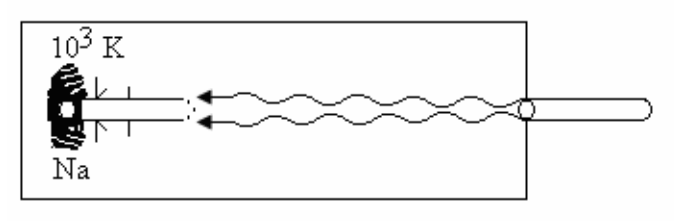
Figure 3.1
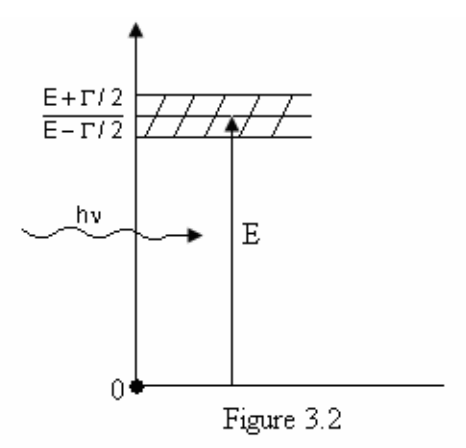
Figure 3.2
For this process, the atom’s decrease in velocity \(\Delta v_1\) is given by \(\Delta v_1=v_1-v_0\). Light is then emitted by the atom as it returns to its ground state. The atom’s velocity changes by \(\Delta v'=v'_1-v_1\) and its direction of motion changes by an angle \(\varphi\) (fig. 3.3).
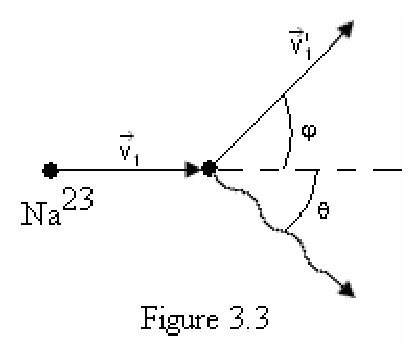
Figure 3.3
This sequence of absorption and emission takes place many times until the velocity of the atoms has decreased by a given amount \(\Delta v\) such that resonant absorption of light at frequency \(\nu\) no longer occurs. It is then necessary to change the frequency of laser so as to maintain resonant absorption. The atoms moving at the new velocity are further slowed down until some of them have a velocity close to zero.
As first approximation we may ignore any atomic interaction processes apart from the spontaneous absorption and emission light described above.
Furthermore, we may assume the laser to be so intense that the atoms spend practically no time in the ground state.
Questions
a) Find the laser frequency needed ensure the resonant absorption of the light by those atoms whose kinetic energy of the atoms inside the region behind the collimator. Also find the reduction in the velocity of these atoms, \(\Delta v_1\), after the absorption process.
b) Light of the frequency calculated in question a) is absorbed by atoms which velocities lie within a range \(\Delta v_0\). Calculate this velocity range.
c) When an atom emits light, its direction of motion changes by \(\varphi\) from initial direction. Calculate \(\varphi\).
d) Find the maximum possible velocity decrease \(\Delta v\) for a given frequency.
e) What is the approximate number \(N\) of absorption-emission events necessary to reduce the velocity of an atom from is initial value \(v_0\)
-found in question a) above- almost to zero? Assume the atom travels in a straight line.
f) Find the time \(t\) that the process in question e takes. Calculate the distance \(\Delta S\) an atom travels in this time.
Data
\[ \begin{aligned} E&=3{,}36\cdot10^{-19}\ \mathrm{J}\\ \Gamma&=7{,}0\cdot10^{-27}\ \mathrm{J}\\ c&=3\cdot10^8\ \mathrm{ms^{-1}}\\ m_p&=1{,}67\cdot10^{-27}\ \mathrm{kg}\\ h&=6{,}62\cdot10^{-34}\ \mathrm{Js}\\ k&=1{,}38\cdot10^{-23}\ \mathrm{JK^{-1}} \end{aligned} \]
where \(c\) is speed of light, \(h\) is Planck’s constant, \(k\) is the Boltzmann constant, and \(m_p\) is the mass of proton.
Official English text of the problem.
Answers
The numerical results use the assumed intended condition in (a), \(\frac12mv_0^2=\frac32kT\), giving \(v_0=1.04\times10^3\ \mathrm{m\,s^{-1}}\).
-
a)
\[ \boxed{\nu\simeq\frac{E}{h(1+v_0/c)} \simeq5.08\times10^{14}\ \mathrm{Hz}} \] This is approximately \(1.76\times10^9\ \mathrm{Hz}\) below the stationary-atom resonance. \[ \boxed{\Delta v_1\simeq-2.92\times10^{-2}\ \mathrm{m\,s^{-1}}} \] The positive magnitude of the speed reduction is \(2.92\times10^{-2}\ \mathrm{m\,s^{-1}}\). -
b) The full resonant velocity range is \[ \boxed{\Delta v_0=\frac{c\Gamma}{h\nu}\simeq6.3\ \mathrm{m\,s^{-1}}}, \] extending approximately from \(v_0-3.1\ \mathrm{m\,s^{-1}}\) to \(v_0+3.1\ \mathrm{m\,s^{-1}}\).
-
c) For the emission angle \(\theta\) shown in figure 3.3, let \(v_r=E/(mc)\). Then \[ \boxed{\varphi\simeq\frac{v_r}{v_1}\sin\theta \simeq2.8\times10^{-5}\sin\theta\ \mathrm{rad}}. \] The maximum initial deflection is approximately \(2.8\times10^{-5}\ \mathrm{rad}\).
-
d) Starting at the central resonant velocity \(v_0\), \[ \boxed{\Delta v\simeq\frac{c\Gamma}{2h\nu}\simeq3.1\ \mathrm{m\,s^{-1}}}. \] An atom starting at the upper edge of the resonant range can traverse the full range, approximately \(6.3\ \mathrm{m\,s^{-1}}\).
-
e) With the laser retuned during slowing, \[ \boxed{N\simeq\frac{mcv_0}{E}\simeq3.6\times10^4}. \]
-
f) Taking \(\Gamma\) as the full natural energy linewidth, \[ \boxed{t\simeq5.4\times10^{-4}\ \mathrm{s}=0.54\ \mathrm{ms}}, \qquad \boxed{\Delta S\simeq0.28\ \mathrm{m}}. \]
Solution
a) Resonant frequency and absorption recoil
The sentence specifying the initial kinetic energy is incomplete in the supplied text. We use the likely intended condition that the selected atoms have the mean thermal kinetic energy: \[ \frac12mv_0^2=\frac32kT. \] Approximating the sodium atom’s mass by \(23m_p\), \[ m=23(1.67\times10^{-27}) =3.841\times10^{-26}\ \mathrm{kg}, \] and therefore \[ v_0=\sqrt{\frac{3kT}{m}} =\sqrt{\frac{3(1.38\times10^{-23})(10^3)} {3.841\times10^{-26}}} =1.038\times10^3\ \mathrm{m\,s^{-1}}. \] Thus \(v_0/c\simeq3.46\times10^{-6}\), so nonrelativistic mechanics and the first-order Doppler formula suffice.
Choose the positive direction along the incident atomic beam. The counterpropagating photon has momentum \(-h\nu/c\). Conservation of momentum during absorption gives \[ mv_1=mv_0-\frac{h\nu}{c}, \] hence \[ \Delta v_1=v_1-v_0=-\frac{h\nu}{mc}. \]
Energy conservation gives \[ \frac12mv_0^2+h\nu=\frac12mv_1^2+E. \] Substituting the momentum relation, \[ h\nu\left(1+\frac{v_0}{c}\right) =E+\frac{(h\nu)^2}{2mc^2}. \] The final term is the recoil energy. Its value is approximately \[ E_r\simeq\frac{E^2}{2mc^2} =1.6\times10^{-29}\ \mathrm{J}, \] which is small even compared with \(\Gamma=7.0\times10^{-27}\ \mathrm{J}\). Neglecting it, \[ \boxed{\nu\simeq\frac{E}{h(1+v_0/c)}}. \] This is also the Doppler resonance condition: the approaching atom sees a frequency \(\nu(1+v_0/c)\), which must equal \(E/h\).
For clarity, retaining extra digits temporarily, \[ \nu_{\mathrm{rest}}=\frac Eh=5.0755287\times10^{14}\ \mathrm{Hz}, \] \[ \nu\simeq5.0755111\times10^{14}\ \mathrm{Hz}. \] The required laser frequency is therefore below the stationary-atom resonance by \[ \nu_{\mathrm{rest}}-\nu \simeq\nu_{\mathrm{rest}}\frac{v_0}{c} =1.76\times10^9\ \mathrm{Hz}. \]
The absorption recoil is \[ \boxed{\Delta v_1=-\frac{h\nu}{mc} \simeq-2.92\times10^{-2}\ \mathrm{m\,s^{-1}}}. \] Its sign is negative under the definition printed in the question.
b) Resonant velocity range
Following the energy interval shown in figure 3.2, we treat resonance as occurring when the Doppler-shifted photon energy lies between \(E-\Gamma/2\) and \(E+\Gamma/2\): \[ E-\frac{\Gamma}{2} \leq h\nu\left(1+\frac vc\right) \leq E+\frac{\Gamma}{2}. \]
The limiting velocities are consequently \[ v_\pm=c\left(\frac{E\pm\Gamma/2}{h\nu}-1\right). \] Since the laser is tuned to the centre of the line for velocity \(v_0\), \[ v_\pm=v_0\pm\frac{c\Gamma}{2h\nu}. \] Thus the full velocity range is \[ \boxed{\Delta v_0=v_+-v_-=\frac{c\Gamma}{h\nu}}. \] Using \(h\nu\simeq E\), \[ \Delta v_0\simeq \frac{(3.0\times10^8)(7.0\times10^{-27})} {3.36\times10^{-19}} =6.25\ \mathrm{m\,s^{-1}} \simeq6.3\ \mathrm{m\,s^{-1}}. \]
The half-width is approximately \(3.1\ \mathrm{m\,s^{-1}}\).
c) Deflection caused by spontaneous emission
The emitted photon has momentum approximately \(E/c\). Define the corresponding recoil speed \[ v_r=\frac{E}{mc}\simeq2.92\times10^{-2}\ \mathrm{m\,s^{-1}}. \] The small Doppler and recoil corrections to the emitted photon’s energy are negligible here.
For the geometry in figure 3.3, the photon travels at angle \(\theta\) below the initial direction. Conservation of momentum parallel and perpendicular to that direction gives \[ mv_1=mv'_1\cos\varphi+\frac Ec\cos\theta, \] \[ mv'_1\sin\varphi=\frac Ec\sin\theta. \] Dividing, \[ \boxed{\tan\varphi =\frac{v_r\sin\theta}{v_1-v_r\cos\theta}}. \]
Initially \(v_r\ll v_1\), so \[ \varphi\simeq\frac{v_r}{v_1}\sin\theta. \] With \(v_1\simeq1038.16\ \mathrm{m\,s^{-1}}\), \[ \boxed{\varphi\simeq2.8\times10^{-5}\sin\theta\ \mathrm{rad}}. \]
The largest deflection occurs for emission approximately perpendicular to the atomic velocity. More precisely, for fixed photon momentum, \[ \varphi_{\max}=\arcsin\left(\frac{v_r}{v_1}\right) \simeq2.8\times10^{-5}\ \mathrm{rad}. \] Thus one emission changes the initial direction only very slightly. A unique value of \(\varphi\) requires specifying the random emission angle \(\theta\).
d) Maximum slowing at fixed laser frequency
Consider first an atom starting at the central resonant velocity \(v_0\), as in part (a). As it slows, the photon energy in its rest frame decreases. The lower boundary of the resonance interval is reached when \[ h\nu\left(1+\frac{v_0-\Delta v}{c}\right) =E-\frac{\Gamma}{2}. \] Subtracting this from \[ h\nu\left(1+\frac{v_0}{c}\right)=E \] gives \[ \frac{h\nu}{c}\Delta v=\frac{\Gamma}{2}. \] Therefore, to the linewidth accuracy used in the problem, \[ \boxed{\Delta v=\frac{c\Gamma}{2h\nu} \simeq3.1\ \mathrm{m\,s^{-1}}}. \]
If “maximum possible” includes all initial velocities that can absorb this fixed laser frequency, an atom may begin at \(v_+\) and slow to \(v_-\). The maximum span is then \[ \boxed{v_+-v_-=\frac{c\Gamma}{h\nu} \simeq6.3\ \mathrm{m\,s^{-1}}}. \]
Both values are much smaller than \(v_0\). Continued slowing therefore requires increasing the laser frequency toward \(E/h\) as the atoms slow.
e) Number of absorption–emission events
Every absorption gives the atom a directed momentum change approximately \[ \Delta p_{x,\mathrm{abs}}=-\frac Ec. \] Spontaneous emission has no preferred forward or backward direction in the atom’s rest frame. Consequently, to the present accuracy, \[ \langle\cos\theta\rangle=0, \qquad \langle\Delta p_{x,\mathrm{em}}\rangle=0. \] The mean longitudinal speed change per complete cycle is therefore \[ \langle\Delta v_x\rangle=-v_r=-\frac{E}{mc}. \]
Using the straight-line approximation requested in the question and retuning the laser to maintain resonance, \[ Nv_r\simeq v_0. \] Hence \[ \boxed{N\simeq\frac{v_0}{v_r} =\frac{mcv_0}{E}}. \] Numerically, \[ N\simeq \frac{(3.841\times10^{-26})(3.0\times10^8)(1038.19)} {3.36\times10^{-19}} =3.56\times10^4. \] Thus approximately \[ \boxed{N\simeq3.6\times10^4} \] cycles are required. This estimates the reduction of the mean directed velocity; individual atoms undergo random emission recoils.
f) Cooling time and distance
For an excited state with mean lifetime \(\tau\), the full natural energy linewidth satisfies \[ \Gamma=\frac{\hbar}{\tau}. \] Here \(\Gamma\) is taken as the full width, consistent with the boundaries \(E\pm\Gamma/2\). Thus \[ \tau=\frac{\hbar}{\Gamma} =\frac{h}{2\pi\Gamma}. \] Numerically, \[ \tau= \frac{6.62\times10^{-34}} {2\pi(7.0\times10^{-27})} =1.51\times10^{-8}\ \mathrm{s}. \]
By the explicit assumption that the atoms spend practically no time in the ground state, the mean duration of one cycle is \(\tau\). Therefore \[ t=N\tau =(3.56\times10^4)(1.51\times10^{-8}) \simeq5.36\times10^{-4}\ \mathrm{s}, \] or \[ \boxed{t\simeq5.4\times10^{-4}\ \mathrm{s}}. \]
The mean recoil per cycle and mean cycle duration are approximately constant. Thus the mean deceleration has constant magnitude \[ a=\frac{v_r}{\tau}\simeq1.94\times10^6\ \mathrm{m\,s^{-2}}. \] For slowing from \(v_0\) almost to zero, the mean speed over the process is \(v_0/2\), giving \[ \Delta S\simeq\frac{v_0t}{2} =\frac{(1038.19)(5.36\times10^{-4})}{2} \simeq0.278\ \mathrm{m}. \] Therefore \[ \boxed{\Delta S\simeq0.28\ \mathrm{m}}. \]
The solution was checked against the official solution. Where this solution differs from the official solution, the official solution contains an error or a misprint.
IPhO 1991 · Theorieaufgabe 3
Kühlung von Atomen mit einem Laser
Um die Eigenschaften isolierter Atome mit hoher Genauigkeit untersuchen zu können, müssen diese für eine gewisse Zeit nahezu in Ruhe gehalten werden. Kürzlich wurde eine Methode entwickelt, die dies ermöglicht. Sie wird als „Laserkühlung“ bezeichnet und anhand der folgenden Aufgabe veranschaulicht.
In einer Vakuumkammer wird ein gut kollimierter Strahl von \(\mathrm{Na}^{23}\)-Atomen (die durch Verdampfen einer Probe bei \(10^3\ \mathrm{K}\) entstehen) frontal mit einem Laserstrahl hoher Intensität bestrahlt (Abb. 3.1). Die Laserfrequenz wird so gewählt, dass Atome mit der Geschwindigkeit \(v_0\) ein Photon resonant absorbieren. Bei der Absorption des Lichts werden diese Atome auf das erste angeregte Energieniveau angehoben, das im Mittel um \(E\) über dem Grundzustand liegt und eine Unschärfe von \(\Gamma\) aufweist (Abb. 3.2).
Abbildung 3.1
Abbildung 3.2
Bei diesem Vorgang ist die Geschwindigkeitsabnahme \(\Delta v_1\) des Atoms durch \(\Delta v_1=v_1-v_0\) gegeben. Anschließend emittiert das Atom Licht, während es in seinen Grundzustand zurückkehrt. Die Geschwindigkeit des Atoms ändert sich um \(\Delta v'=v'_1-v_1\), und seine Bewegungsrichtung ändert sich um einen Winkel \(\varphi\) (Abb. 3.3).
Abbildung 3.3
Diese Folge von Absorption und Emission wiederholt sich viele Male, bis die Geschwindigkeit der Atome um einen bestimmten Betrag \(\Delta v\) abgenommen hat, sodass keine resonante Absorption von Licht der Frequenz \(\nu\) mehr stattfindet. Dann muss die Laserfrequenz geändert werden, um die resonante Absorption aufrechtzuerhalten. Die Atome, die sich mit der neuen Geschwindigkeit bewegen, werden weiter abgebremst, bis einige von ihnen eine Geschwindigkeit nahe null haben.
In erster Näherung können wir alle atomaren Wechselwirkungsprozesse außer der oben beschriebenen spontanen Absorption und Emission von Licht vernachlässigen.
Außerdem dürfen wir annehmen, dass der Laser so intensiv ist, dass die Atome praktisch keine Zeit im Grundzustand verbringen.
Fragen
a) Bestimmen Sie die Laserfrequenz, die erforderlich ist, um die resonante Absorption des Lichts durch diejenigen Atome sicherzustellen, deren kinetische Energie der Atome innerhalb des Bereichs hinter dem Kollimator. Bestimmen Sie außerdem die Geschwindigkeitsabnahme dieser Atome, \(\Delta v_1\), nach dem Absorptionsvorgang.
b) Licht mit der in Frage a) berechneten Frequenz wird von Atomen absorbiert, deren Geschwindigkeiten innerhalb eines Bereichs \(\Delta v_0\) liegen. Berechnen Sie diesen Geschwindigkeitsbereich.
c) Wenn ein Atom Licht emittiert, ändert sich seine Bewegungsrichtung um \(\varphi\) gegenüber der ursprünglichen Richtung. Berechnen Sie \(\varphi\).
d) Bestimmen Sie die maximal mögliche Geschwindigkeitsabnahme \(\Delta v\) bei einer gegebenen Frequenz.
e) Wie groß ist näherungsweise die Anzahl \(N\) der Absorptions-Emissions-Vorgänge, die erforderlich ist, um die Geschwindigkeit eines Atoms von ihrem Anfangswert \(v_0\)
– der oben in Frage a) bestimmt wurde – auf nahezu null zu verringern? Nehmen Sie an, dass sich das Atom geradlinig bewegt.
f) Bestimmen Sie die Zeit \(t\), die der Vorgang in Frage e benötigt. Berechnen Sie die Strecke \(\Delta S\), die ein Atom in dieser Zeit zurücklegt.
Gegebene Daten
\[ \begin{aligned} E&=3{,}36\cdot10^{-19}\ \mathrm{J}\\ \Gamma&=7{,}0\cdot10^{-27}\ \mathrm{J}\\ c&=3\cdot10^8\ \mathrm{ms^{-1}}\\ m_p&=1{,}67\cdot10^{-27}\ \mathrm{kg}\\ h&=6{,}62\cdot10^{-34}\ \mathrm{Js}\\ k&=1{,}38\cdot10^{-23}\ \mathrm{JK^{-1}} \end{aligned} \]
Dabei ist \(c\) die Lichtgeschwindigkeit, \(h\) die Planck-Konstante, \(k\) die Boltzmann-Konstante und \(m_p\) die Masse des Protons.
Aufgabentext aus dem offiziellen englischen Text übersetzt.
Antworten
Die numerischen Ergebnisse beruhen auf der als beabsichtigt angenommenen Bedingung in (a), \(\frac12mv_0^2=\frac32kT\), aus der sich \(v_0=1.04\times10^3\ \mathrm{m\,s^{-1}}\) ergibt.
-
a)
\[ \boxed{\nu\simeq\frac{E}{h(1+v_0/c)} \simeq5.08\times10^{14}\ \mathrm{Hz}} \] Diese Frequenz liegt ungefähr \(1.76\times10^9\ \mathrm{Hz}\) unter der Resonanzfrequenz eines ruhenden Atoms. \[ \boxed{\Delta v_1\simeq-2.92\times10^{-2}\ \mathrm{m\,s^{-1}}} \] Der positive Betrag der Geschwindigkeitsabnahme ist \(2.92\times10^{-2}\ \mathrm{m\,s^{-1}}\). -
b) Der gesamte resonante Geschwindigkeitsbereich beträgt \[ \boxed{\Delta v_0=\frac{c\Gamma}{h\nu}\simeq6.3\ \mathrm{m\,s^{-1}}}, \] und erstreckt sich ungefähr von \(v_0-3.1\ \mathrm{m\,s^{-1}}\) bis \(v_0+3.1\ \mathrm{m\,s^{-1}}\).
-
c) Für den in Abbildung 3.3 dargestellten Emissionswinkel \(\theta\) sei \(v_r=E/(mc)\). Dann gilt \[ \boxed{\varphi\simeq\frac{v_r}{v_1}\sin\theta \simeq2.8\times10^{-5}\sin\theta\ \mathrm{rad}}. \] Die maximale anfängliche Ablenkung beträgt ungefähr \(2.8\times10^{-5}\ \mathrm{rad}\).
-
d) Ausgehend von der zentralen Resonanzgeschwindigkeit \(v_0\) gilt \[ \boxed{\Delta v\simeq\frac{c\Gamma}{2h\nu}\simeq3.1\ \mathrm{m\,s^{-1}}}. \] Ein Atom, das am oberen Rand des Resonanzbereichs startet, kann den gesamten Bereich von ungefähr \(6.3\ \mathrm{m\,s^{-1}}\) durchlaufen.
-
e) Wenn die Laserfrequenz während des Abbremsens nachgeführt wird, gilt \[ \boxed{N\simeq\frac{mcv_0}{E}\simeq3.6\times10^4}. \]
-
f) Wird \(\Gamma\) als volle natürliche Energielinienbreite aufgefasst, ergibt sich \[ \boxed{t\simeq5.4\times10^{-4}\ \mathrm{s}=0.54\ \mathrm{ms}}, \qquad \boxed{\Delta S\simeq0.28\ \mathrm{m}}. \]
Lösung
a) Resonanzfrequenz und Absorptionsrückstoß
Der Satz, der die anfängliche kinetische Energie festlegt, ist im bereitgestellten Text unvollständig. Wir verwenden die vermutlich beabsichtigte Bedingung, dass die ausgewählten Atome die mittlere thermische kinetische Energie besitzen: \[ \frac12mv_0^2=\frac32kT. \] Mit der Näherung \(23m_p\) für die Masse des Natriumatoms erhält man \[ m=23(1.67\times10^{-27}) =3.841\times10^{-26}\ \mathrm{kg}, \] und damit \[ v_0=\sqrt{\frac{3kT}{m}} =\sqrt{\frac{3(1.38\times10^{-23})(10^3)} {3.841\times10^{-26}}} =1.038\times10^3\ \mathrm{m\,s^{-1}}. \] Somit ist \(v_0/c\simeq3.46\times10^{-6}\), sodass nichtrelativistische Mechanik und die Dopplerformel erster Ordnung ausreichen.
Wir wählen die positive Richtung entlang des einfallenden Atomstrahls. Das entgegenlaufende Photon hat den Impuls \(-h\nu/c\). Aus der Impulserhaltung bei der Absorption folgt \[ mv_1=mv_0-\frac{h\nu}{c}, \] also \[ \Delta v_1=v_1-v_0=-\frac{h\nu}{mc}. \]
Die Energieerhaltung liefert \[ \frac12mv_0^2+h\nu=\frac12mv_1^2+E. \] Durch Einsetzen der Impulsbeziehung ergibt sich \[ h\nu\left(1+\frac{v_0}{c}\right) =E+\frac{(h\nu)^2}{2mc^2}. \] Der letzte Term ist die Rückstoßenergie. Ihr Wert beträgt ungefähr \[ E_r\simeq\frac{E^2}{2mc^2} =1.6\times10^{-29}\ \mathrm{J}, \] was selbst im Vergleich zu \(\Gamma=7.0\times10^{-27}\ \mathrm{J}\) klein ist. Vernachlässigt man diesen Term, erhält man \[ \boxed{\nu\simeq\frac{E}{h(1+v_0/c)}}. \] Dies ist zugleich die Doppler-Resonanzbedingung: Das entgegenkommende Atom nimmt die Frequenz \(\nu(1+v_0/c)\) wahr, die gleich \(E/h\) sein muss.
Zur Verdeutlichung behalten wir vorübergehend zusätzliche Stellen bei: \[ \nu_{\mathrm{rest}}=\frac Eh=5.0755287\times10^{14}\ \mathrm{Hz}, \] \[ \nu\simeq5.0755111\times10^{14}\ \mathrm{Hz}. \] Die erforderliche Laserfrequenz liegt daher um \[ \nu_{\mathrm{rest}}-\nu \simeq\nu_{\mathrm{rest}}\frac{v_0}{c} =1.76\times10^9\ \mathrm{Hz} \] unter der Resonanzfrequenz eines ruhenden Atoms.
Der Absorptionsrückstoß beträgt \[ \boxed{\Delta v_1=-\frac{h\nu}{mc} \simeq-2.92\times10^{-2}\ \mathrm{m\,s^{-1}}}. \] Gemäß der in der Aufgabenstellung angegebenen Definition ist sein Vorzeichen negativ.
b) Resonanter Geschwindigkeitsbereich
Entsprechend dem in Abbildung 3.2 dargestellten Energieintervall nehmen wir an, dass Resonanz auftritt, wenn die dopplerverschobene Photonenenergie zwischen \(E-\Gamma/2\) und \(E+\Gamma/2\) liegt: \[ E-\frac{\Gamma}{2} \leq h\nu\left(1+\frac vc\right) \leq E+\frac{\Gamma}{2}. \]
Die Grenzgeschwindigkeiten sind folglich \[ v_\pm=c\left(\frac{E\pm\Gamma/2}{h\nu}-1\right). \] Da der Laser für die Geschwindigkeit \(v_0\) auf die Linienmitte abgestimmt ist, gilt \[ v_\pm=v_0\pm\frac{c\Gamma}{2h\nu}. \] Somit beträgt der gesamte Geschwindigkeitsbereich \[ \boxed{\Delta v_0=v_+-v_-=\frac{c\Gamma}{h\nu}}. \] Mit \(h\nu\simeq E\) ergibt sich \[ \Delta v_0\simeq \frac{(3.0\times10^8)(7.0\times10^{-27})} {3.36\times10^{-19}} =6.25\ \mathrm{m\,s^{-1}} \simeq6.3\ \mathrm{m\,s^{-1}}. \]
Die halbe Breite beträgt ungefähr \(3.1\ \mathrm{m\,s^{-1}}\).
c) Ablenkung durch spontane Emission
Das emittierte Photon hat näherungsweise den Impuls \(E/c\). Wir definieren die zugehörige Rückstoßgeschwindigkeit \[ v_r=\frac{E}{mc}\simeq2.92\times10^{-2}\ \mathrm{m\,s^{-1}}. \] Die kleinen Doppler- und Rückstoßkorrekturen der Energie des emittierten Photons sind hier vernachlässigbar.
Bei der Geometrie in Abbildung 3.3 bewegt sich das Photon unter dem Winkel \(\theta\) unterhalb der ursprünglichen Richtung. Die Impulserhaltung parallel und senkrecht zu dieser Richtung liefert \[ mv_1=mv'_1\cos\varphi+\frac Ec\cos\theta, \] \[ mv'_1\sin\varphi=\frac Ec\sin\theta. \] Durch Division erhält man \[ \boxed{\tan\varphi =\frac{v_r\sin\theta}{v_1-v_r\cos\theta}}. \]
Anfangs gilt \(v_r\ll v_1\), also \[ \varphi\simeq\frac{v_r}{v_1}\sin\theta. \] Mit \(v_1\simeq1038.16\ \mathrm{m\,s^{-1}}\) ergibt sich \[ \boxed{\varphi\simeq2.8\times10^{-5}\sin\theta\ \mathrm{rad}}. \]
Die größte Ablenkung tritt bei einer Emission ungefähr senkrecht zur Geschwindigkeit des Atoms auf. Genauer gilt bei festem Photonenimpuls \[ \varphi_{\max}=\arcsin\left(\frac{v_r}{v_1}\right) \simeq2.8\times10^{-5}\ \mathrm{rad}. \] Eine einzelne Emission ändert die ursprüngliche Richtung somit nur sehr geringfügig. Für einen eindeutigen Wert von \(\varphi\) muss der zufällige Emissionswinkel \(\theta\) angegeben werden.
d) Maximale Abbremsung bei fester Laserfrequenz
Betrachten wir zunächst ein Atom, das wie in Teil (a) mit der zentralen Resonanzgeschwindigkeit \(v_0\) startet. Beim Abbremsen nimmt die Photonenenergie in seinem Ruhesystem ab. Die untere Grenze des Resonanzintervalls wird erreicht, wenn \[ h\nu\left(1+\frac{v_0-\Delta v}{c}\right) =E-\frac{\Gamma}{2}. \] Subtrahiert man dies von \[ h\nu\left(1+\frac{v_0}{c}\right)=E \] so erhält man \[ \frac{h\nu}{c}\Delta v=\frac{\Gamma}{2}. \] Damit gilt im Rahmen der in der Aufgabe verwendeten Genauigkeit bezüglich der Linienbreite \[ \boxed{\Delta v=\frac{c\Gamma}{2h\nu} \simeq3.1\ \mathrm{m\,s^{-1}}}. \]
Falls „maximal möglich“ alle Anfangsgeschwindigkeiten einschließt, bei denen Licht dieser festen Laserfrequenz absorbiert werden kann, kann ein Atom bei \(v_+\) starten und bis auf \(v_-\) abgebremst werden. Die maximale Spanne beträgt dann \[ \boxed{v_+-v_-=\frac{c\Gamma}{h\nu} \simeq6.3\ \mathrm{m\,s^{-1}}}. \]
Beide Werte sind viel kleiner als \(v_0\). Für eine fortgesetzte Abbremsung muss die Laserfrequenz daher beim Abbremsen der Atome in Richtung \(E/h\) erhöht werden.
e) Anzahl der Absorptions-Emissions-Vorgänge
Jede Absorption bewirkt beim Atom eine gerichtete Impulsänderung von ungefähr \[ \Delta p_{x,\mathrm{abs}}=-\frac Ec. \] Bei der spontanen Emission gibt es im Ruhesystem des Atoms keine bevorzugte Vorwärts- oder Rückwärtsrichtung. Daher gilt mit der hier verwendeten Genauigkeit \[ \langle\cos\theta\rangle=0, \qquad \langle\Delta p_{x,\mathrm{em}}\rangle=0. \] Die mittlere Änderung der longitudinalen Geschwindigkeit pro vollständigem Zyklus ist somit \[ \langle\Delta v_x\rangle=-v_r=-\frac{E}{mc}. \]
Verwendet man die in der Aufgabenstellung verlangte Näherung einer geradlinigen Bewegung und führt die Laserfrequenz zur Aufrechterhaltung der Resonanz nach, gilt \[ Nv_r\simeq v_0. \] Daraus folgt \[ \boxed{N\simeq\frac{v_0}{v_r} =\frac{mcv_0}{E}}. \] Numerisch ergibt sich \[ N\simeq \frac{(3.841\times10^{-26})(3.0\times10^8)(1038.19)} {3.36\times10^{-19}} =3.56\times10^4. \] Somit sind ungefähr \[ \boxed{N\simeq3.6\times10^4} \] Zyklen erforderlich. Dies ist eine Abschätzung der Verringerung der mittleren gerichteten Geschwindigkeit; einzelne Atome erfahren zufällige Emissionsrückstöße.
f) Kühlzeit und Strecke
Für einen angeregten Zustand mit der mittleren Lebensdauer \(\tau\) erfüllt die volle natürliche Energielinienbreite die Beziehung \[ \Gamma=\frac{\hbar}{\tau}. \] Hier wird \(\Gamma\) als volle Breite aufgefasst, im Einklang mit den Grenzen \(E\pm\Gamma/2\). Somit gilt \[ \tau=\frac{\hbar}{\Gamma} =\frac{h}{2\pi\Gamma}. \] Numerisch ergibt sich \[ \tau= \frac{6.62\times10^{-34}} {2\pi(7.0\times10^{-27})} =1.51\times10^{-8}\ \mathrm{s}. \]
Aufgrund der ausdrücklichen Annahme, dass die Atome praktisch keine Zeit im Grundzustand verbringen, beträgt die mittlere Dauer eines Zyklus \(\tau\). Daher gilt \[ t=N\tau =(3.56\times10^4)(1.51\times10^{-8}) \simeq5.36\times10^{-4}\ \mathrm{s}, \] oder \[ \boxed{t\simeq5.4\times10^{-4}\ \mathrm{s}}. \]
Der mittlere Rückstoß pro Zyklus und die mittlere Zyklusdauer sind näherungsweise konstant. Daher hat die mittlere Verzögerung den konstanten Betrag \[ a=\frac{v_r}{\tau}\simeq1.94\times10^6\ \mathrm{m\,s^{-2}}. \] Beim Abbremsen von \(v_0\) auf nahezu null beträgt die mittlere Geschwindigkeit während des Vorgangs \(v_0/2\), sodass sich ergibt \[ \Delta S\simeq\frac{v_0t}{2} =\frac{(1038.19)(5.36\times10^{-4})}{2} \simeq0.278\ \mathrm{m}. \] Damit gilt \[ \boxed{\Delta S\simeq0.28\ \mathrm{m}}. \]
Die Lösung wurde mit der offiziellen Lösung abgeglichen. Wo diese Lösung von der offiziellen Lösung abweicht, enthält die offizielle Lösung einen Fehler oder Druckfehler.
IPhO 1991 · Teori sorusu 3
Atomların lazerle soğutulması
Yalıtılmış atomların özelliklerini yüksek bir hassasiyetle incelemek için atomların bir süre boyunca hemen hemen hareketsiz tutulması gerekir. Bunu sağlamak için yakın zamanda bir yöntem geliştirilmiştir. Bu yöntem “lazerle soğutma” olarak adlandırılır ve aşağıdaki soruda açıklanmaktadır.
Bir vakum odasında, iyi kolime edilmiş bir \(\mathrm{Na}^{23}\) atom demeti (\(10^3\ \mathrm{K}\) sıcaklığındaki bir numunenin buharlaştırılmasıyla elde edilen) karşı yönden gelen yüksek şiddetli bir lazer demetiyle aydınlatılmaktadır (şek. 3.1). Lazerin frekansı, hızı \(v_0\) olan atomların bir fotonu rezonans yoluyla soğuracağı şekilde seçilir. Işık soğurulduğunda bu atomlar, temel durumun üzerinde ortalama \(E\) enerjisine ve \(\Gamma\) belirsizliğine sahip olan birinci uyarılmış enerji düzeyine çıkar (şek. 3.2).
Şekil 3.1
Şekil 3.2
Bu süreçte atomun hızındaki azalma \(\Delta v_1\), \(\Delta v_1=v_1-v_0\) ile verilir. Ardından atom temel durumuna dönerken ışık yayar. Atomun hızı \(\Delta v'=v'_1-v_1\) kadar değişir ve hareket doğrultusu \(\varphi\) açısı kadar sapar (şek. 3.3).
Şekil 3.3
Bu soğurma ve yayım dizisi, atomların hızı belirli bir \(\Delta v\) miktarı kadar azalıp \(\nu\) frekansındaki ışığın rezonans yoluyla soğurulması artık gerçekleşmeyene kadar birçok kez tekrarlanır. Bu durumda, rezonans yoluyla soğurmayı sürdürmek için lazerin frekansını değiştirmek gerekir. Yeni hızla hareket eden atomlar, bazıları sıfıra yakın bir hıza ulaşıncaya kadar daha da yavaşlatılır.
İlk yaklaşım olarak, yukarıda açıklanan kendiliğinden ışık soğurma ve yayımı dışındaki tüm atomik etkileşim süreçlerini göz ardı edebiliriz.
Ayrıca lazerin, atomların temel durumda neredeyse hiç zaman geçirmemesini sağlayacak kadar şiddetli olduğunu varsayabiliriz.
Sorular
a) Kinetik enerjileri kolimatörün arkasındaki bölgede bulunan atomların kinetik enerjisi olan atomların ışığı rezonans yoluyla soğurmasını sağlamak için gereken lazer frekansını bulun. Ayrıca soğurma sürecinden sonra bu atomların hızındaki azalmayı, \(\Delta v_1\), bulun.
b) a) sorusunda hesaplanan frekanstaki ışık, hızları bir \(\Delta v_0\) aralığında bulunan atomlar tarafından soğurulur. Bu hız aralığını hesaplayın.
c) Bir atom ışık yaydığında, hareket doğrultusu başlangıç doğrultusundan \(\varphi\) kadar sapar. \(\varphi\) açısını hesaplayın.
d) Belirli bir frekans için mümkün olan en büyük hız azalmasını, \(\Delta v\), bulun.
e) Bir atomun hızını başlangıç değeri olan \(v_0\)'dan
—yukarıdaki a) sorusunda bulunan değerden— hemen hemen sıfıra düşürmek için gerekli soğurma-yayım olaylarının yaklaşık sayısı \(N\) nedir? Atomun düz bir çizgi boyunca hareket ettiğini varsayın.
f) e sorusundaki sürecin aldığı \(t\) süresini bulun. Bir atomun bu sürede aldığı \(\Delta S\) yolunu hesaplayın.
Veriler
\[ \begin{aligned} E&=3{,}36\cdot10^{-19}\ \mathrm{J}\\ \Gamma&=7{,}0\cdot10^{-27}\ \mathrm{J}\\ c&=3\cdot10^8\ \mathrm{ms^{-1}}\\ m_p&=1{,}67\cdot10^{-27}\ \mathrm{kg}\\ h&=6{,}62\cdot10^{-34}\ \mathrm{Js}\\ k&=1{,}38\cdot10^{-23}\ \mathrm{JK^{-1}} \end{aligned} \]
Burada \(c\) ışık hızı, \(h\) Planck sabiti, \(k\) Boltzmann sabiti ve \(m_p\) protonun kütlesidir.
Soru metni resmi İngilizce metinden çevrilmiştir.
Cevaplar
Sayısal sonuçlarda, (a) kısmında kastedildiği varsayılan \(\frac12mv_0^2=\frac32kT\) koşulu kullanılmıştır; bu koşul \(v_0=1.04\times10^3\ \mathrm{m\,s^{-1}}\) değerini verir.
-
a)
\[ \boxed{\nu\simeq\frac{E}{h(1+v_0/c)} \simeq5.08\times10^{14}\ \mathrm{Hz}} \] Bu değer, durgun atomun rezonans frekansının yaklaşık \(1.76\times10^9\ \mathrm{Hz}\) altındadır. \[ \boxed{\Delta v_1\simeq-2.92\times10^{-2}\ \mathrm{m\,s^{-1}}} \] Süratteki azalmanın pozitif büyüklüğü \(2.92\times10^{-2}\ \mathrm{m\,s^{-1}}\)'dir. -
b) Rezonansa karşılık gelen tam hız aralığı \[ \boxed{\Delta v_0=\frac{c\Gamma}{h\nu}\simeq6.3\ \mathrm{m\,s^{-1}}}, \] olup yaklaşık olarak \(v_0-3.1\ \mathrm{m\,s^{-1}}\) ile \(v_0+3.1\ \mathrm{m\,s^{-1}}\) arasında uzanır.
-
c) Şekil 3.3'te gösterilen \(\theta\) yayım açısı için \(v_r=E/(mc)\) olsun. O hâlde \[ \boxed{\varphi\simeq\frac{v_r}{v_1}\sin\theta \simeq2.8\times10^{-5}\sin\theta\ \mathrm{rad}}. \] Başlangıçtaki en büyük sapma yaklaşık \(2.8\times10^{-5}\ \mathrm{rad}\)'dır.
-
d) Rezonans aralığının merkezindeki \(v_0\) hızından başlanırsa, \[ \boxed{\Delta v\simeq\frac{c\Gamma}{2h\nu}\simeq3.1\ \mathrm{m\,s^{-1}}}. \] Rezonans aralığının üst sınırından başlayan bir atom, yaklaşık \(6.3\ \mathrm{m\,s^{-1}}\) olan aralığın tamamını kat edebilir.
-
e) Yavaşlama sırasında lazerin frekansı yeniden ayarlandığında, \[ \boxed{N\simeq\frac{mcv_0}{E}\simeq3.6\times10^4}. \]
-
f) \(\Gamma\) doğal enerji çizgisinin tam genişliği olarak alındığında, \[ \boxed{t\simeq5.4\times10^{-4}\ \mathrm{s}=0.54\ \mathrm{ms}}, \qquad \boxed{\Delta S\simeq0.28\ \mathrm{m}}. \]
Çözüm
a) Rezonans frekansı ve soğurma geri tepmesi
Verilen metinde başlangıç kinetik enerjisini belirten cümle eksiktir. Seçilen atomların ortalama ısıl kinetik enerjiye sahip olması şeklindeki, muhtemelen kastedilen koşulu kullanıyoruz: \[ \frac12mv_0^2=\frac32kT. \] Sodyum atomunun kütlesini yaklaşık olarak \(23m_p\) alırsak, \[ m=23(1.67\times10^{-27}) =3.841\times10^{-26}\ \mathrm{kg}, \] ve dolayısıyla \[ v_0=\sqrt{\frac{3kT}{m}} =\sqrt{\frac{3(1.38\times10^{-23})(10^3)} {3.841\times10^{-26}}} =1.038\times10^3\ \mathrm{m\,s^{-1}}. \] Böylece \(v_0/c\simeq3.46\times10^{-6}\) olur; dolayısıyla görelilik dışı mekanik ve birinci mertebeden Doppler formülü yeterlidir.
Pozitif yönü, gelen atom demetinin yönünde seçelim. Karşı yönde ilerleyen fotonun momentumu \(-h\nu/c\)'dir. Soğurma sırasında momentumun korunumu \[ mv_1=mv_0-\frac{h\nu}{c}, \] bağıntısını verir; buradan \[ \Delta v_1=v_1-v_0=-\frac{h\nu}{mc}. \]
Enerjinin korunumu \[ \frac12mv_0^2+h\nu=\frac12mv_1^2+E. \] bağıntısını verir. Momentum bağıntısını yerine koyarsak, \[ h\nu\left(1+\frac{v_0}{c}\right) =E+\frac{(h\nu)^2}{2mc^2}. \] Son terim geri tepme enerjisidir. Değeri yaklaşık olarak \[ E_r\simeq\frac{E^2}{2mc^2} =1.6\times10^{-29}\ \mathrm{J}, \] olup \(\Gamma=7.0\times10^{-27}\ \mathrm{J}\) ile karşılaştırıldığında bile küçüktür. Bu terimi ihmal edersek, \[ \boxed{\nu\simeq\frac{E}{h(1+v_0/c)}}. \] Bu aynı zamanda Doppler rezonans koşuludur: yaklaşan atom, frekansı \(\nu(1+v_0/c)\) olarak görür ve bu frekansın \(E/h\)'ye eşit olması gerekir.
Açıklık sağlamak için geçici olarak daha fazla basamak tutarsak, \[ \nu_{\mathrm{rest}}=\frac Eh=5.0755287\times10^{14}\ \mathrm{Hz}, \] \[ \nu\simeq5.0755111\times10^{14}\ \mathrm{Hz}. \] Dolayısıyla gereken lazer frekansı, durgun atomun rezonans frekansının \[ \nu_{\mathrm{rest}}-\nu \simeq\nu_{\mathrm{rest}}\frac{v_0}{c} =1.76\times10^9\ \mathrm{Hz}. \] kadar altındadır.
Soğurma geri tepmesi \[ \boxed{\Delta v_1=-\frac{h\nu}{mc} \simeq-2.92\times10^{-2}\ \mathrm{m\,s^{-1}}}. \] olarak bulunur. Soruda verilen tanıma göre işareti negatiftir.
b) Rezonansa karşılık gelen hız aralığı
Şekil 3.2'de gösterilen enerji aralığına uygun olarak, Doppler kaymasına uğramış foton enerjisi \(E-\Gamma/2\) ile \(E+\Gamma/2\) arasında olduğunda rezonansın gerçekleştiğini kabul ediyoruz: \[ E-\frac{\Gamma}{2} \leq h\nu\left(1+\frac vc\right) \leq E+\frac{\Gamma}{2}. \]
Buna göre sınır hızları \[ v_\pm=c\left(\frac{E\pm\Gamma/2}{h\nu}-1\right). \] olur. Lazer, \(v_0\) hızı için çizginin merkezine ayarlandığından, \[ v_\pm=v_0\pm\frac{c\Gamma}{2h\nu}. \] Dolayısıyla tam hız aralığı \[ \boxed{\Delta v_0=v_+-v_-=\frac{c\Gamma}{h\nu}}. \] olur. \(h\nu\simeq E\) kullanılırsa, \[ \Delta v_0\simeq \frac{(3.0\times10^8)(7.0\times10^{-27})} {3.36\times10^{-19}} =6.25\ \mathrm{m\,s^{-1}} \simeq6.3\ \mathrm{m\,s^{-1}}. \]
Yarı genişlik yaklaşık \(3.1\ \mathrm{m\,s^{-1}}\)'dir.
c) Kendiliğinden yayımın neden olduğu sapma
Yayılan fotonun momentumu yaklaşık \(E/c\)'dir. Buna karşılık gelen geri tepme süratini \[ v_r=\frac{E}{mc}\simeq2.92\times10^{-2}\ \mathrm{m\,s^{-1}}. \] olarak tanımlayalım. Yayılan fotonun enerjisindeki küçük Doppler ve geri tepme düzeltmeleri burada ihmal edilebilir.
Şekil 3.3'teki geometriye göre foton, başlangıç doğrultusunun altında \(\theta\) açısıyla ilerler. Bu doğrultuya paralel ve dik yönlerde momentumun korunumu \[ mv_1=mv'_1\cos\varphi+\frac Ec\cos\theta, \] \[ mv'_1\sin\varphi=\frac Ec\sin\theta. \] bağıntılarını verir. Bölme işlemiyle, \[ \boxed{\tan\varphi =\frac{v_r\sin\theta}{v_1-v_r\cos\theta}}. \]
Başlangıçta \(v_r\ll v_1\) olduğundan, \[ \varphi\simeq\frac{v_r}{v_1}\sin\theta. \] \(v_1\simeq1038.16\ \mathrm{m\,s^{-1}}\) için, \[ \boxed{\varphi\simeq2.8\times10^{-5}\sin\theta\ \mathrm{rad}}. \]
En büyük sapma, yayım atomun hızına yaklaşık dik olduğunda gerçekleşir. Daha kesin olarak, sabit foton momentumu için, \[ \varphi_{\max}=\arcsin\left(\frac{v_r}{v_1}\right) \simeq2.8\times10^{-5}\ \mathrm{rad}. \] Dolayısıyla tek bir yayım, başlangıç doğrultusunu ancak çok az değiştirir. \(\varphi\)'nin tek bir değerinin bulunabilmesi için rastgele yayım açısı \(\theta\)'nın belirtilmesi gerekir.
d) Sabit lazer frekansında en büyük yavaşlama
Önce, (a) kısmındaki gibi, rezonans aralığının merkezindeki \(v_0\) hızıyla başlayan bir atomu ele alalım. Atom yavaşladıkça, kendi durgunluk referans sisteminde fotonun enerjisi azalır. Rezonans aralığının alt sınırına \[ h\nu\left(1+\frac{v_0-\Delta v}{c}\right) =E-\frac{\Gamma}{2}. \] olduğunda ulaşılır. Bu bağıntıyı \[ h\nu\left(1+\frac{v_0}{c}\right)=E \] bağıntısından çıkarırsak, \[ \frac{h\nu}{c}\Delta v=\frac{\Gamma}{2}. \] elde edilir. Dolayısıyla, soruda kullanılan çizgi genişliği hassasiyetinde, \[ \boxed{\Delta v=\frac{c\Gamma}{2h\nu} \simeq3.1\ \mathrm{m\,s^{-1}}}. \]
“Mümkün olan en büyük” ifadesi, bu sabit lazer frekansındaki ışığı soğurabilen tüm başlangıç hızlarını kapsıyorsa, bir atom \(v_+\) hızıyla başlayıp \(v_-\) hızına kadar yavaşlayabilir. Bu durumda en büyük hız aralığı \[ \boxed{v_+-v_-=\frac{c\Gamma}{h\nu} \simeq6.3\ \mathrm{m\,s^{-1}}}. \] olur.
Her iki değer de \(v_0\)'dan çok küçüktür. Bu nedenle yavaşlamanın sürmesi, atomlar yavaşladıkça lazer frekansının \(E/h\)'ye doğru artırılmasını gerektirir.
e) Soğurma–yayım olaylarının sayısı
Her soğurma, atomda yaklaşık olarak \[ \Delta p_{x,\mathrm{abs}}=-\frac Ec. \] değerinde, belirli bir yönde momentum değişimi oluşturur. Atomun durgunluk referans sisteminde kendiliğinden yayımın ileri ya da geri yönde bir tercihi yoktur. Dolayısıyla, burada kullanılan hassasiyette, \[ \langle\cos\theta\rangle=0, \qquad \langle\Delta p_{x,\mathrm{em}}\rangle=0. \] Bu nedenle tam bir çevrim başına boyuna hızdaki ortalama değişim \[ \langle\Delta v_x\rangle=-v_r=-\frac{E}{mc}. \] olur.
Soruda istenen doğrusal hareket yaklaşımını kullanıp rezonansı korumak için lazerin frekansını yeniden ayarlayarak, \[ Nv_r\simeq v_0. \] elde ederiz. Buradan \[ \boxed{N\simeq\frac{v_0}{v_r} =\frac{mcv_0}{E}}. \] Sayısal olarak, \[ N\simeq \frac{(3.841\times10^{-26})(3.0\times10^8)(1038.19)} {3.36\times10^{-19}} =3.56\times10^4. \] Dolayısıyla yaklaşık \[ \boxed{N\simeq3.6\times10^4} \] çevrim gerekir. Bu, belirli bir yöndeki ortalama hızın azalmasını tahmin eder; tek tek atomlar, yayım nedeniyle rastgele geri tepmelere uğrar.
f) Soğutma süresi ve alınan yol
Ortalama ömrü \(\tau\) olan bir uyarılmış durum için doğal enerji çizgisinin tam genişliği \[ \Gamma=\frac{\hbar}{\tau}. \] bağıntısını sağlar. Burada \(\Gamma\), \(E\pm\Gamma/2\) sınırlarıyla tutarlı olarak tam genişlik şeklinde alınmıştır. Dolayısıyla \[ \tau=\frac{\hbar}{\Gamma} =\frac{h}{2\pi\Gamma}. \] Sayısal olarak, \[ \tau= \frac{6.62\times10^{-34}} {2\pi(7.0\times10^{-27})} =1.51\times10^{-8}\ \mathrm{s}. \]
Atomların temel durumda neredeyse hiç zaman geçirmediği açıkça varsayıldığından, bir çevrimin ortalama süresi \(\tau\)'dur. Dolayısıyla \[ t=N\tau =(3.56\times10^4)(1.51\times10^{-8}) \simeq5.36\times10^{-4}\ \mathrm{s}, \] ya da \[ \boxed{t\simeq5.4\times10^{-4}\ \mathrm{s}}. \]
Çevrim başına ortalama geri tepme ve ortalama çevrim süresi yaklaşık olarak sabittir. Dolayısıyla ortalama yavaşlama ivmesinin büyüklüğü sabittir: \[ a=\frac{v_r}{\tau}\simeq1.94\times10^6\ \mathrm{m\,s^{-2}}. \] \(v_0\)'dan hemen hemen sıfıra kadar yavaşlama için süreç boyunca ortalama sürat \(v_0/2\)'dir; bu da \[ \Delta S\simeq\frac{v_0t}{2} =\frac{(1038.19)(5.36\times10^{-4})}{2} \simeq0.278\ \mathrm{m}. \] sonucunu verir. Dolayısıyla \[ \boxed{\Delta S\simeq0.28\ \mathrm{m}}. \]
Çözüm, resmi çözümle karşılaştırılarak kontrol edildi. Bu çözümün resmi çözümden ayrıldığı yerlerde resmi çözümde bir hata ya da baskı hatası vardır.
IPhO 1991 · Problema teórico 3
Enfriamiento de átomos mediante láser
Para estudiar las propiedades de átomos aislados con un alto grado de precisión, es necesario mantenerlos casi en reposo durante cierto tiempo. Recientemente se ha desarrollado un método para lograrlo. Se denomina «enfriamiento por láser» y se ilustra en el problema siguiente.
En una cámara de vacío, un haz bien colimado de átomos de \(\mathrm{Na}^{23}\) (procedentes de la evaporación de una muestra a \(10^3\ \mathrm{K}\)) se ilumina frontalmente con un haz láser de alta intensidad (fig. 3.1). La frecuencia del láser se elige de modo que los átomos cuya velocidad es \(v_0\) absorban un fotón de forma resonante. Al absorber la luz, estos átomos se excitan al primer nivel de energía, situado, en valor medio, a una energía \(E\) por encima del estado fundamental y con una incertidumbre de \(\Gamma\) (fig. 3.2).
Figura 3.1
Figura 3.2
En este proceso, la disminución de la velocidad del átomo, \(\Delta v_1\), viene dada por \(\Delta v_1=v_1-v_0\). A continuación, el átomo emite luz al volver a su estado fundamental. La velocidad del átomo cambia en \(\Delta v'=v'_1-v_1\) y su dirección de movimiento cambia un ángulo \(\varphi\) (fig. 3.3).
Figura 3.3
Esta secuencia de absorción y emisión se repite muchas veces hasta que la velocidad de los átomos ha disminuido en una cantidad determinada \(\Delta v\), de modo que deja de producirse la absorción resonante de luz de frecuencia \(\nu\). Entonces es necesario cambiar la frecuencia del láser para mantener la absorción resonante. Los átomos que se mueven con la nueva velocidad siguen frenándose hasta que algunos alcanzan una velocidad próxima a cero.
En una primera aproximación, podemos ignorar todos los procesos de interacción atómica salvo la absorción y la emisión espontánea de luz descritas anteriormente.
Además, podemos suponer que el láser es tan intenso que los átomos prácticamente no permanecen tiempo alguno en el estado fundamental.
Preguntas
a) Halle la frecuencia del láser necesaria para garantizar la absorción resonante de la luz por aquellos átomos cuya energía cinética de los átomos en la región situada detrás del colimador. Halle también la reducción de la velocidad de estos átomos, \(\Delta v_1\), tras el proceso de absorción.
b) La luz de la frecuencia calculada en la pregunta a) es absorbida por átomos cuyas velocidades se encuentran dentro de un intervalo \(\Delta v_0\). Calcule este intervalo de velocidades.
c) Cuando un átomo emite luz, su dirección de movimiento cambia un ángulo \(\varphi\) respecto a la dirección inicial. Calcule \(\varphi\).
d) Halle la máxima disminución posible de la velocidad \(\Delta v\) para una frecuencia dada.
e) ¿Cuál es el número aproximado \(N\) de procesos de absorción-emisión necesarios para reducir la velocidad de un átomo desde su valor inicial \(v_0\)
—hallado en la pregunta a) anterior— hasta un valor casi nulo? Suponga que el átomo se desplaza en línea recta.
f) Halle el tiempo \(t\) que tarda el proceso de la pregunta e. Calcule la distancia \(\Delta S\) que recorre un átomo durante este tiempo.
Datos
\[ \begin{aligned} E&=3{,}36\cdot10^{-19}\ \mathrm{J}\\ \Gamma&=7{,}0\cdot10^{-27}\ \mathrm{J}\\ c&=3\cdot10^8\ \mathrm{ms^{-1}}\\ m_p&=1{,}67\cdot10^{-27}\ \mathrm{kg}\\ h&=6{,}62\cdot10^{-34}\ \mathrm{Js}\\ k&=1{,}38\cdot10^{-23}\ \mathrm{JK^{-1}} \end{aligned} \]
donde \(c\) es la velocidad de la luz, \(h\) es la constante de Planck, \(k\) es la constante de Boltzmann y \(m_p\) es la masa del protón.
Enunciado traducido del texto oficial en inglés.
Respuestas
Los resultados numéricos utilizan la condición que se supone pretendida en (a), \(\frac12mv_0^2=\frac32kT\), que da \(v_0=1.04\times10^3\ \mathrm{m\,s^{-1}}\).
-
a)
\[ \boxed{\nu\simeq\frac{E}{h(1+v_0/c)} \simeq5.08\times10^{14}\ \mathrm{Hz}} \] Esta frecuencia está aproximadamente \(1.76\times10^9\ \mathrm{Hz}\) por debajo de la resonancia del átomo en reposo. \[ \boxed{\Delta v_1\simeq-2.92\times10^{-2}\ \mathrm{m\,s^{-1}}} \] La magnitud positiva de la reducción de la rapidez es \(2.92\times10^{-2}\ \mathrm{m\,s^{-1}}\). -
b) El intervalo completo de velocidades resonantes es \[ \boxed{\Delta v_0=\frac{c\Gamma}{h\nu}\simeq6.3\ \mathrm{m\,s^{-1}}}, \] y se extiende aproximadamente desde \(v_0-3.1\ \mathrm{m\,s^{-1}}\) hasta \(v_0+3.1\ \mathrm{m\,s^{-1}}\).
-
c) Para el ángulo de emisión \(\theta\) mostrado en la figura 3.3, sea \(v_r=E/(mc)\). Entonces \[ \boxed{\varphi\simeq\frac{v_r}{v_1}\sin\theta \simeq2.8\times10^{-5}\sin\theta\ \mathrm{rad}}. \] La desviación inicial máxima es aproximadamente \(2.8\times10^{-5}\ \mathrm{rad}\).
-
d) Partiendo de la velocidad resonante central \(v_0\), \[ \boxed{\Delta v\simeq\frac{c\Gamma}{2h\nu}\simeq3.1\ \mathrm{m\,s^{-1}}}. \] Un átomo que parte del extremo superior del intervalo resonante puede recorrer el intervalo completo, de aproximadamente \(6.3\ \mathrm{m\,s^{-1}}\).
-
e) Reajustando la frecuencia del láser durante el frenado, \[ \boxed{N\simeq\frac{mcv_0}{E}\simeq3.6\times10^4}. \]
-
f) Tomando \(\Gamma\) como la anchura natural completa de la línea en energía, \[ \boxed{t\simeq5.4\times10^{-4}\ \mathrm{s}=0.54\ \mathrm{ms}}, \qquad \boxed{\Delta S\simeq0.28\ \mathrm{m}}. \]
Solución
a) Frecuencia resonante y retroceso por absorción
La frase que especifica la energía cinética inicial está incompleta en el texto proporcionado. Utilizamos la condición probablemente pretendida de que los átomos seleccionados tienen la energía cinética térmica media: \[ \frac12mv_0^2=\frac32kT. \] Aproximando la masa del átomo de sodio por \(23m_p\), \[ m=23(1.67\times10^{-27}) =3.841\times10^{-26}\ \mathrm{kg}, \] y, por tanto, \[ v_0=\sqrt{\frac{3kT}{m}} =\sqrt{\frac{3(1.38\times10^{-23})(10^3)} {3.841\times10^{-26}}} =1.038\times10^3\ \mathrm{m\,s^{-1}}. \] Así, \(v_0/c\simeq3.46\times10^{-6}\), por lo que bastan la mecánica no relativista y la fórmula Doppler de primer orden.
Elegimos el sentido positivo a lo largo del haz atómico incidente. El fotón que se propaga en sentido opuesto tiene un momento lineal \(-h\nu/c\). La conservación del momento lineal durante la absorción da \[ mv_1=mv_0-\frac{h\nu}{c}, \] de donde \[ \Delta v_1=v_1-v_0=-\frac{h\nu}{mc}. \]
La conservación de la energía da \[ \frac12mv_0^2+h\nu=\frac12mv_1^2+E. \] Sustituyendo la relación para el momento lineal, \[ h\nu\left(1+\frac{v_0}{c}\right) =E+\frac{(h\nu)^2}{2mc^2}. \] El último término es la energía de retroceso. Su valor es aproximadamente \[ E_r\simeq\frac{E^2}{2mc^2} =1.6\times10^{-29}\ \mathrm{J}, \] que es pequeño incluso en comparación con \(\Gamma=7.0\times10^{-27}\ \mathrm{J}\). Despreciándolo, \[ \boxed{\nu\simeq\frac{E}{h(1+v_0/c)}}. \] Esta es también la condición de resonancia Doppler: el átomo que se aproxima percibe una frecuencia \(\nu(1+v_0/c)\), que debe ser igual a \(E/h\).
Para mayor claridad, conservando temporalmente cifras adicionales, \[ \nu_{\mathrm{rest}}=\frac Eh=5.0755287\times10^{14}\ \mathrm{Hz}, \] \[ \nu\simeq5.0755111\times10^{14}\ \mathrm{Hz}. \] Por tanto, la frecuencia requerida del láser está por debajo de la resonancia del átomo en reposo en \[ \nu_{\mathrm{rest}}-\nu \simeq\nu_{\mathrm{rest}}\frac{v_0}{c} =1.76\times10^9\ \mathrm{Hz}. \]
El retroceso por absorción es \[ \boxed{\Delta v_1=-\frac{h\nu}{mc} \simeq-2.92\times10^{-2}\ \mathrm{m\,s^{-1}}}. \] Su signo es negativo según la definición que aparece en la pregunta.
b) Intervalo de velocidades resonantes
De acuerdo con el intervalo de energía mostrado en la figura 3.2, consideramos que se produce resonancia cuando la energía del fotón desplazada por el efecto Doppler se encuentra entre \(E-\Gamma/2\) y \(E+\Gamma/2\): \[ E-\frac{\Gamma}{2} \leq h\nu\left(1+\frac vc\right) \leq E+\frac{\Gamma}{2}. \]
Por consiguiente, las velocidades límite son \[ v_\pm=c\left(\frac{E\pm\Gamma/2}{h\nu}-1\right). \] Como el láser está sintonizado con el centro de la línea para la velocidad \(v_0\), \[ v_\pm=v_0\pm\frac{c\Gamma}{2h\nu}. \] Así, el intervalo completo de velocidades es \[ \boxed{\Delta v_0=v_+-v_-=\frac{c\Gamma}{h\nu}}. \] Utilizando \(h\nu\simeq E\), \[ \Delta v_0\simeq \frac{(3.0\times10^8)(7.0\times10^{-27})} {3.36\times10^{-19}} =6.25\ \mathrm{m\,s^{-1}} \simeq6.3\ \mathrm{m\,s^{-1}}. \]
La semianchura es aproximadamente \(3.1\ \mathrm{m\,s^{-1}}\).
c) Desviación causada por la emisión espontánea
El fotón emitido tiene un momento lineal de aproximadamente \(E/c\). Definimos la rapidez de retroceso correspondiente \[ v_r=\frac{E}{mc}\simeq2.92\times10^{-2}\ \mathrm{m\,s^{-1}}. \] Las pequeñas correcciones Doppler y de retroceso a la energía del fotón emitido son despreciables aquí.
Para la geometría de la figura 3.3, el fotón se desplaza formando un ángulo \(\theta\) por debajo de la dirección inicial. La conservación del momento lineal en las direcciones paralela y perpendicular a dicha dirección da \[ mv_1=mv'_1\cos\varphi+\frac Ec\cos\theta, \] \[ mv'_1\sin\varphi=\frac Ec\sin\theta. \] Dividiendo, \[ \boxed{\tan\varphi =\frac{v_r\sin\theta}{v_1-v_r\cos\theta}}. \]
Inicialmente, \(v_r\ll v_1\), por lo que \[ \varphi\simeq\frac{v_r}{v_1}\sin\theta. \] Con \(v_1\simeq1038.16\ \mathrm{m\,s^{-1}}\), \[ \boxed{\varphi\simeq2.8\times10^{-5}\sin\theta\ \mathrm{rad}}. \]
La mayor desviación se produce cuando la emisión es aproximadamente perpendicular a la velocidad del átomo. Más precisamente, para un momento lineal del fotón fijo, \[ \varphi_{\max}=\arcsin\left(\frac{v_r}{v_1}\right) \simeq2.8\times10^{-5}\ \mathrm{rad}. \] Así, una emisión modifica la dirección inicial solo muy ligeramente. Para obtener un valor único de \(\varphi\) es necesario especificar el ángulo aleatorio de emisión \(\theta\).
d) Frenado máximo con frecuencia del láser fija
Consideremos primero un átomo que parte de la velocidad resonante central \(v_0\), como en el apartado (a). A medida que se frena, disminuye la energía del fotón en el sistema de referencia en reposo con el átomo. Se alcanza el límite inferior del intervalo de resonancia cuando \[ h\nu\left(1+\frac{v_0-\Delta v}{c}\right) =E-\frac{\Gamma}{2}. \] Restando esta expresión de \[ h\nu\left(1+\frac{v_0}{c}\right)=E \] se obtiene \[ \frac{h\nu}{c}\Delta v=\frac{\Gamma}{2}. \] Por tanto, con la precisión relativa a la anchura de línea utilizada en el problema, \[ \boxed{\Delta v=\frac{c\Gamma}{2h\nu} \simeq3.1\ \mathrm{m\,s^{-1}}}. \]
Si «máxima posible» incluye todas las velocidades iniciales que permiten absorber esta frecuencia fija del láser, un átomo puede comenzar en \(v_+\) y frenarse hasta \(v_-\). La variación máxima es entonces \[ \boxed{v_+-v_-=\frac{c\Gamma}{h\nu} \simeq6.3\ \mathrm{m\,s^{-1}}}. \]
Ambos valores son mucho menores que \(v_0\). Por tanto, para continuar el frenado es necesario aumentar la frecuencia del láser hacia \(E/h\) a medida que los átomos se frenan.
e) Número de procesos de absorción–emisión
Cada absorción produce en el átomo una variación dirigida del momento lineal de aproximadamente \[ \Delta p_{x,\mathrm{abs}}=-\frac Ec. \] La emisión espontánea no tiene una dirección preferente hacia delante ni hacia atrás en el sistema de referencia en reposo con el átomo. Por consiguiente, con la precisión empleada aquí, \[ \langle\cos\theta\rangle=0, \qquad \langle\Delta p_{x,\mathrm{em}}\rangle=0. \] La variación media de la velocidad longitudinal por ciclo completo es, por tanto, \[ \langle\Delta v_x\rangle=-v_r=-\frac{E}{mc}. \]
Utilizando la aproximación de trayectoria rectilínea solicitada en la pregunta y reajustando la frecuencia del láser para mantener la resonancia, \[ Nv_r\simeq v_0. \] De donde \[ \boxed{N\simeq\frac{v_0}{v_r} =\frac{mcv_0}{E}}. \] Numéricamente, \[ N\simeq \frac{(3.841\times10^{-26})(3.0\times10^8)(1038.19)} {3.36\times10^{-19}} =3.56\times10^4. \] Así, se requieren aproximadamente \[ \boxed{N\simeq3.6\times10^4} \] ciclos. Esto estima la reducción de la velocidad media dirigida; cada átomo experimenta retrocesos aleatorios debidos a la emisión.
f) Tiempo y distancia de enfriamiento
Para un estado excitado con vida media \(\tau\), la anchura natural completa de la línea en energía satisface \[ \Gamma=\frac{\hbar}{\tau}. \] Aquí se toma \(\Gamma\) como la anchura completa, de acuerdo con los límites \(E\pm\Gamma/2\). Así, \[ \tau=\frac{\hbar}{\Gamma} =\frac{h}{2\pi\Gamma}. \] Numéricamente, \[ \tau= \frac{6.62\times10^{-34}} {2\pi(7.0\times10^{-27})} =1.51\times10^{-8}\ \mathrm{s}. \]
Por la suposición explícita de que los átomos prácticamente no permanecen tiempo alguno en el estado fundamental, la duración media de un ciclo es \(\tau\). Por tanto, \[ t=N\tau =(3.56\times10^4)(1.51\times10^{-8}) \simeq5.36\times10^{-4}\ \mathrm{s}, \] o bien \[ \boxed{t\simeq5.4\times10^{-4}\ \mathrm{s}}. \]
El retroceso medio por ciclo y la duración media del ciclo son aproximadamente constantes. Así, la desaceleración media tiene magnitud constante \[ a=\frac{v_r}{\tau}\simeq1.94\times10^6\ \mathrm{m\,s^{-2}}. \] Al frenar desde \(v_0\) hasta un valor casi nulo, la rapidez media durante el proceso es \(v_0/2\), lo que da \[ \Delta S\simeq\frac{v_0t}{2} =\frac{(1038.19)(5.36\times10^{-4})}{2} \simeq0.278\ \mathrm{m}. \] Por tanto, \[ \boxed{\Delta S\simeq0.28\ \mathrm{m}}. \]
La solución se comprobó con la solución oficial. Donde esta solución difiere de la solución oficial, la solución oficial contiene un error o una errata.
IPhO 1991 · 理论题 3
用激光冷却原子
要高精度地研究孤立原子的性质,就必须使它们在一段时间内保持几乎静止。最近,人们发展出了一种实现这一目的的方法,称为“激光冷却”。下面的问题说明了这一方法。
在真空室中,一束准直良好的 \(\mathrm{Na}^{23}\) 原子束(由温度为 \(10^3\ \mathrm{K}\) 的样品蒸发产生)受到一束高强度激光的迎面照射(图 3.1)。选择适当的激光频率,使速度为 \(v_0\) 的原子能够共振吸收光子。吸收光后,这些原子被激发到第一激发能级,该能级相对于基态的能量平均值为 \(E\),不确定度为 \(\Gamma\)(图 3.2)。
图 3.1
图 3.2
在这一过程中,原子速度的减小量 \(\Delta v_1\) 定义为 \(\Delta v_1=v_1-v_0\)。随后,原子回到基态并发光。原子的速度改变了 \(\Delta v'=v'_1-v_1\),运动方向偏转了角度 \(\varphi\)(图 3.3)。
图 3.3
这一吸收和发射过程反复进行,直到原子的速度减小了某一给定量 \(\Delta v\),使其不再共振吸收频率为 \(\nu\) 的光。此时,必须改变激光频率,以维持共振吸收。以新速度运动的原子进一步减速,直到其中一些原子的速度接近零。
作为一级近似,除上述光的自发吸收和发射过程外,可以忽略原子的其他相互作用过程。
此外,可以假设激光强度足够高,使原子在基态停留的时间几乎为零。
问题
a) 求使动能为准直器后方区域内原子动能的那些原子共振吸收光所需的激光频率。并求这些原子在吸收过程后的速度减小量 \(\Delta v_1\)。
b) 速度处于某一范围 \(\Delta v_0\) 内的原子能够吸收频率为问题 a) 中所求值的光。计算这一速度范围。
c) 原子发光时,其运动方向相对于初始方向偏转了 \(\varphi\)。计算 \(\varphi\)。
d) 求在给定频率下可能达到的最大速度减小量 \(\Delta v\)。
e) 要将原子的速度从初始值 \(v_0\)
——即上面问题 a) 中求得的值——降低到接近零,大约需要多少次吸收—发射过程 \(N\)?假设原子沿直线运动。
f) 求问题 e 中的过程所需的时间 \(t\)。计算原子在这段时间内运动的距离 \(\Delta S\)。
数据
\[ \begin{aligned} E&=3{,}36\cdot10^{-19}\ \mathrm{J}\\ \Gamma&=7{,}0\cdot10^{-27}\ \mathrm{J}\\ c&=3\cdot10^8\ \mathrm{ms^{-1}}\\ m_p&=1{,}67\cdot10^{-27}\ \mathrm{kg}\\ h&=6{,}62\cdot10^{-34}\ \mathrm{Js}\\ k&=1{,}38\cdot10^{-23}\ \mathrm{JK^{-1}} \end{aligned} \]
其中,\(c\) 为光速,\(h\) 为普朗克常量,\(k\) 为玻尔兹曼常量,\(m_p\) 为质子质量。
题目译自官方英文原文。
答案
以下数值结果采用对 (a) 中原意所作的假设,即 \(\frac12mv_0^2=\frac32kT\),由此得到 \(v_0=1.04\times10^3\ \mathrm{m\,s^{-1}}\)。
-
a)
\[ \boxed{\nu\simeq\frac{E}{h(1+v_0/c)} \simeq5.08\times10^{14}\ \mathrm{Hz}} \] 这一频率比静止原子的共振频率低约 \(1.76\times10^9\ \mathrm{Hz}\)。 \[ \boxed{\Delta v_1\simeq-2.92\times10^{-2}\ \mathrm{m\,s^{-1}}} \] 速率减小的正值大小为 \(2.92\times10^{-2}\ \mathrm{m\,s^{-1}}\)。 -
b) 共振速度范围的全宽为 \[ \boxed{\Delta v_0=\frac{c\Gamma}{h\nu}\simeq6.3\ \mathrm{m\,s^{-1}}}, \] 其范围约为从 \(v_0-3.1\ \mathrm{m\,s^{-1}}\) 到 \(v_0+3.1\ \mathrm{m\,s^{-1}}\)。
-
c) 对于图 3.3 所示的发射角 \(\theta\),令 \(v_r=E/(mc)\)。则 \[ \boxed{\varphi\simeq\frac{v_r}{v_1}\sin\theta \simeq2.8\times10^{-5}\sin\theta\ \mathrm{rad}}. \] 初始时的最大偏转角约为 \(2.8\times10^{-5}\ \mathrm{rad}\)。
-
d) 从共振中心速度 \(v_0\) 开始, \[ \boxed{\Delta v\simeq\frac{c\Gamma}{2h\nu}\simeq3.1\ \mathrm{m\,s^{-1}}}. \] 若原子从共振速度范围的上边界开始减速,则可跨越整个范围,约为 \(6.3\ \mathrm{m\,s^{-1}}\)。
-
e) 在减速过程中不断调节激光频率,有 \[ \boxed{N\simeq\frac{mcv_0}{E}\simeq3.6\times10^4}. \]
-
f) 将 \(\Gamma\) 视为自然能量线宽的全宽,有 \[ \boxed{t\simeq5.4\times10^{-4}\ \mathrm{s}=0.54\ \mathrm{ms}}, \qquad \boxed{\Delta S\simeq0.28\ \mathrm{m}}. \]
解答
a) 共振频率与吸收反冲
所提供的题目文本中,说明初始动能的句子不完整。我们采用其可能意在表达的条件,即选定原子的动能等于平均热运动动能: \[ \frac12mv_0^2=\frac32kT. \] 将钠原子的质量近似取为 \(23m_p\), \[ m=23(1.67\times10^{-27}) =3.841\times10^{-26}\ \mathrm{kg}, \] 因此 \[ v_0=\sqrt{\frac{3kT}{m}} =\sqrt{\frac{3(1.38\times10^{-23})(10^3)} {3.841\times10^{-26}}} =1.038\times10^3\ \mathrm{m\,s^{-1}}. \] 于是 \(v_0/c\simeq3.46\times10^{-6}\),因此采用非相对论力学和一阶多普勒公式就已足够。
取入射原子束的方向为正方向。反向传播的光子的动量为 \(-h\nu/c\)。吸收过程中的动量守恒给出 \[ mv_1=mv_0-\frac{h\nu}{c}, \] 因此 \[ \Delta v_1=v_1-v_0=-\frac{h\nu}{mc}. \]
能量守恒给出 \[ \frac12mv_0^2+h\nu=\frac12mv_1^2+E. \] 代入动量关系,得到 \[ h\nu\left(1+\frac{v_0}{c}\right) =E+\frac{(h\nu)^2}{2mc^2}. \] 最后一项为反冲能,其值约为 \[ E_r\simeq\frac{E^2}{2mc^2} =1.6\times10^{-29}\ \mathrm{J}, \] 即使与 \(\Gamma=7.0\times10^{-27}\ \mathrm{J}\) 相比也很小。忽略该项,得到 \[ \boxed{\nu\simeq\frac{E}{h(1+v_0/c)}}. \] 这也是多普勒共振条件:迎着光运动的原子所感受到的频率为 \(\nu(1+v_0/c)\),它必须等于 \(E/h\)。
为清楚起见,暂时保留更多位数, \[ \nu_{\mathrm{rest}}=\frac Eh=5.0755287\times10^{14}\ \mathrm{Hz}, \] \[ \nu\simeq5.0755111\times10^{14}\ \mathrm{Hz}. \] 因此,所需激光频率低于静止原子的共振频率,差值为 \[ \nu_{\mathrm{rest}}-\nu \simeq\nu_{\mathrm{rest}}\frac{v_0}{c} =1.76\times10^9\ \mathrm{Hz}. \]
吸收反冲引起的速度变化为 \[ \boxed{\Delta v_1=-\frac{h\nu}{mc} \simeq-2.92\times10^{-2}\ \mathrm{m\,s^{-1}}}. \] 按照题目中给出的定义,其符号为负。
b) 共振速度范围
根据图 3.2 所示的能量区间,我们将共振条件视为多普勒频移后的光子能量介于 \(E-\Gamma/2\) 与 \(E+\Gamma/2\) 之间: \[ E-\frac{\Gamma}{2} \leq h\nu\left(1+\frac vc\right) \leq E+\frac{\Gamma}{2}. \]
因此,边界速度为 \[ v_\pm=c\left(\frac{E\pm\Gamma/2}{h\nu}-1\right). \] 由于激光被调谐到速度为 \(v_0\) 的原子所对应的谱线中心, \[ v_\pm=v_0\pm\frac{c\Gamma}{2h\nu}. \] 因此,速度范围的全宽为 \[ \boxed{\Delta v_0=v_+-v_-=\frac{c\Gamma}{h\nu}}. \] 利用 \(h\nu\simeq E\),得到 \[ \Delta v_0\simeq \frac{(3.0\times10^8)(7.0\times10^{-27})} {3.36\times10^{-19}} =6.25\ \mathrm{m\,s^{-1}} \simeq6.3\ \mathrm{m\,s^{-1}}. \]
半宽约为 \(3.1\ \mathrm{m\,s^{-1}}\)。
c) 自发辐射引起的偏转
发射光子的动量约为 \(E/c\)。定义相应的反冲速率为 \[ v_r=\frac{E}{mc}\simeq2.92\times10^{-2}\ \mathrm{m\,s^{-1}}. \] 这里,发射光子能量的微小多普勒修正和反冲修正可以忽略。
在图 3.3 所示的几何关系中,光子沿初始方向下方与之成 \(\theta\) 角的方向传播。分别沿平行和垂直于该初始方向的方向应用动量守恒,得到 \[ mv_1=mv'_1\cos\varphi+\frac Ec\cos\theta, \] \[ mv'_1\sin\varphi=\frac Ec\sin\theta. \] 相除可得 \[ \boxed{\tan\varphi =\frac{v_r\sin\theta}{v_1-v_r\cos\theta}}. \]
初始时 \(v_r\ll v_1\),因此 \[ \varphi\simeq\frac{v_r}{v_1}\sin\theta. \] 取 \(v_1\simeq1038.16\ \mathrm{m\,s^{-1}}\),得到 \[ \boxed{\varphi\simeq2.8\times10^{-5}\sin\theta\ \mathrm{rad}}. \]
当发射方向近似垂直于原子的速度方向时,偏转角最大。更精确地说,对于给定的光子动量, \[ \varphi_{\max}=\arcsin\left(\frac{v_r}{v_1}\right) \simeq2.8\times10^{-5}\ \mathrm{rad}. \] 因此,一次发射只会使初始运动方向发生极小的改变。要确定 \(\varphi\) 的唯一数值,必须指定随机发射角 \(\theta\)。
d) 固定激光频率下的最大减速量
首先考虑像 (a) 部分那样从共振中心速度 \(v_0\) 开始运动的原子。随着原子减速,在其静止参考系中光子的能量减小。当满足 \[ h\nu\left(1+\frac{v_0-\Delta v}{c}\right) =E-\frac{\Gamma}{2}. \] 时,就到达共振区间的下边界。将此式从 \[ h\nu\left(1+\frac{v_0}{c}\right)=E \] 中减去,得到 \[ \frac{h\nu}{c}\Delta v=\frac{\Gamma}{2}. \] 因此,在本题采用的线宽精度下, \[ \boxed{\Delta v=\frac{c\Gamma}{2h\nu} \simeq3.1\ \mathrm{m\,s^{-1}}}. \]
如果“可能达到的最大值”涵盖能够吸收这一固定频率激光的所有初始速度,则原子可以从 \(v_+\) 开始减速到 \(v_-\)。此时最大速度跨度为 \[ \boxed{v_+-v_-=\frac{c\Gamma}{h\nu} \simeq6.3\ \mathrm{m\,s^{-1}}}. \]
这两个值都远小于 \(v_0\)。因此,要继续减速,就必须随着原子减速而提高激光频率,使其趋近于 \(E/h\)。
e) 吸收—发射过程的次数
每次吸收都使原子获得一个定向的动量变化,近似为 \[ \Delta p_{x,\mathrm{abs}}=-\frac Ec. \] 在原子的静止参考系中,自发辐射不偏向前方或后方。因此,在当前精度下, \[ \langle\cos\theta\rangle=0, \qquad \langle\Delta p_{x,\mathrm{em}}\rangle=0. \] 所以,每个完整循环中纵向速度的平均变化为 \[ \langle\Delta v_x\rangle=-v_r=-\frac{E}{mc}. \]
采用题目要求的直线运动近似,并不断调节激光频率以维持共振,得到 \[ Nv_r\simeq v_0. \] 因此 \[ \boxed{N\simeq\frac{v_0}{v_r} =\frac{mcv_0}{E}}. \] 代入数值, \[ N\simeq \frac{(3.841\times10^{-26})(3.0\times10^8)(1038.19)} {3.36\times10^{-19}} =3.56\times10^4. \] 因此,大约需要 \[ \boxed{N\simeq3.6\times10^4} \] 个循环。这一估算描述的是平均定向速度的减小;单个原子会受到随机的发射反冲。
f) 冷却时间和距离
对于平均寿命为 \(\tau\) 的激发态,自然能量线宽的全宽满足 \[ \Gamma=\frac{\hbar}{\tau}. \] 这里将 \(\Gamma\) 取为全宽,与边界 \(E\pm\Gamma/2\) 一致。因此 \[ \tau=\frac{\hbar}{\Gamma} =\frac{h}{2\pi\Gamma}. \] 代入数值, \[ \tau= \frac{6.62\times10^{-34}} {2\pi(7.0\times10^{-27})} =1.51\times10^{-8}\ \mathrm{s}. \]
根据题目明确给出的假设,原子在基态停留的时间几乎为零,因此一个循环的平均持续时间为 \(\tau\)。于是 \[ t=N\tau =(3.56\times10^4)(1.51\times10^{-8}) \simeq5.36\times10^{-4}\ \mathrm{s}, \] 即 \[ \boxed{t\simeq5.4\times10^{-4}\ \mathrm{s}}. \]
每个循环的平均反冲和平均持续时间均近似恒定。因此,平均减速度的大小为常量, \[ a=\frac{v_r}{\tau}\simeq1.94\times10^6\ \mathrm{m\,s^{-2}}. \] 从 \(v_0\) 减速到接近零时,整个过程的平均速率为 \(v_0/2\),由此得到 \[ \Delta S\simeq\frac{v_0t}{2} =\frac{(1038.19)(5.36\times10^{-4})}{2} \simeq0.278\ \mathrm{m}. \] 因此 \[ \boxed{\Delta S\simeq0.28\ \mathrm{m}}. \]
解答已与官方解答核对。本解答与官方解答不同之处,均为官方解答中的错误或印刷错误。
IPhO 1991 · Теоретическая задача 3
Лазерное охлаждение атомов
Чтобы исследовать свойства изолированных атомов с высокой точностью, необходимо в течение некоторого времени удерживать их почти в покое. Недавно был разработан метод, позволяющий это сделать. Он называется «лазерным охлаждением» и рассматривается в приведённой ниже задаче.
В вакуумной камере хорошо коллимированный пучок атомов \(\mathrm{Na}^{23}\) (получаемых при испарении образца при \(10^3\ \mathrm{K}\)) облучается встречным лазерным пучком высокой интенсивности (рис. 3.1). Частота лазера выбрана так, чтобы атомы со скоростью \(v_0\) резонансно поглощали фотоны. При поглощении света эти атомы переходят на первый возбуждённый энергетический уровень, среднее значение энергии которого превышает энергию основного состояния на \(E\), а неопределённость энергии составляет \(\Gamma\) (рис. 3.2).
Рисунок 3.1
Рисунок 3.2
В этом процессе уменьшение скорости атома \(\Delta v_1\) определяется выражением \(\Delta v_1=v_1-v_0\). Затем атом испускает свет, возвращаясь в основное состояние. Скорость атома изменяется на \(\Delta v'=v'_1-v_1\), а направление его движения изменяется на угол \(\varphi\) (рис. 3.3).
Рисунок 3.3
Эта последовательность поглощения и испускания повторяется много раз, пока скорость атомов не уменьшится на некоторую величину \(\Delta v\), при которой резонансное поглощение света с частотой \(\nu\) прекращается. Тогда для поддержания резонансного поглощения необходимо изменить частоту лазера. Атомы, движущиеся с новой скоростью, продолжают замедляться, пока скорость некоторых из них не станет близкой к нулю.
В первом приближении можно пренебречь всеми процессами взаимодействия атомов, кроме описанных выше спонтанных поглощения и испускания света.
Кроме того, можно считать, что интенсивность лазера настолько велика, что атомы практически не проводят времени в основном состоянии.
Вопросы
a) Найдите частоту лазера, необходимую для обеспечения резонансного поглощения света теми атомами, кинетическая энергия которых атомов в области за коллиматором. Найдите также уменьшение скорости этих атомов \(\Delta v_1\) после поглощения.
b) Свет с частотой, рассчитанной в вопросе a), поглощается атомами, скорости которых лежат в некотором интервале \(\Delta v_0\). Вычислите ширину этого интервала скоростей.
c) При испускании света атомом направление его движения отклоняется от первоначального на угол \(\varphi\). Вычислите \(\varphi\).
d) Найдите максимально возможное уменьшение скорости \(\Delta v\) при заданной частоте.
e) Каково приблизительное число \(N\) актов поглощения–испускания, необходимое для уменьшения скорости атома от начального значения \(v_0\)
— найденного выше в вопросе a) — почти до нуля? Считайте, что атом движется по прямой.
f) Найдите время \(t\), за которое происходит процесс, описанный в вопросе e. Вычислите расстояние \(\Delta S\), которое атом проходит за это время.
Данные
\[ \begin{aligned} E&=3{,}36\cdot10^{-19}\ \mathrm{J}\\ \Gamma&=7{,}0\cdot10^{-27}\ \mathrm{J}\\ c&=3\cdot10^8\ \mathrm{ms^{-1}}\\ m_p&=1{,}67\cdot10^{-27}\ \mathrm{kg}\\ h&=6{,}62\cdot10^{-34}\ \mathrm{Js}\\ k&=1{,}38\cdot10^{-23}\ \mathrm{JK^{-1}} \end{aligned} \]
где \(c\) — скорость света, \(h\) — постоянная Планка, \(k\) — постоянная Больцмана, а \(m_p\) — масса протона.
Условие переведено с официального английского текста.
Ответы
Численные результаты получены с использованием предполагаемого условия пункта (a), \(\frac12mv_0^2=\frac32kT\), которое даёт \(v_0=1.04\times10^3\ \mathrm{m\,s^{-1}}\).
-
a)
\[ \boxed{\nu\simeq\frac{E}{h(1+v_0/c)} \simeq5.08\times10^{14}\ \mathrm{Hz}} \] Это приблизительно на \(1.76\times10^9\ \mathrm{Hz}\) ниже резонансной частоты неподвижного атома. \[ \boxed{\Delta v_1\simeq-2.92\times10^{-2}\ \mathrm{m\,s^{-1}}} \] Положительная величина уменьшения скорости составляет \(2.92\times10^{-2}\ \mathrm{m\,s^{-1}}\). -
b) Полная ширина резонансного интервала скоростей равна \[ \boxed{\Delta v_0=\frac{c\Gamma}{h\nu}\simeq6.3\ \mathrm{m\,s^{-1}}}, \] причём интервал простирается приблизительно от \(v_0-3.1\ \mathrm{m\,s^{-1}}\) до \(v_0+3.1\ \mathrm{m\,s^{-1}}\).
-
c) Для угла испускания \(\theta\), показанного на рисунке 3.3, обозначим \(v_r=E/(mc)\). Тогда \[ \boxed{\varphi\simeq\frac{v_r}{v_1}\sin\theta \simeq2.8\times10^{-5}\sin\theta\ \mathrm{rad}}. \] Максимальное отклонение в начале процесса составляет приблизительно \(2.8\times10^{-5}\ \mathrm{rad}\).
-
d) При начальной скорости \(v_0\), соответствующей центру резонансного интервала, \[ \boxed{\Delta v\simeq\frac{c\Gamma}{2h\nu}\simeq3.1\ \mathrm{m\,s^{-1}}}. \] Атом, начальная скорость которого соответствует верхней границе резонансного интервала, может пройти весь интервал скоростей шириной приблизительно \(6.3\ \mathrm{m\,s^{-1}}\).
-
e) При перестройке частоты лазера в ходе замедления \[ \boxed{N\simeq\frac{mcv_0}{E}\simeq3.6\times10^4}. \]
-
f) Принимая \(\Gamma\) за полную естественную ширину линии по энергии, получаем \[ \boxed{t\simeq5.4\times10^{-4}\ \mathrm{s}=0.54\ \mathrm{ms}}, \qquad \boxed{\Delta S\simeq0.28\ \mathrm{m}}. \]
Решение
a) Резонансная частота и отдача при поглощении
В предоставленном тексте предложение, задающее начальную кинетическую энергию, неполно. Будем использовать предположительно подразумеваемое условие: выбранные атомы имеют среднюю тепловую кинетическую энергию: \[ \frac12mv_0^2=\frac32kT. \] Приближённо принимая массу атома натрия равной \(23m_p\), получаем \[ m=23(1.67\times10^{-27}) =3.841\times10^{-26}\ \mathrm{kg}, \] и, следовательно, \[ v_0=\sqrt{\frac{3kT}{m}} =\sqrt{\frac{3(1.38\times10^{-23})(10^3)} {3.841\times10^{-26}}} =1.038\times10^3\ \mathrm{m\,s^{-1}}. \] Таким образом, \(v_0/c\simeq3.46\times10^{-6}\), поэтому достаточно нерелятивистской механики и формулы Доплера в первом приближении.
Выберем положительное направление вдоль падающего атомного пучка. Импульс встречного фотона равен \(-h\nu/c\). Закон сохранения импульса при поглощении даёт \[ mv_1=mv_0-\frac{h\nu}{c}, \] откуда \[ \Delta v_1=v_1-v_0=-\frac{h\nu}{mc}. \]
Закон сохранения энергии даёт \[ \frac12mv_0^2+h\nu=\frac12mv_1^2+E. \] Подставляя соотношение для импульсов, получаем \[ h\nu\left(1+\frac{v_0}{c}\right) =E+\frac{(h\nu)^2}{2mc^2}. \] Последний член представляет собой энергию отдачи. Её значение приблизительно равно \[ E_r\simeq\frac{E^2}{2mc^2} =1.6\times10^{-29}\ \mathrm{J}, \] что мало даже по сравнению с \(\Gamma=7.0\times10^{-27}\ \mathrm{J}\). Пренебрегая ею, получаем \[ \boxed{\nu\simeq\frac{E}{h(1+v_0/c)}}. \] Это также условие доплеровского резонанса: приближающийся атом воспринимает частоту \(\nu(1+v_0/c)\), которая должна быть равна \(E/h\).
Для наглядности временно сохраним дополнительные цифры: \[ \nu_{\mathrm{rest}}=\frac Eh=5.0755287\times10^{14}\ \mathrm{Hz}, \] \[ \nu\simeq5.0755111\times10^{14}\ \mathrm{Hz}. \] Следовательно, необходимая частота лазера ниже резонансной частоты неподвижного атома на \[ \nu_{\mathrm{rest}}-\nu \simeq\nu_{\mathrm{rest}}\frac{v_0}{c} =1.76\times10^9\ \mathrm{Hz}. \]
Изменение скорости вследствие отдачи при поглощении равно \[ \boxed{\Delta v_1=-\frac{h\nu}{mc} \simeq-2.92\times10^{-2}\ \mathrm{m\,s^{-1}}}. \] Его знак отрицателен в соответствии с определением, приведённым в условии.
b) Резонансный интервал скоростей
В соответствии с интервалом энергий, показанным на рисунке 3.2, будем считать, что резонанс имеет место, когда энергия фотона с учётом доплеровского сдвига лежит между \(E-\Gamma/2\) и \(E+\Gamma/2\): \[ E-\frac{\Gamma}{2} \leq h\nu\left(1+\frac vc\right) \leq E+\frac{\Gamma}{2}. \]
Следовательно, граничные скорости равны \[ v_\pm=c\left(\frac{E\pm\Gamma/2}{h\nu}-1\right). \] Поскольку лазер настроен на центр линии для скорости \(v_0\), \[ v_\pm=v_0\pm\frac{c\Gamma}{2h\nu}. \] Таким образом, полная ширина интервала скоростей равна \[ \boxed{\Delta v_0=v_+-v_-=\frac{c\Gamma}{h\nu}}. \] Используя \(h\nu\simeq E\), получаем \[ \Delta v_0\simeq \frac{(3.0\times10^8)(7.0\times10^{-27})} {3.36\times10^{-19}} =6.25\ \mathrm{m\,s^{-1}} \simeq6.3\ \mathrm{m\,s^{-1}}. \]
Полуширина составляет приблизительно \(3.1\ \mathrm{m\,s^{-1}}\).
c) Отклонение вследствие спонтанного испускания
Импульс испущенного фотона приблизительно равен \(E/c\). Определим соответствующую скорость отдачи: \[ v_r=\frac{E}{mc}\simeq2.92\times10^{-2}\ \mathrm{m\,s^{-1}}. \] Малыми поправками к энергии испущенного фотона, обусловленными эффектом Доплера и отдачей, здесь можно пренебречь.
В геометрии рисунка 3.3 фотон движется под углом \(\theta\) ниже первоначального направления. Закон сохранения импульса в проекциях на это направление и на перпендикулярное ему направление даёт \[ mv_1=mv'_1\cos\varphi+\frac Ec\cos\theta, \] \[ mv'_1\sin\varphi=\frac Ec\sin\theta. \] Деля соответствующие выражения, получаем \[ \boxed{\tan\varphi =\frac{v_r\sin\theta}{v_1-v_r\cos\theta}}. \]
В начале процесса \(v_r\ll v_1\), поэтому \[ \varphi\simeq\frac{v_r}{v_1}\sin\theta. \] При \(v_1\simeq1038.16\ \mathrm{m\,s^{-1}}\) \[ \boxed{\varphi\simeq2.8\times10^{-5}\sin\theta\ \mathrm{rad}}. \]
Наибольшее отклонение возникает при испускании приблизительно перпендикулярно скорости атома. Точнее, при фиксированном импульсе фотона \[ \varphi_{\max}=\arcsin\left(\frac{v_r}{v_1}\right) \simeq2.8\times10^{-5}\ \mathrm{rad}. \] Таким образом, одно испускание лишь очень слабо изменяет первоначальное направление. Для получения однозначного значения \(\varphi\) необходимо задать случайный угол испускания \(\theta\).
d) Максимальное уменьшение скорости при фиксированной частоте лазера
Рассмотрим сначала атом с начальной скоростью \(v_0\), соответствующей центру резонансного интервала, как в пункте (a). По мере его замедления энергия фотона в системе отсчёта атома уменьшается. Нижняя граница резонансного интервала достигается при \[ h\nu\left(1+\frac{v_0-\Delta v}{c}\right) =E-\frac{\Gamma}{2}. \] Вычитая это равенство из \[ h\nu\left(1+\frac{v_0}{c}\right)=E \] получаем \[ \frac{h\nu}{c}\Delta v=\frac{\Gamma}{2}. \] Следовательно, с точностью, соответствующей принятому в задаче описанию ширины линии, \[ \boxed{\Delta v=\frac{c\Gamma}{2h\nu} \simeq3.1\ \mathrm{m\,s^{-1}}}. \]
Если под «максимально возможным» понимается результат для всех начальных скоростей, при которых атомы могут поглощать свет лазера данной фиксированной частоты, то атом может иметь начальную скорость \(v_+\) и замедлиться до \(v_-\). Тогда максимальный интервал изменения скорости равен \[ \boxed{v_+-v_-=\frac{c\Gamma}{h\nu} \simeq6.3\ \mathrm{m\,s^{-1}}}. \]
Оба значения значительно меньше \(v_0\). Поэтому для дальнейшего замедления необходимо по мере уменьшения скорости атомов повышать частоту лазера, приближая её к \(E/h\).
e) Число актов поглощения–испускания
Каждое поглощение вызывает направленное изменение импульса атома, приблизительно равное \[ \Delta p_{x,\mathrm{abs}}=-\frac Ec. \] При спонтанном испускании в системе отсчёта атома нет предпочтения направления вперёд или назад. Следовательно, в принятом приближении \[ \langle\cos\theta\rangle=0, \qquad \langle\Delta p_{x,\mathrm{em}}\rangle=0. \] Поэтому среднее изменение продольной скорости за один полный цикл равно \[ \langle\Delta v_x\rangle=-v_r=-\frac{E}{mc}. \]
Используя указанное в условии приближение прямолинейного движения и перестраивая лазер для поддержания резонанса, получаем \[ Nv_r\simeq v_0. \] Отсюда \[ \boxed{N\simeq\frac{v_0}{v_r} =\frac{mcv_0}{E}}. \] Численно \[ N\simeq \frac{(3.841\times10^{-26})(3.0\times10^8)(1038.19)} {3.36\times10^{-19}} =3.56\times10^4. \] Таким образом, требуется приблизительно \[ \boxed{N\simeq3.6\times10^4} \] циклов. Эта оценка описывает уменьшение средней направленной скорости; отдельные атомы испытывают случайную отдачу при испускании.
f) Время охлаждения и пройденное расстояние
Для возбуждённого состояния со средним временем жизни \(\tau\) полная естественная ширина линии по энергии удовлетворяет соотношению \[ \Gamma=\frac{\hbar}{\tau}. \] Здесь \(\Gamma\) принимается за полную ширину, что согласуется с границами \(E\pm\Gamma/2\). Таким образом, \[ \tau=\frac{\hbar}{\Gamma} =\frac{h}{2\pi\Gamma}. \] Численно \[ \tau= \frac{6.62\times10^{-34}} {2\pi(7.0\times10^{-27})} =1.51\times10^{-8}\ \mathrm{s}. \]
Согласно явно сформулированному предположению, атомы практически не проводят времени в основном состоянии, поэтому средняя длительность одного цикла равна \(\tau\). Следовательно, \[ t=N\tau =(3.56\times10^4)(1.51\times10^{-8}) \simeq5.36\times10^{-4}\ \mathrm{s}, \] или \[ \boxed{t\simeq5.4\times10^{-4}\ \mathrm{s}}. \]
Средняя отдача за цикл и средняя длительность цикла приблизительно постоянны. Поэтому среднее ускорение замедления имеет постоянный модуль \[ a=\frac{v_r}{\tau}\simeq1.94\times10^6\ \mathrm{m\,s^{-2}}. \] При замедлении от \(v_0\) почти до нуля средняя скорость за всё время процесса равна \(v_0/2\), откуда \[ \Delta S\simeq\frac{v_0t}{2} =\frac{(1038.19)(5.36\times10^{-4})}{2} \simeq0.278\ \mathrm{m}. \] Следовательно, \[ \boxed{\Delta S\simeq0.28\ \mathrm{m}}. \]
Решение проверено по официальному решению. Там, где это решение расходится с официальным, в официальном решении есть ошибка или опечатка.
IPhO 1991 · مسألة نظرية 3
تبريد الذرات بالليزر
لدراسة خصائص الذرات المعزولة بدرجة عالية من الدقة، يجب إبقاؤها شبه ساكنة مدة من الزمن. وقد طُوِّرت حديثًا طريقة لتحقيق ذلك، تُسمّى «التبريد بالليزر»، وتوضحها المسألة الآتية.
في حجرة مفرّغة، تُضاء حزمة جيدة التسديد من ذرات \(\mathrm{Na}^{23}\) (ناتجة عن تبخير عينة عند \(10^3\ \mathrm{K}\)) بحزمة ليزر عالية الشدة تواجهها مباشرة (الشكل 3.1). يُختار تردد الليزر بحيث يحدث امتصاص رنيني لفوتون بواسطة الذرات التي سرعتها \(v_0\). وعند امتصاص الضوء، تُثار هذه الذرات إلى مستوى الطاقة الأول، الذي يزيد متوسط طاقته بمقدار \(E\) على طاقة الحالة الأرضية، ويبلغ عدم اليقين فيه \(\Gamma\) (الشكل 3.2).
الشكل 3.1
الشكل 3.2
في هذه العملية، يُعطى انخفاض سرعة الذرة \(\Delta v_1\) بالعلاقة \(\Delta v_1=v_1-v_0\). ثم تُصدر الذرة ضوءًا عند عودتها إلى حالتها الأرضية. وتتغير سرعة الذرة بمقدار \(\Delta v'=v'_1-v_1\)، ويتغير اتجاه حركتها بزاوية \(\varphi\) (الشكل 3.3).
الشكل 3.3
يتكرر هذا التسلسل من الامتصاص والانبعاث مرات عديدة إلى أن تنخفض سرعة الذرات بمقدار معين \(\Delta v\)، بحيث لا يعود الامتصاص الرنيني للضوء ذي التردد \(\nu\) يحدث. وعندئذ يلزم تغيير تردد الليزر للحفاظ على الامتصاص الرنيني. وتُبطَّأ الذرات المتحركة بالسرعة الجديدة أكثر، إلى أن تصبح سرعة بعضها قريبة من الصفر.
كتقريب أول، يمكننا إهمال جميع عمليات التفاعل الذري عدا امتصاص الضوء وانبعاثه التلقائيين الموصوفين أعلاه.
كما يمكننا افتراض أن شدة الليزر كبيرة إلى حد أن الذرات لا تمكث عمليًا أي وقت في الحالة الأرضية.
الأسئلة
a) أوجد تردد الليزر اللازم لضمان الامتصاص الرنيني للضوء بواسطة تلك الذرات التي طاقتها الحركية للذرات داخل المنطقة الواقعة خلف المسدِّد. وأوجد أيضًا انخفاض سرعة هذه الذرات، \(\Delta v_1\)، بعد عملية الامتصاص.
b) تمتص الضوء ذا التردد المحسوب في السؤال a) ذرات تقع سرعاتها ضمن مجال \(\Delta v_0\). احسب مجال السرعات هذا.
c) عندما تُصدر ذرة ضوءًا، يتغير اتجاه حركتها بزاوية \(\varphi\) عن الاتجاه الابتدائي. احسب \(\varphi\).
d) أوجد أكبر انخفاض ممكن في السرعة \(\Delta v\) عند تردد معين.
e) ما العدد التقريبي \(N\) لعمليات الامتصاص والانبعاث اللازمة لخفض سرعة ذرة من قيمتها الابتدائية \(v_0\)
-الموجودة في السؤال a) أعلاه- إلى ما يقارب الصفر؟ افترض أن الذرة تتحرك في خط مستقيم.
f) أوجد الزمن \(t\) الذي تستغرقه العملية الواردة في السؤال e. واحسب المسافة \(\Delta S\) التي تقطعها الذرة خلال هذا الزمن.
المعطيات
\[ \begin{aligned} E&=3{,}36\cdot10^{-19}\ \mathrm{J}\\ \Gamma&=7{,}0\cdot10^{-27}\ \mathrm{J}\\ c&=3\cdot10^8\ \mathrm{ms^{-1}}\\ m_p&=1{,}67\cdot10^{-27}\ \mathrm{kg}\\ h&=6{,}62\cdot10^{-34}\ \mathrm{Js}\\ k&=1{,}38\cdot10^{-23}\ \mathrm{JK^{-1}} \end{aligned} \]
حيث \(c\) سرعة الضوء، و\(h\) ثابت بلانك، و\(k\) ثابت بولتزمان، و\(m_p\) كتلة البروتون.
نص المسألة مترجم عن النص الإنجليزي الرسمي.
الإجابات
تستخدم النتائج العددية الشرط المفترض أنه المقصود في (a)، وهو \(\frac12mv_0^2=\frac32kT\)، الذي يعطي \(v_0=1.04\times10^3\ \mathrm{m\,s^{-1}}\).
-
a)
\[ \boxed{\nu\simeq\frac{E}{h(1+v_0/c)} \simeq5.08\times10^{14}\ \mathrm{Hz}} \] وهذا أقل من تردد رنين الذرة الساكنة بنحو \(1.76\times10^9\ \mathrm{Hz}\). \[ \boxed{\Delta v_1\simeq-2.92\times10^{-2}\ \mathrm{m\,s^{-1}}} \] المقدار الموجب لانخفاض السرعة هو \(2.92\times10^{-2}\ \mathrm{m\,s^{-1}}\). -
b) مجال السرعات الرنينية الكامل هو \[ \boxed{\Delta v_0=\frac{c\Gamma}{h\nu}\simeq6.3\ \mathrm{m\,s^{-1}}}, \] ويمتد تقريبًا من \(v_0-3.1\ \mathrm{m\,s^{-1}}\) إلى \(v_0+3.1\ \mathrm{m\,s^{-1}}\).
-
c) لزاوية الانبعاث \(\theta\) المبينة في الشكل 3.3، لتكن \(v_r=E/(mc)\). عندئذ \[ \boxed{\varphi\simeq\frac{v_r}{v_1}\sin\theta \simeq2.8\times10^{-5}\sin\theta\ \mathrm{rad}}. \] يبلغ أقصى انحراف ابتدائي نحو \(2.8\times10^{-5}\ \mathrm{rad}\).
-
d) عند البدء بالسرعة الرنينية المركزية \(v_0\)، \[ \boxed{\Delta v\simeq\frac{c\Gamma}{2h\nu}\simeq3.1\ \mathrm{m\,s^{-1}}}. \] يمكن لذرة تبدأ عند الحد الأعلى لمجال الرنين أن تعبر المجال كاملًا، أي نحو \(6.3\ \mathrm{m\,s^{-1}}\).
-
e) مع إعادة ضبط تردد الليزر أثناء التباطؤ، \[ \boxed{N\simeq\frac{mcv_0}{E}\simeq3.6\times10^4}. \]
-
f) باعتبار \(\Gamma\) العرض الطبيعي الكامل لخط الطاقة، \[ \boxed{t\simeq5.4\times10^{-4}\ \mathrm{s}=0.54\ \mathrm{ms}}, \qquad \boxed{\Delta S\simeq0.28\ \mathrm{m}}. \]
الحل
a) تردد الرنين والارتداد الناتج عن الامتصاص
الجملة التي تحدد الطاقة الحركية الابتدائية غير مكتملة في النص المقدم. نستخدم الشرط المرجح أنه المقصود، وهو أن الذرات المختارة تمتلك متوسط الطاقة الحركية الحرارية: \[ \frac12mv_0^2=\frac32kT. \] بتقريب كتلة ذرة الصوديوم إلى \(23m_p\)، \[ m=23(1.67\times10^{-27}) =3.841\times10^{-26}\ \mathrm{kg}, \] ومن ثم \[ v_0=\sqrt{\frac{3kT}{m}} =\sqrt{\frac{3(1.38\times10^{-23})(10^3)} {3.841\times10^{-26}}} =1.038\times10^3\ \mathrm{m\,s^{-1}}. \] إذن \(v_0/c\simeq3.46\times10^{-6}\)، ولذلك تكفي الميكانيكا غير النسبية وصيغة دوبلر من الرتبة الأولى.
نختار الاتجاه الموجب على امتداد الحزمة الذرية الساقطة. ويكون زخم الفوتون المنتشر في الاتجاه المعاكس \(-h\nu/c\). يعطي انحفاظ الزخم أثناء الامتصاص \[ mv_1=mv_0-\frac{h\nu}{c}, \] ومن ثم \[ \Delta v_1=v_1-v_0=-\frac{h\nu}{mc}. \]
ويعطي انحفاظ الطاقة \[ \frac12mv_0^2+h\nu=\frac12mv_1^2+E. \] بالتعويض من علاقة الزخم، \[ h\nu\left(1+\frac{v_0}{c}\right) =E+\frac{(h\nu)^2}{2mc^2}. \] الحد الأخير هو طاقة الارتداد. وتبلغ قيمته تقريبًا \[ E_r\simeq\frac{E^2}{2mc^2} =1.6\times10^{-29}\ \mathrm{J}, \] وهي صغيرة حتى بالمقارنة مع \(\Gamma=7.0\times10^{-27}\ \mathrm{J}\). وبإهمالها، \[ \boxed{\nu\simeq\frac{E}{h(1+v_0/c)}}. \] وهذا أيضًا شرط الرنين وفق تأثير دوبلر: ترى الذرة المقتربة ترددًا \(\nu(1+v_0/c)\)، ويجب أن يساوي \(E/h\).
للتوضيح، مع الاحتفاظ مؤقتًا بأرقام إضافية، \[ \nu_{\mathrm{rest}}=\frac Eh=5.0755287\times10^{14}\ \mathrm{Hz}, \] \[ \nu\simeq5.0755111\times10^{14}\ \mathrm{Hz}. \] وعليه، فإن تردد الليزر المطلوب أقل من تردد رنين الذرة الساكنة بمقدار \[ \nu_{\mathrm{rest}}-\nu \simeq\nu_{\mathrm{rest}}\frac{v_0}{c} =1.76\times10^9\ \mathrm{Hz}. \]
الارتداد الناتج عن الامتصاص هو \[ \boxed{\Delta v_1=-\frac{h\nu}{mc} \simeq-2.92\times10^{-2}\ \mathrm{m\,s^{-1}}}. \] وتكون إشارته سالبة وفق التعريف الوارد في السؤال.
b) مجال السرعات الرنينية
وفق مجال الطاقة المبين في الشكل 3.2، نعتبر أن الرنين يحدث عندما تقع طاقة الفوتون المزاحة بتأثير دوبلر بين \(E-\Gamma/2\) و\(E+\Gamma/2\): \[ E-\frac{\Gamma}{2} \leq h\nu\left(1+\frac vc\right) \leq E+\frac{\Gamma}{2}. \]
وعليه، فإن السرعتين الحديتين هما \[ v_\pm=c\left(\frac{E\pm\Gamma/2}{h\nu}-1\right). \] ولأن الليزر مضبوط على مركز الخط عند السرعة \(v_0\)، \[ v_\pm=v_0\pm\frac{c\Gamma}{2h\nu}. \] إذن مجال السرعات الكامل هو \[ \boxed{\Delta v_0=v_+-v_-=\frac{c\Gamma}{h\nu}}. \] وباستخدام \(h\nu\simeq E\)، \[ \Delta v_0\simeq \frac{(3.0\times10^8)(7.0\times10^{-27})} {3.36\times10^{-19}} =6.25\ \mathrm{m\,s^{-1}} \simeq6.3\ \mathrm{m\,s^{-1}}. \]
يبلغ نصف العرض نحو \(3.1\ \mathrm{m\,s^{-1}}\).
c) الانحراف الناتج عن الانبعاث التلقائي
يبلغ زخم الفوتون المنبعث تقريبًا \(E/c\). نعرّف سرعة الارتداد المقابلة \[ v_r=\frac{E}{mc}\simeq2.92\times10^{-2}\ \mathrm{m\,s^{-1}}. \] يمكن هنا إهمال التصحيحات الصغيرة لطاقة الفوتون المنبعث الناتجة عن تأثير دوبلر والارتداد.
وفق الترتيب الهندسي في الشكل 3.3، ينتقل الفوتون بزاوية \(\theta\) أسفل الاتجاه الابتدائي. يعطي انحفاظ الزخم في الاتجاهين الموازي والعمودي على ذلك الاتجاه \[ mv_1=mv'_1\cos\varphi+\frac Ec\cos\theta, \] \[ mv'_1\sin\varphi=\frac Ec\sin\theta. \] وبالقسمة، \[ \boxed{\tan\varphi =\frac{v_r\sin\theta}{v_1-v_r\cos\theta}}. \]
في البداية \(v_r\ll v_1\)، ولذلك \[ \varphi\simeq\frac{v_r}{v_1}\sin\theta. \] ومع \(v_1\simeq1038.16\ \mathrm{m\,s^{-1}}\)، \[ \boxed{\varphi\simeq2.8\times10^{-5}\sin\theta\ \mathrm{rad}}. \]
يحدث أكبر انحراف عندما يكون الانبعاث عموديًا تقريبًا على سرعة الذرة. وبصورة أدق، عند ثبات زخم الفوتون، \[ \varphi_{\max}=\arcsin\left(\frac{v_r}{v_1}\right) \simeq2.8\times10^{-5}\ \mathrm{rad}. \] وهكذا، لا يغير انبعاث واحد الاتجاه الابتدائي إلا بمقدار ضئيل جدًا. ويتطلب تعيين قيمة وحيدة لـ\(\varphi\) تحديد زاوية الانبعاث العشوائية \(\theta\).
d) أقصى تباطؤ عند ثبات تردد الليزر
لننظر أولًا في ذرة تبدأ بالسرعة الرنينية المركزية \(v_0\)، كما في الجزء (a). عندما تتباطأ، تنخفض طاقة الفوتون في إطار سكونها. ويُبلَغ الحد الأدنى لمجال الرنين عندما \[ h\nu\left(1+\frac{v_0-\Delta v}{c}\right) =E-\frac{\Gamma}{2}. \] وبطرح هذه العلاقة من \[ h\nu\left(1+\frac{v_0}{c}\right)=E \] نحصل على \[ \frac{h\nu}{c}\Delta v=\frac{\Gamma}{2}. \] لذلك، ضمن دقة عرض الخط المستخدمة في المسألة، \[ \boxed{\Delta v=\frac{c\Gamma}{2h\nu} \simeq3.1\ \mathrm{m\,s^{-1}}}. \]
إذا كان تعبير «أكبر انخفاض ممكن» يشمل جميع السرعات الابتدائية التي تتيح امتصاص ضوء الليزر بهذا التردد الثابت، فقد تبدأ الذرة عند \(v_+\) وتتباطأ إلى \(v_-\). وعندئذ يكون أكبر مدى \[ \boxed{v_+-v_-=\frac{c\Gamma}{h\nu} \simeq6.3\ \mathrm{m\,s^{-1}}}. \]
كلتا القيمتين أصغر بكثير من \(v_0\). ولذلك يتطلب استمرار التباطؤ زيادة تردد الليزر نحو \(E/h\) مع تباطؤ الذرات.
e) عدد عمليات الامتصاص والانبعاث
تُكسب كل عملية امتصاص الذرة تغيرًا موجّهًا في الزخم يساوي تقريبًا \[ \Delta p_{x,\mathrm{abs}}=-\frac Ec. \] ليس للانبعاث التلقائي اتجاه مفضّل إلى الأمام أو الخلف في إطار سكون الذرة. وبالتالي، ضمن الدقة الحالية، \[ \langle\cos\theta\rangle=0, \qquad \langle\Delta p_{x,\mathrm{em}}\rangle=0. \] إذن متوسط تغير السرعة الطولية في كل دورة كاملة هو \[ \langle\Delta v_x\rangle=-v_r=-\frac{E}{mc}. \]
باستخدام تقريب الحركة في خط مستقيم المطلوب في السؤال، وإعادة ضبط تردد الليزر للحفاظ على الرنين، \[ Nv_r\simeq v_0. \] ومن ثم \[ \boxed{N\simeq\frac{v_0}{v_r} =\frac{mcv_0}{E}}. \] عدديًا، \[ N\simeq \frac{(3.841\times10^{-26})(3.0\times10^8)(1038.19)} {3.36\times10^{-19}} =3.56\times10^4. \] إذن يلزم نحو \[ \boxed{N\simeq3.6\times10^4} \] دورة. يقدّر هذا انخفاض متوسط السرعة الموجّهة؛ أما الذرات منفردة فتتعرض لارتدادات عشوائية ناتجة عن الانبعاث.
f) زمن التبريد ومسافته
لحالة مثارة متوسط عمرها \(\tau\)، يحقق العرض الطبيعي الكامل لخط الطاقة العلاقة \[ \Gamma=\frac{\hbar}{\tau}. \] تُؤخذ \(\Gamma\) هنا بوصفها العرض الكامل، بما يتسق مع الحدين \(E\pm\Gamma/2\). ومن ثم \[ \tau=\frac{\hbar}{\Gamma} =\frac{h}{2\pi\Gamma}. \] عدديًا، \[ \tau= \frac{6.62\times10^{-34}} {2\pi(7.0\times10^{-27})} =1.51\times10^{-8}\ \mathrm{s}. \]
وفق الافتراض الصريح بأن الذرات لا تمكث عمليًا أي وقت في الحالة الأرضية، فإن متوسط مدة الدورة الواحدة هو \(\tau\). ولذلك \[ t=N\tau =(3.56\times10^4)(1.51\times10^{-8}) \simeq5.36\times10^{-4}\ \mathrm{s}, \] أو \[ \boxed{t\simeq5.4\times10^{-4}\ \mathrm{s}}. \]
متوسط الارتداد في كل دورة ومتوسط مدة الدورة ثابتان تقريبًا. لذا يكون مقدار متوسط التباطؤ ثابتًا \[ a=\frac{v_r}{\tau}\simeq1.94\times10^6\ \mathrm{m\,s^{-2}}. \] عند التباطؤ من \(v_0\) إلى ما يقارب الصفر، يكون متوسط السرعة خلال العملية \(v_0/2\)، مما يعطي \[ \Delta S\simeq\frac{v_0t}{2} =\frac{(1038.19)(5.36\times10^{-4})}{2} \simeq0.278\ \mathrm{m}. \] لذلك \[ \boxed{\Delta S\simeq0.28\ \mathrm{m}}. \]
تمت مراجعة الحل بمقارنته بالحل الرسمي. حيثما يختلف هذا الحل عن الحل الرسمي، يحتوي الحل الرسمي على خطأ أو خطأ مطبعي.