IPhO 1991 · Theory problem 2
Charged balls moving along a square loop in an electric field (relativity)
In a square loop with a side length \(L\), a large number of balls of negligible radius and each with a charge \(q\) are moving at a speed \(u\) with a constant separation \(a\) between them, as seen from a frame of reference that is fixed with respect to the loop. The balls are arranged on the loop like the beads on a necklace, \(L\) being much greater than \(a\), as indicated in the figure 2.1. The no conducting wire forming the loop has a homogeneous charge density per unit length in the in the frame of the loop. Its total charge is equal and opposite to the total charge of the balls in that frame.
Consider the situation in which the loop moves with velocity \(v\) parallel to its side \(AB\) (fig. 2.1) through a homogeneous electric field of strength \(E\) which is perpendicular to the loop velocity and makes an angle \(\theta\) with the plane of the loop.
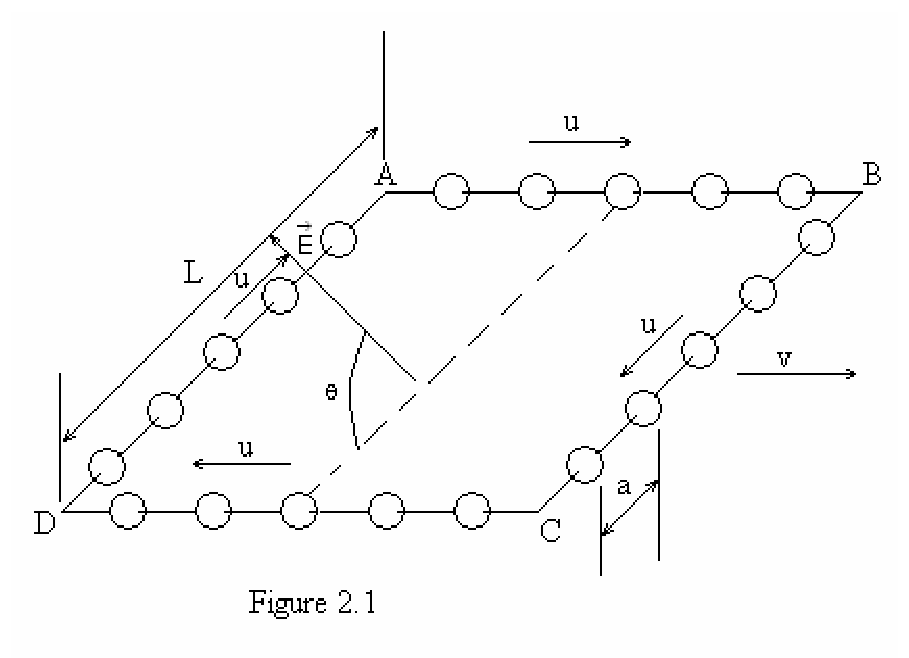
Figure 2.1
Taking into account relativistic effects, calculate the following magnitudes in the frame of reference of an observer who sees the loop moving with velocity \(v\):
a) The spacing between the balls on each of the side of the loop, \(a_{AB}\), \(a_{BC}\), \(a_{CD}\), y \(a_{DA}\).
b) The value of the net charge of the loop plus balls on each of the side of the loop: \(Q_{AB}\), \(Q_{BC}\), \(Q_{CD}\) y, \(Q_{DA}\)
c) The modulus \(M\) of the electrically produced torque tending to rotate the system of the loop and the balls.
d) The energy \(W\) due to the interaction of the system, consisting of the loop and the balls with the electric field.
All the answers should be given in terms of quantities specified in the problem.
Note. The electric charge of an isolated object is independent of the frame of reference in which the measurements takes place. Any electromagnetic radiation effects should be ignored.
Some formulae of special relativity
Consider a reference frame \(S'\) moving with velocity \(V\) with reference to another reference frame \(S\). The axes of the frames are parallel, and their origins coincide a \(t=0\). \(V\) is directed along the positive direction of the \(x\) axis.
Relativistic sum of velocities
If a particle is moving with velocity \(u'\) in the \(x'\) direction , as measured in \(S'\), the velocity of the particle measured in \(S\) is given by:
\[ u=\frac{u'+V}{1+\dfrac{u'V}{c^2}} \]
Relativistic Contraction
If an object at rest in frame \(S\) has length \(L_0\) in the \(x\)-direction, an observer in frame \(S'\) (moving at velocity \(V\) in the \(x\)-direction} will measure its length to be:
\[ L=L_0\sqrt{1-\frac{v^2}{c^2}} \]
Official English text of the problem.
Answers
The results use the continuous charge approximation justified by \(L\gg a\), with the directions shown in Fig. 2.1. Here \(c\) is the speed of light.
-
a) \[ \boxed{ a_{AB}=\frac{a\sqrt{1-v^2/c^2}}{1+uv/c^2}, \qquad a_{BC}=a, \qquad a_{CD}=\frac{a\sqrt{1-v^2/c^2}}{1-uv/c^2}, \qquad a_{DA}=a.} \]
-
b) \[ \boxed{ Q_{AB}=\frac{qLuv}{ac^2}, \qquad Q_{BC}=0, \qquad Q_{CD}=-\frac{qLuv}{ac^2}, \qquad Q_{DA}=0.} \]
-
c) \[ \boxed{M=\frac{|q|L^2uvE}{ac^2}\sin\theta.} \]
-
d) For the field direction shown, whose in-plane component points from \(AB\) toward \(CD\), \[ \boxed{W=\frac{qL^2uvE}{ac^2}\cos\theta.} \]
Solution
Let \(S'\) be the rest frame of the loop and \(S\) the observer’s frame. Take the \(x\)-axis along \(A\to B\), so that the loop moves with velocity \(v\hat{\mathbf x}\). Take \(\hat{\mathbf y}\) along \(A\to D\), perpendicular to \(AB\) within the loop’s plane.
Define \[ \gamma=\frac{1}{\sqrt{1-v^2/c^2}}, \qquad \kappa=\frac{uv}{c^2}. \]
Since \(L\gg a\), we replace the discrete balls by a continuous line charge on each straight side, neglecting fluctuations associated with individual balls entering or leaving a corner. In \(S'\), the ball and wire charge densities are respectively \[ \lambda'_{\mathrm b}=\frac qa, \qquad \lambda'_{\mathrm w}=-\frac qa. \]
a) Spacing between the balls
The spacing must be measured between positions recorded simultaneously in \(S\). Such events are generally not simultaneous in \(S'\).
On either side parallel to the motion, let the ball velocity in \(S'\) be \(w'\), where \[ w'=+u \quad\text{on }AB, \qquad w'=-u \quad\text{on }CD. \]
Choose two neighbouring balls ordered along increasing \(x'\). For events on their trajectories, \[ \Delta x'=a+w'\Delta t'. \]
The Lorentz transformation gives \[ \Delta t=\gamma\left(\Delta t'+\frac{v\Delta x'}{c^2}\right). \] Requiring \(\Delta t=0\) yields \[ \Delta t'=-\frac{v\Delta x'}{c^2}. \] Consequently, \[ \Delta x'=a-\frac{vw'}{c^2}\Delta x', \qquad \Delta x'=\frac{a}{1+vw'/c^2}. \]
The spatial transformation then gives \[ \Delta x =\gamma(\Delta x'+v\Delta t') =\gamma\Delta x'\left(1-\frac{v^2}{c^2}\right) =\frac{\Delta x'}{\gamma}. \] Thus \[ a_{\parallel}=\frac{a}{\gamma(1+vw'/c^2)}. \]
Substituting the two velocities, \[ \boxed{ a_{AB}=\frac{a\sqrt{1-v^2/c^2}}{1+uv/c^2}, \qquad a_{CD}=\frac{a\sqrt{1-v^2/c^2}}{1-uv/c^2}.} \]
On \(BC\) or \(DA\), all balls on a given side have the same \(x'\). Therefore \(\Delta x'=0\), and simultaneous observations in \(S\) also have \(\Delta t'=0\). Transverse distances are unchanged by the Lorentz transformation, so \[ \boxed{a_{BC}=a_{DA}=a.} \]
b) Net charge on each side
In \(S\), the sides parallel to the motion are contracted: \[ \ell_{AB}=\ell_{CD}=\frac L\gamma, \qquad \ell_{BC}=\ell_{DA}=L. \]
Each wire side contains a fixed charge \[ Q_{\mathrm w}=-\frac{qL}{a}. \] This is the same in both frames because charge is invariant and the wire charges do not move between sides.
The number of balls on each side is its observed length divided by the corresponding observed spacing: \[ N_{AB} =\frac{L/\gamma}{a/[\gamma(1+\kappa)]} =\frac La(1+\kappa), \] \[ N_{CD} =\frac{L/\gamma}{a/[\gamma(1-\kappa)]} =\frac La(1-\kappa), \] and \[ N_{BC}=N_{DA}=\frac La. \]
Adding the wire charge to the ball charge gives \[ Q_{AB} =q\frac La(1+\kappa)-\frac{qL}{a} =\frac{qL}{a}\kappa, \] \[ Q_{CD} =q\frac La(1-\kappa)-\frac{qL}{a} =-\frac{qL}{a}\kappa. \] The two transverse sides remain neutral. Hence \[ \boxed{ Q_{AB}=\frac{qLuv}{ac^2},\quad Q_{BC}=0,\quad Q_{CD}=-\frac{qLuv}{ac^2},\quad Q_{DA}=0.} \]
Their sum is zero, as required by invariance of the total charge. The charge of an individual side need not remain zero because the balls occupying that side at a simultaneous instant differ between frames.
c) Electrically produced torque
Write \[ Q=\frac{qLuv}{ac^2}, \] so that the net charges on \(AB\) and \(CD\) are \(Q\) and \(-Q\).
In the continuous approximation these charges are uniformly distributed along their respective sides. Their resultants act at the side midpoints. The separation between those midpoints is \(L\hat{\mathbf y}\), since this distance is perpendicular to the loop’s motion and is not contracted.
The electric dipole moment is therefore \[ \mathbf p =Q\mathbf r_{AB}-Q\mathbf r_{CD} =-QL\hat{\mathbf y}. \]
In a uniform electric field the total force is zero, while the torque is \[ \boldsymbol{\tau}=\mathbf p\times\mathbf E. \]
The field component within the loop’s plane is parallel to \(\hat{\mathbf y}\) and produces no torque. The component perpendicular to the plane is \(E\sin\theta\), giving a torque about an axis parallel to \(AB\), of magnitude \[ M=|Q|LE\sin\theta. \] Thus \[ \boxed{M=\frac{|q|L^2uvE}{ac^2}\sin\theta.} \]
This has units of \(\mathrm{N\,m}\). If \(q\) is understood as a positive charge magnitude, \(|q|\) can simply be written \(q\).
d) Interaction energy
For a uniform external electric field, \[ \phi_{\mathrm{ext}}(\mathbf r) =\phi_0-\mathbf E\cdot\mathbf r. \] The interaction energy is \[ W=\int \phi_{\mathrm{ext}}\,dq. \] Since the system’s total charge is zero, the constant \(\phi_0\) cancels: \[ W=-\mathbf E\cdot\int\mathbf r\,dq =-\mathbf p\cdot\mathbf E. \]
The angle marker in Fig. 2.1 places the in-plane component of \(\mathbf E\) along \(A\to D\), so \[ \mathbf E\cdot\hat{\mathbf y}=E\cos\theta. \] Using \(\mathbf p=-QL\hat{\mathbf y}\), \[ W=QLE\cos\theta. \] Therefore \[ \boxed{W=\frac{qL^2uvE}{ac^2}\cos\theta.} \]
This has units of joules and vanishes when the field is perpendicular to the loop. For positive \(q\), the positive sign follows because the electric dipole moment opposes the field’s in-plane component.
The solution was checked against the official solution.
IPhO 1991 · Theorieaufgabe 2
Geladene Kugeln, die sich entlang einer quadratischen Schleife in einem elektrischen Feld bewegen (Relativitätstheorie)
Auf einer quadratischen Schleife mit der Seitenlänge \(L\) bewegt sich eine große Anzahl von Kugeln mit vernachlässigbarem Radius und jeweils der Ladung \(q\) mit der Geschwindigkeit \(u\) und einem konstanten Abstand \(a\) voneinander, betrachtet in einem Bezugssystem, das relativ zur Schleife ruht. Die Kugeln sind auf der Schleife wie die Perlen einer Halskette angeordnet, wobei \(L\) viel größer als \(a\) ist, wie in Abbildung 2.1 dargestellt. Der nichtleitende Draht, der die Schleife bildet, hat im Ruhesystem der Schleife eine homogene Ladungsdichte pro Längeneinheit. Seine Gesamtladung ist in diesem Bezugssystem betragsmäßig gleich der Gesamtladung der Kugeln und hat das entgegengesetzte Vorzeichen.
Betrachten Sie die Situation, in der sich die Schleife mit der Geschwindigkeit \(v\) parallel zu ihrer Seite \(AB\) (Abb. 2.1) durch ein homogenes elektrisches Feld der Stärke \(E\) bewegt, das senkrecht zur Geschwindigkeit der Schleife steht und mit der Ebene der Schleife einen Winkel \(\theta\) bildet.
Abbildung 2.1
Berechnen Sie unter Berücksichtigung relativistischer Effekte die folgenden Größen im Bezugssystem eines Beobachters, für den sich die Schleife mit der Geschwindigkeit \(v\) bewegt:
a) Die Abstände zwischen den Kugeln auf den einzelnen Seiten der Schleife, \(a_{AB}\), \(a_{BC}\), \(a_{CD}\) und \(a_{DA}\).
b) Die Nettoladung von Schleife und Kugeln auf jeder Seite der Schleife: \(Q_{AB}\), \(Q_{BC}\), \(Q_{CD}\) und \(Q_{DA}\)
c) Den Betrag \(M\) des elektrisch erzeugten Drehmoments, das das System aus Schleife und Kugeln zu drehen versucht.
d) Die Energie \(W\) aufgrund der Wechselwirkung des aus Schleife und Kugeln bestehenden Systems mit dem elektrischen Feld.
Alle Antworten sind durch die in der Aufgabe angegebenen Größen auszudrücken.
Hinweis. Die elektrische Ladung eines isolierten Körpers ist unabhängig vom Bezugssystem, in dem die Messung erfolgt. Jegliche Effekte elektromagnetischer Strahlung sind zu vernachlässigen.
Einige Formeln der speziellen Relativitätstheorie
Betrachten Sie ein Bezugssystem \(S'\), das sich mit der Geschwindigkeit \(V\) relativ zu einem anderen Bezugssystem \(S\) bewegt. Die Achsen der Bezugssysteme sind parallel, und ihre Ursprünge fallen bei \(t=0\) zusammen. \(V\) ist in die positive Richtung der \(x\)-Achse gerichtet.
Relativistische Geschwindigkeitsaddition
Bewegt sich ein Teilchen mit der in \(S'\) gemessenen Geschwindigkeit \(u'\) in \(x'\)-Richtung, so ist seine in \(S\) gemessene Geschwindigkeit gegeben durch:
\[ u=\frac{u'+V}{1+\dfrac{u'V}{c^2}} \]
Relativistische Längenkontraktion
Hat ein im Bezugssystem \(S\) ruhender Körper in \(x\)-Richtung die Länge \(L_0\), so misst ein Beobachter im Bezugssystem \(S'\) (das sich mit der Geschwindigkeit \(V\) in \(x\)-Richtung bewegt) für seine Länge:
\[ L=L_0\sqrt{1-\frac{v^2}{c^2}} \]
Aufgabentext aus dem offiziellen englischen Text übersetzt.
Antworten
Die Ergebnisse verwenden die durch \(L\gg a\) gerechtfertigte Näherung einer kontinuierlichen Ladungsverteilung und die in Abb. 2.1 gezeigten Richtungen. Dabei ist \(c\) die Lichtgeschwindigkeit.
-
a) \[ \boxed{ a_{AB}=\frac{a\sqrt{1-v^2/c^2}}{1+uv/c^2}, \qquad a_{BC}=a, \qquad a_{CD}=\frac{a\sqrt{1-v^2/c^2}}{1-uv/c^2}, \qquad a_{DA}=a.} \]
-
b) \[ \boxed{ Q_{AB}=\frac{qLuv}{ac^2}, \qquad Q_{BC}=0, \qquad Q_{CD}=-\frac{qLuv}{ac^2}, \qquad Q_{DA}=0.} \]
-
c) \[ \boxed{M=\frac{|q|L^2uvE}{ac^2}\sin\theta.} \]
-
d) Für die gezeigte Feldrichtung, deren Komponente in der Schleifenebene von \(AB\) nach \(CD\) zeigt, \[ \boxed{W=\frac{qL^2uvE}{ac^2}\cos\theta.} \]
Lösung
Es sei \(S'\) das Ruhesystem der Schleife und \(S\) das Bezugssystem des Beobachters. Wir wählen die \(x\)-Achse entlang \(A\to B\), sodass sich die Schleife mit der Geschwindigkeit \(v\hat{\mathbf x}\) bewegt. Wir wählen \(\hat{\mathbf y}\) entlang \(A\to D\), senkrecht zu \(AB\) in der Schleifenebene.
Wir definieren \[ \gamma=\frac{1}{\sqrt{1-v^2/c^2}}, \qquad \kappa=\frac{uv}{c^2}. \]
Da \(L\gg a\), ersetzen wir die diskreten Kugeln auf jeder geraden Seite durch eine kontinuierliche Linienladung und vernachlässigen Schwankungen, die dadurch entstehen, dass einzelne Kugeln eine Ecke erreichen oder verlassen. In \(S'\) betragen die Ladungsdichten der Kugeln bzw. des Drahtes \[ \lambda'_{\mathrm b}=\frac qa, \qquad \lambda'_{\mathrm w}=-\frac qa. \]
a) Abstände zwischen den Kugeln
Der Abstand muss zwischen Positionen gemessen werden, die gleichzeitig in \(S\) erfasst werden. Solche Ereignisse sind in \(S'\) im Allgemeinen nicht gleichzeitig.
Auf den beiden zur Bewegung parallelen Seiten sei die Kugelgeschwindigkeit in \(S'\) jeweils \(w'\), wobei \[ w'=+u \quad\text{auf }AB, \qquad w'=-u \quad\text{auf }CD. \]
Wir wählen zwei benachbarte Kugeln, geordnet in Richtung zunehmender \(x'\)-Werte. Für Ereignisse auf ihren Bahnen gilt \[ \Delta x'=a+w'\Delta t'. \]
Die Lorentz-Transformation liefert \[ \Delta t=\gamma\left(\Delta t'+\frac{v\Delta x'}{c^2}\right). \] Die Forderung \(\Delta t=0\) ergibt \[ \Delta t'=-\frac{v\Delta x'}{c^2}. \] Folglich gilt \[ \Delta x'=a-\frac{vw'}{c^2}\Delta x', \qquad \Delta x'=\frac{a}{1+vw'/c^2}. \]
Die Transformation der Ortskoordinaten ergibt dann \[ \Delta x =\gamma(\Delta x'+v\Delta t') =\gamma\Delta x'\left(1-\frac{v^2}{c^2}\right) =\frac{\Delta x'}{\gamma}. \] Somit ist \[ a_{\parallel}=\frac{a}{\gamma(1+vw'/c^2)}. \]
Einsetzen der beiden Geschwindigkeiten ergibt \[ \boxed{ a_{AB}=\frac{a\sqrt{1-v^2/c^2}}{1+uv/c^2}, \qquad a_{CD}=\frac{a\sqrt{1-v^2/c^2}}{1-uv/c^2}.} \]
Auf \(BC\) bzw. \(DA\) haben alle Kugeln auf derselben Seite dieselbe Koordinate \(x'\). Daher ist \(\Delta x'=0\), und für gleichzeitige Beobachtungen in \(S\) gilt auch \(\Delta t'=0\). Transversale Abstände bleiben bei der Lorentz-Transformation unverändert, sodass \[ \boxed{a_{BC}=a_{DA}=a.} \]
b) Nettoladung auf jeder Seite
In \(S\) sind die zur Bewegung parallelen Seiten kontrahiert: \[ \ell_{AB}=\ell_{CD}=\frac L\gamma, \qquad \ell_{BC}=\ell_{DA}=L. \]
Jede Drahtseite trägt die feste Ladung \[ Q_{\mathrm w}=-\frac{qL}{a}. \] Diese ist in beiden Bezugssystemen gleich, weil die Ladung invariant ist und die Drahtladungen nicht zwischen den Seiten wechseln.
Die Anzahl der Kugeln auf jeder Seite ist gleich ihrer beobachteten Länge geteilt durch den zugehörigen beobachteten Abstand: \[ N_{AB} =\frac{L/\gamma}{a/[\gamma(1+\kappa)]} =\frac La(1+\kappa), \] \[ N_{CD} =\frac{L/\gamma}{a/[\gamma(1-\kappa)]} =\frac La(1-\kappa), \] und \[ N_{BC}=N_{DA}=\frac La. \]
Die Addition der Drahtladung zur Kugelladung ergibt \[ Q_{AB} =q\frac La(1+\kappa)-\frac{qL}{a} =\frac{qL}{a}\kappa, \] \[ Q_{CD} =q\frac La(1-\kappa)-\frac{qL}{a} =-\frac{qL}{a}\kappa. \] Die beiden transversalen Seiten bleiben neutral. Somit gilt \[ \boxed{ Q_{AB}=\frac{qLuv}{ac^2},\quad Q_{BC}=0,\quad Q_{CD}=-\frac{qLuv}{ac^2},\quad Q_{DA}=0.} \]
Ihre Summe ist null, wie es die Invarianz der Gesamtladung verlangt. Die Ladung einer einzelnen Seite muss nicht null bleiben, da je nach Bezugssystem unterschiedliche Kugeln zu einem gemeinsamen Zeitpunkt auf dieser Seite liegen.
c) Elektrisch erzeugtes Drehmoment
Wir schreiben \[ Q=\frac{qLuv}{ac^2}, \] sodass die Nettoladungen auf \(AB\) und \(CD\) gleich \(Q\) bzw. \(-Q\) sind.
In der Näherung einer kontinuierlichen Ladungsverteilung sind diese Ladungen gleichmäßig entlang ihrer jeweiligen Seiten verteilt. Die resultierenden Kräfte greifen in den Seitenmittelpunkten an. Der Verbindungsvektor zwischen diesen Mittelpunkten ist \(L\hat{\mathbf y}\), da dieser Abstand senkrecht zur Bewegung der Schleife liegt und nicht kontrahiert wird.
Das elektrische Dipolmoment ist daher \[ \mathbf p =Q\mathbf r_{AB}-Q\mathbf r_{CD} =-QL\hat{\mathbf y}. \]
In einem homogenen elektrischen Feld ist die Gesamtkraft null, während für das Drehmoment gilt \[ \boldsymbol{\tau}=\mathbf p\times\mathbf E. \]
Die Feldkomponente in der Schleifenebene ist parallel zu \(\hat{\mathbf y}\) und erzeugt kein Drehmoment. Die zur Ebene senkrechte Komponente ist \(E\sin\theta\) und erzeugt ein Drehmoment um eine zu \(AB\) parallele Achse mit dem Betrag \[ M=|Q|LE\sin\theta. \] Somit ist \[ \boxed{M=\frac{|q|L^2uvE}{ac^2}\sin\theta.} \]
Dieser Ausdruck hat die Einheit \(\mathrm{N\,m}\). Wird \(q\) als positiver Ladungsbetrag verstanden, kann \(|q|\) einfach als \(q\) geschrieben werden.
d) Wechselwirkungsenergie
Für ein homogenes äußeres elektrisches Feld gilt \[ \phi_{\mathrm{ext}}(\mathbf r) =\phi_0-\mathbf E\cdot\mathbf r. \] Die Wechselwirkungsenergie ist \[ W=\int \phi_{\mathrm{ext}}\,dq. \] Da die Gesamtladung des Systems null ist, fällt die Konstante \(\phi_0\) weg: \[ W=-\mathbf E\cdot\int\mathbf r\,dq =-\mathbf p\cdot\mathbf E. \]
Aus der Winkelmarkierung in Abb. 2.1 ergibt sich, dass die Komponente von \(\mathbf E\) in der Schleifenebene entlang \(A\to D\) gerichtet ist, sodass \[ \mathbf E\cdot\hat{\mathbf y}=E\cos\theta. \] Mit \(\mathbf p=-QL\hat{\mathbf y}\) folgt \[ W=QLE\cos\theta. \] Daher ist \[ \boxed{W=\frac{qL^2uvE}{ac^2}\cos\theta.} \]
Dieser Ausdruck hat die Einheit Joule und verschwindet, wenn das Feld senkrecht zur Schleife steht. Für positives \(q\) ergibt sich das positive Vorzeichen daraus, dass das elektrische Dipolmoment der Feldkomponente in der Schleifenebene entgegengerichtet ist.
Die Lösung wurde mit der offiziellen Lösung abgeglichen.
IPhO 1991 · Teori sorusu 2
Bir elektrik alanında kare biçimli bir halka boyunca hareket eden yüklü küreler (görelilik)
Kenar uzunluğu \(L\) olan kare biçimli bir halkada, yarıçapları ihmal edilebilir ve her birinin yükü \(q\) olan çok sayıda küre, halkaya göre sabit bir referans sisteminden bakıldığında, aralarında sabit bir \(a\) uzaklığı bulunacak şekilde \(u\) süratiyle hareket etmektedir. Küreler, Şekil 2.1'de gösterildiği gibi, halkaya bir kolyenin boncukları gibi dizilmiştir; \(L\), \(a\)'dan çok büyüktür. Halkayı oluşturan yalıtkan tel, halkanın referans sisteminde birim uzunluk başına düzgün bir yük yoğunluğuna sahiptir. Telin toplam yükü, bu sistemde kürelerin toplam yüküne eşit büyüklükte ve zıt işaretlidir.
Halkanın, \(AB\) kenarına paralel \(v\) hızıyla (Şekil 2.1), şiddeti \(E\) olan düzgün bir elektrik alanı içinde hareket ettiği durumu ele alın. Elektrik alanı, halkanın hızına diktir ve halkanın düzlemiyle \(\theta\) açısı yapmaktadır.
Şekil 2.1
Göreli etkileri dikkate alarak, halkanın \(v\) hızıyla hareket ettiğini gören bir gözlemcinin referans sisteminde aşağıdaki büyüklükleri hesaplayın:
a) Halkanın her bir kenarında küreler arasındaki uzaklıklar: \(a_{AB}\), \(a_{BC}\), \(a_{CD}\) ve \(a_{DA}\).
b) Halkanın her bir kenarında, tel ve kürelerin toplam net yükü: \(Q_{AB}\), \(Q_{BC}\), \(Q_{CD}\) ve \(Q_{DA}\).
c) Halka ve kürelerden oluşan sistemi döndürmeye çalışan, elektriksel kuvvetlerin oluşturduğu torkun \(M\) büyüklüğü.
d) Halka ve kürelerden oluşan sistemin elektrik alanıyla etkileşiminden kaynaklanan \(W\) enerjisi.
Bütün cevaplar, soruda belirtilen büyüklükler cinsinden verilmelidir.
Not. Yalıtılmış bir cismin elektrik yükü, ölçümlerin yapıldığı referans sisteminden bağımsızdır. Elektromanyetik ışınımın tüm etkileri ihmal edilmelidir.
Özel göreliliğin bazı formülleri
Başka bir \(S\) referans sistemine göre \(V\) hızıyla hareket eden bir \(S'\) referans sistemini ele alın. Sistemlerin eksenleri paraleldir ve başlangıç noktaları \(t=0\) anında çakışır. \(V\), \(x\) ekseninin pozitif yönündedir.
Hızların göreli toplamı
Bir parçacık, \(S'\) sisteminde ölçüldüğü üzere \(x'\) yönünde \(u'\) hızıyla hareket ediyorsa, parçacığın \(S\) sisteminde ölçülen hızı şu şekilde verilir:
\[ u=\frac{u'+V}{1+\dfrac{u'V}{c^2}} \]
Göreli uzunluk büzülmesi
\(S\) sisteminde durgun olan bir cismin \(x\) yönündeki uzunluğu \(L_0\) ise, \(S'\) sistemindeki (\(x\) yönünde \(V\) hızıyla hareket eden) bir gözlemci cismin uzunluğunu şöyle ölçer:
\[ L=L_0\sqrt{1-\frac{v^2}{c^2}} \]
Soru metni resmi İngilizce metinden çevrilmiştir.
Cevaplar
Sonuçlarda, \(L\gg a\) koşulunun geçerli kıldığı sürekli yük yaklaşımı ve Şekil 2.1'de gösterilen yönler kullanılmıştır. Burada \(c\), ışık hızıdır.
-
a) \[ \boxed{ a_{AB}=\frac{a\sqrt{1-v^2/c^2}}{1+uv/c^2}, \qquad a_{BC}=a, \qquad a_{CD}=\frac{a\sqrt{1-v^2/c^2}}{1-uv/c^2}, \qquad a_{DA}=a.} \]
-
b) \[ \boxed{ Q_{AB}=\frac{qLuv}{ac^2}, \qquad Q_{BC}=0, \qquad Q_{CD}=-\frac{qLuv}{ac^2}, \qquad Q_{DA}=0.} \]
-
c) \[ \boxed{M=\frac{|q|L^2uvE}{ac^2}\sin\theta.} \]
-
d) Alanın, düzlem içindeki bileşeni \(AB\)'den \(CD\)'ye doğru olacak biçimde gösterilen yönü için, \[ \boxed{W=\frac{qL^2uvE}{ac^2}\cos\theta.} \]
Çözüm
Halkanın durgun olduğu referans sistemi \(S'\), gözlemcinin referans sistemi ise \(S\) olsun. \(x\) eksenini \(A\to B\) yönünde alalım; böylece halka \(v\hat{\mathbf x}\) hızıyla hareket eder. \(\hat{\mathbf y}\) yönünü, halkanın düzlemi içinde \(AB\)'ye dik olan \(A\to D\) yönünde alalım.
Şu tanımları yapalım: \[ \gamma=\frac{1}{\sqrt{1-v^2/c^2}}, \qquad \kappa=\frac{uv}{c^2}. \]
\(L\gg a\) olduğundan, tek tek kürelerin bir köşeye girmesi veya köşeden çıkmasıyla ilişkili dalgalanmaları ihmal ederek, ayrık kürelerin yerine her bir düz kenar boyunca sürekli bir çizgisel yük dağılımı kullanırız. \(S'\) sisteminde kürelerin ve telin yük yoğunlukları sırasıyla şöyledir: \[ \lambda'_{\mathrm b}=\frac qa, \qquad \lambda'_{\mathrm w}=-\frac qa. \]
a) Küreler arasındaki uzaklık
Küreler arasındaki uzaklık, \(S\) sisteminde eşzamanlı olarak kaydedilen konumlar arasında ölçülmelidir. Bu tür olaylar, genel olarak \(S'\) sisteminde eşzamanlı değildir.
Harekete paralel iki kenarın her birinde, kürelerin \(S'\) sistemindeki hızı \(w'\) olsun; burada \[ w'=+u \quad\text{kenar: }AB, \qquad w'=-u \quad\text{kenar: }CD. \]
Artan \(x'\) yönünde sıralanmış iki komşu küre seçelim. Bu kürelerin yörüngeleri üzerindeki olaylar için, \[ \Delta x'=a+w'\Delta t'. \]
Lorentz dönüşümü şunu verir: \[ \Delta t=\gamma\left(\Delta t'+\frac{v\Delta x'}{c^2}\right). \] \(\Delta t=0\) koşulu uygulanırsa, \[ \Delta t'=-\frac{v\Delta x'}{c^2}. \] Dolayısıyla, \[ \Delta x'=a-\frac{vw'}{c^2}\Delta x', \qquad \Delta x'=\frac{a}{1+vw'/c^2}. \]
Konum dönüşümü de şu sonucu verir: \[ \Delta x =\gamma(\Delta x'+v\Delta t') =\gamma\Delta x'\left(1-\frac{v^2}{c^2}\right) =\frac{\Delta x'}{\gamma}. \] Böylece \[ a_{\parallel}=\frac{a}{\gamma(1+vw'/c^2)}. \]
İki hızın değerleri yerine konulduğunda, \[ \boxed{ a_{AB}=\frac{a\sqrt{1-v^2/c^2}}{1+uv/c^2}, \qquad a_{CD}=\frac{a\sqrt{1-v^2/c^2}}{1-uv/c^2}.} \]
\(BC\) veya \(DA\) üzerinde, aynı kenarda bulunan bütün kürelerin \(x'\) koordinatı aynıdır. Dolayısıyla \(\Delta x'=0\) olur ve \(S\) sistemindeki eşzamanlı gözlemler için \(\Delta t'=0\) da sağlanır. Enine uzaklıklar Lorentz dönüşümünde değişmez; bu nedenle \[ \boxed{a_{BC}=a_{DA}=a.} \]
b) Her bir kenardaki net yük
\(S\) sisteminde harekete paralel kenarlar büzülür: \[ \ell_{AB}=\ell_{CD}=\frac L\gamma, \qquad \ell_{BC}=\ell_{DA}=L. \]
Telin her bir kenarı sabit bir yük taşır: \[ Q_{\mathrm w}=-\frac{qL}{a}. \] Yük değişmez olduğundan ve teldeki yükler kenarlar arasında hareket etmediğinden, bu yük her iki referans sisteminde de aynıdır.
Her bir kenardaki küre sayısı, o kenarın gözlenen uzunluğunun, küreler arasında gözlenen ilgili uzaklığa bölünmesiyle bulunur: \[ N_{AB} =\frac{L/\gamma}{a/[\gamma(1+\kappa)]} =\frac La(1+\kappa), \] \[ N_{CD} =\frac{L/\gamma}{a/[\gamma(1-\kappa)]} =\frac La(1-\kappa), \] ve \[ N_{BC}=N_{DA}=\frac La. \]
Telin yükü kürelerin yüküne eklendiğinde, \[ Q_{AB} =q\frac La(1+\kappa)-\frac{qL}{a} =\frac{qL}{a}\kappa, \] \[ Q_{CD} =q\frac La(1-\kappa)-\frac{qL}{a} =-\frac{qL}{a}\kappa. \] Enine iki kenar nötr kalır. Dolayısıyla \[ \boxed{ Q_{AB}=\frac{qLuv}{ac^2},\quad Q_{BC}=0,\quad Q_{CD}=-\frac{qLuv}{ac^2},\quad Q_{DA}=0.} \]
Toplam yükün değişmezliğinin gerektirdiği gibi, bu yüklerin toplamı sıfırdır. Tek bir kenarın yükünün sıfır kalması gerekmez; çünkü eşzamanlı olarak alınan bir anda o kenarda bulunan küreler, referans sistemine göre farklılık gösterir.
c) Elektriksel kuvvetlerin oluşturduğu tork
Şöyle yazalım: \[ Q=\frac{qLuv}{ac^2}, \] böylece \(AB\) ve \(CD\) üzerindeki net yükler \(Q\) ve \(-Q\) olur.
Sürekli yük yaklaşımında bu yükler, bulundukları kenarlar boyunca düzgün dağılmıştır. Bu yüklere etkiyen kuvvetlerin bileşkeleri, kenarların orta noktalarından etkir. Bu orta noktalar arasındaki yer değiştirme \(L\hat{\mathbf y}\)'dir; çünkü bu uzaklık halkanın hareketine diktir ve büzülmez.
Dolayısıyla elektrik dipol momenti \[ \mathbf p =Q\mathbf r_{AB}-Q\mathbf r_{CD} =-QL\hat{\mathbf y}. \]
Düzgün bir elektrik alanında toplam kuvvet sıfırken, tork şöyledir: \[ \boldsymbol{\tau}=\mathbf p\times\mathbf E. \]
Alanın halkanın düzlemi içindeki bileşeni \(\hat{\mathbf y}\)'ye paraleldir ve tork oluşturmaz. Düzleme dik bileşen \(E\sin\theta\)'dır ve \(AB\)'ye paralel bir eksen etrafında şu büyüklükte bir tork oluşturur: \[ M=|Q|LE\sin\theta. \] Böylece \[ \boxed{M=\frac{|q|L^2uvE}{ac^2}\sin\theta.} \]
Bu büyüklüğün birimi \(\mathrm{N\,m}\)'dir. \(q\) pozitif bir yük büyüklüğü olarak alınıyorsa, \(|q|\) yerine doğrudan \(q\) yazılabilir.
d) Etkileşim enerjisi
Düzgün bir dış elektrik alanı için, \[ \phi_{\mathrm{ext}}(\mathbf r) =\phi_0-\mathbf E\cdot\mathbf r. \] Etkileşim enerjisi şöyledir: \[ W=\int \phi_{\mathrm{ext}}\,dq. \] Sistemin toplam yükü sıfır olduğundan, sabit \(\phi_0\)'ın katkısı sıfır olur: \[ W=-\mathbf E\cdot\int\mathbf r\,dq =-\mathbf p\cdot\mathbf E. \]
Şekil 2.1'deki açı işareti, \(\mathbf E\)'nin düzlem içindeki bileşeninin \(A\to D\) yönünde olduğunu gösterir; dolayısıyla \[ \mathbf E\cdot\hat{\mathbf y}=E\cos\theta. \] \(\mathbf p=-QL\hat{\mathbf y}\) kullanıldığında, \[ W=QLE\cos\theta. \] Bu nedenle \[ \boxed{W=\frac{qL^2uvE}{ac^2}\cos\theta.} \]
Bu büyüklüğün birimi joule'dür ve alan halkaya dik olduğunda sıfır olur. Pozitif \(q\) için işaretin pozitif olması, elektrik dipol momentinin alanın düzlem içindeki bileşenine zıt yönde olmasından kaynaklanır.
Çözüm, resmi çözümle karşılaştırılarak kontrol edildi.
IPhO 1991 · Problema teórico 2
Bolas cargadas que se mueven a lo largo de un circuito cuadrado en un campo eléctrico (relatividad)
En un circuito cuadrado de lado \(L\), un gran número de bolas de radio despreciable, cada una con una carga \(q\), se mueven con una rapidez \(u\) y una separación constante \(a\) entre ellas, según se observa desde un sistema de referencia fijo respecto al circuito. Las bolas están dispuestas sobre el circuito como las cuentas de un collar, siendo \(L\) mucho mayor que \(a\), como se indica en la figura 2.1. El hilo no conductor que forma el circuito tiene una densidad de carga homogénea por unidad de longitud en el sistema de referencia del circuito. Su carga total es igual en magnitud y de signo opuesto a la carga total de las bolas en ese sistema.
Considérese la situación en la que el circuito se mueve con una velocidad \(v\) paralela a su lado \(AB\) (fig. 2.1) a través de un campo eléctrico homogéneo de intensidad \(E\), que es perpendicular a la velocidad del circuito y forma un ángulo \(\theta\) con el plano del circuito.
Figura 2.1
Teniendo en cuenta los efectos relativistas, calcule las siguientes magnitudes en el sistema de referencia de un observador que ve el circuito moverse con velocidad \(v\):
a) La separación entre las bolas en cada uno de los lados del circuito, \(a_{AB}\), \(a_{BC}\), \(a_{CD}\) y \(a_{DA}\).
b) El valor de la carga neta del conjunto formado por el circuito y las bolas en cada uno de los lados del circuito: \(Q_{AB}\), \(Q_{BC}\), \(Q_{CD}\) y \(Q_{DA}\).
c) El módulo \(M\) del momento de las fuerzas eléctricas que tiende a hacer girar el sistema formado por el circuito y las bolas.
d) La energía \(W\) debida a la interacción del sistema formado por el circuito y las bolas con el campo eléctrico.
Todas las respuestas deben expresarse en función de las magnitudes especificadas en el problema.
Nota. La carga eléctrica de un objeto aislado es independiente del sistema de referencia en el que se realizan las medidas. Deben ignorarse todos los efectos de la radiación electromagnética.
Algunas fórmulas de la relatividad especial
Considérese un sistema de referencia \(S'\) que se mueve con velocidad \(V\) respecto a otro sistema de referencia \(S\). Los ejes de los sistemas son paralelos y sus orígenes coinciden en \(t=0\). \(V\) está dirigida en el sentido positivo del eje \(x\).
Composición relativista de velocidades
Si una partícula se mueve con velocidad \(u'\) en la dirección \(x'\), medida en \(S'\), la velocidad de la partícula medida en \(S\) viene dada por:
\[ u=\frac{u'+V}{1+\dfrac{u'V}{c^2}} \]
Contracción relativista
Si un objeto en reposo en el sistema \(S\) tiene una longitud \(L_0\) en la dirección \(x\), un observador en el sistema \(S'\) (que se mueve con velocidad \(V\) en la dirección \(x\)) medirá la siguiente longitud:
\[ L=L_0\sqrt{1-\frac{v^2}{c^2}} \]
Enunciado traducido del texto oficial en inglés.
Respuestas
Los resultados utilizan la aproximación de carga continua, justificada por \(L\gg a\), con los sentidos indicados en la fig. 2.1. Aquí \(c\) es la velocidad de la luz.
-
a) \[ \boxed{ a_{AB}=\frac{a\sqrt{1-v^2/c^2}}{1+uv/c^2}, \qquad a_{BC}=a, \qquad a_{CD}=\frac{a\sqrt{1-v^2/c^2}}{1-uv/c^2}, \qquad a_{DA}=a.} \]
-
b) \[ \boxed{ Q_{AB}=\frac{qLuv}{ac^2}, \qquad Q_{BC}=0, \qquad Q_{CD}=-\frac{qLuv}{ac^2}, \qquad Q_{DA}=0.} \]
-
c) \[ \boxed{M=\frac{|q|L^2uvE}{ac^2}\sin\theta.} \]
-
d) Para el sentido del campo indicado, cuya componente en el plano apunta desde \(AB\) hacia \(CD\), \[ \boxed{W=\frac{qL^2uvE}{ac^2}\cos\theta.} \]
Solución
Sea \(S'\) el sistema de referencia en reposo respecto al circuito y \(S\) el sistema del observador. Tomemos el eje \(x\) en el sentido \(A\to B\), de modo que el circuito se mueve con velocidad \(v\hat{\mathbf x}\). Tomemos \(\hat{\mathbf y}\) en el sentido \(A\to D\), perpendicular a \(AB\) dentro del plano del circuito.
Definimos \[ \gamma=\frac{1}{\sqrt{1-v^2/c^2}}, \qquad \kappa=\frac{uv}{c^2}. \]
Como \(L\gg a\), sustituimos las bolas discretas por una distribución lineal continua de carga en cada lado recto, despreciando las fluctuaciones asociadas al paso de bolas individuales hacia un vértice o desde él. En \(S'\), las densidades de carga de las bolas y del hilo son, respectivamente, \[ \lambda'_{\mathrm b}=\frac qa, \qquad \lambda'_{\mathrm w}=-\frac qa. \]
a) Separación entre las bolas
La separación debe medirse entre posiciones registradas simultáneamente en \(S\). En general, estos sucesos no son simultáneos en \(S'\).
En cualquiera de los dos lados paralelos al movimiento, sea \(w'\) la velocidad de las bolas en \(S'\), donde \[ w'=+u \quad\text{en }AB, \qquad w'=-u \quad\text{en }CD. \]
Elegimos dos bolas vecinas ordenadas en el sentido creciente de \(x'\). Para sucesos en sus trayectorias, \[ \Delta x'=a+w'\Delta t'. \]
La transformación de Lorentz da \[ \Delta t=\gamma\left(\Delta t'+\frac{v\Delta x'}{c^2}\right). \] Al exigir \(\Delta t=0\), se obtiene \[ \Delta t'=-\frac{v\Delta x'}{c^2}. \] Por consiguiente, \[ \Delta x'=a-\frac{vw'}{c^2}\Delta x', \qquad \Delta x'=\frac{a}{1+vw'/c^2}. \]
La transformación espacial da entonces \[ \Delta x =\gamma(\Delta x'+v\Delta t') =\gamma\Delta x'\left(1-\frac{v^2}{c^2}\right) =\frac{\Delta x'}{\gamma}. \] Así, \[ a_{\parallel}=\frac{a}{\gamma(1+vw'/c^2)}. \]
Sustituyendo las dos velocidades, \[ \boxed{ a_{AB}=\frac{a\sqrt{1-v^2/c^2}}{1+uv/c^2}, \qquad a_{CD}=\frac{a\sqrt{1-v^2/c^2}}{1-uv/c^2}.} \]
En \(BC\) o \(DA\), todas las bolas de un mismo lado tienen la misma \(x'\). Por tanto, \(\Delta x'=0\), y las observaciones simultáneas en \(S\) también cumplen \(\Delta t'=0\). Las distancias transversales no cambian bajo la transformación de Lorentz, por lo que \[ \boxed{a_{BC}=a_{DA}=a.} \]
b) Carga neta en cada lado
En \(S\), los lados paralelos al movimiento se contraen: \[ \ell_{AB}=\ell_{CD}=\frac L\gamma, \qquad \ell_{BC}=\ell_{DA}=L. \]
Cada lado del hilo contiene una carga fija \[ Q_{\mathrm w}=-\frac{qL}{a}. \] Esta es la misma en ambos sistemas de referencia porque la carga es invariante y las cargas del hilo no se desplazan de un lado a otro.
El número de bolas en cada lado es su longitud observada dividida por la separación observada correspondiente: \[ N_{AB} =\frac{L/\gamma}{a/[\gamma(1+\kappa)]} =\frac La(1+\kappa), \] \[ N_{CD} =\frac{L/\gamma}{a/[\gamma(1-\kappa)]} =\frac La(1-\kappa), \] y \[ N_{BC}=N_{DA}=\frac La. \]
Al sumar la carga del hilo a la carga de las bolas, se obtiene \[ Q_{AB} =q\frac La(1+\kappa)-\frac{qL}{a} =\frac{qL}{a}\kappa, \] \[ Q_{CD} =q\frac La(1-\kappa)-\frac{qL}{a} =-\frac{qL}{a}\kappa. \] Los dos lados transversales permanecen neutros. Por tanto, \[ \boxed{ Q_{AB}=\frac{qLuv}{ac^2},\quad Q_{BC}=0,\quad Q_{CD}=-\frac{qLuv}{ac^2},\quad Q_{DA}=0.} \]
Su suma es cero, como exige la invariancia de la carga total. La carga de un lado individual no tiene por qué seguir siendo cero, porque las bolas que ocupan ese lado en un mismo instante difieren entre sistemas de referencia.
c) Momento de las fuerzas eléctricas
Escribimos \[ Q=\frac{qLuv}{ac^2}, \] de modo que las cargas netas en \(AB\) y \(CD\) son \(Q\) y \(-Q\).
En la aproximación continua, estas cargas están distribuidas uniformemente a lo largo de sus respectivos lados. Las fuerzas resultantes sobre ellas actúan en los puntos medios de los lados. La separación entre esos puntos medios es \(L\hat{\mathbf y}\), ya que esta distancia es perpendicular al movimiento del circuito y no se contrae.
El momento dipolar eléctrico es, por tanto, \[ \mathbf p =Q\mathbf r_{AB}-Q\mathbf r_{CD} =-QL\hat{\mathbf y}. \]
En un campo eléctrico uniforme, la fuerza total es cero, mientras que el momento de las fuerzas es \[ \boldsymbol{\tau}=\mathbf p\times\mathbf E. \]
La componente del campo en el plano del circuito es paralela a \(\hat{\mathbf y}\) y no produce momento de fuerza. La componente perpendicular al plano es \(E\sin\theta\), lo que da un momento de fuerza respecto a un eje paralelo a \(AB\), de módulo \[ M=|Q|LE\sin\theta. \] Así, \[ \boxed{M=\frac{|q|L^2uvE}{ac^2}\sin\theta.} \]
Esta expresión tiene unidades de \(\mathrm{N\,m}\). Si \(q\) se interpreta como una magnitud positiva de carga, \(|q|\) puede escribirse simplemente como \(q\).
d) Energía de interacción
Para un campo eléctrico externo uniforme, \[ \phi_{\mathrm{ext}}(\mathbf r) =\phi_0-\mathbf E\cdot\mathbf r. \] La energía de interacción es \[ W=\int \phi_{\mathrm{ext}}\,dq. \] Como la carga total del sistema es cero, la constante \(\phi_0\) se cancela: \[ W=-\mathbf E\cdot\int\mathbf r\,dq =-\mathbf p\cdot\mathbf E. \]
La indicación del ángulo en la fig. 2.1 sitúa la componente de \(\mathbf E\) en el plano en el sentido \(A\to D\), por lo que \[ \mathbf E\cdot\hat{\mathbf y}=E\cos\theta. \] Utilizando \(\mathbf p=-QL\hat{\mathbf y}\), \[ W=QLE\cos\theta. \] Por tanto, \[ \boxed{W=\frac{qL^2uvE}{ac^2}\cos\theta.} \]
Esta expresión tiene unidades de julios y se anula cuando el campo es perpendicular al circuito. Para \(q\) positiva, el signo positivo se debe a que el momento dipolar eléctrico se opone a la componente del campo en el plano.
La solución se comprobó con la solución oficial.
IPhO 1991 · 理论题 2
电场中沿正方形环运动的带电小球(相对论)
在一个边长为 \(L\) 的正方形环上,有大量半径可忽略、各带电荷 \(q\) 的小球。从相对于环静止的参考系来看,小球以速率 \(u\) 运动,相邻小球之间的间距恒为 \(a\)。这些小球像项链上的珠子一样排列在环上,且 \(L\) 远大于 \(a\),如图 2.1 所示。构成环的不导电细线在环的参考系中具有均匀的电荷线密度。在该参考系中,细线的总电荷与小球的总电荷大小相等、符号相反。
考虑环以平行于其边 \(AB\) 的速度 \(v\)(图 2.1)穿过场强为 \(E\) 的匀强电场的情形。电场方向垂直于环的速度方向,并与环所在平面成 \(\theta\) 角。
图 2.1
考虑相对论效应,在观察到环以速度 \(v\) 运动的观察者的参考系中,计算下列物理量:
a) 环的各边上相邻小球之间的间距 \(a_{AB}\)、\(a_{BC}\)、\(a_{CD}\) 和 \(a_{DA}\)。
b) 环的各边上细线与小球的净电荷:\(Q_{AB}\)、\(Q_{BC}\)、\(Q_{CD}\) 和 \(Q_{DA}\)。
c) 电场产生的、使环与小球组成的系统趋于转动的力矩的大小 \(M\)。
d) 由环与小球组成的系统与电场相互作用所对应的能量 \(W\)。
所有答案均应以题目中给定的物理量表示。
注。 孤立物体的电荷与进行测量所用的参考系无关。忽略一切电磁辐射效应。
狭义相对论的一些公式
考虑相对于另一参考系 \(S\) 以速度 \(V\) 运动的参考系 \(S'\)。两参考系的坐标轴相互平行,且原点在 \(t=0\) 时重合。\(V\) 沿 \(x\) 轴正方向。
相对论速度叠加
若在 \(S'\) 中测得某粒子沿 \(x'\) 方向以速度 \(u'\) 运动,则在 \(S\) 中测得的粒子速度为:
\[ u=\frac{u'+V}{1+\dfrac{u'V}{c^2}} \]
相对论长度收缩
若静止于参考系 \(S\) 中的物体沿 \(x\) 方向的长度为 \(L_0\),则参考系 \(S'\)(沿 \(x\) 方向以速度 \(V\) 运动)中的观察者测得其长度为:
\[ L=L_0\sqrt{1-\frac{v^2}{c^2}} \]
题目译自官方英文原文。
答案
以下结果采用由 \(L\gg a\) 保证合理的连续电荷近似,方向如图 2.1 所示。这里 \(c\) 为光速。
-
a) \[ \boxed{ a_{AB}=\frac{a\sqrt{1-v^2/c^2}}{1+uv/c^2}, \qquad a_{BC}=a, \qquad a_{CD}=\frac{a\sqrt{1-v^2/c^2}}{1-uv/c^2}, \qquad a_{DA}=a.} \]
-
b) \[ \boxed{ Q_{AB}=\frac{qLuv}{ac^2}, \qquad Q_{BC}=0, \qquad Q_{CD}=-\frac{qLuv}{ac^2}, \qquad Q_{DA}=0.} \]
-
c) \[ \boxed{M=\frac{|q|L^2uvE}{ac^2}\sin\theta.} \]
-
d) 对于图示的电场方向,其在环平面内的分量由 \(AB\) 指向 \(CD\),有 \[ \boxed{W=\frac{qL^2uvE}{ac^2}\cos\theta.} \]
解答
设 \(S'\) 为环的静止参考系,\(S\) 为观察者的参考系。取 \(x\) 轴沿 \(A\to B\) 方向,则环的速度为 \(v\hat{\mathbf x}\)。取 \(\hat{\mathbf y}\) 沿 \(A\to D\) 方向,即在环平面内垂直于 \(AB\)。
定义 \[ \gamma=\frac{1}{\sqrt{1-v^2/c^2}}, \qquad \kappa=\frac{uv}{c^2}. \]
由于 \(L\gg a\),我们将各直边上的离散小球替换为连续线电荷,忽略单个小球进入或离开拐角所引起的涨落。在 \(S'\) 中,小球和细线的电荷线密度分别为 \[ \lambda'_{\mathrm b}=\frac qa, \qquad \lambda'_{\mathrm w}=-\frac qa. \]
a) 小球之间的间距
必须根据在 \(S\) 中同时记录的位置来测量间距。这些事件在 \(S'\) 中一般并不同时发生。
对于平行于运动方向的任意一条边,设小球在 \(S'\) 中的速度为 \(w'\),其中 \[ w'=+u \quad\text{在边 }AB, \qquad w'=-u \quad\text{在边 }CD. \]
选取两个相邻小球,并按 \(x'\) 增大的方向排序。对于它们各自轨迹上的事件,有 \[ \Delta x'=a+w'\Delta t'. \]
由洛伦兹变换可得 \[ \Delta t=\gamma\left(\Delta t'+\frac{v\Delta x'}{c^2}\right). \] 要求 \(\Delta t=0\),得到 \[ \Delta t'=-\frac{v\Delta x'}{c^2}. \] 因此, \[ \Delta x'=a-\frac{vw'}{c^2}\Delta x', \qquad \Delta x'=\frac{a}{1+vw'/c^2}. \]
再由空间坐标变换得到 \[ \Delta x =\gamma(\Delta x'+v\Delta t') =\gamma\Delta x'\left(1-\frac{v^2}{c^2}\right) =\frac{\Delta x'}{\gamma}. \] 于是 \[ a_{\parallel}=\frac{a}{\gamma(1+vw'/c^2)}. \]
代入这两个速度,得到 \[ \boxed{ a_{AB}=\frac{a\sqrt{1-v^2/c^2}}{1+uv/c^2}, \qquad a_{CD}=\frac{a\sqrt{1-v^2/c^2}}{1-uv/c^2}.} \]
在 \(BC\) 或 \(DA\) 上,同一条边上的所有小球具有相同的 \(x'\)。因此 \(\Delta x'=0\),而在 \(S\) 中同时进行的观测也满足 \(\Delta t'=0\)。横向距离在洛伦兹变换下不变,所以 \[ \boxed{a_{BC}=a_{DA}=a.} \]
b) 各边上的净电荷
在 \(S\) 中,平行于运动方向的边发生长度收缩: \[ \ell_{AB}=\ell_{CD}=\frac L\gamma, \qquad \ell_{BC}=\ell_{DA}=L. \]
每条边上的细线所带电荷固定,为 \[ Q_{\mathrm w}=-\frac{qL}{a}. \] 这一电荷在两个参考系中相同,因为电荷具有不变性,且细线上的电荷不会在各边之间移动。
各边上的小球数目等于观测到的该边长度除以相应的观测间距: \[ N_{AB} =\frac{L/\gamma}{a/[\gamma(1+\kappa)]} =\frac La(1+\kappa), \] \[ N_{CD} =\frac{L/\gamma}{a/[\gamma(1-\kappa)]} =\frac La(1-\kappa), \] 以及 \[ N_{BC}=N_{DA}=\frac La. \]
将细线的电荷与小球的电荷相加,得到 \[ Q_{AB} =q\frac La(1+\kappa)-\frac{qL}{a} =\frac{qL}{a}\kappa, \] \[ Q_{CD} =q\frac La(1-\kappa)-\frac{qL}{a} =-\frac{qL}{a}\kappa. \] 两条横向边仍保持电中性。因此 \[ \boxed{ Q_{AB}=\frac{qLuv}{ac^2},\quad Q_{BC}=0,\quad Q_{CD}=-\frac{qLuv}{ac^2},\quad Q_{DA}=0.} \]
它们的总和为零,符合总电荷不变性的要求。单独一条边上的电荷不必仍为零,因为在不同参考系中,按各自的同时性确定的某一时刻处于该边上的小球并不相同。
c) 电场产生的力矩
记 \[ Q=\frac{qLuv}{ac^2}, \] 则 \(AB\) 和 \(CD\) 上的净电荷分别为 \(Q\) 和 \(-Q\)。
在连续近似下,这些电荷均匀分布在各自的边上。它们所受电场力的合力作用在各边的中点。两中点之间的位移为 \(L\hat{\mathbf y}\),因为这一距离垂直于环的运动方向,不发生收缩。
因此,电偶极矩为 \[ \mathbf p =Q\mathbf r_{AB}-Q\mathbf r_{CD} =-QL\hat{\mathbf y}. \]
在匀强电场中,总力为零,而力矩为 \[ \boldsymbol{\tau}=\mathbf p\times\mathbf E. \]
电场在环平面内的分量平行于 \(\hat{\mathbf y}\),不产生力矩。垂直于该平面的分量为 \(E\sin\theta\),它产生绕平行于 \(AB\) 的轴的力矩,大小为 \[ M=|Q|LE\sin\theta. \] 于是 \[ \boxed{M=\frac{|q|L^2uvE}{ac^2}\sin\theta.} \]
其单位为 \(\mathrm{N\,m}\)。如果将 \(q\) 理解为正的电荷量大小,则 \(|q|\) 可直接写成 \(q\)。
d) 相互作用能
对于匀强外电场, \[ \phi_{\mathrm{ext}}(\mathbf r) =\phi_0-\mathbf E\cdot\mathbf r. \] 相互作用能为 \[ W=\int \phi_{\mathrm{ext}}\,dq. \] 由于系统的总电荷为零,常数 \(\phi_0\) 的贡献抵消: \[ W=-\mathbf E\cdot\int\mathbf r\,dq =-\mathbf p\cdot\mathbf E. \]
图 2.1 中的角度标记表明,\(\mathbf E\) 在环平面内的分量沿 \(A\to D\) 方向,因此 \[ \mathbf E\cdot\hat{\mathbf y}=E\cos\theta. \] 利用 \(\mathbf p=-QL\hat{\mathbf y}\),得到 \[ W=QLE\cos\theta. \] 因此 \[ \boxed{W=\frac{qL^2uvE}{ac^2}\cos\theta.} \]
其单位为焦耳,且当电场垂直于环平面时为零。对于正的 \(q\),结果取正号,是因为电偶极矩与电场在环平面内的分量方向相反。
解答已与官方解答核对。
IPhO 1991 · Теоретическая задача 2
Заряженные шарики, движущиеся по квадратному контуру в электрическом поле (теория относительности)
По квадратному контуру со стороной \(L\) движется большое число шариков пренебрежимо малого радиуса, каждый из которых имеет заряд \(q\). В системе отсчёта, неподвижной относительно контура, скорость шариков равна \(u\), а постоянное расстояние между ними равно \(a\). Шарики расположены на контуре подобно бусинам на ожерелье, причём \(L\) гораздо больше \(a\), как показано на рисунке 2.1. Непроводящая проволока, образующая контур, имеет однородную линейную плотность заряда в системе отсчёта контура. Её полный заряд равен по модулю и противоположен по знаку полному заряду шариков в этой системе отсчёта.
Рассмотрим ситуацию, в которой контур движется со скоростью \(v\) параллельно своей стороне \(AB\) (рис. 2.1) в однородном электрическом поле напряжённостью \(E\), перпендикулярном скорости контура и составляющем угол \(\theta\) с плоскостью контура.
Рисунок 2.1
С учётом релятивистских эффектов вычислите следующие величины в системе отсчёта наблюдателя, относительно которого контур движется со скоростью \(v\):
a) Расстояния между шариками на каждой стороне контура: \(a_{AB}\), \(a_{BC}\), \(a_{CD}\) и \(a_{DA}\).
b) Суммарный заряд проволоки и шариков на каждой стороне контура: \(Q_{AB}\), \(Q_{BC}\), \(Q_{CD}\) и \(Q_{DA}\).
c) Модуль \(M\) момента электрических сил, стремящихся повернуть систему, состоящую из контура и шариков.
d) Энергию \(W\) взаимодействия системы, состоящей из контура и шариков, с электрическим полем.
Все ответы следует выразить через величины, заданные в условии задачи.
Примечание. Электрический заряд изолированного тела не зависит от системы отсчёта, в которой проводятся измерения. Любыми эффектами электромагнитного излучения следует пренебречь.
Некоторые формулы специальной теории относительности
Рассмотрим систему отсчёта \(S'\), движущуюся со скоростью \(V\) относительно другой системы отсчёта \(S\). Оси систем отсчёта параллельны, а их начала совпадают при \(t=0\). Скорость \(V\) направлена вдоль положительного направления оси \(x\).
Релятивистское сложение скоростей
Если частица движется со скоростью \(u'\) в направлении \(x'\), измеренной в системе \(S'\), то скорость частицы, измеренная в системе \(S\), определяется выражением:
\[ u=\frac{u'+V}{1+\dfrac{u'V}{c^2}} \]
Релятивистское сокращение длины
Если тело, покоящееся в системе \(S\), имеет длину \(L_0\) в направлении \(x\), то наблюдатель в системе \(S'\) (движущейся со скоростью \(V\) в направлении \(x\)) измерит следующую длину этого тела:
\[ L=L_0\sqrt{1-\frac{v^2}{c^2}} \]
Условие переведено с официального английского текста.
Ответы
Результаты получены в приближении непрерывного распределения заряда, обоснованном условием \(L\gg a\), для направлений, показанных на рис. 2.1. Здесь \(c\) — скорость света.
-
a) \[ \boxed{ a_{AB}=\frac{a\sqrt{1-v^2/c^2}}{1+uv/c^2}, \qquad a_{BC}=a, \qquad a_{CD}=\frac{a\sqrt{1-v^2/c^2}}{1-uv/c^2}, \qquad a_{DA}=a.} \]
-
b) \[ \boxed{ Q_{AB}=\frac{qLuv}{ac^2}, \qquad Q_{BC}=0, \qquad Q_{CD}=-\frac{qLuv}{ac^2}, \qquad Q_{DA}=0.} \]
-
c) \[ \boxed{M=\frac{|q|L^2uvE}{ac^2}\sin\theta.} \]
-
d) Для показанного направления поля, составляющая которого в плоскости контура направлена от \(AB\) к \(CD\), \[ \boxed{W=\frac{qL^2uvE}{ac^2}\cos\theta.} \]
Решение
Пусть \(S'\) — система отсчёта покоя контура, а \(S\) — система отсчёта наблюдателя. Направим ось \(x\) вдоль \(A\to B\), так что контур движется со скоростью \(v\hat{\mathbf x}\). Направим \(\hat{\mathbf y}\) вдоль \(A\to D\), перпендикулярно \(AB\) в плоскости контура.
Введём обозначения \[ \gamma=\frac{1}{\sqrt{1-v^2/c^2}}, \qquad \kappa=\frac{uv}{c^2}. \]
Поскольку \(L\gg a\), заменим дискретные шарики непрерывным линейным распределением заряда на каждой прямолинейной стороне, пренебрегая флуктуациями, связанными с тем, что отдельные шарики входят в угол контура или выходят из него. В системе \(S'\) линейные плотности заряда шариков и проволоки соответственно равны \[ \lambda'_{\mathrm b}=\frac qa, \qquad \lambda'_{\mathrm w}=-\frac qa. \]
a) Расстояния между шариками
Расстояние должно измеряться между положениями, зафиксированными одновременно в \(S\). Такие события в общем случае не являются одновременными в \(S'\).
На каждой из сторон, параллельных движению, обозначим скорость шариков в \(S'\) через \(w'\), где \[ w'=+u \quad\text{на }AB, \qquad w'=-u \quad\text{на }CD. \]
Выберем два соседних шарика, упорядоченных в направлении возрастания \(x'\). Для событий на их траекториях \[ \Delta x'=a+w'\Delta t'. \]
Преобразование Лоренца даёт \[ \Delta t=\gamma\left(\Delta t'+\frac{v\Delta x'}{c^2}\right). \] Из условия \(\Delta t=0\) получаем \[ \Delta t'=-\frac{v\Delta x'}{c^2}. \] Следовательно, \[ \Delta x'=a-\frac{vw'}{c^2}\Delta x', \qquad \Delta x'=\frac{a}{1+vw'/c^2}. \]
Преобразование пространственной координаты тогда даёт \[ \Delta x =\gamma(\Delta x'+v\Delta t') =\gamma\Delta x'\left(1-\frac{v^2}{c^2}\right) =\frac{\Delta x'}{\gamma}. \] Таким образом, \[ a_{\parallel}=\frac{a}{\gamma(1+vw'/c^2)}. \]
Подставляя обе скорости, получаем \[ \boxed{ a_{AB}=\frac{a\sqrt{1-v^2/c^2}}{1+uv/c^2}, \qquad a_{CD}=\frac{a\sqrt{1-v^2/c^2}}{1-uv/c^2}.} \]
На \(BC\) или \(DA\) все шарики, находящиеся на одной стороне, имеют одинаковую координату \(x'\). Поэтому \(\Delta x'=0\), и для одновременных наблюдений в \(S\) также выполняется \(\Delta t'=0\). Поперечные расстояния не изменяются при преобразовании Лоренца, поэтому \[ \boxed{a_{BC}=a_{DA}=a.} \]
b) Суммарный заряд на каждой стороне
В системе \(S\) стороны, параллельные движению, сокращаются: \[ \ell_{AB}=\ell_{CD}=\frac L\gamma, \qquad \ell_{BC}=\ell_{DA}=L. \]
Каждая сторона проволочного контура содержит фиксированный заряд \[ Q_{\mathrm w}=-\frac{qL}{a}. \] Он одинаков в обеих системах отсчёта, поскольку заряд инвариантен, а заряды проволоки не переходят с одной стороны на другую.
Число шариков на каждой стороне равно её наблюдаемой длине, делённой на соответствующее наблюдаемое расстояние между шариками: \[ N_{AB} =\frac{L/\gamma}{a/[\gamma(1+\kappa)]} =\frac La(1+\kappa), \] \[ N_{CD} =\frac{L/\gamma}{a/[\gamma(1-\kappa)]} =\frac La(1-\kappa), \] а \[ N_{BC}=N_{DA}=\frac La. \]
Складывая заряд проволоки с зарядом шариков, получаем \[ Q_{AB} =q\frac La(1+\kappa)-\frac{qL}{a} =\frac{qL}{a}\kappa, \] \[ Q_{CD} =q\frac La(1-\kappa)-\frac{qL}{a} =-\frac{qL}{a}\kappa. \] Две поперечные стороны остаются нейтральными. Следовательно, \[ \boxed{ Q_{AB}=\frac{qLuv}{ac^2},\quad Q_{BC}=0,\quad Q_{CD}=-\frac{qLuv}{ac^2},\quad Q_{DA}=0.} \]
Их сумма равна нулю, как и должно быть в силу инвариантности полного заряда. Заряд отдельной стороны не обязан оставаться нулевым, поскольку наборы шариков, находящихся на этой стороне в один и тот же момент времени, различаются в разных системах отсчёта.
c) Момент электрических сил
Обозначим \[ Q=\frac{qLuv}{ac^2}, \] так что суммарные заряды на \(AB\) и \(CD\) равны \(Q\) и \(-Q\).
В приближении непрерывного распределения эти заряды равномерно распределены вдоль соответствующих сторон. Равнодействующие сил, действующих на них, приложены к серединам сторон. Вектор, соединяющий эти середины, равен \(L\hat{\mathbf y}\), поскольку это расстояние перпендикулярно движению контура и не сокращается.
Поэтому электрический дипольный момент равен \[ \mathbf p =Q\mathbf r_{AB}-Q\mathbf r_{CD} =-QL\hat{\mathbf y}. \]
В однородном электрическом поле суммарная сила равна нулю, а момент сил равен \[ \boldsymbol{\tau}=\mathbf p\times\mathbf E. \]
Составляющая поля в плоскости контура параллельна \(\hat{\mathbf y}\) и не создаёт момента сил. Составляющая, перпендикулярная плоскости, равна \(E\sin\theta\); она создаёт момент сил относительно оси, параллельной \(AB\), модуль которого равен \[ M=|Q|LE\sin\theta. \] Таким образом, \[ \boxed{M=\frac{|q|L^2uvE}{ac^2}\sin\theta.} \]
Эта величина измеряется в \(\mathrm{N\,m}\). Если под \(q\) понимается положительный модуль заряда, вместо \(|q|\) можно просто написать \(q\).
d) Энергия взаимодействия
Для однородного внешнего электрического поля \[ \phi_{\mathrm{ext}}(\mathbf r) =\phi_0-\mathbf E\cdot\mathbf r. \] Энергия взаимодействия равна \[ W=\int \phi_{\mathrm{ext}}\,dq. \] Поскольку полный заряд системы равен нулю, вклад постоянной \(\phi_0\) обращается в нуль: \[ W=-\mathbf E\cdot\int\mathbf r\,dq =-\mathbf p\cdot\mathbf E. \]
Обозначение угла на рис. 2.1 показывает, что составляющая \(\mathbf E\) в плоскости контура направлена вдоль \(A\to D\), поэтому \[ \mathbf E\cdot\hat{\mathbf y}=E\cos\theta. \] Используя \(\mathbf p=-QL\hat{\mathbf y}\), получаем \[ W=QLE\cos\theta. \] Следовательно, \[ \boxed{W=\frac{qL^2uvE}{ac^2}\cos\theta.} \]
Эта величина измеряется в джоулях и обращается в нуль, когда поле перпендикулярно плоскости контура. При положительном \(q\) знак энергии положителен, поскольку электрический дипольный момент направлен противоположно составляющей поля в плоскости контура.
Решение проверено по официальному решению.
IPhO 1991 · مسألة نظرية 2
كرات مشحونة تتحرك على طول حلقة مربعة في مجال كهربائي (النسبية)
تتحرك في حلقة مربعة طول ضلعها \(L\) كرات كثيرة ذات أنصاف أقطار مهملة، تحمل كل منها شحنة \(q\)، بسرعة \(u\) وبمسافة فاصلة ثابتة \(a\) بينها، كما تُرصد من إطار مرجعي ثابت بالنسبة إلى الحلقة. تنتظم الكرات على الحلقة مثل خرزات عقد، ويكون \(L\) أكبر بكثير من \(a\)، كما هو موضح في الشكل 2.1. للسلك غير الموصل الذي يشكل الحلقة كثافة شحنة متجانسة لكل وحدة طول في إطار الحلقة. وشحنته الكلية تساوي الشحنة الكلية للكرات في ذلك الإطار مقدارًا وتعاكسها إشارةً.
لننظر في الحالة التي تتحرك فيها الحلقة بسرعة \(v\) موازية لضلعها \(AB\) (الشكل 2.1) عبر مجال كهربائي متجانس شدته \(E\)، عمودي على سرعة الحلقة ويصنع زاوية \(\theta\) مع مستوى الحلقة.
الشكل 2.1
مع أخذ التأثيرات النسبية في الحسبان، احسب المقادير التالية في الإطار المرجعي لراصد يرى الحلقة تتحرك بسرعة \(v\):
a) المسافة الفاصلة بين الكرات على كل ضلع من أضلاع الحلقة، \(a_{AB}\)، و\(a_{BC}\)، و\(a_{CD}\)، و\(a_{DA}\).
b) قيمة الشحنة الصافية للحلقة والكرات معًا على كل ضلع من أضلاع الحلقة: \(Q_{AB}\)، و\(Q_{BC}\)، و\(Q_{CD}\)، و\(Q_{DA}\)
c) مقدار عزم الدوران \(M\) الناشئ عن التأثير الكهربائي، والذي يميل إلى تدوير منظومة الحلقة والكرات.
d) الطاقة \(W\) الناتجة عن تفاعل المنظومة المكوّنة من الحلقة والكرات مع المجال الكهربائي.
يجب التعبير عن جميع الإجابات بدلالة الكميات المحددة في المسألة.
ملاحظة. الشحنة الكهربائية لجسم معزول مستقلة عن الإطار المرجعي الذي تُجرى فيه القياسات. ينبغي إهمال أي تأثيرات للإشعاع الكهرومغناطيسي.
بعض صيغ النسبية الخاصة
لنعتبر إطارًا مرجعيًا \(S'\) يتحرك بسرعة \(V\) بالنسبة إلى إطار مرجعي آخر \(S\). محاور الإطارين متوازية، ويتطابق أصلاهما عند \(t=0\). وتتجه \(V\) في الاتجاه الموجب للمحور \(x\).
الجمع النسبي للسرعات
إذا كان جسيم يتحرك بسرعة \(u'\) في الاتجاه \(x'\)، كما تُقاس في \(S'\)، فإن سرعة الجسيم المقاسة في \(S\) تُعطى بالعلاقة:
\[ u=\frac{u'+V}{1+\dfrac{u'V}{c^2}} \]
الانكماش النسبي
إذا كان طول جسم ساكن في الإطار \(S\) هو \(L_0\) في الاتجاه \(x\)، فإن راصدًا في الإطار \(S'\) (يتحرك بسرعة \(V\) في الاتجاه \(x\)) سيقيس طوله ليكون:
\[ L=L_0\sqrt{1-\frac{v^2}{c^2}} \]
نص المسألة مترجم عن النص الإنجليزي الرسمي.
الإجابات
تستخدم النتائج تقريب الشحنة المستمرة الذي يبرره الشرط \(L\gg a\)، مع اعتماد الاتجاهات المبينة في الشكل 2.1. هنا \(c\) هي سرعة الضوء.
-
a) \[ \boxed{ a_{AB}=\frac{a\sqrt{1-v^2/c^2}}{1+uv/c^2}, \qquad a_{BC}=a, \qquad a_{CD}=\frac{a\sqrt{1-v^2/c^2}}{1-uv/c^2}, \qquad a_{DA}=a.} \]
-
b) \[ \boxed{ Q_{AB}=\frac{qLuv}{ac^2}, \qquad Q_{BC}=0, \qquad Q_{CD}=-\frac{qLuv}{ac^2}, \qquad Q_{DA}=0.} \]
-
c) \[ \boxed{M=\frac{|q|L^2uvE}{ac^2}\sin\theta.} \]
-
d) لاتجاه المجال المبين، الذي تتجه مركبته الواقعة في مستوى الحلقة من \(AB\) نحو \(CD\)، \[ \boxed{W=\frac{qL^2uvE}{ac^2}\cos\theta.} \]
الحل
ليكن \(S'\) إطار سكون الحلقة و\(S\) إطار الراصد. نختار المحور \(x\) في اتجاه \(A\to B\)، بحيث تتحرك الحلقة بسرعة \(v\hat{\mathbf x}\). ونختار \(\hat{\mathbf y}\) في اتجاه \(A\to D\)، عموديًا على \(AB\) ضمن مستوى الحلقة.
نعرّف \[ \gamma=\frac{1}{\sqrt{1-v^2/c^2}}, \qquad \kappa=\frac{uv}{c^2}. \]
بما أن \(L\gg a\)، نستعيض عن الكرات المنفصلة بشحنة خطية مستمرة على كل ضلع مستقيم، مهملين التقلبات المرتبطة بدخول الكرات المفردة إلى إحدى الزوايا أو خروجها منها. في \(S'\)، تكون كثافتا شحنة الكرات والسلك، على الترتيب، \[ \lambda'_{\mathrm b}=\frac qa, \qquad \lambda'_{\mathrm w}=-\frac qa. \]
a) المسافة الفاصلة بين الكرات
يجب قياس المسافة الفاصلة بين مواضع تُسجَّل في الوقت نفسه في \(S\). وهذه الأحداث لا تكون عمومًا متزامنة في \(S'\).
على أيٍّ من الضلعين الموازيين للحركة، لتكن سرعة الكرات في \(S'\) هي \(w'\)، حيث \[ w'=+u \quad\text{على }AB, \qquad w'=-u \quad\text{على }CD. \]
نختار كرتين متجاورتين مرتبتين في اتجاه تزايد \(x'\). بالنسبة إلى حدثين على مساريهما، \[ \Delta x'=a+w'\Delta t'. \]
يعطي تحويل لورنتز \[ \Delta t=\gamma\left(\Delta t'+\frac{v\Delta x'}{c^2}\right). \] ويؤدي اشتراط \(\Delta t=0\) إلى \[ \Delta t'=-\frac{v\Delta x'}{c^2}. \] ومن ثم، \[ \Delta x'=a-\frac{vw'}{c^2}\Delta x', \qquad \Delta x'=\frac{a}{1+vw'/c^2}. \]
ويعطي تحويل الإحداثي المكاني عندئذٍ \[ \Delta x =\gamma(\Delta x'+v\Delta t') =\gamma\Delta x'\left(1-\frac{v^2}{c^2}\right) =\frac{\Delta x'}{\gamma}. \] إذًا \[ a_{\parallel}=\frac{a}{\gamma(1+vw'/c^2)}. \]
بالتعويض عن السرعتين، \[ \boxed{ a_{AB}=\frac{a\sqrt{1-v^2/c^2}}{1+uv/c^2}, \qquad a_{CD}=\frac{a\sqrt{1-v^2/c^2}}{1-uv/c^2}.} \]
على \(BC\) أو \(DA\)، يكون لجميع الكرات على الضلع الواحد الإحداثي نفسه \(x'\). لذلك \(\Delta x'=0\)، وتحقق الأرصاد المتزامنة في \(S\) أيضًا \(\Delta t'=0\). لا تتغير المسافات العرضية بتحويل لورنتز، ولذلك \[ \boxed{a_{BC}=a_{DA}=a.} \]
b) الشحنة الصافية على كل ضلع
في \(S\)، تنكمش الأضلاع الموازية للحركة: \[ \ell_{AB}=\ell_{CD}=\frac L\gamma, \qquad \ell_{BC}=\ell_{DA}=L. \]
يحمل كل ضلع من السلك شحنة ثابتة \[ Q_{\mathrm w}=-\frac{qL}{a}. \] وهي نفسها في كلا الإطارين، لأن الشحنة ثابتة تحت التحويل بين الأطر ولأن شحنات السلك لا تنتقل بين الأضلاع.
عدد الكرات على كل ضلع يساوي طوله المرصود مقسومًا على المسافة الفاصلة المرصودة المقابلة: \[ N_{AB} =\frac{L/\gamma}{a/[\gamma(1+\kappa)]} =\frac La(1+\kappa), \] \[ N_{CD} =\frac{L/\gamma}{a/[\gamma(1-\kappa)]} =\frac La(1-\kappa), \] و \[ N_{BC}=N_{DA}=\frac La. \]
بإضافة شحنة السلك إلى شحنة الكرات نحصل على \[ Q_{AB} =q\frac La(1+\kappa)-\frac{qL}{a} =\frac{qL}{a}\kappa, \] \[ Q_{CD} =q\frac La(1-\kappa)-\frac{qL}{a} =-\frac{qL}{a}\kappa. \] ويبقى الضلعان العرضيان متعادلين كهربائيًا. ومن ثم \[ \boxed{ Q_{AB}=\frac{qLuv}{ac^2},\quad Q_{BC}=0,\quad Q_{CD}=-\frac{qLuv}{ac^2},\quad Q_{DA}=0.} \]
مجموع هذه الشحنات يساوي صفرًا، كما يقتضي ثبات الشحنة الكلية تحت التحويل بين الأطر. وليس من الضروري أن تبقى شحنة كل ضلع على حدة صفرًا، لأن الكرات التي تشغل ذلك الضلع عند لحظة متزامنة تختلف من إطار إلى آخر.
c) عزم الدوران الناشئ عن التأثير الكهربائي
نكتب \[ Q=\frac{qLuv}{ac^2}, \] بحيث تكون الشحنتان الصافيتان على \(AB\) و\(CD\) هما \(Q\) و\(-Q\).
في تقريب الشحنة المستمرة، تتوزع هاتان الشحنتان بانتظام على طول الضلعين المعنيين. وتؤثر محصلتا القوتين عند منتصفي الضلعين. متجه الفصل بين هذين المنتصفين هو \(L\hat{\mathbf y}\)، لأن هذه المسافة عمودية على حركة الحلقة ولا تنكمش.
لذلك يكون عزم ثنائي القطب الكهربائي \[ \mathbf p =Q\mathbf r_{AB}-Q\mathbf r_{CD} =-QL\hat{\mathbf y}. \]
في مجال كهربائي منتظم، تكون القوة الكلية صفرًا، بينما يكون عزم الدوران \[ \boldsymbol{\tau}=\mathbf p\times\mathbf E. \]
مركبة المجال الواقعة في مستوى الحلقة موازية لـ\(\hat{\mathbf y}\)، ولا تُحدث عزم دوران. أما المركبة العمودية على المستوى فهي \(E\sin\theta\)، وتُحدث عزم دوران حول محور موازٍ لـ\(AB\)، مقداره \[ M=|Q|LE\sin\theta. \] إذًا \[ \boxed{M=\frac{|q|L^2uvE}{ac^2}\sin\theta.} \]
وحدة هذا المقدار هي \(\mathrm{N\,m}\). إذا كان المقصود بـ\(q\) مقدار الشحنة الموجب، فيمكن ببساطة كتابة \(q\) بدلًا من \(|q|\).
d) طاقة التفاعل
لمجال كهربائي خارجي منتظم، \[ \phi_{\mathrm{ext}}(\mathbf r) =\phi_0-\mathbf E\cdot\mathbf r. \] تكون طاقة التفاعل \[ W=\int \phi_{\mathrm{ext}}\,dq. \] بما أن الشحنة الكلية للمنظومة صفر، يزول إسهام الثابت \(\phi_0\): \[ W=-\mathbf E\cdot\int\mathbf r\,dq =-\mathbf p\cdot\mathbf E. \]
تُبيّن علامة الزاوية في الشكل 2.1 أن مركبة \(\mathbf E\) الواقعة في مستوى الحلقة تتجه في اتجاه \(A\to D\)، ولذلك \[ \mathbf E\cdot\hat{\mathbf y}=E\cos\theta. \] وباستخدام \(\mathbf p=-QL\hat{\mathbf y}\)، \[ W=QLE\cos\theta. \] وعليه \[ \boxed{W=\frac{qL^2uvE}{ac^2}\cos\theta.} \]
وحدة هذه الطاقة هي الجول، وتنعدم عندما يكون المجال عموديًا على الحلقة. عندما تكون \(q\) موجبة، تنتج الإشارة الموجبة من كون عزم ثنائي القطب الكهربائي معاكسًا لمركبة المجال الواقعة في مستوى الحلقة.
تمت مراجعة الحل بمقارنته بالحل الرسمي.