IPhO 1991 · Theory problem 1
Spinning ball bouncing on the floor
The figure 1.1 shows a solid, homogeneous ball radius \(R\). Before falling to the floor its center of mass is at rest, but the ball is spinning with angular velocity \(\omega_0\) about a horizontal axis through its center. The lowest point of the ball is at a height \(h\) above the floor.
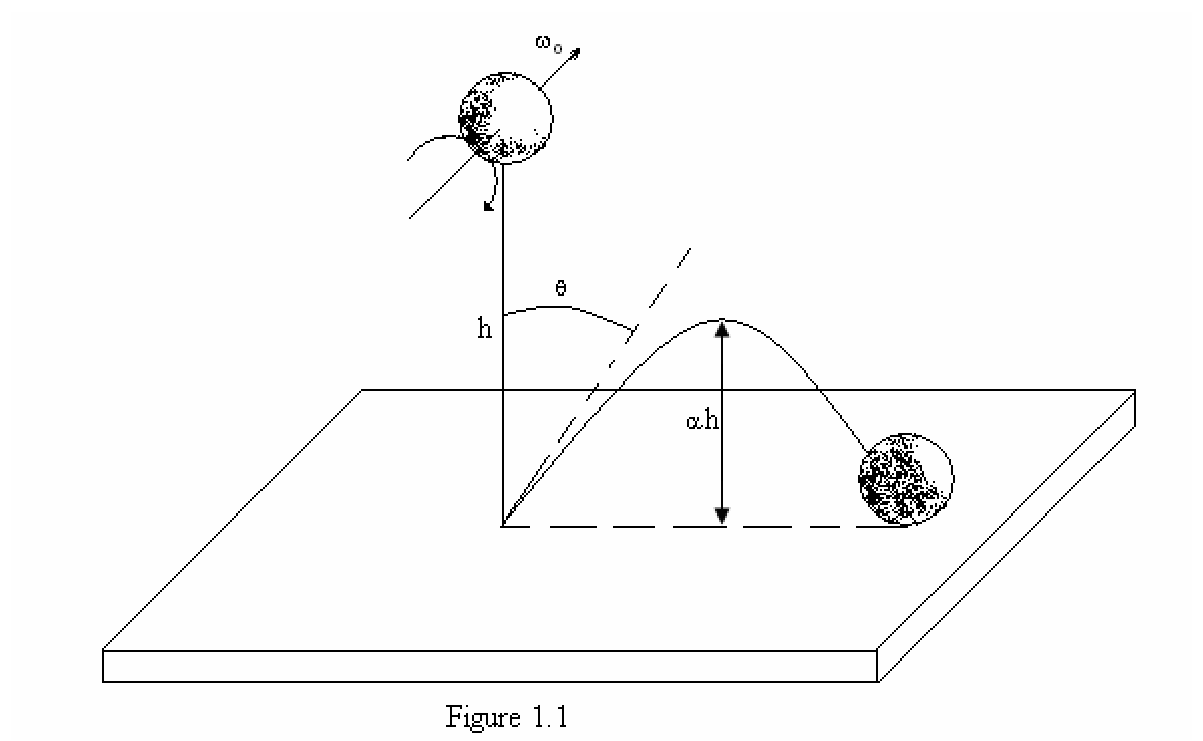
Figure 1.1
When released, the ball falls under gravity, and rebounds to a new height such that its lowest point is now \(ah\) above the floor. The deformation of the ball and the floor on impact may be considered negligible. Ignore the presence of the air. The impact time, although, is finite.
The mass of the ball is \(m\), the acceleration due the gravity is \(g\), the dynamic coefficient of friction between the ball and the floor is \(\mu_k\), and the moment of inertia of the ball about the given axis is: \[ I=\frac{2mR^2}{5} \]
You are required to consider two situations, in the first, the ball slips during the entire impact time, and in the second the slipping stops before the end of the impact time.
Situation I: slipping throughout the impact.
Find:
a) \(\tan\theta\), where \(\theta\) is the rebound angle indicated in the diagram;
b) the horizontal distance traveled in flight between the first and second impacts;
c) the minimum value of \(\omega_0\) for this situations.
Situation II: slipping for part of the impacts.
Find, again:
a) \(\tan\theta\);
b) the horizontal distance traveled in flight between the first and second impacts.
Taking both of the above situations into account, sketch the variation of \(\tan\theta\) with \(\omega_0\).
Official English text of the problem.
Answers
Let \(D\) be the horizontal distance traveled during the rebound flight. In the usual short-impact approximation, with gravity’s impulse during contact neglected:
-
Situation I(a): \[ \boxed{\tan\theta=\mu_k\frac{1+\sqrt a}{\sqrt a}} \]
-
Situation I(b): \[ \boxed{D=4\mu_k h\sqrt a(1+\sqrt a)} \]
-
Situation I(c): \[ \boxed{\omega_{0,\min}=\omega_c =\frac{7\mu_k}{2R}\sqrt{2gh}\,(1+\sqrt a)} \] At equality, slipping stops exactly at separation. Nonzero slip at separation requires \(\omega_0>\omega_c\).
-
Situation II(a): \[ \boxed{\tan\theta=\frac{2R\omega_0}{7\sqrt{2agh}}} \]
-
Situation II(b): \[ \boxed{D=\frac{4R\omega_0}{7}\sqrt{\frac{2ah}{g}}} \]
-
Requested sketch: \[ \boxed{ \tan\theta= \begin{cases} \displaystyle\frac{2R\omega_0}{7\sqrt{2agh}}, &0\leq\omega_0<\omega_c,\\[6pt] \displaystyle\mu_k\frac{1+\sqrt a}{\sqrt a}, &\omega_0\geq\omega_c. \end{cases}} \] The graph rises linearly from the origin to a corner at \[ \left(\omega_c,\ \mu_k\frac{1+\sqrt a}{\sqrt a}\right), \] then remains horizontal. It is continuous at the corner.
Solution
Flight speeds and impact equations
Let \(u\) be the downward speed immediately before impact and \(w\) the upward speed immediately after impact. Mechanical energy is conserved during each free flight, so \[ u=\sqrt{2gh}, \qquad w=\sqrt{2gah}=\sqrt a\,u. \] The centre of mass falls by \(h\) and rises by \(ah\), because its height always exceeds that of the lowest point by \(R\).
Choose the positive horizontal direction to be the direction of the friction force on the initially spinning ball. Write \(v\) for the horizontal centre-of-mass velocity, and take positive \(\omega\) in the initial spin direction. The horizontal velocity of the lowest point is then \[ v-R\omega. \] Initially this is \(-R\omega_0\), so friction accelerates the centre of mass and reduces the spin.
Let the normal impulse be \[ P=\int_{\text{impact}}N\,dt. \] For contact duration \(\tau\), vertical impulse–momentum gives \[ P-mg\tau=m(u+w). \] In the standard short-impact approximation, \[ g\tau\ll u+w, \] and hence \[ P\simeq m(u+w). \] The impact can have a finite duration while satisfying this approximation.
Let \(J\) be the accumulated horizontal frictional impulse. Linear and angular impulse–momentum give \[ mv=J, \qquad I(\omega-\omega_0)=-RJ. \] Using \(I=2mR^2/5\), \[ v=\frac{J}{m}, \qquad \omega=\omega_0-\frac{5J}{2mR}. \] Consequently, \[ \boxed{R\omega-v=R\omega_0-\frac{7J}{2m}}. \] This quantity decreases monotonically while the ball slips. Slipping stops when it reaches zero.
Situation I(a): rebound angle
If slipping continues throughout impact, the friction force has magnitude \(\mu_kN\) throughout. Therefore \[ J=\mu_kP=\mu_km(u+w), \] and the outgoing horizontal speed is \[ v=\mu_k(u+w). \]
The angle \(\theta\) in the figure is measured from the vertical, so \[ \tan\theta=\frac{v}{w} =\mu_k\frac{u+w}{w}. \] Since \(w=\sqrt a\,u\), \[ \boxed{\tan\theta=\mu_k\frac{1+\sqrt a}{\sqrt a}}. \]
Situation I(b): horizontal distance
The ball leaves and returns to the same centre-of-mass height, \(R\). Its flight time \(T\) therefore satisfies \[ 0=wT-\frac12gT^2, \] giving \[ T=\frac{2w}{g}. \] The horizontal velocity remains constant in flight, so \[ D=vT=\frac{2\mu_k(u+w)w}{g}. \] Substituting \(u^2=2gh\) and \(w=\sqrt a\,u\), \[ \boxed{D=4\mu_kh\sqrt a(1+\sqrt a)}. \]
Situation I(c): minimum initial angular velocity
Because \(R\omega-v\) decreases monotonically during slipping, checking its value at the end of impact is sufficient. At the boundary between the two situations, it becomes zero exactly at separation: \[ R\omega_0-\frac{7J}{2m}=0. \] With \(J=\mu_km(u+w)\), this gives \[ \omega_c=\frac{7\mu_k}{2R}(u+w). \] Thus \[ \boxed{\omega_{0,\min}=\omega_c =\frac{7\mu_k}{2R}\sqrt{2gh}(1+\sqrt a)}. \]
For \(\omega_0>\omega_c\), slipping persists even at separation. For \(\omega_0=\omega_c\), it persists until the final instant of contact.
Situation II(a): rebound angle
When \(0<\omega_0<\omega_c\), slipping stops before the normal impulse is complete. Let \(J_*\) be the frictional impulse accumulated at that instant. The condition \(v=R\omega\) gives \[ R\omega_0-\frac{7J_*}{2m}=0, \] so \[ J_*=\frac{2mR\omega_0}{7}. \] Therefore, at the instant slipping stops, \[ v_*=\frac{2R\omega_0}{7}, \qquad \omega_*=\frac{2\omega_0}{7}. \]
These tangential velocities remain unchanged during the rest of contact. To see this, suppose a static friction force \(f\) acts while \(v=R\omega\). Then \[ m\dot v=f, \qquad I\dot\omega=-Rf, \qquad \dot v=R\dot\omega. \] Together these imply \[ f\left(\frac1m+\frac{R^2}{I}\right)=0, \] and hence \(f=0\). No further tangential impulse is required.
The outgoing horizontal speed is therefore \[ v=\frac{2R\omega_0}{7}, \] and \[ \boxed{\tan\theta=\frac{v}{w} =\frac{2R\omega_0}{7\sqrt{2agh}}}. \]
The result also includes the limiting case \(\omega_0=0\), when there is no slipping and the rebound is vertical.
Situation II(b): horizontal distance
Using the same flight time \(T=2w/g\), \[ D=\frac{2R\omega_0}{7}\frac{2w}{g}. \] Thus \[ \boxed{D=\frac{4R\omega_0}{7g}\sqrt{2agh} =\frac{4R\omega_0}{7}\sqrt{\frac{2ah}{g}}}. \]
Requested sketch
For fixed \(h,R,a,\mu_k\), the graph has two portions:
- From \(\omega_0=0\) to \(\omega_c\), it is a straight line through the origin with slope \[ \frac{2R}{7\sqrt{2agh}}. \]
- At \(\omega_c\), it joins a horizontal line of height \[ \mu_k\frac{1+\sqrt a}{\sqrt a}. \]
The joining values agree because \[ \frac{2R\omega_c}{7\sqrt{2agh}} =\mu_k\frac{1+\sqrt a}{\sqrt a}. \] At larger initial spins, friction already acts throughout contact, so increasing the spin cannot increase the available tangential impulse.
The solution was checked against the official solution.
IPhO 1991 · Theorieaufgabe 1
Rotierende Kugel beim Aufprall auf den Boden
Abbildung 1.1 zeigt eine massive, homogene Kugel mit dem Radius \(R\). Bevor sie auf den Boden fällt, ruht ihr Schwerpunkt, die Kugel rotiert jedoch mit der Winkelgeschwindigkeit \(\omega_0\) um eine horizontale Achse durch ihren Mittelpunkt. Der tiefste Punkt der Kugel befindet sich in einer Höhe \(h\) über dem Boden.
Abbildung 1.1
Nach dem Loslassen fällt die Kugel unter dem Einfluss der Schwerkraft und springt auf eine neue Höhe zurück, bei der ihr tiefster Punkt nun \(ah\) über dem Boden liegt. Die Verformung der Kugel und des Bodens beim Stoß kann als vernachlässigbar angesehen werden. Vernachlässigen Sie den Einfluss der Luft. Die Stoßdauer ist jedoch endlich.
Die Masse der Kugel beträgt \(m\), die Fallbeschleunigung \(g\), der Gleitreibungskoeffizient zwischen Kugel und Boden \(\mu_k\), und das Trägheitsmoment der Kugel bezüglich der angegebenen Achse ist: \[ I=\frac{2mR^2}{5} \]
Untersuchen Sie zwei Situationen: In der ersten gleitet die Kugel während der gesamten Stoßdauer, in der zweiten endet das Gleiten vor dem Ende der Stoßdauer.
Situation I: Gleiten während des gesamten Stoßes.
Bestimmen Sie:
a) \(\tan\theta\), wobei \(\theta\) der in der Abbildung angegebene Rückprallwinkel ist;
b) die während des Fluges zwischen dem ersten und dem zweiten Stoß zurückgelegte horizontale Strecke;
c) den Mindestwert von \(\omega_0\) für diese Situation.
Situation II: Gleiten während eines Teils des Stoßes.
Bestimmen Sie erneut:
a) \(\tan\theta\);
b) die während des Fluges zwischen dem ersten und dem zweiten Stoß zurückgelegte horizontale Strecke.
Skizzieren Sie unter Berücksichtigung beider oben genannten Situationen den Verlauf von \(\tan\theta\) in Abhängigkeit von \(\omega_0\).
Aufgabentext aus dem offiziellen englischen Text übersetzt.
Antworten
Es sei \(D\) die während des Fluges nach dem Rückprall zurückgelegte horizontale Strecke. In der üblichen Näherung für einen kurzen Stoß, bei der der Kraftstoß der Gewichtskraft während des Kontakts vernachlässigt wird, gilt:
-
Situation I(a): \[ \boxed{\tan\theta=\mu_k\frac{1+\sqrt a}{\sqrt a}} \]
-
Situation I(b): \[ \boxed{D=4\mu_k h\sqrt a(1+\sqrt a)} \]
-
Situation I(c): \[ \boxed{\omega_{0,\min}=\omega_c =\frac{7\mu_k}{2R}\sqrt{2gh}\,(1+\sqrt a)} \] Im Gleichheitsfall endet das Gleiten genau beim Ablösen. Eine von null verschiedene Gleitgeschwindigkeit beim Ablösen erfordert \(\omega_0>\omega_c\).
-
Situation II(a): \[ \boxed{\tan\theta=\frac{2R\omega_0}{7\sqrt{2agh}}} \]
-
Situation II(b): \[ \boxed{D=\frac{4R\omega_0}{7}\sqrt{\frac{2ah}{g}}} \]
-
Geforderte Skizze: \[ \boxed{ \tan\theta= \begin{cases} \displaystyle\frac{2R\omega_0}{7\sqrt{2agh}}, &0\leq\omega_0<\omega_c,\\[6pt] \displaystyle\mu_k\frac{1+\sqrt a}{\sqrt a}, &\omega_0\geq\omega_c. \end{cases}} \] Der Graph steigt vom Ursprung aus linear bis zu einem Knickpunkt bei \[ \left(\omega_c,\ \mu_k\frac{1+\sqrt a}{\sqrt a}\right), \] und verläuft danach horizontal. Am Knickpunkt ist er stetig.
Lösung
Geschwindigkeiten im Flug und Stoßgleichungen
Es sei \(u\) der Betrag der abwärts gerichteten Geschwindigkeit unmittelbar vor dem Stoß und \(w\) der Betrag der aufwärts gerichteten Geschwindigkeit unmittelbar nach dem Stoß. Während jedes freien Fluges bleibt die mechanische Energie erhalten, sodass \[ u=\sqrt{2gh}, \qquad w=\sqrt{2gah}=\sqrt a\,u. \] Der Schwerpunkt fällt um \(h\) und steigt um \(ah\), da seine Höhe stets um \(R\) größer ist als die des tiefsten Punktes.
Wir wählen die positive horizontale Richtung als die Richtung der Reibungskraft auf die anfangs rotierende Kugel. Mit \(v\) bezeichnen wir die horizontale Schwerpunktgeschwindigkeit und wählen positives \(\omega\) in der anfänglichen Drehrichtung. Die horizontale Geschwindigkeit des tiefsten Punktes ist dann \[ v-R\omega. \] Anfangs beträgt sie \(-R\omega_0\), sodass die Reibung den Schwerpunkt beschleunigt und die Rotation verlangsamt.
Der Kraftstoß der Normalkraft sei \[ P=\int_{\text{Stoß}}N\,dt. \] Für eine Kontaktdauer \(\tau\) liefert der Impulssatz in vertikaler Richtung \[ P-mg\tau=m(u+w). \] In der üblichen Näherung für einen kurzen Stoß gilt \[ g\tau\ll u+w, \] und damit \[ P\simeq m(u+w). \] Der Stoß kann eine endliche Dauer haben und dennoch diese Näherung erfüllen.
Es sei \(J\) der bis zum betrachteten Zeitpunkt aufsummierte horizontale Reibungskraftstoß. Impulssatz und Drehimpulssatz ergeben \[ mv=J, \qquad I(\omega-\omega_0)=-RJ. \] Mit \(I=2mR^2/5\) folgt \[ v=\frac{J}{m}, \qquad \omega=\omega_0-\frac{5J}{2mR}. \] Somit gilt \[ \boxed{R\omega-v=R\omega_0-\frac{7J}{2m}}. \] Diese Größe nimmt monoton ab, solange die Kugel gleitet. Das Gleiten endet, wenn sie null erreicht.
Situation I(a): Rückprallwinkel
Wenn das Gleiten während des gesamten Stoßes anhält, hat die Reibungskraft durchgehend den Betrag \(\mu_kN\). Daher gilt \[ J=\mu_kP=\mu_km(u+w), \] und die horizontale Geschwindigkeit nach dem Stoß beträgt \[ v=\mu_k(u+w). \]
Der Winkel \(\theta\) in der Abbildung wird von der Vertikalen aus gemessen, sodass \[ \tan\theta=\frac{v}{w} =\mu_k\frac{u+w}{w}. \] Da \(w=\sqrt a\,u\), folgt \[ \boxed{\tan\theta=\mu_k\frac{1+\sqrt a}{\sqrt a}}. \]
Situation I(b): Horizontale Strecke
Beim Ablösen und bei der Rückkehr hat der Schwerpunkt der Kugel dieselbe Höhe \(R\). Ihre Flugzeit \(T\) erfüllt daher \[ 0=wT-\frac12gT^2, \] woraus folgt: \[ T=\frac{2w}{g}. \] Die horizontale Geschwindigkeit bleibt während des Fluges konstant, sodass \[ D=vT=\frac{2\mu_k(u+w)w}{g}. \] Einsetzen von \(u^2=2gh\) und \(w=\sqrt a\,u\) ergibt \[ \boxed{D=4\mu_kh\sqrt a(1+\sqrt a)}. \]
Situation I(c): Minimale anfängliche Winkelgeschwindigkeit
Da \(R\omega-v\) während des Gleitens monoton abnimmt, genügt es, den Wert am Ende des Stoßes zu prüfen. An der Grenze zwischen den beiden Situationen wird diese Größe genau beim Ablösen null: \[ R\omega_0-\frac{7J}{2m}=0. \] Mit \(J=\mu_km(u+w)\) ergibt sich daraus \[ \omega_c=\frac{7\mu_k}{2R}(u+w). \] Somit gilt \[ \boxed{\omega_{0,\min}=\omega_c =\frac{7\mu_k}{2R}\sqrt{2gh}(1+\sqrt a)}. \]
Für \(\omega_0>\omega_c\) besteht das Gleiten auch noch beim Ablösen. Für \(\omega_0=\omega_c\) hält es bis zum letzten Augenblick des Kontakts an.
Situation II(a): Rückprallwinkel
Wenn \(0<\omega_0<\omega_c\), endet das Gleiten, bevor der gesamte Kraftstoß der Normalkraft übertragen ist. Es sei \(J_*\) der bis zu diesem Zeitpunkt aufsummierte Reibungskraftstoß. Die Bedingung \(v=R\omega\) liefert \[ R\omega_0-\frac{7J_*}{2m}=0, \] also \[ J_*=\frac{2mR\omega_0}{7}. \] Daher gilt in dem Augenblick, in dem das Gleiten endet: \[ v_*=\frac{2R\omega_0}{7}, \qquad \omega_*=\frac{2\omega_0}{7}. \]
Diese Geschwindigkeiten der Tangentialbewegung bleiben während der restlichen Kontaktzeit unverändert. Um dies zu zeigen, nehmen wir an, dass eine Haftreibungskraft \(f\) wirkt, während \(v=R\omega\) gilt. Dann ist \[ m\dot v=f, \qquad I\dot\omega=-Rf, \qquad \dot v=R\dot\omega. \] Zusammen folgt daraus \[ f\left(\frac1m+\frac{R^2}{I}\right)=0, \] und damit \(f=0\). Es ist kein weiterer tangentialer Kraftstoß erforderlich.
Die horizontale Geschwindigkeit nach dem Stoß beträgt daher \[ v=\frac{2R\omega_0}{7}, \] und \[ \boxed{\tan\theta=\frac{v}{w} =\frac{2R\omega_0}{7\sqrt{2agh}}}. \]
Das Ergebnis schließt auch den Grenzfall \(\omega_0=0\) ein, in dem kein Gleiten auftritt und der Rückprall vertikal erfolgt.
Situation II(b): Horizontale Strecke
Mit derselben Flugzeit \(T=2w/g\) ergibt sich \[ D=\frac{2R\omega_0}{7}\frac{2w}{g}. \] Somit gilt \[ \boxed{D=\frac{4R\omega_0}{7g}\sqrt{2agh} =\frac{4R\omega_0}{7}\sqrt{\frac{2ah}{g}}}. \]
Geforderte Skizze
Für feste Werte von \(h,R,a,\mu_k\) besteht der Graph aus zwei Abschnitten:
- Von \(\omega_0=0\) bis \(\omega_c\) ist er eine Gerade durch den Ursprung mit der Steigung \[ \frac{2R}{7\sqrt{2agh}}. \]
- Bei \(\omega_c\) geht er in eine horizontale Gerade auf der Höhe \[ \mu_k\frac{1+\sqrt a}{\sqrt a} \] über.
Die Werte an der Übergangsstelle stimmen überein, denn \[ \frac{2R\omega_c}{7\sqrt{2agh}} =\mu_k\frac{1+\sqrt a}{\sqrt a}. \] Bei größeren anfänglichen Winkelgeschwindigkeiten wirkt die Reibung bereits während der gesamten Kontaktzeit, sodass eine Erhöhung der Winkelgeschwindigkeit den verfügbaren tangentialen Kraftstoß nicht vergrößern kann.
Die Lösung wurde mit der offiziellen Lösung abgeglichen.
IPhO 1991 · Teori sorusu 1
Dönerek yerden seken top
Şekil 1.1'de yarıçapı \(R\) olan, içi dolu, homojen bir top gösterilmektedir. Yere düşmeden önce kütle merkezi durmaktadır; ancak top, merkezinden geçen yatay bir eksen etrafında \(\omega_0\) açısal hızıyla dönmektedir. Topun en alt noktası yerden \(h\) yüksekliğindedir.
Şekil 1.1
Serbest bırakıldığında top yerçekimi etkisiyle düşer ve en alt noktası yerden \(ah\) yüksekte olacak şekilde yeni bir yüksekliğe seker. Çarpışma sırasında topun ve zeminin şekil değiştirmesi ihmal edilebilir. Havanın etkisini ihmal ediniz. Bununla birlikte çarpışma süresi sonludur.
Topun kütlesi \(m\), yerçekimi ivmesi \(g\), top ile zemin arasındaki kinetik sürtünme katsayısı \(\mu_k\) olup topun verilen eksene göre eylemsizlik momenti şöyledir: \[ I=\frac{2mR^2}{5} \]
İki durumu ele almanız istenmektedir: birincisinde top çarpışma süresinin tamamı boyunca kayar; ikincisinde ise kayma, çarpışma süresi sona ermeden durur.
Durum I: çarpışma boyunca kayma.
Bulunuz:
a) \(\theta\), şekilde gösterilen sekme açısı olmak üzere \(\tan\theta\);
b) birinci ve ikinci çarpışmalar arasında uçuş sırasında alınan yatay yol;
c) bu durum için \(\omega_0\)'ın en küçük değeri.
Durum II: çarpışmanın bir bölümünde kayma.
Yine bulunuz:
a) \(\tan\theta\);
b) birinci ve ikinci çarpışmalar arasında uçuş sırasında alınan yatay yol.
Yukarıdaki iki durumu da dikkate alarak \(\tan\theta\)'nın \(\omega_0\) ile değişimini gösteren grafiği kabaca çiziniz.
Soru metni resmi İngilizce metinden çevrilmiştir.
Cevaplar
Sekmeden sonraki uçuş sırasında alınan yatay yol \(D\) olsun. Temas sırasında yerçekiminin itmesinin ihmal edildiği alışılmış kısa çarpışma yaklaşımında:
-
Durum I(a): \[ \boxed{\tan\theta=\mu_k\frac{1+\sqrt a}{\sqrt a}} \]
-
Durum I(b): \[ \boxed{D=4\mu_k h\sqrt a(1+\sqrt a)} \]
-
Durum I(c): \[ \boxed{\omega_{0,\min}=\omega_c =\frac{7\mu_k}{2R}\sqrt{2gh}\,(1+\sqrt a)} \] Eşitlik durumunda kayma tam yerden ayrılma anında durur. Yerden ayrılma anında kaymanın sıfırdan farklı olması için \(\omega_0>\omega_c\) gerekir.
-
Durum II(a): \[ \boxed{\tan\theta=\frac{2R\omega_0}{7\sqrt{2agh}}} \]
-
Durum II(b): \[ \boxed{D=\frac{4R\omega_0}{7}\sqrt{\frac{2ah}{g}}} \]
-
İstenen grafik: \[ \boxed{ \tan\theta= \begin{cases} \displaystyle\frac{2R\omega_0}{7\sqrt{2agh}}, &0\leq\omega_0<\omega_c,\\[6pt] \displaystyle\mu_k\frac{1+\sqrt a}{\sqrt a}, &\omega_0\geq\omega_c. \end{cases}} \] Grafik, başlangıç noktasından \[ \left(\omega_c,\ \mu_k\frac{1+\sqrt a}{\sqrt a}\right), \] noktasındaki köşeye kadar doğrusal olarak yükselir, ardından yatay olarak devam eder. Köşede süreklidir.
Çözüm
Uçuş süratleri ve çarpışma denklemleri
Çarpışmadan hemen önceki aşağı yönlü sürat \(u\), çarpışmadan hemen sonraki yukarı yönlü sürat ise \(w\) olsun. Her serbest uçuş sırasında mekanik enerji korunur; dolayısıyla \[ u=\sqrt{2gh}, \qquad w=\sqrt{2gah}=\sqrt a\,u. \] Kütle merkezinin yüksekliği her zaman en alt noktanın yüksekliğinden \(R\) kadar fazla olduğundan, kütle merkezi \(h\) kadar düşer ve \(ah\) kadar yükselir.
Pozitif yatay yönü, başlangıçta dönmekte olan topa etkiyen sürtünme kuvvetinin yönü olarak seçelim. Kütle merkezinin yatay hızını \(v\) ile gösterelim ve \(\omega\)'nın pozitif yönünü başlangıçtaki dönme yönü olarak alalım. Bu durumda en alt noktanın yatay hızı \[ v-R\omega \] olur. Başlangıçta bu hız \(-R\omega_0\) olduğundan sürtünme, kütle merkezini hızlandırır ve dönme hızını azaltır.
Normal kuvvetin itmesi \[ P=\int_{\text{çarpışma}}N\,dt \] olsun. Temas süresi \(\tau\) için düşey doğrultudaki itme–momentum bağıntısı \[ P-mg\tau=m(u+w) \] verir. Standart kısa çarpışma yaklaşımında \[ g\tau\ll u+w, \] olduğundan \[ P\simeq m(u+w) \] elde edilir. Çarpışma, bu yaklaşımı sağlarken sonlu bir süreye sahip olabilir.
Birikmiş yatay sürtünme itmesi \(J\) olsun. Doğrusal ve açısal itme–momentum bağıntıları \[ mv=J, \qquad I(\omega-\omega_0)=-RJ \] verir. \(I=2mR^2/5\) kullanıldığında \[ v=\frac{J}{m}, \qquad \omega=\omega_0-\frac{5J}{2mR} \] elde edilir. Dolayısıyla \[ \boxed{R\omega-v=R\omega_0-\frac{7J}{2m}}. \] Bu nicelik top kayarken monoton olarak azalır. Sıfıra ulaştığında kayma durur.
Durum I(a): sekme açısı
Kayma çarpışma boyunca sürerse sürtünme kuvvetinin büyüklüğü bu sürenin tamamında \(\mu_kN\) olur. Bu nedenle \[ J=\mu_kP=\mu_km(u+w), \] ve yerden ayrılma anındaki yatay sürat \[ v=\mu_k(u+w) \] olur.
Şekildeki \(\theta\) açısı düşeyden ölçüldüğü için \[ \tan\theta=\frac{v}{w} =\mu_k\frac{u+w}{w}. \] \(w=\sqrt a\,u\) olduğundan \[ \boxed{\tan\theta=\mu_k\frac{1+\sqrt a}{\sqrt a}}. \]
Durum I(b): yatay yol
Top yerden ayrıldığında ve yere döndüğünde kütle merkezinin yüksekliği aynıdır ve \(R\)'ye eşittir. Bu nedenle uçuş süresi \(T\), \[ 0=wT-\frac12gT^2, \] bağıntısını sağlar; buradan \[ T=\frac{2w}{g} \] elde edilir. Yatay hız uçuş sırasında sabit kaldığından \[ D=vT=\frac{2\mu_k(u+w)w}{g}. \] \(u^2=2gh\) ve \(w=\sqrt a\,u\) yerine konulduğunda \[ \boxed{D=4\mu_kh\sqrt a(1+\sqrt a)}. \]
Durum I(c): en küçük başlangıç açısal hızı
\(R\omega-v\) kayma sırasında monoton olarak azaldığı için çarpışmanın sonundaki değerini kontrol etmek yeterlidir. İki durum arasındaki sınırda bu nicelik tam yerden ayrılma anında sıfır olur: \[ R\omega_0-\frac{7J}{2m}=0. \] \(J=\mu_km(u+w)\) kullanıldığında buradan \[ \omega_c=\frac{7\mu_k}{2R}(u+w) \] elde edilir. Böylece \[ \boxed{\omega_{0,\min}=\omega_c =\frac{7\mu_k}{2R}\sqrt{2gh}(1+\sqrt a)}. \]
\(\omega_0>\omega_c\) için kayma yerden ayrılma anında bile sürer. \(\omega_0=\omega_c\) için ise temasın son anına kadar sürer.
Durum II(a): sekme açısı
\(0<\omega_0<\omega_c\) olduğunda kayma, normal kuvvetin toplam itmesi tamamlanmadan önce durur. O ana kadar birikmiş sürtünme itmesi \(J_*\) olsun. \(v=R\omega\) koşulu \[ R\omega_0-\frac{7J_*}{2m}=0, \] verir; dolayısıyla \[ J_*=\frac{2mR\omega_0}{7}. \] Bu nedenle kaymanın durduğu anda \[ v_*=\frac{2R\omega_0}{7}, \qquad \omega_*=\frac{2\omega_0}{7}. \]
Bu teğetsel hızlar temasın geri kalanında değişmez. Bunu görmek için \(v=R\omega\) iken bir \(f\) statik sürtünme kuvvetinin etkidiğini varsayalım. Bu durumda \[ m\dot v=f, \qquad I\dot\omega=-Rf, \qquad \dot v=R\dot\omega. \] Bu bağıntılar birlikte \[ f\left(\frac1m+\frac{R^2}{I}\right)=0, \] sonucunu verir; dolayısıyla \(f=0\) olur. Daha fazla teğetsel itme gerekmez.
Bu nedenle yerden ayrılma anındaki yatay sürat \[ v=\frac{2R\omega_0}{7}, \] olur ve \[ \boxed{\tan\theta=\frac{v}{w} =\frac{2R\omega_0}{7\sqrt{2agh}}}. \]
Bu sonuç, kaymanın olmadığı ve sekmenin düşey olduğu \(\omega_0=0\) sınır durumunu da kapsar.
Durum II(b): yatay yol
Aynı \(T=2w/g\) uçuş süresi kullanılarak \[ D=\frac{2R\omega_0}{7}\frac{2w}{g} \] elde edilir. Böylece \[ \boxed{D=\frac{4R\omega_0}{7g}\sqrt{2agh} =\frac{4R\omega_0}{7}\sqrt{\frac{2ah}{g}}}. \]
İstenen grafik
Sabit \(h,R,a,\mu_k\) değerleri için grafik iki bölümden oluşur:
- \(\omega_0=0\)'dan \(\omega_c\)'ye kadar başlangıç noktasından geçen ve eğimi \[ \frac{2R}{7\sqrt{2agh}} \] olan bir doğrudur.
- \(\omega_c\)'de, yüksekliği \[ \mu_k\frac{1+\sqrt a}{\sqrt a} \] olan yatay bir doğruyla birleşir.
Birleşme noktasındaki değerler aynıdır, çünkü \[ \frac{2R\omega_c}{7\sqrt{2agh}} =\mu_k\frac{1+\sqrt a}{\sqrt a}. \] Daha büyük başlangıç dönme hızlarında sürtünme zaten temasın tamamı boyunca etkidiğinden, dönme hızını artırmak sağlanabilecek teğetsel itmeyi artıramaz.
Çözüm, resmi çözümle karşılaştırılarak kontrol edildi.
IPhO 1991 · Problema teórico 1
Pelota en rotación que rebota en el suelo
La figura 1.1 muestra una pelota maciza y homogénea de radio \(R\). Antes de caer al suelo, su centro de masas está en reposo, pero la pelota gira con velocidad angular \(\omega_0\) alrededor de un eje horizontal que pasa por su centro. El punto más bajo de la pelota se encuentra a una altura \(h\) sobre el suelo.
Figura 1.1
Al soltarla, la pelota cae bajo la acción de la gravedad y rebota hasta una nueva altura, de modo que su punto más bajo se encuentra ahora a una altura \(ah\) sobre el suelo. La deformación de la pelota y del suelo durante el impacto puede considerarse despreciable. Ignore la presencia del aire. Sin embargo, la duración del impacto es finita.
La masa de la pelota es \(m\), la aceleración de la gravedad es \(g\), el coeficiente de rozamiento cinético entre la pelota y el suelo es \(\mu_k\), y el momento de inercia de la pelota respecto al eje dado es: \[ I=\frac{2mR^2}{5} \]
Se pide considerar dos situaciones: en la primera, la pelota desliza durante todo el impacto y, en la segunda, el deslizamiento cesa antes de que termine el impacto.
Situación I: deslizamiento durante todo el impacto.
Determine:
a) \(\tan\theta\), donde \(\theta\) es el ángulo de rebote indicado en el diagrama;
b) la distancia horizontal recorrida en vuelo entre el primer y el segundo impacto;
c) el valor mínimo de \(\omega_0\) para esta situación.
Situación II: deslizamiento durante parte del impacto.
Determine de nuevo:
a) \(\tan\theta\);
b) la distancia horizontal recorrida en vuelo entre el primer y el segundo impacto.
Teniendo en cuenta las dos situaciones anteriores, esboce la variación de \(\tan\theta\) con \(\omega_0\).
Enunciado traducido del texto oficial en inglés.
Respuestas
Sea \(D\) la distancia horizontal recorrida durante el vuelo tras el rebote. En la aproximación habitual de impacto breve, en la que se desprecia el impulso de la gravedad durante el contacto:
-
Situación I(a): \[ \boxed{\tan\theta=\mu_k\frac{1+\sqrt a}{\sqrt a}} \]
-
Situación I(b): \[ \boxed{D=4\mu_k h\sqrt a(1+\sqrt a)} \]
-
Situación I(c): \[ \boxed{\omega_{0,\min}=\omega_c =\frac{7\mu_k}{2R}\sqrt{2gh}\,(1+\sqrt a)} \] En el caso de igualdad, el deslizamiento cesa exactamente en el instante de separación. Para que haya deslizamiento en el instante de separación se requiere \(\omega_0>\omega_c\).
-
Situación II(a): \[ \boxed{\tan\theta=\frac{2R\omega_0}{7\sqrt{2agh}}} \]
-
Situación II(b): \[ \boxed{D=\frac{4R\omega_0}{7}\sqrt{\frac{2ah}{g}}} \]
-
Esbozo solicitado: \[ \boxed{ \tan\theta= \begin{cases} \displaystyle\frac{2R\omega_0}{7\sqrt{2agh}}, &0\leq\omega_0<\omega_c,\\[6pt] \displaystyle\mu_k\frac{1+\sqrt a}{\sqrt a}, &\omega_0\geq\omega_c. \end{cases}} \] La gráfica crece linealmente desde el origen hasta un punto anguloso situado en \[ \left(\omega_c,\ \mu_k\frac{1+\sqrt a}{\sqrt a}\right), \] y después permanece horizontal. Es continua en el punto anguloso.
Solución
Rapideces de vuelo y ecuaciones del impacto
Sea \(u\) la rapidez descendente inmediatamente antes del impacto y \(w\) la rapidez ascendente inmediatamente después del impacto. La energía mecánica se conserva durante cada vuelo libre, por lo que \[ u=\sqrt{2gh}, \qquad w=\sqrt{2gah}=\sqrt a\,u. \] El centro de masas desciende una distancia \(h\) y asciende una distancia \(ah\), porque su altura siempre supera en \(R\) la del punto más bajo.
Elijamos como sentido horizontal positivo el de la fuerza de rozamiento sobre la pelota que gira inicialmente. Denotemos por \(v\) la velocidad horizontal del centro de masas y tomemos \(\omega\) positiva en el sentido de giro inicial. La velocidad horizontal del punto más bajo es entonces \[ v-R\omega. \] Inicialmente vale \(-R\omega_0\), de modo que el rozamiento acelera el centro de masas y reduce la velocidad de giro.
Sea el impulso normal \[ P=\int_{\text{impacto}}N\,dt. \] Para una duración del contacto \(\tau\), el teorema del impulso y la cantidad de movimiento en la dirección vertical da \[ P-mg\tau=m(u+w). \] En la aproximación habitual de impacto breve, \[ g\tau\ll u+w, \] y, por tanto, \[ P\simeq m(u+w). \] El impacto puede tener una duración finita y satisfacer esta aproximación.
Sea \(J\) el impulso horizontal acumulado de la fuerza de rozamiento. Los teoremas del impulso y la cantidad de movimiento, y del impulso angular y el momento angular, dan \[ mv=J, \qquad I(\omega-\omega_0)=-RJ. \] Usando \(I=2mR^2/5\), \[ v=\frac{J}{m}, \qquad \omega=\omega_0-\frac{5J}{2mR}. \] En consecuencia, \[ \boxed{R\omega-v=R\omega_0-\frac{7J}{2m}}. \] Esta magnitud disminuye monótonamente mientras la pelota desliza. El deslizamiento cesa cuando se anula.
Situación I(a): ángulo de rebote
Si el deslizamiento continúa durante todo el impacto, la fuerza de rozamiento tiene módulo \(\mu_kN\) en todo momento. Por tanto, \[ J=\mu_kP=\mu_km(u+w), \] y la rapidez horizontal de salida es \[ v=\mu_k(u+w). \]
El ángulo \(\theta\) de la figura se mide respecto a la vertical, de modo que \[ \tan\theta=\frac{v}{w} =\mu_k\frac{u+w}{w}. \] Como \(w=\sqrt a\,u\), \[ \boxed{\tan\theta=\mu_k\frac{1+\sqrt a}{\sqrt a}}. \]
Situación I(b): distancia horizontal
La pelota sale y regresa a la misma altura del centro de masas, \(R\). Por tanto, su tiempo de vuelo \(T\) satisface \[ 0=wT-\frac12gT^2, \] de donde se obtiene \[ T=\frac{2w}{g}. \] La velocidad horizontal permanece constante durante el vuelo, por lo que \[ D=vT=\frac{2\mu_k(u+w)w}{g}. \] Sustituyendo \(u^2=2gh\) y \(w=\sqrt a\,u\), \[ \boxed{D=4\mu_kh\sqrt a(1+\sqrt a)}. \]
Situación I(c): velocidad angular inicial mínima
Como \(R\omega-v\) disminuye monótonamente durante el deslizamiento, basta con comprobar su valor al final del impacto. En el límite entre las dos situaciones, se anula exactamente en el instante de separación: \[ R\omega_0-\frac{7J}{2m}=0. \] Con \(J=\mu_km(u+w)\), se obtiene \[ \omega_c=\frac{7\mu_k}{2R}(u+w). \] Así, \[ \boxed{\omega_{0,\min}=\omega_c =\frac{7\mu_k}{2R}\sqrt{2gh}(1+\sqrt a)}. \]
Para \(\omega_0>\omega_c\), el deslizamiento persiste incluso en el instante de separación. Para \(\omega_0=\omega_c\), persiste hasta el último instante del contacto.
Situación II(a): ángulo de rebote
Cuando \(0<\omega_0<\omega_c\), el deslizamiento cesa antes de que se complete el impulso normal. Sea \(J_*\) el impulso de rozamiento acumulado en ese instante. La condición \(v=R\omega\) da \[ R\omega_0-\frac{7J_*}{2m}=0, \] por lo que \[ J_*=\frac{2mR\omega_0}{7}. \] Por tanto, en el instante en que cesa el deslizamiento, \[ v_*=\frac{2R\omega_0}{7}, \qquad \omega_*=\frac{2\omega_0}{7}. \]
Estas velocidades tangenciales permanecen invariables durante el resto del contacto. Para verlo, supongamos que actúa una fuerza de rozamiento estático \(f\) mientras \(v=R\omega\). Entonces \[ m\dot v=f, \qquad I\dot\omega=-Rf, \qquad \dot v=R\dot\omega. \] Estas ecuaciones implican conjuntamente \[ f\left(\frac1m+\frac{R^2}{I}\right)=0, \] y, por tanto, \(f=0\). No se requiere ningún impulso tangencial adicional.
La rapidez horizontal de salida es, por tanto, \[ v=\frac{2R\omega_0}{7}, \] y \[ \boxed{\tan\theta=\frac{v}{w} =\frac{2R\omega_0}{7\sqrt{2agh}}}. \]
El resultado también incluye el caso límite \(\omega_0=0\), en el que no hay deslizamiento y el rebote es vertical.
Situación II(b): distancia horizontal
Usando el mismo tiempo de vuelo \(T=2w/g\), \[ D=\frac{2R\omega_0}{7}\frac{2w}{g}. \] Así, \[ \boxed{D=\frac{4R\omega_0}{7g}\sqrt{2agh} =\frac{4R\omega_0}{7}\sqrt{\frac{2ah}{g}}}. \]
Esbozo solicitado
Para valores fijos de \(h,R,a,\mu_k\), la gráfica tiene dos tramos:
- Desde \(\omega_0=0\) hasta \(\omega_c\), es una recta que pasa por el origen con pendiente \[ \frac{2R}{7\sqrt{2agh}}. \]
- En \(\omega_c\), se une a una recta horizontal de ordenada \[ \mu_k\frac{1+\sqrt a}{\sqrt a}. \]
Los valores en el punto de unión coinciden porque \[ \frac{2R\omega_c}{7\sqrt{2agh}} =\mu_k\frac{1+\sqrt a}{\sqrt a}. \] Para velocidades de giro iniciales mayores, el rozamiento ya actúa durante todo el contacto, de modo que aumentar la velocidad de giro no puede aumentar el impulso tangencial disponible.
La solución se comprobó con la solución oficial.
IPhO 1991 · 理论题 1
在地面上反弹的旋转球
图 1.1 所示为一个半径为 \(R\) 的均匀实心球。在落向地面之前,球的质心静止,但球正以角速度 \(\omega_0\) 绕通过球心的水平轴旋转。球的最低点距地面的高度为 \(h\)。
图 1.1
释放后,球在重力作用下下落,并反弹到一个新的高度,此时球的最低点距地面的高度为 \(ah\)。碰撞时球和地面的形变可视为可以忽略。忽略空气的影响。不过,碰撞持续时间是有限的。
球的质量为 \(m\),重力加速度为 \(g\),球与地面之间的动摩擦因数为 \(\mu_k\),球绕上述轴的转动惯量为: \[ I=\frac{2mR^2}{5} \]
请考虑两种情况:第一种情况中,球在整个碰撞过程中都发生滑动;第二种情况中,滑动在碰撞结束之前停止。
情况 I:整个碰撞过程中均发生滑动。
求:
a) \(\tan\theta\),其中 \(\theta\) 为图中标出的反弹角;
b) 第一次与第二次碰撞之间,球在空中运动所经过的水平距离;
c) 发生这种情况所需的 \(\omega_0\) 的最小值。
情况 II:仅在碰撞过程中的一部分时间内发生滑动。
再次求:
a) \(\tan\theta\);
b) 第一次与第二次碰撞之间,球在空中运动所经过的水平距离。
综合考虑上述两种情况,画出 \(\tan\theta\) 随 \(\omega_0\) 变化的示意图。
题目译自官方英文原文。
答案
设 \(D\) 为球反弹后在空中运动所经过的水平距离。在通常的短时碰撞近似下,忽略接触期间重力的冲量:
-
情况 I(a): \[ \boxed{\tan\theta=\mu_k\frac{1+\sqrt a}{\sqrt a}} \]
-
情况 I(b): \[ \boxed{D=4\mu_k h\sqrt a(1+\sqrt a)} \]
-
情况 I(c): \[ \boxed{\omega_{0,\min}=\omega_c =\frac{7\mu_k}{2R}\sqrt{2gh}\,(1+\sqrt a)} \] 取等号时,滑动恰在球与地面分离时停止。若分离时仍有滑动,则要求 \(\omega_0>\omega_c\)。
-
情况 II(a): \[ \boxed{\tan\theta=\frac{2R\omega_0}{7\sqrt{2agh}}} \]
-
情况 II(b): \[ \boxed{D=\frac{4R\omega_0}{7}\sqrt{\frac{2ah}{g}}} \]
-
所要求的示意图: \[ \boxed{ \tan\theta= \begin{cases} \displaystyle\frac{2R\omega_0}{7\sqrt{2agh}}, &0\leq\omega_0<\omega_c,\\[6pt] \displaystyle\mu_k\frac{1+\sqrt a}{\sqrt a}, &\omega_0\geq\omega_c. \end{cases}} \] 图线从原点开始线性上升,直到折点 \[ \left(\omega_c,\ \mu_k\frac{1+\sqrt a}{\sqrt a}\right), \] 随后保持水平。图线在折点处连续。
解答
空中运动的速率与碰撞方程
设 \(u\) 为碰撞前瞬间向下的速率,\(w\) 为碰撞后瞬间向上的速率。每一段自由飞行过程中机械能守恒,因此 \[ u=\sqrt{2gh}, \qquad w=\sqrt{2gah}=\sqrt a\,u. \] 质心下降的距离为 \(h\),上升的距离为 \(ah\),因为质心的高度始终比球的最低点高 \(R\)。
取初始旋转的球所受摩擦力的方向为水平正方向。以 \(v\) 表示质心的水平速度,并取初始旋转方向为 \(\omega\) 的正方向。于是,球的最低点的水平速度为 \[ v-R\omega. \] 初始时,该速度为 \(-R\omega_0\),所以摩擦力使质心加速,并使球的旋转减慢。
设法向冲量为 \[ P=\int_{\text{碰撞}}N\,dt. \] 若接触持续时间为 \(\tau\),由竖直方向的动量定理可得 \[ P-mg\tau=m(u+w). \] 在通常的短时碰撞近似下, \[ g\tau\ll u+w, \] 因此 \[ P\simeq m(u+w). \] 碰撞可以具有有限的持续时间,同时满足这一近似条件。
设 \(J\) 为累积的水平摩擦力冲量。由动量定理和角动量定理可得 \[ mv=J, \qquad I(\omega-\omega_0)=-RJ. \] 利用 \(I=2mR^2/5\),可得 \[ v=\frac{J}{m}, \qquad \omega=\omega_0-\frac{5J}{2mR}. \] 于是, \[ \boxed{R\omega-v=R\omega_0-\frac{7J}{2m}}. \] 在球滑动期间,该量单调减小。当它变为零时,滑动停止。
情况 I(a):反弹角
若整个碰撞过程中滑动持续发生,则摩擦力的大小始终为 \(\mu_kN\)。因此 \[ J=\mu_kP=\mu_km(u+w), \] 球离开地面时的水平速率为 \[ v=\mu_k(u+w). \]
图中的角 \(\theta\) 是相对于竖直方向测量的,因此 \[ \tan\theta=\frac{v}{w} =\mu_k\frac{u+w}{w}. \] 由于 \(w=\sqrt a\,u\), \[ \boxed{\tan\theta=\mu_k\frac{1+\sqrt a}{\sqrt a}}. \]
情况 I(b):水平距离
球离开地面和返回地面时,质心的高度相同,均为 \(R\)。因此,其在空中运动的时间 \(T\) 满足 \[ 0=wT-\frac12gT^2, \] 由此得到 \[ T=\frac{2w}{g}. \] 球在空中运动时水平速度保持不变,因此 \[ D=vT=\frac{2\mu_k(u+w)w}{g}. \] 代入 \(u^2=2gh\) 和 \(w=\sqrt a\,u\),可得 \[ \boxed{D=4\mu_kh\sqrt a(1+\sqrt a)}. \]
情况 I(c):最小初始角速度
由于 \(R\omega-v\) 在滑动期间单调减小,只需检查它在碰撞结束时的值即可。在两种情况的分界处,它恰好在球与地面分离时变为零: \[ R\omega_0-\frac{7J}{2m}=0. \] 利用 \(J=\mu_km(u+w)\),可得 \[ \omega_c=\frac{7\mu_k}{2R}(u+w). \] 因此 \[ \boxed{\omega_{0,\min}=\omega_c =\frac{7\mu_k}{2R}\sqrt{2gh}(1+\sqrt a)}. \]
当 \(\omega_0>\omega_c\) 时,即使在分离时仍有滑动。当 \(\omega_0=\omega_c\) 时,滑动持续至接触的最后一刻。
情况 II(a):反弹角
当 \(0<\omega_0<\omega_c\) 时,滑动在法向冲量尚未全部作用完毕之前停止。设 \(J_*\) 为截至该时刻累积的摩擦力冲量。由条件 \(v=R\omega\) 可得 \[ R\omega_0-\frac{7J_*}{2m}=0, \] 所以 \[ J_*=\frac{2mR\omega_0}{7}. \] 因此,在滑动停止的瞬间, \[ v_*=\frac{2R\omega_0}{7}, \qquad \omega_*=\frac{2\omega_0}{7}. \]
在余下的接触过程中,这些与切向运动有关的速度保持不变。为说明这一点,假设在 \(v=R\omega\) 时有静摩擦力 \(f\) 作用。则 \[ m\dot v=f, \qquad I\dot\omega=-Rf, \qquad \dot v=R\dot\omega. \] 联立这些方程可得 \[ f\left(\frac1m+\frac{R^2}{I}\right)=0, \] 因此 \(f=0\)。不再需要额外的切向冲量。
因此,球离开地面时的水平速率为 \[ v=\frac{2R\omega_0}{7}, \] 并且 \[ \boxed{\tan\theta=\frac{v}{w} =\frac{2R\omega_0}{7\sqrt{2agh}}}. \]
这一结果也包括 \(\omega_0=0\) 的极限情况,此时没有滑动,球沿竖直方向反弹。
情况 II(b):水平距离
利用同样的空中运动时间 \(T=2w/g\),可得 \[ D=\frac{2R\omega_0}{7}\frac{2w}{g}. \] 因此 \[ \boxed{D=\frac{4R\omega_0}{7g}\sqrt{2agh} =\frac{4R\omega_0}{7}\sqrt{\frac{2ah}{g}}}. \]
所要求的示意图
对于给定的 \(h,R,a,\mu_k\),图线由两部分组成:
- 从 \(\omega_0=0\) 到 \(\omega_c\),图线是一条经过原点的直线,其斜率为 \[ \frac{2R}{7\sqrt{2agh}}. \]
- 在 \(\omega_c\) 处,它与一条水平直线相接,该水平直线的纵坐标为 \[ \mu_k\frac{1+\sqrt a}{\sqrt a}. \]
两部分在连接处的值相同,因为 \[ \frac{2R\omega_c}{7\sqrt{2agh}} =\mu_k\frac{1+\sqrt a}{\sqrt a}. \] 初始转速更大时,摩擦力已经在整个接触过程中持续作用,因此增大转速无法增大可提供的切向冲量。
解答已与官方解答核对。
IPhO 1991 · Теоретическая задача 1
Отскок вращающегося шара от пола
На рисунке 1.1 показан сплошной однородный шар радиуса \(R\). Перед падением на пол его центр масс покоится, однако шар вращается с угловой скоростью \(\omega_0\) вокруг горизонтальной оси, проходящей через его центр. Нижняя точка шара находится на высоте \(h\) над полом.
Рисунок 1.1
После освобождения шар падает под действием силы тяжести и отскакивает на новую высоту, так что его нижняя точка теперь находится на высоте \(ah\) над полом. Деформациями шара и пола при ударе можно пренебречь. Сопротивлением воздуха пренебречь. Однако длительность удара конечна.
Масса шара равна \(m\), ускорение свободного падения — \(g\), коэффициент трения скольжения между шаром и полом — \(\mu_k\), а момент инерции шара относительно указанной оси равен: \[ I=\frac{2mR^2}{5} \]
Необходимо рассмотреть два случая: в первом шар скользит в течение всего времени удара, а во втором скольжение прекращается до окончания удара.
Случай I: скольжение в течение всего времени удара.
Найдите:
a) \(\tan\theta\), где \(\theta\) — угол отскока, указанный на рисунке;
b) горизонтальное расстояние, пройденное в полёте между первым и вторым ударами;
c) минимальное значение \(\omega_0\) для этого случая.
Случай II: скольжение в течение части времени удара.
Снова найдите:
a) \(\tan\theta\);
b) горизонтальное расстояние, пройденное в полёте между первым и вторым ударами.
Учитывая оба рассмотренных случая, изобразите схематически зависимость \(\tan\theta\) от \(\omega_0\).
Условие переведено с официального английского текста.
Ответы
Пусть \(D\) — горизонтальное расстояние, пройденное за время полёта после отскока. В обычном приближении кратковременного удара, при пренебрежении импульсом силы тяжести за время контакта:
-
Случай I(a): \[ \boxed{\tan\theta=\mu_k\frac{1+\sqrt a}{\sqrt a}} \]
-
Случай I(b): \[ \boxed{D=4\mu_k h\sqrt a(1+\sqrt a)} \]
-
Случай I(c): \[ \boxed{\omega_{0,\min}=\omega_c =\frac{7\mu_k}{2R}\sqrt{2gh}\,(1+\sqrt a)} \] При равенстве скольжение прекращается точно в момент отрыва. Для ненулевой скорости скольжения в момент отрыва необходимо \(\omega_0>\omega_c\).
-
Случай II(a): \[ \boxed{\tan\theta=\frac{2R\omega_0}{7\sqrt{2agh}}} \]
-
Случай II(b): \[ \boxed{D=\frac{4R\omega_0}{7}\sqrt{\frac{2ah}{g}}} \]
-
Требуемый график: \[ \boxed{ \tan\theta= \begin{cases} \displaystyle\frac{2R\omega_0}{7\sqrt{2agh}}, &0\leq\omega_0<\omega_c,\\[6pt] \displaystyle\mu_k\frac{1+\sqrt a}{\sqrt a}, &\omega_0\geq\omega_c. \end{cases}} \] График линейно возрастает от начала координат до точки излома \[ \left(\omega_c,\ \mu_k\frac{1+\sqrt a}{\sqrt a}\right), \] а затем идёт горизонтально. В точке излома график непрерывен.
Решение
Скорости в полёте и уравнения удара
Пусть \(u\) — скорость движения вниз непосредственно перед ударом, а \(w\) — скорость движения вверх непосредственно после удара. Во время каждого свободного полёта механическая энергия сохраняется, поэтому \[ u=\sqrt{2gh}, \qquad w=\sqrt{2gah}=\sqrt a\,u. \] Центр масс опускается на \(h\) и поднимается на \(ah\), поскольку его высота всегда превышает высоту нижней точки на \(R\).
Выберем положительное горизонтальное направление совпадающим с направлением силы трения, действующей на первоначально вращающийся шар. Обозначим горизонтальную скорость центра масс через \(v\), а положительное направление \(\omega\) выберем совпадающим с направлением начального вращения. Тогда горизонтальная скорость нижней точки равна \[ v-R\omega. \] Вначале она равна \(-R\omega_0\), поэтому трение ускоряет центр масс и замедляет вращение.
Обозначим импульс нормальной реакции через \[ P=\int_{\text{удар}}N\,dt. \] Если длительность контакта равна \(\tau\), то теорема об изменении импульса в проекции на вертикальную ось даёт \[ P-mg\tau=m(u+w). \] В стандартном приближении кратковременного удара \[ g\tau\ll u+w, \] и, следовательно, \[ P\simeq m(u+w). \] Удар может иметь конечную длительность и при этом удовлетворять данному приближению.
Пусть \(J\) — накопленный импульс горизонтальной силы трения. Теоремы об изменении импульса и момента импульса дают \[ mv=J, \qquad I(\omega-\omega_0)=-RJ. \] Используя \(I=2mR^2/5\), получаем \[ v=\frac{J}{m}, \qquad \omega=\omega_0-\frac{5J}{2mR}. \] Следовательно, \[ \boxed{R\omega-v=R\omega_0-\frac{7J}{2m}}. \] Эта величина монотонно убывает, пока шар скользит. Скольжение прекращается, когда она обращается в нуль.
Случай I(a): угол отскока
Если скольжение продолжается в течение всего удара, то модуль силы трения всё это время равен \(\mu_kN\). Поэтому \[ J=\mu_kP=\mu_km(u+w), \] а горизонтальная скорость после удара равна \[ v=\mu_k(u+w). \]
Угол \(\theta\) на рисунке отсчитывается от вертикали, поэтому \[ \tan\theta=\frac{v}{w} =\mu_k\frac{u+w}{w}. \] Поскольку \(w=\sqrt a\,u\), \[ \boxed{\tan\theta=\mu_k\frac{1+\sqrt a}{\sqrt a}}. \]
Случай I(b): горизонтальное расстояние
В момент отрыва шара и при его возвращении высота центра масс одинакова и равна \(R\). Поэтому время полёта \(T\) удовлетворяет уравнению \[ 0=wT-\frac12gT^2, \] откуда \[ T=\frac{2w}{g}. \] Горизонтальная скорость в полёте остаётся постоянной, поэтому \[ D=vT=\frac{2\mu_k(u+w)w}{g}. \] Подставляя \(u^2=2gh\) и \(w=\sqrt a\,u\), получаем \[ \boxed{D=4\mu_kh\sqrt a(1+\sqrt a)}. \]
Случай I(c): минимальная начальная угловая скорость
Поскольку \(R\omega-v\) монотонно убывает во время скольжения, достаточно проверить её значение в конце удара. На границе между двумя случаями эта величина обращается в нуль точно в момент отрыва: \[ R\omega_0-\frac{7J}{2m}=0. \] При \(J=\mu_km(u+w)\) отсюда следует \[ \omega_c=\frac{7\mu_k}{2R}(u+w). \] Таким образом, \[ \boxed{\omega_{0,\min}=\omega_c =\frac{7\mu_k}{2R}\sqrt{2gh}(1+\sqrt a)}. \]
При \(\omega_0>\omega_c\) скольжение сохраняется даже в момент отрыва. При \(\omega_0=\omega_c\) оно продолжается до последнего мгновения контакта.
Случай II(a): угол отскока
При \(0<\omega_0<\omega_c\) скольжение прекращается до того, как импульс нормальной реакции достигнет своего полного значения. Пусть \(J_*\) — импульс силы трения, накопленный к этому моменту. Условие \(v=R\omega\) даёт \[ R\omega_0-\frac{7J_*}{2m}=0, \] откуда \[ J_*=\frac{2mR\omega_0}{7}. \] Следовательно, в момент прекращения скольжения \[ v_*=\frac{2R\omega_0}{7}, \qquad \omega_*=\frac{2\omega_0}{7}. \]
Эти скорости, определяющие касательное движение, остаются неизменными в течение оставшегося времени контакта. Чтобы убедиться в этом, предположим, что при \(v=R\omega\) действует сила трения покоя \(f\). Тогда \[ m\dot v=f, \qquad I\dot\omega=-Rf, \qquad \dot v=R\dot\omega. \] В совокупности эти уравнения дают \[ f\left(\frac1m+\frac{R^2}{I}\right)=0, \] и, следовательно, \(f=0\). Дополнительный касательный импульс не требуется.
Таким образом, горизонтальная скорость после удара равна \[ v=\frac{2R\omega_0}{7}, \] и \[ \boxed{\tan\theta=\frac{v}{w} =\frac{2R\omega_0}{7\sqrt{2agh}}}. \]
Этот результат охватывает также предельный случай \(\omega_0=0\), когда скольжения нет и шар отскакивает вертикально.
Случай II(b): горизонтальное расстояние
Используя то же время полёта \(T=2w/g\), получаем \[ D=\frac{2R\omega_0}{7}\frac{2w}{g}. \] Таким образом, \[ \boxed{D=\frac{4R\omega_0}{7g}\sqrt{2agh} =\frac{4R\omega_0}{7}\sqrt{\frac{2ah}{g}}}. \]
Требуемый график
При фиксированных \(h,R,a,\mu_k\) график состоит из двух участков:
- От \(\omega_0=0\) до \(\omega_c\) он представляет собой прямую, проходящую через начало координат, с угловым коэффициентом \[ \frac{2R}{7\sqrt{2agh}}. \]
- При \(\omega_c\) он переходит в горизонтальную прямую на уровне \[ \mu_k\frac{1+\sqrt a}{\sqrt a}. \]
Значения в точке соединения совпадают, поскольку \[ \frac{2R\omega_c}{7\sqrt{2agh}} =\mu_k\frac{1+\sqrt a}{\sqrt a}. \] При бо́льших начальных угловых скоростях трение уже действует в течение всего контакта, поэтому увеличение скорости вращения не может увеличить доступный касательный импульс.
Решение проверено по официальному решению.
IPhO 1991 · مسألة نظرية 1
كرة دوّارة ترتد عن الأرضية
يبين الشكل 1.1 كرة مصمتة ومتجانسة نصف قطرها \(R\). قبل سقوطها على الأرضية، يكون مركز كتلتها ساكنًا، لكن الكرة تدور بسرعة زاوية \(\omega_0\) حول محور أفقي يمر بمركزها. تقع أدنى نقطة في الكرة على ارتفاع \(h\) فوق الأرضية.
الشكل 1.1
عند إفلات الكرة، تسقط تحت تأثير الجاذبية، ثم ترتد إلى ارتفاع جديد بحيث تصبح أدنى نقطة فيها على ارتفاع \(ah\) فوق الأرضية. يمكن اعتبار تشوه الكرة والأرضية عند التصادم مهملًا. أهمل وجود الهواء. إلا أن مدة التصادم غير صفرية.
كتلة الكرة هي \(m\)، وتسارع الجاذبية هو \(g\)، ومعامل الاحتكاك الحركي بين الكرة والأرضية هو \(\mu_k\)، وعزم قصور الكرة الذاتي حول المحور المعطى هو: \[ I=\frac{2mR^2}{5} \]
يُطلب منك دراسة حالتين: في الأولى، تنزلق الكرة طوال مدة التصادم، وفي الثانية، يتوقف الانزلاق قبل نهاية مدة التصادم.
الحالة I: الانزلاق طوال مدة التصادم.
أوجد:
a) \(\tan\theta\)، حيث \(\theta\) زاوية الارتداد المبينة في الرسم؛
b) المسافة الأفقية المقطوعة أثناء الطيران بين التصادمين الأول والثاني؛
c) القيمة الدنيا لـ \(\omega_0\) في هذه الحالة.
الحالة II: الانزلاق خلال جزء من مدة التصادم.
أوجد، مرة أخرى:
a) \(\tan\theta\)؛
b) المسافة الأفقية المقطوعة أثناء الطيران بين التصادمين الأول والثاني.
مع أخذ الحالتين السابقتين في الحسبان، ارسم رسمًا تخطيطيًا لتغير \(\tan\theta\) بدلالة \(\omega_0\).
نص المسألة مترجم عن النص الإنجليزي الرسمي.
الإجابات
لتكن \(D\) المسافة الأفقية المقطوعة أثناء طيران الكرة بعد ارتدادها. في التقريب المعتاد للتصادم القصير، مع إهمال دفع الجاذبية أثناء التلامس:
-
الحالة I(a): \[ \boxed{\tan\theta=\mu_k\frac{1+\sqrt a}{\sqrt a}} \]
-
الحالة I(b): \[ \boxed{D=4\mu_k h\sqrt a(1+\sqrt a)} \]
-
الحالة I(c): \[ \boxed{\omega_{0,\min}=\omega_c =\frac{7\mu_k}{2R}\sqrt{2gh}\,(1+\sqrt a)} \] عند تحقق المساواة، يتوقف الانزلاق تمامًا عند الانفصال. أما بقاء الانزلاق غير صفري عند الانفصال فيتطلب \(\omega_0>\omega_c\).
-
الحالة II(a): \[ \boxed{\tan\theta=\frac{2R\omega_0}{7\sqrt{2agh}}} \]
-
الحالة II(b): \[ \boxed{D=\frac{4R\omega_0}{7}\sqrt{\frac{2ah}{g}}} \]
-
الرسم التخطيطي المطلوب: \[ \boxed{ \tan\theta= \begin{cases} \displaystyle\frac{2R\omega_0}{7\sqrt{2agh}}, &0\leq\omega_0<\omega_c,\\[6pt] \displaystyle\mu_k\frac{1+\sqrt a}{\sqrt a}, &\omega_0\geq\omega_c. \end{cases}} \] يرتفع المنحنى خطيًا من نقطة الأصل إلى نقطة زاوية عند \[ \left(\omega_c,\ \mu_k\frac{1+\sqrt a}{\sqrt a}\right), \] ثم يبقى أفقيًا. ويكون متصلًا عند النقطة الزاوية.
الحل
سرعات الطيران ومعادلات التصادم
لتكن \(u\) مقدار السرعة نحو الأسفل قبيل التصادم مباشرة، ولتكن \(w\) مقدار السرعة نحو الأعلى بُعيد التصادم مباشرة. تُحفظ الطاقة الميكانيكية خلال كل مرحلة من مراحل الطيران الحر، ومن ثم \[ u=\sqrt{2gh}, \qquad w=\sqrt{2gah}=\sqrt a\,u. \] ينخفض مركز الكتلة بمقدار \(h\) ويرتفع بمقدار \(ah\)، لأن ارتفاعه يزيد دائمًا على ارتفاع أدنى نقطة بمقدار \(R\).
اختر الاتجاه الأفقي الموجب ليكون اتجاه قوة الاحتكاك المؤثرة في الكرة الدوّارة في البداية. ارمز بـ \(v\) إلى السرعة الأفقية لمركز الكتلة، واعتبر \(\omega\) موجبة في اتجاه الدوران الابتدائي. عندئذ تكون السرعة الأفقية لأدنى نقطة \[ v-R\omega. \] تساوي هذه السرعة في البداية \(-R\omega_0\)، ولذلك يسرّع الاحتكاك مركز الكتلة ويبطئ الدوران.
ليكن دفع القوة العمودية \[ P=\int_{\text{التصادم}}N\,dt. \] إذا كانت مدة التلامس \(\tau\)، فإن مبرهنة الدفع وكمية الحركة في الاتجاه الرأسي تعطي \[ P-mg\tau=m(u+w). \] في التقريب المعتاد للتصادم القصير، \[ g\tau\ll u+w, \] ومن ثم \[ P\simeq m(u+w). \] يمكن أن تكون مدة التصادم غير صفرية مع تحقق هذا التقريب.
ليكن \(J\) دفع الاحتكاك الأفقي المتراكم. تعطي مبرهنتا الدفع وكمية الحركة الخطية، والدفع الزاوي وكمية الحركة الزاوية \[ mv=J, \qquad I(\omega-\omega_0)=-RJ. \] وباستخدام \(I=2mR^2/5\)، \[ v=\frac{J}{m}, \qquad \omega=\omega_0-\frac{5J}{2mR}. \] وبالتالي، \[ \boxed{R\omega-v=R\omega_0-\frac{7J}{2m}}. \] تتناقص هذه الكمية تناقصًا رتيبًا ما دامت الكرة تنزلق. ويتوقف الانزلاق عندما تبلغ الصفر.
الحالة I(a): زاوية الارتداد
إذا استمر الانزلاق طوال مدة التصادم، كان مقدار قوة الاحتكاك \(\mu_kN\) طوال هذه المدة. لذلك \[ J=\mu_kP=\mu_km(u+w), \] وتكون السرعة الأفقية عند الانفصال \[ v=\mu_k(u+w). \]
تُقاس الزاوية \(\theta\) في الشكل من الاتجاه الرأسي، ومن ثم \[ \tan\theta=\frac{v}{w} =\mu_k\frac{u+w}{w}. \] وبما أن \(w=\sqrt a\,u\)، \[ \boxed{\tan\theta=\mu_k\frac{1+\sqrt a}{\sqrt a}}. \]
الحالة I(b): المسافة الأفقية
تغادر الكرة الأرضية وتعود إليها عند الارتفاع نفسه لمركز الكتلة، وهو \(R\). لذلك يحقق زمن طيرانها \(T\) المعادلة \[ 0=wT-\frac12gT^2, \] التي تعطي \[ T=\frac{2w}{g}. \] تبقى السرعة الأفقية ثابتة أثناء الطيران، ومن ثم \[ D=vT=\frac{2\mu_k(u+w)w}{g}. \] بالتعويض بـ \(u^2=2gh\) و\(w=\sqrt a\,u\)، \[ \boxed{D=4\mu_kh\sqrt a(1+\sqrt a)}. \]
الحالة I(c): السرعة الزاوية الابتدائية الدنيا
لأن \(R\omega-v\) تتناقص تناقصًا رتيبًا أثناء الانزلاق، يكفي فحص قيمتها عند نهاية التصادم. عند الحد الفاصل بين الحالتين، تصبح صفرًا تمامًا عند الانفصال: \[ R\omega_0-\frac{7J}{2m}=0. \] ومع \(J=\mu_km(u+w)\)، ينتج عن ذلك \[ \omega_c=\frac{7\mu_k}{2R}(u+w). \] إذن \[ \boxed{\omega_{0,\min}=\omega_c =\frac{7\mu_k}{2R}\sqrt{2gh}(1+\sqrt a)}. \]
عندما تكون \(\omega_0>\omega_c\)، يستمر الانزلاق حتى عند الانفصال. وعندما تكون \(\omega_0=\omega_c\)، يستمر حتى اللحظة الأخيرة من التلامس.
الحالة II(a): زاوية الارتداد
عندما تكون \(0<\omega_0<\omega_c\)، يتوقف الانزلاق قبل اكتمال دفع القوة العمودية. ليكن \(J_*\) دفع الاحتكاك المتراكم عند تلك اللحظة. يعطي الشرط \(v=R\omega\) \[ R\omega_0-\frac{7J_*}{2m}=0, \] ومن ثم \[ J_*=\frac{2mR\omega_0}{7}. \] لذلك، عند اللحظة التي يتوقف فيها الانزلاق، \[ v_*=\frac{2R\omega_0}{7}, \qquad \omega_*=\frac{2\omega_0}{7}. \]
تبقى هذه السرعات المرتبطة بالحركة المماسية دون تغير خلال بقية مدة التلامس. لتبيّن ذلك، افترض أن قوة احتكاك سكوني \(f\) تؤثر بينما \(v=R\omega\). عندئذ \[ m\dot v=f, \qquad I\dot\omega=-Rf, \qquad \dot v=R\dot\omega. \] تؤدي هذه العلاقات مجتمعة إلى \[ f\left(\frac1m+\frac{R^2}{I}\right)=0, \] ومن ثم \(f=0\). ولا يلزم أي دفع مماسي إضافي.
إذن تكون السرعة الأفقية عند الانفصال \[ v=\frac{2R\omega_0}{7}, \] و \[ \boxed{\tan\theta=\frac{v}{w} =\frac{2R\omega_0}{7\sqrt{2agh}}}. \]
تشمل النتيجة أيضًا الحالة الحدية \(\omega_0=0\)، التي لا يحدث فيها انزلاق ويكون الارتداد رأسيًا.
الحالة II(b): المسافة الأفقية
باستخدام زمن الطيران نفسه \(T=2w/g\)، \[ D=\frac{2R\omega_0}{7}\frac{2w}{g}. \] إذن \[ \boxed{D=\frac{4R\omega_0}{7g}\sqrt{2agh} =\frac{4R\omega_0}{7}\sqrt{\frac{2ah}{g}}}. \]
الرسم التخطيطي المطلوب
عند ثبات \(h,R,a,\mu_k\)، يتكون المنحنى من جزأين:
- من \(\omega_0=0\) إلى \(\omega_c\)، يكون خطًا مستقيمًا يمر بنقطة الأصل وميله \[ \frac{2R}{7\sqrt{2agh}}. \]
- عند \(\omega_c\)، يتصل بخط أفقي يقع على ارتفاع \[ \mu_k\frac{1+\sqrt a}{\sqrt a}. \]
تتساوى القيمتان عند نقطة الاتصال لأن \[ \frac{2R\omega_c}{7\sqrt{2agh}} =\mu_k\frac{1+\sqrt a}{\sqrt a}. \] عند سرعات دوران ابتدائية أكبر، يكون الاحتكاك مؤثرًا بالفعل طوال مدة التلامس، ولذلك لا يمكن لزيادة سرعة الدوران أن تزيد الدفع المماسي المتاح.
تمت مراجعة الحل بمقارنته بالحل الرسمي.