International Physics Olympiad
IPhO 1990
Groningen, Netherlands · 3 theory problems with complete solutions
Problem 1: X-ray Diffraction from a crystal
We wish to study X-ray diffraction by a cubic crystal lattice. To do this we start with the diffraction of a plane, monochromatic wave that falls perpendicularly on a 2-dimensional grid that consists of \(N_1 \times N_2\) slits with separations \(d_1\) and \(d_2\). The diffraction pattern is observed on a screen at a distance \(L\) from the grid. The screen is parallel to the grid and \(L\) is much larger than \(d_1\) and \(d_2\).
a - Determine the positions and widths of the principal maximum on the screen. The width is defined as the distance between the minima on either side of the maxima.
We consider now a cubic crystal, with lattice spacing \(a\) and size \(N_0.a \times N_0.a \times N_1.a\). \(N_1\) is much smaller than \(N_0\). The crystal is placed in a parallel X-ray beam along the z-axis at an angle \(\Theta\) (see Fig. 1). The diffraction pattern is again observed on a screen at great distance from the crystal.
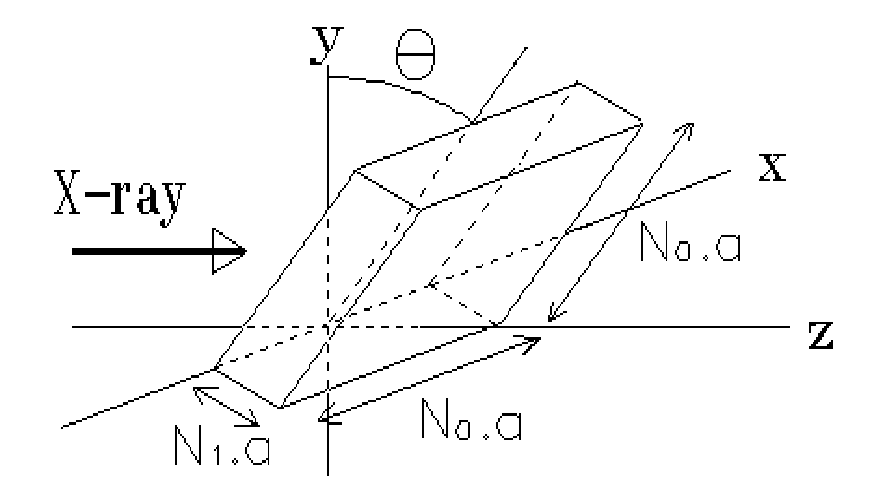
Figure 1 Diffraction of a parallel X-ray beam along the z-axis. The angle between the crystal and the y-axis is \(\Theta\).
b - Calculate the position and width of the maxima as a function of the angle \(\Theta\) (for small \(\Theta\)).
- What in particular are the consequences of the fact that \(N_1 \ll N_0\).
The diffraction pattern can also be derived by means of Bragg's theory, in which it is assumed that the X-rays are reflected from atomic planes in the lattice. The diffraction pattern then arises from interference of these reflected rays with each other.
c - Show that this so-called Bragg reflection yields the same conditions for the maxima as those that you found in b.
In some measurements the so-called powder method is employed. A beam of X-rays is scattered by a powder of very many, small crystals. (Of course the sizes of the crystals are much larger than the lattice spacing, \(a\).)
Scattering of X-rays of wavelength \(0.15\ \mathrm{nm}\) by Potassium Chloride [KCl] (which has a cubic lattice, see Fig.2) results in the production of concentric dark circles on a photographic plate. The distance between the crystals and the plate is \(0.10\ \mathrm{m}\), and the radius of the smallest circle is \(0.053\ \mathrm{m}\) (see Fig. 3). \(\mathrm{K}^{+}\) and \(\mathrm{Cl}^{-}\) ions have almost the same size, and they may be treated as identical scattering centres.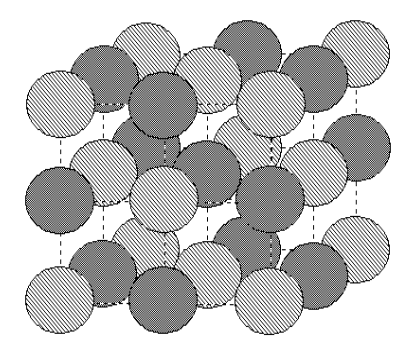
Figure 2. The cubic lattice of Potassium Chloride in which the \(\mathrm{K}^{+}\) and \(\mathrm{Cl}^{-}\) ions have almost the same size.
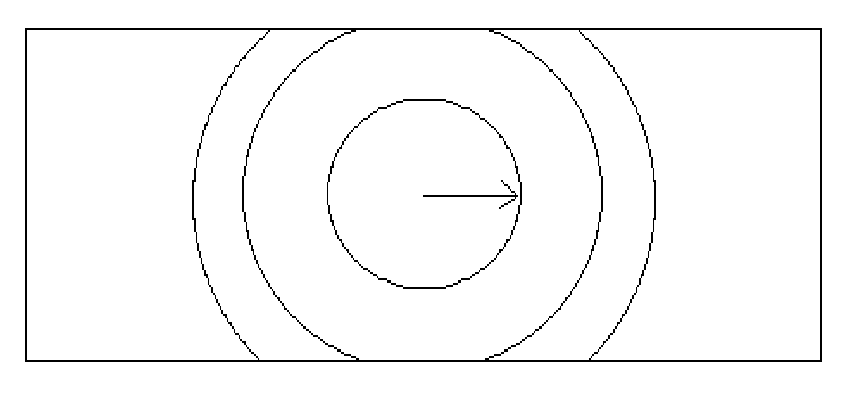
Figure 3. Scattering of X-rays by a powder of KCl crystals results in the production of concentric dark circles on a photographic plate.
d - Calculate the distance between two neighbouring K ions in the crystal.
Official English text of the problem.
Problem 2: Electric experiments in the magnetosphere of the earth
In May 1991 the spaceship Atlantis will be placed in orbit around the earth. We shall assume that this orbit will be circular and that it lies in the earth's equatorial plane.
At some predetermined moment the spaceship will release a satellite S, which is attached to a conducting rod of length \(L\). We suppose that the rod is rigid, has negligible mass, and is covered by an electrical insulator. We also neglect all friction. Let \(\alpha\) be the angle that the rod makes to the line between the Atlantis and the centre of the earth. (see Fig. 1).
S also lies in the equatorial plane.
Assume that the mass of the satellite is much smaller than that of the Atlantis, and that \(L\) is much smaller than the radius of the orbit.
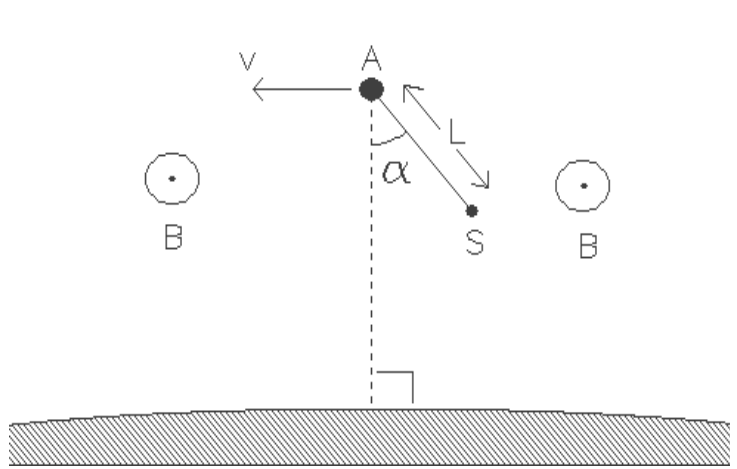
Figure 1 The spaceship Atlantis (A) with a satellite (S) in an orbit around the earth. The orbit lies in the earth’s equatorial plane. The magnetic field (B) is perpendicular to the diagram and is directed towards the reader.
\(\mathrm{a}_1\) - Deduce for which value(s) of \(\alpha\) the configuration of the spaceship and satellite remain unchanged (with respect to the earth)? In other words, for which value(s) of \(\alpha\) is \(\alpha\) constant?
\(\mathrm{a}_2\) - Discuss the stability of the equilibrium for each case.
Suppose that, at a given moment, the rod deviates from the stable configuration by a small angle. The system will begin to swing like a pendulum.
b - Express the period of the swinging in terms of the period of revolution of the system around the earth.
In Fig. 1 the magnetic field of the earth is perpendicular to the diagram and is directed towards the reader. Due to the orbital velocity of the rod, a potential difference arises between its ends. The environment (the magnetosphere) is a rarefied, ionised gas with a very good electrical conductivity. Contact with the ionised gas is made by means of electrodes in A (the Atlantis) and S (the satellite). As a consequence of the motion, a current, \(I\), flows through the rod.
\(\mathrm{c}_1\) - In which direction does the current flow through the rod? (Take \(\alpha=0\))
Data:
- the period of the orbit \(T=5{,}4\cdot10^3\ \mathrm{s}\) - the length of the rod \(L=2{,}0\cdot10^4\ \mathrm{m}\) - magnetic field strength of the eart at the height of the satellite \(B=5{,}0\cdot10^{-5}\ \mathrm{Wb.m^{-2}}\) - the mass of the shuttle Atlantis \(m=1{,}0\cdot10^5\ \mathrm{kg}\) Next, a current source inside the shuttle is included in the circuit, which maintains a net direct current of 0.1 A in the opposite direction.
\(\mathrm{c}_2\) - How long must this current be maintained to change the altitude of the orbit by 10 m.
Assume that \(\alpha\) remains zero. Ignore all contributions from currents in the magnetosphere.
- Does the altitude decrease or increase?
Official English text of the problem.
Problem 3: The rotating neutron star
A 'millisecond pulsar' is a source of radiation in the universe that emits very short pulses with a period of one to several milliseconds. This radiation is in the radio range of wavelengths; and a suitable radio receiver can be used to detect the separate pulses and thereby to measure the period with great accuracy.
These radio pulses originate from the surface of a particular sort of star, the so-called neutron star. These stars are very compact: they have a mass of the same order of magnitude as that of the sun, but their radius is only a few tens of kilometers. They spin very quickly. Because of the fast rotation, a neutron star is slightly flattened (oblate). Assume the axial cross-section of the surface to be an ellipse with almost equal axes. Let \(r_p\) be the polar and \(r_e\) the equatorial radii; and let us define the flattening factor by:
\[ \epsilon=\frac{(r_e-r_p)}{r_p} \]
Consider a neutron star with
a mass of \(2.0\cdot10^{30}\,\mathrm{kg}\), an average radius of \(1.0\cdot10^4\,\mathrm{m}\), and a rotation period of \(2.0\cdot10^{-2}\,\mathrm{s}\). a - Calculate the flattening factor, given that the gravitational constant is \(6.67\cdot10^{-11}\,\mathrm{N.m^2.kg^{-2}}\).
In the long run (over many years) the rotation of the star slows down, due to energy loss, and this leads to a decrease in the flattening. The star has however a solid crust that floats on a liquid interior. The solid crust resists a continuous adjustment to equilibrium shape. Instead, starquakes occur with sudden changes in the shape of the crust towards equilibrium. During and after such a star-quake the angular velocity is observed to change according to figure 1.
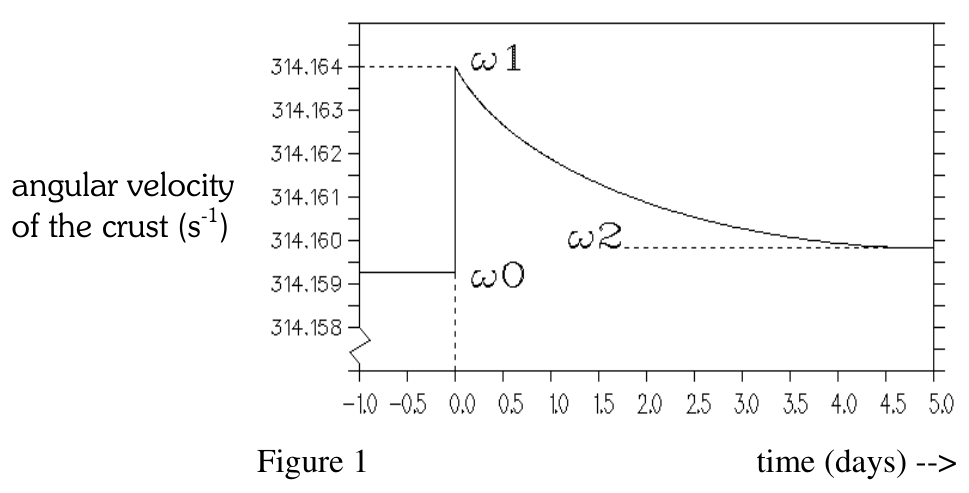
A sudden change in the shape of the crust of a neutron star results in a sudden change of the angular velocity.
b - Calculate the average radius of the liquid interior, using the data of Fig. 1. Make the approximation that the densities of the crust and the interior are the same. (Ignore the change in shape of the interior).
Official English text of the problem.
Internationale Physik-Olympiade
IPhO 1990
Groningen, Niederlande · 3 Theorieaufgaben mit vollständigen Lösungen
Aufgabe 1: Röntgenbeugung an einem Kristall
Wir wollen die Beugung von Röntgenstrahlung an einem kubischen Kristallgitter untersuchen. Dazu betrachten wir zunächst die Beugung einer ebenen, monochromatischen Welle, die senkrecht auf ein zweidimensionales Gitter fällt, das aus \(N_1 \times N_2\) Spalten mit den Abständen \(d_1\) und \(d_2\) besteht. Das Beugungsbild wird auf einem Schirm im Abstand \(L\) vom Gitter beobachtet. Der Schirm ist parallel zum Gitter, und \(L\) ist wesentlich größer als \(d_1\) und \(d_2\).
a - Bestimmen Sie die Positionen und Breiten der Hauptmaxima auf dem Schirm. Die Breite ist als Abstand zwischen den Minima auf beiden Seiten eines Maximums definiert.
Wir betrachten nun einen kubischen Kristall mit der Gitterkonstanten \(a\) und den Abmessungen \(N_0.a \times N_0.a \times N_1.a\). \(N_1\) ist wesentlich kleiner als \(N_0\). Der Kristall wird unter einem Winkel \(\Theta\) in ein paralleles Röntgenstrahlenbündel entlang der z-Achse gebracht (siehe Abb. 1). Das Beugungsbild wird wiederum auf einem Schirm in großer Entfernung vom Kristall beobachtet.
Abbildung 1 Beugung eines parallelen Röntgenstrahlenbündels entlang der z-Achse. Der Winkel zwischen dem Kristall und der y-Achse beträgt \(\Theta\).
b - Berechnen Sie die Positionen und Breiten der Maxima als Funktion des Winkels \(\Theta\) (für kleine \(\Theta\)).
- Welche Folgen hat insbesondere die Tatsache, dass \(N_1 \ll N_0\) gilt?
Das Beugungsbild lässt sich auch mithilfe der Braggschen Theorie herleiten, in der angenommen wird, dass die Röntgenstrahlen an den Netzebenen des Gitters reflektiert werden. Das Beugungsbild entsteht dann durch die Interferenz dieser reflektierten Strahlen miteinander.
c - Zeigen Sie, dass diese sogenannte Bragg-Reflexion dieselben Bedingungen für die Maxima liefert wie die von Ihnen in b gefundenen.
Bei einigen Messungen wird die sogenannte Pulvermethode verwendet. Ein Röntgenstrahlenbündel wird an einem Pulver aus sehr vielen kleinen Kristallen gestreut. (Natürlich sind die Abmessungen der Kristalle wesentlich größer als die Gitterkonstante \(a\).)
Die Streuung von Röntgenstrahlung der Wellenlänge \(0.15\ \mathrm{nm}\) an Kaliumchlorid [KCl] (das ein kubisches Gitter besitzt, siehe Abb. 2) erzeugt konzentrische dunkle Kreise auf einer Fotoplatte. Der Abstand zwischen den Kristallen und der Platte beträgt \(0.10\ \mathrm{m}\), und der Radius des kleinsten Kreises beträgt \(0.053\ \mathrm{m}\) (siehe Abb. 3). \(\mathrm{K}^{+}\)- und \(\mathrm{Cl}^{-}\)-Ionen sind nahezu gleich groß und können als identische Streuzentren behandelt werden.Abbildung 2. Das kubische Gitter von Kaliumchlorid, in dem die \(\mathrm{K}^{+}\)- und \(\mathrm{Cl}^{-}\)-Ionen nahezu gleich groß sind.
Abbildung 3. Die Streuung von Röntgenstrahlung an einem Pulver aus KCl-Kristallen erzeugt konzentrische dunkle Kreise auf einer Fotoplatte.
d - Berechnen Sie den Abstand zwischen zwei benachbarten K-Ionen im Kristall.
Aufgabentext aus dem offiziellen englischen Text übersetzt.
Aufgabe 2: Elektrische Experimente in der Magnetosphäre der Erde
Im Mai 1991 wird das Raumschiff Atlantis in eine Umlaufbahn um die Erde gebracht werden. Wir nehmen an, dass diese Umlaufbahn kreisförmig ist und in der Äquatorebene der Erde liegt.
Zu einem vorher festgelegten Zeitpunkt wird das Raumschiff einen Satelliten S aussetzen, der an einem leitenden Stab der Länge \(L\) befestigt ist. Wir nehmen an, dass der Stab starr ist, eine vernachlässigbare Masse hat und mit einem elektrischen Isolator überzogen ist. Außerdem vernachlässigen wir jegliche Reibung. Es sei \(\alpha\) der Winkel, den der Stab mit der Verbindungslinie zwischen Atlantis und dem Erdmittelpunkt bildet. (Siehe Abb. 1.)
S befindet sich ebenfalls in der Äquatorebene.
Nehmen Sie an, dass die Masse des Satelliten viel kleiner als die der Atlantis ist und dass \(L\) viel kleiner als der Radius der Umlaufbahn ist.
Abbildung 1 Das Raumschiff Atlantis (A) mit einem Satelliten (S) auf einer Umlaufbahn um die Erde. Die Umlaufbahn liegt in der Äquatorebene der Erde. Das Magnetfeld (B) steht senkrecht zur Zeichenebene und ist auf den Leser zu gerichtet.
\(\mathrm{a}_1\) - Leiten Sie her, für welche Werte von \(\alpha\) die Anordnung von Raumschiff und Satellit (bezüglich der Erde) unverändert bleibt. Mit anderen Worten: Für welche Werte von \(\alpha\) ist \(\alpha\) konstant?
\(\mathrm{a}_2\) - Untersuchen Sie für jeden Fall die Stabilität des Gleichgewichts.
Nehmen Sie an, dass der Stab zu einem bestimmten Zeitpunkt um einen kleinen Winkel von der stabilen Anordnung abweicht. Das System beginnt dann wie ein Pendel zu schwingen.
b - Drücken Sie die Schwingungsdauer durch die Umlaufdauer des Systems um die Erde aus.
In Abb. 1 steht das Magnetfeld der Erde senkrecht zur Zeichenebene und ist auf den Leser zu gerichtet. Aufgrund der Bahngeschwindigkeit des Stabes entsteht zwischen seinen Enden eine Potentialdifferenz. Die Umgebung (die Magnetosphäre) ist ein verdünntes, ionisiertes Gas mit sehr guter elektrischer Leitfähigkeit. Der Kontakt mit dem ionisierten Gas wird durch Elektroden in A (Atlantis) und S (Satellit) hergestellt. Infolge der Bewegung fließt ein Strom \(I\) durch den Stab.
\(\mathrm{c}_1\) - In welche Richtung fließt der Strom durch den Stab? (Setzen Sie \(\alpha=0\).)
Gegebene Werte:
- Umlaufdauer \(T=5{,}4\cdot10^3\ \mathrm{s}\) - Länge des Stabes \(L=2{,}0\cdot10^4\ \mathrm{m}\) - magnetische Flussdichte der Erde in der Höhe des Satelliten \(B=5{,}0\cdot10^{-5}\ \mathrm{Wb.m^{-2}}\) - Masse der Raumfähre Atlantis \(m=1{,}0\cdot10^5\ \mathrm{kg}\) Nun wird eine Stromquelle im Inneren der Raumfähre in den Stromkreis eingefügt, die einen resultierenden Gleichstrom von 0.1 A in entgegengesetzter Richtung aufrechterhält.
\(\mathrm{c}_2\) - Wie lange muss dieser Strom aufrechterhalten werden, um die Höhe der Umlaufbahn um 10 m zu verändern?
Nehmen Sie an, dass \(\alpha\) null bleibt. Vernachlässigen Sie alle Beiträge von Strömen in der Magnetosphäre.
- Nimmt die Höhe ab oder zu?
Aufgabentext aus dem offiziellen englischen Text übersetzt.
Aufgabe 3: Der rotierende Neutronenstern
Ein „Millisekundenpulsar“ ist eine Strahlungsquelle im Universum, die sehr kurze Pulse mit einer Periodendauer von einer bis mehreren Millisekunden aussendet. Diese Strahlung liegt im Radiowellenbereich; mit einem geeigneten Radioempfänger lassen sich die einzelnen Pulse nachweisen und dadurch die Periodendauer mit großer Genauigkeit messen.
Diese Radiopulse stammen von der Oberfläche einer besonderen Art von Stern, dem sogenannten Neutronenstern. Diese Sterne sind sehr kompakt: Ihre Masse hat dieselbe Größenordnung wie die der Sonne, ihr Radius beträgt jedoch nur einige zehn Kilometer. Sie rotieren sehr schnell. Aufgrund der schnellen Rotation ist ein Neutronenstern leicht abgeplattet. Nehmen Sie an, dass der Schnitt durch die Oberfläche in einer Ebene durch die Rotationsachse eine Ellipse mit nahezu gleichen Achsen ist. Es seien \(r_p\) der Polradius und \(r_e\) der Äquatorradius; wir definieren den Abplattungsfaktor durch:
\[ \epsilon=\frac{(r_e-r_p)}{r_p} \]
Betrachten Sie einen Neutronenstern mit
einer Masse von \(2.0\cdot10^{30}\,\mathrm{kg}\), einem mittleren Radius von \(1.0\cdot10^4\,\mathrm{m}\), und einer Rotationsperiode von \(2.0\cdot10^{-2}\,\mathrm{s}\). a - Berechnen Sie den Abplattungsfaktor, wenn die Gravitationskonstante \(6.67\cdot10^{-11}\,\mathrm{N.m^2.kg^{-2}}\) beträgt.
Auf lange Sicht (über viele Jahre) verlangsamt sich die Rotation des Sterns durch Energieverlust, wodurch die Abplattung abnimmt. Der Stern besitzt jedoch eine feste Kruste, die auf einem flüssigen Inneren schwimmt. Die feste Kruste widersetzt sich einer kontinuierlichen Anpassung an die Gleichgewichtsform. Stattdessen treten Sternbeben auf, bei denen sich die Form der Kruste plötzlich in Richtung der Gleichgewichtsform verändert. Während und nach einem solchen Sternbeben wird eine Änderung der Winkelgeschwindigkeit gemäß Abbildung 1 beobachtet.
Eine plötzliche Änderung der Form der Kruste eines Neutronensterns führt zu einer plötzlichen Änderung der Winkelgeschwindigkeit.
b - Berechnen Sie anhand der Daten aus Abb. 1 den mittleren Radius des flüssigen Inneren. Nehmen Sie näherungsweise an, dass die Dichten der Kruste und des Inneren gleich sind. (Vernachlässigen Sie die Formänderung des Inneren.)
Aufgabentext aus dem offiziellen englischen Text übersetzt.
Uluslararası Fizik Olimpiyatı
IPhO 1990
Groningen, Hollanda · 3 teori sorusu, tam çözümleriyle
Soru 1: Bir kristalde X-ışını kırınımı
Kübik bir kristal örgüsünde X-ışını kırınımını incelemek istiyoruz. Bunun için, aralarındaki uzaklıklar \(d_1\) ve \(d_2\) olan \(N_1 \times N_2\) yarıktan oluşan iki boyutlu bir ızgaraya dik olarak gelen düzlemsel, tek renkli bir dalganın kırınımıyla başlıyoruz. Kırınım deseni, ızgaradan \(L\) uzaklığındaki bir ekranda gözlenmektedir. Ekran ızgaraya paraleldir ve \(L\), \(d_1\) ve \(d_2\)'den çok daha büyüktür.
a - Ekrandaki ana maksimumların konumlarını ve genişliklerini belirleyiniz. Genişlik, bir maksimumun iki yanındaki minimumlar arasındaki uzaklık olarak tanımlanmaktadır.
Şimdi örgü sabiti \(a\) ve boyutları \(N_0.a \times N_0.a \times N_1.a\) olan kübik bir kristali ele alıyoruz. \(N_1\), \(N_0\)'dan çok daha küçüktür. Kristal, z ekseni boyunca ilerleyen paralel bir X-ışını demeti içine \(\Theta\) açısıyla yerleştirilmiştir (bkz. Şekil 1). Kırınım deseni yine kristalden çok uzaktaki bir ekranda gözlenmektedir.
Şekil 1 z ekseni boyunca ilerleyen paralel bir X-ışını demetinin kırınımı. Kristal ile y ekseni arasındaki açı \(\Theta\)'dır.
b - Maksimumların konumlarını ve genişliklerini \(\Theta\) açısının fonksiyonu olarak hesaplayınız (küçük \(\Theta\) için).
- Özellikle \(N_1 \ll N_0\) olmasının sonuçları nelerdir?
Kırınım deseni, X-ışınlarının örgüdeki atom düzlemlerinden yansıdığının varsayıldığı Bragg kuramı yardımıyla da elde edilebilir. Bu durumda kırınım deseni, bu yansıyan ışınların birbirleriyle girişiminden kaynaklanır.
c - Bragg yansıması olarak adlandırılan bu yansımanın, maksimumlar için b'de bulduğunuz koşullarla aynı koşulları verdiğini gösteriniz.
Bazı ölçümlerde toz yöntemi olarak adlandırılan yöntem kullanılır. Bir X-ışını demeti, çok sayıda küçük kristalden oluşan bir toz tarafından saçılır. (Elbette kristallerin boyutları, örgü sabiti \(a\)'dan çok daha büyüktür.)
Dalga boyu \(0.15\ \mathrm{nm}\) olan X-ışınlarının potasyum klorür [KCl] (kübik bir örgüye sahiptir, bkz. Şekil 2) tarafından saçılması, bir fotoğraf plağı üzerinde eş merkezli koyu çemberlerin oluşmasına yol açar. Kristaller ile plak arasındaki uzaklık \(0.10\ \mathrm{m}\), en küçük çemberin yarıçapı ise \(0.053\ \mathrm{m}\)'dir (bkz. Şekil 3). \(\mathrm{K}^{+}\) ve \(\mathrm{Cl}^{-}\) iyonları hemen hemen aynı büyüklüktedir ve özdeş saçılma merkezleri olarak ele alınabilirler.Şekil 2. \(\mathrm{K}^{+}\) ve \(\mathrm{Cl}^{-}\) iyonlarının hemen hemen aynı büyüklükte olduğu potasyum klorürün kübik örgüsü.
Şekil 3. X-ışınlarının KCl kristallerinden oluşan bir toz tarafından saçılması, bir fotoğraf plağı üzerinde eş merkezli koyu çemberlerin oluşmasına yol açar.
d - Kristaldeki iki komşu K iyonu arasındaki uzaklığı hesaplayınız.
Soru metni resmi İngilizce metinden çevrilmiştir.
Soru 2: Dünya'nın manyetosferinde elektrik deneyleri
Mayıs 1991'de Atlantis uzay aracı Dünya çevresinde bir yörüngeye yerleştirilecektir. Bu yörüngenin dairesel olduğunu ve Dünya'nın ekvator düzleminde bulunduğunu varsayacağız.
Önceden belirlenmiş bir anda uzay aracı, uzunluğu \(L\) olan iletken bir çubuğa bağlı S uydusunu serbest bırakacaktır. Çubuğun rijit olduğunu, kütlesinin ihmal edilebilir olduğunu ve elektriksel bir yalıtkanla kaplı olduğunu varsayıyoruz. Ayrıca tüm sürtünmeleri ihmal ediyoruz. Çubuğun Atlantis ile Dünya'nın merkezini birleştiren doğruyla yaptığı açı \(\alpha\) olsun. (Bkz. Şekil 1).
S de ekvator düzleminde bulunmaktadır.
Uydunun kütlesinin Atlantis'in kütlesinden çok küçük olduğunu ve \(L\)'nin yörünge yarıçapından çok küçük olduğunu varsayın.
Şekil 1 Dünya çevresindeki bir yörüngede, bir uydu (S) ile birlikte Atlantis uzay aracı (A). Yörünge Dünya'nın ekvator düzlemindedir. Manyetik alan (B) şekil düzlemine diktir ve okuyucuya doğru yönelmiştir.
\(\mathrm{a}_1\) - \(\alpha\)'nın hangi değerinde (veya değerlerinde) uzay aracı ve uydunun düzeninin (Dünya'ya göre) değişmeden kaldığını türetin. Başka bir deyişle, \(\alpha\)'nın hangi değerinde (veya değerlerinde) \(\alpha\) sabit kalır?
\(\mathrm{a}_2\) - Her bir durum için dengenin kararlılığını tartışın.
Belirli bir anda çubuğun kararlı konumundan küçük bir açı kadar saptığını varsayın. Sistem bir sarkaç gibi salınmaya başlayacaktır.
b - Salınım periyodunu, sistemin Dünya çevresindeki dolanım periyodu cinsinden ifade edin.
Şekil 1'de Dünya'nın manyetik alanı şekil düzlemine diktir ve okuyucuya doğru yönelmiştir. Çubuğun yörüngesel hızı nedeniyle uçları arasında bir potansiyel farkı oluşur. Ortam (manyetosfer), elektrik iletkenliği çok iyi olan seyrek, iyonlaşmış bir gazdır. İyonlaşmış gazla temas, A'daki (Atlantis) ve S'deki (uydu) elektrotlar aracılığıyla sağlanır. Hareketin bir sonucu olarak çubuktan \(I\) akımı geçer.
\(\mathrm{c}_1\) - Akım çubuktan hangi yönde geçer? (\(\alpha=0\) alın.)
Veriler:
- yörünge periyodu \(T=5{,}4\cdot10^3\ \mathrm{s}\) - çubuğun uzunluğu \(L=2{,}0\cdot10^4\ \mathrm{m}\) - uydunun bulunduğu yükseklikte Dünya'nın manyetik alanının büyüklüğü \(B=5{,}0\cdot10^{-5}\ \mathrm{Wb.m^{-2}}\) - Atlantis mekiğinin kütlesi \(m=1{,}0\cdot10^5\ \mathrm{kg}\) Ardından, mekiğin içindeki bir akım kaynağı devreye dahil edilerek ters yönde 0.1 A büyüklüğünde net bir doğru akım sağlanır.
\(\mathrm{c}_2\) - Yörüngenin yüksekliğini 10 m değiştirmek için bu akım ne kadar süreyle sürdürülmelidir?
\(\alpha\)'nın sıfır olarak kaldığını varsayın. Manyetosferdeki akımların tüm katkılarını ihmal edin.
- Yükseklik azalır mı, artar mı?
Soru metni resmi İngilizce metinden çevrilmiştir.
Soru 3: Dönen nötron yıldızı
Bir 'milisaniye pulsarı', evrende bir ila birkaç milisaniyelik periyotlarla çok kısa atımlar yayan bir ışınım kaynağıdır. Bu ışınımın dalga boyları radyo dalgaları aralığındadır; uygun bir radyo alıcısı kullanılarak atımlar ayrı ayrı algılanabilir ve böylece periyot büyük bir hassasiyetle ölçülebilir.
Bu radyo atımları, nötron yıldızı adı verilen özel bir yıldız türünün yüzeyinden kaynaklanır. Bu yıldızlar çok kompakttır: kütleleri Güneş'in kütlesiyle aynı büyüklük mertebesindedir, ancak yarıçapları yalnızca birkaç on kilometredir. Çok hızlı dönerler. Hızlı dönmesi nedeniyle bir nötron yıldızı hafifçe basıktır (kutuplardan basık). Yüzeyin dönme ekseninden geçen kesitinin, eksenleri hemen hemen eşit bir elips olduğunu varsayın. Kutupsal yarıçap \(r_p\), ekvatoral yarıçap ise \(r_e\) olsun; basıklık katsayısını şöyle tanımlayalım:
\[ \epsilon=\frac{(r_e-r_p)}{r_p} \]
Aşağıdaki özelliklere sahip bir nötron yıldızını ele alın:
kütlesi \(2.0\cdot10^{30}\,\mathrm{kg}\), ortalama yarıçapı \(1.0\cdot10^4\,\mathrm{m}\), ve dönme periyodu \(2.0\cdot10^{-2}\,\mathrm{s}\). a - Kütleçekim sabitinin \(6.67\cdot10^{-11}\,\mathrm{N.m^2.kg^{-2}}\) olduğunu kullanarak basıklık katsayısını hesaplayın.
Uzun vadede (yıllar boyunca), enerji kaybı nedeniyle yıldızın dönmesi yavaşlar ve bu da basıklığın azalmasına yol açar. Ancak yıldızın, sıvı bir iç bölge üzerinde yüzen katı bir kabuğu vardır. Katı kabuk, denge şekline sürekli olarak uyum sağlamaya direnç gösterir. Bunun yerine, kabuğun şeklinin dengeye doğru aniden değiştiği yıldız depremleri meydana gelir. Böyle bir yıldız depremi sırasında ve sonrasında açısal hızın Şekil 1'e göre değiştiği gözlenir.
Bir nötron yıldızının kabuğunun şeklindeki ani bir değişiklik, açısal hızda ani bir değişikliğe yol açar.
b - Şekil 1'deki verileri kullanarak sıvı iç bölgenin ortalama yarıçapını hesaplayın. Kabuk ile iç bölgenin yoğunluklarının aynı olduğu yaklaşımını yapın. (İç bölgenin şekil değişimini göz ardı edin.)
Soru metni resmi İngilizce metinden çevrilmiştir.
Olimpiada Internacional de Física
IPhO 1990
Groninga, Países Bajos · 3 problemas teóricos con soluciones completas
Problema 1: Difracción de rayos X por un cristal
Deseamos estudiar la difracción de rayos X por una red cristalina cúbica. Para ello, comenzamos con la difracción de una onda plana y monocromática que incide perpendicularmente sobre una rejilla bidimensional formada por \(N_1 \times N_2\) rendijas con separaciones \(d_1\) y \(d_2\). El patrón de difracción se observa en una pantalla situada a una distancia \(L\) de la rejilla. La pantalla es paralela a la rejilla y \(L\) es mucho mayor que \(d_1\) y \(d_2\).
a - Determine las posiciones y las anchuras de los máximos principales en la pantalla. La anchura se define como la distancia entre los mínimos situados a ambos lados de cada máximo.
Consideramos ahora un cristal cúbico, con parámetro de red \(a\) y dimensiones \(N_0.a \times N_0.a \times N_1.a\). \(N_1\) es mucho menor que \(N_0\). El cristal se coloca en un haz paralelo de rayos X dirigido a lo largo del eje z, con un ángulo \(\Theta\) (véase la Fig. 1). El patrón de difracción se observa de nuevo en una pantalla situada a gran distancia del cristal.
Figura 1 Difracción de un haz paralelo de rayos X dirigido a lo largo del eje z. El ángulo entre el cristal y el eje y es \(\Theta\).
b - Calcule la posición y la anchura de los máximos en función del ángulo \(\Theta\) (para valores pequeños de \(\Theta\)).
- ¿Qué consecuencias tiene, en particular, el hecho de que \(N_1 \ll N_0\)?
El patrón de difracción también puede deducirse mediante la teoría de Bragg, en la que se supone que los rayos X se reflejan en los planos atómicos de la red. El patrón de difracción surge entonces de la interferencia entre estos rayos reflejados.
c - Demuestre que esta denominada reflexión de Bragg conduce a las mismas condiciones para los máximos que las obtenidas en b.
En algunas mediciones se emplea el denominado método del polvo. Un haz de rayos X es dispersado por un polvo formado por muchísimos cristales pequeños. (Naturalmente, las dimensiones de los cristales son mucho mayores que el parámetro de red, \(a\).)
La dispersión de rayos X de longitud de onda \(0.15\ \mathrm{nm}\) por cloruro de potasio [KCl] (que tiene una red cúbica, véase la Fig. 2) da lugar a círculos oscuros concéntricos en una placa fotográfica. La distancia entre los cristales y la placa es de \(0.10\ \mathrm{m}\), y el radio del círculo más pequeño es de \(0.053\ \mathrm{m}\) (véase la Fig. 3). Los iones \(\mathrm{K}^{+}\) y \(\mathrm{Cl}^{-}\) tienen casi el mismo tamaño y pueden tratarse como centros dispersores idénticos.Figura 2. La red cúbica del cloruro de potasio, en la que los iones \(\mathrm{K}^{+}\) y \(\mathrm{Cl}^{-}\) tienen casi el mismo tamaño.
Figura 3. La dispersión de rayos X por un polvo de cristales de KCl da lugar a círculos oscuros concéntricos en una placa fotográfica.
d - Calcule la distancia entre dos iones K vecinos en el cristal.
Enunciado traducido del texto oficial en inglés.
Problema 2: Experimentos eléctricos en la magnetosfera de la Tierra
En mayo de 1991, la nave espacial Atlantis se pondrá en órbita alrededor de la Tierra. Supondremos que esta órbita será circular y que estará situada en el plano ecuatorial terrestre.
En un momento predeterminado, la nave espacial liberará un satélite S, unido a una varilla conductora de longitud \(L\). Suponemos que la varilla es rígida, tiene una masa despreciable y está recubierta de un aislante eléctrico. También despreciamos todo rozamiento. Sea \(\alpha\) el ángulo que forma la varilla con la línea que une el Atlantis con el centro de la Tierra (véase la Fig. 1).
S también se encuentra en el plano ecuatorial.
Suponga que la masa del satélite es mucho menor que la del Atlantis y que \(L\) es mucho menor que el radio de la órbita.
Figura 1 La nave espacial Atlantis (A) con un satélite (S) en una órbita alrededor de la Tierra. La órbita está situada en el plano ecuatorial terrestre. El campo magnético (B) es perpendicular al dibujo y está dirigido hacia el lector.
\(\mathrm{a}_1\) - Deduzca para qué valor(es) de \(\alpha\) permanece invariable la configuración de la nave espacial y el satélite (con respecto a la Tierra). En otras palabras, ¿para qué valor(es) de \(\alpha\) es constante \(\alpha\)?
\(\mathrm{a}_2\) - Analice la estabilidad del equilibrio en cada caso.
Suponga que, en un momento dado, la varilla se desvía de la configuración estable un ángulo pequeño. El sistema comenzará a oscilar como un péndulo.
b - Exprese el período de oscilación en función del período de revolución del sistema alrededor de la Tierra.
En la Fig. 1, el campo magnético terrestre es perpendicular al dibujo y está dirigido hacia el lector. Debido a la velocidad orbital de la varilla, aparece una diferencia de potencial entre sus extremos. El medio circundante (la magnetosfera) es un gas enrarecido e ionizado con una conductividad eléctrica muy elevada. El contacto con el gas ionizado se establece mediante electrodos en A (el Atlantis) y S (el satélite). Como consecuencia del movimiento, circula por la varilla una corriente \(I\).
\(\mathrm{c}_1\) - ¿En qué sentido circula la corriente por la varilla? (Tome \(\alpha=0\))
Datos:
- período de la órbita \(T=5{,}4\cdot10^3\ \mathrm{s}\) - longitud de la varilla \(L=2{,}0\cdot10^4\ \mathrm{m}\) - intensidad del campo magnético terrestre a la altura del satélite \(B=5{,}0\cdot10^{-5}\ \mathrm{Wb.m^{-2}}\) - masa del transbordador Atlantis \(m=1{,}0\cdot10^5\ \mathrm{kg}\) A continuación, se incorpora al circuito una fuente de corriente situada en el interior del transbordador, que mantiene una corriente continua neta de 0.1 A en el sentido opuesto.
\(\mathrm{c}_2\) - ¿Durante cuánto tiempo debe mantenerse esta corriente para modificar la altitud de la órbita en 10 m?
Suponga que \(\alpha\) permanece igual a cero. Desprecie todas las contribuciones de las corrientes en la magnetosfera.
- ¿Disminuye o aumenta la altitud?
Enunciado traducido del texto oficial en inglés.
Problema 3: La estrella de neutrones en rotación
Un «púlsar de milisegundos» es una fuente de radiación en el universo que emite pulsos muy breves con un período de uno a varios milisegundos. Esta radiación se encuentra en el intervalo de longitudes de onda de radio; un receptor de radio adecuado permite detectar los pulsos individuales y, de este modo, medir el período con gran precisión.
Estos pulsos de radio se originan en la superficie de un tipo particular de estrella, la denominada estrella de neutrones. Estas estrellas son muy compactas: tienen una masa del mismo orden de magnitud que la del Sol, pero su radio es de tan solo unas decenas de kilómetros. Giran muy rápidamente. Debido a su rápida rotación, una estrella de neutrones está ligeramente achatada (es oblata). Supongamos que la sección axial de su superficie es una elipse con ejes casi iguales. Sean \(r_p\) el radio polar y \(r_e\) el radio ecuatorial; definamos el factor de achatamiento mediante:
\[ \epsilon=\frac{(r_e-r_p)}{r_p} \]
Consideremos una estrella de neutrones con
una masa de \(2.0\cdot10^{30}\,\mathrm{kg}\), un radio medio de \(1.0\cdot10^4\,\mathrm{m}\), y un período de rotación de \(2.0\cdot10^{-2}\,\mathrm{s}\). a - Calcule el factor de achatamiento, sabiendo que la constante de gravitación universal es \(6.67\cdot10^{-11}\,\mathrm{N.m^2.kg^{-2}}\).
A largo plazo (a lo largo de muchos años), la rotación de la estrella se ralentiza debido a la pérdida de energía, lo que provoca una disminución del achatamiento. Sin embargo, la estrella tiene una corteza sólida que flota sobre un interior líquido. La corteza sólida se resiste a ajustarse de forma continua a la forma de equilibrio. En su lugar, se producen sismos estelares con cambios repentinos en la forma de la corteza hacia el equilibrio. Durante y después de uno de estos sismos estelares, se observa que la velocidad angular cambia según la figura 1.
Un cambio repentino en la forma de la corteza de una estrella de neutrones produce un cambio repentino de la velocidad angular.
b - Calcule el radio medio del interior líquido utilizando los datos de la Fig. 1. Utilice la aproximación de que las densidades de la corteza y del interior son iguales. (Ignore el cambio de forma del interior).
Enunciado traducido del texto oficial en inglés.
国际物理奥林匹克
IPhO 1990
荷兰格罗宁根 · 3 道理论题及完整解答
题目 1:晶体的 X 射线衍射
我们希望研究立方晶格对 X 射线的衍射。为此,先考察单色平面波垂直入射到二维栅格时的衍射。该栅格由 \(N_1 \times N_2\) 个狭缝组成,两个方向上的间距分别为 \(d_1\) 和 \(d_2\)。在距栅格 \(L\) 处的屏上观察衍射图样。屏与栅格平行,且 \(L\) 远大于 \(d_1\) 和 \(d_2\)。
a - 确定屏上主极大的位置和宽度。宽度定义为极大两侧极小之间的距离。
现在考虑一个立方晶体,其晶格间距为 \(a\),尺寸为 \(N_0.a \times N_0.a \times N_1.a\)。\(N_1\) 远小于 \(N_0\)。将晶体以角度 \(\Theta\) 放置在沿 z 轴传播的平行 X 射线束中(见图 1)。同样,在距晶体很远的屏上观察衍射图样。
图 1 沿 z 轴传播的平行 X 射线束的衍射。晶体与 y 轴之间的夹角为 \(\Theta\)。
b - 计算极大的位置和宽度随角度 \(\Theta\) 的变化关系(对于小 \(\Theta\))。
- 特别地,\(N_1 \ll N_0\) 这一事实会产生什么影响?
衍射图样也可以用布拉格理论推导出来。该理论假定 X 射线在晶格中的原子平面上发生反射,衍射图样由这些反射射线之间的相互干涉产生。
c - 证明,这种所谓的布拉格反射给出的极大条件与你在 b 中得到的条件相同。
有些测量采用所谓的粉末法。一束 X 射线被由大量微小晶体组成的粉末散射。(当然,晶体的尺寸远大于晶格间距 \(a\)。)
波长为 \(0.15\ \mathrm{nm}\) 的 X 射线被氯化钾 [KCl](具有立方晶格,见图 2)散射后,在照相底片上形成同心暗环。晶体与底片之间的距离为 \(0.10\ \mathrm{m}\),最小圆环的半径为 \(0.053\ \mathrm{m}\)(见图 3)。\(\mathrm{K}^{+}\) 和 \(\mathrm{Cl}^{-}\) 离子的大小几乎相同,可以将它们视为相同的散射中心。图 2. 氯化钾的立方晶格,其中 \(\mathrm{K}^{+}\) 和 \(\mathrm{Cl}^{-}\) 离子的大小几乎相同。
图 3. X 射线被 KCl 晶体粉末散射后,在照相底片上形成同心暗环。
d - 计算晶体中两个最近邻 K 离子之间的距离。
题目译自官方英文原文。
题目 2:地球磁层中的电学实验
1991 年 5 月,亚特兰蒂斯号航天飞机将进入环绕地球的轨道。我们假定该轨道为圆形,且位于地球赤道平面内。
在某个预定时刻,航天飞机将释放一颗卫星 S,卫星连接在一根长度为 \(L\) 的导电杆上。假设该杆是刚性的,质量可忽略不计,表面包覆着电绝缘材料。我们还忽略一切摩擦。设 \(\alpha\) 为杆与亚特兰蒂斯号和地心之间连线的夹角。(见图 1)。
S 也位于赤道平面内。
假设卫星的质量远小于亚特兰蒂斯号的质量,且 \(L\) 远小于轨道半径。
图 1 携带卫星(S)的亚特兰蒂斯号航天飞机(A)在环绕地球的轨道上运行。轨道位于地球赤道平面内。磁场(B)垂直于图面,方向指向读者。
\(\mathrm{a}_1\) - 推导当 \(\alpha\) 取何值时,航天飞机与卫星的构型(相对于地球)保持不变?换言之,当 \(\alpha\) 取何值时,\(\alpha\) 为常量?
\(\mathrm{a}_2\) - 讨论每种情况下平衡的稳定性。
假设在某一时刻,杆偏离稳定构型一个小角度。系统将开始像摆一样摆动。
b - 用系统绕地球公转的周期表示摆动周期。
在图 1 中,地球磁场垂直于图面,方向指向读者。由于杆具有轨道速度,其两端会产生电势差。周围环境(磁层)是一种稀薄的电离气体,具有很好的导电性。通过 A(亚特兰蒂斯号)和 S(卫星)上的电极与电离气体接触。由于这一运动,电流 \(I\) 流过杆。
\(\mathrm{c}_1\) - 电流沿杆向哪个方向流动?(取 \(\alpha=0\))
数据:
- 轨道周期 \(T=5{,}4\cdot10^3\ \mathrm{s}\) - 杆的长度 \(L=2{,}0\cdot10^4\ \mathrm{m}\) - 卫星所在高度处的地球磁感应强度 \(B=5{,}0\cdot10^{-5}\ \mathrm{Wb.m^{-2}}\) - 亚特兰蒂斯号航天飞机的质量 \(m=1{,}0\cdot10^5\ \mathrm{kg}\) 接着,将航天飞机内部的一个电流源接入电路,使电路中维持方向相反、大小为 0.1 A 的净直流电流。
\(\mathrm{c}_2\) - 为使轨道高度改变 10 m,这一电流必须维持多长时间?
假设 \(\alpha\) 始终为零。忽略磁层中电流的一切影响。
- 高度是降低还是升高?
题目译自官方英文原文。
题目 3:旋转的中子星
“毫秒脉冲星”是宇宙中的一种辐射源,它以一毫秒至几毫秒的周期发出极短的脉冲。这种辐射的波长处于无线电波段;使用合适的无线电接收机可以探测到一个个独立的脉冲,从而极其精确地测量其周期。
这些无线电脉冲来自一种特殊恒星的表面,这种恒星称为中子星。中子星非常致密:它们的质量与太阳的质量具有相同的数量级,但半径仅为几十千米。它们的自转非常快。由于快速自转,中子星略呈扁平状(扁球形)。假设其表面的轴截面是一个长短轴几乎相等的椭圆。设 \(r_p\) 为极半径,\(r_e\) 为赤道半径,并将扁率定义为:
\[ \epsilon=\frac{(r_e-r_p)}{r_p} \]
考虑一颗具有下列参数的中子星:
质量为 \(2.0\cdot10^{30}\,\mathrm{kg}\), 平均半径为 \(1.0\cdot10^4\,\mathrm{m}\), 自转周期为 \(2.0\cdot10^{-2}\,\mathrm{s}\)。 a - 已知万有引力常量为 \(6.67\cdot10^{-11}\,\mathrm{N.m^2.kg^{-2}}\),计算扁率。
在很长的时间尺度上(多年),由于能量损失,中子星的自转逐渐减慢,因而扁率减小。然而,中子星有一层漂浮在液态内部之上的固态星壳。固态星壳阻碍其形状连续地调整至平衡形状。取而代之的是发生星震,使星壳形状突然向平衡形状变化。在这样一次星震期间及其后,观测到的角速度变化如图 1 所示。
中子星星壳形状的突然变化导致角速度的突然变化。
b - 利用图 1 中的数据,计算液态内部的平均半径。近似认为星壳与内部的密度相同。(忽略内部形状的变化。)
题目译自官方英文原文。
Международная физическая олимпиада
IPhO 1990
Гронинген, Нидерланды · 3 теоретические задачи с полными решениями
Задача 1: Дифракция рентгеновских лучей на кристалле
Мы хотим исследовать дифракцию рентгеновских лучей на кубической кристаллической решётке. Для этого начнём с дифракции плоской монохроматической волны, падающей перпендикулярно на двумерную решётку, состоящую из \(N_1 \times N_2\) щелей с расстояниями между ними \(d_1\) и \(d_2\). Дифракционная картина наблюдается на экране, расположенном на расстоянии \(L\) от решётки. Экран параллелен решётке, а \(L\) много больше \(d_1\) и \(d_2\).
a - Определите положения и ширины главных максимумов на экране. Ширина определяется как расстояние между минимумами по обе стороны от максимума.
Рассмотрим теперь кубический кристалл с периодом решётки \(a\) и размерами \(N_0.a \times N_0.a \times N_1.a\). \(N_1\) много меньше \(N_0\). Кристалл помещён в параллельный пучок рентгеновских лучей, направленный вдоль оси z, под углом \(\Theta\) (см. рис. 1). Дифракционная картина вновь наблюдается на экране, расположенном на большом расстоянии от кристалла.
Рисунок 1 Дифракция параллельного пучка рентгеновских лучей, направленного вдоль оси z. Угол между кристаллом и осью y равен \(\Theta\).
b - Рассчитайте положения и ширины максимумов в зависимости от угла \(\Theta\) (при малых \(\Theta\)).
- В частности, к каким последствиям приводит то, что \(N_1 \ll N_0\)?
Дифракционную картину можно также получить с помощью теории Брэгга, в которой предполагается, что рентгеновские лучи отражаются от атомных плоскостей решётки. Дифракционная картина при этом возникает вследствие интерференции этих отражённых лучей друг с другом.
c - Покажите, что это так называемое брэгговское отражение приводит к тем же условиям максимумов, которые вы нашли в b.
В некоторых измерениях применяется так называемый метод порошка. Пучок рентгеновских лучей рассеивается на порошке, состоящем из очень большого числа мелких кристаллов. (Разумеется, размеры кристаллов много больше периода решётки \(a\).)
Рассеяние рентгеновских лучей с длиной волны \(0.15\ \mathrm{nm}\) на хлориде калия [KCl] (имеющем кубическую решётку, см. рис. 2) приводит к появлению концентрических тёмных окружностей на фотопластинке. Расстояние между кристаллами и пластинкой равно \(0.10\ \mathrm{m}\), а радиус наименьшей окружности составляет \(0.053\ \mathrm{m}\) (см. рис. 3). Ионы \(\mathrm{K}^{+}\) и \(\mathrm{Cl}^{-}\) имеют почти одинаковые размеры, и их можно рассматривать как одинаковые рассеивающие центры.Рисунок 2. Кубическая решётка хлорида калия, в которой ионы \(\mathrm{K}^{+}\) и \(\mathrm{Cl}^{-}\) имеют почти одинаковые размеры.
Рисунок 3. Рассеяние рентгеновских лучей на порошке кристаллов KCl приводит к появлению концентрических тёмных окружностей на фотопластинке.
d - Рассчитайте расстояние между двумя ближайшими ионами K в кристалле.
Условие переведено с официального английского текста.
Задача 2: Электрические эксперименты в магнитосфере Земли
В мае 1991 года космический корабль «Атлантис» будет выведен на орбиту вокруг Земли. Будем считать, что эта орбита круговая и лежит в экваториальной плоскости Земли.
В некоторый заранее заданный момент космический корабль выпустит спутник S, прикреплённый к проводящему стержню длиной \(L\). Предположим, что стержень жёсткий, имеет пренебрежимо малую массу и покрыт электроизоляционным материалом. Будем также пренебрегать всяким трением. Обозначим через \(\alpha\) угол между стержнем и прямой, соединяющей «Атлантис» с центром Земли (см. рис. 1).
Спутник S также находится в экваториальной плоскости.
Считайте, что масса спутника намного меньше массы «Атлантиса», а \(L\) намного меньше радиуса орбиты.
Рисунок 1. Космический корабль «Атлантис» (A) со спутником (S) на орбите вокруг Земли. Орбита лежит в экваториальной плоскости Земли. Магнитное поле (B) перпендикулярно плоскости рисунка и направлено к читателю.
\(\mathrm{a}_1\) - Определите, при каких значениях \(\alpha\) конфигурация космического корабля и спутника остаётся неизменной (относительно Земли)? Иными словами, при каких значениях \(\alpha\) угол \(\alpha\) остаётся постоянным?
\(\mathrm{a}_2\) - Исследуйте устойчивость равновесия в каждом случае.
Предположим, что в некоторый момент стержень отклоняется от устойчивого положения на малый угол. Система начнёт колебаться подобно маятнику.
b - Выразите период колебаний через период обращения системы вокруг Земли.
На рис. 1 магнитное поле Земли перпендикулярно плоскости рисунка и направлено к читателю. Вследствие движения стержня по орбите между его концами возникает разность потенциалов. Окружающая среда (магнитосфера) представляет собой разреженный ионизованный газ с очень высокой электропроводностью. Контакт с ионизованным газом осуществляется с помощью электродов в A («Атлантисе») и S (спутнике). В результате движения по стержню протекает ток \(I\).
\(\mathrm{c}_1\) - В каком направлении течёт ток по стержню? (Примите \(\alpha=0\))
Данные:
- период обращения по орбите \(T=5{,}4\cdot10^3\ \mathrm{s}\) - длина стержня \(L=2{,}0\cdot10^4\ \mathrm{m}\) - магнитная индукция поля Земли на высоте спутника \(B=5{,}0\cdot10^{-5}\ \mathrm{Wb.m^{-2}}\) - масса шаттла «Атлантис» \(m=1{,}0\cdot10^5\ \mathrm{kg}\) Затем в цепь включают находящийся внутри шаттла источник тока, который поддерживает результирующий постоянный ток силой 0.1 А в противоположном направлении.
\(\mathrm{c}_2\) - Как долго необходимо поддерживать этот ток, чтобы изменить высоту орбиты на 10 м?
Считайте, что \(\alpha\) остаётся равным нулю. Пренебрегайте всеми воздействиями токов в магнитосфере.
- Уменьшается или увеличивается высота орбиты?
Условие переведено с официального английского текста.
Задача 3: Вращающаяся нейтронная звезда
«Миллисекундный пульсар» — это источник излучения во Вселенной, испускающий очень короткие импульсы с периодом от одной до нескольких миллисекунд. Это излучение относится к радиодиапазону; с помощью подходящего радиоприёмника можно регистрировать отдельные импульсы и тем самым измерять период с высокой точностью.
Эти радиоимпульсы возникают на поверхности звезды особого типа, так называемой нейтронной звезды. Такие звёзды очень компактны: их масса имеет тот же порядок величины, что и масса Солнца, но радиус составляет лишь несколько десятков километров. Они очень быстро вращаются. Из-за быстрого вращения нейтронная звезда слегка сплюснута. Считайте, что осевое сечение её поверхности представляет собой эллипс с почти равными осями. Обозначим полярный радиус через \(r_p\), а экваториальный — через \(r_e\); определим коэффициент сплюснутости следующим образом:
\[ \epsilon=\frac{(r_e-r_p)}{r_p} \]
Рассмотрим нейтронную звезду со следующими параметрами:
масса \(2.0\cdot10^{30}\,\mathrm{kg}\), средний радиус \(1.0\cdot10^4\,\mathrm{m}\), период вращения \(2.0\cdot10^{-2}\,\mathrm{s}\). a - Вычислите коэффициент сплюснутости, если гравитационная постоянная равна \(6.67\cdot10^{-11}\,\mathrm{N.m^2.kg^{-2}}\).
С течением времени (на протяжении многих лет) вращение звезды замедляется вследствие потери энергии, что приводит к уменьшению сплюснутости. Однако у звезды есть твёрдая кора, плавающая на жидких недрах. Твёрдая кора препятствует непрерывному изменению формы до равновесной. Вместо этого происходят звездотрясения, при которых форма коры скачкообразно изменяется, приближаясь к равновесной. Во время и после такого звездотрясения наблюдается изменение угловой скорости, показанное на рисунке 1.
Внезапное изменение формы коры нейтронной звезды приводит к скачкообразному изменению угловой скорости.
b - Вычислите средний радиус жидкой внутренней части звезды, используя данные рис. 1. Считайте приближённо, что плотности коры и внутренней части одинаковы. (Пренебрегите изменением формы внутренней части.)
Условие переведено с официального английского текста.
الأولمبياد الدولي للفيزياء
IPhO 1990
خرونينغن، هولندا · 3 مسائل نظرية مع حلول كاملة
المسألة 1: حيود الأشعة السينية عن بلورة
نرغب في دراسة حيود الأشعة السينية بواسطة شبكة بلورية مكعبة. ولهذا نبدأ بحيود موجة مستوية أحادية اللون تسقط عموديًا على شبكة ثنائية الأبعاد تتكون من \(N_1 \times N_2\) شقًا، تفصل بينها المسافتان \(d_1\) و\(d_2\). يُرصَد نمط الحيود على شاشة تبعد مسافة \(L\) عن الشبكة. الشاشة موازية للشبكة، و\(L\) أكبر بكثير من \(d_1\) و\(d_2\).
a - حدّد مواضع القمم الرئيسية وعروضها على الشاشة. يُعرَّف العرض بأنه المسافة بين نقطتي الحد الأدنى الواقعتين على جانبي القمة.
ننظر الآن في بلورة مكعبة ثابت شبكتها \(a\)، وأبعادها \(N_0.a \times N_0.a \times N_1.a\). إن \(N_1\) أصغر بكثير من \(N_0\). توضع البلورة في حزمة متوازية من الأشعة السينية تسير على امتداد المحور z، بزاوية \(\Theta\) (انظر الشكل 1). ويُرصَد نمط الحيود مرة أخرى على شاشة تقع على مسافة كبيرة من البلورة.
الشكل 1 حيود حزمة متوازية من الأشعة السينية تسير على امتداد المحور z. الزاوية بين البلورة والمحور y هي \(\Theta\).
b - احسب مواضع القمم وعروضها بدلالة الزاوية \(\Theta\) (لقيم \(\Theta\) الصغيرة).
- ما النتائج المترتبة، على وجه الخصوص، على كون \(N_1 \ll N_0\)؟
يمكن أيضًا اشتقاق نمط الحيود باستخدام نظرية براغ، التي يُفترض فيها أن الأشعة السينية تنعكس عن مستويات ذرية في الشبكة. وينشأ نمط الحيود عندئذ من تداخل هذه الأشعة المنعكسة بعضها مع بعض.
c - بيّن أن ما يُسمّى انعكاس براغ هذا يعطي شروط القمم نفسها التي وجدتها في b.
تُستخدم في بعض القياسات ما تُسمّى طريقة المسحوق. تتشتت حزمة من الأشعة السينية بواسطة مسحوق يتكون من عدد كبير جدًا من البلورات الصغيرة. (وبالطبع تكون أبعاد البلورات أكبر بكثير من ثابت الشبكة، \(a\).)
ينتج عن تشتت أشعة سينية طولها الموجي \(0.15\ \mathrm{nm}\) بواسطة كلوريد البوتاسيوم [KCl] (الذي له شبكة مكعبة، انظر الشكل 2) دوائر داكنة متحدة المركز على لوح فوتوغرافي. تبلغ المسافة بين البلورات واللوح \(0.10\ \mathrm{m}\)، ويبلغ نصف قطر أصغر دائرة \(0.053\ \mathrm{m}\) (انظر الشكل 3). لأيونات \(\mathrm{K}^{+}\) و\(\mathrm{Cl}^{-}\) الحجم نفسه تقريبًا، ويمكن معاملتها بوصفها مراكز تشتت متماثلة.الشكل 2. الشبكة المكعبة لكلوريد البوتاسيوم، التي تكون فيها أحجام أيونات \(\mathrm{K}^{+}\) و\(\mathrm{Cl}^{-}\) متساوية تقريبًا.
الشكل 3. ينتج عن تشتت الأشعة السينية بواسطة مسحوق من بلورات KCl دوائر داكنة متحدة المركز على لوح فوتوغرافي.
d - احسب المسافة بين أيونَي K متجاورين في البلورة.
نص المسألة مترجم عن النص الإنجليزي الرسمي.
المسألة 2: تجارب كهربائية في الغلاف المغناطيسي للأرض
في مايو 1991، ستوضع المركبة الفضائية أتلانتس في مدار حول الأرض. سنفترض أن هذا المدار دائري وأنه يقع في المستوى الاستوائي للأرض.
في لحظة محددة مسبقًا، ستطلق المركبة الفضائية قمرًا صناعيًا S، موصولًا بقضيب موصل طوله \(L\). نفترض أن القضيب صلب، وكتلته مهملة، ومغطى بعازل كهربائي. ونهمل أيضًا جميع أشكال الاحتكاك. لتكن \(\alpha\) الزاوية التي يصنعها القضيب مع الخط الواصل بين أتلانتس ومركز الأرض. (انظر الشكل 1).
يقع S أيضًا في المستوى الاستوائي.
افترض أن كتلة القمر الصناعي أصغر بكثير من كتلة أتلانتس، وأن \(L\) أصغر بكثير من نصف قطر المدار.
الشكل 1 المركبة الفضائية أتلانتس (A) مع قمر صناعي (S) في مدار حول الأرض. يقع المدار في المستوى الاستوائي للأرض. المجال المغناطيسي (B) عمودي على مستوى الرسم ومتجه نحو القارئ.
\(\mathrm{a}_1\) - استنتج عند أي قيمة أو قيم للزاوية \(\alpha\) يبقى وضع المركبة الفضائية والقمر الصناعي دون تغير (بالنسبة إلى الأرض)؟ وبعبارة أخرى، عند أي قيمة أو قيم للزاوية \(\alpha\) تظل \(\alpha\) ثابتة؟
\(\mathrm{a}_2\) - ناقش استقرار الاتزان في كل حالة.
افترض أن القضيب ينحرف في لحظة معينة عن الوضع المستقر بزاوية صغيرة. سيبدأ النظام بالتأرجح مثل البندول.
b - عبّر عن زمن دورة التأرجح بدلالة زمن دورة النظام حول الأرض.
في الشكل 1، يكون المجال المغناطيسي للأرض عموديًا على مستوى الرسم ومتجهًا نحو القارئ. وبسبب السرعة المدارية للقضيب، ينشأ فرق جهد بين طرفيه. والوسط المحيط (الغلاف المغناطيسي) غاز مخلخل متأين ذو موصلية كهربائية جيدة جدًا. يتحقق التلامس مع الغاز المتأين بواسطة قطبين كهربائيين في A (أتلانتس) وS (القمر الصناعي). ونتيجة للحركة، يسري تيار \(I\) عبر القضيب.
\(\mathrm{c}_1\) - في أي اتجاه يسري التيار عبر القضيب؟ (خذ \(\alpha=0\))
المعطيات:
- زمن الدورة المدارية \(T=5{,}4\cdot10^3\ \mathrm{s}\) - طول القضيب \(L=2{,}0\cdot10^4\ \mathrm{m}\) - شدة المجال المغناطيسي للأرض عند ارتفاع القمر الصناعي \(B=5{,}0\cdot10^{-5}\ \mathrm{Wb.m^{-2}}\) - كتلة المكوك أتلانتس \(m=1{,}0\cdot10^5\ \mathrm{kg}\) بعد ذلك، يُدرج في الدارة مصدر تيار داخل المكوك، يحافظ على تيار مستمر صافٍ مقداره 0.1 أمبير في الاتجاه المعاكس.
\(\mathrm{c}_2\) - ما المدة التي يجب خلالها الإبقاء على هذا التيار لتغيير ارتفاع المدار بمقدار 10 أمتار؟
افترض أن \(\alpha\) تظل صفرًا. أهمل جميع إسهامات التيارات في الغلاف المغناطيسي.
- هل ينخفض الارتفاع أم يزداد؟
نص المسألة مترجم عن النص الإنجليزي الرسمي.
المسألة 3: النجم النيوتروني الدوّار
«النجم النابض الملي ثانية» هو مصدر للإشعاع في الكون يصدر نبضات قصيرة جدًا بزمن دوري يتراوح بين ملي ثانية واحدة وعدة ملي ثوانٍ. يقع هذا الإشعاع في نطاق الأطوال الموجية الراديوية؛ ويمكن استخدام مستقبل راديوي مناسب لرصد النبضات المنفردة، ومن ثم قياس الزمن الدوري بدقة كبيرة.
تنشأ هذه النبضات الراديوية من سطح نوع معين من النجوم، يُسمّى النجم النيوتروني. هذه النجوم شديدة التراصّ: فكتلتها من رتبة مقدار كتلة الشمس نفسها، لكن نصف قطرها لا يتجاوز بضع عشرات من الكيلومترات. وهي تدور بسرعة كبيرة جدًا. وبسبب هذا الدوران السريع، يكون النجم النيوتروني مفلطحًا قليلًا. افترض أن المقطع المحوري للسطح قطع ناقص ذو محورين متساويين تقريبًا. ليكن \(r_p\) نصف القطر القطبي و\(r_e\) نصف القطر الاستوائي؛ ولنعرّف معامل التفلطح بالعلاقة:
\[ \epsilon=\frac{(r_e-r_p)}{r_p} \]
اعتبر نجمًا نيوترونيًا له
كتلة مقدارها \(2.0\cdot10^{30}\,\mathrm{kg}\), ومتوسط نصف قطر مقداره \(1.0\cdot10^4\,\mathrm{m}\), وزمن دوري للدوران مقداره \(2.0\cdot10^{-2}\,\mathrm{s}\). a - احسب معامل التفلطح، علمًا بأن ثابت الجذب العام يساوي \(6.67\cdot10^{-11}\,\mathrm{N.m^2.kg^{-2}}\).
على المدى الطويل (على امتداد سنوات عديدة)، يتباطأ دوران النجم بسبب فقدان الطاقة، مما يؤدي إلى انخفاض التفلطح. غير أن للنجم قشرة صلبة تطفو على باطن سائل. وتقاوم القشرة الصلبة التكيّف المستمر مع شكل الاتزان. وبدلًا من ذلك، تحدث زلازل نجمية ترافقها تغيرات مفاجئة في شكل القشرة باتجاه الاتزان. وخلال مثل هذا الزلزال النجمي وبعده، تُرصَد تغيرات في السرعة الزاوية وفقًا للشكل 1.
يؤدي تغير مفاجئ في شكل قشرة نجم نيوتروني إلى تغير مفاجئ في السرعة الزاوية.
b - احسب متوسط نصف قطر الباطن السائل باستخدام بيانات الشكل 1. استخدم التقريب القائل إن كثافتي القشرة والباطن متساويتان. (أهمل التغير في شكل الباطن).
نص المسألة مترجم عن النص الإنجليزي الرسمي.