IPhO 1990 · Theory problem 3
The rotating neutron star
A 'millisecond pulsar' is a source of radiation in the universe that emits very short pulses with a period of one to several milliseconds. This radiation is in the radio range of wavelengths; and a suitable radio receiver can be used to detect the separate pulses and thereby to measure the period with great accuracy.
These radio pulses originate from the surface of a particular sort of star, the so-called neutron star. These stars are very compact: they have a mass of the same order of magnitude as that of the sun, but their radius is only a few tens of kilometers. They spin very quickly. Because of the fast rotation, a neutron star is slightly flattened (oblate). Assume the axial cross-section of the surface to be an ellipse with almost equal axes. Let \(r_p\) be the polar and \(r_e\) the equatorial radii; and let us define the flattening factor by:
\[ \epsilon=\frac{(r_e-r_p)}{r_p} \]
Consider a neutron star with
| a mass of | \(2.0\cdot10^{30}\,\mathrm{kg}\), |
| an average radius of | \(1.0\cdot10^4\,\mathrm{m}\), |
| and a rotation period of | \(2.0\cdot10^{-2}\,\mathrm{s}\). |
a - Calculate the flattening factor, given that the gravitational constant is \(6.67\cdot10^{-11}\,\mathrm{N.m^2.kg^{-2}}\).
In the long run (over many years) the rotation of the star slows down, due to energy loss, and this leads to a decrease in the flattening. The star has however a solid crust that floats on a liquid interior. The solid crust resists a continuous adjustment to equilibrium shape. Instead, starquakes occur with sudden changes in the shape of the crust towards equilibrium. During and after such a star-quake the angular velocity is observed to change according to figure 1.
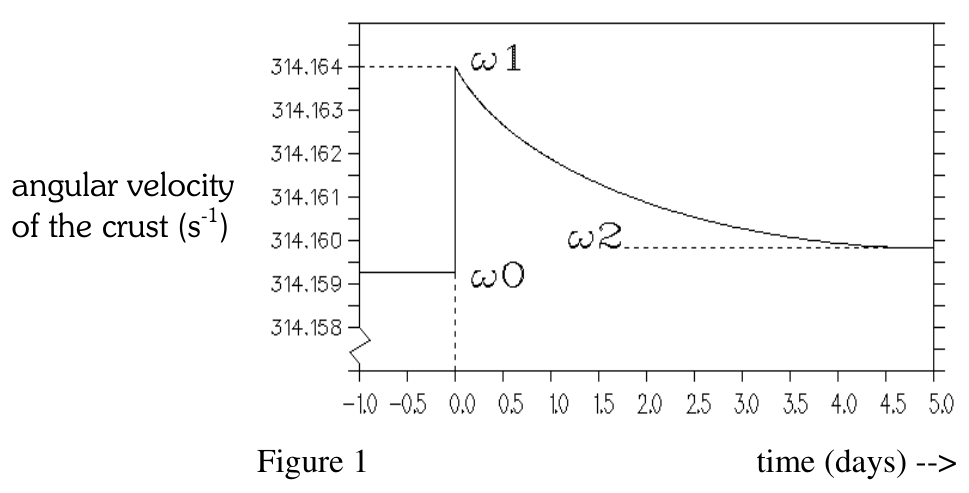
A sudden change in the shape of the crust of a neutron star results in a sudden change of the angular velocity.
b - Calculate the average radius of the liquid interior, using the data of Fig. 1. Make the approximation that the densities of the crust and the interior are the same. (Ignore the change in shape of the interior).
Official English text of the problem.
Answers
- a. In the spherical gravitational-field approximation, \[ \boxed{\epsilon\simeq3.7\times10^{-4}} \] (dimensionless).
- b. The average radius of the liquid interior is approximately \[ \boxed{r_{\mathrm{liquid}}\simeq9.7\times10^3\,\mathrm{m}=9.7\,\mathrm{km}}. \]
Solution
a. Flattening factor
Let \(M\), \(R\), and \(T\) denote the mass, average radius, and rotation period. The angular velocity is
\[ \omega=\frac{2\pi}{T} =\frac{2\pi}{2.0\times10^{-2}} \simeq314.16\,\mathrm{s^{-1}}. \]
For the equilibrium shape, model the star as a rotating fluid and approximate its gravitational potential by the spherical expression \(-GM/r\). In the frame rotating with the star, the effective potential per unit mass is
\[ \Phi_{\mathrm{eff}}=-\frac{GM}{r}-\frac12\omega^2s^2, \]
where \(s\) is the distance from the rotation axis.
The equilibrium surface is an equipotential: otherwise matter would flow along it. At the pole \(s=0\), while at the equator \(s=r_e\). Hence
\[ -\frac{GM}{r_p} =-\frac{GM}{r_e}-\frac12\omega^2r_e^2, \]
or
\[ GM\left(\frac1{r_p}-\frac1{r_e}\right) =\frac12\omega^2r_e^2. \]
Using the definition of \(\epsilon\),
\[ \frac1{r_p}-\frac1{r_e} =\frac{r_e-r_p}{r_pr_e} =\frac{\epsilon}{r_e}, \]
so that
\[ \epsilon=\frac{\omega^2r_e^3}{2GM}. \]
Since the flattening is small, we may replace \(r_e\) by the average radius \(R\) in this expression:
\[ \epsilon\simeq\frac{\omega^2R^3}{2GM} =\frac{2\pi^2R^3}{GMT^2}. \]
Numerically,
\[ \epsilon\simeq \frac{2\pi^2(1.0\times10^4)^3} {(6.67\times10^{-11})(2.0\times10^{30})(2.0\times10^{-2})^2} =3.699\times10^{-4}. \]
Thus
\[ \boxed{\epsilon\simeq3.7\times10^{-4}}. \]
This corresponds to \(r_e-r_p\simeq\epsilon R\simeq3.7\,\mathrm{m}\), consistent with nearly equal radii.
b. Radius of the liquid interior
Before the quake, assume that the crust and liquid interior rotate together at angular velocity \(\omega_0\). During the sudden deformation, the crust’s moment of inertia decreases. There is insufficient time for appreciable angular momentum transfer to the liquid, so the crust spins up to \(\omega_1\), while the liquid initially remains at \(\omega_0\).
Over the following days, internal friction transfers angular momentum from the crust to the liquid until both rotate at \(\omega_2\). External angular momentum loss is negligible over this interval compared with the secular evolution over years.
Let \(I_c\) be the crust’s moment of inertia after the quake and \(I_l\) that of the liquid. The liquid’s moment of inertia is unchanged, as stipulated. Conservation of angular momentum during the relaxation gives
\[ I_c\omega_1+I_l\omega_0=(I_c+I_l)\omega_2. \]
Rearranging,
\[ I_c(\omega_1-\omega_2)=I_l(\omega_2-\omega_0). \]
Consequently,
\[ \boxed{\frac{I_l}{I_c+I_l} =\frac{\omega_1-\omega_2}{\omega_1-\omega_0}}. \]
The required conserved quantity is angular momentum; rotational kinetic energy is dissipated during the relaxation.
To relate the moments of inertia to radii, neglect the small oblateness and use the common density \(\rho\) specified in the question. A spherical shell of radius \(r\) and thickness \(dr\) has
\[ dm=4\pi\rho r^2\,dr, \qquad dI=\frac23r^2\,dm. \]
Thus a uniform sphere of radius \(a\) has
\[ I(a)=\frac{8\pi\rho}{3}\int_0^a r^4\,dr =\frac{8\pi\rho}{15}a^5. \]
Writing the liquid radius as \(r_l\), we obtain
\[ \frac{I_l}{I_c+I_l} =\frac{r_l^5}{R^5}. \]
Therefore,
\[ \boxed{ r_l=R\left( \frac{\omega_1-\omega_2}{\omega_1-\omega_0} \right)^{1/5} }. \]
Approximate readings from the graph are
\[ \omega_0\simeq314.1593\,\mathrm{s^{-1}},\qquad \omega_1\simeq314.1640\,\mathrm{s^{-1}},\qquad \omega_2\simeq314.1599\,\mathrm{s^{-1}}. \]
These give
\[ \left(\frac{r_l}{R}\right)^5 \simeq\frac{0.0041}{0.0047} \simeq0.872, \]
and hence
\[ r_l\simeq(1.0\times10^4)(0.872)^{1/5} \simeq9.73\times10^3\,\mathrm{m}. \]
To sensible precision,
\[ \boxed{r_l\simeq9.7\,\mathrm{km}}. \]
The solution was checked against the official solution. Where this solution differs from the official solution, the official solution contains an error or a misprint.
IPhO 1990 · Theorieaufgabe 3
Der rotierende Neutronenstern
Ein „Millisekundenpulsar“ ist eine Strahlungsquelle im Universum, die sehr kurze Pulse mit einer Periodendauer von einer bis mehreren Millisekunden aussendet. Diese Strahlung liegt im Radiowellenbereich; mit einem geeigneten Radioempfänger lassen sich die einzelnen Pulse nachweisen und dadurch die Periodendauer mit großer Genauigkeit messen.
Diese Radiopulse stammen von der Oberfläche einer besonderen Art von Stern, dem sogenannten Neutronenstern. Diese Sterne sind sehr kompakt: Ihre Masse hat dieselbe Größenordnung wie die der Sonne, ihr Radius beträgt jedoch nur einige zehn Kilometer. Sie rotieren sehr schnell. Aufgrund der schnellen Rotation ist ein Neutronenstern leicht abgeplattet. Nehmen Sie an, dass der Schnitt durch die Oberfläche in einer Ebene durch die Rotationsachse eine Ellipse mit nahezu gleichen Achsen ist. Es seien \(r_p\) der Polradius und \(r_e\) der Äquatorradius; wir definieren den Abplattungsfaktor durch:
\[ \epsilon=\frac{(r_e-r_p)}{r_p} \]
Betrachten Sie einen Neutronenstern mit
| einer Masse von | \(2.0\cdot10^{30}\,\mathrm{kg}\), |
| einem mittleren Radius von | \(1.0\cdot10^4\,\mathrm{m}\), |
| und einer Rotationsperiode von | \(2.0\cdot10^{-2}\,\mathrm{s}\). |
a - Berechnen Sie den Abplattungsfaktor, wenn die Gravitationskonstante \(6.67\cdot10^{-11}\,\mathrm{N.m^2.kg^{-2}}\) beträgt.
Auf lange Sicht (über viele Jahre) verlangsamt sich die Rotation des Sterns durch Energieverlust, wodurch die Abplattung abnimmt. Der Stern besitzt jedoch eine feste Kruste, die auf einem flüssigen Inneren schwimmt. Die feste Kruste widersetzt sich einer kontinuierlichen Anpassung an die Gleichgewichtsform. Stattdessen treten Sternbeben auf, bei denen sich die Form der Kruste plötzlich in Richtung der Gleichgewichtsform verändert. Während und nach einem solchen Sternbeben wird eine Änderung der Winkelgeschwindigkeit gemäß Abbildung 1 beobachtet.
Eine plötzliche Änderung der Form der Kruste eines Neutronensterns führt zu einer plötzlichen Änderung der Winkelgeschwindigkeit.
b - Berechnen Sie anhand der Daten aus Abb. 1 den mittleren Radius des flüssigen Inneren. Nehmen Sie näherungsweise an, dass die Dichten der Kruste und des Inneren gleich sind. (Vernachlässigen Sie die Formänderung des Inneren.)
Aufgabentext aus dem offiziellen englischen Text übersetzt.
Antworten
- a. In der Näherung eines kugelsymmetrischen Gravitationsfeldes gilt \[ \boxed{\epsilon\simeq3.7\times10^{-4}} \] (dimensionslos).
- b. Der mittlere Radius des flüssigen Inneren beträgt näherungsweise \[ \boxed{r_{\mathrm{liquid}}\simeq9.7\times10^3\,\mathrm{m}=9.7\,\mathrm{km}}. \]
Lösung
a. Abplattungsfaktor
Es seien \(M\), \(R\) und \(T\) die Masse, der mittlere Radius und die Rotationsperiode. Die Winkelgeschwindigkeit ist
\[ \omega=\frac{2\pi}{T} =\frac{2\pi}{2.0\times10^{-2}} \simeq314.16\,\mathrm{s^{-1}}. \]
Zur Bestimmung der Gleichgewichtsform modellieren wir den Stern als rotierende Flüssigkeit und nähern sein Gravitationspotential durch den kugelsymmetrischen Ausdruck \(-GM/r\) an. Im mit dem Stern rotierenden Bezugssystem lautet das effektive Potential pro Masseneinheit
\[ \Phi_{\mathrm{eff}}=-\frac{GM}{r}-\frac12\omega^2s^2, \]
wobei \(s\) der Abstand von der Rotationsachse ist.
Die Gleichgewichtsoberfläche ist eine Äquipotentialfläche: Andernfalls würde Materie entlang dieser Oberfläche strömen. Am Pol gilt \(s=0\), am Äquator hingegen \(s=r_e\). Daher gilt
\[ -\frac{GM}{r_p} =-\frac{GM}{r_e}-\frac12\omega^2r_e^2, \]
oder
\[ GM\left(\frac1{r_p}-\frac1{r_e}\right) =\frac12\omega^2r_e^2. \]
Mit der Definition von \(\epsilon\) gilt
\[ \frac1{r_p}-\frac1{r_e} =\frac{r_e-r_p}{r_pr_e} =\frac{\epsilon}{r_e}, \]
sodass
\[ \epsilon=\frac{\omega^2r_e^3}{2GM}. \]
Da die Abplattung klein ist, dürfen wir in diesem Ausdruck \(r_e\) durch den mittleren Radius \(R\) ersetzen:
\[ \epsilon\simeq\frac{\omega^2R^3}{2GM} =\frac{2\pi^2R^3}{GMT^2}. \]
Numerisch ergibt sich
\[ \epsilon\simeq \frac{2\pi^2(1.0\times10^4)^3} {(6.67\times10^{-11})(2.0\times10^{30})(2.0\times10^{-2})^2} =3.699\times10^{-4}. \]
Somit gilt
\[ \boxed{\epsilon\simeq3.7\times10^{-4}}. \]
Dies entspricht \(r_e-r_p\simeq\epsilon R\simeq3.7\,\mathrm{m}\), was mit nahezu gleichen Radien vereinbar ist.
b. Radius des flüssigen Inneren
Wir nehmen an, dass die Kruste und das flüssige Innere vor dem Beben gemeinsam mit der Winkelgeschwindigkeit \(\omega_0\) rotieren. Während der plötzlichen Verformung nimmt das Trägheitsmoment der Kruste ab. Für eine nennenswerte Übertragung von Drehimpuls auf die Flüssigkeit bleibt nicht genügend Zeit, sodass die Kruste auf \(\omega_1\) beschleunigt wird, während die Flüssigkeit zunächst bei \(\omega_0\) bleibt.
In den folgenden Tagen überträgt die innere Reibung Drehimpuls von der Kruste auf die Flüssigkeit, bis beide mit \(\omega_2\) rotieren. Der Drehimpulsverlust nach außen ist während dieses Zeitraums im Vergleich zur langfristigen Entwicklung über Jahre vernachlässigbar.
Es seien \(I_c\) das Trägheitsmoment der Kruste nach dem Beben und \(I_l\) das der Flüssigkeit. Das Trägheitsmoment der Flüssigkeit bleibt gemäß der Vorgabe unverändert. Aus der Drehimpulserhaltung während der Relaxation folgt
\[ I_c\omega_1+I_l\omega_0=(I_c+I_l)\omega_2. \]
Durch Umstellen ergibt sich
\[ I_c(\omega_1-\omega_2)=I_l(\omega_2-\omega_0). \]
Folglich gilt
\[ \boxed{\frac{I_l}{I_c+I_l} =\frac{\omega_1-\omega_2}{\omega_1-\omega_0}}. \]
Die benötigte Erhaltungsgröße ist der Drehimpuls; während der Relaxation wird kinetische Rotationsenergie dissipiert.
Um die Trägheitsmomente mit den Radien in Beziehung zu setzen, vernachlässigen wir die geringe Abplattung und verwenden die in der Aufgabenstellung angegebene gemeinsame Dichte \(\rho\). Für eine Kugelschale mit Radius \(r\) und Dicke \(dr\) gilt
\[ dm=4\pi\rho r^2\,dr, \qquad dI=\frac23r^2\,dm. \]
Damit hat eine homogene Kugel mit Radius \(a\) das Trägheitsmoment
\[ I(a)=\frac{8\pi\rho}{3}\int_0^a r^4\,dr =\frac{8\pi\rho}{15}a^5. \]
Bezeichnen wir den Radius der Flüssigkeit mit \(r_l\), erhalten wir
\[ \frac{I_l}{I_c+I_l} =\frac{r_l^5}{R^5}. \]
Daher gilt
\[ \boxed{ r_l=R\left( \frac{\omega_1-\omega_2}{\omega_1-\omega_0} \right)^{1/5} }. \]
Aus dem Diagramm lassen sich näherungsweise folgende Werte ablesen:
\[ \omega_0\simeq314.1593\,\mathrm{s^{-1}},\qquad \omega_1\simeq314.1640\,\mathrm{s^{-1}},\qquad \omega_2\simeq314.1599\,\mathrm{s^{-1}}. \]
Diese ergeben
\[ \left(\frac{r_l}{R}\right)^5 \simeq\frac{0.0041}{0.0047} \simeq0.872, \]
und damit
\[ r_l\simeq(1.0\times10^4)(0.872)^{1/5} \simeq9.73\times10^3\,\mathrm{m}. \]
Mit angemessener Genauigkeit ergibt sich
\[ \boxed{r_l\simeq9.7\,\mathrm{km}}. \]
Die Lösung wurde mit der offiziellen Lösung abgeglichen. Wo diese Lösung von der offiziellen Lösung abweicht, enthält die offizielle Lösung einen Fehler oder Druckfehler.
IPhO 1990 · Teori sorusu 3
Dönen nötron yıldızı
Bir 'milisaniye pulsarı', evrende bir ila birkaç milisaniyelik periyotlarla çok kısa atımlar yayan bir ışınım kaynağıdır. Bu ışınımın dalga boyları radyo dalgaları aralığındadır; uygun bir radyo alıcısı kullanılarak atımlar ayrı ayrı algılanabilir ve böylece periyot büyük bir hassasiyetle ölçülebilir.
Bu radyo atımları, nötron yıldızı adı verilen özel bir yıldız türünün yüzeyinden kaynaklanır. Bu yıldızlar çok kompakttır: kütleleri Güneş'in kütlesiyle aynı büyüklük mertebesindedir, ancak yarıçapları yalnızca birkaç on kilometredir. Çok hızlı dönerler. Hızlı dönmesi nedeniyle bir nötron yıldızı hafifçe basıktır (kutuplardan basık). Yüzeyin dönme ekseninden geçen kesitinin, eksenleri hemen hemen eşit bir elips olduğunu varsayın. Kutupsal yarıçap \(r_p\), ekvatoral yarıçap ise \(r_e\) olsun; basıklık katsayısını şöyle tanımlayalım:
\[ \epsilon=\frac{(r_e-r_p)}{r_p} \]
Aşağıdaki özelliklere sahip bir nötron yıldızını ele alın:
| kütlesi | \(2.0\cdot10^{30}\,\mathrm{kg}\), |
| ortalama yarıçapı | \(1.0\cdot10^4\,\mathrm{m}\), |
| ve dönme periyodu | \(2.0\cdot10^{-2}\,\mathrm{s}\). |
a - Kütleçekim sabitinin \(6.67\cdot10^{-11}\,\mathrm{N.m^2.kg^{-2}}\) olduğunu kullanarak basıklık katsayısını hesaplayın.
Uzun vadede (yıllar boyunca), enerji kaybı nedeniyle yıldızın dönmesi yavaşlar ve bu da basıklığın azalmasına yol açar. Ancak yıldızın, sıvı bir iç bölge üzerinde yüzen katı bir kabuğu vardır. Katı kabuk, denge şekline sürekli olarak uyum sağlamaya direnç gösterir. Bunun yerine, kabuğun şeklinin dengeye doğru aniden değiştiği yıldız depremleri meydana gelir. Böyle bir yıldız depremi sırasında ve sonrasında açısal hızın Şekil 1'e göre değiştiği gözlenir.
Bir nötron yıldızının kabuğunun şeklindeki ani bir değişiklik, açısal hızda ani bir değişikliğe yol açar.
b - Şekil 1'deki verileri kullanarak sıvı iç bölgenin ortalama yarıçapını hesaplayın. Kabuk ile iç bölgenin yoğunluklarının aynı olduğu yaklaşımını yapın. (İç bölgenin şekil değişimini göz ardı edin.)
Soru metni resmi İngilizce metinden çevrilmiştir.
Cevaplar
- a. Küresel kütleçekim alanı yaklaşımında, \[ \boxed{\epsilon\simeq3.7\times10^{-4}} \] (boyutsuz).
- b. Sıvı iç bölgenin ortalama yarıçapı yaklaşık olarak \[ \boxed{r_{\mathrm{liquid}}\simeq9.7\times10^3\,\mathrm{m}=9.7\,\mathrm{km}}. \]
Çözüm
a. Basıklık katsayısı
\(M\), \(R\) ve \(T\) sırasıyla kütleyi, ortalama yarıçapı ve dönme periyodunu göstersin. Açısal hız şöyledir:
\[ \omega=\frac{2\pi}{T} =\frac{2\pi}{2.0\times10^{-2}} \simeq314.16\,\mathrm{s^{-1}}. \]
Denge şeklini bulmak için yıldızı dönen bir akışkan olarak modelleyelim ve kütleçekim potansiyelini küresel \(-GM/r\) ifadesiyle yaklaşık olarak hesaplayalım. Yıldızla birlikte dönen referans sisteminde birim kütle başına etkin potansiyel şöyledir:
\[ \Phi_{\mathrm{eff}}=-\frac{GM}{r}-\frac12\omega^2s^2, \]
burada \(s\), dönme eksenine olan uzaklıktır.
Denge yüzeyi bir eşpotansiyel yüzeydir: aksi takdirde madde bu yüzey boyunca akardı. Kutupta \(s=0\), ekvatorda ise \(s=r_e\) olur. Dolayısıyla
\[ -\frac{GM}{r_p} =-\frac{GM}{r_e}-\frac12\omega^2r_e^2, \]
ya da
\[ GM\left(\frac1{r_p}-\frac1{r_e}\right) =\frac12\omega^2r_e^2. \]
\(\epsilon\) tanımını kullanırsak,
\[ \frac1{r_p}-\frac1{r_e} =\frac{r_e-r_p}{r_pr_e} =\frac{\epsilon}{r_e}, \]
böylece
\[ \epsilon=\frac{\omega^2r_e^3}{2GM}. \]
Basıklık küçük olduğundan, bu ifadede \(r_e\) yerine ortalama yarıçap \(R\) kullanılabilir:
\[ \epsilon\simeq\frac{\omega^2R^3}{2GM} =\frac{2\pi^2R^3}{GMT^2}. \]
Sayısal olarak,
\[ \epsilon\simeq \frac{2\pi^2(1.0\times10^4)^3} {(6.67\times10^{-11})(2.0\times10^{30})(2.0\times10^{-2})^2} =3.699\times10^{-4}. \]
Böylece
\[ \boxed{\epsilon\simeq3.7\times10^{-4}}. \]
Bu, \(r_e-r_p\simeq\epsilon R\simeq3.7\,\mathrm{m}\) değerine karşılık gelir ve yarıçapların hemen hemen eşit olmasıyla tutarlıdır.
b. Sıvı iç bölgenin yarıçapı
Depremden önce kabuk ile sıvı iç bölgenin \(\omega_0\) açısal hızıyla birlikte döndüğünü varsayalım. Ani şekil değişimi sırasında kabuğun eylemsizlik momenti azalır. Sıvıya kayda değer miktarda açısal momentum aktarılması için yeterli zaman olmadığından kabuğun açısal hızı \(\omega_1\) değerine yükselirken sıvı başlangıçta \(\omega_0\) açısal hızında kalır.
Sonraki günlerde iç sürtünme, her ikisi de \(\omega_2\) açısal hızıyla dönene kadar kabuktan sıvıya açısal momentum aktarır. Bu süre boyunca dışarıya açısal momentum kaybı, yıllar boyunca gerçekleşen uzun vadeli değişime kıyasla ihmal edilebilir.
\(I_c\) kabuğun depremden sonraki eylemsizlik momenti, \(I_l\) ise sıvının eylemsizlik momenti olsun. Belirtildiği üzere, sıvının eylemsizlik momenti değişmez. Dengeye dönüş sırasında açısal momentumun korunumu şunu verir:
\[ I_c\omega_1+I_l\omega_0=(I_c+I_l)\omega_2. \]
Yeniden düzenlersek,
\[ I_c(\omega_1-\omega_2)=I_l(\omega_2-\omega_0). \]
Sonuç olarak,
\[ \boxed{\frac{I_l}{I_c+I_l} =\frac{\omega_1-\omega_2}{\omega_1-\omega_0}}. \]
Burada korunması gereken büyüklük açısal momentumdur; dönme kinetik enerjisi dengeye dönüş sırasında disipasyona uğrar.
Eylemsizlik momentlerini yarıçaplarla ilişkilendirmek için küçük basıklığı ihmal edelim ve soruda belirtilen ortak yoğunluk \(\rho\)'yu kullanalım. Yarıçapı \(r\), kalınlığı \(dr\) olan küresel bir kabuk için
\[ dm=4\pi\rho r^2\,dr, \qquad dI=\frac23r^2\,dm. \]
Böylece yarıçapı \(a\) olan homojen bir kürenin eylemsizlik momenti şöyledir:
\[ I(a)=\frac{8\pi\rho}{3}\int_0^a r^4\,dr =\frac{8\pi\rho}{15}a^5. \]
Sıvının yarıçapını \(r_l\) ile gösterirsek,
\[ \frac{I_l}{I_c+I_l} =\frac{r_l^5}{R^5}. \]
Dolayısıyla,
\[ \boxed{ r_l=R\left( \frac{\omega_1-\omega_2}{\omega_1-\omega_0} \right)^{1/5} }. \]
Grafikten yaklaşık olarak okunan değerler şöyledir:
\[ \omega_0\simeq314.1593\,\mathrm{s^{-1}},\qquad \omega_1\simeq314.1640\,\mathrm{s^{-1}},\qquad \omega_2\simeq314.1599\,\mathrm{s^{-1}}. \]
Bu değerler şunu verir:
\[ \left(\frac{r_l}{R}\right)^5 \simeq\frac{0.0041}{0.0047} \simeq0.872, \]
ve buradan
\[ r_l\simeq(1.0\times10^4)(0.872)^{1/5} \simeq9.73\times10^3\,\mathrm{m}. \]
Uygun bir hassasiyetle,
\[ \boxed{r_l\simeq9.7\,\mathrm{km}}. \]
Çözüm, resmi çözümle karşılaştırılarak kontrol edildi. Bu çözümün resmi çözümden ayrıldığı yerlerde resmi çözümde bir hata ya da baskı hatası vardır.
IPhO 1990 · Problema teórico 3
La estrella de neutrones en rotación
Un «púlsar de milisegundos» es una fuente de radiación en el universo que emite pulsos muy breves con un período de uno a varios milisegundos. Esta radiación se encuentra en el intervalo de longitudes de onda de radio; un receptor de radio adecuado permite detectar los pulsos individuales y, de este modo, medir el período con gran precisión.
Estos pulsos de radio se originan en la superficie de un tipo particular de estrella, la denominada estrella de neutrones. Estas estrellas son muy compactas: tienen una masa del mismo orden de magnitud que la del Sol, pero su radio es de tan solo unas decenas de kilómetros. Giran muy rápidamente. Debido a su rápida rotación, una estrella de neutrones está ligeramente achatada (es oblata). Supongamos que la sección axial de su superficie es una elipse con ejes casi iguales. Sean \(r_p\) el radio polar y \(r_e\) el radio ecuatorial; definamos el factor de achatamiento mediante:
\[ \epsilon=\frac{(r_e-r_p)}{r_p} \]
Consideremos una estrella de neutrones con
| una masa de | \(2.0\cdot10^{30}\,\mathrm{kg}\), |
| un radio medio de | \(1.0\cdot10^4\,\mathrm{m}\), |
| y un período de rotación de | \(2.0\cdot10^{-2}\,\mathrm{s}\). |
a - Calcule el factor de achatamiento, sabiendo que la constante de gravitación universal es \(6.67\cdot10^{-11}\,\mathrm{N.m^2.kg^{-2}}\).
A largo plazo (a lo largo de muchos años), la rotación de la estrella se ralentiza debido a la pérdida de energía, lo que provoca una disminución del achatamiento. Sin embargo, la estrella tiene una corteza sólida que flota sobre un interior líquido. La corteza sólida se resiste a ajustarse de forma continua a la forma de equilibrio. En su lugar, se producen sismos estelares con cambios repentinos en la forma de la corteza hacia el equilibrio. Durante y después de uno de estos sismos estelares, se observa que la velocidad angular cambia según la figura 1.
Un cambio repentino en la forma de la corteza de una estrella de neutrones produce un cambio repentino de la velocidad angular.
b - Calcule el radio medio del interior líquido utilizando los datos de la Fig. 1. Utilice la aproximación de que las densidades de la corteza y del interior son iguales. (Ignore el cambio de forma del interior).
Enunciado traducido del texto oficial en inglés.
Respuestas
- a. En la aproximación de campo gravitatorio esférico, \[ \boxed{\epsilon\simeq3.7\times10^{-4}} \] (adimensional).
- b. El radio medio del interior líquido es aproximadamente \[ \boxed{r_{\mathrm{liquid}}\simeq9.7\times10^3\,\mathrm{m}=9.7\,\mathrm{km}}. \]
Solución
a. Factor de achatamiento
Sean \(M\), \(R\) y \(T\) la masa, el radio medio y el período de rotación. La velocidad angular es
\[ \omega=\frac{2\pi}{T} =\frac{2\pi}{2.0\times10^{-2}} \simeq314.16\,\mathrm{s^{-1}}. \]
Para determinar la forma de equilibrio, modelamos la estrella como un fluido en rotación y aproximamos su potencial gravitatorio mediante la expresión esférica \(-GM/r\). En el sistema de referencia que gira con la estrella, el potencial efectivo por unidad de masa es
\[ \Phi_{\mathrm{eff}}=-\frac{GM}{r}-\frac12\omega^2s^2, \]
donde \(s\) es la distancia al eje de rotación.
La superficie de equilibrio es equipotencial: de lo contrario, la materia fluiría a lo largo de ella. En el polo, \(s=0\), mientras que en el ecuador, \(s=r_e\). Por tanto,
\[ -\frac{GM}{r_p} =-\frac{GM}{r_e}-\frac12\omega^2r_e^2, \]
o bien
\[ GM\left(\frac1{r_p}-\frac1{r_e}\right) =\frac12\omega^2r_e^2. \]
Utilizando la definición de \(\epsilon\),
\[ \frac1{r_p}-\frac1{r_e} =\frac{r_e-r_p}{r_pr_e} =\frac{\epsilon}{r_e}, \]
de modo que
\[ \epsilon=\frac{\omega^2r_e^3}{2GM}. \]
Como el achatamiento es pequeño, podemos sustituir \(r_e\) por el radio medio \(R\) en esta expresión:
\[ \epsilon\simeq\frac{\omega^2R^3}{2GM} =\frac{2\pi^2R^3}{GMT^2}. \]
Numéricamente,
\[ \epsilon\simeq \frac{2\pi^2(1.0\times10^4)^3} {(6.67\times10^{-11})(2.0\times10^{30})(2.0\times10^{-2})^2} =3.699\times10^{-4}. \]
Así pues,
\[ \boxed{\epsilon\simeq3.7\times10^{-4}}. \]
Esto corresponde a \(r_e-r_p\simeq\epsilon R\simeq3.7\,\mathrm{m}\), lo que concuerda con que los radios sean casi iguales.
b. Radio del interior líquido
Antes del sismo, suponemos que la corteza y el interior líquido giran juntos con velocidad angular \(\omega_0\). Durante la deformación repentina, el momento de inercia de la corteza disminuye. No hay tiempo suficiente para que se produzca una transferencia apreciable de momento angular al líquido, por lo que la corteza aumenta su velocidad angular hasta \(\omega_1\), mientras que el líquido permanece inicialmente a \(\omega_0\).
Durante los días siguientes, la fricción interna transfiere momento angular de la corteza al líquido hasta que ambos giran a \(\omega_2\). La pérdida de momento angular hacia el exterior es despreciable durante este intervalo en comparación con la evolución secular a lo largo de los años.
Sea \(I_c\) el momento de inercia de la corteza después del sismo e \(I_l\) el del líquido. El momento de inercia del líquido no cambia, tal como se estipula. La conservación del momento angular durante la relajación da
\[ I_c\omega_1+I_l\omega_0=(I_c+I_l)\omega_2. \]
Reordenando,
\[ I_c(\omega_1-\omega_2)=I_l(\omega_2-\omega_0). \]
En consecuencia,
\[ \boxed{\frac{I_l}{I_c+I_l} =\frac{\omega_1-\omega_2}{\omega_1-\omega_0}}. \]
La magnitud conservada que se requiere es el momento angular; la energía cinética de rotación se disipa durante la relajación.
Para relacionar los momentos de inercia con los radios, despreciamos el pequeño achatamiento y utilizamos la densidad común \(\rho\) especificada en el enunciado. Una capa esférica de radio \(r\) y espesor \(dr\) tiene
\[ dm=4\pi\rho r^2\,dr, \qquad dI=\frac23r^2\,dm. \]
Así, una esfera homogénea de radio \(a\) tiene
\[ I(a)=\frac{8\pi\rho}{3}\int_0^a r^4\,dr =\frac{8\pi\rho}{15}a^5. \]
Denotando el radio del líquido por \(r_l\), obtenemos
\[ \frac{I_l}{I_c+I_l} =\frac{r_l^5}{R^5}. \]
Por tanto,
\[ \boxed{ r_l=R\left( \frac{\omega_1-\omega_2}{\omega_1-\omega_0} \right)^{1/5} }. \]
Las lecturas aproximadas de la gráfica son
\[ \omega_0\simeq314.1593\,\mathrm{s^{-1}},\qquad \omega_1\simeq314.1640\,\mathrm{s^{-1}},\qquad \omega_2\simeq314.1599\,\mathrm{s^{-1}}. \]
Estos valores dan
\[ \left(\frac{r_l}{R}\right)^5 \simeq\frac{0.0041}{0.0047} \simeq0.872, \]
y, por consiguiente,
\[ r_l\simeq(1.0\times10^4)(0.872)^{1/5} \simeq9.73\times10^3\,\mathrm{m}. \]
Con una precisión razonable,
\[ \boxed{r_l\simeq9.7\,\mathrm{km}}. \]
La solución se comprobó con la solución oficial. Donde esta solución difiere de la solución oficial, la solución oficial contiene un error o una errata.
IPhO 1990 · 理论题 3
旋转的中子星
“毫秒脉冲星”是宇宙中的一种辐射源,它以一毫秒至几毫秒的周期发出极短的脉冲。这种辐射的波长处于无线电波段;使用合适的无线电接收机可以探测到一个个独立的脉冲,从而极其精确地测量其周期。
这些无线电脉冲来自一种特殊恒星的表面,这种恒星称为中子星。中子星非常致密:它们的质量与太阳的质量具有相同的数量级,但半径仅为几十千米。它们的自转非常快。由于快速自转,中子星略呈扁平状(扁球形)。假设其表面的轴截面是一个长短轴几乎相等的椭圆。设 \(r_p\) 为极半径,\(r_e\) 为赤道半径,并将扁率定义为:
\[ \epsilon=\frac{(r_e-r_p)}{r_p} \]
考虑一颗具有下列参数的中子星:
| 质量为 | \(2.0\cdot10^{30}\,\mathrm{kg}\), |
| 平均半径为 | \(1.0\cdot10^4\,\mathrm{m}\), |
| 自转周期为 | \(2.0\cdot10^{-2}\,\mathrm{s}\)。 |
a - 已知万有引力常量为 \(6.67\cdot10^{-11}\,\mathrm{N.m^2.kg^{-2}}\),计算扁率。
在很长的时间尺度上(多年),由于能量损失,中子星的自转逐渐减慢,因而扁率减小。然而,中子星有一层漂浮在液态内部之上的固态星壳。固态星壳阻碍其形状连续地调整至平衡形状。取而代之的是发生星震,使星壳形状突然向平衡形状变化。在这样一次星震期间及其后,观测到的角速度变化如图 1 所示。
中子星星壳形状的突然变化导致角速度的突然变化。
b - 利用图 1 中的数据,计算液态内部的平均半径。近似认为星壳与内部的密度相同。(忽略内部形状的变化。)
题目译自官方英文原文。
答案
- a. 在球对称引力场近似下, \[ \boxed{\epsilon\simeq3.7\times10^{-4}} \] (无量纲)。
- b. 液态内部的平均半径约为 \[ \boxed{r_{\mathrm{liquid}}\simeq9.7\times10^3\,\mathrm{m}=9.7\,\mathrm{km}}. \]
解答
a. 扁率
用 \(M\)、\(R\) 和 \(T\) 分别表示质量、平均半径和自转周期。角速度为
\[ \omega=\frac{2\pi}{T} =\frac{2\pi}{2.0\times10^{-2}} \simeq314.16\,\mathrm{s^{-1}}. \]
为求平衡形状,将中子星视为旋转流体,并用球对称形式 \(-GM/r\) 近似表示其引力势。在与中子星一起旋转的参考系中,单位质量的有效势为
\[ \Phi_{\mathrm{eff}}=-\frac{GM}{r}-\frac12\omega^2s^2, \]
其中 \(s\) 为到自转轴的距离。
平衡时的表面是一个等势面,否则物质就会沿表面流动。在极点处 \(s=0\),而在赤道处 \(s=r_e\)。因此
\[ -\frac{GM}{r_p} =-\frac{GM}{r_e}-\frac12\omega^2r_e^2, \]
即
\[ GM\left(\frac1{r_p}-\frac1{r_e}\right) =\frac12\omega^2r_e^2. \]
由 \(\epsilon\) 的定义,
\[ \frac1{r_p}-\frac1{r_e} =\frac{r_e-r_p}{r_pr_e} =\frac{\epsilon}{r_e}, \]
从而
\[ \epsilon=\frac{\omega^2r_e^3}{2GM}. \]
由于扁率很小,可以在此表达式中用平均半径 \(R\) 代替 \(r_e\):
\[ \epsilon\simeq\frac{\omega^2R^3}{2GM} =\frac{2\pi^2R^3}{GMT^2}. \]
代入数值得
\[ \epsilon\simeq \frac{2\pi^2(1.0\times10^4)^3} {(6.67\times10^{-11})(2.0\times10^{30})(2.0\times10^{-2})^2} =3.699\times10^{-4}. \]
因此
\[ \boxed{\epsilon\simeq3.7\times10^{-4}}. \]
这对应于 \(r_e-r_p\simeq\epsilon R\simeq3.7\,\mathrm{m}\),与两种半径几乎相等的假设一致。
b. 液态内部的半径
假设星震前,星壳与液态内部以角速度 \(\omega_0\) 一起旋转。在突然形变的过程中,星壳的转动惯量减小。由于没有足够的时间向液体传递可观的角动量,星壳的角速度增大至 \(\omega_1\),而液体最初仍保持角速度 \(\omega_0\)。
在随后的几天中,内部摩擦将角动量从星壳传递给液体,直至两者均以角速度 \(\omega_2\) 旋转。相对于以年为尺度的长期演化,在这段时间内向外界损失的角动量可以忽略。
设 \(I_c\) 为星震后星壳的转动惯量,\(I_l\) 为液体的转动惯量。根据题设,液体的转动惯量保持不变。由弛豫过程中的角动量守恒可得
\[ I_c\omega_1+I_l\omega_0=(I_c+I_l)\omega_2. \]
整理得
\[ I_c(\omega_1-\omega_2)=I_l(\omega_2-\omega_0). \]
因此,
\[ \boxed{\frac{I_l}{I_c+I_l} =\frac{\omega_1-\omega_2}{\omega_1-\omega_0}}. \]
这里所需的守恒量是角动量;转动动能在弛豫过程中耗散。
为建立转动惯量与半径之间的关系,忽略微小的扁率,并采用题目给定的相同密度 \(\rho\)。半径为 \(r\)、厚度为 \(dr\) 的球壳满足
\[ dm=4\pi\rho r^2\,dr, \qquad dI=\frac23r^2\,dm. \]
因此,半径为 \(a\) 的均匀球体的转动惯量为
\[ I(a)=\frac{8\pi\rho}{3}\int_0^a r^4\,dr =\frac{8\pi\rho}{15}a^5. \]
将液态内部的半径记为 \(r_l\),得到
\[ \frac{I_l}{I_c+I_l} =\frac{r_l^5}{R^5}. \]
因此,
\[ \boxed{ r_l=R\left( \frac{\omega_1-\omega_2}{\omega_1-\omega_0} \right)^{1/5} }. \]
从图中读出的近似值为
\[ \omega_0\simeq314.1593\,\mathrm{s^{-1}},\qquad \omega_1\simeq314.1640\,\mathrm{s^{-1}},\qquad \omega_2\simeq314.1599\,\mathrm{s^{-1}}. \]
由此得到
\[ \left(\frac{r_l}{R}\right)^5 \simeq\frac{0.0041}{0.0047} \simeq0.872, \]
进而
\[ r_l\simeq(1.0\times10^4)(0.872)^{1/5} \simeq9.73\times10^3\,\mathrm{m}. \]
取合理的精度,
\[ \boxed{r_l\simeq9.7\,\mathrm{km}}. \]
解答已与官方解答核对。本解答与官方解答不同之处,均为官方解答中的错误或印刷错误。
IPhO 1990 · Теоретическая задача 3
Вращающаяся нейтронная звезда
«Миллисекундный пульсар» — это источник излучения во Вселенной, испускающий очень короткие импульсы с периодом от одной до нескольких миллисекунд. Это излучение относится к радиодиапазону; с помощью подходящего радиоприёмника можно регистрировать отдельные импульсы и тем самым измерять период с высокой точностью.
Эти радиоимпульсы возникают на поверхности звезды особого типа, так называемой нейтронной звезды. Такие звёзды очень компактны: их масса имеет тот же порядок величины, что и масса Солнца, но радиус составляет лишь несколько десятков километров. Они очень быстро вращаются. Из-за быстрого вращения нейтронная звезда слегка сплюснута. Считайте, что осевое сечение её поверхности представляет собой эллипс с почти равными осями. Обозначим полярный радиус через \(r_p\), а экваториальный — через \(r_e\); определим коэффициент сплюснутости следующим образом:
\[ \epsilon=\frac{(r_e-r_p)}{r_p} \]
Рассмотрим нейтронную звезду со следующими параметрами:
| масса | \(2.0\cdot10^{30}\,\mathrm{kg}\), |
| средний радиус | \(1.0\cdot10^4\,\mathrm{m}\), |
| период вращения | \(2.0\cdot10^{-2}\,\mathrm{s}\). |
a - Вычислите коэффициент сплюснутости, если гравитационная постоянная равна \(6.67\cdot10^{-11}\,\mathrm{N.m^2.kg^{-2}}\).
С течением времени (на протяжении многих лет) вращение звезды замедляется вследствие потери энергии, что приводит к уменьшению сплюснутости. Однако у звезды есть твёрдая кора, плавающая на жидких недрах. Твёрдая кора препятствует непрерывному изменению формы до равновесной. Вместо этого происходят звездотрясения, при которых форма коры скачкообразно изменяется, приближаясь к равновесной. Во время и после такого звездотрясения наблюдается изменение угловой скорости, показанное на рисунке 1.
Внезапное изменение формы коры нейтронной звезды приводит к скачкообразному изменению угловой скорости.
b - Вычислите средний радиус жидкой внутренней части звезды, используя данные рис. 1. Считайте приближённо, что плотности коры и внутренней части одинаковы. (Пренебрегите изменением формы внутренней части.)
Условие переведено с официального английского текста.
Ответы
- a. В приближении сферически-симметричного гравитационного поля \[ \boxed{\epsilon\simeq3.7\times10^{-4}} \] (безразмерная величина).
- b. Средний радиус жидкой внутренней части приблизительно равен \[ \boxed{r_{\mathrm{liquid}}\simeq9.7\times10^3\,\mathrm{m}=9.7\,\mathrm{km}}. \]
Решение
a. Коэффициент сплюснутости
Обозначим через \(M\), \(R\) и \(T\) массу, средний радиус и период вращения. Угловая скорость равна
\[ \omega=\frac{2\pi}{T} =\frac{2\pi}{2.0\times10^{-2}} \simeq314.16\,\mathrm{s^{-1}}. \]
Для определения равновесной формы будем рассматривать звезду как вращающуюся жидкость и приближённо описывать её гравитационный потенциал выражением для сферически-симметричного поля \(-GM/r\). В системе отсчёта, вращающейся вместе со звездой, эффективный потенциал на единицу массы равен
\[ \Phi_{\mathrm{eff}}=-\frac{GM}{r}-\frac12\omega^2s^2, \]
где \(s\) — расстояние до оси вращения.
Равновесная поверхность является эквипотенциальной: иначе вещество текло бы вдоль неё. На полюсе \(s=0\), а на экваторе \(s=r_e\). Следовательно,
\[ -\frac{GM}{r_p} =-\frac{GM}{r_e}-\frac12\omega^2r_e^2, \]
или
\[ GM\left(\frac1{r_p}-\frac1{r_e}\right) =\frac12\omega^2r_e^2. \]
Используя определение \(\epsilon\), получаем
\[ \frac1{r_p}-\frac1{r_e} =\frac{r_e-r_p}{r_pr_e} =\frac{\epsilon}{r_e}, \]
так что
\[ \epsilon=\frac{\omega^2r_e^3}{2GM}. \]
Поскольку сплюснутость мала, в этом выражении можно заменить \(r_e\) средним радиусом \(R\):
\[ \epsilon\simeq\frac{\omega^2R^3}{2GM} =\frac{2\pi^2R^3}{GMT^2}. \]
Численно
\[ \epsilon\simeq \frac{2\pi^2(1.0\times10^4)^3} {(6.67\times10^{-11})(2.0\times10^{30})(2.0\times10^{-2})^2} =3.699\times10^{-4}. \]
Таким образом,
\[ \boxed{\epsilon\simeq3.7\times10^{-4}}. \]
Этому соответствует \(r_e-r_p\simeq\epsilon R\simeq3.7\,\mathrm{m}\), что согласуется с предположением о почти равных радиусах.
b. Радиус жидкой внутренней части
Предположим, что до звездотрясения кора и жидкая внутренняя часть вращаются совместно с угловой скоростью \(\omega_0\). При внезапной деформации момент инерции коры уменьшается. Времени для заметной передачи момента импульса жидкости недостаточно, поэтому угловая скорость коры возрастает до \(\omega_1\), тогда как жидкость вначале продолжает вращаться с угловой скоростью \(\omega_0\).
В течение последующих дней внутреннее трение передаёт момент импульса от коры к жидкости, пока обе части не начнут вращаться с угловой скоростью \(\omega_2\). Потерей момента импульса вследствие внешних воздействий на этом промежутке времени можно пренебречь по сравнению с долговременной эволюцией на протяжении многих лет.
Пусть \(I_c\) — момент инерции коры после звездотрясения, а \(I_l\) — момент инерции жидкости. По условию момент инерции жидкости не изменяется. Из закона сохранения момента импульса в процессе релаксации следует
\[ I_c\omega_1+I_l\omega_0=(I_c+I_l)\omega_2. \]
Преобразуя это равенство, получаем
\[ I_c(\omega_1-\omega_2)=I_l(\omega_2-\omega_0). \]
Следовательно,
\[ \boxed{\frac{I_l}{I_c+I_l} =\frac{\omega_1-\omega_2}{\omega_1-\omega_0}}. \]
Здесь сохраняющейся величиной является момент импульса; кинетическая энергия вращения в процессе релаксации рассеивается.
Чтобы связать моменты инерции с радиусами, пренебрежём малой сплюснутостью и воспользуемся указанной в условии одинаковой плотностью \(\rho\). Для сферического слоя радиуса \(r\) и толщины \(dr\) имеем
\[ dm=4\pi\rho r^2\,dr, \qquad dI=\frac23r^2\,dm. \]
Таким образом, момент инерции однородного шара радиуса \(a\) равен
\[ I(a)=\frac{8\pi\rho}{3}\int_0^a r^4\,dr =\frac{8\pi\rho}{15}a^5. \]
Обозначив радиус жидкой части через \(r_l\), получаем
\[ \frac{I_l}{I_c+I_l} =\frac{r_l^5}{R^5}. \]
Следовательно,
\[ \boxed{ r_l=R\left( \frac{\omega_1-\omega_2}{\omega_1-\omega_0} \right)^{1/5} }. \]
Приближённые значения, считанные с графика, равны
\[ \omega_0\simeq314.1593\,\mathrm{s^{-1}},\qquad \omega_1\simeq314.1640\,\mathrm{s^{-1}},\qquad \omega_2\simeq314.1599\,\mathrm{s^{-1}}. \]
Отсюда получаем
\[ \left(\frac{r_l}{R}\right)^5 \simeq\frac{0.0041}{0.0047} \simeq0.872, \]
и, следовательно,
\[ r_l\simeq(1.0\times10^4)(0.872)^{1/5} \simeq9.73\times10^3\,\mathrm{m}. \]
С разумной точностью
\[ \boxed{r_l\simeq9.7\,\mathrm{km}}. \]
Решение проверено по официальному решению. Там, где это решение расходится с официальным, в официальном решении есть ошибка или опечатка.
IPhO 1990 · مسألة نظرية 3
النجم النيوتروني الدوّار
«النجم النابض الملي ثانية» هو مصدر للإشعاع في الكون يصدر نبضات قصيرة جدًا بزمن دوري يتراوح بين ملي ثانية واحدة وعدة ملي ثوانٍ. يقع هذا الإشعاع في نطاق الأطوال الموجية الراديوية؛ ويمكن استخدام مستقبل راديوي مناسب لرصد النبضات المنفردة، ومن ثم قياس الزمن الدوري بدقة كبيرة.
تنشأ هذه النبضات الراديوية من سطح نوع معين من النجوم، يُسمّى النجم النيوتروني. هذه النجوم شديدة التراصّ: فكتلتها من رتبة مقدار كتلة الشمس نفسها، لكن نصف قطرها لا يتجاوز بضع عشرات من الكيلومترات. وهي تدور بسرعة كبيرة جدًا. وبسبب هذا الدوران السريع، يكون النجم النيوتروني مفلطحًا قليلًا. افترض أن المقطع المحوري للسطح قطع ناقص ذو محورين متساويين تقريبًا. ليكن \(r_p\) نصف القطر القطبي و\(r_e\) نصف القطر الاستوائي؛ ولنعرّف معامل التفلطح بالعلاقة:
\[ \epsilon=\frac{(r_e-r_p)}{r_p} \]
اعتبر نجمًا نيوترونيًا له
| كتلة مقدارها | \(2.0\cdot10^{30}\,\mathrm{kg}\), |
| ومتوسط نصف قطر مقداره | \(1.0\cdot10^4\,\mathrm{m}\), |
| وزمن دوري للدوران مقداره | \(2.0\cdot10^{-2}\,\mathrm{s}\). |
a - احسب معامل التفلطح، علمًا بأن ثابت الجذب العام يساوي \(6.67\cdot10^{-11}\,\mathrm{N.m^2.kg^{-2}}\).
على المدى الطويل (على امتداد سنوات عديدة)، يتباطأ دوران النجم بسبب فقدان الطاقة، مما يؤدي إلى انخفاض التفلطح. غير أن للنجم قشرة صلبة تطفو على باطن سائل. وتقاوم القشرة الصلبة التكيّف المستمر مع شكل الاتزان. وبدلًا من ذلك، تحدث زلازل نجمية ترافقها تغيرات مفاجئة في شكل القشرة باتجاه الاتزان. وخلال مثل هذا الزلزال النجمي وبعده، تُرصَد تغيرات في السرعة الزاوية وفقًا للشكل 1.
يؤدي تغير مفاجئ في شكل قشرة نجم نيوتروني إلى تغير مفاجئ في السرعة الزاوية.
b - احسب متوسط نصف قطر الباطن السائل باستخدام بيانات الشكل 1. استخدم التقريب القائل إن كثافتي القشرة والباطن متساويتان. (أهمل التغير في شكل الباطن).
نص المسألة مترجم عن النص الإنجليزي الرسمي.
الإجابات
- a. في تقريب مجال الجاذبية الكروي، \[ \boxed{\epsilon\simeq3.7\times10^{-4}} \] (بلا أبعاد).
- b. متوسط نصف قطر الباطن السائل يساوي تقريبًا \[ \boxed{r_{\mathrm{liquid}}\simeq9.7\times10^3\,\mathrm{m}=9.7\,\mathrm{km}}. \]
الحل
a. معامل التفلطح
لتكن \(M\) و\(R\) و\(T\) رموزًا للكتلة ومتوسط نصف القطر والزمن الدوري للدوران، على الترتيب. السرعة الزاوية هي
\[ \omega=\frac{2\pi}{T} =\frac{2\pi}{2.0\times10^{-2}} \simeq314.16\,\mathrm{s^{-1}}. \]
لتحديد شكل الاتزان، نمثّل النجم بمائع دوّار ونقرّب جهد جاذبيته بالتعبير الكروي \(-GM/r\). في الإطار المرجعي الذي يدور مع النجم، يكون الجهد الفعّال لكل وحدة كتلة
\[ \Phi_{\mathrm{eff}}=-\frac{GM}{r}-\frac12\omega^2s^2, \]
حيث \(s\) هي المسافة من محور الدوران.
سطح الاتزان هو سطح تساوي الجهد؛ وإلا فإن المادة ستنساب على امتداده. عند القطب \(s=0\)، بينما عند خط الاستواء \(s=r_e\). ومن ثم
\[ -\frac{GM}{r_p} =-\frac{GM}{r_e}-\frac12\omega^2r_e^2, \]
أو
\[ GM\left(\frac1{r_p}-\frac1{r_e}\right) =\frac12\omega^2r_e^2. \]
باستخدام تعريف \(\epsilon\)،
\[ \frac1{r_p}-\frac1{r_e} =\frac{r_e-r_p}{r_pr_e} =\frac{\epsilon}{r_e}, \]
فنحصل على
\[ \epsilon=\frac{\omega^2r_e^3}{2GM}. \]
بما أن التفلطح صغير، يمكننا التعويض عن \(r_e\) بمتوسط نصف القطر \(R\) في هذا التعبير:
\[ \epsilon\simeq\frac{\omega^2R^3}{2GM} =\frac{2\pi^2R^3}{GMT^2}. \]
عدديًا،
\[ \epsilon\simeq \frac{2\pi^2(1.0\times10^4)^3} {(6.67\times10^{-11})(2.0\times10^{30})(2.0\times10^{-2})^2} =3.699\times10^{-4}. \]
إذن
\[ \boxed{\epsilon\simeq3.7\times10^{-4}}. \]
وهذا يقابل \(r_e-r_p\simeq\epsilon R\simeq3.7\,\mathrm{m}\)، وهو ما يتفق مع كون نصفي القطر متساويين تقريبًا.
b. نصف قطر الباطن السائل
قبل الزلزال، نفترض أن القشرة والباطن السائل يدوران معًا بسرعة زاوية \(\omega_0\). وخلال التشوه المفاجئ، ينخفض عزم قصور القشرة الذاتي. ولا يتوافر وقت كافٍ لانتقال كمية ملحوظة من الزخم الزاوي إلى السائل، لذا تتسارع القشرة لتبلغ سرعتها الزاوية \(\omega_1\)، بينما يبقى السائل في البداية عند \(\omega_0\).
على مدى الأيام التالية، ينقل الاحتكاك الداخلي الزخم الزاوي من القشرة إلى السائل إلى أن يدور كلاهما بسرعة زاوية \(\omega_2\). ويُعدّ فقدان الزخم الزاوي إلى الخارج خلال هذه المدة مهملًا بالمقارنة مع التطور البطيء على مدى سنوات.
ليكن \(I_c\) عزم القصور الذاتي للقشرة بعد الزلزال و\(I_l\) عزم القصور الذاتي للسائل. يبقى عزم القصور الذاتي للسائل دون تغيير، وفقًا لما اشترطته المسألة. ويعطي انحفاظ الزخم الزاوي أثناء الاسترخاء
\[ I_c\omega_1+I_l\omega_0=(I_c+I_l)\omega_2. \]
بإعادة الترتيب،
\[ I_c(\omega_1-\omega_2)=I_l(\omega_2-\omega_0). \]
وبالتالي،
\[ \boxed{\frac{I_l}{I_c+I_l} =\frac{\omega_1-\omega_2}{\omega_1-\omega_0}}. \]
الكمية المحفوظة المطلوبة هي الزخم الزاوي؛ أما الطاقة الحركية الدورانية فتتبدد أثناء الاسترخاء.
لربط عزوم القصور الذاتي بأنصاف الأقطار، نهمل التفلطح الصغير ونستخدم الكثافة المشتركة \(\rho\) المحددة في السؤال. لقشرة كروية نصف قطرها \(r\) وسمكها \(dr\)، لدينا
\[ dm=4\pi\rho r^2\,dr, \qquad dI=\frac23r^2\,dm. \]
وعليه، فإن عزم القصور الذاتي لكرة متجانسة نصف قطرها \(a\) هو
\[ I(a)=\frac{8\pi\rho}{3}\int_0^a r^4\,dr =\frac{8\pi\rho}{15}a^5. \]
إذا رمزنا إلى نصف قطر السائل بـ \(r_l\)، نحصل على
\[ \frac{I_l}{I_c+I_l} =\frac{r_l^5}{R^5}. \]
لذلك،
\[ \boxed{ r_l=R\left( \frac{\omega_1-\omega_2}{\omega_1-\omega_0} \right)^{1/5} }. \]
القراءات التقريبية من الرسم البياني هي
\[ \omega_0\simeq314.1593\,\mathrm{s^{-1}},\qquad \omega_1\simeq314.1640\,\mathrm{s^{-1}},\qquad \omega_2\simeq314.1599\,\mathrm{s^{-1}}. \]
وتعطي هذه القيم
\[ \left(\frac{r_l}{R}\right)^5 \simeq\frac{0.0041}{0.0047} \simeq0.872, \]
ومن ثم
\[ r_l\simeq(1.0\times10^4)(0.872)^{1/5} \simeq9.73\times10^3\,\mathrm{m}. \]
وبالتقريب إلى دقة مناسبة،
\[ \boxed{r_l\simeq9.7\,\mathrm{km}}. \]
تمت مراجعة الحل بمقارنته بالحل الرسمي. حيثما يختلف هذا الحل عن الحل الرسمي، يحتوي الحل الرسمي على خطأ أو خطأ مطبعي.