International Physics Olympiad
IPhO 1989
Warsaw, Poland · 3 theory problems with complete solutions
Problem 1: Boiling of two immiscible liquids
Consider two liquids A and B insoluble in each other. The pressures \(p_i\) (\(i=\mathrm{A}\) or \(\mathrm{B}\)) of their saturated vapors obey, to a good approximation, the formula:
\[ \ln(p_i/p_o)=\frac{\alpha_i}{T}+\beta_i,\qquad i=\mathrm{A}\text{ or }\mathrm{B}, \]
where \(p_o\) denotes the normal atmospheric pressure, \(T\) – the absolute temperature of the vapor, and \(\alpha_i\) and \(\beta_i\) (\(i=\mathrm{A}\) or \(\mathrm{B}\)) – certain constants depending on the liquid. (The symbol \(\ln\) denotes the natural logarithm, i.e. logarithm with base \(e=2.7182818\ldots\))
The values of the ratio \(p_i/p_0\) for the liquids A and B at the temperature \(40^\circ\mathrm{C}\) and \(90^\circ\mathrm{C}\) are given in Tab. 1.1.
Table 1.1
\(t\ [^\circ\mathrm{C}]\) \(p_i/p_0\), \(i=\mathrm{A}\) \(p_i/p_0\), \(i=\mathrm{B}\) 40 0.284 0.07278 90 1.476 0.6918 The errors of these values are negligible.
A. Determine the boiling temperatures of the liquids A and B under the pressure \(p_0\).
B. The liquids A and B were poured into a vessel in which the layers shown in Fig. 1.1 were formed. The surface of the liquid B has been covered with a thin layer of a non-volatile liquid C, which is insoluble in the liquids A and B and vice versa, thereby preventing any free evaporation from the upper surface of the liquid B. The ratio of molecular masses of the liquids A and B (in the gaseous phase) is:
\[ \gamma=\mu_A/\mu_B=8. \]
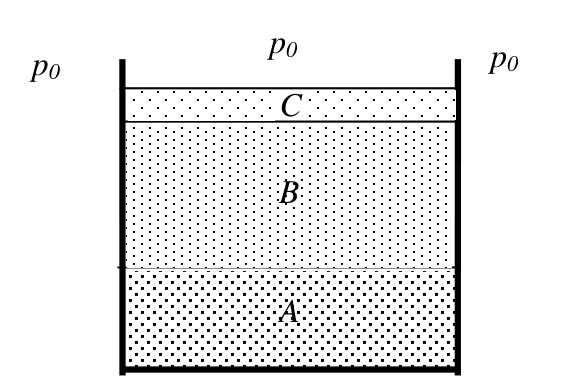
Fig. 1.1
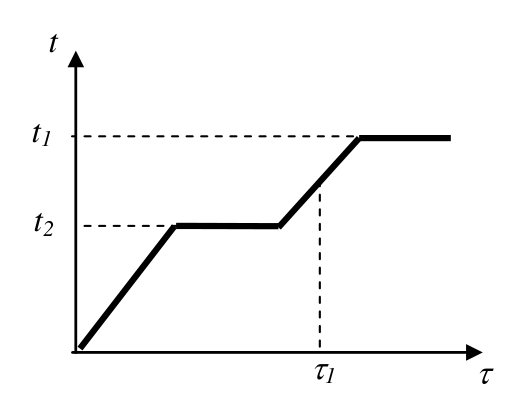
Fig. 1.2
The masses of the liquids A and B were initially the same, each equal to \(m=100\mathrm{g}\). The heights of the layers of the liquids in the vessel and the densities of the liquids are small enough to make the assumption that the pressure in any point in the vessel is practically equal to the normal atmospheric pressure \(p_0\).
The system of liquids in the vessel is slowly, but continuously and uniformly, heated. It was established that the temperature \(t\) of the liquids changed with time \(\tau\) as shown schematically in the Fig. 1.2.
Determine the temperatures \(t_1\) and \(t_2\) corresponding to the horizontal parts of the diagram and the masses of the liquids A and B at the time \(\tau_1\). The temperatures should be rounded to the nearest degree (in \(^\circ\mathrm{C}\)) and the masses of the liquids should be determined to one-tenth of gram.
REMARK: Assume that the vapors of the liquids, to a good approximation,
(1) obey the Dalton law stating that the pressure of a mixture of gases is equal to the sum of the partial pressures of the gases forming the mixture and
(2) can be treated as perfect gases up to the pressures corresponding to the saturated vapors.
Official English text of the problem.
Problem 2: Three gravitating masses rotating as a rigid body
Three non-collinear points \(P_1\), \(P_2\) and \(P_3\), with known masses \(m_1\), \(m_2\) and \(m_3\), interact with one another through their mutual gravitational forces only; they are isolated in free space and do not interact with any other bodies. Let \(\sigma\) denote the axis going through the center-of-mass of the three masses, and perpendicular to the triangle \(P_1P_2P_3\). What conditions should the angular velocities \(\omega\) of the system (around the axis \(\sigma\)) and the distances:
\[ P_1P_2=a_{12},\qquad P_2P_3=a_{23},\qquad P_1P_3=a_{13}, \]
fulfill to allow the shape and size of the triangle \(P_1P_2P_3\) unchanged during the motion of the system, i.e. under what conditions does the system rotate around the axis \(\sigma\) as a rigid body?
Official English text of the problem.
Problem 3: From an electron microscope to a proton microscope
The problem concerns investigation of transforming the electron microscope with magnetic guiding of the electron beam (which is accelerated with the potential difference \(U = 511\ \mathrm{kV}\)) into a proton microscope (in which the proton beam is accelerated with the potential difference \(-U\)). For this purpose, solve the following two problems:
A. An electron after leaving a device, which accelerated it with the potential difference \(U\), falls into a region with an inhomogeneous field \(\boldsymbol{B}\) generated with a system of stationary coils \(L_1, L_2, \ldots, L_n\). The known currents in the coils are \(i_1, i_2, \ldots, i_n\), respectively.
What should the currents \(i'_1, i'_2, \ldots, i'_n\) in the coils \(L_1, L_2, \ldots, L_n\) be, in order to guide the proton (initially accelerated with the potential difference \(-U\)) along the same trajectory (and in the same direction) as that of the electron?
HINT: The problem can be solved by finding a condition under which the equation describing the trajectory is the same in both cases. It may be helpful to use the relation:
\[ \boldsymbol{p}\frac{d}{dt}\boldsymbol{p} = \frac{1}{2}\frac{d}{dt}\boldsymbol{p}^{\,2} = \frac{1}{2}\frac{d}{dt}p^2. \]
B. How many times would the resolving power of the above microscope increase or decrease if the electron beam were replaced with the proton beam? Assume that the resolving power of the microscope (i.e. the smallest distance between two point objects whose circular images can be just separated) depends only on the wave properties of the particles.
Assume that the velocities of the electrons and protons before their acceleration are zero, and that there is no interaction between own magnetic moment of either electrons or protons and the magnetic field. Assume also that the electromagnetic radiation emitted by the moving particles can be neglected.
NOTE: Very often physicists use 1 electron-volt (1 eV), and its derivatives such as 1 keV or 1 MeV, as a unit of energy. 1 electron-volt is the energy gained by the electron that passed the potential difference equal to 1 V.
Perform the calculations assuming the following data:
Rest energy of electron: \(E_e=m_ec^2=511\ \mathrm{keV}\) Rest energy of proton: \(E_p=m_pc^2=938\ \mathrm{MeV}\) Official English text of the problem.
Internationale Physik-Olympiade
IPhO 1989
Warschau, Polen · 3 Theorieaufgaben mit vollständigen Lösungen
Aufgabe 1: Sieden zweier nicht mischbarer Flüssigkeiten
Betrachten Sie zwei Flüssigkeiten A und B, die ineinander unlöslich sind. Die Drücke \(p_i\) (\(i=\mathrm{A}\) oder \(\mathrm{B}\)) ihrer gesättigten Dämpfe gehorchen in guter Näherung der Formel:
\[ \ln(p_i/p_o)=\frac{\alpha_i}{T}+\beta_i,\qquad i=\mathrm{A}\text{ oder }\mathrm{B}, \]
wobei \(p_o\) den normalen Atmosphärendruck, \(T\) die absolute Temperatur des Dampfes und \(\alpha_i\) sowie \(\beta_i\) (\(i=\mathrm{A}\) oder \(\mathrm{B}\)) bestimmte, von der Flüssigkeit abhängige Konstanten bezeichnen. (Das Symbol \(\ln\) bezeichnet den natürlichen Logarithmus, d. h. den Logarithmus zur Basis \(e=2.7182818\ldots\).)
Die Werte des Verhältnisses \(p_i/p_0\) für die Flüssigkeiten A und B bei den Temperaturen \(40^\circ\mathrm{C}\) und \(90^\circ\mathrm{C}\) sind in Tab. 1.1 angegeben.
Tabelle 1.1
\(t\ [^\circ\mathrm{C}]\) \(p_i/p_0\), \(i=\mathrm{A}\) \(p_i/p_0\), \(i=\mathrm{B}\) 40 0.284 0.07278 90 1.476 0.6918 Die Fehler dieser Werte sind vernachlässigbar.
A. Bestimmen Sie die Siedetemperaturen der Flüssigkeiten A und B unter dem Druck \(p_0\).
B. Die Flüssigkeiten A und B wurden in ein Gefäß gegossen, in dem sich die in Abb. 1.1 dargestellten Schichten bildeten. Die Oberfläche der Flüssigkeit B wurde mit einer dünnen Schicht einer nichtflüchtigen Flüssigkeit C bedeckt, die in den Flüssigkeiten A und B unlöslich ist und umgekehrt, wodurch jede freie Verdunstung an der oberen Oberfläche der Flüssigkeit B verhindert wird. Das Verhältnis der Molekülmassen der Flüssigkeiten A und B (in der Gasphase) beträgt:
\[ \gamma=\mu_A/\mu_B=8. \]
Abb. 1.1
Abb. 1.2
Die Massen der Flüssigkeiten A und B waren anfangs gleich und betrugen jeweils \(m=100\mathrm{g}\). Die Höhen der Flüssigkeitsschichten im Gefäß und die Dichten der Flüssigkeiten sind so klein, dass angenommen werden kann, der Druck sei an jedem Punkt im Gefäß praktisch gleich dem normalen Atmosphärendruck \(p_0\).
Das Flüssigkeitssystem im Gefäß wird langsam, aber kontinuierlich und gleichmäßig erwärmt. Es wurde festgestellt, dass sich die Temperatur \(t\) der Flüssigkeiten mit der Zeit \(\tau\) so änderte, wie in Abb. 1.2 schematisch dargestellt.
Bestimmen Sie die Temperaturen \(t_1\) und \(t_2\), die den waagerechten Abschnitten des Diagramms entsprechen, sowie die Massen der Flüssigkeiten A und B zum Zeitpunkt \(\tau_1\). Die Temperaturen sollen auf ganze Grad (in \(^\circ\mathrm{C}\)) gerundet und die Massen der Flüssigkeiten auf ein Zehntel Gramm bestimmt werden.
ANMERKUNG: Nehmen Sie an, dass die Dämpfe der Flüssigkeiten in guter Näherung
(1) dem Dalton'schen Gesetz gehorchen, nach dem der Druck eines Gasgemisches gleich der Summe der Partialdrücke der das Gemisch bildenden Gase ist, und
(2) bis zu den Sättigungsdampfdrücken als ideale Gase behandelt werden können.
Aufgabentext aus dem offiziellen englischen Text übersetzt.
Aufgabe 2: Drei gravitativ wechselwirkende Massen, die wie ein starrer Körper rotieren
Drei nicht auf einer Geraden liegende Punkte \(P_1\), \(P_2\) und \(P_3\) mit bekannten Massen \(m_1\), \(m_2\) und \(m_3\) wechselwirken ausschließlich durch ihre gegenseitigen Gravitationskräfte; sie sind im freien Raum isoliert und wechselwirken mit keinen anderen Körpern. Mit \(\sigma\) sei die Achse bezeichnet, die durch den Schwerpunkt der drei Massen verläuft und senkrecht auf dem Dreieck \(P_1P_2P_3\) steht. Welche Bedingungen müssen die Winkelgeschwindigkeiten \(\omega\) des Systems (um die Achse \(\sigma\)) und die Abstände
\[ P_1P_2=a_{12},\qquad P_2P_3=a_{23},\qquad P_1P_3=a_{13}, \]
erfüllen, damit Form und Größe des Dreiecks \(P_1P_2P_3\) während der Bewegung des Systems unverändert bleiben, d. h., unter welchen Bedingungen rotiert das System wie ein starrer Körper um die Achse \(\sigma\)?
Aufgabentext aus dem offiziellen englischen Text übersetzt.
Aufgabe 3: Vom Elektronenmikroskop zum Protonenmikroskop
In dieser Aufgabe wird untersucht, wie ein Elektronenmikroskop mit magnetischer Führung des Elektronenstrahls (der durch die Potentialdifferenz \(U = 511\ \mathrm{kV}\) beschleunigt wird) in ein Protonenmikroskop umgewandelt werden kann (in dem der Protonenstrahl durch die Potentialdifferenz \(-U\) beschleunigt wird). Lösen Sie dazu die folgenden beiden Aufgaben:
A. Ein Elektron tritt nach dem Verlassen einer Vorrichtung, in der es durch die Potentialdifferenz \(U\) beschleunigt wurde, in einen Bereich mit einem inhomogenen Feld \(\boldsymbol{B}\) ein, das von einem System ortsfester Spulen \(L_1, L_2, \ldots, L_n\) erzeugt wird. Die bekannten Ströme in diesen Spulen sind \(i_1, i_2, \ldots, i_n\).
Welche Ströme \(i'_1, i'_2, \ldots, i'_n\) müssen in den Spulen \(L_1, L_2, \ldots, L_n\) fließen, damit das Proton (das zuvor durch die Potentialdifferenz \(-U\) beschleunigt wurde) entlang derselben Bahn (und in derselben Richtung) wie das Elektron geführt wird?
HINWEIS: Die Aufgabe lässt sich lösen, indem man eine Bedingung dafür findet, dass die Gleichung zur Beschreibung der Bahn in beiden Fällen dieselbe ist. Dabei kann die folgende Beziehung hilfreich sein:
\[ \boldsymbol{p}\frac{d}{dt}\boldsymbol{p} = \frac{1}{2}\frac{d}{dt}\boldsymbol{p}^{\,2} = \frac{1}{2}\frac{d}{dt}p^2. \]
B. Um welchen Faktor würde das Auflösungsvermögen des oben beschriebenen Mikroskops zunehmen oder abnehmen, wenn der Elektronenstrahl durch den Protonenstrahl ersetzt würde? Nehmen Sie an, dass das Auflösungsvermögen des Mikroskops (d. h. der kleinste Abstand zwischen zwei punktförmigen Objekten, deren kreisförmige Bilder gerade noch getrennt werden können) nur von den Welleneigenschaften der Teilchen abhängt.
Nehmen Sie an, dass die Geschwindigkeiten der Elektronen und Protonen vor ihrer Beschleunigung null sind und dass weder bei den Elektronen noch bei den Protonen eine Wechselwirkung zwischen ihrem eigenen magnetischen Moment und dem Magnetfeld auftritt. Nehmen Sie außerdem an, dass die von den bewegten Teilchen ausgesandte elektromagnetische Strahlung vernachlässigt werden kann.
ANMERKUNG: Physiker verwenden sehr häufig 1 Elektronenvolt (1 eV) und dessen Vielfache wie 1 keV oder 1 MeV als Energieeinheit. 1 Elektronenvolt ist die Energie, die ein Elektron beim Durchlaufen einer Potentialdifferenz von 1 V gewinnt.
Führen Sie die Berechnungen mit den folgenden Daten durch:
Ruheenergie des Elektrons: \(E_e=m_ec^2=511\ \mathrm{keV}\) Ruheenergie des Protons: \(E_p=m_pc^2=938\ \mathrm{MeV}\) Aufgabentext aus dem offiziellen englischen Text übersetzt.
Uluslararası Fizik Olimpiyatı
IPhO 1989
Varşova, Polonya · 3 teori sorusu, tam çözümleriyle
Soru 1: Birbirine karışmayan iki sıvının kaynaması
Birbirinde çözünmeyen A ve B sıvılarını ele alalım. Bu sıvıların doymuş buharlarının basınçları \(p_i\) (\(i=\mathrm{A}\) veya \(\mathrm{B}\)), iyi bir yaklaşıklıkla şu bağıntıya uyar:
\[ \ln(p_i/p_o)=\frac{\alpha_i}{T}+\beta_i,\qquad i=\mathrm{A}\text{ veya }\mathrm{B}, \]
Burada \(p_o\) normal atmosfer basıncını, \(T\) buharın mutlak sıcaklığını, \(\alpha_i\) ve \(\beta_i\) (\(i=\mathrm{A}\) veya \(\mathrm{B}\)) ise sıvıya bağlı belirli sabitleri gösterir. (\(\ln\) simgesi doğal logaritmayı, yani tabanı \(e=2.7182818\ldots\) olan logaritmayı gösterir.)
A ve B sıvıları için \(40^\circ\mathrm{C}\) ve \(90^\circ\mathrm{C}\) sıcaklıklarında \(p_i/p_0\) oranının değerleri Tablo 1.1'de verilmiştir.
Tablo 1.1
\(t\ [^\circ\mathrm{C}]\) \(p_i/p_0\), \(i=\mathrm{A}\) \(p_i/p_0\), \(i=\mathrm{B}\) 40 0.284 0.07278 90 1.476 0.6918 Bu değerlerin hataları ihmal edilebilir.
A. A ve B sıvılarının \(p_0\) basıncı altındaki kaynama sıcaklıklarını belirleyiniz.
B. A ve B sıvıları bir kaba dökülmüş ve kapta Şekil 1.1'de gösterilen tabakalar oluşmuştur. B sıvısının yüzeyi, A ve B sıvılarında çözünmeyen ve A ile B'nin de içinde çözünmediği, uçucu olmayan C sıvısından ince bir tabakayla kaplanmış; böylece B sıvısının üst yüzeyinden serbestçe buharlaşması tamamen önlenmiştir. A ve B sıvılarının (gaz fazındaki) molekül kütlelerinin oranı şöyledir:
\[ \gamma=\mu_A/\mu_B=8. \]
Şekil 1.1
Şekil 1.2
A ve B sıvılarının başlangıçtaki kütleleri eşit olup her biri \(m=100\mathrm{g}\)'dır. Kaptaki sıvı tabakalarının yükseklikleri ve sıvıların yoğunlukları, kabın herhangi bir noktasındaki basıncın pratik olarak normal atmosfer basıncı \(p_0\)'a eşit olduğu varsayımını yapmaya yetecek kadar küçüktür.
Kaptaki sıvı sistemi yavaşça, ancak sürekli ve düzgün biçimde ısıtılmaktadır. Sıvıların \(t\) sıcaklığının \(\tau\) zamanıyla Şekil 1.2'de şematik olarak gösterildiği gibi değiştiği belirlenmiştir.
Grafiğin yatay kısımlarına karşılık gelen \(t_1\) ve \(t_2\) sıcaklıklarını ve \(\tau_1\) anında A ve B sıvılarının kütlelerini belirleyiniz. Sıcaklıklar en yakın tam dereceye (\(^\circ\mathrm{C}\) cinsinden) yuvarlanmalı, sıvıların kütleleri ise gramın onda biri hassasiyetinde belirlenmelidir.
NOT: Sıvıların buharlarının iyi bir yaklaşıklıkla
(1) bir gaz karışımının basıncının, karışımı oluşturan gazların kısmi basınçlarının toplamına eşit olduğunu belirten Dalton yasasına uyduğunu ve
(2) doymuş buhar basınçlarına kadar ideal gaz olarak ele alınabileceğini varsayınız.
Soru metni resmi İngilizce metinden çevrilmiştir.
Soru 2: Rijit bir cisim gibi dönen, kütleçekimiyle etkileşen üç kütle
Aynı doğru üzerinde bulunmayan, kütleleri bilinen ve sırasıyla \(m_1\), \(m_2\) ve \(m_3\) olan üç noktasal kütle \(P_1\), \(P_2\) ve \(P_3\), birbirleriyle yalnızca karşılıklı kütleçekim kuvvetleri aracılığıyla etkileşmektedir; bu kütleler serbest uzayda yalıtılmış durumdadır ve başka hiçbir cisimle etkileşmezler. Üç kütlenin kütle merkezinden geçen ve \(P_1P_2P_3\) üçgenine dik olan ekseni \(\sigma\) ile gösterelim. Sistemin hareketi boyunca \(P_1P_2P_3\) üçgeninin şeklinin ve boyutunun değişmeden kalması için sistemin (\(\sigma\) ekseni etrafındaki) \(\omega\) açısal hızları ve
\[ P_1P_2=a_{12},\qquad P_2P_3=a_{23},\qquad P_1P_3=a_{13}, \]
uzaklıkları hangi koşulları sağlamalıdır; başka bir deyişle, sistem hangi koşullar altında \(\sigma\) ekseni etrafında rijit bir cisim gibi döner?
Soru metni resmi İngilizce metinden çevrilmiştir.
Soru 3: Elektron mikroskobundan proton mikroskobuna
Bu soru, elektron demetinin manyetik alanla yönlendirildiği (ve \(U = 511\ \mathrm{kV}\) potansiyel farkıyla hızlandırıldığı) bir elektron mikroskobunun, proton demetinin \(-U\) potansiyel farkıyla hızlandırıldığı bir proton mikroskobuna dönüştürülmesinin incelenmesiyle ilgilidir. Bu amaçla aşağıdaki iki problemi çözünüz:
A. Bir elektron, kendisini \(U\) potansiyel farkıyla hızlandıran bir düzenekten çıktıktan sonra, sabit bobinlerden oluşan bir \(L_1, L_2, \ldots, L_n\) sistemi tarafından oluşturulan düzgün olmayan bir \(\boldsymbol{B}\) alanının bulunduğu bölgeye girer. Bobinlerdeki bilinen akımlar sırasıyla \(i_1, i_2, \ldots, i_n\)'dir.
Başlangıçta \(-U\) potansiyel farkıyla hızlandırılan protonu, elektronla aynı yörünge boyunca (ve aynı yönde) yönlendirmek için \(L_1, L_2, \ldots, L_n\) bobinlerindeki \(i'_1, i'_2, \ldots, i'_n\) akımları ne olmalıdır?
İPUCU: Soru, yörüngeyi tanımlayan denklemin her iki durumda da aynı olmasını sağlayan bir koşul bulunarak çözülebilir. Aşağıdaki bağıntıyı kullanmak yararlı olabilir:
\[ \boldsymbol{p}\frac{d}{dt}\boldsymbol{p} = \frac{1}{2}\frac{d}{dt}\boldsymbol{p}^{\,2} = \frac{1}{2}\frac{d}{dt}p^2. \]
B. Elektron demeti proton demetiyle değiştirilirse yukarıdaki mikroskobun ayırma gücü kaç kat artar veya azalır? Mikroskobun ayırma gücünün (yani dairesel görüntüleri ancak birbirinden ayrılabilen iki noktasal cisim arasındaki en küçük uzaklığın) yalnızca parçacıkların dalga özelliklerine bağlı olduğunu varsayınız.
Elektronların ve protonların hızlandırılmadan önceki hızlarının sıfır olduğunu ve elektronların veya protonların kendi manyetik momentleri ile manyetik alan arasında etkileşim olmadığını varsayınız. Ayrıca hareketli parçacıkların yaydığı elektromanyetik ışınımın ihmal edilebileceğini varsayınız.
NOT: Fizikçiler enerji birimi olarak çok sık 1 elektron-volt (1 eV) ve bunun 1 keV veya 1 MeV gibi katlarını kullanırlar. 1 elektron-volt, 1 V'luk potansiyel farkından geçen bir elektronun kazandığı enerjidir.
Hesaplamaları aşağıdaki verileri kullanarak yapınız:
Elektronun durgunluk enerjisi: \(E_e=m_ec^2=511\ \mathrm{keV}\) Protonun durgunluk enerjisi: \(E_p=m_pc^2=938\ \mathrm{MeV}\) Soru metni resmi İngilizce metinden çevrilmiştir.
Olimpiada Internacional de Física
IPhO 1989
Varsovia, Polonia · 3 problemas teóricos con soluciones completas
Problema 1: Ebullición de dos líquidos inmiscibles
Consideremos dos líquidos A y B insolubles entre sí. Las presiones \(p_i\) (\(i=\mathrm{A}\) o \(\mathrm{B}\)) de sus vapores saturados obedecen, con buena aproximación, la fórmula:
\[ \ln(p_i/p_o)=\frac{\alpha_i}{T}+\beta_i,\qquad i=\mathrm{A}\text{ o }\mathrm{B}, \]
donde \(p_o\) denota la presión atmosférica normal, \(T\), la temperatura absoluta del vapor, y \(\alpha_i\) y \(\beta_i\) (\(i=\mathrm{A}\) o \(\mathrm{B}\)), ciertas constantes que dependen del líquido. (El símbolo \(\ln\) denota el logaritmo natural, es decir, el logaritmo en base \(e=2.7182818\ldots\))
Los valores del cociente \(p_i/p_0\) para los líquidos A y B a las temperaturas de \(40^\circ\mathrm{C}\) y \(90^\circ\mathrm{C}\) se dan en la tabla 1.1.
Tabla 1.1
\(t\ [^\circ\mathrm{C}]\) \(p_i/p_0\), \(i=\mathrm{A}\) \(p_i/p_0\), \(i=\mathrm{B}\) 40 0.284 0.07278 90 1.476 0.6918 Los errores de estos valores son despreciables.
A. Determine las temperaturas de ebullición de los líquidos A y B a la presión \(p_0\).
B. Los líquidos A y B se vertieron en un recipiente en el que se formaron las capas mostradas en la Fig. 1.1. La superficie del líquido B se ha cubierto con una capa fina de un líquido no volátil C, que es insoluble en los líquidos A y B y viceversa, impidiendo así toda evaporación libre desde la superficie superior del líquido B. La razón entre las masas moleculares de los líquidos A y B (en fase gaseosa) es:
\[ \gamma=\mu_A/\mu_B=8. \]
Fig. 1.1
Fig. 1.2
Las masas de los líquidos A y B eran inicialmente iguales, cada una de ellas igual a \(m=100\mathrm{g}\). Las alturas de las capas de los líquidos en el recipiente y las densidades de los líquidos son lo suficientemente pequeñas como para suponer que la presión en cualquier punto del recipiente es prácticamente igual a la presión atmosférica normal \(p_0\).
El sistema de líquidos del recipiente se calienta lenta, pero continua y uniformemente. Se observó que la temperatura \(t\) de los líquidos variaba con el tiempo \(\tau\) como se muestra esquemáticamente en la Fig. 1.2.
Determine las temperaturas \(t_1\) y \(t_2\) correspondientes a los tramos horizontales del diagrama y las masas de los líquidos A y B en el instante \(\tau_1\). Las temperaturas deben redondearse al grado más cercano (en \(^\circ\mathrm{C}\)) y las masas de los líquidos deben determinarse con una precisión de una décima de gramo.
OBSERVACIÓN: Suponga que los vapores de los líquidos, con buena aproximación,
(1) obedecen la ley de Dalton, según la cual la presión de una mezcla de gases es igual a la suma de las presiones parciales de los gases que componen la mezcla, y
(2) pueden tratarse como gases ideales hasta las presiones correspondientes a los vapores saturados.
Enunciado traducido del texto oficial en inglés.
Problema 2: Tres masas que interactúan gravitatoriamente y giran como un cuerpo rígido
Tres puntos no colineales \(P_1\), \(P_2\) y \(P_3\), con masas conocidas \(m_1\), \(m_2\) y \(m_3\), interactúan entre sí únicamente mediante sus fuerzas gravitatorias mutuas; están aislados en el espacio libre y no interactúan con ningún otro cuerpo. Sea \(\sigma\) el eje que pasa por el centro de masas de las tres masas y es perpendicular al triángulo \(P_1P_2P_3\). ¿Qué condiciones deben cumplir las velocidades angulares \(\omega\) del sistema (alrededor del eje \(\sigma\)) y las distancias:
\[ P_1P_2=a_{12},\qquad P_2P_3=a_{23},\qquad P_1P_3=a_{13}, \]
para que la forma y el tamaño del triángulo \(P_1P_2P_3\) permanezcan invariables durante el movimiento del sistema, es decir, en qué condiciones gira el sistema alrededor del eje \(\sigma\) como un cuerpo rígido?
Enunciado traducido del texto oficial en inglés.
Problema 3: De un microscopio electrónico a un microscopio de protones
El problema trata del estudio de la transformación de un microscopio electrónico con guiado magnético del haz de electrones (que se acelera mediante la diferencia de potencial \(U = 511\ \mathrm{kV}\)) en un microscopio de protones (en el que el haz de protones se acelera mediante la diferencia de potencial \(-U\)). Para ello, resuelva los dos problemas siguientes:
A. Un electrón, tras salir de un dispositivo que lo ha acelerado mediante la diferencia de potencial \(U\), entra en una región con un campo no homogéneo \(\boldsymbol{B}\) generado por un sistema de bobinas estacionarias \(L_1, L_2, \ldots, L_n\). Las corrientes conocidas en las bobinas son \(i_1, i_2, \ldots, i_n\), respectivamente.
¿Cuáles deben ser las corrientes \(i'_1, i'_2, \ldots, i'_n\) en las bobinas \(L_1, L_2, \ldots, L_n\) para guiar al protón (acelerado inicialmente mediante la diferencia de potencial \(-U\)) a lo largo de la misma trayectoria (y en el mismo sentido) que el electrón?
INDICACIÓN: El problema puede resolverse encontrando una condición para que la ecuación que describe la trayectoria sea la misma en ambos casos. Puede resultar útil emplear la relación:
\[ \boldsymbol{p}\frac{d}{dt}\boldsymbol{p} = \frac{1}{2}\frac{d}{dt}\boldsymbol{p}^{\,2} = \frac{1}{2}\frac{d}{dt}p^2. \]
B. ¿Cuántas veces aumentaría o disminuiría el poder de resolución del microscopio anterior si se sustituyera el haz de electrones por el haz de protones? Suponga que el poder de resolución del microscopio (es decir, la distancia mínima entre dos objetos puntuales cuyas imágenes circulares apenas pueden distinguirse por separado) depende únicamente de las propiedades ondulatorias de las partículas.
Suponga que las velocidades de los electrones y de los protones antes de su aceleración son nulas y que no hay interacción entre el momento magnético propio de los electrones o de los protones y el campo magnético. Suponga también que puede despreciarse la radiación electromagnética emitida por las partículas en movimiento.
NOTA: Los físicos utilizan muy a menudo 1 electronvoltio (1 eV) y sus múltiplos, como 1 keV o 1 MeV, como unidad de energía. 1 electronvoltio es la energía que adquiere un electrón al atravesar una diferencia de potencial igual a 1 V.
Realice los cálculos utilizando los siguientes datos:
Energía en reposo del electrón: \(E_e=m_ec^2=511\ \mathrm{keV}\) Energía en reposo del protón: \(E_p=m_pc^2=938\ \mathrm{MeV}\) Enunciado traducido del texto oficial en inglés.
国际物理奥林匹克
IPhO 1989
波兰华沙 · 3 道理论题及完整解答
题目 1:两种互不相溶液体的沸腾
考虑两种互不相溶的液体 A 和 B。它们的饱和蒸气压 \(p_i\)(\(i=\mathrm{A}\) 或 \(\mathrm{B}\))可以用下式很好地近似描述:
\[ \ln(p_i/p_o)=\frac{\alpha_i}{T}+\beta_i,\qquad i=\mathrm{A}\text{ 或 }\mathrm{B}, \]
其中,\(p_o\) 表示标准大气压,\(T\) 为蒸气的绝对温度,\(\alpha_i\) 和 \(\beta_i\)(\(i=\mathrm{A}\) 或 \(\mathrm{B}\))为取决于液体种类的常数。(符号 \(\ln\) 表示自然对数,即以 \(e=2.7182818\ldots\) 为底的对数。)
表 1.1 给出了液体 A 和 B 在温度为 \(40^\circ\mathrm{C}\) 和 \(90^\circ\mathrm{C}\) 时的比值 \(p_i/p_0\)。
表 1.1
\(t\ [^\circ\mathrm{C}]\) \(p_i/p_0\), \(i=\mathrm{A}\) \(p_i/p_0\), \(i=\mathrm{B}\) 40 0.284 0.07278 90 1.476 0.6918 这些数值的误差可以忽略不计。
A. 求液体 A 和 B 在压强 \(p_0\) 下的沸点。
B. 将液体 A 和 B 倒入一个容器,形成了图 1.1 所示的分层结构。在液体 B 的表面覆盖了一薄层不挥发的液体 C,液体 C 与液体 A、B 均互不相溶,从而阻止液体 B 从其上表面自由蒸发。液体 A 和 B 在气相中的分子质量之比为:
\[ \gamma=\mu_A/\mu_B=8. \]
图 1.1
图 1.2
液体 A 和 B 的初始质量相同,均为 \(m=100\mathrm{g}\)。容器中各液层的高度和各液体的密度都足够小,可以认为容器内任意一点的压强实际上都等于标准大气压 \(p_0\)。
对容器内的液体系统缓慢、连续且均匀地加热。观察到液体温度 \(t\) 随时间 \(\tau\) 的变化如图 1.2 的示意图所示。
求图中水平段对应的温度 \(t_1\) 和 \(t_2\),以及 \(\tau_1\) 时刻液体 A 和 B 的质量。温度应四舍五入到整数度(以 \(^\circ\mathrm{C}\) 为单位),液体质量应精确到 0.1 克。
说明: 假设液体的蒸气可以很好地近似认为:
(1) 遵循道尔顿分压定律,即混合气体的压强等于组成该混合物的各气体分压之和;并且
(2) 在压强不超过相应饱和蒸气压的范围内,可以视为理想气体。
题目译自官方英文原文。
题目 2:像刚体一样转动的三个相互吸引的质点
三个不共线的质点 \(P_1\)、\(P_2\) 和 \(P_3\),其质量分别为已知的 \(m_1\)、\(m_2\) 和 \(m_3\),彼此之间仅通过万有引力相互作用;它们孤立于自由空间中,不与任何其他物体相互作用。用 \(\sigma\) 表示通过这三个质点的质心且垂直于三角形 \(P_1P_2P_3\) 所在平面的轴。系统(绕轴 \(\sigma\))的角速度 \(\omega\) 以及各质点间的距离:
\[ P_1P_2=a_{12},\qquad P_2P_3=a_{23},\qquad P_1P_3=a_{13}, \]
应满足什么条件,才能使三角形 \(P_1P_2P_3\) 的形状和大小在系统运动过程中保持不变,即在什么条件下,系统会像刚体一样绕轴 \(\sigma\) 转动?
题目译自官方英文原文。
题目 3:从电子显微镜到质子显微镜
本题研究如何将一台利用磁场引导电子束(电子束经电势差 \(U = 511\ \mathrm{kV}\) 加速)的电子显微镜改造成质子显微镜(其中的质子束经电势差 \(-U\) 加速)。为此,请解答以下两个问题:
A. 一个电子离开使其经电势差 \(U\) 加速的装置后,进入一个非均匀磁场 \(\boldsymbol{B}\) 区域。该磁场由一组固定线圈 \(L_1, L_2, \ldots, L_n\) 产生。各线圈中的已知电流分别为 \(i_1, i_2, \ldots, i_n\)。
为了使质子(先经电势差 \(-U\) 加速)沿着与电子相同的轨迹(且运动方向相同)运动,线圈 \(L_1, L_2, \ldots, L_n\) 中的电流 \(i'_1, i'_2, \ldots, i'_n\) 应分别为多少?
提示: 可以通过寻找使两种情况下描述轨迹的方程相同的条件来解答本题。下列关系式可能有所帮助:
\[ \boldsymbol{p}\frac{d}{dt}\boldsymbol{p} = \frac{1}{2}\frac{d}{dt}\boldsymbol{p}^{\,2} = \frac{1}{2}\frac{d}{dt}p^2. \]
B. 如果用质子束代替电子束,上述显微镜的分辨本领将增大或减小多少倍?假设显微镜的分辨本领(即两个点物体的圆形像恰好能够分开时,这两个点物体之间的最小距离)仅取决于粒子的波动性质。
假设电子和质子在加速前的速度均为零,且电子或质子的固有磁矩与磁场之间不存在相互作用。另假设运动粒子发出的电磁辐射可以忽略。
注: 物理学家经常使用 1 电子伏特(1 eV)及其倍数单位,如 1 keV 或 1 MeV,作为能量单位。1 电子伏特是电子通过 1 V 的电势差所获得的能量。
请使用以下数据进行计算:
电子的静止能量: \(E_e=m_ec^2=511\ \mathrm{keV}\) 质子的静止能量: \(E_p=m_pc^2=938\ \mathrm{MeV}\) 题目译自官方英文原文。
Международная физическая олимпиада
IPhO 1989
Варшава, Польша · 3 теоретические задачи с полными решениями
Задача 1: Кипение двух несмешивающихся жидкостей
Рассмотрим две жидкости A и B, нерастворимые друг в друге. Давления \(p_i\) (\(i=\mathrm{A}\) или \(\mathrm{B}\)) их насыщенных паров с хорошей точностью описываются формулой:
\[ \ln(p_i/p_o)=\frac{\alpha_i}{T}+\beta_i,\qquad i=\mathrm{A}\text{ или }\mathrm{B}, \]
где \(p_o\) обозначает нормальное атмосферное давление, \(T\) — абсолютную температуру пара, а \(\alpha_i\) и \(\beta_i\) (\(i=\mathrm{A}\) или \(\mathrm{B}\)) — некоторые постоянные, зависящие от жидкости. (Символ \(\ln\) обозначает натуральный логарифм, то есть логарифм по основанию \(e=2.7182818\ldots\).)
Значения отношения \(p_i/p_0\) для жидкостей A и B при температурах \(40^\circ\mathrm{C}\) и \(90^\circ\mathrm{C}\) приведены в табл. 1.1.
Таблица 1.1
\(t\ [^\circ\mathrm{C}]\) \(p_i/p_0\), \(i=\mathrm{A}\) \(p_i/p_0\), \(i=\mathrm{B}\) 40 0.284 0.07278 90 1.476 0.6918 Погрешностями этих значений можно пренебречь.
A. Определите температуры кипения жидкостей A и B при давлении \(p_0\).
B. Жидкости A и B налили в сосуд, в котором они образовали слои, показанные на рис. 1.1. Поверхность жидкости B покрыли тонким слоем нелетучей жидкости C, которая нерастворима в жидкостях A и B, а они, в свою очередь, нерастворимы в ней; тем самым было предотвращено свободное испарение с верхней поверхности жидкости B. Отношение молекулярных масс жидкостей A и B (в газовой фазе) равно:
\[ \gamma=\mu_A/\mu_B=8. \]
Рис. 1.1
Рис. 1.2
Первоначально массы жидкостей A и B были одинаковыми и каждая составляла \(m=100\mathrm{g}\). Высоты слоёв жидкостей в сосуде и плотности жидкостей достаточно малы, чтобы можно было считать давление в любой точке сосуда практически равным нормальному атмосферному давлению \(p_0\).
Систему жидкостей в сосуде медленно, но непрерывно и равномерно нагревают. Было установлено, что температура \(t\) жидкостей изменялась со временем \(\tau\) так, как схематически показано на рис. 1.2.
Определите температуры \(t_1\) и \(t_2\), соответствующие горизонтальным участкам графика, и массы жидкостей A и B в момент времени \(\tau_1\). Температуры следует округлить до ближайшего целого градуса (в \(^\circ\mathrm{C}\)), а массы жидкостей определить с точностью до одной десятой грамма.
ПРИМЕЧАНИЕ: Считайте, что пары жидкостей с хорошей точностью
(1) подчиняются закону Дальтона, согласно которому давление смеси газов равно сумме парциальных давлений газов, образующих смесь, и
(2) могут рассматриваться как идеальные газы вплоть до давлений насыщенных паров.
Условие переведено с официального английского текста.
Задача 2: Три гравитирующие массы, вращающиеся как твёрдое тело
Три не лежащие на одной прямой материальные точки \(P_1\), \(P_2\) и \(P_3\) с известными массами \(m_1\), \(m_2\) и \(m_3\) взаимодействуют друг с другом только посредством сил взаимного гравитационного притяжения; они изолированы в свободном пространстве и не взаимодействуют ни с какими другими телами. Обозначим через \(\sigma\) ось, проходящую через центр масс трёх точек перпендикулярно плоскости треугольника \(P_1P_2P_3\). Каким условиям должны удовлетворять угловые скорости \(\omega\) системы (вокруг оси \(\sigma\)) и расстояния:
\[ P_1P_2=a_{12},\qquad P_2P_3=a_{23},\qquad P_1P_3=a_{13}, \]
чтобы форма и размеры треугольника \(P_1P_2P_3\) оставались неизменными при движении системы, то есть при каких условиях система вращается вокруг оси \(\sigma\) как твёрдое тело?
Условие переведено с официального английского текста.
Задача 3: От электронного микроскопа к протонному микроскопу
В задаче исследуется возможность преобразования электронного микроскопа с магнитным управлением электронным пучком (ускоряемым разностью потенциалов \(U = 511\ \mathrm{kV}\)) в протонный микроскоп (в котором протонный пучок ускоряется разностью потенциалов \(-U\)). Для этого решите следующие две задачи:
A. Электрон, покинув устройство, в котором он ускорялся разностью потенциалов \(U\), попадает в область с неоднородным полем \(\boldsymbol{B}\), создаваемым системой неподвижных катушек \(L_1, L_2, \ldots, L_n\). Известные токи в катушках равны соответственно \(i_1, i_2, \ldots, i_n\).
Какими должны быть токи \(i'_1, i'_2, \ldots, i'_n\) в катушках \(L_1, L_2, \ldots, L_n\), чтобы протон (предварительно ускоренный разностью потенциалов \(-U\)) двигался по той же траектории (и в том же направлении), что и электрон?
УКАЗАНИЕ: Задачу можно решить, найдя условие, при котором уравнение, описывающее траекторию, одинаково в обоих случаях. Может оказаться полезным следующее соотношение:
\[ \boldsymbol{p}\frac{d}{dt}\boldsymbol{p} = \frac{1}{2}\frac{d}{dt}\boldsymbol{p}^{\,2} = \frac{1}{2}\frac{d}{dt}p^2. \]
B. Во сколько раз увеличится или уменьшится разрешающая способность описанного выше микроскопа, если заменить электронный пучок протонным? Считайте, что разрешающая способность микроскопа (то есть наименьшее расстояние между двумя точечными объектами, при котором их круглые изображения ещё можно различить по отдельности) зависит только от волновых свойств частиц.
Считайте, что скорости электронов и протонов до ускорения равны нулю и что взаимодействие собственного магнитного момента электронов или протонов с магнитным полем отсутствует. Считайте также, что электромагнитным излучением движущихся частиц можно пренебречь.
ПРИМЕЧАНИЕ: Физики очень часто используют в качестве единицы энергии 1 электронвольт (1 эВ) и кратные ему единицы, такие как 1 кэВ или 1 МэВ. 1 электронвольт — это энергия, которую приобретает электрон, прошедший разность потенциалов, равную 1 В.
Выполните расчёты, используя следующие данные:
Энергия покоя электрона: \(E_e=m_ec^2=511\ \mathrm{keV}\) Энергия покоя протона: \(E_p=m_pc^2=938\ \mathrm{MeV}\) Условие переведено с официального английского текста.
الأولمبياد الدولي للفيزياء
IPhO 1989
وارسو، بولندا · 3 مسائل نظرية مع حلول كاملة
المسألة 1: غليان سائلين غير قابلين للامتزاج
لنعتبر سائلين A وB لا يذوب أحدهما في الآخر. تخضع ضغوط بخاريهما المشبعين \(p_i\) (حيث \(i=\mathrm{A}\) أو \(\mathrm{B}\))، بتقريب جيد، للعلاقة:
\[ \ln(p_i/p_o)=\frac{\alpha_i}{T}+\beta_i,\qquad i=\mathrm{A}\text{ أو }\mathrm{B}, \]
حيث يرمز \(p_o\) إلى الضغط الجوي النظامي، و\(T\) إلى درجة الحرارة المطلقة للبخار، و\(\alpha_i\) و\(\beta_i\) (حيث \(i=\mathrm{A}\) أو \(\mathrm{B}\)) إلى ثابتين يعتمدان على السائل. (يرمز الرمز \(\ln\) إلى اللوغاريتم الطبيعي، أي اللوغاريتم ذي الأساس \(e=2.7182818\ldots\))
ترد قيم النسبة \(p_i/p_0\) للسائلين A وB عند درجتي الحرارة \(40^\circ\mathrm{C}\) و\(90^\circ\mathrm{C}\) في الجدول 1.1.
الجدول 1.1
\(t\ [^\circ\mathrm{C}]\) \(p_i/p_0\), \(i=\mathrm{A}\) \(p_i/p_0\), \(i=\mathrm{B}\) 40 0.284 0.07278 90 1.476 0.6918 أخطاء هذه القيم مهملة.
A. أوجد درجتي غليان السائلين A وB تحت الضغط \(p_0\).
B. صُبَّ السائلان A وB في وعاء فتشكّلت فيه الطبقات المبينة في الشكل 1.1. غُطِّي سطح السائل B بطبقة رقيقة من سائل غير متطاير C، لا يذوب في السائلين A وB ولا يذوبان فيه، مما يمنع أي تبخر حر من السطح العلوي للسائل B. نسبة الكتلتين الجزيئيتين للسائلين A وB (في الطور الغازي) هي:
\[ \gamma=\mu_A/\mu_B=8. \]
الشكل 1.1
الشكل 1.2
كانت كتلتا السائلين A وB متساويتين في البداية، وتساوي كل منهما \(m=100\mathrm{g}\). ارتفاعات طبقات السوائل في الوعاء وكثافات السوائل صغيرة بما يكفي لافتراض أن الضغط عند أي نقطة في الوعاء يساوي عمليًا الضغط الجوي النظامي \(p_0\).
تُسخَّن منظومة السوائل في الوعاء ببطء، ولكن بصورة مستمرة ومنتظمة. وقد تبيّن أن درجة حرارة السوائل \(t\) تتغير مع الزمن \(\tau\) على النحو المبين تخطيطيًا في الشكل 1.2.
أوجد درجتي الحرارة \(t_1\) و\(t_2\) الموافقتين للجزأين الأفقيين من المخطط، وكتلتي السائلين A وB عند الزمن \(\tau_1\). ينبغي تقريب درجات الحرارة إلى أقرب درجة (بوحدة \(^\circ\mathrm{C}\))، وتحديد كتلتي السائلين بدقة عُشر غرام.
ملاحظة: افترض أن أبخرة السوائل، بتقريب جيد،
(1) تخضع لقانون دالتون الذي ينص على أن ضغط مزيج من الغازات يساوي مجموع الضغوط الجزئية للغازات المكوِّنة للمزيج، وأنه
(2) يمكن معاملتها بوصفها غازات مثالية حتى الضغوط الموافقة للأبخرة المشبعة.
نص المسألة مترجم عن النص الإنجليزي الرسمي.
المسألة 2: ثلاث كتل متجاذبة تثاقليًا تدور كجسم صلب
تتفاعل ثلاث نقاط غير واقعة على استقامة واحدة \(P_1\)، \(P_2\) و\(P_3\)، ذات كتل معلومة \(m_1\)، \(m_2\) و\(m_3\)، بعضها مع بعض بقوى التجاذب التثاقلي المتبادلة وحدها؛ وهي معزولة في الفضاء الحر ولا تتفاعل مع أي أجسام أخرى. ليرمز \(\sigma\) إلى المحور المار بمركز كتلة الكتل الثلاث والعمودي على المثلث \(P_1P_2P_3\). ما الشروط التي ينبغي أن تحققها السرعات الزاوية \(\omega\) للنظام (حول المحور \(\sigma\)) والمسافات:
\[ P_1P_2=a_{12},\qquad P_2P_3=a_{23},\qquad P_1P_3=a_{13}, \]
لكي يظل شكل المثلث \(P_1P_2P_3\) وحجمه ثابتين أثناء حركة النظام، أي تحت أي شروط يدور النظام حول المحور \(\sigma\) كجسم صلب؟
نص المسألة مترجم عن النص الإنجليزي الرسمي.
المسألة 3: من مجهر إلكتروني إلى مجهر بروتوني
تتناول المسألة دراسة تحويل المجهر الإلكتروني الذي تُوجَّه فيه حزمة الإلكترونات مغناطيسيًا (وتُسرَّع بفرق الجهد \(U = 511\ \mathrm{kV}\)) إلى مجهر بروتوني (تُسرَّع فيه حزمة البروتونات بفرق الجهد \(-U\)). ولهذا الغرض، حل المسألتين الآتيتين:
A. يدخل إلكترون، بعد مغادرته جهازًا سرَّعه بفرق الجهد \(U\)، منطقةً ذات مجال غير متجانس \(\boldsymbol{B}\) تولِّده منظومة من الملفات الثابتة \(L_1, L_2, \ldots, L_n\). والتيارات المعلومة في الملفات هي \(i_1, i_2, \ldots, i_n\)، على الترتيب.
ما التيارات \(i'_1, i'_2, \ldots, i'_n\) التي ينبغي أن تسري في الملفات \(L_1, L_2, \ldots, L_n\) لتوجيه البروتون (الذي سُرِّع أولًا بفرق الجهد \(-U\)) على طول مسار الإلكترون نفسه (وفي الاتجاه نفسه)؟
تلميح: يمكن حل المسألة بإيجاد شرط تكون عنده المعادلة التي تصف المسار واحدةً في كلتا الحالتين. وقد يكون من المفيد استخدام العلاقة:
\[ \boldsymbol{p}\frac{d}{dt}\boldsymbol{p} = \frac{1}{2}\frac{d}{dt}\boldsymbol{p}^{\,2} = \frac{1}{2}\frac{d}{dt}p^2. \]
B. بأي عامل تزداد القدرة التمييزية للمجهر المذكور أو تنقص إذا استُبدلت حزمة الإلكترونات بحزمة بروتونات؟ افترض أن القدرة التمييزية للمجهر (أي أصغر مسافة بين جسمين نقطيين يمكن عندها فصل صورتيهما الدائريتين بالكاد) تعتمد فقط على الخصائص الموجية للجسيمات.
افترض أن سرعات الإلكترونات والبروتونات قبل تسريعها تساوي صفرًا، وأنه لا يوجد تآثر بين العزم المغناطيسي الذاتي لأيٍّ من الإلكترونات أو البروتونات والمجال المغناطيسي. وافترض أيضًا إمكان إهمال الإشعاع الكهرومغناطيسي المنبعث من الجسيمات المتحركة.
ملاحظة: كثيرًا ما يستخدم الفيزيائيون 1 إلكترون فولت (1 eV)، ومضاعفاته مثل 1 keV أو 1 MeV، وحدةً للطاقة. والإلكترون فولت الواحد هو الطاقة التي يكتسبها الإلكترون عند اجتيازه فرق جهد يساوي 1 V.
أجرِ الحسابات بافتراض المعطيات الآتية:
طاقة سكون الإلكترون: \(E_e=m_ec^2=511\ \mathrm{keV}\) طاقة سكون البروتون: \(E_p=m_pc^2=938\ \mathrm{MeV}\) نص المسألة مترجم عن النص الإنجليزي الرسمي.