IPhO 1989 · Theory problem 1
Boiling of two immiscible liquids
Consider two liquids A and B insoluble in each other. The pressures \(p_i\) (\(i=\mathrm{A}\) or \(\mathrm{B}\)) of their saturated vapors obey, to a good approximation, the formula:
\[ \ln(p_i/p_o)=\frac{\alpha_i}{T}+\beta_i,\qquad i=\mathrm{A}\text{ or }\mathrm{B}, \]
where \(p_o\) denotes the normal atmospheric pressure, \(T\) – the absolute temperature of the vapor, and \(\alpha_i\) and \(\beta_i\) (\(i=\mathrm{A}\) or \(\mathrm{B}\)) – certain constants depending on the liquid. (The symbol \(\ln\) denotes the natural logarithm, i.e. logarithm with base \(e=2.7182818\ldots\))
The values of the ratio \(p_i/p_0\) for the liquids A and B at the temperature \(40^\circ\mathrm{C}\) and \(90^\circ\mathrm{C}\) are given in Tab. 1.1.
Table 1.1
| \(t\ [^\circ\mathrm{C}]\) | \(p_i/p_0\), \(i=\mathrm{A}\) | \(p_i/p_0\), \(i=\mathrm{B}\) |
|---|---|---|
| 40 | 0.284 | 0.07278 |
| 90 | 1.476 | 0.6918 |
The errors of these values are negligible.
A. Determine the boiling temperatures of the liquids A and B under the pressure \(p_0\).
B. The liquids A and B were poured into a vessel in which the layers shown in Fig. 1.1 were formed. The surface of the liquid B has been covered with a thin layer of a non-volatile liquid C, which is insoluble in the liquids A and B and vice versa, thereby preventing any free evaporation from the upper surface of the liquid B. The ratio of molecular masses of the liquids A and B (in the gaseous phase) is:
\[ \gamma=\mu_A/\mu_B=8. \]
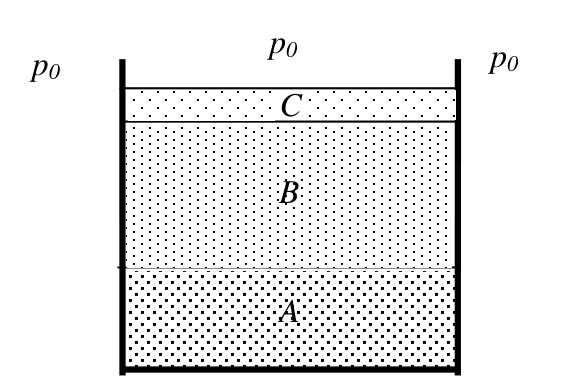
Fig. 1.1
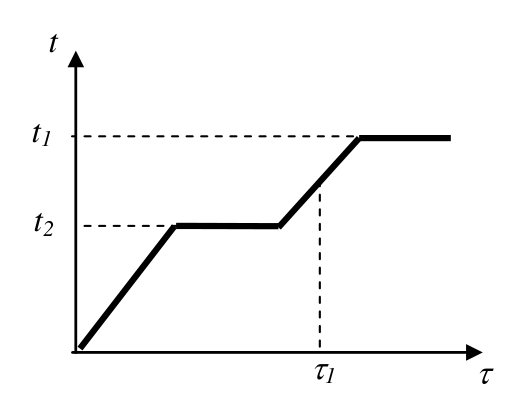
Fig. 1.2
The masses of the liquids A and B were initially the same, each equal to \(m=100\mathrm{g}\). The heights of the layers of the liquids in the vessel and the densities of the liquids are small enough to make the assumption that the pressure in any point in the vessel is practically equal to the normal atmospheric pressure \(p_0\).
The system of liquids in the vessel is slowly, but continuously and uniformly, heated. It was established that the temperature \(t\) of the liquids changed with time \(\tau\) as shown schematically in the Fig. 1.2.
Determine the temperatures \(t_1\) and \(t_2\) corresponding to the horizontal parts of the diagram and the masses of the liquids A and B at the time \(\tau_1\). The temperatures should be rounded to the nearest degree (in \(^\circ\mathrm{C}\)) and the masses of the liquids should be determined to one-tenth of gram.
REMARK: Assume that the vapors of the liquids, to a good approximation,
(1) obey the Dalton law stating that the pressure of a mixture of gases is equal to the sum of the partial pressures of the gases forming the mixture and
(2) can be treated as perfect gases up to the pressures corresponding to the saturated vapors.
Official English text of the problem.
Answers
-
A. The normal boiling temperatures are \[ \boxed{t_A=76.8^\circ\mathrm{C},\qquad t_B=99.7^\circ\mathrm{C}} \] (approximately \(77^\circ\mathrm{C}\) and \(100^\circ\mathrm{C}\), respectively).
-
B. To the requested precision, \[ \boxed{t_1=100^\circ\mathrm{C},\qquad t_2=67^\circ\mathrm{C}}, \] \[ \boxed{m_A(\tau_1)=0.0\ \mathrm{g},\qquad m_B(\tau_1)=95.5\ \mathrm{g}}. \]
Solution
A. Normal boiling temperatures
For a pure liquid, boiling occurs when its saturated vapor pressure equals the external pressure. Thus, under pressure \(p_0\), \[ p_i(T_{b,i})=p_0 \quad\Longrightarrow\quad 0=\frac{\alpha_i}{T_{b,i}}+\beta_i, \] so \[ T_{b,i}=-\frac{\alpha_i}{\beta_i}. \]
To determine the constants, let \[ T_L=313.15\ \mathrm{K},\qquad T_H=363.15\ \mathrm{K}, \] and denote the corresponding tabulated pressure ratios by \(r_{i,L}\) and \(r_{i,H}\). Subtracting the two vapor-pressure equations gives \[ \alpha_i= \frac{\ln r_{i,H}-\ln r_{i,L}} {T_H^{-1}-T_L^{-1}}, \qquad \beta_i=\ln r_{i,L}-\frac{\alpha_i}{T_L}. \]
Using the supplied data:
| Liquid | \(\alpha_i\) (\(\mathrm{K}\)) | \(\beta_i\) |
|---|---|---|
| A | \(-3748.4907\) | \(10.711491\) |
| B | \(-5121.6396\) | \(13.734914\) |
Therefore, \[ T_{b,A}=349.9504\ \mathrm{K}, \qquad T_{b,B}=372.8920\ \mathrm{K}. \] Converting to Celsius, \[ \boxed{t_A=76.8^\circ\mathrm{C},\qquad t_B=99.7^\circ\mathrm{C}}. \]
B. The two plateaus and the remaining masses
The slow heating permits a quasistatic treatment using equilibrium vapor pressures. As specified, hydrostatic pressure differences are negligible. The non-volatile layer C prevents free surface evaporation.
At the A–B interface, a vapor bubble in equilibrium with both liquids contains saturated vapor of each. Because the liquids are immiscible, each contributes its own saturated vapor pressure at the common temperature. Dalton’s law gives \[ p_{\mathrm{bubble}}=p_A(T)+p_B(T). \]
Consequently, boiling begins at the lower plateau temperature \(T_2\), determined by \[ p_A(T_2)+p_B(T_2)=p_0. \] Using the fitted vapor-pressure laws, \[ \exp\!\left(\frac{\alpha_A}{T_2}+\beta_A\right) + \exp\!\left(\frac{\alpha_B}{T_2}+\beta_B\right) =1. \]
Numerical solution gives \[ T_2=340.1208\ \mathrm{K}, \qquad t_2=66.9708^\circ\mathrm{C}. \] Thus, \[ \boxed{t_2=67^\circ\mathrm{C}}. \]
At this temperature, \[ \frac{p_A}{p_0}=0.7337662, \qquad \frac{p_B}{p_0}=0.2662338. \]
While both liquids remain, their saturated vapor pressures depend only on temperature, so boiling continues at this fixed temperature. The supplied heat provides the latent heat of vaporization.
To determine which liquid is exhausted first, consider a volume \(V\) of the escaping vapor mixture. The ideal-gas law for each component gives \[ p_A V=n_A RT_2,\qquad p_B V=n_B RT_2, \] and hence \[ \frac{n_A}{n_B}=\frac{p_A}{p_B}. \] The molecular-mass ratio is also the molar-mass ratio. Therefore, the positive masses lost by evaporation satisfy \[ \frac{\mathrm{d}m_A^{\mathrm{evap}}} {\mathrm{d}m_B^{\mathrm{evap}}} = \frac{\mu_Ap_A}{\mu_Bp_B} = \gamma\frac{p_A}{p_B}. \] Numerically, \[ \gamma\frac{p_A}{p_B} = 8\frac{0.7337662}{0.2662338} = 22.0488. \]
This ratio remains constant throughout the lower plateau. Since the initial masses are equal, A is exhausted first. When its entire \(100\ \mathrm{g}\) has evaporated, the mass of B lost is \[ \Delta m_B = \frac{100}{22.0488}\ \mathrm{g} = 4.5354\ \mathrm{g}. \] The remaining liquid masses are therefore \[ m_A=0,\qquad m_B=100-4.5354=95.4646\ \mathrm{g}. \]
Once A is exhausted, B alone has insufficient vapor pressure to boil at \(T_2\), since \[ p_B(T_2)=0.2662338\,p_0<p_0. \] Boiling stops and the temperature rises until B reaches its normal boiling temperature. The upper plateau is therefore \[ t_1=t_B=99.7420^\circ\mathrm{C}, \] which rounds to \[ \boxed{t_1=100^\circ\mathrm{C}}. \]
The marked time \(\tau_1\) lies on the rising segment between the two plateaus. At this stage A has disappeared, B has not yet resumed boiling, and layer C prevents free surface evaporation. Thus the liquid masses remain those at the end of the lower plateau: \[ \boxed{m_A(\tau_1)=0.0\ \mathrm{g},\qquad m_B(\tau_1)=95.5\ \mathrm{g}}. \]
The solution was checked against the official solution. Where this solution differs from the official solution, the official solution contains an error or a misprint.
IPhO 1989 · Theorieaufgabe 1
Sieden zweier nicht mischbarer Flüssigkeiten
Betrachten Sie zwei Flüssigkeiten A und B, die ineinander unlöslich sind. Die Drücke \(p_i\) (\(i=\mathrm{A}\) oder \(\mathrm{B}\)) ihrer gesättigten Dämpfe gehorchen in guter Näherung der Formel:
\[ \ln(p_i/p_o)=\frac{\alpha_i}{T}+\beta_i,\qquad i=\mathrm{A}\text{ oder }\mathrm{B}, \]
wobei \(p_o\) den normalen Atmosphärendruck, \(T\) die absolute Temperatur des Dampfes und \(\alpha_i\) sowie \(\beta_i\) (\(i=\mathrm{A}\) oder \(\mathrm{B}\)) bestimmte, von der Flüssigkeit abhängige Konstanten bezeichnen. (Das Symbol \(\ln\) bezeichnet den natürlichen Logarithmus, d. h. den Logarithmus zur Basis \(e=2.7182818\ldots\).)
Die Werte des Verhältnisses \(p_i/p_0\) für die Flüssigkeiten A und B bei den Temperaturen \(40^\circ\mathrm{C}\) und \(90^\circ\mathrm{C}\) sind in Tab. 1.1 angegeben.
Tabelle 1.1
| \(t\ [^\circ\mathrm{C}]\) | \(p_i/p_0\), \(i=\mathrm{A}\) | \(p_i/p_0\), \(i=\mathrm{B}\) |
|---|---|---|
| 40 | 0.284 | 0.07278 |
| 90 | 1.476 | 0.6918 |
Die Fehler dieser Werte sind vernachlässigbar.
A. Bestimmen Sie die Siedetemperaturen der Flüssigkeiten A und B unter dem Druck \(p_0\).
B. Die Flüssigkeiten A und B wurden in ein Gefäß gegossen, in dem sich die in Abb. 1.1 dargestellten Schichten bildeten. Die Oberfläche der Flüssigkeit B wurde mit einer dünnen Schicht einer nichtflüchtigen Flüssigkeit C bedeckt, die in den Flüssigkeiten A und B unlöslich ist und umgekehrt, wodurch jede freie Verdunstung an der oberen Oberfläche der Flüssigkeit B verhindert wird. Das Verhältnis der Molekülmassen der Flüssigkeiten A und B (in der Gasphase) beträgt:
\[ \gamma=\mu_A/\mu_B=8. \]
Abb. 1.1
Abb. 1.2
Die Massen der Flüssigkeiten A und B waren anfangs gleich und betrugen jeweils \(m=100\mathrm{g}\). Die Höhen der Flüssigkeitsschichten im Gefäß und die Dichten der Flüssigkeiten sind so klein, dass angenommen werden kann, der Druck sei an jedem Punkt im Gefäß praktisch gleich dem normalen Atmosphärendruck \(p_0\).
Das Flüssigkeitssystem im Gefäß wird langsam, aber kontinuierlich und gleichmäßig erwärmt. Es wurde festgestellt, dass sich die Temperatur \(t\) der Flüssigkeiten mit der Zeit \(\tau\) so änderte, wie in Abb. 1.2 schematisch dargestellt.
Bestimmen Sie die Temperaturen \(t_1\) und \(t_2\), die den waagerechten Abschnitten des Diagramms entsprechen, sowie die Massen der Flüssigkeiten A und B zum Zeitpunkt \(\tau_1\). Die Temperaturen sollen auf ganze Grad (in \(^\circ\mathrm{C}\)) gerundet und die Massen der Flüssigkeiten auf ein Zehntel Gramm bestimmt werden.
ANMERKUNG: Nehmen Sie an, dass die Dämpfe der Flüssigkeiten in guter Näherung
(1) dem Dalton'schen Gesetz gehorchen, nach dem der Druck eines Gasgemisches gleich der Summe der Partialdrücke der das Gemisch bildenden Gase ist, und
(2) bis zu den Sättigungsdampfdrücken als ideale Gase behandelt werden können.
Aufgabentext aus dem offiziellen englischen Text übersetzt.
Antworten
-
A. Die Siedetemperaturen bei Normaldruck betragen \[ \boxed{t_A=76.8^\circ\mathrm{C},\qquad t_B=99.7^\circ\mathrm{C}} \] (also ungefähr \(77^\circ\mathrm{C}\) bzw. \(100^\circ\mathrm{C}\)).
-
B. Mit der geforderten Genauigkeit gilt \[ \boxed{t_1=100^\circ\mathrm{C},\qquad t_2=67^\circ\mathrm{C}}, \] \[ \boxed{m_A(\tau_1)=0.0\ \mathrm{g},\qquad m_B(\tau_1)=95.5\ \mathrm{g}}. \]
Lösung
A. Siedetemperaturen bei Normaldruck
Eine reine Flüssigkeit siedet, wenn ihr Sättigungsdampfdruck gleich dem äußeren Druck ist. Unter dem Druck \(p_0\) gilt somit \[ p_i(T_{b,i})=p_0 \quad\Longrightarrow\quad 0=\frac{\alpha_i}{T_{b,i}}+\beta_i, \] also \[ T_{b,i}=-\frac{\alpha_i}{\beta_i}. \]
Zur Bestimmung der Konstanten setzen wir \[ T_L=313.15\ \mathrm{K},\qquad T_H=363.15\ \mathrm{K}, \] und bezeichnen die zugehörigen tabellierten Druckverhältnisse mit \(r_{i,L}\) und \(r_{i,H}\). Durch Subtraktion der beiden Dampfdruckgleichungen ergibt sich \[ \alpha_i= \frac{\ln r_{i,H}-\ln r_{i,L}} {T_H^{-1}-T_L^{-1}}, \qquad \beta_i=\ln r_{i,L}-\frac{\alpha_i}{T_L}. \]
Mit den angegebenen Daten erhält man:
| Flüssigkeit | \(\alpha_i\) (\(\mathrm{K}\)) | \(\beta_i\) |
|---|---|---|
| A | \(-3748.4907\) | \(10.711491\) |
| B | \(-5121.6396\) | \(13.734914\) |
Daraus folgt \[ T_{b,A}=349.9504\ \mathrm{K}, \qquad T_{b,B}=372.8920\ \mathrm{K}. \] Umgerechnet in Grad Celsius ergibt sich \[ \boxed{t_A=76.8^\circ\mathrm{C},\qquad t_B=99.7^\circ\mathrm{C}}. \]
B. Die beiden Plateaus und die verbleibenden Massen
Die langsame Erwärmung erlaubt eine quasistatische Betrachtung unter Verwendung der Gleichgewichtsdampfdrücke. Wie angegeben, sind hydrostatische Druckunterschiede vernachlässigbar. Die nichtflüchtige Schicht C verhindert die freie Verdunstung an der Oberfläche.
An der Grenzfläche zwischen A und B enthält eine Dampfblase, die mit beiden Flüssigkeiten im Gleichgewicht steht, gesättigten Dampf beider Flüssigkeiten. Da die Flüssigkeiten nicht mischbar sind, trägt jede bei der gemeinsamen Temperatur ihren eigenen Sättigungsdampfdruck bei. Nach dem Dalton'schen Gesetz gilt \[ p_{\mathrm{bubble}}=p_A(T)+p_B(T). \]
Folglich beginnt das Sieden bei der Temperatur \(T_2\) des unteren Plateaus, die durch \[ p_A(T_2)+p_B(T_2)=p_0 \] bestimmt ist. Mit den angepassten Dampfdruckgesetzen ergibt sich \[ \exp\!\left(\frac{\alpha_A}{T_2}+\beta_A\right) + \exp\!\left(\frac{\alpha_B}{T_2}+\beta_B\right) =1. \]
Die numerische Lösung liefert \[ T_2=340.1208\ \mathrm{K}, \qquad t_2=66.9708^\circ\mathrm{C}. \] Somit gilt \[ \boxed{t_2=67^\circ\mathrm{C}}. \]
Bei dieser Temperatur gilt \[ \frac{p_A}{p_0}=0.7337662, \qquad \frac{p_B}{p_0}=0.2662338. \]
Solange beide Flüssigkeiten vorhanden sind, hängen ihre Sättigungsdampfdrücke nur von der Temperatur ab, sodass das Sieden bei dieser festen Temperatur fortgesetzt wird. Die zugeführte Wärme liefert die latente Verdampfungswärme.
Um zu bestimmen, welche Flüssigkeit zuerst vollständig verdampft ist, betrachten wir ein Volumen \(V\) des entweichenden Dampfgemisches. Die ideale Gasgleichung ergibt für jede Komponente \[ p_A V=n_A RT_2,\qquad p_B V=n_B RT_2, \] und damit \[ \frac{n_A}{n_B}=\frac{p_A}{p_B}. \] Das Verhältnis der Molekülmassen ist zugleich das Verhältnis der molaren Massen. Daher gilt für die positiven, durch Verdampfung verlorenen Massen \[ \frac{\mathrm{d}m_A^{\mathrm{evap}}} {\mathrm{d}m_B^{\mathrm{evap}}} = \frac{\mu_Ap_A}{\mu_Bp_B} = \gamma\frac{p_A}{p_B}. \] Numerisch ergibt sich \[ \gamma\frac{p_A}{p_B} = 8\frac{0.7337662}{0.2662338} = 22.0488. \]
Dieses Verhältnis bleibt während des gesamten unteren Plateaus konstant. Da die Anfangsmassen gleich sind, ist A zuerst vollständig verdampft. Wenn seine gesamten \(100\ \mathrm{g}\) verdampft sind, beträgt die verlorene Masse von B \[ \Delta m_B = \frac{100}{22.0488}\ \mathrm{g} = 4.5354\ \mathrm{g}. \] Die verbleibenden Flüssigkeitsmassen betragen daher \[ m_A=0,\qquad m_B=100-4.5354=95.4646\ \mathrm{g}. \]
Sobald A vollständig verdampft ist, reicht der Dampfdruck von B allein nicht aus, um bei \(T_2\) zu sieden, denn \[ p_B(T_2)=0.2662338\,p_0<p_0. \] Das Sieden hört auf, und die Temperatur steigt, bis B seine Siedetemperatur bei Normaldruck erreicht. Das obere Plateau liegt daher bei \[ t_1=t_B=99.7420^\circ\mathrm{C}, \] was gerundet \[ \boxed{t_1=100^\circ\mathrm{C}} \] ergibt.
Der markierte Zeitpunkt \(\tau_1\) liegt auf dem ansteigenden Abschnitt zwischen den beiden Plateaus. Zu diesem Zeitpunkt ist A verschwunden, B hat noch nicht wieder zu sieden begonnen, und die Schicht C verhindert die freie Verdunstung an der Oberfläche. Somit bleiben die Flüssigkeitsmassen gleich denen am Ende des unteren Plateaus: \[ \boxed{m_A(\tau_1)=0.0\ \mathrm{g},\qquad m_B(\tau_1)=95.5\ \mathrm{g}}. \]
Die Lösung wurde mit der offiziellen Lösung abgeglichen. Wo diese Lösung von der offiziellen Lösung abweicht, enthält die offizielle Lösung einen Fehler oder Druckfehler.
IPhO 1989 · Teori sorusu 1
Birbirine karışmayan iki sıvının kaynaması
Birbirinde çözünmeyen A ve B sıvılarını ele alalım. Bu sıvıların doymuş buharlarının basınçları \(p_i\) (\(i=\mathrm{A}\) veya \(\mathrm{B}\)), iyi bir yaklaşıklıkla şu bağıntıya uyar:
\[ \ln(p_i/p_o)=\frac{\alpha_i}{T}+\beta_i,\qquad i=\mathrm{A}\text{ veya }\mathrm{B}, \]
Burada \(p_o\) normal atmosfer basıncını, \(T\) buharın mutlak sıcaklığını, \(\alpha_i\) ve \(\beta_i\) (\(i=\mathrm{A}\) veya \(\mathrm{B}\)) ise sıvıya bağlı belirli sabitleri gösterir. (\(\ln\) simgesi doğal logaritmayı, yani tabanı \(e=2.7182818\ldots\) olan logaritmayı gösterir.)
A ve B sıvıları için \(40^\circ\mathrm{C}\) ve \(90^\circ\mathrm{C}\) sıcaklıklarında \(p_i/p_0\) oranının değerleri Tablo 1.1'de verilmiştir.
Tablo 1.1
| \(t\ [^\circ\mathrm{C}]\) | \(p_i/p_0\), \(i=\mathrm{A}\) | \(p_i/p_0\), \(i=\mathrm{B}\) |
|---|---|---|
| 40 | 0.284 | 0.07278 |
| 90 | 1.476 | 0.6918 |
Bu değerlerin hataları ihmal edilebilir.
A. A ve B sıvılarının \(p_0\) basıncı altındaki kaynama sıcaklıklarını belirleyiniz.
B. A ve B sıvıları bir kaba dökülmüş ve kapta Şekil 1.1'de gösterilen tabakalar oluşmuştur. B sıvısının yüzeyi, A ve B sıvılarında çözünmeyen ve A ile B'nin de içinde çözünmediği, uçucu olmayan C sıvısından ince bir tabakayla kaplanmış; böylece B sıvısının üst yüzeyinden serbestçe buharlaşması tamamen önlenmiştir. A ve B sıvılarının (gaz fazındaki) molekül kütlelerinin oranı şöyledir:
\[ \gamma=\mu_A/\mu_B=8. \]
Şekil 1.1
Şekil 1.2
A ve B sıvılarının başlangıçtaki kütleleri eşit olup her biri \(m=100\mathrm{g}\)'dır. Kaptaki sıvı tabakalarının yükseklikleri ve sıvıların yoğunlukları, kabın herhangi bir noktasındaki basıncın pratik olarak normal atmosfer basıncı \(p_0\)'a eşit olduğu varsayımını yapmaya yetecek kadar küçüktür.
Kaptaki sıvı sistemi yavaşça, ancak sürekli ve düzgün biçimde ısıtılmaktadır. Sıvıların \(t\) sıcaklığının \(\tau\) zamanıyla Şekil 1.2'de şematik olarak gösterildiği gibi değiştiği belirlenmiştir.
Grafiğin yatay kısımlarına karşılık gelen \(t_1\) ve \(t_2\) sıcaklıklarını ve \(\tau_1\) anında A ve B sıvılarının kütlelerini belirleyiniz. Sıcaklıklar en yakın tam dereceye (\(^\circ\mathrm{C}\) cinsinden) yuvarlanmalı, sıvıların kütleleri ise gramın onda biri hassasiyetinde belirlenmelidir.
NOT: Sıvıların buharlarının iyi bir yaklaşıklıkla
(1) bir gaz karışımının basıncının, karışımı oluşturan gazların kısmi basınçlarının toplamına eşit olduğunu belirten Dalton yasasına uyduğunu ve
(2) doymuş buhar basınçlarına kadar ideal gaz olarak ele alınabileceğini varsayınız.
Soru metni resmi İngilizce metinden çevrilmiştir.
Cevaplar
-
A. Normal kaynama sıcaklıkları \[ \boxed{t_A=76.8^\circ\mathrm{C},\qquad t_B=99.7^\circ\mathrm{C}} \] şeklindedir (sırasıyla yaklaşık \(77^\circ\mathrm{C}\) ve \(100^\circ\mathrm{C}\)).
-
B. İstenen hassasiyette, \[ \boxed{t_1=100^\circ\mathrm{C},\qquad t_2=67^\circ\mathrm{C}}, \] \[ \boxed{m_A(\tau_1)=0.0\ \mathrm{g},\qquad m_B(\tau_1)=95.5\ \mathrm{g}}. \]
Çözüm
A. Normal kaynama sıcaklıkları
Saf bir sıvı, doymuş buhar basıncı dış basınca eşit olduğunda kaynar. Dolayısıyla \(p_0\) basıncı altında, \[ p_i(T_{b,i})=p_0 \quad\Longrightarrow\quad 0=\frac{\alpha_i}{T_{b,i}}+\beta_i, \] buradan \[ T_{b,i}=-\frac{\alpha_i}{\beta_i}. \]
Sabitleri belirlemek için \[ T_L=313.15\ \mathrm{K},\qquad T_H=363.15\ \mathrm{K}, \] olarak alalım ve tabloda bu sıcaklıklara karşılık gelen basınç oranlarını \(r_{i,L}\) ve \(r_{i,H}\) ile gösterelim. İki buhar basıncı denklemini birbirinden çıkarınca \[ \alpha_i= \frac{\ln r_{i,H}-\ln r_{i,L}} {T_H^{-1}-T_L^{-1}}, \qquad \beta_i=\ln r_{i,L}-\frac{\alpha_i}{T_L}. \]
Verilen veriler kullanıldığında:
| Sıvı | \(\alpha_i\) (\(\mathrm{K}\)) | \(\beta_i\) |
|---|---|---|
| A | \(-3748.4907\) | \(10.711491\) |
| B | \(-5121.6396\) | \(13.734914\) |
Dolayısıyla, \[ T_{b,A}=349.9504\ \mathrm{K}, \qquad T_{b,B}=372.8920\ \mathrm{K}. \] Celsius cinsine dönüştürülürse, \[ \boxed{t_A=76.8^\circ\mathrm{C},\qquad t_B=99.7^\circ\mathrm{C}}. \]
B. İki plato ve kalan kütleler
Yavaş ısıtma, denge buhar basınçları kullanılarak sürecin yarı statik olarak ele alınmasına olanak verir. Belirtildiği üzere hidrostatik basınç farkları ihmal edilebilir. Uçucu olmayan C tabakası, yüzeyden serbest buharlaşmayı önler.
A–B ara yüzeyinde, her iki sıvıyla dengede olan bir buhar kabarcığı her bir sıvının doymuş buharını içerir. Sıvılar birbirine karışmadığından, her biri ortak sıcaklıktaki kendi doymuş buhar basıncı kadar katkıda bulunur. Dalton yasasına göre \[ p_{\mathrm{bubble}}=p_A(T)+p_B(T). \]
Bunun sonucunda kaynama, aşağıdaki koşulla belirlenen alt plato sıcaklığı \(T_2\)'de başlar: \[ p_A(T_2)+p_B(T_2)=p_0. \] Verilere uydurulan buhar basıncı bağıntıları kullanılırsa, \[ \exp\!\left(\frac{\alpha_A}{T_2}+\beta_A\right) + \exp\!\left(\frac{\alpha_B}{T_2}+\beta_B\right) =1. \]
Sayısal çözüm şu sonucu verir: \[ T_2=340.1208\ \mathrm{K}, \qquad t_2=66.9708^\circ\mathrm{C}. \] Böylece, \[ \boxed{t_2=67^\circ\mathrm{C}}. \]
Bu sıcaklıkta, \[ \frac{p_A}{p_0}=0.7337662, \qquad \frac{p_B}{p_0}=0.2662338. \]
Her iki sıvı da mevcut olduğu sürece doymuş buhar basınçları yalnızca sıcaklığa bağlıdır; dolayısıyla kaynama bu sabit sıcaklıkta sürer. Verilen ısı, buharlaşma gizli ısısını karşılar.
Hangi sıvının önce tükendiğini belirlemek için kaptan çıkan buhar karışımının \(V\) hacmindeki bir miktarını ele alalım. Her bileşen için ideal gaz yasası \[ p_A V=n_A RT_2,\qquad p_B V=n_B RT_2, \] ve dolayısıyla \[ \frac{n_A}{n_B}=\frac{p_A}{p_B}. \] Molekül kütlelerinin oranı aynı zamanda molar kütlelerin oranıdır. Bu nedenle, buharlaşmayla kaybedilen pozitif kütleler şu bağıntıyı sağlar: \[ \frac{\mathrm{d}m_A^{\mathrm{evap}}} {\mathrm{d}m_B^{\mathrm{evap}}} = \frac{\mu_Ap_A}{\mu_Bp_B} = \gamma\frac{p_A}{p_B}. \] Sayısal olarak, \[ \gamma\frac{p_A}{p_B} = 8\frac{0.7337662}{0.2662338} = 22.0488. \]
Bu oran alt plato boyunca sabit kalır. Başlangıç kütleleri eşit olduğundan önce A tükenir. A'nın \(100\ \mathrm{g}\)'lık kütlesinin tamamı buharlaştığında, B'nin kaybettiği kütle \[ \Delta m_B = \frac{100}{22.0488}\ \mathrm{g} = 4.5354\ \mathrm{g}. \] Dolayısıyla kalan sıvı kütleleri \[ m_A=0,\qquad m_B=100-4.5354=95.4646\ \mathrm{g}. \]
A tükendiğinde, B'nin tek başına buhar basıncı \(T_2\)'de kaynamasına yetmez, çünkü \[ p_B(T_2)=0.2662338\,p_0<p_0. \] Kaynama durur ve B normal kaynama sıcaklığına ulaşıncaya kadar sıcaklık yükselir. Bu nedenle üst plato sıcaklığı \[ t_1=t_B=99.7420^\circ\mathrm{C}, \] olup yuvarlandığında \[ \boxed{t_1=100^\circ\mathrm{C}}. \]
İşaretlenen \(\tau_1\) anı, iki plato arasındaki yükselen kısımda yer alır. Bu aşamada A tükenmiştir, B henüz yeniden kaynamaya başlamamıştır ve C tabakası yüzeyden serbest buharlaşmayı önler. Dolayısıyla sıvı kütleleri alt platonun sonundaki değerlerinde kalır: \[ \boxed{m_A(\tau_1)=0.0\ \mathrm{g},\qquad m_B(\tau_1)=95.5\ \mathrm{g}}. \]
Çözüm, resmi çözümle karşılaştırılarak kontrol edildi. Bu çözümün resmi çözümden ayrıldığı yerlerde resmi çözümde bir hata ya da baskı hatası vardır.
IPhO 1989 · Problema teórico 1
Ebullición de dos líquidos inmiscibles
Consideremos dos líquidos A y B insolubles entre sí. Las presiones \(p_i\) (\(i=\mathrm{A}\) o \(\mathrm{B}\)) de sus vapores saturados obedecen, con buena aproximación, la fórmula:
\[ \ln(p_i/p_o)=\frac{\alpha_i}{T}+\beta_i,\qquad i=\mathrm{A}\text{ o }\mathrm{B}, \]
donde \(p_o\) denota la presión atmosférica normal, \(T\), la temperatura absoluta del vapor, y \(\alpha_i\) y \(\beta_i\) (\(i=\mathrm{A}\) o \(\mathrm{B}\)), ciertas constantes que dependen del líquido. (El símbolo \(\ln\) denota el logaritmo natural, es decir, el logaritmo en base \(e=2.7182818\ldots\))
Los valores del cociente \(p_i/p_0\) para los líquidos A y B a las temperaturas de \(40^\circ\mathrm{C}\) y \(90^\circ\mathrm{C}\) se dan en la tabla 1.1.
Tabla 1.1
| \(t\ [^\circ\mathrm{C}]\) | \(p_i/p_0\), \(i=\mathrm{A}\) | \(p_i/p_0\), \(i=\mathrm{B}\) |
|---|---|---|
| 40 | 0.284 | 0.07278 |
| 90 | 1.476 | 0.6918 |
Los errores de estos valores son despreciables.
A. Determine las temperaturas de ebullición de los líquidos A y B a la presión \(p_0\).
B. Los líquidos A y B se vertieron en un recipiente en el que se formaron las capas mostradas en la Fig. 1.1. La superficie del líquido B se ha cubierto con una capa fina de un líquido no volátil C, que es insoluble en los líquidos A y B y viceversa, impidiendo así toda evaporación libre desde la superficie superior del líquido B. La razón entre las masas moleculares de los líquidos A y B (en fase gaseosa) es:
\[ \gamma=\mu_A/\mu_B=8. \]
Fig. 1.1
Fig. 1.2
Las masas de los líquidos A y B eran inicialmente iguales, cada una de ellas igual a \(m=100\mathrm{g}\). Las alturas de las capas de los líquidos en el recipiente y las densidades de los líquidos son lo suficientemente pequeñas como para suponer que la presión en cualquier punto del recipiente es prácticamente igual a la presión atmosférica normal \(p_0\).
El sistema de líquidos del recipiente se calienta lenta, pero continua y uniformemente. Se observó que la temperatura \(t\) de los líquidos variaba con el tiempo \(\tau\) como se muestra esquemáticamente en la Fig. 1.2.
Determine las temperaturas \(t_1\) y \(t_2\) correspondientes a los tramos horizontales del diagrama y las masas de los líquidos A y B en el instante \(\tau_1\). Las temperaturas deben redondearse al grado más cercano (en \(^\circ\mathrm{C}\)) y las masas de los líquidos deben determinarse con una precisión de una décima de gramo.
OBSERVACIÓN: Suponga que los vapores de los líquidos, con buena aproximación,
(1) obedecen la ley de Dalton, según la cual la presión de una mezcla de gases es igual a la suma de las presiones parciales de los gases que componen la mezcla, y
(2) pueden tratarse como gases ideales hasta las presiones correspondientes a los vapores saturados.
Enunciado traducido del texto oficial en inglés.
Respuestas
-
A. Las temperaturas normales de ebullición son \[ \boxed{t_A=76.8^\circ\mathrm{C},\qquad t_B=99.7^\circ\mathrm{C}} \] (aproximadamente \(77^\circ\mathrm{C}\) y \(100^\circ\mathrm{C}\), respectivamente).
-
B. Con la precisión solicitada, \[ \boxed{t_1=100^\circ\mathrm{C},\qquad t_2=67^\circ\mathrm{C}}, \] \[ \boxed{m_A(\tau_1)=0.0\ \mathrm{g},\qquad m_B(\tau_1)=95.5\ \mathrm{g}}. \]
Solución
A. Temperaturas normales de ebullición
Para un líquido puro, la ebullición se produce cuando su presión de vapor saturado iguala la presión externa. Por tanto, a la presión \(p_0\), \[ p_i(T_{b,i})=p_0 \quad\Longrightarrow\quad 0=\frac{\alpha_i}{T_{b,i}}+\beta_i, \] de modo que \[ T_{b,i}=-\frac{\alpha_i}{\beta_i}. \]
Para determinar las constantes, sean \[ T_L=313.15\ \mathrm{K},\qquad T_H=363.15\ \mathrm{K}, \] y denotemos los correspondientes cocientes de presión tabulados por \(r_{i,L}\) y \(r_{i,H}\). Al restar las dos ecuaciones de presión de vapor se obtiene \[ \alpha_i= \frac{\ln r_{i,H}-\ln r_{i,L}} {T_H^{-1}-T_L^{-1}}, \qquad \beta_i=\ln r_{i,L}-\frac{\alpha_i}{T_L}. \]
Utilizando los datos proporcionados:
| Líquido | \(\alpha_i\) (\(\mathrm{K}\)) | \(\beta_i\) |
|---|---|---|
| A | \(-3748.4907\) | \(10.711491\) |
| B | \(-5121.6396\) | \(13.734914\) |
Por tanto, \[ T_{b,A}=349.9504\ \mathrm{K}, \qquad T_{b,B}=372.8920\ \mathrm{K}. \] Al convertir a grados Celsius, \[ \boxed{t_A=76.8^\circ\mathrm{C},\qquad t_B=99.7^\circ\mathrm{C}}. \]
B. Las dos mesetas y las masas restantes
El calentamiento lento permite un tratamiento cuasiestático utilizando las presiones de vapor de equilibrio. Como se indica en el enunciado, las diferencias de presión hidrostática son despreciables. La capa no volátil C impide la evaporación libre desde la superficie.
En la interfaz A–B, una burbuja de vapor en equilibrio con ambos líquidos contiene vapor saturado de cada uno de ellos. Como los líquidos son inmiscibles, cada uno aporta su propia presión de vapor saturado a la temperatura común. La ley de Dalton da \[ p_{\mathrm{bubble}}=p_A(T)+p_B(T). \]
En consecuencia, la ebullición comienza a la temperatura \(T_2\) de la meseta inferior, determinada por \[ p_A(T_2)+p_B(T_2)=p_0. \] Utilizando las leyes de presión de vapor ajustadas, \[ \exp\!\left(\frac{\alpha_A}{T_2}+\beta_A\right) + \exp\!\left(\frac{\alpha_B}{T_2}+\beta_B\right) =1. \]
La solución numérica da \[ T_2=340.1208\ \mathrm{K}, \qquad t_2=66.9708^\circ\mathrm{C}. \] Por tanto, \[ \boxed{t_2=67^\circ\mathrm{C}}. \]
A esta temperatura, \[ \frac{p_A}{p_0}=0.7337662, \qquad \frac{p_B}{p_0}=0.2662338. \]
Mientras queden ambos líquidos, sus presiones de vapor saturado dependen únicamente de la temperatura, por lo que la ebullición continúa a esta temperatura fija. El calor suministrado aporta el calor latente de vaporización.
Para determinar qué líquido se agota primero, consideremos un volumen \(V\) de la mezcla de vapores que escapa. La ley de los gases ideales para cada componente da \[ p_A V=n_A RT_2,\qquad p_B V=n_B RT_2, \] y, por tanto, \[ \frac{n_A}{n_B}=\frac{p_A}{p_B}. \] La razón entre las masas moleculares es también la razón entre las masas molares. Por tanto, las masas perdidas por evaporación, tomadas como positivas, satisfacen \[ \frac{\mathrm{d}m_A^{\mathrm{evap}}} {\mathrm{d}m_B^{\mathrm{evap}}} = \frac{\mu_Ap_A}{\mu_Bp_B} = \gamma\frac{p_A}{p_B}. \] Numéricamente, \[ \gamma\frac{p_A}{p_B} = 8\frac{0.7337662}{0.2662338} = 22.0488. \]
Esta razón permanece constante durante toda la meseta inferior. Puesto que las masas iniciales son iguales, A se agota primero. Cuando se han evaporado sus \(100\ \mathrm{g}\) por completo, la masa de B perdida es \[ \Delta m_B = \frac{100}{22.0488}\ \mathrm{g} = 4.5354\ \mathrm{g}. \] Por tanto, las masas de líquido restantes son \[ m_A=0,\qquad m_B=100-4.5354=95.4646\ \mathrm{g}. \]
Una vez agotado A, B por sí solo no tiene suficiente presión de vapor para hervir a \(T_2\), ya que \[ p_B(T_2)=0.2662338\,p_0<p_0. \] La ebullición se detiene y la temperatura aumenta hasta que B alcanza su temperatura normal de ebullición. Por tanto, la meseta superior corresponde a \[ t_1=t_B=99.7420^\circ\mathrm{C}, \] que se redondea a \[ \boxed{t_1=100^\circ\mathrm{C}}. \]
El instante señalado \(\tau_1\) se encuentra en el tramo ascendente entre las dos mesetas. En esta etapa A ha desaparecido, B aún no ha vuelto a hervir y la capa C impide la evaporación libre desde la superficie. Por tanto, las masas de líquido siguen siendo las del final de la meseta inferior: \[ \boxed{m_A(\tau_1)=0.0\ \mathrm{g},\qquad m_B(\tau_1)=95.5\ \mathrm{g}}. \]
La solución se comprobó con la solución oficial. Donde esta solución difiere de la solución oficial, la solución oficial contiene un error o una errata.
IPhO 1989 · 理论题 1
两种互不相溶液体的沸腾
考虑两种互不相溶的液体 A 和 B。它们的饱和蒸气压 \(p_i\)(\(i=\mathrm{A}\) 或 \(\mathrm{B}\))可以用下式很好地近似描述:
\[ \ln(p_i/p_o)=\frac{\alpha_i}{T}+\beta_i,\qquad i=\mathrm{A}\text{ 或 }\mathrm{B}, \]
其中,\(p_o\) 表示标准大气压,\(T\) 为蒸气的绝对温度,\(\alpha_i\) 和 \(\beta_i\)(\(i=\mathrm{A}\) 或 \(\mathrm{B}\))为取决于液体种类的常数。(符号 \(\ln\) 表示自然对数,即以 \(e=2.7182818\ldots\) 为底的对数。)
表 1.1 给出了液体 A 和 B 在温度为 \(40^\circ\mathrm{C}\) 和 \(90^\circ\mathrm{C}\) 时的比值 \(p_i/p_0\)。
表 1.1
| \(t\ [^\circ\mathrm{C}]\) | \(p_i/p_0\), \(i=\mathrm{A}\) | \(p_i/p_0\), \(i=\mathrm{B}\) |
|---|---|---|
| 40 | 0.284 | 0.07278 |
| 90 | 1.476 | 0.6918 |
这些数值的误差可以忽略不计。
A. 求液体 A 和 B 在压强 \(p_0\) 下的沸点。
B. 将液体 A 和 B 倒入一个容器,形成了图 1.1 所示的分层结构。在液体 B 的表面覆盖了一薄层不挥发的液体 C,液体 C 与液体 A、B 均互不相溶,从而阻止液体 B 从其上表面自由蒸发。液体 A 和 B 在气相中的分子质量之比为:
\[ \gamma=\mu_A/\mu_B=8. \]
图 1.1
图 1.2
液体 A 和 B 的初始质量相同,均为 \(m=100\mathrm{g}\)。容器中各液层的高度和各液体的密度都足够小,可以认为容器内任意一点的压强实际上都等于标准大气压 \(p_0\)。
对容器内的液体系统缓慢、连续且均匀地加热。观察到液体温度 \(t\) 随时间 \(\tau\) 的变化如图 1.2 的示意图所示。
求图中水平段对应的温度 \(t_1\) 和 \(t_2\),以及 \(\tau_1\) 时刻液体 A 和 B 的质量。温度应四舍五入到整数度(以 \(^\circ\mathrm{C}\) 为单位),液体质量应精确到 0.1 克。
说明: 假设液体的蒸气可以很好地近似认为:
(1) 遵循道尔顿分压定律,即混合气体的压强等于组成该混合物的各气体分压之和;并且
(2) 在压强不超过相应饱和蒸气压的范围内,可以视为理想气体。
题目译自官方英文原文。
答案
-
A. 标准沸点为 \[ \boxed{t_A=76.8^\circ\mathrm{C},\qquad t_B=99.7^\circ\mathrm{C}} \] (分别约为 \(77^\circ\mathrm{C}\) 和 \(100^\circ\mathrm{C}\))。
-
B. 按题目要求的精度, \[ \boxed{t_1=100^\circ\mathrm{C},\qquad t_2=67^\circ\mathrm{C}}, \] \[ \boxed{m_A(\tau_1)=0.0\ \mathrm{g},\qquad m_B(\tau_1)=95.5\ \mathrm{g}}. \]
解答
A. 标准沸点
对于纯液体,当其饱和蒸气压等于外界压强时,就会发生沸腾。因此,在压强 \(p_0\) 下, \[ p_i(T_{b,i})=p_0 \quad\Longrightarrow\quad 0=\frac{\alpha_i}{T_{b,i}}+\beta_i, \] 所以 \[ T_{b,i}=-\frac{\alpha_i}{\beta_i}. \]
为确定这些常数,令 \[ T_L=313.15\ \mathrm{K},\qquad T_H=363.15\ \mathrm{K}, \] 并用 \(r_{i,L}\) 和 \(r_{i,H}\) 表示表中对应的压强比。将两个蒸气压方程相减,得到 \[ \alpha_i= \frac{\ln r_{i,H}-\ln r_{i,L}} {T_H^{-1}-T_L^{-1}}, \qquad \beta_i=\ln r_{i,L}-\frac{\alpha_i}{T_L}. \]
代入所给数据:
| 液体 | \(\alpha_i\) (\(\mathrm{K}\)) | \(\beta_i\) |
|---|---|---|
| A | \(-3748.4907\) | \(10.711491\) |
| B | \(-5121.6396\) | \(13.734914\) |
因此, \[ T_{b,A}=349.9504\ \mathrm{K}, \qquad T_{b,B}=372.8920\ \mathrm{K}. \] 换算为摄氏温度, \[ \boxed{t_A=76.8^\circ\mathrm{C},\qquad t_B=99.7^\circ\mathrm{C}}. \]
B. 两个平台段及剩余质量
由于加热缓慢,可以利用平衡蒸气压进行准静态分析。根据题设,液体静压造成的压强差可以忽略不计。不挥发的液层 C 阻止了液面的自由蒸发。
在 A–B 界面处,与两种液体都处于平衡的蒸气泡中含有两种液体各自的饱和蒸气。由于两种液体互不相溶,每种液体都在共同的温度下贡献其自身的饱和蒸气压。由道尔顿分压定律得 \[ p_{\mathrm{bubble}}=p_A(T)+p_B(T). \]
因此,沸腾从较低平台段的温度 \(T_2\) 开始,该温度由下式确定: \[ p_A(T_2)+p_B(T_2)=p_0. \] 利用拟合得到的蒸气压关系式, \[ \exp\!\left(\frac{\alpha_A}{T_2}+\beta_A\right) + \exp\!\left(\frac{\alpha_B}{T_2}+\beta_B\right) =1. \]
数值求解得到 \[ T_2=340.1208\ \mathrm{K}, \qquad t_2=66.9708^\circ\mathrm{C}. \] 因此, \[ \boxed{t_2=67^\circ\mathrm{C}}. \]
在此温度下, \[ \frac{p_A}{p_0}=0.7337662, \qquad \frac{p_B}{p_0}=0.2662338. \]
只要两种液体都还存在,它们的饱和蒸气压就只取决于温度,因此沸腾会在这一恒定温度下持续进行。输入的热量用于提供汽化潜热。
为确定哪种液体先耗尽,考虑体积为 \(V\) 的逸出混合蒸气。对每种组分应用理想气体状态方程,得到 \[ p_A V=n_A RT_2,\qquad p_B V=n_B RT_2, \] 从而 \[ \frac{n_A}{n_B}=\frac{p_A}{p_B}. \] 分子质量之比也等于摩尔质量之比。因此,以正值表示的蒸发损失质量满足 \[ \frac{\mathrm{d}m_A^{\mathrm{evap}}} {\mathrm{d}m_B^{\mathrm{evap}}} = \frac{\mu_Ap_A}{\mu_Bp_B} = \gamma\frac{p_A}{p_B}. \] 代入数值得 \[ \gamma\frac{p_A}{p_B} = 8\frac{0.7337662}{0.2662338} = 22.0488. \]
在整个较低平台段,这一比值保持不变。由于初始质量相等,A 先耗尽。当 A 的全部 \(100\ \mathrm{g}\) 都已蒸发时,B 损失的质量为 \[ \Delta m_B = \frac{100}{22.0488}\ \mathrm{g} = 4.5354\ \mathrm{g}. \] 因此,剩余液体的质量为 \[ m_A=0,\qquad m_B=100-4.5354=95.4646\ \mathrm{g}. \]
A 一旦耗尽,B 单独的蒸气压就不足以使其在 \(T_2\) 下沸腾,因为 \[ p_B(T_2)=0.2662338\,p_0<p_0. \] 沸腾停止,温度上升,直到 B 达到其标准沸点。因此,较高平台段的温度为 \[ t_1=t_B=99.7420^\circ\mathrm{C}, \] 四舍五入后得到 \[ \boxed{t_1=100^\circ\mathrm{C}}. \]
标出的时刻 \(\tau_1\) 位于两个平台段之间的上升段。在这一阶段,A 已消失,B 尚未重新开始沸腾,而液层 C 阻止了液面的自由蒸发。因此,液体质量仍与较低平台段结束时相同: \[ \boxed{m_A(\tau_1)=0.0\ \mathrm{g},\qquad m_B(\tau_1)=95.5\ \mathrm{g}}. \]
解答已与官方解答核对。本解答与官方解答不同之处,均为官方解答中的错误或印刷错误。
IPhO 1989 · Теоретическая задача 1
Кипение двух несмешивающихся жидкостей
Рассмотрим две жидкости A и B, нерастворимые друг в друге. Давления \(p_i\) (\(i=\mathrm{A}\) или \(\mathrm{B}\)) их насыщенных паров с хорошей точностью описываются формулой:
\[ \ln(p_i/p_o)=\frac{\alpha_i}{T}+\beta_i,\qquad i=\mathrm{A}\text{ или }\mathrm{B}, \]
где \(p_o\) обозначает нормальное атмосферное давление, \(T\) — абсолютную температуру пара, а \(\alpha_i\) и \(\beta_i\) (\(i=\mathrm{A}\) или \(\mathrm{B}\)) — некоторые постоянные, зависящие от жидкости. (Символ \(\ln\) обозначает натуральный логарифм, то есть логарифм по основанию \(e=2.7182818\ldots\).)
Значения отношения \(p_i/p_0\) для жидкостей A и B при температурах \(40^\circ\mathrm{C}\) и \(90^\circ\mathrm{C}\) приведены в табл. 1.1.
Таблица 1.1
| \(t\ [^\circ\mathrm{C}]\) | \(p_i/p_0\), \(i=\mathrm{A}\) | \(p_i/p_0\), \(i=\mathrm{B}\) |
|---|---|---|
| 40 | 0.284 | 0.07278 |
| 90 | 1.476 | 0.6918 |
Погрешностями этих значений можно пренебречь.
A. Определите температуры кипения жидкостей A и B при давлении \(p_0\).
B. Жидкости A и B налили в сосуд, в котором они образовали слои, показанные на рис. 1.1. Поверхность жидкости B покрыли тонким слоем нелетучей жидкости C, которая нерастворима в жидкостях A и B, а они, в свою очередь, нерастворимы в ней; тем самым было предотвращено свободное испарение с верхней поверхности жидкости B. Отношение молекулярных масс жидкостей A и B (в газовой фазе) равно:
\[ \gamma=\mu_A/\mu_B=8. \]
Рис. 1.1
Рис. 1.2
Первоначально массы жидкостей A и B были одинаковыми и каждая составляла \(m=100\mathrm{g}\). Высоты слоёв жидкостей в сосуде и плотности жидкостей достаточно малы, чтобы можно было считать давление в любой точке сосуда практически равным нормальному атмосферному давлению \(p_0\).
Систему жидкостей в сосуде медленно, но непрерывно и равномерно нагревают. Было установлено, что температура \(t\) жидкостей изменялась со временем \(\tau\) так, как схематически показано на рис. 1.2.
Определите температуры \(t_1\) и \(t_2\), соответствующие горизонтальным участкам графика, и массы жидкостей A и B в момент времени \(\tau_1\). Температуры следует округлить до ближайшего целого градуса (в \(^\circ\mathrm{C}\)), а массы жидкостей определить с точностью до одной десятой грамма.
ПРИМЕЧАНИЕ: Считайте, что пары жидкостей с хорошей точностью
(1) подчиняются закону Дальтона, согласно которому давление смеси газов равно сумме парциальных давлений газов, образующих смесь, и
(2) могут рассматриваться как идеальные газы вплоть до давлений насыщенных паров.
Условие переведено с официального английского текста.
Ответы
-
A. Температуры кипения при нормальном атмосферном давлении равны \[ \boxed{t_A=76.8^\circ\mathrm{C},\qquad t_B=99.7^\circ\mathrm{C}} \] (приблизительно \(77^\circ\mathrm{C}\) и \(100^\circ\mathrm{C}\) соответственно).
-
B. С требуемой точностью \[ \boxed{t_1=100^\circ\mathrm{C},\qquad t_2=67^\circ\mathrm{C}}, \] \[ \boxed{m_A(\tau_1)=0.0\ \mathrm{g},\qquad m_B(\tau_1)=95.5\ \mathrm{g}}. \]
Решение
A. Температуры кипения при нормальном атмосферном давлении
Чистая жидкость кипит, когда давление её насыщенного пара равно внешнему давлению. Поэтому при давлении \(p_0\) \[ p_i(T_{b,i})=p_0 \quad\Longrightarrow\quad 0=\frac{\alpha_i}{T_{b,i}}+\beta_i, \] откуда \[ T_{b,i}=-\frac{\alpha_i}{\beta_i}. \]
Для определения постоянных положим \[ T_L=313.15\ \mathrm{K},\qquad T_H=363.15\ \mathrm{K}, \] а соответствующие табличные отношения давлений обозначим через \(r_{i,L}\) и \(r_{i,H}\). Вычитая одно из двух уравнений для давления насыщенного пара из другого, получаем \[ \alpha_i= \frac{\ln r_{i,H}-\ln r_{i,L}} {T_H^{-1}-T_L^{-1}}, \qquad \beta_i=\ln r_{i,L}-\frac{\alpha_i}{T_L}. \]
Используя приведённые данные, получаем:
| Жидкость | \(\alpha_i\) (\(\mathrm{K}\)) | \(\beta_i\) |
|---|---|---|
| A | \(-3748.4907\) | \(10.711491\) |
| B | \(-5121.6396\) | \(13.734914\) |
Следовательно, \[ T_{b,A}=349.9504\ \mathrm{K}, \qquad T_{b,B}=372.8920\ \mathrm{K}. \] Переходя к шкале Цельсия, получаем \[ \boxed{t_A=76.8^\circ\mathrm{C},\qquad t_B=99.7^\circ\mathrm{C}}. \]
B. Два горизонтальных участка и оставшиеся массы
Медленное нагревание позволяет рассматривать процесс как квазистатический и использовать равновесные давления насыщенных паров. Согласно условию, гидростатическими перепадами давления можно пренебречь. Нелетучий слой C препятствует свободному испарению с поверхности.
На границе раздела A–B пузырёк пара, находящийся в равновесии с обеими жидкостями, содержит насыщенный пар каждой из них. Поскольку жидкости не смешиваются, каждая из них создаёт своё давление насыщенного пара при общей температуре. По закону Дальтона \[ p_{\mathrm{bubble}}=p_A(T)+p_B(T). \]
Следовательно, кипение начинается при температуре \(T_2\) нижнего горизонтального участка, определяемой условием \[ p_A(T_2)+p_B(T_2)=p_0. \] Используя зависимости давления насыщенного пара с найденными коэффициентами, получаем \[ \exp\!\left(\frac{\alpha_A}{T_2}+\beta_A\right) + \exp\!\left(\frac{\alpha_B}{T_2}+\beta_B\right) =1. \]
Численное решение даёт \[ T_2=340.1208\ \mathrm{K}, \qquad t_2=66.9708^\circ\mathrm{C}. \] Таким образом, \[ \boxed{t_2=67^\circ\mathrm{C}}. \]
При этой температуре \[ \frac{p_A}{p_0}=0.7337662, \qquad \frac{p_B}{p_0}=0.2662338. \]
Пока обе жидкости присутствуют, давления их насыщенных паров зависят только от температуры, поэтому кипение продолжается при этой постоянной температуре. Подводимая теплота расходуется на парообразование.
Чтобы определить, какая жидкость полностью испарится первой, рассмотрим объём \(V\) выходящей смеси паров. Уравнение состояния идеального газа для каждого компонента даёт \[ p_A V=n_A RT_2,\qquad p_B V=n_B RT_2, \] откуда \[ \frac{n_A}{n_B}=\frac{p_A}{p_B}. \] Отношение молекулярных масс равно также отношению молярных масс. Поэтому положительные величины масс, теряемых при испарении, удовлетворяют соотношению \[ \frac{\mathrm{d}m_A^{\mathrm{evap}}} {\mathrm{d}m_B^{\mathrm{evap}}} = \frac{\mu_Ap_A}{\mu_Bp_B} = \gamma\frac{p_A}{p_B}. \] Численно \[ \gamma\frac{p_A}{p_B} = 8\frac{0.7337662}{0.2662338} = 22.0488. \]
Это отношение остаётся постоянным на всём нижнем горизонтальном участке. Поскольку начальные массы одинаковы, жидкость A полностью испаряется первой. Когда испарятся все её \(100\ \mathrm{g}\), масса испарившейся жидкости B составит \[ \Delta m_B = \frac{100}{22.0488}\ \mathrm{g} = 4.5354\ \mathrm{g}. \] Следовательно, оставшиеся массы жидкостей равны \[ m_A=0,\qquad m_B=100-4.5354=95.4646\ \mathrm{g}. \]
После полного испарения A давления пара одной лишь жидкости B недостаточно для кипения при \(T_2\), поскольку \[ p_B(T_2)=0.2662338\,p_0<p_0. \] Кипение прекращается, и температура растёт до тех пор, пока B не достигнет своей температуры кипения при нормальном атмосферном давлении. Поэтому верхнему горизонтальному участку соответствует температура \[ t_1=t_B=99.7420^\circ\mathrm{C}, \] которая после округления равна \[ \boxed{t_1=100^\circ\mathrm{C}}. \]
Отмеченный момент времени \(\tau_1\) находится на восходящем участке между двумя горизонтальными участками. На этой стадии жидкость A уже исчезла, кипение B ещё не возобновилось, а слой C препятствует свободному испарению с поверхности. Таким образом, массы жидкостей остаются такими же, как в конце нижнего горизонтального участка: \[ \boxed{m_A(\tau_1)=0.0\ \mathrm{g},\qquad m_B(\tau_1)=95.5\ \mathrm{g}}. \]
Решение проверено по официальному решению. Там, где это решение расходится с официальным, в официальном решении есть ошибка или опечатка.
IPhO 1989 · مسألة نظرية 1
غليان سائلين غير قابلين للامتزاج
لنعتبر سائلين A وB لا يذوب أحدهما في الآخر. تخضع ضغوط بخاريهما المشبعين \(p_i\) (حيث \(i=\mathrm{A}\) أو \(\mathrm{B}\))، بتقريب جيد، للعلاقة:
\[ \ln(p_i/p_o)=\frac{\alpha_i}{T}+\beta_i,\qquad i=\mathrm{A}\text{ أو }\mathrm{B}, \]
حيث يرمز \(p_o\) إلى الضغط الجوي النظامي، و\(T\) إلى درجة الحرارة المطلقة للبخار، و\(\alpha_i\) و\(\beta_i\) (حيث \(i=\mathrm{A}\) أو \(\mathrm{B}\)) إلى ثابتين يعتمدان على السائل. (يرمز الرمز \(\ln\) إلى اللوغاريتم الطبيعي، أي اللوغاريتم ذي الأساس \(e=2.7182818\ldots\))
ترد قيم النسبة \(p_i/p_0\) للسائلين A وB عند درجتي الحرارة \(40^\circ\mathrm{C}\) و\(90^\circ\mathrm{C}\) في الجدول 1.1.
الجدول 1.1
| \(t\ [^\circ\mathrm{C}]\) | \(p_i/p_0\), \(i=\mathrm{A}\) | \(p_i/p_0\), \(i=\mathrm{B}\) |
|---|---|---|
| 40 | 0.284 | 0.07278 |
| 90 | 1.476 | 0.6918 |
أخطاء هذه القيم مهملة.
A. أوجد درجتي غليان السائلين A وB تحت الضغط \(p_0\).
B. صُبَّ السائلان A وB في وعاء فتشكّلت فيه الطبقات المبينة في الشكل 1.1. غُطِّي سطح السائل B بطبقة رقيقة من سائل غير متطاير C، لا يذوب في السائلين A وB ولا يذوبان فيه، مما يمنع أي تبخر حر من السطح العلوي للسائل B. نسبة الكتلتين الجزيئيتين للسائلين A وB (في الطور الغازي) هي:
\[ \gamma=\mu_A/\mu_B=8. \]
الشكل 1.1
الشكل 1.2
كانت كتلتا السائلين A وB متساويتين في البداية، وتساوي كل منهما \(m=100\mathrm{g}\). ارتفاعات طبقات السوائل في الوعاء وكثافات السوائل صغيرة بما يكفي لافتراض أن الضغط عند أي نقطة في الوعاء يساوي عمليًا الضغط الجوي النظامي \(p_0\).
تُسخَّن منظومة السوائل في الوعاء ببطء، ولكن بصورة مستمرة ومنتظمة. وقد تبيّن أن درجة حرارة السوائل \(t\) تتغير مع الزمن \(\tau\) على النحو المبين تخطيطيًا في الشكل 1.2.
أوجد درجتي الحرارة \(t_1\) و\(t_2\) الموافقتين للجزأين الأفقيين من المخطط، وكتلتي السائلين A وB عند الزمن \(\tau_1\). ينبغي تقريب درجات الحرارة إلى أقرب درجة (بوحدة \(^\circ\mathrm{C}\))، وتحديد كتلتي السائلين بدقة عُشر غرام.
ملاحظة: افترض أن أبخرة السوائل، بتقريب جيد،
(1) تخضع لقانون دالتون الذي ينص على أن ضغط مزيج من الغازات يساوي مجموع الضغوط الجزئية للغازات المكوِّنة للمزيج، وأنه
(2) يمكن معاملتها بوصفها غازات مثالية حتى الضغوط الموافقة للأبخرة المشبعة.
نص المسألة مترجم عن النص الإنجليزي الرسمي.
الإجابات
-
A. درجتا الغليان النظاميتان هما \[ \boxed{t_A=76.8^\circ\mathrm{C},\qquad t_B=99.7^\circ\mathrm{C}} \] (أي نحو \(77^\circ\mathrm{C}\) و\(100^\circ\mathrm{C}\)، على الترتيب).
-
B. بالدقة المطلوبة، \[ \boxed{t_1=100^\circ\mathrm{C},\qquad t_2=67^\circ\mathrm{C}}, \] \[ \boxed{m_A(\tau_1)=0.0\ \mathrm{g},\qquad m_B(\tau_1)=95.5\ \mathrm{g}}. \]
الحل
A. درجتا الغليان النظاميتان
يغلي السائل النقي عندما يصبح ضغط بخاره المشبع مساويًا للضغط الخارجي. ومن ثم، تحت الضغط \(p_0\)، \[ p_i(T_{b,i})=p_0 \quad\Longrightarrow\quad 0=\frac{\alpha_i}{T_{b,i}}+\beta_i, \] وعليه \[ T_{b,i}=-\frac{\alpha_i}{\beta_i}. \]
لتحديد الثوابت، لنضع \[ T_L=313.15\ \mathrm{K},\qquad T_H=363.15\ \mathrm{K}, \] ولنرمز إلى نسبتي الضغط الموافقتين الواردتين في الجدول بالرمزين \(r_{i,L}\) و\(r_{i,H}\). بطرح معادلتي ضغط البخار نحصل على \[ \alpha_i= \frac{\ln r_{i,H}-\ln r_{i,L}} {T_H^{-1}-T_L^{-1}}, \qquad \beta_i=\ln r_{i,L}-\frac{\alpha_i}{T_L}. \]
باستخدام المعطيات المقدَّمة:
| السائل | \(\alpha_i\) (\(\mathrm{K}\)) | \(\beta_i\) |
|---|---|---|
| A | \(-3748.4907\) | \(10.711491\) |
| B | \(-5121.6396\) | \(13.734914\) |
إذن، \[ T_{b,A}=349.9504\ \mathrm{K}, \qquad T_{b,B}=372.8920\ \mathrm{K}. \] بالتحويل إلى درجات سلسيوس، \[ \boxed{t_A=76.8^\circ\mathrm{C},\qquad t_B=99.7^\circ\mathrm{C}}. \]
B. الجزآن الأفقيان والكتلتان المتبقيتان
يتيح التسخين البطيء معالجة شبه ساكنة باستخدام ضغوط البخار عند الاتزان. وكما ورد في المعطيات، فإن فروق الضغط الهيدروستاتيكي مهملة. وتمنع الطبقة غير المتطايرة C التبخر الحر من السطح.
عند السطح الفاصل بين A وB، تحتوي فقاعة بخار متزنة مع كلا السائلين على بخار مشبع لكل منهما. ولأن السائلين غير قابلين للامتزاج، يسهم كل منهما بضغط بخاره المشبع الخاص عند درجة الحرارة المشتركة. ويعطي قانون دالتون \[ p_{\mathrm{bubble}}=p_A(T)+p_B(T). \]
وبالتالي، يبدأ الغليان عند درجة حرارة الجزء الأفقي السفلي \(T_2\)، التي تحددها العلاقة \[ p_A(T_2)+p_B(T_2)=p_0. \] وباستخدام علاقات ضغط البخار التي حُدِّدت ثوابتها من المعطيات، \[ \exp\!\left(\frac{\alpha_A}{T_2}+\beta_A\right) + \exp\!\left(\frac{\alpha_B}{T_2}+\beta_B\right) =1. \]
يعطي الحل العددي \[ T_2=340.1208\ \mathrm{K}, \qquad t_2=66.9708^\circ\mathrm{C}. \] إذن، \[ \boxed{t_2=67^\circ\mathrm{C}}. \]
عند درجة الحرارة هذه، \[ \frac{p_A}{p_0}=0.7337662, \qquad \frac{p_B}{p_0}=0.2662338. \]
ما دام السائلان موجودين، فإن ضغطي بخاريهما المشبعين يعتمدان على درجة الحرارة وحدها، ولذلك يستمر الغليان عند درجة الحرارة الثابتة هذه. وتوفّر الحرارة المزوَّدة الحرارة الكامنة للتبخر.
لتحديد أي السائلين ينفد أولًا، لنعتبر حجمًا \(V\) من مزيج البخار المتصاعد. يعطي قانون الغاز المثالي لكل مكوِّن \[ p_A V=n_A RT_2,\qquad p_B V=n_B RT_2, \] ومن ثم \[ \frac{n_A}{n_B}=\frac{p_A}{p_B}. \] نسبة الكتلتين الجزيئيتين تساوي أيضًا نسبة الكتلتين الموليتين. ولذلك، فإن مقادير الكتلة المفقودة بالتبخر، المأخوذة موجبة، تحقق \[ \frac{\mathrm{d}m_A^{\mathrm{evap}}} {\mathrm{d}m_B^{\mathrm{evap}}} = \frac{\mu_Ap_A}{\mu_Bp_B} = \gamma\frac{p_A}{p_B}. \] عدديًا، \[ \gamma\frac{p_A}{p_B} = 8\frac{0.7337662}{0.2662338} = 22.0488. \]
تبقى هذه النسبة ثابتة طوال الجزء الأفقي السفلي. وبما أن الكتلتين الابتدائيتين متساويتان، فإن A ينفد أولًا. وعندما تتبخر كتلته البالغة \(100\ \mathrm{g}\) بأكملها، تكون كتلة B المفقودة \[ \Delta m_B = \frac{100}{22.0488}\ \mathrm{g} = 4.5354\ \mathrm{g}. \] وعليه، تكون كتلتا السائلين المتبقيتان \[ m_A=0,\qquad m_B=100-4.5354=95.4646\ \mathrm{g}. \]
بعد نفاد A، لا يكفي ضغط بخار B وحده لحدوث الغليان عند \(T_2\)، إذ إن \[ p_B(T_2)=0.2662338\,p_0<p_0. \] يتوقف الغليان وترتفع درجة الحرارة حتى يبلغ B درجة غليانه النظامية. ومن ثم تكون درجة حرارة الجزء الأفقي العلوي \[ t_1=t_B=99.7420^\circ\mathrm{C}, \] وبتقريبها نحصل على \[ \boxed{t_1=100^\circ\mathrm{C}}. \]
يقع الزمن المحدَّد \(\tau_1\) على الجزء الصاعد بين الجزأين الأفقيين. في هذه المرحلة، يكون A قد اختفى، ولم يستأنف B الغليان بعد، وتمنع الطبقة C التبخر الحر من السطح. لذلك تبقى كتلتا السائلين كما كانتا عند نهاية الجزء الأفقي السفلي: \[ \boxed{m_A(\tau_1)=0.0\ \mathrm{g},\qquad m_B(\tau_1)=95.5\ \mathrm{g}}. \]
تمت مراجعة الحل بمقارنته بالحل الرسمي. حيثما يختلف هذا الحل عن الحل الرسمي، يحتوي الحل الرسمي على خطأ أو خطأ مطبعي.