International Physics Olympiad
IPhO 1988
Bad Ischl, Austria · 3 theory problems with complete solutions
Problem 1: Spectroscopy of Particle Velocities
Basic Data
The absorption and emission of a photon is a reversible process. A good example is to be found in the excitation of an atom from the ground state to a higher energy state and the atoms´ subsequent return to the ground state. In such a case we may detect the absorption of a photon from the phenomenon of spontaneous emission or fluorescence. Some of the more modern instrumentation make use of this principle to identify atoms, and also to measure or calculate the value of the velocity in the velocity spectrum of the electron beam.
In an idealised experiment (see fig. 19.1) a single-charged ion travels in the opposite direction to light from a laser source with velocity \(v\). The wavelength of light from the laser source is adjustable. An ion with velocity Zero can be excited to a higher energy state by the application of laser light having a wavelength of \(\lambda=600\ \mathrm{nm}\). If we excite a moving ion, our knowledge on Dopplers´ effect tells us that we need to apply laser light of a wavelength other than the value given above.
There is given a velocity spectrum embracing velocity magnitude from \(v_1=0\ \frac{\mathrm m}{\mathrm s}\) to \(v_2=6{,}000\ \frac{\mathrm m}{\mathrm s}\). (see fig. 19.1)
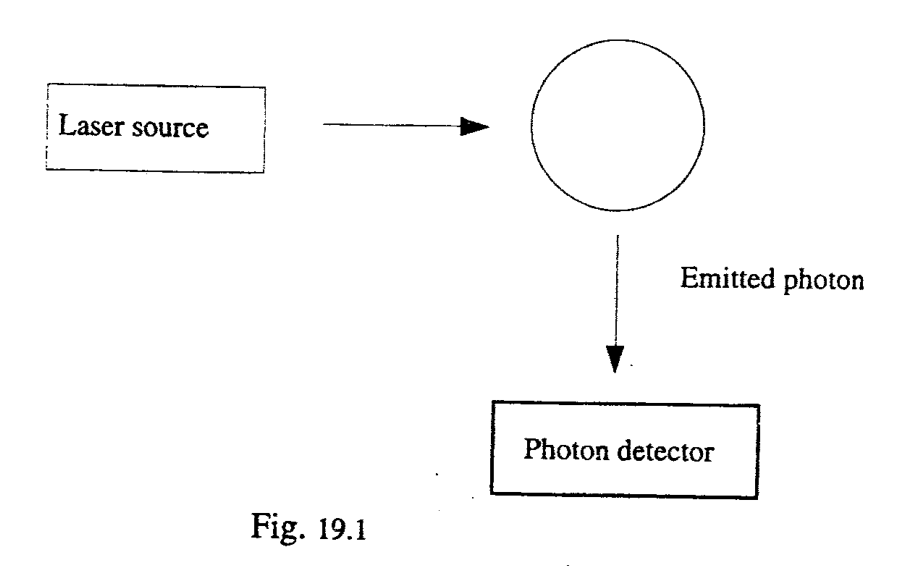
Fig. 19.1
Questions
1.1
1.1.1
What range of wavelength of the laser beam must be used to excite ions of all velocities in the velocity spectrum given above ?
1.1.2
A rigorous analysis of the problem calls for application of the principle from the theory of special relativity
\[ \nu'=\nu\cdot\sqrt{\frac{1+\dfrac vc}{1-\dfrac vc}} \]
Determine the error when the classical formula for Dopplers´ effect is used to solve the problem.
1.2
Assuming the ions are accelerated by a potential \(U\) before excited by the laser beam, determine the relationship between the width of the velocity spectrum of the ion beam and the accelerating potential. Does the accelerating voltage increase or decrease the velocity spectrum width ?
1.3
Each ion has the value \(\dfrac em=4\cdot10^6\ \dfrac{\mathrm{A\cdot s}}{\mathrm{kg}}\), two energy levels corresponding to wavelength \(\lambda^{(1)}=600\ \mathrm{nm}\) and wavelength \(\lambda^{(2)}=\lambda^{(1)}+10^{-3}\ \mathrm{nm}\). Show that lights of the two wavelengths used to excite ions overlap when no accelerating potential is applied. Can accelerating voltage be used to separate the two spectra of laser light used to excite ions so that they no longer overlap ? If the answer is positive, calculate the minimum value of the voltage required.
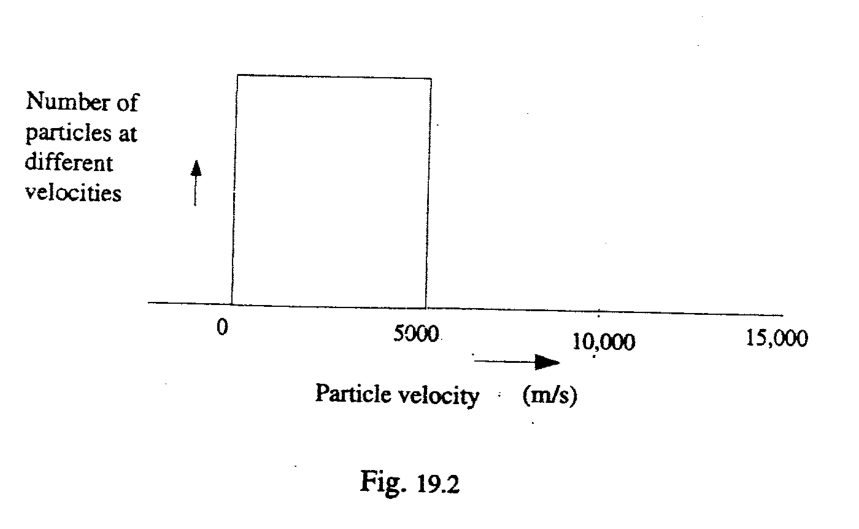
Fig. 19.2
Official English text of the problem.
Problem 2: Maxwell's Wheel
Introduction
A cylindrical wheel of uniform density, having the mass M = 0,40 kg, the radius R = 0,060 m and the thickness d = 0,010 m is suspended by means of two light strings of the same length from the ceiling. Each string is wound around the axle of the wheel. Like the strings, the mass of the axle is negligible. When the wheel is turned manually, the strings are wound up until the centre of mass is raised 1,0 m above the floor. If the wheel is allowed to move downward vertically under the pulling force of the gravity, the strings are unwound to the full length of the strings and the wheel reaches the lowest point. The strings then begin to wound in the opposite sense resulting in the wheel being raised upwards.
Analyze and answer the following questions, assuming that the strings are in vertical position and the points where the strings touch the axle are directly below their respective suspending points (see fig. 19.5).
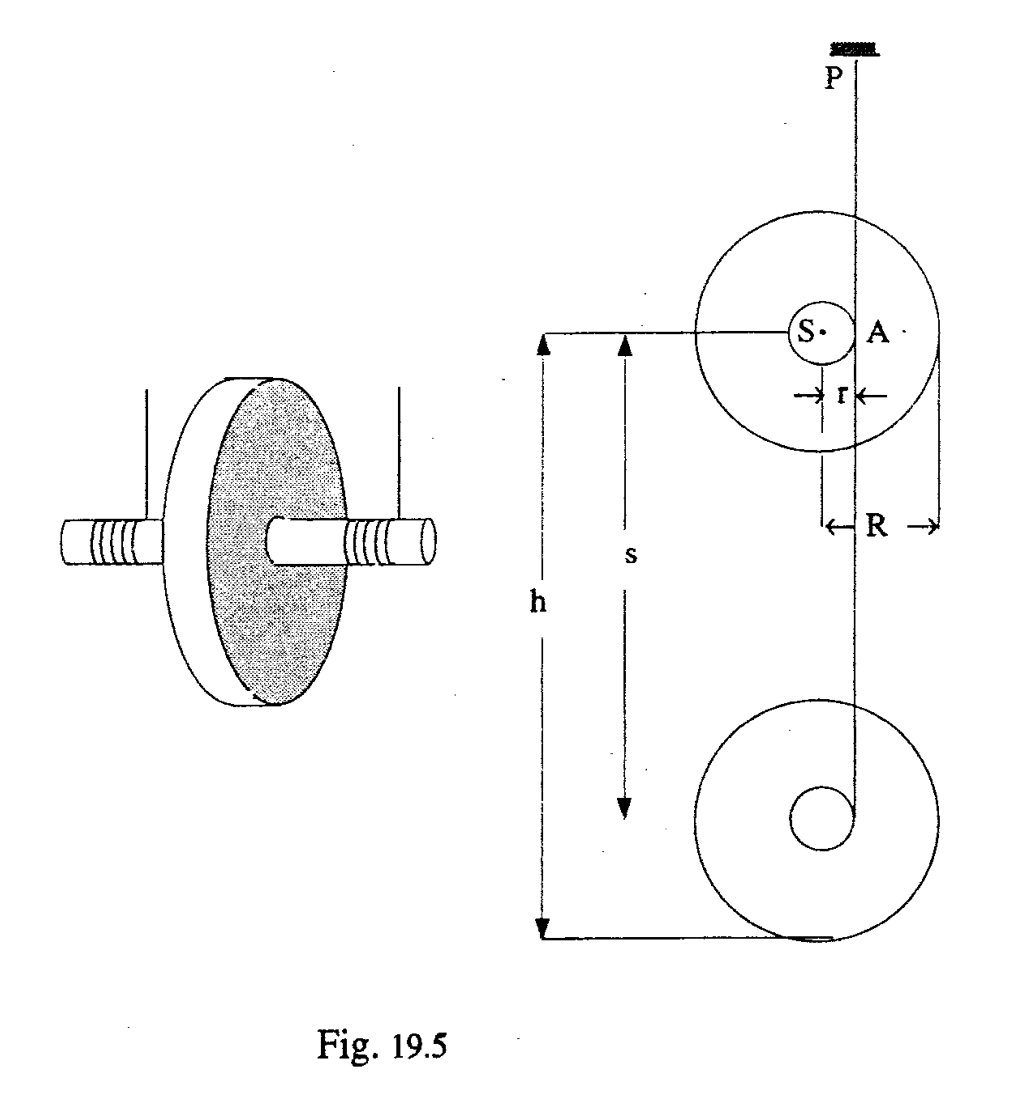
Fig. 19.5
Questions
2.1
Determine the angular speed of the wheel when the centre of mass of the wheel covers the vertical distance s.
2.2
Determine the kinetic energy of the linear motion of the centre of mass \(E_r\) after the wheel travels a distance s = 0,50 m, and calculate the ratio between \(E_r\) and the energy in any other form in this problem up to this point.
Radius of the axle = 0,0030 m
2.3
Determine the tension in the string while the wheel is moving downward.
2.4
Calculate the angular speed \(\omega'\) as a function of the angle \(\Phi\) when the strings begin to unwind themselves in opposite sense as depicted in fig. 19.6.
Sketch a graph of variables which describe the motion (in cartesian system which suits the problem) and also the speed of the centre of mass as a function of \(\Phi\).
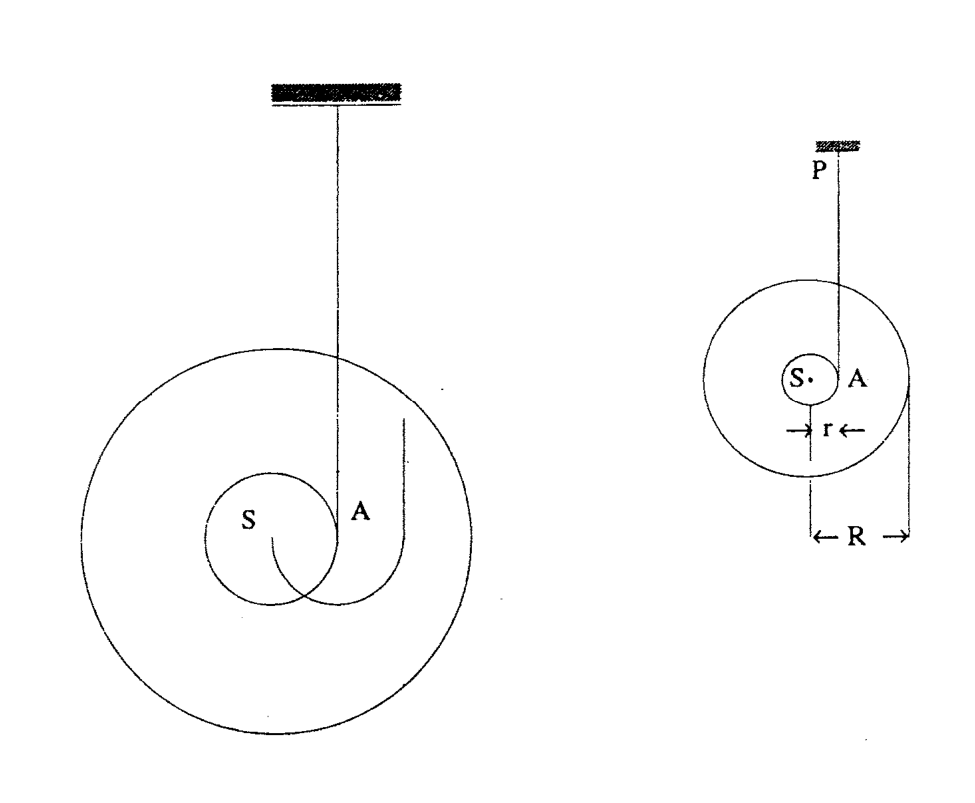
Fig. 19.6
2.5
If the string can withstand a maximum tension \(T_m=10\ \mathrm N\), find the maximum length of the string which may be unwound without breaking by the wheel.
Official English text of the problem.
Problem 3: Recombination of Positive and Negative Ions in Ionized Gas
Introduction
A gas consists of positive ions of some element (at high temperature) and electrons. The positive ion belongs to an atom of unknown mass number \(Z\). It is known that this ion has only one electron in the shell (orbit).
Let this ion be represented by the symbol \(A^{(Z-1)+}\)
Constants:
Constant Value electric field constant \(\displaystyle \varepsilon_0=8{,}85\cdot10^{-12}\ \frac{\mathrm{A\cdot s}}{\mathrm{V\cdot m}}\) elementary charge \(\displaystyle e=\pm1{,}602\cdot10^{-19}\ \mathrm{A\cdot s}\) \(\displaystyle q^2=\frac{e^2}{4\cdot\pi\cdot\varepsilon_0}=2{,}037\cdot10^{-28}\ \mathrm{J\cdot m}\) Planck’s constant \(\displaystyle \hbar=1{,}054\cdot10^{-34}\ \mathrm{J\cdot s}\) (rest) mass of an electron \(\displaystyle m_e=9{,}108\cdot10^{-31}\ \mathrm{kg}\) Bohr’s atomic radius \(\displaystyle r_{\mathrm B}=\frac{\hbar}{m\cdot q^2}=5{,}92\cdot10^{-11}\ \mathrm m\) Rydberg’s energy \(\displaystyle E_{\mathrm R}=\frac{q^2}{2\cdot r_{\mathrm B}}=2{,}180\cdot10^{-18}\ \mathrm J\) (rest) mass of a proton \(\displaystyle m_{\mathrm p}\cdot c^2=1{,}503\cdot10^{-10}\ \mathrm J\) Questions:
3.1
Assume that the ion which has just one electron left the shell.
\(A^{(Z-1)+}\) is in the ground state.In the lowest energy state, the square of the average distance of the electron from the nucleus or \(r^2\) with components along x-, y- and z-axis being \((\Delta x)^2\), \((\Delta y)^2\) and \((\Delta z)^2\) respectively and \[ r_0^2=(\Delta x)^2+(\Delta y)^2+(\Delta z)^2 \] and also the square of the average momentum by \[ p_0^2=(\Delta p_x)^2+(\Delta p_y)^2+(\Delta p_z)^2, \] whereas \[ \Delta p_x\geq\frac{\hbar}{2\cdot\Delta x},\qquad \Delta p_y\geq\frac{\hbar}{2\cdot\Delta y} \quad\text{and}\quad \Delta p_z\geq\frac{\hbar}{2\cdot\Delta z}. \]
Write inequality involving \((p_0)^2\cdot(r_0)^2\) in a complete form.
3.2
The ion represented by \(A^{(Z-1)+}\) may capture an additional electron and consequently emits a photon.
Write down an equation which is to be used for calculation the frequency of an emitted photon.
3.3
Calculate the energy of the ion \(A^{(Z-1)+}\) using the value of the lowest energy. The calculation should be approximated based on the following principles:
3.3.A
The potential energy of the ion should be expressed in terms of the average value of \(\dfrac1r\).
(ie. \(\dfrac1{r_0}\); \(r_0\) is given in the problem).
3.3.B
In calculating the kinetic energy of the ion, use the average value of the square of the momentum given in 3.1 after being simplified by \[ (p_0)^2\cdot(r_0)^2\approx(\hbar)^2 \]
3.4
Calculate the energy of the ion \(A^{(Z-2)+}\) taken to be in the ground state, using the same principle as the calculation of the energy of \(A^{(Z-1)+}\). Given the average distance of each of the two electrons in the outermost shell (same as \(r_0\) given in 3.3) denoted by \(r_1\) and \(r_2\), assume the average distance between the two electrons is given by \(r_1+r_2\) and the average value of the square of the momentum of each electron obeys the principle of uncertainty ie. \[ p_1^2\cdot r_1^2\approx\hbar^2 \quad\text{and}\quad p_2^2\cdot r_2^2\approx\hbar^2 \]
hint: Make use of the information that in the ground state \(r_1=r_2\)
3.5
Consider in particular the ion \(A^{(Z-2)+}\) is at rest in the ground state when capturing an additional electron and the captured electron is also at rest prior to the capturing. Determine the numerical value of \(Z\), if the frequency of the emitted photon accompanying electron capturing is \(2{,}057\cdot10^{17}\ \mathrm{rad/s}\). Identify the element which gives rise to the ion.
Official English text of the problem.
Internationale Physik-Olympiade
IPhO 1988
Bad Ischl, Österreich · 3 Theorieaufgaben mit vollständigen Lösungen
Aufgabe 1: Spektroskopie von Teilchengeschwindigkeiten
Grundlagen
Die Absorption und Emission eines Photons ist ein reversibler Prozess. Ein gutes Beispiel dafür ist die Anregung eines Atoms aus dem Grundzustand in einen Zustand höherer Energie und die anschließende Rückkehr des Atoms in den Grundzustand. In einem solchen Fall lässt sich die Absorption eines Photons anhand der spontanen Emission oder Fluoreszenz nachweisen. Einige modernere Messgeräte nutzen dieses Prinzip zur Identifizierung von Atomen sowie zur Messung oder Berechnung des Geschwindigkeitswertes im Geschwindigkeitsspektrum des Elektronenstrahls.
In einem idealisierten Experiment (siehe Abb. 19.1) bewegt sich ein einfach geladenes Ion mit der Geschwindigkeit \(v\) entgegen der Ausbreitungsrichtung des Lichts einer Laserquelle. Die Wellenlänge des Lichts der Laserquelle ist einstellbar. Ein Ion mit der Geschwindigkeit null kann durch Einstrahlung von Laserlicht mit einer Wellenlänge von \(\lambda=600\ \mathrm{nm}\) in einen Zustand höherer Energie angeregt werden. Soll ein bewegtes Ion angeregt werden, so wissen wir aufgrund des Dopplereffekts, dass dazu Laserlicht mit einer anderen als der oben angegebenen Wellenlänge verwendet werden muss.
Gegeben ist ein Geschwindigkeitsspektrum, das Geschwindigkeitsbeträge von \(v_1=0\ \frac{\mathrm m}{\mathrm s}\) bis \(v_2=6{,}000\ \frac{\mathrm m}{\mathrm s}\) umfasst. (siehe Abb. 19.1)
Abb. 19.1
Fragen
1.1
1.1.1
Welcher Wellenlängenbereich des Laserstrahls muss verwendet werden, um Ionen mit allen Geschwindigkeiten des oben angegebenen Geschwindigkeitsspektrums anzuregen?
1.1.2
Eine exakte Analyse des Problems erfordert die Anwendung der Beziehung aus der speziellen Relativitätstheorie
\[ \nu'=\nu\cdot\sqrt{\frac{1+\dfrac vc}{1-\dfrac vc}} \]
Bestimmen Sie den Fehler, der entsteht, wenn zur Lösung des Problems die klassische Formel für den Dopplereffekt verwendet wird.
1.2
Nehmen Sie an, dass die Ionen durch eine Spannung \(U\) beschleunigt werden, bevor sie durch den Laserstrahl angeregt werden. Bestimmen Sie den Zusammenhang zwischen der Breite des Geschwindigkeitsspektrums des Ionenstrahls und der Beschleunigungsspannung. Vergrößert oder verkleinert die Beschleunigungsspannung die Breite des Geschwindigkeitsspektrums?
1.3
Für jedes Ion gilt \(\dfrac em=4\cdot10^6\ \dfrac{\mathrm{A\cdot s}}{\mathrm{kg}}\); es besitzt zwei Energieniveaus, die der Wellenlänge \(\lambda^{(1)}=600\ \mathrm{nm}\) beziehungsweise der Wellenlänge \(\lambda^{(2)}=\lambda^{(1)}+10^{-3}\ \mathrm{nm}\) entsprechen. Zeigen Sie, dass sich die zur Anregung der Ionen verwendeten Lichtwellenlängenbereiche der beiden Übergänge überlappen, wenn keine Beschleunigungsspannung angelegt wird. Kann durch eine Beschleunigungsspannung erreicht werden, dass die beiden zur Anregung der Ionen verwendeten Laserlichtspektren getrennt werden und sich nicht mehr überlappen? Falls ja, berechnen Sie den erforderlichen Mindestwert der Spannung.
Abb. 19.2
Aufgabentext aus dem offiziellen englischen Text übersetzt.
Aufgabe 2: Maxwellsches Rad
Einleitung
Ein zylindrisches Rad mit gleichmäßiger Dichte, der Masse M = 0,40 kg, dem Radius R = 0,060 m und der Dicke d = 0,010 m ist an zwei leichten Fäden gleicher Länge an der Decke aufgehängt. Jeder Faden ist um die Achse des Rades gewickelt. Wie die Masse der Fäden ist auch die Masse der Achse vernachlässigbar. Durch Drehen des Rades von Hand werden die Fäden aufgewickelt, bis der Schwerpunkt auf eine Höhe von 1,0 m über dem Boden angehoben ist. Lässt man das Rad unter dem Einfluss der Schwerkraft senkrecht nach unten laufen, so werden die Fäden über ihre gesamte Länge abgewickelt, und das Rad erreicht seinen tiefsten Punkt. Anschließend beginnen sich die Fäden in entgegengesetzter Richtung aufzuwickeln, wodurch das Rad wieder angehoben wird.
Untersuchen und beantworten Sie die folgenden Fragen unter der Annahme, dass die Fäden senkrecht verlaufen und die Berührungspunkte der Fäden mit der Achse unmittelbar unter den jeweiligen Aufhängepunkten liegen (siehe Abb. 19.5).
Abb. 19.5
Fragen
2.1
Bestimmen Sie die Winkelgeschwindigkeit des Rades, wenn sein Schwerpunkt die vertikale Strecke s zurückgelegt hat.
2.2
Bestimmen Sie die kinetische Energie der Translationsbewegung des Schwerpunkts \(E_r\), nachdem das Rad eine Strecke s = 0,50 m zurückgelegt hat, und berechnen Sie das Verhältnis zwischen \(E_r\) und der bis zu diesem Zeitpunkt in jeder anderen Form vorliegenden Energie in dieser Aufgabe.
Radius der Achse = 0,0030 m
2.3
Bestimmen Sie die Fadenspannung, während sich das Rad abwärts bewegt.
2.4
Berechnen Sie die Winkelgeschwindigkeit \(\omega'\) als Funktion des Winkels \(\Phi\), wenn die Fäden beginnen, sich in entgegengesetzter Richtung abzuwickeln, wie in Abb. 19.6 dargestellt.
Skizzieren Sie die Größen, die die Bewegung beschreiben (in einem für die Aufgabe geeigneten kartesischen Koordinatensystem), sowie den Betrag der Geschwindigkeit des Schwerpunkts als Funktion von \(\Phi\).
Abb. 19.6
2.5
Wenn der Faden einer maximalen Spannung von \(T_m=10\ \mathrm N\) standhält, bestimmen Sie die maximale Fadenlänge, die durch das Rad abgewickelt werden kann, ohne dass der Faden reißt.
Aufgabentext aus dem offiziellen englischen Text übersetzt.
Aufgabe 3: Rekombination positiver und negativer Ionen in ionisiertem Gas
Einleitung
Ein Gas besteht aus positiven Ionen eines Elements (bei hoher Temperatur) und Elektronen. Das positive Ion gehört zu einem Atom mit unbekannter Massenzahl \(Z\). Es ist bekannt, dass dieses Ion nur ein Elektron in der Hülle (auf einer Bahn) besitzt.
Dieses Ion werde durch das Symbol \(A^{(Z-1)+}\) dargestellt.
Konstanten:
Konstante Wert Elektrische Feldkonstante \(\displaystyle \varepsilon_0=8{,}85\cdot10^{-12}\ \frac{\mathrm{A\cdot s}}{\mathrm{V\cdot m}}\) Elementarladung \(\displaystyle e=\pm1{,}602\cdot10^{-19}\ \mathrm{A\cdot s}\) \(\displaystyle q^2=\frac{e^2}{4\cdot\pi\cdot\varepsilon_0}=2{,}037\cdot10^{-28}\ \mathrm{J\cdot m}\) Plancksches Wirkungsquantum \(\displaystyle \hbar=1{,}054\cdot10^{-34}\ \mathrm{J\cdot s}\) (Ruhe-)Masse eines Elektrons \(\displaystyle m_e=9{,}108\cdot10^{-31}\ \mathrm{kg}\) Bohrscher Atomradius \(\displaystyle r_{\mathrm B}=\frac{\hbar}{m\cdot q^2}=5{,}92\cdot10^{-11}\ \mathrm m\) Rydberg-Energie \(\displaystyle E_{\mathrm R}=\frac{q^2}{2\cdot r_{\mathrm B}}=2{,}180\cdot10^{-18}\ \mathrm J\) (Ruhe-)Masse eines Protons \(\displaystyle m_{\mathrm p}\cdot c^2=1{,}503\cdot10^{-10}\ \mathrm J\) Fragen:
3.1
Nehmen Sie an, dass bei dem Ion nur noch ein Elektron in der Hülle verblieben ist.
\(A^{(Z-1)+}\) befindet sich im Grundzustand.Im Zustand niedrigster Energie wird das Quadrat des mittleren Abstands des Elektrons vom Kern, also \(r^2\), durch die Komponenten \((\Delta x)^2\), \((\Delta y)^2\) bzw. \((\Delta z)^2\) entlang der x-, y- und z-Achse beschrieben, wobei \[ r_0^2=(\Delta x)^2+(\Delta y)^2+(\Delta z)^2 \] gilt. Ebenso ist das Quadrat des mittleren Impulses gegeben durch \[ p_0^2=(\Delta p_x)^2+(\Delta p_y)^2+(\Delta p_z)^2, \] wobei \[ \Delta p_x\geq\frac{\hbar}{2\cdot\Delta x},\qquad \Delta p_y\geq\frac{\hbar}{2\cdot\Delta y} \quad\text{und}\quad \Delta p_z\geq\frac{\hbar}{2\cdot\Delta z}. \]
Schreiben Sie eine Ungleichung für \((p_0)^2\cdot(r_0)^2\) in vollständiger Form auf.
3.2
Das durch \(A^{(Z-1)+}\) dargestellte Ion kann ein zusätzliches Elektron einfangen und emittiert dabei ein Photon.
Schreiben Sie eine Gleichung auf, mit der die Frequenz des emittierten Photons berechnet werden kann.
3.3
Berechnen Sie die Energie des Ions \(A^{(Z-1)+}\), indem Sie den niedrigsten Energiewert bestimmen. Die Berechnung soll näherungsweise auf den folgenden Grundlagen beruhen:
3.3.A
Die potenzielle Energie des Ions soll durch den Mittelwert von \(\dfrac1r\) ausgedrückt werden.
(d. h. \(\dfrac1{r_0}\); \(r_0\) ist in der Aufgabe angegeben).
3.3.B
Verwenden Sie zur Berechnung der kinetischen Energie des Ions den in 3.1 angegebenen Mittelwert des Impulsquadrats, wobei die Vereinfachung \[ (p_0)^2\cdot(r_0)^2\approx(\hbar)^2 \] vorgenommen wird.
3.4
Berechnen Sie die Energie des Ions \(A^{(Z-2)+}\), das sich im Grundzustand befinden soll, nach demselben Prinzip wie bei der Berechnung der Energie von \(A^{(Z-1)+}\). Die mittleren Abstände der beiden Elektronen in der äußersten Hülle (entsprechend \(r_0\) aus 3.3) seien mit \(r_1\) und \(r_2\) bezeichnet. Nehmen Sie an, dass der mittlere Abstand zwischen den beiden Elektronen durch \(r_1+r_2\) gegeben ist und dass der Mittelwert des Impulsquadrats jedes Elektrons der Unschärferelation genügt, d. h. \[ p_1^2\cdot r_1^2\approx\hbar^2 \quad\text{und}\quad p_2^2\cdot r_2^2\approx\hbar^2 \]
Hinweis: Nutzen Sie die Angabe, dass im Grundzustand \(r_1=r_2\) gilt.
3.5
Betrachten Sie insbesondere den Fall, dass das Ion \(A^{(Z-2)+}\) beim Einfang eines zusätzlichen Elektrons im Grundzustand ruht und das eingefangene Elektron vor dem Einfang ebenfalls ruht. Bestimmen Sie den Zahlenwert von \(Z\), wenn die Frequenz des beim Elektroneneinfang emittierten Photons \(2{,}057\cdot10^{17}\ \mathrm{rad/s}\) beträgt. Bestimmen Sie das Element, aus dem das Ion hervorgeht.
Aufgabentext aus dem offiziellen englischen Text übersetzt.
Uluslararası Fizik Olimpiyatı
IPhO 1988
Bad Ischl, Avusturya · 3 teori sorusu, tam çözümleriyle
Soru 1: Parçacık Hızlarının Spektroskopisi
Temel Bilgiler
Bir fotonun soğurulması ve yayılması tersinir bir süreçtir. Bir atomun temel durumdan daha yüksek enerjili bir duruma uyarılması ve ardından temel duruma dönmesi buna iyi bir örnektir. Böyle bir durumda, kendiliğinden yayılma veya floresans olayı aracılığıyla bir fotonun soğurulduğunu saptayabiliriz. Daha modern ölçüm aygıtlarından bazıları, atomları tanımlamak ve ayrıca elektron demetinin hız spektrumundaki hız değerini ölçmek veya hesaplamak için bu ilkeden yararlanır.
İdealleştirilmiş bir deneyde (bkz. Şekil 19.1), tek yüklü bir iyon, bir lazer kaynağından gelen ışığa zıt yönde \(v\) hızıyla hareket etmektedir. Lazer kaynağından gelen ışığın dalga boyu ayarlanabilir. Hızı sıfır olan bir iyon, dalga boyu \(\lambda=600\ \mathrm{nm}\) olan lazer ışığı uygulanarak daha yüksek enerjili bir duruma uyarılabilir. Hareketli bir iyonu uyaracak olursak, Doppler etkisine ilişkin bilgilerimiz, yukarıda verilen değerden farklı bir dalga boyuna sahip lazer ışığı uygulamamız gerektiğini söyler.
Hız büyüklükleri \(v_1=0\ \frac{\mathrm m}{\mathrm s}\) ile \(v_2=6{,}000\ \frac{\mathrm m}{\mathrm s}\) arasında değişen bir hız spektrumu verilmiştir. (bkz. Şekil 19.1)
Şekil 19.1
Sorular
1.1
1.1.1
Yukarıda verilen hız spektrumundaki tüm hızlara sahip iyonları uyarmak için lazer demetinin dalga boyu hangi aralıkta olmalıdır?
1.1.2
Problemin titiz bir analizi, özel görelilik kuramından gelen şu bağıntının uygulanmasını gerektirir:
\[ \nu'=\nu\cdot\sqrt{\frac{1+\dfrac vc}{1-\dfrac vc}} \]
Problemi çözmek için Doppler etkisinin klasik formülü kullanıldığında ortaya çıkan hatayı belirleyiniz.
1.2
İyonların lazer demetiyle uyarılmadan önce bir \(U\) potansiyeliyle hızlandırıldığını varsayarak, iyon demetinin hız spektrumunun genişliği ile hızlandırma potansiyeli arasındaki ilişkiyi belirleyiniz. Hızlandırma gerilimi hız spektrumunun genişliğini artırır mı, azaltır mı?
1.3
Her iyonun \(\dfrac em=4\cdot10^6\ \dfrac{\mathrm{A\cdot s}}{\mathrm{kg}}\) değerine ve \(\lambda^{(1)}=600\ \mathrm{nm}\) ile \(\lambda^{(2)}=\lambda^{(1)}+10^{-3}\ \mathrm{nm}\) dalga boylarına karşılık gelen iki enerji düzeyine sahip olduğu bilinmektedir. Hızlandırma potansiyeli uygulanmadığında, iyonları uyarmak için kullanılan bu iki dalga boyuna ait ışıkların spektrumlarının örtüştüğünü gösteriniz. İyonları uyarmak için kullanılan lazer ışığının iki spektrumunu artık örtüşmeyecek biçimde ayırmak için hızlandırma gerilimi kullanılabilir mi? Yanıt olumluysa, gereken en küçük gerilim değerini hesaplayınız.
Şekil 19.2
Soru metni resmi İngilizce metinden çevrilmiştir.
Soru 2: Maxwell Tekerleği
Giriş
Kütlesi M = 0,40 kg, yarıçapı R = 0,060 m ve kalınlığı d = 0,010 m olan, düzgün yoğunluklu silindirik bir tekerlek, eşit uzunlukta iki hafif ip yardımıyla tavana asılmıştır. Her bir ip tekerleğin miline sarılmıştır. İpler gibi milin kütlesi de ihmal edilebilir. Tekerlek elle döndürülerek ipler, kütle merkezi yerden 1,0 m yüksekliğe çıkıncaya kadar sarılır. Tekerlek, yer çekiminin etkisiyle düşey doğrultuda aşağı doğru hareket etmek üzere serbest bırakılırsa ipler tüm uzunlukları boyunca açılır ve tekerlek en alt noktaya ulaşır. Ardından ipler ters yönde sarılmaya başlar ve bunun sonucunda tekerlek yukarı doğru yükselir.
İplerin düşey konumda olduğunu ve iplerin mile temas ettiği noktaların, ilgili asılma noktalarının tam altında bulunduğunu varsayarak aşağıdaki soruları inceleyip yanıtlayınız (bkz. Şekil 19.5).
Şekil 19.5
Sorular
2.1
Tekerleğin kütle merkezi düşey doğrultuda s mesafesini katettiğinde tekerleğin açısal hızını bulunuz.
2.2
Tekerlek s = 0,50 m mesafesini katettikten sonra kütle merkezinin doğrusal hareketinin kinetik enerjisini \(E_r\) bulunuz ve \(E_r\) ile bu problemde bu ana kadar başka herhangi bir biçimde bulunan enerji arasındaki oranı hesaplayınız.
Milin yarıçapı = 0,0030 m
2.3
Tekerlek aşağı doğru hareket ederken ipteki gerilme kuvvetini bulunuz.
2.4
İpler Şekil 19.6'da gösterildiği gibi ters yönde açılmaya başladığında açısal hızı \(\omega'\), \(\Phi\) açısının bir fonksiyonu olarak hesaplayınız.
Hareketi betimleyen değişkenlerin grafiğini (probleme uygun bir Kartezyen koordinat sisteminde) ve ayrıca kütle merkezinin süratinin \(\Phi\)'ye bağlı grafiğini çiziniz.
Şekil 19.6
2.5
İp en fazla \(T_m=10\ \mathrm N\) gerilme kuvvetine dayanabiliyorsa tekerleğin koparmadan açabileceği en büyük ip uzunluğunu bulunuz.
Soru metni resmi İngilizce metinden çevrilmiştir.
Soru 3: İyonlaşmış Gazda Pozitif ve Negatif İyonların Yeniden Birleşmesi
Giriş
Bir gaz, bir elementin pozitif iyonlarından (yüksek sıcaklıkta) ve elektronlardan oluşmaktadır. Pozitif iyon, kütle numarası \(Z\) bilinmeyen bir atoma aittir. Bu iyonun kabuğunda (yörüngesinde) yalnızca bir elektron bulunduğu bilinmektedir.
Bu iyon \(A^{(Z-1)+}\) simgesiyle gösterilsin.
Sabitler:
Sabit Değer elektrik alan sabiti \(\displaystyle \varepsilon_0=8{,}85\cdot10^{-12}\ \frac{\mathrm{A\cdot s}}{\mathrm{V\cdot m}}\) temel yük \(\displaystyle e=\pm1{,}602\cdot10^{-19}\ \mathrm{A\cdot s}\) \(\displaystyle q^2=\frac{e^2}{4\cdot\pi\cdot\varepsilon_0}=2{,}037\cdot10^{-28}\ \mathrm{J\cdot m}\) Planck sabiti \(\displaystyle \hbar=1{,}054\cdot10^{-34}\ \mathrm{J\cdot s}\) elektronun (durgun) kütlesi \(\displaystyle m_e=9{,}108\cdot10^{-31}\ \mathrm{kg}\) Bohr atom yarıçapı \(\displaystyle r_{\mathrm B}=\frac{\hbar}{m\cdot q^2}=5{,}92\cdot10^{-11}\ \mathrm m\) Rydberg enerjisi \(\displaystyle E_{\mathrm R}=\frac{q^2}{2\cdot r_{\mathrm B}}=2{,}180\cdot10^{-18}\ \mathrm J\) protonun (durgun) kütlesi \(\displaystyle m_{\mathrm p}\cdot c^2=1{,}503\cdot10^{-10}\ \mathrm J\) Sorular:
3.1
Kabuğunda yalnızca bir elektron kalmış olan iyonu ele alınız.
\(A^{(Z-1)+}\) temel durumdadır.En düşük enerjili durumda, elektronun çekirdekten ortalama uzaklığının karesi, yani \(r^2\), x, y ve z eksenleri doğrultusundaki bileşenleri sırasıyla \((\Delta x)^2\), \((\Delta y)^2\) ve \((\Delta z)^2\) olmak üzere \[ r_0^2=(\Delta x)^2+(\Delta y)^2+(\Delta z)^2 \] ile, ortalama momentumun karesi ise \[ p_0^2=(\Delta p_x)^2+(\Delta p_y)^2+(\Delta p_z)^2, \] ile verilir; burada \[ \Delta p_x\geq\frac{\hbar}{2\cdot\Delta x},\qquad \Delta p_y\geq\frac{\hbar}{2\cdot\Delta y} \quad\text{ve}\quad \Delta p_z\geq\frac{\hbar}{2\cdot\Delta z}. \]
\((p_0)^2\cdot(r_0)^2\) içeren eşitsizliği tam biçimiyle yazınız.
3.2
\(A^{(Z-1)+}\) ile gösterilen iyon, bir elektron daha yakalayabilir ve bunun sonucunda bir foton yayar.
Yayılan fotonun frekansını hesaplamak için kullanılacak denklemi yazınız.
3.3
\(A^{(Z-1)+}\) iyonunun enerjisini, en düşük enerji değerini kullanarak hesaplayınız. Hesaplamada aşağıdaki ilkelere dayanan bir yaklaşım kullanılmalıdır:
3.3.A
İyonun potansiyel enerjisi, \(\dfrac1r\) niceliğinin ortalama değeri cinsinden ifade edilmelidir.
(yani \(\dfrac1{r_0}\); \(r_0\) soruda verilmiştir).
3.3.B
İyonun kinetik enerjisini hesaplarken, 3.1'de verilen momentumun karesinin ortalama değerini, \[ (p_0)^2\cdot(r_0)^2\approx(\hbar)^2 \] ile basitleştirdikten sonra kullanınız.
3.4
Temel durumda olduğu kabul edilen \(A^{(Z-2)+}\) iyonunun enerjisini, \(A^{(Z-1)+}\) iyonunun enerjisinin hesaplanmasında kullanılan ilkeyi uygulayarak hesaplayınız. En dış kabuktaki iki elektronun her birinin ortalama uzaklığı (3.3'te verilen \(r_0\) ile aynı anlamda) \(r_1\) ve \(r_2\) ile gösterilsin. İki elektron arasındaki ortalama uzaklığın \(r_1+r_2\) ile verildiğini ve her elektronun momentumunun karesinin ortalama değerinin belirsizlik ilkesine uyduğunu, yani \[ p_1^2\cdot r_1^2\approx\hbar^2 \quad\text{ve}\quad p_2^2\cdot r_2^2\approx\hbar^2 \] olduğunu varsayınız.
ipucu: Temel durumda \(r_1=r_2\) olduğu bilgisinden yararlanınız.
3.5
Özellikle, bir elektron daha yakalarken \(A^{(Z-2)+}\) iyonunun temel durumda ve durgun olduğunu, yakalanan elektronun da yakalanmadan önce durgun olduğunu ele alınız. Elektron yakalanmasına eşlik eden fotonun frekansı \(2{,}057\cdot10^{17}\ \mathrm{rad/s}\) ise \(Z\)'nin sayısal değerini belirleyiniz. İyonun hangi elementten oluştuğunu bulunuz.
Soru metni resmi İngilizce metinden çevrilmiştir.
Olimpiada Internacional de Física
IPhO 1988
Bad Ischl, Austria · 3 problemas teóricos con soluciones completas
Problema 1: Espectroscopia de velocidades de partículas
Datos básicos
La absorción y la emisión de un fotón constituyen un proceso reversible. Un buen ejemplo es la excitación de un átomo desde el estado fundamental a un estado de mayor energía y su posterior retorno al estado fundamental. En tal caso, podemos detectar la absorción de un fotón a partir del fenómeno de emisión espontánea o fluorescencia. Algunos de los instrumentos más modernos utilizan este principio para identificar átomos y también para medir o calcular el valor de la velocidad en el espectro de velocidades del haz de electrones.
En un experimento idealizado (véase la fig. 19.1), un ion con una sola carga elemental se desplaza con velocidad \(v\) en sentido opuesto al de la luz procedente de una fuente láser. La longitud de onda de la luz de la fuente láser es ajustable. Un ion con velocidad nula puede excitarse a un estado de mayor energía mediante luz láser de longitud de onda \(\lambda=600\ \mathrm{nm}\). Si excitamos un ion en movimiento, nuestros conocimientos del efecto Doppler nos indican que debemos utilizar luz láser de una longitud de onda distinta del valor anterior.
Se da un espectro de velocidades que abarca módulos de velocidad desde \(v_1=0\ \frac{\mathrm m}{\mathrm s}\) hasta \(v_2=6{,}000\ \frac{\mathrm m}{\mathrm s}\). (Véase la fig. 19.1)
Fig. 19.1
Preguntas
1.1
1.1.1
¿Qué intervalo de longitudes de onda del haz láser debe utilizarse para excitar iones de todas las velocidades del espectro de velocidades indicado anteriormente?
1.1.2
Un análisis riguroso del problema requiere aplicar el principio de la teoría de la relatividad especial
\[ \nu'=\nu\cdot\sqrt{\frac{1+\dfrac vc}{1-\dfrac vc}} \]
Determine el error que se comete al utilizar la fórmula clásica del efecto Doppler para resolver el problema.
1.2
Suponiendo que los iones se aceleran mediante una diferencia de potencial \(U\) antes de ser excitados por el haz láser, determine la relación entre la anchura del espectro de velocidades del haz de iones y el potencial acelerador. ¿Aumenta o disminuye la tensión aceleradora la anchura del espectro de velocidades?
1.3
Cada ion tiene una relación \(\dfrac em=4\cdot10^6\ \dfrac{\mathrm{A\cdot s}}{\mathrm{kg}}\) y dos niveles de energía correspondientes a la longitud de onda \(\lambda^{(1)}=600\ \mathrm{nm}\) y a la longitud de onda \(\lambda^{(2)}=\lambda^{(1)}+10^{-3}\ \mathrm{nm}\). Demuestre que los espectros de luz de las dos longitudes de onda utilizadas para excitar los iones se solapan cuando no se aplica ningún potencial acelerador. ¿Puede utilizarse una tensión aceleradora para separar los dos espectros de luz láser utilizados para excitar los iones de modo que dejen de solaparse? Si la respuesta es afirmativa, calcule el valor mínimo de la tensión necesaria.
Fig. 19.2
Enunciado traducido del texto oficial en inglés.
Problema 2: Rueda de Maxwell
Introducción
Una rueda cilíndrica de densidad uniforme, de masa M = 0,40 kg, radio R = 0,060 m y espesor d = 0,010 m, está suspendida del techo mediante dos cuerdas ligeras de la misma longitud. Cada cuerda está enrollada alrededor del eje de la rueda. Al igual que la masa de las cuerdas, la masa del eje es despreciable. Al girar la rueda manualmente, las cuerdas se enrollan hasta que el centro de masas se eleva a 1,0 m sobre el suelo. Si se deja que la rueda descienda verticalmente bajo la acción de la gravedad, las cuerdas se desenrollan en toda su longitud y la rueda alcanza el punto más bajo. A continuación, las cuerdas comienzan a enrollarse en sentido contrario, lo que hace que la rueda ascienda.
Analice y responda a las siguientes preguntas, suponiendo que las cuerdas se mantienen verticales y que los puntos donde las cuerdas tocan el eje están directamente debajo de sus respectivos puntos de suspensión (véase la fig. 19.5).
Fig. 19.5
Preguntas
2.1
Determine la velocidad angular de la rueda cuando su centro de masas recorre la distancia vertical s.
2.2
Determine la energía cinética del movimiento de traslación del centro de masas \(E_r\) después de que la rueda recorra una distancia s = 0,50 m, y calcule la razón entre \(E_r\) y la energía en cualquier otra forma presente en este problema hasta ese instante.
Radio del eje = 0,0030 m
2.3
Determine la tensión de la cuerda mientras la rueda desciende.
2.4
Calcule la velocidad angular \(\omega'\) en función del ángulo \(\Phi\) cuando las cuerdas comienzan a desenrollarse en sentido contrario, tal como se muestra en la fig. 19.6.
Esboce una gráfica de las variables que describen el movimiento (en un sistema cartesiano adecuado para el problema), así como de la rapidez del centro de masas en función de \(\Phi\).
Fig. 19.6
2.5
Si la cuerda puede soportar una tensión máxima \(T_m=10\ \mathrm N\), halle la longitud máxima de cuerda que la rueda puede desenrollar sin romperla.
Enunciado traducido del texto oficial en inglés.
Problema 3: Recombinación de iones positivos y negativos en un gas ionizado
Introducción
Un gas está formado por iones positivos de un elemento (a alta temperatura) y electrones. El ion positivo pertenece a un átomo de número másico desconocido \(Z\). Se sabe que este ion tiene un solo electrón en la capa (órbita).
Representemos este ion mediante el símbolo \(A^{(Z-1)+}\)
Constantes:
Constante Valor permitividad eléctrica del vacío \(\displaystyle \varepsilon_0=8{,}85\cdot10^{-12}\ \frac{\mathrm{A\cdot s}}{\mathrm{V\cdot m}}\) carga elemental \(\displaystyle e=\pm1{,}602\cdot10^{-19}\ \mathrm{A\cdot s}\) \(\displaystyle q^2=\frac{e^2}{4\cdot\pi\cdot\varepsilon_0}=2{,}037\cdot10^{-28}\ \mathrm{J\cdot m}\) constante de Planck \(\displaystyle \hbar=1{,}054\cdot10^{-34}\ \mathrm{J\cdot s}\) masa (en reposo) de un electrón \(\displaystyle m_e=9{,}108\cdot10^{-31}\ \mathrm{kg}\) radio atómico de Bohr \(\displaystyle r_{\mathrm B}=\frac{\hbar}{m\cdot q^2}=5{,}92\cdot10^{-11}\ \mathrm m\) energía de Rydberg \(\displaystyle E_{\mathrm R}=\frac{q^2}{2\cdot r_{\mathrm B}}=2{,}180\cdot10^{-18}\ \mathrm J\) masa (en reposo) de un protón \(\displaystyle m_{\mathrm p}\cdot c^2=1{,}503\cdot10^{-10}\ \mathrm J\) Preguntas:
3.1
Suponga que el ion al que solo le queda un electrón en la capa,
\(A^{(Z-1)+}\), se encuentra en el estado fundamental.En el estado de menor energía, el cuadrado de la distancia media del electrón al núcleo, o \(r^2\), cuyas componentes a lo largo de los ejes x, y y z son \((\Delta x)^2\), \((\Delta y)^2\) y \((\Delta z)^2\), respectivamente, viene dado por \[ r_0^2=(\Delta x)^2+(\Delta y)^2+(\Delta z)^2 \] y el cuadrado del momento lineal medio, por \[ p_0^2=(\Delta p_x)^2+(\Delta p_y)^2+(\Delta p_z)^2, \] mientras que \[ \Delta p_x\geq\frac{\hbar}{2\cdot\Delta x},\qquad \Delta p_y\geq\frac{\hbar}{2\cdot\Delta y} \quad\text{y}\quad \Delta p_z\geq\frac{\hbar}{2\cdot\Delta z}. \]
Escriba en su forma completa una desigualdad que contenga \((p_0)^2\cdot(r_0)^2\).
3.2
El ion representado por \(A^{(Z-1)+}\) puede capturar un electrón adicional y, como consecuencia, emitir un fotón.
Escriba una ecuación que permita calcular la frecuencia del fotón emitido.
3.3
Calcule la energía del ion \(A^{(Z-1)+}\) utilizando el valor de la energía mínima. El cálculo debe realizarse de forma aproximada basándose en los siguientes principios:
3.3.A
La energía potencial del ion debe expresarse en función del valor medio de \(\dfrac1r\).
(Es decir, \(\dfrac1{r_0}\); \(r_0\) se da en el problema).
3.3.B
Para calcular la energía cinética del ion, utilice el valor medio del cuadrado del momento lineal dado en 3.1, tras simplificarlo mediante \[ (p_0)^2\cdot(r_0)^2\approx(\hbar)^2 \]
3.4
Calcule la energía del ion \(A^{(Z-2)+}\), que se supone en el estado fundamental, utilizando el mismo principio que para calcular la energía de \(A^{(Z-1)+}\). Denotando por \(r_1\) y \(r_2\) las distancias medias de cada uno de los dos electrones de la capa más externa (análogas a \(r_0\) dado en 3.3), suponga que la distancia media entre los dos electrones viene dada por \(r_1+r_2\) y que el valor medio del cuadrado del momento lineal de cada electrón satisface el principio de incertidumbre, es decir, \[ p_1^2\cdot r_1^2\approx\hbar^2 \quad\text{y}\quad p_2^2\cdot r_2^2\approx\hbar^2 \]
Indicación: Utilice el dato de que en el estado fundamental \(r_1=r_2\)
3.5
Considere, en particular, que el ion \(A^{(Z-2)+}\) está en reposo en el estado fundamental cuando captura un electrón adicional y que el electrón capturado también está en reposo antes de la captura. Determine el valor numérico de \(Z\) si la frecuencia del fotón emitido que acompaña a la captura del electrón es \(2{,}057\cdot10^{17}\ \mathrm{rad/s}\). Identifique el elemento que da lugar al ion.
Enunciado traducido del texto oficial en inglés.
国际物理奥林匹克
IPhO 1988
奥地利巴特伊施尔 · 3 道理论题及完整解答
题目 1:粒子速度的光谱测量
基本资料
光子的吸收与发射是一个可逆过程。原子从基态被激发到较高能态,随后又回到基态,就是一个很好的例子。在这种情况下,我们可以通过自发发射或荧光现象来探测光子的吸收。一些较为现代的仪器利用这一原理来识别原子,也用来测量或计算电子束速度谱中的速度值。
在一个理想化实验中(见图 19.1),一个带单电荷的离子以速度 \(v\) 沿与激光光源发出的光相反的方向运动。激光光源发出的光的波长可以调节。速度为零的离子可以被波长为 \(\lambda=600\ \mathrm{nm}\) 的激光激发到较高能态。如果要激发一个运动的离子,根据多普勒效应,我们知道所用激光的波长必须不同于上述数值。
已知一个速度谱,其速度大小的范围从 \(v_1=0\ \frac{\mathrm m}{\mathrm s}\) 到 \(v_2=6{,}000\ \frac{\mathrm m}{\mathrm s}\)。(见图 19.1)
图 19.1
问题
1.1
1.1.1
为了激发上述速度谱中所有速度的离子,必须使用什么波长范围的激光束?
1.1.2
对这一问题进行严格分析,需要应用狭义相对论中的下述关系:
\[ \nu'=\nu\cdot\sqrt{\frac{1+\dfrac vc}{1-\dfrac vc}} \]
求使用经典多普勒效应公式求解这一问题时产生的误差。
1.2
假设离子在被激光束激发之前,先经过电势差 \(U\) 加速,求离子束速度谱的宽度与加速电势差之间的关系。加速电压会使速度谱的宽度增大还是减小?
1.3
每个离子的比荷为 \(\dfrac em=4\cdot10^6\ \dfrac{\mathrm{A\cdot s}}{\mathrm{kg}}\),并具有两个能级,分别对应于波长 \(\lambda^{(1)}=600\ \mathrm{nm}\) 和波长 \(\lambda^{(2)}=\lambda^{(1)}+10^{-3}\ \mathrm{nm}\)。证明,在不施加加速电势差时,用于激发离子的这两种波长的光的光谱相互重叠。能否利用加速电压使这两个用于激发离子的激光光谱分离,从而不再重叠?如果可以,计算所需电压的最小值。
图 19.2
题目译自官方英文原文。
题目 2:麦克斯韦轮
引言
一个密度均匀的圆柱形轮,质量为 M = 0,40 kg,半径为 R = 0,060 m,厚度为 d = 0,010 m,用两根等长的轻绳悬挂在天花板上。每根绳都绕在轮轴上。与绳一样,轮轴的质量也可忽略不计。用手转动轮子,将绳卷起,直到轮子的质心升至地板上方 1,0 m 处。若让轮子在重力作用下竖直下落,绳就会逐渐展开,直至全部展开,轮子到达最低点。随后,绳开始沿相反方向卷绕,使轮子向上升起。
假设绳始终处于竖直位置,且绳与轮轴的接触点分别位于各自悬挂点的正下方,分析并回答下列问题(见图 19.5)。
图 19.5
问题
2.1
求轮子的质心沿竖直方向移动距离 s 时,轮子的角速度。
2.2
求轮子移动距离 s = 0,50 m 后质心直线运动的动能 \(E_r\),并计算 \(E_r\) 与本题中截至此时其他形式能量的比值。
轮轴半径 = 0,0030 m
2.3
求轮子向下运动时绳中的张力。
2.4
当绳开始沿相反方向展开时,如图 19.6 所示,计算角速度 \(\omega'\) 随角度 \(\Phi\) 变化的函数关系。
在适合本题的直角坐标系中,画出描述运动的各变量的示意图,并画出质心速率随 \(\Phi\) 变化的图像。
图 19.6
2.5
若绳能承受的最大张力为 \(T_m=10\ \mathrm N\),求轮子在不拉断绳的情况下可使绳展开的最大长度。
题目译自官方英文原文。
题目 3:电离气体中正负离子的复合
引言
一种气体由某种元素的正离子(处于高温下)和电子组成。该正离子对应的原子的质量数 \(Z\) 未知。已知这个离子的电子壳层(轨道)中只有一个电子。
用符号 \(A^{(Z-1)+}\) 表示这个离子
常量:
常量 数值 真空介电常数 \(\displaystyle \varepsilon_0=8{,}85\cdot10^{-12}\ \frac{\mathrm{A\cdot s}}{\mathrm{V\cdot m}}\) 元电荷 \(\displaystyle e=\pm1{,}602\cdot10^{-19}\ \mathrm{A\cdot s}\) \(\displaystyle q^2=\frac{e^2}{4\cdot\pi\cdot\varepsilon_0}=2{,}037\cdot10^{-28}\ \mathrm{J\cdot m}\) 普朗克常量 \(\displaystyle \hbar=1{,}054\cdot10^{-34}\ \mathrm{J\cdot s}\) 电子的(静止)质量 \(\displaystyle m_e=9{,}108\cdot10^{-31}\ \mathrm{kg}\) 玻尔原子半径 \(\displaystyle r_{\mathrm B}=\frac{\hbar}{m\cdot q^2}=5{,}92\cdot10^{-11}\ \mathrm m\) 里德伯能量 \(\displaystyle E_{\mathrm R}=\frac{q^2}{2\cdot r_{\mathrm B}}=2{,}180\cdot10^{-18}\ \mathrm J\) 质子的(静止)质量 \(\displaystyle m_{\mathrm p}\cdot c^2=1{,}503\cdot10^{-10}\ \mathrm J\) 问题:
3.1
假设电子壳层中仅剩一个电子的离子
\(A^{(Z-1)+}\) 处于基态。在最低能量状态下,电子到原子核的平均距离的平方,即 \(r^2\),沿 x、y 和 z 轴的分量分别为 \((\Delta x)^2\)、\((\Delta y)^2\) 和 \((\Delta z)^2\),且 \[ r_0^2=(\Delta x)^2+(\Delta y)^2+(\Delta z)^2 \] 平均动量的平方则为 \[ p_0^2=(\Delta p_x)^2+(\Delta p_y)^2+(\Delta p_z)^2, \] 其中 \[ \Delta p_x\geq\frac{\hbar}{2\cdot\Delta x},\qquad \Delta p_y\geq\frac{\hbar}{2\cdot\Delta y} \quad\text{且}\quad \Delta p_z\geq\frac{\hbar}{2\cdot\Delta z}. \]
写出包含 \((p_0)^2\cdot(r_0)^2\) 的不等式的完整形式。
3.2
用 \(A^{(Z-1)+}\) 表示的离子可以再俘获一个电子,并因此发射一个光子。
写出用于计算所发射光子频率的方程。
3.3
按最低能量状态计算离子 \(A^{(Z-1)+}\) 的能量。应根据以下原则进行近似计算:
3.3.A
离子的势能应以 \(\dfrac1r\) 的平均值表示。
(即 \(\dfrac1{r_0}\);\(r_0\) 已在题目中给出)。
3.3.B
计算离子的动能时,使用 3.1 中给出的动量平方的平均值,并采用如下简化关系 \[ (p_0)^2\cdot(r_0)^2\approx(\hbar)^2 \]
3.4
采用与计算 \(A^{(Z-1)+}\) 能量相同的原则,计算处于基态的离子 \(A^{(Z-2)+}\) 的能量。将最外层两个电子各自到原子核的平均距离(与 3.3 中给出的 \(r_0\) 含义相同)记为 \(r_1\) 和 \(r_2\),假设两个电子之间的平均距离为 \(r_1+r_2\),且每个电子的动量平方的平均值都遵循不确定性原理,即 \[ p_1^2\cdot r_1^2\approx\hbar^2 \quad\text{且}\quad p_2^2\cdot r_2^2\approx\hbar^2 \]
提示: 利用基态下 \(r_1=r_2\) 这一条件
3.5
特别考虑离子 \(A^{(Z-2)+}\) 在俘获另一个电子时处于静止的基态,而被俘获的电子在俘获前也处于静止状态的情形。若俘获电子时发射的光子的频率为 \(2{,}057\cdot10^{17}\ \mathrm{rad/s}\),求 \(Z\) 的数值,并确定形成该离子的元素。
题目译自官方英文原文。
Международная физическая олимпиада
IPhO 1988
Бад-Ишль, Австрия · 3 теоретические задачи с полными решениями
Задача 1: Спектроскопия скоростей частиц
Основные сведения
Поглощение и испускание фотона — обратимый процесс. Хорошим примером служат возбуждение атома из основного состояния в состояние с более высокой энергией и последующее возвращение атома в основное состояние. В таком случае поглощение фотона можно обнаружить по спонтанному излучению или флуоресценции. Некоторые современные приборы используют этот принцип для идентификации атомов, а также для измерения или вычисления значения скорости в спектре скоростей электронного пучка.
В идеализированном эксперименте (см. рис. 19.1) однозарядный ион движется со скоростью \(v\) навстречу свету от лазерного источника. Длину волны света лазерного источника можно изменять. Ион с нулевой скоростью можно возбудить в состояние с более высокой энергией с помощью лазерного света с длиной волны \(\lambda=600\ \mathrm{nm}\). Если требуется возбудить движущийся ион, то из эффекта Доплера следует, что нужно использовать лазерный свет с длиной волны, отличной от указанной выше.
Задан спектр скоростей, охватывающий значения модуля скорости от \(v_1=0\ \frac{\mathrm m}{\mathrm s}\) до \(v_2=6{,}000\ \frac{\mathrm m}{\mathrm s}\). (см. рис. 19.1)
Рис. 19.1
Вопросы
1.1
1.1.1
Какой диапазон длин волн лазерного излучения необходимо использовать, чтобы возбудить ионы со всеми скоростями из заданного выше спектра скоростей?
1.1.2
Строгий анализ задачи требует применения соотношения из специальной теории относительности
\[ \nu'=\nu\cdot\sqrt{\frac{1+\dfrac vc}{1-\dfrac vc}} \]
Определите погрешность, возникающую при использовании классической формулы эффекта Доплера для решения этой задачи.
1.2
Предполагая, что перед возбуждением лазерным пучком ионы ускоряются разностью потенциалов \(U\), определите зависимость ширины спектра скоростей ионного пучка от ускоряющей разности потенциалов. Увеличивает или уменьшает ускоряющее напряжение ширину спектра скоростей?
1.3
Для каждого иона \(\dfrac em=4\cdot10^6\ \dfrac{\mathrm{A\cdot s}}{\mathrm{kg}}\), и имеются два энергетических уровня, соответствующих длинам волн \(\lambda^{(1)}=600\ \mathrm{nm}\) и \(\lambda^{(2)}=\lambda^{(1)}+10^{-3}\ \mathrm{nm}\). Покажите, что при отсутствии ускоряющей разности потенциалов спектры света, используемого для возбуждения ионов на этих двух длинах волн, перекрываются. Можно ли с помощью ускоряющего напряжения разделить два спектра лазерного света, используемого для возбуждения ионов, так, чтобы они больше не перекрывались? Если ответ положительный, вычислите минимальное необходимое напряжение.
Рис. 19.2
Условие переведено с официального английского текста.
Задача 2: Колесо Максвелла
Введение
Цилиндрическое колесо однородной плотности массой M = 0,40 кг, радиусом R = 0,060 м и толщиной d = 0,010 м подвешено к потолку на двух лёгких нитях одинаковой длины. Каждая нить намотана на ось колеса. Массой оси, как и массой нитей, можно пренебречь. Колесо поворачивают вручную, наматывая нити до тех пор, пока центр масс не поднимется на высоту 1,0 м над полом. Если позволить колесу двигаться вертикально вниз под действием силы тяжести, нити разматываются на всю длину, и колесо достигает нижней точки. Затем нити начинают наматываться в противоположном направлении, вследствие чего колесо поднимается вверх.
Проанализируйте движение и ответьте на следующие вопросы, считая, что нити расположены вертикально, а точки их касания с осью находятся непосредственно под соответствующими точками подвеса (см. рис. 19.5).
Рис. 19.5
Вопросы
2.1
Определите угловую скорость колеса после того, как его центр масс пройдёт по вертикали расстояние s.
2.2
Определите кинетическую энергию поступательного движения центра масс \(E_r\) после того, как колесо пройдёт расстояние s = 0,50 м, и вычислите отношение \(E_r\) к энергии в любой другой форме, присутствующей в данной задаче к этому моменту.
Радиус оси = 0,0030 м
2.3
Определите силу натяжения нити при движении колеса вниз.
2.4
Вычислите угловую скорость \(\omega'\) как функцию угла \(\Phi\), когда нити начинают разматываться в противоположном направлении, как показано на рис. 19.6.
Схематически изобразите график величин, описывающих движение (в подходящей для данной задачи декартовой системе координат), а также зависимость модуля скорости центра масс от \(\Phi\).
Рис. 19.6
2.5
Если нить выдерживает максимальную силу натяжения \(T_m=10\ \mathrm N\), найдите максимальную длину нити, которую колесо может размотать, не разорвав её.
Условие переведено с официального английского текста.
Задача 3: Рекомбинация положительных и отрицательных ионов в ионизованном газе
Введение
Газ состоит из положительных ионов некоторого элемента (при высокой температуре) и электронов. Положительный ион образован атомом с неизвестным массовым числом \(Z\). Известно, что в оболочке (на орбите) этого иона находится только один электрон.
Обозначим этот ион символом \(A^{(Z-1)+}\)
Постоянные:
Постоянная Значение электрическая постоянная \(\displaystyle \varepsilon_0=8{,}85\cdot10^{-12}\ \frac{\mathrm{A\cdot s}}{\mathrm{V\cdot m}}\) элементарный заряд \(\displaystyle e=\pm1{,}602\cdot10^{-19}\ \mathrm{A\cdot s}\) \(\displaystyle q^2=\frac{e^2}{4\cdot\pi\cdot\varepsilon_0}=2{,}037\cdot10^{-28}\ \mathrm{J\cdot m}\) постоянная Планка \(\displaystyle \hbar=1{,}054\cdot10^{-34}\ \mathrm{J\cdot s}\) масса покоя электрона \(\displaystyle m_e=9{,}108\cdot10^{-31}\ \mathrm{kg}\) боровский радиус атома \(\displaystyle r_{\mathrm B}=\frac{\hbar}{m\cdot q^2}=5{,}92\cdot10^{-11}\ \mathrm m\) энергия Ридберга \(\displaystyle E_{\mathrm R}=\frac{q^2}{2\cdot r_{\mathrm B}}=2{,}180\cdot10^{-18}\ \mathrm J\) масса покоя протона \(\displaystyle m_{\mathrm p}\cdot c^2=1{,}503\cdot10^{-10}\ \mathrm J\) Вопросы:
3.1
Предположим, что ион, в оболочке которого остался только один электрон,
\(A^{(Z-1)+}\) находится в основном состоянии.В состоянии с наименьшей энергией квадрат среднего расстояния электрона от ядра, или \(r^2\), с составляющими вдоль осей x, y и z, равными соответственно \((\Delta x)^2\), \((\Delta y)^2\) и \((\Delta z)^2\), задаётся выражением \[ r_0^2=(\Delta x)^2+(\Delta y)^2+(\Delta z)^2 \] а квадрат среднего импульса — выражением \[ p_0^2=(\Delta p_x)^2+(\Delta p_y)^2+(\Delta p_z)^2, \] причём \[ \Delta p_x\geq\frac{\hbar}{2\cdot\Delta x},\qquad \Delta p_y\geq\frac{\hbar}{2\cdot\Delta y} \quad\text{и}\quad \Delta p_z\geq\frac{\hbar}{2\cdot\Delta z}. \]
Запишите в полном виде неравенство для \((p_0)^2\cdot(r_0)^2\).
3.2
Ион, обозначенный \(A^{(Z-1)+}\), может захватить дополнительный электрон, испустив при этом фотон.
Запишите уравнение, которое следует использовать для вычисления частоты испущенного фотона.
3.3
Вычислите энергию иона \(A^{(Z-1)+}\), соответствующую наименьшей энергии. Приближённый расчёт следует выполнить на основе следующих положений:
3.3.A
Потенциальную энергию иона следует выразить через среднее значение \(\dfrac1r\).
(то есть \(\dfrac1{r_0}\); \(r_0\) задано в условии).
3.3.B
При вычислении кинетической энергии иона используйте среднее значение квадрата импульса, приведённое в 3.1, с упрощением \[ (p_0)^2\cdot(r_0)^2\approx(\hbar)^2 \]
3.4
Вычислите энергию иона \(A^{(Z-2)+}\), считая его находящимся в основном состоянии и используя тот же принцип, что и при вычислении энергии \(A^{(Z-1)+}\). Обозначьте средние расстояния каждого из двух электронов на внешней оболочке от ядра (аналогичные \(r_0\) в 3.3) через \(r_1\) и \(r_2\); предположите, что среднее расстояние между двумя электронами равно \(r_1+r_2\), а среднее значение квадрата импульса каждого электрона подчиняется принципу неопределённости, то есть \[ p_1^2\cdot r_1^2\approx\hbar^2 \quad\text{и}\quad p_2^2\cdot r_2^2\approx\hbar^2 \]
Подсказка: Используйте тот факт, что в основном состоянии \(r_1=r_2\)
3.5
Рассмотрите, в частности, случай, когда ион \(A^{(Z-2)+}\) покоится в основном состоянии при захвате дополнительного электрона, причём захватываемый электрон до захвата также покоится. Определите численное значение \(Z\), если частота фотона, испущенного при захвате электрона, равна \(2{,}057\cdot10^{17}\ \mathrm{rad/s}\). Определите элемент, из которого образован ион.
Условие переведено с официального английского текста.
الأولمبياد الدولي للفيزياء
IPhO 1988
باد إيشل، النمسا · 3 مسائل نظرية مع حلول كاملة
المسألة 1: مطيافية سرعات الجسيمات
المعطيات الأساسية
إن امتصاص الفوتون وانبعاثه عمليتان عكسيتان. ومن الأمثلة الجيدة على ذلك إثارة ذرة من الحالة الأرضية إلى حالة ذات طاقة أعلى، ثم عودة الذرة لاحقًا إلى الحالة الأرضية. وفي هذه الحالة يمكننا الكشف عن امتصاص فوتون من خلال ظاهرة الانبعاث التلقائي أو الفلورة. وتستفيد بعض الأجهزة الحديثة من هذا المبدأ للتعرف على الذرات، وكذلك لقياس قيمة السرعة في طيف سرعات حزمة الإلكترونات أو حسابها.
في تجربة مثالية (انظر الشكل 19.1)، يتحرك أيون أحادي الشحنة بسرعة \(v\) في الاتجاه المعاكس لاتجاه الضوء القادم من مصدر ليزر. ويمكن ضبط الطول الموجي للضوء الصادر عن مصدر الليزر. ويمكن إثارة أيون سرعته صفر إلى حالة ذات طاقة أعلى بتعريضه لضوء ليزر ذي طول موجي \(\lambda=600\ \mathrm{nm}\). وإذا أردنا إثارة أيون متحرك، فإن معرفتنا بتأثير دوبلر تدلنا على ضرورة استخدام ضوء ليزر ذي طول موجي يختلف عن القيمة المعطاة أعلاه.
لدينا طيف سرعات يشمل مقادير السرعة من \(v_1=0\ \frac{\mathrm m}{\mathrm s}\) إلى \(v_2=6{,}000\ \frac{\mathrm m}{\mathrm s}\). (انظر الشكل 19.1)
الشكل 19.1
الأسئلة
1.1
1.1.1
ما مجال الأطوال الموجية لحزمة الليزر الذي يجب استخدامه لإثارة الأيونات ذات جميع السرعات في طيف السرعات المعطى أعلاه؟
1.1.2
يتطلب التحليل الدقيق للمسألة تطبيق العلاقة التالية من النظرية النسبية الخاصة
\[ \nu'=\nu\cdot\sqrt{\frac{1+\dfrac vc}{1-\dfrac vc}} \]
حدّد الخطأ الناجم عن استخدام الصيغة الكلاسيكية لتأثير دوبلر في حل المسألة.
1.2
بافتراض أن الأيونات تُسرَّع بفرق جهد \(U\) قبل إثارتها بحزمة الليزر، حدّد العلاقة بين عرض طيف سرعات حزمة الأيونات وفرق جهد التسريع. هل يزيد فرق جهد التسريع عرض طيف السرعات أم يقلله؟
1.3
لكل أيون القيمة \(\dfrac em=4\cdot10^6\ \dfrac{\mathrm{A\cdot s}}{\mathrm{kg}}\)، ومستويان للطاقة يقابلان الطول الموجي \(\lambda^{(1)}=600\ \mathrm{nm}\) والطول الموجي \(\lambda^{(2)}=\lambda^{(1)}+10^{-3}\ \mathrm{nm}\). بيّن أن طيفَي الضوء المستخدم لإثارة الأيونات عند هذين الطولين الموجيين يتداخلان عندما لا يُطبَّق فرق جهد للتسريع. هل يمكن استخدام فرق جهد التسريع لفصل طيفَي ضوء الليزر المستخدم لإثارة الأيونات بحيث لا يعودان متداخلين؟ إذا كانت الإجابة بالإيجاب، فاحسب القيمة الدنيا لفرق الجهد المطلوب.
الشكل 19.2
نص المسألة مترجم عن النص الإنجليزي الرسمي.
المسألة 2: عجلة ماكسويل
مقدمة
عجلة أسطوانية متجانسة الكثافة، كتلتها M = 0,40 kg، ونصف قطرها R = 0,060 m، وسُمكها d = 0,010 m، معلّقة من السقف بخيطين خفيفين متساويين في الطول. يلتف كل خيط حول محور العجلة. وكتلة المحور مهملة، شأنها شأن كتلة الخيطين. عندما تُدار العجلة يدويًا، يلتف الخيطان حول المحور حتى يرتفع مركز الكتلة إلى ارتفاع 1,0 m فوق الأرضية. وإذا تُركت العجلة تتحرك رأسيًا إلى أسفل بفعل قوة الجاذبية، ينفك التفاف الخيطين حتى يمتدا بكامل طولهما، وتصل العجلة إلى أدنى نقطة. ثم يبدأ الخيطان بالالتفاف في الاتجاه المعاكس، مما يؤدي إلى ارتفاع العجلة إلى أعلى.
حلّل الأسئلة الآتية وأجب عنها، مفترضًا أن الخيطين رأسيان، وأن نقطتي تلامسهما مع المحور تقعان مباشرة أسفل نقطتي تعليقهما، كلٌّ على حدة (انظر الشكل 19.5).
الشكل 19.5
الأسئلة
2.1
أوجد السرعة الزاوية للعجلة عندما يقطع مركز كتلتها المسافة الرأسية s.
2.2
أوجد الطاقة الحركية للحركة الخطية لمركز الكتلة \(E_r\) بعد أن تقطع العجلة مسافة s = 0,50 m، واحسب النسبة بين \(E_r\) والطاقة في أي صورة أخرى في هذه المسألة حتى هذه اللحظة.
نصف قطر المحور = 0,0030 m
2.3
أوجد قوة الشد في الخيط أثناء حركة العجلة إلى أسفل.
2.4
احسب السرعة الزاوية \(\omega'\) بدلالة الزاوية \(\Phi\) عندما يبدأ الخيطان بفك التفافهما في الاتجاه المعاكس، كما هو موضح في الشكل 19.6.
ارسم رسمًا بيانيًا تقريبيًا للمتغيرات التي تصف الحركة (في جهاز إحداثيات ديكارتي مناسب للمسألة)، وكذلك لمقدار سرعة مركز الكتلة بدلالة \(\Phi\).
الشكل 19.6
2.5
إذا كان الخيط يتحمل قوة شد قصوى \(T_m=10\ \mathrm N\)، فأوجد أقصى طول من الخيط يمكن أن تفك العجلة التفافه دون أن ينقطع.
نص المسألة مترجم عن النص الإنجليزي الرسمي.
المسألة 3: إعادة اتحاد الأيونات الموجبة والسالبة في غاز متأين
مقدمة
يتكون غاز من أيونات موجبة لعنصر ما (عند درجة حرارة مرتفعة) وإلكترونات. ينتمي الأيون الموجب إلى ذرة ذات عدد كتلي مجهول \(Z\). ومن المعلوم أن هذا الأيون لا يحتوي إلا على إلكترون واحد في الغلاف (المدار).
لنرمز إلى هذا الأيون بالرمز \(A^{(Z-1)+}\)
الثوابت:
الثابت القيمة ثابت المجال الكهربائي \(\displaystyle \varepsilon_0=8{,}85\cdot10^{-12}\ \frac{\mathrm{A\cdot s}}{\mathrm{V\cdot m}}\) الشحنة الأولية \(\displaystyle e=\pm1{,}602\cdot10^{-19}\ \mathrm{A\cdot s}\) \(\displaystyle q^2=\frac{e^2}{4\cdot\pi\cdot\varepsilon_0}=2{,}037\cdot10^{-28}\ \mathrm{J\cdot m}\) ثابت بلانك \(\displaystyle \hbar=1{,}054\cdot10^{-34}\ \mathrm{J\cdot s}\) كتلة سكون الإلكترون \(\displaystyle m_e=9{,}108\cdot10^{-31}\ \mathrm{kg}\) نصف قطر بور الذري \(\displaystyle r_{\mathrm B}=\frac{\hbar}{m\cdot q^2}=5{,}92\cdot10^{-11}\ \mathrm m\) طاقة ريدبرغ \(\displaystyle E_{\mathrm R}=\frac{q^2}{2\cdot r_{\mathrm B}}=2{,}180\cdot10^{-18}\ \mathrm J\) كتلة سكون البروتون \(\displaystyle m_{\mathrm p}\cdot c^2=1{,}503\cdot10^{-10}\ \mathrm J\) الأسئلة:
3.1
افترض أن الأيون الذي لم يتبقَّ في غلافه سوى إلكترون واحد،
\(A^{(Z-1)+}\)، في الحالة الأرضية.في الحالة ذات أدنى طاقة، يُعطى مربع متوسط بُعد الإلكترون عن النواة، أي \(r^2\)، بمركبات على المحاور x وy وz هي \((\Delta x)^2\) و\((\Delta y)^2\) و\((\Delta z)^2\) على الترتيب، وتكون \[ r_0^2=(\Delta x)^2+(\Delta y)^2+(\Delta z)^2 \] وكذلك يُعطى مربع متوسط الزخم بالعلاقة \[ p_0^2=(\Delta p_x)^2+(\Delta p_y)^2+(\Delta p_z)^2, \] حيث \[ \Delta p_x\geq\frac{\hbar}{2\cdot\Delta x},\qquad \Delta p_y\geq\frac{\hbar}{2\cdot\Delta y} \quad\text{و}\quad \Delta p_z\geq\frac{\hbar}{2\cdot\Delta z}. \]
اكتب متباينة تتضمن \((p_0)^2\cdot(r_0)^2\) بصورتها الكاملة.
3.2
قد يلتقط الأيون الممثل بالرمز \(A^{(Z-1)+}\) إلكترونًا إضافيًا، فيبعث نتيجة لذلك فوتونًا.
اكتب معادلة تُستخدم لحساب تردد الفوتون المنبعث.
3.3
احسب طاقة الأيون \(A^{(Z-1)+}\) باستخدام قيمة أدنى طاقة. ينبغي إجراء الحساب بصورة تقريبية استنادًا إلى المبادئ الآتية:
3.3.A
ينبغي التعبير عن طاقة وضع الأيون بدلالة متوسط قيمة \(\dfrac1r\).
(أي \(\dfrac1{r_0}\)؛ حيث إن \(r_0\) معطى في المسألة).
3.3.B
عند حساب الطاقة الحركية للأيون، استخدم متوسط مربع الزخم المعطى في 3.1 بعد تبسيطه بالعلاقة \[ (p_0)^2\cdot(r_0)^2\approx(\hbar)^2 \]
3.4
احسب طاقة الأيون \(A^{(Z-2)+}\)، المفترض أنه في الحالة الأرضية، مستخدمًا المبدأ نفسه المتبع في حساب طاقة \(A^{(Z-1)+}\). إذا رُمز إلى متوسط بُعد كل من الإلكترونين في الغلاف الخارجي (على غرار \(r_0\) المعطى في 3.3) بالرمزين \(r_1\) و\(r_2\)، فافترض أن متوسط المسافة بين الإلكترونين يُعطى بالعلاقة \(r_1+r_2\)، وأن متوسط مربع زخم كل إلكترون يخضع لمبدأ عدم اليقين، أي \[ p_1^2\cdot r_1^2\approx\hbar^2 \quad\text{و}\quad p_2^2\cdot r_2^2\approx\hbar^2 \]
تلميح: استفد من المعلومة التي تفيد بأن \(r_1=r_2\) في الحالة الأرضية.
3.5
اعتبر على وجه الخصوص أن الأيون \(A^{(Z-2)+}\) ساكن وفي الحالة الأرضية عندما يلتقط إلكترونًا إضافيًا، وأن الإلكترون الملتقط ساكن أيضًا قبل الالتقاط. حدد القيمة العددية لـ \(Z\)، إذا كان تردد الفوتون المنبعث المصاحب لالتقاط الإلكترون هو \(2{,}057\cdot10^{17}\ \mathrm{rad/s}\). حدد العنصر الذي ينشأ منه الأيون.
نص المسألة مترجم عن النص الإنجليزي الرسمي.