IPhO 1988 · Theory problem 2
Maxwell's Wheel
Introduction
A cylindrical wheel of uniform density, having the mass M = 0,40 kg, the radius R = 0,060 m and the thickness d = 0,010 m is suspended by means of two light strings of the same length from the ceiling. Each string is wound around the axle of the wheel. Like the strings, the mass of the axle is negligible. When the wheel is turned manually, the strings are wound up until the centre of mass is raised 1,0 m above the floor. If the wheel is allowed to move downward vertically under the pulling force of the gravity, the strings are unwound to the full length of the strings and the wheel reaches the lowest point. The strings then begin to wound in the opposite sense resulting in the wheel being raised upwards.
Analyze and answer the following questions, assuming that the strings are in vertical position and the points where the strings touch the axle are directly below their respective suspending points (see fig. 19.5).
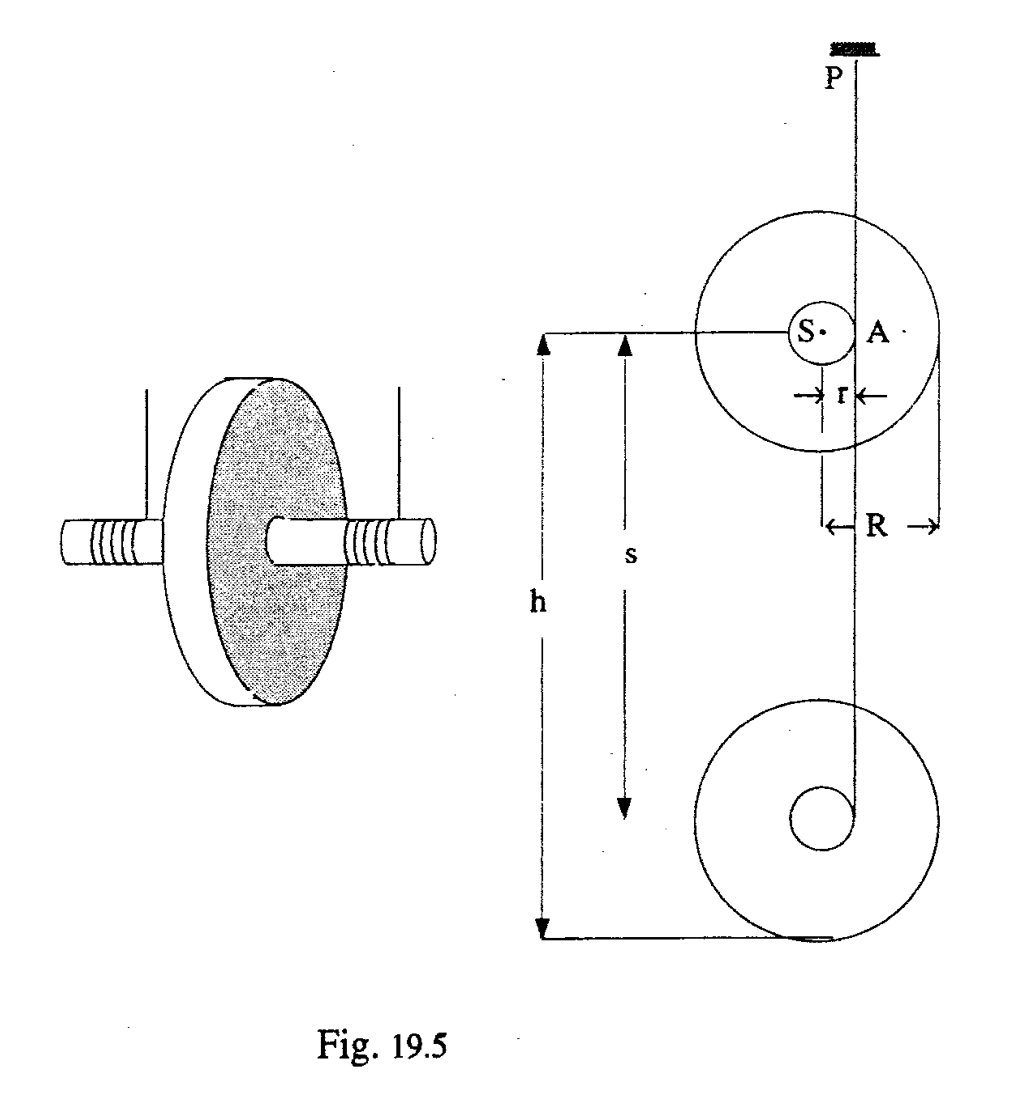
Fig. 19.5
Questions
2.1
Determine the angular speed of the wheel when the centre of mass of the wheel covers the vertical distance s.
2.2
Determine the kinetic energy of the linear motion of the centre of mass \(E_r\) after the wheel travels a distance s = 0,50 m, and calculate the ratio between \(E_r\) and the energy in any other form in this problem up to this point.
Radius of the axle = 0,0030 m
2.3
Determine the tension in the string while the wheel is moving downward.
2.4
Calculate the angular speed \(\omega'\) as a function of the angle \(\Phi\) when the strings begin to unwind themselves in opposite sense as depicted in fig. 19.6.
Sketch a graph of variables which describe the motion (in cartesian system which suits the problem) and also the speed of the centre of mass as a function of \(\Phi\).
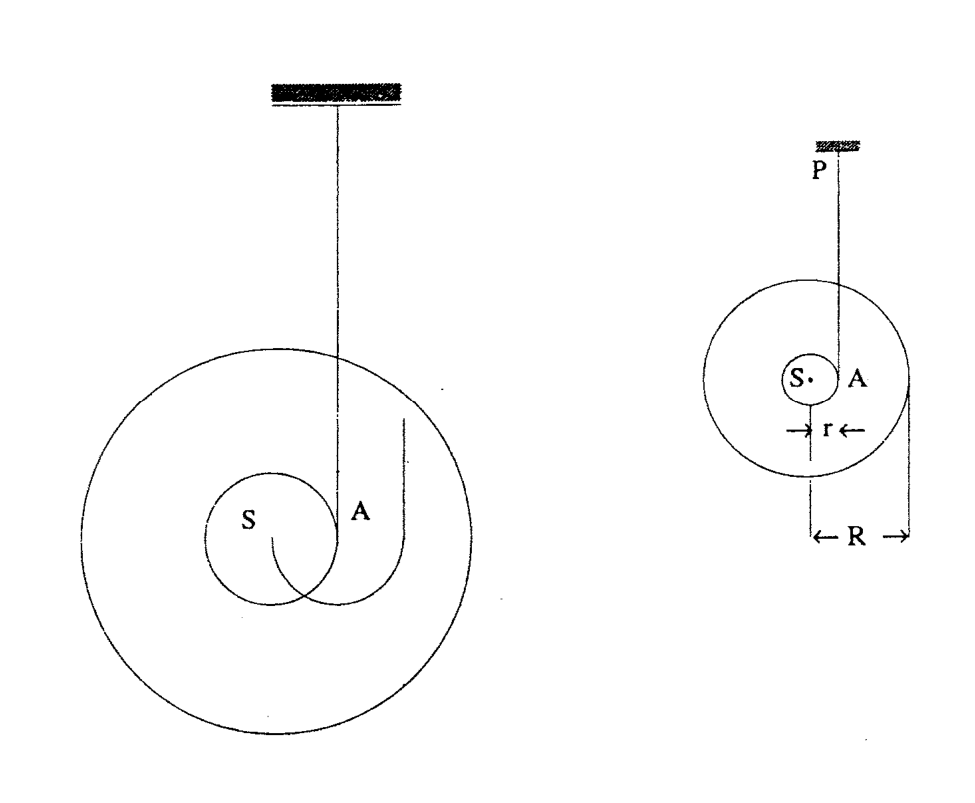
Fig. 19.6
2.5
If the string can withstand a maximum tension \(T_m=10\ \mathrm N\), find the maximum length of the string which may be unwound without breaking by the wheel.
Official English text of the problem.
Answers
Here \(r=0.0030\ \mathrm m\), and numerical evaluations use \(g=9.81\ \mathrm{m\,s^{-2}}\). For the reversal, let \(\ell\) be the preceding straight descent and define \(\Phi=0\) at entry, \(\Phi=\pi/2\) at the bottom, and \(\Phi=\pi\) at exit. Parts 2.4–2.5 use the fixed-contact, semicircular reversal depicted in Fig. 19.6; this is an idealization: except at \(\Phi=\pi/2\), the required contact force has a horizontal component, which vertical strings cannot supply.
-
2.1 \[ \boxed{\omega(s)=\sqrt{\frac{4gs}{R^2+2r^2}}.} \] At \(s=0.50\ \mathrm m\), \(\omega=73.6\ \mathrm{rad\,s^{-1}}\).
-
2.2 \[ \boxed{E_r=\frac{Mgs}{201}=9.76\times10^{-3}\ \mathrm J \simeq9.8\ \mathrm{mJ}.} \] With gravitational potential energy measured from the floor, \[ \boxed{E_r:E_{\rm rot}:U=1:200:201.} \] Thus \(E_r/E_{\rm rot}=1/200\), and \(E_r/(Mgs)=1/201\).
-
2.3 The tension in each string during ordinary downward unwinding is \[ \boxed{T=\frac{MgR^2}{2(R^2+2r^2)} =1.95\ \mathrm N\simeq2.0\ \mathrm N.} \]
-
2.4 \[ \boxed{\omega'(\Phi)= \sqrt{\frac{4g(\ell+r\sin\Phi)}{R^2+2r^2}}, \qquad 0\leq\Phi\leq\pi.} \] Taking the entry position of the centre as the origin, with \(x\) rightward and \(y\) upward, \[ \boxed{x=r(1-\cos\Phi),\qquad y=-r\sin\Phi,} \] \[ \boxed{v_x=r\omega'\sin\Phi,\qquad v_y=-r\omega'\cos\Phi,\qquad v=r\omega'.} \] The trajectory is a lower semicircle. The speed is symmetric about \(\pi/2\) and reaches its maximum there.
-
2.5 The strength-limited unwound length of each string is \[ \boxed{\ell_{\max} =\frac{R^2+2r^2}{4gr} \left(\frac{2T_m}{M}-g\right)-r =1.23\ \mathrm m\approx1.2\ \mathrm m.} \] The floor imposes a shorter limit in the stated setup: \[ \boxed{\ell\leq h-R-r=0.937\ \mathrm m\approx0.94\ \mathrm m.} \] At that limiting clearance, the peak tension is only \(8.1\ \mathrm N\) per string.
Solution
We assume release from rest, inextensible strings, no slipping during winding or unwinding, and negligible dissipative losses.
The wheel’s moment of inertia about its axle is \[ I=\frac12MR^2=7.2\times10^{-4}\ \mathrm{kg\,m^2}. \] The thickness \(d\) does not enter this moment of inertia. It is convenient to define \[ J=I+Mr^2=M\left(\frac{R^2}{2}+r^2\right). \] For the given dimensions, \[ \frac{I}{Mr^2}=\frac{R^2}{2r^2}=200, \qquad \frac{J}{Mr^2}=201. \]
2.1
When an angle \(d\theta\) unwinds, the centre descends by \(ds=r\,d\theta\). Therefore \[ v=r\omega. \]
Conservation of mechanical energy after a descent \(s\) gives \[ Mgs=\frac12Mv^2+\frac12I\omega^2 =\frac12(I+Mr^2)\omega^2. \] Consequently, \[ \boxed{\omega(s)= \sqrt{\frac{2Mgs}{I+Mr^2}} =\sqrt{\frac{4gs}{R^2+2r^2}}.} \]
Numerically, \[ \omega(s)= (104.1\ \mathrm{rad\,s^{-1}}) \sqrt{\frac{s}{1\ \mathrm m}}. \]
2.2
The translational kinetic energy is \[ E_r=\frac12Mv^2 =\frac12Mr^2\omega^2 =\frac{Mr^2}{J}Mgs =\frac{Mgs}{201}. \] At \(s=0.50\ \mathrm m\), \[ Mgs=0.40(9.81)(0.50)=1.962\ \mathrm J, \] so \[ \boxed{E_r=0.009761\ \mathrm J\simeq9.8\ \mathrm{mJ}.} \]
The rotational energy is \[ E_{\rm rot}=\frac12I\omega^2, \] and hence \[ \boxed{\frac{E_r}{E_{\rm rot}} =\frac{Mr^2}{I} =\frac1{200}.} \] Its numerical value is \[ E_{\rm rot}=1.95224\ \mathrm J. \]
The centre is now \(h-s=0.50\ \mathrm m\) above the floor. Taking the floor as the zero of gravitational potential energy, \[ U=Mg(h-s)=1.962\ \mathrm J. \] Thus the three energies present are in the ratio \[ \boxed{E_r:E_{\rm rot}:U=1:200:201.} \]
The initial energy was \(Mgh=3.924\ \mathrm J\), and the energy check is \[ 0.009761+1.952239+1.962=3.924\ \mathrm J. \] The translational energy is \(1/201\) of the gravitational energy released. If “energy in any other form” means the combined remaining rotational and gravitational energies, the corresponding ratio is \[ \frac{E_r}{E_{\rm rot}+U}=\frac1{401}. \]
2.3
Let \(T\) denote the tension in each string and take downward acceleration \(a\) as positive. Newton’s second law gives \[ Mg-2T=Ma. \] The two tensions produce the torque \[ 2Tr=I\alpha, \] while the unwinding condition gives \(a=r\alpha\). Therefore \[ 2T=\frac{I}{r^2}a, \] and \[ a=\frac{Mg}{M+I/r^2} =\frac{g}{201} =0.0488\ \mathrm{m\,s^{-2}}. \]
It follows that \[ \boxed{T=\frac{M(g-a)}2 =\frac{Mg}{2}\frac{200}{201} =1.95224\ \mathrm N.} \]
This tension is constant during the straight descent. The much larger force during reversal must be considered separately.
2.4
We interpret the curved trajectory in Fig. 19.6 as a short reversal during which the contact line through \(A\) is fixed and the centre \(S\) describes a semicircle of radius \(r\) about it. This imposed geometry is the reversal idealization used here.
Let \(\ell\) be the straight descent before the reversal. At entry, \[ \omega_0^2=\frac{2Mg\ell}{J}. \]
Choose the entry position of \(S\) as the origin, with \(x\) to the right and \(y\) upward. Then \(A=(r,0)\). Define \(\Phi\) to increase from \(0\) to \(\pi\) as the centre passes beneath \(A\). The coordinates are \[ \boxed{x=r(1-\cos\Phi),\qquad y=-r\sin\Phi.} \] They satisfy \[ (x-r)^2+y^2=r^2,\qquad y\leq0. \]
Since this is rotation about \(A\), \[ \dot\Phi=\omega',\qquad v=r\omega'. \] The moment of inertia about the contact line is \(J=I+Mr^2\). The centre has descended an additional distance \(r\sin\Phi\), so conservation of energy gives \[ \frac12J\omega'^2 =\frac12J\omega_0^2+Mgr\sin\Phi. \] Therefore \[ \boxed{\omega'(\Phi) =\sqrt{\omega_0^2+\frac{2Mgr}{J}\sin\Phi} =\sqrt{\frac{4g(\ell+r\sin\Phi)}{R^2+2r^2}}.} \]
Differentiating the coordinates, \[ \boxed{v_x=r\omega'\sin\Phi,\qquad v_y=-r\omega'\cos\Phi.} \] Thus \[ \boxed{v(\Phi)=r\omega'(\Phi) =v_0\sqrt{1+\frac r\ell\sin\Phi}}, \qquad v_0=r\omega_0. \]
The angular acceleration, useful for the force calculation, is \[ \boxed{\ddot\Phi=\frac{Mgr}{J}\cos\Phi.} \]
The requested sketches can be specified as follows:
| \(\Phi\) | \(x\) | \(y\) | \(v_x\) | \(v_y\) | Speed |
|---|---|---|---|---|---|
| \(0\) | \(0\) | \(0\) | \(0\) | \(-v_0\) | \(v_0\) |
| \(\pi/2\) | \(r\) | \(-r\) | \(v_{\max}\) | \(0\) | \(v_{\max}\) |
| \(\pi\) | \(2r\) | \(0\) | \(0\) | \(+v_0\) | \(v_0\) |
Here \[ v_{\max}=v_0\sqrt{1+\frac r\ell}, \qquad \omega'_{\max}=\omega_0\sqrt{1+\frac r\ell}. \]
The spatial path consists of a vertical descent, a lower semicircle of radius \(r=3.0\ \mathrm{mm}\), and a vertical ascent displaced horizontally by \(2r=6.0\ \mathrm{mm}\). As functions of \(\Phi\), \(x\) increases smoothly from \(0\) to \(2r\), while \(y\) is a negative half-sine with minimum \(-r\). Both \(v\) and \(\omega'\) form symmetric arches, with equal endpoint values and their maxima at \(\pi/2\).
At the bottom, the vertical velocity is zero, but the speed is maximal: in this semicircular model, the centre is then moving horizontally.
2.5
At the midpoint of the reversal, the centre lies directly below \(A\). Its tangential acceleration vanishes because \(\cos\Phi=0\), and its acceleration is vertically upward: \[ a_{\rm bottom}=\frac{v_{\max}^2}{r} =r\omega_{\max}'^{\,2}. \] The vertical force equation is therefore \[ 2T_{\rm peak}-Mg=Mr\omega_{\max}'^{\,2}. \] Using the result of 2.4, \[ \omega_{\max}'^{\,2} =\frac{2Mg(\ell+r)}{J}, \] we obtain \[ \boxed{T_{\rm peak} =\frac{Mg}{2} +\frac{M^2gr(\ell+r)}{J}.} \]
The bottom is indeed the point of maximum constraint load in the fixed-\(A\) model. To check this, put \[ \epsilon=\frac{Mr^2}{J},\qquad b=\frac{r\omega_0^2}{g},\qquad u=\sin\Phi. \] Resolving the total contact reaction \(F\) into radial and tangential components gives \[ \frac{F^2}{M^2g^2} =b^2+(1-\epsilon)^2 +2b(1+2\epsilon)u +3\epsilon(2+\epsilon)u^2. \] All coefficients of \(u\) and \(u^2\) are nonnegative, so the maximum occurs at \(u=1\), where the reaction is vertical and shared equally by the strings.
Setting the peak tension in each string equal to \(T_m\), \[ 2T_m=Mg+\frac{2M^2gr(\ell_{\max}+r)}{J}. \] Hence \[ \boxed{\ell_{\max} =\frac{J(2T_m-Mg)}{2M^2gr}-r =\frac{R^2+2r^2}{4gr} \left(\frac{2T_m}{M}-g\right)-r.} \]
Numerically, \[ \ell_{\max} =\frac{0.060^2+2(0.0030)^2}{4(9.81)(0.0030)} \left(\frac{20}{0.40}-9.81\right)-0.0030 =1.2322\ \mathrm m. \] Thus the string-strength limit is approximately \[ \boxed{\ell_{\max}\simeq1.2\ \mathrm m.} \]
There is also a geometric restriction from the floor. During the reversal, the minimum centre height is \(h-\ell-r\). To keep the wheel above the floor, \[ h-\ell-r\geq R, \] so \[ \boxed{\ell\leq h-R-r=0.937\ \mathrm m\simeq0.94\ \mathrm m.} \] Substituting this length into the peak-tension formula gives \[ T_{\rm peak}=8.08\ \mathrm N<10\ \mathrm N. \] Consequently, the floor limits the available unwinding before the string-strength limit is reached.
The solution was checked against the official solution. Where this solution differs from the official solution, the official solution contains an error or a misprint.
IPhO 1988 · Theorieaufgabe 2
Maxwellsches Rad
Einleitung
Ein zylindrisches Rad mit gleichmäßiger Dichte, der Masse M = 0,40 kg, dem Radius R = 0,060 m und der Dicke d = 0,010 m ist an zwei leichten Fäden gleicher Länge an der Decke aufgehängt. Jeder Faden ist um die Achse des Rades gewickelt. Wie die Masse der Fäden ist auch die Masse der Achse vernachlässigbar. Durch Drehen des Rades von Hand werden die Fäden aufgewickelt, bis der Schwerpunkt auf eine Höhe von 1,0 m über dem Boden angehoben ist. Lässt man das Rad unter dem Einfluss der Schwerkraft senkrecht nach unten laufen, so werden die Fäden über ihre gesamte Länge abgewickelt, und das Rad erreicht seinen tiefsten Punkt. Anschließend beginnen sich die Fäden in entgegengesetzter Richtung aufzuwickeln, wodurch das Rad wieder angehoben wird.
Untersuchen und beantworten Sie die folgenden Fragen unter der Annahme, dass die Fäden senkrecht verlaufen und die Berührungspunkte der Fäden mit der Achse unmittelbar unter den jeweiligen Aufhängepunkten liegen (siehe Abb. 19.5).
Abb. 19.5
Fragen
2.1
Bestimmen Sie die Winkelgeschwindigkeit des Rades, wenn sein Schwerpunkt die vertikale Strecke s zurückgelegt hat.
2.2
Bestimmen Sie die kinetische Energie der Translationsbewegung des Schwerpunkts \(E_r\), nachdem das Rad eine Strecke s = 0,50 m zurückgelegt hat, und berechnen Sie das Verhältnis zwischen \(E_r\) und der bis zu diesem Zeitpunkt in jeder anderen Form vorliegenden Energie in dieser Aufgabe.
Radius der Achse = 0,0030 m
2.3
Bestimmen Sie die Fadenspannung, während sich das Rad abwärts bewegt.
2.4
Berechnen Sie die Winkelgeschwindigkeit \(\omega'\) als Funktion des Winkels \(\Phi\), wenn die Fäden beginnen, sich in entgegengesetzter Richtung abzuwickeln, wie in Abb. 19.6 dargestellt.
Skizzieren Sie die Größen, die die Bewegung beschreiben (in einem für die Aufgabe geeigneten kartesischen Koordinatensystem), sowie den Betrag der Geschwindigkeit des Schwerpunkts als Funktion von \(\Phi\).
Abb. 19.6
2.5
Wenn der Faden einer maximalen Spannung von \(T_m=10\ \mathrm N\) standhält, bestimmen Sie die maximale Fadenlänge, die durch das Rad abgewickelt werden kann, ohne dass der Faden reißt.
Aufgabentext aus dem offiziellen englischen Text übersetzt.
Antworten
Hier ist \(r=0.0030\ \mathrm m\); für die numerischen Auswertungen wird \(g=9.81\ \mathrm{m\,s^{-2}}\) verwendet. Für die Bewegungsumkehr sei \(\ell\) die vorangegangene geradlinige Abwärtsstrecke; wir definieren \(\Phi=0\) beim Eintritt, \(\Phi=\pi/2\) am tiefsten Punkt und \(\Phi=\pi\) beim Austritt. In den Teilen 2.4–2.5 wird die in Abb. 19.6 dargestellte halbkreisförmige Bewegungsumkehr mit festem Kontaktpunkt verwendet; dies ist eine Idealisierung: Außer bei \(\Phi=\pi/2\) hat die erforderliche Kontaktkraft eine horizontale Komponente, die senkrechte Fäden nicht aufbringen können.
-
2.1 \[ \boxed{\omega(s)=\sqrt{\frac{4gs}{R^2+2r^2}}.} \] Bei \(s=0.50\ \mathrm m\) ist \(\omega=73.6\ \mathrm{rad\,s^{-1}}\).
-
2.2 \[ \boxed{E_r=\frac{Mgs}{201}=9.76\times10^{-3}\ \mathrm J \simeq9.8\ \mathrm{mJ}.} \] Wird die potenzielle Energie im Schwerefeld vom Boden aus gemessen, gilt \[ \boxed{E_r:E_{\rm rot}:U=1:200:201.} \] Somit sind \(E_r/E_{\rm rot}=1/200\) und \(E_r/(Mgs)=1/201\).
-
2.3 Die Spannung in jedem Faden beim gewöhnlichen Abwickeln während der Abwärtsbewegung beträgt \[ \boxed{T=\frac{MgR^2}{2(R^2+2r^2)} =1.95\ \mathrm N\simeq2.0\ \mathrm N.} \]
-
2.4 \[ \boxed{\omega'(\Phi)= \sqrt{\frac{4g(\ell+r\sin\Phi)}{R^2+2r^2}}, \qquad 0\leq\Phi\leq\pi.} \] Wählt man die Position des Mittelpunkts beim Eintritt als Ursprung, wobei \(x\) nach rechts und \(y\) nach oben gerichtet ist, gilt \[ \boxed{x=r(1-\cos\Phi),\qquad y=-r\sin\Phi,} \] \[ \boxed{v_x=r\omega'\sin\Phi,\qquad v_y=-r\omega'\cos\Phi,\qquad v=r\omega'.} \] Die Bahn ist ein unterer Halbkreis. Der Geschwindigkeitsbetrag ist symmetrisch bezüglich \(\pi/2\) und erreicht dort sein Maximum.
-
2.5 Die durch die Reißfestigkeit begrenzte abgewickelte Länge jedes Fadens beträgt \[ \boxed{\ell_{\max} =\frac{R^2+2r^2}{4gr} \left(\frac{2T_m}{M}-g\right)-r =1.23\ \mathrm m\approx1.2\ \mathrm m.} \] Im beschriebenen Aufbau ergibt sich durch den Boden eine kleinere Grenzlänge: \[ \boxed{\ell\leq h-R-r=0.937\ \mathrm m\approx0.94\ \mathrm m.} \] Bei diesem gerade noch ausreichenden Bodenabstand beträgt die maximale Spannung nur \(8.1\ \mathrm N\) pro Faden.
Lösung
Wir nehmen an, dass das Rad aus der Ruhe losgelassen wird, die Fäden undehnbar sind, beim Auf- und Abwickeln kein Gleiten auftritt und dissipative Verluste vernachlässigbar sind.
Das Trägheitsmoment des Rades bezüglich seiner Achse beträgt \[ I=\frac12MR^2=7.2\times10^{-4}\ \mathrm{kg\,m^2}. \] Die Dicke \(d\) geht in dieses Trägheitsmoment nicht ein. Zweckmäßigerweise definieren wir \[ J=I+Mr^2=M\left(\frac{R^2}{2}+r^2\right). \] Für die gegebenen Abmessungen gilt \[ \frac{I}{Mr^2}=\frac{R^2}{2r^2}=200, \qquad \frac{J}{Mr^2}=201. \]
2.1
Beim Abwickeln um einen Winkel \(d\theta\) sinkt der Mittelpunkt um \(ds=r\,d\theta\). Daher gilt \[ v=r\omega. \]
Aus der Erhaltung der mechanischen Energie nach einer Abwärtsstrecke \(s\) folgt \[ Mgs=\frac12Mv^2+\frac12I\omega^2 =\frac12(I+Mr^2)\omega^2. \] Folglich ist \[ \boxed{\omega(s)= \sqrt{\frac{2Mgs}{I+Mr^2}} =\sqrt{\frac{4gs}{R^2+2r^2}}.} \]
Numerisch ergibt sich \[ \omega(s)= (104.1\ \mathrm{rad\,s^{-1}}) \sqrt{\frac{s}{1\ \mathrm m}}. \]
2.2
Die kinetische Energie der Translationsbewegung beträgt \[ E_r=\frac12Mv^2 =\frac12Mr^2\omega^2 =\frac{Mr^2}{J}Mgs =\frac{Mgs}{201}. \] Bei \(s=0.50\ \mathrm m\) gilt \[ Mgs=0.40(9.81)(0.50)=1.962\ \mathrm J, \] also \[ \boxed{E_r=0.009761\ \mathrm J\simeq9.8\ \mathrm{mJ}.} \]
Die Rotationsenergie beträgt \[ E_{\rm rot}=\frac12I\omega^2, \] und damit gilt \[ \boxed{\frac{E_r}{E_{\rm rot}} =\frac{Mr^2}{I} =\frac1{200}.} \] Ihr Zahlenwert ist \[ E_{\rm rot}=1.95224\ \mathrm J. \]
Der Mittelpunkt befindet sich nun \(h-s=0.50\ \mathrm m\) über dem Boden. Wählt man den Boden als Nullniveau der potenziellen Energie im Schwerefeld, gilt \[ U=Mg(h-s)=1.962\ \mathrm J. \] Somit stehen die drei vorhandenen Energien im Verhältnis \[ \boxed{E_r:E_{\rm rot}:U=1:200:201.} \]
Die Anfangsenergie betrug \(Mgh=3.924\ \mathrm J\), und die Kontrolle der Energiebilanz ergibt \[ 0.009761+1.952239+1.962=3.924\ \mathrm J. \] Die Translationsenergie beträgt \(1/201\) der freigesetzten potenziellen Energie. Wenn mit „Energie in jeder anderen Form“ die Summe der verbleibenden Rotationsenergie und potenziellen Energie im Schwerefeld gemeint ist, lautet das entsprechende Verhältnis \[ \frac{E_r}{E_{\rm rot}+U}=\frac1{401}. \]
2.3
Sei \(T\) die Spannung in jedem Faden, und die nach unten gerichtete Beschleunigung \(a\) sei positiv. Das zweite Newtonsche Gesetz liefert \[ Mg-2T=Ma. \] Die beiden Fadenspannungen erzeugen das Drehmoment \[ 2Tr=I\alpha, \] während aus der Abwickelbedingung \(a=r\alpha\) folgt. Daher gilt \[ 2T=\frac{I}{r^2}a, \] und \[ a=\frac{Mg}{M+I/r^2} =\frac{g}{201} =0.0488\ \mathrm{m\,s^{-2}}. \]
Daraus folgt \[ \boxed{T=\frac{M(g-a)}2 =\frac{Mg}{2}\frac{200}{201} =1.95224\ \mathrm N.} \]
Diese Spannung ist während der geradlinigen Abwärtsbewegung konstant. Die wesentlich größere Kraft während der Bewegungsumkehr muss gesondert betrachtet werden.
2.4
Wir deuten die gekrümmte Bahn in Abb. 19.6 als eine kurze Bewegungsumkehr, während der die Kontaktlinie durch \(A\) fest bleibt und der Mittelpunkt \(S\) einen Halbkreis mit dem Radius \(r\) um sie beschreibt. Diese vorgegebene Geometrie ist die hier verwendete Idealisierung der Bewegungsumkehr.
Sei \(\ell\) die geradlinige Abwärtsstrecke vor der Bewegungsumkehr. Beim Eintritt gilt \[ \omega_0^2=\frac{2Mg\ell}{J}. \]
Wir wählen die Position von \(S\) beim Eintritt als Ursprung, wobei \(x\) nach rechts und \(y\) nach oben gerichtet ist. Dann ist \(A=(r,0)\). Wir definieren \(\Phi\) so, dass der Winkel von \(0\) bis \(\pi\) zunimmt, während der Mittelpunkt unter \(A\) hindurchläuft. Die Koordinaten lauten \[ \boxed{x=r(1-\cos\Phi),\qquad y=-r\sin\Phi.} \] Sie erfüllen \[ (x-r)^2+y^2=r^2,\qquad y\leq0. \]
Da es sich um eine Drehung um \(A\) handelt, gilt \[ \dot\Phi=\omega',\qquad v=r\omega'. \] Das Trägheitsmoment bezüglich der Kontaktlinie ist \(J=I+Mr^2\). Der Mittelpunkt ist um die zusätzliche Strecke \(r\sin\Phi\) abgesunken, sodass aus der Energieerhaltung folgt \[ \frac12J\omega'^2 =\frac12J\omega_0^2+Mgr\sin\Phi. \] Daher gilt \[ \boxed{\omega'(\Phi) =\sqrt{\omega_0^2+\frac{2Mgr}{J}\sin\Phi} =\sqrt{\frac{4g(\ell+r\sin\Phi)}{R^2+2r^2}}.} \]
Durch Differenzieren der Koordinaten ergibt sich \[ \boxed{v_x=r\omega'\sin\Phi,\qquad v_y=-r\omega'\cos\Phi.} \] Somit ist \[ \boxed{v(\Phi)=r\omega'(\Phi) =v_0\sqrt{1+\frac r\ell\sin\Phi}}, \qquad v_0=r\omega_0. \]
Die für die Kraftberechnung nützliche Winkelbeschleunigung beträgt \[ \boxed{\ddot\Phi=\frac{Mgr}{J}\cos\Phi.} \]
Die geforderten Skizzen lassen sich wie folgt angeben:
| \(\Phi\) | \(x\) | \(y\) | \(v_x\) | \(v_y\) | Geschwindigkeitsbetrag |
|---|---|---|---|---|---|
| \(0\) | \(0\) | \(0\) | \(0\) | \(-v_0\) | \(v_0\) |
| \(\pi/2\) | \(r\) | \(-r\) | \(v_{\max}\) | \(0\) | \(v_{\max}\) |
| \(\pi\) | \(2r\) | \(0\) | \(0\) | \(+v_0\) | \(v_0\) |
Hier gilt \[ v_{\max}=v_0\sqrt{1+\frac r\ell}, \qquad \omega'_{\max}=\omega_0\sqrt{1+\frac r\ell}. \]
Die räumliche Bahn besteht aus einer senkrechten Abwärtsbewegung, einem unteren Halbkreis mit dem Radius \(r=3.0\ \mathrm{mm}\) und einer senkrechten Aufwärtsbewegung, die horizontal um \(2r=6.0\ \mathrm{mm}\) versetzt ist. Als Funktion von \(\Phi\) nimmt \(x\) glatt von \(0\) bis \(2r\) zu, während \(y\) eine negative Sinushalbwelle mit dem Minimum \(-r\) beschreibt. Sowohl \(v\) als auch \(\omega'\) bilden symmetrische Bögen mit gleichen Werten an den Endpunkten und ihren Maxima bei \(\pi/2\).
Am tiefsten Punkt ist die vertikale Geschwindigkeit null, der Geschwindigkeitsbetrag jedoch maximal: In diesem Halbkreismodell bewegt sich der Mittelpunkt dann horizontal.
2.5
In der Mitte der Bewegungsumkehr liegt der Mittelpunkt unmittelbar unter \(A\). Seine Tangentialbeschleunigung verschwindet, weil \(\cos\Phi=0\) ist, und seine Beschleunigung ist senkrecht nach oben gerichtet: \[ a_{\rm bottom}=\frac{v_{\max}^2}{r} =r\omega_{\max}'^{\,2}. \] Die vertikale Kräftegleichung lautet daher \[ 2T_{\rm peak}-Mg=Mr\omega_{\max}'^{\,2}. \] Mit dem Ergebnis aus 2.4, \[ \omega_{\max}'^{\,2} =\frac{2Mg(\ell+r)}{J}, \] erhalten wir \[ \boxed{T_{\rm peak} =\frac{Mg}{2} +\frac{M^2gr(\ell+r)}{J}.} \]
Im Modell mit festem \(A\) ist der tiefste Punkt tatsächlich der Punkt mit der größten Zwangskraft. Zur Überprüfung setzen wir \[ \epsilon=\frac{Mr^2}{J},\qquad b=\frac{r\omega_0^2}{g},\qquad u=\sin\Phi. \] Die Zerlegung der gesamten Kontaktkraft \(F\) in eine radiale und eine tangentiale Komponente ergibt \[ \frac{F^2}{M^2g^2} =b^2+(1-\epsilon)^2 +2b(1+2\epsilon)u +3\epsilon(2+\epsilon)u^2. \] Alle Koeffizienten von \(u\) und \(u^2\) sind nichtnegativ, sodass das Maximum bei \(u=1\) auftritt; dort ist die Kontaktkraft vertikal gerichtet und verteilt sich gleichmäßig auf die beiden Fäden.
Setzt man die maximale Spannung in jedem Faden gleich \(T_m\), ergibt sich \[ 2T_m=Mg+\frac{2M^2gr(\ell_{\max}+r)}{J}. \] Damit folgt \[ \boxed{\ell_{\max} =\frac{J(2T_m-Mg)}{2M^2gr}-r =\frac{R^2+2r^2}{4gr} \left(\frac{2T_m}{M}-g\right)-r.} \]
Numerisch ergibt sich \[ \ell_{\max} =\frac{0.060^2+2(0.0030)^2}{4(9.81)(0.0030)} \left(\frac{20}{0.40}-9.81\right)-0.0030 =1.2322\ \mathrm m. \] Die durch die Reißfestigkeit des Fadens gesetzte Grenze beträgt somit ungefähr \[ \boxed{\ell_{\max}\simeq1.2\ \mathrm m.} \]
Außerdem gibt es eine geometrische Einschränkung durch den Boden. Während der Bewegungsumkehr beträgt die minimale Höhe des Mittelpunkts \(h-\ell-r\). Damit das Rad über dem Boden bleibt, muss \[ h-\ell-r\geq R, \] gelten, also \[ \boxed{\ell\leq h-R-r=0.937\ \mathrm m\simeq0.94\ \mathrm m.} \] Setzt man diese Länge in die Formel für die maximale Fadenspannung ein, erhält man \[ T_{\rm peak}=8.08\ \mathrm N<10\ \mathrm N. \] Folglich begrenzt der Boden die mögliche Abwickelstrecke, bevor die durch die Reißfestigkeit des Fadens gesetzte Grenze erreicht wird.
Die Lösung wurde mit der offiziellen Lösung abgeglichen. Wo diese Lösung von der offiziellen Lösung abweicht, enthält die offizielle Lösung einen Fehler oder Druckfehler.
IPhO 1988 · Teori sorusu 2
Maxwell Tekerleği
Giriş
Kütlesi M = 0,40 kg, yarıçapı R = 0,060 m ve kalınlığı d = 0,010 m olan, düzgün yoğunluklu silindirik bir tekerlek, eşit uzunlukta iki hafif ip yardımıyla tavana asılmıştır. Her bir ip tekerleğin miline sarılmıştır. İpler gibi milin kütlesi de ihmal edilebilir. Tekerlek elle döndürülerek ipler, kütle merkezi yerden 1,0 m yüksekliğe çıkıncaya kadar sarılır. Tekerlek, yer çekiminin etkisiyle düşey doğrultuda aşağı doğru hareket etmek üzere serbest bırakılırsa ipler tüm uzunlukları boyunca açılır ve tekerlek en alt noktaya ulaşır. Ardından ipler ters yönde sarılmaya başlar ve bunun sonucunda tekerlek yukarı doğru yükselir.
İplerin düşey konumda olduğunu ve iplerin mile temas ettiği noktaların, ilgili asılma noktalarının tam altında bulunduğunu varsayarak aşağıdaki soruları inceleyip yanıtlayınız (bkz. Şekil 19.5).
Şekil 19.5
Sorular
2.1
Tekerleğin kütle merkezi düşey doğrultuda s mesafesini katettiğinde tekerleğin açısal hızını bulunuz.
2.2
Tekerlek s = 0,50 m mesafesini katettikten sonra kütle merkezinin doğrusal hareketinin kinetik enerjisini \(E_r\) bulunuz ve \(E_r\) ile bu problemde bu ana kadar başka herhangi bir biçimde bulunan enerji arasındaki oranı hesaplayınız.
Milin yarıçapı = 0,0030 m
2.3
Tekerlek aşağı doğru hareket ederken ipteki gerilme kuvvetini bulunuz.
2.4
İpler Şekil 19.6'da gösterildiği gibi ters yönde açılmaya başladığında açısal hızı \(\omega'\), \(\Phi\) açısının bir fonksiyonu olarak hesaplayınız.
Hareketi betimleyen değişkenlerin grafiğini (probleme uygun bir Kartezyen koordinat sisteminde) ve ayrıca kütle merkezinin süratinin \(\Phi\)'ye bağlı grafiğini çiziniz.
Şekil 19.6
2.5
İp en fazla \(T_m=10\ \mathrm N\) gerilme kuvvetine dayanabiliyorsa tekerleğin koparmadan açabileceği en büyük ip uzunluğunu bulunuz.
Soru metni resmi İngilizce metinden çevrilmiştir.
Cevaplar
Burada \(r=0.0030\ \mathrm m\) olup sayısal hesaplamalarda \(g=9.81\ \mathrm{m\,s^{-2}}\) kullanılmıştır. Yön değiştirme için \(\ell\), önceki doğrusal iniş mesafesi olsun; girişte \(\Phi=0\), en alt noktada \(\Phi=\pi/2\) ve çıkışta \(\Phi=\pi\) olarak tanımlansın. 2.4–2.5 bölümlerinde, Şekil 19.6'da gösterilen sabit temaslı, yarım çember biçimindeki yön değiştirme kullanılır; bu bir idealleştirmedir: \(\Phi=\pi/2\) dışında gereken temas tepki kuvvetinin yatay bir bileşeni vardır ve düşey ipler bu bileşeni sağlayamaz.
-
2.1 \[ \boxed{\omega(s)=\sqrt{\frac{4gs}{R^2+2r^2}}.} \] \(s=0.50\ \mathrm m\) için \(\omega=73.6\ \mathrm{rad\,s^{-1}}\) olur.
-
2.2 \[ \boxed{E_r=\frac{Mgs}{201}=9.76\times10^{-3}\ \mathrm J \simeq9.8\ \mathrm{mJ}.} \] Yer çekimi potansiyel enerjisi yere göre ölçüldüğünde, \[ \boxed{E_r:E_{\rm rot}:U=1:200:201.} \] Dolayısıyla \(E_r/E_{\rm rot}=1/200\) ve \(E_r/(Mgs)=1/201\) olur.
-
2.3 Aşağı doğru olağan açılma sırasında her bir ipteki gerilme kuvveti \[ \boxed{T=\frac{MgR^2}{2(R^2+2r^2)} =1.95\ \mathrm N\simeq2.0\ \mathrm N.} \]
-
2.4 \[ \boxed{\omega'(\Phi)= \sqrt{\frac{4g(\ell+r\sin\Phi)}{R^2+2r^2}}, \qquad 0\leq\Phi\leq\pi.} \] Merkezin giriş konumu başlangıç noktası, \(x\) sağa ve \(y\) yukarı yönlü alınırsa, \[ \boxed{x=r(1-\cos\Phi),\qquad y=-r\sin\Phi,} \] \[ \boxed{v_x=r\omega'\sin\Phi,\qquad v_y=-r\omega'\cos\Phi,\qquad v=r\omega'.} \] Yörünge bir alt yarım çemberdir. Sürat, \(\pi/2\)'ye göre simetriktir ve en büyük değerine burada ulaşır.
-
2.5 Her bir ipin dayanımının izin verdiği en büyük açılma uzunluğu \[ \boxed{\ell_{\max} =\frac{R^2+2r^2}{4gr} \left(\frac{2T_m}{M}-g\right)-r =1.23\ \mathrm m\approx1.2\ \mathrm m.} \] Verilen düzenekte yer, daha kısa bir sınır getirir: \[ \boxed{\ell\leq h-R-r=0.937\ \mathrm m\approx0.94\ \mathrm m.} \] Yere olan açıklığın bu sınır değerinde, en büyük gerilme kuvveti ip başına yalnızca \(8.1\ \mathrm N\) olur.
Çözüm
Tekerleğin durgun hâlden serbest bırakıldığını, iplerin uzamadığını, sarılma veya açılma sırasında kayma olmadığını ve enerji kayıplarının ihmal edilebilir olduğunu varsayıyoruz.
Tekerleğin mili etrafındaki eylemsizlik momenti \[ I=\frac12MR^2=7.2\times10^{-4}\ \mathrm{kg\,m^2}. \] Kalınlık \(d\), bu eylemsizlik momenti ifadesinde yer almaz. Şu tanımı yapmak kullanışlıdır: \[ J=I+Mr^2=M\left(\frac{R^2}{2}+r^2\right). \] Verilen boyutlar için, \[ \frac{I}{Mr^2}=\frac{R^2}{2r^2}=200, \qquad \frac{J}{Mr^2}=201. \]
2.1
İp \(d\theta\) açısı kadar açıldığında merkez \(ds=r\,d\theta\) kadar alçalır. Dolayısıyla \[ v=r\omega. \]
\(s\) kadar inişten sonra mekanik enerjinin korunumu \[ Mgs=\frac12Mv^2+\frac12I\omega^2 =\frac12(I+Mr^2)\omega^2. \] bağıntısını verir. Sonuç olarak, \[ \boxed{\omega(s)= \sqrt{\frac{2Mgs}{I+Mr^2}} =\sqrt{\frac{4gs}{R^2+2r^2}}.} \]
Sayısal olarak, \[ \omega(s)= (104.1\ \mathrm{rad\,s^{-1}}) \sqrt{\frac{s}{1\ \mathrm m}}. \]
2.2
Öteleme kinetik enerjisi \[ E_r=\frac12Mv^2 =\frac12Mr^2\omega^2 =\frac{Mr^2}{J}Mgs =\frac{Mgs}{201}. \] \(s=0.50\ \mathrm m\) için, \[ Mgs=0.40(9.81)(0.50)=1.962\ \mathrm J, \] dolayısıyla \[ \boxed{E_r=0.009761\ \mathrm J\simeq9.8\ \mathrm{mJ}.} \]
Dönme enerjisi \[ E_{\rm rot}=\frac12I\omega^2, \] olduğundan, \[ \boxed{\frac{E_r}{E_{\rm rot}} =\frac{Mr^2}{I} =\frac1{200}.} \] Bunun sayısal değeri \[ E_{\rm rot}=1.95224\ \mathrm J. \]
Merkez artık yerden \(h-s=0.50\ \mathrm m\) yüksektedir. Yer çekimi potansiyel enerjisinin sıfırı yer seviyesi alınırsa, \[ U=Mg(h-s)=1.962\ \mathrm J. \] Böylece mevcut üç enerjinin oranı \[ \boxed{E_r:E_{\rm rot}:U=1:200:201.} \]
Başlangıç enerjisi \(Mgh=3.924\ \mathrm J\) idi ve enerji denetimi \[ 0.009761+1.952239+1.962=3.924\ \mathrm J. \] şeklindedir. Öteleme enerjisi, açığa çıkan yer çekimi enerjisinin \(1/201\)'idir. “Başka herhangi bir biçimde bulunan enerji” ile geriye kalan dönme ve yer çekimi enerjilerinin toplamı kastediliyorsa buna karşılık gelen oran \[ \frac{E_r}{E_{\rm rot}+U}=\frac1{401}. \]
2.3
Her bir ipteki gerilme kuvvetini \(T\) ile gösterelim ve aşağı yönlü \(a\) ivmesini pozitif alalım. Newton'un ikinci yasası \[ Mg-2T=Ma. \] bağıntısını verir. İki gerilme kuvvetinin oluşturduğu tork \[ 2Tr=I\alpha, \] iken açılma koşulu \(a=r\alpha\) bağıntısını verir. Dolayısıyla \[ 2T=\frac{I}{r^2}a, \] ve \[ a=\frac{Mg}{M+I/r^2} =\frac{g}{201} =0.0488\ \mathrm{m\,s^{-2}}. \]
Buradan \[ \boxed{T=\frac{M(g-a)}2 =\frac{Mg}{2}\frac{200}{201} =1.95224\ \mathrm N.} \] elde edilir.
Bu gerilme kuvveti doğrusal iniş boyunca sabittir. Yön değiştirme sırasındaki çok daha büyük kuvvet ayrıca ele alınmalıdır.
2.4
Şekil 19.6'daki eğri yörüngeyi, \(A\)'dan geçen temas doğrusunun sabit kaldığı ve \(S\) merkezinin bu doğrunun çevresinde \(r\) yarıçaplı bir yarım çember çizdiği kısa bir yön değiştirme olarak yorumluyoruz. Burada kullanılan yön değiştirme idealleştirmesi, dayatılan bu geometriye dayanır.
Yön değiştirmeden önceki doğrusal iniş mesafesi \(\ell\) olsun. Girişte, \[ \omega_0^2=\frac{2Mg\ell}{J}. \]
\(S\)'nin giriş konumunu başlangıç noktası olarak seçelim; \(x\) sağa, \(y\) yukarı yönlü olsun. Bu durumda \(A=(r,0)\) olur. \(\Phi\)'yi, merkez \(A\)'nın altından geçerken \(0\)'dan \(\pi\)'ye artacak şekilde tanımlayalım. Koordinatlar \[ \boxed{x=r(1-\cos\Phi),\qquad y=-r\sin\Phi.} \] Bu koordinatlar \[ (x-r)^2+y^2=r^2,\qquad y\leq0. \] bağıntılarını sağlar.
Bu hareket \(A\) etrafında bir dönme olduğundan, \[ \dot\Phi=\omega',\qquad v=r\omega'. \] Temas doğrusu etrafındaki eylemsizlik momenti \(J=I+Mr^2\) olur. Merkez ek olarak \(r\sin\Phi\) kadar alçaldığından enerjinin korunumu \[ \frac12J\omega'^2 =\frac12J\omega_0^2+Mgr\sin\Phi. \] bağıntısını verir. Dolayısıyla \[ \boxed{\omega'(\Phi) =\sqrt{\omega_0^2+\frac{2Mgr}{J}\sin\Phi} =\sqrt{\frac{4g(\ell+r\sin\Phi)}{R^2+2r^2}}.} \]
Koordinatların türevini alırsak, \[ \boxed{v_x=r\omega'\sin\Phi,\qquad v_y=-r\omega'\cos\Phi.} \] Böylece \[ \boxed{v(\Phi)=r\omega'(\Phi) =v_0\sqrt{1+\frac r\ell\sin\Phi}}, \qquad v_0=r\omega_0. \]
Kuvvet hesabında yararlı olan açısal ivme \[ \boxed{\ddot\Phi=\frac{Mgr}{J}\cos\Phi.} \]
İstenen grafikler aşağıdaki gibi belirtilebilir:
| \(\Phi\) | \(x\) | \(y\) | \(v_x\) | \(v_y\) | Sürat |
|---|---|---|---|---|---|
| \(0\) | \(0\) | \(0\) | \(0\) | \(-v_0\) | \(v_0\) |
| \(\pi/2\) | \(r\) | \(-r\) | \(v_{\max}\) | \(0\) | \(v_{\max}\) |
| \(\pi\) | \(2r\) | \(0\) | \(0\) | \(+v_0\) | \(v_0\) |
Burada \[ v_{\max}=v_0\sqrt{1+\frac r\ell}, \qquad \omega'_{\max}=\omega_0\sqrt{1+\frac r\ell}. \]
Uzaydaki yörünge, düşey bir inişten, yarıçapı \(r=3.0\ \mathrm{mm}\) olan bir alt yarım çemberden ve yatay doğrultuda \(2r=6.0\ \mathrm{mm}\) ötelenmiş düşey bir çıkıştan oluşur. \(\Phi\)'nin fonksiyonları olarak \(x\), \(0\)'dan \(2r\)'ye düzgün biçimde artarken \(y\), en küçük değeri \(-r\) olan negatif bir yarım sinüs eğrisidir. Hem \(v\) hem de \(\omega'\), uç noktalardaki değerleri eşit ve en büyük değerleri \(\pi/2\)'de olan simetrik kemer biçimli eğriler oluşturur.
En alt noktada düşey hız sıfırdır, ancak sürat en büyük değerindedir: bu yarım çember modelinde merkez o anda yatay doğrultuda hareket eder.
2.5
Yön değiştirmenin orta noktasında merkez, \(A\)'nın tam altında bulunur. \(\cos\Phi=0\) olduğundan teğetsel ivmesi sıfır olur ve ivmesi düşey olarak yukarı yönlüdür: \[ a_{\rm bottom}=\frac{v_{\max}^2}{r} =r\omega_{\max}'^{\,2}. \] Dolayısıyla düşey kuvvet denklemi \[ 2T_{\rm peak}-Mg=Mr\omega_{\max}'^{\,2}. \] 2.4'ün sonucu olan \[ \omega_{\max}'^{\,2} =\frac{2Mg(\ell+r)}{J}, \] bağıntısını kullanarak \[ \boxed{T_{\rm peak} =\frac{Mg}{2} +\frac{M^2gr(\ell+r)}{J}.} \] elde ederiz.
\(A\)'nın sabit olduğu modelde, en alt nokta gerçekten de kısıt kuvvetinin en büyük olduğu noktadır. Bunu denetlemek için \[ \epsilon=\frac{Mr^2}{J},\qquad b=\frac{r\omega_0^2}{g},\qquad u=\sin\Phi. \] tanımlarını yapalım. Toplam temas tepki kuvveti \(F\)'yi radyal ve teğetsel bileşenlerine ayırınca \[ \frac{F^2}{M^2g^2} =b^2+(1-\epsilon)^2 +2b(1+2\epsilon)u +3\epsilon(2+\epsilon)u^2. \] elde edilir. \(u\) ve \(u^2\)'nin tüm katsayıları sıfır veya pozitiftir; dolayısıyla en büyük değer, tepki kuvvetinin düşey olduğu ve ipler arasında eşit paylaşıldığı \(u=1\) noktasında ortaya çıkar.
Her bir ipteki en büyük gerilme kuvvetini \(T_m\)'ye eşitlersek, \[ 2T_m=Mg+\frac{2M^2gr(\ell_{\max}+r)}{J}. \] Böylece \[ \boxed{\ell_{\max} =\frac{J(2T_m-Mg)}{2M^2gr}-r =\frac{R^2+2r^2}{4gr} \left(\frac{2T_m}{M}-g\right)-r.} \]
Sayısal olarak, \[ \ell_{\max} =\frac{0.060^2+2(0.0030)^2}{4(9.81)(0.0030)} \left(\frac{20}{0.40}-9.81\right)-0.0030 =1.2322\ \mathrm m. \] Dolayısıyla ipin dayanımından kaynaklanan sınır yaklaşık olarak \[ \boxed{\ell_{\max}\simeq1.2\ \mathrm m.} \]
Yerden kaynaklanan geometrik bir kısıtlama da vardır. Yön değiştirme sırasında merkezin en küçük yüksekliği \(h-\ell-r\) olur. Tekerleğin yerin üzerinde kalması için, \[ h-\ell-r\geq R, \] olmalıdır; dolayısıyla \[ \boxed{\ell\leq h-R-r=0.937\ \mathrm m\simeq0.94\ \mathrm m.} \] Bu uzunluğu en büyük gerilme kuvveti formülünde yerine koyarsak \[ T_{\rm peak}=8.08\ \mathrm N<10\ \mathrm N. \] elde edilir. Sonuç olarak, ipin dayanım sınırına ulaşılmadan önce yer, mümkün olan açılma uzunluğunu sınırlar.
Çözüm, resmi çözümle karşılaştırılarak kontrol edildi. Bu çözümün resmi çözümden ayrıldığı yerlerde resmi çözümde bir hata ya da baskı hatası vardır.
IPhO 1988 · Problema teórico 2
Rueda de Maxwell
Introducción
Una rueda cilíndrica de densidad uniforme, de masa M = 0,40 kg, radio R = 0,060 m y espesor d = 0,010 m, está suspendida del techo mediante dos cuerdas ligeras de la misma longitud. Cada cuerda está enrollada alrededor del eje de la rueda. Al igual que la masa de las cuerdas, la masa del eje es despreciable. Al girar la rueda manualmente, las cuerdas se enrollan hasta que el centro de masas se eleva a 1,0 m sobre el suelo. Si se deja que la rueda descienda verticalmente bajo la acción de la gravedad, las cuerdas se desenrollan en toda su longitud y la rueda alcanza el punto más bajo. A continuación, las cuerdas comienzan a enrollarse en sentido contrario, lo que hace que la rueda ascienda.
Analice y responda a las siguientes preguntas, suponiendo que las cuerdas se mantienen verticales y que los puntos donde las cuerdas tocan el eje están directamente debajo de sus respectivos puntos de suspensión (véase la fig. 19.5).
Fig. 19.5
Preguntas
2.1
Determine la velocidad angular de la rueda cuando su centro de masas recorre la distancia vertical s.
2.2
Determine la energía cinética del movimiento de traslación del centro de masas \(E_r\) después de que la rueda recorra una distancia s = 0,50 m, y calcule la razón entre \(E_r\) y la energía en cualquier otra forma presente en este problema hasta ese instante.
Radio del eje = 0,0030 m
2.3
Determine la tensión de la cuerda mientras la rueda desciende.
2.4
Calcule la velocidad angular \(\omega'\) en función del ángulo \(\Phi\) cuando las cuerdas comienzan a desenrollarse en sentido contrario, tal como se muestra en la fig. 19.6.
Esboce una gráfica de las variables que describen el movimiento (en un sistema cartesiano adecuado para el problema), así como de la rapidez del centro de masas en función de \(\Phi\).
Fig. 19.6
2.5
Si la cuerda puede soportar una tensión máxima \(T_m=10\ \mathrm N\), halle la longitud máxima de cuerda que la rueda puede desenrollar sin romperla.
Enunciado traducido del texto oficial en inglés.
Respuestas
Aquí \(r=0.0030\ \mathrm m\), y en los cálculos numéricos se utiliza \(g=9.81\ \mathrm{m\,s^{-2}}\). Para la inversión del movimiento, sea \(\ell\) el descenso rectilíneo precedente y definamos \(\Phi=0\) a la entrada, \(\Phi=\pi/2\) en el punto más bajo y \(\Phi=\pi\) a la salida. Los apartados 2.4–2.5 utilizan la inversión semicircular con contacto fijo representada en la Fig. 19.6; se trata de una idealización: salvo en \(\Phi=\pi/2\), la reacción de contacto necesaria tiene una componente horizontal, que las cuerdas verticales no pueden proporcionar.
-
2.1 \[ \boxed{\omega(s)=\sqrt{\frac{4gs}{R^2+2r^2}}.} \] Para \(s=0.50\ \mathrm m\), \(\omega=73.6\ \mathrm{rad\,s^{-1}}\).
-
2.2 \[ \boxed{E_r=\frac{Mgs}{201}=9.76\times10^{-3}\ \mathrm J \simeq9.8\ \mathrm{mJ}.} \] Midiendo la energía potencial gravitatoria desde el suelo, \[ \boxed{E_r:E_{\rm rot}:U=1:200:201.} \] Por tanto, \(E_r/E_{\rm rot}=1/200\), y \(E_r/(Mgs)=1/201\).
-
2.3 La tensión en cada cuerda durante el desenrollado descendente ordinario es \[ \boxed{T=\frac{MgR^2}{2(R^2+2r^2)} =1.95\ \mathrm N\simeq2.0\ \mathrm N.} \]
-
2.4 \[ \boxed{\omega'(\Phi)= \sqrt{\frac{4g(\ell+r\sin\Phi)}{R^2+2r^2}}, \qquad 0\leq\Phi\leq\pi.} \] Tomando como origen la posición del centro a la entrada, con \(x\) hacia la derecha e \(y\) hacia arriba, \[ \boxed{x=r(1-\cos\Phi),\qquad y=-r\sin\Phi,} \] \[ \boxed{v_x=r\omega'\sin\Phi,\qquad v_y=-r\omega'\cos\Phi,\qquad v=r\omega'.} \] La trayectoria es una semicircunferencia inferior. La rapidez es simétrica respecto a \(\pi/2\) y alcanza allí su máximo.
-
2.5 La longitud desenrollada de cada cuerda limitada por su resistencia es \[ \boxed{\ell_{\max} =\frac{R^2+2r^2}{4gr} \left(\frac{2T_m}{M}-g\right)-r =1.23\ \mathrm m\approx1.2\ \mathrm m.} \] El suelo impone un límite menor en la configuración indicada: \[ \boxed{\ell\leq h-R-r=0.937\ \mathrm m\approx0.94\ \mathrm m.} \] En ese límite de separación respecto al suelo, la tensión máxima es de solo \(8.1\ \mathrm N\) por cuerda.
Solución
Suponemos que la rueda se suelta desde el reposo, que las cuerdas son inextensibles, que no hay deslizamiento durante el enrollado o el desenrollado y que las pérdidas por disipación son despreciables.
El momento de inercia de la rueda respecto a su eje es \[ I=\frac12MR^2=7.2\times10^{-4}\ \mathrm{kg\,m^2}. \] El espesor \(d\) no interviene en este momento de inercia. Conviene definir \[ J=I+Mr^2=M\left(\frac{R^2}{2}+r^2\right). \] Para las dimensiones dadas, \[ \frac{I}{Mr^2}=\frac{R^2}{2r^2}=200, \qquad \frac{J}{Mr^2}=201. \]
2.1
Cuando se desenrolla un ángulo \(d\theta\), el centro desciende una distancia \(ds=r\,d\theta\). Por tanto, \[ v=r\omega. \]
La conservación de la energía mecánica tras un descenso \(s\) da \[ Mgs=\frac12Mv^2+\frac12I\omega^2 =\frac12(I+Mr^2)\omega^2. \] En consecuencia, \[ \boxed{\omega(s)= \sqrt{\frac{2Mgs}{I+Mr^2}} =\sqrt{\frac{4gs}{R^2+2r^2}}.} \]
Numéricamente, \[ \omega(s)= (104.1\ \mathrm{rad\,s^{-1}}) \sqrt{\frac{s}{1\ \mathrm m}}. \]
2.2
La energía cinética de traslación es \[ E_r=\frac12Mv^2 =\frac12Mr^2\omega^2 =\frac{Mr^2}{J}Mgs =\frac{Mgs}{201}. \] Para \(s=0.50\ \mathrm m\), \[ Mgs=0.40(9.81)(0.50)=1.962\ \mathrm J, \] de modo que \[ \boxed{E_r=0.009761\ \mathrm J\simeq9.8\ \mathrm{mJ}.} \]
La energía de rotación es \[ E_{\rm rot}=\frac12I\omega^2, \] y, por tanto, \[ \boxed{\frac{E_r}{E_{\rm rot}} =\frac{Mr^2}{I} =\frac1{200}.} \] Su valor numérico es \[ E_{\rm rot}=1.95224\ \mathrm J. \]
El centro se encuentra ahora a \(h-s=0.50\ \mathrm m\) sobre el suelo. Tomando el suelo como nivel cero de la energía potencial gravitatoria, \[ U=Mg(h-s)=1.962\ \mathrm J. \] Así, las tres energías presentes están en la proporción \[ \boxed{E_r:E_{\rm rot}:U=1:200:201.} \]
La energía inicial era \(Mgh=3.924\ \mathrm J\), y la comprobación del balance energético es \[ 0.009761+1.952239+1.962=3.924\ \mathrm J. \] La energía de traslación es \(1/201\) de la energía gravitatoria liberada. Si «energía en cualquier otra forma» se refiere a la suma de las energías de rotación y gravitatoria restantes, la razón correspondiente es \[ \frac{E_r}{E_{\rm rot}+U}=\frac1{401}. \]
2.3
Sea \(T\) la tensión en cada cuerda y tomemos como positiva la aceleración \(a\) hacia abajo. La segunda ley de Newton da \[ Mg-2T=Ma. \] Las dos tensiones producen el momento de fuerza \[ 2Tr=I\alpha, \] mientras que la condición de desenrollado da \(a=r\alpha\). Por tanto, \[ 2T=\frac{I}{r^2}a, \] y \[ a=\frac{Mg}{M+I/r^2} =\frac{g}{201} =0.0488\ \mathrm{m\,s^{-2}}. \]
Se deduce que \[ \boxed{T=\frac{M(g-a)}2 =\frac{Mg}{2}\frac{200}{201} =1.95224\ \mathrm N.} \]
Esta tensión es constante durante el descenso rectilíneo. La fuerza, mucho mayor, que actúa durante la inversión del movimiento debe considerarse por separado.
2.4
Interpretamos la trayectoria curva de la Fig. 19.6 como una breve inversión del movimiento durante la cual la línea de contacto que pasa por \(A\) permanece fija y el centro \(S\) describe una semicircunferencia de radio \(r\) alrededor de ella. Esta geometría impuesta es la idealización de la inversión del movimiento utilizada aquí.
Sea \(\ell\) el descenso rectilíneo anterior a la inversión. A la entrada, \[ \omega_0^2=\frac{2Mg\ell}{J}. \]
Elijamos como origen la posición de \(S\) a la entrada, con \(x\) hacia la derecha e \(y\) hacia arriba. Entonces \(A=(r,0)\). Definamos \(\Phi\) de modo que aumente de \(0\) a \(\pi\) mientras el centro pasa por debajo de \(A\). Las coordenadas son \[ \boxed{x=r(1-\cos\Phi),\qquad y=-r\sin\Phi.} \] Estas satisfacen \[ (x-r)^2+y^2=r^2,\qquad y\leq0. \]
Como se trata de una rotación alrededor de \(A\), \[ \dot\Phi=\omega',\qquad v=r\omega'. \] El momento de inercia respecto a la línea de contacto es \(J=I+Mr^2\). El centro ha descendido una distancia adicional \(r\sin\Phi\), por lo que la conservación de la energía da \[ \frac12J\omega'^2 =\frac12J\omega_0^2+Mgr\sin\Phi. \] Por tanto, \[ \boxed{\omega'(\Phi) =\sqrt{\omega_0^2+\frac{2Mgr}{J}\sin\Phi} =\sqrt{\frac{4g(\ell+r\sin\Phi)}{R^2+2r^2}}.} \]
Derivando las coordenadas, \[ \boxed{v_x=r\omega'\sin\Phi,\qquad v_y=-r\omega'\cos\Phi.} \] Así, \[ \boxed{v(\Phi)=r\omega'(\Phi) =v_0\sqrt{1+\frac r\ell\sin\Phi}}, \qquad v_0=r\omega_0. \]
La aceleración angular, útil para el cálculo de la fuerza, es \[ \boxed{\ddot\Phi=\frac{Mgr}{J}\cos\Phi.} \]
Los esbozos solicitados pueden especificarse del siguiente modo:
| \(\Phi\) | \(x\) | \(y\) | \(v_x\) | \(v_y\) | Rapidez |
|---|---|---|---|---|---|
| \(0\) | \(0\) | \(0\) | \(0\) | \(-v_0\) | \(v_0\) |
| \(\pi/2\) | \(r\) | \(-r\) | \(v_{\max}\) | \(0\) | \(v_{\max}\) |
| \(\pi\) | \(2r\) | \(0\) | \(0\) | \(+v_0\) | \(v_0\) |
Aquí \[ v_{\max}=v_0\sqrt{1+\frac r\ell}, \qquad \omega'_{\max}=\omega_0\sqrt{1+\frac r\ell}. \]
La trayectoria espacial consta de un descenso vertical, una semicircunferencia inferior de radio \(r=3.0\ \mathrm{mm}\) y un ascenso vertical desplazado horizontalmente en \(2r=6.0\ \mathrm{mm}\). Como funciones de \(\Phi\), \(x\) aumenta suavemente de \(0\) a \(2r\), mientras que \(y\) describe una semionda sinusoidal negativa con mínimo \(-r\). Tanto \(v\) como \(\omega'\) forman arcos simétricos, con valores iguales en los extremos y sus máximos en \(\pi/2\).
En el punto más bajo, la velocidad vertical es cero, pero la rapidez es máxima: en este modelo semicircular, el centro se mueve entonces horizontalmente.
2.5
En el punto medio de la inversión del movimiento, el centro se encuentra directamente debajo de \(A\). Su aceleración tangencial se anula porque \(\cos\Phi=0\), y su aceleración es vertical hacia arriba: \[ a_{\rm bottom}=\frac{v_{\max}^2}{r} =r\omega_{\max}'^{\,2}. \] Por tanto, la ecuación de fuerzas verticales es \[ 2T_{\rm peak}-Mg=Mr\omega_{\max}'^{\,2}. \] Utilizando el resultado de 2.4, \[ \omega_{\max}'^{\,2} =\frac{2Mg(\ell+r)}{J}, \] obtenemos \[ \boxed{T_{\rm peak} =\frac{Mg}{2} +\frac{M^2gr(\ell+r)}{J}.} \]
El punto más bajo es, efectivamente, el punto de máxima fuerza de ligadura en el modelo con \(A\) fijo. Para comprobarlo, hagamos \[ \epsilon=\frac{Mr^2}{J},\qquad b=\frac{r\omega_0^2}{g},\qquad u=\sin\Phi. \] Descomponiendo la reacción total de contacto \(F\) en sus componentes radial y tangencial, se obtiene \[ \frac{F^2}{M^2g^2} =b^2+(1-\epsilon)^2 +2b(1+2\epsilon)u +3\epsilon(2+\epsilon)u^2. \] Todos los coeficientes de \(u\) y \(u^2\) son no negativos, por lo que el máximo se produce en \(u=1\), donde la reacción es vertical y se reparte por igual entre las cuerdas.
Igualando la tensión máxima en cada cuerda a \(T_m\), \[ 2T_m=Mg+\frac{2M^2gr(\ell_{\max}+r)}{J}. \] Por consiguiente, \[ \boxed{\ell_{\max} =\frac{J(2T_m-Mg)}{2M^2gr}-r =\frac{R^2+2r^2}{4gr} \left(\frac{2T_m}{M}-g\right)-r.} \]
Numéricamente, \[ \ell_{\max} =\frac{0.060^2+2(0.0030)^2}{4(9.81)(0.0030)} \left(\frac{20}{0.40}-9.81\right)-0.0030 =1.2322\ \mathrm m. \] Así, el límite impuesto por la resistencia de la cuerda es aproximadamente \[ \boxed{\ell_{\max}\simeq1.2\ \mathrm m.} \]
También existe una restricción geométrica debida al suelo. Durante la inversión del movimiento, la altura mínima del centro es \(h-\ell-r\). Para mantener la rueda por encima del suelo, \[ h-\ell-r\geq R, \] de modo que \[ \boxed{\ell\leq h-R-r=0.937\ \mathrm m\simeq0.94\ \mathrm m.} \] Sustituyendo esta longitud en la fórmula de la tensión máxima, se obtiene \[ T_{\rm peak}=8.08\ \mathrm N<10\ \mathrm N. \] En consecuencia, el suelo limita el desenrollado disponible antes de que se alcance el límite impuesto por la resistencia de la cuerda.
La solución se comprobó con la solución oficial. Donde esta solución difiere de la solución oficial, la solución oficial contiene un error o una errata.
IPhO 1988 · 理论题 2
麦克斯韦轮
引言
一个密度均匀的圆柱形轮,质量为 M = 0,40 kg,半径为 R = 0,060 m,厚度为 d = 0,010 m,用两根等长的轻绳悬挂在天花板上。每根绳都绕在轮轴上。与绳一样,轮轴的质量也可忽略不计。用手转动轮子,将绳卷起,直到轮子的质心升至地板上方 1,0 m 处。若让轮子在重力作用下竖直下落,绳就会逐渐展开,直至全部展开,轮子到达最低点。随后,绳开始沿相反方向卷绕,使轮子向上升起。
假设绳始终处于竖直位置,且绳与轮轴的接触点分别位于各自悬挂点的正下方,分析并回答下列问题(见图 19.5)。
图 19.5
问题
2.1
求轮子的质心沿竖直方向移动距离 s 时,轮子的角速度。
2.2
求轮子移动距离 s = 0,50 m 后质心直线运动的动能 \(E_r\),并计算 \(E_r\) 与本题中截至此时其他形式能量的比值。
轮轴半径 = 0,0030 m
2.3
求轮子向下运动时绳中的张力。
2.4
当绳开始沿相反方向展开时,如图 19.6 所示,计算角速度 \(\omega'\) 随角度 \(\Phi\) 变化的函数关系。
在适合本题的直角坐标系中,画出描述运动的各变量的示意图,并画出质心速率随 \(\Phi\) 变化的图像。
图 19.6
2.5
若绳能承受的最大张力为 \(T_m=10\ \mathrm N\),求轮子在不拉断绳的情况下可使绳展开的最大长度。
题目译自官方英文原文。
答案
这里 \(r=0.0030\ \mathrm m\),数值计算采用 \(g=9.81\ \mathrm{m\,s^{-2}}\)。对于换向过程,令 \(\ell\) 为此前的直线下降距离,并规定进入换向过程时 \(\Phi=0\),到达底部时 \(\Phi=\pi/2\),离开换向过程时 \(\Phi=\pi\)。第 2.4–2.5 问采用图 19.6 所示的接触位置固定的半圆形换向模型;这是一种理想化处理:除 \(\Phi=\pi/2\) 外,所需的接触反力都有水平分量,而竖直的绳无法提供这一分量。
-
2.1 \[ \boxed{\omega(s)=\sqrt{\frac{4gs}{R^2+2r^2}}.} \] 当 \(s=0.50\ \mathrm m\) 时,\(\omega=73.6\ \mathrm{rad\,s^{-1}}\)。
-
2.2 \[ \boxed{E_r=\frac{Mgs}{201}=9.76\times10^{-3}\ \mathrm J \simeq9.8\ \mathrm{mJ}.} \] 以地板为重力势能零点, \[ \boxed{E_r:E_{\rm rot}:U=1:200:201.} \] 因此,\(E_r/E_{\rm rot}=1/200\),且 \(E_r/(Mgs)=1/201\)。
-
2.3 在通常的向下展开过程中,每根绳中的张力为 \[ \boxed{T=\frac{MgR^2}{2(R^2+2r^2)} =1.95\ \mathrm N\simeq2.0\ \mathrm N.} \]
-
2.4 \[ \boxed{\omega'(\Phi)= \sqrt{\frac{4g(\ell+r\sin\Phi)}{R^2+2r^2}}, \qquad 0\leq\Phi\leq\pi.} \] 取轮心进入换向过程时的位置为原点,\(x\) 轴向右,\(y\) 轴向上, \[ \boxed{x=r(1-\cos\Phi),\qquad y=-r\sin\Phi,} \] \[ \boxed{v_x=r\omega'\sin\Phi,\qquad v_y=-r\omega'\cos\Phi,\qquad v=r\omega'.} \] 轨迹为下半圆。速率关于 \(\pi/2\) 对称,并在该处达到最大值。
-
2.5 由强度限制决定的每根绳的最大展开长度为 \[ \boxed{\ell_{\max} =\frac{R^2+2r^2}{4gr} \left(\frac{2T_m}{M}-g\right)-r =1.23\ \mathrm m\approx1.2\ \mathrm m.} \] 在题设装置中,地板使允许的长度更短: \[ \boxed{\ell\leq h-R-r=0.937\ \mathrm m\approx0.94\ \mathrm m.} \] 在这一恰好不碰地板的极限情况下,每根绳的峰值张力仅为 \(8.1\ \mathrm N\)。
解答
假设轮子从静止释放,绳不可伸长,卷绕或展开过程中不发生滑动,且耗散损失可忽略不计。
轮子绕轮轴的转动惯量为 \[ I=\frac12MR^2=7.2\times10^{-4}\ \mathrm{kg\,m^2}. \] 厚度 \(d\) 不出现在这一转动惯量的表达式中。为方便起见,定义 \[ J=I+Mr^2=M\left(\frac{R^2}{2}+r^2\right). \] 对于给定的尺寸, \[ \frac{I}{Mr^2}=\frac{R^2}{2r^2}=200, \qquad \frac{J}{Mr^2}=201. \]
2.1
当绳展开对应的角度为 \(d\theta\) 时,质心下降 \(ds=r\,d\theta\)。因此 \[ v=r\omega. \]
下降距离 \(s\) 后,由机械能守恒可得 \[ Mgs=\frac12Mv^2+\frac12I\omega^2 =\frac12(I+Mr^2)\omega^2. \] 于是, \[ \boxed{\omega(s)= \sqrt{\frac{2Mgs}{I+Mr^2}} =\sqrt{\frac{4gs}{R^2+2r^2}}.} \]
代入数值得 \[ \omega(s)= (104.1\ \mathrm{rad\,s^{-1}}) \sqrt{\frac{s}{1\ \mathrm m}}. \]
2.2
平动动能为 \[ E_r=\frac12Mv^2 =\frac12Mr^2\omega^2 =\frac{Mr^2}{J}Mgs =\frac{Mgs}{201}. \] 当 \(s=0.50\ \mathrm m\) 时, \[ Mgs=0.40(9.81)(0.50)=1.962\ \mathrm J, \] 因此 \[ \boxed{E_r=0.009761\ \mathrm J\simeq9.8\ \mathrm{mJ}.} \]
转动动能为 \[ E_{\rm rot}=\frac12I\omega^2, \] 从而 \[ \boxed{\frac{E_r}{E_{\rm rot}} =\frac{Mr^2}{I} =\frac1{200}.} \] 其数值为 \[ E_{\rm rot}=1.95224\ \mathrm J. \]
此时质心位于地板上方 \(h-s=0.50\ \mathrm m\) 处。取地板为重力势能零点, \[ U=Mg(h-s)=1.962\ \mathrm J. \] 因此,此时三种能量之比为 \[ \boxed{E_r:E_{\rm rot}:U=1:200:201.} \]
初始能量为 \(Mgh=3.924\ \mathrm J\),能量核对结果为 \[ 0.009761+1.952239+1.962=3.924\ \mathrm J. \] 平动动能是所释放重力势能的 \(1/201\)。如果“其他形式能量”指剩余的转动动能与重力势能之和,则相应比值为 \[ \frac{E_r}{E_{\rm rot}+U}=\frac1{401}. \]
2.3
用 \(T\) 表示每根绳中的张力,并取向下的加速度 \(a\) 为正。由牛顿第二定律得 \[ Mg-2T=Ma. \] 两个张力产生的力矩满足 \[ 2Tr=I\alpha, \] 而绳展开的运动学条件给出 \(a=r\alpha\)。因此 \[ 2T=\frac{I}{r^2}a, \] 且 \[ a=\frac{Mg}{M+I/r^2} =\frac{g}{201} =0.0488\ \mathrm{m\,s^{-2}}. \]
由此可得 \[ \boxed{T=\frac{M(g-a)}2 =\frac{Mg}{2}\frac{200}{201} =1.95224\ \mathrm N.} \]
在直线下降过程中,这一张力保持不变。换向过程中大得多的力必须另行考虑。
2.4
我们将图 19.6 中的曲线轨迹理解为一个短暂的换向过程,在此过程中,通过 \(A\) 的接触线保持固定,轮心 \(S\) 绕该接触线沿半径为 \(r\) 的半圆运动。这一规定的几何关系就是这里采用的换向理想化模型。
令 \(\ell\) 为换向前的直线下降距离。进入换向过程时, \[ \omega_0^2=\frac{2Mg\ell}{J}. \]
取 \(S\) 进入换向过程时的位置为原点,\(x\) 轴向右,\(y\) 轴向上。于是 \(A=(r,0)\)。定义 \(\Phi\),使其在轮心从 \(A\) 下方经过时由 \(0\) 增至 \(\pi\)。坐标为 \[ \boxed{x=r(1-\cos\Phi),\qquad y=-r\sin\Phi.} \] 它们满足 \[ (x-r)^2+y^2=r^2,\qquad y\leq0. \]
由于这是绕 \(A\) 的转动, \[ \dot\Phi=\omega',\qquad v=r\omega'. \] 绕接触线的转动惯量为 \(J=I+Mr^2\)。轮心又下降了距离 \(r\sin\Phi\),因此由能量守恒得 \[ \frac12J\omega'^2 =\frac12J\omega_0^2+Mgr\sin\Phi. \] 所以 \[ \boxed{\omega'(\Phi) =\sqrt{\omega_0^2+\frac{2Mgr}{J}\sin\Phi} =\sqrt{\frac{4g(\ell+r\sin\Phi)}{R^2+2r^2}}.} \]
对坐标求导,得到 \[ \boxed{v_x=r\omega'\sin\Phi,\qquad v_y=-r\omega'\cos\Phi.} \] 因此 \[ \boxed{v(\Phi)=r\omega'(\Phi) =v_0\sqrt{1+\frac r\ell\sin\Phi}}, \qquad v_0=r\omega_0. \]
用于计算受力的角加速度为 \[ \boxed{\ddot\Phi=\frac{Mgr}{J}\cos\Phi.} \]
所要求的示意图可由以下信息确定:
| \(\Phi\) | \(x\) | \(y\) | \(v_x\) | \(v_y\) | 速率 |
|---|---|---|---|---|---|
| \(0\) | \(0\) | \(0\) | \(0\) | \(-v_0\) | \(v_0\) |
| \(\pi/2\) | \(r\) | \(-r\) | \(v_{\max}\) | \(0\) | \(v_{\max}\) |
| \(\pi\) | \(2r\) | \(0\) | \(0\) | \(+v_0\) | \(v_0\) |
这里 \[ v_{\max}=v_0\sqrt{1+\frac r\ell}, \qquad \omega'_{\max}=\omega_0\sqrt{1+\frac r\ell}. \]
空间轨迹由一段竖直下降轨迹、一个半径为 \(r=3.0\ \mathrm{mm}\) 的下半圆,以及一段水平偏移了 \(2r=6.0\ \mathrm{mm}\) 的竖直上升轨迹组成。作为 \(\Phi\) 的函数,\(x\) 从 \(0\) 平滑增加到 \(2r\),而 \(y\) 是一段负的半正弦曲线,最小值为 \(-r\)。\(v\) 和 \(\omega'\) 的图像均呈对称的拱形,两端点的值相等,并在 \(\pi/2\) 处达到最大值。
在底部,竖直速度为零,但速率最大:在这一半圆模型中,轮心此时正沿水平方向运动。
2.5
在换向过程的中点,轮心位于 \(A\) 的正下方。由于 \(\cos\Phi=0\),其切向加速度为零,加速度竖直向上: \[ a_{\rm bottom}=\frac{v_{\max}^2}{r} =r\omega_{\max}'^{\,2}. \] 因此,竖直方向的受力方程为 \[ 2T_{\rm peak}-Mg=Mr\omega_{\max}'^{\,2}. \] 利用第 2.4 问的结果, \[ \omega_{\max}'^{\,2} =\frac{2Mg(\ell+r)}{J}, \] 可得 \[ \boxed{T_{\rm peak} =\frac{Mg}{2} +\frac{M^2gr(\ell+r)}{J}.} \]
在 \(A\) 固定的模型中,底部确实是约束力最大的点。为验证这一点,令 \[ \epsilon=\frac{Mr^2}{J},\qquad b=\frac{r\omega_0^2}{g},\qquad u=\sin\Phi. \] 将总接触反力 \(F\) 分解为径向和切向分量,可得 \[ \frac{F^2}{M^2g^2} =b^2+(1-\epsilon)^2 +2b(1+2\epsilon)u +3\epsilon(2+\epsilon)u^2. \] \(u\) 和 \(u^2\) 的系数均非负,因此最大值出现在 \(u=1\) 处,此处反力沿竖直方向,由两根绳平均分担。
令每根绳的峰值张力等于 \(T_m\), \[ 2T_m=Mg+\frac{2M^2gr(\ell_{\max}+r)}{J}. \] 于是 \[ \boxed{\ell_{\max} =\frac{J(2T_m-Mg)}{2M^2gr}-r =\frac{R^2+2r^2}{4gr} \left(\frac{2T_m}{M}-g\right)-r.} \]
代入数值得 \[ \ell_{\max} =\frac{0.060^2+2(0.0030)^2}{4(9.81)(0.0030)} \left(\frac{20}{0.40}-9.81\right)-0.0030 =1.2322\ \mathrm m. \] 因此,绳的强度所允许的极限长度约为 \[ \boxed{\ell_{\max}\simeq1.2\ \mathrm m.} \]
此外,地板还带来几何限制。在换向过程中,轮心的最小高度为 \(h-\ell-r\)。要使轮子保持在地板之上,必须有 \[ h-\ell-r\geq R, \] 所以 \[ \boxed{\ell\leq h-R-r=0.937\ \mathrm m\simeq0.94\ \mathrm m.} \] 将这一长度代入峰值张力公式,得到 \[ T_{\rm peak}=8.08\ \mathrm N<10\ \mathrm N. \] 因此,在达到绳的强度极限之前,地板就已限制了可展开的长度。
解答已与官方解答核对。本解答与官方解答不同之处,均为官方解答中的错误或印刷错误。
IPhO 1988 · Теоретическая задача 2
Колесо Максвелла
Введение
Цилиндрическое колесо однородной плотности массой M = 0,40 кг, радиусом R = 0,060 м и толщиной d = 0,010 м подвешено к потолку на двух лёгких нитях одинаковой длины. Каждая нить намотана на ось колеса. Массой оси, как и массой нитей, можно пренебречь. Колесо поворачивают вручную, наматывая нити до тех пор, пока центр масс не поднимется на высоту 1,0 м над полом. Если позволить колесу двигаться вертикально вниз под действием силы тяжести, нити разматываются на всю длину, и колесо достигает нижней точки. Затем нити начинают наматываться в противоположном направлении, вследствие чего колесо поднимается вверх.
Проанализируйте движение и ответьте на следующие вопросы, считая, что нити расположены вертикально, а точки их касания с осью находятся непосредственно под соответствующими точками подвеса (см. рис. 19.5).
Рис. 19.5
Вопросы
2.1
Определите угловую скорость колеса после того, как его центр масс пройдёт по вертикали расстояние s.
2.2
Определите кинетическую энергию поступательного движения центра масс \(E_r\) после того, как колесо пройдёт расстояние s = 0,50 м, и вычислите отношение \(E_r\) к энергии в любой другой форме, присутствующей в данной задаче к этому моменту.
Радиус оси = 0,0030 м
2.3
Определите силу натяжения нити при движении колеса вниз.
2.4
Вычислите угловую скорость \(\omega'\) как функцию угла \(\Phi\), когда нити начинают разматываться в противоположном направлении, как показано на рис. 19.6.
Схематически изобразите график величин, описывающих движение (в подходящей для данной задачи декартовой системе координат), а также зависимость модуля скорости центра масс от \(\Phi\).
Рис. 19.6
2.5
Если нить выдерживает максимальную силу натяжения \(T_m=10\ \mathrm N\), найдите максимальную длину нити, которую колесо может размотать, не разорвав её.
Условие переведено с официального английского текста.
Ответы
Здесь \(r=0.0030\ \mathrm m\), а в численных расчётах используется \(g=9.81\ \mathrm{m\,s^{-2}}\). При рассмотрении разворота обозначим через \(\ell\) длину предшествующего прямолинейного спуска и положим \(\Phi=0\) в начале разворота, \(\Phi=\pi/2\) в нижней точке и \(\Phi=\pi\) в конце разворота. В пунктах 2.4–2.5 используется изображённая на рис. 19.6 модель разворота по полуокружности с неподвижной линией контакта; это идеализация: за исключением положения \(\Phi=\pi/2\), требуемая реакция контакта имеет горизонтальную составляющую, которую вертикальные нити создать не могут.
-
2.1 \[ \boxed{\omega(s)=\sqrt{\frac{4gs}{R^2+2r^2}}.} \] При \(s=0.50\ \mathrm m\) угловая скорость \(\omega=73.6\ \mathrm{rad\,s^{-1}}\).
-
2.2 \[ \boxed{E_r=\frac{Mgs}{201}=9.76\times10^{-3}\ \mathrm J \simeq9.8\ \mathrm{mJ}.} \] Если отсчитывать гравитационную потенциальную энергию от уровня пола, \[ \boxed{E_r:E_{\rm rot}:U=1:200:201.} \] Таким образом, \(E_r/E_{\rm rot}=1/200\), а \(E_r/(Mgs)=1/201\).
-
2.3 Сила натяжения каждой нити при обычном разматывании во время спуска равна \[ \boxed{T=\frac{MgR^2}{2(R^2+2r^2)} =1.95\ \mathrm N\simeq2.0\ \mathrm N.} \]
-
2.4 \[ \boxed{\omega'(\Phi)= \sqrt{\frac{4g(\ell+r\sin\Phi)}{R^2+2r^2}}, \qquad 0\leq\Phi\leq\pi.} \] Если выбрать начало координат в положении центра в начале разворота и направить ось \(x\) вправо, а ось \(y\) вверх, \[ \boxed{x=r(1-\cos\Phi),\qquad y=-r\sin\Phi,} \] \[ \boxed{v_x=r\omega'\sin\Phi,\qquad v_y=-r\omega'\cos\Phi,\qquad v=r\omega'.} \] Траектория представляет собой нижнюю полуокружность. Модуль скорости симметричен относительно \(\pi/2\) и достигает там максимума.
-
2.5 Максимальная размотанная длина каждой нити, определяемая её прочностью, равна \[ \boxed{\ell_{\max} =\frac{R^2+2r^2}{4gr} \left(\frac{2T_m}{M}-g\right)-r =1.23\ \mathrm m\approx1.2\ \mathrm m.} \] В описанной установке наличие пола накладывает более строгое ограничение: \[ \boxed{\ell\leq h-R-r=0.937\ \mathrm m\approx0.94\ \mathrm m.} \] При такой предельной длине, допускаемой расстоянием до пола, максимальная сила натяжения составляет всего \(8.1\ \mathrm N\) для каждой нити.
Решение
Будем считать, что колесо отпускают из состояния покоя, нити нерастяжимы, при наматывании и разматывании проскальзывания нет, а диссипативными потерями можно пренебречь.
Момент инерции колеса относительно его оси равен \[ I=\frac12MR^2=7.2\times10^{-4}\ \mathrm{kg\,m^2}. \] Толщина \(d\) не входит в выражение для этого момента инерции. Удобно ввести обозначение \[ J=I+Mr^2=M\left(\frac{R^2}{2}+r^2\right). \] Для заданных размеров \[ \frac{I}{Mr^2}=\frac{R^2}{2r^2}=200, \qquad \frac{J}{Mr^2}=201. \]
2.1
При разматывании на угол \(d\theta\) центр опускается на расстояние \(ds=r\,d\theta\). Поэтому \[ v=r\omega. \]
Из закона сохранения механической энергии после спуска на расстояние \(s\) следует \[ Mgs=\frac12Mv^2+\frac12I\omega^2 =\frac12(I+Mr^2)\omega^2. \] Следовательно, \[ \boxed{\omega(s)= \sqrt{\frac{2Mgs}{I+Mr^2}} =\sqrt{\frac{4gs}{R^2+2r^2}}.} \]
Численно \[ \omega(s)= (104.1\ \mathrm{rad\,s^{-1}}) \sqrt{\frac{s}{1\ \mathrm m}}. \]
2.2
Кинетическая энергия поступательного движения равна \[ E_r=\frac12Mv^2 =\frac12Mr^2\omega^2 =\frac{Mr^2}{J}Mgs =\frac{Mgs}{201}. \] При \(s=0.50\ \mathrm m\) \[ Mgs=0.40(9.81)(0.50)=1.962\ \mathrm J, \] поэтому \[ \boxed{E_r=0.009761\ \mathrm J\simeq9.8\ \mathrm{mJ}.} \]
Энергия вращательного движения равна \[ E_{\rm rot}=\frac12I\omega^2, \] откуда \[ \boxed{\frac{E_r}{E_{\rm rot}} =\frac{Mr^2}{I} =\frac1{200}.} \] Её численное значение составляет \[ E_{\rm rot}=1.95224\ \mathrm J. \]
Теперь центр находится на высоте \(h-s=0.50\ \mathrm m\) над полом. Принимая уровень пола за нулевой уровень гравитационной потенциальной энергии, получаем \[ U=Mg(h-s)=1.962\ \mathrm J. \] Таким образом, три имеющиеся энергии находятся в отношении \[ \boxed{E_r:E_{\rm rot}:U=1:200:201.} \]
Начальная энергия составляла \(Mgh=3.924\ \mathrm J\), и проверка энергетического баланса даёт \[ 0.009761+1.952239+1.962=3.924\ \mathrm J. \] Энергия поступательного движения составляет \(1/201\) от убыли гравитационной потенциальной энергии. Если под «энергией в любой другой форме» понимать сумму оставшихся энергии вращения и гравитационной потенциальной энергии, то соответствующее отношение равно \[ \frac{E_r}{E_{\rm rot}+U}=\frac1{401}. \]
2.3
Обозначим через \(T\) силу натяжения каждой нити и будем считать ускорение \(a\), направленное вниз, положительным. Второй закон Ньютона даёт \[ Mg-2T=Ma. \] Две силы натяжения создают момент сил \[ 2Tr=I\alpha, \] а условие разматывания даёт \(a=r\alpha\). Поэтому \[ 2T=\frac{I}{r^2}a, \] и \[ a=\frac{Mg}{M+I/r^2} =\frac{g}{201} =0.0488\ \mathrm{m\,s^{-2}}. \]
Отсюда следует \[ \boxed{T=\frac{M(g-a)}2 =\frac{Mg}{2}\frac{200}{201} =1.95224\ \mathrm N.} \]
Эта сила натяжения постоянна во время прямолинейного спуска. Значительно большую силу, возникающую при развороте, необходимо рассмотреть отдельно.
2.4
Будем трактовать криволинейную траекторию на рис. 19.6 как короткий участок разворота, на котором линия контакта, проходящая через \(A\), неподвижна, а центр \(S\) описывает вокруг неё полуокружность радиуса \(r\). Эта заданная геометрия представляет собой используемую здесь идеализацию разворота.
Пусть \(\ell\) — длина прямолинейного спуска перед разворотом. В начале разворота \[ \omega_0^2=\frac{2Mg\ell}{J}. \]
Выберем начало координат в положении \(S\) в начале разворота, направив ось \(x\) вправо, а ось \(y\) вверх. Тогда \(A=(r,0)\). Определим \(\Phi\) так, чтобы этот угол возрастал от \(0\) до \(\pi\), когда центр проходит под \(A\). Координаты имеют вид \[ \boxed{x=r(1-\cos\Phi),\qquad y=-r\sin\Phi.} \] Они удовлетворяют соотношениям \[ (x-r)^2+y^2=r^2,\qquad y\leq0. \]
Поскольку это вращение вокруг \(A\), \[ \dot\Phi=\omega',\qquad v=r\omega'. \] Момент инерции относительно линии контакта равен \(J=I+Mr^2\). Центр дополнительно опустился на расстояние \(r\sin\Phi\), поэтому закон сохранения энергии даёт \[ \frac12J\omega'^2 =\frac12J\omega_0^2+Mgr\sin\Phi. \] Следовательно, \[ \boxed{\omega'(\Phi) =\sqrt{\omega_0^2+\frac{2Mgr}{J}\sin\Phi} =\sqrt{\frac{4g(\ell+r\sin\Phi)}{R^2+2r^2}}.} \]
Дифференцируя координаты, получаем \[ \boxed{v_x=r\omega'\sin\Phi,\qquad v_y=-r\omega'\cos\Phi.} \] Таким образом, \[ \boxed{v(\Phi)=r\omega'(\Phi) =v_0\sqrt{1+\frac r\ell\sin\Phi}}, \qquad v_0=r\omega_0. \]
Угловое ускорение, которое понадобится при расчёте сил, равно \[ \boxed{\ddot\Phi=\frac{Mgr}{J}\cos\Phi.} \]
Требуемые схематические графики можно задать следующим образом:
| \(\Phi\) | \(x\) | \(y\) | \(v_x\) | \(v_y\) | Модуль скорости |
|---|---|---|---|---|---|
| \(0\) | \(0\) | \(0\) | \(0\) | \(-v_0\) | \(v_0\) |
| \(\pi/2\) | \(r\) | \(-r\) | \(v_{\max}\) | \(0\) | \(v_{\max}\) |
| \(\pi\) | \(2r\) | \(0\) | \(0\) | \(+v_0\) | \(v_0\) |
Здесь \[ v_{\max}=v_0\sqrt{1+\frac r\ell}, \qquad \omega'_{\max}=\omega_0\sqrt{1+\frac r\ell}. \]
Пространственная траектория состоит из вертикального спуска, нижней полуокружности радиуса \(r=3.0\ \mathrm{mm}\) и вертикального подъёма, смещённого по горизонтали на \(2r=6.0\ \mathrm{mm}\). Как функция \(\Phi\), координата \(x\) плавно возрастает от \(0\) до \(2r\), а график \(y\) представляет собой отрицательную полуволну синусоиды с минимумом \(-r\). Графики \(v\) и \(\omega'\) имеют вид симметричных дуг с одинаковыми значениями на концах и максимумами при \(\pi/2\).
В нижней точке вертикальная составляющая скорости равна нулю, но модуль скорости максимален: в этой модели движения по полуокружности центр в данный момент движется горизонтально.
2.5
В середине разворота центр находится непосредственно под \(A\). Его тангенциальное ускорение обращается в нуль, поскольку \(\cos\Phi=0\), а ускорение направлено вертикально вверх: \[ a_{\rm bottom}=\frac{v_{\max}^2}{r} =r\omega_{\max}'^{\,2}. \] Поэтому уравнение сил в проекции на вертикаль имеет вид \[ 2T_{\rm peak}-Mg=Mr\omega_{\max}'^{\,2}. \] Используя результат пункта 2.4, \[ \omega_{\max}'^{\,2} =\frac{2Mg(\ell+r)}{J}, \] получаем \[ \boxed{T_{\rm peak} =\frac{Mg}{2} +\frac{M^2gr(\ell+r)}{J}.} \]
В модели с неподвижной точкой \(A\) максимальная нагрузка на связь действительно достигается в нижней точке. Чтобы проверить это, положим \[ \epsilon=\frac{Mr^2}{J},\qquad b=\frac{r\omega_0^2}{g},\qquad u=\sin\Phi. \] Разложение полной реакции контакта \(F\) на радиальную и тангенциальную составляющие даёт \[ \frac{F^2}{M^2g^2} =b^2+(1-\epsilon)^2 +2b(1+2\epsilon)u +3\epsilon(2+\epsilon)u^2. \] Все коэффициенты при \(u\) и \(u^2\) неотрицательны, поэтому максимум достигается при \(u=1\), когда реакция направлена вертикально и поровну распределяется между нитями.
Приравнивая максимальную силу натяжения каждой нити к \(T_m\), получаем \[ 2T_m=Mg+\frac{2M^2gr(\ell_{\max}+r)}{J}. \] Отсюда \[ \boxed{\ell_{\max} =\frac{J(2T_m-Mg)}{2M^2gr}-r =\frac{R^2+2r^2}{4gr} \left(\frac{2T_m}{M}-g\right)-r.} \]
Численно \[ \ell_{\max} =\frac{0.060^2+2(0.0030)^2}{4(9.81)(0.0030)} \left(\frac{20}{0.40}-9.81\right)-0.0030 =1.2322\ \mathrm m. \] Таким образом, предельная длина, определяемая прочностью нити, приблизительно равна \[ \boxed{\ell_{\max}\simeq1.2\ \mathrm m.} \]
Наличие пола также накладывает геометрическое ограничение. Во время разворота минимальная высота центра равна \(h-\ell-r\). Чтобы колесо оставалось над полом, необходимо \[ h-\ell-r\geq R, \] поэтому \[ \boxed{\ell\leq h-R-r=0.937\ \mathrm m\simeq0.94\ \mathrm m.} \] Подстановка этой длины в формулу для максимальной силы натяжения даёт \[ T_{\rm peak}=8.08\ \mathrm N<10\ \mathrm N. \] Следовательно, пол ограничивает возможную длину разматывания раньше, чем достигается предел прочности нити.
Решение проверено по официальному решению. Там, где это решение расходится с официальным, в официальном решении есть ошибка или опечатка.
IPhO 1988 · مسألة نظرية 2
عجلة ماكسويل
مقدمة
عجلة أسطوانية متجانسة الكثافة، كتلتها M = 0,40 kg، ونصف قطرها R = 0,060 m، وسُمكها d = 0,010 m، معلّقة من السقف بخيطين خفيفين متساويين في الطول. يلتف كل خيط حول محور العجلة. وكتلة المحور مهملة، شأنها شأن كتلة الخيطين. عندما تُدار العجلة يدويًا، يلتف الخيطان حول المحور حتى يرتفع مركز الكتلة إلى ارتفاع 1,0 m فوق الأرضية. وإذا تُركت العجلة تتحرك رأسيًا إلى أسفل بفعل قوة الجاذبية، ينفك التفاف الخيطين حتى يمتدا بكامل طولهما، وتصل العجلة إلى أدنى نقطة. ثم يبدأ الخيطان بالالتفاف في الاتجاه المعاكس، مما يؤدي إلى ارتفاع العجلة إلى أعلى.
حلّل الأسئلة الآتية وأجب عنها، مفترضًا أن الخيطين رأسيان، وأن نقطتي تلامسهما مع المحور تقعان مباشرة أسفل نقطتي تعليقهما، كلٌّ على حدة (انظر الشكل 19.5).
الشكل 19.5
الأسئلة
2.1
أوجد السرعة الزاوية للعجلة عندما يقطع مركز كتلتها المسافة الرأسية s.
2.2
أوجد الطاقة الحركية للحركة الخطية لمركز الكتلة \(E_r\) بعد أن تقطع العجلة مسافة s = 0,50 m، واحسب النسبة بين \(E_r\) والطاقة في أي صورة أخرى في هذه المسألة حتى هذه اللحظة.
نصف قطر المحور = 0,0030 m
2.3
أوجد قوة الشد في الخيط أثناء حركة العجلة إلى أسفل.
2.4
احسب السرعة الزاوية \(\omega'\) بدلالة الزاوية \(\Phi\) عندما يبدأ الخيطان بفك التفافهما في الاتجاه المعاكس، كما هو موضح في الشكل 19.6.
ارسم رسمًا بيانيًا تقريبيًا للمتغيرات التي تصف الحركة (في جهاز إحداثيات ديكارتي مناسب للمسألة)، وكذلك لمقدار سرعة مركز الكتلة بدلالة \(\Phi\).
الشكل 19.6
2.5
إذا كان الخيط يتحمل قوة شد قصوى \(T_m=10\ \mathrm N\)، فأوجد أقصى طول من الخيط يمكن أن تفك العجلة التفافه دون أن ينقطع.
نص المسألة مترجم عن النص الإنجليزي الرسمي.
الإجابات
هنا \(r=0.0030\ \mathrm m\)، وتُستخدم القيمة \(g=9.81\ \mathrm{m\,s^{-2}}\) في الحسابات العددية. بالنسبة إلى انعكاس اتجاه الحركة، لتكن \(\ell\) مسافة الهبوط المستقيم السابق له، ونعرّف \(\Phi=0\) عند الدخول، و\(\Phi=\pi/2\) عند أدنى نقطة، و\(\Phi=\pi\) عند الخروج. يستخدم الجزآن 2.4–2.5 نموذج انعكاس الاتجاه على مسار نصف دائري مع ثبات التلامس، الموضح في الشكل 19.6؛ وهذا نموذج مثالي: فباستثناء الموضع \(\Phi=\pi/2\)، يكون لقوة رد الفعل اللازمة عند التلامس مركّبة أفقية لا يستطيع الخيطان الرأسيان توفيرها.
-
2.1 \[ \boxed{\omega(s)=\sqrt{\frac{4gs}{R^2+2r^2}}.} \] عند \(s=0.50\ \mathrm m\)، تكون \(\omega=73.6\ \mathrm{rad\,s^{-1}}\).
-
2.2 \[ \boxed{E_r=\frac{Mgs}{201}=9.76\times10^{-3}\ \mathrm J \simeq9.8\ \mathrm{mJ}.} \] عند قياس طاقة وضع الجاذبية انطلاقًا من الأرضية، \[ \boxed{E_r:E_{\rm rot}:U=1:200:201.} \] ومن ثم \(E_r/E_{\rm rot}=1/200\)، و\(E_r/(Mgs)=1/201\).
-
2.3 قوة الشد في كل خيط أثناء فك الالتفاف المعتاد نزولًا هي \[ \boxed{T=\frac{MgR^2}{2(R^2+2r^2)} =1.95\ \mathrm N\simeq2.0\ \mathrm N.} \]
-
2.4 \[ \boxed{\omega'(\Phi)= \sqrt{\frac{4g(\ell+r\sin\Phi)}{R^2+2r^2}}, \qquad 0\leq\Phi\leq\pi.} \] باتخاذ موضع المركز عند الدخول أصلًا للإحداثيات، وتوجيه \(x\) نحو اليمين و\(y\) نحو الأعلى، \[ \boxed{x=r(1-\cos\Phi),\qquad y=-r\sin\Phi,} \] \[ \boxed{v_x=r\omega'\sin\Phi,\qquad v_y=-r\omega'\cos\Phi,\qquad v=r\omega'.} \] المسار نصف دائرة سفلي. ومقدار السرعة متماثل حول \(\pi/2\)، ويبلغ قيمته العظمى عندها.
-
2.5 الطول الأقصى الذي يمكن فك التفافه من كل خيط، وفق حدّ تحمّله، هو \[ \boxed{\ell_{\max} =\frac{R^2+2r^2}{4gr} \left(\frac{2T_m}{M}-g\right)-r =1.23\ \mathrm m\approx1.2\ \mathrm m.} \] تفرض الأرضية حدًا أقصر في الوضع الموصوف: \[ \boxed{\ell\leq h-R-r=0.937\ \mathrm m\approx0.94\ \mathrm m.} \] عند هذا الحد الذي يسمح بخلوص العجلة عن الأرضية، تبلغ قوة الشد القصوى \(8.1\ \mathrm N\) فقط في كل خيط.
الحل
نفترض أن العجلة تُترك من السكون، وأن الخيطين غير قابلين للاستطالة، وأنه لا يحدث انزلاق أثناء الالتفاف أو فكه، وأن الفواقد التبددية مهملة.
عزم القصور الذاتي للعجلة حول محورها هو \[ I=\frac12MR^2=7.2\times10^{-4}\ \mathrm{kg\,m^2}. \] لا يدخل السُّمك \(d\) في عزم القصور الذاتي هذا. ومن الملائم تعريف \[ J=I+Mr^2=M\left(\frac{R^2}{2}+r^2\right). \] للأبعاد المعطاة، \[ \frac{I}{Mr^2}=\frac{R^2}{2r^2}=200, \qquad \frac{J}{Mr^2}=201. \]
2.1
عندما ينفك الالتفاف بزاوية \(d\theta\)، يهبط المركز بمقدار \(ds=r\,d\theta\). لذلك \[ v=r\omega. \]
يعطي انحفاظ الطاقة الميكانيكية بعد هبوط مسافة \(s\) \[ Mgs=\frac12Mv^2+\frac12I\omega^2 =\frac12(I+Mr^2)\omega^2. \] وبالتالي، \[ \boxed{\omega(s)= \sqrt{\frac{2Mgs}{I+Mr^2}} =\sqrt{\frac{4gs}{R^2+2r^2}}.} \]
عدديًا، \[ \omega(s)= (104.1\ \mathrm{rad\,s^{-1}}) \sqrt{\frac{s}{1\ \mathrm m}}. \]
2.2
الطاقة الحركية الانتقالية هي \[ E_r=\frac12Mv^2 =\frac12Mr^2\omega^2 =\frac{Mr^2}{J}Mgs =\frac{Mgs}{201}. \] عند \(s=0.50\ \mathrm m\)، \[ Mgs=0.40(9.81)(0.50)=1.962\ \mathrm J, \] ومن ثم \[ \boxed{E_r=0.009761\ \mathrm J\simeq9.8\ \mathrm{mJ}.} \]
الطاقة الدورانية هي \[ E_{\rm rot}=\frac12I\omega^2, \] وبالتالي \[ \boxed{\frac{E_r}{E_{\rm rot}} =\frac{Mr^2}{I} =\frac1{200}.} \] وقيمتها العددية هي \[ E_{\rm rot}=1.95224\ \mathrm J. \]
يقع المركز الآن على ارتفاع \(h-s=0.50\ \mathrm m\) فوق الأرضية. وباتخاذ الأرضية مستوى الصفر لطاقة وضع الجاذبية، \[ U=Mg(h-s)=1.962\ \mathrm J. \] إذن تكون النسبة بين الطاقات الثلاث الموجودة \[ \boxed{E_r:E_{\rm rot}:U=1:200:201.} \]
كانت الطاقة الابتدائية \(Mgh=3.924\ \mathrm J\)، ويكون التحقق من انحفاظ الطاقة كما يلي: \[ 0.009761+1.952239+1.962=3.924\ \mathrm J. \] تساوي الطاقة الانتقالية \(1/201\) من طاقة وضع الجاذبية المتحررة. وإذا كان المقصود بعبارة «الطاقة في أي صورة أخرى» مجموع الطاقة الدورانية وطاقة وضع الجاذبية المتبقيتين، فإن النسبة المقابلة هي \[ \frac{E_r}{E_{\rm rot}+U}=\frac1{401}. \]
2.3
لتكن \(T\) قوة الشد في كل خيط، ولنعتبر التسارع \(a\) نحو الأسفل موجبًا. يعطي قانون نيوتن الثاني \[ Mg-2T=Ma. \] تولّد قوتا الشد عزم الدوران \[ 2Tr=I\alpha, \] بينما يعطي شرط فك الالتفاف \(a=r\alpha\). لذلك \[ 2T=\frac{I}{r^2}a, \] و \[ a=\frac{Mg}{M+I/r^2} =\frac{g}{201} =0.0488\ \mathrm{m\,s^{-2}}. \]
ينتج عن ذلك \[ \boxed{T=\frac{M(g-a)}2 =\frac{Mg}{2}\frac{200}{201} =1.95224\ \mathrm N.} \]
تبقى قوة الشد هذه ثابتة أثناء الهبوط المستقيم. ويجب النظر على نحو منفصل في القوة الأكبر بكثير أثناء انعكاس اتجاه الحركة.
2.4
نفسّر المسار المنحني في الشكل 19.6 بأنه انعكاس قصير لاتجاه الحركة يظل خلاله خط التلامس المار بالنقطة \(A\) ثابتًا، ويرسم المركز \(S\) نصف دائرة نصف قطرها \(r\) حوله. وهذه الهندسة المفروضة هي النموذج المثالي لانعكاس اتجاه الحركة المستخدم هنا.
لتكن \(\ell\) مسافة الهبوط المستقيم قبل انعكاس اتجاه الحركة. عند الدخول، \[ \omega_0^2=\frac{2Mg\ell}{J}. \]
نختار موضع \(S\) عند الدخول أصلًا للإحداثيات، مع توجيه \(x\) نحو اليمين و\(y\) نحو الأعلى. عندئذ تكون \(A=(r,0)\). ونعرّف \(\Phi\) بحيث تزداد من \(0\) إلى \(\pi\) أثناء مرور المركز أسفل \(A\). الإحداثيات هي \[ \boxed{x=r(1-\cos\Phi),\qquad y=-r\sin\Phi.} \] وهي تحقق \[ (x-r)^2+y^2=r^2,\qquad y\leq0. \]
بما أن هذه الحركة دوران حول \(A\)، \[ \dot\Phi=\omega',\qquad v=r\omega'. \] عزم القصور الذاتي حول خط التلامس هو \(J=I+Mr^2\). وقد هبط المركز مسافة إضافية \(r\sin\Phi\)، لذا يعطي انحفاظ الطاقة \[ \frac12J\omega'^2 =\frac12J\omega_0^2+Mgr\sin\Phi. \] لذلك \[ \boxed{\omega'(\Phi) =\sqrt{\omega_0^2+\frac{2Mgr}{J}\sin\Phi} =\sqrt{\frac{4g(\ell+r\sin\Phi)}{R^2+2r^2}}.} \]
باشتقاق الإحداثيات، \[ \boxed{v_x=r\omega'\sin\Phi,\qquad v_y=-r\omega'\cos\Phi.} \] ومن ثم \[ \boxed{v(\Phi)=r\omega'(\Phi) =v_0\sqrt{1+\frac r\ell\sin\Phi}}, \qquad v_0=r\omega_0. \]
التسارع الزاوي، المفيد في حساب القوة، هو \[ \boxed{\ddot\Phi=\frac{Mgr}{J}\cos\Phi.} \]
يمكن تحديد الرسوم التقريبية المطلوبة على النحو الآتي:
| \(\Phi\) | \(x\) | \(y\) | \(v_x\) | \(v_y\) | مقدار السرعة |
|---|---|---|---|---|---|
| \(0\) | \(0\) | \(0\) | \(0\) | \(-v_0\) | \(v_0\) |
| \(\pi/2\) | \(r\) | \(-r\) | \(v_{\max}\) | \(0\) | \(v_{\max}\) |
| \(\pi\) | \(2r\) | \(0\) | \(0\) | \(+v_0\) | \(v_0\) |
هنا \[ v_{\max}=v_0\sqrt{1+\frac r\ell}, \qquad \omega'_{\max}=\omega_0\sqrt{1+\frac r\ell}. \]
يتألف المسار المكاني من هبوط رأسي، ونصف دائرة سفلي نصف قطره \(r=3.0\ \mathrm{mm}\)، وصعود رأسي مزاح أفقيًا بمقدار \(2r=6.0\ \mathrm{mm}\). وبدلالة \(\Phi\)، تزداد \(x\) بسلاسة من \(0\) إلى \(2r\)، بينما تمثل \(y\) نصف موجة جيبية سالبة قيمتها الصغرى \(-r\). ويشكّل كل من \(v\) و\(\omega'\) قوسًا متماثلًا، بقيمتين متساويتين عند الطرفين وقيمة عظمى عند \(\pi/2\).
عند أدنى نقطة، تساوي مركبة السرعة الرأسية صفرًا، لكن مقدار السرعة يبلغ قيمته العظمى: ففي هذا النموذج نصف الدائري، يتحرك المركز حينئذ أفقيًا.
2.5
في منتصف مرحلة انعكاس اتجاه الحركة، يقع المركز مباشرة أسفل \(A\). وينعدم تسارعه المماسي لأن \(\cos\Phi=0\)، ويكون تسارعه رأسيًا نحو الأعلى: \[ a_{\rm bottom}=\frac{v_{\max}^2}{r} =r\omega_{\max}'^{\,2}. \] ولذلك تكون معادلة القوى الرأسية \[ 2T_{\rm peak}-Mg=Mr\omega_{\max}'^{\,2}. \] باستخدام نتيجة 2.4، \[ \omega_{\max}'^{\,2} =\frac{2Mg(\ell+r)}{J}, \] نحصل على \[ \boxed{T_{\rm peak} =\frac{Mg}{2} +\frac{M^2gr(\ell+r)}{J}.} \]
أدنى نقطة هي بالفعل نقطة الحمل الأقصى الناشئ عن القيد في نموذج \(A\) الثابتة. للتحقق من ذلك، نضع \[ \epsilon=\frac{Mr^2}{J},\qquad b=\frac{r\omega_0^2}{g},\qquad u=\sin\Phi. \] بتحليل قوة رد الفعل الكلية عند التلامس \(F\) إلى مركبتين شعاعية ومماسية، نحصل على \[ \frac{F^2}{M^2g^2} =b^2+(1-\epsilon)^2 +2b(1+2\epsilon)u +3\epsilon(2+\epsilon)u^2. \] جميع معاملات \(u\) و\(u^2\) غير سالبة، لذا تتحقق القيمة العظمى عند \(u=1\)، حيث تكون قوة رد الفعل رأسية ويتقاسمها الخيطان بالتساوي.
بمساواة قوة الشد القصوى في كل خيط بالقيمة \(T_m\)، \[ 2T_m=Mg+\frac{2M^2gr(\ell_{\max}+r)}{J}. \] ومن ثم \[ \boxed{\ell_{\max} =\frac{J(2T_m-Mg)}{2M^2gr}-r =\frac{R^2+2r^2}{4gr} \left(\frac{2T_m}{M}-g\right)-r.} \]
عدديًا، \[ \ell_{\max} =\frac{0.060^2+2(0.0030)^2}{4(9.81)(0.0030)} \left(\frac{20}{0.40}-9.81\right)-0.0030 =1.2322\ \mathrm m. \] إذن الحد الذي تفرضه متانة الخيط هو تقريبًا \[ \boxed{\ell_{\max}\simeq1.2\ \mathrm m.} \]
يوجد أيضًا قيد هندسي تفرضه الأرضية. أثناء انعكاس اتجاه الحركة، يكون أدنى ارتفاع للمركز هو \(h-\ell-r\). ولكي تبقى العجلة فوق الأرضية، \[ h-\ell-r\geq R, \] ومن ثم \[ \boxed{\ell\leq h-R-r=0.937\ \mathrm m\simeq0.94\ \mathrm m.} \] بتعويض هذا الطول في صيغة قوة الشد القصوى، نحصل على \[ T_{\rm peak}=8.08\ \mathrm N<10\ \mathrm N. \] وبالتالي، تحدّ الأرضية من طول الخيط المتاح لفك الالتفاف قبل بلوغ حدّ تحمّل الخيط.
تمت مراجعة الحل بمقارنته بالحل الرسمي. حيثما يختلف هذا الحل عن الحل الرسمي، يحتوي الحل الرسمي على خطأ أو خطأ مطبعي.