IPhO 1988 · Theory problem 1
Spectroscopy of Particle Velocities
Basic Data
The absorption and emission of a photon is a reversible process. A good example is to be found in the excitation of an atom from the ground state to a higher energy state and the atoms´ subsequent return to the ground state. In such a case we may detect the absorption of a photon from the phenomenon of spontaneous emission or fluorescence. Some of the more modern instrumentation make use of this principle to identify atoms, and also to measure or calculate the value of the velocity in the velocity spectrum of the electron beam.
In an idealised experiment (see fig. 19.1) a single-charged ion travels in the opposite direction to light from a laser source with velocity \(v\). The wavelength of light from the laser source is adjustable. An ion with velocity Zero can be excited to a higher energy state by the application of laser light having a wavelength of \(\lambda=600\ \mathrm{nm}\). If we excite a moving ion, our knowledge on Dopplers´ effect tells us that we need to apply laser light of a wavelength other than the value given above.
There is given a velocity spectrum embracing velocity magnitude from \(v_1=0\ \frac{\mathrm m}{\mathrm s}\) to \(v_2=6{,}000\ \frac{\mathrm m}{\mathrm s}\). (see fig. 19.1)
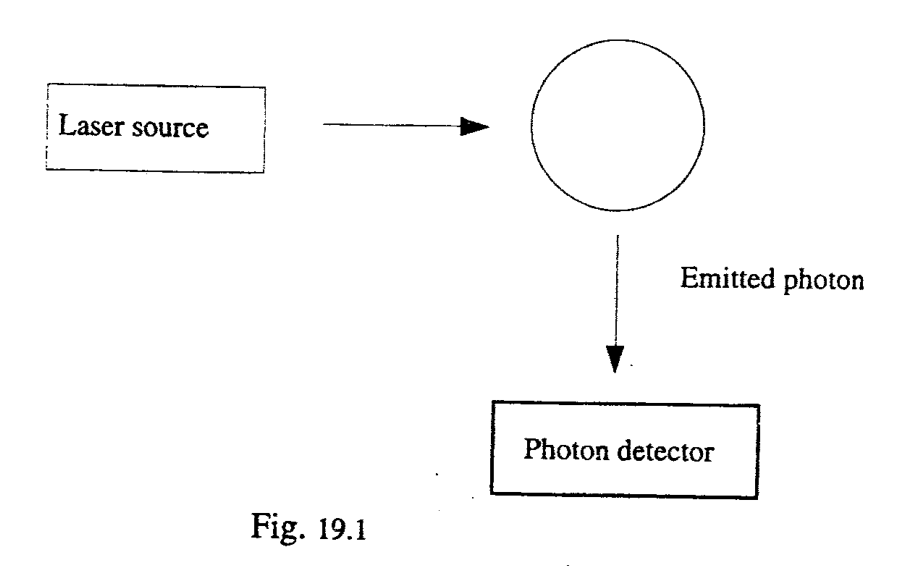
Fig. 19.1
Questions
1.1
1.1.1
What range of wavelength of the laser beam must be used to excite ions of all velocities in the velocity spectrum given above ?
1.1.2
A rigorous analysis of the problem calls for application of the principle from the theory of special relativity
\[ \nu'=\nu\cdot\sqrt{\frac{1+\dfrac vc}{1-\dfrac vc}} \]
Determine the error when the classical formula for Dopplers´ effect is used to solve the problem.
1.2
Assuming the ions are accelerated by a potential \(U\) before excited by the laser beam, determine the relationship between the width of the velocity spectrum of the ion beam and the accelerating potential. Does the accelerating voltage increase or decrease the velocity spectrum width ?
1.3
Each ion has the value \(\dfrac em=4\cdot10^6\ \dfrac{\mathrm{A\cdot s}}{\mathrm{kg}}\), two energy levels corresponding to wavelength \(\lambda^{(1)}=600\ \mathrm{nm}\) and wavelength \(\lambda^{(2)}=\lambda^{(1)}+10^{-3}\ \mathrm{nm}\). Show that lights of the two wavelengths used to excite ions overlap when no accelerating potential is applied. Can accelerating voltage be used to separate the two spectra of laser light used to excite ions so that they no longer overlap ? If the answer is positive, calculate the minimum value of the voltage required.
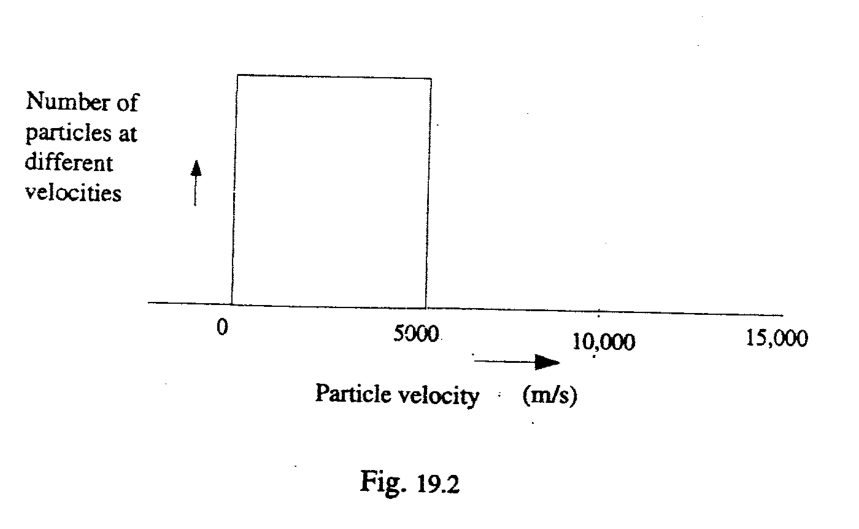
Fig. 19.2
Official English text of the problem.
Answers
-
1.1.1: The required laser wavelength range is \[ \boxed{600.000\ \mathrm{nm}\leq\lambda_{\mathrm L}\leq600.012\ \mathrm{nm}}, \] with width \(0.012\ \mathrm{nm}\).
-
1.1.2: The classical formula underestimates the upper wavelength by approximately \[ \boxed{1.2\times10^{-7}\ \mathrm{nm}}. \] The maximum relative error in wavelength is \(2.0\times10^{-10}\); the relative error in the scan width is \(1.0\times10^{-5}\).
-
1.2: After acceleration, the velocity-spectrum width is \[ \boxed{\Delta v(U)= \sqrt{v_2^2+\frac{2eU}{m}} -\sqrt{v_1^2+\frac{2eU}{m}}}. \] It decreases as the accelerating voltage increases.
-
1.3: Without acceleration, the two wavelength intervals are approximately \[ [600.000,600.012]\ \mathrm{nm}, \qquad [600.001,600.013]\ \mathrm{nm}, \] so they overlap. Acceleration can separate them, with threshold \[ \boxed{U_{\min}\approx160\ \mathrm V}. \] At the threshold the bands just touch; a slightly larger voltage produces a finite gap.
Solution
Use \(c=3.00\times10^8\ \mathrm{m\,s^{-1}}\). Let \(\lambda_0\) denote an ion’s resonance wavelength at rest, and let \(\lambda_{\mathrm L}\) denote the laser wavelength in the laboratory. The idealized spectra are taken to have no intrinsic linewidth.
1.1.1
The ion moves towards the incoming light, so it observes a higher frequency than the laboratory laser frequency. In the classical moving-observer approximation,
\[ \nu'=\nu_{\mathrm L}\left(1+\frac vc\right). \]
Excitation requires the frequency seen by the ion to equal its rest resonance frequency:
\[ \nu'=\nu_0=\frac{c}{\lambda_0}. \]
Since \(\nu_{\mathrm L}=c/\lambda_{\mathrm L}\),
\[ \frac{c}{\lambda_0} =\frac{c}{\lambda_{\mathrm L}}\left(1+\frac vc\right), \]
and therefore
\[ \boxed{\lambda_{\mathrm L}(v)=\lambda_0\left(1+\frac vc\right)}. \]
Thus the laboratory laser wavelength must increase with ion speed. At the endpoints,
\[ \lambda_{\mathrm L}(0)=600\ \mathrm{nm}, \]
\[ \lambda_{\mathrm L}(6000) =600\left(1+\frac{6000}{3.00\times10^8}\right)\mathrm{nm} =600.012\ \mathrm{nm}. \]
The required scan width is consequently
\[ \boxed{\Delta\lambda_{\mathrm L} =\frac{\lambda_0(v_2-v_1)}{c} =0.012\ \mathrm{nm}}. \]
1.1.2
Put \(\beta=v/c\). The supplied relativistic formula gives the resonance condition
\[ \nu_0=\nu_{\mathrm L}\sqrt{\frac{1+\beta}{1-\beta}}, \]
so the exact required wavelength is
\[ \lambda_{\mathrm{rel}} =\lambda_0\sqrt{\frac{1+\beta}{1-\beta}} =\lambda_0\frac{1+\beta}{\sqrt{1-\beta^2}}. \]
The classical value is \(\lambda_{\mathrm{cl}}=\lambda_0(1+\beta)\). Hence its fractional underestimate, measured relative to the exact wavelength, is
\[ \epsilon_\lambda =\frac{\lambda_{\mathrm{rel}}-\lambda_{\mathrm{cl}}} {\lambda_{\mathrm{rel}}} =1-\sqrt{1-\beta^2} \simeq\frac{\beta^2}{2}. \]
This error is greatest at \(v_2=6000\ \mathrm{m\,s^{-1}}\), for which
\[ \beta_2=2.00\times10^{-5}, \qquad \boxed{\epsilon_{\lambda,\max}\simeq2.00\times10^{-10}}. \]
Equivalently, expanding the exact wavelength,
\[ \lambda_{\mathrm{rel}} =\lambda_0\left(1+\beta+\frac{\beta^2}{2} +O(\beta^3)\right), \]
gives the maximum absolute correction
\[ \delta\lambda_{\max} \simeq\frac{\lambda_0\beta_2^2}{2} =600\ \mathrm{nm}\times2.00\times10^{-10} =\boxed{1.20\times10^{-7}\ \mathrm{nm}}. \]
Thus the relativistic upper endpoint is approximately
\[ 600.01200012\ \mathrm{nm}. \]
The lower endpoint has no correction because \(v_1=0\). Therefore the absolute error in the scan width is also \(1.20\times10^{-7}\ \mathrm{nm}\), corresponding to
\[ \frac{\delta(\Delta\lambda_{\mathrm L})}{\Delta\lambda_{\mathrm L}} \simeq\frac{1.20\times10^{-7}}{0.012} =\boxed{1.00\times10^{-5}} \]
or \(0.001\%\).
1.2
Let \(u\) be an ion’s speed after acceleration. Every singly charged ion gains the same kinetic energy \(eU\). Using nonrelativistic energy conservation,
\[ \frac12mu^2=\frac12mv^2+eU, \]
so
\[ u(v,U)=\sqrt{v^2+\frac{2eU}{m}}. \]
This function increases with the initial speed \(v\), so the endpoints of the accelerated distribution are
\[ u_1=\sqrt{v_1^2+\frac{2eU}{m}}, \qquad u_2=\sqrt{v_2^2+\frac{2eU}{m}}. \]
Consequently,
\[ \boxed{\Delta v(U)=u_2-u_1 =\sqrt{v_2^2+\frac{2eU}{m}} -\sqrt{v_1^2+\frac{2eU}{m}}}. \]
Rationalizing makes its dependence on voltage especially clear:
\[ \Delta v(U)= \frac{v_2^2-v_1^2} {\sqrt{v_2^2+2eU/m}+\sqrt{v_1^2+2eU/m}}. \]
The numerator is constant and the denominator increases with \(U\). Thus acceleration shifts the whole distribution towards higher speeds while decreasing its width.
For the given \(v_1=0\),
\[ \boxed{\Delta v(U)= \sqrt{v_2^2+\frac{2eU}{m}} -\sqrt{\frac{2eU}{m}}}. \]
When \(2eU/m\gg v_2^2\), this becomes
\[ \Delta v(U)\simeq \frac{v_2^2}{2\sqrt{2eU/m}} \propto U^{-1/2}. \]
1.3
Write
\[ \lambda_1=600\ \mathrm{nm},\qquad \lambda_2=600.001\ \mathrm{nm},\qquad \delta\lambda=\lambda_2-\lambda_1=0.001\ \mathrm{nm}. \]
Without acceleration, each rest wavelength produces a laser excitation interval
\[ \mathcal I_i(0)= \left[\lambda_i,\lambda_i\left(1+\frac{v_2}{c}\right)\right]. \]
Numerically,
\[ \mathcal I_1(0)=[600.000,600.012]\ \mathrm{nm}, \]
\[ \mathcal I_2(0)\simeq[600.001,600.013]\ \mathrm{nm}. \]
Their common interval is approximately
\[ [600.001,600.012]\ \mathrm{nm}, \]
so the two spectra clearly overlap.
After acceleration, the intervals become
\[ \mathcal I_i(U)= \left[ \lambda_i\left(1+\frac{u_1}{c}\right), \lambda_i\left(1+\frac{u_2}{c}\right) \right]. \]
Since \(\lambda_2>\lambda_1\), separation occurs when the upper edge of the first interval lies below the lower edge of the second. The limiting condition is
\[ \lambda_1\left(1+\frac{u_2}{c}\right) =\lambda_2\left(1+\frac{u_1}{c}\right). \]
Equivalently,
\[ u_2-u_1 =\frac{c\,\delta\lambda}{\lambda_1} \left(1+\frac{u_1}{c}\right). \]
To leading Doppler order, \(u_1/c\ll1\), so the required limiting velocity width is
\[ d\equiv\frac{c\,\delta\lambda}{\lambda_1} =\frac{(3.00\times10^8)(0.001)}{600}\ \mathrm{m\,s^{-1}} =\boxed{500\ \mathrm{m\,s^{-1}}}. \]
Acceleration can achieve this because it continuously narrows the velocity distribution.
With \(v_1=0\), energy conservation also gives
\[ u_2^2-u_1^2=v_2^2. \]
At the separation threshold, \(u_2-u_1\simeq d\), and therefore
\[ u_2+u_1\simeq\frac{v_2^2}{d} =\frac{6000^2}{500} =72{,}000\ \mathrm{m\,s^{-1}}. \]
Solving for the two speeds,
\[ u_1\simeq\frac{72{,}000-500}{2} =35{,}750\ \mathrm{m\,s^{-1}}, \]
\[ u_2\simeq36{,}250\ \mathrm{m\,s^{-1}}. \]
Finally, using \(e/m=4\times10^6\ \mathrm{C\,kg^{-1}}\),
\[ U_{\min}\simeq\frac{u_1^2}{2(e/m)} =\frac{(35{,}750)^2}{8\times10^6}\ \mathrm V \approx\boxed{160\ \mathrm V}. \]
The resulting speeds satisfy \(u/c\approx1.2\times10^{-4}\), consistent with the approximations used. Retaining the small factor \(1+u_1/c\) in the classical endpoint condition does not change the reported voltage.
At the limiting voltage the two spectral edges coincide. Strict separation requires a voltage slightly above this threshold.
The solution was checked against the official solution.
IPhO 1988 · Theorieaufgabe 1
Spektroskopie von Teilchengeschwindigkeiten
Grundlagen
Die Absorption und Emission eines Photons ist ein reversibler Prozess. Ein gutes Beispiel dafür ist die Anregung eines Atoms aus dem Grundzustand in einen Zustand höherer Energie und die anschließende Rückkehr des Atoms in den Grundzustand. In einem solchen Fall lässt sich die Absorption eines Photons anhand der spontanen Emission oder Fluoreszenz nachweisen. Einige modernere Messgeräte nutzen dieses Prinzip zur Identifizierung von Atomen sowie zur Messung oder Berechnung des Geschwindigkeitswertes im Geschwindigkeitsspektrum des Elektronenstrahls.
In einem idealisierten Experiment (siehe Abb. 19.1) bewegt sich ein einfach geladenes Ion mit der Geschwindigkeit \(v\) entgegen der Ausbreitungsrichtung des Lichts einer Laserquelle. Die Wellenlänge des Lichts der Laserquelle ist einstellbar. Ein Ion mit der Geschwindigkeit null kann durch Einstrahlung von Laserlicht mit einer Wellenlänge von \(\lambda=600\ \mathrm{nm}\) in einen Zustand höherer Energie angeregt werden. Soll ein bewegtes Ion angeregt werden, so wissen wir aufgrund des Dopplereffekts, dass dazu Laserlicht mit einer anderen als der oben angegebenen Wellenlänge verwendet werden muss.
Gegeben ist ein Geschwindigkeitsspektrum, das Geschwindigkeitsbeträge von \(v_1=0\ \frac{\mathrm m}{\mathrm s}\) bis \(v_2=6{,}000\ \frac{\mathrm m}{\mathrm s}\) umfasst. (siehe Abb. 19.1)
Abb. 19.1
Fragen
1.1
1.1.1
Welcher Wellenlängenbereich des Laserstrahls muss verwendet werden, um Ionen mit allen Geschwindigkeiten des oben angegebenen Geschwindigkeitsspektrums anzuregen?
1.1.2
Eine exakte Analyse des Problems erfordert die Anwendung der Beziehung aus der speziellen Relativitätstheorie
\[ \nu'=\nu\cdot\sqrt{\frac{1+\dfrac vc}{1-\dfrac vc}} \]
Bestimmen Sie den Fehler, der entsteht, wenn zur Lösung des Problems die klassische Formel für den Dopplereffekt verwendet wird.
1.2
Nehmen Sie an, dass die Ionen durch eine Spannung \(U\) beschleunigt werden, bevor sie durch den Laserstrahl angeregt werden. Bestimmen Sie den Zusammenhang zwischen der Breite des Geschwindigkeitsspektrums des Ionenstrahls und der Beschleunigungsspannung. Vergrößert oder verkleinert die Beschleunigungsspannung die Breite des Geschwindigkeitsspektrums?
1.3
Für jedes Ion gilt \(\dfrac em=4\cdot10^6\ \dfrac{\mathrm{A\cdot s}}{\mathrm{kg}}\); es besitzt zwei Energieniveaus, die der Wellenlänge \(\lambda^{(1)}=600\ \mathrm{nm}\) beziehungsweise der Wellenlänge \(\lambda^{(2)}=\lambda^{(1)}+10^{-3}\ \mathrm{nm}\) entsprechen. Zeigen Sie, dass sich die zur Anregung der Ionen verwendeten Lichtwellenlängenbereiche der beiden Übergänge überlappen, wenn keine Beschleunigungsspannung angelegt wird. Kann durch eine Beschleunigungsspannung erreicht werden, dass die beiden zur Anregung der Ionen verwendeten Laserlichtspektren getrennt werden und sich nicht mehr überlappen? Falls ja, berechnen Sie den erforderlichen Mindestwert der Spannung.
Abb. 19.2
Aufgabentext aus dem offiziellen englischen Text übersetzt.
Antworten
-
1.1.1: Der erforderliche Wellenlängenbereich des Lasers ist \[ \boxed{600.000\ \mathrm{nm}\leq\lambda_{\mathrm L}\leq600.012\ \mathrm{nm}}, \] mit einer Breite von \(0.012\ \mathrm{nm}\).
-
1.1.2: Die klassische Formel unterschätzt die obere Wellenlängengrenze um ungefähr \[ \boxed{1.2\times10^{-7}\ \mathrm{nm}}. \] Der maximale relative Fehler der Wellenlänge beträgt \(2.0\times10^{-10}\); der relative Fehler der Breite des durchzustimmenden Wellenlängenbereichs beträgt \(1.0\times10^{-5}\).
-
1.2: Nach der Beschleunigung beträgt die Breite des Geschwindigkeitsspektrums \[ \boxed{\Delta v(U)= \sqrt{v_2^2+\frac{2eU}{m}} -\sqrt{v_1^2+\frac{2eU}{m}}}. \] Sie nimmt mit steigender Beschleunigungsspannung ab.
-
1.3: Ohne Beschleunigung lauten die beiden Wellenlängenintervalle näherungsweise \[ [600.000,600.012]\ \mathrm{nm}, \qquad [600.001,600.013]\ \mathrm{nm}, \] sodass sie sich überlappen. Durch Beschleunigung lassen sie sich trennen; der Schwellenwert beträgt \[ \boxed{U_{\min}\approx160\ \mathrm V}. \] Am Schwellenwert berühren sich die Bänder gerade; eine geringfügig höhere Spannung erzeugt einen endlichen Abstand.
Lösung
Wir verwenden \(c=3.00\times10^8\ \mathrm{m\,s^{-1}}\). Mit \(\lambda_0\) bezeichnen wir die Resonanzwellenlänge eines ruhenden Ions und mit \(\lambda_{\mathrm L}\) die Laserwellenlänge im Labor. Für die idealisierten Spektren wird angenommen, dass sie keine intrinsische Linienbreite besitzen.
1.1.1
Das Ion bewegt sich dem einfallenden Licht entgegen und nimmt daher eine höhere Frequenz als die Laserfrequenz im Labor wahr. In der klassischen Näherung für einen bewegten Beobachter gilt
\[ \nu'=\nu_{\mathrm L}\left(1+\frac vc\right). \]
Für die Anregung muss die vom Ion wahrgenommene Frequenz gleich seiner Resonanzfrequenz im Ruhezustand sein:
\[ \nu'=\nu_0=\frac{c}{\lambda_0}. \]
Wegen \(\nu_{\mathrm L}=c/\lambda_{\mathrm L}\) gilt
\[ \frac{c}{\lambda_0} =\frac{c}{\lambda_{\mathrm L}}\left(1+\frac vc\right), \]
und somit
\[ \boxed{\lambda_{\mathrm L}(v)=\lambda_0\left(1+\frac vc\right)}. \]
Die Laserwellenlänge im Labor muss also mit der Ionengeschwindigkeit zunehmen. An den Grenzen des Intervalls gilt
\[ \lambda_{\mathrm L}(0)=600\ \mathrm{nm}, \]
\[ \lambda_{\mathrm L}(6000) =600\left(1+\frac{6000}{3.00\times10^8}\right)\mathrm{nm} =600.012\ \mathrm{nm}. \]
Die erforderliche Breite des durchzustimmenden Wellenlängenbereichs beträgt folglich
\[ \boxed{\Delta\lambda_{\mathrm L} =\frac{\lambda_0(v_2-v_1)}{c} =0.012\ \mathrm{nm}}. \]
1.1.2
Wir setzen \(\beta=v/c\). Aus der angegebenen relativistischen Formel folgt die Resonanzbedingung
\[ \nu_0=\nu_{\mathrm L}\sqrt{\frac{1+\beta}{1-\beta}}, \]
sodass für die exakt erforderliche Wellenlänge gilt
\[ \lambda_{\mathrm{rel}} =\lambda_0\sqrt{\frac{1+\beta}{1-\beta}} =\lambda_0\frac{1+\beta}{\sqrt{1-\beta^2}}. \]
Der klassische Wert ist \(\lambda_{\mathrm{cl}}=\lambda_0(1+\beta)\). Die relative Unterschätzung, bezogen auf die exakte Wellenlänge, beträgt daher
\[ \epsilon_\lambda =\frac{\lambda_{\mathrm{rel}}-\lambda_{\mathrm{cl}}} {\lambda_{\mathrm{rel}}} =1-\sqrt{1-\beta^2} \simeq\frac{\beta^2}{2}. \]
Dieser Fehler ist bei \(v_2=6000\ \mathrm{m\,s^{-1}}\) am größten; hierfür gilt
\[ \beta_2=2.00\times10^{-5}, \qquad \boxed{\epsilon_{\lambda,\max}\simeq2.00\times10^{-10}}. \]
Gleichwertig ergibt die Entwicklung der exakten Wellenlänge,
\[ \lambda_{\mathrm{rel}} =\lambda_0\left(1+\beta+\frac{\beta^2}{2} +O(\beta^3)\right), \]
die maximale absolute Korrektur
\[ \delta\lambda_{\max} \simeq\frac{\lambda_0\beta_2^2}{2} =600\ \mathrm{nm}\times2.00\times10^{-10} =\boxed{1.20\times10^{-7}\ \mathrm{nm}}. \]
Die relativistische obere Intervallgrenze beträgt somit ungefähr
\[ 600.01200012\ \mathrm{nm}. \]
An der unteren Intervallgrenze gibt es keine Korrektur, da \(v_1=0\). Daher beträgt auch der absolute Fehler der Breite des durchzustimmenden Wellenlängenbereichs \(1.20\times10^{-7}\ \mathrm{nm}\); dies entspricht
\[ \frac{\delta(\Delta\lambda_{\mathrm L})}{\Delta\lambda_{\mathrm L}} \simeq\frac{1.20\times10^{-7}}{0.012} =\boxed{1.00\times10^{-5}} \]
oder \(0.001\%\).
1.2
Es sei \(u\) die Geschwindigkeit eines Ions nach der Beschleunigung. Jedes einfach geladene Ion gewinnt dieselbe kinetische Energie \(eU\). Aus der nichtrelativistischen Energieerhaltung folgt
\[ \frac12mu^2=\frac12mv^2+eU, \]
also
\[ u(v,U)=\sqrt{v^2+\frac{2eU}{m}}. \]
Diese Funktion wächst mit der Anfangsgeschwindigkeit \(v\), sodass für die Grenzen der Verteilung nach der Beschleunigung gilt
\[ u_1=\sqrt{v_1^2+\frac{2eU}{m}}, \qquad u_2=\sqrt{v_2^2+\frac{2eU}{m}}. \]
Folglich gilt
\[ \boxed{\Delta v(U)=u_2-u_1 =\sqrt{v_2^2+\frac{2eU}{m}} -\sqrt{v_1^2+\frac{2eU}{m}}}. \]
Durch Erweitern mit dem konjugierten Ausdruck wird die Spannungsabhängigkeit besonders deutlich:
\[ \Delta v(U)= \frac{v_2^2-v_1^2} {\sqrt{v_2^2+2eU/m}+\sqrt{v_1^2+2eU/m}}. \]
Der Zähler ist konstant, und der Nenner wächst mit \(U\). Die Beschleunigung verschiebt also die gesamte Verteilung zu höheren Geschwindigkeiten und verringert dabei ihre Breite.
Für den gegebenen Wert \(v_1=0\) gilt
\[ \boxed{\Delta v(U)= \sqrt{v_2^2+\frac{2eU}{m}} -\sqrt{\frac{2eU}{m}}}. \]
Für \(2eU/m\gg v_2^2\) wird daraus
\[ \Delta v(U)\simeq \frac{v_2^2}{2\sqrt{2eU/m}} \propto U^{-1/2}. \]
1.3
Wir schreiben
\[ \lambda_1=600\ \mathrm{nm},\qquad \lambda_2=600.001\ \mathrm{nm},\qquad \delta\lambda=\lambda_2-\lambda_1=0.001\ \mathrm{nm}. \]
Ohne Beschleunigung ergibt sich für jede Ruhewellenlänge ein Wellenlängenintervall zur Laseranregung
\[ \mathcal I_i(0)= \left[\lambda_i,\lambda_i\left(1+\frac{v_2}{c}\right)\right]. \]
Numerisch gilt
\[ \mathcal I_1(0)=[600.000,600.012]\ \mathrm{nm}, \]
\[ \mathcal I_2(0)\simeq[600.001,600.013]\ \mathrm{nm}. \]
Ihr gemeinsames Intervall ist näherungsweise
\[ [600.001,600.012]\ \mathrm{nm}, \]
sodass sich die beiden Spektren eindeutig überlappen.
Nach der Beschleunigung lauten die Intervalle
\[ \mathcal I_i(U)= \left[ \lambda_i\left(1+\frac{u_1}{c}\right), \lambda_i\left(1+\frac{u_2}{c}\right) \right]. \]
Da \(\lambda_2>\lambda_1\), sind die Intervalle getrennt, wenn die obere Grenze des ersten Intervalls unterhalb der unteren Grenze des zweiten liegt. Die Grenzbedingung lautet
\[ \lambda_1\left(1+\frac{u_2}{c}\right) =\lambda_2\left(1+\frac{u_1}{c}\right). \]
Gleichwertig gilt
\[ u_2-u_1 =\frac{c\,\delta\lambda}{\lambda_1} \left(1+\frac{u_1}{c}\right). \]
In führender Ordnung des Dopplereffekts gilt \(u_1/c\ll1\), sodass sich für die erforderliche Grenzbreite des Geschwindigkeitsspektrums ergibt
\[ d\equiv\frac{c\,\delta\lambda}{\lambda_1} =\frac{(3.00\times10^8)(0.001)}{600}\ \mathrm{m\,s^{-1}} =\boxed{500\ \mathrm{m\,s^{-1}}}. \]
Durch Beschleunigung lässt sich dies erreichen, da sie die Geschwindigkeitsverteilung kontinuierlich verschmälert.
Mit \(v_1=0\) ergibt die Energieerhaltung außerdem
\[ u_2^2-u_1^2=v_2^2. \]
An der Trennschwelle gilt \(u_2-u_1\simeq d\), und daher
\[ u_2+u_1\simeq\frac{v_2^2}{d} =\frac{6000^2}{500} =72{,}000\ \mathrm{m\,s^{-1}}. \]
Auflösen nach den beiden Geschwindigkeiten ergibt
\[ u_1\simeq\frac{72{,}000-500}{2} =35{,}750\ \mathrm{m\,s^{-1}}, \]
\[ u_2\simeq36{,}250\ \mathrm{m\,s^{-1}}. \]
Schließlich erhalten wir mit \(e/m=4\times10^6\ \mathrm{C\,kg^{-1}}\)
\[ U_{\min}\simeq\frac{u_1^2}{2(e/m)} =\frac{(35{,}750)^2}{8\times10^6}\ \mathrm V \approx\boxed{160\ \mathrm V}. \]
Die resultierenden Geschwindigkeiten erfüllen \(u/c\approx1.2\times10^{-4}\), was mit den verwendeten Näherungen vereinbar ist. Die Berücksichtigung des kleinen Faktors \(1+u_1/c\) in der klassischen Bedingung für die Intervallgrenzen ändert den angegebenen Spannungswert nicht.
Bei der Grenzspannung fallen die beiden Spektralränder zusammen. Für eine strikte Trennung ist eine Spannung geringfügig oberhalb dieses Schwellenwerts erforderlich.
Die Lösung wurde mit der offiziellen Lösung abgeglichen.
IPhO 1988 · Teori sorusu 1
Parçacık Hızlarının Spektroskopisi
Temel Bilgiler
Bir fotonun soğurulması ve yayılması tersinir bir süreçtir. Bir atomun temel durumdan daha yüksek enerjili bir duruma uyarılması ve ardından temel duruma dönmesi buna iyi bir örnektir. Böyle bir durumda, kendiliğinden yayılma veya floresans olayı aracılığıyla bir fotonun soğurulduğunu saptayabiliriz. Daha modern ölçüm aygıtlarından bazıları, atomları tanımlamak ve ayrıca elektron demetinin hız spektrumundaki hız değerini ölçmek veya hesaplamak için bu ilkeden yararlanır.
İdealleştirilmiş bir deneyde (bkz. Şekil 19.1), tek yüklü bir iyon, bir lazer kaynağından gelen ışığa zıt yönde \(v\) hızıyla hareket etmektedir. Lazer kaynağından gelen ışığın dalga boyu ayarlanabilir. Hızı sıfır olan bir iyon, dalga boyu \(\lambda=600\ \mathrm{nm}\) olan lazer ışığı uygulanarak daha yüksek enerjili bir duruma uyarılabilir. Hareketli bir iyonu uyaracak olursak, Doppler etkisine ilişkin bilgilerimiz, yukarıda verilen değerden farklı bir dalga boyuna sahip lazer ışığı uygulamamız gerektiğini söyler.
Hız büyüklükleri \(v_1=0\ \frac{\mathrm m}{\mathrm s}\) ile \(v_2=6{,}000\ \frac{\mathrm m}{\mathrm s}\) arasında değişen bir hız spektrumu verilmiştir. (bkz. Şekil 19.1)
Şekil 19.1
Sorular
1.1
1.1.1
Yukarıda verilen hız spektrumundaki tüm hızlara sahip iyonları uyarmak için lazer demetinin dalga boyu hangi aralıkta olmalıdır?
1.1.2
Problemin titiz bir analizi, özel görelilik kuramından gelen şu bağıntının uygulanmasını gerektirir:
\[ \nu'=\nu\cdot\sqrt{\frac{1+\dfrac vc}{1-\dfrac vc}} \]
Problemi çözmek için Doppler etkisinin klasik formülü kullanıldığında ortaya çıkan hatayı belirleyiniz.
1.2
İyonların lazer demetiyle uyarılmadan önce bir \(U\) potansiyeliyle hızlandırıldığını varsayarak, iyon demetinin hız spektrumunun genişliği ile hızlandırma potansiyeli arasındaki ilişkiyi belirleyiniz. Hızlandırma gerilimi hız spektrumunun genişliğini artırır mı, azaltır mı?
1.3
Her iyonun \(\dfrac em=4\cdot10^6\ \dfrac{\mathrm{A\cdot s}}{\mathrm{kg}}\) değerine ve \(\lambda^{(1)}=600\ \mathrm{nm}\) ile \(\lambda^{(2)}=\lambda^{(1)}+10^{-3}\ \mathrm{nm}\) dalga boylarına karşılık gelen iki enerji düzeyine sahip olduğu bilinmektedir. Hızlandırma potansiyeli uygulanmadığında, iyonları uyarmak için kullanılan bu iki dalga boyuna ait ışıkların spektrumlarının örtüştüğünü gösteriniz. İyonları uyarmak için kullanılan lazer ışığının iki spektrumunu artık örtüşmeyecek biçimde ayırmak için hızlandırma gerilimi kullanılabilir mi? Yanıt olumluysa, gereken en küçük gerilim değerini hesaplayınız.
Şekil 19.2
Soru metni resmi İngilizce metinden çevrilmiştir.
Cevaplar
-
1.1.1: Gerekli lazer dalga boyu aralığı \[ \boxed{600.000\ \mathrm{nm}\leq\lambda_{\mathrm L}\leq600.012\ \mathrm{nm}}, \] olup genişliği \(0.012\ \mathrm{nm}\)'dir.
-
1.1.2: Klasik formül, üst sınırdaki dalga boyunu yaklaşık \[ \boxed{1.2\times10^{-7}\ \mathrm{nm}} \] kadar düşük verir. Dalga boyundaki en büyük bağıl hata \(2.0\times10^{-10}\); tarama genişliğindeki bağıl hata ise \(1.0\times10^{-5}\)'tir.
-
1.2: Hızlandırmadan sonra hız spektrumunun genişliği \[ \boxed{\Delta v(U)= \sqrt{v_2^2+\frac{2eU}{m}} -\sqrt{v_1^2+\frac{2eU}{m}}}. \] Hızlandırma gerilimi arttıkça bu genişlik azalır.
-
1.3: Hızlandırma olmadığında, iki dalga boyu aralığı yaklaşık olarak \[ [600.000,600.012]\ \mathrm{nm}, \qquad [600.001,600.013]\ \mathrm{nm}, \] olduğundan örtüşürler. Hızlandırma bu aralıkları ayırabilir; eşik değeri \[ \boxed{U_{\min}\approx160\ \mathrm V}. \] Eşik değerinde bantlar birbirine yalnızca değmektedir; biraz daha büyük bir gerilim sonlu bir aralık oluşturur.
Çözüm
\(c=3.00\times10^8\ \mathrm{m\,s^{-1}}\) değerini kullanınız. \(\lambda_0\), bir iyonun durgun hâldeki rezonans dalga boyunu, \(\lambda_{\mathrm L}\) ise laboratuvardaki lazer dalga boyunu göstersin. İdealleştirilmiş spektrumların içsel çizgi genişliğinin olmadığı kabul edilmektedir.
1.1.1
İyon, gelen ışığa doğru hareket ettiğinden laboratuvardaki lazer frekansından daha yüksek bir frekans gözlemler. Klasik hareketli gözlemci yaklaşımında,
\[ \nu'=\nu_{\mathrm L}\left(1+\frac vc\right). \]
Uyarılma için iyonun gözlemlediği frekansın, durgun hâldeki rezonans frekansına eşit olması gerekir:
\[ \nu'=\nu_0=\frac{c}{\lambda_0}. \]
\(\nu_{\mathrm L}=c/\lambda_{\mathrm L}\) olduğundan,
\[ \frac{c}{\lambda_0} =\frac{c}{\lambda_{\mathrm L}}\left(1+\frac vc\right), \]
dolayısıyla
\[ \boxed{\lambda_{\mathrm L}(v)=\lambda_0\left(1+\frac vc\right)}. \]
Böylece laboratuvardaki lazer dalga boyu iyonun süratiyle birlikte artmalıdır. Uç noktalarda,
\[ \lambda_{\mathrm L}(0)=600\ \mathrm{nm}, \]
\[ \lambda_{\mathrm L}(6000) =600\left(1+\frac{6000}{3.00\times10^8}\right)\mathrm{nm} =600.012\ \mathrm{nm}. \]
Dolayısıyla gerekli tarama genişliği
\[ \boxed{\Delta\lambda_{\mathrm L} =\frac{\lambda_0(v_2-v_1)}{c} =0.012\ \mathrm{nm}}. \]
1.1.2
\(\beta=v/c\) olsun. Verilen göreli formül, rezonans koşulunu
\[ \nu_0=\nu_{\mathrm L}\sqrt{\frac{1+\beta}{1-\beta}}, \]
olarak verir; dolayısıyla gerekli dalga boyunun tam değeri
\[ \lambda_{\mathrm{rel}} =\lambda_0\sqrt{\frac{1+\beta}{1-\beta}} =\lambda_0\frac{1+\beta}{\sqrt{1-\beta^2}}. \]
Klasik değer \(\lambda_{\mathrm{cl}}=\lambda_0(1+\beta)\)'dır. Dolayısıyla tam dalga boyuna göre hesaplanan bağıl eksik tahmin,
\[ \epsilon_\lambda =\frac{\lambda_{\mathrm{rel}}-\lambda_{\mathrm{cl}}} {\lambda_{\mathrm{rel}}} =1-\sqrt{1-\beta^2} \simeq\frac{\beta^2}{2}. \]
Bu hata, \(v_2=6000\ \mathrm{m\,s^{-1}}\) değerinde en büyüktür; bu değer için
\[ \beta_2=2.00\times10^{-5}, \qquad \boxed{\epsilon_{\lambda,\max}\simeq2.00\times10^{-10}}. \]
Eşdeğer olarak, tam dalga boyunu seriye açmak,
\[ \lambda_{\mathrm{rel}} =\lambda_0\left(1+\beta+\frac{\beta^2}{2} +O(\beta^3)\right), \]
en büyük mutlak düzeltmeyi verir:
\[ \delta\lambda_{\max} \simeq\frac{\lambda_0\beta_2^2}{2} =600\ \mathrm{nm}\times2.00\times10^{-10} =\boxed{1.20\times10^{-7}\ \mathrm{nm}}. \]
Böylece göreli üst sınır yaklaşık olarak
\[ 600.01200012\ \mathrm{nm}. \]
\(v_1=0\) olduğundan alt sınırda düzeltme yoktur. Dolayısıyla tarama genişliğindeki mutlak hata da \(1.20\times10^{-7}\ \mathrm{nm}\)'dir ve buna karşılık gelen bağıl hata
\[ \frac{\delta(\Delta\lambda_{\mathrm L})}{\Delta\lambda_{\mathrm L}} \simeq\frac{1.20\times10^{-7}}{0.012} =\boxed{1.00\times10^{-5}} \]
ya da \(0.001\%\)'tir.
1.2
\(u\), bir iyonun hızlandırmadan sonraki sürati olsun. Tek yüklü her iyon aynı \(eU\) kinetik enerjisini kazanır. Göreli olmayan enerji korunumu kullanılırsa,
\[ \frac12mu^2=\frac12mv^2+eU, \]
dolayısıyla
\[ u(v,U)=\sqrt{v^2+\frac{2eU}{m}}. \]
Bu fonksiyon başlangıç sürati \(v\) ile arttığından, hızlandırılmış dağılımın uç noktaları
\[ u_1=\sqrt{v_1^2+\frac{2eU}{m}}, \qquad u_2=\sqrt{v_2^2+\frac{2eU}{m}}. \]
Sonuç olarak,
\[ \boxed{\Delta v(U)=u_2-u_1 =\sqrt{v_2^2+\frac{2eU}{m}} -\sqrt{v_1^2+\frac{2eU}{m}}}. \]
Eşlenikle çarpıp sadeleştirmek, gerilime bağımlılığı özellikle açık hâle getirir:
\[ \Delta v(U)= \frac{v_2^2-v_1^2} {\sqrt{v_2^2+2eU/m}+\sqrt{v_1^2+2eU/m}}. \]
Pay sabittir ve payda \(U\) ile artar. Böylece hızlandırma, tüm dağılımı daha yüksek süratlere kaydırırken genişliğini azaltır.
Verilen \(v_1=0\) değeri için,
\[ \boxed{\Delta v(U)= \sqrt{v_2^2+\frac{2eU}{m}} -\sqrt{\frac{2eU}{m}}}. \]
\(2eU/m\gg v_2^2\) olduğunda bu ifade şu hâle gelir:
\[ \Delta v(U)\simeq \frac{v_2^2}{2\sqrt{2eU/m}} \propto U^{-1/2}. \]
1.3
Şöyle yazalım:
\[ \lambda_1=600\ \mathrm{nm},\qquad \lambda_2=600.001\ \mathrm{nm},\qquad \delta\lambda=\lambda_2-\lambda_1=0.001\ \mathrm{nm}. \]
Hızlandırma olmadığında, durgun hâldeki her dalga boyu için bir lazerle uyarılma aralığı oluşur:
\[ \mathcal I_i(0)= \left[\lambda_i,\lambda_i\left(1+\frac{v_2}{c}\right)\right]. \]
Sayısal olarak,
\[ \mathcal I_1(0)=[600.000,600.012]\ \mathrm{nm}, \]
\[ \mathcal I_2(0)\simeq[600.001,600.013]\ \mathrm{nm}. \]
Ortak aralıkları yaklaşık olarak
\[ [600.001,600.012]\ \mathrm{nm}, \]
olduğundan iki spektrum açıkça örtüşür.
Hızlandırmadan sonra aralıklar şu hâle gelir:
\[ \mathcal I_i(U)= \left[ \lambda_i\left(1+\frac{u_1}{c}\right), \lambda_i\left(1+\frac{u_2}{c}\right) \right]. \]
\(\lambda_2>\lambda_1\) olduğundan, birinci aralığın üst sınırı ikinci aralığın alt sınırının altında kaldığında ayrılma gerçekleşir. Sınır koşulu
\[ \lambda_1\left(1+\frac{u_2}{c}\right) =\lambda_2\left(1+\frac{u_1}{c}\right). \]
Eşdeğer olarak,
\[ u_2-u_1 =\frac{c\,\delta\lambda}{\lambda_1} \left(1+\frac{u_1}{c}\right). \]
Doppler etkisinde en düşük mertebede, \(u_1/c\ll1\) olduğundan gerekli sınır hız genişliği
\[ d\equiv\frac{c\,\delta\lambda}{\lambda_1} =\frac{(3.00\times10^8)(0.001)}{600}\ \mathrm{m\,s^{-1}} =\boxed{500\ \mathrm{m\,s^{-1}}}. \]
Hızlandırma, hız dağılımını sürekli daralttığından bunu sağlayabilir.
\(v_1=0\) olduğunda, enerji korunumu ayrıca şunu verir:
\[ u_2^2-u_1^2=v_2^2. \]
Ayrılma eşiğinde \(u_2-u_1\simeq d\) olduğundan,
\[ u_2+u_1\simeq\frac{v_2^2}{d} =\frac{6000^2}{500} =72{,}000\ \mathrm{m\,s^{-1}}. \]
İki sürat için çözüldüğünde,
\[ u_1\simeq\frac{72{,}000-500}{2} =35{,}750\ \mathrm{m\,s^{-1}}, \]
\[ u_2\simeq36{,}250\ \mathrm{m\,s^{-1}}. \]
Son olarak, \(e/m=4\times10^6\ \mathrm{C\,kg^{-1}}\) kullanılarak,
\[ U_{\min}\simeq\frac{u_1^2}{2(e/m)} =\frac{(35{,}750)^2}{8\times10^6}\ \mathrm V \approx\boxed{160\ \mathrm V}. \]
Elde edilen süratler, kullanılan yaklaşımlarla tutarlı olarak \(u/c\approx1.2\times10^{-4}\) koşulunu sağlar. Klasik uç nokta koşulunda küçük \(1+u_1/c\) çarpanının korunması, belirtilen gerilim değerini değiştirmez.
Sınır geriliminde iki spektrumun kenarları çakışır. Tam ayrılma için bu eşiğin biraz üzerinde bir gerilim gerekir.
Çözüm, resmi çözümle karşılaştırılarak kontrol edildi.
IPhO 1988 · Problema teórico 1
Espectroscopia de velocidades de partículas
Datos básicos
La absorción y la emisión de un fotón constituyen un proceso reversible. Un buen ejemplo es la excitación de un átomo desde el estado fundamental a un estado de mayor energía y su posterior retorno al estado fundamental. En tal caso, podemos detectar la absorción de un fotón a partir del fenómeno de emisión espontánea o fluorescencia. Algunos de los instrumentos más modernos utilizan este principio para identificar átomos y también para medir o calcular el valor de la velocidad en el espectro de velocidades del haz de electrones.
En un experimento idealizado (véase la fig. 19.1), un ion con una sola carga elemental se desplaza con velocidad \(v\) en sentido opuesto al de la luz procedente de una fuente láser. La longitud de onda de la luz de la fuente láser es ajustable. Un ion con velocidad nula puede excitarse a un estado de mayor energía mediante luz láser de longitud de onda \(\lambda=600\ \mathrm{nm}\). Si excitamos un ion en movimiento, nuestros conocimientos del efecto Doppler nos indican que debemos utilizar luz láser de una longitud de onda distinta del valor anterior.
Se da un espectro de velocidades que abarca módulos de velocidad desde \(v_1=0\ \frac{\mathrm m}{\mathrm s}\) hasta \(v_2=6{,}000\ \frac{\mathrm m}{\mathrm s}\). (Véase la fig. 19.1)
Fig. 19.1
Preguntas
1.1
1.1.1
¿Qué intervalo de longitudes de onda del haz láser debe utilizarse para excitar iones de todas las velocidades del espectro de velocidades indicado anteriormente?
1.1.2
Un análisis riguroso del problema requiere aplicar el principio de la teoría de la relatividad especial
\[ \nu'=\nu\cdot\sqrt{\frac{1+\dfrac vc}{1-\dfrac vc}} \]
Determine el error que se comete al utilizar la fórmula clásica del efecto Doppler para resolver el problema.
1.2
Suponiendo que los iones se aceleran mediante una diferencia de potencial \(U\) antes de ser excitados por el haz láser, determine la relación entre la anchura del espectro de velocidades del haz de iones y el potencial acelerador. ¿Aumenta o disminuye la tensión aceleradora la anchura del espectro de velocidades?
1.3
Cada ion tiene una relación \(\dfrac em=4\cdot10^6\ \dfrac{\mathrm{A\cdot s}}{\mathrm{kg}}\) y dos niveles de energía correspondientes a la longitud de onda \(\lambda^{(1)}=600\ \mathrm{nm}\) y a la longitud de onda \(\lambda^{(2)}=\lambda^{(1)}+10^{-3}\ \mathrm{nm}\). Demuestre que los espectros de luz de las dos longitudes de onda utilizadas para excitar los iones se solapan cuando no se aplica ningún potencial acelerador. ¿Puede utilizarse una tensión aceleradora para separar los dos espectros de luz láser utilizados para excitar los iones de modo que dejen de solaparse? Si la respuesta es afirmativa, calcule el valor mínimo de la tensión necesaria.
Fig. 19.2
Enunciado traducido del texto oficial en inglés.
Respuestas
-
1.1.1: El intervalo de longitudes de onda del láser necesario es \[ \boxed{600.000\ \mathrm{nm}\leq\lambda_{\mathrm L}\leq600.012\ \mathrm{nm}}, \] con una anchura de \(0.012\ \mathrm{nm}\).
-
1.1.2: La fórmula clásica subestima la longitud de onda del extremo superior en aproximadamente \[ \boxed{1.2\times10^{-7}\ \mathrm{nm}}. \] El error relativo máximo en la longitud de onda es \(2.0\times10^{-10}\); el error relativo en la anchura del barrido es \(1.0\times10^{-5}\).
-
1.2: Tras la aceleración, la anchura del espectro de velocidades es \[ \boxed{\Delta v(U)= \sqrt{v_2^2+\frac{2eU}{m}} -\sqrt{v_1^2+\frac{2eU}{m}}}. \] Disminuye al aumentar la tensión aceleradora.
-
1.3: Sin aceleración, los dos intervalos de longitudes de onda son aproximadamente \[ [600.000,600.012]\ \mathrm{nm}, \qquad [600.001,600.013]\ \mathrm{nm}, \] por lo que se solapan. La aceleración puede separarlos, con un umbral de \[ \boxed{U_{\min}\approx160\ \mathrm V}. \] En el umbral, las bandas se tocan justo en sus extremos; una tensión ligeramente mayor produce una separación finita.
Solución
Utilícese \(c=3.00\times10^8\ \mathrm{m\,s^{-1}}\). Sea \(\lambda_0\) la longitud de onda de resonancia de un ion en reposo y sea \(\lambda_{\mathrm L}\) la longitud de onda del láser en el laboratorio. Se supone que los espectros idealizados no tienen anchura de línea intrínseca.
1.1.1
El ion se mueve hacia la luz incidente, por lo que observa una frecuencia mayor que la frecuencia del láser en el laboratorio. En la aproximación clásica para un observador en movimiento,
\[ \nu'=\nu_{\mathrm L}\left(1+\frac vc\right). \]
La excitación requiere que la frecuencia observada por el ion sea igual a su frecuencia de resonancia en reposo:
\[ \nu'=\nu_0=\frac{c}{\lambda_0}. \]
Como \(\nu_{\mathrm L}=c/\lambda_{\mathrm L}\),
\[ \frac{c}{\lambda_0} =\frac{c}{\lambda_{\mathrm L}}\left(1+\frac vc\right), \]
y, por tanto,
\[ \boxed{\lambda_{\mathrm L}(v)=\lambda_0\left(1+\frac vc\right)}. \]
Así pues, la longitud de onda del láser en el laboratorio debe aumentar con la rapidez del ion. En los extremos,
\[ \lambda_{\mathrm L}(0)=600\ \mathrm{nm}, \]
\[ \lambda_{\mathrm L}(6000) =600\left(1+\frac{6000}{3.00\times10^8}\right)\mathrm{nm} =600.012\ \mathrm{nm}. \]
Por consiguiente, la anchura de barrido necesaria es
\[ \boxed{\Delta\lambda_{\mathrm L} =\frac{\lambda_0(v_2-v_1)}{c} =0.012\ \mathrm{nm}}. \]
1.1.2
Sea \(\beta=v/c\). La fórmula relativista proporcionada da la condición de resonancia
\[ \nu_0=\nu_{\mathrm L}\sqrt{\frac{1+\beta}{1-\beta}}, \]
de modo que la longitud de onda exacta necesaria es
\[ \lambda_{\mathrm{rel}} =\lambda_0\sqrt{\frac{1+\beta}{1-\beta}} =\lambda_0\frac{1+\beta}{\sqrt{1-\beta^2}}. \]
El valor clásico es \(\lambda_{\mathrm{cl}}=\lambda_0(1+\beta)\). Por tanto, su subestimación relativa, medida respecto a la longitud de onda exacta, es
\[ \epsilon_\lambda =\frac{\lambda_{\mathrm{rel}}-\lambda_{\mathrm{cl}}} {\lambda_{\mathrm{rel}}} =1-\sqrt{1-\beta^2} \simeq\frac{\beta^2}{2}. \]
Este error es máximo para \(v_2=6000\ \mathrm{m\,s^{-1}}\), para el cual
\[ \beta_2=2.00\times10^{-5}, \qquad \boxed{\epsilon_{\lambda,\max}\simeq2.00\times10^{-10}}. \]
De forma equivalente, al desarrollar la longitud de onda exacta,
\[ \lambda_{\mathrm{rel}} =\lambda_0\left(1+\beta+\frac{\beta^2}{2} +O(\beta^3)\right), \]
se obtiene la corrección absoluta máxima
\[ \delta\lambda_{\max} \simeq\frac{\lambda_0\beta_2^2}{2} =600\ \mathrm{nm}\times2.00\times10^{-10} =\boxed{1.20\times10^{-7}\ \mathrm{nm}}. \]
Así, el extremo superior relativista es aproximadamente
\[ 600.01200012\ \mathrm{nm}. \]
El extremo inferior no tiene corrección porque \(v_1=0\). Por tanto, el error absoluto en la anchura del barrido también es \(1.20\times10^{-7}\ \mathrm{nm}\), lo que corresponde a
\[ \frac{\delta(\Delta\lambda_{\mathrm L})}{\Delta\lambda_{\mathrm L}} \simeq\frac{1.20\times10^{-7}}{0.012} =\boxed{1.00\times10^{-5}} \]
o \(0.001\%\).
1.2
Sea \(u\) la rapidez de un ion tras la aceleración. Cada ion con una sola carga elemental adquiere la misma energía cinética \(eU\). Utilizando la conservación de la energía no relativista,
\[ \frac12mu^2=\frac12mv^2+eU, \]
de modo que
\[ u(v,U)=\sqrt{v^2+\frac{2eU}{m}}. \]
Esta función aumenta con la rapidez inicial \(v\), por lo que los extremos de la distribución tras la aceleración son
\[ u_1=\sqrt{v_1^2+\frac{2eU}{m}}, \qquad u_2=\sqrt{v_2^2+\frac{2eU}{m}}. \]
Por consiguiente,
\[ \boxed{\Delta v(U)=u_2-u_1 =\sqrt{v_2^2+\frac{2eU}{m}} -\sqrt{v_1^2+\frac{2eU}{m}}}. \]
La racionalización permite ver con especial claridad su dependencia de la tensión:
\[ \Delta v(U)= \frac{v_2^2-v_1^2} {\sqrt{v_2^2+2eU/m}+\sqrt{v_1^2+2eU/m}}. \]
El numerador es constante y el denominador aumenta con \(U\). Así, la aceleración desplaza toda la distribución hacia rapideces mayores, al tiempo que disminuye su anchura.
Para el valor dado \(v_1=0\),
\[ \boxed{\Delta v(U)= \sqrt{v_2^2+\frac{2eU}{m}} -\sqrt{\frac{2eU}{m}}}. \]
Cuando \(2eU/m\gg v_2^2\), esta expresión se convierte en
\[ \Delta v(U)\simeq \frac{v_2^2}{2\sqrt{2eU/m}} \propto U^{-1/2}. \]
1.3
Escribamos
\[ \lambda_1=600\ \mathrm{nm},\qquad \lambda_2=600.001\ \mathrm{nm},\qquad \delta\lambda=\lambda_2-\lambda_1=0.001\ \mathrm{nm}. \]
Sin aceleración, cada longitud de onda en reposo produce un intervalo de excitación láser
\[ \mathcal I_i(0)= \left[\lambda_i,\lambda_i\left(1+\frac{v_2}{c}\right)\right]. \]
Numéricamente,
\[ \mathcal I_1(0)=[600.000,600.012]\ \mathrm{nm}, \]
\[ \mathcal I_2(0)\simeq[600.001,600.013]\ \mathrm{nm}. \]
Su intervalo común es aproximadamente
\[ [600.001,600.012]\ \mathrm{nm}, \]
por lo que los dos espectros se solapan claramente.
Tras la aceleración, los intervalos pasan a ser
\[ \mathcal I_i(U)= \left[ \lambda_i\left(1+\frac{u_1}{c}\right), \lambda_i\left(1+\frac{u_2}{c}\right) \right]. \]
Como \(\lambda_2>\lambda_1\), la separación se produce cuando el extremo superior del primer intervalo queda por debajo del extremo inferior del segundo. La condición límite es
\[ \lambda_1\left(1+\frac{u_2}{c}\right) =\lambda_2\left(1+\frac{u_1}{c}\right). \]
De forma equivalente,
\[ u_2-u_1 =\frac{c\,\delta\lambda}{\lambda_1} \left(1+\frac{u_1}{c}\right). \]
Al orden dominante del efecto Doppler, \(u_1/c\ll1\), por lo que la anchura límite necesaria del espectro de velocidades es
\[ d\equiv\frac{c\,\delta\lambda}{\lambda_1} =\frac{(3.00\times10^8)(0.001)}{600}\ \mathrm{m\,s^{-1}} =\boxed{500\ \mathrm{m\,s^{-1}}}. \]
La aceleración puede lograrlo porque estrecha continuamente la distribución de velocidades.
Con \(v_1=0\), la conservación de la energía también da
\[ u_2^2-u_1^2=v_2^2. \]
En el umbral de separación, \(u_2-u_1\simeq d\), y, por tanto,
\[ u_2+u_1\simeq\frac{v_2^2}{d} =\frac{6000^2}{500} =72{,}000\ \mathrm{m\,s^{-1}}. \]
Despejando las dos rapideces,
\[ u_1\simeq\frac{72{,}000-500}{2} =35{,}750\ \mathrm{m\,s^{-1}}, \]
\[ u_2\simeq36{,}250\ \mathrm{m\,s^{-1}}. \]
Finalmente, utilizando \(e/m=4\times10^6\ \mathrm{C\,kg^{-1}}\),
\[ U_{\min}\simeq\frac{u_1^2}{2(e/m)} =\frac{(35{,}750)^2}{8\times10^6}\ \mathrm V \approx\boxed{160\ \mathrm V}. \]
Las rapideces resultantes satisfacen \(u/c\approx1.2\times10^{-4}\), en consonancia con las aproximaciones utilizadas. Conservar el pequeño factor \(1+u_1/c\) en la condición clásica para los extremos no cambia la tensión indicada.
Con la tensión límite, los dos bordes espectrales coinciden. Una separación estricta requiere una tensión ligeramente superior a este umbral.
La solución se comprobó con la solución oficial.
IPhO 1988 · 理论题 1
粒子速度的光谱测量
基本资料
光子的吸收与发射是一个可逆过程。原子从基态被激发到较高能态,随后又回到基态,就是一个很好的例子。在这种情况下,我们可以通过自发发射或荧光现象来探测光子的吸收。一些较为现代的仪器利用这一原理来识别原子,也用来测量或计算电子束速度谱中的速度值。
在一个理想化实验中(见图 19.1),一个带单电荷的离子以速度 \(v\) 沿与激光光源发出的光相反的方向运动。激光光源发出的光的波长可以调节。速度为零的离子可以被波长为 \(\lambda=600\ \mathrm{nm}\) 的激光激发到较高能态。如果要激发一个运动的离子,根据多普勒效应,我们知道所用激光的波长必须不同于上述数值。
已知一个速度谱,其速度大小的范围从 \(v_1=0\ \frac{\mathrm m}{\mathrm s}\) 到 \(v_2=6{,}000\ \frac{\mathrm m}{\mathrm s}\)。(见图 19.1)
图 19.1
问题
1.1
1.1.1
为了激发上述速度谱中所有速度的离子,必须使用什么波长范围的激光束?
1.1.2
对这一问题进行严格分析,需要应用狭义相对论中的下述关系:
\[ \nu'=\nu\cdot\sqrt{\frac{1+\dfrac vc}{1-\dfrac vc}} \]
求使用经典多普勒效应公式求解这一问题时产生的误差。
1.2
假设离子在被激光束激发之前,先经过电势差 \(U\) 加速,求离子束速度谱的宽度与加速电势差之间的关系。加速电压会使速度谱的宽度增大还是减小?
1.3
每个离子的比荷为 \(\dfrac em=4\cdot10^6\ \dfrac{\mathrm{A\cdot s}}{\mathrm{kg}}\),并具有两个能级,分别对应于波长 \(\lambda^{(1)}=600\ \mathrm{nm}\) 和波长 \(\lambda^{(2)}=\lambda^{(1)}+10^{-3}\ \mathrm{nm}\)。证明,在不施加加速电势差时,用于激发离子的这两种波长的光的光谱相互重叠。能否利用加速电压使这两个用于激发离子的激光光谱分离,从而不再重叠?如果可以,计算所需电压的最小值。
图 19.2
题目译自官方英文原文。
答案
-
1.1.1: 所需的激光波长范围为 \[ \boxed{600.000\ \mathrm{nm}\leq\lambda_{\mathrm L}\leq600.012\ \mathrm{nm}}, \] 宽度为 \(0.012\ \mathrm{nm}\)。
-
1.1.2: 经典公式对波长上限的低估量约为 \[ \boxed{1.2\times10^{-7}\ \mathrm{nm}}. \] 波长的最大相对误差为 \(2.0\times10^{-10}\);扫描宽度的相对误差为 \(1.0\times10^{-5}\)。
-
1.2: 加速后,速度谱的宽度为 \[ \boxed{\Delta v(U)= \sqrt{v_2^2+\frac{2eU}{m}} -\sqrt{v_1^2+\frac{2eU}{m}}}. \] 它随加速电压的增大而减小。
-
1.3: 不加速时,两个波长区间近似为 \[ [600.000,600.012]\ \mathrm{nm}, \qquad [600.001,600.013]\ \mathrm{nm}, \] 因而它们相互重叠。加速可以使它们分离,其阈值为 \[ \boxed{U_{\min}\approx160\ \mathrm V}. \] 在阈值处,两个谱带恰好相接;电压略大于该值时,两者之间便会出现有限的间隙。
解答
取 \(c=3.00\times10^8\ \mathrm{m\,s^{-1}}\)。用 \(\lambda_0\) 表示离子静止时的共振波长,用 \(\lambda_{\mathrm L}\) 表示实验室参考系中的激光波长。假定这些理想化光谱没有本征线宽。
1.1.1
离子迎着入射光运动,因此它观测到的频率高于实验室参考系中的激光频率。在经典的运动观察者近似下,
\[ \nu'=\nu_{\mathrm L}\left(1+\frac vc\right). \]
要发生激发,离子所观测到的频率必须等于其静止时的共振频率:
\[ \nu'=\nu_0=\frac{c}{\lambda_0}. \]
由于 \(\nu_{\mathrm L}=c/\lambda_{\mathrm L}\),
\[ \frac{c}{\lambda_0} =\frac{c}{\lambda_{\mathrm L}}\left(1+\frac vc\right), \]
因此
\[ \boxed{\lambda_{\mathrm L}(v)=\lambda_0\left(1+\frac vc\right)}. \]
所以,实验室参考系中的激光波长必须随离子速率的增大而增大。在两个端点处,
\[ \lambda_{\mathrm L}(0)=600\ \mathrm{nm}, \]
\[ \lambda_{\mathrm L}(6000) =600\left(1+\frac{6000}{3.00\times10^8}\right)\mathrm{nm} =600.012\ \mathrm{nm}. \]
因此,所需的扫描宽度为
\[ \boxed{\Delta\lambda_{\mathrm L} =\frac{\lambda_0(v_2-v_1)}{c} =0.012\ \mathrm{nm}}. \]
1.1.2
令 \(\beta=v/c\)。由题给的相对论公式可得共振条件
\[ \nu_0=\nu_{\mathrm L}\sqrt{\frac{1+\beta}{1-\beta}}, \]
所以,所需波长的精确值为
\[ \lambda_{\mathrm{rel}} =\lambda_0\sqrt{\frac{1+\beta}{1-\beta}} =\lambda_0\frac{1+\beta}{\sqrt{1-\beta^2}}. \]
经典值为 \(\lambda_{\mathrm{cl}}=\lambda_0(1+\beta)\)。因此,以精确波长为基准,其相对低估量为
\[ \epsilon_\lambda =\frac{\lambda_{\mathrm{rel}}-\lambda_{\mathrm{cl}}} {\lambda_{\mathrm{rel}}} =1-\sqrt{1-\beta^2} \simeq\frac{\beta^2}{2}. \]
这一误差在 \(v_2=6000\ \mathrm{m\,s^{-1}}\) 时最大,此时
\[ \beta_2=2.00\times10^{-5}, \qquad \boxed{\epsilon_{\lambda,\max}\simeq2.00\times10^{-10}}. \]
等价地,将精确波长展开,
\[ \lambda_{\mathrm{rel}} =\lambda_0\left(1+\beta+\frac{\beta^2}{2} +O(\beta^3)\right), \]
可得最大的绝对修正量
\[ \delta\lambda_{\max} \simeq\frac{\lambda_0\beta_2^2}{2} =600\ \mathrm{nm}\times2.00\times10^{-10} =\boxed{1.20\times10^{-7}\ \mathrm{nm}}. \]
因此,相对论计算得到的上端点近似为
\[ 600.01200012\ \mathrm{nm}. \]
由于 \(v_1=0\),下端点没有修正。因此,扫描宽度的绝对误差也为 \(1.20\times10^{-7}\ \mathrm{nm}\),对应的相对误差为
\[ \frac{\delta(\Delta\lambda_{\mathrm L})}{\Delta\lambda_{\mathrm L}} \simeq\frac{1.20\times10^{-7}}{0.012} =\boxed{1.00\times10^{-5}} \]
即 \(0.001\%\)。
1.2
设 \(u\) 为离子加速后的速率。每个带单电荷的离子获得相同的动能 \(eU\)。利用非相对论的能量守恒关系,
\[ \frac12mu^2=\frac12mv^2+eU, \]
可得
\[ u(v,U)=\sqrt{v^2+\frac{2eU}{m}}. \]
该函数随初始速率 \(v\) 的增大而增大,因此加速后分布的两个端点为
\[ u_1=\sqrt{v_1^2+\frac{2eU}{m}}, \qquad u_2=\sqrt{v_2^2+\frac{2eU}{m}}. \]
因此,
\[ \boxed{\Delta v(U)=u_2-u_1 =\sqrt{v_2^2+\frac{2eU}{m}} -\sqrt{v_1^2+\frac{2eU}{m}}}. \]
将根式差有理化后,它对电压的依赖关系便尤为清楚:
\[ \Delta v(U)= \frac{v_2^2-v_1^2} {\sqrt{v_2^2+2eU/m}+\sqrt{v_1^2+2eU/m}}. \]
分子为常数,而分母随 \(U\) 的增大而增大。因此,加速使整个分布向较高速率方向移动,同时使其宽度减小。
对于题给的 \(v_1=0\),
\[ \boxed{\Delta v(U)= \sqrt{v_2^2+\frac{2eU}{m}} -\sqrt{\frac{2eU}{m}}}. \]
当 \(2eU/m\gg v_2^2\) 时,上式化为
\[ \Delta v(U)\simeq \frac{v_2^2}{2\sqrt{2eU/m}} \propto U^{-1/2}. \]
1.3
记
\[ \lambda_1=600\ \mathrm{nm},\qquad \lambda_2=600.001\ \mathrm{nm},\qquad \delta\lambda=\lambda_2-\lambda_1=0.001\ \mathrm{nm}. \]
不加速时,每个静止共振波长对应一个激光激发波长区间
\[ \mathcal I_i(0)= \left[\lambda_i,\lambda_i\left(1+\frac{v_2}{c}\right)\right]. \]
代入数值得
\[ \mathcal I_1(0)=[600.000,600.012]\ \mathrm{nm}, \]
\[ \mathcal I_2(0)\simeq[600.001,600.013]\ \mathrm{nm}. \]
它们的公共区间近似为
\[ [600.001,600.012]\ \mathrm{nm}, \]
所以这两个光谱显然相互重叠。
加速后,这些区间变为
\[ \mathcal I_i(U)= \left[ \lambda_i\left(1+\frac{u_1}{c}\right), \lambda_i\left(1+\frac{u_2}{c}\right) \right]. \]
由于 \(\lambda_2>\lambda_1\),当第一个区间的上边界低于第二个区间的下边界时,两者便会分离。临界条件为
\[ \lambda_1\left(1+\frac{u_2}{c}\right) =\lambda_2\left(1+\frac{u_1}{c}\right). \]
等价地,
\[ u_2-u_1 =\frac{c\,\delta\lambda}{\lambda_1} \left(1+\frac{u_1}{c}\right). \]
在多普勒效应的最低阶近似下,\(u_1/c\ll1\),因此所需的临界速度谱宽度为
\[ d\equiv\frac{c\,\delta\lambda}{\lambda_1} =\frac{(3.00\times10^8)(0.001)}{600}\ \mathrm{m\,s^{-1}} =\boxed{500\ \mathrm{m\,s^{-1}}}. \]
加速能够达到这一宽度,因为它会使速度分布持续变窄。
当 \(v_1=0\) 时,由能量守恒还可得
\[ u_2^2-u_1^2=v_2^2. \]
在分离阈值处,\(u_2-u_1\simeq d\),因此
\[ u_2+u_1\simeq\frac{v_2^2}{d} =\frac{6000^2}{500} =72{,}000\ \mathrm{m\,s^{-1}}. \]
解出这两个速率,得
\[ u_1\simeq\frac{72{,}000-500}{2} =35{,}750\ \mathrm{m\,s^{-1}}, \]
\[ u_2\simeq36{,}250\ \mathrm{m\,s^{-1}}. \]
最后,利用 \(e/m=4\times10^6\ \mathrm{C\,kg^{-1}}\),
\[ U_{\min}\simeq\frac{u_1^2}{2(e/m)} =\frac{(35{,}750)^2}{8\times10^6}\ \mathrm V \approx\boxed{160\ \mathrm V}. \]
所得速率满足 \(u/c\approx1.2\times10^{-4}\),与所用近似相符。在经典端点条件中保留微小修正因子 \(1+u_1/c\),不会改变所报告的电压值。
在临界电压下,两个光谱的边界重合。要使它们严格分离,电压必须略高于这一阈值。
解答已与官方解答核对。
IPhO 1988 · Теоретическая задача 1
Спектроскопия скоростей частиц
Основные сведения
Поглощение и испускание фотона — обратимый процесс. Хорошим примером служат возбуждение атома из основного состояния в состояние с более высокой энергией и последующее возвращение атома в основное состояние. В таком случае поглощение фотона можно обнаружить по спонтанному излучению или флуоресценции. Некоторые современные приборы используют этот принцип для идентификации атомов, а также для измерения или вычисления значения скорости в спектре скоростей электронного пучка.
В идеализированном эксперименте (см. рис. 19.1) однозарядный ион движется со скоростью \(v\) навстречу свету от лазерного источника. Длину волны света лазерного источника можно изменять. Ион с нулевой скоростью можно возбудить в состояние с более высокой энергией с помощью лазерного света с длиной волны \(\lambda=600\ \mathrm{nm}\). Если требуется возбудить движущийся ион, то из эффекта Доплера следует, что нужно использовать лазерный свет с длиной волны, отличной от указанной выше.
Задан спектр скоростей, охватывающий значения модуля скорости от \(v_1=0\ \frac{\mathrm m}{\mathrm s}\) до \(v_2=6{,}000\ \frac{\mathrm m}{\mathrm s}\). (см. рис. 19.1)
Рис. 19.1
Вопросы
1.1
1.1.1
Какой диапазон длин волн лазерного излучения необходимо использовать, чтобы возбудить ионы со всеми скоростями из заданного выше спектра скоростей?
1.1.2
Строгий анализ задачи требует применения соотношения из специальной теории относительности
\[ \nu'=\nu\cdot\sqrt{\frac{1+\dfrac vc}{1-\dfrac vc}} \]
Определите погрешность, возникающую при использовании классической формулы эффекта Доплера для решения этой задачи.
1.2
Предполагая, что перед возбуждением лазерным пучком ионы ускоряются разностью потенциалов \(U\), определите зависимость ширины спектра скоростей ионного пучка от ускоряющей разности потенциалов. Увеличивает или уменьшает ускоряющее напряжение ширину спектра скоростей?
1.3
Для каждого иона \(\dfrac em=4\cdot10^6\ \dfrac{\mathrm{A\cdot s}}{\mathrm{kg}}\), и имеются два энергетических уровня, соответствующих длинам волн \(\lambda^{(1)}=600\ \mathrm{nm}\) и \(\lambda^{(2)}=\lambda^{(1)}+10^{-3}\ \mathrm{nm}\). Покажите, что при отсутствии ускоряющей разности потенциалов спектры света, используемого для возбуждения ионов на этих двух длинах волн, перекрываются. Можно ли с помощью ускоряющего напряжения разделить два спектра лазерного света, используемого для возбуждения ионов, так, чтобы они больше не перекрывались? Если ответ положительный, вычислите минимальное необходимое напряжение.
Рис. 19.2
Условие переведено с официального английского текста.
Ответы
-
1.1.1: Необходимый диапазон длин волн лазера: \[ \boxed{600.000\ \mathrm{nm}\leq\lambda_{\mathrm L}\leq600.012\ \mathrm{nm}}, \] его ширина равна \(0.012\ \mathrm{nm}\).
-
1.1.2: Классическая формула занижает верхнюю границу диапазона длин волн приблизительно на \[ \boxed{1.2\times10^{-7}\ \mathrm{nm}}. \] Максимальная относительная погрешность длины волны составляет \(2.0\times10^{-10}\); относительная погрешность ширины диапазона сканирования составляет \(1.0\times10^{-5}\).
-
1.2: После ускорения ширина спектра скоростей равна \[ \boxed{\Delta v(U)= \sqrt{v_2^2+\frac{2eU}{m}} -\sqrt{v_1^2+\frac{2eU}{m}}}. \] Она уменьшается с увеличением ускоряющего напряжения.
-
1.3: Без ускорения два интервала длин волн приблизительно равны \[ [600.000,600.012]\ \mathrm{nm}, \qquad [600.001,600.013]\ \mathrm{nm}, \] поэтому они перекрываются. Ускорение позволяет разделить их; пороговое напряжение равно \[ \boxed{U_{\min}\approx160\ \mathrm V}. \] При пороговом напряжении полосы лишь соприкасаются; при немного большем напряжении между ними появляется конечный зазор.
Решение
Примем \(c=3.00\times10^8\ \mathrm{m\,s^{-1}}\). Обозначим через \(\lambda_0\) резонансную длину волны покоящегося иона, а через \(\lambda_{\mathrm L}\) — длину волны лазера в лабораторной системе отсчёта. Считаем, что идеализированные спектры не имеют собственной ширины линий.
1.1.1
Ион движется навстречу падающему свету, поэтому воспринимаемая им частота выше частоты лазера в лабораторной системе отсчёта. В классическом приближении для движущегося наблюдателя
\[ \nu'=\nu_{\mathrm L}\left(1+\frac vc\right). \]
Для возбуждения необходимо, чтобы частота света в системе отсчёта иона совпадала с его резонансной частотой в состоянии покоя:
\[ \nu'=\nu_0=\frac{c}{\lambda_0}. \]
Поскольку \(\nu_{\mathrm L}=c/\lambda_{\mathrm L}\),
\[ \frac{c}{\lambda_0} =\frac{c}{\lambda_{\mathrm L}}\left(1+\frac vc\right), \]
и, следовательно,
\[ \boxed{\lambda_{\mathrm L}(v)=\lambda_0\left(1+\frac vc\right)}. \]
Таким образом, длина волны лазера в лабораторной системе отсчёта должна увеличиваться с ростом скорости иона. На границах диапазона
\[ \lambda_{\mathrm L}(0)=600\ \mathrm{nm}, \]
\[ \lambda_{\mathrm L}(6000) =600\left(1+\frac{6000}{3.00\times10^8}\right)\mathrm{nm} =600.012\ \mathrm{nm}. \]
Следовательно, необходимая ширина диапазона сканирования равна
\[ \boxed{\Delta\lambda_{\mathrm L} =\frac{\lambda_0(v_2-v_1)}{c} =0.012\ \mathrm{nm}}. \]
1.1.2
Положим \(\beta=v/c\). Приведённая релятивистская формула даёт условие резонанса
\[ \nu_0=\nu_{\mathrm L}\sqrt{\frac{1+\beta}{1-\beta}}, \]
так что точное значение необходимой длины волны равно
\[ \lambda_{\mathrm{rel}} =\lambda_0\sqrt{\frac{1+\beta}{1-\beta}} =\lambda_0\frac{1+\beta}{\sqrt{1-\beta^2}}. \]
Классическое значение равно \(\lambda_{\mathrm{cl}}=\lambda_0(1+\beta)\). Поэтому относительное занижение, отнесённое к точной длине волны, составляет
\[ \epsilon_\lambda =\frac{\lambda_{\mathrm{rel}}-\lambda_{\mathrm{cl}}} {\lambda_{\mathrm{rel}}} =1-\sqrt{1-\beta^2} \simeq\frac{\beta^2}{2}. \]
Эта погрешность максимальна при \(v_2=6000\ \mathrm{m\,s^{-1}}\), для которой
\[ \beta_2=2.00\times10^{-5}, \qquad \boxed{\epsilon_{\lambda,\max}\simeq2.00\times10^{-10}}. \]
Тот же результат можно получить, разложив точную длину волны в ряд:
\[ \lambda_{\mathrm{rel}} =\lambda_0\left(1+\beta+\frac{\beta^2}{2} +O(\beta^3)\right), \]
что даёт максимальную абсолютную поправку
\[ \delta\lambda_{\max} \simeq\frac{\lambda_0\beta_2^2}{2} =600\ \mathrm{nm}\times2.00\times10^{-10} =\boxed{1.20\times10^{-7}\ \mathrm{nm}}. \]
Таким образом, релятивистское значение верхней границы приблизительно равно
\[ 600.01200012\ \mathrm{nm}. \]
Поправка к нижней границе отсутствует, поскольку \(v_1=0\). Следовательно, абсолютная погрешность ширины диапазона сканирования также равна \(1.20\times10^{-7}\ \mathrm{nm}\), что соответствует
\[ \frac{\delta(\Delta\lambda_{\mathrm L})}{\Delta\lambda_{\mathrm L}} \simeq\frac{1.20\times10^{-7}}{0.012} =\boxed{1.00\times10^{-5}} \]
или \(0.001\%\).
1.2
Пусть \(u\) — скорость иона после ускорения. Каждый однозарядный ион получает одинаковую добавку к кинетической энергии \(eU\). Из нерелятивистского закона сохранения энергии
\[ \frac12mu^2=\frac12mv^2+eU, \]
следует
\[ u(v,U)=\sqrt{v^2+\frac{2eU}{m}}. \]
Эта функция возрастает с начальной скоростью \(v\), поэтому границы распределения после ускорения равны
\[ u_1=\sqrt{v_1^2+\frac{2eU}{m}}, \qquad u_2=\sqrt{v_2^2+\frac{2eU}{m}}. \]
Следовательно,
\[ \boxed{\Delta v(U)=u_2-u_1 =\sqrt{v_2^2+\frac{2eU}{m}} -\sqrt{v_1^2+\frac{2eU}{m}}}. \]
После умножения и деления на сумму корней зависимость от напряжения становится особенно наглядной:
\[ \Delta v(U)= \frac{v_2^2-v_1^2} {\sqrt{v_2^2+2eU/m}+\sqrt{v_1^2+2eU/m}}. \]
Числитель постоянен, а знаменатель увеличивается с ростом \(U\). Таким образом, ускорение сдвигает всё распределение в сторону более высоких скоростей, одновременно уменьшая его ширину.
Для заданного значения \(v_1=0\)
\[ \boxed{\Delta v(U)= \sqrt{v_2^2+\frac{2eU}{m}} -\sqrt{\frac{2eU}{m}}}. \]
При \(2eU/m\gg v_2^2\) это выражение принимает вид
\[ \Delta v(U)\simeq \frac{v_2^2}{2\sqrt{2eU/m}} \propto U^{-1/2}. \]
1.3
Обозначим
\[ \lambda_1=600\ \mathrm{nm},\qquad \lambda_2=600.001\ \mathrm{nm},\qquad \delta\lambda=\lambda_2-\lambda_1=0.001\ \mathrm{nm}. \]
Без ускорения каждой резонансной длине волны покоящегося иона соответствует интервал длин волн лазерного возбуждения
\[ \mathcal I_i(0)= \left[\lambda_i,\lambda_i\left(1+\frac{v_2}{c}\right)\right]. \]
Численно
\[ \mathcal I_1(0)=[600.000,600.012]\ \mathrm{nm}, \]
\[ \mathcal I_2(0)\simeq[600.001,600.013]\ \mathrm{nm}. \]
Их общий интервал приблизительно равен
\[ [600.001,600.012]\ \mathrm{nm}, \]
поэтому два спектра явно перекрываются.
После ускорения интервалы принимают вид
\[ \mathcal I_i(U)= \left[ \lambda_i\left(1+\frac{u_1}{c}\right), \lambda_i\left(1+\frac{u_2}{c}\right) \right]. \]
Поскольку \(\lambda_2>\lambda_1\), разделение происходит, когда верхняя граница первого интервала оказывается ниже нижней границы второго. Предельное условие имеет вид
\[ \lambda_1\left(1+\frac{u_2}{c}\right) =\lambda_2\left(1+\frac{u_1}{c}\right). \]
Эквивалентная запись:
\[ u_2-u_1 =\frac{c\,\delta\lambda}{\lambda_1} \left(1+\frac{u_1}{c}\right). \]
В главном порядке доплеровского приближения \(u_1/c\ll1\), поэтому требуемая предельная ширина спектра скоростей равна
\[ d\equiv\frac{c\,\delta\lambda}{\lambda_1} =\frac{(3.00\times10^8)(0.001)}{600}\ \mathrm{m\,s^{-1}} =\boxed{500\ \mathrm{m\,s^{-1}}}. \]
Ускорение позволяет достичь этого значения, поскольку оно непрерывно сужает распределение скоростей.
При \(v_1=0\) закон сохранения энергии также даёт
\[ u_2^2-u_1^2=v_2^2. \]
На пороге разделения \(u_2-u_1\simeq d\), и поэтому
\[ u_2+u_1\simeq\frac{v_2^2}{d} =\frac{6000^2}{500} =72{,}000\ \mathrm{m\,s^{-1}}. \]
Находя обе скорости, получаем
\[ u_1\simeq\frac{72{,}000-500}{2} =35{,}750\ \mathrm{m\,s^{-1}}, \]
\[ u_2\simeq36{,}250\ \mathrm{m\,s^{-1}}. \]
Наконец, используя \(e/m=4\times10^6\ \mathrm{C\,kg^{-1}}\), получаем
\[ U_{\min}\simeq\frac{u_1^2}{2(e/m)} =\frac{(35{,}750)^2}{8\times10^6}\ \mathrm V \approx\boxed{160\ \mathrm V}. \]
Для полученных скоростей выполняется \(u/c\approx1.2\times10^{-4}\), что согласуется с использованными приближениями. Учёт малого множителя \(1+u_1/c\) в классическом условии совпадения границ не изменяет приведённого значения напряжения.
При предельном напряжении две границы спектров совпадают. Для строгого разделения требуется напряжение немного выше этого порога.
Решение проверено по официальному решению.
IPhO 1988 · مسألة نظرية 1
مطيافية سرعات الجسيمات
المعطيات الأساسية
إن امتصاص الفوتون وانبعاثه عمليتان عكسيتان. ومن الأمثلة الجيدة على ذلك إثارة ذرة من الحالة الأرضية إلى حالة ذات طاقة أعلى، ثم عودة الذرة لاحقًا إلى الحالة الأرضية. وفي هذه الحالة يمكننا الكشف عن امتصاص فوتون من خلال ظاهرة الانبعاث التلقائي أو الفلورة. وتستفيد بعض الأجهزة الحديثة من هذا المبدأ للتعرف على الذرات، وكذلك لقياس قيمة السرعة في طيف سرعات حزمة الإلكترونات أو حسابها.
في تجربة مثالية (انظر الشكل 19.1)، يتحرك أيون أحادي الشحنة بسرعة \(v\) في الاتجاه المعاكس لاتجاه الضوء القادم من مصدر ليزر. ويمكن ضبط الطول الموجي للضوء الصادر عن مصدر الليزر. ويمكن إثارة أيون سرعته صفر إلى حالة ذات طاقة أعلى بتعريضه لضوء ليزر ذي طول موجي \(\lambda=600\ \mathrm{nm}\). وإذا أردنا إثارة أيون متحرك، فإن معرفتنا بتأثير دوبلر تدلنا على ضرورة استخدام ضوء ليزر ذي طول موجي يختلف عن القيمة المعطاة أعلاه.
لدينا طيف سرعات يشمل مقادير السرعة من \(v_1=0\ \frac{\mathrm m}{\mathrm s}\) إلى \(v_2=6{,}000\ \frac{\mathrm m}{\mathrm s}\). (انظر الشكل 19.1)
الشكل 19.1
الأسئلة
1.1
1.1.1
ما مجال الأطوال الموجية لحزمة الليزر الذي يجب استخدامه لإثارة الأيونات ذات جميع السرعات في طيف السرعات المعطى أعلاه؟
1.1.2
يتطلب التحليل الدقيق للمسألة تطبيق العلاقة التالية من النظرية النسبية الخاصة
\[ \nu'=\nu\cdot\sqrt{\frac{1+\dfrac vc}{1-\dfrac vc}} \]
حدّد الخطأ الناجم عن استخدام الصيغة الكلاسيكية لتأثير دوبلر في حل المسألة.
1.2
بافتراض أن الأيونات تُسرَّع بفرق جهد \(U\) قبل إثارتها بحزمة الليزر، حدّد العلاقة بين عرض طيف سرعات حزمة الأيونات وفرق جهد التسريع. هل يزيد فرق جهد التسريع عرض طيف السرعات أم يقلله؟
1.3
لكل أيون القيمة \(\dfrac em=4\cdot10^6\ \dfrac{\mathrm{A\cdot s}}{\mathrm{kg}}\)، ومستويان للطاقة يقابلان الطول الموجي \(\lambda^{(1)}=600\ \mathrm{nm}\) والطول الموجي \(\lambda^{(2)}=\lambda^{(1)}+10^{-3}\ \mathrm{nm}\). بيّن أن طيفَي الضوء المستخدم لإثارة الأيونات عند هذين الطولين الموجيين يتداخلان عندما لا يُطبَّق فرق جهد للتسريع. هل يمكن استخدام فرق جهد التسريع لفصل طيفَي ضوء الليزر المستخدم لإثارة الأيونات بحيث لا يعودان متداخلين؟ إذا كانت الإجابة بالإيجاب، فاحسب القيمة الدنيا لفرق الجهد المطلوب.
الشكل 19.2
نص المسألة مترجم عن النص الإنجليزي الرسمي.
الإجابات
-
1.1.1: مجال الأطوال الموجية المطلوب لليزر هو \[ \boxed{600.000\ \mathrm{nm}\leq\lambda_{\mathrm L}\leq600.012\ \mathrm{nm}}, \] وعرضه \(0.012\ \mathrm{nm}\).
-
1.1.2: تعطي الصيغة الكلاسيكية قيمة للطول الموجي الأعلى تقل عن القيمة الصحيحة بمقدار تقريبي قدره \[ \boxed{1.2\times10^{-7}\ \mathrm{nm}}. \] أقصى خطأ نسبي في الطول الموجي هو \(2.0\times10^{-10}\)؛ والخطأ النسبي في عرض المسح هو \(1.0\times10^{-5}\).
-
1.2: بعد التسريع، يكون عرض طيف السرعات \[ \boxed{\Delta v(U)= \sqrt{v_2^2+\frac{2eU}{m}} -\sqrt{v_1^2+\frac{2eU}{m}}}. \] وهو يتناقص بزيادة فرق جهد التسريع.
-
1.3: من دون تسريع، يكون مجالا الأطوال الموجية تقريبًا \[ [600.000,600.012]\ \mathrm{nm}, \qquad [600.001,600.013]\ \mathrm{nm}, \] ولذلك فهما يتداخلان. ويمكن للتسريع أن يفصلهما، عند عتبة مقدارها \[ \boxed{U_{\min}\approx160\ \mathrm V}. \] عند العتبة يتلامس النطاقان فقط؛ ويؤدي فرق جهد أكبر قليلًا إلى نشوء فجوة ذات عرض غير صفري بينهما.
الحل
نستخدم \(c=3.00\times10^8\ \mathrm{m\,s^{-1}}\). ليكن \(\lambda_0\) الطول الموجي لرنين أيون ساكن، وليكن \(\lambda_{\mathrm L}\) الطول الموجي لليزر في المختبر. نفترض أن الأطياف المثالية ليس لها عرض خط طيفي ذاتي.
1.1.1
يتحرك الأيون نحو الضوء الوارد، ولذلك يرصد ترددًا أعلى من تردد الليزر في المختبر. وفي التقريب الكلاسيكي للراصد المتحرك،
\[ \nu'=\nu_{\mathrm L}\left(1+\frac vc\right). \]
تتطلب الإثارة أن يساوي التردد الذي يرصده الأيون تردد رنينه في حالة السكون:
\[ \nu'=\nu_0=\frac{c}{\lambda_0}. \]
بما أن \(\nu_{\mathrm L}=c/\lambda_{\mathrm L}\)، فإن
\[ \frac{c}{\lambda_0} =\frac{c}{\lambda_{\mathrm L}}\left(1+\frac vc\right), \]
ومن ثم
\[ \boxed{\lambda_{\mathrm L}(v)=\lambda_0\left(1+\frac vc\right)}. \]
إذن يجب أن يزداد الطول الموجي لليزر في المختبر بزيادة سرعة الأيون. وعند طرفَي المجال،
\[ \lambda_{\mathrm L}(0)=600\ \mathrm{nm}, \]
\[ \lambda_{\mathrm L}(6000) =600\left(1+\frac{6000}{3.00\times10^8}\right)\mathrm{nm} =600.012\ \mathrm{nm}. \]
وعليه يكون عرض المسح المطلوب
\[ \boxed{\Delta\lambda_{\mathrm L} =\frac{\lambda_0(v_2-v_1)}{c} =0.012\ \mathrm{nm}}. \]
1.1.2
نضع \(\beta=v/c\). تعطي الصيغة النسبية المعطاة شرط الرنين
\[ \nu_0=\nu_{\mathrm L}\sqrt{\frac{1+\beta}{1-\beta}}, \]
ولذلك فإن القيمة الدقيقة للطول الموجي المطلوب هي
\[ \lambda_{\mathrm{rel}} =\lambda_0\sqrt{\frac{1+\beta}{1-\beta}} =\lambda_0\frac{1+\beta}{\sqrt{1-\beta^2}}. \]
القيمة الكلاسيكية هي \(\lambda_{\mathrm{cl}}=\lambda_0(1+\beta)\). ومن ثم فإن النقص النسبي في تقديرها، مقاسًا بالنسبة إلى الطول الموجي الدقيق، هو
\[ \epsilon_\lambda =\frac{\lambda_{\mathrm{rel}}-\lambda_{\mathrm{cl}}} {\lambda_{\mathrm{rel}}} =1-\sqrt{1-\beta^2} \simeq\frac{\beta^2}{2}. \]
يبلغ هذا الخطأ أقصاه عند \(v_2=6000\ \mathrm{m\,s^{-1}}\)، حيث
\[ \beta_2=2.00\times10^{-5}, \qquad \boxed{\epsilon_{\lambda,\max}\simeq2.00\times10^{-10}}. \]
وبصورة مكافئة، فإن توسيع التعبير الدقيق للطول الموجي،
\[ \lambda_{\mathrm{rel}} =\lambda_0\left(1+\beta+\frac{\beta^2}{2} +O(\beta^3)\right), \]
يعطي أقصى تصحيح مطلق
\[ \delta\lambda_{\max} \simeq\frac{\lambda_0\beta_2^2}{2} =600\ \mathrm{nm}\times2.00\times10^{-10} =\boxed{1.20\times10^{-7}\ \mathrm{nm}}. \]
إذن تكون النهاية العليا النسبية للمجال تقريبًا
\[ 600.01200012\ \mathrm{nm}. \]
لا يوجد تصحيح للنهاية الدنيا لأن \(v_1=0\). ولذلك فإن الخطأ المطلق في عرض المسح يساوي أيضًا \(1.20\times10^{-7}\ \mathrm{nm}\)، وهو يقابل
\[ \frac{\delta(\Delta\lambda_{\mathrm L})}{\Delta\lambda_{\mathrm L}} \simeq\frac{1.20\times10^{-7}}{0.012} =\boxed{1.00\times10^{-5}} \]
أي \(0.001\%\).
1.2
لتكن \(u\) سرعة أيون بعد التسريع. يكتسب كل أيون أحادي الشحنة الطاقة الحركية نفسها \(eU\). وباستخدام مبدأ انحفاظ الطاقة غير النسبي،
\[ \frac12mu^2=\frac12mv^2+eU, \]
فنحصل على
\[ u(v,U)=\sqrt{v^2+\frac{2eU}{m}}. \]
تزداد هذه الدالة بزيادة السرعة الابتدائية \(v\)، ولذلك فإن طرفَي التوزيع بعد التسريع هما
\[ u_1=\sqrt{v_1^2+\frac{2eU}{m}}, \qquad u_2=\sqrt{v_2^2+\frac{2eU}{m}}. \]
وبالتالي،
\[ \boxed{\Delta v(U)=u_2-u_1 =\sqrt{v_2^2+\frac{2eU}{m}} -\sqrt{v_1^2+\frac{2eU}{m}}}. \]
ويجعل الضرب في المرافق اعتماده على فرق الجهد واضحًا بوجه خاص:
\[ \Delta v(U)= \frac{v_2^2-v_1^2} {\sqrt{v_2^2+2eU/m}+\sqrt{v_1^2+2eU/m}}. \]
البسط ثابت، والمقام يزداد بزيادة \(U\). ومن ثم فإن التسريع يزيح التوزيع كله نحو سرعات أعلى مع تقليل عرضه.
بالنسبة إلى القيمة المعطاة \(v_1=0\)،
\[ \boxed{\Delta v(U)= \sqrt{v_2^2+\frac{2eU}{m}} -\sqrt{\frac{2eU}{m}}}. \]
عندما يكون \(2eU/m\gg v_2^2\)، يصبح ذلك
\[ \Delta v(U)\simeq \frac{v_2^2}{2\sqrt{2eU/m}} \propto U^{-1/2}. \]
1.3
نكتب
\[ \lambda_1=600\ \mathrm{nm},\qquad \lambda_2=600.001\ \mathrm{nm},\qquad \delta\lambda=\lambda_2-\lambda_1=0.001\ \mathrm{nm}. \]
من دون تسريع، يقابل كل طول موجي في حالة السكون مجالٌ للإثارة بالليزر
\[ \mathcal I_i(0)= \left[\lambda_i,\lambda_i\left(1+\frac{v_2}{c}\right)\right]. \]
عدديًا،
\[ \mathcal I_1(0)=[600.000,600.012]\ \mathrm{nm}, \]
\[ \mathcal I_2(0)\simeq[600.001,600.013]\ \mathrm{nm}. \]
والمجال المشترك بينهما هو تقريبًا
\[ [600.001,600.012]\ \mathrm{nm}, \]
ولذلك يتضح أن الطيفين يتداخلان.
بعد التسريع، يصبح المجالان
\[ \mathcal I_i(U)= \left[ \lambda_i\left(1+\frac{u_1}{c}\right), \lambda_i\left(1+\frac{u_2}{c}\right) \right]. \]
بما أن \(\lambda_2>\lambda_1\)، يحدث الانفصال عندما تقع الحافة العليا للمجال الأول دون الحافة الدنيا للمجال الثاني. والشرط الحدي هو
\[ \lambda_1\left(1+\frac{u_2}{c}\right) =\lambda_2\left(1+\frac{u_1}{c}\right). \]
وبصورة مكافئة،
\[ u_2-u_1 =\frac{c\,\delta\lambda}{\lambda_1} \left(1+\frac{u_1}{c}\right). \]
عند الاقتصار على الرتبة الأولى في تأثير دوبلر، يكون \(u_1/c\ll1\)، ولذلك فإن العرض الحدي المطلوب لطيف السرعات هو
\[ d\equiv\frac{c\,\delta\lambda}{\lambda_1} =\frac{(3.00\times10^8)(0.001)}{600}\ \mathrm{m\,s^{-1}} =\boxed{500\ \mathrm{m\,s^{-1}}}. \]
يمكن للتسريع تحقيق ذلك لأنه يضيّق توزيع السرعات بصورة مستمرة.
عندما يكون \(v_1=0\)، يعطي انحفاظ الطاقة أيضًا
\[ u_2^2-u_1^2=v_2^2. \]
عند عتبة الانفصال، يكون \(u_2-u_1\simeq d\)، ومن ثم
\[ u_2+u_1\simeq\frac{v_2^2}{d} =\frac{6000^2}{500} =72{,}000\ \mathrm{m\,s^{-1}}. \]
وبحل المعادلتين لإيجاد السرعتين،
\[ u_1\simeq\frac{72{,}000-500}{2} =35{,}750\ \mathrm{m\,s^{-1}}, \]
\[ u_2\simeq36{,}250\ \mathrm{m\,s^{-1}}. \]
وأخيرًا، باستخدام \(e/m=4\times10^6\ \mathrm{C\,kg^{-1}}\)،
\[ U_{\min}\simeq\frac{u_1^2}{2(e/m)} =\frac{(35{,}750)^2}{8\times10^6}\ \mathrm V \approx\boxed{160\ \mathrm V}. \]
تحقق السرعات الناتجة العلاقة \(u/c\approx1.2\times10^{-4}\)، بما يتفق مع التقريبات المستخدمة. ولا يغيّر الاحتفاظ بالعامل الصغير \(1+u_1/c\) في الشرط الكلاسيكي لطرفَي المجال قيمة فرق الجهد المذكورة.
عند فرق الجهد الحدي تتطابق الحافتان الطيفيتان. ويتطلب الانفصال التام فرق جهد أعلى قليلًا من هذه العتبة.
تمت مراجعة الحل بمقارنته بالحل الرسمي.