International Physics Olympiad
IPhO 1987
Jena, German Democratic Republic · 3 theory problems with complete solutions
Problem 1: Ascending moist air
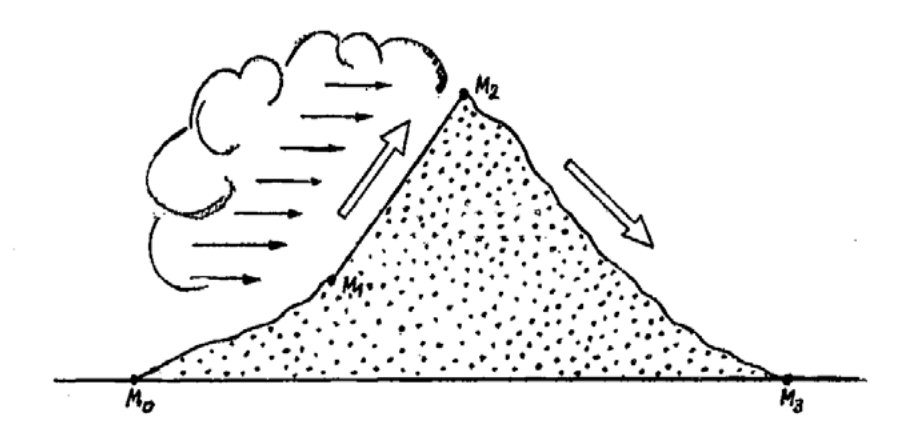
Moist air is streaming adiabatically across a mountain range as indicated in the figure.
Equal atmospheric pressures of 100 kPa are measured at meteorological stations \(M_0\) and \(M_3\) and a pressure of 70 kPa at station \(M_2\). The temperature of the air at \(M_0\) is \(20^\circ\) C.
As the air is ascending, cloud formation sets in at 84.5 kPa.
Consider a quantity of moist air ascending the mountain with a mass of 2000 kg over each square meter. This moist air reaches the mountain ridge (station \(M_2\)) after 1500 seconds. During that rise an amount of 2.45 g of water per kilogram of air is precipitated as rain.
-
Determine temperature \(T_1\) at \(M_1\) where the cloud ceiling forms.
-
What is the height \(h_1\) (at \(M_1\)) above station \(M_0\) of the cloud ceiling assuming a linear decrease of atmospheric density?
-
What temperature \(T_2\) is measured at the ridge of the mountain range?
-
Determine the height of the water column (precipitation level) precipitated by the air stream in 3 hours, assuming a homogeneous rainfall between points \(M_1\) and \(M_2\).
-
What temperature \(T_3\) is measured in the back of the mountain range at station \(M_3\)? Discuss the state of the atmosphere at station \(M_3\) in comparison with that at station \(M_0\).
Hints and Data
The atmosphere is to be dealt with as an ideal gas. Influences of the water vapour on the specific heat capacity and the atmospheric density are to be neglected; the same applies to the temperature dependence of the specific latent heat of vaporisation. The temperatures are to be determined to an accuracy of 1 K, the height of the cloud ceiling to an accuracy of 10 m and the precipitation level to an accuracy of 1 mm.
Specific heat capacity of the atmosphere in the pertaining temperature range:
\[ c_p=1005\ \mathrm{J\cdot kg^{-1}\cdot K^{-1}} \]
Atmospheric density for \(p_0\) and \(T_0\) at station \(M_0\): \[ \rho_0=1.189\ \mathrm{kg\cdot m^{-3}} \]
Specific latent heat of vaporisation of the water within the volume of the cloud:
\[ L_v=2500\ \mathrm{kJ\cdot kg^{-1}} \]
\[ \frac{c_p}{c_v}=\chi=1.4 \qquad\text{and}\qquad g=9.81\ \mathrm{m\cdot s^{-2}} \]
Official English text of the problem.
-
Problem 2: Electrons in a magnetic field
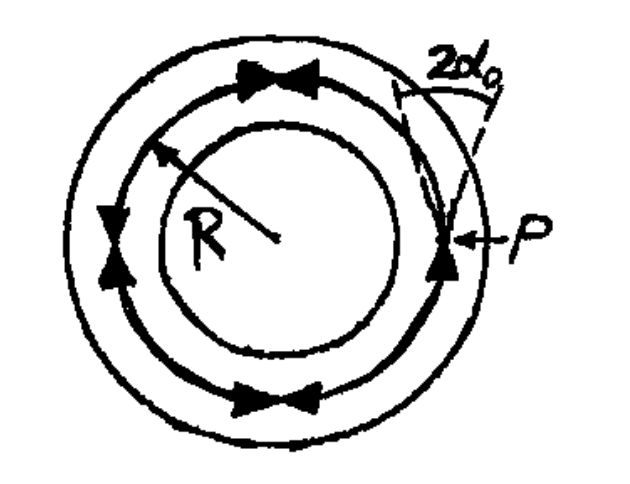
A beam of electrons emitted by a point source P enters the magnetic field \(\vec B\) of a toroidal coil (toroid) in the direction of the lines of force. The angle of the aperture of the beam \(2\cdot\alpha_0\) is assumed to be small \((2\cdot\alpha_0\ll1)\). The injection of the electrons occurs on the mean radius R of the toroid with acceleration voltage \(V_0\).
Neglect any interaction between the electrons. The magnitude of \(\vec B\), B, is assumed to be constant.
-
To guide the electron in the toroidal field a homogeneous magnetic deflection field \(\vec B_1\) is required. Calculate \(\vec B_1\) for an electron moving on a circular orbit of radius R in the torus.
-
Determine the value of \(\vec B\) which gives four focussing points separated by \(\pi/2\) as indicated in the diagram.
Note: When considering the electron paths you may disregard the curvature of the magnetic field.
- The electron beam cannot stay in the toroid without a deflection field \(\vec B_1\), but will leave it with a systematic motion (drift) perpendicular to the plane of the toroid.
a) Show that the radial deviation of the electrons from the injection radius is finite.
b) Determine the direction of the drift velocity.
Note: The angle of aperture of the electron beam can be neglected. Use the laws of conservation of energy and of angular momentum.
Data:
\[ \frac{e}{m}=1.76\cdot10^{11}\ \mathrm{C\cdot kg^{-1}}; \qquad V_0=3\ \mathrm{kV}; \qquad R=50\ \mathrm{mm} \]
Official English text of the problem.
-
Problem 3: Infinite LC-grid
When sine waves propagate in an infinite LC-grid (see the figure below) the phase of the ac-voltage across two successive capacitors differs by \(\Phi\).
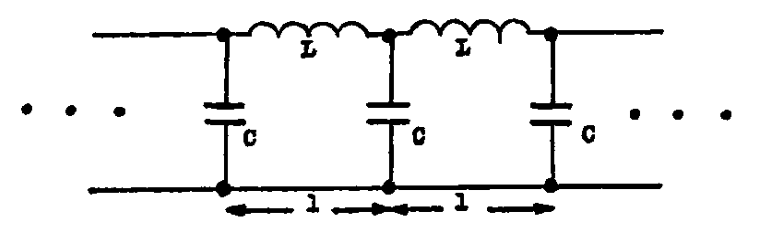
a) Determine how \(\Phi\) depends on \(\omega\), L and C (\(\omega\) is the angular frequency of the sine wave).
b) Determine the velocity of propagation of the waves if the length of each unit is \(\ell\).
c) State under what conditions the propagation velocity of the waves is almost independent of \(\omega\). Determine the velocity in this case.
d) Suggest a simple mechanical model which is an analogue to the above circuit and derive equations which establish the validity of your model.
Formulae:
\[ \cos\alpha-\cos\beta =-2\cdot\sin\left(\frac{\alpha+\beta}{2}\right) \cdot\sin\left(\frac{\alpha-\beta}{2}\right) \]
\[ \sin\alpha-\sin\beta =2\cdot\cos\left(\frac{\alpha+\beta}{2}\right) \cdot\sin\left(\frac{\alpha-\beta}{2}\right) \]
Official English text of the problem.
Internationale Physik-Olympiade
IPhO 1987
Jena, Deutsche Demokratische Republik · 3 Theorieaufgaben mit vollständigen Lösungen
Aufgabe 1: Aufsteigende feuchte Luft
Feuchte Luft strömt adiabatisch über ein Gebirge, wie in der Abbildung dargestellt.
An den meteorologischen Stationen \(M_0\) und \(M_3\) werden gleiche Luftdrücke von 100 kPa gemessen, an der Station \(M_2\) ein Druck von 70 kPa. Die Lufttemperatur bei \(M_0\) beträgt \(20^\circ\) C.
Beim Aufsteigen der Luft setzt bei 84.5 kPa die Wolkenbildung ein.
Betrachten Sie eine Menge feuchter Luft, die mit einer Masse von 2000 kg über jedem Quadratmeter am Gebirge aufsteigt. Diese feuchte Luft erreicht den Gebirgskamm (Station \(M_2\)) nach 1500 Sekunden. Während dieses Aufstiegs fallen 2.45 g Wasser pro Kilogramm Luft als Regen aus.
-
Bestimmen Sie die Temperatur \(T_1\) bei \(M_1\), wo sich die Wolkenuntergrenze bildet.
-
In welcher Höhe \(h_1\) (bei \(M_1\)) über der Station \(M_0\) liegt die Wolkenuntergrenze, wenn eine lineare Abnahme der Luftdichte angenommen wird?
-
Welche Temperatur \(T_2\) wird am Gebirgskamm gemessen?
-
Bestimmen Sie die Höhe der Wassersäule (Niederschlagshöhe), die der Luftstrom in 3 Stunden als Niederschlag abgibt, unter der Annahme eines gleichmäßigen Regenfalls zwischen den Punkten \(M_1\) und \(M_2\).
-
Welche Temperatur \(T_3\) wird auf der Rückseite des Gebirges an der Station \(M_3\) gemessen? Diskutieren Sie den Zustand der Atmosphäre an der Station \(M_3\) im Vergleich zu dem an der Station \(M_0\).
Hinweise und Daten
Die Atmosphäre ist als ideales Gas zu behandeln. Der Einfluss des Wasserdampfs auf die spezifische Wärmekapazität und die Luftdichte ist zu vernachlässigen; dasselbe gilt für die Temperaturabhängigkeit der spezifischen Verdampfungswärme. Die Temperaturen sind auf 1 K genau, die Höhe der Wolkenuntergrenze auf 10 m genau und die Niederschlagshöhe auf 1 mm genau zu bestimmen.
Spezifische Wärmekapazität der Luft im betrachteten Temperaturbereich:
\[ c_p=1005\ \mathrm{J\cdot kg^{-1}\cdot K^{-1}} \]
Luftdichte bei \(p_0\) und \(T_0\) an der Station \(M_0\): \[ \rho_0=1.189\ \mathrm{kg\cdot m^{-3}} \]
Spezifische Verdampfungswärme des Wassers innerhalb des Wolkenvolumens:
\[ L_v=2500\ \mathrm{kJ\cdot kg^{-1}} \]
\[ \frac{c_p}{c_v}=\chi=1.4 \qquad\text{und}\qquad g=9.81\ \mathrm{m\cdot s^{-2}} \]
Aufgabentext aus dem offiziellen englischen Text übersetzt.
-
Aufgabe 2: Elektronen in einem Magnetfeld
Ein von einer Punktquelle P ausgesandter Elektronenstrahl tritt in Richtung der Feldlinien in das Magnetfeld \(\vec B\) einer Ringspule (Toroid) ein. Der Öffnungswinkel des Strahls \(2\cdot\alpha_0\) wird als klein angenommen \((2\cdot\alpha_0\ll1)\). Die Elektronen werden auf dem mittleren Radius R des Toroids mit der Beschleunigungsspannung \(V_0\) eingeschossen.
Vernachlässigen Sie jegliche Wechselwirkung zwischen den Elektronen. Der Betrag von \(\vec B\), B, wird als konstant angenommen.
-
Um das Elektron im toroidalen Feld zu führen, ist ein homogenes magnetisches Ablenkfeld \(\vec B_1\) erforderlich. Berechnen Sie \(\vec B_1\) für ein Elektron, das sich im Torus auf einer Kreisbahn mit dem Radius R bewegt.
-
Bestimmen Sie den Wert von \(\vec B\), bei dem sich vier Fokussierungspunkte im Winkelabstand \(\pi/2\) ergeben, wie in der Abbildung dargestellt.
Hinweis: Bei der Betrachtung der Elektronenbahnen dürfen Sie die Krümmung des Magnetfeldes vernachlässigen.
- Der Elektronenstrahl kann ohne ein Ablenkfeld \(\vec B_1\) nicht im Toroid bleiben, sondern verlässt ihn mit einer systematischen Bewegung (Drift) senkrecht zur Ebene des Toroids.
a) Zeigen Sie, dass die radiale Abweichung der Elektronen vom Einschussradius endlich ist.
b) Bestimmen Sie die Richtung der Driftgeschwindigkeit.
Hinweis: Der Öffnungswinkel des Elektronenstrahls kann vernachlässigt werden. Verwenden Sie die Erhaltungssätze für Energie und Drehimpuls.
Gegeben:
\[ \frac{e}{m}=1.76\cdot10^{11}\ \mathrm{C\cdot kg^{-1}}; \qquad V_0=3\ \mathrm{kV}; \qquad R=50\ \mathrm{mm} \]
Aufgabentext aus dem offiziellen englischen Text übersetzt.
-
Aufgabe 3: Unendliches LC-Netzwerk
Wenn sich sinusförmige Wellen in einem unendlichen LC-Netzwerk ausbreiten (siehe die folgende Abbildung), unterscheiden sich die Phasen der Wechselspannungen an zwei aufeinanderfolgenden Kondensatoren um \(\Phi\).
a) Bestimmen Sie, wie \(\Phi\) von \(\omega\), L und C abhängt (\(\omega\) ist die Kreisfrequenz der Sinuswelle).
b) Bestimmen Sie die Ausbreitungsgeschwindigkeit der Wellen, wenn die Länge jeder Einheit \(\ell\) beträgt.
c) Geben Sie an, unter welchen Bedingungen die Ausbreitungsgeschwindigkeit der Wellen nahezu unabhängig von \(\omega\) ist. Bestimmen Sie die Geschwindigkeit in diesem Fall.
d) Schlagen Sie ein einfaches mechanisches Modell vor, das ein Analogon zur obigen Schaltung darstellt, und leiten Sie Gleichungen her, die die Gültigkeit Ihres Modells belegen.
Formeln:
\[ \cos\alpha-\cos\beta =-2\cdot\sin\left(\frac{\alpha+\beta}{2}\right) \cdot\sin\left(\frac{\alpha-\beta}{2}\right) \]
\[ \sin\alpha-\sin\beta =2\cdot\cos\left(\frac{\alpha+\beta}{2}\right) \cdot\sin\left(\frac{\alpha-\beta}{2}\right) \]
Aufgabentext aus dem offiziellen englischen Text übersetzt.
Uluslararası Fizik Olimpiyatı
IPhO 1987
Jena, Demokratik Alman Cumhuriyeti · 3 teori sorusu, tam çözümleriyle
Soru 1: Yükselen nemli hava
Nemli hava, şekilde gösterildiği gibi bir sıradağın üzerinden adyabatik olarak akmaktadır.
\(M_0\) ve \(M_3\) meteoroloji istasyonlarında birbirine eşit ve 100 kPa değerinde atmosfer basınçları, \(M_2\) istasyonunda ise 70 kPa basınç ölçülmektedir. \(M_0\)'daki havanın sıcaklığı \(20^\circ\) C'dir.
Hava yükselirken 84.5 kPa basınçta bulut oluşumu başlar.
Dağ boyunca yükselen ve her metrekare üzerinde 2000 kg kütleye sahip bir miktar nemli havayı ele alın. Bu nemli hava 1500 saniye sonra dağ sırtına (\(M_2\) istasyonuna) ulaşır. Bu yükseliş sırasında havanın her kilogramı başına 2.45 g su yağmur olarak düşer.
-
Bulut tabanının oluştuğu \(M_1\)'deki \(T_1\) sıcaklığını belirleyin.
-
Atmosfer yoğunluğunun doğrusal olarak azaldığını varsayarak bulut tabanının (\(M_1\)'de) \(M_0\) istasyonuna göre \(h_1\) yüksekliğini bulun.
-
Sıradağın sırtında hangi \(T_2\) sıcaklığı ölçülür?
-
\(M_1\) ve \(M_2\) noktaları arasında yağışın homojen olduğunu varsayarak hava akımının 3 saatte oluşturduğu yağışa karşılık gelen su sütununun yüksekliğini (yağış yüksekliğini) belirleyin.
-
Sıradağın arka tarafındaki \(M_3\) istasyonunda hangi \(T_3\) sıcaklığı ölçülür? \(M_3\) istasyonundaki atmosferin durumunu \(M_0\) istasyonundakiyle karşılaştırarak tartışın.
İpuçları ve Veriler
Atmosfer ideal gaz olarak ele alınacaktır. Su buharının özgül ısı kapasitesi ve atmosfer yoğunluğu üzerindeki etkileri ihmal edilecektir; aynı şekilde özgül buharlaşma gizli ısısının sıcaklığa bağımlılığı da ihmal edilecektir. Sıcaklıklar 1 K, bulut tabanının yüksekliği 10 m ve yağış yüksekliği 1 mm doğrulukla belirlenecektir.
İlgili sıcaklık aralığında atmosferin özgül ısı kapasitesi:
\[ c_p=1005\ \mathrm{J\cdot kg^{-1}\cdot K^{-1}} \]
\(M_0\) istasyonundaki \(p_0\) ve \(T_0\) için atmosfer yoğunluğu: \[ \rho_0=1.189\ \mathrm{kg\cdot m^{-3}} \]
Bulut hacmi içindeki suyun özgül buharlaşma gizli ısısı:
\[ L_v=2500\ \mathrm{kJ\cdot kg^{-1}} \]
\[ \frac{c_p}{c_v}=\chi=1.4 \qquad\text{ve}\qquad g=9.81\ \mathrm{m\cdot s^{-2}} \]
Soru metni resmi İngilizce metinden çevrilmiştir.
-
Soru 2: Manyetik alanda elektronlar
Noktasal bir P kaynağından yayılan bir elektron demeti, toroidal bir bobinin (toroidin) \(\vec B\) manyetik alanına alan çizgileri doğrultusunda girer. Demetin açıklık açısının \(2\cdot\alpha_0\) küçük olduğu varsayılmaktadır \((2\cdot\alpha_0\ll1)\). Elektronlar, \(V_0\) hızlandırma gerilimiyle toroidin ortalama yarıçapı R üzerinde içeri gönderilir.
Elektronlar arasındaki tüm etkileşimleri ihmal edin. \(\vec B\)'nin büyüklüğü B'nin sabit olduğu varsayılmaktadır.
-
Elektronu toroidal alanda yönlendirmek için düzgün bir \(\vec B_1\) manyetik saptırma alanı gereklidir. Toroid içinde R yarıçaplı dairesel bir yörüngede hareket eden bir elektron için \(\vec B_1\)'i hesaplayın.
-
Şekilde gösterildiği gibi aralarında \(\pi/2\) açısal uzaklık bulunan dört odaklanma noktası sağlayan \(\vec B\)'nin değerini belirleyin.
Not: Elektronların yörüngelerini incelerken manyetik alanın eğriliğini göz ardı edebilirsiniz.
- Elektron demeti, bir \(\vec B_1\) saptırma alanı olmadan toroid içinde kalamaz; toroid düzlemine dik, sistematik bir hareketle (sürüklenme) toroidin dışına çıkar.
a) Elektronların giriş yarıçapından radyal sapmasının sonlu olduğunu gösterin.
b) Sürüklenme hızının yönünü belirleyin.
Not: Elektron demetinin açıklık açısı ihmal edilebilir. Enerjinin ve açısal momentumun korunumu yasalarını kullanın.
Veriler:
\[ \frac{e}{m}=1.76\cdot10^{11}\ \mathrm{C\cdot kg^{-1}}; \qquad V_0=3\ \mathrm{kV}; \qquad R=50\ \mathrm{mm} \]
Soru metni resmi İngilizce metinden çevrilmiştir.
-
Soru 3: Sonsuz LC ağı
Sinüs dalgaları sonsuz bir LC ağında (aşağıdaki şekle bakınız) yayılırken, ardışık iki kondansatörün uçları arasındaki alternatif gerilimlerin fazları arasında \(\Phi\) kadar fark vardır.
a) \(\Phi\)'nin \(\omega\), L ve C'ye nasıl bağlı olduğunu belirleyiniz (\(\omega\), sinüs dalgasının açısal frekansıdır).
b) Her bir birimin uzunluğu \(\ell\) ise dalgaların yayılma hızını belirleyiniz.
c) Dalgaların yayılma hızının hangi koşullarda \(\omega\)'dan hemen hemen bağımsız olduğunu belirtiniz. Bu durumda hızı belirleyiniz.
d) Yukarıdaki devrenin analoğu olan basit bir mekanik model öneriniz ve modelinizin geçerliliğini ortaya koyan denklemleri türetiniz.
Formüller:
\[ \cos\alpha-\cos\beta =-2\cdot\sin\left(\frac{\alpha+\beta}{2}\right) \cdot\sin\left(\frac{\alpha-\beta}{2}\right) \]
\[ \sin\alpha-\sin\beta =2\cdot\cos\left(\frac{\alpha+\beta}{2}\right) \cdot\sin\left(\frac{\alpha-\beta}{2}\right) \]
Soru metni resmi İngilizce metinden çevrilmiştir.
Olimpiada Internacional de Física
IPhO 1987
Jena, República Democrática Alemana · 3 problemas teóricos con soluciones completas
Problema 1: Ascenso de aire húmedo
Una corriente de aire húmedo atraviesa adiabáticamente una cordillera, como se indica en la figura.
En las estaciones meteorológicas \(M_0\) y \(M_3\) se miden presiones atmosféricas iguales de 100 kPa, y en la estación \(M_2\), una presión de 70 kPa. La temperatura del aire en \(M_0\) es de \(20^\circ\) C.
A medida que el aire asciende, la formación de nubes comienza a una presión de 84.5 kPa.
Considérese una cantidad de aire húmedo que asciende por la montaña con una masa de 2000 kg sobre cada metro cuadrado. Este aire húmedo alcanza la cresta de la montaña (estación \(M_2\)) al cabo de 1500 segundos. Durante ese ascenso precipitan en forma de lluvia 2.45 g de agua por kilogramo de aire.
-
Determine la temperatura \(T_1\) en \(M_1\), donde se forma la base de las nubes.
-
¿Cuál es la altura \(h_1\) (en \(M_1\)) de la base de las nubes sobre la estación \(M_0\), suponiendo una disminución lineal de la densidad atmosférica?
-
¿Qué temperatura \(T_2\) se mide en la cresta de la cordillera?
-
Determine la altura de la columna de agua (nivel de precipitación) que precipita de la corriente de aire en 3 horas, suponiendo una lluvia homogénea entre los puntos \(M_1\) y \(M_2\).
-
¿Qué temperatura \(T_3\) se mide a sotavento de la cordillera, en la estación \(M_3\)? Analice el estado de la atmósfera en la estación \(M_3\) en comparación con el de la estación \(M_0\).
Indicaciones y datos
La atmósfera debe tratarse como un gas ideal. Deben despreciarse los efectos del vapor de agua sobre la capacidad calorífica específica y la densidad atmosférica; lo mismo se aplica a la dependencia del calor latente específico de vaporización con la temperatura. Las temperaturas deben determinarse con una precisión de 1 K, la altura de la base de las nubes con una precisión de 10 m y el nivel de precipitación con una precisión de 1 mm.
Capacidad calorífica específica de la atmósfera en el intervalo de temperaturas considerado:
\[ c_p=1005\ \mathrm{J\cdot kg^{-1}\cdot K^{-1}} \]
Densidad atmosférica para \(p_0\) y \(T_0\) en la estación \(M_0\): \[ \rho_0=1.189\ \mathrm{kg\cdot m^{-3}} \]
Calor latente específico de vaporización del agua dentro del volumen de la nube:
\[ L_v=2500\ \mathrm{kJ\cdot kg^{-1}} \]
\[ \frac{c_p}{c_v}=\chi=1.4 \qquad\text{y}\qquad g=9.81\ \mathrm{m\cdot s^{-2}} \]
Enunciado traducido del texto oficial en inglés.
-
Problema 2: Electrones en un campo magnético
Un haz de electrones emitido por una fuente puntual P entra en el campo magnético \(\vec B\) de una bobina toroidal (toroide) en la dirección de las líneas de campo. Se supone que el ángulo de apertura del haz \(2\cdot\alpha_0\) es pequeño \((2\cdot\alpha_0\ll1)\). La inyección de los electrones se produce en el radio medio R del toroide con una tensión de aceleración \(V_0\).
Desprecie cualquier interacción entre los electrones. Se supone que el módulo de \(\vec B\), B, es constante.
-
Para guiar al electrón en el campo toroidal se necesita un campo magnético de desviación homogéneo \(\vec B_1\). Calcule \(\vec B_1\) para un electrón que se mueve en una órbita circular de radio R en el toroide.
-
Determine el valor de \(\vec B\) que produce cuatro puntos de enfoque separados por \(\pi/2\), como se indica en el diagrama.
Nota: Al considerar las trayectorias de los electrones, puede despreciar la curvatura del campo magnético.
- El haz de electrones no puede permanecer en el toroide sin un campo de desviación \(\vec B_1\), sino que saldrá de él con un movimiento sistemático (deriva) perpendicular al plano del toroide.
a) Demuestre que la desviación radial de los electrones respecto al radio de inyección es finita.
b) Determine la dirección y el sentido de la velocidad de deriva.
Nota: Puede despreciarse el ángulo de apertura del haz de electrones. Utilice las leyes de conservación de la energía y del momento angular.
Datos:
\[ \frac{e}{m}=1.76\cdot10^{11}\ \mathrm{C\cdot kg^{-1}}; \qquad V_0=3\ \mathrm{kV}; \qquad R=50\ \mathrm{mm} \]
Enunciado traducido del texto oficial en inglés.
-
Problema 3: Red LC infinita
Cuando se propagan ondas sinusoidales por una red LC infinita (véase la figura siguiente), la fase de la tensión alterna entre los bornes de dos condensadores sucesivos difiere en \(\Phi\).
a) Determine cómo depende \(\Phi\) de \(\omega\), L y C (\(\omega\) es la frecuencia angular de la onda sinusoidal).
b) Determine la velocidad de propagación de las ondas si la longitud de cada unidad es \(\ell\).
c) Indique en qué condiciones la velocidad de propagación de las ondas es casi independiente de \(\omega\). Determine la velocidad en este caso.
d) Proponga un modelo mecánico sencillo que sea análogo al circuito anterior y deduzca las ecuaciones que demuestren la validez de su modelo.
Fórmulas:
\[ \cos\alpha-\cos\beta =-2\cdot\sin\left(\frac{\alpha+\beta}{2}\right) \cdot\sin\left(\frac{\alpha-\beta}{2}\right) \]
\[ \sin\alpha-\sin\beta =2\cdot\cos\left(\frac{\alpha+\beta}{2}\right) \cdot\sin\left(\frac{\alpha-\beta}{2}\right) \]
Enunciado traducido del texto oficial en inglés.
国际物理奥林匹克
IPhO 1987
德意志民主共和国耶拿 · 3 道理论题及完整解答
题目 1:上升的湿空气
湿空气以绝热方式流过一条山脉,如图所示。
在气象站 \(M_0\) 和 \(M_3\) 测得的大气压相同,均为 100 kPa,而在气象站 \(M_2\) 测得的气压为 70 kPa。\(M_0\) 处的空气温度为 \(20^\circ\) C。
空气上升时,在气压为 84.5 kPa 处开始形成云。
考虑一团沿山坡上升的湿空气,每平方米上方的空气质量为 2000 kg。这团湿空气经过 1500 秒后到达山脊(气象站 \(M_2\))。在上升过程中,每千克空气中有 2.45 g 的水以雨的形式降下。
-
求云底形成处 \(M_1\) 的温度 \(T_1\)。
-
假设大气密度随高度线性减小,云底(\(M_1\) 处)相对于气象站 \(M_0\) 的高度 \(h_1\) 是多少?
-
在山脊处测得的温度 \(T_2\) 是多少?
-
假设 \(M_1\) 与 \(M_2\) 两点之间降雨均匀,求气流在 3 小时内产生的降水水柱高度(降水量)。
-
在山脉背风面的气象站 \(M_3\) 测得的温度 \(T_3\) 是多少?讨论气象站 \(M_3\) 处的大气状态与气象站 \(M_0\) 处相比有何不同。
提示与数据
将大气视为理想气体。忽略水蒸气对比热容和大气密度的影响;同样忽略汽化比潜热随温度的变化。温度的计算精度要求为 1 K,云底高度的计算精度要求为 10 m,降水量的计算精度要求为 1 mm。
在所涉及的温度范围内,大气的比热容为:
\[ c_p=1005\ \mathrm{J\cdot kg^{-1}\cdot K^{-1}} \]
气象站 \(M_0\) 处,在 \(p_0\) 和 \(T_0\) 下的大气密度为: \[ \rho_0=1.189\ \mathrm{kg\cdot m^{-3}} \]
云体内水的汽化比潜热为:
\[ L_v=2500\ \mathrm{kJ\cdot kg^{-1}} \]
\[ \frac{c_p}{c_v}=\chi=1.4 \qquad\text{且}\qquad g=9.81\ \mathrm{m\cdot s^{-2}} \]
题目译自官方英文原文。
-
题目 2:磁场中的电子
由点源 P 发射的一束电子沿磁感线方向进入环形线圈(螺绕环)的磁场 \(\vec B\)。假设电子束的张角 \(2\cdot\alpha_0\) 很小 \((2\cdot\alpha_0\ll1)\)。电子在螺绕环的平均半径 R 处注入,加速电压为 \(V_0\)。
忽略电子之间的任何相互作用。假设 \(\vec B\) 的大小 B 为常量。
-
为使电子在环形磁场中沿环运动,需要一个均匀的偏转磁场 \(\vec B_1\)。对于在环内沿半径为 R 的圆形轨道运动的电子,计算所需的 \(\vec B_1\)。
-
确定 \(\vec B\) 的大小,使电子束如图所示形成四个相隔 \(\pi/2\) 的聚焦点。
注:考虑电子轨迹时,可以忽略磁场的弯曲。
- 没有偏转磁场 \(\vec B_1\) 时,电子束无法保持在螺绕环内,而会沿垂直于螺绕环平面的方向发生定向运动(漂移),从而离开螺绕环。
a) 证明电子相对于注入半径的径向偏移是有限的。
b) 确定漂移速度的方向。
注:可以忽略电子束的张角。使用能量守恒定律和角动量守恒定律。
数据:
\[ \frac{e}{m}=1.76\cdot10^{11}\ \mathrm{C\cdot kg^{-1}}; \qquad V_0=3\ \mathrm{kV}; \qquad R=50\ \mathrm{mm} \]
题目译自官方英文原文。
-
题目 3:无限 LC 梯形网络
当正弦波在无限 LC 梯形网络中传播时(见下图),相邻两个电容器两端交流电压的相位相差 \(\Phi\)。
a) 确定 \(\Phi\) 与 \(\omega\)、L 和 C 的关系(\(\omega\) 为正弦波的角频率)。
b) 若每个单元的长度为 \(\ell\),求波的传播速度。
c) 说明在什么条件下波的传播速度几乎与 \(\omega\) 无关。求此时的速度。
d) 提出一个与上述电路相类比的简单力学模型,并推导方程以证明该模型的合理性。
公式:
\[ \cos\alpha-\cos\beta =-2\cdot\sin\left(\frac{\alpha+\beta}{2}\right) \cdot\sin\left(\frac{\alpha-\beta}{2}\right) \]
\[ \sin\alpha-\sin\beta =2\cdot\cos\left(\frac{\alpha+\beta}{2}\right) \cdot\sin\left(\frac{\alpha-\beta}{2}\right) \]
题目译自官方英文原文。
Международная физическая олимпиада
IPhO 1987
Йена, Германская Демократическая Республика · 3 теоретические задачи с полными решениями
Задача 1: Подъём влажного воздуха
Влажный воздух адиабатически перетекает через горный хребет, как показано на рисунке.
На метеорологических станциях \(M_0\) и \(M_3\) измерены одинаковые значения атмосферного давления — 100 кПа, а на станции \(M_2\) — давление 70 кПа. Температура воздуха на станции \(M_0\) составляет \(20^\circ\) C.
При подъёме воздуха образование облаков начинается при давлении 84.5 кПа.
Рассмотрим порцию влажного воздуха, поднимающуюся по склону горы, масса которой составляет 2000 кг на каждый квадратный метр. Этот влажный воздух достигает гребня горного хребта (станции \(M_2\)) через 1500 секунд. За время подъёма на каждый килограмм воздуха выпадает 2.45 г воды в виде дождя.
-
Определите температуру \(T_1\) на станции \(M_1\), где образуется нижняя граница облаков.
-
На какой высоте \(h_1\) (на станции \(M_1\)) над станцией \(M_0\) находится нижняя граница облаков, если считать, что плотность атмосферы убывает линейно?
-
Какая температура \(T_2\) измеряется на гребне горного хребта?
-
Определите высоту столба воды (слоя осадков), выпавшей из воздушного потока за 3 часа, предполагая равномерное выпадение дождя между точками \(M_1\) и \(M_2\).
-
Какая температура \(T_3\) измеряется за горным хребтом на станции \(M_3\)? Обсудите состояние атмосферы на станции \(M_3\) по сравнению с её состоянием на станции \(M_0\).
Указания и данные
Атмосферу следует рассматривать как идеальный газ. Влиянием водяного пара на удельную теплоёмкость и плотность атмосферы следует пренебречь; также следует пренебречь зависимостью удельной теплоты парообразования от температуры. Температуры следует определить с точностью до 1 К, высоту нижней границы облаков — с точностью до 10 м, а высоту слоя осадков — с точностью до 1 мм.
Удельная теплоёмкость атмосферы в рассматриваемом диапазоне температур:
\[ c_p=1005\ \mathrm{J\cdot kg^{-1}\cdot K^{-1}} \]
Плотность атмосферы при \(p_0\) и \(T_0\) на станции \(M_0\): \[ \rho_0=1.189\ \mathrm{kg\cdot m^{-3}} \]
Удельная теплота парообразования воды в объёме облака:
\[ L_v=2500\ \mathrm{kJ\cdot kg^{-1}} \]
\[ \frac{c_p}{c_v}=\chi=1.4 \qquad\text{и}\qquad g=9.81\ \mathrm{m\cdot s^{-2}} \]
Условие переведено с официального английского текста.
-
Задача 2: Электроны в магнитном поле
Пучок электронов, испускаемых точечным источником P, входит в магнитное поле \(\vec B\) тороидальной катушки (тороида) в направлении силовых линий. Угол раствора пучка \(2\cdot\alpha_0\) считается малым \((2\cdot\alpha_0\ll1)\). Электроны инжектируются на среднем радиусе R тороида после ускорения напряжением \(V_0\).
Пренебрегите любым взаимодействием между электронами. Модуль \(\vec B\), B, считается постоянным.
-
Для удержания электрона на траектории в тороидальном поле необходимо однородное отклоняющее магнитное поле \(\vec B_1\). Рассчитайте \(\vec B_1\) для электрона, движущегося в тороиде по круговой орбите радиуса R.
-
Определите значение \(\vec B\), при котором возникают четыре точки фокусировки, разделённые угловыми промежутками \(\pi/2\), как показано на рисунке.
Примечание: При рассмотрении траекторий электронов можно пренебречь кривизной магнитного поля.
- Без отклоняющего поля \(\vec B_1\) электронный пучок не может оставаться в тороиде: он будет выходить из него вследствие направленного движения (дрейфа) перпендикулярно плоскости тороида.
a) Покажите, что радиальное отклонение электронов от радиуса инжекции конечно.
b) Определите направление скорости дрейфа.
Примечание: Углом раствора электронного пучка можно пренебречь. Используйте законы сохранения энергии и момента импульса.
Данные:
\[ \frac{e}{m}=1.76\cdot10^{11}\ \mathrm{C\cdot kg^{-1}}; \qquad V_0=3\ \mathrm{kV}; \qquad R=50\ \mathrm{mm} \]
Условие переведено с официального английского текста.
-
Задача 3: Бесконечная LC-цепочка
При распространении синусоидальных волн в бесконечной LC-цепочке (см. рисунок ниже) фазы переменных напряжений на двух последовательных конденсаторах различаются на \(\Phi\).
a) Определите, как \(\Phi\) зависит от \(\omega\), L и C (\(\omega\) — угловая частота синусоидальной волны).
b) Определите скорость распространения волн, если длина каждого звена равна \(\ell\).
c) Укажите, при каких условиях скорость распространения волн почти не зависит от \(\omega\). Определите скорость в этом случае.
d) Предложите простую механическую модель, аналогичную приведённой выше цепи, и выведите уравнения, подтверждающие справедливость этой аналогии.
Формулы:
\[ \cos\alpha-\cos\beta =-2\cdot\sin\left(\frac{\alpha+\beta}{2}\right) \cdot\sin\left(\frac{\alpha-\beta}{2}\right) \]
\[ \sin\alpha-\sin\beta =2\cdot\cos\left(\frac{\alpha+\beta}{2}\right) \cdot\sin\left(\frac{\alpha-\beta}{2}\right) \]
Условие переведено с официального английского текста.
الأولمبياد الدولي للفيزياء
IPhO 1987
ينا، جمهورية ألمانيا الديمقراطية · 3 مسائل نظرية مع حلول كاملة
المسألة 1: صعود الهواء الرطب
يتدفق هواء رطب عبر سلسلة جبلية تدفقًا كظوميًا، كما هو موضح في الشكل.
يُقاس ضغط جوي متساوٍ مقداره 100 kPa في محطتي الأرصاد الجوية \(M_0\) و\(M_3\)، وضغط مقداره 70 kPa في المحطة \(M_2\). درجة حرارة الهواء عند \(M_0\) هي \(20^\circ\mathrm{C}\).
أثناء صعود الهواء، يبدأ تشكُّل السحب عند ضغط 84.5 kPa.
اعتبر كمية من الهواء الرطب تصعد الجبل، كتلتها 2000 kg فوق كل متر مربع. يصل هذا الهواء الرطب إلى الحافة الجبلية (المحطة \(M_2\)) بعد 1500 ثانية. وخلال هذا الصعود، تهطل كمية مقدارها 2.45 g من الماء لكل كيلوغرام من الهواء على هيئة مطر.
-
حدِّد درجة الحرارة \(T_1\) عند \(M_1\)، حيث تتشكّل قاعدة السحب.
-
ما ارتفاع \(h_1\) (عند \(M_1\)) لقاعدة السحب فوق المحطة \(M_0\)، بافتراض تناقص كثافة الهواء خطيًا؟
-
ما درجة الحرارة \(T_2\) التي تُقاس عند حافة السلسلة الجبلية؟
-
حدِّد ارتفاع عمود الماء (مقدار الهطول) الذي يهطل من تيار الهواء خلال 3 ساعات، بافتراض هطول مطري متجانس بين النقطتين \(M_1\) و\(M_2\).
-
ما درجة الحرارة \(T_3\) التي تُقاس خلف السلسلة الجبلية عند المحطة \(M_3\)؟ ناقش حالة الجو عند المحطة \(M_3\) مقارنةً بحالته عند المحطة \(M_0\).
إرشادات ومعطيات
يُعامل الهواء الجوي بوصفه غازًا مثاليًا. تُهمل تأثيرات بخار الماء في السعة الحرارية النوعية وكثافة الهواء؛ كما يُهمل اعتماد الحرارة الكامنة النوعية للتبخر على درجة الحرارة. تُحدَّد درجات الحرارة بدقة 1 K، وارتفاع قاعدة السحب بدقة 10 m، ومقدار الهطول بدقة 1 mm.
السعة الحرارية النوعية للهواء الجوي في نطاق درجات الحرارة المعني:
\[ c_p=1005\ \mathrm{J\cdot kg^{-1}\cdot K^{-1}} \]
كثافة الهواء عند \(p_0\) و\(T_0\) في المحطة \(M_0\): \[ \rho_0=1.189\ \mathrm{kg\cdot m^{-3}} \]
الحرارة الكامنة النوعية لتبخر الماء داخل حجم السحابة:
\[ L_v=2500\ \mathrm{kJ\cdot kg^{-1}} \]
\[ \frac{c_p}{c_v}=\chi=1.4 \qquad\text{و}\qquad g=9.81\ \mathrm{m\cdot s^{-2}} \]
نص المسألة مترجم عن النص الإنجليزي الرسمي.
-
المسألة 2: إلكترونات في مجال مغناطيسي
تدخل حزمة من الإلكترونات المنبعثة من مصدر نقطي P المجال المغناطيسي \(\vec B\) لملف حلقي في اتجاه خطوط المجال. يُفترض أن زاوية انفراج الحزمة \(2\cdot\alpha_0\) صغيرة \((2\cdot\alpha_0\ll1)\). تُحقن الإلكترونات عند نصف القطر المتوسط R للملف الحلقي بجهد تسريع \(V_0\).
أهمل أي تفاعل بين الإلكترونات. يُفترض أن مقدار \(\vec B\)، وهو B، ثابت.
-
لتوجيه الإلكترون في المجال الحلقي، يلزم مجال مغناطيسي متجانس للانحراف \(\vec B_1\). احسب \(\vec B_1\) لإلكترون يتحرك في مدار دائري نصف قطره R داخل الملف الحلقي.
-
حدّد قيمة \(\vec B\) التي تعطي أربع نقاط تركيز تفصل بينها زاوية \(\pi/2\)، كما هو موضح في الرسم.
ملاحظة: عند دراسة مسارات الإلكترونات، يمكنك إهمال انحناء المجال المغناطيسي.
- لا يمكن لحزمة الإلكترونات أن تبقى داخل الملف الحلقي من دون مجال الانحراف \(\vec B_1\)، بل ستغادره بحركة منتظمة الاتجاه (انجراف) عمودية على مستوى الملف الحلقي.
a) بيّن أن الانحراف الشعاعي للإلكترونات عن نصف قطر الحقن محدود.
b) حدّد اتجاه سرعة الانجراف.
ملاحظة: يمكن إهمال زاوية انفراج حزمة الإلكترونات. استخدم قانونَي حفظ الطاقة وحفظ الزخم الزاوي.
المعطيات:
\[ \frac{e}{m}=1.76\cdot10^{11}\ \mathrm{C\cdot kg^{-1}}; \qquad V_0=3\ \mathrm{kV}; \qquad R=50\ \mathrm{mm} \]
نص المسألة مترجم عن النص الإنجليزي الرسمي.
-
المسألة 3: شبكة LC لانهائية
عندما تنتشر موجات جيبية في شبكة LC لانهائية (انظر الشكل أدناه)، يختلف طور الجهد المتناوب بين طرفي مكثفين متتاليين بمقدار \(\Phi\).
a) حدّد كيف تعتمد \(\Phi\) على \(\omega\) وL وC (حيث \(\omega\) هو التردد الزاوي للموجة الجيبية).
b) حدّد سرعة انتشار الموجات إذا كان طول كل وحدة هو \(\ell\).
c) بيّن الشروط التي تكون عندها سرعة انتشار الموجات مستقلة تقريبًا عن \(\omega\). وحدّد السرعة في هذه الحالة.
d) اقترح نموذجًا ميكانيكيًا بسيطًا يناظر الدائرة السابقة، واشتق معادلات تثبت صحة نموذجك.
صيغ رياضية:
\[ \cos\alpha-\cos\beta =-2\cdot\sin\left(\frac{\alpha+\beta}{2}\right) \cdot\sin\left(\frac{\alpha-\beta}{2}\right) \]
\[ \sin\alpha-\sin\beta =2\cdot\cos\left(\frac{\alpha+\beta}{2}\right) \cdot\sin\left(\frac{\alpha-\beta}{2}\right) \]
نص المسألة مترجم عن النص الإنجليزي الرسمي.