IPhO 1987 · Theory problem 2
Electrons in a magnetic field
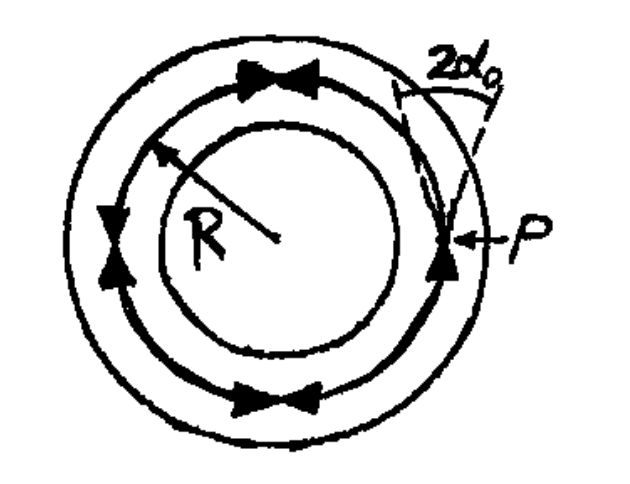
A beam of electrons emitted by a point source P enters the magnetic field \(\vec B\) of a toroidal coil (toroid) in the direction of the lines of force. The angle of the aperture of the beam \(2\cdot\alpha_0\) is assumed to be small \((2\cdot\alpha_0\ll1)\). The injection of the electrons occurs on the mean radius R of the toroid with acceleration voltage \(V_0\).
Neglect any interaction between the electrons. The magnitude of \(\vec B\), B, is assumed to be constant.
-
To guide the electron in the toroidal field a homogeneous magnetic deflection field \(\vec B_1\) is required. Calculate \(\vec B_1\) for an electron moving on a circular orbit of radius R in the torus.
-
Determine the value of \(\vec B\) which gives four focussing points separated by \(\pi/2\) as indicated in the diagram.
Note: When considering the electron paths you may disregard the curvature of the magnetic field.
- The electron beam cannot stay in the toroid without a deflection field \(\vec B_1\), but will leave it with a systematic motion (drift) perpendicular to the plane of the toroid.
a) Show that the radial deviation of the electrons from the injection radius is finite.
b) Determine the direction of the drift velocity.
Note: The angle of aperture of the electron beam can be neglected. Use the laws of conservation of energy and of angular momentum.
Data:
\[ \frac{e}{m}=1.76\cdot10^{11}\ \mathrm{C\cdot kg^{-1}}; \qquad V_0=3\ \mathrm{kV}; \qquad R=50\ \mathrm{mm} \]
Official English text of the problem.
Answers
Let \(e>0\) denote the magnitude of the electron charge. Take \(\hat{\boldsymbol\phi}\) along the injected beam and the toroidal field, and define \(\hat{\mathbf z}=\hat{\mathbf r}\times\hat{\boldsymbol\phi}\), pointing out of the page for the injection shown.
-
1. The homogeneous deflection field is perpendicular to the toroid: \[ \boxed{\vec B_1=\frac{mv_0}{eR}\hat{\mathbf z} =3.69\times10^{-3}\ \mathrm T\,\hat{\mathbf z}}, \qquad v_0=\sqrt{\frac{2eV_0}{m}}=3.25\times10^7\ \mathrm{m\,s^{-1}}. \]
-
2. In the prescribed approximation, \[ \boxed{B=\frac{4mv_0}{eR}=4B_1 =1.48\times10^{-2}\ \mathrm T}. \]
-
3(a). The radial deviation is bounded: \[ \boxed{0\le r-R\le\frac{mv_0}{eB}}. \] With the field from part 2, this bound is \(12.5\ \mathrm{mm}\). The actual maximum deviation in the constant-\(B\) model is \(5.37\ \mathrm{mm}\).
-
3(b). The drift is into the page, opposite to the deflection field required in part 1: \[ \boxed{\vec v_{\mathrm{drift}}\parallel-\hat{\mathbf z}}. \]
Solution
1. Deflection field
Using nonrelativistic mechanics, acceleration through the voltage \(V_0\) gives \[ \frac12mv_0^2=eV_0, \] hence \[ v_0=\sqrt{2\left(\frac em\right)V_0} =\sqrt{2(1.76\times10^{11})(3.00\times10^3)} =3.25\times10^7\ \mathrm{m\,s^{-1}}. \]
For the reference electron on the circular orbit, the velocity is parallel to the toroidal field. Consequently, that field produces no force on this electron.
The deflection field must supply the inward centripetal force. For \(\vec B_1=B_1\hat{\mathbf z}\), the electron’s Lorentz force is \[ \vec F=-e\vec v\times\vec B_1 =-ev_0B_1\hat{\mathbf r}, \] which points inward everywhere around the circle. Thus \[ ev_0B_1=\frac{mv_0^2}{R}. \]
Therefore \[ \boxed{\vec B_1=\frac{mv_0}{eR}\hat{\mathbf z}}, \] with magnitude \[ B_1= \frac{3.2496\times10^7} {(1.76\times10^{11})(0.050)} =3.69\times10^{-3}\ \mathrm T. \]
The required field is homogeneous and points out of the plane of the diagram.
2. Four focussing points
For this part, neglect the curvature of the guiding field as instructed. Locally, an electron follows a helix about the field direction. If its initial angle to the field is \(\alpha\), then \[ v_\parallel=v_0\cos\alpha\simeq v_0, \qquad v_\perp=v_0\sin\alpha\simeq v_0\alpha. \]
The transverse motion has cyclotron angular frequency and period \[ \omega=\frac{eB}{m}, \qquad T=\frac{2\pi}{\omega}=\frac{2\pi m}{eB}. \] Although the gyration radius depends on \(\alpha\), the period does not. After one complete gyration, every electron returns to its initial transverse position.
The distance along the beam to the next focus is therefore, to first order in the small aperture angle, \[ \ell=v_\parallel T\simeq v_0T =\frac{2\pi mv_0}{eB}. \] Differences in \(v_\parallel\) enter only at order \(\alpha^2\), which is neglected.
Four equally spaced focussing points require \[ \ell=\frac{2\pi R}{4}=\frac{\pi R}{2}. \] Equating these distances gives \[ \frac{2\pi mv_0}{eB}=\frac{\pi R}{2}, \] so \[ \boxed{B=\frac{4mv_0}{eR}=4B_1 =1.48\times10^{-2}\ \mathrm T}. \]
The successive refocussings occur at azimuthal advances \(\pi/2,\pi,3\pi/2,2\pi\); the last coincides with P. Thus there are four distinct focussing positions around the toroid, including P.
3(a). Finite radial deviation without the deflection field
Now remove \(\vec B_1\) and neglect the beam aperture. Use cylindrical coordinates about the toroid’s symmetry axis: \[ \vec B=B\hat{\boldsymbol\phi}, \qquad \vec v=\dot r\,\hat{\mathbf r} +r\dot\phi\,\hat{\boldsymbol\phi} +\dot z\,\hat{\mathbf z}. \] Initially, \[ r=R,\qquad \dot r=0,\qquad \dot z=0,\qquad r\dot\phi=v_0. \]
A magnetic field does no work, so the speed remains constant: \[ \dot r^{\,2}+r^2\dot\phi^{\,2}+\dot z^{\,2}=v_0^2. \tag{1} \]
The magnetic force has no azimuthal component. Therefore angular momentum about the symmetry axis is conserved: \[ mr^2\dot\phi=mRv_0, \qquad r\dot\phi=\frac{Rv_0}{r}. \tag{2} \] Since the azimuthal speed cannot exceed the total speed, equation (2) immediately implies \[ r\ge R. \tag{3} \]
To obtain an upper bound, use the axial component of the Lorentz force: \[ -e\vec v\times\vec B =eB\dot z\,\hat{\mathbf r} -eB\dot r\,\hat{\mathbf z}. \] Thus \[ m\ddot z=-eB\dot r. \] Because \(B\) is constant, integration with the initial conditions gives \[ \dot z=-\frac{eB}{m}(r-R)=-\omega(r-R). \tag{4} \]
Substituting equations (2) and (4) into energy conservation yields \[ \boxed{ \dot r^{\,2} +\frac{R^2v_0^2}{r^2} +\omega^2(r-R)^2 =v_0^2. } \tag{5} \] Every term on the left is nonnegative. Consequently, \[ \omega^2(r-R)^2\le v_0^2. \] Together with equation (3), this proves \[ \boxed{0\le r-R\le\frac{v_0}{\omega} =\frac{mv_0}{eB}}. \]
For the field found in part 2, \(\omega=4v_0/R\), giving the finite bound \[ r-R\le\frac R4=12.5\ \mathrm{mm}. \]
Equation (5) also gives the actual outer turning point. Set \(\dot r=0\) and write \(x=(r-R)/R\). Then \[ 16x^2+\frac{1}{(1+x)^2}=1. \] Besides the initial turning point \(x=0\), the positive root satisfies \[ 16x(1+x)^2=x+2, \] giving \[ x=0.107403, \qquad \boxed{r_{\max}-R=5.37\ \mathrm{mm}}. \]
3(b). Direction of the drift
Equations (3) and (4) give \[ \dot z=-\omega(r-R)\le0. \] Thus the axial velocity never points in the \(+\hat{\mathbf z}\) direction.
The motion actually leaves \(r=R\): initially the magnetic force vanishes because the velocity is parallel to \(\vec B\), and the radial equation gives \[ \ddot r(0)=\frac{v_0^2}{R}>0. \] Hence \(r>R\) shortly after injection and \(\dot z<0\). As the radial motion oscillates between its turning points, the axial displacement continues to accumulate in the negative direction: \[ \left\langle\dot z\right\rangle =-\omega\left\langle r-R\right\rangle<0. \]
Therefore the systematic drift is \[ \boxed{\text{into the page, opposite to }\vec B_1.} \]
The solution was checked against the official solution.
IPhO 1987 · Theorieaufgabe 2
Elektronen in einem Magnetfeld
Ein von einer Punktquelle P ausgesandter Elektronenstrahl tritt in Richtung der Feldlinien in das Magnetfeld \(\vec B\) einer Ringspule (Toroid) ein. Der Öffnungswinkel des Strahls \(2\cdot\alpha_0\) wird als klein angenommen \((2\cdot\alpha_0\ll1)\). Die Elektronen werden auf dem mittleren Radius R des Toroids mit der Beschleunigungsspannung \(V_0\) eingeschossen.
Vernachlässigen Sie jegliche Wechselwirkung zwischen den Elektronen. Der Betrag von \(\vec B\), B, wird als konstant angenommen.
-
Um das Elektron im toroidalen Feld zu führen, ist ein homogenes magnetisches Ablenkfeld \(\vec B_1\) erforderlich. Berechnen Sie \(\vec B_1\) für ein Elektron, das sich im Torus auf einer Kreisbahn mit dem Radius R bewegt.
-
Bestimmen Sie den Wert von \(\vec B\), bei dem sich vier Fokussierungspunkte im Winkelabstand \(\pi/2\) ergeben, wie in der Abbildung dargestellt.
Hinweis: Bei der Betrachtung der Elektronenbahnen dürfen Sie die Krümmung des Magnetfeldes vernachlässigen.
- Der Elektronenstrahl kann ohne ein Ablenkfeld \(\vec B_1\) nicht im Toroid bleiben, sondern verlässt ihn mit einer systematischen Bewegung (Drift) senkrecht zur Ebene des Toroids.
a) Zeigen Sie, dass die radiale Abweichung der Elektronen vom Einschussradius endlich ist.
b) Bestimmen Sie die Richtung der Driftgeschwindigkeit.
Hinweis: Der Öffnungswinkel des Elektronenstrahls kann vernachlässigt werden. Verwenden Sie die Erhaltungssätze für Energie und Drehimpuls.
Gegeben:
\[ \frac{e}{m}=1.76\cdot10^{11}\ \mathrm{C\cdot kg^{-1}}; \qquad V_0=3\ \mathrm{kV}; \qquad R=50\ \mathrm{mm} \]
Aufgabentext aus dem offiziellen englischen Text übersetzt.
Antworten
Es bezeichne \(e>0\) den Betrag der Elektronenladung. Wählen wir \(\hat{\boldsymbol\phi}\) in Richtung des eingeschossenen Strahls und des toroidalen Feldes und definieren wir \(\hat{\mathbf z}=\hat{\mathbf r}\times\hat{\boldsymbol\phi}\); dieser Vektor zeigt für den dargestellten Einschuss aus der Zeichenebene heraus.
-
1. Das homogene Ablenkfeld steht senkrecht zur Ebene des Toroids: \[ \boxed{\vec B_1=\frac{mv_0}{eR}\hat{\mathbf z} =3.69\times10^{-3}\ \mathrm T\,\hat{\mathbf z}}, \qquad v_0=\sqrt{\frac{2eV_0}{m}}=3.25\times10^7\ \mathrm{m\,s^{-1}}. \]
-
2. In der vorgegebenen Näherung gilt \[ \boxed{B=\frac{4mv_0}{eR}=4B_1 =1.48\times10^{-2}\ \mathrm T}. \]
-
3(a). Die radiale Abweichung ist beschränkt: \[ \boxed{0\le r-R\le\frac{mv_0}{eB}}. \] Mit dem Feld aus Teil 2 beträgt diese Schranke \(12.5\ \mathrm{mm}\). Die tatsächliche maximale Abweichung im Modell mit konstantem \(B\) beträgt \(5.37\ \mathrm{mm}\).
-
3(b). Die Drift ist in die Zeichenebene hinein gerichtet, entgegen dem in Teil 1 erforderlichen Ablenkfeld: \[ \boxed{\vec v_{\mathrm{drift}}\parallel-\hat{\mathbf z}}. \]
Lösung
1. Ablenkfeld
In der nichtrelativistischen Mechanik ergibt die Beschleunigung durch die Spannung \(V_0\) \[ \frac12mv_0^2=eV_0, \] also \[ v_0=\sqrt{2\left(\frac em\right)V_0} =\sqrt{2(1.76\times10^{11})(3.00\times10^3)} =3.25\times10^7\ \mathrm{m\,s^{-1}}. \]
Für das Referenzelektron auf der Kreisbahn ist die Geschwindigkeit parallel zum toroidalen Feld. Daher übt dieses Feld keine Kraft auf dieses Elektron aus.
Das Ablenkfeld muss die nach innen gerichtete Zentripetalkraft liefern. Für \(\vec B_1=B_1\hat{\mathbf z}\) ist die Lorentzkraft auf das Elektron \[ \vec F=-e\vec v\times\vec B_1 =-ev_0B_1\hat{\mathbf r}, \] die an jedem Punkt der Kreisbahn nach innen zeigt. Somit gilt \[ ev_0B_1=\frac{mv_0^2}{R}. \]
Daraus folgt \[ \boxed{\vec B_1=\frac{mv_0}{eR}\hat{\mathbf z}}, \] mit dem Betrag \[ B_1= \frac{3.2496\times10^7} {(1.76\times10^{11})(0.050)} =3.69\times10^{-3}\ \mathrm T. \]
Das erforderliche Feld ist homogen und zeigt aus der Zeichenebene heraus.
2. Vier Fokussierungspunkte
In diesem Teil wird die Krümmung des Führungsfeldes wie vorgegeben vernachlässigt. Lokal folgt ein Elektron einer Schraubenbahn um die Feldrichtung. Beträgt sein anfänglicher Winkel zur Feldrichtung \(\alpha\), so gilt \[ v_\parallel=v_0\cos\alpha\simeq v_0, \qquad v_\perp=v_0\sin\alpha\simeq v_0\alpha. \]
Die Querbewegung hat die Zyklotronkreisfrequenz und die Umlaufdauer \[ \omega=\frac{eB}{m}, \qquad T=\frac{2\pi}{\omega}=\frac{2\pi m}{eB}. \] Während der Gyrationsradius von \(\alpha\) abhängt, ist die Umlaufdauer davon unabhängig. Nach einem vollständigen Umlauf kehrt jedes Elektron zu seiner anfänglichen Querposition zurück.
Der Abstand entlang des Strahls bis zum nächsten Fokus beträgt daher in erster Ordnung im kleinen Öffnungswinkel \[ \ell=v_\parallel T\simeq v_0T =\frac{2\pi mv_0}{eB}. \] Unterschiede in \(v_\parallel\) treten erst in der Ordnung \(\alpha^2\) auf, die vernachlässigt wird.
Vier gleichmäßig verteilte Fokussierungspunkte erfordern \[ \ell=\frac{2\pi R}{4}=\frac{\pi R}{2}. \] Das Gleichsetzen dieser Abstände ergibt \[ \frac{2\pi mv_0}{eB}=\frac{\pi R}{2}, \] also \[ \boxed{B=\frac{4mv_0}{eR}=4B_1 =1.48\times10^{-2}\ \mathrm T}. \]
Die aufeinanderfolgenden erneuten Fokussierungen treten bei azimutalen Winkelzunahmen von \(\pi/2,\pi,3\pi/2,2\pi\) auf; die letzte fällt mit P zusammen. Somit gibt es entlang des Toroids vier verschiedene Fokussierungspositionen, einschließlich P.
3(a). Endliche radiale Abweichung ohne Ablenkfeld
Nun wird \(\vec B_1\) entfernt und der Öffnungswinkel des Strahls vernachlässigt. Wir verwenden Zylinderkoordinaten um die Symmetrieachse des Toroids: \[ \vec B=B\hat{\boldsymbol\phi}, \qquad \vec v=\dot r\,\hat{\mathbf r} +r\dot\phi\,\hat{\boldsymbol\phi} +\dot z\,\hat{\mathbf z}. \] Anfangs gilt \[ r=R,\qquad \dot r=0,\qquad \dot z=0,\qquad r\dot\phi=v_0. \]
Ein Magnetfeld verrichtet keine Arbeit, daher bleibt der Geschwindigkeitsbetrag konstant: \[ \dot r^{\,2}+r^2\dot\phi^{\,2}+\dot z^{\,2}=v_0^2. \tag{1} \]
Die magnetische Kraft hat keine azimutale Komponente. Daher bleibt der Drehimpuls bezüglich der Symmetrieachse erhalten: \[ mr^2\dot\phi=mRv_0, \qquad r\dot\phi=\frac{Rv_0}{r}. \tag{2} \] Da die azimutale Geschwindigkeit den Gesamtgeschwindigkeitsbetrag nicht überschreiten kann, folgt aus Gleichung (2) unmittelbar \[ r\ge R. \tag{3} \]
Um eine obere Schranke zu erhalten, verwenden wir die axiale Komponente der Lorentzkraft: \[ -e\vec v\times\vec B =eB\dot z\,\hat{\mathbf r} -eB\dot r\,\hat{\mathbf z}. \] Somit gilt \[ m\ddot z=-eB\dot r. \] Da \(B\) konstant ist, ergibt die Integration unter Berücksichtigung der Anfangsbedingungen \[ \dot z=-\frac{eB}{m}(r-R)=-\omega(r-R). \tag{4} \]
Setzt man die Gleichungen (2) und (4) in den Energieerhaltungssatz ein, erhält man \[ \boxed{ \dot r^{\,2} +\frac{R^2v_0^2}{r^2} +\omega^2(r-R)^2 =v_0^2. } \tag{5} \] Jeder Term auf der linken Seite ist nichtnegativ. Folglich gilt \[ \omega^2(r-R)^2\le v_0^2. \] Zusammen mit Gleichung (3) beweist dies \[ \boxed{0\le r-R\le\frac{v_0}{\omega} =\frac{mv_0}{eB}}. \]
Für das in Teil 2 bestimmte Feld gilt \(\omega=4v_0/R\); damit ergibt sich die endliche Schranke \[ r-R\le\frac R4=12.5\ \mathrm{mm}. \]
Gleichung (5) liefert auch den tatsächlichen äußeren Umkehrpunkt. Wir setzen \(\dot r=0\) und schreiben \(x=(r-R)/R\). Dann gilt \[ 16x^2+\frac{1}{(1+x)^2}=1. \] Neben dem anfänglichen Umkehrpunkt \(x=0\) erfüllt die positive Nullstelle \[ 16x(1+x)^2=x+2, \] woraus folgt \[ x=0.107403, \qquad \boxed{r_{\max}-R=5.37\ \mathrm{mm}}. \]
3(b). Richtung der Drift
Die Gleichungen (3) und (4) ergeben \[ \dot z=-\omega(r-R)\le0. \] Somit zeigt die axiale Geschwindigkeit niemals in die \(+\hat{\mathbf z}\)-Richtung.
Bei der Bewegung wird \(r=R\) tatsächlich verlassen: Anfangs verschwindet die magnetische Kraft, weil die Geschwindigkeit parallel zu \(\vec B\) ist, und die radiale Bewegungsgleichung ergibt \[ \ddot r(0)=\frac{v_0^2}{R}>0. \] Daher gilt kurz nach dem Einschuss \(r>R\) und \(\dot z<0\). Während die radiale Bewegung zwischen ihren Umkehrpunkten oszilliert, nimmt die axiale Verschiebung in negativer Richtung weiter zu: \[ \left\langle\dot z\right\rangle =-\omega\left\langle r-R\right\rangle<0. \]
Die systematische Drift ist daher \[ \boxed{\text{in die Zeichenebene hinein gerichtet, entgegen }\vec B_1.} \]
Die Lösung wurde mit der offiziellen Lösung abgeglichen.
IPhO 1987 · Teori sorusu 2
Manyetik alanda elektronlar
Noktasal bir P kaynağından yayılan bir elektron demeti, toroidal bir bobinin (toroidin) \(\vec B\) manyetik alanına alan çizgileri doğrultusunda girer. Demetin açıklık açısının \(2\cdot\alpha_0\) küçük olduğu varsayılmaktadır \((2\cdot\alpha_0\ll1)\). Elektronlar, \(V_0\) hızlandırma gerilimiyle toroidin ortalama yarıçapı R üzerinde içeri gönderilir.
Elektronlar arasındaki tüm etkileşimleri ihmal edin. \(\vec B\)'nin büyüklüğü B'nin sabit olduğu varsayılmaktadır.
-
Elektronu toroidal alanda yönlendirmek için düzgün bir \(\vec B_1\) manyetik saptırma alanı gereklidir. Toroid içinde R yarıçaplı dairesel bir yörüngede hareket eden bir elektron için \(\vec B_1\)'i hesaplayın.
-
Şekilde gösterildiği gibi aralarında \(\pi/2\) açısal uzaklık bulunan dört odaklanma noktası sağlayan \(\vec B\)'nin değerini belirleyin.
Not: Elektronların yörüngelerini incelerken manyetik alanın eğriliğini göz ardı edebilirsiniz.
- Elektron demeti, bir \(\vec B_1\) saptırma alanı olmadan toroid içinde kalamaz; toroid düzlemine dik, sistematik bir hareketle (sürüklenme) toroidin dışına çıkar.
a) Elektronların giriş yarıçapından radyal sapmasının sonlu olduğunu gösterin.
b) Sürüklenme hızının yönünü belirleyin.
Not: Elektron demetinin açıklık açısı ihmal edilebilir. Enerjinin ve açısal momentumun korunumu yasalarını kullanın.
Veriler:
\[ \frac{e}{m}=1.76\cdot10^{11}\ \mathrm{C\cdot kg^{-1}}; \qquad V_0=3\ \mathrm{kV}; \qquad R=50\ \mathrm{mm} \]
Soru metni resmi İngilizce metinden çevrilmiştir.
Cevaplar
\(e>0\), elektronun yükünün büyüklüğünü göstersin. \(\hat{\boldsymbol\phi}\) yönünü, içeri gönderilen demet ve toroidal alan boyunca alın ve \(\hat{\mathbf z}=\hat{\mathbf r}\times\hat{\boldsymbol\phi}\) olarak tanımlayın; gösterilen giriş yönü için bu vektör sayfa düzleminden dışarı doğrudur.
-
1. Düzgün saptırma alanı toroid düzlemine diktir: \[ \boxed{\vec B_1=\frac{mv_0}{eR}\hat{\mathbf z} =3.69\times10^{-3}\ \mathrm T\,\hat{\mathbf z}}, \qquad v_0=\sqrt{\frac{2eV_0}{m}}=3.25\times10^7\ \mathrm{m\,s^{-1}}. \]
-
2. Belirtilen yaklaşımda, \[ \boxed{B=\frac{4mv_0}{eR}=4B_1 =1.48\times10^{-2}\ \mathrm T}. \]
-
3(a). Radyal sapma sınırlıdır: \[ \boxed{0\le r-R\le\frac{mv_0}{eB}}. \] 2. kısımdaki alan için bu sınır \(12.5\ \mathrm{mm}\)'dir. Sabit \(B\) modelinde gerçek maksimum sapma \(5.37\ \mathrm{mm}\)'dir.
-
3(b). Sürüklenme, 1. kısımda gereken saptırma alanının ters yönünde, sayfa düzleminin içine doğrudur: \[ \boxed{\vec v_{\mathrm{drift}}\parallel-\hat{\mathbf z}}. \]
Çözüm
1. Saptırma alanı
Göreli olmayan mekanik kullanıldığında, \(V_0\) gerilimi altında hızlandırma \[ \frac12mv_0^2=eV_0, \] bağıntısını verir; buradan \[ v_0=\sqrt{2\left(\frac em\right)V_0} =\sqrt{2(1.76\times10^{11})(3.00\times10^3)} =3.25\times10^7\ \mathrm{m\,s^{-1}}. \]
Dairesel yörüngedeki referans elektronun hızı toroidal alana paraleldir. Dolayısıyla bu alan, söz konusu elektrona kuvvet uygulamaz.
Saptırma alanı, içeri yönelen merkezcil kuvveti sağlamalıdır. \(\vec B_1=B_1\hat{\mathbf z}\) için elektrona etki eden Lorentz kuvveti \[ \vec F=-e\vec v\times\vec B_1 =-ev_0B_1\hat{\mathbf r}, \] olup çemberin her noktasında içeri yönelir. Dolayısıyla \[ ev_0B_1=\frac{mv_0^2}{R}. \]
Böylece \[ \boxed{\vec B_1=\frac{mv_0}{eR}\hat{\mathbf z}}, \] ve büyüklüğü \[ B_1= \frac{3.2496\times10^7} {(1.76\times10^{11})(0.050)} =3.69\times10^{-3}\ \mathrm T. \]
Gereken alan düzgündür ve şeklin düzleminden dışarı doğru yönelir.
2. Dört odaklanma noktası
Bu kısımda, belirtildiği üzere yönlendirici alanın eğriliğini ihmal edin. Yerel olarak bir elektron, alan doğrultusu etrafında helisel bir yörünge izler. Başlangıçta alanla yaptığı açı \(\alpha\) ise \[ v_\parallel=v_0\cos\alpha\simeq v_0, \qquad v_\perp=v_0\sin\alpha\simeq v_0\alpha. \]
Enine hareketin siklotron açısal frekansı ve periyodu \[ \omega=\frac{eB}{m}, \qquad T=\frac{2\pi}{\omega}=\frac{2\pi m}{eB}. \] Dönme yarıçapı \(\alpha\)'ya bağlı olsa da periyot bağlı değildir. Bir tam dönmenin ardından her elektron başlangıçtaki enine konumuna geri döner.
Dolayısıyla demet boyunca bir sonraki odağa olan uzaklık, küçük açıklık açısında birinci mertebeye kadar, \[ \ell=v_\parallel T\simeq v_0T =\frac{2\pi mv_0}{eB}. \] \(v_\parallel\)'deki farklar yalnızca ihmal edilen \(\alpha^2\) mertebesinde ortaya çıkar.
Eşit aralıklı dört odaklanma noktası için \[ \ell=\frac{2\pi R}{4}=\frac{\pi R}{2}. \] Bu uzaklıklar eşitlendiğinde \[ \frac{2\pi mv_0}{eB}=\frac{\pi R}{2}, \] dolayısıyla \[ \boxed{B=\frac{4mv_0}{eR}=4B_1 =1.48\times10^{-2}\ \mathrm T}. \]
Ardışık yeniden odaklanmalar, azimut açısındaki ilerleme \(\pi/2,\pi,3\pi/2,2\pi\) olduğunda gerçekleşir; sonuncusu P ile çakışır. Böylece toroid boyunca, P dahil, dört farklı odaklanma konumu bulunur.
3(a). Saptırma alanı olmadan sonlu radyal sapma
Şimdi \(\vec B_1\)'i kaldırın ve demetin açıklık açısını ihmal edin. Toroidin simetri ekseni etrafında silindirik koordinatları kullanın: \[ \vec B=B\hat{\boldsymbol\phi}, \qquad \vec v=\dot r\,\hat{\mathbf r} +r\dot\phi\,\hat{\boldsymbol\phi} +\dot z\,\hat{\mathbf z}. \] Başlangıçta, \[ r=R,\qquad \dot r=0,\qquad \dot z=0,\qquad r\dot\phi=v_0. \]
Manyetik alan iş yapmadığından sürat sabit kalır: \[ \dot r^{\,2}+r^2\dot\phi^{\,2}+\dot z^{\,2}=v_0^2. \tag{1} \]
Manyetik kuvvetin azimut doğrultusunda bileşeni yoktur. Bu nedenle simetri eksenine göre açısal momentum korunur: \[ mr^2\dot\phi=mRv_0, \qquad r\dot\phi=\frac{Rv_0}{r}. \tag{2} \] Azimut doğrultusundaki sürat toplam sürati aşamayacağından, denklem (2) doğrudan \[ r\ge R. \tag{3} \] sonucunu verir.
Bir üst sınır elde etmek için Lorentz kuvvetinin eksenel bileşenini kullanın: \[ -e\vec v\times\vec B =eB\dot z\,\hat{\mathbf r} -eB\dot r\,\hat{\mathbf z}. \] Dolayısıyla \[ m\ddot z=-eB\dot r. \] \(B\) sabit olduğundan, başlangıç koşulları kullanılarak integral alındığında \[ \dot z=-\frac{eB}{m}(r-R)=-\omega(r-R). \tag{4} \]
Denklem (2) ve (4) enerjinin korunumu bağıntısında yerine konulduğunda \[ \boxed{ \dot r^{\,2} +\frac{R^2v_0^2}{r^2} +\omega^2(r-R)^2 =v_0^2. } \tag{5} \] Sol taraftaki her terim sıfır ya da pozitiftir. Sonuç olarak, \[ \omega^2(r-R)^2\le v_0^2. \] Denklem (3) ile birlikte bu, \[ \boxed{0\le r-R\le\frac{v_0}{\omega} =\frac{mv_0}{eB}}. \] eşitsizliğini kanıtlar.
- kısımda bulunan alan için \(\omega=4v_0/R\) olduğundan sonlu sınır \[ r-R\le\frac R4=12.5\ \mathrm{mm}. \]
Denklem (5), gerçek dış dönüm noktasını da verir. \(\dot r=0\) alın ve \(x=(r-R)/R\) yazın. Bu durumda \[ 16x^2+\frac{1}{(1+x)^2}=1. \] Başlangıçtaki \(x=0\) dönüm noktasının yanı sıra, pozitif kök \[ 16x(1+x)^2=x+2, \] bağıntısını sağlar ve buradan \[ x=0.107403, \qquad \boxed{r_{\max}-R=5.37\ \mathrm{mm}}. \]
3(b). Sürüklenmenin yönü
Denklem (3) ve (4), \[ \dot z=-\omega(r-R)\le0. \] sonucunu verir. Dolayısıyla eksenel hız hiçbir zaman \(+\hat{\mathbf z}\) yönünde değildir.
Hareket gerçekten de \(r=R\)'den uzaklaşır: başlangıçta hız \(\vec B\)'ye paralel olduğundan manyetik kuvvet sıfırdır ve radyal hareket denklemi \[ \ddot r(0)=\frac{v_0^2}{R}>0. \] sonucunu verir. Bu nedenle girişten kısa bir süre sonra \(r>R\) ve \(\dot z<0\) olur. Radyal hareket dönüm noktaları arasında salınırken eksenel yer değiştirme negatif yönde birikmeye devam eder: \[ \left\langle\dot z\right\rangle =-\omega\left\langle r-R\right\rangle<0. \]
Dolayısıyla sistematik sürüklenme \[ \boxed{\text{sayfa düzleminin içine doğru, şu alana zıt yönde: }\vec B_1.} \]
Çözüm, resmi çözümle karşılaştırılarak kontrol edildi.
IPhO 1987 · Problema teórico 2
Electrones en un campo magnético
Un haz de electrones emitido por una fuente puntual P entra en el campo magnético \(\vec B\) de una bobina toroidal (toroide) en la dirección de las líneas de campo. Se supone que el ángulo de apertura del haz \(2\cdot\alpha_0\) es pequeño \((2\cdot\alpha_0\ll1)\). La inyección de los electrones se produce en el radio medio R del toroide con una tensión de aceleración \(V_0\).
Desprecie cualquier interacción entre los electrones. Se supone que el módulo de \(\vec B\), B, es constante.
-
Para guiar al electrón en el campo toroidal se necesita un campo magnético de desviación homogéneo \(\vec B_1\). Calcule \(\vec B_1\) para un electrón que se mueve en una órbita circular de radio R en el toroide.
-
Determine el valor de \(\vec B\) que produce cuatro puntos de enfoque separados por \(\pi/2\), como se indica en el diagrama.
Nota: Al considerar las trayectorias de los electrones, puede despreciar la curvatura del campo magnético.
- El haz de electrones no puede permanecer en el toroide sin un campo de desviación \(\vec B_1\), sino que saldrá de él con un movimiento sistemático (deriva) perpendicular al plano del toroide.
a) Demuestre que la desviación radial de los electrones respecto al radio de inyección es finita.
b) Determine la dirección y el sentido de la velocidad de deriva.
Nota: Puede despreciarse el ángulo de apertura del haz de electrones. Utilice las leyes de conservación de la energía y del momento angular.
Datos:
\[ \frac{e}{m}=1.76\cdot10^{11}\ \mathrm{C\cdot kg^{-1}}; \qquad V_0=3\ \mathrm{kV}; \qquad R=50\ \mathrm{mm} \]
Enunciado traducido del texto oficial en inglés.
Respuestas
Sea \(e>0\) el valor absoluto de la carga del electrón. Tome \(\hat{\boldsymbol\phi}\) en la dirección y el sentido del haz inyectado y del campo toroidal, y defina \(\hat{\mathbf z}=\hat{\mathbf r}\times\hat{\boldsymbol\phi}\), que apunta hacia fuera de la página para la inyección mostrada.
-
1. El campo de desviación homogéneo es perpendicular al toroide: \[ \boxed{\vec B_1=\frac{mv_0}{eR}\hat{\mathbf z} =3.69\times10^{-3}\ \mathrm T\,\hat{\mathbf z}}, \qquad v_0=\sqrt{\frac{2eV_0}{m}}=3.25\times10^7\ \mathrm{m\,s^{-1}}. \]
-
2. En la aproximación indicada, \[ \boxed{B=\frac{4mv_0}{eR}=4B_1 =1.48\times10^{-2}\ \mathrm T}. \]
-
3(a). La desviación radial está acotada: \[ \boxed{0\le r-R\le\frac{mv_0}{eB}}. \] Con el campo de la parte 2, esta cota es \(12.5\ \mathrm{mm}\). La desviación máxima real en el modelo de \(B\) constante es \(5.37\ \mathrm{mm}\).
-
3(b). La deriva se dirige hacia dentro de la página, en sentido opuesto al campo de desviación requerido en la parte 1: \[ \boxed{\vec v_{\mathrm{drift}}\parallel-\hat{\mathbf z}}. \]
Solución
1. Campo de desviación
Según la mecánica no relativista, la aceleración mediante la tensión \(V_0\) da \[ \frac12mv_0^2=eV_0, \] de donde \[ v_0=\sqrt{2\left(\frac em\right)V_0} =\sqrt{2(1.76\times10^{11})(3.00\times10^3)} =3.25\times10^7\ \mathrm{m\,s^{-1}}. \]
Para el electrón de referencia en la órbita circular, la velocidad es paralela al campo toroidal. Por consiguiente, ese campo no ejerce ninguna fuerza sobre este electrón.
El campo de desviación debe proporcionar la fuerza centrípeta dirigida hacia el centro. Para \(\vec B_1=B_1\hat{\mathbf z}\), la fuerza de Lorentz sobre el electrón es \[ \vec F=-e\vec v\times\vec B_1 =-ev_0B_1\hat{\mathbf r}, \] que apunta hacia el centro en todos los puntos de la circunferencia. Por tanto, \[ ev_0B_1=\frac{mv_0^2}{R}. \]
En consecuencia, \[ \boxed{\vec B_1=\frac{mv_0}{eR}\hat{\mathbf z}}, \] con módulo \[ B_1= \frac{3.2496\times10^7} {(1.76\times10^{11})(0.050)} =3.69\times10^{-3}\ \mathrm T. \]
El campo requerido es homogéneo y apunta hacia fuera del plano del diagrama.
2. Cuatro puntos de enfoque
En esta parte, desprecie la curvatura del campo guía, tal como se indica. Localmente, un electrón describe una hélice alrededor de la dirección del campo. Si su ángulo inicial con el campo es \(\alpha\), entonces \[ v_\parallel=v_0\cos\alpha\simeq v_0, \qquad v_\perp=v_0\sin\alpha\simeq v_0\alpha. \]
El movimiento transversal tiene una frecuencia angular ciclotrónica y un período dados por \[ \omega=\frac{eB}{m}, \qquad T=\frac{2\pi}{\omega}=\frac{2\pi m}{eB}. \] Aunque el radio de giro depende de \(\alpha\), el período no. Después de una vuelta completa, cada electrón regresa a su posición transversal inicial.
Por tanto, la distancia a lo largo del haz hasta el siguiente foco es, a primer orden en el pequeño ángulo de apertura, \[ \ell=v_\parallel T\simeq v_0T =\frac{2\pi mv_0}{eB}. \] Las diferencias en \(v_\parallel\) solo aparecen a orden \(\alpha^2\), que se desprecia.
Para tener cuatro puntos de enfoque equidistantes, se requiere \[ \ell=\frac{2\pi R}{4}=\frac{\pi R}{2}. \] Al igualar estas distancias se obtiene \[ \frac{2\pi mv_0}{eB}=\frac{\pi R}{2}, \] de modo que \[ \boxed{B=\frac{4mv_0}{eR}=4B_1 =1.48\times10^{-2}\ \mathrm T}. \]
Los sucesivos reenfoques se producen tras avances azimutales de \(\pi/2,\pi,3\pi/2,2\pi\); el último coincide con P. Así pues, hay cuatro posiciones de enfoque distintas alrededor del toroide, incluida P.
3(a). Desviación radial finita sin el campo de desviación
Retire ahora \(\vec B_1\) y desprecie la apertura del haz. Utilice coordenadas cilíndricas en torno al eje de simetría del toroide: \[ \vec B=B\hat{\boldsymbol\phi}, \qquad \vec v=\dot r\,\hat{\mathbf r} +r\dot\phi\,\hat{\boldsymbol\phi} +\dot z\,\hat{\mathbf z}. \] Inicialmente, \[ r=R,\qquad \dot r=0,\qquad \dot z=0,\qquad r\dot\phi=v_0. \]
Un campo magnético no realiza trabajo, por lo que el módulo de la velocidad permanece constante: \[ \dot r^{\,2}+r^2\dot\phi^{\,2}+\dot z^{\,2}=v_0^2. \tag{1} \]
La fuerza magnética no tiene componente azimutal. Por tanto, se conserva el momento angular respecto al eje de simetría: \[ mr^2\dot\phi=mRv_0, \qquad r\dot\phi=\frac{Rv_0}{r}. \tag{2} \] Como la componente azimutal de la velocidad no puede superar el módulo de la velocidad total, la ecuación (2) implica inmediatamente \[ r\ge R. \tag{3} \]
Para obtener una cota superior, utilice la componente axial de la fuerza de Lorentz: \[ -e\vec v\times\vec B =eB\dot z\,\hat{\mathbf r} -eB\dot r\,\hat{\mathbf z}. \] Por tanto, \[ m\ddot z=-eB\dot r. \] Como \(B\) es constante, al integrar con las condiciones iniciales se obtiene \[ \dot z=-\frac{eB}{m}(r-R)=-\omega(r-R). \tag{4} \]
Al sustituir las ecuaciones (2) y (4) en la conservación de la energía, se obtiene \[ \boxed{ \dot r^{\,2} +\frac{R^2v_0^2}{r^2} +\omega^2(r-R)^2 =v_0^2. } \tag{5} \] Todos los términos del miembro izquierdo son no negativos. En consecuencia, \[ \omega^2(r-R)^2\le v_0^2. \] Junto con la ecuación (3), esto demuestra que \[ \boxed{0\le r-R\le\frac{v_0}{\omega} =\frac{mv_0}{eB}}. \]
Para el campo hallado en la parte 2, \(\omega=4v_0/R\), lo que da la cota finita \[ r-R\le\frac R4=12.5\ \mathrm{mm}. \]
La ecuación (5) también proporciona el punto de retorno exterior real. Haga \(\dot r=0\) y escriba \(x=(r-R)/R\). Entonces \[ 16x^2+\frac{1}{(1+x)^2}=1. \] Además del punto de retorno inicial \(x=0\), la raíz positiva satisface \[ 16x(1+x)^2=x+2, \] de donde se obtiene \[ x=0.107403, \qquad \boxed{r_{\max}-R=5.37\ \mathrm{mm}}. \]
3(b). Dirección y sentido de la deriva
Las ecuaciones (3) y (4) dan \[ \dot z=-\omega(r-R)\le0. \] Por tanto, la velocidad axial nunca apunta en el sentido \(+\hat{\mathbf z}\).
El movimiento se aparta efectivamente de \(r=R\): inicialmente, la fuerza magnética es nula porque la velocidad es paralela a \(\vec B\), y la ecuación radial da \[ \ddot r(0)=\frac{v_0^2}{R}>0. \] Por consiguiente, \(r>R\) poco después de la inyección y \(\dot z<0\). Mientras el movimiento radial oscila entre sus puntos de retorno, el desplazamiento axial sigue acumulándose en el sentido negativo: \[ \left\langle\dot z\right\rangle =-\omega\left\langle r-R\right\rangle<0. \]
Por tanto, la deriva sistemática es \[ \boxed{\text{hacia dentro de la página, en sentido opuesto a }\vec B_1.} \]
La solución se comprobó con la solución oficial.
IPhO 1987 · 理论题 2
磁场中的电子
由点源 P 发射的一束电子沿磁感线方向进入环形线圈(螺绕环)的磁场 \(\vec B\)。假设电子束的张角 \(2\cdot\alpha_0\) 很小 \((2\cdot\alpha_0\ll1)\)。电子在螺绕环的平均半径 R 处注入,加速电压为 \(V_0\)。
忽略电子之间的任何相互作用。假设 \(\vec B\) 的大小 B 为常量。
-
为使电子在环形磁场中沿环运动,需要一个均匀的偏转磁场 \(\vec B_1\)。对于在环内沿半径为 R 的圆形轨道运动的电子,计算所需的 \(\vec B_1\)。
-
确定 \(\vec B\) 的大小,使电子束如图所示形成四个相隔 \(\pi/2\) 的聚焦点。
注:考虑电子轨迹时,可以忽略磁场的弯曲。
- 没有偏转磁场 \(\vec B_1\) 时,电子束无法保持在螺绕环内,而会沿垂直于螺绕环平面的方向发生定向运动(漂移),从而离开螺绕环。
a) 证明电子相对于注入半径的径向偏移是有限的。
b) 确定漂移速度的方向。
注:可以忽略电子束的张角。使用能量守恒定律和角动量守恒定律。
数据:
\[ \frac{e}{m}=1.76\cdot10^{11}\ \mathrm{C\cdot kg^{-1}}; \qquad V_0=3\ \mathrm{kV}; \qquad R=50\ \mathrm{mm} \]
题目译自官方英文原文。
答案
令 \(e>0\) 表示电子电荷量的绝对值。取 \(\hat{\boldsymbol\phi}\) 沿注入电子束和环形磁场的方向,并定义 \(\hat{\mathbf z}=\hat{\mathbf r}\times\hat{\boldsymbol\phi}\);对于图示的注入方向,\(\hat{\mathbf z}\) 指向纸面外。
-
1. 均匀偏转磁场垂直于螺绕环平面: \[ \boxed{\vec B_1=\frac{mv_0}{eR}\hat{\mathbf z} =3.69\times10^{-3}\ \mathrm T\,\hat{\mathbf z}}, \qquad v_0=\sqrt{\frac{2eV_0}{m}}=3.25\times10^7\ \mathrm{m\,s^{-1}}. \]
-
2. 在规定的近似下, \[ \boxed{B=\frac{4mv_0}{eR}=4B_1 =1.48\times10^{-2}\ \mathrm T}. \]
-
3(a). 径向偏移有界: \[ \boxed{0\le r-R\le\frac{mv_0}{eB}}. \] 对于第 2 问中的磁场,该上界为 \(12.5\ \mathrm{mm}\)。在 \(B\) 为常量的模型中,实际最大偏移为 \(5.37\ \mathrm{mm}\)。
-
3(b). 漂移方向指向纸面内,与第 1 问中所需的偏转磁场方向相反: \[ \boxed{\vec v_{\mathrm{drift}}\parallel-\hat{\mathbf z}}. \]
解答
1. 偏转磁场
根据非相对论力学,电子经电压 \(V_0\) 加速后有 \[ \frac12mv_0^2=eV_0, \] 因此 \[ v_0=\sqrt{2\left(\frac em\right)V_0} =\sqrt{2(1.76\times10^{11})(3.00\times10^3)} =3.25\times10^7\ \mathrm{m\,s^{-1}}. \]
对于沿圆形轨道运动的参考电子,其速度与环形磁场平行。因此,该磁场对这个电子不产生作用力。
偏转磁场必须提供指向圆心的向心力。当 \(\vec B_1=B_1\hat{\mathbf z}\) 时,电子所受的洛伦兹力为 \[ \vec F=-e\vec v\times\vec B_1 =-ev_0B_1\hat{\mathbf r}, \] 在圆周上各处都指向圆心。因此 \[ ev_0B_1=\frac{mv_0^2}{R}. \]
所以 \[ \boxed{\vec B_1=\frac{mv_0}{eR}\hat{\mathbf z}}, \] 其大小为 \[ B_1= \frac{3.2496\times10^7} {(1.76\times10^{11})(0.050)} =3.69\times10^{-3}\ \mathrm T. \]
所需的磁场是均匀磁场,方向垂直于图面向外。
2. 四个聚焦点
本问按题目要求忽略引导磁场的弯曲。在局部,电子绕磁场方向做螺旋运动。若其初速度与磁场的夹角为 \(\alpha\),则 \[ v_\parallel=v_0\cos\alpha\simeq v_0, \qquad v_\perp=v_0\sin\alpha\simeq v_0\alpha. \]
横向运动的回旋角频率和周期为 \[ \omega=\frac{eB}{m}, \qquad T=\frac{2\pi}{\omega}=\frac{2\pi m}{eB}. \] 虽然回旋半径取决于 \(\alpha\),但周期与其无关。完成一整圈回旋后,每个电子都回到各自的初始横向位置。
因此,保留小张角的一阶项时,沿电子束方向到下一个焦点的距离为 \[ \ell=v_\parallel T\simeq v_0T =\frac{2\pi mv_0}{eB}. \] \(v_\parallel\) 的差异仅在 \(\alpha^2\) 阶出现,在此忽略。
四个等间隔聚焦点要求 \[ \ell=\frac{2\pi R}{4}=\frac{\pi R}{2}. \] 令这两个距离相等,得到 \[ \frac{2\pi mv_0}{eB}=\frac{\pi R}{2}, \] 所以 \[ \boxed{B=\frac{4mv_0}{eR}=4B_1 =1.48\times10^{-2}\ \mathrm T}. \]
电子束依次在方位角增加 \(\pi/2,\pi,3\pi/2,2\pi\) 时重新聚焦;最后一个聚焦点与 P 重合。因此,沿螺绕环共有四个不同的聚焦位置,包括 P。
3(a). 无偏转磁场时的有限径向偏移
现在撤去 \(\vec B_1\),并忽略电子束的张角。以螺绕环的对称轴为轴建立柱坐标系: \[ \vec B=B\hat{\boldsymbol\phi}, \qquad \vec v=\dot r\,\hat{\mathbf r} +r\dot\phi\,\hat{\boldsymbol\phi} +\dot z\,\hat{\mathbf z}. \] 初始时, \[ r=R,\qquad \dot r=0,\qquad \dot z=0,\qquad r\dot\phi=v_0. \]
磁场不做功,因此速率保持不变: \[ \dot r^{\,2}+r^2\dot\phi^{\,2}+\dot z^{\,2}=v_0^2. \tag{1} \]
磁场力没有方位角方向的分量。因此,关于对称轴的角动量守恒: \[ mr^2\dot\phi=mRv_0, \qquad r\dot\phi=\frac{Rv_0}{r}. \tag{2} \] 由于方位角方向的速率不可能超过总速率,由式 (2) 立即得到 \[ r\ge R. \tag{3} \]
为求得上界,利用洛伦兹力的轴向分量: \[ -e\vec v\times\vec B =eB\dot z\,\hat{\mathbf r} -eB\dot r\,\hat{\mathbf z}. \] 因此 \[ m\ddot z=-eB\dot r. \] 由于 \(B\) 为常量,积分并代入初始条件,得到 \[ \dot z=-\frac{eB}{m}(r-R)=-\omega(r-R). \tag{4} \]
将式 (2) 和式 (4) 代入能量守恒关系,得到 \[ \boxed{ \dot r^{\,2} +\frac{R^2v_0^2}{r^2} +\omega^2(r-R)^2 =v_0^2. } \tag{5} \] 左边每一项都非负。因此, \[ \omega^2(r-R)^2\le v_0^2. \] 结合式 (3),便证明了 \[ \boxed{0\le r-R\le\frac{v_0}{\omega} =\frac{mv_0}{eB}}. \]
对于第 2 问求得的磁场,\(\omega=4v_0/R\),从而得到有限的上界 \[ r-R\le\frac R4=12.5\ \mathrm{mm}. \]
式 (5) 还可以给出实际的外侧转向点。令 \(\dot r=0\),并记 \(x=(r-R)/R\)。于是 \[ 16x^2+\frac{1}{(1+x)^2}=1. \] 除初始转向点 \(x=0\) 外,正根满足 \[ 16x(1+x)^2=x+2, \] 解得 \[ x=0.107403, \qquad \boxed{r_{\max}-R=5.37\ \mathrm{mm}}. \]
3(b). 漂移方向
由式 (3) 和式 (4) 得 \[ \dot z=-\omega(r-R)\le0. \] 因此,轴向速度绝不会指向 \(+\hat{\mathbf z}\) 方向。
电子确实会离开 \(r=R\) 的位置:初始时,速度与 \(\vec B\) 平行,因而磁场力为零,径向运动方程给出 \[ \ddot r(0)=\frac{v_0^2}{R}>0. \] 因此,注入后不久便有 \(r>R\) 且 \(\dot z<0\)。当径向运动在两个转向点之间振荡时,轴向位移持续向负方向累积: \[ \left\langle\dot z\right\rangle =-\omega\left\langle r-R\right\rangle<0. \]
所以,定向漂移的方向为 \[ \boxed{\text{指向纸面内,方向相反于 }\vec B_1.} \]
解答已与官方解答核对。
IPhO 1987 · Теоретическая задача 2
Электроны в магнитном поле
Пучок электронов, испускаемых точечным источником P, входит в магнитное поле \(\vec B\) тороидальной катушки (тороида) в направлении силовых линий. Угол раствора пучка \(2\cdot\alpha_0\) считается малым \((2\cdot\alpha_0\ll1)\). Электроны инжектируются на среднем радиусе R тороида после ускорения напряжением \(V_0\).
Пренебрегите любым взаимодействием между электронами. Модуль \(\vec B\), B, считается постоянным.
-
Для удержания электрона на траектории в тороидальном поле необходимо однородное отклоняющее магнитное поле \(\vec B_1\). Рассчитайте \(\vec B_1\) для электрона, движущегося в тороиде по круговой орбите радиуса R.
-
Определите значение \(\vec B\), при котором возникают четыре точки фокусировки, разделённые угловыми промежутками \(\pi/2\), как показано на рисунке.
Примечание: При рассмотрении траекторий электронов можно пренебречь кривизной магнитного поля.
- Без отклоняющего поля \(\vec B_1\) электронный пучок не может оставаться в тороиде: он будет выходить из него вследствие направленного движения (дрейфа) перпендикулярно плоскости тороида.
a) Покажите, что радиальное отклонение электронов от радиуса инжекции конечно.
b) Определите направление скорости дрейфа.
Примечание: Углом раствора электронного пучка можно пренебречь. Используйте законы сохранения энергии и момента импульса.
Данные:
\[ \frac{e}{m}=1.76\cdot10^{11}\ \mathrm{C\cdot kg^{-1}}; \qquad V_0=3\ \mathrm{kV}; \qquad R=50\ \mathrm{mm} \]
Условие переведено с официального английского текста.
Ответы
Пусть \(e>0\) обозначает модуль заряда электрона. Направим \(\hat{\boldsymbol\phi}\) вдоль инжектируемого пучка и тороидального поля и определим \(\hat{\mathbf z}=\hat{\mathbf r}\times\hat{\boldsymbol\phi}\); при показанном на рисунке направлении инжекции этот вектор направлен из плоскости рисунка к наблюдателю.
-
1. Однородное отклоняющее поле перпендикулярно плоскости тороида: \[ \boxed{\vec B_1=\frac{mv_0}{eR}\hat{\mathbf z} =3.69\times10^{-3}\ \mathrm T\,\hat{\mathbf z}}, \qquad v_0=\sqrt{\frac{2eV_0}{m}}=3.25\times10^7\ \mathrm{m\,s^{-1}}. \]
-
2. В указанном приближении \[ \boxed{B=\frac{4mv_0}{eR}=4B_1 =1.48\times10^{-2}\ \mathrm T}. \]
-
3(a). Радиальное отклонение ограничено: \[ \boxed{0\le r-R\le\frac{mv_0}{eB}}. \] Для поля из пункта 2 эта граница равна \(12.5\ \mathrm{mm}\). Фактическое максимальное отклонение в модели с постоянным \(B\) составляет \(5.37\ \mathrm{mm}\).
-
3(b). Дрейф направлен за плоскость рисунка, противоположно отклоняющему полю, необходимому в пункте 1: \[ \boxed{\vec v_{\mathrm{drift}}\parallel-\hat{\mathbf z}}. \]
Решение
1. Отклоняющее поле
В нерелятивистской механике ускорение напряжением \(V_0\) даёт \[ \frac12mv_0^2=eV_0, \] откуда \[ v_0=\sqrt{2\left(\frac em\right)V_0} =\sqrt{2(1.76\times10^{11})(3.00\times10^3)} =3.25\times10^7\ \mathrm{m\,s^{-1}}. \]
Для электрона, движущегося по рассматриваемой круговой орбите, скорость параллельна тороидальному полю. Следовательно, это поле не действует на данный электрон с какой-либо силой.
Отклоняющее поле должно создавать направленную к центру центростремительную силу. При \(\vec B_1=B_1\hat{\mathbf z}\) сила Лоренца, действующая на электрон, равна \[ \vec F=-e\vec v\times\vec B_1 =-ev_0B_1\hat{\mathbf r}, \] и в любой точке окружности направлена к центру. Таким образом, \[ ev_0B_1=\frac{mv_0^2}{R}. \]
Следовательно, \[ \boxed{\vec B_1=\frac{mv_0}{eR}\hat{\mathbf z}}, \] а модуль поля равен \[ B_1= \frac{3.2496\times10^7} {(1.76\times10^{11})(0.050)} =3.69\times10^{-3}\ \mathrm T. \]
Требуемое поле однородно и направлено из плоскости рисунка к наблюдателю.
2. Четыре точки фокусировки
В этом пункте, согласно указанию, пренебрежём кривизной направляющего поля. Локально электрон движется по винтовой линии вокруг направления поля. Если начальный угол между его скоростью и полем равен \(\alpha\), то \[ v_\parallel=v_0\cos\alpha\simeq v_0, \qquad v_\perp=v_0\sin\alpha\simeq v_0\alpha. \]
Циклотронная угловая частота и период поперечного движения равны \[ \omega=\frac{eB}{m}, \qquad T=\frac{2\pi}{\omega}=\frac{2\pi m}{eB}. \] Хотя радиус вращения зависит от \(\alpha\), период от него не зависит. После одного полного оборота каждый электрон возвращается в исходное поперечное положение.
Поэтому расстояние вдоль пучка до следующего фокуса в первом порядке по малому углу раствора равно \[ \ell=v_\parallel T\simeq v_0T =\frac{2\pi mv_0}{eB}. \] Различия в \(v_\parallel\) появляются лишь в порядке \(\alpha^2\), которым мы пренебрегаем.
Для получения четырёх равноотстоящих точек фокусировки необходимо, чтобы \[ \ell=\frac{2\pi R}{4}=\frac{\pi R}{2}. \] Приравнивая эти расстояния, получаем \[ \frac{2\pi mv_0}{eB}=\frac{\pi R}{2}, \] так что \[ \boxed{B=\frac{4mv_0}{eR}=4B_1 =1.48\times10^{-2}\ \mathrm T}. \]
Последовательные повторные фокусировки происходят при приращениях азимутального угла \(\pi/2,\pi,3\pi/2,2\pi\); последняя точка совпадает с P. Таким образом, вдоль тороида имеются четыре различные точки фокусировки, включая P.
3(a). Конечность радиального отклонения в отсутствие отклоняющего поля
Теперь уберём \(\vec B_1\) и пренебрежём углом раствора пучка. Введём цилиндрические координаты относительно оси симметрии тороида: \[ \vec B=B\hat{\boldsymbol\phi}, \qquad \vec v=\dot r\,\hat{\mathbf r} +r\dot\phi\,\hat{\boldsymbol\phi} +\dot z\,\hat{\mathbf z}. \] В начальный момент \[ r=R,\qquad \dot r=0,\qquad \dot z=0,\qquad r\dot\phi=v_0. \]
Магнитное поле не совершает работы, поэтому модуль скорости остаётся постоянным: \[ \dot r^{\,2}+r^2\dot\phi^{\,2}+\dot z^{\,2}=v_0^2. \tag{1} \]
Магнитная сила не имеет азимутальной составляющей. Следовательно, момент импульса относительно оси симметрии сохраняется: \[ mr^2\dot\phi=mRv_0, \qquad r\dot\phi=\frac{Rv_0}{r}. \tag{2} \] Поскольку азимутальная составляющая скорости не может превышать модуль полной скорости, из уравнения (2) сразу следует \[ r\ge R. \tag{3} \]
Чтобы получить верхнюю границу, воспользуемся осевой составляющей силы Лоренца: \[ -e\vec v\times\vec B =eB\dot z\,\hat{\mathbf r} -eB\dot r\,\hat{\mathbf z}. \] Таким образом, \[ m\ddot z=-eB\dot r. \] Поскольку \(B\) постоянно, интегрирование с учётом начальных условий даёт \[ \dot z=-\frac{eB}{m}(r-R)=-\omega(r-R). \tag{4} \]
Подстановка уравнений (2) и (4) в закон сохранения энергии даёт \[ \boxed{ \dot r^{\,2} +\frac{R^2v_0^2}{r^2} +\omega^2(r-R)^2 =v_0^2. } \tag{5} \] Каждое слагаемое в левой части неотрицательно. Следовательно, \[ \omega^2(r-R)^2\le v_0^2. \] Вместе с уравнением (3) это доказывает, что \[ \boxed{0\le r-R\le\frac{v_0}{\omega} =\frac{mv_0}{eB}}. \]
Для поля, найденного в пункте 2, \(\omega=4v_0/R\), что даёт конечную границу \[ r-R\le\frac R4=12.5\ \mathrm{mm}. \]
Уравнение (5) также позволяет найти фактическую внешнюю точку поворота. Положим \(\dot r=0\) и введём \(x=(r-R)/R\). Тогда \[ 16x^2+\frac{1}{(1+x)^2}=1. \] Помимо начальной точки поворота \(x=0\), имеется положительный корень, удовлетворяющий уравнению \[ 16x(1+x)^2=x+2, \] откуда \[ x=0.107403, \qquad \boxed{r_{\max}-R=5.37\ \mathrm{mm}}. \]
3(b). Направление дрейфа
Уравнения (3) и (4) дают \[ \dot z=-\omega(r-R)\le0. \] Таким образом, осевая составляющая скорости никогда не направлена вдоль \(+\hat{\mathbf z}\).
Электрон действительно уходит с радиуса \(r=R\): в начальный момент магнитная сила равна нулю, поскольку скорость параллельна \(\vec B\), а радиальное уравнение движения даёт \[ \ddot r(0)=\frac{v_0^2}{R}>0. \] Следовательно, вскоре после инжекции \(r>R\) и \(\dot z<0\). Пока радиальная координата колеблется между точками поворота, осевое смещение продолжает накапливаться в отрицательном направлении: \[ \left\langle\dot z\right\rangle =-\omega\left\langle r-R\right\rangle<0. \]
Следовательно, направленный дрейф происходит \[ \boxed{\text{за плоскость рисунка, противоположно }\vec B_1.} \]
Решение проверено по официальному решению.
IPhO 1987 · مسألة نظرية 2
إلكترونات في مجال مغناطيسي
تدخل حزمة من الإلكترونات المنبعثة من مصدر نقطي P المجال المغناطيسي \(\vec B\) لملف حلقي في اتجاه خطوط المجال. يُفترض أن زاوية انفراج الحزمة \(2\cdot\alpha_0\) صغيرة \((2\cdot\alpha_0\ll1)\). تُحقن الإلكترونات عند نصف القطر المتوسط R للملف الحلقي بجهد تسريع \(V_0\).
أهمل أي تفاعل بين الإلكترونات. يُفترض أن مقدار \(\vec B\)، وهو B، ثابت.
-
لتوجيه الإلكترون في المجال الحلقي، يلزم مجال مغناطيسي متجانس للانحراف \(\vec B_1\). احسب \(\vec B_1\) لإلكترون يتحرك في مدار دائري نصف قطره R داخل الملف الحلقي.
-
حدّد قيمة \(\vec B\) التي تعطي أربع نقاط تركيز تفصل بينها زاوية \(\pi/2\)، كما هو موضح في الرسم.
ملاحظة: عند دراسة مسارات الإلكترونات، يمكنك إهمال انحناء المجال المغناطيسي.
- لا يمكن لحزمة الإلكترونات أن تبقى داخل الملف الحلقي من دون مجال الانحراف \(\vec B_1\)، بل ستغادره بحركة منتظمة الاتجاه (انجراف) عمودية على مستوى الملف الحلقي.
a) بيّن أن الانحراف الشعاعي للإلكترونات عن نصف قطر الحقن محدود.
b) حدّد اتجاه سرعة الانجراف.
ملاحظة: يمكن إهمال زاوية انفراج حزمة الإلكترونات. استخدم قانونَي حفظ الطاقة وحفظ الزخم الزاوي.
المعطيات:
\[ \frac{e}{m}=1.76\cdot10^{11}\ \mathrm{C\cdot kg^{-1}}; \qquad V_0=3\ \mathrm{kV}; \qquad R=50\ \mathrm{mm} \]
نص المسألة مترجم عن النص الإنجليزي الرسمي.
الإجابات
لتكن \(e>0\) مقدار شحنة الإلكترون. خذ \(\hat{\boldsymbol\phi}\) في اتجاه الحزمة المحقونة والمجال الحلقي، وعرّف \(\hat{\mathbf z}=\hat{\mathbf r}\times\hat{\boldsymbol\phi}\)، وهو متجه إلى خارج الصفحة في حالة الحقن الموضحة.
-
1. مجال الانحراف المتجانس عمودي على مستوى الملف الحلقي: \[ \boxed{\vec B_1=\frac{mv_0}{eR}\hat{\mathbf z} =3.69\times10^{-3}\ \mathrm T\,\hat{\mathbf z}}, \qquad v_0=\sqrt{\frac{2eV_0}{m}}=3.25\times10^7\ \mathrm{m\,s^{-1}}. \]
-
2. ضمن التقريب المحدّد، \[ \boxed{B=\frac{4mv_0}{eR}=4B_1 =1.48\times10^{-2}\ \mathrm T}. \]
-
3(a). الانحراف الشعاعي محدود: \[ \boxed{0\le r-R\le\frac{mv_0}{eB}}. \] عند استخدام المجال الوارد في الجزء 2، يكون هذا الحد \(12.5\ \mathrm{mm}\). أما أقصى انحراف فعلي في نموذج \(B\) الثابت فهو \(5.37\ \mathrm{mm}\).
-
3(b). يكون الانجراف إلى داخل الصفحة، في الاتجاه المعاكس لمجال الانحراف المطلوب في الجزء 1: \[ \boxed{\vec v_{\mathrm{drift}}\parallel-\hat{\mathbf z}}. \]
الحل
1. مجال الانحراف
باستخدام الميكانيكا غير النسبية، يعطي التسريع عبر فرق الجهد \(V_0\) \[ \frac12mv_0^2=eV_0, \] ومن ثم \[ v_0=\sqrt{2\left(\frac em\right)V_0} =\sqrt{2(1.76\times10^{11})(3.00\times10^3)} =3.25\times10^7\ \mathrm{m\,s^{-1}}. \]
بالنسبة إلى الإلكترون المرجعي في المدار الدائري، تكون السرعة موازية للمجال الحلقي. ولذلك لا يؤثر هذا المجال بقوة في هذا الإلكترون.
يجب أن يوفّر مجال الانحراف القوة الجاذبة المركزية المتجهة إلى الداخل. عندما يكون \(\vec B_1=B_1\hat{\mathbf z}\)، تكون قوة لورنتز المؤثرة في الإلكترون \[ \vec F=-e\vec v\times\vec B_1 =-ev_0B_1\hat{\mathbf r}, \] وهي تتجه إلى الداخل في كل موضع على الدائرة. إذن \[ ev_0B_1=\frac{mv_0^2}{R}. \]
وعليه \[ \boxed{\vec B_1=\frac{mv_0}{eR}\hat{\mathbf z}}, \] ومقداره \[ B_1= \frac{3.2496\times10^7} {(1.76\times10^{11})(0.050)} =3.69\times10^{-3}\ \mathrm T. \]
المجال المطلوب متجانس ويتجه إلى خارج مستوى الرسم.
2. أربع نقاط تركيز
في هذا الجزء، أهمل انحناء المجال الموجّه وفقًا للتعليمات. محليًا، يتبع الإلكترون مسارًا لولبيًا حول اتجاه المجال. إذا كانت زاويته الابتدائية مع المجال هي \(\alpha\)، فإن \[ v_\parallel=v_0\cos\alpha\simeq v_0, \qquad v_\perp=v_0\sin\alpha\simeq v_0\alpha. \]
للحركة المستعرضة تردد زاوي سيكلوتروني وزمن دوري هما \[ \omega=\frac{eB}{m}, \qquad T=\frac{2\pi}{\omega}=\frac{2\pi m}{eB}. \] على الرغم من اعتماد نصف قطر الدوران على \(\alpha\)، فإن الزمن الدوري لا يعتمد عليها. بعد دورة كاملة، يعود كل إلكترون إلى موضعه المستعرض الابتدائي.
لذلك تكون المسافة على امتداد الحزمة إلى البؤرة التالية، حتى الرتبة الأولى في زاوية الانفراج الصغيرة، \[ \ell=v_\parallel T\simeq v_0T =\frac{2\pi mv_0}{eB}. \] لا تظهر الفروق في \(v_\parallel\) إلا عند الرتبة \(\alpha^2\)، وهي مهملة.
يتطلب وجود أربع نقاط تركيز متساوية التباعد أن يكون \[ \ell=\frac{2\pi R}{4}=\frac{\pi R}{2}. \] وبمساواة هاتين المسافتين نحصل على \[ \frac{2\pi mv_0}{eB}=\frac{\pi R}{2}, \] ومن ثم \[ \boxed{B=\frac{4mv_0}{eR}=4B_1 =1.48\times10^{-2}\ \mathrm T}. \]
تحدث عمليات إعادة التركيز المتتالية عند تقدّم زاوي سمتي مقداره \(\pi/2,\pi,3\pi/2,2\pi\)؛ وتتطابق الأخيرة مع P. وهكذا توجد أربعة مواضع تركيز متميزة حول الملف الحلقي، بما فيها P.
3(a). محدودية الانحراف الشعاعي في غياب مجال الانحراف
أزل الآن \(\vec B_1\) وأهمل انفراج الحزمة. استخدم الإحداثيات الأسطوانية حول محور تناظر الملف الحلقي: \[ \vec B=B\hat{\boldsymbol\phi}, \qquad \vec v=\dot r\,\hat{\mathbf r} +r\dot\phi\,\hat{\boldsymbol\phi} +\dot z\,\hat{\mathbf z}. \] في البداية، \[ r=R,\qquad \dot r=0,\qquad \dot z=0,\qquad r\dot\phi=v_0. \]
لا يبذل المجال المغناطيسي شغلًا، ولذلك يظل مقدار السرعة ثابتًا: \[ \dot r^{\,2}+r^2\dot\phi^{\,2}+\dot z^{\,2}=v_0^2. \tag{1} \]
ليس للقوة المغناطيسية مركبة سمتية. ولذلك يُحفظ الزخم الزاوي حول محور التناظر: \[ mr^2\dot\phi=mRv_0, \qquad r\dot\phi=\frac{Rv_0}{r}. \tag{2} \] بما أن مقدار السرعة السمتية لا يمكن أن يتجاوز مقدار السرعة الكلية، فإن المعادلة (2) تقتضي مباشرةً \[ r\ge R. \tag{3} \]
للحصول على حد أعلى، استخدم المركبة المحورية لقوة لورنتز: \[ -e\vec v\times\vec B =eB\dot z\,\hat{\mathbf r} -eB\dot r\,\hat{\mathbf z}. \] إذن \[ m\ddot z=-eB\dot r. \] بما أن \(B\) ثابت، فإن التكامل مع تطبيق الشروط الابتدائية يعطي \[ \dot z=-\frac{eB}{m}(r-R)=-\omega(r-R). \tag{4} \]
بالتعويض بالمعادلتين (2) و(4) في قانون حفظ الطاقة نحصل على \[ \boxed{ \dot r^{\,2} +\frac{R^2v_0^2}{r^2} +\omega^2(r-R)^2 =v_0^2. } \tag{5} \] كل حد في الطرف الأيسر غير سالب. وبناءً على ذلك، \[ \omega^2(r-R)^2\le v_0^2. \] وبالاقتران مع المعادلة (3)، يثبت هذا أن \[ \boxed{0\le r-R\le\frac{v_0}{\omega} =\frac{mv_0}{eB}}. \]
بالنسبة إلى المجال الذي وجدناه في الجزء 2، فإن \(\omega=4v_0/R\)، مما يعطي الحد المحدود \[ r-R\le\frac R4=12.5\ \mathrm{mm}. \]
تعطي المعادلة (5) أيضًا نقطة الانقلاب الخارجية الفعلية. ضع \(\dot r=0\) واكتب \(x=(r-R)/R\). عندئذ \[ 16x^2+\frac{1}{(1+x)^2}=1. \] إلى جانب نقطة الانقلاب الابتدائية \(x=0\)، يحقق الجذر الموجب \[ 16x(1+x)^2=x+2, \] فنحصل على \[ x=0.107403, \qquad \boxed{r_{\max}-R=5.37\ \mathrm{mm}}. \]
3(b). اتجاه الانجراف
تعطي المعادلتان (3) و(4) \[ \dot z=-\omega(r-R)\le0. \] إذن لا تتجه السرعة المحورية مطلقًا في الاتجاه \(+\hat{\mathbf z}\).
تغادر الحركة بالفعل الموضع \(r=R\): ففي البداية تنعدم القوة المغناطيسية لأن السرعة موازية لـ \(\vec B\)، وتعطي معادلة الحركة الشعاعية \[ \ddot r(0)=\frac{v_0^2}{R}>0. \] ومن ثم يصبح \(r>R\) بعد الحقن بوقت قصير، وتكون \(\dot z<0\). وبينما تتذبذب الحركة الشعاعية بين نقطتَي انقلابها، تستمر الإزاحة المحورية في التراكم في الاتجاه السالب: \[ \left\langle\dot z\right\rangle =-\omega\left\langle r-R\right\rangle<0. \]
وعليه يكون الانجراف المنتظم الاتجاه \[ \boxed{\text{إلى داخل الصفحة، في الاتجاه المعاكس لـ }\vec B_1.} \]
تمت مراجعة الحل بمقارنته بالحل الرسمي.