IPhO 1987 · Theory problem 3
Infinite LC-grid
When sine waves propagate in an infinite LC-grid (see the figure below) the phase of the ac-voltage across two successive capacitors differs by \(\Phi\).
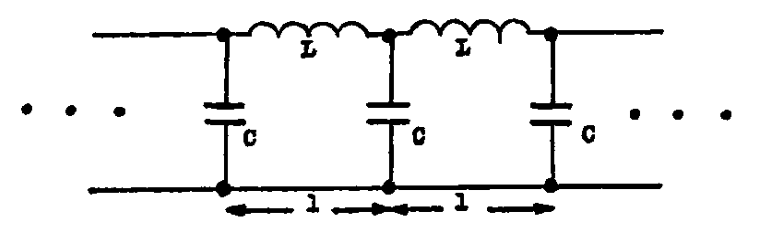
a) Determine how \(\Phi\) depends on \(\omega\), L and C (\(\omega\) is the angular frequency of the sine wave).
b) Determine the velocity of propagation of the waves if the length of each unit is \(\ell\).
c) State under what conditions the propagation velocity of the waves is almost independent of \(\omega\). Determine the velocity in this case.
d) Suggest a simple mechanical model which is an analogue to the above circuit and derive equations which establish the validity of your model.
Formulae:
\[ \cos\alpha-\cos\beta =-2\cdot\sin\left(\frac{\alpha+\beta}{2}\right) \cdot\sin\left(\frac{\alpha-\beta}{2}\right) \]
\[ \sin\alpha-\sin\beta =2\cdot\cos\left(\frac{\alpha+\beta}{2}\right) \cdot\sin\left(\frac{\alpha-\beta}{2}\right) \]
Official English text of the problem.
Answers
-
a) The dispersion relation is \[ \boxed{\omega^2LC=4\sin^2\frac{\Phi}{2}}. \] Taking the principal phase lag \(0\leq\Phi\leq\pi\), \[ \boxed{\Phi=2\arcsin\left(\frac{\omega\sqrt{LC}}{2}\right)}. \] A real phase lag requires \(0\leq\omega\leq\omega_c=2/\sqrt{LC}\).
-
b) The phase velocity of the sinusoidal wave is \[ \boxed{v_{\mathrm{ph}}=\frac{\omega\ell}{\Phi} =\frac{\omega\ell} {2\arcsin\left(\omega\sqrt{LC}/2\right)}}. \] For completeness, the group velocity of a narrow wave packet is \[ \boxed{v_{\mathrm g}=\frac{\ell}{\sqrt{LC}} \sqrt{1-\frac{\omega^2LC}{4}}}. \]
-
c) For \(\omega\sqrt{LC}\ll1\), equivalently \(\Phi\ll1\), the propagation velocity is approximately independent of frequency: \[ \boxed{v_{\mathrm{ph}}\simeq v_{\mathrm g}\simeq \frac{\ell}{\sqrt{LC}}}. \]
-
d) An infinite chain of identical masses \(m\), separated by \(\ell\) and joined by identical massless springs of stiffness \(\kappa\), is an analogue. Its equation \[ m\ddot x_n=\kappa(x_{n-1}-2x_n+x_{n+1}) \] matches the circuit equation \[ L\ddot q_n=\frac{1}{C}(q_{n-1}-2q_n+q_{n+1}), \] where \(\dot q_n\) is the current through the \(n\)-th inductor. Thus the correspondence is \(m\leftrightarrow L\), \(\kappa\leftrightarrow1/C\).
Solution
Assume ideal, identical inductors and capacitors and negligible resistance. Number the capacitors by the integer \(n\). Let \(u_n(t)\) be the voltage across capacitor \(n\), and let \(i_n(t)\) flow through the inductor from node \(n\) to node \(n+1\).
a)
Kirchhoff’s current law at node \(n\) gives \[ C\frac{du_n}{dt}=i_{n-1}-i_n. \] The voltage–current relation for each inductor gives \[ L\frac{di_n}{dt}=u_n-u_{n+1}. \]
Differentiating the first equation and substituting the inductor relations, \[ LC\frac{d^2u_n}{dt^2} =(u_{n-1}-u_n)-(u_n-u_{n+1}), \] so \[ \boxed{LC\ddot u_n=u_{n-1}-2u_n+u_{n+1}}. \]
For a sinusoidal travelling wave with phase lag \(\Phi\) per cell, write \[ u_n(t)=U\cos(\omega t-n\Phi). \] The neighbouring voltages satisfy \[ u_{n-1}+u_{n+1}=2u_n\cos\Phi, \] while \(\ddot u_n=-\omega^2u_n\). Therefore \[ -\omega^2LC=2\cos\Phi-2, \] or \[ \boxed{\cos\Phi=1-\frac{\omega^2LC}{2}}. \]
Using \(1-\cos\Phi=2\sin^2(\Phi/2)\), \[ \boxed{\omega^2LC=4\sin^2\frac{\Phi}{2}}. \] On the principal branch, \[ \boxed{\Phi=2\arcsin\left(\frac{\omega\sqrt{LC}}{2}\right)}. \] Reversing the propagation direction reverses the signed phase lag.
Since \(\sin^2(\Phi/2)\leq1\), real travelling-wave modes are possible only within the frequency band bounded by \[ \boxed{\omega_c=\frac{2}{\sqrt{LC}}}. \] Above this cutoff, there is no propagating mode with real \(\Phi\).
b)
A constant phase satisfies \[ \omega t-n\Phi=\text{constant}. \] Consequently, the time for the same phase to advance by one cell is \[ \Delta t=\frac{\Phi}{\omega}. \] As the cell length is \(\ell\), the phase velocity is \[ \boxed{v_{\mathrm{ph}}=\frac{\ell}{\Delta t} =\frac{\omega\ell}{\Phi} =\frac{\omega\ell} {2\arcsin\left(\omega\sqrt{LC}/2\right)}}. \]
Equivalently, the wave number is \(k=\Phi/\ell\), and \(v_{\mathrm{ph}}=\omega/k\).
The problem specifies sine waves, so this phase velocity is the requested velocity. If one instead follows the envelope of a narrow wave packet, its velocity is the group velocity. From \[ \omega(k)=\frac{2}{\sqrt{LC}}\sin\frac{k\ell}{2}, \qquad 0\leq k\ell\leq\pi, \] we obtain \[ \boxed{v_{\mathrm g}=\frac{d\omega}{dk} =\frac{\ell}{\sqrt{LC}}\cos\frac{\Phi}{2} =\frac{\ell}{\sqrt{LC}} \sqrt{1-\frac{\omega^2LC}{4}}}. \]
At the cutoff, adjacent capacitor voltages oscillate in antiphase, \(\Phi=\pi\), and the group velocity vanishes.
c)
When the phase change across one cell is small, \[ \Phi\ll1, \] we may use \[ \sin\frac{\Phi}{2}\simeq\frac{\Phi}{2}. \] The dispersion relation then becomes \[ \omega^2LC\simeq\Phi^2, \qquad \Phi\simeq\omega\sqrt{LC}. \] Thus the required frequency condition is \[ \boxed{\omega\sqrt{LC}\ll1}, \] and \[ \boxed{v_{\mathrm{ph}}\simeq\frac{\ell}{\sqrt{LC}}}. \]
The group velocity has the same limit. Physically, this is the long-wavelength regime: many cells lie within one wavelength, so the discrete grid behaves approximately as a continuous transmission line.
For example, the leading correction to the phase velocity is \[ v_{\mathrm{ph}} =\frac{\ell}{\sqrt{LC}} \left[1-\frac{\omega^2LC}{24} +O\!\left((\omega^2LC)^2\right)\right]. \] Hence its frequency dependence is small under the stated condition. Since \(LC\) has units of \(\mathrm{s^2}\), \(\ell/\sqrt{LC}\) has units of velocity.
d)
Consider an infinite straight chain of identical masses \(m\), with equilibrium separation \(\ell\). Connect each pair of neighbouring masses by a massless spring of stiffness \(\kappa\). The masses move longitudinally without friction, and the springs obey Hooke’s law.
Let \(x_n(t)\) be the displacement of mass \(n\) from equilibrium. The right-hand spring exerts the force \[ \kappa(x_{n+1}-x_n), \] and the left-hand spring exerts \[ -\kappa(x_n-x_{n-1}). \] Newton’s second law therefore gives \[ \boxed{m\ddot x_n =\kappa(x_{n-1}-2x_n+x_{n+1})}. \]
To establish a direct circuit correspondence, define \(q_n(t)\) as the charge that has passed through inductor \(n\), so that \[ i_n=\dot q_n. \] Taking quantities relative to equilibrium, charge conservation at capacitor \(n\) gives \[ Cu_n=q_{n-1}-q_n. \] The inductor equation consequently becomes \[ L\ddot q_n=u_n-u_{n+1} =\frac{q_{n-1}-2q_n+q_{n+1}}{C}. \] Thus \[ \boxed{L\ddot q_n =\frac1C(q_{n-1}-2q_n+q_{n+1})}, \] which has precisely the same form as the mechanical equation under \[ \boxed{x_n\leftrightarrow q_n,\qquad m\leftrightarrow L,\qquad \kappa\leftrightarrow\frac1C}. \]
The energy expressions confirm this correspondence: \[ E_{\mathrm{LC}} =\sum_n\left[ \frac12L\dot q_n^{\,2} +\frac{(q_{n-1}-q_n)^2}{2C} \right], \] \[ E_{\mathrm{mech}} =\sum_n\left[ \frac12m\dot x_n^{\,2} +\frac12\kappa(x_{n-1}-x_n)^2 \right]. \] Inductive energy corresponds to kinetic energy, and capacitor energy corresponds to spring potential energy.
Finally, substituting \(x_n=A\cos(\omega t-n\Phi)\) into the mechanical equation yields \[ \omega^2=\frac{4\kappa}{m}\sin^2\frac{\Phi}{2}, \] identical to the LC dispersion relation when \(\kappa/m=1/(LC)\).
The solution was checked against the official solution.
IPhO 1987 · Theorieaufgabe 3
Unendliches LC-Netzwerk
Wenn sich sinusförmige Wellen in einem unendlichen LC-Netzwerk ausbreiten (siehe die folgende Abbildung), unterscheiden sich die Phasen der Wechselspannungen an zwei aufeinanderfolgenden Kondensatoren um \(\Phi\).
a) Bestimmen Sie, wie \(\Phi\) von \(\omega\), L und C abhängt (\(\omega\) ist die Kreisfrequenz der Sinuswelle).
b) Bestimmen Sie die Ausbreitungsgeschwindigkeit der Wellen, wenn die Länge jeder Einheit \(\ell\) beträgt.
c) Geben Sie an, unter welchen Bedingungen die Ausbreitungsgeschwindigkeit der Wellen nahezu unabhängig von \(\omega\) ist. Bestimmen Sie die Geschwindigkeit in diesem Fall.
d) Schlagen Sie ein einfaches mechanisches Modell vor, das ein Analogon zur obigen Schaltung darstellt, und leiten Sie Gleichungen her, die die Gültigkeit Ihres Modells belegen.
Formeln:
\[ \cos\alpha-\cos\beta =-2\cdot\sin\left(\frac{\alpha+\beta}{2}\right) \cdot\sin\left(\frac{\alpha-\beta}{2}\right) \]
\[ \sin\alpha-\sin\beta =2\cdot\cos\left(\frac{\alpha+\beta}{2}\right) \cdot\sin\left(\frac{\alpha-\beta}{2}\right) \]
Aufgabentext aus dem offiziellen englischen Text übersetzt.
Antworten
-
a) Die Dispersionsrelation lautet \[ \boxed{\omega^2LC=4\sin^2\frac{\Phi}{2}}. \] Wählt man den Hauptwert der Phasenverzögerung \(0\leq\Phi\leq\pi\), so gilt \[ \boxed{\Phi=2\arcsin\left(\frac{\omega\sqrt{LC}}{2}\right)}. \] Eine reelle Phasenverzögerung setzt \(0\leq\omega\leq\omega_c=2/\sqrt{LC}\) voraus.
-
b) Die Phasengeschwindigkeit der sinusförmigen Welle beträgt \[ \boxed{v_{\mathrm{ph}}=\frac{\omega\ell}{\Phi} =\frac{\omega\ell} {2\arcsin\left(\omega\sqrt{LC}/2\right)}}. \] Der Vollständigkeit halber beträgt die Gruppengeschwindigkeit eines schmalbandigen Wellenpakets \[ \boxed{v_{\mathrm g}=\frac{\ell}{\sqrt{LC}} \sqrt{1-\frac{\omega^2LC}{4}}}. \]
-
c) Für \(\omega\sqrt{LC}\ll1\), gleichbedeutend mit \(\Phi\ll1\), ist die Ausbreitungsgeschwindigkeit näherungsweise frequenzunabhängig: \[ \boxed{v_{\mathrm{ph}}\simeq v_{\mathrm g}\simeq \frac{\ell}{\sqrt{LC}}}. \]
-
d) Ein Analogon ist eine unendliche Kette identischer Massen \(m\), die im Abstand \(\ell\) angeordnet und durch identische masselose Federn mit der Federkonstanten \(\kappa\) verbunden sind. Ihre Gleichung \[ m\ddot x_n=\kappa(x_{n-1}-2x_n+x_{n+1}) \] entspricht der Schaltungsgleichung \[ L\ddot q_n=\frac{1}{C}(q_{n-1}-2q_n+q_{n+1}), \] wobei \(\dot q_n\) der Strom durch die \(n\)-te Spule ist. Die Zuordnung lautet somit \(m\leftrightarrow L\), \(\kappa\leftrightarrow1/C\).
Lösung
Wir nehmen ideale, identische Spulen und Kondensatoren sowie einen vernachlässigbaren Widerstand an. Die Kondensatoren werden mit der ganzen Zahl \(n\) nummeriert. Es sei \(u_n(t)\) die Spannung am Kondensator \(n\), und \(i_n(t)\) fließe durch die Spule vom Knoten \(n\) zum Knoten \(n+1\).
a)
Die Kirchhoffsche Knotenregel am Knoten \(n\) ergibt \[ C\frac{du_n}{dt}=i_{n-1}-i_n. \] Die Spannungs-Strom-Beziehung für jede Spule liefert \[ L\frac{di_n}{dt}=u_n-u_{n+1}. \]
Durch Differenzieren der ersten Gleichung und Einsetzen der Spulenbeziehungen erhält man \[ LC\frac{d^2u_n}{dt^2} =(u_{n-1}-u_n)-(u_n-u_{n+1}), \] also \[ \boxed{LC\ddot u_n=u_{n-1}-2u_n+u_{n+1}}. \]
Für eine sinusförmige fortschreitende Welle mit der Phasenverzögerung \(\Phi\) pro Zelle setzen wir an: \[ u_n(t)=U\cos(\omega t-n\Phi). \] Die benachbarten Spannungen erfüllen \[ u_{n-1}+u_{n+1}=2u_n\cos\Phi, \] während \(\ddot u_n=-\omega^2u_n\) gilt. Daher ist \[ -\omega^2LC=2\cos\Phi-2, \] oder \[ \boxed{\cos\Phi=1-\frac{\omega^2LC}{2}}. \]
Mit \(1-\cos\Phi=2\sin^2(\Phi/2)\) folgt \[ \boxed{\omega^2LC=4\sin^2\frac{\Phi}{2}}. \] Auf dem Hauptzweig gilt \[ \boxed{\Phi=2\arcsin\left(\frac{\omega\sqrt{LC}}{2}\right)}. \] Bei Umkehrung der Ausbreitungsrichtung wechselt die vorzeichenbehaftete Phasenverzögerung ihr Vorzeichen.
Da \(\sin^2(\Phi/2)\leq1\) gilt, sind fortschreitende Wellenmoden mit reeller Phasenverzögerung nur innerhalb des Frequenzbands möglich, dessen obere Grenze durch \[ \boxed{\omega_c=\frac{2}{\sqrt{LC}}} \] gegeben ist. Oberhalb dieser Grenzfrequenz gibt es keine sich ausbreitende Mode mit reellem \(\Phi\).
b)
Für eine konstante Phase gilt \[ \omega t-n\Phi=\text{konstant}. \] Folglich beträgt die Zeit, in der dieselbe Phase um eine Zelle vorrückt, \[ \Delta t=\frac{\Phi}{\omega}. \] Da die Zellenlänge \(\ell\) beträgt, ist die Phasengeschwindigkeit \[ \boxed{v_{\mathrm{ph}}=\frac{\ell}{\Delta t} =\frac{\omega\ell}{\Phi} =\frac{\omega\ell} {2\arcsin\left(\omega\sqrt{LC}/2\right)}}. \]
Gleichwertig dazu ist die Wellenzahl \(k=\Phi/\ell\), und es gilt \(v_{\mathrm{ph}}=\omega/k\).
Die Aufgabe gibt Sinuswellen vor, daher ist diese Phasengeschwindigkeit die gesuchte Geschwindigkeit. Verfolgt man stattdessen die Einhüllende eines schmalbandigen Wellenpakets, so ist deren Geschwindigkeit die Gruppengeschwindigkeit. Aus \[ \omega(k)=\frac{2}{\sqrt{LC}}\sin\frac{k\ell}{2}, \qquad 0\leq k\ell\leq\pi, \] erhalten wir \[ \boxed{v_{\mathrm g}=\frac{d\omega}{dk} =\frac{\ell}{\sqrt{LC}}\cos\frac{\Phi}{2} =\frac{\ell}{\sqrt{LC}} \sqrt{1-\frac{\omega^2LC}{4}}}. \]
Bei der Grenzfrequenz schwingen die Spannungen benachbarter Kondensatoren gegenphasig, \(\Phi=\pi\), und die Gruppengeschwindigkeit verschwindet.
c)
Wenn die Phasenänderung über eine Zelle klein ist, \[ \Phi\ll1, \] können wir die Näherung \[ \sin\frac{\Phi}{2}\simeq\frac{\Phi}{2} \] verwenden. Die Dispersionsrelation wird dann zu \[ \omega^2LC\simeq\Phi^2, \qquad \Phi\simeq\omega\sqrt{LC}. \] Die gesuchte Frequenzbedingung lautet somit \[ \boxed{\omega\sqrt{LC}\ll1}, \] und es gilt \[ \boxed{v_{\mathrm{ph}}\simeq\frac{\ell}{\sqrt{LC}}}. \]
Die Gruppengeschwindigkeit hat denselben Grenzwert. Physikalisch handelt es sich um den Bereich großer Wellenlängen: Innerhalb einer Wellenlänge liegen viele Zellen, sodass sich das diskrete Netzwerk näherungsweise wie eine kontinuierliche Übertragungsleitung verhält.
Beispielsweise lautet die führende Korrektur zur Phasengeschwindigkeit \[ v_{\mathrm{ph}} =\frac{\ell}{\sqrt{LC}} \left[1-\frac{\omega^2LC}{24} +O\!\left((\omega^2LC)^2\right)\right]. \] Daher ist ihre Frequenzabhängigkeit unter der angegebenen Bedingung gering. Da \(LC\) die Einheit \(\mathrm{s^2}\) hat, hat \(\ell/\sqrt{LC}\) die Einheit einer Geschwindigkeit.
d)
Wir betrachten eine unendliche geradlinige Kette identischer Massen \(m\), deren Abstand im Gleichgewicht \(\ell\) beträgt. Jedes Paar benachbarter Massen wird durch eine masselose Feder mit der Federkonstanten \(\kappa\) verbunden. Die Massen bewegen sich reibungsfrei in Längsrichtung, und die Federn gehorchen dem Hookeschen Gesetz.
Es sei \(x_n(t)\) die Auslenkung der Masse \(n\) aus ihrer Gleichgewichtslage. Die rechte Feder übt die Kraft \[ \kappa(x_{n+1}-x_n), \] aus, und die linke Feder übt die Kraft \[ -\kappa(x_n-x_{n-1}) \] aus. Das zweite Newtonsche Gesetz liefert daher \[ \boxed{m\ddot x_n =\kappa(x_{n-1}-2x_n+x_{n+1})}. \]
Um eine direkte Entsprechung zur Schaltung herzustellen, definieren wir \(q_n(t)\) als die Ladung, die durch die Spule \(n\) geflossen ist, sodass \[ i_n=\dot q_n. \] Bezieht man die Größen auf das Gleichgewicht, so ergibt die Ladungserhaltung am Kondensator \(n\) \[ Cu_n=q_{n-1}-q_n. \] Die Spulengleichung wird folglich zu \[ L\ddot q_n=u_n-u_{n+1} =\frac{q_{n-1}-2q_n+q_{n+1}}{C}. \] Somit gilt \[ \boxed{L\ddot q_n =\frac1C(q_{n-1}-2q_n+q_{n+1})}, \] was unter der Zuordnung \[ \boxed{x_n\leftrightarrow q_n,\qquad m\leftrightarrow L,\qquad \kappa\leftrightarrow\frac1C} \] genau dieselbe Form wie die mechanische Gleichung hat.
Die Energieausdrücke bestätigen diese Entsprechung: \[ E_{\mathrm{LC}} =\sum_n\left[ \frac12L\dot q_n^{\,2} +\frac{(q_{n-1}-q_n)^2}{2C} \right], \] \[ E_{\mathrm{mech}} =\sum_n\left[ \frac12m\dot x_n^{\,2} +\frac12\kappa(x_{n-1}-x_n)^2 \right]. \] Die in den Spulen gespeicherte Energie entspricht der kinetischen Energie, und die Kondensatorenergie entspricht der potenziellen Energie der Federn.
Setzt man schließlich \(x_n=A\cos(\omega t-n\Phi)\) in die mechanische Gleichung ein, so erhält man \[ \omega^2=\frac{4\kappa}{m}\sin^2\frac{\Phi}{2}, \] was für \(\kappa/m=1/(LC)\) mit der LC-Dispersionsrelation identisch ist.
Die Lösung wurde mit der offiziellen Lösung abgeglichen.
IPhO 1987 · Teori sorusu 3
Sonsuz LC ağı
Sinüs dalgaları sonsuz bir LC ağında (aşağıdaki şekle bakınız) yayılırken, ardışık iki kondansatörün uçları arasındaki alternatif gerilimlerin fazları arasında \(\Phi\) kadar fark vardır.
a) \(\Phi\)'nin \(\omega\), L ve C'ye nasıl bağlı olduğunu belirleyiniz (\(\omega\), sinüs dalgasının açısal frekansıdır).
b) Her bir birimin uzunluğu \(\ell\) ise dalgaların yayılma hızını belirleyiniz.
c) Dalgaların yayılma hızının hangi koşullarda \(\omega\)'dan hemen hemen bağımsız olduğunu belirtiniz. Bu durumda hızı belirleyiniz.
d) Yukarıdaki devrenin analoğu olan basit bir mekanik model öneriniz ve modelinizin geçerliliğini ortaya koyan denklemleri türetiniz.
Formüller:
\[ \cos\alpha-\cos\beta =-2\cdot\sin\left(\frac{\alpha+\beta}{2}\right) \cdot\sin\left(\frac{\alpha-\beta}{2}\right) \]
\[ \sin\alpha-\sin\beta =2\cdot\cos\left(\frac{\alpha+\beta}{2}\right) \cdot\sin\left(\frac{\alpha-\beta}{2}\right) \]
Soru metni resmi İngilizce metinden çevrilmiştir.
Cevaplar
-
a) Dispersiyon bağıntısı \[ \boxed{\omega^2LC=4\sin^2\frac{\Phi}{2}}. \] biçimindedir. Faz gecikmesi esas aralıkta, \(0\leq\Phi\leq\pi\), alındığında, \[ \boxed{\Phi=2\arcsin\left(\frac{\omega\sqrt{LC}}{2}\right)}. \] Gerçek bir faz gecikmesi için \(0\leq\omega\leq\omega_c=2/\sqrt{LC}\) gerekir.
-
b) Sinüzoidal dalganın faz hızı \[ \boxed{v_{\mathrm{ph}}=\frac{\omega\ell}{\Phi} =\frac{\omega\ell} {2\arcsin\left(\omega\sqrt{LC}/2\right)}}. \] biçimindedir. Tamamlayıcı bilgi olarak, dar bir dalga paketinin grup hızı \[ \boxed{v_{\mathrm g}=\frac{\ell}{\sqrt{LC}} \sqrt{1-\frac{\omega^2LC}{4}}}. \] biçimindedir.
-
c) \(\omega\sqrt{LC}\ll1\) olduğunda, eşdeğer olarak \(\Phi\ll1\) olduğunda, yayılma hızı frekanstan yaklaşık olarak bağımsızdır: \[ \boxed{v_{\mathrm{ph}}\simeq v_{\mathrm g}\simeq \frac{\ell}{\sqrt{LC}}}. \]
-
d) Aralarında \(\ell\) uzaklığı bulunan ve yay sabiti \(\kappa\) olan özdeş, kütlesiz yaylarla birbirine bağlanmış özdeş \(m\) kütlelerinden oluşan sonsuz bir zincir, devrenin analoğudur. Bu zincirin \[ m\ddot x_n=\kappa(x_{n-1}-2x_n+x_{n+1}) \] denklemi, \[ L\ddot q_n=\frac{1}{C}(q_{n-1}-2q_n+q_{n+1}), \] devre denklemiyle örtüşür; burada \(\dot q_n\), \(n\). bobinden geçen akımdır. Dolayısıyla karşılıklılık \(m\leftrightarrow L\), \(\kappa\leftrightarrow1/C\) şeklindedir.
Çözüm
Bobinlerin ve kondansatörlerin ideal ve kendi aralarında özdeş olduğunu, direncin de ihmal edilebildiğini varsayalım. Kondansatörleri \(n\) tam sayısıyla numaralandıralım. \(u_n(t)\), \(n\) numaralı kondansatörün uçları arasındaki gerilim; \(i_n(t)\) ise bobinden \(n\) düğümünden \(n+1\) düğümüne doğru akan akım olsun.
a)
\(n\) düğümünde Kirchhoff'un akım yasası \[ C\frac{du_n}{dt}=i_{n-1}-i_n \] bağıntısını verir. Her bir bobin için gerilim–akım bağıntısı ise \[ L\frac{di_n}{dt}=u_n-u_{n+1} \] şeklindedir.
İlk denklemin türevini alıp bobin bağıntılarını yerine koyarsak, \[ LC\frac{d^2u_n}{dt^2} =(u_{n-1}-u_n)-(u_n-u_{n+1}), \] dolayısıyla \[ \boxed{LC\ddot u_n=u_{n-1}-2u_n+u_{n+1}} \] elde edilir.
Hücre başına faz gecikmesi \(\Phi\) olan sinüzoidal bir ilerleyen dalga için \[ u_n(t)=U\cos(\omega t-n\Phi) \] yazalım. Komşu gerilimler \[ u_{n-1}+u_{n+1}=2u_n\cos\Phi, \] bağıntısını sağlarken \(\ddot u_n=-\omega^2u_n\) olur. Dolayısıyla \[ -\omega^2LC=2\cos\Phi-2, \] ya da \[ \boxed{\cos\Phi=1-\frac{\omega^2LC}{2}} \] elde edilir.
\(1-\cos\Phi=2\sin^2(\Phi/2)\) özdeşliği kullanılarak, \[ \boxed{\omega^2LC=4\sin^2\frac{\Phi}{2}} \] bulunur. Esas dal üzerinde, \[ \boxed{\Phi=2\arcsin\left(\frac{\omega\sqrt{LC}}{2}\right)}. \] Yayılma yönü tersine çevrildiğinde faz gecikmesinin işareti de tersine döner.
\(\sin^2(\Phi/2)\leq1\) olduğundan, gerçek ilerleyen dalga modları yalnızca üst sınırı \[ \boxed{\omega_c=\frac{2}{\sqrt{LC}}} \] olan frekans bandında mümkündür. Bu kesim frekansının üzerinde, gerçek \(\Phi\) değerine sahip yayılan bir mod yoktur.
b)
Sabit bir faz, \[ \omega t-n\Phi=\text{sabit} \] koşulunu sağlar. Buna göre, aynı fazın bir hücre ilerlemesi için geçen süre \[ \Delta t=\frac{\Phi}{\omega} \] olur. Hücre uzunluğu \(\ell\) olduğundan faz hızı \[ \boxed{v_{\mathrm{ph}}=\frac{\ell}{\Delta t} =\frac{\omega\ell}{\Phi} =\frac{\omega\ell} {2\arcsin\left(\omega\sqrt{LC}/2\right)}} \] olarak bulunur.
Eşdeğer olarak, dalga sayısı \(k=\Phi/\ell\) ve \(v_{\mathrm{ph}}=\omega/k\) olur.
Soruda sinüs dalgaları belirtildiğinden, istenen hız bu faz hızıdır. Bunun yerine dar bir dalga paketinin zarfı izlenirse, bu zarfın hızı grup hızıdır. \[ \omega(k)=\frac{2}{\sqrt{LC}}\sin\frac{k\ell}{2}, \qquad 0\leq k\ell\leq\pi, \] bağıntısından \[ \boxed{v_{\mathrm g}=\frac{d\omega}{dk} =\frac{\ell}{\sqrt{LC}}\cos\frac{\Phi}{2} =\frac{\ell}{\sqrt{LC}} \sqrt{1-\frac{\omega^2LC}{4}}} \] elde edilir.
Kesim frekansında, komşu kondansatörlerin gerilimleri zıt fazda salınır, \(\Phi=\pi\), ve grup hızı sıfır olur.
c)
Bir hücre boyunca faz değişimi küçük olduğunda, \[ \Phi\ll1, \] \[ \sin\frac{\Phi}{2}\simeq\frac{\Phi}{2} \] yaklaşımını kullanabiliriz. Dispersiyon bağıntısı bu durumda \[ \omega^2LC\simeq\Phi^2, \qquad \Phi\simeq\omega\sqrt{LC} \] haline gelir. Dolayısıyla gerekli frekans koşulu \[ \boxed{\omega\sqrt{LC}\ll1}, \] olur ve \[ \boxed{v_{\mathrm{ph}}\simeq\frac{\ell}{\sqrt{LC}}} \] elde edilir.
Grup hızı da aynı limite sahiptir. Fiziksel olarak bu, uzun dalga boyu rejimidir: bir dalga boyu içinde çok sayıda hücre bulunur; dolayısıyla kesikli ağ, yaklaşık olarak sürekli bir iletim hattı gibi davranır.
Örneğin, faz hızının en düşük mertebeden düzeltmesi \[ v_{\mathrm{ph}} =\frac{\ell}{\sqrt{LC}} \left[1-\frac{\omega^2LC}{24} +O\!\left((\omega^2LC)^2\right)\right] \] şeklindedir. Dolayısıyla belirtilen koşul altında frekans bağımlılığı küçüktür. \(LC\)'nin birimi \(\mathrm{s^2}\) olduğundan, \(\ell/\sqrt{LC}\)'nin birimi hız birimidir.
d)
Denge konumları arasındaki uzaklık \(\ell\) olan özdeş \(m\) kütlelerinden oluşan sonsuz, doğrusal bir zincir düşünelim. Her komşu kütle çiftini, yay sabiti \(\kappa\) olan kütlesiz bir yayla bağlayalım. Kütleler sürtünmesiz olarak boyuna hareket etsin ve yaylar Hooke yasasına uysun.
\(x_n(t)\), \(n\) numaralı kütlenin denge konumundan yer değiştirmesi olsun. Sağdaki yay \[ \kappa(x_{n+1}-x_n), \] kuvvetini, soldaki yay ise \[ -\kappa(x_n-x_{n-1}) \] kuvvetini uygular. Dolayısıyla Newton'un ikinci yasası \[ \boxed{m\ddot x_n =\kappa(x_{n-1}-2x_n+x_{n+1})} \] denklemini verir.
Devreyle doğrudan bir karşılıklılık kurmak için \(q_n(t)\)'yi \(n\) numaralı bobinden geçmiş olan yük olarak tanımlayalım; böylece \[ i_n=\dot q_n \] olur. Nicelikler denge durumuna göre alındığında, \(n\) numaralı kondansatörde yükün korunumu \[ Cu_n=q_{n-1}-q_n \] bağıntısını verir. Buna göre bobin denklemi \[ L\ddot q_n=u_n-u_{n+1} =\frac{q_{n-1}-2q_n+q_{n+1}}{C} \] haline gelir. Dolayısıyla \[ \boxed{L\ddot q_n =\frac1C(q_{n-1}-2q_n+q_{n+1})}, \] denklemi, \[ \boxed{x_n\leftrightarrow q_n,\qquad m\leftrightarrow L,\qquad \kappa\leftrightarrow\frac1C} \] eşleştirmeleri altında mekanik denklemle tam olarak aynı biçimdedir.
Enerji ifadeleri bu karşılıklılığı doğrular: \[ E_{\mathrm{LC}} =\sum_n\left[ \frac12L\dot q_n^{\,2} +\frac{(q_{n-1}-q_n)^2}{2C} \right], \] \[ E_{\mathrm{mech}} =\sum_n\left[ \frac12m\dot x_n^{\,2} +\frac12\kappa(x_{n-1}-x_n)^2 \right]. \] Bobinde depolanan enerji kinetik enerjiye, kondansatör enerjisi ise yayın potansiyel enerjisine karşılık gelir.
Son olarak, mekanik denklemde \(x_n=A\cos(\omega t-n\Phi)\) yerine konulduğunda \[ \omega^2=\frac{4\kappa}{m}\sin^2\frac{\Phi}{2}, \] elde edilir; bu, \(\kappa/m=1/(LC)\) olduğunda LC dispersiyon bağıntısıyla aynıdır.
Çözüm, resmi çözümle karşılaştırılarak kontrol edildi.
IPhO 1987 · Problema teórico 3
Red LC infinita
Cuando se propagan ondas sinusoidales por una red LC infinita (véase la figura siguiente), la fase de la tensión alterna entre los bornes de dos condensadores sucesivos difiere en \(\Phi\).
a) Determine cómo depende \(\Phi\) de \(\omega\), L y C (\(\omega\) es la frecuencia angular de la onda sinusoidal).
b) Determine la velocidad de propagación de las ondas si la longitud de cada unidad es \(\ell\).
c) Indique en qué condiciones la velocidad de propagación de las ondas es casi independiente de \(\omega\). Determine la velocidad en este caso.
d) Proponga un modelo mecánico sencillo que sea análogo al circuito anterior y deduzca las ecuaciones que demuestren la validez de su modelo.
Fórmulas:
\[ \cos\alpha-\cos\beta =-2\cdot\sin\left(\frac{\alpha+\beta}{2}\right) \cdot\sin\left(\frac{\alpha-\beta}{2}\right) \]
\[ \sin\alpha-\sin\beta =2\cdot\cos\left(\frac{\alpha+\beta}{2}\right) \cdot\sin\left(\frac{\alpha-\beta}{2}\right) \]
Enunciado traducido del texto oficial en inglés.
Respuestas
-
a) La relación de dispersión es \[ \boxed{\omega^2LC=4\sin^2\frac{\Phi}{2}}. \] Tomando el desfase de retardo principal \(0\leq\Phi\leq\pi\), \[ \boxed{\Phi=2\arcsin\left(\frac{\omega\sqrt{LC}}{2}\right)}. \] Un desfase real requiere \(0\leq\omega\leq\omega_c=2/\sqrt{LC}\).
-
b) La velocidad de fase de la onda sinusoidal es \[ \boxed{v_{\mathrm{ph}}=\frac{\omega\ell}{\Phi} =\frac{\omega\ell} {2\arcsin\left(\omega\sqrt{LC}/2\right)}}. \] Para completar la respuesta, la velocidad de grupo de un paquete de ondas de banda estrecha es \[ \boxed{v_{\mathrm g}=\frac{\ell}{\sqrt{LC}} \sqrt{1-\frac{\omega^2LC}{4}}}. \]
-
c) Para \(\omega\sqrt{LC}\ll1\), o, de forma equivalente, \(\Phi\ll1\), la velocidad de propagación es aproximadamente independiente de la frecuencia: \[ \boxed{v_{\mathrm{ph}}\simeq v_{\mathrm g}\simeq \frac{\ell}{\sqrt{LC}}}. \]
-
d) Una cadena infinita de masas idénticas \(m\), separadas por \(\ell\) y unidas por resortes idénticos sin masa de constante elástica \(\kappa\), constituye un sistema análogo. Su ecuación \[ m\ddot x_n=\kappa(x_{n-1}-2x_n+x_{n+1}) \] se corresponde con la ecuación del circuito \[ L\ddot q_n=\frac{1}{C}(q_{n-1}-2q_n+q_{n+1}), \] donde \(\dot q_n\) es la corriente que atraviesa el \(n\)-ésimo inductor. Por tanto, la correspondencia es \(m\leftrightarrow L\), \(\kappa\leftrightarrow1/C\).
Solución
Supongamos que los inductores y los condensadores son ideales e idénticos y que la resistencia es despreciable. Numeremos los condensadores mediante el entero \(n\). Sea \(u_n(t)\) la tensión entre los bornes del condensador \(n\), y sea \(i_n(t)\) la corriente que circula por el inductor desde el nodo \(n\) hasta el nodo \(n+1\).
a)
La ley de las corrientes de Kirchhoff en el nodo \(n\) da \[ C\frac{du_n}{dt}=i_{n-1}-i_n. \] La relación entre tensión y corriente para cada inductor da \[ L\frac{di_n}{dt}=u_n-u_{n+1}. \]
Derivando la primera ecuación y sustituyendo las relaciones de los inductores, \[ LC\frac{d^2u_n}{dt^2} =(u_{n-1}-u_n)-(u_n-u_{n+1}), \] de modo que \[ \boxed{LC\ddot u_n=u_{n-1}-2u_n+u_{n+1}}. \]
Para una onda sinusoidal viajera con un desfase de retardo \(\Phi\) por celda, escribimos \[ u_n(t)=U\cos(\omega t-n\Phi). \] Las tensiones vecinas satisfacen \[ u_{n-1}+u_{n+1}=2u_n\cos\Phi, \] mientras que \(\ddot u_n=-\omega^2u_n\). Por tanto, \[ -\omega^2LC=2\cos\Phi-2, \] o bien \[ \boxed{\cos\Phi=1-\frac{\omega^2LC}{2}}. \]
Usando \(1-\cos\Phi=2\sin^2(\Phi/2)\), \[ \boxed{\omega^2LC=4\sin^2\frac{\Phi}{2}}. \] En la rama principal, \[ \boxed{\Phi=2\arcsin\left(\frac{\omega\sqrt{LC}}{2}\right)}. \] Al invertir el sentido de propagación, se invierte el signo del desfase.
Puesto que \(\sin^2(\Phi/2)\leq1\), los modos de onda viajera con desfase real solo son posibles dentro de la banda de frecuencias limitada por \[ \boxed{\omega_c=\frac{2}{\sqrt{LC}}}. \] Por encima de esta frecuencia de corte, no existe ningún modo propagante con \(\Phi\) real.
b)
Una fase constante satisface \[ \omega t-n\Phi=\text{constante}. \] En consecuencia, el tiempo que tarda una misma fase en avanzar una celda es \[ \Delta t=\frac{\Phi}{\omega}. \] Como la longitud de la celda es \(\ell\), la velocidad de fase es \[ \boxed{v_{\mathrm{ph}}=\frac{\ell}{\Delta t} =\frac{\omega\ell}{\Phi} =\frac{\omega\ell} {2\arcsin\left(\omega\sqrt{LC}/2\right)}}. \]
De forma equivalente, el número de onda es \(k=\Phi/\ell\), y \(v_{\mathrm{ph}}=\omega/k\).
El enunciado especifica ondas sinusoidales, por lo que esta velocidad de fase es la velocidad solicitada. Si, en cambio, se sigue la envolvente de un paquete de ondas de banda estrecha, su velocidad es la velocidad de grupo. A partir de \[ \omega(k)=\frac{2}{\sqrt{LC}}\sin\frac{k\ell}{2}, \qquad 0\leq k\ell\leq\pi, \] obtenemos \[ \boxed{v_{\mathrm g}=\frac{d\omega}{dk} =\frac{\ell}{\sqrt{LC}}\cos\frac{\Phi}{2} =\frac{\ell}{\sqrt{LC}} \sqrt{1-\frac{\omega^2LC}{4}}}. \]
En la frecuencia de corte, las tensiones de los condensadores adyacentes oscilan en oposición de fase, \(\Phi=\pi\), y la velocidad de grupo se anula.
c)
Cuando la variación de fase a lo largo de una celda es pequeña, \[ \Phi\ll1, \] podemos usar \[ \sin\frac{\Phi}{2}\simeq\frac{\Phi}{2}. \] La relación de dispersión se convierte entonces en \[ \omega^2LC\simeq\Phi^2, \qquad \Phi\simeq\omega\sqrt{LC}. \] Por tanto, la condición requerida para la frecuencia es \[ \boxed{\omega\sqrt{LC}\ll1}, \] y \[ \boxed{v_{\mathrm{ph}}\simeq\frac{\ell}{\sqrt{LC}}}. \]
La velocidad de grupo tiene el mismo límite. Físicamente, este es el régimen de longitudes de onda grandes: una longitud de onda abarca muchas celdas, de modo que la red discreta se comporta aproximadamente como una línea de transmisión continua.
Por ejemplo, la corrección de orden más bajo a la velocidad de fase es \[ v_{\mathrm{ph}} =\frac{\ell}{\sqrt{LC}} \left[1-\frac{\omega^2LC}{24} +O\!\left((\omega^2LC)^2\right)\right]. \] Por ello, su dependencia de la frecuencia es pequeña bajo la condición indicada. Puesto que \(LC\) tiene unidades de \(\mathrm{s^2}\), \(\ell/\sqrt{LC}\) tiene unidades de velocidad.
d)
Consideremos una cadena rectilínea infinita de masas idénticas \(m\), con una separación de equilibrio \(\ell\). Conectemos cada par de masas vecinas mediante un resorte sin masa de constante elástica \(\kappa\). Las masas se mueven longitudinalmente sin rozamiento, y los resortes obedecen la ley de Hooke.
Sea \(x_n(t)\) el desplazamiento de la masa \(n\) respecto al equilibrio. El resorte de la derecha ejerce la fuerza \[ \kappa(x_{n+1}-x_n), \] y el resorte de la izquierda ejerce \[ -\kappa(x_n-x_{n-1}). \] La segunda ley de Newton da, por tanto, \[ \boxed{m\ddot x_n =\kappa(x_{n-1}-2x_n+x_{n+1})}. \]
Para establecer una correspondencia directa con el circuito, definimos \(q_n(t)\) como la carga que ha pasado por el inductor \(n\), de modo que \[ i_n=\dot q_n. \] Tomando las magnitudes respecto al equilibrio, la conservación de la carga en el condensador \(n\) da \[ Cu_n=q_{n-1}-q_n. \] La ecuación del inductor se convierte, en consecuencia, en \[ L\ddot q_n=u_n-u_{n+1} =\frac{q_{n-1}-2q_n+q_{n+1}}{C}. \] Así, \[ \boxed{L\ddot q_n =\frac1C(q_{n-1}-2q_n+q_{n+1})}, \] que tiene exactamente la misma forma que la ecuación mecánica bajo la correspondencia \[ \boxed{x_n\leftrightarrow q_n,\qquad m\leftrightarrow L,\qquad \kappa\leftrightarrow\frac1C}. \]
Las expresiones de la energía confirman esta correspondencia: \[ E_{\mathrm{LC}} =\sum_n\left[ \frac12L\dot q_n^{\,2} +\frac{(q_{n-1}-q_n)^2}{2C} \right], \] \[ E_{\mathrm{mech}} =\sum_n\left[ \frac12m\dot x_n^{\,2} +\frac12\kappa(x_{n-1}-x_n)^2 \right]. \] La energía almacenada en los inductores corresponde a la energía cinética, y la energía almacenada en los condensadores corresponde a la energía potencial de los resortes.
Finalmente, al sustituir \(x_n=A\cos(\omega t-n\Phi)\) en la ecuación mecánica se obtiene \[ \omega^2=\frac{4\kappa}{m}\sin^2\frac{\Phi}{2}, \] idéntica a la relación de dispersión LC cuando \(\kappa/m=1/(LC)\).
La solución se comprobó con la solución oficial.
IPhO 1987 · 理论题 3
无限 LC 梯形网络
当正弦波在无限 LC 梯形网络中传播时(见下图),相邻两个电容器两端交流电压的相位相差 \(\Phi\)。
a) 确定 \(\Phi\) 与 \(\omega\)、L 和 C 的关系(\(\omega\) 为正弦波的角频率)。
b) 若每个单元的长度为 \(\ell\),求波的传播速度。
c) 说明在什么条件下波的传播速度几乎与 \(\omega\) 无关。求此时的速度。
d) 提出一个与上述电路相类比的简单力学模型,并推导方程以证明该模型的合理性。
公式:
\[ \cos\alpha-\cos\beta =-2\cdot\sin\left(\frac{\alpha+\beta}{2}\right) \cdot\sin\left(\frac{\alpha-\beta}{2}\right) \]
\[ \sin\alpha-\sin\beta =2\cdot\cos\left(\frac{\alpha+\beta}{2}\right) \cdot\sin\left(\frac{\alpha-\beta}{2}\right) \]
题目译自官方英文原文。
答案
-
a) 色散关系为 \[ \boxed{\omega^2LC=4\sin^2\frac{\Phi}{2}}. \] 取主值范围内的相位滞后 \(0\leq\Phi\leq\pi\), \[ \boxed{\Phi=2\arcsin\left(\frac{\omega\sqrt{LC}}{2}\right)}. \] 相位滞后为实数要求 \(0\leq\omega\leq\omega_c=2/\sqrt{LC}\)。
-
b) 正弦波的相速度为 \[ \boxed{v_{\mathrm{ph}}=\frac{\omega\ell}{\Phi} =\frac{\omega\ell} {2\arcsin\left(\omega\sqrt{LC}/2\right)}}. \] 为完整起见,窄频带波包的群速度为 \[ \boxed{v_{\mathrm g}=\frac{\ell}{\sqrt{LC}} \sqrt{1-\frac{\omega^2LC}{4}}}. \]
-
c) 当 \(\omega\sqrt{LC}\ll1\),即 \(\Phi\ll1\) 时,传播速度近似与频率无关: \[ \boxed{v_{\mathrm{ph}}\simeq v_{\mathrm g}\simeq \frac{\ell}{\sqrt{LC}}}. \]
-
d) 由质量均为 \(m\)、间距为 \(\ell\) 的相同质点组成的无限长链,相邻质点由劲度系数为 \(\kappa\) 的相同无质量弹簧连接,可作为类比模型。其方程 \[ m\ddot x_n=\kappa(x_{n-1}-2x_n+x_{n+1}) \] 与电路方程 \[ L\ddot q_n=\frac{1}{C}(q_{n-1}-2q_n+q_{n+1}), \] 相对应,其中 \(\dot q_n\) 为流过第 \(n\) 个电感器的电流。因此,对应关系为 \(m\leftrightarrow L\)、\(\kappa\leftrightarrow1/C\)。
解答
假设电感器和电容器均为理想元件,各电感器彼此相同,各电容器也彼此相同,且电阻可忽略不计。用整数 \(n\) 对电容器编号。设 \(u_n(t)\) 为电容器 \(n\) 两端的电压,\(i_n(t)\) 为从节点 \(n\) 经电感器流向节点 \(n+1\) 的电流。
a)
在节点 \(n\) 处应用基尔霍夫电流定律,得 \[ C\frac{du_n}{dt}=i_{n-1}-i_n. \] 每个电感器的电压与电流关系给出 \[ L\frac{di_n}{dt}=u_n-u_{n+1}. \]
对第一个方程求导,并代入电感器的关系式,得 \[ LC\frac{d^2u_n}{dt^2} =(u_{n-1}-u_n)-(u_n-u_{n+1}), \] 因此 \[ \boxed{LC\ddot u_n=u_{n-1}-2u_n+u_{n+1}}. \]
对于每经过一个单元相位滞后 \(\Phi\) 的正弦行波,可写为 \[ u_n(t)=U\cos(\omega t-n\Phi). \] 相邻电容器的电压满足 \[ u_{n-1}+u_{n+1}=2u_n\cos\Phi, \] 同时 \(\ddot u_n=-\omega^2u_n\)。因此 \[ -\omega^2LC=2\cos\Phi-2, \] 即 \[ \boxed{\cos\Phi=1-\frac{\omega^2LC}{2}}. \]
利用 \(1-\cos\Phi=2\sin^2(\Phi/2)\),得 \[ \boxed{\omega^2LC=4\sin^2\frac{\Phi}{2}}. \] 在主值分支上, \[ \boxed{\Phi=2\arcsin\left(\frac{\omega\sqrt{LC}}{2}\right)}. \] 将传播方向反转,相位滞后的符号也随之反转。
由于 \(\sin^2(\Phi/2)\leq1\),相位差为实数的行波模式仅可能存在于以下截止频率所限定的频带内: \[ \boxed{\omega_c=\frac{2}{\sqrt{LC}}}. \] 高于此截止频率时,不存在 \(\Phi\) 为实数的传播模式。
b)
相位保持不变时满足 \[ \omega t-n\Phi=\text{常数}. \] 因此,同一相位前进一个单元所需的时间为 \[ \Delta t=\frac{\Phi}{\omega}. \] 由于单元长度为 \(\ell\),相速度为 \[ \boxed{v_{\mathrm{ph}}=\frac{\ell}{\Delta t} =\frac{\omega\ell}{\Phi} =\frac{\omega\ell} {2\arcsin\left(\omega\sqrt{LC}/2\right)}}. \]
等价地,波数为 \(k=\Phi/\ell\),且 \(v_{\mathrm{ph}}=\omega/k\)。
题目指定的是正弦波,因此所求速度就是这一相速度。若改为考察窄频带波包的包络,其速度则为群速度。由 \[ \omega(k)=\frac{2}{\sqrt{LC}}\sin\frac{k\ell}{2}, \qquad 0\leq k\ell\leq\pi, \] 可得 \[ \boxed{v_{\mathrm g}=\frac{d\omega}{dk} =\frac{\ell}{\sqrt{LC}}\cos\frac{\Phi}{2} =\frac{\ell}{\sqrt{LC}} \sqrt{1-\frac{\omega^2LC}{4}}}. \]
在截止频率处,相邻电容器的电压反相振荡,即 \(\Phi=\pi\),群速度为零。
c)
当一个单元两端的相位变化很小时, \[ \Phi\ll1, \] 可以使用近似 \[ \sin\frac{\Phi}{2}\simeq\frac{\Phi}{2}. \] 色散关系于是变为 \[ \omega^2LC\simeq\Phi^2, \qquad \Phi\simeq\omega\sqrt{LC}. \] 因此,所要求的频率条件为 \[ \boxed{\omega\sqrt{LC}\ll1}, \] 且 \[ \boxed{v_{\mathrm{ph}}\simeq\frac{\ell}{\sqrt{LC}}}. \]
群速度也有相同的极限。从物理上看,这对应于长波长情形:一个波长内包含许多单元,因此这一离散网络近似表现为连续传输线。
例如,相速度的最低阶修正为 \[ v_{\mathrm{ph}} =\frac{\ell}{\sqrt{LC}} \left[1-\frac{\omega^2LC}{24} +O\!\left((\omega^2LC)^2\right)\right]. \] 因此,在上述条件下,其对频率的依赖很弱。由于 \(LC\) 的单位为 \(\mathrm{s^2}\),\(\ell/\sqrt{LC}\) 具有速度的单位。
d)
考虑由质量均为 \(m\) 的相同质点组成的无限长直链,质点在平衡时的间距为 \(\ell\)。将每对相邻质点用劲度系数为 \(\kappa\) 的无质量弹簧连接。质点沿纵向无摩擦地运动,弹簧遵循胡克定律。
设 \(x_n(t)\) 为质点 \(n\) 相对平衡位置的位移。右侧弹簧施加的力为 \[ \kappa(x_{n+1}-x_n), \] 左侧弹簧施加的力为 \[ -\kappa(x_n-x_{n-1}). \] 因此,牛顿第二定律给出 \[ \boxed{m\ddot x_n =\kappa(x_{n-1}-2x_n+x_{n+1})}. \]
为建立与电路的直接对应关系,定义 \(q_n(t)\) 为通过电感器 \(n\) 的电荷量,从而 \[ i_n=\dot q_n. \] 各物理量均取相对于平衡状态的变化量,由电容器 \(n\) 处的电荷守恒可得 \[ Cu_n=q_{n-1}-q_n. \] 电感器方程于是变为 \[ L\ddot q_n=u_n-u_{n+1} =\frac{q_{n-1}-2q_n+q_{n+1}}{C}. \] 因此 \[ \boxed{L\ddot q_n =\frac1C(q_{n-1}-2q_n+q_{n+1})}, \] 在以下对应关系下,该方程与力学方程的形式完全相同: \[ \boxed{x_n\leftrightarrow q_n,\qquad m\leftrightarrow L,\qquad \kappa\leftrightarrow\frac1C}. \]
能量表达式进一步证实了这一对应关系: \[ E_{\mathrm{LC}} =\sum_n\left[ \frac12L\dot q_n^{\,2} +\frac{(q_{n-1}-q_n)^2}{2C} \right], \] \[ E_{\mathrm{mech}} =\sum_n\left[ \frac12m\dot x_n^{\,2} +\frac12\kappa(x_{n-1}-x_n)^2 \right]. \] 电感器储存的能量对应于动能,电容器储存的能量对应于弹性势能。
最后,将 \(x_n=A\cos(\omega t-n\Phi)\) 代入力学方程,得 \[ \omega^2=\frac{4\kappa}{m}\sin^2\frac{\Phi}{2}, \] 当 \(\kappa/m=1/(LC)\) 时,这与 LC 电路的色散关系完全相同。
解答已与官方解答核对。
IPhO 1987 · Теоретическая задача 3
Бесконечная LC-цепочка
При распространении синусоидальных волн в бесконечной LC-цепочке (см. рисунок ниже) фазы переменных напряжений на двух последовательных конденсаторах различаются на \(\Phi\).
a) Определите, как \(\Phi\) зависит от \(\omega\), L и C (\(\omega\) — угловая частота синусоидальной волны).
b) Определите скорость распространения волн, если длина каждого звена равна \(\ell\).
c) Укажите, при каких условиях скорость распространения волн почти не зависит от \(\omega\). Определите скорость в этом случае.
d) Предложите простую механическую модель, аналогичную приведённой выше цепи, и выведите уравнения, подтверждающие справедливость этой аналогии.
Формулы:
\[ \cos\alpha-\cos\beta =-2\cdot\sin\left(\frac{\alpha+\beta}{2}\right) \cdot\sin\left(\frac{\alpha-\beta}{2}\right) \]
\[ \sin\alpha-\sin\beta =2\cdot\cos\left(\frac{\alpha+\beta}{2}\right) \cdot\sin\left(\frac{\alpha-\beta}{2}\right) \]
Условие переведено с официального английского текста.
Ответы
-
a) Дисперсионное соотношение имеет вид \[ \boxed{\omega^2LC=4\sin^2\frac{\Phi}{2}}. \] Выбирая главное значение фазового запаздывания \(0\leq\Phi\leq\pi\), получаем \[ \boxed{\Phi=2\arcsin\left(\frac{\omega\sqrt{LC}}{2}\right)}. \] Для вещественного фазового запаздывания необходимо выполнение условия \(0\leq\omega\leq\omega_c=2/\sqrt{LC}\).
-
b) Фазовая скорость синусоидальной волны равна \[ \boxed{v_{\mathrm{ph}}=\frac{\omega\ell}{\Phi} =\frac{\omega\ell} {2\arcsin\left(\omega\sqrt{LC}/2\right)}}. \] Для полноты приведём также групповую скорость волнового пакета с узким спектром: \[ \boxed{v_{\mathrm g}=\frac{\ell}{\sqrt{LC}} \sqrt{1-\frac{\omega^2LC}{4}}}. \]
-
c) При \(\omega\sqrt{LC}\ll1\), или, что равносильно, при \(\Phi\ll1\), скорость распространения практически не зависит от частоты: \[ \boxed{v_{\mathrm{ph}}\simeq v_{\mathrm g}\simeq \frac{\ell}{\sqrt{LC}}}. \]
-
d) Аналогом служит бесконечная цепочка одинаковых тел массой \(m\), расположенных на расстоянии \(\ell\) друг от друга и соединённых одинаковыми невесомыми пружинами жёсткости \(\kappa\). Её уравнение \[ m\ddot x_n=\kappa(x_{n-1}-2x_n+x_{n+1}) \] соответствует уравнению электрической цепи \[ L\ddot q_n=\frac{1}{C}(q_{n-1}-2q_n+q_{n+1}), \] где \(\dot q_n\) — ток через \(n\)-ю катушку индуктивности. Таким образом, соответствие имеет вид \(m\leftrightarrow L\), \(\kappa\leftrightarrow1/C\).
Решение
Будем считать катушки индуктивности и конденсаторы идеальными и одинаковыми, а сопротивлением пренебрежём. Пронумеруем конденсаторы целым числом \(n\). Пусть \(u_n(t)\) — напряжение на конденсаторе \(n\), а \(i_n(t)\) — ток, текущий через катушку индуктивности от узла \(n\) к узлу \(n+1\).
a)
Первый закон Кирхгофа для узла \(n\) даёт \[ C\frac{du_n}{dt}=i_{n-1}-i_n. \] Связь между напряжением и током для каждой катушки индуктивности имеет вид \[ L\frac{di_n}{dt}=u_n-u_{n+1}. \]
Дифференцируя первое уравнение и подставляя соотношения для катушек индуктивности, получаем \[ LC\frac{d^2u_n}{dt^2} =(u_{n-1}-u_n)-(u_n-u_{n+1}), \] откуда \[ \boxed{LC\ddot u_n=u_{n-1}-2u_n+u_{n+1}}. \]
Для синусоидальной бегущей волны с фазовым запаздыванием \(\Phi\) на одно звено запишем \[ u_n(t)=U\cos(\omega t-n\Phi). \] Напряжения на соседних конденсаторах удовлетворяют соотношению \[ u_{n-1}+u_{n+1}=2u_n\cos\Phi, \] при этом \(\ddot u_n=-\omega^2u_n\). Следовательно, \[ -\omega^2LC=2\cos\Phi-2, \] или \[ \boxed{\cos\Phi=1-\frac{\omega^2LC}{2}}. \]
Используя \(1-\cos\Phi=2\sin^2(\Phi/2)\), получаем \[ \boxed{\omega^2LC=4\sin^2\frac{\Phi}{2}}. \] На главной ветви \[ \boxed{\Phi=2\arcsin\left(\frac{\omega\sqrt{LC}}{2}\right)}. \] При изменении направления распространения на противоположное знак фазового запаздывания меняется.
Поскольку \(\sin^2(\Phi/2)\leq1\), бегущие волны с вещественным фазовым запаздыванием возможны только в полосе частот, ограниченной сверху частотой \[ \boxed{\omega_c=\frac{2}{\sqrt{LC}}}. \] Выше этой частоты отсечки распространяющихся мод с вещественным \(\Phi\) нет.
b)
Условие постоянства фазы имеет вид \[ \omega t-n\Phi=\text{постоянная}. \] Следовательно, время, за которое точка с заданной фазой перемещается на одно звено, равно \[ \Delta t=\frac{\Phi}{\omega}. \] Поскольку длина звена равна \(\ell\), фазовая скорость равна \[ \boxed{v_{\mathrm{ph}}=\frac{\ell}{\Delta t} =\frac{\omega\ell}{\Phi} =\frac{\omega\ell} {2\arcsin\left(\omega\sqrt{LC}/2\right)}}. \]
То же самое можно выразить через волновое число \(k=\Phi/\ell\): \(v_{\mathrm{ph}}=\omega/k\).
В условии задачи речь идёт о синусоидальных волнах, поэтому искомой скоростью является именно эта фазовая скорость. Если же следить за огибающей волнового пакета с узким спектром, то её скорость будет групповой скоростью. Из соотношения \[ \omega(k)=\frac{2}{\sqrt{LC}}\sin\frac{k\ell}{2}, \qquad 0\leq k\ell\leq\pi, \] получаем \[ \boxed{v_{\mathrm g}=\frac{d\omega}{dk} =\frac{\ell}{\sqrt{LC}}\cos\frac{\Phi}{2} =\frac{\ell}{\sqrt{LC}} \sqrt{1-\frac{\omega^2LC}{4}}}. \]
На частоте отсечки напряжения на соседних конденсаторах колеблются в противофазе, \(\Phi=\pi\), а групповая скорость обращается в нуль.
c)
Если изменение фазы на одном звене мало, \[ \Phi\ll1, \] можно использовать приближение \[ \sin\frac{\Phi}{2}\simeq\frac{\Phi}{2}. \] Тогда дисперсионное соотношение принимает вид \[ \omega^2LC\simeq\Phi^2, \qquad \Phi\simeq\omega\sqrt{LC}. \] Таким образом, необходимое условие для частоты имеет вид \[ \boxed{\omega\sqrt{LC}\ll1}, \] и \[ \boxed{v_{\mathrm{ph}}\simeq\frac{\ell}{\sqrt{LC}}}. \]
Групповая скорость имеет тот же предел. Физически это длинноволновый режим: на одну длину волны приходится много звеньев, поэтому дискретная цепочка ведёт себя приближённо как непрерывная линия передачи.
Например, главная поправка к фазовой скорости определяется выражением \[ v_{\mathrm{ph}} =\frac{\ell}{\sqrt{LC}} \left[1-\frac{\omega^2LC}{24} +O\!\left((\omega^2LC)^2\right)\right]. \] Следовательно, при указанном условии её зависимость от частоты мала. Поскольку \(LC\) измеряется в \(\mathrm{s^2}\), величина \(\ell/\sqrt{LC}\) имеет размерность скорости.
d)
Рассмотрим бесконечную прямолинейную цепочку одинаковых тел массой \(m\), расстояние между которыми в положении равновесия равно \(\ell\). Соединим каждую пару соседних тел невесомой пружиной жёсткости \(\kappa\). Тела движутся вдоль цепочки без трения, а пружины подчиняются закону Гука.
Пусть \(x_n(t)\) — смещение тела \(n\) из положения равновесия. Правая пружина действует на него с силой \[ \kappa(x_{n+1}-x_n), \] а левая пружина — с силой \[ -\kappa(x_n-x_{n-1}). \] Поэтому второй закон Ньютона даёт \[ \boxed{m\ddot x_n =\kappa(x_{n-1}-2x_n+x_{n+1})}. \]
Чтобы установить прямое соответствие с электрической цепью, определим \(q_n(t)\) как заряд, прошедший через катушку индуктивности \(n\), так что \[ i_n=\dot q_n. \] Отсчитывая величины от их равновесных значений, из закона сохранения заряда для конденсатора \(n\) получаем \[ Cu_n=q_{n-1}-q_n. \] Следовательно, уравнение для катушки индуктивности принимает вид \[ L\ddot q_n=u_n-u_{n+1} =\frac{q_{n-1}-2q_n+q_{n+1}}{C}. \] Таким образом, \[ \boxed{L\ddot q_n =\frac1C(q_{n-1}-2q_n+q_{n+1})}, \] что в точности совпадает по форме с механическим уравнением при соответствии \[ \boxed{x_n\leftrightarrow q_n,\qquad m\leftrightarrow L,\qquad \kappa\leftrightarrow\frac1C}. \]
Выражения для энергии подтверждают это соответствие: \[ E_{\mathrm{LC}} =\sum_n\left[ \frac12L\dot q_n^{\,2} +\frac{(q_{n-1}-q_n)^2}{2C} \right], \] \[ E_{\mathrm{mech}} =\sum_n\left[ \frac12m\dot x_n^{\,2} +\frac12\kappa(x_{n-1}-x_n)^2 \right]. \] Энергии катушек индуктивности соответствует кинетическая энергия, а энергии конденсаторов — потенциальная энергия пружин.
Наконец, подстановка \(x_n=A\cos(\omega t-n\Phi)\) в механическое уравнение даёт \[ \omega^2=\frac{4\kappa}{m}\sin^2\frac{\Phi}{2}, \] что совпадает с дисперсионным соотношением для LC-цепочки при \(\kappa/m=1/(LC)\).
Решение проверено по официальному решению.
IPhO 1987 · مسألة نظرية 3
شبكة LC لانهائية
عندما تنتشر موجات جيبية في شبكة LC لانهائية (انظر الشكل أدناه)، يختلف طور الجهد المتناوب بين طرفي مكثفين متتاليين بمقدار \(\Phi\).
a) حدّد كيف تعتمد \(\Phi\) على \(\omega\) وL وC (حيث \(\omega\) هو التردد الزاوي للموجة الجيبية).
b) حدّد سرعة انتشار الموجات إذا كان طول كل وحدة هو \(\ell\).
c) بيّن الشروط التي تكون عندها سرعة انتشار الموجات مستقلة تقريبًا عن \(\omega\). وحدّد السرعة في هذه الحالة.
d) اقترح نموذجًا ميكانيكيًا بسيطًا يناظر الدائرة السابقة، واشتق معادلات تثبت صحة نموذجك.
صيغ رياضية:
\[ \cos\alpha-\cos\beta =-2\cdot\sin\left(\frac{\alpha+\beta}{2}\right) \cdot\sin\left(\frac{\alpha-\beta}{2}\right) \]
\[ \sin\alpha-\sin\beta =2\cdot\cos\left(\frac{\alpha+\beta}{2}\right) \cdot\sin\left(\frac{\alpha-\beta}{2}\right) \]
نص المسألة مترجم عن النص الإنجليزي الرسمي.
الإجابات
-
a) علاقة التشتت هي \[ \boxed{\omega^2LC=4\sin^2\frac{\Phi}{2}}. \] بأخذ تأخر الطور الرئيسي \(0\leq\Phi\leq\pi\)، \[ \boxed{\Phi=2\arcsin\left(\frac{\omega\sqrt{LC}}{2}\right)}. \] يتطلب تأخر طور حقيقي أن يكون \(0\leq\omega\leq\omega_c=2/\sqrt{LC}\).
-
b) سرعة الطور للموجة الجيبية هي \[ \boxed{v_{\mathrm{ph}}=\frac{\omega\ell}{\Phi} =\frac{\omega\ell} {2\arcsin\left(\omega\sqrt{LC}/2\right)}}. \] واستكمالًا للعرض، فإن سرعة المجموعة لحزمة موجية ضيقة هي \[ \boxed{v_{\mathrm g}=\frac{\ell}{\sqrt{LC}} \sqrt{1-\frac{\omega^2LC}{4}}}. \]
-
c) عندما يكون \(\omega\sqrt{LC}\ll1\)، أو على نحو مكافئ \(\Phi\ll1\)، تكون سرعة الانتشار مستقلة تقريبًا عن التردد: \[ \boxed{v_{\mathrm{ph}}\simeq v_{\mathrm g}\simeq \frac{\ell}{\sqrt{LC}}}. \]
-
d) تمثّل سلسلة لانهائية من كتل متماثلة \(m\)، تفصل بينها مسافة \(\ell\) وتربطها نوابض متماثلة عديمة الكتلة ثابت مرونتها \(\kappa\)، نموذجًا مناظرًا. فمعادلتها \[ m\ddot x_n=\kappa(x_{n-1}-2x_n+x_{n+1}) \] تطابق معادلة الدائرة \[ L\ddot q_n=\frac{1}{C}(q_{n-1}-2q_n+q_{n+1}), \] حيث \(\dot q_n\) هو التيار المار عبر المحث ذي الرقم \(n\). ومن ثم يكون التناظر هو \(m\leftrightarrow L\)، و\(\kappa\leftrightarrow1/C\).
الحل
نفترض أن المحثات مثالية ومتماثلة، وكذلك المكثفات، وأن المقاومة مهملة. نرقّم المكثفات بالعدد الصحيح \(n\). ليكن \(u_n(t)\) الجهد بين طرفي المكثف \(n\)، وليكن \(i_n(t)\) التيار المار عبر المحث من العقدة \(n\) إلى العقدة \(n+1\).
a)
يعطي قانون كيرشوف للتيار عند العقدة \(n\) \[ C\frac{du_n}{dt}=i_{n-1}-i_n. \] وتعطي العلاقة بين الجهد والتيار لكل محث \[ L\frac{di_n}{dt}=u_n-u_{n+1}. \]
باشتقاق المعادلة الأولى والتعويض بعلاقات المحثات، \[ LC\frac{d^2u_n}{dt^2} =(u_{n-1}-u_n)-(u_n-u_{n+1}), \] ومن ثم \[ \boxed{LC\ddot u_n=u_{n-1}-2u_n+u_{n+1}}. \]
لموجة جيبية منتقلة ذات تأخر طور مقداره \(\Phi\) لكل خلية، نكتب \[ u_n(t)=U\cos(\omega t-n\Phi). \] يحقق الجهدان المجاوران العلاقة \[ u_{n-1}+u_{n+1}=2u_n\cos\Phi, \] في حين أن \(\ddot u_n=-\omega^2u_n\). لذلك \[ -\omega^2LC=2\cos\Phi-2, \] أو \[ \boxed{\cos\Phi=1-\frac{\omega^2LC}{2}}. \]
باستخدام \(1-\cos\Phi=2\sin^2(\Phi/2)\)، \[ \boxed{\omega^2LC=4\sin^2\frac{\Phi}{2}}. \] وعلى الفرع الرئيسي، \[ \boxed{\Phi=2\arcsin\left(\frac{\omega\sqrt{LC}}{2}\right)}. \] يؤدي عكس اتجاه الانتشار إلى عكس إشارة تأخر الطور.
بما أن \(\sin^2(\Phi/2)\leq1\)، فإن أنماط الموجات المنتقلة ذات الطور الحقيقي لا تكون ممكنة إلا ضمن نطاق الترددات الذي يحدّه \[ \boxed{\omega_c=\frac{2}{\sqrt{LC}}}. \] فوق تردد القطع هذا، لا يوجد نمط منتشر تكون فيه \(\Phi\) حقيقية.
b)
يحقق الطور الثابت العلاقة \[ \omega t-n\Phi=\text{ثابت}. \] وبالتالي، فإن الزمن اللازم لتقدّم الطور نفسه بمقدار خلية واحدة هو \[ \Delta t=\frac{\Phi}{\omega}. \] وبما أن طول الخلية هو \(\ell\)، فإن سرعة الطور هي \[ \boxed{v_{\mathrm{ph}}=\frac{\ell}{\Delta t} =\frac{\omega\ell}{\Phi} =\frac{\omega\ell} {2\arcsin\left(\omega\sqrt{LC}/2\right)}}. \]
وبصورة مكافئة، فإن العدد الموجي هو \(k=\Phi/\ell\)، و\(v_{\mathrm{ph}}=\omega/k\).
تحدّد المسألة موجات جيبية، لذا فإن سرعة الطور هذه هي السرعة المطلوبة. أما إذا تتبّعنا غلاف حزمة موجية ضيقة، فإن سرعته هي سرعة المجموعة. ومن \[ \omega(k)=\frac{2}{\sqrt{LC}}\sin\frac{k\ell}{2}, \qquad 0\leq k\ell\leq\pi, \] نحصل على \[ \boxed{v_{\mathrm g}=\frac{d\omega}{dk} =\frac{\ell}{\sqrt{LC}}\cos\frac{\Phi}{2} =\frac{\ell}{\sqrt{LC}} \sqrt{1-\frac{\omega^2LC}{4}}}. \]
عند تردد القطع، تتذبذب جهود المكثفات المتجاورة في تعاكس طوري، \(\Phi=\pi\)، وتنعدم سرعة المجموعة.
c)
عندما يكون تغير الطور عبر خلية واحدة صغيرًا، \[ \Phi\ll1, \] يمكننا استخدام \[ \sin\frac{\Phi}{2}\simeq\frac{\Phi}{2}. \] فتصبح علاقة التشتت \[ \omega^2LC\simeq\Phi^2, \qquad \Phi\simeq\omega\sqrt{LC}. \] وعليه، فإن الشرط المطلوب على التردد هو \[ \boxed{\omega\sqrt{LC}\ll1}, \] و \[ \boxed{v_{\mathrm{ph}}\simeq\frac{\ell}{\sqrt{LC}}}. \]
لسرعة المجموعة النهاية نفسها. وفيزيائيًا، هذا هو نظام الأطوال الموجية الطويلة: إذ يضم طول موجي واحد عددًا كبيرًا من الخلايا، فتسلك الشبكة المتقطعة سلوك خط نقل متصل تقريبًا.
فعلى سبيل المثال، حد التصحيح الأول لسرعة الطور هو \[ v_{\mathrm{ph}} =\frac{\ell}{\sqrt{LC}} \left[1-\frac{\omega^2LC}{24} +O\!\left((\omega^2LC)^2\right)\right]. \] ومن ثم يكون اعتمادها على التردد ضعيفًا تحت الشرط المذكور. وبما أن وحدة \(LC\) هي \(\mathrm{s^2}\)، فإن \(\ell/\sqrt{LC}\) له وحدة السرعة.
d)
لننظر في سلسلة مستقيمة لانهائية من كتل متماثلة \(m\)، تفصل بينها عند الاتزان مسافة \(\ell\). نصل كل زوج من الكتل المتجاورة بنابض عديم الكتلة ثابت مرونته \(\kappa\). تتحرك الكتل طوليًا دون احتكاك، وتخضع النوابض لقانون هوك.
ليكن \(x_n(t)\) إزاحة الكتلة \(n\) عن موضع اتزانها. يؤثر النابض الأيمن بالقوة \[ \kappa(x_{n+1}-x_n), \] ويؤثر النابض الأيسر بالقوة \[ -\kappa(x_n-x_{n-1}). \] ومن ثم يعطي قانون نيوتن الثاني \[ \boxed{m\ddot x_n =\kappa(x_{n-1}-2x_n+x_{n+1})}. \]
لإثبات تناظر مباشر مع الدائرة، نعرّف \(q_n(t)\) بأنها الشحنة التي مرّت عبر المحث \(n\)، بحيث \[ i_n=\dot q_n. \] بأخذ الكميات بالنسبة إلى قيمها عند الاتزان، يعطي حفظ الشحنة عند المكثف \(n\) \[ Cu_n=q_{n-1}-q_n. \] وبالتالي تصبح معادلة المحث \[ L\ddot q_n=u_n-u_{n+1} =\frac{q_{n-1}-2q_n+q_{n+1}}{C}. \] وعليه \[ \boxed{L\ddot q_n =\frac1C(q_{n-1}-2q_n+q_{n+1})}, \] وهي تأخذ الشكل نفسه تمامًا للمعادلة الميكانيكية وفق التناظر \[ \boxed{x_n\leftrightarrow q_n,\qquad m\leftrightarrow L,\qquad \kappa\leftrightarrow\frac1C}. \]
تؤكد تعبيرات الطاقة هذا التناظر: \[ E_{\mathrm{LC}} =\sum_n\left[ \frac12L\dot q_n^{\,2} +\frac{(q_{n-1}-q_n)^2}{2C} \right], \] \[ E_{\mathrm{mech}} =\sum_n\left[ \frac12m\dot x_n^{\,2} +\frac12\kappa(x_{n-1}-x_n)^2 \right]. \] تناظر الطاقة المخزنة في المحث الطاقة الحركية، وتناظر طاقة المكثف طاقة الوضع المرونية للنابض.
وأخيرًا، بالتعويض بـ \(x_n=A\cos(\omega t-n\Phi)\) في المعادلة الميكانيكية نحصل على \[ \omega^2=\frac{4\kappa}{m}\sin^2\frac{\Phi}{2}, \] وهي مطابقة لعلاقة التشتت لشبكة LC عندما يكون \(\kappa/m=1/(LC)\).
تمت مراجعة الحل بمقارنته بالحل الرسمي.