IPhO 1987 · Theory problem 1
Ascending moist air
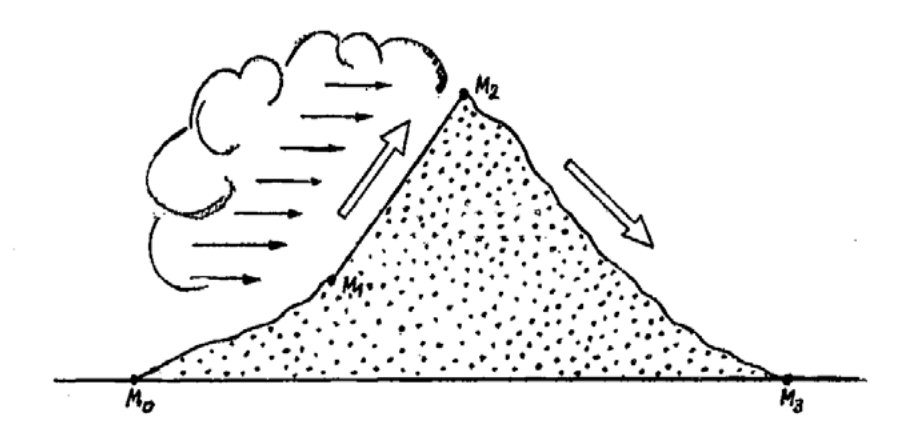
Moist air is streaming adiabatically across a mountain range as indicated in the figure.
Equal atmospheric pressures of 100 kPa are measured at meteorological stations \(M_0\) and \(M_3\) and a pressure of 70 kPa at station \(M_2\). The temperature of the air at \(M_0\) is \(20^\circ\) C.
As the air is ascending, cloud formation sets in at 84.5 kPa.
Consider a quantity of moist air ascending the mountain with a mass of 2000 kg over each square meter. This moist air reaches the mountain ridge (station \(M_2\)) after 1500 seconds. During that rise an amount of 2.45 g of water per kilogram of air is precipitated as rain.
-
Determine temperature \(T_1\) at \(M_1\) where the cloud ceiling forms.
-
What is the height \(h_1\) (at \(M_1\)) above station \(M_0\) of the cloud ceiling assuming a linear decrease of atmospheric density?
-
What temperature \(T_2\) is measured at the ridge of the mountain range?
-
Determine the height of the water column (precipitation level) precipitated by the air stream in 3 hours, assuming a homogeneous rainfall between points \(M_1\) and \(M_2\).
-
What temperature \(T_3\) is measured in the back of the mountain range at station \(M_3\)? Discuss the state of the atmosphere at station \(M_3\) in comparison with that at station \(M_0\).
Hints and Data
The atmosphere is to be dealt with as an ideal gas. Influences of the water vapour on the specific heat capacity and the atmospheric density are to be neglected; the same applies to the temperature dependence of the specific latent heat of vaporisation. The temperatures are to be determined to an accuracy of 1 K, the height of the cloud ceiling to an accuracy of 10 m and the precipitation level to an accuracy of 1 mm.
Specific heat capacity of the atmosphere in the pertaining temperature range:
\[ c_p=1005\ \mathrm{J\cdot kg^{-1}\cdot K^{-1}} \]
Atmospheric density for \(p_0\) and \(T_0\) at station \(M_0\): \[ \rho_0=1.189\ \mathrm{kg\cdot m^{-3}} \]
Specific latent heat of vaporisation of the water within the volume of the cloud:
\[ L_v=2500\ \mathrm{kJ\cdot kg^{-1}} \]
\[ \frac{c_p}{c_v}=\chi=1.4 \qquad\text{and}\qquad g=9.81\ \mathrm{m\cdot s^{-2}} \]
Official English text of the problem.
Answers
- \(T_1\approx279\ \mathrm K\), or \(6^\circ\mathrm C\).
- \(h_1\approx1410\ \mathrm m\).
- \(T_2\approx271\ \mathrm K\), or approximately \(-2^\circ\mathrm C\), to the requested accuracy.
- The precipitation level in 3 hours is approximately \(35\ \mathrm{mm}\).
- \(T_3\approx300\ \mathrm K\), or approximately \(27^\circ\mathrm C\). The air is about \(7\ \mathrm K\) warmer than at \(M_0\) and is drier: the foehn effect.
Solution
All temperatures in thermodynamic relations are absolute temperatures. Set \[ T_0=293.15\ \mathrm K,\qquad \kappa=\frac{\chi-1}{\chi}=\frac27. \] The specific gas constant of air satisfies \[ R=c_p-c_v,\qquad \frac{R}{c_p}=\kappa. \]
We use the given approximation that water does not appreciably alter the air’s heat capacities or density. Condensed water is treated as being removed as rain.
1. Temperature at the onset of cloud formation
Before reaching \(M_1\), no condensation occurs. The rising air therefore follows the dry adiabatic relation, even though it contains water vapour.
For an ideal gas, the first law for an adiabatic change gives \[ c_p\,dT=\frac{RT}{p}\,dp. \] Consequently, \[ \frac{dT}{T}=\kappa\frac{dp}{p}, \qquad T p^{-\kappa}=\text{constant}. \]
Thus \[ T_1=T_0\left(\frac{p_1}{p_0}\right)^\kappa =293.15\left(\frac{84.5}{100}\right)^{2/7} =279.38\ \mathrm K. \]
Therefore, \[ \boxed{T_1\approx279\ \mathrm K\approx6^\circ\mathrm C.} \]
2. Height of the cloud formation level
First determine the density at \(M_1\). From \(p=\rho RT\), \[ \frac{\rho_1}{\rho_0} =\frac{p_1}{p_0}\frac{T_0}{T_1}. \] Hence \[ \rho_1 =1.189\left(\frac{84.5}{100}\right) \left(\frac{293.15}{279.38}\right) =1.0542\ \mathrm{kg\,m^{-3}}. \]
Hydrostatic equilibrium requires \[ \frac{dp}{dh}=-\rho g. \] With density decreasing linearly between \(M_0\) and \(M_1\), its average over this height interval is \[ \overline{\rho}=\frac{\rho_0+\rho_1}{2}. \] Integrating the hydrostatic equation therefore gives \[ p_0-p_1=g h_1\frac{\rho_0+\rho_1}{2}. \]
Thus \[ h_1 =\frac{2(p_0-p_1)}{g(\rho_0+\rho_1)} =\frac{2(100000-84500)} {9.81(1.189+1.0542)} =1408.7\ \mathrm m. \]
To the requested accuracy of 10 m, \[ \boxed{h_1\approx1410\ \mathrm m.} \]
3. Temperature at the mountain ridge
During the cloudy ascent, condensation releases latent heat. Although the parcel exchanges no heat with its surroundings, this internal conversion of latent energy reduces its cooling.
The condensed mass per kilogram of air is \[ \Delta r=2.45\times10^{-3}\ \mathrm{kg\,kg^{-1}}, \] so the latent energy released per kilogram of air is \[ Q_\ell=L_v\Delta r =(2.500\times10^6)(2.45\times10^{-3}) =6125\ \mathrm{J\,kg^{-1}}. \]
Without condensation, the ridge temperature would be \[ T_{2,\mathrm{dry}} =T_0\left(\frac{p_2}{p_0}\right)^\kappa =293.15\left(\frac{70}{100}\right)^{2/7} =264.75\ \mathrm K. \]
The latent energy corresponds to a temperature increase \[ \frac{Q_\ell}{c_p} =\frac{6125}{1005} =6.095\ \mathrm K. \] Adding this increase at the final pressure gives \[ T_2\simeq T_{2,\mathrm{dry}}+\frac{Q_\ell}{c_p} =270.84\ \mathrm K. \]
To check that this approximation meets the specified accuracy, let \(dr\) be an increment of condensed water per kilogram of air. The first law during condensation is \[ c_p\,dT-\frac{RT}{p}\,dp=L_v\,dr. \] Multiplying by the integrating factor \(p^{-\kappa}\) and integrating gives \[ T_2 =T_1\left(\frac{p_2}{p_1}\right)^\kappa +\frac{L_v}{c_p} \int_0^{\Delta r} \left(\frac{p_2}{p(r)}\right)^\kappa dr. \]
Condensation occurs at pressures between \(p_1\) and \(p_2\), so \[ \left(\frac{p_2}{p_1}\right)^\kappa \leq \left(\frac{p_2}{p(r)}\right)^\kappa \leq1. \] Therefore, \[ 270.52\ \mathrm K\leq T_2\leq270.84\ \mathrm K. \]
The simple latent-heat correction overestimates \(T_2\) by at most \(0.32\ \mathrm K\), well within the required accuracy. Thus \[ \boxed{T_2\approx271\ \mathrm K \quad\text{(approximately }-2^\circ\mathrm C\text{).}} \]
4. Precipitation level in 3 hours
The air mass associated with each square metre is \[ \Sigma=2000\ \mathrm{kg\,m^{-2}}. \] During one stated 1500 s interval, it supplies a rainfall mass per unit area of \[ \Sigma\Delta r =2000(2.45\times10^{-3}) =4.90\ \mathrm{kg\,m^{-2}}. \]
For the steady stream, the rainfall accumulated in \(3\ \mathrm h=10800\ \mathrm s\) is therefore \[ \frac{m_{\mathrm w}}{A} =4.90\frac{10800}{1500} =35.28\ \mathrm{kg\,m^{-2}}. \]
Using the usual liquid-water density \[ \rho_{\mathrm w}\simeq1000\ \mathrm{kg\,m^{-3}}, \] the corresponding water-column height is \[ H=\frac{m_{\mathrm w}/A}{\rho_{\mathrm w}} =\frac{35.28}{1000} =0.03528\ \mathrm m. \]
Homogeneous rainfall gives this same precipitation level throughout the specified rain region: \[ \boxed{H\approx35\ \mathrm{mm}\text{ in 3 hours}.} \]
5. Temperature and atmospheric conditions at \(M_3\)
With the condensed water removed as rain, the descending air becomes unsaturated as compression raises its temperature. Its descent is therefore dry adiabatic: \[ T_3=T_2\left(\frac{p_3}{p_2}\right)^\kappa. \]
Using the approximation from part 3, \[ T_3 \simeq270.84\left(\frac{100}{70}\right)^{2/7} =299.90\ \mathrm K. \] The more precise bounds from part 3 imply \[ 299.54\ \mathrm K\leq T_3\leq299.90\ \mathrm K, \] so the uncertainty from the condensation history remains below \(1\ \mathrm K\).
Hence \[ \boxed{T_3\approx300\ \mathrm K\approx27^\circ\mathrm C.} \]
Compared with \(M_0\), the air at \(M_3\):
- is approximately \(7\ \mathrm K\) warmer;
- has lost \(2.45\ \mathrm g\) of water per kilogram of air;
- has lower relative humidity, owing both to the water loss and to its higher temperature.
Latent heat released during ascent reduces the cooling, while the removed rain cannot produce corresponding evaporative cooling during descent. The resulting warm, dry descending wind is the foehn effect.
The solution was checked against the official solution.
IPhO 1987 · Theorieaufgabe 1
Aufsteigende feuchte Luft
Feuchte Luft strömt adiabatisch über ein Gebirge, wie in der Abbildung dargestellt.
An den meteorologischen Stationen \(M_0\) und \(M_3\) werden gleiche Luftdrücke von 100 kPa gemessen, an der Station \(M_2\) ein Druck von 70 kPa. Die Lufttemperatur bei \(M_0\) beträgt \(20^\circ\) C.
Beim Aufsteigen der Luft setzt bei 84.5 kPa die Wolkenbildung ein.
Betrachten Sie eine Menge feuchter Luft, die mit einer Masse von 2000 kg über jedem Quadratmeter am Gebirge aufsteigt. Diese feuchte Luft erreicht den Gebirgskamm (Station \(M_2\)) nach 1500 Sekunden. Während dieses Aufstiegs fallen 2.45 g Wasser pro Kilogramm Luft als Regen aus.
-
Bestimmen Sie die Temperatur \(T_1\) bei \(M_1\), wo sich die Wolkenuntergrenze bildet.
-
In welcher Höhe \(h_1\) (bei \(M_1\)) über der Station \(M_0\) liegt die Wolkenuntergrenze, wenn eine lineare Abnahme der Luftdichte angenommen wird?
-
Welche Temperatur \(T_2\) wird am Gebirgskamm gemessen?
-
Bestimmen Sie die Höhe der Wassersäule (Niederschlagshöhe), die der Luftstrom in 3 Stunden als Niederschlag abgibt, unter der Annahme eines gleichmäßigen Regenfalls zwischen den Punkten \(M_1\) und \(M_2\).
-
Welche Temperatur \(T_3\) wird auf der Rückseite des Gebirges an der Station \(M_3\) gemessen? Diskutieren Sie den Zustand der Atmosphäre an der Station \(M_3\) im Vergleich zu dem an der Station \(M_0\).
Hinweise und Daten
Die Atmosphäre ist als ideales Gas zu behandeln. Der Einfluss des Wasserdampfs auf die spezifische Wärmekapazität und die Luftdichte ist zu vernachlässigen; dasselbe gilt für die Temperaturabhängigkeit der spezifischen Verdampfungswärme. Die Temperaturen sind auf 1 K genau, die Höhe der Wolkenuntergrenze auf 10 m genau und die Niederschlagshöhe auf 1 mm genau zu bestimmen.
Spezifische Wärmekapazität der Luft im betrachteten Temperaturbereich:
\[ c_p=1005\ \mathrm{J\cdot kg^{-1}\cdot K^{-1}} \]
Luftdichte bei \(p_0\) und \(T_0\) an der Station \(M_0\): \[ \rho_0=1.189\ \mathrm{kg\cdot m^{-3}} \]
Spezifische Verdampfungswärme des Wassers innerhalb des Wolkenvolumens:
\[ L_v=2500\ \mathrm{kJ\cdot kg^{-1}} \]
\[ \frac{c_p}{c_v}=\chi=1.4 \qquad\text{und}\qquad g=9.81\ \mathrm{m\cdot s^{-2}} \]
Aufgabentext aus dem offiziellen englischen Text übersetzt.
Antworten
- \(T_1\approx279\ \mathrm K\), also \(6^\circ\mathrm C\).
- \(h_1\approx1410\ \mathrm m\).
- \(T_2\approx271\ \mathrm K\), also ungefähr \(-2^\circ\mathrm C\), mit der geforderten Genauigkeit.
- Die Niederschlagshöhe in 3 Stunden beträgt ungefähr \(35\ \mathrm{mm}\).
- \(T_3\approx300\ \mathrm K\), also ungefähr \(27^\circ\mathrm C\). Die Luft ist etwa \(7\ \mathrm K\) wärmer als bei \(M_0\) und trockener: der Föhneffekt.
Lösung
Alle Temperaturen in thermodynamischen Beziehungen sind absolute Temperaturen. Wir setzen \[ T_0=293.15\ \mathrm K,\qquad \kappa=\frac{\chi-1}{\chi}=\frac27. \] Für die spezifische Gaskonstante der Luft gilt \[ R=c_p-c_v,\qquad \frac{R}{c_p}=\kappa. \]
Wir verwenden die vorgegebene Näherung, dass Wasser die Wärmekapazitäten und die Dichte der Luft nicht merklich verändert. Es wird angenommen, dass kondensiertes Wasser als Regen aus der Luft entfernt wird.
1. Temperatur beim Einsetzen der Wolkenbildung
Bevor die Luft \(M_1\) erreicht, findet keine Kondensation statt. Die aufsteigende Luft folgt daher der trockenadiabatischen Beziehung, obwohl sie Wasserdampf enthält.
Für ein ideales Gas liefert der erste Hauptsatz bei einer adiabatischen Zustandsänderung \[ c_p\,dT=\frac{RT}{p}\,dp. \] Folglich gilt \[ \frac{dT}{T}=\kappa\frac{dp}{p}, \qquad T p^{-\kappa}=\text{konstant}. \]
Somit ist \[ T_1=T_0\left(\frac{p_1}{p_0}\right)^\kappa =293.15\left(\frac{84.5}{100}\right)^{2/7} =279.38\ \mathrm K. \]
Daher ergibt sich \[ \boxed{T_1\approx279\ \mathrm K\approx6^\circ\mathrm C.} \]
2. Höhe des Wolkenbildungsniveaus
Zunächst bestimmen wir die Dichte bei \(M_1\). Aus \(p=\rho RT\) folgt \[ \frac{\rho_1}{\rho_0} =\frac{p_1}{p_0}\frac{T_0}{T_1}. \] Damit ist \[ \rho_1 =1.189\left(\frac{84.5}{100}\right) \left(\frac{293.15}{279.38}\right) =1.0542\ \mathrm{kg\,m^{-3}}. \]
Das hydrostatische Gleichgewicht erfordert \[ \frac{dp}{dh}=-\rho g. \] Da die Dichte zwischen \(M_0\) und \(M_1\) linear abnimmt, beträgt ihr Mittelwert über dieses Höhenintervall \[ \overline{\rho}=\frac{\rho_0+\rho_1}{2}. \] Die Integration der hydrostatischen Gleichung liefert daher \[ p_0-p_1=g h_1\frac{\rho_0+\rho_1}{2}. \]
Somit ist \[ h_1 =\frac{2(p_0-p_1)}{g(\rho_0+\rho_1)} =\frac{2(100000-84500)} {9.81(1.189+1.0542)} =1408.7\ \mathrm m. \]
Mit der geforderten Genauigkeit von 10 m ergibt sich \[ \boxed{h_1\approx1410\ \mathrm m.} \]
3. Temperatur am Gebirgskamm
Während des Aufstiegs innerhalb der Wolke wird durch Kondensation latente Wärme frei. Obwohl das Luftpaket keine Wärme mit seiner Umgebung austauscht, verringert diese innere Umwandlung latenter Energie seine Abkühlung.
Die kondensierte Masse pro Kilogramm Luft beträgt \[ \Delta r=2.45\times10^{-3}\ \mathrm{kg\,kg^{-1}}, \] also beträgt die pro Kilogramm Luft freigesetzte latente Energie \[ Q_\ell=L_v\Delta r =(2.500\times10^6)(2.45\times10^{-3}) =6125\ \mathrm{J\,kg^{-1}}. \]
Ohne Kondensation wäre die Temperatur am Gebirgskamm \[ T_{2,\mathrm{dry}} =T_0\left(\frac{p_2}{p_0}\right)^\kappa =293.15\left(\frac{70}{100}\right)^{2/7} =264.75\ \mathrm K. \]
Die latente Energie entspricht einer Temperaturerhöhung von \[ \frac{Q_\ell}{c_p} =\frac{6125}{1005} =6.095\ \mathrm K. \] Addiert man diese Erhöhung beim Enddruck, erhält man \[ T_2\simeq T_{2,\mathrm{dry}}+\frac{Q_\ell}{c_p} =270.84\ \mathrm K. \]
Um zu überprüfen, ob diese Näherung die vorgegebene Genauigkeit erfüllt, sei \(dr\) ein Zuwachs der kondensierten Wassermasse pro Kilogramm Luft. Der erste Hauptsatz lautet während der Kondensation \[ c_p\,dT-\frac{RT}{p}\,dp=L_v\,dr. \] Multiplikation mit dem integrierenden Faktor \(p^{-\kappa}\) und anschließende Integration ergeben \[ T_2 =T_1\left(\frac{p_2}{p_1}\right)^\kappa +\frac{L_v}{c_p} \int_0^{\Delta r} \left(\frac{p_2}{p(r)}\right)^\kappa dr. \]
Die Kondensation findet bei Drücken zwischen \(p_1\) und \(p_2\) statt, also gilt \[ \left(\frac{p_2}{p_1}\right)^\kappa \leq \left(\frac{p_2}{p(r)}\right)^\kappa \leq1. \] Daher ist \[ 270.52\ \mathrm K\leq T_2\leq270.84\ \mathrm K. \]
Die einfache Korrektur durch die latente Wärme überschätzt \(T_2\) um höchstens \(0.32\ \mathrm K\), was deutlich innerhalb der geforderten Genauigkeit liegt. Somit ergibt sich \[ \boxed{T_2\approx271\ \mathrm K \quad\text{(ungefähr }-2^\circ\mathrm C\text{).}} \]
4. Niederschlagshöhe in 3 Stunden
Die jedem Quadratmeter zugeordnete Luftmasse beträgt \[ \Sigma=2000\ \mathrm{kg\,m^{-2}}. \] Während eines angegebenen Zeitintervalls von 1500 s liefert sie eine Regenmasse pro Flächeneinheit von \[ \Sigma\Delta r =2000(2.45\times10^{-3}) =4.90\ \mathrm{kg\,m^{-2}}. \]
Bei einer stationären Strömung beträgt der in \(3\ \mathrm h=10800\ \mathrm s\) angesammelte Niederschlag daher \[ \frac{m_{\mathrm w}}{A} =4.90\frac{10800}{1500} =35.28\ \mathrm{kg\,m^{-2}}. \]
Mit der üblichen Dichte von flüssigem Wasser \[ \rho_{\mathrm w}\simeq1000\ \mathrm{kg\,m^{-3}}, \] beträgt die entsprechende Höhe der Wassersäule \[ H=\frac{m_{\mathrm w}/A}{\rho_{\mathrm w}} =\frac{35.28}{1000} =0.03528\ \mathrm m. \]
Bei gleichmäßigem Regenfall ergibt sich im gesamten angegebenen Regengebiet dieselbe Niederschlagshöhe: \[ \boxed{H\approx35\ \mathrm{mm}\text{ in 3 Stunden}.} \]
5. Temperatur und atmosphärische Bedingungen bei \(M_3\)
Da das kondensierte Wasser als Regen entfernt wurde, wird die absinkende Luft ungesättigt, wenn die Kompression ihre Temperatur erhöht. Ihr Abstieg verläuft daher trockenadiabatisch: \[ T_3=T_2\left(\frac{p_3}{p_2}\right)^\kappa. \]
Mit der Näherung aus Teil 3 ergibt sich \[ T_3 \simeq270.84\left(\frac{100}{70}\right)^{2/7} =299.90\ \mathrm K. \] Aus den genaueren Grenzen aus Teil 3 folgt \[ 299.54\ \mathrm K\leq T_3\leq299.90\ \mathrm K, \] also bleibt die Unsicherheit aufgrund des Verlaufs der Kondensation unter \(1\ \mathrm K\).
Damit ist \[ \boxed{T_3\approx300\ \mathrm K\approx27^\circ\mathrm C.} \]
Im Vergleich zu \(M_0\) gilt für die Luft bei \(M_3\):
- Sie ist ungefähr \(7\ \mathrm K\) wärmer;
- sie hat \(2.45\ \mathrm g\) Wasser pro Kilogramm Luft verloren;
- sie hat eine geringere relative Luftfeuchtigkeit, sowohl aufgrund des Wasserverlusts als auch aufgrund ihrer höheren Temperatur.
Die beim Aufstieg freigesetzte latente Wärme verringert die Abkühlung, während der entfernte Regen beim Abstieg keine entsprechende Verdunstungskühlung bewirken kann. Der dadurch entstehende warme, trockene Fallwind ist der Föhneffekt.
Die Lösung wurde mit der offiziellen Lösung abgeglichen.
IPhO 1987 · Teori sorusu 1
Yükselen nemli hava
Nemli hava, şekilde gösterildiği gibi bir sıradağın üzerinden adyabatik olarak akmaktadır.
\(M_0\) ve \(M_3\) meteoroloji istasyonlarında birbirine eşit ve 100 kPa değerinde atmosfer basınçları, \(M_2\) istasyonunda ise 70 kPa basınç ölçülmektedir. \(M_0\)'daki havanın sıcaklığı \(20^\circ\) C'dir.
Hava yükselirken 84.5 kPa basınçta bulut oluşumu başlar.
Dağ boyunca yükselen ve her metrekare üzerinde 2000 kg kütleye sahip bir miktar nemli havayı ele alın. Bu nemli hava 1500 saniye sonra dağ sırtına (\(M_2\) istasyonuna) ulaşır. Bu yükseliş sırasında havanın her kilogramı başına 2.45 g su yağmur olarak düşer.
-
Bulut tabanının oluştuğu \(M_1\)'deki \(T_1\) sıcaklığını belirleyin.
-
Atmosfer yoğunluğunun doğrusal olarak azaldığını varsayarak bulut tabanının (\(M_1\)'de) \(M_0\) istasyonuna göre \(h_1\) yüksekliğini bulun.
-
Sıradağın sırtında hangi \(T_2\) sıcaklığı ölçülür?
-
\(M_1\) ve \(M_2\) noktaları arasında yağışın homojen olduğunu varsayarak hava akımının 3 saatte oluşturduğu yağışa karşılık gelen su sütununun yüksekliğini (yağış yüksekliğini) belirleyin.
-
Sıradağın arka tarafındaki \(M_3\) istasyonunda hangi \(T_3\) sıcaklığı ölçülür? \(M_3\) istasyonundaki atmosferin durumunu \(M_0\) istasyonundakiyle karşılaştırarak tartışın.
İpuçları ve Veriler
Atmosfer ideal gaz olarak ele alınacaktır. Su buharının özgül ısı kapasitesi ve atmosfer yoğunluğu üzerindeki etkileri ihmal edilecektir; aynı şekilde özgül buharlaşma gizli ısısının sıcaklığa bağımlılığı da ihmal edilecektir. Sıcaklıklar 1 K, bulut tabanının yüksekliği 10 m ve yağış yüksekliği 1 mm doğrulukla belirlenecektir.
İlgili sıcaklık aralığında atmosferin özgül ısı kapasitesi:
\[ c_p=1005\ \mathrm{J\cdot kg^{-1}\cdot K^{-1}} \]
\(M_0\) istasyonundaki \(p_0\) ve \(T_0\) için atmosfer yoğunluğu: \[ \rho_0=1.189\ \mathrm{kg\cdot m^{-3}} \]
Bulut hacmi içindeki suyun özgül buharlaşma gizli ısısı:
\[ L_v=2500\ \mathrm{kJ\cdot kg^{-1}} \]
\[ \frac{c_p}{c_v}=\chi=1.4 \qquad\text{ve}\qquad g=9.81\ \mathrm{m\cdot s^{-2}} \]
Soru metni resmi İngilizce metinden çevrilmiştir.
Cevaplar
- \(T_1\approx279\ \mathrm K\), yani \(6^\circ\mathrm C\).
- \(h_1\approx1410\ \mathrm m\).
- İstenen doğrulukla \(T_2\approx271\ \mathrm K\), yani yaklaşık \(-2^\circ\mathrm C\).
- 3 saatteki yağış yüksekliği yaklaşık \(35\ \mathrm{mm}\)'dir.
- \(T_3\approx300\ \mathrm K\), yani yaklaşık \(27^\circ\mathrm C\). Hava, \(M_0\)'dakinden yaklaşık \(7\ \mathrm K\) daha sıcak ve daha kurudur: fön etkisi.
Çözüm
Termodinamik bağıntılardaki tüm sıcaklıklar mutlak sıcaklıklardır. Şu tanımları yapalım: \[ T_0=293.15\ \mathrm K,\qquad \kappa=\frac{\chi-1}{\chi}=\frac27. \] Havanın özgül gaz sabiti şu bağıntıları sağlar: \[ R=c_p-c_v,\qquad \frac{R}{c_p}=\kappa. \]
Suyun, havanın ısı kapasitelerini veya yoğunluğunu kayda değer ölçüde değiştirmediği yönündeki verilen yaklaşımı kullanıyoruz. Yoğuşan suyun yağmur olarak ortamdan uzaklaştığı kabul edilir.
1. Bulut oluşumunun başlangıcındaki sıcaklık
\(M_1\)'e ulaşılmadan önce yoğuşma gerçekleşmez. Bu nedenle yükselen hava, su buharı içermesine rağmen kuru adyabatik bağıntıya uyar.
İdeal bir gaz için termodinamiğin birinci yasası, adyabatik bir değişimde şu bağıntıyı verir: \[ c_p\,dT=\frac{RT}{p}\,dp. \] Dolayısıyla, \[ \frac{dT}{T}=\kappa\frac{dp}{p}, \qquad T p^{-\kappa}=\text{sabit}. \]
Böylece \[ T_1=T_0\left(\frac{p_1}{p_0}\right)^\kappa =293.15\left(\frac{84.5}{100}\right)^{2/7} =279.38\ \mathrm K. \]
O hâlde, \[ \boxed{T_1\approx279\ \mathrm K\approx6^\circ\mathrm C.} \]
2. Bulut oluşum seviyesinin yüksekliği
Önce \(M_1\)'deki yoğunluğu belirleyelim. \(p=\rho RT\) bağıntısından, \[ \frac{\rho_1}{\rho_0} =\frac{p_1}{p_0}\frac{T_0}{T_1}. \] Buna göre \[ \rho_1 =1.189\left(\frac{84.5}{100}\right) \left(\frac{293.15}{279.38}\right) =1.0542\ \mathrm{kg\,m^{-3}}. \]
Hidrostatik denge şu koşulu gerektirir: \[ \frac{dp}{dh}=-\rho g. \] Yoğunluk \(M_0\) ile \(M_1\) arasında doğrusal olarak azaldığından, bu yükseklik aralığındaki ortalaması \[ \overline{\rho}=\frac{\rho_0+\rho_1}{2}. \] Bu nedenle hidrostatik denklemin integrali alındığında \[ p_0-p_1=g h_1\frac{\rho_0+\rho_1}{2}. \]
Böylece \[ h_1 =\frac{2(p_0-p_1)}{g(\rho_0+\rho_1)} =\frac{2(100000-84500)} {9.81(1.189+1.0542)} =1408.7\ \mathrm m. \]
İstenen 10 m doğrulukla, \[ \boxed{h_1\approx1410\ \mathrm m.} \]
3. Dağ sırtındaki sıcaklık
Bulutlu yükseliş sırasında yoğuşma gizli ısı açığa çıkarır. Hava parseli çevresiyle ısı alışverişi yapmasa da gizli enerjinin bu iç dönüşümü soğumayı azaltır.
Havanın her kilogramı başına yoğuşan kütle \[ \Delta r=2.45\times10^{-3}\ \mathrm{kg\,kg^{-1}}, \] olduğundan, havanın her kilogramı başına açığa çıkan gizli enerji \[ Q_\ell=L_v\Delta r =(2.500\times10^6)(2.45\times10^{-3}) =6125\ \mathrm{J\,kg^{-1}}. \]
Yoğuşma olmasaydı dağ sırtındaki sıcaklık \[ T_{2,\mathrm{dry}} =T_0\left(\frac{p_2}{p_0}\right)^\kappa =293.15\left(\frac{70}{100}\right)^{2/7} =264.75\ \mathrm K. \]
Gizli enerji şu sıcaklık artışına karşılık gelir: \[ \frac{Q_\ell}{c_p} =\frac{6125}{1005} =6.095\ \mathrm K. \] Bu artış son basınçta eklendiğinde \[ T_2\simeq T_{2,\mathrm{dry}}+\frac{Q_\ell}{c_p} =270.84\ \mathrm K. \]
Bu yaklaşımın belirtilen doğruluğu sağladığını kontrol etmek için \(dr\), havanın her kilogramı başına yoğuşan su miktarındaki artış olsun. Yoğuşma sırasında birinci yasa \[ c_p\,dT-\frac{RT}{p}\,dp=L_v\,dr. \] \(p^{-\kappa}\) integral çarpanıyla çarpıp integral alınırsa \[ T_2 =T_1\left(\frac{p_2}{p_1}\right)^\kappa +\frac{L_v}{c_p} \int_0^{\Delta r} \left(\frac{p_2}{p(r)}\right)^\kappa dr. \]
Yoğuşma \(p_1\) ile \(p_2\) arasındaki basınçlarda gerçekleştiğinden \[ \left(\frac{p_2}{p_1}\right)^\kappa \leq \left(\frac{p_2}{p(r)}\right)^\kappa \leq1. \] Dolayısıyla, \[ 270.52\ \mathrm K\leq T_2\leq270.84\ \mathrm K. \]
Basit gizli ısı düzeltmesi, \(T_2\)'yi en fazla \(0.32\ \mathrm K\) fazla tahmin eder; bu fark istenen doğruluk sınırının oldukça içindedir. Böylece \[ \boxed{T_2\approx271\ \mathrm K \quad\text{(yaklaşık }-2^\circ\mathrm C\text{).}} \]
4. 3 saatteki yağış yüksekliği
Her metrekareye karşılık gelen hava kütlesi \[ \Sigma=2000\ \mathrm{kg\,m^{-2}}. \] Belirtilen 1500 s'lik bir zaman aralığında bu hava, birim alan başına şu yağmur kütlesini sağlar: \[ \Sigma\Delta r =2000(2.45\times10^{-3}) =4.90\ \mathrm{kg\,m^{-2}}. \]
Dolayısıyla kararlı akış için \(3\ \mathrm h=10800\ \mathrm s\) süresince biriken yağmur miktarı \[ \frac{m_{\mathrm w}}{A} =4.90\frac{10800}{1500} =35.28\ \mathrm{kg\,m^{-2}}. \]
Sıvı suyun alışılmış yoğunluğu olan \[ \rho_{\mathrm w}\simeq1000\ \mathrm{kg\,m^{-3}}, \] kullanıldığında, buna karşılık gelen su sütunu yüksekliği \[ H=\frac{m_{\mathrm w}/A}{\rho_{\mathrm w}} =\frac{35.28}{1000} =0.03528\ \mathrm m. \]
Yağışın homojen olması, belirtilen yağış bölgesinin tamamında aynı yağış yüksekliğini verir: \[ \boxed{H\approx35\ \mathrm{mm}\text{ 3 saatte}.} \]
5. \(M_3\)'teki sıcaklık ve atmosfer koşulları
Yoğuşan su yağmur olarak uzaklaştığından, alçalan hava sıkışma sonucu sıcaklığı arttıkça doymamış hâle gelir. Bu nedenle alçalması kuru adyabatiktir: \[ T_3=T_2\left(\frac{p_3}{p_2}\right)^\kappa. \]
- kısımdaki yaklaşım kullanılırsa, \[ T_3 \simeq270.84\left(\frac{100}{70}\right)^{2/7} =299.90\ \mathrm K. \]
- kısımdaki daha hassas sınırlar \[ 299.54\ \mathrm K\leq T_3\leq299.90\ \mathrm K, \] sonucunu verdiğinden, yoğuşmanın nasıl gerçekleştiğinden kaynaklanan belirsizlik \(1\ \mathrm K\)'in altında kalır.
Buna göre \[ \boxed{T_3\approx300\ \mathrm K\approx27^\circ\mathrm C.} \]
\(M_0\)'dakiyle karşılaştırıldığında \(M_3\)'teki hava:
- yaklaşık \(7\ \mathrm K\) daha sıcaktır;
- havanın her kilogramı başına \(2.45\ \mathrm g\) su kaybetmiştir;
- hem su kaybı hem de daha yüksek sıcaklığı nedeniyle daha düşük bağıl neme sahiptir.
Yükseliş sırasında açığa çıkan gizli ısı soğumayı azaltırken, ortamdan uzaklaşan yağmur alçalış sırasında buna karşılık gelen buharlaşma kaynaklı soğumayı sağlayamaz. Bunun sonucunda oluşan sıcak ve kuru alçalıcı rüzgâr fön etkisidir.
Çözüm, resmi çözümle karşılaştırılarak kontrol edildi.
IPhO 1987 · Problema teórico 1
Ascenso de aire húmedo
Una corriente de aire húmedo atraviesa adiabáticamente una cordillera, como se indica en la figura.
En las estaciones meteorológicas \(M_0\) y \(M_3\) se miden presiones atmosféricas iguales de 100 kPa, y en la estación \(M_2\), una presión de 70 kPa. La temperatura del aire en \(M_0\) es de \(20^\circ\) C.
A medida que el aire asciende, la formación de nubes comienza a una presión de 84.5 kPa.
Considérese una cantidad de aire húmedo que asciende por la montaña con una masa de 2000 kg sobre cada metro cuadrado. Este aire húmedo alcanza la cresta de la montaña (estación \(M_2\)) al cabo de 1500 segundos. Durante ese ascenso precipitan en forma de lluvia 2.45 g de agua por kilogramo de aire.
-
Determine la temperatura \(T_1\) en \(M_1\), donde se forma la base de las nubes.
-
¿Cuál es la altura \(h_1\) (en \(M_1\)) de la base de las nubes sobre la estación \(M_0\), suponiendo una disminución lineal de la densidad atmosférica?
-
¿Qué temperatura \(T_2\) se mide en la cresta de la cordillera?
-
Determine la altura de la columna de agua (nivel de precipitación) que precipita de la corriente de aire en 3 horas, suponiendo una lluvia homogénea entre los puntos \(M_1\) y \(M_2\).
-
¿Qué temperatura \(T_3\) se mide a sotavento de la cordillera, en la estación \(M_3\)? Analice el estado de la atmósfera en la estación \(M_3\) en comparación con el de la estación \(M_0\).
Indicaciones y datos
La atmósfera debe tratarse como un gas ideal. Deben despreciarse los efectos del vapor de agua sobre la capacidad calorífica específica y la densidad atmosférica; lo mismo se aplica a la dependencia del calor latente específico de vaporización con la temperatura. Las temperaturas deben determinarse con una precisión de 1 K, la altura de la base de las nubes con una precisión de 10 m y el nivel de precipitación con una precisión de 1 mm.
Capacidad calorífica específica de la atmósfera en el intervalo de temperaturas considerado:
\[ c_p=1005\ \mathrm{J\cdot kg^{-1}\cdot K^{-1}} \]
Densidad atmosférica para \(p_0\) y \(T_0\) en la estación \(M_0\): \[ \rho_0=1.189\ \mathrm{kg\cdot m^{-3}} \]
Calor latente específico de vaporización del agua dentro del volumen de la nube:
\[ L_v=2500\ \mathrm{kJ\cdot kg^{-1}} \]
\[ \frac{c_p}{c_v}=\chi=1.4 \qquad\text{y}\qquad g=9.81\ \mathrm{m\cdot s^{-2}} \]
Enunciado traducido del texto oficial en inglés.
Respuestas
- \(T_1\approx279\ \mathrm K\), o \(6^\circ\mathrm C\).
- \(h_1\approx1410\ \mathrm m\).
- \(T_2\approx271\ \mathrm K\), o aproximadamente \(-2^\circ\mathrm C\), con la precisión solicitada.
- El nivel de precipitación en 3 horas es de aproximadamente \(35\ \mathrm{mm}\).
- \(T_3\approx300\ \mathrm K\), o aproximadamente \(27^\circ\mathrm C\). El aire está unos \(7\ \mathrm K\) más caliente que en \(M_0\) y es más seco: el efecto föhn.
Solución
Todas las temperaturas que aparecen en las relaciones termodinámicas son temperaturas absolutas. Tomamos \[ T_0=293.15\ \mathrm K,\qquad \kappa=\frac{\chi-1}{\chi}=\frac27. \] La constante específica de los gases para el aire satisface \[ R=c_p-c_v,\qquad \frac{R}{c_p}=\kappa. \]
Utilizamos la aproximación indicada de que el agua no modifica apreciablemente las capacidades caloríficas ni la densidad del aire. Se considera que el agua condensada se elimina en forma de lluvia.
1. Temperatura al inicio de la formación de nubes
Antes de alcanzar \(M_1\), no se produce condensación. Por tanto, el aire ascendente sigue la relación adiabática seca, aunque contiene vapor de agua.
Para un gas ideal, el primer principio de la termodinámica aplicado a una transformación adiabática da \[ c_p\,dT=\frac{RT}{p}\,dp. \] En consecuencia, \[ \frac{dT}{T}=\kappa\frac{dp}{p}, \qquad T p^{-\kappa}=\text{constante}. \]
Así, \[ T_1=T_0\left(\frac{p_1}{p_0}\right)^\kappa =293.15\left(\frac{84.5}{100}\right)^{2/7} =279.38\ \mathrm K. \]
Por tanto, \[ \boxed{T_1\approx279\ \mathrm K\approx6^\circ\mathrm C.} \]
2. Altura del nivel de formación de nubes
Primero determinamos la densidad en \(M_1\). A partir de \(p=\rho RT\), \[ \frac{\rho_1}{\rho_0} =\frac{p_1}{p_0}\frac{T_0}{T_1}. \] De ahí, \[ \rho_1 =1.189\left(\frac{84.5}{100}\right) \left(\frac{293.15}{279.38}\right) =1.0542\ \mathrm{kg\,m^{-3}}. \]
El equilibrio hidrostático exige \[ \frac{dp}{dh}=-\rho g. \] Si la densidad disminuye linealmente entre \(M_0\) y \(M_1\), su valor medio en este intervalo de alturas es \[ \overline{\rho}=\frac{\rho_0+\rho_1}{2}. \] Por tanto, al integrar la ecuación hidrostática se obtiene \[ p_0-p_1=g h_1\frac{\rho_0+\rho_1}{2}. \]
Así, \[ h_1 =\frac{2(p_0-p_1)}{g(\rho_0+\rho_1)} =\frac{2(100000-84500)} {9.81(1.189+1.0542)} =1408.7\ \mathrm m. \]
Con la precisión solicitada de 10 m, \[ \boxed{h_1\approx1410\ \mathrm m.} \]
3. Temperatura en la cresta de la montaña
Durante el ascenso con formación de nubes, la condensación libera calor latente. Aunque la parcela de aire no intercambia calor con su entorno, esta conversión interna de energía latente reduce su enfriamiento.
La masa condensada por kilogramo de aire es \[ \Delta r=2.45\times10^{-3}\ \mathrm{kg\,kg^{-1}}, \] por lo que la energía latente liberada por kilogramo de aire es \[ Q_\ell=L_v\Delta r =(2.500\times10^6)(2.45\times10^{-3}) =6125\ \mathrm{J\,kg^{-1}}. \]
Sin condensación, la temperatura en la cresta sería \[ T_{2,\mathrm{dry}} =T_0\left(\frac{p_2}{p_0}\right)^\kappa =293.15\left(\frac{70}{100}\right)^{2/7} =264.75\ \mathrm K. \]
La energía latente corresponde a un aumento de temperatura de \[ \frac{Q_\ell}{c_p} =\frac{6125}{1005} =6.095\ \mathrm K. \] Al sumar este aumento a la presión final se obtiene \[ T_2\simeq T_{2,\mathrm{dry}}+\frac{Q_\ell}{c_p} =270.84\ \mathrm K. \]
Para comprobar que esta aproximación cumple la precisión especificada, sea \(dr\) un incremento de agua condensada por kilogramo de aire. El primer principio durante la condensación es \[ c_p\,dT-\frac{RT}{p}\,dp=L_v\,dr. \] Multiplicando por el factor integrante \(p^{-\kappa}\) e integrando, se obtiene \[ T_2 =T_1\left(\frac{p_2}{p_1}\right)^\kappa +\frac{L_v}{c_p} \int_0^{\Delta r} \left(\frac{p_2}{p(r)}\right)^\kappa dr. \]
La condensación se produce a presiones comprendidas entre \(p_1\) y \(p_2\), por lo que \[ \left(\frac{p_2}{p_1}\right)^\kappa \leq \left(\frac{p_2}{p(r)}\right)^\kappa \leq1. \] Por tanto, \[ 270.52\ \mathrm K\leq T_2\leq270.84\ \mathrm K. \]
La corrección sencilla por calor latente sobreestima \(T_2\) como máximo en \(0.32\ \mathrm K\), un valor holgadamente dentro de la precisión requerida. Así, \[ \boxed{T_2\approx271\ \mathrm K \quad\text{(aproximadamente }-2^\circ\mathrm C\text{).}} \]
4. Nivel de precipitación en 3 horas
La masa de aire asociada a cada metro cuadrado es \[ \Sigma=2000\ \mathrm{kg\,m^{-2}}. \] Durante uno de los intervalos indicados de 1500 s, aporta una masa de lluvia por unidad de superficie de \[ \Sigma\Delta r =2000(2.45\times10^{-3}) =4.90\ \mathrm{kg\,m^{-2}}. \]
Para una corriente estacionaria, la lluvia acumulada en \(3\ \mathrm h=10800\ \mathrm s\) es, por tanto, \[ \frac{m_{\mathrm w}}{A} =4.90\frac{10800}{1500} =35.28\ \mathrm{kg\,m^{-2}}. \]
Utilizando la densidad habitual del agua líquida, \[ \rho_{\mathrm w}\simeq1000\ \mathrm{kg\,m^{-3}}, \] la altura correspondiente de la columna de agua es \[ H=\frac{m_{\mathrm w}/A}{\rho_{\mathrm w}} =\frac{35.28}{1000} =0.03528\ \mathrm m. \]
Una lluvia homogénea da este mismo nivel de precipitación en toda la región de lluvia especificada: \[ \boxed{H\approx35\ \mathrm{mm}\text{ en 3 horas}.} \]
5. Temperatura y condiciones atmosféricas en \(M_3\)
Una vez eliminada el agua condensada en forma de lluvia, el aire descendente deja de estar saturado al aumentar su temperatura por la compresión. Por tanto, su descenso sigue una adiabática seca: \[ T_3=T_2\left(\frac{p_3}{p_2}\right)^\kappa. \]
Utilizando la aproximación del apartado 3, \[ T_3 \simeq270.84\left(\frac{100}{70}\right)^{2/7} =299.90\ \mathrm K. \] Las cotas más precisas del apartado 3 implican \[ 299.54\ \mathrm K\leq T_3\leq299.90\ \mathrm K, \] por lo que la incertidumbre debida a cómo se haya desarrollado la condensación sigue siendo inferior a \(1\ \mathrm K\).
De ahí, \[ \boxed{T_3\approx300\ \mathrm K\approx27^\circ\mathrm C.} \]
En comparación con \(M_0\), el aire en \(M_3\):
- está aproximadamente \(7\ \mathrm K\) más caliente;
- ha perdido \(2.45\ \mathrm g\) de agua por kilogramo de aire;
- tiene una humedad relativa menor, debido tanto a la pérdida de agua como a su mayor temperatura.
El calor latente liberado durante el ascenso reduce el enfriamiento, mientras que la lluvia eliminada no puede producir el correspondiente enfriamiento por evaporación durante el descenso. El viento descendente cálido y seco resultante constituye el efecto föhn.
La solución se comprobó con la solución oficial.
IPhO 1987 · 理论题 1
上升的湿空气
湿空气以绝热方式流过一条山脉,如图所示。
在气象站 \(M_0\) 和 \(M_3\) 测得的大气压相同,均为 100 kPa,而在气象站 \(M_2\) 测得的气压为 70 kPa。\(M_0\) 处的空气温度为 \(20^\circ\) C。
空气上升时,在气压为 84.5 kPa 处开始形成云。
考虑一团沿山坡上升的湿空气,每平方米上方的空气质量为 2000 kg。这团湿空气经过 1500 秒后到达山脊(气象站 \(M_2\))。在上升过程中,每千克空气中有 2.45 g 的水以雨的形式降下。
-
求云底形成处 \(M_1\) 的温度 \(T_1\)。
-
假设大气密度随高度线性减小,云底(\(M_1\) 处)相对于气象站 \(M_0\) 的高度 \(h_1\) 是多少?
-
在山脊处测得的温度 \(T_2\) 是多少?
-
假设 \(M_1\) 与 \(M_2\) 两点之间降雨均匀,求气流在 3 小时内产生的降水水柱高度(降水量)。
-
在山脉背风面的气象站 \(M_3\) 测得的温度 \(T_3\) 是多少?讨论气象站 \(M_3\) 处的大气状态与气象站 \(M_0\) 处相比有何不同。
提示与数据
将大气视为理想气体。忽略水蒸气对比热容和大气密度的影响;同样忽略汽化比潜热随温度的变化。温度的计算精度要求为 1 K,云底高度的计算精度要求为 10 m,降水量的计算精度要求为 1 mm。
在所涉及的温度范围内,大气的比热容为:
\[ c_p=1005\ \mathrm{J\cdot kg^{-1}\cdot K^{-1}} \]
气象站 \(M_0\) 处,在 \(p_0\) 和 \(T_0\) 下的大气密度为: \[ \rho_0=1.189\ \mathrm{kg\cdot m^{-3}} \]
云体内水的汽化比潜热为:
\[ L_v=2500\ \mathrm{kJ\cdot kg^{-1}} \]
\[ \frac{c_p}{c_v}=\chi=1.4 \qquad\text{且}\qquad g=9.81\ \mathrm{m\cdot s^{-2}} \]
题目译自官方英文原文。
答案
- \(T_1\approx279\ \mathrm K\),即 \(6^\circ\mathrm C\)。
- \(h_1\approx1410\ \mathrm m\)。
- 在要求的精度下,\(T_2\approx271\ \mathrm K\),即约 \(-2^\circ\mathrm C\)。
- 3 小时内的降水量约为 \(35\ \mathrm{mm}\)。
- \(T_3\approx300\ \mathrm K\),即约 \(27^\circ\mathrm C\)。空气比 \(M_0\) 处暖约 \(7\ \mathrm K\),且更加干燥:这就是焚风效应。
解答
热力学关系式中的所有温度均为绝对温度。令 \[ T_0=293.15\ \mathrm K,\qquad \kappa=\frac{\chi-1}{\chi}=\frac27. \] 空气的比气体常数满足 \[ R=c_p-c_v,\qquad \frac{R}{c_p}=\kappa. \]
采用题目给出的近似,即水不会显著改变空气的比热容或密度。凝结的水视为以雨的形式移出气团。
1. 开始形成云时的温度
在到达 \(M_1\) 之前,不发生凝结。因此,上升的空气虽然含有水蒸气,仍遵循干绝热关系。
对于理想气体,绝热变化过程中的热力学第一定律给出 \[ c_p\,dT=\frac{RT}{p}\,dp. \] 因此, \[ \frac{dT}{T}=\kappa\frac{dp}{p}, \qquad T p^{-\kappa}=\text{常量}. \]
于是 \[ T_1=T_0\left(\frac{p_1}{p_0}\right)^\kappa =293.15\left(\frac{84.5}{100}\right)^{2/7} =279.38\ \mathrm K. \]
因此, \[ \boxed{T_1\approx279\ \mathrm K\approx6^\circ\mathrm C.} \]
2. 云形成处的高度
首先求 \(M_1\) 处的密度。由 \(p=\rho RT\), \[ \frac{\rho_1}{\rho_0} =\frac{p_1}{p_0}\frac{T_0}{T_1}. \] 因此 \[ \rho_1 =1.189\left(\frac{84.5}{100}\right) \left(\frac{293.15}{279.38}\right) =1.0542\ \mathrm{kg\,m^{-3}}. \]
流体静力平衡要求 \[ \frac{dp}{dh}=-\rho g. \] 由于密度在 \(M_0\) 与 \(M_1\) 之间随高度线性减小,其在这一高度区间内的平均值为 \[ \overline{\rho}=\frac{\rho_0+\rho_1}{2}. \] 因此,对流体静力学方程积分得到 \[ p_0-p_1=g h_1\frac{\rho_0+\rho_1}{2}. \]
于是 \[ h_1 =\frac{2(p_0-p_1)}{g(\rho_0+\rho_1)} =\frac{2(100000-84500)} {9.81(1.189+1.0542)} =1408.7\ \mathrm m. \]
按要求精确到 10 m, \[ \boxed{h_1\approx1410\ \mathrm m.} \]
3. 山脊处的温度
在有云的上升过程中,凝结释放潜热。虽然气团与周围环境没有热量交换,但这种内部潜能的转化会减小其降温幅度。
每千克空气中凝结的水的质量为 \[ \Delta r=2.45\times10^{-3}\ \mathrm{kg\,kg^{-1}}, \] 因此,每千克空气中释放的潜热为 \[ Q_\ell=L_v\Delta r =(2.500\times10^6)(2.45\times10^{-3}) =6125\ \mathrm{J\,kg^{-1}}. \]
若不发生凝结,山脊处的温度将为 \[ T_{2,\mathrm{dry}} =T_0\left(\frac{p_2}{p_0}\right)^\kappa =293.15\left(\frac{70}{100}\right)^{2/7} =264.75\ \mathrm K. \]
这些潜热对应的温升为 \[ \frac{Q_\ell}{c_p} =\frac{6125}{1005} =6.095\ \mathrm K. \] 在最终气压下加上这一温升,得到 \[ T_2\simeq T_{2,\mathrm{dry}}+\frac{Q_\ell}{c_p} =270.84\ \mathrm K. \]
为检验这一近似是否满足规定的精度,令 \(dr\) 为每千克空气中凝结水的质量增量。凝结过程中的热力学第一定律为 \[ c_p\,dT-\frac{RT}{p}\,dp=L_v\,dr. \] 乘以积分因子 \(p^{-\kappa}\) 并积分,得到 \[ T_2 =T_1\left(\frac{p_2}{p_1}\right)^\kappa +\frac{L_v}{c_p} \int_0^{\Delta r} \left(\frac{p_2}{p(r)}\right)^\kappa dr. \]
凝结发生时的气压介于 \(p_1\) 与 \(p_2\) 之间,因此 \[ \left(\frac{p_2}{p_1}\right)^\kappa \leq \left(\frac{p_2}{p(r)}\right)^\kappa \leq1. \] 因此, \[ 270.52\ \mathrm K\leq T_2\leq270.84\ \mathrm K. \]
这一简单的潜热修正至多将 \(T_2\) 高估 \(0.32\ \mathrm K\),远小于允许的误差。因此 \[ \boxed{T_2\approx271\ \mathrm K \quad\text{(约为 }-2^\circ\mathrm C\text{).}} \]
4. 3 小时内的降水量
每平方米所对应的空气质量为 \[ \Sigma=2000\ \mathrm{kg\,m^{-2}}. \] 在题目所述的一个 1500 s 时间间隔内,它产生的单位面积降雨质量为 \[ \Sigma\Delta r =2000(2.45\times10^{-3}) =4.90\ \mathrm{kg\,m^{-2}}. \]
因此,对于稳定的气流,在 \(3\ \mathrm h=10800\ \mathrm s\) 内累积的降雨为 \[ \frac{m_{\mathrm w}}{A} =4.90\frac{10800}{1500} =35.28\ \mathrm{kg\,m^{-2}}. \]
取液态水通常的密度 \[ \rho_{\mathrm w}\simeq1000\ \mathrm{kg\,m^{-3}}, \] 相应的水柱高度为 \[ H=\frac{m_{\mathrm w}/A}{\rho_{\mathrm w}} =\frac{35.28}{1000} =0.03528\ \mathrm m. \]
降雨均匀意味着指定降雨区域内各处的降水量均相同: \[ \boxed{H\approx35\ \mathrm{mm}\text{ 在 3 小时内}.} \]
5. \(M_3\) 处的温度和大气状况
凝结水以雨的形式移出气团后,下降的空气因受压缩而升温,变为未饱和状态。因此,其下降过程是干绝热过程: \[ T_3=T_2\left(\frac{p_3}{p_2}\right)^\kappa. \]
使用第 3 问中的近似值, \[ T_3 \simeq270.84\left(\frac{100}{70}\right)^{2/7} =299.90\ \mathrm K. \] 第 3 问中更精确的上下界给出 \[ 299.54\ \mathrm K\leq T_3\leq299.90\ \mathrm K, \] 因此,凝结过程的具体情况所带来的不确定度仍小于 \(1\ \mathrm K\)。
所以 \[ \boxed{T_3\approx300\ \mathrm K\approx27^\circ\mathrm C.} \]
与 \(M_0\) 处相比,\(M_3\) 处的空气:
- 温度高约 \(7\ \mathrm K\);
- 每千克空气损失了 \(2.45\ \mathrm g\) 的水;
- 由于水分减少且温度升高,相对湿度更低。
上升过程中释放的潜热减小了降温幅度,而已降下的雨水无法在下降过程中产生相应的蒸发冷却。由此形成温暖、干燥的下坡风,这就是焚风效应。
解答已与官方解答核对。
IPhO 1987 · Теоретическая задача 1
Подъём влажного воздуха
Влажный воздух адиабатически перетекает через горный хребет, как показано на рисунке.
На метеорологических станциях \(M_0\) и \(M_3\) измерены одинаковые значения атмосферного давления — 100 кПа, а на станции \(M_2\) — давление 70 кПа. Температура воздуха на станции \(M_0\) составляет \(20^\circ\) C.
При подъёме воздуха образование облаков начинается при давлении 84.5 кПа.
Рассмотрим порцию влажного воздуха, поднимающуюся по склону горы, масса которой составляет 2000 кг на каждый квадратный метр. Этот влажный воздух достигает гребня горного хребта (станции \(M_2\)) через 1500 секунд. За время подъёма на каждый килограмм воздуха выпадает 2.45 г воды в виде дождя.
-
Определите температуру \(T_1\) на станции \(M_1\), где образуется нижняя граница облаков.
-
На какой высоте \(h_1\) (на станции \(M_1\)) над станцией \(M_0\) находится нижняя граница облаков, если считать, что плотность атмосферы убывает линейно?
-
Какая температура \(T_2\) измеряется на гребне горного хребта?
-
Определите высоту столба воды (слоя осадков), выпавшей из воздушного потока за 3 часа, предполагая равномерное выпадение дождя между точками \(M_1\) и \(M_2\).
-
Какая температура \(T_3\) измеряется за горным хребтом на станции \(M_3\)? Обсудите состояние атмосферы на станции \(M_3\) по сравнению с её состоянием на станции \(M_0\).
Указания и данные
Атмосферу следует рассматривать как идеальный газ. Влиянием водяного пара на удельную теплоёмкость и плотность атмосферы следует пренебречь; также следует пренебречь зависимостью удельной теплоты парообразования от температуры. Температуры следует определить с точностью до 1 К, высоту нижней границы облаков — с точностью до 10 м, а высоту слоя осадков — с точностью до 1 мм.
Удельная теплоёмкость атмосферы в рассматриваемом диапазоне температур:
\[ c_p=1005\ \mathrm{J\cdot kg^{-1}\cdot K^{-1}} \]
Плотность атмосферы при \(p_0\) и \(T_0\) на станции \(M_0\): \[ \rho_0=1.189\ \mathrm{kg\cdot m^{-3}} \]
Удельная теплота парообразования воды в объёме облака:
\[ L_v=2500\ \mathrm{kJ\cdot kg^{-1}} \]
\[ \frac{c_p}{c_v}=\chi=1.4 \qquad\text{и}\qquad g=9.81\ \mathrm{m\cdot s^{-2}} \]
Условие переведено с официального английского текста.
Ответы
- \(T_1\approx279\ \mathrm K\), или \(6^\circ\mathrm C\).
- \(h_1\approx1410\ \mathrm m\).
- \(T_2\approx271\ \mathrm K\), или приблизительно \(-2^\circ\mathrm C\), с требуемой точностью.
- Высота слоя осадков за 3 часа составляет приблизительно \(35\ \mathrm{mm}\).
- \(T_3\approx300\ \mathrm K\), или приблизительно \(27^\circ\mathrm C\). Воздух примерно на \(7\ \mathrm K\) теплее, чем на станции \(M_0\), и суше: это фёновый эффект.
Решение
Все температуры в термодинамических соотношениях являются абсолютными. Положим \[ T_0=293.15\ \mathrm K,\qquad \kappa=\frac{\chi-1}{\chi}=\frac27. \] Удельная газовая постоянная воздуха удовлетворяет соотношениям \[ R=c_p-c_v,\qquad \frac{R}{c_p}=\kappa. \]
Используем указанное в условии приближение, согласно которому вода не оказывает заметного влияния на теплоёмкости и плотность воздуха. Считаем, что сконденсировавшаяся вода удаляется в виде дождя.
1. Температура в начале образования облаков
До достижения станции \(M_1\) конденсация не происходит. Поэтому подъём воздуха подчиняется сухоадиабатическому соотношению, несмотря на то что воздух содержит водяной пар.
Для идеального газа первое начало термодинамики при адиабатическом изменении даёт \[ c_p\,dT=\frac{RT}{p}\,dp. \] Следовательно, \[ \frac{dT}{T}=\kappa\frac{dp}{p}, \qquad T p^{-\kappa}=\text{постоянная}. \]
Таким образом, \[ T_1=T_0\left(\frac{p_1}{p_0}\right)^\kappa =293.15\left(\frac{84.5}{100}\right)^{2/7} =279.38\ \mathrm K. \]
Следовательно, \[ \boxed{T_1\approx279\ \mathrm K\approx6^\circ\mathrm C.} \]
2. Высота уровня образования облаков
Сначала определим плотность на станции \(M_1\). Из соотношения \(p=\rho RT\) получаем \[ \frac{\rho_1}{\rho_0} =\frac{p_1}{p_0}\frac{T_0}{T_1}. \] Отсюда \[ \rho_1 =1.189\left(\frac{84.5}{100}\right) \left(\frac{293.15}{279.38}\right) =1.0542\ \mathrm{kg\,m^{-3}}. \]
Условие гидростатического равновесия имеет вид \[ \frac{dp}{dh}=-\rho g. \] При линейном убывании плотности между станциями \(M_0\) и \(M_1\) её среднее значение в этом интервале высот равно \[ \overline{\rho}=\frac{\rho_0+\rho_1}{2}. \] Поэтому интегрирование уравнения гидростатики даёт \[ p_0-p_1=g h_1\frac{\rho_0+\rho_1}{2}. \]
Таким образом, \[ h_1 =\frac{2(p_0-p_1)}{g(\rho_0+\rho_1)} =\frac{2(100000-84500)} {9.81(1.189+1.0542)} =1408.7\ \mathrm m. \]
С требуемой точностью до 10 м получаем \[ \boxed{h_1\approx1410\ \mathrm m.} \]
3. Температура на гребне горного хребта
При подъёме воздуха в облаке конденсация сопровождается выделением скрытой теплоты. Хотя порция воздуха не обменивается теплотой с окружающей средой, это внутреннее преобразование скрытой энергии уменьшает её охлаждение.
Масса сконденсировавшейся воды на килограмм воздуха составляет \[ \Delta r=2.45\times10^{-3}\ \mathrm{kg\,kg^{-1}}, \] поэтому скрытая энергия, выделившаяся на килограмм воздуха, равна \[ Q_\ell=L_v\Delta r =(2.500\times10^6)(2.45\times10^{-3}) =6125\ \mathrm{J\,kg^{-1}}. \]
Без конденсации температура на гребне была бы равна \[ T_{2,\mathrm{dry}} =T_0\left(\frac{p_2}{p_0}\right)^\kappa =293.15\left(\frac{70}{100}\right)^{2/7} =264.75\ \mathrm K. \]
Скрытой энергии соответствует повышение температуры \[ \frac{Q_\ell}{c_p} =\frac{6125}{1005} =6.095\ \mathrm K. \] Добавляя это повышение при конечном давлении, получаем \[ T_2\simeq T_{2,\mathrm{dry}}+\frac{Q_\ell}{c_p} =270.84\ \mathrm K. \]
Чтобы проверить, что это приближение обеспечивает заданную точность, обозначим через \(dr\) приращение массы сконденсировавшейся воды на килограмм воздуха. Первое начало термодинамики при конденсации имеет вид \[ c_p\,dT-\frac{RT}{p}\,dp=L_v\,dr. \] Умножая на интегрирующий множитель \(p^{-\kappa}\) и интегрируя, получаем \[ T_2 =T_1\left(\frac{p_2}{p_1}\right)^\kappa +\frac{L_v}{c_p} \int_0^{\Delta r} \left(\frac{p_2}{p(r)}\right)^\kappa dr. \]
Конденсация происходит при давлениях между \(p_1\) и \(p_2\), поэтому \[ \left(\frac{p_2}{p_1}\right)^\kappa \leq \left(\frac{p_2}{p(r)}\right)^\kappa \leq1. \] Следовательно, \[ 270.52\ \mathrm K\leq T_2\leq270.84\ \mathrm K. \]
Простая поправка на скрытую теплоту завышает \(T_2\) не более чем на \(0.32\ \mathrm K\), что значительно меньше допустимой погрешности. Таким образом, \[ \boxed{T_2\approx271\ \mathrm K \quad\text{(приблизительно }-2^\circ\mathrm C\text{).}} \]
4. Высота слоя осадков за 3 часа
Масса воздуха, приходящаяся на каждый квадратный метр, равна \[ \Sigma=2000\ \mathrm{kg\,m^{-2}}. \] За один указанный интервал времени 1500 с из него выпадает следующая масса дождевой воды на единицу площади: \[ \Sigma\Delta r =2000(2.45\times10^{-3}) =4.90\ \mathrm{kg\,m^{-2}}. \]
Поэтому при стационарном потоке масса дождевой воды, накопившаяся за \(3\ \mathrm h=10800\ \mathrm s\), составляет \[ \frac{m_{\mathrm w}}{A} =4.90\frac{10800}{1500} =35.28\ \mathrm{kg\,m^{-2}}. \]
Используя обычное значение плотности жидкой воды \[ \rho_{\mathrm w}\simeq1000\ \mathrm{kg\,m^{-3}}, \] получаем соответствующую высоту столба воды: \[ H=\frac{m_{\mathrm w}/A}{\rho_{\mathrm w}} =\frac{35.28}{1000} =0.03528\ \mathrm m. \]
При равномерном выпадении дождя высота слоя осадков одинакова во всей указанной области выпадения дождя: \[ \boxed{H\approx35\ \mathrm{mm}\text{ за 3 часа}.} \]
5. Температура и состояние атмосферы на станции \(M_3\)
Поскольку сконденсировавшаяся вода удалена в виде дождя, опускающийся воздух становится ненасыщенным по мере повышения его температуры при сжатии. Поэтому его спуск происходит сухоадиабатически: \[ T_3=T_2\left(\frac{p_3}{p_2}\right)^\kappa. \]
Используя приближение из пункта 3, получаем \[ T_3 \simeq270.84\left(\frac{100}{70}\right)^{2/7} =299.90\ \mathrm K. \] Более точные границы из пункта 3 дают \[ 299.54\ \mathrm K\leq T_3\leq299.90\ \mathrm K, \] так что неопределённость, обусловленная ходом конденсации, остаётся меньше \(1\ \mathrm K\).
Следовательно, \[ \boxed{T_3\approx300\ \mathrm K\approx27^\circ\mathrm C.} \]
По сравнению со станцией \(M_0\), воздух на станции \(M_3\):
- приблизительно на \(7\ \mathrm K\) теплее;
- потерял \(2.45\ \mathrm g\) воды на килограмм воздуха;
- имеет более низкую относительную влажность как из-за потери воды, так и из-за более высокой температуры.
Скрытая теплота, выделяющаяся при подъёме, уменьшает охлаждение, тогда как удалённая в виде дождя вода не может вызвать соответствующее испарительное охлаждение при спуске. Возникающий в результате тёплый сухой нисходящий ветер представляет собой фёновый эффект.
Решение проверено по официальному решению.
IPhO 1987 · مسألة نظرية 1
صعود الهواء الرطب
يتدفق هواء رطب عبر سلسلة جبلية تدفقًا كظوميًا، كما هو موضح في الشكل.
يُقاس ضغط جوي متساوٍ مقداره 100 kPa في محطتي الأرصاد الجوية \(M_0\) و\(M_3\)، وضغط مقداره 70 kPa في المحطة \(M_2\). درجة حرارة الهواء عند \(M_0\) هي \(20^\circ\mathrm{C}\).
أثناء صعود الهواء، يبدأ تشكُّل السحب عند ضغط 84.5 kPa.
اعتبر كمية من الهواء الرطب تصعد الجبل، كتلتها 2000 kg فوق كل متر مربع. يصل هذا الهواء الرطب إلى الحافة الجبلية (المحطة \(M_2\)) بعد 1500 ثانية. وخلال هذا الصعود، تهطل كمية مقدارها 2.45 g من الماء لكل كيلوغرام من الهواء على هيئة مطر.
-
حدِّد درجة الحرارة \(T_1\) عند \(M_1\)، حيث تتشكّل قاعدة السحب.
-
ما ارتفاع \(h_1\) (عند \(M_1\)) لقاعدة السحب فوق المحطة \(M_0\)، بافتراض تناقص كثافة الهواء خطيًا؟
-
ما درجة الحرارة \(T_2\) التي تُقاس عند حافة السلسلة الجبلية؟
-
حدِّد ارتفاع عمود الماء (مقدار الهطول) الذي يهطل من تيار الهواء خلال 3 ساعات، بافتراض هطول مطري متجانس بين النقطتين \(M_1\) و\(M_2\).
-
ما درجة الحرارة \(T_3\) التي تُقاس خلف السلسلة الجبلية عند المحطة \(M_3\)؟ ناقش حالة الجو عند المحطة \(M_3\) مقارنةً بحالته عند المحطة \(M_0\).
إرشادات ومعطيات
يُعامل الهواء الجوي بوصفه غازًا مثاليًا. تُهمل تأثيرات بخار الماء في السعة الحرارية النوعية وكثافة الهواء؛ كما يُهمل اعتماد الحرارة الكامنة النوعية للتبخر على درجة الحرارة. تُحدَّد درجات الحرارة بدقة 1 K، وارتفاع قاعدة السحب بدقة 10 m، ومقدار الهطول بدقة 1 mm.
السعة الحرارية النوعية للهواء الجوي في نطاق درجات الحرارة المعني:
\[ c_p=1005\ \mathrm{J\cdot kg^{-1}\cdot K^{-1}} \]
كثافة الهواء عند \(p_0\) و\(T_0\) في المحطة \(M_0\): \[ \rho_0=1.189\ \mathrm{kg\cdot m^{-3}} \]
الحرارة الكامنة النوعية لتبخر الماء داخل حجم السحابة:
\[ L_v=2500\ \mathrm{kJ\cdot kg^{-1}} \]
\[ \frac{c_p}{c_v}=\chi=1.4 \qquad\text{و}\qquad g=9.81\ \mathrm{m\cdot s^{-2}} \]
نص المسألة مترجم عن النص الإنجليزي الرسمي.
الإجابات
- \(T_1\approx279\ \mathrm K\)، أو \(6^\circ\mathrm C\).
- \(h_1\approx1410\ \mathrm m\).
- \(T_2\approx271\ \mathrm K\)، أو نحو \(-2^\circ\mathrm C\)، وفق الدقة المطلوبة.
- مقدار الهطول خلال 3 ساعات يساوي تقريبًا \(35\ \mathrm{mm}\).
- \(T_3\approx300\ \mathrm K\)، أو نحو \(27^\circ\mathrm C\). الهواء أدفأ بنحو \(7\ \mathrm K\) منه عند \(M_0\)، وأكثر جفافًا: تأثير الفون.
الحل
جميع درجات الحرارة في العلاقات الديناميكية الحرارية هي درجات حرارة مطلقة. نضع \[ T_0=293.15\ \mathrm K,\qquad \kappa=\frac{\chi-1}{\chi}=\frac27. \] يحقق ثابت الغاز النوعي للهواء \[ R=c_p-c_v,\qquad \frac{R}{c_p}=\kappa. \]
نستخدم التقريب المعطى بأن الماء لا يغيّر السعات الحرارية للهواء أو كثافته تغيرًا ملحوظًا. ونفترض أن الماء المتكثف يُزال على هيئة مطر.
1. درجة الحرارة عند بدء تشكُّل السحب
لا يحدث تكثف قبل الوصول إلى \(M_1\). لذلك يخضع الهواء الصاعد للعلاقة الكظومية الجافة، على الرغم من احتوائه على بخار الماء.
بالنسبة إلى غاز مثالي، يعطي القانون الأول للديناميكا الحرارية لتحول كظومي \[ c_p\,dT=\frac{RT}{p}\,dp. \] ومن ثم، \[ \frac{dT}{T}=\kappa\frac{dp}{p}, \qquad T p^{-\kappa}=\text{ثابت}. \]
إذن \[ T_1=T_0\left(\frac{p_1}{p_0}\right)^\kappa =293.15\left(\frac{84.5}{100}\right)^{2/7} =279.38\ \mathrm K. \]
وعليه، \[ \boxed{T_1\approx279\ \mathrm K\approx6^\circ\mathrm C.} \]
2. ارتفاع مستوى تشكُّل السحب
نحدِّد أولًا الكثافة عند \(M_1\). من \(p=\rho RT\)، \[ \frac{\rho_1}{\rho_0} =\frac{p_1}{p_0}\frac{T_0}{T_1}. \] ومن ثم \[ \rho_1 =1.189\left(\frac{84.5}{100}\right) \left(\frac{293.15}{279.38}\right) =1.0542\ \mathrm{kg\,m^{-3}}. \]
يتطلب الاتزان الهيدروستاتيكي \[ \frac{dp}{dh}=-\rho g. \] بما أن الكثافة تتناقص خطيًا بين \(M_0\) و\(M_1\)، فإن متوسطها على هذا المجال من الارتفاع هو \[ \overline{\rho}=\frac{\rho_0+\rho_1}{2}. \] لذلك يعطي تكامل معادلة الاتزان الهيدروستاتيكي \[ p_0-p_1=g h_1\frac{\rho_0+\rho_1}{2}. \]
إذن \[ h_1 =\frac{2(p_0-p_1)}{g(\rho_0+\rho_1)} =\frac{2(100000-84500)} {9.81(1.189+1.0542)} =1408.7\ \mathrm m. \]
وفق الدقة المطلوبة، وهي 10 m، \[ \boxed{h_1\approx1410\ \mathrm m.} \]
3. درجة الحرارة عند الحافة الجبلية
أثناء الصعود المصحوب بالسحب، يحرّر التكثف حرارة كامنة. وعلى الرغم من أن كتلة الهواء لا تتبادل حرارة مع محيطها، فإن هذا التحول الداخلي للطاقة الكامنة يحدّ من تبردها.
الكتلة المتكثفة لكل كيلوغرام من الهواء هي \[ \Delta r=2.45\times10^{-3}\ \mathrm{kg\,kg^{-1}}, \] وبالتالي فإن الطاقة الكامنة المتحررة لكل كيلوغرام من الهواء هي \[ Q_\ell=L_v\Delta r =(2.500\times10^6)(2.45\times10^{-3}) =6125\ \mathrm{J\,kg^{-1}}. \]
في غياب التكثف، تكون درجة الحرارة عند الحافة الجبلية \[ T_{2,\mathrm{dry}} =T_0\left(\frac{p_2}{p_0}\right)^\kappa =293.15\left(\frac{70}{100}\right)^{2/7} =264.75\ \mathrm K. \]
تقابل الطاقة الكامنة زيادة في درجة الحرارة مقدارها \[ \frac{Q_\ell}{c_p} =\frac{6125}{1005} =6.095\ \mathrm K. \] بإضافة هذه الزيادة عند الضغط النهائي نحصل على \[ T_2\simeq T_{2,\mathrm{dry}}+\frac{Q_\ell}{c_p} =270.84\ \mathrm K. \]
للتحقق من أن هذا التقريب يفي بالدقة المحددة، لتكن \(dr\) زيادة تفاضلية في كمية الماء المتكثف لكل كيلوغرام من الهواء. يُكتب القانون الأول أثناء التكثف على الصورة \[ c_p\,dT-\frac{RT}{p}\,dp=L_v\,dr. \] بالضرب في عامل التكامل \(p^{-\kappa}\) ثم التكامل نحصل على \[ T_2 =T_1\left(\frac{p_2}{p_1}\right)^\kappa +\frac{L_v}{c_p} \int_0^{\Delta r} \left(\frac{p_2}{p(r)}\right)^\kappa dr. \]
يحدث التكثف عند ضغوط بين \(p_1\) و\(p_2\)، لذا \[ \left(\frac{p_2}{p_1}\right)^\kappa \leq \left(\frac{p_2}{p(r)}\right)^\kappa \leq1. \] وعليه، \[ 270.52\ \mathrm K\leq T_2\leq270.84\ \mathrm K. \]
يعطي التصحيح البسيط للحرارة الكامنة قيمة أعلى من \(T_2\) بما لا يزيد على \(0.32\ \mathrm K\)، وهو فرق أصغر بكثير من هامش الدقة المطلوب. إذن \[ \boxed{T_2\approx271\ \mathrm K \quad\text{(تقريبًا }-2^\circ\mathrm C\text{).}} \]
4. مقدار الهطول خلال 3 ساعات
كتلة الهواء المقابلة لكل متر مربع هي \[ \Sigma=2000\ \mathrm{kg\,m^{-2}}. \] خلال فترة واحدة مدتها 1500 s كما ورد في المعطيات، تنتج عنها كتلة من المطر لكل وحدة مساحة مقدارها \[ \Sigma\Delta r =2000(2.45\times10^{-3}) =4.90\ \mathrm{kg\,m^{-2}}. \]
لذلك، بالنسبة إلى التيار المستقر، تكون كتلة المطر المتراكمة خلال \(3\ \mathrm h=10800\ \mathrm s\) \[ \frac{m_{\mathrm w}}{A} =4.90\frac{10800}{1500} =35.28\ \mathrm{kg\,m^{-2}}. \]
باستخدام القيمة المعتادة لكثافة الماء السائل \[ \rho_{\mathrm w}\simeq1000\ \mathrm{kg\,m^{-3}}, \] يكون الارتفاع المقابل لعمود الماء \[ H=\frac{m_{\mathrm w}/A}{\rho_{\mathrm w}} =\frac{35.28}{1000} =0.03528\ \mathrm m. \]
يعطي الهطول المطري المتجانس مقدار الهطول نفسه في جميع أنحاء منطقة المطر المحددة: \[ \boxed{H\approx35\ \mathrm{mm}\text{ خلال 3 ساعات}.} \]
5. درجة الحرارة والظروف الجوية عند \(M_3\)
بعد إزالة الماء المتكثف على هيئة مطر، يصبح الهواء الهابط غير مشبع، إذ يرفع الانضغاط درجة حرارته. لذلك يكون هبوطه كظوميًا جافًا: \[ T_3=T_2\left(\frac{p_3}{p_2}\right)^\kappa. \]
باستخدام التقريب من الجزء 3، \[ T_3 \simeq270.84\left(\frac{100}{70}\right)^{2/7} =299.90\ \mathrm K. \] تقتضي الحدود الأدق من الجزء 3 أن \[ 299.54\ \mathrm K\leq T_3\leq299.90\ \mathrm K, \] وبذلك يبقى عدم اليقين الناشئ عن مسار التكثف أقل من \(1\ \mathrm K\).
ومن ثم \[ \boxed{T_3\approx300\ \mathrm K\approx27^\circ\mathrm C.} \]
مقارنةً بالهواء عند \(M_0\)، فإن الهواء عند \(M_3\):
- أدفأ بنحو \(7\ \mathrm K\)؛
- فقد \(2.45\ \mathrm g\) من الماء لكل كيلوغرام من الهواء؛
- ذو رطوبة نسبية أقل، بسبب فقد الماء وارتفاع درجة حرارته معًا.
تحدّ الحرارة الكامنة المتحررة أثناء الصعود من التبرد، في حين لا يمكن للمطر الذي أُزيل أن يُحدث تبردًا تبخريًا مقابلًا أثناء الهبوط. وتُعرف الرياح الهابطة الدافئة والجافة الناتجة باسم تأثير الفون.
تمت مراجعة الحل بمقارنته بالحل الرسمي.