IPhO 1990 · Theory problem 1
X-ray Diffraction from a crystal
We wish to study X-ray diffraction by a cubic crystal lattice. To do this we start with the diffraction of a plane, monochromatic wave that falls perpendicularly on a 2-dimensional grid that consists of \(N_1 \times N_2\) slits with separations \(d_1\) and \(d_2\). The diffraction pattern is observed on a screen at a distance \(L\) from the grid. The screen is parallel to the grid and \(L\) is much larger than \(d_1\) and \(d_2\).
a - Determine the positions and widths of the principal maximum on the screen. The width is defined as the distance between the minima on either side of the maxima.
We consider now a cubic crystal, with lattice spacing \(a\) and size \(N_0.a \times N_0.a \times N_1.a\). \(N_1\) is much smaller than \(N_0\). The crystal is placed in a parallel X-ray beam along the z-axis at an angle \(\Theta\) (see Fig. 1). The diffraction pattern is again observed on a screen at great distance from the crystal.
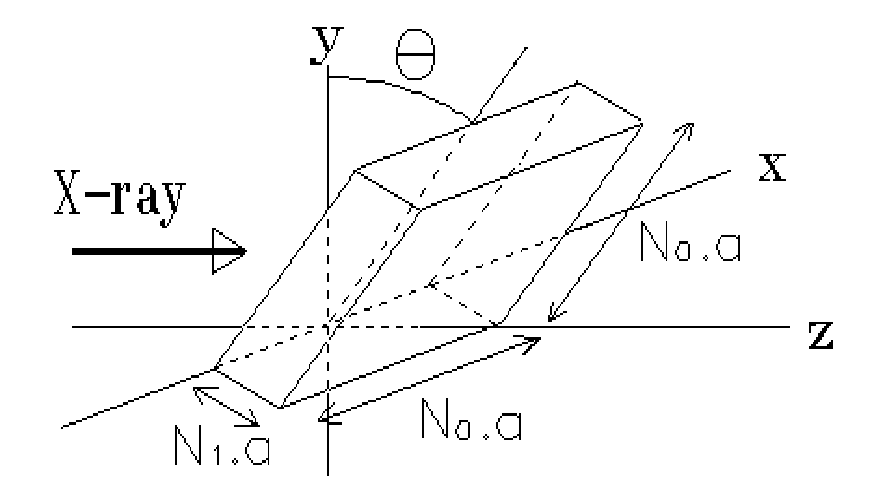
Figure 1 Diffraction of a parallel X-ray beam along the z-axis. The angle between the crystal and the y-axis is \(\Theta\).
b - Calculate the position and width of the maxima as a function of the angle \(\Theta\) (for small \(\Theta\)).
- What in particular are the consequences of the fact that \(N_1 \ll N_0\).
The diffraction pattern can also be derived by means of Bragg's theory, in which it is assumed that the X-rays are reflected from atomic planes in the lattice. The diffraction pattern then arises from interference of these reflected rays with each other.
c - Show that this so-called Bragg reflection yields the same conditions for the maxima as those that you found in b.
In some measurements the so-called powder method is employed. A beam of X-rays is scattered by a powder of very many, small crystals. (Of course the sizes of the crystals are much larger than the lattice spacing, \(a\).)
Scattering of X-rays of wavelength \(0.15\ \mathrm{nm}\) by Potassium Chloride [KCl] (which has a cubic lattice, see Fig.2) results in the production of concentric dark circles on a photographic plate. The distance between the crystals and the plate is \(0.10\ \mathrm{m}\), and the radius of the smallest circle is \(0.053\ \mathrm{m}\) (see Fig. 3). \(\mathrm{K}^{+}\) and \(\mathrm{Cl}^{-}\) ions have almost the same size, and they may be treated as identical scattering centres.
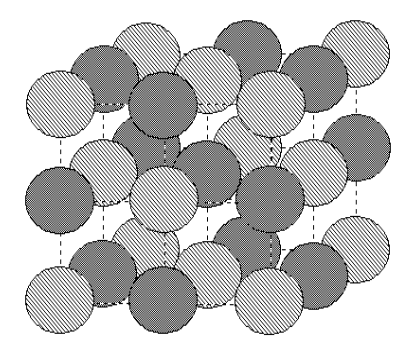
Figure 2. The cubic lattice of Potassium Chloride in which the \(\mathrm{K}^{+}\) and \(\mathrm{Cl}^{-}\) ions have almost the same size.
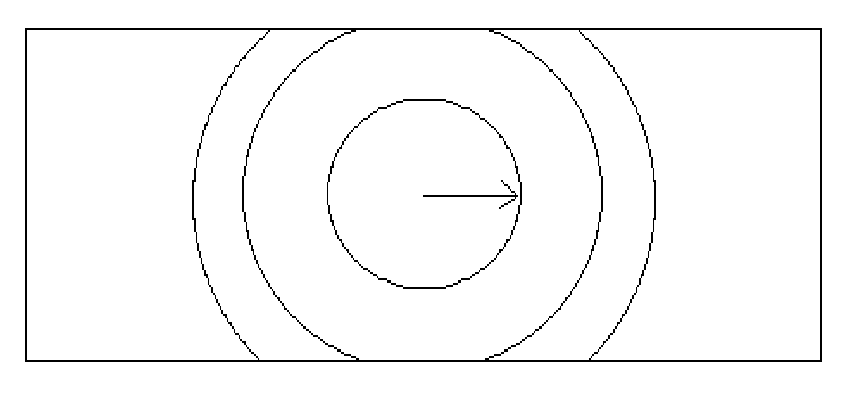
Figure 3. Scattering of X-rays by a powder of KCl crystals results in the production of concentric dark circles on a photographic plate.
d - Calculate the distance between two neighbouring K ions in the crystal.
Official English text of the problem.
Answers
Let \(\lambda\) denote the wavelength. Screen coordinates \(X,Y\) are measured from the undeflected beam; for the crystal, \(L\) denotes the crystal-to-screen distance.
-
a. With integers \(m,n\), put \[ u_m=\frac{m\lambda}{d_1},\qquad v_n=\frac{n\lambda}{d_2}. \] The principal maxima are at \[ \boxed{(X_{mn},Y_{mn}) =\frac{L(u_m,v_n)}{\sqrt{1-u_m^2-v_n^2}}.} \] Their full first-zero widths in direction cosines are \[ \boxed{\Delta u=\frac{2\lambda}{N_1d_1},\qquad \Delta v=\frac{2\lambda}{N_2d_2}.} \] For small diffraction angles, these become \[ \boxed{X_m\simeq\frac{m\lambda L}{d_1},\quad Y_n\simeq\frac{n\lambda L}{d_2},\quad W_X\simeq\frac{2\lambda L}{N_1d_1},\quad W_Y\simeq\frac{2\lambda L}{N_2d_2}.} \]
-
b. Write \(r=\lambda/a\), and let \(h,k,\ell\) be integer diffraction indices. Define \[ B=k\sin\Theta+\ell\cos\Theta,\qquad C=k\cos\Theta-\ell\sin\Theta. \] Fully constructive maxima satisfy \[ \boxed{2B+r(h^2+k^2+\ell^2)=0} \] and appear at \[ \boxed{(X,Y)=\frac{Lr(h,C)}{1+rB}.} \] For small \(\Theta\), use \(B\simeq k\Theta+\ell\) and \(C\simeq k-\ell\Theta\).
For forward diffraction at small scattering angles, the sharp spots have \[ \boxed{(X,Y)\simeq Lr(h,k),\qquad W_X\simeq W_Y\simeq\frac{2\lambda L}{N_0a}.} \] Their thickness interference factor is maximal when \[ \boxed{-k\Theta-\frac{\lambda}{2a}(h^2+k^2)=\ell,} \] with adjacent zeros when the left-hand side equals \(\ell\pm1/N_1\). Thus \(N_1\ll N_0\) gives narrow spots with a much broader condition for their excitation. For \(k\ne0\), the corresponding full width in tilt is approximately \[ \boxed{\Delta\Theta=\frac{2}{N_1|k|}.} \]
-
c. Bragg’s condition \[ \boxed{2d\sin\theta_B=p\lambda} \] is equivalent to the lattice-interference conditions in b. In particular, reflection from planes normal to the tilted long crystal axis gives \[ \boxed{2a\sin\Theta=p\lambda,\qquad X=0,\quad Y=-L\tan(2\Theta)} \] for the orientation chosen below.
-
d. The distance between nearest neighbouring potassium ions is \[ \boxed{d_{\mathrm{K-K}}=4.4\times10^{-10}\ \mathrm{m} =0.44\ \mathrm{nm}.} \]
Solution
We use coherent, elastic scattering in the far-field—or Fraunhofer—approximation. The slits and lattice sites are treated as identical radiators; their individual diffraction envelope is omitted.
A useful result for \(N\) equally spaced radiators with phase difference \(2\pi t\) is \[ F_N(t)=\left|\sum_{j=0}^{N-1}e^{2\pi ijt}\right|^2 =\frac{\sin^2(N\pi t)}{\sin^2(\pi t)}. \] At an integer \(t=m\), the limiting value is \(N^2\): all contributions are in phase. For \(N>1\), the nearest zeros are \[ t=m\pm\frac1N. \]
a. Diffraction by the two-dimensional grid
Take the grid axes along \(x,y\), with the incident wave along \(z\). An outgoing ray has unit direction \[ \mathbf s=(u,v,w),\qquad w=\sqrt{1-u^2-v^2}>0. \]
The incident phase is the same at every slit. The outgoing path differences between adjacent slits are \(d_1u\) and \(d_2v\). Hence \[ I(u,v)\propto F_{N_1}\!\left(\frac{d_1u}{\lambda}\right) F_{N_2}\!\left(\frac{d_2v}{\lambda}\right). \]
Both factors attain their principal maxima when \[ d_1u=m\lambda,\qquad d_2v=n\lambda. \] Only orders satisfying \(u_m^2+v_n^2<1\) reach a screen in the forward half-space.
A ray in direction \(\mathbf s\) intersects the plane \(z=L\) at \[ X=L\frac{u}{w},\qquad Y=L\frac{v}{w}. \] Therefore \[ (X_{mn},Y_{mn}) =\frac{L(u_m,v_n)}{\sqrt{1-u_m^2-v_n^2}}. \]
The nearest zero boundaries are \[ u=u_m\pm\frac{\lambda}{N_1d_1}, \qquad v=v_n\pm\frac{\lambda}{N_2d_2}. \] These equations, together with the screen mapping above, specify the first-zero boundaries without a small-angle approximation.
For example, define \[ \mathbf R(u,v)=\frac{L(u,v)}{\sqrt{1-u^2-v^2}}. \] The two pairs of first-zero points along the natural grid coordinates are \[ \mathbf R\!\left(u_m\pm\frac{\lambda}{N_1d_1},v_n\right), \qquad \mathbf R\!\left(u_m,v_n\pm\frac{\lambda}{N_2d_2}\right). \] Their respective separations give the corresponding screen widths.
For small diffraction angles, \(u,v\ll1\), so \(X\simeq Lu\), \(Y\simeq Lv\). Thus \[ X_m\simeq\frac{m\lambda L}{d_1},\qquad Y_n\simeq\frac{n\lambda L}{d_2}, \] and \[ \boxed{W_X\simeq\frac{2\lambda L}{N_1d_1},\qquad W_Y\simeq\frac{2\lambda L}{N_2d_2}.} \]
b. Diffraction by the tilted finite crystal
Choose crystal unit vectors \[ \mathbf e_1=\hat{\mathbf x},\qquad \mathbf e_2=\hat{\mathbf y}\cos\Theta+\hat{\mathbf z}\sin\Theta, \qquad \mathbf e_3=-\hat{\mathbf y}\sin\Theta+\hat{\mathbf z}\cos\Theta. \] The two long dimensions are along \(\mathbf e_1,\mathbf e_2\); the thin dimension is along \(\mathbf e_3\). This takes positive \(\Theta\) as a tilt of the long crystal axis from \(+y\) towards \(+z\).
The incident and outgoing wavevectors are \[ \mathbf k_i=\frac{2\pi}{\lambda}\hat{\mathbf z},\qquad \mathbf k_f=\frac{2\pi}{\lambda}\mathbf s. \] Define the scattering vector \[ \mathbf q=\mathbf k_f-\mathbf k_i. \]
Unlike the grid in a, atoms at different depths also have different incident phases. Both incident and outgoing propagation are accounted for by \(\mathbf q\). Define \[ p_i=\frac{a}{2\pi}\mathbf q\cdot\mathbf e_i. \] Explicitly, \[ \begin{aligned} p_1&=\frac{a}{\lambda}s_x,\\ p_2&=\frac{a}{\lambda} \left[s_y\cos\Theta+(s_z-1)\sin\Theta\right],\\ p_3&=\frac{a}{\lambda} \left[-s_y\sin\Theta+(s_z-1)\cos\Theta\right]. \end{aligned} \] The complete finite-lattice interference pattern is therefore \[ \boxed{ I(\mathbf s)\propto F_{N_0}(p_1)\,F_{N_0}(p_2)\,F_{N_1}(p_3). } \]
A fully constructive maximum requires \[ p_1=h,\qquad p_2=k,\qquad p_3=\ell, \] where \(h,k,\ell\) are integers. Equivalently, \[ \mathbf q=\frac{2\pi}{a} (h\mathbf e_1+k\mathbf e_2+\ell\mathbf e_3). \] Writing \(r=\lambda/a\), the outgoing direction is \[ \begin{aligned} s_x&=rh,\\ s_y&=r(k\cos\Theta-\ell\sin\Theta),\\ s_z&=1+r(k\sin\Theta+\ell\cos\Theta). \end{aligned} \]
Elastic scattering requires \(|\mathbf s|=1\). Substitution gives \[ \boxed{ 2(k\sin\Theta+\ell\cos\Theta) +r(h^2+k^2+\ell^2)=0. } \] For any allowed forward order, its screen position is \[ \boxed{ X=\frac{Lrh}{1+r(k\sin\Theta+\ell\cos\Theta)},\qquad Y=\frac{Lr(k\cos\Theta-\ell\sin\Theta)} {1+r(k\sin\Theta+\ell\cos\Theta)}. } \]
These formulas retain the exact outgoing-ray geometry. For small crystal tilt, \[ 2(k\Theta+\ell)+r(h^2+k^2+\ell^2)\simeq0, \] and \[ X\simeq\frac{Lrh}{1+r(\ell+k\Theta)},\qquad Y\simeq\frac{Lr(k-\ell\Theta)}{1+r(\ell+k\Theta)}. \]
The first zeros surrounding a fully constructive maximum occur on \[ p_1=h\pm\frac1{N_0},\qquad p_2=k\pm\frac1{N_0},\qquad p_3=\ell\pm\frac1{N_1}. \] Thus the full widths in scattering-vector components are \[ \boxed{ \Delta q_1=\Delta q_2=\frac{4\pi}{N_0a}, \qquad \Delta q_3=\frac{4\pi}{N_1a}. } \]
Because \(N_1\ll N_0\), the first two factors form narrow peaks, while the third factor supplies a relatively broad envelope. Consequently, a sharp spot can remain visible even when \(p_3\) is not exactly an integer.
For completeness, the position of such a spot can be obtained without requiring exact three-dimensional constructive interference. Set \(p_1=h,\ p_2=k\). On the forward branch, \[ \zeta_{hk}(\Theta)= \frac{ \sqrt{1-r^2h^2-(\sin\Theta+rk)^2}-\cos\Theta }{r} \] is the resulting value of \(p_3\). Its position is \[ \boldsymbol{\mathcal R}_\Theta(h,k) = \frac{Lr\bigl(h,\ k\cos\Theta-\zeta_{hk}\sin\Theta\bigr)} {1+r(k\sin\Theta+\zeta_{hk}\cos\Theta)}. \] Its intensity contains the factor \(F_{N_1}(\zeta_{hk})\). Fully constructive peaks occur when \(\zeta_{hk}\) is an integer.
For a well-excited spot, the two pairs of first-zero points are obtained from this mapping by \[ h\longrightarrow h\pm\frac1{N_0}, \qquad\text{or}\qquad k\longrightarrow k\pm\frac1{N_0}. \] Their separations give the screen widths, including the dependence on \(\Theta\).
The small-angle form makes the physical consequences especially clear. Put \[ \alpha=\frac XL,\qquad \beta=\frac YL, \qquad \mathbf s\simeq \left(\alpha,\beta,1-\frac{\alpha^2+\beta^2}{2}\right). \] For small \(\Theta,\alpha,\beta\), \[ p_1\simeq\frac{\alpha}{r},\qquad p_2\simeq\frac{\beta}{r},\qquad p_3\simeq-\frac{\Theta\beta+(\alpha^2+\beta^2)/2}{r}. \] The quadratic angular term must be retained in \(p_3\), since it is the leading longitudinal path difference.
The narrow transverse peaks therefore occur at \[ \alpha_h\simeq hr,\qquad \beta_k\simeq kr, \] with full widths \[ \Delta\alpha\simeq\Delta\beta\simeq\frac{2r}{N_0}. \] Hence \[ \boxed{ (X,Y)\simeq\left(\frac{h\lambda L}{a},\frac{k\lambda L}{a}\right), \qquad W_X\simeq W_Y\simeq\frac{2\lambda L}{N_0a}. } \]
At these positions, \[ p_3\simeq-k\Theta-\frac r2(h^2+k^2). \] Thus a thickness-envelope maximum occurs when \[ -k\Theta-\frac r2(h^2+k^2)=\ell, \] and its adjacent zeros occur at \(\ell\pm1/N_1\).
For the central thickness order \(\ell=0\), the strongest spots satisfy \[ h^2+\left(k+\frac{\Theta}{r}\right)^2 =\left(\frac{\Theta}{r}\right)^2. \] Finite thickness broadens this circle into a band of appreciably excited lattice spots.
For \(k\ne0\), varying the tilt changes \(p_3\) at the rate \[ \frac{dp_3}{d\Theta}\simeq-k. \] The full first-zero width in tilt is therefore \[ \boxed{\Delta\Theta\simeq\frac{2}{N_1|k|}.} \]
The two large dimensions determine the narrow spot widths. The thin dimension gives a broader interference envelope and a broader range of crystal orientations over which a spot is appreciably excited.
c. Equivalence with Bragg reflection
Consider a family of atomic planes with coprime integer indices \((H,K,M)\). Their unit normal and spacing are \[ \hat{\mathbf n} =\frac{H\mathbf e_1+K\mathbf e_2+M\mathbf e_3} {\sqrt{H^2+K^2+M^2}}, \qquad d=\frac{a}{\sqrt{H^2+K^2+M^2}}. \]
Let \(\theta_B\) be the glancing angle between the incident beam and these planes. Rays reflected from consecutive planes have path difference \[ 2d\sin\theta_B. \] Constructive interference requires \[ \boxed{2d\sin\theta_B=p\lambda,\qquad p=1,2,\ldots.} \]
Specular reflection changes only the component of the wavevector normal to the planes. Therefore \(\mathbf q\) is normal to them and has magnitude \[ |\mathbf q|=2\frac{2\pi}{\lambda}\sin\theta_B. \] Using Bragg’s condition, \[ |\mathbf q|=\frac{2\pi p}{d}. \] With a suitable choice of normal direction, \[ \mathbf q =\frac{2\pi p}{a} (H\mathbf e_1+K\mathbf e_2+M\mathbf e_3). \] Setting \[ (h,k,\ell)=p(H,K,M) \] gives exactly \[ \mathbf q=\frac{2\pi}{a} (h\mathbf e_1+k\mathbf e_2+\ell\mathbf e_3), \] the three lattice-interference conditions derived in b. Enforcing equal incident and outgoing wavelengths then gives the same condition \[ 2(k\sin\Theta+\ell\cos\Theta) +\frac{\lambda}{a}(h^2+k^2+\ell^2)=0. \]
As a direct example, take planes normal to \(\mathbf e_2\). Their spacing is \(a\), and their glancing angle is \(\Theta\). Bragg’s law gives \[ 2a\sin\Theta=p\lambda. \] In b, choose \(h=0,\ k=-p,\ \ell=0\). The condition becomes \[ -2p\sin\Theta+\frac{\lambda}{a}p^2=0, \] which is identical. The outgoing ray is \[ \mathbf s=(0,-\sin2\Theta,\cos2\Theta), \] so \[ X=0,\qquad Y=-L\tan2\Theta. \]
d. Nearest-neighbour potassium-ion distance
When \(\mathrm K^+\) and \(\mathrm{Cl}^-\) scatter identically, the alternating ionic arrangement acts as a simple cubic lattice of identical scattering centres.
Let \(b\) denote the nearest-neighbour K–Cl separation. The effective simple cubic lattice spacing is \(b\). Its largest reflecting-plane spacing is \(b\), so the smallest nonzero diffraction angle comes from first-order reflection with \[ 2b\sin\theta_B=\lambda. \]
Random crystal orientations produce a cone of scattered rays with scattering angle \(2\theta_B\). A perpendicular photographic plate therefore records a ring of radius \[ R=L\tan(2\theta_B). \] Using the given data, \[ 2\theta_B=\arctan\left(\frac{0.053}{0.10}\right) =27.9236^\circ, \] and hence \[ \theta_B=13.9618^\circ. \] No small-angle approximation is needed here.
Thus \[ b=\frac{0.15\ \mathrm{nm}} {2\sin13.9618^\circ} =0.31085\ \mathrm{nm}. \]
The species alternate along each simple cubic axis. Two nearest potassium ions therefore lie across a face diagonal of a cube of side \(b\), giving \[ d_{\mathrm{K-K}}=\sqrt2\,b =\sqrt2(0.31085\ \mathrm{nm}) =0.43961\ \mathrm{nm}. \] To two significant figures, \[ \boxed{d_{\mathrm{K-K}}=0.44\ \mathrm{nm} =4.4\times10^{-10}\ \mathrm{m}.} \]
The solution was checked against the official solution.
IPhO 1990 · Theorieaufgabe 1
Röntgenbeugung an einem Kristall
Wir wollen die Beugung von Röntgenstrahlung an einem kubischen Kristallgitter untersuchen. Dazu betrachten wir zunächst die Beugung einer ebenen, monochromatischen Welle, die senkrecht auf ein zweidimensionales Gitter fällt, das aus \(N_1 \times N_2\) Spalten mit den Abständen \(d_1\) und \(d_2\) besteht. Das Beugungsbild wird auf einem Schirm im Abstand \(L\) vom Gitter beobachtet. Der Schirm ist parallel zum Gitter, und \(L\) ist wesentlich größer als \(d_1\) und \(d_2\).
a - Bestimmen Sie die Positionen und Breiten der Hauptmaxima auf dem Schirm. Die Breite ist als Abstand zwischen den Minima auf beiden Seiten eines Maximums definiert.
Wir betrachten nun einen kubischen Kristall mit der Gitterkonstanten \(a\) und den Abmessungen \(N_0.a \times N_0.a \times N_1.a\). \(N_1\) ist wesentlich kleiner als \(N_0\). Der Kristall wird unter einem Winkel \(\Theta\) in ein paralleles Röntgenstrahlenbündel entlang der z-Achse gebracht (siehe Abb. 1). Das Beugungsbild wird wiederum auf einem Schirm in großer Entfernung vom Kristall beobachtet.
Abbildung 1 Beugung eines parallelen Röntgenstrahlenbündels entlang der z-Achse. Der Winkel zwischen dem Kristall und der y-Achse beträgt \(\Theta\).
b - Berechnen Sie die Positionen und Breiten der Maxima als Funktion des Winkels \(\Theta\) (für kleine \(\Theta\)).
- Welche Folgen hat insbesondere die Tatsache, dass \(N_1 \ll N_0\) gilt?
Das Beugungsbild lässt sich auch mithilfe der Braggschen Theorie herleiten, in der angenommen wird, dass die Röntgenstrahlen an den Netzebenen des Gitters reflektiert werden. Das Beugungsbild entsteht dann durch die Interferenz dieser reflektierten Strahlen miteinander.
c - Zeigen Sie, dass diese sogenannte Bragg-Reflexion dieselben Bedingungen für die Maxima liefert wie die von Ihnen in b gefundenen.
Bei einigen Messungen wird die sogenannte Pulvermethode verwendet. Ein Röntgenstrahlenbündel wird an einem Pulver aus sehr vielen kleinen Kristallen gestreut. (Natürlich sind die Abmessungen der Kristalle wesentlich größer als die Gitterkonstante \(a\).)
Die Streuung von Röntgenstrahlung der Wellenlänge \(0.15\ \mathrm{nm}\) an Kaliumchlorid [KCl] (das ein kubisches Gitter besitzt, siehe Abb. 2) erzeugt konzentrische dunkle Kreise auf einer Fotoplatte. Der Abstand zwischen den Kristallen und der Platte beträgt \(0.10\ \mathrm{m}\), und der Radius des kleinsten Kreises beträgt \(0.053\ \mathrm{m}\) (siehe Abb. 3). \(\mathrm{K}^{+}\)- und \(\mathrm{Cl}^{-}\)-Ionen sind nahezu gleich groß und können als identische Streuzentren behandelt werden.
Abbildung 2. Das kubische Gitter von Kaliumchlorid, in dem die \(\mathrm{K}^{+}\)- und \(\mathrm{Cl}^{-}\)-Ionen nahezu gleich groß sind.
Abbildung 3. Die Streuung von Röntgenstrahlung an einem Pulver aus KCl-Kristallen erzeugt konzentrische dunkle Kreise auf einer Fotoplatte.
d - Berechnen Sie den Abstand zwischen zwei benachbarten K-Ionen im Kristall.
Aufgabentext aus dem offiziellen englischen Text übersetzt.
Antworten
Mit \(\lambda\) bezeichnen wir die Wellenlänge. Die Schirmkoordinaten \(X,Y\) werden vom unabgelenkten Strahl aus gemessen; beim Kristall bezeichnet \(L\) den Abstand zwischen Kristall und Schirm.
-
a. Für ganze Zahlen \(m,n\) setzen wir \[ u_m=\frac{m\lambda}{d_1},\qquad v_n=\frac{n\lambda}{d_2}. \] Die Hauptmaxima liegen bei \[ \boxed{(X_{mn},Y_{mn}) =\frac{L(u_m,v_n)}{\sqrt{1-u_m^2-v_n^2}}.} \] Ihre vollen Breiten zwischen den ersten Nullstellen betragen in Richtungskosinus \[ \boxed{\Delta u=\frac{2\lambda}{N_1d_1},\qquad \Delta v=\frac{2\lambda}{N_2d_2}.} \] Für kleine Beugungswinkel ergibt sich daraus \[ \boxed{X_m\simeq\frac{m\lambda L}{d_1},\quad Y_n\simeq\frac{n\lambda L}{d_2},\quad W_X\simeq\frac{2\lambda L}{N_1d_1},\quad W_Y\simeq\frac{2\lambda L}{N_2d_2}.} \]
-
b. Wir schreiben \(r=\lambda/a\), und \(h,k,\ell\) seien ganzzahlige Beugungsindizes. Wir definieren \[ B=k\sin\Theta+\ell\cos\Theta,\qquad C=k\cos\Theta-\ell\sin\Theta. \] Maxima mit vollständig konstruktiver Interferenz erfüllen \[ \boxed{2B+r(h^2+k^2+\ell^2)=0} \] und erscheinen bei \[ \boxed{(X,Y)=\frac{Lr(h,C)}{1+rB}.} \] Für kleine \(\Theta\) verwenden wir \(B\simeq k\Theta+\ell\) und \(C\simeq k-\ell\Theta\).
Bei Vorwärtsbeugung unter kleinen Streuwinkeln haben die scharfen Reflexe die Positionen und Breiten \[ \boxed{(X,Y)\simeq Lr(h,k),\qquad W_X\simeq W_Y\simeq\frac{2\lambda L}{N_0a}.} \] Ihr durch die Dicke bestimmter Interferenzfaktor ist maximal, wenn \[ \boxed{-k\Theta-\frac{\lambda}{2a}(h^2+k^2)=\ell,} \] wobei die benachbarten Nullstellen dort liegen, wo die linke Seite gleich \(\ell\pm1/N_1\) ist. Somit führt \(N_1\ll N_0\) zu schmalen Reflexen mit einer wesentlich breiteren Anregungsbedingung. Für \(k\ne0\) beträgt die entsprechende volle Breite bezüglich des Neigungswinkels näherungsweise \[ \boxed{\Delta\Theta=\frac{2}{N_1|k|}.} \]
-
c. Die Braggsche Bedingung \[ \boxed{2d\sin\theta_B=p\lambda} \] ist äquivalent zu den Gitterinterferenzbedingungen aus b. Insbesondere ergibt die Reflexion an Ebenen senkrecht zur geneigten langen Kristallachse \[ \boxed{2a\sin\Theta=p\lambda,\qquad X=0,\quad Y=-L\tan(2\Theta)} \] für die unten gewählte Orientierung.
-
d. Der Abstand zwischen nächstbenachbarten Kaliumionen beträgt \[ \boxed{d_{\mathrm{K-K}}=4.4\times10^{-10}\ \mathrm{m} =0.44\ \mathrm{nm}.} \]
Lösung
Wir verwenden kohärente, elastische Streuung in der Fernfeld- oder Fraunhofer-Näherung. Die Spalte und Gitterplätze werden als identische Strahler behandelt; die Beugungseinhüllende der einzelnen Strahler wird weggelassen.
Ein nützliches Ergebnis für \(N\) äquidistante Strahler mit der Phasendifferenz \(2\pi t\) lautet \[ F_N(t)=\left|\sum_{j=0}^{N-1}e^{2\pi ijt}\right|^2 =\frac{\sin^2(N\pi t)}{\sin^2(\pi t)}. \] Bei einem ganzzahligen \(t=m\) beträgt der Grenzwert \(N^2\): Alle Beiträge sind phasengleich. Für \(N>1\) liegen die nächstgelegenen Nullstellen bei \[ t=m\pm\frac1N. \]
a. Beugung am zweidimensionalen Gitter
Wir legen die Gitterachsen entlang \(x,y\), wobei die einfallende Welle entlang \(z\) läuft. Ein auslaufender Strahl hat den Einheitsrichtungsvektor \[ \mathbf s=(u,v,w),\qquad w=\sqrt{1-u^2-v^2}>0. \]
Die Phase der einfallenden Welle ist an jedem Spalt gleich. Die Gangunterschiede der auslaufenden Wellen zwischen benachbarten Spalten betragen \(d_1u\) und \(d_2v\). Daher gilt \[ I(u,v)\propto F_{N_1}\!\left(\frac{d_1u}{\lambda}\right) F_{N_2}\!\left(\frac{d_2v}{\lambda}\right). \]
Beide Faktoren erreichen ihre Hauptmaxima, wenn \[ d_1u=m\lambda,\qquad d_2v=n\lambda. \] Nur Ordnungen, die \(u_m^2+v_n^2<1\) erfüllen, erreichen einen Schirm im vorwärts gerichteten Halbraum.
Ein Strahl in Richtung \(\mathbf s\) schneidet die Ebene \(z=L\) bei \[ X=L\frac{u}{w},\qquad Y=L\frac{v}{w}. \] Daher gilt \[ (X_{mn},Y_{mn}) =\frac{L(u_m,v_n)}{\sqrt{1-u_m^2-v_n^2}}. \]
Die nächstgelegenen Nullstellenlinien sind \[ u=u_m\pm\frac{\lambda}{N_1d_1}, \qquad v=v_n\pm\frac{\lambda}{N_2d_2}. \] Diese Gleichungen legen zusammen mit der obigen Abbildung auf den Schirm die Begrenzungen durch die ersten Nullstellen ohne Kleinwinkelnäherung fest.
Wir definieren beispielsweise \[ \mathbf R(u,v)=\frac{L(u,v)}{\sqrt{1-u^2-v^2}}. \] Die beiden Paare von Punkten der ersten Nullstellen entlang der natürlichen Gitterkoordinaten sind \[ \mathbf R\!\left(u_m\pm\frac{\lambda}{N_1d_1},v_n\right), \qquad \mathbf R\!\left(u_m,v_n\pm\frac{\lambda}{N_2d_2}\right). \] Ihre jeweiligen Abstände ergeben die entsprechenden Breiten auf dem Schirm.
Für kleine Beugungswinkel gilt \(u,v\ll1\), also \(X\simeq Lu\), \(Y\simeq Lv\). Somit gilt \[ X_m\simeq\frac{m\lambda L}{d_1},\qquad Y_n\simeq\frac{n\lambda L}{d_2}, \] und \[ \boxed{W_X\simeq\frac{2\lambda L}{N_1d_1},\qquad W_Y\simeq\frac{2\lambda L}{N_2d_2}.} \]
b. Beugung am geneigten endlichen Kristall
Wir wählen die Einheitsvektoren des Kristalls als \[ \mathbf e_1=\hat{\mathbf x},\qquad \mathbf e_2=\hat{\mathbf y}\cos\Theta+\hat{\mathbf z}\sin\Theta, \qquad \mathbf e_3=-\hat{\mathbf y}\sin\Theta+\hat{\mathbf z}\cos\Theta. \] Die beiden langen Abmessungen liegen entlang \(\mathbf e_1,\mathbf e_2\); die geringe Dicke liegt entlang \(\mathbf e_3\). Dabei entspricht ein positives \(\Theta\) einer Neigung der langen Kristallachse von \(+y\) in Richtung \(+z\).
Die einfallenden und auslaufenden Wellenvektoren sind \[ \mathbf k_i=\frac{2\pi}{\lambda}\hat{\mathbf z},\qquad \mathbf k_f=\frac{2\pi}{\lambda}\mathbf s. \] Wir definieren den Streuvektor \[ \mathbf q=\mathbf k_f-\mathbf k_i. \]
Anders als beim Gitter in a haben Atome in unterschiedlichen Tiefen auch unterschiedliche Phasen der einfallenden Welle. Sowohl die einfallende als auch die auslaufende Ausbreitung wird durch \(\mathbf q\) berücksichtigt. Wir definieren \[ p_i=\frac{a}{2\pi}\mathbf q\cdot\mathbf e_i. \] Explizit gilt \[ \begin{aligned} p_1&=\frac{a}{\lambda}s_x,\\ p_2&=\frac{a}{\lambda} \left[s_y\cos\Theta+(s_z-1)\sin\Theta\right],\\ p_3&=\frac{a}{\lambda} \left[-s_y\sin\Theta+(s_z-1)\cos\Theta\right]. \end{aligned} \] Das vollständige Interferenzbild des endlichen Gitters ist daher \[ \boxed{ I(\mathbf s)\propto F_{N_0}(p_1)\,F_{N_0}(p_2)\,F_{N_1}(p_3). } \]
Ein Maximum mit vollständig konstruktiver Interferenz erfordert \[ p_1=h,\qquad p_2=k,\qquad p_3=\ell, \] wobei \(h,k,\ell\) ganze Zahlen sind. Gleichwertig dazu gilt \[ \mathbf q=\frac{2\pi}{a} (h\mathbf e_1+k\mathbf e_2+\ell\mathbf e_3). \] Mit \(r=\lambda/a\) lautet die auslaufende Richtung \[ \begin{aligned} s_x&=rh,\\ s_y&=r(k\cos\Theta-\ell\sin\Theta),\\ s_z&=1+r(k\sin\Theta+\ell\cos\Theta). \end{aligned} \]
Elastische Streuung erfordert \(|\mathbf s|=1\). Einsetzen ergibt \[ \boxed{ 2(k\sin\Theta+\ell\cos\Theta) +r(h^2+k^2+\ell^2)=0. } \] Für jede zulässige Vorwärtsordnung ist die Position auf dem Schirm \[ \boxed{ X=\frac{Lrh}{1+r(k\sin\Theta+\ell\cos\Theta)},\qquad Y=\frac{Lr(k\cos\Theta-\ell\sin\Theta)} {1+r(k\sin\Theta+\ell\cos\Theta)}. } \]
Diese Formeln berücksichtigen die exakte Geometrie des auslaufenden Strahls. Für eine kleine Kristallneigung gilt \[ 2(k\Theta+\ell)+r(h^2+k^2+\ell^2)\simeq0, \] und \[ X\simeq\frac{Lrh}{1+r(\ell+k\Theta)},\qquad Y\simeq\frac{Lr(k-\ell\Theta)}{1+r(\ell+k\Theta)}. \]
Die ersten Nullstellen um ein Maximum mit vollständig konstruktiver Interferenz liegen auf \[ p_1=h\pm\frac1{N_0},\qquad p_2=k\pm\frac1{N_0},\qquad p_3=\ell\pm\frac1{N_1}. \] Somit betragen die vollen Breiten in den Komponenten des Streuvektors \[ \boxed{ \Delta q_1=\Delta q_2=\frac{4\pi}{N_0a}, \qquad \Delta q_3=\frac{4\pi}{N_1a}. } \]
Da \(N_1\ll N_0\), bilden die ersten beiden Faktoren schmale Maxima, während der dritte Faktor eine vergleichsweise breite Einhüllende liefert. Daher kann ein scharfer Reflex sichtbar bleiben, auch wenn \(p_3\) nicht genau ganzzahlig ist.
Der Vollständigkeit halber lässt sich die Position eines solchen Reflexes bestimmen, ohne exakt konstruktive dreidimensionale Interferenz zu fordern. Wir setzen \(p_1=h,\ p_2=k\). Auf dem vorwärts gerichteten Zweig ist \[ \zeta_{hk}(\Theta)= \frac{ \sqrt{1-r^2h^2-(\sin\Theta+rk)^2}-\cos\Theta }{r} \] der resultierende Wert von \(p_3\). Seine Position ist \[ \boldsymbol{\mathcal R}_\Theta(h,k) = \frac{Lr\bigl(h,\ k\cos\Theta-\zeta_{hk}\sin\Theta\bigr)} {1+r(k\sin\Theta+\zeta_{hk}\cos\Theta)}. \] Seine Intensität enthält den Faktor \(F_{N_1}(\zeta_{hk})\). Maxima mit vollständig konstruktiver Interferenz treten auf, wenn \(\zeta_{hk}\) ganzzahlig ist.
Für einen stark angeregten Reflex erhält man die beiden Paare von Punkten der ersten Nullstellen aus dieser Abbildung durch \[ h\longrightarrow h\pm\frac1{N_0}, \qquad\text{oder}\qquad k\longrightarrow k\pm\frac1{N_0}. \] Ihre Abstände ergeben die Breiten auf dem Schirm einschließlich der Abhängigkeit von \(\Theta\).
Die Kleinwinkelform macht die physikalischen Folgen besonders deutlich. Wir setzen \[ \alpha=\frac XL,\qquad \beta=\frac YL, \qquad \mathbf s\simeq \left(\alpha,\beta,1-\frac{\alpha^2+\beta^2}{2}\right). \] Für kleine \(\Theta,\alpha,\beta\) gilt \[ p_1\simeq\frac{\alpha}{r},\qquad p_2\simeq\frac{\beta}{r},\qquad p_3\simeq-\frac{\Theta\beta+(\alpha^2+\beta^2)/2}{r}. \] Der quadratische Winkelterm muss in \(p_3\) beibehalten werden, da er den führenden longitudinalen Gangunterschied darstellt.
Die schmalen transversalen Maxima treten daher bei \[ \alpha_h\simeq hr,\qquad \beta_k\simeq kr, \] mit den vollen Breiten \[ \Delta\alpha\simeq\Delta\beta\simeq\frac{2r}{N_0}. \] Somit gilt \[ \boxed{ (X,Y)\simeq\left(\frac{h\lambda L}{a},\frac{k\lambda L}{a}\right), \qquad W_X\simeq W_Y\simeq\frac{2\lambda L}{N_0a}. } \]
An diesen Positionen gilt \[ p_3\simeq-k\Theta-\frac r2(h^2+k^2). \] Somit tritt ein Maximum der durch die Dicke bestimmten Einhüllenden auf, wenn \[ -k\Theta-\frac r2(h^2+k^2)=\ell, \] und seine benachbarten Nullstellen liegen bei \(\ell\pm1/N_1\).
Für die zentrale Dickenordnung \(\ell=0\) erfüllen die stärksten Reflexe \[ h^2+\left(k+\frac{\Theta}{r}\right)^2 =\left(\frac{\Theta}{r}\right)^2. \] Die endliche Dicke verbreitert diesen Kreis zu einem Band merklich angeregter Gitterreflexe.
Für \(k\ne0\) ändert eine Variation des Neigungswinkels \(p_3\) mit der Rate \[ \frac{dp_3}{d\Theta}\simeq-k. \] Die volle Breite zwischen den ersten Nullstellen bezüglich des Neigungswinkels beträgt daher \[ \boxed{\Delta\Theta\simeq\frac{2}{N_1|k|}.} \]
Die beiden großen Abmessungen bestimmen die geringen Reflexbreiten. Die geringe Dicke führt zu einer breiteren Interferenzeinhüllenden und einem breiteren Bereich von Kristallorientierungen, in dem ein Reflex merklich angeregt wird.
c. Äquivalenz mit der Bragg-Reflexion
Wir betrachten eine Schar von Netzebenen mit teilerfremden ganzzahligen Indizes \((H,K,M)\). Ihr Einheitsnormalenvektor und ihr Abstand sind \[ \hat{\mathbf n} =\frac{H\mathbf e_1+K\mathbf e_2+M\mathbf e_3} {\sqrt{H^2+K^2+M^2}}, \qquad d=\frac{a}{\sqrt{H^2+K^2+M^2}}. \]
Es sei \(\theta_B\) der Glanzwinkel zwischen dem einfallenden Strahl und diesen Ebenen. An aufeinanderfolgenden Ebenen reflektierte Strahlen haben den Gangunterschied \[ 2d\sin\theta_B. \] Konstruktive Interferenz erfordert \[ \boxed{2d\sin\theta_B=p\lambda,\qquad p=1,2,\ldots.} \]
Spiegelnde Reflexion ändert nur die Komponente des Wellenvektors senkrecht zu den Ebenen. Daher steht \(\mathbf q\) senkrecht auf ihnen und hat den Betrag \[ |\mathbf q|=2\frac{2\pi}{\lambda}\sin\theta_B. \] Mit der Braggschen Bedingung gilt \[ |\mathbf q|=\frac{2\pi p}{d}. \] Bei geeigneter Wahl der Normalenrichtung gilt \[ \mathbf q =\frac{2\pi p}{a} (H\mathbf e_1+K\mathbf e_2+M\mathbf e_3). \] Die Setzung \[ (h,k,\ell)=p(H,K,M) \] ergibt genau \[ \mathbf q=\frac{2\pi}{a} (h\mathbf e_1+k\mathbf e_2+\ell\mathbf e_3), \] also die drei in b hergeleiteten Gitterinterferenzbedingungen. Die Forderung nach gleichen einfallenden und auslaufenden Wellenlängen ergibt dann dieselbe Bedingung \[ 2(k\sin\Theta+\ell\cos\Theta) +\frac{\lambda}{a}(h^2+k^2+\ell^2)=0. \]
Als direktes Beispiel betrachten wir Ebenen senkrecht zu \(\mathbf e_2\). Ihr Abstand beträgt \(a\), und ihr Glanzwinkel ist \(\Theta\). Das Braggsche Gesetz ergibt \[ 2a\sin\Theta=p\lambda. \] In b wählen wir \(h=0,\ k=-p,\ \ell=0\). Die Bedingung wird zu \[ -2p\sin\Theta+\frac{\lambda}{a}p^2=0, \] was dieselbe Bedingung ist. Der auslaufende Strahl hat die Richtung \[ \mathbf s=(0,-\sin2\Theta,\cos2\Theta), \] also gilt \[ X=0,\qquad Y=-L\tan2\Theta. \]
d. Abstand nächstbenachbarter Kaliumionen
Wenn \(\mathrm K^+\) und \(\mathrm{Cl}^-\) identisch streuen, wirkt die abwechselnde Ionenanordnung wie ein einfach kubisches Gitter identischer Streuzentren.
Mit \(b\) bezeichnen wir den Abstand zwischen nächstbenachbarten K- und Cl-Ionen. Die effektive Gitterkonstante des einfach kubischen Gitters beträgt \(b\). Sein größter Abstand reflektierender Netzebenen ist \(b\), sodass der kleinste von null verschiedene Beugungswinkel von einer Reflexion erster Ordnung herrührt, für die gilt \[ 2b\sin\theta_B=\lambda. \]
Zufällige Kristallorientierungen erzeugen einen Kegel gestreuter Strahlen mit dem Streuwinkel \(2\theta_B\). Eine senkrecht zum einfallenden Strahl stehende Fotoplatte zeichnet daher einen Ring mit folgendem Radius auf: \[ R=L\tan(2\theta_B). \] Mit den gegebenen Daten gilt \[ 2\theta_B=\arctan\left(\frac{0.053}{0.10}\right) =27.9236^\circ, \] und somit \[ \theta_B=13.9618^\circ. \] Hier ist keine Kleinwinkelnäherung erforderlich.
Somit gilt \[ b=\frac{0.15\ \mathrm{nm}} {2\sin13.9618^\circ} =0.31085\ \mathrm{nm}. \]
Die Ionensorten wechseln sich entlang jeder Achse des einfach kubischen Gitters ab. Zwei nächstbenachbarte Kaliumionen liegen daher an den Enden einer Flächendiagonalen eines Würfels der Kantenlänge \(b\), woraus folgt \[ d_{\mathrm{K-K}}=\sqrt2\,b =\sqrt2(0.31085\ \mathrm{nm}) =0.43961\ \mathrm{nm}. \] Auf zwei signifikante Stellen gerundet ergibt sich \[ \boxed{d_{\mathrm{K-K}}=0.44\ \mathrm{nm} =4.4\times10^{-10}\ \mathrm{m}.} \]
Die Lösung wurde mit der offiziellen Lösung abgeglichen.
IPhO 1990 · Teori sorusu 1
Bir kristalde X-ışını kırınımı
Kübik bir kristal örgüsünde X-ışını kırınımını incelemek istiyoruz. Bunun için, aralarındaki uzaklıklar \(d_1\) ve \(d_2\) olan \(N_1 \times N_2\) yarıktan oluşan iki boyutlu bir ızgaraya dik olarak gelen düzlemsel, tek renkli bir dalganın kırınımıyla başlıyoruz. Kırınım deseni, ızgaradan \(L\) uzaklığındaki bir ekranda gözlenmektedir. Ekran ızgaraya paraleldir ve \(L\), \(d_1\) ve \(d_2\)'den çok daha büyüktür.
a - Ekrandaki ana maksimumların konumlarını ve genişliklerini belirleyiniz. Genişlik, bir maksimumun iki yanındaki minimumlar arasındaki uzaklık olarak tanımlanmaktadır.
Şimdi örgü sabiti \(a\) ve boyutları \(N_0.a \times N_0.a \times N_1.a\) olan kübik bir kristali ele alıyoruz. \(N_1\), \(N_0\)'dan çok daha küçüktür. Kristal, z ekseni boyunca ilerleyen paralel bir X-ışını demeti içine \(\Theta\) açısıyla yerleştirilmiştir (bkz. Şekil 1). Kırınım deseni yine kristalden çok uzaktaki bir ekranda gözlenmektedir.
Şekil 1 z ekseni boyunca ilerleyen paralel bir X-ışını demetinin kırınımı. Kristal ile y ekseni arasındaki açı \(\Theta\)'dır.
b - Maksimumların konumlarını ve genişliklerini \(\Theta\) açısının fonksiyonu olarak hesaplayınız (küçük \(\Theta\) için).
- Özellikle \(N_1 \ll N_0\) olmasının sonuçları nelerdir?
Kırınım deseni, X-ışınlarının örgüdeki atom düzlemlerinden yansıdığının varsayıldığı Bragg kuramı yardımıyla da elde edilebilir. Bu durumda kırınım deseni, bu yansıyan ışınların birbirleriyle girişiminden kaynaklanır.
c - Bragg yansıması olarak adlandırılan bu yansımanın, maksimumlar için b'de bulduğunuz koşullarla aynı koşulları verdiğini gösteriniz.
Bazı ölçümlerde toz yöntemi olarak adlandırılan yöntem kullanılır. Bir X-ışını demeti, çok sayıda küçük kristalden oluşan bir toz tarafından saçılır. (Elbette kristallerin boyutları, örgü sabiti \(a\)'dan çok daha büyüktür.)
Dalga boyu \(0.15\ \mathrm{nm}\) olan X-ışınlarının potasyum klorür [KCl] (kübik bir örgüye sahiptir, bkz. Şekil 2) tarafından saçılması, bir fotoğraf plağı üzerinde eş merkezli koyu çemberlerin oluşmasına yol açar. Kristaller ile plak arasındaki uzaklık \(0.10\ \mathrm{m}\), en küçük çemberin yarıçapı ise \(0.053\ \mathrm{m}\)'dir (bkz. Şekil 3). \(\mathrm{K}^{+}\) ve \(\mathrm{Cl}^{-}\) iyonları hemen hemen aynı büyüklüktedir ve özdeş saçılma merkezleri olarak ele alınabilirler.
Şekil 2. \(\mathrm{K}^{+}\) ve \(\mathrm{Cl}^{-}\) iyonlarının hemen hemen aynı büyüklükte olduğu potasyum klorürün kübik örgüsü.
Şekil 3. X-ışınlarının KCl kristallerinden oluşan bir toz tarafından saçılması, bir fotoğraf plağı üzerinde eş merkezli koyu çemberlerin oluşmasına yol açar.
d - Kristaldeki iki komşu K iyonu arasındaki uzaklığı hesaplayınız.
Soru metni resmi İngilizce metinden çevrilmiştir.
Cevaplar
Dalga boyunu \(\lambda\) ile gösterelim. Ekran koordinatları \(X,Y\), sapmaya uğramayan demetten itibaren ölçülmektedir; kristal için \(L\), kristal ile ekran arasındaki uzaklığı gösterir.
-
a. \(m,n\) tam sayıları için \[ u_m=\frac{m\lambda}{d_1},\qquad v_n=\frac{n\lambda}{d_2}. \] olarak tanımlayalım. Ana maksimumların konumları \[ \boxed{(X_{mn},Y_{mn}) =\frac{L(u_m,v_n)}{\sqrt{1-u_m^2-v_n^2}}.} \] ile verilir. Yön kosinüsleri cinsinden, ilk sıfırlar arasındaki tam genişlikleri \[ \boxed{\Delta u=\frac{2\lambda}{N_1d_1},\qquad \Delta v=\frac{2\lambda}{N_2d_2}.} \] olur. Küçük kırınım açıları için bunlar \[ \boxed{X_m\simeq\frac{m\lambda L}{d_1},\quad Y_n\simeq\frac{n\lambda L}{d_2},\quad W_X\simeq\frac{2\lambda L}{N_1d_1},\quad W_Y\simeq\frac{2\lambda L}{N_2d_2}.} \] biçimine dönüşür.
-
b. \(r=\lambda/a\) yazalım ve \(h,k,\ell\) tam sayı kırınım indisleri olsun. \[ B=k\sin\Theta+\ell\cos\Theta,\qquad C=k\cos\Theta-\ell\sin\Theta. \] olarak tanımlayalım. Tam yapıcı girişim maksimumları \[ \boxed{2B+r(h^2+k^2+\ell^2)=0} \] koşulunu sağlar ve \[ \boxed{(X,Y)=\frac{Lr(h,C)}{1+rB}.} \] konumlarında ortaya çıkar. Küçük \(\Theta\) için \(B\simeq k\Theta+\ell\) ve \(C\simeq k-\ell\Theta\) kullanılır.
Küçük saçılma açılarında ileri yöndeki kırınım için keskin lekelerin konum ve genişlikleri \[ \boxed{(X,Y)\simeq Lr(h,k),\qquad W_X\simeq W_Y\simeq\frac{2\lambda L}{N_0a}.} \] olur. Kalınlığa bağlı girişim çarpanları \[ \boxed{-k\Theta-\frac{\lambda}{2a}(h^2+k^2)=\ell,} \] olduğunda maksimumdur; sol taraf \(\ell\pm1/N_1\)'e eşit olduğunda ise komşu sıfırlar elde edilir. Dolayısıyla \(N_1\ll N_0\), belirginleşme koşulu çok daha geniş olan dar lekeler verir. \(k\ne0\) için buna karşılık gelen eğim açısındaki tam genişlik yaklaşık olarak \[ \boxed{\Delta\Theta=\frac{2}{N_1|k|}.} \] olur.
-
c. Bragg koşulu \[ \boxed{2d\sin\theta_B=p\lambda} \] b'deki örgü girişimi koşullarına eşdeğerdir. Özellikle, eğik uzun kristal eksenine dik düzlemlerden yansıma, aşağıda seçilen yönelim için \[ \boxed{2a\sin\Theta=p\lambda,\qquad X=0,\quad Y=-L\tan(2\Theta)} \] sonucunu verir.
-
d. En yakın komşu potasyum iyonları arasındaki uzaklık \[ \boxed{d_{\mathrm{K-K}}=4.4\times10^{-10}\ \mathrm{m} =0.44\ \mathrm{nm}.} \] olur.
Çözüm
Uzak alan, yani Fraunhofer yaklaşımında eşevreli, esnek saçılmayı kullanıyoruz. Yarıklar ve örgü noktaları özdeş dalga kaynakları olarak ele alınmakta; bunların tek tek oluşturduğu kırınım zarfı göz ardı edilmektedir.
Aralarındaki faz farkı \(2\pi t\) olan, eşit aralıklarla dizilmiş \(N\) dalga kaynağı için yararlı bir sonuç şudur: \[ F_N(t)=\left|\sum_{j=0}^{N-1}e^{2\pi ijt}\right|^2 =\frac{\sin^2(N\pi t)}{\sin^2(\pi t)}. \] \(t=m\) tam sayı olduğunda limit değeri \(N^2\)'dir: tüm katkılar aynı fazdadır. \(N>1\) için en yakın sıfırlar \[ t=m\pm\frac1N. \] konumlarındadır.
a. İki boyutlu ızgarada kırınım
Izgara eksenlerini \(x,y\) boyunca, gelen dalganın yönünü ise \(z\) boyunca alalım. Çıkan bir ışının birim yön vektörü \[ \mathbf s=(u,v,w),\qquad w=\sqrt{1-u^2-v^2}>0. \] olsun.
Gelen dalganın fazı her yarıkta aynıdır. Komşu yarıklardan çıkan ışınların yol farkları \(d_1u\) ve \(d_2v\)'dir. Dolayısıyla \[ I(u,v)\propto F_{N_1}\!\left(\frac{d_1u}{\lambda}\right) F_{N_2}\!\left(\frac{d_2v}{\lambda}\right). \]
Her iki çarpan da \[ d_1u=m\lambda,\qquad d_2v=n\lambda. \] olduğunda ana maksimumlarına ulaşır. Yalnızca \(u_m^2+v_n^2<1\) koşulunu sağlayan mertebeler ileri yarı uzaydaki bir ekrana ulaşır.
\(\mathbf s\) yönündeki bir ışın, \(z=L\) düzlemini \[ X=L\frac{u}{w},\qquad Y=L\frac{v}{w}. \] konumunda keser. Bu nedenle \[ (X_{mn},Y_{mn}) =\frac{L(u_m,v_n)}{\sqrt{1-u_m^2-v_n^2}}. \]
En yakın sıfır sınırları \[ u=u_m\pm\frac{\lambda}{N_1d_1}, \qquad v=v_n\pm\frac{\lambda}{N_2d_2}. \] ile verilir. Bu denklemler, yukarıdaki ekran dönüşümüyle birlikte, küçük açı yaklaşımı olmaksızın ilk sıfır sınırlarını belirler.
Örneğin, \[ \mathbf R(u,v)=\frac{L(u,v)}{\sqrt{1-u^2-v^2}}. \] olarak tanımlayalım. Doğal ızgara koordinatları boyunca iki çift ilk sıfır noktası \[ \mathbf R\!\left(u_m\pm\frac{\lambda}{N_1d_1},v_n\right), \qquad \mathbf R\!\left(u_m,v_n\pm\frac{\lambda}{N_2d_2}\right). \] ile verilir. Her bir çiftteki noktalar arasındaki uzaklık, karşılık gelen ekran genişliğini verir.
Küçük kırınım açıları için \(u,v\ll1\) olduğundan \(X\simeq Lu\), \(Y\simeq Lv\) olur. Böylece \[ X_m\simeq\frac{m\lambda L}{d_1},\qquad Y_n\simeq\frac{n\lambda L}{d_2}, \] ve \[ \boxed{W_X\simeq\frac{2\lambda L}{N_1d_1},\qquad W_Y\simeq\frac{2\lambda L}{N_2d_2}.} \]
b. Eğik, sonlu kristalde kırınım
Kristalin birim vektörlerini \[ \mathbf e_1=\hat{\mathbf x},\qquad \mathbf e_2=\hat{\mathbf y}\cos\Theta+\hat{\mathbf z}\sin\Theta, \qquad \mathbf e_3=-\hat{\mathbf y}\sin\Theta+\hat{\mathbf z}\cos\Theta. \] olarak seçelim. İki uzun boyut \(\mathbf e_1,\mathbf e_2\) boyunca, ince boyut ise \(\mathbf e_3\) boyuncadır. Bu seçimde pozitif \(\Theta\), kristalin uzun ekseninin \(+y\)'den \(+z\)'ye doğru eğilmesine karşılık gelir.
Gelen ve çıkan dalga vektörleri \[ \mathbf k_i=\frac{2\pi}{\lambda}\hat{\mathbf z},\qquad \mathbf k_f=\frac{2\pi}{\lambda}\mathbf s. \] ile verilir. Saçılma vektörünü \[ \mathbf q=\mathbf k_f-\mathbf k_i. \] olarak tanımlayalım.
a'daki ızgaradan farklı olarak, farklı derinliklerdeki atomlarda gelen dalganın fazı da farklıdır. Hem gelen hem de çıkan dalganın yayılması \(\mathbf q\) ile hesaba katılır. \[ p_i=\frac{a}{2\pi}\mathbf q\cdot\mathbf e_i. \] olarak tanımlayalım. Açık biçimde, \[ \begin{aligned} p_1&=\frac{a}{\lambda}s_x,\\ p_2&=\frac{a}{\lambda} \left[s_y\cos\Theta+(s_z-1)\sin\Theta\right],\\ p_3&=\frac{a}{\lambda} \left[-s_y\sin\Theta+(s_z-1)\cos\Theta\right]. \end{aligned} \] Dolayısıyla sonlu örgünün tam girişim deseni \[ \boxed{ I(\mathbf s)\propto F_{N_0}(p_1)\,F_{N_0}(p_2)\,F_{N_1}(p_3). } \] ile verilir.
Tam yapıcı girişim maksimumu için \[ p_1=h,\qquad p_2=k,\qquad p_3=\ell, \] olmalıdır; burada \(h,k,\ell\) tam sayılardır. Eşdeğer olarak, \[ \mathbf q=\frac{2\pi}{a} (h\mathbf e_1+k\mathbf e_2+\ell\mathbf e_3). \] \(r=\lambda/a\) yazıldığında çıkan ışının yönü \[ \begin{aligned} s_x&=rh,\\ s_y&=r(k\cos\Theta-\ell\sin\Theta),\\ s_z&=1+r(k\sin\Theta+\ell\cos\Theta). \end{aligned} \] olur.
Esnek saçılma \(|\mathbf s|=1\) olmasını gerektirir. Yerine koyma işlemi \[ \boxed{ 2(k\sin\Theta+\ell\cos\Theta) +r(h^2+k^2+\ell^2)=0. } \] sonucunu verir. İzin verilen herhangi bir ileri yönlü mertebenin ekrandaki konumu \[ \boxed{ X=\frac{Lrh}{1+r(k\sin\Theta+\ell\cos\Theta)},\qquad Y=\frac{Lr(k\cos\Theta-\ell\sin\Theta)} {1+r(k\sin\Theta+\ell\cos\Theta)}. } \] ile verilir.
Bu formüller, çıkan ışının geometrisini tam olarak korur. Küçük kristal eğimi için \[ 2(k\Theta+\ell)+r(h^2+k^2+\ell^2)\simeq0, \] ve \[ X\simeq\frac{Lrh}{1+r(\ell+k\Theta)},\qquad Y\simeq\frac{Lr(k-\ell\Theta)}{1+r(\ell+k\Theta)}. \]
Tam yapıcı girişim maksimumunu çevreleyen ilk sıfırlar \[ p_1=h\pm\frac1{N_0},\qquad p_2=k\pm\frac1{N_0},\qquad p_3=\ell\pm\frac1{N_1}. \] üzerinde oluşur. Böylece saçılma vektörünün bileşenleri cinsinden tam genişlikler \[ \boxed{ \Delta q_1=\Delta q_2=\frac{4\pi}{N_0a}, \qquad \Delta q_3=\frac{4\pi}{N_1a}. } \] olur.
\(N_1\ll N_0\) olduğundan ilk iki çarpan dar tepeler oluştururken üçüncü çarpan görece geniş bir zarf sağlar. Dolayısıyla \(p_3\) tam olarak bir tam sayı olmadığında bile keskin bir leke görünür kalabilir.
Tamlık açısından, böyle bir lekenin konumu, tam üç boyutlu yapıcı girişim koşulu aranmadan elde edilebilir. \(p_1=h,\ p_2=k\) alalım. İleri yönlü dalda, \[ \zeta_{hk}(\Theta)= \frac{ \sqrt{1-r^2h^2-(\sin\Theta+rk)^2}-\cos\Theta }{r} \] \(p_3\)'ün elde edilen değeridir. Lekenin konumu \[ \boldsymbol{\mathcal R}_\Theta(h,k) = \frac{Lr\bigl(h,\ k\cos\Theta-\zeta_{hk}\sin\Theta\bigr)} {1+r(k\sin\Theta+\zeta_{hk}\cos\Theta)}. \] ile verilir. Şiddeti \(F_{N_1}(\zeta_{hk})\) çarpanını içerir. Tam yapıcı girişim tepeleri, \(\zeta_{hk}\) bir tam sayı olduğunda oluşur.
Belirgin biçimde uyarılan bir leke için iki çift ilk sıfır noktası, bu dönüşümde \[ h\longrightarrow h\pm\frac1{N_0}, \qquad\text{veya}\qquad k\longrightarrow k\pm\frac1{N_0}. \] değişimleri yapılarak elde edilir. Bu noktalar arasındaki uzaklıklar, \(\Theta\)'ya bağımlılık da dâhil olmak üzere, ekran genişliklerini verir.
Küçük açı biçimi, fiziksel sonuçları özellikle açık hâle getirir. \[ \alpha=\frac XL,\qquad \beta=\frac YL, \qquad \mathbf s\simeq \left(\alpha,\beta,1-\frac{\alpha^2+\beta^2}{2}\right). \] alalım. Küçük \(\Theta,\alpha,\beta\) için \[ p_1\simeq\frac{\alpha}{r},\qquad p_2\simeq\frac{\beta}{r},\qquad p_3\simeq-\frac{\Theta\beta+(\alpha^2+\beta^2)/2}{r}. \] Açılarda ikinci dereceden olan terim, boyuna yol farkının başat terimi olduğundan \(p_3\)'te korunmalıdır.
Bu nedenle dar enine tepeler \[ \alpha_h\simeq hr,\qquad \beta_k\simeq kr, \] konumlarında oluşur ve tam genişlikleri \[ \Delta\alpha\simeq\Delta\beta\simeq\frac{2r}{N_0}. \] olur. Dolayısıyla \[ \boxed{ (X,Y)\simeq\left(\frac{h\lambda L}{a},\frac{k\lambda L}{a}\right), \qquad W_X\simeq W_Y\simeq\frac{2\lambda L}{N_0a}. } \]
Bu konumlarda, \[ p_3\simeq-k\Theta-\frac r2(h^2+k^2). \] Böylece kalınlık zarfının bir maksimumu \[ -k\Theta-\frac r2(h^2+k^2)=\ell, \] olduğunda oluşur ve komşu sıfırları \(\ell\pm1/N_1\)'de bulunur.
Merkezî kalınlık mertebesi \(\ell=0\) için en güçlü lekeler \[ h^2+\left(k+\frac{\Theta}{r}\right)^2 =\left(\frac{\Theta}{r}\right)^2. \] koşulunu sağlar. Sonlu kalınlık, bu çemberi belirgin biçimde uyarılan örgü lekelerinden oluşan bir banda genişletir.
\(k\ne0\) için eğimin değiştirilmesi, \(p_3\)'ü \[ \frac{dp_3}{d\Theta}\simeq-k. \] hızıyla değiştirir. Bu nedenle eğim açısında ilk sıfırlar arasındaki tam genişlik \[ \boxed{\Delta\Theta\simeq\frac{2}{N_1|k|}.} \] olur.
İki büyük boyut, lekelerin dar genişliklerini belirler. İnce boyut ise daha geniş bir girişim zarfı ve bir lekenin belirgin biçimde uyarıldığı daha geniş bir kristal yönelim aralığı verir.
c. Bragg yansımasıyla eşdeğerlik
Aralarında asal tam sayı indisleri \((H,K,M)\) olan bir atom düzlemleri ailesini ele alalım. Bu düzlemlerin birim normali ve aralarındaki uzaklık \[ \hat{\mathbf n} =\frac{H\mathbf e_1+K\mathbf e_2+M\mathbf e_3} {\sqrt{H^2+K^2+M^2}}, \qquad d=\frac{a}{\sqrt{H^2+K^2+M^2}}. \] ile verilir.
\(\theta_B\), gelen demet ile bu düzlemler arasındaki sıyırma açısı olsun. Ardışık düzlemlerden yansıyan ışınlar arasındaki yol farkı \[ 2d\sin\theta_B. \] olur. Yapıcı girişim için \[ \boxed{2d\sin\theta_B=p\lambda,\qquad p=1,2,\ldots.} \] olmalıdır.
Aynasal yansıma, dalga vektörünün yalnızca düzlemlere dik bileşenini değiştirir. Bu nedenle \(\mathbf q\) düzlemlere diktir ve büyüklüğü \[ |\mathbf q|=2\frac{2\pi}{\lambda}\sin\theta_B. \] olur. Bragg koşulu kullanıldığında, \[ |\mathbf q|=\frac{2\pi p}{d}. \] Normal yönü uygun seçildiğinde, \[ \mathbf q =\frac{2\pi p}{a} (H\mathbf e_1+K\mathbf e_2+M\mathbf e_3). \] \[ (h,k,\ell)=p(H,K,M) \] alındığında tam olarak \[ \mathbf q=\frac{2\pi}{a} (h\mathbf e_1+k\mathbf e_2+\ell\mathbf e_3), \] yani b'de türetilen üç örgü girişimi koşulu elde edilir. Ardından gelen ve çıkan dalga boylarının eşit olması koşulu uygulandığında aynı \[ 2(k\sin\Theta+\ell\cos\Theta) +\frac{\lambda}{a}(h^2+k^2+\ell^2)=0. \] koşulu elde edilir.
Doğrudan bir örnek olarak, \(\mathbf e_2\)'ye dik düzlemleri ele alalım. Aralarındaki uzaklık \(a\), sıyırma açıları ise \(\Theta\)'dır. Bragg yasası \[ 2a\sin\Theta=p\lambda. \] sonucunu verir. b'de \(h=0,\ k=-p,\ \ell=0\) seçelim. Koşul \[ -2p\sin\Theta+\frac{\lambda}{a}p^2=0, \] biçimine dönüşür ve bu, aynı koşuldur. Çıkan ışının yönü \[ \mathbf s=(0,-\sin2\Theta,\cos2\Theta), \] olduğundan \[ X=0,\qquad Y=-L\tan2\Theta. \]
d. En yakın komşu potasyum iyonları arasındaki uzaklık
\(\mathrm K^+\) ve \(\mathrm{Cl}^-\) özdeş biçimde saçılma yaptığında, dönüşümlü iyon dizilimi, özdeş saçılma merkezlerinden oluşan basit kübik bir örgü gibi davranır.
En yakın komşu K–Cl iyonları arasındaki uzaklığı \(b\) ile gösterelim. Etkin basit kübik örgünün örgü sabiti \(b\)'dir. Yansıtıcı düzlemleri arasındaki en büyük uzaklık \(b\) olduğundan sıfırdan farklı en küçük kırınım açısı, \[ 2b\sin\theta_B=\lambda. \] koşulunu sağlayan birinci mertebeden yansımadan kaynaklanır.
Rastgele kristal yönelimleri, saçılma açısı \(2\theta_B\) olan saçılmış ışınlardan oluşan bir koni meydana getirir. Bu nedenle demete dik bir fotoğraf plağı, yarıçapı \[ R=L\tan(2\theta_B). \] olan bir halka kaydeder. Verilen değerler kullanıldığında, \[ 2\theta_B=\arctan\left(\frac{0.053}{0.10}\right) =27.9236^\circ, \] ve dolayısıyla \[ \theta_B=13.9618^\circ. \] Burada küçük açı yaklaşımına gerek yoktur.
Böylece \[ b=\frac{0.15\ \mathrm{nm}} {2\sin13.9618^\circ} =0.31085\ \mathrm{nm}. \]
İyon türleri, basit kübik örgünün her ekseni boyunca dönüşümlü olarak sıralanır. Bu nedenle en yakın iki potasyum iyonu, kenar uzunluğu \(b\) olan bir küpün yüz köşegeninin uçlarında bulunur; buradan \[ d_{\mathrm{K-K}}=\sqrt2\,b =\sqrt2(0.31085\ \mathrm{nm}) =0.43961\ \mathrm{nm}. \] elde edilir. İki anlamlı basamakla, \[ \boxed{d_{\mathrm{K-K}}=0.44\ \mathrm{nm} =4.4\times10^{-10}\ \mathrm{m}.} \]
Çözüm, resmi çözümle karşılaştırılarak kontrol edildi.
IPhO 1990 · Problema teórico 1
Difracción de rayos X por un cristal
Deseamos estudiar la difracción de rayos X por una red cristalina cúbica. Para ello, comenzamos con la difracción de una onda plana y monocromática que incide perpendicularmente sobre una rejilla bidimensional formada por \(N_1 \times N_2\) rendijas con separaciones \(d_1\) y \(d_2\). El patrón de difracción se observa en una pantalla situada a una distancia \(L\) de la rejilla. La pantalla es paralela a la rejilla y \(L\) es mucho mayor que \(d_1\) y \(d_2\).
a - Determine las posiciones y las anchuras de los máximos principales en la pantalla. La anchura se define como la distancia entre los mínimos situados a ambos lados de cada máximo.
Consideramos ahora un cristal cúbico, con parámetro de red \(a\) y dimensiones \(N_0.a \times N_0.a \times N_1.a\). \(N_1\) es mucho menor que \(N_0\). El cristal se coloca en un haz paralelo de rayos X dirigido a lo largo del eje z, con un ángulo \(\Theta\) (véase la Fig. 1). El patrón de difracción se observa de nuevo en una pantalla situada a gran distancia del cristal.
Figura 1 Difracción de un haz paralelo de rayos X dirigido a lo largo del eje z. El ángulo entre el cristal y el eje y es \(\Theta\).
b - Calcule la posición y la anchura de los máximos en función del ángulo \(\Theta\) (para valores pequeños de \(\Theta\)).
- ¿Qué consecuencias tiene, en particular, el hecho de que \(N_1 \ll N_0\)?
El patrón de difracción también puede deducirse mediante la teoría de Bragg, en la que se supone que los rayos X se reflejan en los planos atómicos de la red. El patrón de difracción surge entonces de la interferencia entre estos rayos reflejados.
c - Demuestre que esta denominada reflexión de Bragg conduce a las mismas condiciones para los máximos que las obtenidas en b.
En algunas mediciones se emplea el denominado método del polvo. Un haz de rayos X es dispersado por un polvo formado por muchísimos cristales pequeños. (Naturalmente, las dimensiones de los cristales son mucho mayores que el parámetro de red, \(a\).)
La dispersión de rayos X de longitud de onda \(0.15\ \mathrm{nm}\) por cloruro de potasio [KCl] (que tiene una red cúbica, véase la Fig. 2) da lugar a círculos oscuros concéntricos en una placa fotográfica. La distancia entre los cristales y la placa es de \(0.10\ \mathrm{m}\), y el radio del círculo más pequeño es de \(0.053\ \mathrm{m}\) (véase la Fig. 3). Los iones \(\mathrm{K}^{+}\) y \(\mathrm{Cl}^{-}\) tienen casi el mismo tamaño y pueden tratarse como centros dispersores idénticos.
Figura 2. La red cúbica del cloruro de potasio, en la que los iones \(\mathrm{K}^{+}\) y \(\mathrm{Cl}^{-}\) tienen casi el mismo tamaño.
Figura 3. La dispersión de rayos X por un polvo de cristales de KCl da lugar a círculos oscuros concéntricos en una placa fotográfica.
d - Calcule la distancia entre dos iones K vecinos en el cristal.
Enunciado traducido del texto oficial en inglés.
Respuestas
Sea \(\lambda\) la longitud de onda. Las coordenadas \(X,Y\) de la pantalla se miden desde el haz no desviado; para el cristal, \(L\) denota la distancia entre el cristal y la pantalla.
-
a. Para enteros \(m,n\), definamos \[ u_m=\frac{m\lambda}{d_1},\qquad v_n=\frac{n\lambda}{d_2}. \] Los máximos principales se encuentran en \[ \boxed{(X_{mn},Y_{mn}) =\frac{L(u_m,v_n)}{\sqrt{1-u_m^2-v_n^2}}.} \] Sus anchuras completas entre los primeros ceros, expresadas en cosenos directores, son \[ \boxed{\Delta u=\frac{2\lambda}{N_1d_1},\qquad \Delta v=\frac{2\lambda}{N_2d_2}.} \] Para ángulos de difracción pequeños, estas expresiones se convierten en \[ \boxed{X_m\simeq\frac{m\lambda L}{d_1},\quad Y_n\simeq\frac{n\lambda L}{d_2},\quad W_X\simeq\frac{2\lambda L}{N_1d_1},\quad W_Y\simeq\frac{2\lambda L}{N_2d_2}.} \]
-
b. Escribamos \(r=\lambda/a\), y sean \(h,k,\ell\) índices enteros de difracción. Definamos \[ B=k\sin\Theta+\ell\cos\Theta,\qquad C=k\cos\Theta-\ell\sin\Theta. \] Los máximos de interferencia plenamente constructiva satisfacen \[ \boxed{2B+r(h^2+k^2+\ell^2)=0} \] y aparecen en \[ \boxed{(X,Y)=\frac{Lr(h,C)}{1+rB}.} \] Para valores pequeños de \(\Theta\), se utilizan \(B\simeq k\Theta+\ell\) y \(C\simeq k-\ell\Theta\).
Para la difracción hacia delante con ángulos de dispersión pequeños, las manchas nítidas tienen \[ \boxed{(X,Y)\simeq Lr(h,k),\qquad W_X\simeq W_Y\simeq\frac{2\lambda L}{N_0a}.} \] Su factor de interferencia debido al espesor es máximo cuando \[ \boxed{-k\Theta-\frac{\lambda}{2a}(h^2+k^2)=\ell,} \] con ceros adyacentes cuando el miembro izquierdo es igual a \(\ell\pm1/N_1\). Por tanto, \(N_1\ll N_0\) da lugar a manchas estrechas con una condición de excitación mucho más amplia. Para \(k\ne0\), la anchura completa correspondiente en el ángulo de inclinación es aproximadamente \[ \boxed{\Delta\Theta=\frac{2}{N_1|k|}.} \]
-
c. La condición de Bragg \[ \boxed{2d\sin\theta_B=p\lambda} \] es equivalente a las condiciones de interferencia de la red de b. En particular, la reflexión en planos perpendiculares al eje largo inclinado del cristal da \[ \boxed{2a\sin\Theta=p\lambda,\qquad X=0,\quad Y=-L\tan(2\Theta)} \] para la orientación elegida más adelante.
-
d. La distancia entre los iones de potasio vecinos más próximos es \[ \boxed{d_{\mathrm{K-K}}=4.4\times10^{-10}\ \mathrm{m} =0.44\ \mathrm{nm}.} \]
Solución
Utilizamos dispersión coherente y elástica en la aproximación de campo lejano, o de Fraunhofer. Las rendijas y los sitios de la red se tratan como emisores idénticos; se omite su envolvente individual de difracción.
Un resultado útil para \(N\) emisores equiespaciados con diferencia de fase \(2\pi t\) es \[ F_N(t)=\left|\sum_{j=0}^{N-1}e^{2\pi ijt}\right|^2 =\frac{\sin^2(N\pi t)}{\sin^2(\pi t)}. \] Para un valor entero \(t=m\), el valor límite es \(N^2\): todas las contribuciones están en fase. Para \(N>1\), los ceros más próximos son \[ t=m\pm\frac1N. \]
a. Difracción por la rejilla bidimensional
Tomemos los ejes de la rejilla a lo largo de \(x,y\), con la onda incidente dirigida a lo largo de \(z\). Un rayo saliente tiene el vector unitario de dirección \[ \mathbf s=(u,v,w),\qquad w=\sqrt{1-u^2-v^2}>0. \]
La fase incidente es la misma en todas las rendijas. Las diferencias de camino de los rayos salientes entre rendijas adyacentes son \(d_1u\) y \(d_2v\). Por tanto, \[ I(u,v)\propto F_{N_1}\!\left(\frac{d_1u}{\lambda}\right) F_{N_2}\!\left(\frac{d_2v}{\lambda}\right). \]
Ambos factores alcanzan sus máximos principales cuando \[ d_1u=m\lambda,\qquad d_2v=n\lambda. \] Solo los órdenes que satisfacen \(u_m^2+v_n^2<1\) alcanzan una pantalla situada en el semiespacio delantero.
Un rayo de dirección \(\mathbf s\) corta el plano \(z=L\) en \[ X=L\frac{u}{w},\qquad Y=L\frac{v}{w}. \] Por lo tanto, \[ (X_{mn},Y_{mn}) =\frac{L(u_m,v_n)}{\sqrt{1-u_m^2-v_n^2}}. \]
Los límites correspondientes a los ceros más próximos son \[ u=u_m\pm\frac{\lambda}{N_1d_1}, \qquad v=v_n\pm\frac{\lambda}{N_2d_2}. \] Estas ecuaciones, junto con la transformación a coordenadas de la pantalla anterior, especifican los límites de los primeros ceros sin recurrir a una aproximación de ángulos pequeños.
Por ejemplo, definamos \[ \mathbf R(u,v)=\frac{L(u,v)}{\sqrt{1-u^2-v^2}}. \] Los dos pares de puntos correspondientes a los primeros ceros a lo largo de las coordenadas naturales de la rejilla son \[ \mathbf R\!\left(u_m\pm\frac{\lambda}{N_1d_1},v_n\right), \qquad \mathbf R\!\left(u_m,v_n\pm\frac{\lambda}{N_2d_2}\right). \] Sus respectivas separaciones dan las anchuras correspondientes en la pantalla.
Para ángulos de difracción pequeños, \(u,v\ll1\), de modo que \(X\simeq Lu\), \(Y\simeq Lv\). Así, \[ X_m\simeq\frac{m\lambda L}{d_1},\qquad Y_n\simeq\frac{n\lambda L}{d_2}, \] y \[ \boxed{W_X\simeq\frac{2\lambda L}{N_1d_1},\qquad W_Y\simeq\frac{2\lambda L}{N_2d_2}.} \]
b. Difracción por el cristal finito inclinado
Elijamos los vectores unitarios del cristal \[ \mathbf e_1=\hat{\mathbf x},\qquad \mathbf e_2=\hat{\mathbf y}\cos\Theta+\hat{\mathbf z}\sin\Theta, \qquad \mathbf e_3=-\hat{\mathbf y}\sin\Theta+\hat{\mathbf z}\cos\Theta. \] Las dos dimensiones largas están orientadas a lo largo de \(\mathbf e_1,\mathbf e_2\); la dimensión delgada está orientada a lo largo de \(\mathbf e_3\). Con esta elección, un \(\Theta\) positivo corresponde a una inclinación del eje largo del cristal desde \(+y\) hacia \(+z\).
Los vectores de onda incidente y saliente son \[ \mathbf k_i=\frac{2\pi}{\lambda}\hat{\mathbf z},\qquad \mathbf k_f=\frac{2\pi}{\lambda}\mathbf s. \] Definamos el vector de dispersión \[ \mathbf q=\mathbf k_f-\mathbf k_i. \]
A diferencia de la rejilla de a, los átomos situados a distintas profundidades también tienen fases incidentes distintas. El vector \(\mathbf q\) tiene en cuenta tanto la propagación incidente como la saliente. Definamos \[ p_i=\frac{a}{2\pi}\mathbf q\cdot\mathbf e_i. \] Explícitamente, \[ \begin{aligned} p_1&=\frac{a}{\lambda}s_x,\\ p_2&=\frac{a}{\lambda} \left[s_y\cos\Theta+(s_z-1)\sin\Theta\right],\\ p_3&=\frac{a}{\lambda} \left[-s_y\sin\Theta+(s_z-1)\cos\Theta\right]. \end{aligned} \] El patrón completo de interferencia de la red finita es, por tanto, \[ \boxed{ I(\mathbf s)\propto F_{N_0}(p_1)\,F_{N_0}(p_2)\,F_{N_1}(p_3). } \]
Un máximo de interferencia plenamente constructiva requiere \[ p_1=h,\qquad p_2=k,\qquad p_3=\ell, \] donde \(h,k,\ell\) son enteros. Equivalentemente, \[ \mathbf q=\frac{2\pi}{a} (h\mathbf e_1+k\mathbf e_2+\ell\mathbf e_3). \] Escribiendo \(r=\lambda/a\), la dirección saliente es \[ \begin{aligned} s_x&=rh,\\ s_y&=r(k\cos\Theta-\ell\sin\Theta),\\ s_z&=1+r(k\sin\Theta+\ell\cos\Theta). \end{aligned} \]
La dispersión elástica requiere \(|\mathbf s|=1\). Al sustituir se obtiene \[ \boxed{ 2(k\sin\Theta+\ell\cos\Theta) +r(h^2+k^2+\ell^2)=0. } \] Para cualquier orden permitido hacia delante, su posición en la pantalla es \[ \boxed{ X=\frac{Lrh}{1+r(k\sin\Theta+\ell\cos\Theta)},\qquad Y=\frac{Lr(k\cos\Theta-\ell\sin\Theta)} {1+r(k\sin\Theta+\ell\cos\Theta)}. } \]
Estas fórmulas conservan la geometría exacta del rayo saliente. Para una inclinación pequeña del cristal, \[ 2(k\Theta+\ell)+r(h^2+k^2+\ell^2)\simeq0, \] y \[ X\simeq\frac{Lrh}{1+r(\ell+k\Theta)},\qquad Y\simeq\frac{Lr(k-\ell\Theta)}{1+r(\ell+k\Theta)}. \]
Los primeros ceros que rodean un máximo de interferencia plenamente constructiva se encuentran en \[ p_1=h\pm\frac1{N_0},\qquad p_2=k\pm\frac1{N_0},\qquad p_3=\ell\pm\frac1{N_1}. \] Por tanto, las anchuras completas en las componentes del vector de dispersión son \[ \boxed{ \Delta q_1=\Delta q_2=\frac{4\pi}{N_0a}, \qquad \Delta q_3=\frac{4\pi}{N_1a}. } \]
Como \(N_1\ll N_0\), los dos primeros factores forman picos estrechos, mientras que el tercer factor proporciona una envolvente relativamente amplia. En consecuencia, una mancha nítida puede seguir siendo visible incluso cuando \(p_3\) no es exactamente un entero.
Para completar el análisis, la posición de una mancha de este tipo puede obtenerse sin exigir una interferencia constructiva tridimensional exacta. Hagamos \(p_1=h,\ p_2=k\). En la rama correspondiente a la propagación hacia delante, \[ \zeta_{hk}(\Theta)= \frac{ \sqrt{1-r^2h^2-(\sin\Theta+rk)^2}-\cos\Theta }{r} \] es el valor resultante de \(p_3\). Su posición es \[ \boldsymbol{\mathcal R}_\Theta(h,k) = \frac{Lr\bigl(h,\ k\cos\Theta-\zeta_{hk}\sin\Theta\bigr)} {1+r(k\sin\Theta+\zeta_{hk}\cos\Theta)}. \] Su intensidad contiene el factor \(F_{N_1}(\zeta_{hk})\). Los picos de interferencia plenamente constructiva se producen cuando \(\zeta_{hk}\) es un entero.
Para una mancha bien excitada, los dos pares de puntos correspondientes a los primeros ceros se obtienen a partir de esta transformación mediante \[ h\longrightarrow h\pm\frac1{N_0}, \qquad\text{o}\qquad k\longrightarrow k\pm\frac1{N_0}. \] Sus separaciones dan las anchuras en la pantalla, incluida la dependencia respecto de \(\Theta\).
La forma para ángulos pequeños permite ver con especial claridad las consecuencias físicas. Pongamos \[ \alpha=\frac XL,\qquad \beta=\frac YL, \qquad \mathbf s\simeq \left(\alpha,\beta,1-\frac{\alpha^2+\beta^2}{2}\right). \] Para valores pequeños de \(\Theta,\alpha,\beta\), \[ p_1\simeq\frac{\alpha}{r},\qquad p_2\simeq\frac{\beta}{r},\qquad p_3\simeq-\frac{\Theta\beta+(\alpha^2+\beta^2)/2}{r}. \] El término angular cuadrático debe conservarse en \(p_3\), ya que constituye el término dominante de la diferencia de camino longitudinal.
Por tanto, los picos transversales estrechos se producen en \[ \alpha_h\simeq hr,\qquad \beta_k\simeq kr, \] con anchuras completas \[ \Delta\alpha\simeq\Delta\beta\simeq\frac{2r}{N_0}. \] Así, \[ \boxed{ (X,Y)\simeq\left(\frac{h\lambda L}{a},\frac{k\lambda L}{a}\right), \qquad W_X\simeq W_Y\simeq\frac{2\lambda L}{N_0a}. } \]
En estas posiciones, \[ p_3\simeq-k\Theta-\frac r2(h^2+k^2). \] Por tanto, se produce un máximo de la envolvente debida al espesor cuando \[ -k\Theta-\frac r2(h^2+k^2)=\ell, \] y sus ceros adyacentes se encuentran en \(\ell\pm1/N_1\).
Para el orden central del espesor \(\ell=0\), las manchas más intensas satisfacen \[ h^2+\left(k+\frac{\Theta}{r}\right)^2 =\left(\frac{\Theta}{r}\right)^2. \] El espesor finito ensancha esta circunferencia hasta convertirla en una banda de manchas de la red con excitación apreciable.
Para \(k\ne0\), al variar la inclinación, \(p_3\) cambia a razón de \[ \frac{dp_3}{d\Theta}\simeq-k. \] La anchura completa entre los primeros ceros en el ángulo de inclinación es, por tanto, \[ \boxed{\Delta\Theta\simeq\frac{2}{N_1|k|}.} \]
Las dos dimensiones grandes determinan las anchuras reducidas de las manchas. La dimensión delgada da lugar a una envolvente de interferencia más amplia y a un intervalo más amplio de orientaciones del cristal para las que una mancha presenta una excitación apreciable.
c. Equivalencia con la reflexión de Bragg
Consideremos una familia de planos atómicos con índices enteros coprimos \((H,K,M)\). Su normal unitaria y su separación son \[ \hat{\mathbf n} =\frac{H\mathbf e_1+K\mathbf e_2+M\mathbf e_3} {\sqrt{H^2+K^2+M^2}}, \qquad d=\frac{a}{\sqrt{H^2+K^2+M^2}}. \]
Sea \(\theta_B\) el ángulo rasante entre el haz incidente y estos planos. Los rayos reflejados en planos consecutivos tienen una diferencia de camino \[ 2d\sin\theta_B. \] La interferencia constructiva requiere \[ \boxed{2d\sin\theta_B=p\lambda,\qquad p=1,2,\ldots.} \]
La reflexión especular solo cambia la componente del vector de onda perpendicular a los planos. Por tanto, \(\mathbf q\) es perpendicular a ellos y tiene módulo \[ |\mathbf q|=2\frac{2\pi}{\lambda}\sin\theta_B. \] Utilizando la condición de Bragg, \[ |\mathbf q|=\frac{2\pi p}{d}. \] Con una elección adecuada del sentido de la normal, \[ \mathbf q =\frac{2\pi p}{a} (H\mathbf e_1+K\mathbf e_2+M\mathbf e_3). \] Al establecer \[ (h,k,\ell)=p(H,K,M) \] se obtiene exactamente \[ \mathbf q=\frac{2\pi}{a} (h\mathbf e_1+k\mathbf e_2+\ell\mathbf e_3), \] las tres condiciones de interferencia de la red deducidas en b. Al imponer que las longitudes de onda incidente y saliente sean iguales, se obtiene entonces la misma condición \[ 2(k\sin\Theta+\ell\cos\Theta) +\frac{\lambda}{a}(h^2+k^2+\ell^2)=0. \]
Como ejemplo directo, tomemos planos perpendiculares a \(\mathbf e_2\). Su separación es \(a\), y su ángulo rasante es \(\Theta\). La ley de Bragg da \[ 2a\sin\Theta=p\lambda. \] En b, elijamos \(h=0,\ k=-p,\ \ell=0\). La condición se convierte en \[ -2p\sin\Theta+\frac{\lambda}{a}p^2=0, \] que es idéntica. El rayo saliente es \[ \mathbf s=(0,-\sin2\Theta,\cos2\Theta), \] de modo que \[ X=0,\qquad Y=-L\tan2\Theta. \]
d. Distancia entre iones de potasio vecinos más próximos
Cuando \(\mathrm K^+\) y \(\mathrm{Cl}^-\) dispersan de forma idéntica, la disposición iónica alternada actúa como una red cúbica simple de centros dispersores idénticos.
Sea \(b\) la separación K–Cl entre vecinos más próximos. El parámetro de la red cúbica simple efectiva es \(b\). Su mayor separación entre planos reflectantes es \(b\), de modo que el menor ángulo de difracción no nulo procede de la reflexión de primer orden con \[ 2b\sin\theta_B=\lambda. \]
Las orientaciones aleatorias de los cristales producen un cono de rayos dispersados con un ángulo de dispersión \(2\theta_B\). Por tanto, una placa fotográfica perpendicular registra un anillo de radio \[ R=L\tan(2\theta_B). \] Utilizando los datos proporcionados, \[ 2\theta_B=\arctan\left(\frac{0.053}{0.10}\right) =27.9236^\circ, \] y, por consiguiente, \[ \theta_B=13.9618^\circ. \] Aquí no es necesaria ninguna aproximación de ángulos pequeños.
Así, \[ b=\frac{0.15\ \mathrm{nm}} {2\sin13.9618^\circ} =0.31085\ \mathrm{nm}. \]
Las especies se alternan a lo largo de cada eje de la red cúbica simple. Por tanto, dos iones de potasio vecinos más próximos se encuentran en los extremos de la diagonal de una cara de un cubo de lado \(b\), lo que da \[ d_{\mathrm{K-K}}=\sqrt2\,b =\sqrt2(0.31085\ \mathrm{nm}) =0.43961\ \mathrm{nm}. \] Con dos cifras significativas, \[ \boxed{d_{\mathrm{K-K}}=0.44\ \mathrm{nm} =4.4\times10^{-10}\ \mathrm{m}.} \]
La solución se comprobó con la solución oficial.
IPhO 1990 · 理论题 1
晶体的 X 射线衍射
我们希望研究立方晶格对 X 射线的衍射。为此,先考察单色平面波垂直入射到二维栅格时的衍射。该栅格由 \(N_1 \times N_2\) 个狭缝组成,两个方向上的间距分别为 \(d_1\) 和 \(d_2\)。在距栅格 \(L\) 处的屏上观察衍射图样。屏与栅格平行,且 \(L\) 远大于 \(d_1\) 和 \(d_2\)。
a - 确定屏上主极大的位置和宽度。宽度定义为极大两侧极小之间的距离。
现在考虑一个立方晶体,其晶格间距为 \(a\),尺寸为 \(N_0.a \times N_0.a \times N_1.a\)。\(N_1\) 远小于 \(N_0\)。将晶体以角度 \(\Theta\) 放置在沿 z 轴传播的平行 X 射线束中(见图 1)。同样,在距晶体很远的屏上观察衍射图样。
图 1 沿 z 轴传播的平行 X 射线束的衍射。晶体与 y 轴之间的夹角为 \(\Theta\)。
b - 计算极大的位置和宽度随角度 \(\Theta\) 的变化关系(对于小 \(\Theta\))。
- 特别地,\(N_1 \ll N_0\) 这一事实会产生什么影响?
衍射图样也可以用布拉格理论推导出来。该理论假定 X 射线在晶格中的原子平面上发生反射,衍射图样由这些反射射线之间的相互干涉产生。
c - 证明,这种所谓的布拉格反射给出的极大条件与你在 b 中得到的条件相同。
有些测量采用所谓的粉末法。一束 X 射线被由大量微小晶体组成的粉末散射。(当然,晶体的尺寸远大于晶格间距 \(a\)。)
波长为 \(0.15\ \mathrm{nm}\) 的 X 射线被氯化钾 [KCl](具有立方晶格,见图 2)散射后,在照相底片上形成同心暗环。晶体与底片之间的距离为 \(0.10\ \mathrm{m}\),最小圆环的半径为 \(0.053\ \mathrm{m}\)(见图 3)。\(\mathrm{K}^{+}\) 和 \(\mathrm{Cl}^{-}\) 离子的大小几乎相同,可以将它们视为相同的散射中心。
图 2. 氯化钾的立方晶格,其中 \(\mathrm{K}^{+}\) 和 \(\mathrm{Cl}^{-}\) 离子的大小几乎相同。
图 3. X 射线被 KCl 晶体粉末散射后,在照相底片上形成同心暗环。
d - 计算晶体中两个最近邻 K 离子之间的距离。
题目译自官方英文原文。
答案
用 \(\lambda\) 表示波长。屏坐标 \(X,Y\) 以未偏转光束的位置为原点;对于晶体,\(L\) 表示晶体到屏的距离。
-
a. 对于整数 \(m,n\),令 \[ u_m=\frac{m\lambda}{d_1},\qquad v_n=\frac{n\lambda}{d_2}. \] 主极大位于 \[ \boxed{(X_{mn},Y_{mn}) =\frac{L(u_m,v_n)}{\sqrt{1-u_m^2-v_n^2}}.} \] 它们在方向余弦空间中两侧第一零点之间的全宽为 \[ \boxed{\Delta u=\frac{2\lambda}{N_1d_1},\qquad \Delta v=\frac{2\lambda}{N_2d_2}.} \] 对于小衍射角,上述结果变为 \[ \boxed{X_m\simeq\frac{m\lambda L}{d_1},\quad Y_n\simeq\frac{n\lambda L}{d_2},\quad W_X\simeq\frac{2\lambda L}{N_1d_1},\quad W_Y\simeq\frac{2\lambda L}{N_2d_2}.} \]
-
b. 记 \(r=\lambda/a\),并令 \(h,k,\ell\) 为整数衍射指标。定义 \[ B=k\sin\Theta+\ell\cos\Theta,\qquad C=k\cos\Theta-\ell\sin\Theta. \] 完全相长干涉的极大满足 \[ \boxed{2B+r(h^2+k^2+\ell^2)=0} \] 并出现在 \[ \boxed{(X,Y)=\frac{Lr(h,C)}{1+rB}.} \] 对于小 \(\Theta\),使用 \(B\simeq k\Theta+\ell\) 和 \(C\simeq k-\ell\Theta\)。
对于小散射角下的前向衍射,尖锐斑点满足 \[ \boxed{(X,Y)\simeq Lr(h,k),\qquad W_X\simeq W_Y\simeq\frac{2\lambda L}{N_0a}.} \] 当 \[ \boxed{-k\Theta-\frac{\lambda}{2a}(h^2+k^2)=\ell,} \] 时,其厚度方向的干涉因子取最大值;当左端等于 \(\ell\pm1/N_1\) 时,出现相邻零点。因此,\(N_1\ll N_0\) 使斑点很窄,而使其被激发的条件宽松得多。对于 \(k\ne0\),相应的倾角全宽近似为 \[ \boxed{\Delta\Theta=\frac{2}{N_1|k|}.} \]
-
c. 布拉格条件 \[ \boxed{2d\sin\theta_B=p\lambda} \] 与 b 中的晶格干涉条件等价。特别地,对于法线沿倾斜晶体长轴的晶面,其反射满足 \[ \boxed{2a\sin\Theta=p\lambda,\qquad X=0,\quad Y=-L\tan(2\Theta)} \] 这里采用下文所选的取向。
-
d. 最近邻钾离子之间的距离为 \[ \boxed{d_{\mathrm{K-K}}=4.4\times10^{-10}\ \mathrm{m} =0.44\ \mathrm{nm}.} \]
解答
我们采用远场(即夫琅禾费)近似下的相干弹性散射模型。将狭缝和晶格格点视为相同的辐射源,忽略单个辐射源的衍射包络。
对于 \(N\) 个等间距辐射源,相邻辐射源的相位差为 \(2\pi t\) 时,有一个有用的结果: \[ F_N(t)=\left|\sum_{j=0}^{N-1}e^{2\pi ijt}\right|^2 =\frac{\sin^2(N\pi t)}{\sin^2(\pi t)}. \] 当 \(t=m\) 为整数时,其极限值为 \(N^2\):所有贡献均同相。对于 \(N>1\),最近的零点为 \[ t=m\pm\frac1N. \]
a. 二维栅格的衍射
取栅格的两个轴沿 \(x,y\) 方向,入射波沿 \(z\) 方向传播。出射射线的单位方向矢量为 \[ \mathbf s=(u,v,w),\qquad w=\sqrt{1-u^2-v^2}>0. \]
每个狭缝处的入射相位相同。相邻狭缝之间的出射光程差分别为 \(d_1u\) 和 \(d_2v\)。因此 \[ I(u,v)\propto F_{N_1}\!\left(\frac{d_1u}{\lambda}\right) F_{N_2}\!\left(\frac{d_2v}{\lambda}\right). \]
两个因子均在 \[ d_1u=m\lambda,\qquad d_2v=n\lambda. \] 时达到主极大。只有满足 \(u_m^2+v_n^2<1\) 的衍射级次才能到达前向半空间中的屏。
沿 \(\mathbf s\) 方向传播的射线与平面 \(z=L\) 相交于 \[ X=L\frac{u}{w},\qquad Y=L\frac{v}{w}. \] 所以 \[ (X_{mn},Y_{mn}) =\frac{L(u_m,v_n)}{\sqrt{1-u_m^2-v_n^2}}. \]
最近的零点边界为 \[ u=u_m\pm\frac{\lambda}{N_1d_1}, \qquad v=v_n\pm\frac{\lambda}{N_2d_2}. \] 这些方程与上述到屏坐标的映射一起,无须小角度近似即可确定第一零点边界。
例如,定义 \[ \mathbf R(u,v)=\frac{L(u,v)}{\sqrt{1-u^2-v^2}}. \] 沿栅格自然坐标方向的两对第一零点为 \[ \mathbf R\!\left(u_m\pm\frac{\lambda}{N_1d_1},v_n\right), \qquad \mathbf R\!\left(u_m,v_n\pm\frac{\lambda}{N_2d_2}\right). \] 各对零点之间的距离给出相应的屏上宽度。
对于小衍射角,\(u,v\ll1\),所以 \(X\simeq Lu\)、\(Y\simeq Lv\)。于是 \[ X_m\simeq\frac{m\lambda L}{d_1},\qquad Y_n\simeq\frac{n\lambda L}{d_2}, \] 且 \[ \boxed{W_X\simeq\frac{2\lambda L}{N_1d_1},\qquad W_Y\simeq\frac{2\lambda L}{N_2d_2}.} \]
b. 倾斜有限晶体的衍射
选取晶体的单位基矢为 \[ \mathbf e_1=\hat{\mathbf x},\qquad \mathbf e_2=\hat{\mathbf y}\cos\Theta+\hat{\mathbf z}\sin\Theta, \qquad \mathbf e_3=-\hat{\mathbf y}\sin\Theta+\hat{\mathbf z}\cos\Theta. \] 两个长尺寸分别沿 \(\mathbf e_1,\mathbf e_2\) 方向;薄的尺寸沿 \(\mathbf e_3\) 方向。这样,正 \(\Theta\) 表示晶体长轴从 \(+y\) 向 \(+z\) 方向倾斜。
入射波矢和出射波矢为 \[ \mathbf k_i=\frac{2\pi}{\lambda}\hat{\mathbf z},\qquad \mathbf k_f=\frac{2\pi}{\lambda}\mathbf s. \] 定义散射矢量 \[ \mathbf q=\mathbf k_f-\mathbf k_i. \]
与 a 中的栅格不同,不同深度处的原子所处的入射相位也不同。\(\mathbf q\) 同时计入了入射和出射传播的影响。定义 \[ p_i=\frac{a}{2\pi}\mathbf q\cdot\mathbf e_i. \] 具体写为 \[ \begin{aligned} p_1&=\frac{a}{\lambda}s_x,\\ p_2&=\frac{a}{\lambda} \left[s_y\cos\Theta+(s_z-1)\sin\Theta\right],\\ p_3&=\frac{a}{\lambda} \left[-s_y\sin\Theta+(s_z-1)\cos\Theta\right]. \end{aligned} \] 因此,完整的有限晶格干涉图样为 \[ \boxed{ I(\mathbf s)\propto F_{N_0}(p_1)\,F_{N_0}(p_2)\,F_{N_1}(p_3). } \]
完全相长干涉的极大要求 \[ p_1=h,\qquad p_2=k,\qquad p_3=\ell, \] 其中 \(h,k,\ell\) 为整数。等价地, \[ \mathbf q=\frac{2\pi}{a} (h\mathbf e_1+k\mathbf e_2+\ell\mathbf e_3). \] 记 \(r=\lambda/a\),则出射方向为 \[ \begin{aligned} s_x&=rh,\\ s_y&=r(k\cos\Theta-\ell\sin\Theta),\\ s_z&=1+r(k\sin\Theta+\ell\cos\Theta). \end{aligned} \]
弹性散射要求 \(|\mathbf s|=1\)。代入得 \[ \boxed{ 2(k\sin\Theta+\ell\cos\Theta) +r(h^2+k^2+\ell^2)=0. } \] 对于任一允许的前向衍射级次,其屏上位置为 \[ \boxed{ X=\frac{Lrh}{1+r(k\sin\Theta+\ell\cos\Theta)},\qquad Y=\frac{Lr(k\cos\Theta-\ell\sin\Theta)} {1+r(k\sin\Theta+\ell\cos\Theta)}. } \]
这些公式保留了出射射线的精确几何关系。对于小晶体倾角, \[ 2(k\Theta+\ell)+r(h^2+k^2+\ell^2)\simeq0, \] 且 \[ X\simeq\frac{Lrh}{1+r(\ell+k\Theta)},\qquad Y\simeq\frac{Lr(k-\ell\Theta)}{1+r(\ell+k\Theta)}. \]
完全相长干涉极大周围的第一零点位于 \[ p_1=h\pm\frac1{N_0},\qquad p_2=k\pm\frac1{N_0},\qquad p_3=\ell\pm\frac1{N_1}. \] 因此,各散射矢量分量上的全宽为 \[ \boxed{ \Delta q_1=\Delta q_2=\frac{4\pi}{N_0a}, \qquad \Delta q_3=\frac{4\pi}{N_1a}. } \]
由于 \(N_1\ll N_0\),前两个因子形成窄峰,而第三个因子给出相对较宽的包络。因此,即使 \(p_3\) 不恰好为整数,尖锐斑点仍可能可见。
为完整起见,可以不要求严格的三维相长干涉而求得这种斑点的位置。令 \(p_1=h,\ p_2=k\)。在前向分支上, \[ \zeta_{hk}(\Theta)= \frac{ \sqrt{1-r^2h^2-(\sin\Theta+rk)^2}-\cos\Theta }{r} \] 即为由此得到的 \(p_3\) 值。其位置为 \[ \boldsymbol{\mathcal R}_\Theta(h,k) = \frac{Lr\bigl(h,\ k\cos\Theta-\zeta_{hk}\sin\Theta\bigr)} {1+r(k\sin\Theta+\zeta_{hk}\cos\Theta)}. \] 其强度包含因子 \(F_{N_1}(\zeta_{hk})\)。当 \(\zeta_{hk}\) 为整数时,出现完全相长干涉峰。
对于充分激发的斑点,通过在此映射中作替换 \[ h\longrightarrow h\pm\frac1{N_0}, \qquad\text{或}\qquad k\longrightarrow k\pm\frac1{N_0}. \] 即可得到两对第一零点。它们之间的距离给出屏上宽度,并包含对 \(\Theta\) 的依赖关系。
小角度形式使其物理影响尤为清楚。令 \[ \alpha=\frac XL,\qquad \beta=\frac YL, \qquad \mathbf s\simeq \left(\alpha,\beta,1-\frac{\alpha^2+\beta^2}{2}\right). \] 对于小 \(\Theta,\alpha,\beta\), \[ p_1\simeq\frac{\alpha}{r},\qquad p_2\simeq\frac{\beta}{r},\qquad p_3\simeq-\frac{\Theta\beta+(\alpha^2+\beta^2)/2}{r}. \] 在 \(p_3\) 中必须保留角度的二次项,因为它是纵向光程差的最低阶项。
因此,横向窄峰出现在 \[ \alpha_h\simeq hr,\qquad \beta_k\simeq kr, \] 其全宽为 \[ \Delta\alpha\simeq\Delta\beta\simeq\frac{2r}{N_0}. \] 故 \[ \boxed{ (X,Y)\simeq\left(\frac{h\lambda L}{a},\frac{k\lambda L}{a}\right), \qquad W_X\simeq W_Y\simeq\frac{2\lambda L}{N_0a}. } \]
在这些位置处, \[ p_3\simeq-k\Theta-\frac r2(h^2+k^2). \] 因此,厚度包络在 \[ -k\Theta-\frac r2(h^2+k^2)=\ell, \] 时出现极大,其相邻零点位于 \(\ell\pm1/N_1\)。
对于厚度方向的中央级次 \(\ell=0\),最强的斑点满足 \[ h^2+\left(k+\frac{\Theta}{r}\right)^2 =\left(\frac{\Theta}{r}\right)^2. \] 有限厚度将这一圆展宽为一个带状区域,其中的晶格斑点受到显著激发。
对于 \(k\ne0\),改变倾角时,\(p_3\) 的变化率为 \[ \frac{dp_3}{d\Theta}\simeq-k. \] 因此,倾角上两侧第一零点之间的全宽为 \[ \boxed{\Delta\Theta\simeq\frac{2}{N_1|k|}.} \]
两个大尺寸决定了斑点的窄宽度。薄的尺寸给出较宽的干涉包络,使斑点能在较宽的晶体取向范围内受到显著激发。
c. 与布拉格反射的等价性
考虑一组由互素整数指标 \((H,K,M)\) 标记的原子平面。它们的单位法向量和面间距为 \[ \hat{\mathbf n} =\frac{H\mathbf e_1+K\mathbf e_2+M\mathbf e_3} {\sqrt{H^2+K^2+M^2}}, \qquad d=\frac{a}{\sqrt{H^2+K^2+M^2}}. \]
令 \(\theta_B\) 为入射光束与这些平面之间的掠射角。相邻平面反射的射线之间的光程差为 \[ 2d\sin\theta_B. \] 相长干涉要求 \[ \boxed{2d\sin\theta_B=p\lambda,\qquad p=1,2,\ldots.} \]
镜面反射只改变波矢垂直于平面的分量。因此,\(\mathbf q\) 垂直于这些平面,其大小为 \[ |\mathbf q|=2\frac{2\pi}{\lambda}\sin\theta_B. \] 利用布拉格条件, \[ |\mathbf q|=\frac{2\pi p}{d}. \] 适当选取法线方向后, \[ \mathbf q =\frac{2\pi p}{a} (H\mathbf e_1+K\mathbf e_2+M\mathbf e_3). \] 令 \[ (h,k,\ell)=p(H,K,M) \] 便恰好得到 \[ \mathbf q=\frac{2\pi}{a} (h\mathbf e_1+k\mathbf e_2+\ell\mathbf e_3), \] 即 b 中推导出的三个晶格干涉条件。再要求入射波长与出射波长相等,即得到同样的条件 \[ 2(k\sin\Theta+\ell\cos\Theta) +\frac{\lambda}{a}(h^2+k^2+\ell^2)=0. \]
作为一个直接的例子,取法线沿 \(\mathbf e_2\) 的平面。它们的面间距为 \(a\),掠射角为 \(\Theta\)。布拉格定律给出 \[ 2a\sin\Theta=p\lambda. \] 在 b 中,选取 \(h=0,\ k=-p,\ \ell=0\)。条件变为 \[ -2p\sin\Theta+\frac{\lambda}{a}p^2=0, \] 两者完全相同。出射射线为 \[ \mathbf s=(0,-\sin2\Theta,\cos2\Theta), \] 所以 \[ X=0,\qquad Y=-L\tan2\Theta. \]
d. 最近邻钾离子之间的距离
当 \(\mathrm K^+\) 和 \(\mathrm{Cl}^-\) 的散射作用相同时,交替排列的离子就相当于由相同散射中心组成的简单立方晶格。
用 \(b\) 表示最近邻 K–Cl 间距。等效简单立方晶格的晶格间距为 \(b\)。其最大的反射晶面间距为 \(b\),因此,最小非零衍射角来自满足下式的一级反射: \[ 2b\sin\theta_B=\lambda. \]
随机的晶体取向产生散射角为 \(2\theta_B\) 的散射射线圆锥。因此,垂直放置的照相底片记录到一个半径为 \[ R=L\tan(2\theta_B). \] 的圆环。利用给定数据, \[ 2\theta_B=\arctan\left(\frac{0.053}{0.10}\right) =27.9236^\circ, \] 从而 \[ \theta_B=13.9618^\circ. \] 这里不需要小角度近似。
于是 \[ b=\frac{0.15\ \mathrm{nm}} {2\sin13.9618^\circ} =0.31085\ \mathrm{nm}. \]
两种离子沿简单立方晶格的每个轴交替排列。因此,两个最近邻钾离子位于边长为 \(b\) 的立方体的一条面对角线两端,故 \[ d_{\mathrm{K-K}}=\sqrt2\,b =\sqrt2(0.31085\ \mathrm{nm}) =0.43961\ \mathrm{nm}. \] 保留两位有效数字, \[ \boxed{d_{\mathrm{K-K}}=0.44\ \mathrm{nm} =4.4\times10^{-10}\ \mathrm{m}.} \]
解答已与官方解答核对。
IPhO 1990 · Теоретическая задача 1
Дифракция рентгеновских лучей на кристалле
Мы хотим исследовать дифракцию рентгеновских лучей на кубической кристаллической решётке. Для этого начнём с дифракции плоской монохроматической волны, падающей перпендикулярно на двумерную решётку, состоящую из \(N_1 \times N_2\) щелей с расстояниями между ними \(d_1\) и \(d_2\). Дифракционная картина наблюдается на экране, расположенном на расстоянии \(L\) от решётки. Экран параллелен решётке, а \(L\) много больше \(d_1\) и \(d_2\).
a - Определите положения и ширины главных максимумов на экране. Ширина определяется как расстояние между минимумами по обе стороны от максимума.
Рассмотрим теперь кубический кристалл с периодом решётки \(a\) и размерами \(N_0.a \times N_0.a \times N_1.a\). \(N_1\) много меньше \(N_0\). Кристалл помещён в параллельный пучок рентгеновских лучей, направленный вдоль оси z, под углом \(\Theta\) (см. рис. 1). Дифракционная картина вновь наблюдается на экране, расположенном на большом расстоянии от кристалла.
Рисунок 1 Дифракция параллельного пучка рентгеновских лучей, направленного вдоль оси z. Угол между кристаллом и осью y равен \(\Theta\).
b - Рассчитайте положения и ширины максимумов в зависимости от угла \(\Theta\) (при малых \(\Theta\)).
- В частности, к каким последствиям приводит то, что \(N_1 \ll N_0\)?
Дифракционную картину можно также получить с помощью теории Брэгга, в которой предполагается, что рентгеновские лучи отражаются от атомных плоскостей решётки. Дифракционная картина при этом возникает вследствие интерференции этих отражённых лучей друг с другом.
c - Покажите, что это так называемое брэгговское отражение приводит к тем же условиям максимумов, которые вы нашли в b.
В некоторых измерениях применяется так называемый метод порошка. Пучок рентгеновских лучей рассеивается на порошке, состоящем из очень большого числа мелких кристаллов. (Разумеется, размеры кристаллов много больше периода решётки \(a\).)
Рассеяние рентгеновских лучей с длиной волны \(0.15\ \mathrm{nm}\) на хлориде калия [KCl] (имеющем кубическую решётку, см. рис. 2) приводит к появлению концентрических тёмных окружностей на фотопластинке. Расстояние между кристаллами и пластинкой равно \(0.10\ \mathrm{m}\), а радиус наименьшей окружности составляет \(0.053\ \mathrm{m}\) (см. рис. 3). Ионы \(\mathrm{K}^{+}\) и \(\mathrm{Cl}^{-}\) имеют почти одинаковые размеры, и их можно рассматривать как одинаковые рассеивающие центры.
Рисунок 2. Кубическая решётка хлорида калия, в которой ионы \(\mathrm{K}^{+}\) и \(\mathrm{Cl}^{-}\) имеют почти одинаковые размеры.
Рисунок 3. Рассеяние рентгеновских лучей на порошке кристаллов KCl приводит к появлению концентрических тёмных окружностей на фотопластинке.
d - Рассчитайте расстояние между двумя ближайшими ионами K в кристалле.
Условие переведено с официального английского текста.
Ответы
Обозначим длину волны через \(\lambda\). Координаты на экране \(X,Y\) отсчитываются от неотклонённого пучка; для кристалла \(L\) обозначает расстояние от кристалла до экрана.
-
a. Для целых \(m,n\) положим \[ u_m=\frac{m\lambda}{d_1},\qquad v_n=\frac{n\lambda}{d_2}. \] Главные максимумы находятся в точках \[ \boxed{(X_{mn},Y_{mn}) =\frac{L(u_m,v_n)}{\sqrt{1-u_m^2-v_n^2}}.} \] Их полные ширины между первыми нулями, выраженные через направляющие косинусы, равны \[ \boxed{\Delta u=\frac{2\lambda}{N_1d_1},\qquad \Delta v=\frac{2\lambda}{N_2d_2}.} \] При малых углах дифракции эти выражения принимают вид \[ \boxed{X_m\simeq\frac{m\lambda L}{d_1},\quad Y_n\simeq\frac{n\lambda L}{d_2},\quad W_X\simeq\frac{2\lambda L}{N_1d_1},\quad W_Y\simeq\frac{2\lambda L}{N_2d_2}.} \]
-
b. Положим \(r=\lambda/a\), и пусть \(h,k,\ell\) — целочисленные индексы дифракции. Определим \[ B=k\sin\Theta+\ell\cos\Theta,\qquad C=k\cos\Theta-\ell\sin\Theta. \] Максимумы полного конструктивного сложения удовлетворяют условию \[ \boxed{2B+r(h^2+k^2+\ell^2)=0} \] и наблюдаются в точках \[ \boxed{(X,Y)=\frac{Lr(h,C)}{1+rB}.} \] При малых \(\Theta\) следует использовать \(B\simeq k\Theta+\ell\) и \(C\simeq k-\ell\Theta\).
При дифракции вперёд под малыми углами рассеяния узкие пятна имеют положения и ширины \[ \boxed{(X,Y)\simeq Lr(h,k),\qquad W_X\simeq W_Y\simeq\frac{2\lambda L}{N_0a}.} \] Их интерференционный множитель, обусловленный толщиной, максимален при \[ \boxed{-k\Theta-\frac{\lambda}{2a}(h^2+k^2)=\ell,} \] а соседние нули достигаются, когда левая часть равна \(\ell\pm1/N_1\). Таким образом, \(N_1\ll N_0\) приводит к узким пятнам при гораздо более широком диапазоне выполнения условия их возбуждения. При \(k\ne0\) соответствующая полная ширина по углу наклона приближённо равна \[ \boxed{\Delta\Theta=\frac{2}{N_1|k|}.} \]
-
c. Условие Брэгга \[ \boxed{2d\sin\theta_B=p\lambda} \] эквивалентно условиям интерференции на решётке из b. В частности, отражение от плоскостей, перпендикулярных наклонённой длинной оси кристалла, даёт \[ \boxed{2a\sin\Theta=p\lambda,\qquad X=0,\quad Y=-L\tan(2\Theta)} \] для выбранной ниже ориентации.
-
d. Расстояние между ближайшими соседними ионами калия равно \[ \boxed{d_{\mathrm{K-K}}=4.4\times10^{-10}\ \mathrm{m} =0.44\ \mathrm{nm}.} \]
Решение
Будем рассматривать когерентное упругое рассеяние в приближении дальней зоны, или приближении Фраунгофера. Щели и узлы решётки считаются одинаковыми излучателями; дифракционная огибающая отдельного излучателя не учитывается.
Для \(N\) равноотстоящих излучателей с разностью фаз \(2\pi t\) полезно следующее выражение: \[ F_N(t)=\left|\sum_{j=0}^{N-1}e^{2\pi ijt}\right|^2 =\frac{\sin^2(N\pi t)}{\sin^2(\pi t)}. \] При целом \(t=m\) предельное значение равно \(N^2\): все вклады синфазны. При \(N>1\) ближайшие нули находятся в точках \[ t=m\pm\frac1N. \]
a. Дифракция на двумерной решётке
Направим оси решётки вдоль \(x,y\), а падающую волну — вдоль \(z\). Единичный вектор направления выходящего луча имеет вид \[ \mathbf s=(u,v,w),\qquad w=\sqrt{1-u^2-v^2}>0. \]
Фаза падающей волны одинакова на всех щелях. Разности хода выходящих лучей от соседних щелей равны \(d_1u\) и \(d_2v\). Следовательно, \[ I(u,v)\propto F_{N_1}\!\left(\frac{d_1u}{\lambda}\right) F_{N_2}\!\left(\frac{d_2v}{\lambda}\right). \]
Оба множителя достигают своих главных максимумов при \[ d_1u=m\lambda,\qquad d_2v=n\lambda. \] Экрана в переднем полупространстве достигают лишь порядки, удовлетворяющие условию \(u_m^2+v_n^2<1\).
Луч с направлением \(\mathbf s\) пересекает плоскость \(z=L\) в точке \[ X=L\frac{u}{w},\qquad Y=L\frac{v}{w}. \] Поэтому \[ (X_{mn},Y_{mn}) =\frac{L(u_m,v_n)}{\sqrt{1-u_m^2-v_n^2}}. \]
Границы, соответствующие ближайшим нулям, задаются уравнениями \[ u=u_m\pm\frac{\lambda}{N_1d_1}, \qquad v=v_n\pm\frac{\lambda}{N_2d_2}. \] Эти уравнения вместе с приведённым выше отображением на экран определяют границы первых нулей без приближения малых углов.
Например, определим \[ \mathbf R(u,v)=\frac{L(u,v)}{\sqrt{1-u^2-v^2}}. \] Две пары точек первых нулей вдоль естественных координат решётки имеют вид \[ \mathbf R\!\left(u_m\pm\frac{\lambda}{N_1d_1},v_n\right), \qquad \mathbf R\!\left(u_m,v_n\pm\frac{\lambda}{N_2d_2}\right). \] Расстояния между точками каждой пары дают соответствующие ширины на экране.
При малых углах дифракции \(u,v\ll1\), так что \(X\simeq Lu\), \(Y\simeq Lv\). Поэтому \[ X_m\simeq\frac{m\lambda L}{d_1},\qquad Y_n\simeq\frac{n\lambda L}{d_2}, \] а также \[ \boxed{W_X\simeq\frac{2\lambda L}{N_1d_1},\qquad W_Y\simeq\frac{2\lambda L}{N_2d_2}.} \]
b. Дифракция на наклонённом кристалле конечных размеров
Выберем единичные векторы кристалла \[ \mathbf e_1=\hat{\mathbf x},\qquad \mathbf e_2=\hat{\mathbf y}\cos\Theta+\hat{\mathbf z}\sin\Theta, \qquad \mathbf e_3=-\hat{\mathbf y}\sin\Theta+\hat{\mathbf z}\cos\Theta. \] Два больших размера направлены вдоль \(\mathbf e_1,\mathbf e_2\); малый размер — вдоль \(\mathbf e_3\). При таком выборе положительный угол \(\Theta\) соответствует наклону длинной оси кристалла от \(+y\) к \(+z\).
Волновые векторы падающей и выходящей волн равны \[ \mathbf k_i=\frac{2\pi}{\lambda}\hat{\mathbf z},\qquad \mathbf k_f=\frac{2\pi}{\lambda}\mathbf s. \] Определим вектор рассеяния \[ \mathbf q=\mathbf k_f-\mathbf k_i. \]
В отличие от решётки в a, у атомов на разных глубинах различаются также фазы падающей волны. Вектор \(\mathbf q\) учитывает распространение как падающей, так и выходящей волны. Определим \[ p_i=\frac{a}{2\pi}\mathbf q\cdot\mathbf e_i. \] В явном виде \[ \begin{aligned} p_1&=\frac{a}{\lambda}s_x,\\ p_2&=\frac{a}{\lambda} \left[s_y\cos\Theta+(s_z-1)\sin\Theta\right],\\ p_3&=\frac{a}{\lambda} \left[-s_y\sin\Theta+(s_z-1)\cos\Theta\right]. \end{aligned} \] Таким образом, полная интерференционная картина для конечной решётки задаётся выражением \[ \boxed{ I(\mathbf s)\propto F_{N_0}(p_1)\,F_{N_0}(p_2)\,F_{N_1}(p_3). } \]
Для максимума полного конструктивного сложения требуется \[ p_1=h,\qquad p_2=k,\qquad p_3=\ell, \] где \(h,k,\ell\) — целые числа. Эквивалентная запись: \[ \mathbf q=\frac{2\pi}{a} (h\mathbf e_1+k\mathbf e_2+\ell\mathbf e_3). \] Обозначая \(r=\lambda/a\), получаем направление выходящего луча: \[ \begin{aligned} s_x&=rh,\\ s_y&=r(k\cos\Theta-\ell\sin\Theta),\\ s_z&=1+r(k\sin\Theta+\ell\cos\Theta). \end{aligned} \]
Упругое рассеяние требует \(|\mathbf s|=1\). Подстановка даёт \[ \boxed{ 2(k\sin\Theta+\ell\cos\Theta) +r(h^2+k^2+\ell^2)=0. } \] Для любого разрешённого порядка, направленного вперёд, положение на экране равно \[ \boxed{ X=\frac{Lrh}{1+r(k\sin\Theta+\ell\cos\Theta)},\qquad Y=\frac{Lr(k\cos\Theta-\ell\sin\Theta)} {1+r(k\sin\Theta+\ell\cos\Theta)}. } \]
Эти формулы сохраняют точную геометрию выходящего луча. При малом наклоне кристалла \[ 2(k\Theta+\ell)+r(h^2+k^2+\ell^2)\simeq0, \] и \[ X\simeq\frac{Lrh}{1+r(\ell+k\Theta)},\qquad Y\simeq\frac{Lr(k-\ell\Theta)}{1+r(\ell+k\Theta)}. \]
Первые нули, окружающие максимум полного конструктивного сложения, лежат на поверхностях \[ p_1=h\pm\frac1{N_0},\qquad p_2=k\pm\frac1{N_0},\qquad p_3=\ell\pm\frac1{N_1}. \] Следовательно, полные ширины по компонентам вектора рассеяния равны \[ \boxed{ \Delta q_1=\Delta q_2=\frac{4\pi}{N_0a}, \qquad \Delta q_3=\frac{4\pi}{N_1a}. } \]
Поскольку \(N_1\ll N_0\), первые два множителя образуют узкие пики, а третий задаёт относительно широкую огибающую. Поэтому узкое пятно может оставаться видимым, даже когда \(p_3\) не является в точности целым числом.
Для полноты положение такого пятна можно получить, не требуя точного выполнения условия трёхмерной конструктивной интерференции. Положим \(p_1=h,\ p_2=k\). На ветви, соответствующей распространению вперёд, \[ \zeta_{hk}(\Theta)= \frac{ \sqrt{1-r^2h^2-(\sin\Theta+rk)^2}-\cos\Theta }{r} \] есть получающееся значение \(p_3\). Положение пятна равно \[ \boldsymbol{\mathcal R}_\Theta(h,k) = \frac{Lr\bigl(h,\ k\cos\Theta-\zeta_{hk}\sin\Theta\bigr)} {1+r(k\sin\Theta+\zeta_{hk}\cos\Theta)}. \] Его интенсивность содержит множитель \(F_{N_1}(\zeta_{hk})\). Пики полного конструктивного сложения возникают, когда \(\zeta_{hk}\) — целое число.
Для интенсивно возбуждённого пятна две пары точек первых нулей получаются из этого отображения заменами \[ h\longrightarrow h\pm\frac1{N_0}, \qquad\text{или}\qquad k\longrightarrow k\pm\frac1{N_0}. \] Расстояния между ними дают ширины на экране с учётом зависимости от \(\Theta\).
Форма выражений в приближении малых углов особенно ясно показывает физические следствия. Положим \[ \alpha=\frac XL,\qquad \beta=\frac YL, \qquad \mathbf s\simeq \left(\alpha,\beta,1-\frac{\alpha^2+\beta^2}{2}\right). \] При малых \(\Theta,\alpha,\beta\) \[ p_1\simeq\frac{\alpha}{r},\qquad p_2\simeq\frac{\beta}{r},\qquad p_3\simeq-\frac{\Theta\beta+(\alpha^2+\beta^2)/2}{r}. \] Квадратичный по углам член необходимо сохранить в \(p_3\), поскольку он даёт главный вклад в продольную разность хода.
Поэтому узкие поперечные пики возникают при \[ \alpha_h\simeq hr,\qquad \beta_k\simeq kr, \] и имеют полные ширины \[ \Delta\alpha\simeq\Delta\beta\simeq\frac{2r}{N_0}. \] Следовательно, \[ \boxed{ (X,Y)\simeq\left(\frac{h\lambda L}{a},\frac{k\lambda L}{a}\right), \qquad W_X\simeq W_Y\simeq\frac{2\lambda L}{N_0a}. } \]
В этих точках \[ p_3\simeq-k\Theta-\frac r2(h^2+k^2). \] Таким образом, максимум огибающей, обусловленной толщиной, возникает при \[ -k\Theta-\frac r2(h^2+k^2)=\ell, \] а соседние с ним нули достигаются при \(\ell\pm1/N_1\).
Для центрального порядка интерференции по толщине \(\ell=0\) наиболее интенсивные пятна удовлетворяют условию \[ h^2+\left(k+\frac{\Theta}{r}\right)^2 =\left(\frac{\Theta}{r}\right)^2. \] Конечная толщина расширяет эту окружность до полосы заметно возбуждённых дифракционных пятен решётки.
При \(k\ne0\) изменение наклона меняет \(p_3\) со скоростью \[ \frac{dp_3}{d\Theta}\simeq-k. \] Поэтому полная ширина между первыми нулями по углу наклона равна \[ \boxed{\Delta\Theta\simeq\frac{2}{N_1|k|}.} \]
Два больших размера определяют малые ширины пятен. Малый размер даёт более широкую интерференционную огибающую и более широкий диапазон ориентаций кристалла, при которых пятно заметно возбуждается.
c. Эквивалентность брэгговскому отражению
Рассмотрим семейство атомных плоскостей с взаимно простыми целочисленными индексами \((H,K,M)\). Их единичная нормаль и межплоскостное расстояние равны \[ \hat{\mathbf n} =\frac{H\mathbf e_1+K\mathbf e_2+M\mathbf e_3} {\sqrt{H^2+K^2+M^2}}, \qquad d=\frac{a}{\sqrt{H^2+K^2+M^2}}. \]
Пусть \(\theta_B\) — угол скольжения между падающим пучком и этими плоскостями. Лучи, отражённые от последовательных плоскостей, имеют разность хода \[ 2d\sin\theta_B. \] Для конструктивной интерференции требуется \[ \boxed{2d\sin\theta_B=p\lambda,\qquad p=1,2,\ldots.} \]
При зеркальном отражении изменяется только компонента волнового вектора, перпендикулярная плоскостям. Поэтому \(\mathbf q\) перпендикулярен им, а его модуль равен \[ |\mathbf q|=2\frac{2\pi}{\lambda}\sin\theta_B. \] Используя условие Брэгга, получаем \[ |\mathbf q|=\frac{2\pi p}{d}. \] При подходящем выборе направления нормали \[ \mathbf q =\frac{2\pi p}{a} (H\mathbf e_1+K\mathbf e_2+M\mathbf e_3). \] Полагая \[ (h,k,\ell)=p(H,K,M) \] получаем в точности \[ \mathbf q=\frac{2\pi}{a} (h\mathbf e_1+k\mathbf e_2+\ell\mathbf e_3), \] то есть три условия интерференции на решётке, выведенные в b. Требование равенства длин волн падающего и выходящего излучения затем даёт то же условие \[ 2(k\sin\Theta+\ell\cos\Theta) +\frac{\lambda}{a}(h^2+k^2+\ell^2)=0. \]
В качестве непосредственного примера возьмём плоскости, перпендикулярные \(\mathbf e_2\). Расстояние между ними равно \(a\), а угол скольжения равен \(\Theta\). Закон Брэгга даёт \[ 2a\sin\Theta=p\lambda. \] В b выберем \(h=0,\ k=-p,\ \ell=0\). Условие принимает вид \[ -2p\sin\Theta+\frac{\lambda}{a}p^2=0, \] что совпадает с предыдущим условием. Выходящий луч имеет направление \[ \mathbf s=(0,-\sin2\Theta,\cos2\Theta), \] так что \[ X=0,\qquad Y=-L\tan2\Theta. \]
d. Расстояние между ближайшими ионами калия
Если \(\mathrm K^+\) и \(\mathrm{Cl}^-\) рассеивают одинаково, структура с чередующимися ионами действует как простая кубическая решётка одинаковых рассеивающих центров.
Обозначим через \(b\) расстояние между ближайшими соседними ионами K–Cl. Период эффективной простой кубической решётки равен \(b\). Наибольшее расстояние между её отражающими плоскостями равно \(b\), поэтому наименьший ненулевой угол дифракции соответствует отражению первого порядка, для которого \[ 2b\sin\theta_B=\lambda. \]
Случайные ориентации кристаллов создают конус рассеянных лучей с углом рассеяния \(2\theta_B\). Поэтому перпендикулярная пучку фотопластинка регистрирует кольцо радиуса \[ R=L\tan(2\theta_B). \] Используя приведённые данные, получаем \[ 2\theta_B=\arctan\left(\frac{0.053}{0.10}\right) =27.9236^\circ, \] откуда \[ \theta_B=13.9618^\circ. \] Приближение малых углов здесь не требуется.
Таким образом, \[ b=\frac{0.15\ \mathrm{nm}} {2\sin13.9618^\circ} =0.31085\ \mathrm{nm}. \]
Вдоль каждой оси простой кубической решётки ионы двух видов чередуются. Поэтому два ближайших иона калия находятся на концах диагонали грани куба со стороной \(b\), что даёт \[ d_{\mathrm{K-K}}=\sqrt2\,b =\sqrt2(0.31085\ \mathrm{nm}) =0.43961\ \mathrm{nm}. \] С двумя значащими цифрами \[ \boxed{d_{\mathrm{K-K}}=0.44\ \mathrm{nm} =4.4\times10^{-10}\ \mathrm{m}.} \]
Решение проверено по официальному решению.
IPhO 1990 · مسألة نظرية 1
حيود الأشعة السينية عن بلورة
نرغب في دراسة حيود الأشعة السينية بواسطة شبكة بلورية مكعبة. ولهذا نبدأ بحيود موجة مستوية أحادية اللون تسقط عموديًا على شبكة ثنائية الأبعاد تتكون من \(N_1 \times N_2\) شقًا، تفصل بينها المسافتان \(d_1\) و\(d_2\). يُرصَد نمط الحيود على شاشة تبعد مسافة \(L\) عن الشبكة. الشاشة موازية للشبكة، و\(L\) أكبر بكثير من \(d_1\) و\(d_2\).
a - حدّد مواضع القمم الرئيسية وعروضها على الشاشة. يُعرَّف العرض بأنه المسافة بين نقطتي الحد الأدنى الواقعتين على جانبي القمة.
ننظر الآن في بلورة مكعبة ثابت شبكتها \(a\)، وأبعادها \(N_0.a \times N_0.a \times N_1.a\). إن \(N_1\) أصغر بكثير من \(N_0\). توضع البلورة في حزمة متوازية من الأشعة السينية تسير على امتداد المحور z، بزاوية \(\Theta\) (انظر الشكل 1). ويُرصَد نمط الحيود مرة أخرى على شاشة تقع على مسافة كبيرة من البلورة.
الشكل 1 حيود حزمة متوازية من الأشعة السينية تسير على امتداد المحور z. الزاوية بين البلورة والمحور y هي \(\Theta\).
b - احسب مواضع القمم وعروضها بدلالة الزاوية \(\Theta\) (لقيم \(\Theta\) الصغيرة).
- ما النتائج المترتبة، على وجه الخصوص، على كون \(N_1 \ll N_0\)؟
يمكن أيضًا اشتقاق نمط الحيود باستخدام نظرية براغ، التي يُفترض فيها أن الأشعة السينية تنعكس عن مستويات ذرية في الشبكة. وينشأ نمط الحيود عندئذ من تداخل هذه الأشعة المنعكسة بعضها مع بعض.
c - بيّن أن ما يُسمّى انعكاس براغ هذا يعطي شروط القمم نفسها التي وجدتها في b.
تُستخدم في بعض القياسات ما تُسمّى طريقة المسحوق. تتشتت حزمة من الأشعة السينية بواسطة مسحوق يتكون من عدد كبير جدًا من البلورات الصغيرة. (وبالطبع تكون أبعاد البلورات أكبر بكثير من ثابت الشبكة، \(a\).)
ينتج عن تشتت أشعة سينية طولها الموجي \(0.15\ \mathrm{nm}\) بواسطة كلوريد البوتاسيوم [KCl] (الذي له شبكة مكعبة، انظر الشكل 2) دوائر داكنة متحدة المركز على لوح فوتوغرافي. تبلغ المسافة بين البلورات واللوح \(0.10\ \mathrm{m}\)، ويبلغ نصف قطر أصغر دائرة \(0.053\ \mathrm{m}\) (انظر الشكل 3). لأيونات \(\mathrm{K}^{+}\) و\(\mathrm{Cl}^{-}\) الحجم نفسه تقريبًا، ويمكن معاملتها بوصفها مراكز تشتت متماثلة.
الشكل 2. الشبكة المكعبة لكلوريد البوتاسيوم، التي تكون فيها أحجام أيونات \(\mathrm{K}^{+}\) و\(\mathrm{Cl}^{-}\) متساوية تقريبًا.
الشكل 3. ينتج عن تشتت الأشعة السينية بواسطة مسحوق من بلورات KCl دوائر داكنة متحدة المركز على لوح فوتوغرافي.
d - احسب المسافة بين أيونَي K متجاورين في البلورة.
نص المسألة مترجم عن النص الإنجليزي الرسمي.
الإجابات
ليكن \(\lambda\) رمزًا للطول الموجي. يُقاس إحداثيا الشاشة \(X,Y\) انطلاقًا من الحزمة غير المنحرفة؛ وفي حالة البلورة، ترمز \(L\) إلى المسافة بين البلورة والشاشة.
-
a. لعددين صحيحين \(m,n\)، نضع \[ u_m=\frac{m\lambda}{d_1},\qquad v_n=\frac{n\lambda}{d_2}. \] تقع القمم الرئيسية عند \[ \boxed{(X_{mn},Y_{mn}) =\frac{L(u_m,v_n)}{\sqrt{1-u_m^2-v_n^2}}.} \] وتكون عروضها الكاملة بين أول انعدامَين للشدة، بدلالة جيوب تمام الاتجاه، هي \[ \boxed{\Delta u=\frac{2\lambda}{N_1d_1},\qquad \Delta v=\frac{2\lambda}{N_2d_2}.} \] عند زوايا الحيود الصغيرة، تصبح هذه العلاقات \[ \boxed{X_m\simeq\frac{m\lambda L}{d_1},\quad Y_n\simeq\frac{n\lambda L}{d_2},\quad W_X\simeq\frac{2\lambda L}{N_1d_1},\quad W_Y\simeq\frac{2\lambda L}{N_2d_2}.} \]
-
b. نكتب \(r=\lambda/a\)، ولتكن \(h,k,\ell\) مؤشرات حيود صحيحة. نعرّف \[ B=k\sin\Theta+\ell\cos\Theta,\qquad C=k\cos\Theta-\ell\sin\Theta. \] تحقق قمم التداخل البنّاء التام الشرط \[ \boxed{2B+r(h^2+k^2+\ell^2)=0} \] وتظهر عند \[ \boxed{(X,Y)=\frac{Lr(h,C)}{1+rB}.} \] عندما تكون \(\Theta\) صغيرة، نستخدم \(B\simeq k\Theta+\ell\) و\(C\simeq k-\ell\Theta\).
في الحيود الأمامي عند زوايا تشتت صغيرة، تكون البقع الحادة موصوفة بالعلاقات \[ \boxed{(X,Y)\simeq Lr(h,k),\qquad W_X\simeq W_Y\simeq\frac{2\lambda L}{N_0a}.} \] ويبلغ عامل التداخل الناتج عن السُّمك قيمته العظمى عندما \[ \boxed{-k\Theta-\frac{\lambda}{2a}(h^2+k^2)=\ell,} \] وتحدث نقطتا الانعدام المجاورتان عندما يساوي الطرف الأيسر \(\ell\pm1/N_1\). ومن ثم فإن \(N_1\ll N_0\) يؤدي إلى بقع ضيقة ذات نطاق أوسع بكثير لتحقيق شرط إثارتها. وعندما \(k\ne0\)، يكون العرض الكامل المقابل في زاوية الميل تقريبًا \[ \boxed{\Delta\Theta=\frac{2}{N_1|k|}.} \]
-
c. يكافئ شرط براغ \[ \boxed{2d\sin\theta_B=p\lambda} \] شروط التداخل الشبكي في b. وعلى وجه الخصوص، يعطي الانعكاس عن المستويات العمودية على محور البلورة الطويل المائل \[ \boxed{2a\sin\Theta=p\lambda,\qquad X=0,\quad Y=-L\tan(2\Theta)} \] للاتجاه المختار أدناه.
-
d. المسافة بين أقرب أيونَي بوتاسيوم متجاورين هي \[ \boxed{d_{\mathrm{K-K}}=4.4\times10^{-10}\ \mathrm{m} =0.44\ \mathrm{nm}.} \]
الحل
نستخدم التشتت المترابط المرن في تقريب المجال البعيد، أو تقريب فراونهوفر. ونعامل الشقوق ومواقع الشبكة بوصفها مصادر إشعاع متماثلة؛ ونهمل غلاف الحيود الخاص بكل منها على حدة.
من النتائج المفيدة لمجموعة من \(N\) مصادر إشعاع متساوية التباعد، فرق الطور بين المتجاور منها \(2\pi t\)، العلاقة \[ F_N(t)=\left|\sum_{j=0}^{N-1}e^{2\pi ijt}\right|^2 =\frac{\sin^2(N\pi t)}{\sin^2(\pi t)}. \] عند قيمة صحيحة \(t=m\)، تكون القيمة الحدية \(N^2\): فجميع المساهمات متفقة في الطور. وعندما \(N>1\)، تكون أقرب نقطتي انعدام عند \[ t=m\pm\frac1N. \]
a. الحيود بواسطة الشبكة ثنائية الأبعاد
نأخذ محوري الشبكة على امتداد \(x,y\)، والموجة الساقطة على امتداد \(z\). ويكون متجه وحدة اتجاه الشعاع الخارج \[ \mathbf s=(u,v,w),\qquad w=\sqrt{1-u^2-v^2}>0. \]
طور الموجة الساقطة واحد عند جميع الشقوق. وفروقا المسار الخارج بين الشقوق المتجاورة هما \(d_1u\) و\(d_2v\). ومن ثم \[ I(u,v)\propto F_{N_1}\!\left(\frac{d_1u}{\lambda}\right) F_{N_2}\!\left(\frac{d_2v}{\lambda}\right). \]
يبلغ كلا العاملين قمته الرئيسية عندما \[ d_1u=m\lambda,\qquad d_2v=n\lambda. \] ولا تصل إلى شاشة في نصف الفضاء الأمامي إلا الرتب التي تحقق \(u_m^2+v_n^2<1\).
يتقاطع شعاع اتجاهه \(\mathbf s\) مع المستوى \(z=L\) عند \[ X=L\frac{u}{w},\qquad Y=L\frac{v}{w}. \] ولذلك \[ (X_{mn},Y_{mn}) =\frac{L(u_m,v_n)}{\sqrt{1-u_m^2-v_n^2}}. \]
حدود أقرب انعدام للشدة هي \[ u=u_m\pm\frac{\lambda}{N_1d_1}, \qquad v=v_n\pm\frac{\lambda}{N_2d_2}. \] تحدد هذه المعادلات، مع التحويل إلى إحداثيات الشاشة الوارد أعلاه، حدود أول انعدام للشدة من دون تقريب الزوايا الصغيرة.
على سبيل المثال، نعرّف \[ \mathbf R(u,v)=\frac{L(u,v)}{\sqrt{1-u^2-v^2}}. \] زوجا نقاط أول انعدام للشدة على امتداد الإحداثيات الطبيعية للشبكة هما \[ \mathbf R\!\left(u_m\pm\frac{\lambda}{N_1d_1},v_n\right), \qquad \mathbf R\!\left(u_m,v_n\pm\frac{\lambda}{N_2d_2}\right). \] وتعطي المسافة بين نقطتي كل زوج العرض المقابل على الشاشة.
عند زوايا الحيود الصغيرة، يكون \(u,v\ll1\)، ومن ثم \(X\simeq Lu\)، و\(Y\simeq Lv\). وهكذا \[ X_m\simeq\frac{m\lambda L}{d_1},\qquad Y_n\simeq\frac{n\lambda L}{d_2}, \] و \[ \boxed{W_X\simeq\frac{2\lambda L}{N_1d_1},\qquad W_Y\simeq\frac{2\lambda L}{N_2d_2}.} \]
b. الحيود بواسطة البلورة المائلة ذات الأبعاد المحدودة
نختار متجهات الوحدة البلورية \[ \mathbf e_1=\hat{\mathbf x},\qquad \mathbf e_2=\hat{\mathbf y}\cos\Theta+\hat{\mathbf z}\sin\Theta, \qquad \mathbf e_3=-\hat{\mathbf y}\sin\Theta+\hat{\mathbf z}\cos\Theta. \] يمتد البعدان الطويلان على امتداد \(\mathbf e_1,\mathbf e_2\)؛ ويمتد البعد الرقيق على امتداد \(\mathbf e_3\). وبهذا الاختيار تكون \(\Theta\) الموجبة ميلًا لمحور البلورة الطويل من \(+y\) نحو \(+z\).
متجها الموجة الساقطة والموجة الخارجة هما \[ \mathbf k_i=\frac{2\pi}{\lambda}\hat{\mathbf z},\qquad \mathbf k_f=\frac{2\pi}{\lambda}\mathbf s. \] نعرّف متجه التشتت \[ \mathbf q=\mathbf k_f-\mathbf k_i. \]
بخلاف الشبكة في a، تختلف أطوار الموجة الساقطة أيضًا عند الذرات الواقعة على أعماق مختلفة. ويأخذ \(\mathbf q\) في الحسبان كلًّا من الانتشار الساقط والانتشار الخارج. نعرّف \[ p_i=\frac{a}{2\pi}\mathbf q\cdot\mathbf e_i. \] وبصورة صريحة، \[ \begin{aligned} p_1&=\frac{a}{\lambda}s_x,\\ p_2&=\frac{a}{\lambda} \left[s_y\cos\Theta+(s_z-1)\sin\Theta\right],\\ p_3&=\frac{a}{\lambda} \left[-s_y\sin\Theta+(s_z-1)\cos\Theta\right]. \end{aligned} \] ومن ثم يكون نمط التداخل الكامل للشبكة المحدودة \[ \boxed{ I(\mathbf s)\propto F_{N_0}(p_1)\,F_{N_0}(p_2)\,F_{N_1}(p_3). } \]
تتطلب قمة التداخل البنّاء التام أن يكون \[ p_1=h,\qquad p_2=k,\qquad p_3=\ell, \] حيث \(h,k,\ell\) أعداد صحيحة. وبصورة مكافئة، \[ \mathbf q=\frac{2\pi}{a} (h\mathbf e_1+k\mathbf e_2+\ell\mathbf e_3). \] بكتابة \(r=\lambda/a\)، يكون اتجاه الشعاع الخارج \[ \begin{aligned} s_x&=rh,\\ s_y&=r(k\cos\Theta-\ell\sin\Theta),\\ s_z&=1+r(k\sin\Theta+\ell\cos\Theta). \end{aligned} \]
يتطلب التشتت المرن أن يكون \(|\mathbf s|=1\). وبالتعويض نحصل على \[ \boxed{ 2(k\sin\Theta+\ell\cos\Theta) +r(h^2+k^2+\ell^2)=0. } \] لكل رتبة أمامية مسموحة، يكون موضعها على الشاشة \[ \boxed{ X=\frac{Lrh}{1+r(k\sin\Theta+\ell\cos\Theta)},\qquad Y=\frac{Lr(k\cos\Theta-\ell\sin\Theta)} {1+r(k\sin\Theta+\ell\cos\Theta)}. } \]
تحافظ هذه الصيغ على الوصف الهندسي الدقيق للشعاع الخارج. وعندما يكون ميل البلورة صغيرًا، \[ 2(k\Theta+\ell)+r(h^2+k^2+\ell^2)\simeq0, \] و \[ X\simeq\frac{Lrh}{1+r(\ell+k\Theta)},\qquad Y\simeq\frac{Lr(k-\ell\Theta)}{1+r(\ell+k\Theta)}. \]
تقع أولى نقاط انعدام الشدة المحيطة بقمة التداخل البنّاء التام على \[ p_1=h\pm\frac1{N_0},\qquad p_2=k\pm\frac1{N_0},\qquad p_3=\ell\pm\frac1{N_1}. \] ومن ثم تكون العروض الكاملة بدلالة مركبات متجه التشتت \[ \boxed{ \Delta q_1=\Delta q_2=\frac{4\pi}{N_0a}, \qquad \Delta q_3=\frac{4\pi}{N_1a}. } \]
لأن \(N_1\ll N_0\)، يشكّل العاملان الأولان قممًا ضيقة، بينما يعطي العامل الثالث غلافًا عريضًا نسبيًا. ولذلك يمكن أن تظل بقعة حادة مرئية حتى عندما لا تكون \(p_3\) عددًا صحيحًا تمامًا.
واستكمالًا للعرض، يمكن الحصول على موضع مثل هذه البقعة من دون اشتراط تداخل بنّاء تام في الأبعاد الثلاثة. نضع \(p_1=h,\ p_2=k\). على الفرع الأمامي، تكون \[ \zeta_{hk}(\Theta)= \frac{ \sqrt{1-r^2h^2-(\sin\Theta+rk)^2}-\cos\Theta }{r} \] هي القيمة الناتجة لـ \(p_3\). ويكون موضع البقعة \[ \boldsymbol{\mathcal R}_\Theta(h,k) = \frac{Lr\bigl(h,\ k\cos\Theta-\zeta_{hk}\sin\Theta\bigr)} {1+r(k\sin\Theta+\zeta_{hk}\cos\Theta)}. \] تتضمن شدتها العامل \(F_{N_1}(\zeta_{hk})\). وتحدث قمم التداخل البنّاء التام عندما تكون \(\zeta_{hk}\) عددًا صحيحًا.
لبقعة مثارة بقوة، يُحصل على زوجَي نقاط أول انعدام للشدة من هذا التحويل بإجراء \[ h\longrightarrow h\pm\frac1{N_0}, \qquad\text{أو}\qquad k\longrightarrow k\pm\frac1{N_0}. \] وتعطي المسافات بين هذه النقاط عروض البقعة على الشاشة، بما في ذلك اعتمادها على \(\Theta\).
تجعل صيغة الزوايا الصغيرة النتائج الفيزيائية واضحة على نحو خاص. نضع \[ \alpha=\frac XL,\qquad \beta=\frac YL, \qquad \mathbf s\simeq \left(\alpha,\beta,1-\frac{\alpha^2+\beta^2}{2}\right). \] للقيم الصغيرة من \(\Theta,\alpha,\beta\)، \[ p_1\simeq\frac{\alpha}{r},\qquad p_2\simeq\frac{\beta}{r},\qquad p_3\simeq-\frac{\Theta\beta+(\alpha^2+\beta^2)/2}{r}. \] يجب الإبقاء على الحد الزاوي التربيعي في \(p_3\)، لأنه يمثّل الحد الرئيس في فرق المسار الطولي.
ومن ثم تقع القمم العرضية الضيقة عند \[ \alpha_h\simeq hr,\qquad \beta_k\simeq kr, \] بعروض كاملة \[ \Delta\alpha\simeq\Delta\beta\simeq\frac{2r}{N_0}. \] وعليه \[ \boxed{ (X,Y)\simeq\left(\frac{h\lambda L}{a},\frac{k\lambda L}{a}\right), \qquad W_X\simeq W_Y\simeq\frac{2\lambda L}{N_0a}. } \]
عند هذه المواضع، \[ p_3\simeq-k\Theta-\frac r2(h^2+k^2). \] لذلك تحدث قمة غلاف السُّمك عندما \[ -k\Theta-\frac r2(h^2+k^2)=\ell, \] وتقع نقطتا الانعدام المجاورتان لها عند \(\ell\pm1/N_1\).
بالنسبة إلى رتبة السُّمك المركزية \(\ell=0\)، تحقق أشد البقع العلاقة \[ h^2+\left(k+\frac{\Theta}{r}\right)^2 =\left(\frac{\Theta}{r}\right)^2. \] يوسّع السُّمك المحدود هذه الدائرة إلى شريط من بقع الشبكة المثارة بدرجة ملحوظة.
عندما \(k\ne0\)، يؤدي تغيير الميل إلى تغيير \(p_3\) بالمعدل \[ \frac{dp_3}{d\Theta}\simeq-k. \] ومن ثم يكون العرض الكامل بين أول انعدامَين للشدة بدلالة زاوية الميل \[ \boxed{\Delta\Theta\simeq\frac{2}{N_1|k|}.} \]
يحدد البعدان الكبيران عروض البقع الضيقة. ويعطي البعد الرقيق غلاف تداخل أوسع ونطاقًا أوسع لاتجاهات البلورة التي تُثار فيها البقعة بدرجة ملحوظة.
c. التكافؤ مع انعكاس براغ
لننظر في عائلة من المستويات الذرية ذات مؤشرات صحيحة \((H,K,M)\) لا قاسم مشتركًا لها أكبر من الواحد. متجه الوحدة العمودي عليها والمسافة الفاصلة بينها هما \[ \hat{\mathbf n} =\frac{H\mathbf e_1+K\mathbf e_2+M\mathbf e_3} {\sqrt{H^2+K^2+M^2}}, \qquad d=\frac{a}{\sqrt{H^2+K^2+M^2}}. \]
لتكن \(\theta_B\) زاوية الانزلاق بين الحزمة الساقطة وهذه المستويات. يكون فرق المسار بين الأشعة المنعكسة عن مستويات متتالية \[ 2d\sin\theta_B. \] يتطلب التداخل البنّاء أن يكون \[ \boxed{2d\sin\theta_B=p\lambda,\qquad p=1,2,\ldots.} \]
لا يغيّر الانعكاس المرآوي إلا مركبة متجه الموجة العمودية على المستويات. ولذلك يكون \(\mathbf q\) عموديًا عليها، ومقداره \[ |\mathbf q|=2\frac{2\pi}{\lambda}\sin\theta_B. \] وباستخدام شرط براغ، \[ |\mathbf q|=\frac{2\pi p}{d}. \] وباختيار مناسب لاتجاه العمودي، \[ \mathbf q =\frac{2\pi p}{a} (H\mathbf e_1+K\mathbf e_2+M\mathbf e_3). \] بوضع \[ (h,k,\ell)=p(H,K,M) \] نحصل تمامًا على \[ \mathbf q=\frac{2\pi}{a} (h\mathbf e_1+k\mathbf e_2+\ell\mathbf e_3), \] وهي شروط التداخل الشبكي الثلاثة المشتقة في b. وبفرض تساوي الطولين الموجيين الساقط والخارج، نحصل عندئذ على الشرط نفسه \[ 2(k\sin\Theta+\ell\cos\Theta) +\frac{\lambda}{a}(h^2+k^2+\ell^2)=0. \]
كمثال مباشر، نأخذ مستويات عمودية على \(\mathbf e_2\). المسافة الفاصلة بينها هي \(a\)، وزاوية الانزلاق هي \(\Theta\). يعطي قانون براغ \[ 2a\sin\Theta=p\lambda. \] في b، نختار \(h=0,\ k=-p,\ \ell=0\). فيصبح الشرط \[ -2p\sin\Theta+\frac{\lambda}{a}p^2=0, \] وهو مطابق له. ويكون اتجاه الشعاع الخارج \[ \mathbf s=(0,-\sin2\Theta,\cos2\Theta), \] ومن ثم \[ X=0,\qquad Y=-L\tan2\Theta. \]
d. المسافة بين أقرب أيونَي بوتاسيوم متجاورين
عندما تشتت أيونات \(\mathrm K^+\) و\(\mathrm{Cl}^-\) الأشعة بالطريقة نفسها، يؤدي الترتيب الأيوني المتناوب دور شبكة مكعبة بسيطة من مراكز تشتت متماثلة.
لتكن \(b\) المسافة بين أقرب جارَين من K–Cl. ثابت الشبكة المكعبة البسيطة الفعّالة هو \(b\). وأكبر مسافة فاصلة بين مستوياتها العاكسة هي \(b\)، ولذلك تنتج أصغر زاوية حيود غير صفرية عن انعكاس من الرتبة الأولى يحقق \[ 2b\sin\theta_B=\lambda. \]
تنتج الاتجاهات العشوائية للبلورات مخروطًا من الأشعة المتشتتة بزاوية تشتت \(2\theta_B\). ولذلك يسجّل لوح فوتوغرافي عمودي حلقة نصف قطرها \[ R=L\tan(2\theta_B). \] وباستخدام المعطيات، \[ 2\theta_B=\arctan\left(\frac{0.053}{0.10}\right) =27.9236^\circ, \] ومن ثم \[ \theta_B=13.9618^\circ. \] لا حاجة هنا إلى تقريب الزوايا الصغيرة.
وهكذا \[ b=\frac{0.15\ \mathrm{nm}} {2\sin13.9618^\circ} =0.31085\ \mathrm{nm}. \]
يتناوب نوعا الأيونات على امتداد كل محور من محاور الشبكة المكعبة البسيطة. ولذلك يقع أقرب أيونَي بوتاسيوم عند طرفَي قطر وجه مكعب طول ضلعه \(b\)، فنحصل على \[ d_{\mathrm{K-K}}=\sqrt2\,b =\sqrt2(0.31085\ \mathrm{nm}) =0.43961\ \mathrm{nm}. \] وبالتقريب إلى رقمين معنويين، \[ \boxed{d_{\mathrm{K-K}}=0.44\ \mathrm{nm} =4.4\times10^{-10}\ \mathrm{m}.} \]
تمت مراجعة الحل بمقارنته بالحل الرسمي.