IPhO 1992 · Theory problem 3
A Satellite in Sunshine
In this problem you will calculate the temperature of a space satellite. The satellite is assumed to be a sphere with a diameter of 1 m. All of the satellite remains at a uniform temperature. All of the spherical surface of the satellite is coated with the same kind of coating. The satellite is located near the earth but is not in the earth's shadow.
The surface temperature of the sun (its blackbody surface temperature) \(T_{\mathrm{sun}} = 6000\ \mathrm{K}\) and its radius is \(6.96 \times 10^8\ \mathrm{m}\). The distance between the sun and the earth is \(1.5 \times 10^{11}\ \mathrm{m}\). The sunlight heats the satellite to a temperature at which the blackbody emission from the satellite equals the power absorbed from the sunlight. The power per unit area emitted by a black body is given by Stefan-Boltzmann's law \(P = \sigma T^4\) where \(\sigma\) is the universal constant \(5.67 \times 10^{-8}\ \mathrm{W\,m^{-2}K^{-4}}\). In the first approximation, you can assume that both the sun and the satellite absorb all electromagnetic radiation incident upon them.
1) Find an expression for the temperature \(T\) of the satellite. What is the numerical value of this temperature?
2) The blackbody radiation spectrum \(u(T,f)\) of a body at temperature \(T\) obeys Planck's radiation law
\[ u(T,f)\,df = \frac{8\pi k^4T^4}{c^3h^3} \frac{\eta^3\,d\eta}{e^\eta-1} \]
where \(\eta = hf/kT\) and \(u(T,f)df\) is the energy density of the electromagnetic radiation in a frequency interval \([f,f+df]\). In the equation \(h = 6.6 \times 10^{-34}\ \mathrm{J\,s}\) is Planck's constant, \(k = 1.4 \times 10^{-23}\ \mathrm{J\,K^{-1}}\) is Boltzmann's constant and \(c = 3.0 \times 10^8\ \mathrm{m\,s^{-1}}\) is the speed of light.
The blackbody spectrum, integrated over all frequencies \(f\) and directions of emission, gives the total radiated power per unit area \(P = \sigma T^4\) as expressed in the Stefan-Boltzmann law given above.
\[ \sigma = \frac{2\pi^5k^4}{15c^2h^3} \]
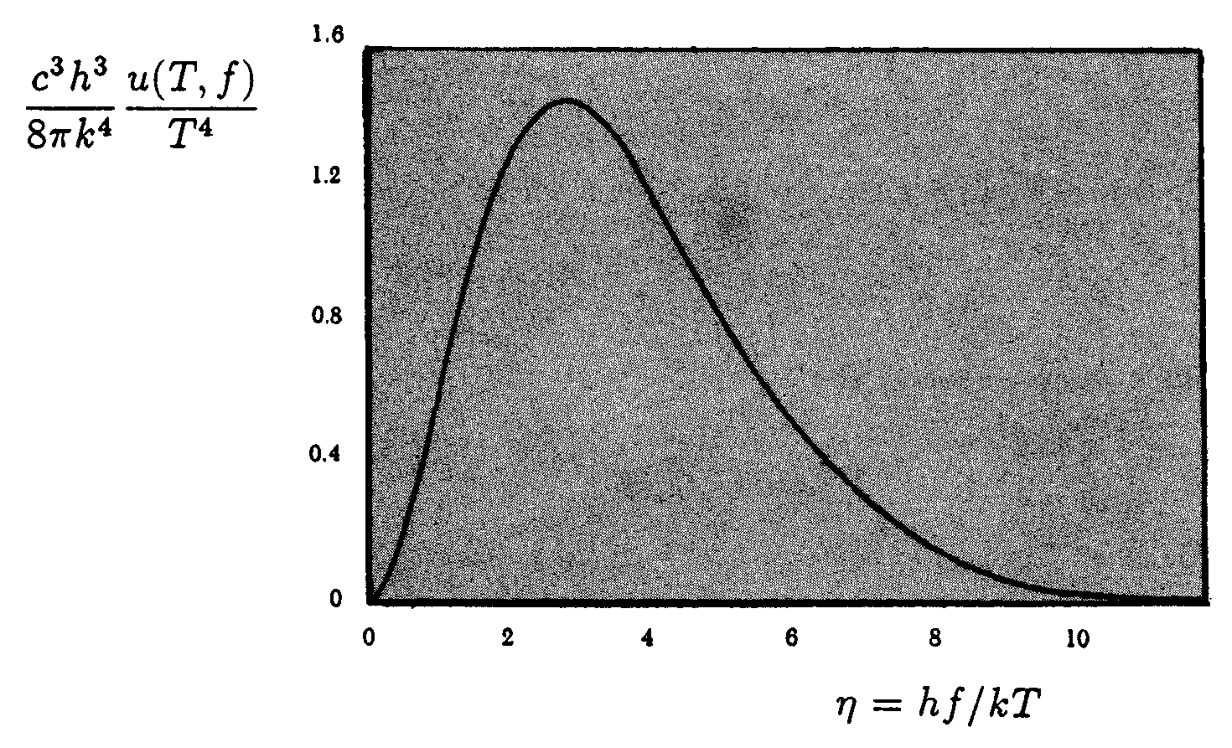
The figure shows the normalized spectrum
\[ \frac{c^3h^3}{8\pi k^4}\frac{u(T,f)}{T^4} \]
as a function of \(\eta\).
In many applications it is necessary to keep the satellite as cool as possible. To cool the satellite, engineers use a reflective coating that reflects light above a cut-off frequency but does not prevent heat radiation at lower frequency from escaping. Assume that this (sharp) cut-off frequency corresponds to \(hf/k = 1200\ \mathrm{K}\).
What is the new equilibrium temperature of the satellite? The exact answer is not needed. Therefore, do not perform any tedious integrations; make approximations where necessary. The integral over the entire range is
\[ \int_0^\infty \frac{\eta^3\,d\eta}{e^\eta-1} = \frac{\pi^4}{15} \]
and the maximum of \(\eta^3/(e^\eta-1)\) occurs at \(\eta = 2.82\). For small \(\eta\) you can expand the exponential function as \(e^\eta \simeq 1+\eta\).
3) If we now have a real satellite, with extending solar panels that generate electricity, the dissipated heat in the electronics inside the satellite acts as an extra source of heat. Assuming that the power of the internal heat source is 1 kW, what is the equilibrium temperature of the satellite in case 2 above?
4) A manufacturer advertises a special paint in the following way:
"This paint will reflect more than 90% of all incoming radiation (both visible light and infrared) but it will radiate at all frequencies (visible light and infrared) as a black body, thus removing lots of heat from the satellite. Thus the paint will help keep the satellite as cool as possible."
Can such paint exist? Why or why not?
5) What properties should a coating have in order to raise the temperature of a spherical body similar to that of the satellite considered here above the temperature calculated in 1)?
Official English text of the problem.
Answers
-
With solar radius \(R_\odot\) and Sun–satellite distance \(D\), \[ \boxed{T_1=T_{\mathrm{sun}}\sqrt{\frac{R_\odot}{2D}} \simeq 289\ \mathrm{K}.} \]
-
Using the specified small-\(\eta\) approximation, \[ \boxed{T_2\simeq T_1 \left[\frac{5}{\pi^4} \left(\frac{1200\ \mathrm{K}}{T_{\mathrm{sun}}}\right)^3\right]^{1/4} \simeq 41\ \mathrm{K}.} \]
-
Accounting for the coating’s suppression of high-frequency thermal emission, \[ \boxed{T_3\simeq 3.2\times10^2\ \mathrm{K} \quad\text{(approximately \(317\ \mathrm{K}\)).}} \]
-
No. Kirchhoff’s law requires equal absorptivity and emissivity at each frequency. A surface reflecting more than \(90\%\) cannot simultaneously emit as a blackbody at those frequencies.
-
The coating should absorb solar radiation strongly and emit thermal infrared radiation weakly: high absorptivity at solar frequencies and high reflectivity at the satellite’s lower thermal frequencies.
Solution
Let the satellite radius be \(a=0.50\ \mathrm{m}\), the solar radius be \(R_\odot\), and the Sun–satellite distance be \(D\). We use the stated radiation-balance model, neglecting radiation from Earth and other heat exchanges.
1) Blackbody satellite
The Sun’s luminosity is
\[ L_\odot=4\pi R_\odot^2\sigma T_{\mathrm{sun}}^4. \]
Consequently, the solar irradiance at the satellite is
\[ S=\frac{L_\odot}{4\pi D^2} =\sigma T_{\mathrm{sun}}^4\left(\frac{R_\odot}{D}\right)^2. \]
The satellite intercepts sunlight over its projected area \(\pi a^2\), while its entire surface \(4\pi a^2\) emits radiation. Thermal equilibrium therefore requires
\[ \pi a^2S=4\pi a^2\sigma T_1^4. \]
Thus
\[ T_1^4=\frac14 T_{\mathrm{sun}}^4 \left(\frac{R_\odot}{D}\right)^2, \qquad \boxed{T_1=T_{\mathrm{sun}}\sqrt{\frac{R_\odot}{2D}}.} \]
Numerically,
\[ T_1 =6000\sqrt{\frac{6.96\times10^8}{2(1.5\times10^{11})}} \ \mathrm{K} =\boxed{289\ \mathrm{K}}. \]
The satellite’s radius cancels because both absorbed and emitted powers scale as \(a^2\).
2) Satellite with the frequency-selective coating
Write
\[ \Theta=\frac{hf_c}{k}=1200\ \mathrm{K}, \]
where \(f_c\) is the cutoff frequency. The ideal coated satellite absorbs and emits as a blackbody below \(f_c\), while reflection suppresses both absorption and emission above \(f_c\). This equality of spectral absorptivity and emissivity is Kirchhoff’s law.
Define the fraction of blackbody power below a dimensionless cutoff \(x\) by
\[ F(x)=\frac{15}{\pi^4} \int_0^x\frac{\eta^3}{e^\eta-1}\,d\eta. \]
For a body at temperature \(T\), the relevant cutoff is \(x=\Theta/T\). The equilibrium equation is therefore
\[ \pi a^2\sigma T_{\mathrm{sun}}^4 \left(\frac{R_\odot}{D}\right)^2 F\left(\frac{\Theta}{T_{\mathrm{sun}}}\right) = 4\pi a^2\sigma T_2^4 F\left(\frac{\Theta}{T_2}\right). \]
Using part 1,
\[ T_2^4F\left(\frac{\Theta}{T_2}\right) = T_1^4F\left(\frac{\Theta}{T_{\mathrm{sun}}}\right). \]
For sunlight,
\[ x_\odot=\frac{1200}{6000}=0.20. \]
Throughout this small interval, \(e^\eta-1\simeq\eta\), so
\[ F(0.20)\simeq \frac{15}{\pi^4}\int_0^{0.20}\eta^2\,d\eta = \frac{5(0.20)^3}{\pi^4} \simeq4.11\times10^{-4}. \]
Thus only about \(0.041\%\) of the incident solar power is absorbed.
We initially assume that the cooled satellite emits almost all its thermal radiation below the cutoff, so \(F(\Theta/T_2)\simeq1\). Then
\[ T_2\simeq T_1[F(0.20)]^{1/4} =289(4.11\times10^{-4})^{1/4}\ \mathrm{K}, \]
giving
\[ \boxed{T_2\simeq41\ \mathrm{K}.} \]
This assumption is self-consistent: the satellite’s cutoff is
\[ \frac{\Theta}{T_2}\simeq\frac{1200}{41}\simeq29, \]
far beyond the spectral maximum at \(\eta=2.82\). The excluded high-frequency thermal tail is negligible.
3) Addition of a \(1\ \mathrm{kW}\) internal heat source
The emitting area is now needed explicitly:
\[ A=4\pi a^2=\pi\ \mathrm{m^2}. \]
Before applying the coating, the absorbed solar power was
\[ Q_{\odot,0}=A\sigma T_1^4 \simeq1.24\times10^3\ \mathrm{W}. \]
With the coating, it becomes
\[ Q_\odot=Q_{\odot,0}F(0.20) \simeq(1.24\times10^3)(4.11\times10^{-4}) \simeq0.51\ \mathrm{W}. \]
This is negligible compared with the internal heat source \(Q_{\mathrm{int}}=1000\ \mathrm{W}\). The balance is
\[ \boxed{ A\sigma T_3^4F\left(\frac{1200\ \mathrm{K}}{T_3}\right) =1000\ \mathrm{W}+Q_\odot. } \]
Here we cannot set \(F=1\). Even an unrestricted blackbody would need the temperature
\[ \left(\frac{1000\ \mathrm{W}}{A\sigma}\right)^{1/4} \simeq274\ \mathrm{K}, \]
for which the cutoff would already lie at \(\eta_c\simeq4.38\). A significant part of the thermal spectrum is above that cutoff, so the coated satellite must become hotter.
We can estimate the required fraction directly from the supplied graph. Near \(\eta_c=3.8\), the area under the curve is approximately
\[ \int_0^{3.8}\frac{\eta^3}{e^\eta-1}\,d\eta\simeq3.6. \]
Since the total area is \(\pi^4/15\simeq6.49\),
\[ F(3.8)\simeq\frac{3.6}{6.49}\simeq0.55. \]
Substitution gives
\[ T_3\simeq \left[ \frac{1000.5\ \mathrm{W}} {(\pi\ \mathrm{m^2})(5.67\times10^{-8}\ \mathrm{W\,m^{-2}K^{-4}}) (3.6/6.49)} \right]^{1/4} \simeq317\ \mathrm{K}. \]
Its corresponding cutoff is \(1200/317\simeq3.79\), confirming the graphical estimate. Therefore,
\[ \boxed{T_3\simeq3.2\times10^2\ \mathrm{K}.} \]
4) The advertised paint
Kirchhoff’s law of thermal radiation states that, at a given frequency and for corresponding directions,
\[ \epsilon_f=\alpha_f, \]
where \(\epsilon_f\) is emissivity and \(\alpha_f\) is absorptivity.
Energy conservation gives
\[ \alpha_f+\rho_f+\tau_f=1, \]
where \(\rho_f\) and \(\tau_f\) are reflectivity and transmissivity. Consequently, if \(\rho_f>0.90\),
\[ \alpha_f<0.10 \quad\Longrightarrow\quad \epsilon_f<0.10. \]
Blackbody emission would instead require \(\epsilon_f=1\).
Thus the claimed combination of high reflection and blackbody thermal emission at the same frequencies is impossible for a passive paint. It would violate Kirchhoff’s law and detailed thermal balance.
5) A coating that raises the temperature
The coating should have the opposite spectral selectivity to that in part 2:
- Strong absorption at the relatively high frequencies carrying most solar radiation.
- Weak emission, and correspondingly strong reflection, at the lower infrared frequencies carrying most of the satellite’s thermal radiation.
Let \(\bar\alpha_\odot\) be absorptivity averaged over the solar spectrum, and let \(\bar\epsilon_T\) be emissivity averaged over the satellite’s blackbody spectrum at temperature \(T\). The balance without internal heating is
\[ \pi a^2\bar\alpha_\odot S = 4\pi a^2\bar\epsilon_T\sigma T^4. \]
Hence
\[ \boxed{ T=T_1\left(\frac{\bar\alpha_\odot}{\bar\epsilon_T}\right)^{1/4}. } \]
The equilibrium temperature exceeds \(T_1\) when
\[ \boxed{\bar\alpha_\odot>\bar\epsilon_T.} \]
This is compatible with Kirchhoff’s law because the two averages weight different frequency ranges. A frequency-independent grey coating would have equal absorptivity and emissivity and would leave the equilibrium temperature unchanged.
The solution was checked against the official solution.
IPhO 1992 · Theorieaufgabe 3
Ein Satellit im Sonnenlicht
In dieser Aufgabe berechnen Sie die Temperatur eines Satelliten im Weltraum. Der Satellit wird als Kugel mit einem Durchmesser von 1 m angenommen. Im gesamten Satelliten herrscht eine einheitliche Temperatur. Die gesamte Kugeloberfläche des Satelliten ist mit derselben Beschichtung versehen. Der Satellit befindet sich in der Nähe der Erde, jedoch nicht im Erdschatten.
Die Oberflächentemperatur der Sonne (ihre Oberflächentemperatur als schwarzer Körper) beträgt \(T_{\mathrm{sun}} = 6000\ \mathrm{K}\), und ihr Radius beträgt \(6.96 \times 10^8\ \mathrm{m}\). Der Abstand zwischen Sonne und Erde beträgt \(1.5 \times 10^{11}\ \mathrm{m}\). Das Sonnenlicht erwärmt den Satelliten auf eine Temperatur, bei der die vom Satelliten als schwarzer Körper abgestrahlte Leistung gleich der aus dem Sonnenlicht absorbierten Leistung ist. Die von einem schwarzen Körper pro Flächeneinheit abgestrahlte Leistung ist durch das Stefan-Boltzmann-Gesetz \(P = \sigma T^4\) gegeben, wobei \(\sigma\) die universelle Konstante \(5.67 \times 10^{-8}\ \mathrm{W\,m^{-2}K^{-4}}\) ist. In erster Näherung können Sie annehmen, dass sowohl die Sonne als auch der Satellit sämtliche auf sie einfallende elektromagnetische Strahlung absorbieren.
1) Bestimmen Sie einen Ausdruck für die Temperatur \(T\) des Satelliten. Welchen Zahlenwert hat diese Temperatur?
2) Das Spektrum der Schwarzkörperstrahlung \(u(T,f)\) eines Körpers bei der Temperatur \(T\) gehorcht dem Planckschen Strahlungsgesetz
\[ u(T,f)\,df = \frac{8\pi k^4T^4}{c^3h^3} \frac{\eta^3\,d\eta}{e^\eta-1} \]
wobei \(\eta = hf/kT\) gilt und \(u(T,f)df\) die Energiedichte der elektromagnetischen Strahlung in einem Frequenzintervall \([f,f+df]\) ist. In dieser Gleichung ist \(h = 6.6 \times 10^{-34}\ \mathrm{J\,s}\) die Plancksche Konstante, \(k = 1.4 \times 10^{-23}\ \mathrm{J\,K^{-1}}\) die Boltzmann-Konstante und \(c = 3.0 \times 10^8\ \mathrm{m\,s^{-1}}\) die Lichtgeschwindigkeit.
Die Integration des Schwarzkörperspektrums über alle Frequenzen \(f\) und Abstrahlrichtungen ergibt die gesamte abgestrahlte Leistung pro Flächeneinheit \(P = \sigma T^4\), wie sie durch das oben angegebene Stefan-Boltzmann-Gesetz beschrieben wird.
\[ \sigma = \frac{2\pi^5k^4}{15c^2h^3} \]
Die Abbildung zeigt das normierte Spektrum
\[ \frac{c^3h^3}{8\pi k^4}\frac{u(T,f)}{T^4} \]
als Funktion von \(\eta\).
Bei vielen Anwendungen muss der Satellit möglichst kühl gehalten werden. Zur Kühlung des Satelliten verwenden Ingenieure eine reflektierende Beschichtung, die Licht oberhalb einer Grenzfrequenz reflektiert, das Entweichen von Wärmestrahlung bei niedrigeren Frequenzen jedoch nicht verhindert. Nehmen Sie an, dass diese (scharfe) Grenzfrequenz \(hf/k = 1200\ \mathrm{K}\) entspricht.
Wie hoch ist die neue Gleichgewichtstemperatur des Satelliten? Eine exakte Antwort ist nicht erforderlich. Führen Sie daher keine aufwendigen Integrationen durch, sondern verwenden Sie bei Bedarf Näherungen. Das Integral über den gesamten Bereich lautet
\[ \int_0^\infty \frac{\eta^3\,d\eta}{e^\eta-1} = \frac{\pi^4}{15} \]
und das Maximum von \(\eta^3/(e^\eta-1)\) liegt bei \(\eta = 2.82\). Für kleine \(\eta\) können Sie die Exponentialfunktion in der Form \(e^\eta \simeq 1+\eta\) entwickeln.
3) Betrachten wir nun einen realen Satelliten mit ausladenden Solarmodulen, die elektrische Energie erzeugen, so wirkt die in der Elektronik im Inneren des Satelliten entstehende Verlustwärme als zusätzliche Wärmequelle. Wie hoch ist die Gleichgewichtstemperatur des Satelliten im obigen Fall 2, wenn die Leistung der inneren Wärmequelle 1 kW beträgt?
4) Ein Hersteller wirbt für einen Spezialanstrich folgendermaßen:
„Dieser Anstrich reflektiert mehr als 90% der gesamten einfallenden Strahlung (sowohl sichtbares Licht als auch Infrarotstrahlung), strahlt jedoch bei allen Frequenzen (sichtbares Licht und Infrarotstrahlung) wie ein schwarzer Körper ab und führt dadurch viel Wärme vom Satelliten ab. Somit trägt der Anstrich dazu bei, den Satelliten möglichst kühl zu halten.“
Kann es einen solchen Anstrich geben? Warum beziehungsweise warum nicht?
5) Welche Eigenschaften sollte eine Beschichtung haben, um die Temperatur eines kugelförmigen Körpers, der dem hier betrachteten Satelliten ähnelt, über die in 1) berechnete Temperatur zu erhöhen?
Aufgabentext aus dem offiziellen englischen Text übersetzt.
Antworten
-
Mit dem Sonnenradius \(R_\odot\) und dem Abstand \(D\) zwischen Sonne und Satellit gilt \[ \boxed{T_1=T_{\mathrm{sun}}\sqrt{\frac{R_\odot}{2D}} \simeq 289\ \mathrm{K}.} \]
-
Mit der angegebenen Näherung für kleine \(\eta\) ergibt sich \[ \boxed{T_2\simeq T_1 \left[\frac{5}{\pi^4} \left(\frac{1200\ \mathrm{K}}{T_{\mathrm{sun}}}\right)^3\right]^{1/4} \simeq 41\ \mathrm{K}.} \]
-
Unter Berücksichtigung der Unterdrückung der hochfrequenten Wärmeabstrahlung durch die Beschichtung ergibt sich \[ \boxed{T_3\simeq 3.2\times10^2\ \mathrm{K} \quad\text{(ungefähr \(317\ \mathrm{K}\)).}} \]
-
Nein. Nach dem Kirchhoffschen Strahlungsgesetz müssen Absorptionsgrad und Emissionsgrad bei jeder Frequenz gleich sein. Eine Oberfläche, die mehr als \(90\%\) reflektiert, kann bei diesen Frequenzen nicht gleichzeitig wie ein schwarzer Körper emittieren.
-
Die Beschichtung sollte Sonnenstrahlung stark absorbieren und thermische Infrarotstrahlung schwach emittieren: hoher Absorptionsgrad bei den Frequenzen der Sonnenstrahlung und hoher Reflexionsgrad bei den niedrigeren Frequenzen der Wärmestrahlung des Satelliten.
Lösung
Der Radius des Satelliten sei \(a=0.50\ \mathrm{m}\), der Sonnenradius sei \(R_\odot\) und der Abstand zwischen Sonne und Satellit sei \(D\). Wir verwenden das angegebene Strahlungsbilanzmodell und vernachlässigen die Strahlung der Erde sowie andere Formen des Wärmeaustauschs.
1) Satellit als schwarzer Körper
Die Leuchtkraft der Sonne beträgt
\[ L_\odot=4\pi R_\odot^2\sigma T_{\mathrm{sun}}^4. \]
Damit beträgt die solare Bestrahlungsstärke am Ort des Satelliten
\[ S=\frac{L_\odot}{4\pi D^2} =\sigma T_{\mathrm{sun}}^4\left(\frac{R_\odot}{D}\right)^2. \]
Der Satellit fängt Sonnenlicht über seine projizierte Fläche \(\pi a^2\) auf, während seine gesamte Oberfläche \(4\pi a^2\) Strahlung emittiert. Das thermische Gleichgewicht erfordert daher
\[ \pi a^2S=4\pi a^2\sigma T_1^4. \]
Somit gilt
\[ T_1^4=\frac14 T_{\mathrm{sun}}^4 \left(\frac{R_\odot}{D}\right)^2, \qquad \boxed{T_1=T_{\mathrm{sun}}\sqrt{\frac{R_\odot}{2D}}.} \]
Numerisch ergibt sich
\[ T_1 =6000\sqrt{\frac{6.96\times10^8}{2(1.5\times10^{11})}} \ \mathrm{K} =\boxed{289\ \mathrm{K}}. \]
Der Radius des Satelliten kürzt sich heraus, da sowohl die absorbierte als auch die emittierte Leistung proportional zu \(a^2\) sind.
2) Satellit mit der frequenzselektiven Beschichtung
Wir setzen
\[ \Theta=\frac{hf_c}{k}=1200\ \mathrm{K}, \]
wobei \(f_c\) die Grenzfrequenz ist. Der ideal beschichtete Satellit absorbiert und emittiert unterhalb von \(f_c\) wie ein schwarzer Körper, während die Reflexion oberhalb von \(f_c\) sowohl Absorption als auch Emission unterdrückt. Diese Gleichheit von spektralem Absorptionsgrad und Emissionsgrad ist das Kirchhoffsche Strahlungsgesetz.
Wir definieren den Anteil der Schwarzkörperstrahlungsleistung unterhalb einer dimensionslosen Grenzfrequenz \(x\) durch
\[ F(x)=\frac{15}{\pi^4} \int_0^x\frac{\eta^3}{e^\eta-1}\,d\eta. \]
Für einen Körper bei der Temperatur \(T\) ist die maßgebliche Grenzfrequenz \(x=\Theta/T\). Die Gleichgewichtsbedingung lautet daher
\[ \pi a^2\sigma T_{\mathrm{sun}}^4 \left(\frac{R_\odot}{D}\right)^2 F\left(\frac{\Theta}{T_{\mathrm{sun}}}\right) = 4\pi a^2\sigma T_2^4 F\left(\frac{\Theta}{T_2}\right). \]
Mit Teil 1 ergibt sich
\[ T_2^4F\left(\frac{\Theta}{T_2}\right) = T_1^4F\left(\frac{\Theta}{T_{\mathrm{sun}}}\right). \]
Für das Sonnenlicht gilt
\[ x_\odot=\frac{1200}{6000}=0.20. \]
Im gesamten kleinen Intervall gilt \(e^\eta-1\simeq\eta\), also
\[ F(0.20)\simeq \frac{15}{\pi^4}\int_0^{0.20}\eta^2\,d\eta = \frac{5(0.20)^3}{\pi^4} \simeq4.11\times10^{-4}. \]
Somit werden nur etwa \(0.041\%\) der einfallenden Sonnenstrahlungsleistung absorbiert.
Wir nehmen zunächst an, dass der abgekühlte Satellit nahezu seine gesamte Wärmestrahlung unterhalb der Grenzfrequenz emittiert, sodass \(F(\Theta/T_2)\simeq1\) gilt. Dann ist
\[ T_2\simeq T_1[F(0.20)]^{1/4} =289(4.11\times10^{-4})^{1/4}\ \mathrm{K}, \]
woraus folgt:
\[ \boxed{T_2\simeq41\ \mathrm{K}.} \]
Diese Annahme ist in sich konsistent: Die Grenzfrequenz des Satelliten beträgt
\[ \frac{\Theta}{T_2}\simeq\frac{1200}{41}\simeq29, \]
und liegt damit weit jenseits des spektralen Maximums bei \(\eta=2.82\). Der ausgeschlossene hochfrequente Ausläufer des thermischen Spektrums ist vernachlässigbar.
3) Hinzufügen einer inneren Wärmequelle mit \(1\ \mathrm{kW}\)
Die abstrahlende Fläche wird nun ausdrücklich benötigt:
\[ A=4\pi a^2=\pi\ \mathrm{m^2}. \]
Vor dem Aufbringen der Beschichtung betrug die absorbierte Sonnenstrahlungsleistung
\[ Q_{\odot,0}=A\sigma T_1^4 \simeq1.24\times10^3\ \mathrm{W}. \]
Mit der Beschichtung beträgt sie
\[ Q_\odot=Q_{\odot,0}F(0.20) \simeq(1.24\times10^3)(4.11\times10^{-4}) \simeq0.51\ \mathrm{W}. \]
Dies ist gegenüber der inneren Wärmequelle \(Q_{\mathrm{int}}=1000\ \mathrm{W}\) vernachlässigbar. Die Bilanz lautet
\[ \boxed{ A\sigma T_3^4F\left(\frac{1200\ \mathrm{K}}{T_3}\right) =1000\ \mathrm{W}+Q_\odot. } \]
Hier können wir nicht \(F=1\) setzen. Selbst ein ohne spektrale Einschränkung abstrahlender schwarzer Körper müsste die Temperatur
\[ \left(\frac{1000\ \mathrm{W}}{A\sigma}\right)^{1/4} \simeq274\ \mathrm{K}, \]
haben, bei der die Grenzfrequenz bereits bei \(\eta_c\simeq4.38\) läge. Ein erheblicher Teil des thermischen Spektrums liegt oberhalb dieser Grenzfrequenz, sodass der beschichtete Satellit heißer werden muss.
Wir können den benötigten Anteil direkt aus der gegebenen Grafik abschätzen. In der Nähe von \(\eta_c=3.8\) beträgt die Fläche unter der Kurve ungefähr
\[ \int_0^{3.8}\frac{\eta^3}{e^\eta-1}\,d\eta\simeq3.6. \]
Da die Gesamtfläche \(\pi^4/15\simeq6.49\) beträgt, gilt
\[ F(3.8)\simeq\frac{3.6}{6.49}\simeq0.55. \]
Einsetzen ergibt
\[ T_3\simeq \left[ \frac{1000.5\ \mathrm{W}} {(\pi\ \mathrm{m^2})(5.67\times10^{-8}\ \mathrm{W\,m^{-2}K^{-4}}) (3.6/6.49)} \right]^{1/4} \simeq317\ \mathrm{K}. \]
Die zugehörige Grenzfrequenz beträgt \(1200/317\simeq3.79\), was die grafische Abschätzung bestätigt. Daher gilt
\[ \boxed{T_3\simeq3.2\times10^2\ \mathrm{K}.} \]
4) Der beworbene Anstrich
Das Kirchhoffsche Strahlungsgesetz besagt, dass bei einer gegebenen Frequenz und für einander entsprechende Richtungen gilt:
\[ \epsilon_f=\alpha_f, \]
wobei \(\epsilon_f\) der Emissionsgrad und \(\alpha_f\) der Absorptionsgrad ist.
Aus der Energieerhaltung folgt
\[ \alpha_f+\rho_f+\tau_f=1, \]
wobei \(\rho_f\) und \(\tau_f\) der Reflexionsgrad beziehungsweise der Transmissionsgrad sind. Wenn also \(\rho_f>0.90\) gilt, folgt
\[ \alpha_f<0.10 \quad\Longrightarrow\quad \epsilon_f<0.10. \]
Die Emission eines schwarzen Körpers würde hingegen \(\epsilon_f=1\) erfordern.
Die behauptete Kombination aus hoher Reflexion und thermischer Emission wie bei einem schwarzen Körper bei denselben Frequenzen ist für einen passiven Anstrich somit unmöglich. Sie würde das Kirchhoffsche Strahlungsgesetz und das detaillierte thermische Gleichgewicht verletzen.
5) Eine Beschichtung, die die Temperatur erhöht
Die Beschichtung sollte die entgegengesetzte spektrale Selektivität zur Beschichtung in Teil 2 aufweisen:
- Starke Absorption bei den relativ hohen Frequenzen, auf die der größte Teil der Sonnenstrahlung entfällt.
- Schwache Emission und entsprechend starke Reflexion bei den niedrigeren Infrarotfrequenzen, auf die der größte Teil der Wärmestrahlung des Satelliten entfällt.
Es sei \(\bar\alpha_\odot\) der über das Sonnenspektrum gemittelte Absorptionsgrad und \(\bar\epsilon_T\) der über das Schwarzkörperspektrum des Satelliten bei der Temperatur \(T\) gemittelte Emissionsgrad. Die Bilanz ohne innere Heizung lautet
\[ \pi a^2\bar\alpha_\odot S = 4\pi a^2\bar\epsilon_T\sigma T^4. \]
Daraus folgt
\[ \boxed{ T=T_1\left(\frac{\bar\alpha_\odot}{\bar\epsilon_T}\right)^{1/4}. } \]
Die Gleichgewichtstemperatur übersteigt \(T_1\), wenn
\[ \boxed{\bar\alpha_\odot>\bar\epsilon_T.} \]
Dies ist mit dem Kirchhoffschen Strahlungsgesetz vereinbar, da die beiden Mittelwerte unterschiedliche Frequenzbereiche gewichten. Eine frequenzunabhängige graue Beschichtung hätte denselben Absorptionsgrad und Emissionsgrad und würde die Gleichgewichtstemperatur unverändert lassen.
Die Lösung wurde mit der offiziellen Lösung abgeglichen.
IPhO 1992 · Teori sorusu 3
Güneş Işığındaki Bir Uydu
Bu soruda bir uzay uydusunun sıcaklığını hesaplayacaksınız. Uydunun, çapı 1 m olan bir küre olduğu varsayılmaktadır. Uydunun her noktası aynı sıcaklıkta kalmaktadır. Uydunun küresel yüzeyinin tamamı aynı tür kaplamayla kaplanmıştır. Uydu, Dünya'nın yakınında bulunmaktadır ancak Dünya'nın gölgesinde değildir.
Güneş'in yüzey sıcaklığı (kara cisim yüzey sıcaklığı) \(T_{\mathrm{sun}} = 6000\ \mathrm{K}\), yarıçapı ise \(6.96 \times 10^8\ \mathrm{m}\)'dir. Güneş ile Dünya arasındaki uzaklık \(1.5 \times 10^{11}\ \mathrm{m}\)'dir. Güneş ışığı uyduyu, uydunun kara cisim olarak yaydığı ışınım gücünün güneş ışığından soğurulan güce eşit olduğu sıcaklığa kadar ısıtır. Bir kara cismin birim alanından yayılan güç, Stefan-Boltzmann yasası \(P = \sigma T^4\) ile verilir; burada \(\sigma\), \(5.67 \times 10^{-8}\ \mathrm{W\,m^{-2}K^{-4}}\) değerindeki evrensel sabittir. İlk yaklaşımda hem Güneş'in hem de uydunun üzerlerine gelen tüm elektromanyetik ışınımı soğurduğunu varsayabilirsiniz.
1) Uydunun \(T\) sıcaklığı için bir ifade bulunuz. Bu sıcaklığın sayısal değeri nedir?
2) \(T\) sıcaklığındaki bir cismin kara cisim ışınım tayfı \(u(T,f)\), Planck ışınım yasasına uyar:
\[ u(T,f)\,df = \frac{8\pi k^4T^4}{c^3h^3} \frac{\eta^3\,d\eta}{e^\eta-1} \]
Burada \(\eta = hf/kT\) ve \(u(T,f)df\), \([f,f+df]\) frekans aralığındaki elektromanyetik ışınımın enerji yoğunluğudur. Denklemde \(h = 6.6 \times 10^{-34}\ \mathrm{J\,s}\) Planck sabiti, \(k = 1.4 \times 10^{-23}\ \mathrm{J\,K^{-1}}\) Boltzmann sabiti ve \(c = 3.0 \times 10^8\ \mathrm{m\,s^{-1}}\) ışık hızıdır.
Kara cisim tayfının tüm \(f\) frekansları ve yayılma doğrultuları üzerinden integrali alındığında, yukarıda verilen Stefan-Boltzmann yasasında ifade edildiği gibi, birim alandan yayılan toplam güç \(P = \sigma T^4\) elde edilir.
\[ \sigma = \frac{2\pi^5k^4}{15c^2h^3} \]
Şekil, normalize edilmiş
\[ \frac{c^3h^3}{8\pi k^4}\frac{u(T,f)}{T^4} \]
tayfını \(\eta\)'nın bir fonksiyonu olarak göstermektedir.
Birçok uygulamada uydunun olabildiğince soğuk tutulması gerekir. Mühendisler, uyduyu soğutmak için bir kesim frekansının üzerindeki ışığı yansıtan, ancak daha düşük frekanslı ısıl ışınımın dışarı çıkmasını engellemeyen yansıtıcı bir kaplama kullanırlar. Bu (keskin) kesim frekansının \(hf/k = 1200\ \mathrm{K}\) değerine karşılık geldiğini varsayınız.
Uydunun yeni denge sıcaklığı nedir? Kesin cevap gerekli değildir. Bu nedenle, zahmetli integraller hesaplamayınız; gerektiğinde yaklaşımlar yapınız. Tüm aralık üzerinden alınan integral
\[ \int_0^\infty \frac{\eta^3\,d\eta}{e^\eta-1} = \frac{\pi^4}{15} \]
olup \(\eta^3/(e^\eta-1)\) ifadesi en büyük değerini \(\eta = 2.82\)'de alır. Küçük \(\eta\) değerleri için üstel fonksiyonu \(e^\eta \simeq 1+\eta\) biçiminde açabilirsiniz.
3) Şimdi, elektrik üreten ve dışarı doğru uzanan güneş panellerine sahip gerçek bir uyduyu ele alırsak, uydu içindeki elektronik devrelerde açığa çıkan ısı ek bir ısı kaynağı görevi görür. İç ısı kaynağının gücünün 1 kW olduğunu varsayarak, yukarıdaki 2. durumda uydunun denge sıcaklığı nedir?
4) Bir üretici, özel bir boyanın reklamını şöyle yapmaktadır:
"Bu boya, üzerine gelen tüm ışınımın (hem görünür ışığın hem de kızılötesinin) %90'ından fazlasını yansıtacak, ancak tüm frekanslarda (görünür ışık ve kızılötesi) bir kara cisim gibi ışınım yayarak uydudan çok miktarda ısı uzaklaştıracaktır. Böylece boya, uydunun olabildiğince soğuk tutulmasına yardımcı olacaktır."
Böyle bir boya var olabilir mi? Neden olabilir ya da neden olamaz?
5) Burada ele alınan uyduya benzer küresel bir cismin sıcaklığını 1)'de hesaplanan sıcaklığın üzerine çıkarmak için bir kaplama hangi özelliklere sahip olmalıdır?
Soru metni resmi İngilizce metinden çevrilmiştir.
Cevaplar
-
Güneş'in yarıçapı \(R_\odot\) ve Güneş–uydu uzaklığı \(D\) olmak üzere, \[ \boxed{T_1=T_{\mathrm{sun}}\sqrt{\frac{R_\odot}{2D}} \simeq 289\ \mathrm{K}.} \]
-
Belirtilen küçük \(\eta\) yaklaşımı kullanıldığında, \[ \boxed{T_2\simeq T_1 \left[\frac{5}{\pi^4} \left(\frac{1200\ \mathrm{K}}{T_{\mathrm{sun}}}\right)^3\right]^{1/4} \simeq 41\ \mathrm{K}.} \]
-
Kaplamanın yüksek frekanslı ısıl ışınım yayımını bastırması hesaba katıldığında, \[ \boxed{T_3\simeq 3.2\times10^2\ \mathrm{K} \quad\text{(yaklaşık \(317\ \mathrm{K}\)).}} \]
-
Hayır. Kirchhoff yasası, her frekansta soğurma ve yayma katsayılarının eşit olmasını gerektirir. \(90\%\)'dan fazlasını yansıtan bir yüzey, aynı anda bu frekanslarda kara cisim gibi ışınım yayamaz.
-
Kaplama, güneş ışınımını güçlü biçimde soğurmalı ve ısıl kızılötesi ışınımı zayıf biçimde yaymalıdır: güneş ışınımının frekanslarında yüksek soğurma katsayısına, uydunun daha düşük ısıl ışınım frekanslarında ise yüksek yansıtma katsayısına sahip olmalıdır.
Çözüm
Uydunun yarıçapı \(a=0.50\ \mathrm{m}\), Güneş'in yarıçapı \(R_\odot\) ve Güneş–uydu uzaklığı \(D\) olsun. Dünya'dan gelen ışınımı ve diğer ısı alışverişlerini ihmal ederek belirtilen ışınım dengesi modelini kullanıyoruz.
1) Kara cisim uydu
Güneş'in toplam ışınım gücü
\[ L_\odot=4\pi R_\odot^2\sigma T_{\mathrm{sun}}^4. \]
Dolayısıyla uydunun bulunduğu yerde birim alana düşen güneş ışınımı gücü
\[ S=\frac{L_\odot}{4\pi D^2} =\sigma T_{\mathrm{sun}}^4\left(\frac{R_\odot}{D}\right)^2. \]
Uydu, güneş ışığını izdüşüm alanı \(\pi a^2\) üzerinden alırken, tüm yüzeyi \(4\pi a^2\) ışınım yayar. Bu nedenle ısıl denge için
\[ \pi a^2S=4\pi a^2\sigma T_1^4. \]
Böylece
\[ T_1^4=\frac14 T_{\mathrm{sun}}^4 \left(\frac{R_\odot}{D}\right)^2, \qquad \boxed{T_1=T_{\mathrm{sun}}\sqrt{\frac{R_\odot}{2D}}.} \]
Sayısal olarak,
\[ T_1 =6000\sqrt{\frac{6.96\times10^8}{2(1.5\times10^{11})}} \ \mathrm{K} =\boxed{289\ \mathrm{K}}. \]
Hem soğurulan hem de yayılan güç \(a^2\) ile orantılı olduğundan uydunun yarıçapı sadeleşir.
2) Frekans seçici kaplamaya sahip uydu
Şöyle yazalım:
\[ \Theta=\frac{hf_c}{k}=1200\ \mathrm{K}, \]
burada \(f_c\) kesim frekansıdır. İdeal kaplamalı uydu, \(f_c\)'nin altında kara cisim gibi soğurur ve ışınım yayar; \(f_c\)'nin üzerinde ise yansıma hem soğurmayı hem de yayımı bastırır. Tayfsal soğurma ve yayma katsayılarının bu eşitliği Kirchhoff yasasıdır.
Kara cisim gücünün boyutsuz bir \(x\) kesim değerinin altında kalan oranını şöyle tanımlayalım:
\[ F(x)=\frac{15}{\pi^4} \int_0^x\frac{\eta^3}{e^\eta-1}\,d\eta. \]
\(T\) sıcaklığındaki bir cisim için ilgili kesim değeri \(x=\Theta/T\)'dir. Dolayısıyla denge denklemi
\[ \pi a^2\sigma T_{\mathrm{sun}}^4 \left(\frac{R_\odot}{D}\right)^2 F\left(\frac{\Theta}{T_{\mathrm{sun}}}\right) = 4\pi a^2\sigma T_2^4 F\left(\frac{\Theta}{T_2}\right). \]
- kısımdan yararlanarak,
\[ T_2^4F\left(\frac{\Theta}{T_2}\right) = T_1^4F\left(\frac{\Theta}{T_{\mathrm{sun}}}\right). \]
Güneş ışığı için,
\[ x_\odot=\frac{1200}{6000}=0.20. \]
Bu küçük aralığın tamamında \(e^\eta-1\simeq\eta\) olduğundan,
\[ F(0.20)\simeq \frac{15}{\pi^4}\int_0^{0.20}\eta^2\,d\eta = \frac{5(0.20)^3}{\pi^4} \simeq4.11\times10^{-4}. \]
Dolayısıyla gelen güneş ışınımı gücünün yalnızca yaklaşık \(0.041\%\)'i soğurulur.
Başlangıçta, soğutulmuş uydunun ısıl ışınımının neredeyse tamamını kesim frekansının altında yaydığını varsayıyoruz; dolayısıyla \(F(\Theta/T_2)\simeq1\). Bu durumda
\[ T_2\simeq T_1[F(0.20)]^{1/4} =289(4.11\times10^{-4})^{1/4}\ \mathrm{K}, \]
buradan
\[ \boxed{T_2\simeq41\ \mathrm{K}.} \]
Bu varsayım kendi içinde tutarlıdır: uydunun kesim değeri
\[ \frac{\Theta}{T_2}\simeq\frac{1200}{41}\simeq29, \]
olup tayfın \(\eta=2.82\)'deki maksimumunun çok ötesindedir. Dışarıda kalan yüksek frekanslı ısıl ışınım kuyruğu ihmal edilebilir.
3) \(1\ \mathrm{kW}\) gücünde bir iç ısı kaynağının eklenmesi
Artık ışınım yayan alanın açıkça kullanılması gerekir:
\[ A=4\pi a^2=\pi\ \mathrm{m^2}. \]
Kaplama uygulanmadan önce soğurulan güneş ışınımı gücü
\[ Q_{\odot,0}=A\sigma T_1^4 \simeq1.24\times10^3\ \mathrm{W}. \]
Kaplamayla birlikte bu güç
\[ Q_\odot=Q_{\odot,0}F(0.20) \simeq(1.24\times10^3)(4.11\times10^{-4}) \simeq0.51\ \mathrm{W}. \]
Bu değer, \(Q_{\mathrm{int}}=1000\ \mathrm{W}\) gücündeki iç ısı kaynağına kıyasla ihmal edilebilir. Denge denklemi
\[ \boxed{ A\sigma T_3^4F\left(\frac{1200\ \mathrm{K}}{T_3}\right) =1000\ \mathrm{W}+Q_\odot. } \]
Burada \(F=1\) alamayız. Işınımına herhangi bir kısıtlama getirilmeyen bir kara cismin bile
\[ \left(\frac{1000\ \mathrm{W}}{A\sigma}\right)^{1/4} \simeq274\ \mathrm{K}, \]
sıcaklığında olması gerekir; bu sıcaklıkta bile kesim değeri \(\eta_c\simeq4.38\) olurdu. Isıl ışınım tayfının önemli bir bölümü bu kesim değerinin üzerindedir; bu nedenle kaplamalı uydu daha sıcak olmalıdır.
Gerekli oranı doğrudan verilen grafikten tahmin edebiliriz. \(\eta_c=3.8\) yakınında, eğrinin altında kalan alan yaklaşık olarak
\[ \int_0^{3.8}\frac{\eta^3}{e^\eta-1}\,d\eta\simeq3.6. \]
Toplam alan \(\pi^4/15\simeq6.49\) olduğundan,
\[ F(3.8)\simeq\frac{3.6}{6.49}\simeq0.55. \]
Yerine koyduğumuzda
\[ T_3\simeq \left[ \frac{1000.5\ \mathrm{W}} {(\pi\ \mathrm{m^2})(5.67\times10^{-8}\ \mathrm{W\,m^{-2}K^{-4}}) (3.6/6.49)} \right]^{1/4} \simeq317\ \mathrm{K}. \]
Buna karşılık gelen kesim değeri \(1200/317\simeq3.79\) olup grafik üzerinden yapılan tahmini doğrular. Dolayısıyla,
\[ \boxed{T_3\simeq3.2\times10^2\ \mathrm{K}.} \]
4) Reklamı yapılan boya
Kirchhoff'un ısıl ışınım yasasına göre, belirli bir frekansta ve karşılık gelen doğrultularda,
\[ \epsilon_f=\alpha_f, \]
burada \(\epsilon_f\) yayma katsayısı, \(\alpha_f\) ise soğurma katsayısıdır.
Enerjinin korunumu gereği
\[ \alpha_f+\rho_f+\tau_f=1, \]
burada \(\rho_f\) ve \(\tau_f\) sırasıyla yansıtma ve geçirme katsayılarıdır. Dolayısıyla, \(\rho_f>0.90\) ise,
\[ \alpha_f<0.10 \quad\Longrightarrow\quad \epsilon_f<0.10. \]
Oysa kara cisim gibi ışınım yaymak için \(\epsilon_f=1\) olması gerekir.
Bu nedenle, aynı frekanslarda hem yüksek yansıtma hem de kara cisim gibi ısıl ışınım yayma özelliklerinin bir arada bulunduğu iddiası pasif bir boya için olanaksızdır. Bu, Kirchhoff yasasını ve ayrıntılı ısıl dengeyi ihlal ederdi.
5) Sıcaklığı artıran bir kaplama
Kaplama, 2. kısımdakinin tersi bir tayfsal seçiciliğe sahip olmalıdır:
- Güneş ışınımının büyük bölümünü taşıyan görece yüksek frekanslarda güçlü soğurma.
- Uydunun ısıl ışınımının büyük bölümünü taşıyan daha düşük kızılötesi frekanslarda zayıf yayım ve buna karşılık güçlü yansıtma.
\(\bar\alpha_\odot\), güneş tayfı üzerinden ortalaması alınmış soğurma katsayısı; \(\bar\epsilon_T\) ise uydunun \(T\) sıcaklığındaki kara cisim tayfı üzerinden ortalaması alınmış yayma katsayısı olsun. İç ısıtma olmadığında denge denklemi
\[ \pi a^2\bar\alpha_\odot S = 4\pi a^2\bar\epsilon_T\sigma T^4. \]
Böylece
\[ \boxed{ T=T_1\left(\frac{\bar\alpha_\odot}{\bar\epsilon_T}\right)^{1/4}. } \]
Denge sıcaklığı, şu koşulda \(T_1\)'i aşar:
\[ \boxed{\bar\alpha_\odot>\bar\epsilon_T.} \]
Bu durum Kirchhoff yasasıyla uyumludur; çünkü iki ortalama, farklı frekans aralıklarını ağırlıklandırır. Frekanstan bağımsız gri bir kaplamanın soğurma ve yayma katsayıları eşit olur ve denge sıcaklığını değiştirmezdi.
Çözüm, resmi çözümle karşılaştırılarak kontrol edildi.
IPhO 1992 · Problema teórico 3
Un satélite a la luz del Sol
En este problema calculará la temperatura de un satélite espacial. Se supone que el satélite es una esfera de 1 m de diámetro. Todo el satélite se mantiene a una temperatura uniforme. Toda la superficie esférica del satélite está recubierta con el mismo tipo de revestimiento. El satélite se encuentra cerca de la Tierra, pero no está en su sombra.
La temperatura superficial del Sol (su temperatura superficial de cuerpo negro) es \(T_{\mathrm{sun}} = 6000\ \mathrm{K}\) y su radio es \(6.96 \times 10^8\ \mathrm{m}\). La distancia entre el Sol y la Tierra es \(1.5 \times 10^{11}\ \mathrm{m}\). La luz solar calienta el satélite hasta una temperatura a la que la emisión de cuerpo negro del satélite iguala la potencia absorbida de la luz solar. La potencia emitida por unidad de superficie por un cuerpo negro viene dada por la ley de Stefan-Boltzmann \(P = \sigma T^4\), donde \(\sigma\) es la constante universal \(5.67 \times 10^{-8}\ \mathrm{W\,m^{-2}K^{-4}}\). En una primera aproximación, puede suponer que tanto el Sol como el satélite absorben toda la radiación electromagnética que incide sobre ellos.
1) Obtenga una expresión para la temperatura \(T\) del satélite. ¿Cuál es el valor numérico de esta temperatura?
2) El espectro de radiación de cuerpo negro \(u(T,f)\) de un cuerpo a temperatura \(T\) obedece la ley de radiación de Planck
\[ u(T,f)\,df = \frac{8\pi k^4T^4}{c^3h^3} \frac{\eta^3\,d\eta}{e^\eta-1} \]
donde \(\eta = hf/kT\) y \(u(T,f)df\) es la densidad de energía de la radiación electromagnética en un intervalo de frecuencias \([f,f+df]\). En la ecuación, \(h = 6.6 \times 10^{-34}\ \mathrm{J\,s}\) es la constante de Planck, \(k = 1.4 \times 10^{-23}\ \mathrm{J\,K^{-1}}\) es la constante de Boltzmann y \(c = 3.0 \times 10^8\ \mathrm{m\,s^{-1}}\) es la velocidad de la luz.
El espectro de cuerpo negro, integrado sobre todas las frecuencias \(f\) y direcciones de emisión, da la potencia total radiada por unidad de superficie \(P = \sigma T^4\), tal como se expresa en la ley de Stefan-Boltzmann indicada anteriormente.
\[ \sigma = \frac{2\pi^5k^4}{15c^2h^3} \]
La figura muestra el espectro normalizado
\[ \frac{c^3h^3}{8\pi k^4}\frac{u(T,f)}{T^4} \]
en función de \(\eta\).
En muchas aplicaciones es necesario mantener el satélite lo más frío posible. Para enfriar el satélite, los ingenieros utilizan un revestimiento reflectante que refleja la luz por encima de una frecuencia de corte, pero que no impide que escape la radiación térmica de menor frecuencia. Suponga que esta frecuencia de corte (abrupto) corresponde a \(hf/k = 1200\ \mathrm{K}\).
¿Cuál es la nueva temperatura de equilibrio del satélite? No se necesita la respuesta exacta. Por tanto, no realice integraciones tediosas; haga aproximaciones cuando sea necesario. La integral sobre todo el intervalo es
\[ \int_0^\infty \frac{\eta^3\,d\eta}{e^\eta-1} = \frac{\pi^4}{15} \]
y el máximo de \(\eta^3/(e^\eta-1)\) se alcanza en \(\eta = 2.82\). Para valores pequeños de \(\eta\), puede desarrollar la función exponencial como \(e^\eta \simeq 1+\eta\).
3) Si ahora tenemos un satélite real, con paneles solares desplegados que generan electricidad, el calor disipado en los componentes electrónicos del interior del satélite actúa como una fuente adicional de calor. Suponiendo que la potencia de la fuente interna de calor es de 1 kW, ¿cuál es la temperatura de equilibrio del satélite en el caso 2 anterior?
4) Un fabricante anuncia una pintura especial de la siguiente manera:
«Esta pintura reflejará más del 90% de toda la radiación incidente (tanto la luz visible como la infrarroja), pero radiará a todas las frecuencias (luz visible e infrarroja) como un cuerpo negro, eliminando así una gran cantidad de calor del satélite. Por tanto, la pintura ayudará a mantener el satélite lo más frío posible».
¿Puede existir una pintura así? ¿Por qué sí o por qué no?
5) ¿Qué propiedades debería tener un revestimiento para elevar la temperatura de un cuerpo esférico similar al satélite considerado aquí por encima de la temperatura calculada en 1)?
Enunciado traducido del texto oficial en inglés.
Respuestas
-
Con el radio solar \(R_\odot\) y la distancia Sol–satélite \(D\), \[ \boxed{T_1=T_{\mathrm{sun}}\sqrt{\frac{R_\odot}{2D}} \simeq 289\ \mathrm{K}.} \]
-
Utilizando la aproximación indicada para valores pequeños de \(\eta\), \[ \boxed{T_2\simeq T_1 \left[\frac{5}{\pi^4} \left(\frac{1200\ \mathrm{K}}{T_{\mathrm{sun}}}\right)^3\right]^{1/4} \simeq 41\ \mathrm{K}.} \]
-
Teniendo en cuenta la supresión de la emisión térmica de alta frecuencia debida al revestimiento, \[ \boxed{T_3\simeq 3.2\times10^2\ \mathrm{K} \quad\text{(aproximadamente \(317\ \mathrm{K}\)).}} \]
-
No. La ley de Kirchhoff exige que la absortividad y la emisividad sean iguales a cada frecuencia. Una superficie que refleje más del \(90\%\) no puede emitir simultáneamente como un cuerpo negro a esas frecuencias.
-
El revestimiento debe absorber intensamente la radiación solar y emitir débilmente la radiación infrarroja térmica: alta absortividad a las frecuencias solares y alta reflectividad a las frecuencias térmicas más bajas del satélite.
Solución
Sean \(a=0.50\ \mathrm{m}\) el radio del satélite, \(R_\odot\) el radio solar y \(D\) la distancia Sol–satélite. Utilizamos el modelo de balance radiativo indicado, despreciando la radiación procedente de la Tierra y otros intercambios de calor.
1) Satélite de cuerpo negro
La luminosidad del Sol es
\[ L_\odot=4\pi R_\odot^2\sigma T_{\mathrm{sun}}^4. \]
Por consiguiente, la irradiancia solar en el satélite es
\[ S=\frac{L_\odot}{4\pi D^2} =\sigma T_{\mathrm{sun}}^4\left(\frac{R_\odot}{D}\right)^2. \]
El satélite intercepta la luz solar sobre su área proyectada \(\pi a^2\), mientras que toda su superficie \(4\pi a^2\) emite radiación. Por tanto, el equilibrio térmico requiere
\[ \pi a^2S=4\pi a^2\sigma T_1^4. \]
Así,
\[ T_1^4=\frac14 T_{\mathrm{sun}}^4 \left(\frac{R_\odot}{D}\right)^2, \qquad \boxed{T_1=T_{\mathrm{sun}}\sqrt{\frac{R_\odot}{2D}}.} \]
Numéricamente,
\[ T_1 =6000\sqrt{\frac{6.96\times10^8}{2(1.5\times10^{11})}} \ \mathrm{K} =\boxed{289\ \mathrm{K}}. \]
El radio del satélite se cancela porque tanto la potencia absorbida como la emitida son proporcionales a \(a^2\).
2) Satélite con el revestimiento selectivo en frecuencia
Escribimos
\[ \Theta=\frac{hf_c}{k}=1200\ \mathrm{K}, \]
donde \(f_c\) es la frecuencia de corte. El satélite con el revestimiento ideal absorbe y emite como un cuerpo negro por debajo de \(f_c\), mientras que la reflexión suprime tanto la absorción como la emisión por encima de \(f_c\). Esta igualdad entre la absortividad y la emisividad espectrales es la ley de Kirchhoff.
Definimos la fracción de la potencia de cuerpo negro por debajo de un límite de corte adimensional \(x\) mediante
\[ F(x)=\frac{15}{\pi^4} \int_0^x\frac{\eta^3}{e^\eta-1}\,d\eta. \]
Para un cuerpo a temperatura \(T\), el límite de corte correspondiente es \(x=\Theta/T\). Por tanto, la ecuación de equilibrio es
\[ \pi a^2\sigma T_{\mathrm{sun}}^4 \left(\frac{R_\odot}{D}\right)^2 F\left(\frac{\Theta}{T_{\mathrm{sun}}}\right) = 4\pi a^2\sigma T_2^4 F\left(\frac{\Theta}{T_2}\right). \]
Utilizando el apartado 1,
\[ T_2^4F\left(\frac{\Theta}{T_2}\right) = T_1^4F\left(\frac{\Theta}{T_{\mathrm{sun}}}\right). \]
Para la luz solar,
\[ x_\odot=\frac{1200}{6000}=0.20. \]
En todo este pequeño intervalo, \(e^\eta-1\simeq\eta\), por lo que
\[ F(0.20)\simeq \frac{15}{\pi^4}\int_0^{0.20}\eta^2\,d\eta = \frac{5(0.20)^3}{\pi^4} \simeq4.11\times10^{-4}. \]
Así, solo se absorbe aproximadamente el \(0.041\%\) de la potencia solar incidente.
Suponemos inicialmente que el satélite enfriado emite casi toda su radiación térmica por debajo de la frecuencia de corte, de modo que \(F(\Theta/T_2)\simeq1\). Entonces
\[ T_2\simeq T_1[F(0.20)]^{1/4} =289(4.11\times10^{-4})^{1/4}\ \mathrm{K}, \]
lo que da
\[ \boxed{T_2\simeq41\ \mathrm{K}.} \]
Esta suposición es coherente con el resultado: el límite de corte del satélite es
\[ \frac{\Theta}{T_2}\simeq\frac{1200}{41}\simeq29, \]
muy por encima del máximo espectral situado en \(\eta=2.82\). La cola térmica de alta frecuencia que queda excluida es despreciable.
3) Adición de una fuente interna de calor de \(1\ \mathrm{kW}\)
Ahora se necesita explícitamente el área emisora:
\[ A=4\pi a^2=\pi\ \mathrm{m^2}. \]
Antes de aplicar el revestimiento, la potencia solar absorbida era
\[ Q_{\odot,0}=A\sigma T_1^4 \simeq1.24\times10^3\ \mathrm{W}. \]
Con el revestimiento, pasa a ser
\[ Q_\odot=Q_{\odot,0}F(0.20) \simeq(1.24\times10^3)(4.11\times10^{-4}) \simeq0.51\ \mathrm{W}. \]
Esta potencia es despreciable frente a la fuente interna de calor \(Q_{\mathrm{int}}=1000\ \mathrm{W}\). El balance es
\[ \boxed{ A\sigma T_3^4F\left(\frac{1200\ \mathrm{K}}{T_3}\right) =1000\ \mathrm{W}+Q_\odot. } \]
Aquí no podemos tomar \(F=1\). Incluso un cuerpo negro sin restricción espectral necesitaría la temperatura
\[ \left(\frac{1000\ \mathrm{W}}{A\sigma}\right)^{1/4} \simeq274\ \mathrm{K}, \]
para la cual el límite de corte ya se encontraría en \(\eta_c\simeq4.38\). Una parte significativa del espectro térmico está por encima de ese límite, de modo que el satélite recubierto debe calentarse más.
Podemos estimar la fracción necesaria directamente a partir de la gráfica proporcionada. Cerca de \(\eta_c=3.8\), el área bajo la curva es aproximadamente
\[ \int_0^{3.8}\frac{\eta^3}{e^\eta-1}\,d\eta\simeq3.6. \]
Como el área total es \(\pi^4/15\simeq6.49\),
\[ F(3.8)\simeq\frac{3.6}{6.49}\simeq0.55. \]
Al sustituir se obtiene
\[ T_3\simeq \left[ \frac{1000.5\ \mathrm{W}} {(\pi\ \mathrm{m^2})(5.67\times10^{-8}\ \mathrm{W\,m^{-2}K^{-4}}) (3.6/6.49)} \right]^{1/4} \simeq317\ \mathrm{K}. \]
El límite de corte correspondiente es \(1200/317\simeq3.79\), lo que confirma la estimación gráfica. Por tanto,
\[ \boxed{T_3\simeq3.2\times10^2\ \mathrm{K}.} \]
4) La pintura anunciada
La ley de Kirchhoff de la radiación térmica establece que, a una frecuencia dada y para las direcciones correspondientes,
\[ \epsilon_f=\alpha_f, \]
donde \(\epsilon_f\) es la emisividad y \(\alpha_f\) es la absortividad.
La conservación de la energía da
\[ \alpha_f+\rho_f+\tau_f=1, \]
donde \(\rho_f\) y \(\tau_f\) son la reflectividad y la transmisividad. Por consiguiente, si \(\rho_f>0.90\),
\[ \alpha_f<0.10 \quad\Longrightarrow\quad \epsilon_f<0.10. \]
En cambio, la emisión de cuerpo negro requeriría \(\epsilon_f=1\).
Por tanto, la combinación anunciada de alta reflexión y emisión térmica de cuerpo negro a las mismas frecuencias es imposible para una pintura pasiva. Violaría la ley de Kirchhoff y el balance térmico detallado.
5) Un revestimiento que eleva la temperatura
El revestimiento debe tener una selectividad espectral opuesta a la del apartado 2:
- Absorción intensa a las frecuencias relativamente altas que transportan la mayor parte de la radiación solar.
- Emisión débil y, en consecuencia, reflexión intensa a las frecuencias infrarrojas más bajas que transportan la mayor parte de la radiación térmica del satélite.
Sea \(\bar\alpha_\odot\) la absortividad promediada sobre el espectro solar, y sea \(\bar\epsilon_T\) la emisividad promediada sobre el espectro de cuerpo negro del satélite a temperatura \(T\). El balance sin calentamiento interno es
\[ \pi a^2\bar\alpha_\odot S = 4\pi a^2\bar\epsilon_T\sigma T^4. \]
Por tanto,
\[ \boxed{ T=T_1\left(\frac{\bar\alpha_\odot}{\bar\epsilon_T}\right)^{1/4}. } \]
La temperatura de equilibrio supera \(T_1\) cuando
\[ \boxed{\bar\alpha_\odot>\bar\epsilon_T.} \]
Esto es compatible con la ley de Kirchhoff porque los dos promedios ponderan intervalos de frecuencia diferentes. Un revestimiento gris independiente de la frecuencia tendría la misma absortividad y emisividad y dejaría inalterada la temperatura de equilibrio.
La solución se comprobó con la solución oficial.
IPhO 1992 · 理论题 3
阳光下的卫星
在本题中,你将计算一颗空间卫星的温度。假设卫星是一个直径为 1 m 的球体。卫星各处始终保持相同的温度。卫星的整个球面都涂有同一种涂层。卫星位于地球附近,但不在地球的阴影中。
太阳的表面温度(其黑体表面温度)为 \(T_{\mathrm{sun}} = 6000\ \mathrm{K}\),半径为 \(6.96 \times 10^8\ \mathrm{m}\)。太阳与地球之间的距离为 \(1.5 \times 10^{11}\ \mathrm{m}\)。阳光使卫星升温,直到卫星的黑体辐射功率等于它从阳光中吸收的功率。黑体单位面积的辐射功率由斯特藩–玻尔兹曼定律 \(P = \sigma T^4\) 给出,其中 \(\sigma\) 是普适常量,数值为 \(5.67 \times 10^{-8}\ \mathrm{W\,m^{-2}K^{-4}}\)。作为第一步近似,可以假设太阳和卫星都吸收照射到它们上的全部电磁辐射。
1) 求卫星温度 \(T\) 的表达式。这个温度的数值是多少?
2) 温度为 \(T\) 的物体,其黑体辐射谱 \(u(T,f)\) 遵循普朗克辐射定律
\[ u(T,f)\,df = \frac{8\pi k^4T^4}{c^3h^3} \frac{\eta^3\,d\eta}{e^\eta-1} \]
其中 \(\eta = hf/kT\),而 \(u(T,f)df\) 是频率区间 \([f,f+df]\) 内电磁辐射的能量密度。式中,\(h = 6.6 \times 10^{-34}\ \mathrm{J\,s}\) 是普朗克常量,\(k = 1.4 \times 10^{-23}\ \mathrm{J\,K^{-1}}\) 是玻尔兹曼常量,\(c = 3.0 \times 10^8\ \mathrm{m\,s^{-1}}\) 是光速。
将黑体辐射谱对所有频率 \(f\) 和辐射方向积分,就得到单位面积的总辐射功率 \(P = \sigma T^4\),即上述斯特藩–玻尔兹曼定律所给出的结果。
\[ \sigma = \frac{2\pi^5k^4}{15c^2h^3} \]
图中给出了归一化谱
\[ \frac{c^3h^3}{8\pi k^4}\frac{u(T,f)}{T^4} \]
随 \(\eta\) 的变化关系。
在许多应用中,需要使卫星的温度尽可能低。为了冷却卫星,工程师使用一种反射涂层,它能反射频率高于某一截止频率的光,但不妨碍较低频率的热辐射逸出。假设这一(突变的)截止频率对应于 \(hf/k = 1200\ \mathrm{K}\)。
卫星新的平衡温度是多少?不需要给出精确答案。因此,不要进行繁琐的积分;在必要时作出近似。对整个范围的积分为
\[ \int_0^\infty \frac{\eta^3\,d\eta}{e^\eta-1} = \frac{\pi^4}{15} \]
而 \(\eta^3/(e^\eta-1)\) 在 \(\eta = 2.82\) 处取得最大值。当 \(\eta\) 很小时,可以将指数函数展开为 \(e^\eta \simeq 1+\eta\)。
3) 现在考虑一颗真实的卫星,它带有向外伸展的太阳能电池板,用于发电。卫星内部电子设备耗散的热量构成一个额外的热源。假设内部热源的功率为 1 kW,在上述第 2) 问的情况下,卫星的平衡温度是多少?
4) 某制造商以如下方式宣传一种特殊涂料:
“这种涂料能反射全部入射辐射(包括可见光和红外线)的 90% 以上,同时却能像黑体一样在所有频率(可见光和红外线)上辐射,从而带走卫星的大量热量。因此,这种涂料有助于使卫星的温度尽可能低。”
这样的涂料可能存在吗?为什么?
5) 为了使一个与本题所考虑的卫星类似的球形物体的温度高于第 1) 问中计算出的温度,涂层应具有哪些性质?
题目译自官方英文原文。
答案
-
设太阳半径为 \(R_\odot\),太阳与卫星之间的距离为 \(D\),则 \[ \boxed{T_1=T_{\mathrm{sun}}\sqrt{\frac{R_\odot}{2D}} \simeq 289\ \mathrm{K}.} \]
-
使用题目给出的小 \(\eta\) 近似, \[ \boxed{T_2\simeq T_1 \left[\frac{5}{\pi^4} \left(\frac{1200\ \mathrm{K}}{T_{\mathrm{sun}}}\right)^3\right]^{1/4} \simeq 41\ \mathrm{K}.} \]
-
考虑涂层对高频热辐射的抑制作用, \[ \boxed{T_3\simeq 3.2\times10^2\ \mathrm{K} \quad\text{(约为 \(317\ \mathrm{K}\))。}} \]
-
不可能。 基尔霍夫定律要求每个频率上的吸收率与发射率相等。一个反射率超过 \(90\%\) 的表面,不可能同时在这些频率上像黑体一样辐射。
-
涂层应当强烈吸收太阳辐射,而仅微弱地发射热红外辐射:在太阳辐射的频率范围内具有高吸收率,在卫星自身较低的热辐射频率范围内具有高反射率。
解答
设卫星半径为 \(a=0.50\ \mathrm{m}\),太阳半径为 \(R_\odot\),太阳与卫星之间的距离为 \(D\)。我们采用题目给出的辐射平衡模型,忽略来自地球的辐射及其他热交换。
1) 黑体卫星
太阳的光度为
\[ L_\odot=4\pi R_\odot^2\sigma T_{\mathrm{sun}}^4. \]
因此,卫星所在位置的太阳辐照度为
\[ S=\frac{L_\odot}{4\pi D^2} =\sigma T_{\mathrm{sun}}^4\left(\frac{R_\odot}{D}\right)^2. \]
卫星以其投影面积 \(\pi a^2\) 截获阳光,而其整个表面 \(4\pi a^2\) 都向外辐射。因此,热平衡要求
\[ \pi a^2S=4\pi a^2\sigma T_1^4. \]
于是
\[ T_1^4=\frac14 T_{\mathrm{sun}}^4 \left(\frac{R_\odot}{D}\right)^2, \qquad \boxed{T_1=T_{\mathrm{sun}}\sqrt{\frac{R_\odot}{2D}}.} \]
代入数值得
\[ T_1 =6000\sqrt{\frac{6.96\times10^8}{2(1.5\times10^{11})}} \ \mathrm{K} =\boxed{289\ \mathrm{K}}. \]
由于吸收功率和辐射功率都与 \(a^2\) 成正比,卫星半径在计算中被约去。
2) 带有频率选择性涂层的卫星
记
\[ \Theta=\frac{hf_c}{k}=1200\ \mathrm{K}, \]
其中 \(f_c\) 为截止频率。理想的带涂层卫星在低于 \(f_c\) 的频率上像黑体一样吸收和发射,而在高于 \(f_c\) 的频率上,反射同时抑制了吸收和发射。光谱吸收率与光谱发射率相等的这一关系就是基尔霍夫定律。
将无量纲截止值 \(x\) 以下的黑体辐射功率所占比例定义为
\[ F(x)=\frac{15}{\pi^4} \int_0^x\frac{\eta^3}{e^\eta-1}\,d\eta. \]
对于温度为 \(T\) 的物体,相应的截止值为 \(x=\Theta/T\)。因此,平衡方程为
\[ \pi a^2\sigma T_{\mathrm{sun}}^4 \left(\frac{R_\odot}{D}\right)^2 F\left(\frac{\Theta}{T_{\mathrm{sun}}}\right) = 4\pi a^2\sigma T_2^4 F\left(\frac{\Theta}{T_2}\right). \]
利用第 1 问的结果,
\[ T_2^4F\left(\frac{\Theta}{T_2}\right) = T_1^4F\left(\frac{\Theta}{T_{\mathrm{sun}}}\right). \]
对于阳光,
\[ x_\odot=\frac{1200}{6000}=0.20. \]
在这一很小的区间内,始终有 \(e^\eta-1\simeq\eta\),所以
\[ F(0.20)\simeq \frac{15}{\pi^4}\int_0^{0.20}\eta^2\,d\eta = \frac{5(0.20)^3}{\pi^4} \simeq4.11\times10^{-4}. \]
因此,入射太阳辐射功率中只有约 \(0.041\%\) 被吸收。
我们先假设冷却后的卫星几乎全部热辐射的频率都低于截止频率,即 \(F(\Theta/T_2)\simeq1\)。于是
\[ T_2\simeq T_1[F(0.20)]^{1/4} =289(4.11\times10^{-4})^{1/4}\ \mathrm{K}, \]
得到
\[ \boxed{T_2\simeq41\ \mathrm{K}.} \]
这一假设是自洽的:卫星的截止值为
\[ \frac{\Theta}{T_2}\simeq\frac{1200}{41}\simeq29, \]
远高于光谱峰值所在的 \(\eta=2.82\)。被排除的高频热辐射尾部可以忽略。
3) 加入一个 \(1\ \mathrm{kW}\) 的内部热源
现在需要明确用到辐射面积:
\[ A=4\pi a^2=\pi\ \mathrm{m^2}. \]
施加涂层之前,吸收的太阳辐射功率为
\[ Q_{\odot,0}=A\sigma T_1^4 \simeq1.24\times10^3\ \mathrm{W}. \]
施加涂层之后,它变为
\[ Q_\odot=Q_{\odot,0}F(0.20) \simeq(1.24\times10^3)(4.11\times10^{-4}) \simeq0.51\ \mathrm{W}. \]
与内部热源 \(Q_{\mathrm{int}}=1000\ \mathrm{W}\) 相比,这一功率可以忽略。平衡关系为
\[ \boxed{ A\sigma T_3^4F\left(\frac{1200\ \mathrm{K}}{T_3}\right) =1000\ \mathrm{W}+Q_\odot. } \]
这里不能取 \(F=1\)。即使是辐射不受频率限制的黑体,也需要达到温度
\[ \left(\frac{1000\ \mathrm{W}}{A\sigma}\right)^{1/4} \simeq274\ \mathrm{K}, \]
此时截止值就已位于 \(\eta_c\simeq4.38\)。热辐射谱中有相当一部分位于这一截止值以上,因此带涂层的卫星必须达到更高的温度。
我们可以直接根据题目所给的图估计所需的比例。在 \(\eta_c=3.8\) 附近,曲线下的面积约为
\[ \int_0^{3.8}\frac{\eta^3}{e^\eta-1}\,d\eta\simeq3.6. \]
由于总面积为 \(\pi^4/15\simeq6.49\),
\[ F(3.8)\simeq\frac{3.6}{6.49}\simeq0.55. \]
代入得
\[ T_3\simeq \left[ \frac{1000.5\ \mathrm{W}} {(\pi\ \mathrm{m^2})(5.67\times10^{-8}\ \mathrm{W\,m^{-2}K^{-4}}) (3.6/6.49)} \right]^{1/4} \simeq317\ \mathrm{K}. \]
其对应的截止值为 \(1200/317\simeq3.79\),证实了图解估计的合理性。因此,
\[ \boxed{T_3\simeq3.2\times10^2\ \mathrm{K}.} \]
4) 广告中的涂料
基尔霍夫热辐射定律指出,在给定频率和相应方向上,
\[ \epsilon_f=\alpha_f, \]
其中 \(\epsilon_f\) 为发射率,\(\alpha_f\) 为吸收率。
由能量守恒可得
\[ \alpha_f+\rho_f+\tau_f=1, \]
其中 \(\rho_f\) 和 \(\tau_f\) 分别为反射率和透射率。因此,若 \(\rho_f>0.90\),则
\[ \alpha_f<0.10 \quad\Longrightarrow\quad \epsilon_f<0.10. \]
而黑体辐射要求 \(\epsilon_f=1\)。
因此,对于被动涂料,所宣称的在相同频率上同时具有高反射率和黑体热辐射能力是不可能的。这会违反基尔霍夫定律和热辐射的细致平衡。
5) 使温度升高的涂层
这种涂层应具有与第 2 问中的涂层相反的光谱选择性:
- 在承载大部分太阳辐射的较高频率范围内具有强吸收能力。
- 在承载卫星大部分热辐射的较低红外频率范围内,发射能力弱,相应地反射能力强。
设 \(\bar\alpha_\odot\) 为对太阳光谱取平均的吸收率,\(\bar\epsilon_T\) 为对卫星在温度 \(T\) 下的黑体辐射谱取平均的发射率。没有内部加热时,平衡关系为
\[ \pi a^2\bar\alpha_\odot S = 4\pi a^2\bar\epsilon_T\sigma T^4. \]
因此
\[ \boxed{ T=T_1\left(\frac{\bar\alpha_\odot}{\bar\epsilon_T}\right)^{1/4}. } \]
平衡温度高于 \(T_1\) 的条件为
\[ \boxed{\bar\alpha_\odot>\bar\epsilon_T.} \]
这与基尔霍夫定律相容,因为这两个平均值对不同的频率范围赋予了不同的权重。性质与频率无关的灰体涂层具有相等的吸收率和发射率,因此不会改变平衡温度。
解答已与官方解答核对。
IPhO 1992 · Теоретическая задача 3
Спутник в солнечном свете
В этой задаче вам предстоит рассчитать температуру космического спутника. Предполагается, что спутник представляет собой сферу диаметром 1 м. Температура всех частей спутника одинакова. На всю сферическую поверхность спутника нанесено одинаковое покрытие. Спутник находится вблизи Земли, но не в её тени.
Температура поверхности Солнца (температура его поверхности как абсолютно чёрного тела) составляет \(T_{\mathrm{sun}} = 6000\ \mathrm{K}\), а его радиус равен \(6.96 \times 10^8\ \mathrm{m}\). Расстояние между Солнцем и Землёй равно \(1.5 \times 10^{11}\ \mathrm{m}\). Солнечный свет нагревает спутник до температуры, при которой мощность излучения спутника как абсолютно чёрного тела равна мощности поглощаемого солнечного света. Мощность излучения абсолютно чёрного тела с единицы площади определяется законом Стефана — Больцмана \(P = \sigma T^4\), где \(\sigma\) — универсальная постоянная, равная \(5.67 \times 10^{-8}\ \mathrm{W\,m^{-2}K^{-4}}\). В первом приближении можно считать, что и Солнце, и спутник поглощают всё падающее на них электромагнитное излучение.
1) Найдите выражение для температуры \(T\) спутника. Каково численное значение этой температуры?
2) Спектр излучения абсолютно чёрного тела \(u(T,f)\) при температуре \(T\) подчиняется закону излучения Планка
\[ u(T,f)\,df = \frac{8\pi k^4T^4}{c^3h^3} \frac{\eta^3\,d\eta}{e^\eta-1} \]
где \(\eta = hf/kT\), а \(u(T,f)df\) — плотность энергии электромагнитного излучения в интервале частот \([f,f+df]\). В этом уравнении \(h = 6.6 \times 10^{-34}\ \mathrm{J\,s}\) — постоянная Планка, \(k = 1.4 \times 10^{-23}\ \mathrm{J\,K^{-1}}\) — постоянная Больцмана, а \(c = 3.0 \times 10^8\ \mathrm{m\,s^{-1}}\) — скорость света.
Интегрирование спектра абсолютно чёрного тела по всем частотам \(f\) и направлениям излучения даёт полную мощность излучения с единицы площади \(P = \sigma T^4\), как и в приведённом выше законе Стефана — Больцмана.
\[ \sigma = \frac{2\pi^5k^4}{15c^2h^3} \]
На рисунке показан нормированный спектр
\[ \frac{c^3h^3}{8\pi k^4}\frac{u(T,f)}{T^4} \]
как функция \(\eta\).
Во многих случаях необходимо поддерживать как можно более низкую температуру спутника. Для охлаждения спутника инженеры используют отражающее покрытие, которое отражает свет с частотами выше некоторой граничной частоты, но не препятствует выходу теплового излучения с более низкими частотами. Предположим, что эта (резкая) граница по частоте соответствует \(hf/k = 1200\ \mathrm{K}\).
Какова новая равновесная температура спутника? Точный ответ не требуется. Поэтому не выполняйте трудоёмкого интегрирования; при необходимости используйте приближения. Интеграл по всему диапазону равен
\[ \int_0^\infty \frac{\eta^3\,d\eta}{e^\eta-1} = \frac{\pi^4}{15} \]
а максимум \(\eta^3/(e^\eta-1)\) достигается при \(\eta = 2.82\). При малых \(\eta\) экспоненту можно разложить в ряд: \(e^\eta \simeq 1+\eta\).
3) Рассмотрим теперь реальный спутник с выдвижными солнечными батареями, вырабатывающими электроэнергию. Тепло, выделяемое электронной аппаратурой внутри спутника, служит дополнительным источником нагрева. Предполагая, что мощность внутреннего источника тепла равна 1 кВт, найдите равновесную температуру спутника в случае 2, рассмотренном выше.
4) Производитель рекламирует специальную краску следующим образом:
«Эта краска будет отражать более 90% всего падающего излучения (как видимого света, так и инфракрасного излучения), но при этом будет излучать на всех частотах (в видимом и инфракрасном диапазонах) как абсолютно чёрное тело, отводя тем самым большое количество тепла от спутника. Таким образом, краска поможет поддерживать как можно более низкую температуру спутника».
Может ли существовать такая краска? Почему?
5) Какими свойствами должно обладать покрытие, чтобы повысить температуру сферического тела, подобного рассмотренному здесь спутнику, по сравнению с температурой, рассчитанной в пункте 1)?
Условие переведено с официального английского текста.
Ответы
-
При радиусе Солнца \(R_\odot\) и расстоянии от Солнца до спутника \(D\) \[ \boxed{T_1=T_{\mathrm{sun}}\sqrt{\frac{R_\odot}{2D}} \simeq 289\ \mathrm{K}.} \]
-
Используя указанное приближение для малых \(\eta\), получаем \[ \boxed{T_2\simeq T_1 \left[\frac{5}{\pi^4} \left(\frac{1200\ \mathrm{K}}{T_{\mathrm{sun}}}\right)^3\right]^{1/4} \simeq 41\ \mathrm{K}.} \]
-
С учётом подавления покрытием высокочастотного теплового излучения \[ \boxed{T_3\simeq 3.2\times10^2\ \mathrm{K} \quad\text{(приблизительно \(317\ \mathrm{K}\)).}} \]
-
Нет. Согласно закону Кирхгофа, поглощательная и излучательная способности должны быть равны на каждой частоте. Поверхность, отражающая более \(90\%\) излучения, не может одновременно излучать как абсолютно чёрное тело на этих частотах.
-
Покрытие должно сильно поглощать солнечное излучение и слабо испускать тепловое инфракрасное излучение: обладать высокой поглощательной способностью на частотах солнечного излучения и высокой отражательной способностью на более низких частотах теплового излучения спутника.
Решение
Обозначим радиус спутника через \(a=0.50\ \mathrm{m}\), радиус Солнца — через \(R_\odot\), а расстояние от Солнца до спутника — через \(D\). Используем заданную модель радиационного баланса, пренебрегая излучением Земли и другими видами теплообмена.
1) Спутник как абсолютно чёрное тело
Светимость Солнца равна
\[ L_\odot=4\pi R_\odot^2\sigma T_{\mathrm{sun}}^4. \]
Следовательно, плотность потока солнечного излучения в месте нахождения спутника равна
\[ S=\frac{L_\odot}{4\pi D^2} =\sigma T_{\mathrm{sun}}^4\left(\frac{R_\odot}{D}\right)^2. \]
Спутник перехватывает солнечный свет площадью своей проекции \(\pi a^2\), а излучает всей своей поверхностью \(4\pi a^2\). Поэтому условие теплового равновесия имеет вид
\[ \pi a^2S=4\pi a^2\sigma T_1^4. \]
Таким образом,
\[ T_1^4=\frac14 T_{\mathrm{sun}}^4 \left(\frac{R_\odot}{D}\right)^2, \qquad \boxed{T_1=T_{\mathrm{sun}}\sqrt{\frac{R_\odot}{2D}}.} \]
Численно получаем
\[ T_1 =6000\sqrt{\frac{6.96\times10^8}{2(1.5\times10^{11})}} \ \mathrm{K} =\boxed{289\ \mathrm{K}}. \]
Радиус спутника сокращается, поскольку и поглощаемая, и излучаемая мощности пропорциональны \(a^2\).
2) Спутник с частотно-селективным покрытием
Запишем
\[ \Theta=\frac{hf_c}{k}=1200\ \mathrm{K}, \]
где \(f_c\) — граничная частота. Спутник с идеальным покрытием поглощает и излучает как абсолютно чёрное тело на частотах ниже \(f_c\), тогда как на частотах выше \(f_c\) отражение подавляет и поглощение, и излучение. Это равенство спектральных поглощательной и излучательной способностей выражает закон Кирхгофа.
Определим долю мощности излучения абсолютно чёрного тела ниже безразмерной границы \(x\) следующим образом:
\[ F(x)=\frac{15}{\pi^4} \int_0^x\frac{\eta^3}{e^\eta-1}\,d\eta. \]
Для тела при температуре \(T\) соответствующая граница равна \(x=\Theta/T\). Поэтому уравнение равновесия имеет вид
\[ \pi a^2\sigma T_{\mathrm{sun}}^4 \left(\frac{R_\odot}{D}\right)^2 F\left(\frac{\Theta}{T_{\mathrm{sun}}}\right) = 4\pi a^2\sigma T_2^4 F\left(\frac{\Theta}{T_2}\right). \]
Используя результат пункта 1, получаем
\[ T_2^4F\left(\frac{\Theta}{T_2}\right) = T_1^4F\left(\frac{\Theta}{T_{\mathrm{sun}}}\right). \]
Для солнечного света
\[ x_\odot=\frac{1200}{6000}=0.20. \]
Во всём этом малом интервале \(e^\eta-1\simeq\eta\), поэтому
\[ F(0.20)\simeq \frac{15}{\pi^4}\int_0^{0.20}\eta^2\,d\eta = \frac{5(0.20)^3}{\pi^4} \simeq4.11\times10^{-4}. \]
Таким образом, поглощается лишь около \(0.041\%\) мощности падающего солнечного излучения.
Сначала предположим, что почти всё тепловое излучение охлаждённого спутника приходится на частоты ниже граничной, так что \(F(\Theta/T_2)\simeq1\). Тогда
\[ T_2\simeq T_1[F(0.20)]^{1/4} =289(4.11\times10^{-4})^{1/4}\ \mathrm{K}, \]
откуда
\[ \boxed{T_2\simeq41\ \mathrm{K}.} \]
Это предположение самосогласованно: безразмерная граничная частота для спутника равна
\[ \frac{\Theta}{T_2}\simeq\frac{1200}{41}\simeq29, \]
то есть находится далеко за максимумом спектра при \(\eta=2.82\). Отсекаемый высокочастотный хвост теплового спектра пренебрежимо мал.
3) Добавление внутреннего источника тепла мощностью \(1\ \mathrm{kW}\)
Теперь необходимо явно вычислить площадь излучающей поверхности:
\[ A=4\pi a^2=\pi\ \mathrm{m^2}. \]
До нанесения покрытия поглощаемая мощность солнечного излучения составляла
\[ Q_{\odot,0}=A\sigma T_1^4 \simeq1.24\times10^3\ \mathrm{W}. \]
После нанесения покрытия она становится равной
\[ Q_\odot=Q_{\odot,0}F(0.20) \simeq(1.24\times10^3)(4.11\times10^{-4}) \simeq0.51\ \mathrm{W}. \]
Эта величина пренебрежимо мала по сравнению с мощностью внутреннего источника тепла \(Q_{\mathrm{int}}=1000\ \mathrm{W}\). Уравнение баланса имеет вид
\[ \boxed{ A\sigma T_3^4F\left(\frac{1200\ \mathrm{K}}{T_3}\right) =1000\ \mathrm{W}+Q_\odot. } \]
Здесь нельзя полагать \(F=1\). Даже для абсолютно чёрного тела без ограничения спектра излучения потребовалась бы температура
\[ \left(\frac{1000\ \mathrm{W}}{A\sigma}\right)^{1/4} \simeq274\ \mathrm{K}, \]
при которой граница уже находилась бы при \(\eta_c\simeq4.38\). Значительная часть теплового спектра лежит выше этой границы, поэтому спутник с покрытием должен нагреться сильнее.
Нужную долю можно оценить непосредственно по приведённому графику. Вблизи \(\eta_c=3.8\) площадь под кривой приблизительно равна
\[ \int_0^{3.8}\frac{\eta^3}{e^\eta-1}\,d\eta\simeq3.6. \]
Поскольку полная площадь равна \(\pi^4/15\simeq6.49\),
\[ F(3.8)\simeq\frac{3.6}{6.49}\simeq0.55. \]
Подстановка даёт
\[ T_3\simeq \left[ \frac{1000.5\ \mathrm{W}} {(\pi\ \mathrm{m^2})(5.67\times10^{-8}\ \mathrm{W\,m^{-2}K^{-4}}) (3.6/6.49)} \right]^{1/4} \simeq317\ \mathrm{K}. \]
Соответствующая безразмерная граничная частота равна \(1200/317\simeq3.79\), что подтверждает графическую оценку. Следовательно,
\[ \boxed{T_3\simeq3.2\times10^2\ \mathrm{K}.} \]
4) Рекламируемая краска
Закон Кирхгофа для теплового излучения утверждает, что на заданной частоте и для соответствующих направлений
\[ \epsilon_f=\alpha_f, \]
где \(\epsilon_f\) — излучательная способность, а \(\alpha_f\) — поглощательная способность.
Из закона сохранения энергии следует
\[ \alpha_f+\rho_f+\tau_f=1, \]
где \(\rho_f\) и \(\tau_f\) — коэффициенты отражения и пропускания. Следовательно, если \(\rho_f>0.90\), то
\[ \alpha_f<0.10 \quad\Longrightarrow\quad \epsilon_f<0.10. \]
Для излучения как у абсолютно чёрного тела, напротив, требовалось бы \(\epsilon_f=1\).
Таким образом, заявленное сочетание сильного отражения и теплового излучения как у абсолютно чёрного тела на тех же частотах невозможно для пассивной краски. Оно нарушало бы закон Кирхгофа и принцип детального теплового равновесия.
5) Покрытие, повышающее температуру
Покрытие должно обладать спектральной селективностью, противоположной той, что рассматривалась в пункте 2:
- Сильное поглощение на относительно высоких частотах, на которые приходится основная часть солнечного излучения.
- Слабое излучение и, соответственно, сильное отражение на более низких инфракрасных частотах, на которые приходится основная часть теплового излучения спутника.
Пусть \(\bar\alpha_\odot\) — поглощательная способность, усреднённая по солнечному спектру, а \(\bar\epsilon_T\) — излучательная способность, усреднённая по спектру излучения спутника как абсолютно чёрного тела при температуре \(T\). Баланс в отсутствие внутреннего нагрева имеет вид
\[ \pi a^2\bar\alpha_\odot S = 4\pi a^2\bar\epsilon_T\sigma T^4. \]
Отсюда
\[ \boxed{ T=T_1\left(\frac{\bar\alpha_\odot}{\bar\epsilon_T}\right)^{1/4}. } \]
Равновесная температура превышает \(T_1\), если
\[ \boxed{\bar\alpha_\odot>\bar\epsilon_T.} \]
Это согласуется с законом Кирхгофа, поскольку при вычислении этих двух средних разные диапазоны частот учитываются с разными весами. Серое покрытие со свойствами, не зависящими от частоты, имело бы одинаковые поглощательную и излучательную способности и оставляло бы равновесную температуру неизменной.
Решение проверено по официальному решению.
IPhO 1992 · مسألة نظرية 3
قمر صناعي في ضوء الشمس
في هذه المسألة ستحسب درجة حرارة قمر صناعي فضائي. يُفترض أن القمر الصناعي كرة قطرها 1 m. وتبقى درجة الحرارة موحَّدة في جميع أجزائه. ويُغطّى سطحه الكروي كله بالنوع نفسه من الطلاء. يقع القمر الصناعي بالقرب من الأرض، لكنه ليس في ظلها.
درجة حرارة سطح الشمس (درجة حرارة سطحها بوصفه جسمًا أسود) هي \(T_{\mathrm{sun}} = 6000\ \mathrm{K}\)، ونصف قطرها \(6.96 \times 10^8\ \mathrm{m}\). والمسافة بين الشمس والأرض هي \(1.5 \times 10^{11}\ \mathrm{m}\). يسخّن ضوء الشمس القمر الصناعي إلى درجة حرارة تصبح عندها قدرة الإشعاع المنبعث منه بوصفه جسمًا أسود مساوية للقدرة التي يمتصها من ضوء الشمس. تُعطى القدرة المنبعثة من وحدة المساحة لجسم أسود بقانون ستيفان–بولتزمان \(P = \sigma T^4\)، حيث \(\sigma\) هو الثابت العام \(5.67 \times 10^{-8}\ \mathrm{W\,m^{-2}K^{-4}}\). في التقريب الأول، يمكنك افتراض أن الشمس والقمر الصناعي كليهما يمتصان جميع الإشعاعات الكهرومغناطيسية الساقطة عليهما.
1) أوجد تعبيرًا لدرجة حرارة القمر الصناعي \(T\). ما القيمة العددية لهذه الدرجة؟
2) يخضع طيف إشعاع الجسم الأسود \(u(T,f)\) لجسم عند درجة حرارة \(T\) لقانون بلانك للإشعاع
\[ u(T,f)\,df = \frac{8\pi k^4T^4}{c^3h^3} \frac{\eta^3\,d\eta}{e^\eta-1} \]
حيث \(\eta = hf/kT\)، و\(u(T,f)df\) هي كثافة طاقة الإشعاع الكهرومغناطيسي في مجال الترددات \([f,f+df]\). في هذه المعادلة، \(h = 6.6 \times 10^{-34}\ \mathrm{J\,s}\) هو ثابت بلانك، و\(k = 1.4 \times 10^{-23}\ \mathrm{J\,K^{-1}}\) هو ثابت بولتزمان، و\(c = 3.0 \times 10^8\ \mathrm{m\,s^{-1}}\) هي سرعة الضوء.
يعطي تكامل طيف الجسم الأسود على جميع الترددات \(f\) واتجاهات الانبعاث القدرة الإشعاعية الكلية لكل وحدة مساحة \(P = \sigma T^4\)، كما يعبّر عنها قانون ستيفان–بولتزمان الوارد أعلاه.
\[ \sigma = \frac{2\pi^5k^4}{15c^2h^3} \]
يبيّن الشكل الطيف المُطبَّع
\[ \frac{c^3h^3}{8\pi k^4}\frac{u(T,f)}{T^4} \]
بدلالة \(\eta\).
في كثير من التطبيقات، يلزم إبقاء القمر الصناعي عند أدنى درجة حرارة ممكنة. ولتبريده، يستخدم المهندسون طلاءً عاكسًا يعكس الضوء الذي يتجاوز تردده تردد قطع معيّنًا، لكنه لا يمنع خروج الإشعاع الحراري ذي الترددات المنخفضة. افترض أن تردد القطع هذا (ذي الحد الحاد) يقابل \(hf/k = 1200\ \mathrm{K}\).
ما درجة حرارة الاتزان الجديدة للقمر الصناعي؟ لا تلزم إجابة دقيقة. لذلك، لا تُجرِ أي تكاملات شاقة؛ واستخدم التقريبات حيث يلزم. التكامل على المجال بأكمله هو
\[ \int_0^\infty \frac{\eta^3\,d\eta}{e^\eta-1} = \frac{\pi^4}{15} \]
وتبلغ \(\eta^3/(e^\eta-1)\) قيمتها العظمى عند \(\eta = 2.82\). عندما تكون \(\eta\) صغيرة، يمكنك توسيع الدالة الأسية على الصورة \(e^\eta \simeq 1+\eta\).
3) إذا كان لدينا الآن قمر صناعي حقيقي مزوَّد بألواح شمسية ممتدة تولّد الكهرباء، فإن الحرارة المتبددة في الأجهزة الإلكترونية داخله تعمل مصدرًا إضافيًا للحرارة. بافتراض أن قدرة مصدر الحرارة الداخلي هي 1 kW، فما درجة حرارة اتزان القمر الصناعي في الحالة 2 أعلاه؟
4) يعلن أحد المصنّعين عن طلاء خاص بالطريقة الآتية:
"سيعكس هذا الطلاء أكثر من 90% من جميع الإشعاعات الواردة (الضوء المرئي والأشعة تحت الحمراء معًا)، لكنه سيُشعّ عند جميع الترددات (الضوء المرئي والأشعة تحت الحمراء) كجسم أسود، وبذلك يزيل كمية كبيرة من الحرارة من القمر الصناعي. ومن ثم سيساعد الطلاء على إبقاء القمر الصناعي عند أدنى درجة حرارة ممكنة."
هل يمكن أن يوجد مثل هذا الطلاء؟ ولماذا يمكن ذلك أو لا يمكن؟
5) ما الخصائص التي ينبغي أن يتصف بها طلاء لرفع درجة حرارة جسم كروي مماثل للقمر الصناعي المدروس هنا إلى ما فوق درجة الحرارة المحسوبة في 1)؟
نص المسألة مترجم عن النص الإنجليزي الرسمي.
الإجابات
-
إذا كان نصف قطر الشمس \(R_\odot\)، والمسافة بين الشمس والقمر الصناعي \(D\)، فإن \[ \boxed{T_1=T_{\mathrm{sun}}\sqrt{\frac{R_\odot}{2D}} \simeq 289\ \mathrm{K}.} \]
-
باستخدام التقريب المحدَّد للقيم الصغيرة من \(\eta\)، \[ \boxed{T_2\simeq T_1 \left[\frac{5}{\pi^4} \left(\frac{1200\ \mathrm{K}}{T_{\mathrm{sun}}}\right)^3\right]^{1/4} \simeq 41\ \mathrm{K}.} \]
-
مع أخذ تثبيط الطلاء للانبعاث الحراري عند الترددات العالية في الحسبان، \[ \boxed{T_3\simeq 3.2\times10^2\ \mathrm{K} \quad\text{(تقريبًا \(317\ \mathrm{K}\)).}} \]
-
لا. يقتضي قانون كيرشوف تساوي الامتصاصية والانبعاثية عند كل تردد. فلا يمكن لسطح يعكس أكثر من \(90\%\) أن يُشعّ في الوقت نفسه كجسم أسود عند تلك الترددات.
-
ينبغي أن يكون الطلاء شديد الامتصاص للإشعاع الشمسي وضعيف الانبعاث للإشعاع الحراري تحت الأحمر: أي أن تكون له امتصاصية عالية عند ترددات الإشعاع الشمسي وانعكاسية عالية عند ترددات الإشعاع الحراري المنخفضة للقمر الصناعي.
الحل
ليكن نصف قطر القمر الصناعي \(a=0.50\ \mathrm{m}\)، ونصف قطر الشمس \(R_\odot\)، والمسافة بين الشمس والقمر الصناعي \(D\). نستخدم نموذج التوازن الإشعاعي المذكور، مع إهمال الإشعاع الوارد من الأرض وغيره من التبادلات الحرارية.
1) قمر صناعي يشعّ كجسم أسود
القدرة الإشعاعية الكلية للشمس هي
\[ L_\odot=4\pi R_\odot^2\sigma T_{\mathrm{sun}}^4. \]
وعليه، فإن كثافة القدرة الإشعاعية الشمسية عند القمر الصناعي هي
\[ S=\frac{L_\odot}{4\pi D^2} =\sigma T_{\mathrm{sun}}^4\left(\frac{R_\odot}{D}\right)^2. \]
يعترض القمر الصناعي ضوء الشمس بمساحة إسقاطه \(\pi a^2\)، بينما يُصدر سطحه بأكمله، ومساحته \(4\pi a^2\)، الإشعاع. لذلك يتطلب الاتزان الحراري أن يكون
\[ \pi a^2S=4\pi a^2\sigma T_1^4. \]
ومن ثم
\[ T_1^4=\frac14 T_{\mathrm{sun}}^4 \left(\frac{R_\odot}{D}\right)^2, \qquad \boxed{T_1=T_{\mathrm{sun}}\sqrt{\frac{R_\odot}{2D}}.} \]
عدديًا،
\[ T_1 =6000\sqrt{\frac{6.96\times10^8}{2(1.5\times10^{11})}} \ \mathrm{K} =\boxed{289\ \mathrm{K}}. \]
يُختزل نصف قطر القمر الصناعي لأن القدرتين الممتصة والمنبعثة كلتيهما تتناسبان مع \(a^2\).
2) قمر صناعي ذو طلاء انتقائي التردد
نكتب
\[ \Theta=\frac{hf_c}{k}=1200\ \mathrm{K}, \]
حيث \(f_c\) هو تردد القطع. يمتص القمر الصناعي ذو الطلاء المثالي ويُشعّ كجسم أسود عند الترددات الأقل من \(f_c\)، بينما يثبط الانعكاس الامتصاص والانبعاث كليهما عند الترددات الأعلى من \(f_c\). وهذا التساوي بين الامتصاصية الطيفية والانبعاثية الطيفية هو قانون كيرشوف.
نعرّف الكسر من قدرة الجسم الأسود الواقع دون حد قطع لابُعدي \(x\) بالعلاقة
\[ F(x)=\frac{15}{\pi^4} \int_0^x\frac{\eta^3}{e^\eta-1}\,d\eta. \]
لجسم عند درجة حرارة \(T\)، يكون حد القطع الموافق هو \(x=\Theta/T\). ومن ثم تكون معادلة الاتزان
\[ \pi a^2\sigma T_{\mathrm{sun}}^4 \left(\frac{R_\odot}{D}\right)^2 F\left(\frac{\Theta}{T_{\mathrm{sun}}}\right) = 4\pi a^2\sigma T_2^4 F\left(\frac{\Theta}{T_2}\right). \]
باستخدام الجزء 1،
\[ T_2^4F\left(\frac{\Theta}{T_2}\right) = T_1^4F\left(\frac{\Theta}{T_{\mathrm{sun}}}\right). \]
بالنسبة إلى ضوء الشمس،
\[ x_\odot=\frac{1200}{6000}=0.20. \]
على امتداد هذا المجال الصغير، \(e^\eta-1\simeq\eta\)، لذا
\[ F(0.20)\simeq \frac{15}{\pi^4}\int_0^{0.20}\eta^2\,d\eta = \frac{5(0.20)^3}{\pi^4} \simeq4.11\times10^{-4}. \]
إذًا لا يُمتص إلا نحو \(0.041\%\) من القدرة الشمسية الساقطة.
نفترض مبدئيًا أن القمر الصناعي المبرَّد يُصدر معظم إشعاعه الحراري تقريبًا عند ترددات أدنى من تردد القطع، بحيث \(F(\Theta/T_2)\simeq1\). وعندئذ
\[ T_2\simeq T_1[F(0.20)]^{1/4} =289(4.11\times10^{-4})^{1/4}\ \mathrm{K}, \]
فنحصل على
\[ \boxed{T_2\simeq41\ \mathrm{K}.} \]
هذا الافتراض متسق ذاتيًا: فحد القطع للقمر الصناعي هو
\[ \frac{\Theta}{T_2}\simeq\frac{1200}{41}\simeq29, \]
وهو أبعد بكثير من موضع القيمة العظمى للطيف عند \(\eta=2.82\). ويمكن إهمال الذيل الحراري المستبعَد عند الترددات العالية.
3) إضافة مصدر حرارة داخلي قدرته \(1\ \mathrm{kW}\)
نحتاج الآن إلى المساحة المُشعّة صراحةً:
\[ A=4\pi a^2=\pi\ \mathrm{m^2}. \]
قبل وضع الطلاء، كانت القدرة الشمسية الممتصة
\[ Q_{\odot,0}=A\sigma T_1^4 \simeq1.24\times10^3\ \mathrm{W}. \]
ومع الطلاء، تصبح
\[ Q_\odot=Q_{\odot,0}F(0.20) \simeq(1.24\times10^3)(4.11\times10^{-4}) \simeq0.51\ \mathrm{W}. \]
يمكن إهمال هذه القدرة مقارنةً بمصدر الحرارة الداخلي \(Q_{\mathrm{int}}=1000\ \mathrm{W}\). وتكون معادلة التوازن
\[ \boxed{ A\sigma T_3^4F\left(\frac{1200\ \mathrm{K}}{T_3}\right) =1000\ \mathrm{W}+Q_\odot. } \]
هنا لا يمكننا وضع \(F=1\). فحتى الجسم الأسود الذي لا يخضع إشعاعه لأي قيد سيحتاج إلى درجة الحرارة
\[ \left(\frac{1000\ \mathrm{W}}{A\sigma}\right)^{1/4} \simeq274\ \mathrm{K}, \]
التي سيكون حد القطع عندها واقعًا بالفعل عند \(\eta_c\simeq4.38\). يقع جزء معتبر من الطيف الحراري فوق حد القطع هذا، ولذلك لا بد أن ترتفع درجة حرارة القمر الصناعي المطلي أكثر.
يمكننا تقدير الكسر المطلوب مباشرةً من الرسم البياني المعطى. بالقرب من \(\eta_c=3.8\)، تكون المساحة تحت المنحنى تقريبًا
\[ \int_0^{3.8}\frac{\eta^3}{e^\eta-1}\,d\eta\simeq3.6. \]
وبما أن المساحة الكلية هي \(\pi^4/15\simeq6.49\)، فإن
\[ F(3.8)\simeq\frac{3.6}{6.49}\simeq0.55. \]
يعطي التعويض
\[ T_3\simeq \left[ \frac{1000.5\ \mathrm{W}} {(\pi\ \mathrm{m^2})(5.67\times10^{-8}\ \mathrm{W\,m^{-2}K^{-4}}) (3.6/6.49)} \right]^{1/4} \simeq317\ \mathrm{K}. \]
وحد القطع الموافق هو \(1200/317\simeq3.79\)، مما يؤكد التقدير البياني. لذلك،
\[ \boxed{T_3\simeq3.2\times10^2\ \mathrm{K}.} \]
4) الطلاء المُعلَن عنه
ينص قانون كيرشوف للإشعاع الحراري على أنه، عند تردد معيّن وفي الاتجاهات المتناظرة،
\[ \epsilon_f=\alpha_f, \]
حيث \(\epsilon_f\) هي الانبعاثية و\(\alpha_f\) هي الامتصاصية.
يعطي حفظ الطاقة
\[ \alpha_f+\rho_f+\tau_f=1, \]
حيث \(\rho_f\) و\(\tau_f\) هما الانعكاسية والنفاذية. وبالتالي، إذا كانت \(\rho_f>0.90\)، فإن
\[ \alpha_f<0.10 \quad\Longrightarrow\quad \epsilon_f<0.10. \]
أما الانبعاث كجسم أسود فيتطلب \(\epsilon_f=1\).
إذًا يستحيل على طلاء سلبي أن يجمع، كما يزعم الإعلان، بين انعكاسية عالية وانبعاث حراري كجسم أسود عند الترددات نفسها. فهذا يخالف قانون كيرشوف والتوازن الحراري التفصيلي.
5) طلاء يرفع درجة الحرارة
ينبغي أن تكون الانتقائية الطيفية للطلاء معاكسة لتلك التي في الجزء 2:
- امتصاص قوي عند الترددات العالية نسبيًا التي تحمل معظم الإشعاع الشمسي.
- انبعاث ضعيف، وانعكاس قوي يقابله، عند الترددات المنخفضة للأشعة تحت الحمراء التي تحمل معظم الإشعاع الحراري للقمر الصناعي.
لتكن \(\bar\alpha_\odot\) الامتصاصية المتوسطة على الطيف الشمسي، ولتكن \(\bar\epsilon_T\) الانبعاثية المتوسطة على طيف الجسم الأسود للقمر الصناعي عند درجة حرارة \(T\). تكون معادلة التوازن دون تسخين داخلي
\[ \pi a^2\bar\alpha_\odot S = 4\pi a^2\bar\epsilon_T\sigma T^4. \]
ومن ثم
\[ \boxed{ T=T_1\left(\frac{\bar\alpha_\odot}{\bar\epsilon_T}\right)^{1/4}. } \]
تتجاوز درجة حرارة الاتزان \(T_1\) عندما
\[ \boxed{\bar\alpha_\odot>\bar\epsilon_T.} \]
يتوافق هذا مع قانون كيرشوف لأن المتوسطين يُرجِّحان نطاقات تردد مختلفة. أما الطلاء الرمادي المستقل عن التردد فتكون امتصاصيته وانبعاثيته متساويتين، ويُبقي درجة حرارة الاتزان دون تغيير.
تمت مراجعة الحل بمقارنته بالحل الرسمي.