IPhO 1992 · Theory problem 2
The Longitudinal Motion of a Linear Molecule
In this problem you will analyze the longitudinal motion of a linear molecule, i.e., the motion along the molecular axis. The rotational motion and the bending of the molecule are not considered. The molecule is assumed to consist of \(N\) atoms of mass \(m_1, m_2, \ldots, m_N\), respectively. Each atom is assumed to be connected to its neighbors by a chemical bond. Each bond is approximated by a massless spring which obeys Hooke’s law with spring constants \(k_1, k_2, \ldots, k_{N-1}\). The molecule is shown in Fig. 1.
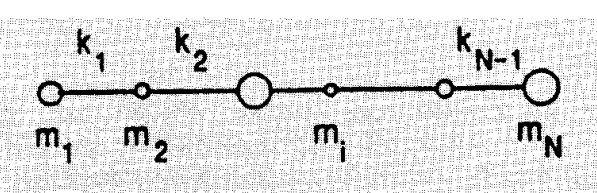
Fig.1. A linear molecule with \(N\) atoms.
Use the following facts when solving this problem: The longitudinal vibrational motion of a linear molecule consists of a superposition of separate vibrational motions called normal vibrations, or normal modes. In a normal mode all atoms vibrate in simple harmonic motion with the same frequency and pass through their equilibrium positions simultaneously.
Questions
1) Let \(x_i\) be the displacement of atom \(i\) from its equilibrium position. Express the force \(F_i\) acting on each atom as a function of the displacements \(x_1, x_2, \ldots, x_N\) and the spring constants \(k_1, k_2, \ldots, k_{N-1}\). What relationship is there among the forces \(F_1, F_2, \ldots, F_N\)? Using this relationship, derive a relationship between the displacements \(x_1, x_2, \ldots, x_N\) and give a physical interpretation of this relationship.
2) Analyze the motion of a diatomic molecule AB (Fig. 2). The value of the spring constant is \(k\). Derive an expression for the forces acting on atoms A and B. Determine the possible types of motion of the molecule. Determine the corresponding vibrational frequencies and interpret the result. In particular, how is it possible for the atoms to vibrate with the same frequency even though their masses are not the same?
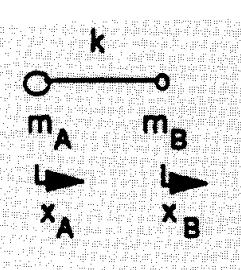
Fig.2. The diatomic molecule AB
3) Analyze the motion of the triatomic molecule \(\mathrm{BA_2}\) (Fig. 3)
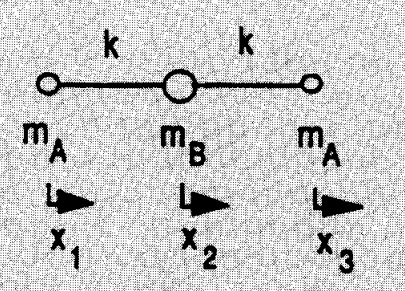
Fig.3. The triatomic molecule \(\mathrm{BA_2}\).
Express the net force on each atom as a function of its displacement only. Deduce the possible motions of the molecule and the corresponding vibrational frequencies.
4) The frequencies of the two longitudinal modes of vibration of the \(\mathrm{CO_2}\) molecule are \(3.998\times10^{13}\ \mathrm{Hz}\) and \(7.042\times10^{13}\ \mathrm{Hz}\), respectively. Determine a numerical value for the spring constant of the CO bond.
How well do you think this approximation for the bond structure of the molecule describes the vibrational motion of the real molecule?
The atomic mass of the carbon atom = \(12\ \mathrm{amu}\) and that of the oxygen atom = \(16\ \mathrm{amu}\). The atomic mass unit = \(1.660\times10^{-27}\ \mathrm{kg}\).
Official English text of the problem.
Answers
-
The forces are \[ \boxed{ \begin{aligned} F_1&=k_1(x_2-x_1),\\ F_i&=k_i(x_{i+1}-x_i)-k_{i-1}(x_i-x_{i-1}), &&2\leq i\leq N-1,\\ F_N&=-k_{N-1}(x_N-x_{N-1}). \end{aligned}} \] They satisfy \(\sum_iF_i=0\), hence \[ \sum_i m_i x_i=C_0+C_1t. \] The center of mass moves uniformly. For internal vibrations measured in its rest frame, \[ \boxed{\sum_i m_i x_i=0.} \]
-
For AB, \[ \boxed{F_A=k(x_B-x_A),\qquad F_B=k(x_A-x_B).} \] There is rigid translation with zero frequency and one internal vibrational mode: \[ \boxed{ f=\frac{1}{2\pi}\sqrt{k\left(\frac1{m_A}+\frac1{m_B}\right)} =\frac{1}{2\pi}\sqrt{\frac{k}{\mu}}, \qquad \mu=\frac{m_Am_B}{m_A+m_B}.} \] In this vibration, \(m_Ax_A=-m_Bx_B\): the atoms move in opposite directions, with amplitudes inversely proportional to their masses.
-
For \(\mathrm{BA_2}\), the normal modes are:
| Motion | Displacement ratios \(x_1:x_2:x_3\) | Frequency |
|---|---|---|
| Rigid translation | \(1:1:1\) | \(0\) |
| Symmetric stretch | \(1:0:-1\) | \(\displaystyle f_s=\frac1{2\pi}\sqrt{\frac{k}{m_A}}\) |
| Asymmetric stretch | \(\displaystyle 1:-\frac{2m_A}{m_B}:1\) | \(\displaystyle f_a=\frac1{2\pi}\sqrt{k\left(\frac1{m_A}+\frac2{m_B}\right)}\) |
In the symmetric stretch, \[ \boxed{F_1=-kx_1,\qquad F_2=0,\qquad F_3=-kx_3.} \] In the asymmetric stretch, \[ \boxed{ \begin{aligned} F_1&=-k\left(1+\frac{2m_A}{m_B}\right)x_1,\\ F_2&=-k\left(2+\frac{m_B}{m_A}\right)x_2,\\ F_3&=-k\left(1+\frac{2m_A}{m_B}\right)x_3. \end{aligned}} \] General motion is a superposition of the two vibrations and uniform translation.
- The two measured frequencies separately give \[ \boxed{k_s=1.676\times10^3\ \mathrm{N\,m^{-1}},\qquad k_a=1.418\times10^3\ \mathrm{N\,m^{-1}}.} \] Thus a representative approximate bond stiffness is \(k\approx1.5\times10^3\ \mathrm{N\,m^{-1}}\). No single \(k\) fits both frequencies exactly: the predicted frequency ratio is \(1.915\), whereas the observed ratio is \(1.761\). The model gives a reasonable approximation, with a discrepancy of about \(9\%\) in this ratio.
Solution
1) Forces and the center of mass
Take the same positive direction along the molecular axis for every displacement. The change in length of the spring joining atoms \(i\) and \(i+1\) is \[ \Delta \ell_i=x_{i+1}-x_i. \] The potential energy of the ideal Hookean springs is therefore \[ U=\frac12\sum_{i=1}^{N-1}k_i(x_{i+1}-x_i)^2. \] Using \(F_i=-\partial U/\partial x_i\) gives \[ F_1=k_1(x_2-x_1), \] \[ F_i=k_i(x_{i+1}-x_i)-k_{i-1}(x_i-x_{i-1}), \qquad 2\leq i\leq N-1, \] and \[ F_N=-k_{N-1}(x_N-x_{N-1}). \]
Each spring exerts equal and opposite forces on its two ends. Consequently, \[ \boxed{\sum_{i=1}^{N}F_i=0.} \] Newton’s second law then gives \[ \frac{d^2}{dt^2}\left(\sum_i m_ix_i\right)=0, \] so \[ \sum_i m_ix_i=C_0+C_1t. \] Writing \(M_{\mathrm{tot}}=\sum_i m_i\), the center-of-mass displacement is \[ X_{\mathrm{CM}}=\frac{\sum_i m_ix_i}{M_{\mathrm{tot}}}. \] Thus the center of mass has constant velocity, as expected for an isolated system with no external force.
For a nonzero-frequency normal mode, \[ x_i=a_i\cos(\omega t+\phi). \] Since \(\ddot x_i=-\omega^2x_i\), \[ 0=\sum_i m_i\ddot x_i=-\omega^2\sum_i m_ix_i. \] Hence \[ \boxed{\sum_i m_ix_i=0\qquad(\omega\ne0).} \] Internal vibration leaves the center of mass fixed. Uniform translation can be superposed independently.
2) The diatomic molecule AB
The spring extension is \(x_B-x_A\), so \[ m_A\ddot x_A=k(x_B-x_A),\qquad m_B\ddot x_B=-k(x_B-x_A). \]
Introduce the center-of-mass displacement and the relative displacement: \[ X=\frac{m_Ax_A+m_Bx_B}{m_A+m_B}, \qquad q=x_B-x_A. \] Adding the equations of motion gives \[ \ddot X=0. \] Subtracting the accelerations gives \[ \ddot q =-k\left(\frac1{m_A}+\frac1{m_B}\right)q. \] Therefore \[ X=X_0+Vt,\qquad q=Q\cos(\omega t+\phi), \] where \[ \boxed{\omega^2=k\left(\frac1{m_A}+\frac1{m_B}\right)=\frac{k}{\mu}}, \qquad \mu=\frac{m_Am_B}{m_A+m_B}. \]
The complete motion is \[ \boxed{ \begin{aligned} x_A&=X_0+Vt-\frac{m_B}{m_A+m_B}Q\cos(\omega t+\phi),\\ x_B&=X_0+Vt+\frac{m_A}{m_A+m_B}Q\cos(\omega t+\phi). \end{aligned}} \]
There are two independent types of motion:
- Rigid translation: \(q=0\), so \(x_A=x_B=X_0+Vt\). The spring is undeformed and both forces vanish. This is the zero-frequency mode.
- Internal vibration: in the center-of-mass rest frame, \[ m_Ax_A+m_Bx_B=0. \] The atoms oscillate in opposite phase with frequency \[ \boxed{f=\frac{\omega}{2\pi} =\frac1{2\pi}\sqrt{\frac{k}{\mu}}.} \]
To understand the equal frequencies despite unequal masses, eliminate the other atom’s displacement: \[ x_B=-\frac{m_A}{m_B}x_A, \qquad x_A=-\frac{m_B}{m_A}x_B. \] Then \[ F_A=-k\left(1+\frac{m_A}{m_B}\right)x_A, \qquad F_B=-k\left(1+\frac{m_B}{m_A}\right)x_B. \] Dividing each restoring-force coefficient by the corresponding mass gives the same value: \[ \frac{k(1+m_A/m_B)}{m_A} =\frac{k(1+m_B/m_A)}{m_B} =k\left(\frac1{m_A}+\frac1{m_B}\right). \] Thus both atoms have the same angular frequency. Their unequal masses are accommodated by unequal amplitudes: \[ \boxed{\frac{|x_A|_{\max}}{|x_B|_{\max}}=\frac{m_B}{m_A}.} \] The heavier atom has both the smaller displacement amplitude and the smaller acceleration amplitude.
3) The triatomic molecule \(\mathrm{BA_2}\)
Write \(m=m_A\) and \(M=m_B\). Hooke’s law gives \[ \boxed{ \begin{aligned} m\ddot x_1&=k(x_2-x_1),\\ M\ddot x_2&=k(x_1+x_3-2x_2),\\ m\ddot x_3&=k(x_2-x_3). \end{aligned}} \] Rigid translation, \(x_1=x_2=x_3=X_0+Vt\), makes all three forces zero.
For internal vibration, work in the center-of-mass rest frame: \[ m(x_1+x_3)+Mx_2=0. \] Define the average and half-difference of the endpoint displacements: \[ s=\frac{x_1+x_3}{2},\qquad d=\frac{x_1-x_3}{2}. \] Then \[ x_1=s+d,\qquad x_3=s-d,\qquad x_2=-\frac{2m}{M}s. \]
Adding and subtracting the endpoint equations gives \[ m\ddot s=k(x_2-s) =-k\left(1+\frac{2m}{M}\right)s, \] \[ m\ddot d=-kd. \] These are two independent harmonic oscillators, so they identify all internal normal modes.
Symmetric stretching mode. Set \(s=0\). Then \[ x_2=0,\qquad x_1=d,\qquad x_3=-d. \] The middle atom remains stationary, while the outer atoms move with equal amplitudes in opposite directions. Both bonds lengthen together and shorten together.
The forces, expressed using each atom’s own displacement, are \[ F_1=-kx_1,\qquad F_2=0,\qquad F_3=-kx_3. \] Therefore \[ \boxed{\omega_s^2=\frac{k}{m_A},\qquad f_s=\frac1{2\pi}\sqrt{\frac{k}{m_A}}.} \] The central mass does not enter this frequency because the two spring forces on it cancel throughout the motion.
Asymmetric stretching mode. Set \(d=0\). Then \[ x_1=x_3=s,\qquad x_2=-\frac{2m}{M}s. \] The outer atoms move together, and the middle atom moves oppositely. One bond lengthens while the other shortens.
For either outer atom, \[ F_1=k(x_2-x_1) =-k\left(1+\frac{2m}{M}\right)x_1, \] \[ F_3=-k\left(1+\frac{2m}{M}\right)x_3. \] For the middle atom, use \(x_1+x_3=-(M/m)x_2\): \[ F_2=k(x_1+x_3-2x_2) =-k\left(2+\frac{M}{m}\right)x_2. \] All three equations give \[ \boxed{\omega_a^2=k\left(\frac1{m_A}+\frac2{m_B}\right),\qquad f_a=\frac1{2\pi}\sqrt{k\left(\frac1{m_A}+\frac2{m_B}\right)}.} \]
These single-displacement force laws apply to the indicated normal modes. A general superposition obeys the original coupled force equations.
The complete motion can be written \[ \begin{aligned} \begin{pmatrix}x_1\\x_2\\x_3\end{pmatrix} ={}&(X_0+Vt)\begin{pmatrix}1\\1\\1\end{pmatrix}\\ &+A_s\cos(\omega_st+\phi_s) \begin{pmatrix}1\\0\\-1\end{pmatrix}\\ &+A_a\cos(\omega_at+\phi_a) \begin{pmatrix}1\\-2m_A/m_B\\1\end{pmatrix}. \end{aligned} \] Thus there are two longitudinal vibrational modes and one translational mode.
4) Numerical bond stiffness and assessment of the model
For \(\mathrm{CO_2}\), the outer atoms are oxygen and the central atom is carbon: \[ m_A=m_{\mathrm O} =16(1.660\times10^{-27}) =2.656\times10^{-26}\ \mathrm{kg}, \] \[ m_B=m_{\mathrm C} =12(1.660\times10^{-27}) =1.992\times10^{-26}\ \mathrm{kg}. \] Since \(f_a>f_s\), assign \[ f_s=3.998\times10^{13}\ \mathrm{Hz},\qquad f_a=7.042\times10^{13}\ \mathrm{Hz}. \]
From the symmetric mode, \[ k_s=m_{\mathrm O}(2\pi f_s)^2, \] so \[ \boxed{ k_s=(2.656\times10^{-26}) \left[2\pi(3.998\times10^{13})\right]^2 =1.676\times10^3\ \mathrm{N\,m^{-1}}.} \]
From the asymmetric mode, \[ k_a=\frac{(2\pi f_a)^2}{1/m_{\mathrm O}+2/m_{\mathrm C}}, \] so \[ \boxed{k_a=1.418\times10^3\ \mathrm{N\,m^{-1}}.} \]
These estimates place the bond stiffness near \[ \boxed{k\approx1.5\times10^3\ \mathrm{N\,m^{-1}}.} \] Their difference shows that the model cannot reproduce both measured frequencies with a single spring constant.
A direct consistency test, independent of \(k\), is the frequency ratio. The model predicts \[ \frac{f_a}{f_s} =\sqrt{1+\frac{2m_{\mathrm O}}{m_{\mathrm C}}} =\sqrt{1+\frac{32}{12}} =\sqrt{\frac{11}{3}} =1.915. \] The measured ratio is \[ \left(\frac{f_a}{f_s}\right)_{\mathrm{measured}} =\frac{7.042}{3.998} =1.761. \] For example, fitting the lower frequency predicts \[ f_a=1.91485(3.998\times10^{13}) =7.656\times10^{13}\ \mathrm{Hz}, \] which is \(8.71\%\) above the measured upper frequency.
The ideal-spring model therefore gives a reasonable approximate description of the two stretching motions and their frequency scale. Its quantitative accuracy is limited: the real molecular restoring forces can include coupling between the two bond extensions, and departures from Hooke’s law, which this model omits.
The solution was checked against the official solution.
IPhO 1992 · Theorieaufgabe 2
Die Longitudinalbewegung eines linearen Moleküls
In dieser Aufgabe untersuchen Sie die Longitudinalbewegung eines linearen Moleküls, d. h. die Bewegung entlang der Molekülachse. Die Rotationsbewegung und die Biegung des Moleküls werden nicht berücksichtigt. Es wird angenommen, dass das Molekül aus \(N\) Atomen mit den Massen \(m_1, m_2, \ldots, m_N\) besteht. Jedes Atom sei durch eine chemische Bindung mit seinen Nachbarn verbunden. Jede Bindung wird durch eine masselose Feder angenähert, die dem Hookeschen Gesetz gehorcht; die Federkonstanten sind \(k_1, k_2, \ldots, k_{N-1}\). Das Molekül ist in Abb. 1 dargestellt.
Abb. 1. Ein lineares Molekül mit \(N\) Atomen.
Verwenden Sie bei der Lösung dieser Aufgabe die folgenden Tatsachen: Die longitudinale Schwingungsbewegung eines linearen Moleküls besteht aus einer Überlagerung einzelner Schwingungsbewegungen, die als Normalschwingungen oder Normalmoden bezeichnet werden. In einer Normalmode führen alle Atome harmonische Schwingungen mit derselben Frequenz aus und durchlaufen ihre Gleichgewichtslagen gleichzeitig.
Fragen
1) Sei \(x_i\) die Auslenkung des Atoms \(i\) aus seiner Gleichgewichtslage. Drücken Sie die auf jedes Atom wirkende Kraft \(F_i\) als Funktion der Auslenkungen \(x_1, x_2, \ldots, x_N\) und der Federkonstanten \(k_1, k_2, \ldots, k_{N-1}\) aus. Welche Beziehung besteht zwischen den Kräften \(F_1, F_2, \ldots, F_N\)? Leiten Sie mithilfe dieser Beziehung eine Beziehung zwischen den Auslenkungen \(x_1, x_2, \ldots, x_N\) her und geben Sie eine physikalische Deutung dieser Beziehung an.
2) Untersuchen Sie die Bewegung eines zweiatomigen Moleküls AB (Abb. 2). Die Federkonstante hat den Wert \(k\). Leiten Sie einen Ausdruck für die auf die Atome A und B wirkenden Kräfte her. Bestimmen Sie die möglichen Bewegungsarten des Moleküls. Bestimmen Sie die zugehörigen Schwingungsfrequenzen und deuten Sie das Ergebnis. Wie ist es insbesondere möglich, dass die Atome mit derselben Frequenz schwingen, obwohl ihre Massen unterschiedlich sind?
Abb. 2. Das zweiatomige Molekül AB
3) Untersuchen Sie die Bewegung des dreiatomigen Moleküls \(\mathrm{BA_2}\) (Abb. 3)
Abb. 3. Das dreiatomige Molekül \(\mathrm{BA_2}\).
Drücken Sie die resultierende Kraft auf jedes Atom als Funktion ausschließlich seiner eigenen Auslenkung aus. Leiten Sie die möglichen Bewegungen des Moleküls und die zugehörigen Schwingungsfrequenzen ab.
4) Die Frequenzen der beiden longitudinalen Schwingungsmoden des \(\mathrm{CO_2}\)-Moleküls betragen \(3.998\times10^{13}\ \mathrm{Hz}\) bzw. \(7.042\times10^{13}\ \mathrm{Hz}\). Bestimmen Sie einen Zahlenwert für die Federkonstante der CO-Bindung.
Wie gut beschreibt Ihrer Meinung nach diese Näherung für die Bindungsstruktur des Moleküls die Schwingungsbewegung des realen Moleküls?
Die Atommasse des Kohlenstoffatoms = \(12\ \mathrm{amu}\) und die des Sauerstoffatoms = \(16\ \mathrm{amu}\). Die atomare Masseneinheit = \(1.660\times10^{-27}\ \mathrm{kg}\).
Aufgabentext aus dem offiziellen englischen Text übersetzt.
Antworten
-
Die Kräfte lauten \[ \boxed{ \begin{aligned} F_1&=k_1(x_2-x_1),\\ F_i&=k_i(x_{i+1}-x_i)-k_{i-1}(x_i-x_{i-1}), &&2\leq i\leq N-1,\\ F_N&=-k_{N-1}(x_N-x_{N-1}). \end{aligned}} \] Sie erfüllen \(\sum_iF_i=0\), daher gilt \[ \sum_i m_i x_i=C_0+C_1t. \] Der Schwerpunkt bewegt sich gleichförmig. Für innere Schwingungen, die in seinem Ruhesystem gemessen werden, gilt \[ \boxed{\sum_i m_i x_i=0.} \]
-
Für AB gilt \[ \boxed{F_A=k(x_B-x_A),\qquad F_B=k(x_A-x_B).} \] Es gibt eine starre Translation mit der Frequenz null und eine innere Schwingungsmode: \[ \boxed{ f=\frac{1}{2\pi}\sqrt{k\left(\frac1{m_A}+\frac1{m_B}\right)} =\frac{1}{2\pi}\sqrt{\frac{k}{\mu}}, \qquad \mu=\frac{m_Am_B}{m_A+m_B}.} \] Bei dieser Schwingung gilt \(m_Ax_A=-m_Bx_B\): Die Atome bewegen sich in entgegengesetzte Richtungen, wobei ihre Amplituden umgekehrt proportional zu ihren Massen sind.
-
Für \(\mathrm{BA_2}\) ergeben sich die folgenden Normalmoden:
| Bewegung | Auslenkungsverhältnisse \(x_1:x_2:x_3\) | Frequenz |
|---|---|---|
| Starre Translation | \(1:1:1\) | \(0\) |
| Symmetrische Streckschwingung | \(1:0:-1\) | \(\displaystyle f_s=\frac1{2\pi}\sqrt{\frac{k}{m_A}}\) |
| Asymmetrische Streckschwingung | \(\displaystyle 1:-\frac{2m_A}{m_B}:1\) | \(\displaystyle f_a=\frac1{2\pi}\sqrt{k\left(\frac1{m_A}+\frac2{m_B}\right)}\) |
Bei der symmetrischen Streckschwingung gilt \[ \boxed{F_1=-kx_1,\qquad F_2=0,\qquad F_3=-kx_3.} \] Bei der asymmetrischen Streckschwingung gilt \[ \boxed{ \begin{aligned} F_1&=-k\left(1+\frac{2m_A}{m_B}\right)x_1,\\ F_2&=-k\left(2+\frac{m_B}{m_A}\right)x_2,\\ F_3&=-k\left(1+\frac{2m_A}{m_B}\right)x_3. \end{aligned}} \] Die allgemeine Bewegung ist eine Überlagerung der beiden Schwingungen und einer gleichförmigen Translation.
- Aus den beiden gemessenen Frequenzen erhält man jeweils \[ \boxed{k_s=1.676\times10^3\ \mathrm{N\,m^{-1}},\qquad k_a=1.418\times10^3\ \mathrm{N\,m^{-1}}.} \] Ein repräsentativer Näherungswert für die Bindungssteifigkeit ist somit \(k\approx1.5\times10^3\ \mathrm{N\,m^{-1}}\). Kein einzelner Wert von \(k\) gibt beide Frequenzen exakt wieder: Das vorhergesagte Frequenzverhältnis beträgt \(1.915\), während das beobachtete Verhältnis \(1.761\) beträgt. Das Modell liefert eine brauchbare Näherung mit einer Abweichung von etwa \(9\%\) bei diesem Verhältnis.
Lösung
1) Kräfte und Schwerpunkt
Wählen wir für jede Auslenkung dieselbe positive Richtung entlang der Molekülachse. Die Längenänderung der Feder, die die Atome \(i\) und \(i+1\) verbindet, ist \[ \Delta \ell_i=x_{i+1}-x_i. \] Die potenzielle Energie der idealen Hookeschen Federn beträgt daher \[ U=\frac12\sum_{i=1}^{N-1}k_i(x_{i+1}-x_i)^2. \] Mit \(F_i=-\partial U/\partial x_i\) erhält man \[ F_1=k_1(x_2-x_1), \] \[ F_i=k_i(x_{i+1}-x_i)-k_{i-1}(x_i-x_{i-1}), \qquad 2\leq i\leq N-1, \] und \[ F_N=-k_{N-1}(x_N-x_{N-1}). \]
Jede Feder übt an ihren beiden Enden gleich große, entgegengesetzt gerichtete Kräfte aus. Folglich gilt \[ \boxed{\sum_{i=1}^{N}F_i=0.} \] Aus dem zweiten Newtonschen Gesetz folgt dann \[ \frac{d^2}{dt^2}\left(\sum_i m_ix_i\right)=0, \] also \[ \sum_i m_ix_i=C_0+C_1t. \] Mit der Bezeichnung \(M_{\mathrm{tot}}=\sum_i m_i\) ist die Verschiebung des Schwerpunkts \[ X_{\mathrm{CM}}=\frac{\sum_i m_ix_i}{M_{\mathrm{tot}}}. \] Der Schwerpunkt hat somit eine konstante Geschwindigkeit, wie es für ein isoliertes System ohne äußere Kraft zu erwarten ist.
Für eine Normalmode mit einer von null verschiedenen Frequenz gilt \[ x_i=a_i\cos(\omega t+\phi). \] Da \(\ddot x_i=-\omega^2x_i\), gilt \[ 0=\sum_i m_i\ddot x_i=-\omega^2\sum_i m_ix_i. \] Daher folgt \[ \boxed{\sum_i m_ix_i=0\qquad(\omega\ne0).} \] Bei einer inneren Schwingung bleibt der Schwerpunkt in Ruhe. Eine gleichförmige Translation kann unabhängig davon überlagert werden.
2) Das zweiatomige Molekül AB
Die Federdehnung beträgt \(x_B-x_A\), also gilt \[ m_A\ddot x_A=k(x_B-x_A),\qquad m_B\ddot x_B=-k(x_B-x_A). \]
Wir führen die Verschiebung des Schwerpunkts und die relative Auslenkung ein: \[ X=\frac{m_Ax_A+m_Bx_B}{m_A+m_B}, \qquad q=x_B-x_A. \] Die Addition der Bewegungsgleichungen ergibt \[ \ddot X=0. \] Die Subtraktion der Beschleunigungen ergibt \[ \ddot q =-k\left(\frac1{m_A}+\frac1{m_B}\right)q. \] Damit gilt \[ X=X_0+Vt,\qquad q=Q\cos(\omega t+\phi), \] wobei \[ \boxed{\omega^2=k\left(\frac1{m_A}+\frac1{m_B}\right)=\frac{k}{\mu}}, \qquad \mu=\frac{m_Am_B}{m_A+m_B}. \]
Die vollständige Bewegung lautet \[ \boxed{ \begin{aligned} x_A&=X_0+Vt-\frac{m_B}{m_A+m_B}Q\cos(\omega t+\phi),\\ x_B&=X_0+Vt+\frac{m_A}{m_A+m_B}Q\cos(\omega t+\phi). \end{aligned}} \]
Es gibt zwei unabhängige Bewegungsarten:
- Starre Translation: \(q=0\), also \(x_A=x_B=X_0+Vt\). Die Feder ist unverformt, und beide Kräfte verschwinden. Dies ist die Mode mit der Frequenz null.
- Innere Schwingung: Im Ruhesystem des Schwerpunkts gilt \[ m_Ax_A+m_Bx_B=0. \] Die Atome schwingen gegenphasig mit der Frequenz \[ \boxed{f=\frac{\omega}{2\pi} =\frac1{2\pi}\sqrt{\frac{k}{\mu}}.} \]
Um zu verstehen, warum die Frequenzen trotz unterschiedlicher Massen gleich sind, eliminieren wir jeweils die Auslenkung des anderen Atoms: \[ x_B=-\frac{m_A}{m_B}x_A, \qquad x_A=-\frac{m_B}{m_A}x_B. \] Dann gilt \[ F_A=-k\left(1+\frac{m_A}{m_B}\right)x_A, \qquad F_B=-k\left(1+\frac{m_B}{m_A}\right)x_B. \] Dividiert man jeden Rückstellkraftkoeffizienten durch die zugehörige Masse, erhält man denselben Wert: \[ \frac{k(1+m_A/m_B)}{m_A} =\frac{k(1+m_B/m_A)}{m_B} =k\left(\frac1{m_A}+\frac1{m_B}\right). \] Beide Atome haben somit dieselbe Kreisfrequenz. Ihren unterschiedlichen Massen entsprechen unterschiedliche Amplituden: \[ \boxed{\frac{|x_A|_{\max}}{|x_B|_{\max}}=\frac{m_B}{m_A}.} \] Das schwerere Atom hat sowohl die kleinere Auslenkungsamplitude als auch die kleinere Beschleunigungsamplitude.
3) Das dreiatomige Molekül \(\mathrm{BA_2}\)
Wir schreiben \(m=m_A\) und \(M=m_B\). Das Hookesche Gesetz liefert \[ \boxed{ \begin{aligned} m\ddot x_1&=k(x_2-x_1),\\ M\ddot x_2&=k(x_1+x_3-2x_2),\\ m\ddot x_3&=k(x_2-x_3). \end{aligned}} \] Bei einer starren Translation, \(x_1=x_2=x_3=X_0+Vt\), verschwinden alle drei Kräfte.
Für die innere Schwingung betrachten wir das Ruhesystem des Schwerpunkts: \[ m(x_1+x_3)+Mx_2=0. \] Wir definieren den Mittelwert und die halbe Differenz der Auslenkungen der äußeren Atome: \[ s=\frac{x_1+x_3}{2},\qquad d=\frac{x_1-x_3}{2}. \] Dann gilt \[ x_1=s+d,\qquad x_3=s-d,\qquad x_2=-\frac{2m}{M}s. \]
Addition und Subtraktion der Gleichungen für die äußeren Atome ergeben \[ m\ddot s=k(x_2-s) =-k\left(1+\frac{2m}{M}\right)s, \] \[ m\ddot d=-kd. \] Dies sind zwei unabhängige harmonische Oszillatoren; damit sind alle inneren Normalmoden bestimmt.
Symmetrische Streckschwingungsmode. Wir setzen \(s=0\). Dann gilt \[ x_2=0,\qquad x_1=d,\qquad x_3=-d. \] Das mittlere Atom bleibt in Ruhe, während sich die äußeren Atome mit gleichen Amplituden in entgegengesetzte Richtungen bewegen. Beide Bindungen verlängern und verkürzen sich jeweils gemeinsam.
Die Kräfte, jeweils durch die eigene Auslenkung des Atoms ausgedrückt, lauten \[ F_1=-kx_1,\qquad F_2=0,\qquad F_3=-kx_3. \] Daher gilt \[ \boxed{\omega_s^2=\frac{k}{m_A},\qquad f_s=\frac1{2\pi}\sqrt{\frac{k}{m_A}}.} \] Die Masse des mittleren Atoms geht nicht in diese Frequenz ein, da sich die beiden auf dieses Atom wirkenden Federkräfte während der gesamten Bewegung aufheben.
Asymmetrische Streckschwingungsmode. Wir setzen \(d=0\). Dann gilt \[ x_1=x_3=s,\qquad x_2=-\frac{2m}{M}s. \] Die äußeren Atome bewegen sich gemeinsam, und das mittlere Atom bewegt sich entgegengesetzt. Eine Bindung verlängert sich, während sich die andere verkürzt.
Für die beiden äußeren Atome gilt jeweils \[ F_1=k(x_2-x_1) =-k\left(1+\frac{2m}{M}\right)x_1, \] \[ F_3=-k\left(1+\frac{2m}{M}\right)x_3. \] Für das mittlere Atom verwenden wir \(x_1+x_3=-(M/m)x_2\): \[ F_2=k(x_1+x_3-2x_2) =-k\left(2+\frac{M}{m}\right)x_2. \] Alle drei Gleichungen liefern \[ \boxed{\omega_a^2=k\left(\frac1{m_A}+\frac2{m_B}\right),\qquad f_a=\frac1{2\pi}\sqrt{k\left(\frac1{m_A}+\frac2{m_B}\right)}.} \]
Diese Kraftgesetze, die jeweils nur eine Auslenkung enthalten, gelten für die angegebenen Normalmoden. Eine allgemeine Überlagerung gehorcht den ursprünglichen gekoppelten Kraftgleichungen.
Die vollständige Bewegung lässt sich schreiben als \[ \begin{aligned} \begin{pmatrix}x_1\\x_2\\x_3\end{pmatrix} ={}&(X_0+Vt)\begin{pmatrix}1\\1\\1\end{pmatrix}\\ &+A_s\cos(\omega_st+\phi_s) \begin{pmatrix}1\\0\\-1\end{pmatrix}\\ &+A_a\cos(\omega_at+\phi_a) \begin{pmatrix}1\\-2m_A/m_B\\1\end{pmatrix}. \end{aligned} \] Es gibt somit zwei longitudinale Schwingungsmoden und eine Translationsmode.
4) Numerischer Wert der Bindungssteifigkeit und Beurteilung des Modells
Bei \(\mathrm{CO_2}\) sind die äußeren Atome Sauerstoffatome und das mittlere Atom ein Kohlenstoffatom: \[ m_A=m_{\mathrm O} =16(1.660\times10^{-27}) =2.656\times10^{-26}\ \mathrm{kg}, \] \[ m_B=m_{\mathrm C} =12(1.660\times10^{-27}) =1.992\times10^{-26}\ \mathrm{kg}. \] Da \(f_a>f_s\), ordnen wir zu: \[ f_s=3.998\times10^{13}\ \mathrm{Hz},\qquad f_a=7.042\times10^{13}\ \mathrm{Hz}. \]
Aus der symmetrischen Mode folgt \[ k_s=m_{\mathrm O}(2\pi f_s)^2, \] also \[ \boxed{ k_s=(2.656\times10^{-26}) \left[2\pi(3.998\times10^{13})\right]^2 =1.676\times10^3\ \mathrm{N\,m^{-1}}.} \]
Aus der asymmetrischen Mode folgt \[ k_a=\frac{(2\pi f_a)^2}{1/m_{\mathrm O}+2/m_{\mathrm C}}, \] also \[ \boxed{k_a=1.418\times10^3\ \mathrm{N\,m^{-1}}.} \]
Diese Abschätzungen ergeben eine Bindungssteifigkeit in der Nähe von \[ \boxed{k\approx1.5\times10^3\ \mathrm{N\,m^{-1}}.} \] Ihr Unterschied zeigt, dass das Modell nicht beide gemessenen Frequenzen mit einer einzigen Federkonstante wiedergeben kann.
Eine direkte, von \(k\) unabhängige Konsistenzprüfung bietet das Frequenzverhältnis. Das Modell sagt voraus: \[ \frac{f_a}{f_s} =\sqrt{1+\frac{2m_{\mathrm O}}{m_{\mathrm C}}} =\sqrt{1+\frac{32}{12}} =\sqrt{\frac{11}{3}} =1.915. \] Das gemessene Verhältnis beträgt \[ \left(\frac{f_a}{f_s}\right)_{\mathrm{measured}} =\frac{7.042}{3.998} =1.761. \] Passt man beispielsweise das Modell an die niedrigere Frequenz an, so sagt es voraus: \[ f_a=1.91485(3.998\times10^{13}) =7.656\times10^{13}\ \mathrm{Hz}, \] was um \(8.71\%\) über der gemessenen höheren Frequenz liegt.
Das Modell idealer Federn liefert somit eine brauchbare näherungsweise Beschreibung der beiden Streckschwingungen und der Größenordnung ihrer Frequenzen. Seine quantitative Genauigkeit ist begrenzt: Die tatsächlichen molekularen Rückstellkräfte können eine Kopplung zwischen den beiden Bindungsdehnungen sowie Abweichungen vom Hookeschen Gesetz aufweisen, die dieses Modell nicht berücksichtigt.
Die Lösung wurde mit der offiziellen Lösung abgeglichen.
IPhO 1992 · Teori sorusu 2
Doğrusal Bir Molekülün Boyuna Hareketi
Bu soruda doğrusal bir molekülün boyuna hareketini, yani molekül ekseni boyunca hareketini inceleyeceksiniz. Molekülün dönme hareketi ve bükülmesi dikkate alınmamaktadır. Molekülün, kütleleri sırasıyla \(m_1, m_2, \ldots, m_N\) olan \(N\) atomdan oluştuğu varsayılmaktadır. Her atomun komşularına bir kimyasal bağla bağlı olduğu kabul edilmektedir. Her bağ, Hooke yasasına uyan kütlesiz bir yayla modellenmektedir; yay sabitleri \(k_1, k_2, \ldots, k_{N-1}\) değerlerindedir. Molekül Şekil 1'de gösterilmiştir.
Şekil 1. \(N\) atomlu doğrusal bir molekül.
Bu soruyu çözerken şu bilgilerden yararlanın: Doğrusal bir molekülün boyuna titreşim hareketi, normal titreşimler veya normal modlar olarak adlandırılan ayrı titreşim hareketlerinin üst üste binmesinden oluşur. Bir normal modda bütün atomlar aynı frekansta basit harmonik hareket yapar ve denge konumlarından aynı anda geçer.
Sorular
1) \(x_i\), \(i\) atomunun denge konumundan yer değiştirmesi olsun. Her atoma etki eden \(F_i\) kuvvetini, \(x_1, x_2, \ldots, x_N\) yer değiştirmelerinin ve \(k_1, k_2, \ldots, k_{N-1}\) yay sabitlerinin fonksiyonu olarak ifade edin. \(F_1, F_2, \ldots, F_N\) kuvvetleri arasında nasıl bir bağıntı vardır? Bu bağıntıyı kullanarak \(x_1, x_2, \ldots, x_N\) yer değiştirmeleri arasında bir bağıntı türetin ve bu bağıntının fiziksel yorumunu yapın.
2) İki atomlu AB molekülünün (Şekil 2) hareketini inceleyin. Yay sabitinin değeri \(k\)'dir. A ve B atomlarına etki eden kuvvetler için bir ifade türetin. Molekülün olası hareket türlerini belirleyin. Bunlara karşılık gelen titreşim frekanslarını belirleyin ve sonucu yorumlayın. Özellikle, kütleleri aynı olmadığı hâlde atomların aynı frekansta titreşmesi nasıl mümkün olur?
Şekil 2. İki atomlu AB molekülü
3) Üç atomlu \(\mathrm{BA_2}\) molekülünün (Şekil 3) hareketini inceleyin.
Şekil 3. Üç atomlu \(\mathrm{BA_2}\) molekülü.
Her atoma etki eden net kuvveti yalnızca o atomun yer değiştirmesinin fonksiyonu olarak ifade edin. Molekülün olası hareketlerini ve bunlara karşılık gelen titreşim frekanslarını çıkarın.
4) \(\mathrm{CO_2}\) molekülünün iki boyuna titreşim modunun frekansları sırasıyla \(3.998\times10^{13}\ \mathrm{Hz}\) ve \(7.042\times10^{13}\ \mathrm{Hz}\)'dir. CO bağının yay sabiti için sayısal bir değer belirleyin.
Molekülün bağ yapısı için kullanılan bu yaklaşımın, gerçek molekülün titreşim hareketini ne ölçüde iyi betimlediğini düşünüyorsunuz?
Karbon atomunun atom kütlesi = \(12\ \mathrm{amu}\) ve oksijen atomunun atom kütlesi = \(16\ \mathrm{amu}\). Atomik kütle birimi = \(1.660\times10^{-27}\ \mathrm{kg}\).
Soru metni resmi İngilizce metinden çevrilmiştir.
Cevaplar
-
Kuvvetler şöyledir: \[ \boxed{ \begin{aligned} F_1&=k_1(x_2-x_1),\\ F_i&=k_i(x_{i+1}-x_i)-k_{i-1}(x_i-x_{i-1}), &&2\leq i\leq N-1,\\ F_N&=-k_{N-1}(x_N-x_{N-1}). \end{aligned}} \] Bu kuvvetler \(\sum_iF_i=0\) bağıntısını sağlar; dolayısıyla \[ \sum_i m_i x_i=C_0+C_1t. \] Kütle merkezi sabit hızla hareket eder. Kütle merkezinin durgun olduğu referans sisteminde ölçülen iç titreşimler için \[ \boxed{\sum_i m_i x_i=0.} \]
-
AB için \[ \boxed{F_A=k(x_B-x_A),\qquad F_B=k(x_A-x_B).} \] Sıfır frekanslı bir rijit öteleme ve bir iç titreşim modu vardır: \[ \boxed{ f=\frac{1}{2\pi}\sqrt{k\left(\frac1{m_A}+\frac1{m_B}\right)} =\frac{1}{2\pi}\sqrt{\frac{k}{\mu}}, \qquad \mu=\frac{m_Am_B}{m_A+m_B}.} \] Bu titreşimde \(m_Ax_A=-m_Bx_B\) olur: atomlar zıt yönlerde, kütleleriyle ters orantılı genliklerle hareket eder.
-
\(\mathrm{BA_2}\) için normal modlar şunlardır:
| Hareket | Yer değiştirme oranları \(x_1:x_2:x_3\) | Frekans |
|---|---|---|
| Rijit öteleme | \(1:1:1\) | \(0\) |
| Simetrik gerilme | \(1:0:-1\) | \(\displaystyle f_s=\frac1{2\pi}\sqrt{\frac{k}{m_A}}\) |
| Asimetrik gerilme | \(\displaystyle 1:-\frac{2m_A}{m_B}:1\) | \(\displaystyle f_a=\frac1{2\pi}\sqrt{k\left(\frac1{m_A}+\frac2{m_B}\right)}\) |
Simetrik gerilmede \[ \boxed{F_1=-kx_1,\qquad F_2=0,\qquad F_3=-kx_3.} \] Asimetrik gerilmede \[ \boxed{ \begin{aligned} F_1&=-k\left(1+\frac{2m_A}{m_B}\right)x_1,\\ F_2&=-k\left(2+\frac{m_B}{m_A}\right)x_2,\\ F_3&=-k\left(1+\frac{2m_A}{m_B}\right)x_3. \end{aligned}} \] Genel hareket, bu iki titreşimin ve sabit hızlı ötelemenin üst üste binmesidir.
- Ölçülen iki frekans ayrı ayrı şu değerleri verir: \[ \boxed{k_s=1.676\times10^3\ \mathrm{N\,m^{-1}},\qquad k_a=1.418\times10^3\ \mathrm{N\,m^{-1}}.} \] Dolayısıyla bağın esneklik sabiti için temsili bir yaklaşık değer \(k\approx1.5\times10^3\ \mathrm{N\,m^{-1}}\)'dir. Tek bir \(k\) değeri her iki frekansla da tam olarak uyuşmaz: öngörülen frekans oranı \(1.915\) iken gözlenen oran \(1.761\)'dir. Model, bu oranda yaklaşık \(9\%\)'luk bir sapmayla makul bir yaklaşım sağlar.
Çözüm
1) Kuvvetler ve kütle merkezi
Bütün yer değiştirmeler için molekül ekseni boyunca aynı pozitif yönü seçelim. \(i\) ve \(i+1\) atomlarını birleştiren yayın uzunluğundaki değişim \[ \Delta \ell_i=x_{i+1}-x_i. \] olur. Dolayısıyla Hooke yasasına uyan ideal yayların potansiyel enerjisi \[ U=\frac12\sum_{i=1}^{N-1}k_i(x_{i+1}-x_i)^2. \] şeklindedir. \(F_i=-\partial U/\partial x_i\) kullanılarak \[ F_1=k_1(x_2-x_1), \] \[ F_i=k_i(x_{i+1}-x_i)-k_{i-1}(x_i-x_{i-1}), \qquad 2\leq i\leq N-1, \] ve \[ F_N=-k_{N-1}(x_N-x_{N-1}). \] elde edilir.
Her yay, iki ucuna eşit büyüklükte ve zıt yönde kuvvetler uygular. Sonuç olarak \[ \boxed{\sum_{i=1}^{N}F_i=0.} \] Newton'ın ikinci yasası buradan \[ \frac{d^2}{dt^2}\left(\sum_i m_ix_i\right)=0, \] sonucunu verir; dolayısıyla \[ \sum_i m_ix_i=C_0+C_1t. \] \(M_{\mathrm{tot}}=\sum_i m_i\) yazılırsa kütle merkezinin yer değiştirmesi \[ X_{\mathrm{CM}}=\frac{\sum_i m_ix_i}{M_{\mathrm{tot}}}. \] olur. Böylece, dış kuvvet etkisinde olmayan yalıtılmış bir sistemden beklendiği gibi, kütle merkezi sabit hıza sahiptir.
Frekansı sıfırdan farklı bir normal mod için \[ x_i=a_i\cos(\omega t+\phi). \] \(\ddot x_i=-\omega^2x_i\) olduğundan \[ 0=\sum_i m_i\ddot x_i=-\omega^2\sum_i m_ix_i. \] Buradan \[ \boxed{\sum_i m_ix_i=0\qquad(\omega\ne0).} \] İç titreşim sırasında kütle merkezi sabit kalır. Sabit hızlı öteleme, bundan bağımsız olarak harekete eklenebilir.
2) İki atomlu AB molekülü
Yayın uzaması \(x_B-x_A\) olduğundan \[ m_A\ddot x_A=k(x_B-x_A),\qquad m_B\ddot x_B=-k(x_B-x_A). \]
Kütle merkezinin yer değiştirmesini ve bağıl yer değiştirmeyi tanımlayalım: \[ X=\frac{m_Ax_A+m_Bx_B}{m_A+m_B}, \qquad q=x_B-x_A. \] Hareket denklemleri toplandığında \[ \ddot X=0. \] elde edilir. İvmaların farkı alındığında \[ \ddot q =-k\left(\frac1{m_A}+\frac1{m_B}\right)q. \] bulunur. Dolayısıyla \[ X=X_0+Vt,\qquad q=Q\cos(\omega t+\phi), \] burada \[ \boxed{\omega^2=k\left(\frac1{m_A}+\frac1{m_B}\right)=\frac{k}{\mu}}, \qquad \mu=\frac{m_Am_B}{m_A+m_B}. \]
Hareketin tamamı şöyledir: \[ \boxed{ \begin{aligned} x_A&=X_0+Vt-\frac{m_B}{m_A+m_B}Q\cos(\omega t+\phi),\\ x_B&=X_0+Vt+\frac{m_A}{m_A+m_B}Q\cos(\omega t+\phi). \end{aligned}} \]
Birbirinden bağımsız iki hareket türü vardır:
- Rijit öteleme: \(q=0\) olduğundan \(x_A=x_B=X_0+Vt\) olur. Yay şekil değiştirmemiştir ve her iki kuvvet de sıfırdır. Bu, sıfır frekanslı moddur.
- İç titreşim: kütle merkezinin durgun olduğu referans sisteminde \[ m_Ax_A+m_Bx_B=0. \] Atomlar zıt fazda, şu frekansla salınır: \[ \boxed{f=\frac{\omega}{2\pi} =\frac1{2\pi}\sqrt{\frac{k}{\mu}}.} \]
Kütlelerin farklı olmasına rağmen frekansların eşit olmasını anlamak için diğer atomun yer değiştirmesini eleyelim: \[ x_B=-\frac{m_A}{m_B}x_A, \qquad x_A=-\frac{m_B}{m_A}x_B. \] O hâlde \[ F_A=-k\left(1+\frac{m_A}{m_B}\right)x_A, \qquad F_B=-k\left(1+\frac{m_B}{m_A}\right)x_B. \] Her geri çağırıcı kuvvet katsayısı ilgili kütleye bölündüğünde aynı değer elde edilir: \[ \frac{k(1+m_A/m_B)}{m_A} =\frac{k(1+m_B/m_A)}{m_B} =k\left(\frac1{m_A}+\frac1{m_B}\right). \] Dolayısıyla her iki atom da aynı açısal frekansa sahiptir. Kütlelerinin farklı olması, genliklerinin farklı olmasıyla dengelenir: \[ \boxed{\frac{|x_A|_{\max}}{|x_B|_{\max}}=\frac{m_B}{m_A}.} \] Daha ağır atomun hem yer değiştirme genliği hem de ivme genliği daha küçüktür.
3) Üç atomlu \(\mathrm{BA_2}\) molekülü
\(m=m_A\) ve \(M=m_B\) yazalım. Hooke yasası şu denklemleri verir: \[ \boxed{ \begin{aligned} m\ddot x_1&=k(x_2-x_1),\\ M\ddot x_2&=k(x_1+x_3-2x_2),\\ m\ddot x_3&=k(x_2-x_3). \end{aligned}} \] Rijit ötelemede, \(x_1=x_2=x_3=X_0+Vt\) olduğunda, her üç kuvvet de sıfır olur.
İç titreşim için kütle merkezinin durgun olduğu referans sisteminde çalışalım: \[ m(x_1+x_3)+Mx_2=0. \] Uçlardaki atomların yer değiştirmelerinin ortalamasını ve farklarının yarısını tanımlayalım: \[ s=\frac{x_1+x_3}{2},\qquad d=\frac{x_1-x_3}{2}. \] O hâlde \[ x_1=s+d,\qquad x_3=s-d,\qquad x_2=-\frac{2m}{M}s. \]
Uçlardaki atomların denklemleri toplanıp çıkarıldığında \[ m\ddot s=k(x_2-s) =-k\left(1+\frac{2m}{M}\right)s, \] \[ m\ddot d=-kd. \] elde edilir. Bunlar birbirinden bağımsız iki harmonik osilatördür; dolayısıyla bütün iç normal modları belirlerler.
Simetrik gerilme modu. \(s=0\) alalım. O hâlde \[ x_2=0,\qquad x_1=d,\qquad x_3=-d. \] Ortadaki atom durgun kalırken dıştaki atomlar eşit genliklerle zıt yönlerde hareket eder. Her iki bağ birlikte uzar ve birlikte kısalır.
Her atomun kendi yer değiştirmesi cinsinden ifade edilen kuvvetler şöyledir: \[ F_1=-kx_1,\qquad F_2=0,\qquad F_3=-kx_3. \] Dolayısıyla \[ \boxed{\omega_s^2=\frac{k}{m_A},\qquad f_s=\frac1{2\pi}\sqrt{\frac{k}{m_A}}.} \] Merkezdeki atomun kütlesi bu frekansta yer almaz; çünkü ona etki eden iki yay kuvveti hareket boyunca birbirini dengeler.
Asimetrik gerilme modu. \(d=0\) alalım. O hâlde \[ x_1=x_3=s,\qquad x_2=-\frac{2m}{M}s. \] Dıştaki atomlar birlikte hareket ederken ortadaki atom zıt yönde hareket eder. Bağlardan biri uzarken diğeri kısalır.
Dıştaki atomların her biri için \[ F_1=k(x_2-x_1) =-k\left(1+\frac{2m}{M}\right)x_1, \] \[ F_3=-k\left(1+\frac{2m}{M}\right)x_3. \] Ortadaki atom için \(x_1+x_3=-(M/m)x_2\) bağıntısını kullanalım: \[ F_2=k(x_1+x_3-2x_2) =-k\left(2+\frac{M}{m}\right)x_2. \] Her üç denklem de şu sonucu verir: \[ \boxed{\omega_a^2=k\left(\frac1{m_A}+\frac2{m_B}\right),\qquad f_a=\frac1{2\pi}\sqrt{k\left(\frac1{m_A}+\frac2{m_B}\right)}.} \]
Tek bir yer değiştirmeye bağlı bu kuvvet yasaları, belirtilen normal modlar için geçerlidir. Genel bir üst üste binme, başlangıçtaki bağlaşık kuvvet denklemlerine uyar.
Hareketin tamamı şöyle yazılabilir: \[ \begin{aligned} \begin{pmatrix}x_1\\x_2\\x_3\end{pmatrix} ={}&(X_0+Vt)\begin{pmatrix}1\\1\\1\end{pmatrix}\\ &+A_s\cos(\omega_st+\phi_s) \begin{pmatrix}1\\0\\-1\end{pmatrix}\\ &+A_a\cos(\omega_at+\phi_a) \begin{pmatrix}1\\-2m_A/m_B\\1\end{pmatrix}. \end{aligned} \] Dolayısıyla iki boyuna titreşim modu ve bir öteleme modu vardır.
4) Bağın esneklik sabitinin sayısal değeri ve modelin değerlendirilmesi
\(\mathrm{CO_2}\) için dıştaki atomlar oksijen, merkezdeki atom ise karbondur: \[ m_A=m_{\mathrm O} =16(1.660\times10^{-27}) =2.656\times10^{-26}\ \mathrm{kg}, \] \[ m_B=m_{\mathrm C} =12(1.660\times10^{-27}) =1.992\times10^{-26}\ \mathrm{kg}. \] \(f_a>f_s\) olduğundan şu eşleştirmeyi yapalım: \[ f_s=3.998\times10^{13}\ \mathrm{Hz},\qquad f_a=7.042\times10^{13}\ \mathrm{Hz}. \]
Simetrik moddan \[ k_s=m_{\mathrm O}(2\pi f_s)^2, \] dolayısıyla \[ \boxed{ k_s=(2.656\times10^{-26}) \left[2\pi(3.998\times10^{13})\right]^2 =1.676\times10^3\ \mathrm{N\,m^{-1}}.} \]
Asimetrik moddan \[ k_a=\frac{(2\pi f_a)^2}{1/m_{\mathrm O}+2/m_{\mathrm C}}, \] dolayısıyla \[ \boxed{k_a=1.418\times10^3\ \mathrm{N\,m^{-1}}.} \]
Bu tahminler, bağın esneklik sabitinin yaklaşık olarak \[ \boxed{k\approx1.5\times10^3\ \mathrm{N\,m^{-1}}.} \] olduğunu gösterir. Aralarındaki fark, modelin tek bir yay sabitiyle ölçülen her iki frekansı da veremediğini gösterir.
\(k\)'den bağımsız, doğrudan bir tutarlılık sınaması frekans oranıdır. Modelin öngörüsü şöyledir: \[ \frac{f_a}{f_s} =\sqrt{1+\frac{2m_{\mathrm O}}{m_{\mathrm C}}} =\sqrt{1+\frac{32}{12}} =\sqrt{\frac{11}{3}} =1.915. \] Ölçülen oran ise \[ \left(\frac{f_a}{f_s}\right)_{\mathrm{measured}} =\frac{7.042}{3.998} =1.761. \] Örneğin, düşük frekansa uyum sağlandığında \[ f_a=1.91485(3.998\times10^{13}) =7.656\times10^{13}\ \mathrm{Hz}, \] öngörülür; bu değer, ölçülen yüksek frekansın \(8.71\%\) üzerindedir.
Dolayısıyla ideal yay modeli, iki gerilme hareketini ve bunların frekans ölçeğini makul bir yaklaşıklıkla betimler. Nicel doğruluğu sınırlıdır: gerçek moleküler geri çağırıcı kuvvetler, iki bağın uzamaları arasındaki bağlaşımı ve Hooke yasasından sapmaları içerebilir; bu model bunları dikkate almaz.
Çözüm, resmi çözümle karşılaştırılarak kontrol edildi.
IPhO 1992 · Problema teórico 2
El movimiento longitudinal de una molécula lineal
En este problema analizará el movimiento longitudinal de una molécula lineal, es decir, el movimiento a lo largo del eje molecular. No se consideran el movimiento de rotación ni la flexión de la molécula. Se supone que la molécula consta de \(N\) átomos de masas \(m_1, m_2, \ldots, m_N\), respectivamente. Se supone que cada átomo está unido a sus vecinos mediante un enlace químico. Cada enlace se aproxima mediante un resorte sin masa que obedece la ley de Hooke, con constantes elásticas \(k_1, k_2, \ldots, k_{N-1}\). La molécula se muestra en la Fig. 1.
Fig.1. Una molécula lineal con \(N\) átomos.
Utilice los siguientes hechos para resolver este problema: el movimiento vibratorio longitudinal de una molécula lineal consiste en una superposición de movimientos vibratorios independientes denominados vibraciones normales o modos normales. En un modo normal, todos los átomos vibran con movimiento armónico simple a la misma frecuencia y pasan simultáneamente por sus posiciones de equilibrio.
Preguntas
1) Sea \(x_i\) el desplazamiento del átomo \(i\) respecto de su posición de equilibrio. Exprese la fuerza \(F_i\) que actúa sobre cada átomo en función de los desplazamientos \(x_1, x_2, \ldots, x_N\) y de las constantes elásticas \(k_1, k_2, \ldots, k_{N-1}\). ¿Qué relación existe entre las fuerzas \(F_1, F_2, \ldots, F_N\)? Utilizando esta relación, deduzca una relación entre los desplazamientos \(x_1, x_2, \ldots, x_N\) y dé una interpretación física de esta relación.
2) Analice el movimiento de una molécula diatómica AB (Fig. 2). El valor de la constante elástica es \(k\). Deduzca una expresión para las fuerzas que actúan sobre los átomos A y B. Determine los tipos de movimiento posibles de la molécula. Determine las frecuencias de vibración correspondientes e interprete el resultado. En particular, ¿cómo es posible que los átomos vibren con la misma frecuencia aunque sus masas sean distintas?
Fig.2. La molécula diatómica AB
3) Analice el movimiento de la molécula triatómica \(\mathrm{BA_2}\) (Fig. 3)
Fig.3. La molécula triatómica \(\mathrm{BA_2}\).
Exprese la fuerza neta sobre cada átomo únicamente en función de su propio desplazamiento. Deduzca los movimientos posibles de la molécula y las frecuencias de vibración correspondientes.
4) Las frecuencias de los dos modos longitudinales de vibración de la molécula de \(\mathrm{CO_2}\) son \(3.998\times10^{13}\ \mathrm{Hz}\) y \(7.042\times10^{13}\ \mathrm{Hz}\), respectivamente. Determine un valor numérico para la constante elástica del enlace CO.
¿En qué medida cree que esta aproximación de la estructura de enlaces de la molécula describe el movimiento vibratorio de la molécula real?
La masa atómica del átomo de carbono = \(12\ \mathrm{amu}\) y la del átomo de oxígeno = \(16\ \mathrm{amu}\). La unidad de masa atómica = \(1.660\times10^{-27}\ \mathrm{kg}\).
Enunciado traducido del texto oficial en inglés.
Respuestas
-
Las fuerzas son \[ \boxed{ \begin{aligned} F_1&=k_1(x_2-x_1),\\ F_i&=k_i(x_{i+1}-x_i)-k_{i-1}(x_i-x_{i-1}), &&2\leq i\leq N-1,\\ F_N&=-k_{N-1}(x_N-x_{N-1}). \end{aligned}} \] Satisfacen \(\sum_iF_i=0\), por lo que \[ \sum_i m_i x_i=C_0+C_1t. \] El centro de masas se mueve uniformemente. Para las vibraciones internas medidas en su sistema de referencia en reposo, \[ \boxed{\sum_i m_i x_i=0.} \]
-
Para AB, \[ \boxed{F_A=k(x_B-x_A),\qquad F_B=k(x_A-x_B).} \] Hay una traslación rígida de frecuencia nula y un modo de vibración interna: \[ \boxed{ f=\frac{1}{2\pi}\sqrt{k\left(\frac1{m_A}+\frac1{m_B}\right)} =\frac{1}{2\pi}\sqrt{\frac{k}{\mu}}, \qquad \mu=\frac{m_Am_B}{m_A+m_B}.} \] En esta vibración, \(m_Ax_A=-m_Bx_B\): los átomos se mueven en sentidos opuestos, con amplitudes inversamente proporcionales a sus masas.
-
Para \(\mathrm{BA_2}\), los modos normales son:
| Movimiento | Proporciones entre desplazamientos \(x_1:x_2:x_3\) | Frecuencia |
|---|---|---|
| Traslación rígida | \(1:1:1\) | \(0\) |
| Estiramiento simétrico | \(1:0:-1\) | \(\displaystyle f_s=\frac1{2\pi}\sqrt{\frac{k}{m_A}}\) |
| Estiramiento asimétrico | \(\displaystyle 1:-\frac{2m_A}{m_B}:1\) | \(\displaystyle f_a=\frac1{2\pi}\sqrt{k\left(\frac1{m_A}+\frac2{m_B}\right)}\) |
En el estiramiento simétrico, \[ \boxed{F_1=-kx_1,\qquad F_2=0,\qquad F_3=-kx_3.} \] En el estiramiento asimétrico, \[ \boxed{ \begin{aligned} F_1&=-k\left(1+\frac{2m_A}{m_B}\right)x_1,\\ F_2&=-k\left(2+\frac{m_B}{m_A}\right)x_2,\\ F_3&=-k\left(1+\frac{2m_A}{m_B}\right)x_3. \end{aligned}} \] El movimiento general es una superposición de las dos vibraciones y una traslación uniforme.
- Las dos frecuencias medidas dan, por separado, \[ \boxed{k_s=1.676\times10^3\ \mathrm{N\,m^{-1}},\qquad k_a=1.418\times10^3\ \mathrm{N\,m^{-1}}.} \] Por tanto, un valor aproximado representativo de la rigidez del enlace es \(k\approx1.5\times10^3\ \mathrm{N\,m^{-1}}\). Ningún valor único de \(k\) reproduce exactamente ambas frecuencias: el cociente de frecuencias predicho es \(1.915\), mientras que el cociente observado es \(1.761\). El modelo proporciona una aproximación razonable, con una discrepancia de alrededor del \(9\%\) en este cociente.
Solución
1) Fuerzas y centro de masas
Tómese el mismo sentido positivo a lo largo del eje molecular para todos los desplazamientos. La variación de longitud del resorte que une los átomos \(i\) e \(i+1\) es \[ \Delta \ell_i=x_{i+1}-x_i. \] Por tanto, la energía potencial de los resortes ideales que obedecen la ley de Hooke es \[ U=\frac12\sum_{i=1}^{N-1}k_i(x_{i+1}-x_i)^2. \] Al utilizar \(F_i=-\partial U/\partial x_i\), se obtiene \[ F_1=k_1(x_2-x_1), \] \[ F_i=k_i(x_{i+1}-x_i)-k_{i-1}(x_i-x_{i-1}), \qquad 2\leq i\leq N-1, \] y \[ F_N=-k_{N-1}(x_N-x_{N-1}). \]
Cada resorte ejerce fuerzas iguales y opuestas en sus dos extremos. En consecuencia, \[ \boxed{\sum_{i=1}^{N}F_i=0.} \] La segunda ley de Newton da entonces \[ \frac{d^2}{dt^2}\left(\sum_i m_ix_i\right)=0, \] de modo que \[ \sum_i m_ix_i=C_0+C_1t. \] Escribiendo \(M_{\mathrm{tot}}=\sum_i m_i\), el desplazamiento del centro de masas es \[ X_{\mathrm{CM}}=\frac{\sum_i m_ix_i}{M_{\mathrm{tot}}}. \] Así, el centro de masas tiene velocidad constante, como cabe esperar de un sistema aislado sin fuerzas externas.
Para un modo normal de frecuencia no nula, \[ x_i=a_i\cos(\omega t+\phi). \] Como \(\ddot x_i=-\omega^2x_i\), \[ 0=\sum_i m_i\ddot x_i=-\omega^2\sum_i m_ix_i. \] Por tanto, \[ \boxed{\sum_i m_ix_i=0\qquad(\omega\ne0).} \] La vibración interna deja fijo el centro de masas. Se puede superponer de forma independiente una traslación uniforme.
2) La molécula diatómica AB
El alargamiento del resorte es \(x_B-x_A\), por lo que \[ m_A\ddot x_A=k(x_B-x_A),\qquad m_B\ddot x_B=-k(x_B-x_A). \]
Introduzcamos el desplazamiento del centro de masas y el desplazamiento relativo: \[ X=\frac{m_Ax_A+m_Bx_B}{m_A+m_B}, \qquad q=x_B-x_A. \] Al sumar las ecuaciones de movimiento, se obtiene \[ \ddot X=0. \] Al restar las aceleraciones, se obtiene \[ \ddot q =-k\left(\frac1{m_A}+\frac1{m_B}\right)q. \] Por tanto, \[ X=X_0+Vt,\qquad q=Q\cos(\omega t+\phi), \] donde \[ \boxed{\omega^2=k\left(\frac1{m_A}+\frac1{m_B}\right)=\frac{k}{\mu}}, \qquad \mu=\frac{m_Am_B}{m_A+m_B}. \]
El movimiento completo es \[ \boxed{ \begin{aligned} x_A&=X_0+Vt-\frac{m_B}{m_A+m_B}Q\cos(\omega t+\phi),\\ x_B&=X_0+Vt+\frac{m_A}{m_A+m_B}Q\cos(\omega t+\phi). \end{aligned}} \]
Hay dos tipos independientes de movimiento:
- Traslación rígida: \(q=0\), de modo que \(x_A=x_B=X_0+Vt\). El resorte no está deformado y ambas fuerzas se anulan. Este es el modo de frecuencia nula.
- Vibración interna: en el sistema de referencia en el que el centro de masas está en reposo, \[ m_Ax_A+m_Bx_B=0. \] Los átomos oscilan en oposición de fase con frecuencia \[ \boxed{f=\frac{\omega}{2\pi} =\frac1{2\pi}\sqrt{\frac{k}{\mu}}.} \]
Para comprender por qué las frecuencias son iguales pese a que las masas son distintas, eliminemos el desplazamiento del otro átomo: \[ x_B=-\frac{m_A}{m_B}x_A, \qquad x_A=-\frac{m_B}{m_A}x_B. \] Entonces \[ F_A=-k\left(1+\frac{m_A}{m_B}\right)x_A, \qquad F_B=-k\left(1+\frac{m_B}{m_A}\right)x_B. \] Al dividir cada coeficiente de la fuerza recuperadora entre la masa correspondiente, se obtiene el mismo valor: \[ \frac{k(1+m_A/m_B)}{m_A} =\frac{k(1+m_B/m_A)}{m_B} =k\left(\frac1{m_A}+\frac1{m_B}\right). \] Por tanto, ambos átomos tienen la misma frecuencia angular. Sus masas distintas se compensan con amplitudes distintas: \[ \boxed{\frac{|x_A|_{\max}}{|x_B|_{\max}}=\frac{m_B}{m_A}.} \] El átomo más pesado tiene tanto una amplitud de desplazamiento menor como una amplitud de aceleración menor.
3) La molécula triatómica \(\mathrm{BA_2}\)
Escribamos \(m=m_A\) y \(M=m_B\). La ley de Hooke da \[ \boxed{ \begin{aligned} m\ddot x_1&=k(x_2-x_1),\\ M\ddot x_2&=k(x_1+x_3-2x_2),\\ m\ddot x_3&=k(x_2-x_3). \end{aligned}} \] La traslación rígida, \(x_1=x_2=x_3=X_0+Vt\), hace que las tres fuerzas sean nulas.
Para la vibración interna, trabajemos en el sistema de referencia en el que el centro de masas está en reposo: \[ m(x_1+x_3)+Mx_2=0. \] Definamos la media y la semidiferencia de los desplazamientos de los extremos: \[ s=\frac{x_1+x_3}{2},\qquad d=\frac{x_1-x_3}{2}. \] Entonces \[ x_1=s+d,\qquad x_3=s-d,\qquad x_2=-\frac{2m}{M}s. \]
Al sumar y restar las ecuaciones de los extremos, se obtiene \[ m\ddot s=k(x_2-s) =-k\left(1+\frac{2m}{M}\right)s, \] \[ m\ddot d=-kd. \] Estos son dos osciladores armónicos independientes, por lo que identifican todos los modos normales internos.
Modo de estiramiento simétrico. Hagamos \(s=0\). Entonces \[ x_2=0,\qquad x_1=d,\qquad x_3=-d. \] El átomo central permanece inmóvil, mientras que los átomos exteriores se mueven con amplitudes iguales en sentidos opuestos. Ambos enlaces se alargan a la vez y se acortan a la vez.
Las fuerzas, expresadas en función del desplazamiento de cada átomo, son \[ F_1=-kx_1,\qquad F_2=0,\qquad F_3=-kx_3. \] Por tanto, \[ \boxed{\omega_s^2=\frac{k}{m_A},\qquad f_s=\frac1{2\pi}\sqrt{\frac{k}{m_A}}.} \] La masa central no interviene en esta frecuencia porque las dos fuerzas que ejercen los resortes sobre ella se cancelan durante todo el movimiento.
Modo de estiramiento asimétrico. Hagamos \(d=0\). Entonces \[ x_1=x_3=s,\qquad x_2=-\frac{2m}{M}s. \] Los átomos exteriores se mueven juntos y el átomo central se mueve en sentido opuesto. Un enlace se alarga mientras el otro se acorta.
Para cualquiera de los átomos exteriores, \[ F_1=k(x_2-x_1) =-k\left(1+\frac{2m}{M}\right)x_1, \] \[ F_3=-k\left(1+\frac{2m}{M}\right)x_3. \] Para el átomo central, utilicemos \(x_1+x_3=-(M/m)x_2\): \[ F_2=k(x_1+x_3-2x_2) =-k\left(2+\frac{M}{m}\right)x_2. \] Las tres ecuaciones dan \[ \boxed{\omega_a^2=k\left(\frac1{m_A}+\frac2{m_B}\right),\qquad f_a=\frac1{2\pi}\sqrt{k\left(\frac1{m_A}+\frac2{m_B}\right)}.} \]
Estas leyes de fuerza en función de un solo desplazamiento se aplican a los modos normales indicados. Una superposición general obedece las ecuaciones de fuerza acopladas originales.
El movimiento completo puede escribirse como \[ \begin{aligned} \begin{pmatrix}x_1\\x_2\\x_3\end{pmatrix} ={}&(X_0+Vt)\begin{pmatrix}1\\1\\1\end{pmatrix}\\ &+A_s\cos(\omega_st+\phi_s) \begin{pmatrix}1\\0\\-1\end{pmatrix}\\ &+A_a\cos(\omega_at+\phi_a) \begin{pmatrix}1\\-2m_A/m_B\\1\end{pmatrix}. \end{aligned} \] Así, hay dos modos de vibración longitudinal y un modo de traslación.
4) Valor numérico de la rigidez del enlace y evaluación del modelo
Para \(\mathrm{CO_2}\), los átomos exteriores son de oxígeno y el átomo central es de carbono: \[ m_A=m_{\mathrm O} =16(1.660\times10^{-27}) =2.656\times10^{-26}\ \mathrm{kg}, \] \[ m_B=m_{\mathrm C} =12(1.660\times10^{-27}) =1.992\times10^{-26}\ \mathrm{kg}. \] Como \(f_a>f_s\), asignamos \[ f_s=3.998\times10^{13}\ \mathrm{Hz},\qquad f_a=7.042\times10^{13}\ \mathrm{Hz}. \]
A partir del modo simétrico, \[ k_s=m_{\mathrm O}(2\pi f_s)^2, \] de modo que \[ \boxed{ k_s=(2.656\times10^{-26}) \left[2\pi(3.998\times10^{13})\right]^2 =1.676\times10^3\ \mathrm{N\,m^{-1}}.} \]
A partir del modo asimétrico, \[ k_a=\frac{(2\pi f_a)^2}{1/m_{\mathrm O}+2/m_{\mathrm C}}, \] de modo que \[ \boxed{k_a=1.418\times10^3\ \mathrm{N\,m^{-1}}.} \]
Estas estimaciones sitúan la rigidez del enlace cerca de \[ \boxed{k\approx1.5\times10^3\ \mathrm{N\,m^{-1}}.} \] Su diferencia muestra que el modelo no puede reproducir ambas frecuencias medidas con una única constante elástica.
Una comprobación directa de la coherencia, independiente de \(k\), es el cociente de frecuencias. El modelo predice \[ \frac{f_a}{f_s} =\sqrt{1+\frac{2m_{\mathrm O}}{m_{\mathrm C}}} =\sqrt{1+\frac{32}{12}} =\sqrt{\frac{11}{3}} =1.915. \] El cociente medido es \[ \left(\frac{f_a}{f_s}\right)_{\mathrm{measured}} =\frac{7.042}{3.998} =1.761. \] Por ejemplo, al ajustar la frecuencia menor, se predice \[ f_a=1.91485(3.998\times10^{13}) =7.656\times10^{13}\ \mathrm{Hz}, \] que está un \(8.71\%\) por encima de la frecuencia mayor medida.
Por tanto, el modelo de resortes ideales proporciona una descripción aproximada razonable de los dos movimientos de estiramiento y de la escala de sus frecuencias. Su precisión cuantitativa es limitada: las fuerzas recuperadoras de la molécula real pueden incluir acoplamiento entre los alargamientos de los dos enlaces y desviaciones respecto de la ley de Hooke, que este modelo omite.
La solución se comprobó con la solución oficial.
IPhO 1992 · 理论题 2
线性分子的纵向运动
本题将分析线性分子的纵向运动,即沿分子轴线方向的运动。不考虑分子的转动和弯曲。假设分子由 \(N\) 个原子组成,其质量分别为 \(m_1, m_2, \ldots, m_N\)。假设每个原子都通过化学键与相邻原子连接。将每个化学键近似为遵守胡克定律的无质量弹簧,其劲度系数分别为 \(k_1, k_2, \ldots, k_{N-1}\)。该分子如图 1 所示。
图 1. 由 \(N\) 个原子组成的线性分子。
解答本题时,请使用以下事实:线性分子的纵向振动是若干独立振动的叠加,这些独立振动称为简正振动或简正模。在一个简正模中,所有原子都以相同的频率做简谐运动,并同时通过各自的平衡位置。
问题
1) 设 \(x_i\) 为原子 \(i\) 相对于其平衡位置的位移。将作用于每个原子的力 \(F_i\) 表示为位移 \(x_1, x_2, \ldots, x_N\) 和劲度系数 \(k_1, k_2, \ldots, k_{N-1}\) 的函数。各力 \(F_1, F_2, \ldots, F_N\) 之间存在什么关系?利用这一关系,推导位移 \(x_1, x_2, \ldots, x_N\) 之间的关系,并说明这一关系的物理意义。
2) 分析双原子分子 AB 的运动(图 2)。弹簧的劲度系数为 \(k\)。推导作用于原子 A 和 B 的力的表达式。确定该分子可能的运动类型。确定相应的振动频率,并解释所得结果。特别是,为什么两个原子的质量不同,却能以相同的频率振动?
图 2. 双原子分子 AB
3) 分析三原子分子 \(\mathrm{BA_2}\) 的运动(图 3)
图 3. 三原子分子 \(\mathrm{BA_2}\)。
将每个原子所受的合力表示为仅与该原子自身位移有关的函数。推导该分子可能的运动及相应的振动频率。
4) \(\mathrm{CO_2}\) 分子的两个纵向振动模的频率分别为 \(3.998\times10^{13}\ \mathrm{Hz}\) 和 \(7.042\times10^{13}\ \mathrm{Hz}\)。求 CO 键劲度系数的数值。
你认为,这种对分子化学键结构的近似能在多大程度上描述真实分子的振动?
碳原子的原子质量 = \(12\ \mathrm{amu}\),氧原子的原子质量 = \(16\ \mathrm{amu}\)。原子质量单位 = \(1.660\times10^{-27}\ \mathrm{kg}\)。
题目译自官方英文原文。
答案
-
各原子所受的力为 \[ \boxed{ \begin{aligned} F_1&=k_1(x_2-x_1),\\ F_i&=k_i(x_{i+1}-x_i)-k_{i-1}(x_i-x_{i-1}), &&2\leq i\leq N-1,\\ F_N&=-k_{N-1}(x_N-x_{N-1}). \end{aligned}} \] 它们满足 \(\sum_iF_i=0\),因此 \[ \sum_i m_i x_i=C_0+C_1t. \] 质心做匀速运动。对于在质心静止参考系中描述的内部振动, \[ \boxed{\sum_i m_i x_i=0.} \]
-
对于 AB, \[ \boxed{F_A=k(x_B-x_A),\qquad F_B=k(x_A-x_B).} \] 存在频率为零的整体平移和一个内部振动模: \[ \boxed{ f=\frac{1}{2\pi}\sqrt{k\left(\frac1{m_A}+\frac1{m_B}\right)} =\frac{1}{2\pi}\sqrt{\frac{k}{\mu}}, \qquad \mu=\frac{m_Am_B}{m_A+m_B}.} \] 在这一振动中,\(m_Ax_A=-m_Bx_B\):两原子的运动方向相反,振幅与各自的质量成反比。
-
对于 \(\mathrm{BA_2}\),各简正模为:
| 运动 | 位移比 \(x_1:x_2:x_3\) | 频率 |
|---|---|---|
| 整体平移 | \(1:1:1\) | \(0\) |
| 对称伸缩 | \(1:0:-1\) | \(\displaystyle f_s=\frac1{2\pi}\sqrt{\frac{k}{m_A}}\) |
| 反对称伸缩 | \(\displaystyle 1:-\frac{2m_A}{m_B}:1\) | \(\displaystyle f_a=\frac1{2\pi}\sqrt{k\left(\frac1{m_A}+\frac2{m_B}\right)}\) |
在对称伸缩中, \[ \boxed{F_1=-kx_1,\qquad F_2=0,\qquad F_3=-kx_3.} \] 在反对称伸缩中, \[ \boxed{ \begin{aligned} F_1&=-k\left(1+\frac{2m_A}{m_B}\right)x_1,\\ F_2&=-k\left(2+\frac{m_B}{m_A}\right)x_2,\\ F_3&=-k\left(1+\frac{2m_A}{m_B}\right)x_3. \end{aligned}} \] 一般运动是这两种振动与匀速平移的叠加。
- 两个实测频率分别给出 \[ \boxed{k_s=1.676\times10^3\ \mathrm{N\,m^{-1}},\qquad k_a=1.418\times10^3\ \mathrm{N\,m^{-1}}.} \] 因此,具有代表性的键劲度系数近似值为 \(k\approx1.5\times10^3\ \mathrm{N\,m^{-1}}\)。不存在一个 \(k\) 值能同时精确符合这两个频率:模型预测的频率比为 \(1.915\),而观测到的频率比为 \(1.761\)。该模型给出了合理的近似,这一比值的偏差约为 \(9\%\)。
解答
1) 力与质心
对所有位移,均取沿分子轴线的同一方向为正方向。连接原子 \(i\) 和 \(i+1\) 的弹簧的长度变化为 \[ \Delta \ell_i=x_{i+1}-x_i. \] 因此,这些遵守胡克定律的理想弹簧的势能为 \[ U=\frac12\sum_{i=1}^{N-1}k_i(x_{i+1}-x_i)^2. \] 利用 \(F_i=-\partial U/\partial x_i\),可得 \[ F_1=k_1(x_2-x_1), \] \[ F_i=k_i(x_{i+1}-x_i)-k_{i-1}(x_i-x_{i-1}), \qquad 2\leq i\leq N-1, \] 以及 \[ F_N=-k_{N-1}(x_N-x_{N-1}). \]
每根弹簧对其两端施加大小相等、方向相反的力。因此, \[ \boxed{\sum_{i=1}^{N}F_i=0.} \] 由牛顿第二定律可得 \[ \frac{d^2}{dt^2}\left(\sum_i m_ix_i\right)=0, \] 所以 \[ \sum_i m_ix_i=C_0+C_1t. \] 记 \(M_{\mathrm{tot}}=\sum_i m_i\),则质心位移为 \[ X_{\mathrm{CM}}=\frac{\sum_i m_ix_i}{M_{\mathrm{tot}}}. \] 因此,质心的速度恒定,这与不受外力的孤立系统所应具有的性质一致。
对于频率非零的简正模, \[ x_i=a_i\cos(\omega t+\phi). \] 由于 \(\ddot x_i=-\omega^2x_i\), \[ 0=\sum_i m_i\ddot x_i=-\omega^2\sum_i m_ix_i. \] 因此 \[ \boxed{\sum_i m_ix_i=0\qquad(\omega\ne0).} \] 内部振动使质心保持不动。匀速平移可以独立地叠加在其上。
2) 双原子分子 AB
弹簧的伸长量为 \(x_B-x_A\),所以 \[ m_A\ddot x_A=k(x_B-x_A),\qquad m_B\ddot x_B=-k(x_B-x_A). \]
引入质心位移和相对位移: \[ X=\frac{m_Ax_A+m_Bx_B}{m_A+m_B}, \qquad q=x_B-x_A. \] 将运动方程相加,得到 \[ \ddot X=0. \] 将两原子的加速度相减,得到 \[ \ddot q =-k\left(\frac1{m_A}+\frac1{m_B}\right)q. \] 因此 \[ X=X_0+Vt,\qquad q=Q\cos(\omega t+\phi), \] 其中 \[ \boxed{\omega^2=k\left(\frac1{m_A}+\frac1{m_B}\right)=\frac{k}{\mu}}, \qquad \mu=\frac{m_Am_B}{m_A+m_B}. \]
完整的运动为 \[ \boxed{ \begin{aligned} x_A&=X_0+Vt-\frac{m_B}{m_A+m_B}Q\cos(\omega t+\phi),\\ x_B&=X_0+Vt+\frac{m_A}{m_A+m_B}Q\cos(\omega t+\phi). \end{aligned}} \]
存在两种独立的运动类型:
- 整体平移: \(q=0\),因此 \(x_A=x_B=X_0+Vt\)。弹簧没有形变,两个原子所受的力均为零。这是零频率模。
- 内部振动: 在质心静止参考系中, \[ m_Ax_A+m_Bx_B=0. \] 两原子以相反的相位振动,其频率为 \[ \boxed{f=\frac{\omega}{2\pi} =\frac1{2\pi}\sqrt{\frac{k}{\mu}}.} \]
为理解质量不同的两原子为何具有相同频率,消去另一原子的位移: \[ x_B=-\frac{m_A}{m_B}x_A, \qquad x_A=-\frac{m_B}{m_A}x_B. \] 于是 \[ F_A=-k\left(1+\frac{m_A}{m_B}\right)x_A, \qquad F_B=-k\left(1+\frac{m_B}{m_A}\right)x_B. \] 将各回复力系数除以相应的质量,得到相同的值: \[ \frac{k(1+m_A/m_B)}{m_A} =\frac{k(1+m_B/m_A)}{m_B} =k\left(\frac1{m_A}+\frac1{m_B}\right). \] 因此,两原子具有相同的角频率。质量的不同对应于振幅的不同: \[ \boxed{\frac{|x_A|_{\max}}{|x_B|_{\max}}=\frac{m_B}{m_A}.} \] 较重的原子,其位移振幅和加速度振幅都较小。
3) 三原子分子 \(\mathrm{BA_2}\)
记 \(m=m_A\)、\(M=m_B\)。由胡克定律可得 \[ \boxed{ \begin{aligned} m\ddot x_1&=k(x_2-x_1),\\ M\ddot x_2&=k(x_1+x_3-2x_2),\\ m\ddot x_3&=k(x_2-x_3). \end{aligned}} \] 整体平移 \(x_1=x_2=x_3=X_0+Vt\) 使三个原子所受的力均为零。
对于内部振动,在质心静止参考系中分析: \[ m(x_1+x_3)+Mx_2=0. \] 定义两端原子位移的平均值及差值的一半: \[ s=\frac{x_1+x_3}{2},\qquad d=\frac{x_1-x_3}{2}. \] 于是 \[ x_1=s+d,\qquad x_3=s-d,\qquad x_2=-\frac{2m}{M}s. \]
将两端原子的运动方程相加和相减,得到 \[ m\ddot s=k(x_2-s) =-k\left(1+\frac{2m}{M}\right)s, \] \[ m\ddot d=-kd. \] 这对应于两个独立的简谐振子,因此给出了全部内部简正模。
对称伸缩模。 令 \(s=0\)。于是 \[ x_2=0,\qquad x_1=d,\qquad x_3=-d. \] 中间原子保持静止,两端原子以相等的振幅沿相反方向运动。两个化学键同时伸长、同时缩短。
用各原子自身的位移表示其所受的力,得到 \[ F_1=-kx_1,\qquad F_2=0,\qquad F_3=-kx_3. \] 因此 \[ \boxed{\omega_s^2=\frac{k}{m_A},\qquad f_s=\frac1{2\pi}\sqrt{\frac{k}{m_A}}.} \] 这一频率与中间原子的质量无关,因为在整个运动过程中,作用于它的两个弹簧力始终相互抵消。
反对称伸缩模。 令 \(d=0\)。于是 \[ x_1=x_3=s,\qquad x_2=-\frac{2m}{M}s. \] 两端原子同向运动,中间原子则沿相反方向运动。一个化学键伸长时,另一个化学键缩短。
对于两端原子,分别有 \[ F_1=k(x_2-x_1) =-k\left(1+\frac{2m}{M}\right)x_1, \] \[ F_3=-k\left(1+\frac{2m}{M}\right)x_3. \] 对于中间原子,利用 \(x_1+x_3=-(M/m)x_2\): \[ F_2=k(x_1+x_3-2x_2) =-k\left(2+\frac{M}{m}\right)x_2. \] 三个方程均给出 \[ \boxed{\omega_a^2=k\left(\frac1{m_A}+\frac2{m_B}\right),\qquad f_a=\frac1{2\pi}\sqrt{k\left(\frac1{m_A}+\frac2{m_B}\right)}.} \]
这些仅含单个原子位移的力的表达式适用于上述相应的简正模。一般的叠加运动遵从原来的耦合力方程。
完整的运动可写为 \[ \begin{aligned} \begin{pmatrix}x_1\\x_2\\x_3\end{pmatrix} ={}&(X_0+Vt)\begin{pmatrix}1\\1\\1\end{pmatrix}\\ &+A_s\cos(\omega_st+\phi_s) \begin{pmatrix}1\\0\\-1\end{pmatrix}\\ &+A_a\cos(\omega_at+\phi_a) \begin{pmatrix}1\\-2m_A/m_B\\1\end{pmatrix}. \end{aligned} \] 因此,存在两个纵向振动模和一个平移模。
4) 键劲度系数的数值与模型评估
对于 \(\mathrm{CO_2}\),两端原子为氧原子,中间原子为碳原子: \[ m_A=m_{\mathrm O} =16(1.660\times10^{-27}) =2.656\times10^{-26}\ \mathrm{kg}, \] \[ m_B=m_{\mathrm C} =12(1.660\times10^{-27}) =1.992\times10^{-26}\ \mathrm{kg}. \] 由于 \(f_a>f_s\),取 \[ f_s=3.998\times10^{13}\ \mathrm{Hz},\qquad f_a=7.042\times10^{13}\ \mathrm{Hz}. \]
由对称模, \[ k_s=m_{\mathrm O}(2\pi f_s)^2, \] 所以 \[ \boxed{ k_s=(2.656\times10^{-26}) \left[2\pi(3.998\times10^{13})\right]^2 =1.676\times10^3\ \mathrm{N\,m^{-1}}.} \]
由反对称模, \[ k_a=\frac{(2\pi f_a)^2}{1/m_{\mathrm O}+2/m_{\mathrm C}}, \] 所以 \[ \boxed{k_a=1.418\times10^3\ \mathrm{N\,m^{-1}}.} \]
这些估计表明,键劲度系数约为 \[ \boxed{k\approx1.5\times10^3\ \mathrm{N\,m^{-1}}.} \] 两者的差异说明,该模型无法用单一劲度系数同时重现实测的两个频率。
频率比提供了一种与 \(k\) 无关的直接一致性检验。模型预测 \[ \frac{f_a}{f_s} =\sqrt{1+\frac{2m_{\mathrm O}}{m_{\mathrm C}}} =\sqrt{1+\frac{32}{12}} =\sqrt{\frac{11}{3}} =1.915. \] 实测的比值为 \[ \left(\frac{f_a}{f_s}\right)_{\mathrm{measured}} =\frac{7.042}{3.998} =1.761. \] 例如,拟合较低的频率后,预测得到 \[ f_a=1.91485(3.998\times10^{13}) =7.656\times10^{13}\ \mathrm{Hz}, \] 这比实测的较高频率高出 \(8.71\%\)。
因此,理想弹簧模型能够合理地近似描述这两种伸缩运动及其频率的量级。但其定量精度有限:真实分子的回复力可能包含两个化学键伸长量之间的耦合,也可能偏离胡克定律,而该模型忽略了这些因素。
解答已与官方解答核对。
IPhO 1992 · Теоретическая задача 2
Продольное движение линейной молекулы
В этой задаче вам предстоит исследовать продольное движение линейной молекулы, то есть движение вдоль её оси. Вращение и изгиб молекулы не рассматриваются. Предполагается, что молекула состоит из \(N\) атомов с массами \(m_1, m_2, \ldots, m_N\) соответственно. Считается, что каждый атом соединён со своими соседями химической связью. Каждая связь моделируется невесомой пружиной, подчиняющейся закону Гука; жёсткости пружин равны \(k_1, k_2, \ldots, k_{N-1}\). Молекула показана на рис. 1.
Рис. 1. Линейная молекула из \(N\) атомов.
При решении задачи используйте следующие сведения: продольное колебательное движение линейной молекулы представляет собой суперпозицию отдельных колебаний, называемых нормальными колебаниями, или нормальными модами. В нормальной моде все атомы совершают гармонические колебания с одной и той же частотой и одновременно проходят через свои положения равновесия.
Вопросы
1) Пусть \(x_i\) — смещение атома \(i\) из положения равновесия. Выразите силу \(F_i\), действующую на каждый атом, через смещения \(x_1, x_2, \ldots, x_N\) и жёсткости пружин \(k_1, k_2, \ldots, k_{N-1}\). Какое соотношение связывает силы \(F_1, F_2, \ldots, F_N\)? Используя это соотношение, выведите соотношение между смещениями \(x_1, x_2, \ldots, x_N\) и объясните его физический смысл.
2) Исследуйте движение двухатомной молекулы AB (рис. 2). Жёсткость пружины равна \(k\). Получите выражения для сил, действующих на атомы A и B. Определите возможные типы движения молекулы. Найдите соответствующие частоты колебаний и объясните полученный результат. В частности, как атомы могут колебаться с одной и той же частотой, если их массы различны?
Рис. 2. Двухатомная молекула AB
3) Исследуйте движение трёхатомной молекулы \(\mathrm{BA_2}\) (рис. 3)
Рис. 3. Трёхатомная молекула \(\mathrm{BA_2}\).
Выразите равнодействующую сил, действующих на каждый атом, только через смещение этого атома. Определите возможные движения молекулы и соответствующие частоты колебаний.
4) Частоты двух продольных нормальных колебаний молекулы \(\mathrm{CO_2}\) равны \(3.998\times10^{13}\ \mathrm{Hz}\) и \(7.042\times10^{13}\ \mathrm{Hz}\) соответственно. Найдите численное значение жёсткости связи CO.
Как вы считаете, насколько хорошо такое приближённое представление связей в молекуле описывает колебательное движение реальной молекулы?
Масса атома углерода = \(12\ \mathrm{amu}\), а масса атома кислорода = \(16\ \mathrm{amu}\). Атомная единица массы = \(1.660\times10^{-27}\ \mathrm{kg}\).
Условие переведено с официального английского текста.
Ответы
-
Силы равны \[ \boxed{ \begin{aligned} F_1&=k_1(x_2-x_1),\\ F_i&=k_i(x_{i+1}-x_i)-k_{i-1}(x_i-x_{i-1}), &&2\leq i\leq N-1,\\ F_N&=-k_{N-1}(x_N-x_{N-1}). \end{aligned}} \] Они удовлетворяют соотношению \(\sum_iF_i=0\), поэтому \[ \sum_i m_i x_i=C_0+C_1t. \] Центр масс движется равномерно. Для внутренних колебаний, рассматриваемых в системе отсчёта, в которой центр масс покоится, \[ \boxed{\sum_i m_i x_i=0.} \]
-
Для AB \[ \boxed{F_A=k(x_B-x_A),\qquad F_B=k(x_A-x_B).} \] Возможны поступательное движение молекулы как целого с нулевой частотой и одна внутренняя колебательная мода: \[ \boxed{ f=\frac{1}{2\pi}\sqrt{k\left(\frac1{m_A}+\frac1{m_B}\right)} =\frac{1}{2\pi}\sqrt{\frac{k}{\mu}}, \qquad \mu=\frac{m_Am_B}{m_A+m_B}.} \] При этом колебании \(m_Ax_A=-m_Bx_B\): атомы движутся в противоположных направлениях с амплитудами, обратно пропорциональными их массам.
-
Для \(\mathrm{BA_2}\) нормальные моды имеют вид:
| Движение | Отношение смещений \(x_1:x_2:x_3\) | Частота |
|---|---|---|
| Поступательное движение как целого | \(1:1:1\) | \(0\) |
| Симметричное валентное колебание | \(1:0:-1\) | \(\displaystyle f_s=\frac1{2\pi}\sqrt{\frac{k}{m_A}}\) |
| Асимметричное валентное колебание | \(\displaystyle 1:-\frac{2m_A}{m_B}:1\) | \(\displaystyle f_a=\frac1{2\pi}\sqrt{k\left(\frac1{m_A}+\frac2{m_B}\right)}\) |
При симметричном валентном колебании \[ \boxed{F_1=-kx_1,\qquad F_2=0,\qquad F_3=-kx_3.} \] При асимметричном валентном колебании \[ \boxed{ \begin{aligned} F_1&=-k\left(1+\frac{2m_A}{m_B}\right)x_1,\\ F_2&=-k\left(2+\frac{m_B}{m_A}\right)x_2,\\ F_3&=-k\left(1+\frac{2m_A}{m_B}\right)x_3. \end{aligned}} \] В общем случае движение представляет собой суперпозицию этих двух колебаний и равномерного поступательного движения.
- Каждая из двух измеренных частот даёт своё значение: \[ \boxed{k_s=1.676\times10^3\ \mathrm{N\,m^{-1}},\qquad k_a=1.418\times10^3\ \mathrm{N\,m^{-1}}.} \] Таким образом, характерное приближённое значение жёсткости связи составляет \(k\approx1.5\times10^3\ \mathrm{N\,m^{-1}}\). Ни одно значение \(k\) не позволяет точно воспроизвести обе частоты: предсказываемое отношение частот равно \(1.915\), тогда как наблюдаемое равно \(1.761\). Модель даёт разумное приближение; расхождение в этом отношении составляет около \(9\%\).
Решение
1) Силы и центр масс
Выберем для всех смещений одно и то же положительное направление вдоль оси молекулы. Изменение длины пружины, соединяющей атомы \(i\) и \(i+1\), равно \[ \Delta \ell_i=x_{i+1}-x_i. \] Поэтому потенциальная энергия идеальных пружин, подчиняющихся закону Гука, равна \[ U=\frac12\sum_{i=1}^{N-1}k_i(x_{i+1}-x_i)^2. \] Используя \(F_i=-\partial U/\partial x_i\), получаем \[ F_1=k_1(x_2-x_1), \] \[ F_i=k_i(x_{i+1}-x_i)-k_{i-1}(x_i-x_{i-1}), \qquad 2\leq i\leq N-1, \] и \[ F_N=-k_{N-1}(x_N-x_{N-1}). \]
Каждая пружина действует на свои концы с равными по модулю и противоположно направленными силами. Следовательно, \[ \boxed{\sum_{i=1}^{N}F_i=0.} \] Тогда из второго закона Ньютона следует \[ \frac{d^2}{dt^2}\left(\sum_i m_ix_i\right)=0, \] так что \[ \sum_i m_ix_i=C_0+C_1t. \] Обозначив \(M_{\mathrm{tot}}=\sum_i m_i\), запишем смещение центра масс: \[ X_{\mathrm{CM}}=\frac{\sum_i m_ix_i}{M_{\mathrm{tot}}}. \] Таким образом, центр масс движется с постоянной скоростью, как и должно быть для изолированной системы, на которую не действуют внешние силы.
Для нормальной моды с ненулевой частотой \[ x_i=a_i\cos(\omega t+\phi). \] Поскольку \(\ddot x_i=-\omega^2x_i\), \[ 0=\sum_i m_i\ddot x_i=-\omega^2\sum_i m_ix_i. \] Отсюда \[ \boxed{\sum_i m_ix_i=0\qquad(\omega\ne0).} \] При внутреннем колебании центр масс остаётся неподвижным. На него можно независимо наложить равномерное поступательное движение.
2) Двухатомная молекула AB
Удлинение пружины равно \(x_B-x_A\), поэтому \[ m_A\ddot x_A=k(x_B-x_A),\qquad m_B\ddot x_B=-k(x_B-x_A). \]
Введём смещение центра масс и относительное смещение: \[ X=\frac{m_Ax_A+m_Bx_B}{m_A+m_B}, \qquad q=x_B-x_A. \] Складывая уравнения движения, получаем \[ \ddot X=0. \] Вычитая ускорения, получаем \[ \ddot q =-k\left(\frac1{m_A}+\frac1{m_B}\right)q. \] Следовательно, \[ X=X_0+Vt,\qquad q=Q\cos(\omega t+\phi), \] где \[ \boxed{\omega^2=k\left(\frac1{m_A}+\frac1{m_B}\right)=\frac{k}{\mu}}, \qquad \mu=\frac{m_Am_B}{m_A+m_B}. \]
Полное движение имеет вид \[ \boxed{ \begin{aligned} x_A&=X_0+Vt-\frac{m_B}{m_A+m_B}Q\cos(\omega t+\phi),\\ x_B&=X_0+Vt+\frac{m_A}{m_A+m_B}Q\cos(\omega t+\phi). \end{aligned}} \]
Существуют два независимых типа движения:
- Поступательное движение как целого: \(q=0\), поэтому \(x_A=x_B=X_0+Vt\). Пружина не деформирована, и обе силы равны нулю. Это мода с нулевой частотой.
- Внутреннее колебание: в системе отсчёта, в которой центр масс покоится, \[ m_Ax_A+m_Bx_B=0. \] Атомы колеблются в противофазе с частотой \[ \boxed{f=\frac{\omega}{2\pi} =\frac1{2\pi}\sqrt{\frac{k}{\mu}}.} \]
Чтобы понять, почему частоты одинаковы при различных массах, исключим смещение другого атома: \[ x_B=-\frac{m_A}{m_B}x_A, \qquad x_A=-\frac{m_B}{m_A}x_B. \] Тогда \[ F_A=-k\left(1+\frac{m_A}{m_B}\right)x_A, \qquad F_B=-k\left(1+\frac{m_B}{m_A}\right)x_B. \] Деление каждого коэффициента возвращающей силы на соответствующую массу даёт одно и то же значение: \[ \frac{k(1+m_A/m_B)}{m_A} =\frac{k(1+m_B/m_A)}{m_B} =k\left(\frac1{m_A}+\frac1{m_B}\right). \] Таким образом, оба атома имеют одинаковую угловую частоту. Различие их масс компенсируется различием амплитуд: \[ \boxed{\frac{|x_A|_{\max}}{|x_B|_{\max}}=\frac{m_B}{m_A}.} \] У более тяжёлого атома меньше как амплитуда смещения, так и амплитуда ускорения.
3) Трёхатомная молекула \(\mathrm{BA_2}\)
Обозначим \(m=m_A\) и \(M=m_B\). По закону Гука \[ \boxed{ \begin{aligned} m\ddot x_1&=k(x_2-x_1),\\ M\ddot x_2&=k(x_1+x_3-2x_2),\\ m\ddot x_3&=k(x_2-x_3). \end{aligned}} \] При поступательном движении как целого, \(x_1=x_2=x_3=X_0+Vt\), все три силы равны нулю.
Для внутреннего колебания будем работать в системе отсчёта, в которой центр масс покоится: \[ m(x_1+x_3)+Mx_2=0. \] Введём среднее и полуразность смещений крайних атомов: \[ s=\frac{x_1+x_3}{2},\qquad d=\frac{x_1-x_3}{2}. \] Тогда \[ x_1=s+d,\qquad x_3=s-d,\qquad x_2=-\frac{2m}{M}s. \]
Складывая и вычитая уравнения для крайних атомов, получаем \[ m\ddot s=k(x_2-s) =-k\left(1+\frac{2m}{M}\right)s, \] \[ m\ddot d=-kd. \] Это уравнения двух независимых гармонических осцилляторов, поэтому они определяют все внутренние нормальные моды.
Симметричное валентное колебание. Положим \(s=0\). Тогда \[ x_2=0,\qquad x_1=d,\qquad x_3=-d. \] Средний атом остаётся неподвижным, а крайние атомы движутся с одинаковыми амплитудами в противоположных направлениях. Обе связи одновременно удлиняются и одновременно укорачиваются.
Силы, выраженные через собственное смещение каждого атома, равны \[ F_1=-kx_1,\qquad F_2=0,\qquad F_3=-kx_3. \] Следовательно, \[ \boxed{\omega_s^2=\frac{k}{m_A},\qquad f_s=\frac1{2\pi}\sqrt{\frac{k}{m_A}}.} \] Масса центрального атома не входит в выражение для этой частоты, поскольку две силы пружин, действующие на него, компенсируют друг друга в течение всего движения.
Асимметричное валентное колебание. Положим \(d=0\). Тогда \[ x_1=x_3=s,\qquad x_2=-\frac{2m}{M}s. \] Крайние атомы движутся вместе, а средний атом — в противоположном направлении. Одна связь удлиняется, а другая укорачивается.
Для каждого из крайних атомов \[ F_1=k(x_2-x_1) =-k\left(1+\frac{2m}{M}\right)x_1, \] \[ F_3=-k\left(1+\frac{2m}{M}\right)x_3. \] Для среднего атома используем \(x_1+x_3=-(M/m)x_2\): \[ F_2=k(x_1+x_3-2x_2) =-k\left(2+\frac{M}{m}\right)x_2. \] Все три уравнения дают \[ \boxed{\omega_a^2=k\left(\frac1{m_A}+\frac2{m_B}\right),\qquad f_a=\frac1{2\pi}\sqrt{k\left(\frac1{m_A}+\frac2{m_B}\right)}.} \]
Эти выражения сил через смещение одного атома справедливы для указанных нормальных мод. Произвольная суперпозиция подчиняется исходным связанным уравнениям для сил.
Полное движение можно записать в виде \[ \begin{aligned} \begin{pmatrix}x_1\\x_2\\x_3\end{pmatrix} ={}&(X_0+Vt)\begin{pmatrix}1\\1\\1\end{pmatrix}\\ &+A_s\cos(\omega_st+\phi_s) \begin{pmatrix}1\\0\\-1\end{pmatrix}\\ &+A_a\cos(\omega_at+\phi_a) \begin{pmatrix}1\\-2m_A/m_B\\1\end{pmatrix}. \end{aligned} \] Таким образом, существуют две продольные колебательные моды и одна поступательная мода.
4) Численное значение жёсткости связи и оценка модели
В молекуле \(\mathrm{CO_2}\) крайние атомы — кислород, а центральный атом — углерод: \[ m_A=m_{\mathrm O} =16(1.660\times10^{-27}) =2.656\times10^{-26}\ \mathrm{kg}, \] \[ m_B=m_{\mathrm C} =12(1.660\times10^{-27}) =1.992\times10^{-26}\ \mathrm{kg}. \] Поскольку \(f_a>f_s\), положим \[ f_s=3.998\times10^{13}\ \mathrm{Hz},\qquad f_a=7.042\times10^{13}\ \mathrm{Hz}. \]
Из симметричной моды \[ k_s=m_{\mathrm O}(2\pi f_s)^2, \] поэтому \[ \boxed{ k_s=(2.656\times10^{-26}) \left[2\pi(3.998\times10^{13})\right]^2 =1.676\times10^3\ \mathrm{N\,m^{-1}}.} \]
Из асимметричной моды \[ k_a=\frac{(2\pi f_a)^2}{1/m_{\mathrm O}+2/m_{\mathrm C}}, \] поэтому \[ \boxed{k_a=1.418\times10^3\ \mathrm{N\,m^{-1}}.} \]
Эти оценки дают жёсткость связи, близкую к \[ \boxed{k\approx1.5\times10^3\ \mathrm{N\,m^{-1}}.} \] Их различие показывает, что модель не может воспроизвести обе измеренные частоты при одном и том же значении жёсткости пружины.
Непосредственную проверку согласованности, не зависящую от \(k\), даёт отношение частот. Модель предсказывает \[ \frac{f_a}{f_s} =\sqrt{1+\frac{2m_{\mathrm O}}{m_{\mathrm C}}} =\sqrt{1+\frac{32}{12}} =\sqrt{\frac{11}{3}} =1.915. \] Измеренное отношение равно \[ \left(\frac{f_a}{f_s}\right)_{\mathrm{measured}} =\frac{7.042}{3.998} =1.761. \] Например, подбор жёсткости по меньшей частоте даёт для большей частоты предсказание \[ f_a=1.91485(3.998\times10^{13}) =7.656\times10^{13}\ \mathrm{Hz}, \] что на \(8.71\%\) выше измеренной большей частоты.
Таким образом, модель идеальных пружин даёт разумное приближённое описание двух валентных колебаний и характерного масштаба их частот. Её количественная точность ограничена: реальные возвращающие силы в молекуле могут учитывать взаимодействие между удлинениями двух связей и отклонения от закона Гука, которые в этой модели не учитываются.
Решение проверено по официальному решению.
IPhO 1992 · مسألة نظرية 2
الحركة الطولية لجزيء خطي
ستحلل في هذه المسألة الحركة الطولية لجزيء خطي، أي الحركة على امتداد محور الجزيء. ولا تؤخذ الحركة الدورانية ولا انحناء الجزيء في الحسبان. يُفترض أن الجزيء يتكون من \(N\) ذرة كتلها \(m_1, m_2, \ldots, m_N\)، على الترتيب. ويُفترض أن كل ذرة متصلة بالذرات المجاورة لها برابطة كيميائية. وتُقرَّب كل رابطة بنابض عديم الكتلة يخضع لقانون هوك، وتكون ثوابت النوابض \(k_1, k_2, \ldots, k_{N-1}\). يوضح الشكل 1 الجزيء.
الشكل 1. جزيء خطي يتكون من \(N\) ذرة.
استخدم الحقائق الآتية عند حل هذه المسألة: تتكون الحركة الاهتزازية الطولية لجزيء خطي من تراكب حركات اهتزازية منفصلة تُسمى الاهتزازات الطبيعية، أو الأنماط الطبيعية. في النمط الطبيعي، تهتز جميع الذرات حركة توافقية بسيطة بالتردد نفسه، وتمر بمواضع اتزانها في الوقت نفسه.
الأسئلة
1) لتكن \(x_i\) إزاحة الذرة \(i\) عن موضع اتزانها. عبّر عن القوة \(F_i\) المؤثرة في كل ذرة بدلالة الإزاحات \(x_1, x_2, \ldots, x_N\) وثوابت النوابض \(k_1, k_2, \ldots, k_{N-1}\). ما العلاقة بين القوى \(F_1, F_2, \ldots, F_N\)؟ باستخدام هذه العلاقة، اشتق علاقة بين الإزاحات \(x_1, x_2, \ldots, x_N\)، وقدّم تفسيرًا فيزيائيًا لها.
2) حلّل حركة جزيء ثنائي الذرة AB (الشكل 2). قيمة ثابت النابض هي \(k\). اشتق تعبيرًا للقوى المؤثرة في الذرتين A وB. حدّد أنواع الحركة الممكنة للجزيء. وحدّد ترددات الاهتزاز المقابلة لها، وفسّر النتيجة. وعلى وجه الخصوص، كيف يمكن للذرتين أن تهتزا بالتردد نفسه رغم اختلاف كتلتيهما؟
الشكل 2. الجزيء ثنائي الذرة AB
3) حلّل حركة الجزيء ثلاثي الذرات \(\mathrm{BA_2}\) (الشكل 3)
الشكل 3. الجزيء ثلاثي الذرات \(\mathrm{BA_2}\).
عبّر عن محصلة القوى المؤثرة في كل ذرة بدلالة إزاحتها وحدها. واستنتج الحركات الممكنة للجزيء وترددات الاهتزاز المقابلة لها.
4) ترددا نمطي الاهتزاز الطوليين لجزيء \(\mathrm{CO_2}\) هما \(3.998\times10^{13}\ \mathrm{Hz}\) و\(7.042\times10^{13}\ \mathrm{Hz}\)، على الترتيب. حدّد قيمة عددية لثابت النابض للرابطة CO.
إلى أي مدى تعتقد أن هذا التقريب لبنية روابط الجزيء يصف الحركة الاهتزازية للجزيء الحقيقي؟
الكتلة الذرية لذرة الكربون = \(12\ \mathrm{amu}\)، والكتلة الذرية لذرة الأكسجين = \(16\ \mathrm{amu}\). وحدة الكتلة الذرية = \(1.660\times10^{-27}\ \mathrm{kg}\).
نص المسألة مترجم عن النص الإنجليزي الرسمي.
الإجابات
-
القوى هي \[ \boxed{ \begin{aligned} F_1&=k_1(x_2-x_1),\\ F_i&=k_i(x_{i+1}-x_i)-k_{i-1}(x_i-x_{i-1}), &&2\leq i\leq N-1,\\ F_N&=-k_{N-1}(x_N-x_{N-1}). \end{aligned}} \] وهي تحقق \(\sum_iF_i=0\)، ومن ثم \[ \sum_i m_i x_i=C_0+C_1t. \] يتحرك مركز الكتلة حركة منتظمة. وللاهتزازات الداخلية المقاسة في الإطار المرجعي الذي يسكن فيه مركز الكتلة، \[ \boxed{\sum_i m_i x_i=0.} \]
-
بالنسبة إلى AB، \[ \boxed{F_A=k(x_B-x_A),\qquad F_B=k(x_A-x_B).} \] توجد حركة انتقالية صلبة بتردد صفري، ونمط اهتزاز داخلي واحد: \[ \boxed{ f=\frac{1}{2\pi}\sqrt{k\left(\frac1{m_A}+\frac1{m_B}\right)} =\frac{1}{2\pi}\sqrt{\frac{k}{\mu}}, \qquad \mu=\frac{m_Am_B}{m_A+m_B}.} \] في هذا الاهتزاز، \(m_Ax_A=-m_Bx_B\): تتحرك الذرتان في اتجاهين متعاكسين، بسعتين تتناسبان عكسيًا مع كتلتيهما.
-
بالنسبة إلى \(\mathrm{BA_2}\)، الأنماط الطبيعية هي:
| الحركة | نسب الإزاحات \(x_1:x_2:x_3\) | التردد |
|---|---|---|
| حركة انتقالية صلبة | \(1:1:1\) | \(0\) |
| تمدد متماثل | \(1:0:-1\) | \(\displaystyle f_s=\frac1{2\pi}\sqrt{\frac{k}{m_A}}\) |
| تمدد غير متماثل | \(\displaystyle 1:-\frac{2m_A}{m_B}:1\) | \(\displaystyle f_a=\frac1{2\pi}\sqrt{k\left(\frac1{m_A}+\frac2{m_B}\right)}\) |
في التمدد المتماثل، \[ \boxed{F_1=-kx_1,\qquad F_2=0,\qquad F_3=-kx_3.} \] في التمدد غير المتماثل، \[ \boxed{ \begin{aligned} F_1&=-k\left(1+\frac{2m_A}{m_B}\right)x_1,\\ F_2&=-k\left(2+\frac{m_B}{m_A}\right)x_2,\\ F_3&=-k\left(1+\frac{2m_A}{m_B}\right)x_3. \end{aligned}} \] الحركة العامة هي تراكب الاهتزازين والحركة الانتقالية المنتظمة.
- يعطي كل من الترددين المقاسين، على حدة، \[ \boxed{k_s=1.676\times10^3\ \mathrm{N\,m^{-1}},\qquad k_a=1.418\times10^3\ \mathrm{N\,m^{-1}}.} \] ومن ثم فإن قيمة تقريبية ممثلة لصلابة الرابطة هي \(k\approx1.5\times10^3\ \mathrm{N\,m^{-1}}\). لا توجد قيمة واحدة لـ\(k\) تطابق الترددين كليهما تمامًا: فنسبة الترددين المتوقعة هي \(1.915\)، في حين أن النسبة المرصودة هي \(1.761\). يعطي النموذج تقريبًا معقولًا، مع اختلاف يبلغ نحو \(9\%\) في هذه النسبة.
الحل
1) القوى ومركز الكتلة
اختر الاتجاه الموجب نفسه على امتداد محور الجزيء لجميع الإزاحات. يكون التغير في طول النابض الذي يصل بين الذرتين \(i\) و\(i+1\) هو \[ \Delta \ell_i=x_{i+1}-x_i. \] ومن ثم فإن طاقة الوضع للنوابض المثالية الخاضعة لقانون هوك هي \[ U=\frac12\sum_{i=1}^{N-1}k_i(x_{i+1}-x_i)^2. \] باستخدام \(F_i=-\partial U/\partial x_i\) نحصل على \[ F_1=k_1(x_2-x_1), \] \[ F_i=k_i(x_{i+1}-x_i)-k_{i-1}(x_i-x_{i-1}), \qquad 2\leq i\leq N-1, \] و \[ F_N=-k_{N-1}(x_N-x_{N-1}). \]
يؤثر كل نابض عند طرفيه بقوتين متساويتين في المقدار ومتعاكستين في الاتجاه. ولذلك، \[ \boxed{\sum_{i=1}^{N}F_i=0.} \] وعندئذ يعطي قانون نيوتن الثاني \[ \frac{d^2}{dt^2}\left(\sum_i m_ix_i\right)=0, \] ومن ثم \[ \sum_i m_ix_i=C_0+C_1t. \] بكتابة \(M_{\mathrm{tot}}=\sum_i m_i\)، تكون إزاحة مركز الكتلة \[ X_{\mathrm{CM}}=\frac{\sum_i m_ix_i}{M_{\mathrm{tot}}}. \] إذن يتحرك مركز الكتلة بسرعة ثابتة، كما هو متوقع لنظام معزول لا تؤثر فيه قوة خارجية.
لنمط طبيعي ذي تردد غير صفري، \[ x_i=a_i\cos(\omega t+\phi). \] وبما أن \(\ddot x_i=-\omega^2x_i\)، فإن \[ 0=\sum_i m_i\ddot x_i=-\omega^2\sum_i m_ix_i. \] ومن ثم \[ \boxed{\sum_i m_ix_i=0\qquad(\omega\ne0).} \] يُبقي الاهتزاز الداخلي مركز الكتلة ثابتًا. ويمكن تراكب حركة انتقالية منتظمة معه بصورة مستقلة.
2) الجزيء ثنائي الذرة AB
استطالة النابض هي \(x_B-x_A\)، لذا \[ m_A\ddot x_A=k(x_B-x_A),\qquad m_B\ddot x_B=-k(x_B-x_A). \]
نعرّف إزاحة مركز الكتلة والإزاحة النسبية: \[ X=\frac{m_Ax_A+m_Bx_B}{m_A+m_B}, \qquad q=x_B-x_A. \] بجمع معادلتي الحركة نحصل على \[ \ddot X=0. \] وبطرح التسارعين نحصل على \[ \ddot q =-k\left(\frac1{m_A}+\frac1{m_B}\right)q. \] ولذلك \[ X=X_0+Vt,\qquad q=Q\cos(\omega t+\phi), \] حيث \[ \boxed{\omega^2=k\left(\frac1{m_A}+\frac1{m_B}\right)=\frac{k}{\mu}}, \qquad \mu=\frac{m_Am_B}{m_A+m_B}. \]
الحركة الكاملة هي \[ \boxed{ \begin{aligned} x_A&=X_0+Vt-\frac{m_B}{m_A+m_B}Q\cos(\omega t+\phi),\\ x_B&=X_0+Vt+\frac{m_A}{m_A+m_B}Q\cos(\omega t+\phi). \end{aligned}} \]
يوجد نوعان مستقلان من الحركة:
- حركة انتقالية صلبة: \(q=0\)، ومن ثم \(x_A=x_B=X_0+Vt\). لا يتشوه النابض وتنعدم القوتان. وهذا هو النمط ذو التردد الصفري.
- اهتزاز داخلي: في الإطار المرجعي الذي يسكن فيه مركز الكتلة، \[ m_Ax_A+m_Bx_B=0. \] تهتز الذرتان بطورين متعاكسين وبتردد \[ \boxed{f=\frac{\omega}{2\pi} =\frac1{2\pi}\sqrt{\frac{k}{\mu}}.} \]
لفهم تساوي الترددين رغم اختلاف الكتلتين، نحذف إزاحة الذرة الأخرى: \[ x_B=-\frac{m_A}{m_B}x_A, \qquad x_A=-\frac{m_B}{m_A}x_B. \] وعندئذ \[ F_A=-k\left(1+\frac{m_A}{m_B}\right)x_A, \qquad F_B=-k\left(1+\frac{m_B}{m_A}\right)x_B. \] بقسمة معامل قوة الإرجاع لكل ذرة على كتلتها نحصل على القيمة نفسها: \[ \frac{k(1+m_A/m_B)}{m_A} =\frac{k(1+m_B/m_A)}{m_B} =k\left(\frac1{m_A}+\frac1{m_B}\right). \] إذن للذرتين التردد الزاوي نفسه. ويقابل اختلاف كتلتيهما اختلاف في سعتي اهتزازهما: \[ \boxed{\frac{|x_A|_{\max}}{|x_B|_{\max}}=\frac{m_B}{m_A}.} \] للذرة الأثقل سعة إزاحة أصغر وسعة تسارع أصغر أيضًا.
3) الجزيء ثلاثي الذرات \(\mathrm{BA_2}\)
نكتب \(m=m_A\) و\(M=m_B\). يعطي قانون هوك \[ \boxed{ \begin{aligned} m\ddot x_1&=k(x_2-x_1),\\ M\ddot x_2&=k(x_1+x_3-2x_2),\\ m\ddot x_3&=k(x_2-x_3). \end{aligned}} \] تجعل الحركة الانتقالية الصلبة، \(x_1=x_2=x_3=X_0+Vt\)، القوى الثلاث جميعها صفرًا.
لدراسة الاهتزاز الداخلي، نعمل في الإطار المرجعي الذي يسكن فيه مركز الكتلة: \[ m(x_1+x_3)+Mx_2=0. \] نعرّف متوسط إزاحتي الذرتين الطرفيتين ونصف الفرق بينهما: \[ s=\frac{x_1+x_3}{2},\qquad d=\frac{x_1-x_3}{2}. \] وعندئذ \[ x_1=s+d,\qquad x_3=s-d,\qquad x_2=-\frac{2m}{M}s. \]
بجمع معادلتي الذرتين الطرفيتين وطرحهما نحصل على \[ m\ddot s=k(x_2-s) =-k\left(1+\frac{2m}{M}\right)s, \] \[ m\ddot d=-kd. \] تمثل هاتان المعادلتان مهتزين توافقيين مستقلين، ومن ثم تحددان جميع الأنماط الطبيعية الداخلية.
نمط التمدد المتماثل. نضع \(s=0\). عندئذ \[ x_2=0,\qquad x_1=d,\qquad x_3=-d. \] تبقى الذرة الوسطى ساكنة، بينما تتحرك الذرتان الخارجيتان بسعتين متساويتين وفي اتجاهين متعاكسين. وتستطيل الرابطتان معًا وتقصران معًا.
القوى، معبَّرًا عنها باستخدام إزاحة كل ذرة وحدها، هي \[ F_1=-kx_1,\qquad F_2=0,\qquad F_3=-kx_3. \] ولذلك \[ \boxed{\omega_s^2=\frac{k}{m_A},\qquad f_s=\frac1{2\pi}\sqrt{\frac{k}{m_A}}.} \] لا تدخل كتلة الذرة المركزية في هذا التردد، لأن قوتي النابضين المؤثرتين فيها تلغي إحداهما الأخرى طوال الحركة.
نمط التمدد غير المتماثل. نضع \(d=0\). عندئذ \[ x_1=x_3=s,\qquad x_2=-\frac{2m}{M}s. \] تتحرك الذرتان الخارجيتان معًا، وتتحرك الذرة الوسطى في الاتجاه المعاكس. وتستطيل إحدى الرابطتين بينما تقصر الأخرى.
لكل من الذرتين الخارجيتين، \[ F_1=k(x_2-x_1) =-k\left(1+\frac{2m}{M}\right)x_1, \] \[ F_3=-k\left(1+\frac{2m}{M}\right)x_3. \] وللذرة الوسطى، نستخدم \(x_1+x_3=-(M/m)x_2\): \[ F_2=k(x_1+x_3-2x_2) =-k\left(2+\frac{M}{m}\right)x_2. \] تعطي المعادلات الثلاث جميعها \[ \boxed{\omega_a^2=k\left(\frac1{m_A}+\frac2{m_B}\right),\qquad f_a=\frac1{2\pi}\sqrt{k\left(\frac1{m_A}+\frac2{m_B}\right)}.} \]
تنطبق قوانين القوة هذه، التي يعتمد كل منها على إزاحة واحدة، على الأنماط الطبيعية المحددة أعلاه. أما التراكب العام فيخضع لمعادلات القوى المقترنة الأصلية.
يمكن كتابة الحركة الكاملة على الصورة \[ \begin{aligned} \begin{pmatrix}x_1\\x_2\\x_3\end{pmatrix} ={}&(X_0+Vt)\begin{pmatrix}1\\1\\1\end{pmatrix}\\ &+A_s\cos(\omega_st+\phi_s) \begin{pmatrix}1\\0\\-1\end{pmatrix}\\ &+A_a\cos(\omega_at+\phi_a) \begin{pmatrix}1\\-2m_A/m_B\\1\end{pmatrix}. \end{aligned} \] إذن يوجد نمطان للاهتزاز الطولي ونمط انتقالي واحد.
4) القيمة العددية لصلابة الرابطة وتقييم النموذج
في \(\mathrm{CO_2}\)، الذرتان الخارجيتان هما ذرتا أكسجين، والذرة المركزية هي ذرة كربون: \[ m_A=m_{\mathrm O} =16(1.660\times10^{-27}) =2.656\times10^{-26}\ \mathrm{kg}, \] \[ m_B=m_{\mathrm C} =12(1.660\times10^{-27}) =1.992\times10^{-26}\ \mathrm{kg}. \] بما أن \(f_a>f_s\)، نعيّن \[ f_s=3.998\times10^{13}\ \mathrm{Hz},\qquad f_a=7.042\times10^{13}\ \mathrm{Hz}. \]
من النمط المتماثل، \[ k_s=m_{\mathrm O}(2\pi f_s)^2, \] ومن ثم \[ \boxed{ k_s=(2.656\times10^{-26}) \left[2\pi(3.998\times10^{13})\right]^2 =1.676\times10^3\ \mathrm{N\,m^{-1}}.} \]
من النمط غير المتماثل، \[ k_a=\frac{(2\pi f_a)^2}{1/m_{\mathrm O}+2/m_{\mathrm C}}, \] ومن ثم \[ \boxed{k_a=1.418\times10^3\ \mathrm{N\,m^{-1}}.} \]
تضع هذه التقديرات صلابة الرابطة بالقرب من \[ \boxed{k\approx1.5\times10^3\ \mathrm{N\,m^{-1}}.} \] ويبيّن اختلافها أن النموذج لا يستطيع إعطاء الترددين المقاسين كليهما باستخدام ثابت نابض واحد.
تمثل نسبة الترددين اختبارًا مباشرًا للاتساق، مستقلًا عن \(k\). يتنبأ النموذج بأن \[ \frac{f_a}{f_s} =\sqrt{1+\frac{2m_{\mathrm O}}{m_{\mathrm C}}} =\sqrt{1+\frac{32}{12}} =\sqrt{\frac{11}{3}} =1.915. \] أما النسبة المقاسة فهي \[ \left(\frac{f_a}{f_s}\right)_{\mathrm{measured}} =\frac{7.042}{3.998} =1.761. \] فعلى سبيل المثال، تؤدي مطابقة التردد الأدنى إلى التنبؤ بـ \[ f_a=1.91485(3.998\times10^{13}) =7.656\times10^{13}\ \mathrm{Hz}, \] وهو أعلى من التردد الأعلى المقاس بنسبة \(8.71\%\).
لذلك يعطي نموذج النوابض المثالية وصفًا تقريبيًا معقولًا لحركتي التمدد ولمرتبة تردداتهما. وتبقى دقته الكمية محدودة: إذ قد تتضمن قوى الإرجاع الجزيئية الحقيقية اقترانًا بين استطالتي الرابطتين، وانحرافات عن قانون هوك، وهو ما يهمله هذا النموذج.
تمت مراجعة الحل بمقارنته بالحل الرسمي.