IPhO 1994 · Theory problem 3
Collision of Discs with Surface Friction
A homogeneous disc A of mass \(m\) and radius \(R_A\) moves translationally on a smooth horizontal \(x\)-\(y\) plane in the \(x\) direction with a velocity \(V\) (see the figure on the next page). The center of the disk is at a distance \(b\) from the x-axis. It collides with a stationary homogeneous disc B whose center is initially located at the origin of the coordinate system. The disc B has the same mass and the same thickness as A, but its radius is \(R_B\). It is assumed that the velocities of the discs at their point of contact, in the direction perpendicular to the line joining their centers, are equal after the collision. It is also assumed that the magnitudes of the relative velocities of the discs along the line joining their centers are the same before and after the collision.
1) For such a collision determine the X and Y components of the velocities of the two discs after the collision, i. e. \(V'_{AX}\), \(V'_{AY}\), \(V'_{BX}\) and \(V'_{BY}\) in terms of \(m\), \(R_A\), \(R_B\), \(V\) and \(b\).
2) Determine the kinetic energies \(E'_A\) for disc A and \(E'_B\) for disc B after the collision in terms of \(m\), \(R_A\), \(R_B\), \(V\) and \(b\).
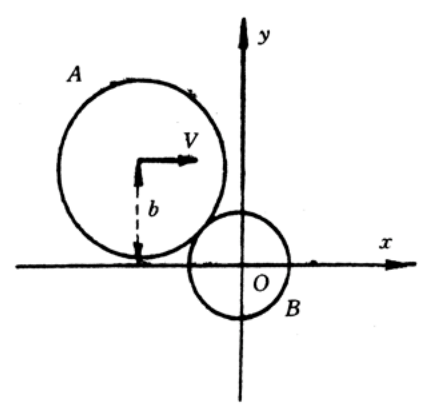
Official English text of the problem.
Answers
Let \(D=R_A+R_B\). For an impact, \(0\le b<D\), with A above the x-axis as shown.
-
The velocity components are \[ \boxed{V'_{AX}=\frac{5Vb^2}{6D^2}},\qquad \boxed{V'_{AY}=\frac{5Vb\sqrt{D^2-b^2}}{6D^2}}, \] \[ \boxed{V'_{BX}=V\left(1-\frac{5b^2}{6D^2}\right)},\qquad \boxed{V'_{BY}=-\frac{5Vb\sqrt{D^2-b^2}}{6D^2}}. \]
-
Including both translation and rotation, \[ \boxed{E'_A=\frac{3mV^2b^2}{8D^2}}, \qquad \boxed{E'_B=\frac{mV^2}{2} \left(1-\frac{11b^2}{12D^2}\right)}. \]
Solution
1) Velocities after the collision
Treat the collision as instantaneous, so the line joining the centers remains fixed during the impact. The smooth horizontal plane supplies no horizontal impulse or torque about the vertical axis. Initially neither disc rotates.
Define \[ s=\frac{b}{D},\qquad c=\sqrt{1-s^2},\qquad D=R_A+R_B. \] At first contact, the center of A is at \((-Dc,b)\), while the center of B is at the origin. Thus the unit vectors along the line from A to B and perpendicular to it are \[ \mathbf n=(c,-s),\qquad \mathbf t=(s,c). \] The initial velocity of A is \[ \mathbf v_A=Vc\,\mathbf n+Vs\,\mathbf t. \]
Let the impulse exerted on B be \[ \mathbf J=J_n\mathbf n+J_t\mathbf t. \] The impulse on A is \(-\mathbf J\). Linear impulse–momentum therefore gives \[ v'_{An}=Vc-\frac{J_n}{m},\qquad v'_{Bn}=\frac{J_n}{m}, \] \[ v'_{At}=Vs-\frac{J_t}{m},\qquad v'_{Bt}=\frac{J_t}{m}. \]
The normal relative velocity reverses direction while retaining its magnitude: the discs approach before impact and separate afterward. Consequently, \[ v'_{Bn}-v'_{An}=Vc, \] so \[ \frac{2J_n}{m}-Vc=Vc \quad\Longrightarrow\quad J_n=mVc. \] Hence \[ \boxed{v'_{An}=0,\qquad v'_{Bn}=Vc}. \]
To determine the tangential impulse, we must include rotation. The moments of inertia are \[ I_A=\frac12mR_A^2,\qquad I_B=\frac12mR_B^2. \] Take counterclockwise angular velocity as positive. The contact points lie at \(R_A\mathbf n\) relative to A's center and \(-R_B\mathbf n\) relative to B's center. Angular impulse–momentum gives \[ I_A\omega'_A=-R_AJ_t,\qquad I_B\omega'_B=-R_BJ_t. \] Therefore, \[ \omega'_A=-\frac{2J_t}{mR_A},\qquad \omega'_B=-\frac{2J_t}{mR_B}. \]
The tangential velocities of the material points in contact are \[ u'_{At}=v'_{At}+R_A\omega'_A =Vs-\frac{3J_t}{m}, \] \[ u'_{Bt}=v'_{Bt}-R_B\omega'_B =\frac{3J_t}{m}. \] The stated equality of these velocities requires \[ Vs-\frac{3J_t}{m}=\frac{3J_t}{m}, \] which yields \[ \boxed{J_t=\frac{mVs}{6}}. \] Thus \[ \boxed{v'_{At}=\frac56Vs,\qquad v'_{Bt}=\frac16Vs}, \] and the angular velocities, needed for part 2, are \[ \boxed{\omega'_A=-\frac{Vs}{3R_A},\qquad \omega'_B=-\frac{Vs}{3R_B}}. \] Both discs rotate clockwise for the geometry shown.
Returning to Cartesian coordinates, \[ \mathbf v'_A=\frac56Vs\,\mathbf t =\left(\frac56Vs^2,\frac56Vsc\right), \] \[ \mathbf v'_B=Vc\,\mathbf n+\frac16Vs\,\mathbf t =\left(V\left(c^2+\frac{s^2}{6}\right),-\frac56Vsc\right). \] Using \(c^2=1-s^2\), \(s=b/D\), and \(c=\sqrt{D^2-b^2}/D\) gives the four components in the Answers section. Their sums satisfy conservation of linear momentum: \[ V'_{AX}+V'_{BX}=V,\qquad V'_{AY}+V'_{BY}=0. \]
2) Kinetic energies after the collision
Each disc's kinetic energy includes translation of its center and rotation about its center: \[ E'_i=\frac12m|\mathbf v'_i|^2+\frac12I_i(\omega'_i)^2. \]
For A, \[ \begin{aligned} E'_A &=\frac12m\left(\frac56Vs\right)^2 +\frac12\left(\frac12mR_A^2\right) \left(\frac{Vs}{3R_A}\right)^2\\ &=\left(\frac{25}{72}+\frac{1}{36}\right)mV^2s^2\\ &=\frac38mV^2s^2. \end{aligned} \] Therefore, \[ \boxed{E'_A=\frac{3mV^2b^2}{8(R_A+R_B)^2}}. \]
For B, the normal and tangential velocity components are perpendicular, so \[ |\mathbf v'_B|^2=V^2c^2+\frac{V^2s^2}{36}. \] It follows that \[ \begin{aligned} E'_B &=\frac12mV^2\left(c^2+\frac{s^2}{36}\right) +\frac12\left(\frac12mR_B^2\right) \left(\frac{Vs}{3R_B}\right)^2\\ &=\frac12mV^2c^2+\frac1{24}mV^2s^2\\ &=\frac12mV^2\left(1-\frac{11s^2}{12}\right). \end{aligned} \] Thus \[ \boxed{E'_B=\frac{mV^2}{2} \left(1-\frac{11b^2}{12(R_A+R_B)^2}\right)}. \]
As a consistency check, the total kinetic-energy loss is \[ \frac12mV^2-(E'_A+E'_B) =\boxed{\frac{mV^2b^2}{12(R_A+R_B)^2}}\ge0. \] This loss results from tangential friction; the prescribed elastic condition applies only to normal relative motion. For a central collision, \(b=0\), A stops, B acquires velocity \(V\), neither disc rotates, and no kinetic energy is lost.
The solution was checked against the official solution. Where this solution differs from the official solution, the official solution contains an error or a misprint.
IPhO 1994 · Theorieaufgabe 3
Stoß von Scheiben mit Oberflächenreibung
Eine homogene Scheibe A mit der Masse \(m\) und dem Radius \(R_A\) bewegt sich auf einer glatten horizontalen \(x\)-\(y\)-Ebene translatorisch mit der Geschwindigkeit \(V\) in \(x\)-Richtung (siehe die Abbildung auf der nächsten Seite). Der Mittelpunkt der Scheibe befindet sich im Abstand \(b\) von der x-Achse. Sie stößt mit einer ruhenden homogenen Scheibe B zusammen, deren Mittelpunkt sich anfangs im Ursprung des Koordinatensystems befindet. Die Scheibe B hat dieselbe Masse und dieselbe Dicke wie A, ihr Radius ist jedoch \(R_B\). Es wird angenommen, dass die Geschwindigkeiten der Scheiben an ihrem Berührungspunkt in der Richtung senkrecht zur Verbindungslinie ihrer Mittelpunkte nach dem Stoß gleich sind. Außerdem wird angenommen, dass die Beträge der Relativgeschwindigkeiten der Scheiben entlang der Verbindungslinie ihrer Mittelpunkte vor und nach dem Stoß gleich sind.
1) Bestimmen Sie für einen solchen Stoß die X- und Y-Komponenten der Geschwindigkeiten beider Scheiben nach dem Stoß, d. h. \(V'_{AX}\), \(V'_{AY}\), \(V'_{BX}\) und \(V'_{BY}\), in Abhängigkeit von \(m\), \(R_A\), \(R_B\), \(V\) und \(b\).
2) Bestimmen Sie die kinetischen Energien \(E'_A\) der Scheibe A und \(E'_B\) der Scheibe B nach dem Stoß in Abhängigkeit von \(m\), \(R_A\), \(R_B\), \(V\) und \(b\).
Aufgabentext aus dem offiziellen englischen Text übersetzt.
Antworten
Es sei \(D=R_A+R_B\). Damit ein Stoß stattfindet, gilt \(0\le b<D\), wobei sich A wie dargestellt oberhalb der x-Achse befindet.
-
Die Geschwindigkeitskomponenten sind \[ \boxed{V'_{AX}=\frac{5Vb^2}{6D^2}},\qquad \boxed{V'_{AY}=\frac{5Vb\sqrt{D^2-b^2}}{6D^2}}, \] \[ \boxed{V'_{BX}=V\left(1-\frac{5b^2}{6D^2}\right)},\qquad \boxed{V'_{BY}=-\frac{5Vb\sqrt{D^2-b^2}}{6D^2}}. \]
-
Unter Berücksichtigung sowohl der Translation als auch der Rotation gilt \[ \boxed{E'_A=\frac{3mV^2b^2}{8D^2}}, \qquad \boxed{E'_B=\frac{mV^2}{2} \left(1-\frac{11b^2}{12D^2}\right)}. \]
Lösung
1) Geschwindigkeiten nach dem Stoß
Wir betrachten den Stoß als augenblicklich, sodass die Verbindungslinie der Mittelpunkte während des Stoßes unverändert bleibt. Die glatte horizontale Ebene übt weder einen horizontalen Kraftstoß noch ein Drehmoment um die vertikale Achse aus. Anfangs rotiert keine der beiden Scheiben.
Wir definieren \[ s=\frac{b}{D},\qquad c=\sqrt{1-s^2},\qquad D=R_A+R_B. \] Beim ersten Kontakt befindet sich der Mittelpunkt von A bei \((-Dc,b)\), während der Mittelpunkt von B im Ursprung liegt. Die Einheitsvektoren entlang der Verbindungslinie von A nach B und senkrecht dazu lauten somit \[ \mathbf n=(c,-s),\qquad \mathbf t=(s,c). \] Die Anfangsgeschwindigkeit von A ist \[ \mathbf v_A=Vc\,\mathbf n+Vs\,\mathbf t. \]
Der auf B ausgeübte Kraftstoß sei \[ \mathbf J=J_n\mathbf n+J_t\mathbf t. \] Der Kraftstoß auf A ist \(-\mathbf J\). Aus dem Impulssatz folgt daher \[ v'_{An}=Vc-\frac{J_n}{m},\qquad v'_{Bn}=\frac{J_n}{m}, \] \[ v'_{At}=Vs-\frac{J_t}{m},\qquad v'_{Bt}=\frac{J_t}{m}. \]
Die normale Relativgeschwindigkeit kehrt ihre Richtung um, behält aber ihren Betrag bei: Vor dem Stoß nähern sich die Scheiben einander, danach entfernen sie sich voneinander. Folglich gilt \[ v'_{Bn}-v'_{An}=Vc, \] also \[ \frac{2J_n}{m}-Vc=Vc \quad\Longrightarrow\quad J_n=mVc. \] Damit ergibt sich \[ \boxed{v'_{An}=0,\qquad v'_{Bn}=Vc}. \]
Zur Bestimmung des tangentialen Kraftstoßes müssen wir die Rotation berücksichtigen. Die Trägheitsmomente sind \[ I_A=\frac12mR_A^2,\qquad I_B=\frac12mR_B^2. \] Wir wählen die Winkelgeschwindigkeit gegen den Uhrzeigersinn als positiv. Die Berührungspunkte liegen relativ zum Mittelpunkt von A bei \(R_A\mathbf n\) und relativ zum Mittelpunkt von B bei \(-R_B\mathbf n\). Aus dem Drehimpulssatz folgt \[ I_A\omega'_A=-R_AJ_t,\qquad I_B\omega'_B=-R_BJ_t. \] Daher gilt \[ \omega'_A=-\frac{2J_t}{mR_A},\qquad \omega'_B=-\frac{2J_t}{mR_B}. \]
Die Tangentialgeschwindigkeiten der sich berührenden Materialpunkte sind \[ u'_{At}=v'_{At}+R_A\omega'_A =Vs-\frac{3J_t}{m}, \] \[ u'_{Bt}=v'_{Bt}-R_B\omega'_B =\frac{3J_t}{m}. \] Die vorgegebene Gleichheit dieser Geschwindigkeiten erfordert \[ Vs-\frac{3J_t}{m}=\frac{3J_t}{m}, \] woraus folgt \[ \boxed{J_t=\frac{mVs}{6}}. \] Somit gilt \[ \boxed{v'_{At}=\frac56Vs,\qquad v'_{Bt}=\frac16Vs}, \] und die für Teil 2 benötigten Winkelgeschwindigkeiten sind \[ \boxed{\omega'_A=-\frac{Vs}{3R_A},\qquad \omega'_B=-\frac{Vs}{3R_B}}. \] Bei der dargestellten Geometrie rotieren beide Scheiben im Uhrzeigersinn.
Bei der Rückkehr zu kartesischen Koordinaten erhalten wir \[ \mathbf v'_A=\frac56Vs\,\mathbf t =\left(\frac56Vs^2,\frac56Vsc\right), \] \[ \mathbf v'_B=Vc\,\mathbf n+\frac16Vs\,\mathbf t =\left(V\left(c^2+\frac{s^2}{6}\right),-\frac56Vsc\right). \] Mit \(c^2=1-s^2\), \(s=b/D\) und \(c=\sqrt{D^2-b^2}/D\) ergeben sich die vier Komponenten im Abschnitt Antworten. Ihre Summen erfüllen die Impulserhaltung: \[ V'_{AX}+V'_{BX}=V,\qquad V'_{AY}+V'_{BY}=0. \]
2) Kinetische Energien nach dem Stoß
Die kinetische Energie jeder Scheibe umfasst die Translation ihres Mittelpunkts und die Rotation um ihren Mittelpunkt: \[ E'_i=\frac12m|\mathbf v'_i|^2+\frac12I_i(\omega'_i)^2. \]
Für A gilt \[ \begin{aligned} E'_A &=\frac12m\left(\frac56Vs\right)^2 +\frac12\left(\frac12mR_A^2\right) \left(\frac{Vs}{3R_A}\right)^2\\ &=\left(\frac{25}{72}+\frac{1}{36}\right)mV^2s^2\\ &=\frac38mV^2s^2. \end{aligned} \] Daher ergibt sich \[ \boxed{E'_A=\frac{3mV^2b^2}{8(R_A+R_B)^2}}. \]
Für B stehen die normale und die tangentiale Geschwindigkeitskomponente senkrecht aufeinander, also gilt \[ |\mathbf v'_B|^2=V^2c^2+\frac{V^2s^2}{36}. \] Daraus folgt \[ \begin{aligned} E'_B &=\frac12mV^2\left(c^2+\frac{s^2}{36}\right) +\frac12\left(\frac12mR_B^2\right) \left(\frac{Vs}{3R_B}\right)^2\\ &=\frac12mV^2c^2+\frac1{24}mV^2s^2\\ &=\frac12mV^2\left(1-\frac{11s^2}{12}\right). \end{aligned} \] Somit gilt \[ \boxed{E'_B=\frac{mV^2}{2} \left(1-\frac{11b^2}{12(R_A+R_B)^2}\right)}. \]
Zur Konsistenzprüfung berechnen wir den gesamten Verlust an kinetischer Energie: \[ \frac12mV^2-(E'_A+E'_B) =\boxed{\frac{mV^2b^2}{12(R_A+R_B)^2}}\ge0. \] Dieser Verlust entsteht durch tangentiale Reibung; die vorgegebene Elastizitätsbedingung gilt nur für die normale Relativbewegung. Bei einem zentralen Stoß, \(b=0\), kommt A zum Stillstand, B erhält die Geschwindigkeit \(V\), keine der Scheiben rotiert, und es geht keine kinetische Energie verloren.
Die Lösung wurde mit der offiziellen Lösung abgeglichen. Wo diese Lösung von der offiziellen Lösung abweicht, enthält die offizielle Lösung einen Fehler oder Druckfehler.
IPhO 1994 · Teori sorusu 3
Yüzey Sürtünmesi Olan Disklerin Çarpışması
Kütlesi \(m\) ve yarıçapı \(R_A\) olan homojen bir A diski, sürtünmesiz yatay bir \(x\)-\(y\) düzleminde \(x\) doğrultusunda \(V\) hızıyla öteleme hareketi yapmaktadır (bir sonraki sayfadaki şekle bakınız). Diskin merkezi x ekseninden \(b\) uzaklıktadır. Bu disk, merkezi başlangıçta koordinat sisteminin başlangıç noktasında bulunan, durgun ve homojen bir B diskiyle çarpışır. B diskinin kütlesi ve kalınlığı A'nınkiyle aynıdır, ancak yarıçapı \(R_B\)'dir. Çarpışmadan sonra disklerin temas noktalarındaki hızlarının, merkezlerini birleştiren doğruya dik doğrultudaki bileşenlerinin eşit olduğu varsayılmaktadır. Ayrıca disklerin merkezlerini birleştiren doğru boyunca bağıl hızlarının büyüklüklerinin çarpışmadan önce ve sonra aynı olduğu varsayılmaktadır.
1) Böyle bir çarpışma için iki diskin çarpışmadan sonraki hızlarının X ve Y bileşenlerini, yani \(V'_{AX}\), \(V'_{AY}\), \(V'_{BX}\) ve \(V'_{BY}\) değerlerini \(m\), \(R_A\), \(R_B\), \(V\) ve \(b\) cinsinden bulunuz.
2) Çarpışmadan sonra A diskinin \(E'_A\) ve B diskinin \(E'_B\) kinetik enerjilerini \(m\), \(R_A\), \(R_B\), \(V\) ve \(b\) cinsinden bulunuz.
Soru metni resmi İngilizce metinden çevrilmiştir.
Cevaplar
\(D=R_A+R_B\) olsun. Bir çarpışmanın gerçekleşmesi için \(0\le b<D\) olmalıdır; A, şekilde gösterildiği gibi x ekseninin üstündedir.
-
Hız bileşenleri şöyledir: \[ \boxed{V'_{AX}=\frac{5Vb^2}{6D^2}},\qquad \boxed{V'_{AY}=\frac{5Vb\sqrt{D^2-b^2}}{6D^2}}, \] \[ \boxed{V'_{BX}=V\left(1-\frac{5b^2}{6D^2}\right)},\qquad \boxed{V'_{BY}=-\frac{5Vb\sqrt{D^2-b^2}}{6D^2}}. \]
-
Hem öteleme hem de dönme hesaba katıldığında, \[ \boxed{E'_A=\frac{3mV^2b^2}{8D^2}}, \qquad \boxed{E'_B=\frac{mV^2}{2} \left(1-\frac{11b^2}{12D^2}\right)}. \]
Çözüm
1) Çarpışmadan sonraki hızlar
Çarpışmayı anlık kabul edelim; böylece merkezleri birleştiren doğru çarpışma boyunca sabit kalır. Sürtünmesiz yatay düzlem, yatay doğrultuda itme veya düşey eksen etrafında tork uygulamaz. Başlangıçta iki disk de dönmemektedir.
Şu tanımları yapalım: \[ s=\frac{b}{D},\qquad c=\sqrt{1-s^2},\qquad D=R_A+R_B. \] İlk temas anında A'nın merkezi \((-Dc,b)\) noktasında, B'nin merkezi ise koordinat sisteminin başlangıç noktasındadır. Dolayısıyla A'dan B'ye uzanan doğru boyunca ve bu doğruya dik doğrultudaki birim vektörler şöyledir: \[ \mathbf n=(c,-s),\qquad \mathbf t=(s,c). \] A'nın başlangıç hızı \[ \mathbf v_A=Vc\,\mathbf n+Vs\,\mathbf t. \] şeklindedir.
B'ye uygulanan itme \[ \mathbf J=J_n\mathbf n+J_t\mathbf t. \] olsun. A'ya uygulanan itme \(-\mathbf J\)'dir. Buna göre doğrusal itme–momentum bağıntısı şu sonuçları verir: \[ v'_{An}=Vc-\frac{J_n}{m},\qquad v'_{Bn}=\frac{J_n}{m}, \] \[ v'_{At}=Vs-\frac{J_t}{m},\qquad v'_{Bt}=\frac{J_t}{m}. \]
Normal doğrultudaki bağıl hız, büyüklüğünü koruyarak yön değiştirir: diskler çarpışmadan önce birbirlerine yaklaşır, çarpışmadan sonra ise birbirlerinden uzaklaşır. Dolayısıyla, \[ v'_{Bn}-v'_{An}=Vc, \] buradan \[ \frac{2J_n}{m}-Vc=Vc \quad\Longrightarrow\quad J_n=mVc. \] elde edilir. Böylece \[ \boxed{v'_{An}=0,\qquad v'_{Bn}=Vc}. \]
Teğetsel itmeyi belirlemek için dönmeyi de hesaba katmalıyız. Eylemsizlik momentleri şöyledir: \[ I_A=\frac12mR_A^2,\qquad I_B=\frac12mR_B^2. \] Saat yönünün tersindeki açısal hızı pozitif alalım. Temas noktalarının A'nın merkezine göre konumu \(R_A\mathbf n\), B'nin merkezine göre konumu ise \(-R_B\mathbf n\)'dir. Açısal itme–momentum bağıntısı şunları verir: \[ I_A\omega'_A=-R_AJ_t,\qquad I_B\omega'_B=-R_BJ_t. \] Dolayısıyla, \[ \omega'_A=-\frac{2J_t}{mR_A},\qquad \omega'_B=-\frac{2J_t}{mR_B}. \]
Temas eden maddesel noktaların teğetsel hızları şöyledir: \[ u'_{At}=v'_{At}+R_A\omega'_A =Vs-\frac{3J_t}{m}, \] \[ u'_{Bt}=v'_{Bt}-R_B\omega'_B =\frac{3J_t}{m}. \] Bu hızların eşit olması koşulu \[ Vs-\frac{3J_t}{m}=\frac{3J_t}{m}, \] bağıntısını gerektirir; buradan \[ \boxed{J_t=\frac{mVs}{6}}. \] elde edilir. Böylece \[ \boxed{v'_{At}=\frac56Vs,\qquad v'_{Bt}=\frac16Vs}, \] ve 2. kısım için gerekli olan açısal hızlar şöyledir: \[ \boxed{\omega'_A=-\frac{Vs}{3R_A},\qquad \omega'_B=-\frac{Vs}{3R_B}}. \] Gösterilen geometri için iki disk de saat yönünde döner.
Kartezyen koordinatlara dönersek, \[ \mathbf v'_A=\frac56Vs\,\mathbf t =\left(\frac56Vs^2,\frac56Vsc\right), \] \[ \mathbf v'_B=Vc\,\mathbf n+\frac16Vs\,\mathbf t =\left(V\left(c^2+\frac{s^2}{6}\right),-\frac56Vsc\right). \] \(c^2=1-s^2\), \(s=b/D\) ve \(c=\sqrt{D^2-b^2}/D\) kullanıldığında Cevaplar bölümündeki dört bileşen elde edilir. Bunların toplamları doğrusal momentumun korunumu koşulunu sağlar: \[ V'_{AX}+V'_{BX}=V,\qquad V'_{AY}+V'_{BY}=0. \]
2) Çarpışmadan sonraki kinetik enerjiler
Her diskin kinetik enerjisi, merkezinin öteleme hareketini ve merkezi etrafındaki dönme hareketini içerir: \[ E'_i=\frac12m|\mathbf v'_i|^2+\frac12I_i(\omega'_i)^2. \]
A için, \[ \begin{aligned} E'_A &=\frac12m\left(\frac56Vs\right)^2 +\frac12\left(\frac12mR_A^2\right) \left(\frac{Vs}{3R_A}\right)^2\\ &=\left(\frac{25}{72}+\frac{1}{36}\right)mV^2s^2\\ &=\frac38mV^2s^2. \end{aligned} \] Dolayısıyla, \[ \boxed{E'_A=\frac{3mV^2b^2}{8(R_A+R_B)^2}}. \]
B için normal ve teğetsel hız bileşenleri birbirine diktir; bu nedenle \[ |\mathbf v'_B|^2=V^2c^2+\frac{V^2s^2}{36}. \] Böylece \[ \begin{aligned} E'_B &=\frac12mV^2\left(c^2+\frac{s^2}{36}\right) +\frac12\left(\frac12mR_B^2\right) \left(\frac{Vs}{3R_B}\right)^2\\ &=\frac12mV^2c^2+\frac1{24}mV^2s^2\\ &=\frac12mV^2\left(1-\frac{11s^2}{12}\right). \end{aligned} \] Dolayısıyla, \[ \boxed{E'_B=\frac{mV^2}{2} \left(1-\frac{11b^2}{12(R_A+R_B)^2}\right)}. \]
Tutarlılığı kontrol etmek için toplam kinetik enerji kaybını hesaplayalım: \[ \frac12mV^2-(E'_A+E'_B) =\boxed{\frac{mV^2b^2}{12(R_A+R_B)^2}}\ge0. \] Bu kayıp teğetsel sürtünmeden kaynaklanır; verilen esneklik koşulu yalnızca normal doğrultudaki bağıl hareket için geçerlidir. Merkezi bir çarpışmada, \(b=0\) olduğunda, A durur, B \(V\) hızını kazanır, iki disk de dönmez ve kinetik enerji kaybı olmaz.
Çözüm, resmi çözümle karşılaştırılarak kontrol edildi. Bu çözümün resmi çözümden ayrıldığı yerlerde resmi çözümde bir hata ya da baskı hatası vardır.
IPhO 1994 · Problema teórico 3
Colisión de discos con rozamiento superficial
Un disco homogéneo A de masa \(m\) y radio \(R_A\) se mueve por traslación sobre un plano horizontal \(x\)-\(y\) sin rozamiento, en la dirección \(x\), con una velocidad \(V\) (véase la figura de la página siguiente). El centro del disco se encuentra a una distancia \(b\) del eje x. Choca con un disco homogéneo B en reposo, cuyo centro se encuentra inicialmente en el origen del sistema de coordenadas. El disco B tiene la misma masa y el mismo espesor que A, pero su radio es \(R_B\). Se supone que, después de la colisión, las velocidades de los discos en su punto de contacto, en la dirección perpendicular a la recta que une sus centros, son iguales. También se supone que los módulos de las velocidades relativas de los discos a lo largo de la recta que une sus centros son iguales antes y después de la colisión.
1) Para esta colisión, determine las componentes X e Y de las velocidades de los dos discos después de la colisión, es decir, \(V'_{AX}\), \(V'_{AY}\), \(V'_{BX}\) y \(V'_{BY}\), en función de \(m\), \(R_A\), \(R_B\), \(V\) y \(b\).
2) Determine las energías cinéticas \(E'_A\) del disco A y \(E'_B\) del disco B después de la colisión en función de \(m\), \(R_A\), \(R_B\), \(V\) y \(b\).
Enunciado traducido del texto oficial en inglés.
Respuestas
Sea \(D=R_A+R_B\). Para que haya una colisión, \(0\le b<D\), con A por encima del eje x, como se muestra en la figura.
-
Las componentes de la velocidad son \[ \boxed{V'_{AX}=\frac{5Vb^2}{6D^2}},\qquad \boxed{V'_{AY}=\frac{5Vb\sqrt{D^2-b^2}}{6D^2}}, \] \[ \boxed{V'_{BX}=V\left(1-\frac{5b^2}{6D^2}\right)},\qquad \boxed{V'_{BY}=-\frac{5Vb\sqrt{D^2-b^2}}{6D^2}}. \]
-
Incluyendo tanto la traslación como la rotación, \[ \boxed{E'_A=\frac{3mV^2b^2}{8D^2}}, \qquad \boxed{E'_B=\frac{mV^2}{2} \left(1-\frac{11b^2}{12D^2}\right)}. \]
Solución
1) Velocidades después de la colisión
Consideramos que la colisión es instantánea, de modo que la recta que une los centros permanece fija durante el impacto. El plano horizontal sin rozamiento no ejerce ningún impulso horizontal ni ningún momento de fuerza respecto al eje vertical. Inicialmente, ninguno de los discos gira.
Definimos \[ s=\frac{b}{D},\qquad c=\sqrt{1-s^2},\qquad D=R_A+R_B. \] En el instante del primer contacto, el centro de A se encuentra en \((-Dc,b)\), mientras que el centro de B está en el origen. Por tanto, los vectores unitarios en la dirección de la recta de A a B y en la dirección perpendicular a ella son \[ \mathbf n=(c,-s),\qquad \mathbf t=(s,c). \] La velocidad inicial de A es \[ \mathbf v_A=Vc\,\mathbf n+Vs\,\mathbf t. \]
Sea el impulso ejercido sobre B \[ \mathbf J=J_n\mathbf n+J_t\mathbf t. \] El impulso sobre A es \(-\mathbf J\). Por tanto, el teorema del impulso y la cantidad de movimiento da \[ v'_{An}=Vc-\frac{J_n}{m},\qquad v'_{Bn}=\frac{J_n}{m}, \] \[ v'_{At}=Vs-\frac{J_t}{m},\qquad v'_{Bt}=\frac{J_t}{m}. \]
La velocidad relativa normal invierte su sentido y conserva su módulo: los discos se aproximan antes del impacto y se separan después. En consecuencia, \[ v'_{Bn}-v'_{An}=Vc, \] de modo que \[ \frac{2J_n}{m}-Vc=Vc \quad\Longrightarrow\quad J_n=mVc. \] Por tanto, \[ \boxed{v'_{An}=0,\qquad v'_{Bn}=Vc}. \]
Para determinar el impulso tangencial, debemos incluir la rotación. Los momentos de inercia son \[ I_A=\frac12mR_A^2,\qquad I_B=\frac12mR_B^2. \] Tomamos como positiva la velocidad angular en sentido antihorario. Los puntos de contacto se encuentran en \(R_A\mathbf n\) respecto al centro de A y en \(-R_B\mathbf n\) respecto al centro de B. El teorema del impulso angular y el momento angular da \[ I_A\omega'_A=-R_AJ_t,\qquad I_B\omega'_B=-R_BJ_t. \] Por consiguiente, \[ \omega'_A=-\frac{2J_t}{mR_A},\qquad \omega'_B=-\frac{2J_t}{mR_B}. \]
Las velocidades tangenciales de los puntos materiales en contacto son \[ u'_{At}=v'_{At}+R_A\omega'_A =Vs-\frac{3J_t}{m}, \] \[ u'_{Bt}=v'_{Bt}-R_B\omega'_B =\frac{3J_t}{m}. \] La igualdad de estas velocidades, establecida en el enunciado, exige que \[ Vs-\frac{3J_t}{m}=\frac{3J_t}{m}, \] de donde se obtiene \[ \boxed{J_t=\frac{mVs}{6}}. \] Así, \[ \boxed{v'_{At}=\frac56Vs,\qquad v'_{Bt}=\frac16Vs}, \] y las velocidades angulares, necesarias para el apartado 2, son \[ \boxed{\omega'_A=-\frac{Vs}{3R_A},\qquad \omega'_B=-\frac{Vs}{3R_B}}. \] Ambos discos giran en sentido horario para la geometría mostrada.
Volviendo a las coordenadas cartesianas, \[ \mathbf v'_A=\frac56Vs\,\mathbf t =\left(\frac56Vs^2,\frac56Vsc\right), \] \[ \mathbf v'_B=Vc\,\mathbf n+\frac16Vs\,\mathbf t =\left(V\left(c^2+\frac{s^2}{6}\right),-\frac56Vsc\right). \] Usando \(c^2=1-s^2\), \(s=b/D\) y \(c=\sqrt{D^2-b^2}/D\), se obtienen las cuatro componentes de la sección Respuestas. Sus sumas satisfacen la conservación de la cantidad de movimiento: \[ V'_{AX}+V'_{BX}=V,\qquad V'_{AY}+V'_{BY}=0. \]
2) Energías cinéticas después de la colisión
La energía cinética de cada disco incluye la traslación de su centro y la rotación alrededor de su centro: \[ E'_i=\frac12m|\mathbf v'_i|^2+\frac12I_i(\omega'_i)^2. \]
Para A, \[ \begin{aligned} E'_A &=\frac12m\left(\frac56Vs\right)^2 +\frac12\left(\frac12mR_A^2\right) \left(\frac{Vs}{3R_A}\right)^2\\ &=\left(\frac{25}{72}+\frac{1}{36}\right)mV^2s^2\\ &=\frac38mV^2s^2. \end{aligned} \] Por consiguiente, \[ \boxed{E'_A=\frac{3mV^2b^2}{8(R_A+R_B)^2}}. \]
Para B, las componentes normal y tangencial de la velocidad son perpendiculares, de modo que \[ |\mathbf v'_B|^2=V^2c^2+\frac{V^2s^2}{36}. \] Se sigue que \[ \begin{aligned} E'_B &=\frac12mV^2\left(c^2+\frac{s^2}{36}\right) +\frac12\left(\frac12mR_B^2\right) \left(\frac{Vs}{3R_B}\right)^2\\ &=\frac12mV^2c^2+\frac1{24}mV^2s^2\\ &=\frac12mV^2\left(1-\frac{11s^2}{12}\right). \end{aligned} \] Así, \[ \boxed{E'_B=\frac{mV^2}{2} \left(1-\frac{11b^2}{12(R_A+R_B)^2}\right)}. \]
Como comprobación de coherencia, la pérdida total de energía cinética es \[ \frac12mV^2-(E'_A+E'_B) =\boxed{\frac{mV^2b^2}{12(R_A+R_B)^2}}\ge0. \] Esta pérdida se debe al rozamiento tangencial; la condición de elasticidad prescrita se aplica únicamente al movimiento relativo normal. Para una colisión central, \(b=0\), A se detiene, B adquiere la velocidad \(V\), ninguno de los discos gira y no se pierde energía cinética.
La solución se comprobó con la solución oficial. Donde esta solución difiere de la solución oficial, la solución oficial contiene un error o una errata.
IPhO 1994 · 理论题 3
有表面摩擦的圆盘碰撞
一个质量为 \(m\)、半径为 \(R_A\) 的均匀圆盘 A,在光滑的水平 \(x\)-\(y\) 平面内以速度 \(V\) 沿 \(x\) 方向平动(见下一页的图)。圆盘中心到 x 轴的距离为 \(b\)。它与一个静止的均匀圆盘 B 发生碰撞,B 的中心最初位于坐标系原点。圆盘 B 的质量和厚度均与 A 相同,但其半径为 \(R_B\)。假设碰撞后,两圆盘接触点处的速度在垂直于两圆心连线方向上的分量相等。还假设碰撞前后,两圆盘沿圆心连线方向的相对速度大小相同。
1) 对于这样的碰撞,用 \(m\)、\(R_A\)、\(R_B\)、\(V\) 和 \(b\) 表示碰撞后两圆盘速度的 X 和 Y 分量,即 \(V'_{AX}\)、\(V'_{AY}\)、\(V'_{BX}\) 和 \(V'_{BY}\)。
2) 用 \(m\)、\(R_A\)、\(R_B\)、\(V\) 和 \(b\) 表示碰撞后圆盘 A 的动能 \(E'_A\) 和圆盘 B 的动能 \(E'_B\)。
题目译自官方英文原文。
答案
令 \(D=R_A+R_B\)。发生碰撞时,\(0\le b<D\),且 A 如图所示位于 x 轴上方。
-
速度分量为 \[ \boxed{V'_{AX}=\frac{5Vb^2}{6D^2}},\qquad \boxed{V'_{AY}=\frac{5Vb\sqrt{D^2-b^2}}{6D^2}}, \] \[ \boxed{V'_{BX}=V\left(1-\frac{5b^2}{6D^2}\right)},\qquad \boxed{V'_{BY}=-\frac{5Vb\sqrt{D^2-b^2}}{6D^2}}. \]
-
计入平动和转动的动能, \[ \boxed{E'_A=\frac{3mV^2b^2}{8D^2}}, \qquad \boxed{E'_B=\frac{mV^2}{2} \left(1-\frac{11b^2}{12D^2}\right)}. \]
解答
1) 碰撞后的速度
将碰撞视为瞬时过程,因此碰撞过程中两圆心的连线保持不变。光滑的水平面不提供水平方向的冲量,也不提供绕竖直轴的力矩。最初两个圆盘均不转动。
定义 \[ s=\frac{b}{D},\qquad c=\sqrt{1-s^2},\qquad D=R_A+R_B. \] 刚接触时,A 的中心位于 \((-Dc,b)\),而 B 的中心位于原点。因此,沿 A 指向 B 的连线方向及垂直于该连线方向的单位矢量分别为 \[ \mathbf n=(c,-s),\qquad \mathbf t=(s,c). \] A 的初速度为 \[ \mathbf v_A=Vc\,\mathbf n+Vs\,\mathbf t. \]
设 B 所受的冲量为 \[ \mathbf J=J_n\mathbf n+J_t\mathbf t. \] A 所受的冲量为 \(-\mathbf J\)。因此,由动量定理得 \[ v'_{An}=Vc-\frac{J_n}{m},\qquad v'_{Bn}=\frac{J_n}{m}, \] \[ v'_{At}=Vs-\frac{J_t}{m},\qquad v'_{Bt}=\frac{J_t}{m}. \]
法向相对速度的方向反转,而大小保持不变:两圆盘在碰撞前相互接近,碰撞后相互分离。因此, \[ v'_{Bn}-v'_{An}=Vc, \] 所以 \[ \frac{2J_n}{m}-Vc=Vc \quad\Longrightarrow\quad J_n=mVc. \] 于是 \[ \boxed{v'_{An}=0,\qquad v'_{Bn}=Vc}. \]
要确定切向冲量,必须考虑转动。转动惯量为 \[ I_A=\frac12mR_A^2,\qquad I_B=\frac12mR_B^2. \] 取逆时针方向的角速度为正。接触点相对于 A 圆心的位置矢量为 \(R_A\mathbf n\),相对于 B 圆心的位置矢量为 \(-R_B\mathbf n\)。由角动量定理得 \[ I_A\omega'_A=-R_AJ_t,\qquad I_B\omega'_B=-R_BJ_t. \] 因此, \[ \omega'_A=-\frac{2J_t}{mR_A},\qquad \omega'_B=-\frac{2J_t}{mR_B}. \]
相互接触的两个物质点的切向速度为 \[ u'_{At}=v'_{At}+R_A\omega'_A =Vs-\frac{3J_t}{m}, \] \[ u'_{Bt}=v'_{Bt}-R_B\omega'_B =\frac{3J_t}{m}. \] 题设要求这两个速度相等,即 \[ Vs-\frac{3J_t}{m}=\frac{3J_t}{m}, \] 由此得到 \[ \boxed{J_t=\frac{mVs}{6}}. \] 因此 \[ \boxed{v'_{At}=\frac56Vs,\qquad v'_{Bt}=\frac16Vs}, \] 而第 2 问所需的角速度为 \[ \boxed{\omega'_A=-\frac{Vs}{3R_A},\qquad \omega'_B=-\frac{Vs}{3R_B}}. \] 在图示的几何位置关系下,两圆盘均沿顺时针方向转动。
转换回直角坐标, \[ \mathbf v'_A=\frac56Vs\,\mathbf t =\left(\frac56Vs^2,\frac56Vsc\right), \] \[ \mathbf v'_B=Vc\,\mathbf n+\frac16Vs\,\mathbf t =\left(V\left(c^2+\frac{s^2}{6}\right),-\frac56Vsc\right). \] 利用 \(c^2=1-s^2\)、\(s=b/D\) 和 \(c=\sqrt{D^2-b^2}/D\),即可得到“答案”一节中的四个分量。它们的和满足动量守恒: \[ V'_{AX}+V'_{BX}=V,\qquad V'_{AY}+V'_{BY}=0. \]
2) 碰撞后的动能
每个圆盘的动能包括其圆心平动的动能和绕圆心转动的动能: \[ E'_i=\frac12m|\mathbf v'_i|^2+\frac12I_i(\omega'_i)^2. \]
对于 A, \[ \begin{aligned} E'_A &=\frac12m\left(\frac56Vs\right)^2 +\frac12\left(\frac12mR_A^2\right) \left(\frac{Vs}{3R_A}\right)^2\\ &=\left(\frac{25}{72}+\frac{1}{36}\right)mV^2s^2\\ &=\frac38mV^2s^2. \end{aligned} \] 因此, \[ \boxed{E'_A=\frac{3mV^2b^2}{8(R_A+R_B)^2}}. \]
对于 B,法向与切向速度分量相互垂直,因此 \[ |\mathbf v'_B|^2=V^2c^2+\frac{V^2s^2}{36}. \] 由此可得 \[ \begin{aligned} E'_B &=\frac12mV^2\left(c^2+\frac{s^2}{36}\right) +\frac12\left(\frac12mR_B^2\right) \left(\frac{Vs}{3R_B}\right)^2\\ &=\frac12mV^2c^2+\frac1{24}mV^2s^2\\ &=\frac12mV^2\left(1-\frac{11s^2}{12}\right). \end{aligned} \] 因此 \[ \boxed{E'_B=\frac{mV^2}{2} \left(1-\frac{11b^2}{12(R_A+R_B)^2}\right)}. \]
作为一致性检验,总动能损失为 \[ \frac12mV^2-(E'_A+E'_B) =\boxed{\frac{mV^2b^2}{12(R_A+R_B)^2}}\ge0. \] 这一损失源于切向摩擦;题设的弹性条件仅适用于法向相对运动。对于对心碰撞,\(b=0\),A 停止运动,B 获得速度 \(V\),两圆盘均不转动,且没有动能损失。
解答已与官方解答核对。本解答与官方解答不同之处,均为官方解答中的错误或印刷错误。
IPhO 1994 · Теоретическая задача 3
Столкновение дисков с трением между их поверхностями
Однородный диск A массой \(m\) и радиусом \(R_A\) движется поступательно по гладкой горизонтальной плоскости \(x\)-\(y\) в направлении \(x\) со скоростью \(V\) (см. рисунок на следующей странице). Центр диска находится на расстоянии \(b\) от оси x. Он сталкивается с неподвижным однородным диском B, центр которого первоначально расположен в начале координат. Диск B имеет такую же массу и такую же толщину, как A, но его радиус равен \(R_B\). Предполагается, что после столкновения скорости дисков в точке их соприкосновения в направлении, перпендикулярном линии, соединяющей их центры, равны. Также предполагается, что модули относительных скоростей дисков вдоль линии, соединяющей их центры, одинаковы до и после столкновения.
1) Для такого столкновения определите компоненты X и Y скоростей обоих дисков после столкновения, т. е. \(V'_{AX}\), \(V'_{AY}\), \(V'_{BX}\) и \(V'_{BY}\), через \(m\), \(R_A\), \(R_B\), \(V\) и \(b\).
2) Определите кинетические энергии \(E'_A\) диска A и \(E'_B\) диска B после столкновения через \(m\), \(R_A\), \(R_B\), \(V\) и \(b\).
Условие переведено с официального английского текста.
Ответы
Пусть \(D=R_A+R_B\). Для столкновения \(0\le b<D\), причём A находится выше оси x, как показано на рисунке.
-
Компоненты скоростей равны \[ \boxed{V'_{AX}=\frac{5Vb^2}{6D^2}},\qquad \boxed{V'_{AY}=\frac{5Vb\sqrt{D^2-b^2}}{6D^2}}, \] \[ \boxed{V'_{BX}=V\left(1-\frac{5b^2}{6D^2}\right)},\qquad \boxed{V'_{BY}=-\frac{5Vb\sqrt{D^2-b^2}}{6D^2}}. \]
-
С учётом как поступательного, так и вращательного движения, \[ \boxed{E'_A=\frac{3mV^2b^2}{8D^2}}, \qquad \boxed{E'_B=\frac{mV^2}{2} \left(1-\frac{11b^2}{12D^2}\right)}. \]
Решение
1) Скорости после столкновения
Будем считать столкновение мгновенным, так что линия, соединяющая центры, остаётся неподвижной во время удара. Гладкая горизонтальная плоскость не сообщает дискам ни горизонтального импульса силы, ни импульса момента силы относительно вертикальной оси. Первоначально ни один из дисков не вращается.
Введём обозначения \[ s=\frac{b}{D},\qquad c=\sqrt{1-s^2},\qquad D=R_A+R_B. \] В момент первого соприкосновения центр A находится в точке \((-Dc,b)\), а центр B — в начале координат. Следовательно, единичные векторы вдоль линии от A к B и перпендикулярно ей имеют вид \[ \mathbf n=(c,-s),\qquad \mathbf t=(s,c). \] Начальная скорость A равна \[ \mathbf v_A=Vc\,\mathbf n+Vs\,\mathbf t. \]
Пусть импульс силы, действующей на B, равен \[ \mathbf J=J_n\mathbf n+J_t\mathbf t. \] Импульс силы, действующей на A, равен \(-\mathbf J\). Тогда по теореме об изменении импульса \[ v'_{An}=Vc-\frac{J_n}{m},\qquad v'_{Bn}=\frac{J_n}{m}, \] \[ v'_{At}=Vs-\frac{J_t}{m},\qquad v'_{Bt}=\frac{J_t}{m}. \]
Нормальная относительная скорость меняет направление на противоположное, сохраняя свой модуль: до удара диски сближаются, а после него удаляются друг от друга. Следовательно, \[ v'_{Bn}-v'_{An}=Vc, \] откуда \[ \frac{2J_n}{m}-Vc=Vc \quad\Longrightarrow\quad J_n=mVc. \] Таким образом, \[ \boxed{v'_{An}=0,\qquad v'_{Bn}=Vc}. \]
Чтобы определить тангенциальный импульс силы, необходимо учесть вращение. Моменты инерции равны \[ I_A=\frac12mR_A^2,\qquad I_B=\frac12mR_B^2. \] Примем угловую скорость вращения против часовой стрелки за положительную. Радиус-векторы точек соприкосновения относительно центров A и B равны соответственно \(R_A\mathbf n\) и \(-R_B\mathbf n\). По теореме об изменении момента импульса \[ I_A\omega'_A=-R_AJ_t,\qquad I_B\omega'_B=-R_BJ_t. \] Следовательно, \[ \omega'_A=-\frac{2J_t}{mR_A},\qquad \omega'_B=-\frac{2J_t}{mR_B}. \]
Тангенциальные скорости материальных точек, находящихся в соприкосновении, равны \[ u'_{At}=v'_{At}+R_A\omega'_A =Vs-\frac{3J_t}{m}, \] \[ u'_{Bt}=v'_{Bt}-R_B\omega'_B =\frac{3J_t}{m}. \] Заданное в условии равенство этих скоростей требует, чтобы \[ Vs-\frac{3J_t}{m}=\frac{3J_t}{m}, \] откуда получаем \[ \boxed{J_t=\frac{mVs}{6}}. \] Таким образом, \[ \boxed{v'_{At}=\frac56Vs,\qquad v'_{Bt}=\frac16Vs}, \] а угловые скорости, необходимые для пункта 2, равны \[ \boxed{\omega'_A=-\frac{Vs}{3R_A},\qquad \omega'_B=-\frac{Vs}{3R_B}}. \] При показанном на рисунке расположении оба диска вращаются по часовой стрелке.
Возвращаясь к декартовым координатам, получаем \[ \mathbf v'_A=\frac56Vs\,\mathbf t =\left(\frac56Vs^2,\frac56Vsc\right), \] \[ \mathbf v'_B=Vc\,\mathbf n+\frac16Vs\,\mathbf t =\left(V\left(c^2+\frac{s^2}{6}\right),-\frac56Vsc\right). \] Используя \(c^2=1-s^2\), \(s=b/D\) и \(c=\sqrt{D^2-b^2}/D\), получаем четыре компоненты, приведённые в разделе «Ответы». Их суммы удовлетворяют закону сохранения импульса: \[ V'_{AX}+V'_{BX}=V,\qquad V'_{AY}+V'_{BY}=0. \]
2) Кинетические энергии после столкновения
Кинетическая энергия каждого диска включает энергию поступательного движения его центра и энергию вращения относительно его центра: \[ E'_i=\frac12m|\mathbf v'_i|^2+\frac12I_i(\omega'_i)^2. \]
Для A \[ \begin{aligned} E'_A &=\frac12m\left(\frac56Vs\right)^2 +\frac12\left(\frac12mR_A^2\right) \left(\frac{Vs}{3R_A}\right)^2\\ &=\left(\frac{25}{72}+\frac{1}{36}\right)mV^2s^2\\ &=\frac38mV^2s^2. \end{aligned} \] Следовательно, \[ \boxed{E'_A=\frac{3mV^2b^2}{8(R_A+R_B)^2}}. \]
Для B нормальная и тангенциальная составляющие скорости перпендикулярны, поэтому \[ |\mathbf v'_B|^2=V^2c^2+\frac{V^2s^2}{36}. \] Отсюда следует, что \[ \begin{aligned} E'_B &=\frac12mV^2\left(c^2+\frac{s^2}{36}\right) +\frac12\left(\frac12mR_B^2\right) \left(\frac{Vs}{3R_B}\right)^2\\ &=\frac12mV^2c^2+\frac1{24}mV^2s^2\\ &=\frac12mV^2\left(1-\frac{11s^2}{12}\right). \end{aligned} \] Таким образом, \[ \boxed{E'_B=\frac{mV^2}{2} \left(1-\frac{11b^2}{12(R_A+R_B)^2}\right)}. \]
Для проверки согласованности результатов найдём полную потерю кинетической энергии: \[ \frac12mV^2-(E'_A+E'_B) =\boxed{\frac{mV^2b^2}{12(R_A+R_B)^2}}\ge0. \] Эта потеря обусловлена тангенциальной силой трения; заданное условие упругости относится только к нормальному относительному движению. При центральном столкновении, \(b=0\), A останавливается, B приобретает скорость \(V\), ни один из дисков не вращается, и потери кинетической энергии нет.
Решение проверено по официальному решению. Там, где это решение расходится с официальным, в официальном решении есть ошибка или опечатка.
IPhO 1994 · مسألة نظرية 3
تصادم قرصين مع احتكاك سطحي
يتحرك قرص متجانس A كتلته \(m\) ونصف قطره \(R_A\) حركة انتقالية على مستوى أفقي أملس \(x\)-\(y\) في اتجاه \(x\) بسرعة \(V\) (انظر الشكل في الصفحة التالية). يقع مركز القرص على مسافة \(b\) من المحور x. ويصطدم بقرص متجانس ساكن B يقع مركزه في البداية عند مبدأ نظام الإحداثيات. للقرص B الكتلة نفسها والسمك نفسه اللذان للقرص A، لكن نصف قطره هو \(R_B\). يُفترض أن سرعتي القرصين عند نقطة تلامسهما، في الاتجاه العمودي على الخط الواصل بين مركزيهما، متساويتان بعد التصادم. ويُفترض أيضًا أن مقدار السرعة النسبية للقرصين على امتداد الخط الواصل بين مركزيهما متساوٍ قبل التصادم وبعده.
1) في مثل هذا التصادم، أوجد المركبتين X وY لسرعتي القرصين بعد التصادم، أي \(V'_{AX}\) و\(V'_{AY}\) و\(V'_{BX}\) و\(V'_{BY}\)، بدلالة \(m\) و\(R_A\) و\(R_B\) و\(V\) و\(b\).
2) أوجد الطاقة الحركية \(E'_A\) للقرص A والطاقة الحركية \(E'_B\) للقرص B بعد التصادم بدلالة \(m\) و\(R_A\) و\(R_B\) و\(V\) و\(b\).
نص المسألة مترجم عن النص الإنجليزي الرسمي.
الإجابات
لتكن \(D=R_A+R_B\). لكي يحدث تصادم، يكون \(0\le b<D\)، مع وقوع A فوق المحور x كما هو موضح.
-
مركبات السرعة هي \[ \boxed{V'_{AX}=\frac{5Vb^2}{6D^2}},\qquad \boxed{V'_{AY}=\frac{5Vb\sqrt{D^2-b^2}}{6D^2}}, \] \[ \boxed{V'_{BX}=V\left(1-\frac{5b^2}{6D^2}\right)},\qquad \boxed{V'_{BY}=-\frac{5Vb\sqrt{D^2-b^2}}{6D^2}}. \]
-
باحتساب كلٍّ من الحركة الانتقالية والحركة الدورانية، \[ \boxed{E'_A=\frac{3mV^2b^2}{8D^2}}, \qquad \boxed{E'_B=\frac{mV^2}{2} \left(1-\frac{11b^2}{12D^2}\right)}. \]
الحل
1) السرعات بعد التصادم
نعدّ التصادم آنيًّا، بحيث يظل الخط الواصل بين المركزين ثابتًا أثناء التصادم. لا يؤثر المستوى الأفقي الأملس بأي دفع أفقي أو عزم قوة حول المحور الرأسي. ولا يدور أيٌّ من القرصين في البداية.
نعرّف \[ s=\frac{b}{D},\qquad c=\sqrt{1-s^2},\qquad D=R_A+R_B. \] عند أول تلامس، يقع مركز A عند \((-Dc,b)\)، بينما يقع مركز B عند المبدأ. ومن ثم فإن متجهي الوحدة على امتداد الخط من A إلى B وفي الاتجاه العمودي عليه هما \[ \mathbf n=(c,-s),\qquad \mathbf t=(s,c). \] السرعة الابتدائية للقرص A هي \[ \mathbf v_A=Vc\,\mathbf n+Vs\,\mathbf t. \]
ليكن الدفع المؤثر في B هو \[ \mathbf J=J_n\mathbf n+J_t\mathbf t. \] الدفع المؤثر في A هو \(-\mathbf J\). ومن ثم تعطي مبرهنة الدفع والزخم الخطي \[ v'_{An}=Vc-\frac{J_n}{m},\qquad v'_{Bn}=\frac{J_n}{m}, \] \[ v'_{At}=Vs-\frac{J_t}{m},\qquad v'_{Bt}=\frac{J_t}{m}. \]
تعكس السرعة النسبية في الاتجاه الناظمي اتجاهها مع احتفاظها بمقدارها: يتقارب القرصان قبل التصادم ويتباعدان بعده. وبناءً على ذلك، \[ v'_{Bn}-v'_{An}=Vc, \] ومن ثم \[ \frac{2J_n}{m}-Vc=Vc \quad\Longrightarrow\quad J_n=mVc. \] إذن \[ \boxed{v'_{An}=0,\qquad v'_{Bn}=Vc}. \]
لتحديد الدفع المماسي، يجب أن نأخذ الدوران في الحسبان. عزما القصور الذاتي هما \[ I_A=\frac12mR_A^2,\qquad I_B=\frac12mR_B^2. \] نعدّ السرعة الزاوية الموجبة في الاتجاه المعاكس لاتجاه عقارب الساعة. تقع نقطتا التلامس عند \(R_A\mathbf n\) بالنسبة إلى مركز A وعند \(-R_B\mathbf n\) بالنسبة إلى مركز B. وتعطي مبرهنة الدفع الزاوي والزخم الزاوي \[ I_A\omega'_A=-R_AJ_t,\qquad I_B\omega'_B=-R_BJ_t. \] ولذلك، \[ \omega'_A=-\frac{2J_t}{mR_A},\qquad \omega'_B=-\frac{2J_t}{mR_B}. \]
السرعتان المماسيتان للنقطتين الماديتين المتلامستين هما \[ u'_{At}=v'_{At}+R_A\omega'_A =Vs-\frac{3J_t}{m}, \] \[ u'_{Bt}=v'_{Bt}-R_B\omega'_B =\frac{3J_t}{m}. \] يقتضي تساوي هاتين السرعتين، كما ورد في نص المسألة، أن يكون \[ Vs-\frac{3J_t}{m}=\frac{3J_t}{m}, \] وهذا يعطي \[ \boxed{J_t=\frac{mVs}{6}}. \] ومن ثم \[ \boxed{v'_{At}=\frac56Vs,\qquad v'_{Bt}=\frac16Vs}, \] والسرعتان الزاويتان، اللتان نحتاج إليهما في الجزء 2، هما \[ \boxed{\omega'_A=-\frac{Vs}{3R_A},\qquad \omega'_B=-\frac{Vs}{3R_B}}. \] يدور كلا القرصين في اتجاه عقارب الساعة في الوضع الهندسي الموضح.
بالعودة إلى الإحداثيات الديكارتية، \[ \mathbf v'_A=\frac56Vs\,\mathbf t =\left(\frac56Vs^2,\frac56Vsc\right), \] \[ \mathbf v'_B=Vc\,\mathbf n+\frac16Vs\,\mathbf t =\left(V\left(c^2+\frac{s^2}{6}\right),-\frac56Vsc\right). \] باستخدام \(c^2=1-s^2\) و\(s=b/D\) و\(c=\sqrt{D^2-b^2}/D\)، نحصل على المركبات الأربع الواردة في قسم الإجابات. وتحقق مجاميعها قانون حفظ الزخم الخطي: \[ V'_{AX}+V'_{BX}=V,\qquad V'_{AY}+V'_{BY}=0. \]
2) الطاقات الحركية بعد التصادم
تشمل الطاقة الحركية لكل قرص الحركة الانتقالية لمركزه والدوران حول مركزه: \[ E'_i=\frac12m|\mathbf v'_i|^2+\frac12I_i(\omega'_i)^2. \]
بالنسبة إلى A، \[ \begin{aligned} E'_A &=\frac12m\left(\frac56Vs\right)^2 +\frac12\left(\frac12mR_A^2\right) \left(\frac{Vs}{3R_A}\right)^2\\ &=\left(\frac{25}{72}+\frac{1}{36}\right)mV^2s^2\\ &=\frac38mV^2s^2. \end{aligned} \] ولذلك، \[ \boxed{E'_A=\frac{3mV^2b^2}{8(R_A+R_B)^2}}. \]
بالنسبة إلى B، تكون مركبتا السرعة الناظمية والمماسية متعامدتين، ومن ثم \[ |\mathbf v'_B|^2=V^2c^2+\frac{V^2s^2}{36}. \] ويترتب على ذلك أن \[ \begin{aligned} E'_B &=\frac12mV^2\left(c^2+\frac{s^2}{36}\right) +\frac12\left(\frac12mR_B^2\right) \left(\frac{Vs}{3R_B}\right)^2\\ &=\frac12mV^2c^2+\frac1{24}mV^2s^2\\ &=\frac12mV^2\left(1-\frac{11s^2}{12}\right). \end{aligned} \] ومن ثم \[ \boxed{E'_B=\frac{mV^2}{2} \left(1-\frac{11b^2}{12(R_A+R_B)^2}\right)}. \]
للتحقق من الاتساق، فإن الفقد الكلي في الطاقة الحركية هو \[ \frac12mV^2-(E'_A+E'_B) =\boxed{\frac{mV^2b^2}{12(R_A+R_B)^2}}\ge0. \] ينتج هذا الفقد عن الاحتكاك المماسي؛ ولا ينطبق شرط المرونة المفروض إلا على الحركة النسبية في الاتجاه الناظمي. في التصادم المركزي، حيث \(b=0\)، يتوقف A، ويكتسب B السرعة \(V\)، ولا يدور أيٌّ من القرصين، ولا تُفقد أي طاقة حركية.
تمت مراجعة الحل بمقارنته بالحل الرسمي. حيثما يختلف هذا الحل عن الحل الرسمي، يحتوي الحل الرسمي على خطأ أو خطأ مطبعي.