IPhO 1997 · Theory problem 2
Nuclear Masses and Stability
All energies in this question are expressed in MeV - millions of electron volts.
One MeV = \(1.6\times10^{-13}\) J, but it is not necessary to know this to solve the problem.
The mass \(M\) of an atomic nucleus with \(Z\) protons and \(N\) neutrons (i.e. the mass number \(A=N+Z\)) is the sum of masses of the free constituent nucleons (protons and neutrons) minus the binding energy \(B/c^2\).
\[ Mc^2=Zm_pc^2+Nm_nc^2-B \]
The graph shown below plots the maximum value of \(B/A\) for a given value of \(A\), vs. \(A\).
The greater the value of \(B/A\), in general, the more stable is the nucleus.
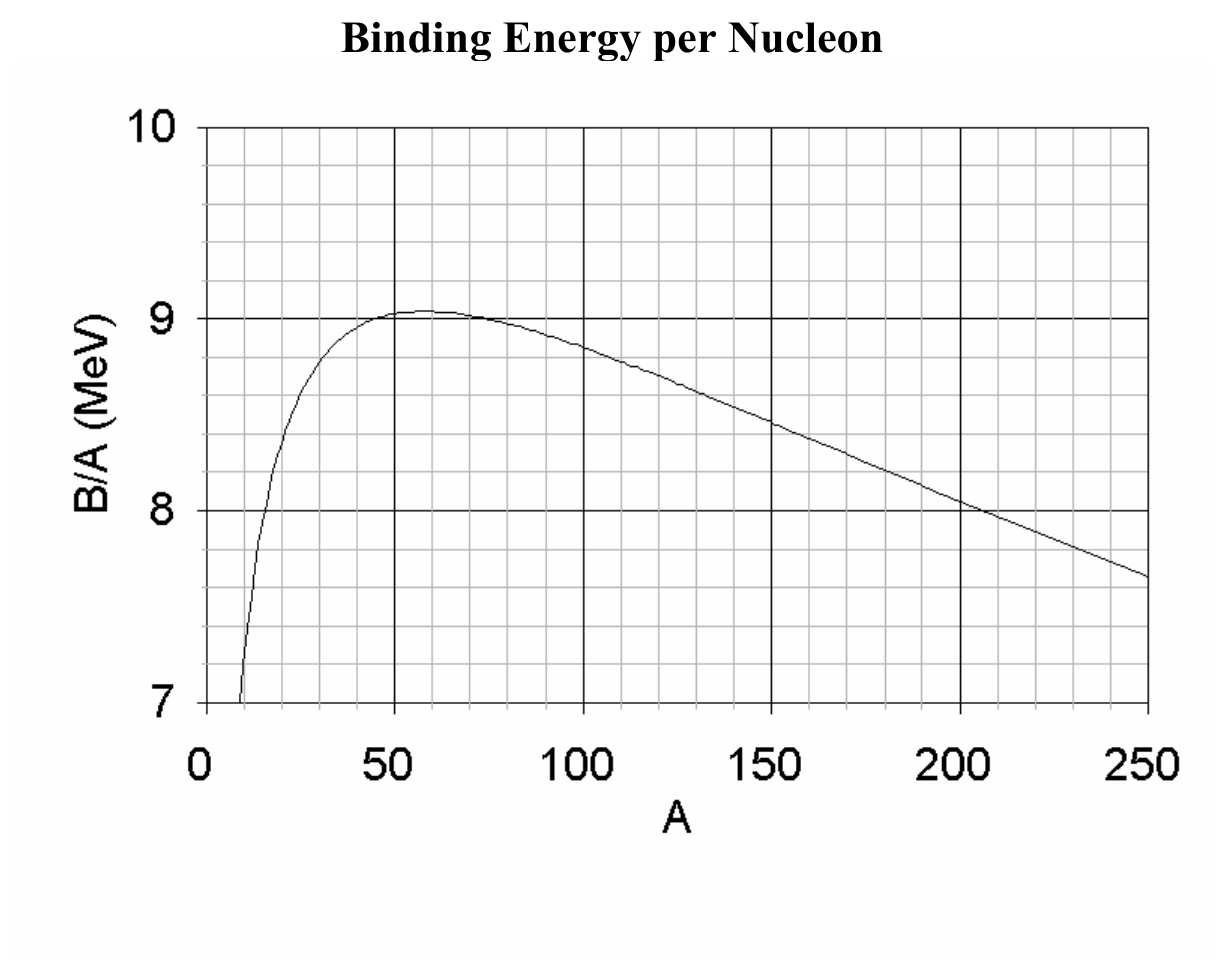
(a) Above a certain mass number \(A_\alpha\), nuclei have binding energies which are always small enough to allow the emission of alpha-particles (\(A=4\)). Use a linear approximation to this curve above \(A=100\) to estimate \(A_\alpha\). (3 marks)
For this model, assume the following:
- Both initial and final nuclei are represented on this curve.
- The total binding energy of the alpha-particle is given by \(B_4=25.0\) MeV (this cannot be read off the graph!).
(b) The binding energy of an atomic nucleus with \(Z\) protons and \(N\) neutrons (\(A=N+Z\)) is given by a semi-empirical formula:
\[ B=a_vA-a_sA^{2/3}-a_cZ^2A^{-1/3} -a_a\frac{(N-Z)^2}{A}-\delta \]
The value of \(\delta\) is given by:
\(+a_pA^{-3/4}\) for odd-\(N\)/odd-\(Z\) nuclei
\(0\) for even-\(N\)/odd-\(Z\) or odd-\(N\)/even-\(Z\) nuclei
\(-a_pA^{-3/4}\) for even-\(N\)/even-\(Z\) nuclei
The values of the coefficients are:
\[ a_v=15.8\text{ MeV};\quad a_s=16.8\text{ MeV};\quad a_c=0.72\text{ MeV};\quad a_a=23.5\text{ MeV};\quad a_p=33.5\text{ MeV}. \]
(i) Derive an expression for the proton number \(Z_{\max}\) of the nucleus with the largest binding energy for a given mass number \(A\). Ignore the \(\delta\)-term for this part only. (2 marks)
(ii) What is the value of \(Z\) for the \(A=200\) nucleus with the largest \(B/A\)? Include the effect of the \(\delta\)-term. (2 marks)
(iii) Consider the three nuclei with \(A=128\) listed in the table on the answer sheet. Determine which ones are energetically stable and which ones have sufficient energy to decay by the processes listed below. Determine \(Z_{\max}\) as defined in part (i) and fill out the table on your answer sheet.
In filling out the table, please:
- Mark processes which are energetically allowed thus: √
- Mark processes which are NOT energetically allowed thus: 0
- Consider only transitions between these three nuclei.
Decay processes:
(1) \(\beta^-\) - decay; emission from the nucleus of an electron
(2) \(\beta^+\) - decay; emission from the nucleus of a positron
(3) \(\beta^-\beta^-\) - decay; emission from the nucleus of two electrons simultaneously
(4) Electron capture; capture of an atomic electron by the nucleus.
The rest mass energy of an electron (and positron) is \(m_ec^2=0.51\) MeV; that of a proton is \(m_pc^2=938.27\) MeV; that of a neutron is \(m_nc^2=939.57\) MeV.
(3 marks)
(b) (iii)
| Nucleus/Process | \(\beta^-\) - decay | \(\beta^+\) - decay | Electron-capture | \(\beta^-\beta^-\) - decay |
|---|---|---|---|---|
| \({}^{128}_{53}\mathrm{I}\) | ||||
| \({}^{128}_{54}\mathrm{Xe}\) | ||||
| \({}^{128}_{55}\mathrm{Cs}\) |
Notation : \({}^{A}_{Z}X\)
\(X\) = Chemical Symbol
Official English text of the problem.
Answers
- (a) \(\boxed{A_\alpha\approx2.1\times10^2}\). The straight-line fit used below gives approximately \(215\).
- (b)(i) \(\displaystyle \boxed{Z_{\max}=\frac{2a_aA}{4a_a+a_cA^{2/3}}=\frac{A}{2+\frac{a_c}{2a_a}A^{2/3}}}\). This is the continuous maximum; with pairing omitted, choose the nearest integer.
- (b)(ii) \(\boxed{Z=80}\), with \(N=120\) and \(B/A\approx8.05\) MeV.
- (b)(iii) The continuous result is \(\boxed{Z_{\max}\approx53.58}\); the integer binding-energy maximum is \(Z=54\). Within the specified transitions, \({}^{128}\mathrm{Xe}\) is stable, while \({}^{128}\mathrm{I}\) and \({}^{128}\mathrm{Cs}\) can decay.
| Nucleus/Process | \(\beta^-\) - decay | \(\beta^+\) - decay | Electron-capture | \(\beta^-\beta^-\) - decay |
|---|---|---|---|---|
| \({}^{128}_{53}\mathrm{I}\) | √ | 0 | 0 | √ |
| \({}^{128}_{54}\mathrm{Xe}\) | 0 | 0 | 0 | 0 |
| \({}^{128}_{55}\mathrm{Cs}\) | 0 | √ | √ | 0 |
Entries whose daughters lie outside these three nuclei are marked \(0\) under the stated restriction.
Solution
(a)
Alpha decay conserves the total numbers of protons and neutrons. Consequently, the free-nucleon rest energies cancel when calculating the energy release:
\[ Q_\alpha =\bigl[M(A,Z)-M(A-4,Z-2)-M(4,2)\bigr]c^2 =B(A-4)+B_4-B(A). \]
The decay is energetically allowed when \(Q_\alpha>0\).
Write the straight-line approximation to the plotted quantity as
\[ b(A)\equiv\frac{B(A)}{A}\simeq b_0-kA. \]
Representative readings from the graph are
\[ b(100)\simeq8.85\text{ MeV}, \qquad b(200)\simeq8.05\text{ MeV}. \]
Thus,
\[ k\simeq8.0\times10^{-3}\text{ MeV}, \qquad b_0\simeq9.65\text{ MeV}, \]
where \(A\) is dimensionless. The total binding energy is therefore
\[ B(A)\simeq b_0A-kA^2. \]
Using the finite change of four nucleons,
\[ \begin{aligned} Q_\alpha &=B_4+b_0(A-4)-k(A-4)^2-b_0A+kA^2\\ &=B_4-4b_0+8kA-16k. \end{aligned} \]
At the threshold, \(Q_\alpha=0\), giving
\[ A_\alpha =\frac{b_0-B_4/4}{2k}+2. \]
Numerically,
\[ A_\alpha \simeq\frac{9.65-25.0/4}{0.016}+2 =214.5. \]
Since \(Q_\alpha\) increases with \(A\), alpha emission is energetically possible above this threshold. Allowing for the precision of the graph,
\[ \boxed{A_\alpha\approx2.1\times10^2.} \]
(b)(i)
At fixed \(A\), substitute \(N=A-Z\), so that \(N-Z=A-2Z\). Omitting pairing,
\[ B(Z)=a_vA-a_sA^{2/3}-a_cZ^2A^{-1/3} -\frac{a_a}{A}(A-2Z)^2. \]
Treating \(Z\) initially as continuous, the maximum satisfies
\[ \frac{\partial B}{\partial Z} =-2a_cZA^{-1/3} +\frac{4a_a}{A}(A-2Z)=0. \]
Multiplying by \(A\) and collecting the terms in \(Z\),
\[ (2a_cA^{2/3}+8a_a)Z=4a_aA. \]
Hence,
\[ \boxed{ Z_{\max} =\frac{2a_aA}{4a_a+a_cA^{2/3}} =\frac{A}{2+\frac{a_c}{2a_a}A^{2/3}}. } \]
This stationary point is a maximum because
\[ \frac{\partial^2B}{\partial Z^2} =-2a_cA^{-1/3}-\frac{8a_a}{A}<0. \]
Without pairing, the physical integer maximum is the integer nearest this value.
(b)(ii)
For \(A=200\), the continuous maximum without pairing is
\[ Z_0 =\frac{200}{2+\frac{0.72}{47.0}200^{2/3}} \simeq79.242. \]
Because \(A\) is even, even \(Z\) also means even \(N\), while odd \(Z\) means odd \(N\). The pairing magnitude is
\[ P=a_pA^{-3/4} =33.5(200)^{-3/4} \simeq0.6299\text{ MeV}. \]
Since the formula contains \(-\delta\), pairing adds \(P\) to the binding energy for even \(Z\), and subtracts \(P\) for odd \(Z\).
The unpaired binding energy can be written
\[ B_0(Z)=B_0(Z_0) -\left(a_cA^{-1/3}+\frac{4a_a}{A}\right)(Z-Z_0)^2. \]
Therefore, within either parity class, the best integer is the one nearest \(Z_0\). The best odd choice is \(79\), and the best even choice is \(80\). Direct substitution, including pairing, gives:
| \(Z\) | \(N\) | \(\delta\) (MeV) | \(B\) (MeV) |
|---|---|---|---|
| 78 | 122 | \(-0.630\) | 1609.55 |
| 79 | 121 | \(+0.630\) | 1609.17 |
| 80 | 120 | \(-0.630\) | 1610.12 |
In particular,
\[ B(80)-B(79)\simeq0.954\text{ MeV}>0. \]
Thus,
\[ \boxed{Z=80,\qquad N=120,} \]
with
\[ \frac BA=\frac{1610.12}{200}\simeq8.05\text{ MeV}. \]
(b)(iii)
First, the result from part (i) gives
\[ Z_{\max} =\frac{128}{2+\frac{0.72}{47.0}128^{2/3}} \simeq53.577. \]
Thus the nearest integer is \(54\), which is also favoured by pairing.
For these nuclei,
\[ P=33.5(128)^{-3/4}\simeq0.880313\text{ MeV}. \]
Iodine and caesium have odd \(N\) and odd \(Z\), so \(\delta=+P\). Xenon has even \(N\) and even \(Z\), so \(\delta=-P\).
Decay energetics require nuclear masses as well as binding energies. Writing \(E_Z=M_Zc^2\),
\[ E_Z =128m_nc^2+Z(m_p-m_n)c^2-B_Z =128m_nc^2-(1.30\text{ MeV})Z-B_Z. \]
Substitution gives the following values. Extra digits are retained to resolve the small double-beta energy.
| Nucleus | \(B_Z\) (MeV) | \(E_Z-E_{54}\) (MeV) |
|---|---|---|
| \({}^{128}_{53}\mathrm{I}\) | 1104.656 | 3.195830 |
| \({}^{128}_{54}\mathrm{Xe}\) | 1106.552 | 0 |
| \({}^{128}_{55}\mathrm{Cs}\) | 1103.172 | 2.079906 |
Neglecting atomic electron binding energies and neutrino rest masses, energy conservation gives
\[ \begin{aligned} Q_{\beta^-}(Z)&=E_Z-E_{Z+1}-m_ec^2,\\ Q_{\beta^+}(Z)&=E_Z-E_{Z-1}-m_ec^2,\\ Q_{\mathrm{EC}}(Z)&=E_Z+m_ec^2-E_{Z-1},\\ Q_{\beta^-\beta^-}(Z)&=E_Z-E_{Z+2}-2m_ec^2. \end{aligned} \]
The electron rest energy is subtracted for emission and added for capture. A process is energetically allowed when \(Q>0\).
All possible transitions within the specified set are:
| Initial nucleus | Process | Daughter | \(Q\) (MeV) | Allowed? |
|---|---|---|---|---|
| \({}^{128}\mathrm{I}\) | \(\beta^-\) | \({}^{128}\mathrm{Xe}\) | \(+2.686\) | √ |
| \({}^{128}\mathrm{Xe}\) | \(\beta^-\) | \({}^{128}\mathrm{Cs}\) | \(-2.590\) | 0 |
| \({}^{128}\mathrm{Xe}\) | \(\beta^+\) | \({}^{128}\mathrm{I}\) | \(-3.706\) | 0 |
| \({}^{128}\mathrm{Cs}\) | \(\beta^+\) | \({}^{128}\mathrm{Xe}\) | \(+1.570\) | √ |
| \({}^{128}\mathrm{Xe}\) | Electron capture | \({}^{128}\mathrm{I}\) | \(-2.686\) | 0 |
| \({}^{128}\mathrm{Cs}\) | Electron capture | \({}^{128}\mathrm{Xe}\) | \(+2.590\) | √ |
| \({}^{128}\mathrm{I}\) | \(\beta^-\beta^-\) | \({}^{128}\mathrm{Cs}\) | \(+0.096\) | √ |
For the small double-beta energy specifically,
\[ \begin{aligned} Q_{\beta^-\beta^-} &=E_{53}-E_{55}-2m_ec^2\\ &=3.195830-2.079906-1.020\\ &\simeq0.0959\text{ MeV}>0. \end{aligned} \]
Thus simultaneous double-beta decay of iodine to caesium is energetically allowed, even though the second step of the sequential route through xenon is forbidden.
Xenon has no energetically allowed transition within the specified set. Iodine can undergo beta-minus or double-beta-minus decay; caesium can undergo positron emission or electron capture.
The solution was checked against the official solution.
IPhO 1997 · Theorieaufgabe 2
Kernmassen und Stabilität
Alle Energien in dieser Aufgabe werden in MeV angegeben – Millionen Elektronenvolt.
Ein MeV = \(1.6\times10^{-13}\) J; diese Umrechnung muss jedoch zur Lösung der Aufgabe nicht bekannt sein.
Die Masse \(M\) eines Atomkerns mit \(Z\) Protonen und \(N\) Neutronen (also der Massenzahl \(A=N+Z\)) ist die Summe der Massen seiner freien Nukleonen (Protonen und Neutronen) abzüglich der Bindungsenergie \(B/c^2\).
\[ Mc^2=Zm_pc^2+Nm_nc^2-B \]
Das folgende Diagramm zeigt den Maximalwert von \(B/A\) für einen gegebenen Wert von \(A\) in Abhängigkeit von \(A\).
Je größer der Wert von \(B/A\), desto stabiler ist im Allgemeinen der Kern.
(a) Oberhalb einer bestimmten Massenzahl \(A_\alpha\) sind die Bindungsenergien der Kerne stets klein genug, um die Emission von Alphateilchen (\(A=4\)) zu ermöglichen. Verwenden Sie eine lineare Näherung dieser Kurve oberhalb von \(A=100\), um \(A_\alpha\) abzuschätzen. (3 Punkte)
Nehmen Sie für dieses Modell Folgendes an:
- Sowohl der Ausgangs- als auch der Endkern liegen auf dieser Kurve.
- Die gesamte Bindungsenergie des Alphateilchens beträgt \(B_4=25.0\) MeV (dies lässt sich nicht aus dem Diagramm ablesen!).
(b) Die Bindungsenergie eines Atomkerns mit \(Z\) Protonen und \(N\) Neutronen (\(A=N+Z\)) wird durch eine semiempirische Formel beschrieben:
\[ B=a_vA-a_sA^{2/3}-a_cZ^2A^{-1/3} -a_a\frac{(N-Z)^2}{A}-\delta \]
Der Wert von \(\delta\) ist gegeben durch:
\(+a_pA^{-3/4}\) für Kerne mit ungeradem \(N\) und ungeradem \(Z\)
\(0\) für Kerne mit geradem \(N\) und ungeradem \(Z\) oder ungeradem \(N\) und geradem \(Z\)
\(-a_pA^{-3/4}\) für Kerne mit geradem \(N\) und geradem \(Z\)
Die Koeffizienten haben die Werte:
\[ a_v=15.8\text{ MeV};\quad a_s=16.8\text{ MeV};\quad a_c=0.72\text{ MeV};\quad a_a=23.5\text{ MeV};\quad a_p=33.5\text{ MeV}. \]
(i) Leiten Sie einen Ausdruck für die Protonenzahl \(Z_{\max}\) des Kerns mit der größten Bindungsenergie bei gegebener Massenzahl \(A\) her. Vernachlässigen Sie den \(\delta\)-Term nur in dieser Teilaufgabe. (2 Punkte)
(ii) Welchen Wert hat \(Z\) für den Kern mit \(A=200\), der das größte \(B/A\) besitzt? Berücksichtigen Sie den Einfluss des \(\delta\)-Terms. (2 Punkte)
(iii) Betrachten Sie die drei Kerne mit \(A=128\), die in der Tabelle auf dem Antwortblatt aufgeführt sind. Bestimmen Sie, welche davon energetisch stabil sind und welche genügend Energie besitzen, um durch die unten aufgeführten Prozesse zu zerfallen. Bestimmen Sie \(Z_{\max}\) gemäß der Definition in Teil (i) und füllen Sie die Tabelle auf Ihrem Antwortblatt aus.
Beachten Sie beim Ausfüllen der Tabelle bitte Folgendes:
- Kennzeichnen Sie energetisch erlaubte Prozesse mit: √
- Kennzeichnen Sie energetisch NICHT erlaubte Prozesse mit: 0
- Berücksichtigen Sie ausschließlich Übergänge zwischen diesen drei Kernen.
Zerfallsprozesse:
(1) \(\beta^-\)-Zerfall; Emission eines Elektrons aus dem Kern
(2) \(\beta^+\)-Zerfall; Emission eines Positrons aus dem Kern
(3) \(\beta^-\beta^-\)-Zerfall; gleichzeitige Emission zweier Elektronen aus dem Kern
(4) Elektroneneinfang; Einfang eines Hüllenelektrons durch den Kern.
Die Ruheenergie eines Elektrons (und eines Positrons) beträgt \(m_ec^2=0.51\) MeV; die eines Protons beträgt \(m_pc^2=938.27\) MeV; die eines Neutrons beträgt \(m_nc^2=939.57\) MeV.
(3 Punkte)
(b) (iii)
| Kern/Prozess | \(\beta^-\)-Zerfall | \(\beta^+\)-Zerfall | Elektroneneinfang | \(\beta^-\beta^-\)-Zerfall |
|---|---|---|---|---|
| \({}^{128}_{53}\mathrm{I}\) | ||||
| \({}^{128}_{54}\mathrm{Xe}\) | ||||
| \({}^{128}_{55}\mathrm{Cs}\) |
Schreibweise: \({}^{A}_{Z}X\)
\(X\) = chemisches Symbol
Aufgabentext aus dem offiziellen englischen Text übersetzt.
Antworten
- (a) \(\boxed{A_\alpha\approx2.1\times10^2}\). Die unten verwendete Geradennäherung ergibt ungefähr \(215\).
- (b)(i) \(\displaystyle \boxed{Z_{\max}=\frac{2a_aA}{4a_a+a_cA^{2/3}}=\frac{A}{2+\frac{a_c}{2a_a}A^{2/3}}}\). Dies ist das Maximum bei kontinuierlicher Betrachtung; ohne Berücksichtigung der Paarung ist die nächstgelegene ganze Zahl zu wählen.
- (b)(ii) \(\boxed{Z=80}\), mit \(N=120\) und \(B/A\approx8.05\) MeV.
- (b)(iii) Das Ergebnis bei kontinuierlicher Betrachtung lautet \(\boxed{Z_{\max}\approx53.58}\); das ganzzahlige Bindungsenergiemaximum liegt bei \(Z=54\). Hinsichtlich der vorgegebenen Übergänge ist \({}^{128}\mathrm{Xe}\) stabil, während \({}^{128}\mathrm{I}\) und \({}^{128}\mathrm{Cs}\) zerfallen können.
| Kern/Prozess | \(\beta^-\)-Zerfall | \(\beta^+\)-Zerfall | Elektroneneinfang | \(\beta^-\beta^-\)-Zerfall |
|---|---|---|---|---|
| \({}^{128}_{53}\mathrm{I}\) | √ | 0 | 0 | √ |
| \({}^{128}_{54}\mathrm{Xe}\) | 0 | 0 | 0 | 0 |
| \({}^{128}_{55}\mathrm{Cs}\) | 0 | √ | √ | 0 |
Einträge, deren Tochterkerne außerhalb dieser drei Kerne liegen, werden aufgrund der vorgegebenen Einschränkung mit \(0\) gekennzeichnet.
Lösung
(a)
Beim Alphazerfall bleiben die Gesamtzahlen der Protonen und Neutronen erhalten. Daher heben sich bei der Berechnung der frei werdenden Energie die Ruheenergien der freien Nukleonen auf:
\[ Q_\alpha =\bigl[M(A,Z)-M(A-4,Z-2)-M(4,2)\bigr]c^2 =B(A-4)+B_4-B(A). \]
Der Zerfall ist energetisch erlaubt, wenn \(Q_\alpha>0\).
Wir schreiben die Geradennäherung für die aufgetragene Größe als
\[ b(A)\equiv\frac{B(A)}{A}\simeq b_0-kA. \]
Repräsentative, aus dem Diagramm abgelesene Werte sind
\[ b(100)\simeq8.85\text{ MeV}, \qquad b(200)\simeq8.05\text{ MeV}. \]
Somit gilt
\[ k\simeq8.0\times10^{-3}\text{ MeV}, \qquad b_0\simeq9.65\text{ MeV}, \]
wobei \(A\) dimensionslos ist. Die gesamte Bindungsenergie beträgt daher
\[ B(A)\simeq b_0A-kA^2. \]
Für die endliche Änderung um vier Nukleonen ergibt sich
\[ \begin{aligned} Q_\alpha &=B_4+b_0(A-4)-k(A-4)^2-b_0A+kA^2\\ &=B_4-4b_0+8kA-16k. \end{aligned} \]
An der Schwelle gilt \(Q_\alpha=0\), woraus folgt:
\[ A_\alpha =\frac{b_0-B_4/4}{2k}+2. \]
Numerisch ergibt sich
\[ A_\alpha \simeq\frac{9.65-25.0/4}{0.016}+2 =214.5. \]
Da \(Q_\alpha\) mit \(A\) zunimmt, ist die Alphaemission oberhalb dieser Schwelle energetisch möglich. Unter Berücksichtigung der Ablesegenauigkeit des Diagramms gilt
\[ \boxed{A_\alpha\approx2.1\times10^2.} \]
(b)(i)
Bei festem \(A\) setzen wir \(N=A-Z\) ein, sodass \(N-Z=A-2Z\) gilt. Ohne Berücksichtigung der Paarung ergibt sich
\[ B(Z)=a_vA-a_sA^{2/3}-a_cZ^2A^{-1/3} -\frac{a_a}{A}(A-2Z)^2. \]
Behandeln wir \(Z\) zunächst als kontinuierliche Variable, so erfüllt das Maximum die Bedingung
\[ \frac{\partial B}{\partial Z} =-2a_cZA^{-1/3} +\frac{4a_a}{A}(A-2Z)=0. \]
Multiplikation mit \(A\) und Zusammenfassen der Terme mit \(Z\) ergibt
\[ (2a_cA^{2/3}+8a_a)Z=4a_aA. \]
Daraus folgt
\[ \boxed{ Z_{\max} =\frac{2a_aA}{4a_a+a_cA^{2/3}} =\frac{A}{2+\frac{a_c}{2a_a}A^{2/3}}. } \]
Diese stationäre Stelle ist ein Maximum, denn
\[ \frac{\partial^2B}{\partial Z^2} =-2a_cA^{-1/3}-\frac{8a_a}{A}<0. \]
Ohne Paarung liegt das physikalische ganzzahlige Maximum bei der diesem Wert nächstgelegenen ganzen Zahl.
(b)(ii)
Für \(A=200\) liegt das Maximum bei kontinuierlicher Betrachtung ohne Paarung bei
\[ Z_0 =\frac{200}{2+\frac{0.72}{47.0}200^{2/3}} \simeq79.242. \]
Da \(A\) gerade ist, bedeutet ein gerades \(Z\) auch ein gerades \(N\), während ein ungerades \(Z\) ein ungerades \(N\) bedeutet. Der Betrag des Paarungsterms ist
\[ P=a_pA^{-3/4} =33.5(200)^{-3/4} \simeq0.6299\text{ MeV}. \]
Da die Formel \(-\delta\) enthält, wird durch die Paarung bei geradem \(Z\) zur Bindungsenergie \(P\) addiert und bei ungeradem \(Z\) von ihr \(P\) subtrahiert.
Die Bindungsenergie ohne Paarung lässt sich schreiben als
\[ B_0(Z)=B_0(Z_0) -\left(a_cA^{-1/3}+\frac{4a_a}{A}\right)(Z-Z_0)^2. \]
Daher ist innerhalb jeder der beiden Paritätsklassen diejenige ganze Zahl optimal, die \(Z_0\) am nächsten liegt. Die optimale ungerade Wahl ist \(79\), die optimale gerade Wahl ist \(80\). Direktes Einsetzen unter Berücksichtigung der Paarung ergibt:
| \(Z\) | \(N\) | \(\delta\) (MeV) | \(B\) (MeV) |
|---|---|---|---|
| 78 | 122 | \(-0.630\) | 1609.55 |
| 79 | 121 | \(+0.630\) | 1609.17 |
| 80 | 120 | \(-0.630\) | 1610.12 |
Insbesondere gilt
\[ B(80)-B(79)\simeq0.954\text{ MeV}>0. \]
Somit ist
\[ \boxed{Z=80,\qquad N=120,} \]
mit
\[ \frac BA=\frac{1610.12}{200}\simeq8.05\text{ MeV}. \]
(b)(iii)
Zunächst ergibt das Ergebnis aus Teil (i)
\[ Z_{\max} =\frac{128}{2+\frac{0.72}{47.0}128^{2/3}} \simeq53.577. \]
Die nächstgelegene ganze Zahl ist somit \(54\), die auch durch die Paarung begünstigt wird.
Für diese Kerne gilt
\[ P=33.5(128)^{-3/4}\simeq0.880313\text{ MeV}. \]
Iod und Caesium haben ein ungerades \(N\) und ein ungerades \(Z\), also gilt \(\delta=+P\). Xenon hat ein gerades \(N\) und ein gerades \(Z\), also gilt \(\delta=-P\).
Für die Energiebilanz der Zerfälle werden neben den Bindungsenergien auch die Kernmassen benötigt. Mit \(E_Z=M_Zc^2\) gilt
\[ E_Z =128m_nc^2+Z(m_p-m_n)c^2-B_Z =128m_nc^2-(1.30\text{ MeV})Z-B_Z. \]
Einsetzen ergibt die folgenden Werte. Zusätzliche Stellen werden beibehalten, um die kleine Doppelbeta-Zerfallsenergie aufzulösen.
| Kern | \(B_Z\) (MeV) | \(E_Z-E_{54}\) (MeV) |
|---|---|---|
| \({}^{128}_{53}\mathrm{I}\) | 1104.656 | 3.195830 |
| \({}^{128}_{54}\mathrm{Xe}\) | 1106.552 | 0 |
| \({}^{128}_{55}\mathrm{Cs}\) | 1103.172 | 2.079906 |
Unter Vernachlässigung der Bindungsenergien der Hüllenelektronen und der Neutrinoruhemassen liefert die Energieerhaltung
\[ \begin{aligned} Q_{\beta^-}(Z)&=E_Z-E_{Z+1}-m_ec^2,\\ Q_{\beta^+}(Z)&=E_Z-E_{Z-1}-m_ec^2,\\ Q_{\mathrm{EC}}(Z)&=E_Z+m_ec^2-E_{Z-1},\\ Q_{\beta^-\beta^-}(Z)&=E_Z-E_{Z+2}-2m_ec^2. \end{aligned} \]
Die Ruheenergie des Elektrons wird bei der Emission subtrahiert und beim Einfang addiert. Ein Prozess ist energetisch erlaubt, wenn \(Q>0\).
Alle möglichen Übergänge innerhalb der vorgegebenen Menge sind:
| Ausgangskern | Prozess | Tochterkern | \(Q\) (MeV) | Erlaubt? |
|---|---|---|---|---|
| \({}^{128}\mathrm{I}\) | \(\beta^-\) | \({}^{128}\mathrm{Xe}\) | \(+2.686\) | √ |
| \({}^{128}\mathrm{Xe}\) | \(\beta^-\) | \({}^{128}\mathrm{Cs}\) | \(-2.590\) | 0 |
| \({}^{128}\mathrm{Xe}\) | \(\beta^+\) | \({}^{128}\mathrm{I}\) | \(-3.706\) | 0 |
| \({}^{128}\mathrm{Cs}\) | \(\beta^+\) | \({}^{128}\mathrm{Xe}\) | \(+1.570\) | √ |
| \({}^{128}\mathrm{Xe}\) | Elektroneneinfang | \({}^{128}\mathrm{I}\) | \(-2.686\) | 0 |
| \({}^{128}\mathrm{Cs}\) | Elektroneneinfang | \({}^{128}\mathrm{Xe}\) | \(+2.590\) | √ |
| \({}^{128}\mathrm{I}\) | \(\beta^-\beta^-\) | \({}^{128}\mathrm{Cs}\) | \(+0.096\) | √ |
Insbesondere gilt für die kleine Doppelbeta-Zerfallsenergie
\[ \begin{aligned} Q_{\beta^-\beta^-} &=E_{53}-E_{55}-2m_ec^2\\ &=3.195830-2.079906-1.020\\ &\simeq0.0959\text{ MeV}>0. \end{aligned} \]
Somit ist der gleichzeitige Doppelbetazerfall von Iod zu Caesium energetisch erlaubt, obwohl der zweite Schritt des aufeinanderfolgenden Zerfalls über Xenon verboten ist.
Xenon besitzt innerhalb der vorgegebenen Menge keinen energetisch erlaubten Übergang. Iod kann einen Beta-minus- oder einen Doppelbeta-minus-Zerfall durchlaufen; Caesium kann unter Positronenemission oder durch Elektroneneinfang zerfallen.
Die Lösung wurde mit der offiziellen Lösung abgeglichen.
IPhO 1997 · Teori sorusu 2
Çekirdek Kütleleri ve Kararlılık
Bu sorudaki tüm enerjiler MeV — milyon elektron volt — cinsinden ifade edilmiştir.
Bir MeV = \(1.6\times10^{-13}\) J'dür, ancak problemi çözmek için bunu bilmek gerekli değildir.
\(Z\) proton ve \(N\) nötron içeren (yani kütle numarası \(A=N+Z\) olan) bir atom çekirdeğinin \(M\) kütlesi, onu oluşturan serbest nükleonların (proton ve nötronların) kütleleri toplamından bağlanma enerjisinin kütle karşılığı \(B/c^2\) çıkarılarak bulunur.
\[ Mc^2=Zm_pc^2+Nm_nc^2-B \]
Aşağıdaki grafikte, verilen bir \(A\) değeri için \(B/A\)'nın en büyük değeri \(A\)'ya karşı çizilmiştir.
Genel olarak \(B/A\) değeri ne kadar büyükse çekirdek o kadar kararlıdır.
(a) Belirli bir \(A_\alpha\) kütle numarasının üzerinde, çekirdeklerin bağlanma enerjileri alfa parçacığı (\(A=4\)) salımına izin verecek kadar küçüktür. \(A_\alpha\)'yı tahmin etmek için bu eğriye \(A=100\)'ün üzerinde doğrusal bir yaklaşım uygulayın. (3 puan)
Bu model için aşağıdakileri varsayın:
- Hem başlangıç hem de son çekirdek bu eğri üzerinde temsil edilmektedir.
- Alfa parçacığının toplam bağlanma enerjisi \(B_4=25.0\) MeV olarak verilmiştir (bu değer grafikten okunamaz!).
(b) \(Z\) proton ve \(N\) nötron içeren (\(A=N+Z\)) bir atom çekirdeğinin bağlanma enerjisi yarı ampirik bir formülle verilir:
\[ B=a_vA-a_sA^{2/3}-a_cZ^2A^{-1/3} -a_a\frac{(N-Z)^2}{A}-\delta \]
\(\delta\)'nın değeri şöyledir:
\(N\)'si tek/\(Z\)'si tek çekirdekler için \(+a_pA^{-3/4}\)
\(N\)'si çift/\(Z\)'si tek veya \(N\)'si tek/\(Z\)'si çift çekirdekler için \(0\)
\(N\)'si çift/\(Z\)'si çift çekirdekler için \(-a_pA^{-3/4}\)
Katsayıların değerleri şunlardır:
\[ a_v=15.8\text{ MeV};\quad a_s=16.8\text{ MeV};\quad a_c=0.72\text{ MeV};\quad a_a=23.5\text{ MeV};\quad a_p=33.5\text{ MeV}. \]
(i) Verilen bir \(A\) kütle numarası için en büyük bağlanma enerjisine sahip çekirdeğin \(Z_{\max}\) proton sayısını veren bir ifade türetin. Yalnızca bu kısımda \(\delta\) terimini ihmal edin. (2 puan)
(ii) \(A=200\) olan ve en büyük \(B/A\) değerine sahip çekirdeğin \(Z\) değeri nedir? \(\delta\) teriminin etkisini de hesaba katın. (2 puan)
(iii) Cevap kâğıdındaki tabloda listelenen, \(A=128\) olan üç çekirdeği ele alın. Hangilerinin enerji açısından kararlı olduğunu ve hangilerinin aşağıda listelenen süreçlerle bozunmak için yeterli enerjiye sahip olduğunu belirleyin. (i) kısmında tanımlanan \(Z_{\max}\)'ı belirleyin ve cevap kâğıdınızdaki tabloyu doldurun.
Tabloyu doldururken lütfen:
- Enerji açısından mümkün olan süreçleri şöyle işaretleyin: √
- Enerji açısından mümkün OLMAYAN süreçleri şöyle işaretleyin: 0
- Yalnızca bu üç çekirdek arasındaki geçişleri dikkate alın.
Bozunma süreçleri:
(1) \(\beta^-\) bozunması; çekirdekten bir elektron salınması
(2) \(\beta^+\) bozunması; çekirdekten bir pozitron salınması
(3) \(\beta^-\beta^-\) bozunması; çekirdekten aynı anda iki elektron salınması
(4) Elektron yakalama; bir atom elektronunun çekirdek tarafından yakalanması.
Bir elektronun (ve pozitronun) durgunluk enerjisi \(m_ec^2=0.51\) MeV; bir protonunki \(m_pc^2=938.27\) MeV; bir nötronunki ise \(m_nc^2=939.57\) MeV'dir.
(3 puan)
(b) (iii)
| Çekirdek/Süreç | \(\beta^-\) bozunması | \(\beta^+\) bozunması | Elektron yakalama | \(\beta^-\beta^-\) bozunması |
|---|---|---|---|---|
| \({}^{128}_{53}\mathrm{I}\) | ||||
| \({}^{128}_{54}\mathrm{Xe}\) | ||||
| \({}^{128}_{55}\mathrm{Cs}\) |
Gösterim: \({}^{A}_{Z}X\)
\(X\) = Kimyasal Sembol
Soru metni resmi İngilizce metinden çevrilmiştir.
Cevaplar
- (a) \(\boxed{A_\alpha\approx2.1\times10^2}\). Aşağıda kullanılan doğru uyumu yaklaşık \(215\) verir.
- (b)(i) \(\displaystyle \boxed{Z_{\max}=\frac{2a_aA}{4a_a+a_cA^{2/3}}=\frac{A}{2+\frac{a_c}{2a_a}A^{2/3}}}\). Bu, sürekli değişken için maksimumdur; eşleşme ihmal edildiğinde en yakın tam sayıyı seçin.
- (b)(ii) \(\boxed{Z=80}\), \(N=120\) ve \(B/A\approx8.05\) MeV.
- (b)(iii) Sürekli değişken için sonuç \(\boxed{Z_{\max}\approx53.58}\)'dir; bağlanma enerjisinin tam sayı değerlerindeki maksimumu \(Z=54\)'te elde edilir. Belirtilen geçişler kapsamında \({}^{128}\mathrm{Xe}\) kararlıdır; \({}^{128}\mathrm{I}\) ve \({}^{128}\mathrm{Cs}\) ise bozunabilir.
| Çekirdek/Süreç | \(\beta^-\) bozunması | \(\beta^+\) bozunması | Elektron yakalama | \(\beta^-\beta^-\) bozunması |
|---|---|---|---|---|
| \({}^{128}_{53}\mathrm{I}\) | √ | 0 | 0 | √ |
| \({}^{128}_{54}\mathrm{Xe}\) | 0 | 0 | 0 | 0 |
| \({}^{128}_{55}\mathrm{Cs}\) | 0 | √ | √ | 0 |
Ürün çekirdekleri bu üç çekirdeğin dışında kalan durumlar, belirtilen kısıtlama uyarınca \(0\) ile işaretlenmiştir.
Çözüm
(a)
Alfa bozunmasında toplam proton ve nötron sayıları korunur. Dolayısıyla açığa çıkan enerji hesaplanırken serbest nükleonların durgunluk enerjileri birbirini götürür:
\[ Q_\alpha =\bigl[M(A,Z)-M(A-4,Z-2)-M(4,2)\bigr]c^2 =B(A-4)+B_4-B(A). \]
Bozunma, \(Q_\alpha>0\) olduğunda enerji açısından mümkündür.
Grafikte çizilen niceliğe doğrusal yaklaşımı şöyle yazalım:
\[ b(A)\equiv\frac{B(A)}{A}\simeq b_0-kA. \]
Grafikten okunan temsilî değerler şunlardır:
\[ b(100)\simeq8.85\text{ MeV}, \qquad b(200)\simeq8.05\text{ MeV}. \]
Böylece,
\[ k\simeq8.0\times10^{-3}\text{ MeV}, \qquad b_0\simeq9.65\text{ MeV}, \]
burada \(A\) boyutsuzdur. Dolayısıyla toplam bağlanma enerjisi
\[ B(A)\simeq b_0A-kA^2. \]
olur. Dört nükleonluk sonlu değişimi kullanırsak,
\[ \begin{aligned} Q_\alpha &=B_4+b_0(A-4)-k(A-4)^2-b_0A+kA^2\\ &=B_4-4b_0+8kA-16k. \end{aligned} \]
Eşik değerinde \(Q_\alpha=0\) olduğundan,
\[ A_\alpha =\frac{b_0-B_4/4}{2k}+2. \]
Sayısal olarak,
\[ A_\alpha \simeq\frac{9.65-25.0/4}{0.016}+2 =214.5. \]
\(Q_\alpha\), \(A\) ile arttığından, bu eşiğin üzerinde alfa salımı enerji açısından mümkündür. Grafiğin hassasiyeti dikkate alındığında,
\[ \boxed{A_\alpha\approx2.1\times10^2.} \]
(b)(i)
Sabit \(A\) için \(N=A-Z\) yazalım; böylece \(N-Z=A-2Z\) olur. Eşleşmeyi ihmal edersek,
\[ B(Z)=a_vA-a_sA^{2/3}-a_cZ^2A^{-1/3} -\frac{a_a}{A}(A-2Z)^2. \]
Başlangıçta \(Z\)'yi sürekli bir değişken olarak ele aldığımızda, maksimum şu koşulu sağlar:
\[ \frac{\partial B}{\partial Z} =-2a_cZA^{-1/3} +\frac{4a_a}{A}(A-2Z)=0. \]
\(A\) ile çarpıp \(Z\) içeren terimleri toplarsak,
\[ (2a_cA^{2/3}+8a_a)Z=4a_aA. \]
Buradan,
\[ \boxed{ Z_{\max} =\frac{2a_aA}{4a_a+a_cA^{2/3}} =\frac{A}{2+\frac{a_c}{2a_a}A^{2/3}}. } \]
Bu durağan nokta bir maksimumdur, çünkü
\[ \frac{\partial^2B}{\partial Z^2} =-2a_cA^{-1/3}-\frac{8a_a}{A}<0. \]
Eşleşme hesaba katılmadığında, fiziksel tam sayı maksimumu bu değere en yakın tam sayıda elde edilir.
(b)(ii)
\(A=200\) için, eşleşme hesaba katılmadan sürekli değişken için bulunan maksimum
\[ Z_0 =\frac{200}{2+\frac{0.72}{47.0}200^{2/3}} \simeq79.242. \]
olur. \(A\) çift olduğundan, \(Z\)'nin çift olması \(N\)'nin de çift olması, \(Z\)'nin tek olması ise \(N\)'nin de tek olması demektir. Eşleşme teriminin büyüklüğü
\[ P=a_pA^{-3/4} =33.5(200)^{-3/4} \simeq0.6299\text{ MeV}. \]
olur. Formülde \(-\delta\) bulunduğundan eşleşme, çift \(Z\) için bağlanma enerjisine \(P\) ekler, tek \(Z\) için ise bağlanma enerjisinden \(P\) çıkarır.
Eşleşme hesaba katılmadığındaki bağlanma enerjisi şöyle yazılabilir:
\[ B_0(Z)=B_0(Z_0) -\left(a_cA^{-1/3}+\frac{4a_a}{A}\right)(Z-Z_0)^2. \]
Dolayısıyla, tek ve çift tam sayı sınıflarının her birinde en iyi tam sayı, \(Z_0\)'a en yakın olandır. En iyi tek sayı seçimi \(79\), en iyi çift sayı seçimi ise \(80\)'dir. Eşleşme de hesaba katılarak doğrudan yerine koyma işlemi şu sonuçları verir:
| \(Z\) | \(N\) | \(\delta\) (MeV) | \(B\) (MeV) |
|---|---|---|---|
| 78 | 122 | \(-0.630\) | 1609.55 |
| 79 | 121 | \(+0.630\) | 1609.17 |
| 80 | 120 | \(-0.630\) | 1610.12 |
Özellikle,
\[ B(80)-B(79)\simeq0.954\text{ MeV}>0. \]
Böylece,
\[ \boxed{Z=80,\qquad N=120,} \]
ve
\[ \frac BA=\frac{1610.12}{200}\simeq8.05\text{ MeV}. \]
(b)(iii)
Önce, (i) kısmındaki sonuçtan
\[ Z_{\max} =\frac{128}{2+\frac{0.72}{47.0}128^{2/3}} \simeq53.577. \]
bulunur. Dolayısıyla en yakın tam sayı \(54\)'tür; eşleşme de bu değeri destekler.
Bu çekirdekler için,
\[ P=33.5(128)^{-3/4}\simeq0.880313\text{ MeV}. \]
İyot ve sezyumun hem \(N\)'si hem de \(Z\)'si tektir; dolayısıyla \(\delta=+P\)'dir. Ksenonun hem \(N\)'si hem de \(Z\)'si çifttir; dolayısıyla \(\delta=-P\)'dir.
Bozunmanın enerji açısından incelenmesi, bağlanma enerjilerinin yanı sıra çekirdek kütlelerini de gerektirir. \(E_Z=M_Zc^2\) yazarsak,
\[ E_Z =128m_nc^2+Z(m_p-m_n)c^2-B_Z =128m_nc^2-(1.30\text{ MeV})Z-B_Z. \]
Yerine koyma işlemi aşağıdaki değerleri verir. Küçük çift beta enerjisini ayırt edebilmek için fazladan basamaklar korunmuştur.
| Çekirdek | \(B_Z\) (MeV) | \(E_Z-E_{54}\) (MeV) |
|---|---|---|
| \({}^{128}_{53}\mathrm{I}\) | 1104.656 | 3.195830 |
| \({}^{128}_{54}\mathrm{Xe}\) | 1106.552 | 0 |
| \({}^{128}_{55}\mathrm{Cs}\) | 1103.172 | 2.079906 |
Atom elektronlarının bağlanma enerjileri ve nötrinoların durgunluk kütleleri ihmal edildiğinde, enerjinin korunumu şu ifadeleri verir:
\[ \begin{aligned} Q_{\beta^-}(Z)&=E_Z-E_{Z+1}-m_ec^2,\\ Q_{\beta^+}(Z)&=E_Z-E_{Z-1}-m_ec^2,\\ Q_{\mathrm{EC}}(Z)&=E_Z+m_ec^2-E_{Z-1},\\ Q_{\beta^-\beta^-}(Z)&=E_Z-E_{Z+2}-2m_ec^2. \end{aligned} \]
Elektronun durgunluk enerjisi salımda çıkarılır, yakalamada ise eklenir. Bir süreç \(Q>0\) olduğunda enerji açısından mümkündür.
Belirtilen küme içindeki tüm olası geçişler şunlardır:
| Başlangıç çekirdeği | Süreç | Ürün çekirdek | \(Q\) (MeV) | Mümkün mü? |
|---|---|---|---|---|
| \({}^{128}\mathrm{I}\) | \(\beta^-\) | \({}^{128}\mathrm{Xe}\) | \(+2.686\) | √ |
| \({}^{128}\mathrm{Xe}\) | \(\beta^-\) | \({}^{128}\mathrm{Cs}\) | \(-2.590\) | 0 |
| \({}^{128}\mathrm{Xe}\) | \(\beta^+\) | \({}^{128}\mathrm{I}\) | \(-3.706\) | 0 |
| \({}^{128}\mathrm{Cs}\) | \(\beta^+\) | \({}^{128}\mathrm{Xe}\) | \(+1.570\) | √ |
| \({}^{128}\mathrm{Xe}\) | Elektron yakalama | \({}^{128}\mathrm{I}\) | \(-2.686\) | 0 |
| \({}^{128}\mathrm{Cs}\) | Elektron yakalama | \({}^{128}\mathrm{Xe}\) | \(+2.590\) | √ |
| \({}^{128}\mathrm{I}\) | \(\beta^-\beta^-\) | \({}^{128}\mathrm{Cs}\) | \(+0.096\) | √ |
Özellikle küçük çift beta enerjisi için,
\[ \begin{aligned} Q_{\beta^-\beta^-} &=E_{53}-E_{55}-2m_ec^2\\ &=3.195830-2.079906-1.020\\ &\simeq0.0959\text{ MeV}>0. \end{aligned} \]
Dolayısıyla, ksenon üzerinden ilerleyen ardışık yolun ikinci adımı yasak olsa da iyodun sezyuma eşzamanlı çift beta bozunması enerji açısından mümkündür.
Ksenonun belirtilen küme içinde enerji açısından mümkün bir geçişi yoktur. İyot beta eksi veya çift beta eksi bozunmasına uğrayabilir; sezyum ise pozitron salabilir veya elektron yakalayabilir.
Çözüm, resmi çözümle karşılaştırılarak kontrol edildi.
IPhO 1997 · Problema teórico 2
Masas nucleares y estabilidad
Todas las energías de este problema se expresan en MeV: millones de electronvoltios.
Un MeV = \(1.6\times10^{-13}\) J, pero no es necesario saberlo para resolver el problema.
La masa \(M\) de un núcleo atómico con \(Z\) protones y \(N\) neutrones (es decir, con número másico \(A=N+Z\)) es la suma de las masas de los nucleones constituyentes libres (protones y neutrones) menos la energía de enlace \(B/c^2\).
\[ Mc^2=Zm_pc^2+Nm_nc^2-B \]
La gráfica que se muestra a continuación representa el valor máximo de \(B/A\) para un valor dado de \(A\), en función de \(A\).
En general, cuanto mayor es el valor de \(B/A\), más estable es el núcleo.
(a) Por encima de cierto número másico \(A_\alpha\), los núcleos tienen energías de enlace que siempre son lo suficientemente pequeñas como para permitir la emisión de partículas alfa (\(A=4\)). Utilice una aproximación lineal de esta curva para \(A=100\) en adelante a fin de estimar \(A_\alpha\). (3 puntos)
Para este modelo, suponga lo siguiente:
- Tanto el núcleo inicial como el final están representados en esta curva.
- La energía de enlace total de la partícula alfa viene dada por \(B_4=25.0\) MeV (¡este valor no puede leerse en la gráfica!).
(b) La energía de enlace de un núcleo atómico con \(Z\) protones y \(N\) neutrones (\(A=N+Z\)) viene dada por una fórmula semiempírica:
\[ B=a_vA-a_sA^{2/3}-a_cZ^2A^{-1/3} -a_a\frac{(N-Z)^2}{A}-\delta \]
El valor de \(\delta\) viene dado por:
\(+a_pA^{-3/4}\) para núcleos con \(N\) impar y \(Z\) impar
\(0\) para núcleos con \(N\) par y \(Z\) impar o con \(N\) impar y \(Z\) par
\(-a_pA^{-3/4}\) para núcleos con \(N\) par y \(Z\) par
Los valores de los coeficientes son:
\[ a_v=15.8\text{ MeV};\quad a_s=16.8\text{ MeV};\quad a_c=0.72\text{ MeV};\quad a_a=23.5\text{ MeV};\quad a_p=33.5\text{ MeV}. \]
(i) Deduzca una expresión para el número de protones \(Z_{\max}\) del núcleo con la mayor energía de enlace para un número másico \(A\) dado. Ignore el término \(\delta\) únicamente en este apartado. (2 puntos)
(ii) ¿Cuál es el valor de \(Z\) para el núcleo con \(A=200\) que tiene el mayor \(B/A\)? Incluya el efecto del término \(\delta\). (2 puntos)
(iii) Considere los tres núcleos con \(A=128\) que figuran en la tabla de la hoja de respuestas. Determine cuáles son energéticamente estables y cuáles tienen energía suficiente para desintegrarse mediante los procesos que se enumeran a continuación. Determine \(Z_{\max}\) tal como se define en el apartado (i) y complete la tabla de la hoja de respuestas.
Al completar la tabla:
- Marque los procesos energéticamente permitidos así: √
- Marque los procesos que NO están energéticamente permitidos así: 0
- Considere únicamente transiciones entre estos tres núcleos.
Procesos de desintegración:
(1) Desintegración \(\beta^-\); emisión de un electrón por el núcleo
(2) Desintegración \(\beta^+\); emisión de un positrón por el núcleo
(3) Desintegración \(\beta^-\beta^-\); emisión simultánea de dos electrones por el núcleo
(4) Captura electrónica; captura de un electrón atómico por el núcleo.
La energía en reposo de un electrón (y de un positrón) es \(m_ec^2=0.51\) MeV; la de un protón es \(m_pc^2=938.27\) MeV; la de un neutrón es \(m_nc^2=939.57\) MeV.
(3 puntos)
(b) (iii)
| Núcleo/Proceso | Desintegración \(\beta^-\) | Desintegración \(\beta^+\) | Captura electrónica | Desintegración \(\beta^-\beta^-\) |
|---|---|---|---|---|
| \({}^{128}_{53}\mathrm{I}\) | ||||
| \({}^{128}_{54}\mathrm{Xe}\) | ||||
| \({}^{128}_{55}\mathrm{Cs}\) |
Notación: \({}^{A}_{Z}X\)
\(X\) = Símbolo químico
Enunciado traducido del texto oficial en inglés.
Respuestas
- (a) \(\boxed{A_\alpha\approx2.1\times10^2}\). El ajuste mediante una recta utilizado a continuación da aproximadamente \(215\).
- (b)(i) \(\displaystyle \boxed{Z_{\max}=\frac{2a_aA}{4a_a+a_cA^{2/3}}=\frac{A}{2+\frac{a_c}{2a_a}A^{2/3}}}\). Este es el máximo continuo; si se omite el apareamiento, se elige el entero más próximo.
- (b)(ii) \(\boxed{Z=80}\), con \(N=120\) y \(B/A\approx8.05\) MeV.
- (b)(iii) El resultado continuo es \(\boxed{Z_{\max}\approx53.58}\); el máximo de la energía de enlace para valores enteros se alcanza en \(Z=54\). Entre las transiciones especificadas, \({}^{128}\mathrm{Xe}\) es estable, mientras que \({}^{128}\mathrm{I}\) y \({}^{128}\mathrm{Cs}\) pueden desintegrarse.
| Núcleo/Proceso | Desintegración \(\beta^-\) | Desintegración \(\beta^+\) | Captura electrónica | Desintegración \(\beta^-\beta^-\) |
|---|---|---|---|---|
| \({}^{128}_{53}\mathrm{I}\) | √ | 0 | 0 | √ |
| \({}^{128}_{54}\mathrm{Xe}\) | 0 | 0 | 0 | 0 |
| \({}^{128}_{55}\mathrm{Cs}\) | 0 | √ | √ | 0 |
Las entradas cuyos núcleos hijos no se encuentran entre estos tres núcleos se marcan con \(0\), de acuerdo con la restricción indicada.
Solución
(a)
La desintegración alfa conserva el número total de protones y el de neutrones. Por consiguiente, las energías en reposo de los nucleones libres se cancelan al calcular la energía liberada:
\[ Q_\alpha =\bigl[M(A,Z)-M(A-4,Z-2)-M(4,2)\bigr]c^2 =B(A-4)+B_4-B(A). \]
La desintegración está energéticamente permitida cuando \(Q_\alpha>0\).
Escribimos la aproximación lineal de la magnitud representada como
\[ b(A)\equiv\frac{B(A)}{A}\simeq b_0-kA. \]
Unos valores representativos leídos en la gráfica son
\[ b(100)\simeq8.85\text{ MeV}, \qquad b(200)\simeq8.05\text{ MeV}. \]
Por tanto,
\[ k\simeq8.0\times10^{-3}\text{ MeV}, \qquad b_0\simeq9.65\text{ MeV}, \]
donde \(A\) es adimensional. La energía de enlace total es, por tanto,
\[ B(A)\simeq b_0A-kA^2. \]
Utilizando la variación finita de cuatro nucleones,
\[ \begin{aligned} Q_\alpha &=B_4+b_0(A-4)-k(A-4)^2-b_0A+kA^2\\ &=B_4-4b_0+8kA-16k. \end{aligned} \]
En el umbral, \(Q_\alpha=0\), lo que da
\[ A_\alpha =\frac{b_0-B_4/4}{2k}+2. \]
Numéricamente,
\[ A_\alpha \simeq\frac{9.65-25.0/4}{0.016}+2 =214.5. \]
Dado que \(Q_\alpha\) aumenta con \(A\), la emisión alfa es energéticamente posible por encima de este umbral. Teniendo en cuenta la precisión de la gráfica,
\[ \boxed{A_\alpha\approx2.1\times10^2.} \]
(b)(i)
Para un \(A\) fijo, sustituimos \(N=A-Z\), de modo que \(N-Z=A-2Z\). Omitiendo el apareamiento,
\[ B(Z)=a_vA-a_sA^{2/3}-a_cZ^2A^{-1/3} -\frac{a_a}{A}(A-2Z)^2. \]
Tratando inicialmente \(Z\) como una variable continua, el máximo satisface
\[ \frac{\partial B}{\partial Z} =-2a_cZA^{-1/3} +\frac{4a_a}{A}(A-2Z)=0. \]
Multiplicando por \(A\) y agrupando los términos en \(Z\),
\[ (2a_cA^{2/3}+8a_a)Z=4a_aA. \]
De ahí,
\[ \boxed{ Z_{\max} =\frac{2a_aA}{4a_a+a_cA^{2/3}} =\frac{A}{2+\frac{a_c}{2a_a}A^{2/3}}. } \]
Este punto estacionario es un máximo porque
\[ \frac{\partial^2B}{\partial Z^2} =-2a_cA^{-1/3}-\frac{8a_a}{A}<0. \]
Sin apareamiento, el máximo físico para valores enteros corresponde al entero más próximo a este valor.
(b)(ii)
Para \(A=200\), el máximo continuo sin apareamiento es
\[ Z_0 =\frac{200}{2+\frac{0.72}{47.0}200^{2/3}} \simeq79.242. \]
Como \(A\) es par, un \(Z\) par implica también un \(N\) par, mientras que un \(Z\) impar implica un \(N\) impar. La magnitud del término de apareamiento es
\[ P=a_pA^{-3/4} =33.5(200)^{-3/4} \simeq0.6299\text{ MeV}. \]
Dado que la fórmula contiene \(-\delta\), el apareamiento suma \(P\) a la energía de enlace para \(Z\) par y resta \(P\) para \(Z\) impar.
La energía de enlace sin apareamiento puede escribirse como
\[ B_0(Z)=B_0(Z_0) -\left(a_cA^{-1/3}+\frac{4a_a}{A}\right)(Z-Z_0)^2. \]
Por tanto, dentro de cada clase de paridad, el mejor entero es el más próximo a \(Z_0\). La mejor elección impar es \(79\), y la mejor elección par es \(80\). La sustitución directa, incluido el apareamiento, da:
| \(Z\) | \(N\) | \(\delta\) (MeV) | \(B\) (MeV) |
|---|---|---|---|
| 78 | 122 | \(-0.630\) | 1609.55 |
| 79 | 121 | \(+0.630\) | 1609.17 |
| 80 | 120 | \(-0.630\) | 1610.12 |
En particular,
\[ B(80)-B(79)\simeq0.954\text{ MeV}>0. \]
Por tanto,
\[ \boxed{Z=80,\qquad N=120,} \]
con
\[ \frac BA=\frac{1610.12}{200}\simeq8.05\text{ MeV}. \]
(b)(iii)
En primer lugar, el resultado del apartado (i) da
\[ Z_{\max} =\frac{128}{2+\frac{0.72}{47.0}128^{2/3}} \simeq53.577. \]
Por tanto, el entero más próximo es \(54\), que también se ve favorecido por el apareamiento.
Para estos núcleos,
\[ P=33.5(128)^{-3/4}\simeq0.880313\text{ MeV}. \]
El yodo y el cesio tienen \(N\) impar y \(Z\) impar, por lo que \(\delta=+P\). El xenón tiene \(N\) par y \(Z\) par, por lo que \(\delta=-P\).
El análisis energético de las desintegraciones requiere las masas nucleares, además de las energías de enlace. Escribiendo \(E_Z=M_Zc^2\),
\[ E_Z =128m_nc^2+Z(m_p-m_n)c^2-B_Z =128m_nc^2-(1.30\text{ MeV})Z-B_Z. \]
La sustitución da los siguientes valores. Se conservan cifras adicionales para resolver la pequeña energía de la desintegración beta doble.
| Núcleo | \(B_Z\) (MeV) | \(E_Z-E_{54}\) (MeV) |
|---|---|---|
| \({}^{128}_{53}\mathrm{I}\) | 1104.656 | 3.195830 |
| \({}^{128}_{54}\mathrm{Xe}\) | 1106.552 | 0 |
| \({}^{128}_{55}\mathrm{Cs}\) | 1103.172 | 2.079906 |
Despreciando las energías de enlace de los electrones atómicos y las masas en reposo de los neutrinos, la conservación de la energía da
\[ \begin{aligned} Q_{\beta^-}(Z)&=E_Z-E_{Z+1}-m_ec^2,\\ Q_{\beta^+}(Z)&=E_Z-E_{Z-1}-m_ec^2,\\ Q_{\mathrm{EC}}(Z)&=E_Z+m_ec^2-E_{Z-1},\\ Q_{\beta^-\beta^-}(Z)&=E_Z-E_{Z+2}-2m_ec^2. \end{aligned} \]
La energía en reposo del electrón se resta en la emisión y se suma en la captura. Un proceso está energéticamente permitido cuando \(Q>0\).
Todas las transiciones posibles dentro del conjunto especificado son:
| Núcleo inicial | Proceso | Núcleo hijo | \(Q\) (MeV) | ¿Permitido? |
|---|---|---|---|---|
| \({}^{128}\mathrm{I}\) | \(\beta^-\) | \({}^{128}\mathrm{Xe}\) | \(+2.686\) | √ |
| \({}^{128}\mathrm{Xe}\) | \(\beta^-\) | \({}^{128}\mathrm{Cs}\) | \(-2.590\) | 0 |
| \({}^{128}\mathrm{Xe}\) | \(\beta^+\) | \({}^{128}\mathrm{I}\) | \(-3.706\) | 0 |
| \({}^{128}\mathrm{Cs}\) | \(\beta^+\) | \({}^{128}\mathrm{Xe}\) | \(+1.570\) | √ |
| \({}^{128}\mathrm{Xe}\) | Captura electrónica | \({}^{128}\mathrm{I}\) | \(-2.686\) | 0 |
| \({}^{128}\mathrm{Cs}\) | Captura electrónica | \({}^{128}\mathrm{Xe}\) | \(+2.590\) | √ |
| \({}^{128}\mathrm{I}\) | \(\beta^-\beta^-\) | \({}^{128}\mathrm{Cs}\) | \(+0.096\) | √ |
En concreto, para la pequeña energía de la desintegración beta doble,
\[ \begin{aligned} Q_{\beta^-\beta^-} &=E_{53}-E_{55}-2m_ec^2\\ &=3.195830-2.079906-1.020\\ &\simeq0.0959\text{ MeV}>0. \end{aligned} \]
Por tanto, la desintegración beta doble simultánea del yodo en cesio está energéticamente permitida, aunque el segundo paso de la vía secuencial a través del xenón está prohibido.
El xenón no tiene ninguna transición energéticamente permitida dentro del conjunto especificado. El yodo puede experimentar una desintegración beta menos o beta menos doble; el cesio puede experimentar emisión de positrones o captura electrónica.
La solución se comprobó con la solución oficial.
IPhO 1997 · 理论题 2
原子核的质量与稳定性
本题中的所有能量均以 MeV(兆电子伏特,即百万电子伏特)为单位。
1 MeV = \(1.6\times10^{-13}\) J,但解答本题不需要知道这一换算关系。
一个含有 \(Z\) 个质子和 \(N\) 个中子(即质量数 \(A=N+Z\))的原子核,其质量 \(M\) 等于组成它的各个自由核子(质子和中子)的质量之和,减去结合能所对应的质量 \(B/c^2\)。
\[ Mc^2=Zm_pc^2+Nm_nc^2-B \]
下图给出了对于给定的 \(A\) 值,\(B/A\) 的最大值随 \(A\) 的变化关系。
一般而言,\(B/A\) 的值越大,原子核就越稳定。
(a) 当质量数超过某个值 \(A_\alpha\) 时,原子核的结合能总是足够小,因而允许发射 α 粒子(\(A=4\))。对这条曲线在 \(A=100\) 以上的部分采用线性近似,估算 \(A_\alpha\)。(3 分)
对于这一模型,作如下假设:
- 初始原子核和最终原子核都由这条曲线上的点表示。
- α 粒子的总结合能为 \(B_4=25.0\) MeV(这一数值无法从图中读出!)。
(b) 一个含有 \(Z\) 个质子和 \(N\) 个中子(\(A=N+Z\))的原子核,其结合能由以下半经验公式给出:
\[ B=a_vA-a_sA^{2/3}-a_cZ^2A^{-1/3} -a_a\frac{(N-Z)^2}{A}-\delta \]
\(\delta\) 的取值如下:
对于 \(N\) 为奇数、\(Z\) 为奇数的原子核,取 \(+a_pA^{-3/4}\)
对于 \(N\) 为偶数、\(Z\) 为奇数或 \(N\) 为奇数、\(Z\) 为偶数的原子核,取 \(0\)
对于 \(N\) 为偶数、\(Z\) 为偶数的原子核,取 \(-a_pA^{-3/4}\)
各系数的数值为:
\[ a_v=15.8\text{ MeV};\quad a_s=16.8\text{ MeV};\quad a_c=0.72\text{ MeV};\quad a_a=23.5\text{ MeV};\quad a_p=33.5\text{ MeV}. \]
(i) 推导在给定质量数 \(A\) 时,结合能最大的原子核的质子数 \(Z_{\max}\) 的表达式。仅在本小问中忽略 \(\delta\) 项。(2 分)
(ii) 对于 \(A=200\) 的原子核,使 \(B/A\) 最大的 \(Z\) 值是多少?须计入 \(\delta\) 项的影响。(2 分)
(iii) 考虑答题纸表格中列出的三个 \(A=128\) 的原子核。判断哪些原子核在能量上是稳定的,哪些具有足够的能量通过下列过程发生衰变。求出第 (i) 小问中定义的 \(Z_{\max}\),并填写答题纸上的表格。
填写表格时,请:
- 用 √ 标记能量上允许的过程
- 用 0 标记能量上不允许的过程
- 仅考虑这三个原子核之间的跃迁。
衰变过程:
(1) \(\beta^-\) 衰变;原子核发射一个电子
(2) \(\beta^+\) 衰变;原子核发射一个正电子
(3) \(\beta^-\beta^-\) 衰变;原子核同时发射两个电子
(4) 电子俘获;原子核俘获一个原子中的电子。
电子(及正电子)的静止能量为 \(m_ec^2=0.51\) MeV;质子的静止能量为 \(m_pc^2=938.27\) MeV;中子的静止能量为 \(m_nc^2=939.57\) MeV。
(3 分)
(b) (iii)
| 原子核/过程 | \(\beta^-\) 衰变 | \(\beta^+\) 衰变 | 电子俘获 | \(\beta^-\beta^-\) 衰变 |
|---|---|---|---|---|
| \({}^{128}_{53}\mathrm{I}\) | ||||
| \({}^{128}_{54}\mathrm{Xe}\) | ||||
| \({}^{128}_{55}\mathrm{Cs}\) |
符号表示:\({}^{A}_{Z}X\)
\(X\) = 化学元素符号
题目译自官方英文原文。
答案
- (a) \(\boxed{A_\alpha\approx2.1\times10^2}\)。下文采用的直线拟合给出的值约为 \(215\)。
- (b)(i) \(\displaystyle \boxed{Z_{\max}=\frac{2a_aA}{4a_a+a_cA^{2/3}}=\frac{A}{2+\frac{a_c}{2a_a}A^{2/3}}}\)。这是将质子数视为连续变量时的极大值位置;忽略配对项时,应选取最接近的整数。
- (b)(ii) \(\boxed{Z=80}\),此时 \(N=120\),且 \(B/A\approx8.05\) MeV。
- (b)(iii) 连续变量情形的结果为 \(\boxed{Z_{\max}\approx53.58}\);整数范围内结合能在 \(Z=54\) 时最大。在指定的跃迁范围内,\({}^{128}\mathrm{Xe}\) 是稳定的,而 \({}^{128}\mathrm{I}\) 和 \({}^{128}\mathrm{Cs}\) 可以发生衰变。
| 原子核/过程 | \(\beta^-\) 衰变 | \(\beta^+\) 衰变 | 电子俘获 | \(\beta^-\beta^-\) 衰变 |
|---|---|---|---|---|
| \({}^{128}_{53}\mathrm{I}\) | √ | 0 | 0 | √ |
| \({}^{128}_{54}\mathrm{Xe}\) | 0 | 0 | 0 | 0 |
| \({}^{128}_{55}\mathrm{Cs}\) | 0 | √ | √ | 0 |
根据题目所述限制,若某过程的子核不属于这三个原子核,则相应表项标记为 \(0\)。
解答
(a)
α 衰变中,质子总数和中子总数分别守恒。因此,在计算释放的能量时,自由核子的静止能量相互抵消:
\[ Q_\alpha =\bigl[M(A,Z)-M(A-4,Z-2)-M(4,2)\bigr]c^2 =B(A-4)+B_4-B(A). \]
当 \(Q_\alpha>0\) 时,该衰变在能量上是允许的。
将图中所示物理量的直线近似写为
\[ b(A)\equiv\frac{B(A)}{A}\simeq b_0-kA. \]
从图中读取的代表性数值为
\[ b(100)\simeq8.85\text{ MeV}, \qquad b(200)\simeq8.05\text{ MeV}. \]
因此,
\[ k\simeq8.0\times10^{-3}\text{ MeV}, \qquad b_0\simeq9.65\text{ MeV}, \]
其中 \(A\) 为无量纲量。因此,总结合能为
\[ B(A)\simeq b_0A-kA^2. \]
考虑核子数减少四个这一有限变化,有
\[ \begin{aligned} Q_\alpha &=B_4+b_0(A-4)-k(A-4)^2-b_0A+kA^2\\ &=B_4-4b_0+8kA-16k. \end{aligned} \]
在阈值处,\(Q_\alpha=0\),得到
\[ A_\alpha =\frac{b_0-B_4/4}{2k}+2. \]
代入数值得
\[ A_\alpha \simeq\frac{9.65-25.0/4}{0.016}+2 =214.5. \]
由于 \(Q_\alpha\) 随 \(A\) 增大而增大,超过这一阈值时,α 发射在能量上是可能的。考虑到图的精度,
\[ \boxed{A_\alpha\approx2.1\times10^2.} \]
(b)(i)
固定 \(A\),代入 \(N=A-Z\),于是 \(N-Z=A-2Z\)。忽略配对项,
\[ B(Z)=a_vA-a_sA^{2/3}-a_cZ^2A^{-1/3} -\frac{a_a}{A}(A-2Z)^2. \]
先将 \(Z\) 视为连续变量,极大值满足
\[ \frac{\partial B}{\partial Z} =-2a_cZA^{-1/3} +\frac{4a_a}{A}(A-2Z)=0. \]
两边乘以 \(A\),并合并含 \(Z\) 的项,得到
\[ (2a_cA^{2/3}+8a_a)Z=4a_aA. \]
因此,
\[ \boxed{ Z_{\max} =\frac{2a_aA}{4a_a+a_cA^{2/3}} =\frac{A}{2+\frac{a_c}{2a_a}A^{2/3}}. } \]
这一驻点为极大值点,因为
\[ \frac{\partial^2B}{\partial Z^2} =-2a_cA^{-1/3}-\frac{8a_a}{A}<0. \]
不计配对项时,物理上允许的整数范围内,使结合能最大的整数就是最接近这一数值的整数。
(b)(ii)
对于 \(A=200\),不计配对项时,连续变量情形的极大值位置为
\[ Z_0 =\frac{200}{2+\frac{0.72}{47.0}200^{2/3}} \simeq79.242. \]
由于 \(A\) 为偶数,\(Z\) 为偶数时 \(N\) 也为偶数,而 \(Z\) 为奇数时 \(N\) 也为奇数。配对项的大小为
\[ P=a_pA^{-3/4} =33.5(200)^{-3/4} \simeq0.6299\text{ MeV}. \]
由于公式中包含的是 \(-\delta\),当 \(Z\) 为偶数时,配对项使结合能增加 \(P\);当 \(Z\) 为奇数时,则使结合能减少 \(P\)。
不计配对项的结合能可以写为
\[ B_0(Z)=B_0(Z_0) -\left(a_cA^{-1/3}+\frac{4a_a}{A}\right)(Z-Z_0)^2. \]
因此,在奇数和偶数这两类中,各自的最佳整数都是该类中最接近 \(Z_0\) 的整数。最佳奇数为 \(79\),最佳偶数为 \(80\)。计入配对项,直接代入可得:
| \(Z\) | \(N\) | \(\delta\) (MeV) | \(B\) (MeV) |
|---|---|---|---|
| 78 | 122 | \(-0.630\) | 1609.55 |
| 79 | 121 | \(+0.630\) | 1609.17 |
| 80 | 120 | \(-0.630\) | 1610.12 |
特别地,
\[ B(80)-B(79)\simeq0.954\text{ MeV}>0. \]
因此,
\[ \boxed{Z=80,\qquad N=120,} \]
此时
\[ \frac BA=\frac{1610.12}{200}\simeq8.05\text{ MeV}. \]
(b)(iii)
首先,由第 (i) 小问的结果可得
\[ Z_{\max} =\frac{128}{2+\frac{0.72}{47.0}128^{2/3}} \simeq53.577. \]
因此,最接近的整数为 \(54\),配对效应也有利于这一取值。
对于这些原子核,
\[ P=33.5(128)^{-3/4}\simeq0.880313\text{ MeV}. \]
碘和铯的 \(N\) 与 \(Z\) 均为奇数,因此 \(\delta=+P\)。氙的 \(N\) 与 \(Z\) 均为偶数,因此 \(\delta=-P\)。
分析衰变的能量条件时,除了结合能,还需要考虑原子核的质量。令 \(E_Z=M_Zc^2\),则
\[ E_Z =128m_nc^2+Z(m_p-m_n)c^2-B_Z =128m_nc^2-(1.30\text{ MeV})Z-B_Z. \]
代入后得到下列数值。为确定双 β 衰变中较小的能量差,这里保留了更多位数。
| 原子核 | \(B_Z\) (MeV) | \(E_Z-E_{54}\) (MeV) |
|---|---|---|
| \({}^{128}_{53}\mathrm{I}\) | 1104.656 | 3.195830 |
| \({}^{128}_{54}\mathrm{Xe}\) | 1106.552 | 0 |
| \({}^{128}_{55}\mathrm{Cs}\) | 1103.172 | 2.079906 |
忽略原子中电子的结合能和中微子的静止质量,由能量守恒可得
\[ \begin{aligned} Q_{\beta^-}(Z)&=E_Z-E_{Z+1}-m_ec^2,\\ Q_{\beta^+}(Z)&=E_Z-E_{Z-1}-m_ec^2,\\ Q_{\mathrm{EC}}(Z)&=E_Z+m_ec^2-E_{Z-1},\\ Q_{\beta^-\beta^-}(Z)&=E_Z-E_{Z+2}-2m_ec^2. \end{aligned} \]
发射时应减去电子的静止能量,俘获时则应加上。当 \(Q>0\) 时,该过程在能量上是允许的。
指定的原子核集合内,所有可能的跃迁如下:
| 初始原子核 | 过程 | 子核 | \(Q\) (MeV) | 是否允许? |
|---|---|---|---|---|
| \({}^{128}\mathrm{I}\) | \(\beta^-\) | \({}^{128}\mathrm{Xe}\) | \(+2.686\) | √ |
| \({}^{128}\mathrm{Xe}\) | \(\beta^-\) | \({}^{128}\mathrm{Cs}\) | \(-2.590\) | 0 |
| \({}^{128}\mathrm{Xe}\) | \(\beta^+\) | \({}^{128}\mathrm{I}\) | \(-3.706\) | 0 |
| \({}^{128}\mathrm{Cs}\) | \(\beta^+\) | \({}^{128}\mathrm{Xe}\) | \(+1.570\) | √ |
| \({}^{128}\mathrm{Xe}\) | 电子俘获 | \({}^{128}\mathrm{I}\) | \(-2.686\) | 0 |
| \({}^{128}\mathrm{Cs}\) | 电子俘获 | \({}^{128}\mathrm{Xe}\) | \(+2.590\) | √ |
| \({}^{128}\mathrm{I}\) | \(\beta^-\beta^-\) | \({}^{128}\mathrm{Cs}\) | \(+0.096\) | √ |
具体而言,对于较小的双 β 衰变能量,
\[ \begin{aligned} Q_{\beta^-\beta^-} &=E_{53}-E_{55}-2m_ec^2\\ &=3.195830-2.079906-1.020\\ &\simeq0.0959\text{ MeV}>0. \end{aligned} \]
因此,碘同时发射两个电子而衰变为铯的双 β 衰变在能量上是允许的,尽管经由氙的逐次衰变路径中的第二步是不允许的。
在指定的原子核集合内,氙没有任何能量上允许的跃迁。碘可以发生 β⁻ 衰变或双 β⁻ 衰变;铯可以发射正电子或发生电子俘获。
解答已与官方解答核对。
IPhO 1997 · Теоретическая задача 2
Массы и устойчивость ядер
Все энергии в этой задаче выражены в МэВ — миллионах электронвольт.
Один МэВ = \(1.6\times10^{-13}\) Дж, однако для решения задачи знать это не требуется.
Масса \(M\) атомного ядра с \(Z\) протонами и \(N\) нейтронами (т. е. с массовым числом \(A=N+Z\)) равна сумме масс свободных составляющих его нуклонов (протонов и нейтронов) за вычетом энергии связи, делённой на квадрат скорости света, \(B/c^2\).
\[ Mc^2=Zm_pc^2+Nm_nc^2-B \]
На приведённом ниже графике показана зависимость максимального значения \(B/A\) при заданном значении \(A\) от \(A\).
В общем случае чем больше значение \(B/A\), тем устойчивее ядро.
(a) При массовых числах выше некоторого значения \(A_\alpha\) энергии связи ядер всегда достаточно малы, чтобы было возможно испускание альфа-частиц (\(A=4\)). Используя линейную аппроксимацию этой кривой на участке выше \(A=100\), оцените \(A_\alpha\). (3 балла)
В этой модели примите следующие допущения:
- Как исходное, так и конечное ядро представлены на этой кривой.
- Полная энергия связи альфа-частицы равна \(B_4=25.0\) МэВ (это значение нельзя определить по графику!).
(b) Энергия связи атомного ядра с \(Z\) протонами и \(N\) нейтронами (\(A=N+Z\)) задаётся полуэмпирической формулой:
\[ B=a_vA-a_sA^{2/3}-a_cZ^2A^{-1/3} -a_a\frac{(N-Z)^2}{A}-\delta \]
Величина \(\delta\) задаётся следующим образом:
\(+a_pA^{-3/4}\) для ядер с нечётным \(N\) и нечётным \(Z\)
\(0\) для ядер с чётным \(N\) и нечётным \(Z\) или нечётным \(N\) и чётным \(Z\)
\(-a_pA^{-3/4}\) для ядер с чётным \(N\) и чётным \(Z\)
Значения коэффициентов:
\[ a_v=15.8\text{ MeV};\quad a_s=16.8\text{ MeV};\quad a_c=0.72\text{ MeV};\quad a_a=23.5\text{ MeV};\quad a_p=33.5\text{ MeV}. \]
(i) Выведите выражение для числа протонов \(Z_{\max}\) в ядре с наибольшей энергией связи при заданном массовом числе \(A\). Только в этом пункте пренебрегите членом с \(\delta\). (2 балла)
(ii) Чему равно \(Z\) для ядра с \(A=200\), имеющего наибольшее значение \(B/A\)? Учтите влияние члена с \(\delta\). (2 балла)
(iii) Рассмотрите три ядра с \(A=128\), перечисленные в таблице на бланке ответов. Определите, какие из них энергетически устойчивы, а какие обладают достаточной энергией для распада посредством перечисленных ниже процессов. Определите \(Z_{\max}\) согласно определению в пункте (i) и заполните таблицу на бланке ответов.
При заполнении таблицы:
- Отметьте энергетически разрешённые процессы знаком: √
- Отметьте энергетически НЕ разрешённые процессы знаком: 0
- Рассматривайте только переходы между этими тремя ядрами.
Процессы распада:
(1) \(\beta^-\)-распад; испускание ядром электрона
(2) \(\beta^+\)-распад; испускание ядром позитрона
(3) \(\beta^-\beta^-\)-распад; одновременное испускание ядром двух электронов
(4) Электронный захват; захват ядром атомного электрона.
Энергия покоя электрона (и позитрона) равна \(m_ec^2=0.51\) МэВ; протона — \(m_pc^2=938.27\) МэВ; нейтрона — \(m_nc^2=939.57\) МэВ.
(3 балла)
(b) (iii)
| Ядро/Процесс | \(\beta^-\)-распад | \(\beta^+\)-распад | Электронный захват | \(\beta^-\beta^-\)-распад |
|---|---|---|---|---|
| \({}^{128}_{53}\mathrm{I}\) | ||||
| \({}^{128}_{54}\mathrm{Xe}\) | ||||
| \({}^{128}_{55}\mathrm{Cs}\) |
Обозначение: \({}^{A}_{Z}X\)
\(X\) = химический символ
Условие переведено с официального английского текста.
Ответы
- (a) \(\boxed{A_\alpha\approx2.1\times10^2}\). Использованная ниже линейная аппроксимация даёт приблизительно \(215\).
- (b)(i) \(\displaystyle \boxed{Z_{\max}=\frac{2a_aA}{4a_a+a_cA^{2/3}}=\frac{A}{2+\frac{a_c}{2a_a}A^{2/3}}}\). Это максимум при непрерывном изменении переменной; если спаривание не учитывается, следует выбрать ближайшее целое число.
- (b)(ii) \(\boxed{Z=80}\), при этом \(N=120\) и \(B/A\approx8.05\) МэВ.
- (b)(iii) При непрерывном изменении переменной получается \(\boxed{Z_{\max}\approx53.58}\); максимум энергии связи при целочисленном значении достигается при \(Z=54\). В рамках указанных переходов \({}^{128}\mathrm{Xe}\) устойчив, тогда как \({}^{128}\mathrm{I}\) и \({}^{128}\mathrm{Cs}\) могут распадаться.
| Ядро/Процесс | \(\beta^-\)-распад | \(\beta^+\)-распад | Электронный захват | \(\beta^-\beta^-\)-распад |
|---|---|---|---|---|
| \({}^{128}_{53}\mathrm{I}\) | √ | 0 | 0 | √ |
| \({}^{128}_{54}\mathrm{Xe}\) | 0 | 0 | 0 | 0 |
| \({}^{128}_{55}\mathrm{Cs}\) | 0 | √ | √ | 0 |
В соответствии с указанным ограничением процессы, дочерние ядра которых не входят в число этих трёх ядер, отмечены \(0\).
Решение
(a)
При альфа-распаде сохраняются полные числа протонов и нейтронов. Следовательно, при вычислении энерговыделения энергии покоя свободных нуклонов взаимно сокращаются:
\[ Q_\alpha =\bigl[M(A,Z)-M(A-4,Z-2)-M(4,2)\bigr]c^2 =B(A-4)+B_4-B(A). \]
Распад энергетически разрешён при \(Q_\alpha>0\).
Запишем линейную аппроксимацию величины, представленной на графике, в виде
\[ b(A)\equiv\frac{B(A)}{A}\simeq b_0-kA. \]
Характерные значения, считываемые с графика:
\[ b(100)\simeq8.85\text{ MeV}, \qquad b(200)\simeq8.05\text{ MeV}. \]
Таким образом,
\[ k\simeq8.0\times10^{-3}\text{ MeV}, \qquad b_0\simeq9.65\text{ MeV}, \]
где \(A\) — безразмерная величина. Поэтому полная энергия связи равна
\[ B(A)\simeq b_0A-kA^2. \]
Учитывая конечное изменение числа нуклонов на четыре, получаем
\[ \begin{aligned} Q_\alpha &=B_4+b_0(A-4)-k(A-4)^2-b_0A+kA^2\\ &=B_4-4b_0+8kA-16k. \end{aligned} \]
На пороге \(Q_\alpha=0\), откуда
\[ A_\alpha =\frac{b_0-B_4/4}{2k}+2. \]
Численно:
\[ A_\alpha \simeq\frac{9.65-25.0/4}{0.016}+2 =214.5. \]
Поскольку \(Q_\alpha\) возрастает с \(A\), выше этого порога испускание альфа-частиц энергетически возможно. С учётом точности графика,
\[ \boxed{A_\alpha\approx2.1\times10^2.} \]
(b)(i)
При фиксированном \(A\) подставим \(N=A-Z\), так что \(N-Z=A-2Z\). Без учёта спаривания,
\[ B(Z)=a_vA-a_sA^{2/3}-a_cZ^2A^{-1/3} -\frac{a_a}{A}(A-2Z)^2. \]
Сначала рассматривая \(Z\) как непрерывную переменную, запишем условие максимума:
\[ \frac{\partial B}{\partial Z} =-2a_cZA^{-1/3} +\frac{4a_a}{A}(A-2Z)=0. \]
Умножая на \(A\) и собирая члены с \(Z\), получаем
\[ (2a_cA^{2/3}+8a_a)Z=4a_aA. \]
Следовательно,
\[ \boxed{ Z_{\max} =\frac{2a_aA}{4a_a+a_cA^{2/3}} =\frac{A}{2+\frac{a_c}{2a_a}A^{2/3}}. } \]
Эта стационарная точка является максимумом, поскольку
\[ \frac{\partial^2B}{\partial Z^2} =-2a_cA^{-1/3}-\frac{8a_a}{A}<0. \]
Без учёта спаривания физически допустимый целочисленный максимум достигается при целом числе, ближайшем к этому значению.
(b)(ii)
При \(A=200\) максимум для непрерывной переменной без учёта спаривания достигается при
\[ Z_0 =\frac{200}{2+\frac{0.72}{47.0}200^{2/3}} \simeq79.242. \]
Поскольку \(A\) чётно, чётному \(Z\) соответствует чётное \(N\), а нечётному \(Z\) — нечётное \(N\). Модуль поправки на спаривание равен
\[ P=a_pA^{-3/4} =33.5(200)^{-3/4} \simeq0.6299\text{ MeV}. \]
Поскольку формула содержит \(-\delta\), спаривание увеличивает энергию связи на \(P\) при чётном \(Z\) и уменьшает её на \(P\) при нечётном \(Z\).
Энергию связи без учёта спаривания можно записать в виде
\[ B_0(Z)=B_0(Z_0) -\left(a_cA^{-1/3}+\frac{4a_a}{A}\right)(Z-Z_0)^2. \]
Поэтому среди целых чисел каждой чётности наилучшим является ближайшее к \(Z_0\). Наилучшее нечётное значение — \(79\), а наилучшее чётное — \(80\). Прямая подстановка с учётом спаривания даёт:
| \(Z\) | \(N\) | \(\delta\) (МэВ) | \(B\) (МэВ) |
|---|---|---|---|
| 78 | 122 | \(-0.630\) | 1609.55 |
| 79 | 121 | \(+0.630\) | 1609.17 |
| 80 | 120 | \(-0.630\) | 1610.12 |
В частности,
\[ B(80)-B(79)\simeq0.954\text{ MeV}>0. \]
Таким образом,
\[ \boxed{Z=80,\qquad N=120,} \]
причём
\[ \frac BA=\frac{1610.12}{200}\simeq8.05\text{ MeV}. \]
(b)(iii)
Сначала воспользуемся результатом пункта (i):
\[ Z_{\max} =\frac{128}{2+\frac{0.72}{47.0}128^{2/3}} \simeq53.577. \]
Таким образом, ближайшее целое число — \(54\); спаривание также способствует выбору этого значения.
Для этих ядер
\[ P=33.5(128)^{-3/4}\simeq0.880313\text{ MeV}. \]
У йода и цезия нечётные \(N\) и \(Z\), поэтому \(\delta=+P\). У ксенона чётные \(N\) и \(Z\), поэтому \(\delta=-P\).
Для анализа энергетики распада нужны как массы ядер, так и энергии связи. Обозначая \(E_Z=M_Zc^2\), получаем
\[ E_Z =128m_nc^2+Z(m_p-m_n)c^2-B_Z =128m_nc^2-(1.30\text{ MeV})Z-B_Z. \]
Подстановка даёт следующие значения. Дополнительные знаки сохранены, чтобы определить малую энергию двойного бета-распада.
| Ядро | \(B_Z\) (МэВ) | \(E_Z-E_{54}\) (МэВ) |
|---|---|---|
| \({}^{128}_{53}\mathrm{I}\) | 1104.656 | 3.195830 |
| \({}^{128}_{54}\mathrm{Xe}\) | 1106.552 | 0 |
| \({}^{128}_{55}\mathrm{Cs}\) | 1103.172 | 2.079906 |
Пренебрегая энергиями связи атомных электронов и массами покоя нейтрино, из закона сохранения энергии получаем
\[ \begin{aligned} Q_{\beta^-}(Z)&=E_Z-E_{Z+1}-m_ec^2,\\ Q_{\beta^+}(Z)&=E_Z-E_{Z-1}-m_ec^2,\\ Q_{\mathrm{EC}}(Z)&=E_Z+m_ec^2-E_{Z-1},\\ Q_{\beta^-\beta^-}(Z)&=E_Z-E_{Z+2}-2m_ec^2. \end{aligned} \]
Энергия покоя электрона вычитается при испускании и прибавляется при захвате. Процесс энергетически разрешён при \(Q>0\).
Все возможные переходы в пределах указанного набора ядер:
| Исходное ядро | Процесс | Дочернее ядро | \(Q\) (МэВ) | Разрешён? |
|---|---|---|---|---|
| \({}^{128}\mathrm{I}\) | \(\beta^-\) | \({}^{128}\mathrm{Xe}\) | \(+2.686\) | √ |
| \({}^{128}\mathrm{Xe}\) | \(\beta^-\) | \({}^{128}\mathrm{Cs}\) | \(-2.590\) | 0 |
| \({}^{128}\mathrm{Xe}\) | \(\beta^+\) | \({}^{128}\mathrm{I}\) | \(-3.706\) | 0 |
| \({}^{128}\mathrm{Cs}\) | \(\beta^+\) | \({}^{128}\mathrm{Xe}\) | \(+1.570\) | √ |
| \({}^{128}\mathrm{Xe}\) | Электронный захват | \({}^{128}\mathrm{I}\) | \(-2.686\) | 0 |
| \({}^{128}\mathrm{Cs}\) | Электронный захват | \({}^{128}\mathrm{Xe}\) | \(+2.590\) | √ |
| \({}^{128}\mathrm{I}\) | \(\beta^-\beta^-\) | \({}^{128}\mathrm{Cs}\) | \(+0.096\) | √ |
В частности, для малой энергии двойного бета-распада:
\[ \begin{aligned} Q_{\beta^-\beta^-} &=E_{53}-E_{55}-2m_ec^2\\ &=3.195830-2.079906-1.020\\ &\simeq0.0959\text{ MeV}>0. \end{aligned} \]
Таким образом, одновременный двойной бета-распад йода в цезий энергетически разрешён, хотя второй шаг последовательного пути через ксенон запрещён.
У ксенона нет энергетически разрешённых переходов в пределах указанного набора ядер. Йод может испытывать бета-минус-распад или двойной бета-минус-распад; цезий — испускать позитрон или захватывать электрон.
Решение проверено по официальному решению.
IPhO 1997 · مسألة نظرية 2
الكتل النووية والاستقرار
يُعبَّر عن جميع الطاقات في هذه المسألة بوحدة MeV، أي مليون إلكترون فولت.
1 MeV = \(1.6\times10^{-13}\ \mathrm{J}\)، ولكن لا يلزم معرفة ذلك لحل المسألة.
كتلة \(M\) لنواة ذرية تحتوي على \(Z\) من البروتونات و\(N\) من النيوترونات (أي إن العدد الكتلي هو \(A=N+Z\)) هي مجموع كتل النوكليونات الحرة المكوِّنة لها (البروتونات والنيوترونات) مطروحًا منه طاقة الربط \(B/c^2\).
\[ Mc^2=Zm_pc^2+Nm_nc^2-B \]
يمثّل الرسم البياني أدناه القيمة العظمى لـ \(B/A\) عند قيمة معيّنة لـ \(A\)، بدلالة \(A\).
بوجه عام، كلما زادت قيمة \(B/A\)، كانت النواة أكثر استقرارًا.
(a) فوق عدد كتلي معيّن \(A_\alpha\)، تكون طاقات ربط النوى صغيرة دائمًا بما يكفي للسماح بانبعاث جسيمات ألفا (\(A=4\)). استخدم تقريبًا خطيًا لهذا المنحنى فوق \(A=100\) لتقدير \(A_\alpha\). (3 درجات)
في هذا النموذج، افترض ما يلي:
- تُمثَّل كلٌّ من النواة الابتدائية والنواة النهائية على هذا المنحنى.
- تُعطى طاقة الربط الكلية لجسيم ألفا بالعلاقة \(B_4=25.0\ \mathrm{MeV}\) (لا يمكن قراءة هذه القيمة من الرسم البياني!).
(b) تُعطى طاقة الربط لنواة ذرية تحتوي على \(Z\) من البروتونات و\(N\) من النيوترونات (\(A=N+Z\)) بصيغة شبه تجريبية:
\[ B=a_vA-a_sA^{2/3}-a_cZ^2A^{-1/3} -a_a\frac{(N-Z)^2}{A}-\delta \]
تُعطى قيمة \(\delta\) كما يلي:
\(+a_pA^{-3/4}\) للنوى ذات \(N\) الفردي و\(Z\) الفردي
\(0\) للنوى ذات \(N\) الزوجي و\(Z\) الفردي أو \(N\) الفردي و\(Z\) الزوجي
\(-a_pA^{-3/4}\) للنوى ذات \(N\) الزوجي و\(Z\) الزوجي
قيم المعاملات هي:
\[ a_v=15.8\text{ MeV};\quad a_s=16.8\text{ MeV};\quad a_c=0.72\text{ MeV};\quad a_a=23.5\text{ MeV};\quad a_p=33.5\text{ MeV}. \]
(i) اشتق تعبيرًا لعدد البروتونات \(Z_{\max}\) في النواة ذات طاقة الربط الأكبر عند عدد كتلي معيّن \(A\). أهمل الحد \(\delta\) في هذا الجزء فقط. (درجتان)
(ii) ما قيمة \(Z\) للنواة ذات \(A=200\) التي تكون لها أكبر قيمة لـ \(B/A\)؟ ضمّن تأثير الحد \(\delta\). (درجتان)
(iii) انظر إلى النوى الثلاث ذات \(A=128\) المدرجة في الجدول في ورقة الإجابة. حدّد أيّها مستقر من ناحية الطاقة، وأيّها يمتلك طاقة كافية للاضمحلال بالعمليات المذكورة أدناه. حدّد \(Z_{\max}\) كما عُرِّف في الجزء (i)، وأكمل الجدول في ورقة إجابتك.
عند إكمال الجدول، يُرجى:
- وضع العلامة √ للعمليات المسموح بها من ناحية الطاقة.
- وضع العلامة 0 للعمليات غير المسموح بها من ناحية الطاقة.
- النظر فقط في الانتقالات بين هذه النوى الثلاث.
عمليات الاضمحلال:
(1) اضمحلال \(\beta^-\)؛ انبعاث إلكترون من النواة
(2) اضمحلال \(\beta^+\)؛ انبعاث بوزيترون من النواة
(3) اضمحلال \(\beta^-\beta^-\)؛ انبعاث إلكترونين من النواة في وقت واحد
(4) الأسر الإلكتروني؛ أسر النواة لإلكترون ذري.
طاقة السكون للإلكترون (والبوزيترون) هي \(m_ec^2=0.51\ \mathrm{MeV}\)؛ وللبروتون هي \(m_pc^2=938.27\ \mathrm{MeV}\)؛ وللنيوترون هي \(m_nc^2=939.57\ \mathrm{MeV}\).
(3 درجات)
(b) (iii)
| النواة/العملية | اضمحلال \(\beta^-\) | اضمحلال \(\beta^+\) | الأسر الإلكتروني | اضمحلال \(\beta^-\beta^-\) |
|---|---|---|---|---|
| \({}^{128}_{53}\mathrm{I}\) | ||||
| \({}^{128}_{54}\mathrm{Xe}\) | ||||
| \({}^{128}_{55}\mathrm{Cs}\) |
الترميز: \({}^{A}_{Z}X\)
\(X\) = الرمز الكيميائي
نص المسألة مترجم عن النص الإنجليزي الرسمي.
الإجابات
- (a) \(\boxed{A_\alpha\approx2.1\times10^2}\). تعطي الملاءمة بخط مستقيم المستخدمة أدناه قيمة تقارب \(215\).
- (b)(i) \(\displaystyle \boxed{Z_{\max}=\frac{2a_aA}{4a_a+a_cA^{2/3}}=\frac{A}{2+\frac{a_c}{2a_a}A^{2/3}}}\). هذه هي القيمة التي يتحقق عندها الحد الأقصى عند اعتبار المتغير متصلًا؛ وعند إهمال الاقتران، يُختار أقرب عدد صحيح.
- (b)(ii) \(\boxed{Z=80}\)، مع \(N=120\) و\(B/A\approx8.05\ \mathrm{MeV}\).
- (b)(iii) النتيجة عند اعتبار المتغير متصلًا هي \(\boxed{Z_{\max}\approx53.58}\)؛ وتبلغ طاقة الربط أقصاها بين القيم الصحيحة عند \(Z=54\). ضمن الانتقالات المحدّدة، تكون \({}^{128}\mathrm{Xe}\) مستقرة، بينما يمكن أن تضمحل كلٌّ من \({}^{128}\mathrm{I}\) و\({}^{128}\mathrm{Cs}\).
| النواة/العملية | اضمحلال \(\beta^-\) | اضمحلال \(\beta^+\) | الأسر الإلكتروني | اضمحلال \(\beta^-\beta^-\) |
|---|---|---|---|---|
| \({}^{128}_{53}\mathrm{I}\) | √ | 0 | 0 | √ |
| \({}^{128}_{54}\mathrm{Xe}\) | 0 | 0 | 0 | 0 |
| \({}^{128}_{55}\mathrm{Cs}\) | 0 | √ | √ | 0 |
تُعلَّم الخانات التي تكون نواها الوليدة خارج هذه النوى الثلاث بالرمز \(0\)، وفقًا للقيد المذكور.
الحل
(a)
يحفظ اضمحلال ألفا العدد الكلي لكلٍّ من البروتونات والنيوترونات. لذلك، تُلغى طاقات سكون النوكليونات الحرة عند حساب الطاقة المنطلقة:
\[ Q_\alpha =\bigl[M(A,Z)-M(A-4,Z-2)-M(4,2)\bigr]c^2 =B(A-4)+B_4-B(A). \]
يكون الاضمحلال مسموحًا به من ناحية الطاقة عندما \(Q_\alpha>0\).
نكتب التقريب الخطي للكمية الممثّلة في الرسم على الصورة
\[ b(A)\equiv\frac{B(A)}{A}\simeq b_0-kA. \]
من القراءات الممثّلة للمنحنى
\[ b(100)\simeq8.85\text{ MeV}, \qquad b(200)\simeq8.05\text{ MeV}. \]
إذًا،
\[ k\simeq8.0\times10^{-3}\text{ MeV}, \qquad b_0\simeq9.65\text{ MeV}, \]
حيث إن \(A\) كمية بلا أبعاد. ومن ثم تكون طاقة الربط الكلية
\[ B(A)\simeq b_0A-kA^2. \]
باستخدام التغيّر المحدود بمقدار أربعة نوكليونات،
\[ \begin{aligned} Q_\alpha &=B_4+b_0(A-4)-k(A-4)^2-b_0A+kA^2\\ &=B_4-4b_0+8kA-16k. \end{aligned} \]
عند العتبة، \(Q_\alpha=0\)، مما يعطي
\[ A_\alpha =\frac{b_0-B_4/4}{2k}+2. \]
عدديًا،
\[ A_\alpha \simeq\frac{9.65-25.0/4}{0.016}+2 =214.5. \]
بما أن \(Q_\alpha\) تزداد مع \(A\)، فإن انبعاث ألفا ممكن من ناحية الطاقة فوق هذه العتبة. وبمراعاة دقة الرسم البياني،
\[ \boxed{A_\alpha\approx2.1\times10^2.} \]
(b)(i)
عند ثبات \(A\)، نعوّض \(N=A-Z\)، بحيث يكون \(N-Z=A-2Z\). وبإهمال الاقتران،
\[ B(Z)=a_vA-a_sA^{2/3}-a_cZ^2A^{-1/3} -\frac{a_a}{A}(A-2Z)^2. \]
باعتبار \(Z\) متغيرًا متصلًا في البداية، يتحقق شرط القيمة العظمى عندما
\[ \frac{\partial B}{\partial Z} =-2a_cZA^{-1/3} +\frac{4a_a}{A}(A-2Z)=0. \]
بالضرب في \(A\) وتجميع الحدود التي تحتوي على \(Z\)،
\[ (2a_cA^{2/3}+8a_a)Z=4a_aA. \]
ومن ثم،
\[ \boxed{ Z_{\max} =\frac{2a_aA}{4a_a+a_cA^{2/3}} =\frac{A}{2+\frac{a_c}{2a_a}A^{2/3}}. } \]
هذه النقطة الساكنة هي نقطة عظمى لأن
\[ \frac{\partial^2B}{\partial Z^2} =-2a_cA^{-1/3}-\frac{8a_a}{A}<0. \]
من دون الاقتران، تتحقق القيمة العظمى الفيزيائية بين القيم الصحيحة عند العدد الصحيح الأقرب إلى هذه القيمة.
(b)(ii)
عند \(A=200\)، تتحقق القيمة العظمى، باعتبار المتغير متصلًا ومن دون الاقتران، عند
\[ Z_0 =\frac{200}{2+\frac{0.72}{47.0}200^{2/3}} \simeq79.242. \]
بما أن \(A\) زوجي، فإن كون \(Z\) زوجيًا يعني أيضًا أن \(N\) زوجي، بينما يعني كون \(Z\) فرديًا أن \(N\) فردي. مقدار حد الاقتران هو
\[ P=a_pA^{-3/4} =33.5(200)^{-3/4} \simeq0.6299\text{ MeV}. \]
بما أن الصيغة تحتوي على \(-\delta\)، فإن الاقتران يضيف \(P\) إلى طاقة الربط عندما يكون \(Z\) زوجيًا، ويطرح \(P\) عندما يكون \(Z\) فرديًا.
يمكن كتابة طاقة الربط من دون الاقتران على الصورة
\[ B_0(Z)=B_0(Z_0) -\left(a_cA^{-1/3}+\frac{4a_a}{A}\right)(Z-Z_0)^2. \]
لذلك، ضمن كلٍّ من فئتي الأعداد الزوجية والفردية، يكون أفضل عدد صحيح هو الأقرب إلى \(Z_0\). أفضل اختيار فردي هو \(79\)، وأفضل اختيار زوجي هو \(80\). يعطي التعويض المباشر، مع تضمين الاقتران:
| \(Z\) | \(N\) | \(\delta\) (MeV) | \(B\) (MeV) |
|---|---|---|---|
| 78 | 122 | \(-0.630\) | 1609.55 |
| 79 | 121 | \(+0.630\) | 1609.17 |
| 80 | 120 | \(-0.630\) | 1610.12 |
وعلى وجه الخصوص،
\[ B(80)-B(79)\simeq0.954\text{ MeV}>0. \]
إذًا،
\[ \boxed{Z=80,\qquad N=120,} \]
مع
\[ \frac BA=\frac{1610.12}{200}\simeq8.05\text{ MeV}. \]
(b)(iii)
أولًا، تعطي نتيجة الجزء (i)
\[ Z_{\max} =\frac{128}{2+\frac{0.72}{47.0}128^{2/3}} \simeq53.577. \]
إذًا، أقرب عدد صحيح هو \(54\)، وهو ما يرجّحه الاقتران أيضًا.
لهذه النوى،
\[ P=33.5(128)^{-3/4}\simeq0.880313\text{ MeV}. \]
لليود والسيزيوم \(N\) فردي و\(Z\) فردي، لذا \(\delta=+P\). وللزينون \(N\) زوجي و\(Z\) زوجي، لذا \(\delta=-P\).
يتطلّب تحليل طاقة الاضمحلال معرفة الكتل النووية إلى جانب طاقات الربط. وبكتابة \(E_Z=M_Zc^2\)،
\[ E_Z =128m_nc^2+Z(m_p-m_n)c^2-B_Z =128m_nc^2-(1.30\text{ MeV})Z-B_Z. \]
يعطي التعويض القيم التالية. احتُفظ بخانات إضافية لتحديد طاقة اضمحلال بيتا المزدوج الصغيرة بدقة.
| النواة | \(B_Z\) (MeV) | \(E_Z-E_{54}\) (MeV) |
|---|---|---|
| \({}^{128}_{53}\mathrm{I}\) | 1104.656 | 3.195830 |
| \({}^{128}_{54}\mathrm{Xe}\) | 1106.552 | 0 |
| \({}^{128}_{55}\mathrm{Cs}\) | 1103.172 | 2.079906 |
بإهمال طاقات ربط الإلكترونات الذرية وكتل سكون النيوترينوات، يعطي حفظ الطاقة
\[ \begin{aligned} Q_{\beta^-}(Z)&=E_Z-E_{Z+1}-m_ec^2,\\ Q_{\beta^+}(Z)&=E_Z-E_{Z-1}-m_ec^2,\\ Q_{\mathrm{EC}}(Z)&=E_Z+m_ec^2-E_{Z-1},\\ Q_{\beta^-\beta^-}(Z)&=E_Z-E_{Z+2}-2m_ec^2. \end{aligned} \]
تُطرح طاقة سكون الإلكترون في حالة الانبعاث، وتُضاف في حالة الأسر. تكون العملية مسموحًا بها من ناحية الطاقة عندما \(Q>0\).
جميع الانتقالات الممكنة ضمن المجموعة المحدّدة هي:
| النواة الابتدائية | العملية | النواة الوليدة | \(Q\) (MeV) | مسموح بها؟ |
|---|---|---|---|---|
| \({}^{128}\mathrm{I}\) | \(\beta^-\) | \({}^{128}\mathrm{Xe}\) | \(+2.686\) | √ |
| \({}^{128}\mathrm{Xe}\) | \(\beta^-\) | \({}^{128}\mathrm{Cs}\) | \(-2.590\) | 0 |
| \({}^{128}\mathrm{Xe}\) | \(\beta^+\) | \({}^{128}\mathrm{I}\) | \(-3.706\) | 0 |
| \({}^{128}\mathrm{Cs}\) | \(\beta^+\) | \({}^{128}\mathrm{Xe}\) | \(+1.570\) | √ |
| \({}^{128}\mathrm{Xe}\) | الأسر الإلكتروني | \({}^{128}\mathrm{I}\) | \(-2.686\) | 0 |
| \({}^{128}\mathrm{Cs}\) | الأسر الإلكتروني | \({}^{128}\mathrm{Xe}\) | \(+2.590\) | √ |
| \({}^{128}\mathrm{I}\) | \(\beta^-\beta^-\) | \({}^{128}\mathrm{Cs}\) | \(+0.096\) | √ |
وبالنسبة إلى طاقة اضمحلال بيتا المزدوج الصغيرة تحديدًا،
\[ \begin{aligned} Q_{\beta^-\beta^-} &=E_{53}-E_{55}-2m_ec^2\\ &=3.195830-2.079906-1.020\\ &\simeq0.0959\text{ MeV}>0. \end{aligned} \]
إذًا، فإن اضمحلال بيتا المزدوج المتزامن من اليود إلى السيزيوم مسموح به من ناحية الطاقة، على الرغم من أن الخطوة الثانية من المسار المتتابع عبر الزينون ممنوعة.
ليس للزينون أي انتقال مسموح به من ناحية الطاقة ضمن المجموعة المحدّدة. يمكن لليود أن يخضع لاضمحلال بيتا السالب أو اضمحلال بيتا السالب المزدوج؛ ويمكن للسيزيوم أن يخضع لانبعاث بوزيترون أو للأسر الإلكتروني.
تمت مراجعة الحل بمقارنته بالحل الرسمي.