International Physics Olympiad
IPhO 2026
Bucaramanga, Colombia · 3 theory problems with complete solutions
Problem 1: Three problems (A: Hydrostatic gate; B: Electron-positron pair; C: Photodissociation of ozone)
QUESTION T1 [10 pts]. Three problems
This question consists of three independent problems.
T1-A [3.0 pts]. Hydrostatic gate
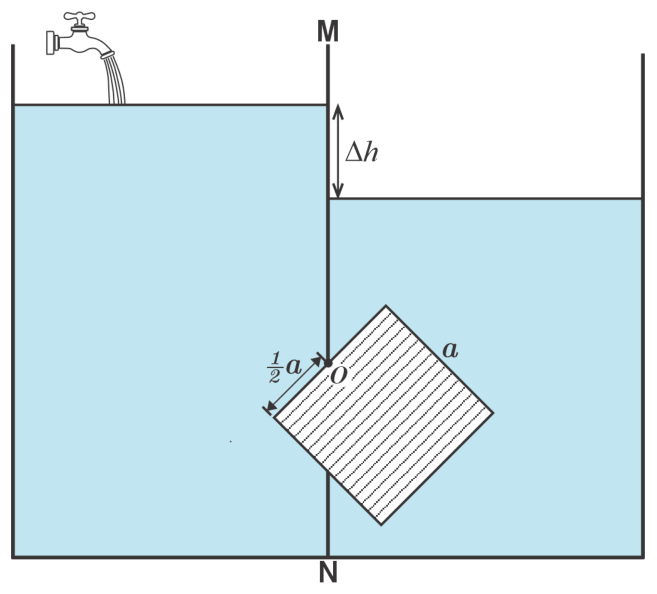
Fig. 1a.
Two water reservoirs are separated by a vertical wall MN, as shown in the figure 1a. The left reservoir can receive water from a source. It must be ensured that the maximum possible difference between the water levels is \(\Delta h = 1.41\ \mathrm{m}\). To achieve this, a slot of vertical size \(a\sqrt{2}/2\) is cut in MN and sealed with a solid cubic block of side length \(a\). The block has density \(3\rho_0\), with \(\rho_0\) the density of water. The block is fully submerged, fixed to the wall at \(O\) and can rotate without friction about the axis perpendicular to the plane of the figure that passes through point \(O\).
T1-A1 [3.0 pts]. Calculate the value of \(a\) that ensures the maximum permissible difference in water levels is not exceeded.
T1-B [3.5 pts]. Electron-positron pair
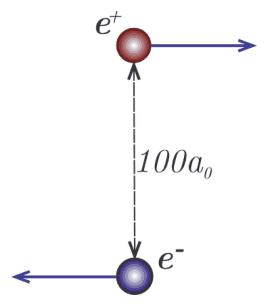
Fig. 1b.
At a certain instant of time, a positron \(e^+\) is located at a distance of \(100a_0\) from an electron \(e^-\). The particles are moving in such a way that their velocities are antiparallel at that instant, perpendicular to their separation, as shown in figure 1b. It is known that each particle has an angular momentum of magnitude \(\mu\hbar\) with respect to the system's center of mass, where \(\mu\) is a dimensionless numerical factor. Assume that the only interaction between \(e^+\) and \(e^-\) is electrostatic (both particles have the same mass \(m\) and equal magnitude of the charge but of opposite sign). Furthermore, assume that this system remains isolated and that its dynamics are classical and non-relativistic.
The Bohr radius \(a_0\) is given by \(a_0 = 4\pi\epsilon_0\hbar^2/(me^2)\).
T1-B1 [1.0 pts]. If \(\mu = 4\), the system is bound, meaning that the particles move in a closed orbit around the system's center of mass. Find the maximum separation distance between \(e^+\) and \(e^-\) in terms of \(a_0\).
T1-B2 [2.5 pts]. If \(\mu = \frac{15}{2}\), the system is unbound, meaning that the particles are no longer in closed orbit around the system's center of mass. Let \(\vec{u}_\infty\) be the velocity of \(e^+\) relative to \(e^-\) as the separation distance between them tends to infinity. Calculate the angle between \(\vec{u}_\infty\) and the initial line of motion of \(e^+\). Give your answer in degrees.
Hint 1: The eccentricty \(\varepsilon\) of a conic trajectory for the present case is given by
\[ \varepsilon = \sqrt{1+\frac{4L^2E}{k^2e^4m}} \]
where \(E\) and \(L\) are the total energy and the magnitude of the total angular momentum, respectively. \(k\) is Coulombs constant \(k = 1/(4\pi\epsilon_0)\).
Hint 2: The equation of a conic in polar coordinates is
\[ r = \frac{a}{1-\varepsilon\cos(\theta)} \]
T1-C [3.5 pts]. Photodissociation of ozone
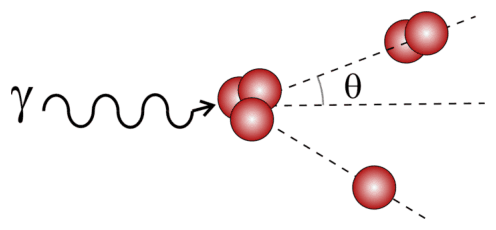
Fig. 1c.
A photon with angular frequency \(\omega\) strikes an ozone molecule \(\mathrm{O}_3\) at rest, dissociating it (breaking it apart) into an oxygen molecule \(\mathrm{O}_2\) and an oxygen atom \(\mathrm{O}\), as shown in figure 1c. The photon is absorbed in this process. Let \(U_i\) and \(U_f\) be the ground state energies of the ozone and oxygen molecules, respectively. Assume that this system remains isolated and that its dynamics is classical (potential energies do not contribute to mass and the motion of the Oxygen atoms are non-relativistic). Use the relation \(p = E/c\) for the linear momentum of the photon, where \(E\) is its energy.
T1-C1 [2.5 pts]. If the angle that the momentum of the outgoing \(\mathrm{O}_2\) with respect to the incident photon is \(\theta\), determine the minimum angular frequency \(\omega_{\min}\) required for this dissociation to occur at this angle. Write your answer in terms of \(\hbar\), \(c\), \(\theta\), \(\Delta U = U_f-U_i\), and the mass \(m\) of an oxygen atom.
T1-C2 [1.0 pts]. If \(\theta = \pi/6\), calculate the value of \(\hbar\omega_{\min}-\Delta U\). Give your answer in electronvolts (eV). Take \(\Delta U = 1.10\ \mathrm{eV}\) and \(m = 16.0\ \mathrm{amu}\).
Hint:
\[ (1+x)^r =1+rx+\frac{r(r-1)}{2!}x^2 +\frac{r(r-1)(r-2)}{3!}x^3+\cdots \]
Physical Constants
Reference values for selected physical constants.
Constant Notation Value Units Speed of light in vacuum \(c\) \(2.99792458\times10^8\) \(\mathrm{m\cdot s^{-1}}\) Planck constant \(h\) \(4.135667696\ldots\times10^{-15}\) \(\mathrm{eV\cdot s}\) Reduced Planck constant \(\hbar=h/2\pi\) \(6.582119569\ldots\times10^{-16}\) \(\mathrm{eV\cdot s}\) Avogadro number \(N_A\) \(6.02214076\times10^{23}\) \(\mathrm{mol^{-1}}\) Boltzmann constant \(k_B\) \(8.617333262\times10^{-5}\) \(\mathrm{eV\cdot K^{-1}}\) Ideal gas constant \(R\) \(8.31446261815324\) \(\mathrm{kg\cdot m^2\cdot s^{-2}\cdot mol^{-1}\cdot K^{-1}}\) Elementary charge \(e\) \(1.602176634\times10^{-19}\) \(\mathrm{A\cdot s}\) Universal gravitational constant \(G\) \(6.67430(15)\times10^{-11}\) \(\mathrm{m^3\cdot kg^{-1}\cdot s^{-2}}\) Stefan Boltzmann constant \(\sigma\) \(5.670374419\times10^{-8}\) \(\mathrm{kg\cdot s^{-3}\cdot K^{-4}}\) Vacuum permeability \(\mu_0\) \(1.25663706127(20)\times10^{-6}\) \(\mathrm{kg\cdot m\cdot A^{-2}\cdot s^{-2}}\) Vacuum permittivity \(\epsilon_0\) \(8.8541878188(14)\times10^{-12}\) \(\mathrm{A^2\cdot s^4\cdot kg^{-1}\cdot m^{-3}}\) Mass of the electron \(m_e\) \(5.1099895069(16)\times10^5\) \(\mathrm{eV}/c^2\) Mass of the proton \(m_p\) \(9.3827208943(29)\times10^8\) \(\mathrm{eV}/c^2\) Atomic mass units amu \(9.3149410372(29)\times10^8\) \(\mathrm{eV}/c^2\) Official English text of the problem.
Problem 2: Cooking with sunlight?
QUESTION T2 [10 pts]. Cooking with sunlight?
The redistribution of luminous flux into regions of high and low intensity due to reflection or refraction can lead to the formation of caustics: curves formed by the intersection of infinitesimally close light rays. As an example, Figure 2a shows the caustic formed by rays incident paraxially on a half-cylindrical mirror. Figure 2b shows a photograph of the caustic formed by the reflection of light on the bottom part of a coffee cup. The brightest and central point of the caustic is called the cusp; at this point, the light intensity is maximal.
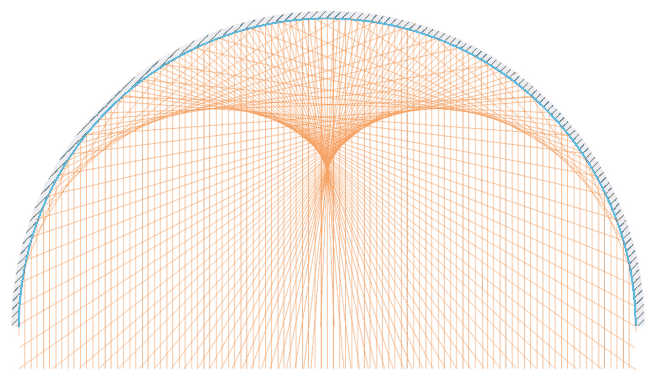
Fig. 2a.
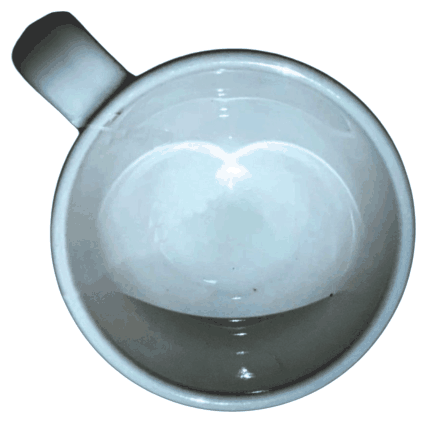
Fig. 2b.
Caustics have a variety of applications in science, ranging from high-precision optics and quantum optics to astrophysics. In this question, you will study the caustic formation by light reflection on a half-cylinder mirror of radius \(R\), as shown in figure 2c. You will also investigate other aspects of this mirror, such as its application in solar cookers.
Throughout the problem, assume that the incident rays come from a distant external light source and are parallel to the mirror's optical axis. By symmetry, it is sufficient to study reflection in one plane. Figure 2d shows such a plane, the mirror, and the coordinate system used throughout the problem.
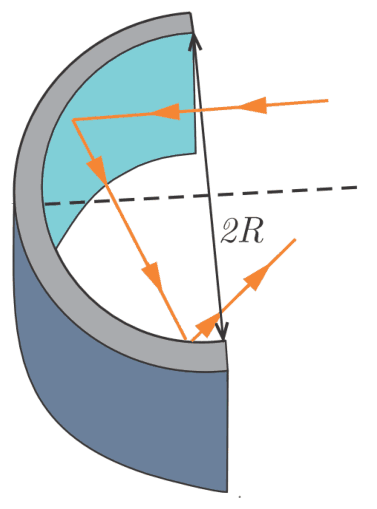
Fig. 2c.
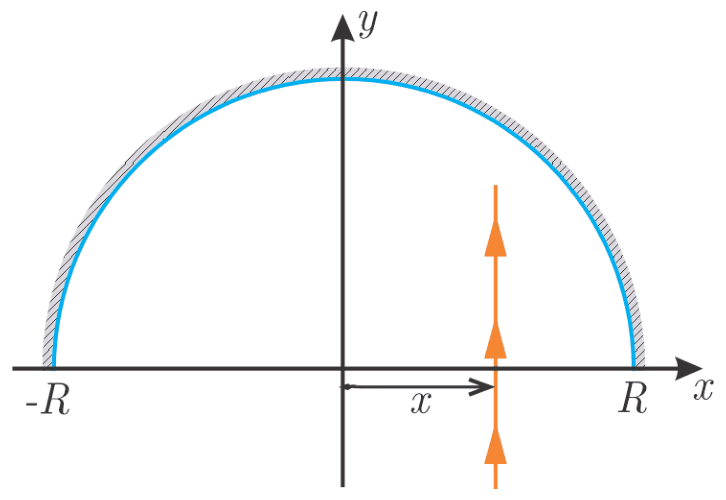
Fig. 2d.
T2-A [1.5 pts]. Multiple reflections
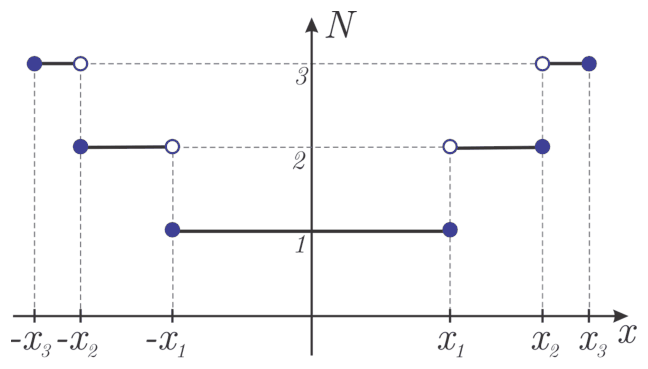
Fig.2e.
Figure 2e shows the relationship between the \(x\)-coordinate of an incident ray and the number \(N\) of reflections it undergoes, up to \(N=3\). As \(x\) varies over the interval \((-R,R)\), the variable \(N\) varies over all natural numbers greater than or equal to 1. The maximum distance from the optical axis that allows an incident ray to be reflected by the mirror at most \(N\) times is denoted \(x_N\).
T2-A1 [1.5 pts]. Find the general expression for \(x_N\) in the infinite sequence \(x_1,x_2,x_3,\ldots\) that limits the coordinates of the rays with at most \(N\) reflections. Express your answer in terms of \(R\) and \(N\).
T2-B [4.0 pts]. Solar Cooker
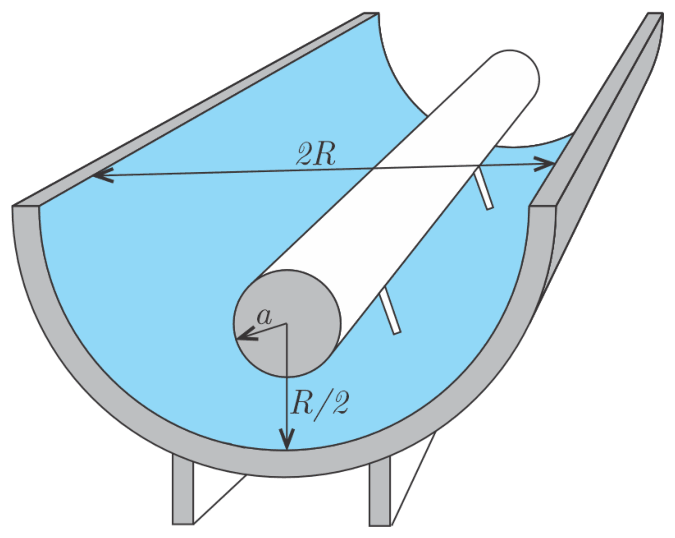
Fig.2f.
Consider a system consisting of a half-hollow-cylinder mirror and a cylindrical container. The cylinder is fully absorbing: any ray of light hitting it will be absorbed. The mirror radius is \(R\). The container radius \(a\). The axes of the mirror and the container are parallel. The center of the container is \(R/2\) from the mirror on the system's symmetry plane, as shown in figure 2f. The mirror harnesses solar radiation to heat food inside the container. Assume that the sunlight is of constant and uniform intensity (power per unit area), and that the light rays are parallel to the optical axis of the mirror. Furthermore, assume that \(a\) is such that any ray that is absorbed by the cylinder reflects from the mirror at most once. Let \(\theta_{\max}\) be the maximum angle of incidence on the mirror (measured with respect to the normal drawn at the point of incidence) of any reflected ray striking the container.
T2-B1 [2.0 pts]. The container radius is \(a=\alpha\sin(\theta_{\max})+\beta\sin(2\theta_{\max})\). Write \(\alpha\) and \(\beta\) in terms of \(R\).
If you do not find \(\alpha\) and \(\beta\), use the expression given for the rest of the problem.
T2-B2 [1.5 pts]. Let \(P_0\) be the power that would be received by the cyllinder if the mirror was not present. Write \(P/P_0\), the ratio of the actual received power \(P\) to \(P_0\), in terms of \(\theta_{\max}\).
T2-B3 [0.5 pts]. If \(R=1.0\ \mathrm{m}\), write the value of \(a\) such that \(P=5P_0\). Give your answer in cm.
T2-C [4.5 pts]. Caustics and Cusp
T2-C1 [0.5 pts]. Consider a ray \(A\) that strikes the mirror at an angle \(\theta\), as shown in Figure 2g. Upon reflection, the equation corresponding to this ray in the coordinate system defined in Figure 2g. is \(y=m_Ax+b_A\). Write \(m_A\) and \(b_A\) in terms of \(\theta\) and \(R\)
Hint: the expected form of \(m_A=K_1\cot(K_2\theta)\) and \(b_A=R\frac{K_3}{\cos(K_4\theta)}\), with \(K_i\) numerical constants.
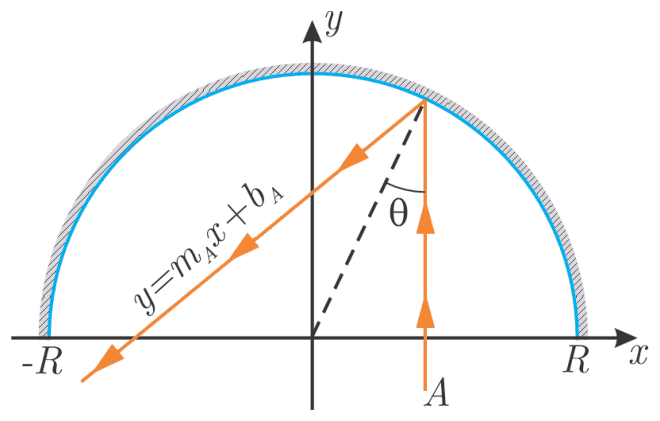
Fig. 2g.
T2-C2 [2.0 pts]. Now consider a ray \(B\), parallel to \(A\), that strikes the surface at an angle \(\theta+\Delta\theta\), with \(\Delta\theta\ll\theta\). Upon reflection, the equation corresponding to this ray is \(y=m_Bx+b_B\). Write \(m_B\) and \(b_B\) in terms of \(\theta\), \(\Delta\theta\), and \(R\), approximating to first order in \(\Delta\theta\).
T2-C3 [1.0 pts]. Find the coordinates of the point of intersection \((X_c,Y_c)\) between the reflected rays of \(A\) and \(B\). Write your answer in terms of \(R\) and \(\theta\).
T2-C4 [1.0 pts]. For \(\theta\ll1\), we have \(Y_c=v|X_c|^{p/q}+u\). Write \(v\) and \(u\) in terms of \(R\) and find the values of the integers \(p\) and \(q\) (equivalently, give the rational number \(p/q\)).
Official English text of the problem.
Problem 3: Chasing the absolute zero
QUESTION T3 [10 pts]. Chasing the absolute zero
A refrigeration cycle must be carried out by a system with characteristics appropriate for the temperatures to be achieved. One hundred years ago, in 1926, the chemist William Giauque and, independently, the physicist Peter Debye proposed paramagnetic salts as ideal systems for lowering temperatures far below 1 K. Indeed, beginning in the following decade, temperatures as low as 0.0044 K were achieved (Wander de Haas and Gerrit Wiersma, 1935, Leiden Cryogenic Laboratories). In this question, the paramagnetic Carnot refrigeration cycle is studied.
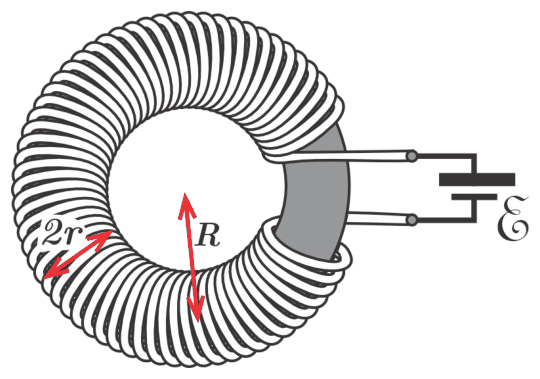
Fig. 3a.
Consider a torus with mean radius \(R\) and inner radius \(r\) made of a homogeneous, isotropic paramagnetic material, around which an insulated conducting wire is wound, with its ends connected to an external voltage source (emf), as shown in figure 3a. The resistance of the wire is so low that energy losses due to the heating of the wire can be neglected. The winding is dense, with \(N\) turns in total, and it is assumed that \(r\ll R\), so that the fields \(\vec H\) and \(\vec B\) and the magnetization \(\vec M\) have approximately constant magnitudes throughout the torus. Let \(V\) and \(A\) be the volume and the cross-section area of the torus. Hereinafter, the abbreviation Pm-T is used to refer to the paramagnetic torus.
In paramagnetic materials, \(\vec M\) is parallel to \(\vec H\) and the following relation holds:
\[ \vec B=\mu_0\vec H+\mu_0\vec M. \]
Energy transfer sign convention: in this problem, Work (\(W\)) and Heat (\(Q\)) are considered positive when they flow into the system, and negative when they flow out.
T3-A [1.0 pts]. Work in the Pm-T
Hint: in magnetic materials, \(\displaystyle\oint_C\vec H\cdot d\vec\ell=I_C\), where \(I_C\) is the net free current passing through the area bounded by the closed curve \(C\).
T3-A1 [0.2 pts]. Let \(H\) be the magnitude of \(\vec H\) in the torus. Write \(H\) in terms of \(N\), \(A\), \(V\) and the instantaneous electric current \(I\) in the wire.
T3-A2 [0.6 pts]. Let \(dW_{emf}\) be the work that the external voltage source performs to change the magnitude of \(\vec B\) by \(dB\). Write \(dW_{emf}\) in terms of \(V\), \(H\), and \(dB\).
T3-A3 [0.2 pts]. The total work done by the voltage source, \(dW_{emf}\), can be divided in two parts: the work that would be performed to change the magnetic field if the toroid had a vacuum core, \(dW_{vac}\), and the work done on the paramagnetic material itself, \(dW\). Write \(dW\) in terms of \(\mu_0\), \(H\), \(V\) and \(dM\).
T3-B [3.0 pts]. Heat and temperature in the Pm-T
The following table compares two thermodynamic systems: the ideal gas and the Pm-T. Use this information and your answer to question T3-A3 to solve the following questions. This information will also be used in part C. If you did not find an answer for \(dW\) in question T3-A3, you may use \(dW=\alpha V\mu_0H\,dM\) where \(\alpha\) is a number. The volume \(V\) of the paramagnetic torus is constant, so that there is no work due to pressure. Below, \(T\) is the temperature in all instances.
IDEAL GAS PARAMAGNETIC TORUS State functions: \(P,V\) and temperature \(T\) State functions: \(H,M\) and temperature \(T\) Constants: \(R,\gamma\) and number of moles \(n\) Constants: \(K,\lambda\) and number of moles \(n\) Equation of state: \(PV=nRT\) Equation of state: \(TMV=nKH\) Heat capacity at constant \(V\): \(C_V=nR/(\gamma-1)\) Heat capacity at constant \(M\): \(C_M=n\lambda/T^2\) Internal energy \(U\) in any process satisfies \(dU=C_V\,dT\) Internal energy \(U\) in any process satisfies \(dU=C_M\,dT\) \(K\) and \(\lambda\) are constants given by the material in the torus. You may use the equations provided in the table directly without proving them.
T3-B1 [1.5 pts]. If the magnitude of \(\vec H\) changes from \(H_i\) to \(H_f\) at a constant temperature \(T\), an energy \(Q\) is transferred between the Pm-T and its environment. Write \(Q\) in terms of \(\mu_0\), \(n\), \(V\), \(K\), \(H_i\), \(H_f\), and \(T\).
T3-B2 [1.5 pts]. If the magnitude of \(\vec H\) changes adiabatically from \(H_i\) to \(H_f\), the temperature of the Pm-T changes from \(T_i\) to \(T_f\). Write \(\Delta T=T_f-T_i\) in terms of \(\mu_0\), \(V\), \(n\), \(K\), \(\lambda\), \(H_i\), \(H_f\), and \(T_i\).
T3-C [6.0 pts]. Carnot refrigerator of the Pm-T
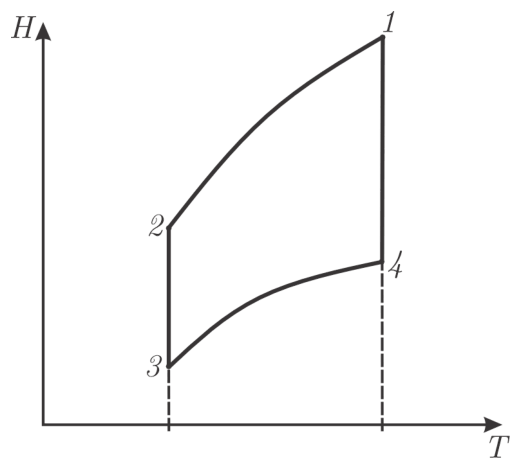
Fig.3b.
The \(H\) vs. \(T\) diagram of the Carnot refrigeration cycle \(1\to2\to3\to4\to1\) performed by the Pm-T is shown in figure 3b. In this cycle, let:
- \(T_h\): temperature of the hot reservoir
- \(T_c\): temperature of the cold reservoir
- \(Q_h\): absolute value of the heat transferred to the hot reservoir
- \(Q_c\): absolute value of the heat absorbed from the cold reservoir
T3-C1 [0.2 pts]. Mark \(T_h\) and \(T_c\) on the \(T\) axis of the \(H\) vs. \(T\) diagram. Also label the processes in which the transfers of \(Q_h\) and \(Q_c\) occur, respectively.
T3-C2 [1.5 pts]. Let \(M_1\), \(M_2\), \(M_3\), and \(M_4\) be the magnitudes of \(\vec M\) at the vertices of this cycle. Write \(M_1\) in terms of \(M_2\), \(M_3\), and \(M_4\).
T3-C3 [0.8 pts]. Suppose that to cool 1.00 L of liquid helium initially at 1.00 K, we utilize a 2.0 moles Pm-T made of potassium chromate. For this material, \(K=1.87\times10^{-6}\ \mathrm{K\cdot m^3/mol}\), its density is \(2730\ \mathrm{kg/m^3}\) and its molar mass is \(0.19\ \mathrm{kg/mole}\). The Pm-T performs a Carnot refrigeration cycle with \(H_1=411624\ \mathrm{A/m}\), \(H_2=311306\ \mathrm{A/m}\), \(H_3=204618\ \mathrm{A/m}\) and \(H_4=240446\ \mathrm{A/m}\). After one operating cycle, calculate the final temperature of the liquid helium. Assume that for the liquid helium both the specific heat capacity \(c=100\ \mathrm{J/(kg\cdot K)}\) and the density \(\rho=130\ \mathrm{kg/m^3}\) remain constant.
T3-C4 [2.0 pts]. In order to continuously lower the temperature of a body with constant heat capacity \(C_c\), Carnot cycles are allowed to occur over time in such a way that the power \(P\) transferred to the refrigerator remains constant. It is then assumed that the temperature \(T_h\) of the hot reservoir remains constant and that in each operating cycle the temperature \(T_c\) of the cooled body decreases by \(dT_c\), satisfying the relation \(dQ_c/dQ_h=T_c/T_h\). If at \(t=0\) we have \(T_c=T_0\), determine the time \(t\) that the Carnot refrigerator must operate for the cooled body to reach a temperature \(T<T_0\). Express your answer in terms of \(C_c\), \(T_h\), \(P\), \(T_0\) and \(T\).
T3-C5 [1.5 pts]. The efficiency of a refrigerator is quantified by its coefficient of performance \(\mathrm{COP}=Q_c/W\). Determine the overall COP of the refrigerator of question T3-C4 with all the cycles performed until time \(t\). Write your answer in terms of \(T_0\) and \(T_h\) and \(T\).
Physical Constants
Reference values for selected physical constants.
Constant Notation Value Units Speed of light in vacuum \(c\) \(2.99792458\times10^8\) \(\mathrm{m\cdot s^{-1}}\) Planck constant \(h\) \(4.135667696\ldots\times10^{-15}\) \(\mathrm{eV\cdot s}\) Reduced Planck constant \(\hbar=h/2\pi\) \(6.582119569\ldots\times10^{-16}\) \(\mathrm{eV\cdot s}\) Avogadro number \(N_A\) \(6.02214076\times10^{23}\) \(\mathrm{mol^{-1}}\) Boltzmann constant \(k_B\) \(8.617333262\times10^{-5}\) \(\mathrm{eV\cdot K^{-1}}\) Ideal gas constant \(R\) \(8.31446261815324\) \(\mathrm{kg\cdot m^2\cdot s^{-2}\cdot mol^{-1}\cdot K^{-1}}\) Elementary charge \(e\) \(1.602176634\times10^{-19}\) \(\mathrm{A\cdot s}\) Universal gravitational constant \(G\) \(6.67430(15)\times10^{-11}\) \(\mathrm{m^3\cdot kg^{-1}\cdot s^{-2}}\) Stefan Boltzmann constant \(\sigma\) \(5.670374419\times10^{-8}\) \(\mathrm{kg\cdot s^{-3}\cdot K^{-4}}\) Vacuum permeability \(\mu_0\) \(1.25663706127(20)\times10^{-6}\) \(\mathrm{kg\cdot m\cdot A^{-2}\cdot s^{-2}}\) Vacuum permittivity \(\varepsilon_0\) \(8.8541878188(14)\times10^{-12}\) \(\mathrm{A^2\cdot s^4\cdot kg^{-1}\cdot m^{-3}}\) Mass of the electron \(m_e\) \(5.1099895069(16)\times10^5\) \(\mathrm{eV}/c^2\) Mass of the proton \(m_p\) \(9.3827208943(29)\times10^8\) \(\mathrm{eV}/c^2\) Atomic mass units \(\mathrm{amu}\) \(9.3149410372(29)\times10^8\) \(\mathrm{eV}/c^2\) Official English text of the problem.
Internationale Physik-Olympiade
IPhO 2026
Bucaramanga, Kolumbien · 3 Theorieaufgaben mit vollständigen Lösungen
Aufgabe 1: Drei Probleme (A: Hydrostatische Verschlussklappe; B: Elektron-Positron-Paar; C: Photodissoziation von Ozon)
AUFGABE T1 [10 Punkte]. Drei Probleme
Diese Aufgabe besteht aus drei unabhängigen Problemen.
T1-A [3.0 Punkte]. Hydrostatische Verschlussklappe
Abb. 1a.
Zwei Wasserreservoirs sind durch eine senkrechte Wand MN voneinander getrennt, wie in Abbildung 1a gezeigt. Dem linken Reservoir kann Wasser aus einer Quelle zufließen. Es muss sichergestellt werden, dass der größtmögliche Unterschied zwischen den Wasserständen \(\Delta h = 1.41\ \mathrm{m}\) beträgt. Dazu wird in MN ein Schlitz mit der vertikalen Ausdehnung \(a\sqrt{2}/2\) ausgeschnitten und mit einem massiven würfelförmigen Block der Kantenlänge \(a\) verschlossen. Der Block hat die Dichte \(3\rho_0\), wobei \(\rho_0\) die Dichte von Wasser ist. Der Block ist vollständig eingetaucht, bei \(O\) an der Wand befestigt und kann sich reibungsfrei um die Achse drehen, die senkrecht zur Zeichenebene steht und durch den Punkt \(O\) verläuft.
T1-A1 [3.0 Punkte]. Berechnen Sie den Wert von \(a\), der sicherstellt, dass der maximal zulässige Unterschied zwischen den Wasserständen nicht überschritten wird.
T1-B [3.5 Punkte]. Elektron-Positron-Paar
Abb. 1b.
Zu einem bestimmten Zeitpunkt befindet sich ein Positron \(e^+\) im Abstand \(100a_0\) von einem Elektron \(e^-\). Die Teilchen bewegen sich so, dass ihre Geschwindigkeiten zu diesem Zeitpunkt antiparallel zueinander und senkrecht zu ihrer Verbindungslinie sind, wie in Abbildung 1b gezeigt. Es ist bekannt, dass jedes Teilchen bezüglich des Schwerpunkts des Systems einen Drehimpuls vom Betrag \(\mu\hbar\) besitzt, wobei \(\mu\) ein dimensionsloser Zahlenfaktor ist. Nehmen Sie an, dass die einzige Wechselwirkung zwischen \(e^+\) und \(e^-\) elektrostatischer Natur ist (beide Teilchen haben dieselbe Masse \(m\) und betragsmäßig gleiche Ladungen mit entgegengesetztem Vorzeichen). Nehmen Sie außerdem an, dass dieses System isoliert bleibt und seine Dynamik klassisch und nichtrelativistisch ist.
Der Bohr-Radius \(a_0\) ist gegeben durch \(a_0 = 4\pi\epsilon_0\hbar^2/(me^2)\).
T1-B1 [1.0 Punkte]. Für \(\mu = 4\) ist das System gebunden, das heißt, die Teilchen bewegen sich auf einer geschlossenen Bahn um den Schwerpunkt des Systems. Bestimmen Sie den maximalen Abstand zwischen \(e^+\) und \(e^-\) in Abhängigkeit von \(a_0\).
T1-B2 [2.5 Punkte]. Für \(\mu = \frac{15}{2}\) ist das System ungebunden, das heißt, die Teilchen bewegen sich nicht mehr auf einer geschlossenen Bahn um den Schwerpunkt des Systems. Es sei \(\vec{u}_\infty\) die Geschwindigkeit von \(e^+\) relativ zu \(e^-\), wenn ihr Abstand gegen unendlich geht. Berechnen Sie den Winkel zwischen \(\vec{u}_\infty\) und der anfänglichen Bewegungsgeraden von \(e^+\). Geben Sie Ihre Antwort in Grad an.
Hinweis 1: Die Exzentrizität \(\varepsilon\) einer Kegelschnittbahn ist im vorliegenden Fall gegeben durch
\[ \varepsilon = \sqrt{1+\frac{4L^2E}{k^2e^4m}} \]
wobei \(E\) die Gesamtenergie und \(L\) den Betrag des Gesamtdrehimpulses bezeichnet. \(k\) ist die Coulomb-Konstante \(k = 1/(4\pi\epsilon_0)\).
Hinweis 2: Die Gleichung eines Kegelschnitts in Polarkoordinaten lautet
\[ r = \frac{a}{1-\varepsilon\cos(\theta)} \]
T1-C [3.5 Punkte]. Photodissoziation von Ozon
Abb. 1c.
Ein Photon mit der Kreisfrequenz \(\omega\) trifft auf ein ruhendes Ozonmolekül \(\mathrm{O}_3\) und dissoziiert es (spaltet es auf) in ein Sauerstoffmolekül \(\mathrm{O}_2\) und ein Sauerstoffatom \(\mathrm{O}\), wie in Abbildung 1c gezeigt. Das Photon wird dabei absorbiert. Es seien \(U_i\) und \(U_f\) die Grundzustandsenergien des Ozonmoleküls beziehungsweise des Sauerstoffmoleküls. Nehmen Sie an, dass dieses System isoliert bleibt und seine Dynamik klassisch ist (potenzielle Energien tragen nicht zur Masse bei, und die Bewegung der Sauerstoffatome ist nichtrelativistisch). Verwenden Sie für den Impuls des Photons die Beziehung \(p = E/c\), wobei \(E\) seine Energie ist.
T1-C1 [2.5 Punkte]. Wenn der Impuls des austretenden \(\mathrm{O}_2\) mit der Richtung des einfallenden Photons den Winkel \(\theta\) bildet, bestimmen Sie die minimale Kreisfrequenz \(\omega_{\min}\), die erforderlich ist, damit diese Dissoziation unter diesem Winkel stattfinden kann. Geben Sie Ihre Antwort in Abhängigkeit von \(\hbar\), \(c\), \(\theta\), \(\Delta U = U_f-U_i\) und der Masse \(m\) eines Sauerstoffatoms an.
T1-C2 [1.0 Punkte]. Berechnen Sie für \(\theta = \pi/6\) den Wert von \(\hbar\omega_{\min}-\Delta U\). Geben Sie Ihre Antwort in Elektronenvolt (eV) an. Verwenden Sie \(\Delta U = 1.10\ \mathrm{eV}\) und \(m = 16.0\ \mathrm{amu}\).
Hinweis:
\[ (1+x)^r =1+rx+\frac{r(r-1)}{2!}x^2 +\frac{r(r-1)(r-2)}{3!}x^3+\cdots \]
Physikalische Konstanten
Referenzwerte ausgewählter physikalischer Konstanten.
Konstante Symbol Wert Einheiten Lichtgeschwindigkeit im Vakuum \(c\) \(2.99792458\times10^8\) \(\mathrm{m\cdot s^{-1}}\) Planck-Konstante \(h\) \(4.135667696\ldots\times10^{-15}\) \(\mathrm{eV\cdot s}\) Reduzierte Planck-Konstante \(\hbar=h/2\pi\) \(6.582119569\ldots\times10^{-16}\) \(\mathrm{eV\cdot s}\) Avogadro-Konstante \(N_A\) \(6.02214076\times10^{23}\) \(\mathrm{mol^{-1}}\) Boltzmann-Konstante \(k_B\) \(8.617333262\times10^{-5}\) \(\mathrm{eV\cdot K^{-1}}\) Universelle Gaskonstante \(R\) \(8.31446261815324\) \(\mathrm{kg\cdot m^2\cdot s^{-2}\cdot mol^{-1}\cdot K^{-1}}\) Elementarladung \(e\) \(1.602176634\times10^{-19}\) \(\mathrm{A\cdot s}\) Universelle Gravitationskonstante \(G\) \(6.67430(15)\times10^{-11}\) \(\mathrm{m^3\cdot kg^{-1}\cdot s^{-2}}\) Stefan-Boltzmann-Konstante \(\sigma\) \(5.670374419\times10^{-8}\) \(\mathrm{kg\cdot s^{-3}\cdot K^{-4}}\) Magnetische Feldkonstante \(\mu_0\) \(1.25663706127(20)\times10^{-6}\) \(\mathrm{kg\cdot m\cdot A^{-2}\cdot s^{-2}}\) Elektrische Feldkonstante \(\epsilon_0\) \(8.8541878188(14)\times10^{-12}\) \(\mathrm{A^2\cdot s^4\cdot kg^{-1}\cdot m^{-3}}\) Masse des Elektrons \(m_e\) \(5.1099895069(16)\times10^5\) \(\mathrm{eV}/c^2\) Masse des Protons \(m_p\) \(9.3827208943(29)\times10^8\) \(\mathrm{eV}/c^2\) Atomare Masseneinheit amu \(9.3149410372(29)\times10^8\) \(\mathrm{eV}/c^2\) Aufgabentext aus dem offiziellen englischen Text übersetzt.
Aufgabe 2: Kochen mit Sonnenlicht?
AUFGABE T2 [10 Punkte]. Kochen mit Sonnenlicht?
Die Umverteilung des Lichtstroms in Bereiche hoher und niedriger Intensität durch Reflexion oder Brechung kann zur Entstehung von Kaustiken führen: Kurven, die durch die Schnittpunkte infinitesimal benachbarter Lichtstrahlen gebildet werden. Als Beispiel zeigt Abbildung 2a die Kaustik, die durch paraxial auf einen halbzylindrischen Spiegel einfallende Strahlen entsteht. Abbildung 2b zeigt eine Fotografie der Kaustik, die durch die Reflexion von Licht am unteren Teil einer Kaffeetasse entsteht. Der hellste, in der Mitte liegende Punkt der Kaustik wird als Spitze bezeichnet; an diesem Punkt ist die Lichtintensität maximal.
Abb. 2a.
Abb. 2b.
Kaustiken haben vielfältige Anwendungen in der Wissenschaft, von der Präzisionsoptik und Quantenoptik bis hin zur Astrophysik. In dieser Aufgabe untersuchen Sie die Entstehung einer Kaustik durch Lichtreflexion an einem halbzylindrischen Spiegel mit dem Radius \(R\), wie in Abbildung 2c gezeigt. Außerdem untersuchen Sie weitere Aspekte dieses Spiegels, etwa seine Anwendung in Solarkochern.
Nehmen Sie in der gesamten Aufgabe an, dass die einfallenden Strahlen von einer weit entfernten äußeren Lichtquelle stammen und parallel zur optischen Achse des Spiegels verlaufen. Aufgrund der Symmetrie genügt es, die Reflexion in einer Ebene zu untersuchen. Abbildung 2d zeigt eine solche Ebene, den Spiegel und das in der gesamten Aufgabe verwendete Koordinatensystem.
Abb. 2c.
Abb. 2d.
T2-A [1.5 Punkte]. Mehrfachreflexionen
Abb.2e.
Abbildung 2e zeigt den Zusammenhang zwischen der \(x\)-Koordinate eines einfallenden Strahls und der Anzahl \(N\) seiner Reflexionen bis zu \(N=3\). Wenn \(x\) das Intervall \((-R,R)\) durchläuft, nimmt die Variable \(N\) alle natürlichen Zahlen größer oder gleich 1 an. Der maximale Abstand von der optischen Achse, bei dem ein einfallender Strahl höchstens \(N\)-mal vom Spiegel reflektiert wird, wird mit \(x_N\) bezeichnet.
T2-A1 [1.5 Punkte]. Bestimmen Sie den allgemeinen Ausdruck für \(x_N\) in der unendlichen Folge \(x_1,x_2,x_3,\ldots\), der die Koordinaten der Strahlen mit höchstens \(N\) Reflexionen begrenzt. Geben Sie Ihre Antwort in Abhängigkeit von \(R\) und \(N\) an.
T2-B [4.0 Punkte]. Solarkocher
Abb.2f.
Betrachten Sie ein System aus einem Spiegel in Form eines halben Hohlzylinders und einem zylindrischen Behälter. Der Zylinder ist vollständig absorbierend: Jeder Lichtstrahl, der auf ihn trifft, wird absorbiert. Der Spiegelradius beträgt \(R\). Der Behälterradius beträgt \(a\). Die Achsen des Spiegels und des Behälters sind parallel. Der Mittelpunkt des Behälters liegt in der Symmetrieebene des Systems im Abstand \(R/2\) vom Spiegel, wie in Abbildung 2f gezeigt. Der Spiegel nutzt die Sonnenstrahlung, um Lebensmittel im Behälter zu erwärmen. Nehmen Sie an, dass das Sonnenlicht eine zeitlich konstante und räumlich gleichmäßige Intensität (Leistung pro Flächeneinheit) hat und dass die Lichtstrahlen parallel zur optischen Achse des Spiegels verlaufen. Nehmen Sie ferner an, dass \(a\) so gewählt ist, dass jeder vom Zylinder absorbierte Strahl höchstens einmal am Spiegel reflektiert wird. Es sei \(\theta_{\max}\) der größte Einfallswinkel am Spiegel (gemessen bezüglich der Normalen im Einfallspunkt) unter allen reflektierten Strahlen, die den Behälter treffen.
T2-B1 [2.0 Punkte]. Der Behälterradius ist \(a=\alpha\sin(\theta_{\max})+\beta\sin(2\theta_{\max})\). Geben Sie \(\alpha\) und \(\beta\) in Abhängigkeit von \(R\) an.
Falls Sie \(\alpha\) und \(\beta\) nicht bestimmen können, verwenden Sie für den Rest der Aufgabe den angegebenen Ausdruck.
T2-B2 [1.5 Punkte]. Es sei \(P_0\) die Leistung, die der Zylinder ohne den Spiegel aufnehmen würde. Geben Sie \(P/P_0\), das Verhältnis der tatsächlich aufgenommenen Leistung \(P\) zu \(P_0\), in Abhängigkeit von \(\theta_{\max}\) an.
T2-B3 [0.5 Punkte]. Geben Sie für \(R=1.0\ \mathrm{m}\) den Wert von \(a\) an, für den \(P=5P_0\) gilt. Geben Sie Ihre Antwort in cm an.
T2-C [4.5 Punkte]. Kaustiken und Spitze
T2-C1 [0.5 Punkte]. Betrachten Sie einen Strahl \(A\), der unter einem Winkel \(\theta\) auf den Spiegel trifft, wie in Abbildung 2g gezeigt. Nach der Reflexion lautet die Gleichung dieses Strahls in dem in Abbildung 2g definierten Koordinatensystem \(y=m_Ax+b_A\). Geben Sie \(m_A\) und \(b_A\) in Abhängigkeit von \(\theta\) und \(R\) an.
Hinweis: Die erwartete Form lautet \(m_A=K_1\cot(K_2\theta)\) und \(b_A=R\frac{K_3}{\cos(K_4\theta)}\), wobei \(K_i\) numerische Konstanten sind.
Abb. 2g.
T2-C2 [2.0 Punkte]. Betrachten Sie nun einen zu \(A\) parallelen Strahl \(B\), der unter einem Winkel \(\theta+\Delta\theta\) auf die Oberfläche trifft, wobei \(\Delta\theta\ll\theta\) gilt. Nach der Reflexion lautet die Gleichung dieses Strahls \(y=m_Bx+b_B\). Geben Sie \(m_B\) und \(b_B\) in Abhängigkeit von \(\theta\), \(\Delta\theta\) und \(R\) in einer Näherung erster Ordnung in \(\Delta\theta\) an.
T2-C3 [1.0 Punkte]. Bestimmen Sie die Koordinaten des Schnittpunkts \((X_c,Y_c)\) der reflektierten Strahlen von \(A\) und \(B\). Geben Sie Ihre Antwort in Abhängigkeit von \(R\) und \(\theta\) an.
T2-C4 [1.0 Punkte]. Für \(\theta\ll1\) gilt \(Y_c=v|X_c|^{p/q}+u\). Geben Sie \(v\) und \(u\) in Abhängigkeit von \(R\) an und bestimmen Sie die Werte der ganzen Zahlen \(p\) und \(q\) (oder geben Sie gleichwertig die rationale Zahl \(p/q\) an).
Aufgabentext aus dem offiziellen englischen Text übersetzt.
Aufgabe 3: Auf der Jagd nach dem absoluten Nullpunkt
AUFGABE T3 [10 Punkte]. Auf der Jagd nach dem absoluten Nullpunkt
Ein Kältekreisprozess muss mit einem System durchgeführt werden, dessen Eigenschaften für die zu erreichenden Temperaturen geeignet sind. Vor hundert Jahren, im Jahr 1926, schlugen der Chemiker William Giauque und unabhängig von ihm der Physiker Peter Debye paramagnetische Salze als ideale Systeme vor, um Temperaturen weit unter 1 K zu erreichen. Tatsächlich wurden ab dem folgenden Jahrzehnt Temperaturen bis hinab zu 0.0044 K erreicht (Wander de Haas und Gerrit Wiersma, 1935, Leiden Cryogenic Laboratories). In dieser Aufgabe wird der paramagnetische Carnot-Kältekreisprozess untersucht.
Abb. 3a.
Betrachten Sie einen Torus mit mittlerem Radius \(R\) und Innenradius \(r\) aus einem homogenen, isotropen paramagnetischen Material, um den ein isolierter leitender Draht gewickelt ist. Seine Enden sind an eine externe Spannungsquelle (EMK) angeschlossen, wie in Abbildung 3a gezeigt. Der Widerstand des Drahtes ist so gering, dass Energieverluste durch die Erwärmung des Drahtes vernachlässigt werden können. Die Wicklung ist dicht und umfasst insgesamt \(N\) Windungen. Es wird angenommen, dass \(r\ll R\), sodass die Beträge der Felder \(\vec H\) und \(\vec B\) sowie der Magnetisierung \(\vec M\) im gesamten Torus näherungsweise konstant sind. \(V\) und \(A\) bezeichnen das Volumen und die Querschnittsfläche des Torus. Im Folgenden wird der paramagnetische Torus mit Pm-T abgekürzt.
In paramagnetischen Materialien ist \(\vec M\) parallel zu \(\vec H\), und es gilt die folgende Beziehung:
\[ \vec B=\mu_0\vec H+\mu_0\vec M. \]
Vorzeichenkonvention für die Energieübertragung: In dieser Aufgabe werden Arbeit (\(W\)) und Wärme (\(Q\)) als positiv betrachtet, wenn sie dem System zugeführt werden, und als negativ, wenn sie vom System abgegeben werden.
T3-A [1.0 Punkte]. Arbeit im Pm-T
Hinweis: In magnetischen Materialien gilt \(\displaystyle\oint_C\vec H\cdot d\vec\ell=I_C\), wobei \(I_C\) der gesamte vorzeichenbehaftete freie Strom durch die von der geschlossenen Kurve \(C\) begrenzte Fläche ist.
T3-A1 [0.2 Punkte]. \(H\) sei der Betrag von \(\vec H\) im Torus. Drücken Sie \(H\) durch \(N\), \(A\), \(V\) und die momentane elektrische Stromstärke \(I\) im Draht aus.
T3-A2 [0.6 Punkte]. \(dW_{emf}\) sei die Arbeit, welche die externe Spannungsquelle verrichtet, um den Betrag von \(\vec B\) um \(dB\) zu ändern. Drücken Sie \(dW_{emf}\) durch \(V\), \(H\) und \(dB\) aus.
T3-A3 [0.2 Punkte]. Die gesamte von der Spannungsquelle verrichtete Arbeit \(dW_{emf}\) lässt sich in zwei Anteile aufteilen: die Arbeit \(dW_{vac}\), die zur Änderung des Magnetfeldes verrichtet würde, wenn der Ringkern aus Vakuum bestünde, und die am paramagnetischen Material selbst verrichtete Arbeit \(dW\). Drücken Sie \(dW\) durch \(\mu_0\), \(H\), \(V\) und \(dM\) aus.
T3-B [3.0 Punkte]. Wärme und Temperatur im Pm-T
Die folgende Tabelle vergleicht zwei thermodynamische Systeme: das ideale Gas und den Pm-T. Verwenden Sie diese Informationen und Ihre Antwort auf Frage T3-A3, um die folgenden Fragen zu lösen. Diese Informationen werden auch in Teil C verwendet. Falls Sie in Frage T3-A3 keinen Ausdruck für \(dW\) gefunden haben, dürfen Sie \(dW=\alpha V\mu_0H\,dM\) verwenden, wobei \(\alpha\) eine Zahl ist. Das Volumen \(V\) des paramagnetischen Torus ist konstant, sodass keine Druckarbeit verrichtet wird. Im Folgenden bezeichnet \(T\) stets die Temperatur.
IDEALES GAS PARAMAGNETISCHER TORUS Zustandsgrößen: \(P,V\) und Temperatur \(T\) Zustandsgrößen: \(H,M\) und Temperatur \(T\) Konstanten: \(R,\gamma\) und Stoffmenge \(n\) Konstanten: \(K,\lambda\) und Stoffmenge \(n\) Zustandsgleichung: \(PV=nRT\) Zustandsgleichung: \(TMV=nKH\) Wärmekapazität bei konstantem \(V\): \(C_V=nR/(\gamma-1)\) Wärmekapazität bei konstantem \(M\): \(C_M=n\lambda/T^2\) Für die innere Energie \(U\) gilt bei jedem Prozess \(dU=C_V\,dT\) Für die innere Energie \(U\) gilt bei jedem Prozess \(dU=C_M\,dT\) \(K\) und \(\lambda\) sind Konstanten, die durch das Material im Torus bestimmt werden. Sie dürfen die in der Tabelle angegebenen Gleichungen ohne Beweis direkt verwenden.
T3-B1 [1.5 Punkte]. Wenn sich der Betrag von \(\vec H\) bei konstanter Temperatur \(T\) von \(H_i\) auf \(H_f\) ändert, wird zwischen dem Pm-T und seiner Umgebung eine Energie \(Q\) übertragen. Drücken Sie \(Q\) durch \(\mu_0\), \(n\), \(V\), \(K\), \(H_i\), \(H_f\) und \(T\) aus.
T3-B2 [1.5 Punkte]. Wenn sich der Betrag von \(\vec H\) adiabatisch von \(H_i\) auf \(H_f\) ändert, ändert sich die Temperatur des Pm-T von \(T_i\) auf \(T_f\). Drücken Sie \(\Delta T=T_f-T_i\) durch \(\mu_0\), \(V\), \(n\), \(K\), \(\lambda\), \(H_i\), \(H_f\) und \(T_i\) aus.
T3-C [6.0 Punkte]. Carnot-Kältemaschine mit dem Pm-T
Abb. 3b.
Das \(H\)-\(T\)-Diagramm des vom Pm-T durchlaufenen Carnot-Kältekreisprozesses \(1\to2\to3\to4\to1\) ist in Abbildung 3b dargestellt. In diesem Kreisprozess bezeichnen:
- \(T_h\): die Temperatur des warmen Reservoirs
- \(T_c\): die Temperatur des kalten Reservoirs
- \(Q_h\): den Betrag der an das warme Reservoir abgegebenen Wärme
- \(Q_c\): den Betrag der aus dem kalten Reservoir aufgenommenen Wärme
T3-C1 [0.2 Punkte]. Markieren Sie \(T_h\) und \(T_c\) auf der \(T\)-Achse des \(H\)-\(T\)-Diagramms. Kennzeichnen Sie außerdem die Prozesse, bei denen jeweils die Wärmeübertragungen \(Q_h\) und \(Q_c\) stattfinden.
T3-C2 [1.5 Punkte]. \(M_1\), \(M_2\), \(M_3\) und \(M_4\) seien die Beträge von \(\vec M\) an den Eckpunkten dieses Kreisprozesses. Drücken Sie \(M_1\) durch \(M_2\), \(M_3\) und \(M_4\) aus.
T3-C3 [0.8 Punkte]. Nehmen Sie an, dass wir zur Kühlung von 1.00 L flüssigem Helium mit einer Anfangstemperatur von 1.00 K einen Pm-T aus 2.0 mol Kaliumchromat verwenden. Für dieses Material gilt \(K=1.87\times10^{-6}\ \mathrm{K\cdot m^3/mol}\), seine Dichte beträgt \(2730\ \mathrm{kg/m^3}\) und seine molare Masse \(0.19\ \mathrm{kg/mole}\). Der Pm-T durchläuft einen Carnot-Kältekreisprozess mit \(H_1=411624\ \mathrm{A/m}\), \(H_2=311306\ \mathrm{A/m}\), \(H_3=204618\ \mathrm{A/m}\) und \(H_4=240446\ \mathrm{A/m}\). Berechnen Sie die Endtemperatur des flüssigen Heliums nach einem Betriebszyklus. Nehmen Sie an, dass beim flüssigen Helium sowohl die spezifische Wärmekapazität \(c=100\ \mathrm{J/(kg\cdot K)}\) als auch die Dichte \(\rho=130\ \mathrm{kg/m^3}\) konstant bleiben.
T3-C4 [2.0 Punkte]. Um die Temperatur eines Körpers mit konstanter Wärmekapazität \(C_c\) kontinuierlich zu senken, werden im Laufe der Zeit Carnot-Kreisprozesse so durchgeführt, dass die der Kältemaschine zugeführte Leistung \(P\) konstant bleibt. Dabei wird angenommen, dass die Temperatur \(T_h\) des warmen Reservoirs konstant bleibt und dass die Temperatur \(T_c\) des gekühlten Körpers in jedem Betriebszyklus um \(dT_c\) abnimmt, wobei die Beziehung \(dQ_c/dQ_h=T_c/T_h\) erfüllt ist. Wenn bei \(t=0\) gilt \(T_c=T_0\), bestimmen Sie die Zeit \(t\), während der die Carnot-Kältemaschine betrieben werden muss, damit der gekühlte Körper eine Temperatur \(T<T_0\) erreicht. Drücken Sie Ihre Antwort durch \(C_c\), \(T_h\), \(P\), \(T_0\) und \(T\) aus.
T3-C5 [1.5 Punkte]. Die Effizienz einer Kältemaschine wird durch ihre Leistungszahl \(\mathrm{COP}=Q_c/W\) beschrieben. Bestimmen Sie die Gesamtleistungszahl der Kältemaschine aus Frage T3-C4 unter Berücksichtigung aller bis zum Zeitpunkt \(t\) durchgeführten Kreisprozesse. Drücken Sie Ihre Antwort durch \(T_0\), \(T_h\) und \(T\) aus.
Physikalische Konstanten
Referenzwerte ausgewählter physikalischer Konstanten.
Konstante Symbol Wert Einheiten Lichtgeschwindigkeit im Vakuum \(c\) \(2.99792458\times10^8\) \(\mathrm{m\cdot s^{-1}}\) Planck-Konstante \(h\) \(4.135667696\ldots\times10^{-15}\) \(\mathrm{eV\cdot s}\) Reduzierte Planck-Konstante \(\hbar=h/2\pi\) \(6.582119569\ldots\times10^{-16}\) \(\mathrm{eV\cdot s}\) Avogadro-Konstante \(N_A\) \(6.02214076\times10^{23}\) \(\mathrm{mol^{-1}}\) Boltzmann-Konstante \(k_B\) \(8.617333262\times10^{-5}\) \(\mathrm{eV\cdot K^{-1}}\) Universelle Gaskonstante \(R\) \(8.31446261815324\) \(\mathrm{kg\cdot m^2\cdot s^{-2}\cdot mol^{-1}\cdot K^{-1}}\) Elementarladung \(e\) \(1.602176634\times10^{-19}\) \(\mathrm{A\cdot s}\) Universelle Gravitationskonstante \(G\) \(6.67430(15)\times10^{-11}\) \(\mathrm{m^3\cdot kg^{-1}\cdot s^{-2}}\) Stefan-Boltzmann-Konstante \(\sigma\) \(5.670374419\times10^{-8}\) \(\mathrm{kg\cdot s^{-3}\cdot K^{-4}}\) Magnetische Feldkonstante \(\mu_0\) \(1.25663706127(20)\times10^{-6}\) \(\mathrm{kg\cdot m\cdot A^{-2}\cdot s^{-2}}\) Elektrische Feldkonstante \(\varepsilon_0\) \(8.8541878188(14)\times10^{-12}\) \(\mathrm{A^2\cdot s^4\cdot kg^{-1}\cdot m^{-3}}\) Elektronenmasse \(m_e\) \(5.1099895069(16)\times10^5\) \(\mathrm{eV}/c^2\) Protonenmasse \(m_p\) \(9.3827208943(29)\times10^8\) \(\mathrm{eV}/c^2\) Atomare Masseneinheiten \(\mathrm{amu}\) \(9.3149410372(29)\times10^8\) \(\mathrm{eV}/c^2\) Aufgabentext aus dem offiziellen englischen Text übersetzt.
Uluslararası Fizik Olimpiyatı
IPhO 2026
Bucaramanga, Kolombiya · 3 teori sorusu, tam çözümleriyle
Soru 1: Üç problem (A: Hidrostatik kapak; B: Elektron-pozitron çifti; C: Ozonun fotoayrışması)
SORU T1 [10 puan]. Üç problem
Bu soru birbirinden bağımsız üç problemden oluşmaktadır.
T1-A [3.0 puan]. Hidrostatik kapak
Şekil 1a.
İki su haznesi, şekil 1a'da gösterildiği gibi düşey bir MN duvarıyla birbirinden ayrılmıştır. Soldaki hazneye bir kaynaktan su gelebilmektedir. Su seviyeleri arasındaki farkın en fazla \(\Delta h = 1.41\ \mathrm{m}\) olması sağlanmalıdır. Bunun için MN duvarında düşey boyutu \(a\sqrt{2}/2\) olan bir açıklık açılır ve bu açıklık, kenar uzunluğu \(a\) olan dolu bir küp blokla kapatılır. Bloğun yoğunluğu \(3\rho_0\) olup \(\rho_0\) suyun yoğunluğudur. Blok tamamen suya batmış durumdadır; duvara \(O\) noktasından tutturulmuştur ve \(O\) noktasından geçen, şekil düzlemine dik eksen etrafında sürtünmesiz dönebilmektedir.
T1-A1 [3.0 puan]. Su seviyeleri arasında izin verilen en büyük farkın aşılmamasını sağlayan \(a\) değerini hesaplayınız.
T1-B [3.5 puan]. Elektron-pozitron çifti
Şekil 1b.
Belirli bir anda, bir pozitron \(e^+\), bir elektrondan \(e^-\) \(100a_0\) uzaklıkta bulunmaktadır. Parçacıklar, şekil 1b'de gösterildiği gibi, o anda hızları birbirine zıt yönlü ve onları birleştiren doğruya dik olacak şekilde hareket etmektedir. Her bir parçacığın sistemin kütle merkezine göre açısal momentumunun büyüklüğünün \(\mu\hbar\) olduğu bilinmektedir; burada \(\mu\) boyutsuz bir sayısal katsayıdır. \(e^+\) ile \(e^-\) arasındaki tek etkileşimin elektrostatik olduğunu varsayınız (iki parçacığın kütlesi de \(m\), yükleri ise eşit büyüklükte ve zıt işaretlidir). Ayrıca bu sistemin yalıtılmış kaldığını ve dinamiğinin klasik ve göreli olmayan mekanikle betimlendiğini varsayınız.
Bohr yarıçapı \(a_0\), \(a_0 = 4\pi\epsilon_0\hbar^2/(me^2)\) bağıntısıyla verilir.
T1-B1 [1.0 puan]. \(\mu = 4\) ise sistem bağlıdır; yani parçacıklar sistemin kütle merkezi etrafında kapalı bir yörüngede hareket eder. \(e^+\) ile \(e^-\) arasındaki en büyük uzaklığı \(a_0\) cinsinden bulunuz.
T1-B2 [2.5 puan]. \(\mu = \frac{15}{2}\) ise sistem bağlı değildir; yani parçacıklar artık sistemin kütle merkezi etrafında kapalı bir yörüngede değildir. Aralarındaki uzaklık sonsuza giderken \(e^+\)'nın \(e^-\)'ye göre hızı \(\vec{u}_\infty\) olsun. \(\vec{u}_\infty\) ile \(e^+\)'nın başlangıçtaki hareket doğrultusu arasındaki açıyı hesaplayınız. Cevabınızı derece cinsinden veriniz.
İpucu 1: Bu durumda konik bir yörüngenin dışmerkezliği \(\varepsilon\),
\[ \varepsilon = \sqrt{1+\frac{4L^2E}{k^2e^4m}} \]
bağıntısıyla verilir; burada \(E\) ve \(L\), sırasıyla toplam enerji ve toplam açısal momentumun büyüklüğüdür. \(k\), Coulomb sabiti olup \(k = 1/(4\pi\epsilon_0)\) şeklindedir.
İpucu 2: Bir koniğin kutupsal koordinatlardaki denklemi şöyledir:
\[ r = \frac{a}{1-\varepsilon\cos(\theta)} \]
T1-C [3.5 puan]. Ozonun fotoayrışması
Şekil 1c.
Açısal frekansı \(\omega\) olan bir foton, durgun bir ozon molekülüne \(\mathrm{O}_3\) çarpar ve onu şekil 1c'de gösterildiği gibi bir oksijen molekülüne \(\mathrm{O}_2\) ve bir oksijen atomuna \(\mathrm{O}\) ayrıştırır (parçalar). Bu süreçte foton soğurulur. Ozon ve oksijen moleküllerinin temel durum enerjileri sırasıyla \(U_i\) ve \(U_f\) olsun. Bu sistemin yalıtılmış kaldığını ve dinamiğinin klasik olduğunu varsayınız (potansiyel enerjiler kütleye katkıda bulunmaz ve oksijen atomlarının hareketi göreli değildir). Fotonun çizgisel momentumu için \(p = E/c\) bağıntısını kullanınız; burada \(E\) fotonun enerjisidir.
T1-C1 [2.5 puan]. Ayrışma sonucu çıkan \(\mathrm{O}_2\)'nin momentumunun gelen fotonun doğrultusuyla yaptığı açı \(\theta\) ise ayrışmanın bu açıda gerçekleşmesi için gereken en küçük açısal frekansı \(\omega_{\min}\) belirleyiniz. Cevabınızı \(\hbar\), \(c\), \(\theta\), \(\Delta U = U_f-U_i\) ve bir oksijen atomunun kütlesi \(m\) cinsinden yazınız.
T1-C2 [1.0 puan]. \(\theta = \pi/6\) ise \(\hbar\omega_{\min}-\Delta U\) değerini hesaplayınız. Cevabınızı elektronvolt (eV) cinsinden veriniz. \(\Delta U = 1.10\ \mathrm{eV}\) ve \(m = 16.0\ \mathrm{amu}\) alınız.
İpucu:
\[ (1+x)^r =1+rx+\frac{r(r-1)}{2!}x^2 +\frac{r(r-1)(r-2)}{3!}x^3+\cdots \]
Fiziksel Sabitler
Seçilmiş fiziksel sabitlerin referans değerleri.
Sabit Gösterim Değer Birimler Işığın boşluktaki hızı \(c\) \(2.99792458\times10^8\) \(\mathrm{m\cdot s^{-1}}\) Planck sabiti \(h\) \(4.135667696\ldots\times10^{-15}\) \(\mathrm{eV\cdot s}\) İndirgenmiş Planck sabiti \(\hbar=h/2\pi\) \(6.582119569\ldots\times10^{-16}\) \(\mathrm{eV\cdot s}\) Avogadro sayısı \(N_A\) \(6.02214076\times10^{23}\) \(\mathrm{mol^{-1}}\) Boltzmann sabiti \(k_B\) \(8.617333262\times10^{-5}\) \(\mathrm{eV\cdot K^{-1}}\) İdeal gaz sabiti \(R\) \(8.31446261815324\) \(\mathrm{kg\cdot m^2\cdot s^{-2}\cdot mol^{-1}\cdot K^{-1}}\) Temel yük \(e\) \(1.602176634\times10^{-19}\) \(\mathrm{A\cdot s}\) Evrensel kütleçekim sabiti \(G\) \(6.67430(15)\times10^{-11}\) \(\mathrm{m^3\cdot kg^{-1}\cdot s^{-2}}\) Stefan Boltzmann sabiti \(\sigma\) \(5.670374419\times10^{-8}\) \(\mathrm{kg\cdot s^{-3}\cdot K^{-4}}\) Boşluğun manyetik geçirgenliği \(\mu_0\) \(1.25663706127(20)\times10^{-6}\) \(\mathrm{kg\cdot m\cdot A^{-2}\cdot s^{-2}}\) Boşluğun elektriksel geçirgenliği \(\epsilon_0\) \(8.8541878188(14)\times10^{-12}\) \(\mathrm{A^2\cdot s^4\cdot kg^{-1}\cdot m^{-3}}\) Elektronun kütlesi \(m_e\) \(5.1099895069(16)\times10^5\) \(\mathrm{eV}/c^2\) Protonun kütlesi \(m_p\) \(9.3827208943(29)\times10^8\) \(\mathrm{eV}/c^2\) Atomik kütle birimleri amu \(9.3149410372(29)\times10^8\) \(\mathrm{eV}/c^2\) Soru metni resmi İngilizce metinden çevrilmiştir.
Soru 2: Güneş ışığıyla yemek pişirmek?
SORU T2 [10 puan]. Güneş ışığıyla yemek pişirmek?
Işık akısının yansıma veya kırılma nedeniyle yüksek ve düşük şiddetli bölgelere yeniden dağılması, birbirine sonsuz küçük uzaklıktaki ışınların kesişmesiyle oluşan eğriler olan kaustiklerin oluşumuna yol açabilir. Örnek olarak, Şekil 2a'da yarım silindirik bir aynaya paraksiyal olarak gelen ışınların oluşturduğu kaustik gösterilmektedir. Şekil 2b'de ise bir kahve fincanının alt kısmında ışığın yansımasıyla oluşan kaustiğin fotoğrafı gösterilmektedir. Kaustiğin merkezindeki en parlak noktaya sivri uç denir; bu noktada ışık şiddeti en büyüktür.
Şekil 2a.
Şekil 2b.
Kaustiklerin bilimde yüksek hassasiyetli optik ve kuantum optiğinden astrofiziğe kadar uzanan çeşitli uygulamaları vardır. Bu soruda, Şekil 2c'de gösterildiği gibi, yarıçapı \(R\) olan yarım silindirik bir aynada ışığın yansımasıyla kaustik oluşumunu inceleyeceksiniz. Ayrıca bu aynanın güneş ocaklarında kullanımı gibi başka yönlerini de araştıracaksınız.
Soru boyunca, gelen ışınların uzaktaki bir dış ışık kaynağından geldiğini ve aynanın optik eksenine paralel olduğunu varsayın. Simetri gereği, yansımayı tek bir düzlemde incelemek yeterlidir. Şekil 2d'de böyle bir düzlem, ayna ve soru boyunca kullanılan koordinat sistemi gösterilmektedir.
Şekil 2c.
Şekil 2d.
T2-A [1.5 puan]. Çoklu yansımalar
Şekil 2e.
Şekil 2e'de, gelen bir ışının \(x\) koordinatı ile uğradığı yansıma sayısı \(N\) arasındaki ilişki, \(N=3\)'e kadar gösterilmektedir. \(x\), \((-R,R)\) aralığında değişirken \(N\) değişkeni 1'e eşit veya 1'den büyük tüm doğal sayı değerlerini alır. Gelen bir ışının aynadan en fazla \(N\) kez yansımasına izin veren, optik eksene olan en büyük uzaklık \(x_N\) ile gösterilmektedir.
T2-A1 [1.5 puan]. En fazla \(N\) kez yansıyan ışınların koordinatlarını sınırlayan \(x_1,x_2,x_3,\ldots\) sonsuz dizisindeki \(x_N\) için genel ifadeyi bulun. Cevabınızı \(R\) ve \(N\) cinsinden ifade edin.
T2-B [4.0 puan]. Güneş Ocağı
Şekil 2f.
İçi boş yarım silindir biçiminde bir ayna ile silindirik bir kaptan oluşan bir sistem düşünün. Silindir tam soğurucudur: üzerine düşen her ışık ışını soğurulur. Aynanın yarıçapı \(R\)'dir. Kabın yarıçapı \(a\)'dır. Aynanın ve kabın eksenleri paraleldir. Kabın merkezi, Şekil 2f'de gösterildiği gibi, sistemin simetri düzlemi üzerinde aynadan \(R/2\) uzaklıktadır. Ayna, kabın içindeki yiyeceği ısıtmak için güneş ışınımından yararlanır. Güneş ışığının şiddetinin (birim alan başına güç) sabit ve düzgün olduğunu ve ışınların aynanın optik eksenine paralel olduğunu varsayın. Ayrıca, \(a\)'nın, silindir tarafından soğurulan her ışın aynadan en fazla bir kez yansıyacak şekilde seçildiğini varsayın. Kaba çarpan yansımış ışınların aynadaki gelme açılarının (gelme noktasında çizilen normale göre ölçülen) en büyüğü \(\theta_{\max}\) olsun.
T2-B1 [2.0 puan]. Kabın yarıçapı \(a=\alpha\sin(\theta_{\max})+\beta\sin(2\theta_{\max})\) şeklindedir. \(\alpha\) ve \(\beta\)'yı \(R\) cinsinden yazın.
\(\alpha\) ve \(\beta\)'yı bulamazsanız, sorunun geri kalanı için verilen ifadeyi kullanın.
T2-B2 [1.5 puan]. Ayna olmasaydı silindire ulaşacak güç \(P_0\) olsun. Gerçekte alınan güç \(P\)'nin \(P_0\)'a oranı olan \(P/P_0\)'ı \(\theta_{\max}\) cinsinden yazın.
T2-B3 [0.5 puan]. \(R=1.0\ \mathrm{m}\) ise, \(P=5P_0\) olmasını sağlayan \(a\) değerini yazın. Cevabınızı cm cinsinden verin.
T2-C [4.5 puan]. Kaustikler ve Sivri Uç
T2-C1 [0.5 puan]. Şekil 2g'de gösterildiği gibi aynaya \(\theta\) açısıyla çarpan bir \(A\) ışını düşünün. Yansıdıktan sonra bu ışının Şekil 2g'de tanımlanan koordinat sistemindeki denklemi \(y=m_Ax+b_A\)'dır. \(m_A\) ve \(b_A\)'yı \(\theta\) ve \(R\) cinsinden yazın.
İpucu: Beklenen biçim, \(K_i\)'ler sayısal sabitler olmak üzere, \(m_A=K_1\cot(K_2\theta)\) ve \(b_A=R\frac{K_3}{\cos(K_4\theta)}\) şeklindedir.
Şekil 2g.
T2-C2 [2.0 puan]. Şimdi, \(A\)'ya paralel olan ve yüzeye \(\theta+\Delta\theta\) açısıyla çarpan bir \(B\) ışını düşünün; burada \(\Delta\theta\ll\theta\)'dır. Yansıdıktan sonra bu ışının denklemi \(y=m_Bx+b_B\)'dır. \(\Delta\theta\)'ya göre birinci mertebeden yaklaşım yaparak \(m_B\) ve \(b_B\)'yi \(\theta\), \(\Delta\theta\) ve \(R\) cinsinden yazın.
T2-C3 [1.0 puan]. \(A\) ve \(B\)'nin yansıyan ışınlarının kesişim noktası \((X_c,Y_c)\)'nin koordinatlarını bulun. Cevabınızı \(R\) ve \(\theta\) cinsinden yazın.
T2-C4 [1.0 puan]. \(\theta\ll1\) için \(Y_c=v|X_c|^{p/q}+u\) bağıntısı geçerlidir. \(v\) ve \(u\)'yu \(R\) cinsinden yazın ve \(p\) ile \(q\) tam sayılarının değerlerini bulun (eşdeğer olarak, \(p/q\) rasyonel sayısını verin).
Soru metni resmi İngilizce metinden çevrilmiştir.
Soru 3: Mutlak sıfırın peşinde
SORU T3 [10 puan]. Mutlak sıfırın peşinde
Bir soğutma çevrimi, ulaşılmak istenen sıcaklıklara uygun özelliklere sahip bir sistemle gerçekleştirilmelidir. Yüz yıl önce, 1926'da, kimyager William Giauque ve ondan bağımsız olarak fizikçi Peter Debye, sıcaklıkları 1 K'nin çok altına düşürmek için ideal sistemler olarak paramanyetik tuzları önerdiler. Nitekim, izleyen on yıldan itibaren 0.0044 K kadar düşük sıcaklıklara ulaşıldı (Wander de Haas ve Gerrit Wiersma, 1935, Leiden Kriyojeni Laboratuvarları). Bu soruda, paramanyetik Carnot soğutma çevrimi incelenmektedir.
Şekil 3a.
Şekil 3a'da gösterildiği gibi, homojen ve izotrop bir paramanyetik malzemeden yapılmış, ortalama yarıçapı \(R\) ve iç yarıçapı \(r\) olan bir torus düşünün. Torusun etrafına yalıtılmış bir iletken tel sarılmış ve telin uçları harici bir gerilim kaynağına (emk) bağlanmıştır. Telin direnci, telin ısınmasından kaynaklanan enerji kayıplarının ihmal edilebileceği kadar küçüktür. Toplam \(N\) sarımlı sargı sık sarılmıştır ve \(r\ll R\) olduğu varsayılmaktadır; dolayısıyla \(\vec H\) ve \(\vec B\) alanları ile \(\vec M\) mıknatıslanmasının büyüklükleri torusun her yerinde yaklaşık olarak sabittir. Torusun hacmi \(V\), kesit alanı ise \(A\) olsun. Bundan sonra paramanyetik torusu belirtmek için Pm-T kısaltması kullanılacaktır.
Paramanyetik malzemelerde \(\vec M\), \(\vec H\)'ye paraleldir ve aşağıdaki bağıntı geçerlidir:
\[ \vec B=\mu_0\vec H+\mu_0\vec M. \]
Enerji aktarımı için işaret kuralı: bu soruda iş (\(W\)) ve ısı (\(Q\)), sisteme aktarıldıklarında pozitif, sistemden dışarı aktarıldıklarında negatif kabul edilir.
T3-A [1.0 puan]. Pm-T'de iş
İpucu: manyetik malzemelerde, \(\displaystyle\oint_C\vec H\cdot d\vec\ell=I_C\) olup burada \(I_C\), kapalı \(C\) eğrisinin sınırladığı alandan geçen net serbest akımdır.
T3-A1 [0.2 puan]. Torustaki \(\vec H\)'nin büyüklüğü \(H\) olsun. \(H\)'yi \(N\), \(A\), \(V\) ve teldeki anlık elektrik akımı \(I\) cinsinden yazın.
T3-A2 [0.6 puan]. Harici gerilim kaynağının \(\vec B\)'nin büyüklüğünü \(dB\) kadar değiştirmek için yaptığı iş \(dW_{emf}\) olsun. \(dW_{emf}\)'yi \(V\), \(H\) ve \(dB\) cinsinden yazın.
T3-A3 [0.2 puan]. Gerilim kaynağının yaptığı toplam iş \(dW_{emf}\) iki kısma ayrılabilir: toroidin çekirdeği boşluk olsaydı manyetik alanı değiştirmek için yapılacak iş \(dW_{vac}\) ve paramanyetik malzemenin kendisi üzerinde yapılan iş \(dW\). \(dW\)'yi \(\mu_0\), \(H\), \(V\) ve \(dM\) cinsinden yazın.
T3-B [3.0 puan]. Pm-T'de ısı ve sıcaklık
Aşağıdaki tabloda iki termodinamik sistem karşılaştırılmaktadır: ideal gaz ve Pm-T. Aşağıdaki soruları çözmek için bu bilgileri ve T3-A3 sorusuna verdiğiniz cevabı kullanın. Bu bilgiler C bölümünde de kullanılacaktır. T3-A3 sorusunda \(dW\) için bir cevap bulamadıysanız, \(\alpha\) bir sayı olmak üzere \(dW=\alpha V\mu_0H\,dM\) ifadesini kullanabilirsiniz. Paramanyetik torusun hacmi \(V\) sabittir; dolayısıyla basınçtan kaynaklanan bir iş yoktur. Aşağıda \(T\), her durumda sıcaklığı göstermektedir.
İDEAL GAZ PARAMANYETİK TORUS Durum fonksiyonları: \(P,V\) ve sıcaklık \(T\) Durum fonksiyonları: \(H,M\) ve sıcaklık \(T\) Sabitler: \(R,\gamma\) ve mol sayısı \(n\) Sabitler: \(K,\lambda\) ve mol sayısı \(n\) Durum denklemi: \(PV=nRT\) Durum denklemi: \(TMV=nKH\) Sabit \(V\)'de ısı kapasitesi: \(C_V=nR/(\gamma-1)\) Sabit \(M\)'de ısı kapasitesi: \(C_M=n\lambda/T^2\) İç enerji \(U\), her süreçte \(dU=C_V\,dT\) bağıntısını sağlar İç enerji \(U\), her süreçte \(dU=C_M\,dT\) bağıntısını sağlar \(K\) ve \(\lambda\), torustaki malzemenin belirlediği sabitlerdir. Tabloda verilen denklemleri kanıtlamadan doğrudan kullanabilirsiniz.
T3-B1 [1.5 puan]. \(\vec H\)'nin büyüklüğü sabit \(T\) sıcaklığında \(H_i\)'den \(H_f\)'ye değişirse Pm-T ile çevresi arasında \(Q\) enerjisi aktarılır. \(Q\)'yu \(\mu_0\), \(n\), \(V\), \(K\), \(H_i\), \(H_f\) ve \(T\) cinsinden yazın.
T3-B2 [1.5 puan]. \(\vec H\)'nin büyüklüğü adyabatik olarak \(H_i\)'den \(H_f\)'ye değişirse Pm-T'nin sıcaklığı \(T_i\)'den \(T_f\)'ye değişir. \(\Delta T=T_f-T_i\)'yi \(\mu_0\), \(V\), \(n\), \(K\), \(\lambda\), \(H_i\), \(H_f\) ve \(T_i\) cinsinden yazın.
T3-C [6.0 puan]. Pm-T ile çalışan Carnot soğutucusu
Şekil 3b.
Pm-T'nin gerçekleştirdiği \(1\to2\to3\to4\to1\) Carnot soğutma çevriminin \(H\)–\(T\) diyagramı şekil 3b'de gösterilmiştir. Bu çevrimde aşağıdaki tanımları kullanalım:
- \(T_h\): sıcak ısı deposunun sıcaklığı
- \(T_c\): soğuk ısı deposunun sıcaklığı
- \(Q_h\): sıcak ısı deposuna aktarılan ısının mutlak değeri
- \(Q_c\): soğuk ısı deposundan alınan ısının mutlak değeri
T3-C1 [0.2 puan]. \(H\)–\(T\) diyagramının \(T\) ekseninde \(T_h\) ve \(T_c\)'yi işaretleyin. Ayrıca sırasıyla \(Q_h\) ve \(Q_c\) aktarımlarının gerçekleştiği süreçleri de etiketleyin.
T3-C2 [1.5 puan]. Bu çevrimin köşe noktalarında \(\vec M\)'nin büyüklükleri \(M_1\), \(M_2\), \(M_3\) ve \(M_4\) olsun. \(M_1\)'i \(M_2\), \(M_3\) ve \(M_4\) cinsinden yazın.
T3-C3 [0.8 puan]. Başlangıçta 1.00 K sıcaklığındaki 1.00 L sıvı helyumu soğutmak için potasyum kromattan yapılmış 2.0 mollük bir Pm-T kullandığımızı varsayın. Bu malzeme için \(K=1.87\times10^{-6}\ \mathrm{K\cdot m^3/mol}\), yoğunluk \(2730\ \mathrm{kg/m^3}\) ve molar kütle \(0.19\ \mathrm{kg/mole}\)'dür. Pm-T, \(H_1=411624\ \mathrm{A/m}\), \(H_2=311306\ \mathrm{A/m}\), \(H_3=204618\ \mathrm{A/m}\) ve \(H_4=240446\ \mathrm{A/m}\) değerleriyle bir Carnot soğutma çevrimi gerçekleştirir. Bir çalışma çevriminden sonra sıvı helyumun son sıcaklığını hesaplayın. Sıvı helyumun hem özgül ısı kapasitesinin \(c=100\ \mathrm{J/(kg\cdot K)}\) hem de yoğunluğunun \(\rho=130\ \mathrm{kg/m^3}\) sabit kaldığını varsayın.
T3-C4 [2.0 puan]. Isı kapasitesi \(C_c\) sabit olan bir cismin sıcaklığını sürekli düşürmek amacıyla, soğutucuya aktarılan \(P\) gücü sabit kalacak şekilde zaman içinde Carnot çevrimleri gerçekleştirilir. Sıcak ısı deposunun \(T_h\) sıcaklığının sabit kaldığı ve her çalışma çevriminde soğutulan cismin \(T_c\) sıcaklığının \(dT_c\) kadar azaldığı, bu sırada \(dQ_c/dQ_h=T_c/T_h\) bağıntısının sağlandığı varsayılmaktadır. \(t=0\) anında \(T_c=T_0\) ise soğutulan cismin \(T<T_0\) sıcaklığına ulaşması için Carnot soğutucusunun çalışması gereken \(t\) süresini belirleyin. Cevabınızı \(C_c\), \(T_h\), \(P\), \(T_0\) ve \(T\) cinsinden ifade edin.
T3-C5 [1.5 puan]. Bir soğutucunun verimliliği, performans katsayısı \(\mathrm{COP}=Q_c/W\) ile nicelendirilir. T3-C4 sorusundaki soğutucunun \(t\) anına kadar gerçekleştirilen tüm çevrimleri için toplam COP değerini belirleyin. Cevabınızı \(T_0\), \(T_h\) ve \(T\) cinsinden yazın.
Fiziksel Sabitler
Seçilmiş fiziksel sabitler için referans değerler.
Sabit Gösterim Değer Birimler Işığın boşluktaki hızı \(c\) \(2.99792458\times10^8\) \(\mathrm{m\cdot s^{-1}}\) Planck sabiti \(h\) \(4.135667696\ldots\times10^{-15}\) \(\mathrm{eV\cdot s}\) İndirgenmiş Planck sabiti \(\hbar=h/2\pi\) \(6.582119569\ldots\times10^{-16}\) \(\mathrm{eV\cdot s}\) Avogadro sayısı \(N_A\) \(6.02214076\times10^{23}\) \(\mathrm{mol^{-1}}\) Boltzmann sabiti \(k_B\) \(8.617333262\times10^{-5}\) \(\mathrm{eV\cdot K^{-1}}\) İdeal gaz sabiti \(R\) \(8.31446261815324\) \(\mathrm{kg\cdot m^2\cdot s^{-2}\cdot mol^{-1}\cdot K^{-1}}\) Temel yük \(e\) \(1.602176634\times10^{-19}\) \(\mathrm{A\cdot s}\) Evrensel kütle çekimi sabiti \(G\) \(6.67430(15)\times10^{-11}\) \(\mathrm{m^3\cdot kg^{-1}\cdot s^{-2}}\) Stefan–Boltzmann sabiti \(\sigma\) \(5.670374419\times10^{-8}\) \(\mathrm{kg\cdot s^{-3}\cdot K^{-4}}\) Boşluğun manyetik geçirgenliği \(\mu_0\) \(1.25663706127(20)\times10^{-6}\) \(\mathrm{kg\cdot m\cdot A^{-2}\cdot s^{-2}}\) Boşluğun elektriksel geçirgenliği \(\varepsilon_0\) \(8.8541878188(14)\times10^{-12}\) \(\mathrm{A^2\cdot s^4\cdot kg^{-1}\cdot m^{-3}}\) Elektronun kütlesi \(m_e\) \(5.1099895069(16)\times10^5\) \(\mathrm{eV}/c^2\) Protonun kütlesi \(m_p\) \(9.3827208943(29)\times10^8\) \(\mathrm{eV}/c^2\) Atomik kütle birimleri \(\mathrm{amu}\) \(9.3149410372(29)\times10^8\) \(\mathrm{eV}/c^2\) Soru metni resmi İngilizce metinden çevrilmiştir.
Olimpiada Internacional de Física
IPhO 2026
Bucaramanga, Colombia · 3 problemas teóricos con soluciones completas
Problema 1: Tres problemas (A: Compuerta hidrostática; B: Par electrón-positrón; C: Fotodisociación del ozono)
PREGUNTA T1 [10 pts]. Tres problemas
Esta pregunta consta de tres problemas independientes.
T1-A [3.0 pts]. Compuerta hidrostática
Fig. 1a.
Dos depósitos de agua están separados por una pared vertical MN, como se muestra en la figura 1a. El depósito izquierdo puede recibir agua de una fuente. Debe garantizarse que la máxima diferencia posible entre los niveles del agua sea \(\Delta h = 1.41\ \mathrm{m}\). Para conseguirlo, se practica en MN una abertura de altura \(a\sqrt{2}/2\) que se sella con un bloque cúbico macizo de arista \(a\). El bloque tiene una densidad de \(3\rho_0\), donde \(\rho_0\) es la densidad del agua. El bloque está completamente sumergido, está sujeto a la pared en \(O\) y puede girar sin rozamiento alrededor del eje perpendicular al plano de la figura que pasa por el punto \(O\).
T1-A1 [3.0 pts]. Calcule el valor de \(a\) que garantiza que no se supere la máxima diferencia admisible entre los niveles del agua.
T1-B [3.5 pts]. Par electrón-positrón
Fig. 1b.
En un cierto instante, un positrón \(e^+\) se encuentra a una distancia de \(100a_0\) de un electrón \(e^-\). Las partículas se mueven de tal manera que sus velocidades son antiparalelas en ese instante y perpendiculares a la línea que las une, como se muestra en la figura 1b. Se sabe que cada partícula tiene un momento angular de módulo \(\mu\hbar\) respecto al centro de masas del sistema, donde \(\mu\) es un factor numérico adimensional. Suponga que la única interacción entre \(e^+\) y \(e^-\) es electrostática (ambas partículas tienen la misma masa \(m\) y cargas de igual módulo, pero de signo opuesto). Suponga, además, que este sistema permanece aislado y que su dinámica es clásica y no relativista.
El radio de Bohr \(a_0\) viene dado por \(a_0 = 4\pi\epsilon_0\hbar^2/(me^2)\).
T1-B1 [1.0 pts]. Si \(\mu = 4\), el sistema está ligado, lo que significa que las partículas se mueven en una órbita cerrada alrededor del centro de masas del sistema. Determine la distancia máxima de separación entre \(e^+\) y \(e^-\) en función de \(a_0\).
T1-B2 [2.5 pts]. Si \(\mu = \frac{15}{2}\), el sistema no está ligado, lo que significa que las partículas ya no describen una órbita cerrada alrededor del centro de masas del sistema. Sea \(\vec{u}_\infty\) la velocidad de \(e^+\) respecto a \(e^-\) cuando la distancia de separación entre ambas tiende a infinito. Calcule el ángulo entre \(\vec{u}_\infty\) y la línea de movimiento inicial de \(e^+\). Exprese su respuesta en grados.
Pista 1: La excentricidad \(\varepsilon\) de una trayectoria cónica en este caso viene dada por
\[ \varepsilon = \sqrt{1+\frac{4L^2E}{k^2e^4m}} \]
donde \(E\) y \(L\) son la energía total y el módulo del momento angular total, respectivamente. \(k\) es la constante de Coulomb \(k = 1/(4\pi\epsilon_0)\).
Pista 2: La ecuación de una cónica en coordenadas polares es
\[ r = \frac{a}{1-\varepsilon\cos(\theta)} \]
T1-C [3.5 pts]. Fotodisociación del ozono
Fig. 1c.
Un fotón de frecuencia angular \(\omega\) incide sobre una molécula de ozono \(\mathrm{O}_3\) en reposo y la disocia (la descompone) en una molécula de oxígeno \(\mathrm{O}_2\) y un átomo de oxígeno \(\mathrm{O}\), como se muestra en la figura 1c. El fotón se absorbe en este proceso. Sean \(U_i\) y \(U_f\) las energías del estado fundamental de las moléculas de ozono y de oxígeno, respectivamente. Suponga que este sistema permanece aislado y que su dinámica es clásica (las energías potenciales no contribuyen a la masa y el movimiento de los átomos de oxígeno es no relativista). Utilice la relación \(p = E/c\) para el momento lineal del fotón, donde \(E\) es su energía.
T1-C1 [2.5 pts]. Si el ángulo que forma el momento lineal de la molécula de \(\mathrm{O}_2\) saliente con la dirección del fotón incidente es \(\theta\), determine la frecuencia angular mínima \(\omega_{\min}\) necesaria para que esta disociación se produzca con dicho ángulo. Exprese su respuesta en función de \(\hbar\), \(c\), \(\theta\), \(\Delta U = U_f-U_i\) y la masa \(m\) de un átomo de oxígeno.
T1-C2 [1.0 pts]. Si \(\theta = \pi/6\), calcule el valor de \(\hbar\omega_{\min}-\Delta U\). Exprese su respuesta en electronvoltios (eV). Tome \(\Delta U = 1.10\ \mathrm{eV}\) y \(m = 16.0\ \mathrm{amu}\).
Pista:
\[ (1+x)^r =1+rx+\frac{r(r-1)}{2!}x^2 +\frac{r(r-1)(r-2)}{3!}x^3+\cdots \]
Constantes físicas
Valores de referencia de algunas constantes físicas.
Constante Notación Valor Unidades Velocidad de la luz en el vacío \(c\) \(2.99792458\times10^8\) \(\mathrm{m\cdot s^{-1}}\) Constante de Planck \(h\) \(4.135667696\ldots\times10^{-15}\) \(\mathrm{eV\cdot s}\) Constante de Planck reducida \(\hbar=h/2\pi\) \(6.582119569\ldots\times10^{-16}\) \(\mathrm{eV\cdot s}\) Número de Avogadro \(N_A\) \(6.02214076\times10^{23}\) \(\mathrm{mol^{-1}}\) Constante de Boltzmann \(k_B\) \(8.617333262\times10^{-5}\) \(\mathrm{eV\cdot K^{-1}}\) Constante de los gases ideales \(R\) \(8.31446261815324\) \(\mathrm{kg\cdot m^2\cdot s^{-2}\cdot mol^{-1}\cdot K^{-1}}\) Carga elemental \(e\) \(1.602176634\times10^{-19}\) \(\mathrm{A\cdot s}\) Constante de gravitación universal \(G\) \(6.67430(15)\times10^{-11}\) \(\mathrm{m^3\cdot kg^{-1}\cdot s^{-2}}\) Constante de Stefan-Boltzmann \(\sigma\) \(5.670374419\times10^{-8}\) \(\mathrm{kg\cdot s^{-3}\cdot K^{-4}}\) Permeabilidad del vacío \(\mu_0\) \(1.25663706127(20)\times10^{-6}\) \(\mathrm{kg\cdot m\cdot A^{-2}\cdot s^{-2}}\) Permitividad del vacío \(\epsilon_0\) \(8.8541878188(14)\times10^{-12}\) \(\mathrm{A^2\cdot s^4\cdot kg^{-1}\cdot m^{-3}}\) Masa del electrón \(m_e\) \(5.1099895069(16)\times10^5\) \(\mathrm{eV}/c^2\) Masa del protón \(m_p\) \(9.3827208943(29)\times10^8\) \(\mathrm{eV}/c^2\) Unidades de masa atómica amu \(9.3149410372(29)\times10^8\) \(\mathrm{eV}/c^2\) Enunciado traducido del texto oficial en inglés.
Problema 2: ¿Cocinar con la luz del Sol?
PREGUNTA T2 [10 pts]. ¿Cocinar con la luz del Sol?
La redistribución del flujo luminoso en regiones de alta y baja intensidad debida a la reflexión o la refracción puede dar lugar a la formación de cáusticas: curvas formadas por la intersección de rayos de luz infinitesimalmente próximos. Como ejemplo, la figura 2a muestra la cáustica formada por rayos que inciden paraxialmente sobre un espejo semicilíndrico. La figura 2b muestra una fotografía de la cáustica formada por la reflexión de la luz en la parte inferior de una taza de café. El punto central y más brillante de la cáustica se denomina cúspide; en este punto, la intensidad luminosa es máxima.
Fig. 2a.
Fig. 2b.
Las cáusticas tienen diversas aplicaciones científicas, desde la óptica de alta precisión y la óptica cuántica hasta la astrofísica. En esta pregunta, estudiará la formación de cáusticas por reflexión de la luz en un espejo semicilíndrico de radio \(R\), como se muestra en la figura 2c. También investigará otros aspectos de este espejo, como su aplicación en cocinas solares.
En todo el problema, suponga que los rayos incidentes proceden de una fuente de luz externa lejana y son paralelos al eje óptico del espejo. Por simetría, basta con estudiar la reflexión en un plano. La figura 2d muestra dicho plano, el espejo y el sistema de coordenadas utilizado en todo el problema.
Fig. 2c.
Fig. 2d.
T2-A [1.5 pts]. Reflexiones múltiples
Fig.2e.
La figura 2e muestra la relación entre la coordenada \(x\) de un rayo incidente y el número \(N\) de reflexiones que experimenta, hasta \(N=3\). Cuando \(x\) varía en el intervalo \((-R,R)\), la variable \(N\) recorre todos los números naturales mayores o iguales que 1. La distancia máxima al eje óptico que permite que un rayo incidente se refleje en el espejo como máximo \(N\) veces se denota por \(x_N\).
T2-A1 [1.5 pts]. Halle la expresión general de \(x_N\) en la sucesión infinita \(x_1,x_2,x_3,\ldots\) que delimita las coordenadas de los rayos con un máximo de \(N\) reflexiones. Exprese su respuesta en función de \(R\) y \(N\).
T2-B [4.0 pts]. Cocina solar
Fig.2f.
Considere un sistema formado por un espejo con forma de medio cilindro hueco y un recipiente cilíndrico. El cilindro es totalmente absorbente: cualquier rayo de luz que incida sobre él será absorbido. El radio del espejo es \(R\). El radio del recipiente es \(a\). Los ejes del espejo y del recipiente son paralelos. El centro del recipiente se encuentra a una distancia \(R/2\) del espejo en el plano de simetría del sistema, como se muestra en la figura 2f. El espejo aprovecha la radiación solar para calentar los alimentos dentro del recipiente. Suponga que la luz solar tiene una intensidad (potencia por unidad de área) constante y uniforme, y que los rayos de luz son paralelos al eje óptico del espejo. Además, suponga que \(a\) es tal que cualquier rayo absorbido por el cilindro se refleja en el espejo como máximo una vez. Sea \(\theta_{\max}\) el ángulo máximo de incidencia sobre el espejo (medido respecto a la normal trazada en el punto de incidencia) de los rayos reflejados que inciden sobre el recipiente.
T2-B1 [2.0 pts]. El radio del recipiente es \(a=\alpha\sin(\theta_{\max})+\beta\sin(2\theta_{\max})\). Escriba \(\alpha\) y \(\beta\) en función de \(R\).
Si no encuentra \(\alpha\) y \(\beta\), utilice la expresión dada para el resto del problema.
T2-B2 [1.5 pts]. Sea \(P_0\) la potencia que recibiría el cilindro si no estuviera presente el espejo. Escriba \(P/P_0\), el cociente entre la potencia realmente recibida \(P\) y \(P_0\), en función de \(\theta_{\max}\).
T2-B3 [0.5 pts]. Si \(R=1.0\ \mathrm{m}\), escriba el valor de \(a\) tal que \(P=5P_0\). Dé su respuesta en cm.
T2-C [4.5 pts]. Cáusticas y cúspide
T2-C1 [0.5 pts]. Considere un rayo \(A\) que incide sobre el espejo con un ángulo \(\theta\), como se muestra en la figura 2g. Tras la reflexión, la ecuación correspondiente a este rayo en el sistema de coordenadas definido en la figura 2g es \(y=m_Ax+b_A\). Escriba \(m_A\) y \(b_A\) en función de \(\theta\) y \(R\)
Pista: la forma esperada es \(m_A=K_1\cot(K_2\theta)\) y \(b_A=R\frac{K_3}{\cos(K_4\theta)}\), donde \(K_i\) son constantes numéricas.
Fig. 2g.
T2-C2 [2.0 pts]. Considere ahora un rayo \(B\), paralelo a \(A\), que incide sobre la superficie con un ángulo \(\theta+\Delta\theta\), con \(\Delta\theta\ll\theta\). Tras la reflexión, la ecuación correspondiente a este rayo es \(y=m_Bx+b_B\). Escriba \(m_B\) y \(b_B\) en función de \(\theta\), \(\Delta\theta\) y \(R\), aproximando a primer orden en \(\Delta\theta\).
T2-C3 [1.0 pts]. Halle las coordenadas del punto de intersección \((X_c,Y_c)\) entre los rayos reflejados de \(A\) y \(B\). Escriba su respuesta en función de \(R\) y \(\theta\).
T2-C4 [1.0 pts]. Para \(\theta\ll1\), se tiene \(Y_c=v|X_c|^{p/q}+u\). Escriba \(v\) y \(u\) en función de \(R\) y halle los valores de los enteros \(p\) y \(q\) (o, de forma equivalente, dé el número racional \(p/q\)).
Enunciado traducido del texto oficial en inglés.
Problema 3: En busca del cero absoluto
PREGUNTA T3 [10 pts]. En busca del cero absoluto
Un ciclo de refrigeración debe realizarse mediante un sistema cuyas características sean adecuadas para las temperaturas que se pretenden alcanzar. Hace cien años, en 1926, el químico William Giauque y, de manera independiente, el físico Peter Debye propusieron las sales paramagnéticas como sistemas ideales para reducir la temperatura muy por debajo de 1 K. En efecto, a partir de la década siguiente se alcanzaron temperaturas tan bajas como 0.0044 K (Wander de Haas y Gerrit Wiersma, 1935, Laboratorios Criogénicos de Leiden). En esta pregunta se estudia el ciclo de refrigeración de Carnot paramagnético.
Fig. 3a.
Considere un toro de radio medio \(R\) y radio interior \(r\), hecho de un material paramagnético homogéneo e isótropo, alrededor del cual se enrolla un hilo conductor aislado, cuyos extremos están conectados a una fuente externa de tensión (fem), como se muestra en la figura 3a. La resistencia del hilo es tan baja que pueden despreciarse las pérdidas de energía debidas a su calentamiento. El devanado es denso, con un total de \(N\) espiras, y se supone que \(r\ll R\), de modo que los campos \(\vec H\) y \(\vec B\) y la magnetización \(\vec M\) tienen módulos aproximadamente constantes en todo el toro. Sean \(V\) y \(A\) el volumen y el área de la sección transversal del toro. En adelante se utiliza la abreviatura Pm-T para referirse al toro paramagnético.
En los materiales paramagnéticos, \(\vec M\) es paralela a \(\vec H\) y se cumple la siguiente relación:
\[ \vec B=\mu_0\vec H+\mu_0\vec M. \]
Convenio de signos para la transferencia de energía: en este problema, el trabajo (\(W\)) y el calor (\(Q\)) se consideran positivos cuando entran en el sistema y negativos cuando salen de él.
T3-A [1.0 pts]. Trabajo en el Pm-T
Indicación: en los materiales magnéticos, \(\displaystyle\oint_C\vec H\cdot d\vec\ell=I_C\), donde \(I_C\) es la corriente libre neta que atraviesa el área delimitada por la curva cerrada \(C\).
T3-A1 [0.2 pts]. Sea \(H\) el módulo de \(\vec H\) en el toro. Exprese \(H\) en función de \(N\), \(A\), \(V\) y la corriente eléctrica instantánea \(I\) en el hilo.
T3-A2 [0.6 pts]. Sea \(dW_{emf}\) el trabajo que realiza la fuente externa de tensión para modificar el módulo de \(\vec B\) en \(dB\). Exprese \(dW_{emf}\) en función de \(V\), \(H\) y \(dB\).
T3-A3 [0.2 pts]. El trabajo total realizado por la fuente de tensión, \(dW_{emf}\), puede dividirse en dos partes: el trabajo que se realizaría para modificar el campo magnético si el toroide tuviera un núcleo vacío, \(dW_{vac}\), y el trabajo realizado sobre el propio material paramagnético, \(dW\). Exprese \(dW\) en función de \(\mu_0\), \(H\), \(V\) y \(dM\).
T3-B [3.0 pts]. Calor y temperatura en el Pm-T
La siguiente tabla compara dos sistemas termodinámicos: el gas ideal y el Pm-T. Utilice esta información y su respuesta a la pregunta T3-A3 para resolver las siguientes preguntas. Esta información también se utilizará en la parte C. Si no encontró una expresión para \(dW\) en la pregunta T3-A3, puede utilizar \(dW=\alpha V\mu_0H\,dM\), donde \(\alpha\) es un número. El volumen \(V\) del toro paramagnético es constante, por lo que no hay trabajo debido a la presión. A continuación, \(T\) representa la temperatura en todos los casos.
GAS IDEAL TORO PARAMAGNÉTICO Funciones de estado: \(P,V\) y temperatura \(T\) Funciones de estado: \(H,M\) y temperatura \(T\) Constantes: \(R,\gamma\) y número de moles \(n\) Constantes: \(K,\lambda\) y número de moles \(n\) Ecuación de estado: \(PV=nRT\) Ecuación de estado: \(TMV=nKH\) Capacidad calorífica a \(V\) constante: \(C_V=nR/(\gamma-1)\) Capacidad calorífica a \(M\) constante: \(C_M=n\lambda/T^2\) La energía interna \(U\) satisface \(dU=C_V\,dT\) en cualquier proceso La energía interna \(U\) satisface \(dU=C_M\,dT\) en cualquier proceso \(K\) y \(\lambda\) son constantes determinadas por el material del toro. Puede utilizar directamente las ecuaciones proporcionadas en la tabla sin demostrarlas.
T3-B1 [1.5 pts]. Si el módulo de \(\vec H\) cambia de \(H_i\) a \(H_f\) a una temperatura constante \(T\), se transfiere una energía \(Q\) entre el Pm-T y su entorno. Exprese \(Q\) en función de \(\mu_0\), \(n\), \(V\), \(K\), \(H_i\), \(H_f\) y \(T\).
T3-B2 [1.5 pts]. Si el módulo de \(\vec H\) cambia adiabáticamente de \(H_i\) a \(H_f\), la temperatura del Pm-T cambia de \(T_i\) a \(T_f\). Exprese \(\Delta T=T_f-T_i\) en función de \(\mu_0\), \(V\), \(n\), \(K\), \(\lambda\), \(H_i\), \(H_f\) y \(T_i\).
T3-C [6.0 pts]. Refrigerador de Carnot del Pm-T
Fig.3b.
El diagrama de \(H\) frente a \(T\) del ciclo de refrigeración de Carnot \(1\to2\to3\to4\to1\) realizado por el Pm-T se muestra en la figura 3b. En este ciclo, sean:
- \(T_h\): temperatura del foco caliente
- \(T_c\): temperatura del foco frío
- \(Q_h\): valor absoluto del calor transferido al foco caliente
- \(Q_c\): valor absoluto del calor absorbido del foco frío
T3-C1 [0.2 pts]. Marque \(T_h\) y \(T_c\) en el eje \(T\) del diagrama de \(H\) frente a \(T\). Indique también los procesos en los que se producen las transferencias de \(Q_h\) y \(Q_c\), respectivamente.
T3-C2 [1.5 pts]. Sean \(M_1\), \(M_2\), \(M_3\) y \(M_4\) los módulos de \(\vec M\) en los vértices de este ciclo. Exprese \(M_1\) en función de \(M_2\), \(M_3\) y \(M_4\).
T3-C3 [0.8 pts]. Suponga que, para enfriar 1.00 L de helio líquido inicialmente a 1.00 K, utilizamos un Pm-T de 2.0 moles hecho de cromato de potasio. Para este material, \(K=1.87\times10^{-6}\ \mathrm{K\cdot m^3/mol}\), su densidad es \(2730\ \mathrm{kg/m^3}\) y su masa molar es \(0.19\ \mathrm{kg/mole}\). El Pm-T realiza un ciclo de refrigeración de Carnot con \(H_1=411624\ \mathrm{A/m}\), \(H_2=311306\ \mathrm{A/m}\), \(H_3=204618\ \mathrm{A/m}\) y \(H_4=240446\ \mathrm{A/m}\). Tras un ciclo de funcionamiento, calcule la temperatura final del helio líquido. Suponga que, para el helio líquido, tanto el calor específico \(c=100\ \mathrm{J/(kg\cdot K)}\) como la densidad \(\rho=130\ \mathrm{kg/m^3}\) permanecen constantes.
T3-C4 [2.0 pts]. Para reducir continuamente la temperatura de un cuerpo de capacidad calorífica constante \(C_c\), se realizan ciclos de Carnot a lo largo del tiempo de tal manera que la potencia \(P\) transferida al refrigerador permanece constante. Se supone entonces que la temperatura \(T_h\) del foco caliente permanece constante y que, en cada ciclo de funcionamiento, la temperatura \(T_c\) del cuerpo enfriado disminuye en \(dT_c\), satisfaciendo la relación \(dQ_c/dQ_h=T_c/T_h\). Si en \(t=0\) tenemos \(T_c=T_0\), determine el tiempo \(t\) durante el cual debe funcionar el refrigerador de Carnot para que el cuerpo enfriado alcance una temperatura \(T<T_0\). Exprese su respuesta en función de \(C_c\), \(T_h\), \(P\), \(T_0\) y \(T\).
T3-C5 [1.5 pts]. La eficiencia de un refrigerador se cuantifica mediante su coeficiente de rendimiento \(\mathrm{COP}=Q_c/W\). Determine el COP global del refrigerador de la pregunta T3-C4 considerando todos los ciclos realizados hasta el instante \(t\). Exprese su respuesta en función de \(T_0\), \(T_h\) y \(T\).
Constantes físicas
Valores de referencia de algunas constantes físicas.
Constante Notación Valor Unidades Velocidad de la luz en el vacío \(c\) \(2.99792458\times10^8\) \(\mathrm{m\cdot s^{-1}}\) Constante de Planck \(h\) \(4.135667696\ldots\times10^{-15}\) \(\mathrm{eV\cdot s}\) Constante reducida de Planck \(\hbar=h/2\pi\) \(6.582119569\ldots\times10^{-16}\) \(\mathrm{eV\cdot s}\) Número de Avogadro \(N_A\) \(6.02214076\times10^{23}\) \(\mathrm{mol^{-1}}\) Constante de Boltzmann \(k_B\) \(8.617333262\times10^{-5}\) \(\mathrm{eV\cdot K^{-1}}\) Constante de los gases ideales \(R\) \(8.31446261815324\) \(\mathrm{kg\cdot m^2\cdot s^{-2}\cdot mol^{-1}\cdot K^{-1}}\) Carga elemental \(e\) \(1.602176634\times10^{-19}\) \(\mathrm{A\cdot s}\) Constante de gravitación universal \(G\) \(6.67430(15)\times10^{-11}\) \(\mathrm{m^3\cdot kg^{-1}\cdot s^{-2}}\) Constante de Stefan-Boltzmann \(\sigma\) \(5.670374419\times10^{-8}\) \(\mathrm{kg\cdot s^{-3}\cdot K^{-4}}\) Permeabilidad del vacío \(\mu_0\) \(1.25663706127(20)\times10^{-6}\) \(\mathrm{kg\cdot m\cdot A^{-2}\cdot s^{-2}}\) Permitividad del vacío \(\varepsilon_0\) \(8.8541878188(14)\times10^{-12}\) \(\mathrm{A^2\cdot s^4\cdot kg^{-1}\cdot m^{-3}}\) Masa del electrón \(m_e\) \(5.1099895069(16)\times10^5\) \(\mathrm{eV}/c^2\) Masa del protón \(m_p\) \(9.3827208943(29)\times10^8\) \(\mathrm{eV}/c^2\) Unidades de masa atómica \(\mathrm{amu}\) \(9.3149410372(29)\times10^8\) \(\mathrm{eV}/c^2\) Enunciado traducido del texto oficial en inglés.
国际物理奥林匹克
IPhO 2026
哥伦比亚布卡拉曼加 · 3 道理论题及完整解答
题目 1:三个问题(A:静水压力闸门;B:电子–正电子对;C:臭氧的光解离)
题目 T1 [10 分]。三个问题
本题由三个相互独立的问题组成。
T1-A [3.0 分]。静水压力闸门
图 1a。
如图 1a 所示,两个蓄水池由竖直墙壁 MN 隔开。左侧蓄水池可以从水源进水。必须保证两侧水位差的最大可能值为 \(\Delta h = 1.41\ \mathrm{m}\)。为此,在 MN 上开一个竖直高度为 \(a\sqrt{2}/2\) 的槽口,并用一个边长为 \(a\) 的实心立方体块将其封住。该块的密度为 \(3\rho_0\),其中 \(\rho_0\) 为水的密度。该块完全浸没在水中,在 \(O\) 点与墙壁铰接,并可绕通过 \(O\) 点且垂直于图面的轴无摩擦地转动。
T1-A1 [3.0 分]。 计算能够保证水位差不超过最大允许值的 \(a\) 值。
T1-B [3.5 分]。电子–正电子对
图 1b。
在某一时刻,正电子 \(e^+\) 与电子 \(e^-\) 相距 \(100a_0\)。如图 1b 所示,两粒子在该时刻的速度方向相反,且均垂直于它们的连线。已知每个粒子相对于系统质心的角动量大小均为 \(\mu\hbar\),其中 \(\mu\) 为无量纲数值因子。假设 \(e^+\) 与 \(e^-\) 之间仅存在静电相互作用(两粒子的质量均为 \(m\),电荷量大小相等、符号相反)。进一步假设该系统始终保持孤立,其动力学遵循经典、非相对论力学。
玻尔半径 \(a_0\) 由 \(a_0 = 4\pi\epsilon_0\hbar^2/(me^2)\) 给出。
T1-B1 [1.0 分]。 若 \(\mu = 4\),系统处于束缚态,即两粒子沿闭合轨道绕系统质心运动。用 \(a_0\) 表示 \(e^+\) 与 \(e^-\) 之间的最大距离。
T1-B2 [2.5 分]。 若 \(\mu = \frac{15}{2}\),系统处于非束缚态,即两粒子不再沿闭合轨道绕系统质心运动。令 \(\vec{u}_\infty\) 表示两粒子间距离趋于无穷大时 \(e^+\) 相对于 \(e^-\) 的速度。计算 \(\vec{u}_\infty\) 与 \(e^+\) 的初始运动直线之间的夹角。以度为单位给出答案。
提示 1:在本题情形下,圆锥曲线轨道的离心率 \(\varepsilon\) 为
\[ \varepsilon = \sqrt{1+\frac{4L^2E}{k^2e^4m}} \]
其中,\(E\) 和 \(L\) 分别为总能量和总角动量的大小。\(k\) 为库仑常量,\(k = 1/(4\pi\epsilon_0)\)。
提示 2:圆锥曲线的极坐标方程为
\[ r = \frac{a}{1-\varepsilon\cos(\theta)} \]
T1-C [3.5 分]。臭氧的光解离
图 1c。
如图 1c 所示,一个角频率为 \(\omega\) 的光子入射到一个静止的臭氧分子 \(\mathrm{O}_3\) 上,使其解离(分裂)为一个氧分子 \(\mathrm{O}_2\) 和一个氧原子 \(\mathrm{O}\)。光子在此过程中被吸收。令 \(U_i\) 和 \(U_f\) 分别为臭氧分子和氧分子的基态能量。假设该系统始终保持孤立,其动力学遵循经典力学(势能不贡献质量,氧原子的运动为非相对论性的)。光子的动量使用关系式 \(p = E/c\),其中 \(E\) 为光子能量。
T1-C1 [2.5 分]。 若出射 \(\mathrm{O}_2\) 的动量与入射光子方向的夹角为 \(\theta\),求使解离能够在此角度发生所需的最小角频率 \(\omega_{\min}\)。用 \(\hbar\)、\(c\)、\(\theta\)、\(\Delta U = U_f-U_i\) 和氧原子的质量 \(m\) 表示答案。
T1-C2 [1.0 分]。 若 \(\theta = \pi/6\),计算 \(\hbar\omega_{\min}-\Delta U\) 的值。以电子伏特(eV)为单位给出答案。取 \(\Delta U = 1.10\ \mathrm{eV}\) 和 \(m = 16.0\ \mathrm{amu}\)。
提示:
\[ (1+x)^r =1+rx+\frac{r(r-1)}{2!}x^2 +\frac{r(r-1)(r-2)}{3!}x^3+\cdots \]
物理常量
部分物理常量的参考值。
常量 符号 数值 单位 真空中的光速 \(c\) \(2.99792458\times10^8\) \(\mathrm{m\cdot s^{-1}}\) 普朗克常量 \(h\) \(4.135667696\ldots\times10^{-15}\) \(\mathrm{eV\cdot s}\) 约化普朗克常量 \(\hbar=h/2\pi\) \(6.582119569\ldots\times10^{-16}\) \(\mathrm{eV\cdot s}\) 阿伏伽德罗常数 \(N_A\) \(6.02214076\times10^{23}\) \(\mathrm{mol^{-1}}\) 玻尔兹曼常量 \(k_B\) \(8.617333262\times10^{-5}\) \(\mathrm{eV\cdot K^{-1}}\) 理想气体常量 \(R\) \(8.31446261815324\) \(\mathrm{kg\cdot m^2\cdot s^{-2}\cdot mol^{-1}\cdot K^{-1}}\) 元电荷 \(e\) \(1.602176634\times10^{-19}\) \(\mathrm{A\cdot s}\) 万有引力常量 \(G\) \(6.67430(15)\times10^{-11}\) \(\mathrm{m^3\cdot kg^{-1}\cdot s^{-2}}\) 斯特藩–玻尔兹曼常量 \(\sigma\) \(5.670374419\times10^{-8}\) \(\mathrm{kg\cdot s^{-3}\cdot K^{-4}}\) 真空磁导率 \(\mu_0\) \(1.25663706127(20)\times10^{-6}\) \(\mathrm{kg\cdot m\cdot A^{-2}\cdot s^{-2}}\) 真空介电常数 \(\epsilon_0\) \(8.8541878188(14)\times10^{-12}\) \(\mathrm{A^2\cdot s^4\cdot kg^{-1}\cdot m^{-3}}\) 电子质量 \(m_e\) \(5.1099895069(16)\times10^5\) \(\mathrm{eV}/c^2\) 质子质量 \(m_p\) \(9.3827208943(29)\times10^8\) \(\mathrm{eV}/c^2\) 原子质量单位 amu \(9.3149410372(29)\times10^8\) \(\mathrm{eV}/c^2\) 题目译自官方英文原文。
题目 2:用阳光烹饪?
题目 T2 [10 分]。用阳光烹饪?
反射或折射会使光通量重新分布,形成光强较高和较低的区域,从而产生焦散线:由无限接近的光线相交而形成的曲线。例如,图 2a 展示了近轴入射到半圆柱面镜上的光线所形成的焦散线。图 2b 是光在咖啡杯底部反射后形成的焦散线的照片。焦散线中央最亮的点称为尖点;在这一点,光强达到最大值。
图 2a。
图 2b。
焦散在科学中有着广泛的应用,涉及精密光学、量子光学乃至天体物理学。在本题中,你将研究光在半径为 \(R\) 的半圆柱面镜上反射所形成的焦散线,如图 2c 所示。你还将探究这种反射镜的其他特性,例如它在太阳灶中的应用。
在整道题中,假设入射光线来自远处的外部光源,并且平行于反射镜的光轴。由对称性可知,只需研究一个平面内的反射。图 2d 展示了这样的一个平面、反射镜以及本题始终采用的坐标系。
图 2c。
图 2d。
T2-A [1.5 分]。多次反射
图 2e。
图 2e 展示了入射光线的 \(x\) 坐标与其经历的反射次数 \(N\) 之间的关系,图中画出了直到 \(N=3\) 的情形。当 \(x\) 在区间 \((-R,R)\) 内变化时,变量 \(N\) 遍历所有大于或等于 1 的自然数。使入射光线在反射镜上至多反射 \(N\) 次的、距光轴的最大距离记为 \(x_N\)。
T2-A1 [1.5 分]。 求无限序列 \(x_1,x_2,x_3,\ldots\) 中 \(x_N\) 的通式,这些值限定了至多反射 \(N\) 次的光线的坐标范围。用 \(R\) 和 \(N\) 表示答案。
T2-B [4.0 分]。太阳灶
图 2f。
考虑一个由半圆柱形空心反射镜和圆柱形容器组成的系统。该圆柱体完全吸收光:任何照射到它的光线都会被吸收。反射镜的半径为 \(R\)。容器的半径为 \(a\)。反射镜与容器的轴线相互平行。容器中心位于系统的对称平面内,距反射镜为 \(R/2\),如图 2f 所示。反射镜利用太阳辐射来加热容器内的食物。假设阳光的强度(单位面积上的功率)恒定且均匀,光线平行于反射镜的光轴。此外,假设 \(a\) 的取值使得任何被圆柱体吸收的光线在反射镜上至多反射一次。令 \(\theta_{\max}\) 为所有经反射后照射到容器的光线在反射镜上的最大入射角(相对于入射点处的法线测量)。
T2-B1 [2.0 分]。 容器半径为 \(a=\alpha\sin(\theta_{\max})+\beta\sin(2\theta_{\max})\)。用 \(R\) 表示 \(\alpha\) 和 \(\beta\)。
如果你未能求出 \(\alpha\) 和 \(\beta\),请在后续题目中使用所给的表达式。
T2-B2 [1.5 分]。 令 \(P_0\) 为没有反射镜时圆柱体接收到的功率。用 \(\theta_{\max}\) 表示实际接收功率 \(P\) 与 \(P_0\) 之比 \(P/P_0\)。
T2-B3 [0.5 分]。 若 \(R=1.0\ \mathrm{m}\),写出使 \(P=5P_0\) 的 \(a\) 值。答案以 cm 为单位。
T2-C [4.5 分]。焦散线与尖点
T2-C1 [0.5 分]。 考虑以角度 \(\theta\) 入射到反射镜上的光线 \(A\),如图 2g 所示。在图 2g 定义的坐标系中,这条光线反射后的方程为 \(y=m_Ax+b_A\)。用 \(\theta\) 和 \(R\) 表示 \(m_A\) 和 \(b_A\)。
提示:预期的形式为 \(m_A=K_1\cot(K_2\theta)\) 和 \(b_A=R\frac{K_3}{\cos(K_4\theta)}\),其中 \(K_i\) 为数值常数。
图 2g。
T2-C2 [2.0 分]。 现在考虑一条与 \(A\) 平行的光线 \(B\),它以角度 \(\theta+\Delta\theta\) 入射到镜面上,其中 \(\Delta\theta\ll\theta\)。这条光线反射后的方程为 \(y=m_Bx+b_B\)。用 \(\theta\)、\(\Delta\theta\) 和 \(R\) 表示 \(m_B\) 和 \(b_B\),近似保留至 \(\Delta\theta\) 的一阶。
T2-C3 [1.0 分]。 求 \(A\) 和 \(B\) 的反射光线的交点坐标 \((X_c,Y_c)\)。用 \(R\) 和 \(\theta\) 表示答案。
T2-C4 [1.0 分]。 当 \(\theta\ll1\) 时,有 \(Y_c=v|X_c|^{p/q}+u\)。用 \(R\) 表示 \(v\) 和 \(u\),并求出整数 \(p\) 和 \(q\) 的值(也可以等价地给出有理数 \(p/q\))。
题目译自官方英文原文。
题目 3:追寻绝对零度
题目 T3 [10 分]。追寻绝对零度
制冷循环必须由特性适合所要达到的温度的系统来完成。一百年前,即 1926 年,化学家威廉·吉奥克和物理学家彼得·德拜各自独立地提出,顺磁盐是将温度降至远低于 1 K 的理想系统。事实上,从随后的十年开始,人们就实现了低至 0.0044 K 的温度(万德·德哈斯和赫里特·维尔斯马,1935 年,莱顿低温实验室)。本题研究顺磁卡诺制冷循环。
图 3a。
考虑一个由均匀、各向同性的顺磁材料制成的圆环,其平均半径为 \(R\),内半径为 \(r\)。圆环上绕有绝缘导线,导线两端接外部电压源(电动势),如图 3a 所示。导线的电阻很小,因此可以忽略导线发热造成的能量损耗。绕组紧密排列,总匝数为 \(N\),并假设 \(r\ll R\),因此磁场强度 \(\vec H\)、磁感应强度 \(\vec B\) 和磁化强度 \(\vec M\) 的大小在整个圆环内近似恒定。令 \(V\) 和 \(A\) 分别为圆环的体积和横截面积。下文用缩写 Pm-T 表示该顺磁圆环。
在顺磁材料中,\(\vec M\) 与 \(\vec H\) 平行,且满足以下关系:
\[ \vec B=\mu_0\vec H+\mu_0\vec M. \]
能量传递的符号约定:在本题中,功(\(W\))和热量(\(Q\))传入系统时取正值,传出系统时取负值。
T3-A [1.0 分]。Pm-T 中的功
提示:在磁性材料中,\(\displaystyle\oint_C\vec H\cdot d\vec\ell=I_C\),其中 \(I_C\) 是穿过闭合曲线 \(C\) 所围面积的净自由电流。
T3-A1 [0.2 分]。令 \(H\) 为圆环内 \(\vec H\) 的大小。用 \(N\)、\(A\)、\(V\) 以及导线中的瞬时电流 \(I\) 表示 \(H\)。
T3-A2 [0.6 分]。令 \(dW_{emf}\) 为外部电压源使 \(\vec B\) 的大小改变 \(dB\) 所做的功。用 \(V\)、\(H\) 和 \(dB\) 表示 \(dW_{emf}\)。
T3-A3 [0.2 分]。电压源所做的总功 \(dW_{emf}\) 可分为两部分:假如环形线圈的芯部为真空,改变磁场所需做的功 \(dW_{vac}\),以及对顺磁材料本身所做的功 \(dW\)。用 \(\mu_0\)、\(H\)、\(V\) 和 \(dM\) 表示 \(dW\)。
T3-B [3.0 分]。Pm-T 中的热量与温度
下表对比了理想气体和 Pm-T 这两个热力学系统。利用这些信息以及你在 T3-A3 中得到的答案,解答以下各问。C 部分也将用到这些信息。如果你未能在 T3-A3 中求出 \(dW\),可以使用 \(dW=\alpha V\mu_0H\,dM\),其中 \(\alpha\) 为一个数。顺磁圆环的体积 \(V\) 恒定,因此不存在压力做功。下文中的 \(T\) 均表示温度。
理想气体 顺磁圆环 状态函数:\(P,V\) 和温度 \(T\) 状态函数:\(H,M\) 和温度 \(T\) 常量:\(R,\gamma\) 和物质的量 \(n\) 常量:\(K,\lambda\) 和物质的量 \(n\) 状态方程:\(PV=nRT\) 状态方程:\(TMV=nKH\) \(V\) 恒定时的热容:\(C_V=nR/(\gamma-1)\) \(M\) 恒定时的热容:\(C_M=n\lambda/T^2\) 内能 \(U\) 在任何过程中均满足 \(dU=C_V\,dT\) 内能 \(U\) 在任何过程中均满足 \(dU=C_M\,dT\) \(K\) 和 \(\lambda\) 是由圆环材料决定的常量。你可以直接使用表中给出的方程,无需证明。
T3-B1 [1.5 分]。如果 \(\vec H\) 的大小在温度 \(T\) 恒定的条件下从 \(H_i\) 变为 \(H_f\),Pm-T 与环境之间会传递能量 \(Q\)。用 \(\mu_0\)、\(n\)、\(V\)、\(K\)、\(H_i\)、\(H_f\) 和 \(T\) 表示 \(Q\)。
T3-B2 [1.5 分]。如果 \(\vec H\) 的大小在绝热条件下从 \(H_i\) 变为 \(H_f\),Pm-T 的温度便从 \(T_i\) 变为 \(T_f\)。用 \(\mu_0\)、\(V\)、\(n\)、\(K\)、\(\lambda\)、\(H_i\)、\(H_f\) 和 \(T_i\) 表示 \(\Delta T=T_f-T_i\)。
T3-C [6.0 分]。Pm-T 卡诺制冷机
图 3b。
Pm-T 所进行的卡诺制冷循环 \(1\to2\to3\to4\to1\) 的 \(H\)–\(T\) 图如图 3b 所示。在该循环中,令:
- \(T_h\):高温热库的温度
- \(T_c\):低温热库的温度
- \(Q_h\):传递给高温热库的热量的绝对值
- \(Q_c\):从低温热库吸收的热量的绝对值
T3-C1 [0.2 分]。在 \(H\)–\(T\) 图的 \(T\) 轴上标出 \(T_h\) 和 \(T_c\)。同时分别标出发生 \(Q_h\) 和 \(Q_c\) 传递的过程。
T3-C2 [1.5 分]。令 \(M_1\)、\(M_2\)、\(M_3\) 和 \(M_4\) 分别为该循环各顶点处 \(\vec M\) 的大小。用 \(M_2\)、\(M_3\) 和 \(M_4\) 表示 \(M_1\)。
T3-C3 [0.8 分]。假设为了冷却初始温度为 1.00 K 的 1.00 L 液氦,我们使用一个由 2.0 mol 铬酸钾制成的 Pm-T。对于这种材料,\(K=1.87\times10^{-6}\ \mathrm{K\cdot m^3/mol}\),其密度为 \(2730\ \mathrm{kg/m^3}\),摩尔质量为 \(0.19\ \mathrm{kg/mole}\)。Pm-T 进行一个卡诺制冷循环,其中 \(H_1=411624\ \mathrm{A/m}\)、\(H_2=311306\ \mathrm{A/m}\)、\(H_3=204618\ \mathrm{A/m}\) 和 \(H_4=240446\ \mathrm{A/m}\)。计算经过一个工作循环后液氦的最终温度。假设液氦的比热容 \(c=100\ \mathrm{J/(kg\cdot K)}\) 和密度 \(\rho=130\ \mathrm{kg/m^3}\) 均保持不变。
T3-C4 [2.0 分]。为了使热容恒为 \(C_c\) 的物体持续降温,让卡诺循环随时间不断进行,并使输入制冷机的功率 \(P\) 保持恒定。进一步假设高温热库的温度 \(T_h\) 保持恒定,且在每个工作循环中,被冷却物体的温度 \(T_c\) 下降 \(dT_c\),满足关系 \(dQ_c/dQ_h=T_c/T_h\)。若在 \(t=0\) 时有 \(T_c=T_0\),求卡诺制冷机必须工作多长时间 \(t\),才能使被冷却物体达到温度 \(T<T_0\)。用 \(C_c\)、\(T_h\)、\(P\)、\(T_0\) 和 \(T\) 表示答案。
T3-C5 [1.5 分]。制冷机的效率用其性能系数 \(\mathrm{COP}=Q_c/W\) 来量化。求 T3-C4 中制冷机截至时刻 \(t\) 所完成的全部循环的总 COP。用 \(T_0\)、\(T_h\) 和 \(T\) 表示答案。
物理常量
部分物理常量的参考值。
常量 符号 数值 单位 真空中的光速 \(c\) \(2.99792458\times10^8\) \(\mathrm{m\cdot s^{-1}}\) 普朗克常量 \(h\) \(4.135667696\ldots\times10^{-15}\) \(\mathrm{eV\cdot s}\) 约化普朗克常量 \(\hbar=h/2\pi\) \(6.582119569\ldots\times10^{-16}\) \(\mathrm{eV\cdot s}\) 阿伏伽德罗常数 \(N_A\) \(6.02214076\times10^{23}\) \(\mathrm{mol^{-1}}\) 玻尔兹曼常量 \(k_B\) \(8.617333262\times10^{-5}\) \(\mathrm{eV\cdot K^{-1}}\) 理想气体常量 \(R\) \(8.31446261815324\) \(\mathrm{kg\cdot m^2\cdot s^{-2}\cdot mol^{-1}\cdot K^{-1}}\) 元电荷 \(e\) \(1.602176634\times10^{-19}\) \(\mathrm{A\cdot s}\) 万有引力常量 \(G\) \(6.67430(15)\times10^{-11}\) \(\mathrm{m^3\cdot kg^{-1}\cdot s^{-2}}\) 斯特藩–玻尔兹曼常量 \(\sigma\) \(5.670374419\times10^{-8}\) \(\mathrm{kg\cdot s^{-3}\cdot K^{-4}}\) 真空磁导率 \(\mu_0\) \(1.25663706127(20)\times10^{-6}\) \(\mathrm{kg\cdot m\cdot A^{-2}\cdot s^{-2}}\) 真空介电常数 \(\varepsilon_0\) \(8.8541878188(14)\times10^{-12}\) \(\mathrm{A^2\cdot s^4\cdot kg^{-1}\cdot m^{-3}}\) 电子质量 \(m_e\) \(5.1099895069(16)\times10^5\) \(\mathrm{eV}/c^2\) 质子质量 \(m_p\) \(9.3827208943(29)\times10^8\) \(\mathrm{eV}/c^2\) 原子质量单位 \(\mathrm{amu}\) \(9.3149410372(29)\times10^8\) \(\mathrm{eV}/c^2\) 题目译自官方英文原文。
Международная физическая олимпиада
IPhO 2026
Букараманга, Колумбия · 3 теоретические задачи с полными решениями
Задача 1: Три задачи (A: Гидростатический затвор; B: Электрон-позитронная пара; C: Фотодиссоциация озона)
ЗАДАЧА T1 [10 баллов]. Три задачи
Эта задача состоит из трёх независимых задач.
T1-A [3.0 балла]. Гидростатический затвор
Рис. 1a.
Два резервуара с водой разделены вертикальной стенкой MN, как показано на рисунке 1a. В левый резервуар может поступать вода из источника. Необходимо обеспечить, чтобы максимально возможная разность уровней воды составляла \(\Delta h = 1.41\ \mathrm{m}\). Для этого в MN прорезают отверстие размером по вертикали \(a\sqrt{2}/2\) и закрывают его сплошным кубическим блоком с длиной ребра \(a\). Плотность блока равна \(3\rho_0\), где \(\rho_0\) — плотность воды. Блок полностью погружён в воду, прикреплён к стенке в точке \(O\) и может без трения вращаться вокруг оси, перпендикулярной плоскости рисунка и проходящей через точку \(O\).
T1-A1 [3.0 балла]. Вычислите значение \(a\), при котором максимально допустимая разность уровней воды не будет превышена.
T1-B [3.5 балла]. Электрон-позитронная пара
Рис. 1b.
В некоторый момент времени позитрон \(e^+\) находится на расстоянии \(100a_0\) от электрона \(e^-\). Частицы движутся так, что в этот момент их скорости противоположно направлены и перпендикулярны отрезку, соединяющему частицы, как показано на рисунке 1b. Известно, что модуль момента импульса каждой частицы относительно центра масс системы равен \(\mu\hbar\), где \(\mu\) — безразмерный числовой коэффициент. Считайте, что между \(e^+\) и \(e^-\) действует только электростатическое взаимодействие (обе частицы имеют одинаковую массу \(m\) и равные по модулю, но противоположные по знаку заряды). Кроме того, считайте, что система остаётся изолированной и её движение описывается классической нерелятивистской механикой.
Боровский радиус \(a_0\) задаётся выражением \(a_0 = 4\pi\epsilon_0\hbar^2/(me^2)\).
T1-B1 [1.0 балла]. Если \(\mu = 4\), система является связанной, то есть частицы движутся по замкнутым орбитам вокруг центра масс системы. Найдите максимальное расстояние между \(e^+\) и \(e^-\), выразив его через \(a_0\).
T1-B2 [2.5 балла]. Если \(\mu = \frac{15}{2}\), система является несвязанной, то есть частицы уже не движутся по замкнутым орбитам вокруг центра масс системы. Пусть \(\vec{u}_\infty\) — скорость \(e^+\) относительно \(e^-\), когда расстояние между ними стремится к бесконечности. Вычислите угол между \(\vec{u}_\infty\) и первоначальной линией движения \(e^+\). Дайте ответ в градусах.
Подсказка 1: Эксцентриситет \(\varepsilon\) траектории в виде конического сечения в данном случае задаётся выражением
\[ \varepsilon = \sqrt{1+\frac{4L^2E}{k^2e^4m}} \]
где \(E\) и \(L\) — полная энергия и модуль полного момента импульса соответственно. \(k\) — постоянная Кулона \(k = 1/(4\pi\epsilon_0)\).
Подсказка 2: Уравнение конического сечения в полярных координатах имеет вид
\[ r = \frac{a}{1-\varepsilon\cos(\theta)} \]
T1-C [3.5 балла]. Фотодиссоциация озона
Рис. 1c.
Фотон с угловой частотой \(\omega\) сталкивается с покоящейся молекулой озона \(\mathrm{O}_3\), вызывая её диссоциацию (распад) на молекулу кислорода \(\mathrm{O}_2\) и атом кислорода \(\mathrm{O}\), как показано на рисунке 1c. При этом фотон поглощается. Пусть \(U_i\) и \(U_f\) — энергии основных состояний молекул озона и кислорода соответственно. Считайте, что система остаётся изолированной и её движение описывается классической механикой (потенциальные энергии не вносят вклада в массу, а движение атомов кислорода является нерелятивистским). Для импульса фотона используйте соотношение \(p = E/c\), где \(E\) — его энергия.
T1-C1 [2.5 балла]. Если импульс образовавшейся молекулы \(\mathrm{O}_2\) составляет угол \(\theta\) с направлением падающего фотона, определите минимальную угловую частоту \(\omega_{\min}\), необходимую для диссоциации с вылетом молекулы под этим углом. Выразите ответ через \(\hbar\), \(c\), \(\theta\), \(\Delta U = U_f-U_i\) и массу \(m\) атома кислорода.
T1-C2 [1.0 балла]. Если \(\theta = \pi/6\), вычислите значение \(\hbar\omega_{\min}-\Delta U\). Дайте ответ в электронвольтах (eV). Примите \(\Delta U = 1.10\ \mathrm{eV}\) и \(m = 16.0\ \mathrm{amu}\).
Подсказка:
\[ (1+x)^r =1+rx+\frac{r(r-1)}{2!}x^2 +\frac{r(r-1)(r-2)}{3!}x^3+\cdots \]
Физические постоянные
Справочные значения некоторых физических постоянных.
Постоянная Обозначение Значение Единицы измерения Скорость света в вакууме \(c\) \(2.99792458\times10^8\) \(\mathrm{m\cdot s^{-1}}\) Постоянная Планка \(h\) \(4.135667696\ldots\times10^{-15}\) \(\mathrm{eV\cdot s}\) Приведённая постоянная Планка \(\hbar=h/2\pi\) \(6.582119569\ldots\times10^{-16}\) \(\mathrm{eV\cdot s}\) Число Авогадро \(N_A\) \(6.02214076\times10^{23}\) \(\mathrm{mol^{-1}}\) Постоянная Больцмана \(k_B\) \(8.617333262\times10^{-5}\) \(\mathrm{eV\cdot K^{-1}}\) Универсальная газовая постоянная \(R\) \(8.31446261815324\) \(\mathrm{kg\cdot m^2\cdot s^{-2}\cdot mol^{-1}\cdot K^{-1}}\) Элементарный заряд \(e\) \(1.602176634\times10^{-19}\) \(\mathrm{A\cdot s}\) Гравитационная постоянная \(G\) \(6.67430(15)\times10^{-11}\) \(\mathrm{m^3\cdot kg^{-1}\cdot s^{-2}}\) Постоянная Стефана — Больцмана \(\sigma\) \(5.670374419\times10^{-8}\) \(\mathrm{kg\cdot s^{-3}\cdot K^{-4}}\) Магнитная постоянная \(\mu_0\) \(1.25663706127(20)\times10^{-6}\) \(\mathrm{kg\cdot m\cdot A^{-2}\cdot s^{-2}}\) Электрическая постоянная \(\epsilon_0\) \(8.8541878188(14)\times10^{-12}\) \(\mathrm{A^2\cdot s^4\cdot kg^{-1}\cdot m^{-3}}\) Масса электрона \(m_e\) \(5.1099895069(16)\times10^5\) \(\mathrm{eV}/c^2\) Масса протона \(m_p\) \(9.3827208943(29)\times10^8\) \(\mathrm{eV}/c^2\) Атомная единица массы amu \(9.3149410372(29)\times10^8\) \(\mathrm{eV}/c^2\) Условие переведено с официального английского текста.
Задача 2: Приготовление пищи с помощью солнечного света?
ЗАДАЧА T2 [10 баллов]. Приготовление пищи с помощью солнечного света?
Перераспределение светового потока вследствие отражения или преломления с образованием областей высокой и низкой интенсивности может приводить к возникновению каустик: кривых, образованных пересечениями бесконечно близких световых лучей. В качестве примера на рисунке 2a показана каустика, образованная лучами, падающими параксиально на полуцилиндрическое зеркало. На рисунке 2b приведена фотография каустики, образованной отражением света от нижней части кофейной чашки. Самая яркая центральная точка каустики называется точкой возврата; в этой точке интенсивность света максимальна.
Рис. 2a.
Рис. 2b.
Каустики находят разнообразные применения в науке: от высокоточной и квантовой оптики до астрофизики. В этой задаче вы изучите образование каустики при отражении света от полуцилиндрического зеркала радиуса \(R\), показанного на рисунке 2c. Вы также исследуете другие свойства этого зеркала, в том числе его применение в солнечных печах.
Во всей задаче считайте, что падающие лучи исходят от удалённого внешнего источника света и параллельны оптической оси зеркала. В силу симметрии достаточно изучить отражение в одной плоскости. На рисунке 2d показаны такая плоскость, зеркало и система координат, используемая во всей задаче.
Рис. 2c.
Рис. 2d.
T2-A [1.5 балла]. Многократные отражения
Рис. 2e.
На рисунке 2e показана связь между координатой \(x\) падающего луча и числом \(N\) испытываемых им отражений, вплоть до \(N=3\). Когда \(x\) изменяется в интервале \((-R,R)\), величина \(N\) принимает все натуральные значения, большие или равные 1. Максимальное расстояние от оптической оси, при котором падающий луч отражается от зеркала не более \(N\) раз, обозначается \(x_N\).
T2-A1 [1.5 балла]. Найдите общее выражение для \(x_N\) в бесконечной последовательности \(x_1,x_2,x_3,\ldots\), ограничивающей координаты лучей, испытывающих не более \(N\) отражений. Выразите ответ через \(R\) и \(N\).
T2-B [4.0 балла]. Солнечная печь
Рис. 2f.
Рассмотрим систему, состоящую из зеркала в форме половины полого цилиндра и цилиндрической ёмкости. Цилиндр полностью поглощает свет: любой попавший на него световой луч поглощается. Радиус зеркала равен \(R\). Радиус ёмкости равен \(a\). Оси зеркала и ёмкости параллельны. Центр ёмкости расположен на расстоянии \(R/2\) от зеркала в плоскости симметрии системы, как показано на рисунке 2f. Зеркало использует солнечное излучение для нагревания пищи внутри ёмкости. Считайте, что солнечный свет имеет постоянную и однородную интенсивность (мощность на единицу площади), а световые лучи параллельны оптической оси зеркала. Кроме того, считайте, что \(a\) таково, что любой луч, поглощаемый цилиндром, отражается от зеркала не более одного раза. Пусть \(\theta_{\max}\) — максимальный угол падения на зеркало (измеряемый относительно нормали, проведённой в точке падения) среди всех отражённых лучей, попадающих на ёмкость.
T2-B1 [2.0 балла]. Радиус ёмкости равен \(a=\alpha\sin(\theta_{\max})+\beta\sin(2\theta_{\max})\). Выразите \(\alpha\) и \(\beta\) через \(R\).
Если вам не удалось найти \(\alpha\) и \(\beta\), используйте приведённое выражение в оставшейся части задачи.
T2-B2 [1.5 балла]. Пусть \(P_0\) — мощность, которую получал бы цилиндр в отсутствие зеркала. Выразите \(P/P_0\), отношение фактически получаемой мощности \(P\) к \(P_0\), через \(\theta_{\max}\).
T2-B3 [0.5 балла]. Если \(R=1.0\ \mathrm{m}\), найдите значение \(a\), при котором \(P=5P_0\). Дайте ответ в см.
T2-C [4.5 балла]. Каустики и точка возврата
T2-C1 [0.5 балла]. Рассмотрим луч \(A\), падающий на зеркало под углом \(\theta\), как показано на рисунке 2g. После отражения уравнение этого луча в системе координат, определённой на рисунке 2g, имеет вид \(y=m_Ax+b_A\). Выразите \(m_A\) и \(b_A\) через \(\theta\) и \(R\).
Подсказка: ожидается ответ вида \(m_A=K_1\cot(K_2\theta)\) и \(b_A=R\frac{K_3}{\cos(K_4\theta)}\), где \(K_i\) — числовые константы.
Рис. 2g.
T2-C2 [2.0 балла]. Теперь рассмотрим луч \(B\), параллельный \(A\), который падает на поверхность под углом \(\theta+\Delta\theta\), где \(\Delta\theta\ll\theta\). После отражения уравнение этого луча имеет вид \(y=m_Bx+b_B\). Выразите \(m_B\) и \(b_B\) через \(\theta\), \(\Delta\theta\) и \(R\) в приближении первого порядка по \(\Delta\theta\).
T2-C3 [1.0 балл]. Найдите координаты точки пересечения \((X_c,Y_c)\) отражённых лучей \(A\) и \(B\). Выразите ответ через \(R\) и \(\theta\).
T2-C4 [1.0 балл]. При \(\theta\ll1\) имеем \(Y_c=v|X_c|^{p/q}+u\). Выразите \(v\) и \(u\) через \(R\) и найдите значения целых чисел \(p\) и \(q\) (или, что равносильно, укажите рациональное число \(p/q\)).
Условие переведено с официального английского текста.
Задача 3: В погоне за абсолютным нулём
ЗАДАЧА T3 [10 баллов]. В погоне за абсолютным нулём
Холодильный цикл должен осуществляться системой, характеристики которой соответствуют температурам, которых требуется достичь. Сто лет назад, в 1926 году, химик Уильям Джиок и независимо от него физик Петер Дебай предложили использовать парамагнитные соли как идеальные системы для понижения температуры значительно ниже 1 K. Действительно, уже в следующем десятилетии были достигнуты температуры вплоть до 0.0044 K (Вандер де Хааз и Геррит Вирсма, 1935 год, Лейденская криогенная лаборатория). В этой задаче рассматривается парамагнитный холодильный цикл Карно.
Рис. 3a.
Рассмотрим тор со средним радиусом \(R\) и радиусом поперечного сечения \(r\), изготовленный из однородного изотропного парамагнитного материала. На тор намотан изолированный провод, концы которого подключены к внешнему источнику напряжения (ЭДС), как показано на рисунке 3a. Сопротивление провода настолько мало, что потерями энергии на его нагрев можно пренебречь. Обмотка плотная и содержит в общей сложности \(N\) витков; предполагается, что \(r\ll R\), поэтому модули векторов напряжённости магнитного поля \(\vec H\), магнитной индукции \(\vec B\) и намагниченности \(\vec M\) приблизительно постоянны во всём объёме тора. Обозначим через \(V\) и \(A\) объём и площадь поперечного сечения тора. Далее для обозначения парамагнитного тора используется сокращение Pm-T.
В парамагнитных материалах \(\vec M\) параллельна \(\vec H\), и выполняется следующее соотношение:
\[ \vec B=\mu_0\vec H+\mu_0\vec M. \]
Соглашение о знаках при передаче энергии: в этой задаче работа (\(W\)) и количество теплоты (\(Q\)) считаются положительными, когда энергия поступает в систему, и отрицательными, когда она покидает систему.
T3-A [1.0 балла]. Работа в Pm-T
Подсказка: в магнитных материалах \(\displaystyle\oint_C\vec H\cdot d\vec\ell=I_C\), где \(I_C\) — суммарный свободный ток, проходящий через поверхность, ограниченную замкнутым контуром \(C\).
T3-A1 [0.2 балла]. Пусть \(H\) — модуль \(\vec H\) в торе. Выразите \(H\) через \(N\), \(A\), \(V\) и мгновенное значение электрического тока \(I\) в проводе.
T3-A2 [0.6 балла]. Пусть \(dW_{emf}\) — работа, которую совершает внешний источник напряжения при изменении модуля \(\vec B\) на \(dB\). Выразите \(dW_{emf}\) через \(V\), \(H\) и \(dB\).
T3-A3 [0.2 балла]. Полную работу источника напряжения \(dW_{emf}\) можно разделить на две части: работу \(dW_{vac}\), которая была бы совершена для изменения магнитного поля, если бы внутри тороидальной обмотки был вакуум, и работу \(dW\), совершённую над самим парамагнитным материалом. Выразите \(dW\) через \(\mu_0\), \(H\), \(V\) и \(dM\).
T3-B [3.0 балла]. Теплота и температура в Pm-T
В следующей таблице сравниваются две термодинамические системы: идеальный газ и Pm-T. Используйте эту информацию и свой ответ на вопрос T3-A3 для решения следующих вопросов. Эта информация также понадобится в части C. Если вы не получили выражение для \(dW\) в вопросе T3-A3, можно использовать \(dW=\alpha V\mu_0H\,dM\), где \(\alpha\) — некоторое число. Объём \(V\) парамагнитного тора постоянен, поэтому работа сил давления отсутствует. Далее \(T\) во всех случаях обозначает температуру.
ИДЕАЛЬНЫЙ ГАЗ ПАРАМАГНИТНЫЙ ТОР Функции состояния: \(P,V\) и температура \(T\) Функции состояния: \(H,M\) и температура \(T\) Постоянные: \(R,\gamma\) и количество вещества \(n\) Постоянные: \(K,\lambda\) и количество вещества \(n\) Уравнение состояния: \(PV=nRT\) Уравнение состояния: \(TMV=nKH\) Теплоёмкость при постоянном \(V\): \(C_V=nR/(\gamma-1)\) Теплоёмкость при постоянной \(M\): \(C_M=n\lambda/T^2\) Внутренняя энергия \(U\) в любом процессе удовлетворяет соотношению \(dU=C_V\,dT\) Внутренняя энергия \(U\) в любом процессе удовлетворяет соотношению \(dU=C_M\,dT\) \(K\) и \(\lambda\) — постоянные, определяемые материалом тора. Вы можете использовать приведённые в таблице уравнения непосредственно, без доказательства.
T3-B1 [1.5 балла]. Если модуль \(\vec H\) изменяется от \(H_i\) до \(H_f\) при постоянной температуре \(T\), между Pm-T и окружающей средой передаётся количество теплоты \(Q\). Выразите \(Q\) через \(\mu_0\), \(n\), \(V\), \(K\), \(H_i\), \(H_f\) и \(T\).
T3-B2 [1.5 балла]. Если модуль \(\vec H\) адиабатически изменяется от \(H_i\) до \(H_f\), температура Pm-T изменяется от \(T_i\) до \(T_f\). Выразите \(\Delta T=T_f-T_i\) через \(\mu_0\), \(V\), \(n\), \(K\), \(\lambda\), \(H_i\), \(H_f\) и \(T_i\).
T3-C [6.0 балла]. Холодильная машина Карно на основе Pm-T
Рис. 3b.
Диаграмма холодильного цикла Карно \(1\to2\to3\to4\to1\), совершаемого Pm-T, в координатах \(H\) и \(T\) показана на рисунке 3b. В этом цикле обозначим:
- \(T_h\): температура горячего резервуара
- \(T_c\): температура холодного резервуара
- \(Q_h\): абсолютное значение количества теплоты, переданного горячему резервуару
- \(Q_c\): абсолютное значение количества теплоты, полученного от холодного резервуара
T3-C1 [0.2 балла]. Отметьте \(T_h\) и \(T_c\) на оси \(T\) диаграммы в координатах \(H\) и \(T\). Также обозначьте процессы, в которых происходит передача теплоты \(Q_h\) и \(Q_c\) соответственно.
T3-C2 [1.5 балла]. Пусть \(M_1\), \(M_2\), \(M_3\) и \(M_4\) — модули \(\vec M\) в вершинах этого цикла. Выразите \(M_1\) через \(M_2\), \(M_3\) и \(M_4\).
T3-C3 [0.8 балла]. Предположим, что для охлаждения 1.00 л жидкого гелия с начальной температурой 1.00 K мы используем Pm-T, содержащий 2.0 моль хромата калия. Для этого материала \(K=1.87\times10^{-6}\ \mathrm{K\cdot m^3/mol}\), его плотность равна \(2730\ \mathrm{kg/m^3}\), а молярная масса — \(0.19\ \mathrm{kg/mole}\). Pm-T совершает холодильный цикл Карно с \(H_1=411624\ \mathrm{A/m}\), \(H_2=311306\ \mathrm{A/m}\), \(H_3=204618\ \mathrm{A/m}\) и \(H_4=240446\ \mathrm{A/m}\). Вычислите конечную температуру жидкого гелия после одного рабочего цикла. Считайте, что удельная теплоёмкость жидкого гелия \(c=100\ \mathrm{J/(kg\cdot K)}\) и его плотность \(\rho=130\ \mathrm{kg/m^3}\) остаются постоянными.
T3-C4 [2.0 балла]. Для непрерывного понижения температуры тела с постоянной теплоёмкостью \(C_c\) циклы Карно осуществляются во времени таким образом, чтобы мощность \(P\), подводимая к холодильной машине, оставалась постоянной. При этом предполагается, что температура \(T_h\) горячего резервуара остаётся постоянной, а в каждом рабочем цикле температура \(T_c\) охлаждаемого тела уменьшается на \(dT_c\), причём выполняется соотношение \(dQ_c/dQ_h=T_c/T_h\). Если при \(t=0\) имеем \(T_c=T_0\), определите время \(t\), в течение которого должна работать холодильная машина Карно, чтобы охлаждаемое тело достигло температуры \(T<T_0\). Выразите ответ через \(C_c\), \(T_h\), \(P\), \(T_0\) и \(T\).
T3-C5 [1.5 балла]. Эффективность холодильной машины характеризуется её холодильным коэффициентом \(\mathrm{COP}=Q_c/W\). Определите общий холодильный коэффициент COP машины из вопроса T3-C4 с учётом всех циклов, выполненных за время \(t\). Выразите ответ через \(T_0\), \(T_h\) и \(T\).
Физические постоянные
Справочные значения некоторых физических постоянных.
Постоянная Обозначение Значение Единицы измерения Скорость света в вакууме \(c\) \(2.99792458\times10^8\) \(\mathrm{m\cdot s^{-1}}\) Постоянная Планка \(h\) \(4.135667696\ldots\times10^{-15}\) \(\mathrm{eV\cdot s}\) Приведённая постоянная Планка \(\hbar=h/2\pi\) \(6.582119569\ldots\times10^{-16}\) \(\mathrm{eV\cdot s}\) Число Авогадро \(N_A\) \(6.02214076\times10^{23}\) \(\mathrm{mol^{-1}}\) Постоянная Больцмана \(k_B\) \(8.617333262\times10^{-5}\) \(\mathrm{eV\cdot K^{-1}}\) Универсальная газовая постоянная \(R\) \(8.31446261815324\) \(\mathrm{kg\cdot m^2\cdot s^{-2}\cdot mol^{-1}\cdot K^{-1}}\) Элементарный заряд \(e\) \(1.602176634\times10^{-19}\) \(\mathrm{A\cdot s}\) Гравитационная постоянная \(G\) \(6.67430(15)\times10^{-11}\) \(\mathrm{m^3\cdot kg^{-1}\cdot s^{-2}}\) Постоянная Стефана — Больцмана \(\sigma\) \(5.670374419\times10^{-8}\) \(\mathrm{kg\cdot s^{-3}\cdot K^{-4}}\) Магнитная постоянная \(\mu_0\) \(1.25663706127(20)\times10^{-6}\) \(\mathrm{kg\cdot m\cdot A^{-2}\cdot s^{-2}}\) Электрическая постоянная \(\varepsilon_0\) \(8.8541878188(14)\times10^{-12}\) \(\mathrm{A^2\cdot s^4\cdot kg^{-1}\cdot m^{-3}}\) Масса электрона \(m_e\) \(5.1099895069(16)\times10^5\) \(\mathrm{eV}/c^2\) Масса протона \(m_p\) \(9.3827208943(29)\times10^8\) \(\mathrm{eV}/c^2\) Атомная единица массы \(\mathrm{amu}\) \(9.3149410372(29)\times10^8\) \(\mathrm{eV}/c^2\) Условие переведено с официального английского текста.
الأولمبياد الدولي للفيزياء
IPhO 2026
بوكارامانغا، كولومبيا · 3 مسائل نظرية مع حلول كاملة
المسألة 1: ثلاث مسائل (A: بوابة هيدروستاتيكية؛ B: زوج إلكترون وبوزيترون؛ C: التفكك الضوئي للأوزون)
السؤال T1 [10 درجات]. ثلاث مسائل
يتكون هذا السؤال من ثلاث مسائل مستقلة.
T1-A [3.0 درجات]. بوابة هيدروستاتيكية
الشكل 1a.
يفصل بين خزانَي ماء جدار رأسي MN، كما هو موضح في الشكل 1a. يمكن أن يتلقى الخزان الأيسر الماء من مصدر. ويجب ضمان أن يكون أقصى فرق ممكن بين منسوبَي الماء هو \(\Delta h = 1.41\ \mathrm{m}\). ولتحقيق ذلك، تُفتح في MN فتحة بارتفاع رأسي \(a\sqrt{2}/2\)، وتُسد بكتلة مكعبة مصمتة طول ضلعها \(a\). كثافة الكتلة هي \(3\rho_0\)، حيث \(\rho_0\) كثافة الماء. الكتلة مغمورة بالكامل، ومثبتة بالجدار عند \(O\)، ويمكنها الدوران دون احتكاك حول المحور العمودي على مستوى الشكل والمار بالنقطة \(O\).
T1-A1 [3.0 درجات]. احسب قيمة \(a\) التي تضمن عدم تجاوز أقصى فرق مسموح به بين منسوبَي الماء.
T1-B [3.5 درجات]. زوج إلكترون وبوزيترون
الشكل 1b.
في لحظة زمنية معينة، يوجد بوزيترون \(e^+\) على مسافة \(100a_0\) من إلكترون \(e^-\). يتحرك الجسيمان بحيث تكون سرعتاهما في تلك اللحظة متوازيتين ومتعاكستَي الاتجاه، وعموديتين على الخط الواصل بينهما، كما هو موضح في الشكل 1b. من المعلوم أن لكل جسيم زخمًا زاويًا مقداره \(\mu\hbar\) بالنسبة إلى مركز كتلة النظام، حيث \(\mu\) عامل عددي عديم الأبعاد. افترض أن التفاعل الوحيد بين \(e^+\) و\(e^-\) هو التفاعل الكهروستاتيكي (للجسيمين الكتلة نفسها \(m\)، وشحنتان متساويتان في المقدار ومتعاكستان في الإشارة). وافترض أيضًا أن هذا النظام يظل معزولًا، وأن ديناميكيته كلاسيكية وغير نسبية.
يُعطى نصف قطر بور \(a_0\) بالعلاقة \(a_0 = 4\pi\epsilon_0\hbar^2/(me^2)\).
T1-B1 [1.0 درجة]. إذا كان \(\mu = 4\)، يكون النظام مقيدًا، أي إن الجسيمين يتحركان في مدار مغلق حول مركز كتلة النظام. أوجد أقصى مسافة فصل بين \(e^+\) و\(e^-\) بدلالة \(a_0\).
T1-B2 [2.5 درجة]. إذا كان \(\mu = \frac{15}{2}\)، يكون النظام غير مقيد، أي إن الجسيمين لا يعودان في مدار مغلق حول مركز كتلة النظام. لتكن \(\vec{u}_\infty\) سرعة \(e^+\) بالنسبة إلى \(e^-\) عندما تؤول مسافة الفصل بينهما إلى ما لا نهاية. احسب الزاوية بين \(\vec{u}_\infty\) وخط الحركة الابتدائي لـ\(e^+\). أعط إجابتك بالدرجات.
تلميح 1: يُعطى الاختلاف المركزي \(\varepsilon\) لمسار مخروطي في الحالة الحالية بالعلاقة
\[ \varepsilon = \sqrt{1+\frac{4L^2E}{k^2e^4m}} \]
حيث \(E\) و\(L\) هما الطاقة الكلية ومقدار الزخم الزاوي الكلي، على الترتيب. و\(k\) هو ثابت كولوم \(k = 1/(4\pi\epsilon_0)\).
تلميح 2: معادلة القطع المخروطي بالإحداثيات القطبية هي
\[ r = \frac{a}{1-\varepsilon\cos(\theta)} \]
T1-C [3.5 درجات]. التفكك الضوئي للأوزون
الشكل 1c.
يصطدم فوتون ذو تردد زاوي \(\omega\) بجزيء أوزون \(\mathrm{O}_3\) ساكن، فيفككه (يشطره) إلى جزيء أكسجين \(\mathrm{O}_2\) وذرة أكسجين \(\mathrm{O}\)، كما هو موضح في الشكل 1c. يُمتص الفوتون في هذه العملية. لتكن \(U_i\) و\(U_f\) طاقتَي الحالة القاعية لجزيئَي الأوزون والأكسجين، على الترتيب. افترض أن هذا النظام يظل معزولًا، وأن ديناميكيته كلاسيكية (لا تسهم طاقات الوضع في الكتلة، وحركة ذرات الأكسجين غير نسبية). استخدم العلاقة \(p = E/c\) للزخم الخطي للفوتون، حيث \(E\) طاقته.
T1-C1 [2.5 درجة]. إذا كانت الزاوية التي يصنعها زخم \(\mathrm{O}_2\) الناتج مع اتجاه الفوتون الساقط هي \(\theta\)، فحدد أدنى تردد زاوي \(\omega_{\min}\) يلزم لحدوث هذا التفكك عند هذه الزاوية. اكتب إجابتك بدلالة \(\hbar\)، و\(c\)، و\(\theta\)، و\(\Delta U = U_f-U_i\)، وكتلة ذرة الأكسجين \(m\).
T1-C2 [1.0 درجة]. إذا كانت \(\theta = \pi/6\)، فاحسب قيمة \(\hbar\omega_{\min}-\Delta U\). أعط إجابتك بوحدة الإلكترون فولت (eV). خذ \(\Delta U = 1.10\ \mathrm{eV}\) و\(m = 16.0\ \mathrm{amu}\).
تلميح:
\[ (1+x)^r =1+rx+\frac{r(r-1)}{2!}x^2 +\frac{r(r-1)(r-2)}{3!}x^3+\cdots \]
الثوابت الفيزيائية
قيم مرجعية لبعض الثوابت الفيزيائية المختارة.
الثابت الرمز القيمة الوحدات سرعة الضوء في الفراغ \(c\) \(2.99792458\times10^8\) \(\mathrm{m\cdot s^{-1}}\) ثابت بلانك \(h\) \(4.135667696\ldots\times10^{-15}\) \(\mathrm{eV\cdot s}\) ثابت بلانك المختزل \(\hbar=h/2\pi\) \(6.582119569\ldots\times10^{-16}\) \(\mathrm{eV\cdot s}\) عدد أفوغادرو \(N_A\) \(6.02214076\times10^{23}\) \(\mathrm{mol^{-1}}\) ثابت بولتزمان \(k_B\) \(8.617333262\times10^{-5}\) \(\mathrm{eV\cdot K^{-1}}\) ثابت الغاز المثالي \(R\) \(8.31446261815324\) \(\mathrm{kg\cdot m^2\cdot s^{-2}\cdot mol^{-1}\cdot K^{-1}}\) الشحنة الأولية \(e\) \(1.602176634\times10^{-19}\) \(\mathrm{A\cdot s}\) ثابت الجذب العام \(G\) \(6.67430(15)\times10^{-11}\) \(\mathrm{m^3\cdot kg^{-1}\cdot s^{-2}}\) ثابت ستيفان–بولتزمان \(\sigma\) \(5.670374419\times10^{-8}\) \(\mathrm{kg\cdot s^{-3}\cdot K^{-4}}\) نفاذية الفراغ \(\mu_0\) \(1.25663706127(20)\times10^{-6}\) \(\mathrm{kg\cdot m\cdot A^{-2}\cdot s^{-2}}\) سماحية الفراغ \(\epsilon_0\) \(8.8541878188(14)\times10^{-12}\) \(\mathrm{A^2\cdot s^4\cdot kg^{-1}\cdot m^{-3}}\) كتلة الإلكترون \(m_e\) \(5.1099895069(16)\times10^5\) \(\mathrm{eV}/c^2\) كتلة البروتون \(m_p\) \(9.3827208943(29)\times10^8\) \(\mathrm{eV}/c^2\) وحدات الكتلة الذرية amu \(9.3149410372(29)\times10^8\) \(\mathrm{eV}/c^2\) نص المسألة مترجم عن النص الإنجليزي الرسمي.
المسألة 2: الطهي بضوء الشمس؟
السؤال T2 [10 درجات]. الطهي بضوء الشمس؟
يمكن أن تؤدي إعادة توزيع التدفق الضوئي إلى مناطق ذات شدة عالية وأخرى ذات شدة منخفضة بفعل الانعكاس أو الانكسار إلى تكوّن الكاويات: وهي منحنيات تتشكل من تقاطع أشعة ضوئية متناهية التقارب. على سبيل المثال، يبيّن الشكل 2a الكاوية التي تشكلها أشعة ساقطة سقوطًا شبه محوري على مرآة نصف أسطوانية. ويعرض الشكل 2b صورة فوتوغرافية للكاوية التي يشكلها انعكاس الضوء على الجزء السفلي من فنجان قهوة. وتسمّى النقطة المركزية الأشد سطوعًا في الكاوية نقطة الاستدقاق؛ وتكون شدة الضوء عند هذه النقطة عظمى.
الشكل 2a.
الشكل 2b.
للكاويات تطبيقات علمية متنوعة، تمتد من البصريات عالية الدقة والبصريات الكمومية إلى الفيزياء الفلكية. في هذا السؤال، ستدرس تكوّن الكاوية بفعل انعكاس الضوء على مرآة نصف أسطوانية نصف قطرها \(R\)، كما هو موضح في الشكل 2c. وستبحث أيضًا جوانب أخرى لهذه المرآة، مثل استخدامها في المواقد الشمسية.
افترض طوال المسألة أن الأشعة الساقطة تأتي من مصدر ضوئي خارجي بعيد، وأنها موازية للمحور البصري للمرآة. وبفضل التناظر، تكفي دراسة الانعكاس في مستوى واحد. يبيّن الشكل 2d هذا المستوى والمرآة ونظام الإحداثيات المستخدم طوال المسألة.
الشكل 2c.
الشكل 2d.
T2-A [1.5 درجة]. الانعكاسات المتعددة
الشكل 2e.
يبيّن الشكل 2e العلاقة بين الإحداثي \(x\) لشعاع ساقط وعدد الانعكاسات \(N\) التي يخضع لها، حتى \(N=3\). عندما يتغير \(x\) ضمن المجال \((-R,R)\)، يأخذ المتغير \(N\) جميع قيم الأعداد الطبيعية الأكبر من أو المساوية لـ 1. ويُرمز بـ \(x_N\) إلى أكبر مسافة عن المحور البصري تسمح للشعاع الساقط بأن ينعكس عن المرآة \(N\) مرة على الأكثر.
T2-A1 [1.5 درجة]. أوجد التعبير العام لـ \(x_N\) في المتتالية اللانهائية \(x_1,x_2,x_3,\ldots\) التي تحدّ إحداثيات الأشعة التي تخضع لـ \(N\) انعكاسًا على الأكثر. عبّر عن إجابتك بدلالة \(R\) و\(N\).
T2-B [4.0 درجات]. الموقد الشمسي
الشكل 2f.
اعتبر نظامًا يتألف من مرآة على شكل نصف أسطوانة مجوّفة ووعاء أسطواني. الأسطوانة ماصّة تمامًا: أي إن كل شعاع ضوئي يصطدم بها يُمتص. نصف قطر المرآة هو \(R\). ونصف قطر الوعاء هو \(a\). محورا المرآة والوعاء متوازيان. يقع مركز الوعاء على بُعد \(R/2\) من المرآة في مستوى تناظر النظام، كما هو موضح في الشكل 2f. تستغل المرآة الإشعاع الشمسي لتسخين الطعام داخل الوعاء. افترض أن ضوء الشمس ذو شدة ثابتة ومنتظمة (قدرة لكل وحدة مساحة)، وأن أشعته موازية للمحور البصري للمرآة. وافترض كذلك أن \(a\) بحيث إن أي شعاع تمتصه الأسطوانة ينعكس عن المرآة مرة واحدة على الأكثر. لتكن \(\theta_{\max}\) أكبر زاوية سقوط على المرآة (مقيسة بالنسبة إلى العمود المقام عند نقطة السقوط) لأي شعاع منعكس يصطدم بالوعاء.
T2-B1 [2.0 درجتان]. نصف قطر الوعاء هو \(a=\alpha\sin(\theta_{\max})+\beta\sin(2\theta_{\max})\). اكتب \(\alpha\) و\(\beta\) بدلالة \(R\).
إذا لم تتمكن من إيجاد \(\alpha\) و\(\beta\)، فاستخدم التعبير المعطى في بقية المسألة.
T2-B2 [1.5 درجة]. لتكن \(P_0\) القدرة التي كانت ستتلقاها الأسطوانة لو لم تكن المرآة موجودة. اكتب \(P/P_0\)، أي نسبة القدرة المستقبلة فعليًا \(P\) إلى \(P_0\)، بدلالة \(\theta_{\max}\).
T2-B3 [0.5 درجة]. إذا كان \(R=1.0\ \mathrm{m}\)، فاكتب قيمة \(a\) التي تحقق \(P=5P_0\). أعطِ إجابتك بوحدة cm.
T2-C [4.5 درجات]. الكاويات ونقطة الاستدقاق
T2-C1 [0.5 درجة]. اعتبر شعاعًا \(A\) يسقط على المرآة بزاوية \(\theta\)، كما هو موضح في الشكل 2g. بعد الانعكاس، تكون المعادلة الموافقة لهذا الشعاع، في نظام الإحداثيات المحدد في الشكل 2g، هي \(y=m_Ax+b_A\). اكتب \(m_A\) و\(b_A\) بدلالة \(\theta\) و\(R\).
تلميح: الصيغة المتوقعة هي \(m_A=K_1\cot(K_2\theta)\) و\(b_A=R\frac{K_3}{\cos(K_4\theta)}\)، حيث \(K_i\) ثوابت عددية.
الشكل 2g.
T2-C2 [2.0 درجتان]. اعتبر الآن شعاعًا \(B\)، موازيًا للشعاع \(A\)، يسقط على السطح بزاوية \(\theta+\Delta\theta\)، حيث \(\Delta\theta\ll\theta\). بعد الانعكاس، تكون المعادلة الموافقة لهذا الشعاع هي \(y=m_Bx+b_B\). اكتب \(m_B\) و\(b_B\) بدلالة \(\theta\) و\(\Delta\theta\) و\(R\)، بالتقريب حتى الرتبة الأولى في \(\Delta\theta\).
T2-C3 [1.0 درجة]. أوجد إحداثيي نقطة التقاطع \((X_c,Y_c)\) بين الشعاعين المنعكسين الموافقين لـ \(A\) و\(B\). اكتب إجابتك بدلالة \(R\) و\(\theta\).
T2-C4 [1.0 درجة]. عندما يكون \(\theta\ll1\)، يكون لدينا \(Y_c=v|X_c|^{p/q}+u\). اكتب \(v\) و\(u\) بدلالة \(R\)، وأوجد قيمتي العددين الصحيحين \(p\) و\(q\) (أو، على نحو مكافئ، أعطِ العدد النسبي \(p/q\)).
نص المسألة مترجم عن النص الإنجليزي الرسمي.
المسألة 3: السعي إلى الصفر المطلق
السؤال T3 [10 درجات]. السعي إلى الصفر المطلق
يجب تنفيذ دورة التبريد بواسطة نظام ذي خصائص ملائمة لدرجات الحرارة المراد بلوغها. قبل مئة عام، في عام 1926، اقترح الكيميائي ويليام جيوك، وبصورة مستقلة عنه الفيزيائي بيتر ديباي، استخدام الأملاح البارامغناطيسية بوصفها أنظمة مثالية لخفض درجات الحرارة إلى ما دون 1 K بكثير. وبالفعل، بدءًا من العقد التالي، أُحرزت درجات حرارة منخفضة بلغت 0.0044 K (فاندر دي هاس وغيريت فيرسما، 1935، مختبرات لايدن لدرجات الحرارة المنخفضة). تُدرَس في هذا السؤال دورة كارنو للتبريد البارامغناطيسي.
الشكل 3a.
اعتبر جسمًا حلقيًا نصف قطره المتوسط \(R\) ونصف قطره الداخلي \(r\)، مصنوعًا من مادة بارامغناطيسية متجانسة ومتساوية الخواص، لُفَّ حوله سلك موصل معزول، ووُصل طرفاه بمصدر جهد خارجي (قوة دافعة كهربائية)، كما يوضح الشكل 3a. مقاومة السلك صغيرة إلى حد يسمح بإهمال فقد الطاقة الناجم عن تسخينه. اللفّ كثيف، وعدد لفاته الكلي \(N\)، ويُفترض أن \(r\ll R\)، بحيث تكون مقادير المجالين \(\vec H\) و\(\vec B\) والمغنطة \(\vec M\) ثابتة تقريبًا في جميع أنحاء الجسم الحلقي. ليكن \(V\) حجم الجسم الحلقي و\(A\) مساحة مقطعه العرضي. فيما يلي، يُستخدم الاختصار Pm-T للإشارة إلى الجسم الحلقي البارامغناطيسي.
في المواد البارامغناطيسية، تكون \(\vec M\) موازية لـ \(\vec H\)، وتتحقق العلاقة الآتية:
\[ \vec B=\mu_0\vec H+\mu_0\vec M. \]
اصطلاح الإشارة لانتقال الطاقة: في هذه المسألة، يُعدّ الشغل (\(W\)) والحرارة (\(Q\)) موجبين عند انتقالهما إلى داخل النظام، وسالبين عند انتقالهما إلى خارجه.
T3-A [1.0 درجة]. الشغل في Pm-T
تلميح: في المواد المغناطيسية، \(\displaystyle\oint_C\vec H\cdot d\vec\ell=I_C\)، حيث \(I_C\) هو صافي التيار الحر المار عبر المساحة التي يحدّها المنحنى المغلق \(C\).
T3-A1 [0.2 درجة]. ليكن \(H\) مقدار \(\vec H\) في الجسم الحلقي. اكتب \(H\) بدلالة \(N\) و\(A\) و\(V\) والتيار الكهربائي اللحظي \(I\) في السلك.
T3-A2 [0.6 درجة]. ليكن \(dW_{emf}\) الشغل الذي يبذله مصدر الجهد الخارجي لتغيير مقدار \(\vec B\) بمقدار \(dB\). اكتب \(dW_{emf}\) بدلالة \(V\) و\(H\) و\(dB\).
T3-A3 [0.2 درجة]. يمكن تقسيم الشغل الكلي الذي يبذله مصدر الجهد، \(dW_{emf}\)، إلى جزأين: الشغل الذي سيُبذل لتغيير المجال المغناطيسي لو كان قلب الملف الحلقي فراغًا، \(dW_{vac}\)، والشغل المبذول على المادة البارامغناطيسية نفسها، \(dW\). اكتب \(dW\) بدلالة \(\mu_0\) و\(H\) و\(V\) و\(dM\).
T3-B [3.0 درجات]. الحرارة ودرجة الحرارة في Pm-T
يقارن الجدول الآتي بين نظامين ديناميكيين حراريين: الغاز المثالي وPm-T. استخدم هذه المعلومات وإجابتك عن السؤال T3-A3 لحل الأسئلة الآتية. ستُستخدم هذه المعلومات أيضًا في الجزء C. إذا لم تجد إجابة لـ \(dW\) في السؤال T3-A3، فيمكنك استخدام \(dW=\alpha V\mu_0H\,dM\)، حيث \(\alpha\) عدد. حجم الجسم الحلقي البارامغناطيسي \(V\) ثابت، ولذلك لا يوجد شغل ناتج عن الضغط. فيما يلي، يرمز \(T\) إلى درجة الحرارة في جميع المواضع.
الغاز المثالي الجسم الحلقي البارامغناطيسي دوال الحالة: \(P,V\) ودرجة الحرارة \(T\) دوال الحالة: \(H,M\) ودرجة الحرارة \(T\) الثوابت: \(R,\gamma\) وعدد المولات \(n\) الثوابت: \(K,\lambda\) وعدد المولات \(n\) معادلة الحالة: \(PV=nRT\) معادلة الحالة: \(TMV=nKH\) السعة الحرارية عند ثبوت \(V\): \(C_V=nR/(\gamma-1)\) السعة الحرارية عند ثبوت \(M\): \(C_M=n\lambda/T^2\) تحقق الطاقة الداخلية \(U\) في أي عملية العلاقة \(dU=C_V\,dT\) تحقق الطاقة الداخلية \(U\) في أي عملية العلاقة \(dU=C_M\,dT\) \(K\) و\(\lambda\) ثابتان تحددهما مادة الجسم الحلقي. يمكنك استخدام المعادلات الواردة في الجدول مباشرةً دون إثباتها.
T3-B1 [1.5 درجة]. إذا تغيّر مقدار \(\vec H\) من \(H_i\) إلى \(H_f\) عند درجة حرارة ثابتة \(T\)، تنتقل طاقة \(Q\) بين Pm-T ووسطه المحيط. اكتب \(Q\) بدلالة \(\mu_0\) و\(n\) و\(V\) و\(K\) و\(H_i\) و\(H_f\) و\(T\).
T3-B2 [1.5 درجة]. إذا تغيّر مقدار \(\vec H\) أديباتيًا من \(H_i\) إلى \(H_f\)، تتغيّر درجة حرارة Pm-T من \(T_i\) إلى \(T_f\). اكتب \(\Delta T=T_f-T_i\) بدلالة \(\mu_0\) و\(V\) و\(n\) و\(K\) و\(\lambda\) و\(H_i\) و\(H_f\) و\(T_i\).
T3-C [6.0 درجات]. ثلاجة كارنو باستخدام Pm-T
الشكل 3b.
يوضح الشكل 3b مخطط \(H\) بدلالة \(T\) لدورة كارنو للتبريد \(1\to2\to3\to4\to1\) التي ينفذها Pm-T. في هذه الدورة، لتكن:
- \(T_h\): درجة حرارة الخزان الساخن
- \(T_c\): درجة حرارة الخزان البارد
- \(Q_h\): القيمة المطلقة للحرارة المنتقلة إلى الخزان الساخن
- \(Q_c\): القيمة المطلقة للحرارة الممتصة من الخزان البارد
T3-C1 [0.2 درجة]. حدّد \(T_h\) و\(T_c\) على محور \(T\) في مخطط \(H\) بدلالة \(T\). وبيّن أيضًا العمليتين اللتين يحدث فيهما انتقال \(Q_h\) و\(Q_c\)، على الترتيب.
T3-C2 [1.5 درجة]. لتكن \(M_1\) و\(M_2\) و\(M_3\) و\(M_4\) مقادير \(\vec M\) عند رؤوس هذه الدورة. اكتب \(M_1\) بدلالة \(M_2\) و\(M_3\) و\(M_4\).
T3-C3 [0.8 درجة]. افترض أننا نستخدم Pm-T يحتوي على 2.0 مول من كرومات البوتاسيوم لتبريد 1.00 L من الهيليوم السائل، الذي تكون درجة حرارته الابتدائية 1.00 K. لهذه المادة، \(K=1.87\times10^{-6}\ \mathrm{K\cdot m^3/mol}\)، وكثافتها \(2730\ \mathrm{kg/m^3}\)، وكتلتها المولية \(0.19\ \mathrm{kg/mole}\). ينفذ Pm-T دورة كارنو للتبريد، حيث \(H_1=411624\ \mathrm{A/m}\) و\(H_2=311306\ \mathrm{A/m}\) و\(H_3=204618\ \mathrm{A/m}\) و\(H_4=240446\ \mathrm{A/m}\). احسب درجة الحرارة النهائية للهيليوم السائل بعد دورة تشغيل واحدة. افترض أن كلًا من السعة الحرارية النوعية للهيليوم السائل \(c=100\ \mathrm{J/(kg\cdot K)}\) وكثافته \(\rho=130\ \mathrm{kg/m^3}\) يظل ثابتًا.
T3-C4 [2.0 درجتان]. لخفض درجة حرارة جسم ذي سعة حرارية ثابتة \(C_c\) باستمرار، تُنفَّذ دورات كارنو مع مرور الزمن بحيث تظل القدرة \(P\) المنقولة إلى الثلاجة ثابتة. ويُفترض عندئذٍ أن درجة حرارة الخزان الساخن \(T_h\) تظل ثابتة، وأن درجة حرارة الجسم المبرَّد \(T_c\) تنخفض في كل دورة تشغيل بمقدار \(dT_c\)، مع تحقق العلاقة \(dQ_c/dQ_h=T_c/T_h\). إذا كان لدينا عند \(t=0\) أن \(T_c=T_0\)، فحدّد الزمن \(t\) الذي يجب أن تعمل خلاله ثلاجة كارنو حتى يصل الجسم المبرَّد إلى درجة حرارة \(T<T_0\). عبّر عن إجابتك بدلالة \(C_c\) و\(T_h\) و\(P\) و\(T_0\) و\(T\).
T3-C5 [1.5 درجة]. تُقاس كفاءة الثلاجة بواسطة معامل أدائها \(\mathrm{COP}=Q_c/W\). حدّد معامل الأداء الكلي للثلاجة في السؤال T3-C4، مع احتساب جميع الدورات المنفَّذة حتى الزمن \(t\). اكتب إجابتك بدلالة \(T_0\) و\(T_h\) و\(T\).
الثوابت الفيزيائية
قيم مرجعية لثوابت فيزيائية مختارة.
الثابت الرمز القيمة الوحدات سرعة الضوء في الفراغ \(c\) \(2.99792458\times10^8\) \(\mathrm{m\cdot s^{-1}}\) ثابت بلانك \(h\) \(4.135667696\ldots\times10^{-15}\) \(\mathrm{eV\cdot s}\) ثابت بلانك المختزل \(\hbar=h/2\pi\) \(6.582119569\ldots\times10^{-16}\) \(\mathrm{eV\cdot s}\) عدد أفوغادرو \(N_A\) \(6.02214076\times10^{23}\) \(\mathrm{mol^{-1}}\) ثابت بولتزمان \(k_B\) \(8.617333262\times10^{-5}\) \(\mathrm{eV\cdot K^{-1}}\) ثابت الغاز المثالي \(R\) \(8.31446261815324\) \(\mathrm{kg\cdot m^2\cdot s^{-2}\cdot mol^{-1}\cdot K^{-1}}\) الشحنة الأولية \(e\) \(1.602176634\times10^{-19}\) \(\mathrm{A\cdot s}\) ثابت الجذب العام \(G\) \(6.67430(15)\times10^{-11}\) \(\mathrm{m^3\cdot kg^{-1}\cdot s^{-2}}\) ثابت ستيفان–بولتزمان \(\sigma\) \(5.670374419\times10^{-8}\) \(\mathrm{kg\cdot s^{-3}\cdot K^{-4}}\) نفاذية الفراغ \(\mu_0\) \(1.25663706127(20)\times10^{-6}\) \(\mathrm{kg\cdot m\cdot A^{-2}\cdot s^{-2}}\) سماحية الفراغ \(\varepsilon_0\) \(8.8541878188(14)\times10^{-12}\) \(\mathrm{A^2\cdot s^4\cdot kg^{-1}\cdot m^{-3}}\) كتلة الإلكترون \(m_e\) \(5.1099895069(16)\times10^5\) \(\mathrm{eV}/c^2\) كتلة البروتون \(m_p\) \(9.3827208943(29)\times10^8\) \(\mathrm{eV}/c^2\) وحدات الكتلة الذرية \(\mathrm{amu}\) \(9.3149410372(29)\times10^8\) \(\mathrm{eV}/c^2\) نص المسألة مترجم عن النص الإنجليزي الرسمي.