IPhO 2026 · Theory problem 1
Three problems (A: Hydrostatic gate; B: Electron-positron pair; C: Photodissociation of ozone)
QUESTION T1 [10 pts]. Three problems
This question consists of three independent problems.
T1-A [3.0 pts]. Hydrostatic gate
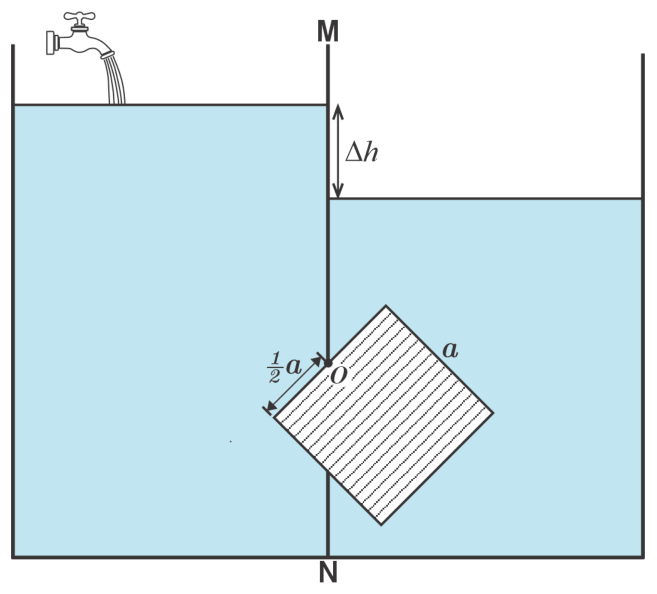
Fig. 1a.
Two water reservoirs are separated by a vertical wall MN, as shown in the figure 1a. The left reservoir can receive water from a source. It must be ensured that the maximum possible difference between the water levels is \(\Delta h = 1.41\ \mathrm{m}\). To achieve this, a slot of vertical size \(a\sqrt{2}/2\) is cut in MN and sealed with a solid cubic block of side length \(a\). The block has density \(3\rho_0\), with \(\rho_0\) the density of water. The block is fully submerged, fixed to the wall at \(O\) and can rotate without friction about the axis perpendicular to the plane of the figure that passes through point \(O\).
T1-A1 [3.0 pts]. Calculate the value of \(a\) that ensures the maximum permissible difference in water levels is not exceeded.
T1-B [3.5 pts]. Electron-positron pair
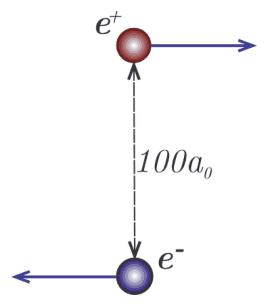
Fig. 1b.
At a certain instant of time, a positron \(e^+\) is located at a distance of \(100a_0\) from an electron \(e^-\). The particles are moving in such a way that their velocities are antiparallel at that instant, perpendicular to their separation, as shown in figure 1b. It is known that each particle has an angular momentum of magnitude \(\mu\hbar\) with respect to the system's center of mass, where \(\mu\) is a dimensionless numerical factor. Assume that the only interaction between \(e^+\) and \(e^-\) is electrostatic (both particles have the same mass \(m\) and equal magnitude of the charge but of opposite sign). Furthermore, assume that this system remains isolated and that its dynamics are classical and non-relativistic.
The Bohr radius \(a_0\) is given by \(a_0 = 4\pi\epsilon_0\hbar^2/(me^2)\).
T1-B1 [1.0 pts]. If \(\mu = 4\), the system is bound, meaning that the particles move in a closed orbit around the system's center of mass. Find the maximum separation distance between \(e^+\) and \(e^-\) in terms of \(a_0\).
T1-B2 [2.5 pts]. If \(\mu = \frac{15}{2}\), the system is unbound, meaning that the particles are no longer in closed orbit around the system's center of mass. Let \(\vec{u}_\infty\) be the velocity of \(e^+\) relative to \(e^-\) as the separation distance between them tends to infinity. Calculate the angle between \(\vec{u}_\infty\) and the initial line of motion of \(e^+\). Give your answer in degrees.
Hint 1: The eccentricty \(\varepsilon\) of a conic trajectory for the present case is given by
\[ \varepsilon = \sqrt{1+\frac{4L^2E}{k^2e^4m}} \]
where \(E\) and \(L\) are the total energy and the magnitude of the total angular momentum, respectively. \(k\) is Coulombs constant \(k = 1/(4\pi\epsilon_0)\).
Hint 2: The equation of a conic in polar coordinates is
\[ r = \frac{a}{1-\varepsilon\cos(\theta)} \]
T1-C [3.5 pts]. Photodissociation of ozone
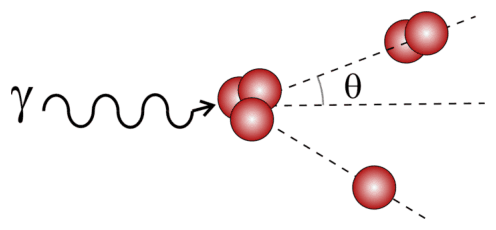
Fig. 1c.
A photon with angular frequency \(\omega\) strikes an ozone molecule \(\mathrm{O}_3\) at rest, dissociating it (breaking it apart) into an oxygen molecule \(\mathrm{O}_2\) and an oxygen atom \(\mathrm{O}\), as shown in figure 1c. The photon is absorbed in this process. Let \(U_i\) and \(U_f\) be the ground state energies of the ozone and oxygen molecules, respectively. Assume that this system remains isolated and that its dynamics is classical (potential energies do not contribute to mass and the motion of the Oxygen atoms are non-relativistic). Use the relation \(p = E/c\) for the linear momentum of the photon, where \(E\) is its energy.
T1-C1 [2.5 pts]. If the angle that the momentum of the outgoing \(\mathrm{O}_2\) with respect to the incident photon is \(\theta\), determine the minimum angular frequency \(\omega_{\min}\) required for this dissociation to occur at this angle. Write your answer in terms of \(\hbar\), \(c\), \(\theta\), \(\Delta U = U_f-U_i\), and the mass \(m\) of an oxygen atom.
T1-C2 [1.0 pts]. If \(\theta = \pi/6\), calculate the value of \(\hbar\omega_{\min}-\Delta U\). Give your answer in electronvolts (eV). Take \(\Delta U = 1.10\ \mathrm{eV}\) and \(m = 16.0\ \mathrm{amu}\).
Hint:
\[ (1+x)^r =1+rx+\frac{r(r-1)}{2!}x^2 +\frac{r(r-1)(r-2)}{3!}x^3+\cdots \]
Physical Constants
Reference values for selected physical constants.
| Constant | Notation | Value | Units |
|---|---|---|---|
| Speed of light in vacuum | \(c\) | \(2.99792458\times10^8\) | \(\mathrm{m\cdot s^{-1}}\) |
| Planck constant | \(h\) | \(4.135667696\ldots\times10^{-15}\) | \(\mathrm{eV\cdot s}\) |
| Reduced Planck constant | \(\hbar=h/2\pi\) | \(6.582119569\ldots\times10^{-16}\) | \(\mathrm{eV\cdot s}\) |
| Avogadro number | \(N_A\) | \(6.02214076\times10^{23}\) | \(\mathrm{mol^{-1}}\) |
| Boltzmann constant | \(k_B\) | \(8.617333262\times10^{-5}\) | \(\mathrm{eV\cdot K^{-1}}\) |
| Ideal gas constant | \(R\) | \(8.31446261815324\) | \(\mathrm{kg\cdot m^2\cdot s^{-2}\cdot mol^{-1}\cdot K^{-1}}\) |
| Elementary charge | \(e\) | \(1.602176634\times10^{-19}\) | \(\mathrm{A\cdot s}\) |
| Universal gravitational constant | \(G\) | \(6.67430(15)\times10^{-11}\) | \(\mathrm{m^3\cdot kg^{-1}\cdot s^{-2}}\) |
| Stefan Boltzmann constant | \(\sigma\) | \(5.670374419\times10^{-8}\) | \(\mathrm{kg\cdot s^{-3}\cdot K^{-4}}\) |
| Vacuum permeability | \(\mu_0\) | \(1.25663706127(20)\times10^{-6}\) | \(\mathrm{kg\cdot m\cdot A^{-2}\cdot s^{-2}}\) |
| Vacuum permittivity | \(\epsilon_0\) | \(8.8541878188(14)\times10^{-12}\) | \(\mathrm{A^2\cdot s^4\cdot kg^{-1}\cdot m^{-3}}\) |
| Mass of the electron | \(m_e\) | \(5.1099895069(16)\times10^5\) | \(\mathrm{eV}/c^2\) |
| Mass of the proton | \(m_p\) | \(9.3827208943(29)\times10^8\) | \(\mathrm{eV}/c^2\) |
| Atomic mass units | amu | \(9.3149410372(29)\times10^8\) | \(\mathrm{eV}/c^2\) |
Official English text of the problem.
Answers
-
T1-A1: The largest permissible side length, giving opening at the specified level difference, is \[ \boxed{a=\frac{\Delta h}{2\sqrt{2}}=0.499\ \mathrm{m}.} \]
-
T1-B1: \[ \boxed{r_{\max}=\frac{1600}{9}a_0\approx178a_0.} \]
-
T1-B2: \[ \boxed{\alpha=\sin^{-1}\!\left(\frac{2}{7}\right)=16.6^\circ,} \] directed toward the electron’s initial side of the line of motion.
-
T1-C1: For \(0\leq\theta<\pi/2\), as in the figure, let \(F=1+2\sin^2\theta\). Then \[ \boxed{ \omega_{\min} =\frac{3mc^2}{\hbar F} \left(1-\sqrt{1-\frac{2F\Delta U}{3mc^2}}\right) =\frac{2\Delta U} {\hbar\left(1+\sqrt{1-\frac{2F\Delta U}{3mc^2}}\right)}. } \] For \(\pi/2\leq\theta\leq\pi\), replace \(F\) by \(3\); the result is an infimum approached as the outgoing \(\mathrm{O}_2\) momentum tends to zero.
-
T1-C2: \[ \boxed{\hbar\omega_{\min}-\Delta U \approx\frac{(\Delta U)^2}{4mc^2} =2.03\times10^{-11}\ \mathrm{eV}.} \]
Solution
T1-A1
We calculate the torque about \(O\) at the onset of opening. The hinge force has no moment about \(O\), and the contact force at the lower edge of the slot vanishes at this threshold.
Write the slot height as \[ H=\frac{a}{\sqrt{2}}. \] The marked distance \(a/2\) places \(O\) at the midpoint of the upper-left side of the square cross section. Consequently, the cube’s center is horizontally to the right of \(O\) by \[ d=\frac{a}{2\sqrt{2}}. \]
Decompose the water pressure into two contributions. First, imagine that both reservoirs have the right-hand water level. This hydrostatic pressure gives an upward buoyant force \[ B=\rho_0ga^3 \] through the center of the cube. Its weight is \[ W=3\rho_0ga^3. \] Their combined clockwise torque is therefore \[ \tau_{\mathrm{closing}} =(W-B)d =2\rho_0ga^3\frac{a}{2\sqrt{2}} =\frac{\rho_0ga^4}{\sqrt{2}}. \]
Raising the left water level by \(\Delta h\) adds the uniform pressure \[ \Delta p=\rho_0g\Delta h \] to the cube’s surface on the left of the wall.
The resultant force and torque of this additional pressure are equivalent to those on a vertical rectangle spanning the slot. To see this, close the protruding surface with that rectangle: uniform pressure over the resulting closed surface has zero net force and torque.
Thus the additional pressure produces a horizontal force \[ F_{\Delta p}=\Delta p\,aH \] acting halfway down the slot. Its counterclockwise, opening torque is \[ \tau_{\mathrm{opening}} =\Delta p\,aH\frac{H}{2} =\frac{\rho_0g\Delta h\,a^3}{4}. \]
At the opening threshold, \[ \frac{\rho_0g\Delta h\,a^3}{4} =\frac{\rho_0ga^4}{\sqrt{2}}, \] so \[ \Delta h=2\sqrt{2}\,a. \]
Setting this threshold equal to the permitted level difference gives \[ \boxed{ a=\frac{1.41}{2\sqrt{2}}\ \mathrm{m} =0.498510\ldots\ \mathrm{m} \approx0.499\ \mathrm{m}. } \] Smaller values of \(a\) would make the gate open at a smaller level difference.
T1-B1
Let \(r\) be the separation of the particles and define \[ \kappa=ke^2=\frac{\hbar^2}{ma_0}. \] We work in the center-of-mass frame. The reduced mass is \(m/2\), and the two angular momenta have the same direction, so their total magnitude is \[ L=2\mu\hbar. \]
Conservation of mechanical energy gives \[ E=\frac{m}{4}\dot r^{\,2}+\frac{L^2}{mr^2}-\frac{\kappa}{r}. \] Initially the relative velocity is perpendicular to the separation, hence \(\dot r=0\) at \(r_0=100a_0\). Therefore, \[ E =\frac{4\mu^2\hbar^2}{m(100a_0)^2} -\frac{\kappa}{100a_0} =\frac{\kappa}{a_0} \left(\frac{\mu^2}{2500}-\frac{1}{100}\right). \]
For \(\mu=4\), \[ E=-\frac{9}{2500}\frac{\kappa}{a_0}<0. \]
At either extreme of the separation, \(\dot r=0\). Writing \(x=r/a_0\), the turning-point equation is \[ -\frac{9}{2500}=\frac{64}{x^2}-\frac1x. \] Equivalently, \[ 9x^2-2500x+160000 =(x-100)(9x-1600)=0. \]
The two turning points are therefore \[ r_{\min}=100a_0, \qquad r_{\max}=\frac{1600}{9}a_0. \] Thus the given initial configuration is the point of minimum separation, and \[ \boxed{r_{\max}=\frac{1600}{9}a_0\approx178a_0.} \]
T1-B2
For \(\mu=15/2\), the same expressions give \[ L=15\hbar, \qquad E=\frac{\kappa}{80a_0}>0. \] Using the supplied eccentricity formula, \[ \varepsilon =\sqrt{1+\frac{4L^2E}{m\kappa^2}} =\sqrt{1+\frac{4(15\hbar)^2}{m\kappa^2} \frac{\kappa}{80a_0}}. \] Since \(ma_0\kappa=\hbar^2\), \[ \boxed{\varepsilon=\sqrt{1+\frac{45}{4}}=\frac72.} \]
Choose a polar angle \(\varphi\) measured from the periapsis direction, increasing in the direction of motion. With this choice, the conic equation is \[ r=\frac{p}{1+\varepsilon\cos\varphi}, \qquad p=\frac{L^2}{(m/2)\kappa}=450a_0. \] The periapsis separation is \[ r_{\mathrm p}=\frac{p}{1+\varepsilon} =\frac{450a_0}{1+7/2}=100a_0, \] so the initial position is indeed at periapsis.
On the outgoing branch, \(r\to\infty\) when \[ 1+\varepsilon\cos\varphi_\infty=0, \] giving \[ \cos\varphi_\infty=-\frac1\varepsilon=-\frac27. \]
The transverse relative speed is \(L/[(m/2)r]\), which tends to zero at infinity. Hence the final relative velocity points along the limiting radial direction. The initial velocity is perpendicular to the periapsis direction, so the requested angle is \[ \alpha=\varphi_\infty-\frac{\pi}{2}. \] It follows that \[ \sin\alpha=\frac1\varepsilon=\frac27, \] and therefore \[ \boxed{\alpha=\sin^{-1}\!\left(\frac27\right)=16.6^\circ.} \] In the figure, the outgoing relative velocity points below the positron’s initial horizontal direction.
T1-C1
Let the photon energy and momentum magnitude be \[ E_\gamma=\hbar\omega, \qquad P=\frac{E_\gamma}{c}. \] Take its direction as the \(x\)-axis. Let the outgoing oxygen molecule have momentum \(q\hat{\mathbf n}\), where \[ q\geq0, \qquad \hat{\mathbf n}\cdot\hat{\mathbf x}=\cos\theta. \]
Under the stated mass convention, the oxygen molecule has mass \(2m\), and the atom has mass \(m\). Momentum conservation gives \[ \mathbf p_{\mathrm O}=P\hat{\mathbf x}-q\hat{\mathbf n}. \] At the minimum photon energy, no additional internal excitation is needed. Energy conservation is then \[ E_\gamma-\Delta U =\frac{q^2}{4m} +\frac{P^2+q^2-2Pq\cos\theta}{2m}. \]
Completing the square, \[ E_\gamma-\Delta U = \frac{3}{4m} \left(q-\frac{2P\cos\theta}{3}\right)^2 +\frac{P^2}{6m}\left(3-2\cos^2\theta\right). \]
For the forward-emission geometry, \(0\leq\theta<\pi/2\), the kinetic energy is minimized at the physically allowed momentum \[ q_*=\frac{2P\cos\theta}{3}>0. \] Define \[ F=3-2\cos^2\theta=1+2\sin^2\theta. \] The minimum final kinetic energy for a given photon energy is therefore \[ K_{\min}=\frac{FP^2}{6m} =\frac{F E_\gamma^2}{6mc^2}. \]
At the dissociation threshold, \[ E_{\gamma,\min}-\Delta U =\frac{F E_{\gamma,\min}^2}{6mc^2}. \] Solving this quadratic and taking the lower root gives \[ \boxed{ \omega_{\min} =\frac{3mc^2}{\hbar(1+2\sin^2\theta)} \left[ 1-\sqrt{ 1-\frac{2(1+2\sin^2\theta)\Delta U}{3mc^2} } \right]. } \] The other root has energy of order \(mc^2\) and lies outside the assumed non-relativistic regime.
An equivalent form, useful when \(\Delta U\ll mc^2\), is \[ \boxed{ \omega_{\min} =\frac{2\Delta U} {\hbar\left[ 1+\sqrt{1-\frac{2(1+2\sin^2\theta)\Delta U}{3mc^2}} \right]}. } \] Its expansion is \[ \hbar\omega_{\min} =\Delta U +\frac{(1+2\sin^2\theta)(\Delta U)^2}{6mc^2} +O\!\left(\frac{(\Delta U)^3}{m^2c^4}\right). \]
For completeness, the statement does not explicitly restrict the angular range. If \(\pi/2\leq\theta\leq\pi\), the unconstrained minimizer \(q_*\) is nonpositive. Restricting to \(q\geq0\) instead gives \[ \inf K=\frac{P^2}{2m}. \] Thus the threshold formula uses \(F=3\) for these angles. It is only an infimum for a specified outgoing direction: at \(q=0\) that direction is undefined, while arbitrarily small positive \(q\) permits energies arbitrarily close to the threshold.
T1-C2
For \(\theta=\pi/6\), \[ F=1+2\sin^2\frac{\pi}{6}=\frac32. \] Consequently, \[ \hbar\omega_{\min} =2mc^2\left(1-\sqrt{1-\frac{\Delta U}{mc^2}}\right). \]
Using the supplied atomic mass unit, \[ mc^2 =16.0\left(9.3149410372\times10^8\right)\ \mathrm{eV} =1.49039\times10^{10}\ \mathrm{eV}. \] The expansion parameter is \[ x=\frac{\Delta U}{mc^2} \approx7.38\times10^{-11}. \] Using \[ \sqrt{1-x}=1-\frac{x}{2}-\frac{x^2}{8}+O(x^3), \] we obtain \[ \hbar\omega_{\min} =\Delta U+\frac{(\Delta U)^2}{4mc^2} +O\!\left(\frac{(\Delta U)^3}{m^2c^4}\right). \]
Thus \[ \hbar\omega_{\min}-\Delta U \approx \frac{(1.10\ \mathrm{eV})^2} {4(1.49039\times10^{10}\ \mathrm{eV})}, \] which gives \[ \boxed{\hbar\omega_{\min}-\Delta U =2.03\times10^{-11}\ \mathrm{eV}} \] to three significant figures.
The solution was checked against the official solution. Where this solution differs from the official solution, the official solution contains an error or a misprint.
IPhO 2026 · Theorieaufgabe 1
Drei Probleme (A: Hydrostatische Verschlussklappe; B: Elektron-Positron-Paar; C: Photodissoziation von Ozon)
AUFGABE T1 [10 Punkte]. Drei Probleme
Diese Aufgabe besteht aus drei unabhängigen Problemen.
T1-A [3.0 Punkte]. Hydrostatische Verschlussklappe
Abb. 1a.
Zwei Wasserreservoirs sind durch eine senkrechte Wand MN voneinander getrennt, wie in Abbildung 1a gezeigt. Dem linken Reservoir kann Wasser aus einer Quelle zufließen. Es muss sichergestellt werden, dass der größtmögliche Unterschied zwischen den Wasserständen \(\Delta h = 1.41\ \mathrm{m}\) beträgt. Dazu wird in MN ein Schlitz mit der vertikalen Ausdehnung \(a\sqrt{2}/2\) ausgeschnitten und mit einem massiven würfelförmigen Block der Kantenlänge \(a\) verschlossen. Der Block hat die Dichte \(3\rho_0\), wobei \(\rho_0\) die Dichte von Wasser ist. Der Block ist vollständig eingetaucht, bei \(O\) an der Wand befestigt und kann sich reibungsfrei um die Achse drehen, die senkrecht zur Zeichenebene steht und durch den Punkt \(O\) verläuft.
T1-A1 [3.0 Punkte]. Berechnen Sie den Wert von \(a\), der sicherstellt, dass der maximal zulässige Unterschied zwischen den Wasserständen nicht überschritten wird.
T1-B [3.5 Punkte]. Elektron-Positron-Paar
Abb. 1b.
Zu einem bestimmten Zeitpunkt befindet sich ein Positron \(e^+\) im Abstand \(100a_0\) von einem Elektron \(e^-\). Die Teilchen bewegen sich so, dass ihre Geschwindigkeiten zu diesem Zeitpunkt antiparallel zueinander und senkrecht zu ihrer Verbindungslinie sind, wie in Abbildung 1b gezeigt. Es ist bekannt, dass jedes Teilchen bezüglich des Schwerpunkts des Systems einen Drehimpuls vom Betrag \(\mu\hbar\) besitzt, wobei \(\mu\) ein dimensionsloser Zahlenfaktor ist. Nehmen Sie an, dass die einzige Wechselwirkung zwischen \(e^+\) und \(e^-\) elektrostatischer Natur ist (beide Teilchen haben dieselbe Masse \(m\) und betragsmäßig gleiche Ladungen mit entgegengesetztem Vorzeichen). Nehmen Sie außerdem an, dass dieses System isoliert bleibt und seine Dynamik klassisch und nichtrelativistisch ist.
Der Bohr-Radius \(a_0\) ist gegeben durch \(a_0 = 4\pi\epsilon_0\hbar^2/(me^2)\).
T1-B1 [1.0 Punkte]. Für \(\mu = 4\) ist das System gebunden, das heißt, die Teilchen bewegen sich auf einer geschlossenen Bahn um den Schwerpunkt des Systems. Bestimmen Sie den maximalen Abstand zwischen \(e^+\) und \(e^-\) in Abhängigkeit von \(a_0\).
T1-B2 [2.5 Punkte]. Für \(\mu = \frac{15}{2}\) ist das System ungebunden, das heißt, die Teilchen bewegen sich nicht mehr auf einer geschlossenen Bahn um den Schwerpunkt des Systems. Es sei \(\vec{u}_\infty\) die Geschwindigkeit von \(e^+\) relativ zu \(e^-\), wenn ihr Abstand gegen unendlich geht. Berechnen Sie den Winkel zwischen \(\vec{u}_\infty\) und der anfänglichen Bewegungsgeraden von \(e^+\). Geben Sie Ihre Antwort in Grad an.
Hinweis 1: Die Exzentrizität \(\varepsilon\) einer Kegelschnittbahn ist im vorliegenden Fall gegeben durch
\[ \varepsilon = \sqrt{1+\frac{4L^2E}{k^2e^4m}} \]
wobei \(E\) die Gesamtenergie und \(L\) den Betrag des Gesamtdrehimpulses bezeichnet. \(k\) ist die Coulomb-Konstante \(k = 1/(4\pi\epsilon_0)\).
Hinweis 2: Die Gleichung eines Kegelschnitts in Polarkoordinaten lautet
\[ r = \frac{a}{1-\varepsilon\cos(\theta)} \]
T1-C [3.5 Punkte]. Photodissoziation von Ozon
Abb. 1c.
Ein Photon mit der Kreisfrequenz \(\omega\) trifft auf ein ruhendes Ozonmolekül \(\mathrm{O}_3\) und dissoziiert es (spaltet es auf) in ein Sauerstoffmolekül \(\mathrm{O}_2\) und ein Sauerstoffatom \(\mathrm{O}\), wie in Abbildung 1c gezeigt. Das Photon wird dabei absorbiert. Es seien \(U_i\) und \(U_f\) die Grundzustandsenergien des Ozonmoleküls beziehungsweise des Sauerstoffmoleküls. Nehmen Sie an, dass dieses System isoliert bleibt und seine Dynamik klassisch ist (potenzielle Energien tragen nicht zur Masse bei, und die Bewegung der Sauerstoffatome ist nichtrelativistisch). Verwenden Sie für den Impuls des Photons die Beziehung \(p = E/c\), wobei \(E\) seine Energie ist.
T1-C1 [2.5 Punkte]. Wenn der Impuls des austretenden \(\mathrm{O}_2\) mit der Richtung des einfallenden Photons den Winkel \(\theta\) bildet, bestimmen Sie die minimale Kreisfrequenz \(\omega_{\min}\), die erforderlich ist, damit diese Dissoziation unter diesem Winkel stattfinden kann. Geben Sie Ihre Antwort in Abhängigkeit von \(\hbar\), \(c\), \(\theta\), \(\Delta U = U_f-U_i\) und der Masse \(m\) eines Sauerstoffatoms an.
T1-C2 [1.0 Punkte]. Berechnen Sie für \(\theta = \pi/6\) den Wert von \(\hbar\omega_{\min}-\Delta U\). Geben Sie Ihre Antwort in Elektronenvolt (eV) an. Verwenden Sie \(\Delta U = 1.10\ \mathrm{eV}\) und \(m = 16.0\ \mathrm{amu}\).
Hinweis:
\[ (1+x)^r =1+rx+\frac{r(r-1)}{2!}x^2 +\frac{r(r-1)(r-2)}{3!}x^3+\cdots \]
Physikalische Konstanten
Referenzwerte ausgewählter physikalischer Konstanten.
| Konstante | Symbol | Wert | Einheiten |
|---|---|---|---|
| Lichtgeschwindigkeit im Vakuum | \(c\) | \(2.99792458\times10^8\) | \(\mathrm{m\cdot s^{-1}}\) |
| Planck-Konstante | \(h\) | \(4.135667696\ldots\times10^{-15}\) | \(\mathrm{eV\cdot s}\) |
| Reduzierte Planck-Konstante | \(\hbar=h/2\pi\) | \(6.582119569\ldots\times10^{-16}\) | \(\mathrm{eV\cdot s}\) |
| Avogadro-Konstante | \(N_A\) | \(6.02214076\times10^{23}\) | \(\mathrm{mol^{-1}}\) |
| Boltzmann-Konstante | \(k_B\) | \(8.617333262\times10^{-5}\) | \(\mathrm{eV\cdot K^{-1}}\) |
| Universelle Gaskonstante | \(R\) | \(8.31446261815324\) | \(\mathrm{kg\cdot m^2\cdot s^{-2}\cdot mol^{-1}\cdot K^{-1}}\) |
| Elementarladung | \(e\) | \(1.602176634\times10^{-19}\) | \(\mathrm{A\cdot s}\) |
| Universelle Gravitationskonstante | \(G\) | \(6.67430(15)\times10^{-11}\) | \(\mathrm{m^3\cdot kg^{-1}\cdot s^{-2}}\) |
| Stefan-Boltzmann-Konstante | \(\sigma\) | \(5.670374419\times10^{-8}\) | \(\mathrm{kg\cdot s^{-3}\cdot K^{-4}}\) |
| Magnetische Feldkonstante | \(\mu_0\) | \(1.25663706127(20)\times10^{-6}\) | \(\mathrm{kg\cdot m\cdot A^{-2}\cdot s^{-2}}\) |
| Elektrische Feldkonstante | \(\epsilon_0\) | \(8.8541878188(14)\times10^{-12}\) | \(\mathrm{A^2\cdot s^4\cdot kg^{-1}\cdot m^{-3}}\) |
| Masse des Elektrons | \(m_e\) | \(5.1099895069(16)\times10^5\) | \(\mathrm{eV}/c^2\) |
| Masse des Protons | \(m_p\) | \(9.3827208943(29)\times10^8\) | \(\mathrm{eV}/c^2\) |
| Atomare Masseneinheit | amu | \(9.3149410372(29)\times10^8\) | \(\mathrm{eV}/c^2\) |
Aufgabentext aus dem offiziellen englischen Text übersetzt.
Antworten
-
T1-A1: Die größte zulässige Kantenlänge, bei der sich die Klappe beim angegebenen Wasserstandsunterschied öffnet, beträgt \[ \boxed{a=\frac{\Delta h}{2\sqrt{2}}=0.499\ \mathrm{m}.} \]
-
T1-B1: \[ \boxed{r_{\max}=\frac{1600}{9}a_0\approx178a_0.} \]
-
T1-B2: \[ \boxed{\alpha=\sin^{-1}\!\left(\frac{2}{7}\right)=16.6^\circ,} \] gerichtet zu der Seite der Bewegungsgeraden, auf der sich das Elektron anfangs befindet.
-
T1-C1: Für \(0\leq\theta<\pi/2\), wie in der Abbildung, sei \(F=1+2\sin^2\theta\). Dann gilt \[ \boxed{ \omega_{\min} =\frac{3mc^2}{\hbar F} \left(1-\sqrt{1-\frac{2F\Delta U}{3mc^2}}\right) =\frac{2\Delta U} {\hbar\left(1+\sqrt{1-\frac{2F\Delta U}{3mc^2}}\right)}. } \] Für \(\pi/2\leq\theta\leq\pi\) ist \(F\) durch \(3\) zu ersetzen; das Ergebnis ist ein Infimum, dem man sich nähert, wenn der Impuls des austretenden \(\mathrm{O}_2\) gegen null geht.
-
T1-C2: \[ \boxed{\hbar\omega_{\min}-\Delta U \approx\frac{(\Delta U)^2}{4mc^2} =2.03\times10^{-11}\ \mathrm{eV}.} \]
Lösung
T1-A1
Wir berechnen das Drehmoment um \(O\) beim Einsetzen des Öffnens. Die Lagerkraft erzeugt kein Drehmoment um \(O\), und die Kontaktkraft am unteren Rand des Schlitzes verschwindet an dieser Schwelle.
Wir schreiben die Schlitzhöhe als \[ H=\frac{a}{\sqrt{2}}. \] Die eingezeichnete Strecke \(a/2\) legt \(O\) auf den Mittelpunkt der linken oberen Seite des quadratischen Querschnitts fest. Folglich liegt der Mittelpunkt des Würfels rechts von \(O\) im horizontalen Abstand \[ d=\frac{a}{2\sqrt{2}}. \]
Wir zerlegen den Wasserdruck in zwei Beiträge. Zunächst stellen wir uns vor, dass beide Reservoirs den Wasserstand des rechten Reservoirs haben. Dieser hydrostatische Druck ergibt eine nach oben gerichtete Auftriebskraft \[ B=\rho_0ga^3 \] mit Wirkungslinie durch den Mittelpunkt des Würfels. Seine Gewichtskraft beträgt \[ W=3\rho_0ga^3. \] Das gemeinsame Drehmoment dieser beiden Kräfte im Uhrzeigersinn ist daher \[ \tau_{\mathrm{closing}} =(W-B)d =2\rho_0ga^3\frac{a}{2\sqrt{2}} =\frac{\rho_0ga^4}{\sqrt{2}}. \]
Eine Erhöhung des linken Wasserstands um \(\Delta h\) fügt auf der Oberfläche des Würfels links von der Wand den gleichförmigen Druck \[ \Delta p=\rho_0g\Delta h \] hinzu.
Die resultierende Kraft und das Drehmoment dieses zusätzlichen Drucks sind gleich denen, die er auf ein senkrechtes, den Schlitz überspannendes Rechteck ausüben würde. Um dies einzusehen, schließen wir die hervorstehende Oberfläche mit diesem Rechteck: Ein gleichförmiger Druck auf der so entstehenden geschlossenen Oberfläche ergibt weder eine resultierende Kraft noch ein resultierendes Drehmoment.
Der zusätzliche Druck erzeugt somit eine horizontale Kraft \[ F_{\Delta p}=\Delta p\,aH \] die auf halber Höhe des Schlitzes angreift. Ihr gegen den Uhrzeigersinn wirkendes, öffnendes Drehmoment beträgt \[ \tau_{\mathrm{opening}} =\Delta p\,aH\frac{H}{2} =\frac{\rho_0g\Delta h\,a^3}{4}. \]
An der Öffnungsschwelle gilt \[ \frac{\rho_0g\Delta h\,a^3}{4} =\frac{\rho_0ga^4}{\sqrt{2}}, \] also \[ \Delta h=2\sqrt{2}\,a. \]
Setzen wir diese Schwelle gleich dem zulässigen Wasserstandsunterschied, erhalten wir \[ \boxed{ a=\frac{1.41}{2\sqrt{2}}\ \mathrm{m} =0.498510\ldots\ \mathrm{m} \approx0.499\ \mathrm{m}. } \] Bei kleineren Werten von \(a\) würde sich die Klappe bereits bei einem kleineren Wasserstandsunterschied öffnen.
T1-B1
Es sei \(r\) der Abstand der Teilchen, und wir definieren \[ \kappa=ke^2=\frac{\hbar^2}{ma_0}. \] Wir arbeiten im Schwerpunktsystem. Die reduzierte Masse beträgt \(m/2\), und die beiden Drehimpulse haben dieselbe Richtung, sodass für den Betrag ihres Gesamtdrehimpulses gilt \[ L=2\mu\hbar. \]
Aus der Erhaltung der mechanischen Energie folgt \[ E=\frac{m}{4}\dot r^{\,2}+\frac{L^2}{mr^2}-\frac{\kappa}{r}. \] Anfangs steht die Relativgeschwindigkeit senkrecht zur Verbindungslinie, daher gilt \(\dot r=0\) bei \(r_0=100a_0\). Somit ist \[ E =\frac{4\mu^2\hbar^2}{m(100a_0)^2} -\frac{\kappa}{100a_0} =\frac{\kappa}{a_0} \left(\frac{\mu^2}{2500}-\frac{1}{100}\right). \]
Für \(\mu=4\) gilt \[ E=-\frac{9}{2500}\frac{\kappa}{a_0}<0. \]
Bei beiden Extremwerten des Abstands gilt \(\dot r=0\). Mit \(x=r/a_0\) lautet die Gleichung für die Umkehrpunkte \[ -\frac{9}{2500}=\frac{64}{x^2}-\frac1x. \] Äquivalent dazu ist \[ 9x^2-2500x+160000 =(x-100)(9x-1600)=0. \]
Die beiden Umkehrpunkte sind daher \[ r_{\min}=100a_0, \qquad r_{\max}=\frac{1600}{9}a_0. \] Die gegebene Anfangskonfiguration entspricht somit dem Punkt des kleinsten Abstands, und es gilt \[ \boxed{r_{\max}=\frac{1600}{9}a_0\approx178a_0.} \]
T1-B2
Für \(\mu=15/2\) ergeben dieselben Ausdrücke \[ L=15\hbar, \qquad E=\frac{\kappa}{80a_0}>0. \] Mit der angegebenen Formel für die Exzentrizität erhalten wir \[ \varepsilon =\sqrt{1+\frac{4L^2E}{m\kappa^2}} =\sqrt{1+\frac{4(15\hbar)^2}{m\kappa^2} \frac{\kappa}{80a_0}}. \] Wegen \(ma_0\kappa=\hbar^2\) gilt \[ \boxed{\varepsilon=\sqrt{1+\frac{45}{4}}=\frac72.} \]
Wir wählen einen Polarwinkel \(\varphi\), der von der Richtung zum Perizentrum aus gemessen wird und in Bewegungsrichtung zunimmt. Bei dieser Wahl lautet die Kegelschnittgleichung \[ r=\frac{p}{1+\varepsilon\cos\varphi}, \qquad p=\frac{L^2}{(m/2)\kappa}=450a_0. \] Der Abstand im Perizentrum beträgt \[ r_{\mathrm p}=\frac{p}{1+\varepsilon} =\frac{450a_0}{1+7/2}=100a_0, \] die Anfangsposition liegt also tatsächlich im Perizentrum.
Auf dem auslaufenden Ast gilt \(r\to\infty\), wenn \[ 1+\varepsilon\cos\varphi_\infty=0, \] woraus folgt \[ \cos\varphi_\infty=-\frac1\varepsilon=-\frac27. \]
Die transversale Relativgeschwindigkeit beträgt \(L/[(m/2)r]\) und geht im Unendlichen gegen null. Daher zeigt die endgültige Relativgeschwindigkeit in die Grenzrichtung des Radiusvektors. Die Anfangsgeschwindigkeit steht senkrecht zur Richtung zum Perizentrum, sodass für den gesuchten Winkel gilt \[ \alpha=\varphi_\infty-\frac{\pi}{2}. \] Daraus folgt \[ \sin\alpha=\frac1\varepsilon=\frac27, \] und somit \[ \boxed{\alpha=\sin^{-1}\!\left(\frac27\right)=16.6^\circ.} \] In der Abbildung zeigt die auslaufende Relativgeschwindigkeit unterhalb der anfänglichen horizontalen Bewegungsrichtung des Positrons.
T1-C1
Die Energie und der Impulsbetrag des Photons seien \[ E_\gamma=\hbar\omega, \qquad P=\frac{E_\gamma}{c}. \] Wir wählen seine Richtung als \(x\)-Achse. Das austretende Sauerstoffmolekül habe den Impuls \(q\hat{\mathbf n}\), wobei \[ q\geq0, \qquad \hat{\mathbf n}\cdot\hat{\mathbf x}=\cos\theta. \]
Unter der angegebenen Annahme über die Massen hat das Sauerstoffmolekül die Masse \(2m\) und das Atom die Masse \(m\). Aus der Impulserhaltung folgt \[ \mathbf p_{\mathrm O}=P\hat{\mathbf x}-q\hat{\mathbf n}. \] Bei der minimalen Photonenenergie ist keine zusätzliche innere Anregung erforderlich. Die Energieerhaltung lautet dann \[ E_\gamma-\Delta U =\frac{q^2}{4m} +\frac{P^2+q^2-2Pq\cos\theta}{2m}. \]
Durch quadratische Ergänzung erhalten wir \[ E_\gamma-\Delta U = \frac{3}{4m} \left(q-\frac{2P\cos\theta}{3}\right)^2 +\frac{P^2}{6m}\left(3-2\cos^2\theta\right). \]
Bei Emission in Vorwärtsrichtung, \(0\leq\theta<\pi/2\), wird die kinetische Energie bei folgendem physikalisch zulässigen Impuls minimiert: \[ q_*=\frac{2P\cos\theta}{3}>0. \] Wir definieren \[ F=3-2\cos^2\theta=1+2\sin^2\theta. \] Die minimale kinetische Endenergie bei gegebener Photonenenergie beträgt daher \[ K_{\min}=\frac{FP^2}{6m} =\frac{F E_\gamma^2}{6mc^2}. \]
An der Dissoziationsschwelle gilt \[ E_{\gamma,\min}-\Delta U =\frac{F E_{\gamma,\min}^2}{6mc^2}. \] Lösen wir diese quadratische Gleichung und wählen die kleinere Lösung, so erhalten wir \[ \boxed{ \omega_{\min} =\frac{3mc^2}{\hbar(1+2\sin^2\theta)} \left[ 1-\sqrt{ 1-\frac{2(1+2\sin^2\theta)\Delta U}{3mc^2} } \right]. } \] Die andere Lösung hat eine Energie der Größenordnung \(mc^2\) und liegt außerhalb des angenommenen nichtrelativistischen Bereichs.
Eine äquivalente Form, die für \(\Delta U\ll mc^2\) nützlich ist, lautet \[ \boxed{ \omega_{\min} =\frac{2\Delta U} {\hbar\left[ 1+\sqrt{1-\frac{2(1+2\sin^2\theta)\Delta U}{3mc^2}} \right]}. } \] Ihre Reihenentwicklung lautet \[ \hbar\omega_{\min} =\Delta U +\frac{(1+2\sin^2\theta)(\Delta U)^2}{6mc^2} +O\!\left(\frac{(\Delta U)^3}{m^2c^4}\right). \]
Der Vollständigkeit halber sei angemerkt, dass die Aufgabenstellung den Winkelbereich nicht ausdrücklich einschränkt. Für \(\pi/2\leq\theta\leq\pi\) ist die ohne Nebenbedingung minimierende Größe \(q_*\) nichtpositiv. Unter der Einschränkung \(q\geq0\) ergibt sich stattdessen \[ \inf K=\frac{P^2}{2m}. \] Für diese Winkel ist in der Schwellenformel also \(F=3\) zu verwenden. Bei einer vorgegebenen Austrittsrichtung handelt es sich lediglich um ein Infimum: Für \(q=0\) ist diese Richtung nicht definiert, während beliebig kleine positive Werte von \(q\) Energien beliebig nahe an der Schwelle ermöglichen.
T1-C2
Für \(\theta=\pi/6\) gilt \[ F=1+2\sin^2\frac{\pi}{6}=\frac32. \] Folglich ist \[ \hbar\omega_{\min} =2mc^2\left(1-\sqrt{1-\frac{\Delta U}{mc^2}}\right). \]
Mit dem angegebenen Wert der atomaren Masseneinheit erhalten wir \[ mc^2 =16.0\left(9.3149410372\times10^8\right)\ \mathrm{eV} =1.49039\times10^{10}\ \mathrm{eV}. \] Der Entwicklungsparameter ist \[ x=\frac{\Delta U}{mc^2} \approx7.38\times10^{-11}. \] Mit \[ \sqrt{1-x}=1-\frac{x}{2}-\frac{x^2}{8}+O(x^3), \] erhalten wir \[ \hbar\omega_{\min} =\Delta U+\frac{(\Delta U)^2}{4mc^2} +O\!\left(\frac{(\Delta U)^3}{m^2c^4}\right). \]
Somit gilt \[ \hbar\omega_{\min}-\Delta U \approx \frac{(1.10\ \mathrm{eV})^2} {4(1.49039\times10^{10}\ \mathrm{eV})}, \] woraus sich \[ \boxed{\hbar\omega_{\min}-\Delta U =2.03\times10^{-11}\ \mathrm{eV}} \] auf drei signifikante Stellen ergibt.
Die Lösung wurde mit der offiziellen Lösung abgeglichen. Wo diese Lösung von der offiziellen Lösung abweicht, enthält die offizielle Lösung einen Fehler oder Druckfehler.
IPhO 2026 · Teori sorusu 1
Üç problem (A: Hidrostatik kapak; B: Elektron-pozitron çifti; C: Ozonun fotoayrışması)
SORU T1 [10 puan]. Üç problem
Bu soru birbirinden bağımsız üç problemden oluşmaktadır.
T1-A [3.0 puan]. Hidrostatik kapak
Şekil 1a.
İki su haznesi, şekil 1a'da gösterildiği gibi düşey bir MN duvarıyla birbirinden ayrılmıştır. Soldaki hazneye bir kaynaktan su gelebilmektedir. Su seviyeleri arasındaki farkın en fazla \(\Delta h = 1.41\ \mathrm{m}\) olması sağlanmalıdır. Bunun için MN duvarında düşey boyutu \(a\sqrt{2}/2\) olan bir açıklık açılır ve bu açıklık, kenar uzunluğu \(a\) olan dolu bir küp blokla kapatılır. Bloğun yoğunluğu \(3\rho_0\) olup \(\rho_0\) suyun yoğunluğudur. Blok tamamen suya batmış durumdadır; duvara \(O\) noktasından tutturulmuştur ve \(O\) noktasından geçen, şekil düzlemine dik eksen etrafında sürtünmesiz dönebilmektedir.
T1-A1 [3.0 puan]. Su seviyeleri arasında izin verilen en büyük farkın aşılmamasını sağlayan \(a\) değerini hesaplayınız.
T1-B [3.5 puan]. Elektron-pozitron çifti
Şekil 1b.
Belirli bir anda, bir pozitron \(e^+\), bir elektrondan \(e^-\) \(100a_0\) uzaklıkta bulunmaktadır. Parçacıklar, şekil 1b'de gösterildiği gibi, o anda hızları birbirine zıt yönlü ve onları birleştiren doğruya dik olacak şekilde hareket etmektedir. Her bir parçacığın sistemin kütle merkezine göre açısal momentumunun büyüklüğünün \(\mu\hbar\) olduğu bilinmektedir; burada \(\mu\) boyutsuz bir sayısal katsayıdır. \(e^+\) ile \(e^-\) arasındaki tek etkileşimin elektrostatik olduğunu varsayınız (iki parçacığın kütlesi de \(m\), yükleri ise eşit büyüklükte ve zıt işaretlidir). Ayrıca bu sistemin yalıtılmış kaldığını ve dinamiğinin klasik ve göreli olmayan mekanikle betimlendiğini varsayınız.
Bohr yarıçapı \(a_0\), \(a_0 = 4\pi\epsilon_0\hbar^2/(me^2)\) bağıntısıyla verilir.
T1-B1 [1.0 puan]. \(\mu = 4\) ise sistem bağlıdır; yani parçacıklar sistemin kütle merkezi etrafında kapalı bir yörüngede hareket eder. \(e^+\) ile \(e^-\) arasındaki en büyük uzaklığı \(a_0\) cinsinden bulunuz.
T1-B2 [2.5 puan]. \(\mu = \frac{15}{2}\) ise sistem bağlı değildir; yani parçacıklar artık sistemin kütle merkezi etrafında kapalı bir yörüngede değildir. Aralarındaki uzaklık sonsuza giderken \(e^+\)'nın \(e^-\)'ye göre hızı \(\vec{u}_\infty\) olsun. \(\vec{u}_\infty\) ile \(e^+\)'nın başlangıçtaki hareket doğrultusu arasındaki açıyı hesaplayınız. Cevabınızı derece cinsinden veriniz.
İpucu 1: Bu durumda konik bir yörüngenin dışmerkezliği \(\varepsilon\),
\[ \varepsilon = \sqrt{1+\frac{4L^2E}{k^2e^4m}} \]
bağıntısıyla verilir; burada \(E\) ve \(L\), sırasıyla toplam enerji ve toplam açısal momentumun büyüklüğüdür. \(k\), Coulomb sabiti olup \(k = 1/(4\pi\epsilon_0)\) şeklindedir.
İpucu 2: Bir koniğin kutupsal koordinatlardaki denklemi şöyledir:
\[ r = \frac{a}{1-\varepsilon\cos(\theta)} \]
T1-C [3.5 puan]. Ozonun fotoayrışması
Şekil 1c.
Açısal frekansı \(\omega\) olan bir foton, durgun bir ozon molekülüne \(\mathrm{O}_3\) çarpar ve onu şekil 1c'de gösterildiği gibi bir oksijen molekülüne \(\mathrm{O}_2\) ve bir oksijen atomuna \(\mathrm{O}\) ayrıştırır (parçalar). Bu süreçte foton soğurulur. Ozon ve oksijen moleküllerinin temel durum enerjileri sırasıyla \(U_i\) ve \(U_f\) olsun. Bu sistemin yalıtılmış kaldığını ve dinamiğinin klasik olduğunu varsayınız (potansiyel enerjiler kütleye katkıda bulunmaz ve oksijen atomlarının hareketi göreli değildir). Fotonun çizgisel momentumu için \(p = E/c\) bağıntısını kullanınız; burada \(E\) fotonun enerjisidir.
T1-C1 [2.5 puan]. Ayrışma sonucu çıkan \(\mathrm{O}_2\)'nin momentumunun gelen fotonun doğrultusuyla yaptığı açı \(\theta\) ise ayrışmanın bu açıda gerçekleşmesi için gereken en küçük açısal frekansı \(\omega_{\min}\) belirleyiniz. Cevabınızı \(\hbar\), \(c\), \(\theta\), \(\Delta U = U_f-U_i\) ve bir oksijen atomunun kütlesi \(m\) cinsinden yazınız.
T1-C2 [1.0 puan]. \(\theta = \pi/6\) ise \(\hbar\omega_{\min}-\Delta U\) değerini hesaplayınız. Cevabınızı elektronvolt (eV) cinsinden veriniz. \(\Delta U = 1.10\ \mathrm{eV}\) ve \(m = 16.0\ \mathrm{amu}\) alınız.
İpucu:
\[ (1+x)^r =1+rx+\frac{r(r-1)}{2!}x^2 +\frac{r(r-1)(r-2)}{3!}x^3+\cdots \]
Fiziksel Sabitler
Seçilmiş fiziksel sabitlerin referans değerleri.
| Sabit | Gösterim | Değer | Birimler |
|---|---|---|---|
| Işığın boşluktaki hızı | \(c\) | \(2.99792458\times10^8\) | \(\mathrm{m\cdot s^{-1}}\) |
| Planck sabiti | \(h\) | \(4.135667696\ldots\times10^{-15}\) | \(\mathrm{eV\cdot s}\) |
| İndirgenmiş Planck sabiti | \(\hbar=h/2\pi\) | \(6.582119569\ldots\times10^{-16}\) | \(\mathrm{eV\cdot s}\) |
| Avogadro sayısı | \(N_A\) | \(6.02214076\times10^{23}\) | \(\mathrm{mol^{-1}}\) |
| Boltzmann sabiti | \(k_B\) | \(8.617333262\times10^{-5}\) | \(\mathrm{eV\cdot K^{-1}}\) |
| İdeal gaz sabiti | \(R\) | \(8.31446261815324\) | \(\mathrm{kg\cdot m^2\cdot s^{-2}\cdot mol^{-1}\cdot K^{-1}}\) |
| Temel yük | \(e\) | \(1.602176634\times10^{-19}\) | \(\mathrm{A\cdot s}\) |
| Evrensel kütleçekim sabiti | \(G\) | \(6.67430(15)\times10^{-11}\) | \(\mathrm{m^3\cdot kg^{-1}\cdot s^{-2}}\) |
| Stefan Boltzmann sabiti | \(\sigma\) | \(5.670374419\times10^{-8}\) | \(\mathrm{kg\cdot s^{-3}\cdot K^{-4}}\) |
| Boşluğun manyetik geçirgenliği | \(\mu_0\) | \(1.25663706127(20)\times10^{-6}\) | \(\mathrm{kg\cdot m\cdot A^{-2}\cdot s^{-2}}\) |
| Boşluğun elektriksel geçirgenliği | \(\epsilon_0\) | \(8.8541878188(14)\times10^{-12}\) | \(\mathrm{A^2\cdot s^4\cdot kg^{-1}\cdot m^{-3}}\) |
| Elektronun kütlesi | \(m_e\) | \(5.1099895069(16)\times10^5\) | \(\mathrm{eV}/c^2\) |
| Protonun kütlesi | \(m_p\) | \(9.3827208943(29)\times10^8\) | \(\mathrm{eV}/c^2\) |
| Atomik kütle birimleri | amu | \(9.3149410372(29)\times10^8\) | \(\mathrm{eV}/c^2\) |
Soru metni resmi İngilizce metinden çevrilmiştir.
Cevaplar
-
T1-A1: Belirtilen seviye farkında açılmayı sağlayan, izin verilebilir en büyük kenar uzunluğu şudur: \[ \boxed{a=\frac{\Delta h}{2\sqrt{2}}=0.499\ \mathrm{m}.} \]
-
T1-B1: \[ \boxed{r_{\max}=\frac{1600}{9}a_0\approx178a_0.} \]
-
T1-B2: \[ \boxed{\alpha=\sin^{-1}\!\left(\frac{2}{7}\right)=16.6^\circ,} \] hareket doğrusunun başlangıçta elektronun bulunduğu tarafına yöneliktir.
-
T1-C1: Şekildeki gibi \(0\leq\theta<\pi/2\) için \(F=1+2\sin^2\theta\) olsun. Bu durumda \[ \boxed{ \omega_{\min} =\frac{3mc^2}{\hbar F} \left(1-\sqrt{1-\frac{2F\Delta U}{3mc^2}}\right) =\frac{2\Delta U} {\hbar\left(1+\sqrt{1-\frac{2F\Delta U}{3mc^2}}\right)}. } \] \(\pi/2\leq\theta\leq\pi\) için \(F\) yerine \(3\) yazılır; sonuç, çıkan \(\mathrm{O}_2\)'nin momentumu sıfıra giderken yaklaşılan bir infimumdur.
-
T1-C2: \[ \boxed{\hbar\omega_{\min}-\Delta U \approx\frac{(\Delta U)^2}{4mc^2} =2.03\times10^{-11}\ \mathrm{eV}.} \]
Çözüm
T1-A1
Açılmanın başladığı anda \(O\) noktasına göre torku hesaplayalım. Menteşe kuvvetinin \(O\)'ya göre momenti yoktur ve açıklığın alt kenarındaki temas kuvveti bu eşikte sıfır olur.
Açıklığın yüksekliğini \[ H=\frac{a}{\sqrt{2}}. \] olarak yazalım. İşaretlenmiş \(a/2\) uzaklığı, \(O\)'yu kare kesitin sol üst kenarının orta noktasına yerleştirir. Dolayısıyla küpün merkezi, \(O\)'nun yatay olarak sağında \[ d=\frac{a}{2\sqrt{2}}. \] uzaklığındadır.
Su basıncını iki katkıya ayıralım. Önce her iki haznedeki su seviyesinin sağ taraftaki seviyeye eşit olduğunu düşünelim. Bu hidrostatik basınç, küpün merkezinden geçen, yukarı yönlü \[ B=\rho_0ga^3 \] kaldırma kuvvetini oluşturur. Küpün ağırlığı \[ W=3\rho_0ga^3. \] olur. Dolayısıyla bu iki kuvvetin saat yönündeki toplam torku \[ \tau_{\mathrm{closing}} =(W-B)d =2\rho_0ga^3\frac{a}{2\sqrt{2}} =\frac{\rho_0ga^4}{\sqrt{2}}. \] olur.
Soldaki su seviyesinin \(\Delta h\) kadar yükseltilmesi, küpün duvarın solunda kalan yüzeyine düzgün dağılımlı \[ \Delta p=\rho_0g\Delta h \] basıncını ekler.
Bu ek basıncın bileşke kuvveti ve torku, açıklığı kaplayan düşey bir dikdörtgene etkiyenlere eşdeğerdir. Bunu görmek için dışarı taşan yüzeyi bu dikdörtgenle kapatalım: oluşan kapalı yüzeye etkiyen düzgün dağılımlı basıncın net kuvveti ve torku sıfırdır.
Böylece ek basınç, açıklığın yüksekliğinin orta noktasında etkiyen \[ F_{\Delta p}=\Delta p\,aH \] yatay kuvvetini oluşturur. Bu kuvvetin saat yönünün tersine olan açma torku \[ \tau_{\mathrm{opening}} =\Delta p\,aH\frac{H}{2} =\frac{\rho_0g\Delta h\,a^3}{4}. \] olur.
Açılma eşiğinde \[ \frac{\rho_0g\Delta h\,a^3}{4} =\frac{\rho_0ga^4}{\sqrt{2}}, \] dolayısıyla \[ \Delta h=2\sqrt{2}\,a. \]
Bu eşiği izin verilen seviye farkına eşitleyince \[ \boxed{ a=\frac{1.41}{2\sqrt{2}}\ \mathrm{m} =0.498510\ldots\ \mathrm{m} \approx0.499\ \mathrm{m}. } \] elde edilir. Daha küçük \(a\) değerleri, kapağın daha küçük bir seviye farkında açılmasına neden olur.
T1-B1
Parçacıklar arasındaki uzaklık \(r\) olsun ve \[ \kappa=ke^2=\frac{\hbar^2}{ma_0}. \] tanımını yapalım. Kütle merkezi referans sisteminde çalışıyoruz. İndirgenmiş kütle \(m/2\)'dir ve iki açısal momentum aynı yönlüdür; dolayısıyla toplam açısal momentumlarının büyüklüğü \[ L=2\mu\hbar. \] olur.
Mekanik enerjinin korunumu \[ E=\frac{m}{4}\dot r^{\,2}+\frac{L^2}{mr^2}-\frac{\kappa}{r}. \] bağıntısını verir. Başlangıçta bağıl hız, parçacıkları birleştiren doğruya diktir; bu nedenle \(r_0=100a_0\) iken \(\dot r=0\)'dır. Dolayısıyla \[ E =\frac{4\mu^2\hbar^2}{m(100a_0)^2} -\frac{\kappa}{100a_0} =\frac{\kappa}{a_0} \left(\frac{\mu^2}{2500}-\frac{1}{100}\right). \]
\(\mu=4\) için \[ E=-\frac{9}{2500}\frac{\kappa}{a_0}<0. \]
Uzaklığın her iki uç değerinde de \(\dot r=0\)'dır. \(x=r/a_0\) yazarsak dönüm noktası denklemi \[ -\frac{9}{2500}=\frac{64}{x^2}-\frac1x. \] olur. Eşdeğer olarak, \[ 9x^2-2500x+160000 =(x-100)(9x-1600)=0. \]
Dolayısıyla iki dönüm noktası \[ r_{\min}=100a_0, \qquad r_{\max}=\frac{1600}{9}a_0. \] olur. Böylece verilen başlangıç durumu, uzaklığın en küçük olduğu noktadır ve \[ \boxed{r_{\max}=\frac{1600}{9}a_0\approx178a_0.} \]
T1-B2
\(\mu=15/2\) için aynı ifadeler \[ L=15\hbar, \qquad E=\frac{\kappa}{80a_0}>0. \] sonucunu verir. Verilen dışmerkezlik formülünü kullanırsak \[ \varepsilon =\sqrt{1+\frac{4L^2E}{m\kappa^2}} =\sqrt{1+\frac{4(15\hbar)^2}{m\kappa^2} \frac{\kappa}{80a_0}}. \] \(ma_0\kappa=\hbar^2\) olduğundan \[ \boxed{\varepsilon=\sqrt{1+\frac{45}{4}}=\frac72.} \]
Enberi doğrultusundan ölçülen ve hareket yönünde artan bir \(\varphi\) kutupsal açısı seçelim. Bu seçimle konik denklemi \[ r=\frac{p}{1+\varepsilon\cos\varphi}, \qquad p=\frac{L^2}{(m/2)\kappa}=450a_0. \] olur. Enberideki uzaklık \[ r_{\mathrm p}=\frac{p}{1+\varepsilon} =\frac{450a_0}{1+7/2}=100a_0, \] olduğundan başlangıç konumu gerçekten enberidedir.
Uzaklaşan kolda, \[ 1+\varepsilon\cos\varphi_\infty=0, \] olduğunda \(r\to\infty\) olur ve buradan \[ \cos\varphi_\infty=-\frac1\varepsilon=-\frac27. \] elde edilir.
Bağıl hızın enine bileşeni \(L/[(m/2)r]\) olup sonsuzda sıfıra gider. Bu nedenle son bağıl hız, radyal yönün limitindeki yönü gösterir. Başlangıç hızı enberi doğrultusuna dik olduğundan istenen açı \[ \alpha=\varphi_\infty-\frac{\pi}{2}. \] olur. Buradan \[ \sin\alpha=\frac1\varepsilon=\frac27, \] ve dolayısıyla \[ \boxed{\alpha=\sin^{-1}\!\left(\frac27\right)=16.6^\circ.} \] bulunur. Şekilde, uzaklaşan parçacıkların bağıl hızı pozitronun başlangıçtaki yatay yönünün aşağısına yönelmiştir.
T1-C1
Fotonun enerjisi ve momentumunun büyüklüğü \[ E_\gamma=\hbar\omega, \qquad P=\frac{E_\gamma}{c}. \] olsun. Fotonun yönünü \(x\) ekseni olarak alalım. Ayrışma sonucu çıkan oksijen molekülünün momentumu \(q\hat{\mathbf n}\) olsun; burada \[ q\geq0, \qquad \hat{\mathbf n}\cdot\hat{\mathbf x}=\cos\theta. \]
Belirtilen kütle kabulüne göre oksijen molekülünün kütlesi \(2m\), atomun kütlesi ise \(m\)'dir. Momentumun korunumu \[ \mathbf p_{\mathrm O}=P\hat{\mathbf x}-q\hat{\mathbf n}. \] bağıntısını verir. En küçük foton enerjisinde ek bir iç uyarılma gerekmez. Bu durumda enerjinin korunumu \[ E_\gamma-\Delta U =\frac{q^2}{4m} +\frac{P^2+q^2-2Pq\cos\theta}{2m}. \] şeklindedir.
Tam kareye tamamlayınca \[ E_\gamma-\Delta U = \frac{3}{4m} \left(q-\frac{2P\cos\theta}{3}\right)^2 +\frac{P^2}{6m}\left(3-2\cos^2\theta\right). \]
İleri yönde çıkış geometrisi için, \(0\leq\theta<\pi/2\), kinetik enerji fiziksel olarak izin verilen \[ q_*=\frac{2P\cos\theta}{3}>0. \] momentumunda en küçük değerini alır. \[ F=3-2\cos^2\theta=1+2\sin^2\theta. \] tanımını yapalım. Dolayısıyla verilen bir foton enerjisi için en küçük son kinetik enerji \[ K_{\min}=\frac{FP^2}{6m} =\frac{F E_\gamma^2}{6mc^2}. \] olur.
Ayrışma eşiğinde \[ E_{\gamma,\min}-\Delta U =\frac{F E_{\gamma,\min}^2}{6mc^2}. \] Bu ikinci dereceden denklemi çözüp küçük kökü alırsak \[ \boxed{ \omega_{\min} =\frac{3mc^2}{\hbar(1+2\sin^2\theta)} \left[ 1-\sqrt{ 1-\frac{2(1+2\sin^2\theta)\Delta U}{3mc^2} } \right]. } \] elde edilir. Diğer kökün enerjisi \(mc^2\) mertebesindedir ve varsayılan göreli olmayan rejimin dışında kalır.
\(\Delta U\ll mc^2\) olduğunda kullanışlı olan eşdeğer bir biçim şöyledir: \[ \boxed{ \omega_{\min} =\frac{2\Delta U} {\hbar\left[ 1+\sqrt{1-\frac{2(1+2\sin^2\theta)\Delta U}{3mc^2}} \right]}. } \] Bunun açılımı \[ \hbar\omega_{\min} =\Delta U +\frac{(1+2\sin^2\theta)(\Delta U)^2}{6mc^2} +O\!\left(\frac{(\Delta U)^3}{m^2c^4}\right). \] şeklindedir.
Tamlık açısından, soru metninin açı aralığını açıkça kısıtlamadığını belirtelim. \(\pi/2\leq\theta\leq\pi\) ise kısıtsız minimumu veren \(q_*\) pozitif değildir. Bunun yerine \(q\geq0\) kısıtı uygulandığında \[ \inf K=\frac{P^2}{2m}. \] elde edilir. Dolayısıyla bu açılar için eşik formülünde \(F=3\) kullanılır. Belirli bir çıkış yönü için bu yalnızca bir infimumdur: \(q=0\) iken bu yön tanımsızdır; buna karşılık istenildiği kadar küçük pozitif \(q\), eşiğe istenildiği kadar yakın enerjilere olanak tanır.
T1-C2
\(\theta=\pi/6\) için \[ F=1+2\sin^2\frac{\pi}{6}=\frac32. \] Dolayısıyla \[ \hbar\omega_{\min} =2mc^2\left(1-\sqrt{1-\frac{\Delta U}{mc^2}}\right). \]
Verilen atomik kütle birimini kullanırsak \[ mc^2 =16.0\left(9.3149410372\times10^8\right)\ \mathrm{eV} =1.49039\times10^{10}\ \mathrm{eV}. \] Açılım parametresi \[ x=\frac{\Delta U}{mc^2} \approx7.38\times10^{-11}. \] olur. \[ \sqrt{1-x}=1-\frac{x}{2}-\frac{x^2}{8}+O(x^3), \] açılımını kullanarak \[ \hbar\omega_{\min} =\Delta U+\frac{(\Delta U)^2}{4mc^2} +O\!\left(\frac{(\Delta U)^3}{m^2c^4}\right). \] elde ederiz.
Böylece \[ \hbar\omega_{\min}-\Delta U \approx \frac{(1.10\ \mathrm{eV})^2} {4(1.49039\times10^{10}\ \mathrm{eV})}, \] buradan üç anlamlı basamakla \[ \boxed{\hbar\omega_{\min}-\Delta U =2.03\times10^{-11}\ \mathrm{eV}} \] bulunur.
Çözüm, resmi çözümle karşılaştırılarak kontrol edildi. Bu çözümün resmi çözümden ayrıldığı yerlerde resmi çözümde bir hata ya da baskı hatası vardır.
IPhO 2026 · Problema teórico 1
Tres problemas (A: Compuerta hidrostática; B: Par electrón-positrón; C: Fotodisociación del ozono)
PREGUNTA T1 [10 pts]. Tres problemas
Esta pregunta consta de tres problemas independientes.
T1-A [3.0 pts]. Compuerta hidrostática
Fig. 1a.
Dos depósitos de agua están separados por una pared vertical MN, como se muestra en la figura 1a. El depósito izquierdo puede recibir agua de una fuente. Debe garantizarse que la máxima diferencia posible entre los niveles del agua sea \(\Delta h = 1.41\ \mathrm{m}\). Para conseguirlo, se practica en MN una abertura de altura \(a\sqrt{2}/2\) que se sella con un bloque cúbico macizo de arista \(a\). El bloque tiene una densidad de \(3\rho_0\), donde \(\rho_0\) es la densidad del agua. El bloque está completamente sumergido, está sujeto a la pared en \(O\) y puede girar sin rozamiento alrededor del eje perpendicular al plano de la figura que pasa por el punto \(O\).
T1-A1 [3.0 pts]. Calcule el valor de \(a\) que garantiza que no se supere la máxima diferencia admisible entre los niveles del agua.
T1-B [3.5 pts]. Par electrón-positrón
Fig. 1b.
En un cierto instante, un positrón \(e^+\) se encuentra a una distancia de \(100a_0\) de un electrón \(e^-\). Las partículas se mueven de tal manera que sus velocidades son antiparalelas en ese instante y perpendiculares a la línea que las une, como se muestra en la figura 1b. Se sabe que cada partícula tiene un momento angular de módulo \(\mu\hbar\) respecto al centro de masas del sistema, donde \(\mu\) es un factor numérico adimensional. Suponga que la única interacción entre \(e^+\) y \(e^-\) es electrostática (ambas partículas tienen la misma masa \(m\) y cargas de igual módulo, pero de signo opuesto). Suponga, además, que este sistema permanece aislado y que su dinámica es clásica y no relativista.
El radio de Bohr \(a_0\) viene dado por \(a_0 = 4\pi\epsilon_0\hbar^2/(me^2)\).
T1-B1 [1.0 pts]. Si \(\mu = 4\), el sistema está ligado, lo que significa que las partículas se mueven en una órbita cerrada alrededor del centro de masas del sistema. Determine la distancia máxima de separación entre \(e^+\) y \(e^-\) en función de \(a_0\).
T1-B2 [2.5 pts]. Si \(\mu = \frac{15}{2}\), el sistema no está ligado, lo que significa que las partículas ya no describen una órbita cerrada alrededor del centro de masas del sistema. Sea \(\vec{u}_\infty\) la velocidad de \(e^+\) respecto a \(e^-\) cuando la distancia de separación entre ambas tiende a infinito. Calcule el ángulo entre \(\vec{u}_\infty\) y la línea de movimiento inicial de \(e^+\). Exprese su respuesta en grados.
Pista 1: La excentricidad \(\varepsilon\) de una trayectoria cónica en este caso viene dada por
\[ \varepsilon = \sqrt{1+\frac{4L^2E}{k^2e^4m}} \]
donde \(E\) y \(L\) son la energía total y el módulo del momento angular total, respectivamente. \(k\) es la constante de Coulomb \(k = 1/(4\pi\epsilon_0)\).
Pista 2: La ecuación de una cónica en coordenadas polares es
\[ r = \frac{a}{1-\varepsilon\cos(\theta)} \]
T1-C [3.5 pts]. Fotodisociación del ozono
Fig. 1c.
Un fotón de frecuencia angular \(\omega\) incide sobre una molécula de ozono \(\mathrm{O}_3\) en reposo y la disocia (la descompone) en una molécula de oxígeno \(\mathrm{O}_2\) y un átomo de oxígeno \(\mathrm{O}\), como se muestra en la figura 1c. El fotón se absorbe en este proceso. Sean \(U_i\) y \(U_f\) las energías del estado fundamental de las moléculas de ozono y de oxígeno, respectivamente. Suponga que este sistema permanece aislado y que su dinámica es clásica (las energías potenciales no contribuyen a la masa y el movimiento de los átomos de oxígeno es no relativista). Utilice la relación \(p = E/c\) para el momento lineal del fotón, donde \(E\) es su energía.
T1-C1 [2.5 pts]. Si el ángulo que forma el momento lineal de la molécula de \(\mathrm{O}_2\) saliente con la dirección del fotón incidente es \(\theta\), determine la frecuencia angular mínima \(\omega_{\min}\) necesaria para que esta disociación se produzca con dicho ángulo. Exprese su respuesta en función de \(\hbar\), \(c\), \(\theta\), \(\Delta U = U_f-U_i\) y la masa \(m\) de un átomo de oxígeno.
T1-C2 [1.0 pts]. Si \(\theta = \pi/6\), calcule el valor de \(\hbar\omega_{\min}-\Delta U\). Exprese su respuesta en electronvoltios (eV). Tome \(\Delta U = 1.10\ \mathrm{eV}\) y \(m = 16.0\ \mathrm{amu}\).
Pista:
\[ (1+x)^r =1+rx+\frac{r(r-1)}{2!}x^2 +\frac{r(r-1)(r-2)}{3!}x^3+\cdots \]
Constantes físicas
Valores de referencia de algunas constantes físicas.
| Constante | Notación | Valor | Unidades |
|---|---|---|---|
| Velocidad de la luz en el vacío | \(c\) | \(2.99792458\times10^8\) | \(\mathrm{m\cdot s^{-1}}\) |
| Constante de Planck | \(h\) | \(4.135667696\ldots\times10^{-15}\) | \(\mathrm{eV\cdot s}\) |
| Constante de Planck reducida | \(\hbar=h/2\pi\) | \(6.582119569\ldots\times10^{-16}\) | \(\mathrm{eV\cdot s}\) |
| Número de Avogadro | \(N_A\) | \(6.02214076\times10^{23}\) | \(\mathrm{mol^{-1}}\) |
| Constante de Boltzmann | \(k_B\) | \(8.617333262\times10^{-5}\) | \(\mathrm{eV\cdot K^{-1}}\) |
| Constante de los gases ideales | \(R\) | \(8.31446261815324\) | \(\mathrm{kg\cdot m^2\cdot s^{-2}\cdot mol^{-1}\cdot K^{-1}}\) |
| Carga elemental | \(e\) | \(1.602176634\times10^{-19}\) | \(\mathrm{A\cdot s}\) |
| Constante de gravitación universal | \(G\) | \(6.67430(15)\times10^{-11}\) | \(\mathrm{m^3\cdot kg^{-1}\cdot s^{-2}}\) |
| Constante de Stefan-Boltzmann | \(\sigma\) | \(5.670374419\times10^{-8}\) | \(\mathrm{kg\cdot s^{-3}\cdot K^{-4}}\) |
| Permeabilidad del vacío | \(\mu_0\) | \(1.25663706127(20)\times10^{-6}\) | \(\mathrm{kg\cdot m\cdot A^{-2}\cdot s^{-2}}\) |
| Permitividad del vacío | \(\epsilon_0\) | \(8.8541878188(14)\times10^{-12}\) | \(\mathrm{A^2\cdot s^4\cdot kg^{-1}\cdot m^{-3}}\) |
| Masa del electrón | \(m_e\) | \(5.1099895069(16)\times10^5\) | \(\mathrm{eV}/c^2\) |
| Masa del protón | \(m_p\) | \(9.3827208943(29)\times10^8\) | \(\mathrm{eV}/c^2\) |
| Unidades de masa atómica | amu | \(9.3149410372(29)\times10^8\) | \(\mathrm{eV}/c^2\) |
Enunciado traducido del texto oficial en inglés.
Respuestas
-
T1-A1: La mayor longitud de arista admisible, que hace que la compuerta se abra con la diferencia de niveles especificada, es \[ \boxed{a=\frac{\Delta h}{2\sqrt{2}}=0.499\ \mathrm{m}.} \]
-
T1-B1: \[ \boxed{r_{\max}=\frac{1600}{9}a_0\approx178a_0.} \]
-
T1-B2: \[ \boxed{\alpha=\sin^{-1}\!\left(\frac{2}{7}\right)=16.6^\circ,} \] dirigido hacia el lado de la línea de movimiento en el que se encontraba inicialmente el electrón.
-
T1-C1: Para \(0\leq\theta<\pi/2\), como en la figura, sea \(F=1+2\sin^2\theta\). Entonces \[ \boxed{ \omega_{\min} =\frac{3mc^2}{\hbar F} \left(1-\sqrt{1-\frac{2F\Delta U}{3mc^2}}\right) =\frac{2\Delta U} {\hbar\left(1+\sqrt{1-\frac{2F\Delta U}{3mc^2}}\right)}. } \] Para \(\pi/2\leq\theta\leq\pi\), sustituya \(F\) por \(3\); el resultado es un ínfimo al que se tiende cuando el momento lineal de la molécula de \(\mathrm{O}_2\) saliente tiende a cero.
-
T1-C2: \[ \boxed{\hbar\omega_{\min}-\Delta U \approx\frac{(\Delta U)^2}{4mc^2} =2.03\times10^{-11}\ \mathrm{eV}.} \]
Solución
T1-A1
Calculamos el momento de las fuerzas respecto a \(O\) cuando la compuerta está a punto de abrirse. La fuerza de la articulación no produce momento respecto a \(O\), y la fuerza de contacto en el borde inferior de la abertura se anula en este umbral.
Escribimos la altura de la abertura como \[ H=\frac{a}{\sqrt{2}}. \] La distancia indicada \(a/2\) sitúa \(O\) en el punto medio del lado superior izquierdo de la sección transversal cuadrada. Por consiguiente, el centro del cubo se encuentra a la derecha de \(O\), a una distancia horizontal \[ d=\frac{a}{2\sqrt{2}}. \]
Descomponemos la presión del agua en dos contribuciones. Primero, imaginemos que ambos depósitos tienen el nivel de agua del depósito derecho. Esta presión hidrostática produce un empuje ascendente \[ B=\rho_0ga^3 \] cuya línea de acción pasa por el centro del cubo. Su peso es \[ W=3\rho_0ga^3. \] Por tanto, el momento conjunto de estas fuerzas, en sentido horario, es \[ \tau_{\mathrm{closing}} =(W-B)d =2\rho_0ga^3\frac{a}{2\sqrt{2}} =\frac{\rho_0ga^4}{\sqrt{2}}. \]
Elevar el nivel del agua del depósito izquierdo en \(\Delta h\) añade la presión uniforme \[ \Delta p=\rho_0g\Delta h \] sobre la superficie del cubo situada a la izquierda de la pared.
La fuerza resultante y el momento de esta presión adicional equivalen a los que actuarían sobre un rectángulo vertical que cubriera la abertura. Para verlo, cerremos la superficie que sobresale con dicho rectángulo: una presión uniforme sobre la superficie cerrada resultante tiene una fuerza neta y un momento neto nulos.
Así, la presión adicional produce una fuerza horizontal \[ F_{\Delta p}=\Delta p\,aH \] que actúa a media altura de la abertura. Su momento de apertura, en sentido antihorario, es \[ \tau_{\mathrm{opening}} =\Delta p\,aH\frac{H}{2} =\frac{\rho_0g\Delta h\,a^3}{4}. \]
En el umbral de apertura, \[ \frac{\rho_0g\Delta h\,a^3}{4} =\frac{\rho_0ga^4}{\sqrt{2}}, \] de modo que \[ \Delta h=2\sqrt{2}\,a. \]
Al igualar este umbral a la diferencia de niveles permitida, obtenemos \[ \boxed{ a=\frac{1.41}{2\sqrt{2}}\ \mathrm{m} =0.498510\ldots\ \mathrm{m} \approx0.499\ \mathrm{m}. } \] Valores menores de \(a\) harían que la compuerta se abriera con una diferencia de niveles menor.
T1-B1
Sea \(r\) la separación entre las partículas y definamos \[ \kappa=ke^2=\frac{\hbar^2}{ma_0}. \] Trabajamos en el sistema de referencia del centro de masas. La masa reducida es \(m/2\), y los dos momentos angulares tienen la misma dirección y sentido, por lo que el módulo de su suma es \[ L=2\mu\hbar. \]
La conservación de la energía mecánica da \[ E=\frac{m}{4}\dot r^{\,2}+\frac{L^2}{mr^2}-\frac{\kappa}{r}. \] Inicialmente, la velocidad relativa es perpendicular a la línea que une las partículas; por tanto, \(\dot r=0\) cuando \(r_0=100a_0\). Por consiguiente, \[ E =\frac{4\mu^2\hbar^2}{m(100a_0)^2} -\frac{\kappa}{100a_0} =\frac{\kappa}{a_0} \left(\frac{\mu^2}{2500}-\frac{1}{100}\right). \]
Para \(\mu=4\), \[ E=-\frac{9}{2500}\frac{\kappa}{a_0}<0. \]
En cualquiera de los extremos de la separación, \(\dot r=0\). Escribiendo \(x=r/a_0\), la ecuación de los puntos de retorno es \[ -\frac{9}{2500}=\frac{64}{x^2}-\frac1x. \] De forma equivalente, \[ 9x^2-2500x+160000 =(x-100)(9x-1600)=0. \]
Por tanto, los dos puntos de retorno son \[ r_{\min}=100a_0, \qquad r_{\max}=\frac{1600}{9}a_0. \] Así, la configuración inicial dada corresponde al punto de separación mínima, y \[ \boxed{r_{\max}=\frac{1600}{9}a_0\approx178a_0.} \]
T1-B2
Para \(\mu=15/2\), las mismas expresiones dan \[ L=15\hbar, \qquad E=\frac{\kappa}{80a_0}>0. \] Utilizando la fórmula de la excentricidad proporcionada, \[ \varepsilon =\sqrt{1+\frac{4L^2E}{m\kappa^2}} =\sqrt{1+\frac{4(15\hbar)^2}{m\kappa^2} \frac{\kappa}{80a_0}}. \] Puesto que \(ma_0\kappa=\hbar^2\), \[ \boxed{\varepsilon=\sqrt{1+\frac{45}{4}}=\frac72.} \]
Elegimos un ángulo polar \(\varphi\) medido desde la dirección del periastro, que aumenta en el sentido del movimiento. Con esta elección, la ecuación de la cónica es \[ r=\frac{p}{1+\varepsilon\cos\varphi}, \qquad p=\frac{L^2}{(m/2)\kappa}=450a_0. \] La separación en el periastro es \[ r_{\mathrm p}=\frac{p}{1+\varepsilon} =\frac{450a_0}{1+7/2}=100a_0, \] por lo que la posición inicial está, efectivamente, en el periastro.
En la rama saliente, \(r\to\infty\) cuando \[ 1+\varepsilon\cos\varphi_\infty=0, \] lo que da \[ \cos\varphi_\infty=-\frac1\varepsilon=-\frac27. \]
La rapidez relativa transversal es \(L/[(m/2)r]\), que tiende a cero en el infinito. Por tanto, la velocidad relativa final apunta en la dirección radial límite. La velocidad inicial es perpendicular a la dirección del periastro, de modo que el ángulo solicitado es \[ \alpha=\varphi_\infty-\frac{\pi}{2}. \] Se deduce que \[ \sin\alpha=\frac1\varepsilon=\frac27, \] y, por tanto, \[ \boxed{\alpha=\sin^{-1}\!\left(\frac27\right)=16.6^\circ.} \] En la figura, la velocidad relativa saliente apunta por debajo de la dirección horizontal inicial del positrón.
T1-C1
Sean la energía del fotón y el módulo de su momento lineal \[ E_\gamma=\hbar\omega, \qquad P=\frac{E_\gamma}{c}. \] Tomamos su dirección como eje \(x\). Sea \(q\hat{\mathbf n}\) el momento lineal de la molécula de oxígeno saliente, donde \[ q\geq0, \qquad \hat{\mathbf n}\cdot\hat{\mathbf x}=\cos\theta. \]
Según la convención sobre las masas indicada en el enunciado, la molécula de oxígeno tiene masa \(2m\), y el átomo tiene masa \(m\). La conservación del momento lineal da \[ \mathbf p_{\mathrm O}=P\hat{\mathbf x}-q\hat{\mathbf n}. \] Para la energía mínima del fotón, no se necesita ninguna excitación interna adicional. La conservación de la energía se expresa entonces como \[ E_\gamma-\Delta U =\frac{q^2}{4m} +\frac{P^2+q^2-2Pq\cos\theta}{2m}. \]
Completando el cuadrado, \[ E_\gamma-\Delta U = \frac{3}{4m} \left(q-\frac{2P\cos\theta}{3}\right)^2 +\frac{P^2}{6m}\left(3-2\cos^2\theta\right). \]
Para la geometría de emisión hacia delante, \(0\leq\theta<\pi/2\), la energía cinética se minimiza para el momento lineal físicamente permitido \[ q_*=\frac{2P\cos\theta}{3}>0. \] Definimos \[ F=3-2\cos^2\theta=1+2\sin^2\theta. \] Por tanto, la energía cinética final mínima para una energía dada del fotón es \[ K_{\min}=\frac{FP^2}{6m} =\frac{F E_\gamma^2}{6mc^2}. \]
En el umbral de disociación, \[ E_{\gamma,\min}-\Delta U =\frac{F E_{\gamma,\min}^2}{6mc^2}. \] Al resolver esta ecuación cuadrática y tomar la raíz menor, se obtiene \[ \boxed{ \omega_{\min} =\frac{3mc^2}{\hbar(1+2\sin^2\theta)} \left[ 1-\sqrt{ 1-\frac{2(1+2\sin^2\theta)\Delta U}{3mc^2} } \right]. } \] La otra raíz corresponde a una energía del orden de \(mc^2\) y queda fuera del régimen no relativista supuesto.
Una forma equivalente, útil cuando \(\Delta U\ll mc^2\), es \[ \boxed{ \omega_{\min} =\frac{2\Delta U} {\hbar\left[ 1+\sqrt{1-\frac{2(1+2\sin^2\theta)\Delta U}{3mc^2}} \right]}. } \] Su desarrollo es \[ \hbar\omega_{\min} =\Delta U +\frac{(1+2\sin^2\theta)(\Delta U)^2}{6mc^2} +O\!\left(\frac{(\Delta U)^3}{m^2c^4}\right). \]
Para completar el análisis, el enunciado no restringe explícitamente el intervalo angular. Si \(\pi/2\leq\theta\leq\pi\), el valor \(q_*\) que minimiza la energía sin restricciones es no positivo. Al imponer la restricción \(q\geq0\), se obtiene en cambio \[ \inf K=\frac{P^2}{2m}. \] Por tanto, la fórmula del umbral utiliza \(F=3\) para estos ángulos. Se trata únicamente de un ínfimo para una dirección de salida especificada: cuando \(q=0\), esa dirección no está definida, mientras que valores positivos de \(q\) arbitrariamente pequeños permiten energías arbitrariamente próximas al umbral.
T1-C2
Para \(\theta=\pi/6\), \[ F=1+2\sin^2\frac{\pi}{6}=\frac32. \] En consecuencia, \[ \hbar\omega_{\min} =2mc^2\left(1-\sqrt{1-\frac{\Delta U}{mc^2}}\right). \]
Utilizando la unidad de masa atómica proporcionada, \[ mc^2 =16.0\left(9.3149410372\times10^8\right)\ \mathrm{eV} =1.49039\times10^{10}\ \mathrm{eV}. \] El parámetro del desarrollo es \[ x=\frac{\Delta U}{mc^2} \approx7.38\times10^{-11}. \] Utilizando \[ \sqrt{1-x}=1-\frac{x}{2}-\frac{x^2}{8}+O(x^3), \] obtenemos \[ \hbar\omega_{\min} =\Delta U+\frac{(\Delta U)^2}{4mc^2} +O\!\left(\frac{(\Delta U)^3}{m^2c^4}\right). \]
Así, \[ \hbar\omega_{\min}-\Delta U \approx \frac{(1.10\ \mathrm{eV})^2} {4(1.49039\times10^{10}\ \mathrm{eV})}, \] lo que da \[ \boxed{\hbar\omega_{\min}-\Delta U =2.03\times10^{-11}\ \mathrm{eV}} \] con tres cifras significativas.
La solución se comprobó con la solución oficial. Donde esta solución difiere de la solución oficial, la solución oficial contiene un error o una errata.
IPhO 2026 · 理论题 1
三个问题(A:静水压力闸门;B:电子–正电子对;C:臭氧的光解离)
题目 T1 [10 分]。三个问题
本题由三个相互独立的问题组成。
T1-A [3.0 分]。静水压力闸门
图 1a。
如图 1a 所示,两个蓄水池由竖直墙壁 MN 隔开。左侧蓄水池可以从水源进水。必须保证两侧水位差的最大可能值为 \(\Delta h = 1.41\ \mathrm{m}\)。为此,在 MN 上开一个竖直高度为 \(a\sqrt{2}/2\) 的槽口,并用一个边长为 \(a\) 的实心立方体块将其封住。该块的密度为 \(3\rho_0\),其中 \(\rho_0\) 为水的密度。该块完全浸没在水中,在 \(O\) 点与墙壁铰接,并可绕通过 \(O\) 点且垂直于图面的轴无摩擦地转动。
T1-A1 [3.0 分]。 计算能够保证水位差不超过最大允许值的 \(a\) 值。
T1-B [3.5 分]。电子–正电子对
图 1b。
在某一时刻,正电子 \(e^+\) 与电子 \(e^-\) 相距 \(100a_0\)。如图 1b 所示,两粒子在该时刻的速度方向相反,且均垂直于它们的连线。已知每个粒子相对于系统质心的角动量大小均为 \(\mu\hbar\),其中 \(\mu\) 为无量纲数值因子。假设 \(e^+\) 与 \(e^-\) 之间仅存在静电相互作用(两粒子的质量均为 \(m\),电荷量大小相等、符号相反)。进一步假设该系统始终保持孤立,其动力学遵循经典、非相对论力学。
玻尔半径 \(a_0\) 由 \(a_0 = 4\pi\epsilon_0\hbar^2/(me^2)\) 给出。
T1-B1 [1.0 分]。 若 \(\mu = 4\),系统处于束缚态,即两粒子沿闭合轨道绕系统质心运动。用 \(a_0\) 表示 \(e^+\) 与 \(e^-\) 之间的最大距离。
T1-B2 [2.5 分]。 若 \(\mu = \frac{15}{2}\),系统处于非束缚态,即两粒子不再沿闭合轨道绕系统质心运动。令 \(\vec{u}_\infty\) 表示两粒子间距离趋于无穷大时 \(e^+\) 相对于 \(e^-\) 的速度。计算 \(\vec{u}_\infty\) 与 \(e^+\) 的初始运动直线之间的夹角。以度为单位给出答案。
提示 1:在本题情形下,圆锥曲线轨道的离心率 \(\varepsilon\) 为
\[ \varepsilon = \sqrt{1+\frac{4L^2E}{k^2e^4m}} \]
其中,\(E\) 和 \(L\) 分别为总能量和总角动量的大小。\(k\) 为库仑常量,\(k = 1/(4\pi\epsilon_0)\)。
提示 2:圆锥曲线的极坐标方程为
\[ r = \frac{a}{1-\varepsilon\cos(\theta)} \]
T1-C [3.5 分]。臭氧的光解离
图 1c。
如图 1c 所示,一个角频率为 \(\omega\) 的光子入射到一个静止的臭氧分子 \(\mathrm{O}_3\) 上,使其解离(分裂)为一个氧分子 \(\mathrm{O}_2\) 和一个氧原子 \(\mathrm{O}\)。光子在此过程中被吸收。令 \(U_i\) 和 \(U_f\) 分别为臭氧分子和氧分子的基态能量。假设该系统始终保持孤立,其动力学遵循经典力学(势能不贡献质量,氧原子的运动为非相对论性的)。光子的动量使用关系式 \(p = E/c\),其中 \(E\) 为光子能量。
T1-C1 [2.5 分]。 若出射 \(\mathrm{O}_2\) 的动量与入射光子方向的夹角为 \(\theta\),求使解离能够在此角度发生所需的最小角频率 \(\omega_{\min}\)。用 \(\hbar\)、\(c\)、\(\theta\)、\(\Delta U = U_f-U_i\) 和氧原子的质量 \(m\) 表示答案。
T1-C2 [1.0 分]。 若 \(\theta = \pi/6\),计算 \(\hbar\omega_{\min}-\Delta U\) 的值。以电子伏特(eV)为单位给出答案。取 \(\Delta U = 1.10\ \mathrm{eV}\) 和 \(m = 16.0\ \mathrm{amu}\)。
提示:
\[ (1+x)^r =1+rx+\frac{r(r-1)}{2!}x^2 +\frac{r(r-1)(r-2)}{3!}x^3+\cdots \]
物理常量
部分物理常量的参考值。
| 常量 | 符号 | 数值 | 单位 |
|---|---|---|---|
| 真空中的光速 | \(c\) | \(2.99792458\times10^8\) | \(\mathrm{m\cdot s^{-1}}\) |
| 普朗克常量 | \(h\) | \(4.135667696\ldots\times10^{-15}\) | \(\mathrm{eV\cdot s}\) |
| 约化普朗克常量 | \(\hbar=h/2\pi\) | \(6.582119569\ldots\times10^{-16}\) | \(\mathrm{eV\cdot s}\) |
| 阿伏伽德罗常数 | \(N_A\) | \(6.02214076\times10^{23}\) | \(\mathrm{mol^{-1}}\) |
| 玻尔兹曼常量 | \(k_B\) | \(8.617333262\times10^{-5}\) | \(\mathrm{eV\cdot K^{-1}}\) |
| 理想气体常量 | \(R\) | \(8.31446261815324\) | \(\mathrm{kg\cdot m^2\cdot s^{-2}\cdot mol^{-1}\cdot K^{-1}}\) |
| 元电荷 | \(e\) | \(1.602176634\times10^{-19}\) | \(\mathrm{A\cdot s}\) |
| 万有引力常量 | \(G\) | \(6.67430(15)\times10^{-11}\) | \(\mathrm{m^3\cdot kg^{-1}\cdot s^{-2}}\) |
| 斯特藩–玻尔兹曼常量 | \(\sigma\) | \(5.670374419\times10^{-8}\) | \(\mathrm{kg\cdot s^{-3}\cdot K^{-4}}\) |
| 真空磁导率 | \(\mu_0\) | \(1.25663706127(20)\times10^{-6}\) | \(\mathrm{kg\cdot m\cdot A^{-2}\cdot s^{-2}}\) |
| 真空介电常数 | \(\epsilon_0\) | \(8.8541878188(14)\times10^{-12}\) | \(\mathrm{A^2\cdot s^4\cdot kg^{-1}\cdot m^{-3}}\) |
| 电子质量 | \(m_e\) | \(5.1099895069(16)\times10^5\) | \(\mathrm{eV}/c^2\) |
| 质子质量 | \(m_p\) | \(9.3827208943(29)\times10^8\) | \(\mathrm{eV}/c^2\) |
| 原子质量单位 | amu | \(9.3149410372(29)\times10^8\) | \(\mathrm{eV}/c^2\) |
题目译自官方英文原文。
答案
-
T1-A1: 使闸门在指定水位差下开启的最大允许边长为 \[ \boxed{a=\frac{\Delta h}{2\sqrt{2}}=0.499\ \mathrm{m}.} \]
-
T1-B1: \[ \boxed{r_{\max}=\frac{1600}{9}a_0\approx178a_0.} \]
-
T1-B2: \[ \boxed{\alpha=\sin^{-1}\!\left(\frac{2}{7}\right)=16.6^\circ,} \] 偏转方向朝向该运动直线的电子初始位置所在一侧。
-
T1-C1: 对于图示的 \(0\leq\theta<\pi/2\) 情形,令 \(F=1+2\sin^2\theta\)。则 \[ \boxed{ \omega_{\min} =\frac{3mc^2}{\hbar F} \left(1-\sqrt{1-\frac{2F\Delta U}{3mc^2}}\right) =\frac{2\Delta U} {\hbar\left(1+\sqrt{1-\frac{2F\Delta U}{3mc^2}}\right)}. } \] 对于 \(\pi/2\leq\theta\leq\pi\),将 \(F\) 替换为 \(3\);所得结果是出射 \(\mathrm{O}_2\) 的动量趋于零时所趋近的下确界。
-
T1-C2: \[ \boxed{\hbar\omega_{\min}-\Delta U \approx\frac{(\Delta U)^2}{4mc^2} =2.03\times10^{-11}\ \mathrm{eV}.} \]
解答
T1-A1
我们计算闸门刚开始开启时各力对 \(O\) 点的力矩。铰链作用力对 \(O\) 点的力矩为零,而槽口下缘的接触力在此临界状态下消失。
将槽口高度记为 \[ H=\frac{a}{\sqrt{2}}. \] 图中标注的距离 \(a/2\) 表明,\(O\) 位于正方形截面左上边的中点。因此,立方体中心位于 \(O\) 点的右侧,与其水平距离为 \[ d=\frac{a}{2\sqrt{2}}. \]
将水的压力分解为两部分。首先,设想两个蓄水池的水位均与右侧水位相同。此时静水压力产生通过立方体中心、方向向上的浮力 \[ B=\rho_0ga^3 \] 其重力为 \[ W=3\rho_0ga^3. \] 因此,两者合成的顺时针力矩为 \[ \tau_{\mathrm{closing}} =(W-B)d =2\rho_0ga^3\frac{a}{2\sqrt{2}} =\frac{\rho_0ga^4}{\sqrt{2}}. \]
将左侧水位升高 \(\Delta h\),会在立方体位于墙壁左侧的表面上增加均匀压强 \[ \Delta p=\rho_0g\Delta h \]
这一附加压力的合力与合力矩,等效于它作用在覆盖槽口的竖直矩形面上时的合力与合力矩。为说明这一点,用该矩形面将突出部分的表面封闭:均匀压强作用于所形成的闭合表面时,合力与合力矩均为零。
因此,附加压力产生一个水平力 \[ F_{\Delta p}=\Delta p\,aH \] 其作用点位于槽口高度的中点。它产生的逆时针开启力矩为 \[ \tau_{\mathrm{opening}} =\Delta p\,aH\frac{H}{2} =\frac{\rho_0g\Delta h\,a^3}{4}. \]
在开启的临界状态下, \[ \frac{\rho_0g\Delta h\,a^3}{4} =\frac{\rho_0ga^4}{\sqrt{2}}, \] 所以 \[ \Delta h=2\sqrt{2}\,a. \]
令这一临界水位差等于允许的水位差,得到 \[ \boxed{ a=\frac{1.41}{2\sqrt{2}}\ \mathrm{m} =0.498510\ldots\ \mathrm{m} \approx0.499\ \mathrm{m}. } \] 较小的 \(a\) 值会使闸门在较小的水位差下开启。
T1-B1
令 \(r\) 为两粒子间的距离,并定义 \[ \kappa=ke^2=\frac{\hbar^2}{ma_0}. \] 我们在质心参考系中讨论。约化质量为 \(m/2\),且两个角动量的方向相同,因此总角动量的大小为 \[ L=2\mu\hbar. \]
由机械能守恒可得 \[ E=\frac{m}{4}\dot r^{\,2}+\frac{L^2}{mr^2}-\frac{\kappa}{r}. \] 初始时相对速度垂直于两粒子的连线,因此在 \(r_0=100a_0\) 处有 \(\dot r=0\)。于是, \[ E =\frac{4\mu^2\hbar^2}{m(100a_0)^2} -\frac{\kappa}{100a_0} =\frac{\kappa}{a_0} \left(\frac{\mu^2}{2500}-\frac{1}{100}\right). \]
对于 \(\mu=4\), \[ E=-\frac{9}{2500}\frac{\kappa}{a_0}<0. \]
在距离的两个极值处,均有 \(\dot r=0\)。记 \(x=r/a_0\),则转折点方程为 \[ -\frac{9}{2500}=\frac{64}{x^2}-\frac1x. \] 等价地, \[ 9x^2-2500x+160000 =(x-100)(9x-1600)=0. \]
因此,两个转折点为 \[ r_{\min}=100a_0, \qquad r_{\max}=\frac{1600}{9}a_0. \] 所以,给定的初始状态对应于距离最小的位置,且 \[ \boxed{r_{\max}=\frac{1600}{9}a_0\approx178a_0.} \]
T1-B2
对于 \(\mu=15/2\),由相同的表达式可得 \[ L=15\hbar, \qquad E=\frac{\kappa}{80a_0}>0. \] 使用题目给出的离心率公式, \[ \varepsilon =\sqrt{1+\frac{4L^2E}{m\kappa^2}} =\sqrt{1+\frac{4(15\hbar)^2}{m\kappa^2} \frac{\kappa}{80a_0}}. \] 由于 \(ma_0\kappa=\hbar^2\), \[ \boxed{\varepsilon=\sqrt{1+\frac{45}{4}}=\frac72.} \]
选取极角 \(\varphi\),从近心点方向起算,并沿运动方向增大。在此选取下,圆锥曲线方程为 \[ r=\frac{p}{1+\varepsilon\cos\varphi}, \qquad p=\frac{L^2}{(m/2)\kappa}=450a_0. \] 近心点处的距离为 \[ r_{\mathrm p}=\frac{p}{1+\varepsilon} =\frac{450a_0}{1+7/2}=100a_0, \] 所以初始位置确实位于近心点。
在出射支上,\(r\to\infty\) 时有 \[ 1+\varepsilon\cos\varphi_\infty=0, \] 由此得到 \[ \cos\varphi_\infty=-\frac1\varepsilon=-\frac27. \]
横向相对速率为 \(L/[(m/2)r]\),在无穷远处趋于零。因此,最终的相对速度沿极限径向方向。初始速度垂直于近心点方向,故所求夹角为 \[ \alpha=\varphi_\infty-\frac{\pi}{2}. \] 由此可得 \[ \sin\alpha=\frac1\varepsilon=\frac27, \] 因此 \[ \boxed{\alpha=\sin^{-1}\!\left(\frac27\right)=16.6^\circ.} \] 在图中,出射相对速度指向正电子初始水平运动方向的下方。
T1-C1
令光子的能量和动量大小分别为 \[ E_\gamma=\hbar\omega, \qquad P=\frac{E_\gamma}{c}. \] 取其方向为 \(x\) 轴方向。令出射氧分子的动量为 \(q\hat{\mathbf n}\),其中 \[ q\geq0, \qquad \hat{\mathbf n}\cdot\hat{\mathbf x}=\cos\theta. \]
按照题目给定的质量约定,氧分子的质量为 \(2m\),氧原子的质量为 \(m\)。由动量守恒可得 \[ \mathbf p_{\mathrm O}=P\hat{\mathbf x}-q\hat{\mathbf n}. \] 在最小光子能量下,不需要额外的内部激发。此时能量守恒关系为 \[ E_\gamma-\Delta U =\frac{q^2}{4m} +\frac{P^2+q^2-2Pq\cos\theta}{2m}. \]
配方可得 \[ E_\gamma-\Delta U = \frac{3}{4m} \left(q-\frac{2P\cos\theta}{3}\right)^2 +\frac{P^2}{6m}\left(3-2\cos^2\theta\right). \]
对于向前出射的几何情形,即 \(0\leq\theta<\pi/2\),动能在物理上允许的动量 \[ q_*=\frac{2P\cos\theta}{3}>0. \] 处达到最小值。定义 \[ F=3-2\cos^2\theta=1+2\sin^2\theta. \] 因此,对于给定的光子能量,末态动能的最小值为 \[ K_{\min}=\frac{FP^2}{6m} =\frac{F E_\gamma^2}{6mc^2}. \]
在解离阈值处, \[ E_{\gamma,\min}-\Delta U =\frac{F E_{\gamma,\min}^2}{6mc^2}. \] 解此二次方程并取较小的根,得到 \[ \boxed{ \omega_{\min} =\frac{3mc^2}{\hbar(1+2\sin^2\theta)} \left[ 1-\sqrt{ 1-\frac{2(1+2\sin^2\theta)\Delta U}{3mc^2} } \right]. } \] 另一个根对应的能量为 \(mc^2\) 量级,超出了所假设的非相对论适用范围。
一个在 \(\Delta U\ll mc^2\) 时便于使用的等价形式为 \[ \boxed{ \omega_{\min} =\frac{2\Delta U} {\hbar\left[ 1+\sqrt{1-\frac{2(1+2\sin^2\theta)\Delta U}{3mc^2}} \right]}. } \] 其展开式为 \[ \hbar\omega_{\min} =\Delta U +\frac{(1+2\sin^2\theta)(\Delta U)^2}{6mc^2} +O\!\left(\frac{(\Delta U)^3}{m^2c^4}\right). \]
为使讨论完整,还需注意题目并未明确限制角度范围。若 \(\pi/2\leq\theta\leq\pi\),无约束情况下使动能最小的 \(q_*\) 非正。施加 \(q\geq0\) 的约束后,则有 \[ \inf K=\frac{P^2}{2m}. \] 因此,对这些角度,阈值公式中应取 \(F=3\)。对于指定的出射方向,这仅是一个下确界:在 \(q=0\) 时,该方向没有定义,而任意小的正 \(q\) 则允许能量任意接近这一阈值。
T1-C2
对于 \(\theta=\pi/6\), \[ F=1+2\sin^2\frac{\pi}{6}=\frac32. \] 因此, \[ \hbar\omega_{\min} =2mc^2\left(1-\sqrt{1-\frac{\Delta U}{mc^2}}\right). \]
使用题目给出的原子质量单位, \[ mc^2 =16.0\left(9.3149410372\times10^8\right)\ \mathrm{eV} =1.49039\times10^{10}\ \mathrm{eV}. \] 展开参数为 \[ x=\frac{\Delta U}{mc^2} \approx7.38\times10^{-11}. \] 利用 \[ \sqrt{1-x}=1-\frac{x}{2}-\frac{x^2}{8}+O(x^3), \] 得到 \[ \hbar\omega_{\min} =\Delta U+\frac{(\Delta U)^2}{4mc^2} +O\!\left(\frac{(\Delta U)^3}{m^2c^4}\right). \]
于是 \[ \hbar\omega_{\min}-\Delta U \approx \frac{(1.10\ \mathrm{eV})^2} {4(1.49039\times10^{10}\ \mathrm{eV})}, \] 由此得到 \[ \boxed{\hbar\omega_{\min}-\Delta U =2.03\times10^{-11}\ \mathrm{eV}} \] 结果保留三位有效数字。
解答已与官方解答核对。本解答与官方解答不同之处,均为官方解答中的错误或印刷错误。
IPhO 2026 · Теоретическая задача 1
Три задачи (A: Гидростатический затвор; B: Электрон-позитронная пара; C: Фотодиссоциация озона)
ЗАДАЧА T1 [10 баллов]. Три задачи
Эта задача состоит из трёх независимых задач.
T1-A [3.0 балла]. Гидростатический затвор
Рис. 1a.
Два резервуара с водой разделены вертикальной стенкой MN, как показано на рисунке 1a. В левый резервуар может поступать вода из источника. Необходимо обеспечить, чтобы максимально возможная разность уровней воды составляла \(\Delta h = 1.41\ \mathrm{m}\). Для этого в MN прорезают отверстие размером по вертикали \(a\sqrt{2}/2\) и закрывают его сплошным кубическим блоком с длиной ребра \(a\). Плотность блока равна \(3\rho_0\), где \(\rho_0\) — плотность воды. Блок полностью погружён в воду, прикреплён к стенке в точке \(O\) и может без трения вращаться вокруг оси, перпендикулярной плоскости рисунка и проходящей через точку \(O\).
T1-A1 [3.0 балла]. Вычислите значение \(a\), при котором максимально допустимая разность уровней воды не будет превышена.
T1-B [3.5 балла]. Электрон-позитронная пара
Рис. 1b.
В некоторый момент времени позитрон \(e^+\) находится на расстоянии \(100a_0\) от электрона \(e^-\). Частицы движутся так, что в этот момент их скорости противоположно направлены и перпендикулярны отрезку, соединяющему частицы, как показано на рисунке 1b. Известно, что модуль момента импульса каждой частицы относительно центра масс системы равен \(\mu\hbar\), где \(\mu\) — безразмерный числовой коэффициент. Считайте, что между \(e^+\) и \(e^-\) действует только электростатическое взаимодействие (обе частицы имеют одинаковую массу \(m\) и равные по модулю, но противоположные по знаку заряды). Кроме того, считайте, что система остаётся изолированной и её движение описывается классической нерелятивистской механикой.
Боровский радиус \(a_0\) задаётся выражением \(a_0 = 4\pi\epsilon_0\hbar^2/(me^2)\).
T1-B1 [1.0 балла]. Если \(\mu = 4\), система является связанной, то есть частицы движутся по замкнутым орбитам вокруг центра масс системы. Найдите максимальное расстояние между \(e^+\) и \(e^-\), выразив его через \(a_0\).
T1-B2 [2.5 балла]. Если \(\mu = \frac{15}{2}\), система является несвязанной, то есть частицы уже не движутся по замкнутым орбитам вокруг центра масс системы. Пусть \(\vec{u}_\infty\) — скорость \(e^+\) относительно \(e^-\), когда расстояние между ними стремится к бесконечности. Вычислите угол между \(\vec{u}_\infty\) и первоначальной линией движения \(e^+\). Дайте ответ в градусах.
Подсказка 1: Эксцентриситет \(\varepsilon\) траектории в виде конического сечения в данном случае задаётся выражением
\[ \varepsilon = \sqrt{1+\frac{4L^2E}{k^2e^4m}} \]
где \(E\) и \(L\) — полная энергия и модуль полного момента импульса соответственно. \(k\) — постоянная Кулона \(k = 1/(4\pi\epsilon_0)\).
Подсказка 2: Уравнение конического сечения в полярных координатах имеет вид
\[ r = \frac{a}{1-\varepsilon\cos(\theta)} \]
T1-C [3.5 балла]. Фотодиссоциация озона
Рис. 1c.
Фотон с угловой частотой \(\omega\) сталкивается с покоящейся молекулой озона \(\mathrm{O}_3\), вызывая её диссоциацию (распад) на молекулу кислорода \(\mathrm{O}_2\) и атом кислорода \(\mathrm{O}\), как показано на рисунке 1c. При этом фотон поглощается. Пусть \(U_i\) и \(U_f\) — энергии основных состояний молекул озона и кислорода соответственно. Считайте, что система остаётся изолированной и её движение описывается классической механикой (потенциальные энергии не вносят вклада в массу, а движение атомов кислорода является нерелятивистским). Для импульса фотона используйте соотношение \(p = E/c\), где \(E\) — его энергия.
T1-C1 [2.5 балла]. Если импульс образовавшейся молекулы \(\mathrm{O}_2\) составляет угол \(\theta\) с направлением падающего фотона, определите минимальную угловую частоту \(\omega_{\min}\), необходимую для диссоциации с вылетом молекулы под этим углом. Выразите ответ через \(\hbar\), \(c\), \(\theta\), \(\Delta U = U_f-U_i\) и массу \(m\) атома кислорода.
T1-C2 [1.0 балла]. Если \(\theta = \pi/6\), вычислите значение \(\hbar\omega_{\min}-\Delta U\). Дайте ответ в электронвольтах (eV). Примите \(\Delta U = 1.10\ \mathrm{eV}\) и \(m = 16.0\ \mathrm{amu}\).
Подсказка:
\[ (1+x)^r =1+rx+\frac{r(r-1)}{2!}x^2 +\frac{r(r-1)(r-2)}{3!}x^3+\cdots \]
Физические постоянные
Справочные значения некоторых физических постоянных.
| Постоянная | Обозначение | Значение | Единицы измерения |
|---|---|---|---|
| Скорость света в вакууме | \(c\) | \(2.99792458\times10^8\) | \(\mathrm{m\cdot s^{-1}}\) |
| Постоянная Планка | \(h\) | \(4.135667696\ldots\times10^{-15}\) | \(\mathrm{eV\cdot s}\) |
| Приведённая постоянная Планка | \(\hbar=h/2\pi\) | \(6.582119569\ldots\times10^{-16}\) | \(\mathrm{eV\cdot s}\) |
| Число Авогадро | \(N_A\) | \(6.02214076\times10^{23}\) | \(\mathrm{mol^{-1}}\) |
| Постоянная Больцмана | \(k_B\) | \(8.617333262\times10^{-5}\) | \(\mathrm{eV\cdot K^{-1}}\) |
| Универсальная газовая постоянная | \(R\) | \(8.31446261815324\) | \(\mathrm{kg\cdot m^2\cdot s^{-2}\cdot mol^{-1}\cdot K^{-1}}\) |
| Элементарный заряд | \(e\) | \(1.602176634\times10^{-19}\) | \(\mathrm{A\cdot s}\) |
| Гравитационная постоянная | \(G\) | \(6.67430(15)\times10^{-11}\) | \(\mathrm{m^3\cdot kg^{-1}\cdot s^{-2}}\) |
| Постоянная Стефана — Больцмана | \(\sigma\) | \(5.670374419\times10^{-8}\) | \(\mathrm{kg\cdot s^{-3}\cdot K^{-4}}\) |
| Магнитная постоянная | \(\mu_0\) | \(1.25663706127(20)\times10^{-6}\) | \(\mathrm{kg\cdot m\cdot A^{-2}\cdot s^{-2}}\) |
| Электрическая постоянная | \(\epsilon_0\) | \(8.8541878188(14)\times10^{-12}\) | \(\mathrm{A^2\cdot s^4\cdot kg^{-1}\cdot m^{-3}}\) |
| Масса электрона | \(m_e\) | \(5.1099895069(16)\times10^5\) | \(\mathrm{eV}/c^2\) |
| Масса протона | \(m_p\) | \(9.3827208943(29)\times10^8\) | \(\mathrm{eV}/c^2\) |
| Атомная единица массы | amu | \(9.3149410372(29)\times10^8\) | \(\mathrm{eV}/c^2\) |
Условие переведено с официального английского текста.
Ответы
-
T1-A1: Наибольшая допустимая длина ребра, обеспечивающая открывание при заданной разности уровней, равна \[ \boxed{a=\frac{\Delta h}{2\sqrt{2}}=0.499\ \mathrm{m}.} \]
-
T1-B1: \[ \boxed{r_{\max}=\frac{1600}{9}a_0\approx178a_0.} \]
-
T1-B2: \[ \boxed{\alpha=\sin^{-1}\!\left(\frac{2}{7}\right)=16.6^\circ,} \] с отклонением в ту сторону от линии движения, где первоначально находился электрон.
-
T1-C1: Для \(0\leq\theta<\pi/2\), как на рисунке, положим \(F=1+2\sin^2\theta\). Тогда \[ \boxed{ \omega_{\min} =\frac{3mc^2}{\hbar F} \left(1-\sqrt{1-\frac{2F\Delta U}{3mc^2}}\right) =\frac{2\Delta U} {\hbar\left(1+\sqrt{1-\frac{2F\Delta U}{3mc^2}}\right)}. } \] Для \(\pi/2\leq\theta\leq\pi\) замените \(F\) на \(3\); результат представляет собой точную нижнюю грань, к которой стремится частота при стремлении импульса вылетающей молекулы \(\mathrm{O}_2\) к нулю.
-
T1-C2: \[ \boxed{\hbar\omega_{\min}-\Delta U \approx\frac{(\Delta U)^2}{4mc^2} =2.03\times10^{-11}\ \mathrm{eV}.} \]
Решение
T1-A1
Вычислим момент сил относительно \(O\) в момент начала открывания. Сила реакции шарнира не создаёт момента относительно \(O\), а сила реакции в месте контакта с нижним краем отверстия при достижении этого порога обращается в нуль.
Обозначим высоту отверстия через \[ H=\frac{a}{\sqrt{2}}. \] Указанное расстояние \(a/2\) означает, что \(O\) находится в середине верхней левой стороны квадратного поперечного сечения. Следовательно, центр куба расположен правее \(O\) на расстоянии по горизонтали \[ d=\frac{a}{2\sqrt{2}}. \]
Разложим давление воды на две составляющие. Сначала представим, что в обоих резервуарах вода находится на уровне правого резервуара. Это гидростатическое давление создаёт направленную вверх выталкивающую силу \[ B=\rho_0ga^3 \] с линией действия, проходящей через центр куба. Действующая на куб сила тяжести равна \[ W=3\rho_0ga^3. \] Поэтому суммарный момент этих сил, направленный по часовой стрелке, равен \[ \tau_{\mathrm{closing}} =(W-B)d =2\rho_0ga^3\frac{a}{2\sqrt{2}} =\frac{\rho_0ga^4}{\sqrt{2}}. \]
Повышение уровня воды слева на \(\Delta h\) добавляет равномерное давление \[ \Delta p=\rho_0g\Delta h \] на поверхность куба слева от стенки.
Равнодействующая и момент сил этого дополнительного давления эквивалентны равнодействующей и моменту сил, действующих на вертикальный прямоугольник, перекрывающий отверстие. Чтобы убедиться в этом, замкнём выступающую поверхность этим прямоугольником: равномерное давление на полученную замкнутую поверхность даёт нулевые результирующие силу и момент сил.
Таким образом, дополнительное давление создаёт горизонтальную силу \[ F_{\Delta p}=\Delta p\,aH \] с точкой приложения на середине высоты отверстия. Её момент, направленный против часовой стрелки и открывающий затвор, равен \[ \tau_{\mathrm{opening}} =\Delta p\,aH\frac{H}{2} =\frac{\rho_0g\Delta h\,a^3}{4}. \]
На пороге открывания \[ \frac{\rho_0g\Delta h\,a^3}{4} =\frac{\rho_0ga^4}{\sqrt{2}}, \] поэтому \[ \Delta h=2\sqrt{2}\,a. \]
Приравнивая это пороговое значение допустимой разности уровней, получаем \[ \boxed{ a=\frac{1.41}{2\sqrt{2}}\ \mathrm{m} =0.498510\ldots\ \mathrm{m} \approx0.499\ \mathrm{m}. } \] При меньших значениях \(a\) затвор открывался бы при меньшей разности уровней.
T1-B1
Пусть \(r\) — расстояние между частицами; введём обозначение \[ \kappa=ke^2=\frac{\hbar^2}{ma_0}. \] Будем работать в системе отсчёта центра масс. Приведённая масса равна \(m/2\), а моменты импульса обеих частиц направлены одинаково, поэтому модуль полного момента импульса равен \[ L=2\mu\hbar. \]
Закон сохранения механической энергии даёт \[ E=\frac{m}{4}\dot r^{\,2}+\frac{L^2}{mr^2}-\frac{\kappa}{r}. \] Первоначально относительная скорость перпендикулярна отрезку, соединяющему частицы, поэтому \(\dot r=0\) при \(r_0=100a_0\). Следовательно, \[ E =\frac{4\mu^2\hbar^2}{m(100a_0)^2} -\frac{\kappa}{100a_0} =\frac{\kappa}{a_0} \left(\frac{\mu^2}{2500}-\frac{1}{100}\right). \]
Для \(\mu=4\) \[ E=-\frac{9}{2500}\frac{\kappa}{a_0}<0. \]
При обоих крайних значениях расстояния \(\dot r=0\). Положив \(x=r/a_0\), запишем уравнение для точек поворота: \[ -\frac{9}{2500}=\frac{64}{x^2}-\frac1x. \] Эквивалентно, \[ 9x^2-2500x+160000 =(x-100)(9x-1600)=0. \]
Таким образом, двум точкам поворота соответствуют расстояния \[ r_{\min}=100a_0, \qquad r_{\max}=\frac{1600}{9}a_0. \] Следовательно, заданная начальная конфигурация соответствует точке минимального расстояния, и \[ \boxed{r_{\max}=\frac{1600}{9}a_0\approx178a_0.} \]
T1-B2
При \(\mu=15/2\) те же выражения дают \[ L=15\hbar, \qquad E=\frac{\kappa}{80a_0}>0. \] Используя приведённую в условии формулу для эксцентриситета, получаем \[ \varepsilon =\sqrt{1+\frac{4L^2E}{m\kappa^2}} =\sqrt{1+\frac{4(15\hbar)^2}{m\kappa^2} \frac{\kappa}{80a_0}}. \] Поскольку \(ma_0\kappa=\hbar^2\), \[ \boxed{\varepsilon=\sqrt{1+\frac{45}{4}}=\frac72.} \]
Выберем полярный угол \(\varphi\), отсчитываемый от направления на перицентр и возрастающий в направлении движения. При таком выборе уравнение конического сечения имеет вид \[ r=\frac{p}{1+\varepsilon\cos\varphi}, \qquad p=\frac{L^2}{(m/2)\kappa}=450a_0. \] Расстояние в перицентре равно \[ r_{\mathrm p}=\frac{p}{1+\varepsilon} =\frac{450a_0}{1+7/2}=100a_0, \] так что начальное положение действительно соответствует перицентру.
На участке траектории, соответствующем удалению частиц, \(r\to\infty\), когда \[ 1+\varepsilon\cos\varphi_\infty=0, \] откуда \[ \cos\varphi_\infty=-\frac1\varepsilon=-\frac27. \]
Поперечная составляющая относительной скорости равна \(L/[(m/2)r]\) и стремится к нулю на бесконечности. Следовательно, конечная относительная скорость направлена вдоль предельного радиального направления. Начальная скорость перпендикулярна направлению на перицентр, поэтому искомый угол равен \[ \alpha=\varphi_\infty-\frac{\pi}{2}. \] Отсюда следует, что \[ \sin\alpha=\frac1\varepsilon=\frac27, \] и, следовательно, \[ \boxed{\alpha=\sin^{-1}\!\left(\frac27\right)=16.6^\circ.} \] На рисунке конечная относительная скорость направлена ниже первоначального горизонтального направления движения позитрона.
T1-C1
Обозначим энергию фотона и модуль его импульса через \[ E_\gamma=\hbar\omega, \qquad P=\frac{E_\gamma}{c}. \] Направим ось \(x\) вдоль его движения. Пусть вылетающая молекула кислорода имеет импульс \(q\hat{\mathbf n}\), где \[ q\geq0, \qquad \hat{\mathbf n}\cdot\hat{\mathbf x}=\cos\theta. \]
Согласно принятому в условии правилу определения масс, масса молекулы кислорода равна \(2m\), а масса атома — \(m\). Закон сохранения импульса даёт \[ \mathbf p_{\mathrm O}=P\hat{\mathbf x}-q\hat{\mathbf n}. \] При минимальной энергии фотона дополнительного возбуждения внутренних степеней свободы не требуется. Тогда закон сохранения энергии имеет вид \[ E_\gamma-\Delta U =\frac{q^2}{4m} +\frac{P^2+q^2-2Pq\cos\theta}{2m}. \]
Выделяя полный квадрат, получаем \[ E_\gamma-\Delta U = \frac{3}{4m} \left(q-\frac{2P\cos\theta}{3}\right)^2 +\frac{P^2}{6m}\left(3-2\cos^2\theta\right). \]
При вылете в переднюю полусферу, \(0\leq\theta<\pi/2\), кинетическая энергия минимальна при физически допустимом импульсе \[ q_*=\frac{2P\cos\theta}{3}>0. \] Введём обозначение \[ F=3-2\cos^2\theta=1+2\sin^2\theta. \] Таким образом, минимальная конечная кинетическая энергия при заданной энергии фотона равна \[ K_{\min}=\frac{FP^2}{6m} =\frac{F E_\gamma^2}{6mc^2}. \]
На пороге диссоциации \[ E_{\gamma,\min}-\Delta U =\frac{F E_{\gamma,\min}^2}{6mc^2}. \] Решая это квадратное уравнение и выбирая меньший корень, получаем \[ \boxed{ \omega_{\min} =\frac{3mc^2}{\hbar(1+2\sin^2\theta)} \left[ 1-\sqrt{ 1-\frac{2(1+2\sin^2\theta)\Delta U}{3mc^2} } \right]. } \] Другому корню соответствует энергия порядка \(mc^2\), лежащая за пределами предполагаемого нерелятивистского режима.
Эквивалентная форма, удобная при \(\Delta U\ll mc^2\), имеет вид \[ \boxed{ \omega_{\min} =\frac{2\Delta U} {\hbar\left[ 1+\sqrt{1-\frac{2(1+2\sin^2\theta)\Delta U}{3mc^2}} \right]}. } \] Её разложение имеет вид \[ \hbar\omega_{\min} =\Delta U +\frac{(1+2\sin^2\theta)(\Delta U)^2}{6mc^2} +O\!\left(\frac{(\Delta U)^3}{m^2c^4}\right). \]
Для полноты отметим, что условие явно не ограничивает диапазон углов. Если \(\pi/2\leq\theta\leq\pi\), то значение \(q_*\), минимизирующее энергию без учёта ограничений, неположительно. При наложении ограничения \(q\geq0\) вместо этого получаем \[ \inf K=\frac{P^2}{2m}. \] Таким образом, для этих углов в формуле пороговой частоты следует использовать \(F=3\). При заданном направлении вылета это лишь точная нижняя грань: при \(q=0\) направление не определено, тогда как сколь угодно малые положительные \(q\) допускают энергии, сколь угодно близкие к пороговой.
T1-C2
При \(\theta=\pi/6\) \[ F=1+2\sin^2\frac{\pi}{6}=\frac32. \] Следовательно, \[ \hbar\omega_{\min} =2mc^2\left(1-\sqrt{1-\frac{\Delta U}{mc^2}}\right). \]
Используя приведённое значение атомной единицы массы, получаем \[ mc^2 =16.0\left(9.3149410372\times10^8\right)\ \mathrm{eV} =1.49039\times10^{10}\ \mathrm{eV}. \] Параметр разложения равен \[ x=\frac{\Delta U}{mc^2} \approx7.38\times10^{-11}. \] Используя \[ \sqrt{1-x}=1-\frac{x}{2}-\frac{x^2}{8}+O(x^3), \] получаем \[ \hbar\omega_{\min} =\Delta U+\frac{(\Delta U)^2}{4mc^2} +O\!\left(\frac{(\Delta U)^3}{m^2c^4}\right). \]
Таким образом, \[ \hbar\omega_{\min}-\Delta U \approx \frac{(1.10\ \mathrm{eV})^2} {4(1.49039\times10^{10}\ \mathrm{eV})}, \] что даёт \[ \boxed{\hbar\omega_{\min}-\Delta U =2.03\times10^{-11}\ \mathrm{eV}} \] с точностью до трёх значащих цифр.
Решение проверено по официальному решению. Там, где это решение расходится с официальным, в официальном решении есть ошибка или опечатка.
IPhO 2026 · مسألة نظرية 1
ثلاث مسائل (A: بوابة هيدروستاتيكية؛ B: زوج إلكترون وبوزيترون؛ C: التفكك الضوئي للأوزون)
السؤال T1 [10 درجات]. ثلاث مسائل
يتكون هذا السؤال من ثلاث مسائل مستقلة.
T1-A [3.0 درجات]. بوابة هيدروستاتيكية
الشكل 1a.
يفصل بين خزانَي ماء جدار رأسي MN، كما هو موضح في الشكل 1a. يمكن أن يتلقى الخزان الأيسر الماء من مصدر. ويجب ضمان أن يكون أقصى فرق ممكن بين منسوبَي الماء هو \(\Delta h = 1.41\ \mathrm{m}\). ولتحقيق ذلك، تُفتح في MN فتحة بارتفاع رأسي \(a\sqrt{2}/2\)، وتُسد بكتلة مكعبة مصمتة طول ضلعها \(a\). كثافة الكتلة هي \(3\rho_0\)، حيث \(\rho_0\) كثافة الماء. الكتلة مغمورة بالكامل، ومثبتة بالجدار عند \(O\)، ويمكنها الدوران دون احتكاك حول المحور العمودي على مستوى الشكل والمار بالنقطة \(O\).
T1-A1 [3.0 درجات]. احسب قيمة \(a\) التي تضمن عدم تجاوز أقصى فرق مسموح به بين منسوبَي الماء.
T1-B [3.5 درجات]. زوج إلكترون وبوزيترون
الشكل 1b.
في لحظة زمنية معينة، يوجد بوزيترون \(e^+\) على مسافة \(100a_0\) من إلكترون \(e^-\). يتحرك الجسيمان بحيث تكون سرعتاهما في تلك اللحظة متوازيتين ومتعاكستَي الاتجاه، وعموديتين على الخط الواصل بينهما، كما هو موضح في الشكل 1b. من المعلوم أن لكل جسيم زخمًا زاويًا مقداره \(\mu\hbar\) بالنسبة إلى مركز كتلة النظام، حيث \(\mu\) عامل عددي عديم الأبعاد. افترض أن التفاعل الوحيد بين \(e^+\) و\(e^-\) هو التفاعل الكهروستاتيكي (للجسيمين الكتلة نفسها \(m\)، وشحنتان متساويتان في المقدار ومتعاكستان في الإشارة). وافترض أيضًا أن هذا النظام يظل معزولًا، وأن ديناميكيته كلاسيكية وغير نسبية.
يُعطى نصف قطر بور \(a_0\) بالعلاقة \(a_0 = 4\pi\epsilon_0\hbar^2/(me^2)\).
T1-B1 [1.0 درجة]. إذا كان \(\mu = 4\)، يكون النظام مقيدًا، أي إن الجسيمين يتحركان في مدار مغلق حول مركز كتلة النظام. أوجد أقصى مسافة فصل بين \(e^+\) و\(e^-\) بدلالة \(a_0\).
T1-B2 [2.5 درجة]. إذا كان \(\mu = \frac{15}{2}\)، يكون النظام غير مقيد، أي إن الجسيمين لا يعودان في مدار مغلق حول مركز كتلة النظام. لتكن \(\vec{u}_\infty\) سرعة \(e^+\) بالنسبة إلى \(e^-\) عندما تؤول مسافة الفصل بينهما إلى ما لا نهاية. احسب الزاوية بين \(\vec{u}_\infty\) وخط الحركة الابتدائي لـ\(e^+\). أعط إجابتك بالدرجات.
تلميح 1: يُعطى الاختلاف المركزي \(\varepsilon\) لمسار مخروطي في الحالة الحالية بالعلاقة
\[ \varepsilon = \sqrt{1+\frac{4L^2E}{k^2e^4m}} \]
حيث \(E\) و\(L\) هما الطاقة الكلية ومقدار الزخم الزاوي الكلي، على الترتيب. و\(k\) هو ثابت كولوم \(k = 1/(4\pi\epsilon_0)\).
تلميح 2: معادلة القطع المخروطي بالإحداثيات القطبية هي
\[ r = \frac{a}{1-\varepsilon\cos(\theta)} \]
T1-C [3.5 درجات]. التفكك الضوئي للأوزون
الشكل 1c.
يصطدم فوتون ذو تردد زاوي \(\omega\) بجزيء أوزون \(\mathrm{O}_3\) ساكن، فيفككه (يشطره) إلى جزيء أكسجين \(\mathrm{O}_2\) وذرة أكسجين \(\mathrm{O}\)، كما هو موضح في الشكل 1c. يُمتص الفوتون في هذه العملية. لتكن \(U_i\) و\(U_f\) طاقتَي الحالة القاعية لجزيئَي الأوزون والأكسجين، على الترتيب. افترض أن هذا النظام يظل معزولًا، وأن ديناميكيته كلاسيكية (لا تسهم طاقات الوضع في الكتلة، وحركة ذرات الأكسجين غير نسبية). استخدم العلاقة \(p = E/c\) للزخم الخطي للفوتون، حيث \(E\) طاقته.
T1-C1 [2.5 درجة]. إذا كانت الزاوية التي يصنعها زخم \(\mathrm{O}_2\) الناتج مع اتجاه الفوتون الساقط هي \(\theta\)، فحدد أدنى تردد زاوي \(\omega_{\min}\) يلزم لحدوث هذا التفكك عند هذه الزاوية. اكتب إجابتك بدلالة \(\hbar\)، و\(c\)، و\(\theta\)، و\(\Delta U = U_f-U_i\)، وكتلة ذرة الأكسجين \(m\).
T1-C2 [1.0 درجة]. إذا كانت \(\theta = \pi/6\)، فاحسب قيمة \(\hbar\omega_{\min}-\Delta U\). أعط إجابتك بوحدة الإلكترون فولت (eV). خذ \(\Delta U = 1.10\ \mathrm{eV}\) و\(m = 16.0\ \mathrm{amu}\).
تلميح:
\[ (1+x)^r =1+rx+\frac{r(r-1)}{2!}x^2 +\frac{r(r-1)(r-2)}{3!}x^3+\cdots \]
الثوابت الفيزيائية
قيم مرجعية لبعض الثوابت الفيزيائية المختارة.
| الثابت | الرمز | القيمة | الوحدات |
|---|---|---|---|
| سرعة الضوء في الفراغ | \(c\) | \(2.99792458\times10^8\) | \(\mathrm{m\cdot s^{-1}}\) |
| ثابت بلانك | \(h\) | \(4.135667696\ldots\times10^{-15}\) | \(\mathrm{eV\cdot s}\) |
| ثابت بلانك المختزل | \(\hbar=h/2\pi\) | \(6.582119569\ldots\times10^{-16}\) | \(\mathrm{eV\cdot s}\) |
| عدد أفوغادرو | \(N_A\) | \(6.02214076\times10^{23}\) | \(\mathrm{mol^{-1}}\) |
| ثابت بولتزمان | \(k_B\) | \(8.617333262\times10^{-5}\) | \(\mathrm{eV\cdot K^{-1}}\) |
| ثابت الغاز المثالي | \(R\) | \(8.31446261815324\) | \(\mathrm{kg\cdot m^2\cdot s^{-2}\cdot mol^{-1}\cdot K^{-1}}\) |
| الشحنة الأولية | \(e\) | \(1.602176634\times10^{-19}\) | \(\mathrm{A\cdot s}\) |
| ثابت الجذب العام | \(G\) | \(6.67430(15)\times10^{-11}\) | \(\mathrm{m^3\cdot kg^{-1}\cdot s^{-2}}\) |
| ثابت ستيفان–بولتزمان | \(\sigma\) | \(5.670374419\times10^{-8}\) | \(\mathrm{kg\cdot s^{-3}\cdot K^{-4}}\) |
| نفاذية الفراغ | \(\mu_0\) | \(1.25663706127(20)\times10^{-6}\) | \(\mathrm{kg\cdot m\cdot A^{-2}\cdot s^{-2}}\) |
| سماحية الفراغ | \(\epsilon_0\) | \(8.8541878188(14)\times10^{-12}\) | \(\mathrm{A^2\cdot s^4\cdot kg^{-1}\cdot m^{-3}}\) |
| كتلة الإلكترون | \(m_e\) | \(5.1099895069(16)\times10^5\) | \(\mathrm{eV}/c^2\) |
| كتلة البروتون | \(m_p\) | \(9.3827208943(29)\times10^8\) | \(\mathrm{eV}/c^2\) |
| وحدات الكتلة الذرية | amu | \(9.3149410372(29)\times10^8\) | \(\mathrm{eV}/c^2\) |
نص المسألة مترجم عن النص الإنجليزي الرسمي.
الإجابات
-
T1-A1: أكبر طول ضلع مسموح به، والذي يجعل البوابة تفتح عند فرق المنسوب المحدد، هو \[ \boxed{a=\frac{\Delta h}{2\sqrt{2}}=0.499\ \mathrm{m}.} \]
-
T1-B1: \[ \boxed{r_{\max}=\frac{1600}{9}a_0\approx178a_0.} \]
-
T1-B2: \[ \boxed{\alpha=\sin^{-1}\!\left(\frac{2}{7}\right)=16.6^\circ,} \] باتجاه الجانب من خط الحركة الذي كان الإلكترون فيه ابتداءً.
-
T1-C1: عندما يكون \(0\leq\theta<\pi/2\)، كما في الشكل، لتكن \(F=1+2\sin^2\theta\). عندئذٍ \[ \boxed{ \omega_{\min} =\frac{3mc^2}{\hbar F} \left(1-\sqrt{1-\frac{2F\Delta U}{3mc^2}}\right) =\frac{2\Delta U} {\hbar\left(1+\sqrt{1-\frac{2F\Delta U}{3mc^2}}\right)}. } \] عندما يكون \(\pi/2\leq\theta\leq\pi\)، استبدل \(F\) بـ\(3\)؛ وتكون النتيجة حدًّا سفليًا أعظم يُقترب منه عندما يؤول زخم \(\mathrm{O}_2\) الناتج إلى الصفر.
-
T1-C2: \[ \boxed{\hbar\omega_{\min}-\Delta U \approx\frac{(\Delta U)^2}{4mc^2} =2.03\times10^{-11}\ \mathrm{eV}.} \]
الحل
T1-A1
نحسب عزم القوة حول \(O\) عند بدء الفتح. ليس لقوة المفصل عزم حول \(O\)، وتنعدم قوة التلامس عند الحافة السفلى للفتحة عند هذه العتبة.
نكتب ارتفاع الفتحة على الصورة \[ H=\frac{a}{\sqrt{2}}. \] تحدد المسافة المشار إليها بـ\(a/2\) موضع \(O\) في منتصف الضلع العلوي الأيسر للمقطع المربع. ومن ثم، يقع مركز المكعب أفقيًا إلى يمين \(O\) بمقدار \[ d=\frac{a}{2\sqrt{2}}. \]
نحلل ضغط الماء إلى مساهمتين. أولًا، نتخيل أن الماء في كلا الخزانين عند المنسوب الموجود في الخزان الأيمن. ينشأ عن هذا الضغط الهيدروستاتيكي قوة طفو نحو الأعلى \[ B=\rho_0ga^3 \] تمر بمركز المكعب. ووزنه هو \[ W=3\rho_0ga^3. \] وعليه، فإن مجموع عزميهما في اتجاه عقارب الساعة هو \[ \tau_{\mathrm{closing}} =(W-B)d =2\rho_0ga^3\frac{a}{2\sqrt{2}} =\frac{\rho_0ga^4}{\sqrt{2}}. \]
يضيف رفع منسوب الماء في اليسار بمقدار \(\Delta h\) ضغطًا منتظمًا \[ \Delta p=\rho_0g\Delta h \] على سطح المكعب الواقع إلى يسار الجدار.
تكافئ محصلة القوة وعزم القوة الناتجتان عن هذا الضغط الإضافي نظيرتيهما المؤثرتين على مستطيل رأسي يغطي الفتحة. ولتبيّن ذلك، نغلق السطح البارز بذلك المستطيل: فالضغط المنتظم على السطح المغلق الناتج تكون محصلة قوته وعزم قوته صفريتين.
وهكذا، يولّد الضغط الإضافي قوة أفقية \[ F_{\Delta p}=\Delta p\,aH \] تؤثر عند منتصف ارتفاع الفتحة. وعزمها الذي يفتح البوابة، بعكس اتجاه عقارب الساعة، هو \[ \tau_{\mathrm{opening}} =\Delta p\,aH\frac{H}{2} =\frac{\rho_0g\Delta h\,a^3}{4}. \]
عند عتبة الفتح، \[ \frac{\rho_0g\Delta h\,a^3}{4} =\frac{\rho_0ga^4}{\sqrt{2}}, \] ومن ثم \[ \Delta h=2\sqrt{2}\,a. \]
بمساواة هذه العتبة بفرق المنسوب المسموح به نحصل على \[ \boxed{ a=\frac{1.41}{2\sqrt{2}}\ \mathrm{m} =0.498510\ldots\ \mathrm{m} \approx0.499\ \mathrm{m}. } \] تؤدي القيم الأصغر لـ\(a\) إلى فتح البوابة عند فرق منسوب أصغر.
T1-B1
لتكن \(r\) مسافة الفصل بين الجسيمين، ولنعرّف \[ \kappa=ke^2=\frac{\hbar^2}{ma_0}. \] نعمل في الإطار المرجعي لمركز الكتلة. الكتلة المختزلة هي \(m/2\)، والزخمان الزاويان لهما الاتجاه نفسه، لذا فإن مقدارهما الكلي هو \[ L=2\mu\hbar. \]
يعطي انحفاظ الطاقة الميكانيكية \[ E=\frac{m}{4}\dot r^{\,2}+\frac{L^2}{mr^2}-\frac{\kappa}{r}. \] تكون السرعة النسبية ابتداءً عمودية على الخط الواصل بين الجسيمين، ومن ثم \(\dot r=0\) عند \(r_0=100a_0\). لذلك، \[ E =\frac{4\mu^2\hbar^2}{m(100a_0)^2} -\frac{\kappa}{100a_0} =\frac{\kappa}{a_0} \left(\frac{\mu^2}{2500}-\frac{1}{100}\right). \]
عندما يكون \(\mu=4\)، \[ E=-\frac{9}{2500}\frac{\kappa}{a_0}<0. \]
عند كل من القيمتين القصويين لمسافة الفصل، يكون \(\dot r=0\). وبكتابة \(x=r/a_0\)، تكون معادلة نقطة الانقلاب \[ -\frac{9}{2500}=\frac{64}{x^2}-\frac1x. \] وبصورة مكافئة، \[ 9x^2-2500x+160000 =(x-100)(9x-1600)=0. \]
إذن نقطتا الانقلاب هما \[ r_{\min}=100a_0, \qquad r_{\max}=\frac{1600}{9}a_0. \] وعليه، فإن الوضع الابتدائي المعطى هو نقطة أدنى مسافة فصل، و \[ \boxed{r_{\max}=\frac{1600}{9}a_0\approx178a_0.} \]
T1-B2
عندما يكون \(\mu=15/2\)، تعطي العبارات نفسها \[ L=15\hbar, \qquad E=\frac{\kappa}{80a_0}>0. \] باستخدام صيغة الاختلاف المركزي المعطاة، \[ \varepsilon =\sqrt{1+\frac{4L^2E}{m\kappa^2}} =\sqrt{1+\frac{4(15\hbar)^2}{m\kappa^2} \frac{\kappa}{80a_0}}. \] وبما أن \(ma_0\kappa=\hbar^2\)، \[ \boxed{\varepsilon=\sqrt{1+\frac{45}{4}}=\frac72.} \]
نختار زاوية قطبية \(\varphi\) تُقاس من اتجاه الحضيض، وتزداد في اتجاه الحركة. بهذا الاختيار، تكون معادلة القطع المخروطي \[ r=\frac{p}{1+\varepsilon\cos\varphi}, \qquad p=\frac{L^2}{(m/2)\kappa}=450a_0. \] مسافة الفصل عند الحضيض هي \[ r_{\mathrm p}=\frac{p}{1+\varepsilon} =\frac{450a_0}{1+7/2}=100a_0, \] إذن الموضع الابتدائي يقع بالفعل عند الحضيض.
على الفرع المتجه إلى الخارج، يكون \(r\to\infty\) عندما \[ 1+\varepsilon\cos\varphi_\infty=0, \] مما يعطي \[ \cos\varphi_\infty=-\frac1\varepsilon=-\frac27. \]
مقدار السرعة النسبية المستعرضة هو \(L/[(m/2)r]\)، وهو يؤول إلى الصفر عند اللانهاية. لذلك تتجه السرعة النسبية النهائية على امتداد الاتجاه الشعاعي الحدي. والسرعة الابتدائية عمودية على اتجاه الحضيض، لذا فإن الزاوية المطلوبة هي \[ \alpha=\varphi_\infty-\frac{\pi}{2}. \] ينتج عن ذلك أن \[ \sin\alpha=\frac1\varepsilon=\frac27, \] ومن ثم \[ \boxed{\alpha=\sin^{-1}\!\left(\frac27\right)=16.6^\circ.} \] في الشكل، تتجه السرعة النسبية عند الابتعاد إلى أسفل الاتجاه الأفقي الابتدائي للبوزيترون.
T1-C1
لتكن طاقة الفوتون ومقدار زخمه \[ E_\gamma=\hbar\omega, \qquad P=\frac{E_\gamma}{c}. \] نتخذ اتجاهه محور \(x\). وليكن زخم جزيء الأكسجين الناتج \(q\hat{\mathbf n}\)، حيث \[ q\geq0, \qquad \hat{\mathbf n}\cdot\hat{\mathbf x}=\cos\theta. \]
وفق الافتراض المذكور بشأن الكتلة، تبلغ كتلة جزيء الأكسجين \(2m\)، وكتلة الذرة \(m\). يعطي انحفاظ الزخم \[ \mathbf p_{\mathrm O}=P\hat{\mathbf x}-q\hat{\mathbf n}. \] عند أدنى طاقة للفوتون، لا تلزم أي إثارة داخلية إضافية. عندئذٍ يكون انحفاظ الطاقة على الصورة \[ E_\gamma-\Delta U =\frac{q^2}{4m} +\frac{P^2+q^2-2Pq\cos\theta}{2m}. \]
بإكمال المربع، \[ E_\gamma-\Delta U = \frac{3}{4m} \left(q-\frac{2P\cos\theta}{3}\right)^2 +\frac{P^2}{6m}\left(3-2\cos^2\theta\right). \]
في حالة الانبعاث إلى الأمام، \(0\leq\theta<\pi/2\)، تبلغ الطاقة الحركية قيمتها الدنيا عند الزخم المسموح به فيزيائيًا \[ q_*=\frac{2P\cos\theta}{3}>0. \] نعرّف \[ F=3-2\cos^2\theta=1+2\sin^2\theta. \] إذن أدنى طاقة حركية نهائية عند طاقة فوتون معطاة هي \[ K_{\min}=\frac{FP^2}{6m} =\frac{F E_\gamma^2}{6mc^2}. \]
عند عتبة التفكك، \[ E_{\gamma,\min}-\Delta U =\frac{F E_{\gamma,\min}^2}{6mc^2}. \] بحل هذه المعادلة التربيعية وأخذ الجذر الأصغر نحصل على \[ \boxed{ \omega_{\min} =\frac{3mc^2}{\hbar(1+2\sin^2\theta)} \left[ 1-\sqrt{ 1-\frac{2(1+2\sin^2\theta)\Delta U}{3mc^2} } \right]. } \] للجذر الآخر طاقة من رتبة \(mc^2\)، وهو يقع خارج نطاق الحركة غير النسبية المفترض.
صيغة مكافئة، مفيدة عندما يكون \(\Delta U\ll mc^2\)، هي \[ \boxed{ \omega_{\min} =\frac{2\Delta U} {\hbar\left[ 1+\sqrt{1-\frac{2(1+2\sin^2\theta)\Delta U}{3mc^2}} \right]}. } \] ومتسلسلة هذه الصيغة هي \[ \hbar\omega_{\min} =\Delta U +\frac{(1+2\sin^2\theta)(\Delta U)^2}{6mc^2} +O\!\left(\frac{(\Delta U)^3}{m^2c^4}\right). \]
استكمالًا للحل، لا يقيّد نص المسألة المجال الزاوي صراحةً. إذا كان \(\pi/2\leq\theta\leq\pi\)، فإن القيمة \(q_*\) التي تصغّر الطاقة دون قيود تكون غير موجبة. وبتطبيق القيد \(q\geq0\) بدلًا من ذلك نحصل على \[ \inf K=\frac{P^2}{2m}. \] لذلك تستخدم صيغة العتبة \(F=3\) لهذه الزوايا. وهي مجرد حد سفلي أعظم عند تحديد اتجاه خروج معين: فعند \(q=0\) يكون ذلك الاتجاه غير معرّف، بينما تتيح قيم \(q\) الموجبة الصغيرة كيفما شئنا طاقات قريبة من العتبة كيفما شئنا.
T1-C2
عندما تكون \(\theta=\pi/6\)، \[ F=1+2\sin^2\frac{\pi}{6}=\frac32. \] وبالتالي، \[ \hbar\omega_{\min} =2mc^2\left(1-\sqrt{1-\frac{\Delta U}{mc^2}}\right). \]
باستخدام وحدة الكتلة الذرية المعطاة، \[ mc^2 =16.0\left(9.3149410372\times10^8\right)\ \mathrm{eV} =1.49039\times10^{10}\ \mathrm{eV}. \] معامل التوسع هو \[ x=\frac{\Delta U}{mc^2} \approx7.38\times10^{-11}. \] وباستخدام \[ \sqrt{1-x}=1-\frac{x}{2}-\frac{x^2}{8}+O(x^3), \] نحصل على \[ \hbar\omega_{\min} =\Delta U+\frac{(\Delta U)^2}{4mc^2} +O\!\left(\frac{(\Delta U)^3}{m^2c^4}\right). \]
إذن \[ \hbar\omega_{\min}-\Delta U \approx \frac{(1.10\ \mathrm{eV})^2} {4(1.49039\times10^{10}\ \mathrm{eV})}, \] مما يعطي \[ \boxed{\hbar\omega_{\min}-\Delta U =2.03\times10^{-11}\ \mathrm{eV}} \] إلى ثلاثة أرقام معنوية.
تمت مراجعة الحل بمقارنته بالحل الرسمي. حيثما يختلف هذا الحل عن الحل الرسمي، يحتوي الحل الرسمي على خطأ أو خطأ مطبعي.