IPhO 2026 · Theory problem 2
Cooking with sunlight?
QUESTION T2 [10 pts]. Cooking with sunlight?
The redistribution of luminous flux into regions of high and low intensity due to reflection or refraction can lead to the formation of caustics: curves formed by the intersection of infinitesimally close light rays. As an example, Figure 2a shows the caustic formed by rays incident paraxially on a half-cylindrical mirror. Figure 2b shows a photograph of the caustic formed by the reflection of light on the bottom part of a coffee cup. The brightest and central point of the caustic is called the cusp; at this point, the light intensity is maximal.
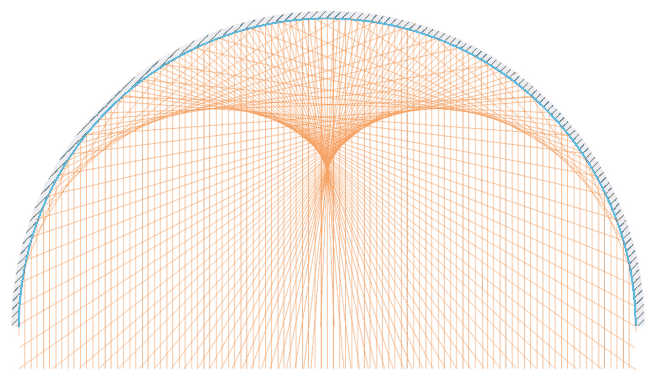
Fig. 2a.
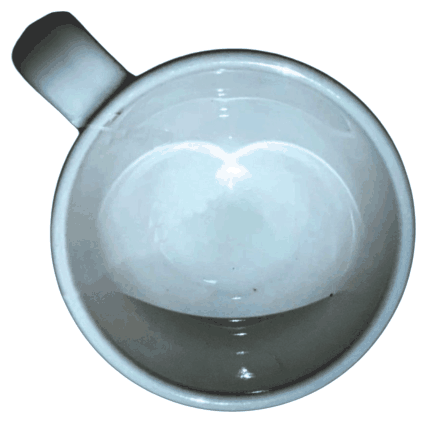
Fig. 2b.
Caustics have a variety of applications in science, ranging from high-precision optics and quantum optics to astrophysics. In this question, you will study the caustic formation by light reflection on a half-cylinder mirror of radius \(R\), as shown in figure 2c. You will also investigate other aspects of this mirror, such as its application in solar cookers.
Throughout the problem, assume that the incident rays come from a distant external light source and are parallel to the mirror's optical axis. By symmetry, it is sufficient to study reflection in one plane. Figure 2d shows such a plane, the mirror, and the coordinate system used throughout the problem.
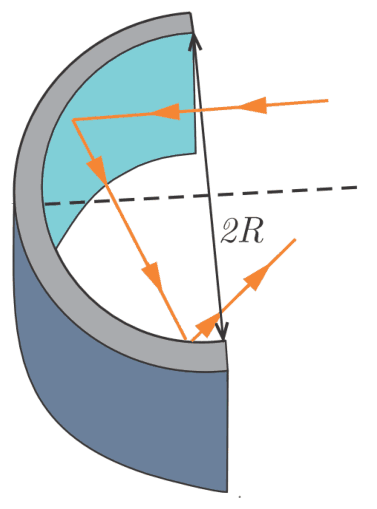
Fig. 2c.
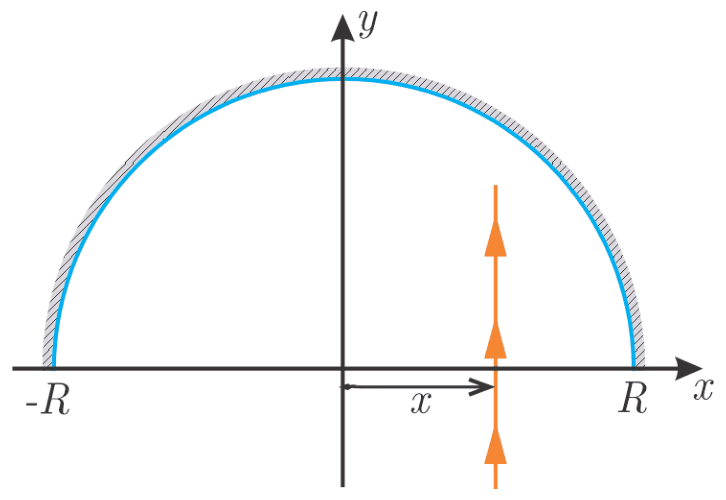
Fig. 2d.
T2-A [1.5 pts]. Multiple reflections
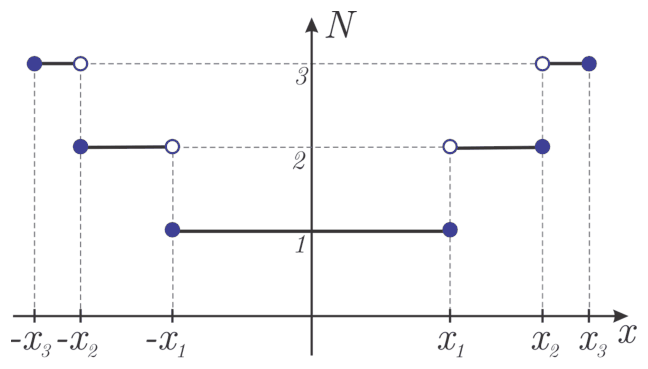
Fig.2e.
Figure 2e shows the relationship between the \(x\)-coordinate of an incident ray and the number \(N\) of reflections it undergoes, up to \(N=3\). As \(x\) varies over the interval \((-R,R)\), the variable \(N\) varies over all natural numbers greater than or equal to 1. The maximum distance from the optical axis that allows an incident ray to be reflected by the mirror at most \(N\) times is denoted \(x_N\).
T2-A1 [1.5 pts]. Find the general expression for \(x_N\) in the infinite sequence \(x_1,x_2,x_3,\ldots\) that limits the coordinates of the rays with at most \(N\) reflections. Express your answer in terms of \(R\) and \(N\).
T2-B [4.0 pts]. Solar Cooker
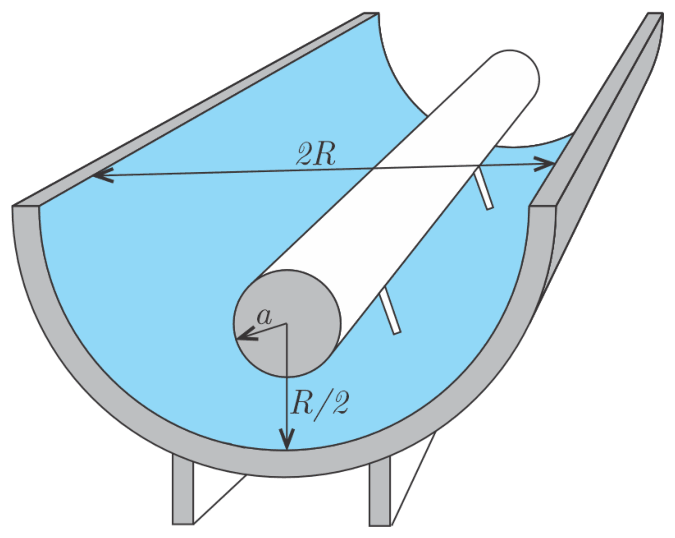
Fig.2f.
Consider a system consisting of a half-hollow-cylinder mirror and a cylindrical container. The cylinder is fully absorbing: any ray of light hitting it will be absorbed. The mirror radius is \(R\). The container radius \(a\). The axes of the mirror and the container are parallel. The center of the container is \(R/2\) from the mirror on the system's symmetry plane, as shown in figure 2f. The mirror harnesses solar radiation to heat food inside the container. Assume that the sunlight is of constant and uniform intensity (power per unit area), and that the light rays are parallel to the optical axis of the mirror. Furthermore, assume that \(a\) is such that any ray that is absorbed by the cylinder reflects from the mirror at most once. Let \(\theta_{\max}\) be the maximum angle of incidence on the mirror (measured with respect to the normal drawn at the point of incidence) of any reflected ray striking the container.
T2-B1 [2.0 pts]. The container radius is \(a=\alpha\sin(\theta_{\max})+\beta\sin(2\theta_{\max})\). Write \(\alpha\) and \(\beta\) in terms of \(R\).
If you do not find \(\alpha\) and \(\beta\), use the expression given for the rest of the problem.
T2-B2 [1.5 pts]. Let \(P_0\) be the power that would be received by the cyllinder if the mirror was not present. Write \(P/P_0\), the ratio of the actual received power \(P\) to \(P_0\), in terms of \(\theta_{\max}\).
T2-B3 [0.5 pts]. If \(R=1.0\ \mathrm{m}\), write the value of \(a\) such that \(P=5P_0\). Give your answer in cm.
T2-C [4.5 pts]. Caustics and Cusp
T2-C1 [0.5 pts]. Consider a ray \(A\) that strikes the mirror at an angle \(\theta\), as shown in Figure 2g. Upon reflection, the equation corresponding to this ray in the coordinate system defined in Figure 2g. is \(y=m_Ax+b_A\). Write \(m_A\) and \(b_A\) in terms of \(\theta\) and \(R\)
Hint: the expected form of \(m_A=K_1\cot(K_2\theta)\) and \(b_A=R\frac{K_3}{\cos(K_4\theta)}\), with \(K_i\) numerical constants.
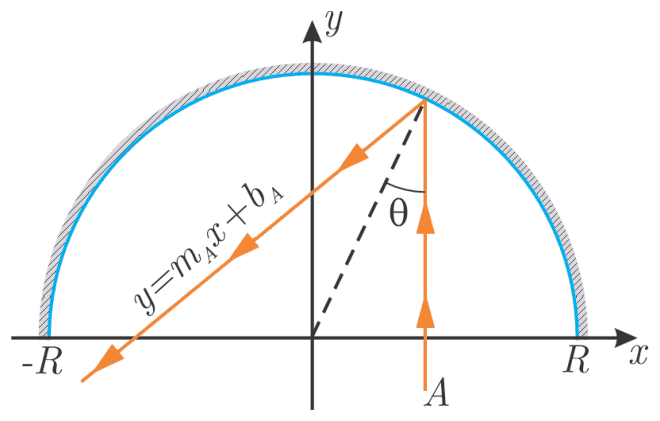
Fig. 2g.
T2-C2 [2.0 pts]. Now consider a ray \(B\), parallel to \(A\), that strikes the surface at an angle \(\theta+\Delta\theta\), with \(\Delta\theta\ll\theta\). Upon reflection, the equation corresponding to this ray is \(y=m_Bx+b_B\). Write \(m_B\) and \(b_B\) in terms of \(\theta\), \(\Delta\theta\), and \(R\), approximating to first order in \(\Delta\theta\).
T2-C3 [1.0 pts]. Find the coordinates of the point of intersection \((X_c,Y_c)\) between the reflected rays of \(A\) and \(B\). Write your answer in terms of \(R\) and \(\theta\).
T2-C4 [1.0 pts]. For \(\theta\ll1\), we have \(Y_c=v|X_c|^{p/q}+u\). Write \(v\) and \(u\) in terms of \(R\) and find the values of the integers \(p\) and \(q\) (equivalently, give the rational number \(p/q\)).
Official English text of the problem.
Answers
-
T2-A1: \[ \boxed{x_N=R\cos\!\left(\frac{\pi}{2N+1}\right)},\qquad N=1,2,3,\ldots. \]
-
T2-B1: \[ \boxed{\alpha=R,\qquad \beta=-\frac R2}. \]
-
T2-B2: \[ \boxed{\frac{P}{P_0}=\frac{1}{1-\cos\theta_{\max}}}. \]
-
T2-B3: \[ \boxed{a=12\ \mathrm{cm}}. \]
-
T2-C1: \[ \boxed{m_A=\cot(2\theta),\qquad b_A=\frac{R}{2\cos\theta}}. \]
-
T2-C2: To first order in \(\Delta\theta\), \[ \boxed{m_B\simeq\cot(2\theta)-\frac{2\Delta\theta}{\sin^2(2\theta)}}, \qquad \boxed{b_B\simeq\frac{R}{2\cos\theta} +\frac{R\sin\theta}{2\cos^2\theta}\Delta\theta}. \]
-
T2-C3: In the neighboring-ray limit \(\Delta\theta\to0\), \[ \boxed{X_c=R\sin^3\theta,\qquad Y_c=\frac R2\cos\theta\left(1+2\sin^2\theta\right)}. \]
-
T2-C4: \[ \boxed{v=\frac34R^{1/3},\qquad u=\frac R2,\qquad p=2,\quad q=3}. \]
Solution
T2-A1
By symmetry, consider an incident ray with \(x\ge0\). Let \(\phi\) be the polar angle of its first point of incidence, measured from the positive \(x\)-axis. Then \[ x=R\cos\phi,\qquad 0<\phi\le\frac{\pi}{2}. \] Since the incident ray travels vertically, its angle of incidence relative to the normal is \[ \theta=\frac{\pi}{2}-\phi. \]
The law of reflection makes the reflected ray form the same angle \(\theta\) with the radial normal. A chord connecting two successive points of reflection therefore subtends the central angle \[ \pi-2\theta=2\phi. \] The triangle formed by that chord and the two radii is isosceles, so the angle of incidence remains the same at successive reflections.
Consequently, on the corresponding full circle, successive contact points have polar angles \[ \phi,\quad 3\phi,\quad 5\phi,\quad\ldots,\quad (2j-1)\phi. \] Only the upper semicircle is a mirror. The ray exits through the diameter when the next full-circle contact would be on or below it.
At the limiting incident coordinate \(x_N\), the ray undergoes \(N\) reflections and then reaches the far rim. Thus the would-be \((N+1)\)-st contact is at polar angle \(\pi\): \[ (2N+1)\phi_N=\pi. \] It follows that \[ \boxed{x_N=R\cos\!\left(\frac{\pi}{2N+1}\right)}. \]
At equality, the ray exits at the rim, consistent with the endpoints shown in Fig.2e. The first values are \[ x_1=\frac R2,\qquad x_2\approx0.8090R,\qquad x_3\approx0.9010R, \] and \(x_N\to R\) as \(N\to\infty\).
T2-B1
Use the coordinates of Fig.2d. The container centre is \[ C=\left(0,\frac R2\right). \] A ray with incidence angle \(\theta\ge0\) strikes the mirror at \[ M=(R\sin\theta,R\cos\theta). \] The outward unit normal there is \[ \hat{\mathbf n}=(\sin\theta,\cos\theta), \] and the incident propagation direction is \(\hat{\mathbf k}=(0,1)\).
The vector form of the law of reflection gives the reflected unit direction: \[ \begin{aligned} \hat{\mathbf u} &=\hat{\mathbf k} -2(\hat{\mathbf k}\cdot\hat{\mathbf n})\hat{\mathbf n}\\ &=(0,1)-2\cos\theta(\sin\theta,\cos\theta)\\ &=(-\sin2\theta,-\cos2\theta). \end{aligned} \]
The perpendicular distance from \(C\) to this reflected line is the magnitude of the two-dimensional cross product of \(C-M\) with \(\hat{\mathbf u}\): \[ \begin{aligned} d(\theta) &=\left|(C_x-M_x)\hat u_y-(C_y-M_y)\hat u_x\right|\\ &=\left|-R\sin\theta+\frac R2\sin2\theta\right|\\ &=R\sin\theta(1-\cos\theta). \end{aligned} \] For \(0\le\theta<\pi/2\), this distance increases with \(\theta\), since \[ d'(\theta)=R(1-\cos\theta)(1+2\cos\theta)\ge0. \]
The limiting accepted reflected ray is tangent to the container, so \(d(\theta_{\max})=a\). Therefore \[ a=R\sin\theta_{\max}-\frac R2\sin2\theta_{\max}. \] Comparison with the given expression yields \[ \boxed{\alpha=R,\qquad\beta=-\frac R2}. \]
T2-B2
Let \(I\) be the uniform incident intensity and \(L\) a common illuminated length along the cylinder axes. Without the mirror, the container presents projected area \(2aL\), so \[ P_0=2aLI. \]
The greatest incoming distance from the optical axis that leads to absorption is \[ h_{\max}=R\sin\theta_{\max}. \] Rays with \(|x|\le a\) strike the container directly. Rays with \[ a<|x|\le h_{\max} \] reach the mirror and are then absorbed after one reflection.
The directly absorbed rays shadow the corresponding portion of the mirror. Thus the direct and reflected contributions are \[ P_{\mathrm{direct}}=2aLI, \qquad P_{\mathrm{reflected}}=2(h_{\max}-a)LI. \] By the stated restriction, no additional absorbed power comes from rays undergoing two or more reflections. For the ideal mirror, conservation of power therefore gives \[ P=2h_{\max}LI=2R\sin\theta_{\max}LI. \] Hence \[ \frac{P}{P_0} =\frac{R\sin\theta_{\max}}{a}. \] Substituting the result of T2-B1, \[ \boxed{\frac{P}{P_0}=\frac{1}{1-\cos\theta_{\max}}}. \]
T2-B3
The condition \(P=5P_0\) gives \[ 1-\cos\theta_{\max}=\frac15, \qquad \cos\theta_{\max}=\frac45. \] Thus \[ \sin\theta_{\max}=\frac35 \] and \[ a=R\sin\theta_{\max}(1-\cos\theta_{\max}) =R\frac35\frac15 =\frac{3R}{25}. \] With \(R=1.0\ \mathrm m\), \[ \boxed{a=0.12\ \mathrm m=12\ \mathrm{cm}}. \]
T2-C1
From T2-B1, the reflected ray passes through \[ M=(R\sin\theta,R\cos\theta) \] and has direction \[ \hat{\mathbf u}=(-\sin2\theta,-\cos2\theta). \] Its slope is therefore \[ \boxed{m_A=\frac{\hat u_y}{\hat u_x}=\cot2\theta}. \]
Using the coordinates of \(M\), \[ \begin{aligned} b_A &=R\cos\theta-R\sin\theta\cot2\theta\\ &=R\cos\theta-\frac{R\cos2\theta}{2\cos\theta}\\ &=\boxed{\frac{R}{2\cos\theta}}. \end{aligned} \] In the notation of the hint, \[ K_1=1,\qquad K_2=2,\qquad K_3=\frac12,\qquad K_4=1. \]
The central reflected ray, at \(\theta=0\), is the vertical line \(x=0\). Results involving its slope are understood through the limit \(\theta\to0\).
T2-C2
For ray \(B\), replace \(\theta\) by \(\theta+\Delta\theta\). Taylor expansion to first order gives \[ m_B=m_A+\frac{dm_A}{d\theta}\Delta\theta +O\!\left((\Delta\theta)^2\right). \] Since \[ \frac{d}{d\theta}\cot2\theta=-2\csc^2 2\theta, \] we obtain \[ \boxed{ m_B\simeq\cot2\theta-\frac{2\Delta\theta}{\sin^2 2\theta} }. \]
Similarly, \[ \frac{d}{d\theta}\left(\frac{R}{2\cos\theta}\right) =\frac{R\sin\theta}{2\cos^2\theta}, \] so \[ \boxed{ b_B\simeq\frac{R}{2\cos\theta} +\frac{R\sin\theta}{2\cos^2\theta}\Delta\theta }. \] These expansions retain only terms through first order in \(\Delta\theta\), as requested.
T2-C3
At the intersection of the two reflected rays, \[ m_AX_c+b_A=m_BX_c+b_B. \] Consequently, \[ (m_B-m_A)X_c+(b_B-b_A)=0. \] Using the first-order differences from T2-C2 and taking the neighboring-ray limit, \[ -\frac{2X_c}{\sin^2 2\theta} +\frac{R\sin\theta}{2\cos^2\theta}=0. \] Therefore \[ X_c=\frac{R\sin\theta\,\sin^2 2\theta}{4\cos^2\theta}. \] Since \(\sin2\theta=2\sin\theta\cos\theta\), \[ \boxed{X_c=R\sin^3\theta}. \]
Substitution into ray \(A\)'s equation gives \[ \begin{aligned} Y_c &=R\sin^3\theta\cot2\theta+\frac{R}{2\cos\theta}\\ &=\frac{R}{2\cos\theta} \left(1+\sin^2\theta\cos2\theta\right)\\ &=\boxed{\frac R2\cos\theta\left(1+2\sin^2\theta\right)}. \end{aligned} \] Here the simplification uses \[ 1+\sin^2\theta\cos2\theta =\cos^2\theta\left(1+2\sin^2\theta\right). \]
These parametric equations describe the caustic. The branch on the other side of the optical axis follows by symmetry: \(X_c\) changes sign while \(Y_c\) remains unchanged.
T2-C4
Near the optical axis, use the small-angle expansions \[ \sin\theta=\theta+O(\theta^3), \qquad \cos\theta=1-\frac{\theta^2}{2}+O(\theta^4). \] The caustic coordinates then become \[ X_c=R\theta^3+O(R\theta^5) \] and \[ \begin{aligned} Y_c &=\frac R2 \left(1-\frac{\theta^2}{2}+O(\theta^4)\right) \left(1+2\theta^2+O(\theta^4)\right)\\ &=\frac R2+\frac{3R}{4}\theta^2+O(R\theta^4). \end{aligned} \] For both symmetric branches, \[ \theta^2\simeq\left(\frac{|X_c|}{R}\right)^{2/3}. \] Eliminating \(\theta\) therefore gives, to leading order near the cusp, \[ \boxed{ Y_c\simeq\frac R2+\frac34R^{1/3}|X_c|^{2/3} }. \] Thus \[ \boxed{ v=\frac34R^{1/3},\qquad u=\frac R2,\qquad p=2,\qquad q=3 }. \]
The cusp is at \((0,R/2)\). Its two symmetric branches open toward increasing \(y\) and share a vertical tangent there.
The solution was checked against the official solution.
IPhO 2026 · Theorieaufgabe 2
Kochen mit Sonnenlicht?
AUFGABE T2 [10 Punkte]. Kochen mit Sonnenlicht?
Die Umverteilung des Lichtstroms in Bereiche hoher und niedriger Intensität durch Reflexion oder Brechung kann zur Entstehung von Kaustiken führen: Kurven, die durch die Schnittpunkte infinitesimal benachbarter Lichtstrahlen gebildet werden. Als Beispiel zeigt Abbildung 2a die Kaustik, die durch paraxial auf einen halbzylindrischen Spiegel einfallende Strahlen entsteht. Abbildung 2b zeigt eine Fotografie der Kaustik, die durch die Reflexion von Licht am unteren Teil einer Kaffeetasse entsteht. Der hellste, in der Mitte liegende Punkt der Kaustik wird als Spitze bezeichnet; an diesem Punkt ist die Lichtintensität maximal.
Abb. 2a.
Abb. 2b.
Kaustiken haben vielfältige Anwendungen in der Wissenschaft, von der Präzisionsoptik und Quantenoptik bis hin zur Astrophysik. In dieser Aufgabe untersuchen Sie die Entstehung einer Kaustik durch Lichtreflexion an einem halbzylindrischen Spiegel mit dem Radius \(R\), wie in Abbildung 2c gezeigt. Außerdem untersuchen Sie weitere Aspekte dieses Spiegels, etwa seine Anwendung in Solarkochern.
Nehmen Sie in der gesamten Aufgabe an, dass die einfallenden Strahlen von einer weit entfernten äußeren Lichtquelle stammen und parallel zur optischen Achse des Spiegels verlaufen. Aufgrund der Symmetrie genügt es, die Reflexion in einer Ebene zu untersuchen. Abbildung 2d zeigt eine solche Ebene, den Spiegel und das in der gesamten Aufgabe verwendete Koordinatensystem.
Abb. 2c.
Abb. 2d.
T2-A [1.5 Punkte]. Mehrfachreflexionen
Abb.2e.
Abbildung 2e zeigt den Zusammenhang zwischen der \(x\)-Koordinate eines einfallenden Strahls und der Anzahl \(N\) seiner Reflexionen bis zu \(N=3\). Wenn \(x\) das Intervall \((-R,R)\) durchläuft, nimmt die Variable \(N\) alle natürlichen Zahlen größer oder gleich 1 an. Der maximale Abstand von der optischen Achse, bei dem ein einfallender Strahl höchstens \(N\)-mal vom Spiegel reflektiert wird, wird mit \(x_N\) bezeichnet.
T2-A1 [1.5 Punkte]. Bestimmen Sie den allgemeinen Ausdruck für \(x_N\) in der unendlichen Folge \(x_1,x_2,x_3,\ldots\), der die Koordinaten der Strahlen mit höchstens \(N\) Reflexionen begrenzt. Geben Sie Ihre Antwort in Abhängigkeit von \(R\) und \(N\) an.
T2-B [4.0 Punkte]. Solarkocher
Abb.2f.
Betrachten Sie ein System aus einem Spiegel in Form eines halben Hohlzylinders und einem zylindrischen Behälter. Der Zylinder ist vollständig absorbierend: Jeder Lichtstrahl, der auf ihn trifft, wird absorbiert. Der Spiegelradius beträgt \(R\). Der Behälterradius beträgt \(a\). Die Achsen des Spiegels und des Behälters sind parallel. Der Mittelpunkt des Behälters liegt in der Symmetrieebene des Systems im Abstand \(R/2\) vom Spiegel, wie in Abbildung 2f gezeigt. Der Spiegel nutzt die Sonnenstrahlung, um Lebensmittel im Behälter zu erwärmen. Nehmen Sie an, dass das Sonnenlicht eine zeitlich konstante und räumlich gleichmäßige Intensität (Leistung pro Flächeneinheit) hat und dass die Lichtstrahlen parallel zur optischen Achse des Spiegels verlaufen. Nehmen Sie ferner an, dass \(a\) so gewählt ist, dass jeder vom Zylinder absorbierte Strahl höchstens einmal am Spiegel reflektiert wird. Es sei \(\theta_{\max}\) der größte Einfallswinkel am Spiegel (gemessen bezüglich der Normalen im Einfallspunkt) unter allen reflektierten Strahlen, die den Behälter treffen.
T2-B1 [2.0 Punkte]. Der Behälterradius ist \(a=\alpha\sin(\theta_{\max})+\beta\sin(2\theta_{\max})\). Geben Sie \(\alpha\) und \(\beta\) in Abhängigkeit von \(R\) an.
Falls Sie \(\alpha\) und \(\beta\) nicht bestimmen können, verwenden Sie für den Rest der Aufgabe den angegebenen Ausdruck.
T2-B2 [1.5 Punkte]. Es sei \(P_0\) die Leistung, die der Zylinder ohne den Spiegel aufnehmen würde. Geben Sie \(P/P_0\), das Verhältnis der tatsächlich aufgenommenen Leistung \(P\) zu \(P_0\), in Abhängigkeit von \(\theta_{\max}\) an.
T2-B3 [0.5 Punkte]. Geben Sie für \(R=1.0\ \mathrm{m}\) den Wert von \(a\) an, für den \(P=5P_0\) gilt. Geben Sie Ihre Antwort in cm an.
T2-C [4.5 Punkte]. Kaustiken und Spitze
T2-C1 [0.5 Punkte]. Betrachten Sie einen Strahl \(A\), der unter einem Winkel \(\theta\) auf den Spiegel trifft, wie in Abbildung 2g gezeigt. Nach der Reflexion lautet die Gleichung dieses Strahls in dem in Abbildung 2g definierten Koordinatensystem \(y=m_Ax+b_A\). Geben Sie \(m_A\) und \(b_A\) in Abhängigkeit von \(\theta\) und \(R\) an.
Hinweis: Die erwartete Form lautet \(m_A=K_1\cot(K_2\theta)\) und \(b_A=R\frac{K_3}{\cos(K_4\theta)}\), wobei \(K_i\) numerische Konstanten sind.
Abb. 2g.
T2-C2 [2.0 Punkte]. Betrachten Sie nun einen zu \(A\) parallelen Strahl \(B\), der unter einem Winkel \(\theta+\Delta\theta\) auf die Oberfläche trifft, wobei \(\Delta\theta\ll\theta\) gilt. Nach der Reflexion lautet die Gleichung dieses Strahls \(y=m_Bx+b_B\). Geben Sie \(m_B\) und \(b_B\) in Abhängigkeit von \(\theta\), \(\Delta\theta\) und \(R\) in einer Näherung erster Ordnung in \(\Delta\theta\) an.
T2-C3 [1.0 Punkte]. Bestimmen Sie die Koordinaten des Schnittpunkts \((X_c,Y_c)\) der reflektierten Strahlen von \(A\) und \(B\). Geben Sie Ihre Antwort in Abhängigkeit von \(R\) und \(\theta\) an.
T2-C4 [1.0 Punkte]. Für \(\theta\ll1\) gilt \(Y_c=v|X_c|^{p/q}+u\). Geben Sie \(v\) und \(u\) in Abhängigkeit von \(R\) an und bestimmen Sie die Werte der ganzen Zahlen \(p\) und \(q\) (oder geben Sie gleichwertig die rationale Zahl \(p/q\) an).
Aufgabentext aus dem offiziellen englischen Text übersetzt.
Antworten
-
T2-A1: \[ \boxed{x_N=R\cos\!\left(\frac{\pi}{2N+1}\right)},\qquad N=1,2,3,\ldots. \]
-
T2-B1: \[ \boxed{\alpha=R,\qquad \beta=-\frac R2}. \]
-
T2-B2: \[ \boxed{\frac{P}{P_0}=\frac{1}{1-\cos\theta_{\max}}}. \]
-
T2-B3: \[ \boxed{a=12\ \mathrm{cm}}. \]
-
T2-C1: \[ \boxed{m_A=\cot(2\theta),\qquad b_A=\frac{R}{2\cos\theta}}. \]
-
T2-C2: In erster Ordnung in \(\Delta\theta\), \[ \boxed{m_B\simeq\cot(2\theta)-\frac{2\Delta\theta}{\sin^2(2\theta)}}, \qquad \boxed{b_B\simeq\frac{R}{2\cos\theta} +\frac{R\sin\theta}{2\cos^2\theta}\Delta\theta}. \]
-
T2-C3: Im Grenzfall benachbarter Strahlen \(\Delta\theta\to0\), \[ \boxed{X_c=R\sin^3\theta,\qquad Y_c=\frac R2\cos\theta\left(1+2\sin^2\theta\right)}. \]
-
T2-C4: \[ \boxed{v=\frac34R^{1/3},\qquad u=\frac R2,\qquad p=2,\quad q=3}. \]
Lösung
T2-A1
Aufgrund der Symmetrie betrachten wir einen einfallenden Strahl mit \(x\ge0\). Es sei \(\phi\) der von der positiven \(x\)-Achse aus gemessene Polarwinkel seines ersten Einfallspunkts. Dann gilt \[ x=R\cos\phi,\qquad 0<\phi\le\frac{\pi}{2}. \] Da der einfallende Strahl vertikal verläuft, beträgt sein Einfallswinkel bezüglich der Normalen \[ \theta=\frac{\pi}{2}-\phi. \]
Nach dem Reflexionsgesetz bildet der reflektierte Strahl mit der radialen Normalen denselben Winkel \(\theta\). Eine Sehne, die zwei aufeinanderfolgende Reflexionspunkte verbindet, überspannt daher den Mittelpunktswinkel \[ \pi-2\theta=2\phi. \] Das von dieser Sehne und den beiden Radien gebildete Dreieck ist gleichschenklig, sodass der Einfallswinkel bei aufeinanderfolgenden Reflexionen gleich bleibt.
Folglich haben auf dem zugehörigen Vollkreis aufeinanderfolgende Auftreffpunkte die Polarwinkel \[ \phi,\quad 3\phi,\quad 5\phi,\quad\ldots,\quad (2j-1)\phi. \] Nur der obere Halbkreis ist ein Spiegel. Der Strahl tritt durch den Durchmesser aus, wenn der nächste Auftreffpunkt auf dem Vollkreis auf oder unter diesem Durchmesser liegen würde.
Bei der Grenzkoordinate \(x_N\) des einfallenden Strahls wird dieser \(N\)-mal reflektiert und erreicht anschließend den gegenüberliegenden Rand. Der hypothetische \((N+1)\)-te Auftreffpunkt liegt somit beim Polarwinkel \(\pi\): \[ (2N+1)\phi_N=\pi. \] Daraus folgt \[ \boxed{x_N=R\cos\!\left(\frac{\pi}{2N+1}\right)}. \]
Im Gleichheitsfall tritt der Strahl am Rand aus, in Übereinstimmung mit den in Abb.2e gezeigten Endpunkten. Die ersten Werte sind \[ x_1=\frac R2,\qquad x_2\approx0.8090R,\qquad x_3\approx0.9010R, \] und es gilt \(x_N\to R\) für \(N\to\infty\).
T2-B1
Wir verwenden die Koordinaten aus Abb.2d. Der Mittelpunkt des Behälters ist \[ C=\left(0,\frac R2\right). \] Ein Strahl mit dem Einfallswinkel \(\theta\ge0\) trifft den Spiegel bei \[ M=(R\sin\theta,R\cos\theta). \] Der nach außen gerichtete Einheitsnormalenvektor ist dort \[ \hat{\mathbf n}=(\sin\theta,\cos\theta), \] und die Ausbreitungsrichtung des einfallenden Strahls ist \(\hat{\mathbf k}=(0,1)\).
Die Vektorform des Reflexionsgesetzes liefert den Einheitsrichtungsvektor des reflektierten Strahls: \[ \begin{aligned} \hat{\mathbf u} &=\hat{\mathbf k} -2(\hat{\mathbf k}\cdot\hat{\mathbf n})\hat{\mathbf n}\\ &=(0,1)-2\cos\theta(\sin\theta,\cos\theta)\\ &=(-\sin2\theta,-\cos2\theta). \end{aligned} \]
Der senkrechte Abstand von \(C\) zur Geraden des reflektierten Strahls ist der Betrag des zweidimensionalen Kreuzprodukts von \(C-M\) mit \(\hat{\mathbf u}\): \[ \begin{aligned} d(\theta) &=\left|(C_x-M_x)\hat u_y-(C_y-M_y)\hat u_x\right|\\ &=\left|-R\sin\theta+\frac R2\sin2\theta\right|\\ &=R\sin\theta(1-\cos\theta). \end{aligned} \] Für \(0\le\theta<\pi/2\) wächst dieser Abstand mit \(\theta\), denn \[ d'(\theta)=R(1-\cos\theta)(1+2\cos\theta)\ge0. \]
Der reflektierte Grenzstrahl, der den Behälter gerade noch trifft, verläuft tangential zum Behälter, sodass \(d(\theta_{\max})=a\) gilt. Daher ist \[ a=R\sin\theta_{\max}-\frac R2\sin2\theta_{\max}. \] Der Vergleich mit dem angegebenen Ausdruck ergibt \[ \boxed{\alpha=R,\qquad\beta=-\frac R2}. \]
T2-B2
Es seien \(I\) die gleichmäßige einfallende Intensität und \(L\) eine gemeinsame beleuchtete Länge entlang der Zylinderachsen. Ohne den Spiegel hat der Behälter die projizierte Fläche \(2aL\), sodass \[ P_0=2aLI. \]
Der größte Abstand eines einfallenden Strahls von der optischen Achse, bei dem es zur Absorption kommt, ist \[ h_{\max}=R\sin\theta_{\max}. \] Strahlen mit \(|x|\le a\) treffen den Behälter direkt. Strahlen mit \[ a<|x|\le h_{\max} \] erreichen den Spiegel und werden anschließend nach einer Reflexion absorbiert.
Die direkt absorbierten Strahlen schatten den entsprechenden Teil des Spiegels ab. Die direkten und reflektierten Beiträge sind daher \[ P_{\mathrm{direct}}=2aLI, \qquad P_{\mathrm{reflected}}=2(h_{\max}-a)LI. \] Aufgrund der angegebenen Einschränkung liefern Strahlen mit zwei oder mehr Reflexionen keinen zusätzlichen Beitrag zur absorbierten Leistung. Für den idealen Spiegel ergibt die Leistungserhaltung daher \[ P=2h_{\max}LI=2R\sin\theta_{\max}LI. \] Somit gilt \[ \frac{P}{P_0} =\frac{R\sin\theta_{\max}}{a}. \] Einsetzen des Ergebnisses aus T2-B1 ergibt \[ \boxed{\frac{P}{P_0}=\frac{1}{1-\cos\theta_{\max}}}. \]
T2-B3
Die Bedingung \(P=5P_0\) ergibt \[ 1-\cos\theta_{\max}=\frac15, \qquad \cos\theta_{\max}=\frac45. \] Damit ist \[ \sin\theta_{\max}=\frac35 \] und \[ a=R\sin\theta_{\max}(1-\cos\theta_{\max}) =R\frac35\frac15 =\frac{3R}{25}. \] Mit \(R=1.0\ \mathrm m\) folgt \[ \boxed{a=0.12\ \mathrm m=12\ \mathrm{cm}}. \]
T2-C1
Nach T2-B1 verläuft der reflektierte Strahl durch \[ M=(R\sin\theta,R\cos\theta) \] und hat die Richtung \[ \hat{\mathbf u}=(-\sin2\theta,-\cos2\theta). \] Seine Steigung ist daher \[ \boxed{m_A=\frac{\hat u_y}{\hat u_x}=\cot2\theta}. \]
Mit den Koordinaten von \(M\) ergibt sich \[ \begin{aligned} b_A &=R\cos\theta-R\sin\theta\cot2\theta\\ &=R\cos\theta-\frac{R\cos2\theta}{2\cos\theta}\\ &=\boxed{\frac{R}{2\cos\theta}}. \end{aligned} \] In der Notation des Hinweises gilt \[ K_1=1,\qquad K_2=2,\qquad K_3=\frac12,\qquad K_4=1. \]
Der zentrale reflektierte Strahl bei \(\theta=0\) ist die vertikale Gerade \(x=0\). Ergebnisse, die seine Steigung enthalten, sind im Sinne des Grenzwerts \(\theta\to0\) zu verstehen.
T2-C2
Für den Strahl \(B\) ersetzen wir \(\theta\) durch \(\theta+\Delta\theta\). Die Taylorentwicklung bis zur ersten Ordnung ergibt \[ m_B=m_A+\frac{dm_A}{d\theta}\Delta\theta +O\!\left((\Delta\theta)^2\right). \] Wegen \[ \frac{d}{d\theta}\cot2\theta=-2\csc^2 2\theta, \] erhalten wir \[ \boxed{ m_B\simeq\cot2\theta-\frac{2\Delta\theta}{\sin^2 2\theta} }. \]
Ebenso gilt \[ \frac{d}{d\theta}\left(\frac{R}{2\cos\theta}\right) =\frac{R\sin\theta}{2\cos^2\theta}, \] also \[ \boxed{ b_B\simeq\frac{R}{2\cos\theta} +\frac{R\sin\theta}{2\cos^2\theta}\Delta\theta }. \] Diese Entwicklungen berücksichtigen wie gefordert nur Terme bis zur ersten Ordnung in \(\Delta\theta\).
T2-C3
Am Schnittpunkt der beiden reflektierten Strahlen gilt \[ m_AX_c+b_A=m_BX_c+b_B. \] Folglich ist \[ (m_B-m_A)X_c+(b_B-b_A)=0. \] Mit den Differenzen erster Ordnung aus T2-C2 und im Grenzfall benachbarter Strahlen folgt \[ -\frac{2X_c}{\sin^2 2\theta} +\frac{R\sin\theta}{2\cos^2\theta}=0. \] Daher ist \[ X_c=\frac{R\sin\theta\,\sin^2 2\theta}{4\cos^2\theta}. \] Wegen \(\sin2\theta=2\sin\theta\cos\theta\) gilt \[ \boxed{X_c=R\sin^3\theta}. \]
Einsetzen in die Gleichung des Strahls \(A\) ergibt \[ \begin{aligned} Y_c &=R\sin^3\theta\cot2\theta+\frac{R}{2\cos\theta}\\ &=\frac{R}{2\cos\theta} \left(1+\sin^2\theta\cos2\theta\right)\\ &=\boxed{\frac R2\cos\theta\left(1+2\sin^2\theta\right)}. \end{aligned} \] Bei der Vereinfachung wird hier die folgende Identität verwendet: \[ 1+\sin^2\theta\cos2\theta =\cos^2\theta\left(1+2\sin^2\theta\right). \]
Diese Parameterdarstellung beschreibt die Kaustik. Der Ast auf der anderen Seite der optischen Achse ergibt sich aus der Symmetrie: \(X_c\) wechselt das Vorzeichen, während \(Y_c\) unverändert bleibt.
T2-C4
In der Nähe der optischen Achse verwenden wir die Entwicklungen für kleine Winkel \[ \sin\theta=\theta+O(\theta^3), \qquad \cos\theta=1-\frac{\theta^2}{2}+O(\theta^4). \] Die Koordinaten der Kaustik werden damit zu \[ X_c=R\theta^3+O(R\theta^5) \] und \[ \begin{aligned} Y_c &=\frac R2 \left(1-\frac{\theta^2}{2}+O(\theta^4)\right) \left(1+2\theta^2+O(\theta^4)\right)\\ &=\frac R2+\frac{3R}{4}\theta^2+O(R\theta^4). \end{aligned} \] Für beide symmetrischen Äste gilt \[ \theta^2\simeq\left(\frac{|X_c|}{R}\right)^{2/3}. \] Die Elimination von \(\theta\) ergibt daher in führender Ordnung nahe der Spitze \[ \boxed{ Y_c\simeq\frac R2+\frac34R^{1/3}|X_c|^{2/3} }. \] Somit gilt \[ \boxed{ v=\frac34R^{1/3},\qquad u=\frac R2,\qquad p=2,\qquad q=3 }. \]
Die Spitze liegt bei \((0,R/2)\). Ihre beiden symmetrischen Äste öffnen sich in Richtung zunehmender \(y\)-Werte und haben dort eine gemeinsame vertikale Tangente.
Die Lösung wurde mit der offiziellen Lösung abgeglichen.
IPhO 2026 · Teori sorusu 2
Güneş ışığıyla yemek pişirmek?
SORU T2 [10 puan]. Güneş ışığıyla yemek pişirmek?
Işık akısının yansıma veya kırılma nedeniyle yüksek ve düşük şiddetli bölgelere yeniden dağılması, birbirine sonsuz küçük uzaklıktaki ışınların kesişmesiyle oluşan eğriler olan kaustiklerin oluşumuna yol açabilir. Örnek olarak, Şekil 2a'da yarım silindirik bir aynaya paraksiyal olarak gelen ışınların oluşturduğu kaustik gösterilmektedir. Şekil 2b'de ise bir kahve fincanının alt kısmında ışığın yansımasıyla oluşan kaustiğin fotoğrafı gösterilmektedir. Kaustiğin merkezindeki en parlak noktaya sivri uç denir; bu noktada ışık şiddeti en büyüktür.
Şekil 2a.
Şekil 2b.
Kaustiklerin bilimde yüksek hassasiyetli optik ve kuantum optiğinden astrofiziğe kadar uzanan çeşitli uygulamaları vardır. Bu soruda, Şekil 2c'de gösterildiği gibi, yarıçapı \(R\) olan yarım silindirik bir aynada ışığın yansımasıyla kaustik oluşumunu inceleyeceksiniz. Ayrıca bu aynanın güneş ocaklarında kullanımı gibi başka yönlerini de araştıracaksınız.
Soru boyunca, gelen ışınların uzaktaki bir dış ışık kaynağından geldiğini ve aynanın optik eksenine paralel olduğunu varsayın. Simetri gereği, yansımayı tek bir düzlemde incelemek yeterlidir. Şekil 2d'de böyle bir düzlem, ayna ve soru boyunca kullanılan koordinat sistemi gösterilmektedir.
Şekil 2c.
Şekil 2d.
T2-A [1.5 puan]. Çoklu yansımalar
Şekil 2e.
Şekil 2e'de, gelen bir ışının \(x\) koordinatı ile uğradığı yansıma sayısı \(N\) arasındaki ilişki, \(N=3\)'e kadar gösterilmektedir. \(x\), \((-R,R)\) aralığında değişirken \(N\) değişkeni 1'e eşit veya 1'den büyük tüm doğal sayı değerlerini alır. Gelen bir ışının aynadan en fazla \(N\) kez yansımasına izin veren, optik eksene olan en büyük uzaklık \(x_N\) ile gösterilmektedir.
T2-A1 [1.5 puan]. En fazla \(N\) kez yansıyan ışınların koordinatlarını sınırlayan \(x_1,x_2,x_3,\ldots\) sonsuz dizisindeki \(x_N\) için genel ifadeyi bulun. Cevabınızı \(R\) ve \(N\) cinsinden ifade edin.
T2-B [4.0 puan]. Güneş Ocağı
Şekil 2f.
İçi boş yarım silindir biçiminde bir ayna ile silindirik bir kaptan oluşan bir sistem düşünün. Silindir tam soğurucudur: üzerine düşen her ışık ışını soğurulur. Aynanın yarıçapı \(R\)'dir. Kabın yarıçapı \(a\)'dır. Aynanın ve kabın eksenleri paraleldir. Kabın merkezi, Şekil 2f'de gösterildiği gibi, sistemin simetri düzlemi üzerinde aynadan \(R/2\) uzaklıktadır. Ayna, kabın içindeki yiyeceği ısıtmak için güneş ışınımından yararlanır. Güneş ışığının şiddetinin (birim alan başına güç) sabit ve düzgün olduğunu ve ışınların aynanın optik eksenine paralel olduğunu varsayın. Ayrıca, \(a\)'nın, silindir tarafından soğurulan her ışın aynadan en fazla bir kez yansıyacak şekilde seçildiğini varsayın. Kaba çarpan yansımış ışınların aynadaki gelme açılarının (gelme noktasında çizilen normale göre ölçülen) en büyüğü \(\theta_{\max}\) olsun.
T2-B1 [2.0 puan]. Kabın yarıçapı \(a=\alpha\sin(\theta_{\max})+\beta\sin(2\theta_{\max})\) şeklindedir. \(\alpha\) ve \(\beta\)'yı \(R\) cinsinden yazın.
\(\alpha\) ve \(\beta\)'yı bulamazsanız, sorunun geri kalanı için verilen ifadeyi kullanın.
T2-B2 [1.5 puan]. Ayna olmasaydı silindire ulaşacak güç \(P_0\) olsun. Gerçekte alınan güç \(P\)'nin \(P_0\)'a oranı olan \(P/P_0\)'ı \(\theta_{\max}\) cinsinden yazın.
T2-B3 [0.5 puan]. \(R=1.0\ \mathrm{m}\) ise, \(P=5P_0\) olmasını sağlayan \(a\) değerini yazın. Cevabınızı cm cinsinden verin.
T2-C [4.5 puan]. Kaustikler ve Sivri Uç
T2-C1 [0.5 puan]. Şekil 2g'de gösterildiği gibi aynaya \(\theta\) açısıyla çarpan bir \(A\) ışını düşünün. Yansıdıktan sonra bu ışının Şekil 2g'de tanımlanan koordinat sistemindeki denklemi \(y=m_Ax+b_A\)'dır. \(m_A\) ve \(b_A\)'yı \(\theta\) ve \(R\) cinsinden yazın.
İpucu: Beklenen biçim, \(K_i\)'ler sayısal sabitler olmak üzere, \(m_A=K_1\cot(K_2\theta)\) ve \(b_A=R\frac{K_3}{\cos(K_4\theta)}\) şeklindedir.
Şekil 2g.
T2-C2 [2.0 puan]. Şimdi, \(A\)'ya paralel olan ve yüzeye \(\theta+\Delta\theta\) açısıyla çarpan bir \(B\) ışını düşünün; burada \(\Delta\theta\ll\theta\)'dır. Yansıdıktan sonra bu ışının denklemi \(y=m_Bx+b_B\)'dır. \(\Delta\theta\)'ya göre birinci mertebeden yaklaşım yaparak \(m_B\) ve \(b_B\)'yi \(\theta\), \(\Delta\theta\) ve \(R\) cinsinden yazın.
T2-C3 [1.0 puan]. \(A\) ve \(B\)'nin yansıyan ışınlarının kesişim noktası \((X_c,Y_c)\)'nin koordinatlarını bulun. Cevabınızı \(R\) ve \(\theta\) cinsinden yazın.
T2-C4 [1.0 puan]. \(\theta\ll1\) için \(Y_c=v|X_c|^{p/q}+u\) bağıntısı geçerlidir. \(v\) ve \(u\)'yu \(R\) cinsinden yazın ve \(p\) ile \(q\) tam sayılarının değerlerini bulun (eşdeğer olarak, \(p/q\) rasyonel sayısını verin).
Soru metni resmi İngilizce metinden çevrilmiştir.
Cevaplar
-
T2-A1: \[ \boxed{x_N=R\cos\!\left(\frac{\pi}{2N+1}\right)},\qquad N=1,2,3,\ldots. \]
-
T2-B1: \[ \boxed{\alpha=R,\qquad \beta=-\frac R2}. \]
-
T2-B2: \[ \boxed{\frac{P}{P_0}=\frac{1}{1-\cos\theta_{\max}}}. \]
-
T2-B3: \[ \boxed{a=12\ \mathrm{cm}}. \]
-
T2-C1: \[ \boxed{m_A=\cot(2\theta),\qquad b_A=\frac{R}{2\cos\theta}}. \]
-
T2-C2: \(\Delta\theta\)'ya göre birinci mertebede, \[ \boxed{m_B\simeq\cot(2\theta)-\frac{2\Delta\theta}{\sin^2(2\theta)}}, \qquad \boxed{b_B\simeq\frac{R}{2\cos\theta} +\frac{R\sin\theta}{2\cos^2\theta}\Delta\theta}. \]
-
T2-C3: Komşu ışınlar limiti \(\Delta\theta\to0\)'da, \[ \boxed{X_c=R\sin^3\theta,\qquad Y_c=\frac R2\cos\theta\left(1+2\sin^2\theta\right)}. \]
-
T2-C4: \[ \boxed{v=\frac34R^{1/3},\qquad u=\frac R2,\qquad p=2,\quad q=3}. \]
Çözüm
T2-A1
Simetri gereği, \(x\ge0\) olan bir gelen ışını ele alalım. İlk gelme noktasının pozitif \(x\) ekseninden ölçülen kutupsal açısı \(\phi\) olsun. O hâlde \[ x=R\cos\phi,\qquad 0<\phi\le\frac{\pi}{2}. \] Gelen ışın düşey doğrultuda ilerlediğinden, normale göre gelme açısı \[ \theta=\frac{\pi}{2}-\phi. \]
Yansıma yasası gereği, yansıyan ışın yarıçap doğrultusundaki normalle aynı \(\theta\) açısını yapar. Dolayısıyla, ardışık iki yansıma noktasını birleştiren kirişin gördüğü merkez açı \[ \pi-2\theta=2\phi. \] Bu kiriş ile iki yarıçapın oluşturduğu üçgen ikizkenar olduğundan, ardışık yansımalarda gelme açısı aynı kalır.
Sonuç olarak, karşılık gelen tam çember üzerinde ardışık temas noktalarının kutupsal açıları \[ \phi,\quad 3\phi,\quad 5\phi,\quad\ldots,\quad (2j-1)\phi. \] Yalnızca üst yarım çember aynadır. Tam çember üzerindeki bir sonraki temas noktası çapın üzerinde veya altında olacaksa ışın çap üzerinden dışarı çıkar.
Sınır gelme koordinatı \(x_N\)'de ışın \(N\) kez yansır ve ardından karşı kenara ulaşır. Dolayısıyla, gerçekleşmesi öngörülen \((N+1)\). temasın kutupsal açısı \(\pi\)'dir: \[ (2N+1)\phi_N=\pi. \] Buradan \[ \boxed{x_N=R\cos\!\left(\frac{\pi}{2N+1}\right)}. \]
Eşitlik durumunda ışın, Şekil 2e'de gösterilen uç noktalarla uyumlu olarak kenardan çıkar. İlk değerler \[ x_1=\frac R2,\qquad x_2\approx0.8090R,\qquad x_3\approx0.9010R, \] şeklindedir ve \(N\to\infty\) iken \(x_N\to R\) olur.
T2-B1
Şekil 2d'deki koordinatları kullanalım. Kabın merkezi \[ C=\left(0,\frac R2\right). \] Gelme açısı \(\theta\ge0\) olan bir ışın aynaya \[ M=(R\sin\theta,R\cos\theta). \] noktasında çarpar. Buradaki dışa yönelmiş birim normal \[ \hat{\mathbf n}=(\sin\theta,\cos\theta), \] ve gelen ışının yayılma yönü \(\hat{\mathbf k}=(0,1)\)'dir.
Yansıma yasasının vektörel biçimi, yansıyan ışının birim yön vektörünü verir: \[ \begin{aligned} \hat{\mathbf u} &=\hat{\mathbf k} -2(\hat{\mathbf k}\cdot\hat{\mathbf n})\hat{\mathbf n}\\ &=(0,1)-2\cos\theta(\sin\theta,\cos\theta)\\ &=(-\sin2\theta,-\cos2\theta). \end{aligned} \]
\(C\)'den bu yansıyan ışın doğrusuna olan dik uzaklık, \(C-M\) ile \(\hat{\mathbf u}\)'nun iki boyutlu vektörel çarpımının büyüklüğüdür: \[ \begin{aligned} d(\theta) &=\left|(C_x-M_x)\hat u_y-(C_y-M_y)\hat u_x\right|\\ &=\left|-R\sin\theta+\frac R2\sin2\theta\right|\\ &=R\sin\theta(1-\cos\theta). \end{aligned} \] \(0\le\theta<\pi/2\) için bu uzaklık \(\theta\) ile artar, çünkü \[ d'(\theta)=R(1-\cos\theta)(1+2\cos\theta)\ge0. \]
Kaba ulaşan yansımış ışınların sınırındaki ışın kaba teğet olduğundan \(d(\theta_{\max})=a\)'dır. Dolayısıyla \[ a=R\sin\theta_{\max}-\frac R2\sin2\theta_{\max}. \] Verilen ifadeyle karşılaştırıldığında \[ \boxed{\alpha=R,\qquad\beta=-\frac R2}. \]
T2-B2
Düzgün gelen ışık şiddeti \(I\), silindir eksenleri boyunca aydınlatılan ortak uzunluk ise \(L\) olsun. Ayna yokken kabın izdüşüm alanı \(2aL\) olduğundan \[ P_0=2aLI. \]
Soğurulmayla sonuçlanan gelen ışınların optik eksene olan en büyük uzaklığı \[ h_{\max}=R\sin\theta_{\max}. \] \(|x|\le a\) olan ışınlar doğrudan kaba çarpar. \[ a<|x|\le h_{\max} \] koşulunu sağlayan ışınlar aynaya ulaşır ve ardından bir kez yansıdıktan sonra soğurulur.
Doğrudan soğurulan ışınlar, aynanın karşılık gelen kısmını gölgede bırakır. Dolayısıyla doğrudan ve yansıma yoluyla gelen katkılar \[ P_{\mathrm{direct}}=2aLI, \qquad P_{\mathrm{reflected}}=2(h_{\max}-a)LI. \] Belirtilen kısıt gereği, iki veya daha fazla kez yansıyan ışınlardan soğurulan güce ek bir katkı gelmez. Bu nedenle ideal ayna için gücün korunumu \[ P=2h_{\max}LI=2R\sin\theta_{\max}LI. \] sonucunu verir. Böylece \[ \frac{P}{P_0} =\frac{R\sin\theta_{\max}}{a}. \] T2-B1'in sonucu yerine konursa, \[ \boxed{\frac{P}{P_0}=\frac{1}{1-\cos\theta_{\max}}}. \]
T2-B3
\(P=5P_0\) koşulu \[ 1-\cos\theta_{\max}=\frac15, \qquad \cos\theta_{\max}=\frac45. \] sonucunu verir. Dolayısıyla \[ \sin\theta_{\max}=\frac35 \] ve \[ a=R\sin\theta_{\max}(1-\cos\theta_{\max}) =R\frac35\frac15 =\frac{3R}{25}. \] \(R=1.0\ \mathrm m\) için, \[ \boxed{a=0.12\ \mathrm m=12\ \mathrm{cm}}. \]
T2-C1
T2-B1'e göre yansıyan ışın \[ M=(R\sin\theta,R\cos\theta) \] noktasından geçer ve yönü \[ \hat{\mathbf u}=(-\sin2\theta,-\cos2\theta). \] şeklindedir. Dolayısıyla eğimi \[ \boxed{m_A=\frac{\hat u_y}{\hat u_x}=\cot2\theta}. \]
\(M\)'nin koordinatları kullanılarak, \[ \begin{aligned} b_A &=R\cos\theta-R\sin\theta\cot2\theta\\ &=R\cos\theta-\frac{R\cos2\theta}{2\cos\theta}\\ &=\boxed{\frac{R}{2\cos\theta}}. \end{aligned} \] İpucundaki gösterimle, \[ K_1=1,\qquad K_2=2,\qquad K_3=\frac12,\qquad K_4=1. \]
\(\theta=0\)'daki merkezi yansıyan ışın, düşey \(x=0\) doğrusudur. Bu ışının eğimini içeren sonuçlar \(\theta\to0\) limiti üzerinden yorumlanır.
T2-C2
\(B\) ışını için \(\theta\) yerine \(\theta+\Delta\theta\) konur. Birinci mertebeye kadar Taylor açılımı \[ m_B=m_A+\frac{dm_A}{d\theta}\Delta\theta +O\!\left((\Delta\theta)^2\right). \] sonucunu verir. \[ \frac{d}{d\theta}\cot2\theta=-2\csc^2 2\theta, \] olduğundan, \[ \boxed{ m_B\simeq\cot2\theta-\frac{2\Delta\theta}{\sin^2 2\theta} }. \] elde edilir.
Benzer şekilde, \[ \frac{d}{d\theta}\left(\frac{R}{2\cos\theta}\right) =\frac{R\sin\theta}{2\cos^2\theta}, \] olduğundan \[ \boxed{ b_B\simeq\frac{R}{2\cos\theta} +\frac{R\sin\theta}{2\cos^2\theta}\Delta\theta }. \] Bu açılımlarda, istendiği üzere, yalnızca \(\Delta\theta\)'ya göre birinci mertebeye kadar olan terimler tutulmuştur.
T2-C3
İki yansıyan ışının kesişiminde, \[ m_AX_c+b_A=m_BX_c+b_B. \] Dolayısıyla, \[ (m_B-m_A)X_c+(b_B-b_A)=0. \] T2-C2'deki birinci mertebeden farklar kullanılıp komşu ışınlar limiti alınırsa, \[ -\frac{2X_c}{\sin^2 2\theta} +\frac{R\sin\theta}{2\cos^2\theta}=0. \] Böylece \[ X_c=\frac{R\sin\theta\,\sin^2 2\theta}{4\cos^2\theta}. \] \(\sin2\theta=2\sin\theta\cos\theta\) olduğundan, \[ \boxed{X_c=R\sin^3\theta}. \]
\(A\) ışınının denkleminde yerine konursa, \[ \begin{aligned} Y_c &=R\sin^3\theta\cot2\theta+\frac{R}{2\cos\theta}\\ &=\frac{R}{2\cos\theta} \left(1+\sin^2\theta\cos2\theta\right)\\ &=\boxed{\frac R2\cos\theta\left(1+2\sin^2\theta\right)}. \end{aligned} \] Buradaki sadeleştirmede \[ 1+\sin^2\theta\cos2\theta =\cos^2\theta\left(1+2\sin^2\theta\right). \] özdeşliği kullanılır.
Bu parametrik denklemler kaustiği betimler. Optik eksenin diğer tarafındaki dal simetriden elde edilir: \(X_c\) işaret değiştirirken \(Y_c\) değişmeden kalır.
T2-C4
Optik eksenin yakınında küçük açı açılımlarını kullanalım: \[ \sin\theta=\theta+O(\theta^3), \qquad \cos\theta=1-\frac{\theta^2}{2}+O(\theta^4). \] Bu durumda kaustik koordinatları \[ X_c=R\theta^3+O(R\theta^5) \] ve \[ \begin{aligned} Y_c &=\frac R2 \left(1-\frac{\theta^2}{2}+O(\theta^4)\right) \left(1+2\theta^2+O(\theta^4)\right)\\ &=\frac R2+\frac{3R}{4}\theta^2+O(R\theta^4). \end{aligned} \] olur. Her iki simetrik dal için, \[ \theta^2\simeq\left(\frac{|X_c|}{R}\right)^{2/3}. \] Dolayısıyla \(\theta\) yok edilirse, sivri ucun yakınında başat mertebede, \[ \boxed{ Y_c\simeq\frac R2+\frac34R^{1/3}|X_c|^{2/3} }. \] elde edilir. Böylece \[ \boxed{ v=\frac34R^{1/3},\qquad u=\frac R2,\qquad p=2,\qquad q=3 }. \]
Sivri uç \((0,R/2)\) noktasındadır. İki simetrik dalı, \(y\)'nin arttığı yöne doğru açılır ve bu noktada ortak bir düşey teğete sahiptir.
Çözüm, resmi çözümle karşılaştırılarak kontrol edildi.
IPhO 2026 · Problema teórico 2
¿Cocinar con la luz del Sol?
PREGUNTA T2 [10 pts]. ¿Cocinar con la luz del Sol?
La redistribución del flujo luminoso en regiones de alta y baja intensidad debida a la reflexión o la refracción puede dar lugar a la formación de cáusticas: curvas formadas por la intersección de rayos de luz infinitesimalmente próximos. Como ejemplo, la figura 2a muestra la cáustica formada por rayos que inciden paraxialmente sobre un espejo semicilíndrico. La figura 2b muestra una fotografía de la cáustica formada por la reflexión de la luz en la parte inferior de una taza de café. El punto central y más brillante de la cáustica se denomina cúspide; en este punto, la intensidad luminosa es máxima.
Fig. 2a.
Fig. 2b.
Las cáusticas tienen diversas aplicaciones científicas, desde la óptica de alta precisión y la óptica cuántica hasta la astrofísica. En esta pregunta, estudiará la formación de cáusticas por reflexión de la luz en un espejo semicilíndrico de radio \(R\), como se muestra en la figura 2c. También investigará otros aspectos de este espejo, como su aplicación en cocinas solares.
En todo el problema, suponga que los rayos incidentes proceden de una fuente de luz externa lejana y son paralelos al eje óptico del espejo. Por simetría, basta con estudiar la reflexión en un plano. La figura 2d muestra dicho plano, el espejo y el sistema de coordenadas utilizado en todo el problema.
Fig. 2c.
Fig. 2d.
T2-A [1.5 pts]. Reflexiones múltiples
Fig.2e.
La figura 2e muestra la relación entre la coordenada \(x\) de un rayo incidente y el número \(N\) de reflexiones que experimenta, hasta \(N=3\). Cuando \(x\) varía en el intervalo \((-R,R)\), la variable \(N\) recorre todos los números naturales mayores o iguales que 1. La distancia máxima al eje óptico que permite que un rayo incidente se refleje en el espejo como máximo \(N\) veces se denota por \(x_N\).
T2-A1 [1.5 pts]. Halle la expresión general de \(x_N\) en la sucesión infinita \(x_1,x_2,x_3,\ldots\) que delimita las coordenadas de los rayos con un máximo de \(N\) reflexiones. Exprese su respuesta en función de \(R\) y \(N\).
T2-B [4.0 pts]. Cocina solar
Fig.2f.
Considere un sistema formado por un espejo con forma de medio cilindro hueco y un recipiente cilíndrico. El cilindro es totalmente absorbente: cualquier rayo de luz que incida sobre él será absorbido. El radio del espejo es \(R\). El radio del recipiente es \(a\). Los ejes del espejo y del recipiente son paralelos. El centro del recipiente se encuentra a una distancia \(R/2\) del espejo en el plano de simetría del sistema, como se muestra en la figura 2f. El espejo aprovecha la radiación solar para calentar los alimentos dentro del recipiente. Suponga que la luz solar tiene una intensidad (potencia por unidad de área) constante y uniforme, y que los rayos de luz son paralelos al eje óptico del espejo. Además, suponga que \(a\) es tal que cualquier rayo absorbido por el cilindro se refleja en el espejo como máximo una vez. Sea \(\theta_{\max}\) el ángulo máximo de incidencia sobre el espejo (medido respecto a la normal trazada en el punto de incidencia) de los rayos reflejados que inciden sobre el recipiente.
T2-B1 [2.0 pts]. El radio del recipiente es \(a=\alpha\sin(\theta_{\max})+\beta\sin(2\theta_{\max})\). Escriba \(\alpha\) y \(\beta\) en función de \(R\).
Si no encuentra \(\alpha\) y \(\beta\), utilice la expresión dada para el resto del problema.
T2-B2 [1.5 pts]. Sea \(P_0\) la potencia que recibiría el cilindro si no estuviera presente el espejo. Escriba \(P/P_0\), el cociente entre la potencia realmente recibida \(P\) y \(P_0\), en función de \(\theta_{\max}\).
T2-B3 [0.5 pts]. Si \(R=1.0\ \mathrm{m}\), escriba el valor de \(a\) tal que \(P=5P_0\). Dé su respuesta en cm.
T2-C [4.5 pts]. Cáusticas y cúspide
T2-C1 [0.5 pts]. Considere un rayo \(A\) que incide sobre el espejo con un ángulo \(\theta\), como se muestra en la figura 2g. Tras la reflexión, la ecuación correspondiente a este rayo en el sistema de coordenadas definido en la figura 2g es \(y=m_Ax+b_A\). Escriba \(m_A\) y \(b_A\) en función de \(\theta\) y \(R\)
Pista: la forma esperada es \(m_A=K_1\cot(K_2\theta)\) y \(b_A=R\frac{K_3}{\cos(K_4\theta)}\), donde \(K_i\) son constantes numéricas.
Fig. 2g.
T2-C2 [2.0 pts]. Considere ahora un rayo \(B\), paralelo a \(A\), que incide sobre la superficie con un ángulo \(\theta+\Delta\theta\), con \(\Delta\theta\ll\theta\). Tras la reflexión, la ecuación correspondiente a este rayo es \(y=m_Bx+b_B\). Escriba \(m_B\) y \(b_B\) en función de \(\theta\), \(\Delta\theta\) y \(R\), aproximando a primer orden en \(\Delta\theta\).
T2-C3 [1.0 pts]. Halle las coordenadas del punto de intersección \((X_c,Y_c)\) entre los rayos reflejados de \(A\) y \(B\). Escriba su respuesta en función de \(R\) y \(\theta\).
T2-C4 [1.0 pts]. Para \(\theta\ll1\), se tiene \(Y_c=v|X_c|^{p/q}+u\). Escriba \(v\) y \(u\) en función de \(R\) y halle los valores de los enteros \(p\) y \(q\) (o, de forma equivalente, dé el número racional \(p/q\)).
Enunciado traducido del texto oficial en inglés.
Respuestas
-
T2-A1: \[ \boxed{x_N=R\cos\!\left(\frac{\pi}{2N+1}\right)},\qquad N=1,2,3,\ldots. \]
-
T2-B1: \[ \boxed{\alpha=R,\qquad \beta=-\frac R2}. \]
-
T2-B2: \[ \boxed{\frac{P}{P_0}=\frac{1}{1-\cos\theta_{\max}}}. \]
-
T2-B3: \[ \boxed{a=12\ \mathrm{cm}}. \]
-
T2-C1: \[ \boxed{m_A=\cot(2\theta),\qquad b_A=\frac{R}{2\cos\theta}}. \]
-
T2-C2: A primer orden en \(\Delta\theta\), \[ \boxed{m_B\simeq\cot(2\theta)-\frac{2\Delta\theta}{\sin^2(2\theta)}}, \qquad \boxed{b_B\simeq\frac{R}{2\cos\theta} +\frac{R\sin\theta}{2\cos^2\theta}\Delta\theta}. \]
-
T2-C3: En el límite de rayos vecinos \(\Delta\theta\to0\), \[ \boxed{X_c=R\sin^3\theta,\qquad Y_c=\frac R2\cos\theta\left(1+2\sin^2\theta\right)}. \]
-
T2-C4: \[ \boxed{v=\frac34R^{1/3},\qquad u=\frac R2,\qquad p=2,\quad q=3}. \]
Solución
T2-A1
Por simetría, consideremos un rayo incidente con \(x\ge0\). Sea \(\phi\) el ángulo polar de su primer punto de incidencia, medido desde el semieje positivo \(x\). Entonces \[ x=R\cos\phi,\qquad 0<\phi\le\frac{\pi}{2}. \] Como el rayo incidente se propaga verticalmente, su ángulo de incidencia respecto a la normal es \[ \theta=\frac{\pi}{2}-\phi. \]
La ley de la reflexión hace que el rayo reflejado forme el mismo ángulo \(\theta\) con la normal radial. Por tanto, una cuerda que une dos puntos de reflexión sucesivos subtiende el ángulo central \[ \pi-2\theta=2\phi. \] El triángulo formado por esa cuerda y los dos radios es isósceles, por lo que el ángulo de incidencia se mantiene igual en las reflexiones sucesivas.
En consecuencia, en la circunferencia completa correspondiente, los puntos de contacto sucesivos tienen ángulos polares \[ \phi,\quad 3\phi,\quad 5\phi,\quad\ldots,\quad (2j-1)\phi. \] Solo la semicircunferencia superior es un espejo. El rayo sale por el diámetro cuando el siguiente contacto con la circunferencia completa tendría lugar sobre el diámetro o por debajo de él.
Para la coordenada incidente límite \(x_N\), el rayo experimenta \(N\) reflexiones y después alcanza el borde opuesto. Así, el contacto que sería el \((N+1)\)-ésimo se encuentra en el ángulo polar \(\pi\): \[ (2N+1)\phi_N=\pi. \] De ello se deduce que \[ \boxed{x_N=R\cos\!\left(\frac{\pi}{2N+1}\right)}. \]
En el caso de igualdad, el rayo sale por el borde, de acuerdo con los extremos mostrados en la Fig.2e. Los primeros valores son \[ x_1=\frac R2,\qquad x_2\approx0.8090R,\qquad x_3\approx0.9010R, \] y \(x_N\to R\) cuando \(N\to\infty\).
T2-B1
Utilicemos las coordenadas de la Fig.2d. El centro del recipiente es \[ C=\left(0,\frac R2\right). \] Un rayo con ángulo de incidencia \(\theta\ge0\) incide sobre el espejo en \[ M=(R\sin\theta,R\cos\theta). \] El vector normal unitario hacia el exterior en ese punto es \[ \hat{\mathbf n}=(\sin\theta,\cos\theta), \] y la dirección de propagación incidente es \(\hat{\mathbf k}=(0,1)\).
La forma vectorial de la ley de la reflexión proporciona el vector unitario de la dirección reflejada: \[ \begin{aligned} \hat{\mathbf u} &=\hat{\mathbf k} -2(\hat{\mathbf k}\cdot\hat{\mathbf n})\hat{\mathbf n}\\ &=(0,1)-2\cos\theta(\sin\theta,\cos\theta)\\ &=(-\sin2\theta,-\cos2\theta). \end{aligned} \]
La distancia perpendicular de \(C\) a la recta del rayo reflejado es el módulo del producto vectorial bidimensional de \(C-M\) con \(\hat{\mathbf u}\): \[ \begin{aligned} d(\theta) &=\left|(C_x-M_x)\hat u_y-(C_y-M_y)\hat u_x\right|\\ &=\left|-R\sin\theta+\frac R2\sin2\theta\right|\\ &=R\sin\theta(1-\cos\theta). \end{aligned} \] Para \(0\le\theta<\pi/2\), esta distancia aumenta con \(\theta\), ya que \[ d'(\theta)=R(1-\cos\theta)(1+2\cos\theta)\ge0. \]
El rayo reflejado límite que alcanza el recipiente es tangente a él, por lo que \(d(\theta_{\max})=a\). Por tanto, \[ a=R\sin\theta_{\max}-\frac R2\sin2\theta_{\max}. \] Al comparar con la expresión dada, se obtiene \[ \boxed{\alpha=R,\qquad\beta=-\frac R2}. \]
T2-B2
Sea \(I\) la intensidad incidente uniforme y \(L\) una longitud iluminada común a lo largo de los ejes de los cilindros. Sin el espejo, el recipiente presenta un área proyectada \(2aL\), por lo que \[ P_0=2aLI. \]
La distancia máxima al eje óptico de un rayo incidente que acaba siendo absorbido es \[ h_{\max}=R\sin\theta_{\max}. \] Los rayos con \(|x|\le a\) inciden directamente sobre el recipiente. Los rayos con \[ a<|x|\le h_{\max} \] llegan al espejo y son absorbidos después de una reflexión.
Los rayos absorbidos directamente dejan en sombra la parte correspondiente del espejo. Por tanto, las contribuciones directa y reflejada son \[ P_{\mathrm{direct}}=2aLI, \qquad P_{\mathrm{reflected}}=2(h_{\max}-a)LI. \] Por la restricción indicada, los rayos que experimentan dos o más reflexiones no aportan potencia absorbida adicional. Para el espejo ideal, la conservación de la potencia da, por tanto, \[ P=2h_{\max}LI=2R\sin\theta_{\max}LI. \] Así, \[ \frac{P}{P_0} =\frac{R\sin\theta_{\max}}{a}. \] Sustituyendo el resultado de T2-B1, \[ \boxed{\frac{P}{P_0}=\frac{1}{1-\cos\theta_{\max}}}. \]
T2-B3
La condición \(P=5P_0\) da \[ 1-\cos\theta_{\max}=\frac15, \qquad \cos\theta_{\max}=\frac45. \] Por tanto, \[ \sin\theta_{\max}=\frac35 \] y \[ a=R\sin\theta_{\max}(1-\cos\theta_{\max}) =R\frac35\frac15 =\frac{3R}{25}. \] Con \(R=1.0\ \mathrm m\), \[ \boxed{a=0.12\ \mathrm m=12\ \mathrm{cm}}. \]
T2-C1
Según T2-B1, el rayo reflejado pasa por \[ M=(R\sin\theta,R\cos\theta) \] y tiene dirección \[ \hat{\mathbf u}=(-\sin2\theta,-\cos2\theta). \] Su pendiente es, por tanto, \[ \boxed{m_A=\frac{\hat u_y}{\hat u_x}=\cot2\theta}. \]
Utilizando las coordenadas de \(M\), \[ \begin{aligned} b_A &=R\cos\theta-R\sin\theta\cot2\theta\\ &=R\cos\theta-\frac{R\cos2\theta}{2\cos\theta}\\ &=\boxed{\frac{R}{2\cos\theta}}. \end{aligned} \] En la notación de la pista, \[ K_1=1,\qquad K_2=2,\qquad K_3=\frac12,\qquad K_4=1. \]
El rayo reflejado central, para \(\theta=0\), es la recta vertical \(x=0\). Los resultados que contienen su pendiente se interpretan mediante el límite \(\theta\to0\).
T2-C2
Para el rayo \(B\), sustituimos \(\theta\) por \(\theta+\Delta\theta\). El desarrollo de Taylor a primer orden da \[ m_B=m_A+\frac{dm_A}{d\theta}\Delta\theta +O\!\left((\Delta\theta)^2\right). \] Como \[ \frac{d}{d\theta}\cot2\theta=-2\csc^2 2\theta, \] obtenemos \[ \boxed{ m_B\simeq\cot2\theta-\frac{2\Delta\theta}{\sin^2 2\theta} }. \]
Análogamente, \[ \frac{d}{d\theta}\left(\frac{R}{2\cos\theta}\right) =\frac{R\sin\theta}{2\cos^2\theta}, \] de modo que \[ \boxed{ b_B\simeq\frac{R}{2\cos\theta} +\frac{R\sin\theta}{2\cos^2\theta}\Delta\theta }. \] Estos desarrollos conservan únicamente los términos hasta primer orden en \(\Delta\theta\), como se pide.
T2-C3
En la intersección de los dos rayos reflejados, \[ m_AX_c+b_A=m_BX_c+b_B. \] En consecuencia, \[ (m_B-m_A)X_c+(b_B-b_A)=0. \] Utilizando las diferencias a primer orden de T2-C2 y tomando el límite de rayos vecinos, \[ -\frac{2X_c}{\sin^2 2\theta} +\frac{R\sin\theta}{2\cos^2\theta}=0. \] Por tanto, \[ X_c=\frac{R\sin\theta\,\sin^2 2\theta}{4\cos^2\theta}. \] Como \(\sin2\theta=2\sin\theta\cos\theta\), \[ \boxed{X_c=R\sin^3\theta}. \]
Al sustituir en la ecuación del rayo \(A\), se obtiene \[ \begin{aligned} Y_c &=R\sin^3\theta\cot2\theta+\frac{R}{2\cos\theta}\\ &=\frac{R}{2\cos\theta} \left(1+\sin^2\theta\cos2\theta\right)\\ &=\boxed{\frac R2\cos\theta\left(1+2\sin^2\theta\right)}. \end{aligned} \] Aquí, para simplificar se utiliza \[ 1+\sin^2\theta\cos2\theta =\cos^2\theta\left(1+2\sin^2\theta\right). \]
Estas ecuaciones paramétricas describen la cáustica. La rama al otro lado del eje óptico se obtiene por simetría: \(X_c\) cambia de signo mientras que \(Y_c\) permanece inalterada.
T2-C4
Cerca del eje óptico, utilizamos los desarrollos para ángulos pequeños \[ \sin\theta=\theta+O(\theta^3), \qquad \cos\theta=1-\frac{\theta^2}{2}+O(\theta^4). \] Las coordenadas de la cáustica quedan entonces \[ X_c=R\theta^3+O(R\theta^5) \] y \[ \begin{aligned} Y_c &=\frac R2 \left(1-\frac{\theta^2}{2}+O(\theta^4)\right) \left(1+2\theta^2+O(\theta^4)\right)\\ &=\frac R2+\frac{3R}{4}\theta^2+O(R\theta^4). \end{aligned} \] Para ambas ramas simétricas, \[ \theta^2\simeq\left(\frac{|X_c|}{R}\right)^{2/3}. \] Por tanto, al eliminar \(\theta\), se obtiene, al orden dominante cerca de la cúspide, \[ \boxed{ Y_c\simeq\frac R2+\frac34R^{1/3}|X_c|^{2/3} }. \] Así, \[ \boxed{ v=\frac34R^{1/3},\qquad u=\frac R2,\qquad p=2,\qquad q=3 }. \]
La cúspide se encuentra en \((0,R/2)\). Sus dos ramas simétricas se abren hacia valores crecientes de \(y\) y comparten allí una tangente vertical.
La solución se comprobó con la solución oficial.
IPhO 2026 · 理论题 2
用阳光烹饪?
题目 T2 [10 分]。用阳光烹饪?
反射或折射会使光通量重新分布,形成光强较高和较低的区域,从而产生焦散线:由无限接近的光线相交而形成的曲线。例如,图 2a 展示了近轴入射到半圆柱面镜上的光线所形成的焦散线。图 2b 是光在咖啡杯底部反射后形成的焦散线的照片。焦散线中央最亮的点称为尖点;在这一点,光强达到最大值。
图 2a。
图 2b。
焦散在科学中有着广泛的应用,涉及精密光学、量子光学乃至天体物理学。在本题中,你将研究光在半径为 \(R\) 的半圆柱面镜上反射所形成的焦散线,如图 2c 所示。你还将探究这种反射镜的其他特性,例如它在太阳灶中的应用。
在整道题中,假设入射光线来自远处的外部光源,并且平行于反射镜的光轴。由对称性可知,只需研究一个平面内的反射。图 2d 展示了这样的一个平面、反射镜以及本题始终采用的坐标系。
图 2c。
图 2d。
T2-A [1.5 分]。多次反射
图 2e。
图 2e 展示了入射光线的 \(x\) 坐标与其经历的反射次数 \(N\) 之间的关系,图中画出了直到 \(N=3\) 的情形。当 \(x\) 在区间 \((-R,R)\) 内变化时,变量 \(N\) 遍历所有大于或等于 1 的自然数。使入射光线在反射镜上至多反射 \(N\) 次的、距光轴的最大距离记为 \(x_N\)。
T2-A1 [1.5 分]。 求无限序列 \(x_1,x_2,x_3,\ldots\) 中 \(x_N\) 的通式,这些值限定了至多反射 \(N\) 次的光线的坐标范围。用 \(R\) 和 \(N\) 表示答案。
T2-B [4.0 分]。太阳灶
图 2f。
考虑一个由半圆柱形空心反射镜和圆柱形容器组成的系统。该圆柱体完全吸收光:任何照射到它的光线都会被吸收。反射镜的半径为 \(R\)。容器的半径为 \(a\)。反射镜与容器的轴线相互平行。容器中心位于系统的对称平面内,距反射镜为 \(R/2\),如图 2f 所示。反射镜利用太阳辐射来加热容器内的食物。假设阳光的强度(单位面积上的功率)恒定且均匀,光线平行于反射镜的光轴。此外,假设 \(a\) 的取值使得任何被圆柱体吸收的光线在反射镜上至多反射一次。令 \(\theta_{\max}\) 为所有经反射后照射到容器的光线在反射镜上的最大入射角(相对于入射点处的法线测量)。
T2-B1 [2.0 分]。 容器半径为 \(a=\alpha\sin(\theta_{\max})+\beta\sin(2\theta_{\max})\)。用 \(R\) 表示 \(\alpha\) 和 \(\beta\)。
如果你未能求出 \(\alpha\) 和 \(\beta\),请在后续题目中使用所给的表达式。
T2-B2 [1.5 分]。 令 \(P_0\) 为没有反射镜时圆柱体接收到的功率。用 \(\theta_{\max}\) 表示实际接收功率 \(P\) 与 \(P_0\) 之比 \(P/P_0\)。
T2-B3 [0.5 分]。 若 \(R=1.0\ \mathrm{m}\),写出使 \(P=5P_0\) 的 \(a\) 值。答案以 cm 为单位。
T2-C [4.5 分]。焦散线与尖点
T2-C1 [0.5 分]。 考虑以角度 \(\theta\) 入射到反射镜上的光线 \(A\),如图 2g 所示。在图 2g 定义的坐标系中,这条光线反射后的方程为 \(y=m_Ax+b_A\)。用 \(\theta\) 和 \(R\) 表示 \(m_A\) 和 \(b_A\)。
提示:预期的形式为 \(m_A=K_1\cot(K_2\theta)\) 和 \(b_A=R\frac{K_3}{\cos(K_4\theta)}\),其中 \(K_i\) 为数值常数。
图 2g。
T2-C2 [2.0 分]。 现在考虑一条与 \(A\) 平行的光线 \(B\),它以角度 \(\theta+\Delta\theta\) 入射到镜面上,其中 \(\Delta\theta\ll\theta\)。这条光线反射后的方程为 \(y=m_Bx+b_B\)。用 \(\theta\)、\(\Delta\theta\) 和 \(R\) 表示 \(m_B\) 和 \(b_B\),近似保留至 \(\Delta\theta\) 的一阶。
T2-C3 [1.0 分]。 求 \(A\) 和 \(B\) 的反射光线的交点坐标 \((X_c,Y_c)\)。用 \(R\) 和 \(\theta\) 表示答案。
T2-C4 [1.0 分]。 当 \(\theta\ll1\) 时,有 \(Y_c=v|X_c|^{p/q}+u\)。用 \(R\) 表示 \(v\) 和 \(u\),并求出整数 \(p\) 和 \(q\) 的值(也可以等价地给出有理数 \(p/q\))。
题目译自官方英文原文。
答案
-
T2-A1: \[ \boxed{x_N=R\cos\!\left(\frac{\pi}{2N+1}\right)},\qquad N=1,2,3,\ldots. \]
-
T2-B1: \[ \boxed{\alpha=R,\qquad \beta=-\frac R2}. \]
-
T2-B2: \[ \boxed{\frac{P}{P_0}=\frac{1}{1-\cos\theta_{\max}}}. \]
-
T2-B3: \[ \boxed{a=12\ \mathrm{cm}}. \]
-
T2-C1: \[ \boxed{m_A=\cot(2\theta),\qquad b_A=\frac{R}{2\cos\theta}}. \]
-
T2-C2: 保留至 \(\Delta\theta\) 的一阶, \[ \boxed{m_B\simeq\cot(2\theta)-\frac{2\Delta\theta}{\sin^2(2\theta)}}, \qquad \boxed{b_B\simeq\frac{R}{2\cos\theta} +\frac{R\sin\theta}{2\cos^2\theta}\Delta\theta}. \]
-
T2-C3: 在相邻光线的极限 \(\Delta\theta\to0\) 下, \[ \boxed{X_c=R\sin^3\theta,\qquad Y_c=\frac R2\cos\theta\left(1+2\sin^2\theta\right)}. \]
-
T2-C4: \[ \boxed{v=\frac34R^{1/3},\qquad u=\frac R2,\qquad p=2,\quad q=3}. \]
解答
T2-A1
由对称性,考虑一条 \(x\ge0\) 的入射光线。令 \(\phi\) 为其第一个入射点的极角,从 \(x\) 轴正方向量起。则 \[ x=R\cos\phi,\qquad 0<\phi\le\frac{\pi}{2}. \] 由于入射光线沿竖直方向传播,其相对于法线的入射角为 \[ \theta=\frac{\pi}{2}-\phi. \]
根据反射定律,反射光线与径向法线也成相同的角 \(\theta\)。因此,连接两个相继反射点的弦所对的圆心角为 \[ \pi-2\theta=2\phi. \] 这条弦与两条半径构成等腰三角形,因此在各次相继的反射中,入射角保持不变。
所以,在对应的完整圆周上,各个相继交点的极角为 \[ \phi,\quad 3\phi,\quad 5\phi,\quad\ldots,\quad (2j-1)\phi. \] 只有上半圆是反射镜。当光线与完整圆周的下一个交点将位于直径上或其下方时,光线便从直径处射出。
在临界入射坐标 \(x_N\) 处,光线经历 \(N\) 次反射后到达远端边缘。因此,假想的第 \((N+1)\) 个交点的极角为 \(\pi\): \[ (2N+1)\phi_N=\pi. \] 由此可得 \[ \boxed{x_N=R\cos\!\left(\frac{\pi}{2N+1}\right)}. \]
在取等号时,光线从边缘射出,这与图 2e 中所示的端点一致。最初几个值为 \[ x_1=\frac R2,\qquad x_2\approx0.8090R,\qquad x_3\approx0.9010R, \] 且当 \(N\to\infty\) 时,\(x_N\to R\)。
T2-B1
采用图 2d 中的坐标系。容器中心为 \[ C=\left(0,\frac R2\right). \] 入射角为 \(\theta\ge0\) 的光线在下述位置入射到反射镜上: \[ M=(R\sin\theta,R\cos\theta). \] 该处向外的单位法向量为 \[ \hat{\mathbf n}=(\sin\theta,\cos\theta), \] 而入射光的传播方向为 \(\hat{\mathbf k}=(0,1)\)。
反射定律的矢量形式给出反射光的单位方向向量: \[ \begin{aligned} \hat{\mathbf u} &=\hat{\mathbf k} -2(\hat{\mathbf k}\cdot\hat{\mathbf n})\hat{\mathbf n}\\ &=(0,1)-2\cos\theta(\sin\theta,\cos\theta)\\ &=(-\sin2\theta,-\cos2\theta). \end{aligned} \]
从 \(C\) 到这条反射光线所在直线的垂直距离,等于 \(C-M\) 与 \(\hat{\mathbf u}\) 的二维叉积的绝对值: \[ \begin{aligned} d(\theta) &=\left|(C_x-M_x)\hat u_y-(C_y-M_y)\hat u_x\right|\\ &=\left|-R\sin\theta+\frac R2\sin2\theta\right|\\ &=R\sin\theta(1-\cos\theta). \end{aligned} \] 当 \(0\le\theta<\pi/2\) 时,这一距离随 \(\theta\) 增大而增大,因为 \[ d'(\theta)=R(1-\cos\theta)(1+2\cos\theta)\ge0. \]
恰好能被容器接收的临界反射光线与容器相切,因此 \(d(\theta_{\max})=a\)。所以 \[ a=R\sin\theta_{\max}-\frac R2\sin2\theta_{\max}. \] 与所给表达式比较,得到 \[ \boxed{\alpha=R,\qquad\beta=-\frac R2}. \]
T2-B2
令 \(I\) 为均匀的入射光强,\(L\) 为沿圆柱轴线方向共同的受光长度。没有反射镜时,容器的投影面积为 \(2aL\),因此 \[ P_0=2aLI. \]
能够被吸收的入射光线距光轴的最大距离为 \[ h_{\max}=R\sin\theta_{\max}. \] 满足 \(|x|\le a\) 的光线直接照射到容器。满足 \[ a<|x|\le h_{\max} \] 的光线到达反射镜,在反射一次后被吸收。
被直接吸收的光线使反射镜上的相应部分处于阴影中。因此,直接入射和反射部分的功率贡献分别为 \[ P_{\mathrm{direct}}=2aLI, \qquad P_{\mathrm{reflected}}=2(h_{\max}-a)LI. \] 根据题目给定的限制,经历两次或更多次反射的光线不会带来额外的吸收功率。对于理想反射镜,由功率守恒可得 \[ P=2h_{\max}LI=2R\sin\theta_{\max}LI. \] 因此 \[ \frac{P}{P_0} =\frac{R\sin\theta_{\max}}{a}. \] 代入 T2-B1 的结果, \[ \boxed{\frac{P}{P_0}=\frac{1}{1-\cos\theta_{\max}}}. \]
T2-B3
由条件 \(P=5P_0\) 得 \[ 1-\cos\theta_{\max}=\frac15, \qquad \cos\theta_{\max}=\frac45. \] 于是 \[ \sin\theta_{\max}=\frac35 \] 且 \[ a=R\sin\theta_{\max}(1-\cos\theta_{\max}) =R\frac35\frac15 =\frac{3R}{25}. \] 取 \(R=1.0\ \mathrm m\), \[ \boxed{a=0.12\ \mathrm m=12\ \mathrm{cm}}. \]
T2-C1
由 T2-B1 可知,反射光线经过 \[ M=(R\sin\theta,R\cos\theta) \] 且方向为 \[ \hat{\mathbf u}=(-\sin2\theta,-\cos2\theta). \] 因此,其斜率为 \[ \boxed{m_A=\frac{\hat u_y}{\hat u_x}=\cot2\theta}. \]
利用 \(M\) 的坐标, \[ \begin{aligned} b_A &=R\cos\theta-R\sin\theta\cot2\theta\\ &=R\cos\theta-\frac{R\cos2\theta}{2\cos\theta}\\ &=\boxed{\frac{R}{2\cos\theta}}. \end{aligned} \] 采用提示中的记号, \[ K_1=1,\qquad K_2=2,\qquad K_3=\frac12,\qquad K_4=1. \]
在 \(\theta=0\) 处,中央反射光线为竖直直线 \(x=0\)。涉及其斜率的结果应通过极限 \(\theta\to0\) 来理解。
T2-C2
对于光线 \(B\),将 \(\theta\) 替换为 \(\theta+\Delta\theta\)。作一阶泰勒展开得 \[ m_B=m_A+\frac{dm_A}{d\theta}\Delta\theta +O\!\left((\Delta\theta)^2\right). \] 由于 \[ \frac{d}{d\theta}\cot2\theta=-2\csc^2 2\theta, \] 可得 \[ \boxed{ m_B\simeq\cot2\theta-\frac{2\Delta\theta}{\sin^2 2\theta} }. \]
同理, \[ \frac{d}{d\theta}\left(\frac{R}{2\cos\theta}\right) =\frac{R\sin\theta}{2\cos^2\theta}, \] 所以 \[ \boxed{ b_B\simeq\frac{R}{2\cos\theta} +\frac{R\sin\theta}{2\cos^2\theta}\Delta\theta }. \] 按照题目要求,这些展开仅保留至 \(\Delta\theta\) 的一阶项。
T2-C3
在两条反射光线的交点处, \[ m_AX_c+b_A=m_BX_c+b_B. \] 因此, \[ (m_B-m_A)X_c+(b_B-b_A)=0. \] 利用 T2-C2 中的一阶差值,并取相邻光线的极限, \[ -\frac{2X_c}{\sin^2 2\theta} +\frac{R\sin\theta}{2\cos^2\theta}=0. \] 于是 \[ X_c=\frac{R\sin\theta\,\sin^2 2\theta}{4\cos^2\theta}. \] 由于 \(\sin2\theta=2\sin\theta\cos\theta\), \[ \boxed{X_c=R\sin^3\theta}. \]
代入光线 \(A\) 的方程得 \[ \begin{aligned} Y_c &=R\sin^3\theta\cot2\theta+\frac{R}{2\cos\theta}\\ &=\frac{R}{2\cos\theta} \left(1+\sin^2\theta\cos2\theta\right)\\ &=\boxed{\frac R2\cos\theta\left(1+2\sin^2\theta\right)}. \end{aligned} \] 这里的化简使用了 \[ 1+\sin^2\theta\cos2\theta =\cos^2\theta\left(1+2\sin^2\theta\right). \]
这些参数方程描述了焦散线。光轴另一侧的分支可由对称性得到:\(X_c\) 变号,而 \(Y_c\) 保持不变。
T2-C4
在光轴附近,采用小角度展开 \[ \sin\theta=\theta+O(\theta^3), \qquad \cos\theta=1-\frac{\theta^2}{2}+O(\theta^4). \] 焦散线的坐标于是变为 \[ X_c=R\theta^3+O(R\theta^5) \] 和 \[ \begin{aligned} Y_c &=\frac R2 \left(1-\frac{\theta^2}{2}+O(\theta^4)\right) \left(1+2\theta^2+O(\theta^4)\right)\\ &=\frac R2+\frac{3R}{4}\theta^2+O(R\theta^4). \end{aligned} \] 对于两个对称分支,都有 \[ \theta^2\simeq\left(\frac{|X_c|}{R}\right)^{2/3}. \] 因此,消去 \(\theta\),在尖点附近保留主导阶,得到 \[ \boxed{ Y_c\simeq\frac R2+\frac34R^{1/3}|X_c|^{2/3} }. \] 于是 \[ \boxed{ v=\frac34R^{1/3},\qquad u=\frac R2,\qquad p=2,\qquad q=3 }. \]
尖点位于 \((0,R/2)\)。其两个对称分支朝 \(y\) 增大的方向张开,并在该处具有共同的竖直切线。
解答已与官方解答核对。
IPhO 2026 · Теоретическая задача 2
Приготовление пищи с помощью солнечного света?
ЗАДАЧА T2 [10 баллов]. Приготовление пищи с помощью солнечного света?
Перераспределение светового потока вследствие отражения или преломления с образованием областей высокой и низкой интенсивности может приводить к возникновению каустик: кривых, образованных пересечениями бесконечно близких световых лучей. В качестве примера на рисунке 2a показана каустика, образованная лучами, падающими параксиально на полуцилиндрическое зеркало. На рисунке 2b приведена фотография каустики, образованной отражением света от нижней части кофейной чашки. Самая яркая центральная точка каустики называется точкой возврата; в этой точке интенсивность света максимальна.
Рис. 2a.
Рис. 2b.
Каустики находят разнообразные применения в науке: от высокоточной и квантовой оптики до астрофизики. В этой задаче вы изучите образование каустики при отражении света от полуцилиндрического зеркала радиуса \(R\), показанного на рисунке 2c. Вы также исследуете другие свойства этого зеркала, в том числе его применение в солнечных печах.
Во всей задаче считайте, что падающие лучи исходят от удалённого внешнего источника света и параллельны оптической оси зеркала. В силу симметрии достаточно изучить отражение в одной плоскости. На рисунке 2d показаны такая плоскость, зеркало и система координат, используемая во всей задаче.
Рис. 2c.
Рис. 2d.
T2-A [1.5 балла]. Многократные отражения
Рис. 2e.
На рисунке 2e показана связь между координатой \(x\) падающего луча и числом \(N\) испытываемых им отражений, вплоть до \(N=3\). Когда \(x\) изменяется в интервале \((-R,R)\), величина \(N\) принимает все натуральные значения, большие или равные 1. Максимальное расстояние от оптической оси, при котором падающий луч отражается от зеркала не более \(N\) раз, обозначается \(x_N\).
T2-A1 [1.5 балла]. Найдите общее выражение для \(x_N\) в бесконечной последовательности \(x_1,x_2,x_3,\ldots\), ограничивающей координаты лучей, испытывающих не более \(N\) отражений. Выразите ответ через \(R\) и \(N\).
T2-B [4.0 балла]. Солнечная печь
Рис. 2f.
Рассмотрим систему, состоящую из зеркала в форме половины полого цилиндра и цилиндрической ёмкости. Цилиндр полностью поглощает свет: любой попавший на него световой луч поглощается. Радиус зеркала равен \(R\). Радиус ёмкости равен \(a\). Оси зеркала и ёмкости параллельны. Центр ёмкости расположен на расстоянии \(R/2\) от зеркала в плоскости симметрии системы, как показано на рисунке 2f. Зеркало использует солнечное излучение для нагревания пищи внутри ёмкости. Считайте, что солнечный свет имеет постоянную и однородную интенсивность (мощность на единицу площади), а световые лучи параллельны оптической оси зеркала. Кроме того, считайте, что \(a\) таково, что любой луч, поглощаемый цилиндром, отражается от зеркала не более одного раза. Пусть \(\theta_{\max}\) — максимальный угол падения на зеркало (измеряемый относительно нормали, проведённой в точке падения) среди всех отражённых лучей, попадающих на ёмкость.
T2-B1 [2.0 балла]. Радиус ёмкости равен \(a=\alpha\sin(\theta_{\max})+\beta\sin(2\theta_{\max})\). Выразите \(\alpha\) и \(\beta\) через \(R\).
Если вам не удалось найти \(\alpha\) и \(\beta\), используйте приведённое выражение в оставшейся части задачи.
T2-B2 [1.5 балла]. Пусть \(P_0\) — мощность, которую получал бы цилиндр в отсутствие зеркала. Выразите \(P/P_0\), отношение фактически получаемой мощности \(P\) к \(P_0\), через \(\theta_{\max}\).
T2-B3 [0.5 балла]. Если \(R=1.0\ \mathrm{m}\), найдите значение \(a\), при котором \(P=5P_0\). Дайте ответ в см.
T2-C [4.5 балла]. Каустики и точка возврата
T2-C1 [0.5 балла]. Рассмотрим луч \(A\), падающий на зеркало под углом \(\theta\), как показано на рисунке 2g. После отражения уравнение этого луча в системе координат, определённой на рисунке 2g, имеет вид \(y=m_Ax+b_A\). Выразите \(m_A\) и \(b_A\) через \(\theta\) и \(R\).
Подсказка: ожидается ответ вида \(m_A=K_1\cot(K_2\theta)\) и \(b_A=R\frac{K_3}{\cos(K_4\theta)}\), где \(K_i\) — числовые константы.
Рис. 2g.
T2-C2 [2.0 балла]. Теперь рассмотрим луч \(B\), параллельный \(A\), который падает на поверхность под углом \(\theta+\Delta\theta\), где \(\Delta\theta\ll\theta\). После отражения уравнение этого луча имеет вид \(y=m_Bx+b_B\). Выразите \(m_B\) и \(b_B\) через \(\theta\), \(\Delta\theta\) и \(R\) в приближении первого порядка по \(\Delta\theta\).
T2-C3 [1.0 балл]. Найдите координаты точки пересечения \((X_c,Y_c)\) отражённых лучей \(A\) и \(B\). Выразите ответ через \(R\) и \(\theta\).
T2-C4 [1.0 балл]. При \(\theta\ll1\) имеем \(Y_c=v|X_c|^{p/q}+u\). Выразите \(v\) и \(u\) через \(R\) и найдите значения целых чисел \(p\) и \(q\) (или, что равносильно, укажите рациональное число \(p/q\)).
Условие переведено с официального английского текста.
Ответы
-
T2-A1: \[ \boxed{x_N=R\cos\!\left(\frac{\pi}{2N+1}\right)},\qquad N=1,2,3,\ldots. \]
-
T2-B1: \[ \boxed{\alpha=R,\qquad \beta=-\frac R2}. \]
-
T2-B2: \[ \boxed{\frac{P}{P_0}=\frac{1}{1-\cos\theta_{\max}}}. \]
-
T2-B3: \[ \boxed{a=12\ \mathrm{cm}}. \]
-
T2-C1: \[ \boxed{m_A=\cot(2\theta),\qquad b_A=\frac{R}{2\cos\theta}}. \]
-
T2-C2: С точностью до первого порядка по \(\Delta\theta\), \[ \boxed{m_B\simeq\cot(2\theta)-\frac{2\Delta\theta}{\sin^2(2\theta)}}, \qquad \boxed{b_B\simeq\frac{R}{2\cos\theta} +\frac{R\sin\theta}{2\cos^2\theta}\Delta\theta}. \]
-
T2-C3: В пределе сближающихся лучей \(\Delta\theta\to0\), \[ \boxed{X_c=R\sin^3\theta,\qquad Y_c=\frac R2\cos\theta\left(1+2\sin^2\theta\right)}. \]
-
T2-C4: \[ \boxed{v=\frac34R^{1/3},\qquad u=\frac R2,\qquad p=2,\quad q=3}. \]
Решение
T2-A1
В силу симметрии рассмотрим падающий луч с \(x\ge0\). Пусть \(\phi\) — полярный угол его первой точки падения, отсчитываемый от положительного направления оси \(x\). Тогда \[ x=R\cos\phi,\qquad 0<\phi\le\frac{\pi}{2}. \] Поскольку падающий луч распространяется вертикально, его угол падения относительно нормали равен \[ \theta=\frac{\pi}{2}-\phi. \]
По закону отражения отражённый луч образует с радиальной нормалью тот же угол \(\theta\). Поэтому хорда, соединяющая две последовательные точки отражения, стягивает центральный угол \[ \pi-2\theta=2\phi. \] Треугольник, образованный этой хордой и двумя радиусами, равнобедренный, поэтому при последовательных отражениях угол падения остаётся неизменным.
Следовательно, на соответствующей полной окружности последовательные точки попадания луча имеют полярные углы \[ \phi,\quad 3\phi,\quad 5\phi,\quad\ldots,\quad (2j-1)\phi. \] Зеркалом является только верхняя полуокружность. Луч выходит через диаметр, когда следующая точка попадания на полную окружность оказалась бы на нём или ниже него.
При предельной координате падающего луча \(x_N\) луч испытывает \(N\) отражений, а затем достигает дальнего края. Таким образом, предполагаемая \((N+1)\)-я точка попадания имеет полярный угол \(\pi\): \[ (2N+1)\phi_N=\pi. \] Отсюда следует, что \[ \boxed{x_N=R\cos\!\left(\frac{\pi}{2N+1}\right)}. \]
При равенстве луч выходит у края, что согласуется с граничными точками, показанными на рис. 2e. Первые значения равны \[ x_1=\frac R2,\qquad x_2\approx0.8090R,\qquad x_3\approx0.9010R, \] и \(x_N\to R\) при \(N\to\infty\).
T2-B1
Используем координаты с рис. 2d. Центр ёмкости находится в точке \[ C=\left(0,\frac R2\right). \] Луч с углом падения \(\theta\ge0\) попадает на зеркало в точке \[ M=(R\sin\theta,R\cos\theta). \] Единичный вектор внешней нормали в этой точке равен \[ \hat{\mathbf n}=(\sin\theta,\cos\theta), \] а направление распространения падающего луча задаётся вектором \(\hat{\mathbf k}=(0,1)\).
Закон отражения в векторной форме даёт единичный вектор направления отражённого луча: \[ \begin{aligned} \hat{\mathbf u} &=\hat{\mathbf k} -2(\hat{\mathbf k}\cdot\hat{\mathbf n})\hat{\mathbf n}\\ &=(0,1)-2\cos\theta(\sin\theta,\cos\theta)\\ &=(-\sin2\theta,-\cos2\theta). \end{aligned} \]
Перпендикулярное расстояние от \(C\) до прямой, содержащей отражённый луч, равно модулю двумерного векторного произведения \(C-M\) и \(\hat{\mathbf u}\): \[ \begin{aligned} d(\theta) &=\left|(C_x-M_x)\hat u_y-(C_y-M_y)\hat u_x\right|\\ &=\left|-R\sin\theta+\frac R2\sin2\theta\right|\\ &=R\sin\theta(1-\cos\theta). \end{aligned} \] При \(0\le\theta<\pi/2\) это расстояние возрастает с \(\theta\), поскольку \[ d'(\theta)=R(1-\cos\theta)(1+2\cos\theta)\ge0. \]
Предельный отражённый луч, попадающий на ёмкость, касается её, поэтому \(d(\theta_{\max})=a\). Следовательно, \[ a=R\sin\theta_{\max}-\frac R2\sin2\theta_{\max}. \] Сравнение с заданным выражением даёт \[ \boxed{\alpha=R,\qquad\beta=-\frac R2}. \]
T2-B2
Пусть \(I\) — однородная интенсивность падающего света, а \(L\) — общая освещённая длина вдоль осей цилиндров. В отсутствие зеркала площадь проекции ёмкости равна \(2aL\), поэтому \[ P_0=2aLI. \]
Наибольшее расстояние падающего луча от оптической оси, при котором происходит поглощение, равно \[ h_{\max}=R\sin\theta_{\max}. \] Лучи с \(|x|\le a\) попадают на ёмкость непосредственно. Лучи с \[ a<|x|\le h_{\max} \] достигают зеркала и затем поглощаются после одного отражения.
Лучи, поглощаемые непосредственно, затеняют соответствующую часть зеркала. Поэтому вклады прямого и отражённого света равны \[ P_{\mathrm{direct}}=2aLI, \qquad P_{\mathrm{reflected}}=2(h_{\max}-a)LI. \] Согласно указанному ограничению, лучи, испытывающие два или более отражений, не дают дополнительного вклада в поглощённую мощность. Поэтому для идеального зеркала закон сохранения мощности даёт \[ P=2h_{\max}LI=2R\sin\theta_{\max}LI. \] Отсюда \[ \frac{P}{P_0} =\frac{R\sin\theta_{\max}}{a}. \] Подставляя результат T2-B1, получаем \[ \boxed{\frac{P}{P_0}=\frac{1}{1-\cos\theta_{\max}}}. \]
T2-B3
Условие \(P=5P_0\) даёт \[ 1-\cos\theta_{\max}=\frac15, \qquad \cos\theta_{\max}=\frac45. \] Таким образом, \[ \sin\theta_{\max}=\frac35 \] и \[ a=R\sin\theta_{\max}(1-\cos\theta_{\max}) =R\frac35\frac15 =\frac{3R}{25}. \] При \(R=1.0\ \mathrm m\), \[ \boxed{a=0.12\ \mathrm m=12\ \mathrm{cm}}. \]
T2-C1
Согласно T2-B1, отражённый луч проходит через точку \[ M=(R\sin\theta,R\cos\theta) \] и имеет направление \[ \hat{\mathbf u}=(-\sin2\theta,-\cos2\theta). \] Поэтому его угловой коэффициент равен \[ \boxed{m_A=\frac{\hat u_y}{\hat u_x}=\cot2\theta}. \]
Используя координаты \(M\), получаем \[ \begin{aligned} b_A &=R\cos\theta-R\sin\theta\cot2\theta\\ &=R\cos\theta-\frac{R\cos2\theta}{2\cos\theta}\\ &=\boxed{\frac{R}{2\cos\theta}}. \end{aligned} \] В обозначениях подсказки \[ K_1=1,\qquad K_2=2,\qquad K_3=\frac12,\qquad K_4=1. \]
Центральный отражённый луч при \(\theta=0\) представляет собой вертикальную прямую \(x=0\). Результаты, содержащие его угловой коэффициент, следует понимать в смысле предела \(\theta\to0\).
T2-C2
Для луча \(B\) заменим \(\theta\) на \(\theta+\Delta\theta\). Разложение Тейлора до первого порядка даёт \[ m_B=m_A+\frac{dm_A}{d\theta}\Delta\theta +O\!\left((\Delta\theta)^2\right). \] Поскольку \[ \frac{d}{d\theta}\cot2\theta=-2\csc^2 2\theta, \] получаем \[ \boxed{ m_B\simeq\cot2\theta-\frac{2\Delta\theta}{\sin^2 2\theta} }. \]
Аналогично, \[ \frac{d}{d\theta}\left(\frac{R}{2\cos\theta}\right) =\frac{R\sin\theta}{2\cos^2\theta}, \] поэтому \[ \boxed{ b_B\simeq\frac{R}{2\cos\theta} +\frac{R\sin\theta}{2\cos^2\theta}\Delta\theta }. \] В этих разложениях сохранены только члены до первого порядка по \(\Delta\theta\) включительно, как и требуется.
T2-C3
В точке пересечения двух отражённых лучей \[ m_AX_c+b_A=m_BX_c+b_B. \] Следовательно, \[ (m_B-m_A)X_c+(b_B-b_A)=0. \] Используя разности первого порядка из T2-C2 и переходя к пределу сближающихся лучей, получаем \[ -\frac{2X_c}{\sin^2 2\theta} +\frac{R\sin\theta}{2\cos^2\theta}=0. \] Поэтому \[ X_c=\frac{R\sin\theta\,\sin^2 2\theta}{4\cos^2\theta}. \] Поскольку \(\sin2\theta=2\sin\theta\cos\theta\), \[ \boxed{X_c=R\sin^3\theta}. \]
Подстановка в уравнение луча \(A\) даёт \[ \begin{aligned} Y_c &=R\sin^3\theta\cot2\theta+\frac{R}{2\cos\theta}\\ &=\frac{R}{2\cos\theta} \left(1+\sin^2\theta\cos2\theta\right)\\ &=\boxed{\frac R2\cos\theta\left(1+2\sin^2\theta\right)}. \end{aligned} \] При упрощении здесь использовано тождество \[ 1+\sin^2\theta\cos2\theta =\cos^2\theta\left(1+2\sin^2\theta\right). \]
Эти параметрические уравнения описывают каустику. Ветвь по другую сторону оптической оси получается из соображений симметрии: \(X_c\) меняет знак, а \(Y_c\) остаётся неизменной.
T2-C4
Вблизи оптической оси используем разложения для малых углов \[ \sin\theta=\theta+O(\theta^3), \qquad \cos\theta=1-\frac{\theta^2}{2}+O(\theta^4). \] Тогда координаты каустики принимают вид \[ X_c=R\theta^3+O(R\theta^5) \] и \[ \begin{aligned} Y_c &=\frac R2 \left(1-\frac{\theta^2}{2}+O(\theta^4)\right) \left(1+2\theta^2+O(\theta^4)\right)\\ &=\frac R2+\frac{3R}{4}\theta^2+O(R\theta^4). \end{aligned} \] Для обеих симметричных ветвей \[ \theta^2\simeq\left(\frac{|X_c|}{R}\right)^{2/3}. \] Таким образом, исключая \(\theta\), в главном порядке вблизи точки возврата получаем \[ \boxed{ Y_c\simeq\frac R2+\frac34R^{1/3}|X_c|^{2/3} }. \] Следовательно, \[ \boxed{ v=\frac34R^{1/3},\qquad u=\frac R2,\qquad p=2,\qquad q=3 }. \]
Точка возврата находится в \((0,R/2)\). Две симметричные ветви каустики направлены в сторону возрастания \(y\) и имеют в этой точке общую вертикальную касательную.
Решение проверено по официальному решению.
IPhO 2026 · مسألة نظرية 2
الطهي بضوء الشمس؟
السؤال T2 [10 درجات]. الطهي بضوء الشمس؟
يمكن أن تؤدي إعادة توزيع التدفق الضوئي إلى مناطق ذات شدة عالية وأخرى ذات شدة منخفضة بفعل الانعكاس أو الانكسار إلى تكوّن الكاويات: وهي منحنيات تتشكل من تقاطع أشعة ضوئية متناهية التقارب. على سبيل المثال، يبيّن الشكل 2a الكاوية التي تشكلها أشعة ساقطة سقوطًا شبه محوري على مرآة نصف أسطوانية. ويعرض الشكل 2b صورة فوتوغرافية للكاوية التي يشكلها انعكاس الضوء على الجزء السفلي من فنجان قهوة. وتسمّى النقطة المركزية الأشد سطوعًا في الكاوية نقطة الاستدقاق؛ وتكون شدة الضوء عند هذه النقطة عظمى.
الشكل 2a.
الشكل 2b.
للكاويات تطبيقات علمية متنوعة، تمتد من البصريات عالية الدقة والبصريات الكمومية إلى الفيزياء الفلكية. في هذا السؤال، ستدرس تكوّن الكاوية بفعل انعكاس الضوء على مرآة نصف أسطوانية نصف قطرها \(R\)، كما هو موضح في الشكل 2c. وستبحث أيضًا جوانب أخرى لهذه المرآة، مثل استخدامها في المواقد الشمسية.
افترض طوال المسألة أن الأشعة الساقطة تأتي من مصدر ضوئي خارجي بعيد، وأنها موازية للمحور البصري للمرآة. وبفضل التناظر، تكفي دراسة الانعكاس في مستوى واحد. يبيّن الشكل 2d هذا المستوى والمرآة ونظام الإحداثيات المستخدم طوال المسألة.
الشكل 2c.
الشكل 2d.
T2-A [1.5 درجة]. الانعكاسات المتعددة
الشكل 2e.
يبيّن الشكل 2e العلاقة بين الإحداثي \(x\) لشعاع ساقط وعدد الانعكاسات \(N\) التي يخضع لها، حتى \(N=3\). عندما يتغير \(x\) ضمن المجال \((-R,R)\)، يأخذ المتغير \(N\) جميع قيم الأعداد الطبيعية الأكبر من أو المساوية لـ 1. ويُرمز بـ \(x_N\) إلى أكبر مسافة عن المحور البصري تسمح للشعاع الساقط بأن ينعكس عن المرآة \(N\) مرة على الأكثر.
T2-A1 [1.5 درجة]. أوجد التعبير العام لـ \(x_N\) في المتتالية اللانهائية \(x_1,x_2,x_3,\ldots\) التي تحدّ إحداثيات الأشعة التي تخضع لـ \(N\) انعكاسًا على الأكثر. عبّر عن إجابتك بدلالة \(R\) و\(N\).
T2-B [4.0 درجات]. الموقد الشمسي
الشكل 2f.
اعتبر نظامًا يتألف من مرآة على شكل نصف أسطوانة مجوّفة ووعاء أسطواني. الأسطوانة ماصّة تمامًا: أي إن كل شعاع ضوئي يصطدم بها يُمتص. نصف قطر المرآة هو \(R\). ونصف قطر الوعاء هو \(a\). محورا المرآة والوعاء متوازيان. يقع مركز الوعاء على بُعد \(R/2\) من المرآة في مستوى تناظر النظام، كما هو موضح في الشكل 2f. تستغل المرآة الإشعاع الشمسي لتسخين الطعام داخل الوعاء. افترض أن ضوء الشمس ذو شدة ثابتة ومنتظمة (قدرة لكل وحدة مساحة)، وأن أشعته موازية للمحور البصري للمرآة. وافترض كذلك أن \(a\) بحيث إن أي شعاع تمتصه الأسطوانة ينعكس عن المرآة مرة واحدة على الأكثر. لتكن \(\theta_{\max}\) أكبر زاوية سقوط على المرآة (مقيسة بالنسبة إلى العمود المقام عند نقطة السقوط) لأي شعاع منعكس يصطدم بالوعاء.
T2-B1 [2.0 درجتان]. نصف قطر الوعاء هو \(a=\alpha\sin(\theta_{\max})+\beta\sin(2\theta_{\max})\). اكتب \(\alpha\) و\(\beta\) بدلالة \(R\).
إذا لم تتمكن من إيجاد \(\alpha\) و\(\beta\)، فاستخدم التعبير المعطى في بقية المسألة.
T2-B2 [1.5 درجة]. لتكن \(P_0\) القدرة التي كانت ستتلقاها الأسطوانة لو لم تكن المرآة موجودة. اكتب \(P/P_0\)، أي نسبة القدرة المستقبلة فعليًا \(P\) إلى \(P_0\)، بدلالة \(\theta_{\max}\).
T2-B3 [0.5 درجة]. إذا كان \(R=1.0\ \mathrm{m}\)، فاكتب قيمة \(a\) التي تحقق \(P=5P_0\). أعطِ إجابتك بوحدة cm.
T2-C [4.5 درجات]. الكاويات ونقطة الاستدقاق
T2-C1 [0.5 درجة]. اعتبر شعاعًا \(A\) يسقط على المرآة بزاوية \(\theta\)، كما هو موضح في الشكل 2g. بعد الانعكاس، تكون المعادلة الموافقة لهذا الشعاع، في نظام الإحداثيات المحدد في الشكل 2g، هي \(y=m_Ax+b_A\). اكتب \(m_A\) و\(b_A\) بدلالة \(\theta\) و\(R\).
تلميح: الصيغة المتوقعة هي \(m_A=K_1\cot(K_2\theta)\) و\(b_A=R\frac{K_3}{\cos(K_4\theta)}\)، حيث \(K_i\) ثوابت عددية.
الشكل 2g.
T2-C2 [2.0 درجتان]. اعتبر الآن شعاعًا \(B\)، موازيًا للشعاع \(A\)، يسقط على السطح بزاوية \(\theta+\Delta\theta\)، حيث \(\Delta\theta\ll\theta\). بعد الانعكاس، تكون المعادلة الموافقة لهذا الشعاع هي \(y=m_Bx+b_B\). اكتب \(m_B\) و\(b_B\) بدلالة \(\theta\) و\(\Delta\theta\) و\(R\)، بالتقريب حتى الرتبة الأولى في \(\Delta\theta\).
T2-C3 [1.0 درجة]. أوجد إحداثيي نقطة التقاطع \((X_c,Y_c)\) بين الشعاعين المنعكسين الموافقين لـ \(A\) و\(B\). اكتب إجابتك بدلالة \(R\) و\(\theta\).
T2-C4 [1.0 درجة]. عندما يكون \(\theta\ll1\)، يكون لدينا \(Y_c=v|X_c|^{p/q}+u\). اكتب \(v\) و\(u\) بدلالة \(R\)، وأوجد قيمتي العددين الصحيحين \(p\) و\(q\) (أو، على نحو مكافئ، أعطِ العدد النسبي \(p/q\)).
نص المسألة مترجم عن النص الإنجليزي الرسمي.
الإجابات
-
T2-A1: \[ \boxed{x_N=R\cos\!\left(\frac{\pi}{2N+1}\right)},\qquad N=1,2,3,\ldots. \]
-
T2-B1: \[ \boxed{\alpha=R,\qquad \beta=-\frac R2}. \]
-
T2-B2: \[ \boxed{\frac{P}{P_0}=\frac{1}{1-\cos\theta_{\max}}}. \]
-
T2-B3: \[ \boxed{a=12\ \mathrm{cm}}. \]
-
T2-C1: \[ \boxed{m_A=\cot(2\theta),\qquad b_A=\frac{R}{2\cos\theta}}. \]
-
T2-C2: حتى الرتبة الأولى في \(\Delta\theta\)، \[ \boxed{m_B\simeq\cot(2\theta)-\frac{2\Delta\theta}{\sin^2(2\theta)}}, \qquad \boxed{b_B\simeq\frac{R}{2\cos\theta} +\frac{R\sin\theta}{2\cos^2\theta}\Delta\theta}. \]
-
T2-C3: في نهاية تقارب الشعاعين \(\Delta\theta\to0\)، \[ \boxed{X_c=R\sin^3\theta,\qquad Y_c=\frac R2\cos\theta\left(1+2\sin^2\theta\right)}. \]
-
T2-C4: \[ \boxed{v=\frac34R^{1/3},\qquad u=\frac R2,\qquad p=2,\quad q=3}. \]
الحل
T2-A1
بفضل التناظر، نعتبر شعاعًا ساقطًا إحداثيه \(x\ge0\). لتكن \(\phi\) الزاوية القطبية لنقطة سقوطه الأولى، مقيسة من الاتجاه الموجب للمحور \(x\). عندئذٍ \[ x=R\cos\phi,\qquad 0<\phi\le\frac{\pi}{2}. \] بما أن الشعاع الساقط ينتشر رأسيًا، فإن زاوية سقوطه بالنسبة إلى العمود المقام هي \[ \theta=\frac{\pi}{2}-\phi. \]
يجعل قانون الانعكاس الشعاع المنعكس يصنع الزاوية نفسها \(\theta\) مع العمود المقام الشعاعي. ولذلك يقابل الوتر الواصل بين نقطتي انعكاس متتاليتين زاوية مركزية مقدارها \[ \pi-2\theta=2\phi. \] المثلث الذي يشكله ذلك الوتر ونصفا القطر متساوي الساقين، ومن ثم تظل زاوية السقوط نفسها عند الانعكاسات المتتالية.
وبالتالي، تكون الزوايا القطبية لنقاط التماس المتتالية على الدائرة الكاملة الموافقة هي \[ \phi,\quad 3\phi,\quad 5\phi,\quad\ldots,\quad (2j-1)\phi. \] نصف الدائرة العلوي وحده هو المرآة. ويخرج الشعاع عبر القطر عندما تكون نقطة التماس التالية مع الدائرة الكاملة واقعة على القطر أو أسفله.
عند الإحداثي الحدي للسقوط \(x_N\)، يخضع الشعاع لـ \(N\) انعكاسًا ثم يصل إلى الحافة البعيدة. ولذلك تقع نقطة التماس المفترضة ذات الترتيب \((N+1)\) عند الزاوية القطبية \(\pi\): \[ (2N+1)\phi_N=\pi. \] ومن ذلك ينتج \[ \boxed{x_N=R\cos\!\left(\frac{\pi}{2N+1}\right)}. \]
عند تحقق المساواة، يخرج الشعاع عند الحافة، بما يتفق مع نقاط الأطراف الموضحة في الشكل 2e. القيم الأولى هي \[ x_1=\frac R2,\qquad x_2\approx0.8090R,\qquad x_3\approx0.9010R, \] و\(x_N\to R\) عندما \(N\to\infty\).
T2-B1
نستخدم إحداثيات الشكل 2d. مركز الوعاء هو \[ C=\left(0,\frac R2\right). \] يسقط شعاع زاوية سقوطه \(\theta\ge0\) على المرآة عند \[ M=(R\sin\theta,R\cos\theta). \] متجه الوحدة العمودي المتجه إلى الخارج عند هذه النقطة هو \[ \hat{\mathbf n}=(\sin\theta,\cos\theta), \] واتجاه انتشار الشعاع الساقط هو \(\hat{\mathbf k}=(0,1)\).
تعطي الصيغة المتجهة لقانون الانعكاس متجه الوحدة في اتجاه الشعاع المنعكس: \[ \begin{aligned} \hat{\mathbf u} &=\hat{\mathbf k} -2(\hat{\mathbf k}\cdot\hat{\mathbf n})\hat{\mathbf n}\\ &=(0,1)-2\cos\theta(\sin\theta,\cos\theta)\\ &=(-\sin2\theta,-\cos2\theta). \end{aligned} \]
المسافة العمودية من \(C\) إلى خط الشعاع المنعكس هذا هي مقدار الضرب الاتجاهي ثنائي الأبعاد للمتجه \(C-M\) في \(\hat{\mathbf u}\): \[ \begin{aligned} d(\theta) &=\left|(C_x-M_x)\hat u_y-(C_y-M_y)\hat u_x\right|\\ &=\left|-R\sin\theta+\frac R2\sin2\theta\right|\\ &=R\sin\theta(1-\cos\theta). \end{aligned} \] عندما \(0\le\theta<\pi/2\)، تزداد هذه المسافة بازدياد \(\theta\)، لأن \[ d'(\theta)=R(1-\cos\theta)(1+2\cos\theta)\ge0. \]
يكون الشعاع المنعكس الحدي الذي يستقبله الوعاء مماسًا له، ومن ثم \(d(\theta_{\max})=a\). لذلك \[ a=R\sin\theta_{\max}-\frac R2\sin2\theta_{\max}. \] بالمقارنة مع التعبير المعطى نحصل على \[ \boxed{\alpha=R,\qquad\beta=-\frac R2}. \]
T2-B2
لتكن \(I\) شدة الإشعاع الساقط المنتظمة، و\(L\) طولًا مضاءً مشتركًا على امتداد محوري الأسطوانتين. في غياب المرآة، تكون مساحة مسقط الوعاء \(2aL\)، ومن ثم \[ P_0=2aLI. \]
أكبر مسافة لشعاع وارد عن المحور البصري تؤدي إلى امتصاصه هي \[ h_{\max}=R\sin\theta_{\max}. \] الأشعة التي تحقق \(|x|\le a\) تصطدم بالوعاء مباشرة. أما الأشعة التي تحقق \[ a<|x|\le h_{\max} \] فتصل إلى المرآة ثم تُمتص بعد انعكاس واحد.
تحجب الأشعة الممتصة مباشرةً الضوء عن الجزء الموافق لها من المرآة. ولذلك تكون مساهمتا الإشعاع المباشر والمنعكس \[ P_{\mathrm{direct}}=2aLI, \qquad P_{\mathrm{reflected}}=2(h_{\max}-a)LI. \] وفقًا للقيد المذكور، لا تأتي أي قدرة ممتصة إضافية من أشعة تخضع لانعكاسين أو أكثر. ولذلك، بالنسبة إلى المرآة المثالية، يعطي انحفاظ القدرة \[ P=2h_{\max}LI=2R\sin\theta_{\max}LI. \] ومن ثم \[ \frac{P}{P_0} =\frac{R\sin\theta_{\max}}{a}. \] بالتعويض بنتيجة T2-B1، \[ \boxed{\frac{P}{P_0}=\frac{1}{1-\cos\theta_{\max}}}. \]
T2-B3
يعطي الشرط \(P=5P_0\) \[ 1-\cos\theta_{\max}=\frac15, \qquad \cos\theta_{\max}=\frac45. \] وبالتالي \[ \sin\theta_{\max}=\frac35 \] و \[ a=R\sin\theta_{\max}(1-\cos\theta_{\max}) =R\frac35\frac15 =\frac{3R}{25}. \] عند \(R=1.0\ \mathrm m\)، \[ \boxed{a=0.12\ \mathrm m=12\ \mathrm{cm}}. \]
T2-C1
من T2-B1، يمر الشعاع المنعكس بالنقطة \[ M=(R\sin\theta,R\cos\theta) \] ويكون اتجاهه \[ \hat{\mathbf u}=(-\sin2\theta,-\cos2\theta). \] ولذلك يكون ميله \[ \boxed{m_A=\frac{\hat u_y}{\hat u_x}=\cot2\theta}. \]
باستخدام إحداثيي \(M\)، \[ \begin{aligned} b_A &=R\cos\theta-R\sin\theta\cot2\theta\\ &=R\cos\theta-\frac{R\cos2\theta}{2\cos\theta}\\ &=\boxed{\frac{R}{2\cos\theta}}. \end{aligned} \] وفق رموز التلميح، \[ K_1=1,\qquad K_2=2,\qquad K_3=\frac12,\qquad K_4=1. \]
الشعاع المنعكس المركزي، عند \(\theta=0\)، هو المستقيم الرأسي \(x=0\). وتُفهم النتائج التي تتضمن ميله من خلال النهاية \(\theta\to0\).
T2-C2
بالنسبة إلى الشعاع \(B\)، نستبدل \(\theta\) بـ \(\theta+\Delta\theta\). يعطي توسع تايلور حتى الرتبة الأولى \[ m_B=m_A+\frac{dm_A}{d\theta}\Delta\theta +O\!\left((\Delta\theta)^2\right). \] بما أن \[ \frac{d}{d\theta}\cot2\theta=-2\csc^2 2\theta, \] فإننا نحصل على \[ \boxed{ m_B\simeq\cot2\theta-\frac{2\Delta\theta}{\sin^2 2\theta} }. \]
وبالمثل، \[ \frac{d}{d\theta}\left(\frac{R}{2\cos\theta}\right) =\frac{R\sin\theta}{2\cos^2\theta}, \] ومن ثم \[ \boxed{ b_B\simeq\frac{R}{2\cos\theta} +\frac{R\sin\theta}{2\cos^2\theta}\Delta\theta }. \] لا تحتفظ هذه التوسعات إلا بالحدود حتى الرتبة الأولى في \(\Delta\theta\)، كما هو مطلوب.
T2-C3
عند تقاطع الشعاعين المنعكسين، \[ m_AX_c+b_A=m_BX_c+b_B. \] وبالتالي، \[ (m_B-m_A)X_c+(b_B-b_A)=0. \] باستخدام الفروق من الرتبة الأولى الواردة في T2-C2 وأخذ نهاية تقارب الشعاعين، \[ -\frac{2X_c}{\sin^2 2\theta} +\frac{R\sin\theta}{2\cos^2\theta}=0. \] لذلك \[ X_c=\frac{R\sin\theta\,\sin^2 2\theta}{4\cos^2\theta}. \] بما أن \(\sin2\theta=2\sin\theta\cos\theta\)، \[ \boxed{X_c=R\sin^3\theta}. \]
بالتعويض في معادلة الشعاع \(A\) نحصل على \[ \begin{aligned} Y_c &=R\sin^3\theta\cot2\theta+\frac{R}{2\cos\theta}\\ &=\frac{R}{2\cos\theta} \left(1+\sin^2\theta\cos2\theta\right)\\ &=\boxed{\frac R2\cos\theta\left(1+2\sin^2\theta\right)}. \end{aligned} \] يستخدم التبسيط هنا العلاقة \[ 1+\sin^2\theta\cos2\theta =\cos^2\theta\left(1+2\sin^2\theta\right). \]
تصف هاتان المعادلتان الوسيطيتان الكاوية. ويُستنتج الفرع الواقع على الجانب الآخر من المحور البصري بالتناظر: تتغير إشارة \(X_c\)، بينما يبقى \(Y_c\) دون تغيير.
T2-C4
بالقرب من المحور البصري، نستخدم توسعات الزوايا الصغيرة \[ \sin\theta=\theta+O(\theta^3), \qquad \cos\theta=1-\frac{\theta^2}{2}+O(\theta^4). \] عندئذٍ يصبح إحداثيا الكاوية \[ X_c=R\theta^3+O(R\theta^5) \] و \[ \begin{aligned} Y_c &=\frac R2 \left(1-\frac{\theta^2}{2}+O(\theta^4)\right) \left(1+2\theta^2+O(\theta^4)\right)\\ &=\frac R2+\frac{3R}{4}\theta^2+O(R\theta^4). \end{aligned} \] لكلا الفرعين المتناظرين، \[ \theta^2\simeq\left(\frac{|X_c|}{R}\right)^{2/3}. \] بحذف \(\theta\)، نحصل إذن، في الرتبة الرائدة بالقرب من نقطة الاستدقاق، على \[ \boxed{ Y_c\simeq\frac R2+\frac34R^{1/3}|X_c|^{2/3} }. \] وبالتالي \[ \boxed{ v=\frac34R^{1/3},\qquad u=\frac R2,\qquad p=2,\qquad q=3 }. \]
تقع نقطة الاستدقاق عند \((0,R/2)\). وينفتح فرعاها المتناظران في اتجاه تزايد \(y\)، ويشتركان عندها في مماس رأسي.
تمت مراجعة الحل بمقارنته بالحل الرسمي.