International Physics Olympiad
IPhO 1984
Sigtuna, Sweden · 3 theory problems with complete solutions
Problem 1: Refraction in a layered medium and the desert mirage
a) Consider a plane-parallel transparent plate, where the refractive index, \(n\), varies with distance, \(z\), from the lower surface (see figure). Show that \(n_A\sin\alpha=n_B\sin\beta\). The notation is that of the figure.
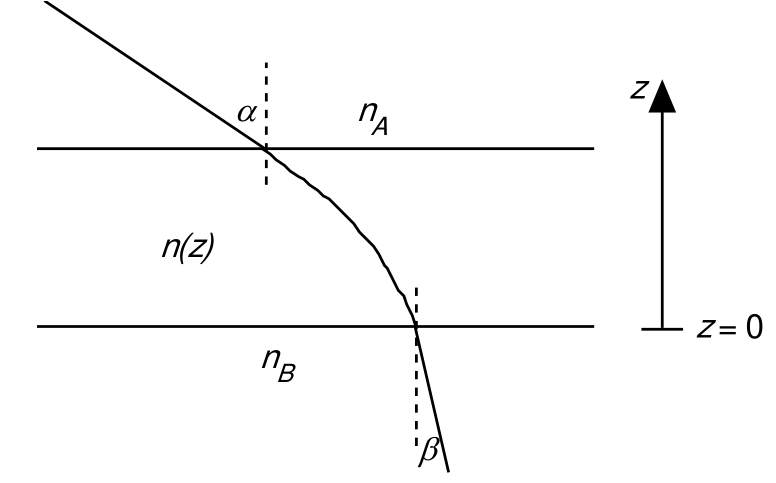
b) Assume that you are standing in a large flat desert. At some distance you see what appears to be a water surface. When you approach the “water” is seems to move away such that the distance to the “water” is always constant. Explain the phenomenon.
c) Compute the temperature of the air close to the ground in b) assuming that your eyes are located 1.60 m above the ground and that the distance to the “water” is 250 m. The refractive index of the air at \(15^\circ\mathrm{C}\) and at normal air pressure (101.3 kPa) is 1.000276. The temperature of the air more than 1 m above the ground is assumed to be constant and equal to \(30^\circ\mathrm{C}\). The atmospheric pressure is assumed to be normal. The refractive index, \(n\), is such that \(n-1\) is proportional to the density of the air. Discuss the accuracy of your result.
Official English text of the problem.
Problem 2: Seiching of lake water
In certain lakes there is a strange phenomenon called “seiching” which is an oscillation of the water. Lakes in which you can see this phenomenon are normally long compared with the depth and also narrow. It is natural to see waves in a lake but not something like the seiching, where the entire water volume oscillates, like the coffee in a cup that you carry to a waiting guest.
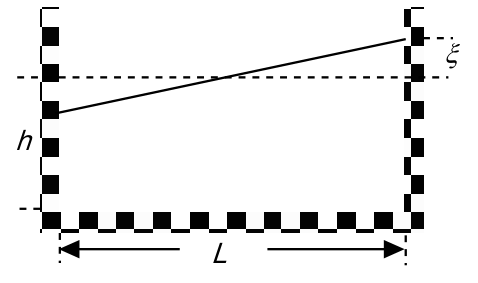
In order to create a model of the seiching we look at water in a rectangular container. The length of the container is \(L\) and the depth of the water is \(h\). Assume that the surface of the water to begin with makes a small angle with the horizontal. The seiching will then start, and we assume that the water surface continues to be plane but oscillates around an axis in the horizontal plane and located in the middle of the container.
Create a model of the movement of the water and derive a formula for the oscillation period \(T\). The starting conditions are given in figure above. Assume that \(\xi \ll h\). The table below shows experimental oscillation periods for different water depths in two containers of different lengths. Check in some reasonable way how well the formula that you have derived agrees with the experimental data. Give your opinion on the quality of your model.
Table 1. \(L = 479\ \mathrm{mm}\)
\(h/\mathrm{mm}\) 30 50 69 88 107 124 142 \(T/\mathrm{s}\) 1.78 1.40 1.18 1.08 1.00 0.91 0.82 Table 2. \(L = 143\ \mathrm{mm}\)
\(h/\mathrm{mm}\) 31 38 58 67 124 \(T/\mathrm{s}\) 0.52 0.52 0.43 0.35 0.28 The graph below shows results from measurements in lake Vättern in Sweden. This lake has a length of 123 km and a mean depth of 50 m. What is the time scale in the graph?
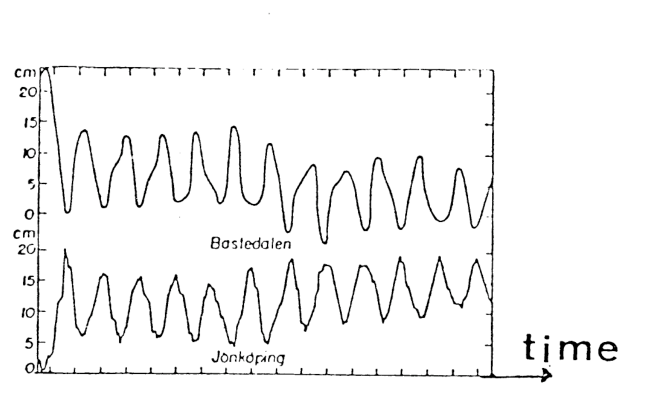
The water surface level in Bastudalen (northern end of lake Vättern) and Jönköping (southern end).
Official English text of the problem.
Problem 3: Electronic frequency filter
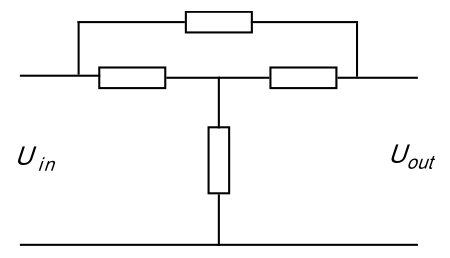
An electronic frequency filter consists of four components coupled as in the upper figure. The impedance of the source can be neglected and the impedance of the load can be taken as infinite. The filter should be such that the voltage ratio \(U_{out}/U_{in}\) has a frequency dependence shown in the lower where \(U_{in}\) is the input voltage and \(U_{out}\) is the output voltage. At frequency \(f_0\) the phase lag between the two voltages is zero.
In order to build the filter you can choose from the following components:
2 resistors, 10 kΩ
2 capacitors, 10 nF
2 solenoids, 160 mH (iron-free and with neglible resistance)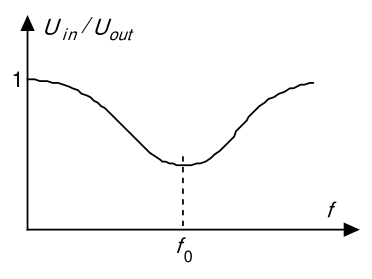
Construct, by combining four of these components, a filter that fulfils the stated conditions. Determine the frequency \(f_0\) and the ratio \(U_{out}/U_{in}\) at this frequency for as many component combinations as possible.
Official English text of the problem.
Internationale Physik-Olympiade
IPhO 1984
Sigtuna, Schweden · 3 Theorieaufgaben mit vollständigen Lösungen
Aufgabe 1: Brechung in einem geschichteten Medium und die Luftspiegelung in der Wüste
a) Betrachten Sie eine planparallele transparente Platte, deren Brechungsindex \(n\) mit dem Abstand \(z\) von der unteren Oberfläche variiert (siehe Abbildung). Zeigen Sie, dass \(n_A\sin\alpha=n_B\sin\beta\). Die Bezeichnungen entsprechen denen in der Abbildung.
b) Nehmen Sie an, Sie stehen in einer großen, ebenen Wüste. In einiger Entfernung sehen Sie etwas, das wie eine Wasserfläche aussieht. Wenn Sie sich dem „Wasser“ nähern, scheint es sich so von Ihnen zu entfernen, dass der Abstand zum „Wasser“ stets gleich bleibt. Erklären Sie dieses Phänomen.
c) Berechnen Sie die Temperatur der bodennahen Luft in b), unter der Annahme, dass sich Ihre Augen 1.60 m über dem Boden befinden und der Abstand zum „Wasser“ 250 m beträgt. Der Brechungsindex der Luft bei \(15^\circ\mathrm{C}\) und normalem Luftdruck (101.3 kPa) beträgt 1.000276. Die Temperatur der Luft in mehr als 1 m Höhe über dem Boden wird als konstant und gleich \(30^\circ\mathrm{C}\) angenommen. Der Luftdruck wird als normal angenommen. Für den Brechungsindex \(n\) gilt, dass \(n-1\) proportional zur Dichte der Luft ist. Diskutieren Sie die Genauigkeit Ihres Ergebnisses.
Aufgabentext aus dem offiziellen englischen Text übersetzt.
Aufgabe 2: Seiches in Seen
In manchen Seen tritt ein merkwürdiges Phänomen auf, das als „Seiche“ bezeichnet wird und eine Schwingung des Wassers darstellt. Seen, in denen man dieses Phänomen beobachten kann, sind gewöhnlich im Verhältnis zu ihrer Tiefe lang und außerdem schmal. Wellen in einem See sind ein vertrauter Anblick, nicht aber eine Erscheinung wie eine Seiche, bei der das gesamte Wasservolumen schwingt, ähnlich wie der Kaffee in einer Tasse, die man zu einem wartenden Gast trägt.
Um ein Modell für die Seiche zu entwickeln, betrachten wir Wasser in einem rechteckigen Behälter. Die Länge des Behälters beträgt \(L\), die Wassertiefe \(h\). Nehmen Sie an, dass die Wasseroberfläche zu Beginn einen kleinen Winkel mit der Horizontalen bildet. Daraufhin setzt die Seiche ein, und wir nehmen an, dass die Wasseroberfläche eben bleibt, jedoch um eine Achse schwingt, die in der horizontalen Ebene in der Mitte des Behälters liegt.
Entwickeln Sie ein Modell für die Bewegung des Wassers und leiten Sie eine Formel für die Schwingungsdauer \(T\) her. Die Anfangsbedingungen sind in der obigen Abbildung dargestellt. Nehmen Sie an, dass \(\xi \ll h\). Die folgende Tabelle zeigt experimentell bestimmte Schwingungsdauern für verschiedene Wassertiefen in zwei Behältern unterschiedlicher Länge. Überprüfen Sie auf geeignete Weise, wie gut die von Ihnen hergeleitete Formel mit den experimentellen Daten übereinstimmt. Beurteilen Sie die Güte Ihres Modells.
Tabelle 1. \(L = 479\ \mathrm{mm}\)
\(h/\mathrm{mm}\) 30 50 69 88 107 124 142 \(T/\mathrm{s}\) 1.78 1.40 1.18 1.08 1.00 0.91 0.82 Tabelle 2. \(L = 143\ \mathrm{mm}\)
\(h/\mathrm{mm}\) 31 38 58 67 124 \(T/\mathrm{s}\) 0.52 0.52 0.43 0.35 0.28 Das folgende Diagramm zeigt Messergebnisse vom Vätternsee in Schweden. Dieser See hat eine Länge von 123 km und eine mittlere Tiefe von 50 m. Welche Zeitskala hat das Diagramm?
Der Wasserstand in Bastudalen (am Nordende des Vätternsees) und Jönköping (am Südende).
Aufgabentext aus dem offiziellen englischen Text übersetzt.
Aufgabe 3: Elektronisches Frequenzfilter
Ein elektronisches Frequenzfilter besteht aus vier Bauelementen, die wie in der oberen Abbildung miteinander verbunden sind. Die Impedanz der Quelle kann vernachlässigt und die Impedanz der Last als unendlich angenommen werden. Das Filter soll so beschaffen sein, dass das Spannungsverhältnis \(U_{out}/U_{in}\) die in der unteren Abbildung dargestellte Frequenzabhängigkeit aufweist, wobei \(U_{in}\) die Eingangsspannung und \(U_{out}\) die Ausgangsspannung ist. Bei der Frequenz \(f_0\) ist die Phasenverschiebung zwischen den beiden Spannungen null.
Zum Aufbau des Filters stehen die folgenden Bauelemente zur Auswahl:
2 Widerstände, 10 kΩ
2 Kondensatoren, 10 nF
2 Spulen, 160 mH (ohne Eisenkern und mit vernachlässigbarem Widerstand)Konstruieren Sie durch Kombination von vier dieser Bauelemente ein Filter, das die angegebenen Bedingungen erfüllt. Bestimmen Sie für möglichst viele Kombinationen von Bauelementen die Frequenz \(f_0\) und das Verhältnis \(U_{out}/U_{in}\) bei dieser Frequenz.
Aufgabentext aus dem offiziellen englischen Text übersetzt.
Uluslararası Fizik Olimpiyatı
IPhO 1984
Sigtuna, İsveç · 3 teori sorusu, tam çözümleriyle
Soru 1: Tabakalı bir ortamda kırılma ve çöl serabı
a) Kırılma indisi \(n\)'nin alt yüzeyden olan \(z\) uzaklığına bağlı olarak değiştiği, düzlem ve paralel yüzeyli saydam bir levhayı ele alın (şekle bakınız). \(n_A\sin\alpha=n_B\sin\beta\) olduğunu gösterin. Gösterim şekildeki gibidir.
b) Geniş ve düz bir çölde durduğunuzu varsayın. Biraz ileride su yüzeyine benzeyen bir şey görüyorsunuz. “Suya” yaklaştığınızda, “su” ile aranızdaki uzaklık hep sabit kalacak şekilde sizden uzaklaşıyor gibi görünüyor. Bu olayı açıklayın.
c) Gözlerinizin yerden 1.60 m yüksekte ve “suya” olan uzaklığınızın 250 m olduğunu varsayarak b)'de yere yakın havanın sıcaklığını hesaplayın. Havanın \(15^\circ\mathrm{C}\) sıcaklıkta ve normal hava basıncında (101.3 kPa) kırılma indisi 1.000276'dır. Yerden 1 m'den daha yüksekteki havanın sıcaklığının sabit ve \(30^\circ\mathrm{C}\) olduğu varsayılmaktadır. Atmosfer basıncının normal olduğu varsayılmaktadır. Kırılma indisi \(n\) için \(n-1\), havanın yoğunluğuyla orantılıdır. Sonucunuzun doğruluğunu tartışın.
Soru metni resmi İngilizce metinden çevrilmiştir.
Soru 2: Göl suyunun seş salınımı
Bazı göllerde, suyun salınım yaptığı ve “seş” adı verilen ilginç bir olay görülür. Bu olayın gözlenebildiği göller genellikle derinliklerine göre uzun ve aynı zamanda dardır. Bir gölde dalgalar görmek doğaldır; ancak bekleyen bir misafire götürdüğünüz fincandaki kahve gibi suyun tüm hacminin salındığı seş benzeri bir olay görmek alışıldık değildir.
Seş olayını modellemek için dikdörtgen bir kaptaki suyu ele alıyoruz. Kabın uzunluğu \(L\), suyun derinliği ise \(h\)'dir. Başlangıçta su yüzeyinin yatayla küçük bir açı yaptığını varsayın. Bu durumda seş salınımı başlayacaktır; su yüzeyinin düzlemsel kalmaya devam ettiğini, ancak yatay düzlemde bulunan ve kabın ortasından geçen bir eksen etrafında salındığını varsayıyoruz.
Suyun hareketi için bir model oluşturun ve salınım periyodu \(T\) için bir formül türetin. Başlangıç koşulları yukarıdaki şekilde verilmiştir. \(\xi \ll h\) olduğunu varsayın. Aşağıdaki tabloda, farklı uzunluklardaki iki kapta farklı su derinlikleri için deneysel salınım periyotları verilmiştir. Türettiğiniz formülün deneysel verilerle ne kadar iyi uyuştuğunu uygun bir yöntemle kontrol edin. Modelinizin niteliği hakkındaki görüşünüzü belirtin.
Tablo 1. \(L = 479\ \mathrm{mm}\)
\(h/\mathrm{mm}\) 30 50 69 88 107 124 142 \(T/\mathrm{s}\) 1.78 1.40 1.18 1.08 1.00 0.91 0.82 Tablo 2. \(L = 143\ \mathrm{mm}\)
\(h/\mathrm{mm}\) 31 38 58 67 124 \(T/\mathrm{s}\) 0.52 0.52 0.43 0.35 0.28 Aşağıdaki grafik, İsveç'teki Vättern Gölü'nde yapılan ölçümlerin sonuçlarını göstermektedir. Bu gölün uzunluğu 123 km, ortalama derinliği ise 50 m'dir. Grafikteki zaman ölçeği nedir?
Bastudalen'de (Vättern Gölü'nün kuzey ucu) ve Jönköping'de (güney ucu) su yüzeyinin seviyesi.
Soru metni resmi İngilizce metinden çevrilmiştir.
Soru 3: Elektronik frekans filtresi
Bir elektronik frekans filtresi, üstteki şekildeki gibi bağlanmış dört devre elemanından oluşmaktadır. Kaynağın empedansı ihmal edilebilir ve yükün empedansı sonsuz kabul edilebilir. Filtre, \(U_{out}/U_{in}\) gerilim oranının frekansa bağımlılığı alttaki şekilde gösterildiği gibi olacak biçimde tasarlanmalıdır; burada \(U_{in}\) giriş gerilimi, \(U_{out}\) ise çıkış gerilimidir. \(f_0\) frekansında iki gerilim arasındaki faz gecikmesi sıfırdır.
Filtreyi oluşturmak için aşağıdaki devre elemanları arasından seçim yapabilirsiniz:
2 direnç, 10 kΩ
2 kondansatör, 10 nF
2 solenoid, 160 mH (demir çekirdeksiz ve dirençleri ihmal edilebilir)Bu elemanların dördünü birleştirerek belirtilen koşulları sağlayan bir filtre oluşturunuz. Mümkün olduğunca çok eleman kombinasyonu için \(f_0\) frekansını ve bu frekanstaki \(U_{out}/U_{in}\) oranını belirleyiniz.
Soru metni resmi İngilizce metinden çevrilmiştir.
Olimpiada Internacional de Física
IPhO 1984
Sigtuna, Suecia · 3 problemas teóricos con soluciones completas
Problema 1: Refracción en un medio estratificado y el espejismo del desierto
a) Considere una lámina transparente de caras planas y paralelas, cuyo índice de refracción, \(n\), varía con la distancia, \(z\), a la superficie inferior (véase la figura). Demuestre que \(n_A\sin\alpha=n_B\sin\beta\). La notación es la de la figura.
b) Suponga que se encuentra de pie en un gran desierto llano. A cierta distancia ve lo que parece ser una superficie de agua. Cuando se acerca al «agua», esta parece alejarse, de modo que la distancia al «agua» siempre es constante. Explique el fenómeno.
c) Calcule la temperatura del aire cerca del suelo en b), suponiendo que sus ojos se encuentran a 1.60 m sobre el suelo y que la distancia al «agua» es de 250 m. El índice de refracción del aire a \(15^\circ\mathrm{C}\) y a presión atmosférica normal (101.3 kPa) es 1.000276. Se supone que la temperatura del aire a más de 1 m sobre el suelo es constante e igual a \(30^\circ\mathrm{C}\). Se supone que la presión atmosférica es normal. El índice de refracción, \(n\), es tal que \(n-1\) es proporcional a la densidad del aire. Analice la precisión de su resultado.
Enunciado traducido del texto oficial en inglés.
Problema 2: Seiches en el agua de un lago
En ciertos lagos se produce un extraño fenómeno llamado «seiche», que consiste en una oscilación del agua. Los lagos en los que se puede observar este fenómeno suelen ser largos en comparación con su profundidad y, además, estrechos. Es normal observar olas en un lago, pero no algo como un seiche, en el que oscila todo el volumen de agua, como el café en una taza que se lleva a un invitado que está esperando.
Para elaborar un modelo del seiche, consideramos el agua contenida en un recipiente rectangular. La longitud del recipiente es \(L\) y la profundidad del agua es \(h\). Supongamos que, inicialmente, la superficie del agua forma un ángulo pequeño con la horizontal. Entonces comenzará el seiche, y suponemos que la superficie del agua sigue siendo plana, pero oscila alrededor de un eje situado en el plano horizontal y en el centro del recipiente.
Elabore un modelo del movimiento del agua y deduzca una fórmula para el período de oscilación \(T\). Las condiciones iniciales se muestran en la figura anterior. Suponga que \(\xi \ll h\). La tabla siguiente muestra los períodos de oscilación experimentales para distintas profundidades de agua en dos recipientes de diferente longitud. Compruebe, de alguna manera razonable, en qué medida la fórmula deducida concuerda con los datos experimentales. Exprese su opinión sobre la calidad de su modelo.
Tabla 1. \(L = 479\ \mathrm{mm}\)
\(h/\mathrm{mm}\) 30 50 69 88 107 124 142 \(T/\mathrm{s}\) 1.78 1.40 1.18 1.08 1.00 0.91 0.82 Tabla 2. \(L = 143\ \mathrm{mm}\)
\(h/\mathrm{mm}\) 31 38 58 67 124 \(T/\mathrm{s}\) 0.52 0.52 0.43 0.35 0.28 El gráfico siguiente muestra los resultados de mediciones realizadas en el lago Vättern, en Suecia. Este lago tiene una longitud de 123 km y una profundidad media de 50 m. ¿Cuál es la escala temporal del gráfico?
El nivel de la superficie del agua en Bastudalen (extremo norte del lago Vättern) y Jönköping (extremo sur).
Enunciado traducido del texto oficial en inglés.
Problema 3: Filtro electrónico de frecuencias
Un filtro electrónico de frecuencias consta de cuatro componentes conectados como se muestra en la figura superior. La impedancia de la fuente puede despreciarse y la impedancia de la carga puede considerarse infinita. El filtro debe ser tal que la relación de tensiones \(U_{out}/U_{in}\) tenga la dependencia con la frecuencia mostrada en la figura inferior, donde \(U_{in}\) es la tensión de entrada y \(U_{out}\) es la tensión de salida. A la frecuencia \(f_0\), el desfase entre las dos tensiones es cero.
Para construir el filtro, se puede elegir entre los siguientes componentes:
2 resistencias, 10 kΩ
2 condensadores, 10 nF
2 solenoides, 160 mH (sin núcleo de hierro y con resistencia despreciable)Construya, combinando cuatro de estos componentes, un filtro que cumpla las condiciones indicadas. Determine la frecuencia \(f_0\) y la relación \(U_{out}/U_{in}\) a esta frecuencia para tantas combinaciones de componentes como sea posible.
Enunciado traducido del texto oficial en inglés.
国际物理奥林匹克
IPhO 1984
瑞典锡格蒂纳 · 3 道理论题及完整解答
题目 1:分层介质中的折射与沙漠蜃景
a) 考虑一块平行平面透明板,其折射率 \(n\) 随距下表面的距离 \(z\) 而变化(见图)。证明 \(n_A\sin\alpha=n_B\sin\beta\)。符号的含义如图所示。
b) 假设你站在一片广阔而平坦的沙漠中。在一定距离处,你看到了看似水面的景象。当你走近这片“水面”时,它似乎也在远离你,使得你到“水面”的距离始终保持不变。解释这一现象。
c) 假设你的眼睛距地面 1.60 m,到“水面”的距离为 250 m,计算 b) 中紧贴地面的空气温度。在 \(15^\circ\mathrm{C}\) 和标准大气压(101.3 kPa)下,空气的折射率为 1.000276。假设距地面 1 m 以上的空气温度恒定,等于 \(30^\circ\mathrm{C}\)。假设大气压为标准大气压。空气的折射率 \(n\) 满足 \(n-1\) 与空气密度成正比。讨论所得结果的准确性。
题目译自官方英文原文。
题目 2:湖水的假潮
某些湖泊中会出现一种称为“假潮”的奇特现象,即湖水的振荡。能观察到这种现象的湖泊通常长度远大于水深,而且湖面狭窄。在湖中看到波浪是很自然的,但假潮却不同:整个湖水都在振荡,就像你端着一杯咖啡走向等候的客人时,杯中的咖啡那样。
为了建立假潮的模型,我们考察矩形容器中的水。容器的长度为 \(L\),水深为 \(h\)。假设水面最初与水平面成一个小角度。随后水便开始发生假潮振荡,我们假定水面始终保持为平面,但绕一条位于水平面内、通过容器中部的轴振荡。
建立水运动的模型,并推导振荡周期 \(T\) 的公式。初始条件如上图所示。假设 \(\xi \ll h\)。下表给出了两个不同长度的容器中,不同水深所对应的实验振荡周期。用某种合理的方法检验你所推导的公式与实验数据的符合程度。评价你的模型的优劣。
表 1. \(L = 479\ \mathrm{mm}\)
\(h/\mathrm{mm}\) 30 50 69 88 107 124 142 \(T/\mathrm{s}\) 1.78 1.40 1.18 1.08 1.00 0.91 0.82 表 2. \(L = 143\ \mathrm{mm}\)
\(h/\mathrm{mm}\) 31 38 58 67 124 \(T/\mathrm{s}\) 0.52 0.52 0.43 0.35 0.28 下图给出了瑞典韦特恩湖的测量结果。该湖长 123 km,平均水深为 50 m。图中的时间尺度是多少?
巴斯图达伦(韦特恩湖北端)和延雪平(南端)的水位。
题目译自官方英文原文。
题目 3:电子频率滤波器
一个电子频率滤波器由四个元件按上图所示方式连接而成。信号源的阻抗可以忽略,负载的阻抗可视为无穷大。滤波器应使电压比 \(U_{out}/U_{in}\) 随频率的变化关系如下图所示,其中 \(U_{in}\) 为输入电压,\(U_{out}\) 为输出电压。在频率 \(f_0\) 处,两个电压之间的相位滞后为零。
为搭建该滤波器,你可以从以下元件中进行选择:
2 个电阻,10 kΩ
2 个电容,10 nF
2 个螺线管,160 mH(无铁芯,且电阻可忽略)将其中四个元件组合起来,构成满足上述条件的滤波器。尽可能多地找出可行的元件组合,并确定各组合的频率 \(f_0\) 及该频率下的电压比 \(U_{out}/U_{in}\)。
题目译自官方英文原文。
Международная физическая олимпиада
IPhO 1984
Сигтуна, Швеция · 3 теоретические задачи с полными решениями
Задача 1: Преломление в слоистой среде и мираж в пустыне
a) Рассмотрим плоскопараллельную прозрачную пластину, показатель преломления которой, \(n\), изменяется с расстоянием \(z\) от нижней поверхности (см. рисунок). Покажите, что \(n_A\sin\alpha=n_B\sin\beta\). Обозначения приведены на рисунке.
b) Предположим, что вы стоите в большой плоской пустыне. На некотором расстоянии вы видите нечто похожее на водную поверхность. Когда вы приближаетесь к «воде», она словно отступает, так что расстояние до «воды» всегда остаётся постоянным. Объясните это явление.
c) Вычислите температуру воздуха вблизи земли в пункте b), предполагая, что ваши глаза находятся на высоте 1.60 м над землёй, а расстояние до «воды» равно 250 м. Показатель преломления воздуха при \(15^\circ\mathrm{C}\) и нормальном атмосферном давлении (101.3 кПа) равен 1.000276. Температура воздуха на высоте более 1 м над землёй считается постоянной и равной \(30^\circ\mathrm{C}\). Атмосферное давление считается нормальным. Показатель преломления \(n\) таков, что \(n-1\) пропорционально плотности воздуха. Обсудите точность полученного результата.
Условие переведено с официального английского текста.
Задача 2: Сейши в озере
В некоторых озёрах наблюдается необычное явление, называемое «сейшами», — колебания воды. Озёра, в которых можно наблюдать это явление, обычно имеют большую длину по сравнению с глубиной и при этом узки. Волны на озере — привычное явление, но сейши выглядят необычно: при них колеблется весь объём воды, подобно кофе в чашке, которую вы несёте ожидающему гостю.
Чтобы построить модель сейш, рассмотрим воду в прямоугольном сосуде. Длина сосуда равна \(L\), а глубина воды — \(h\). Предположим, что в начальный момент поверхность воды составляет небольшой угол с горизонтом. Затем начнутся сейши; будем считать, что поверхность воды остаётся плоской, но колеблется вокруг оси, лежащей в горизонтальной плоскости и проходящей через середину сосуда.
Постройте модель движения воды и выведите формулу для периода колебаний \(T\). Начальные условия показаны на рисунке выше. Считайте, что \(\xi \ll h\). В приведённых ниже таблицах указаны экспериментальные периоды колебаний при различных глубинах воды в двух сосудах разной длины. Проверьте каким-либо разумным способом, насколько хорошо выведенная вами формула согласуется с экспериментальными данными. Оцените качество своей модели.
Таблица 1. \(L = 479\ \mathrm{mm}\)
\(h/\mathrm{mm}\) 30 50 69 88 107 124 142 \(T/\mathrm{s}\) 1.78 1.40 1.18 1.08 1.00 0.91 0.82 Таблица 2. \(L = 143\ \mathrm{mm}\)
\(h/\mathrm{mm}\) 31 38 58 67 124 \(T/\mathrm{s}\) 0.52 0.52 0.43 0.35 0.28 На графике ниже представлены результаты измерений на озере Веттерн в Швеции. Длина этого озера составляет 123 км, а средняя глубина — 50 м. Каков масштаб времени на графике?
Уровень поверхности воды в Бастудалене (северная оконечность озера Веттерн) и Йёнчёпинге (южная оконечность).
Условие переведено с официального английского текста.
Задача 3: Электронный частотный фильтр
Электронный частотный фильтр состоит из четырёх элементов, соединённых так, как показано на верхнем рисунке. Импедансом источника можно пренебречь, а импеданс нагрузки можно считать бесконечным. Фильтр должен обеспечивать зависимость отношения напряжений \(U_{out}/U_{in}\) от частоты, показанную на нижнем рисунке, где \(U_{in}\) — входное напряжение, а \(U_{out}\) — выходное напряжение. При частоте \(f_0\) сдвиг фаз между этими двумя напряжениями равен нулю.
Для построения фильтра можно выбрать элементы из следующего набора:
2 резистора по 10 кОм
2 конденсатора по 10 нФ
2 катушки индуктивности по 160 мГн (без железного сердечника и с пренебрежимо малым сопротивлением)Соберите из четырёх этих элементов фильтр, удовлетворяющий указанным условиям. Определите частоту \(f_0\) и отношение \(U_{out}/U_{in}\) при этой частоте для как можно большего числа комбинаций элементов.
Условие переведено с официального английского текста.
الأولمبياد الدولي للفيزياء
IPhO 1984
سيغتونا، السويد · 3 مسائل نظرية مع حلول كاملة
المسألة 1: الانكسار في وسط طبقي والسراب الصحراوي
a) اعتبر صفيحة شفافة ذات وجهين مستويين متوازيين، يتغير فيها معامل الانكسار، \(n\)، مع المسافة، \(z\)، من السطح السفلي (انظر الشكل). أثبت أن \(n_A\sin\alpha=n_B\sin\beta\). الرموز هي المبينة في الشكل.
b) افترض أنك تقف في صحراء واسعة مستوية. ترى على مسافة منك ما يبدو أنه سطح ماء. عندما تقترب من «الماء»، يبدو أنه يبتعد بحيث تظل المسافة بينك وبين «الماء» ثابتة دائمًا. فسّر هذه الظاهرة.
c) احسب درجة حرارة الهواء القريب من الأرض في b)، بافتراض أن عينيك تقعان على ارتفاع 1.60 m فوق الأرض، وأن المسافة إلى «الماء» هي 250 m. معامل انكسار الهواء عند \(15^\circ\mathrm{C}\) وعند الضغط الجوي العادي (101.3 kPa) هو 1.000276. يُفترض أن درجة حرارة الهواء على ارتفاع يزيد على 1 m فوق الأرض ثابتة وتساوي \(30^\circ\mathrm{C}\). ويُفترض أن الضغط الجوي عادي. ومعامل الانكسار، \(n\)، يحقق تناسب \(n-1\) مع كثافة الهواء. ناقش دقة نتيجتك.
نص المسألة مترجم عن النص الإنجليزي الرسمي.
المسألة 2: التذبذب القائم لمياه البحيرات
تحدث في بعض البحيرات ظاهرة غريبة تسمى «التذبذب القائم»، وهي تذبذب للمياه. وتكون البحيرات التي يمكن مشاهدة هذه الظاهرة فيها طويلة عادةً مقارنة بعمقها، وضيقة أيضًا. ومن الطبيعي أن نرى أمواجًا في بحيرة، لكن ليس ظاهرة كالتذبذب القائم، حيث يتذبذب حجم الماء بأكمله، كما تتذبذب القهوة في فنجان تحمله إلى ضيف ينتظر.
لبناء نموذج للتذبذب القائم، ننظر إلى الماء في وعاء مستطيل. طول الوعاء هو \(L\)، وعمق الماء هو \(h\). افترض أن سطح الماء يصنع في البداية زاوية صغيرة مع الأفقي. عندئذ يبدأ التذبذب القائم، ونفترض أن سطح الماء يظل مستويًا، لكنه يتذبذب حول محور يقع في المستوى الأفقي وفي منتصف الوعاء.
أنشئ نموذجًا لحركة الماء، واشتق صيغة لدور التذبذب \(T\). الشروط الابتدائية مبينة في الشكل أعلاه. افترض أن \(\xi \ll h\). يبين الجدول أدناه أدوار التذبذب المقيسة تجريبيًا لأعماق مختلفة للماء في وعاءين مختلفي الطول. تحقق بطريقة معقولة من مدى توافق الصيغة التي اشتققتها مع البيانات التجريبية. وأبدِ رأيك في جودة نموذجك.
الجدول 1. \(L = 479\ \mathrm{mm}\)
\(h/\mathrm{mm}\) 30 50 69 88 107 124 142 \(T/\mathrm{s}\) 1.78 1.40 1.18 1.08 1.00 0.91 0.82 الجدول 2. \(L = 143\ \mathrm{mm}\)
\(h/\mathrm{mm}\) 31 38 58 67 124 \(T/\mathrm{s}\) 0.52 0.52 0.43 0.35 0.28 يبين الرسم البياني أدناه نتائج قياسات أُجريت في بحيرة فاترن في السويد. يبلغ طول هذه البحيرة 123 km، ومتوسط عمقها 50 m. ما مقياس الزمن في الرسم البياني؟
منسوب سطح الماء في باستودالن (الطرف الشمالي لبحيرة فاترن) ويونشوبينغ (الطرف الجنوبي).
نص المسألة مترجم عن النص الإنجليزي الرسمي.
المسألة 3: مرشح تردد إلكتروني
يتكون مرشح تردد إلكتروني من أربعة عناصر موصولة كما في الشكل العلوي. يمكن إهمال ممانعة المصدر، ويمكن اعتبار ممانعة الحمل لانهائية. ينبغي أن يكون المرشح بحيث تعتمد نسبة الجهد \(U_{out}/U_{in}\) على التردد وفقًا لما هو مبين في الشكل السفلي، حيث \(U_{in}\) هو جهد الدخل و\(U_{out}\) هو جهد الخرج. عند التردد \(f_0\)، يكون تأخر الطور بين الجهدين صفرًا.
لبناء المرشح، يمكنك الاختيار من العناصر الآتية:
مقاومتان، 10 kΩ
مكثفان، 10 nF
ملفان لولبيان، 160 mH (من دون قلب حديدي وبمقاومة مهملة)أنشئ، بتجميع أربعة من هذه العناصر، مرشحًا يحقق الشروط المذكورة. حدّد التردد \(f_0\) والنسبة \(U_{out}/U_{in}\) عند هذا التردد لأكبر عدد ممكن من توليفات العناصر.
نص المسألة مترجم عن النص الإنجليزي الرسمي.