IPhO 1984 · Theory problem 1
Refraction in a layered medium and the desert mirage
a) Consider a plane-parallel transparent plate, where the refractive index, \(n\), varies with distance, \(z\), from the lower surface (see figure). Show that \(n_A\sin\alpha=n_B\sin\beta\). The notation is that of the figure.
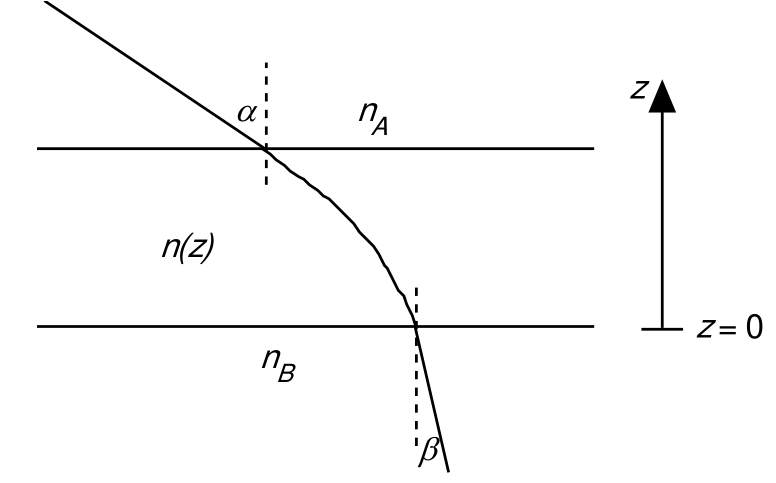
b) Assume that you are standing in a large flat desert. At some distance you see what appears to be a water surface. When you approach the “water” is seems to move away such that the distance to the “water” is always constant. Explain the phenomenon.
c) Compute the temperature of the air close to the ground in b) assuming that your eyes are located 1.60 m above the ground and that the distance to the “water” is 250 m. The refractive index of the air at \(15^\circ\mathrm{C}\) and at normal air pressure (101.3 kPa) is 1.000276. The temperature of the air more than 1 m above the ground is assumed to be constant and equal to \(30^\circ\mathrm{C}\). The atmospheric pressure is assumed to be normal. The refractive index, \(n\), is such that \(n-1\) is proportional to the density of the air. Discuss the accuracy of your result.
Official English text of the problem.
Answers
- a) The conserved quantity is \(n(z)\sin\theta(z)\), where \(\theta\) is the angle to the normal. Consequently, \[ \boxed{n_A\sin\alpha=n_B\sin\beta}. \]
- b) This is an inferior mirage: hot, less dense air near the ground bends sky light upward into the observer’s eyes. The apparent water remains at a constant distance because the horizontal temperature distribution and the observer’s eye height remain unchanged.
- c) Interpreting 250 m as the apparent distance to the mirage’s near edge, \[ \boxed{T_{\mathrm{ground\ air}}\simeq329\,\mathrm K\simeq56^\circ\mathrm C}. \] The small-angle approximation contributes less than \(0.001^\circ\mathrm C\); uncertainty in the apparent edge and departures from ideal atmospheric layering are more significant.
Solution
a)
Divide the plate into many thin horizontal layers, each having an approximately constant refractive index. Let \(n_i\) be the index of layer \(i\), and let \(\theta_i\) be the ray’s angle to the normal there.
Snell’s law at each interface gives \[ n_i\sin\theta_i=n_{i+1}\sin\theta_{i+1}. \] Since all interfaces are parallel, their normals have the same direction. Including the entrance and exit interfaces, \[ n_A\sin\alpha =n_1\sin\theta_1 =\cdots =n_N\sin\theta_N =n_B\sin\beta. \]
Taking the limit of infinitesimally thin layers establishes the result for a continuously varying index: \[ \boxed{n(z)\sin\theta(z)=p=\text{constant}}, \qquad \boxed{n_A\sin\alpha=n_B\sin\beta}. \]
b)
Sunlight heats the desert surface, which heats the air immediately above it. At approximately constant pressure, this warmer air has a lower density and hence a smaller refractive index. Thus the refractive index increases with height through the hot layer.
Consider a ray of sky light travelling downward at a shallow angle to the ground. From part a), \[ \sin\theta(z)=\frac{p}{n(z)}. \] As the ray enters air of smaller refractive index, its angle \(\theta\) to the vertical increases. If it reaches a height where \(n(z)=p\), it becomes horizontal. It then turns upward toward regions of larger refractive index and can reach the observer.
The observer traces the arriving light backward along a straight line and therefore sees sky light apparently coming from below the horizon. This resembles the reflection of the sky in water. In a smooth temperature gradient, the turning occurs through continuous refraction.
If the atmosphere is horizontally uniform, moving horizontally leaves the optical situation unchanged. At a fixed eye height, the angular position of the mirage’s near edge—and therefore its apparent distance—remains constant.
c)
Let \(n_e\) denote the refractive index at eye height and \(n_g\) the minimum index in the hottest air next to the ground. Assume geometrical optics, horizontal stratification, and a temperature that increases toward the ground.
First determine the refractive index as a function of temperature. For air treated as an ideal gas at constant pressure, \[ \rho\propto\frac1T, \] where \(T\) is the absolute temperature. Since \(n-1\propto\rho\), \[ n(T)-1=\frac{A}{T}, \] with \[ A=(1.000276-1)(273.15+15) =0.0795294\,\mathrm K. \]
The eyes are above the 1 m level, so their surrounding air is at \[ T_e=303.15\,\mathrm K. \] Consequently, \[ n_e=1+\frac{0.0795294}{303.15} =1.000262343. \]
Let \(\delta\) be the depression angle of the mirage’s near edge below the horizontal. Interpreting the stated distance as the apparent ground-plane distance, straight backward projection of the viewing direction gives \[ \tan\delta=\frac{h}{D} =\frac{1.60}{250}=0.00640, \] so \[ \delta=0.0063999\,\mathrm{rad}\simeq0.367^\circ. \]
The near edge is determined by the limiting ray that becomes horizontal in the minimum-index air. At eye height its angle to the vertical is \(90^\circ-\delta\); at its turning point that angle is \(90^\circ\). Part a) therefore gives \[ n_e\sin(90^\circ-\delta)=n_g\sin90^\circ, \] or \[ n_g=n_e\cos\delta =\frac{n_e}{\sqrt{1+(h/D)^2}}. \]
Rays with a smaller depression angle turn above the ground and bring sky light to the observer. Rays with a larger depression angle reach the ground.
Numerically, \[ n_g =\frac{1.000262343}{\sqrt{1+(1.60/250)^2}} =1.000241859. \] Thus \[ T_g=\frac{A}{n_g-1} =\frac{0.0795294}{0.000241859} =328.826\,\mathrm K, \] and hence \[ \boxed{T_g\simeq56^\circ\mathrm C}. \]
For the accuracy, the relevant refractive-index decrease is \[ n_e-n_g\simeq2.05\times10^{-5}. \] The angle is sufficiently small that replacing \[ \cos\delta=\frac1{\sqrt{1+(h/D)^2}} \] by \(1-\tfrac12(h/D)^2\) changes the calculated temperature by only about \(0.0009\,\mathrm K\).
The observational and atmospheric assumptions matter more. Differentiating the temperature formula, while holding the reference index and upper-air temperature fixed, gives at the stated values \[ dT_g\simeq55.7\,\mathrm K \left(\frac{dh}{h}-\frac{dD}{D}\right). \] Thus a 1% error in \(h/D\) changes the inferred temperature by approximately \(0.56^\circ\mathrm C\).
A blurred mirage edge, turbulence, uneven heating, and departures from horizontal layering can introduce larger errors. The detailed vertical profile is unnecessary for the ideal limiting-angle calculation, but a distinct edge associated with the hottest air is required. Since measurement uncertainties are not supplied, a numerical error bar is not justified.
The solution was checked against the official solution.
IPhO 1984 · Theorieaufgabe 1
Brechung in einem geschichteten Medium und die Luftspiegelung in der Wüste
a) Betrachten Sie eine planparallele transparente Platte, deren Brechungsindex \(n\) mit dem Abstand \(z\) von der unteren Oberfläche variiert (siehe Abbildung). Zeigen Sie, dass \(n_A\sin\alpha=n_B\sin\beta\). Die Bezeichnungen entsprechen denen in der Abbildung.
b) Nehmen Sie an, Sie stehen in einer großen, ebenen Wüste. In einiger Entfernung sehen Sie etwas, das wie eine Wasserfläche aussieht. Wenn Sie sich dem „Wasser“ nähern, scheint es sich so von Ihnen zu entfernen, dass der Abstand zum „Wasser“ stets gleich bleibt. Erklären Sie dieses Phänomen.
c) Berechnen Sie die Temperatur der bodennahen Luft in b), unter der Annahme, dass sich Ihre Augen 1.60 m über dem Boden befinden und der Abstand zum „Wasser“ 250 m beträgt. Der Brechungsindex der Luft bei \(15^\circ\mathrm{C}\) und normalem Luftdruck (101.3 kPa) beträgt 1.000276. Die Temperatur der Luft in mehr als 1 m Höhe über dem Boden wird als konstant und gleich \(30^\circ\mathrm{C}\) angenommen. Der Luftdruck wird als normal angenommen. Für den Brechungsindex \(n\) gilt, dass \(n-1\) proportional zur Dichte der Luft ist. Diskutieren Sie die Genauigkeit Ihres Ergebnisses.
Aufgabentext aus dem offiziellen englischen Text übersetzt.
Antworten
- a) Die Erhaltungsgröße ist \(n(z)\sin\theta(z)\), wobei \(\theta\) der Winkel zum Lot ist. Folglich gilt \[ \boxed{n_A\sin\alpha=n_B\sin\beta}. \]
- b) Es handelt sich um eine untere Luftspiegelung: Heiße, weniger dichte Luft in Bodennähe lenkt Himmelslicht nach oben in die Augen des Beobachters. Die scheinbare Wasserfläche bleibt in konstantem Abstand, weil die horizontale Temperaturverteilung und die Augenhöhe des Beobachters unverändert bleiben.
- c) Wenn man 250 m als den scheinbaren Abstand zum nahen Rand der Luftspiegelung auffasst, ergibt sich \[ \boxed{T_{\mathrm{ground\ air}}\simeq329\,\mathrm K\simeq56^\circ\mathrm C}. \] Die Kleinwinkelnäherung trägt weniger als \(0.001^\circ\mathrm C\) zum Fehler bei; die Unsicherheit bei der Bestimmung des scheinbaren Randes und Abweichungen von einer idealen Schichtung der Atmosphäre sind bedeutsamer.
Lösung
a)
Wir unterteilen die Platte in viele dünne horizontale Schichten, die jeweils einen näherungsweise konstanten Brechungsindex haben. Es sei \(n_i\) der Brechungsindex der Schicht \(i\) und \(\theta_i\) der Winkel des Lichtstrahls zum Lot in dieser Schicht.
Das Snelliussche Brechungsgesetz liefert an jeder Grenzfläche \[ n_i\sin\theta_i=n_{i+1}\sin\theta_{i+1}. \] Da alle Grenzflächen parallel sind, haben ihre Normalen dieselbe Richtung. Unter Einbeziehung der Eintritts- und Austrittsflächen gilt \[ n_A\sin\alpha =n_1\sin\theta_1 =\cdots =n_N\sin\theta_N =n_B\sin\beta. \]
Der Grenzübergang zu unendlich dünnen Schichten ergibt das Resultat für einen kontinuierlich veränderlichen Brechungsindex: \[ \boxed{n(z)\sin\theta(z)=p=\text{konstant}}, \qquad \boxed{n_A\sin\alpha=n_B\sin\beta}. \]
b)
Das Sonnenlicht erwärmt die Wüstenoberfläche, die wiederum die Luft unmittelbar darüber erwärmt. Bei näherungsweise konstantem Druck hat diese wärmere Luft eine geringere Dichte und damit einen kleineren Brechungsindex. Der Brechungsindex nimmt daher innerhalb der heißen Schicht mit der Höhe zu.
Betrachten wir einen Strahl des Himmelslichts, der unter einem flachen Winkel zum Boden nach unten verläuft. Aus Teil a) folgt \[ \sin\theta(z)=\frac{p}{n(z)}. \] Wenn der Strahl in Luft mit kleinerem Brechungsindex eintritt, nimmt sein Winkel \(\theta\) zur Vertikalen zu. Erreicht er eine Höhe, in der \(n(z)=p\) gilt, so verläuft er horizontal. Anschließend wendet er sich nach oben zu Bereichen mit größerem Brechungsindex und kann den Beobachter erreichen.
Der Beobachter verlängert das einfallende Licht gedanklich geradlinig rückwärts und sieht daher Himmelslicht, das scheinbar von unterhalb des Horizonts kommt. Dies ähnelt der Spiegelung des Himmels im Wasser. Bei einem glatten Temperaturgradienten erfolgt die Umkehr durch kontinuierliche Brechung.
Ist die Atmosphäre in horizontaler Richtung gleichförmig, so bleibt die optische Situation bei einer horizontalen Bewegung unverändert. Bei fester Augenhöhe bleibt die Winkellage des nahen Randes der Luftspiegelung — und damit sein scheinbarer Abstand — konstant.
c)
Es bezeichne \(n_e\) den Brechungsindex auf Augenhöhe und \(n_g\) den kleinsten Brechungsindex in der heißesten Luft unmittelbar am Boden. Wir setzen die Gültigkeit der geometrischen Optik, eine horizontale Schichtung und eine zum Boden hin zunehmende Temperatur voraus.
Zunächst bestimmen wir den Brechungsindex als Funktion der Temperatur. Für Luft, die als ideales Gas bei konstantem Druck behandelt wird, gilt \[ \rho\propto\frac1T, \] wobei \(T\) die absolute Temperatur ist. Wegen \(n-1\propto\rho\) gilt \[ n(T)-1=\frac{A}{T}, \] mit \[ A=(1.000276-1)(273.15+15) =0.0795294\,\mathrm K. \]
Die Augen befinden sich oberhalb von 1 m Höhe, sodass die sie umgebende Luft die Temperatur \[ T_e=303.15\,\mathrm K \] hat. Folglich gilt \[ n_e=1+\frac{0.0795294}{303.15} =1.000262343. \]
Es sei \(\delta\) der Senkungswinkel des nahen Randes der Luftspiegelung unter die Horizontale. Wenn wir die angegebene Entfernung als scheinbaren Abstand in der Bodenebene auffassen, ergibt die geradlinige Rückverlängerung der Blickrichtung \[ \tan\delta=\frac{h}{D} =\frac{1.60}{250}=0.00640, \] also \[ \delta=0.0063999\,\mathrm{rad}\simeq0.367^\circ. \]
Der nahe Rand wird durch den Grenzstrahl bestimmt, der in der Luft mit dem kleinsten Brechungsindex horizontal verläuft. Auf Augenhöhe beträgt sein Winkel zur Vertikalen \(90^\circ-\delta\); an seinem Umkehrpunkt beträgt dieser Winkel \(90^\circ\). Teil a) liefert daher \[ n_e\sin(90^\circ-\delta)=n_g\sin90^\circ, \] oder \[ n_g=n_e\cos\delta =\frac{n_e}{\sqrt{1+(h/D)^2}}. \]
Strahlen mit einem kleineren Senkungswinkel kehren oberhalb des Bodens um und bringen Himmelslicht zum Beobachter. Strahlen mit einem größeren Senkungswinkel erreichen den Boden.
Numerisch ergibt sich \[ n_g =\frac{1.000262343}{\sqrt{1+(1.60/250)^2}} =1.000241859. \] Somit gilt \[ T_g=\frac{A}{n_g-1} =\frac{0.0795294}{0.000241859} =328.826\,\mathrm K, \] und damit \[ \boxed{T_g\simeq56^\circ\mathrm C}. \]
Für die Genauigkeit ist die folgende Abnahme des Brechungsindex maßgeblich: \[ n_e-n_g\simeq2.05\times10^{-5}. \] Der Winkel ist so klein, dass das Ersetzen von \[ \cos\delta=\frac1{\sqrt{1+(h/D)^2}} \] durch \(1-\tfrac12(h/D)^2\) die berechnete Temperatur nur um etwa \(0.0009\,\mathrm K\) ändert.
Die Annahmen zur Beobachtung und zur Atmosphäre fallen stärker ins Gewicht. Differenziert man die Temperaturformel bei festgehaltenem Referenzbrechungsindex und festgehaltener Temperatur der oberen Luftschicht, so ergibt sich bei den angegebenen Werten \[ dT_g\simeq55.7\,\mathrm K \left(\frac{dh}{h}-\frac{dD}{D}\right). \] Ein Fehler von 1% in \(h/D\) ändert die daraus ermittelte Temperatur somit um etwa \(0.56^\circ\mathrm C\).
Ein unscharfer Rand der Luftspiegelung, Turbulenz, ungleichmäßige Erwärmung und Abweichungen von der horizontalen Schichtung können größere Fehler verursachen. Das genaue vertikale Profil ist für die ideale Berechnung des Grenzwinkels nicht erforderlich, wohl aber ein klar erkennbarer Rand, der der heißesten Luft zugeordnet ist. Da keine Messunsicherheiten angegeben sind, lässt sich keine numerische Fehlergrenze rechtfertigen.
Die Lösung wurde mit der offiziellen Lösung abgeglichen.
IPhO 1984 · Teori sorusu 1
Tabakalı bir ortamda kırılma ve çöl serabı
a) Kırılma indisi \(n\)'nin alt yüzeyden olan \(z\) uzaklığına bağlı olarak değiştiği, düzlem ve paralel yüzeyli saydam bir levhayı ele alın (şekle bakınız). \(n_A\sin\alpha=n_B\sin\beta\) olduğunu gösterin. Gösterim şekildeki gibidir.
b) Geniş ve düz bir çölde durduğunuzu varsayın. Biraz ileride su yüzeyine benzeyen bir şey görüyorsunuz. “Suya” yaklaştığınızda, “su” ile aranızdaki uzaklık hep sabit kalacak şekilde sizden uzaklaşıyor gibi görünüyor. Bu olayı açıklayın.
c) Gözlerinizin yerden 1.60 m yüksekte ve “suya” olan uzaklığınızın 250 m olduğunu varsayarak b)'de yere yakın havanın sıcaklığını hesaplayın. Havanın \(15^\circ\mathrm{C}\) sıcaklıkta ve normal hava basıncında (101.3 kPa) kırılma indisi 1.000276'dır. Yerden 1 m'den daha yüksekteki havanın sıcaklığının sabit ve \(30^\circ\mathrm{C}\) olduğu varsayılmaktadır. Atmosfer basıncının normal olduğu varsayılmaktadır. Kırılma indisi \(n\) için \(n-1\), havanın yoğunluğuyla orantılıdır. Sonucunuzun doğruluğunu tartışın.
Soru metni resmi İngilizce metinden çevrilmiştir.
Cevaplar
- a) Korunan nicelik \(n(z)\sin\theta(z)\)'dir; burada \(\theta\), normalle yapılan açıdır. Dolayısıyla, \[ \boxed{n_A\sin\alpha=n_B\sin\beta}. \]
- b) Bu bir alt serap olayıdır: yere yakın sıcak ve daha düşük yoğunluklu hava, gökyüzünden gelen ışığı yukarı doğru bükerek gözlemcinin gözlerine ulaştırır. Yatay sıcaklık dağılımı ve gözlemcinin göz yüksekliği değişmediği için görünen su sabit bir uzaklıkta kalır.
- c) 250 m'yi serabın yakın kenarına olan görünür uzaklık olarak yorumlarsak, \[ \boxed{T_{\mathrm{ground\ air}}\simeq329\,\mathrm K\simeq56^\circ\mathrm C}. \] Küçük açı yaklaşımının yol açtığı hata \(0.001^\circ\mathrm C\)'den küçüktür; görünür kenarın konumundaki belirsizlik ve atmosferin ideal tabakalanmadan sapmaları daha önemlidir.
Çözüm
a)
Levhayı, her birinin kırılma indisi yaklaşık olarak sabit olan çok sayıda ince yatay tabakaya ayırın. \(i\) tabakasının kırılma indisi \(n_i\), ışının bu tabakada normalle yaptığı açı ise \(\theta_i\) olsun.
Her ara yüzeyde Snell yasası \[ n_i\sin\theta_i=n_{i+1}\sin\theta_{i+1} \] bağıntısını verir. Tüm ara yüzeyler paralel olduğundan normalleri aynı doğrultudadır. Giriş ve çıkış ara yüzeylerini de dahil edersek, \[ n_A\sin\alpha =n_1\sin\theta_1 =\cdots =n_N\sin\theta_N =n_B\sin\beta. \]
Tabaka kalınlıklarının sonsuz küçüğe gittiği limit alınarak, sürekli değişen bir kırılma indisi için de sonuç elde edilir: \[ \boxed{n(z)\sin\theta(z)=p=\text{sabit}}, \qquad \boxed{n_A\sin\alpha=n_B\sin\beta}. \]
b)
Güneş ışığı çöl yüzeyini ısıtır; yüzey de hemen üzerindeki havayı ısıtır. Yaklaşık olarak sabit basınçta, bu daha sıcak havanın yoğunluğu ve dolayısıyla kırılma indisi daha düşüktür. Bu nedenle sıcak tabaka boyunca yükseklik arttıkça kırılma indisi artar.
Gökyüzünden gelip yerle küçük bir açı yaparak aşağı doğru ilerleyen bir ışını ele alın. a) kısmından, \[ \sin\theta(z)=\frac{p}{n(z)}. \] Işın, kırılma indisi daha küçük olan havaya girdikçe düşeyle yaptığı \(\theta\) açısı artar. \(n(z)=p\) olan bir yüksekliğe ulaşırsa yatay hâle gelir. Ardından kırılma indisinin daha büyük olduğu bölgelere doğru yukarı yönelir ve gözlemciye ulaşabilir.
Gözlemci, gelen ışığı geriye doğru düz bir çizgi boyunca izler ve bu nedenle gökyüzü ışığını ufkun altından geliyormuş gibi görür. Bu, gökyüzünün sudaki yansımasına benzer. Düzgün bir sıcaklık gradyanında yön değiştirme, sürekli kırılma yoluyla gerçekleşir.
Atmosfer yatay doğrultuda türdeşse, yatay hareket optik durumu değiştirmez. Sabit bir göz yüksekliğinde, serabın yakın kenarının açısal konumu ve dolayısıyla görünür uzaklığı sabit kalır.
c)
Göz yüksekliğindeki kırılma indisi \(n_e\), yere bitişik en sıcak havadaki en küçük kırılma indisi ise \(n_g\) olsun. Geometrik optiğin geçerli olduğunu, tabakalanmanın yatay olduğunu ve sıcaklığın yere doğru arttığını varsayın.
Önce kırılma indisini sıcaklığın bir fonksiyonu olarak belirleyin. Sabit basınçta ideal gaz olarak ele alınan hava için, \[ \rho\propto\frac1T, \] burada \(T\) mutlak sıcaklıktır. \(n-1\propto\rho\) olduğundan, \[ n(T)-1=\frac{A}{T}, \] burada \[ A=(1.000276-1)(273.15+15) =0.0795294\,\mathrm K. \]
Gözler 1 m seviyesinin üzerinde olduğundan, çevrelerindeki havanın sıcaklığı \[ T_e=303.15\,\mathrm K \] olur. Dolayısıyla, \[ n_e=1+\frac{0.0795294}{303.15} =1.000262343. \]
Serabın yakın kenarının yatayın altındaki bakış açısı \(\delta\) olsun. Verilen uzaklığı, yer düzlemi üzerindeki görünür uzaklık olarak yorumlarsak, bakış doğrultusunun geriye doğru düz bir çizgi boyunca uzatılması \[ \tan\delta=\frac{h}{D} =\frac{1.60}{250}=0.00640, \] bağıntısını verir; böylece \[ \delta=0.0063999\,\mathrm{rad}\simeq0.367^\circ. \]
Yakın kenarı, kırılma indisinin en küçük olduğu havada yatay hâle gelen sınır ışını belirler. Bu ışının göz yüksekliğinde düşeyle yaptığı açı \(90^\circ-\delta\), dönüş noktasında ise \(90^\circ\)'dir. Dolayısıyla a) kısmından, \[ n_e\sin(90^\circ-\delta)=n_g\sin90^\circ, \] ya da \[ n_g=n_e\cos\delta =\frac{n_e}{\sqrt{1+(h/D)^2}}. \]
Yatayın altındaki bakış açısı daha küçük olan ışınlar yere ulaşmadan yukarı döner ve gökyüzü ışığını gözlemciye getirir. Yatayın altındaki bakış açısı daha büyük olan ışınlar yere ulaşır.
Sayısal olarak, \[ n_g =\frac{1.000262343}{\sqrt{1+(1.60/250)^2}} =1.000241859. \] Böylece \[ T_g=\frac{A}{n_g-1} =\frac{0.0795294}{0.000241859} =328.826\,\mathrm K, \] ve dolayısıyla \[ \boxed{T_g\simeq56^\circ\mathrm C}. \]
Doğruluğu değerlendirmek için ilgili kırılma indisi azalması \[ n_e-n_g\simeq2.05\times10^{-5} \] olarak bulunur. Açı yeterince küçüktür; bu nedenle \[ \cos\delta=\frac1{\sqrt{1+(h/D)^2}} \] yerine \(1-\tfrac12(h/D)^2\) kullanılması, hesaplanan sıcaklığı yalnızca yaklaşık \(0.0009\,\mathrm K\) değiştirir.
Gözleme ve atmosfere ilişkin varsayımlar daha önemlidir. Referans kırılma indisi ve üstteki havanın sıcaklığı sabit tutularak sıcaklık formülünün diferansiyeli alındığında, verilen değerlerde \[ dT_g\simeq55.7\,\mathrm K \left(\frac{dh}{h}-\frac{dD}{D}\right) \] elde edilir. Dolayısıyla \(h/D\)'deki %1'lik bir hata, çıkarılan sıcaklığı yaklaşık \(0.56^\circ\mathrm C\) değiştirir.
Serabın kenarının bulanık olması, türbülans, düzensiz ısınma ve yatay tabakalanmadan sapmalar daha büyük hatalara yol açabilir. İdeal sınır açısı hesabı için ayrıntılı düşey profil gerekli değildir; ancak en sıcak havayla ilişkili belirgin bir kenar bulunması gerekir. Ölçüm belirsizlikleri verilmediğinden, sayısal bir hata payı belirtmek gerekçelendirilemez.
Çözüm, resmi çözümle karşılaştırılarak kontrol edildi.
IPhO 1984 · Problema teórico 1
Refracción en un medio estratificado y el espejismo del desierto
a) Considere una lámina transparente de caras planas y paralelas, cuyo índice de refracción, \(n\), varía con la distancia, \(z\), a la superficie inferior (véase la figura). Demuestre que \(n_A\sin\alpha=n_B\sin\beta\). La notación es la de la figura.
b) Suponga que se encuentra de pie en un gran desierto llano. A cierta distancia ve lo que parece ser una superficie de agua. Cuando se acerca al «agua», esta parece alejarse, de modo que la distancia al «agua» siempre es constante. Explique el fenómeno.
c) Calcule la temperatura del aire cerca del suelo en b), suponiendo que sus ojos se encuentran a 1.60 m sobre el suelo y que la distancia al «agua» es de 250 m. El índice de refracción del aire a \(15^\circ\mathrm{C}\) y a presión atmosférica normal (101.3 kPa) es 1.000276. Se supone que la temperatura del aire a más de 1 m sobre el suelo es constante e igual a \(30^\circ\mathrm{C}\). Se supone que la presión atmosférica es normal. El índice de refracción, \(n\), es tal que \(n-1\) es proporcional a la densidad del aire. Analice la precisión de su resultado.
Enunciado traducido del texto oficial en inglés.
Respuestas
- a) La magnitud que se conserva es \(n(z)\sin\theta(z)\), donde \(\theta\) es el ángulo respecto a la normal. Por consiguiente, \[ \boxed{n_A\sin\alpha=n_B\sin\beta}. \]
- b) Se trata de un espejismo inferior: el aire caliente y menos denso cercano al suelo desvía hacia arriba la luz del cielo hasta los ojos del observador. El agua aparente permanece a una distancia constante porque la distribución horizontal de temperatura y la altura de los ojos del observador no cambian.
- c) Interpretando los 250 m como la distancia aparente al borde más cercano del espejismo, \[ \boxed{T_{\mathrm{ground\ air}}\simeq329\,\mathrm K\simeq56^\circ\mathrm C}. \] La aproximación de ángulo pequeño contribuye en menos de \(0.001^\circ\mathrm C\); la incertidumbre en el borde aparente y las desviaciones respecto a una estratificación atmosférica ideal son más significativas.
Solución
a)
Dividamos la lámina en numerosas capas horizontales delgadas, cada una con un índice de refracción aproximadamente constante. Sea \(n_i\) el índice de la capa \(i\), y sea \(\theta_i\) el ángulo del rayo respecto a la normal en dicha capa.
La ley de Snell en cada interfaz da \[ n_i\sin\theta_i=n_{i+1}\sin\theta_{i+1}. \] Como todas las interfaces son paralelas, sus normales tienen la misma dirección. Incluyendo las interfaces de entrada y salida, \[ n_A\sin\alpha =n_1\sin\theta_1 =\cdots =n_N\sin\theta_N =n_B\sin\beta. \]
Al tomar el límite de capas infinitesimalmente delgadas, se establece el resultado para un índice que varía de forma continua: \[ \boxed{n(z)\sin\theta(z)=p=\text{constante}}, \qquad \boxed{n_A\sin\alpha=n_B\sin\beta}. \]
b)
La luz solar calienta la superficie del desierto, que a su vez calienta el aire situado inmediatamente encima. A presión aproximadamente constante, este aire más caliente tiene una densidad menor y, por tanto, un índice de refracción menor. Así, el índice de refracción aumenta con la altura dentro de la capa caliente.
Consideremos un rayo de luz del cielo que se propaga hacia abajo formando un ángulo pequeño con el suelo. Según el apartado a), \[ \sin\theta(z)=\frac{p}{n(z)}. \] A medida que el rayo entra en aire de menor índice de refracción, su ángulo \(\theta\) respecto a la vertical aumenta. Si alcanza una altura donde \(n(z)=p\), se vuelve horizontal. A continuación, se curva hacia arriba, hacia regiones de mayor índice de refracción, y puede llegar al observador.
El observador prolonga hacia atrás en línea recta la luz que le llega y, por ello, ve luz del cielo que aparentemente procede de debajo del horizonte. Esto se asemeja al reflejo del cielo en el agua. En un gradiente de temperatura suave, el cambio de sentido se produce mediante refracción continua.
Si la atmósfera es horizontalmente uniforme, el desplazamiento horizontal no altera la situación óptica. Para una altura fija de los ojos, la posición angular del borde más cercano del espejismo —y, por tanto, su distancia aparente— permanece constante.
c)
Sea \(n_e\) el índice de refracción a la altura de los ojos y \(n_g\) el índice mínimo en el aire más caliente junto al suelo. Supongamos que se cumplen las condiciones de la óptica geométrica, que existe estratificación horizontal y que la temperatura aumenta hacia el suelo.
Determinemos primero el índice de refracción en función de la temperatura. Para el aire tratado como un gas ideal a presión constante, \[ \rho\propto\frac1T, \] donde \(T\) es la temperatura absoluta. Como \(n-1\propto\rho\), \[ n(T)-1=\frac{A}{T}, \] con \[ A=(1.000276-1)(273.15+15) =0.0795294\,\mathrm K. \]
Los ojos se encuentran por encima del nivel de 1 m, por lo que el aire que los rodea está a \[ T_e=303.15\,\mathrm K. \] Por consiguiente, \[ n_e=1+\frac{0.0795294}{303.15} =1.000262343. \]
Sea \(\delta\) el ángulo de depresión del borde más cercano del espejismo por debajo de la horizontal. Interpretando la distancia indicada como la distancia aparente en el plano del suelo, la prolongación rectilínea hacia atrás de la dirección de observación da \[ \tan\delta=\frac{h}{D} =\frac{1.60}{250}=0.00640, \] de modo que \[ \delta=0.0063999\,\mathrm{rad}\simeq0.367^\circ. \]
El borde más cercano viene determinado por el rayo límite que se vuelve horizontal en el aire de índice mínimo. A la altura de los ojos, su ángulo respecto a la vertical es \(90^\circ-\delta\); en su punto de retorno, ese ángulo es \(90^\circ\). Por tanto, el apartado a) da \[ n_e\sin(90^\circ-\delta)=n_g\sin90^\circ, \] o bien \[ n_g=n_e\cos\delta =\frac{n_e}{\sqrt{1+(h/D)^2}}. \]
Los rayos con un ángulo de depresión menor cambian de sentido por encima del suelo y llevan luz del cielo al observador. Los rayos con un ángulo de depresión mayor llegan al suelo.
Numéricamente, \[ n_g =\frac{1.000262343}{\sqrt{1+(1.60/250)^2}} =1.000241859. \] Así, \[ T_g=\frac{A}{n_g-1} =\frac{0.0795294}{0.000241859} =328.826\,\mathrm K, \] y, por tanto, \[ \boxed{T_g\simeq56^\circ\mathrm C}. \]
En cuanto a la precisión, la disminución relevante del índice de refracción es \[ n_e-n_g\simeq2.05\times10^{-5}. \] El ángulo es lo suficientemente pequeño como para que sustituir \[ \cos\delta=\frac1{\sqrt{1+(h/D)^2}} \] por \(1-\tfrac12(h/D)^2\) cambie la temperatura calculada en solo unos \(0.0009\,\mathrm K\).
Las hipótesis sobre la observación y la atmósfera tienen mayor importancia. Al diferenciar la fórmula de la temperatura, manteniendo fijos el índice de referencia y la temperatura del aire superior, se obtiene, para los valores indicados, \[ dT_g\simeq55.7\,\mathrm K \left(\frac{dh}{h}-\frac{dD}{D}\right). \] Así, un error del 1% en \(h/D\) cambia la temperatura inferida en aproximadamente \(0.56^\circ\mathrm C\).
Un borde difuso del espejismo, la turbulencia, el calentamiento desigual y las desviaciones respecto a la estratificación horizontal pueden introducir errores mayores. El perfil vertical detallado no es necesario para el cálculo ideal del ángulo límite, pero se requiere un borde nítido asociado al aire más caliente. Como no se proporcionan las incertidumbres de medida, no está justificado dar un margen de error numérico.
La solución se comprobó con la solución oficial.
IPhO 1984 · 理论题 1
分层介质中的折射与沙漠蜃景
a) 考虑一块平行平面透明板,其折射率 \(n\) 随距下表面的距离 \(z\) 而变化(见图)。证明 \(n_A\sin\alpha=n_B\sin\beta\)。符号的含义如图所示。
b) 假设你站在一片广阔而平坦的沙漠中。在一定距离处,你看到了看似水面的景象。当你走近这片“水面”时,它似乎也在远离你,使得你到“水面”的距离始终保持不变。解释这一现象。
c) 假设你的眼睛距地面 1.60 m,到“水面”的距离为 250 m,计算 b) 中紧贴地面的空气温度。在 \(15^\circ\mathrm{C}\) 和标准大气压(101.3 kPa)下,空气的折射率为 1.000276。假设距地面 1 m 以上的空气温度恒定,等于 \(30^\circ\mathrm{C}\)。假设大气压为标准大气压。空气的折射率 \(n\) 满足 \(n-1\) 与空气密度成正比。讨论所得结果的准确性。
题目译自官方英文原文。
答案
- a) 守恒量为 \(n(z)\sin\theta(z)\),其中 \(\theta\) 是光线与法线的夹角。因此, \[ \boxed{n_A\sin\alpha=n_B\sin\beta}. \]
- b) 这是一种下蜃景:近地面温度较高、密度较小的空气使来自天空的光线向上弯曲,进入观察者的眼睛。由于水平方向上的温度分布和观察者眼睛的高度保持不变,表观水面始终保持在恒定的距离处。
- c) 将 250 m 理解为蜃景近侧边缘的表观距离, \[ \boxed{T_{\mathrm{ground\ air}}\simeq329\,\mathrm K\simeq56^\circ\mathrm C}. \] 小角度近似带来的误差小于 \(0.001^\circ\mathrm C\);表观边缘位置的不确定性以及实际大气对理想分层条件的偏离影响更大。
解答
a)
将透明板分成许多很薄的水平层,每一层的折射率近似为常量。设第 \(i\) 层的折射率为 \(n_i\),光线在该层内与法线的夹角为 \(\theta_i\)。
在每个界面处,由斯涅尔定律可得 \[ n_i\sin\theta_i=n_{i+1}\sin\theta_{i+1}. \] 由于所有界面彼此平行,它们的法线方向相同。将入射界面和出射界面也包括在内,有 \[ n_A\sin\alpha =n_1\sin\theta_1 =\cdots =n_N\sin\theta_N =n_B\sin\beta. \]
令各层厚度趋于无穷小,便得到折射率连续变化时的结果: \[ \boxed{n(z)\sin\theta(z)=p=\text{常量}}, \qquad \boxed{n_A\sin\alpha=n_B\sin\beta}. \]
b)
阳光加热沙漠地表,地表又加热紧贴其上的空气。在气压近似恒定的条件下,温度较高的空气密度较小,因而折射率也较小。因此,在这一热空气层内,折射率随高度增加而增大。
考虑一条来自天空、以与地面成很小夹角的方向向下传播的光线。由 a) 可知, \[ \sin\theta(z)=\frac{p}{n(z)}. \] 当光线进入折射率较小的空气时,它与竖直方向的夹角 \(\theta\) 增大。如果它到达满足 \(n(z)=p\) 的高度,其方向便变为水平。随后,它转而向上,朝折射率较大的区域传播,并可能到达观察者。
观察者沿直线反向延长入射光线,因此看到的天空光似乎来自地平线以下。这类似于天空在水中的倒影。在平滑的温度梯度中,光线通过连续折射而转向。
如果大气在水平方向上是均匀的,水平移动不会改变光学条件。在眼睛高度固定的情况下,蜃景近侧边缘的角位置保持不变,因此其表观距离也保持不变。
c)
用 \(n_e\) 表示眼睛高度处的折射率,用 \(n_g\) 表示紧贴地面的最热空气中的最小折射率。假设几何光学适用,空气水平分层,且温度越接近地面越高。
首先确定折射率与温度的关系。将空气视为处于恒定气压下的理想气体,则 \[ \rho\propto\frac1T, \] 其中 \(T\) 为绝对温度。由于 \(n-1\propto\rho\), \[ n(T)-1=\frac{A}{T}, \] 其中 \[ A=(1.000276-1)(273.15+15) =0.0795294\,\mathrm K. \]
眼睛位于 1 m 高度以上,因此其周围空气的温度为 \[ T_e=303.15\,\mathrm K. \] 因此, \[ n_e=1+\frac{0.0795294}{303.15} =1.000262343. \]
设 \(\delta\) 为蜃景近侧边缘相对于水平方向的俯角。将题目给出的距离理解为地面平面上的表观距离,沿观察方向作直线反向投影,可得 \[ \tan\delta=\frac{h}{D} =\frac{1.60}{250}=0.00640, \] 所以 \[ \delta=0.0063999\,\mathrm{rad}\simeq0.367^\circ. \]
近侧边缘由在折射率最小的空气中变为水平的极限光线决定。在眼睛高度处,这条光线与竖直方向的夹角为 \(90^\circ-\delta\);在转向点处,该夹角为 \(90^\circ\)。因此,由 a) 可得 \[ n_e\sin(90^\circ-\delta)=n_g\sin90^\circ, \] 即 \[ n_g=n_e\cos\delta =\frac{n_e}{\sqrt{1+(h/D)^2}}. \]
俯角较小的光线在地面上方转向,将来自天空的光传送至观察者。俯角较大的光线则到达地面。
代入数值得 \[ n_g =\frac{1.000262343}{\sqrt{1+(1.60/250)^2}} =1.000241859. \] 于是 \[ T_g=\frac{A}{n_g-1} =\frac{0.0795294}{0.000241859} =328.826\,\mathrm K, \] 因此 \[ \boxed{T_g\simeq56^\circ\mathrm C}. \]
讨论准确性时,相关的折射率减小量为 \[ n_e-n_g\simeq2.05\times10^{-5}. \] 该角度足够小,将 \[ \cos\delta=\frac1{\sqrt{1+(h/D)^2}} \] 替换为 \(1-\tfrac12(h/D)^2\),仅使计算所得温度改变约 \(0.0009\,\mathrm K\)。
观测条件和大气条件的假设影响更大。在保持参考折射率和上方空气温度不变的情况下,对温度公式求微分,在题给数值处可得 \[ dT_g\simeq55.7\,\mathrm K \left(\frac{dh}{h}-\frac{dD}{D}\right). \] 因此,\(h/D\) 的 1% 误差会使推算出的温度改变约 \(0.56^\circ\mathrm C\)。
蜃景边缘模糊、湍流、受热不均以及对水平分层条件的偏离,都可能引入更大的误差。理想的极限角计算不需要详细的竖直分布,但要求存在一个与最热空气相对应的清晰边缘。由于题目未提供测量不确定度,因此无法合理地给出数值误差范围。
解答已与官方解答核对。
IPhO 1984 · Теоретическая задача 1
Преломление в слоистой среде и мираж в пустыне
a) Рассмотрим плоскопараллельную прозрачную пластину, показатель преломления которой, \(n\), изменяется с расстоянием \(z\) от нижней поверхности (см. рисунок). Покажите, что \(n_A\sin\alpha=n_B\sin\beta\). Обозначения приведены на рисунке.
b) Предположим, что вы стоите в большой плоской пустыне. На некотором расстоянии вы видите нечто похожее на водную поверхность. Когда вы приближаетесь к «воде», она словно отступает, так что расстояние до «воды» всегда остаётся постоянным. Объясните это явление.
c) Вычислите температуру воздуха вблизи земли в пункте b), предполагая, что ваши глаза находятся на высоте 1.60 м над землёй, а расстояние до «воды» равно 250 м. Показатель преломления воздуха при \(15^\circ\mathrm{C}\) и нормальном атмосферном давлении (101.3 кПа) равен 1.000276. Температура воздуха на высоте более 1 м над землёй считается постоянной и равной \(30^\circ\mathrm{C}\). Атмосферное давление считается нормальным. Показатель преломления \(n\) таков, что \(n-1\) пропорционально плотности воздуха. Обсудите точность полученного результата.
Условие переведено с официального английского текста.
Ответы
- a) Сохраняющейся величиной является \(n(z)\sin\theta(z)\), где \(\theta\) — угол с нормалью. Следовательно, \[ \boxed{n_A\sin\alpha=n_B\sin\beta}. \]
- b) Это нижний мираж: горячий, менее плотный воздух вблизи земли искривляет лучи света от неба вверх, направляя их в глаза наблюдателя. Кажущаяся водная поверхность остаётся на постоянном расстоянии, поскольку горизонтальное распределение температуры и высота глаз наблюдателя не изменяются.
- c) Если понимать 250 м как кажущееся расстояние до ближнего края миража, то \[ \boxed{T_{\mathrm{ground\ air}}\simeq329\,\mathrm K\simeq56^\circ\mathrm C}. \] Погрешность, вносимая приближением малых углов, составляет менее \(0.001^\circ\mathrm C\); неопределённость положения видимого края и отклонения от идеальной слоистой структуры атмосферы более существенны.
Решение
a)
Разобьём пластину на множество тонких горизонтальных слоёв, в каждом из которых показатель преломления приблизительно постоянен. Обозначим через \(n_i\) показатель преломления слоя \(i\), а через \(\theta_i\) — угол луча с нормалью в этом слое.
Закон Снеллиуса на каждой границе раздела даёт \[ n_i\sin\theta_i=n_{i+1}\sin\theta_{i+1}. \] Поскольку все границы раздела параллельны, их нормали имеют одинаковое направление. Учитывая также границы входа и выхода луча, получаем \[ n_A\sin\alpha =n_1\sin\theta_1 =\cdots =n_N\sin\theta_N =n_B\sin\beta. \]
Переходя к пределу бесконечно тонких слоёв, получаем результат для непрерывно изменяющегося показателя преломления: \[ \boxed{n(z)\sin\theta(z)=p=\text{постоянная}}, \qquad \boxed{n_A\sin\alpha=n_B\sin\beta}. \]
b)
Солнечный свет нагревает поверхность пустыни, которая нагревает воздух непосредственно над ней. При приблизительно постоянном давлении этот более тёплый воздух имеет меньшую плотность и, следовательно, меньший показатель преломления. Таким образом, в горячем слое показатель преломления увеличивается с высотой.
Рассмотрим луч света от неба, распространяющийся вниз под малым углом к поверхности земли. Из пункта a) следует \[ \sin\theta(z)=\frac{p}{n(z)}. \] По мере того как луч входит в воздух с меньшим показателем преломления, его угол \(\theta\) с вертикалью увеличивается. Если он достигает высоты, на которой \(n(z)=p\), то становится горизонтальным. Затем он поворачивает вверх, в сторону областей с большим показателем преломления, и может попасть к наблюдателю.
Наблюдатель мысленно продолжает приходящий свет назад по прямой и поэтому видит свет от неба так, словно он приходит из-под горизонта. Это напоминает отражение неба в воде. При плавном изменении температуры поворот луча происходит за счёт непрерывного преломления.
Если атмосфера однородна по горизонтали, горизонтальное перемещение не меняет оптическую картину. При неизменной высоте глаз угловое положение ближнего края миража — а значит, и кажущееся расстояние до него — остаётся постоянным.
c)
Обозначим через \(n_e\) показатель преломления на высоте глаз, а через \(n_g\) — минимальный показатель преломления в наиболее горячем воздухе у самой земли. Предположим, что применима геометрическая оптика, слои атмосферы горизонтальны, а температура увеличивается по мере приближения к земле.
Сначала определим показатель преломления как функцию температуры. Для воздуха, рассматриваемого как идеальный газ при постоянном давлении, \[ \rho\propto\frac1T, \] где \(T\) — абсолютная температура. Поскольку \(n-1\propto\rho\), \[ n(T)-1=\frac{A}{T}, \] где \[ A=(1.000276-1)(273.15+15) =0.0795294\,\mathrm K. \]
Глаза находятся выше уровня 1 м, поэтому окружающий их воздух имеет температуру \[ T_e=303.15\,\mathrm K. \] Следовательно, \[ n_e=1+\frac{0.0795294}{303.15} =1.000262343. \]
Пусть \(\delta\) — угол понижения ближнего края миража относительно горизонта. Если понимать указанное расстояние как кажущееся расстояние в плоскости земли, то прямолинейное продолжение направления наблюдения назад даёт \[ \tan\delta=\frac{h}{D} =\frac{1.60}{250}=0.00640, \] так что \[ \delta=0.0063999\,\mathrm{rad}\simeq0.367^\circ. \]
Ближний край определяется предельным лучом, который становится горизонтальным в воздухе с минимальным показателем преломления. На высоте глаз его угол с вертикалью равен \(90^\circ-\delta\); в точке поворота этот угол равен \(90^\circ\). Поэтому из пункта a) следует \[ n_e\sin(90^\circ-\delta)=n_g\sin90^\circ, \] или \[ n_g=n_e\cos\delta =\frac{n_e}{\sqrt{1+(h/D)^2}}. \]
Лучи с меньшим углом понижения поворачивают над землёй и приносят наблюдателю свет от неба. Лучи с большим углом понижения достигают земли.
Численно получаем \[ n_g =\frac{1.000262343}{\sqrt{1+(1.60/250)^2}} =1.000241859. \] Таким образом, \[ T_g=\frac{A}{n_g-1} =\frac{0.0795294}{0.000241859} =328.826\,\mathrm K, \] и, следовательно, \[ \boxed{T_g\simeq56^\circ\mathrm C}. \]
Для оценки точности существенно уменьшение показателя преломления \[ n_e-n_g\simeq2.05\times10^{-5}. \] Угол достаточно мал, так что замена \[ \cos\delta=\frac1{\sqrt{1+(h/D)^2}} \] на \(1-\tfrac12(h/D)^2\) изменяет вычисленную температуру всего примерно на \(0.0009\,\mathrm K\).
Предположения, касающиеся наблюдения и состояния атмосферы, более существенны. Дифференцируя формулу температуры при неизменных опорном показателе преломления и температуре воздуха над горячим слоем, для указанных значений получаем \[ dT_g\simeq55.7\,\mathrm K \left(\frac{dh}{h}-\frac{dD}{D}\right). \] Таким образом, ошибка в 1% в величине \(h/D\) изменяет определённую по ней температуру приблизительно на \(0.56^\circ\mathrm C\).
Размытый край миража, турбулентность, неравномерный нагрев и отклонения от горизонтального расположения слоёв могут вносить бо́льшие погрешности. Для идеализированного расчёта предельного угла подробный вертикальный профиль температуры не нужен, но необходим чёткий край, соответствующий наиболее горячему воздуху. Поскольку погрешности измерений не заданы, численная оценка погрешности результата не обоснована.
Решение проверено по официальному решению.
IPhO 1984 · مسألة نظرية 1
الانكسار في وسط طبقي والسراب الصحراوي
a) اعتبر صفيحة شفافة ذات وجهين مستويين متوازيين، يتغير فيها معامل الانكسار، \(n\)، مع المسافة، \(z\)، من السطح السفلي (انظر الشكل). أثبت أن \(n_A\sin\alpha=n_B\sin\beta\). الرموز هي المبينة في الشكل.
b) افترض أنك تقف في صحراء واسعة مستوية. ترى على مسافة منك ما يبدو أنه سطح ماء. عندما تقترب من «الماء»، يبدو أنه يبتعد بحيث تظل المسافة بينك وبين «الماء» ثابتة دائمًا. فسّر هذه الظاهرة.
c) احسب درجة حرارة الهواء القريب من الأرض في b)، بافتراض أن عينيك تقعان على ارتفاع 1.60 m فوق الأرض، وأن المسافة إلى «الماء» هي 250 m. معامل انكسار الهواء عند \(15^\circ\mathrm{C}\) وعند الضغط الجوي العادي (101.3 kPa) هو 1.000276. يُفترض أن درجة حرارة الهواء على ارتفاع يزيد على 1 m فوق الأرض ثابتة وتساوي \(30^\circ\mathrm{C}\). ويُفترض أن الضغط الجوي عادي. ومعامل الانكسار، \(n\)، يحقق تناسب \(n-1\) مع كثافة الهواء. ناقش دقة نتيجتك.
نص المسألة مترجم عن النص الإنجليزي الرسمي.
الإجابات
- a) الكمية المحفوظة هي \(n(z)\sin\theta(z)\)، حيث \(\theta\) هي الزاوية مع العمود على السطح. وبالتالي، \[ \boxed{n_A\sin\alpha=n_B\sin\beta}. \]
- b) هذا سراب سفلي: يحني الهواء الساخن الأقل كثافة قرب الأرض ضوء السماء إلى أعلى نحو عيني الراصد. ويظل الماء الظاهري على مسافة ثابتة لأن التوزيع الأفقي لدرجة الحرارة وارتفاع عيني الراصد يظلان دون تغير.
- c) بتفسير 250 m على أنها المسافة الظاهرية إلى الحافة القريبة للسراب، \[ \boxed{T_{\mathrm{ground\ air}}\simeq329\,\mathrm K\simeq56^\circ\mathrm C}. \] يساهم تقريب الزاوية الصغيرة بخطأ أقل من \(0.001^\circ\mathrm C\)؛ أما عدم اليقين في موضع الحافة الظاهرية والانحرافات عن التطبق المثالي للغلاف الجوي فأكثر تأثيرًا.
الحل
a)
قسّم الصفيحة إلى عدد كبير من الطبقات الأفقية الرقيقة، بحيث يكون معامل الانكسار في كل منها ثابتًا تقريبًا. لتكن \(n_i\) معامل انكسار الطبقة \(i\)، ولتكن \(\theta_i\) زاوية الشعاع مع العمود على السطح فيها.
يعطي قانون سنيل عند كل سطح فاصل \[ n_i\sin\theta_i=n_{i+1}\sin\theta_{i+1}. \] بما أن جميع السطوح الفاصلة متوازية، فإن الأعمدة عليها لها الاتجاه نفسه. وبإدراج سطحي الدخول والخروج، \[ n_A\sin\alpha =n_1\sin\theta_1 =\cdots =n_N\sin\theta_N =n_B\sin\beta. \]
بأخذ النهاية عندما تصبح سماكات الطبقات متناهية الصغر، تثبت النتيجة لمعامل انكسار يتغير بصورة متصلة: \[ \boxed{n(z)\sin\theta(z)=p=\text{ثابت}}, \qquad \boxed{n_A\sin\alpha=n_B\sin\beta}. \]
b)
يسخّن ضوء الشمس سطح الصحراء، الذي يسخّن بدوره الهواء الواقع فوقه مباشرة. وعند ضغط ثابت تقريبًا، تكون كثافة هذا الهواء الأدفأ أقل، ومن ثم يكون معامل انكساره أصغر. ولذلك يزداد معامل الانكسار مع الارتفاع عبر الطبقة الساخنة.
اعتبر شعاعًا من ضوء السماء ينتقل إلى أسفل بزاوية صغيرة مع سطح الأرض. من الجزء a)، \[ \sin\theta(z)=\frac{p}{n(z)}. \] عندما يدخل الشعاع هواءً ذا معامل انكسار أصغر، تزداد زاويته \(\theta\) مع الاتجاه الرأسي. وإذا بلغ ارتفاعًا يتحقق عنده \(n(z)=p\)، فإنه يصبح أفقيًا. ثم ينعطف إلى أعلى نحو مناطق ذات معامل انكسار أكبر، ويمكن أن يصل إلى الراصد.
يتتبع الراصد الضوء الواصل إليه إلى الخلف على امتداد خط مستقيم، فيرى ضوء السماء وكأنه آتٍ من أسفل الأفق. ويشبه ذلك انعكاس السماء في الماء. وفي تدرج سلس لدرجة الحرارة، يحدث الانعطاف بفعل انكسار متصل.
إذا كان الغلاف الجوي متجانسًا أفقيًا، فإن الانتقال أفقيًا يُبقي الوضع البصري دون تغير. وعند ثبات ارتفاع العينين، يظل الموضع الزاوي للحافة القريبة للسراب، ومن ثم مسافتها الظاهرية، ثابتًا.
c)
لتكن \(n_e\) معامل الانكسار عند ارتفاع العينين، ولتكن \(n_g\) أصغر قيمة لمعامل الانكسار في الهواء الأشد سخونة المجاور للأرض. افترض انطباق البصريات الهندسية، وتطبق الهواء أفقيًا، وازدياد درجة الحرارة باتجاه الأرض.
حدّد أولًا معامل الانكسار بدلالة درجة الحرارة. بمعاملة الهواء كغاز مثالي عند ضغط ثابت، \[ \rho\propto\frac1T, \] حيث \(T\) هي درجة الحرارة المطلقة. وبما أن \(n-1\propto\rho\)، \[ n(T)-1=\frac{A}{T}, \] حيث \[ A=(1.000276-1)(273.15+15) =0.0795294\,\mathrm K. \]
تقع العينان فوق مستوى 1 m، ولذلك تكون درجة حرارة الهواء المحيط بهما \[ T_e=303.15\,\mathrm K. \] وبالتالي، \[ n_e=1+\frac{0.0795294}{303.15} =1.000262343. \]
لتكن \(\delta\) زاوية انخفاض الحافة القريبة للسراب عن الاتجاه الأفقي. وبتفسير المسافة المذكورة على أنها المسافة الظاهرية في مستوى سطح الأرض، فإن مدّ اتجاه النظر إلى الخلف في خط مستقيم يعطي \[ \tan\delta=\frac{h}{D} =\frac{1.60}{250}=0.00640, \] ومن ثم \[ \delta=0.0063999\,\mathrm{rad}\simeq0.367^\circ. \]
تتحدد الحافة القريبة بالشعاع الحدي الذي يصبح أفقيًا في الهواء ذي معامل الانكسار الأدنى. عند ارتفاع العينين، تكون زاويته مع الاتجاه الرأسي \(90^\circ-\delta\)؛ وعند نقطة انعطافه تكون تلك الزاوية \(90^\circ\). لذلك يعطي الجزء a) \[ n_e\sin(90^\circ-\delta)=n_g\sin90^\circ, \] أو \[ n_g=n_e\cos\delta =\frac{n_e}{\sqrt{1+(h/D)^2}}. \]
تنعطف الأشعة ذات زاوية الانخفاض الأصغر فوق الأرض وتحمل ضوء السماء إلى الراصد. أما الأشعة ذات زاوية الانخفاض الأكبر فتصل إلى الأرض.
عدديًا، \[ n_g =\frac{1.000262343}{\sqrt{1+(1.60/250)^2}} =1.000241859. \] ومن ثم \[ T_g=\frac{A}{n_g-1} =\frac{0.0795294}{0.000241859} =328.826\,\mathrm K, \] وبالتالي \[ \boxed{T_g\simeq56^\circ\mathrm C}. \]
فيما يتعلق بالدقة، فإن الانخفاض المعني في معامل الانكسار هو \[ n_e-n_g\simeq2.05\times10^{-5}. \] الزاوية صغيرة بما يكفي بحيث إن استبدال \[ \cos\delta=\frac1{\sqrt{1+(h/D)^2}} \] بالتعبير \(1-\tfrac12(h/D)^2\) لا يغيّر درجة الحرارة المحسوبة إلا بنحو \(0.0009\,\mathrm K\).
للافتراضات المتعلقة بالرصد والغلاف الجوي أثر أكبر. وبأخذ تفاضل صيغة درجة الحرارة، مع تثبيت معامل الانكسار المرجعي ودرجة حرارة الهواء العلوي، نحصل عند القيم المذكورة على \[ dT_g\simeq55.7\,\mathrm K \left(\frac{dh}{h}-\frac{dD}{D}\right). \] وعليه فإن خطأ بنسبة 1% في \(h/D\) يغيّر درجة الحرارة المستنتجة بنحو \(0.56^\circ\mathrm C\).
قد يؤدي عدم وضوح حافة السراب، والاضطراب، والتسخين غير المتجانس، والانحرافات عن التطبق الأفقي إلى أخطاء أكبر. ولا يلزم معرفة التوزيع الرأسي التفصيلي لإجراء حساب الزاوية الحدية المثالي، لكن يلزم وجود حافة مميزة مرتبطة بالهواء الأشد سخونة. وبما أن مقادير عدم اليقين في القياس غير معطاة، فلا مسوغ لتحديد هامش خطأ عددي.
تمت مراجعة الحل بمقارنته بالحل الرسمي.