International Physics Olympiad
IPhO 1977
Hradec Králové, Czechoslovakia · 3 theory problems with complete solutions
Problem 1: Otto cycle of a four-stroke combustion engine
The compression ratio of a four-stroke internal combustion engine is \(\varepsilon = 9.5\). The engine draws in air and gaseous fuel at a temperature \(27^\circ\mathrm{C}\) at a pressure \(1\ \mathrm{atm} = 100\ \mathrm{kPa}\). Compression follows an adiabatic process from point 1 to point 2, see Fig. 1. The pressure in the cylinder is doubled during the mixture ignition (2–3). The hot exhaust gas expands adiabatically to the volume \(V_2\) pushing the piston downwards (3–4). Then the exhaust valve opens and the pressure gets back to the initial value of \(1\ \mathrm{atm}\). All processes in the cylinder are supposed to be ideal. The Poisson constant (i.e. the ratio of specific heats \(C_p/C_V\)) for the mixture and exhaust gas is \(\kappa = 1.40\). (The compression ratio is the ratio of the volume of the cylinder when the piston is at the bottom to the volume when the piston is at the top.)
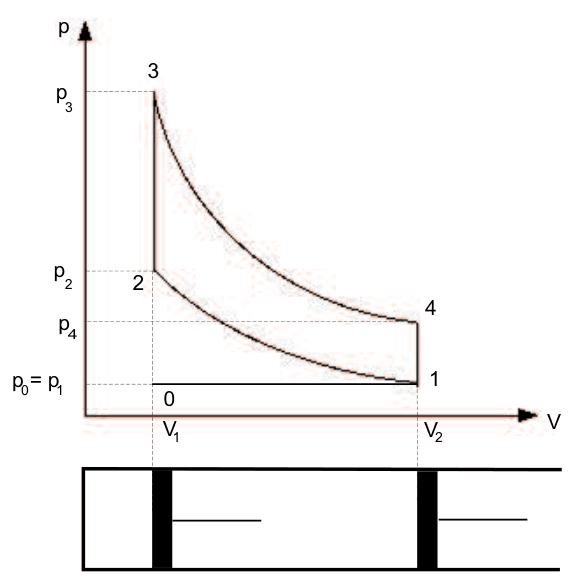
Figure 1:
a) Which processes run between the points 0–1, 2–3, 4–1, 1–0?
b) Determine the pressure and the temperature in the states 1, 2, 3 and 4.
c) Find the thermal efficiency of the cycle.
d) Discuss obtained results. Are they realistic?
Official English text of the problem.
Problem 2: Colours of a soap film
Dipping the frame in a soap solution, the soap forms a rectangle film of length \(b\) and height \(h\). White light falls on the film at an angle \(\alpha\) (measured with respect to the normal direction). The reflected light displays a green color of wavelength \(\lambda_0\).
a) Find out if it is possible to determine the mass of the soap film using the laboratory scales which has calibration accuracy of \(0.1\ \mathrm{mg}\).
b) What color does the thinnest possible soap film display being seen from the perpendicular direction? Derive the related equations.
Constants and given data: relative refractive index \(n = 1.33\), the wavelength of the reflected green light \(\lambda_0 = 500\ \mathrm{nm}\), \(\alpha = 30^\circ\), \(b = 0.020\ \mathrm{m}\), \(h = 0.030\ \mathrm{m}\), density \(\varrho = 1000\ \mathrm{kg\,m^{-3}}\).
Official English text of the problem.
Problem 3: Electron beam aimed at a target by a magnetic field
An electron gun \(T\) emits electrons accelerated by a potential difference \(U\) in a vacuum in the direction of the line \(a\) as shown in Fig. 2. The target \(M\) is placed at a distance \(d\) from the electron gun in such a way that the line segment connecting the points \(T\) and \(M\) and the line \(a\) subtend the angle \(\alpha\) as shown in Fig. 2. Find the magnetic induction \(B\) of the uniform magnetic field
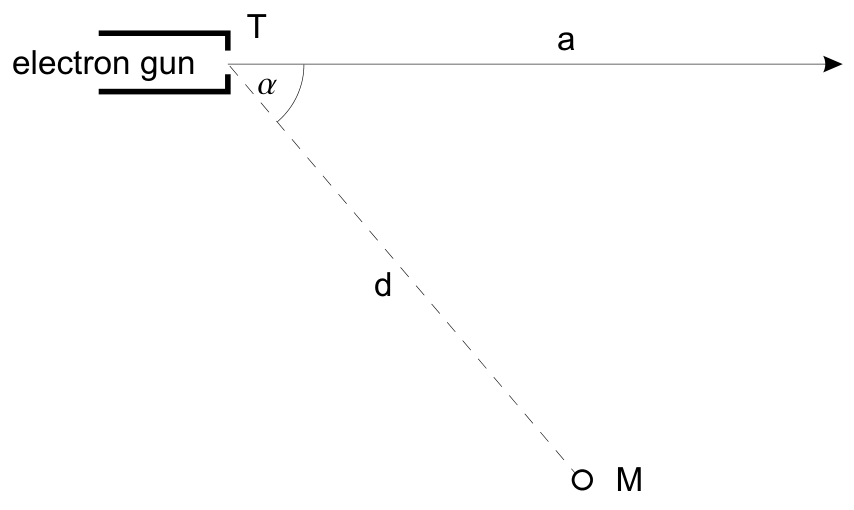
Figure 2:
a) perpendicular to the plane determined by the line \(a\) and the point \(M\)
b) parallel to the segment \(TM\)
in order that the electrons hit the target \(M\). Find first the general solution and then substitute the following values: \(U = 1000\ \mathrm{V}\), \(e = 1.60 \cdot 10^{-19}\ \mathrm{C}\), \(m_e = 9.11 \cdot 10^{-31}\ \mathrm{kg}\), \(\alpha = 60^\circ\), \(d = 5.0\ \mathrm{cm}\), \(B < 0.030\ \mathrm{T}\).
Official English text of the problem.
Internationale Physik-Olympiade
IPhO 1977
Hradec Králové, Tschechoslowakei · 3 Theorieaufgaben mit vollständigen Lösungen
Aufgabe 1: Otto-Kreisprozess eines Viertakt-Verbrennungsmotors
Das Verdichtungsverhältnis eines Viertakt-Verbrennungsmotors beträgt \(\varepsilon = 9.5\). Der Motor saugt Luft und gasförmigen Kraftstoff bei einer Temperatur von \(27^\circ\mathrm{C}\) und einem Druck von \(1\ \mathrm{atm} = 100\ \mathrm{kPa}\) an. Die Verdichtung verläuft adiabatisch von Punkt 1 nach Punkt 2, siehe Abb. 1. Bei der Zündung des Gemisches (2–3) verdoppelt sich der Druck im Zylinder. Das heiße Abgas expandiert adiabatisch auf das Volumen \(V_2\) und drückt dabei den Kolben nach unten (3–4). Anschließend öffnet sich das Auslassventil, und der Druck sinkt wieder auf den Anfangswert von \(1\ \mathrm{atm}\). Alle Vorgänge im Zylinder werden als ideal angenommen. Der Poisson-Exponent (d. h. das Verhältnis der spezifischen Wärmekapazitäten \(C_p/C_V\)) für das Gemisch und das Abgas beträgt \(\kappa = 1.40\). (Das Verdichtungsverhältnis ist das Verhältnis des Zylindervolumens bei unterster Kolbenstellung zum Volumen bei oberster Kolbenstellung.)
Abbildung 1:
a) Welche Vorgänge laufen zwischen den Punkten 0–1, 2–3, 4–1, 1–0 ab?
b) Bestimmen Sie den Druck und die Temperatur in den Zuständen 1, 2, 3 und 4.
c) Bestimmen Sie den thermischen Wirkungsgrad des Kreisprozesses.
d) Diskutieren Sie die erhaltenen Ergebnisse. Sind sie realistisch?
Aufgabentext aus dem offiziellen englischen Text übersetzt.
Aufgabe 2: Farben einer Seifenhaut
Beim Eintauchen des Rahmens in eine Seifenlösung bildet sich eine rechteckige Seifenhaut der Länge \(b\) und der Höhe \(h\). Weißes Licht fällt unter einem Winkel \(\alpha\) (gemessen zum Lot) auf die Seifenhaut. Das reflektierte Licht zeigt eine grüne Farbe mit der Wellenlänge \(\lambda_0\).
a) Untersuchen Sie, ob sich die Masse der Seifenhaut mit einer Laborwaage bestimmen lässt, deren Kalibriergenauigkeit \(0.1\ \mathrm{mg}\) beträgt.
b) Welche Farbe zeigt die dünnste mögliche Seifenhaut bei senkrechter Betrachtung? Leiten Sie die zugehörigen Gleichungen her.
Konstanten und gegebene Daten: relative Brechzahl \(n = 1.33\), Wellenlänge des reflektierten grünen Lichts \(\lambda_0 = 500\ \mathrm{nm}\), \(\alpha = 30^\circ\), \(b = 0.020\ \mathrm{m}\), \(h = 0.030\ \mathrm{m}\), Dichte \(\varrho = 1000\ \mathrm{kg\,m^{-3}}\).
Aufgabentext aus dem offiziellen englischen Text übersetzt.
Aufgabe 3: Ein durch ein Magnetfeld auf ein Ziel gelenkter Elektronenstrahl
Eine Elektronenkanone \(T\) emittiert im Vakuum Elektronen, die durch eine Potentialdifferenz \(U\) beschleunigt werden, in Richtung der Geraden \(a\), wie in Abb. 2 dargestellt. Das Ziel \(M\) befindet sich im Abstand \(d\) von der Elektronenkanone, und zwar so, dass die Verbindungsstrecke zwischen den Punkten \(T\) und \(M\) mit der Geraden \(a\) den Winkel \(\alpha\) einschließt, wie in Abb. 2 dargestellt. Bestimmen Sie die magnetische Flussdichte \(B\) des homogenen Magnetfeldes
Abbildung 2:
a) senkrecht zu der durch die Gerade \(a\) und den Punkt \(M\) bestimmten Ebene
b) parallel zur Strecke \(TM\)
so, dass die Elektronen das Ziel \(M\) treffen. Bestimmen Sie zunächst die allgemeine Lösung und setzen Sie anschließend die folgenden Werte ein: \(U = 1000\ \mathrm{V}\), \(e = 1.60 \cdot 10^{-19}\ \mathrm{C}\), \(m_e = 9.11 \cdot 10^{-31}\ \mathrm{kg}\), \(\alpha = 60^\circ\), \(d = 5.0\ \mathrm{cm}\), \(B < 0.030\ \mathrm{T}\).
Aufgabentext aus dem offiziellen englischen Text übersetzt.
Uluslararası Fizik Olimpiyatı
IPhO 1977
Hradec Králové, Çekoslovakya · 3 teori sorusu, tam çözümleriyle
Soru 1: Dört zamanlı bir içten yanmalı motorun Otto çevrimi
Dört zamanlı bir içten yanmalı motorun sıkıştırma oranı \(\varepsilon = 9.5\) değerindedir. Motor, \(27^\circ\mathrm{C}\) sıcaklıkta ve \(1\ \mathrm{atm} = 100\ \mathrm{kPa}\) basınçta hava ve gaz yakıt emer. Sıkıştırma, 1 noktasından 2 noktasına kadar adyabatik bir süreç izler; bkz. Şekil 1. Karışımın ateşlenmesi sırasında (2–3) silindirdeki basınç iki katına çıkar. Sıcak egzoz gazı, pistonu aşağı doğru iterek adyabatik olarak \(V_2\) hacmine kadar genleşir (3–4). Ardından egzoz supabı açılır ve basınç başlangıçtaki \(1\ \mathrm{atm}\) değerine döner. Silindirdeki tüm süreçlerin ideal olduğu varsayılmaktadır. Karışım ve egzoz gazı için Poisson sabiti (yani özgül ısıların oranı \(C_p/C_V\)) \(\kappa = 1.40\) değerindedir. (Sıkıştırma oranı, piston en alt konumdayken silindirin hacminin, piston en üst konumdayken silindirin hacmine oranıdır.)
Şekil 1:
a) 0–1, 2–3, 4–1, 1–0 noktaları arasında hangi süreçler gerçekleşir?
b) 1, 2, 3 ve 4 durumlarındaki basınç ve sıcaklığı belirleyin.
c) Çevrimin ısıl verimini bulun.
d) Elde edilen sonuçları tartışın. Gerçekçi midirler?
Soru metni resmi İngilizce metinden çevrilmiştir.
Soru 2: Sabun filminin renkleri
Çerçeve bir sabun çözeltisine daldırıldığında sabun, uzunluğu \(b\) ve yüksekliği \(h\) olan dikdörtgen bir film oluşturur. Beyaz ışık filme \(\alpha\) açısıyla (normal doğrultusuna göre ölçülen) düşer. Yansıyan ışık, dalga boyu \(\lambda_0\) olan yeşil bir renk gösterir.
a) Kalibrasyon doğruluğu \(0.1\ \mathrm{mg}\) olan laboratuvar terazisi kullanılarak sabun filminin kütlesinin belirlenip belirlenemeyeceğini bulun.
b) Mümkün olan en ince sabun filmi, dik doğrultudan bakıldığında hangi renkte görünür? İlgili denklemleri türetin.
Sabitler ve verilen bilgiler: bağıl kırılma indisi \(n = 1.33\), yansıyan yeşil ışığın dalga boyu \(\lambda_0 = 500\ \mathrm{nm}\), \(\alpha = 30^\circ\), \(b = 0.020\ \mathrm{m}\), \(h = 0.030\ \mathrm{m}\), yoğunluk \(\varrho = 1000\ \mathrm{kg\,m^{-3}}\).
Soru metni resmi İngilizce metinden çevrilmiştir.
Soru 3: Manyetik alanla bir hedefe yönlendirilen elektron demeti
Bir elektron tabancası \(T\), vakumda \(U\) potansiyel farkıyla hızlandırılmış elektronları Şekil 2'de gösterildiği gibi \(a\) doğrusu yönünde yaymaktadır. \(M\) hedefi, elektron tabancasından \(d\) uzaklığa, \(T\) ve \(M\) noktalarını birleştiren doğru parçası ile \(a\) doğrusu arasında Şekil 2'de gösterildiği gibi \(\alpha\) açısı olacak şekilde yerleştirilmiştir. Elektronların \(M\) hedefine çarpması için düzgün manyetik alanın
Şekil 2:
a) \(a\) doğrusu ve \(M\) noktası tarafından belirlenen düzleme dik
b) \(TM\) doğru parçasına paralel
olduğu durumlarda manyetik indüksiyon \(B\)'yi bulunuz. Önce genel çözümü bulunuz, ardından şu değerleri yerine koyunuz: \(U = 1000\ \mathrm{V}\), \(e = 1.60 \cdot 10^{-19}\ \mathrm{C}\), \(m_e = 9.11 \cdot 10^{-31}\ \mathrm{kg}\), \(\alpha = 60^\circ\), \(d = 5.0\ \mathrm{cm}\), \(B < 0.030\ \mathrm{T}\).
Soru metni resmi İngilizce metinden çevrilmiştir.
Olimpiada Internacional de Física
IPhO 1977
Hradec Králové, Checoslovaquia · 3 problemas teóricos con soluciones completas
Problema 1: Ciclo Otto de un motor de combustión de cuatro tiempos
La relación de compresión de un motor de combustión interna de cuatro tiempos es \(\varepsilon = 9.5\). El motor aspira aire y combustible gaseoso a una temperatura de \(27^\circ\mathrm{C}\) y a una presión de \(1\ \mathrm{atm} = 100\ \mathrm{kPa}\). La compresión sigue un proceso adiabático desde el punto 1 hasta el punto 2, véase la Fig. 1. La presión en el cilindro se duplica durante el encendido de la mezcla (2–3). Los gases de escape calientes se expanden adiabáticamente hasta el volumen \(V_2\), empujando el pistón hacia abajo (3–4). A continuación, se abre la válvula de escape y la presión vuelve al valor inicial de \(1\ \mathrm{atm}\). Se supone que todos los procesos en el cilindro son ideales. La constante de Poisson (es decir, la relación entre los calores específicos \(C_p/C_V\)) de la mezcla y de los gases de escape es \(\kappa = 1.40\). (La relación de compresión es el cociente entre el volumen del cilindro cuando el pistón está en su posición inferior y el volumen cuando el pistón está en su posición superior.)
Figura 1:
a) ¿Qué procesos tienen lugar entre los puntos 0–1, 2–3, 4–1, 1–0?
b) Determine la presión y la temperatura en los estados 1, 2, 3 y 4.
c) Halle el rendimiento térmico del ciclo.
d) Analice los resultados obtenidos. ¿Son realistas?
Enunciado traducido del texto oficial en inglés.
Problema 2: Colores de una película de jabón
Al sumergir el marco en una disolución jabonosa, el jabón forma una película rectangular de longitud \(b\) y altura \(h\). Sobre la película incide luz blanca con un ángulo \(\alpha\) (medido respecto a la dirección normal). La luz reflejada presenta un color verde de longitud de onda \(\lambda_0\).
a) Determine si es posible medir la masa de la película de jabón utilizando una balanza de laboratorio cuya exactitud de calibración es de \(0.1\ \mathrm{mg}\).
b) ¿Qué color presenta la película de jabón más delgada posible al observarla desde la dirección perpendicular? Deduzca las ecuaciones correspondientes.
Constantes y datos: índice de refracción relativo \(n = 1.33\), longitud de onda de la luz verde reflejada \(\lambda_0 = 500\ \mathrm{nm}\), \(\alpha = 30^\circ\), \(b = 0.020\ \mathrm{m}\), \(h = 0.030\ \mathrm{m}\), densidad \(\varrho = 1000\ \mathrm{kg\,m^{-3}}\).
Enunciado traducido del texto oficial en inglés.
Problema 3: Haz de electrones dirigido hacia un blanco mediante un campo magnético
Un cañón de electrones \(T\) emite electrones acelerados por una diferencia de potencial \(U\) en el vacío en la dirección de la recta \(a\), como se muestra en la Fig. 2. El blanco \(M\) se coloca a una distancia \(d\) del cañón de electrones de tal manera que el segmento que une los puntos \(T\) y \(M\) y la recta \(a\) forman el ángulo \(\alpha\), como se muestra en la Fig. 2. Halle la inducción magnética \(B\) del campo magnético uniforme
Figura 2:
a) perpendicular al plano determinado por la recta \(a\) y el punto \(M\)
b) paralelo al segmento \(TM\)
para que los electrones alcancen el blanco \(M\). Halle primero la solución general y luego sustituya los siguientes valores: \(U = 1000\ \mathrm{V}\), \(e = 1.60 \cdot 10^{-19}\ \mathrm{C}\), \(m_e = 9.11 \cdot 10^{-31}\ \mathrm{kg}\), \(\alpha = 60^\circ\), \(d = 5.0\ \mathrm{cm}\), \(B < 0.030\ \mathrm{T}\).
Enunciado traducido del texto oficial en inglés.
国际物理奥林匹克
IPhO 1977
捷克斯洛伐克赫拉德茨-克拉洛韦 · 3 道理论题及完整解答
题目 1:四冲程内燃机的奥托循环
一台四冲程内燃机的压缩比为 \(\varepsilon = 9.5\)。发动机吸入温度为 \(27^\circ\mathrm{C}\)、压强为 \(1\ \mathrm{atm} = 100\ \mathrm{kPa}\) 的空气和气体燃料。从点 1 到点 2 的压缩过程为绝热过程,见图 1。混合气点火燃烧期间(2–3),气缸内的压强增至原来的两倍。高温废气绝热膨胀至体积 \(V_2\),推动活塞向下运动(3–4)。随后排气门打开,压强恢复到初始值 \(1\ \mathrm{atm}\)。假设气缸内的所有过程均为理想过程。混合气和废气的泊松常数(即比热容之比 \(C_p/C_V\))均为 \(\kappa = 1.40\)。(压缩比是活塞位于最下端时的气缸容积与活塞位于最上端时的气缸容积之比。)
图 1:
a) 点 0–1、2–3、4–1、1–0 之间分别发生什么过程?
b) 求状态 1、2、3 和 4 的压强与温度。
c) 求该循环的热效率。
d) 讨论所得结果。它们符合实际吗?
题目译自官方英文原文。
题目 2:肥皂膜的颜色
将框架浸入肥皂液中,肥皂液形成一层长为 \(b\)、高为 \(h\) 的矩形薄膜。白光以角度 \(\alpha\)(相对于法线方向测量)照射薄膜。反射光呈现波长为 \(\lambda_0\) 的绿色。
a) 判断能否使用校准精度为 \(0.1\ \mathrm{mg}\) 的实验室天平测定肥皂膜的质量。
b) 从垂直于膜面的方向观察时,可能的最薄肥皂膜呈现什么颜色?推导相关方程。
常量及已知数据:相对折射率 \(n = 1.33\),反射绿光的波长 \(\lambda_0 = 500\ \mathrm{nm}\),\(\alpha = 30^\circ\),\(b = 0.020\ \mathrm{m}\),\(h = 0.030\ \mathrm{m}\),密度 \(\varrho = 1000\ \mathrm{kg\,m^{-3}}\)。
题目译自官方英文原文。
题目 3:利用磁场使电子束射中靶
如图 2 所示,电子枪 \(T\) 在真空中发射经电势差 \(U\) 加速的电子,发射方向沿直线 \(a\)。靶 \(M\) 放置在距电子枪 \(d\) 处,使连接 \(T\) 点与 \(M\) 点的线段与直线 \(a\) 成角 \(\alpha\),如图 2 所示。求匀强磁场的磁感应强度 \(B\),其方向分别为
图 2:
a) 垂直于直线 \(a\) 和点 \(M\) 所确定的平面
b) 平行于线段 \(TM\)
使电子击中靶 \(M\)。先求一般解,再代入以下数值:\(U = 1000\ \mathrm{V}\)、\(e = 1.60 \cdot 10^{-19}\ \mathrm{C}\)、\(m_e = 9.11 \cdot 10^{-31}\ \mathrm{kg}\)、\(\alpha = 60^\circ\)、\(d = 5.0\ \mathrm{cm}\)、\(B < 0.030\ \mathrm{T}\)。
题目译自官方英文原文。
Международная физическая олимпиада
IPhO 1977
Градец-Кралове, Чехословакия · 3 теоретические задачи с полными решениями
Задача 1: Цикл Отто четырёхтактного двигателя внутреннего сгорания
Степень сжатия четырёхтактного двигателя внутреннего сгорания равна \(\varepsilon = 9.5\). В двигатель поступают воздух и газообразное топливо при температуре \(27^\circ\mathrm{C}\) и давлении \(1\ \mathrm{atm} = 100\ \mathrm{kPa}\). Сжатие происходит адиабатически от точки 1 до точки 2, см. рис. 1. При воспламенении смеси (2–3) давление в цилиндре удваивается. Горячие продукты сгорания адиабатически расширяются до объёма \(V_2\), толкая поршень вниз (3–4). Затем открывается выпускной клапан, и давление возвращается к начальному значению \(1\ \mathrm{atm}\). Все процессы в цилиндре считаются идеальными. Показатель адиабаты (то есть отношение теплоёмкостей \(C_p/C_V\)) смеси и продуктов сгорания равен \(\kappa = 1.40\). (Степень сжатия — это отношение объёма цилиндра при нижнем положении поршня к объёму при его верхнем положении.)
Рисунок 1:
a) Какие процессы происходят между точками 0–1, 2–3, 4–1, 1–0?
b) Определите давление и температуру в состояниях 1, 2, 3 и 4.
c) Найдите термический КПД цикла.
d) Обсудите полученные результаты. Реалистичны ли они?
Условие переведено с официального английского текста.
Задача 2: Цвета мыльной плёнки
При погружении рамки в мыльный раствор образуется прямоугольная мыльная плёнка длиной \(b\) и высотой \(h\). Белый свет падает на плёнку под углом \(\alpha\) (отсчитываемым от нормали). Отражённый свет имеет зелёный цвет с длиной волны \(\lambda_0\).
a) Выясните, можно ли определить массу мыльной плёнки с помощью лабораторных весов, точность калибровки которых составляет \(0.1\ \mathrm{mg}\).
b) Какой цвет имеет самая тонкая из возможных мыльных плёнок при наблюдении в направлении, перпендикулярном её поверхности? Выведите соответствующие уравнения.
Постоянные и исходные данные: относительный показатель преломления \(n = 1.33\), длина волны отражённого зелёного света \(\lambda_0 = 500\ \mathrm{nm}\), \(\alpha = 30^\circ\), \(b = 0.020\ \mathrm{m}\), \(h = 0.030\ \mathrm{m}\), плотность \(\varrho = 1000\ \mathrm{kg\,m^{-3}}\).
Условие переведено с официального английского текста.
Задача 3: Электронный пучок, направляемый на мишень магнитным полем
Электронная пушка \(T\) испускает в вакууме электроны, ускоренные разностью потенциалов \(U\), вдоль прямой \(a\), как показано на рис. 2. Мишень \(M\) расположена на расстоянии \(d\) от электронной пушки так, что отрезок, соединяющий точки \(T\) и \(M\), образует с прямой \(a\) угол \(\alpha\), как показано на рис. 2. Найдите магнитную индукцию \(B\) однородного магнитного поля
Рисунок 2:
a) перпендикулярного плоскости, определяемой прямой \(a\) и точкой \(M\)
b) параллельного отрезку \(TM\)
при которой электроны попадают в мишень \(M\). Сначала найдите общее решение, а затем подставьте следующие значения: \(U = 1000\ \mathrm{V}\), \(e = 1.60 \cdot 10^{-19}\ \mathrm{C}\), \(m_e = 9.11 \cdot 10^{-31}\ \mathrm{kg}\), \(\alpha = 60^\circ\), \(d = 5.0\ \mathrm{cm}\), \(B < 0.030\ \mathrm{T}\).
Условие переведено с официального английского текста.
الأولمبياد الدولي للفيزياء
IPhO 1977
هراديتس كرالوفيه، تشيكوسلوفاكيا · 3 مسائل نظرية مع حلول كاملة
المسألة 1: دورة أوتو لمحرك احتراق رباعي الأشواط
نسبة الانضغاط في محرك احتراق داخلي رباعي الأشواط هي \(\varepsilon = 9.5\). يسحب المحرك الهواء والوقود الغازي عند درجة حرارة \(27^\circ\mathrm{C}\) وضغط \(1\ \mathrm{atm} = 100\ \mathrm{kPa}\). يجري الانضغاط وفق عملية كظومة من النقطة 1 إلى النقطة 2، انظر الشكل 1. يتضاعف الضغط في الأسطوانة أثناء اشتعال الخليط (2–3). ويتمدد غاز العادم الساخن تمددًا كظومًا حتى الحجم \(V_2\)، دافعًا المكبس إلى أسفل (3–4). ثم ينفتح صمام العادم ويعود الضغط إلى قيمته الابتدائية البالغة \(1\ \mathrm{atm}\). يُفترض أن جميع العمليات في الأسطوانة مثالية. ثابت بواسون (أي نسبة السعتين الحراريتين النوعيتين \(C_p/C_V\)) للخليط ولغاز العادم هو \(\kappa = 1.40\). (نسبة الانضغاط هي نسبة حجم الأسطوانة عندما يكون المكبس في موضعه السفلي إلى حجمها عندما يكون المكبس في موضعه العلوي.)
الشكل 1:
a) ما العمليات التي تجري بين النقاط 0–1، 2–3، 4–1، 1–0؟
b) حدّد الضغط ودرجة الحرارة في الحالات 1 و2 و3 و4.
c) أوجد الكفاءة الحرارية للدورة.
d) ناقش النتائج التي حصلت عليها. هل هي واقعية؟
نص المسألة مترجم عن النص الإنجليزي الرسمي.
المسألة 2: ألوان غشاء صابوني
عند غمس الإطار في محلول صابوني، يتكوّن غشاء صابوني مستطيل طوله \(b\) وارتفاعه \(h\). يسقط ضوء أبيض على الغشاء بزاوية \(\alpha\) (مقيسة بالنسبة إلى اتجاه العمود على السطح). ويظهر الضوء المنعكس بلون أخضر ذي طول موجي \(\lambda_0\).
a) حدّد ما إذا كان من الممكن قياس كتلة الغشاء الصابوني باستخدام الميزان المخبري الذي تبلغ دقة معايرته \(0.1\ \mathrm{mg}\).
b) ما اللون الذي يظهر به أرقّ غشاء صابوني ممكن عند النظر إليه من الاتجاه العمودي؟ اشتق المعادلات ذات الصلة.
الثوابت والمعطيات: معامل الانكسار النسبي \(n = 1.33\)، والطول الموجي للضوء الأخضر المنعكس \(\lambda_0 = 500\ \mathrm{nm}\)، و\(\alpha = 30^\circ\)، و\(b = 0.020\ \mathrm{m}\)، و\(h = 0.030\ \mathrm{m}\)، والكثافة \(\varrho = 1000\ \mathrm{kg\,m^{-3}}\).
نص المسألة مترجم عن النص الإنجليزي الرسمي.
المسألة 3: حزمة إلكترونات موجَّهة نحو هدف بواسطة مجال مغناطيسي
يطلق مدفع إلكترونات \(T\) إلكترونات تُسرَّع بفرق جهد \(U\) في الفراغ في اتجاه المستقيم \(a\)، كما هو موضح في الشكل 2. يوضع الهدف \(M\) على مسافة \(d\) من مدفع الإلكترونات بحيث تصنع القطعة المستقيمة الواصلة بين النقطتين \(T\) و\(M\) زاوية \(\alpha\) مع المستقيم \(a\)، كما هو موضح في الشكل 2. أوجد الحث المغناطيسي \(B\) للمجال المغناطيسي المنتظم
الشكل 2:
a) العمودي على المستوى الذي يحدده المستقيم \(a\) والنقطة \(M\)
b) الموازي للقطعة المستقيمة \(TM\)
بحيث تصيب الإلكترونات الهدف \(M\). أوجد أولًا الحل العام، ثم عوِّض بالقيم الآتية: \(U = 1000\ \mathrm{V}\)، \(e = 1.60 \cdot 10^{-19}\ \mathrm{C}\)، \(m_e = 9.11 \cdot 10^{-31}\ \mathrm{kg}\)، \(\alpha = 60^\circ\)، \(d = 5.0\ \mathrm{cm}\)، \(B < 0.030\ \mathrm{T}\).
نص المسألة مترجم عن النص الإنجليزي الرسمي.