IPhO 1977 · Theory problem 3
Electron beam aimed at a target by a magnetic field
An electron gun \(T\) emits electrons accelerated by a potential difference \(U\) in a vacuum in the direction of the line \(a\) as shown in Fig. 2. The target \(M\) is placed at a distance \(d\) from the electron gun in such a way that the line segment connecting the points \(T\) and \(M\) and the line \(a\) subtend the angle \(\alpha\) as shown in Fig. 2. Find the magnetic induction \(B\) of the uniform magnetic field
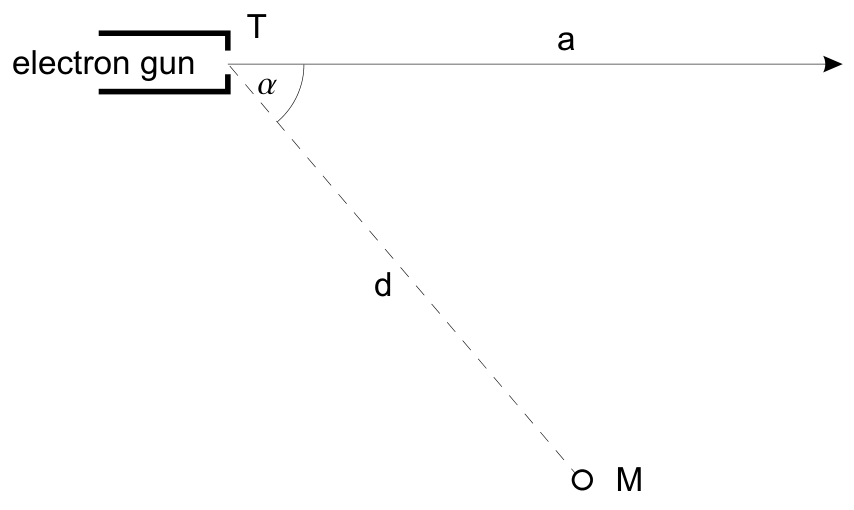
Figure 2:
a) perpendicular to the plane determined by the line \(a\) and the point \(M\)
b) parallel to the segment \(TM\)
in order that the electrons hit the target \(M\). Find first the general solution and then substitute the following values: \(U = 1000\ \mathrm{V}\), \(e = 1.60 \cdot 10^{-19}\ \mathrm{C}\), \(m_e = 9.11 \cdot 10^{-31}\ \mathrm{kg}\), \(\alpha = 60^\circ\), \(d = 5.0\ \mathrm{cm}\), \(B < 0.030\ \mathrm{T}\).
Official English text of the problem.
Answers
-
a) The field must point into the page in Fig. 2, with magnitude \[ \boxed{B=\frac{2\sin\alpha}{d}\sqrt{\frac{2m_eU}{e}} \simeq 3.7\times10^{-3}\ \mathrm{T}.} \]
-
b) Either direction parallel to \(TM\) is possible. The allowed magnitudes are \[ \boxed{B_n=\frac{2\pi n\cos\alpha}{d}\sqrt{\frac{2m_eU}{e}}, \qquad n=1,2,3,\ldots.} \] With the supplied values and \(B<0.030\ \mathrm{T}\), only \(n=1,2,3,4\) are allowed: \[ \boxed{B\simeq 6.7\times10^{-3},\quad 1.3\times10^{-2},\quad 2.0\times10^{-2},\quad 2.7\times10^{-2}\ \mathrm{T}.} \]
Solution
Let \(e>0\) denote the magnitude of the electron charge, so the charge is \(-e\). We use nonrelativistic mechanics, neglect the initial kinetic energy before acceleration, and consider motion in the uniform magnetic field after the electrons leave the gun.
The accelerating potential supplies kinetic energy: \[ \frac12m_ev^2=eU, \qquad v=\sqrt{\frac{2eU}{m_e}}. \] The magnetic force \[ \mathbf F=-e\,\mathbf v\times\mathbf B \] is perpendicular to the velocity and therefore does no work. Consequently, the speed remains constant throughout the trajectory.
a) Field perpendicular to the plane of the figure
The velocity remains perpendicular to the magnetic field. The magnetic force provides the centripetal force for circular motion: \[ evB=\frac{m_ev^2}{R}, \qquad R=\frac{m_ev}{eB}. \]
Take \(T=(0,0)\), with the initial velocity along the positive \(x\)-axis and the positive \(y\)-axis upward in the figure. Then \[ M=(d\cos\alpha,-d\sin\alpha). \] The orbit must bend downward, so its centre is \(C=(0,-R)\). Requiring \(M\) to lie on this circle gives \[ (d\cos\alpha)^2+(R-d\sin\alpha)^2=R^2. \] Thus \[ d^2-2Rd\sin\alpha=0, \qquad R=\frac{d}{2\sin\alpha}. \] Combining the geometrical and dynamical expressions for \(R\), \[ \boxed{B=\frac{2m_ev\sin\alpha}{ed} =\frac{2\sin\alpha}{d}\sqrt{\frac{2m_eU}{e}}.} \]
To determine the direction, note that an electron initially moving to the right must experience a downward force. Because its charge is negative, the field must point into the page.
For the supplied data, \[ v=\sqrt{\frac{2(1.60\times10^{-19})(1000)} {9.11\times10^{-31}}} \simeq1.87\times10^7\ \mathrm{m\,s^{-1}}, \] consistent with the nonrelativistic approximation. The required radius is \[ R=\frac{0.050}{2\sin60^\circ} \simeq2.9\times10^{-2}\ \mathrm{m}, \] and the field is \[ B=3.6966\ldots\times10^{-3}\ \mathrm{T} \simeq\boxed{3.7\times10^{-3}\ \mathrm{T}}. \] This satisfies \(B<0.030\ \mathrm{T}\).
b) Field parallel to \(TM\)
Resolve the initial velocity into components along \(TM\) and perpendicular to it: \[ v_\parallel=v\cos\alpha, \qquad v_\perp=v\sin\alpha. \] The parallel component remains constant because the magnetic force has no component along the field. The perpendicular component produces uniform circular motion, so the complete trajectory is a helix whose axis is parallel to \(TM\).
For the circular motion, \[ ev_\perp B=\frac{m_ev_\perp^2}{r}, \qquad \omega=\frac{v_\perp}{r}=\frac{eB}{m_e}. \] Hence its period is \[ P=\frac{2\pi}{\omega}=\frac{2\pi m_e}{eB}. \]
Since \(T\) and \(M\) differ only in position along the field direction, the electron must return to its initial transverse position when it reaches \(M\). For \(v_\perp\ne0\), this happens precisely after an integer number \(n\) of complete revolutions: \[ t=nP,\qquad n=1,2,3,\ldots. \] During this time, the displacement along \(TM\) must equal \(d\): \[ d=v\cos\alpha\,nP =v\cos\alpha\,\frac{2\pi n m_e}{eB}. \] Therefore, \[ \boxed{B_n=\frac{2\pi n m_ev\cos\alpha}{ed} =\frac{2\pi n\cos\alpha}{d} \sqrt{\frac{2m_eU}{e}}, \qquad n=1,2,3,\ldots.} \]
Reversing the magnetic field reverses the sense of rotation but leaves both the period and the motion along \(TM\) unchanged. Thus both field directions parallel to \(TM\) work.
For the numerical data, the fundamental field magnitude is \[ B_1=\frac{2\pi\cos60^\circ}{0.050} \sqrt{\frac{2(9.11\times10^{-31})(1000)} {1.60\times10^{-19}}} =0.0067049\ldots\ \mathrm{T}. \] The upper bound requires \[ nB_1<0.030\ \mathrm{T}, \qquad n<4.4743\ldots. \] Thus the allowed integers and corresponding fields, rounded to two significant figures, are
| Number of complete revolutions \(n\) | Magnetic induction \(B_n\) |
|---|---|
| 1 | \(6.7\times10^{-3}\ \mathrm{T}\) |
| 2 | \(1.3\times10^{-2}\ \mathrm{T}\) |
| 3 | \(2.0\times10^{-2}\ \mathrm{T}\) |
| 4 | \(2.7\times10^{-2}\ \mathrm{T}\) |
The next value, \(B_5\simeq0.0335\ \mathrm{T}\), exceeds the limit.
These discrete solutions apply to the acute, nonzero angle shown. If \(\alpha=0\), the electrons already travel along \(TM\), and any parallel magnetic field leaves that straight motion unchanged. If \(\cos\alpha\le0\), the electrons cannot reach a target a positive distance along \(TM\), because their velocity component in that direction cannot increase.
The solution was checked against the official solution.
IPhO 1977 · Theorieaufgabe 3
Ein durch ein Magnetfeld auf ein Ziel gelenkter Elektronenstrahl
Eine Elektronenkanone \(T\) emittiert im Vakuum Elektronen, die durch eine Potentialdifferenz \(U\) beschleunigt werden, in Richtung der Geraden \(a\), wie in Abb. 2 dargestellt. Das Ziel \(M\) befindet sich im Abstand \(d\) von der Elektronenkanone, und zwar so, dass die Verbindungsstrecke zwischen den Punkten \(T\) und \(M\) mit der Geraden \(a\) den Winkel \(\alpha\) einschließt, wie in Abb. 2 dargestellt. Bestimmen Sie die magnetische Flussdichte \(B\) des homogenen Magnetfeldes
Abbildung 2:
a) senkrecht zu der durch die Gerade \(a\) und den Punkt \(M\) bestimmten Ebene
b) parallel zur Strecke \(TM\)
so, dass die Elektronen das Ziel \(M\) treffen. Bestimmen Sie zunächst die allgemeine Lösung und setzen Sie anschließend die folgenden Werte ein: \(U = 1000\ \mathrm{V}\), \(e = 1.60 \cdot 10^{-19}\ \mathrm{C}\), \(m_e = 9.11 \cdot 10^{-31}\ \mathrm{kg}\), \(\alpha = 60^\circ\), \(d = 5.0\ \mathrm{cm}\), \(B < 0.030\ \mathrm{T}\).
Aufgabentext aus dem offiziellen englischen Text übersetzt.
Antworten
-
a) Das Feld muss in Abb. 2 in die Zeichenebene hinein gerichtet sein und den folgenden Betrag haben: \[ \boxed{B=\frac{2\sin\alpha}{d}\sqrt{\frac{2m_eU}{e}} \simeq 3.7\times10^{-3}\ \mathrm{T}.} \]
-
b) Beide Richtungen parallel zu \(TM\) sind möglich. Die zulässigen Beträge sind \[ \boxed{B_n=\frac{2\pi n\cos\alpha}{d}\sqrt{\frac{2m_eU}{e}}, \qquad n=1,2,3,\ldots.} \] Mit den angegebenen Werten und \(B<0.030\ \mathrm{T}\) sind nur \(n=1,2,3,4\) zulässig: \[ \boxed{B\simeq 6.7\times10^{-3},\quad 1.3\times10^{-2},\quad 2.0\times10^{-2},\quad 2.7\times10^{-2}\ \mathrm{T}.} \]
Lösung
Es bezeichne \(e>0\) den Betrag der Elektronenladung, sodass die Ladung \(-e\) beträgt. Wir verwenden die nichtrelativistische Mechanik, vernachlässigen die anfängliche kinetische Energie vor der Beschleunigung und betrachten die Bewegung im homogenen Magnetfeld, nachdem die Elektronen die Kanone verlassen haben.
Die Beschleunigungsspannung liefert die kinetische Energie: \[ \frac12m_ev^2=eU, \qquad v=\sqrt{\frac{2eU}{m_e}}. \] Die magnetische Kraft \[ \mathbf F=-e\,\mathbf v\times\mathbf B \] steht senkrecht zur Geschwindigkeit und verrichtet daher keine Arbeit. Folglich bleibt der Betrag der Geschwindigkeit entlang der gesamten Bahn konstant.
a) Feld senkrecht zur Zeichenebene
Die Geschwindigkeit bleibt senkrecht zum Magnetfeld. Die magnetische Kraft liefert die Zentripetalkraft für eine Kreisbewegung: \[ evB=\frac{m_ev^2}{R}, \qquad R=\frac{m_ev}{eB}. \]
Wir wählen \(T=(0,0)\), wobei die Anfangsgeschwindigkeit entlang der positiven \(x\)-Achse und die positive \(y\)-Achse in der Abbildung nach oben gerichtet ist. Dann gilt \[ M=(d\cos\alpha,-d\sin\alpha). \] Die Bahn muss nach unten gekrümmt sein, sodass ihr Mittelpunkt bei \(C=(0,-R)\) liegt. Aus der Bedingung, dass \(M\) auf diesem Kreis liegt, folgt \[ (d\cos\alpha)^2+(R-d\sin\alpha)^2=R^2. \] Damit ergibt sich \[ d^2-2Rd\sin\alpha=0, \qquad R=\frac{d}{2\sin\alpha}. \] Durch Kombination der geometrischen und dynamischen Ausdrücke für \(R\) erhalten wir \[ \boxed{B=\frac{2m_ev\sin\alpha}{ed} =\frac{2\sin\alpha}{d}\sqrt{\frac{2m_eU}{e}}.} \]
Zur Bestimmung der Richtung beachten wir, dass auf ein Elektron, das sich anfangs nach rechts bewegt, eine nach unten gerichtete Kraft wirken muss. Da seine Ladung negativ ist, muss das Feld in die Zeichenebene hinein gerichtet sein.
Für die angegebenen Daten gilt \[ v=\sqrt{\frac{2(1.60\times10^{-19})(1000)} {9.11\times10^{-31}}} \simeq1.87\times10^7\ \mathrm{m\,s^{-1}}, \] was mit der nichtrelativistischen Näherung vereinbar ist. Der erforderliche Radius beträgt \[ R=\frac{0.050}{2\sin60^\circ} \simeq2.9\times10^{-2}\ \mathrm{m}, \] und die magnetische Flussdichte ist \[ B=3.6966\ldots\times10^{-3}\ \mathrm{T} \simeq\boxed{3.7\times10^{-3}\ \mathrm{T}}. \] Damit ist \(B<0.030\ \mathrm{T}\) erfüllt.
b) Feld parallel zu \(TM\)
Wir zerlegen die Anfangsgeschwindigkeit in Komponenten entlang \(TM\) und senkrecht dazu: \[ v_\parallel=v\cos\alpha, \qquad v_\perp=v\sin\alpha. \] Die parallele Komponente bleibt konstant, da die magnetische Kraft keine Komponente in Feldrichtung besitzt. Die senkrechte Komponente führt zu einer gleichförmigen Kreisbewegung, sodass die gesamte Bahn eine Schraubenlinie ist, deren Achse parallel zu \(TM\) verläuft.
Für die Kreisbewegung gilt \[ ev_\perp B=\frac{m_ev_\perp^2}{r}, \qquad \omega=\frac{v_\perp}{r}=\frac{eB}{m_e}. \] Ihre Umlaufzeit ist daher \[ P=\frac{2\pi}{\omega}=\frac{2\pi m_e}{eB}. \]
Da sich \(T\) und \(M\) nur in ihrer Position entlang der Feldrichtung unterscheiden, muss das Elektron beim Erreichen von \(M\) zu seiner anfänglichen Position senkrecht zur Feldrichtung zurückgekehrt sein. Für \(v_\perp\ne0\) geschieht dies genau nach einer ganzzahligen Anzahl \(n\) vollständiger Umläufe: \[ t=nP,\qquad n=1,2,3,\ldots. \] Während dieser Zeit muss die Verschiebung entlang \(TM\) gleich \(d\) sein: \[ d=v\cos\alpha\,nP =v\cos\alpha\,\frac{2\pi n m_e}{eB}. \] Somit gilt \[ \boxed{B_n=\frac{2\pi n m_ev\cos\alpha}{ed} =\frac{2\pi n\cos\alpha}{d} \sqrt{\frac{2m_eU}{e}}, \qquad n=1,2,3,\ldots.} \]
Eine Umkehrung des Magnetfeldes kehrt den Drehsinn um, lässt jedoch sowohl die Umlaufzeit als auch die Bewegung entlang \(TM\) unverändert. Somit führen beide Feldrichtungen parallel zu \(TM\) zum Ziel.
Für die angegebenen Zahlenwerte beträgt der Grundwert der magnetischen Flussdichte \[ B_1=\frac{2\pi\cos60^\circ}{0.050} \sqrt{\frac{2(9.11\times10^{-31})(1000)} {1.60\times10^{-19}}} =0.0067049\ldots\ \mathrm{T}. \] Die obere Grenze erfordert \[ nB_1<0.030\ \mathrm{T}, \qquad n<4.4743\ldots. \] Damit ergeben sich die folgenden zulässigen ganzen Zahlen und zugehörigen magnetischen Flussdichten, gerundet auf zwei signifikante Stellen:
| Anzahl vollständiger Umläufe \(n\) | Magnetische Flussdichte \(B_n\) |
|---|---|
| 1 | \(6.7\times10^{-3}\ \mathrm{T}\) |
| 2 | \(1.3\times10^{-2}\ \mathrm{T}\) |
| 3 | \(2.0\times10^{-2}\ \mathrm{T}\) |
| 4 | \(2.7\times10^{-2}\ \mathrm{T}\) |
Der nächste Wert, \(B_5\simeq0.0335\ \mathrm{T}\), überschreitet die Grenze.
Diese diskreten Lösungen gelten für den dargestellten spitzen, von null verschiedenen Winkel. Ist \(\alpha=0\), so bewegen sich die Elektronen bereits entlang \(TM\), und jedes parallele Magnetfeld lässt diese geradlinige Bewegung unverändert. Ist \(\cos\alpha\le0\), so können die Elektronen ein Ziel in einem positiven Abstand entlang \(TM\) nicht erreichen, da ihre Geschwindigkeitskomponente in dieser Richtung nicht zunehmen kann.
Die Lösung wurde mit der offiziellen Lösung abgeglichen.
IPhO 1977 · Teori sorusu 3
Manyetik alanla bir hedefe yönlendirilen elektron demeti
Bir elektron tabancası \(T\), vakumda \(U\) potansiyel farkıyla hızlandırılmış elektronları Şekil 2'de gösterildiği gibi \(a\) doğrusu yönünde yaymaktadır. \(M\) hedefi, elektron tabancasından \(d\) uzaklığa, \(T\) ve \(M\) noktalarını birleştiren doğru parçası ile \(a\) doğrusu arasında Şekil 2'de gösterildiği gibi \(\alpha\) açısı olacak şekilde yerleştirilmiştir. Elektronların \(M\) hedefine çarpması için düzgün manyetik alanın
Şekil 2:
a) \(a\) doğrusu ve \(M\) noktası tarafından belirlenen düzleme dik
b) \(TM\) doğru parçasına paralel
olduğu durumlarda manyetik indüksiyon \(B\)'yi bulunuz. Önce genel çözümü bulunuz, ardından şu değerleri yerine koyunuz: \(U = 1000\ \mathrm{V}\), \(e = 1.60 \cdot 10^{-19}\ \mathrm{C}\), \(m_e = 9.11 \cdot 10^{-31}\ \mathrm{kg}\), \(\alpha = 60^\circ\), \(d = 5.0\ \mathrm{cm}\), \(B < 0.030\ \mathrm{T}\).
Soru metni resmi İngilizce metinden çevrilmiştir.
Cevaplar
-
a) Alan, Şekil 2'de sayfanın içine doğru yönelmeli ve büyüklüğü \[ \boxed{B=\frac{2\sin\alpha}{d}\sqrt{\frac{2m_eU}{e}} \simeq 3.7\times10^{-3}\ \mathrm{T}.} \] olmalıdır.
-
b) \(TM\)'ye paralel her iki yön de mümkündür. İzin verilen büyüklükler \[ \boxed{B_n=\frac{2\pi n\cos\alpha}{d}\sqrt{\frac{2m_eU}{e}}, \qquad n=1,2,3,\ldots.} \] şeklindedir. Verilen değerler ve \(B<0.030\ \mathrm{T}\) koşulu altında yalnızca \(n=1,2,3,4\) değerlerine izin verilir: \[ \boxed{B\simeq 6.7\times10^{-3},\quad 1.3\times10^{-2},\quad 2.0\times10^{-2},\quad 2.7\times10^{-2}\ \mathrm{T}.} \]
Çözüm
\(e>0\), elektronun yükünün büyüklüğünü göstersin; bu durumda yükü \(-e\)'dir. Göreli olmayan mekaniği kullanıyor, hızlandırma öncesindeki başlangıç kinetik enerjisini ihmal ediyor ve elektronların tabancadan çıktıktan sonra düzgün manyetik alandaki hareketini ele alıyoruz.
Hızlandırıcı potansiyel farkı kinetik enerji sağlar: \[ \frac12m_ev^2=eU, \qquad v=\sqrt{\frac{2eU}{m_e}}. \] Manyetik kuvvet \[ \mathbf F=-e\,\mathbf v\times\mathbf B \] hıza diktir ve dolayısıyla iş yapmaz. Bu nedenle sürat, yörünge boyunca sabit kalır.
a) Şekil düzlemine dik alan
Hız, manyetik alana dik kalır. Manyetik kuvvet, çembersel hareket için gerekli merkezcil kuvveti sağlar: \[ evB=\frac{m_ev^2}{R}, \qquad R=\frac{m_ev}{eB}. \]
\(T=(0,0)\) alalım; başlangıç hızı pozitif \(x\) ekseni yönünde, pozitif \(y\) ekseni ise şekilde yukarı doğru olsun. Bu durumda \[ M=(d\cos\alpha,-d\sin\alpha). \] Yörünge aşağıya doğru kıvrılmalıdır; dolayısıyla merkezi \(C=(0,-R)\)'dir. \(M\)'nin bu çember üzerinde bulunması koşulu \[ (d\cos\alpha)^2+(R-d\sin\alpha)^2=R^2. \] eşitliğini verir. Böylece \[ d^2-2Rd\sin\alpha=0, \qquad R=\frac{d}{2\sin\alpha}. \] \(R\) için geometrik ve dinamik ifadeleri birleştirirsek, \[ \boxed{B=\frac{2m_ev\sin\alpha}{ed} =\frac{2\sin\alpha}{d}\sqrt{\frac{2m_eU}{e}}.} \]
Yönü belirlemek için, başlangıçta sağa doğru hareket eden bir elektrona aşağıya doğru bir kuvvet etki etmesi gerektiğine dikkat edelim. Yükü negatif olduğundan, alan sayfanın içine doğru yönelmelidir.
Verilen değerler için, \[ v=\sqrt{\frac{2(1.60\times10^{-19})(1000)} {9.11\times10^{-31}}} \simeq1.87\times10^7\ \mathrm{m\,s^{-1}}, \] bulunur; bu değer göreli olmayan yaklaşımla tutarlıdır. Gerekli yarıçap \[ R=\frac{0.050}{2\sin60^\circ} \simeq2.9\times10^{-2}\ \mathrm{m}, \] ve alan \[ B=3.6966\ldots\times10^{-3}\ \mathrm{T} \simeq\boxed{3.7\times10^{-3}\ \mathrm{T}}. \] olarak bulunur. Bu, \(B<0.030\ \mathrm{T}\) koşulunu sağlar.
b) \(TM\)'ye paralel alan
Başlangıç hızını \(TM\) doğrultusundaki ve ona dik bileşenlerine ayıralım: \[ v_\parallel=v\cos\alpha, \qquad v_\perp=v\sin\alpha. \] Manyetik kuvvetin alan doğrultusunda bir bileşeni olmadığından, paralel bileşen sabit kalır. Dik bileşen düzgün çembersel harekete yol açar; dolayısıyla tam yörünge, ekseni \(TM\)'ye paralel olan bir helistir.
Çembersel hareket için, \[ ev_\perp B=\frac{m_ev_\perp^2}{r}, \qquad \omega=\frac{v_\perp}{r}=\frac{eB}{m_e}. \] Buna göre periyodu \[ P=\frac{2\pi}{\omega}=\frac{2\pi m_e}{eB}. \] olur.
\(T\) ve \(M\) yalnızca alan doğrultusundaki konumları bakımından farklı olduğundan, elektron \(M\)'ye ulaştığında başlangıçtaki enine konumuna dönmüş olmalıdır. \(v_\perp\ne0\) için bu, tam olarak bir tam sayı \(n\) kadar tam tur atıldıktan sonra gerçekleşir: \[ t=nP,\qquad n=1,2,3,\ldots. \] Bu süre boyunca \(TM\) doğrultusundaki yer değiştirme \(d\)'ye eşit olmalıdır: \[ d=v\cos\alpha\,nP =v\cos\alpha\,\frac{2\pi n m_e}{eB}. \] Dolayısıyla, \[ \boxed{B_n=\frac{2\pi n m_ev\cos\alpha}{ed} =\frac{2\pi n\cos\alpha}{d} \sqrt{\frac{2m_eU}{e}}, \qquad n=1,2,3,\ldots.} \]
Manyetik alanın yönünü tersine çevirmek dönme yönünü tersine çevirir, ancak hem periyodu hem de \(TM\) doğrultusundaki hareketi değiştirmez. Dolayısıyla \(TM\)'ye paralel her iki alan yönü de hedefe ulaşmayı sağlar.
Verilen sayısal değerler için temel alan büyüklüğü \[ B_1=\frac{2\pi\cos60^\circ}{0.050} \sqrt{\frac{2(9.11\times10^{-31})(1000)} {1.60\times10^{-19}}} =0.0067049\ldots\ \mathrm{T}. \] olur. Üst sınır şu koşulu gerektirir: \[ nB_1<0.030\ \mathrm{T}, \qquad n<4.4743\ldots. \] Böylece izin verilen tam sayılar ve bunlara karşılık gelen, iki anlamlı basamağa yuvarlanmış alan değerleri şunlardır:
| Tam tur sayısı \(n\) | Manyetik indüksiyon \(B_n\) |
|---|---|
| 1 | \(6.7\times10^{-3}\ \mathrm{T}\) |
| 2 | \(1.3\times10^{-2}\ \mathrm{T}\) |
| 3 | \(2.0\times10^{-2}\ \mathrm{T}\) |
| 4 | \(2.7\times10^{-2}\ \mathrm{T}\) |
Bir sonraki değer olan \(B_5\simeq0.0335\ \mathrm{T}\), sınırı aşar.
Bu ayrık çözümler, şekilde gösterilen sıfırdan farklı dar açı için geçerlidir. Eğer \(\alpha=0\) ise elektronlar zaten \(TM\) doğrultusunda hareket eder ve herhangi bir paralel manyetik alan bu doğrusal hareketi değiştirmez. Eğer \(\cos\alpha\le0\) ise elektronlar, \(TM\) doğrultusunda pozitif bir uzaklıktaki hedefe ulaşamaz; çünkü bu yöndeki hız bileşenleri artamaz.
Çözüm, resmi çözümle karşılaştırılarak kontrol edildi.
IPhO 1977 · Problema teórico 3
Haz de electrones dirigido hacia un blanco mediante un campo magnético
Un cañón de electrones \(T\) emite electrones acelerados por una diferencia de potencial \(U\) en el vacío en la dirección de la recta \(a\), como se muestra en la Fig. 2. El blanco \(M\) se coloca a una distancia \(d\) del cañón de electrones de tal manera que el segmento que une los puntos \(T\) y \(M\) y la recta \(a\) forman el ángulo \(\alpha\), como se muestra en la Fig. 2. Halle la inducción magnética \(B\) del campo magnético uniforme
Figura 2:
a) perpendicular al plano determinado por la recta \(a\) y el punto \(M\)
b) paralelo al segmento \(TM\)
para que los electrones alcancen el blanco \(M\). Halle primero la solución general y luego sustituya los siguientes valores: \(U = 1000\ \mathrm{V}\), \(e = 1.60 \cdot 10^{-19}\ \mathrm{C}\), \(m_e = 9.11 \cdot 10^{-31}\ \mathrm{kg}\), \(\alpha = 60^\circ\), \(d = 5.0\ \mathrm{cm}\), \(B < 0.030\ \mathrm{T}\).
Enunciado traducido del texto oficial en inglés.
Respuestas
-
a) El campo debe apuntar hacia el interior de la página en la Fig. 2, con un módulo \[ \boxed{B=\frac{2\sin\alpha}{d}\sqrt{\frac{2m_eU}{e}} \simeq 3.7\times10^{-3}\ \mathrm{T}.} \]
-
b) Son posibles ambos sentidos paralelos a \(TM\). Los módulos permitidos son \[ \boxed{B_n=\frac{2\pi n\cos\alpha}{d}\sqrt{\frac{2m_eU}{e}}, \qquad n=1,2,3,\ldots.} \] Con los valores proporcionados y \(B<0.030\ \mathrm{T}\), solo se permiten \(n=1,2,3,4\): \[ \boxed{B\simeq 6.7\times10^{-3},\quad 1.3\times10^{-2},\quad 2.0\times10^{-2},\quad 2.7\times10^{-2}\ \mathrm{T}.} \]
Solución
Sea \(e>0\) el módulo de la carga del electrón, de modo que su carga es \(-e\). Utilizamos la mecánica no relativista, despreciamos la energía cinética inicial antes de la aceleración y consideramos el movimiento en el campo magnético uniforme después de que los electrones salgan del cañón.
La diferencia de potencial aceleradora proporciona energía cinética: \[ \frac12m_ev^2=eU, \qquad v=\sqrt{\frac{2eU}{m_e}}. \] La fuerza magnética \[ \mathbf F=-e\,\mathbf v\times\mathbf B \] es perpendicular a la velocidad y, por tanto, no realiza trabajo. En consecuencia, la rapidez permanece constante a lo largo de toda la trayectoria.
a) Campo perpendicular al plano de la figura
La velocidad permanece perpendicular al campo magnético. La fuerza magnética proporciona la fuerza centrípeta del movimiento circular: \[ evB=\frac{m_ev^2}{R}, \qquad R=\frac{m_ev}{eB}. \]
Tomemos \(T=(0,0)\), con la velocidad inicial dirigida a lo largo del semieje positivo \(x\) y el semieje positivo \(y\) orientado hacia arriba en la figura. Entonces \[ M=(d\cos\alpha,-d\sin\alpha). \] La órbita debe curvarse hacia abajo, por lo que su centro es \(C=(0,-R)\). Al exigir que \(M\) pertenezca a esta circunferencia, se obtiene \[ (d\cos\alpha)^2+(R-d\sin\alpha)^2=R^2. \] Por tanto, \[ d^2-2Rd\sin\alpha=0, \qquad R=\frac{d}{2\sin\alpha}. \] Combinando las expresiones geométrica y dinámica de \(R\), \[ \boxed{B=\frac{2m_ev\sin\alpha}{ed} =\frac{2\sin\alpha}{d}\sqrt{\frac{2m_eU}{e}}.} \]
Para determinar el sentido, observemos que un electrón que inicialmente se mueve hacia la derecha debe experimentar una fuerza hacia abajo. Como su carga es negativa, el campo debe apuntar hacia el interior de la página.
Para los datos proporcionados, \[ v=\sqrt{\frac{2(1.60\times10^{-19})(1000)} {9.11\times10^{-31}}} \simeq1.87\times10^7\ \mathrm{m\,s^{-1}}, \] lo que es coherente con la aproximación no relativista. El radio necesario es \[ R=\frac{0.050}{2\sin60^\circ} \simeq2.9\times10^{-2}\ \mathrm{m}, \] y el campo es \[ B=3.6966\ldots\times10^{-3}\ \mathrm{T} \simeq\boxed{3.7\times10^{-3}\ \mathrm{T}}. \] Este valor satisface \(B<0.030\ \mathrm{T}\).
b) Campo paralelo a \(TM\)
Descompongamos la velocidad inicial en una componente a lo largo de \(TM\) y otra perpendicular a ella: \[ v_\parallel=v\cos\alpha, \qquad v_\perp=v\sin\alpha. \] La componente paralela permanece constante porque la fuerza magnética no tiene componente en la dirección del campo. La componente perpendicular produce un movimiento circular uniforme, de modo que la trayectoria completa es una hélice cuyo eje es paralelo a \(TM\).
Para el movimiento circular, \[ ev_\perp B=\frac{m_ev_\perp^2}{r}, \qquad \omega=\frac{v_\perp}{r}=\frac{eB}{m_e}. \] Por consiguiente, su período es \[ P=\frac{2\pi}{\omega}=\frac{2\pi m_e}{eB}. \]
Como \(T\) y \(M\) solo difieren en su posición a lo largo de la dirección del campo, el electrón debe volver a su posición transversal inicial cuando llegue a \(M\). Para \(v_\perp\ne0\), esto sucede exactamente tras un número entero \(n\) de vueltas completas: \[ t=nP,\qquad n=1,2,3,\ldots. \] Durante este tiempo, el desplazamiento a lo largo de \(TM\) debe ser igual a \(d\): \[ d=v\cos\alpha\,nP =v\cos\alpha\,\frac{2\pi n m_e}{eB}. \] Por tanto, \[ \boxed{B_n=\frac{2\pi n m_ev\cos\alpha}{ed} =\frac{2\pi n\cos\alpha}{d} \sqrt{\frac{2m_eU}{e}}, \qquad n=1,2,3,\ldots.} \]
Invertir el campo magnético invierte el sentido de giro, pero deja inalterados tanto el período como el movimiento a lo largo de \(TM\). Por tanto, ambos sentidos del campo paralelo a \(TM\) permiten alcanzar el blanco.
Para los datos numéricos, el módulo fundamental del campo es \[ B_1=\frac{2\pi\cos60^\circ}{0.050} \sqrt{\frac{2(9.11\times10^{-31})(1000)} {1.60\times10^{-19}}} =0.0067049\ldots\ \mathrm{T}. \] El límite superior exige \[ nB_1<0.030\ \mathrm{T}, \qquad n<4.4743\ldots. \] Por tanto, los enteros permitidos y los campos correspondientes, redondeados a dos cifras significativas, son
| Número de vueltas completas \(n\) | Inducción magnética \(B_n\) |
|---|---|
| 1 | \(6.7\times10^{-3}\ \mathrm{T}\) |
| 2 | \(1.3\times10^{-2}\ \mathrm{T}\) |
| 3 | \(2.0\times10^{-2}\ \mathrm{T}\) |
| 4 | \(2.7\times10^{-2}\ \mathrm{T}\) |
El siguiente valor, \(B_5\simeq0.0335\ \mathrm{T}\), supera el límite.
Estas soluciones discretas se aplican al ángulo agudo y no nulo que se muestra. Si \(\alpha=0\), los electrones ya se desplazan a lo largo de \(TM\), y cualquier campo magnético paralelo deja inalterado ese movimiento rectilíneo. Si \(\cos\alpha\le0\), los electrones no pueden alcanzar un blanco situado a una distancia positiva a lo largo de \(TM\), porque su componente de velocidad en esa dirección no puede aumentar.
La solución se comprobó con la solución oficial.
IPhO 1977 · 理论题 3
利用磁场使电子束射中靶
如图 2 所示,电子枪 \(T\) 在真空中发射经电势差 \(U\) 加速的电子,发射方向沿直线 \(a\)。靶 \(M\) 放置在距电子枪 \(d\) 处,使连接 \(T\) 点与 \(M\) 点的线段与直线 \(a\) 成角 \(\alpha\),如图 2 所示。求匀强磁场的磁感应强度 \(B\),其方向分别为
图 2:
a) 垂直于直线 \(a\) 和点 \(M\) 所确定的平面
b) 平行于线段 \(TM\)
使电子击中靶 \(M\)。先求一般解,再代入以下数值:\(U = 1000\ \mathrm{V}\)、\(e = 1.60 \cdot 10^{-19}\ \mathrm{C}\)、\(m_e = 9.11 \cdot 10^{-31}\ \mathrm{kg}\)、\(\alpha = 60^\circ\)、\(d = 5.0\ \mathrm{cm}\)、\(B < 0.030\ \mathrm{T}\)。
题目译自官方英文原文。
答案
-
a) 磁场必须指向图 2 的纸面内,其大小为 \[ \boxed{B=\frac{2\sin\alpha}{d}\sqrt{\frac{2m_eU}{e}} \simeq 3.7\times10^{-3}\ \mathrm{T}.} \]
-
b) 平行于 \(TM\) 的两个方向均可。允许的磁感应强度大小为 \[ \boxed{B_n=\frac{2\pi n\cos\alpha}{d}\sqrt{\frac{2m_eU}{e}}, \qquad n=1,2,3,\ldots.} \] 代入所给数值,并考虑 \(B<0.030\ \mathrm{T}\) 的限制,只有 \(n=1,2,3,4\) 满足条件: \[ \boxed{B\simeq 6.7\times10^{-3},\quad 1.3\times10^{-2},\quad 2.0\times10^{-2},\quad 2.7\times10^{-2}\ \mathrm{T}.} \]
解答
用 \(e>0\) 表示电子电荷量的大小,因此电子所带电荷为 \(-e\)。采用非相对论力学,忽略电子加速前的初动能,并考察电子离开电子枪后在匀强磁场中的运动。
加速电势差提供动能: \[ \frac12m_ev^2=eU, \qquad v=\sqrt{\frac{2eU}{m_e}}. \] 磁场力 \[ \mathbf F=-e\,\mathbf v\times\mathbf B \] 垂直于速度,因此不做功。所以,电子在整个运动过程中速率保持不变。
a) 磁场垂直于图示平面
速度始终垂直于磁场。磁场力为圆周运动提供向心力: \[ evB=\frac{m_ev^2}{R}, \qquad R=\frac{m_ev}{eB}. \]
取 \(T=(0,0)\),初速度沿 \(x\) 轴正方向,\(y\) 轴正方向在图中向上。于是 \[ M=(d\cos\alpha,-d\sin\alpha). \] 轨道必须向下弯曲,因此其圆心为 \(C=(0,-R)\)。要求 \(M\) 位于此圆上,可得 \[ (d\cos\alpha)^2+(R-d\sin\alpha)^2=R^2. \] 因此 \[ d^2-2Rd\sin\alpha=0, \qquad R=\frac{d}{2\sin\alpha}. \] 联立由几何关系和动力学关系得到的 \(R\) 的表达式,得 \[ \boxed{B=\frac{2m_ev\sin\alpha}{ed} =\frac{2\sin\alpha}{d}\sqrt{\frac{2m_eU}{e}}.} \]
要确定磁场方向,注意到初始向右运动的电子必须受到向下的力。由于电子带负电,磁场必须指向纸面内。
代入所给数据, \[ v=\sqrt{\frac{2(1.60\times10^{-19})(1000)} {9.11\times10^{-31}}} \simeq1.87\times10^7\ \mathrm{m\,s^{-1}}, \] 这与非相对论近似相符。所需的半径为 \[ R=\frac{0.050}{2\sin60^\circ} \simeq2.9\times10^{-2}\ \mathrm{m}, \] 磁感应强度为 \[ B=3.6966\ldots\times10^{-3}\ \mathrm{T} \simeq\boxed{3.7\times10^{-3}\ \mathrm{T}}. \] 这满足 \(B<0.030\ \mathrm{T}\)。
b) 磁场平行于 \(TM\)
将初速度分解为沿 \(TM\) 的分量和垂直于它的分量: \[ v_\parallel=v\cos\alpha, \qquad v_\perp=v\sin\alpha. \] 由于磁场力沿磁场方向的分量为零,平行分量保持不变。垂直分量对应匀速圆周运动,因此完整轨迹是一条轴线平行于 \(TM\) 的螺旋线。
对于圆周运动, \[ ev_\perp B=\frac{m_ev_\perp^2}{r}, \qquad \omega=\frac{v_\perp}{r}=\frac{eB}{m_e}. \] 所以其周期为 \[ P=\frac{2\pi}{\omega}=\frac{2\pi m_e}{eB}. \]
由于 \(T\) 和 \(M\) 仅在沿磁场方向的位置上存在差异,电子到达 \(M\) 时必须回到初始的横向位置。当 \(v_\perp\ne0\) 时,这恰好发生在电子转过整数圈 \(n\) 之后: \[ t=nP,\qquad n=1,2,3,\ldots. \] 在这段时间内,沿 \(TM\) 的位移必须等于 \(d\): \[ d=v\cos\alpha\,nP =v\cos\alpha\,\frac{2\pi n m_e}{eB}. \] 因此, \[ \boxed{B_n=\frac{2\pi n m_ev\cos\alpha}{ed} =\frac{2\pi n\cos\alpha}{d} \sqrt{\frac{2m_eU}{e}}, \qquad n=1,2,3,\ldots.} \]
将磁场反向会使旋转方向反转,但周期和沿 \(TM\) 的运动均保持不变。因此,平行于 \(TM\) 的两个磁场方向均可。
代入所给数值,基准磁感应强度大小为 \[ B_1=\frac{2\pi\cos60^\circ}{0.050} \sqrt{\frac{2(9.11\times10^{-31})(1000)} {1.60\times10^{-19}}} =0.0067049\ldots\ \mathrm{T}. \] 上限条件要求 \[ nB_1<0.030\ \mathrm{T}, \qquad n<4.4743\ldots. \] 因此,允许的整数及其对应的磁感应强度如下,数值保留两位有效数字:
| 完整转动的圈数 \(n\) | 磁感应强度 \(B_n\) |
|---|---|
| 1 | \(6.7\times10^{-3}\ \mathrm{T}\) |
| 2 | \(1.3\times10^{-2}\ \mathrm{T}\) |
| 3 | \(2.0\times10^{-2}\ \mathrm{T}\) |
| 4 | \(2.7\times10^{-2}\ \mathrm{T}\) |
下一个值 \(B_5\simeq0.0335\ \mathrm{T}\) 超过了限制。
这些离散解适用于图示的非零锐角。如果 \(\alpha=0\),电子本来就沿 \(TM\) 运动,任何平行磁场都不会改变这一直线运动。如果 \(\cos\alpha\le0\),电子就无法到达沿 \(TM\) 正方向距离为正的靶,因为其在该方向上的速度分量不可能增大。
解答已与官方解答核对。
IPhO 1977 · Теоретическая задача 3
Электронный пучок, направляемый на мишень магнитным полем
Электронная пушка \(T\) испускает в вакууме электроны, ускоренные разностью потенциалов \(U\), вдоль прямой \(a\), как показано на рис. 2. Мишень \(M\) расположена на расстоянии \(d\) от электронной пушки так, что отрезок, соединяющий точки \(T\) и \(M\), образует с прямой \(a\) угол \(\alpha\), как показано на рис. 2. Найдите магнитную индукцию \(B\) однородного магнитного поля
Рисунок 2:
a) перпендикулярного плоскости, определяемой прямой \(a\) и точкой \(M\)
b) параллельного отрезку \(TM\)
при которой электроны попадают в мишень \(M\). Сначала найдите общее решение, а затем подставьте следующие значения: \(U = 1000\ \mathrm{V}\), \(e = 1.60 \cdot 10^{-19}\ \mathrm{C}\), \(m_e = 9.11 \cdot 10^{-31}\ \mathrm{kg}\), \(\alpha = 60^\circ\), \(d = 5.0\ \mathrm{cm}\), \(B < 0.030\ \mathrm{T}\).
Условие переведено с официального английского текста.
Ответы
-
a) Поле должно быть направлено вглубь страницы на рис. 2, а его индукция по модулю должна составлять \[ \boxed{B=\frac{2\sin\alpha}{d}\sqrt{\frac{2m_eU}{e}} \simeq 3.7\times10^{-3}\ \mathrm{T}.} \]
-
b) Возможно любое из двух направлений, параллельных \(TM\). Допустимые значения модуля магнитной индукции: \[ \boxed{B_n=\frac{2\pi n\cos\alpha}{d}\sqrt{\frac{2m_eU}{e}}, \qquad n=1,2,3,\ldots.} \] При заданных значениях и условии \(B<0.030\ \mathrm{T}\) допустимы только \(n=1,2,3,4\): \[ \boxed{B\simeq 6.7\times10^{-3},\quad 1.3\times10^{-2},\quad 2.0\times10^{-2},\quad 2.7\times10^{-2}\ \mathrm{T}.} \]
Решение
Обозначим через \(e>0\) модуль заряда электрона, так что его заряд равен \(-e\). Будем использовать нерелятивистскую механику, пренебрегать начальной кинетической энергией до ускорения и рассматривать движение в однородном магнитном поле после выхода электронов из пушки.
Ускоряющая разность потенциалов сообщает электронам кинетическую энергию: \[ \frac12m_ev^2=eU, \qquad v=\sqrt{\frac{2eU}{m_e}}. \] Магнитная сила \[ \mathbf F=-e\,\mathbf v\times\mathbf B \] перпендикулярна скорости и поэтому не совершает работы. Следовательно, модуль скорости остаётся постоянным на всей траектории.
a) Поле перпендикулярно плоскости рисунка
Скорость остаётся перпендикулярной магнитному полю. Магнитная сила служит центростремительной силой при движении по окружности: \[ evB=\frac{m_ev^2}{R}, \qquad R=\frac{m_ev}{eB}. \]
Положим \(T=(0,0)\), направив начальную скорость вдоль положительного направления оси \(x\), а положительное направление оси \(y\) — вверх на рисунке. Тогда \[ M=(d\cos\alpha,-d\sin\alpha). \] Траектория должна изгибаться вниз, поэтому её центр находится в точке \(C=(0,-R)\). Условие принадлежности точки \(M\) этой окружности даёт \[ (d\cos\alpha)^2+(R-d\sin\alpha)^2=R^2. \] Отсюда \[ d^2-2Rd\sin\alpha=0, \qquad R=\frac{d}{2\sin\alpha}. \] Объединяя геометрическое и динамическое выражения для \(R\), получаем \[ \boxed{B=\frac{2m_ev\sin\alpha}{ed} =\frac{2\sin\alpha}{d}\sqrt{\frac{2m_eU}{e}}.} \]
Чтобы определить направление, заметим, что на электрон, первоначально движущийся вправо, должна действовать сила, направленная вниз. Поскольку его заряд отрицателен, поле должно быть направлено вглубь страницы.
Для заданных значений \[ v=\sqrt{\frac{2(1.60\times10^{-19})(1000)} {9.11\times10^{-31}}} \simeq1.87\times10^7\ \mathrm{m\,s^{-1}}, \] что согласуется с нерелятивистским приближением. Требуемый радиус равен \[ R=\frac{0.050}{2\sin60^\circ} \simeq2.9\times10^{-2}\ \mathrm{m}, \] а магнитная индукция составляет \[ B=3.6966\ldots\times10^{-3}\ \mathrm{T} \simeq\boxed{3.7\times10^{-3}\ \mathrm{T}}. \] Это удовлетворяет условию \(B<0.030\ \mathrm{T}\).
b) Поле параллельно \(TM\)
Разложим начальную скорость на составляющие вдоль \(TM\) и перпендикулярно ему: \[ v_\parallel=v\cos\alpha, \qquad v_\perp=v\sin\alpha. \] Продольная составляющая остаётся постоянной, поскольку магнитная сила не имеет составляющей вдоль поля. Поперечная составляющая обусловливает равномерное движение по окружности, поэтому полная траектория представляет собой винтовую линию, ось которой параллельна \(TM\).
Для движения по окружности \[ ev_\perp B=\frac{m_ev_\perp^2}{r}, \qquad \omega=\frac{v_\perp}{r}=\frac{eB}{m_e}. \] Следовательно, его период равен \[ P=\frac{2\pi}{\omega}=\frac{2\pi m_e}{eB}. \]
Поскольку точки \(T\) и \(M\) различаются лишь положением вдоль направления поля, при достижении \(M\) электрон должен вернуться в исходное положение в поперечной плоскости. При \(v_\perp\ne0\) это происходит в точности через целое число \(n\) полных оборотов: \[ t=nP,\qquad n=1,2,3,\ldots. \] За это время перемещение вдоль \(TM\) должно составить \(d\): \[ d=v\cos\alpha\,nP =v\cos\alpha\,\frac{2\pi n m_e}{eB}. \] Следовательно, \[ \boxed{B_n=\frac{2\pi n m_ev\cos\alpha}{ed} =\frac{2\pi n\cos\alpha}{d} \sqrt{\frac{2m_eU}{e}}, \qquad n=1,2,3,\ldots.} \]
Изменение направления магнитного поля на противоположное меняет направление вращения, но оставляет неизменными как период, так и движение вдоль \(TM\). Таким образом, подходят оба направления поля, параллельные \(TM\).
Для заданных численных значений наименьший модуль магнитной индукции равен \[ B_1=\frac{2\pi\cos60^\circ}{0.050} \sqrt{\frac{2(9.11\times10^{-31})(1000)} {1.60\times10^{-19}}} =0.0067049\ldots\ \mathrm{T}. \] Ограничение сверху требует \[ nB_1<0.030\ \mathrm{T}, \qquad n<4.4743\ldots. \] Таким образом, допустимые целые числа и соответствующие значения магнитной индукции, округлённые до двух значащих цифр, составляют
| Число полных оборотов \(n\) | Магнитная индукция \(B_n\) |
|---|---|
| 1 | \(6.7\times10^{-3}\ \mathrm{T}\) |
| 2 | \(1.3\times10^{-2}\ \mathrm{T}\) |
| 3 | \(2.0\times10^{-2}\ \mathrm{T}\) |
| 4 | \(2.7\times10^{-2}\ \mathrm{T}\) |
Следующее значение, \(B_5\simeq0.0335\ \mathrm{T}\), превышает установленный предел.
Эти дискретные решения применимы к изображённому ненулевому острому углу. Если \(\alpha=0\), электроны уже движутся вдоль \(TM\), и любое параллельное магнитное поле оставляет это прямолинейное движение неизменным. Если \(\cos\alpha\le0\), электроны не могут достичь мишени, находящейся на положительном расстоянии вдоль \(TM\), поскольку составляющая их скорости в этом направлении не может увеличиваться.
Решение проверено по официальному решению.
IPhO 1977 · مسألة نظرية 3
حزمة إلكترونات موجَّهة نحو هدف بواسطة مجال مغناطيسي
يطلق مدفع إلكترونات \(T\) إلكترونات تُسرَّع بفرق جهد \(U\) في الفراغ في اتجاه المستقيم \(a\)، كما هو موضح في الشكل 2. يوضع الهدف \(M\) على مسافة \(d\) من مدفع الإلكترونات بحيث تصنع القطعة المستقيمة الواصلة بين النقطتين \(T\) و\(M\) زاوية \(\alpha\) مع المستقيم \(a\)، كما هو موضح في الشكل 2. أوجد الحث المغناطيسي \(B\) للمجال المغناطيسي المنتظم
الشكل 2:
a) العمودي على المستوى الذي يحدده المستقيم \(a\) والنقطة \(M\)
b) الموازي للقطعة المستقيمة \(TM\)
بحيث تصيب الإلكترونات الهدف \(M\). أوجد أولًا الحل العام، ثم عوِّض بالقيم الآتية: \(U = 1000\ \mathrm{V}\)، \(e = 1.60 \cdot 10^{-19}\ \mathrm{C}\)، \(m_e = 9.11 \cdot 10^{-31}\ \mathrm{kg}\)، \(\alpha = 60^\circ\)، \(d = 5.0\ \mathrm{cm}\)، \(B < 0.030\ \mathrm{T}\).
نص المسألة مترجم عن النص الإنجليزي الرسمي.
الإجابات
-
a) يجب أن يتجه المجال إلى داخل الصفحة في الشكل 2، وأن يكون مقداره \[ \boxed{B=\frac{2\sin\alpha}{d}\sqrt{\frac{2m_eU}{e}} \simeq 3.7\times10^{-3}\ \mathrm{T}.} \]
-
b) يمكن أن يكون المجال في أيٍّ من الاتجاهين الموازيين لـ\(TM\). والمقادير المسموح بها هي \[ \boxed{B_n=\frac{2\pi n\cos\alpha}{d}\sqrt{\frac{2m_eU}{e}}, \qquad n=1,2,3,\ldots.} \] عند استخدام القيم المعطاة والشرط \(B<0.030\ \mathrm{T}\)، لا يُسمح إلا بالقيم \(n=1,2,3,4\): \[ \boxed{B\simeq 6.7\times10^{-3},\quad 1.3\times10^{-2},\quad 2.0\times10^{-2},\quad 2.7\times10^{-2}\ \mathrm{T}.} \]
الحل
لنرمز بـ\(e>0\) إلى مقدار شحنة الإلكترون، فتكون شحنته \(-e\). نستخدم الميكانيكا غير النسبية، ونهمل الطاقة الحركية الابتدائية قبل التسريع، وندرس الحركة في المجال المغناطيسي المنتظم بعد خروج الإلكترونات من المدفع.
يزوِّد فرق جهد التسريع الإلكترونات بطاقة حركية: \[ \frac12m_ev^2=eU, \qquad v=\sqrt{\frac{2eU}{m_e}}. \] القوة المغناطيسية \[ \mathbf F=-e\,\mathbf v\times\mathbf B \] عمودية على السرعة، ولذلك لا تبذل شغلًا. ومن ثم، يظل مقدار السرعة ثابتًا على طول المسار.
a) المجال عمودي على مستوى الشكل
تظل السرعة عمودية على المجال المغناطيسي. وتؤمِّن القوة المغناطيسية القوة الجاذبة المركزية اللازمة للحركة الدائرية: \[ evB=\frac{m_ev^2}{R}, \qquad R=\frac{m_ev}{eB}. \]
لنأخذ \(T=(0,0)\)، بحيث تكون السرعة الابتدائية في الاتجاه الموجب للمحور \(x\)، ويكون الاتجاه الموجب للمحور \(y\) نحو الأعلى في الشكل. عندئذٍ \[ M=(d\cos\alpha,-d\sin\alpha). \] يجب أن ينحني المدار نحو الأسفل، ولذلك يكون مركزه \(C=(0,-R)\). وباشتراط وقوع \(M\) على هذه الدائرة نحصل على \[ (d\cos\alpha)^2+(R-d\sin\alpha)^2=R^2. \] إذن \[ d^2-2Rd\sin\alpha=0, \qquad R=\frac{d}{2\sin\alpha}. \] بالجمع بين العبارتين الهندسية والديناميكية لـ\(R\)، \[ \boxed{B=\frac{2m_ev\sin\alpha}{ed} =\frac{2\sin\alpha}{d}\sqrt{\frac{2m_eU}{e}}.} \]
لتحديد الاتجاه، نلاحظ أن الإلكترون المتحرك في البداية نحو اليمين يجب أن تؤثر فيه قوة نحو الأسفل. ولأن شحنته سالبة، يجب أن يتجه المجال إلى داخل الصفحة.
للمعطيات المقدَّمة، \[ v=\sqrt{\frac{2(1.60\times10^{-19})(1000)} {9.11\times10^{-31}}} \simeq1.87\times10^7\ \mathrm{m\,s^{-1}}, \] وهو ما يتفق مع التقريب غير النسبي. ونصف القطر المطلوب هو \[ R=\frac{0.050}{2\sin60^\circ} \simeq2.9\times10^{-2}\ \mathrm{m}, \] والمجال هو \[ B=3.6966\ldots\times10^{-3}\ \mathrm{T} \simeq\boxed{3.7\times10^{-3}\ \mathrm{T}}. \] وهذا يحقق الشرط \(B<0.030\ \mathrm{T}\).
b) المجال موازٍ لـ\(TM\)
نحلِّل السرعة الابتدائية إلى مركبتين، إحداهما على امتداد \(TM\) والأخرى عمودية عليه: \[ v_\parallel=v\cos\alpha, \qquad v_\perp=v\sin\alpha. \] تظل المركبة الموازية ثابتة لأن القوة المغناطيسية ليست لها مركبة في اتجاه المجال. وتنتج عن المركبة العمودية حركة دائرية منتظمة، ولذلك يكون المسار الكامل لولبيًّا، ومحوره موازٍ لـ\(TM\).
للحركة الدائرية، \[ ev_\perp B=\frac{m_ev_\perp^2}{r}, \qquad \omega=\frac{v_\perp}{r}=\frac{eB}{m_e}. \] ومن ثم يكون زمنها الدوري \[ P=\frac{2\pi}{\omega}=\frac{2\pi m_e}{eB}. \]
بما أن موضعي \(T\) و\(M\) لا يختلفان إلا على امتداد اتجاه المجال، فلا بد أن يعود الإلكترون إلى موضعه العرضي الابتدائي عند وصوله إلى \(M\). عندما تكون \(v_\perp\ne0\)، يحدث ذلك تحديدًا بعد عدد صحيح \(n\) من الدورات الكاملة: \[ t=nP,\qquad n=1,2,3,\ldots. \] خلال هذا الزمن، يجب أن تساوي الإزاحة على امتداد \(TM\) المسافة \(d\): \[ d=v\cos\alpha\,nP =v\cos\alpha\,\frac{2\pi n m_e}{eB}. \] ولذلك، \[ \boxed{B_n=\frac{2\pi n m_ev\cos\alpha}{ed} =\frac{2\pi n\cos\alpha}{d} \sqrt{\frac{2m_eU}{e}}, \qquad n=1,2,3,\ldots.} \]
يؤدي عكس اتجاه المجال المغناطيسي إلى عكس اتجاه الدوران، لكنه يُبقي كلًّا من الزمن الدوري والحركة على امتداد \(TM\) دون تغيير. وهكذا فإن كلا اتجاهَي المجال الموازيين لـ\(TM\) يحقق المطلوب.
للمعطيات العددية، يكون المقدار الأساسي للمجال \[ B_1=\frac{2\pi\cos60^\circ}{0.050} \sqrt{\frac{2(9.11\times10^{-31})(1000)} {1.60\times10^{-19}}} =0.0067049\ldots\ \mathrm{T}. \] ويقتضي الحد الأعلى أن يكون \[ nB_1<0.030\ \mathrm{T}, \qquad n<4.4743\ldots. \] إذن الأعداد الصحيحة المسموح بها والمجالات المقابلة لها، مقربةً إلى رقمين معنويين، هي
| عدد الدورات الكاملة \(n\) | الحث المغناطيسي \(B_n\) |
|---|---|
| 1 | \(6.7\times10^{-3}\ \mathrm{T}\) |
| 2 | \(1.3\times10^{-2}\ \mathrm{T}\) |
| 3 | \(2.0\times10^{-2}\ \mathrm{T}\) |
| 4 | \(2.7\times10^{-2}\ \mathrm{T}\) |
القيمة التالية، \(B_5\simeq0.0335\ \mathrm{T}\)، تتجاوز الحد.
تنطبق هذه الحلول المتقطعة على الزاوية الحادة غير الصفرية الموضحة في الشكل. إذا كانت \(\alpha=0\)، فإن الإلكترونات تتحرك أصلًا على امتداد \(TM\)، ويُبقي أي مجال مغناطيسي موازٍ تلك الحركة المستقيمة دون تغيير. وإذا كانت \(\cos\alpha\le0\)، فلا تستطيع الإلكترونات الوصول إلى هدف يقع على مسافة موجبة على امتداد \(TM\)، لأن مركبة سرعتها في ذلك الاتجاه لا يمكن أن تزداد.
تمت مراجعة الحل بمقارنته بالحل الرسمي.