International Physics Olympiad
IPhO 1979
Moscow, USSR · 3 theory problems with complete solutions
Problem 1: Landing a spacecraft from a lunar orbit
A space rocket with mass \(M=12\mathrm{t}\) is moving around the Moon along the circular orbit at the height of \(h=100\ \mathrm{km}\). The engine is activated for a short time to pass at the lunar landing orbit. The velocity of the ejected gases \(u=10^4\ \mathrm{m/s}\). The Moon radius \(R_M=1{,}7\cdot10^3\ \mathrm{km}\), the acceleration of gravity near the Moon surface \(g_M=1.7\ \mathrm{m/s^2}\)
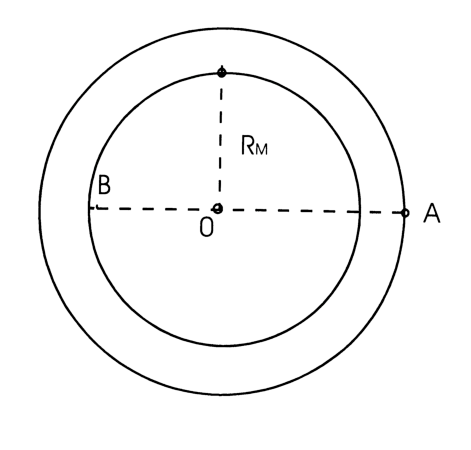
Fig.1
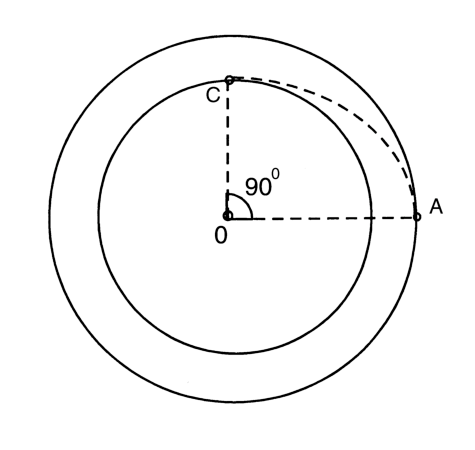
Fig.2
1). What amount of fuel should be spent so that when activating the braking engine at point A of the trajectory, the rocket would land on the Moon at point B (Fig.1)?
2). In the second scenario of landing, at point A the rocket is given an impulse directed towards the center of the Moon, to put the rocket to the orbit meeting the Moon surface at point C (Fig.2). What amount of fuel is needed in this case?
Official English text of the problem.
Problem 2: Weighing a sample in dry and in humid air
Brass weights are used to weigh an aluminum-made sample on an analytical balance. The weighing is ones in dry air and another time in humid air with the water vapor pressure \(P_h=2\cdot10^3\ \mathrm{Pa}\). The total atmospheric pressure \((P=10^5\ \mathrm{Pa})\) and the temperature \((t=20^\circ\ \mathrm{C})\) are the same in both cases.
What should the mass of the sample be to be able to tell the difference in the balance readings provided their sensitivity is \(m_0=0.1\ \mathrm{mg}\) ?
Aluminum density \(\rho_1=2700\ \mathrm{kg/m^3}\), brass density \(\rho_2=.8500\ \mathrm{kg/m^3}\).
Official English text of the problem.
Problem 3: Laser location of the Moon
During the Soviet-French experiment on the optical location of the Moon the light pulse of a ruby laser (\(\lambda=0{,}69\,\mu\mathrm{m}\)) was directed to the Moon’s surface by the telescope with a diameter of the mirror \(D=2{,}6\,\mathrm{m}\). The reflector on the Moon’s surface reflected the light backward as an ideal mirror with the diameter \(d=20\,\mathrm{cm}\). The reflected light was then collected by the same telescope and focused at the photodetector.
1) What must the accuracy to direct the telescope optical axis be in this experiment?
2) What part of emitted laser energy can be detected after reflection on the Moon, if we neglect the light loses in the Earth’s atmosphere?
3) Can we see a reflected light pulse with naked eye if the energy of single laser pulse \(E=1\,\mathrm{J}\) and the threshold sensitivity of eye is equal \(n=100\) light quantum?
4) Suppose the Moon’s surface reflects \(\alpha=10\%\) of the incident light in the spatial angle \(2\pi\) steradian, estimate the advantage of a using reflector.
The distance from the Earth to the Moon is \(L=380000\,\mathrm{km}\). The diameter of pupil of the eye is \(d_p=5\,\mathrm{mm}\). Plank constant is \(h=6.6\cdot10^{-34}\,\mathrm{J\cdot s}\).
Official English text of the problem.
Internationale Physik-Olympiade
IPhO 1979
Moskau, UdSSR · 3 Theorieaufgaben mit vollständigen Lösungen
Aufgabe 1: Landung eines Raumfahrzeugs aus einer Mondumlaufbahn
Eine Raumrakete mit der Masse \(M=12\mathrm{t}\) bewegt sich auf einer Kreisbahn in der Höhe \(h=100\ \mathrm{km}\) um den Mond. Das Triebwerk wird für kurze Zeit eingeschaltet, um auf die Mondlandebahn überzugehen. Die Geschwindigkeit der ausgestoßenen Gase beträgt \(u=10^4\ \mathrm{m/s}\). Der Mondradius beträgt \(R_M=1{,}7\cdot10^3\ \mathrm{km}\), die Fallbeschleunigung nahe der Mondoberfläche \(g_M=1.7\ \mathrm{m/s^2}\)
Abb.1
Abb.2
1). Welche Treibstoffmenge muss verbraucht werden, damit die Rakete beim Einschalten des Bremstriebwerks im Punkt A der Flugbahn im Punkt B auf dem Mond landet (Abb.1)?
2). Bei der zweiten Landevariante erhält die Rakete im Punkt A einen zum Mondmittelpunkt gerichteten Impuls, um sie auf eine Bahn zu bringen, die im Punkt C auf die Mondoberfläche trifft (Abb.2). Welche Treibstoffmenge wird in diesem Fall benötigt?
Aufgabentext aus dem offiziellen englischen Text übersetzt.
Aufgabe 2: Wägen einer Probe in trockener und in feuchter Luft
Eine Probe aus Aluminium wird mit Messinggewichten auf einer Analysenwaage gewogen. Die Wägung erfolgt einmal in trockener Luft und ein weiteres Mal in feuchter Luft mit einem Wasserdampfpartialdruck von \(P_h=2\cdot10^3\ \mathrm{Pa}\). Der gesamte Luftdruck \((P=10^5\ \mathrm{Pa})\) und die Temperatur \((t=20^\circ\ \mathrm{C})\) sind in beiden Fällen gleich.
Wie groß muss die Masse der Probe sein, damit sich ein Unterschied zwischen den Waagenanzeigen feststellen lässt, wenn die Empfindlichkeit der Waage \(m_0=0.1\ \mathrm{mg}\) beträgt?
Dichte von Aluminium \(\rho_1=2700\ \mathrm{kg/m^3}\), Dichte von Messing \(\rho_2=.8500\ \mathrm{kg/m^3}\).
Aufgabentext aus dem offiziellen englischen Text übersetzt.
Aufgabe 3: Laserentfernungsmessung zum Mond
Bei dem sowjetisch-französischen Experiment zur optischen Entfernungsmessung zum Mond wurde der Lichtimpuls eines Rubinlasers (\(\lambda=0{,}69\,\mu\mathrm{m}\)) mit einem Teleskop mit dem Spiegeldurchmesser \(D=2{,}6\,\mathrm{m}\) auf die Mondoberfläche gerichtet. Der Reflektor auf der Mondoberfläche warf das Licht wie ein idealer Spiegel mit dem Durchmesser \(d=20\,\mathrm{cm}\) zurück. Das reflektierte Licht wurde anschließend von demselben Teleskop aufgefangen und auf den Photodetektor fokussiert.
1) Mit welcher Genauigkeit muss die optische Achse des Teleskops bei diesem Experiment ausgerichtet werden?
2) Welcher Anteil der ausgesandten Laserenergie kann nach der Reflexion am Mond nachgewiesen werden, wenn die Lichtverluste in der Erdatmosphäre vernachlässigt werden?
3) Kann man einen reflektierten Lichtimpuls mit bloßem Auge sehen, wenn die Energie eines einzelnen Laserimpulses \(E=1\,\mathrm{J}\) beträgt und die Empfindlichkeitsschwelle des Auges bei \(n=100\) Lichtquanten liegt?
4) Angenommen, die Mondoberfläche reflektiert \(\alpha=10\%\) des einfallenden Lichts in den Raumwinkel \(2\pi\) Steradiant. Schätzen Sie den Vorteil ab, den die Verwendung eines Reflektors bietet.
Die Entfernung von der Erde zum Mond beträgt \(L=380000\,\mathrm{km}\). Der Pupillendurchmesser des Auges beträgt \(d_p=5\,\mathrm{mm}\). Die Planck-Konstante beträgt \(h=6.6\cdot10^{-34}\,\mathrm{J\cdot s}\).
Aufgabentext aus dem offiziellen englischen Text übersetzt.
Uluslararası Fizik Olimpiyatı
IPhO 1979
Moskova, SSCB · 3 teori sorusu, tam çözümleriyle
Soru 1: Bir uzay aracının Ay yörüngesinden indirilmesi
Kütlesi \(M=12\mathrm{t}\) olan bir uzay roketi, Ay çevresinde \(h=100\ \mathrm{km}\) yükseklikteki dairesel yörüngede hareket etmektedir. Ay'a iniş yörüngesine geçmek için motor kısa bir süre çalıştırılır. Püskürtülen gazların hızı \(u=10^4\ \mathrm{m/s}\). Ay'ın yarıçapı \(R_M=1{,}7\cdot10^3\ \mathrm{km}\), Ay yüzeyinin yakınındaki yerçekimi ivmesi \(g_M=1.7\ \mathrm{m/s^2}\)
Şekil 1
Şekil 2
1). Yörüngenin A noktasında frenleme motoru çalıştırıldığında roketin Ay'a B noktasında inmesi için ne kadar yakıt harcanmalıdır (Şekil 1)?
2). İkinci iniş senaryosunda, roketi Ay yüzeyiyle C noktasında buluşan yörüngeye sokmak için A noktasında rokete Ay'ın merkezine doğru yönelmiş bir itme verilir (Şekil 2). Bu durumda ne kadar yakıt gereklidir?
Soru metni resmi İngilizce metinden çevrilmiştir.
Soru 2: Bir numunenin kuru ve nemli havada tartılması
Alüminyumdan yapılmış bir numune, bir analitik terazide pirinç tartı kütleleri kullanılarak tartılmaktadır. Tartım bir kez kuru havada, bir kez de su buharı basıncı \(P_h=2\cdot10^3\ \mathrm{Pa}\) olan nemli havada yapılmaktadır. Toplam atmosfer basıncı \((P=10^5\ \mathrm{Pa})\) ve sıcaklık \((t=20^\circ\ \mathrm{C})\) her iki durumda da aynıdır.
Terazinin duyarlılığı \(m_0=0.1\ \mathrm{mg}\) olduğuna göre, terazi okumaları arasındaki farkın ayırt edilebilmesi için numunenin kütlesi ne olmalıdır?
Alüminyumun yoğunluğu \(\rho_1=2700\ \mathrm{kg/m^3}\), pirincin yoğunluğu \(\rho_2=.8500\ \mathrm{kg/m^3}\).
Soru metni resmi İngilizce metinden çevrilmiştir.
Soru 3: Ay'ın lazerle konumunun belirlenmesi
Ay'ın optik yöntemle konumunun belirlenmesine yönelik Sovyet-Fransız deneyinde, bir yakut lazerinin (\(\lambda=0{,}69\,\mu\mathrm{m}\)) ışık darbesi, ayna çapı \(D=2{,}6\,\mathrm{m}\) olan bir teleskopla Ay yüzeyine yönlendirildi. Ay yüzeyindeki yansıtıcı, çapı \(d=20\,\mathrm{cm}\) olan ideal bir ayna gibi ışığı geriye yansıttı. Yansıyan ışık daha sonra aynı teleskopla toplandı ve fotodedektör üzerine odaklandı.
1) Bu deneyde teleskobun optik eksenini yönlendirme hassasiyeti ne olmalıdır?
2) Dünya atmosferindeki ışık kayıplarını ihmal edersek, yayılan lazer enerjisinin ne kadarlık bir bölümü Ay'dan yansıdıktan sonra algılanabilir?
3) Tek bir lazer darbesinin enerjisi \(E=1\,\mathrm{J}\) ve gözün algılama eşiği \(n=100\) ışık kuantumu ise, yansıyan bir ışık darbesini çıplak gözle görebilir miyiz?
4) Ay yüzeyinin, üzerine düşen ışığın \(\alpha=10\%\) kadarını \(2\pi\) steradyanlık katı açı içine yansıttığını varsayarak, yansıtıcı kullanmanın sağladığı avantajı tahmin edin.
Dünya ile Ay arasındaki uzaklık \(L=380000\,\mathrm{km}\)'dir. Göz bebeğinin çapı \(d_p=5\,\mathrm{mm}\)'dir. Planck sabiti \(h=6.6\cdot10^{-34}\,\mathrm{J\cdot s}\)'dir.
Soru metni resmi İngilizce metinden çevrilmiştir.
Olimpiada Internacional de Física
IPhO 1979
Moscú, URSS · 3 problemas teóricos con soluciones completas
Problema 1: Alunizaje de una nave espacial desde una órbita lunar
Un cohete espacial de masa \(M=12\mathrm{t}\) se mueve alrededor de la Luna en una órbita circular a una altura de \(h=100\ \mathrm{km}\). El motor se enciende durante un breve intervalo de tiempo para pasar a la órbita de alunizaje. La velocidad de los gases expulsados es \(u=10^4\ \mathrm{m/s}\). El radio de la Luna es \(R_M=1{,}7\cdot10^3\ \mathrm{km}\) y la aceleración de la gravedad cerca de la superficie lunar es \(g_M=1.7\ \mathrm{m/s^2}\)
Fig.1
Fig.2
1). ¿Qué cantidad de combustible debe consumirse para que, al encender el motor de frenado en el punto A de la trayectoria, el cohete alunice en el punto B (Fig.1)?
2). En el segundo caso de alunizaje, en el punto A se comunica al cohete un impulso dirigido hacia el centro de la Luna, para situarlo en una órbita que alcance la superficie lunar en el punto C (Fig.2). ¿Qué cantidad de combustible se necesita en este caso?
Enunciado traducido del texto oficial en inglés.
Problema 2: Pesaje de una muestra en aire seco y en aire húmedo
Se utilizan pesas de latón para pesar una muestra de aluminio en una balanza analítica. El pesaje se realiza una vez en aire seco y otra en aire húmedo con una presión de vapor de agua de \(P_h=2\cdot10^3\ \mathrm{Pa}\). La presión atmosférica total \((P=10^5\ \mathrm{Pa})\) y la temperatura \((t=20^\circ\ \mathrm{C})\) son las mismas en ambos casos.
¿Qué masa debe tener la muestra para que se pueda distinguir la diferencia entre las lecturas de la balanza, si su sensibilidad es \(m_0=0.1\ \mathrm{mg}\)?
Densidad del aluminio \(\rho_1=2700\ \mathrm{kg/m^3}\), densidad del latón \(\rho_2=.8500\ \mathrm{kg/m^3}\).
Enunciado traducido del texto oficial en inglés.
Problema 3: Localización de la Luna mediante láser
Durante el experimento soviético-francés de localización óptica de la Luna, el pulso luminoso de un láser de rubí (\(\lambda=0{,}69\,\mu\mathrm{m}\)) se dirigió hacia la superficie lunar mediante un telescopio cuyo espejo tenía un diámetro \(D=2{,}6\,\mathrm{m}\). El reflector situado en la superficie lunar devolvió la luz como un espejo ideal de diámetro \(d=20\,\mathrm{cm}\). La luz reflejada fue recogida por el mismo telescopio y enfocada sobre el fotodetector.
1) ¿Cuál debe ser la precisión de apuntamiento del eje óptico del telescopio en este experimento?
2) ¿Qué fracción de la energía emitida por el láser puede detectarse tras la reflexión en la Luna, si se desprecian las pérdidas de luz en la atmósfera terrestre?
3) ¿Podemos ver un pulso de luz reflejada a simple vista si la energía de un solo pulso láser es \(E=1\,\mathrm{J}\) y el umbral de sensibilidad del ojo es igual a \(n=100\) cuantos de luz?
4) Suponiendo que la superficie lunar refleja \(\alpha=10\%\) de la luz incidente en un ángulo sólido de \(2\pi\) estereorradianes, estime la ventaja de utilizar un reflector.
La distancia de la Tierra a la Luna es \(L=380000\,\mathrm{km}\). El diámetro de la pupila del ojo es \(d_p=5\,\mathrm{mm}\). La constante de Planck es \(h=6.6\cdot10^{-34}\,\mathrm{J\cdot s}\).
Enunciado traducido del texto oficial en inglés.
国际物理奥林匹克
IPhO 1979
苏联莫斯科 · 3 道理论题及完整解答
题目 1:航天器从环月轨道着陆
一枚质量为 \(M=12\mathrm{t}\) 的太空火箭正沿高度为 \(h=100\ \mathrm{km}\) 的圆形轨道绕月球运行。发动机短暂启动,使火箭转入月球着陆轨道。喷出气体的速度为 \(u=10^4\ \mathrm{m/s}\)。月球半径为 \(R_M=1{,}7\cdot10^3\ \mathrm{km}\),月球表面附近的重力加速度为 \(g_M=1.7\ \mathrm{m/s^2}\)。
图1
图2
1). 在轨迹上的 A 点启动制动发动机,使火箭在 B 点着陆于月球(图1),需要消耗多少燃料?
2). 在第二种着陆方案中,在 A 点给火箭一个指向月球中心的冲量,使其进入在 C 点与月球表面相接的轨道(图2)。这种情况下需要多少燃料?
题目译自官方英文原文。
题目 2:在干燥空气和潮湿空气中称量样品
用黄铜砝码在分析天平上称量一个铝制样品。一次在干燥空气中称量,另一次在水蒸气压为 \(P_h=2\cdot10^3\ \mathrm{Pa}\) 的潮湿空气中称量。两种情况下的总大气压 \((P=10^5\ \mathrm{Pa})\) 和温度 \((t=20^\circ\ \mathrm{C})\) 均相同。
若天平的灵敏度为 \(m_0=0.1\ \mathrm{mg}\),样品的质量应为多大,才能分辨出两次天平示值的差异?
铝的密度为 \(\rho_1=2700\ \mathrm{kg/m^3}\),黄铜的密度为 \(\rho_2=.8500\ \mathrm{kg/m^3}\)。
题目译自官方英文原文。
题目 3:月球激光测距
在苏法合作开展的月球光学测距实验中,利用反射镜直径为 \(D=2{,}6\,\mathrm{m}\) 的望远镜,将红宝石激光器(\(\lambda=0{,}69\,\mu\mathrm{m}\))发出的光脉冲射向月球表面。月球表面的反射器如同直径为 \(d=20\,\mathrm{cm}\) 的理想反射镜,将光反射回来。随后,同一架望远镜收集反射光,并将其聚焦到光电探测器上。
1) 在这个实验中,望远镜光轴的指向精度必须达到多少?
2) 如果忽略光在地球大气中的损耗,激光发射能量中有多大比例能在月球反射后被探测到?
3) 如果单个激光脉冲的能量为 \(E=1\,\mathrm{J}\),而人眼的灵敏度阈值为 \(n=100\) 个光量子,能否用肉眼看到反射回来的光脉冲?
4) 假设月球表面将入射光的 \(\alpha=10\%\) 反射到 \(2\pi\) 球面度的立体角内,估算使用反射器的增益。
地球到月球的距离为 \(L=380000\,\mathrm{km}\)。人眼瞳孔直径为 \(d_p=5\,\mathrm{mm}\)。普朗克常量为 \(h=6.6\cdot10^{-34}\,\mathrm{J\cdot s}\)。
题目译自官方英文原文。
Международная физическая олимпиада
IPhO 1979
Москва, СССР · 3 теоретические задачи с полными решениями
Задача 1: Посадка космического аппарата с окололунной орбиты
Космическая ракета массой \(M=12\mathrm{t}\) движется вокруг Луны по круговой орбите на высоте \(h=100\ \mathrm{km}\). Для перехода на орбиту посадки на Луну на короткое время включается двигатель. Скорость истечения газов \(u=10^4\ \mathrm{m/s}\). Радиус Луны \(R_M=1{,}7\cdot10^3\ \mathrm{km}\), ускорение свободного падения вблизи поверхности Луны \(g_M=1.7\ \mathrm{m/s^2}\)
Рис.1
Рис.2
1). Какую массу топлива необходимо израсходовать, чтобы при включении тормозного двигателя в точке A траектории ракета совершила посадку на Луну в точке B (рис.1)?
2). Во втором варианте посадки в точке A ракете сообщают импульс, направленный к центру Луны, чтобы перевести ракету на орбиту, соприкасающуюся с поверхностью Луны в точке C (рис.2). Какая масса топлива необходима в этом случае?
Условие переведено с официального английского текста.
Задача 2: Взвешивание образца в сухом и влажном воздухе
Алюминиевый образец взвешивают на аналитических весах с помощью латунных гирь. Взвешивание проводят один раз в сухом воздухе, а другой — во влажном воздухе с давлением водяного пара \(P_h=2\cdot10^3\ \mathrm{Pa}\). Полное атмосферное давление \((P=10^5\ \mathrm{Pa})\) и температура \((t=20^\circ\ \mathrm{C})\) в обоих случаях одинаковы.
Какой должна быть масса образца, чтобы можно было обнаружить разницу в показаниях весов, если их чувствительность составляет \(m_0=0.1\ \mathrm{mg}\)?
Плотность алюминия \(\rho_1=2700\ \mathrm{kg/m^3}\), плотность латуни \(\rho_2=.8500\ \mathrm{kg/m^3}\).
Условие переведено с официального английского текста.
Задача 3: Лазерная локация Луны
В ходе советско-французского эксперимента по оптической локации Луны световой импульс рубинового лазера (\(\lambda=0{,}69\,\mu\mathrm{m}\)) направлялся на поверхность Луны с помощью телескопа с диаметром зеркала \(D=2{,}6\,\mathrm{m}\). Отражатель на поверхности Луны отражал свет обратно как идеальное зеркало диаметром \(d=20\,\mathrm{cm}\). Отражённый свет затем собирался тем же телескопом и фокусировался на фотоприёмнике.
1) Какой должна быть точность наведения оптической оси телескопа в этом эксперименте?
2) Какая доля излучённой лазером энергии может быть зарегистрирована после отражения от Луны, если пренебречь потерями света в атмосфере Земли?
3) Можно ли увидеть отражённый световой импульс невооружённым глазом, если энергия одного лазерного импульса \(E=1\,\mathrm{J}\), а пороговая чувствительность глаза равна \(n=100\) квантам света?
4) Предполагая, что поверхность Луны отражает \(\alpha=10\%\) падающего света в телесный угол \(2\pi\) стерадиан, оцените выигрыш от использования отражателя.
Расстояние от Земли до Луны равно \(L=380000\,\mathrm{km}\). Диаметр зрачка глаза равен \(d_p=5\,\mathrm{mm}\). Постоянная Планка равна \(h=6.6\cdot10^{-34}\,\mathrm{J\cdot s}\).
Условие переведено с официального английского текста.
الأولمبياد الدولي للفيزياء
IPhO 1979
موسكو، الاتحاد السوفيتي · 3 مسائل نظرية مع حلول كاملة
المسألة 1: إنزال مركبة فضائية من مدار حول القمر
يتحرك صاروخ فضائي كتلته \(M=12\mathrm{t}\) حول القمر في مدار دائري على ارتفاع \(h=100\ \mathrm{km}\). يُشغَّل المحرك مدة قصيرة للانتقال إلى مدار الهبوط على القمر. سرعة الغازات المنبعثة \(u=10^4\ \mathrm{m/s}\). نصف قطر القمر \(R_M=1{,}7\cdot10^3\ \mathrm{km}\)، وتسارع الجاذبية قرب سطح القمر \(g_M=1.7\ \mathrm{m/s^2}\)
الشكل 1
الشكل 2
1). ما كمية الوقود التي يجب استهلاكها لكي يهبط الصاروخ على القمر عند النقطة B عند تشغيل محرك الكبح في النقطة A من المسار (الشكل 1)؟
2). في السيناريو الثاني للهبوط، يُعطى الصاروخ عند النقطة A دفعًا موجَّهًا نحو مركز القمر، لوضعه في مدار يلتقي سطح القمر عند النقطة C (الشكل 2). ما كمية الوقود اللازمة في هذه الحالة؟
نص المسألة مترجم عن النص الإنجليزي الرسمي.
المسألة 2: وزن عينة في الهواء الجاف وفي الهواء الرطب
تُستخدم أثقال من النحاس الأصفر لوزن عينة مصنوعة من الألومنيوم على ميزان تحليلي. يُجرى الوزن مرة في الهواء الجاف ومرة أخرى في الهواء الرطب، حيث يبلغ ضغط بخار الماء \(P_h=2\cdot10^3\ \mathrm{Pa}\). ويكون الضغط الجوي الكلي \((P=10^5\ \mathrm{Pa})\) ودرجة الحرارة \((t=20^\circ\ \mathrm{C})\) متماثلين في الحالتين.
كم يجب أن تكون كتلة العينة حتى يمكن تمييز الفرق بين قراءتي الميزان، إذا كانت حساسيته \(m_0=0.1\ \mathrm{mg}\)؟
كثافة الألومنيوم \(\rho_1=2700\ \mathrm{kg/m^3}\)، وكثافة النحاس الأصفر \(\rho_2=.8500\ \mathrm{kg/m^3}\).
نص المسألة مترجم عن النص الإنجليزي الرسمي.
المسألة 3: تحديد موقع القمر بالليزر
أثناء التجربة السوفيتية الفرنسية لتحديد موقع القمر بصريًا، وُجِّهت نبضة ضوئية من ليزر الياقوت (\(\lambda=0{,}69\,\mu\mathrm{m}\)) نحو سطح القمر باستخدام تلسكوب قطر مرآته \(D=2{,}6\,\mathrm{m}\). وعكس العاكس الموجود على سطح القمر الضوء إلى الخلف كما تفعل مرآة مثالية قطرها \(d=20\,\mathrm{cm}\). ثم جُمِع الضوء المنعكس بالتلسكوب نفسه ورُكِّز على الكاشف الضوئي.
1) ما الدقة اللازمة لتوجيه المحور البصري للتلسكوب في هذه التجربة؟
2) ما الجزء الذي يمكن كشفه من طاقة الليزر المنبعثة بعد انعكاسه عن القمر، إذا أهملنا فقد الضوء في الغلاف الجوي للأرض؟
3) هل يمكننا رؤية النبضة الضوئية المنعكسة بالعين المجردة إذا كانت طاقة نبضة الليزر الواحدة \(E=1\,\mathrm{J}\)، وكانت عتبة حساسية العين تساوي \(n=100\) كمّ ضوئي؟
4) بافتراض أن سطح القمر يعكس \(\alpha=10\%\) من الضوء الساقط ضمن زاوية مجسمة مقدارها \(2\pi\) ستراديان، قدِّر مقدار التحسن الناتج عن استخدام عاكس.
المسافة من الأرض إلى القمر هي \(L=380000\,\mathrm{km}\). وقطر حدقة العين هو \(d_p=5\,\mathrm{mm}\). وثابت بلانك هو \(h=6.6\cdot10^{-34}\,\mathrm{J\cdot s}\).
نص المسألة مترجم عن النص الإنجليزي الرسمي.