IPhO 1979 · Theory problem 1
Landing a spacecraft from a lunar orbit
A space rocket with mass \(M=12\mathrm{t}\) is moving around the Moon along the circular orbit at the height of \(h=100\ \mathrm{km}\). The engine is activated for a short time to pass at the lunar landing orbit. The velocity of the ejected gases \(u=10^4\ \mathrm{m/s}\). The Moon radius \(R_M=1{,}7\cdot10^3\ \mathrm{km}\), the acceleration of gravity near the Moon surface \(g_M=1.7\ \mathrm{m/s^2}\)
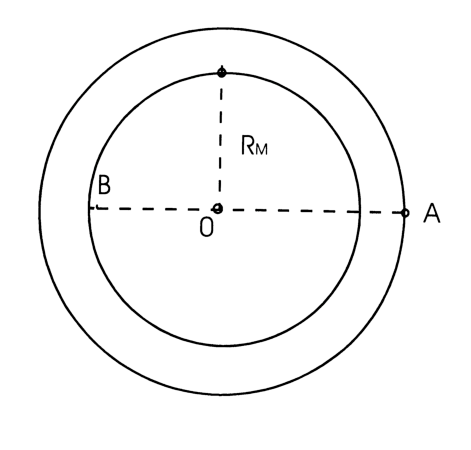
Fig.1
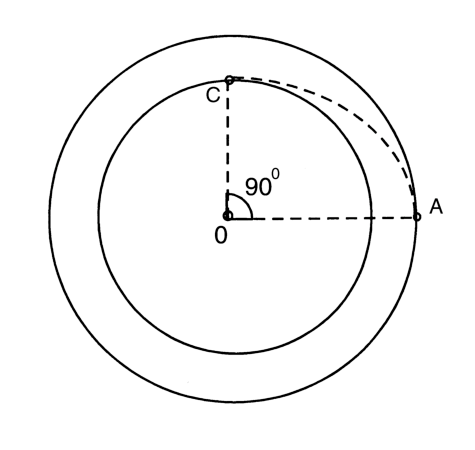
Fig.2
1). What amount of fuel should be spent so that when activating the braking engine at point A of the trajectory, the rocket would land on the Moon at point B (Fig.1)?
2). In the second scenario of landing, at point A the rocket is given an impulse directed towards the center of the Moon, to put the rocket to the orbit meeting the Moon surface at point C (Fig.2). What amount of fuel is needed in this case?
Official English text of the problem.
Answers
- 1). \(\boxed{\Delta m_1\simeq29\ \mathrm{kg}}\), for a tangential braking velocity change of \(23.77\ \mathrm{m/s}\).
- 2). \(\boxed{\Delta m_2\simeq1.2\times10^2\ \mathrm{kg}}\), for an inward radial velocity change of \(97.18\ \mathrm{m/s}\).
The ideal rocket equation gives approximately \(28.49\ \mathrm{kg}\) and \(116.05\ \mathrm{kg}\), respectively, before rounding to the precision of the supplied data.
Solution
Treat the Moon as spherical, with an inverse-square gravitational field. The engine operates briefly enough that the spacecraft’s position and the gravitational impulse during the burn can be neglected. The exhaust speed \(u\) is measured relative to the spacecraft.
Write \[ R=R_M=1.7\times10^6\ \mathrm{m},\qquad r_0=R+h=1.8\times10^6\ \mathrm{m}. \] The Moon’s gravitational parameter is \[ \mu=GM_{\text{Moon}}=g_MR^2 =4.913\times10^{12}\ \mathrm{m^3/s^2}. \] Thus the initial circular speed is \[ v_0=\sqrt{\frac{\mu}{r_0}} \simeq1652.10\ \mathrm{m/s}. \]
For a burn producing a velocity change of magnitude \(\Delta v\), conservation of momentum gives the ideal rocket equation: \[ \Delta v=u\ln\frac{M}{M-\Delta m}. \] Consequently, \[ \boxed{\Delta m=M\left(1-e^{-\Delta v/u}\right)}. \] When \(\Delta v/u\ll1\), this becomes \[ \Delta m\simeq\frac{M\Delta v}{u}. \]
Here, reaching the surface is understood as the requested orbital contact. The spacecraft retains a nonzero tangential velocity there; a soft landing would require further braking.
1). Tangential braking at A, reaching B
The braking impulse acts opposite the initial velocity. Immediately afterward, the velocity remains tangential but is smaller than the circular speed. Therefore A is the apocentre of the new elliptical orbit. Its diametrically opposite pericentre must be B, at radius \(R\).
Let \(v_A\) and \(v_B\) be the speeds on this ellipse at A and B. Conservation of angular momentum per unit mass gives \[ r_0v_A=Rv_B. \] Conservation of mechanical energy per unit mass gives \[ \frac{v_A^2}{2}-\frac{\mu}{r_0} = \frac{v_B^2}{2}-\frac{\mu}{R}. \] Eliminating \(v_B\), \[ v_A^2\left(\frac{r_0^2}{R^2}-1\right) = 2\mu\left(\frac1R-\frac1{r_0}\right), \] so \[ v_A^2=\frac{2\mu R}{r_0(r_0+R)}. \]
The required reduction in velocity is therefore \[ \boxed{ \Delta v_1 =v_0-v_A =\sqrt{\frac{\mu}{r_0}} \left(1-\sqrt{\frac{2R}{r_0+R}}\right) }. \] Numerically, \[ \Delta v_1 =1652.10\left(1-\sqrt{\frac{3.4}{3.5}}\right) \simeq23.77\ \mathrm{m/s}. \] Hence \[ \Delta m_1 =12000\left(1-e^{-23.7725/10000}\right)\ \mathrm{kg} \simeq28.49\ \mathrm{kg}, \] or, to sensible significant figures, \[ \boxed{\Delta m_1\simeq29\ \mathrm{kg}}. \]
The radius decreases from \(r_0\) to \(R\) along the transfer, so B is the first point where the orbit touches the lunar surface.
2). Radial impulse at A, reaching C
Let the inward velocity imparted by the engine be \(w\). Immediately after the burn, \[ v_r=-w,\qquad v_t=v_0. \] The velocity change has magnitude \[ \Delta v_2=w. \]
Because the impulse is radial, the specific angular momentum is unchanged: \[ \ell=r_0v_0,\qquad \ell^2=\mu r_0. \]
Let \(\theta\) be the angle swept around the Moon from A in the direction of motion. The required contact point C has \[ \theta_C=\frac{\pi}{2}. \] To determine the orbit, put \(q(\theta)=1/r(\theta)\). Angular momentum conservation gives \[ \dot r=-\ell q', \] where primes denote derivatives with respect to \(\theta\). Newton’s radial equation for inverse-square gravity then yields \[ q''+q=\frac{\mu}{\ell^2}=\frac1{r_0}. \]
At A, \[ q(0)=\frac1{r_0},\qquad q'(0)=\frac{w}{\ell}. \] The solution satisfying these conditions is \[ q(\theta)=\frac1{r_0}+\frac{w}{\ell}\sin\theta, \] or \[ \boxed{ r(\theta)=\frac{r_0}{1+(w/v_0)\sin\theta} }. \]
Imposing \(r(\pi/2)=R\) gives \[ R=\frac{r_0}{1+w/v_0}, \] and therefore \[ \boxed{ \Delta v_2=w =v_0\left(\frac{r_0}{R}-1\right) =v_0\frac{h}{R} =h\sqrt{\frac{g_M}{R+h}} }. \]
The radius decreases continuously between A and C, and its derivative vanishes at C. Thus C is the pericentre and the first contact with the lunar surface.
Numerically, \[ \Delta v_2 =1652.10\,\frac{100}{1700} \simeq97.18\ \mathrm{m/s}. \] The required fuel is \[ \Delta m_2 =12000\left(1-e^{-97.1825/10000}\right)\ \mathrm{kg} \simeq116.05\ \mathrm{kg}, \] hence \[ \boxed{\Delta m_2\simeq1.2\times10^2\ \mathrm{kg}}. \]
Using the small-fuel approximation gives \(28.53\ \mathrm{kg}\) for part 1 and \(116.62\ \mathrm{kg}\) for part 2, consistent with the rounded answers.
The solution was checked against the official solution.
IPhO 1979 · Theorieaufgabe 1
Landung eines Raumfahrzeugs aus einer Mondumlaufbahn
Eine Raumrakete mit der Masse \(M=12\mathrm{t}\) bewegt sich auf einer Kreisbahn in der Höhe \(h=100\ \mathrm{km}\) um den Mond. Das Triebwerk wird für kurze Zeit eingeschaltet, um auf die Mondlandebahn überzugehen. Die Geschwindigkeit der ausgestoßenen Gase beträgt \(u=10^4\ \mathrm{m/s}\). Der Mondradius beträgt \(R_M=1{,}7\cdot10^3\ \mathrm{km}\), die Fallbeschleunigung nahe der Mondoberfläche \(g_M=1.7\ \mathrm{m/s^2}\)
Abb.1
Abb.2
1). Welche Treibstoffmenge muss verbraucht werden, damit die Rakete beim Einschalten des Bremstriebwerks im Punkt A der Flugbahn im Punkt B auf dem Mond landet (Abb.1)?
2). Bei der zweiten Landevariante erhält die Rakete im Punkt A einen zum Mondmittelpunkt gerichteten Impuls, um sie auf eine Bahn zu bringen, die im Punkt C auf die Mondoberfläche trifft (Abb.2). Welche Treibstoffmenge wird in diesem Fall benötigt?
Aufgabentext aus dem offiziellen englischen Text übersetzt.
Antworten
- 1). \(\boxed{\Delta m_1\simeq29\ \mathrm{kg}}\), bei einer tangentialen Geschwindigkeitsänderung durch Abbremsen von \(23.77\ \mathrm{m/s}\).
- 2). \(\boxed{\Delta m_2\simeq1.2\times10^2\ \mathrm{kg}}\), bei einer radial nach innen gerichteten Geschwindigkeitsänderung von \(97.18\ \mathrm{m/s}\).
Die ideale Raketengleichung ergibt ungefähr \(28.49\ \mathrm{kg}\) bzw. \(116.05\ \mathrm{kg}\), bevor auf die Genauigkeit der gegebenen Daten gerundet wird.
Lösung
Der Mond wird als kugelförmig angenommen, mit einem Gravitationsfeld, das dem inversen Quadratgesetz folgt. Das Triebwerk arbeitet so kurz, dass die Änderung der Position des Raumfahrzeugs und der Gravitationsimpuls während der Brenndauer vernachlässigt werden können. Die Ausströmgeschwindigkeit \(u\) wird relativ zum Raumfahrzeug gemessen.
Wir setzen \[ R=R_M=1.7\times10^6\ \mathrm{m},\qquad r_0=R+h=1.8\times10^6\ \mathrm{m}. \] Der Gravitationsparameter des Mondes ist \[ \mu=GM_{\text{Mond}}=g_MR^2 =4.913\times10^{12}\ \mathrm{m^3/s^2}. \] Damit beträgt die anfängliche Kreisbahngeschwindigkeit \[ v_0=\sqrt{\frac{\mu}{r_0}} \simeq1652.10\ \mathrm{m/s}. \]
Für einen Triebwerksstoß, der eine Geschwindigkeitsänderung vom Betrag \(\Delta v\) erzeugt, ergibt die Impulserhaltung die ideale Raketengleichung: \[ \Delta v=u\ln\frac{M}{M-\Delta m}. \] Folglich gilt \[ \boxed{\Delta m=M\left(1-e^{-\Delta v/u}\right)}. \] Für \(\Delta v/u\ll1\) wird daraus \[ \Delta m\simeq\frac{M\Delta v}{u}. \]
Hier wird das Erreichen der Oberfläche als der geforderte Kontakt der Umlaufbahn mit der Oberfläche verstanden. Das Raumfahrzeug besitzt dort weiterhin eine von null verschiedene Tangentialgeschwindigkeit; eine weiche Landung würde weiteres Abbremsen erfordern.
1). Tangentiales Abbremsen bei A, Erreichen von B
Der Bremsimpuls wirkt entgegen der Anfangsgeschwindigkeit. Unmittelbar danach bleibt die Geschwindigkeit tangential, ist aber kleiner als die Kreisbahngeschwindigkeit. Daher ist A das Apozentrum der neuen elliptischen Bahn. Ihr diametral gegenüberliegendes Perizentrum muss B sein, beim Radius \(R\).
Es seien \(v_A\) und \(v_B\) die Geschwindigkeiten auf dieser Ellipse bei A und B. Die Erhaltung des Drehimpulses pro Masseneinheit ergibt \[ r_0v_A=Rv_B. \] Die Erhaltung der mechanischen Energie pro Masseneinheit ergibt \[ \frac{v_A^2}{2}-\frac{\mu}{r_0} = \frac{v_B^2}{2}-\frac{\mu}{R}. \] Durch Eliminieren von \(v_B\) erhält man \[ v_A^2\left(\frac{r_0^2}{R^2}-1\right) = 2\mu\left(\frac1R-\frac1{r_0}\right), \] also \[ v_A^2=\frac{2\mu R}{r_0(r_0+R)}. \]
Die erforderliche Verringerung der Geschwindigkeit beträgt daher \[ \boxed{ \Delta v_1 =v_0-v_A =\sqrt{\frac{\mu}{r_0}} \left(1-\sqrt{\frac{2R}{r_0+R}}\right) }. \] Numerisch ergibt sich \[ \Delta v_1 =1652.10\left(1-\sqrt{\frac{3.4}{3.5}}\right) \simeq23.77\ \mathrm{m/s}. \] Somit gilt \[ \Delta m_1 =12000\left(1-e^{-23.7725/10000}\right)\ \mathrm{kg} \simeq28.49\ \mathrm{kg}, \] oder, auf eine sinnvolle Anzahl signifikanter Stellen gerundet, \[ \boxed{\Delta m_1\simeq29\ \mathrm{kg}}. \]
Der Radius nimmt entlang der Übergangsbahn von \(r_0\) auf \(R\) ab, sodass B der erste Punkt ist, an dem die Bahn die Mondoberfläche berührt.
2). Radialer Impuls bei A, Erreichen von C
Die vom Triebwerk verliehene, nach innen gerichtete Geschwindigkeit sei \(w\). Unmittelbar nach dem Triebwerksstoß gilt \[ v_r=-w,\qquad v_t=v_0. \] Die Geschwindigkeitsänderung hat den Betrag \[ \Delta v_2=w. \]
Da der Impuls radial gerichtet ist, bleibt der spezifische Drehimpuls unverändert: \[ \ell=r_0v_0,\qquad \ell^2=\mu r_0. \]
Es sei \(\theta\) der von A aus in Bewegungsrichtung um den Mond überstrichene Winkel. Für den geforderten Berührungspunkt C gilt \[ \theta_C=\frac{\pi}{2}. \] Um die Bahn zu bestimmen, setzen wir \(q(\theta)=1/r(\theta)\). Die Drehimpulserhaltung ergibt \[ \dot r=-\ell q', \] wobei Striche Ableitungen nach \(\theta\) bezeichnen. Die radiale Newtonsche Bewegungsgleichung für die dem inversen Quadratgesetz folgende Gravitation liefert dann \[ q''+q=\frac{\mu}{\ell^2}=\frac1{r_0}. \]
Bei A gilt \[ q(0)=\frac1{r_0},\qquad q'(0)=\frac{w}{\ell}. \] Die Lösung, die diese Bedingungen erfüllt, lautet \[ q(\theta)=\frac1{r_0}+\frac{w}{\ell}\sin\theta, \] oder \[ \boxed{ r(\theta)=\frac{r_0}{1+(w/v_0)\sin\theta} }. \]
Die Forderung \(r(\pi/2)=R\) ergibt \[ R=\frac{r_0}{1+w/v_0}, \] und somit \[ \boxed{ \Delta v_2=w =v_0\left(\frac{r_0}{R}-1\right) =v_0\frac{h}{R} =h\sqrt{\frac{g_M}{R+h}} }. \]
Der Radius nimmt zwischen A und C stetig ab, und seine Ableitung verschwindet bei C. Somit ist C das Perizentrum und der erste Berührungspunkt mit der Mondoberfläche.
Numerisch ergibt sich \[ \Delta v_2 =1652.10\,\frac{100}{1700} \simeq97.18\ \mathrm{m/s}. \] Die erforderliche Treibstoffmenge beträgt \[ \Delta m_2 =12000\left(1-e^{-97.1825/10000}\right)\ \mathrm{kg} \simeq116.05\ \mathrm{kg}, \] also \[ \boxed{\Delta m_2\simeq1.2\times10^2\ \mathrm{kg}}. \]
Die Näherung für eine kleine Treibstoffmenge ergibt \(28.53\ \mathrm{kg}\) für Teil 1 und \(116.62\ \mathrm{kg}\) für Teil 2, in Übereinstimmung mit den gerundeten Antworten.
Die Lösung wurde mit der offiziellen Lösung abgeglichen.
IPhO 1979 · Teori sorusu 1
Bir uzay aracının Ay yörüngesinden indirilmesi
Kütlesi \(M=12\mathrm{t}\) olan bir uzay roketi, Ay çevresinde \(h=100\ \mathrm{km}\) yükseklikteki dairesel yörüngede hareket etmektedir. Ay'a iniş yörüngesine geçmek için motor kısa bir süre çalıştırılır. Püskürtülen gazların hızı \(u=10^4\ \mathrm{m/s}\). Ay'ın yarıçapı \(R_M=1{,}7\cdot10^3\ \mathrm{km}\), Ay yüzeyinin yakınındaki yerçekimi ivmesi \(g_M=1.7\ \mathrm{m/s^2}\)
Şekil 1
Şekil 2
1). Yörüngenin A noktasında frenleme motoru çalıştırıldığında roketin Ay'a B noktasında inmesi için ne kadar yakıt harcanmalıdır (Şekil 1)?
2). İkinci iniş senaryosunda, roketi Ay yüzeyiyle C noktasında buluşan yörüngeye sokmak için A noktasında rokete Ay'ın merkezine doğru yönelmiş bir itme verilir (Şekil 2). Bu durumda ne kadar yakıt gereklidir?
Soru metni resmi İngilizce metinden çevrilmiştir.
Cevaplar
- 1). \(\boxed{\Delta m_1\simeq29\ \mathrm{kg}}\); teğetsel frenleme hız değişimi \(23.77\ \mathrm{m/s}\) büyüklüğündedir.
- 2). \(\boxed{\Delta m_2\simeq1.2\times10^2\ \mathrm{kg}}\); içeriye doğru radyal hız değişimi \(97.18\ \mathrm{m/s}\) büyüklüğündedir.
İdeal roket denklemi, verilen verilerin hassasiyetine göre yuvarlama yapılmadan önce sırasıyla yaklaşık \(28.49\ \mathrm{kg}\) ve \(116.05\ \mathrm{kg}\) verir.
Çözüm
Ay'ı, uzaklığın karesiyle ters orantılı bir kütleçekim alanına sahip küresel bir cisim olarak ele alalım. Motor, yanma süresince uzay aracının konumundaki değişim ve kütleçekiminin itmesi ihmal edilebilecek kadar kısa süre çalışır. Egzoz hızı \(u\), uzay aracına göre ölçülür.
Şöyle yazalım: \[ R=R_M=1.7\times10^6\ \mathrm{m},\qquad r_0=R+h=1.8\times10^6\ \mathrm{m}. \] Ay'ın kütleçekim parametresi \[ \mu=GM_{\text{Ay}}=g_MR^2 =4.913\times10^{12}\ \mathrm{m^3/s^2}. \] Buna göre başlangıçtaki dairesel yörünge hızı \[ v_0=\sqrt{\frac{\mu}{r_0}} \simeq1652.10\ \mathrm{m/s}. \]
Büyüklüğü \(\Delta v\) olan bir hız değişimi oluşturan motor ateşlemesi için momentumun korunumu ideal roket denklemini verir: \[ \Delta v=u\ln\frac{M}{M-\Delta m}. \] Dolayısıyla, \[ \boxed{\Delta m=M\left(1-e^{-\Delta v/u}\right)}. \] \(\Delta v/u\ll1\) olduğunda bu ifade \[ \Delta m\simeq\frac{M\Delta v}{u} \] biçimini alır.
Burada yüzeye ulaşmak, istenen yörüngesel temas olarak anlaşılmalıdır. Uzay aracı orada sıfırdan farklı bir teğetsel hıza sahip olmaya devam eder; yumuşak iniş için ek frenleme gerekir.
1). A'da teğetsel frenleme, B'ye ulaşma
Frenleme itmesi, başlangıç hızına zıt yönde etki eder. Hemen ardından hız teğetsel kalır, ancak dairesel yörünge hızından küçüktür. Bu nedenle A, yeni eliptik yörüngenin enöte noktasıdır. Bunun tam karşısındaki enberi noktası, \(R\) yarıçapındaki B noktası olmalıdır.
Bu elips üzerinde A ve B noktalarındaki süratler \(v_A\) ve \(v_B\) olsun. Birim kütle başına açısal momentumun korunumu \[ r_0v_A=Rv_B \] bağıntısını verir. Birim kütle başına mekanik enerjinin korunumu \[ \frac{v_A^2}{2}-\frac{\mu}{r_0} = \frac{v_B^2}{2}-\frac{\mu}{R} \] bağıntısını verir. \(v_B\) elendiğinde, \[ v_A^2\left(\frac{r_0^2}{R^2}-1\right) = 2\mu\left(\frac1R-\frac1{r_0}\right), \] dolayısıyla \[ v_A^2=\frac{2\mu R}{r_0(r_0+R)}. \]
Bu nedenle hızda gereken azalma \[ \boxed{ \Delta v_1 =v_0-v_A =\sqrt{\frac{\mu}{r_0}} \left(1-\sqrt{\frac{2R}{r_0+R}}\right) }. \] Sayısal olarak, \[ \Delta v_1 =1652.10\left(1-\sqrt{\frac{3.4}{3.5}}\right) \simeq23.77\ \mathrm{m/s}. \] Böylece \[ \Delta m_1 =12000\left(1-e^{-23.7725/10000}\right)\ \mathrm{kg} \simeq28.49\ \mathrm{kg}, \] ya da uygun sayıda anlamlı basamakla, \[ \boxed{\Delta m_1\simeq29\ \mathrm{kg}}. \]
Geçiş boyunca yarıçap \(r_0\)'dan \(R\)'ye azalır; dolayısıyla B, yörüngenin Ay yüzeyine temas ettiği ilk noktadır.
2). A'da radyal itme, C'ye ulaşma
Motorun kazandırdığı içeriye doğru hız \(w\) olsun. Motorun çalışmasının hemen ardından, \[ v_r=-w,\qquad v_t=v_0. \] Hız değişiminin büyüklüğü \[ \Delta v_2=w. \]
İtme radyal olduğundan, özgül açısal momentum değişmez: \[ \ell=r_0v_0,\qquad \ell^2=\mu r_0. \]
\(\theta\), A'dan itibaren hareket yönünde Ay'ın çevresinde taranan açı olsun. İstenen temas noktası C için \[ \theta_C=\frac{\pi}{2}. \] Yörüngeyi belirlemek için \(q(\theta)=1/r(\theta)\) alalım. Açısal momentumun korunumu \[ \dot r=-\ell q', \] bağıntısını verir; burada üstteki kesme işaretleri \(\theta\)'ya göre türevleri gösterir. Uzaklığın karesiyle ters orantılı kütleçekim için Newton'un radyal hareket denklemi buradan \[ q''+q=\frac{\mu}{\ell^2}=\frac1{r_0} \] sonucunu verir.
A noktasında, \[ q(0)=\frac1{r_0},\qquad q'(0)=\frac{w}{\ell}. \] Bu koşulları sağlayan çözüm \[ q(\theta)=\frac1{r_0}+\frac{w}{\ell}\sin\theta, \] ya da \[ \boxed{ r(\theta)=\frac{r_0}{1+(w/v_0)\sin\theta} }. \]
\(r(\pi/2)=R\) koşulu uygulandığında \[ R=\frac{r_0}{1+w/v_0}, \] ve dolayısıyla \[ \boxed{ \Delta v_2=w =v_0\left(\frac{r_0}{R}-1\right) =v_0\frac{h}{R} =h\sqrt{\frac{g_M}{R+h}} }. \]
Yarıçap A ile C arasında sürekli azalır ve türevi C'de sıfır olur. Dolayısıyla C, enberi noktası ve Ay yüzeyiyle ilk temas noktasıdır.
Sayısal olarak, \[ \Delta v_2 =1652.10\,\frac{100}{1700} \simeq97.18\ \mathrm{m/s}. \] Gereken yakıt miktarı \[ \Delta m_2 =12000\left(1-e^{-97.1825/10000}\right)\ \mathrm{kg} \simeq116.05\ \mathrm{kg}, \] böylece \[ \boxed{\Delta m_2\simeq1.2\times10^2\ \mathrm{kg}}. \]
Yakıt miktarının küçük olduğu yaklaşım kullanıldığında 1. kısım için \(28.53\ \mathrm{kg}\), 2. kısım için \(116.62\ \mathrm{kg}\) elde edilir; bunlar yuvarlanmış cevaplarla tutarlıdır.
Çözüm, resmi çözümle karşılaştırılarak kontrol edildi.
IPhO 1979 · Problema teórico 1
Alunizaje de una nave espacial desde una órbita lunar
Un cohete espacial de masa \(M=12\mathrm{t}\) se mueve alrededor de la Luna en una órbita circular a una altura de \(h=100\ \mathrm{km}\). El motor se enciende durante un breve intervalo de tiempo para pasar a la órbita de alunizaje. La velocidad de los gases expulsados es \(u=10^4\ \mathrm{m/s}\). El radio de la Luna es \(R_M=1{,}7\cdot10^3\ \mathrm{km}\) y la aceleración de la gravedad cerca de la superficie lunar es \(g_M=1.7\ \mathrm{m/s^2}\)
Fig.1
Fig.2
1). ¿Qué cantidad de combustible debe consumirse para que, al encender el motor de frenado en el punto A de la trayectoria, el cohete alunice en el punto B (Fig.1)?
2). En el segundo caso de alunizaje, en el punto A se comunica al cohete un impulso dirigido hacia el centro de la Luna, para situarlo en una órbita que alcance la superficie lunar en el punto C (Fig.2). ¿Qué cantidad de combustible se necesita en este caso?
Enunciado traducido del texto oficial en inglés.
Respuestas
- 1). \(\boxed{\Delta m_1\simeq29\ \mathrm{kg}}\), para una variación tangencial de la velocidad de frenado de \(23.77\ \mathrm{m/s}\).
- 2). \(\boxed{\Delta m_2\simeq1.2\times10^2\ \mathrm{kg}}\), para una variación radial de la velocidad hacia el interior de \(97.18\ \mathrm{m/s}\).
La ecuación ideal del cohete da aproximadamente \(28.49\ \mathrm{kg}\) y \(116.05\ \mathrm{kg}\), respectivamente, antes de redondear a la precisión de los datos proporcionados.
Solución
Consideremos la Luna esférica, con un campo gravitatorio que sigue la ley del inverso del cuadrado de la distancia. El motor funciona durante un intervalo lo suficientemente breve como para que puedan despreciarse la variación de la posición de la nave y el impulso gravitatorio durante el encendido. La velocidad de escape de los gases \(u\) se mide con respecto a la nave.
Escribamos \[ R=R_M=1.7\times10^6\ \mathrm{m},\qquad r_0=R+h=1.8\times10^6\ \mathrm{m}. \] El parámetro gravitatorio de la Luna es \[ \mu=GM_{\text{Luna}}=g_MR^2 =4.913\times10^{12}\ \mathrm{m^3/s^2}. \] Por tanto, la rapidez circular inicial es \[ v_0=\sqrt{\frac{\mu}{r_0}} \simeq1652.10\ \mathrm{m/s}. \]
Para un encendido que produce una variación de la velocidad de módulo \(\Delta v\), la conservación de la cantidad de movimiento da la ecuación ideal del cohete: \[ \Delta v=u\ln\frac{M}{M-\Delta m}. \] En consecuencia, \[ \boxed{\Delta m=M\left(1-e^{-\Delta v/u}\right)}. \] Cuando \(\Delta v/u\ll1\), esta expresión se convierte en \[ \Delta m\simeq\frac{M\Delta v}{u}. \]
Aquí, alcanzar la superficie se entiende como el contacto orbital solicitado. La nave conserva allí una velocidad tangencial no nula; un alunizaje suave requeriría un frenado adicional.
1). Frenado tangencial en A para alcanzar B
El impulso de frenado actúa en sentido opuesto a la velocidad inicial. Inmediatamente después, la velocidad sigue siendo tangencial, pero su módulo es menor que la rapidez circular. Por tanto, A es el apocentro de la nueva órbita elíptica. Su pericentro, diametralmente opuesto, debe ser B, a una distancia radial \(R\).
Sean \(v_A\) y \(v_B\) las rapideces en esta elipse en A y B. La conservación del momento angular por unidad de masa da \[ r_0v_A=Rv_B. \] La conservación de la energía mecánica por unidad de masa da \[ \frac{v_A^2}{2}-\frac{\mu}{r_0} = \frac{v_B^2}{2}-\frac{\mu}{R}. \] Al eliminar \(v_B\), \[ v_A^2\left(\frac{r_0^2}{R^2}-1\right) = 2\mu\left(\frac1R-\frac1{r_0}\right), \] de modo que \[ v_A^2=\frac{2\mu R}{r_0(r_0+R)}. \]
La reducción de velocidad necesaria es, por tanto, \[ \boxed{ \Delta v_1 =v_0-v_A =\sqrt{\frac{\mu}{r_0}} \left(1-\sqrt{\frac{2R}{r_0+R}}\right) }. \] Numéricamente, \[ \Delta v_1 =1652.10\left(1-\sqrt{\frac{3.4}{3.5}}\right) \simeq23.77\ \mathrm{m/s}. \] Por consiguiente, \[ \Delta m_1 =12000\left(1-e^{-23.7725/10000}\right)\ \mathrm{kg} \simeq28.49\ \mathrm{kg}, \] o bien, con un número adecuado de cifras significativas, \[ \boxed{\Delta m_1\simeq29\ \mathrm{kg}}. \]
La distancia radial disminuye de \(r_0\) a \(R\) a lo largo de la transferencia, de modo que B es el primer punto en el que la órbita toca la superficie lunar.
2). Impulso radial en A para alcanzar C
Sea \(w\) la rapidez hacia el interior impartida por el motor. Inmediatamente después del encendido, \[ v_r=-w,\qquad v_t=v_0. \] La variación de la velocidad tiene módulo \[ \Delta v_2=w. \]
Como el impulso es radial, el momento angular específico no cambia: \[ \ell=r_0v_0,\qquad \ell^2=\mu r_0. \]
Sea \(\theta\) el ángulo barrido alrededor de la Luna desde A en el sentido del movimiento. El punto de contacto requerido C cumple \[ \theta_C=\frac{\pi}{2}. \] Para determinar la órbita, hagamos \(q(\theta)=1/r(\theta)\). La conservación del momento angular da \[ \dot r=-\ell q', \] donde las primas denotan derivadas con respecto a \(\theta\). La ecuación radial de Newton para una gravedad que sigue la ley del inverso del cuadrado de la distancia da entonces \[ q''+q=\frac{\mu}{\ell^2}=\frac1{r_0}. \]
En A, \[ q(0)=\frac1{r_0},\qquad q'(0)=\frac{w}{\ell}. \] La solución que satisface estas condiciones es \[ q(\theta)=\frac1{r_0}+\frac{w}{\ell}\sin\theta, \] o bien \[ \boxed{ r(\theta)=\frac{r_0}{1+(w/v_0)\sin\theta} }. \]
Al imponer \(r(\pi/2)=R\), se obtiene \[ R=\frac{r_0}{1+w/v_0}, \] y, por tanto, \[ \boxed{ \Delta v_2=w =v_0\left(\frac{r_0}{R}-1\right) =v_0\frac{h}{R} =h\sqrt{\frac{g_M}{R+h}} }. \]
La distancia radial disminuye continuamente entre A y C, y su derivada se anula en C. Por tanto, C es el pericentro y el primer punto de contacto con la superficie lunar.
Numéricamente, \[ \Delta v_2 =1652.10\,\frac{100}{1700} \simeq97.18\ \mathrm{m/s}. \] La cantidad de combustible necesaria es \[ \Delta m_2 =12000\left(1-e^{-97.1825/10000}\right)\ \mathrm{kg} \simeq116.05\ \mathrm{kg}, \] por lo que \[ \boxed{\Delta m_2\simeq1.2\times10^2\ \mathrm{kg}}. \]
La aproximación para un consumo pequeño de combustible da \(28.53\ \mathrm{kg}\) para la parte 1 y \(116.62\ \mathrm{kg}\) para la parte 2, en concordancia con las respuestas redondeadas.
La solución se comprobó con la solución oficial.
IPhO 1979 · 理论题 1
航天器从环月轨道着陆
一枚质量为 \(M=12\mathrm{t}\) 的太空火箭正沿高度为 \(h=100\ \mathrm{km}\) 的圆形轨道绕月球运行。发动机短暂启动,使火箭转入月球着陆轨道。喷出气体的速度为 \(u=10^4\ \mathrm{m/s}\)。月球半径为 \(R_M=1{,}7\cdot10^3\ \mathrm{km}\),月球表面附近的重力加速度为 \(g_M=1.7\ \mathrm{m/s^2}\)。
图1
图2
1). 在轨迹上的 A 点启动制动发动机,使火箭在 B 点着陆于月球(图1),需要消耗多少燃料?
2). 在第二种着陆方案中,在 A 点给火箭一个指向月球中心的冲量,使其进入在 C 点与月球表面相接的轨道(图2)。这种情况下需要多少燃料?
题目译自官方英文原文。
答案
- 1). \(\boxed{\Delta m_1\simeq29\ \mathrm{kg}}\),对应的切向制动速度变化量为 \(23.77\ \mathrm{m/s}\)。
- 2). \(\boxed{\Delta m_2\simeq1.2\times10^2\ \mathrm{kg}}\),对应的径向向内速度变化量为 \(97.18\ \mathrm{m/s}\)。
在按所给数据的精度取舍之前,理想火箭方程给出的结果分别约为 \(28.49\ \mathrm{kg}\) 和 \(116.05\ \mathrm{kg}\)。
解答
将月球视为球形,其引力场遵循平方反比定律。发动机工作时间足够短,因此可忽略燃烧期间航天器的位置变化以及引力的冲量。排气速度 \(u\) 是相对于航天器测量的。
记 \[ R=R_M=1.7\times10^6\ \mathrm{m},\qquad r_0=R+h=1.8\times10^6\ \mathrm{m}. \] 月球的引力参数为 \[ \mu=GM_{\text{月球}}=g_MR^2 =4.913\times10^{12}\ \mathrm{m^3/s^2}. \] 因此,初始圆轨道速率为 \[ v_0=\sqrt{\frac{\mu}{r_0}} \simeq1652.10\ \mathrm{m/s}. \]
对于产生大小为 \(\Delta v\) 的速度变化的发动机燃烧过程,由动量守恒可得理想火箭方程: \[ \Delta v=u\ln\frac{M}{M-\Delta m}. \] 因此, \[ \boxed{\Delta m=M\left(1-e^{-\Delta v/u}\right)}. \] 当 \(\Delta v/u\ll1\) 时,上式化为 \[ \Delta m\simeq\frac{M\Delta v}{u}. \]
这里,将到达月球表面理解为题目所要求的轨道与月面接触。航天器在该处仍具有非零的切向速度;若要实现软着陆,还需要进一步制动。
1). 在 A 点沿切向制动,到达 B 点
制动冲量的方向与初始速度相反。制动后瞬间,速度仍沿切向,但速率小于圆轨道速率。因此,A 点是新椭圆轨道的远月点。与其隔着月心相对的近月点必须是 B 点,该处到月心的距离为 \(R\)。
设 \(v_A\) 和 \(v_B\) 分别为沿此椭圆轨道运动时在 A 点和 B 点的速率。由单位质量的角动量守恒可得 \[ r_0v_A=Rv_B. \] 由单位质量的机械能守恒可得 \[ \frac{v_A^2}{2}-\frac{\mu}{r_0} = \frac{v_B^2}{2}-\frac{\mu}{R}. \] 消去 \(v_B\),得到 \[ v_A^2\left(\frac{r_0^2}{R^2}-1\right) = 2\mu\left(\frac1R-\frac1{r_0}\right), \] 所以 \[ v_A^2=\frac{2\mu R}{r_0(r_0+R)}. \]
因此,所需的速度减小量为 \[ \boxed{ \Delta v_1 =v_0-v_A =\sqrt{\frac{\mu}{r_0}} \left(1-\sqrt{\frac{2R}{r_0+R}}\right) }. \] 代入数值得 \[ \Delta v_1 =1652.10\left(1-\sqrt{\frac{3.4}{3.5}}\right) \simeq23.77\ \mathrm{m/s}. \] 于是 \[ \Delta m_1 =12000\left(1-e^{-23.7725/10000}\right)\ \mathrm{kg} \simeq28.49\ \mathrm{kg}, \] 取合理的有效数字后为 \[ \boxed{\Delta m_1\simeq29\ \mathrm{kg}}. \]
沿转移轨道运动时,到月心的距离从 \(r_0\) 减小到 \(R\),因此 B 点是轨道首次接触月球表面的点。
2). 在 A 点施加径向冲量,到达 C 点
设发动机赋予的径向向内速度大小为 \(w\)。燃烧结束后瞬间, \[ v_r=-w,\qquad v_t=v_0. \] 速度变化量的大小为 \[ \Delta v_2=w. \]
由于冲量沿径向,单位质量的角动量保持不变: \[ \ell=r_0v_0,\qquad \ell^2=\mu r_0. \]
设 \(\theta\) 为从 A 点起沿运动方向绕月心扫过的角度。题目要求的接触点 C 满足 \[ \theta_C=\frac{\pi}{2}. \] 为求出轨道,令 \(q(\theta)=1/r(\theta)\)。由角动量守恒可得 \[ \dot r=-\ell q', \] 其中,撇号表示对 \(\theta\) 求导。对于平方反比引力,牛顿运动定律的径向方程随即给出 \[ q''+q=\frac{\mu}{\ell^2}=\frac1{r_0}. \]
在 A 点, \[ q(0)=\frac1{r_0},\qquad q'(0)=\frac{w}{\ell}. \] 满足这些条件的解为 \[ q(\theta)=\frac1{r_0}+\frac{w}{\ell}\sin\theta, \] 即 \[ \boxed{ r(\theta)=\frac{r_0}{1+(w/v_0)\sin\theta} }. \]
代入条件 \(r(\pi/2)=R\),得到 \[ R=\frac{r_0}{1+w/v_0}, \] 因此 \[ \boxed{ \Delta v_2=w =v_0\left(\frac{r_0}{R}-1\right) =v_0\frac{h}{R} =h\sqrt{\frac{g_M}{R+h}} }. \]
从 A 点到 C 点,到月心的距离连续减小,且其导数在 C 点为零。因此,C 点是近月点,也是首次接触月球表面的点。
代入数值得 \[ \Delta v_2 =1652.10\,\frac{100}{1700} \simeq97.18\ \mathrm{m/s}. \] 所需燃料质量为 \[ \Delta m_2 =12000\left(1-e^{-97.1825/10000}\right)\ \mathrm{kg} \simeq116.05\ \mathrm{kg}, \] 因此 \[ \boxed{\Delta m_2\simeq1.2\times10^2\ \mathrm{kg}}. \]
采用燃料消耗量很小的近似,第 1 问得到 \(28.53\ \mathrm{kg}\),第 2 问得到 \(116.62\ \mathrm{kg}\),均与取舍后的答案一致。
解答已与官方解答核对。
IPhO 1979 · Теоретическая задача 1
Посадка космического аппарата с окололунной орбиты
Космическая ракета массой \(M=12\mathrm{t}\) движется вокруг Луны по круговой орбите на высоте \(h=100\ \mathrm{km}\). Для перехода на орбиту посадки на Луну на короткое время включается двигатель. Скорость истечения газов \(u=10^4\ \mathrm{m/s}\). Радиус Луны \(R_M=1{,}7\cdot10^3\ \mathrm{km}\), ускорение свободного падения вблизи поверхности Луны \(g_M=1.7\ \mathrm{m/s^2}\)
Рис.1
Рис.2
1). Какую массу топлива необходимо израсходовать, чтобы при включении тормозного двигателя в точке A траектории ракета совершила посадку на Луну в точке B (рис.1)?
2). Во втором варианте посадки в точке A ракете сообщают импульс, направленный к центру Луны, чтобы перевести ракету на орбиту, соприкасающуюся с поверхностью Луны в точке C (рис.2). Какая масса топлива необходима в этом случае?
Условие переведено с официального английского текста.
Ответы
- 1). \(\boxed{\Delta m_1\simeq29\ \mathrm{kg}}\), при уменьшении тангенциальной скорости на \(23.77\ \mathrm{m/s}\).
- 2). \(\boxed{\Delta m_2\simeq1.2\times10^2\ \mathrm{kg}}\), при изменении скорости на \(97.18\ \mathrm{m/s}\) в радиальном направлении к центру Луны.
Идеальное уравнение движения ракеты даёт приблизительно \(28.49\ \mathrm{kg}\) и \(116.05\ \mathrm{kg}\) соответственно, до округления в соответствии с точностью исходных данных.
Решение
Будем считать Луну сферической, а её гравитационное поле — подчиняющимся закону обратных квадратов. Двигатель работает достаточно короткое время, чтобы изменением положения космического аппарата и импульсом силы тяжести за время его работы можно было пренебречь. Скорость истечения газов \(u\) измеряется относительно космического аппарата.
Запишем \[ R=R_M=1.7\times10^6\ \mathrm{m},\qquad r_0=R+h=1.8\times10^6\ \mathrm{m}. \] Гравитационный параметр Луны равен \[ \mu=GM_{\text{Луны}}=g_MR^2 =4.913\times10^{12}\ \mathrm{m^3/s^2}. \] Следовательно, начальная круговая скорость равна \[ v_0=\sqrt{\frac{\mu}{r_0}} \simeq1652.10\ \mathrm{m/s}. \]
Для включения двигателя, вызывающего изменение скорости величиной \(\Delta v\), из закона сохранения импульса следует идеальное уравнение движения ракеты: \[ \Delta v=u\ln\frac{M}{M-\Delta m}. \] Следовательно, \[ \boxed{\Delta m=M\left(1-e^{-\Delta v/u}\right)}. \] При \(\Delta v/u\ll1\) оно принимает вид \[ \Delta m\simeq\frac{M\Delta v}{u}. \]
Здесь под достижением поверхности понимается требуемое касание поверхности при движении по орбите. Космический аппарат сохраняет в этой точке ненулевую тангенциальную скорость; для мягкой посадки потребовалось бы дополнительное торможение.
1). Тангенциальное торможение в точке A, достижение точки B
Тормозной импульс направлен противоположно начальной скорости. Сразу после его сообщения скорость остаётся тангенциальной, но становится меньше круговой скорости. Поэтому A является апоцентром новой эллиптической орбиты. Её диаметрально противоположный перицентр должен находиться в точке B, на расстоянии \(R\) от центра Луны.
Обозначим через \(v_A\) и \(v_B\) скорости на этом эллипсе в точках A и B. Закон сохранения момента импульса на единицу массы даёт \[ r_0v_A=Rv_B. \] Закон сохранения механической энергии на единицу массы даёт \[ \frac{v_A^2}{2}-\frac{\mu}{r_0} = \frac{v_B^2}{2}-\frac{\mu}{R}. \] Исключая \(v_B\), получаем \[ v_A^2\left(\frac{r_0^2}{R^2}-1\right) = 2\mu\left(\frac1R-\frac1{r_0}\right), \] откуда \[ v_A^2=\frac{2\mu R}{r_0(r_0+R)}. \]
Таким образом, требуемое уменьшение скорости равно \[ \boxed{ \Delta v_1 =v_0-v_A =\sqrt{\frac{\mu}{r_0}} \left(1-\sqrt{\frac{2R}{r_0+R}}\right) }. \] Численно, \[ \Delta v_1 =1652.10\left(1-\sqrt{\frac{3.4}{3.5}}\right) \simeq23.77\ \mathrm{m/s}. \] Следовательно, \[ \Delta m_1 =12000\left(1-e^{-23.7725/10000}\right)\ \mathrm{kg} \simeq28.49\ \mathrm{kg}, \] или, с разумным числом значащих цифр, \[ \boxed{\Delta m_1\simeq29\ \mathrm{kg}}. \]
При движении по переходной орбите расстояние до центра Луны уменьшается от \(r_0\) до \(R\), поэтому B — первая точка, в которой орбита касается лунной поверхности.
2). Радиальный импульс в точке A, достижение точки C
Пусть скорость, сообщённая двигателем в направлении к центру Луны, равна \(w\). Сразу после работы двигателя \[ v_r=-w,\qquad v_t=v_0. \] Величина изменения скорости равна \[ \Delta v_2=w. \]
Поскольку импульс направлен радиально, удельный момент импульса не изменяется: \[ \ell=r_0v_0,\qquad \ell^2=\mu r_0. \]
Пусть \(\theta\) — угол поворота радиус-вектора относительно центра Луны, отсчитываемый от точки A в направлении движения. Для требуемой точки касания C \[ \theta_C=\frac{\pi}{2}. \] Чтобы определить орбиту, положим \(q(\theta)=1/r(\theta)\). Закон сохранения момента импульса даёт \[ \dot r=-\ell q', \] где штрихи обозначают производные по \(\theta\). Тогда радиальное уравнение движения Ньютона для гравитационного поля, подчиняющегося закону обратных квадратов, даёт \[ q''+q=\frac{\mu}{\ell^2}=\frac1{r_0}. \]
В точке A \[ q(0)=\frac1{r_0},\qquad q'(0)=\frac{w}{\ell}. \] Решение, удовлетворяющее этим условиям, имеет вид \[ q(\theta)=\frac1{r_0}+\frac{w}{\ell}\sin\theta, \] или \[ \boxed{ r(\theta)=\frac{r_0}{1+(w/v_0)\sin\theta} }. \]
Из условия \(r(\pi/2)=R\) получаем \[ R=\frac{r_0}{1+w/v_0}, \] и, следовательно, \[ \boxed{ \Delta v_2=w =v_0\left(\frac{r_0}{R}-1\right) =v_0\frac{h}{R} =h\sqrt{\frac{g_M}{R+h}} }. \]
Расстояние до центра Луны непрерывно уменьшается между A и C, а его производная обращается в нуль в точке C. Таким образом, C является перицентром и точкой первого касания лунной поверхности.
Численно, \[ \Delta v_2 =1652.10\,\frac{100}{1700} \simeq97.18\ \mathrm{m/s}. \] Требуемая масса топлива равна \[ \Delta m_2 =12000\left(1-e^{-97.1825/10000}\right)\ \mathrm{kg} \simeq116.05\ \mathrm{kg}, \] откуда \[ \boxed{\Delta m_2\simeq1.2\times10^2\ \mathrm{kg}}. \]
Использование приближения малого расхода топлива даёт \(28.53\ \mathrm{kg}\) для части 1 и \(116.62\ \mathrm{kg}\) для части 2, что согласуется с округлёнными ответами.
Решение проверено по официальному решению.
IPhO 1979 · مسألة نظرية 1
إنزال مركبة فضائية من مدار حول القمر
يتحرك صاروخ فضائي كتلته \(M=12\mathrm{t}\) حول القمر في مدار دائري على ارتفاع \(h=100\ \mathrm{km}\). يُشغَّل المحرك مدة قصيرة للانتقال إلى مدار الهبوط على القمر. سرعة الغازات المنبعثة \(u=10^4\ \mathrm{m/s}\). نصف قطر القمر \(R_M=1{,}7\cdot10^3\ \mathrm{km}\)، وتسارع الجاذبية قرب سطح القمر \(g_M=1.7\ \mathrm{m/s^2}\)
الشكل 1
الشكل 2
1). ما كمية الوقود التي يجب استهلاكها لكي يهبط الصاروخ على القمر عند النقطة B عند تشغيل محرك الكبح في النقطة A من المسار (الشكل 1)؟
2). في السيناريو الثاني للهبوط، يُعطى الصاروخ عند النقطة A دفعًا موجَّهًا نحو مركز القمر، لوضعه في مدار يلتقي سطح القمر عند النقطة C (الشكل 2). ما كمية الوقود اللازمة في هذه الحالة؟
نص المسألة مترجم عن النص الإنجليزي الرسمي.
الإجابات
- 1). \(\boxed{\Delta m_1\simeq29\ \mathrm{kg}}\)، لتغيّر مماسي في السرعة بفعل الكبح مقداره \(23.77\ \mathrm{m/s}\).
- 2). \(\boxed{\Delta m_2\simeq1.2\times10^2\ \mathrm{kg}}\)، لتغيّر شعاعي في السرعة نحو الداخل مقداره \(97.18\ \mathrm{m/s}\).
تعطي معادلة الصاروخ المثالي نحو \(28.49\ \mathrm{kg}\) و\(116.05\ \mathrm{kg}\)، على الترتيب، قبل التقريب بما يتوافق مع دقة المعطيات المقدَّمة.
الحل
نعدّ القمر كرويًا، ذا مجال جاذبية يتناسب عكسيًا مع مربع المسافة. يعمل المحرك مدة قصيرة بما يكفي لإهمال تغيّر موضع المركبة الفضائية ودفع قوة الجاذبية أثناء تشغيله. تُقاس سرعة العادم \(u\) بالنسبة إلى المركبة الفضائية.
نكتب \[ R=R_M=1.7\times10^6\ \mathrm{m},\qquad r_0=R+h=1.8\times10^6\ \mathrm{m}. \] معامل الجاذبية للقمر هو \[ \mu=GM_{\text{القمر}}=g_MR^2 =4.913\times10^{12}\ \mathrm{m^3/s^2}. \] إذن السرعة الابتدائية في المدار الدائري هي \[ v_0=\sqrt{\frac{\mu}{r_0}} \simeq1652.10\ \mathrm{m/s}. \]
عند تشغيل المحرك لإحداث تغيّر في السرعة مقداره \(\Delta v\)، يعطي حفظ كمية الحركة معادلة الصاروخ المثالي: \[ \Delta v=u\ln\frac{M}{M-\Delta m}. \] وعليه، \[ \boxed{\Delta m=M\left(1-e^{-\Delta v/u}\right)}. \] عندما يكون \(\Delta v/u\ll1\)، تصبح هذه العلاقة \[ \Delta m\simeq\frac{M\Delta v}{u}. \]
يُقصد بالوصول إلى السطح هنا التماس المداري المطلوب. وتحتفظ المركبة الفضائية هناك بسرعة مماسية غير صفرية؛ أما الهبوط اللين فيتطلب كبحًا إضافيًا.
1). الكبح المماسي عند A والوصول إلى B
يؤثر دفع الكبح بعكس اتجاه السرعة الابتدائية. وبعده مباشرةً، تظل السرعة مماسية، لكنها تصبح أقل من سرعة المدار الدائري. لذلك تكون A أوج المدار الإهليلجي الجديد. ويجب أن يكون حضيضه المقابل لها على امتداد القطر هو B، عند نصف القطر \(R\).
لتكن \(v_A\) و\(v_B\) مقداري السرعة على هذا المدار الإهليلجي عند A وB. يعطي حفظ الزخم الزاوي لكل وحدة كتلة \[ r_0v_A=Rv_B. \] ويعطي حفظ الطاقة الميكانيكية لكل وحدة كتلة \[ \frac{v_A^2}{2}-\frac{\mu}{r_0} = \frac{v_B^2}{2}-\frac{\mu}{R}. \] بحذف \(v_B\)، \[ v_A^2\left(\frac{r_0^2}{R^2}-1\right) = 2\mu\left(\frac1R-\frac1{r_0}\right), \] ومن ثم \[ v_A^2=\frac{2\mu R}{r_0(r_0+R)}. \]
إذن مقدار التخفيض المطلوب في السرعة هو \[ \boxed{ \Delta v_1 =v_0-v_A =\sqrt{\frac{\mu}{r_0}} \left(1-\sqrt{\frac{2R}{r_0+R}}\right) }. \] عدديًا، \[ \Delta v_1 =1652.10\left(1-\sqrt{\frac{3.4}{3.5}}\right) \simeq23.77\ \mathrm{m/s}. \] وبالتالي \[ \Delta m_1 =12000\left(1-e^{-23.7725/10000}\right)\ \mathrm{kg} \simeq28.49\ \mathrm{kg}, \] أو، بالتقريب إلى عدد مناسب من الأرقام المعنوية، \[ \boxed{\Delta m_1\simeq29\ \mathrm{kg}}. \]
يتناقص نصف القطر من \(r_0\) إلى \(R\) على طول مسار الانتقال، لذا تكون B أول نقطة يلامس فيها المدار سطح القمر.
2). الدفع الشعاعي عند A والوصول إلى C
ليكن مقدار السرعة التي يمنحها المحرك نحو الداخل هو \(w\). مباشرةً بعد تشغيل المحرك، \[ v_r=-w,\qquad v_t=v_0. \] يكون مقدار التغيّر في السرعة \[ \Delta v_2=w. \]
لأن الدفع شعاعي، يبقى الزخم الزاوي لكل وحدة كتلة دون تغيّر: \[ \ell=r_0v_0,\qquad \ell^2=\mu r_0. \]
لتكن \(\theta\) الزاوية المقطوعة حول القمر انطلاقًا من A في اتجاه الحركة. عند نقطة التماس المطلوبة C، تكون \[ \theta_C=\frac{\pi}{2}. \] لتحديد المدار، نضع \(q(\theta)=1/r(\theta)\). يعطي حفظ الزخم الزاوي \[ \dot r=-\ell q', \] حيث تدل الشرطات على المشتقات بالنسبة إلى \(\theta\). وتعطي عندئذٍ معادلة نيوتن للحركة الشعاعية تحت تأثير جاذبية تتناسب عكسيًا مع مربع المسافة \[ q''+q=\frac{\mu}{\ell^2}=\frac1{r_0}. \]
عند A، \[ q(0)=\frac1{r_0},\qquad q'(0)=\frac{w}{\ell}. \] الحل الذي يحقق هذين الشرطين هو \[ q(\theta)=\frac1{r_0}+\frac{w}{\ell}\sin\theta, \] أو \[ \boxed{ r(\theta)=\frac{r_0}{1+(w/v_0)\sin\theta} }. \]
بفرض \(r(\pi/2)=R\) نحصل على \[ R=\frac{r_0}{1+w/v_0}, \] وبالتالي \[ \boxed{ \Delta v_2=w =v_0\left(\frac{r_0}{R}-1\right) =v_0\frac{h}{R} =h\sqrt{\frac{g_M}{R+h}} }. \]
يتناقص نصف القطر باستمرار بين A وC، وتنعدم مشتقته عند C. ومن ثم تكون C الحضيض ونقطة التماس الأولى مع سطح القمر.
عدديًا، \[ \Delta v_2 =1652.10\,\frac{100}{1700} \simeq97.18\ \mathrm{m/s}. \] كمية الوقود المطلوبة هي \[ \Delta m_2 =12000\left(1-e^{-97.1825/10000}\right)\ \mathrm{kg} \simeq116.05\ \mathrm{kg}, \] ومن ثم \[ \boxed{\Delta m_2\simeq1.2\times10^2\ \mathrm{kg}}. \]
يعطي استخدام تقريب كمية الوقود الصغيرة \(28.53\ \mathrm{kg}\) للجزء 1 و\(116.62\ \mathrm{kg}\) للجزء 2، بما يتفق مع الإجابات المقرَّبة.
تمت مراجعة الحل بمقارنته بالحل الرسمي.