IPhO 1977 · Theory problem 1
Otto cycle of a four-stroke combustion engine
The compression ratio of a four-stroke internal combustion engine is \(\varepsilon = 9.5\). The engine draws in air and gaseous fuel at a temperature \(27^\circ\mathrm{C}\) at a pressure \(1\ \mathrm{atm} = 100\ \mathrm{kPa}\). Compression follows an adiabatic process from point 1 to point 2, see Fig. 1. The pressure in the cylinder is doubled during the mixture ignition (2–3). The hot exhaust gas expands adiabatically to the volume \(V_2\) pushing the piston downwards (3–4). Then the exhaust valve opens and the pressure gets back to the initial value of \(1\ \mathrm{atm}\). All processes in the cylinder are supposed to be ideal. The Poisson constant (i.e. the ratio of specific heats \(C_p/C_V\)) for the mixture and exhaust gas is \(\kappa = 1.40\). (The compression ratio is the ratio of the volume of the cylinder when the piston is at the bottom to the volume when the piston is at the top.)
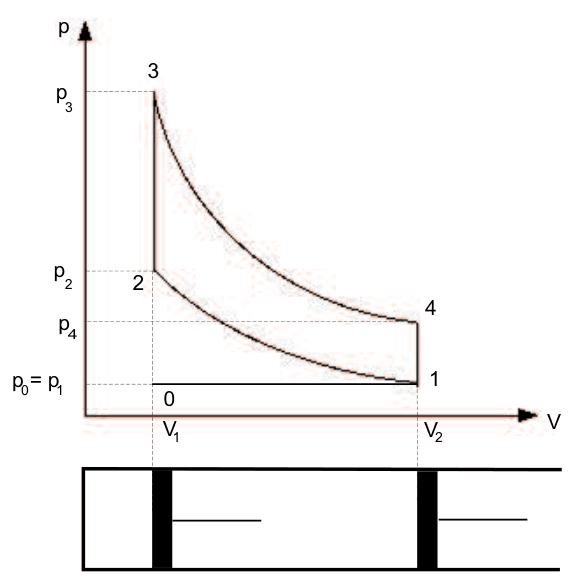
Figure 1:
a) Which processes run between the points 0–1, 2–3, 4–1, 1–0?
b) Determine the pressure and the temperature in the states 1, 2, 3 and 4.
c) Find the thermal efficiency of the cycle.
d) Discuss obtained results. Are they realistic?
Official English text of the problem.
Answers
-
a) \(0\to1\): isobaric intake; \(2\to3\): constant-volume combustion and heat addition; \(4\to1\): constant-volume pressure decrease as the exhaust valve opens, represented by heat rejection in the ideal Otto cycle; \(1\to0\): isobaric exhaust.
-
b) Using \(27^\circ\mathrm C\simeq300\ \mathrm K\):
| State | Pressure | Temperature |
|---|---|---|
| 1 | \(100\ \mathrm{kPa}\) | \(300\ \mathrm K\) |
| 2 | \(2.34\times10^3\ \mathrm{kPa}\) | \(738\ \mathrm K\) |
| 3 | \(4.68\times10^3\ \mathrm{kPa}\) | \(1.48\times10^3\ \mathrm K\) |
| 4 | \(200\ \mathrm{kPa}\) | \(600\ \mathrm K\) |
-
c) \(\displaystyle \eta=1-\varepsilon^{\,1-\kappa}=0.594\approx59.4\%\).
-
d) The pressures and temperatures are plausible orders of magnitude for a combustion engine. The efficiency is an optimistic ideal value; heat transfer, variable heat capacities, finite combustion and gas-exchange losses reduce actual efficiency, and friction further reduces shaft output.
Solution
a) Identification of the processes
Let the minimum and maximum cylinder volumes be \[ V_{\min}=V_1,\qquad V_{\max}=V_2,\qquad \frac{V_{\max}}{V_{\min}}=\varepsilon=9.5, \] where \(V_1,V_2\) are the volume labels in the figure. States 2 and 3 occur at \(V_{\min}\); states 1 and 4 occur at \(V_{\max}\).
- \(0\to1\): Isobaric intake. The piston moves downwards, drawing in fresh air and gaseous fuel at the external pressure \(p_0=p_1\).
- \(2\to3\): Isochoric combustion. Idealized instantaneous combustion raises the pressure and temperature while the piston remains at its upper position. The gas does no boundary work because its volume is constant.
- \(4\to1\): Isochoric pressure decrease. The exhaust valve opens at the lower piston position, and gas escapes until the cylinder pressure reaches the external pressure. This rapid exhaust release is represented by constant-volume heat rejection in the ideal closed Otto cycle.
- \(1\to0\): Isobaric exhaust. The piston moves upwards, expelling exhaust gas at the external pressure.
Intake and exhaust involve matter crossing the cylinder boundary. Their idealized pressure–volume paths coincide.
b) Pressures and temperatures
Treat the working gas as ideal, with constant heat capacities and \(\kappa=C_p/C_V=1.40\). During each ideal adiabatic stroke, \[ pV^\kappa=\text{constant}, \qquad TV^{\kappa-1}=\text{constant}. \] These relations follow from the first law, \[ nC_V\,dT=-p\,dV, \] together with \(pV=nRT\) and \(R/C_V=\kappa-1\), where \(C_V\) is the molar heat capacity.
At state 1, the supplied conditions give \[ p_1=100\ \mathrm{kPa},\qquad T_1=27^\circ\mathrm C\simeq300\ \mathrm K. \]
During adiabatic compression \(1\to2\), \[ p_2=p_1\left(\frac{V_{\max}}{V_{\min}}\right)^\kappa =p_1\varepsilon^\kappa, \] \[ T_2=T_1\left(\frac{V_{\max}}{V_{\min}}\right)^{\kappa-1} =T_1\varepsilon^{\kappa-1}. \] Numerically, \[ \varepsilon^{\kappa-1}=9.5^{0.40}=2.46087, \qquad \varepsilon^\kappa=9.5^{1.40}=23.3783, \] so \[ \boxed{p_2\simeq2.34\times10^3\ \mathrm{kPa}}, \qquad \boxed{T_2\simeq738\ \mathrm K}. \]
During constant-volume ignition \(2\to3\), the pressure doubles. Under the ideal working-gas approximation, \(p/T\) is constant at fixed volume, hence \[ p_3=2p_2,\qquad T_3=2T_2. \] Thus \[ \boxed{p_3\simeq4.68\times10^3\ \mathrm{kPa}}, \qquad \boxed{T_3\simeq1.48\times10^3\ \mathrm K}. \]
During adiabatic expansion \(3\to4\), \[ p_4=p_3\left(\frac{V_{\min}}{V_{\max}}\right)^\kappa =\frac{2p_1\varepsilon^\kappa}{\varepsilon^\kappa} =2p_1, \] \[ T_4=T_3\left(\frac{V_{\min}}{V_{\max}}\right)^{\kappa-1} =\frac{2T_1\varepsilon^{\kappa-1}}{\varepsilon^{\kappa-1}} =2T_1. \] Therefore, \[ \boxed{p_4=200\ \mathrm{kPa}}, \qquad \boxed{T_4\simeq600\ \mathrm K}. \]
c) Thermal efficiency
Take work done by the gas as positive. The intake and exhaust strokes contribute equal and opposite work: \[ W_{01}=p_1(V_{\max}-V_{\min}), \qquad W_{10}=-p_1(V_{\max}-V_{\min}). \] They therefore cancel. The constant-volume processes contribute no boundary work.
For the two adiabatic strokes, the first law gives \[ W_{12}=nC_V(T_1-T_2),\qquad W_{34}=nC_V(T_3-T_4). \] The net work per cycle is consequently \[ W_{\mathrm{net}} =nC_V\big[(T_3-T_2)-(T_4-T_1)\big]. \]
The combustion energy is represented by heat supplied at constant volume: \[ Q_{\mathrm{in}}=nC_V(T_3-T_2). \] Hence \[ \eta=\frac{W_{\mathrm{net}}}{Q_{\mathrm{in}}} =1-\frac{T_4-T_1}{T_3-T_2}. \] The quantity \(nC_V(T_4-T_1)\) is the equivalent heat rejected in the closed Otto-cycle representation.
Since \(T_3=2T_2\) and \(T_4=2T_1\), \[ \eta=1-\frac{T_1}{T_2} =1-\frac{1}{\varepsilon^{\kappa-1}}. \] Therefore, \[ \boxed{\eta=1-9.5^{-0.40}=0.59364\approx59.4\%.} \]
Within this ideal model, efficiency depends on the compression ratio and \(\kappa\). The specified pressure doubling determines the temperatures and work per charge, but cancels from the efficiency.
d) Discussion of realism
The compression temperature is approximately \(465^\circ\mathrm C\), the peak temperature approximately \(1200^\circ\mathrm C\), and the peak pressure approximately \(4.68\ \mathrm{MPa}\). These are reasonable orders of magnitude for a combustion engine.
At the end of expansion, the gas remains at approximately \(327^\circ\mathrm C\) and twice atmospheric pressure. Thus the exhaust still carries substantial energy. Even the ideal cycle rejects \[ 1-\eta\simeq40.6\% \] of the supplied energy.
An actual engine departs from the model in several ways:
- Heat passes from the hot gas into the cylinder walls, so compression and expansion are not perfectly adiabatic.
- Combustion takes finite time while the piston moves, so heat addition is not exactly isochoric.
- Heat capacities depend on temperature and composition. Their increase at high temperature makes a constant \(\kappa=1.40\) an optimistic approximation.
- Intake and exhaust require pressure differences across valves, producing pumping losses; their work contributions no longer cancel exactly.
- Incomplete combustion and mechanical friction reduce useful output.
Moreover, actual exhaust release is an open process: escaping gas carries energy out of the cylinder, and intake supplies a fresh charge. Constant-volume cooling of a fixed gas charge is its ideal Otto-cycle representation.
Thus the calculated \(59.4\%\) is the efficiency of the stipulated ideal model; the actual efficiency and shaft output will be lower.
The solution was checked against the official solution.
IPhO 1977 · Theorieaufgabe 1
Otto-Kreisprozess eines Viertakt-Verbrennungsmotors
Das Verdichtungsverhältnis eines Viertakt-Verbrennungsmotors beträgt \(\varepsilon = 9.5\). Der Motor saugt Luft und gasförmigen Kraftstoff bei einer Temperatur von \(27^\circ\mathrm{C}\) und einem Druck von \(1\ \mathrm{atm} = 100\ \mathrm{kPa}\) an. Die Verdichtung verläuft adiabatisch von Punkt 1 nach Punkt 2, siehe Abb. 1. Bei der Zündung des Gemisches (2–3) verdoppelt sich der Druck im Zylinder. Das heiße Abgas expandiert adiabatisch auf das Volumen \(V_2\) und drückt dabei den Kolben nach unten (3–4). Anschließend öffnet sich das Auslassventil, und der Druck sinkt wieder auf den Anfangswert von \(1\ \mathrm{atm}\). Alle Vorgänge im Zylinder werden als ideal angenommen. Der Poisson-Exponent (d. h. das Verhältnis der spezifischen Wärmekapazitäten \(C_p/C_V\)) für das Gemisch und das Abgas beträgt \(\kappa = 1.40\). (Das Verdichtungsverhältnis ist das Verhältnis des Zylindervolumens bei unterster Kolbenstellung zum Volumen bei oberster Kolbenstellung.)
Abbildung 1:
a) Welche Vorgänge laufen zwischen den Punkten 0–1, 2–3, 4–1, 1–0 ab?
b) Bestimmen Sie den Druck und die Temperatur in den Zuständen 1, 2, 3 und 4.
c) Bestimmen Sie den thermischen Wirkungsgrad des Kreisprozesses.
d) Diskutieren Sie die erhaltenen Ergebnisse. Sind sie realistisch?
Aufgabentext aus dem offiziellen englischen Text übersetzt.
Antworten
-
a) \(0\to1\): isobares Ansaugen; \(2\to3\): Verbrennung und Wärmezufuhr bei konstantem Volumen; \(4\to1\): Druckabfall bei konstantem Volumen beim Öffnen des Auslassventils, im idealen Otto-Kreisprozess durch Wärmeabgabe dargestellt; \(1\to0\): isobares Ausstoßen.
-
b) Mit \(27^\circ\mathrm C\simeq300\ \mathrm K\):
| Zustand | Druck | Temperatur |
|---|---|---|
| 1 | \(100\ \mathrm{kPa}\) | \(300\ \mathrm K\) |
| 2 | \(2.34\times10^3\ \mathrm{kPa}\) | \(738\ \mathrm K\) |
| 3 | \(4.68\times10^3\ \mathrm{kPa}\) | \(1.48\times10^3\ \mathrm K\) |
| 4 | \(200\ \mathrm{kPa}\) | \(600\ \mathrm K\) |
-
c) \(\displaystyle \eta=1-\varepsilon^{\,1-\kappa}=0.594\approx59.4\%\).
-
d) Die Drücke und Temperaturen liegen in plausiblen Größenordnungen für einen Verbrennungsmotor. Der Wirkungsgrad ist ein optimistischer Idealwert; Wärmeübertragung, veränderliche Wärmekapazitäten, eine endliche Verbrennungsdauer und Ladungswechselverluste verringern den tatsächlichen Wirkungsgrad, und Reibung verringert zusätzlich die an der Welle abgegebene Leistung.
Lösung
a) Zuordnung der Vorgänge
Die minimalen und maximalen Zylindervolumina seien \[ V_{\min}=V_1,\qquad V_{\max}=V_2,\qquad \frac{V_{\max}}{V_{\min}}=\varepsilon=9.5, \] wobei \(V_1,V_2\) die Volumenbezeichnungen in der Abbildung sind. Die Zustände 2 und 3 liegen bei \(V_{\min}\); die Zustände 1 und 4 liegen bei \(V_{\max}\).
- \(0\to1\): Isobares Ansaugen. Der Kolben bewegt sich nach unten und saugt dabei frische Luft und gasförmigen Kraftstoff beim Außendruck \(p_0=p_1\) an.
- \(2\to3\): Isochore Verbrennung. Die idealisierte augenblickliche Verbrennung erhöht Druck und Temperatur, während der Kolben in seiner oberen Stellung verbleibt. Das Gas verrichtet keine Volumenänderungsarbeit, da sein Volumen konstant ist.
- \(4\to1\): Isochorer Druckabfall. Das Auslassventil öffnet sich in der unteren Kolbenstellung, und Gas entweicht, bis der Zylinderdruck den Außendruck erreicht. Dieses rasche Ausströmen des Abgases wird im idealen geschlossenen Otto-Kreisprozess durch Wärmeabgabe bei konstantem Volumen dargestellt.
- \(1\to0\): Isobares Ausstoßen. Der Kolben bewegt sich nach oben und stößt dabei Abgas beim Außendruck aus.
Beim Ansaugen und Ausstoßen tritt Materie über die Zylindergrenze. Die idealisierten Kurven dieser Vorgänge im Druck-Volumen-Diagramm fallen zusammen.
b) Drücke und Temperaturen
Das Arbeitsgas wird als ideales Gas mit konstanten Wärmekapazitäten und \(\kappa=C_p/C_V=1.40\) behandelt. Während jedes idealen adiabatischen Taktes gilt \[ pV^\kappa=\text{konstant}, \qquad TV^{\kappa-1}=\text{konstant}. \] Diese Beziehungen folgen aus dem ersten Hauptsatz, \[ nC_V\,dT=-p\,dV, \] zusammen mit \(pV=nRT\) und \(R/C_V=\kappa-1\), wobei \(C_V\) die molare Wärmekapazität ist.
Für Zustand 1 ergeben die angegebenen Bedingungen \[ p_1=100\ \mathrm{kPa},\qquad T_1=27^\circ\mathrm C\simeq300\ \mathrm K. \]
Bei der adiabatischen Verdichtung \(1\to2\) gilt \[ p_2=p_1\left(\frac{V_{\max}}{V_{\min}}\right)^\kappa =p_1\varepsilon^\kappa, \] \[ T_2=T_1\left(\frac{V_{\max}}{V_{\min}}\right)^{\kappa-1} =T_1\varepsilon^{\kappa-1}. \] Numerisch ergibt sich \[ \varepsilon^{\kappa-1}=9.5^{0.40}=2.46087, \qquad \varepsilon^\kappa=9.5^{1.40}=23.3783, \] also \[ \boxed{p_2\simeq2.34\times10^3\ \mathrm{kPa}}, \qquad \boxed{T_2\simeq738\ \mathrm K}. \]
Bei der Zündung bei konstantem Volumen \(2\to3\) verdoppelt sich der Druck. In der Näherung eines idealen Arbeitsgases ist \(p/T\) bei festem Volumen konstant, daher gilt \[ p_3=2p_2,\qquad T_3=2T_2. \] Somit folgt \[ \boxed{p_3\simeq4.68\times10^3\ \mathrm{kPa}}, \qquad \boxed{T_3\simeq1.48\times10^3\ \mathrm K}. \]
Bei der adiabatischen Expansion \(3\to4\) gilt \[ p_4=p_3\left(\frac{V_{\min}}{V_{\max}}\right)^\kappa =\frac{2p_1\varepsilon^\kappa}{\varepsilon^\kappa} =2p_1, \] \[ T_4=T_3\left(\frac{V_{\min}}{V_{\max}}\right)^{\kappa-1} =\frac{2T_1\varepsilon^{\kappa-1}}{\varepsilon^{\kappa-1}} =2T_1. \] Daher ergibt sich \[ \boxed{p_4=200\ \mathrm{kPa}}, \qquad \boxed{T_4\simeq600\ \mathrm K}. \]
c) Thermischer Wirkungsgrad
Die vom Gas verrichtete Arbeit wird als positiv gezählt. Die Arbeitsbeiträge des Ansaug- und des Ausstoßtaktes sind betragsgleich und entgegengesetzt: \[ W_{01}=p_1(V_{\max}-V_{\min}), \qquad W_{10}=-p_1(V_{\max}-V_{\min}). \] Sie heben sich daher auf. Bei den Vorgängen mit konstantem Volumen wird keine Volumenänderungsarbeit verrichtet.
Für die beiden adiabatischen Takte liefert der erste Hauptsatz \[ W_{12}=nC_V(T_1-T_2),\qquad W_{34}=nC_V(T_3-T_4). \] Die Nettoarbeit pro Kreisprozess beträgt folglich \[ W_{\mathrm{net}} =nC_V\big[(T_3-T_2)-(T_4-T_1)\big]. \]
Die Verbrennungsenergie wird durch Wärmezufuhr bei konstantem Volumen dargestellt: \[ Q_{\mathrm{in}}=nC_V(T_3-T_2). \] Daraus folgt \[ \eta=\frac{W_{\mathrm{net}}}{Q_{\mathrm{in}}} =1-\frac{T_4-T_1}{T_3-T_2}. \] Die Größe \(nC_V(T_4-T_1)\) ist die äquivalente abgegebene Wärme in der Darstellung als geschlossener Otto-Kreisprozess.
Da \(T_3=2T_2\) und \(T_4=2T_1\), gilt \[ \eta=1-\frac{T_1}{T_2} =1-\frac{1}{\varepsilon^{\kappa-1}}. \] Daher ergibt sich \[ \boxed{\eta=1-9.5^{-0.40}=0.59364\approx59.4\%.} \]
In diesem idealen Modell hängt der Wirkungsgrad vom Verdichtungsverhältnis und von \(\kappa\) ab. Die vorgegebene Druckverdopplung bestimmt die Temperaturen und die Arbeit pro Zylinderfüllung, kürzt sich jedoch bei der Berechnung des Wirkungsgrades heraus.
d) Diskussion des Realitätsbezugs
Die Verdichtungstemperatur beträgt etwa \(465^\circ\mathrm C\), die Höchsttemperatur etwa \(1200^\circ\mathrm C\) und der Höchstdruck etwa \(4.68\ \mathrm{MPa}\). Dies sind plausible Größenordnungen für einen Verbrennungsmotor.
Am Ende der Expansion hat das Gas noch eine Temperatur von etwa \(327^\circ\mathrm C\) und steht unter dem doppelten Atmosphärendruck. Das Abgas führt somit noch beträchtliche Energie mit sich. Selbst der ideale Kreisprozess gibt \[ 1-\eta\simeq40.6\% \] der zugeführten Energie wieder ab.
Ein realer Motor weicht in mehrfacher Hinsicht vom Modell ab:
- Wärme geht vom heißen Gas auf die Zylinderwände über, sodass Verdichtung und Expansion nicht vollkommen adiabatisch verlaufen.
- Die Verbrennung benötigt eine endliche Zeit, während sich der Kolben bewegt, sodass die Wärmezufuhr nicht genau isochor erfolgt.
- Die Wärmekapazitäten hängen von Temperatur und Zusammensetzung ab. Ihr Anstieg bei hohen Temperaturen macht einen konstanten Wert von \(\kappa=1.40\) zu einer optimistischen Näherung.
- Ansaugen und Ausstoßen erfordern Druckunterschiede an den Ventilen, wodurch Ladungswechselverluste entstehen; ihre Arbeitsbeiträge heben sich nicht mehr genau auf.
- Unvollständige Verbrennung und mechanische Reibung verringern die nutzbare Leistung.
Außerdem ist das tatsächliche Ausströmen des Abgases ein offener Vorgang: Entweichendes Gas transportiert Energie aus dem Zylinder, und beim Ansaugen wird eine frische Füllung zugeführt. Die Abkühlung einer festen Gasfüllung bei konstantem Volumen ist die Darstellung dieses Vorgangs im idealen Otto-Kreisprozess.
Die berechneten \(59.4\%\) sind somit der Wirkungsgrad des vorgegebenen idealen Modells; der tatsächliche Wirkungsgrad und die an der Welle abgegebene Leistung werden geringer sein.
Die Lösung wurde mit der offiziellen Lösung abgeglichen.
IPhO 1977 · Teori sorusu 1
Dört zamanlı bir içten yanmalı motorun Otto çevrimi
Dört zamanlı bir içten yanmalı motorun sıkıştırma oranı \(\varepsilon = 9.5\) değerindedir. Motor, \(27^\circ\mathrm{C}\) sıcaklıkta ve \(1\ \mathrm{atm} = 100\ \mathrm{kPa}\) basınçta hava ve gaz yakıt emer. Sıkıştırma, 1 noktasından 2 noktasına kadar adyabatik bir süreç izler; bkz. Şekil 1. Karışımın ateşlenmesi sırasında (2–3) silindirdeki basınç iki katına çıkar. Sıcak egzoz gazı, pistonu aşağı doğru iterek adyabatik olarak \(V_2\) hacmine kadar genleşir (3–4). Ardından egzoz supabı açılır ve basınç başlangıçtaki \(1\ \mathrm{atm}\) değerine döner. Silindirdeki tüm süreçlerin ideal olduğu varsayılmaktadır. Karışım ve egzoz gazı için Poisson sabiti (yani özgül ısıların oranı \(C_p/C_V\)) \(\kappa = 1.40\) değerindedir. (Sıkıştırma oranı, piston en alt konumdayken silindirin hacminin, piston en üst konumdayken silindirin hacmine oranıdır.)
Şekil 1:
a) 0–1, 2–3, 4–1, 1–0 noktaları arasında hangi süreçler gerçekleşir?
b) 1, 2, 3 ve 4 durumlarındaki basınç ve sıcaklığı belirleyin.
c) Çevrimin ısıl verimini bulun.
d) Elde edilen sonuçları tartışın. Gerçekçi midirler?
Soru metni resmi İngilizce metinden çevrilmiştir.
Cevaplar
-
a) \(0\to1\): sabit basınçta emme; \(2\to3\): sabit hacimde yanma ve ısı girişi; \(4\to1\): egzoz supabı açılırken sabit hacimde basınç düşüşü; ideal Otto çevriminde ısı atılmasıyla temsil edilir; \(1\to0\): sabit basınçta egzoz.
-
b) \(27^\circ\mathrm C\simeq300\ \mathrm K\) kullanılarak:
| Durum | Basınç | Sıcaklık |
|---|---|---|
| 1 | \(100\ \mathrm{kPa}\) | \(300\ \mathrm K\) |
| 2 | \(2.34\times10^3\ \mathrm{kPa}\) | \(738\ \mathrm K\) |
| 3 | \(4.68\times10^3\ \mathrm{kPa}\) | \(1.48\times10^3\ \mathrm K\) |
| 4 | \(200\ \mathrm{kPa}\) | \(600\ \mathrm K\) |
-
c) \(\displaystyle \eta=1-\varepsilon^{\,1-\kappa}=0.594\approx59.4\%\).
-
d) Basınç ve sıcaklıkların büyüklük mertebeleri bir içten yanmalı motor için makuldür. Verim, iyimser bir ideal değerdir; ısı aktarımı, değişken ısı kapasiteleri, yanmanın sonlu sürede gerçekleşmesi ve gaz değişimi kayıpları gerçek verimi düşürür; sürtünme de mil çıkışını daha da azaltır.
Çözüm
a) Süreçlerin belirlenmesi
Silindirin en küçük ve en büyük hacimleri \[ V_{\min}=V_1,\qquad V_{\max}=V_2,\qquad \frac{V_{\max}}{V_{\min}}=\varepsilon=9.5, \] olsun; burada \(V_1,V_2\) şekildeki hacim etiketleridir. 2 ve 3 durumları \(V_{\min}\) hacminde, 1 ve 4 durumları ise \(V_{\max}\) hacminde gerçekleşir.
- \(0\to1\): Sabit basınçta emme. Piston aşağı doğru hareket ederek \(p_0=p_1\) dış basıncında taze hava ve gaz yakıt emer.
- \(2\to3\): Sabit hacimde yanma. İdealleştirilmiş ani yanma, piston üst konumunda kalırken basıncı ve sıcaklığı artırır. Hacmi sabit olduğundan gaz sınır işi yapmaz.
- \(4\to1\): Sabit hacimde basınç düşüşü. Piston alt konumdayken egzoz supabı açılır ve silindir basıncı dış basınca ulaşıncaya kadar gaz dışarı çıkar. Bu hızlı egzoz boşalması, ideal kapalı Otto çevriminde sabit hacimde ısı atılmasıyla temsil edilir.
- \(1\to0\): Sabit basınçta egzoz. Piston yukarı doğru hareket ederek egzoz gazını dış basınçta dışarı atar.
Emme ve egzoz sırasında silindir sınırından madde geçişi olur. Bu süreçlerin idealleştirilmiş basınç–hacim yolları çakışır.
b) Basınçlar ve sıcaklıklar
Çalışma gazını, ısı kapasiteleri sabit ve \(\kappa=C_p/C_V=1.40\) olan ideal bir gaz olarak ele alalım. Her ideal adyabatik strok sırasında \[ pV^\kappa=\text{sabit}, \qquad TV^{\kappa-1}=\text{sabit}. \] Bu bağıntılar, birinci yasa olan \[ nC_V\,dT=-p\,dV, \] ile \(pV=nRT\) ve \(R/C_V=\kappa-1\) bağıntılarının birlikte kullanılmasından elde edilir; burada \(C_V\) molar ısı kapasitesidir.
1 durumunda, verilen koşullardan \[ p_1=100\ \mathrm{kPa},\qquad T_1=27^\circ\mathrm C\simeq300\ \mathrm K. \] elde edilir.
Adyabatik sıkıştırma \(1\to2\) sırasında \[ p_2=p_1\left(\frac{V_{\max}}{V_{\min}}\right)^\kappa =p_1\varepsilon^\kappa, \] \[ T_2=T_1\left(\frac{V_{\max}}{V_{\min}}\right)^{\kappa-1} =T_1\varepsilon^{\kappa-1}. \] Sayısal olarak \[ \varepsilon^{\kappa-1}=9.5^{0.40}=2.46087, \qquad \varepsilon^\kappa=9.5^{1.40}=23.3783, \] olduğundan \[ \boxed{p_2\simeq2.34\times10^3\ \mathrm{kPa}}, \qquad \boxed{T_2\simeq738\ \mathrm K}. \]
Sabit hacimde ateşleme \(2\to3\) sırasında basınç iki katına çıkar. İdeal çalışma gazı yaklaşımında, sabit hacimde \(p/T\) sabittir; dolayısıyla \[ p_3=2p_2,\qquad T_3=2T_2. \] Böylece \[ \boxed{p_3\simeq4.68\times10^3\ \mathrm{kPa}}, \qquad \boxed{T_3\simeq1.48\times10^3\ \mathrm K}. \]
Adyabatik genleşme \(3\to4\) sırasında \[ p_4=p_3\left(\frac{V_{\min}}{V_{\max}}\right)^\kappa =\frac{2p_1\varepsilon^\kappa}{\varepsilon^\kappa} =2p_1, \] \[ T_4=T_3\left(\frac{V_{\min}}{V_{\max}}\right)^{\kappa-1} =\frac{2T_1\varepsilon^{\kappa-1}}{\varepsilon^{\kappa-1}} =2T_1. \] Dolayısıyla \[ \boxed{p_4=200\ \mathrm{kPa}}, \qquad \boxed{T_4\simeq600\ \mathrm K}. \]
c) Isıl verim
Gazın yaptığı işi pozitif kabul edelim. Emme ve egzoz stroklarının iş katkıları eşit büyüklükte ve zıt işaretlidir: \[ W_{01}=p_1(V_{\max}-V_{\min}), \qquad W_{10}=-p_1(V_{\max}-V_{\min}). \] Bu nedenle birbirlerini götürürler. Sabit hacimli süreçlerde sınır işi yapılmaz.
İki adyabatik strok için birinci yasa \[ W_{12}=nC_V(T_1-T_2),\qquad W_{34}=nC_V(T_3-T_4). \] sonucunu verir. Buna göre çevrim başına net iş \[ W_{\mathrm{net}} =nC_V\big[(T_3-T_2)-(T_4-T_1)\big]. \] olur.
Yanma enerjisi, sabit hacimde verilen ısı ile temsil edilir: \[ Q_{\mathrm{in}}=nC_V(T_3-T_2). \] Buradan \[ \eta=\frac{W_{\mathrm{net}}}{Q_{\mathrm{in}}} =1-\frac{T_4-T_1}{T_3-T_2}. \] \(nC_V(T_4-T_1)\) niceliği, kapalı Otto çevrimi gösteriminde atılan eşdeğer ısıdır.
\(T_3=2T_2\) ve \(T_4=2T_1\) olduğundan \[ \eta=1-\frac{T_1}{T_2} =1-\frac{1}{\varepsilon^{\kappa-1}}. \] Dolayısıyla \[ \boxed{\eta=1-9.5^{-0.40}=0.59364\approx59.4\%.} \]
Bu ideal modelde verim, sıkıştırma oranına ve \(\kappa\) değerine bağlıdır. Belirtilen basınç ikiye katlanması, sıcaklıkları ve silindire alınan her bir gaz dolumu başına yapılan işi belirler; ancak verim ifadesinde sadeleşir.
d) Gerçekçiliğin tartışılması
Sıkıştırma sonundaki sıcaklık yaklaşık \(465^\circ\mathrm C\), en yüksek sıcaklık yaklaşık \(1200^\circ\mathrm C\) ve en yüksek basınç yaklaşık \(4.68\ \mathrm{MPa}\) değerindedir. Bunlar, bir içten yanmalı motor için makul büyüklük mertebeleridir.
Genleşmenin sonunda gaz hâlâ yaklaşık \(327^\circ\mathrm C\) sıcaklıkta ve atmosfer basıncının iki katı basınçtadır. Dolayısıyla egzoz hâlâ önemli miktarda enerji taşır. İdeal çevrim bile verilen enerjinin \[ 1-\eta\simeq40.6\% \] kadarını dışarı atar.
Gerçek bir motor, modelden çeşitli yönlerden farklılık gösterir:
- Sıcak gazdan silindir duvarlarına ısı geçer; bu nedenle sıkıştırma ve genleşme tam olarak adyabatik değildir.
- Yanma, piston hareket ederken sonlu bir sürede gerçekleşir; dolayısıyla ısı girişi tam olarak sabit hacimde olmaz.
- Isı kapasiteleri sıcaklığa ve bileşime bağlıdır. Yüksek sıcaklıkta artmaları, sabit \(\kappa=1.40\) kabulünü iyimser bir yaklaşım hâline getirir.
- Emme ve egzoz, supapların iki tarafı arasında basınç farkları gerektirir ve bu da pompalama kayıplarına yol açar; bu süreçlerin iş katkıları artık birbirini tam olarak götürmez.
- Eksik yanma ve mekanik sürtünme yararlı çıkışı azaltır.
Ayrıca gerçek egzoz boşalması açık bir süreçtir: dışarı çıkan gaz, silindirden enerji taşır ve emme sırasında taze bir gaz dolumu sağlanır. Sabit miktardaki bir gaz dolumunun sabit hacimde soğutulması, bunun ideal Otto çevrimindeki gösterimidir.
Dolayısıyla hesaplanan \(59.4\%\), belirtilen ideal modelin verimidir; gerçek verim ve mil çıkışı daha düşük olacaktır.
Çözüm, resmi çözümle karşılaştırılarak kontrol edildi.
IPhO 1977 · Problema teórico 1
Ciclo Otto de un motor de combustión de cuatro tiempos
La relación de compresión de un motor de combustión interna de cuatro tiempos es \(\varepsilon = 9.5\). El motor aspira aire y combustible gaseoso a una temperatura de \(27^\circ\mathrm{C}\) y a una presión de \(1\ \mathrm{atm} = 100\ \mathrm{kPa}\). La compresión sigue un proceso adiabático desde el punto 1 hasta el punto 2, véase la Fig. 1. La presión en el cilindro se duplica durante el encendido de la mezcla (2–3). Los gases de escape calientes se expanden adiabáticamente hasta el volumen \(V_2\), empujando el pistón hacia abajo (3–4). A continuación, se abre la válvula de escape y la presión vuelve al valor inicial de \(1\ \mathrm{atm}\). Se supone que todos los procesos en el cilindro son ideales. La constante de Poisson (es decir, la relación entre los calores específicos \(C_p/C_V\)) de la mezcla y de los gases de escape es \(\kappa = 1.40\). (La relación de compresión es el cociente entre el volumen del cilindro cuando el pistón está en su posición inferior y el volumen cuando el pistón está en su posición superior.)
Figura 1:
a) ¿Qué procesos tienen lugar entre los puntos 0–1, 2–3, 4–1, 1–0?
b) Determine la presión y la temperatura en los estados 1, 2, 3 y 4.
c) Halle el rendimiento térmico del ciclo.
d) Analice los resultados obtenidos. ¿Son realistas?
Enunciado traducido del texto oficial en inglés.
Respuestas
-
a) \(0\to1\): admisión isobárica; \(2\to3\): combustión y aporte de calor a volumen constante; \(4\to1\): disminución de la presión a volumen constante al abrirse la válvula de escape, representada por una cesión de calor en el ciclo Otto ideal; \(1\to0\): escape isobárico.
-
b) Utilizando \(27^\circ\mathrm C\simeq300\ \mathrm K\):
| Estado | Presión | Temperatura |
|---|---|---|
| 1 | \(100\ \mathrm{kPa}\) | \(300\ \mathrm K\) |
| 2 | \(2.34\times10^3\ \mathrm{kPa}\) | \(738\ \mathrm K\) |
| 3 | \(4.68\times10^3\ \mathrm{kPa}\) | \(1.48\times10^3\ \mathrm K\) |
| 4 | \(200\ \mathrm{kPa}\) | \(600\ \mathrm K\) |
-
c) \(\displaystyle \eta=1-\varepsilon^{\,1-\kappa}=0.594\approx59.4\%\).
-
d) Las presiones y las temperaturas tienen órdenes de magnitud plausibles para un motor de combustión. El rendimiento es un valor ideal optimista; la transferencia de calor, las capacidades caloríficas variables, la duración finita de la combustión y las pérdidas asociadas al intercambio de gases reducen el rendimiento real, y la fricción reduce aún más la potencia útil en el eje.
Solución
a) Identificación de los procesos
Sean los volúmenes mínimo y máximo del cilindro \[ V_{\min}=V_1,\qquad V_{\max}=V_2,\qquad \frac{V_{\max}}{V_{\min}}=\varepsilon=9.5, \] donde \(V_1,V_2\) son las etiquetas de volumen de la figura. Los estados 2 y 3 corresponden a \(V_{\min}\); los estados 1 y 4 corresponden a \(V_{\max}\).
- \(0\to1\): Admisión isobárica. El pistón se desplaza hacia abajo, aspirando aire fresco y combustible gaseoso a la presión exterior \(p_0=p_1\).
- \(2\to3\): Combustión isócora. La combustión idealizada como instantánea eleva la presión y la temperatura mientras el pistón permanece en su posición superior. El gas no realiza trabajo de expansión porque su volumen es constante.
- \(4\to1\): Disminución isócora de la presión. La válvula de escape se abre con el pistón en su posición inferior, y el gas sale hasta que la presión del cilindro alcanza la presión exterior. Esta descarga rápida de los gases de escape se representa mediante una cesión de calor a volumen constante en el ciclo Otto cerrado ideal.
- \(1\to0\): Escape isobárico. El pistón se desplaza hacia arriba, expulsando los gases de escape a la presión exterior.
La admisión y el escape implican el paso de materia a través de la frontera del cilindro. Sus trayectorias idealizadas en el diagrama presión–volumen coinciden.
b) Presiones y temperaturas
Consideramos el gas de trabajo como ideal, con capacidades caloríficas constantes y \(\kappa=C_p/C_V=1.40\). Durante cada carrera adiabática ideal, \[ pV^\kappa=\text{constante}, \qquad TV^{\kappa-1}=\text{constante}. \] Estas relaciones se deducen del primer principio, \[ nC_V\,dT=-p\,dV, \] junto con \(pV=nRT\) y \(R/C_V=\kappa-1\), donde \(C_V\) es la capacidad calorífica molar.
En el estado 1, las condiciones dadas proporcionan \[ p_1=100\ \mathrm{kPa},\qquad T_1=27^\circ\mathrm C\simeq300\ \mathrm K. \]
Durante la compresión adiabática \(1\to2\), \[ p_2=p_1\left(\frac{V_{\max}}{V_{\min}}\right)^\kappa =p_1\varepsilon^\kappa, \] \[ T_2=T_1\left(\frac{V_{\max}}{V_{\min}}\right)^{\kappa-1} =T_1\varepsilon^{\kappa-1}. \] Numéricamente, \[ \varepsilon^{\kappa-1}=9.5^{0.40}=2.46087, \qquad \varepsilon^\kappa=9.5^{1.40}=23.3783, \] por lo que \[ \boxed{p_2\simeq2.34\times10^3\ \mathrm{kPa}}, \qquad \boxed{T_2\simeq738\ \mathrm K}. \]
Durante el encendido a volumen constante \(2\to3\), la presión se duplica. Bajo la aproximación de gas de trabajo ideal, \(p/T\) es constante a volumen fijo, de modo que \[ p_3=2p_2,\qquad T_3=2T_2. \] Así, \[ \boxed{p_3\simeq4.68\times10^3\ \mathrm{kPa}}, \qquad \boxed{T_3\simeq1.48\times10^3\ \mathrm K}. \]
Durante la expansión adiabática \(3\to4\), \[ p_4=p_3\left(\frac{V_{\min}}{V_{\max}}\right)^\kappa =\frac{2p_1\varepsilon^\kappa}{\varepsilon^\kappa} =2p_1, \] \[ T_4=T_3\left(\frac{V_{\min}}{V_{\max}}\right)^{\kappa-1} =\frac{2T_1\varepsilon^{\kappa-1}}{\varepsilon^{\kappa-1}} =2T_1. \] Por tanto, \[ \boxed{p_4=200\ \mathrm{kPa}}, \qquad \boxed{T_4\simeq600\ \mathrm K}. \]
c) Rendimiento térmico
Tomamos como positivo el trabajo realizado por el gas. Las carreras de admisión y escape aportan trabajos iguales y de signo contrario: \[ W_{01}=p_1(V_{\max}-V_{\min}), \qquad W_{10}=-p_1(V_{\max}-V_{\min}). \] Por tanto, se cancelan. Los procesos a volumen constante no aportan trabajo de expansión.
Para las dos carreras adiabáticas, el primer principio da \[ W_{12}=nC_V(T_1-T_2),\qquad W_{34}=nC_V(T_3-T_4). \] En consecuencia, el trabajo neto por ciclo es \[ W_{\mathrm{net}} =nC_V\big[(T_3-T_2)-(T_4-T_1)\big]. \]
La energía de combustión se representa mediante calor suministrado a volumen constante: \[ Q_{\mathrm{in}}=nC_V(T_3-T_2). \] Por consiguiente, \[ \eta=\frac{W_{\mathrm{net}}}{Q_{\mathrm{in}}} =1-\frac{T_4-T_1}{T_3-T_2}. \] La cantidad \(nC_V(T_4-T_1)\) es el calor cedido equivalente en la representación mediante el ciclo Otto cerrado.
Como \(T_3=2T_2\) y \(T_4=2T_1\), \[ \eta=1-\frac{T_1}{T_2} =1-\frac{1}{\varepsilon^{\kappa-1}}. \] Por tanto, \[ \boxed{\eta=1-9.5^{-0.40}=0.59364\approx59.4\%.} \]
Dentro de este modelo ideal, el rendimiento depende de la relación de compresión y de \(\kappa\). La duplicación de la presión especificada determina las temperaturas y el trabajo por carga, pero se cancela en la expresión del rendimiento.
d) Análisis del realismo de los resultados
La temperatura de compresión es aproximadamente \(465^\circ\mathrm C\), la temperatura máxima es aproximadamente \(1200^\circ\mathrm C\) y la presión máxima es aproximadamente \(4.68\ \mathrm{MPa}\). Estos son órdenes de magnitud razonables para un motor de combustión.
Al final de la expansión, el gas permanece a aproximadamente \(327^\circ\mathrm C\) y al doble de la presión atmosférica. Por tanto, los gases de escape todavía transportan una energía considerable. Incluso el ciclo ideal cede \[ 1-\eta\simeq40.6\% \] de la energía suministrada.
Un motor real se aparta del modelo en varios aspectos:
- El calor pasa del gas caliente a las paredes del cilindro, por lo que la compresión y la expansión no son perfectamente adiabáticas.
- La combustión dura un tiempo finito mientras el pistón se mueve, por lo que el aporte de calor no es exactamente isócoro.
- Las capacidades caloríficas dependen de la temperatura y de la composición. Su aumento a altas temperaturas hace que un valor constante de \(\kappa=1.40\) sea una aproximación optimista.
- La admisión y el escape requieren diferencias de presión a través de las válvulas, lo que produce pérdidas de bombeo; sus contribuciones al trabajo ya no se cancelan exactamente.
- La combustión incompleta y la fricción mecánica reducen la potencia útil.
Además, la descarga real de los gases de escape es un proceso abierto: el gas que sale transporta energía fuera del cilindro, y la admisión suministra una carga nueva. El enfriamiento a volumen constante de una carga fija de gas es su representación en el ciclo Otto ideal.
Así pues, el \(59.4\%\) calculado es el rendimiento del modelo ideal estipulado; el rendimiento real y la potencia útil en el eje serán menores.
La solución se comprobó con la solución oficial.
IPhO 1977 · 理论题 1
四冲程内燃机的奥托循环
一台四冲程内燃机的压缩比为 \(\varepsilon = 9.5\)。发动机吸入温度为 \(27^\circ\mathrm{C}\)、压强为 \(1\ \mathrm{atm} = 100\ \mathrm{kPa}\) 的空气和气体燃料。从点 1 到点 2 的压缩过程为绝热过程,见图 1。混合气点火燃烧期间(2–3),气缸内的压强增至原来的两倍。高温废气绝热膨胀至体积 \(V_2\),推动活塞向下运动(3–4)。随后排气门打开,压强恢复到初始值 \(1\ \mathrm{atm}\)。假设气缸内的所有过程均为理想过程。混合气和废气的泊松常数(即比热容之比 \(C_p/C_V\))均为 \(\kappa = 1.40\)。(压缩比是活塞位于最下端时的气缸容积与活塞位于最上端时的气缸容积之比。)
图 1:
a) 点 0–1、2–3、4–1、1–0 之间分别发生什么过程?
b) 求状态 1、2、3 和 4 的压强与温度。
c) 求该循环的热效率。
d) 讨论所得结果。它们符合实际吗?
题目译自官方英文原文。
答案
-
a) \(0\to1\):等压进气;\(2\to3\):等容燃烧并吸热;\(4\to1\):排气门打开时的等容降压过程,在理想奥托循环中用放热过程表示;\(1\to0\):等压排气。
-
b) 采用 \(27^\circ\mathrm C\simeq300\ \mathrm K\):
| 状态 | 压强 | 温度 |
|---|---|---|
| 1 | \(100\ \mathrm{kPa}\) | \(300\ \mathrm K\) |
| 2 | \(2.34\times10^3\ \mathrm{kPa}\) | \(738\ \mathrm K\) |
| 3 | \(4.68\times10^3\ \mathrm{kPa}\) | \(1.48\times10^3\ \mathrm K\) |
| 4 | \(200\ \mathrm{kPa}\) | \(600\ \mathrm K\) |
-
c) \(\displaystyle \eta=1-\varepsilon^{\,1-\kappa}=0.594\approx59.4\%\)。
-
d) 所得压强和温度的数量级对内燃机而言是合理的。所得效率是一个偏乐观的理想值;传热、热容的变化、燃烧过程所需的有限时间以及换气损失都会降低实际效率,而摩擦还会进一步降低轴输出功。
解答
a) 各过程的判定
设气缸的最小和最大容积分别为 \[ V_{\min}=V_1,\qquad V_{\max}=V_2,\qquad \frac{V_{\max}}{V_{\min}}=\varepsilon=9.5, \] 其中 \(V_1,V_2\) 是图中的体积标记。状态 2 和 3 对应的体积为 \(V_{\min}\);状态 1 和 4 对应的体积为 \(V_{\max}\)。
- \(0\to1\):等压进气。 活塞向下运动,在外界压强 \(p_0=p_1\) 下吸入新鲜空气和气体燃料。
- \(2\to3\):等容燃烧。 在理想化的瞬时燃烧过程中,活塞保持在最上端,压强和温度升高。由于体积不变,气体不做体积功。
- \(4\to1\):等容降压。 活塞位于最下端时排气门打开,气体逸出,直到气缸内的压强降至外界压强。在理想的闭式奥托循环中,这一快速排气泄压过程用等容放热过程表示。
- \(1\to0\):等压排气。 活塞向上运动,在外界压强下排出废气。
进气和排气过程中均有物质穿过气缸边界。这两个过程的理想化压强–体积路径相互重合。
b) 压强与温度
将工质气体视为热容恒定的理想气体,且 \(\kappa=C_p/C_V=1.40\)。在每个理想绝热冲程中, \[ pV^\kappa=\text{常量}, \qquad TV^{\kappa-1}=\text{常量}. \] 这些关系可由热力学第一定律 \[ nC_V\,dT=-p\,dV, \] 结合 \(pV=nRT\) 和 \(R/C_V=\kappa-1\) 得到,其中 \(C_V\) 为摩尔热容。
在状态 1,由给定条件可得 \[ p_1=100\ \mathrm{kPa},\qquad T_1=27^\circ\mathrm C\simeq300\ \mathrm K. \]
在绝热压缩 \(1\to2\) 过程中, \[ p_2=p_1\left(\frac{V_{\max}}{V_{\min}}\right)^\kappa =p_1\varepsilon^\kappa, \] \[ T_2=T_1\left(\frac{V_{\max}}{V_{\min}}\right)^{\kappa-1} =T_1\varepsilon^{\kappa-1}. \] 代入数值得 \[ \varepsilon^{\kappa-1}=9.5^{0.40}=2.46087, \qquad \varepsilon^\kappa=9.5^{1.40}=23.3783, \] 因此 \[ \boxed{p_2\simeq2.34\times10^3\ \mathrm{kPa}}, \qquad \boxed{T_2\simeq738\ \mathrm K}. \]
在等容点火燃烧 \(2\to3\) 过程中,压强增至原来的两倍。在理想工质气体近似下,体积不变时 \(p/T\) 为常量,因此 \[ p_3=2p_2,\qquad T_3=2T_2. \] 于是 \[ \boxed{p_3\simeq4.68\times10^3\ \mathrm{kPa}}, \qquad \boxed{T_3\simeq1.48\times10^3\ \mathrm K}. \]
在绝热膨胀 \(3\to4\) 过程中, \[ p_4=p_3\left(\frac{V_{\min}}{V_{\max}}\right)^\kappa =\frac{2p_1\varepsilon^\kappa}{\varepsilon^\kappa} =2p_1, \] \[ T_4=T_3\left(\frac{V_{\min}}{V_{\max}}\right)^{\kappa-1} =\frac{2T_1\varepsilon^{\kappa-1}}{\varepsilon^{\kappa-1}} =2T_1. \] 因此, \[ \boxed{p_4=200\ \mathrm{kPa}}, \qquad \boxed{T_4\simeq600\ \mathrm K}. \]
c) 热效率
规定气体对外做功为正。进气和排气冲程所做的功大小相等、符号相反: \[ W_{01}=p_1(V_{\max}-V_{\min}), \qquad W_{10}=-p_1(V_{\max}-V_{\min}). \] 因此,两者相互抵消。等容过程中不做体积功。
对于两个绝热冲程,由热力学第一定律可得 \[ W_{12}=nC_V(T_1-T_2),\qquad W_{34}=nC_V(T_3-T_4). \] 因此,每个循环的净功为 \[ W_{\mathrm{net}} =nC_V\big[(T_3-T_2)-(T_4-T_1)\big]. \]
燃烧释放的能量用等容吸热表示: \[ Q_{\mathrm{in}}=nC_V(T_3-T_2). \] 因此 \[ \eta=\frac{W_{\mathrm{net}}}{Q_{\mathrm{in}}} =1-\frac{T_4-T_1}{T_3-T_2}. \] 在闭式奥托循环的描述中,\(nC_V(T_4-T_1)\) 是等效的放热量。
由于 \(T_3=2T_2\) 且 \(T_4=2T_1\), \[ \eta=1-\frac{T_1}{T_2} =1-\frac{1}{\varepsilon^{\kappa-1}}. \] 因此, \[ \boxed{\eta=1-9.5^{-0.40}=0.59364\approx59.4\%.} \]
在这一理想模型中,效率取决于压缩比和 \(\kappa\)。题设中压强增至两倍的条件决定了各状态的温度以及每次充气所做的功,但在效率表达式中会被消去。
d) 对实际符合程度的讨论
压缩终了的温度约为 \(465^\circ\mathrm C\),最高温度约为 \(1200^\circ\mathrm C\),最高压强约为 \(4.68\ \mathrm{MPa}\)。对于内燃机而言,这些数量级是合理的。
膨胀结束时,气体温度仍约为 \(327^\circ\mathrm C\),压强仍为大气压的两倍。因此,废气仍携带相当多的能量。即使是理想循环,也会放出占输入能量 \[ 1-\eta\simeq40.6\% \] 的能量。
实际发动机在以下几个方面偏离这一模型:
- 热量会从高温气体传递到气缸壁,因此压缩和膨胀并非完全绝热。
- 燃烧需要一定时间,在此期间活塞仍在运动,因此吸热过程并非严格等容。
- 热容取决于温度和组分。高温下热容增大,因此将 \(\kappa=1.40\) 视为常量是一种偏乐观的近似。
- 进气和排气需要气门两侧存在压强差,从而产生泵气损失;这两个过程所做的功不再严格抵消。
- 不完全燃烧和机械摩擦会降低有效输出。
此外,实际的排气泄压是一个开放过程:逸出的气体将能量带出气缸,而进气则补充新鲜混合气。将定量气体等容冷却,是这一过程在理想奥托循环中的表示方式。
因此,计算得到的 \(59.4\%\) 是题设理想模型的效率;实际效率和轴输出功都会更低。
解答已与官方解答核对。
IPhO 1977 · Теоретическая задача 1
Цикл Отто четырёхтактного двигателя внутреннего сгорания
Степень сжатия четырёхтактного двигателя внутреннего сгорания равна \(\varepsilon = 9.5\). В двигатель поступают воздух и газообразное топливо при температуре \(27^\circ\mathrm{C}\) и давлении \(1\ \mathrm{atm} = 100\ \mathrm{kPa}\). Сжатие происходит адиабатически от точки 1 до точки 2, см. рис. 1. При воспламенении смеси (2–3) давление в цилиндре удваивается. Горячие продукты сгорания адиабатически расширяются до объёма \(V_2\), толкая поршень вниз (3–4). Затем открывается выпускной клапан, и давление возвращается к начальному значению \(1\ \mathrm{atm}\). Все процессы в цилиндре считаются идеальными. Показатель адиабаты (то есть отношение теплоёмкостей \(C_p/C_V\)) смеси и продуктов сгорания равен \(\kappa = 1.40\). (Степень сжатия — это отношение объёма цилиндра при нижнем положении поршня к объёму при его верхнем положении.)
Рисунок 1:
a) Какие процессы происходят между точками 0–1, 2–3, 4–1, 1–0?
b) Определите давление и температуру в состояниях 1, 2, 3 и 4.
c) Найдите термический КПД цикла.
d) Обсудите полученные результаты. Реалистичны ли они?
Условие переведено с официального английского текста.
Ответы
-
a) \(0\to1\): изобарный впуск; \(2\to3\): сгорание и подвод теплоты при постоянном объёме; \(4\to1\): понижение давления при постоянном объёме после открытия выпускного клапана, представляемое в идеальном цикле Отто отводом теплоты; \(1\to0\): изобарный выпуск.
-
b) При использовании приближения \(27^\circ\mathrm C\simeq300\ \mathrm K\):
| Состояние | Давление | Температура |
|---|---|---|
| 1 | \(100\ \mathrm{kPa}\) | \(300\ \mathrm K\) |
| 2 | \(2.34\times10^3\ \mathrm{kPa}\) | \(738\ \mathrm K\) |
| 3 | \(4.68\times10^3\ \mathrm{kPa}\) | \(1.48\times10^3\ \mathrm K\) |
| 4 | \(200\ \mathrm{kPa}\) | \(600\ \mathrm K\) |
-
c) \(\displaystyle \eta=1-\varepsilon^{\,1-\kappa}=0.594\approx59.4\%\).
-
d) Полученные давления и температуры по порядку величины правдоподобны для двигателя внутреннего сгорания. КПД представляет собой оптимистичное идеальное значение; теплообмен, переменные теплоёмкости, конечная длительность сгорания и потери при газообмене снижают фактический КПД, а трение дополнительно уменьшает полезную работу на валу.
Решение
a) Определение процессов
Пусть минимальный и максимальный объёмы цилиндра равны \[ V_{\min}=V_1,\qquad V_{\max}=V_2,\qquad \frac{V_{\max}}{V_{\min}}=\varepsilon=9.5, \] где \(V_1,V_2\) — обозначения объёмов на рисунке. Состояния 2 и 3 соответствуют объёму \(V_{\min}\), а состояния 1 и 4 — объёму \(V_{\max}\).
- \(0\to1\): Изобарный впуск. Поршень движется вниз, всасывая свежий воздух и газообразное топливо при внешнем давлении \(p_0=p_1\).
- \(2\to3\): Изохорное сгорание. Идеализированное мгновенное сгорание повышает давление и температуру, пока поршень остаётся в верхнем положении. Газ не совершает работы по перемещению своей границы, поскольку его объём постоянен.
- \(4\to1\): Изохорное понижение давления. Выпускной клапан открывается при нижнем положении поршня, и газ выходит до тех пор, пока давление в цилиндре не сравняется с внешним. В идеальном замкнутом цикле Отто этот быстрый выпуск газа представляется отводом теплоты при постоянном объёме.
- \(1\to0\): Изобарный выпуск. Поршень движется вверх, вытесняя продукты сгорания при внешнем давлении.
При впуске и выпуске вещество пересекает границу цилиндра. Идеализированные траектории этих процессов на диаграмме давление–объём совпадают.
b) Давления и температуры
Будем считать рабочий газ идеальным, с постоянными теплоёмкостями и \(\kappa=C_p/C_V=1.40\). В ходе каждого идеального адиабатического такта \[ pV^\kappa=\text{постоянная}, \qquad TV^{\kappa-1}=\text{постоянная}. \] Эти соотношения следуют из первого начала термодинамики, \[ nC_V\,dT=-p\,dV, \] совместно с \(pV=nRT\) и \(R/C_V=\kappa-1\), где \(C_V\) — молярная теплоёмкость.
Для состояния 1 из заданных условий получаем \[ p_1=100\ \mathrm{kPa},\qquad T_1=27^\circ\mathrm C\simeq300\ \mathrm K. \]
При адиабатическом сжатии \(1\to2\) \[ p_2=p_1\left(\frac{V_{\max}}{V_{\min}}\right)^\kappa =p_1\varepsilon^\kappa, \] \[ T_2=T_1\left(\frac{V_{\max}}{V_{\min}}\right)^{\kappa-1} =T_1\varepsilon^{\kappa-1}. \] Численно \[ \varepsilon^{\kappa-1}=9.5^{0.40}=2.46087, \qquad \varepsilon^\kappa=9.5^{1.40}=23.3783, \] поэтому \[ \boxed{p_2\simeq2.34\times10^3\ \mathrm{kPa}}, \qquad \boxed{T_2\simeq738\ \mathrm K}. \]
При воспламенении при постоянном объёме \(2\to3\) давление удваивается. В приближении идеального рабочего газа отношение \(p/T\) при фиксированном объёме постоянно, следовательно, \[ p_3=2p_2,\qquad T_3=2T_2. \] Таким образом, \[ \boxed{p_3\simeq4.68\times10^3\ \mathrm{kPa}}, \qquad \boxed{T_3\simeq1.48\times10^3\ \mathrm K}. \]
При адиабатическом расширении \(3\to4\) \[ p_4=p_3\left(\frac{V_{\min}}{V_{\max}}\right)^\kappa =\frac{2p_1\varepsilon^\kappa}{\varepsilon^\kappa} =2p_1, \] \[ T_4=T_3\left(\frac{V_{\min}}{V_{\max}}\right)^{\kappa-1} =\frac{2T_1\varepsilon^{\kappa-1}}{\varepsilon^{\kappa-1}} =2T_1. \] Следовательно, \[ \boxed{p_4=200\ \mathrm{kPa}}, \qquad \boxed{T_4\simeq600\ \mathrm K}. \]
c) Термический КПД
Будем считать работу, совершаемую газом, положительной. Работы в тактах впуска и выпуска равны по модулю и противоположны по знаку: \[ W_{01}=p_1(V_{\max}-V_{\min}), \qquad W_{10}=-p_1(V_{\max}-V_{\min}). \] Поэтому они взаимно компенсируются. В процессах при постоянном объёме работа по перемещению границы газа не совершается.
Для двух адиабатических тактов первое начало термодинамики даёт \[ W_{12}=nC_V(T_1-T_2),\qquad W_{34}=nC_V(T_3-T_4). \] Следовательно, суммарная работа за цикл равна \[ W_{\mathrm{net}} =nC_V\big[(T_3-T_2)-(T_4-T_1)\big]. \]
Энергия сгорания представляется теплотой, подведённой при постоянном объёме: \[ Q_{\mathrm{in}}=nC_V(T_3-T_2). \] Отсюда \[ \eta=\frac{W_{\mathrm{net}}}{Q_{\mathrm{in}}} =1-\frac{T_4-T_1}{T_3-T_2}. \] Величина \(nC_V(T_4-T_1)\) — эквивалентная отведённая теплота в представлении процесса замкнутым циклом Отто.
Поскольку \(T_3=2T_2\) и \(T_4=2T_1\), \[ \eta=1-\frac{T_1}{T_2} =1-\frac{1}{\varepsilon^{\kappa-1}}. \] Следовательно, \[ \boxed{\eta=1-9.5^{-0.40}=0.59364\approx59.4\%.} \]
В рамках этой идеальной модели КПД зависит от степени сжатия и \(\kappa\). Заданное удвоение давления определяет температуры и работу в расчёте на одну порцию рабочей смеси, но сокращается в выражении для КПД.
d) Обсуждение реалистичности результатов
Температура в конце сжатия составляет приблизительно \(465^\circ\mathrm C\), максимальная температура — приблизительно \(1200^\circ\mathrm C\), а максимальное давление — приблизительно \(4.68\ \mathrm{MPa}\). По порядку величины эти значения разумны для двигателя внутреннего сгорания.
В конце расширения температура газа всё ещё составляет приблизительно \(327^\circ\mathrm C\), а давление вдвое превышает атмосферное. Таким образом, отработавшие газы по-прежнему уносят значительную энергию. Даже в идеальном цикле отводится \[ 1-\eta\simeq40.6\% \] подведённой энергии.
Реальный двигатель отличается от модели в нескольких отношениях:
- Теплота передаётся от горячего газа стенкам цилиндра, поэтому сжатие и расширение не являются строго адиабатическими.
- Сгорание занимает конечное время, в течение которого поршень движется, поэтому подвод теплоты не является строго изохорным.
- Теплоёмкости зависят от температуры и состава. Их увеличение при высокой температуре делает постоянное значение \(\kappa=1.40\) оптимистичным приближением.
- Для впуска и выпуска необходимы перепады давления на клапанах, что приводит к насосным потерям; работы этих процессов уже не компенсируются в точности.
- Неполное сгорание и механическое трение уменьшают полезную работу.
Кроме того, реальный выпуск газа — открытый процесс: выходящий газ уносит энергию из цилиндра, а при впуске поступает свежая порция смеси. В идеальном цикле Отто этот процесс представляется охлаждением неизменной порции газа при постоянном объёме.
Таким образом, рассчитанное значение \(59.4\%\) — это КПД заданной идеальной модели; фактический КПД и полезная работа на валу будут ниже.
Решение проверено по официальному решению.
IPhO 1977 · مسألة نظرية 1
دورة أوتو لمحرك احتراق رباعي الأشواط
نسبة الانضغاط في محرك احتراق داخلي رباعي الأشواط هي \(\varepsilon = 9.5\). يسحب المحرك الهواء والوقود الغازي عند درجة حرارة \(27^\circ\mathrm{C}\) وضغط \(1\ \mathrm{atm} = 100\ \mathrm{kPa}\). يجري الانضغاط وفق عملية كظومة من النقطة 1 إلى النقطة 2، انظر الشكل 1. يتضاعف الضغط في الأسطوانة أثناء اشتعال الخليط (2–3). ويتمدد غاز العادم الساخن تمددًا كظومًا حتى الحجم \(V_2\)، دافعًا المكبس إلى أسفل (3–4). ثم ينفتح صمام العادم ويعود الضغط إلى قيمته الابتدائية البالغة \(1\ \mathrm{atm}\). يُفترض أن جميع العمليات في الأسطوانة مثالية. ثابت بواسون (أي نسبة السعتين الحراريتين النوعيتين \(C_p/C_V\)) للخليط ولغاز العادم هو \(\kappa = 1.40\). (نسبة الانضغاط هي نسبة حجم الأسطوانة عندما يكون المكبس في موضعه السفلي إلى حجمها عندما يكون المكبس في موضعه العلوي.)
الشكل 1:
a) ما العمليات التي تجري بين النقاط 0–1، 2–3، 4–1، 1–0؟
b) حدّد الضغط ودرجة الحرارة في الحالات 1 و2 و3 و4.
c) أوجد الكفاءة الحرارية للدورة.
d) ناقش النتائج التي حصلت عليها. هل هي واقعية؟
نص المسألة مترجم عن النص الإنجليزي الرسمي.
الإجابات
-
a) \(0\to1\): سحب عند ضغط ثابت؛ \(2\to3\): احتراق وإضافة حرارة عند حجم ثابت؛ \(4\to1\): انخفاض الضغط عند حجم ثابت مع انفتاح صمام العادم، ويُمثَّل بطرح الحرارة في دورة أوتو المثالية؛ \(1\to0\): طرد العادم عند ضغط ثابت.
-
b) باستخدام \(27^\circ\mathrm C\simeq300\ \mathrm K\):
| الحالة | الضغط | درجة الحرارة |
|---|---|---|
| 1 | \(100\ \mathrm{kPa}\) | \(300\ \mathrm K\) |
| 2 | \(2.34\times10^3\ \mathrm{kPa}\) | \(738\ \mathrm K\) |
| 3 | \(4.68\times10^3\ \mathrm{kPa}\) | \(1.48\times10^3\ \mathrm K\) |
| 4 | \(200\ \mathrm{kPa}\) | \(600\ \mathrm K\) |
-
c) \(\displaystyle \eta=1-\varepsilon^{\,1-\kappa}=0.594\approx59.4\%\).
-
d) الضغوط ودرجات الحرارة من رتب مقدار معقولة لمحرك احتراق. والكفاءة قيمة مثالية متفائلة؛ إذ إن انتقال الحرارة، وتغيّر السعات الحرارية، واستغراق الاحتراق زمنًا محدودًا، وفواقد تبادل الغازات تخفض الكفاءة الفعلية، كما يخفض الاحتكاك أيضًا القدرة الخارجة عند عمود الإدارة.
الحل
a) تحديد العمليات
ليكن حجما الأسطوانة الأدنى والأقصى \[ V_{\min}=V_1,\qquad V_{\max}=V_2,\qquad \frac{V_{\max}}{V_{\min}}=\varepsilon=9.5, \] حيث \(V_1,V_2\) هما رمزا الحجم في الشكل. تقع الحالتان 2 و3 عند \(V_{\min}\)، وتقع الحالتان 1 و4 عند \(V_{\max}\).
- \(0\to1\): سحب عند ضغط ثابت. يتحرك المكبس إلى أسفل، ساحبًا هواءً جديدًا ووقودًا غازيًا عند الضغط الخارجي \(p_0=p_1\).
- \(2\to3\): احتراق عند حجم ثابت. يرفع الاحتراق اللحظي المفترض في النموذج المثالي الضغط ودرجة الحرارة بينما يبقى المكبس في موضعه العلوي. ولا يبذل الغاز شغلًا حدوديًا لأن حجمه ثابت.
- \(4\to1\): انخفاض الضغط عند حجم ثابت. ينفتح صمام العادم عند موضع المكبس السفلي، ويتسرب الغاز إلى الخارج حتى يبلغ ضغط الأسطوانة الضغط الخارجي. ويُمثَّل هذا التصريف السريع للعادم بطرح الحرارة عند حجم ثابت في دورة أوتو المغلقة المثالية.
- \(1\to0\): طرد العادم عند ضغط ثابت. يتحرك المكبس إلى أعلى، طاردًا غاز العادم عند الضغط الخارجي.
تتضمن عمليتا السحب وطرد العادم عبور المادة حدود الأسطوانة. ويتطابق مساراهما المثاليان في مخطط الضغط–الحجم.
b) الضغوط ودرجات الحرارة
نعتبر الغاز العامل مثاليًا، بسعات حرارية ثابتة و\(\kappa=C_p/C_V=1.40\). خلال كل شوط كظوم مثالي، \[ pV^\kappa=\text{ثابت}, \qquad TV^{\kappa-1}=\text{ثابت}. \] تنتج هاتان العلاقتان من القانون الأول، \[ nC_V\,dT=-p\,dV, \] مع \(pV=nRT\) و\(R/C_V=\kappa-1\)، حيث \(C_V\) هي السعة الحرارية المولية.
في الحالة 1، تعطي الشروط المعطاة \[ p_1=100\ \mathrm{kPa},\qquad T_1=27^\circ\mathrm C\simeq300\ \mathrm K. \]
أثناء الانضغاط الكظوم \(1\to2\)، \[ p_2=p_1\left(\frac{V_{\max}}{V_{\min}}\right)^\kappa =p_1\varepsilon^\kappa, \] \[ T_2=T_1\left(\frac{V_{\max}}{V_{\min}}\right)^{\kappa-1} =T_1\varepsilon^{\kappa-1}. \] عدديًا، \[ \varepsilon^{\kappa-1}=9.5^{0.40}=2.46087, \qquad \varepsilon^\kappa=9.5^{1.40}=23.3783, \] ومن ثم \[ \boxed{p_2\simeq2.34\times10^3\ \mathrm{kPa}}, \qquad \boxed{T_2\simeq738\ \mathrm K}. \]
أثناء الاشتعال عند حجم ثابت \(2\to3\)، يتضاعف الضغط. وفي تقريب الغاز العامل المثالي، تكون \(p/T\) ثابتة عند ثبات الحجم، ومن ثم \[ p_3=2p_2,\qquad T_3=2T_2. \] إذًا \[ \boxed{p_3\simeq4.68\times10^3\ \mathrm{kPa}}, \qquad \boxed{T_3\simeq1.48\times10^3\ \mathrm K}. \]
أثناء التمدد الكظوم \(3\to4\)، \[ p_4=p_3\left(\frac{V_{\min}}{V_{\max}}\right)^\kappa =\frac{2p_1\varepsilon^\kappa}{\varepsilon^\kappa} =2p_1, \] \[ T_4=T_3\left(\frac{V_{\min}}{V_{\max}}\right)^{\kappa-1} =\frac{2T_1\varepsilon^{\kappa-1}}{\varepsilon^{\kappa-1}} =2T_1. \] وعليه، \[ \boxed{p_4=200\ \mathrm{kPa}}, \qquad \boxed{T_4\simeq600\ \mathrm K}. \]
c) الكفاءة الحرارية
نعتبر الشغل الذي يبذله الغاز موجبًا. ويسهم شوطا السحب وطرد العادم بشغلين متساويين في المقدار ومتعاكسين في الإشارة: \[ W_{01}=p_1(V_{\max}-V_{\min}), \qquad W_{10}=-p_1(V_{\max}-V_{\min}). \] ولذلك يلغي أحدهما الآخر. أما العمليات عند حجم ثابت فلا تسهم بأي شغل حدودي.
بالنسبة إلى الشوطين الكظومين، يعطي القانون الأول \[ W_{12}=nC_V(T_1-T_2),\qquad W_{34}=nC_V(T_3-T_4). \] وبالتالي يكون الشغل الصافي في كل دورة \[ W_{\mathrm{net}} =nC_V\big[(T_3-T_2)-(T_4-T_1)\big]. \]
تُمثَّل طاقة الاحتراق بحرارة مزوَّدة عند حجم ثابت: \[ Q_{\mathrm{in}}=nC_V(T_3-T_2). \] ومن ثم \[ \eta=\frac{W_{\mathrm{net}}}{Q_{\mathrm{in}}} =1-\frac{T_4-T_1}{T_3-T_2}. \] الكمية \(nC_V(T_4-T_1)\) هي الحرارة المكافئة المطروحة في تمثيل دورة أوتو المغلقة.
بما أن \(T_3=2T_2\) و\(T_4=2T_1\)، \[ \eta=1-\frac{T_1}{T_2} =1-\frac{1}{\varepsilon^{\kappa-1}}. \] وعليه، \[ \boxed{\eta=1-9.5^{-0.40}=0.59364\approx59.4\%.} \]
ضمن هذا النموذج المثالي، تعتمد الكفاءة على نسبة الانضغاط وعلى \(\kappa\). ويحدد تضاعف الضغط المعطى درجات الحرارة والشغل لكل شحنة، لكنه يُختزل من تعبير الكفاءة.
d) مناقشة مدى الواقعية
تبلغ درجة حرارة الانضغاط نحو \(465^\circ\mathrm C\)، ودرجة الحرارة القصوى نحو \(1200^\circ\mathrm C\)، والضغط الأقصى نحو \(4.68\ \mathrm{MPa}\). وهذه رتب مقدار معقولة لمحرك احتراق.
في نهاية التمدد، يبقى الغاز عند درجة حرارة تقارب \(327^\circ\mathrm C\) وضغط يساوي ضعف الضغط الجوي. ومن ثم لا يزال العادم يحمل طاقة كبيرة. حتى الدورة المثالية تطرح \[ 1-\eta\simeq40.6\% \] من الطاقة المزوَّدة.
يختلف المحرك الفعلي عن النموذج من عدة نواحٍ:
- تنتقل الحرارة من الغاز الساخن إلى جدران الأسطوانة، ولذلك لا يكون الانضغاط والتمدد كظومين تمامًا.
- يستغرق الاحتراق زمنًا محدودًا يتحرك خلاله المكبس، ولذلك لا تجري إضافة الحرارة عند حجم ثابت تمامًا.
- تعتمد السعات الحرارية على درجة الحرارة والتركيب. وزيادتها عند درجات الحرارة المرتفعة تجعل افتراض قيمة ثابتة \(\kappa=1.40\) تقريبًا متفائلًا.
- تتطلب عمليتا السحب وطرد العادم فروق ضغط عبر الصمامات، مما يسبب فواقد الضخ؛ وعندئذ لا تعود مساهمتاهما في الشغل تلغي إحداهما الأخرى تمامًا.
- يخفض الاحتراق غير الكامل والاحتكاك الميكانيكي الخرج المفيد.
علاوة على ذلك، فإن تصريف العادم الفعلي عملية مفتوحة: يحمل الغاز المتسرب طاقة إلى خارج الأسطوانة، وتزوّد عملية السحب الأسطوانة بشحنة جديدة. أما تبريد شحنة ثابتة من الغاز عند حجم ثابت فهو تمثيل هذه العملية في دورة أوتو المثالية.
إذًا فإن القيمة المحسوبة \(59.4\%\) هي كفاءة النموذج المثالي المفترض؛ وستكون الكفاءة الفعلية والقدرة الخارجة عند عمود الإدارة أقل من ذلك.
تمت مراجعة الحل بمقارنته بالحل الرسمي.