International Chemistry Olympiad
IChO 2025
Dubai, United Arab Emirates · 9 theory problems with complete solutions
Problem 1: Isocaryophyllene, clovene, and humulene
6% of the total
1.1 1.2 1.3 1.4 1.5 1.6 1.7 1.8 1.9 Total 7 3 6 2 2 8 2 2 2 34 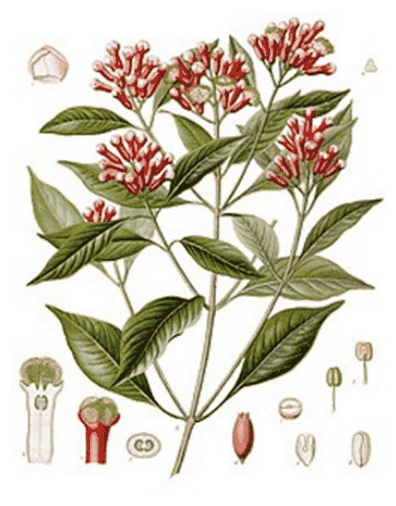
Sesquiterpenes have the formula \(\ce{C15H24}\). They are secondary metabolites in plants and both deter insects which eat plants and attract animals which eat the insects.
Isocaryophyllene (i-Cy) is a sesquiterpene found in oregano, rosemary, pepper, and cloves.
The structural formula of i-Cy can be determined by performing various reactions and analysing the products as shown in the figure.
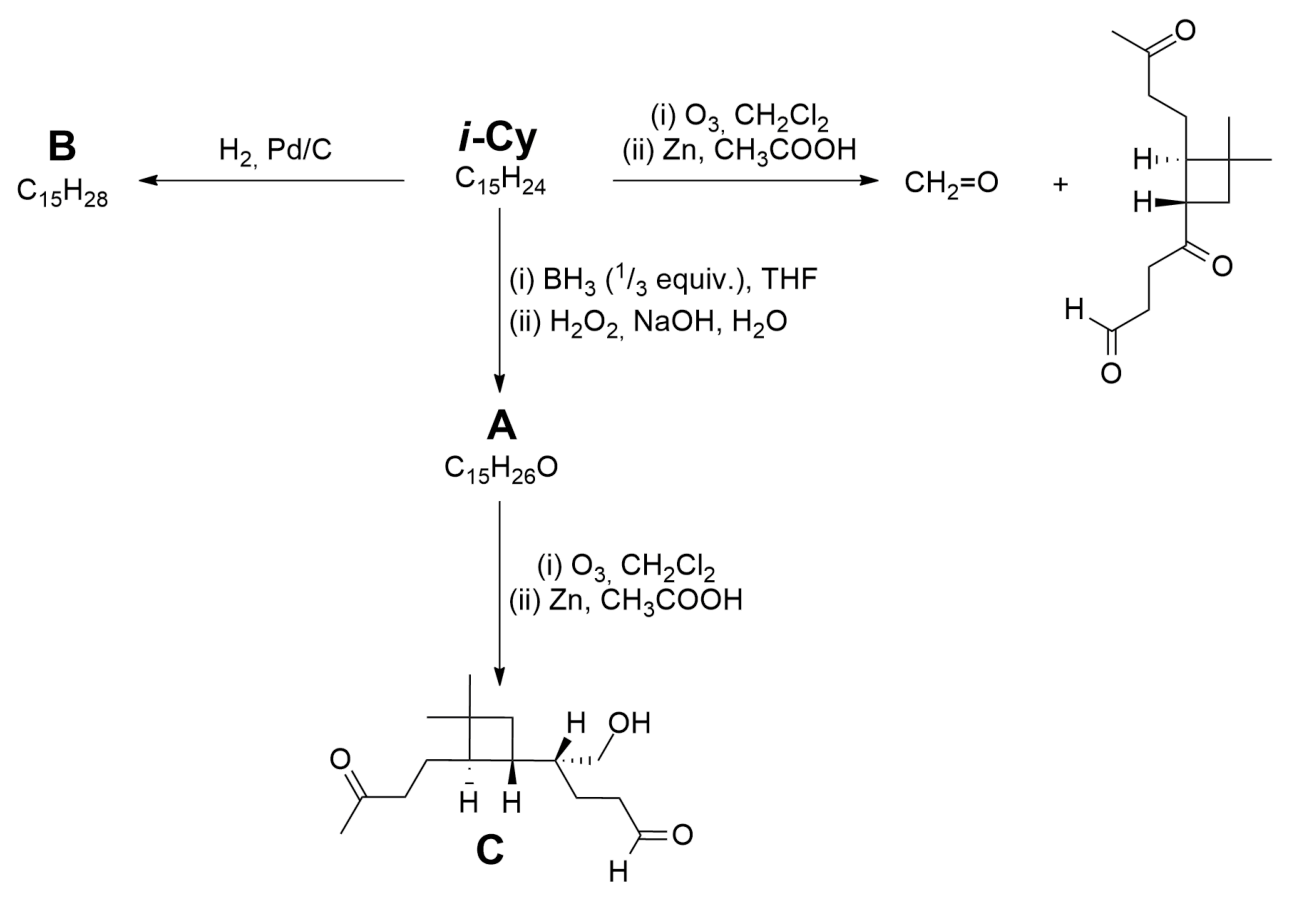
equiv. = translation 'equiv.'
1.1 Draw the structures of i-Cy, A, and B. Stereochemistry is not required.
1.2 Circle the stereocentres in compound C and assign them as \(R\) or \(S\).
Clovene (Cv) can be synthesised from i-Cy under acid catalysis. The synthesis of Cv starts from compound D.
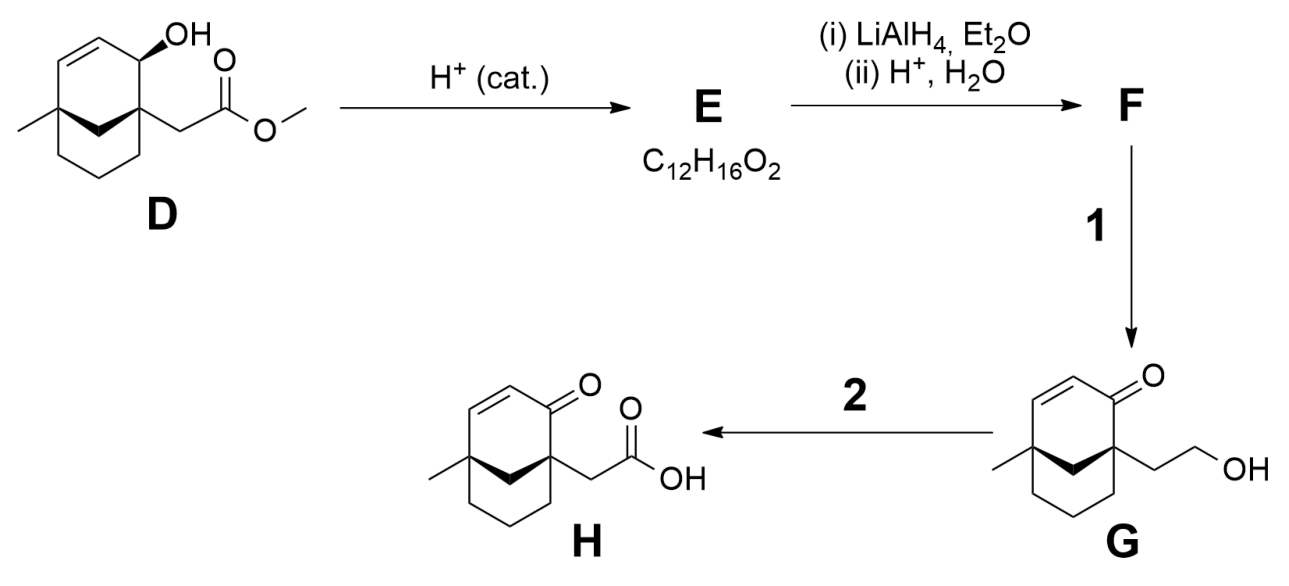
\(\ce{H+}\) (cat.)="translation \(\ce{H+}\) (cat.)"
1.3 Draw the structures of compounds E and F. Stereochemistry is not required.
For steps '1' and '2' several reagents could be considered. For example:
- ☐ PCC
- ☐ \(\ce{K2Cr2O7, H2SO4, H2O}\)
- ☐ \(\ce{MnO2}\)
- ☐ (i) \(\ce{OsO4}\), (ii) \(\ce{KHSO3}\)
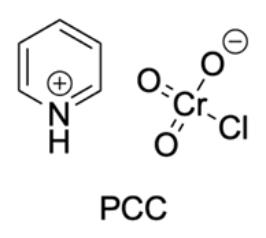
1.4 From the reagents above, tick which one(s) would be suitable for step '1'.
1.5 From the reagents above, tick which one(s) would be suitable for step '2'.
The final part of the synthesis is shown.
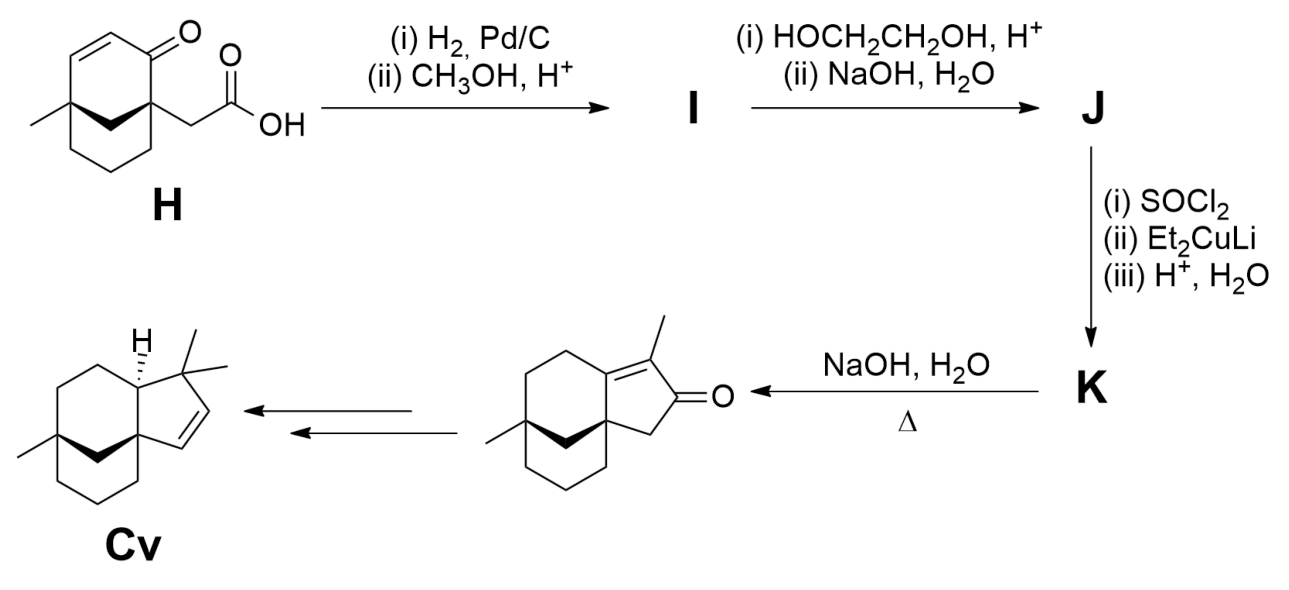
1.6 Draw the structures of compounds I, J, and K. Stereochemistry is not required.
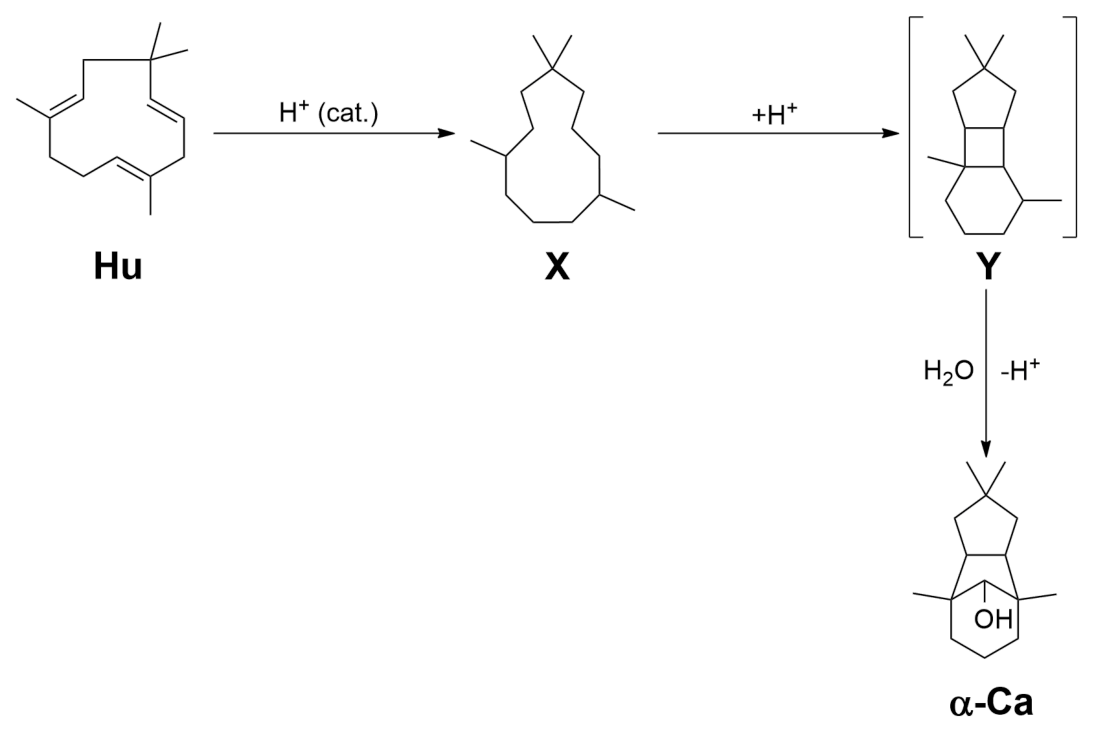
Humulene (Hu) is another sesquiterpene. It can be converted to α-caryophyllene alcohol (α-Ca), which is similar in structure to Cv. This conversion is an acid-catalysed hydration reaction which takes place via multiple intermediate structures. Incomplete structures of some intermediates, X and Y, are shown.
\(\ce{H+}\) (cat.)="translation \(\ce{H+}\) (cat.)"
The transformation from Hu to X is an acid-catalysed isomerisation reaction. Intermediate Y is charged.
1.7 Complete the structure of intermediate X by adding double bonds in the correct places.
1.8 Complete the structure of intermediate Y by adding a positive charge in the correct place.
Five carbon atoms are circled in Hu. Through understanding the mechanism we can determine where these five carbon atoms end up in α-Ca.
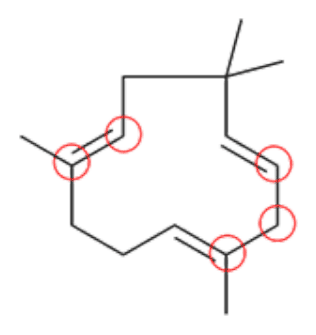
1.9 Circle the five corresponding carbon atoms in α-Ca which are circled in Hu.
Official English text of the problem.
Problem 2: Rapamycin - A molecular glue
6.5% of the total
2.1 2.2 2.3 2.4 Total 12 19 18 18 67 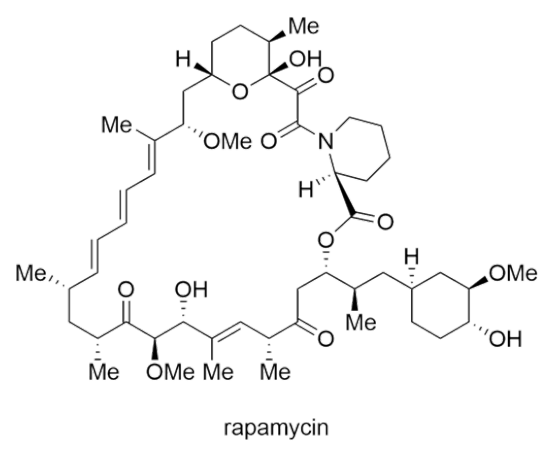
Rapamycin was isolated from the bacterium Streptomyces hygroscopicus in 1972. It acts as a “molecular glue” and inhibits the activity of the protein mTOR through binding to another protein. It has been used to treat various diseases. The stereochemical complexity of rapamycin makes its total synthesis challenging. The figure shows part of the first total synthesis by the Nicolaou group.
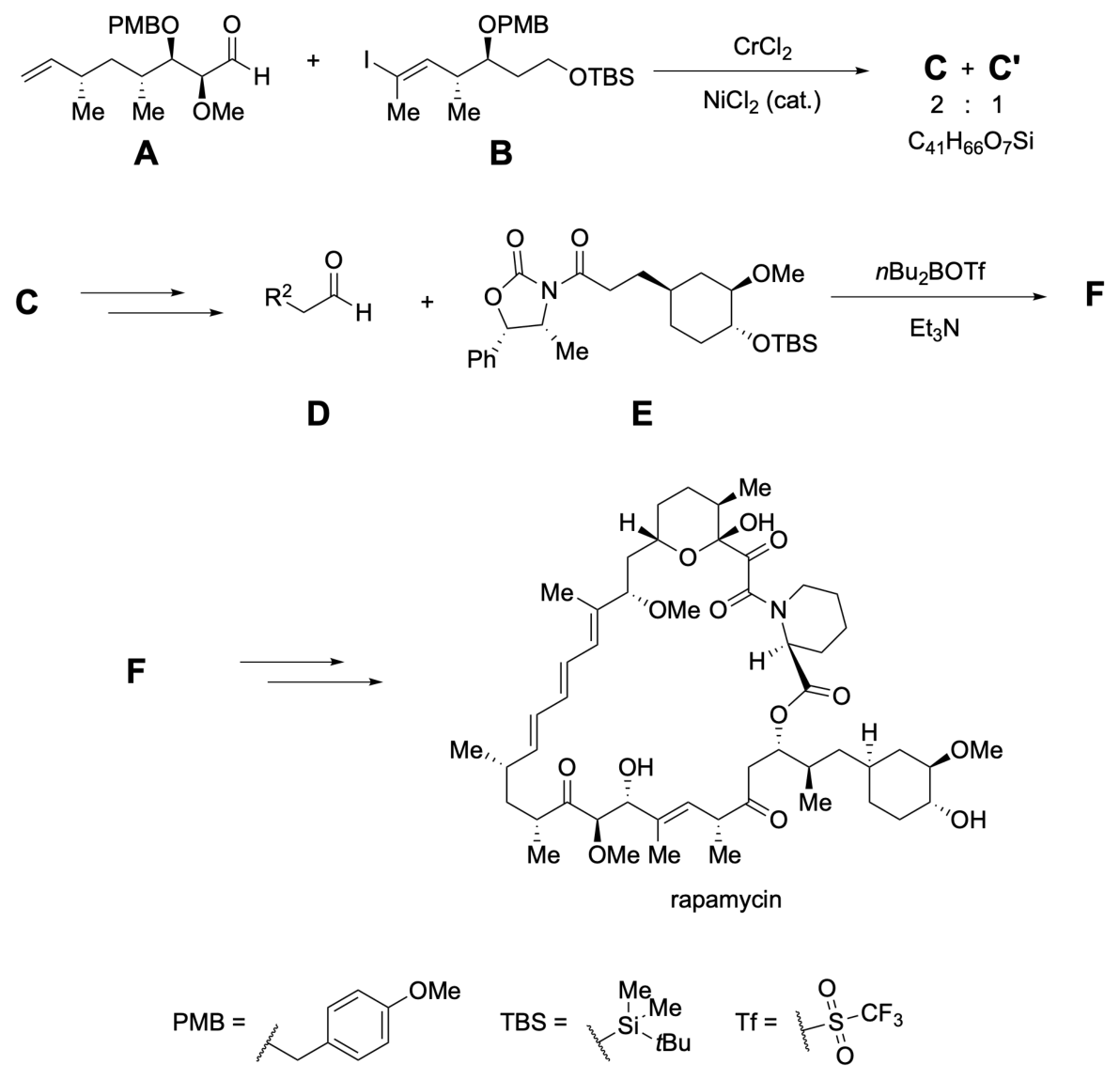
The major stereoisomer (C) is formed from the chromium-mediated coupling reaction of aldehyde A and vinyl iodide B and can be predicted using the Felkin-Anh model without chelation.
2.1a Draw a Newman projection showing the best approach of the nucleophile in this reaction. Use the labels =O, –H, –R\(^{1}\), –OMe, and Nu.
2.1b Draw the full structure of the major diastereomer C showing all stereochemistry.
After a few transformations, C can be converted into an aldehyde D which reacts with E to form F. F can be further transformed into rapamycin.
2.2a Using the Zimmerman-Traxler model, predict the arrangement of the reactants as they come together to form the six-membered ring transition state in the reaction to form F. Draw the substituents at positions labelled with numbers. If a position does not have a substituent, put an “X” in the box. Boxes 1 and 2 have been filled in as an example. You may use the abbreviation R\(^{2}\) as given in the scheme above.
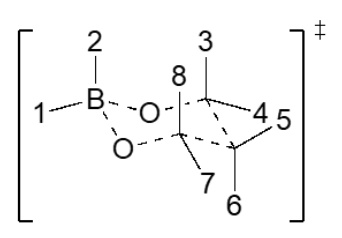
2.2b Draw the structure of F showing all stereochemistry. You may use the abbreviation R\(^{2}\) as given in the scheme above.
Whilst stereochemical control is challenging synthetically, the biological synthesis controls stereochemistry elegantly through an assembly line of various enzymes.
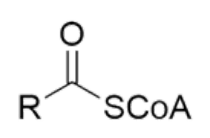
The carbon chain is built up through the addition of monomers. These units are connected via a thioester to Coenzyme A (CoA).
The functions of the various enzymes and proteins are shown in the table.
Abbreviation Name Function ACP Acyl-carrier protein Carries growing chain between domains CoL CoA-Ligase Activates a carboxylic acid substrate to be loaded onto the ACP AT Acyltransferase Selects monomer and transfers to ACP KS Ketosynthase Accepts growing chain from previous ACP and activates it for Claisen condensation with next monomer-loaded ACP KR Ketoreductase Reduces carbonyl of a previous monomer to a hydroxyl DH Dehydratase Forms \(\alpha,\beta\)-unsaturated thioester via elimination on the previous monomer ER Enoylreductase Reduces \(\alpha,\beta\)-unsaturated thioester to saturated chain on the previous monomer The first part of the assembly line is shown with blanks. The enzymes are shown in circles and act in the order of the arrow.
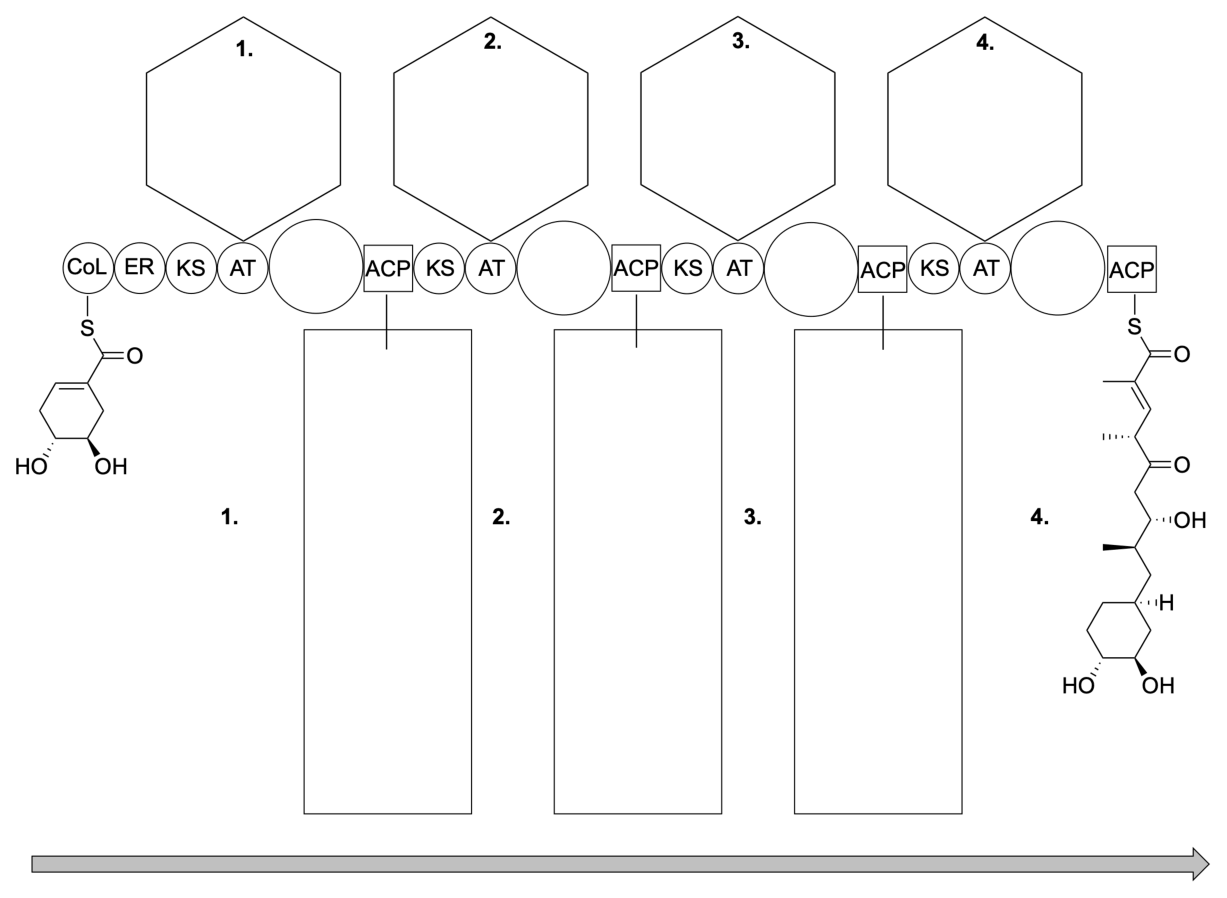
2.3a Draw in the hexagons the structure of the monomer needed by the enzyme AT at each of the points numbered 1-4. Carbon dioxide is released when the monomers are incorporated. The monomers have the following general structure where the R group is anionic:
2.3b Fill in each circle with the abbreviations of enzyme(s) needed. Write “X” if no additional enzyme is needed.
2.3c Complete the rectangles with the structure of the growing molecule attached to the enzyme.
The final steps of the enzymatic synthesis are shown below.
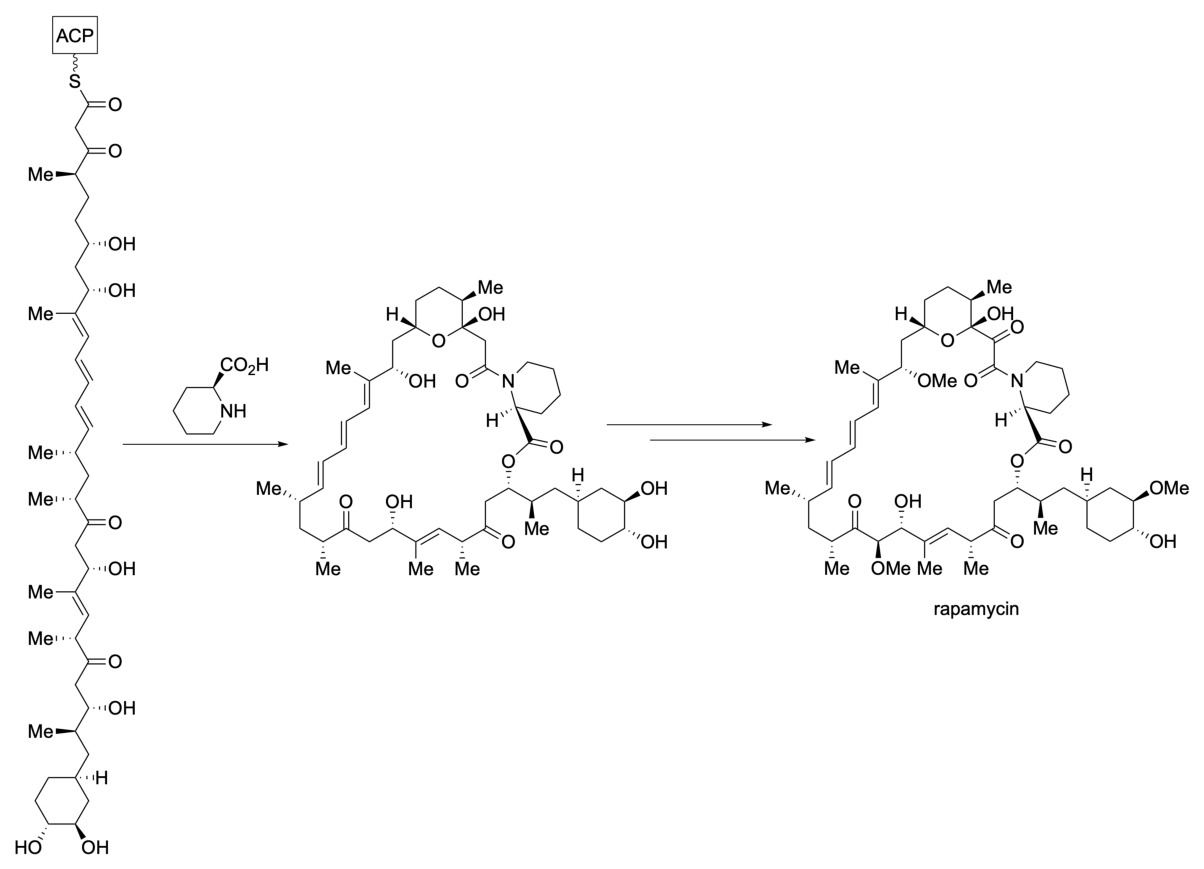
The building blocks involved were determined by feeding the bacterium with three different \(^{13}\)C-labelled starting materials which are incorporated into the monomers (\(^{13}\)C are circled as shown below):

2.4 Circle the carbons in rapamycin that will be \(^{13}\)C-labelled when the bacterium is fed with each of the three starting materials a-c in turn, following the guidelines on the next page. Incorrect circles will be penalised but there is no negative scoring.
Guidelines for circling carbon atoms:
- Each circle should clearly surround one carbon atom
- Do not include multiple carbon atoms in the same circle
- Do not circle any bonds
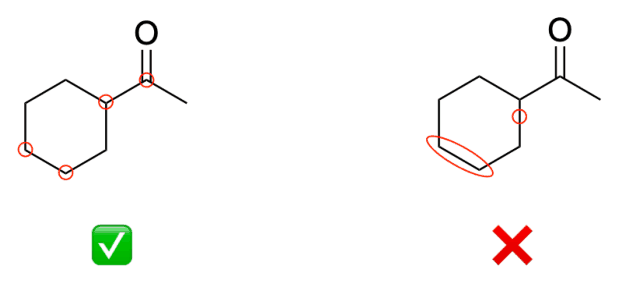
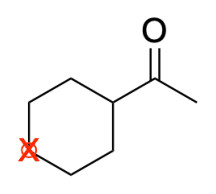
- If you would like to change your answer and cross-out a circle, put an “X” over the circle.
Official English text of the problem.
Problem 3: Lanterns and the Burj Khalifa
7.5% of the total
3.1 3.2 3.3 3.4 3.5 3.6 3.7 Total 6 4 4 5 40 20 32 111 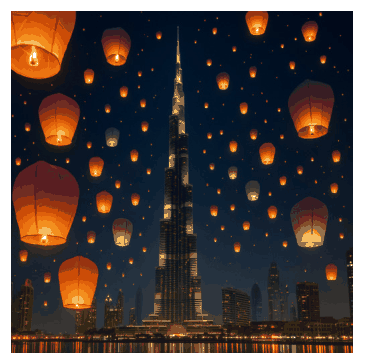
At 829.8 m, Dubai’s Burj Khalifa is the world's tallest structure. To simplify construction, many floors were made from similar pieces. Some artificial "molecular skyscrapers" can be made through coordination chemistry of just two pieces: metal ions and organic ligands.
In these 3D structures, every vertex contains a square planar \(\ce{Pd}\)(II) ion coordinated to four pyridine ligands. Along each edge is a bent organic ligand consisting of two pyridines linked together.
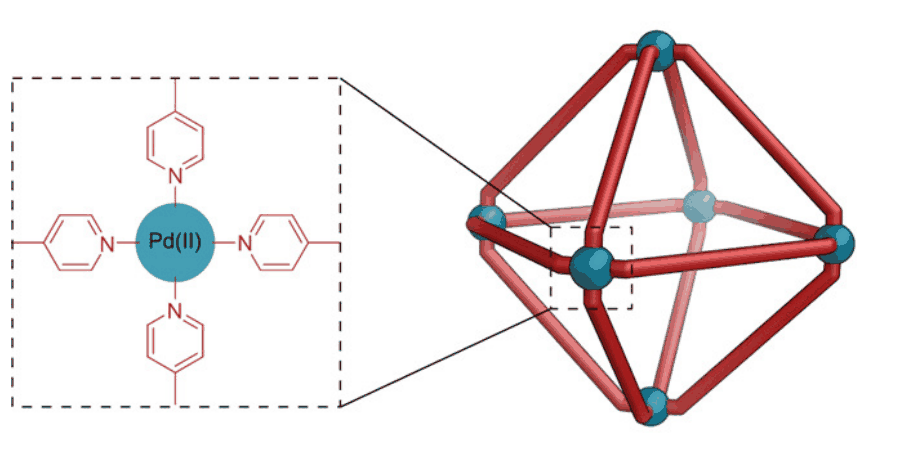
The angle between the two \(\ce{N -> Pd}\) bonds from the same ligand controls which structure forms. Larger angles give larger structures.
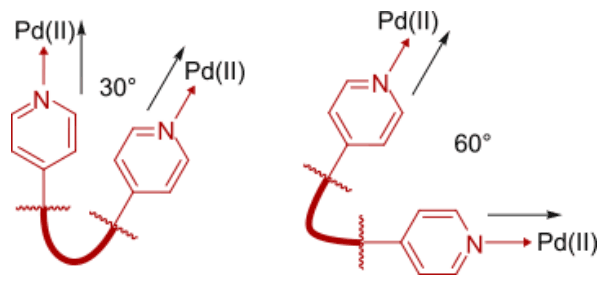
Where free rotation around a bond is possible, the ligand adopts a conformation to form a structure with the smallest possible angle.
3.1 Tick the smallest angle (approximately) between the \(\ce{N -> Pd}\) bonds which could be achieved by ligands A, B, and C.
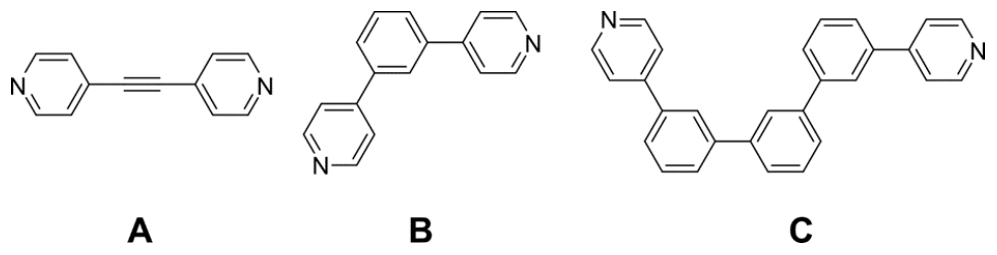
3.2 Using “<”, rank ligands D, E, and F, from smallest angle to largest angle between the \(\ce{N -> Pd}\) bonds that they could form.

One series of structures can be modelled as polyhedra with tetracoordinated \(\ce{Pd}\)(II) ions at the vertices. All structures have eight triangular faces (\(F_3\)), with various numbers of square faces (\(F_4\)).
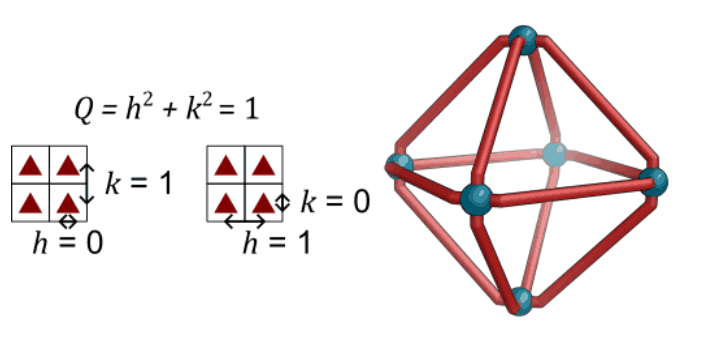
The triangular and square faces can be placed onto a square grid, where the relative position of two nearest triangles is described with integer coordinates \(h\) and \(k\). \(Q\) is then given by the equation:
\[ Q=h^2+k^2 \]
Part of the grid for a structure with \(h=2\) and \(k=4\) is shown below.
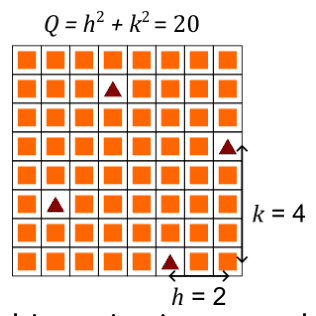
The smallest possible structure in this series is an octahedron, where \(Q=1\), and \((h,k)=(0,1)\) or \((1,0)\). It has six vertices, eight triangular faces, and 12 edges. Nearest triangles are a move of one face in one direction apart.
The second smallest structure is a cuboctahedron, where \(Q=2\). Nearest triangles are a move of one face in each direction apart.
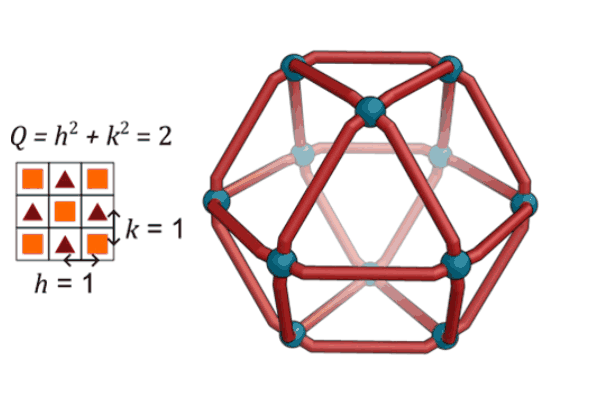
3.3 Complete the column in the table for \(Q=2\), describing the number of vertices, \(V\), number of edges \(E\), the total number of faces, \(F\), and the number of square faces, \(F_4\).
\(Q\) 1 2 \((h,k)\) \((0,1)\) or \((1,0)\) \((1,1)\) \(V\) 6 \(E\) 12 \(F\) 8 \(F_3\) 8 8 \(F_4\) 0 All structures obey the following rules:
\[ V-E+F=2 \]
\[ V=6Q \]
\[ F-V=2 \]
3.4 Complete the table for the third smallest structure, where \(Q=4\).
\(Q\) 4 \((h,k)\) \(V\) \(E\) \(F\) \(F_3\) 8 \(F_4\) 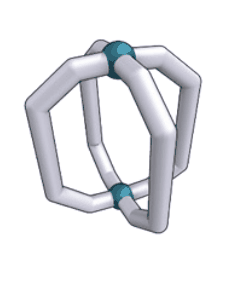
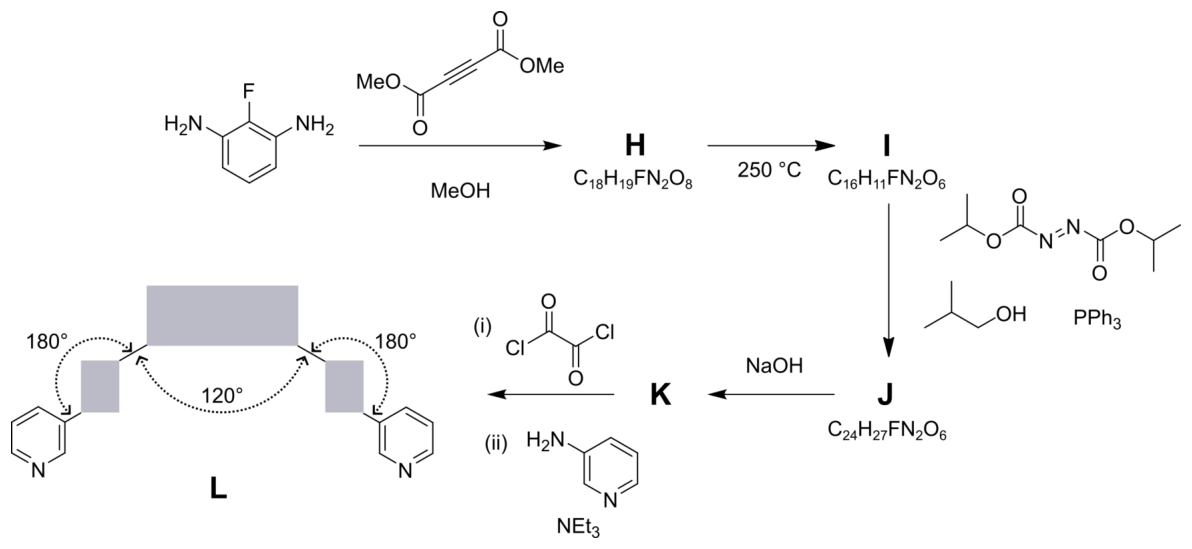
In contrast to these large structures, the smallest structures contain two metals and four ligands and are called lanterns. They are similar in shape to the traditional lanterns seen at the Dubai light festival. Lanterns are formed by ligands such as L, which make two parallel \(\ce{N -> Pd}\) bonds. Ligand L has two planes of symmetry and can adopt a planar conformation with the angles shown.
Hint:
- The transformation from H to I could also be achieved by Lewis acid catalysis.
3.5 Draw the structures of compounds H, I, J, K, and ligand L.
Unlike symmetrical ligand L, chiral ligand M lacks symmetry and exists as a pair of \(R\) and \(S\) enantiomers.
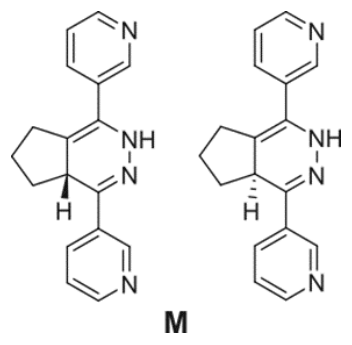
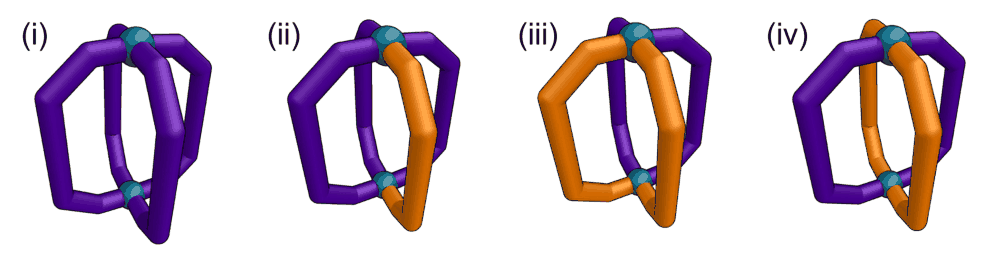
Multiple lantern isomers can be formed from ligand M. We can group these isomers in two ways. Firstly we categorise by the number of each type of ligand in the lantern: (i) all the same (\(RRRR\) or \(SSSS\)), (ii) one different (\(RRRS\) or \(SSSR\)), (iii) cis-\(RRSS\), and (iv) trans-\(RSRS\).
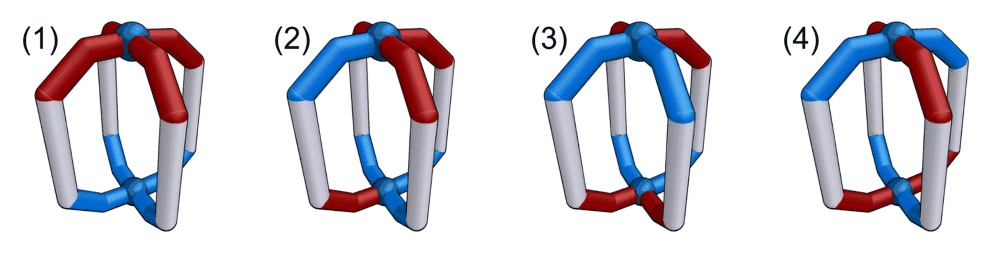
Secondly, the two ends of ligand M are not the same; the ligand has a head (H) and a tail (T). There are four categories of structure considering head-to-tail orientation: (1) all up (HHHH), (2) three up (HHHT), (3) cis-HHTT, and (4) trans-HTHT.
The 16 possible combinations of these categories are represented by empty cells in the table. Some combinations have only one possible isomer, whereas others have multiple possible isomers. In any one combination, all possible isomers are either chiral or achiral.
3.6 Complete the table by writing "C" for chiral and "A" for achiral. Note, in this part you will be awarded points for each correct answer but deducted points for each incorrect answer down to a minimum of zero. There is no penalty for empty cells.
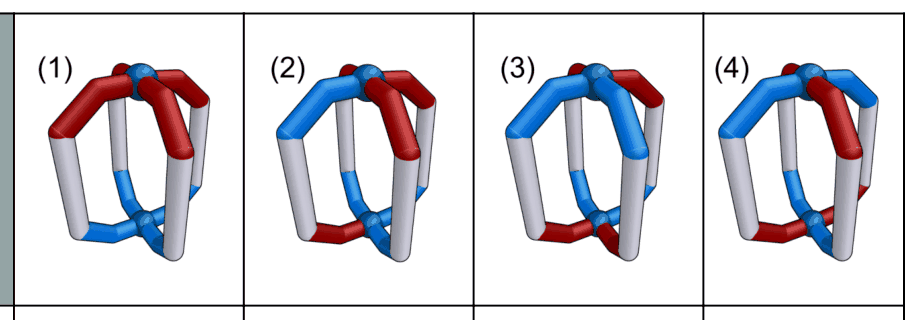
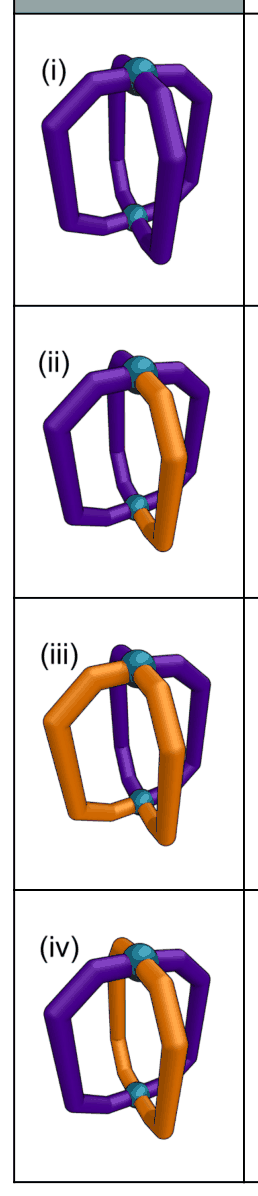
(1) (2) (3) (4) (i) (ii) (iii) (iv) 3.7 Complete the table with the number of possible isomers of each combination.
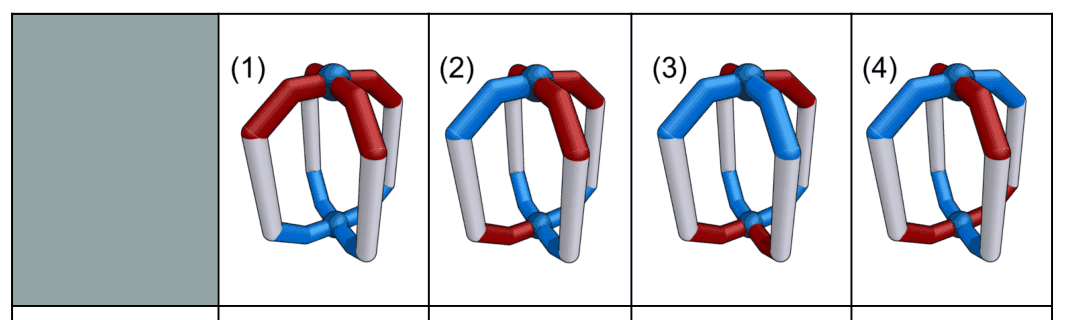

(1) (2) (3) (4) (i) 2 (ii) 4 (iii) (iv) Official English text of the problem.
Problem 4: The life of tennis balls
6% of the total
4.1 4.2 4.3 4.4 Total 3 16 5 16 40 
This problem honours the incredible Rafael Nadal, a true tennis icon who concluded his remarkable career in 2024.
The Dubai Tennis Championships is a prestigious tournament held annually in UAE. Many of the world's top players, including Rafael Nadal, Roger Federer, Novak Djokovic, and Andy Murray have won titles there.
The composition of tennis balls has evolved over hundreds of years. To ensure a good bounce, the inside of modern tennis balls is pressurised above atmospheric pressure. However, old hollow tennis balls just contained air at atmospheric pressure.
In this problem, assume tennis balls have an inner radius of \(R = 3.0\ \mathrm{cm}\) that remains constant throughout the pressurisation process. Assume that the composition of air is 20% \(\ce{O2}\) and 80% \(\ce{N2}\) by volume. Consider that overpressure does not expand the ball.
4.1 Calculate the mass \(m\) (in g) of air inside an old tennis ball at \(T_0 = 25\ ^\circ\mathrm{C}\).
Chemists then discovered how to pressurise a ball above atmospheric pressure using a reaction between compounds A and B, which forms gas C (to create additional inner pressure) plus other non-gaseous products.
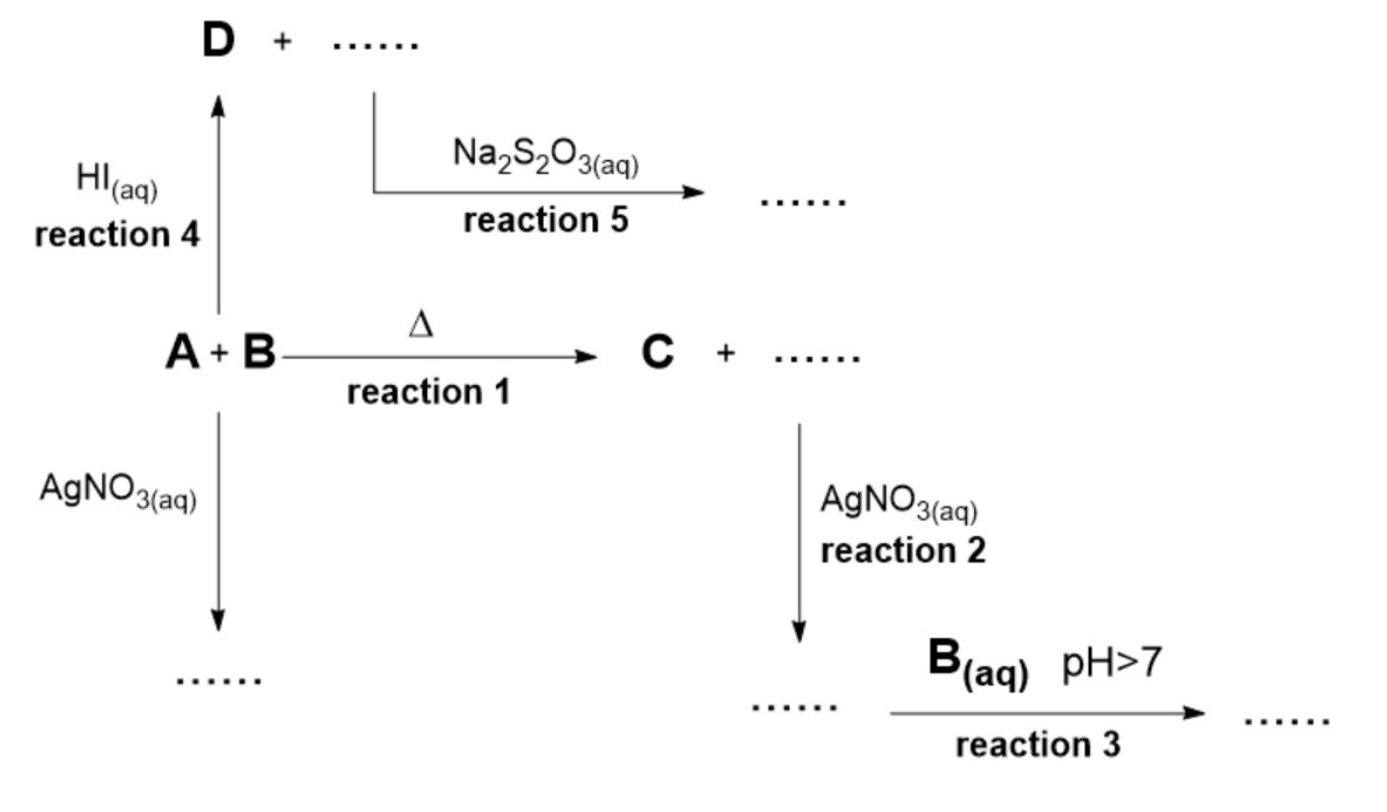
A capsule with a quantity \(m_{\mathrm{mix}} = 0.3389\ \mathrm{g}\) of a stoichiometric mixture of two white inorganic compounds A and B was placed inside a ball filled with air at atmospheric pressure. They reacted completely inside the ball upon heating to form gas C and other products (reaction 1) to produce an overall pressure inside the ball of \(p = 1.600\ \mathrm{atm}\) (at \(25\ ^\circ\mathrm{C}\)). Once this ball was opened, all residue inside was collected and dissolved in water. The dropping of silver nitrate in that solution gave a white precipitate (reaction 2). This collected precipitate could be partially dissolved in a concentrated aqueous solution of B. By increasing the pH of this mixture, the precipitate dissolved completely (reaction 3). If the same initial capsule of A+B is dissolved in water and concentrated solution of silver nitrate added, \(m_{\mathrm{precipitate}} = 0.8224\ \mathrm{g}\) of white precipitate formed which was approximately twice the mass of precipitate formed in reaction 2.
When the capsule of A+B dissolved in a solution of \(\ce{HI}\) the formation of gas D started, and the solution turned brown (reaction 4). Upon further addition of sodium thiosulfate this colour disappeared (reaction 5).
The densities of gases C and D differ by no more than 10%.
4.2 Write the chemical formulae of compounds A–D.
4.3 Write equations for reactions 1–5.
The pressure inside modern tennis balls is \(p_0 = 1.80\ \mathrm{atm}\). They are sold in a pressurised can, with the same pressure in the can as in the ball to stop gas coming out during storage.
Standard balls contain air and premium balls contain pure \(\ce{N2}\). Once the can is opened, depressurisation begins, and the gas diffuses out of the balls until the internal pressure reaches atmospheric pressure. Assume there is no diffusion of gas into the balls at any point. The activation energy for the depressurisation of a premium ball is \(E_A = 50.0\ \mathrm{kJ\,mol^{-1}}\).
The rate of ball depressurisation (pressure/time) could be described by similar equations of those used in chemical kinetics. At \(T_0 = 25.0\ ^\circ\mathrm{C}\), once the can is opened, the premium balls depressurise to \(p_1 = 1.40\ \mathrm{atm}\) after \(t_1 = 241\ \mathrm{h}\) and to \(p_2 = 1.19\ \mathrm{atm}\) after about \(t_2 = 21\) days. The initial depressurisation rate of regular balls is 10% faster than premium balls.
4.4a Demonstrate that the depressurisation process follows the first kinetic order by calculating the depressurisation rate constant \(k_{\ce{N2}}\) for \(\ce{N2}\) in \(\mathrm{h^{-1}}\).
Note: If you couldn't calculate the answer, use \(k_{\ce{N2}} = 10^{-3}\ \mathrm{h^{-1}}\) in further calculations.
4.4b Calculate the (depressurisation) rate constant \(k_{\ce{O2}}\) for \(\ce{O2}\) in \(\mathrm{h^{-1}}\), assuming the rates for both gases are additive.
As well as today being the IChO 2025 theory paper, it is also (perhaps less importantly) the Semi-Finals day at Wimbledon. Amanda Anisimova will start a match in \(t_{\mathrm{match}} = 12.0\ \mathrm{h}\) from now. The weather today in Wimbledon is predicted to be a constant \(T_W = 30.0\ ^\circ\mathrm{C}\). Assume a new set of premium balls, which were manufactured and placed in the can at \(T_0 = 25.0\ ^\circ\mathrm{C}\), are opened now and quickly change to \(T_W = 30.0\ ^\circ\mathrm{C}\).
4.4c Calculate the pressure \(p_{\mathrm{start}}\) (in atm) of the balls at the start of the match.
Periodic table and data sheet
Physical constants and formulae
Avogadro constant \(N_A\) \(6.022\times10^{23}\ \mathrm{mol^{-1}}\) molar gas constant \(R\) \(8.314\ \mathrm{J\,K^{-1}\,mol^{-1}}\) Faraday constant \(F\) \(96485\ \mathrm{C\,mol^{-1}}\) Planck constant \(h\) \(6.626\times10^{-34}\ \mathrm{J\,s}\) speed of light in vacuum \(c\) \(2.998\times10^8\ \mathrm{m\,s^{-1}}\) mass of electron \(m_e\) \(9.109\times10^{-31}\ \mathrm{kg}\) charge of electron \(e\) \(1.602\times10^{-19}\ \mathrm{C}\) atmospheric pressure \(p_{\mathrm{atm}}\) \(101325\ \mathrm{Pa}\) ionic product of water at 298 K \(K_W\) \(10^{-14}\) \(1\ \mathrm{nm}=1\times10^{-9}\ \mathrm{m}\) \(1\ \text{Å}=1\times10^{-10}\ \mathrm{m}\) \(1\ \mathrm{pm}=1\times10^{-12}\ \mathrm{m}\) \(0\ ^\circ\mathrm{C}=273.15\ \mathrm{K}\) \(1\ \mathrm{kWh}=3600\ \mathrm{kJ}\) \(1\ \mathrm{W}=1\ \mathrm{J\,s^{-1}}\) \(1\ \mathrm{eV}=1.602\times10^{-19}\ \mathrm{J}\) \(1\ \mathrm{bar}=10^5\ \mathrm{Pa}\) area of triangle \(A=\frac12 ab\cdot\sin C\) volume of cube \(V=a^3\) volume of sphere \(V=\frac43\pi r^3\) surface area of sphere \(S=4\pi r^2\) ideal gas equation \(pV=nRT\) frequency of light \(\nu=\frac{c}{\lambda}\) energy of a photon \(E=\frac{hc}{\lambda}\) Beer-Lambert law \(A=\log\left(\frac{I_0}{I}\right)=\varepsilon cd\) spin-only magnetic moment \(\mu=\sqrt{n(n+2)}\ \mathrm{BM}\) Henderson–Hasselbalch equation \(\mathrm{pH}=\mathrm{p}K_a+\log\left(\frac{[\ce{A-}]}{[\ce{HA}]}\right)\) \(0^{\mathrm{th}}\) order integrated rate law \([A]=[A]_0-kt\) \(1^{\mathrm{st}}\) order integrated rate law \(\ln[A]=\ln[A]_0-kt\) Arrhenius equation \(k=A\cdot e^{-E_a/(RT)}\) enthalpy \(H=U+pV\) Gibbs energy \(G=H-TS\) standard Gibbs energy change \(\Delta_rG^\circ=-RT\ln K=-nFE^\circ_{\mathrm{cell}}\) Clausius-Clapeyron equation \(\ln\left(\frac{P_1}{P_2}\right)=\frac{\Delta H_{\mathrm{vap}}}{R}\left(\frac{1}{T_2}-\frac{1}{T_1}\right)\) specific heat \(Q=mC_p\Delta T\) boiling point elevation \(\Delta T=iK_bm_i\) freezing point depression \(\Delta T=iK_fm_i\) Consider all gases ideal unless told otherwise.
In equilibrium constant calculations, all concentrations are referenced to a concentration of \(1\ \mathrm{mol\,dm^{-3}}\).
Periodic table
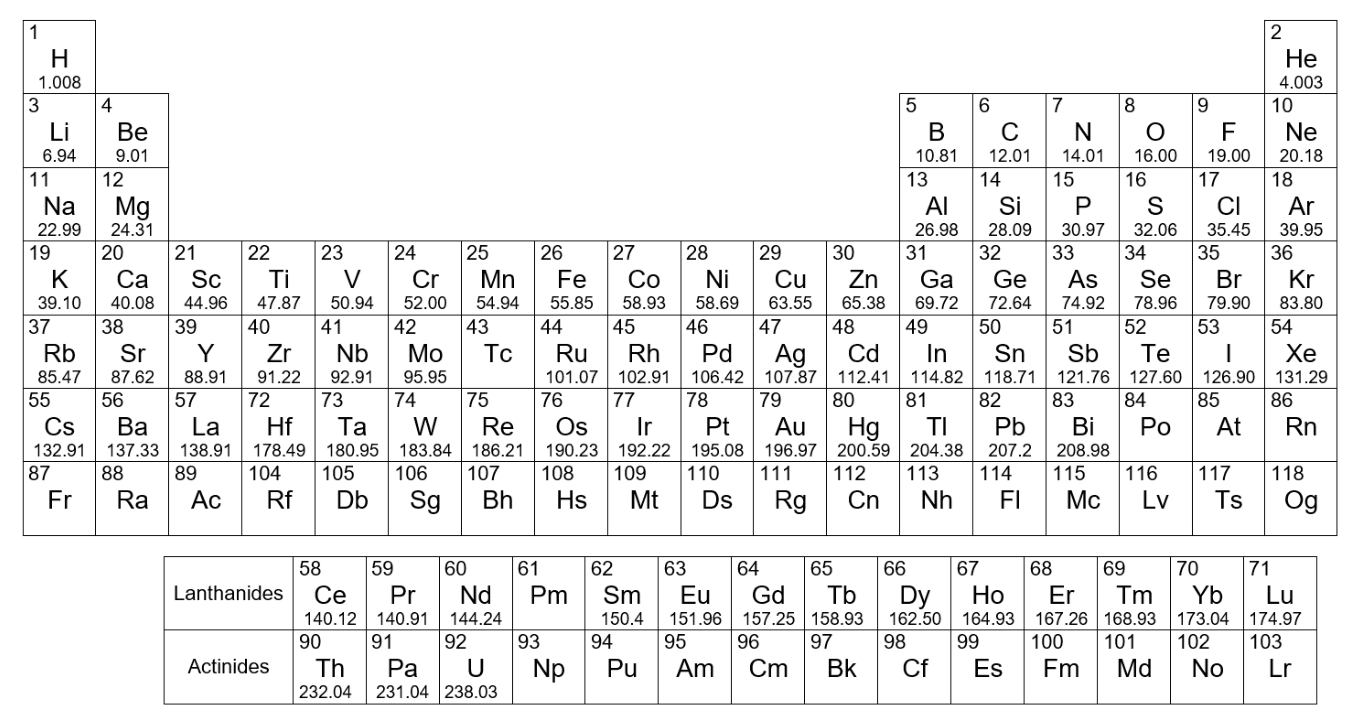
Official English text of the problem.
Problem 5: Solar-powered multi-stage flash desalination
6.5% of the total
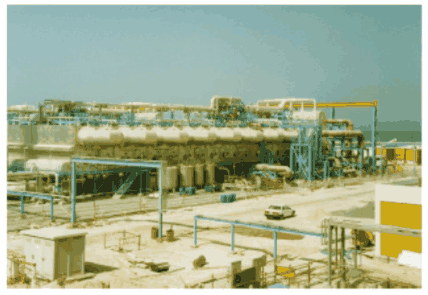
5.1 5.2 5.3 5.4 5.5 5.6 5.7 5.8 Total 2 2 3 2 2 2 1 2 16 Freshwater is scarce in the arid climate of the UAE. The country relies on solar-powered desalination plants to produce freshwater. A Dubai desalination plant uses a multi-stage flash (MSF) desalination process. In MSF desalination, seawater is heated by passing through a series of heat exchangers to raise its temperature, reaching its saturation temperature at a high pressure. When pressure is reduced, this superheated seawater gives off pure water vapour to become saturated again, a process known as flashing.
Assume seawater in Dubai is at \(T_0 = 25.00\ ^\circ\mathrm{C}\) and is an aqueous solution of 3.45 % mass \(\ce{NaCl}\). Assume complete ionisation of \(\ce{NaCl}\) in water.
The boiling point of seawater is higher than pure water. The boiling point elevation constant, \(K_{\mathrm b} = 0.5120\ \mathrm{K\,kg\,mol^{-1}}\).
5.1 Calculate the boiling point, \(T\), (in °C) of Dubai seawater at atmospheric pressure.
If you couldn't calculate the answer, use a temperature of 373.50 K for further calculations.
5.2 Calculate the percentage mass of \(\ce{NaCl}\), \(w_{\ce{NaCl}}\), in water that has a boiling point, \(T_{\mathrm b} = 378.00\ \mathrm{K}\).
5.3 The boiling point of seawater also increases as pressure increases. Calculate the boiling point, \(T\), (in °C) of the initial Dubai seawater at a pressure, \(p = 2.50\ \mathrm{atm}\). The latent heat of vaporisation of water, \(E_{\mathrm{vap}} = 2260\ \mathrm{kJ\,kg^{-1}}\) (40.716 kJ/mol). Assume this is the same for seawater.
In the plant, a flash chamber (of volume, \(V = 100\ \mathrm{L}\)) contains a mass of 1.00 kg of seawater (l) at \(T_1 = 90.0\ ^\circ\mathrm{C}\).
Another mass of 1.00 kg of seawater is then overheated to \(T_2 = 110.0\ ^\circ\mathrm{C}\) at high pressure before being added to this chamber, where a reduction in pressure causes some water to turn into steam.
After equilibrium was established, the temperature in the chamber was \(T_{\mathrm f} = 97.0\ ^\circ\mathrm{C}\). Assume there was no loss of energy, and that the latent heat of vaporisation is independent of temperature.
The specific heat capacity of seawater, \(C_{\mathrm p} = 3.85\ \mathrm{kJ\,kg^{-1}\,K^{-1}}\), assumed to be independent of temperature. The density of seawater, \(d = 1025\ \mathrm{kg\,m^{-3}}\).
5.4 Calculate the amount, \(n\), (in mol) of water that vapourised, assuming that the latent heat of vaporization does not depend on pressure, and that the heat capacity of water vapor in the chamber is negligible.
If you couldn't calculate the answer, use 0.56 mol for further calculations.
5.5 Assuming the initial vapour pressure before addition of the overheated water in the chamber was \(p_{\mathrm i} = 0.690\ \mathrm{atm}\), calculate the final vapour pressure, \(p_{\mathrm f}\), (in atm) in the chamber assuming the water vapour behaves as an ideal gas.
5.6 Calculate the thermal energy, \(E\), (in kWh) required to heat a mass of 1.00 kg of seawater from \(T_1 = 25.0\ ^\circ\mathrm{C}\) to \(T_2 = 110.0\ ^\circ\mathrm{C}\).
If you couldn't calculate the answer, use 0.1 kWh for further calculations.
5.7 A plant produces 50,000 \(\mathrm{m^3}\) of pure water per day. The plant passes Dubai seawater through 30 flash cycles and overall can extract 85% of the water present. Calculate the mass, \(m\), (in kg) of Dubai seawater needed per day.
If you couldn't calculate the answer, use \(6.0 \times 10^7\) kg for further calculations.
Plants make efficient use of heat exchangers to save energy. We can assume the total energy required by the plant is the same as the energy needed to heat all the seawater from \(T_1 = 25.0\ ^\circ\mathrm{C}\) to \(T_2 = 110.0\ ^\circ\mathrm{C}\).
5.8 Assuming a 10 \(\mathrm{m^2}\) solar panel has a power of 2.00 kW averaged during the 12 operational hours every day and the efficiency of using energy is 67%, calculate the number of panels, \(N\), required for the plant.
Periodic table and data sheet
Physical constants and formulae
Avogadro constant \(N_{\mathrm A}\) \(6.022\times10^{23}\ \mathrm{mol^{-1}}\) molar gas constant \(R\) \(8.314\ \mathrm{J\,K^{-1}\,mol^{-1}}\) Faraday constant \(F\) \(96485\ \mathrm{C\,mol^{-1}}\) Planck constant \(h\) \(6.626\times10^{-34}\ \mathrm{J\,s}\) speed of light in vacuum \(c\) \(2.998\times10^8\ \mathrm{m\,s^{-1}}\) mass of electron \(m_{\mathrm e}\) \(9.109\times10^{-31}\ \mathrm{kg}\) charge of electron \(e\) \(1.602\times10^{-19}\ \mathrm{C}\) atmospheric pressure \(p_{\mathrm{atm}}\) \(101325\ \mathrm{Pa}\) ionic product of water at 298 K \(K_{\mathrm w}\) \(10^{-14}\) \(1\ \mathrm{nm}=1\times10^{-9}\ \mathrm{m}\) \(1\ \text{Å}=1\times10^{-10}\ \mathrm{m}\) \(1\ \mathrm{pm}=1\times10^{-12}\ \mathrm{m}\) \(0\ ^\circ\mathrm{C}=273.15\ \mathrm{K}\) \(1\ \mathrm{kWh}=3600\ \mathrm{kJ}\) \(1\ \mathrm{W}=1\ \mathrm{J\,s^{-1}}\) \(1\ \mathrm{eV}=1.602\times10^{-19}\ \mathrm{J}\) \(1\ \mathrm{bar}=10^5\ \mathrm{Pa}\) area of triangle \(A=\frac12 ab\cdot\sin C\) volume of cube \(V=a^3\) volume of sphere \(V=\frac43\pi r^3\) surface area of sphere \(S=4\pi r^2\) ideal gas equation \(pV=nRT\) frequency of light \(\nu=\frac{c}{\lambda}\) energy of a photon \(E=\frac{hc}{\lambda}\) Beer-Lambert law \(A=\log\left(\frac{I_0}{I}\right)=\varepsilon cd\) spin-only magnetic moment \(\mu=\sqrt{n(n+2)}\ \mathrm{BM}\) Henderson–Hasselbalch equation \(\mathrm{pH}=\mathrm{p}K_{\mathrm a}+\log\left(\frac{[\ce{A-}]}{[\ce{HA}]}\right)\) \(0^{\mathrm{th}}\) order integrated rate law \([\ce{A}]=[\ce{A}]_0-kt\) \(1^{\mathrm{st}}\) order integrated rate law \(\ln[\ce{A}]=\ln[\ce{A}]_0-kt\) Arrhenius equation \(k=A\cdot e^{-E_{\mathrm a}/RT}\) enthalpy \(H=U+pV\) Gibbs energy \(G=H-TS\) standard Gibbs energy change \(\Delta_{\mathrm r}G^\circ=-RT\ln K=-nFE^\circ_{\mathrm{cell}}\) Clausius-Clapeyron equation \(\ln\left(\frac{P_1}{P_2}\right)=\frac{\Delta H_{\mathrm{vap}}}{R}\left(\frac1{T_2}-\frac1{T_1}\right)\) specific heat \(Q=mC_{\mathrm p}\Delta T\) boiling point elevation \(\Delta T=iK_{\mathrm b}m_i\) freezing point depression \(\Delta T=iK_{\mathrm f}m_i\) Consider all gases ideal unless told otherwise.
In equilibrium constant calculations, all concentrations are referenced to a concentration of \(1\ \mathrm{mol\,dm^{-3}}\).
Periodic table
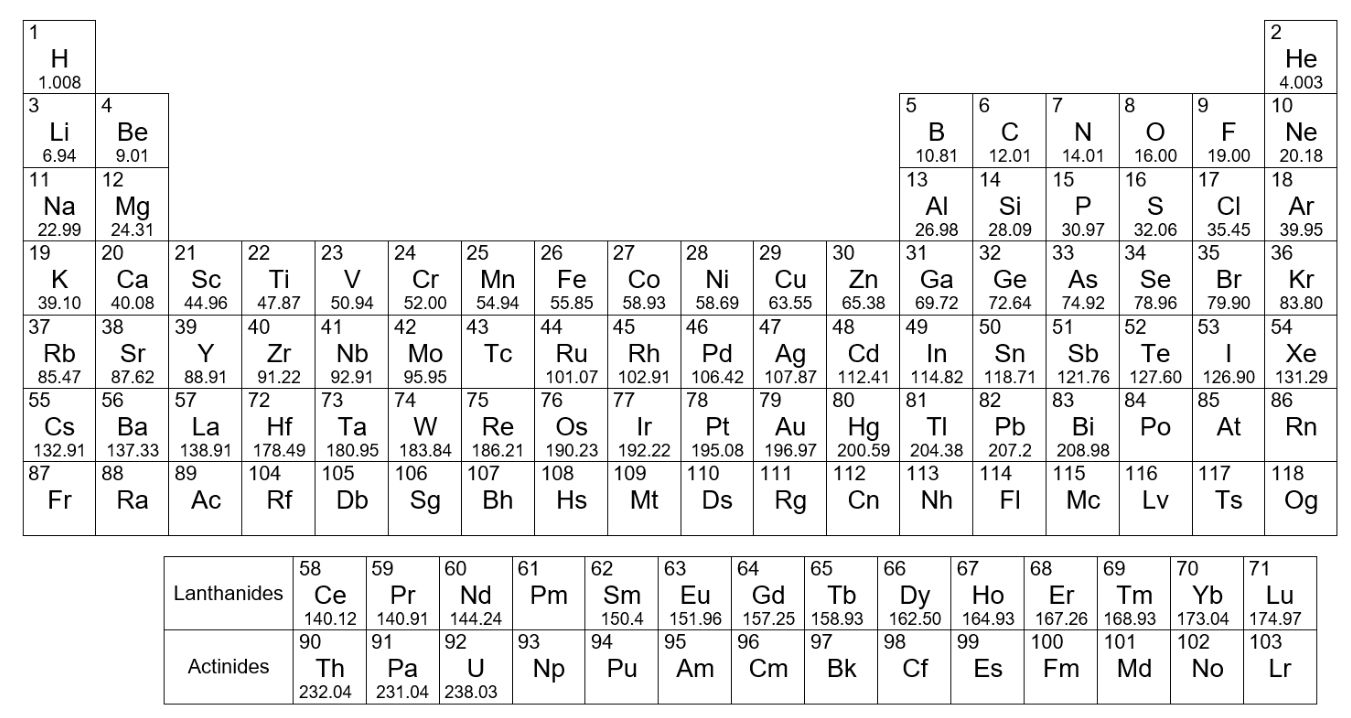
Official English text of the problem.
Problem 6: Solar energy conversion by CO2 reduction
6. Solar energy conversion by \(\ce{CO2}\) reduction
6% of the total
6.1 6.2 6.3 6.4 6.5 6.6 6.7 Total 5 2 3 3 3 2 4 22 Use the following data to solve this problem. Assume enthalpy and entropy changes of reactions do not depend on temperature.
\(\ce{CO2(g)}\) \(\ce{CO(g)}\) \(\ce{O2(g)}\) \(\ce{Zn(s)}\) \(\ce{Zn(l)}\) \(\ce{Zn(g)}\) \(\ce{ZnO(s)}\) \(\Delta_{\mathrm f}H^\circ_{298}\ /\ \mathrm{kJ\,mol^{-1}}\) −393.5 −110.5 6.5 130.4 −350.5 \(S^\circ_{298}\ /\ \mathrm{J\,mol^{-1}\,K^{-1}}\) 213.8 197.7 205.1 41.7 50.8 161.0 43.7 Melting Point / K 692.7 2247 Boiling Point / K 1180 Photochemical reduction of carbon dioxide is a promising approach both for solar energy conversion and for reduction of \(\ce{CO2}\) content in the atmosphere. There are several ways to convert \(\ce{CO2}\) to \(\ce{CO}\) and other useful substances.
Direct decomposition
Direct decomposition of \(\ce{CO2}\) to \(\ce{CO}\) and \(\ce{O2}\) is a highly endothermic process which requires a large amount of energy – from heat or from light.
6.1 Estimate the temperature (in K) at which half of \(\ce{CO2}\) decomposes at equilibrium at a total pressure of 1 bar.
Catalytic decomposition
The use of metal/metal oxide catalytic systems allows the temperature of \(\ce{CO2}\) decomposition to be significantly reduced and eases the separation of the gaseous products by using thermochemical cycles.
Consider a catalytic cycle based on the \(\ce{Zn}/\ce{ZnO}\) system and containing two reactions. The net reaction is \(\ce{CO2}\) decomposition into \(\ce{CO}\) and \(\ce{O2}\). Reaction 1 is exothermic, while Reaction 2 is highly endothermic – the reactants should be heated to the required temperature.
6.2 Write equations for Reaction 1 and Reaction 2.
The operating temperature for Reaction 1 is 1073 K.
6.3 Calculate the equilibrium constant, \(K\), for Reaction 1 and find the degree of \(\ce{CO2}\) conversion, \(x\), at this temperature.
Reaction 2 is performed at the much higher temperature of 2000 K.
6.4 Calculate the equilibrium pressure of oxygen, \(p(\ce{O2})\), in bar, at this temperature.
Photocatalytic reduction
Photocatalytic reduction of \(\ce{CO2}\) with water is akin to natural photosynthesis. Plants convert \(\ce{CO2}\) to carbohydrates as an energy source, but human civilisation needs hydrocarbons to produce energy. On the way from \(\ce{CO2}\) to \(\ce{C_{x}H_{y}}\) there are many possible intermediate products of \(\ce{CO2}\) reduction.
6.5 Complete the table with the formulae of the one-carbon species from \(\ce{CO2}\) reduction, containing only \(\ce{H}\) and/or \(\ce{O}\) atoms in addition to the one \(\ce{C}\). The oxidation number of the carbon in each species is shown. For the oxidation state +2 give the formulae of both an anion "anion" and a neutral molecule "neutral molecule". Indicate only one species in each box.
+3 +2 (anion) +2 (neutral molecule) 0 −2 −4 Visible light (\(400\ \mathrm{nm}<\lambda<700\ \mathrm{nm}\)) makes up >40% of the total solar radiation reaching Earth. Light can be absorbed by semiconductors or dyes, leading to electronic excitation which can promote redox reactions. The band gaps of some common semiconductors are listed.
Semiconductor \(\ce{CdS}\) \(\ce{Ge}\) \(\ce{Si}\) \(\ce{SiC}\) \(\ce{WO3}\) \(\ce{ZrO2}\) Band gap / eV 2.4 0.67 1.1 3.2 2.8 5.0 6.6 Tick which semiconductor(s) can be excited by visible light to serve as a potential photocatalyst(s). Support your answer with calculations.
In an early photocatalysis experiment, \(\ce{SiC}\) semiconductor was suspended in \(V=100\ \mathrm{mL}\) of water, and \(\ce{CO2}\) was bubbled through at a rate of \(v=3.0\ \mathrm{L\,min^{-1}}\) (\(T=25\,^\circ\mathrm{C}\), \(p=1\ \mathrm{atm}\)). The suspension was irradiated by a \(P=500\ \mathrm{W}\) lamp (\(\lambda=365\ \mathrm{nm}\)) for \(t=7\ \mathrm{h}\). After irradiation, the solution contained \(c(\ce{HCHO})=1.0\times10^{-3}\ \mathrm{M}\) and \(c(\ce{CH3OH})=5.4\times10^{-3}\ \mathrm{M}\).
The apparent quantum yield \(\phi\) is defined as:
\[ \phi=\frac{N_e}{N_i}, \]
where \(N_e\) is the number of electrons transferred and \(N_i\) is the number of incident photons.
6.7 Calculate the total degree of \(\ce{CO2}\) conversion, \(\eta\), and the apparent quantum yield of photocatalytic reduction, \(\phi\).
Periodic table and data sheet
Physical constants and formulae
Avogadro constant \(N_A\) \(6.022\times10^{23}\ \mathrm{mol^{-1}}\) molar gas constant \(R\) \(8.314\ \mathrm{J\,K^{-1}\,mol^{-1}}\) Faraday constant \(F\) \(96485\ \mathrm{C\,mol^{-1}}\) Planck constant \(h\) \(6.626\times10^{-34}\ \mathrm{J\,s}\) speed of light in vacuum \(c\) \(2.998\times10^8\ \mathrm{m\,s^{-1}}\) mass of electron \(m_e\) \(9.109\times10^{-31}\ \mathrm{kg}\) charge of electron \(e\) \(1.602\times10^{-19}\ \mathrm{C}\) atmospheric pressure \(p_{\mathrm{atm}}\) \(101325\ \mathrm{Pa}\) ionic product of water at 298 K \(K_{\mathrm W}\) \(10^{-14}\) \(1\ \mathrm{nm}=1\times10^{-9}\ \mathrm{m}\) \(1\ \text{Å}=1\times10^{-10}\ \mathrm{m}\) \(1\ \mathrm{pm}=1\times10^{-12}\ \mathrm{m}\) \(0\,^\circ\mathrm{C}=273.15\ \mathrm{K}\) \(1\ \mathrm{kWh}=3600\ \mathrm{kJ}\) \(1\ \mathrm{W}=1\ \mathrm{J\,s^{-1}}\) \(1\ \mathrm{eV}=1.602\times10^{-19}\ \mathrm{J}\) \(1\ \mathrm{bar}=10^5\ \mathrm{Pa}\) area of triangle \(A=\frac12 ab\cdot\sin C\) volume of cube \(V=a^3\) volume of sphere \(V=\frac43\pi r^3\) surface area of sphere \(S=4\pi r^2\) ideal gas equation \(pV=nRT\) frequency of light \(\nu=\frac{c}{\lambda}\) energy of a photon \(E=\frac{hc}{\lambda}\) Beer-Lambert law \(A=\log\left(\frac{I_0}{I}\right)=\varepsilon cd\) spin-only magnetic moment \(\mu=\sqrt{n(n+2)}\ \mathrm{BM}\) Henderson–Hasselbalch equation \(\mathrm{pH}=\mathrm{p}K_a+\log\left(\frac{[\ce{A-}]}{[\ce{HA}]}\right)\) \(0^{\mathrm{th}}\) order integrated rate law \([\ce{A}]=[\ce{A}]_0-kt\) \(1^{\mathrm{st}}\) order integrated rate law \(\ln[\ce{A}]=\ln[\ce{A}]_0-kt\) Arrhenius equation \(k=A\cdot e^{-E_a/(RT)}\) enthalpy \(H=U+pV\) Gibbs energy \(G=H-TS\) standard Gibbs energy change \(\Delta_{\mathrm r}G^\circ=-RT\ln K=-nFE^\circ_{\mathrm{cell}}\) Clausius-Clapeyron equation \(\ln\left(\frac{P_1}{P_2}\right)=\frac{\Delta H_{\mathrm{vap}}}{R}\left(\frac{1}{T_2}-\frac{1}{T_1}\right)\) specific heat \(Q=mC_p\Delta T\) boiling point elevation \(\Delta T=iK_bm_i\) freezing point depression \(\Delta T=iK_fm_i\) Consider all gases ideal unless told otherwise.
In equilibrium constant calculations, all concentrations are referenced to a concentration of \(1\ \mathrm{mol\,dm^{-3}}\).
Official English text of the problem.
Problem 7: Dubai crude oil
7% of the total
7.1 7.2 7.3 7.4 7.5 Total 8 2 3 1 8 22 The petroleum industry plays an important role in the UAE economy. The oil called “Dubai Crude” is a benchmark for global oil prices. Crude oil is a complex mixture of organic compounds, mainly hydrocarbons, along with smaller amounts of S, N, and O-containing compounds.
The hydrocarbon composition of oil is characterised by the PONA number. The abbreviation stands for P – paraffins (alkanes), O – olefins (alkenes), N – naphthenes (cycloalkanes), and A – aromatics (arenes). One method to determine the composition of oil is gas chromatography–mass spectrometry (GC–MS).
Below are mass spectra (electron impact ionisation, \(I\) – relative intensity) of four hydrocarbons 1–4 of Dubai Crude oil. They include linear alkane P, linear alkene O, monosubstituted cycloalkane N, and arene A. Alkene O does not have cis–trans isomers. 1′–4′ are selected fragmentation products.
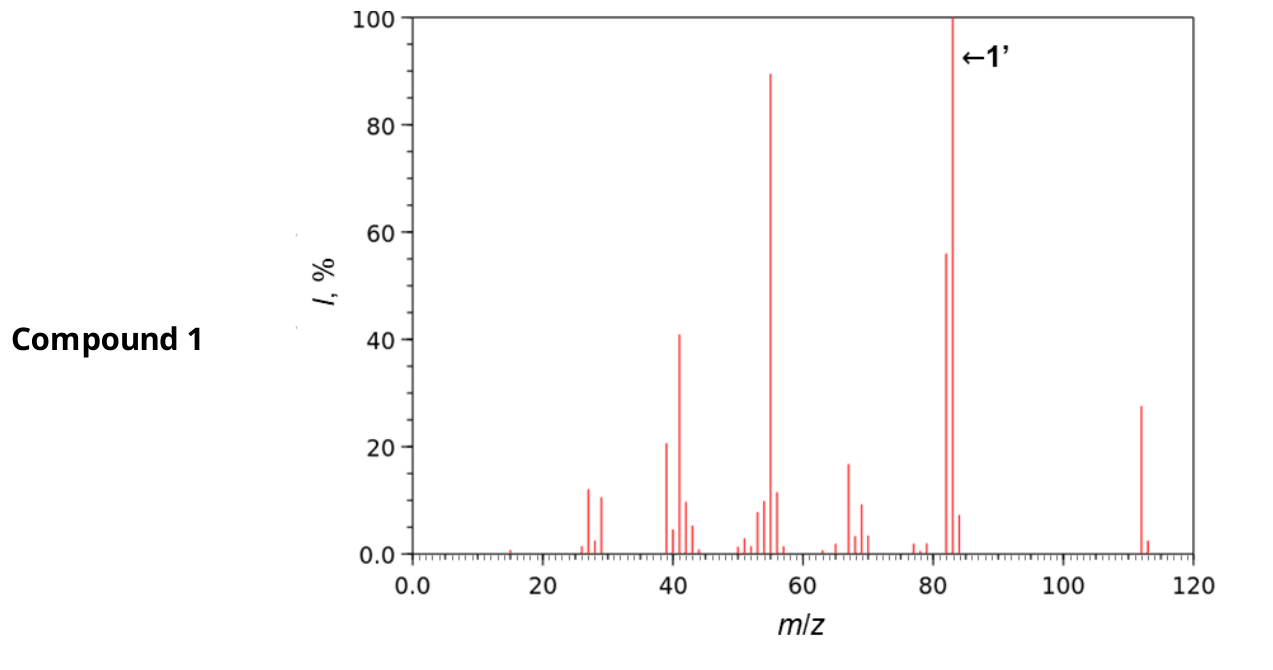
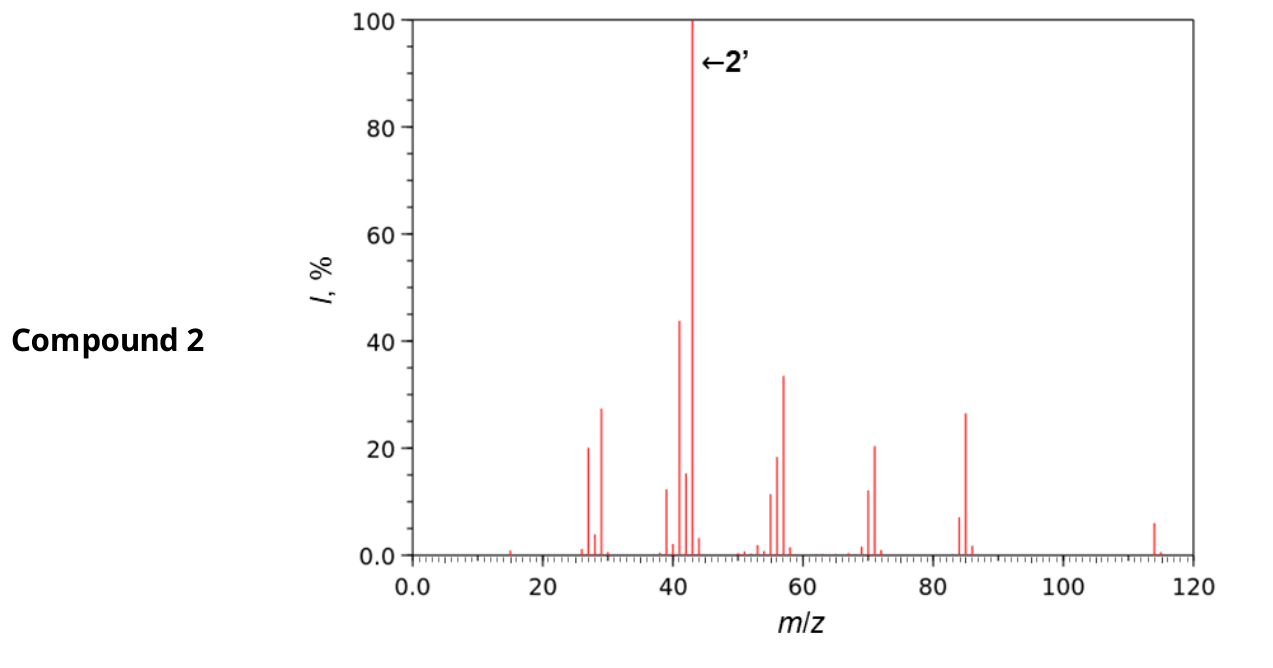
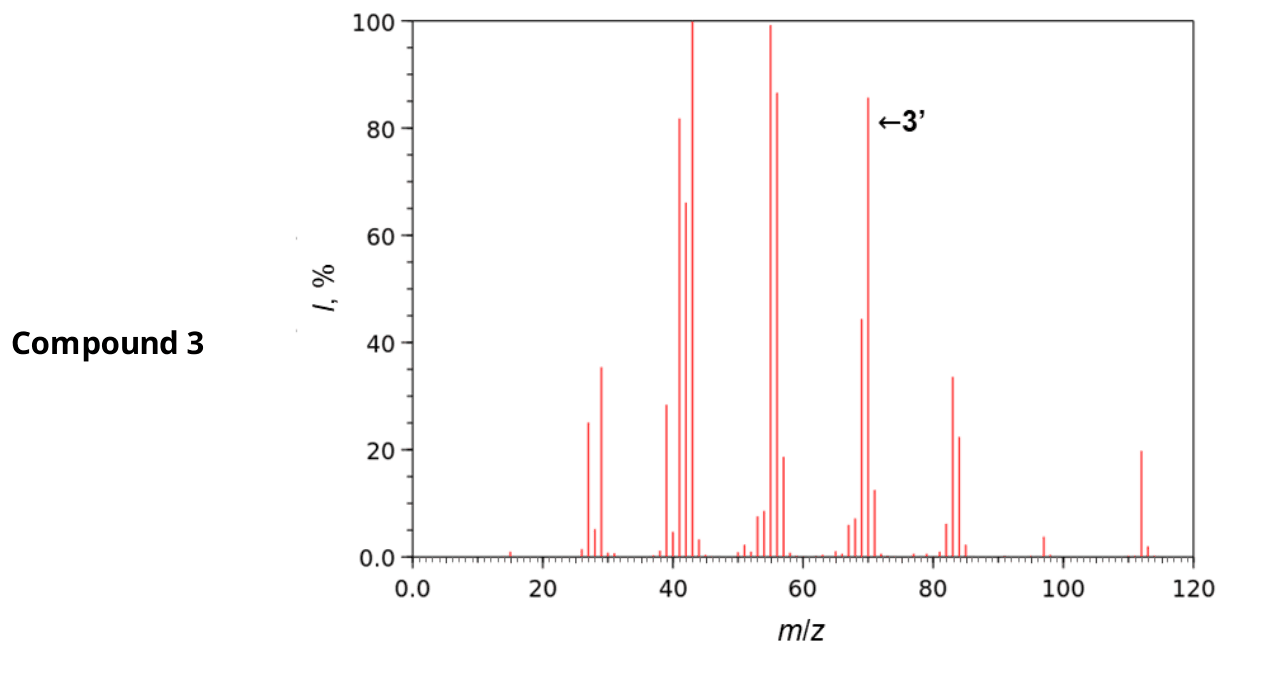
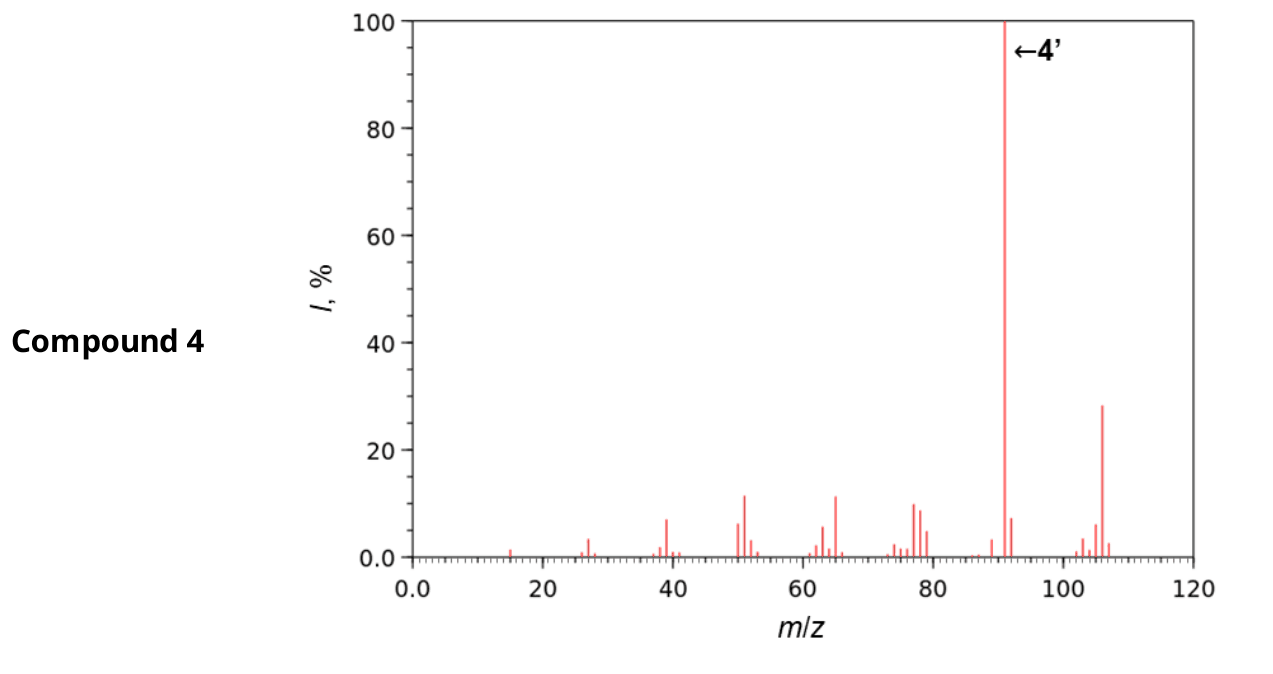
7.1 Draw the structures of 1–4 and 1′–4′. If you cannot determine the structure(s) of 1–4, write the corresponding letter code (P/O/N/A) and the molecular formula.
Hint: Species 3′ is formed by a rearrangement of the molecular ion by the McLafferty mechanism.
To differentiate isoparaffins (isoalkanes, I) from n-alkanes, the PIONA number may be used for a more precise description of crude oil composition. Below are two mass spectra of branched alkanes 5 and 6. In the mass spectrum of 6, the \(\ce{[M+1]+}\) peak has an intensity of ca. 5.4% relative to the intensity of the \(\ce{[M]+}\) peak of the molecular ion.
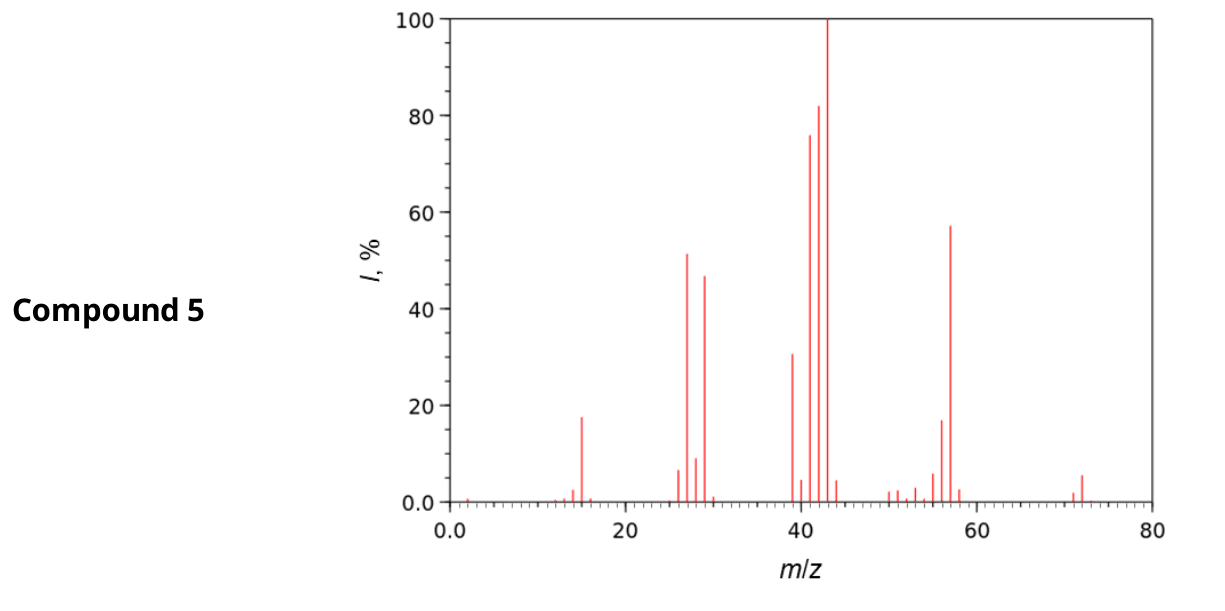
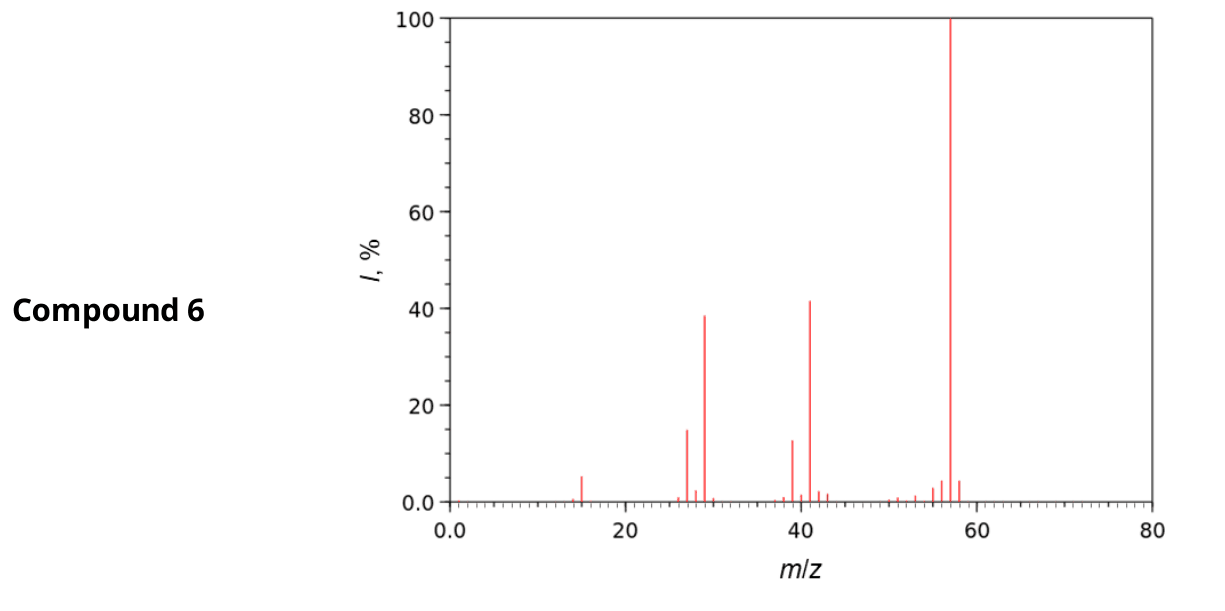
7.2 Draw the structures of compounds 5 and 6.
Crude oil is classified by the sulfur content as either sweet (<0.5 wt%) or sour (>0.5 wt%). A \(V=115\ \mathrm{\mu L}\) sample of Dubai Crude oil \((\rho=871\ \mathrm{g\,dm^{-3}})\) was completely burnt. The resulting gas mixture was passed through a \(\ce{H2O2}\) solution containing an excess of \(\ce{Ba(OH)2}\), leading to the formation of \(m=1.395\ \mathrm{g}\) of white precipitate. Upon acidification with \(\ce{HNO3}\), the precipitate’s mass decreased by 98.95%.
7.3 Calculate the sulfur content (\(w(\ce{S})\), wt%) of Dubai Crude oil.
In addition to sulfur, crude oil contains trace amounts of selenium, which transfers into the water used during refining. In aqueous solutions, selenium exists as \(\ce{SeO3^2-}\) and \(\ce{SeO4^2-}\).
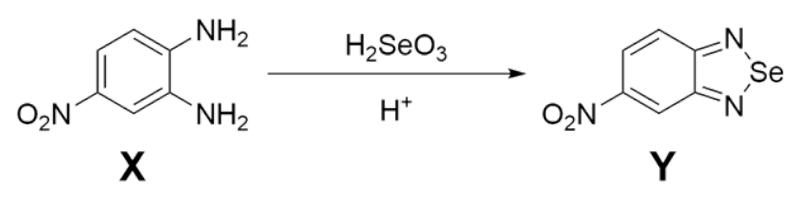
The concentration of \(\ce{SeO3^2-}\) can be determined chromatographically by its selective reaction with diamine X under acidic conditions, forming piazoselenol Y. This reaction is complete only at the right pH range.
X and Y elute at different times (\(t\)) on the chromatogram shown below. The absorption spectra (1 mAbs corresponds to absorbance \(A=0.001\)) of X and Y are also provided.
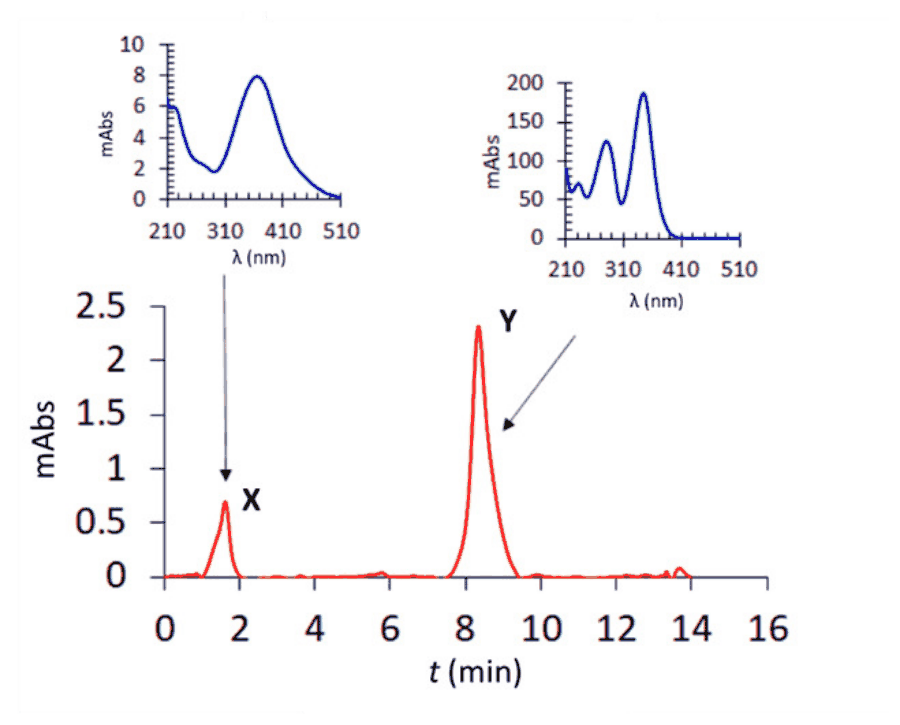
7.4 Tick the optimal wavelength (\(\lambda\)) for the absorbance measurements in the chromatogram.
☐ 270 nm ☐ 300 nm ☐ 350 nm ☐ 510 nm
Acidified water from the refining process, containing \(\ce{SeO3^2-}\) and \(\ce{SeO4^2-}\) (solution 1), was analysed as follows. A 9.50 mL sample was mixed with 0.50 mL of an aqueous solution of X (300 μM, excess) to form solution 2.
The area, \(S\), under each chromatogram peak was measured. These areas are proportional to the amount of the respective species in the peak. In a blank experiment under the same conditions with Se-free water, the peak area of X, \(S(\mathbf X)\) from the free diamine, was 0.825 mAbs·min. Running identical measurements with known amounts of \(\ce{SeO3^2-}\) showed that the peak area for Y (mAbs·min) depends on Se concentration (μM) as follows: \(S(\mathbf Y)=1.21\cdot c(\ce{Se})\).
The measurements for the Se-containing sample (solution 2) were carried out at different pH values, adjusted by adding four different strong acids. The ratios \(S(\mathbf X)/S(\mathbf Y)\) of the area under peak X to the area under peak Y for these measurements are shown in the table below. Assume all reactions have reached equilibrium.
Table. \(S(\mathbf X)/S(\mathbf Y)\) measured at different pH values with four strong acids
pH 3.0 2.0 1.5 1.0 0 −0.50 \(\ce{HNO3}\) 1.523 3.334 5.454 7.783 10.232 13.450 \(\ce{HCl}\) 0.634 0.538 0.523 0.523 0.581 0.782 \(\ce{HBr}\) 0.523 0.377 0.368 0.368 0.399 0.546 \(\ce{HI}\) 1.722 2.223 5.114 8.123 11.736 15.780 Hint: You need only two values from the table to solve this question.
7.5 Calculate the concentrations of selenium species (\(c_0(\ce{SeO3^2-})\), \(c_0(\ce{SeO4^2-})\), in μM) in solution 1.
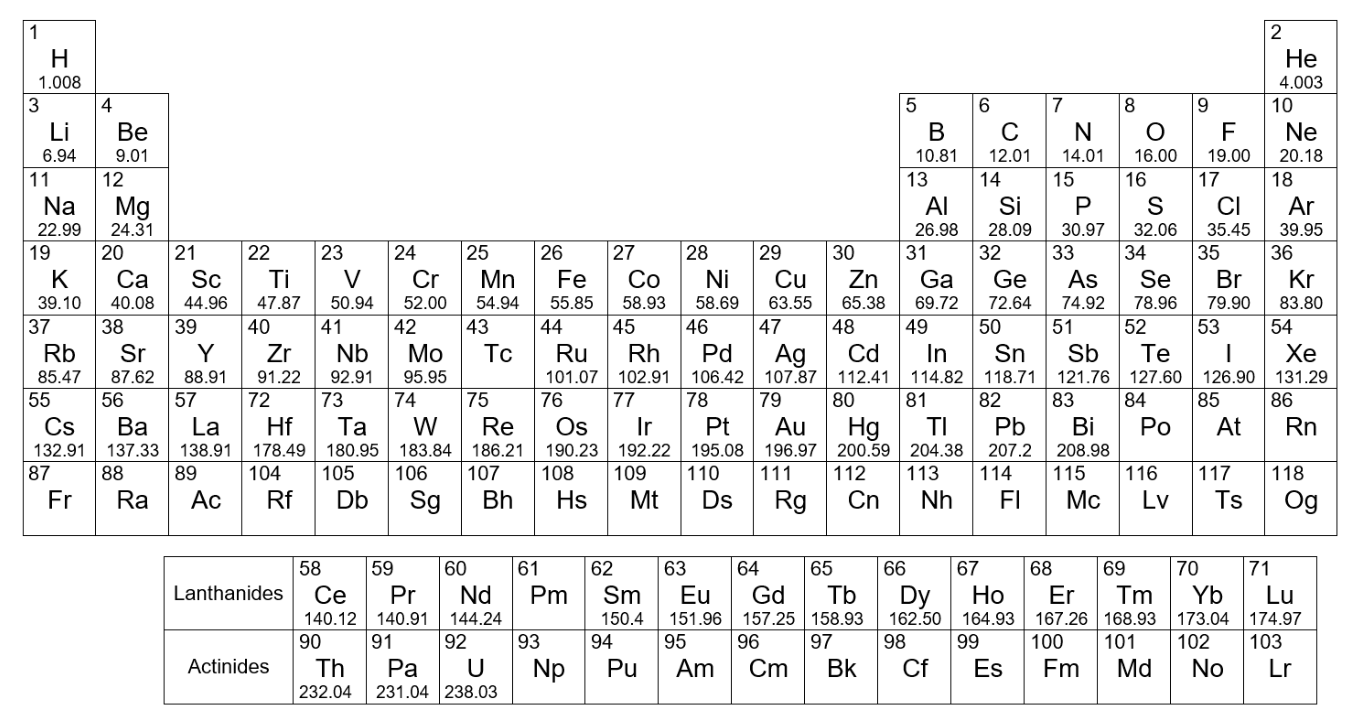
Periodic table
Official English text of the problem.
Problem 8: Carbon monoxide: deadly poison or promising therapeutic agent?
7.5% of the total
8.1 8.2 8.3 8.4 8.5 8.6 8.7 8.8 8.9 Total 4 1 6 3 2 2 4 8 5 35 Carbon monoxide is a toxic gas because it binds to haemoglobin and blocks oxygen binding. A major source of \(\ce{CO}\) is incomplete combustion of engine fuel. Therefore, many exhausts are fitted with catalytic converters which remove \(\ce{CO}\) and other hazardous compounds including unburnt hydrocarbons and nitrogen oxides (\(\ce{NO_x}\)), forming mainly water vapour, carbon dioxide, and nitrogen.
8.1 Write the equations for the reactions of the following in a converter. Tick the box to indicate whether the carbon or nitrogen atom(s) have been oxidised by oxygen, "Ox", been reduced "Red", or stayed at the same oxidation state "Same". Please ignore any reactions between the exhaust gases.
(a) \(\ce{CO}\)
(b) Unburnt hydrocarbon \(\ce{C_xH_y}\)
(c) Nitrogen oxides \(\ce{NO_x}\)Catalytic converters contain nanoparticles of noble metals which act as catalysts, immobilised on a cheap high surface area material such as \(\ce{Al2O3}\).
In one experiment, \(m(\mathrm{cat.})=0.10\ \mathrm{g}\) of catalyst containing \(w(\ce{Pd})=10\ \mathrm{wt\%}\) was used in a tube reactor. Gases were passed over the catalyst under continuous flow. The flow rate of \(\ce{CO}\) gas was \(v(\ce{CO})=10\ \mathrm{mL\,min^{-1}}\), which was mixed with a second flow of air (assume 20% \(\ce{O2}\), 80% \(\ce{N2}\)), at \(T=273.15\ \mathrm{K}\) and \(p=1.00\ \mathrm{atm}\), before entering the reactor.
8.2 Calculate the flow rate \(v\) (in \(\mathrm{mL\,min^{-1}}\)) of air required for the reactants to be present in a stoichiometric ratio.
Assume 10% of the \(\ce{Pd}\) atoms in the nanoparticles are exposed on the surface. Assume the conversion of \(\ce{CO}\) to \(\ce{CO2}\) was \(\eta=70\%\).
8.3 Calculate the number of \(\ce{CO2}\) molecules, \(N\), formed after \(t=1\ \mathrm{h}\) per surface \(\ce{Pd}\) atom.
Ruthenium nanoparticles are efficient catalysts for \(\ce{CO}\) combustion. The bonding interactions between \(\ce{CO}\) molecules and the surface \(\ce{Ru}\) atoms are of two types:
- \(\sigma\)-bonding through a lone pair on the carbon atom;
- \(\pi\)-interaction through an overlap between the \(\ce{Ru}\) valence d-orbitals and \(\ce{CO}\) molecular orbitals.
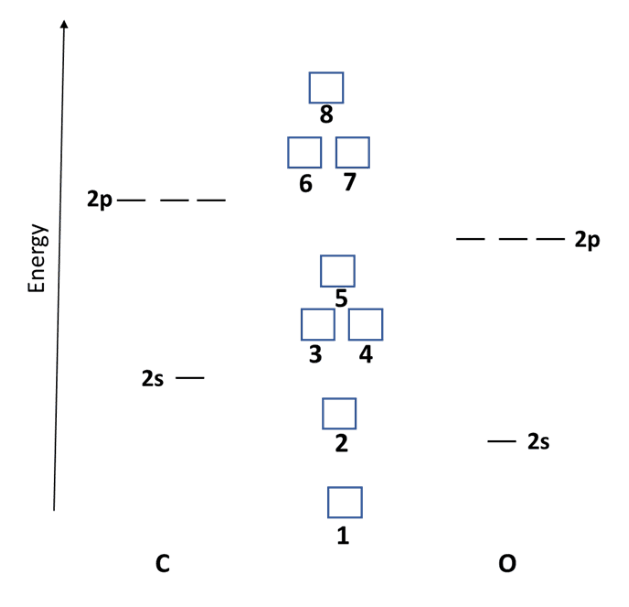
8.4 Complete the MO diagram for \(\ce{CO}\) with electrons and the following table with the type \((\sigma/\pi)\) of overlap for forming each MO.
MO 1 2 3 4 5 6 7 8 Type of overlap 8.5 What is the effect of the \(\ce{Ru-CO}\) \(\pi\)-interaction on the \(\ce{Ru-CO}\) and the \(\ce{C-O}\) bond strengths? Tick the correct answer.
(i) \(\ce{Ru-CO}\) bond strength:
☐ increases "in"
☐ decreases "dec"
☐ no change "nc"(ii) \(\ce{C-O}\) bond strength:
☐ increases "in"
☐ decreases "dec"
☐ no change "nc"Adsorbed \(\ce{CO}\) molecules have strong IR absorptions due to \(\ce{C-O}\) stretching vibrations. Three binding modes for \(\ce{CO}\) adsorbed on a metal surface are shown, where \(\ce{CO}\) can interact with one or more metal atoms. IR peaks in the spectra of free \(\ce{CO}\) and the three binding modes of adsorbed \(\ce{CO}\) were observed at values of 1850, 1930, 2100, and \(2143\ \mathrm{cm^{-1}}\).
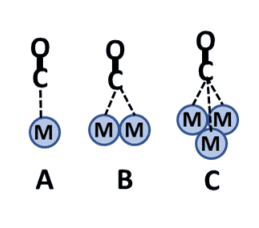
8.6 Tick which wavenumber corresponds to each adsorption mode (A, B, and C) and to free \(\ce{CO}\).
Dispersion of a metal catalyst refers to the percentage of its atoms exposed on the surface. Dispersion can be determined by pulse chemisorption of \(\ce{CO}\) since it adsorbs selectively onto surface atoms. Equal pulses of known amounts of \(\ce{CO}\) are injected and a certain amount is adsorbed from each pulse. The amount remaining is measured by a detector and a peak, the area under which correlates with the amount of unadsorbed \(\ce{CO}\) from each pulse, is plotted as shown below. Injections continue until no more \(\ce{CO}\) adsorbs.
One experiment used \(50\ \mathrm{\mu L}\) pulses consisting of 10% vol \(\ce{CO}\) in \(\ce{He}\), at \(25\ ^\circ\mathrm{C}\) and \(100\ \mathrm{kPa}\). \(15\ \mathrm{mg}\) catalyst was used, composed of 10 wt% \(\ce{Ni}\) on an \(\ce{Al2O3}\) support. Assume one \(\ce{CO}\) molecule adsorbs on each surface \(\ce{Ni}\) atom.
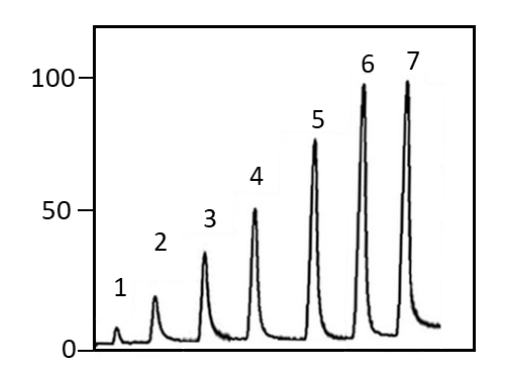
Pulse # (x axis) 1 2 3 4 5 6 7 % of pulse unadsorbed (y axis) 4 10 20 50 80 100 100 8.7 Calculate the percentage of \(\ce{Ni}\) atoms exposed on the surface, \(\%_{\ce{Ni}}\).
Despite being toxic at higher concentrations, at a concentration of 10-250 ppm, \(\ce{CO}\) shows anti-inflammatory properties. Prodrugs known as \(\ce{CO}\) releasing molecules (CORMs) target the delivery of effective dosages of \(\ce{CO}\) to tissues in response to a trigger. Mn(I) carbonyl complexes have shown promise as PhotoCORMs as they can release \(\ce{CO}\) when exposed to light.
Compounds A-D are all neutral Mn(I) carbonyl complexes.
B, C, and D do not contain two \(\ce{CO}\) ligands in a trans arrangement.
The IR spectrum of C contains a band at \(2042\ \mathrm{cm^{-1}}\) in addition to the \(\ce{CO}\) stretching bands. The table with the number of \(\ce{CO}\) stretching bands in the IR spectra of metal carbonyl complexes is given in the data sheet section at the beginning of the exam.
Compound %Mn by mass Number of CO stretching bands A 19.98 3 B 12.15 3 C 13.26 3 D 12.95 2 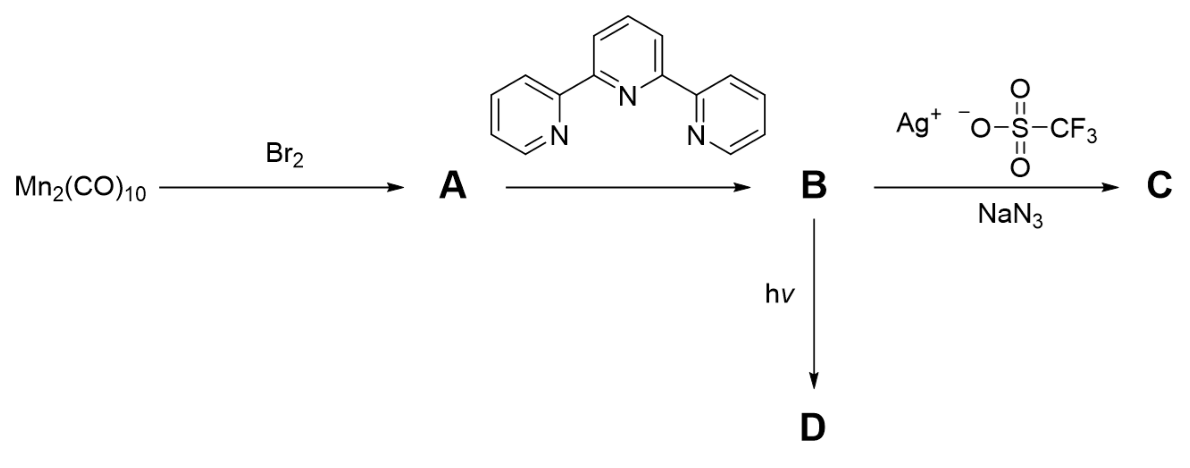
For simplicity, the ligand can be drawn as:
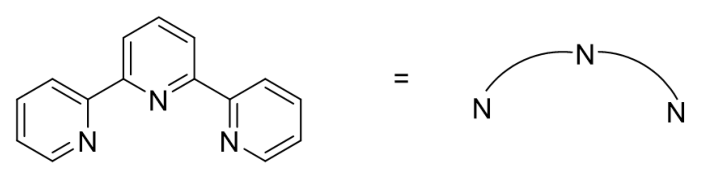
8.8 Draw the structures of compounds A-D, ensuring the three-dimensional shape is clear. If the compound is chiral, only one enantiomer needs to be drawn.
Compound C reacts with alkynes and this can be used to tag proteins. This is known as an Inorganic Click (iClick) reaction.

During the conversion of C to E, the \(2042\ \mathrm{cm^{-1}}\) band in the IR spectrum of C disappears. The IR spectrum of E has two new \(\ce{C=O}\) bands in the range of 1735-1725 \(\mathrm{cm^{-1}}\). After a further 6 h, compound E converts to compound F which only has one \(\ce{C=O}\) band in the range of 1735-1725 \(\mathrm{cm^{-1}}\). Compound G does not contain manganese and has two planes of symmetry.
8.9 Draw the structures of compounds E, F, and G, ensuring the three-dimensional shape is clear. If the compound is chiral, only one enantiomer needs to be drawn.
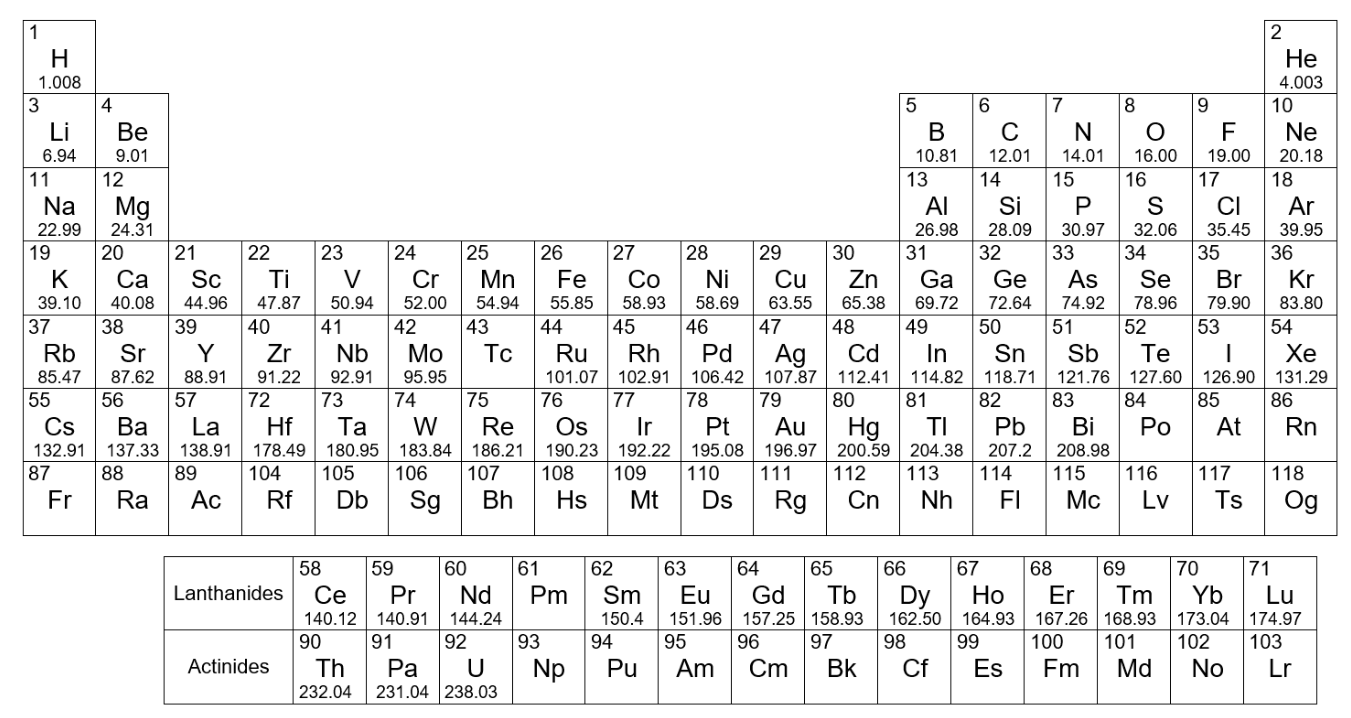
Periodic table and data sheet
Physical constants and formulae
Avogadro constant \(N_A\) \(6.022\times10^{23}\ \mathrm{mol^{-1}}\) molar gas constant \(R\) \(8.314\ \mathrm{J\,K^{-1}\,mol^{-1}}\) Faraday constant \(F\) \(96485\ \mathrm{C\,mol^{-1}}\) Planck constant \(h\) \(6.626\times10^{-34}\ \mathrm{J\,s}\) speed of light in vacuum \(c\) \(2.998\times10^8\ \mathrm{m\,s^{-1}}\) mass of electron \(m_e\) \(9.109\times10^{-31}\ \mathrm{kg}\) charge of electron \(e\) \(1.602\times10^{-19}\ \mathrm{C}\) atmospheric pressure \(p_{\mathrm{atm}}\) \(101325\ \mathrm{Pa}\) ionic product of water at 298 K \(K_w\) \(10^{-14}\) \(1\ \mathrm{nm}=1\times10^{-9}\ \mathrm{m}\) \(1\ \text{Å}=1\times10^{-10}\ \mathrm{m}\) \(1\ \mathrm{pm}=1\times10^{-12}\ \mathrm{m}\) \(0\ ^\circ\mathrm{C}=273.15\ \mathrm{K}\) \(1\ \mathrm{kWh}=3600\ \mathrm{kJ}\) \(1\ \mathrm{W}=1\ \mathrm{J\,s^{-1}}\) \(1\ \mathrm{eV}=1.602\times10^{-19}\ \mathrm{J}\) \(1\ \mathrm{bar}=10^5\ \mathrm{Pa}\) area of triangle \(A=\frac12 ab\cdot\sin C\) volume of cube \(V=a^3\) volume of sphere \(V=\frac43\pi r^3\) surface area of sphere \(S=4\pi r^2\) ideal gas equation \(pV=nRT\) frequency of light \(\nu=\frac{c}{\lambda}\) energy of a photon \(E=\frac{hc}{\lambda}\) Beer-Lambert law \(A=\log\left(\frac{I_0}{I}\right)=\varepsilon cd\) spin-only magnetic moment \(\mu=\sqrt{n(n+2)}\ \mathrm{BM}\) Henderson–Hasselbalch equation \(\mathrm{pH}=\mathrm{p}K_a+\log\left(\frac{[\ce{A-}]}{[\ce{HA}]}\right)\) \(0^{\mathrm{th}}\) order integrated rate law \([\ce{A}]=[\ce{A}]_0-kt\) \(1^{\mathrm{st}}\) order integrated rate law \(\ln[\ce{A}]=\ln[\ce{A}]_0-kt\) Arrhenius equation \(k=A\cdot e^{-E_a/(RT)}\) enthalpy \(H=U+pV\) Gibbs energy \(G=H-TS\) standard Gibbs energy change \(\Delta_rG^\circ=-RT\ln K=-nFE^\circ_{\mathrm{cell}}\) Clausius-Clapeyron equation \(\ln\left(\frac{P_1}{P_2}\right)=\frac{\Delta H_{\mathrm{vap}}}{R}\left(\frac1{T_2}-\frac1{T_1}\right)\) specific heat \(Q=mC_p\Delta T\) boiling point elevation \(\Delta T=iK_bm_i\) freezing point depression \(\Delta T=iK_fm_i\) Consider all gases ideal unless told otherwise.
In equilibrium constant calculations, all concentrations are referenced to a concentration of \(1\ \mathrm{mol\,dm^{-3}}\).
IR absorption data
Bond stretching frequencies
Bond type Wavenumber \((\mathrm{cm^{-1}})\) \(\ce{C-H}\) Alkane 3000-2850 Alkene 3100-3000 Aromatic 3150-3050 Alkyne \(\sim3300\) Aldehyde 2900-2700 \(\ce{C=C}\) Alkene 1680-1600 Aromatic 1600-1400 \(\ce{C#C}\) Alkyne 2250-2100 \(\ce{C=O}\) Aldehyde 1740-1720 Ketone 1725-1705 Carboxylic acid 1725-1700 Ester 1750-1720 Amide 1670-1640 Anhydride 1810, 1760 \(\ce{C-O}\) Alcohol, ether, ester, carboxylic acid, anhydride 1300-800 \(\ce{O-H}\) Alcohol, phenol, free 3600-3200 Hydrogen bonded 3500-3200 Carboxylic acid 3400-2500 \(\ce{N-H}\) Primary and secondary amine and amide 3500-3100 \(\ce{C-N}\) Amine 1350-1000 \(\ce{C=N}\) Imine and oxime 1690-1640 \(\ce{C#N}\) Nitrile 2260-2240 \(\ce{N=O}\) Nitro (\(\ce{R-NO2}\)) 1600-1500, 1400-1300 \(\ce{S=O}\) Sulfoxide 1050 Sulfate, sulfonamide 1200-1140 Characteristic bond stretching frequencies of anionic species
Anion Wavenumber \((\mathrm{cm^{-1}})\) \(\ce{SO4^2-}\) \(1100\text{-}1200\;(\nu_{\mathrm{as}})\) \(\ce{ClO4-}\) \(1050\text{-}1170\;(\nu_{\mathrm{as}})\) \(\ce{NO3-}\) \(1370\;(\nu_{\mathrm{as}})\) \(\ce{CN-}\) 2089 \(\ce{SCN-}\) \(2053\;(\nu_{\ce{C-N}}),\ 748\;(\nu_{\ce{C-S}})\) \(\ce{N3-}\) \(2042\;(\nu_{\mathrm{as}}),\ 1343\;(\nu_{\mathrm{s}})\) \(\ce{CNO-}\) \(2052\;(\nu_{\ce{C-N}}),\ 1057\;(\nu_{\ce{N-O}})\) Number of CO stretching bands in the IR spectra of metal carbonyl complexes
Complex Number of bands \(\ce{M(CO)6}\) 1 \(\ce{M(CO)5X}\) 3 \(cis\text{-}\ce{M(CO)4X2}\) 4 \(trans\text{-}\ce{M(CO)4X2}\) 1 \(fac\text{-}\ce{M(CO)3X3}\) 2 \(mer\text{-}\ce{M(CO)3X3}\) 3 \(fac\text{-}\ce{M(CO)3X2Y}\) 3 \(cis\text{-}\ce{M(CO)2X4}\) 2 \(trans\text{-}\ce{M(CO)2X4}\) 1 Periodic table
Official English text of the problem.
Problem 9: Enzymes and cofactors
7% of the total
9.1 9.2 9.3 9.4 9.5 9.6 Total 2 6 2 6 10 10 36 In any answer for this task, stereochemistry is not required and the phosphate group can be abbreviated as "OP" (see the scheme below).
Transketolase (TK) and transaldolase (TA) are enzymes that catalyse C–C bond cleavage. TK contains the cofactor thiamine pyrophosphate 1, a derivative of vitamin B1, in the active site.
Breslow and coworkers studied cation 2, a model of cofactor 1, to demonstrate the relatively acidic properties of thiamine. Cation 2 underwent a single H/D exchange in \(\ce{D2O}\), which yielded 4 via intermediate 3.
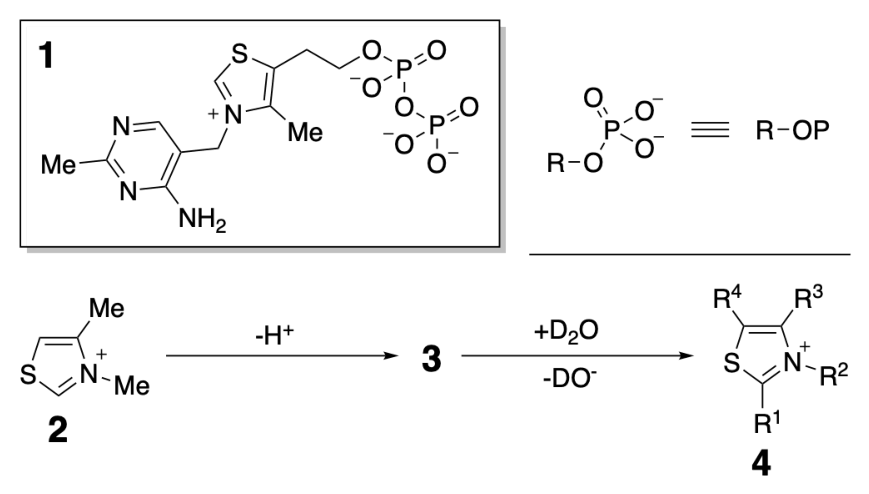
9.1 From the structures in the answer sheet, choose the one that corresponds to compound 4.
Compounds such as 3 have many applications in organocatalysis. When a catalytic amount of 3 is generated in a solution of benzaldehyde 5, a condensation reaction leads to product 9 via the catalytic cycle shown.
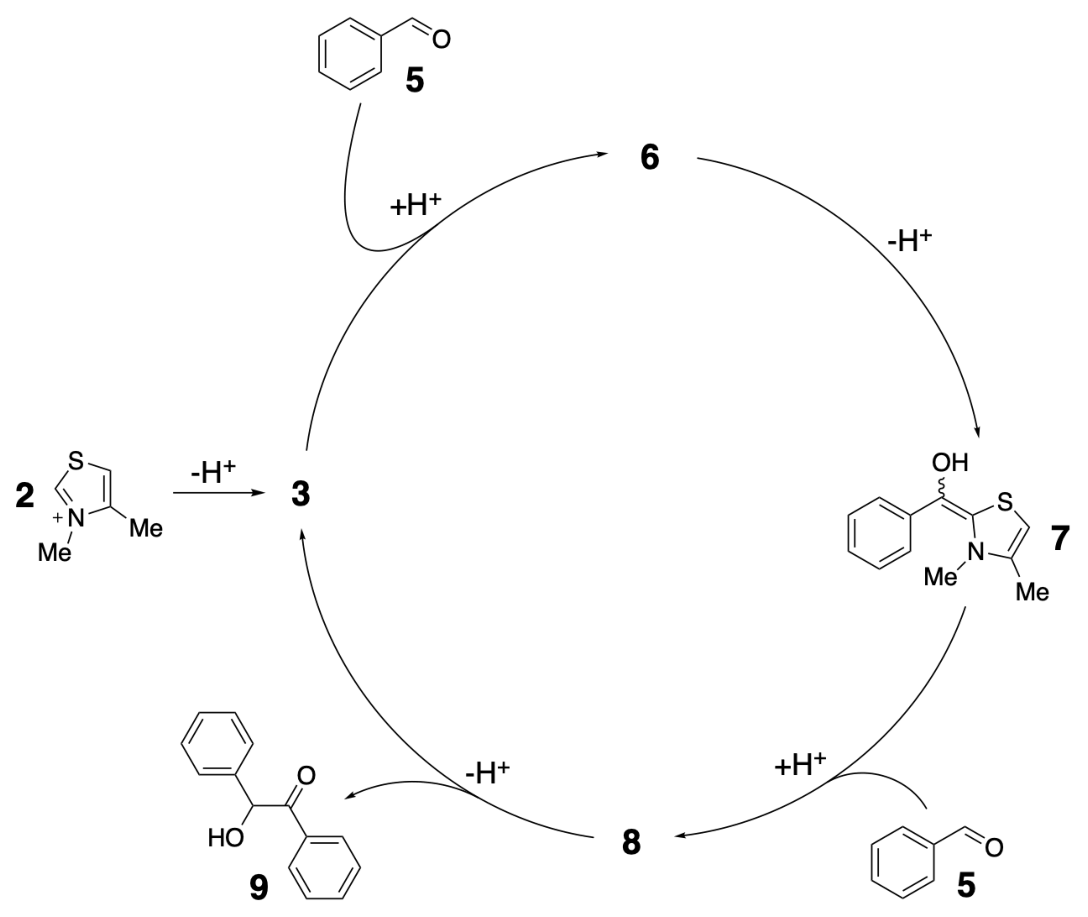
9.2 Draw the structures of compounds 3, 6, and 8. Intermediates 6 and 8 are cations. There is no rearrangement in this catalytic cycle.
An aldose is a sugar containing an aldehyde. A ketose is a sugar containing a ketone. Enzyme TK contains 1 as a cofactor which catalyses the transfer of a two-carbon fragment from a ketose to an aldose by the catalytic cycle presented below.
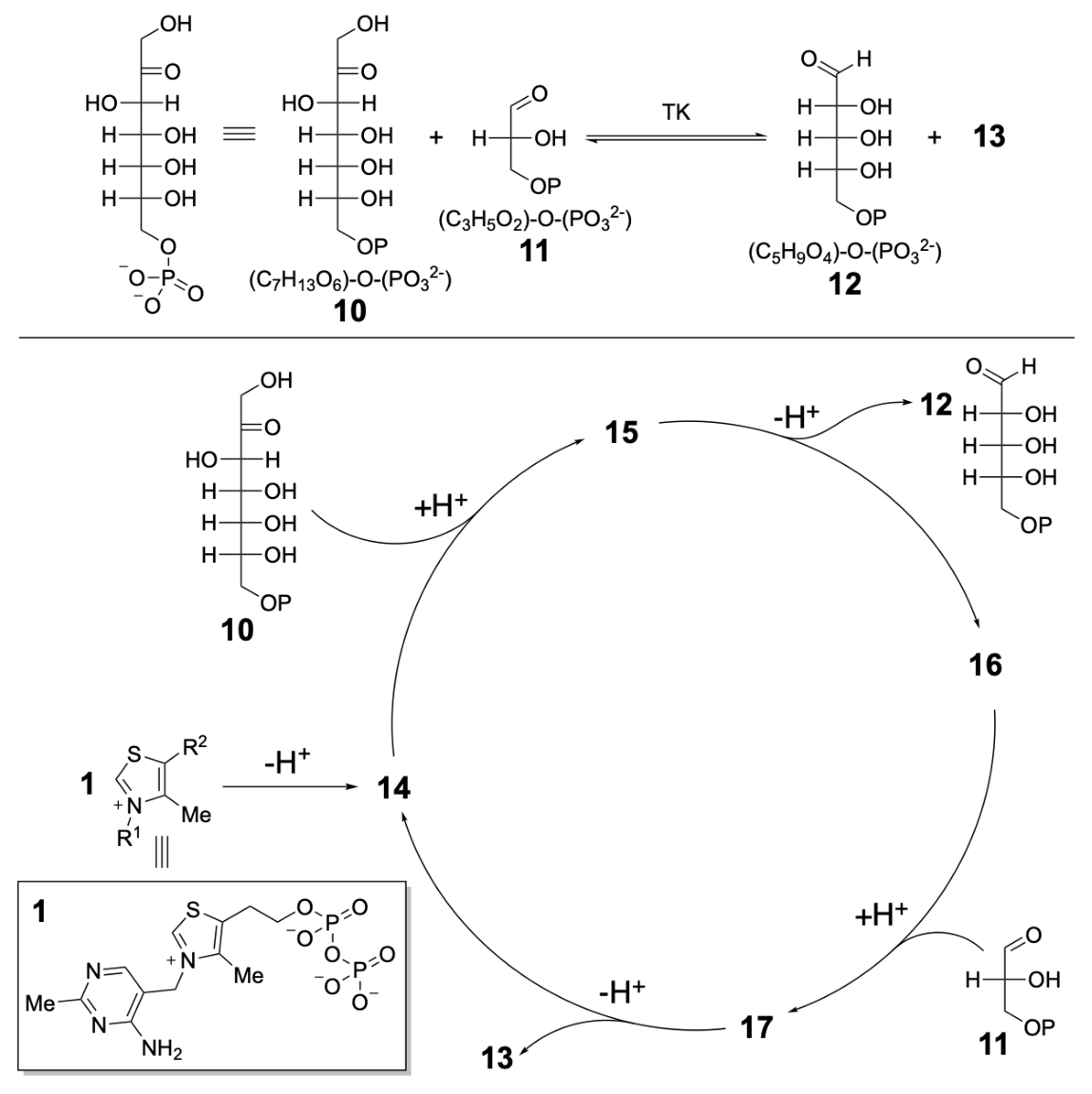
9.3 Draw the structure of 13.
9.4 Draw the structures of intermediates 15-17.
Enzyme TA catalyses the transfer of a three-carbon fragment from a ketose to an aldose. The residue of amino acid lysine 20 in the active site of TA is responsible for the enzyme activity.
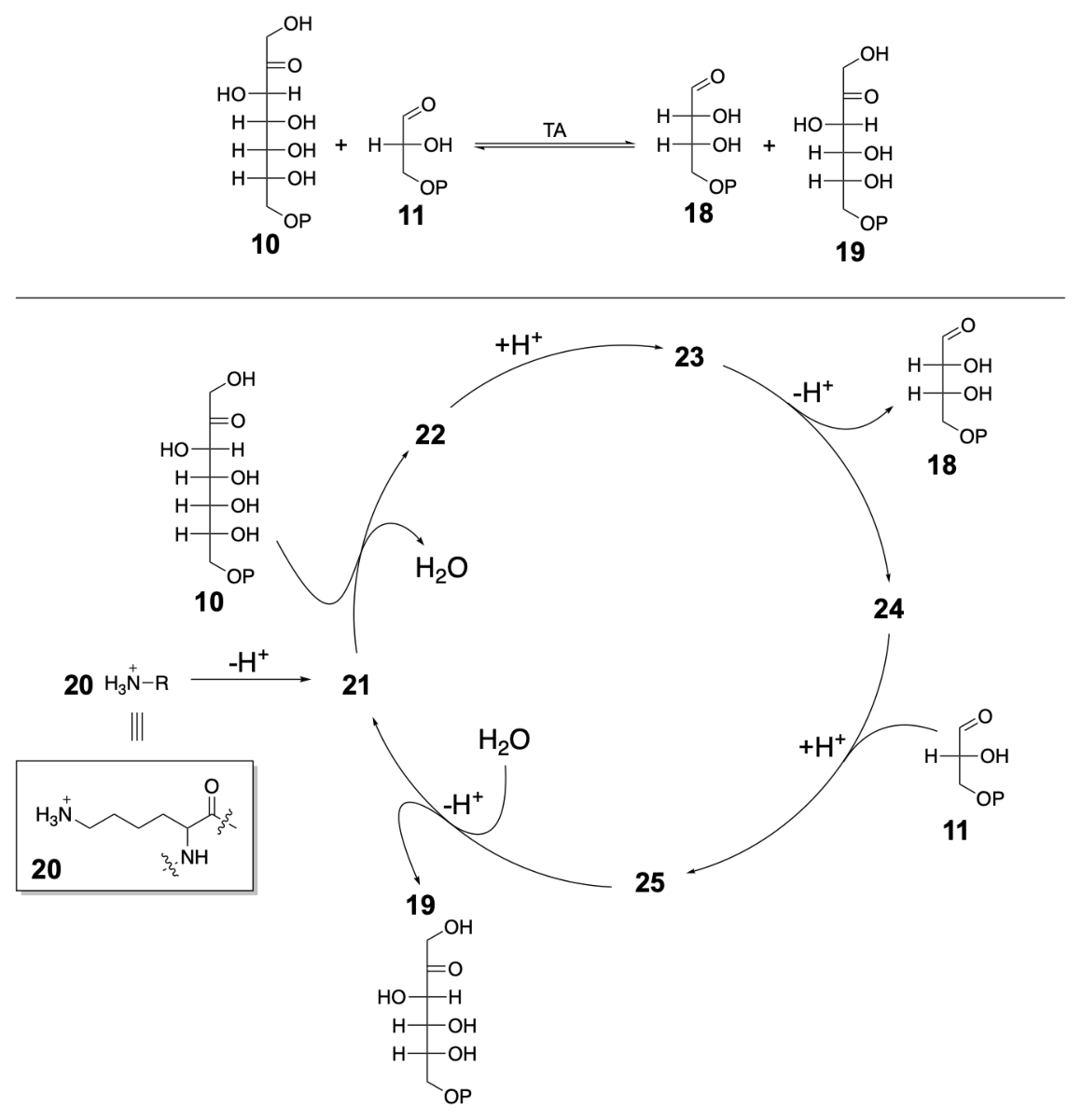
9.5 Draw the structures of intermediates 21-25. 23 and 25 have the same functional groups.
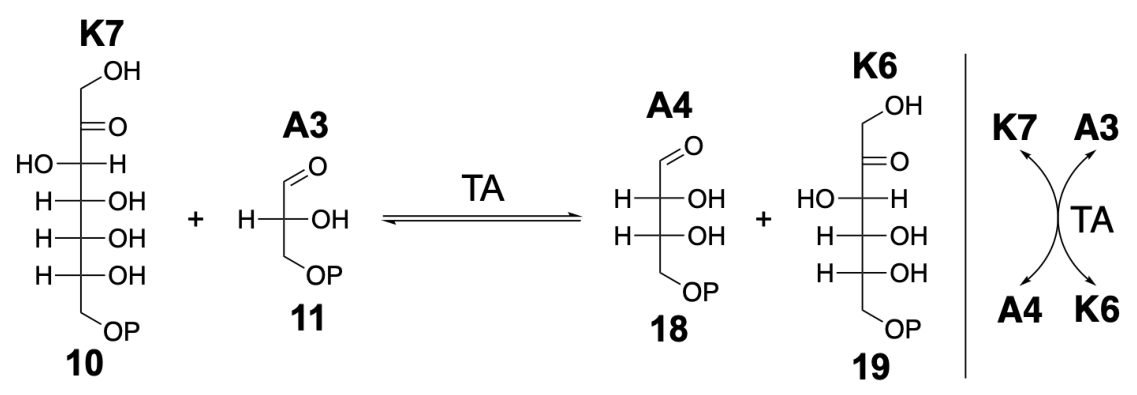
TK and TA are used in some organisms to transform five molecules of three-carbon sugars into three molecules of a five-carbon sugars.
9.6 Propose a reaction sequence for this transformation. Label all sugars with a letter followed by a number. Use the letter A for any aldose and the letter K for any ketose. Use the number corresponding to the number of carbon atoms in the sugar; see the example below (e.g., present structure 10 as K7; using full structural formulae is not required). The number of carbon atoms in the sugar intermediates is between 3 and 7. There are no non-enzymatic steps in the pathway.
Write either TA or TK as the catalyst for each step. Ignore any phosphorylation, dephosphorylation, and isomerisation reactions. Beside transaldolase activity, TA exhibits aldolase activity resulting in only one product. Any five-carbon sugar (A5 or K5) is an acceptable product. Use the same style as shown in the figure below.
Official English text of the problem.
Internationale Chemie-Olympiade
IChO 2025
Dubai, Vereinigte Arabische Emirate · 9 Theorieaufgaben mit vollständigen Lösungen
Aufgabe 1: Isocaryophyllen, Cloven und Humulen
6% der Gesamtpunktzahl
1.1 1.2 1.3 1.4 1.5 1.6 1.7 1.8 1.9 Gesamt 7 3 6 2 2 8 2 2 2 34 Sesquiterpene haben die Summenformel \(\ce{C15H24}\). Sie sind sekundäre Pflanzenmetaboliten, die sowohl pflanzenfressende Insekten abschrecken als auch Tiere anlocken, die diese Insekten fressen.
Isocaryophyllen (i-Cy) ist ein Sesquiterpen, das in Oregano, Rosmarin, Pfeffer und Gewürznelken vorkommt.
Die Strukturformel von i-Cy lässt sich durch die Durchführung verschiedener Reaktionen und die Analyse der Produkte bestimmen, wie in der Abbildung gezeigt.
Äquiv. = Übersetzung von 'equiv.'
1.1 Zeichnen Sie die Strukturen von i-Cy, A und B. Die Stereochemie muss nicht angegeben werden.
1.2 Kreisen Sie die Stereozentren in Verbindung C ein und ordnen Sie ihnen die Konfiguration \(R\) oder \(S\) zu.
Cloven (Cv) kann unter Säurekatalyse aus i-Cy synthetisiert werden. Die Synthese von Cv geht von Verbindung D aus.
\(\ce{H+}\) (kat.)="Übersetzung von \(\ce{H+}\) (cat.)"
1.3 Zeichnen Sie die Strukturen der Verbindungen E und F. Die Stereochemie muss nicht angegeben werden.
Für die Schritte '1' und '2' könnten mehrere Reagenzien in Betracht gezogen werden. Zum Beispiel:
- ☐ PCC
- ☐ \(\ce{K2Cr2O7, H2SO4, H2O}\)
- ☐ \(\ce{MnO2}\)
- ☐ (i) \(\ce{OsO4}\), (ii) \(\ce{KHSO3}\)
1.4 Kreuzen Sie unter den oben aufgeführten Reagenzien diejenigen an, die für Schritt '1' geeignet wären.
1.5 Kreuzen Sie unter den oben aufgeführten Reagenzien diejenigen an, die für Schritt '2' geeignet wären.
Der letzte Teil der Synthese ist dargestellt.
1.6 Zeichnen Sie die Strukturen der Verbindungen I, J und K. Die Stereochemie muss nicht angegeben werden.
Humulen (Hu) ist ein weiteres Sesquiterpen. Es kann in α-Caryophyllenalkohol (α-Ca) umgewandelt werden, der eine ähnliche Struktur wie Cv aufweist. Diese Umwandlung ist eine säurekatalysierte Hydratisierung, die über mehrere Zwischenstufen verläuft. Unvollständige Strukturen einiger Zwischenstufen, X und Y, sind dargestellt.
\(\ce{H+}\) (kat.)="Übersetzung von \(\ce{H+}\) (cat.)"
Die Umwandlung von Hu zu X ist eine säurekatalysierte Isomerisierung. Die Zwischenstufe Y ist geladen.
1.7 Vervollständigen Sie die Struktur der Zwischenstufe X, indem Sie Doppelbindungen an den richtigen Stellen einzeichnen.
1.8 Vervollständigen Sie die Struktur der Zwischenstufe Y, indem Sie eine positive Ladung an der richtigen Stelle eintragen.
In Hu sind fünf Kohlenstoffatome eingekreist. Durch das Verständnis des Mechanismus können wir bestimmen, an welchen Positionen sich diese fünf Kohlenstoffatome in α-Ca wiederfinden.
1.9 Kreisen Sie in α-Ca die fünf Kohlenstoffatome ein, die den in Hu eingekreisten Atomen entsprechen.
Aufgabentext aus dem offiziellen englischen Text übersetzt.
Aufgabe 2: Rapamycin - Ein molekularer Klebstoff
6.5% der Gesamtpunktzahl
2.1 2.2 2.3 2.4 Gesamt 12 19 18 18 67 Rapamycin wurde 1972 aus dem Bakterium Streptomyces hygroscopicus isoliert. Es wirkt als „molekularer Klebstoff“ und hemmt die Aktivität des Proteins mTOR durch Bindung an ein anderes Protein. Es wird zur Behandlung verschiedener Krankheiten eingesetzt. Die stereochemische Komplexität von Rapamycin macht seine Totalsynthese zu einer Herausforderung. Die Abbildung zeigt einen Teil der ersten Totalsynthese durch die Arbeitsgruppe von Nicolaou.
Das Hauptstereoisomer (C) entsteht bei der chromvermittelten Kupplungsreaktion des Aldehyds A mit dem Vinyliodid B und lässt sich mithilfe des Felkin-Anh-Modells ohne Chelatbildung vorhersagen.
2.1a Zeichnen Sie eine Newman-Projektion, die die günstigste Annäherung des Nukleophils bei dieser Reaktion zeigt. Verwenden Sie die Bezeichnungen =O, –H, –R\(^{1}\), –OMe und Nu.
2.1b Zeichnen Sie die vollständige Struktur des Hauptdiastereomers C unter Angabe der gesamten Stereochemie.
Nach einigen Umwandlungen lässt sich C in einen Aldehyd D überführen, der mit E zu F reagiert. F kann anschließend weiter zu Rapamycin umgesetzt werden.
2.2a Sagen Sie mithilfe des Zimmerman-Traxler-Modells die Anordnung der Reaktanden voraus, wenn sie bei der Reaktion zu F zum sechsgliedrigen Übergangszustand zusammentreten. Zeichnen Sie die Substituenten an den mit Zahlen gekennzeichneten Positionen ein. Wenn eine Position keinen Substituenten trägt, setzen Sie ein „X“ in das Kästchen. Die Kästchen 1 und 2 sind als Beispiel bereits ausgefüllt. Sie dürfen die im obigen Schema angegebene Abkürzung R\(^{2}\) verwenden.
2.2b Zeichnen Sie die Struktur von F unter Angabe der gesamten Stereochemie. Sie dürfen die im obigen Schema angegebene Abkürzung R\(^{2}\) verwenden.
Während die stereochemische Kontrolle bei der chemischen Synthese eine Herausforderung darstellt, steuert die biologische Synthese die Stereochemie auf elegante Weise durch eine Reihe verschiedener Enzyme, die wie ein Fließband zusammenarbeiten.
Die Kohlenstoffkette wird durch die Addition von Monomeren aufgebaut. Diese Einheiten sind über einen Thioester an Coenzym A (CoA) gebunden.
Die Funktionen der verschiedenen Enzyme und Proteine sind in der Tabelle aufgeführt.
Abkürzung Name Funktion ACP Acyl-Carrier-Protein Transportiert die wachsende Kette zwischen den Domänen CoL CoA-Ligase Aktiviert ein Carbonsäuresubstrat für die Beladung des ACP AT Acyltransferase Wählt das Monomer aus und überträgt es auf ACP KS Ketosynthase Übernimmt die wachsende Kette vom vorherigen ACP und aktiviert sie für die Claisen-Kondensation mit dem nächsten monomerbeladenen ACP KR Ketoreduktase Reduziert die Carbonylgruppe eines vorherigen Monomers zu einer Hydroxygruppe DH Dehydratase Bildet durch Eliminierung am vorherigen Monomer einen \(\alpha,\beta\)-ungesättigten Thioester ER Enoylreduktase Reduziert den \(\alpha,\beta\)-ungesättigten Thioester am vorherigen Monomer zu einer gesättigten Kette Der erste Teil des Fließbands ist mit Leerstellen dargestellt. Die Enzyme sind in Kreisen dargestellt und wirken in Pfeilrichtung nacheinander.
2.3a Zeichnen Sie in die Sechsecke die Struktur des Monomers ein, das das Enzym AT an jeder der mit 1-4 nummerierten Stellen benötigt. Beim Einbau der Monomere wird Kohlenstoffdioxid freigesetzt. Die Monomere haben die folgende allgemeine Struktur, in der die R-Gruppe anionisch ist:
2.3b Tragen Sie in jeden Kreis die Abkürzungen der benötigten Enzyme ein. Schreiben Sie „X“, wenn kein zusätzliches Enzym benötigt wird.
2.3c Ergänzen Sie die Rechtecke um die Struktur des an das Enzym gebundenen wachsenden Moleküls.
Die letzten Schritte der enzymatischen Synthese sind unten dargestellt.
Die beteiligten Bausteine wurden bestimmt, indem das Bakterium mit drei verschiedenen \(^{13}\)C-markierten Ausgangsstoffen gefüttert wurde, die in die Monomere eingebaut werden (\(^{13}\)C sind wie unten gezeigt eingekreist):
2.4 Kreisen Sie die Kohlenstoffatome in Rapamycin ein, die \(^{13}\)C-markiert werden, wenn das Bakterium jeweils mit einem der drei Ausgangsstoffe a-c gefüttert wird. Beachten Sie dabei die Hinweise auf der nächsten Seite. Für falsch gesetzte Kreise werden Punkte abgezogen, die Punktzahl kann jedoch nicht negativ werden.
Hinweise zum Einkreisen von Kohlenstoffatomen:
- Jeder Kreis sollte eindeutig ein Kohlenstoffatom umschließen
- Schließen Sie nicht mehrere Kohlenstoffatome in denselben Kreis ein
- Kreisen Sie keine Bindungen ein
- Wenn Sie Ihre Antwort ändern und einen Kreis streichen möchten, setzen Sie ein „X“ über den Kreis.
Aufgabentext aus dem offiziellen englischen Text übersetzt.
Aufgabe 3: Laternen und der Burj Khalifa
7.5% der Gesamtpunktzahl
3.1 3.2 3.3 3.4 3.5 3.6 3.7 Gesamt 6 4 4 5 40 20 32 111 Mit 829.8 m ist der Burj Khalifa in Dubai das höchste Bauwerk der Welt. Um den Bau zu vereinfachen, wurden viele Stockwerke aus ähnlichen Bauteilen errichtet. Einige künstliche „molekulare Wolkenkratzer“ lassen sich mithilfe der Koordinationschemie aus nur zwei Bausteinen herstellen: Metallionen und organischen Liganden.
In diesen dreidimensionalen Strukturen befindet sich an jeder Ecke ein quadratisch-planar koordiniertes \(\ce{Pd}\)(II)-Ion, das an vier Pyridinliganden gebunden ist. Entlang jeder Kante liegt ein gewinkelter organischer Ligand, der aus zwei miteinander verknüpften Pyridinen besteht.
Der Winkel zwischen den beiden \(\ce{N -> Pd}\)-Bindungen desselben Liganden bestimmt, welche Struktur entsteht. Größere Winkel führen zu größeren Strukturen.
Wenn eine freie Drehung um eine Bindung möglich ist, nimmt der Ligand eine Konformation ein, die eine Struktur mit dem kleinstmöglichen Winkel bildet.
3.1 Kreuzen Sie den kleinsten Winkel (ungefähr) zwischen den \(\ce{N -> Pd}\)-Bindungen an, der mit den Liganden A, B und C erreicht werden könnte.
3.2 Ordnen Sie die Liganden D, E und F unter Verwendung von „<“ nach dem kleinsten bis zum größten Winkel zwischen den \(\ce{N -> Pd}\)-Bindungen, den sie bilden könnten.
Eine Reihe von Strukturen lässt sich als Polyeder mit vierfach koordinierten \(\ce{Pd}\)(II)-Ionen an den Ecken modellieren. Alle Strukturen besitzen acht dreieckige Flächen (\(F_3\)) und unterschiedlich viele quadratische Flächen (\(F_4\)).
Die dreieckigen und quadratischen Flächen können auf einem quadratischen Gitter angeordnet werden, wobei die relative Lage zweier nächstgelegener Dreiecke durch ganzzahlige Koordinaten \(h\) und \(k\) beschrieben wird. \(Q\) ist dann durch folgende Gleichung gegeben:
\[ Q=h^2+k^2 \]
Ein Teil des Gitters für eine Struktur mit \(h=2\) und \(k=4\) ist unten dargestellt.
Die kleinstmögliche Struktur dieser Reihe ist ein Oktaeder mit \(Q=1\) und \((h,k)=(0,1)\) oder \((1,0)\). Es besitzt sechs Ecken, acht dreieckige Flächen und 12 Kanten. Nächstgelegene Dreiecke sind um einen Schritt von einer Fläche in einer Richtung voneinander entfernt.
Die zweitkleinste Struktur ist ein Kuboktaeder mit \(Q=2\). Nächstgelegene Dreiecke sind um einen Schritt von einer Fläche in jeder Richtung voneinander entfernt.
3.3 Vervollständigen Sie die Spalte der Tabelle für \(Q=2\) mit der Anzahl der Ecken \(V\), der Anzahl der Kanten \(E\), der Gesamtzahl der Flächen \(F\) und der Anzahl der quadratischen Flächen \(F_4\).
\(Q\) 1 2 \((h,k)\) \((0,1)\) oder \((1,0)\) \((1,1)\) \(V\) 6 \(E\) 12 \(F\) 8 \(F_3\) 8 8 \(F_4\) 0 Alle Strukturen erfüllen die folgenden Regeln:
\[ V-E+F=2 \]
\[ V=6Q \]
\[ F-V=2 \]
3.4 Vervollständigen Sie die Tabelle für die drittkleinste Struktur mit \(Q=4\).
\(Q\) 4 \((h,k)\) \(V\) \(E\) \(F\) \(F_3\) 8 \(F_4\) Im Gegensatz zu diesen großen Strukturen enthalten die kleinsten Strukturen zwei Metallzentren und vier Liganden und werden als Laternen bezeichnet. Ihre Form ähnelt den traditionellen Laternen, die beim Lichterfestival in Dubai zu sehen sind. Laternen werden von Liganden wie L gebildet, die zwei parallele \(\ce{N -> Pd}\)-Bindungen ausbilden. Ligand L besitzt zwei Symmetrieebenen und kann eine planare Konformation mit den angegebenen Winkeln einnehmen.
Hinweis:
- Die Umwandlung von H zu I könnte auch durch Lewis-Säure-Katalyse erreicht werden.
3.5 Zeichnen Sie die Strukturen der Verbindungen H, I, J, K und des Liganden L.
Im Gegensatz zum symmetrischen Liganden L besitzt der chirale Ligand M keine Symmetrie und liegt als Paar von \(R\)- und \(S\)-Enantiomeren vor.
Aus Ligand M können mehrere Laternenisomere entstehen. Diese Isomere lassen sich auf zwei Arten gruppieren. Zunächst werden sie nach der Anzahl der jeweiligen Ligandentypen in der Laterne eingeteilt: (i) alle gleich (\(RRRR\) oder \(SSSS\)), (ii) einer verschieden (\(RRRS\) oder \(SSSR\)), (iii) cis-\(RRSS\) und (iv) trans-\(RSRS\).
Zweitens sind die beiden Enden des Liganden M nicht gleich; der Ligand besitzt einen Kopf (H) und einen Schwanz (T). Hinsichtlich der Kopf-Schwanz-Orientierung gibt es vier Strukturkategorien: (1) alle nach oben (HHHH), (2) drei nach oben (HHHT), (3) cis-HHTT und (4) trans-HTHT.
Die 16 möglichen Kombinationen dieser Kategorien sind durch leere Zellen in der Tabelle dargestellt. Bei manchen Kombinationen ist nur ein Isomer möglich, bei anderen sind mehrere Isomere möglich. Innerhalb einer Kombination sind alle möglichen Isomere entweder chiral oder achiral.
3.6 Vervollständigen Sie die Tabelle, indem Sie „C“ für chiral und „A“ für achiral eintragen. Beachten Sie: In diesem Teil erhalten Sie für jede richtige Antwort Punkte; für jede falsche Antwort werden jedoch Punkte abgezogen, bis zu einem Minimum von null Punkten. Für leere Zellen gibt es keinen Punktabzug.
(1) (2) (3) (4) (i) (ii) (iii) (iv) 3.7 Vervollständigen Sie die Tabelle mit der Anzahl der möglichen Isomere jeder Kombination.
(1) (2) (3) (4) (i) 2 (ii) 4 (iii) (iv) Aufgabentext aus dem offiziellen englischen Text übersetzt.
Aufgabe 4: Das Leben der Tennisbälle
6% der Gesamtpunktzahl
4.1 4.2 4.3 4.4 Gesamt 3 16 5 16 40 Diese Aufgabe würdigt den unglaublichen Rafael Nadal, eine wahre Tennisikone, der seine bemerkenswerte Karriere 2024 beendete.
Die Dubai Tennis Championships sind ein renommiertes Turnier, das jährlich in den Vereinigten Arabischen Emiraten stattfindet. Viele der weltbesten Spieler, darunter Rafael Nadal, Roger Federer, Novak Djokovic und Andy Murray, haben dort Titel gewonnen.
Der Aufbau von Tennisbällen hat sich über Hunderte von Jahren weiterentwickelt. Um ein gutes Sprungverhalten zu gewährleisten, herrscht im Inneren moderner Tennisbälle ein Druck oberhalb des Atmosphärendrucks. Alte hohle Tennisbälle enthielten dagegen lediglich Luft bei Atmosphärendruck.
Nehmen Sie in dieser Aufgabe an, dass Tennisbälle einen Innenradius von \(R = 3.0\ \mathrm{cm}\) haben, der während des gesamten Druckaufbaus konstant bleibt. Nehmen Sie an, dass Luft zu 20 Volumenprozent aus \(\ce{O2}\) und zu 80 Volumenprozent aus \(\ce{N2}\) besteht. Gehen Sie davon aus, dass der Überdruck den Ball nicht ausdehnt.
4.1 Berechnen Sie die Masse \(m\) (in g) der Luft in einem alten Tennisball bei \(T_0 = 25\ ^\circ\mathrm{C}\).
Chemiker entdeckten dann, wie sich der Druck in einem Ball mithilfe einer Reaktion zwischen den Verbindungen A und B über den Atmosphärendruck hinaus erhöhen lässt. Dabei entstehen das Gas C (zur Erzeugung eines zusätzlichen Innendrucks) sowie weitere, nicht gasförmige Produkte.
Eine Kapsel mit einer Masse von \(m_{\mathrm{mix}} = 0.3389\ \mathrm{g}\) eines stöchiometrischen Gemischs zweier weißer anorganischer Verbindungen A und B wurde in einen mit Luft bei Atmosphärendruck gefüllten Ball eingebracht. Beim Erhitzen reagierten sie im Ball vollständig unter Bildung des Gases C und weiterer Produkte (Reaktion 1), sodass im Ball ein Gesamtdruck von \(p = 1.600\ \mathrm{atm}\) (bei \(25\ ^\circ\mathrm{C}\)) entstand. Nachdem dieser Ball geöffnet worden war, wurde der gesamte Rückstand aus seinem Inneren gesammelt und in Wasser gelöst. Beim Zutropfen von Silbernitrat zu dieser Lösung entstand ein weißer Niederschlag (Reaktion 2). Der abgetrennte Niederschlag ließ sich teilweise in einer konzentrierten wässrigen Lösung von B lösen. Durch Erhöhen des pH-Werts dieses Gemischs löste sich der Niederschlag vollständig auf (Reaktion 3). Wenn dieselbe ursprüngliche Kapsel mit A+B in Wasser gelöst und eine konzentrierte Silbernitratlösung hinzugegeben wird, entsteht ein weißer Niederschlag mit einer Masse von \(m_{\mathrm{precipitate}} = 0.8224\ \mathrm{g}\), die ungefähr doppelt so groß ist wie die Masse des in Reaktion 2 gebildeten Niederschlags.
Als die Kapsel mit A+B in einer Lösung von \(\ce{HI}\) aufgelöst wurde, begann die Bildung des Gases D, und die Lösung färbte sich braun (Reaktion 4). Bei anschließender Zugabe von Natriumthiosulfat verschwand diese Farbe (Reaktion 5).
Die Dichten der Gase C und D unterscheiden sich um höchstens 10%.
4.2 Geben Sie die chemischen Formeln der Verbindungen A–D an.
4.3 Stellen Sie die Gleichungen für die Reaktionen 1–5 auf.
Der Druck im Inneren moderner Tennisbälle beträgt \(p_0 = 1.80\ \mathrm{atm}\). Sie werden in einer unter Druck stehenden Dose verkauft, in der derselbe Druck wie im Ball herrscht, um während der Lagerung das Austreten von Gas zu verhindern.
Standardbälle enthalten Luft, Premiumbälle enthalten reinen \(\ce{N2}\). Sobald die Dose geöffnet wird, beginnt der Druckabbau, und das Gas diffundiert aus den Bällen, bis der Innendruck den Atmosphärendruck erreicht. Nehmen Sie an, dass zu keinem Zeitpunkt Gas in die Bälle hineindiffundiert. Die Aktivierungsenergie für den Druckabbau eines Premiumballs beträgt \(E_A = 50.0\ \mathrm{kJ\,mol^{-1}}\).
Die Geschwindigkeit des Druckabbaus der Bälle (Druck/Zeit) lässt sich durch ähnliche Gleichungen beschreiben, wie sie in der chemischen Kinetik verwendet werden. Bei \(T_0 = 25.0\ ^\circ\mathrm{C}\) sinkt nach dem Öffnen der Dose der Druck in den Premiumbällen nach \(t_1 = 241\ \mathrm{h}\) auf \(p_1 = 1.40\ \mathrm{atm}\) und nach etwa \(t_2 = 21\) Tagen auf \(p_2 = 1.19\ \mathrm{atm}\). Die Anfangsgeschwindigkeit des Druckabbaus ist bei Standardbällen um 10% höher als bei Premiumbällen.
4.4a Zeigen Sie, dass der Druckabbau einer Kinetik erster Ordnung folgt, indem Sie die Geschwindigkeitskonstante \(k_{\ce{N2}}\) des Druckabbaus für \(\ce{N2}\) in \(\mathrm{h^{-1}}\) berechnen.
Hinweis: Falls Sie das Ergebnis nicht berechnen konnten, verwenden Sie für die weiteren Berechnungen \(k_{\ce{N2}} = 10^{-3}\ \mathrm{h^{-1}}\).
4.4b Berechnen Sie die Geschwindigkeitskonstante \(k_{\ce{O2}}\) (des Druckabbaus) für \(\ce{O2}\) in \(\mathrm{h^{-1}}\), unter der Annahme, dass sich die Geschwindigkeiten für beide Gase addieren.
Heute findet nicht nur die theoretische Prüfung der IChO 2025 statt, sondern auch (vielleicht etwas weniger wichtig) das Halbfinale in Wimbledon. Amanda Anisimova wird in \(t_{\mathrm{match}} = 12.0\ \mathrm{h}\) ein Match beginnen. Für heute wird in Wimbledon eine konstante Temperatur von \(T_W = 30.0\ ^\circ\mathrm{C}\) vorhergesagt. Nehmen Sie an, dass eine Dose mit einem neuen Satz Premiumbälle, die bei \(T_0 = 25.0\ ^\circ\mathrm{C}\) hergestellt und in die Dose gefüllt wurden, jetzt geöffnet wird und die Bälle schnell die Temperatur \(T_W = 30.0\ ^\circ\mathrm{C}\) annehmen.
4.4c Berechnen Sie den Druck \(p_{\mathrm{start}}\) (in atm) der Bälle zu Beginn des Matches.
Periodensystem und Datenblatt
Physikalische Konstanten und Formeln
Avogadro-Konstante \(N_A\) \(6.022\times10^{23}\ \mathrm{mol^{-1}}\) Molare Gaskonstante \(R\) \(8.314\ \mathrm{J\,K^{-1}\,mol^{-1}}\) Faraday-Konstante \(F\) \(96485\ \mathrm{C\,mol^{-1}}\) Planck-Konstante \(h\) \(6.626\times10^{-34}\ \mathrm{J\,s}\) Lichtgeschwindigkeit im Vakuum \(c\) \(2.998\times10^8\ \mathrm{m\,s^{-1}}\) Masse des Elektrons \(m_e\) \(9.109\times10^{-31}\ \mathrm{kg}\) Ladung des Elektrons \(e\) \(1.602\times10^{-19}\ \mathrm{C}\) Atmosphärendruck \(p_{\mathrm{atm}}\) \(101325\ \mathrm{Pa}\) Ionenprodukt des Wassers bei 298 K \(K_W\) \(10^{-14}\) \(1\ \mathrm{nm}=1\times10^{-9}\ \mathrm{m}\) \(1\ \text{Å}=1\times10^{-10}\ \mathrm{m}\) \(1\ \mathrm{pm}=1\times10^{-12}\ \mathrm{m}\) \(0\ ^\circ\mathrm{C}=273.15\ \mathrm{K}\) \(1\ \mathrm{kWh}=3600\ \mathrm{kJ}\) \(1\ \mathrm{W}=1\ \mathrm{J\,s^{-1}}\) \(1\ \mathrm{eV}=1.602\times10^{-19}\ \mathrm{J}\) \(1\ \mathrm{bar}=10^5\ \mathrm{Pa}\) Flächeninhalt eines Dreiecks \(A=\frac12 ab\cdot\sin C\) Volumen eines Würfels \(V=a^3\) Volumen einer Kugel \(V=\frac43\pi r^3\) Oberfläche einer Kugel \(S=4\pi r^2\) Ideale Gasgleichung \(pV=nRT\) Frequenz des Lichts \(\nu=\frac{c}{\lambda}\) Energie eines Photons \(E=\frac{hc}{\lambda}\) Lambert-Beer-Gesetz \(A=\log\left(\frac{I_0}{I}\right)=\varepsilon cd\) Magnetisches Moment bei reinem Spinbeitrag \(\mu=\sqrt{n(n+2)}\ \mathrm{BM}\) Henderson-Hasselbalch-Gleichung \(\mathrm{pH}=\mathrm{p}K_a+\log\left(\frac{[\ce{A-}]}{[\ce{HA}]}\right)\) Integriertes Geschwindigkeitsgesetz \(0^{\mathrm{th}}\) Ordnung \([A]=[A]_0-kt\) Integriertes Geschwindigkeitsgesetz \(1^{\mathrm{st}}\) Ordnung \(\ln[A]=\ln[A]_0-kt\) Arrhenius-Gleichung \(k=A\cdot e^{-E_a/(RT)}\) Enthalpie \(H=U+pV\) Gibbs-Energie \(G=H-TS\) Standardänderung der Gibbs-Energie \(\Delta_rG^\circ=-RT\ln K=-nFE^\circ_{\mathrm{cell}}\) Clausius-Clapeyron-Gleichung \(\ln\left(\frac{P_1}{P_2}\right)=\frac{\Delta H_{\mathrm{vap}}}{R}\left(\frac{1}{T_2}-\frac{1}{T_1}\right)\) Spezifische Wärmekapazität \(Q=mC_p\Delta T\) Siedepunktserhöhung \(\Delta T=iK_bm_i\) Gefrierpunktserniedrigung \(\Delta T=iK_fm_i\) Betrachten Sie alle Gase als ideal, sofern nicht anders angegeben.
Bei Berechnungen von Gleichgewichtskonstanten werden alle Konzentrationen auf eine Konzentration von \(1\ \mathrm{mol\,dm^{-3}}\) bezogen.
Periodensystem
Aufgabentext aus dem offiziellen englischen Text übersetzt.
Aufgabe 5: Solarbetriebene mehrstufige Entspannungsverdampfung zur Meerwasserentsalzung
6.5% der Gesamtpunktzahl
5.1 5.2 5.3 5.4 5.5 5.6 5.7 5.8 Gesamt 2 2 3 2 2 2 1 2 16 Im ariden Klima der VAE ist Süßwasser knapp. Das Land ist auf solarbetriebene Entsalzungsanlagen angewiesen, um Süßwasser zu gewinnen. Eine Entsalzungsanlage in Dubai nutzt ein Verfahren zur mehrstufigen Entspannungsverdampfung (MSF). Bei der MSF-Entsalzung wird Meerwasser durch eine Reihe von Wärmetauschern geleitet und dabei erhitzt, bis es bei hohem Druck seine Sättigungstemperatur erreicht. Wenn der Druck gesenkt wird, gibt dieses überhitzte Meerwasser reinen Wasserdampf ab, bis es wieder gesättigt ist. Dieser Vorgang wird als Entspannungsverdampfung bezeichnet.
Nehmen Sie an, dass das Meerwasser in Dubai eine Temperatur von \(T_0 = 25.00\ ^\circ\mathrm{C}\) hat und eine wässrige Lösung mit einem Massenanteil von 3.45 % \(\ce{NaCl}\) ist. Nehmen Sie eine vollständige Dissoziation von \(\ce{NaCl}\) in Wasser an.
Der Siedepunkt von Meerwasser liegt höher als der von reinem Wasser. Die ebullioskopische Konstante beträgt \(K_{\mathrm b} = 0.5120\ \mathrm{K\,kg\,mol^{-1}}\).
5.1 Berechnen Sie den Siedepunkt \(T\) (in °C) des Meerwassers in Dubai bei Atmosphärendruck.
Falls Sie das Ergebnis nicht berechnen konnten, verwenden Sie für die weiteren Berechnungen eine Temperatur von 373.50 K.
5.2 Berechnen Sie den prozentualen Massenanteil von \(\ce{NaCl}\), \(w_{\ce{NaCl}}\), in Wasser mit einem Siedepunkt von \(T_{\mathrm b} = 378.00\ \mathrm{K}\).
5.3 Der Siedepunkt von Meerwasser steigt auch mit zunehmendem Druck. Berechnen Sie den Siedepunkt \(T\) (in °C) des ursprünglichen Meerwassers in Dubai bei einem Druck von \(p = 2.50\ \mathrm{atm}\). Die spezifische Verdampfungsenthalpie von Wasser beträgt \(E_{\mathrm{vap}} = 2260\ \mathrm{kJ\,kg^{-1}}\) (40.716 kJ/mol). Nehmen Sie an, dass sie für Meerwasser denselben Wert hat.
In der Anlage enthält eine Entspannungskammer (mit einem Volumen von \(V = 100\ \mathrm{L}\)) eine Masse von 1.00 kg Meerwasser (l) bei \(T_1 = 90.0\ ^\circ\mathrm{C}\).
Eine weitere Masse von 1.00 kg Meerwasser wird dann bei hohem Druck auf \(T_2 = 110.0\ ^\circ\mathrm{C}\) überhitzt, bevor sie in diese Kammer gegeben wird, wo eine Drucksenkung bewirkt, dass ein Teil des Wassers in Dampf übergeht.
Nach Einstellung des Gleichgewichts betrug die Temperatur in der Kammer \(T_{\mathrm f} = 97.0\ ^\circ\mathrm{C}\). Nehmen Sie an, dass keine Energieverluste auftraten und dass die spezifische Verdampfungsenthalpie temperaturunabhängig ist.
Die spezifische Wärmekapazität von Meerwasser beträgt \(C_{\mathrm p} = 3.85\ \mathrm{kJ\,kg^{-1}\,K^{-1}}\) und wird als temperaturunabhängig angenommen. Die Dichte von Meerwasser beträgt \(d = 1025\ \mathrm{kg\,m^{-3}}\).
5.4 Berechnen Sie die Stoffmenge \(n\) (in mol) des verdampften Wassers unter der Annahme, dass die spezifische Verdampfungsenthalpie nicht vom Druck abhängt und dass die Wärmekapazität des Wasserdampfs in der Kammer vernachlässigbar ist.
Falls Sie das Ergebnis nicht berechnen konnten, verwenden Sie für die weiteren Berechnungen 0.56 mol.
5.5 Unter der Annahme, dass der anfängliche Dampfdruck in der Kammer vor der Zugabe des überhitzten Wassers \(p_{\mathrm i} = 0.690\ \mathrm{atm}\) betrug, berechnen Sie den endgültigen Dampfdruck \(p_{\mathrm f}\) (in atm) in der Kammer. Nehmen Sie dabei an, dass sich der Wasserdampf wie ein ideales Gas verhält.
5.6 Berechnen Sie die Wärmeenergie \(E\) (in kWh), die benötigt wird, um eine Masse von 1.00 kg Meerwasser von \(T_1 = 25.0\ ^\circ\mathrm{C}\) auf \(T_2 = 110.0\ ^\circ\mathrm{C}\) zu erhitzen.
Falls Sie das Ergebnis nicht berechnen konnten, verwenden Sie für die weiteren Berechnungen 0.1 kWh.
5.7 Eine Anlage produziert täglich 50,000 \(\mathrm{m^3}\) reines Wasser. Die Anlage führt das Meerwasser aus Dubai durch 30 Entspannungsverdampfungszyklen und kann insgesamt 85% des darin enthaltenen Wassers gewinnen. Berechnen Sie die täglich benötigte Masse \(m\) (in kg) an Meerwasser aus Dubai.
Falls Sie das Ergebnis nicht berechnen konnten, verwenden Sie für die weiteren Berechnungen \(6.0 \times 10^7\) kg.
Die Anlagen nutzen Wärmetauscher effizient, um Energie zu sparen. Wir können annehmen, dass der gesamte Energiebedarf der Anlage der Energie entspricht, die benötigt wird, um das gesamte Meerwasser von \(T_1 = 25.0\ ^\circ\mathrm{C}\) auf \(T_2 = 110.0\ ^\circ\mathrm{C}\) zu erhitzen.
5.8 Unter der Annahme, dass ein 10 \(\mathrm{m^2}\) großes Solarmodul während der 12 täglichen Betriebsstunden eine mittlere Leistung von 2.00 kW hat und der Wirkungsgrad der Energienutzung 67% beträgt, berechnen Sie die Anzahl \(N\) der für die Anlage benötigten Module.
Periodensystem und Datenblatt
Physikalische Konstanten und Formeln
Avogadro-Konstante \(N_{\mathrm A}\) \(6.022\times10^{23}\ \mathrm{mol^{-1}}\) molare Gaskonstante \(R\) \(8.314\ \mathrm{J\,K^{-1}\,mol^{-1}}\) Faraday-Konstante \(F\) \(96485\ \mathrm{C\,mol^{-1}}\) Planck-Konstante \(h\) \(6.626\times10^{-34}\ \mathrm{J\,s}\) Lichtgeschwindigkeit im Vakuum \(c\) \(2.998\times10^8\ \mathrm{m\,s^{-1}}\) Masse des Elektrons \(m_{\mathrm e}\) \(9.109\times10^{-31}\ \mathrm{kg}\) Ladung des Elektrons \(e\) \(1.602\times10^{-19}\ \mathrm{C}\) Atmosphärendruck \(p_{\mathrm{atm}}\) \(101325\ \mathrm{Pa}\) Ionenprodukt des Wassers bei 298 K \(K_{\mathrm w}\) \(10^{-14}\) \(1\ \mathrm{nm}=1\times10^{-9}\ \mathrm{m}\) \(1\ \text{Å}=1\times10^{-10}\ \mathrm{m}\) \(1\ \mathrm{pm}=1\times10^{-12}\ \mathrm{m}\) \(0\ ^\circ\mathrm{C}=273.15\ \mathrm{K}\) \(1\ \mathrm{kWh}=3600\ \mathrm{kJ}\) \(1\ \mathrm{W}=1\ \mathrm{J\,s^{-1}}\) \(1\ \mathrm{eV}=1.602\times10^{-19}\ \mathrm{J}\) \(1\ \mathrm{bar}=10^5\ \mathrm{Pa}\) Flächeninhalt eines Dreiecks \(A=\frac12 ab\cdot\sin C\) Volumen eines Würfels \(V=a^3\) Volumen einer Kugel \(V=\frac43\pi r^3\) Oberfläche einer Kugel \(S=4\pi r^2\) ideale Gasgleichung \(pV=nRT\) Frequenz des Lichts \(\nu=\frac{c}{\lambda}\) Energie eines Photons \(E=\frac{hc}{\lambda}\) Lambert-Beer-Gesetz \(A=\log\left(\frac{I_0}{I}\right)=\varepsilon cd\) magnetisches Moment bei reinem Spinbeitrag \(\mu=\sqrt{n(n+2)}\ \mathrm{BM}\) Henderson–Hasselbalch-Gleichung \(\mathrm{pH}=\mathrm{p}K_{\mathrm a}+\log\left(\frac{[\ce{A-}]}{[\ce{HA}]}\right)\) integriertes Geschwindigkeitsgesetz \(0^{\mathrm{th}}\) Ordnung \([\ce{A}]=[\ce{A}]_0-kt\) integriertes Geschwindigkeitsgesetz \(1^{\mathrm{st}}\) Ordnung \(\ln[\ce{A}]=\ln[\ce{A}]_0-kt\) Arrhenius-Gleichung \(k=A\cdot e^{-E_{\mathrm a}/RT}\) Enthalpie \(H=U+pV\) Gibbs-Energie \(G=H-TS\) Änderung der Standard-Gibbs-Energie \(\Delta_{\mathrm r}G^\circ=-RT\ln K=-nFE^\circ_{\mathrm{cell}}\) Clausius-Clapeyron-Gleichung \(\ln\left(\frac{P_1}{P_2}\right)=\frac{\Delta H_{\mathrm{vap}}}{R}\left(\frac1{T_2}-\frac1{T_1}\right)\) spezifische Wärmekapazität \(Q=mC_{\mathrm p}\Delta T\) Siedepunktserhöhung \(\Delta T=iK_{\mathrm b}m_i\) Gefrierpunktserniedrigung \(\Delta T=iK_{\mathrm f}m_i\) Betrachten Sie alle Gase als ideal, sofern nicht anders angegeben.
Bei Berechnungen von Gleichgewichtskonstanten werden alle Konzentrationen auf eine Konzentration von \(1\ \mathrm{mol\,dm^{-3}}\) bezogen.
Periodensystem
Aufgabentext aus dem offiziellen englischen Text übersetzt.
Aufgabe 6: Umwandlung von Sonnenenergie durch CO2-Reduktion
6. Umwandlung von Sonnenenergie durch \(\ce{CO2}\)-Reduktion
6% der Gesamtpunktzahl
6.1 6.2 6.3 6.4 6.5 6.6 6.7 Gesamt 5 2 3 3 3 2 4 22 Verwenden Sie die folgenden Daten zur Lösung dieser Aufgabe. Nehmen Sie an, dass die Enthalpie- und Entropieänderungen der Reaktionen nicht von der Temperatur abhängen.
\(\ce{CO2(g)}\) \(\ce{CO(g)}\) \(\ce{O2(g)}\) \(\ce{Zn(s)}\) \(\ce{Zn(l)}\) \(\ce{Zn(g)}\) \(\ce{ZnO(s)}\) \(\Delta_{\mathrm f}H^\circ_{298}\ /\ \mathrm{kJ\,mol^{-1}}\) −393.5 −110.5 6.5 130.4 −350.5 \(S^\circ_{298}\ /\ \mathrm{J\,mol^{-1}\,K^{-1}}\) 213.8 197.7 205.1 41.7 50.8 161.0 43.7 Schmelzpunkt / K 692.7 2247 Siedepunkt / K 1180 Die photochemische Reduktion von Kohlenstoffdioxid ist ein vielversprechender Ansatz sowohl zur Umwandlung von Sonnenenergie als auch zur Verringerung des \(\ce{CO2}\)-Gehalts der Atmosphäre. Es gibt mehrere Möglichkeiten, \(\ce{CO2}\) in \(\ce{CO}\) und andere nützliche Stoffe umzuwandeln.
Direkte Zersetzung
Die direkte Zersetzung von \(\ce{CO2}\) zu \(\ce{CO}\) und \(\ce{O2}\) ist ein stark endothermer Prozess, der eine große Energiemenge benötigt – in Form von Wärme oder Licht.
6.1 Schätzen Sie die Temperatur (in K) ab, bei der sich bei einem Gesamtdruck von 1 bar im Gleichgewicht die Hälfte des \(\ce{CO2}\) zersetzt.
Katalytische Zersetzung
Der Einsatz katalytischer Metall/Metalloxid-Systeme ermöglicht eine erhebliche Senkung der Temperatur für die Zersetzung von \(\ce{CO2}\) und erleichtert durch die Verwendung thermochemischer Kreisprozesse die Trennung der gasförmigen Produkte.
Betrachten Sie einen katalytischen Kreisprozess, der auf dem System \(\ce{Zn}/\ce{ZnO}\) beruht und aus zwei Reaktionen besteht. Die Nettoreaktion ist die Zersetzung von \(\ce{CO2}\) zu \(\ce{CO}\) und \(\ce{O2}\). Reaktion 1 ist exotherm, während Reaktion 2 stark endotherm ist – die Edukte müssen auf die erforderliche Temperatur erhitzt werden.
6.2 Stellen Sie die Gleichungen für Reaktion 1 und Reaktion 2 auf.
Die Betriebstemperatur für Reaktion 1 beträgt 1073 K.
6.3 Berechnen Sie die Gleichgewichtskonstante \(K\) für Reaktion 1 und bestimmen Sie den Umsatzgrad von \(\ce{CO2}\), \(x\), bei dieser Temperatur.
Reaktion 2 wird bei der deutlich höheren Temperatur von 2000 K durchgeführt.
6.4 Berechnen Sie den Gleichgewichtspartialdruck von Sauerstoff, \(p(\ce{O2})\), in bar bei dieser Temperatur.
Photokatalytische Reduktion
Die photokatalytische Reduktion von \(\ce{CO2}\) mit Wasser ähnelt der natürlichen Photosynthese. Pflanzen wandeln \(\ce{CO2}\) in Kohlenhydrate als Energiequelle um, die menschliche Zivilisation benötigt jedoch Kohlenwasserstoffe zur Energiegewinnung. Auf dem Weg von \(\ce{CO2}\) zu \(\ce{C_{x}H_{y}}\) gibt es viele mögliche Zwischenprodukte der \(\ce{CO2}\)-Reduktion.
6.5 Vervollständigen Sie die Tabelle mit den Formeln der bei der \(\ce{CO2}\)-Reduktion entstehenden Spezies mit einem Kohlenstoffatom, die neben dem einen \(\ce{C}\) ausschließlich \(\ce{H}\)- und/oder \(\ce{O}\)-Atome enthalten. Die Oxidationszahl des Kohlenstoffs in jeder Spezies ist angegeben. Geben Sie für die Oxidationsstufe +2 sowohl die Formel eines Anions „Anion“ als auch die eines neutralen Moleküls „neutrales Molekül“ an. Geben Sie in jedem Feld nur eine Spezies an.
+3 +2 (Anion) +2 (neutrales Molekül) 0 −2 −4 Sichtbares Licht (\(400\ \mathrm{nm}<\lambda<700\ \mathrm{nm}\)) macht >40% der gesamten Sonnenstrahlung aus, die die Erde erreicht. Licht kann von Halbleitern oder Farbstoffen absorbiert werden und dabei eine elektronische Anregung bewirken, die Redoxreaktionen fördern kann. Die Bandlücken einiger gängiger Halbleiter sind aufgeführt.
Halbleiter \(\ce{CdS}\) \(\ce{Ge}\) \(\ce{Si}\) \(\ce{SiC}\) \(\ce{WO3}\) \(\ce{ZrO2}\) Bandlücke / eV 2.4 0.67 1.1 3.2 2.8 5.0 6.6 Kreuzen Sie an, welche Halbleiter durch sichtbares Licht angeregt werden können und somit als potenzielle Photokatalysatoren infrage kommen. Begründen Sie Ihre Antwort durch Berechnungen.
In einem frühen Photokatalyseexperiment wurde der Halbleiter \(\ce{SiC}\) in \(V=100\ \mathrm{mL}\) Wasser suspendiert, und \(\ce{CO2}\) wurde mit einem Volumenstrom von \(v=3.0\ \mathrm{L\,min^{-1}}\) (\(T=25\,^\circ\mathrm{C}\), \(p=1\ \mathrm{atm}\)) hindurchgeleitet. Die Suspension wurde für \(t=7\ \mathrm{h}\) mit einer Lampe mit \(P=500\ \mathrm{W}\) (\(\lambda=365\ \mathrm{nm}\)) bestrahlt. Nach der Bestrahlung enthielt die Lösung \(c(\ce{HCHO})=1.0\times10^{-3}\ \mathrm{M}\) und \(c(\ce{CH3OH})=5.4\times10^{-3}\ \mathrm{M}\).
Die scheinbare Quantenausbeute \(\phi\) ist definiert als:
\[ \phi=\frac{N_e}{N_i}, \]
wobei \(N_e\) die Anzahl der übertragenen Elektronen und \(N_i\) die Anzahl der einfallenden Photonen ist.
6.7 Berechnen Sie den gesamten Umsatzgrad von \(\ce{CO2}\), \(\eta\), und die scheinbare Quantenausbeute der photokatalytischen Reduktion, \(\phi\).
Periodensystem und Datenblatt
Physikalische Konstanten und Formeln
Avogadro-Konstante \(N_A\) \(6.022\times10^{23}\ \mathrm{mol^{-1}}\) molare Gaskonstante \(R\) \(8.314\ \mathrm{J\,K^{-1}\,mol^{-1}}\) Faraday-Konstante \(F\) \(96485\ \mathrm{C\,mol^{-1}}\) Planck-Konstante \(h\) \(6.626\times10^{-34}\ \mathrm{J\,s}\) Lichtgeschwindigkeit im Vakuum \(c\) \(2.998\times10^8\ \mathrm{m\,s^{-1}}\) Masse des Elektrons \(m_e\) \(9.109\times10^{-31}\ \mathrm{kg}\) Ladung des Elektrons \(e\) \(1.602\times10^{-19}\ \mathrm{C}\) Atmosphärendruck \(p_{\mathrm{atm}}\) \(101325\ \mathrm{Pa}\) Ionenprodukt des Wassers bei 298 K \(K_{\mathrm W}\) \(10^{-14}\) \(1\ \mathrm{nm}=1\times10^{-9}\ \mathrm{m}\) \(1\ \text{Å}=1\times10^{-10}\ \mathrm{m}\) \(1\ \mathrm{pm}=1\times10^{-12}\ \mathrm{m}\) \(0\,^\circ\mathrm{C}=273.15\ \mathrm{K}\) \(1\ \mathrm{kWh}=3600\ \mathrm{kJ}\) \(1\ \mathrm{W}=1\ \mathrm{J\,s^{-1}}\) \(1\ \mathrm{eV}=1.602\times10^{-19}\ \mathrm{J}\) \(1\ \mathrm{bar}=10^5\ \mathrm{Pa}\) Flächeninhalt eines Dreiecks \(A=\frac12 ab\cdot\sin C\) Volumen eines Würfels \(V=a^3\) Volumen einer Kugel \(V=\frac43\pi r^3\) Oberfläche einer Kugel \(S=4\pi r^2\) ideale Gasgleichung \(pV=nRT\) Frequenz des Lichts \(\nu=\frac{c}{\lambda}\) Energie eines Photons \(E=\frac{hc}{\lambda}\) Lambert-Beersches Gesetz \(A=\log\left(\frac{I_0}{I}\right)=\varepsilon cd\) magnetisches Moment bei reinem Spinbeitrag \(\mu=\sqrt{n(n+2)}\ \mathrm{BM}\) Henderson–Hasselbalch-Gleichung \(\mathrm{pH}=\mathrm{p}K_a+\log\left(\frac{[\ce{A-}]}{[\ce{HA}]}\right)\) integriertes Geschwindigkeitsgesetz \(0^{\mathrm{th}}\) Ordnung \([\ce{A}]=[\ce{A}]_0-kt\) integriertes Geschwindigkeitsgesetz \(1^{\mathrm{st}}\) Ordnung \(\ln[\ce{A}]=\ln[\ce{A}]_0-kt\) Arrhenius-Gleichung \(k=A\cdot e^{-E_a/(RT)}\) Enthalpie \(H=U+pV\) Gibbs-Energie \(G=H-TS\) Änderung der Standard-Gibbs-Energie \(\Delta_{\mathrm r}G^\circ=-RT\ln K=-nFE^\circ_{\mathrm{cell}}\) Clausius-Clapeyron-Gleichung \(\ln\left(\frac{P_1}{P_2}\right)=\frac{\Delta H_{\mathrm{vap}}}{R}\left(\frac{1}{T_2}-\frac{1}{T_1}\right)\) spezifische Wärmekapazität \(Q=mC_p\Delta T\) Siedepunktserhöhung \(\Delta T=iK_bm_i\) Gefrierpunktserniedrigung \(\Delta T=iK_fm_i\) Betrachten Sie alle Gase als ideal, sofern nichts anderes angegeben ist.
Bei Berechnungen von Gleichgewichtskonstanten werden alle Konzentrationen auf eine Konzentration von \(1\ \mathrm{mol\,dm^{-3}}\) bezogen.
Aufgabentext aus dem offiziellen englischen Text übersetzt.
Aufgabe 7: Dubai-Rohöl
7% der Gesamtpunktzahl
7.1 7.2 7.3 7.4 7.5 Gesamt 8 2 3 1 8 22 Die Erdölindustrie spielt eine wichtige Rolle in der Wirtschaft der VAE. Das als „Dubai Crude“ bezeichnete Öl dient als Referenz für die weltweiten Ölpreise. Rohöl ist ein komplexes Gemisch organischer Verbindungen, hauptsächlich Kohlenwasserstoffe, mit geringeren Anteilen an S-, N- und O-haltigen Verbindungen.
Die Kohlenwasserstoffzusammensetzung von Erdöl wird durch die PONA-Zahl charakterisiert. Die Abkürzung steht für P – Paraffine (Alkane), O – Olefine (Alkene), N – Naphthene (Cycloalkane) und A – Aromaten (Arene). Eine Methode zur Bestimmung der Zusammensetzung von Erdöl ist die Gaschromatographie–Massenspektrometrie (GC–MS).
Nachfolgend sind die Massenspektren (Elektronenstoßionisation, \(I\) – relative Intensität) von vier Kohlenwasserstoffen 1–4 aus Dubai-Rohöl dargestellt. Dazu gehören ein unverzweigtes Alkan P, ein unverzweigtes Alken O, ein monosubstituiertes Cycloalkan N und ein Aren A. Das Alken O besitzt keine cis–trans-Isomere. 1′–4′ sind ausgewählte Fragmentierungsprodukte.
7.1 Zeichnen Sie die Strukturen von 1–4 und 1′–4′. Falls Sie die Struktur(en) von 1–4 nicht bestimmen können, geben Sie den entsprechenden Buchstabencode (P/O/N/A) und die Summenformel an.
Hinweis: Die Spezies 3′ entsteht durch eine Umlagerung des Molekülions nach dem McLafferty-Mechanismus.
Um Isoparaffine (Isoalkane, I) von n-Alkanen zu unterscheiden, kann die PIONA-Zahl zur genaueren Beschreibung der Rohölzusammensetzung verwendet werden. Nachfolgend sind zwei Massenspektren der verzweigten Alkane 5 und 6 dargestellt. Im Massenspektrum von 6 beträgt die Intensität des \(\ce{[M+1]+}\)-Peaks ca. 5.4% der Intensität des \(\ce{[M]+}\)-Peaks des Molekülions.
7.2 Zeichnen Sie die Strukturen der Verbindungen 5 und 6.
Rohöl wird anhand seines Schwefelgehalts als süß (<0.5 Massen-%) oder sauer (>0.5 Massen-%) eingestuft. Eine Probe von Dubai-Rohöl mit \(V=115\ \mathrm{\mu L}\) \((\rho=871\ \mathrm{g\,dm^{-3}})\) wurde vollständig verbrannt. Das entstandene Gasgemisch wurde durch eine \(\ce{H2O2}\)-Lösung geleitet, die einen Überschuss an \(\ce{Ba(OH)2}\) enthielt, wobei sich \(m=1.395\ \mathrm{g}\) eines weißen Niederschlags bildeten. Beim Ansäuern mit \(\ce{HNO3}\) nahm die Masse des Niederschlags um 98.95% ab.
7.3 Berechnen Sie den Schwefelgehalt (\(w(\ce{S})\), Massen-%) von Dubai-Rohöl.
Neben Schwefel enthält Rohöl Spuren von Selen, das in das bei der Raffination verwendete Wasser übergeht. In wässrigen Lösungen liegt Selen als \(\ce{SeO3^2-}\) und \(\ce{SeO4^2-}\) vor.
Die Konzentration von \(\ce{SeO3^2-}\) lässt sich chromatographisch durch dessen selektive Reaktion mit dem Diamin X unter sauren Bedingungen bestimmen, wobei das Piazoselenol Y entsteht. Diese Reaktion verläuft nur im geeigneten pH-Bereich vollständig.
X und Y eluieren im unten gezeigten Chromatogramm zu unterschiedlichen Zeiten (\(t\)). Die Absorptionsspektren (1 mAbs entspricht einer Absorbanz \(A=0.001\)) von X und Y sind ebenfalls angegeben.
7.4 Kreuzen Sie die optimale Wellenlänge (\(\lambda\)) für die Absorbanzmessungen im Chromatogramm an.
☐ 270 nm ☐ 300 nm ☐ 350 nm ☐ 510 nm
Angesäuertes Wasser aus dem Raffinationsprozess, das \(\ce{SeO3^2-}\) und \(\ce{SeO4^2-}\) enthielt (Lösung 1), wurde wie folgt analysiert. Eine Probe von 9.50 mL wurde mit 0.50 mL einer wässrigen Lösung von X (300 μM, im Überschuss) vermischt, wodurch Lösung 2 entstand.
Die Fläche \(S\) unter jedem Peak des Chromatogramms wurde gemessen. Diese Flächen sind proportional zur Stoffmenge der jeweiligen Spezies im Peak. In einem Blindversuch unter denselben Bedingungen mit Se-freiem Wasser betrug die Peakfläche von X, \(S(\mathbf X)\), die vom freien Diamin stammt, 0.825 mAbs·min. Identische Messungen mit bekannten Mengen von \(\ce{SeO3^2-}\) zeigten, dass die Peakfläche für Y (mAbs·min) wie folgt von der Se-Konzentration (μM) abhängt: \(S(\mathbf Y)=1.21\cdot c(\ce{Se})\).
Die Messungen für die Se-haltige Probe (Lösung 2) wurden bei verschiedenen pH-Werten durchgeführt, die durch Zugabe von vier verschiedenen starken Säuren eingestellt wurden. Die Verhältnisse \(S(\mathbf X)/S(\mathbf Y)\) der Fläche unter Peak X zur Fläche unter Peak Y für diese Messungen sind in der nachfolgenden Tabelle angegeben. Nehmen Sie an, dass alle Reaktionen das Gleichgewicht erreicht haben.
Tabelle. \(S(\mathbf X)/S(\mathbf Y)\), gemessen bei verschiedenen pH-Werten mit vier starken Säuren
pH 3.0 2.0 1.5 1.0 0 −0.50 \(\ce{HNO3}\) 1.523 3.334 5.454 7.783 10.232 13.450 \(\ce{HCl}\) 0.634 0.538 0.523 0.523 0.581 0.782 \(\ce{HBr}\) 0.523 0.377 0.368 0.368 0.399 0.546 \(\ce{HI}\) 1.722 2.223 5.114 8.123 11.736 15.780 Hinweis: Sie benötigen nur zwei Werte aus der Tabelle, um diese Frage zu lösen.
7.5 Berechnen Sie die Konzentrationen der Selenspezies (\(c_0(\ce{SeO3^2-})\), \(c_0(\ce{SeO4^2-})\), in μM) in Lösung 1.
Periodensystem
Aufgabentext aus dem offiziellen englischen Text übersetzt.
Aufgabe 8: Kohlenstoffmonoxid: tödliches Gift oder vielversprechender therapeutischer Wirkstoff?
7.5% der Gesamtpunktzahl
8.1 8.2 8.3 8.4 8.5 8.6 8.7 8.8 8.9 Gesamt 4 1 6 3 2 2 4 8 5 35 Kohlenstoffmonoxid ist ein giftiges Gas, da es an Hämoglobin bindet und die Bindung von Sauerstoff blockiert. Eine bedeutende Quelle von \(\ce{CO}\) ist die unvollständige Verbrennung von Motorkraftstoff. Daher sind viele Abgasanlagen mit Abgaskatalysatoren ausgestattet, die \(\ce{CO}\) und andere gefährliche Verbindungen, darunter unverbrannte Kohlenwasserstoffe und Stickstoffoxide (\(\ce{NO_x}\)), entfernen, wobei hauptsächlich Wasserdampf, Kohlenstoffdioxid und Stickstoff entstehen.
8.1 Stellen Sie die Reaktionsgleichungen für die Umsetzung der folgenden Stoffe in einem Abgaskatalysator auf. Kreuzen Sie das entsprechende Kästchen an, um anzugeben, ob die Kohlenstoff- oder Stickstoffatome durch Sauerstoff oxidiert wurden, "Ox", reduziert wurden, "Red", oder dieselbe Oxidationsstufe behalten haben, "Same". Vernachlässigen Sie sämtliche Reaktionen zwischen den Abgasbestandteilen.
(a) \(\ce{CO}\)
(b) Unverbrannter Kohlenwasserstoff \(\ce{C_xH_y}\)
(c) Stickstoffoxide \(\ce{NO_x}\)Abgaskatalysatoren enthalten Nanopartikel aus Edelmetallen, die als Katalysatoren wirken und auf einem kostengünstigen Material mit großer spezifischer Oberfläche wie \(\ce{Al2O3}\) immobilisiert sind.
In einem Experiment wurden \(m(\mathrm{cat.})=0.10\ \mathrm{g}\) eines Katalysators mit einem Gehalt von \(w(\ce{Pd})=10\ \mathrm{wt\%}\) in einem Rohrreaktor eingesetzt. Gase wurden in einem kontinuierlichen Strom über den Katalysator geleitet. Der Volumenstrom des \(\ce{CO}\)-Gases betrug \(v(\ce{CO})=10\ \mathrm{mL\,min^{-1}}\). Vor dem Eintritt in den Reaktor wurde dieser bei \(T=273.15\ \mathrm{K}\) und \(p=1.00\ \mathrm{atm}\) mit einem zweiten Strom aus Luft (nehmen Sie 20% \(\ce{O2}\) und 80% \(\ce{N2}\) an) gemischt.
8.2 Berechnen Sie den Volumenstrom \(v\) (in \(\mathrm{mL\,min^{-1}}\)) der Luft, der erforderlich ist, damit die Reaktanten in einem stöchiometrischen Verhältnis vorliegen.
Nehmen Sie an, dass 10% der \(\ce{Pd}\)-Atome in den Nanopartikeln an der Oberfläche exponiert sind. Nehmen Sie an, dass der Umsatz von \(\ce{CO}\) zu \(\ce{CO2}\) \(\eta=70\%\) betrug.
8.3 Berechnen Sie die Anzahl \(N\) der \(\ce{CO2}\)-Moleküle, die nach \(t=1\ \mathrm{h}\) pro \(\ce{Pd}\)-Oberflächenatom gebildet wurden.
Ruthenium-Nanopartikel sind effiziente Katalysatoren für die Verbrennung von \(\ce{CO}\). Die Bindungswechselwirkungen zwischen \(\ce{CO}\)-Molekülen und den \(\ce{Ru}\)-Oberflächenatomen sind von zwei Arten:
- \(\sigma\)-Bindung über ein freies Elektronenpaar am Kohlenstoffatom;
- \(\pi\)-Wechselwirkung durch Überlappung zwischen den d-Valenzorbitalen von \(\ce{Ru}\) und den Molekülorbitalen von \(\ce{CO}\).
8.4 Vervollständigen Sie das MO-Diagramm für \(\ce{CO}\) mit Elektronen und die folgende Tabelle mit der Art \((\sigma/\pi)\) der Überlappung, durch die das jeweilige MO entsteht.
MO 1 2 3 4 5 6 7 8 Art der Überlappung 8.5 Welche Auswirkung hat die \(\ce{Ru-CO}\)-\(\pi\)-Wechselwirkung auf die Bindungsstärken von \(\ce{Ru-CO}\) und \(\ce{C-O}\)? Kreuzen Sie die richtige Antwort an.
(i) Bindungsstärke von \(\ce{Ru-CO}\):
☐ nimmt zu "in"
☐ nimmt ab "dec"
☐ keine Änderung "nc"(ii) Bindungsstärke von \(\ce{C-O}\):
☐ nimmt zu "in"
☐ nimmt ab "dec"
☐ keine Änderung "nc"Adsorbierte \(\ce{CO}\)-Moleküle zeigen aufgrund von \(\ce{C-O}\)-Valenzschwingungen starke IR-Absorptionen. Dargestellt sind drei Bindungsmodi von auf einer Metalloberfläche adsorbiertem \(\ce{CO}\), wobei \(\ce{CO}\) mit einem oder mehreren Metallatomen wechselwirken kann. In den Spektren von freiem \(\ce{CO}\) und den drei Bindungsmodi des adsorbierten \(\ce{CO}\) wurden IR-Peaks bei Werten von 1850, 1930, 2100 und \(2143\ \mathrm{cm^{-1}}\) beobachtet.
8.6 Kreuzen Sie an, welche Wellenzahl dem jeweiligen Adsorptionsmodus (A, B und C) sowie freiem \(\ce{CO}\) entspricht.
Die Dispersion eines Metallkatalysators bezeichnet den prozentualen Anteil seiner Atome, die an der Oberfläche exponiert sind. Die Dispersion lässt sich durch Pulschemisorption von \(\ce{CO}\) bestimmen, da dieses selektiv an Oberflächenatomen adsorbiert. Gleiche Pulse bekannter Mengen an \(\ce{CO}\) werden injiziert, und von jedem Puls wird eine bestimmte Menge adsorbiert. Die verbleibende Menge wird mit einem Detektor gemessen, und es wird, wie unten gezeigt, ein Peak aufgezeichnet, dessen Fläche mit der Menge des nicht adsorbierten \(\ce{CO}\) aus dem jeweiligen Puls korreliert. Die Injektionen werden fortgesetzt, bis kein weiteres \(\ce{CO}\) mehr adsorbiert wird.
In einem Experiment wurden bei \(25\ ^\circ\mathrm{C}\) und \(100\ \mathrm{kPa}\) Pulse von \(50\ \mathrm{\mu L}\) eingesetzt, die aus 10 Vol.-% \(\ce{CO}\) in \(\ce{He}\) bestanden. Verwendet wurden \(15\ \mathrm{mg}\) Katalysator, bestehend aus 10 Massen-% \(\ce{Ni}\) auf einem \(\ce{Al2O3}\)-Träger. Nehmen Sie an, dass an jedem \(\ce{Ni}\)-Oberflächenatom ein \(\ce{CO}\)-Molekül adsorbiert.
Puls Nr. (x-Achse) 1 2 3 4 5 6 7 Nicht adsorbierter Anteil des Pulses in % (y-Achse) 4 10 20 50 80 100 100 8.7 Berechnen Sie den prozentualen Anteil der \(\ce{Ni}\)-Atome, die an der Oberfläche exponiert sind, \(\%_{\ce{Ni}}\).
Obwohl \(\ce{CO}\) bei höheren Konzentrationen giftig ist, zeigt es bei einer Konzentration von 10-250 ppm entzündungshemmende Eigenschaften. Prodrugs, die als \(\ce{CO}\)-freisetzende Moleküle (CORMs) bezeichnet werden, ermöglichen als Reaktion auf einen Auslöser die gezielte Abgabe wirksamer Dosen von \(\ce{CO}\) an Gewebe. Mn(I)-Carbonylkomplexe haben sich als vielversprechende PhotoCORMs erwiesen, da sie unter Lichteinwirkung \(\ce{CO}\) freisetzen können.
Die Verbindungen A-D sind sämtlich neutrale Mn(I)-Carbonylkomplexe.
B, C und D enthalten keine zwei \(\ce{CO}\)-Liganden in trans-Anordnung.
Das IR-Spektrum von C enthält neben den \(\ce{CO}\)-Valenzschwingungsbanden eine Bande bei \(2042\ \mathrm{cm^{-1}}\). Die Tabelle mit der Anzahl der \(\ce{CO}\)-Valenzschwingungsbanden in den IR-Spektren von Metallcarbonylkomplexen befindet sich im Datenblattabschnitt am Anfang der Prüfung.
Verbindung Mn-Massenanteil in % Anzahl der CO-Valenzschwingungsbanden A 19.98 3 B 12.15 3 C 13.26 3 D 12.95 2 Der Ligand kann vereinfacht wie folgt gezeichnet werden:
8.8 Zeichnen Sie die Strukturen der Verbindungen A-D, sodass die räumliche Gestalt deutlich erkennbar ist. Ist eine Verbindung chiral, muss nur ein Enantiomer gezeichnet werden.
Verbindung C reagiert mit Alkinen, was zur Markierung von Proteinen genutzt werden kann. Dies wird als anorganische Click-Reaktion (iClick) bezeichnet.
Bei der Umwandlung von C zu E verschwindet die Bande bei \(2042\ \mathrm{cm^{-1}}\) im IR-Spektrum von C. Das IR-Spektrum von E weist zwei neue \(\ce{C=O}\)-Banden im Bereich von 1735-1725 \(\mathrm{cm^{-1}}\) auf. Nach weiteren 6 h wandelt sich Verbindung E in Verbindung F um, die nur eine \(\ce{C=O}\)-Bande im Bereich von 1735-1725 \(\mathrm{cm^{-1}}\) aufweist. Verbindung G enthält kein Mangan und besitzt zwei Spiegelebenen.
8.9 Zeichnen Sie die Strukturen der Verbindungen E, F und G, sodass die räumliche Gestalt deutlich erkennbar ist. Ist eine Verbindung chiral, muss nur ein Enantiomer gezeichnet werden.
Periodensystem und Datenblatt
Physikalische Konstanten und Formeln
Avogadro-Konstante \(N_A\) \(6.022\times10^{23}\ \mathrm{mol^{-1}}\) Molare Gaskonstante \(R\) \(8.314\ \mathrm{J\,K^{-1}\,mol^{-1}}\) Faraday-Konstante \(F\) \(96485\ \mathrm{C\,mol^{-1}}\) Planck-Konstante \(h\) \(6.626\times10^{-34}\ \mathrm{J\,s}\) Lichtgeschwindigkeit im Vakuum \(c\) \(2.998\times10^8\ \mathrm{m\,s^{-1}}\) Elektronenmasse \(m_e\) \(9.109\times10^{-31}\ \mathrm{kg}\) Elektronenladung \(e\) \(1.602\times10^{-19}\ \mathrm{C}\) Atmosphärendruck \(p_{\mathrm{atm}}\) \(101325\ \mathrm{Pa}\) Ionenprodukt des Wassers bei 298 K \(K_w\) \(10^{-14}\) \(1\ \mathrm{nm}=1\times10^{-9}\ \mathrm{m}\) \(1\ \text{Å}=1\times10^{-10}\ \mathrm{m}\) \(1\ \mathrm{pm}=1\times10^{-12}\ \mathrm{m}\) \(0\ ^\circ\mathrm{C}=273.15\ \mathrm{K}\) \(1\ \mathrm{kWh}=3600\ \mathrm{kJ}\) \(1\ \mathrm{W}=1\ \mathrm{J\,s^{-1}}\) \(1\ \mathrm{eV}=1.602\times10^{-19}\ \mathrm{J}\) \(1\ \mathrm{bar}=10^5\ \mathrm{Pa}\) Flächeninhalt eines Dreiecks \(A=\frac12 ab\cdot\sin C\) Volumen eines Würfels \(V=a^3\) Volumen einer Kugel \(V=\frac43\pi r^3\) Oberfläche einer Kugel \(S=4\pi r^2\) Ideale Gasgleichung \(pV=nRT\) Frequenz des Lichts \(\nu=\frac{c}{\lambda}\) Energie eines Photons \(E=\frac{hc}{\lambda}\) Lambert-Beer-Gesetz \(A=\log\left(\frac{I_0}{I}\right)=\varepsilon cd\) Magnetisches Moment bei reinem Spinbeitrag \(\mu=\sqrt{n(n+2)}\ \mathrm{BM}\) Henderson–Hasselbalch-Gleichung \(\mathrm{pH}=\mathrm{p}K_a+\log\left(\frac{[\ce{A-}]}{[\ce{HA}]}\right)\) Integriertes Geschwindigkeitsgesetz \(0^{\mathrm{th}}\) Ordnung \([\ce{A}]=[\ce{A}]_0-kt\) Integriertes Geschwindigkeitsgesetz \(1^{\mathrm{st}}\) Ordnung \(\ln[\ce{A}]=\ln[\ce{A}]_0-kt\) Arrhenius-Gleichung \(k=A\cdot e^{-E_a/(RT)}\) Enthalpie \(H=U+pV\) Gibbs-Energie \(G=H-TS\) Änderung der Standard-Gibbs-Energie \(\Delta_rG^\circ=-RT\ln K=-nFE^\circ_{\mathrm{cell}}\) Clausius-Clapeyron-Gleichung \(\ln\left(\frac{P_1}{P_2}\right)=\frac{\Delta H_{\mathrm{vap}}}{R}\left(\frac1{T_2}-\frac1{T_1}\right)\) Spezifische Wärmekapazität \(Q=mC_p\Delta T\) Siedepunktserhöhung \(\Delta T=iK_bm_i\) Gefrierpunktserniedrigung \(\Delta T=iK_fm_i\) Betrachten Sie alle Gase als ideal, sofern nicht anders angegeben.
Bei Berechnungen von Gleichgewichtskonstanten sind alle Konzentrationen auf eine Konzentration von \(1\ \mathrm{mol\,dm^{-3}}\) bezogen.
IR-Absorptionsdaten
Valenzschwingungsfrequenzen
Bindungstyp Wellenzahl \((\mathrm{cm^{-1}})\) \(\ce{C-H}\) Alkane 3000-2850 Alkene 3100-3000 Aromaten 3150-3050 Alkine \(\sim3300\) Aldehyde 2900-2700 \(\ce{C=C}\) Alkene 1680-1600 Aromaten 1600-1400 \(\ce{C#C}\) Alkine 2250-2100 \(\ce{C=O}\) Aldehyde 1740-1720 Ketone 1725-1705 Carbonsäuren 1725-1700 Ester 1750-1720 Amide 1670-1640 Anhydride 1810, 1760 \(\ce{C-O}\) Alkohole, Ether, Ester, Carbonsäuren, Anhydride 1300-800 \(\ce{O-H}\) Alkohole, Phenole, frei 3600-3200 Über Wasserstoffbrücken gebunden 3500-3200 Carbonsäuren 3400-2500 \(\ce{N-H}\) Primäre und sekundäre Amine und Amide 3500-3100 \(\ce{C-N}\) Amine 1350-1000 \(\ce{C=N}\) Imine und Oxime 1690-1640 \(\ce{C#N}\) Nitrile 2260-2240 \(\ce{N=O}\) Nitroverbindungen (\(\ce{R-NO2}\)) 1600-1500, 1400-1300 \(\ce{S=O}\) Sulfoxide 1050 Sulfate, Sulfonamide 1200-1140 Charakteristische Valenzschwingungsfrequenzen anionischer Spezies
Anion Wellenzahl \((\mathrm{cm^{-1}})\) \(\ce{SO4^2-}\) \(1100\text{-}1200\;(\nu_{\mathrm{as}})\) \(\ce{ClO4-}\) \(1050\text{-}1170\;(\nu_{\mathrm{as}})\) \(\ce{NO3-}\) \(1370\;(\nu_{\mathrm{as}})\) \(\ce{CN-}\) 2089 \(\ce{SCN-}\) \(2053\;(\nu_{\ce{C-N}}),\ 748\;(\nu_{\ce{C-S}})\) \(\ce{N3-}\) \(2042\;(\nu_{\mathrm{as}}),\ 1343\;(\nu_{\mathrm{s}})\) \(\ce{CNO-}\) \(2052\;(\nu_{\ce{C-N}}),\ 1057\;(\nu_{\ce{N-O}})\) Anzahl der CO-Valenzschwingungsbanden in den IR-Spektren von Metallcarbonylkomplexen
Komplex Anzahl der Banden \(\ce{M(CO)6}\) 1 \(\ce{M(CO)5X}\) 3 \(cis\text{-}\ce{M(CO)4X2}\) 4 \(trans\text{-}\ce{M(CO)4X2}\) 1 \(fac\text{-}\ce{M(CO)3X3}\) 2 \(mer\text{-}\ce{M(CO)3X3}\) 3 \(fac\text{-}\ce{M(CO)3X2Y}\) 3 \(cis\text{-}\ce{M(CO)2X4}\) 2 \(trans\text{-}\ce{M(CO)2X4}\) 1 Periodensystem
Aufgabentext aus dem offiziellen englischen Text übersetzt.
Aufgabe 9: Enzyme und Cofaktoren
7% der Gesamtpunktzahl
9.1 9.2 9.3 9.4 9.5 9.6 Gesamt 2 6 2 6 10 10 36 Bei allen Antworten zu dieser Aufgabe ist die Angabe der Stereochemie nicht erforderlich, und die Phosphatgruppe kann als „OP“ abgekürzt werden (siehe das folgende Schema).
Transketolase (TK) und Transaldolase (TA) sind Enzyme, die die Spaltung von C–C-Bindungen katalysieren. TK enthält im aktiven Zentrum den Cofaktor Thiaminpyrophosphat 1, ein Derivat von Vitamin B1.
Breslow und Mitarbeiter untersuchten das Kation 2, ein Modell des Cofaktors 1, um die vergleichsweise sauren Eigenschaften von Thiamin nachzuweisen. Das Kation 2 erfuhr in \(\ce{D2O}\) einen einfachen H/D-Austausch, wobei über das Zwischenprodukt 3 die Verbindung 4 entstand.
9.1 Wählen Sie aus den Strukturen auf dem Antwortblatt diejenige aus, die der Verbindung 4 entspricht.
Verbindungen wie 3 finden vielfältige Anwendungen in der Organokatalyse. Wird eine katalytische Menge von 3 in einer Lösung von Benzaldehyd 5 erzeugt, führt eine Kondensationsreaktion über den dargestellten Katalysezyklus zum Produkt 9.
9.2 Zeichnen Sie die Strukturen der Verbindungen 3, 6 und 8. Die Zwischenprodukte 6 und 8 sind Kationen. In diesem Katalysezyklus findet keine Umlagerung statt.
Eine Aldose ist ein Zucker mit einer Aldehydgruppe. Eine Ketose ist ein Zucker mit einer Ketogruppe. Das Enzym TK enthält 1 als Cofaktor, der über den nachstehend dargestellten Katalysezyklus die Übertragung eines Fragments mit zwei Kohlenstoffatomen von einer Ketose auf eine Aldose katalysiert.
9.3 Zeichnen Sie die Struktur von 13.
9.4 Zeichnen Sie die Strukturen der Zwischenprodukte 15-17.
Das Enzym TA katalysiert die Übertragung eines Fragments mit drei Kohlenstoffatomen von einer Ketose auf eine Aldose. Der Rest der Aminosäure Lysin 20 im aktiven Zentrum der TA ist für die Enzymaktivität verantwortlich.
9.5 Zeichnen Sie die Strukturen der Zwischenprodukte 21-25. 23 und 25 besitzen dieselben funktionellen Gruppen.
TK und TA werden in einigen Organismen genutzt, um fünf Moleküle von Zuckern mit drei Kohlenstoffatomen in drei Moleküle von Zuckern mit fünf Kohlenstoffatomen umzuwandeln.
9.6 Schlagen Sie eine Reaktionsfolge für diese Umwandlung vor. Kennzeichnen Sie alle Zucker mit einem Buchstaben, gefolgt von einer Zahl. Verwenden Sie den Buchstaben A für jede Aldose und den Buchstaben K für jede Ketose. Verwenden Sie die Zahl, die der Anzahl der Kohlenstoffatome im Zucker entspricht; siehe das folgende Beispiel (geben Sie beispielsweise die Struktur 10 als K7 an; die Verwendung vollständiger Strukturformeln ist nicht erforderlich). Die Anzahl der Kohlenstoffatome in den als Zwischenprodukte auftretenden Zuckern liegt zwischen 3 und 7. Der Reaktionsweg enthält keine nichtenzymatischen Schritte.
Geben Sie für jeden Schritt entweder TA oder TK als Katalysator an. Ignorieren Sie alle Phosphorylierungs-, Dephosphorylierungs- und Isomerisierungsreaktionen. Neben der Transaldolaseaktivität weist TA eine Aldolaseaktivität auf, bei der nur ein Produkt entsteht. Jeder Zucker mit fünf Kohlenstoffatomen (A5 oder K5) ist als Produkt zulässig. Verwenden Sie dieselbe Darstellungsweise wie in der folgenden Abbildung.
Aufgabentext aus dem offiziellen englischen Text übersetzt.
Uluslararası Kimya Olimpiyatı
IChO 2025
Dubai, Birleşik Arap Emirlikleri · 9 teori sorusu, tam çözümleriyle
Soru 1: İzokaryofilen, kloven ve humulen
Toplam puanın %6'sı
1.1 1.2 1.3 1.4 1.5 1.6 1.7 1.8 1.9 Toplam 7 3 6 2 2 8 2 2 2 34 Seskiterpenlerin formülü \(\ce{C15H24}\)'tür. Bitkilerde bulunan ikincil metabolitlerdir; hem bitkilerle beslenen böcekleri uzaklaştırır hem de bu böceklerle beslenen hayvanları çekerler.
İzokaryofilen (i-Cy), kekik, biberiye, karabiber ve karanfilde bulunan bir seskiterpendir.
i-Cy'nin yapı formülü, şekilde gösterildiği gibi çeşitli tepkimeler gerçekleştirilip ürünler analiz edilerek belirlenebilir.
eşd. = 'equiv.' ifadesinin çevirisi
1.1 i-Cy, A ve B'nin yapılarını çiziniz. Stereokimyanın gösterilmesi gerekli değildir.
1.2 C bileşiğindeki stereomerkezleri daire içine alınız ve bunların konfigürasyonlarını \(R\) veya \(S\) olarak belirtiniz.
Kloven (Cv), asit katalizi altında i-Cy'den sentezlenebilir. Cv sentezi D bileşiğiyle başlar.
\(\ce{H+}\) (kat.)="\(\ce{H+}\) (cat.) ifadesinin çevirisi"
1.3 E ve F bileşiklerinin yapılarını çiziniz. Stereokimyanın gösterilmesi gerekli değildir.
'1' ve '2' basamakları için çeşitli reaktifler düşünülebilir. Örneğin:
- ☐ PCC
- ☐ \(\ce{K2Cr2O7, H2SO4, H2O}\)
- ☐ \(\ce{MnO2}\)
- ☐ (i) \(\ce{OsO4}\), (ii) \(\ce{KHSO3}\)
1.4 Yukarıdaki reaktiflerden '1' basamağı için uygun olanı veya olanları işaretleyiniz.
1.5 Yukarıdaki reaktiflerden '2' basamağı için uygun olanı veya olanları işaretleyiniz.
Sentezin son kısmı aşağıda gösterilmiştir.
1.6 I, J ve K bileşiklerinin yapılarını çiziniz. Stereokimyanın gösterilmesi gerekli değildir.
Humulen (Hu) başka bir seskiterpendir. Yapısı Cv'ye benzeyen α-karyofilen alkolüne (α-Ca) dönüştürülebilir. Bu dönüşüm, birden fazla ara yapı üzerinden gerçekleşen, asit katalizli bir hidratasyon tepkimesidir. Bazı ara ürünlerin, X ve Y'nin, tamamlanmamış yapıları gösterilmiştir.
\(\ce{H+}\) (kat.)="\(\ce{H+}\) (cat.) ifadesinin çevirisi"
Hu'dan X'e dönüşüm, asit katalizli bir izomerleşme tepkimesidir. Y ara ürünü yüklüdür.
1.7 Doğru yerlere çift bağlar ekleyerek X ara ürününün yapısını tamamlayınız.
1.8 Doğru yere pozitif yük ekleyerek Y ara ürününün yapısını tamamlayınız.
Hu'da beş karbon atomu daire içine alınmıştır. Mekanizmayı anlayarak bu beş karbon atomunun α-Ca'da hangi konumlara geldiğini belirleyebiliriz.
1.9 Hu'da daire içine alınmış olanlara karşılık gelen beş karbon atomunu α-Ca'da daire içine alınız.
Soru metni resmi İngilizce metinden çevrilmiştir.
Soru 2: Rapamisin - Bir moleküler yapıştırıcı
Toplam puanın %6.5'i
2.1 2.2 2.3 2.4 Toplam 12 19 18 18 67 Rapamisin, 1972 yılında Streptomyces hygroscopicus bakterisinden izole edilmiştir. Bir “moleküler yapıştırıcı” gibi davranır ve başka bir proteine bağlanarak mTOR proteininin etkinliğini inhibe eder. Çeşitli hastalıkların tedavisinde kullanılmıştır. Rapamisinin stereokimyasal karmaşıklığı, total sentezini güçleştirir. Şekil, Nicolaou grubunun gerçekleştirdiği ilk total sentezin bir bölümünü göstermektedir.
Başlıca stereoizomer (C), aldehit A ile vinil iyodür B'nin krom aracılı eşleşme tepkimesinden oluşur ve şelatlaşmanın olmadığı Felkin-Anh modeli kullanılarak öngörülebilir.
2.1a Bu tepkimede nükleofilin en uygun yaklaşımını gösteren bir Newman izdüşümü çiziniz. =O, –H, –R\(^{1}\), –OMe ve Nu etiketlerini kullanınız.
2.1b Başlıca diastereomer C'nin tüm stereokimyasını gösteren eksiksiz yapısını çiziniz.
Birkaç dönüşümün ardından C, E ile tepkimeye girerek F'yi oluşturan bir D aldehidine dönüştürülebilir. F, daha ileri dönüşümlerle rapamisine dönüştürülebilir.
2.2a Zimmerman-Traxler modelini kullanarak, F'nin oluştuğu tepkimede altı üyeli halkalı geçiş durumunu oluşturmak üzere bir araya gelen reaktanların düzenlenişini öngörünüz. Numaralarla işaretlenmiş konumlardaki sübstitüentleri çiziniz. Bir konumda sübstitüent yoksa kutuya “X” yazınız. Örnek olarak 1 ve 2 numaralı kutular doldurulmuştur. Yukarıdaki şemada verilen R\(^{2}\) kısaltmasını kullanabilirsiniz.
2.2b F'nin tüm stereokimyasını gösteren yapısını çiziniz. Yukarıdaki şemada verilen R\(^{2}\) kısaltmasını kullanabilirsiniz.
Stereokimyasal kontrol sentetik açıdan güç olsa da biyolojik sentez, çeşitli enzimlerden oluşan bir üretim hattı aracılığıyla stereokimyayı zarif bir biçimde kontrol eder.
Karbon zinciri, monomerlerin eklenmesiyle oluşturulur. Bu birimler, bir tiyoester bağı üzerinden Koenzim A'ya (CoA) bağlanır.
Çeşitli enzim ve proteinlerin işlevleri tabloda gösterilmiştir.
Kısaltma Adı İşlevi ACP Açil taşıyıcı protein Büyüyen zinciri bölgeler arasında taşır CoL CoA ligaz ACP üzerine yüklenmek üzere bir karboksilik asit substratını etkinleştirir AT Açiltransferaz Monomeri seçer ve ACP'ye aktarır KS Ketosentaz Büyüyen zinciri önceki ACP'den alır ve bir sonraki monomer yüklü ACP ile Claisen kondenzasyonu için etkinleştirir KR Ketoredüktaz Önceki bir monomerin karbonilini hidroksile indirger DH Dehidrataz Önceki monomerde eliminasyon yoluyla \(\alpha,\beta\)-doymamış tiyoester oluşturur ER Enoilredüktaz Önceki monomerdeki \(\alpha,\beta\)-doymamış tiyoesteri doymuş zincire indirger Üretim hattının ilk bölümü boşluklar bırakılarak gösterilmiştir. Enzimler daireler içinde gösterilmiş olup ok yönündeki sırayla etki eder.
2.3a 1-4 ile numaralandırılmış noktaların her birinde AT enziminin gereksinim duyduğu monomerin yapısını altıgenlerin içine çiziniz. Monomerler zincire katılırken karbondioksit açığa çıkar. Monomerler, R grubunun anyonik olduğu aşağıdaki genel yapıya sahiptir:
2.3b Her daireyi gerekli enzim veya enzimlerin kısaltmalarıyla doldurunuz. Ek bir enzim gerekmiyorsa “X” yazınız.
2.3c Dikdörtgenleri, enzime bağlı büyüyen molekülün yapısıyla tamamlayınız.
Enzimatik sentezin son basamakları aşağıda gösterilmiştir.
Senteze katılan yapı taşları, bakterinin monomerlere katılan üç farklı \(^{13}\)C ile işaretlenmiş başlangıç maddesiyle beslenmesiyle belirlenmiştir (\(^{13}\)C atomları aşağıda gösterildiği gibi daire içine alınmıştır):
2.4 Bakteri sırayla a-c başlangıç maddelerinin her biriyle beslendiğinde rapamisinde \(^{13}\)C ile işaretlenecek karbonları, sonraki sayfadaki yönergeleri izleyerek daire içine alınız. Yanlış daireler için puan düşürülecek, ancak negatif puan verilmeyecektir.
Karbon atomlarını daire içine alma yönergeleri:
- Her daire, bir karbon atomunu açıkça çevrelemelidir
- Aynı dairenin içine birden fazla karbon atomu almayınız
- Hiçbir bağı daire içine almayınız
- Cevabınızı değiştirmek ve bir daireyi iptal etmek isterseniz dairenin üzerine “X” koyunuz.
Soru metni resmi İngilizce metinden çevrilmiştir.
Soru 3: Fenerler ve Burj Khalifa
Toplam puanın %7.5'i
3.1 3.2 3.3 3.4 3.5 3.6 3.7 Toplam 6 4 4 5 40 20 32 111 Dubai'deki Burj Khalifa, 829.8 m yüksekliğiyle dünyanın en yüksek yapısıdır. İnşaatı kolaylaştırmak için birçok kat benzer parçalardan yapılmıştır. Bazı yapay "moleküler gökdelenler", yalnızca iki parçanın koordinasyon kimyası yoluyla oluşturulabilir: metal iyonları ve organik ligandlar.
Bu üç boyutlu yapılarda her köşede, dört piridin ligandına koordine olmuş kare düzlemsel bir \(\ce{Pd}\)(II) iyonu bulunur. Her kenar boyunca, birbirine bağlanmış iki piridinden oluşan bükülmüş bir organik ligand yer alır.
Aynı liganddan gelen iki \(\ce{N -> Pd}\) bağı arasındaki açı, hangi yapının oluşacağını belirler. Daha büyük açılar daha büyük yapılar verir.
Bir bağ etrafında serbest dönmenin mümkün olduğu durumlarda, ligand, mümkün olan en küçük açıya sahip bir yapı oluşturacak konformasyonu benimser.
3.1 A, B ve C ligandlarının sağlayabileceği \(\ce{N -> Pd}\) bağları arasındaki en küçük açıyı (yaklaşık olarak) işaretleyiniz.
3.2 “<” kullanarak D, E ve F ligandlarını, oluşturabilecekleri \(\ce{N -> Pd}\) bağları arasındaki açıya göre en küçükten en büyüğe sıralayınız.
Bir yapı serisi, köşelerinde dört koordinasyonlu \(\ce{Pd}\)(II) iyonları bulunan çokyüzlüler olarak modellenebilir. Tüm yapılarda sekiz üçgen yüz (\(F_3\)) ve farklı sayılarda kare yüz (\(F_4\)) bulunur.
Üçgen ve kare yüzler, en yakın iki üçgenin birbirine göre konumunun \(h\) ve \(k\) tamsayı koordinatlarıyla tanımlandığı bir kare ızgaraya yerleştirilebilir. Bu durumda \(Q\), şu denklemle verilir:
\[ Q=h^2+k^2 \]
\(h=2\) ve \(k=4\) olan bir yapıya ait ızgaranın bir bölümü aşağıda gösterilmiştir.
Bu seride mümkün olan en küçük yapı, \(Q=1\) ve \((h,k)=(0,1)\) veya \((1,0)\) olan bir oktahedrondur. Altı köşesi, sekiz üçgen yüzü ve 12 kenarı vardır. En yakın üçgenler, bir yönde bir yüzlük ilerleme kadar birbirinden uzaktadır.
İkinci en küçük yapı, \(Q=2\) olan bir küboktahedrondur. En yakın üçgenler, her iki yönde birer yüzlük ilerleme kadar birbirinden uzaktadır.
3.3 Tabloda \(Q=2\) için verilen sütunu; köşe sayısı \(V\), kenar sayısı \(E\), toplam yüz sayısı \(F\) ve kare yüz sayısı \(F_4\) değerlerini yazarak tamamlayınız.
\(Q\) 1 2 \((h,k)\) \((0,1)\) veya \((1,0)\) \((1,1)\) \(V\) 6 \(E\) 12 \(F\) 8 \(F_3\) 8 8 \(F_4\) 0 Tüm yapılar aşağıdaki kurallara uyar:
\[ V-E+F=2 \]
\[ V=6Q \]
\[ F-V=2 \]
3.4 \(Q=4\) olan üçüncü en küçük yapı için tabloyu tamamlayınız.
\(Q\) 4 \((h,k)\) \(V\) \(E\) \(F\) \(F_3\) 8 \(F_4\) Bu büyük yapıların aksine, en küçük yapılar iki metal ve dört ligand içerir ve fener olarak adlandırılır. Şekilleri, Dubai ışık festivalinde görülen geleneksel fenerlere benzer. Fenerler, birbirine paralel iki \(\ce{N -> Pd}\) bağı oluşturan L gibi ligandlarla oluşur. L ligandının iki simetri düzlemi vardır ve gösterilen açılara sahip düzlemsel bir konformasyon benimseyebilir.
İpucu:
- H'den I'ya dönüşüm, Lewis asidi kataliziyle de gerçekleştirilebilir.
3.5 H, I, J, K bileşiklerinin ve L ligandının yapılarını çiziniz.
Simetrik L ligandının aksine, kiral M ligandı simetriden yoksundur ve bir \(R\) ve \(S\) enantiyomer çifti olarak bulunur.
M ligandından birden fazla fener izomeri oluşabilir. Bu izomerleri iki şekilde gruplandırabiliriz. İlk olarak, fenerdeki her bir ligand türünün sayısına göre sınıflandırırız: (i) hepsi aynı (\(RRRR\) veya \(SSSS\)), (ii) biri farklı (\(RRRS\) veya \(SSSR\)), (iii) cis-\(RRSS\) ve (iv) trans-\(RSRS\).
İkinci olarak, M ligandının iki ucu aynı değildir; ligandın bir başı (H) ve bir kuyruğu (T) vardır. Baş-kuyruk yönelimine göre dört yapı kategorisi bulunur: (1) hepsi yukarı (HHHH), (2) üçü yukarı (HHHT), (3) cis-HHTT ve (4) trans-HTHT.
Bu kategorilerin olası 16 kombinasyonu, tablodaki boş hücrelerle gösterilmiştir. Bazı kombinasyonlarda yalnızca bir izomer mümkünken diğerlerinde birden fazla izomer mümkündür. Herhangi bir kombinasyondaki olası izomerlerin tümü ya kiraldir ya da akiraldir.
3.6 Kiral için "C", akiral için "A" yazarak tabloyu tamamlayınız. Dikkat: Bu bölümde her doğru cevap için puan alacak, ancak her yanlış cevap için puan kaybedeceksiniz; alabileceğiniz en düşük puan sıfırdır. Boş hücreler için puan kesilmez.
(1) (2) (3) (4) (i) (ii) (iii) (iv) 3.7 Her kombinasyonun olası izomer sayısını yazarak tabloyu tamamlayınız.
(1) (2) (3) (4) (i) 2 (ii) 4 (iii) (iv) Soru metni resmi İngilizce metinden çevrilmiştir.
Soru 4: Tenis toplarının yaşamı
Toplam puanın %6'sı
4.1 4.2 4.3 4.4 Toplam 3 16 5 16 40 Bu soru, olağanüstü kariyerini 2024 yılında noktalayan, tenisin gerçek bir simgesi olan muhteşem Rafael Nadal'ı onurlandırmaktadır.
Dubai Tenis Şampiyonası, her yıl Birleşik Arap Emirlikleri'nde düzenlenen prestijli bir turnuvadır. Rafael Nadal, Roger Federer, Novak Djokovic ve Andy Murray de dahil olmak üzere dünyanın en iyi oyuncularının birçoğu burada şampiyonluk kazanmıştır.
Tenis toplarının yapısı yüzlerce yıl boyunca değişim geçirmiştir. İyi sekmelerini sağlamak için modern tenis toplarının içindeki basınç atmosfer basıncının üzerine çıkarılır. Ancak eski içi boş tenis topları yalnızca atmosfer basıncında hava içeriyordu.
Bu soruda, tenis toplarının iç yarıçapının \(R = 3.0\ \mathrm{cm}\) olduğunu ve basınçlandırma işlemi boyunca sabit kaldığını varsayın. Havanın hacimce %20 \(\ce{O2}\) ve %80 \(\ce{N2}\) içerdiğini varsayın. Fazla basıncın topu genleştirmediğini kabul edin.
4.1 Eski bir tenis topunun içinde \(T_0 = 25\ ^\circ\mathrm{C}\) sıcaklıkta bulunan havanın \(m\) kütlesini (g cinsinden) hesaplayın.
Kimyagerler daha sonra, A ve B bileşikleri arasında gerçekleşen ve (ek iç basınç oluşturmak üzere) C gazının yanı sıra gaz hâlinde olmayan başka ürünler oluşturan bir tepkimeyi kullanarak bir topun içindeki basıncı atmosfer basıncının üzerine çıkarmanın yolunu keşfettiler.
İki beyaz inorganik bileşik olan A ve B'nin stokiyometrik karışımından \(m_{\mathrm{mix}} = 0.3389\ \mathrm{g}\) içeren bir kapsül, atmosfer basıncında hava ile doldurulmuş bir topun içine yerleştirildi. Isıtıldıklarında topun içinde tamamen tepkimeye girerek C gazını ve başka ürünleri oluşturdular (tepkime 1); böylece topun içindeki toplam basınç (\(25\ ^\circ\mathrm{C}\) sıcaklıkta) \(p = 1.600\ \mathrm{atm}\) oldu. Bu top açıldıktan sonra içindeki kalıntının tamamı toplandı ve suda çözüldü. Bu çözeltiye gümüş nitrat damlatılması beyaz bir çökelek oluşturdu (tepkime 2). Toplanan bu çökelek, B'nin derişik sulu çözeltisinde kısmen çözünebildi. Bu karışımın pH'ı artırıldığında çökelek tamamen çözündü (tepkime 3). Başlangıçtaki aynı A+B kapsülü suda çözülüp derişik gümüş nitrat çözeltisi eklendiğinde, tepkime 2'de oluşan çökeleğin kütlesinin yaklaşık iki katı olan \(m_{\mathrm{precipitate}} = 0.8224\ \mathrm{g}\) beyaz çökelek oluştu.
A+B kapsülü bir \(\ce{HI}\) çözeltisinde çözündüğünde D gazı oluşmaya başladı ve çözelti kahverengiye döndü (tepkime 4). Ardından sodyum tiyosülfat eklendiğinde bu renk kayboldu (tepkime 5).
C ve D gazlarının yoğunlukları arasındaki fark %10'u aşmaz.
4.2 A–D bileşiklerinin kimyasal formüllerini yazın.
4.3 1–5 tepkimelerinin denklemlerini yazın.
Modern tenis toplarının içindeki basınç \(p_0 = 1.80\ \mathrm{atm}\)'dir. Bu toplar, depolama sırasında gazın dışarı çıkmasını önlemek için iç basıncı topun içindeki basınçla aynı olan basınçlı bir kutuda satılır.
Standart toplar hava, üst sınıf toplar ise saf \(\ce{N2}\) içerir. Kutu açıldığında basınç düşüşü başlar ve iç basınç atmosfer basıncına ulaşana kadar gaz toplardan dışarı difüze olur. Hiçbir aşamada topların içine gaz difüzyonu olmadığını varsayın. Üst sınıf bir topun basınç düşüşü için aktivasyon enerjisi \(E_A = 50.0\ \mathrm{kJ\,mol^{-1}}\)'dir.
Topun basınç düşüş hızı (basınç/zaman), kimyasal kinetikte kullanılanlara benzer denklemlerle ifade edilebilir. \(T_0 = 25.0\ ^\circ\mathrm{C}\) sıcaklıkta kutu açıldıktan sonra üst sınıf topların basıncı \(t_1 = 241\ \mathrm{h}\) sonra \(p_1 = 1.40\ \mathrm{atm}\)'ye, yaklaşık \(t_2 = 21\) gün sonra ise \(p_2 = 1.19\ \mathrm{atm}\)'ye düşer. Standart topların başlangıçtaki basınç düşüş hızı, üst sınıf toplarınkinden %10 daha yüksektir.
4.4a \(\ce{N2}\) için basınç düşüş hız sabiti \(k_{\ce{N2}}\)'yi \(\mathrm{h^{-1}}\) cinsinden hesaplayarak basınç düşüşü sürecinin birinci dereceden kinetiğe uyduğunu gösterin.
Not: Cevabı hesaplayamadıysanız sonraki hesaplamalarda \(k_{\ce{N2}} = 10^{-3}\ \mathrm{h^{-1}}\) kullanın.
4.4b İki gazın hızlarının toplanabilir olduğunu varsayarak, \(\ce{O2}\) için (basınç düşüş) hız sabiti \(k_{\ce{O2}}\)'yi \(\mathrm{h^{-1}}\) cinsinden hesaplayın.
Bugün IChO 2025 teorik sınavının yapıldığı gün olmasının yanı sıra (belki daha az önemli olsa da) Wimbledon'da yarı finallerin oynandığı gündür. Amanda Anisimova'nın bir maçı şu andan \(t_{\mathrm{match}} = 12.0\ \mathrm{h}\) sonra başlayacaktır. Bugün Wimbledon'da hava sıcaklığının sabit \(T_W = 30.0\ ^\circ\mathrm{C}\) olması beklenmektedir. \(T_0 = 25.0\ ^\circ\mathrm{C}\) sıcaklıkta üretilip kutuya yerleştirilmiş yeni bir üst sınıf top setinin kutusunun şimdi açıldığını ve topların sıcaklığının hızla \(T_W = 30.0\ ^\circ\mathrm{C}\)'ye ulaştığını varsayın.
4.4c Maçın başlangıcında topların \(p_{\mathrm{start}}\) basıncını (atm cinsinden) hesaplayın.
Periyodik tablo ve veri sayfası
Fiziksel sabitler ve formüller
Avogadro sabiti \(N_A\) \(6.022\times10^{23}\ \mathrm{mol^{-1}}\) molar gaz sabiti \(R\) \(8.314\ \mathrm{J\,K^{-1}\,mol^{-1}}\) Faraday sabiti \(F\) \(96485\ \mathrm{C\,mol^{-1}}\) Planck sabiti \(h\) \(6.626\times10^{-34}\ \mathrm{J\,s}\) ışığın boşluktaki hızı \(c\) \(2.998\times10^8\ \mathrm{m\,s^{-1}}\) elektronun kütlesi \(m_e\) \(9.109\times10^{-31}\ \mathrm{kg}\) elektronun yükü \(e\) \(1.602\times10^{-19}\ \mathrm{C}\) atmosfer basıncı \(p_{\mathrm{atm}}\) \(101325\ \mathrm{Pa}\) 298 K'de suyun iyon çarpımı \(K_W\) \(10^{-14}\) \(1\ \mathrm{nm}=1\times10^{-9}\ \mathrm{m}\) \(1\ \text{Å}=1\times10^{-10}\ \mathrm{m}\) \(1\ \mathrm{pm}=1\times10^{-12}\ \mathrm{m}\) \(0\ ^\circ\mathrm{C}=273.15\ \mathrm{K}\) \(1\ \mathrm{kWh}=3600\ \mathrm{kJ}\) \(1\ \mathrm{W}=1\ \mathrm{J\,s^{-1}}\) \(1\ \mathrm{eV}=1.602\times10^{-19}\ \mathrm{J}\) \(1\ \mathrm{bar}=10^5\ \mathrm{Pa}\) üçgenin alanı \(A=\frac12 ab\cdot\sin C\) küpün hacmi \(V=a^3\) kürenin hacmi \(V=\frac43\pi r^3\) kürenin yüzey alanı \(S=4\pi r^2\) ideal gaz denklemi \(pV=nRT\) ışığın frekansı \(\nu=\frac{c}{\lambda}\) bir fotonun enerjisi \(E=\frac{hc}{\lambda}\) Beer-Lambert yasası \(A=\log\left(\frac{I_0}{I}\right)=\varepsilon cd\) yalnızca spinden kaynaklanan manyetik moment \(\mu=\sqrt{n(n+2)}\ \mathrm{BM}\) Henderson–Hasselbalch denklemi \(\mathrm{pH}=\mathrm{p}K_a+\log\left(\frac{[\ce{A-}]}{[\ce{HA}]}\right)\) \(0^{\mathrm{th}}\) dereceden tümleşik hız yasası \([A]=[A]_0-kt\) \(1^{\mathrm{st}}\) dereceden tümleşik hız yasası \(\ln[A]=\ln[A]_0-kt\) Arrhenius denklemi \(k=A\cdot e^{-E_a/(RT)}\) entalpi \(H=U+pV\) Gibbs enerjisi \(G=H-TS\) standart Gibbs enerjisi değişimi \(\Delta_rG^\circ=-RT\ln K=-nFE^\circ_{\mathrm{cell}}\) Clausius-Clapeyron denklemi \(\ln\left(\frac{P_1}{P_2}\right)=\frac{\Delta H_{\mathrm{vap}}}{R}\left(\frac{1}{T_2}-\frac{1}{T_1}\right)\) özgül ısı \(Q=mC_p\Delta T\) kaynama noktası yükselmesi \(\Delta T=iK_bm_i\) donma noktası alçalması \(\Delta T=iK_fm_i\) Aksi belirtilmedikçe tüm gazları ideal kabul edin.
Denge sabiti hesaplamalarında tüm derişimler \(1\ \mathrm{mol\,dm^{-3}}\) derişimine göre ifade edilmiştir.
Periyodik tablo
Soru metni resmi İngilizce metinden çevrilmiştir.
Soru 5: Güneş enerjisiyle çalışan çok kademeli ani buharlaştırmalı tuzdan arındırma
Toplam puanın %6.5'i
5.1 5.2 5.3 5.4 5.5 5.6 5.7 5.8 Toplam 2 2 3 2 2 2 1 2 16 BAE'nin kurak ikliminde tatlı su kıttır. Ülke, tatlı su üretmek için güneş enerjisiyle çalışan tuzdan arındırma tesislerine bağımlıdır. Dubai'deki bir tuzdan arındırma tesisi, çok kademeli ani buharlaştırma (MSF) ile tuzdan arındırma işlemini kullanmaktadır. MSF ile tuzdan arındırmada deniz suyu, sıcaklığını artırmak için bir dizi ısı değiştiriciden geçirilerek ısıtılır ve yüksek basınçta doyma sıcaklığına ulaşır. Basınç düşürüldüğünde, bu aşırı ısınmış deniz suyu yeniden doygun hâle gelmek için saf su buharı açığa çıkarır; bu işlem ani buharlaşma olarak bilinir.
Dubai'deki deniz suyunun \(T_0 = 25.00\ ^\circ\mathrm{C}\) sıcaklıkta ve kütlece %3.45 \(\ce{NaCl}\) içeren sulu bir çözelti olduğunu varsayın. \(\ce{NaCl}\)'nin suda tamamen iyonlaştığını varsayın.
Deniz suyunun kaynama noktası saf suyunkinden yüksektir. Kaynama noktası yükselmesi sabiti, \(K_{\mathrm b} = 0.5120\ \mathrm{K\,kg\,mol^{-1}}\)'dir.
5.1 Dubai deniz suyunun atmosfer basıncındaki kaynama noktası \(T\)'yi (°C cinsinden) hesaplayın.
Yanıtı hesaplayamadıysanız sonraki hesaplamalarda 373.50 K sıcaklığını kullanın.
5.2 Kaynama noktası \(T_{\mathrm b} = 378.00\ \mathrm{K}\) olan sudaki \(\ce{NaCl}\)'nin kütle yüzdesi \(w_{\ce{NaCl}}\)'yi hesaplayın.
5.3 Deniz suyunun kaynama noktası, basınç arttıkça da artar. Başlangıçtaki Dubai deniz suyunun \(p = 2.50\ \mathrm{atm}\) basınçtaki kaynama noktası \(T\)'yi (°C cinsinden) hesaplayın. Suyun gizli buharlaşma ısısı, \(E_{\mathrm{vap}} = 2260\ \mathrm{kJ\,kg^{-1}}\) (40.716 kJ/mol)'dir. Bunun deniz suyu için de aynı olduğunu varsayın.
Tesiste, hacmi \(V = 100\ \mathrm{L}\) olan bir ani buharlaştırma haznesi, \(T_1 = 90.0\ ^\circ\mathrm{C}\) sıcaklıkta 1.00 kg kütleli deniz suyu (sıvı) içermektedir.
Ardından 1.00 kg kütleli başka bir deniz suyu örneği, bu hazneye eklenmeden önce yüksek basınçta \(T_2 = 110.0\ ^\circ\mathrm{C}\) sıcaklığa kadar aşırı ısıtılır; haznedeki basınç düşüşü, suyun bir kısmının buhara dönüşmesine neden olur.
Denge kurulduktan sonra haznedeki sıcaklık \(T_{\mathrm f} = 97.0\ ^\circ\mathrm{C}\) olmuştur. Enerji kaybı olmadığını ve gizli buharlaşma ısısının sıcaklıktan bağımsız olduğunu varsayın.
Deniz suyunun özgül ısı kapasitesi \(C_{\mathrm p} = 3.85\ \mathrm{kJ\,kg^{-1}\,K^{-1}}\) olup sıcaklıktan bağımsız olduğu varsayılmaktadır. Deniz suyunun yoğunluğu \(d = 1025\ \mathrm{kg\,m^{-3}}\)'tür.
5.4 Gizli buharlaşma ısısının basınca bağlı olmadığını ve haznedeki su buharının ısı kapasitesinin ihmal edilebilir olduğunu varsayarak buharlaşan suyun madde miktarı \(n\)'yi (mol cinsinden) hesaplayın.
Yanıtı hesaplayamadıysanız sonraki hesaplamalarda 0.56 mol kullanın.
5.5 Aşırı ısıtılmış su eklenmeden önce haznedeki başlangıç buhar basıncının \(p_{\mathrm i} = 0.690\ \mathrm{atm}\) olduğunu varsayarak ve su buharının ideal gaz gibi davrandığını kabul ederek haznedeki son buhar basıncı \(p_{\mathrm f}\)'yi (atm cinsinden) hesaplayın.
5.6 1.00 kg kütleli deniz suyunu \(T_1 = 25.0\ ^\circ\mathrm{C}\) sıcaklıktan \(T_2 = 110.0\ ^\circ\mathrm{C}\) sıcaklığa ısıtmak için gereken ısıl enerji \(E\)'yi (kWh cinsinden) hesaplayın.
Yanıtı hesaplayamadıysanız sonraki hesaplamalarda 0.1 kWh kullanın.
5.7 Bir tesis günde 50,000 \(\mathrm{m^3}\) saf su üretmektedir. Tesis, Dubai deniz suyunu 30 ani buharlaştırma çevriminden geçirir ve toplamda mevcut suyun %85'ini elde edebilir. Günlük gereken Dubai deniz suyunun kütlesi \(m\)'yi (kg cinsinden) hesaplayın.
Yanıtı hesaplayamadıysanız sonraki hesaplamalarda \(6.0 \times 10^7\) kg kullanın.
Tesisler, enerji tasarrufu sağlamak için ısı değiştiricileri verimli biçimde kullanır. Tesisin ihtiyaç duyduğu toplam enerjinin, deniz suyunun tamamını \(T_1 = 25.0\ ^\circ\mathrm{C}\) sıcaklıktan \(T_2 = 110.0\ ^\circ\mathrm{C}\) sıcaklığa ısıtmak için gereken enerjiyle aynı olduğunu varsayabiliriz.
5.8 10 \(\mathrm{m^2}\) alanlı bir güneş panelinin her gün 12 saatlik çalışma süresi boyunca ortalama gücünün 2.00 kW ve enerji kullanım veriminin %67 olduğunu varsayarak tesis için gereken panel sayısı \(N\)'yi hesaplayın.
Periyodik tablo ve veri föyü
Fiziksel sabitler ve formüller
Avogadro sabiti \(N_{\mathrm A}\) \(6.022\times10^{23}\ \mathrm{mol^{-1}}\) molar gaz sabiti \(R\) \(8.314\ \mathrm{J\,K^{-1}\,mol^{-1}}\) Faraday sabiti \(F\) \(96485\ \mathrm{C\,mol^{-1}}\) Planck sabiti \(h\) \(6.626\times10^{-34}\ \mathrm{J\,s}\) ışığın boşluktaki hızı \(c\) \(2.998\times10^8\ \mathrm{m\,s^{-1}}\) elektronun kütlesi \(m_{\mathrm e}\) \(9.109\times10^{-31}\ \mathrm{kg}\) elektronun yükü \(e\) \(1.602\times10^{-19}\ \mathrm{C}\) atmosfer basıncı \(p_{\mathrm{atm}}\) \(101325\ \mathrm{Pa}\) 298 K'de suyun iyon çarpımı \(K_{\mathrm w}\) \(10^{-14}\) \(1\ \mathrm{nm}=1\times10^{-9}\ \mathrm{m}\) \(1\ \text{Å}=1\times10^{-10}\ \mathrm{m}\) \(1\ \mathrm{pm}=1\times10^{-12}\ \mathrm{m}\) \(0\ ^\circ\mathrm{C}=273.15\ \mathrm{K}\) \(1\ \mathrm{kWh}=3600\ \mathrm{kJ}\) \(1\ \mathrm{W}=1\ \mathrm{J\,s^{-1}}\) \(1\ \mathrm{eV}=1.602\times10^{-19}\ \mathrm{J}\) \(1\ \mathrm{bar}=10^5\ \mathrm{Pa}\) üçgenin alanı \(A=\frac12 ab\cdot\sin C\) küpün hacmi \(V=a^3\) kürenin hacmi \(V=\frac43\pi r^3\) kürenin yüzey alanı \(S=4\pi r^2\) ideal gaz denklemi \(pV=nRT\) ışığın frekansı \(\nu=\frac{c}{\lambda}\) bir fotonun enerjisi \(E=\frac{hc}{\lambda}\) Beer-Lambert yasası \(A=\log\left(\frac{I_0}{I}\right)=\varepsilon cd\) yalnızca spinden kaynaklanan manyetik moment \(\mu=\sqrt{n(n+2)}\ \mathrm{BM}\) Henderson–Hasselbalch denklemi \(\mathrm{pH}=\mathrm{p}K_{\mathrm a}+\log\left(\frac{[\ce{A-}]}{[\ce{HA}]}\right)\) \(0^{\mathrm{th}}\) dereceden integre hız yasası \([\ce{A}]=[\ce{A}]_0-kt\) \(1^{\mathrm{st}}\) dereceden integre hız yasası \(\ln[\ce{A}]=\ln[\ce{A}]_0-kt\) Arrhenius denklemi \(k=A\cdot e^{-E_{\mathrm a}/RT}\) entalpi \(H=U+pV\) Gibbs enerjisi \(G=H-TS\) standart Gibbs enerjisi değişimi \(\Delta_{\mathrm r}G^\circ=-RT\ln K=-nFE^\circ_{\mathrm{cell}}\) Clausius-Clapeyron denklemi \(\ln\left(\frac{P_1}{P_2}\right)=\frac{\Delta H_{\mathrm{vap}}}{R}\left(\frac1{T_2}-\frac1{T_1}\right)\) özgül ısı \(Q=mC_{\mathrm p}\Delta T\) kaynama noktası yükselmesi \(\Delta T=iK_{\mathrm b}m_i\) donma noktası alçalması \(\Delta T=iK_{\mathrm f}m_i\) Aksi belirtilmedikçe tüm gazları ideal kabul edin.
Denge sabiti hesaplamalarında tüm derişimler, \(1\ \mathrm{mol\,dm^{-3}}\) derişime göre ifade edilmiştir.
Periyodik tablo
Soru metni resmi İngilizce metinden çevrilmiştir.
Soru 6: CO2 indirgenmesiyle güneş enerjisi dönüşümü
6. \(\ce{CO2}\) indirgenmesiyle güneş enerjisi dönüşümü
Toplam puanın %6'sı
6.1 6.2 6.3 6.4 6.5 6.6 6.7 Toplam 5 2 3 3 3 2 4 22 Bu soruyu çözmek için aşağıdaki verileri kullanınız. Tepkimelerin entalpi ve entropi değişimlerinin sıcaklığa bağlı olmadığını varsayınız.
\(\ce{CO2(g)}\) \(\ce{CO(g)}\) \(\ce{O2(g)}\) \(\ce{Zn(s)}\) \(\ce{Zn(l)}\) \(\ce{Zn(g)}\) \(\ce{ZnO(s)}\) \(\Delta_{\mathrm f}H^\circ_{298}\ /\ \mathrm{kJ\,mol^{-1}}\) −393.5 −110.5 6.5 130.4 −350.5 \(S^\circ_{298}\ /\ \mathrm{J\,mol^{-1}\,K^{-1}}\) 213.8 197.7 205.1 41.7 50.8 161.0 43.7 Erime noktası / K 692.7 2247 Kaynama noktası / K 1180 Karbondioksitin fotokimyasal indirgenmesi, hem güneş enerjisinin dönüştürülmesi hem de atmosferdeki \(\ce{CO2}\) miktarının azaltılması açısından umut vadeden bir yaklaşımdır. \(\ce{CO2}\)'yi \(\ce{CO}\)'ya ve başka yararlı maddelere dönüştürmenin çeşitli yolları vardır.
Doğrudan ayrışma
\(\ce{CO2}\)'nin doğrudan \(\ce{CO}\) ve \(\ce{O2}\)'ye ayrışması, ısıdan veya ışıktan sağlanan büyük miktarda enerji gerektiren, oldukça endotermik bir süreçtir.
6.1 Toplam basınç 1 bar iken dengede \(\ce{CO2}\)'nin yarısının ayrıştığı sıcaklığı (K cinsinden) tahmin ediniz.
Katalitik ayrışma
Metal/metal oksit katalitik sistemlerinin kullanılması, \(\ce{CO2}\)'nin ayrışma sıcaklığının önemli ölçüde düşürülmesini sağlar ve termokimyasal çevrimler kullanılarak gaz ürünlerin ayrılmasını kolaylaştırır.
\(\ce{Zn}/\ce{ZnO}\) sistemine dayanan ve iki tepkime içeren bir katalitik çevrimi ele alınız. Net tepkime, \(\ce{CO2}\)'nin \(\ce{CO}\) ve \(\ce{O2}\)'ye ayrışmasıdır. Tepkime 1 ekzotermiktir; Tepkime 2 ise oldukça endotermiktir; tepkimeye giren maddeler gerekli sıcaklığa kadar ısıtılmalıdır.
6.2 Tepkime 1 ve Tepkime 2 için denklemleri yazınız.
Tepkime 1 için çalışma sıcaklığı 1073 K'dir.
6.3 Bu sıcaklıkta Tepkime 1 için denge sabiti \(K\)'yı hesaplayınız ve \(\ce{CO2}\)'nin dönüşüm derecesi \(x\)'i bulunuz.
Tepkime 2, çok daha yüksek bir sıcaklık olan 2000 K'de gerçekleştirilir.
6.4 Bu sıcaklıkta oksijenin denge basıncı \(p(\ce{O2})\)'yi bar cinsinden hesaplayınız.
Fotokatalitik indirgenme
\(\ce{CO2}\)'nin su ile fotokatalitik indirgenmesi, doğal fotosenteze benzer. Bitkiler, enerji kaynağı olarak kullanmak üzere \(\ce{CO2}\)'yi karbonhidratlara dönüştürür; ancak insan uygarlığı enerji üretmek için hidrokarbonlara ihtiyaç duyar. \(\ce{CO2}\)'den \(\ce{C_{x}H_{y}}\)'ye giden yolda, \(\ce{CO2}\) indirgenmesinin birçok olası ara ürünü vardır.
6.5 Tabloyu, \(\ce{CO2}\) indirgenmesinden elde edilen, bir \(\ce{C}\) atomuna ek olarak yalnızca \(\ce{H}\) ve/veya \(\ce{O}\) atomları içeren tek karbonlu türlerin formülleriyle tamamlayınız. Her türdeki karbonun yükseltgenme basamağı gösterilmiştir. +2 yükseltgenme basamağı için hem bir anyonun "anyon" hem de bir nötr molekülün "nötr molekül" formülünü veriniz. Her kutuda yalnızca bir tür belirtiniz.
+3 +2 (anyon) +2 (nötr molekül) 0 −2 −4 Görünür ışık (\(400\ \mathrm{nm}<\lambda<700\ \mathrm{nm}\)), Dünya'ya ulaşan toplam güneş ışınımının %40'ından fazlasını oluşturur. Işık, yarı iletkenler veya boyalar tarafından soğurularak redoks tepkimelerini destekleyebilen elektronik uyarılmaya yol açabilir. Bazı yaygın yarı iletkenlerin bant aralıkları aşağıda verilmiştir.
Yarı iletken \(\ce{CdS}\) \(\ce{Ge}\) \(\ce{Si}\) \(\ce{SiC}\) \(\ce{WO3}\) \(\ce{ZrO2}\) Bant aralığı / eV 2.4 0.67 1.1 3.2 2.8 5.0 6.6 Görünür ışıkla uyarılarak potansiyel bir fotokatalizör olarak işlev görebilecek yarı iletkeni/yarı iletkenleri işaretleyiniz. Cevabınızı hesaplamalarla destekleyiniz.
İlk fotokataliz deneylerinden birinde, \(\ce{SiC}\) yarı iletkeni \(V=100\ \mathrm{mL}\) su içinde süspansiyon hâline getirilmiş ve içinden \(v=3.0\ \mathrm{L\,min^{-1}}\) hızla \(\ce{CO2}\) kabarcıkları geçirilmiştir (\(T=25\,^\circ\mathrm{C}\), \(p=1\ \mathrm{atm}\)). Süspansiyon, \(t=7\ \mathrm{h}\) boyunca \(P=500\ \mathrm{W}\) gücünde bir lambayla (\(\lambda=365\ \mathrm{nm}\)) ışınlanmıştır. Işınlamadan sonra çözeltide \(c(\ce{HCHO})=1.0\times10^{-3}\ \mathrm{M}\) ve \(c(\ce{CH3OH})=5.4\times10^{-3}\ \mathrm{M}\) bulunmuştur.
Görünür kuantum verimi \(\phi\) şöyle tanımlanır:
\[ \phi=\frac{N_e}{N_i}, \]
burada \(N_e\) aktarılan elektron sayısı, \(N_i\) ise gelen foton sayısıdır.
6.7 Toplam \(\ce{CO2}\) dönüşüm derecesi \(\eta\)'yı ve fotokatalitik indirgenmenin görünür kuantum verimi \(\phi\)'yi hesaplayınız.
Periyodik tablo ve veri sayfası
Fiziksel sabitler ve formüller
Avogadro sabiti \(N_A\) \(6.022\times10^{23}\ \mathrm{mol^{-1}}\) molar gaz sabiti \(R\) \(8.314\ \mathrm{J\,K^{-1}\,mol^{-1}}\) Faraday sabiti \(F\) \(96485\ \mathrm{C\,mol^{-1}}\) Planck sabiti \(h\) \(6.626\times10^{-34}\ \mathrm{J\,s}\) ışığın boşluktaki hızı \(c\) \(2.998\times10^8\ \mathrm{m\,s^{-1}}\) elektronun kütlesi \(m_e\) \(9.109\times10^{-31}\ \mathrm{kg}\) elektronun yükü \(e\) \(1.602\times10^{-19}\ \mathrm{C}\) atmosfer basıncı \(p_{\mathrm{atm}}\) \(101325\ \mathrm{Pa}\) suyun 298 K'deki iyon çarpımı \(K_{\mathrm W}\) \(10^{-14}\) \(1\ \mathrm{nm}=1\times10^{-9}\ \mathrm{m}\) \(1\ \text{Å}=1\times10^{-10}\ \mathrm{m}\) \(1\ \mathrm{pm}=1\times10^{-12}\ \mathrm{m}\) \(0\,^\circ\mathrm{C}=273.15\ \mathrm{K}\) \(1\ \mathrm{kWh}=3600\ \mathrm{kJ}\) \(1\ \mathrm{W}=1\ \mathrm{J\,s^{-1}}\) \(1\ \mathrm{eV}=1.602\times10^{-19}\ \mathrm{J}\) \(1\ \mathrm{bar}=10^5\ \mathrm{Pa}\) üçgenin alanı \(A=\frac12 ab\cdot\sin C\) küpün hacmi \(V=a^3\) kürenin hacmi \(V=\frac43\pi r^3\) kürenin yüzey alanı \(S=4\pi r^2\) ideal gaz denklemi \(pV=nRT\) ışığın frekansı \(\nu=\frac{c}{\lambda}\) bir fotonun enerjisi \(E=\frac{hc}{\lambda}\) Beer-Lambert yasası \(A=\log\left(\frac{I_0}{I}\right)=\varepsilon cd\) yalnızca spinden kaynaklanan manyetik moment \(\mu=\sqrt{n(n+2)}\ \mathrm{BM}\) Henderson–Hasselbalch denklemi \(\mathrm{pH}=\mathrm{p}K_a+\log\left(\frac{[\ce{A-}]}{[\ce{HA}]}\right)\) \(0^{\mathrm{th}}\) dereceden tümleşik hız yasası \([\ce{A}]=[\ce{A}]_0-kt\) \(1^{\mathrm{st}}\) dereceden tümleşik hız yasası \(\ln[\ce{A}]=\ln[\ce{A}]_0-kt\) Arrhenius denklemi \(k=A\cdot e^{-E_a/(RT)}\) entalpi \(H=U+pV\) Gibbs enerjisi \(G=H-TS\) standart Gibbs enerjisi değişimi \(\Delta_{\mathrm r}G^\circ=-RT\ln K=-nFE^\circ_{\mathrm{cell}}\) Clausius-Clapeyron denklemi \(\ln\left(\frac{P_1}{P_2}\right)=\frac{\Delta H_{\mathrm{vap}}}{R}\left(\frac{1}{T_2}-\frac{1}{T_1}\right)\) özgül ısı \(Q=mC_p\Delta T\) kaynama noktası yükselmesi \(\Delta T=iK_bm_i\) donma noktası alçalması \(\Delta T=iK_fm_i\) Aksi belirtilmedikçe tüm gazları ideal kabul ediniz.
Denge sabiti hesaplamalarında tüm derişimler, \(1\ \mathrm{mol\,dm^{-3}}\) derişimi referans alınarak kullanılır.
Soru metni resmi İngilizce metinden çevrilmiştir.
Soru 7: Dubai ham petrolü
Toplam puanın %7'si
7.1 7.2 7.3 7.4 7.5 Toplam 8 2 3 1 8 22 Petrol endüstrisi, Birleşik Arap Emirlikleri ekonomisinde önemli bir rol oynar. “Dubai Crude” olarak adlandırılan petrol, küresel petrol fiyatları için bir referanstır. Ham petrol, başlıca hidrokarbonların yanı sıra daha az miktarlarda S, N ve O içeren bileşiklerden oluşan karmaşık bir organik bileşik karışımıdır.
Petrolün hidrokarbon bileşimi PONA sayısı ile karakterize edilir. Bu kısaltmada P parafinleri (alkanları), O olefinleri (alkenleri), N naftenleri (sikloalkanları) ve A aromatikleri (arenleri) ifade eder. Petrolün bileşimini belirleme yöntemlerinden biri gaz kromatografisi–kütle spektrometrisidir (GC–MS).
Aşağıda Dubai ham petrolündeki dört hidrokarbonun (1–4) kütle spektrumları (elektron çarpmasıyla iyonlaşma, \(I\) – bağıl şiddet) verilmiştir. Bunlar doğrusal bir alkan P, doğrusal bir alken O, tek sübstitüentli bir sikloalkan N ve bir aren A içerir. Alken O'nun cis–trans izomerleri yoktur. 1′–4′, seçilmiş parçalanma ürünleridir.
7.1 1–4 ve 1′–4′ türlerinin yapılarını çiziniz. 1–4 bileşiklerinin yapılarını belirleyemiyorsanız ilgili harf kodunu (P/O/N/A) ve molekül formülünü yazınız.
İpucu: 3′ türü, molekül iyonunun McLafferty mekanizmasıyla yeniden düzenlenmesi sonucu oluşur.
İzoparafinleri (izoalkanlar, I) n-alkanlardan ayırt etmek için, ham petrol bileşiminin daha ayrıntılı tanımlanmasını sağlayan PIONA sayısı kullanılabilir. Aşağıda dallanmış alkanlar 5 ve 6'nın iki kütle spektrumu verilmiştir. 6'nın kütle spektrumunda \(\ce{[M+1]+}\) pikinin şiddeti, molekül iyonuna ait \(\ce{[M]+}\) pikinin şiddetinin yaklaşık %5.4'üdür.
7.2 5 ve 6 bileşiklerinin yapılarını çiziniz.
Ham petrol, kükürt içeriğine göre tatlı (kütlece <%0.5) veya ekşi (kütlece >%0.5) olarak sınıflandırılır. \(V=115\ \mathrm{\mu L}\) hacminde bir Dubai ham petrolü \((\rho=871\ \mathrm{g\,dm^{-3}})\) numunesi tamamen yakılmıştır. Oluşan gaz karışımı, aşırı miktarda \(\ce{Ba(OH)2}\) içeren bir \(\ce{H2O2}\) çözeltisinden geçirilmiş ve \(m=1.395\ \mathrm{g}\) beyaz çökelek oluşmuştur. \(\ce{HNO3}\) ile asitleştirildiğinde çökeleğin kütlesi %98.95 azalmıştır.
7.3 Dubai ham petrolünün kükürt içeriğini (\(w(\ce{S})\), kütlece %) hesaplayınız.
Ham petrol, kükürdün yanı sıra eser miktarda selenyum içerir; bu selenyum rafinasyon sırasında kullanılan suya geçer. Sulu çözeltilerde selenyum, \(\ce{SeO3^2-}\) ve \(\ce{SeO4^2-}\) hâlinde bulunur.
\(\ce{SeO3^2-}\) derişimi, asidik koşullarda diamin X ile seçici olarak tepkimeye girip piazoselenol Y'yi oluşturması yoluyla kromatografik olarak belirlenebilir. Bu tepkime yalnızca uygun pH aralığında tamamlanır.
X ve Y, aşağıda gösterilen kromatogramda farklı zamanlarda (\(t\)) elüe olur. X ve Y'nin soğurma spektrumları da verilmiştir (1 mAbs, \(A=0.001\) absorbansa karşılık gelir).
7.4 Kromatogramdaki absorbans ölçümleri için en uygun dalga boyunu (\(\lambda\)) işaretleyiniz.
☐ 270 nm ☐ 300 nm ☐ 350 nm ☐ 510 nm
Rafinasyon işleminden elde edilen, \(\ce{SeO3^2-}\) ve \(\ce{SeO4^2-}\) içeren asitleştirilmiş su (çözelti 1) aşağıdaki gibi analiz edilmiştir. 9.50 mL'lik bir numune, X'in sulu çözeltisinden (300 μM, aşırı miktarda) 0.50 mL ile karıştırılarak çözelti 2 hazırlanmıştır.
Her kromatogram pikinin altında kalan alan, \(S\), ölçülmüştür. Bu alanlar, ilgili pikteki türün miktarıyla orantılıdır. Aynı koşullarda Se içermeyen suyla yapılan bir kör deneyde, serbest diaminden kaynaklanan X pikinin alanı, \(S(\mathbf X)\), 0.825 mAbs·min olarak bulunmuştur. Bilinen miktarlarda \(\ce{SeO3^2-}\) ile aynı ölçümler yapıldığında, Y pikinin alanının (mAbs·min) Se derişimine (μM) şu şekilde bağlı olduğu görülmüştür: \(S(\mathbf Y)=1.21\cdot c(\ce{Se})\).
Se içeren numuneye (çözelti 2) ait ölçümler, dört farklı kuvvetli asit eklenerek ayarlanan farklı pH değerlerinde gerçekleştirilmiştir. Bu ölçümlerde X pikinin altında kalan alanın Y pikinin altında kalan alana oranları, \(S(\mathbf X)/S(\mathbf Y)\), aşağıdaki tabloda gösterilmiştir. Tüm tepkimelerin dengeye ulaştığını varsayınız.
Tablo. \(S(\mathbf X)/S(\mathbf Y)\) oranının dört kuvvetli asitle farklı pH değerlerinde ölçülen değerleri
pH 3.0 2.0 1.5 1.0 0 −0.50 \(\ce{HNO3}\) 1.523 3.334 5.454 7.783 10.232 13.450 \(\ce{HCl}\) 0.634 0.538 0.523 0.523 0.581 0.782 \(\ce{HBr}\) 0.523 0.377 0.368 0.368 0.399 0.546 \(\ce{HI}\) 1.722 2.223 5.114 8.123 11.736 15.780 İpucu: Bu soruyu çözmek için tablodaki yalnızca iki değere ihtiyacınız vardır.
7.5 Çözelti 1'deki selenyum türlerinin derişimlerini (\(c_0(\ce{SeO3^2-})\), \(c_0(\ce{SeO4^2-})\), μM cinsinden) hesaplayınız.
Periyodik tablo
Soru metni resmi İngilizce metinden çevrilmiştir.
Soru 8: Karbon monoksit: ölümcül zehir mi, umut vadeden bir tedavi ajanı mı?
Toplam puanın %7.5'i
8.1 8.2 8.3 8.4 8.5 8.6 8.7 8.8 8.9 Toplam 4 1 6 3 2 2 4 8 5 35 Karbon monoksit, hemoglobine bağlanarak oksijenin bağlanmasını engellediği için zehirli bir gazdır. \(\ce{CO}\)'nun başlıca kaynaklarından biri, motor yakıtının eksik yanmasıdır. Bu nedenle birçok egzoz sisteminde, \(\ce{CO}\)'yu ve yanmamış hidrokarbonlar ile azot oksitler (\(\ce{NO_x}\)) dahil diğer tehlikeli bileşikleri uzaklaştırarak başlıca su buharı, karbon dioksit ve azot oluşturan katalitik konvertörler bulunur.
8.1 Aşağıdakilerin bir konvertörde gerçekleşen tepkimelerinin denklemlerini yazınız. Karbon veya azot atomlarının oksijen tarafından yükseltgendiğini "Ox", indirgendiğini "Red" veya aynı yükseltgenme basamağında kaldığını "Same" belirtmek için ilgili kutuyu işaretleyiniz. Egzoz gazlarının kendi aralarındaki tepkimeleri göz ardı ediniz.
(a) \(\ce{CO}\)
(b) Yanmamış hidrokarbon \(\ce{C_xH_y}\)
(c) Azot oksitler \(\ce{NO_x}\)Katalitik konvertörler, \(\ce{Al2O3}\) gibi ucuz ve yüzey alanı yüksek bir malzeme üzerine sabitlenmiş, katalizör görevi gören soy metal nanoparçacıkları içerir.
Bir deneyde, boru tipi bir reaktörde \(w(\ce{Pd})=10\ \mathrm{wt\%}\) içeren \(m(\mathrm{cat.})=0.10\ \mathrm{g}\) katalizör kullanılmıştır. Gazlar sürekli akış altında katalizörün üzerinden geçirilmiştir. \(\ce{CO}\) gazının debisi \(v(\ce{CO})=10\ \mathrm{mL\,min^{-1}}\) olup bu gaz, reaktöre girmeden önce \(T=273.15\ \mathrm{K}\) ve \(p=1.00\ \mathrm{atm}\) koşullarında ikinci bir hava akımıyla (%20 \(\ce{O2}\), %80 \(\ce{N2}\) olduğunu varsayınız) karıştırılmıştır.
8.2 Tepkimeye girenlerin stokiyometrik oranda bulunması için gereken hava debisini \(v\) (\(\mathrm{mL\,min^{-1}}\) cinsinden) hesaplayınız.
Nanoparçacıklardaki \(\ce{Pd}\) atomlarının %10'unun yüzeyde açıkta bulunduğunu varsayınız. \(\ce{CO}\)'nun \(\ce{CO2}\)'ye dönüşümünün \(\eta=70\%\) olduğunu varsayınız.
8.3 \(t=1\ \mathrm{h}\) sonunda yüzeydeki her bir \(\ce{Pd}\) atomu başına oluşan \(\ce{CO2}\) molekülü sayısını, \(N\), hesaplayınız.
Rutenyum nanoparçacıkları, \(\ce{CO}\)'nun yanması için etkin katalizörlerdir. \(\ce{CO}\) molekülleri ile yüzeydeki \(\ce{Ru}\) atomları arasındaki bağlanma etkileşimleri iki türdedir:
- Karbon atomu üzerindeki ortaklanmamış bir elektron çifti aracılığıyla \(\sigma\) bağlanması;
- \(\ce{Ru}\)'nun değerlik d orbitalleri ile \(\ce{CO}\)'nun molekül orbitalleri arasındaki örtüşme aracılığıyla \(\pi\) etkileşimi.
8.4 \(\ce{CO}\)'nun MO diyagramını elektronlarla ve aşağıdaki tabloyu her bir MO'nun oluşumundaki örtüşme türüyle \((\sigma/\pi)\) tamamlayınız.
MO 1 2 3 4 5 6 7 8 Örtüşme türü 8.5 \(\ce{Ru-CO}\) \(\pi\) etkileşiminin \(\ce{Ru-CO}\) ve \(\ce{C-O}\) bağlarının kuvvetlerine etkisi nedir? Doğru cevabı işaretleyiniz.
(i) \(\ce{Ru-CO}\) bağının kuvveti:
☐ artar "in"
☐ azalır "dec"
☐ değişmez "nc"(ii) \(\ce{C-O}\) bağının kuvveti:
☐ artar "in"
☐ azalır "dec"
☐ değişmez "nc"Adsorplanmış \(\ce{CO}\) molekülleri, \(\ce{C-O}\) gerilme titreşimlerinden kaynaklanan güçlü IR soğurmaları gösterir. Metal yüzeyine adsorplanmış \(\ce{CO}\) için, \(\ce{CO}\)'nun bir veya daha fazla metal atomuyla etkileşebildiği üç bağlanma biçimi gösterilmiştir. Serbest \(\ce{CO}\)'nun ve adsorplanmış \(\ce{CO}\)'nun üç bağlanma biçiminin spektrumlarında 1850, 1930, 2100 ve \(2143\ \mathrm{cm^{-1}}\) değerlerinde IR pikleri gözlenmiştir.
8.6 Her bir adsorpsiyon biçimine (A, B ve C) ve serbest \(\ce{CO}\)'ya karşılık gelen dalga sayısını işaretleyiniz.
Bir metal katalizörün dispersiyonu, atomlarının yüzeyde açıkta bulunan yüzdesini ifade eder. \(\ce{CO}\) yüzey atomlarına seçici olarak adsorplandığı için dispersiyon, darbeli \(\ce{CO}\) kemisorpsiyonuyla belirlenebilir. Bilinen miktarlarda \(\ce{CO}\) içeren eşit darbeler enjekte edilir ve her darbeden belirli bir miktar adsorplanır. Kalan miktar bir dedektörle ölçülür ve aşağıda gösterildiği gibi, altında kalan alanın her darbedeki adsorplanmamış \(\ce{CO}\) miktarıyla ilişkili olduğu bir pik çizilir. Enjeksiyonlara, artık \(\ce{CO}\) adsorplanmayıncaya kadar devam edilir.
Bir deneyde, \(25\ ^\circ\mathrm{C}\) ve \(100\ \mathrm{kPa}\) koşullarında, \(\ce{He}\) içinde hacimce %10 \(\ce{CO}\) içeren \(50\ \mathrm{\mu L}\)'lik darbeler kullanılmıştır. \(\ce{Al2O3}\) destek üzerinde kütlece %10 \(\ce{Ni}\) içeren \(15\ \mathrm{mg}\) katalizör kullanılmıştır. Yüzeydeki her bir \(\ce{Ni}\) atomuna bir \(\ce{CO}\) molekülünün adsorplandığını varsayınız.
Darbe no. (x ekseni) 1 2 3 4 5 6 7 Darbenin adsorplanmayan yüzdesi (y ekseni) 4 10 20 50 80 100 100 8.7 Yüzeyde açıkta bulunan \(\ce{Ni}\) atomlarının yüzdesini, \(\%_{\ce{Ni}}\), hesaplayınız.
Yüksek derişimlerde zehirli olmasına karşın \(\ce{CO}\), 10-250 ppm derişiminde antiinflamatuvar özellikler gösterir. \(\ce{CO}\) salan moleküller (CORM'lar) olarak bilinen ön ilaçlar, bir tetikleyiciye yanıt olarak dokulara etkili dozlarda \(\ce{CO}\) ulaştırılmasını hedefler. Mn(I) karbonil kompleksleri, ışığa maruz kaldıklarında \(\ce{CO}\) salabildikleri için PhotoCORM olarak umut vadetmektedir.
A-D bileşiklerinin tümü nötr Mn(I) karbonil kompleksleridir.
B, C ve D, birbirine göre trans konumunda iki \(\ce{CO}\) ligandı içermez.
C'nin IR spektrumunda, \(\ce{CO}\) gerilme bantlarına ek olarak \(2042\ \mathrm{cm^{-1}}\)'de bir bant bulunur. Metal karbonil komplekslerinin IR spektrumlarındaki \(\ce{CO}\) gerilme bantlarının sayısını veren tablo, sınavın başındaki veri sayfası bölümünde verilmiştir.
Bileşik Kütlece %Mn CO gerilme bandı sayısı A 19.98 3 B 12.15 3 C 13.26 3 D 12.95 2 Basitlik açısından ligand aşağıdaki gibi çizilebilir:
8.8 Üç boyutlu şekilleri açıkça görülecek biçimde A-D bileşiklerinin yapılarını çiziniz. Bileşik kiral ise yalnızca bir enantiyomerinin çizilmesi yeterlidir.
C bileşiği alkinlerle tepkimeye girer ve bu özellik proteinleri etiketlemek için kullanılabilir. Bu, İnorganik Klik (iClick) tepkimesi olarak bilinir.
C'nin E'ye dönüşümü sırasında, C'nin IR spektrumundaki \(2042\ \mathrm{cm^{-1}}\) bandı kaybolur. E'nin IR spektrumunda 1735-1725 \(\mathrm{cm^{-1}}\) aralığında iki yeni \(\ce{C=O}\) bandı bulunur. 6 saat daha geçtikten sonra E bileşiği, 1735-1725 \(\mathrm{cm^{-1}}\) aralığında yalnızca bir \(\ce{C=O}\) bandı bulunan F bileşiğine dönüşür. G bileşiği mangan içermez ve iki simetri düzlemine sahiptir.
8.9 Üç boyutlu şekilleri açıkça görülecek biçimde E, F ve G bileşiklerinin yapılarını çiziniz. Bileşik kiral ise yalnızca bir enantiyomerinin çizilmesi yeterlidir.
Periyodik tablo ve veri sayfası
Fiziksel sabitler ve formüller
Avogadro sabiti \(N_A\) \(6.022\times10^{23}\ \mathrm{mol^{-1}}\) molar gaz sabiti \(R\) \(8.314\ \mathrm{J\,K^{-1}\,mol^{-1}}\) Faraday sabiti \(F\) \(96485\ \mathrm{C\,mol^{-1}}\) Planck sabiti \(h\) \(6.626\times10^{-34}\ \mathrm{J\,s}\) ışığın boşluktaki hızı \(c\) \(2.998\times10^8\ \mathrm{m\,s^{-1}}\) elektronun kütlesi \(m_e\) \(9.109\times10^{-31}\ \mathrm{kg}\) elektronun yükü \(e\) \(1.602\times10^{-19}\ \mathrm{C}\) atmosfer basıncı \(p_{\mathrm{atm}}\) \(101325\ \mathrm{Pa}\) suyun 298 K'deki iyon çarpımı \(K_w\) \(10^{-14}\) \(1\ \mathrm{nm}=1\times10^{-9}\ \mathrm{m}\) \(1\ \text{Å}=1\times10^{-10}\ \mathrm{m}\) \(1\ \mathrm{pm}=1\times10^{-12}\ \mathrm{m}\) \(0\ ^\circ\mathrm{C}=273.15\ \mathrm{K}\) \(1\ \mathrm{kWh}=3600\ \mathrm{kJ}\) \(1\ \mathrm{W}=1\ \mathrm{J\,s^{-1}}\) \(1\ \mathrm{eV}=1.602\times10^{-19}\ \mathrm{J}\) \(1\ \mathrm{bar}=10^5\ \mathrm{Pa}\) üçgenin alanı \(A=\frac12 ab\cdot\sin C\) küpün hacmi \(V=a^3\) kürenin hacmi \(V=\frac43\pi r^3\) kürenin yüzey alanı \(S=4\pi r^2\) ideal gaz denklemi \(pV=nRT\) ışığın frekansı \(\nu=\frac{c}{\lambda}\) bir fotonun enerjisi \(E=\frac{hc}{\lambda}\) Beer-Lambert yasası \(A=\log\left(\frac{I_0}{I}\right)=\varepsilon cd\) yalnızca spinden kaynaklanan manyetik moment \(\mu=\sqrt{n(n+2)}\ \mathrm{BM}\) Henderson–Hasselbalch denklemi \(\mathrm{pH}=\mathrm{p}K_a+\log\left(\frac{[\ce{A-}]}{[\ce{HA}]}\right)\) \(0^{\mathrm{th}}\) dereceden tümleşik hız yasası \([\ce{A}]=[\ce{A}]_0-kt\) \(1^{\mathrm{st}}\) dereceden tümleşik hız yasası \(\ln[\ce{A}]=\ln[\ce{A}]_0-kt\) Arrhenius denklemi \(k=A\cdot e^{-E_a/(RT)}\) entalpi \(H=U+pV\) Gibbs enerjisi \(G=H-TS\) standart Gibbs enerjisi değişimi \(\Delta_rG^\circ=-RT\ln K=-nFE^\circ_{\mathrm{cell}}\) Clausius-Clapeyron denklemi \(\ln\left(\frac{P_1}{P_2}\right)=\frac{\Delta H_{\mathrm{vap}}}{R}\left(\frac1{T_2}-\frac1{T_1}\right)\) özgül ısı \(Q=mC_p\Delta T\) kaynama noktası yükselmesi \(\Delta T=iK_bm_i\) donma noktası alçalması \(\Delta T=iK_fm_i\) Aksi belirtilmedikçe tüm gazları ideal kabul ediniz.
Denge sabiti hesaplamalarında tüm derişimler, \(1\ \mathrm{mol\,dm^{-3}}\) derişimi referans alınarak ifade edilir.
IR soğurma verileri
Bağ gerilme frekansları
Bağ türü Dalga sayısı \((\mathrm{cm^{-1}})\) \(\ce{C-H}\) Alkan 3000-2850 Alken 3100-3000 Aromatik 3150-3050 Alkin \(\sim3300\) Aldehit 2900-2700 \(\ce{C=C}\) Alken 1680-1600 Aromatik 1600-1400 \(\ce{C#C}\) Alkin 2250-2100 \(\ce{C=O}\) Aldehit 1740-1720 Keton 1725-1705 Karboksilik asit 1725-1700 Ester 1750-1720 Amit 1670-1640 Anhidrit 1810, 1760 \(\ce{C-O}\) Alkol, eter, ester, karboksilik asit, anhidrit 1300-800 \(\ce{O-H}\) Alkol, fenol, serbest 3600-3200 Hidrojen bağı yapmış 3500-3200 Karboksilik asit 3400-2500 \(\ce{N-H}\) Birincil ve ikincil amin ve amit 3500-3100 \(\ce{C-N}\) Amin 1350-1000 \(\ce{C=N}\) İmin ve oksim 1690-1640 \(\ce{C#N}\) Nitril 2260-2240 \(\ce{N=O}\) Nitro (\(\ce{R-NO2}\)) 1600-1500, 1400-1300 \(\ce{S=O}\) Sülfoksit 1050 Sülfat, sülfonamit 1200-1140 Anyonik türlerin karakteristik bağ gerilme frekansları
Anyon Dalga sayısı \((\mathrm{cm^{-1}})\) \(\ce{SO4^2-}\) \(1100\text{-}1200\;(\nu_{\mathrm{as}})\) \(\ce{ClO4-}\) \(1050\text{-}1170\;(\nu_{\mathrm{as}})\) \(\ce{NO3-}\) \(1370\;(\nu_{\mathrm{as}})\) \(\ce{CN-}\) 2089 \(\ce{SCN-}\) \(2053\;(\nu_{\ce{C-N}}),\ 748\;(\nu_{\ce{C-S}})\) \(\ce{N3-}\) \(2042\;(\nu_{\mathrm{as}}),\ 1343\;(\nu_{\mathrm{s}})\) \(\ce{CNO-}\) \(2052\;(\nu_{\ce{C-N}}),\ 1057\;(\nu_{\ce{N-O}})\) Metal karbonil komplekslerinin IR spektrumlarındaki CO gerilme bandı sayısı
Kompleks Bant sayısı \(\ce{M(CO)6}\) 1 \(\ce{M(CO)5X}\) 3 \(cis\text{-}\ce{M(CO)4X2}\) 4 \(trans\text{-}\ce{M(CO)4X2}\) 1 \(fac\text{-}\ce{M(CO)3X3}\) 2 \(mer\text{-}\ce{M(CO)3X3}\) 3 \(fac\text{-}\ce{M(CO)3X2Y}\) 3 \(cis\text{-}\ce{M(CO)2X4}\) 2 \(trans\text{-}\ce{M(CO)2X4}\) 1 Periyodik tablo
Soru metni resmi İngilizce metinden çevrilmiştir.
Soru 9: Enzimler ve kofaktörler
Toplam puanın %7'si
9.1 9.2 9.3 9.4 9.5 9.6 Toplam 2 6 2 6 10 10 36 Bu soruya verilen hiçbir cevapta stereokimyanın gösterilmesi gerekli değildir ve fosfat grubu "OP" olarak kısaltılabilir (aşağıdaki şemaya bakınız).
Transketolaz (TK) ve transaldolaz (TA), C–C bağlarının kırılmasını katalizleyen enzimlerdir. TK, aktif bölgesinde B1 vitamininin bir türevi olan tiamin pirofosfat 1 kofaktörünü içerir.
Breslow ve çalışma arkadaşları, tiaminin görece asidik özelliklerini göstermek için kofaktör 1'in bir modeli olan 2 katyonunu incelediler. 2 katyonu, \(\ce{D2O}\) içinde tek bir H/D değişimine uğrayarak 3 ara ürünü üzerinden 4'ü oluşturdu.
9.1 Cevap kâğıdındaki yapılardan 4 bileşiğine karşılık geleni seçiniz.
3 gibi bileşiklerin organokatalizde birçok uygulaması vardır. Benzaldehit 5 çözeltisinde katalitik miktarda 3 oluşturulduğunda, gösterilen katalitik döngü üzerinden gerçekleşen bir kondenzasyon tepkimesiyle 9 ürünü oluşur.
9.2 3, 6 ve 8 bileşiklerinin yapılarını çiziniz. 6 ve 8 ara ürünleri katyondur. Bu katalitik döngüde yeniden düzenlenme yoktur.
Aldoz, aldehit grubu içeren bir şekerdir. Ketoz, keton grubu içeren bir şekerdir. TK enzimi, aşağıda sunulan katalitik döngü yoluyla iki karbonlu bir parçanın bir ketozdan bir aldoza aktarılmasını katalizleyen 1'i kofaktör olarak içerir.
9.3 13'ün yapısını çiziniz.
9.4 15-17 ara ürünlerinin yapılarını çiziniz.
TA enzimi, üç karbonlu bir parçanın bir ketozdan bir aldoza aktarılmasını katalizler. TA'nın aktif bölgesindeki lizin amino asidi kalıntısı 20, enzimin etkinliğinden sorumludur.
9.5 21-25 ara ürünlerinin yapılarını çiziniz. 23 ve 25 aynı fonksiyonel gruplara sahiptir.
TK ve TA, bazı organizmalarda üç karbonlu şekerlerin beş molekülünü, beş karbonlu şekerlerin üç molekülüne dönüştürmek için kullanılır.
9.6 Bu dönüşüm için bir tepkime dizisi öneriniz. Tüm şekerleri bir harf ve ardından bir sayı ile etiketleyiniz. Herhangi bir aldoz için A, herhangi bir ketoz için K harfini kullanınız. Şekerdeki karbon atomu sayısına karşılık gelen sayıyı kullanınız; aşağıdaki örneğe bakınız (örneğin, 10 yapısını K7 olarak gösteriniz; tam yapı formüllerinin kullanılması gerekli değildir). Şeker ara ürünlerindeki karbon atomu sayısı 3 ile 7 arasındadır. Tepkime yolunda enzimatik olmayan hiçbir basamak yoktur.
Her basamak için katalizör olarak TA veya TK yazınız. Fosforilasyon, defosforilasyon ve izomerleşme tepkimelerini dikkate almayınız. TA, transaldolaz etkinliğinin yanı sıra yalnızca tek bir ürün oluşumuyla sonuçlanan aldolaz etkinliği de gösterir. Beş karbonlu herhangi bir şeker (A5 veya K5) kabul edilebilir bir üründür. Aşağıdaki şekilde gösterilenle aynı gösterim biçimini kullanınız.
Soru metni resmi İngilizce metinden çevrilmiştir.
Olimpiada Internacional de Química
IChO 2025
Dubái, Emiratos Árabes Unidos · 9 problemas teóricos con soluciones completas
Problema 1: Isocariofileno, cloveno y humuleno
6% del total
1.1 1.2 1.3 1.4 1.5 1.6 1.7 1.8 1.9 Total 7 3 6 2 2 8 2 2 2 34 Los sesquiterpenos tienen la fórmula \(\ce{C15H24}\). Son metabolitos secundarios de las plantas y tanto repelen a los insectos que se alimentan de ellas como atraen a los animales que se alimentan de esos insectos.
El isocariofileno (i-Cy) es un sesquiterpeno presente en el orégano, el romero, la pimienta y el clavo de olor.
La fórmula estructural de i-Cy puede determinarse realizando diversas reacciones y analizando los productos, como se muestra en la figura.
equiv. = traducción 'equiv.'
1.1 Dibuje las estructuras de i-Cy, A y B. No es necesario indicar la estereoquímica.
1.2 Rodee con un círculo los estereocentros del compuesto C y asígneles la configuración \(R\) o \(S\).
El cloveno (Cv) puede sintetizarse a partir de i-Cy mediante catálisis ácida. La síntesis de Cv parte del compuesto D.
\(\ce{H+}\) (cat.)="traducción \(\ce{H+}\) (cat.)"
1.3 Dibuje las estructuras de los compuestos E y F. No es necesario indicar la estereoquímica.
Para las etapas '1' y '2' podrían considerarse varios reactivos. Por ejemplo:
- ☐ PCC
- ☐ \(\ce{K2Cr2O7, H2SO4, H2O}\)
- ☐ \(\ce{MnO2}\)
- ☐ (i) \(\ce{OsO4}\), (ii) \(\ce{KHSO3}\)
1.4 De los reactivos anteriores, marque cuál o cuáles serían adecuados para la etapa '1'.
1.5 De los reactivos anteriores, marque cuál o cuáles serían adecuados para la etapa '2'.
Se muestra la parte final de la síntesis.
1.6 Dibuje las estructuras de los compuestos I, J y K. No es necesario indicar la estereoquímica.
El humuleno (Hu) es otro sesquiterpeno. Puede convertirse en alcohol α-cariofilénico (α-Ca), cuya estructura es similar a la de Cv. Esta conversión es una reacción de hidratación catalizada por ácido que transcurre a través de varias estructuras intermedias. Se muestran las estructuras incompletas de algunos intermedios, X e Y.
\(\ce{H+}\) (cat.)="traducción \(\ce{H+}\) (cat.)"
La transformación de Hu en X es una reacción de isomerización catalizada por ácido. El intermedio Y tiene carga.
1.7 Complete la estructura del intermedio X añadiendo dobles enlaces en las posiciones correctas.
1.8 Complete la estructura del intermedio Y añadiendo una carga positiva en la posición correcta.
En Hu hay cinco átomos de carbono rodeados con un círculo. Comprendiendo el mecanismo, podemos determinar dónde se encuentran estos cinco átomos de carbono en α-Ca.
1.9 Rodee con un círculo los cinco átomos de carbono de α-Ca que corresponden a los rodeados con un círculo en Hu.
Enunciado traducido del texto oficial en inglés.
Problema 2: Rapamicina - Un pegamento molecular
6.5% del total
2.1 2.2 2.3 2.4 Total 12 19 18 18 67 La rapamicina se aisló de la bacteria Streptomyces hygroscopicus en 1972. Actúa como un «pegamento molecular» e inhibe la actividad de la proteína mTOR mediante su unión a otra proteína. Se ha utilizado para tratar diversas enfermedades. La complejidad estereoquímica de la rapamicina hace que su síntesis total sea un reto. La figura muestra parte de la primera síntesis total realizada por el grupo de Nicolaou.
El estereoisómero mayoritario (C) se forma en la reacción de acoplamiento mediada por cromo entre el aldehído A y el yoduro vinílico B, y puede predecirse mediante el modelo de Felkin-Anh sin quelación.
2.1a Dibuje una proyección de Newman que muestre la aproximación más favorable del nucleófilo en esta reacción. Utilice las etiquetas =O, –H, –R\(^{1}\), –OMe y Nu.
2.1b Dibuje la estructura completa del diastereómero mayoritario C, mostrando toda su estereoquímica.
Tras unas pocas transformaciones, C puede convertirse en un aldehído D que reacciona con E para formar F. A su vez, F puede transformarse en rapamicina.
2.2a Utilizando el modelo de Zimmerman-Traxler, prediga la disposición de los reactivos cuando se aproximan para formar el estado de transición cíclico de seis miembros en la reacción que produce F. Dibuje los sustituyentes en las posiciones indicadas con números. Si una posición no tiene sustituyente, escriba una «X» en la casilla. Las casillas 1 y 2 se han completado a modo de ejemplo. Puede utilizar la abreviatura R\(^{2}\) tal como se indica en el esquema anterior.
2.2b Dibuje la estructura de F, mostrando toda su estereoquímica. Puede utilizar la abreviatura R\(^{2}\) tal como se indica en el esquema anterior.
Aunque el control estereoquímico es un reto en la síntesis química, la síntesis biológica controla la estereoquímica de forma elegante mediante una línea de ensamblaje de diversas enzimas.
La cadena carbonada se construye mediante la adición de monómeros. Estas unidades están unidas a la coenzima A (CoA) mediante un enlace tioéster.
Las funciones de las distintas enzimas y proteínas se muestran en la tabla.
Abreviatura Nombre Función ACP Proteína transportadora de acilos Transporta la cadena en crecimiento entre dominios CoL CoA-ligasa Activa un sustrato de ácido carboxílico para cargarlo en la ACP AT Aciltransferasa Selecciona el monómero y lo transfiere a la ACP KS Cetosintasa Acepta la cadena en crecimiento de la ACP anterior y la activa para la condensación de Claisen con la siguiente ACP cargada con un monómero KR Cetorreductasa Reduce el carbonilo de un monómero anterior a un hidroxilo DH Deshidratasa Forma un tioéster \(\alpha,\beta\)-insaturado mediante una eliminación en el monómero anterior ER Enoilreductasa Reduce el tioéster \(\alpha,\beta\)-insaturado a una cadena saturada en el monómero anterior Se muestra la primera parte de la línea de ensamblaje con espacios en blanco. Las enzimas se representan en círculos y actúan en el orden indicado por la flecha.
2.3a Dibuje en los hexágonos la estructura del monómero que necesita la enzima AT en cada uno de los puntos numerados 1-4. Al incorporarse los monómeros se libera dióxido de carbono. Los monómeros tienen la siguiente estructura general, en la que el grupo R es aniónico:
2.3b Complete cada círculo con las abreviaturas de las enzimas necesarias. Escriba «X» si no se necesita ninguna enzima adicional.
2.3c Complete los rectángulos con la estructura de la molécula en crecimiento unida a la enzima.
Las etapas finales de la síntesis enzimática se muestran a continuación.
Los bloques de construcción implicados se determinaron alimentando la bacteria con tres materiales de partida diferentes marcados con \(^{13}\)C que se incorporan a los monómeros (los \(^{13}\)C están rodeados con círculos, como se muestra a continuación):
2.4 Rodee con un círculo los carbonos de la rapamicina que estarán marcados con \(^{13}\)C cuando se alimente la bacteria con cada uno de los tres materiales de partida a-c por separado, siguiendo las instrucciones de la página siguiente. Los círculos incorrectos se penalizarán, pero la puntuación no podrá ser negativa.
Instrucciones para rodear los átomos de carbono con círculos:
- Cada círculo debe rodear claramente un átomo de carbono
- No incluya varios átomos de carbono en un mismo círculo
- No rodee ningún enlace con un círculo
- Si desea cambiar su respuesta y tachar un círculo, coloque una «X» sobre él.
Enunciado traducido del texto oficial en inglés.
Problema 3: Faroles y el Burj Khalifa
7.5% del total
3.1 3.2 3.3 3.4 3.5 3.6 3.7 Total 6 4 4 5 40 20 32 111 Con sus 829.8 m, el Burj Khalifa de Dubái es la estructura más alta del mundo. Para simplificar su construcción, muchas plantas se construyeron con piezas similares. Algunos «rascacielos moleculares» artificiales pueden construirse mediante la química de coordinación de tan solo dos piezas: iones metálicos y ligandos orgánicos.
En estas estructuras tridimensionales, cada vértice contiene un ion \(\ce{Pd}\)(II) de geometría cuadrada plana coordinado a cuatro ligandos de piridina. A lo largo de cada arista hay un ligando orgánico angular formado por dos piridinas unidas entre sí.
El ángulo entre los dos enlaces \(\ce{N -> Pd}\) de un mismo ligando determina qué estructura se forma. Los ángulos mayores dan lugar a estructuras mayores.
Cuando es posible la rotación libre alrededor de un enlace, el ligando adopta una conformación que permite formar una estructura con el menor ángulo posible.
3.1 Marque el menor ángulo (aproximadamente) entre los enlaces \(\ce{N -> Pd}\) que podrían alcanzar los ligandos A, B y C.
3.2 Utilizando «<», ordene los ligandos D, E y F de menor a mayor ángulo entre los enlaces \(\ce{N -> Pd}\) que podrían formar.
Una serie de estructuras puede modelizarse como poliedros con iones \(\ce{Pd}\)(II) tetracoordinados en los vértices. Todas las estructuras tienen ocho caras triangulares (\(F_3\)), con distintos números de caras cuadradas (\(F_4\)).
Las caras triangulares y cuadradas pueden colocarse sobre una cuadrícula, en la que la posición relativa de dos triángulos más próximos se describe mediante las coordenadas enteras \(h\) y \(k\). Entonces, \(Q\) viene dado por la ecuación:
\[ Q=h^2+k^2 \]
A continuación se muestra parte de la cuadrícula para una estructura con \(h=2\) y \(k=4\).
La estructura más pequeña posible de esta serie es un octaedro, para el que \(Q=1\) y \((h,k)=(0,1)\) o \((1,0)\). Tiene seis vértices, ocho caras triangulares y 12 aristas. Los triángulos más próximos están separados por un desplazamiento de una cara en una dirección.
La segunda estructura más pequeña es un cuboctaedro, para el que \(Q=2\). Los triángulos más próximos están separados por un desplazamiento de una cara en cada dirección.
3.3 Complete la columna de la tabla correspondiente a \(Q=2\), indicando el número de vértices, \(V\), el número de aristas, \(E\), el número total de caras, \(F\), y el número de caras cuadradas, \(F_4\).
\(Q\) 1 2 \((h,k)\) \((0,1)\) o \((1,0)\) \((1,1)\) \(V\) 6 \(E\) 12 \(F\) 8 \(F_3\) 8 8 \(F_4\) 0 Todas las estructuras cumplen las siguientes reglas:
\[ V-E+F=2 \]
\[ V=6Q \]
\[ F-V=2 \]
3.4 Complete la tabla para la tercera estructura más pequeña, para la que \(Q=4\).
\(Q\) 4 \((h,k)\) \(V\) \(E\) \(F\) \(F_3\) 8 \(F_4\) A diferencia de estas grandes estructuras, las estructuras más pequeñas contienen dos metales y cuatro ligandos y se denominan faroles. Su forma es similar a la de los faroles tradicionales que se ven en el festival de luces de Dubái. Los faroles se forman con ligandos como L, que forman dos enlaces \(\ce{N -> Pd}\) paralelos. El ligando L tiene dos planos de simetría y puede adoptar una conformación plana con los ángulos indicados.
Pista:
- La transformación de H en I también podría lograrse mediante catálisis por un ácido de Lewis.
3.5 Dibuje las estructuras de los compuestos H, I, J, K y del ligando L.
A diferencia del ligando simétrico L, el ligando quiral M carece de simetría y existe como un par de enantiómeros \(R\) y \(S\).
A partir del ligando M pueden formarse múltiples isómeros de faroles. Podemos agrupar estos isómeros de dos maneras. En primer lugar, los clasificamos según el número de ligandos de cada tipo presentes en el farol: (i) todos iguales (\(RRRR\) o \(SSSS\)), (ii) uno diferente (\(RRRS\) o \(SSSR\)), (iii) cis-\(RRSS\) y (iv) trans-\(RSRS\).
En segundo lugar, los dos extremos del ligando M no son iguales; el ligando tiene una cabeza (H) y una cola (T). Hay cuatro categorías de estructuras si se considera la orientación cabeza-cola: (1) todas hacia arriba (HHHH), (2) tres hacia arriba (HHHT), (3) cis-HHTT y (4) trans-HTHT.
Las 16 combinaciones posibles de estas categorías están representadas por las celdas vacías de la tabla. Algunas combinaciones tienen un solo isómero posible, mientras que otras tienen varios isómeros posibles. Dentro de una misma combinación, todos los isómeros posibles son quirales o todos son aquirales.
3.6 Complete la tabla escribiendo «C» para quiral y «A» para aquiral. Tenga en cuenta que, en este apartado, se le concederán puntos por cada respuesta correcta, pero se le restarán puntos por cada respuesta incorrecta hasta un mínimo de cero. No se penalizan las celdas vacías.
(1) (2) (3) (4) (i) (ii) (iii) (iv) 3.7 Complete la tabla con el número de isómeros posibles de cada combinación.
(1) (2) (3) (4) (i) 2 (ii) 4 (iii) (iv) Enunciado traducido del texto oficial en inglés.
Problema 4: La vida de las pelotas de tenis
6% del total
4.1 4.2 4.3 4.4 Total 3 16 5 16 40 Este problema rinde homenaje al increíble Rafael Nadal, un verdadero icono del tenis que puso fin a su extraordinaria carrera en 2024.
El Campeonato de Tenis de Dubái es un prestigioso torneo que se celebra anualmente en los Emiratos Árabes Unidos. Muchos de los mejores jugadores del mundo, entre ellos Rafael Nadal, Roger Federer, Novak Djokovic y Andy Murray, han ganado títulos allí.
La composición de las pelotas de tenis ha evolucionado a lo largo de cientos de años. Para garantizar un buen rebote, el interior de las pelotas de tenis modernas se presuriza por encima de la presión atmosférica. Sin embargo, las antiguas pelotas de tenis huecas solo contenían aire a presión atmosférica.
En este problema, suponga que las pelotas de tenis tienen un radio interior de \(R = 3.0\ \mathrm{cm}\) que permanece constante durante todo el proceso de presurización. Suponga que la composición del aire es de un 20% de \(\ce{O2}\) y un 80% de \(\ce{N2}\) en volumen. Considere que la sobrepresión no expande la pelota.
4.1 Calcule la masa \(m\) (en g) de aire que hay en el interior de una pelota de tenis antigua a \(T_0 = 25\ ^\circ\mathrm{C}\).
Posteriormente, los químicos descubrieron cómo presurizar una pelota por encima de la presión atmosférica mediante una reacción entre los compuestos A y B, que forma el gas C (para generar una presión interior adicional), además de otros productos no gaseosos.
Se introdujo una cápsula con una cantidad \(m_{\mathrm{mix}} = 0.3389\ \mathrm{g}\) de una mezcla estequiométrica de dos compuestos inorgánicos blancos A y B en una pelota llena de aire a presión atmosférica. Al calentarlos, reaccionaron completamente en el interior de la pelota para formar el gas C y otros productos (reacción 1), dando lugar a una presión total en el interior de la pelota de \(p = 1.600\ \mathrm{atm}\) (a \(25\ ^\circ\mathrm{C}\)). Una vez abierta esta pelota, se recogió todo el residuo de su interior y se disolvió en agua. La adición gota a gota de nitrato de plata a esa disolución produjo un precipitado blanco (reacción 2). Este precipitado, una vez recogido, podía disolverse parcialmente en una disolución acuosa concentrada de B. Al aumentar el pH de esta mezcla, el precipitado se disolvió por completo (reacción 3). Si se disuelve en agua la misma cápsula inicial de A+B y se añade una disolución concentrada de nitrato de plata, se forman \(m_{\mathrm{precipitate}} = 0.8224\ \mathrm{g}\) de precipitado blanco, cuya masa es aproximadamente el doble de la del precipitado formado en la reacción 2.
Cuando la cápsula de A+B se disolvió en una disolución de \(\ce{HI}\), comenzó la formación del gas D y la disolución adquirió un color marrón (reacción 4). Al añadir posteriormente tiosulfato de sodio, este color desapareció (reacción 5).
Las densidades de los gases C y D difieren en no más de un 10%.
4.2 Escriba las fórmulas químicas de los compuestos A–D.
4.3 Escriba las ecuaciones de las reacciones 1–5.
La presión en el interior de las pelotas de tenis modernas es \(p_0 = 1.80\ \mathrm{atm}\). Se venden en un bote presurizado, con la misma presión en el bote que en la pelota para evitar que el gas salga durante el almacenamiento.
Las pelotas estándar contienen aire y las pelotas de gama alta contienen \(\ce{N2}\) puro. Una vez abierto el bote, comienza la despresurización y el gas se difunde hacia el exterior de las pelotas hasta que la presión interna alcanza la presión atmosférica. Suponga que no hay difusión de gas hacia el interior de las pelotas en ningún momento. La energía de activación de la despresurización de una pelota de gama alta es \(E_A = 50.0\ \mathrm{kJ\,mol^{-1}}\).
La velocidad de despresurización de una pelota (presión/tiempo) podría describirse mediante ecuaciones similares a las utilizadas en cinética química. A \(T_0 = 25.0\ ^\circ\mathrm{C}\), una vez abierto el bote, las pelotas de gama alta se despresurizan hasta \(p_1 = 1.40\ \mathrm{atm}\) al cabo de \(t_1 = 241\ \mathrm{h}\) y hasta \(p_2 = 1.19\ \mathrm{atm}\) al cabo de unos \(t_2 = 21\) días. La velocidad inicial de despresurización de las pelotas estándar es un 10% mayor que la de las pelotas de gama alta.
4.4a Demuestre que el proceso de despresurización sigue una cinética de primer orden calculando la constante de velocidad de despresurización \(k_{\ce{N2}}\) del \(\ce{N2}\) en \(\mathrm{h^{-1}}\).
Nota: Si no ha podido calcular la respuesta, utilice \(k_{\ce{N2}} = 10^{-3}\ \mathrm{h^{-1}}\) en los cálculos posteriores.
4.4b Calcule la constante de velocidad (de despresurización) \(k_{\ce{O2}}\) del \(\ce{O2}\) en \(\mathrm{h^{-1}}\), suponiendo que las velocidades de ambos gases son aditivas.
Además de celebrarse hoy el examen teórico de la IChO 2025, también es (quizá con menor importancia) el día de las semifinales de Wimbledon. Amanda Anisimova comenzará un partido dentro de \(t_{\mathrm{match}} = 12.0\ \mathrm{h}\). Se prevé que hoy la temperatura en Wimbledon sea constante e igual a \(T_W = 30.0\ ^\circ\mathrm{C}\). Suponga que ahora se abre un bote con un juego nuevo de pelotas de gama alta, que se fabricaron y se introdujeron en el bote a \(T_0 = 25.0\ ^\circ\mathrm{C}\), y que estas alcanzan rápidamente \(T_W = 30.0\ ^\circ\mathrm{C}\).
4.4c Calcule la presión \(p_{\mathrm{start}}\) (en atm) de las pelotas al comienzo del partido.
Tabla periódica y hoja de datos
Constantes físicas y fórmulas
Constante de Avogadro \(N_A\) \(6.022\times10^{23}\ \mathrm{mol^{-1}}\) Constante molar de los gases \(R\) \(8.314\ \mathrm{J\,K^{-1}\,mol^{-1}}\) Constante de Faraday \(F\) \(96485\ \mathrm{C\,mol^{-1}}\) Constante de Planck \(h\) \(6.626\times10^{-34}\ \mathrm{J\,s}\) Velocidad de la luz en el vacío \(c\) \(2.998\times10^8\ \mathrm{m\,s^{-1}}\) Masa del electrón \(m_e\) \(9.109\times10^{-31}\ \mathrm{kg}\) Carga del electrón \(e\) \(1.602\times10^{-19}\ \mathrm{C}\) Presión atmosférica \(p_{\mathrm{atm}}\) \(101325\ \mathrm{Pa}\) Producto iónico del agua a 298 K \(K_W\) \(10^{-14}\) \(1\ \mathrm{nm}=1\times10^{-9}\ \mathrm{m}\) \(1\ \text{Å}=1\times10^{-10}\ \mathrm{m}\) \(1\ \mathrm{pm}=1\times10^{-12}\ \mathrm{m}\) \(0\ ^\circ\mathrm{C}=273.15\ \mathrm{K}\) \(1\ \mathrm{kWh}=3600\ \mathrm{kJ}\) \(1\ \mathrm{W}=1\ \mathrm{J\,s^{-1}}\) \(1\ \mathrm{eV}=1.602\times10^{-19}\ \mathrm{J}\) \(1\ \mathrm{bar}=10^5\ \mathrm{Pa}\) Área de un triángulo \(A=\frac12 ab\cdot\sin C\) Volumen de un cubo \(V=a^3\) Volumen de una esfera \(V=\frac43\pi r^3\) Área de la superficie de una esfera \(S=4\pi r^2\) Ecuación de los gases ideales \(pV=nRT\) Frecuencia de la luz \(\nu=\frac{c}{\lambda}\) Energía de un fotón \(E=\frac{hc}{\lambda}\) Ley de Beer-Lambert \(A=\log\left(\frac{I_0}{I}\right)=\varepsilon cd\) Momento magnético debido únicamente al espín \(\mu=\sqrt{n(n+2)}\ \mathrm{BM}\) Ecuación de Henderson–Hasselbalch \(\mathrm{pH}=\mathrm{p}K_a+\log\left(\frac{[\ce{A-}]}{[\ce{HA}]}\right)\) Ley de velocidad integrada de orden \(0^{\mathrm{th}}\) \([A]=[A]_0-kt\) Ley de velocidad integrada de orden \(1^{\mathrm{st}}\) \(\ln[A]=\ln[A]_0-kt\) Ecuación de Arrhenius \(k=A\cdot e^{-E_a/(RT)}\) Entalpía \(H=U+pV\) Energía de Gibbs \(G=H-TS\) Variación de la energía de Gibbs estándar \(\Delta_rG^\circ=-RT\ln K=-nFE^\circ_{\mathrm{cell}}\) Ecuación de Clausius-Clapeyron \(\ln\left(\frac{P_1}{P_2}\right)=\frac{\Delta H_{\mathrm{vap}}}{R}\left(\frac{1}{T_2}-\frac{1}{T_1}\right)\) Calor específico \(Q=mC_p\Delta T\) Elevación del punto de ebullición \(\Delta T=iK_bm_i\) Descenso del punto de congelación \(\Delta T=iK_fm_i\) Considere ideales todos los gases, salvo que se indique lo contrario.
En los cálculos de constantes de equilibrio, todas las concentraciones se expresan con respecto a una concentración de \(1\ \mathrm{mol\,dm^{-3}}\).
Tabla periódica
Enunciado traducido del texto oficial en inglés.
Problema 5: Desalinización por evaporación súbita multietapa alimentada con energía solar
6.5% del total
5.1 5.2 5.3 5.4 5.5 5.6 5.7 5.8 Total 2 2 3 2 2 2 1 2 16 El agua dulce escasea en el clima árido de los Emiratos Árabes Unidos. El país depende de plantas desalinizadoras alimentadas con energía solar para producir agua dulce. Una planta desalinizadora de Dubái utiliza un proceso de desalinización por evaporación súbita multietapa (MSF). En la desalinización MSF, el agua de mar se calienta al pasar por una serie de intercambiadores de calor que elevan su temperatura hasta alcanzar su temperatura de saturación a alta presión. Cuando se reduce la presión, esta agua de mar sobrecalentada desprende vapor de agua pura hasta volver a quedar saturada, en un proceso conocido como evaporación súbita.
Suponga que el agua de mar de Dubái se encuentra a \(T_0 = 25.00\ ^\circ\mathrm{C}\) y es una disolución acuosa de \(\ce{NaCl}\) al 3.45 % en masa. Suponga que el \(\ce{NaCl}\) se ioniza completamente en agua.
El punto de ebullición del agua de mar es mayor que el del agua pura. La constante ebulloscópica es \(K_{\mathrm b} = 0.5120\ \mathrm{K\,kg\,mol^{-1}}\).
5.1 Calcule el punto de ebullición, \(T\), (en °C) del agua de mar de Dubái a presión atmosférica.
Si no ha podido calcular la respuesta, utilice una temperatura de 373.50 K en los cálculos posteriores.
5.2 Calcule el porcentaje en masa de \(\ce{NaCl}\), \(w_{\ce{NaCl}}\), en agua cuyo punto de ebullición es \(T_{\mathrm b} = 378.00\ \mathrm{K}\).
5.3 El punto de ebullición del agua de mar también aumenta al aumentar la presión. Calcule el punto de ebullición, \(T\), (en °C) del agua de mar inicial de Dubái a una presión \(p = 2.50\ \mathrm{atm}\). El calor latente de vaporización del agua es \(E_{\mathrm{vap}} = 2260\ \mathrm{kJ\,kg^{-1}}\) (40.716 kJ/mol). Suponga que es el mismo para el agua de mar.
En la planta, una cámara de evaporación súbita (de volumen \(V = 100\ \mathrm{L}\)) contiene una masa de 1.00 kg de agua de mar (l) a \(T_1 = 90.0\ ^\circ\mathrm{C}\).
A continuación, otra masa de 1.00 kg de agua de mar se sobrecalienta hasta \(T_2 = 110.0\ ^\circ\mathrm{C}\) a alta presión antes de introducirla en esta cámara, donde una reducción de la presión hace que parte del agua se convierta en vapor.
Una vez establecido el equilibrio, la temperatura en la cámara era \(T_{\mathrm f} = 97.0\ ^\circ\mathrm{C}\). Suponga que no hubo pérdida de energía y que el calor latente de vaporización es independiente de la temperatura.
La capacidad calorífica específica del agua de mar es \(C_{\mathrm p} = 3.85\ \mathrm{kJ\,kg^{-1}\,K^{-1}}\) y se supone independiente de la temperatura. La densidad del agua de mar es \(d = 1025\ \mathrm{kg\,m^{-3}}\).
5.4 Calcule la cantidad, \(n\), (en mol) de agua que se vaporizó, suponiendo que el calor latente de vaporización no depende de la presión y que la capacidad calorífica del vapor de agua en la cámara es despreciable.
Si no ha podido calcular la respuesta, utilice 0.56 mol en los cálculos posteriores.
5.5 Suponiendo que la presión de vapor inicial, antes de añadir el agua sobrecalentada a la cámara, era \(p_{\mathrm i} = 0.690\ \mathrm{atm}\), calcule la presión de vapor final, \(p_{\mathrm f}\), (en atm) en la cámara, suponiendo que el vapor de agua se comporta como un gas ideal.
5.6 Calcule la energía térmica, \(E\), (en kWh) necesaria para calentar una masa de 1.00 kg de agua de mar desde \(T_1 = 25.0\ ^\circ\mathrm{C}\) hasta \(T_2 = 110.0\ ^\circ\mathrm{C}\).
Si no ha podido calcular la respuesta, utilice 0.1 kWh en los cálculos posteriores.
5.7 Una planta produce 50,000 \(\mathrm{m^3}\) de agua pura al día. La planta hace pasar el agua de mar de Dubái por 30 ciclos de evaporación súbita y, en conjunto, puede extraer el 85% del agua presente. Calcule la masa, \(m\), (en kg) de agua de mar de Dubái necesaria por día.
Si no ha podido calcular la respuesta, utilice \(6.0 \times 10^7\) kg en los cálculos posteriores.
Las plantas utilizan de forma eficiente los intercambiadores de calor para ahorrar energía. Podemos suponer que la energía total que necesita la planta es igual a la energía necesaria para calentar toda el agua de mar desde \(T_1 = 25.0\ ^\circ\mathrm{C}\) hasta \(T_2 = 110.0\ ^\circ\mathrm{C}\).
5.8 Suponiendo que un panel solar de 10 \(\mathrm{m^2}\) tiene una potencia media de 2.00 kW durante las 12 horas de funcionamiento diarias y que la eficiencia de aprovechamiento de la energía es del 67%, calcule el número de paneles, \(N\), necesarios para la planta.
Tabla periódica y hoja de datos
Constantes físicas y fórmulas
Constante de Avogadro \(N_{\mathrm A}\) \(6.022\times10^{23}\ \mathrm{mol^{-1}}\) constante molar de los gases \(R\) \(8.314\ \mathrm{J\,K^{-1}\,mol^{-1}}\) constante de Faraday \(F\) \(96485\ \mathrm{C\,mol^{-1}}\) constante de Planck \(h\) \(6.626\times10^{-34}\ \mathrm{J\,s}\) velocidad de la luz en el vacío \(c\) \(2.998\times10^8\ \mathrm{m\,s^{-1}}\) masa del electrón \(m_{\mathrm e}\) \(9.109\times10^{-31}\ \mathrm{kg}\) carga del electrón \(e\) \(1.602\times10^{-19}\ \mathrm{C}\) presión atmosférica \(p_{\mathrm{atm}}\) \(101325\ \mathrm{Pa}\) producto iónico del agua a 298 K \(K_{\mathrm w}\) \(10^{-14}\) \(1\ \mathrm{nm}=1\times10^{-9}\ \mathrm{m}\) \(1\ \text{Å}=1\times10^{-10}\ \mathrm{m}\) \(1\ \mathrm{pm}=1\times10^{-12}\ \mathrm{m}\) \(0\ ^\circ\mathrm{C}=273.15\ \mathrm{K}\) \(1\ \mathrm{kWh}=3600\ \mathrm{kJ}\) \(1\ \mathrm{W}=1\ \mathrm{J\,s^{-1}}\) \(1\ \mathrm{eV}=1.602\times10^{-19}\ \mathrm{J}\) \(1\ \mathrm{bar}=10^5\ \mathrm{Pa}\) área de un triángulo \(A=\frac12 ab\cdot\sin C\) volumen de un cubo \(V=a^3\) volumen de una esfera \(V=\frac43\pi r^3\) área de la superficie de una esfera \(S=4\pi r^2\) ecuación de los gases ideales \(pV=nRT\) frecuencia de la luz \(\nu=\frac{c}{\lambda}\) energía de un fotón \(E=\frac{hc}{\lambda}\) ley de Beer-Lambert \(A=\log\left(\frac{I_0}{I}\right)=\varepsilon cd\) momento magnético debido únicamente al espín \(\mu=\sqrt{n(n+2)}\ \mathrm{BM}\) ecuación de Henderson–Hasselbalch \(\mathrm{pH}=\mathrm{p}K_{\mathrm a}+\log\left(\frac{[\ce{A-}]}{[\ce{HA}]}\right)\) ley de velocidad integrada de orden \(0^{\mathrm{th}}\) \([\ce{A}]=[\ce{A}]_0-kt\) ley de velocidad integrada de orden \(1^{\mathrm{st}}\) \(\ln[\ce{A}]=\ln[\ce{A}]_0-kt\) ecuación de Arrhenius \(k=A\cdot e^{-E_{\mathrm a}/RT}\) entalpía \(H=U+pV\) energía de Gibbs \(G=H-TS\) variación de la energía de Gibbs estándar \(\Delta_{\mathrm r}G^\circ=-RT\ln K=-nFE^\circ_{\mathrm{cell}}\) ecuación de Clausius-Clapeyron \(\ln\left(\frac{P_1}{P_2}\right)=\frac{\Delta H_{\mathrm{vap}}}{R}\left(\frac1{T_2}-\frac1{T_1}\right)\) calor específico \(Q=mC_{\mathrm p}\Delta T\) elevación del punto de ebullición \(\Delta T=iK_{\mathrm b}m_i\) descenso del punto de congelación \(\Delta T=iK_{\mathrm f}m_i\) Considere todos los gases ideales, salvo que se indique lo contrario.
En los cálculos de constantes de equilibrio, todas las concentraciones se refieren a una concentración de \(1\ \mathrm{mol\,dm^{-3}}\).
Tabla periódica
Enunciado traducido del texto oficial en inglés.
Problema 6: Conversión de energía solar mediante la reducción de CO2
6. Conversión de energía solar mediante la reducción de \(\ce{CO2}\)
6% del total
6.1 6.2 6.3 6.4 6.5 6.6 6.7 Total 5 2 3 3 3 2 4 22 Utilice los siguientes datos para resolver este problema. Suponga que las variaciones de entalpía y entropía de las reacciones no dependen de la temperatura.
\(\ce{CO2(g)}\) \(\ce{CO(g)}\) \(\ce{O2(g)}\) \(\ce{Zn(s)}\) \(\ce{Zn(l)}\) \(\ce{Zn(g)}\) \(\ce{ZnO(s)}\) \(\Delta_{\mathrm f}H^\circ_{298}\ /\ \mathrm{kJ\,mol^{-1}}\) −393.5 −110.5 6.5 130.4 −350.5 \(S^\circ_{298}\ /\ \mathrm{J\,mol^{-1}\,K^{-1}}\) 213.8 197.7 205.1 41.7 50.8 161.0 43.7 Punto de fusión / K 692.7 2247 Punto de ebullición / K 1180 La reducción fotoquímica del dióxido de carbono es una vía prometedora tanto para la conversión de energía solar como para la reducción del contenido de \(\ce{CO2}\) en la atmósfera. Existen varias formas de convertir \(\ce{CO2}\) en \(\ce{CO}\) y otras sustancias útiles.
Descomposición directa
La descomposición directa de \(\ce{CO2}\) en \(\ce{CO}\) y \(\ce{O2}\) es un proceso muy endotérmico que requiere una gran cantidad de energía, ya sea en forma de calor o de luz.
6.1 Estime la temperatura (en K) a la que la mitad del \(\ce{CO2}\) se descompone en el equilibrio a una presión total de 1 bar.
Descomposición catalítica
El uso de sistemas catalíticos de metal/óxido metálico permite reducir significativamente la temperatura de descomposición del \(\ce{CO2}\) y facilita la separación de los productos gaseosos mediante el uso de ciclos termoquímicos.
Considere un ciclo catalítico basado en el sistema \(\ce{Zn}/\ce{ZnO}\) y que consta de dos reacciones. La reacción neta es la descomposición de \(\ce{CO2}\) en \(\ce{CO}\) y \(\ce{O2}\). La Reacción 1 es exotérmica, mientras que la Reacción 2 es muy endotérmica: los reactivos deben calentarse hasta la temperatura requerida.
6.2 Escriba las ecuaciones de la Reacción 1 y la Reacción 2.
La temperatura de operación de la Reacción 1 es 1073 K.
6.3 Calcule la constante de equilibrio, \(K\), de la Reacción 1 y determine el grado de conversión del \(\ce{CO2}\), \(x\), a esta temperatura.
La Reacción 2 se lleva a cabo a una temperatura mucho mayor, de 2000 K.
6.4 Calcule la presión de equilibrio del oxígeno, \(p(\ce{O2})\), en bar, a esta temperatura.
Reducción fotocatalítica
La reducción fotocatalítica de \(\ce{CO2}\) con agua es semejante a la fotosíntesis natural. Las plantas convierten \(\ce{CO2}\) en carbohidratos como fuente de energía, pero la civilización humana necesita hidrocarburos para producir energía. En la transformación de \(\ce{CO2}\) en \(\ce{C_{x}H_{y}}\) existen muchos productos intermedios posibles de la reducción del \(\ce{CO2}\).
6.5 Complete la tabla con las fórmulas de las especies de un solo átomo de carbono procedentes de la reducción de \(\ce{CO2}\), que contengan únicamente átomos de \(\ce{H}\) y/o \(\ce{O}\) además del único \(\ce{C}\). Se indica el número de oxidación del carbono en cada especie. Para el estado de oxidación +2, indique las fórmulas tanto de un anión "anión" como de una molécula neutra "molécula neutra". Indique solo una especie en cada casilla.
+3 +2 (anión) +2 (molécula neutra) 0 −2 −4 La luz visible (\(400\ \mathrm{nm}<\lambda<700\ \mathrm{nm}\)) constituye >40% de la radiación solar total que llega a la Tierra. Los semiconductores o los colorantes pueden absorber luz, lo que provoca una excitación electrónica que puede promover reacciones redox. Se indican las anchuras de la banda prohibida de algunos semiconductores comunes.
Semiconductor \(\ce{CdS}\) \(\ce{Ge}\) \(\ce{Si}\) \(\ce{SiC}\) \(\ce{WO3}\) \(\ce{ZrO2}\) Anchura de la banda prohibida / eV 2.4 0.67 1.1 3.2 2.8 5.0 6.6 Marque qué semiconductor(es) puede(n) ser excitado(s) por luz visible para actuar como posible(s) fotocatalizador(es). Justifique su respuesta con cálculos.
En uno de los primeros experimentos de fotocatálisis, se suspendió el semiconductor \(\ce{SiC}\) en \(V=100\ \mathrm{mL}\) de agua y se hizo burbujear \(\ce{CO2}\) a través de la suspensión a un caudal de \(v=3.0\ \mathrm{L\,min^{-1}}\) (\(T=25\,^\circ\mathrm{C}\), \(p=1\ \mathrm{atm}\)). La suspensión se irradió con una lámpara de \(P=500\ \mathrm{W}\) (\(\lambda=365\ \mathrm{nm}\)) durante \(t=7\ \mathrm{h}\). Tras la irradiación, la disolución contenía \(c(\ce{HCHO})=1.0\times10^{-3}\ \mathrm{M}\) y \(c(\ce{CH3OH})=5.4\times10^{-3}\ \mathrm{M}\).
El rendimiento cuántico aparente \(\phi\) se define como:
\[ \phi=\frac{N_e}{N_i}, \]
donde \(N_e\) es el número de electrones transferidos y \(N_i\) es el número de fotones incidentes.
6.7 Calcule el grado total de conversión del \(\ce{CO2}\), \(\eta\), y el rendimiento cuántico aparente de la reducción fotocatalítica, \(\phi\).
Tabla periódica y hoja de datos
Constantes físicas y fórmulas
Constante de Avogadro \(N_A\) \(6.022\times10^{23}\ \mathrm{mol^{-1}}\) constante molar de los gases \(R\) \(8.314\ \mathrm{J\,K^{-1}\,mol^{-1}}\) constante de Faraday \(F\) \(96485\ \mathrm{C\,mol^{-1}}\) constante de Planck \(h\) \(6.626\times10^{-34}\ \mathrm{J\,s}\) velocidad de la luz en el vacío \(c\) \(2.998\times10^8\ \mathrm{m\,s^{-1}}\) masa del electrón \(m_e\) \(9.109\times10^{-31}\ \mathrm{kg}\) carga del electrón \(e\) \(1.602\times10^{-19}\ \mathrm{C}\) presión atmosférica \(p_{\mathrm{atm}}\) \(101325\ \mathrm{Pa}\) producto iónico del agua a 298 K \(K_{\mathrm W}\) \(10^{-14}\) \(1\ \mathrm{nm}=1\times10^{-9}\ \mathrm{m}\) \(1\ \text{Å}=1\times10^{-10}\ \mathrm{m}\) \(1\ \mathrm{pm}=1\times10^{-12}\ \mathrm{m}\) \(0\,^\circ\mathrm{C}=273.15\ \mathrm{K}\) \(1\ \mathrm{kWh}=3600\ \mathrm{kJ}\) \(1\ \mathrm{W}=1\ \mathrm{J\,s^{-1}}\) \(1\ \mathrm{eV}=1.602\times10^{-19}\ \mathrm{J}\) \(1\ \mathrm{bar}=10^5\ \mathrm{Pa}\) área de un triángulo \(A=\frac12 ab\cdot\sin C\) volumen de un cubo \(V=a^3\) volumen de una esfera \(V=\frac43\pi r^3\) área de la superficie de una esfera \(S=4\pi r^2\) ecuación de los gases ideales \(pV=nRT\) frecuencia de la luz \(\nu=\frac{c}{\lambda}\) energía de un fotón \(E=\frac{hc}{\lambda}\) ley de Beer-Lambert \(A=\log\left(\frac{I_0}{I}\right)=\varepsilon cd\) momento magnético debido únicamente al espín \(\mu=\sqrt{n(n+2)}\ \mathrm{BM}\) ecuación de Henderson–Hasselbalch \(\mathrm{pH}=\mathrm{p}K_a+\log\left(\frac{[\ce{A-}]}{[\ce{HA}]}\right)\) ley de velocidad integrada de orden \(0^{\mathrm{th}}\) \([\ce{A}]=[\ce{A}]_0-kt\) ley de velocidad integrada de orden \(1^{\mathrm{st}}\) \(\ln[\ce{A}]=\ln[\ce{A}]_0-kt\) ecuación de Arrhenius \(k=A\cdot e^{-E_a/(RT)}\) entalpía \(H=U+pV\) energía de Gibbs \(G=H-TS\) variación de la energía de Gibbs estándar \(\Delta_{\mathrm r}G^\circ=-RT\ln K=-nFE^\circ_{\mathrm{cell}}\) ecuación de Clausius-Clapeyron \(\ln\left(\frac{P_1}{P_2}\right)=\frac{\Delta H_{\mathrm{vap}}}{R}\left(\frac{1}{T_2}-\frac{1}{T_1}\right)\) calor específico \(Q=mC_p\Delta T\) elevación del punto de ebullición \(\Delta T=iK_bm_i\) descenso del punto de congelación \(\Delta T=iK_fm_i\) Considere que todos los gases son ideales, salvo que se indique lo contrario.
En los cálculos de las constantes de equilibrio, todas las concentraciones se refieren a una concentración de \(1\ \mathrm{mol\,dm^{-3}}\).
Enunciado traducido del texto oficial en inglés.
Problema 7: Petróleo crudo de Dubai
7% del total
7.1 7.2 7.3 7.4 7.5 Total 8 2 3 1 8 22 La industria petrolera desempeña un papel importante en la economía de los EAU. El petróleo denominado «Dubai Crude» es una referencia para los precios mundiales del petróleo. El petróleo crudo es una mezcla compleja de compuestos orgánicos, principalmente hidrocarburos, junto con cantidades menores de compuestos que contienen S, N y O.
La composición de hidrocarburos del petróleo se caracteriza mediante el índice PONA. La abreviatura corresponde a P – parafinas (alcanos), O – olefinas (alquenos), N – naftenos (cicloalcanos) y A – aromáticos (arenos). Un método para determinar la composición del petróleo es la cromatografía de gases acoplada a espectrometría de masas (GC–MS).
A continuación se muestran los espectros de masas (ionización por impacto electrónico, \(I\) – intensidad relativa) de cuatro hidrocarburos 1–4 del petróleo Dubai Crude. Entre ellos se encuentran un alcano lineal P, un alqueno lineal O, un cicloalcano monosustituido N y un areno A. El alqueno O no presenta isómeros cis–trans. 1′–4′ son productos de fragmentación seleccionados.
7.1 Dibuje las estructuras de 1–4 y 1′–4′. Si no puede determinar la estructura o las estructuras de 1–4, escriba el código de letras correspondiente (P/O/N/A) y la fórmula molecular.
Pista: La especie 3′ se forma por un reordenamiento del ion molecular mediante el mecanismo de McLafferty.
Para diferenciar las isoparafinas (isoalcanos, I) de los n-alcanos, puede utilizarse el índice PIONA para describir con mayor precisión la composición del petróleo crudo. A continuación se muestran dos espectros de masas de los alcanos ramificados 5 y 6. En el espectro de masas de 6, el pico \(\ce{[M+1]+}\) tiene una intensidad de aproximadamente el 5.4% respecto a la intensidad del pico \(\ce{[M]+}\) del ion molecular.
7.2 Dibuje las estructuras de los compuestos 5 y 6.
El petróleo crudo se clasifica según su contenido de azufre como dulce (<0.5% en masa) o agrio (>0.5% en masa). Se quemó completamente una muestra de \(V=115\ \mathrm{\mu L}\) de petróleo Dubai Crude \((\rho=871\ \mathrm{g\,dm^{-3}})\). La mezcla gaseosa resultante se hizo pasar por una disolución de \(\ce{H2O2}\) que contenía un exceso de \(\ce{Ba(OH)2}\), lo que dio lugar a la formación de \(m=1.395\ \mathrm{g}\) de un precipitado blanco. Al acidificar con \(\ce{HNO3}\), la masa del precipitado disminuyó un 98.95%.
7.3 Calcule el contenido de azufre (\(w(\ce{S})\), % en masa) del petróleo Dubai Crude.
Además de azufre, el petróleo crudo contiene cantidades traza de selenio, que pasa al agua utilizada durante el refinado. En disolución acuosa, el selenio se encuentra como \(\ce{SeO3^2-}\) y \(\ce{SeO4^2-}\).
La concentración de \(\ce{SeO3^2-}\) puede determinarse cromatográficamente mediante su reacción selectiva con la diamina X en medio ácido, que forma el piazoselenol Y. Esta reacción solo es completa en el intervalo de pH adecuado.
X e Y eluyen a tiempos distintos (\(t\)) en el cromatograma que se muestra a continuación. También se proporcionan los espectros de absorción (1 mAbs corresponde a una absorbancia \(A=0.001\)) de X e Y.
7.4 Marque la longitud de onda (\(\lambda\)) óptima para las medidas de absorbancia en el cromatograma.
☐ 270 nm ☐ 300 nm ☐ 350 nm ☐ 510 nm
Se analizó del siguiente modo agua acidificada procedente del proceso de refinado, que contenía \(\ce{SeO3^2-}\) y \(\ce{SeO4^2-}\) (disolución 1). Se mezcló una muestra de 9.50 mL con 0.50 mL de una disolución acuosa de X (300 μM, en exceso) para formar la disolución 2.
Se midió el área, \(S\), bajo cada pico del cromatograma. Estas áreas son proporcionales a la cantidad de la especie correspondiente en el pico. En un ensayo en blanco realizado en las mismas condiciones con agua sin Se, el área del pico de X, \(S(\mathbf X)\), correspondiente a la diamina libre, fue de 0.825 mAbs·min. Al realizar medidas idénticas con cantidades conocidas de \(\ce{SeO3^2-}\), se observó que el área del pico de Y (mAbs·min) depende de la concentración de Se (μM) del siguiente modo: \(S(\mathbf Y)=1.21\cdot c(\ce{Se})\).
Las medidas de la muestra que contenía Se (disolución 2) se realizaron a distintos valores de pH, ajustados mediante la adición de cuatro ácidos fuertes diferentes. Los cocientes \(S(\mathbf X)/S(\mathbf Y)\) entre el área bajo el pico de X y el área bajo el pico de Y correspondientes a estas medidas se muestran en la tabla siguiente. Suponga que todas las reacciones han alcanzado el equilibrio.
Tabla. \(S(\mathbf X)/S(\mathbf Y)\) medido a distintos valores de pH con cuatro ácidos fuertes
pH 3.0 2.0 1.5 1.0 0 −0.50 \(\ce{HNO3}\) 1.523 3.334 5.454 7.783 10.232 13.450 \(\ce{HCl}\) 0.634 0.538 0.523 0.523 0.581 0.782 \(\ce{HBr}\) 0.523 0.377 0.368 0.368 0.399 0.546 \(\ce{HI}\) 1.722 2.223 5.114 8.123 11.736 15.780 Pista: Solo necesita dos valores de la tabla para resolver esta pregunta.
7.5 Calcule las concentraciones de las especies de selenio (\(c_0(\ce{SeO3^2-})\), \(c_0(\ce{SeO4^2-})\), en μM) en la disolución 1.
Tabla periódica
Enunciado traducido del texto oficial en inglés.
Problema 8: Monóxido de carbono: ¿veneno mortal o agente terapéutico prometedor?
7.5% del total
8.1 8.2 8.3 8.4 8.5 8.6 8.7 8.8 8.9 Total 4 1 6 3 2 2 4 8 5 35 El monóxido de carbono es un gas tóxico porque se une a la hemoglobina e impide la unión del oxígeno. Una fuente importante de \(\ce{CO}\) es la combustión incompleta del combustible de los motores. Por ello, muchos sistemas de escape están equipados con convertidores catalíticos que eliminan el \(\ce{CO}\) y otros compuestos peligrosos, incluidos los hidrocarburos no quemados y los óxidos de nitrógeno (\(\ce{NO_x}\)), formando principalmente vapor de agua, dióxido de carbono y nitrógeno.
8.1 Escriba las ecuaciones de las reacciones de las siguientes sustancias en un convertidor. Marque la casilla para indicar si el átomo o los átomos de carbono o nitrógeno se han oxidado por acción del oxígeno, "Ox", se han reducido, "Red", o han permanecido en el mismo estado de oxidación, "Same". Ignore las reacciones entre los gases de escape.
(a) \(\ce{CO}\)
(b) Hidrocarburo no quemado \(\ce{C_xH_y}\)
(c) Óxidos de nitrógeno \(\ce{NO_x}\)Los convertidores catalíticos contienen nanopartículas de metales nobles que actúan como catalizadores, inmovilizadas sobre un material económico de gran superficie específica, como el \(\ce{Al2O3}\).
En un experimento, se utilizaron \(m(\mathrm{cat.})=0.10\ \mathrm{g}\) de catalizador que contenía \(w(\ce{Pd})=10\ \mathrm{wt\%}\) en un reactor tubular. Se hicieron pasar gases sobre el catalizador en flujo continuo. El caudal de gas \(\ce{CO}\) era \(v(\ce{CO})=10\ \mathrm{mL\,min^{-1}}\), y se mezclaba con un segundo flujo de aire (suponga un 20% de \(\ce{O2}\) y un 80% de \(\ce{N2}\)), a \(T=273.15\ \mathrm{K}\) y \(p=1.00\ \mathrm{atm}\), antes de entrar en el reactor.
8.2 Calcule el caudal \(v\) (en \(\mathrm{mL\,min^{-1}}\)) de aire necesario para que los reactivos estén presentes en una proporción estequiométrica.
Suponga que el 10% de los átomos de \(\ce{Pd}\) de las nanopartículas están expuestos en la superficie. Suponga que la conversión de \(\ce{CO}\) en \(\ce{CO2}\) fue de \(\eta=70\%\).
8.3 Calcule el número de moléculas de \(\ce{CO2}\), \(N\), formadas después de \(t=1\ \mathrm{h}\) por cada átomo superficial de \(\ce{Pd}\).
Las nanopartículas de rutenio son catalizadores eficientes para la combustión del \(\ce{CO}\). Las interacciones de enlace entre las moléculas de \(\ce{CO}\) y los átomos superficiales de \(\ce{Ru}\) son de dos tipos:
- Enlace \(\sigma\) mediante un par de electrones no compartidos del átomo de carbono;
- Interacción \(\pi\) mediante el solapamiento entre los orbitales d de valencia del \(\ce{Ru}\) y los orbitales moleculares del \(\ce{CO}\).
8.4 Complete el diagrama de orbitales moleculares (OM) del \(\ce{CO}\) con electrones y la siguiente tabla con el tipo \((\sigma/\pi)\) de solapamiento que forma cada OM.
OM 1 2 3 4 5 6 7 8 Tipo de solapamiento 8.5 ¿Qué efecto tiene la interacción \(\pi\) \(\ce{Ru-CO}\) sobre la fuerza de los enlaces \(\ce{Ru-CO}\) y \(\ce{C-O}\)? Marque la respuesta correcta.
(i) Fuerza del enlace \(\ce{Ru-CO}\):
☐ aumenta "in"
☐ disminuye "dec"
☐ no cambia "nc"(ii) Fuerza del enlace \(\ce{C-O}\):
☐ aumenta "in"
☐ disminuye "dec"
☐ no cambia "nc"Las moléculas de \(\ce{CO}\) adsorbidas presentan absorciones IR intensas debidas a las vibraciones de tensión del enlace \(\ce{C-O}\). Se muestran tres modos de unión del \(\ce{CO}\) adsorbido sobre una superficie metálica, en los que el \(\ce{CO}\) puede interactuar con uno o varios átomos metálicos. Se observaron picos IR en los espectros del \(\ce{CO}\) libre y de los tres modos de unión del \(\ce{CO}\) adsorbido a valores de 1850, 1930, 2100 y \(2143\ \mathrm{cm^{-1}}\).
8.6 Marque qué número de onda corresponde a cada modo de adsorción (A, B y C) y al \(\ce{CO}\) libre.
La dispersión de un catalizador metálico se refiere al porcentaje de sus átomos expuestos en la superficie. La dispersión puede determinarse mediante quimisorción de \(\ce{CO}\) por pulsos, ya que este se adsorbe selectivamente sobre los átomos superficiales. Se inyectan pulsos iguales de cantidades conocidas de \(\ce{CO}\) y una cierta cantidad de cada pulso se adsorbe. La cantidad restante se mide con un detector y se representa un pico cuya área se correlaciona con la cantidad de \(\ce{CO}\) no adsorbido de cada pulso, como se muestra a continuación. Las inyecciones continúan hasta que deja de adsorberse \(\ce{CO}\).
En un experimento se utilizaron pulsos de \(50\ \mathrm{\mu L}\) constituidos por un 10% en volumen de \(\ce{CO}\) en \(\ce{He}\), a \(25\ ^\circ\mathrm{C}\) y \(100\ \mathrm{kPa}\). Se utilizaron \(15\ \mathrm{mg}\) de catalizador, compuesto por un 10% en masa de \(\ce{Ni}\) sobre un soporte de \(\ce{Al2O3}\). Suponga que se adsorbe una molécula de \(\ce{CO}\) sobre cada átomo superficial de \(\ce{Ni}\).
N.º de pulso (eje x) 1 2 3 4 5 6 7 % del pulso no adsorbido (eje y) 4 10 20 50 80 100 100 8.7 Calcule el porcentaje de átomos de \(\ce{Ni}\) expuestos en la superficie, \(\%_{\ce{Ni}}\).
A pesar de ser tóxico a concentraciones más altas, a una concentración de 10-250 ppm el \(\ce{CO}\) presenta propiedades antiinflamatorias. Los profármacos conocidos como moléculas liberadoras de \(\ce{CO}\) (CORMs) permiten administrar de forma dirigida dosis eficaces de \(\ce{CO}\) a los tejidos en respuesta a un estímulo. Los complejos carbonílicos de Mn(I) han mostrado resultados prometedores como PhotoCORMs, ya que pueden liberar \(\ce{CO}\) cuando se exponen a la luz.
Los compuestos A-D son todos complejos carbonílicos neutros de Mn(I).
B, C y D no contienen dos ligandos \(\ce{CO}\) en disposición trans.
El espectro IR de C contiene una banda a \(2042\ \mathrm{cm^{-1}}\), además de las bandas de tensión del \(\ce{CO}\). La tabla con el número de bandas de tensión del \(\ce{CO}\) en los espectros IR de complejos carbonílicos metálicos se encuentra en la sección de datos al principio del examen.
Compuesto % de Mn en masa Número de bandas de tensión del CO A 19.98 3 B 12.15 3 C 13.26 3 D 12.95 2 Para simplificar, el ligando puede dibujarse así:
8.8 Dibuje las estructuras de los compuestos A-D, asegurándose de que la geometría tridimensional quede clara. Si el compuesto es quiral, basta con dibujar un enantiómero.
El compuesto C reacciona con alquinos y esto puede utilizarse para marcar proteínas. Esta reacción se conoce como reacción click inorgánica (iClick).
Durante la conversión de C en E, desaparece la banda a \(2042\ \mathrm{cm^{-1}}\) del espectro IR de C. El espectro IR de E presenta dos nuevas bandas de \(\ce{C=O}\) en el intervalo de 1735-1725 \(\mathrm{cm^{-1}}\). Tras otras 6 h, el compuesto E se convierte en el compuesto F, que solo presenta una banda de \(\ce{C=O}\) en el intervalo de 1735-1725 \(\mathrm{cm^{-1}}\). El compuesto G no contiene manganeso y tiene dos planos de simetría.
8.9 Dibuje las estructuras de los compuestos E, F y G, asegurándose de que la geometría tridimensional quede clara. Si el compuesto es quiral, basta con dibujar un enantiómero.
Tabla periódica y hoja de datos
Constantes físicas y fórmulas
Constante de Avogadro \(N_A\) \(6.022\times10^{23}\ \mathrm{mol^{-1}}\) Constante molar de los gases \(R\) \(8.314\ \mathrm{J\,K^{-1}\,mol^{-1}}\) Constante de Faraday \(F\) \(96485\ \mathrm{C\,mol^{-1}}\) Constante de Planck \(h\) \(6.626\times10^{-34}\ \mathrm{J\,s}\) Velocidad de la luz en el vacío \(c\) \(2.998\times10^8\ \mathrm{m\,s^{-1}}\) Masa del electrón \(m_e\) \(9.109\times10^{-31}\ \mathrm{kg}\) Carga del electrón \(e\) \(1.602\times10^{-19}\ \mathrm{C}\) Presión atmosférica \(p_{\mathrm{atm}}\) \(101325\ \mathrm{Pa}\) Producto iónico del agua a 298 K \(K_w\) \(10^{-14}\) \(1\ \mathrm{nm}=1\times10^{-9}\ \mathrm{m}\) \(1\ \text{Å}=1\times10^{-10}\ \mathrm{m}\) \(1\ \mathrm{pm}=1\times10^{-12}\ \mathrm{m}\) \(0\ ^\circ\mathrm{C}=273.15\ \mathrm{K}\) \(1\ \mathrm{kWh}=3600\ \mathrm{kJ}\) \(1\ \mathrm{W}=1\ \mathrm{J\,s^{-1}}\) \(1\ \mathrm{eV}=1.602\times10^{-19}\ \mathrm{J}\) \(1\ \mathrm{bar}=10^5\ \mathrm{Pa}\) Área de un triángulo \(A=\frac12 ab\cdot\sin C\) Volumen de un cubo \(V=a^3\) Volumen de una esfera \(V=\frac43\pi r^3\) Superficie de una esfera \(S=4\pi r^2\) Ecuación de los gases ideales \(pV=nRT\) Frecuencia de la luz \(\nu=\frac{c}{\lambda}\) Energía de un fotón \(E=\frac{hc}{\lambda}\) Ley de Beer-Lambert \(A=\log\left(\frac{I_0}{I}\right)=\varepsilon cd\) Momento magnético de solo espín \(\mu=\sqrt{n(n+2)}\ \mathrm{BM}\) Ecuación de Henderson–Hasselbalch \(\mathrm{pH}=\mathrm{p}K_a+\log\left(\frac{[\ce{A-}]}{[\ce{HA}]}\right)\) Ley de velocidad integrada de orden \(0^{\mathrm{th}}\) \([\ce{A}]=[\ce{A}]_0-kt\) Ley de velocidad integrada de orden \(1^{\mathrm{st}}\) \(\ln[\ce{A}]=\ln[\ce{A}]_0-kt\) Ecuación de Arrhenius \(k=A\cdot e^{-E_a/(RT)}\) Entalpía \(H=U+pV\) Energía de Gibbs \(G=H-TS\) Variación de la energía de Gibbs estándar \(\Delta_rG^\circ=-RT\ln K=-nFE^\circ_{\mathrm{cell}}\) Ecuación de Clausius-Clapeyron \(\ln\left(\frac{P_1}{P_2}\right)=\frac{\Delta H_{\mathrm{vap}}}{R}\left(\frac1{T_2}-\frac1{T_1}\right)\) Calor específico \(Q=mC_p\Delta T\) Elevación del punto de ebullición \(\Delta T=iK_bm_i\) Descenso del punto de congelación \(\Delta T=iK_fm_i\) Considere ideales todos los gases, salvo que se indique lo contrario.
En los cálculos de constantes de equilibrio, todas las concentraciones se refieren a una concentración de \(1\ \mathrm{mol\,dm^{-3}}\).
Datos de absorción IR
Frecuencias de tensión de enlaces
Tipo de enlace Número de onda \((\mathrm{cm^{-1}})\) \(\ce{C-H}\) Alcano 3000-2850 Alqueno 3100-3000 Aromático 3150-3050 Alquino \(\sim3300\) Aldehído 2900-2700 \(\ce{C=C}\) Alqueno 1680-1600 Aromático 1600-1400 \(\ce{C#C}\) Alquino 2250-2100 \(\ce{C=O}\) Aldehído 1740-1720 Cetona 1725-1705 Ácido carboxílico 1725-1700 Éster 1750-1720 Amida 1670-1640 Anhídrido 1810, 1760 \(\ce{C-O}\) Alcohol, éter, éster, ácido carboxílico, anhídrido 1300-800 \(\ce{O-H}\) Alcohol, fenol, libre 3600-3200 Con enlace de hidrógeno 3500-3200 Ácido carboxílico 3400-2500 \(\ce{N-H}\) Amina y amida primarias y secundarias 3500-3100 \(\ce{C-N}\) Amina 1350-1000 \(\ce{C=N}\) Imina y oxima 1690-1640 \(\ce{C#N}\) Nitrilo 2260-2240 \(\ce{N=O}\) Nitro (\(\ce{R-NO2}\)) 1600-1500, 1400-1300 \(\ce{S=O}\) Sulfóxido 1050 Sulfato, sulfonamida 1200-1140 Frecuencias características de tensión de enlaces de especies aniónicas
Anión Número de onda \((\mathrm{cm^{-1}})\) \(\ce{SO4^2-}\) \(1100\text{-}1200\;(\nu_{\mathrm{as}})\) \(\ce{ClO4-}\) \(1050\text{-}1170\;(\nu_{\mathrm{as}})\) \(\ce{NO3-}\) \(1370\;(\nu_{\mathrm{as}})\) \(\ce{CN-}\) 2089 \(\ce{SCN-}\) \(2053\;(\nu_{\ce{C-N}}),\ 748\;(\nu_{\ce{C-S}})\) \(\ce{N3-}\) \(2042\;(\nu_{\mathrm{as}}),\ 1343\;(\nu_{\mathrm{s}})\) \(\ce{CNO-}\) \(2052\;(\nu_{\ce{C-N}}),\ 1057\;(\nu_{\ce{N-O}})\) Número de bandas de tensión del CO en los espectros IR de complejos carbonílicos metálicos
Complejo Número de bandas \(\ce{M(CO)6}\) 1 \(\ce{M(CO)5X}\) 3 \(cis\text{-}\ce{M(CO)4X2}\) 4 \(trans\text{-}\ce{M(CO)4X2}\) 1 \(fac\text{-}\ce{M(CO)3X3}\) 2 \(mer\text{-}\ce{M(CO)3X3}\) 3 \(fac\text{-}\ce{M(CO)3X2Y}\) 3 \(cis\text{-}\ce{M(CO)2X4}\) 2 \(trans\text{-}\ce{M(CO)2X4}\) 1 Tabla periódica
Enunciado traducido del texto oficial en inglés.
Problema 9: Enzimas y cofactores
7% del total
9.1 9.2 9.3 9.4 9.5 9.6 Total 2 6 2 6 10 10 36 En cualquier respuesta a este problema, no se requiere indicar la estereoquímica y el grupo fosfato puede abreviarse como "OP" (véase el esquema siguiente).
La transcetolasa (TK) y la transaldolasa (TA) son enzimas que catalizan la ruptura de enlaces C–C. La TK contiene en su centro activo el cofactor pirofosfato de tiamina 1, un derivado de la vitamina B1.
Breslow y sus colaboradores estudiaron el catión 2, un modelo del cofactor 1, para demostrar las propiedades relativamente ácidas de la tiamina. El catión 2 experimentó un único intercambio H/D en \(\ce{D2O}\), que produjo 4 a través del intermedio 3.
9.1 De las estructuras de la hoja de respuestas, elija la que corresponde al compuesto 4.
Los compuestos como 3 tienen numerosas aplicaciones en organocatálisis. Cuando se genera una cantidad catalítica de 3 en una disolución de benzaldehído 5, una reacción de condensación da lugar al producto 9 mediante el ciclo catalítico mostrado.
9.2 Dibuje las estructuras de los compuestos 3, 6 y 8. Los intermedios 6 y 8 son cationes. No hay ningún reordenamiento en este ciclo catalítico.
Una aldosa es un azúcar que contiene un grupo aldehído. Una cetosa es un azúcar que contiene un grupo cetona. La enzima TK contiene 1 como cofactor, que cataliza la transferencia de un fragmento de dos carbonos de una cetosa a una aldosa mediante el ciclo catalítico que se presenta a continuación.
9.3 Dibuje la estructura de 13.
9.4 Dibuje las estructuras de los intermedios 15-17.
La enzima TA cataliza la transferencia de un fragmento de tres carbonos de una cetosa a una aldosa. El residuo del aminoácido lisina 20 situado en el centro activo de la TA es responsable de la actividad enzimática.
9.5 Dibuje las estructuras de los intermedios 21-25. 23 y 25 tienen los mismos grupos funcionales.
Algunos organismos utilizan la TK y la TA para transformar cinco moléculas de azúcares de tres carbonos en tres moléculas de azúcares de cinco carbonos.
9.6 Proponga una secuencia de reacciones para esta transformación. Identifique todos los azúcares con una letra seguida de un número. Utilice la letra A para cualquier aldosa y la letra K para cualquier cetosa. Utilice el número correspondiente al número de átomos de carbono del azúcar; véase el ejemplo siguiente (p. ej., represente la estructura 10 como K7; no es necesario utilizar fórmulas estructurales completas). El número de átomos de carbono de los azúcares intermedios está entre 3 y 7. No hay etapas no enzimáticas en la ruta.
Escriba TA o TK como catalizador de cada etapa. Ignore cualquier reacción de fosforilación, desfosforilación e isomerización. Además de su actividad transaldolasa, la TA presenta actividad aldolasa que da lugar a un único producto. Cualquier azúcar de cinco carbonos (A5 o K5) es un producto aceptable. Utilice el mismo estilo que se muestra en la figura siguiente.
Enunciado traducido del texto oficial en inglés.
国际化学奥林匹克
IChO 2025
阿拉伯联合酋长国迪拜 · 9 道理论题及完整解答
题目 1:异石竹烯、丁香烯和葎草烯
占总分的 6%
1.1 1.2 1.3 1.4 1.5 1.6 1.7 1.8 1.9 总计 7 3 6 2 2 8 2 2 2 34 倍半萜的分子式为 \(\ce{C15H24}\)。它们是植物的次生代谢产物,既能驱避取食植物的昆虫,又能吸引捕食这些昆虫的动物。
异石竹烯(i-Cy)是一种存在于牛至、迷迭香、胡椒和丁香中的倍半萜。
通过进行各种反应并分析产物,可以确定 i-Cy 的结构式,如图所示。
equiv. = 当量
1.1 画出 i-Cy、A 和 B 的结构。不要求表示立体化学。
1.2 圈出化合物 C 中的立体中心,并标明其构型为 \(R\) 或 \(S\)。
丁香烯(Cv)可由 i-Cy 在酸催化下合成。Cv 的合成从化合物 D 开始。
\(\ce{H+}\) (cat.)="\(\ce{H+}\)(催化剂)"
1.3 画出化合物 E 和 F 的结构。不要求表示立体化学。
对于步骤 '1' 和 '2',可以考虑多种试剂。例如:
- ☐ PCC
- ☐ \(\ce{K2Cr2O7, H2SO4, H2O}\)
- ☐ \(\ce{MnO2}\)
- ☐ (i) \(\ce{OsO4}\),(ii) \(\ce{KHSO3}\)
1.4 在上述试剂中,勾选适用于步骤 '1' 的试剂(可多选)。
1.5 在上述试剂中,勾选适用于步骤 '2' 的试剂(可多选)。
合成的最后部分如下所示。
1.6 画出化合物 I、J 和 K 的结构。不要求表示立体化学。
葎草烯(Hu)是另一种倍半萜。它可以转化为 α-石竹醇(α-Ca),后者的结构与 Cv 相似。这一转化是酸催化的水合反应,经过多个中间体。图中给出了其中一些中间体 X 和 Y 的不完整结构。
\(\ce{H+}\) (cat.)="\(\ce{H+}\)(催化剂)"
从 Hu 到 X 的转化是酸催化的异构化反应。中间体 Y 带有电荷。
1.7 在正确的位置添加双键,补全中间体 X 的结构。
1.8 在正确的位置添加正电荷,补全中间体 Y 的结构。
Hu 中有五个碳原子被圈出。通过理解反应机理,我们可以确定这五个碳原子最终在 α-Ca 中的位置。
1.9 圈出 α-Ca 中与 Hu 中所圈出的五个碳原子相对应的碳原子。
题目译自官方英文原文。
题目 2:雷帕霉素——一种分子胶
占总分的 6.5%
2.1 2.2 2.3 2.4 总计 12 19 18 18 67 1972 年,人们从吸水链霉菌(Streptomyces hygroscopicus)中分离出了雷帕霉素。它起到“分子胶”的作用,通过与另一种蛋白质结合来抑制 mTOR 蛋白的活性。它已被用于治疗多种疾病。雷帕霉素复杂的立体化学使其全合成极具挑战性。图中展示了 Nicolaou 课题组首次完成其全合成的部分过程。
醛 A 与烯基碘化物 B 经铬介导的偶联反应生成主要立体异构体(C),可用非螯合 Felkin-Anh 模型预测该产物。
2.1a 画出表示该反应中亲核试剂最佳进攻方式的纽曼投影式。使用标签 =O、–H、–R\(^{1}\)、–OMe 和 Nu。
2.1b 画出主要非对映异构体 C 的完整结构,标明全部立体化学信息。
经过数步转化,C 可转化为醛 D,后者与 E 反应生成 F。F 可进一步转化为雷帕霉素。
2.2a 使用 Zimmerman-Traxler 模型,预测生成 F 的反应中,反应物相互接近并形成六元环过渡态时的排列方式。画出数字标记位置上的取代基。如果某个位置没有取代基,请在方框内填入“X”。方框 1 和 2 已填写作为示例。你可以使用上方反应路线中给出的缩写 R\(^{2}\)。
2.2b 画出 F 的结构,标明全部立体化学信息。你可以使用上方反应路线中给出的缩写 R\(^{2}\)。
尽管在化学合成中控制立体化学具有挑战性,生物合成却能通过由多种酶构成的装配线巧妙地控制立体化学。
碳链通过逐个添加单体而构建。这些单元通过硫酯键与辅酶 A(CoA)相连。
各种酶和蛋白质的功能见下表。
缩写 名称 功能 ACP 酰基载体蛋白 携带正在延长的链在各结构域之间转移 CoL 辅酶 A 连接酶 活化羧酸底物,使其装载到 ACP 上 AT 酰基转移酶 选择单体并将其转移至 ACP KS 酮合酶 接受来自前一个 ACP 的延长链,并将其活化,使其与下一个装载了单体的 ACP 发生克莱森缩合 KR 酮还原酶 将前一个单体的羰基还原为羟基 DH 脱水酶 通过前一个单体上的消除反应形成 \(\alpha,\beta\)-不饱和硫酯 ER 烯酰还原酶 将前一个单体上的 \(\alpha,\beta\)-不饱和硫酯还原为饱和链 下图给出了装配线的第一部分,其中留有空白。酶以圆圈表示,并按箭头所示顺序发挥作用。
2.3a 在各六边形内画出编号 1-4 处的 AT 酶所需单体的结构。单体并入碳链时会释放二氧化碳。这些单体具有如下通式,其中 R 基团带负电荷:
2.3b 在每个圆圈内填入所需酶的缩写。如果不需要额外的酶,填写“X”。
2.3c 在矩形框内补全连接在酶上、正在延长的分子的结构。
酶促合成的最后几步如下所示。
通过分别向该细菌饲喂三种不同的 \(^{13}\)C 标记起始原料,确定了合成所涉及的构建单元;这些起始原料会并入单体中(\(^{13}\)C 如下图所示以圆圈标出):
2.4 按照下一页的指导,分别以三种起始原料 a-c 饲喂细菌时,圈出雷帕霉素中会被 \(^{13}\)C 标记的碳原子。圈错会扣分,但本题得分不会低于零。
圈出碳原子的指导:
- 每个圆圈应清楚地圈住一个碳原子
- 不要在同一个圆圈内包含多个碳原子
- 不要圈住任何化学键
- 如果想修改答案并取消某个圆圈,请在该圆圈上打“X”。
题目译自官方英文原文。
题目 3:灯笼与哈利法塔
占总分的 7.5%
3.1 3.2 3.3 3.4 3.5 3.6 3.7 总计 6 4 4 5 40 20 32 111 迪拜的哈利法塔高 829.8 m,是世界上最高的建筑物。为简化施工,许多楼层采用了相似的构件。通过配位化学,仅用两类构件——金属离子和有机配体——就能构筑某些人造的“分子摩天大楼”。
在这些三维结构中,每个顶点都含有一个与四个吡啶配体配位、呈平面正方形构型的 \(\ce{Pd}\)(II) 离子。每条棱上均有一个弯折的有机配体,由两个相连的吡啶组成。
同一配体上的两个 \(\ce{N -> Pd}\) 键之间的夹角决定了形成哪种结构。夹角越大,形成的结构就越大。
当可以绕某个键自由旋转时,配体会采取使夹角尽可能小的构象来形成结构。
3.1 勾选配体 A、B 和 C 所能达到的两个 \(\ce{N -> Pd}\) 键之间的最小夹角(近似值)。
3.2 使用“<”,按所能形成的两个 \(\ce{N -> Pd}\) 键之间的夹角从小到大,将配体 D、E 和 F 排序。
有一系列结构可用多面体建模,四配位的 \(\ce{Pd}\)(II) 离子位于顶点。所有结构都具有八个三角形面(\(F_3\)),以及数目不同的正方形面(\(F_4\))。
这些三角形面和正方形面可以铺在方格网格上,其中两个最近邻三角形的相对位置用整数坐标 \(h\) 和 \(k\) 描述。\(Q\) 则由下式给出:
\[ Q=h^2+k^2 \]
下图展示了 \(h=2\)、\(k=4\) 的结构所对应的部分网格。
这一系列中最小的可能结构是八面体,其中 \(Q=1\),且 \((h,k)=(0,1)\) 或 \((1,0)\)。它有六个顶点、八个三角形面和 12 条棱。两个最近邻三角形之间的距离相当于沿一个方向移动一个面。
第二小的结构是立方八面体,其中 \(Q=2\)。两个最近邻三角形之间的距离相当于沿两个方向各移动一个面。
3.3 填写表格中 \(Q=2\) 的一列,给出顶点数 \(V\)、棱数 \(E\)、面总数 \(F\) 和正方形面数 \(F_4\)。
\(Q\) 1 2 \((h,k)\) \((0,1)\) 或 \((1,0)\) \((1,1)\) \(V\) 6 \(E\) 12 \(F\) 8 \(F_3\) 8 8 \(F_4\) 0 所有结构均遵循以下规则:
\[ V-E+F=2 \]
\[ V=6Q \]
\[ F-V=2 \]
3.4 填写第三小的结构(\(Q=4\))对应的表格。
\(Q\) 4 \((h,k)\) \(V\) \(E\) \(F\) \(F_3\) 8 \(F_4\) 与这些大型结构相比,最小的结构含有两个金属中心和四个配体,被称为灯笼。它们的形状类似于迪拜灯光节上的传统灯笼。灯笼由 L 这类能形成两个平行 \(\ce{N -> Pd}\) 键的配体构成。配体 L 有两个对称面,并可采取具有图示角度的平面构象。
提示:
- 从 H 到 I 的转化也可通过路易斯酸催化实现。
3.5 画出化合物 H、I、J、K 和配体 L 的结构。
与对称配体 L 不同,手性配体 M 不具有对称性,并以 \(R\) 和 \(S\) 一对对映异构体的形式存在。
配体 M 可以形成多种灯笼异构体。我们可以用两种方式对这些异构体进行分类。首先,按灯笼中各类配体的数量分类:(i) 全部相同(\(RRRR\) 或 \(SSSS\)),(ii) 一个不同(\(RRRS\) 或 \(SSSR\)),(iii) 顺式-\(RRSS\),以及 (iv) 反式-\(RSRS\)。
其次,配体 M 的两端并不相同;配体具有头端(H)和尾端(T)。按头尾取向,结构可分为四类:(1) 全部朝上(HHHH),(2) 三个朝上(HHHT),(3) 顺式-HHTT,以及 (4) 反式-HTHT。
表格中的空白单元格表示这些类别的 16 种可能组合。有些组合只有一种可能的异构体,而另一些组合则有多种可能的异构体。在任一组合中,所有可能的异构体要么均为手性的,要么均为非手性的。
3.6 填写表格,用 “C” 表示手性,用 “A” 表示非手性。注意,本小题中,每个正确答案均可得分,每个错误答案均会扣分,最低扣至零分。空白单元格不扣分。
(1) (2) (3) (4) (i) (ii) (iii) (iv) 3.7 填写表格,给出每种组合可能的异构体数目。
(1) (2) (3) (4) (i) 2 (ii) 4 (iii) (iv) 题目译自官方英文原文。
题目 4:网球的一生
占总分的 6%
4.1 4.2 4.3 4.4 总分 3 16 5 16 40 本题向杰出的拉斐尔·纳达尔致敬。这位真正的网球传奇人物于 2024 年结束了辉煌的职业生涯。
迪拜网球锦标赛是一项每年在阿联酋举办的著名赛事。包括拉斐尔·纳达尔、罗杰·费德勒、诺瓦克·德约科维奇和安迪·穆雷在内的许多世界顶尖选手都曾在此夺冠。
网球的组成在数百年间不断演变。为确保良好的弹性,现代网球内部的压力高于大气压。然而,早期的空心网球内部仅含有大气压下的空气。
本题中,假设网球的内半径为 \(R = 3.0\ \mathrm{cm}\),且在整个加压过程中保持不变。假设空气的体积组成为 20% 的 \(\ce{O2}\) 和 80% 的 \(\ce{N2}\)。认为超压不会使球膨胀。
4.1 计算在 \(T_0 = 25\ ^\circ\mathrm{C}\) 时,一个早期网球内部空气的质量 \(m\)(单位为 g)。
后来,化学家发现,可以利用化合物 A 和 B 之间的反应,使球内压力升至大气压以上。该反应生成气体 C(以产生额外的内部压力)以及其他非气态产物。
将一个装有 \(m_{\mathrm{mix}} = 0.3389\ \mathrm{g}\) 混合物的胶囊放入内部充满大气压空气的球中;该混合物由两种白色无机化合物 A 和 B 按化学计量比混合而成。加热时,它们在球内完全反应,生成气体 C 和其他产物(反应 1),使球内总压力达到 \(p = 1.600\ \mathrm{atm}\)(在 \(25\ ^\circ\mathrm{C}\) 时)。打开这个球后,收集内部的全部残留物并将其溶于水。向该溶液中滴加硝酸银,生成白色沉淀(反应 2)。收集所得的沉淀可部分溶解于 B 的浓水溶液中。提高该混合体系的 pH 后,沉淀完全溶解(反应 3)。如果将相同的初始 A+B 胶囊溶于水,并加入浓硝酸银溶液,则生成 \(m_{\mathrm{precipitate}} = 0.8224\ \mathrm{g}\) 白色沉淀,其质量约为反应 2 中所生成沉淀质量的两倍。
当 A+B 胶囊溶于 \(\ce{HI}\) 溶液时,开始生成气体 D,同时溶液变为棕色(反应 4)。继续加入硫代硫酸钠后,该颜色消失(反应 5)。
气体 C 和 D 的密度相差不超过 10%。
4.2 写出化合物 A–D 的化学式。
4.3 写出反应 1–5 的反应方程式。
现代网球内部的压力为 \(p_0 = 1.80\ \mathrm{atm}\)。它们装在加压罐中出售,罐内压力与球内压力相同,以防止储存期间气体逸出。
普通网球内充空气,高档网球内充纯 \(\ce{N2}\)。一旦打开罐子,球内便开始减压,气体从球内向外扩散,直至内部压力达到大气压。假设在任何时候都没有气体扩散进入球内。高档网球减压过程的活化能为 \(E_A = 50.0\ \mathrm{kJ\,mol^{-1}}\)。
网球的减压速率(压力/时间)可用类似于化学动力学中的方程来描述。在 \(T_0 = 25.0\ ^\circ\mathrm{C}\) 下打开罐子后,高档网球在 \(t_1 = 241\ \mathrm{h}\) 后减压至 \(p_1 = 1.40\ \mathrm{atm}\),在约 \(t_2 = 21\) 天后减压至 \(p_2 = 1.19\ \mathrm{atm}\)。普通网球的初始减压速率比高档网球快 10%。
4.4a 通过计算 \(\ce{N2}\) 的减压速率常数 \(k_{\ce{N2}}\)(单位为 \(\mathrm{h^{-1}}\)),证明减压过程遵循一级动力学。
注:如果无法计算出答案,请在后续计算中使用 \(k_{\ce{N2}} = 10^{-3}\ \mathrm{h^{-1}}\)。
4.4b 假设两种气体的速率可以相加,计算 \(\ce{O2}\) 的(减压)速率常数 \(k_{\ce{O2}}\)(单位为 \(\mathrm{h^{-1}}\))。
今天不仅是 IChO 2025 理论考试日,也是温布尔登网球锦标赛半决赛日(后者或许没那么重要)。阿曼达·阿尼西莫娃的一场比赛将在距现在 \(t_{\mathrm{match}} = 12.0\ \mathrm{h}\) 后开始。天气预报显示,今天温布尔登的温度将恒定在 \(T_W = 30.0\ ^\circ\mathrm{C}\)。假设现在打开一罐全新的高档网球,这些球是在 \(T_0 = 25.0\ ^\circ\mathrm{C}\) 下制造并装罐的,开罐后其温度迅速变为 \(T_W = 30.0\ ^\circ\mathrm{C}\)。
4.4c 计算比赛开始时球内的压力 \(p_{\mathrm{start}}\)(单位为 atm)。
元素周期表和数据表
物理常数和公式
阿伏伽德罗常数 \(N_A\) \(6.022\times10^{23}\ \mathrm{mol^{-1}}\) 摩尔气体常数 \(R\) \(8.314\ \mathrm{J\,K^{-1}\,mol^{-1}}\) 法拉第常数 \(F\) \(96485\ \mathrm{C\,mol^{-1}}\) 普朗克常数 \(h\) \(6.626\times10^{-34}\ \mathrm{J\,s}\) 真空中的光速 \(c\) \(2.998\times10^8\ \mathrm{m\,s^{-1}}\) 电子质量 \(m_e\) \(9.109\times10^{-31}\ \mathrm{kg}\) 电子电荷 \(e\) \(1.602\times10^{-19}\ \mathrm{C}\) 大气压 \(p_{\mathrm{atm}}\) \(101325\ \mathrm{Pa}\) 298 K 时水的离子积 \(K_W\) \(10^{-14}\) \(1\ \mathrm{nm}=1\times10^{-9}\ \mathrm{m}\) \(1\ \text{Å}=1\times10^{-10}\ \mathrm{m}\) \(1\ \mathrm{pm}=1\times10^{-12}\ \mathrm{m}\) \(0\ ^\circ\mathrm{C}=273.15\ \mathrm{K}\) \(1\ \mathrm{kWh}=3600\ \mathrm{kJ}\) \(1\ \mathrm{W}=1\ \mathrm{J\,s^{-1}}\) \(1\ \mathrm{eV}=1.602\times10^{-19}\ \mathrm{J}\) \(1\ \mathrm{bar}=10^5\ \mathrm{Pa}\) 三角形的面积 \(A=\frac12 ab\cdot\sin C\) 立方体的体积 \(V=a^3\) 球体的体积 \(V=\frac43\pi r^3\) 球体的表面积 \(S=4\pi r^2\) 理想气体状态方程 \(pV=nRT\) 光的频率 \(\nu=\frac{c}{\lambda}\) 光子的能量 \(E=\frac{hc}{\lambda}\) 比尔–朗伯定律 \(A=\log\left(\frac{I_0}{I}\right)=\varepsilon cd\) 自旋磁矩 \(\mu=\sqrt{n(n+2)}\ \mathrm{BM}\) 亨德森–哈塞尔巴尔赫方程 \(\mathrm{pH}=\mathrm{p}K_a+\log\left(\frac{[\ce{A-}]}{[\ce{HA}]}\right)\) \(0^{\mathrm{th}}\) 级反应积分速率方程 \([A]=[A]_0-kt\) \(1^{\mathrm{st}}\) 级反应积分速率方程 \(\ln[A]=\ln[A]_0-kt\) 阿伦尼乌斯方程 \(k=A\cdot e^{-E_a/(RT)}\) 焓 \(H=U+pV\) 吉布斯能 \(G=H-TS\) 标准吉布斯能变 \(\Delta_rG^\circ=-RT\ln K=-nFE^\circ_{\mathrm{cell}}\) 克劳修斯–克拉佩龙方程 \(\ln\left(\frac{P_1}{P_2}\right)=\frac{\Delta H_{\mathrm{vap}}}{R}\left(\frac{1}{T_2}-\frac{1}{T_1}\right)\) 比热容 \(Q=mC_p\Delta T\) 沸点升高 \(\Delta T=iK_bm_i\) 凝固点降低 \(\Delta T=iK_fm_i\) 除非另有说明,所有气体均视为理想气体。
在平衡常数计算中,所有浓度均以 \(1\ \mathrm{mol\,dm^{-3}}\) 为参考浓度。
元素周期表
题目译自官方英文原文。
题目 5:太阳能驱动的多级闪蒸海水淡化
占总分的 6.5%
5.1 5.2 5.3 5.4 5.5 5.6 5.7 5.8 总分 2 2 3 2 2 2 1 2 16 阿联酋气候干旱,淡水资源匮乏。该国依靠太阳能驱动的海水淡化厂生产淡水。迪拜的一家海水淡化厂采用多级闪蒸(MSF)海水淡化工艺。在多级闪蒸海水淡化过程中,海水流经一系列换热器,受热升温,达到高压下的饱和温度。当压力降低时,这些过热的海水释放出纯水蒸气,重新达到饱和状态,这一过程称为闪蒸。
假设迪拜海水的温度为 \(T_0 = 25.00\ ^\circ\mathrm{C}\),且为 \(\ce{NaCl}\) 质量分数为 3.45 % 的水溶液。假设 \(\ce{NaCl}\) 在水中完全电离。
海水的沸点高于纯水。沸点升高常数为 \(K_{\mathrm b} = 0.5120\ \mathrm{K\,kg\,mol^{-1}}\)。
5.1 计算迪拜海水在大气压下的沸点 \(T\)(单位为 °C)。
如果你未能算出答案,请在后续计算中使用 373.50 K 这一温度。
5.2 计算沸点为 \(T_{\mathrm b} = 378.00\ \mathrm{K}\) 的水溶液中 \(\ce{NaCl}\) 的质量百分数 \(w_{\ce{NaCl}}\)。
5.3 海水的沸点也会随压力增大而升高。计算初始迪拜海水在压力 \(p = 2.50\ \mathrm{atm}\) 下的沸点 \(T\)(单位为 °C)。水的汽化潜热为 \(E_{\mathrm{vap}} = 2260\ \mathrm{kJ\,kg^{-1}}\)(40.716 kJ/mol)。假设海水的汽化潜热与水相同。
该厂的一个闪蒸室(容积为 \(V = 100\ \mathrm{L}\))内装有质量为 1.00 kg、温度为 \(T_1 = 90.0\ ^\circ\mathrm{C}\) 的海水(l)。
随后,将另一份质量为 1.00 kg 的海水在高压下过热至 \(T_2 = 110.0\ ^\circ\mathrm{C}\),再加入该闪蒸室;在室内,压力降低使部分水变为蒸气。
达到平衡后,室内温度为 \(T_{\mathrm f} = 97.0\ ^\circ\mathrm{C}\)。假设没有能量损失,且汽化潜热与温度无关。
海水的比热容为 \(C_{\mathrm p} = 3.85\ \mathrm{kJ\,kg^{-1}\,K^{-1}}\),假设其与温度无关。海水的密度为 \(d = 1025\ \mathrm{kg\,m^{-3}}\)。
5.4 计算汽化的水的物质的量 \(n\)(单位为 mol),假设汽化潜热与压力无关,且室内水蒸气的热容可忽略不计。
如果你未能算出答案,请在后续计算中使用 0.56 mol。
5.5 假设向室内加入过热海水前的初始蒸气压为 \(p_{\mathrm i} = 0.690\ \mathrm{atm}\),且水蒸气表现为理想气体,计算室内的最终蒸气压 \(p_{\mathrm f}\)(单位为 atm)。
5.6 计算将质量为 1.00 kg 的海水从 \(T_1 = 25.0\ ^\circ\mathrm{C}\) 加热至 \(T_2 = 110.0\ ^\circ\mathrm{C}\) 所需的热能 \(E\)(单位为 kWh)。
如果你未能算出答案,请在后续计算中使用 0.1 kWh。
5.7 一家海水淡化厂每天生产 50,000 \(\mathrm{m^3}\) 纯水。该厂使迪拜海水经过 30 次闪蒸循环,总共可提取其中 85% 的水。计算每天所需迪拜海水的质量 \(m\)(单位为 kg)。
如果你未能算出答案,请在后续计算中使用 \(6.0 \times 10^7\) kg。
海水淡化厂高效利用换热器来节约能源。我们可以假设,该厂所需的总能量等于将全部海水从 \(T_1 = 25.0\ ^\circ\mathrm{C}\) 加热至 \(T_2 = 110.0\ ^\circ\mathrm{C}\) 所需的能量。
5.8 假设一块面积为 10 \(\mathrm{m^2}\) 的太阳能板在每天 12 小时的运行时间内平均功率为 2.00 kW,且能量利用效率为 67%,计算该厂所需太阳能板的数量 \(N\)。
元素周期表和数据表
物理常数与公式
阿伏伽德罗常数 \(N_{\mathrm A}\) \(6.022\times10^{23}\ \mathrm{mol^{-1}}\) 摩尔气体常数 \(R\) \(8.314\ \mathrm{J\,K^{-1}\,mol^{-1}}\) 法拉第常数 \(F\) \(96485\ \mathrm{C\,mol^{-1}}\) 普朗克常数 \(h\) \(6.626\times10^{-34}\ \mathrm{J\,s}\) 真空中的光速 \(c\) \(2.998\times10^8\ \mathrm{m\,s^{-1}}\) 电子质量 \(m_{\mathrm e}\) \(9.109\times10^{-31}\ \mathrm{kg}\) 电子电荷 \(e\) \(1.602\times10^{-19}\ \mathrm{C}\) 大气压 \(p_{\mathrm{atm}}\) \(101325\ \mathrm{Pa}\) 298 K 时水的离子积 \(K_{\mathrm w}\) \(10^{-14}\) \(1\ \mathrm{nm}=1\times10^{-9}\ \mathrm{m}\) \(1\ \text{Å}=1\times10^{-10}\ \mathrm{m}\) \(1\ \mathrm{pm}=1\times10^{-12}\ \mathrm{m}\) \(0\ ^\circ\mathrm{C}=273.15\ \mathrm{K}\) \(1\ \mathrm{kWh}=3600\ \mathrm{kJ}\) \(1\ \mathrm{W}=1\ \mathrm{J\,s^{-1}}\) \(1\ \mathrm{eV}=1.602\times10^{-19}\ \mathrm{J}\) \(1\ \mathrm{bar}=10^5\ \mathrm{Pa}\) 三角形面积 \(A=\frac12 ab\cdot\sin C\) 立方体体积 \(V=a^3\) 球体体积 \(V=\frac43\pi r^3\) 球体表面积 \(S=4\pi r^2\) 理想气体状态方程 \(pV=nRT\) 光的频率 \(\nu=\frac{c}{\lambda}\) 光子的能量 \(E=\frac{hc}{\lambda}\) 朗伯–比尔定律 \(A=\log\left(\frac{I_0}{I}\right)=\varepsilon cd\) 仅考虑自旋的磁矩 \(\mu=\sqrt{n(n+2)}\ \mathrm{BM}\) 亨德森–哈塞尔巴尔赫方程 \(\mathrm{pH}=\mathrm{p}K_{\mathrm a}+\log\left(\frac{[\ce{A-}]}{[\ce{HA}]}\right)\) \(0^{\mathrm{th}}\) 级反应积分速率方程 \([\ce{A}]=[\ce{A}]_0-kt\) \(1^{\mathrm{st}}\) 级反应积分速率方程 \(\ln[\ce{A}]=\ln[\ce{A}]_0-kt\) 阿伦尼乌斯方程 \(k=A\cdot e^{-E_{\mathrm a}/RT}\) 焓 \(H=U+pV\) 吉布斯能 \(G=H-TS\) 标准吉布斯能变 \(\Delta_{\mathrm r}G^\circ=-RT\ln K=-nFE^\circ_{\mathrm{cell}}\) 克劳修斯–克拉佩龙方程 \(\ln\left(\frac{P_1}{P_2}\right)=\frac{\Delta H_{\mathrm{vap}}}{R}\left(\frac1{T_2}-\frac1{T_1}\right)\) 比热容 \(Q=mC_{\mathrm p}\Delta T\) 沸点升高 \(\Delta T=iK_{\mathrm b}m_i\) 凝固点降低 \(\Delta T=iK_{\mathrm f}m_i\) 除非另有说明,所有气体均视为理想气体。
在平衡常数计算中,所有浓度均以 \(1\ \mathrm{mol\,dm^{-3}}\) 为参照浓度。
元素周期表
题目译自官方英文原文。
题目 6:通过还原 CO2 实现太阳能转化
6. 通过还原 \(\ce{CO2}\) 实现太阳能转化
占总分的 6%
6.1 6.2 6.3 6.4 6.5 6.6 6.7 合计 5 2 3 3 3 2 4 22 使用以下数据解答本题。假设反应的焓变和熵变不随温度变化。
\(\ce{CO2(g)}\) \(\ce{CO(g)}\) \(\ce{O2(g)}\) \(\ce{Zn(s)}\) \(\ce{Zn(l)}\) \(\ce{Zn(g)}\) \(\ce{ZnO(s)}\) \(\Delta_{\mathrm f}H^\circ_{298}\ /\ \mathrm{kJ\,mol^{-1}}\) −393.5 −110.5 6.5 130.4 −350.5 \(S^\circ_{298}\ /\ \mathrm{J\,mol^{-1}\,K^{-1}}\) 213.8 197.7 205.1 41.7 50.8 161.0 43.7 熔点 / K 692.7 2247 沸点 / K 1180 二氧化碳的光化学还原是一种很有前景的方法,既可用于太阳能转化,又可用于降低大气中的 \(\ce{CO2}\) 含量。将 \(\ce{CO2}\) 转化为 \(\ce{CO}\) 及其他有用物质的方法有多种。
直接分解
\(\ce{CO2}\) 直接分解为 \(\ce{CO}\) 和 \(\ce{O2}\) 是一个强吸热过程,需要由热或光提供大量能量。
6.1 估算在总压为 1 bar 时,平衡状态下有一半 \(\ce{CO2}\) 分解所需的温度(以 K 为单位)。
催化分解
采用金属/金属氧化物催化体系,可通过热化学循环显著降低 \(\ce{CO2}\) 分解的温度,并使气态产物更易于分离。
考虑一个基于 \(\ce{Zn}/\ce{ZnO}\) 体系、包含两个反应的催化循环。净反应为 \(\ce{CO2}\) 分解成 \(\ce{CO}\) 和 \(\ce{O2}\)。反应 1 为放热反应,而反应 2 为强吸热反应——需要将反应物加热至所需温度。
6.2 写出 反应 1 和反应 2 的方程式。
反应 1 的操作温度为 1073 K。
6.3 计算此温度下反应 1 的平衡常数 \(K\),并求出 \(\ce{CO2}\) 的转化率 \(x\)。
反应 2 在高得多的温度 2000 K 下进行。
6.4 计算此温度下氧气的平衡分压 \(p(\ce{O2})\),以 bar 为单位。
光催化还原
用水对 \(\ce{CO2}\) 进行光催化还原,类似于自然界中的光合作用。植物将 \(\ce{CO2}\) 转化为碳水化合物作为能量来源,而人类文明需要烃类来产生能量。在从 \(\ce{CO2}\) 到 \(\ce{C_{x}H_{y}}\) 的转化过程中,\(\ce{CO2}\) 的还原可能产生许多中间产物。
6.5 完成下表,填入由 \(\ce{CO2}\) 还原产生的单碳物种的化学式;这些物种除含有一个 \(\ce{C}\) 原子外,只含 \(\ce{H}\) 和/或 \(\ce{O}\) 原子。表中给出了各物种中碳的氧化数。对于 +2 氧化态,分别给出一种阴离子 “阴离子” 和一种中性分子 “中性分子” 的化学式。每个空格中仅填写一种物种。
+3 +2(阴离子) +2(中性分子) 0 −2 −4 可见光(\(400\ \mathrm{nm}<\lambda<700\ \mathrm{nm}\))占到达地球的太阳辐射总量的 >40%。半导体或染料可以吸收光,引起电子激发,从而促进氧化还原反应。下表列出了一些常见半导体的带隙。
半导体 \(\ce{CdS}\) \(\ce{Ge}\) \(\ce{Si}\) \(\ce{SiC}\) \(\ce{WO3}\) \(\ce{ZrO2}\) 带隙 / eV 2.4 0.67 1.1 3.2 2.8 5.0 6.6 勾选可被可见光激发、因而有潜力用作光催化剂的半导体。通过计算支持你的答案。
在一项早期的光催化实验中,将 \(\ce{SiC}\) 半导体悬浮于 \(V=100\ \mathrm{mL}\) 水中,并以 \(v=3.0\ \mathrm{L\,min^{-1}}\) 的流量通入 \(\ce{CO2}\)(\(T=25\,^\circ\mathrm{C}\),\(p=1\ \mathrm{atm}\))。用一盏 \(P=500\ \mathrm{W}\) 的灯(\(\lambda=365\ \mathrm{nm}\))照射该悬浮液 \(t=7\ \mathrm{h}\)。照射后,溶液中含有 \(c(\ce{HCHO})=1.0\times10^{-3}\ \mathrm{M}\) 和 \(c(\ce{CH3OH})=5.4\times10^{-3}\ \mathrm{M}\)。
表观量子产率 \(\phi\) 定义为:
\[ \phi=\frac{N_e}{N_i}, \]
其中,\(N_e\) 为转移的电子数,\(N_i\) 为入射光子数。
6.7 计算 \(\ce{CO2}\) 的总转化率 \(\eta\) 和光催化还原的表观量子产率 \(\phi\)。
元素周期表和数据表
物理常数和公式
阿伏伽德罗常数 \(N_A\) \(6.022\times10^{23}\ \mathrm{mol^{-1}}\) 摩尔气体常数 \(R\) \(8.314\ \mathrm{J\,K^{-1}\,mol^{-1}}\) 法拉第常数 \(F\) \(96485\ \mathrm{C\,mol^{-1}}\) 普朗克常数 \(h\) \(6.626\times10^{-34}\ \mathrm{J\,s}\) 真空中的光速 \(c\) \(2.998\times10^8\ \mathrm{m\,s^{-1}}\) 电子质量 \(m_e\) \(9.109\times10^{-31}\ \mathrm{kg}\) 电子电荷 \(e\) \(1.602\times10^{-19}\ \mathrm{C}\) 大气压 \(p_{\mathrm{atm}}\) \(101325\ \mathrm{Pa}\) 298 K 时水的离子积 \(K_{\mathrm W}\) \(10^{-14}\) \(1\ \mathrm{nm}=1\times10^{-9}\ \mathrm{m}\) \(1\ \text{Å}=1\times10^{-10}\ \mathrm{m}\) \(1\ \mathrm{pm}=1\times10^{-12}\ \mathrm{m}\) \(0\,^\circ\mathrm{C}=273.15\ \mathrm{K}\) \(1\ \mathrm{kWh}=3600\ \mathrm{kJ}\) \(1\ \mathrm{W}=1\ \mathrm{J\,s^{-1}}\) \(1\ \mathrm{eV}=1.602\times10^{-19}\ \mathrm{J}\) \(1\ \mathrm{bar}=10^5\ \mathrm{Pa}\) 三角形面积 \(A=\frac12 ab\cdot\sin C\) 立方体体积 \(V=a^3\) 球体体积 \(V=\frac43\pi r^3\) 球体表面积 \(S=4\pi r^2\) 理想气体状态方程 \(pV=nRT\) 光的频率 \(\nu=\frac{c}{\lambda}\) 光子能量 \(E=\frac{hc}{\lambda}\) 朗伯–比尔定律 \(A=\log\left(\frac{I_0}{I}\right)=\varepsilon cd\) 仅考虑自旋的磁矩 \(\mu=\sqrt{n(n+2)}\ \mathrm{BM}\) 亨德森–哈塞尔巴尔赫方程 \(\mathrm{pH}=\mathrm{p}K_a+\log\left(\frac{[\ce{A-}]}{[\ce{HA}]}\right)\) \(0^{\mathrm{th}}\) 级反应积分速率方程 \([\ce{A}]=[\ce{A}]_0-kt\) \(1^{\mathrm{st}}\) 级反应积分速率方程 \(\ln[\ce{A}]=\ln[\ce{A}]_0-kt\) 阿伦尼乌斯方程 \(k=A\cdot e^{-E_a/(RT)}\) 焓 \(H=U+pV\) 吉布斯能 \(G=H-TS\) 标准吉布斯能变 \(\Delta_{\mathrm r}G^\circ=-RT\ln K=-nFE^\circ_{\mathrm{cell}}\) 克劳修斯–克拉佩龙方程 \(\ln\left(\frac{P_1}{P_2}\right)=\frac{\Delta H_{\mathrm{vap}}}{R}\left(\frac{1}{T_2}-\frac{1}{T_1}\right)\) 比热容 \(Q=mC_p\Delta T\) 沸点升高 \(\Delta T=iK_bm_i\) 凝固点降低 \(\Delta T=iK_fm_i\) 除非另有说明,所有气体均视为理想气体。
计算平衡常数时,所有浓度均以 \(1\ \mathrm{mol\,dm^{-3}}\) 为参照浓度。
题目译自官方英文原文。
题目 7:迪拜原油
占总分的 7%
7.1 7.2 7.3 7.4 7.5 总计 8 2 3 1 8 22 石油工业在阿联酋经济中发挥着重要作用。被称为“迪拜原油”的石油是全球油价的基准之一。原油是有机化合物的复杂混合物,主要由烃类组成,还含有少量含 S、N 和 O 的化合物。
石油的烃类组成用 PONA 值表征。该缩写分别表示:P——链烷烃(烷烃),O——烯烃,N——环烷烃,以及 A——芳香烃(芳烃)。气相色谱–质谱联用法(GC–MS)是测定石油组成的方法之一。
下图为迪拜原油中四种烃 1–4 的质谱图(电子轰击电离,\(I\)——相对强度)。它们包括直链烷烃 P、直链烯烃 O、单取代环烷烃 N 和芳烃 A。烯烃 O 不存在 顺反异构体。1′–4′ 是选定的碎裂产物。
7.1 画出 1–4 和 1′–4′ 的结构。如果无法确定 1–4 的结构,写出相应的字母代码(P/O/N/A)和分子式。
提示:物种 3′ 由分子离子按 McLafferty 机理发生重排而形成。
为了区分异构烷烃(异烷烃,I)与正烷烃,可以用 PIONA 值更精确地描述原油组成。下图为支链烷烃 5 和 6 的质谱图。在 6 的质谱图中,\(\ce{[M+1]+}\) 峰的强度约为分子离子的 \(\ce{[M]+}\) 峰强度的 5.4%。
7.2 画出化合物 5 和 6 的结构。
根据硫含量,原油可分为低硫原油(<0.5 wt%)或高硫原油(>0.5 wt%)。将一份体积为 \(V=115\ \mathrm{\mu L}\) 的迪拜原油样品 \((\rho=871\ \mathrm{g\,dm^{-3}})\) 完全燃烧。将所得混合气体通入含有过量 \(\ce{Ba(OH)2}\) 的 \(\ce{H2O2}\) 溶液中,生成了 \(m=1.395\ \mathrm{g}\) 白色沉淀。用 \(\ce{HNO3}\) 酸化后,沉淀的质量减少了 98.95%。
7.3 计算迪拜原油的硫含量(\(w(\ce{S})\),wt%)。
除硫以外,原油还含有痕量硒,硒会转移到炼油过程中使用的水中。在水溶液中,硒以 \(\ce{SeO3^2-}\) 和 \(\ce{SeO4^2-}\) 的形式存在。
\(\ce{SeO3^2-}\) 在酸性条件下可与二胺 X 选择性反应,生成苯并硒二唑衍生物 Y,利用这一反应可通过色谱法测定其浓度。只有在适当的 pH 范围内,该反应才能完全进行。
在下方所示的色谱图中,X 和 Y 在不同时间(\(t\))洗脱。图中还给出了 X 和 Y 的吸收光谱(1 mAbs 对应于吸光度 \(A=0.001\))。
7.4 勾选色谱分析中测量吸光度的最佳波长(\(\lambda\))。
☐ 270 nm ☐ 300 nm ☐ 350 nm ☐ 510 nm
对炼油过程中产生的含 \(\ce{SeO3^2-}\) 和 \(\ce{SeO4^2-}\) 的酸化水(溶液 1)进行如下分析。取 9.50 mL 样品,与 0.50 mL X 的水溶液(300 μM,过量)混合,配成溶液 2。
测量各色谱峰下的面积 \(S\)。这些面积与相应峰中物种的量成正比。在相同条件下,用不含硒的水进行空白实验,游离二胺 X 的峰面积 \(S(\mathbf X)\) 为 0.825 mAbs·min。用已知量的 \(\ce{SeO3^2-}\) 进行相同测量,结果表明 Y 的峰面积(mAbs·min)与 Se 浓度(μM)的关系为:\(S(\mathbf Y)=1.21\cdot c(\ce{Se})\)。
通过添加四种不同的强酸调节 pH,在不同 pH 下对含硒样品(溶液 2)进行测量。各次测量中峰 X 与峰 Y 的峰面积之比 \(S(\mathbf X)/S(\mathbf Y)\) 列于下表。假设所有反应均已达到平衡。
表:\(S(\mathbf X)/S(\mathbf Y)\),使用四种强酸在不同 pH 下测得
pH 3.0 2.0 1.5 1.0 0 −0.50 \(\ce{HNO3}\) 1.523 3.334 5.454 7.783 10.232 13.450 \(\ce{HCl}\) 0.634 0.538 0.523 0.523 0.581 0.782 \(\ce{HBr}\) 0.523 0.377 0.368 0.368 0.399 0.546 \(\ce{HI}\) 1.722 2.223 5.114 8.123 11.736 15.780 提示:只需使用表中的两个数值即可解答本题。
7.5 计算 溶液 1 中各含硒物种的浓度(\(c_0(\ce{SeO3^2-})\)、\(c_0(\ce{SeO4^2-})\),单位为 μM)。
元素周期表
题目译自官方英文原文。
题目 8:一氧化碳:致命毒物还是前景可期的治疗药物?
占总分的 7.5%
8.1 8.2 8.3 8.4 8.5 8.6 8.7 8.8 8.9 总计 4 1 6 3 2 2 4 8 5 35 一氧化碳是一种有毒气体,因为它会与血红蛋白结合,阻碍氧气的结合。发动机燃料的不完全燃烧是 \(\ce{CO}\) 的一个主要来源。因此,许多排气系统都装有催化转化器,用于去除 \(\ce{CO}\) 以及未燃烧的烃和氮氧化物(\(\ce{NO_x}\))等其他有害化合物,主要生成水蒸气、二氧化碳和氮气。
8.1 写出下列物质在催化转化器中发生反应的方程式。勾选方框,指出碳原子或氮原子是被氧气氧化了("Ox")、被还原了("Red"),还是保持了相同的氧化态("Same")。请忽略尾气中各气体之间的任何反应。
(a) \(\ce{CO}\)
(b) 未燃烧的烃 \(\ce{C_xH_y}\)
(c) 氮氧化物 \(\ce{NO_x}\)催化转化器含有起催化作用的贵金属纳米颗粒,这些颗粒固定在廉价、高比表面积的材料上,例如 \(\ce{Al2O3}\)。
在一项实验中,在管式反应器中使用了 \(m(\mathrm{cat.})=0.10\ \mathrm{g}\) 的催化剂,其中 \(w(\ce{Pd})=10\ \mathrm{wt\%}\)。气体以连续流动的方式通过催化剂。\(\ce{CO}\) 气体的流量为 \(v(\ce{CO})=10\ \mathrm{mL\,min^{-1}}\),在进入反应器之前,于 \(T=273.15\ \mathrm{K}\) 和 \(p=1.00\ \mathrm{atm}\) 条件下与另一股空气流(假设含 20% \(\ce{O2}\)、80% \(\ce{N2}\))混合。
8.2 计算使反应物按化学计量比存在时所需的空气流量 \(v\)(以 \(\mathrm{mL\,min^{-1}}\) 为单位)。
假设纳米颗粒中 10% 的 \(\ce{Pd}\) 原子暴露在表面上。假设 \(\ce{CO}\) 转化为 \(\ce{CO2}\) 的转化率为 \(\eta=70\%\)。
8.3 计算经过 \(t=1\ \mathrm{h}\) 后,每个表面 \(\ce{Pd}\) 原子所对应生成的 \(\ce{CO2}\) 分子数 \(N\)。
钌纳米颗粒是 \(\ce{CO}\) 燃烧的高效催化剂。\(\ce{CO}\) 分子与表面 \(\ce{Ru}\) 原子之间的成键相互作用有两种类型:
- 通过碳原子上的孤电子对形成 \(\sigma\) 键;
- 通过 \(\ce{Ru}\) 的价层 d 轨道与 \(\ce{CO}\) 分子轨道的重叠形成 \(\pi\) 相互作用。
8.4 在 \(\ce{CO}\) 的分子轨道(MO)图中填入电子,并在下表中填写形成各分子轨道的重叠类型 \((\sigma/\pi)\)。
MO 1 2 3 4 5 6 7 8 重叠类型 8.5 \(\ce{Ru-CO}\) 的 \(\pi\) 相互作用对 \(\ce{Ru-CO}\) 和 \(\ce{C-O}\) 的键强度有何影响?勾选正确答案。
(i) \(\ce{Ru-CO}\) 键强度:
☐ 增强 "in"
☐ 减弱 "dec"
☐ 不变 "nc"(ii) \(\ce{C-O}\) 键强度:
☐ 增强 "in"
☐ 减弱 "dec"
☐ 不变 "nc"吸附的 \(\ce{CO}\) 分子因 \(\ce{C-O}\) 伸缩振动而具有强烈的红外吸收。下图展示了 \(\ce{CO}\) 在金属表面吸附时的三种结合模式,其中 \(\ce{CO}\) 可以与一个或多个金属原子相互作用。在游离 \(\ce{CO}\) 和三种结合模式的吸附态 \(\ce{CO}\) 的红外光谱中,观测到的吸收峰波数为 1850、1930、2100 和 \(2143\ \mathrm{cm^{-1}}\)。
8.6 勾选各吸附模式(A、B 和 C)以及游离 \(\ce{CO}\) 所对应的波数。
金属催化剂的分散度是指其暴露在表面上的原子所占的百分比。由于 \(\ce{CO}\) 会选择性地吸附在表面原子上,因此可以通过 \(\ce{CO}\) 脉冲化学吸附法测定分散度。以等量脉冲的形式注入已知量的 \(\ce{CO}\),每次脉冲中都有一定量被吸附。用检测器测量剩余量,并绘制如下所示的峰;每个峰下的面积与相应脉冲中未被吸附的 \(\ce{CO}\) 的量相关。持续注入,直至不再有 \(\ce{CO}\) 被吸附。
一项实验在 \(25\ ^\circ\mathrm{C}\) 和 \(100\ \mathrm{kPa}\) 条件下,使用了体积为 \(50\ \mathrm{\mu L}\) 的脉冲气体,其组成为以 \(\ce{He}\) 为载气、体积分数为 10% 的 \(\ce{CO}\)。实验使用了 \(15\ \mathrm{mg}\) 催化剂,其组成为负载于 \(\ce{Al2O3}\) 载体上的 10 wt% \(\ce{Ni}\)。假设每个表面 \(\ce{Ni}\) 原子吸附一个 \(\ce{CO}\) 分子。
脉冲编号(x 轴) 1 2 3 4 5 6 7 脉冲中未被吸附的百分比(y 轴) 4 10 20 50 80 100 100 8.7 计算暴露在表面上的 \(\ce{Ni}\) 原子的百分比 \(\%_{\ce{Ni}}\)。
尽管 \(\ce{CO}\) 在较高浓度下有毒,但在 10-250 ppm 的浓度下,它表现出抗炎作用。称为 \(\ce{CO}\) 释放分子(CORMs)的前药可响应触发信号,向组织靶向递送有效剂量的 \(\ce{CO}\)。Mn(I) 羰基配合物在光照下可以释放 \(\ce{CO}\),因此作为光控 CO 释放分子(PhotoCORMs)展现出应用前景。
化合物 A-D 均为中性的 Mn(I) 羰基配合物。
B、C 和 D 中均不存在两个呈反式排列的 \(\ce{CO}\) 配体。
C 的红外光谱除 \(\ce{CO}\) 伸缩振动吸收带外,还在 \(2042\ \mathrm{cm^{-1}}\) 处有一条吸收带。金属羰基配合物红外光谱中 \(\ce{CO}\) 伸缩振动吸收带数目的表格见试卷开头的数据表部分。
化合物 Mn 的质量百分比 CO 伸缩振动吸收带数目 A 19.98 3 B 12.15 3 C 13.26 3 D 12.95 2 为简便起见,可将配体画为:
8.8 画出化合物 A-D 的结构,确保清楚地表示其三维构型。若化合物具有手性,只需画出一个对映异构体。
化合物 C 可与炔烃反应,该反应可用于标记蛋白质。这称为无机点击(iClick)反应。
在 C 转化为 E 的过程中,C 的红外光谱中位于 \(2042\ \mathrm{cm^{-1}}\) 的吸收带消失。E 的红外光谱在 1735-1725 \(\mathrm{cm^{-1}}\) 范围内出现两条新的 \(\ce{C=O}\) 吸收带。再经过 6 h,化合物 E 转化为化合物 F,后者在 1735-1725 \(\mathrm{cm^{-1}}\) 范围内仅有一条 \(\ce{C=O}\) 吸收带。化合物 G 不含锰,并具有两个对称面。
8.9 画出化合物 E、F 和 G 的结构,确保清楚地表示其三维构型。若化合物具有手性,只需画出一个对映异构体。
元素周期表和数据表
物理常数和公式
阿伏伽德罗常数 \(N_A\) \(6.022\times10^{23}\ \mathrm{mol^{-1}}\) 摩尔气体常数 \(R\) \(8.314\ \mathrm{J\,K^{-1}\,mol^{-1}}\) 法拉第常数 \(F\) \(96485\ \mathrm{C\,mol^{-1}}\) 普朗克常数 \(h\) \(6.626\times10^{-34}\ \mathrm{J\,s}\) 真空中的光速 \(c\) \(2.998\times10^8\ \mathrm{m\,s^{-1}}\) 电子质量 \(m_e\) \(9.109\times10^{-31}\ \mathrm{kg}\) 电子电荷 \(e\) \(1.602\times10^{-19}\ \mathrm{C}\) 大气压 \(p_{\mathrm{atm}}\) \(101325\ \mathrm{Pa}\) 298 K 时水的离子积 \(K_w\) \(10^{-14}\) \(1\ \mathrm{nm}=1\times10^{-9}\ \mathrm{m}\) \(1\ \text{Å}=1\times10^{-10}\ \mathrm{m}\) \(1\ \mathrm{pm}=1\times10^{-12}\ \mathrm{m}\) \(0\ ^\circ\mathrm{C}=273.15\ \mathrm{K}\) \(1\ \mathrm{kWh}=3600\ \mathrm{kJ}\) \(1\ \mathrm{W}=1\ \mathrm{J\,s^{-1}}\) \(1\ \mathrm{eV}=1.602\times10^{-19}\ \mathrm{J}\) \(1\ \mathrm{bar}=10^5\ \mathrm{Pa}\) 三角形面积 \(A=\frac12 ab\cdot\sin C\) 立方体体积 \(V=a^3\) 球体体积 \(V=\frac43\pi r^3\) 球体表面积 \(S=4\pi r^2\) 理想气体状态方程 \(pV=nRT\) 光的频率 \(\nu=\frac{c}{\lambda}\) 光子的能量 \(E=\frac{hc}{\lambda}\) 比尔–朗伯定律 \(A=\log\left(\frac{I_0}{I}\right)=\varepsilon cd\) 纯自旋磁矩 \(\mu=\sqrt{n(n+2)}\ \mathrm{BM}\) 亨德森–哈塞尔巴尔赫方程 \(\mathrm{pH}=\mathrm{p}K_a+\log\left(\frac{[\ce{A-}]}{[\ce{HA}]}\right)\) \(0^{\mathrm{th}}\) 级反应积分速率方程 \([\ce{A}]=[\ce{A}]_0-kt\) \(1^{\mathrm{st}}\) 级反应积分速率方程 \(\ln[\ce{A}]=\ln[\ce{A}]_0-kt\) 阿伦尼乌斯方程 \(k=A\cdot e^{-E_a/(RT)}\) 焓 \(H=U+pV\) 吉布斯能 \(G=H-TS\) 标准吉布斯能变 \(\Delta_rG^\circ=-RT\ln K=-nFE^\circ_{\mathrm{cell}}\) 克劳修斯–克拉佩龙方程 \(\ln\left(\frac{P_1}{P_2}\right)=\frac{\Delta H_{\mathrm{vap}}}{R}\left(\frac1{T_2}-\frac1{T_1}\right)\) 比热容 \(Q=mC_p\Delta T\) 沸点升高 \(\Delta T=iK_bm_i\) 凝固点降低 \(\Delta T=iK_fm_i\) 除非另有说明,所有气体均视为理想气体。
计算平衡常数时,所有浓度均以 \(1\ \mathrm{mol\,dm^{-3}}\) 为参照浓度。
红外吸收数据
键的伸缩振动频率
键的类型 波数 \((\mathrm{cm^{-1}})\) \(\ce{C-H}\) 烷烃 3000-2850 烯烃 3100-3000 芳香族化合物 3150-3050 炔烃 \(\sim3300\) 醛 2900-2700 \(\ce{C=C}\) 烯烃 1680-1600 芳香族化合物 1600-1400 \(\ce{C#C}\) 炔烃 2250-2100 \(\ce{C=O}\) 醛 1740-1720 酮 1725-1705 羧酸 1725-1700 酯 1750-1720 酰胺 1670-1640 酸酐 1810, 1760 \(\ce{C-O}\) 醇、醚、酯、羧酸、酸酐 1300-800 \(\ce{O-H}\) 醇、酚,游离态 3600-3200 形成氢键 3500-3200 羧酸 3400-2500 \(\ce{N-H}\) 伯胺、仲胺及一级、二级酰胺 3500-3100 \(\ce{C-N}\) 胺 1350-1000 \(\ce{C=N}\) 亚胺和肟 1690-1640 \(\ce{C#N}\) 腈 2260-2240 \(\ce{N=O}\) 硝基(\(\ce{R-NO2}\)) 1600-1500, 1400-1300 \(\ce{S=O}\) 亚砜 1050 硫酸盐、磺酰胺 1200-1140 阴离子物种的特征键伸缩振动频率
阴离子 波数 \((\mathrm{cm^{-1}})\) \(\ce{SO4^2-}\) \(1100\text{-}1200\;(\nu_{\mathrm{as}})\) \(\ce{ClO4-}\) \(1050\text{-}1170\;(\nu_{\mathrm{as}})\) \(\ce{NO3-}\) \(1370\;(\nu_{\mathrm{as}})\) \(\ce{CN-}\) 2089 \(\ce{SCN-}\) \(2053\;(\nu_{\ce{C-N}}),\ 748\;(\nu_{\ce{C-S}})\) \(\ce{N3-}\) \(2042\;(\nu_{\mathrm{as}}),\ 1343\;(\nu_{\mathrm{s}})\) \(\ce{CNO-}\) \(2052\;(\nu_{\ce{C-N}}),\ 1057\;(\nu_{\ce{N-O}})\) 金属羰基配合物红外光谱中 CO 伸缩振动吸收带的数目
配合物 吸收带数目 \(\ce{M(CO)6}\) 1 \(\ce{M(CO)5X}\) 3 \(cis\text{-}\ce{M(CO)4X2}\) 4 \(trans\text{-}\ce{M(CO)4X2}\) 1 \(fac\text{-}\ce{M(CO)3X3}\) 2 \(mer\text{-}\ce{M(CO)3X3}\) 3 \(fac\text{-}\ce{M(CO)3X2Y}\) 3 \(cis\text{-}\ce{M(CO)2X4}\) 2 \(trans\text{-}\ce{M(CO)2X4}\) 1 元素周期表
题目译自官方英文原文。
题目 9:酶与辅因子
占总分的 7%
9.1 9.2 9.3 9.4 9.5 9.6 总计 2 6 2 6 10 10 36 本题所有答案均无须表示立体化学,磷酸基团可简写为“OP”(见下图)。
转酮醇酶(TK)和转醛醇酶(TA)是催化 C–C 键断裂的酶。TK 的活性位点含有辅因子焦磷酸硫胺素 1,它是维生素 B1 的衍生物。
Breslow 及其合作者研究了辅因子 1 的模型阳离子 2,以证明硫胺素具有较强的酸性。阳离子 2 在 \(\ce{D2O}\) 中发生了一次 H/D 交换,经由中间体 3 生成 4。
9.1 从答题纸所列的结构中,选出与化合物 4 对应的结构。
像 3 这样的化合物在有机催化中有着广泛的应用。在苯甲醛 5 的溶液中生成催化量的 3 时,会通过所示的催化循环发生缩合反应,得到产物 9。
9.2 画出化合物 3、6 和 8 的结构。中间体 6 和 8 是阳离子。该催化循环中不发生重排。
醛糖是含有醛基的糖。酮糖是含有酮基的糖。酶 TK 含有辅因子 1,通过下述催化循环催化一个二碳片段从酮糖转移到醛糖。
9.3 画出 13 的结构。
9.4 画出中间体 15-17 的结构。
酶 TA 催化一个三碳片段从酮糖转移到醛糖。TA 活性位点中的赖氨酸残基 20 负责该酶的催化活性。
9.5 画出中间体 21-25 的结构。23 和 25 具有相同的官能团。
某些生物利用 TK 和 TA 将五分子三碳糖转化为三分子五碳糖。
9.6 提出实现这一转化的反应序列。用一个字母后接一个数字来标记所有糖。对所有醛糖使用字母 A,对所有酮糖使用字母 K。使用与糖的碳原子数对应的数字;参见下方示例(例如,将结构 10 表示为 K7;无须使用完整的结构式)。糖中间体的碳原子数在 3 到 7 之间。该途径中没有非酶促步骤。
为每一步写出催化剂 TA 或 TK。忽略所有磷酸化、去磷酸化和异构化反应。除转醛醇酶活性外,TA 还具有醛缩酶活性,该活性所催化的反应仅生成一种产物。任何五碳糖(A5 或 K5)均可作为产物。使用与下图相同的表示方式。
题目译自官方英文原文。
Международная химическая олимпиада
IChO 2025
Дубай, Объединённые Арабские Эмираты · 9 теоретических задач с полными решениями
Задача 1: Изокариофиллен, кловен и гумулен
6% от общего числа баллов
1.1 1.2 1.3 1.4 1.5 1.6 1.7 1.8 1.9 Итого 7 3 6 2 2 8 2 2 2 34 Сесквитерпены имеют формулу \(\ce{C15H24}\). Они являются вторичными метаболитами растений и одновременно отпугивают насекомых, питающихся растениями, и привлекают животных, питающихся этими насекомыми.
Изокариофиллен (i-Cy) — сесквитерпен, содержащийся в душице, розмарине, перце и гвоздике.
Структурную формулу i-Cy можно определить, проведя различные реакции и проанализировав продукты, как показано на рисунке.
экв. = перевод «equiv.»
1.1 Изобразите структуры i-Cy, A и B. Указывать стереохимию не требуется.
1.2 Обведите стереоцентры в соединении C и определите их конфигурации: \(R\) или \(S\).
Кловен (Cv) можно синтезировать из i-Cy в условиях кислотного катализа. Синтез Cv начинается с соединения D.
\(\ce{H+}\) (кат.)="перевод \(\ce{H+}\) (кат.)"
1.3 Изобразите структуры соединений E и F. Указывать стереохимию не требуется.
Для стадий '1' и '2' можно рассмотреть несколько реагентов. Например:
- ☐ PCC
- ☐ \(\ce{K2Cr2O7, H2SO4, H2O}\)
- ☐ \(\ce{MnO2}\)
- ☐ (i) \(\ce{OsO4}\), (ii) \(\ce{KHSO3}\)
1.4 Среди приведённых выше реагентов отметьте галочкой те, которые подходят для стадии '1'.
1.5 Среди приведённых выше реагентов отметьте галочкой те, которые подходят для стадии '2'.
Ниже показана заключительная часть синтеза.
1.6 Изобразите структуры соединений I, J и K. Указывать стереохимию не требуется.
Гумулен (Hu) — ещё один сесквитерпен. Его можно превратить в α-кариофилленовый спирт (α-Ca), который по структуре похож на Cv. Это превращение представляет собой реакцию гидратации, катализируемую кислотой и протекающую через несколько промежуточных структур. Показаны неполные структуры некоторых промежуточных соединений, X и Y.
\(\ce{H+}\) (кат.)="перевод \(\ce{H+}\) (кат.)"
Превращение Hu в X представляет собой реакцию изомеризации, катализируемую кислотой. Промежуточное соединение Y имеет заряд.
1.7 Дополните структуру промежуточного соединения X, добавив двойные связи в нужных местах.
1.8 Дополните структуру промежуточного соединения Y, добавив положительный заряд в нужном месте.
В Hu обведены пять атомов углерода. Понимание механизма позволяет определить, где эти пять атомов углерода окажутся в α-Ca.
1.9 Обведите в α-Ca пять атомов углерода, соответствующих обведённым атомам в Hu.
Условие переведено с официального английского текста.
Задача 2: Рапамицин — молекулярный клей
6.5% от общего числа баллов
2.1 2.2 2.3 2.4 Всего 12 19 18 18 67 Рапамицин был выделен из бактерии Streptomyces hygroscopicus в 1972 году. Он действует как «молекулярный клей» и подавляет активность белка mTOR, связываясь с другим белком. Его применяют для лечения различных заболеваний. Стереохимическая сложность рапамицина затрудняет его полный синтез. На рисунке показана часть первого полного синтеза, осуществлённого группой Николау.
Основной стереоизомер (C) образуется в реакции сочетания альдегида A и винилиодида B при участии хрома; его строение можно предсказать с помощью модели Фелкина—Ана без хелатирования.
2.1a Нарисуйте проекцию Ньюмена, показывающую наиболее благоприятное направление атаки нуклеофила в этой реакции. Используйте обозначения =O, –H, –R\(^{1}\), –OMe и Nu.
2.1b Нарисуйте полную структуру основного диастереомера C, указав всю стереохимию.
После нескольких превращений C можно превратить в альдегид D, который реагирует с E с образованием F. F затем можно превратить в рапамицин.
2.2a Используя модель Циммермана—Тракслера, предскажите взаимное расположение реагентов при их сближении с образованием шестичленного циклического переходного состояния в реакции образования F. Нарисуйте заместители в положениях, обозначенных цифрами. Если в каком-либо положении нет заместителя, поставьте в ячейке «X». Ячейки 1 и 2 заполнены в качестве примера. Можно использовать сокращённое обозначение R\(^{2}\), приведённое на схеме выше.
2.2b Нарисуйте структуру F, указав всю стереохимию. Можно использовать сокращённое обозначение R\(^{2}\), приведённое на схеме выше.
Хотя стереохимический контроль при химическом синтезе представляет трудности, в биосинтезе стереохимия изящно контролируется благодаря конвейеру из различных ферментов.
Углеродная цепь наращивается путём присоединения мономеров. Эти звенья связаны с коферментом A (CoA) тиоэфирной связью.
Функции различных ферментов и белков приведены в таблице.
Сокращение Название Функция ACP Ацилпереносящий белок Переносит растущую цепь между доменами CoL CoA-лигаза Активирует субстрат — карбоновую кислоту — для присоединения к ACP AT Ацилтрансфераза Выбирает мономер и переносит его на ACP KS Кетосинтаза Принимает растущую цепь от предыдущего ACP и активирует её для конденсации Кляйзена со следующим ACP, несущим мономер KR Кеторедуктаза Восстанавливает карбонильную группу предыдущего мономера до гидроксильной DH Дегидратаза Образует \(\alpha,\beta\)-ненасыщенный тиоэфир путём элиминирования в предыдущем мономере ER Еноилредуктаза Восстанавливает \(\alpha,\beta\)-ненасыщенный тиоэфир до насыщенной цепи в предыдущем мономере Первая часть конвейера показана с пропусками. Ферменты обозначены кружками и действуют в порядке, указанном стрелкой.
2.3a Нарисуйте в шестиугольниках структуру мономера, необходимого ферменту AT в каждой из точек, обозначенных цифрами 1-4. При включении мономеров выделяется углекислый газ. Мономеры имеют следующую общую структуру, в которой группа R представляет собой анион:
2.3b Впишите в каждый кружок сокращённые обозначения необходимых ферментов. Напишите «X», если дополнительный фермент не требуется.
2.3c Заполните прямоугольники структурами растущей молекулы, связанной с ферментом.
Последние стадии ферментативного синтеза показаны ниже.
Используемые строительные блоки были определены путём выращивания бактерии с добавлением трёх различных исходных веществ, меченных \(^{13}\)C, которые включаются в состав мономеров (\(^{13}\)C обведены кружками, как показано ниже):
2.4 Обведите кружками атомы углерода в рапамицине, которые будут мечены \(^{13}\)C при поочерёдном добавлении к культуре бактерии каждого из трёх исходных веществ a-c, следуя указаниям на следующей странице. За неверно обведённые атомы баллы будут сниматься, однако итоговая оценка не может быть отрицательной.
Указания по обведению атомов углерода:
- Каждый кружок должен чётко охватывать один атом углерода
- Не включайте несколько атомов углерода в один кружок
- Не обводите никакие связи
- Если вы хотите изменить ответ и отменить кружок, перечеркните его знаком «X».
Условие переведено с официального английского текста.
Задача 3: Фонари и Бурдж-Халифа
7.5% от общего числа баллов
3.1 3.2 3.3 3.4 3.5 3.6 3.7 Всего 6 4 4 5 40 20 32 111 Дубайский небоскрёб Бурдж-Халифа высотой 829.8 м — самое высокое сооружение в мире. Для упрощения строительства многие этажи были построены из однотипных элементов. Некоторые искусственные «молекулярные небоскрёбы» можно получить с помощью координационной химии всего из двух типов компонентов: ионов металлов и органических лигандов.
В этих трёхмерных структурах в каждой вершине находится ион \(\ce{Pd}\)(II) с плоской квадратной координацией, связанный с четырьмя пиридиновыми лигандами. Вдоль каждого ребра расположен изогнутый органический лиганд, состоящий из двух соединённых друг с другом пиридиновых фрагментов.
Угол между двумя связями \(\ce{N -> Pd}\), образованными одним и тем же лигандом, определяет, какая структура образуется. При бо́льших углах образуются более крупные структуры.
Если вокруг связи возможно свободное вращение, лиганд принимает конформацию, позволяющую образовать структуру с наименьшим возможным углом.
3.1 Отметьте наименьший угол (приблизительно) между связями \(\ce{N -> Pd}\), который может быть достигнут для лигандов A, B и C.
3.2 Используя знак «<», расположите лиганды D, E и F в порядке возрастания угла между связями \(\ce{N -> Pd}\), которые они могут образовать.
Один ряд структур можно представить в виде многогранников, в вершинах которых находятся ионы \(\ce{Pd}\)(II) с координационным числом четыре. Все структуры имеют восемь треугольных граней (\(F_3\)) и различное число квадратных граней (\(F_4\)).
Треугольные и квадратные грани можно разместить на квадратной сетке, на которой взаимное расположение двух ближайших треугольников описывается целочисленными координатами \(h\) и \(k\). Тогда \(Q\) определяется уравнением:
\[ Q=h^2+k^2 \]
Ниже показан фрагмент сетки для структуры с \(h=2\) и \(k=4\).
Наименьшая возможная структура в этом ряду — октаэдр, для которого \(Q=1\), а \((h,k)=(0,1)\) или \((1,0)\). У него шесть вершин, восемь треугольных граней и 12 рёбер. Чтобы перейти от одного треугольника к ближайшему, нужно сместиться на одну грань в одном направлении.
Вторая по размеру структура — кубооктаэдр, для которого \(Q=2\). Чтобы перейти от одного треугольника к ближайшему, нужно сместиться на одну грань в каждом из двух направлений.
3.3 Заполните столбец таблицы для \(Q=2\), указав число вершин \(V\), число рёбер \(E\), общее число граней \(F\) и число квадратных граней \(F_4\).
\(Q\) 1 2 \((h,k)\) \((0,1)\) или \((1,0)\) \((1,1)\) \(V\) 6 \(E\) 12 \(F\) 8 \(F_3\) 8 8 \(F_4\) 0 Все структуры подчиняются следующим соотношениям:
\[ V-E+F=2 \]
\[ V=6Q \]
\[ F-V=2 \]
3.4 Заполните таблицу для третьей по размеру структуры, для которой \(Q=4\).
\(Q\) 4 \((h,k)\) \(V\) \(E\) \(F\) \(F_3\) 8 \(F_4\) В отличие от этих крупных структур, самые маленькие структуры содержат два атома металла и четыре лиганда и называются фонарями. По форме они напоминают традиционные фонари, которые можно увидеть на фестивале света в Дубае. Фонари образуются из таких лигандов, как L, образующих две параллельные связи \(\ce{N -> Pd}\). Лиганд L имеет две плоскости симметрии и может принимать плоскую конформацию с указанными углами.
Подсказка:
- Превращение H в I можно также осуществить при катализе кислотой Льюиса.
3.5 Изобразите структуры соединений H, I, J, K и лиганда L.
В отличие от симметричного лиганда L, хиральный лиганд M не обладает симметрией и существует в виде пары \(R\)- и \(S\)-энантиомеров.
Из лиганда M может образоваться несколько изомерных фонарей. Эти изомеры можно классифицировать двумя способами. Во-первых, по числу лигандов каждого типа в фонаре: (i) все одинаковые (\(RRRR\) или \(SSSS\)), (ii) один отличается (\(RRRS\) или \(SSSR\)), (iii) цис-\(RRSS\) и (iv) транс-\(RSRS\).
Во-вторых, два конца лиганда M неодинаковы: у лиганда есть голова (H) и хвост (T). С учётом ориентации «голова — хвост» выделяют четыре категории структур: (1) все направлены вверх (HHHH), (2) три направлены вверх (HHHT), (3) цис-HHTT и (4) транс-HTHT.
Шестнадцать возможных сочетаний этих категорий представлены пустыми ячейками таблицы. Некоторым сочетаниям соответствует только один возможный изомер, а другим — несколько. Для каждого отдельного сочетания все возможные изомеры либо хиральны, либо ахиральны.
3.6 Заполните таблицу, записав «C» для хиральных и «A» для ахиральных структур. Обратите внимание: в этом пункте за каждый правильный ответ начисляются баллы, а за каждый неправильный ответ баллы вычитаются, но итоговая оценка не может быть ниже нуля. За пустые ячейки баллы не вычитаются.
(1) (2) (3) (4) (i) (ii) (iii) (iv) 3.7 Заполните таблицу, указав число возможных изомеров для каждого сочетания.
(1) (2) (3) (4) (i) 2 (ii) 4 (iii) (iv) Условие переведено с официального английского текста.
Задача 4: Жизнь теннисных мячей
6% от общего числа баллов
4.1 4.2 4.3 4.4 Итого 3 16 5 16 40 Эта задача посвящена невероятному Рафаэлю Надалю — настоящей легенде тенниса, завершившему свою выдающуюся карьеру в 2024 году.
Теннисный чемпионат Дубая — престижный турнир, ежегодно проводимый в ОАЭ. Многие ведущие теннисисты мира, в том числе Рафаэль Надаль, Роджер Федерер, Новак Джокович и Энди Маррей, становились его победителями.
Состав теннисных мячей менялся на протяжении сотен лет. Для обеспечения хорошего отскока внутри современных теннисных мячей создают давление выше атмосферного. Однако старые полые теннисные мячи содержали лишь воздух при атмосферном давлении.
В этой задаче считайте, что внутренний радиус теннисного мяча равен \(R = 3.0\ \mathrm{cm}\) и остаётся постоянным в течение всего процесса повышения давления. Примите, что воздух содержит 20% \(\ce{O2}\) и 80% \(\ce{N2}\) по объёму. Считайте, что избыточное давление не вызывает расширения мяча.
4.1 Рассчитайте массу \(m\) (в г) воздуха внутри старого теннисного мяча при \(T_0 = 25\ ^\circ\mathrm{C}\).
Впоследствии химики обнаружили способ повышать давление внутри мяча выше атмосферного с помощью реакции между соединениями A и B, в которой образуется газ C (создающий дополнительное внутреннее давление), а также другие негазообразные продукты.
Капсулу, содержащую \(m_{\mathrm{mix}} = 0.3389\ \mathrm{g}\) стехиометрической смеси двух белых неорганических соединений A и B, поместили внутрь мяча, заполненного воздухом при атмосферном давлении. При нагревании они полностью прореагировали внутри мяча с образованием газа C и других продуктов (реакция 1), в результате чего общее давление внутри мяча составило \(p = 1.600\ \mathrm{atm}\) (при \(25\ ^\circ\mathrm{C}\)). После вскрытия мяча весь находившийся внутри остаток собрали и растворили в воде. При добавлении к этому раствору нитрата серебра по каплям выпал белый осадок (реакция 2). Собранный осадок можно было частично растворить в концентрированном водном растворе B. При повышении pH этой смеси осадок растворился полностью (реакция 3). Если такую же исходную капсулу A+B растворить в воде и добавить концентрированный раствор нитрата серебра, образуется \(m_{\mathrm{precipitate}} = 0.8224\ \mathrm{g}\) белого осадка, что приблизительно вдвое превышает массу осадка, образовавшегося в реакции 2.
При растворении капсулы A+B в растворе \(\ce{HI}\) началось выделение газа D, а раствор приобрёл бурую окраску (реакция 4). При последующем добавлении тиосульфата натрия эта окраска исчезла (реакция 5).
Плотности газов C и D различаются не более чем на 10%.
4.2 Запишите химические формулы соединений A–D.
4.3 Запишите уравнения реакций 1–5.
Давление внутри современных теннисных мячей составляет \(p_0 = 1.80\ \mathrm{atm}\). Они продаются в герметичной банке под давлением, причём давление в банке равно давлению внутри мяча, чтобы предотвратить выход газа при хранении.
Обычные мячи содержат воздух, а мячи премиум-класса — чистый \(\ce{N2}\). После открытия банки начинается снижение давления, и газ диффундирует из мячей, пока внутреннее давление не достигнет атмосферного. Считайте, что газ ни в какой момент не диффундирует внутрь мячей. Энергия активации процесса снижения давления в мяче премиум-класса равна \(E_A = 50.0\ \mathrm{kJ\,mol^{-1}}\).
Скорость снижения давления в мяче (давление/время) можно описать уравнениями, аналогичными используемым в химической кинетике. При \(T_0 = 25.0\ ^\circ\mathrm{C}\) после открытия банки давление в мячах премиум-класса снижается до \(p_1 = 1.40\ \mathrm{atm}\) через \(t_1 = 241\ \mathrm{h}\) и до \(p_2 = 1.19\ \mathrm{atm}\) примерно через \(t_2 = 21\) день. Начальная скорость снижения давления в обычных мячах на 10% выше, чем в мячах премиум-класса.
4.4a Покажите, что процесс снижения давления имеет первый кинетический порядок, рассчитав константу скорости снижения давления \(k_{\ce{N2}}\) для \(\ce{N2}\) в \(\mathrm{h^{-1}}\).
Примечание: если вам не удалось получить ответ, в дальнейших расчётах используйте \(k_{\ce{N2}} = 10^{-3}\ \mathrm{h^{-1}}\).
4.4b Рассчитайте константу скорости (снижения давления) \(k_{\ce{O2}}\) для \(\ce{O2}\) в \(\mathrm{h^{-1}}\), считая, что скорости для обоих газов складываются.
Сегодня не только день теоретического тура IChO 2025, но и (что, возможно, менее важно) день полуфиналов Уимблдона. Матч Аманды Анисимовой начнётся через \(t_{\mathrm{match}} = 12.0\ \mathrm{h}\) от настоящего момента. По прогнозу, температура сегодня в Уимблдоне будет постоянной и составит \(T_W = 30.0\ ^\circ\mathrm{C}\). Предположим, что банку с новым комплектом мячей премиум-класса, которые были изготовлены и помещены в банку при \(T_0 = 25.0\ ^\circ\mathrm{C}\), открывают сейчас, и мячи быстро нагреваются до \(T_W = 30.0\ ^\circ\mathrm{C}\).
4.4c Рассчитайте давление \(p_{\mathrm{start}}\) (в атм) внутри мячей к началу матча.
Периодическая таблица и справочные данные
Физические постоянные и формулы
Постоянная Авогадро \(N_A\) \(6.022\times10^{23}\ \mathrm{mol^{-1}}\) Универсальная газовая постоянная \(R\) \(8.314\ \mathrm{J\,K^{-1}\,mol^{-1}}\) Постоянная Фарадея \(F\) \(96485\ \mathrm{C\,mol^{-1}}\) Постоянная Планка \(h\) \(6.626\times10^{-34}\ \mathrm{J\,s}\) Скорость света в вакууме \(c\) \(2.998\times10^8\ \mathrm{m\,s^{-1}}\) Масса электрона \(m_e\) \(9.109\times10^{-31}\ \mathrm{kg}\) Заряд электрона \(e\) \(1.602\times10^{-19}\ \mathrm{C}\) Атмосферное давление \(p_{\mathrm{atm}}\) \(101325\ \mathrm{Pa}\) Ионное произведение воды при 298 К \(K_W\) \(10^{-14}\) \(1\ \mathrm{nm}=1\times10^{-9}\ \mathrm{m}\) \(1\ \text{Å}=1\times10^{-10}\ \mathrm{m}\) \(1\ \mathrm{pm}=1\times10^{-12}\ \mathrm{m}\) \(0\ ^\circ\mathrm{C}=273.15\ \mathrm{K}\) \(1\ \mathrm{kWh}=3600\ \mathrm{kJ}\) \(1\ \mathrm{W}=1\ \mathrm{J\,s^{-1}}\) \(1\ \mathrm{eV}=1.602\times10^{-19}\ \mathrm{J}\) \(1\ \mathrm{bar}=10^5\ \mathrm{Pa}\) Площадь треугольника \(A=\frac12 ab\cdot\sin C\) Объём куба \(V=a^3\) Объём шара \(V=\frac43\pi r^3\) Площадь поверхности шара \(S=4\pi r^2\) Уравнение состояния идеального газа \(pV=nRT\) Частота света \(\nu=\frac{c}{\lambda}\) Энергия фотона \(E=\frac{hc}{\lambda}\) Закон Бугера — Ламберта — Бера \(A=\log\left(\frac{I_0}{I}\right)=\varepsilon cd\) Чисто спиновый магнитный момент \(\mu=\sqrt{n(n+2)}\ \mathrm{BM}\) Уравнение Гендерсона — Хассельбаха \(\mathrm{pH}=\mathrm{p}K_a+\log\left(\frac{[\ce{A-}]}{[\ce{HA}]}\right)\) Интегральное кинетическое уравнение \(0^{\mathrm{th}}\) порядка \([A]=[A]_0-kt\) Интегральное кинетическое уравнение \(1^{\mathrm{st}}\) порядка \(\ln[A]=\ln[A]_0-kt\) Уравнение Аррениуса \(k=A\cdot e^{-E_a/(RT)}\) Энтальпия \(H=U+pV\) Энергия Гиббса \(G=H-TS\) Стандартное изменение энергии Гиббса \(\Delta_rG^\circ=-RT\ln K=-nFE^\circ_{\mathrm{cell}}\) Уравнение Клаузиуса — Клапейрона \(\ln\left(\frac{P_1}{P_2}\right)=\frac{\Delta H_{\mathrm{vap}}}{R}\left(\frac{1}{T_2}-\frac{1}{T_1}\right)\) Удельная теплоёмкость \(Q=mC_p\Delta T\) Повышение температуры кипения \(\Delta T=iK_bm_i\) Понижение температуры замерзания \(\Delta T=iK_fm_i\) Считайте все газы идеальными, если не указано иное.
При расчёте констант равновесия все концентрации отнесены к концентрации \(1\ \mathrm{mol\,dm^{-3}}\).
Периодическая таблица
Условие переведено с официального английского текста.
Задача 5: Многоступенчатое опреснение мгновенным испарением с использованием солнечной энергии
6.5% от общего числа баллов
5.1 5.2 5.3 5.4 5.5 5.6 5.7 5.8 Всего 2 2 3 2 2 2 1 2 16 В засушливом климате ОАЭ пресная вода является дефицитным ресурсом. Для получения пресной воды страна использует опреснительные установки, работающие на солнечной энергии. На одном из опреснительных предприятий Дубая применяется процесс многоступенчатого мгновенного испарения (MSF). При опреснении методом MSF морскую воду нагревают, пропуская через ряд теплообменников, пока она не достигнет температуры насыщения при высоком давлении. При снижении давления эта перегретая морская вода выделяет чистый водяной пар и вновь достигает состояния насыщения; такой процесс называют мгновенным испарением.
Считайте, что морская вода в Дубае имеет температуру \(T_0 = 25.00\ ^\circ\mathrm{C}\) и представляет собой водный раствор с массовой долей \(\ce{NaCl}\) 3.45 %. Считайте, что \(\ce{NaCl}\) в воде полностью диссоциирует на ионы.
Температура кипения морской воды выше, чем чистой воды. Эбулиоскопическая постоянная равна \(K_{\mathrm b} = 0.5120\ \mathrm{K\,kg\,mol^{-1}}\).
5.1 Рассчитайте температуру кипения \(T\) (в °C) морской воды в Дубае при атмосферном давлении.
Если вам не удалось получить ответ, используйте в дальнейших расчётах температуру 373.50 K.
5.2 Рассчитайте массовую долю \(\ce{NaCl}\) в процентах, \(w_{\ce{NaCl}}\), в воде с температурой кипения \(T_{\mathrm b} = 378.00\ \mathrm{K}\).
5.3 Температура кипения морской воды также повышается с увеличением давления. Рассчитайте температуру кипения \(T\) (в °C) исходной морской воды в Дубае при давлении \(p = 2.50\ \mathrm{atm}\). Удельная теплота парообразования воды равна \(E_{\mathrm{vap}} = 2260\ \mathrm{kJ\,kg^{-1}}\) (40.716 кДж/моль). Считайте, что для морской воды она имеет такое же значение.
На предприятии камера мгновенного испарения (объёмом \(V = 100\ \mathrm{L}\)) содержит 1.00 кг морской воды в жидком состоянии при \(T_1 = 90.0\ ^\circ\mathrm{C}\).
Затем ещё 1.00 кг морской воды перегревают до \(T_2 = 110.0\ ^\circ\mathrm{C}\) при высоком давлении и добавляют в эту камеру, где снижение давления вызывает превращение части воды в пар.
После установления равновесия температура в камере составила \(T_{\mathrm f} = 97.0\ ^\circ\mathrm{C}\). Считайте, что потерь энергии не было и что удельная теплота парообразования не зависит от температуры.
Удельная теплоёмкость морской воды равна \(C_{\mathrm p} = 3.85\ \mathrm{kJ\,kg^{-1}\,K^{-1}}\); считайте её не зависящей от температуры. Плотность морской воды равна \(d = 1025\ \mathrm{kg\,m^{-3}}\).
5.4 Рассчитайте количество вещества испарившейся воды \(n\) (в моль), считая, что удельная теплота парообразования не зависит от давления, а теплоёмкостью водяного пара в камере можно пренебречь.
Если вам не удалось получить ответ, используйте в дальнейших расчётах 0.56 моль.
5.5 Считая, что начальное давление пара в камере до добавления перегретой воды составляло \(p_{\mathrm i} = 0.690\ \mathrm{atm}\), рассчитайте конечное давление пара \(p_{\mathrm f}\) (в атм) в камере, считая водяной пар идеальным газом.
5.6 Рассчитайте тепловую энергию \(E\) (в кВт·ч), необходимую для нагревания 1.00 кг морской воды от \(T_1 = 25.0\ ^\circ\mathrm{C}\) до \(T_2 = 110.0\ ^\circ\mathrm{C}\).
Если вам не удалось получить ответ, используйте в дальнейших расчётах 0.1 кВт·ч.
5.7 Предприятие производит 50 000 \(\mathrm{m^3}\) чистой воды в сутки. Морская вода из Дубая проходит на предприятии 30 циклов мгновенного испарения, в результате которых суммарно удаётся извлечь 85% содержащейся в ней воды. Рассчитайте массу \(m\) (в кг) морской воды из Дубая, необходимую в сутки.
Если вам не удалось получить ответ, используйте в дальнейших расчётах \(6.0 \times 10^7\) кг.
Для экономии энергии на предприятиях эффективно используются теплообменники. Можно считать, что полная энергия, необходимая предприятию, равна энергии, требуемой для нагревания всей морской воды от \(T_1 = 25.0\ ^\circ\mathrm{C}\) до \(T_2 = 110.0\ ^\circ\mathrm{C}\).
5.8 Считая, что солнечная панель площадью 10 \(\mathrm{m^2}\) имеет среднюю мощность 2.00 кВт в течение 12 часов работы ежедневно, а эффективность использования энергии составляет 67%, рассчитайте число панелей \(N\), необходимых предприятию.
Периодическая таблица и справочные данные
Физические постоянные и формулы
Постоянная Авогадро \(N_{\mathrm A}\) \(6.022\times10^{23}\ \mathrm{mol^{-1}}\) Универсальная газовая постоянная \(R\) \(8.314\ \mathrm{J\,K^{-1}\,mol^{-1}}\) Постоянная Фарадея \(F\) \(96485\ \mathrm{C\,mol^{-1}}\) Постоянная Планка \(h\) \(6.626\times10^{-34}\ \mathrm{J\,s}\) Скорость света в вакууме \(c\) \(2.998\times10^8\ \mathrm{m\,s^{-1}}\) Масса электрона \(m_{\mathrm e}\) \(9.109\times10^{-31}\ \mathrm{kg}\) Заряд электрона \(e\) \(1.602\times10^{-19}\ \mathrm{C}\) Атмосферное давление \(p_{\mathrm{atm}}\) \(101325\ \mathrm{Pa}\) Ионное произведение воды при 298 K \(K_{\mathrm w}\) \(10^{-14}\) \(1\ \mathrm{nm}=1\times10^{-9}\ \mathrm{m}\) \(1\ \text{Å}=1\times10^{-10}\ \mathrm{m}\) \(1\ \mathrm{pm}=1\times10^{-12}\ \mathrm{m}\) \(0\ ^\circ\mathrm{C}=273.15\ \mathrm{K}\) \(1\ \mathrm{kWh}=3600\ \mathrm{kJ}\) \(1\ \mathrm{W}=1\ \mathrm{J\,s^{-1}}\) \(1\ \mathrm{eV}=1.602\times10^{-19}\ \mathrm{J}\) \(1\ \mathrm{bar}=10^5\ \mathrm{Pa}\) Площадь треугольника \(A=\frac12 ab\cdot\sin C\) Объём куба \(V=a^3\) Объём шара \(V=\frac43\pi r^3\) Площадь поверхности шара \(S=4\pi r^2\) Уравнение состояния идеального газа \(pV=nRT\) Частота света \(\nu=\frac{c}{\lambda}\) Энергия фотона \(E=\frac{hc}{\lambda}\) Закон Бугера — Ламберта — Бера \(A=\log\left(\frac{I_0}{I}\right)=\varepsilon cd\) Чисто спиновый магнитный момент \(\mu=\sqrt{n(n+2)}\ \mathrm{BM}\) Уравнение Гендерсона — Хассельбаха \(\mathrm{pH}=\mathrm{p}K_{\mathrm a}+\log\left(\frac{[\ce{A-}]}{[\ce{HA}]}\right)\) Интегральное кинетическое уравнение реакции порядка \(0^{\mathrm{th}}\) \([\ce{A}]=[\ce{A}]_0-kt\) Интегральное кинетическое уравнение реакции порядка \(1^{\mathrm{st}}\) \(\ln[\ce{A}]=\ln[\ce{A}]_0-kt\) Уравнение Аррениуса \(k=A\cdot e^{-E_{\mathrm a}/RT}\) Энтальпия \(H=U+pV\) Энергия Гиббса \(G=H-TS\) Стандартное изменение энергии Гиббса \(\Delta_{\mathrm r}G^\circ=-RT\ln K=-nFE^\circ_{\mathrm{cell}}\) Уравнение Клаузиуса — Клапейрона \(\ln\left(\frac{P_1}{P_2}\right)=\frac{\Delta H_{\mathrm{vap}}}{R}\left(\frac1{T_2}-\frac1{T_1}\right)\) Удельная теплоёмкость \(Q=mC_{\mathrm p}\Delta T\) Повышение температуры кипения \(\Delta T=iK_{\mathrm b}m_i\) Понижение температуры замерзания \(\Delta T=iK_{\mathrm f}m_i\) Считайте все газы идеальными, если не указано иное.
При расчётах констант равновесия все концентрации отнесены к концентрации \(1\ \mathrm{mol\,dm^{-3}}\).
Периодическая таблица
Условие переведено с официального английского текста.
Задача 6: Преобразование солнечной энергии путём восстановления CO2
6. Преобразование солнечной энергии путём восстановления \(\ce{CO2}\)
6% от общего числа баллов
6.1 6.2 6.3 6.4 6.5 6.6 6.7 Всего 5 2 3 3 3 2 4 22 Для решения задачи используйте следующие данные. Считайте, что изменения энтальпии и энтропии реакций не зависят от температуры.
\(\ce{CO2(g)}\) \(\ce{CO(g)}\) \(\ce{O2(g)}\) \(\ce{Zn(s)}\) \(\ce{Zn(l)}\) \(\ce{Zn(g)}\) \(\ce{ZnO(s)}\) \(\Delta_{\mathrm f}H^\circ_{298}\ /\ \mathrm{kJ\,mol^{-1}}\) −393.5 −110.5 6.5 130.4 −350.5 \(S^\circ_{298}\ /\ \mathrm{J\,mol^{-1}\,K^{-1}}\) 213.8 197.7 205.1 41.7 50.8 161.0 43.7 Температура плавления / K 692.7 2247 Температура кипения / K 1180 Фотохимическое восстановление диоксида углерода — перспективный подход как к преобразованию солнечной энергии, так и к снижению содержания \(\ce{CO2}\) в атмосфере. Существует несколько способов превращения \(\ce{CO2}\) в \(\ce{CO}\) и другие полезные вещества.
Прямое разложение
Прямое разложение \(\ce{CO2}\) на \(\ce{CO}\) и \(\ce{O2}\) — сильно эндотермический процесс, требующий большого количества энергии, подводимой в виде тепла или света.
6.1 Оцените температуру (в K), при которой в состоянии равновесия при общем давлении 1 бар разлагается половина \(\ce{CO2}\).
Каталитическое разложение
Использование каталитических систем металл/оксид металла позволяет существенно снизить температуру разложения \(\ce{CO2}\) и облегчает разделение газообразных продуктов благодаря применению термохимических циклов.
Рассмотрим каталитический цикл на основе системы \(\ce{Zn}/\ce{ZnO}\), состоящий из двух реакций. Суммарная реакция представляет собой разложение \(\ce{CO2}\) на \(\ce{CO}\) и \(\ce{O2}\). Реакция 1 экзотермическая, а реакция 2 сильно эндотермическая — реагенты необходимо нагреть до требуемой температуры.
6.2 Запишите уравнения реакции 1 и реакции 2.
Рабочая температура реакции 1 составляет 1073 K.
6.3 Рассчитайте константу равновесия \(K\) для реакции 1 и найдите степень превращения \(\ce{CO2}\), \(x\), при этой температуре.
Реакцию 2 проводят при значительно более высокой температуре 2000 K.
6.4 Рассчитайте равновесное давление кислорода \(p(\ce{O2})\) в барах при этой температуре.
Фотокаталитическое восстановление
Фотокаталитическое восстановление \(\ce{CO2}\) водой подобно природному фотосинтезу. Растения превращают \(\ce{CO2}\) в углеводы, служащие источником энергии, но человеческой цивилизации для получения энергии нужны углеводороды. На пути от \(\ce{CO2}\) к \(\ce{C_{x}H_{y}}\) возможно образование множества промежуточных продуктов восстановления \(\ce{CO2}\).
6.5 Заполните таблицу формулами одноуглеродных частиц, образующихся при восстановлении \(\ce{CO2}\) и содержащих, помимо одного атома \(\ce{C}\), только атомы \(\ce{H}\) и/или \(\ce{O}\). Для каждой частицы указана степень окисления углерода. Для степени окисления +2 приведите формулы как аниона «анион», так и нейтральной молекулы «нейтральная молекула». Укажите только одну частицу в каждой ячейке.
+3 +2 (анион) +2 (нейтральная молекула) 0 −2 −4 Видимый свет (\(400\ \mathrm{nm}<\lambda<700\ \mathrm{nm}\)) составляет >40% всего солнечного излучения, достигающего Земли. Свет может поглощаться полупроводниками или красителями, вызывая электронное возбуждение, которое может способствовать протеканию окислительно-восстановительных реакций. Ниже приведены значения ширины запрещённой зоны некоторых распространённых полупроводников.
Полупроводник \(\ce{CdS}\) \(\ce{Ge}\) \(\ce{Si}\) \(\ce{SiC}\) \(\ce{WO3}\) \(\ce{ZrO2}\) Ширина запрещённой зоны / eV 2.4 0.67 1.1 3.2 2.8 5.0 6.6 Отметьте полупроводник(и), которые могут возбуждаться видимым светом и потенциально служить фотокатализаторами. Подтвердите свой ответ расчётами.
В одном из ранних экспериментов по фотокатализу полупроводник \(\ce{SiC}\) суспендировали в \(V=100\ \mathrm{mL}\) воды и пропускали через суспензию \(\ce{CO2}\) со скоростью \(v=3.0\ \mathrm{L\,min^{-1}}\) (\(T=25\,^\circ\mathrm{C}\), \(p=1\ \mathrm{atm}\)). Суспензию облучали лампой мощностью \(P=500\ \mathrm{W}\) (\(\lambda=365\ \mathrm{nm}\)) в течение \(t=7\ \mathrm{h}\). После облучения раствор содержал \(c(\ce{HCHO})=1.0\times10^{-3}\ \mathrm{M}\) и \(c(\ce{CH3OH})=5.4\times10^{-3}\ \mathrm{M}\).
Кажущийся квантовый выход \(\phi\) определяется как:
\[ \phi=\frac{N_e}{N_i}, \]
где \(N_e\) — число перенесённых электронов, а \(N_i\) — число падающих фотонов.
6.7 Рассчитайте общую степень превращения \(\ce{CO2}\), \(\eta\), и кажущийся квантовый выход фотокаталитического восстановления \(\phi\).
Периодическая таблица и справочные данные
Физические постоянные и формулы
Постоянная Авогадро \(N_A\) \(6.022\times10^{23}\ \mathrm{mol^{-1}}\) Универсальная газовая постоянная \(R\) \(8.314\ \mathrm{J\,K^{-1}\,mol^{-1}}\) Постоянная Фарадея \(F\) \(96485\ \mathrm{C\,mol^{-1}}\) Постоянная Планка \(h\) \(6.626\times10^{-34}\ \mathrm{J\,s}\) Скорость света в вакууме \(c\) \(2.998\times10^8\ \mathrm{m\,s^{-1}}\) Масса электрона \(m_e\) \(9.109\times10^{-31}\ \mathrm{kg}\) Заряд электрона \(e\) \(1.602\times10^{-19}\ \mathrm{C}\) Атмосферное давление \(p_{\mathrm{atm}}\) \(101325\ \mathrm{Pa}\) Ионное произведение воды при 298 K \(K_{\mathrm W}\) \(10^{-14}\) \(1\ \mathrm{nm}=1\times10^{-9}\ \mathrm{m}\) \(1\ \text{Å}=1\times10^{-10}\ \mathrm{m}\) \(1\ \mathrm{pm}=1\times10^{-12}\ \mathrm{m}\) \(0\,^\circ\mathrm{C}=273.15\ \mathrm{K}\) \(1\ \mathrm{kWh}=3600\ \mathrm{kJ}\) \(1\ \mathrm{W}=1\ \mathrm{J\,s^{-1}}\) \(1\ \mathrm{eV}=1.602\times10^{-19}\ \mathrm{J}\) \(1\ \mathrm{bar}=10^5\ \mathrm{Pa}\) Площадь треугольника \(A=\frac12 ab\cdot\sin C\) Объём куба \(V=a^3\) Объём шара \(V=\frac43\pi r^3\) Площадь поверхности шара \(S=4\pi r^2\) Уравнение состояния идеального газа \(pV=nRT\) Частота света \(\nu=\frac{c}{\lambda}\) Энергия фотона \(E=\frac{hc}{\lambda}\) Закон Бугера — Ламберта — Бера \(A=\log\left(\frac{I_0}{I}\right)=\varepsilon cd\) Магнитный момент с учётом только спинового вклада \(\mu=\sqrt{n(n+2)}\ \mathrm{BM}\) Уравнение Гендерсона — Хассельбаха \(\mathrm{pH}=\mathrm{p}K_a+\log\left(\frac{[\ce{A-}]}{[\ce{HA}]}\right)\) Интегральное кинетическое уравнение реакции \(0^{\mathrm{th}}\) порядка \([\ce{A}]=[\ce{A}]_0-kt\) Интегральное кинетическое уравнение реакции \(1^{\mathrm{st}}\) порядка \(\ln[\ce{A}]=\ln[\ce{A}]_0-kt\) Уравнение Аррениуса \(k=A\cdot e^{-E_a/(RT)}\) Энтальпия \(H=U+pV\) Энергия Гиббса \(G=H-TS\) Стандартное изменение энергии Гиббса \(\Delta_{\mathrm r}G^\circ=-RT\ln K=-nFE^\circ_{\mathrm{cell}}\) Уравнение Клаузиуса — Клапейрона \(\ln\left(\frac{P_1}{P_2}\right)=\frac{\Delta H_{\mathrm{vap}}}{R}\left(\frac{1}{T_2}-\frac{1}{T_1}\right)\) Удельная теплоёмкость \(Q=mC_p\Delta T\) Повышение температуры кипения \(\Delta T=iK_bm_i\) Понижение температуры замерзания \(\Delta T=iK_fm_i\) Считайте все газы идеальными, если не указано иное.
При расчёте констант равновесия все концентрации относятся к концентрации \(1\ \mathrm{mol\,dm^{-3}}\).
Условие переведено с официального английского текста.
Задача 7: Дубайская сырая нефть
7% от общего числа баллов
7.1 7.2 7.3 7.4 7.5 Всего 8 2 3 1 8 22 Нефтяная промышленность играет важную роль в экономике ОАЭ. Нефть под названием «Dubai Crude» служит эталоном для мировых цен на нефть. Сырая нефть представляет собой сложную смесь органических соединений, преимущественно углеводородов, а также меньших количеств соединений, содержащих S, N и O.
Углеводородный состав нефти характеризуют показателем PONA. Эта аббревиатура означает: P — парафины (алканы), O — олефины (алкены), N — нафтены (циклоалканы) и A — ароматические углеводороды (арены). Одним из методов определения состава нефти является газовая хроматография–масс-спектрометрия (ГХ–МС).
Ниже приведены масс-спектры (ионизация электронным ударом, \(I\) — относительная интенсивность) четырёх углеводородов 1–4, входящих в состав нефти Dubai Crude. Среди них имеются линейный алкан P, линейный алкен O, монозамещённый циклоалкан N и арен A. Алкен O не имеет цис–транс-изомеров. 1′–4′ — выбранные продукты фрагментации.
7.1 Изобразите структуры 1–4 и 1′–4′. Если вы не можете определить структуру (структуры) 1–4, напишите соответствующий буквенный код (P/O/N/A) и молекулярную формулу.
Подсказка: частица 3′ образуется при перегруппировке молекулярного иона по механизму Мак-Лафферти.
Для более точного описания состава сырой нефти можно использовать показатель PIONA, позволяющий отличить изопарафины (изоалканы, I) от н-алканов. Ниже приведены два масс-спектра разветвлённых алканов 5 и 6. В масс-спектре 6 интенсивность пика \(\ce{[M+1]+}\) составляет около 5.4% от интенсивности пика молекулярного иона \(\ce{[M]+}\).
7.2 Изобразите структуры соединений 5 и 6.
По содержанию серы сырую нефть относят к малосернистой (<0.5 мас.%) или сернистой (>0.5 мас.%). Образец нефти Dubai Crude объёмом \(V=115\ \mathrm{\mu L}\) \((\rho=871\ \mathrm{g\,dm^{-3}})\) полностью сожгли. Полученную газовую смесь пропустили через раствор \(\ce{H2O2}\), содержащий избыток \(\ce{Ba(OH)2}\), в результате чего образовалось \(m=1.395\ \mathrm{g}\) белого осадка. После подкисления \(\ce{HNO3}\) масса осадка уменьшилась на 98.95%.
7.3 Рассчитайте содержание серы (\(w(\ce{S})\), мас.%) в нефти Dubai Crude.
Помимо серы, сырая нефть содержит следовые количества селена, который переходит в воду, используемую при переработке. В водных растворах селен существует в виде \(\ce{SeO3^2-}\) и \(\ce{SeO4^2-}\).
Концентрацию \(\ce{SeO3^2-}\) можно определить хроматографически с помощью его селективной реакции с диамином X в кислой среде с образованием пиазоселенола Y. Эта реакция протекает полностью только в подходящем диапазоне pH.
На приведённой ниже хроматограмме X и Y элюируются в разное время (\(t\)). Также приведены спектры поглощения X и Y (1 mAbs соответствует оптической плотности \(A=0.001\)).
7.4 Отметьте оптимальную длину волны (\(\lambda\)) для измерения оптической плотности при регистрации хроматограммы.
☐ 270 нм ☐ 300 нм ☐ 350 нм ☐ 510 нм
Подкислённую воду, полученную в процессе нефтепереработки и содержащую \(\ce{SeO3^2-}\) и \(\ce{SeO4^2-}\) (раствор 1), анализировали следующим образом. Образец объёмом 9.50 мл смешали с 0.50 мл водного раствора X (300 мкМ, избыток), получив раствор 2.
Измерили площадь \(S\) под каждым пиком хроматограммы. Эти площади пропорциональны количеству соответствующих частиц в пике. В холостом опыте, проведённом в тех же условиях с водой, не содержащей Se, площадь пика X, \(S(\mathbf X)\), обусловленного свободным диамином, составила 0.825 mAbs·мин. Аналогичные измерения с известными количествами \(\ce{SeO3^2-}\) показали, что площадь пика Y (mAbs·мин) зависит от концентрации Se (мкМ) следующим образом: \(S(\mathbf Y)=1.21\cdot c(\ce{Se})\).
Измерения для образца, содержащего Se (раствор 2), проводили при разных значениях pH, которые устанавливали добавлением четырёх различных сильных кислот. Отношения \(S(\mathbf X)/S(\mathbf Y)\) площади под пиком X к площади под пиком Y, полученные в этих измерениях, приведены в таблице ниже. Считайте, что во всех реакциях достигнуто равновесие.
Таблица. \(S(\mathbf X)/S(\mathbf Y)\), измеренное при разных значениях pH с использованием четырёх сильных кислот
pH 3.0 2.0 1.5 1.0 0 −0.50 \(\ce{HNO3}\) 1.523 3.334 5.454 7.783 10.232 13.450 \(\ce{HCl}\) 0.634 0.538 0.523 0.523 0.581 0.782 \(\ce{HBr}\) 0.523 0.377 0.368 0.368 0.399 0.546 \(\ce{HI}\) 1.722 2.223 5.114 8.123 11.736 15.780 Подсказка: для решения этого вопроса вам понадобятся только два значения из таблицы.
7.5 Рассчитайте концентрации форм селена (\(c_0(\ce{SeO3^2-})\), \(c_0(\ce{SeO4^2-})\), в мкМ) в растворе 1.
Периодическая таблица
Условие переведено с официального английского текста.
Задача 8: Монооксид углерода: смертельный яд или перспективное терапевтическое средство?
7.5% от общего числа баллов
8.1 8.2 8.3 8.4 8.5 8.6 8.7 8.8 8.9 Всего 4 1 6 3 2 2 4 8 5 35 Монооксид углерода — токсичный газ, поскольку он связывается с гемоглобином и препятствует связыванию кислорода. Одним из основных источников \(\ce{CO}\) является неполное сгорание моторного топлива. Поэтому многие выхлопные системы оснащают каталитическими нейтрализаторами, которые удаляют \(\ce{CO}\) и другие опасные соединения, включая несгоревшие углеводороды и оксиды азота (\(\ce{NO_x}\)), с образованием преимущественно водяного пара, диоксида углерода и азота.
8.1 Напишите уравнения реакций следующих веществ в нейтрализаторе. Отметьте соответствующую клетку, указав, окисляются ли атомы углерода или азота кислородом — «Ox», восстанавливаются — «Red» или сохраняют прежнюю степень окисления — «Same». Не учитывайте реакции между компонентами выхлопных газов.
(a) \(\ce{CO}\)
(b) Несгоревший углеводород \(\ce{C_xH_y}\)
(c) Оксиды азота \(\ce{NO_x}\)Каталитические нейтрализаторы содержат наночастицы благородных металлов, выполняющие роль катализаторов и закреплённые на недорогом материале с высокой удельной поверхностью, например \(\ce{Al2O3}\).
В одном эксперименте в трубчатом реакторе использовали \(m(\mathrm{cat.})=0.10\ \mathrm{g}\) катализатора с содержанием \(w(\ce{Pd})=10\ \mathrm{wt\%}\). Газы непрерывно пропускали над катализатором. Объёмный расход газа \(\ce{CO}\) составлял \(v(\ce{CO})=10\ \mathrm{mL\,min^{-1}}\); перед входом в реактор его смешивали со вторым потоком — воздухом (считайте, что он содержит 20% \(\ce{O2}\) и 80% \(\ce{N2}\)) при \(T=273.15\ \mathrm{K}\) и \(p=1.00\ \mathrm{atm}\).
8.2 Рассчитайте объёмный расход воздуха \(v\) (в \(\mathrm{mL\,min^{-1}}\)), необходимый для обеспечения стехиометрического соотношения реагентов.
Считайте, что 10% атомов \(\ce{Pd}\) в наночастицах находятся на поверхности. Считайте, что степень превращения \(\ce{CO}\) в \(\ce{CO2}\) составляла \(\eta=70\%\).
8.3 Рассчитайте число молекул \(\ce{CO2}\), \(N\), образовавшихся за \(t=1\ \mathrm{h}\) в расчёте на один поверхностный атом \(\ce{Pd}\).
Наночастицы рутения являются эффективными катализаторами сгорания \(\ce{CO}\). Связывающие взаимодействия между молекулами \(\ce{CO}\) и поверхностными атомами \(\ce{Ru}\) бывают двух типов:
- \(\sigma\)-связывание с участием неподелённой электронной пары атома углерода;
- \(\pi\)-взаимодействие за счёт перекрывания валентных d-орбиталей \(\ce{Ru}\) с молекулярными орбиталями \(\ce{CO}\).
8.4 Заполните электронами диаграмму МО для \(\ce{CO}\) и приведённую ниже таблицу, указав тип \((\sigma/\pi)\) перекрывания при образовании каждой МО.
МО 1 2 3 4 5 6 7 8 Тип перекрывания 8.5 Как влияет \(\pi\)-взаимодействие \(\ce{Ru-CO}\) на прочность связей \(\ce{Ru-CO}\) и \(\ce{C-O}\)? Отметьте правильный ответ.
(i) Прочность связи \(\ce{Ru-CO}\):
☐ увеличивается «in»
☐ уменьшается «dec»
☐ не изменяется «nc»(ii) Прочность связи \(\ce{C-O}\):
☐ увеличивается «in»
☐ уменьшается «dec»
☐ не изменяется «nc»Адсорбированные молекулы \(\ce{CO}\) имеют интенсивные полосы ИК-поглощения, обусловленные валентными колебаниями \(\ce{C-O}\). Показаны три способа связывания \(\ce{CO}\), адсорбированного на поверхности металла, при которых \(\ce{CO}\) может взаимодействовать с одним или несколькими атомами металла. В спектрах свободного \(\ce{CO}\) и трёх форм адсорбированного \(\ce{CO}\) наблюдали ИК-пики при значениях 1850, 1930, 2100 и \(2143\ \mathrm{cm^{-1}}\).
8.6 Отметьте, какое волновое число соответствует каждому способу адсорбции (A, B и C) и свободному \(\ce{CO}\).
Дисперсность металлического катализатора — это процент его атомов, находящихся на поверхности. Дисперсность можно определить методом импульсной хемосорбции \(\ce{CO}\), поскольку он избирательно адсорбируется на поверхностных атомах. Вводят одинаковые импульсы, содержащие известное количество \(\ce{CO}\), и из каждого импульса адсорбируется определённое количество газа. Оставшееся количество измеряют детектором и строят пик, площадь под которым связана с количеством неадсорбированного \(\ce{CO}\) в каждом импульсе, как показано ниже. Введение импульсов продолжают до тех пор, пока \(\ce{CO}\) не перестанет адсорбироваться.
В одном эксперименте использовали импульсы объёмом \(50\ \mathrm{\mu L}\), содержащие 10 об.% \(\ce{CO}\) в \(\ce{He}\), при \(25\ ^\circ\mathrm{C}\) и \(100\ \mathrm{kPa}\). Использовали \(15\ \mathrm{mg}\) катализатора, содержащего 10 мас.% \(\ce{Ni}\) на носителе \(\ce{Al2O3}\). Считайте, что на каждом поверхностном атоме \(\ce{Ni}\) адсорбируется одна молекула \(\ce{CO}\).
№ импульса (ось x) 1 2 3 4 5 6 7 Неадсорбированная доля импульса, % (ось y) 4 10 20 50 80 100 100 8.7 Рассчитайте процент атомов \(\ce{Ni}\), находящихся на поверхности, \(\%_{\ce{Ni}}\).
Несмотря на токсичность при более высоких концентрациях, при концентрации 10–250 ppm \(\ce{CO}\) проявляет противовоспалительные свойства. Пролекарства, известные как молекулы, высвобождающие \(\ce{CO}\) (CORMs), обеспечивают адресную доставку эффективных доз \(\ce{CO}\) в ткани в ответ на определённый стимул. Карбонильные комплексы Mn(I) показали свою перспективность в качестве PhotoCORMs, поскольку способны высвобождать \(\ce{CO}\) под действием света.
Все соединения A–D являются нейтральными карбонильными комплексами Mn(I).
B, C и D не содержат двух лигандов \(\ce{CO}\) в транс-положении.
ИК-спектр C содержит полосу при \(2042\ \mathrm{cm^{-1}}\) помимо полос валентных колебаний \(\ce{CO}\). Таблица числа полос валентных колебаний \(\ce{CO}\) в ИК-спектрах карбонильных комплексов металлов приведена в разделе справочных данных в начале экзаменационной работы.
Соединение Массовая доля Mn, % Число полос валентных колебаний CO A 19.98 3 B 12.15 3 C 13.26 3 D 12.95 2 Для упрощения лиганд можно изображать следующим образом:
8.8 Изобразите структуры соединений A–D, чётко показывая их пространственное строение. Если соединение хирально, достаточно изобразить только один энантиомер.
Соединение C реагирует с алкинами, что можно использовать для мечения белков. Эта реакция известна как неорганическая клик-реакция (iClick).
При превращении C в E полоса \(2042\ \mathrm{cm^{-1}}\) в ИК-спектре C исчезает. В ИК-спектре E появляются две новые полосы \(\ce{C=O}\) в диапазоне 1735–1725 \(\mathrm{cm^{-1}}\). Ещё через 6 ч соединение E превращается в соединение F, у которого имеется только одна полоса \(\ce{C=O}\) в диапазоне 1735–1725 \(\mathrm{cm^{-1}}\). Соединение G не содержит марганца и имеет две плоскости симметрии.
8.9 Изобразите структуры соединений E, F и G, чётко показывая их пространственное строение. Если соединение хирально, достаточно изобразить только один энантиомер.
Периодическая таблица и справочные данные
Физические постоянные и формулы
Постоянная Авогадро \(N_A\) \(6.022\times10^{23}\ \mathrm{mol^{-1}}\) Универсальная газовая постоянная \(R\) \(8.314\ \mathrm{J\,K^{-1}\,mol^{-1}}\) Постоянная Фарадея \(F\) \(96485\ \mathrm{C\,mol^{-1}}\) Постоянная Планка \(h\) \(6.626\times10^{-34}\ \mathrm{J\,s}\) Скорость света в вакууме \(c\) \(2.998\times10^8\ \mathrm{m\,s^{-1}}\) Масса электрона \(m_e\) \(9.109\times10^{-31}\ \mathrm{kg}\) Заряд электрона \(e\) \(1.602\times10^{-19}\ \mathrm{C}\) Атмосферное давление \(p_{\mathrm{atm}}\) \(101325\ \mathrm{Pa}\) Ионное произведение воды при 298 K \(K_w\) \(10^{-14}\) \(1\ \mathrm{nm}=1\times10^{-9}\ \mathrm{m}\) \(1\ \text{Å}=1\times10^{-10}\ \mathrm{m}\) \(1\ \mathrm{pm}=1\times10^{-12}\ \mathrm{m}\) \(0\ ^\circ\mathrm{C}=273.15\ \mathrm{K}\) \(1\ \mathrm{kWh}=3600\ \mathrm{kJ}\) \(1\ \mathrm{W}=1\ \mathrm{J\,s^{-1}}\) \(1\ \mathrm{eV}=1.602\times10^{-19}\ \mathrm{J}\) \(1\ \mathrm{bar}=10^5\ \mathrm{Pa}\) Площадь треугольника \(A=\frac12 ab\cdot\sin C\) Объём куба \(V=a^3\) Объём шара \(V=\frac43\pi r^3\) Площадь поверхности сферы \(S=4\pi r^2\) Уравнение состояния идеального газа \(pV=nRT\) Частота света \(\nu=\frac{c}{\lambda}\) Энергия фотона \(E=\frac{hc}{\lambda}\) Закон Бугера–Ламберта–Бера \(A=\log\left(\frac{I_0}{I}\right)=\varepsilon cd\) Спиновой магнитный момент \(\mu=\sqrt{n(n+2)}\ \mathrm{BM}\) Уравнение Гендерсона–Хассельбаха \(\mathrm{pH}=\mathrm{p}K_a+\log\left(\frac{[\ce{A-}]}{[\ce{HA}]}\right)\) Интегральное кинетическое уравнение реакции \(0^{\mathrm{th}}\) порядка \([\ce{A}]=[\ce{A}]_0-kt\) Интегральное кинетическое уравнение реакции \(1^{\mathrm{st}}\) порядка \(\ln[\ce{A}]=\ln[\ce{A}]_0-kt\) Уравнение Аррениуса \(k=A\cdot e^{-E_a/(RT)}\) Энтальпия \(H=U+pV\) Энергия Гиббса \(G=H-TS\) Стандартное изменение энергии Гиббса \(\Delta_rG^\circ=-RT\ln K=-nFE^\circ_{\mathrm{cell}}\) Уравнение Клаузиуса–Клапейрона \(\ln\left(\frac{P_1}{P_2}\right)=\frac{\Delta H_{\mathrm{vap}}}{R}\left(\frac1{T_2}-\frac1{T_1}\right)\) Удельная теплоёмкость \(Q=mC_p\Delta T\) Повышение температуры кипения \(\Delta T=iK_bm_i\) Понижение температуры замерзания \(\Delta T=iK_fm_i\) Если не указано иное, считайте все газы идеальными.
При расчёте констант равновесия все концентрации отнесены к концентрации \(1\ \mathrm{mol\,dm^{-3}}\).
Данные по ИК-поглощению
Частоты валентных колебаний связей
Тип связи Волновое число \((\mathrm{cm^{-1}})\) \(\ce{C-H}\) Алкан 3000-2850 Алкен 3100-3000 Ароматическое соединение 3150-3050 Алкин \(\sim3300\) Альдегид 2900-2700 \(\ce{C=C}\) Алкен 1680-1600 Ароматическое соединение 1600-1400 \(\ce{C#C}\) Алкин 2250-2100 \(\ce{C=O}\) Альдегид 1740-1720 Кетон 1725-1705 Карбоновая кислота 1725-1700 Сложный эфир 1750-1720 Амид 1670-1640 Ангидрид 1810, 1760 \(\ce{C-O}\) Спирт, простой эфир, сложный эфир, карбоновая кислота, ангидрид 1300-800 \(\ce{O-H}\) Спирт, фенол, свободная группа 3600-3200 При наличии водородной связи 3500-3200 Карбоновая кислота 3400-2500 \(\ce{N-H}\) Первичный и вторичный амин и амид 3500-3100 \(\ce{C-N}\) Амин 1350-1000 \(\ce{C=N}\) Имин и оксим 1690-1640 \(\ce{C#N}\) Нитрил 2260-2240 \(\ce{N=O}\) Нитрогруппа (\(\ce{R-NO2}\)) 1600-1500, 1400-1300 \(\ce{S=O}\) Сульфоксид 1050 Сульфат, сульфонамид 1200-1140 Характеристические частоты валентных колебаний связей в анионах
Анион Волновое число \((\mathrm{cm^{-1}})\) \(\ce{SO4^2-}\) \(1100\text{-}1200\;(\nu_{\mathrm{as}})\) \(\ce{ClO4-}\) \(1050\text{-}1170\;(\nu_{\mathrm{as}})\) \(\ce{NO3-}\) \(1370\;(\nu_{\mathrm{as}})\) \(\ce{CN-}\) 2089 \(\ce{SCN-}\) \(2053\;(\nu_{\ce{C-N}}),\ 748\;(\nu_{\ce{C-S}})\) \(\ce{N3-}\) \(2042\;(\nu_{\mathrm{as}}),\ 1343\;(\nu_{\mathrm{s}})\) \(\ce{CNO-}\) \(2052\;(\nu_{\ce{C-N}}),\ 1057\;(\nu_{\ce{N-O}})\) Число полос валентных колебаний CO в ИК-спектрах карбонильных комплексов металлов
Комплекс Число полос \(\ce{M(CO)6}\) 1 \(\ce{M(CO)5X}\) 3 \(cis\text{-}\ce{M(CO)4X2}\) 4 \(trans\text{-}\ce{M(CO)4X2}\) 1 \(fac\text{-}\ce{M(CO)3X3}\) 2 \(mer\text{-}\ce{M(CO)3X3}\) 3 \(fac\text{-}\ce{M(CO)3X2Y}\) 3 \(cis\text{-}\ce{M(CO)2X4}\) 2 \(trans\text{-}\ce{M(CO)2X4}\) 1 Периодическая таблица
Условие переведено с официального английского текста.
Задача 9: Ферменты и кофакторы
7% от общего числа баллов
9.1 9.2 9.3 9.4 9.5 9.6 Всего 2 6 2 6 10 10 36 Во всех ответах на эту задачу указывать стереохимию не требуется, а фосфатную группу можно обозначать сокращённо как «OP» (см. схему ниже).
Транскетолаза (TK) и трансальдолаза (TA) — ферменты, катализирующие расщепление связей C–C. В активном центре TK содержится кофактор тиаминпирофосфат 1, производное витамина B1.
Бреслоу с сотрудниками исследовали катион 2, модель кофактора 1, чтобы продемонстрировать сравнительно выраженные кислотные свойства тиамина. В \(\ce{D2O}\) катион 2 подвергался однократному H/D-обмену с образованием 4 через промежуточное соединение 3.
9.1 Из структур, приведённых в бланке ответов, выберите ту, которая соответствует соединению 4.
Соединения, подобные 3, широко применяются в органокатализе. При образовании каталитического количества 3 в растворе бензальдегида 5 реакция конденсации приводит к продукту 9 в соответствии с представленным каталитическим циклом.
9.2 Изобразите структуры соединений 3, 6 и 8. Промежуточные соединения 6 и 8 являются катионами. В этом каталитическом цикле перегруппировки не происходят.
Альдоза — это сахар, содержащий альдегидную группу. Кетоза — это сахар, содержащий кетонную группу. Фермент TK содержит 1 в качестве кофактора, который катализирует перенос двухуглеродного фрагмента с кетозы на альдозу в соответствии с представленным ниже каталитическим циклом.
9.3 Изобразите структуру 13.
9.4 Изобразите структуры промежуточных соединений 15-17.
Фермент TA катализирует перенос трёхуглеродного фрагмента с кетозы на альдозу. Остаток аминокислоты лизина 20 в активном центре TA обеспечивает активность фермента.
9.5 Изобразите структуры промежуточных соединений 21-25. 23 и 25 содержат одинаковые функциональные группы.
В некоторых организмах TK и TA используются для превращения пяти молекул трёхуглеродных сахаров в три молекулы пятиуглеродных сахаров.
9.6 Предложите последовательность реакций для этого превращения. Обозначьте все сахара буквой, за которой следует число. Используйте букву A для любой альдозы и букву K для любой кетозы. Используйте число, соответствующее количеству атомов углерода в сахаре; см. пример ниже (например, представьте структуру 10 как K7; использовать полные структурные формулы не требуется). Число атомов углерода в промежуточных сахарах составляет от 3 до 7. В этом пути нет неферментативных стадий.
Укажите TA или TK в качестве катализатора каждой стадии. Не учитывайте реакции фосфорилирования, дефосфорилирования и изомеризации. Помимо трансальдолазной активности, TA проявляет альдолазную активность, приводящую к образованию только одного продукта. В качестве продукта допустим любой пятиуглеродный сахар (A5 или K5). Используйте тот же способ оформления, что и на рисунке ниже.
Условие переведено с официального английского текста.
الأولمبياد الدولي للكيمياء
IChO 2025
دبي، الإمارات العربية المتحدة · 9 مسائل نظرية مع حلول كاملة
المسألة 1: إيزوكاريوفيلين، وكلوفين، وهومولين
6% من المجموع الكلي
1.1 1.2 1.3 1.4 1.5 1.6 1.7 1.8 1.9 المجموع 7 3 6 2 2 8 2 2 2 34 للسيسكويتربينات الصيغة \(\ce{C15H24}\). وهي مستقلبات ثانوية في النباتات، وتعمل على ردع الحشرات التي تتغذى على النباتات وجذب الحيوانات التي تتغذى على تلك الحشرات.
الإيزوكاريوفيلين (i-Cy) سيسكويتربين يوجد في الأوريغانو وإكليل الجبل والفلفل والقرنفل.
يمكن تحديد الصيغة البنائية لـ i-Cy بإجراء تفاعلات مختلفة وتحليل النواتج كما هو موضح في الشكل.
equiv. = مكافئ
1.1 ارسم بُنى i-Cy وA وB. لا يُطلب توضيح الكيمياء الفراغية.
1.2 ضع دوائر حول المراكز الفراغية في المركب C، وعيّن تكوين كل منها على أنه \(R\) أو \(S\).
يمكن اصطناع الكلوفين (Cv) من i-Cy بالتحفيز الحمضي. يبدأ اصطناع Cv من المركب D.
\(\ce{H+}\) (cat.)="\(\ce{H+}\) (حفّاز)"
1.3 ارسم بُنى المركبين E وF. لا يُطلب توضيح الكيمياء الفراغية.
يمكن النظر في عدة كواشف للخطوتين '1' و'2'. على سبيل المثال:
- ☐ PCC
- ☐ \(\ce{K2Cr2O7, H2SO4, H2O}\)
- ☐ \(\ce{MnO2}\)
- ☐ (i) \(\ce{OsO4}\)، (ii) \(\ce{KHSO3}\)
1.4 من بين الكواشف أعلاه، ضع علامة صح أمام الكاشف أو الكواشف المناسبة للخطوة '1'.
1.5 من بين الكواشف أعلاه، ضع علامة صح أمام الكاشف أو الكواشف المناسبة للخطوة '2'.
يُعرض الجزء الأخير من الاصطناع أدناه.
1.6 ارسم بُنى المركبات I وJ وK. لا يُطلب توضيح الكيمياء الفراغية.
الهومولين (Hu) سيسكويتربين آخر. ويمكن تحويله إلى كحول α-كاريوفيلين (α-Ca)، الذي يشبه Cv في البنية. وهذا التحول تفاعل إماهة محفَّز حمضيًا يحدث عبر بُنى وسيطة متعددة. وتُعرض بُنى غير مكتملة لبعض الوسائط، X وY.
\(\ce{H+}\) (cat.)="\(\ce{H+}\) (حفّاز)"
التحول من Hu إلى X تفاعل تصاوغ محفَّز حمضيًا. والوسيط Y مشحون.
1.7 أكمل بنية الوسيط X بإضافة روابط مزدوجة في المواضع الصحيحة.
1.8 أكمل بنية الوسيط Y بإضافة شحنة موجبة في الموضع الصحيح.
وُضعت دوائر حول خمس ذرات كربون في Hu. ومن خلال فهم الآلية يمكننا تحديد المواضع التي تؤول إليها هذه الذرات الخمس في α-Ca.
1.9 ضع دوائر حول ذرات الكربون الخمس في α-Ca التي تقابل الذرات المحاطة بدوائر في Hu.
نص المسألة مترجم عن النص الإنجليزي الرسمي.
المسألة 2: الراباميسين - غراء جزيئي
6.5% من المجموع الكلي
2.1 2.2 2.3 2.4 المجموع 12 19 18 18 67 عُزل الراباميسين من بكتيريا Streptomyces hygroscopicus عام 1972. وهو يعمل بوصفه «غراءً جزيئيًا» ويثبط نشاط البروتين mTOR من خلال الارتباط ببروتين آخر. وقد استُخدم لعلاج أمراض متنوعة. ويجعل التعقيد الكيميائي الفراغي للراباميسين اصطناعه الكلي أمرًا صعبًا. يوضح الشكل جزءًا من أول اصطناع كلي أجرته مجموعة نيكولاو.
يتكون المتماكب الفراغي الرئيسي (C) من تفاعل الاقتران بوساطة الكروم بين الألدهيد A ويوديد الفينيل B، ويمكن التنبؤ به باستخدام نموذج فلكين–آنه دون استخلاب.
2.1a ارسم إسقاط نيومان يوضح أفضل اقتراب للكاشف المحب للنواة في هذا التفاعل. استخدم التسميات =O و–H و–R\(^{1}\) و–OMe وNu.
2.1b ارسم البنية الكاملة للمتماكب الفراغي غير المرآتي الرئيسي C، موضحًا جميع التفاصيل الكيميائية الفراغية.
بعد بضعة تحولات، يمكن تحويل C إلى ألدهيد D يتفاعل مع E لتكوين F. ويمكن إجراء تحولات إضافية على F للحصول على الراباميسين.
2.2a باستخدام نموذج زيمرمان–تراكسلر، تنبأ بترتيب المتفاعلات عند اقترابها بعضها من بعض لتكوين الحالة الانتقالية ذات الحلقة السداسية في التفاعل المؤدي إلى تكوين F. ارسم المستبدلات في المواضع الموسومة بالأرقام. إذا لم يكن في موضع ما مستبدل، فضع «X» في المربع. مُلئ المربعان 1 و2 على سبيل المثال. يمكنك استخدام الاختصار R\(^{2}\) كما هو معرّف في المخطط أعلاه.
2.2b ارسم بنية F موضحًا جميع التفاصيل الكيميائية الفراغية. يمكنك استخدام الاختصار R\(^{2}\) كما هو معرّف في المخطط أعلاه.
على الرغم من صعوبة التحكم في الكيمياء الفراغية أثناء الاصطناع، فإن الاصطناع الحيوي يتحكم فيها ببراعة من خلال خط تجميع يتألف من إنزيمات متنوعة.
تُبنى السلسلة الكربونية بإضافة وحدات أحادية. وترتبط هذه الوحدات بمرافق الإنزيم A (CoA) عبر رابطة ثيوإستر.
ترد وظائف الإنزيمات والبروتينات المختلفة في الجدول.
الاختصار الاسم الوظيفة ACP البروتين الحامل للأسيل يحمل السلسلة النامية بين النطاقات CoL ليغاز CoA ينشّط ركيزة حمض كربوكسيلي لتحميلها على ACP AT ناقلة الأسيل تنتقي الوحدة الأحادية وتنقلها إلى ACP KS سينثاز الكيتو يستقبل السلسلة النامية من ACP السابق وينشّطها لتكاثف كلايزن مع ACP التالي المحمّل بوحدة أحادية KR مختزلة الكيتو تختزل مجموعة الكربونيل في وحدة أحادية سابقة إلى مجموعة هيدروكسيل DH نازعة الماء تكوّن ثيوإستر غير مشبع عند \(\alpha,\beta\) عن طريق تفاعل حذف في الوحدة الأحادية السابقة ER مختزلة الإينويل تختزل الثيوإستر غير المشبع عند \(\alpha,\beta\) إلى سلسلة مشبعة في الوحدة الأحادية السابقة يُعرض الجزء الأول من خط التجميع مع فراغات. تظهر الإنزيمات داخل دوائر وتعمل بالترتيب الذي يشير إليه السهم.
2.3a ارسم داخل الأشكال السداسية بنية الوحدة الأحادية التي يحتاج إليها الإنزيم AT عند كل نقطة من النقاط المرقمة 1-4. ينطلق ثاني أكسيد الكربون عند إدماج الوحدات الأحادية. وللوحدات الأحادية البنية العامة الآتية، حيث تكون المجموعة R أنيونية:
2.3b املأ كل دائرة باختصارات الإنزيم أو الإنزيمات اللازمة. اكتب «X» إذا لم تكن هناك حاجة إلى إنزيم إضافي.
2.3c أكمل المستطيلات ببنية الجزيء النامي المرتبط بالإنزيم.
تُعرض أدناه الخطوات النهائية للاصطناع الإنزيمي.
حُددت وحدات البناء المشاركة بتغذية البكتيريا بثلاث مواد ابتدائية مختلفة موسومة بـ \(^{13}\)C، تُدمج في الوحدات الأحادية (أُحيطت ذرات \(^{13}\)C بدوائر كما هو موضح أدناه):
2.4 أحط بدوائر ذرات الكربون في الراباميسين التي ستُوسم بـ \(^{13}\)C عند تغذية البكتيريا بكل مادة من المواد الابتدائية الثلاث a-c على حدة، متبعًا الإرشادات الواردة في الصفحة التالية. تُخصم درجات مقابل الدوائر غير الصحيحة، لكن الدرجة لا تنخفض إلى قيمة سالبة.
إرشادات إحاطة ذرات الكربون بدوائر:
- ينبغي أن تحيط كل دائرة بوضوح بذرة كربون واحدة
- لا تضع أكثر من ذرة كربون داخل الدائرة نفسها
- لا تحط أي روابط بدوائر
- إذا أردت تغيير إجابتك وإلغاء دائرة، فضع علامة «X» فوقها.
نص المسألة مترجم عن النص الإنجليزي الرسمي.
المسألة 3: الفوانيس وبرج خليفة
7.5% من المجموع الكلي
3.1 3.2 3.3 3.4 3.5 3.6 3.7 المجموع 6 4 4 5 40 20 32 111 يُعدّ برج خليفة في دبي، بارتفاعه البالغ 829.8 m، أطول منشأة في العالم. ولتبسيط عملية البناء، شُيِّدت طوابق عديدة من قطع متشابهة. ويمكن صنع بعض «ناطحات السحاب الجزيئية» الاصطناعية باستخدام كيمياء التناسق من مكوّنين فقط: أيونات فلزية وربيطات عضوية.
في هذه البنى ثلاثية الأبعاد، يحتوي كل رأس على أيون \(\ce{Pd}\)(II) ذي هندسة مربعة مستوية، متناسق مع أربع ربيطات بيريدين. وعلى امتداد كل حرف توجد ربيطة عضوية منحنية تتألف من وحدتي بيريدين مرتبطتين معًا.
تتحكم الزاوية بين رابطتي \(\ce{N -> Pd}\) المنتميتين إلى الربيطة نفسها في البنية المتكوّنة. فالزوايا الأكبر تعطي بنى أكبر.
حيثما يكون الدوران الحر حول رابطة ممكنًا، تتخذ الربيطة هيئة فراغية تكوّن بها بنية ذات أصغر زاوية ممكنة.
3.1 ضع علامة عند أصغر زاوية تقريبية بين رابطتي \(\ce{N -> Pd}\) يمكن أن تحققها الربيطات A وB وC.
3.2 باستخدام «<»، رتّب الربيطات D وE وF من أصغر زاوية إلى أكبر زاوية بين رابطتي \(\ce{N -> Pd}\) يمكن أن تكوّناها.
يمكن تمثيل إحدى سلاسل البنى بمتعددات أوجه تقع عند رؤوسها أيونات \(\ce{Pd}\)(II) رباعية التناسق. تحتوي جميع البنى على ثمانية أوجه مثلثة (\(F_3\))، مع أعداد مختلفة من الأوجه المربعة (\(F_4\)).
يمكن وضع الأوجه المثلثة والمربعة على شبكة مربعة، يُوصَف فيها الموضع النسبي لأقرب مثلثين بإحداثيين صحيحين \(h\) و\(k\). وتُعطى \(Q\) عندئذ بالمعادلة:
\[ Q=h^2+k^2 \]
يُعرض أدناه جزء من الشبكة لبنية يكون فيها \(h=2\) و\(k=4\).
أصغر بنية ممكنة في هذه السلسلة هي ثماني الأوجه، حيث \(Q=1\)، و\((h,k)=(0,1)\) أو \((1,0)\). وله ستة رؤوس، وثمانية أوجه مثلثة، و12 حرفًا. ويفصل بين أقرب مثلثين انتقال بمقدار وجه واحد في اتجاه واحد.
ثاني أصغر بنية هي المكعب الثماني الأوجه، حيث \(Q=2\). ويفصل بين أقرب مثلثين انتقال بمقدار وجه واحد في كل اتجاه.
3.3 أكمل العمود في الجدول الخاص بالحالة \(Q=2\)، موضحًا عدد الرؤوس \(V\)، وعدد الأحرف \(E\)، والعدد الكلي للأوجه \(F\)، وعدد الأوجه المربعة \(F_4\).
\(Q\) 1 2 \((h,k)\) \((0,1)\) أو \((1,0)\) \((1,1)\) \(V\) 6 \(E\) 12 \(F\) 8 \(F_3\) 8 8 \(F_4\) 0 تخضع جميع البنى للقواعد التالية:
\[ V-E+F=2 \]
\[ V=6Q \]
\[ F-V=2 \]
3.4 أكمل الجدول الخاص بثالث أصغر بنية، حيث \(Q=4\).
\(Q\) 4 \((h,k)\) \(V\) \(E\) \(F\) \(F_3\) 8 \(F_4\) على النقيض من هذه البنى الكبيرة، تحتوي أصغر البنى على مركزين فلزيين وأربع ربيطات، وتُسمّى فوانيس. وهي تشبه في شكلها الفوانيس التقليدية التي تُرى في مهرجان دبي للأضواء. تتكوّن الفوانيس من ربيطات مثل L، التي تكوّن رابطتي \(\ce{N -> Pd}\) متوازيتين. وللربيطة L مستويا تناظر، ويمكنها اتخاذ هيئة مستوية بالزوايا الموضحة.
تلميح:
- يمكن أيضًا إجراء التحول من H إلى I بالتحفيز بحمض لويس.
3.5 ارسم بُنى المركبات H وI وJ وK والربيطة L.
بخلاف الربيطة المتناظرة L، تفتقر الربيطة الكيرالية M إلى التناظر، وتوجد على هيئة زوج من المتماكبات المرآتية \(R\) و\(S\).
يمكن أن تتكوّن متماكبات متعددة للفوانيس من الربيطة M. ويمكن تجميع هذه المتماكبات بطريقتين. أولًا، نصنّفها بحسب عدد الربيطات من كل نوع في الفانوس: (i) جميعها متماثلة (\(RRRR\) أو \(SSSS\))، و(ii) واحدة مختلفة (\(RRRS\) أو \(SSSR\))، و(iii) سيس-\(RRSS\)، و(iv) ترانس-\(RSRS\).
ثانيًا، طرفا الربيطة M غير متماثلين؛ إذ للربيطة رأس (H) وذيل (T). وتوجد أربع فئات للبنى عند النظر في اتجاه الرأس والذيل: (1) جميع الرؤوس إلى أعلى (HHHH)، و(2) ثلاثة رؤوس إلى أعلى (HHHT)، و(3) سيس-HHTT، و(4) ترانس-HTHT.
تُمثَّل التوليفات الممكنة الست عشرة لهذه الفئات بخلايا فارغة في الجدول. لبعض التوليفات متماكب واحد ممكن فقط، بينما لبعضها الآخر عدة متماكبات ممكنة. وفي أي توليفة بعينها، تكون جميع المتماكبات الممكنة إما كيرالية أو غير كيرالية.
3.6 أكمل الجدول بكتابة "C" للكيرالية و"A" لغير الكيرالية. لاحظ أنك في هذا الجزء ستحصل على نقاط عن كل إجابة صحيحة، ولكن ستُخصم نقاط عن كل إجابة غير صحيحة، على ألا تقل الدرجة عن الصفر. ولا تُخصم نقاط عن الخلايا الفارغة.
(1) (2) (3) (4) (i) (ii) (iii) (iv) 3.7 أكمل الجدول بعدد المتماكبات الممكنة لكل توليفة.
(1) (2) (3) (4) (i) 2 (ii) 4 (iii) (iv) نص المسألة مترجم عن النص الإنجليزي الرسمي.
المسألة 4: حياة كرات التنس
6% من المجموع الكلي
4.1 4.2 4.3 4.4 المجموع 3 16 5 16 40 تُكرّم هذه المسألة رافاييل نادال المذهل، أيقونة التنس الحقيقية الذي اختتم مسيرته الاستثنائية في عام 2024.
بطولة دبي للتنس بطولة مرموقة تُقام سنويًا في دولة الإمارات العربية المتحدة. وقد أحرز ألقابها كثير من أفضل لاعبي العالم، منهم رافاييل نادال وروجر فيدرر ونوفاك دجوكوفيتش وآندي موراي.
تطوّر تركيب كرات التنس على مدى مئات السنين. ولضمان ارتداد جيد، يُرفع الضغط داخل كرات التنس الحديثة إلى ما فوق الضغط الجوي. أما كرات التنس المجوّفة القديمة، فكانت تحتوي فقط على الهواء عند الضغط الجوي.
في هذه المسألة، افترض أن نصف القطر الداخلي لكرات التنس هو \(R = 3.0\ \mathrm{cm}\)، وأنه يظل ثابتًا طوال عملية رفع الضغط. وافترض أن الهواء يتكوّن حجميًا من 20% من \(\ce{O2}\) و80% من \(\ce{N2}\). واعتبر أن الضغط الزائد لا يؤدي إلى تمدّد الكرة.
4.1 احسب كتلة الهواء \(m\) (بوحدة g) داخل كرة تنس قديمة عند \(T_0 = 25\ ^\circ\mathrm{C}\).
اكتشف الكيميائيون بعد ذلك كيفية رفع ضغط الكرة إلى ما فوق الضغط الجوي باستخدام تفاعل بين المركّبين A وB، يُنتج الغاز C (لتوليد ضغط داخلي إضافي) إلى جانب نواتج أخرى غير غازية.
وُضعت كبسولة تحتوي على كمية \(m_{\mathrm{mix}} = 0.3389\ \mathrm{g}\) من مزيج متكافئ ستوكيومتريًا من مركّبين غير عضويين أبيضين A وB داخل كرة مملوءة بالهواء عند الضغط الجوي. وقد تفاعلا تمامًا داخل الكرة عند التسخين، مكوّنين الغاز C ونواتج أخرى (التفاعل 1)، ليصبح الضغط الكلي داخل الكرة \(p = 1.600\ \mathrm{atm}\) (عند \(25\ ^\circ\mathrm{C}\)). وبعد فتح هذه الكرة، جُمعت جميع البقايا الموجودة داخلها وأُذيبت في الماء. وأدّت إضافة نترات الفضة قطرةً قطرةً إلى ذلك المحلول إلى تكوّن راسب أبيض (التفاعل 2). وكان من الممكن إذابة هذا الراسب المُجمّع جزئيًا في محلول مائي مركّز من B. وعند زيادة قيمة pH لهذا المزيج، ذاب الراسب تمامًا (التفاعل 3). وإذا أُذيبت الكبسولة الابتدائية نفسها المحتوية على A+B في الماء وأُضيف محلول مركّز من نترات الفضة، تكوّنت كمية \(m_{\mathrm{precipitate}} = 0.8224\ \mathrm{g}\) من راسب أبيض، وكانت كتلته تساوي تقريبًا ضعف كتلة الراسب المتكوّن في التفاعل 2.
عندما أُذيبت كبسولة A+B في محلول من \(\ce{HI}\)، بدأ تكوّن الغاز D، وتحوّل لون المحلول إلى البني (التفاعل 4). وعند إضافة ثيوكبريتات الصوديوم بعد ذلك، اختفى هذا اللون (التفاعل 5).
لا يزيد الاختلاف بين كثافتي الغازين C وD على 10%.
4.2 اكتب الصيغ الكيميائية للمركّبات A–D.
4.3 اكتب معادلات التفاعلات 1–5.
يبلغ الضغط داخل كرات التنس الحديثة \(p_0 = 1.80\ \mathrm{atm}\). وتُباع في علبة مضغوطة يكون الضغط فيها مساويًا للضغط داخل الكرة لمنع خروج الغاز أثناء التخزين.
تحتوي الكرات العادية على الهواء، بينما تحتوي الكرات الفاخرة على \(\ce{N2}\) النقي. وبمجرد فتح العلبة، يبدأ انخفاض الضغط، وينتشر الغاز إلى خارج الكرات حتى يصل الضغط الداخلي إلى الضغط الجوي. افترض عدم حدوث انتشار للغاز إلى داخل الكرات في أي وقت. وتبلغ طاقة التنشيط لانخفاض الضغط في كرة فاخرة \(E_A = 50.0\ \mathrm{kJ\,mol^{-1}}\).
يمكن وصف معدل انخفاض ضغط الكرة (الضغط/الزمن) بمعادلات مشابهة لتلك المستخدمة في الحركية الكيميائية. فعند \(T_0 = 25.0\ ^\circ\mathrm{C}\)، وبعد فتح العلبة، ينخفض ضغط الكرات الفاخرة إلى \(p_1 = 1.40\ \mathrm{atm}\) بعد \(t_1 = 241\ \mathrm{h}\)، وإلى \(p_2 = 1.19\ \mathrm{atm}\) بعد نحو \(t_2 = 21\) يومًا. ويكون المعدل الابتدائي لانخفاض ضغط الكرات العادية أسرع بنسبة 10% من نظيره في الكرات الفاخرة.
4.4a بيّن أن عملية انخفاض الضغط تتبع الرتبة الحركية الأولى، وذلك من خلال حساب ثابت معدل انخفاض الضغط \(k_{\ce{N2}}\) لغاز \(\ce{N2}\) بوحدة \(\mathrm{h^{-1}}\).
ملاحظة: إذا لم تتمكّن من حساب الإجابة، فاستخدم \(k_{\ce{N2}} = 10^{-3}\ \mathrm{h^{-1}}\) في الحسابات اللاحقة.
4.4b احسب ثابت معدل (انخفاض الضغط) \(k_{\ce{O2}}\) لغاز \(\ce{O2}\) بوحدة \(\mathrm{h^{-1}}\)، بافتراض أن معدلي الغازين قابلان للجمع.
إضافةً إلى أن اليوم هو يوم الاختبار النظري في IChO 2025، فهو أيضًا (وربما يكون ذلك أقل أهمية) يوم الدور نصف النهائي في بطولة ويمبلدون. ستبدأ أماندا أنيسيموفا مباراة بعد \(t_{\mathrm{match}} = 12.0\ \mathrm{h}\) من الآن. ومن المتوقّع أن تظل درجة الحرارة اليوم في ويمبلدون ثابتة عند \(T_W = 30.0\ ^\circ\mathrm{C}\). افترض أن علبة جديدة من الكرات الفاخرة، صُنعت كراتها ووُضعت في العلبة عند \(T_0 = 25.0\ ^\circ\mathrm{C}\)، تُفتح الآن، وأن درجة حرارة الكرات تتغيّر سريعًا إلى \(T_W = 30.0\ ^\circ\mathrm{C}\).
4.4c احسب ضغط الكرات \(p_{\mathrm{start}}\) (بوحدة atm) عند بداية المباراة.
الجدول الدوري وورقة البيانات
الثوابت الفيزيائية والصيغ
ثابت أفوغادرو \(N_A\) \(6.022\times10^{23}\ \mathrm{mol^{-1}}\) ثابت الغازات المولي \(R\) \(8.314\ \mathrm{J\,K^{-1}\,mol^{-1}}\) ثابت فاراداي \(F\) \(96485\ \mathrm{C\,mol^{-1}}\) ثابت بلانك \(h\) \(6.626\times10^{-34}\ \mathrm{J\,s}\) سرعة الضوء في الفراغ \(c\) \(2.998\times10^8\ \mathrm{m\,s^{-1}}\) كتلة الإلكترون \(m_e\) \(9.109\times10^{-31}\ \mathrm{kg}\) شحنة الإلكترون \(e\) \(1.602\times10^{-19}\ \mathrm{C}\) الضغط الجوي \(p_{\mathrm{atm}}\) \(101325\ \mathrm{Pa}\) الحاصل الأيوني للماء عند 298 K \(K_W\) \(10^{-14}\) \(1\ \mathrm{nm}=1\times10^{-9}\ \mathrm{m}\) \(1\ \text{Å}=1\times10^{-10}\ \mathrm{m}\) \(1\ \mathrm{pm}=1\times10^{-12}\ \mathrm{m}\) \(0\ ^\circ\mathrm{C}=273.15\ \mathrm{K}\) \(1\ \mathrm{kWh}=3600\ \mathrm{kJ}\) \(1\ \mathrm{W}=1\ \mathrm{J\,s^{-1}}\) \(1\ \mathrm{eV}=1.602\times10^{-19}\ \mathrm{J}\) \(1\ \mathrm{bar}=10^5\ \mathrm{Pa}\) مساحة المثلث \(A=\frac12 ab\cdot\sin C\) حجم المكعّب \(V=a^3\) حجم الكرة \(V=\frac43\pi r^3\) مساحة سطح الكرة \(S=4\pi r^2\) معادلة الغاز المثالي \(pV=nRT\) تردّد الضوء \(\nu=\frac{c}{\lambda}\) طاقة الفوتون \(E=\frac{hc}{\lambda}\) قانون بير–لامبرت \(A=\log\left(\frac{I_0}{I}\right)=\varepsilon cd\) العزم المغناطيسي الناتج عن اللف المغزلي وحده \(\mu=\sqrt{n(n+2)}\ \mathrm{BM}\) معادلة هندرسون–هاسلبالخ \(\mathrm{pH}=\mathrm{p}K_a+\log\left(\frac{[\ce{A-}]}{[\ce{HA}]}\right)\) قانون السرعة المتكامل للرتبة \(0^{\mathrm{th}}\) \([A]=[A]_0-kt\) قانون السرعة المتكامل للرتبة \(1^{\mathrm{st}}\) \(\ln[A]=\ln[A]_0-kt\) معادلة أرهينيوس \(k=A\cdot e^{-E_a/(RT)}\) الإنثالبي \(H=U+pV\) طاقة غيبس \(G=H-TS\) التغيّر القياسي في طاقة غيبس \(\Delta_rG^\circ=-RT\ln K=-nFE^\circ_{\mathrm{cell}}\) معادلة كلاوزيوس–كلابيرون \(\ln\left(\frac{P_1}{P_2}\right)=\frac{\Delta H_{\mathrm{vap}}}{R}\left(\frac{1}{T_2}-\frac{1}{T_1}\right)\) الحرارة النوعية \(Q=mC_p\Delta T\) ارتفاع درجة الغليان \(\Delta T=iK_bm_i\) انخفاض درجة التجمّد \(\Delta T=iK_fm_i\) اعتبر جميع الغازات مثالية ما لم يُذكر خلاف ذلك.
في حسابات ثابت الاتزان، تُنسب جميع التراكيز إلى تركيز مقداره \(1\ \mathrm{mol\,dm^{-3}}\).
الجدول الدوري
نص المسألة مترجم عن النص الإنجليزي الرسمي.
المسألة 5: تحلية المياه بالتبخير الوميضي متعدد المراحل باستخدام الطاقة الشمسية
6.5% من المجموع الكلي
5.1 5.2 5.3 5.4 5.5 5.6 5.7 5.8 المجموع 2 2 3 2 2 2 1 2 16 تندر المياه العذبة في المناخ الجاف لدولة الإمارات العربية المتحدة. وتعتمد الدولة على محطات التحلية التي تعمل بالطاقة الشمسية لإنتاج المياه العذبة. تستخدم إحدى محطات التحلية في دبي عملية التحلية بالتبخير الوميضي متعدد المراحل (MSF). في هذه العملية، تُسخَّن مياه البحر بتمريرها عبر سلسلة من المبادلات الحرارية لرفع درجة حرارتها، حتى تبلغ درجة حرارة التشبع عند ضغط مرتفع. وعندما يُخفَّض الضغط، تُطلِق مياه البحر هذه، التي أصبحت فوق مسخَّنة، بخار ماء نقيًا لتعود إلى حالة التشبع، وتُعرَف هذه العملية بالتبخير الوميضي.
افترض أن مياه البحر في دبي عند درجة حرارة \(T_0 = 25.00\ ^\circ\mathrm{C}\)، وأنها محلول مائي يحتوي على نسبة كتلية مقدارها 3.45 % من \(\ce{NaCl}\). وافترض التأين الكامل لـ \(\ce{NaCl}\) في الماء.
درجة غليان مياه البحر أعلى من درجة غليان الماء النقي. ثابت ارتفاع درجة الغليان هو \(K_{\mathrm b} = 0.5120\ \mathrm{K\,kg\,mol^{-1}}\).
5.1 احسب درجة غليان مياه البحر في دبي، \(T\)، (بوحدة °C) عند الضغط الجوي.
إذا لم تتمكن من حساب الإجابة، فاستخدم درجة حرارة مقدارها 373.50 K في الحسابات اللاحقة.
5.2 احسب النسبة المئوية الكتلية لـ \(\ce{NaCl}\)، \(w_{\ce{NaCl}}\)، في ماء تبلغ درجة غليانه \(T_{\mathrm b} = 378.00\ \mathrm{K}\).
5.3 تزداد درجة غليان مياه البحر أيضًا بزيادة الضغط. احسب درجة غليان مياه البحر الأصلية في دبي، \(T\)، (بوحدة °C) عند ضغط \(p = 2.50\ \mathrm{atm}\). الحرارة الكامنة لتبخر الماء هي \(E_{\mathrm{vap}} = 2260\ \mathrm{kJ\,kg^{-1}}\) (40.716 kJ/mol). افترض أن هذه القيمة هي نفسها لمياه البحر.
في المحطة، تحتوي حجرة تبخير وميضي (حجمها \(V = 100\ \mathrm{L}\)) على كتلة مقدارها 1.00 kg من مياه البحر (l) عند \(T_1 = 90.0\ ^\circ\mathrm{C}\).
ثم تُسخَّن كتلة أخرى مقدارها 1.00 kg من مياه البحر تسخينًا فائقًا إلى \(T_2 = 110.0\ ^\circ\mathrm{C}\) عند ضغط مرتفع قبل إضافتها إلى هذه الحجرة، حيث يؤدي انخفاض الضغط إلى تحول بعض الماء إلى بخار.
بعد بلوغ الاتزان، أصبحت درجة الحرارة في الحجرة \(T_{\mathrm f} = 97.0\ ^\circ\mathrm{C}\). افترض عدم حدوث أي فقد للطاقة، وأن الحرارة الكامنة للتبخر لا تعتمد على درجة الحرارة.
السعة الحرارية النوعية لمياه البحر هي \(C_{\mathrm p} = 3.85\ \mathrm{kJ\,kg^{-1}\,K^{-1}}\)، ويُفترض أنها لا تعتمد على درجة الحرارة. كثافة مياه البحر هي \(d = 1025\ \mathrm{kg\,m^{-3}}\).
5.4 احسب كمية المادة، \(n\)، (بوحدة mol) من الماء الذي تبخر، بافتراض أن الحرارة الكامنة للتبخر لا تعتمد على الضغط، وأن السعة الحرارية لبخار الماء في الحجرة مهملة.
إذا لم تتمكن من حساب الإجابة، فاستخدم 0.56 mol في الحسابات اللاحقة.
5.5 بافتراض أن ضغط البخار الابتدائي قبل إضافة الماء فوق المسخَّن إلى الحجرة كان \(p_{\mathrm i} = 0.690\ \mathrm{atm}\)، احسب ضغط البخار النهائي، \(p_{\mathrm f}\)، (بوحدة atm) في الحجرة، بافتراض أن بخار الماء يسلك سلوك الغاز المثالي.
5.6 احسب الطاقة الحرارية، \(E\)، (بوحدة kWh) اللازمة لتسخين كتلة مقدارها 1.00 kg من مياه البحر من \(T_1 = 25.0\ ^\circ\mathrm{C}\) إلى \(T_2 = 110.0\ ^\circ\mathrm{C}\).
إذا لم تتمكن من حساب الإجابة، فاستخدم 0.1 kWh في الحسابات اللاحقة.
5.7 تنتج محطة 50,000 \(\mathrm{m^3}\) من الماء النقي يوميًا. وتُمرِّر المحطة مياه البحر في دبي عبر 30 دورة من التبخير الوميضي، ويمكنها إجمالًا استخلاص 85% من الماء الموجود فيها. احسب كتلة مياه البحر في دبي اللازمة يوميًا، \(m\)، (بوحدة kg).
إذا لم تتمكن من حساب الإجابة، فاستخدم \(6.0 \times 10^7\) kg في الحسابات اللاحقة.
تستخدم المحطات المبادلات الحرارية بكفاءة لتوفير الطاقة. ويمكننا افتراض أن إجمالي الطاقة التي تحتاج إليها المحطة يساوي الطاقة اللازمة لتسخين مياه البحر كلها من \(T_1 = 25.0\ ^\circ\mathrm{C}\) إلى \(T_2 = 110.0\ ^\circ\mathrm{C}\).
5.8 بافتراض أن لوحًا شمسيًا مساحته 10 \(\mathrm{m^2}\) يعطي قدرة متوسطة مقدارها 2.00 kW خلال ساعات التشغيل اليومية البالغ عددها 12 ساعة، وأن كفاءة استخدام الطاقة هي 67%، احسب عدد الألواح، \(N\)، اللازمة للمحطة.
الجدول الدوري وورقة البيانات
الثوابت الفيزيائية والصيغ
ثابت أفوغادرو \(N_{\mathrm A}\) \(6.022\times10^{23}\ \mathrm{mol^{-1}}\) ثابت الغازات المولي \(R\) \(8.314\ \mathrm{J\,K^{-1}\,mol^{-1}}\) ثابت فاراداي \(F\) \(96485\ \mathrm{C\,mol^{-1}}\) ثابت بلانك \(h\) \(6.626\times10^{-34}\ \mathrm{J\,s}\) سرعة الضوء في الفراغ \(c\) \(2.998\times10^8\ \mathrm{m\,s^{-1}}\) كتلة الإلكترون \(m_{\mathrm e}\) \(9.109\times10^{-31}\ \mathrm{kg}\) شحنة الإلكترون \(e\) \(1.602\times10^{-19}\ \mathrm{C}\) الضغط الجوي \(p_{\mathrm{atm}}\) \(101325\ \mathrm{Pa}\) الحاصل الأيوني للماء عند 298 K \(K_{\mathrm w}\) \(10^{-14}\) \(1\ \mathrm{nm}=1\times10^{-9}\ \mathrm{m}\) \(1\ \text{Å}=1\times10^{-10}\ \mathrm{m}\) \(1\ \mathrm{pm}=1\times10^{-12}\ \mathrm{m}\) \(0\ ^\circ\mathrm{C}=273.15\ \mathrm{K}\) \(1\ \mathrm{kWh}=3600\ \mathrm{kJ}\) \(1\ \mathrm{W}=1\ \mathrm{J\,s^{-1}}\) \(1\ \mathrm{eV}=1.602\times10^{-19}\ \mathrm{J}\) \(1\ \mathrm{bar}=10^5\ \mathrm{Pa}\) مساحة المثلث \(A=\frac12 ab\cdot\sin C\) حجم المكعب \(V=a^3\) حجم الكرة \(V=\frac43\pi r^3\) مساحة سطح الكرة \(S=4\pi r^2\) معادلة الغاز المثالي \(pV=nRT\) تردد الضوء \(\nu=\frac{c}{\lambda}\) طاقة الفوتون \(E=\frac{hc}{\lambda}\) قانون بير–لامبرت \(A=\log\left(\frac{I_0}{I}\right)=\varepsilon cd\) العزم المغناطيسي الناتج عن اللف المغزلي وحده \(\mu=\sqrt{n(n+2)}\ \mathrm{BM}\) معادلة هندرسون–هاسلبالخ \(\mathrm{pH}=\mathrm{p}K_{\mathrm a}+\log\left(\frac{[\ce{A-}]}{[\ce{HA}]}\right)\) قانون السرعة المتكامل للرتبة \(0^{\mathrm{th}}\) \([\ce{A}]=[\ce{A}]_0-kt\) قانون السرعة المتكامل للرتبة \(1^{\mathrm{st}}\) \(\ln[\ce{A}]=\ln[\ce{A}]_0-kt\) معادلة أرهينيوس \(k=A\cdot e^{-E_{\mathrm a}/RT}\) الإنثالبي \(H=U+pV\) طاقة غيبس \(G=H-TS\) التغير القياسي في طاقة غيبس \(\Delta_{\mathrm r}G^\circ=-RT\ln K=-nFE^\circ_{\mathrm{cell}}\) معادلة كلاوزيوس–كلابيرون \(\ln\left(\frac{P_1}{P_2}\right)=\frac{\Delta H_{\mathrm{vap}}}{R}\left(\frac1{T_2}-\frac1{T_1}\right)\) الحرارة النوعية \(Q=mC_{\mathrm p}\Delta T\) ارتفاع درجة الغليان \(\Delta T=iK_{\mathrm b}m_i\) انخفاض درجة التجمد \(\Delta T=iK_{\mathrm f}m_i\) اعتبر جميع الغازات مثالية ما لم يُذكر خلاف ذلك.
في حسابات ثابت الاتزان، تُنسَب جميع التراكيز إلى تركيز مرجعي مقداره \(1\ \mathrm{mol\,dm^{-3}}\).
الجدول الدوري
نص المسألة مترجم عن النص الإنجليزي الرسمي.
المسألة 6: تحويل الطاقة الشمسية باختزال CO2
6. تحويل الطاقة الشمسية باختزال \(\ce{CO2}\)
6% من المجموع الكلي
6.1 6.2 6.3 6.4 6.5 6.6 6.7 المجموع 5 2 3 3 3 2 4 22 استخدم البيانات الآتية لحل هذه المسألة. افترض أن تغيرات الإنثالبي والإنتروبيا للتفاعلات لا تعتمد على درجة الحرارة.
\(\ce{CO2(g)}\) \(\ce{CO(g)}\) \(\ce{O2(g)}\) \(\ce{Zn(s)}\) \(\ce{Zn(l)}\) \(\ce{Zn(g)}\) \(\ce{ZnO(s)}\) \(\Delta_{\mathrm f}H^\circ_{298}\ /\ \mathrm{kJ\,mol^{-1}}\) −393.5 −110.5 6.5 130.4 −350.5 \(S^\circ_{298}\ /\ \mathrm{J\,mol^{-1}\,K^{-1}}\) 213.8 197.7 205.1 41.7 50.8 161.0 43.7 درجة الانصهار / K 692.7 2247 درجة الغليان / K 1180 يُعد الاختزال الكيميائي الضوئي لثاني أكسيد الكربون نهجًا واعدًا لتحويل الطاقة الشمسية ولخفض محتوى الغلاف الجوي من \(\ce{CO2}\). توجد عدة طرائق لتحويل \(\ce{CO2}\) إلى \(\ce{CO}\) ومواد مفيدة أخرى.
التفكك المباشر
التفكك المباشر لـ \(\ce{CO2}\) إلى \(\ce{CO}\) و\(\ce{O2}\) عملية شديدة الامتصاص للحرارة، تتطلب كمية كبيرة من الطاقة، سواء من الحرارة أو من الضوء.
6.1 قدّر درجة الحرارة (بوحدة K) التي يتفكك عندها نصف \(\ce{CO2}\) عند الاتزان تحت ضغط كلي مقداره 1 bar.
التفكك الحفزي
يتيح استخدام أنظمة حفزية من فلز/أكسيد فلز خفض درجة حرارة تفكك \(\ce{CO2}\) بدرجة كبيرة، ويسهّل فصل النواتج الغازية باستخدام دورات كيميائية حرارية.
انظر في دورة حفزية تعتمد على نظام \(\ce{Zn}/\ce{ZnO}\) وتتضمن تفاعلين. التفاعل الصافي هو تفكك \(\ce{CO2}\) إلى \(\ce{CO}\) و\(\ce{O2}\). التفاعل 1 طارد للحرارة، في حين أن التفاعل 2 شديد الامتصاص للحرارة، لذا ينبغي تسخين المتفاعلات إلى درجة الحرارة المطلوبة.
6.2 اكتب معادلتي التفاعل 1 والتفاعل 2.
درجة حرارة إجراء التفاعل 1 هي 1073 K.
6.3 احسب ثابت الاتزان، \(K\)، لـ التفاعل 1، وأوجد درجة تحول \(\ce{CO2}\)، \(x\)، عند درجة الحرارة هذه.
يُجرى التفاعل 2 عند درجة حرارة أعلى بكثير، تبلغ 2000 K.
6.4 احسب ضغط الأكسجين عند الاتزان، \(p(\ce{O2})\)، بوحدة bar، عند درجة الحرارة هذه.
الاختزال الحفزي الضوئي
يشبه الاختزال الحفزي الضوئي لـ \(\ce{CO2}\) بالماء عملية البناء الضوئي الطبيعية. تحوّل النباتات \(\ce{CO2}\) إلى كربوهيدرات بوصفها مصدرًا للطاقة، لكن الحضارة البشرية تحتاج إلى الهيدروكربونات لإنتاج الطاقة. وفي مسار التحول من \(\ce{CO2}\) إلى \(\ce{C_{x}H_{y}}\)، توجد نواتج وسيطة عديدة محتملة لاختزال \(\ce{CO2}\).
6.5 أكمل الجدول بصيغ الأنواع الكيميائية أحادية الكربون الناتجة من اختزال \(\ce{CO2}\)، والتي لا تحتوي إلا على ذرات \(\ce{H}\) و/أو \(\ce{O}\) بالإضافة إلى ذرة \(\ce{C}\) الواحدة. يبيّن الجدول عدد تأكسد الكربون في كل نوع. ولحالة التأكسد +2، أعطِ صيغتي أنيون «أنيون» وجزيء متعادل «جزيء متعادل». اذكر نوعًا كيميائيًا واحدًا فقط في كل خانة.
+3 +2 (أنيون) +2 (جزيء متعادل) 0 −2 −4 يشكّل الضوء المرئي (\(400\ \mathrm{nm}<\lambda<700\ \mathrm{nm}\)) أكثر من 40% من إجمالي الإشعاع الشمسي الذي يصل إلى الأرض. يمكن لأشباه الموصلات أو الأصباغ امتصاص الضوء، مما يؤدي إلى إثارة إلكترونية يمكن أن تعزز تفاعلات الأكسدة والاختزال. يورد الجدول فجوات الطاقة لبعض أشباه الموصلات الشائعة.
شبه الموصل \(\ce{CdS}\) \(\ce{Ge}\) \(\ce{Si}\) \(\ce{SiC}\) \(\ce{WO3}\) \(\ce{ZrO2}\) فجوة الطاقة / eV 2.4 0.67 1.1 3.2 2.8 5.0 6.6 ضع علامة أمام شبه الموصل أو أشباه الموصلات التي يمكن إثارتها بالضوء المرئي لتكون حفازات ضوئية محتملة. ادعم إجابتك بالحسابات.
في إحدى التجارب المبكرة في الحفز الضوئي، عُلّق شبه الموصل \(\ce{SiC}\) في \(V=100\ \mathrm{mL}\) من الماء، ومُرّر \(\ce{CO2}\) خلاله على هيئة فقاعات بمعدل \(v=3.0\ \mathrm{L\,min^{-1}}\) (\(T=25\,^\circ\mathrm{C}\)، \(p=1\ \mathrm{atm}\)). شُعّع المعلّق بمصباح قدرته \(P=500\ \mathrm{W}\) (\(\lambda=365\ \mathrm{nm}\)) لمدة \(t=7\ \mathrm{h}\). بعد التشعيع، احتوى المحلول على \(c(\ce{HCHO})=1.0\times10^{-3}\ \mathrm{M}\) و\(c(\ce{CH3OH})=5.4\times10^{-3}\ \mathrm{M}\).
يُعرّف المردود الكمّي الظاهري \(\phi\) كما يأتي:
\[ \phi=\frac{N_e}{N_i}, \]
حيث \(N_e\) عدد الإلكترونات المنقولة، و\(N_i\) عدد الفوتونات الساقطة.
6.7 احسب درجة التحول الكلية لـ \(\ce{CO2}\)، \(\eta\)، والمردود الكمّي الظاهري للاختزال الحفزي الضوئي، \(\phi\).
الجدول الدوري وورقة البيانات
الثوابت الفيزيائية والصيغ
ثابت أفوغادرو \(N_A\) \(6.022\times10^{23}\ \mathrm{mol^{-1}}\) ثابت الغازات المولي \(R\) \(8.314\ \mathrm{J\,K^{-1}\,mol^{-1}}\) ثابت فاراداي \(F\) \(96485\ \mathrm{C\,mol^{-1}}\) ثابت بلانك \(h\) \(6.626\times10^{-34}\ \mathrm{J\,s}\) سرعة الضوء في الفراغ \(c\) \(2.998\times10^8\ \mathrm{m\,s^{-1}}\) كتلة الإلكترون \(m_e\) \(9.109\times10^{-31}\ \mathrm{kg}\) شحنة الإلكترون \(e\) \(1.602\times10^{-19}\ \mathrm{C}\) الضغط الجوي \(p_{\mathrm{atm}}\) \(101325\ \mathrm{Pa}\) الحاصل الأيوني للماء عند 298 K \(K_{\mathrm W}\) \(10^{-14}\) \(1\ \mathrm{nm}=1\times10^{-9}\ \mathrm{m}\) \(1\ \text{Å}=1\times10^{-10}\ \mathrm{m}\) \(1\ \mathrm{pm}=1\times10^{-12}\ \mathrm{m}\) \(0\,^\circ\mathrm{C}=273.15\ \mathrm{K}\) \(1\ \mathrm{kWh}=3600\ \mathrm{kJ}\) \(1\ \mathrm{W}=1\ \mathrm{J\,s^{-1}}\) \(1\ \mathrm{eV}=1.602\times10^{-19}\ \mathrm{J}\) \(1\ \mathrm{bar}=10^5\ \mathrm{Pa}\) مساحة المثلث \(A=\frac12 ab\cdot\sin C\) حجم المكعب \(V=a^3\) حجم الكرة \(V=\frac43\pi r^3\) مساحة سطح الكرة \(S=4\pi r^2\) معادلة الغاز المثالي \(pV=nRT\) تردد الضوء \(\nu=\frac{c}{\lambda}\) طاقة الفوتون \(E=\frac{hc}{\lambda}\) قانون بير–لامبرت \(A=\log\left(\frac{I_0}{I}\right)=\varepsilon cd\) العزم المغناطيسي الناتج عن اللف المغزلي فقط \(\mu=\sqrt{n(n+2)}\ \mathrm{BM}\) معادلة هندرسون–هاسلبالخ \(\mathrm{pH}=\mathrm{p}K_a+\log\left(\frac{[\ce{A-}]}{[\ce{HA}]}\right)\) قانون السرعة المتكامل للرتبة \(0^{\mathrm{th}}\) \([\ce{A}]=[\ce{A}]_0-kt\) قانون السرعة المتكامل للرتبة \(1^{\mathrm{st}}\) \(\ln[\ce{A}]=\ln[\ce{A}]_0-kt\) معادلة أرهينيوس \(k=A\cdot e^{-E_a/(RT)}\) الإنثالبي \(H=U+pV\) طاقة غيبس \(G=H-TS\) التغير القياسي في طاقة غيبس \(\Delta_{\mathrm r}G^\circ=-RT\ln K=-nFE^\circ_{\mathrm{cell}}\) معادلة كلاوزيوس–كلابيرون \(\ln\left(\frac{P_1}{P_2}\right)=\frac{\Delta H_{\mathrm{vap}}}{R}\left(\frac{1}{T_2}-\frac{1}{T_1}\right)\) الحرارة النوعية \(Q=mC_p\Delta T\) ارتفاع درجة الغليان \(\Delta T=iK_bm_i\) انخفاض درجة التجمد \(\Delta T=iK_fm_i\) اعتبر جميع الغازات مثالية ما لم يُذكر خلاف ذلك.
في حسابات ثابت الاتزان، تُنسب جميع التراكيز إلى تركيز مرجعي مقداره \(1\ \mathrm{mol\,dm^{-3}}\).
نص المسألة مترجم عن النص الإنجليزي الرسمي.
المسألة 7: نفط دبي الخام
7% من المجموع الكلي
7.1 7.2 7.3 7.4 7.5 المجموع 8 2 3 1 8 22 تؤدي صناعة النفط دورًا مهمًا في اقتصاد دولة الإمارات العربية المتحدة. ويُعدّ النفط المسمّى «خام دبي» معيارًا مرجعيًا لأسعار النفط العالمية. والنفط الخام مزيج معقّد من المركّبات العضوية، معظمها هيدروكربونات، إلى جانب كميات أقل من مركّبات تحتوي على S وN وO.
يُوصَف التركيب الهيدروكربوني للنفط برقم PONA. ويشير هذا الاختصار إلى P – البارافينات (الألكانات)، وO – الأوليفينات (الألكينات)، وN – النفثينات (الألكانات الحلقية)، وA – المركّبات العطرية (الأرينات). ومن طرائق تحديد تركيب النفط الاستشراب الغازي المقترن بمطيافية الكتلة (GC–MS).
فيما يلي أطياف الكتلة (التأين بالقذف الإلكتروني، \(I\) – الشدة النسبية) لأربعة هيدروكربونات 1–4 من نفط دبي الخام. وتشمل ألكانًا خطيًا P، وألكينًا خطيًا O، وألكانًا حلقيًا أحادي الاستبدال N، وأرينًا A. لا توجد للألكين O متماكبات سيس–ترانس. وتمثّل 1′–4′ نواتج تشظٍّ مختارة.
7.1 ارسم بُنى 1–4 و1′–4′. إذا لم تتمكّن من تحديد بنية واحدة أو أكثر من 1–4، فاكتب الرمز الحرفي الموافق (P/O/N/A) والصيغة الجزيئية.
تلميح: يتكوّن النوع 3′ بإعادة ترتيب الأيون الجزيئي وفق آلية ماكلافرتي.
للتمييز بين الأيزوبارافينات (الأيزوألكانات، I) والألكانات النظامية n، يمكن استخدام رقم PIONA لوصف تركيب النفط الخام بدقة أكبر. فيما يلي طيفا الكتلة للألكانين المتفرّعين 5 و6. في طيف كتلة 6، تبلغ شدة قمة \(\ce{[M+1]+}\) نحو 5.4% من شدة قمة \(\ce{[M]+}\) للأيون الجزيئي.
7.2 ارسم بُنيتَي المركّبين 5 و6.
يُصنَّف النفط الخام بحسب محتواه من الكبريت إلى حلو (<0.5% كتليًا) أو حامض (>0.5% كتليًا). أُحرقت بالكامل عيّنة حجمها \(V=115\ \mathrm{\mu L}\) من نفط دبي الخام \((\rho=871\ \mathrm{g\,dm^{-3}})\). ومُرِّر المزيج الغازي الناتج عبر محلول \(\ce{H2O2}\) يحتوي على فائض من \(\ce{Ba(OH)2}\)، مما أدّى إلى تكوّن راسب أبيض كتلته \(m=1.395\ \mathrm{g}\). وعند التحميض باستخدام \(\ce{HNO3}\)، انخفضت كتلة الراسب بنسبة 98.95%.
7.3 احسب محتوى نفط دبي الخام من الكبريت (\(w(\ce{S})\)، بالنسبة المئوية الكتلية).
بالإضافة إلى الكبريت، يحتوي النفط الخام على كميات نزرة من السيلينيوم، تنتقل إلى الماء المستخدم أثناء التكرير. ويوجد السيلينيوم في المحاليل المائية على شكل \(\ce{SeO3^2-}\) و\(\ce{SeO4^2-}\).
يمكن تحديد تركيز \(\ce{SeO3^2-}\) استشرابيًا بتفاعله الانتقائي مع ثنائي الأمين X في وسط حمضي، لتكوين البيازوسيلينول Y. ولا يكتمل هذا التفاعل إلا ضمن المجال المناسب من pH.
يُستشرَد X وY عند زمنين مختلفين (\(t\)) في المخطّط الاستشرابي المبيّن أدناه. كما ترد أطياف الامتصاص لكلٍّ من X وY (تقابل 1 mAbs امتصاصية مقدارها \(A=0.001\)).
7.4 ضع علامة عند الطول الموجي الأمثل (\(\lambda\)) لقياسات الامتصاصية في المخطّط الاستشرابي.
☐ 270 nm ☐ 300 nm ☐ 350 nm ☐ 510 nm
حُلِّل ماء مُحمَّض ناتج عن عملية التكرير، يحتوي على \(\ce{SeO3^2-}\) و\(\ce{SeO4^2-}\) (المحلول 1)، على النحو الآتي. مُزجت عيّنة حجمها 9.50 mL مع 0.50 mL من محلول مائي للمركّب X (300 μM، بكمية فائضة) لتكوين المحلول 2.
قِيست المساحة، \(S\)، تحت كل قمة في المخطّط الاستشرابي. وتتناسب هذه المساحات مع كمية النوع الموافق في القمة. في تجربة شاهد أُجريت تحت الظروف نفسها باستخدام ماء خالٍ من Se، كانت مساحة قمة X، أي \(S(\mathbf X)\) الناتجة عن ثنائي الأمين الحر، تساوي 0.825 mAbs·min. وأظهرت قياسات مماثلة باستخدام كميات معلومة من \(\ce{SeO3^2-}\) أن مساحة قمة Y (بوحدة mAbs·min) تعتمد على تركيز Se (بوحدة μM) وفق العلاقة: \(S(\mathbf Y)=1.21\cdot c(\ce{Se})\).
أُجريت قياسات العيّنة المحتوية على Se (المحلول 2) عند قيم مختلفة من pH، ضُبطت بإضافة أربعة أحماض قوية مختلفة. وتَرِد في الجدول أدناه نسب \(S(\mathbf X)/S(\mathbf Y)\) لمساحة ما تحت قمة X إلى مساحة ما تحت قمة Y في هذه القياسات. افترض أن جميع التفاعلات قد بلغت حالة الاتزان.
جدول. \(S(\mathbf X)/S(\mathbf Y)\) المقيسة عند قيم مختلفة من pH باستخدام أربعة أحماض قوية
pH 3.0 2.0 1.5 1.0 0 −0.50 \(\ce{HNO3}\) 1.523 3.334 5.454 7.783 10.232 13.450 \(\ce{HCl}\) 0.634 0.538 0.523 0.523 0.581 0.782 \(\ce{HBr}\) 0.523 0.377 0.368 0.368 0.399 0.546 \(\ce{HI}\) 1.722 2.223 5.114 8.123 11.736 15.780 تلميح: تحتاج إلى قيمتين فقط من الجدول لحل هذا السؤال.
7.5 احسب تركيزَي نوعَي السيلينيوم (\(c_0(\ce{SeO3^2-})\)، \(c_0(\ce{SeO4^2-})\)، بوحدة μM) في المحلول 1.
الجدول الدوري
نص المسألة مترجم عن النص الإنجليزي الرسمي.
المسألة 8: أول أكسيد الكربون: سم قاتل أم عامل علاجي واعد؟
7.5% من المجموع الكلي
8.1 8.2 8.3 8.4 8.5 8.6 8.7 8.8 8.9 المجموع 4 1 6 3 2 2 4 8 5 35 أول أكسيد الكربون غاز سام لأنه يرتبط بالهيموغلوبين ويمنع ارتباط الأكسجين به. ويُعد الاحتراق غير الكامل لوقود المحركات مصدرًا رئيسيًا لـ \(\ce{CO}\). لذلك تُزوَّد كثير من أنظمة العادم بمحولات حفزية تزيل \(\ce{CO}\) وغيره من المركبات الخطرة، بما فيها الهيدروكربونات غير المحترقة وأكاسيد النيتروجين (\(\ce{NO_x}\))، وتنتج أساسًا بخار الماء وثاني أكسيد الكربون والنيتروجين.
8.1 اكتب معادلات تفاعلات المواد الآتية في المحول. ضع علامة في المربع لتحديد ما إذا كانت ذرة الكربون أو النيتروجين (أو ذراتهما) قد تأكسدت بفعل الأكسجين، "Ox"، أم اختُزلت، "Red"، أم بقيت في حالة الأكسدة نفسها، "Same". تجاهل أي تفاعلات بين غازات العادم.
(a) \(\ce{CO}\)
(b) هيدروكربون غير محترق \(\ce{C_xH_y}\)
(c) أكاسيد النيتروجين \(\ce{NO_x}\)تحتوي المحولات الحفزية على جسيمات نانوية من فلزات نبيلة تعمل بوصفها حفازات، وتكون مثبتة على مادة رخيصة ذات مساحة سطحية كبيرة مثل \(\ce{Al2O3}\).
في إحدى التجارب، استُخدم \(m(\mathrm{cat.})=0.10\ \mathrm{g}\) من حفاز يحتوي على \(w(\ce{Pd})=10\ \mathrm{wt\%}\) في مفاعل أنبوبي. ومُرِّرت الغازات فوق الحفاز بتدفق مستمر. كان معدل التدفق الحجمي لغاز \(\ce{CO}\) هو \(v(\ce{CO})=10\ \mathrm{mL\,min^{-1}}\)، ومُزج بتيار ثانٍ من الهواء (افترض أنه يتكون من 20% \(\ce{O2}\) و80% \(\ce{N2}\))، عند \(T=273.15\ \mathrm{K}\) و\(p=1.00\ \mathrm{atm}\)، قبل دخوله المفاعل.
8.2 احسب معدل التدفق الحجمي \(v\) (بوحدة \(\mathrm{mL\,min^{-1}}\)) للهواء اللازم لتكون المتفاعلات موجودة بنسبة ستوكيومترية.
افترض أن 10% من ذرات \(\ce{Pd}\) في الجسيمات النانوية مكشوفة على السطح. وافترض أن نسبة تحويل \(\ce{CO}\) إلى \(\ce{CO2}\) كانت \(\eta=70\%\).
8.3 احسب عدد جزيئات \(\ce{CO2}\)، \(N\)، المتكونة بعد \(t=1\ \mathrm{h}\) لكل ذرة \(\ce{Pd}\) سطحية.
جسيمات الروثينيوم النانوية حفازات فعالة لاحتراق \(\ce{CO}\). وتوجد تآثرات الترابط بين جزيئات \(\ce{CO}\) وذرات \(\ce{Ru}\) السطحية بنوعين:
- ترابط \(\sigma\) عبر زوج إلكتروني حر على ذرة الكربون؛
- تآثر \(\pi\) عبر تداخل مدارات التكافؤ d في \(\ce{Ru}\) مع المدارات الجزيئية لـ \(\ce{CO}\).
8.4 أكمل مخطط المدارات الجزيئية (MO) لـ \(\ce{CO}\) بالإلكترونات، والجدول الآتي بنوع التداخل \((\sigma/\pi)\) الذي يُكوِّن كل مدار جزيئي.
المدار الجزيئي 1 2 3 4 5 6 7 8 نوع التداخل 8.5 ما تأثير تآثر \(\pi\) في \(\ce{Ru-CO}\) على قوتَي الرابطتين \(\ce{Ru-CO}\) و\(\ce{C-O}\)؟ ضع علامة أمام الإجابة الصحيحة.
(i) قوة رابطة \(\ce{Ru-CO}\):
☐ تزداد "in"
☐ تنخفض "dec"
☐ لا تتغير "nc"(ii) قوة رابطة \(\ce{C-O}\):
☐ تزداد "in"
☐ تنخفض "dec"
☐ لا تتغير "nc"تُظهر جزيئات \(\ce{CO}\) الممتزة امتصاصات قوية في الأشعة تحت الحمراء نتيجة اهتزازات استطالة رابطة \(\ce{C-O}\). وتُعرض ثلاثة أنماط لارتباط \(\ce{CO}\) الممتز على سطح فلزي، حيث يمكن أن يتآثر \(\ce{CO}\) مع ذرة فلز واحدة أو أكثر. وقد لوحظت قمم في أطياف الأشعة تحت الحمراء لـ \(\ce{CO}\) الحر ولأنماط ارتباط \(\ce{CO}\) الممتز الثلاثة عند القيم 1850 و1930 و2100 و\(2143\ \mathrm{cm^{-1}}\).
8.6 ضع علامة لتحديد العدد الموجي الموافق لكل نمط امتزاز (A وB وC) ولـ \(\ce{CO}\) الحر.
يشير تشتت الحفاز الفلزي إلى النسبة المئوية لذراته المكشوفة على السطح. ويمكن تحديد التشتت بالامتزاز الكيميائي النبضي لـ \(\ce{CO}\)، إذ يمتز انتقائيًا على الذرات السطحية. تُحقن نبضات متساوية من كميات معلومة من \(\ce{CO}\)، وتمتز كمية معينة من كل نبضة. وتُقاس الكمية المتبقية بكاشف، وتُرسم قمة ترتبط المساحة الواقعة تحتها بكمية \(\ce{CO}\) غير الممتز من كل نبضة، كما هو موضح أدناه. ويستمر الحقن إلى أن يتوقف امتزاز المزيد من \(\ce{CO}\).
استُخدمت في إحدى التجارب نبضات حجمها \(50\ \mathrm{\mu L}\)، تتكون من 10% حجميًا من \(\ce{CO}\) في \(\ce{He}\)، عند \(25\ ^\circ\mathrm{C}\) و\(100\ \mathrm{kPa}\). واستُخدم \(15\ \mathrm{mg}\) من حفاز يتكون من 10% كتليًا من \(\ce{Ni}\) على دعامة من \(\ce{Al2O3}\). افترض أن جزيئًا واحدًا من \(\ce{CO}\) يمتز على كل ذرة \(\ce{Ni}\) سطحية.
رقم النبضة (المحور x) 1 2 3 4 5 6 7 النسبة المئوية غير الممتزة من النبضة (المحور y) 4 10 20 50 80 100 100 8.7 احسب النسبة المئوية لذرات \(\ce{Ni}\) المكشوفة على السطح، \(\%_{\ce{Ni}}\).
على الرغم من سمية \(\ce{CO}\) عند التراكيز المرتفعة، فإنه يُظهر خواص مضادة للالتهاب عند تركيز 10-250 جزءًا في المليون. وتستهدف طلائع أدوية تُعرف بالجزيئات المُطلِقة لـ \(\ce{CO}\) (CORMs) إيصال جرعات فعالة من \(\ce{CO}\) إلى الأنسجة استجابةً لمحفز. وقد أظهرت معقدات كربونيل Mn(I) إمكانات واعدة بوصفها جزيئات مُطلِقة لـ \(\ce{CO}\) بالضوء (PhotoCORMs)، إذ يمكنها إطلاق \(\ce{CO}\) عند تعرضها للضوء.
المركبات A-D كلها معقدات كربونيل متعادلة لـ Mn(I).
لا يحتوي أي من B وC وD على ربيطتي \(\ce{CO}\) بترتيب متقابل.
يحتوي طيف الأشعة تحت الحمراء للمركب C على حزمة عند \(2042\ \mathrm{cm^{-1}}\)، إضافة إلى حزم استطالة \(\ce{CO}\). ويرد الجدول الذي يبين عدد حزم استطالة \(\ce{CO}\) في أطياف الأشعة تحت الحمراء لمعقدات كربونيل الفلزات في قسم ورقة البيانات في بداية الامتحان.
المركب النسبة المئوية الكتلية لـ Mn عدد حزم استطالة CO A 19.98 3 B 12.15 3 C 13.26 3 D 12.95 2 للتبسيط، يمكن رسم الربيطة كما يأتي:
8.8 ارسم بُنى المركبات A-D، مع التأكد من وضوح الشكل ثلاثي الأبعاد. إذا كان المركب كيراليًا، فيكفي رسم متماكب مرآتي واحد فقط.
يتفاعل المركب C مع الألكاينات، ويمكن استخدام ذلك لوسم البروتينات. ويُعرف هذا بتفاعل النقر غير العضوي (iClick).
أثناء تحول C إلى E، تختفي الحزمة عند \(2042\ \mathrm{cm^{-1}}\) في طيف الأشعة تحت الحمراء للمركب C. ويحتوي طيف الأشعة تحت الحمراء للمركب E على حزمتين جديدتين لـ \(\ce{C=O}\) في المجال 1735-1725 \(\mathrm{cm^{-1}}\). وبعد 6 ساعات إضافية، يتحول المركب E إلى المركب F الذي لا يحتوي إلا على حزمة واحدة لـ \(\ce{C=O}\) في المجال 1735-1725 \(\mathrm{cm^{-1}}\). ولا يحتوي المركب G على المنغنيز، وله مستويا تناظر.
8.9 ارسم بُنى المركبات E وF وG، مع التأكد من وضوح الشكل ثلاثي الأبعاد. إذا كان المركب كيراليًا، فيكفي رسم متماكب مرآتي واحد فقط.
الجدول الدوري وورقة البيانات
الثوابت الفيزيائية والصيغ
ثابت أفوغادرو \(N_A\) \(6.022\times10^{23}\ \mathrm{mol^{-1}}\) ثابت الغازات المولي \(R\) \(8.314\ \mathrm{J\,K^{-1}\,mol^{-1}}\) ثابت فاراداي \(F\) \(96485\ \mathrm{C\,mol^{-1}}\) ثابت بلانك \(h\) \(6.626\times10^{-34}\ \mathrm{J\,s}\) سرعة الضوء في الفراغ \(c\) \(2.998\times10^8\ \mathrm{m\,s^{-1}}\) كتلة الإلكترون \(m_e\) \(9.109\times10^{-31}\ \mathrm{kg}\) شحنة الإلكترون \(e\) \(1.602\times10^{-19}\ \mathrm{C}\) الضغط الجوي \(p_{\mathrm{atm}}\) \(101325\ \mathrm{Pa}\) الحاصل الأيوني للماء عند 298 K \(K_w\) \(10^{-14}\) \(1\ \mathrm{nm}=1\times10^{-9}\ \mathrm{m}\) \(1\ \text{Å}=1\times10^{-10}\ \mathrm{m}\) \(1\ \mathrm{pm}=1\times10^{-12}\ \mathrm{m}\) \(0\ ^\circ\mathrm{C}=273.15\ \mathrm{K}\) \(1\ \mathrm{kWh}=3600\ \mathrm{kJ}\) \(1\ \mathrm{W}=1\ \mathrm{J\,s^{-1}}\) \(1\ \mathrm{eV}=1.602\times10^{-19}\ \mathrm{J}\) \(1\ \mathrm{bar}=10^5\ \mathrm{Pa}\) مساحة المثلث \(A=\frac12 ab\cdot\sin C\) حجم المكعب \(V=a^3\) حجم الكرة \(V=\frac43\pi r^3\) مساحة سطح الكرة \(S=4\pi r^2\) معادلة الغاز المثالي \(pV=nRT\) تردد الضوء \(\nu=\frac{c}{\lambda}\) طاقة الفوتون \(E=\frac{hc}{\lambda}\) قانون بير–لامبرت \(A=\log\left(\frac{I_0}{I}\right)=\varepsilon cd\) العزم المغناطيسي الناتج عن اللف المغزلي وحده \(\mu=\sqrt{n(n+2)}\ \mathrm{BM}\) معادلة هندرسون–هاسلبالخ \(\mathrm{pH}=\mathrm{p}K_a+\log\left(\frac{[\ce{A-}]}{[\ce{HA}]}\right)\) قانون السرعة المتكامل للرتبة \(0^{\mathrm{th}}\) \([\ce{A}]=[\ce{A}]_0-kt\) قانون السرعة المتكامل للرتبة \(1^{\mathrm{st}}\) \(\ln[\ce{A}]=\ln[\ce{A}]_0-kt\) معادلة أرهينيوس \(k=A\cdot e^{-E_a/(RT)}\) الإنثالبي \(H=U+pV\) طاقة غيبس \(G=H-TS\) التغير القياسي في طاقة غيبس \(\Delta_rG^\circ=-RT\ln K=-nFE^\circ_{\mathrm{cell}}\) معادلة كلاوزيوس–كلابيرون \(\ln\left(\frac{P_1}{P_2}\right)=\frac{\Delta H_{\mathrm{vap}}}{R}\left(\frac1{T_2}-\frac1{T_1}\right)\) الحرارة النوعية \(Q=mC_p\Delta T\) ارتفاع درجة الغليان \(\Delta T=iK_bm_i\) انخفاض درجة التجمد \(\Delta T=iK_fm_i\) اعتبر جميع الغازات مثالية ما لم يُذكر خلاف ذلك.
في حسابات ثابت الاتزان، تُنسب جميع التراكيز إلى تركيز مرجعي قدره \(1\ \mathrm{mol\,dm^{-3}}\).
بيانات امتصاص الأشعة تحت الحمراء
ترددات استطالة الروابط
نوع الرابطة العدد الموجي \((\mathrm{cm^{-1}})\) \(\ce{C-H}\) ألكان 3000-2850 ألكين 3100-3000 مركب عطري 3150-3050 ألكاين \(\sim3300\) ألدهيد 2900-2700 \(\ce{C=C}\) ألكين 1680-1600 مركب عطري 1600-1400 \(\ce{C#C}\) ألكاين 2250-2100 \(\ce{C=O}\) ألدهيد 1740-1720 كيتون 1725-1705 حمض كربوكسيلي 1725-1700 إستر 1750-1720 أميد 1670-1640 أنهيدريد 1810, 1760 \(\ce{C-O}\) كحول، إيثر، إستر، حمض كربوكسيلي، أنهيدريد 1300-800 \(\ce{O-H}\) كحول، فينول، حرة 3600-3200 مرتبطة برابطة هيدروجينية 3500-3200 حمض كربوكسيلي 3400-2500 \(\ce{N-H}\) أمين وأميد أوليان وثانويان 3500-3100 \(\ce{C-N}\) أمين 1350-1000 \(\ce{C=N}\) إيمين وأوكسيم 1690-1640 \(\ce{C#N}\) نتريل 2260-2240 \(\ce{N=O}\) نيترو (\(\ce{R-NO2}\)) 1600-1500, 1400-1300 \(\ce{S=O}\) سلفوكسيد 1050 كبريتات، سلفوناميد 1200-1140 ترددات استطالة الروابط المميزة للأنواع الأنيونية
الأنيون العدد الموجي \((\mathrm{cm^{-1}})\) \(\ce{SO4^2-}\) \(1100\text{-}1200\;(\nu_{\mathrm{as}})\) \(\ce{ClO4-}\) \(1050\text{-}1170\;(\nu_{\mathrm{as}})\) \(\ce{NO3-}\) \(1370\;(\nu_{\mathrm{as}})\) \(\ce{CN-}\) 2089 \(\ce{SCN-}\) \(2053\;(\nu_{\ce{C-N}}),\ 748\;(\nu_{\ce{C-S}})\) \(\ce{N3-}\) \(2042\;(\nu_{\mathrm{as}}),\ 1343\;(\nu_{\mathrm{s}})\) \(\ce{CNO-}\) \(2052\;(\nu_{\ce{C-N}}),\ 1057\;(\nu_{\ce{N-O}})\) عدد حزم استطالة CO في أطياف الأشعة تحت الحمراء لمعقدات كربونيل الفلزات
المعقد عدد الحزم \(\ce{M(CO)6}\) 1 \(\ce{M(CO)5X}\) 3 \(cis\text{-}\ce{M(CO)4X2}\) 4 \(trans\text{-}\ce{M(CO)4X2}\) 1 \(fac\text{-}\ce{M(CO)3X3}\) 2 \(mer\text{-}\ce{M(CO)3X3}\) 3 \(fac\text{-}\ce{M(CO)3X2Y}\) 3 \(cis\text{-}\ce{M(CO)2X4}\) 2 \(trans\text{-}\ce{M(CO)2X4}\) 1 الجدول الدوري
نص المسألة مترجم عن النص الإنجليزي الرسمي.
المسألة 9: الإنزيمات والعوامل المساعدة
7% من المجموع الكلي
9.1 9.2 9.3 9.4 9.5 9.6 المجموع 2 6 2 6 10 10 36 في أي إجابة عن هذه المسألة، لا يُشترط بيان الكيمياء الفراغية، ويمكن اختصار مجموعة الفوسفات بالرمز "OP" (انظر المخطط أدناه).
الترانس كيتولاز (TK) والترانس ألدولاز (TA) إنزيمان يحفّزان شطر الروابط C–C. يحتوي TK في موقعه الفعّال على العامل المساعد بيروفوسفات الثيامين 1، وهو مشتق من فيتامين B1.
درس بريسلو وزملاؤه الكاتيون 2، وهو نموذج للعامل المساعد 1، لإظهار الخواص الحمضية النسبية للثيامين. خضع الكاتيون 2 لتبادل H/D واحد في \(\ce{D2O}\)، مما أعطى 4 عبر المركب الوسيط 3.
9.1 من بين البنى الموجودة في ورقة الإجابة، اختر البنية التي تقابل المركب 4.
للمركبات مثل 3 تطبيقات عديدة في التحفيز العضوي. عند توليد كمية حفزية من 3 في محلول من البنزالدهيد 5، يؤدي تفاعل تكاثف إلى الناتج 9 عبر الدورة الحفزية الموضّحة.
9.2 ارسم بُنى المركبات 3 و6 و8. المركبان الوسيطان 6 و8 كاتيونان. لا تحدث إعادة ترتيب في هذه الدورة الحفزية.
الألدوز سكر يحتوي على مجموعة ألدهيد. والكيتوز سكر يحتوي على مجموعة كيتون. يحتوي إنزيم TK على 1 بوصفه عاملًا مساعدًا يحفّز نقل جزء ثنائي الكربون من كيتوز إلى ألدوز عبر الدورة الحفزية المعروضة أدناه.
9.3 ارسم بنية 13.
9.4 ارسم بُنى المركبات الوسيطة 15-17.
يحفّز إنزيم TA نقل جزء ثلاثي الكربون من كيتوز إلى ألدوز. وتُعدّ بقية الحمض الأميني ليسين 20 في الموقع الفعّال لـ TA مسؤولة عن نشاط الإنزيم.
9.5 ارسم بُنى المركبات الوسيطة 21-25. يحتوي 23 و25 على المجموعات الوظيفية نفسها.
تستخدم بعض الكائنات الحية TK وTA لتحويل خمسة جزيئات من سكريات ثلاثية الكربون إلى ثلاثة جزيئات من سكريات خماسية الكربون.
9.6 اقترح تسلسلًا من التفاعلات لهذا التحوّل. ضع رمزًا لكل سكر يتكوّن من حرف يتبعه رقم. استخدم الحرف A لأي ألدوز والحرف K لأي كيتوز. استخدم الرقم الموافق لعدد ذرات الكربون في السكر؛ انظر المثال أدناه (مثلًا، مثّل البنية 10 بالرمز K7؛ ولا يُشترط استخدام الصيغ البنائية الكاملة). يتراوح عدد ذرات الكربون في السكريات الوسيطة بين 3 و7. لا توجد خطوات غير إنزيمية في المسار.
اكتب إما TA أو TK بوصفه العامل الحفّاز لكل خطوة. تجاهل أي تفاعلات فسفرة أو نزع فسفرة أو تصاوغ. إلى جانب نشاط الترانس ألدولاز، يُظهر TA نشاط الألدولاز الذي يؤدي إلى ناتج واحد فقط. يُقبل أي سكر خماسي الكربون (A5 أو K5) بوصفه ناتجًا. استخدم الأسلوب نفسه المبيّن في الشكل أدناه.
نص المسألة مترجم عن النص الإنجليزي الرسمي.