IChO 2025 · Theory problem 5
Solar-powered multi-stage flash desalination
6.5% of the total
| 5.1 | 5.2 | 5.3 | 5.4 | 5.5 | 5.6 | 5.7 | 5.8 | Total |
|---|---|---|---|---|---|---|---|---|
| 2 | 2 | 3 | 2 | 2 | 2 | 1 | 2 | 16 |
Freshwater is scarce in the arid climate of the UAE. The country relies on solar-powered desalination plants to produce freshwater. A Dubai desalination plant uses a multi-stage flash (MSF) desalination process. In MSF desalination, seawater is heated by passing through a series of heat exchangers to raise its temperature, reaching its saturation temperature at a high pressure. When pressure is reduced, this superheated seawater gives off pure water vapour to become saturated again, a process known as flashing.
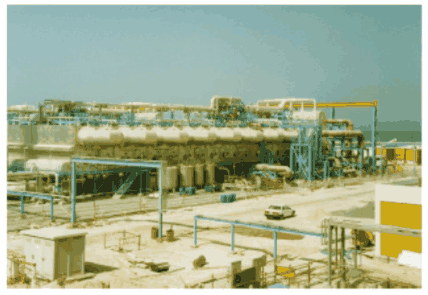
Assume seawater in Dubai is at \(T_0 = 25.00\ ^\circ\mathrm{C}\) and is an aqueous solution of 3.45 % mass \(\ce{NaCl}\). Assume complete ionisation of \(\ce{NaCl}\) in water.
The boiling point of seawater is higher than pure water. The boiling point elevation constant, \(K_{\mathrm b} = 0.5120\ \mathrm{K\,kg\,mol^{-1}}\).
5.1 Calculate the boiling point, \(T\), (in °C) of Dubai seawater at atmospheric pressure.
If you couldn't calculate the answer, use a temperature of 373.50 K for further calculations.
5.2 Calculate the percentage mass of \(\ce{NaCl}\), \(w_{\ce{NaCl}}\), in water that has a boiling point, \(T_{\mathrm b} = 378.00\ \mathrm{K}\).
5.3 The boiling point of seawater also increases as pressure increases. Calculate the boiling point, \(T\), (in °C) of the initial Dubai seawater at a pressure, \(p = 2.50\ \mathrm{atm}\). The latent heat of vaporisation of water, \(E_{\mathrm{vap}} = 2260\ \mathrm{kJ\,kg^{-1}}\) (40.716 kJ/mol). Assume this is the same for seawater.
In the plant, a flash chamber (of volume, \(V = 100\ \mathrm{L}\)) contains a mass of 1.00 kg of seawater (l) at \(T_1 = 90.0\ ^\circ\mathrm{C}\).
Another mass of 1.00 kg of seawater is then overheated to \(T_2 = 110.0\ ^\circ\mathrm{C}\) at high pressure before being added to this chamber, where a reduction in pressure causes some water to turn into steam.
After equilibrium was established, the temperature in the chamber was \(T_{\mathrm f} = 97.0\ ^\circ\mathrm{C}\). Assume there was no loss of energy, and that the latent heat of vaporisation is independent of temperature.
The specific heat capacity of seawater, \(C_{\mathrm p} = 3.85\ \mathrm{kJ\,kg^{-1}\,K^{-1}}\), assumed to be independent of temperature. The density of seawater, \(d = 1025\ \mathrm{kg\,m^{-3}}\).
5.4 Calculate the amount, \(n\), (in mol) of water that vapourised, assuming that the latent heat of vaporization does not depend on pressure, and that the heat capacity of water vapor in the chamber is negligible.
If you couldn't calculate the answer, use 0.56 mol for further calculations.
5.5 Assuming the initial vapour pressure before addition of the overheated water in the chamber was \(p_{\mathrm i} = 0.690\ \mathrm{atm}\), calculate the final vapour pressure, \(p_{\mathrm f}\), (in atm) in the chamber assuming the water vapour behaves as an ideal gas.
5.6 Calculate the thermal energy, \(E\), (in kWh) required to heat a mass of 1.00 kg of seawater from \(T_1 = 25.0\ ^\circ\mathrm{C}\) to \(T_2 = 110.0\ ^\circ\mathrm{C}\).
If you couldn't calculate the answer, use 0.1 kWh for further calculations.
5.7 A plant produces 50,000 \(\mathrm{m^3}\) of pure water per day. The plant passes Dubai seawater through 30 flash cycles and overall can extract 85% of the water present. Calculate the mass, \(m\), (in kg) of Dubai seawater needed per day.
If you couldn't calculate the answer, use \(6.0 \times 10^7\) kg for further calculations.
Plants make efficient use of heat exchangers to save energy. We can assume the total energy required by the plant is the same as the energy needed to heat all the seawater from \(T_1 = 25.0\ ^\circ\mathrm{C}\) to \(T_2 = 110.0\ ^\circ\mathrm{C}\).
5.8 Assuming a 10 \(\mathrm{m^2}\) solar panel has a power of 2.00 kW averaged during the 12 operational hours every day and the efficiency of using energy is 67%, calculate the number of panels, \(N\), required for the plant.
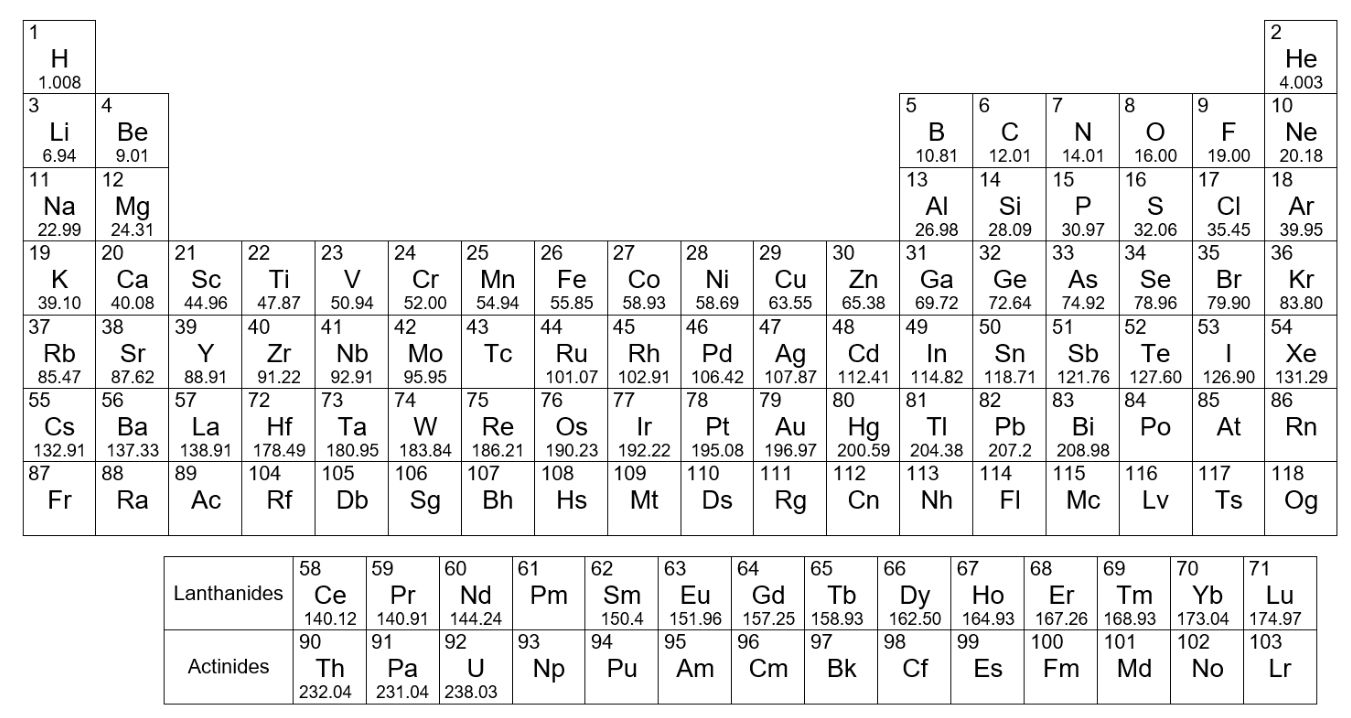
Periodic table and data sheet
Physical constants and formulae
| Avogadro constant | \(N_{\mathrm A}\) | \(6.022\times10^{23}\ \mathrm{mol^{-1}}\) |
| molar gas constant | \(R\) | \(8.314\ \mathrm{J\,K^{-1}\,mol^{-1}}\) |
| Faraday constant | \(F\) | \(96485\ \mathrm{C\,mol^{-1}}\) |
| Planck constant | \(h\) | \(6.626\times10^{-34}\ \mathrm{J\,s}\) |
| speed of light in vacuum | \(c\) | \(2.998\times10^8\ \mathrm{m\,s^{-1}}\) |
| mass of electron | \(m_{\mathrm e}\) | \(9.109\times10^{-31}\ \mathrm{kg}\) |
| charge of electron | \(e\) | \(1.602\times10^{-19}\ \mathrm{C}\) |
| atmospheric pressure | \(p_{\mathrm{atm}}\) | \(101325\ \mathrm{Pa}\) |
| ionic product of water at 298 K | \(K_{\mathrm w}\) | \(10^{-14}\) |
| \(1\ \mathrm{nm}=1\times10^{-9}\ \mathrm{m}\) |
| \(1\ \text{Å}=1\times10^{-10}\ \mathrm{m}\) |
| \(1\ \mathrm{pm}=1\times10^{-12}\ \mathrm{m}\) |
| \(0\ ^\circ\mathrm{C}=273.15\ \mathrm{K}\) |
| \(1\ \mathrm{kWh}=3600\ \mathrm{kJ}\) |
| \(1\ \mathrm{W}=1\ \mathrm{J\,s^{-1}}\) |
| \(1\ \mathrm{eV}=1.602\times10^{-19}\ \mathrm{J}\) |
| \(1\ \mathrm{bar}=10^5\ \mathrm{Pa}\) |
| area of triangle | \(A=\frac12 ab\cdot\sin C\) |
| volume of cube | \(V=a^3\) |
| volume of sphere | \(V=\frac43\pi r^3\) |
| surface area of sphere | \(S=4\pi r^2\) |
| ideal gas equation | \(pV=nRT\) |
| frequency of light | \(\nu=\frac{c}{\lambda}\) |
| energy of a photon | \(E=\frac{hc}{\lambda}\) |
| Beer-Lambert law | \(A=\log\left(\frac{I_0}{I}\right)=\varepsilon cd\) |
| spin-only magnetic moment | \(\mu=\sqrt{n(n+2)}\ \mathrm{BM}\) |
| Henderson–Hasselbalch equation | \(\mathrm{pH}=\mathrm{p}K_{\mathrm a}+\log\left(\frac{[\ce{A-}]}{[\ce{HA}]}\right)\) |
| \(0^{\mathrm{th}}\) order integrated rate law | \([\ce{A}]=[\ce{A}]_0-kt\) |
| \(1^{\mathrm{st}}\) order integrated rate law | \(\ln[\ce{A}]=\ln[\ce{A}]_0-kt\) |
| Arrhenius equation | \(k=A\cdot e^{-E_{\mathrm a}/RT}\) |
| enthalpy | \(H=U+pV\) |
| Gibbs energy | \(G=H-TS\) |
| standard Gibbs energy change | \(\Delta_{\mathrm r}G^\circ=-RT\ln K=-nFE^\circ_{\mathrm{cell}}\) |
| Clausius-Clapeyron equation | \(\ln\left(\frac{P_1}{P_2}\right)=\frac{\Delta H_{\mathrm{vap}}}{R}\left(\frac1{T_2}-\frac1{T_1}\right)\) |
| specific heat | \(Q=mC_{\mathrm p}\Delta T\) |
| boiling point elevation | \(\Delta T=iK_{\mathrm b}m_i\) |
| freezing point depression | \(\Delta T=iK_{\mathrm f}m_i\) |
Consider all gases ideal unless told otherwise.
In equilibrium constant calculations, all concentrations are referenced to a concentration of \(1\ \mathrm{mol\,dm^{-3}}\).
Periodic table
Official English text of the problem.
Answers
- 5.1: \(T=100.63\ ^\circ\mathrm{C}\).
- 5.2: \(w_{\ce{NaCl}}=21.7\%\) by mass.
- 5.3: \(T=128.7\ ^\circ\mathrm{C}\).
- 5.4: \(n=0.567\ \mathrm{mol}\).
- 5.5: \(p_{\mathrm f}=0.886\ \mathrm{atm}\), accounting for the volume occupied by liquid.
- 5.6: \(E=0.0909\ \mathrm{kWh}\).
- 5.7: \(m\approx6.1\times10^7\ \mathrm{kg}\) of seawater per day.
- 5.8: \(N\approx3.4\times10^5\) panels; the nominal calculation gives a minimum of 344,422 panels.
Parts 5.7–5.8 use \(\rho_{\text{pure water}}=1000\ \mathrm{kg\,m^{-3}}\).
Solution
The relevant species are water, \(\ce{H2O}\), SMILES O; sodium ion, \(\ce{Na+}\), SMILES [Na+]; and chloride ion, \(\ce{Cl-}\), SMILES [Cl-]. Sodium chloride, \(\ce{NaCl}\), has the ionic SMILES representation [Na+].[Cl-].
5.1 — Boiling point at atmospheric pressure (2 points)
Complete ionisation gives two ions per formula unit:
\[ \ce{NaCl(s) -> Na+(aq) + Cl-(aq)}. \]
Thus the van ’t Hoff factor is \(i=2\). From the periodic table,
\[ M(\ce{NaCl})=22.99+35.45=58.44\ \mathrm{g\,mol^{-1}}. \]
Take \(100.00\ \mathrm{g}\) of seawater. It contains \(3.45\ \mathrm{g}\) of salt and \(96.55\ \mathrm{g}=0.09655\ \mathrm{kg}\) of water. Its molality is
\[ b=\frac{3.45\ \mathrm{g}/(58.44\ \mathrm{g\,mol^{-1}})} {0.09655\ \mathrm{kg}} =0.611444\ \mathrm{mol\,kg^{-1}}. \]
The boiling point elevation is
\[ \Delta T_{\mathrm b}=iK_{\mathrm b}b =2(0.5120)(0.611444) =0.626119\ \mathrm{K}. \]
Pure water boils at \(100.00\ ^\circ\mathrm{C}\) at atmospheric pressure, so
\[ \boxed{T=100.63\ ^\circ\mathrm{C}}. \]
The corresponding absolute temperature, retained for part 5.3, is \(373.776119\ \mathrm{K}\).
5.2 — Salt mass percentage for a boiling point of 378.00 K (2 points)
At atmospheric pressure,
\[ \Delta T_{\mathrm b}=378.00-373.15=4.85\ \mathrm{K}. \]
Therefore,
\[ b=\frac{\Delta T_{\mathrm b}}{iK_{\mathrm b}} =\frac{4.85}{2(0.5120)} =4.736328\ \mathrm{mol\,kg^{-1}}. \]
For \(1.000\ \mathrm{kg}\) of water, the required salt mass is
\[ m_{\ce{NaCl}} =(4.736328\ \mathrm{mol})(58.44\ \mathrm{g\,mol^{-1}}) =276.791\ \mathrm{g}. \]
The mass percentage uses the total solution mass:
\[ w_{\ce{NaCl}} =\frac{276.791}{1000+276.791}\times100\% =21.6786\%. \]
\[ \boxed{w_{\ce{NaCl}}=21.7\%}. \]
5.3 — Boiling point at 2.50 atm (3 points)
Use the boiling point of the initial seawater from part 5.1 as the reference:
\[ P_{\mathrm{ref}}=1.00\ \mathrm{atm}, \qquad T_{\mathrm{ref}}=373.776119\ \mathrm{K}. \]
With the given constant molar enthalpy of vaporisation,
\[ \Delta H_{\mathrm{vap}}=40716\ \mathrm{J\,mol^{-1}}, \]
the Clausius–Clapeyron equation gives
\[ \ln\left(\frac{P}{P_{\mathrm{ref}}}\right) =\frac{\Delta H_{\mathrm{vap}}}{R} \left(\frac{1}{T_{\mathrm{ref}}}-\frac{1}{T}\right). \]
Rearranging,
\[ T= \left[ \frac{1}{T_{\mathrm{ref}}} -\frac{R}{\Delta H_{\mathrm{vap}}} \ln\left(\frac{P}{P_{\mathrm{ref}}}\right) \right]^{-1}. \]
Substitution yields
\[ T= \left[ \frac{1}{373.776119} -\frac{8.314}{40716}\ln(2.50) \right]^{-1} =401.881381\ \mathrm{K}. \]
Thus,
\[ \boxed{T=128.7\ ^\circ\mathrm{C}}. \]
5.4 — Amount of water vaporised (2 points)
The hot seawater releases heat as it cools from \(110.0\ ^\circ\mathrm{C}\) to \(97.0\ ^\circ\mathrm{C}\):
\[ Q_{\mathrm{hot}} =m_2C_{\mathrm p}(T_2-T_{\mathrm f}) =(1.00)(3.85)(110.0-97.0) =50.05\ \mathrm{kJ}. \]
Heating the initial seawater from \(90.0\ ^\circ\mathrm{C}\) to \(97.0\ ^\circ\mathrm{C}\) consumes
\[ Q_{\mathrm{cold}} =m_1C_{\mathrm p}(T_{\mathrm f}-T_1) =(1.00)(3.85)(97.0-90.0) =26.95\ \mathrm{kJ}. \]
With no heat loss and negligible heat capacity of the vapour, the remaining energy causes vaporisation:
\[ \ce{H2O(l) -> H2O(g)}. \]
Consequently,
\[ n\Delta H_{\mathrm{vap}} =Q_{\mathrm{hot}}-Q_{\mathrm{cold}} =23.10\ \mathrm{kJ}. \]
\[ n=\frac{23.10\ \mathrm{kJ}}{40.716\ \mathrm{kJ\,mol^{-1}}} =0.567345\ \mathrm{mol}. \]
\[ \boxed{n=0.567\ \mathrm{mol}}. \]
The corresponding mass evaporated is
\[ m_{\mathrm{evap}} =\frac{23.10}{2260} =0.0102212\ \mathrm{kg}. \]
5.5 — Final vapour pressure (2 points)
The initial vapour remains in the chamber, and the newly evaporated water adds to it. Both the temperature change and the change in vapour-space volume must be included.
Initially,
\[ T_{\mathrm i}=363.15\ \mathrm{K}, \qquad V_{\mathrm{g,i}} =V-\frac{m_1}{d} =0.100-\frac{1.00}{1025} =0.0990244\ \mathrm{m^3}. \]
The initial amount of vapour is therefore
\[ n_{\mathrm i} =\frac{p_{\mathrm i}V_{\mathrm{g,i}}}{RT_{\mathrm i}} =\frac{(0.690\times101325)(0.0990244)} {(8.314)(363.15)} =2.29304\ \mathrm{mol}. \]
The final liquid mass is
\[ m_{\mathrm{l,f}} =1.00+1.00-m_{\mathrm{evap}} =1.989779\ \mathrm{kg}. \]
Using the given liquid density,
\[ V_{\mathrm{g,f}} =0.100-\frac{1.989779}{1025} =0.0980588\ \mathrm{m^3}. \]
At \(T_{\mathrm f}=370.15\ \mathrm{K}\),
\[ n_{\mathrm f}=n_{\mathrm i}+n =2.29304+0.567345 =2.86039\ \mathrm{mol}. \]
Thus,
\[ p_{\mathrm f} =\frac{n_{\mathrm f}RT_{\mathrm f}}{V_{\mathrm{g,f}}} =\frac{(2.86039)(8.314)(370.15)}{0.0980588} =8.9769\times10^4\ \mathrm{Pa}, \]
and
\[ \boxed{p_{\mathrm f}=0.886\ \mathrm{atm}}. \]
If the liquid volume is neglected and the vapour volume is approximated as \(100\ \mathrm{L}\) throughout, the corresponding approximation is
\[ p_{\mathrm f} =p_{\mathrm i}\frac{T_{\mathrm f}}{T_{\mathrm i}} +\frac{nRT_{\mathrm f}}{V} =0.876\ \mathrm{atm}. \]
5.6 — Energy required to heat 1.00 kg of seawater (2 points)
The temperature increase is
\[ \Delta T=110.0-25.0=85.0\ \mathrm{K}. \]
Therefore,
\[ E=mC_{\mathrm p}\Delta T =(1.00\ \mathrm{kg}) (3.85\ \mathrm{kJ\,kg^{-1}\,K^{-1}}) (85.0\ \mathrm{K}) =327.25\ \mathrm{kJ}. \]
Using \(1\ \mathrm{kWh}=3600\ \mathrm{kJ}\),
\[ E=\frac{327.25}{3600}=0.0909028\ \mathrm{kWh}. \]
\[ \boxed{E=0.0909\ \mathrm{kWh}}. \]
5.7 — Daily seawater requirement (1 point)
Using the usual approximation \(\rho_{\text{pure water}}=1000\ \mathrm{kg\,m^{-3}}\), the daily product mass is
\[ m_{\mathrm{product}} =(50000\ \mathrm{m^3})(1000\ \mathrm{kg\,m^{-3}}) =5.0000\times10^7\ \mathrm{kg}. \]
The water mass fraction of the feed is
\[ w_{\mathrm{water}}=1-0.0345=0.9655. \]
Since \(85\%\) of this water is recovered,
\[ m_{\mathrm{product}}=0.85(0.9655)m. \]
Hence,
\[ m=\frac{5.0000\times10^7}{0.85(0.9655)} =6.09255\times10^7\ \mathrm{kg}. \]
\[ \boxed{m\approx6.1\times10^7\ \mathrm{kg\ per\ day}}. \]
The stated \(85\%\) is the overall recovery across all 30 cycles, so it is applied once.
5.8 — Number of solar panels (2 points)
Under the stated heat-recovery assumption, the daily thermal requirement is the energy needed to heat the entire daily seawater feed once:
\[ E_{\mathrm{day}} =m\left(0.0909028\ \mathrm{kWh\,kg^{-1}}\right) =5.53829\times10^6\ \mathrm{kWh}. \]
Each panel supplies useful energy per day of
\[ E_{\mathrm{panel}} =(2.00\ \mathrm{kW})(12\ \mathrm{h})(0.67) =16.08\ \mathrm{kWh}. \]
The given \(2.00\ \mathrm{kW}\) is already the power of one complete \(10\ \mathrm{m^2}\) panel.
Therefore,
\[ N=\frac{E_{\mathrm{day}}}{E_{\mathrm{panel}}} =\frac{5.53829\times10^6}{16.08} =344421.23. \]
Rounding upward to a whole number gives the nominal minimum:
\[ \boxed{N_{\min}=344422\ \text{panels}}. \]
At the precision of the supplied efficiency,
\[ \boxed{N\approx3.4\times10^5\ \text{panels}}. \]
The solution was checked against the official solution.
IChO 2025 · Theorieaufgabe 5
Solarbetriebene mehrstufige Entspannungsverdampfung zur Meerwasserentsalzung
6.5% der Gesamtpunktzahl
| 5.1 | 5.2 | 5.3 | 5.4 | 5.5 | 5.6 | 5.7 | 5.8 | Gesamt |
|---|---|---|---|---|---|---|---|---|
| 2 | 2 | 3 | 2 | 2 | 2 | 1 | 2 | 16 |
Im ariden Klima der VAE ist Süßwasser knapp. Das Land ist auf solarbetriebene Entsalzungsanlagen angewiesen, um Süßwasser zu gewinnen. Eine Entsalzungsanlage in Dubai nutzt ein Verfahren zur mehrstufigen Entspannungsverdampfung (MSF). Bei der MSF-Entsalzung wird Meerwasser durch eine Reihe von Wärmetauschern geleitet und dabei erhitzt, bis es bei hohem Druck seine Sättigungstemperatur erreicht. Wenn der Druck gesenkt wird, gibt dieses überhitzte Meerwasser reinen Wasserdampf ab, bis es wieder gesättigt ist. Dieser Vorgang wird als Entspannungsverdampfung bezeichnet.
Nehmen Sie an, dass das Meerwasser in Dubai eine Temperatur von \(T_0 = 25.00\ ^\circ\mathrm{C}\) hat und eine wässrige Lösung mit einem Massenanteil von 3.45 % \(\ce{NaCl}\) ist. Nehmen Sie eine vollständige Dissoziation von \(\ce{NaCl}\) in Wasser an.
Der Siedepunkt von Meerwasser liegt höher als der von reinem Wasser. Die ebullioskopische Konstante beträgt \(K_{\mathrm b} = 0.5120\ \mathrm{K\,kg\,mol^{-1}}\).
5.1 Berechnen Sie den Siedepunkt \(T\) (in °C) des Meerwassers in Dubai bei Atmosphärendruck.
Falls Sie das Ergebnis nicht berechnen konnten, verwenden Sie für die weiteren Berechnungen eine Temperatur von 373.50 K.
5.2 Berechnen Sie den prozentualen Massenanteil von \(\ce{NaCl}\), \(w_{\ce{NaCl}}\), in Wasser mit einem Siedepunkt von \(T_{\mathrm b} = 378.00\ \mathrm{K}\).
5.3 Der Siedepunkt von Meerwasser steigt auch mit zunehmendem Druck. Berechnen Sie den Siedepunkt \(T\) (in °C) des ursprünglichen Meerwassers in Dubai bei einem Druck von \(p = 2.50\ \mathrm{atm}\). Die spezifische Verdampfungsenthalpie von Wasser beträgt \(E_{\mathrm{vap}} = 2260\ \mathrm{kJ\,kg^{-1}}\) (40.716 kJ/mol). Nehmen Sie an, dass sie für Meerwasser denselben Wert hat.
In der Anlage enthält eine Entspannungskammer (mit einem Volumen von \(V = 100\ \mathrm{L}\)) eine Masse von 1.00 kg Meerwasser (l) bei \(T_1 = 90.0\ ^\circ\mathrm{C}\).
Eine weitere Masse von 1.00 kg Meerwasser wird dann bei hohem Druck auf \(T_2 = 110.0\ ^\circ\mathrm{C}\) überhitzt, bevor sie in diese Kammer gegeben wird, wo eine Drucksenkung bewirkt, dass ein Teil des Wassers in Dampf übergeht.
Nach Einstellung des Gleichgewichts betrug die Temperatur in der Kammer \(T_{\mathrm f} = 97.0\ ^\circ\mathrm{C}\). Nehmen Sie an, dass keine Energieverluste auftraten und dass die spezifische Verdampfungsenthalpie temperaturunabhängig ist.
Die spezifische Wärmekapazität von Meerwasser beträgt \(C_{\mathrm p} = 3.85\ \mathrm{kJ\,kg^{-1}\,K^{-1}}\) und wird als temperaturunabhängig angenommen. Die Dichte von Meerwasser beträgt \(d = 1025\ \mathrm{kg\,m^{-3}}\).
5.4 Berechnen Sie die Stoffmenge \(n\) (in mol) des verdampften Wassers unter der Annahme, dass die spezifische Verdampfungsenthalpie nicht vom Druck abhängt und dass die Wärmekapazität des Wasserdampfs in der Kammer vernachlässigbar ist.
Falls Sie das Ergebnis nicht berechnen konnten, verwenden Sie für die weiteren Berechnungen 0.56 mol.
5.5 Unter der Annahme, dass der anfängliche Dampfdruck in der Kammer vor der Zugabe des überhitzten Wassers \(p_{\mathrm i} = 0.690\ \mathrm{atm}\) betrug, berechnen Sie den endgültigen Dampfdruck \(p_{\mathrm f}\) (in atm) in der Kammer. Nehmen Sie dabei an, dass sich der Wasserdampf wie ein ideales Gas verhält.
5.6 Berechnen Sie die Wärmeenergie \(E\) (in kWh), die benötigt wird, um eine Masse von 1.00 kg Meerwasser von \(T_1 = 25.0\ ^\circ\mathrm{C}\) auf \(T_2 = 110.0\ ^\circ\mathrm{C}\) zu erhitzen.
Falls Sie das Ergebnis nicht berechnen konnten, verwenden Sie für die weiteren Berechnungen 0.1 kWh.
5.7 Eine Anlage produziert täglich 50,000 \(\mathrm{m^3}\) reines Wasser. Die Anlage führt das Meerwasser aus Dubai durch 30 Entspannungsverdampfungszyklen und kann insgesamt 85% des darin enthaltenen Wassers gewinnen. Berechnen Sie die täglich benötigte Masse \(m\) (in kg) an Meerwasser aus Dubai.
Falls Sie das Ergebnis nicht berechnen konnten, verwenden Sie für die weiteren Berechnungen \(6.0 \times 10^7\) kg.
Die Anlagen nutzen Wärmetauscher effizient, um Energie zu sparen. Wir können annehmen, dass der gesamte Energiebedarf der Anlage der Energie entspricht, die benötigt wird, um das gesamte Meerwasser von \(T_1 = 25.0\ ^\circ\mathrm{C}\) auf \(T_2 = 110.0\ ^\circ\mathrm{C}\) zu erhitzen.
5.8 Unter der Annahme, dass ein 10 \(\mathrm{m^2}\) großes Solarmodul während der 12 täglichen Betriebsstunden eine mittlere Leistung von 2.00 kW hat und der Wirkungsgrad der Energienutzung 67% beträgt, berechnen Sie die Anzahl \(N\) der für die Anlage benötigten Module.
Periodensystem und Datenblatt
Physikalische Konstanten und Formeln
| Avogadro-Konstante | \(N_{\mathrm A}\) | \(6.022\times10^{23}\ \mathrm{mol^{-1}}\) |
| molare Gaskonstante | \(R\) | \(8.314\ \mathrm{J\,K^{-1}\,mol^{-1}}\) |
| Faraday-Konstante | \(F\) | \(96485\ \mathrm{C\,mol^{-1}}\) |
| Planck-Konstante | \(h\) | \(6.626\times10^{-34}\ \mathrm{J\,s}\) |
| Lichtgeschwindigkeit im Vakuum | \(c\) | \(2.998\times10^8\ \mathrm{m\,s^{-1}}\) |
| Masse des Elektrons | \(m_{\mathrm e}\) | \(9.109\times10^{-31}\ \mathrm{kg}\) |
| Ladung des Elektrons | \(e\) | \(1.602\times10^{-19}\ \mathrm{C}\) |
| Atmosphärendruck | \(p_{\mathrm{atm}}\) | \(101325\ \mathrm{Pa}\) |
| Ionenprodukt des Wassers bei 298 K | \(K_{\mathrm w}\) | \(10^{-14}\) |
| \(1\ \mathrm{nm}=1\times10^{-9}\ \mathrm{m}\) |
| \(1\ \text{Å}=1\times10^{-10}\ \mathrm{m}\) |
| \(1\ \mathrm{pm}=1\times10^{-12}\ \mathrm{m}\) |
| \(0\ ^\circ\mathrm{C}=273.15\ \mathrm{K}\) |
| \(1\ \mathrm{kWh}=3600\ \mathrm{kJ}\) |
| \(1\ \mathrm{W}=1\ \mathrm{J\,s^{-1}}\) |
| \(1\ \mathrm{eV}=1.602\times10^{-19}\ \mathrm{J}\) |
| \(1\ \mathrm{bar}=10^5\ \mathrm{Pa}\) |
| Flächeninhalt eines Dreiecks | \(A=\frac12 ab\cdot\sin C\) |
| Volumen eines Würfels | \(V=a^3\) |
| Volumen einer Kugel | \(V=\frac43\pi r^3\) |
| Oberfläche einer Kugel | \(S=4\pi r^2\) |
| ideale Gasgleichung | \(pV=nRT\) |
| Frequenz des Lichts | \(\nu=\frac{c}{\lambda}\) |
| Energie eines Photons | \(E=\frac{hc}{\lambda}\) |
| Lambert-Beer-Gesetz | \(A=\log\left(\frac{I_0}{I}\right)=\varepsilon cd\) |
| magnetisches Moment bei reinem Spinbeitrag | \(\mu=\sqrt{n(n+2)}\ \mathrm{BM}\) |
| Henderson–Hasselbalch-Gleichung | \(\mathrm{pH}=\mathrm{p}K_{\mathrm a}+\log\left(\frac{[\ce{A-}]}{[\ce{HA}]}\right)\) |
| integriertes Geschwindigkeitsgesetz \(0^{\mathrm{th}}\) Ordnung | \([\ce{A}]=[\ce{A}]_0-kt\) |
| integriertes Geschwindigkeitsgesetz \(1^{\mathrm{st}}\) Ordnung | \(\ln[\ce{A}]=\ln[\ce{A}]_0-kt\) |
| Arrhenius-Gleichung | \(k=A\cdot e^{-E_{\mathrm a}/RT}\) |
| Enthalpie | \(H=U+pV\) |
| Gibbs-Energie | \(G=H-TS\) |
| Änderung der Standard-Gibbs-Energie | \(\Delta_{\mathrm r}G^\circ=-RT\ln K=-nFE^\circ_{\mathrm{cell}}\) |
| Clausius-Clapeyron-Gleichung | \(\ln\left(\frac{P_1}{P_2}\right)=\frac{\Delta H_{\mathrm{vap}}}{R}\left(\frac1{T_2}-\frac1{T_1}\right)\) |
| spezifische Wärmekapazität | \(Q=mC_{\mathrm p}\Delta T\) |
| Siedepunktserhöhung | \(\Delta T=iK_{\mathrm b}m_i\) |
| Gefrierpunktserniedrigung | \(\Delta T=iK_{\mathrm f}m_i\) |
Betrachten Sie alle Gase als ideal, sofern nicht anders angegeben.
Bei Berechnungen von Gleichgewichtskonstanten werden alle Konzentrationen auf eine Konzentration von \(1\ \mathrm{mol\,dm^{-3}}\) bezogen.
Periodensystem
Aufgabentext aus dem offiziellen englischen Text übersetzt.
Antworten
- 5.1: \(T=100.63\ ^\circ\mathrm{C}\).
- 5.2: \(w_{\ce{NaCl}}=21.7\%\) Massenanteil.
- 5.3: \(T=128.7\ ^\circ\mathrm{C}\).
- 5.4: \(n=0.567\ \mathrm{mol}\).
- 5.5: \(p_{\mathrm f}=0.886\ \mathrm{atm}\), unter Berücksichtigung des von der Flüssigkeit eingenommenen Volumens.
- 5.6: \(E=0.0909\ \mathrm{kWh}\).
- 5.7: \(m\approx6.1\times10^7\ \mathrm{kg}\) Meerwasser pro Tag.
- 5.8: \(N\approx3.4\times10^5\) Module; die nominelle Berechnung ergibt ein Minimum von 344,422 Modulen.
In den Teilen 5.7–5.8 wird \(\rho_{\text{reines Wasser}}=1000\ \mathrm{kg\,m^{-3}}\) verwendet.
Lösung
Die relevanten Spezies sind Wasser, \(\ce{H2O}\), SMILES O; das Natriumion, \(\ce{Na+}\), SMILES [Na+]; und das Chloridion, \(\ce{Cl-}\), SMILES [Cl-]. Natriumchlorid, \(\ce{NaCl}\), hat die ionische SMILES-Darstellung [Na+].[Cl-].
5.1 — Siedepunkt bei Atmosphärendruck (2 Punkte)
Bei vollständiger Dissoziation entstehen zwei Ionen pro Formeleinheit:
\[ \ce{NaCl(s) -> Na+(aq) + Cl-(aq)}. \]
Der van-’t-Hoff-Faktor beträgt somit \(i=2\). Aus dem Periodensystem ergibt sich
\[ M(\ce{NaCl})=22.99+35.45=58.44\ \mathrm{g\,mol^{-1}}. \]
Wir betrachten \(100.00\ \mathrm{g}\) Meerwasser. Es enthält \(3.45\ \mathrm{g}\) Salz und \(96.55\ \mathrm{g}=0.09655\ \mathrm{kg}\) Wasser. Seine Molalität beträgt
\[ b=\frac{3.45\ \mathrm{g}/(58.44\ \mathrm{g\,mol^{-1}})} {0.09655\ \mathrm{kg}} =0.611444\ \mathrm{mol\,kg^{-1}}. \]
Die Siedepunktserhöhung beträgt
\[ \Delta T_{\mathrm b}=iK_{\mathrm b}b =2(0.5120)(0.611444) =0.626119\ \mathrm{K}. \]
Reines Wasser siedet bei Atmosphärendruck bei \(100.00\ ^\circ\mathrm{C}\), also gilt
\[ \boxed{T=100.63\ ^\circ\mathrm{C}}. \]
Die entsprechende absolute Temperatur, die für Teil 5.3 beibehalten wird, beträgt \(373.776119\ \mathrm{K}\).
5.2 — Prozentualer Salzmassenanteil für einen Siedepunkt von 378.00 K (2 Punkte)
Bei Atmosphärendruck gilt
\[ \Delta T_{\mathrm b}=378.00-373.15=4.85\ \mathrm{K}. \]
Daher ist
\[ b=\frac{\Delta T_{\mathrm b}}{iK_{\mathrm b}} =\frac{4.85}{2(0.5120)} =4.736328\ \mathrm{mol\,kg^{-1}}. \]
Für \(1.000\ \mathrm{kg}\) Wasser beträgt die erforderliche Salzmasse
\[ m_{\ce{NaCl}} =(4.736328\ \mathrm{mol})(58.44\ \mathrm{g\,mol^{-1}}) =276.791\ \mathrm{g}. \]
Der prozentuale Massenanteil bezieht sich auf die Gesamtmasse der Lösung:
\[ w_{\ce{NaCl}} =\frac{276.791}{1000+276.791}\times100\% =21.6786\%. \]
\[ \boxed{w_{\ce{NaCl}}=21.7\%}. \]
5.3 — Siedepunkt bei 2.50 atm (3 Punkte)
Als Referenz verwenden wir den Siedepunkt des ursprünglichen Meerwassers aus Teil 5.1:
\[ P_{\mathrm{ref}}=1.00\ \mathrm{atm}, \qquad T_{\mathrm{ref}}=373.776119\ \mathrm{K}. \]
Mit der gegebenen konstanten molaren Verdampfungsenthalpie
\[ \Delta H_{\mathrm{vap}}=40716\ \mathrm{J\,mol^{-1}}, \]
ergibt die Clausius–Clapeyron-Gleichung
\[ \ln\left(\frac{P}{P_{\mathrm{ref}}}\right) =\frac{\Delta H_{\mathrm{vap}}}{R} \left(\frac{1}{T_{\mathrm{ref}}}-\frac{1}{T}\right). \]
Durch Umstellen erhalten wir
\[ T= \left[ \frac{1}{T_{\mathrm{ref}}} -\frac{R}{\Delta H_{\mathrm{vap}}} \ln\left(\frac{P}{P_{\mathrm{ref}}}\right) \right]^{-1}. \]
Einsetzen liefert
\[ T= \left[ \frac{1}{373.776119} -\frac{8.314}{40716}\ln(2.50) \right]^{-1} =401.881381\ \mathrm{K}. \]
Somit gilt
\[ \boxed{T=128.7\ ^\circ\mathrm{C}}. \]
5.4 — Stoffmenge des verdampften Wassers (2 Punkte)
Das heiße Meerwasser gibt beim Abkühlen von \(110.0\ ^\circ\mathrm{C}\) auf \(97.0\ ^\circ\mathrm{C}\) Wärme ab:
\[ Q_{\mathrm{hot}} =m_2C_{\mathrm p}(T_2-T_{\mathrm f}) =(1.00)(3.85)(110.0-97.0) =50.05\ \mathrm{kJ}. \]
Das Erwärmen des anfänglich vorhandenen Meerwassers von \(90.0\ ^\circ\mathrm{C}\) auf \(97.0\ ^\circ\mathrm{C}\) benötigt
\[ Q_{\mathrm{cold}} =m_1C_{\mathrm p}(T_{\mathrm f}-T_1) =(1.00)(3.85)(97.0-90.0) =26.95\ \mathrm{kJ}. \]
Ohne Wärmeverluste und bei vernachlässigbarer Wärmekapazität des Dampfes bewirkt die verbleibende Energie eine Verdampfung:
\[ \ce{H2O(l) -> H2O(g)}. \]
Folglich gilt
\[ n\Delta H_{\mathrm{vap}} =Q_{\mathrm{hot}}-Q_{\mathrm{cold}} =23.10\ \mathrm{kJ}. \]
\[ n=\frac{23.10\ \mathrm{kJ}}{40.716\ \mathrm{kJ\,mol^{-1}}} =0.567345\ \mathrm{mol}. \]
\[ \boxed{n=0.567\ \mathrm{mol}}. \]
Die entsprechende verdampfte Masse beträgt
\[ m_{\mathrm{evap}} =\frac{23.10}{2260} =0.0102212\ \mathrm{kg}. \]
5.5 — Endgültiger Dampfdruck (2 Punkte)
Der anfänglich vorhandene Dampf verbleibt in der Kammer, und das neu verdampfte Wasser kommt hinzu. Sowohl die Temperaturänderung als auch die Änderung des Dampfraumvolumens müssen berücksichtigt werden.
Anfangs gilt
\[ T_{\mathrm i}=363.15\ \mathrm{K}, \qquad V_{\mathrm{g,i}} =V-\frac{m_1}{d} =0.100-\frac{1.00}{1025} =0.0990244\ \mathrm{m^3}. \]
Die anfängliche Stoffmenge des Dampfes beträgt daher
\[ n_{\mathrm i} =\frac{p_{\mathrm i}V_{\mathrm{g,i}}}{RT_{\mathrm i}} =\frac{(0.690\times101325)(0.0990244)} {(8.314)(363.15)} =2.29304\ \mathrm{mol}. \]
Die endgültige Flüssigkeitsmasse beträgt
\[ m_{\mathrm{l,f}} =1.00+1.00-m_{\mathrm{evap}} =1.989779\ \mathrm{kg}. \]
Mit der gegebenen Flüssigkeitsdichte erhalten wir
\[ V_{\mathrm{g,f}} =0.100-\frac{1.989779}{1025} =0.0980588\ \mathrm{m^3}. \]
Bei \(T_{\mathrm f}=370.15\ \mathrm{K}\) gilt
\[ n_{\mathrm f}=n_{\mathrm i}+n =2.29304+0.567345 =2.86039\ \mathrm{mol}. \]
Somit ist
\[ p_{\mathrm f} =\frac{n_{\mathrm f}RT_{\mathrm f}}{V_{\mathrm{g,f}}} =\frac{(2.86039)(8.314)(370.15)}{0.0980588} =8.9769\times10^4\ \mathrm{Pa}, \]
und
\[ \boxed{p_{\mathrm f}=0.886\ \mathrm{atm}}. \]
Wenn das Flüssigkeitsvolumen vernachlässigt und das Dampfvolumen durchgehend mit \(100\ \mathrm{L}\) angenähert wird, ergibt sich die entsprechende Näherung
\[ p_{\mathrm f} =p_{\mathrm i}\frac{T_{\mathrm f}}{T_{\mathrm i}} +\frac{nRT_{\mathrm f}}{V} =0.876\ \mathrm{atm}. \]
5.6 — Energiebedarf zum Erhitzen von 1.00 kg Meerwasser (2 Punkte)
Die Temperaturerhöhung beträgt
\[ \Delta T=110.0-25.0=85.0\ \mathrm{K}. \]
Daher gilt
\[ E=mC_{\mathrm p}\Delta T =(1.00\ \mathrm{kg}) (3.85\ \mathrm{kJ\,kg^{-1}\,K^{-1}}) (85.0\ \mathrm{K}) =327.25\ \mathrm{kJ}. \]
Mit \(1\ \mathrm{kWh}=3600\ \mathrm{kJ}\) erhalten wir
\[ E=\frac{327.25}{3600}=0.0909028\ \mathrm{kWh}. \]
\[ \boxed{E=0.0909\ \mathrm{kWh}}. \]
5.7 — Täglicher Meerwasserbedarf (1 Punkt)
Mit der üblichen Näherung \(\rho_{\text{reines Wasser}}=1000\ \mathrm{kg\,m^{-3}}\) beträgt die tägliche Produktmasse
\[ m_{\mathrm{product}} =(50000\ \mathrm{m^3})(1000\ \mathrm{kg\,m^{-3}}) =5.0000\times10^7\ \mathrm{kg}. \]
Der Wassermassenanteil im Zulauf beträgt
\[ w_{\mathrm{water}}=1-0.0345=0.9655. \]
Da \(85\%\) dieses Wassers gewonnen werden, gilt
\[ m_{\mathrm{product}}=0.85(0.9655)m. \]
Daraus folgt
\[ m=\frac{5.0000\times10^7}{0.85(0.9655)} =6.09255\times10^7\ \mathrm{kg}. \]
\[ \boxed{m\approx6.1\times10^7\ \mathrm{kg\ per\ day}}. \]
Die angegebenen \(85\%\) sind die Gesamtausbeute über alle 30 Zyklen, daher wird dieser Faktor nur einmal angewendet.
5.8 — Anzahl der Solarmodule (2 Punkte)
Unter der angegebenen Annahme zur Wärmerückgewinnung entspricht der tägliche Wärmebedarf der Energie, die benötigt wird, um den gesamten täglichen Meerwasserzulauf einmal zu erhitzen:
\[ E_{\mathrm{day}} =m\left(0.0909028\ \mathrm{kWh\,kg^{-1}}\right) =5.53829\times10^6\ \mathrm{kWh}. \]
Jedes Modul liefert pro Tag eine nutzbare Energie von
\[ E_{\mathrm{panel}} =(2.00\ \mathrm{kW})(12\ \mathrm{h})(0.67) =16.08\ \mathrm{kWh}. \]
Die angegebenen \(2.00\ \mathrm{kW}\) sind bereits die Leistung eines vollständigen \(10\ \mathrm{m^2}\) großen Moduls.
Daher gilt
\[ N=\frac{E_{\mathrm{day}}}{E_{\mathrm{panel}}} =\frac{5.53829\times10^6}{16.08} =344421.23. \]
Aufrunden auf eine ganze Zahl ergibt das nominelle Minimum:
\[ \boxed{N_{\min}=344422\ \text{Module}}. \]
Mit der Genauigkeit des angegebenen Wirkungsgrades ergibt sich
\[ \boxed{N\approx3.4\times10^5\ \text{Module}}. \]
Die Lösung wurde mit der offiziellen Lösung abgeglichen.
IChO 2025 · Teori sorusu 5
Güneş enerjisiyle çalışan çok kademeli ani buharlaştırmalı tuzdan arındırma
Toplam puanın %6.5'i
| 5.1 | 5.2 | 5.3 | 5.4 | 5.5 | 5.6 | 5.7 | 5.8 | Toplam |
|---|---|---|---|---|---|---|---|---|
| 2 | 2 | 3 | 2 | 2 | 2 | 1 | 2 | 16 |
BAE'nin kurak ikliminde tatlı su kıttır. Ülke, tatlı su üretmek için güneş enerjisiyle çalışan tuzdan arındırma tesislerine bağımlıdır. Dubai'deki bir tuzdan arındırma tesisi, çok kademeli ani buharlaştırma (MSF) ile tuzdan arındırma işlemini kullanmaktadır. MSF ile tuzdan arındırmada deniz suyu, sıcaklığını artırmak için bir dizi ısı değiştiriciden geçirilerek ısıtılır ve yüksek basınçta doyma sıcaklığına ulaşır. Basınç düşürüldüğünde, bu aşırı ısınmış deniz suyu yeniden doygun hâle gelmek için saf su buharı açığa çıkarır; bu işlem ani buharlaşma olarak bilinir.
Dubai'deki deniz suyunun \(T_0 = 25.00\ ^\circ\mathrm{C}\) sıcaklıkta ve kütlece %3.45 \(\ce{NaCl}\) içeren sulu bir çözelti olduğunu varsayın. \(\ce{NaCl}\)'nin suda tamamen iyonlaştığını varsayın.
Deniz suyunun kaynama noktası saf suyunkinden yüksektir. Kaynama noktası yükselmesi sabiti, \(K_{\mathrm b} = 0.5120\ \mathrm{K\,kg\,mol^{-1}}\)'dir.
5.1 Dubai deniz suyunun atmosfer basıncındaki kaynama noktası \(T\)'yi (°C cinsinden) hesaplayın.
Yanıtı hesaplayamadıysanız sonraki hesaplamalarda 373.50 K sıcaklığını kullanın.
5.2 Kaynama noktası \(T_{\mathrm b} = 378.00\ \mathrm{K}\) olan sudaki \(\ce{NaCl}\)'nin kütle yüzdesi \(w_{\ce{NaCl}}\)'yi hesaplayın.
5.3 Deniz suyunun kaynama noktası, basınç arttıkça da artar. Başlangıçtaki Dubai deniz suyunun \(p = 2.50\ \mathrm{atm}\) basınçtaki kaynama noktası \(T\)'yi (°C cinsinden) hesaplayın. Suyun gizli buharlaşma ısısı, \(E_{\mathrm{vap}} = 2260\ \mathrm{kJ\,kg^{-1}}\) (40.716 kJ/mol)'dir. Bunun deniz suyu için de aynı olduğunu varsayın.
Tesiste, hacmi \(V = 100\ \mathrm{L}\) olan bir ani buharlaştırma haznesi, \(T_1 = 90.0\ ^\circ\mathrm{C}\) sıcaklıkta 1.00 kg kütleli deniz suyu (sıvı) içermektedir.
Ardından 1.00 kg kütleli başka bir deniz suyu örneği, bu hazneye eklenmeden önce yüksek basınçta \(T_2 = 110.0\ ^\circ\mathrm{C}\) sıcaklığa kadar aşırı ısıtılır; haznedeki basınç düşüşü, suyun bir kısmının buhara dönüşmesine neden olur.
Denge kurulduktan sonra haznedeki sıcaklık \(T_{\mathrm f} = 97.0\ ^\circ\mathrm{C}\) olmuştur. Enerji kaybı olmadığını ve gizli buharlaşma ısısının sıcaklıktan bağımsız olduğunu varsayın.
Deniz suyunun özgül ısı kapasitesi \(C_{\mathrm p} = 3.85\ \mathrm{kJ\,kg^{-1}\,K^{-1}}\) olup sıcaklıktan bağımsız olduğu varsayılmaktadır. Deniz suyunun yoğunluğu \(d = 1025\ \mathrm{kg\,m^{-3}}\)'tür.
5.4 Gizli buharlaşma ısısının basınca bağlı olmadığını ve haznedeki su buharının ısı kapasitesinin ihmal edilebilir olduğunu varsayarak buharlaşan suyun madde miktarı \(n\)'yi (mol cinsinden) hesaplayın.
Yanıtı hesaplayamadıysanız sonraki hesaplamalarda 0.56 mol kullanın.
5.5 Aşırı ısıtılmış su eklenmeden önce haznedeki başlangıç buhar basıncının \(p_{\mathrm i} = 0.690\ \mathrm{atm}\) olduğunu varsayarak ve su buharının ideal gaz gibi davrandığını kabul ederek haznedeki son buhar basıncı \(p_{\mathrm f}\)'yi (atm cinsinden) hesaplayın.
5.6 1.00 kg kütleli deniz suyunu \(T_1 = 25.0\ ^\circ\mathrm{C}\) sıcaklıktan \(T_2 = 110.0\ ^\circ\mathrm{C}\) sıcaklığa ısıtmak için gereken ısıl enerji \(E\)'yi (kWh cinsinden) hesaplayın.
Yanıtı hesaplayamadıysanız sonraki hesaplamalarda 0.1 kWh kullanın.
5.7 Bir tesis günde 50,000 \(\mathrm{m^3}\) saf su üretmektedir. Tesis, Dubai deniz suyunu 30 ani buharlaştırma çevriminden geçirir ve toplamda mevcut suyun %85'ini elde edebilir. Günlük gereken Dubai deniz suyunun kütlesi \(m\)'yi (kg cinsinden) hesaplayın.
Yanıtı hesaplayamadıysanız sonraki hesaplamalarda \(6.0 \times 10^7\) kg kullanın.
Tesisler, enerji tasarrufu sağlamak için ısı değiştiricileri verimli biçimde kullanır. Tesisin ihtiyaç duyduğu toplam enerjinin, deniz suyunun tamamını \(T_1 = 25.0\ ^\circ\mathrm{C}\) sıcaklıktan \(T_2 = 110.0\ ^\circ\mathrm{C}\) sıcaklığa ısıtmak için gereken enerjiyle aynı olduğunu varsayabiliriz.
5.8 10 \(\mathrm{m^2}\) alanlı bir güneş panelinin her gün 12 saatlik çalışma süresi boyunca ortalama gücünün 2.00 kW ve enerji kullanım veriminin %67 olduğunu varsayarak tesis için gereken panel sayısı \(N\)'yi hesaplayın.
Periyodik tablo ve veri föyü
Fiziksel sabitler ve formüller
| Avogadro sabiti | \(N_{\mathrm A}\) | \(6.022\times10^{23}\ \mathrm{mol^{-1}}\) |
| molar gaz sabiti | \(R\) | \(8.314\ \mathrm{J\,K^{-1}\,mol^{-1}}\) |
| Faraday sabiti | \(F\) | \(96485\ \mathrm{C\,mol^{-1}}\) |
| Planck sabiti | \(h\) | \(6.626\times10^{-34}\ \mathrm{J\,s}\) |
| ışığın boşluktaki hızı | \(c\) | \(2.998\times10^8\ \mathrm{m\,s^{-1}}\) |
| elektronun kütlesi | \(m_{\mathrm e}\) | \(9.109\times10^{-31}\ \mathrm{kg}\) |
| elektronun yükü | \(e\) | \(1.602\times10^{-19}\ \mathrm{C}\) |
| atmosfer basıncı | \(p_{\mathrm{atm}}\) | \(101325\ \mathrm{Pa}\) |
| 298 K'de suyun iyon çarpımı | \(K_{\mathrm w}\) | \(10^{-14}\) |
| \(1\ \mathrm{nm}=1\times10^{-9}\ \mathrm{m}\) |
| \(1\ \text{Å}=1\times10^{-10}\ \mathrm{m}\) |
| \(1\ \mathrm{pm}=1\times10^{-12}\ \mathrm{m}\) |
| \(0\ ^\circ\mathrm{C}=273.15\ \mathrm{K}\) |
| \(1\ \mathrm{kWh}=3600\ \mathrm{kJ}\) |
| \(1\ \mathrm{W}=1\ \mathrm{J\,s^{-1}}\) |
| \(1\ \mathrm{eV}=1.602\times10^{-19}\ \mathrm{J}\) |
| \(1\ \mathrm{bar}=10^5\ \mathrm{Pa}\) |
| üçgenin alanı | \(A=\frac12 ab\cdot\sin C\) |
| küpün hacmi | \(V=a^3\) |
| kürenin hacmi | \(V=\frac43\pi r^3\) |
| kürenin yüzey alanı | \(S=4\pi r^2\) |
| ideal gaz denklemi | \(pV=nRT\) |
| ışığın frekansı | \(\nu=\frac{c}{\lambda}\) |
| bir fotonun enerjisi | \(E=\frac{hc}{\lambda}\) |
| Beer-Lambert yasası | \(A=\log\left(\frac{I_0}{I}\right)=\varepsilon cd\) |
| yalnızca spinden kaynaklanan manyetik moment | \(\mu=\sqrt{n(n+2)}\ \mathrm{BM}\) |
| Henderson–Hasselbalch denklemi | \(\mathrm{pH}=\mathrm{p}K_{\mathrm a}+\log\left(\frac{[\ce{A-}]}{[\ce{HA}]}\right)\) |
| \(0^{\mathrm{th}}\) dereceden integre hız yasası | \([\ce{A}]=[\ce{A}]_0-kt\) |
| \(1^{\mathrm{st}}\) dereceden integre hız yasası | \(\ln[\ce{A}]=\ln[\ce{A}]_0-kt\) |
| Arrhenius denklemi | \(k=A\cdot e^{-E_{\mathrm a}/RT}\) |
| entalpi | \(H=U+pV\) |
| Gibbs enerjisi | \(G=H-TS\) |
| standart Gibbs enerjisi değişimi | \(\Delta_{\mathrm r}G^\circ=-RT\ln K=-nFE^\circ_{\mathrm{cell}}\) |
| Clausius-Clapeyron denklemi | \(\ln\left(\frac{P_1}{P_2}\right)=\frac{\Delta H_{\mathrm{vap}}}{R}\left(\frac1{T_2}-\frac1{T_1}\right)\) |
| özgül ısı | \(Q=mC_{\mathrm p}\Delta T\) |
| kaynama noktası yükselmesi | \(\Delta T=iK_{\mathrm b}m_i\) |
| donma noktası alçalması | \(\Delta T=iK_{\mathrm f}m_i\) |
Aksi belirtilmedikçe tüm gazları ideal kabul edin.
Denge sabiti hesaplamalarında tüm derişimler, \(1\ \mathrm{mol\,dm^{-3}}\) derişime göre ifade edilmiştir.
Periyodik tablo
Soru metni resmi İngilizce metinden çevrilmiştir.
Cevaplar
- 5.1: \(T=100.63\ ^\circ\mathrm{C}\).
- 5.2: Kütlece \(w_{\ce{NaCl}}=21.7\%\).
- 5.3: \(T=128.7\ ^\circ\mathrm{C}\).
- 5.4: \(n=0.567\ \mathrm{mol}\).
- 5.5: Sıvının kapladığı hacim hesaba katıldığında \(p_{\mathrm f}=0.886\ \mathrm{atm}\).
- 5.6: \(E=0.0909\ \mathrm{kWh}\).
- 5.7: Günde \(m\approx6.1\times10^7\ \mathrm{kg}\) deniz suyu.
- 5.8: \(N\approx3.4\times10^5\) panel; nominal hesaplama en az 344,422 panel gerektiğini verir.
5.7–5.8 kısımlarında \(\rho_{\text{saf su}}=1000\ \mathrm{kg\,m^{-3}}\) kullanılır.
Çözüm
İlgili türler su, \(\ce{H2O}\), SMILES O; sodyum iyonu, \(\ce{Na+}\), SMILES [Na+]; ve klorür iyonu, \(\ce{Cl-}\), SMILES [Cl-]'dir. Sodyum klorürün, \(\ce{NaCl}\), iyonik SMILES gösterimi [Na+].[Cl-] şeklindedir.
5.1 — Atmosfer basıncındaki kaynama noktası (2 puan)
Tam iyonlaşma, formül birimi başına iki iyon verir:
\[ \ce{NaCl(s) -> Na+(aq) + Cl-(aq)}. \]
Dolayısıyla van ’t Hoff faktörü \(i=2\)'dir. Periyodik tablodan,
\[ M(\ce{NaCl})=22.99+35.45=58.44\ \mathrm{g\,mol^{-1}}. \]
\(100.00\ \mathrm{g}\) deniz suyu alalım. Bu örnek \(3.45\ \mathrm{g}\) tuz ve \(96.55\ \mathrm{g}=0.09655\ \mathrm{kg}\) su içerir. Molalitesi şöyledir:
\[ b=\frac{3.45\ \mathrm{g}/(58.44\ \mathrm{g\,mol^{-1}})} {0.09655\ \mathrm{kg}} =0.611444\ \mathrm{mol\,kg^{-1}}. \]
Kaynama noktası yükselmesi şöyledir:
\[ \Delta T_{\mathrm b}=iK_{\mathrm b}b =2(0.5120)(0.611444) =0.626119\ \mathrm{K}. \]
Saf su atmosfer basıncında \(100.00\ ^\circ\mathrm{C}\)'de kaynadığı için
\[ \boxed{T=100.63\ ^\circ\mathrm{C}}. \]
5.3 kısmında kullanılmak üzere korunan karşılık gelen mutlak sıcaklık \(373.776119\ \mathrm{K}\)'dir.
5.2 — 378.00 K kaynama noktası için tuzun kütle yüzdesi (2 puan)
Atmosfer basıncında,
\[ \Delta T_{\mathrm b}=378.00-373.15=4.85\ \mathrm{K}. \]
Bu nedenle,
\[ b=\frac{\Delta T_{\mathrm b}}{iK_{\mathrm b}} =\frac{4.85}{2(0.5120)} =4.736328\ \mathrm{mol\,kg^{-1}}. \]
\(1.000\ \mathrm{kg}\) su için gereken tuz kütlesi şöyledir:
\[ m_{\ce{NaCl}} =(4.736328\ \mathrm{mol})(58.44\ \mathrm{g\,mol^{-1}}) =276.791\ \mathrm{g}. \]
Kütle yüzdesi hesaplanırken çözeltinin toplam kütlesi kullanılır:
\[ w_{\ce{NaCl}} =\frac{276.791}{1000+276.791}\times100\% =21.6786\%. \]
\[ \boxed{w_{\ce{NaCl}}=21.7\%}. \]
5.3 — 2.50 atm basınçtaki kaynama noktası (3 puan)
Referans olarak başlangıçtaki deniz suyunun 5.1 kısmında bulunan kaynama noktasını kullanın:
\[ P_{\mathrm{ref}}=1.00\ \mathrm{atm}, \qquad T_{\mathrm{ref}}=373.776119\ \mathrm{K}. \]
Verilen sabit molar buharlaşma entalpisi
\[ \Delta H_{\mathrm{vap}}=40716\ \mathrm{J\,mol^{-1}}, \]
ile Clausius–Clapeyron denklemi şu sonucu verir:
\[ \ln\left(\frac{P}{P_{\mathrm{ref}}}\right) =\frac{\Delta H_{\mathrm{vap}}}{R} \left(\frac{1}{T_{\mathrm{ref}}}-\frac{1}{T}\right). \]
Yeniden düzenlenirse,
\[ T= \left[ \frac{1}{T_{\mathrm{ref}}} -\frac{R}{\Delta H_{\mathrm{vap}}} \ln\left(\frac{P}{P_{\mathrm{ref}}}\right) \right]^{-1}. \]
Değerler yerine konulduğunda
\[ T= \left[ \frac{1}{373.776119} -\frac{8.314}{40716}\ln(2.50) \right]^{-1} =401.881381\ \mathrm{K}. \]
Dolayısıyla,
\[ \boxed{T=128.7\ ^\circ\mathrm{C}}. \]
5.4 — Buharlaşan suyun madde miktarı (2 puan)
Sıcak deniz suyu \(110.0\ ^\circ\mathrm{C}\)'den \(97.0\ ^\circ\mathrm{C}\)'ye soğurken ısı açığa çıkarır:
\[ Q_{\mathrm{hot}} =m_2C_{\mathrm p}(T_2-T_{\mathrm f}) =(1.00)(3.85)(110.0-97.0) =50.05\ \mathrm{kJ}. \]
Başlangıçtaki deniz suyunu \(90.0\ ^\circ\mathrm{C}\)'den \(97.0\ ^\circ\mathrm{C}\)'ye ısıtmak için tüketilen ısı şöyledir:
\[ Q_{\mathrm{cold}} =m_1C_{\mathrm p}(T_{\mathrm f}-T_1) =(1.00)(3.85)(97.0-90.0) =26.95\ \mathrm{kJ}. \]
Isı kaybı olmadığından ve buharın ısı kapasitesi ihmal edilebilir olduğundan kalan enerji buharlaşmaya neden olur:
\[ \ce{H2O(l) -> H2O(g)}. \]
Sonuç olarak,
\[ n\Delta H_{\mathrm{vap}} =Q_{\mathrm{hot}}-Q_{\mathrm{cold}} =23.10\ \mathrm{kJ}. \]
\[ n=\frac{23.10\ \mathrm{kJ}}{40.716\ \mathrm{kJ\,mol^{-1}}} =0.567345\ \mathrm{mol}. \]
\[ \boxed{n=0.567\ \mathrm{mol}}. \]
Buna karşılık gelen buharlaşmış kütle şöyledir:
\[ m_{\mathrm{evap}} =\frac{23.10}{2260} =0.0102212\ \mathrm{kg}. \]
5.5 — Son buhar basıncı (2 puan)
Başlangıçtaki buhar haznede kalır ve yeni buharlaşan su buna eklenir. Hem sıcaklık değişimi hem de buharın bulunduğu hacimdeki değişim hesaba katılmalıdır.
Başlangıçta,
\[ T_{\mathrm i}=363.15\ \mathrm{K}, \qquad V_{\mathrm{g,i}} =V-\frac{m_1}{d} =0.100-\frac{1.00}{1025} =0.0990244\ \mathrm{m^3}. \]
Bu nedenle başlangıçtaki buharın madde miktarı şöyledir:
\[ n_{\mathrm i} =\frac{p_{\mathrm i}V_{\mathrm{g,i}}}{RT_{\mathrm i}} =\frac{(0.690\times101325)(0.0990244)} {(8.314)(363.15)} =2.29304\ \mathrm{mol}. \]
Son sıvı kütlesi şöyledir:
\[ m_{\mathrm{l,f}} =1.00+1.00-m_{\mathrm{evap}} =1.989779\ \mathrm{kg}. \]
Verilen sıvı yoğunluğu kullanılarak,
\[ V_{\mathrm{g,f}} =0.100-\frac{1.989779}{1025} =0.0980588\ \mathrm{m^3}. \]
\(T_{\mathrm f}=370.15\ \mathrm{K}\) sıcaklıkta,
\[ n_{\mathrm f}=n_{\mathrm i}+n =2.29304+0.567345 =2.86039\ \mathrm{mol}. \]
Dolayısıyla,
\[ p_{\mathrm f} =\frac{n_{\mathrm f}RT_{\mathrm f}}{V_{\mathrm{g,f}}} =\frac{(2.86039)(8.314)(370.15)}{0.0980588} =8.9769\times10^4\ \mathrm{Pa}, \]
ve
\[ \boxed{p_{\mathrm f}=0.886\ \mathrm{atm}}. \]
Sıvı hacmi ihmal edilir ve buhar hacmi süreç boyunca yaklaşık \(100\ \mathrm{L}\) alınırsa buna karşılık gelen yaklaşık sonuç şöyledir:
\[ p_{\mathrm f} =p_{\mathrm i}\frac{T_{\mathrm f}}{T_{\mathrm i}} +\frac{nRT_{\mathrm f}}{V} =0.876\ \mathrm{atm}. \]
5.6 — 1.00 kg deniz suyunu ısıtmak için gereken enerji (2 puan)
Sıcaklık artışı şöyledir:
\[ \Delta T=110.0-25.0=85.0\ \mathrm{K}. \]
Bu nedenle,
\[ E=mC_{\mathrm p}\Delta T =(1.00\ \mathrm{kg}) (3.85\ \mathrm{kJ\,kg^{-1}\,K^{-1}}) (85.0\ \mathrm{K}) =327.25\ \mathrm{kJ}. \]
\(1\ \mathrm{kWh}=3600\ \mathrm{kJ}\) kullanılarak,
\[ E=\frac{327.25}{3600}=0.0909028\ \mathrm{kWh}. \]
\[ \boxed{E=0.0909\ \mathrm{kWh}}. \]
5.7 — Günlük deniz suyu ihtiyacı (1 puan)
Yaygın olarak kullanılan \(\rho_{\text{saf su}}=1000\ \mathrm{kg\,m^{-3}}\) yaklaşımıyla günlük ürün kütlesi şöyledir:
\[ m_{\mathrm{product}} =(50000\ \mathrm{m^3})(1000\ \mathrm{kg\,m^{-3}}) =5.0000\times10^7\ \mathrm{kg}. \]
Beslemedeki suyun kütle kesri şöyledir:
\[ w_{\mathrm{water}}=1-0.0345=0.9655. \]
Bu suyun \(85\%\)'i geri kazanıldığından,
\[ m_{\mathrm{product}}=0.85(0.9655)m. \]
Böylece,
\[ m=\frac{5.0000\times10^7}{0.85(0.9655)} =6.09255\times10^7\ \mathrm{kg}. \]
\[ \boxed{m\approx6.1\times10^7\ \mathrm{kg\ per\ day}}. \]
Belirtilen \(85\%\), 30 çevrimin tamamındaki toplam geri kazanım oranıdır; bu nedenle bir kez uygulanır.
5.8 — Güneş paneli sayısı (2 puan)
Belirtilen ısı geri kazanımı varsayımı altında günlük ısıl enerji ihtiyacı, günlük deniz suyu beslemesinin tamamını bir kez ısıtmak için gereken enerjidir:
\[ E_{\mathrm{day}} =m\left(0.0909028\ \mathrm{kWh\,kg^{-1}}\right) =5.53829\times10^6\ \mathrm{kWh}. \]
Her panelin günlük sağladığı yararlı enerji şöyledir:
\[ E_{\mathrm{panel}} =(2.00\ \mathrm{kW})(12\ \mathrm{h})(0.67) =16.08\ \mathrm{kWh}. \]
Verilen \(2.00\ \mathrm{kW}\), zaten \(10\ \mathrm{m^2}\) alanlı tek bir panelin tamamının gücüdür.
Bu nedenle,
\[ N=\frac{E_{\mathrm{day}}}{E_{\mathrm{panel}}} =\frac{5.53829\times10^6}{16.08} =344421.23. \]
Bir üst tam sayıya yuvarlama, nominal en küçük sayıyı verir:
\[ \boxed{N_{\min}=344422\ \text{panel}}. \]
Verilen verim değerinin hassasiyetinde,
\[ \boxed{N\approx3.4\times10^5\ \text{panel}}. \]
Çözüm, resmi çözümle karşılaştırılarak kontrol edildi.
IChO 2025 · Problema teórico 5
Desalinización por evaporación súbita multietapa alimentada con energía solar
6.5% del total
| 5.1 | 5.2 | 5.3 | 5.4 | 5.5 | 5.6 | 5.7 | 5.8 | Total |
|---|---|---|---|---|---|---|---|---|
| 2 | 2 | 3 | 2 | 2 | 2 | 1 | 2 | 16 |
El agua dulce escasea en el clima árido de los Emiratos Árabes Unidos. El país depende de plantas desalinizadoras alimentadas con energía solar para producir agua dulce. Una planta desalinizadora de Dubái utiliza un proceso de desalinización por evaporación súbita multietapa (MSF). En la desalinización MSF, el agua de mar se calienta al pasar por una serie de intercambiadores de calor que elevan su temperatura hasta alcanzar su temperatura de saturación a alta presión. Cuando se reduce la presión, esta agua de mar sobrecalentada desprende vapor de agua pura hasta volver a quedar saturada, en un proceso conocido como evaporación súbita.
Suponga que el agua de mar de Dubái se encuentra a \(T_0 = 25.00\ ^\circ\mathrm{C}\) y es una disolución acuosa de \(\ce{NaCl}\) al 3.45 % en masa. Suponga que el \(\ce{NaCl}\) se ioniza completamente en agua.
El punto de ebullición del agua de mar es mayor que el del agua pura. La constante ebulloscópica es \(K_{\mathrm b} = 0.5120\ \mathrm{K\,kg\,mol^{-1}}\).
5.1 Calcule el punto de ebullición, \(T\), (en °C) del agua de mar de Dubái a presión atmosférica.
Si no ha podido calcular la respuesta, utilice una temperatura de 373.50 K en los cálculos posteriores.
5.2 Calcule el porcentaje en masa de \(\ce{NaCl}\), \(w_{\ce{NaCl}}\), en agua cuyo punto de ebullición es \(T_{\mathrm b} = 378.00\ \mathrm{K}\).
5.3 El punto de ebullición del agua de mar también aumenta al aumentar la presión. Calcule el punto de ebullición, \(T\), (en °C) del agua de mar inicial de Dubái a una presión \(p = 2.50\ \mathrm{atm}\). El calor latente de vaporización del agua es \(E_{\mathrm{vap}} = 2260\ \mathrm{kJ\,kg^{-1}}\) (40.716 kJ/mol). Suponga que es el mismo para el agua de mar.
En la planta, una cámara de evaporación súbita (de volumen \(V = 100\ \mathrm{L}\)) contiene una masa de 1.00 kg de agua de mar (l) a \(T_1 = 90.0\ ^\circ\mathrm{C}\).
A continuación, otra masa de 1.00 kg de agua de mar se sobrecalienta hasta \(T_2 = 110.0\ ^\circ\mathrm{C}\) a alta presión antes de introducirla en esta cámara, donde una reducción de la presión hace que parte del agua se convierta en vapor.
Una vez establecido el equilibrio, la temperatura en la cámara era \(T_{\mathrm f} = 97.0\ ^\circ\mathrm{C}\). Suponga que no hubo pérdida de energía y que el calor latente de vaporización es independiente de la temperatura.
La capacidad calorífica específica del agua de mar es \(C_{\mathrm p} = 3.85\ \mathrm{kJ\,kg^{-1}\,K^{-1}}\) y se supone independiente de la temperatura. La densidad del agua de mar es \(d = 1025\ \mathrm{kg\,m^{-3}}\).
5.4 Calcule la cantidad, \(n\), (en mol) de agua que se vaporizó, suponiendo que el calor latente de vaporización no depende de la presión y que la capacidad calorífica del vapor de agua en la cámara es despreciable.
Si no ha podido calcular la respuesta, utilice 0.56 mol en los cálculos posteriores.
5.5 Suponiendo que la presión de vapor inicial, antes de añadir el agua sobrecalentada a la cámara, era \(p_{\mathrm i} = 0.690\ \mathrm{atm}\), calcule la presión de vapor final, \(p_{\mathrm f}\), (en atm) en la cámara, suponiendo que el vapor de agua se comporta como un gas ideal.
5.6 Calcule la energía térmica, \(E\), (en kWh) necesaria para calentar una masa de 1.00 kg de agua de mar desde \(T_1 = 25.0\ ^\circ\mathrm{C}\) hasta \(T_2 = 110.0\ ^\circ\mathrm{C}\).
Si no ha podido calcular la respuesta, utilice 0.1 kWh en los cálculos posteriores.
5.7 Una planta produce 50,000 \(\mathrm{m^3}\) de agua pura al día. La planta hace pasar el agua de mar de Dubái por 30 ciclos de evaporación súbita y, en conjunto, puede extraer el 85% del agua presente. Calcule la masa, \(m\), (en kg) de agua de mar de Dubái necesaria por día.
Si no ha podido calcular la respuesta, utilice \(6.0 \times 10^7\) kg en los cálculos posteriores.
Las plantas utilizan de forma eficiente los intercambiadores de calor para ahorrar energía. Podemos suponer que la energía total que necesita la planta es igual a la energía necesaria para calentar toda el agua de mar desde \(T_1 = 25.0\ ^\circ\mathrm{C}\) hasta \(T_2 = 110.0\ ^\circ\mathrm{C}\).
5.8 Suponiendo que un panel solar de 10 \(\mathrm{m^2}\) tiene una potencia media de 2.00 kW durante las 12 horas de funcionamiento diarias y que la eficiencia de aprovechamiento de la energía es del 67%, calcule el número de paneles, \(N\), necesarios para la planta.
Tabla periódica y hoja de datos
Constantes físicas y fórmulas
| Constante de Avogadro | \(N_{\mathrm A}\) | \(6.022\times10^{23}\ \mathrm{mol^{-1}}\) |
| constante molar de los gases | \(R\) | \(8.314\ \mathrm{J\,K^{-1}\,mol^{-1}}\) |
| constante de Faraday | \(F\) | \(96485\ \mathrm{C\,mol^{-1}}\) |
| constante de Planck | \(h\) | \(6.626\times10^{-34}\ \mathrm{J\,s}\) |
| velocidad de la luz en el vacío | \(c\) | \(2.998\times10^8\ \mathrm{m\,s^{-1}}\) |
| masa del electrón | \(m_{\mathrm e}\) | \(9.109\times10^{-31}\ \mathrm{kg}\) |
| carga del electrón | \(e\) | \(1.602\times10^{-19}\ \mathrm{C}\) |
| presión atmosférica | \(p_{\mathrm{atm}}\) | \(101325\ \mathrm{Pa}\) |
| producto iónico del agua a 298 K | \(K_{\mathrm w}\) | \(10^{-14}\) |
| \(1\ \mathrm{nm}=1\times10^{-9}\ \mathrm{m}\) |
| \(1\ \text{Å}=1\times10^{-10}\ \mathrm{m}\) |
| \(1\ \mathrm{pm}=1\times10^{-12}\ \mathrm{m}\) |
| \(0\ ^\circ\mathrm{C}=273.15\ \mathrm{K}\) |
| \(1\ \mathrm{kWh}=3600\ \mathrm{kJ}\) |
| \(1\ \mathrm{W}=1\ \mathrm{J\,s^{-1}}\) |
| \(1\ \mathrm{eV}=1.602\times10^{-19}\ \mathrm{J}\) |
| \(1\ \mathrm{bar}=10^5\ \mathrm{Pa}\) |
| área de un triángulo | \(A=\frac12 ab\cdot\sin C\) |
| volumen de un cubo | \(V=a^3\) |
| volumen de una esfera | \(V=\frac43\pi r^3\) |
| área de la superficie de una esfera | \(S=4\pi r^2\) |
| ecuación de los gases ideales | \(pV=nRT\) |
| frecuencia de la luz | \(\nu=\frac{c}{\lambda}\) |
| energía de un fotón | \(E=\frac{hc}{\lambda}\) |
| ley de Beer-Lambert | \(A=\log\left(\frac{I_0}{I}\right)=\varepsilon cd\) |
| momento magnético debido únicamente al espín | \(\mu=\sqrt{n(n+2)}\ \mathrm{BM}\) |
| ecuación de Henderson–Hasselbalch | \(\mathrm{pH}=\mathrm{p}K_{\mathrm a}+\log\left(\frac{[\ce{A-}]}{[\ce{HA}]}\right)\) |
| ley de velocidad integrada de orden \(0^{\mathrm{th}}\) | \([\ce{A}]=[\ce{A}]_0-kt\) |
| ley de velocidad integrada de orden \(1^{\mathrm{st}}\) | \(\ln[\ce{A}]=\ln[\ce{A}]_0-kt\) |
| ecuación de Arrhenius | \(k=A\cdot e^{-E_{\mathrm a}/RT}\) |
| entalpía | \(H=U+pV\) |
| energía de Gibbs | \(G=H-TS\) |
| variación de la energía de Gibbs estándar | \(\Delta_{\mathrm r}G^\circ=-RT\ln K=-nFE^\circ_{\mathrm{cell}}\) |
| ecuación de Clausius-Clapeyron | \(\ln\left(\frac{P_1}{P_2}\right)=\frac{\Delta H_{\mathrm{vap}}}{R}\left(\frac1{T_2}-\frac1{T_1}\right)\) |
| calor específico | \(Q=mC_{\mathrm p}\Delta T\) |
| elevación del punto de ebullición | \(\Delta T=iK_{\mathrm b}m_i\) |
| descenso del punto de congelación | \(\Delta T=iK_{\mathrm f}m_i\) |
Considere todos los gases ideales, salvo que se indique lo contrario.
En los cálculos de constantes de equilibrio, todas las concentraciones se refieren a una concentración de \(1\ \mathrm{mol\,dm^{-3}}\).
Tabla periódica
Enunciado traducido del texto oficial en inglés.
Respuestas
- 5.1: \(T=100.63\ ^\circ\mathrm{C}\).
- 5.2: \(w_{\ce{NaCl}}=21.7\%\) en masa.
- 5.3: \(T=128.7\ ^\circ\mathrm{C}\).
- 5.4: \(n=0.567\ \mathrm{mol}\).
- 5.5: \(p_{\mathrm f}=0.886\ \mathrm{atm}\), teniendo en cuenta el volumen ocupado por el líquido.
- 5.6: \(E=0.0909\ \mathrm{kWh}\).
- 5.7: \(m\approx6.1\times10^7\ \mathrm{kg}\) de agua de mar por día.
- 5.8: \(N\approx3.4\times10^5\) paneles; el cálculo nominal da un mínimo de 344,422 paneles.
En los apartados 5.7–5.8 se utiliza \(\rho_{\text{agua pura}}=1000\ \mathrm{kg\,m^{-3}}\).
Solución
Las especies relevantes son el agua, \(\ce{H2O}\), SMILES O; el ion sodio, \(\ce{Na+}\), SMILES [Na+]; y el ion cloruro, \(\ce{Cl-}\), SMILES [Cl-]. El cloruro de sodio, \(\ce{NaCl}\), tiene la representación SMILES iónica [Na+].[Cl-].
5.1 — Punto de ebullición a presión atmosférica (2 puntos)
La ionización completa produce dos iones por unidad fórmula:
\[ \ce{NaCl(s) -> Na+(aq) + Cl-(aq)}. \]
Por tanto, el factor de van ’t Hoff es \(i=2\). A partir de la tabla periódica,
\[ M(\ce{NaCl})=22.99+35.45=58.44\ \mathrm{g\,mol^{-1}}. \]
Tomemos \(100.00\ \mathrm{g}\) de agua de mar. Contiene \(3.45\ \mathrm{g}\) de sal y \(96.55\ \mathrm{g}=0.09655\ \mathrm{kg}\) de agua. Su molalidad es
\[ b=\frac{3.45\ \mathrm{g}/(58.44\ \mathrm{g\,mol^{-1}})} {0.09655\ \mathrm{kg}} =0.611444\ \mathrm{mol\,kg^{-1}}. \]
La elevación del punto de ebullición es
\[ \Delta T_{\mathrm b}=iK_{\mathrm b}b =2(0.5120)(0.611444) =0.626119\ \mathrm{K}. \]
El agua pura hierve a \(100.00\ ^\circ\mathrm{C}\) a presión atmosférica, por lo que
\[ \boxed{T=100.63\ ^\circ\mathrm{C}}. \]
La temperatura absoluta correspondiente, que se conserva para el apartado 5.3, es \(373.776119\ \mathrm{K}\).
5.2 — Porcentaje en masa de sal para un punto de ebullición de 378.00 K (2 puntos)
A presión atmosférica,
\[ \Delta T_{\mathrm b}=378.00-373.15=4.85\ \mathrm{K}. \]
Por tanto,
\[ b=\frac{\Delta T_{\mathrm b}}{iK_{\mathrm b}} =\frac{4.85}{2(0.5120)} =4.736328\ \mathrm{mol\,kg^{-1}}. \]
Para \(1.000\ \mathrm{kg}\) de agua, la masa de sal necesaria es
\[ m_{\ce{NaCl}} =(4.736328\ \mathrm{mol})(58.44\ \mathrm{g\,mol^{-1}}) =276.791\ \mathrm{g}. \]
Para calcular el porcentaje en masa se utiliza la masa total de la disolución:
\[ w_{\ce{NaCl}} =\frac{276.791}{1000+276.791}\times100\% =21.6786\%. \]
\[ \boxed{w_{\ce{NaCl}}=21.7\%}. \]
5.3 — Punto de ebullición a 2.50 atm (3 puntos)
Utilizamos como referencia el punto de ebullición del agua de mar inicial obtenido en el apartado 5.1:
\[ P_{\mathrm{ref}}=1.00\ \mathrm{atm}, \qquad T_{\mathrm{ref}}=373.776119\ \mathrm{K}. \]
Con la entalpía molar de vaporización constante dada,
\[ \Delta H_{\mathrm{vap}}=40716\ \mathrm{J\,mol^{-1}}, \]
la ecuación de Clausius–Clapeyron da
\[ \ln\left(\frac{P}{P_{\mathrm{ref}}}\right) =\frac{\Delta H_{\mathrm{vap}}}{R} \left(\frac{1}{T_{\mathrm{ref}}}-\frac{1}{T}\right). \]
Despejando,
\[ T= \left[ \frac{1}{T_{\mathrm{ref}}} -\frac{R}{\Delta H_{\mathrm{vap}}} \ln\left(\frac{P}{P_{\mathrm{ref}}}\right) \right]^{-1}. \]
La sustitución da
\[ T= \left[ \frac{1}{373.776119} -\frac{8.314}{40716}\ln(2.50) \right]^{-1} =401.881381\ \mathrm{K}. \]
Así,
\[ \boxed{T=128.7\ ^\circ\mathrm{C}}. \]
5.4 — Cantidad de agua vaporizada (2 puntos)
El agua de mar caliente cede calor al enfriarse desde \(110.0\ ^\circ\mathrm{C}\) hasta \(97.0\ ^\circ\mathrm{C}\):
\[ Q_{\mathrm{hot}} =m_2C_{\mathrm p}(T_2-T_{\mathrm f}) =(1.00)(3.85)(110.0-97.0) =50.05\ \mathrm{kJ}. \]
Calentar el agua de mar inicial desde \(90.0\ ^\circ\mathrm{C}\) hasta \(97.0\ ^\circ\mathrm{C}\) consume
\[ Q_{\mathrm{cold}} =m_1C_{\mathrm p}(T_{\mathrm f}-T_1) =(1.00)(3.85)(97.0-90.0) =26.95\ \mathrm{kJ}. \]
Al no haber pérdidas de calor y ser despreciable la capacidad calorífica del vapor, la energía restante provoca la vaporización:
\[ \ce{H2O(l) -> H2O(g)}. \]
En consecuencia,
\[ n\Delta H_{\mathrm{vap}} =Q_{\mathrm{hot}}-Q_{\mathrm{cold}} =23.10\ \mathrm{kJ}. \]
\[ n=\frac{23.10\ \mathrm{kJ}}{40.716\ \mathrm{kJ\,mol^{-1}}} =0.567345\ \mathrm{mol}. \]
\[ \boxed{n=0.567\ \mathrm{mol}}. \]
La masa evaporada correspondiente es
\[ m_{\mathrm{evap}} =\frac{23.10}{2260} =0.0102212\ \mathrm{kg}. \]
5.5 — Presión de vapor final (2 puntos)
El vapor inicial permanece en la cámara y a él se añade el agua recién evaporada. Deben tenerse en cuenta tanto el cambio de temperatura como el cambio en el volumen del espacio ocupado por el vapor.
Inicialmente,
\[ T_{\mathrm i}=363.15\ \mathrm{K}, \qquad V_{\mathrm{g,i}} =V-\frac{m_1}{d} =0.100-\frac{1.00}{1025} =0.0990244\ \mathrm{m^3}. \]
Por tanto, la cantidad inicial de vapor es
\[ n_{\mathrm i} =\frac{p_{\mathrm i}V_{\mathrm{g,i}}}{RT_{\mathrm i}} =\frac{(0.690\times101325)(0.0990244)} {(8.314)(363.15)} =2.29304\ \mathrm{mol}. \]
La masa final de líquido es
\[ m_{\mathrm{l,f}} =1.00+1.00-m_{\mathrm{evap}} =1.989779\ \mathrm{kg}. \]
Utilizando la densidad del líquido dada,
\[ V_{\mathrm{g,f}} =0.100-\frac{1.989779}{1025} =0.0980588\ \mathrm{m^3}. \]
A \(T_{\mathrm f}=370.15\ \mathrm{K}\),
\[ n_{\mathrm f}=n_{\mathrm i}+n =2.29304+0.567345 =2.86039\ \mathrm{mol}. \]
Así,
\[ p_{\mathrm f} =\frac{n_{\mathrm f}RT_{\mathrm f}}{V_{\mathrm{g,f}}} =\frac{(2.86039)(8.314)(370.15)}{0.0980588} =8.9769\times10^4\ \mathrm{Pa}, \]
y
\[ \boxed{p_{\mathrm f}=0.886\ \mathrm{atm}}. \]
Si se desprecia el volumen del líquido y se aproxima el volumen del vapor a \(100\ \mathrm{L}\) en todo momento, la aproximación correspondiente es
\[ p_{\mathrm f} =p_{\mathrm i}\frac{T_{\mathrm f}}{T_{\mathrm i}} +\frac{nRT_{\mathrm f}}{V} =0.876\ \mathrm{atm}. \]
5.6 — Energía necesaria para calentar 1.00 kg de agua de mar (2 puntos)
El aumento de temperatura es
\[ \Delta T=110.0-25.0=85.0\ \mathrm{K}. \]
Por tanto,
\[ E=mC_{\mathrm p}\Delta T =(1.00\ \mathrm{kg}) (3.85\ \mathrm{kJ\,kg^{-1}\,K^{-1}}) (85.0\ \mathrm{K}) =327.25\ \mathrm{kJ}. \]
Utilizando \(1\ \mathrm{kWh}=3600\ \mathrm{kJ}\),
\[ E=\frac{327.25}{3600}=0.0909028\ \mathrm{kWh}. \]
\[ \boxed{E=0.0909\ \mathrm{kWh}}. \]
5.7 — Necesidad diaria de agua de mar (1 punto)
Utilizando la aproximación habitual \(\rho_{\text{agua pura}}=1000\ \mathrm{kg\,m^{-3}}\), la masa diaria de producto es
\[ m_{\mathrm{product}} =(50000\ \mathrm{m^3})(1000\ \mathrm{kg\,m^{-3}}) =5.0000\times10^7\ \mathrm{kg}. \]
La fracción másica de agua en la alimentación es
\[ w_{\mathrm{water}}=1-0.0345=0.9655. \]
Puesto que se recupera el \(85\%\) de esta agua,
\[ m_{\mathrm{product}}=0.85(0.9655)m. \]
Por consiguiente,
\[ m=\frac{5.0000\times10^7}{0.85(0.9655)} =6.09255\times10^7\ \mathrm{kg}. \]
\[ \boxed{m\approx6.1\times10^7\ \mathrm{kg\ per\ day}}. \]
El \(85\%\) indicado es la recuperación global en el conjunto de los 30 ciclos, por lo que se aplica una sola vez.
5.8 — Número de paneles solares (2 puntos)
Bajo la hipótesis indicada de recuperación de calor, la necesidad térmica diaria es la energía necesaria para calentar una sola vez toda la alimentación diaria de agua de mar:
\[ E_{\mathrm{day}} =m\left(0.0909028\ \mathrm{kWh\,kg^{-1}}\right) =5.53829\times10^6\ \mathrm{kWh}. \]
Cada panel suministra una energía útil diaria de
\[ E_{\mathrm{panel}} =(2.00\ \mathrm{kW})(12\ \mathrm{h})(0.67) =16.08\ \mathrm{kWh}. \]
Los \(2.00\ \mathrm{kW}\) indicados ya corresponden a la potencia de un panel completo de \(10\ \mathrm{m^2}\).
Por tanto,
\[ N=\frac{E_{\mathrm{day}}}{E_{\mathrm{panel}}} =\frac{5.53829\times10^6}{16.08} =344421.23. \]
Al redondear hacia arriba a un número entero se obtiene el mínimo nominal:
\[ \boxed{N_{\min}=344422\ \text{paneles}}. \]
Con la precisión de la eficiencia proporcionada,
\[ \boxed{N\approx3.4\times10^5\ \text{paneles}}. \]
La solución se comprobó con la solución oficial.
IChO 2025 · 理论题 5
太阳能驱动的多级闪蒸海水淡化
占总分的 6.5%
| 5.1 | 5.2 | 5.3 | 5.4 | 5.5 | 5.6 | 5.7 | 5.8 | 总分 |
|---|---|---|---|---|---|---|---|---|
| 2 | 2 | 3 | 2 | 2 | 2 | 1 | 2 | 16 |
阿联酋气候干旱,淡水资源匮乏。该国依靠太阳能驱动的海水淡化厂生产淡水。迪拜的一家海水淡化厂采用多级闪蒸(MSF)海水淡化工艺。在多级闪蒸海水淡化过程中,海水流经一系列换热器,受热升温,达到高压下的饱和温度。当压力降低时,这些过热的海水释放出纯水蒸气,重新达到饱和状态,这一过程称为闪蒸。
假设迪拜海水的温度为 \(T_0 = 25.00\ ^\circ\mathrm{C}\),且为 \(\ce{NaCl}\) 质量分数为 3.45 % 的水溶液。假设 \(\ce{NaCl}\) 在水中完全电离。
海水的沸点高于纯水。沸点升高常数为 \(K_{\mathrm b} = 0.5120\ \mathrm{K\,kg\,mol^{-1}}\)。
5.1 计算迪拜海水在大气压下的沸点 \(T\)(单位为 °C)。
如果你未能算出答案,请在后续计算中使用 373.50 K 这一温度。
5.2 计算沸点为 \(T_{\mathrm b} = 378.00\ \mathrm{K}\) 的水溶液中 \(\ce{NaCl}\) 的质量百分数 \(w_{\ce{NaCl}}\)。
5.3 海水的沸点也会随压力增大而升高。计算初始迪拜海水在压力 \(p = 2.50\ \mathrm{atm}\) 下的沸点 \(T\)(单位为 °C)。水的汽化潜热为 \(E_{\mathrm{vap}} = 2260\ \mathrm{kJ\,kg^{-1}}\)(40.716 kJ/mol)。假设海水的汽化潜热与水相同。
该厂的一个闪蒸室(容积为 \(V = 100\ \mathrm{L}\))内装有质量为 1.00 kg、温度为 \(T_1 = 90.0\ ^\circ\mathrm{C}\) 的海水(l)。
随后,将另一份质量为 1.00 kg 的海水在高压下过热至 \(T_2 = 110.0\ ^\circ\mathrm{C}\),再加入该闪蒸室;在室内,压力降低使部分水变为蒸气。
达到平衡后,室内温度为 \(T_{\mathrm f} = 97.0\ ^\circ\mathrm{C}\)。假设没有能量损失,且汽化潜热与温度无关。
海水的比热容为 \(C_{\mathrm p} = 3.85\ \mathrm{kJ\,kg^{-1}\,K^{-1}}\),假设其与温度无关。海水的密度为 \(d = 1025\ \mathrm{kg\,m^{-3}}\)。
5.4 计算汽化的水的物质的量 \(n\)(单位为 mol),假设汽化潜热与压力无关,且室内水蒸气的热容可忽略不计。
如果你未能算出答案,请在后续计算中使用 0.56 mol。
5.5 假设向室内加入过热海水前的初始蒸气压为 \(p_{\mathrm i} = 0.690\ \mathrm{atm}\),且水蒸气表现为理想气体,计算室内的最终蒸气压 \(p_{\mathrm f}\)(单位为 atm)。
5.6 计算将质量为 1.00 kg 的海水从 \(T_1 = 25.0\ ^\circ\mathrm{C}\) 加热至 \(T_2 = 110.0\ ^\circ\mathrm{C}\) 所需的热能 \(E\)(单位为 kWh)。
如果你未能算出答案,请在后续计算中使用 0.1 kWh。
5.7 一家海水淡化厂每天生产 50,000 \(\mathrm{m^3}\) 纯水。该厂使迪拜海水经过 30 次闪蒸循环,总共可提取其中 85% 的水。计算每天所需迪拜海水的质量 \(m\)(单位为 kg)。
如果你未能算出答案,请在后续计算中使用 \(6.0 \times 10^7\) kg。
海水淡化厂高效利用换热器来节约能源。我们可以假设,该厂所需的总能量等于将全部海水从 \(T_1 = 25.0\ ^\circ\mathrm{C}\) 加热至 \(T_2 = 110.0\ ^\circ\mathrm{C}\) 所需的能量。
5.8 假设一块面积为 10 \(\mathrm{m^2}\) 的太阳能板在每天 12 小时的运行时间内平均功率为 2.00 kW,且能量利用效率为 67%,计算该厂所需太阳能板的数量 \(N\)。
元素周期表和数据表
物理常数与公式
| 阿伏伽德罗常数 | \(N_{\mathrm A}\) | \(6.022\times10^{23}\ \mathrm{mol^{-1}}\) |
| 摩尔气体常数 | \(R\) | \(8.314\ \mathrm{J\,K^{-1}\,mol^{-1}}\) |
| 法拉第常数 | \(F\) | \(96485\ \mathrm{C\,mol^{-1}}\) |
| 普朗克常数 | \(h\) | \(6.626\times10^{-34}\ \mathrm{J\,s}\) |
| 真空中的光速 | \(c\) | \(2.998\times10^8\ \mathrm{m\,s^{-1}}\) |
| 电子质量 | \(m_{\mathrm e}\) | \(9.109\times10^{-31}\ \mathrm{kg}\) |
| 电子电荷 | \(e\) | \(1.602\times10^{-19}\ \mathrm{C}\) |
| 大气压 | \(p_{\mathrm{atm}}\) | \(101325\ \mathrm{Pa}\) |
| 298 K 时水的离子积 | \(K_{\mathrm w}\) | \(10^{-14}\) |
| \(1\ \mathrm{nm}=1\times10^{-9}\ \mathrm{m}\) |
| \(1\ \text{Å}=1\times10^{-10}\ \mathrm{m}\) |
| \(1\ \mathrm{pm}=1\times10^{-12}\ \mathrm{m}\) |
| \(0\ ^\circ\mathrm{C}=273.15\ \mathrm{K}\) |
| \(1\ \mathrm{kWh}=3600\ \mathrm{kJ}\) |
| \(1\ \mathrm{W}=1\ \mathrm{J\,s^{-1}}\) |
| \(1\ \mathrm{eV}=1.602\times10^{-19}\ \mathrm{J}\) |
| \(1\ \mathrm{bar}=10^5\ \mathrm{Pa}\) |
| 三角形面积 | \(A=\frac12 ab\cdot\sin C\) |
| 立方体体积 | \(V=a^3\) |
| 球体体积 | \(V=\frac43\pi r^3\) |
| 球体表面积 | \(S=4\pi r^2\) |
| 理想气体状态方程 | \(pV=nRT\) |
| 光的频率 | \(\nu=\frac{c}{\lambda}\) |
| 光子的能量 | \(E=\frac{hc}{\lambda}\) |
| 朗伯–比尔定律 | \(A=\log\left(\frac{I_0}{I}\right)=\varepsilon cd\) |
| 仅考虑自旋的磁矩 | \(\mu=\sqrt{n(n+2)}\ \mathrm{BM}\) |
| 亨德森–哈塞尔巴尔赫方程 | \(\mathrm{pH}=\mathrm{p}K_{\mathrm a}+\log\left(\frac{[\ce{A-}]}{[\ce{HA}]}\right)\) |
| \(0^{\mathrm{th}}\) 级反应积分速率方程 | \([\ce{A}]=[\ce{A}]_0-kt\) |
| \(1^{\mathrm{st}}\) 级反应积分速率方程 | \(\ln[\ce{A}]=\ln[\ce{A}]_0-kt\) |
| 阿伦尼乌斯方程 | \(k=A\cdot e^{-E_{\mathrm a}/RT}\) |
| 焓 | \(H=U+pV\) |
| 吉布斯能 | \(G=H-TS\) |
| 标准吉布斯能变 | \(\Delta_{\mathrm r}G^\circ=-RT\ln K=-nFE^\circ_{\mathrm{cell}}\) |
| 克劳修斯–克拉佩龙方程 | \(\ln\left(\frac{P_1}{P_2}\right)=\frac{\Delta H_{\mathrm{vap}}}{R}\left(\frac1{T_2}-\frac1{T_1}\right)\) |
| 比热容 | \(Q=mC_{\mathrm p}\Delta T\) |
| 沸点升高 | \(\Delta T=iK_{\mathrm b}m_i\) |
| 凝固点降低 | \(\Delta T=iK_{\mathrm f}m_i\) |
除非另有说明,所有气体均视为理想气体。
在平衡常数计算中,所有浓度均以 \(1\ \mathrm{mol\,dm^{-3}}\) 为参照浓度。
元素周期表
题目译自官方英文原文。
答案
- 5.1: \(T=100.63\ ^\circ\mathrm{C}\)。
- 5.2: 质量百分数为 \(w_{\ce{NaCl}}=21.7\%\)。
- 5.3: \(T=128.7\ ^\circ\mathrm{C}\)。
- 5.4: \(n=0.567\ \mathrm{mol}\)。
- 5.5: 考虑液体所占体积,\(p_{\mathrm f}=0.886\ \mathrm{atm}\)。
- 5.6: \(E=0.0909\ \mathrm{kWh}\)。
- 5.7: 每天需要海水 \(m\approx6.1\times10^7\ \mathrm{kg}\)。
- 5.8: \(N\approx3.4\times10^5\) 块太阳能板;按给定数值计算得到的最少数量为 344,422 块太阳能板。
第 5.7–5.8 小题使用 \(\rho_{\text{纯水}}=1000\ \mathrm{kg\,m^{-3}}\)。
解答
相关物种为水,\(\ce{H2O}\),SMILES 为 O;钠离子,\(\ce{Na+}\),SMILES 为 [Na+];以及氯离子,\(\ce{Cl-}\),SMILES 为 [Cl-]。氯化钠 \(\ce{NaCl}\) 的离子型 SMILES 表示为 [Na+].[Cl-]。
5.1 — 大气压下的沸点(2 分)
完全电离时,每个化学式单位产生两个离子:
\[ \ce{NaCl(s) -> Na+(aq) + Cl-(aq)}. \]
因此,范特霍夫因子为 \(i=2\)。由元素周期表可得,
\[ M(\ce{NaCl})=22.99+35.45=58.44\ \mathrm{g\,mol^{-1}}. \]
取 \(100.00\ \mathrm{g}\) 海水。其中含有 \(3.45\ \mathrm{g}\) 盐和 \(96.55\ \mathrm{g}=0.09655\ \mathrm{kg}\) 水。其质量摩尔浓度为
\[ b=\frac{3.45\ \mathrm{g}/(58.44\ \mathrm{g\,mol^{-1}})} {0.09655\ \mathrm{kg}} =0.611444\ \mathrm{mol\,kg^{-1}}. \]
沸点升高值为
\[ \Delta T_{\mathrm b}=iK_{\mathrm b}b =2(0.5120)(0.611444) =0.626119\ \mathrm{K}. \]
纯水在大气压下的沸点为 \(100.00\ ^\circ\mathrm{C}\),所以
\[ \boxed{T=100.63\ ^\circ\mathrm{C}}. \]
对应的绝对温度为 \(373.776119\ \mathrm{K}\),保留此数值用于第 5.3 小题。
5.2 — 沸点为 378.00 K 时盐的质量百分数(2 分)
在大气压下,
\[ \Delta T_{\mathrm b}=378.00-373.15=4.85\ \mathrm{K}. \]
因此,
\[ b=\frac{\Delta T_{\mathrm b}}{iK_{\mathrm b}} =\frac{4.85}{2(0.5120)} =4.736328\ \mathrm{mol\,kg^{-1}}. \]
对于 \(1.000\ \mathrm{kg}\) 水,所需盐的质量为
\[ m_{\ce{NaCl}} =(4.736328\ \mathrm{mol})(58.44\ \mathrm{g\,mol^{-1}}) =276.791\ \mathrm{g}. \]
质量百分数以溶液总质量为分母:
\[ w_{\ce{NaCl}} =\frac{276.791}{1000+276.791}\times100\% =21.6786\%. \]
\[ \boxed{w_{\ce{NaCl}}=21.7\%}. \]
5.3 — 2.50 atm 下的沸点(3 分)
以第 5.1 小题中初始海水的沸点为参照:
\[ P_{\mathrm{ref}}=1.00\ \mathrm{atm}, \qquad T_{\mathrm{ref}}=373.776119\ \mathrm{K}. \]
利用给定的恒定摩尔汽化焓,
\[ \Delta H_{\mathrm{vap}}=40716\ \mathrm{J\,mol^{-1}}, \]
由克劳修斯–克拉佩龙方程可得
\[ \ln\left(\frac{P}{P_{\mathrm{ref}}}\right) =\frac{\Delta H_{\mathrm{vap}}}{R} \left(\frac{1}{T_{\mathrm{ref}}}-\frac{1}{T}\right). \]
整理得,
\[ T= \left[ \frac{1}{T_{\mathrm{ref}}} -\frac{R}{\Delta H_{\mathrm{vap}}} \ln\left(\frac{P}{P_{\mathrm{ref}}}\right) \right]^{-1}. \]
代入数值得
\[ T= \left[ \frac{1}{373.776119} -\frac{8.314}{40716}\ln(2.50) \right]^{-1} =401.881381\ \mathrm{K}. \]
因此,
\[ \boxed{T=128.7\ ^\circ\mathrm{C}}. \]
5.4 — 汽化的水的物质的量(2 分)
热海水从 \(110.0\ ^\circ\mathrm{C}\) 冷却至 \(97.0\ ^\circ\mathrm{C}\) 时释放热量:
\[ Q_{\mathrm{hot}} =m_2C_{\mathrm p}(T_2-T_{\mathrm f}) =(1.00)(3.85)(110.0-97.0) =50.05\ \mathrm{kJ}. \]
将初始海水从 \(90.0\ ^\circ\mathrm{C}\) 加热至 \(97.0\ ^\circ\mathrm{C}\) 消耗的热量为
\[ Q_{\mathrm{cold}} =m_1C_{\mathrm p}(T_{\mathrm f}-T_1) =(1.00)(3.85)(97.0-90.0) =26.95\ \mathrm{kJ}. \]
在无热量损失且蒸气热容可忽略的情况下,剩余能量使水汽化:
\[ \ce{H2O(l) -> H2O(g)}. \]
因此,
\[ n\Delta H_{\mathrm{vap}} =Q_{\mathrm{hot}}-Q_{\mathrm{cold}} =23.10\ \mathrm{kJ}. \]
\[ n=\frac{23.10\ \mathrm{kJ}}{40.716\ \mathrm{kJ\,mol^{-1}}} =0.567345\ \mathrm{mol}. \]
\[ \boxed{n=0.567\ \mathrm{mol}}. \]
相应的蒸发质量为
\[ m_{\mathrm{evap}} =\frac{23.10}{2260} =0.0102212\ \mathrm{kg}. \]
5.5 — 最终蒸气压(2 分)
初始蒸气仍留在室内,新蒸发的水使蒸气量增加。必须同时考虑温度变化和蒸气空间体积的变化。
初始时,
\[ T_{\mathrm i}=363.15\ \mathrm{K}, \qquad V_{\mathrm{g,i}} =V-\frac{m_1}{d} =0.100-\frac{1.00}{1025} =0.0990244\ \mathrm{m^3}. \]
因此,初始蒸气的物质的量为
\[ n_{\mathrm i} =\frac{p_{\mathrm i}V_{\mathrm{g,i}}}{RT_{\mathrm i}} =\frac{(0.690\times101325)(0.0990244)} {(8.314)(363.15)} =2.29304\ \mathrm{mol}. \]
最终液体质量为
\[ m_{\mathrm{l,f}} =1.00+1.00-m_{\mathrm{evap}} =1.989779\ \mathrm{kg}. \]
利用给定的液体密度,
\[ V_{\mathrm{g,f}} =0.100-\frac{1.989779}{1025} =0.0980588\ \mathrm{m^3}. \]
在 \(T_{\mathrm f}=370.15\ \mathrm{K}\) 时,
\[ n_{\mathrm f}=n_{\mathrm i}+n =2.29304+0.567345 =2.86039\ \mathrm{mol}. \]
因此,
\[ p_{\mathrm f} =\frac{n_{\mathrm f}RT_{\mathrm f}}{V_{\mathrm{g,f}}} =\frac{(2.86039)(8.314)(370.15)}{0.0980588} =8.9769\times10^4\ \mathrm{Pa}, \]
并且
\[ \boxed{p_{\mathrm f}=0.886\ \mathrm{atm}}. \]
若忽略液体体积,并在整个过程中将蒸气体积近似为 \(100\ \mathrm{L}\),则相应的近似结果为
\[ p_{\mathrm f} =p_{\mathrm i}\frac{T_{\mathrm f}}{T_{\mathrm i}} +\frac{nRT_{\mathrm f}}{V} =0.876\ \mathrm{atm}. \]
5.6 — 加热 1.00 kg 海水所需的能量(2 分)
温度升高值为
\[ \Delta T=110.0-25.0=85.0\ \mathrm{K}. \]
因此,
\[ E=mC_{\mathrm p}\Delta T =(1.00\ \mathrm{kg}) (3.85\ \mathrm{kJ\,kg^{-1}\,K^{-1}}) (85.0\ \mathrm{K}) =327.25\ \mathrm{kJ}. \]
利用 \(1\ \mathrm{kWh}=3600\ \mathrm{kJ}\),
\[ E=\frac{327.25}{3600}=0.0909028\ \mathrm{kWh}. \]
\[ \boxed{E=0.0909\ \mathrm{kWh}}. \]
5.7 — 每天所需的海水量(1 分)
采用通常的近似值 \(\rho_{\text{纯水}}=1000\ \mathrm{kg\,m^{-3}}\),每天的产品质量为
\[ m_{\mathrm{product}} =(50000\ \mathrm{m^3})(1000\ \mathrm{kg\,m^{-3}}) =5.0000\times10^7\ \mathrm{kg}. \]
进料中水的质量分数为
\[ w_{\mathrm{water}}=1-0.0345=0.9655. \]
由于其中 \(85\%\) 的水被回收,
\[ m_{\mathrm{product}}=0.85(0.9655)m. \]
因此,
\[ m=\frac{5.0000\times10^7}{0.85(0.9655)} =6.09255\times10^7\ \mathrm{kg}. \]
\[ \boxed{m\approx6.1\times10^7\ \mathrm{kg\ per\ day}}. \]
题目给出的 \(85\%\) 是全部 30 次循环的总回收率,因此只应用一次。
5.8 — 太阳能板的数量(2 分)
在题设的热回收假设下,每天所需的热能等于将每天的全部海水进料加热一次所需的能量:
\[ E_{\mathrm{day}} =m\left(0.0909028\ \mathrm{kWh\,kg^{-1}}\right) =5.53829\times10^6\ \mathrm{kWh}. \]
每块太阳能板每天提供的有效能量为
\[ E_{\mathrm{panel}} =(2.00\ \mathrm{kW})(12\ \mathrm{h})(0.67) =16.08\ \mathrm{kWh}. \]
给定的 \(2.00\ \mathrm{kW}\) 已经是一整块面积为 \(10\ \mathrm{m^2}\) 的太阳能板的功率。
因此,
\[ N=\frac{E_{\mathrm{day}}}{E_{\mathrm{panel}}} =\frac{5.53829\times10^6}{16.08} =344421.23. \]
向上取整得到按给定数值计算的最少数量:
\[ \boxed{N_{\min}=344422\ \text{块太阳能板}}. \]
按所给效率的精度表示,
\[ \boxed{N\approx3.4\times10^5\ \text{块太阳能板}}. \]
解答已与官方解答核对。
IChO 2025 · Теоретическая задача 5
Многоступенчатое опреснение мгновенным испарением с использованием солнечной энергии
6.5% от общего числа баллов
| 5.1 | 5.2 | 5.3 | 5.4 | 5.5 | 5.6 | 5.7 | 5.8 | Всего |
|---|---|---|---|---|---|---|---|---|
| 2 | 2 | 3 | 2 | 2 | 2 | 1 | 2 | 16 |
В засушливом климате ОАЭ пресная вода является дефицитным ресурсом. Для получения пресной воды страна использует опреснительные установки, работающие на солнечной энергии. На одном из опреснительных предприятий Дубая применяется процесс многоступенчатого мгновенного испарения (MSF). При опреснении методом MSF морскую воду нагревают, пропуская через ряд теплообменников, пока она не достигнет температуры насыщения при высоком давлении. При снижении давления эта перегретая морская вода выделяет чистый водяной пар и вновь достигает состояния насыщения; такой процесс называют мгновенным испарением.
Считайте, что морская вода в Дубае имеет температуру \(T_0 = 25.00\ ^\circ\mathrm{C}\) и представляет собой водный раствор с массовой долей \(\ce{NaCl}\) 3.45 %. Считайте, что \(\ce{NaCl}\) в воде полностью диссоциирует на ионы.
Температура кипения морской воды выше, чем чистой воды. Эбулиоскопическая постоянная равна \(K_{\mathrm b} = 0.5120\ \mathrm{K\,kg\,mol^{-1}}\).
5.1 Рассчитайте температуру кипения \(T\) (в °C) морской воды в Дубае при атмосферном давлении.
Если вам не удалось получить ответ, используйте в дальнейших расчётах температуру 373.50 K.
5.2 Рассчитайте массовую долю \(\ce{NaCl}\) в процентах, \(w_{\ce{NaCl}}\), в воде с температурой кипения \(T_{\mathrm b} = 378.00\ \mathrm{K}\).
5.3 Температура кипения морской воды также повышается с увеличением давления. Рассчитайте температуру кипения \(T\) (в °C) исходной морской воды в Дубае при давлении \(p = 2.50\ \mathrm{atm}\). Удельная теплота парообразования воды равна \(E_{\mathrm{vap}} = 2260\ \mathrm{kJ\,kg^{-1}}\) (40.716 кДж/моль). Считайте, что для морской воды она имеет такое же значение.
На предприятии камера мгновенного испарения (объёмом \(V = 100\ \mathrm{L}\)) содержит 1.00 кг морской воды в жидком состоянии при \(T_1 = 90.0\ ^\circ\mathrm{C}\).
Затем ещё 1.00 кг морской воды перегревают до \(T_2 = 110.0\ ^\circ\mathrm{C}\) при высоком давлении и добавляют в эту камеру, где снижение давления вызывает превращение части воды в пар.
После установления равновесия температура в камере составила \(T_{\mathrm f} = 97.0\ ^\circ\mathrm{C}\). Считайте, что потерь энергии не было и что удельная теплота парообразования не зависит от температуры.
Удельная теплоёмкость морской воды равна \(C_{\mathrm p} = 3.85\ \mathrm{kJ\,kg^{-1}\,K^{-1}}\); считайте её не зависящей от температуры. Плотность морской воды равна \(d = 1025\ \mathrm{kg\,m^{-3}}\).
5.4 Рассчитайте количество вещества испарившейся воды \(n\) (в моль), считая, что удельная теплота парообразования не зависит от давления, а теплоёмкостью водяного пара в камере можно пренебречь.
Если вам не удалось получить ответ, используйте в дальнейших расчётах 0.56 моль.
5.5 Считая, что начальное давление пара в камере до добавления перегретой воды составляло \(p_{\mathrm i} = 0.690\ \mathrm{atm}\), рассчитайте конечное давление пара \(p_{\mathrm f}\) (в атм) в камере, считая водяной пар идеальным газом.
5.6 Рассчитайте тепловую энергию \(E\) (в кВт·ч), необходимую для нагревания 1.00 кг морской воды от \(T_1 = 25.0\ ^\circ\mathrm{C}\) до \(T_2 = 110.0\ ^\circ\mathrm{C}\).
Если вам не удалось получить ответ, используйте в дальнейших расчётах 0.1 кВт·ч.
5.7 Предприятие производит 50 000 \(\mathrm{m^3}\) чистой воды в сутки. Морская вода из Дубая проходит на предприятии 30 циклов мгновенного испарения, в результате которых суммарно удаётся извлечь 85% содержащейся в ней воды. Рассчитайте массу \(m\) (в кг) морской воды из Дубая, необходимую в сутки.
Если вам не удалось получить ответ, используйте в дальнейших расчётах \(6.0 \times 10^7\) кг.
Для экономии энергии на предприятиях эффективно используются теплообменники. Можно считать, что полная энергия, необходимая предприятию, равна энергии, требуемой для нагревания всей морской воды от \(T_1 = 25.0\ ^\circ\mathrm{C}\) до \(T_2 = 110.0\ ^\circ\mathrm{C}\).
5.8 Считая, что солнечная панель площадью 10 \(\mathrm{m^2}\) имеет среднюю мощность 2.00 кВт в течение 12 часов работы ежедневно, а эффективность использования энергии составляет 67%, рассчитайте число панелей \(N\), необходимых предприятию.
Периодическая таблица и справочные данные
Физические постоянные и формулы
| Постоянная Авогадро | \(N_{\mathrm A}\) | \(6.022\times10^{23}\ \mathrm{mol^{-1}}\) |
| Универсальная газовая постоянная | \(R\) | \(8.314\ \mathrm{J\,K^{-1}\,mol^{-1}}\) |
| Постоянная Фарадея | \(F\) | \(96485\ \mathrm{C\,mol^{-1}}\) |
| Постоянная Планка | \(h\) | \(6.626\times10^{-34}\ \mathrm{J\,s}\) |
| Скорость света в вакууме | \(c\) | \(2.998\times10^8\ \mathrm{m\,s^{-1}}\) |
| Масса электрона | \(m_{\mathrm e}\) | \(9.109\times10^{-31}\ \mathrm{kg}\) |
| Заряд электрона | \(e\) | \(1.602\times10^{-19}\ \mathrm{C}\) |
| Атмосферное давление | \(p_{\mathrm{atm}}\) | \(101325\ \mathrm{Pa}\) |
| Ионное произведение воды при 298 K | \(K_{\mathrm w}\) | \(10^{-14}\) |
| \(1\ \mathrm{nm}=1\times10^{-9}\ \mathrm{m}\) |
| \(1\ \text{Å}=1\times10^{-10}\ \mathrm{m}\) |
| \(1\ \mathrm{pm}=1\times10^{-12}\ \mathrm{m}\) |
| \(0\ ^\circ\mathrm{C}=273.15\ \mathrm{K}\) |
| \(1\ \mathrm{kWh}=3600\ \mathrm{kJ}\) |
| \(1\ \mathrm{W}=1\ \mathrm{J\,s^{-1}}\) |
| \(1\ \mathrm{eV}=1.602\times10^{-19}\ \mathrm{J}\) |
| \(1\ \mathrm{bar}=10^5\ \mathrm{Pa}\) |
| Площадь треугольника | \(A=\frac12 ab\cdot\sin C\) |
| Объём куба | \(V=a^3\) |
| Объём шара | \(V=\frac43\pi r^3\) |
| Площадь поверхности шара | \(S=4\pi r^2\) |
| Уравнение состояния идеального газа | \(pV=nRT\) |
| Частота света | \(\nu=\frac{c}{\lambda}\) |
| Энергия фотона | \(E=\frac{hc}{\lambda}\) |
| Закон Бугера — Ламберта — Бера | \(A=\log\left(\frac{I_0}{I}\right)=\varepsilon cd\) |
| Чисто спиновый магнитный момент | \(\mu=\sqrt{n(n+2)}\ \mathrm{BM}\) |
| Уравнение Гендерсона — Хассельбаха | \(\mathrm{pH}=\mathrm{p}K_{\mathrm a}+\log\left(\frac{[\ce{A-}]}{[\ce{HA}]}\right)\) |
| Интегральное кинетическое уравнение реакции порядка \(0^{\mathrm{th}}\) | \([\ce{A}]=[\ce{A}]_0-kt\) |
| Интегральное кинетическое уравнение реакции порядка \(1^{\mathrm{st}}\) | \(\ln[\ce{A}]=\ln[\ce{A}]_0-kt\) |
| Уравнение Аррениуса | \(k=A\cdot e^{-E_{\mathrm a}/RT}\) |
| Энтальпия | \(H=U+pV\) |
| Энергия Гиббса | \(G=H-TS\) |
| Стандартное изменение энергии Гиббса | \(\Delta_{\mathrm r}G^\circ=-RT\ln K=-nFE^\circ_{\mathrm{cell}}\) |
| Уравнение Клаузиуса — Клапейрона | \(\ln\left(\frac{P_1}{P_2}\right)=\frac{\Delta H_{\mathrm{vap}}}{R}\left(\frac1{T_2}-\frac1{T_1}\right)\) |
| Удельная теплоёмкость | \(Q=mC_{\mathrm p}\Delta T\) |
| Повышение температуры кипения | \(\Delta T=iK_{\mathrm b}m_i\) |
| Понижение температуры замерзания | \(\Delta T=iK_{\mathrm f}m_i\) |
Считайте все газы идеальными, если не указано иное.
При расчётах констант равновесия все концентрации отнесены к концентрации \(1\ \mathrm{mol\,dm^{-3}}\).
Периодическая таблица
Условие переведено с официального английского текста.
Ответы
- 5.1: \(T=100.63\ ^\circ\mathrm{C}\).
- 5.2: \(w_{\ce{NaCl}}=21.7\%\) по массе.
- 5.3: \(T=128.7\ ^\circ\mathrm{C}\).
- 5.4: \(n=0.567\ \mathrm{mol}\).
- 5.5: \(p_{\mathrm f}=0.886\ \mathrm{atm}\), с учётом объёма, занимаемого жидкостью.
- 5.6: \(E=0.0909\ \mathrm{kWh}\).
- 5.7: \(m\approx6.1\times10^7\ \mathrm{kg}\) морской воды в сутки.
- 5.8: \(N\approx3.4\times10^5\) панелей; расчёт по номинальным значениям даёт минимум 344 422 панели.
В пунктах 5.7–5.8 используется \(\rho_{\text{чистая вода}}=1000\ \mathrm{kg\,m^{-3}}\).
Решение
Рассматриваемые химические частицы: вода, \(\ce{H2O}\), SMILES O; ион натрия, \(\ce{Na+}\), SMILES [Na+]; и хлорид-ион, \(\ce{Cl-}\), SMILES [Cl-]. Хлорид натрия, \(\ce{NaCl}\), имеет ионное представление SMILES [Na+].[Cl-].
5.1 — Температура кипения при атмосферном давлении (2 балла)
При полной диссоциации из каждой формульной единицы образуются два иона:
\[ \ce{NaCl(s) -> Na+(aq) + Cl-(aq)}. \]
Таким образом, изотонический коэффициент Вант-Гоффа равен \(i=2\). По данным периодической таблицы,
\[ M(\ce{NaCl})=22.99+35.45=58.44\ \mathrm{g\,mol^{-1}}. \]
Возьмём \(100.00\ \mathrm{g}\) морской воды. Она содержит \(3.45\ \mathrm{g}\) соли и \(96.55\ \mathrm{g}=0.09655\ \mathrm{kg}\) воды. Её моляльность равна
\[ b=\frac{3.45\ \mathrm{g}/(58.44\ \mathrm{g\,mol^{-1}})} {0.09655\ \mathrm{kg}} =0.611444\ \mathrm{mol\,kg^{-1}}. \]
Повышение температуры кипения составляет
\[ \Delta T_{\mathrm b}=iK_{\mathrm b}b =2(0.5120)(0.611444) =0.626119\ \mathrm{K}. \]
При атмосферном давлении чистая вода кипит при \(100.00\ ^\circ\mathrm{C}\), поэтому
\[ \boxed{T=100.63\ ^\circ\mathrm{C}}. \]
Соответствующая абсолютная температура, которую сохраним для пункта 5.3, равна \(373.776119\ \mathrm{K}\).
5.2 — Массовая доля соли в процентах при температуре кипения 378.00 K (2 балла)
При атмосферном давлении
\[ \Delta T_{\mathrm b}=378.00-373.15=4.85\ \mathrm{K}. \]
Следовательно,
\[ b=\frac{\Delta T_{\mathrm b}}{iK_{\mathrm b}} =\frac{4.85}{2(0.5120)} =4.736328\ \mathrm{mol\,kg^{-1}}. \]
Для \(1.000\ \mathrm{kg}\) воды необходимая масса соли равна
\[ m_{\ce{NaCl}} =(4.736328\ \mathrm{mol})(58.44\ \mathrm{g\,mol^{-1}}) =276.791\ \mathrm{g}. \]
Для расчёта массовой доли в процентах используется полная масса раствора:
\[ w_{\ce{NaCl}} =\frac{276.791}{1000+276.791}\times100\% =21.6786\%. \]
\[ \boxed{w_{\ce{NaCl}}=21.7\%}. \]
5.3 — Температура кипения при 2.50 атм (3 балла)
В качестве опорного значения используем температуру кипения исходной морской воды из пункта 5.1:
\[ P_{\mathrm{ref}}=1.00\ \mathrm{atm}, \qquad T_{\mathrm{ref}}=373.776119\ \mathrm{K}. \]
При заданной постоянной молярной энтальпии парообразования
\[ \Delta H_{\mathrm{vap}}=40716\ \mathrm{J\,mol^{-1}}, \]
уравнение Клаузиуса — Клапейрона даёт
\[ \ln\left(\frac{P}{P_{\mathrm{ref}}}\right) =\frac{\Delta H_{\mathrm{vap}}}{R} \left(\frac{1}{T_{\mathrm{ref}}}-\frac{1}{T}\right). \]
После преобразования получаем
\[ T= \left[ \frac{1}{T_{\mathrm{ref}}} -\frac{R}{\Delta H_{\mathrm{vap}}} \ln\left(\frac{P}{P_{\mathrm{ref}}}\right) \right]^{-1}. \]
Подстановка даёт
\[ T= \left[ \frac{1}{373.776119} -\frac{8.314}{40716}\ln(2.50) \right]^{-1} =401.881381\ \mathrm{K}. \]
Таким образом,
\[ \boxed{T=128.7\ ^\circ\mathrm{C}}. \]
5.4 — Количество вещества испарившейся воды (2 балла)
При охлаждении от \(110.0\ ^\circ\mathrm{C}\) до \(97.0\ ^\circ\mathrm{C}\) горячая морская вода отдаёт теплоту:
\[ Q_{\mathrm{hot}} =m_2C_{\mathrm p}(T_2-T_{\mathrm f}) =(1.00)(3.85)(110.0-97.0) =50.05\ \mathrm{kJ}. \]
На нагревание исходной морской воды от \(90.0\ ^\circ\mathrm{C}\) до \(97.0\ ^\circ\mathrm{C}\) затрачивается
\[ Q_{\mathrm{cold}} =m_1C_{\mathrm p}(T_{\mathrm f}-T_1) =(1.00)(3.85)(97.0-90.0) =26.95\ \mathrm{kJ}. \]
При отсутствии теплопотерь и пренебрежимо малой теплоёмкости пара оставшаяся энергия расходуется на испарение:
\[ \ce{H2O(l) -> H2O(g)}. \]
Следовательно,
\[ n\Delta H_{\mathrm{vap}} =Q_{\mathrm{hot}}-Q_{\mathrm{cold}} =23.10\ \mathrm{kJ}. \]
\[ n=\frac{23.10\ \mathrm{kJ}}{40.716\ \mathrm{kJ\,mol^{-1}}} =0.567345\ \mathrm{mol}. \]
\[ \boxed{n=0.567\ \mathrm{mol}}. \]
Соответствующая масса испарившейся воды равна
\[ m_{\mathrm{evap}} =\frac{23.10}{2260} =0.0102212\ \mathrm{kg}. \]
5.5 — Конечное давление пара (2 балла)
Первоначально присутствовавший пар остаётся в камере, и к нему добавляется вновь испарившаяся вода. Необходимо учесть как изменение температуры, так и изменение объёма пространства, занимаемого паром.
Вначале
\[ T_{\mathrm i}=363.15\ \mathrm{K}, \qquad V_{\mathrm{g,i}} =V-\frac{m_1}{d} =0.100-\frac{1.00}{1025} =0.0990244\ \mathrm{m^3}. \]
Поэтому начальное количество вещества пара равно
\[ n_{\mathrm i} =\frac{p_{\mathrm i}V_{\mathrm{g,i}}}{RT_{\mathrm i}} =\frac{(0.690\times101325)(0.0990244)} {(8.314)(363.15)} =2.29304\ \mathrm{mol}. \]
Конечная масса жидкости равна
\[ m_{\mathrm{l,f}} =1.00+1.00-m_{\mathrm{evap}} =1.989779\ \mathrm{kg}. \]
Используя заданную плотность жидкости, получаем
\[ V_{\mathrm{g,f}} =0.100-\frac{1.989779}{1025} =0.0980588\ \mathrm{m^3}. \]
При \(T_{\mathrm f}=370.15\ \mathrm{K}\)
\[ n_{\mathrm f}=n_{\mathrm i}+n =2.29304+0.567345 =2.86039\ \mathrm{mol}. \]
Таким образом,
\[ p_{\mathrm f} =\frac{n_{\mathrm f}RT_{\mathrm f}}{V_{\mathrm{g,f}}} =\frac{(2.86039)(8.314)(370.15)}{0.0980588} =8.9769\times10^4\ \mathrm{Pa}, \]
и
\[ \boxed{p_{\mathrm f}=0.886\ \mathrm{atm}}. \]
Если пренебречь объёмом жидкости и считать, что объём пара на протяжении всего процесса составляет \(100\ \mathrm{L}\), соответствующее приближение даёт
\[ p_{\mathrm f} =p_{\mathrm i}\frac{T_{\mathrm f}}{T_{\mathrm i}} +\frac{nRT_{\mathrm f}}{V} =0.876\ \mathrm{atm}. \]
5.6 — Энергия, необходимая для нагревания 1.00 кг морской воды (2 балла)
Повышение температуры составляет
\[ \Delta T=110.0-25.0=85.0\ \mathrm{K}. \]
Следовательно,
\[ E=mC_{\mathrm p}\Delta T =(1.00\ \mathrm{kg}) (3.85\ \mathrm{kJ\,kg^{-1}\,K^{-1}}) (85.0\ \mathrm{K}) =327.25\ \mathrm{kJ}. \]
Используя \(1\ \mathrm{kWh}=3600\ \mathrm{kJ}\), получаем
\[ E=\frac{327.25}{3600}=0.0909028\ \mathrm{kWh}. \]
\[ \boxed{E=0.0909\ \mathrm{kWh}}. \]
5.7 — Суточная потребность в морской воде (1 балл)
При обычном приближении \(\rho_{\text{чистая вода}}=1000\ \mathrm{kg\,m^{-3}}\) масса получаемой за сутки чистой воды равна
\[ m_{\mathrm{product}} =(50000\ \mathrm{m^3})(1000\ \mathrm{kg\,m^{-3}}) =5.0000\times10^7\ \mathrm{kg}. \]
Массовая доля воды в исходном растворе составляет
\[ w_{\mathrm{water}}=1-0.0345=0.9655. \]
Поскольку извлекается \(85\%\) этой воды,
\[ m_{\mathrm{product}}=0.85(0.9655)m. \]
Отсюда
\[ m=\frac{5.0000\times10^7}{0.85(0.9655)} =6.09255\times10^7\ \mathrm{kg}. \]
\[ \boxed{m\approx6.1\times10^7\ \mathrm{kg\ per\ day}}. \]
Указанные \(85\%\) — это суммарная степень извлечения за все 30 циклов, поэтому этот коэффициент применяется один раз.
5.8 — Число солнечных панелей (2 балла)
При заданном допущении об утилизации теплоты суточная потребность в тепловой энергии равна энергии, необходимой для однократного нагревания всего суточного объёма поступающей морской воды:
\[ E_{\mathrm{day}} =m\left(0.0909028\ \mathrm{kWh\,kg^{-1}}\right) =5.53829\times10^6\ \mathrm{kWh}. \]
Каждая панель за сутки даёт полезную энергию
\[ E_{\mathrm{panel}} =(2.00\ \mathrm{kW})(12\ \mathrm{h})(0.67) =16.08\ \mathrm{kWh}. \]
Заданные \(2.00\ \mathrm{kW}\) уже являются мощностью одной целой панели площадью \(10\ \mathrm{m^2}\).
Следовательно,
\[ N=\frac{E_{\mathrm{day}}}{E_{\mathrm{panel}}} =\frac{5.53829\times10^6}{16.08} =344421.23. \]
Округление вверх до целого числа даёт номинальный минимум:
\[ \boxed{N_{\min}=344422\ \text{панели}}. \]
С точностью, соответствующей заданной эффективности,
\[ \boxed{N\approx3.4\times10^5\ \text{панелей}}. \]
Решение проверено по официальному решению.
IChO 2025 · مسألة نظرية 5
تحلية المياه بالتبخير الوميضي متعدد المراحل باستخدام الطاقة الشمسية
6.5% من المجموع الكلي
| 5.1 | 5.2 | 5.3 | 5.4 | 5.5 | 5.6 | 5.7 | 5.8 | المجموع |
|---|---|---|---|---|---|---|---|---|
| 2 | 2 | 3 | 2 | 2 | 2 | 1 | 2 | 16 |
تندر المياه العذبة في المناخ الجاف لدولة الإمارات العربية المتحدة. وتعتمد الدولة على محطات التحلية التي تعمل بالطاقة الشمسية لإنتاج المياه العذبة. تستخدم إحدى محطات التحلية في دبي عملية التحلية بالتبخير الوميضي متعدد المراحل (MSF). في هذه العملية، تُسخَّن مياه البحر بتمريرها عبر سلسلة من المبادلات الحرارية لرفع درجة حرارتها، حتى تبلغ درجة حرارة التشبع عند ضغط مرتفع. وعندما يُخفَّض الضغط، تُطلِق مياه البحر هذه، التي أصبحت فوق مسخَّنة، بخار ماء نقيًا لتعود إلى حالة التشبع، وتُعرَف هذه العملية بالتبخير الوميضي.
افترض أن مياه البحر في دبي عند درجة حرارة \(T_0 = 25.00\ ^\circ\mathrm{C}\)، وأنها محلول مائي يحتوي على نسبة كتلية مقدارها 3.45 % من \(\ce{NaCl}\). وافترض التأين الكامل لـ \(\ce{NaCl}\) في الماء.
درجة غليان مياه البحر أعلى من درجة غليان الماء النقي. ثابت ارتفاع درجة الغليان هو \(K_{\mathrm b} = 0.5120\ \mathrm{K\,kg\,mol^{-1}}\).
5.1 احسب درجة غليان مياه البحر في دبي، \(T\)، (بوحدة °C) عند الضغط الجوي.
إذا لم تتمكن من حساب الإجابة، فاستخدم درجة حرارة مقدارها 373.50 K في الحسابات اللاحقة.
5.2 احسب النسبة المئوية الكتلية لـ \(\ce{NaCl}\)، \(w_{\ce{NaCl}}\)، في ماء تبلغ درجة غليانه \(T_{\mathrm b} = 378.00\ \mathrm{K}\).
5.3 تزداد درجة غليان مياه البحر أيضًا بزيادة الضغط. احسب درجة غليان مياه البحر الأصلية في دبي، \(T\)، (بوحدة °C) عند ضغط \(p = 2.50\ \mathrm{atm}\). الحرارة الكامنة لتبخر الماء هي \(E_{\mathrm{vap}} = 2260\ \mathrm{kJ\,kg^{-1}}\) (40.716 kJ/mol). افترض أن هذه القيمة هي نفسها لمياه البحر.
في المحطة، تحتوي حجرة تبخير وميضي (حجمها \(V = 100\ \mathrm{L}\)) على كتلة مقدارها 1.00 kg من مياه البحر (l) عند \(T_1 = 90.0\ ^\circ\mathrm{C}\).
ثم تُسخَّن كتلة أخرى مقدارها 1.00 kg من مياه البحر تسخينًا فائقًا إلى \(T_2 = 110.0\ ^\circ\mathrm{C}\) عند ضغط مرتفع قبل إضافتها إلى هذه الحجرة، حيث يؤدي انخفاض الضغط إلى تحول بعض الماء إلى بخار.
بعد بلوغ الاتزان، أصبحت درجة الحرارة في الحجرة \(T_{\mathrm f} = 97.0\ ^\circ\mathrm{C}\). افترض عدم حدوث أي فقد للطاقة، وأن الحرارة الكامنة للتبخر لا تعتمد على درجة الحرارة.
السعة الحرارية النوعية لمياه البحر هي \(C_{\mathrm p} = 3.85\ \mathrm{kJ\,kg^{-1}\,K^{-1}}\)، ويُفترض أنها لا تعتمد على درجة الحرارة. كثافة مياه البحر هي \(d = 1025\ \mathrm{kg\,m^{-3}}\).
5.4 احسب كمية المادة، \(n\)، (بوحدة mol) من الماء الذي تبخر، بافتراض أن الحرارة الكامنة للتبخر لا تعتمد على الضغط، وأن السعة الحرارية لبخار الماء في الحجرة مهملة.
إذا لم تتمكن من حساب الإجابة، فاستخدم 0.56 mol في الحسابات اللاحقة.
5.5 بافتراض أن ضغط البخار الابتدائي قبل إضافة الماء فوق المسخَّن إلى الحجرة كان \(p_{\mathrm i} = 0.690\ \mathrm{atm}\)، احسب ضغط البخار النهائي، \(p_{\mathrm f}\)، (بوحدة atm) في الحجرة، بافتراض أن بخار الماء يسلك سلوك الغاز المثالي.
5.6 احسب الطاقة الحرارية، \(E\)، (بوحدة kWh) اللازمة لتسخين كتلة مقدارها 1.00 kg من مياه البحر من \(T_1 = 25.0\ ^\circ\mathrm{C}\) إلى \(T_2 = 110.0\ ^\circ\mathrm{C}\).
إذا لم تتمكن من حساب الإجابة، فاستخدم 0.1 kWh في الحسابات اللاحقة.
5.7 تنتج محطة 50,000 \(\mathrm{m^3}\) من الماء النقي يوميًا. وتُمرِّر المحطة مياه البحر في دبي عبر 30 دورة من التبخير الوميضي، ويمكنها إجمالًا استخلاص 85% من الماء الموجود فيها. احسب كتلة مياه البحر في دبي اللازمة يوميًا، \(m\)، (بوحدة kg).
إذا لم تتمكن من حساب الإجابة، فاستخدم \(6.0 \times 10^7\) kg في الحسابات اللاحقة.
تستخدم المحطات المبادلات الحرارية بكفاءة لتوفير الطاقة. ويمكننا افتراض أن إجمالي الطاقة التي تحتاج إليها المحطة يساوي الطاقة اللازمة لتسخين مياه البحر كلها من \(T_1 = 25.0\ ^\circ\mathrm{C}\) إلى \(T_2 = 110.0\ ^\circ\mathrm{C}\).
5.8 بافتراض أن لوحًا شمسيًا مساحته 10 \(\mathrm{m^2}\) يعطي قدرة متوسطة مقدارها 2.00 kW خلال ساعات التشغيل اليومية البالغ عددها 12 ساعة، وأن كفاءة استخدام الطاقة هي 67%، احسب عدد الألواح، \(N\)، اللازمة للمحطة.
الجدول الدوري وورقة البيانات
الثوابت الفيزيائية والصيغ
| ثابت أفوغادرو | \(N_{\mathrm A}\) | \(6.022\times10^{23}\ \mathrm{mol^{-1}}\) |
| ثابت الغازات المولي | \(R\) | \(8.314\ \mathrm{J\,K^{-1}\,mol^{-1}}\) |
| ثابت فاراداي | \(F\) | \(96485\ \mathrm{C\,mol^{-1}}\) |
| ثابت بلانك | \(h\) | \(6.626\times10^{-34}\ \mathrm{J\,s}\) |
| سرعة الضوء في الفراغ | \(c\) | \(2.998\times10^8\ \mathrm{m\,s^{-1}}\) |
| كتلة الإلكترون | \(m_{\mathrm e}\) | \(9.109\times10^{-31}\ \mathrm{kg}\) |
| شحنة الإلكترون | \(e\) | \(1.602\times10^{-19}\ \mathrm{C}\) |
| الضغط الجوي | \(p_{\mathrm{atm}}\) | \(101325\ \mathrm{Pa}\) |
| الحاصل الأيوني للماء عند 298 K | \(K_{\mathrm w}\) | \(10^{-14}\) |
| \(1\ \mathrm{nm}=1\times10^{-9}\ \mathrm{m}\) |
| \(1\ \text{Å}=1\times10^{-10}\ \mathrm{m}\) |
| \(1\ \mathrm{pm}=1\times10^{-12}\ \mathrm{m}\) |
| \(0\ ^\circ\mathrm{C}=273.15\ \mathrm{K}\) |
| \(1\ \mathrm{kWh}=3600\ \mathrm{kJ}\) |
| \(1\ \mathrm{W}=1\ \mathrm{J\,s^{-1}}\) |
| \(1\ \mathrm{eV}=1.602\times10^{-19}\ \mathrm{J}\) |
| \(1\ \mathrm{bar}=10^5\ \mathrm{Pa}\) |
| مساحة المثلث | \(A=\frac12 ab\cdot\sin C\) |
| حجم المكعب | \(V=a^3\) |
| حجم الكرة | \(V=\frac43\pi r^3\) |
| مساحة سطح الكرة | \(S=4\pi r^2\) |
| معادلة الغاز المثالي | \(pV=nRT\) |
| تردد الضوء | \(\nu=\frac{c}{\lambda}\) |
| طاقة الفوتون | \(E=\frac{hc}{\lambda}\) |
| قانون بير–لامبرت | \(A=\log\left(\frac{I_0}{I}\right)=\varepsilon cd\) |
| العزم المغناطيسي الناتج عن اللف المغزلي وحده | \(\mu=\sqrt{n(n+2)}\ \mathrm{BM}\) |
| معادلة هندرسون–هاسلبالخ | \(\mathrm{pH}=\mathrm{p}K_{\mathrm a}+\log\left(\frac{[\ce{A-}]}{[\ce{HA}]}\right)\) |
| قانون السرعة المتكامل للرتبة \(0^{\mathrm{th}}\) | \([\ce{A}]=[\ce{A}]_0-kt\) |
| قانون السرعة المتكامل للرتبة \(1^{\mathrm{st}}\) | \(\ln[\ce{A}]=\ln[\ce{A}]_0-kt\) |
| معادلة أرهينيوس | \(k=A\cdot e^{-E_{\mathrm a}/RT}\) |
| الإنثالبي | \(H=U+pV\) |
| طاقة غيبس | \(G=H-TS\) |
| التغير القياسي في طاقة غيبس | \(\Delta_{\mathrm r}G^\circ=-RT\ln K=-nFE^\circ_{\mathrm{cell}}\) |
| معادلة كلاوزيوس–كلابيرون | \(\ln\left(\frac{P_1}{P_2}\right)=\frac{\Delta H_{\mathrm{vap}}}{R}\left(\frac1{T_2}-\frac1{T_1}\right)\) |
| الحرارة النوعية | \(Q=mC_{\mathrm p}\Delta T\) |
| ارتفاع درجة الغليان | \(\Delta T=iK_{\mathrm b}m_i\) |
| انخفاض درجة التجمد | \(\Delta T=iK_{\mathrm f}m_i\) |
اعتبر جميع الغازات مثالية ما لم يُذكر خلاف ذلك.
في حسابات ثابت الاتزان، تُنسَب جميع التراكيز إلى تركيز مرجعي مقداره \(1\ \mathrm{mol\,dm^{-3}}\).
الجدول الدوري
نص المسألة مترجم عن النص الإنجليزي الرسمي.
الإجابات
- 5.1: \(T=100.63\ ^\circ\mathrm{C}\).
- 5.2: \(w_{\ce{NaCl}}=21.7\%\) كتليًا.
- 5.3: \(T=128.7\ ^\circ\mathrm{C}\).
- 5.4: \(n=0.567\ \mathrm{mol}\).
- 5.5: \(p_{\mathrm f}=0.886\ \mathrm{atm}\)، مع أخذ الحجم الذي يشغله السائل في الحسبان.
- 5.6: \(E=0.0909\ \mathrm{kWh}\).
- 5.7: \(m\approx6.1\times10^7\ \mathrm{kg}\) من مياه البحر يوميًا.
- 5.8: \(N\approx3.4\times10^5\) لوحًا؛ ويعطي الحساب الاسمي حدًا أدنى قدره 344,422 لوحًا.
يُستخدم في الجزأين 5.7–5.8 المقدار \(\rho_{\text{الماء النقي}}=1000\ \mathrm{kg\,m^{-3}}\).
الحل
الأنواع الكيميائية المعنية هي الماء، \(\ce{H2O}\)، وتمثيله بصيغة SMILES هو O؛ وأيون الصوديوم، \(\ce{Na+}\)، وتمثيله بصيغة SMILES هو [Na+]؛ وأيون الكلوريد، \(\ce{Cl-}\)، وتمثيله بصيغة SMILES هو [Cl-]. أما كلوريد الصوديوم، \(\ce{NaCl}\)، فتمثيله الأيوني بصيغة SMILES هو [Na+].[Cl-].
5.1 — درجة الغليان عند الضغط الجوي (درجتان)
ينتج عن التأين الكامل أيونان لكل وحدة صيغة:
\[ \ce{NaCl(s) -> Na+(aq) + Cl-(aq)}. \]
إذًا، عامل فانْت هوف هو \(i=2\). ومن الجدول الدوري،
\[ M(\ce{NaCl})=22.99+35.45=58.44\ \mathrm{g\,mol^{-1}}. \]
لنأخذ \(100.00\ \mathrm{g}\) من مياه البحر. تحتوي هذه الكمية على \(3.45\ \mathrm{g}\) من الملح و\(96.55\ \mathrm{g}=0.09655\ \mathrm{kg}\) من الماء. وتكون مولاليتها
\[ b=\frac{3.45\ \mathrm{g}/(58.44\ \mathrm{g\,mol^{-1}})} {0.09655\ \mathrm{kg}} =0.611444\ \mathrm{mol\,kg^{-1}}. \]
ارتفاع درجة الغليان هو
\[ \Delta T_{\mathrm b}=iK_{\mathrm b}b =2(0.5120)(0.611444) =0.626119\ \mathrm{K}. \]
يغلي الماء النقي عند \(100.00\ ^\circ\mathrm{C}\) تحت الضغط الجوي، ومن ثم
\[ \boxed{T=100.63\ ^\circ\mathrm{C}}. \]
درجة الحرارة المطلقة المقابلة، التي نحتفظ بها لاستخدامها في الجزء 5.3، هي \(373.776119\ \mathrm{K}\).
5.2 — النسبة المئوية الكتلية للملح عند درجة غليان 378.00 K (درجتان)
عند الضغط الجوي،
\[ \Delta T_{\mathrm b}=378.00-373.15=4.85\ \mathrm{K}. \]
وعليه،
\[ b=\frac{\Delta T_{\mathrm b}}{iK_{\mathrm b}} =\frac{4.85}{2(0.5120)} =4.736328\ \mathrm{mol\,kg^{-1}}. \]
لكل \(1.000\ \mathrm{kg}\) من الماء، تكون كتلة الملح المطلوبة
\[ m_{\ce{NaCl}} =(4.736328\ \mathrm{mol})(58.44\ \mathrm{g\,mol^{-1}}) =276.791\ \mathrm{g}. \]
تُحسب النسبة المئوية الكتلية باستخدام الكتلة الكلية للمحلول:
\[ w_{\ce{NaCl}} =\frac{276.791}{1000+276.791}\times100\% =21.6786\%. \]
\[ \boxed{w_{\ce{NaCl}}=21.7\%}. \]
5.3 — درجة الغليان عند 2.50 atm (3 درجات)
نستخدم درجة غليان مياه البحر الأصلية المحسوبة في الجزء 5.1 مرجعًا:
\[ P_{\mathrm{ref}}=1.00\ \mathrm{atm}, \qquad T_{\mathrm{ref}}=373.776119\ \mathrm{K}. \]
باستخدام القيمة الثابتة المعطاة لإنثالبي التبخر المولي،
\[ \Delta H_{\mathrm{vap}}=40716\ \mathrm{J\,mol^{-1}}, \]
تعطي معادلة كلاوزيوس–كلابيرون
\[ \ln\left(\frac{P}{P_{\mathrm{ref}}}\right) =\frac{\Delta H_{\mathrm{vap}}}{R} \left(\frac{1}{T_{\mathrm{ref}}}-\frac{1}{T}\right). \]
بإعادة الترتيب،
\[ T= \left[ \frac{1}{T_{\mathrm{ref}}} -\frac{R}{\Delta H_{\mathrm{vap}}} \ln\left(\frac{P}{P_{\mathrm{ref}}}\right) \right]^{-1}. \]
بالتعويض نحصل على
\[ T= \left[ \frac{1}{373.776119} -\frac{8.314}{40716}\ln(2.50) \right]^{-1} =401.881381\ \mathrm{K}. \]
إذًا،
\[ \boxed{T=128.7\ ^\circ\mathrm{C}}. \]
5.4 — كمية الماء المتبخر (درجتان)
تُطلِق مياه البحر الساخنة حرارةً أثناء تبردها من \(110.0\ ^\circ\mathrm{C}\) إلى \(97.0\ ^\circ\mathrm{C}\):
\[ Q_{\mathrm{hot}} =m_2C_{\mathrm p}(T_2-T_{\mathrm f}) =(1.00)(3.85)(110.0-97.0) =50.05\ \mathrm{kJ}. \]
يستهلك تسخين مياه البحر الموجودة ابتداءً من \(90.0\ ^\circ\mathrm{C}\) إلى \(97.0\ ^\circ\mathrm{C}\) مقدارًا من الحرارة يساوي
\[ Q_{\mathrm{cold}} =m_1C_{\mathrm p}(T_{\mathrm f}-T_1) =(1.00)(3.85)(97.0-90.0) =26.95\ \mathrm{kJ}. \]
مع عدم فقد أي حرارة وإهمال السعة الحرارية للبخار، تؤدي الطاقة المتبقية إلى التبخر:
\[ \ce{H2O(l) -> H2O(g)}. \]
وبناءً على ذلك،
\[ n\Delta H_{\mathrm{vap}} =Q_{\mathrm{hot}}-Q_{\mathrm{cold}} =23.10\ \mathrm{kJ}. \]
\[ n=\frac{23.10\ \mathrm{kJ}}{40.716\ \mathrm{kJ\,mol^{-1}}} =0.567345\ \mathrm{mol}. \]
\[ \boxed{n=0.567\ \mathrm{mol}}. \]
الكتلة المتبخرة المقابلة هي
\[ m_{\mathrm{evap}} =\frac{23.10}{2260} =0.0102212\ \mathrm{kg}. \]
5.5 — ضغط البخار النهائي (درجتان)
يبقى البخار الموجود ابتداءً في الحجرة، ويُضاف إليه الماء المتبخر حديثًا. ويجب أخذ كل من التغير في درجة الحرارة والتغير في حجم الحيز المتاح للبخار في الحسبان.
في البداية،
\[ T_{\mathrm i}=363.15\ \mathrm{K}, \qquad V_{\mathrm{g,i}} =V-\frac{m_1}{d} =0.100-\frac{1.00}{1025} =0.0990244\ \mathrm{m^3}. \]
إذًا، كمية مادة البخار الابتدائية هي
\[ n_{\mathrm i} =\frac{p_{\mathrm i}V_{\mathrm{g,i}}}{RT_{\mathrm i}} =\frac{(0.690\times101325)(0.0990244)} {(8.314)(363.15)} =2.29304\ \mathrm{mol}. \]
الكتلة النهائية للسائل هي
\[ m_{\mathrm{l,f}} =1.00+1.00-m_{\mathrm{evap}} =1.989779\ \mathrm{kg}. \]
باستخدام كثافة السائل المعطاة،
\[ V_{\mathrm{g,f}} =0.100-\frac{1.989779}{1025} =0.0980588\ \mathrm{m^3}. \]
عند \(T_{\mathrm f}=370.15\ \mathrm{K}\)،
\[ n_{\mathrm f}=n_{\mathrm i}+n =2.29304+0.567345 =2.86039\ \mathrm{mol}. \]
إذًا،
\[ p_{\mathrm f} =\frac{n_{\mathrm f}RT_{\mathrm f}}{V_{\mathrm{g,f}}} =\frac{(2.86039)(8.314)(370.15)}{0.0980588} =8.9769\times10^4\ \mathrm{Pa}, \]
و
\[ \boxed{p_{\mathrm f}=0.886\ \mathrm{atm}}. \]
إذا أُهمل حجم السائل وقُرِّب حجم البخار إلى \(100\ \mathrm{L}\) طوال العملية، فإن التقريب المقابل هو
\[ p_{\mathrm f} =p_{\mathrm i}\frac{T_{\mathrm f}}{T_{\mathrm i}} +\frac{nRT_{\mathrm f}}{V} =0.876\ \mathrm{atm}. \]
5.6 — الطاقة اللازمة لتسخين 1.00 kg من مياه البحر (درجتان)
الزيادة في درجة الحرارة هي
\[ \Delta T=110.0-25.0=85.0\ \mathrm{K}. \]
وعليه،
\[ E=mC_{\mathrm p}\Delta T =(1.00\ \mathrm{kg}) (3.85\ \mathrm{kJ\,kg^{-1}\,K^{-1}}) (85.0\ \mathrm{K}) =327.25\ \mathrm{kJ}. \]
باستخدام \(1\ \mathrm{kWh}=3600\ \mathrm{kJ}\)،
\[ E=\frac{327.25}{3600}=0.0909028\ \mathrm{kWh}. \]
\[ \boxed{E=0.0909\ \mathrm{kWh}}. \]
5.7 — الاحتياج اليومي من مياه البحر (درجة واحدة)
باستخدام التقريب المعتاد \(\rho_{\text{الماء النقي}}=1000\ \mathrm{kg\,m^{-3}}\)، تكون كتلة الماء المنتج يوميًا
\[ m_{\mathrm{product}} =(50000\ \mathrm{m^3})(1000\ \mathrm{kg\,m^{-3}}) =5.0000\times10^7\ \mathrm{kg}. \]
الكسر الكتلي للماء في مياه التغذية هو
\[ w_{\mathrm{water}}=1-0.0345=0.9655. \]
بما أنه يُستخلَص \(85\%\) من هذا الماء،
\[ m_{\mathrm{product}}=0.85(0.9655)m. \]
ومن ثم،
\[ m=\frac{5.0000\times10^7}{0.85(0.9655)} =6.09255\times10^7\ \mathrm{kg}. \]
\[ \boxed{m\approx6.1\times10^7\ \mathrm{kg\ per\ day}}. \]
النسبة المذكورة \(85\%\) هي نسبة الاستخلاص الإجمالية عبر الدورات الثلاثين كلها، لذا تُطبَّق مرة واحدة.
5.8 — عدد الألواح الشمسية (درجتان)
وفقًا لافتراض استرداد الحرارة المذكور، يكون الاحتياج الحراري اليومي هو الطاقة اللازمة لتسخين كامل كمية مياه البحر المغذية يوميًا مرة واحدة:
\[ E_{\mathrm{day}} =m\left(0.0909028\ \mathrm{kWh\,kg^{-1}}\right) =5.53829\times10^6\ \mathrm{kWh}. \]
يوفر كل لوح طاقة مفيدة يوميًا مقدارها
\[ E_{\mathrm{panel}} =(2.00\ \mathrm{kW})(12\ \mathrm{h})(0.67) =16.08\ \mathrm{kWh}. \]
القيمة المعطاة \(2.00\ \mathrm{kW}\) هي بالفعل قدرة لوح كامل واحد مساحته \(10\ \mathrm{m^2}\).
وعليه،
\[ N=\frac{E_{\mathrm{day}}}{E_{\mathrm{panel}}} =\frac{5.53829\times10^6}{16.08} =344421.23. \]
يعطي التقريب إلى العدد الصحيح الأعلى الحد الأدنى الاسمي:
\[ \boxed{N_{\min}=344422\ \text{لوحًا}}. \]
وفقًا لدقة قيمة الكفاءة المعطاة،
\[ \boxed{N\approx3.4\times10^5\ \text{لوحًا}}. \]
تمت مراجعة الحل بمقارنته بالحل الرسمي.