IChO 2025 · Theory problem 4
The life of tennis balls
6% of the total
| 4.1 | 4.2 | 4.3 | 4.4 | Total |
|---|---|---|---|---|
| 3 | 16 | 5 | 16 | 40 |

This problem honours the incredible Rafael Nadal, a true tennis icon who concluded his remarkable career in 2024.
The Dubai Tennis Championships is a prestigious tournament held annually in UAE. Many of the world's top players, including Rafael Nadal, Roger Federer, Novak Djokovic, and Andy Murray have won titles there.
The composition of tennis balls has evolved over hundreds of years. To ensure a good bounce, the inside of modern tennis balls is pressurised above atmospheric pressure. However, old hollow tennis balls just contained air at atmospheric pressure.
In this problem, assume tennis balls have an inner radius of \(R = 3.0\ \mathrm{cm}\) that remains constant throughout the pressurisation process. Assume that the composition of air is 20% \(\ce{O2}\) and 80% \(\ce{N2}\) by volume. Consider that overpressure does not expand the ball.
4.1 Calculate the mass \(m\) (in g) of air inside an old tennis ball at \(T_0 = 25\ ^\circ\mathrm{C}\).
Chemists then discovered how to pressurise a ball above atmospheric pressure using a reaction between compounds A and B, which forms gas C (to create additional inner pressure) plus other non-gaseous products.
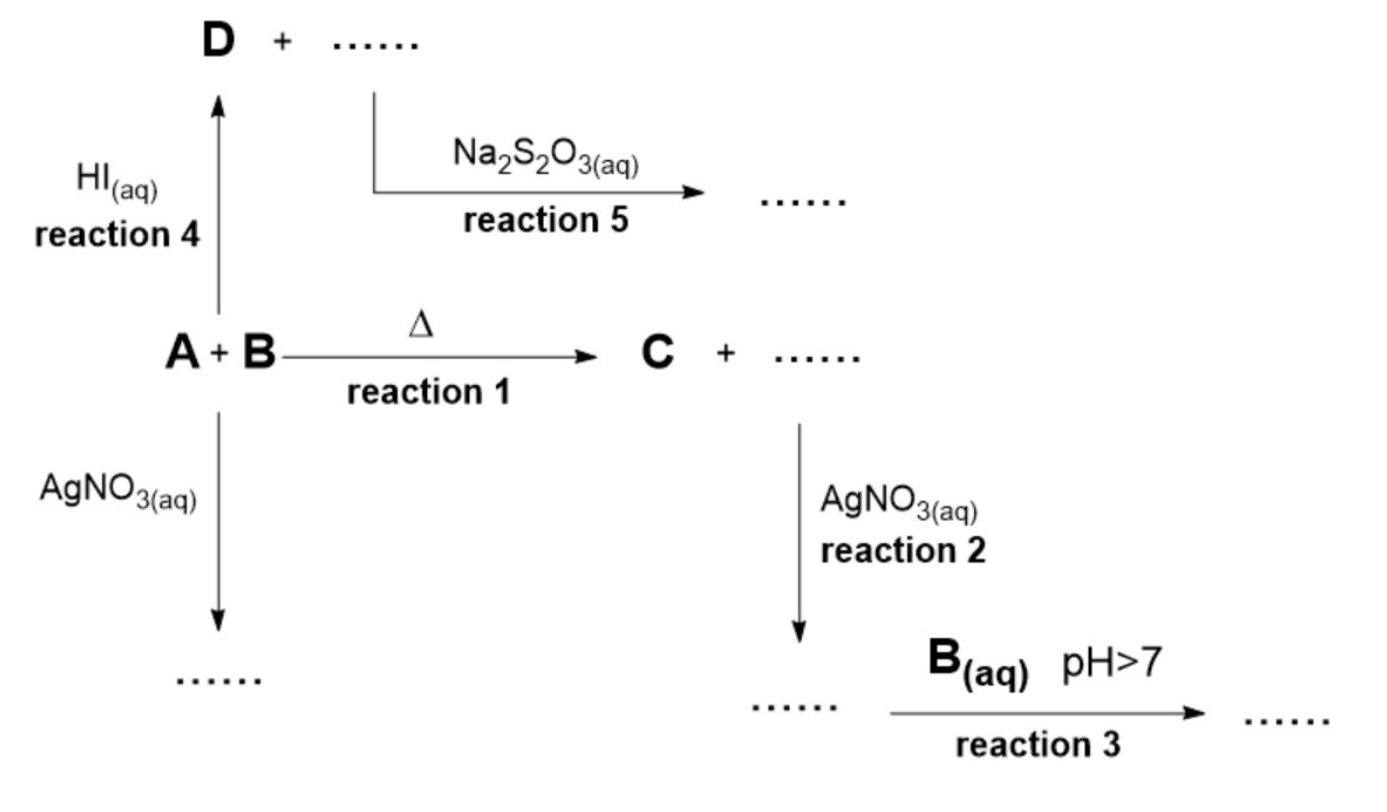
A capsule with a quantity \(m_{\mathrm{mix}} = 0.3389\ \mathrm{g}\) of a stoichiometric mixture of two white inorganic compounds A and B was placed inside a ball filled with air at atmospheric pressure. They reacted completely inside the ball upon heating to form gas C and other products (reaction 1) to produce an overall pressure inside the ball of \(p = 1.600\ \mathrm{atm}\) (at \(25\ ^\circ\mathrm{C}\)). Once this ball was opened, all residue inside was collected and dissolved in water. The dropping of silver nitrate in that solution gave a white precipitate (reaction 2). This collected precipitate could be partially dissolved in a concentrated aqueous solution of B. By increasing the pH of this mixture, the precipitate dissolved completely (reaction 3). If the same initial capsule of A+B is dissolved in water and concentrated solution of silver nitrate added, \(m_{\mathrm{precipitate}} = 0.8224\ \mathrm{g}\) of white precipitate formed which was approximately twice the mass of precipitate formed in reaction 2.
When the capsule of A+B dissolved in a solution of \(\ce{HI}\) the formation of gas D started, and the solution turned brown (reaction 4). Upon further addition of sodium thiosulfate this colour disappeared (reaction 5).
The densities of gases C and D differ by no more than 10%.
4.2 Write the chemical formulae of compounds A–D.
4.3 Write equations for reactions 1–5.
The pressure inside modern tennis balls is \(p_0 = 1.80\ \mathrm{atm}\). They are sold in a pressurised can, with the same pressure in the can as in the ball to stop gas coming out during storage.
Standard balls contain air and premium balls contain pure \(\ce{N2}\). Once the can is opened, depressurisation begins, and the gas diffuses out of the balls until the internal pressure reaches atmospheric pressure. Assume there is no diffusion of gas into the balls at any point. The activation energy for the depressurisation of a premium ball is \(E_A = 50.0\ \mathrm{kJ\,mol^{-1}}\).
The rate of ball depressurisation (pressure/time) could be described by similar equations of those used in chemical kinetics. At \(T_0 = 25.0\ ^\circ\mathrm{C}\), once the can is opened, the premium balls depressurise to \(p_1 = 1.40\ \mathrm{atm}\) after \(t_1 = 241\ \mathrm{h}\) and to \(p_2 = 1.19\ \mathrm{atm}\) after about \(t_2 = 21\) days. The initial depressurisation rate of regular balls is 10% faster than premium balls.
4.4a Demonstrate that the depressurisation process follows the first kinetic order by calculating the depressurisation rate constant \(k_{\ce{N2}}\) for \(\ce{N2}\) in \(\mathrm{h^{-1}}\).
Note: If you couldn't calculate the answer, use \(k_{\ce{N2}} = 10^{-3}\ \mathrm{h^{-1}}\) in further calculations.
4.4b Calculate the (depressurisation) rate constant \(k_{\ce{O2}}\) for \(\ce{O2}\) in \(\mathrm{h^{-1}}\), assuming the rates for both gases are additive.
As well as today being the IChO 2025 theory paper, it is also (perhaps less importantly) the Semi-Finals day at Wimbledon. Amanda Anisimova will start a match in \(t_{\mathrm{match}} = 12.0\ \mathrm{h}\) from now. The weather today in Wimbledon is predicted to be a constant \(T_W = 30.0\ ^\circ\mathrm{C}\). Assume a new set of premium balls, which were manufactured and placed in the can at \(T_0 = 25.0\ ^\circ\mathrm{C}\), are opened now and quickly change to \(T_W = 30.0\ ^\circ\mathrm{C}\).
4.4c Calculate the pressure \(p_{\mathrm{start}}\) (in atm) of the balls at the start of the match.
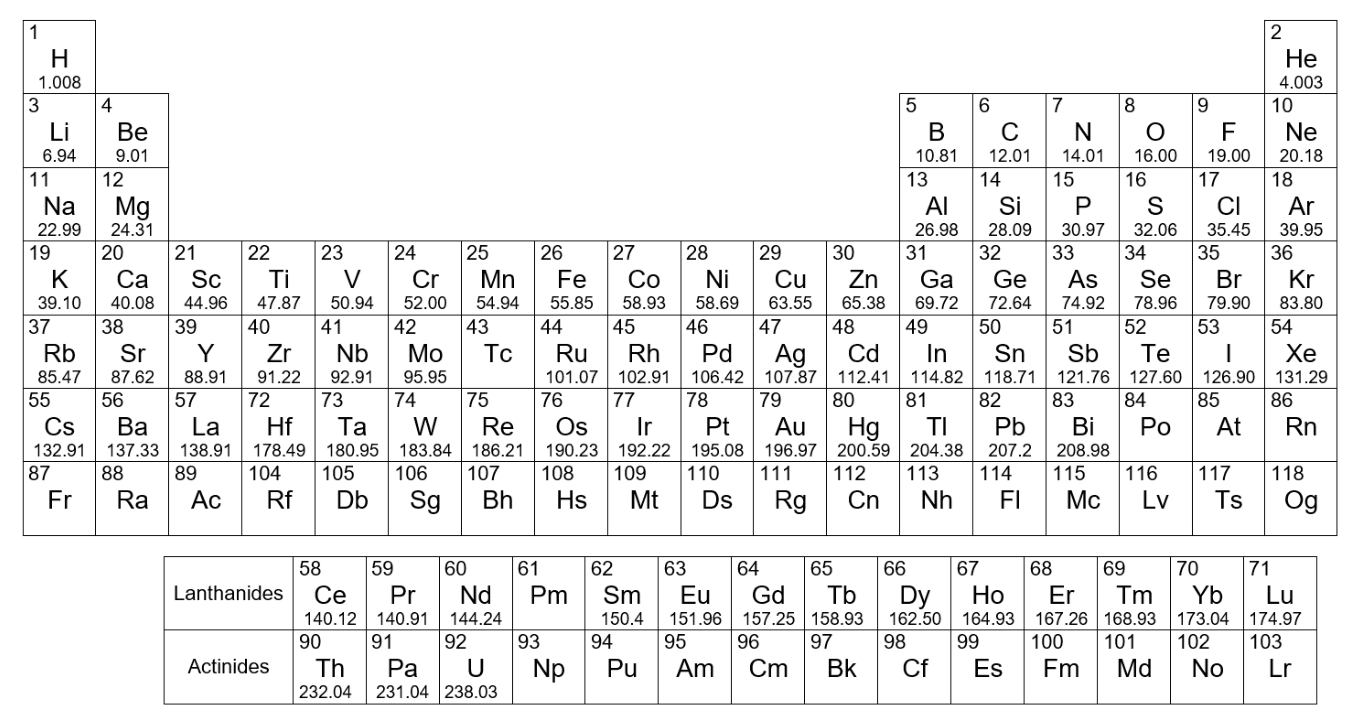
Periodic table and data sheet
Physical constants and formulae
| Avogadro constant | \(N_A\) | \(6.022\times10^{23}\ \mathrm{mol^{-1}}\) |
| molar gas constant | \(R\) | \(8.314\ \mathrm{J\,K^{-1}\,mol^{-1}}\) |
| Faraday constant | \(F\) | \(96485\ \mathrm{C\,mol^{-1}}\) |
| Planck constant | \(h\) | \(6.626\times10^{-34}\ \mathrm{J\,s}\) |
| speed of light in vacuum | \(c\) | \(2.998\times10^8\ \mathrm{m\,s^{-1}}\) |
| mass of electron | \(m_e\) | \(9.109\times10^{-31}\ \mathrm{kg}\) |
| charge of electron | \(e\) | \(1.602\times10^{-19}\ \mathrm{C}\) |
| atmospheric pressure | \(p_{\mathrm{atm}}\) | \(101325\ \mathrm{Pa}\) |
| ionic product of water at 298 K | \(K_W\) | \(10^{-14}\) |
| \(1\ \mathrm{nm}=1\times10^{-9}\ \mathrm{m}\) |
| \(1\ \text{Å}=1\times10^{-10}\ \mathrm{m}\) |
| \(1\ \mathrm{pm}=1\times10^{-12}\ \mathrm{m}\) |
| \(0\ ^\circ\mathrm{C}=273.15\ \mathrm{K}\) |
| \(1\ \mathrm{kWh}=3600\ \mathrm{kJ}\) |
| \(1\ \mathrm{W}=1\ \mathrm{J\,s^{-1}}\) |
| \(1\ \mathrm{eV}=1.602\times10^{-19}\ \mathrm{J}\) |
| \(1\ \mathrm{bar}=10^5\ \mathrm{Pa}\) |
| area of triangle | \(A=\frac12 ab\cdot\sin C\) |
| volume of cube | \(V=a^3\) |
| volume of sphere | \(V=\frac43\pi r^3\) |
| surface area of sphere | \(S=4\pi r^2\) |
| ideal gas equation | \(pV=nRT\) |
| frequency of light | \(\nu=\frac{c}{\lambda}\) |
| energy of a photon | \(E=\frac{hc}{\lambda}\) |
| Beer-Lambert law | \(A=\log\left(\frac{I_0}{I}\right)=\varepsilon cd\) |
| spin-only magnetic moment | \(\mu=\sqrt{n(n+2)}\ \mathrm{BM}\) |
| Henderson–Hasselbalch equation | \(\mathrm{pH}=\mathrm{p}K_a+\log\left(\frac{[\ce{A-}]}{[\ce{HA}]}\right)\) |
| \(0^{\mathrm{th}}\) order integrated rate law | \([A]=[A]_0-kt\) |
| \(1^{\mathrm{st}}\) order integrated rate law | \(\ln[A]=\ln[A]_0-kt\) |
| Arrhenius equation | \(k=A\cdot e^{-E_a/(RT)}\) |
| enthalpy | \(H=U+pV\) |
| Gibbs energy | \(G=H-TS\) |
| standard Gibbs energy change | \(\Delta_rG^\circ=-RT\ln K=-nFE^\circ_{\mathrm{cell}}\) |
| Clausius-Clapeyron equation | \(\ln\left(\frac{P_1}{P_2}\right)=\frac{\Delta H_{\mathrm{vap}}}{R}\left(\frac{1}{T_2}-\frac{1}{T_1}\right)\) |
| specific heat | \(Q=mC_p\Delta T\) |
| boiling point elevation | \(\Delta T=iK_bm_i\) |
| freezing point depression | \(\Delta T=iK_fm_i\) |
Consider all gases ideal unless told otherwise.
In equilibrium constant calculations, all concentrations are referenced to a concentration of \(1\ \mathrm{mol\,dm^{-3}}\).
Periodic table
Official English text of the problem.
Answers
-
4.1: \(m=0.133\ \mathrm{g}\), or \(0.13\ \mathrm{g}\) to two significant figures.
-
4.2: A: \(\ce{NaNO2}\), sodium nitrite,
[Na+].[O-]N=O; B: \(\ce{NH4Cl}\), ammonium chloride,[NH4+].[Cl-]; C: \(\ce{N2}\), nitrogen,N#N; D: \(\ce{NO}\), nitrogen monoxide (nitric oxide),[N]=O. -
4.3: Balanced equations, using net ionic forms where appropriate: \[ \begin{aligned} (1)\quad&\ce{NaNO2 + NH4Cl ->[\Delta] N2 + NaCl + 2H2O}\\ (2)\quad&\ce{Ag+ + Cl- -> AgCl(s)}\\ (3)\quad&\ce{AgCl(s) + 2NH4+ + 2OH- -> [Ag(NH3)2]+ + Cl- + 2H2O}\\ (4)\quad&\ce{2NO2- + 4H+ + 2I- -> 2NO(g) + I2 + 2H2O}\\ (5)\quad&\ce{I2 + 2S2O3^2- -> 2I- + S4O6^2-} \end{aligned} \] Names and SMILES for the additional species are supplied in the solution.
-
4.4a: First order in excess pressure \(p-p_{\mathrm{atm}}\), with \[ \boxed{k_{\ce{N2}}=2.88\times10^{-3}\ \mathrm{h^{-1}}}. \]
-
4.4b: \[ \boxed{k_{\ce{O2}}=4.31\times10^{-3}\ \mathrm{h^{-1}}}. \]
-
4.4c: \[ \boxed{p_{\mathrm{start}}=1.79\ \mathrm{atm}}. \]
Solution
4.1
To distinguish the ball radius from the gas constant, write the radius as \(r=0.030\ \mathrm{m}\). The internal volume is
\[ V=\frac43\pi r^3 =\frac43\pi(0.030\ \mathrm{m})^3 =1.13097\times10^{-4}\ \mathrm{m^3}. \]
At \(T_0=298.15\ \mathrm{K}\), the amount of air is
\[ n_{\mathrm{air}} =\frac{p_{\mathrm{atm}}V}{RT_0} =\frac{101325(1.13097\times10^{-4})} {8.314(298.15)} =4.62300\times10^{-3}\ \mathrm{mol}. \]
For ideal gases, volume fractions equal mole fractions. The components are oxygen, \(\ce{O2}\), O=O, and nitrogen, \(\ce{N2}\), N#N. Thus
\[ \overline M =0.20(2\times16.00)+0.80(2\times14.01) =28.816\ \mathrm{g\,mol^{-1}}. \]
Therefore,
\[ m=n_{\mathrm{air}}\overline M =(4.62300\times10^{-3})(28.816) =0.133216\ \mathrm{g}. \]
\[ \boxed{m\approx0.133\ \mathrm{g}\approx0.13\ \mathrm{g}\text{ to two significant figures}.} \]
4.2
The additional pressure comes from gas C. Because the volume and final temperature are unchanged,
\[ n_C =\frac{(p-p_{\mathrm{atm}})V}{RT_0} =0.600\,n_{\mathrm{air}} =2.77380\times10^{-3}\ \mathrm{mol}. \]
The qualitative observations identify the reactants as follows.
The white precipitate from the final residue is consistent with silver chloride, \(\ce{AgCl}\). Its dissolution upon increasing the pH in a solution of B indicates ammonia complex formation: raising the pH converts ammonium ions into ammonia, which dissolves silver chloride as the diamminesilver(I) ion. This points to ammonium chloride as B.
The other reactant must generate a gas with ammonium ions on heating and oxidize iodide to iodine in acid. Nitrite satisfies both requirements:
\[ \ce{NH4+ + NO2- ->[\Delta] N2 + 2H2O}, \]
while acidified nitrite oxidizes iodide and is reduced to nitrogen monoxide. Consequently, C is nitrogen and D is nitrogen monoxide.
Their molar masses are
\[ M_C=28.02\ \mathrm{g\,mol^{-1}}, \qquad M_D=30.01\ \mathrm{g\,mol^{-1}}. \]
At equal temperature and pressure, gas density is proportional to molar mass, so
\[ \frac{\rho_D-\rho_C}{\rho_C} =\frac{30.01-28.02}{28.02} =0.0710=7.10\%, \]
which satisfies the stated limit.
The silver-precipitation data identify the cation of A. Before heating, both chloride and nitrite precipitate:
\[ \ce{Ag+ + Cl- -> AgCl(s)}, \qquad \ce{Ag+ + NO2- -> AgNO2(s)}. \]
For a 1:1 mixture of a monovalent metal nitrite and ammonium chloride, each mole of reaction mixture gives one mole of each precipitate. Their molar masses are
\[ M(\ce{AgCl})=107.87+35.45=143.32\ \mathrm{g\,mol^{-1}}, \]
\[ M(\ce{AgNO2})=107.87+14.01+32.00 =153.88\ \mathrm{g\,mol^{-1}}. \]
Thus the initial precipitate corresponds to
\[ n=\frac{0.8224}{143.32+153.88} =2.76716\times10^{-3}\ \mathrm{mol}. \]
Since
\[ M(\ce{NH4Cl})=14.01+4(1.008)+35.45 =53.492\ \mathrm{g\,mol^{-1}}, \]
the inferred molar mass of A is
\[ M_A=\frac{0.3389}{2.76716\times10^{-3}}-53.492 =68.980\ \mathrm{g\,mol^{-1}}. \]
Subtracting the nitrite contribution gives the cation mass:
\[ 68.980-(14.01+32.00) =22.970\ \mathrm{g\,mol^{-1}}, \]
matching sodium, \(22.99\ \mathrm{g\,mol^{-1}}\). Hence A is sodium nitrite.
The complete identification is therefore:
| Compound | Formula | Name | SMILES |
|---|---|---|---|
| A | \(\ce{NaNO2}\) | Sodium nitrite | [Na+].[O-]N=O |
| B | \(\ce{NH4Cl}\) | Ammonium chloride | [NH4+].[Cl-] |
| C | \(\ce{N2}\) | Nitrogen | N#N |
| D | \(\ce{NO}\) | Nitrogen monoxide (nitric oxide) | [N]=O |
A direct check using the proposed mixture gives
\[ n_{\mathrm{reaction}} =\frac{0.3389}{69.00+53.492} =2.76671\times10^{-3}\ \mathrm{mol}. \]
This predicts
\[ m_{\mathrm{initial\ precipitate}} =n_{\mathrm{reaction}}(143.32+153.88) =0.82227\ \mathrm{g}, \]
in agreement with \(0.8224\ \mathrm{g}\). After heating, only the chloride precipitate remains:
\[ m_{\mathrm{reaction\ 2}} =n_{\mathrm{reaction}}(143.32) =0.39653\ \mathrm{g}. \]
Their ratio is
\[ \frac{0.82227}{0.39653}=2.0737, \]
consistent with “approximately twice.” The predicted final pressure is \(1.5985\ \mathrm{atm}\), consistent with the stated \(1.600\ \mathrm{atm}\) given the two-significant-figure radius.
4.3
Reaction 1: thermal production of nitrogen
\[ \boxed{\ce{NaNO2 + NH4Cl ->[\Delta] N2(g) + NaCl + 2H2O}} \]
Nitrogen in ammonium has oxidation state \(-3\), while nitrogen in nitrite has oxidation state \(+3\). Both become nitrogen in oxidation state zero. At the final temperature, water is treated as a condensed product under the problem's stated model.
Reaction 2: precipitation of silver chloride
\[ \boxed{\ce{Ag+(aq) + Cl-(aq) -> AgCl(s)}} \]
The sodium chloride residue supplies the chloride ions.
Reaction 3: dissolution through ammonia complex formation
Increasing the pH releases ammonia:
\[ \ce{NH4+(aq) + OH-(aq) -> NH3(aq) + H2O(l)}. \]
Ammonia binds silver(I), shifting the dissolution equilibrium:
\[ \boxed{\ce{AgCl(s) + 2NH3(aq) <=> [Ag(NH3)2]+(aq) + Cl-(aq)}}. \]
Combining these equations gives an equivalent overall equation that explicitly includes B's ammonium ions and the added base:
\[ \ce{AgCl(s) + 2NH4+(aq) + 2OH-(aq) -> [Ag(NH3)2]+(aq) + Cl-(aq) + 2H2O(l)}. \]
Reaction 4: oxidation of iodide by acidified nitrite
Nitrite is reduced from nitrogen oxidation state \(+3\) to \(+2\), while iodide is oxidized to iodine:
\[ \ce{NO2- + 2H+ + e- -> NO + H2O}, \]
\[ \ce{2I- -> I2 + 2e-}. \]
Adding the half-reactions gives
\[ \boxed{\ce{2NO2-(aq) + 4H+(aq) + 2I-(aq) -> 2NO(g) + I2(aq) + 2H2O(l)}}. \]
The liberated iodine accounts for the brown colour.
Reaction 5: reduction of iodine by thiosulfate
\[ \boxed{\ce{I2(aq) + 2S2O3^2-(aq) -> 2I-(aq) + S4O6^2-(aq)}}. \]
Iodine is reduced to iodide, while thiosulfate is oxidized to tetrathionate, removing the brown colour.
The additional species used above have the following names and SMILES:
| Formula | Name | SMILES |
|---|---|---|
| \(\ce{NaCl}\) | Sodium chloride | [Na+].[Cl-] |
| \(\ce{H2O}\) | Water | O |
| \(\ce{Ag+}\) | Silver(I) ion | [Ag+] |
| \(\ce{Cl-}\) | Chloride ion | [Cl-] |
| \(\ce{AgCl}\) | Silver(I) chloride | [Ag+].[Cl-] |
| \(\ce{AgNO2}\) | Silver(I) nitrite | [Ag+].[O-]N=O |
| \(\ce{NH4+}\) | Ammonium ion | [NH4+] |
| \(\ce{OH-}\) | Hydroxide ion | [OH-] |
| \(\ce{NH3}\) | Ammonia | N |
| \(\ce{[Ag(NH3)2]+}\) | Diamminesilver(I) ion | [NH3]->[Ag+]<-[NH3] |
| \(\ce{NO2-}\) | Nitrite ion | [O-]N=O |
| \(\ce{H+}\) | Hydrogen ion, proton | [H+] |
| \(\ce{I-}\) | Iodide ion | [I-] |
| \(\ce{I2}\) | Iodine | II |
| \(\ce{S2O3^2-}\) | Thiosulfate ion | [O-]S(=O)(=O)[S-] |
| \(\ce{S4O6^2-}\) | Tetrathionate ion | [O-]S(=O)(=O)SSS(=O)(=O)[O-] |
Dot-separated salt SMILES specify constituent ions rather than a crystal lattice. The dative-bond SMILES for diamminesilver(I) does not specify its approximately linear \(\ce{N-Ag-N}\) coordination geometry.
4.4a
The pressure approaches atmospheric pressure. The quantity that decays to zero is therefore the excess pressure
\[ q=p-p_{\mathrm{atm}}. \]
For first-order depressurisation,
\[ -\frac{dq}{dt}=k_{\ce{N2}}q, \qquad q(t)=q_0e^{-k_{\ce{N2}}t}. \]
Hence
\[ k_{\ce{N2}} =\frac1t\ln\left(\frac{p_0-p_{\mathrm{atm}}} {p(t)-p_{\mathrm{atm}}}\right). \]
Using the first measurement,
\[ k_{\ce{N2}} =\frac1{241\ \mathrm{h}} \ln\left(\frac{1.80-1.00}{1.40-1.00}\right) =\frac{\ln2}{241\ \mathrm{h}} =2.87613\times10^{-3}\ \mathrm{h^{-1}}. \]
Using the second measurement, with \(21\ \mathrm{days}=504\ \mathrm{h}\),
\[ k_{\ce{N2}} =\frac1{504\ \mathrm{h}} \ln\left(\frac{1.80-1.00}{1.19-1.00}\right) =2.85236\times10^{-3}\ \mathrm{h^{-1}}. \]
These values agree within about \(0.8\%\), consistent with the approximate second time and rounded pressures. In particular, the first value predicts
\[ p(504\ \mathrm{h}) =1.00+0.80e^{-(2.87613\times10^{-3})(504)} =1.18774\ \mathrm{atm}, \]
which rounds to the stated \(1.19\ \mathrm{atm}\).
Thus the data support first-order decay of excess pressure, with
\[ \boxed{k_{\ce{N2}}=2.88\times10^{-3}\ \mathrm{h^{-1}}}. \]
4.4b
At the same initial excess pressure \(q_0\), the premium ball has initial rate
\[ v_{\mathrm{premium},0}=k_{\ce{N2}}q_0. \]
For the stated additive-rate model, the initial rate for air is the composition-weighted sum:
\[ v_{\mathrm{air},0} =\left(0.80k_{\ce{N2}}+0.20k_{\ce{O2}}\right)q_0. \]
The air-filled ball initially depressurises 10% faster, so
\[ 0.80k_{\ce{N2}}+0.20k_{\ce{O2}} =1.10k_{\ce{N2}}. \]
Therefore,
\[ k_{\ce{O2}} =\frac{1.10-0.80}{0.20}k_{\ce{N2}} =1.50k_{\ce{N2}}, \]
and
\[ \boxed{k_{\ce{O2}} =1.50(2.87613\times10^{-3}) =4.31\times10^{-3}\ \mathrm{h^{-1}}}. \]
4.4c
First, calculate the rate constant at \(30.0\ ^\circ\mathrm{C}\):
\[ T_0=298.15\ \mathrm{K}, \qquad T_W=303.15\ \mathrm{K}. \]
The Arrhenius equation gives
\[ \ln\left(\frac{k_W}{k_0}\right) =\frac{E_A}{R} \left(\frac1{T_0}-\frac1{T_W}\right). \]
Therefore,
\[ \frac{k_W}{k_0} =\exp\left[ \frac{50000}{8.314} \left(\frac1{298.15}-\frac1{303.15}\right) \right] =1.39471, \]
\[ k_W =(2.87613\times10^{-3})(1.39471) =4.01137\times10^{-3}\ \mathrm{h^{-1}}. \]
The rapid temperature change also raises the pressure immediately. At constant volume and before appreciable gas loss,
\[ p(0^+) =p_0\frac{T_W}{T_0} =1.80\frac{303.15}{298.15} =1.83019\ \mathrm{atm}. \]
The resulting excess pressure then decays for \(12.0\ \mathrm{h}\):
\[ p_{\mathrm{start}} =p_{\mathrm{atm}} +\left[p(0^+)-p_{\mathrm{atm}}\right] e^{-k_Wt_{\mathrm{match}}}. \]
Substitution gives
\[ p_{\mathrm{start}} =1.000 +(1.83019-1.000) e^{-(4.01137\times10^{-3})(12.0)} =1.79117\ \mathrm{atm}. \]
\[ \boxed{p_{\mathrm{start}}=1.79\ \mathrm{atm}}. \]
The solution was checked against the official solution. Where this solution differs from the official solution, the official solution contains an error or a misprint.
IChO 2025 · Theorieaufgabe 4
Das Leben der Tennisbälle
6% der Gesamtpunktzahl
| 4.1 | 4.2 | 4.3 | 4.4 | Gesamt |
|---|---|---|---|---|
| 3 | 16 | 5 | 16 | 40 |
Diese Aufgabe würdigt den unglaublichen Rafael Nadal, eine wahre Tennisikone, der seine bemerkenswerte Karriere 2024 beendete.
Die Dubai Tennis Championships sind ein renommiertes Turnier, das jährlich in den Vereinigten Arabischen Emiraten stattfindet. Viele der weltbesten Spieler, darunter Rafael Nadal, Roger Federer, Novak Djokovic und Andy Murray, haben dort Titel gewonnen.
Der Aufbau von Tennisbällen hat sich über Hunderte von Jahren weiterentwickelt. Um ein gutes Sprungverhalten zu gewährleisten, herrscht im Inneren moderner Tennisbälle ein Druck oberhalb des Atmosphärendrucks. Alte hohle Tennisbälle enthielten dagegen lediglich Luft bei Atmosphärendruck.
Nehmen Sie in dieser Aufgabe an, dass Tennisbälle einen Innenradius von \(R = 3.0\ \mathrm{cm}\) haben, der während des gesamten Druckaufbaus konstant bleibt. Nehmen Sie an, dass Luft zu 20 Volumenprozent aus \(\ce{O2}\) und zu 80 Volumenprozent aus \(\ce{N2}\) besteht. Gehen Sie davon aus, dass der Überdruck den Ball nicht ausdehnt.
4.1 Berechnen Sie die Masse \(m\) (in g) der Luft in einem alten Tennisball bei \(T_0 = 25\ ^\circ\mathrm{C}\).
Chemiker entdeckten dann, wie sich der Druck in einem Ball mithilfe einer Reaktion zwischen den Verbindungen A und B über den Atmosphärendruck hinaus erhöhen lässt. Dabei entstehen das Gas C (zur Erzeugung eines zusätzlichen Innendrucks) sowie weitere, nicht gasförmige Produkte.
Eine Kapsel mit einer Masse von \(m_{\mathrm{mix}} = 0.3389\ \mathrm{g}\) eines stöchiometrischen Gemischs zweier weißer anorganischer Verbindungen A und B wurde in einen mit Luft bei Atmosphärendruck gefüllten Ball eingebracht. Beim Erhitzen reagierten sie im Ball vollständig unter Bildung des Gases C und weiterer Produkte (Reaktion 1), sodass im Ball ein Gesamtdruck von \(p = 1.600\ \mathrm{atm}\) (bei \(25\ ^\circ\mathrm{C}\)) entstand. Nachdem dieser Ball geöffnet worden war, wurde der gesamte Rückstand aus seinem Inneren gesammelt und in Wasser gelöst. Beim Zutropfen von Silbernitrat zu dieser Lösung entstand ein weißer Niederschlag (Reaktion 2). Der abgetrennte Niederschlag ließ sich teilweise in einer konzentrierten wässrigen Lösung von B lösen. Durch Erhöhen des pH-Werts dieses Gemischs löste sich der Niederschlag vollständig auf (Reaktion 3). Wenn dieselbe ursprüngliche Kapsel mit A+B in Wasser gelöst und eine konzentrierte Silbernitratlösung hinzugegeben wird, entsteht ein weißer Niederschlag mit einer Masse von \(m_{\mathrm{precipitate}} = 0.8224\ \mathrm{g}\), die ungefähr doppelt so groß ist wie die Masse des in Reaktion 2 gebildeten Niederschlags.
Als die Kapsel mit A+B in einer Lösung von \(\ce{HI}\) aufgelöst wurde, begann die Bildung des Gases D, und die Lösung färbte sich braun (Reaktion 4). Bei anschließender Zugabe von Natriumthiosulfat verschwand diese Farbe (Reaktion 5).
Die Dichten der Gase C und D unterscheiden sich um höchstens 10%.
4.2 Geben Sie die chemischen Formeln der Verbindungen A–D an.
4.3 Stellen Sie die Gleichungen für die Reaktionen 1–5 auf.
Der Druck im Inneren moderner Tennisbälle beträgt \(p_0 = 1.80\ \mathrm{atm}\). Sie werden in einer unter Druck stehenden Dose verkauft, in der derselbe Druck wie im Ball herrscht, um während der Lagerung das Austreten von Gas zu verhindern.
Standardbälle enthalten Luft, Premiumbälle enthalten reinen \(\ce{N2}\). Sobald die Dose geöffnet wird, beginnt der Druckabbau, und das Gas diffundiert aus den Bällen, bis der Innendruck den Atmosphärendruck erreicht. Nehmen Sie an, dass zu keinem Zeitpunkt Gas in die Bälle hineindiffundiert. Die Aktivierungsenergie für den Druckabbau eines Premiumballs beträgt \(E_A = 50.0\ \mathrm{kJ\,mol^{-1}}\).
Die Geschwindigkeit des Druckabbaus der Bälle (Druck/Zeit) lässt sich durch ähnliche Gleichungen beschreiben, wie sie in der chemischen Kinetik verwendet werden. Bei \(T_0 = 25.0\ ^\circ\mathrm{C}\) sinkt nach dem Öffnen der Dose der Druck in den Premiumbällen nach \(t_1 = 241\ \mathrm{h}\) auf \(p_1 = 1.40\ \mathrm{atm}\) und nach etwa \(t_2 = 21\) Tagen auf \(p_2 = 1.19\ \mathrm{atm}\). Die Anfangsgeschwindigkeit des Druckabbaus ist bei Standardbällen um 10% höher als bei Premiumbällen.
4.4a Zeigen Sie, dass der Druckabbau einer Kinetik erster Ordnung folgt, indem Sie die Geschwindigkeitskonstante \(k_{\ce{N2}}\) des Druckabbaus für \(\ce{N2}\) in \(\mathrm{h^{-1}}\) berechnen.
Hinweis: Falls Sie das Ergebnis nicht berechnen konnten, verwenden Sie für die weiteren Berechnungen \(k_{\ce{N2}} = 10^{-3}\ \mathrm{h^{-1}}\).
4.4b Berechnen Sie die Geschwindigkeitskonstante \(k_{\ce{O2}}\) (des Druckabbaus) für \(\ce{O2}\) in \(\mathrm{h^{-1}}\), unter der Annahme, dass sich die Geschwindigkeiten für beide Gase addieren.
Heute findet nicht nur die theoretische Prüfung der IChO 2025 statt, sondern auch (vielleicht etwas weniger wichtig) das Halbfinale in Wimbledon. Amanda Anisimova wird in \(t_{\mathrm{match}} = 12.0\ \mathrm{h}\) ein Match beginnen. Für heute wird in Wimbledon eine konstante Temperatur von \(T_W = 30.0\ ^\circ\mathrm{C}\) vorhergesagt. Nehmen Sie an, dass eine Dose mit einem neuen Satz Premiumbälle, die bei \(T_0 = 25.0\ ^\circ\mathrm{C}\) hergestellt und in die Dose gefüllt wurden, jetzt geöffnet wird und die Bälle schnell die Temperatur \(T_W = 30.0\ ^\circ\mathrm{C}\) annehmen.
4.4c Berechnen Sie den Druck \(p_{\mathrm{start}}\) (in atm) der Bälle zu Beginn des Matches.
Periodensystem und Datenblatt
Physikalische Konstanten und Formeln
| Avogadro-Konstante | \(N_A\) | \(6.022\times10^{23}\ \mathrm{mol^{-1}}\) |
| Molare Gaskonstante | \(R\) | \(8.314\ \mathrm{J\,K^{-1}\,mol^{-1}}\) |
| Faraday-Konstante | \(F\) | \(96485\ \mathrm{C\,mol^{-1}}\) |
| Planck-Konstante | \(h\) | \(6.626\times10^{-34}\ \mathrm{J\,s}\) |
| Lichtgeschwindigkeit im Vakuum | \(c\) | \(2.998\times10^8\ \mathrm{m\,s^{-1}}\) |
| Masse des Elektrons | \(m_e\) | \(9.109\times10^{-31}\ \mathrm{kg}\) |
| Ladung des Elektrons | \(e\) | \(1.602\times10^{-19}\ \mathrm{C}\) |
| Atmosphärendruck | \(p_{\mathrm{atm}}\) | \(101325\ \mathrm{Pa}\) |
| Ionenprodukt des Wassers bei 298 K | \(K_W\) | \(10^{-14}\) |
| \(1\ \mathrm{nm}=1\times10^{-9}\ \mathrm{m}\) |
| \(1\ \text{Å}=1\times10^{-10}\ \mathrm{m}\) |
| \(1\ \mathrm{pm}=1\times10^{-12}\ \mathrm{m}\) |
| \(0\ ^\circ\mathrm{C}=273.15\ \mathrm{K}\) |
| \(1\ \mathrm{kWh}=3600\ \mathrm{kJ}\) |
| \(1\ \mathrm{W}=1\ \mathrm{J\,s^{-1}}\) |
| \(1\ \mathrm{eV}=1.602\times10^{-19}\ \mathrm{J}\) |
| \(1\ \mathrm{bar}=10^5\ \mathrm{Pa}\) |
| Flächeninhalt eines Dreiecks | \(A=\frac12 ab\cdot\sin C\) |
| Volumen eines Würfels | \(V=a^3\) |
| Volumen einer Kugel | \(V=\frac43\pi r^3\) |
| Oberfläche einer Kugel | \(S=4\pi r^2\) |
| Ideale Gasgleichung | \(pV=nRT\) |
| Frequenz des Lichts | \(\nu=\frac{c}{\lambda}\) |
| Energie eines Photons | \(E=\frac{hc}{\lambda}\) |
| Lambert-Beer-Gesetz | \(A=\log\left(\frac{I_0}{I}\right)=\varepsilon cd\) |
| Magnetisches Moment bei reinem Spinbeitrag | \(\mu=\sqrt{n(n+2)}\ \mathrm{BM}\) |
| Henderson-Hasselbalch-Gleichung | \(\mathrm{pH}=\mathrm{p}K_a+\log\left(\frac{[\ce{A-}]}{[\ce{HA}]}\right)\) |
| Integriertes Geschwindigkeitsgesetz \(0^{\mathrm{th}}\) Ordnung | \([A]=[A]_0-kt\) |
| Integriertes Geschwindigkeitsgesetz \(1^{\mathrm{st}}\) Ordnung | \(\ln[A]=\ln[A]_0-kt\) |
| Arrhenius-Gleichung | \(k=A\cdot e^{-E_a/(RT)}\) |
| Enthalpie | \(H=U+pV\) |
| Gibbs-Energie | \(G=H-TS\) |
| Standardänderung der Gibbs-Energie | \(\Delta_rG^\circ=-RT\ln K=-nFE^\circ_{\mathrm{cell}}\) |
| Clausius-Clapeyron-Gleichung | \(\ln\left(\frac{P_1}{P_2}\right)=\frac{\Delta H_{\mathrm{vap}}}{R}\left(\frac{1}{T_2}-\frac{1}{T_1}\right)\) |
| Spezifische Wärmekapazität | \(Q=mC_p\Delta T\) |
| Siedepunktserhöhung | \(\Delta T=iK_bm_i\) |
| Gefrierpunktserniedrigung | \(\Delta T=iK_fm_i\) |
Betrachten Sie alle Gase als ideal, sofern nicht anders angegeben.
Bei Berechnungen von Gleichgewichtskonstanten werden alle Konzentrationen auf eine Konzentration von \(1\ \mathrm{mol\,dm^{-3}}\) bezogen.
Periodensystem
Aufgabentext aus dem offiziellen englischen Text übersetzt.
Antworten
-
4.1: \(m=0.133\ \mathrm{g}\), oder \(0.13\ \mathrm{g}\) auf zwei signifikante Stellen.
-
4.2: A: \(\ce{NaNO2}\), Natriumnitrit,
[Na+].[O-]N=O; B: \(\ce{NH4Cl}\), Ammoniumchlorid,[NH4+].[Cl-]; C: \(\ce{N2}\), Stickstoff,N#N; D: \(\ce{NO}\), Stickstoffmonoxid (Stickstoff(II)-oxid),[N]=O. -
4.3: Ausgeglichene Gleichungen, gegebenenfalls als Netto-Ionengleichungen: \[ \begin{aligned} (1)\quad&\ce{NaNO2 + NH4Cl ->[\Delta] N2 + NaCl + 2H2O}\\ (2)\quad&\ce{Ag+ + Cl- -> AgCl(s)}\\ (3)\quad&\ce{AgCl(s) + 2NH4+ + 2OH- -> [Ag(NH3)2]+ + Cl- + 2H2O}\\ (4)\quad&\ce{2NO2- + 4H+ + 2I- -> 2NO(g) + I2 + 2H2O}\\ (5)\quad&\ce{I2 + 2S2O3^2- -> 2I- + S4O6^2-} \end{aligned} \] Die Namen und SMILES der weiteren Spezies sind in der Lösung angegeben.
-
4.4a: Erste Ordnung bezüglich des Überdrucks \(p-p_{\mathrm{atm}}\), mit \[ \boxed{k_{\ce{N2}}=2.88\times10^{-3}\ \mathrm{h^{-1}}}. \]
-
4.4b: \[ \boxed{k_{\ce{O2}}=4.31\times10^{-3}\ \mathrm{h^{-1}}}. \]
-
4.4c: \[ \boxed{p_{\mathrm{start}}=1.79\ \mathrm{atm}}. \]
Lösung
4.1
Um den Ballradius von der Gaskonstante zu unterscheiden, schreiben wir den Radius als \(r=0.030\ \mathrm{m}\). Das Innenvolumen beträgt
\[ V=\frac43\pi r^3 =\frac43\pi(0.030\ \mathrm{m})^3 =1.13097\times10^{-4}\ \mathrm{m^3}. \]
Bei \(T_0=298.15\ \mathrm{K}\) beträgt die Stoffmenge der Luft
\[ n_{\mathrm{air}} =\frac{p_{\mathrm{atm}}V}{RT_0} =\frac{101325(1.13097\times10^{-4})} {8.314(298.15)} =4.62300\times10^{-3}\ \mathrm{mol}. \]
Bei idealen Gasen entsprechen die Volumenanteile den Stoffmengenanteilen. Die Bestandteile sind Sauerstoff, \(\ce{O2}\), O=O, und Stickstoff, \(\ce{N2}\), N#N. Somit gilt
\[ \overline M =0.20(2\times16.00)+0.80(2\times14.01) =28.816\ \mathrm{g\,mol^{-1}}. \]
Daraus folgt
\[ m=n_{\mathrm{air}}\overline M =(4.62300\times10^{-3})(28.816) =0.133216\ \mathrm{g}. \]
\[ \boxed{m\approx0.133\ \mathrm{g}\approx0.13\ \mathrm{g}\text{ auf zwei signifikante Stellen}.} \]
4.2
Der zusätzliche Druck stammt vom Gas C. Da das Volumen und die Endtemperatur unverändert bleiben, gilt
\[ n_C =\frac{(p-p_{\mathrm{atm}})V}{RT_0} =0.600\,n_{\mathrm{air}} =2.77380\times10^{-3}\ \mathrm{mol}. \]
Die qualitativen Beobachtungen ermöglichen die folgende Identifizierung der Edukte.
Der weiße Niederschlag aus dem nach der Reaktion vorliegenden Rückstand ist mit Silberchlorid, \(\ce{AgCl}\), vereinbar. Seine Auflösung bei Erhöhung des pH-Werts in einer Lösung von B deutet auf eine Komplexbildung mit Ammoniak hin: Durch Erhöhen des pH-Werts werden Ammoniumionen in Ammoniak umgewandelt, der Silberchlorid unter Bildung des Diamminsilber(I)-Ions löst. Dies weist auf Ammoniumchlorid als B hin.
Das andere Edukt muss beim Erhitzen mit Ammoniumionen ein Gas bilden und in saurer Lösung Iodid zu Iod oxidieren. Nitrit erfüllt beide Anforderungen:
\[ \ce{NH4+ + NO2- ->[\Delta] N2 + 2H2O}, \]
während angesäuertes Nitrit Iodid oxidiert und dabei zu Stickstoffmonoxid reduziert wird. Folglich ist C Stickstoff und D Stickstoffmonoxid.
Ihre molaren Massen betragen
\[ M_C=28.02\ \mathrm{g\,mol^{-1}}, \qquad M_D=30.01\ \mathrm{g\,mol^{-1}}. \]
Bei gleicher Temperatur und gleichem Druck ist die Gasdichte proportional zur molaren Masse, also gilt
\[ \frac{\rho_D-\rho_C}{\rho_C} =\frac{30.01-28.02}{28.02} =0.0710=7.10\%, \]
womit die angegebene Grenze eingehalten wird.
Die Daten zur Silberfällung ermöglichen die Identifizierung des Kations von A. Vor dem Erhitzen fallen sowohl Chlorid als auch Nitrit aus:
\[ \ce{Ag+ + Cl- -> AgCl(s)}, \qquad \ce{Ag+ + NO2- -> AgNO2(s)}. \]
Bei einem 1:1-Gemisch aus dem Nitrit eines einwertigen Metalls und Ammoniumchlorid liefert jedes Mol des Reaktionsgemischs jeweils ein Mol der beiden Niederschläge. Ihre molaren Massen betragen
\[ M(\ce{AgCl})=107.87+35.45=143.32\ \mathrm{g\,mol^{-1}}, \]
\[ M(\ce{AgNO2})=107.87+14.01+32.00 =153.88\ \mathrm{g\,mol^{-1}}. \]
Damit entspricht der anfängliche Niederschlag einer Stoffmenge von
\[ n=\frac{0.8224}{143.32+153.88} =2.76716\times10^{-3}\ \mathrm{mol}. \]
Da
\[ M(\ce{NH4Cl})=14.01+4(1.008)+35.45 =53.492\ \mathrm{g\,mol^{-1}}, \]
ergibt sich für die molare Masse von A
\[ M_A=\frac{0.3389}{2.76716\times10^{-3}}-53.492 =68.980\ \mathrm{g\,mol^{-1}}. \]
Durch Subtraktion des Nitritanteils erhält man die molare Masse des Kations:
\[ 68.980-(14.01+32.00) =22.970\ \mathrm{g\,mol^{-1}}, \]
die mit der von Natrium, \(22.99\ \mathrm{g\,mol^{-1}}\), übereinstimmt. Somit ist A Natriumnitrit.
Die vollständige Zuordnung lautet daher:
| Verbindung | Formel | Name | SMILES |
|---|---|---|---|
| A | \(\ce{NaNO2}\) | Natriumnitrit | [Na+].[O-]N=O |
| B | \(\ce{NH4Cl}\) | Ammoniumchlorid | [NH4+].[Cl-] |
| C | \(\ce{N2}\) | Stickstoff | N#N |
| D | \(\ce{NO}\) | Stickstoffmonoxid (Stickstoff(II)-oxid) | [N]=O |
Eine direkte Überprüfung anhand des vorgeschlagenen Gemischs ergibt
\[ n_{\mathrm{reaction}} =\frac{0.3389}{69.00+53.492} =2.76671\times10^{-3}\ \mathrm{mol}. \]
Daraus ergibt sich als Vorhersage
\[ m_{\mathrm{initial\ precipitate}} =n_{\mathrm{reaction}}(143.32+153.88) =0.82227\ \mathrm{g}, \]
in Übereinstimmung mit \(0.8224\ \mathrm{g}\). Nach dem Erhitzen bleibt nur der Chloridniederschlag:
\[ m_{\mathrm{reaction\ 2}} =n_{\mathrm{reaction}}(143.32) =0.39653\ \mathrm{g}. \]
Das Verhältnis der beiden Massen beträgt
\[ \frac{0.82227}{0.39653}=2.0737, \]
was mit „ungefähr doppelt so groß“ übereinstimmt. Der vorhergesagte Enddruck beträgt \(1.5985\ \mathrm{atm}\), was angesichts des auf zwei signifikante Stellen angegebenen Radius mit dem angegebenen Wert von \(1.600\ \mathrm{atm}\) vereinbar ist.
4.3
Reaktion 1: thermische Erzeugung von Stickstoff
\[ \boxed{\ce{NaNO2 + NH4Cl ->[\Delta] N2(g) + NaCl + 2H2O}} \]
Stickstoff im Ammonium hat die Oxidationszahl \(-3\), während Stickstoff im Nitrit die Oxidationszahl \(+3\) besitzt. Beide werden zu Stickstoff mit der Oxidationszahl null. Bei der Endtemperatur wird Wasser im Rahmen des in der Aufgabe vorgegebenen Modells als kondensiertes Produkt behandelt.
Reaktion 2: Fällung von Silberchlorid
\[ \boxed{\ce{Ag+(aq) + Cl-(aq) -> AgCl(s)}} \]
Der Natriumchloridrückstand liefert die Chloridionen.
Reaktion 3: Auflösung durch Komplexbildung mit Ammoniak
Durch Erhöhen des pH-Werts wird Ammoniak freigesetzt:
\[ \ce{NH4+(aq) + OH-(aq) -> NH3(aq) + H2O(l)}. \]
Ammoniak bindet Silber(I) und verschiebt dadurch das Lösungsgleichgewicht:
\[ \boxed{\ce{AgCl(s) + 2NH3(aq) <=> [Ag(NH3)2]+(aq) + Cl-(aq)}}. \]
Durch Kombination dieser Gleichungen erhält man eine gleichwertige Gesamtgleichung, die die Ammoniumionen von B und die zugesetzte Base ausdrücklich enthält:
\[ \ce{AgCl(s) + 2NH4+(aq) + 2OH-(aq) -> [Ag(NH3)2]+(aq) + Cl-(aq) + 2H2O(l)}. \]
Reaktion 4: Oxidation von Iodid durch angesäuertes Nitrit
Nitrit wird reduziert, wobei sich die Oxidationszahl des Stickstoffs von \(+3\) auf \(+2\) ändert, während Iodid zu Iod oxidiert wird:
\[ \ce{NO2- + 2H+ + e- -> NO + H2O}, \]
\[ \ce{2I- -> I2 + 2e-}. \]
Die Addition der Teilreaktionen ergibt
\[ \boxed{\ce{2NO2-(aq) + 4H+(aq) + 2I-(aq) -> 2NO(g) + I2(aq) + 2H2O(l)}}. \]
Das freigesetzte Iod ist für die braune Farbe verantwortlich.
Reaktion 5: Reduktion von Iod durch Thiosulfat
\[ \boxed{\ce{I2(aq) + 2S2O3^2-(aq) -> 2I-(aq) + S4O6^2-(aq)}}. \]
Iod wird zu Iodid reduziert, während Thiosulfat zu Tetrathionat oxidiert wird, wodurch die braune Farbe verschwindet.
Die oben verwendeten weiteren Spezies haben die folgenden Namen und SMILES:
| Formel | Name | SMILES |
|---|---|---|
| \(\ce{NaCl}\) | Natriumchlorid | [Na+].[Cl-] |
| \(\ce{H2O}\) | Wasser | O |
| \(\ce{Ag+}\) | Silber(I)-Ion | [Ag+] |
| \(\ce{Cl-}\) | Chloridion | [Cl-] |
| \(\ce{AgCl}\) | Silber(I)-chlorid | [Ag+].[Cl-] |
| \(\ce{AgNO2}\) | Silber(I)-nitrit | [Ag+].[O-]N=O |
| \(\ce{NH4+}\) | Ammoniumion | [NH4+] |
| \(\ce{OH-}\) | Hydroxidion | [OH-] |
| \(\ce{NH3}\) | Ammoniak | N |
| \(\ce{[Ag(NH3)2]+}\) | Diamminsilber(I)-Ion | [NH3]->[Ag+]<-[NH3] |
| \(\ce{NO2-}\) | Nitrition | [O-]N=O |
| \(\ce{H+}\) | Wasserstoffion, Proton | [H+] |
| \(\ce{I-}\) | Iodidion | [I-] |
| \(\ce{I2}\) | Iod | II |
| \(\ce{S2O3^2-}\) | Thiosulfation | [O-]S(=O)(=O)[S-] |
| \(\ce{S4O6^2-}\) | Tetrathionation | [O-]S(=O)(=O)SSS(=O)(=O)[O-] |
Durch Punkte getrennte Salz-SMILES geben die einzelnen Ionen und kein Kristallgitter an. Die SMILES-Darstellung mit koordinativen Bindungen für Diamminsilber(I) legt dessen annähernd lineare \(\ce{N-Ag-N}\)-Koordinationsgeometrie nicht fest.
4.4a
Der Druck nähert sich dem Atmosphärendruck an. Die Größe, die auf null abfällt, ist daher der Überdruck
\[ q=p-p_{\mathrm{atm}}. \]
Für einen Druckabbau erster Ordnung gilt
\[ -\frac{dq}{dt}=k_{\ce{N2}}q, \qquad q(t)=q_0e^{-k_{\ce{N2}}t}. \]
Daraus folgt
\[ k_{\ce{N2}} =\frac1t\ln\left(\frac{p_0-p_{\mathrm{atm}}} {p(t)-p_{\mathrm{atm}}}\right). \]
Mit der ersten Messung ergibt sich
\[ k_{\ce{N2}} =\frac1{241\ \mathrm{h}} \ln\left(\frac{1.80-1.00}{1.40-1.00}\right) =\frac{\ln2}{241\ \mathrm{h}} =2.87613\times10^{-3}\ \mathrm{h^{-1}}. \]
Mit der zweiten Messung und \(21\ \mathrm{days}=504\ \mathrm{h}\) ergibt sich
\[ k_{\ce{N2}} =\frac1{504\ \mathrm{h}} \ln\left(\frac{1.80-1.00}{1.19-1.00}\right) =2.85236\times10^{-3}\ \mathrm{h^{-1}}. \]
Diese Werte stimmen bis auf etwa \(0.8\%\) überein, was mit der ungefähren zweiten Zeitangabe und den gerundeten Druckwerten vereinbar ist. Insbesondere ergibt der erste Wert die Vorhersage
\[ p(504\ \mathrm{h}) =1.00+0.80e^{-(2.87613\times10^{-3})(504)} =1.18774\ \mathrm{atm}, \]
die gerundet den angegebenen Wert von \(1.19\ \mathrm{atm}\) liefert.
Die Daten stützen somit einen Abbau des Überdrucks nach erster Ordnung mit
\[ \boxed{k_{\ce{N2}}=2.88\times10^{-3}\ \mathrm{h^{-1}}}. \]
4.4b
Bei demselben anfänglichen Überdruck \(q_0\) hat der Premiumball die Anfangsgeschwindigkeit
\[ v_{\mathrm{premium},0}=k_{\ce{N2}}q_0. \]
Für das angegebene Modell additiver Geschwindigkeiten ist die Anfangsgeschwindigkeit für Luft die mit den Anteilen der Bestandteile gewichtete Summe:
\[ v_{\mathrm{air},0} =\left(0.80k_{\ce{N2}}+0.20k_{\ce{O2}}\right)q_0. \]
Der Druck im luftgefüllten Ball sinkt anfangs um 10% schneller, also gilt
\[ 0.80k_{\ce{N2}}+0.20k_{\ce{O2}} =1.10k_{\ce{N2}}. \]
Daraus folgt
\[ k_{\ce{O2}} =\frac{1.10-0.80}{0.20}k_{\ce{N2}} =1.50k_{\ce{N2}}, \]
und
\[ \boxed{k_{\ce{O2}} =1.50(2.87613\times10^{-3}) =4.31\times10^{-3}\ \mathrm{h^{-1}}}. \]
4.4c
Zunächst berechnen wir die Geschwindigkeitskonstante bei \(30.0\ ^\circ\mathrm{C}\):
\[ T_0=298.15\ \mathrm{K}, \qquad T_W=303.15\ \mathrm{K}. \]
Die Arrhenius-Gleichung liefert
\[ \ln\left(\frac{k_W}{k_0}\right) =\frac{E_A}{R} \left(\frac1{T_0}-\frac1{T_W}\right). \]
Daraus folgt
\[ \frac{k_W}{k_0} =\exp\left[ \frac{50000}{8.314} \left(\frac1{298.15}-\frac1{303.15}\right) \right] =1.39471, \]
\[ k_W =(2.87613\times10^{-3})(1.39471) =4.01137\times10^{-3}\ \mathrm{h^{-1}}. \]
Die schnelle Temperaturänderung erhöht auch unmittelbar den Druck. Bei konstantem Volumen und vor einem nennenswerten Gasverlust gilt
\[ p(0^+) =p_0\frac{T_W}{T_0} =1.80\frac{303.15}{298.15} =1.83019\ \mathrm{atm}. \]
Der daraus resultierende Überdruck nimmt anschließend über \(12.0\ \mathrm{h}\) ab:
\[ p_{\mathrm{start}} =p_{\mathrm{atm}} +\left[p(0^+)-p_{\mathrm{atm}}\right] e^{-k_Wt_{\mathrm{match}}}. \]
Einsetzen ergibt
\[ p_{\mathrm{start}} =1.000 +(1.83019-1.000) e^{-(4.01137\times10^{-3})(12.0)} =1.79117\ \mathrm{atm}. \]
\[ \boxed{p_{\mathrm{start}}=1.79\ \mathrm{atm}}. \]
Die Lösung wurde mit der offiziellen Lösung abgeglichen. Wo diese Lösung von der offiziellen Lösung abweicht, enthält die offizielle Lösung einen Fehler oder Druckfehler.
IChO 2025 · Teori sorusu 4
Tenis toplarının yaşamı
Toplam puanın %6'sı
| 4.1 | 4.2 | 4.3 | 4.4 | Toplam |
|---|---|---|---|---|
| 3 | 16 | 5 | 16 | 40 |
Bu soru, olağanüstü kariyerini 2024 yılında noktalayan, tenisin gerçek bir simgesi olan muhteşem Rafael Nadal'ı onurlandırmaktadır.
Dubai Tenis Şampiyonası, her yıl Birleşik Arap Emirlikleri'nde düzenlenen prestijli bir turnuvadır. Rafael Nadal, Roger Federer, Novak Djokovic ve Andy Murray de dahil olmak üzere dünyanın en iyi oyuncularının birçoğu burada şampiyonluk kazanmıştır.
Tenis toplarının yapısı yüzlerce yıl boyunca değişim geçirmiştir. İyi sekmelerini sağlamak için modern tenis toplarının içindeki basınç atmosfer basıncının üzerine çıkarılır. Ancak eski içi boş tenis topları yalnızca atmosfer basıncında hava içeriyordu.
Bu soruda, tenis toplarının iç yarıçapının \(R = 3.0\ \mathrm{cm}\) olduğunu ve basınçlandırma işlemi boyunca sabit kaldığını varsayın. Havanın hacimce %20 \(\ce{O2}\) ve %80 \(\ce{N2}\) içerdiğini varsayın. Fazla basıncın topu genleştirmediğini kabul edin.
4.1 Eski bir tenis topunun içinde \(T_0 = 25\ ^\circ\mathrm{C}\) sıcaklıkta bulunan havanın \(m\) kütlesini (g cinsinden) hesaplayın.
Kimyagerler daha sonra, A ve B bileşikleri arasında gerçekleşen ve (ek iç basınç oluşturmak üzere) C gazının yanı sıra gaz hâlinde olmayan başka ürünler oluşturan bir tepkimeyi kullanarak bir topun içindeki basıncı atmosfer basıncının üzerine çıkarmanın yolunu keşfettiler.
İki beyaz inorganik bileşik olan A ve B'nin stokiyometrik karışımından \(m_{\mathrm{mix}} = 0.3389\ \mathrm{g}\) içeren bir kapsül, atmosfer basıncında hava ile doldurulmuş bir topun içine yerleştirildi. Isıtıldıklarında topun içinde tamamen tepkimeye girerek C gazını ve başka ürünleri oluşturdular (tepkime 1); böylece topun içindeki toplam basınç (\(25\ ^\circ\mathrm{C}\) sıcaklıkta) \(p = 1.600\ \mathrm{atm}\) oldu. Bu top açıldıktan sonra içindeki kalıntının tamamı toplandı ve suda çözüldü. Bu çözeltiye gümüş nitrat damlatılması beyaz bir çökelek oluşturdu (tepkime 2). Toplanan bu çökelek, B'nin derişik sulu çözeltisinde kısmen çözünebildi. Bu karışımın pH'ı artırıldığında çökelek tamamen çözündü (tepkime 3). Başlangıçtaki aynı A+B kapsülü suda çözülüp derişik gümüş nitrat çözeltisi eklendiğinde, tepkime 2'de oluşan çökeleğin kütlesinin yaklaşık iki katı olan \(m_{\mathrm{precipitate}} = 0.8224\ \mathrm{g}\) beyaz çökelek oluştu.
A+B kapsülü bir \(\ce{HI}\) çözeltisinde çözündüğünde D gazı oluşmaya başladı ve çözelti kahverengiye döndü (tepkime 4). Ardından sodyum tiyosülfat eklendiğinde bu renk kayboldu (tepkime 5).
C ve D gazlarının yoğunlukları arasındaki fark %10'u aşmaz.
4.2 A–D bileşiklerinin kimyasal formüllerini yazın.
4.3 1–5 tepkimelerinin denklemlerini yazın.
Modern tenis toplarının içindeki basınç \(p_0 = 1.80\ \mathrm{atm}\)'dir. Bu toplar, depolama sırasında gazın dışarı çıkmasını önlemek için iç basıncı topun içindeki basınçla aynı olan basınçlı bir kutuda satılır.
Standart toplar hava, üst sınıf toplar ise saf \(\ce{N2}\) içerir. Kutu açıldığında basınç düşüşü başlar ve iç basınç atmosfer basıncına ulaşana kadar gaz toplardan dışarı difüze olur. Hiçbir aşamada topların içine gaz difüzyonu olmadığını varsayın. Üst sınıf bir topun basınç düşüşü için aktivasyon enerjisi \(E_A = 50.0\ \mathrm{kJ\,mol^{-1}}\)'dir.
Topun basınç düşüş hızı (basınç/zaman), kimyasal kinetikte kullanılanlara benzer denklemlerle ifade edilebilir. \(T_0 = 25.0\ ^\circ\mathrm{C}\) sıcaklıkta kutu açıldıktan sonra üst sınıf topların basıncı \(t_1 = 241\ \mathrm{h}\) sonra \(p_1 = 1.40\ \mathrm{atm}\)'ye, yaklaşık \(t_2 = 21\) gün sonra ise \(p_2 = 1.19\ \mathrm{atm}\)'ye düşer. Standart topların başlangıçtaki basınç düşüş hızı, üst sınıf toplarınkinden %10 daha yüksektir.
4.4a \(\ce{N2}\) için basınç düşüş hız sabiti \(k_{\ce{N2}}\)'yi \(\mathrm{h^{-1}}\) cinsinden hesaplayarak basınç düşüşü sürecinin birinci dereceden kinetiğe uyduğunu gösterin.
Not: Cevabı hesaplayamadıysanız sonraki hesaplamalarda \(k_{\ce{N2}} = 10^{-3}\ \mathrm{h^{-1}}\) kullanın.
4.4b İki gazın hızlarının toplanabilir olduğunu varsayarak, \(\ce{O2}\) için (basınç düşüş) hız sabiti \(k_{\ce{O2}}\)'yi \(\mathrm{h^{-1}}\) cinsinden hesaplayın.
Bugün IChO 2025 teorik sınavının yapıldığı gün olmasının yanı sıra (belki daha az önemli olsa da) Wimbledon'da yarı finallerin oynandığı gündür. Amanda Anisimova'nın bir maçı şu andan \(t_{\mathrm{match}} = 12.0\ \mathrm{h}\) sonra başlayacaktır. Bugün Wimbledon'da hava sıcaklığının sabit \(T_W = 30.0\ ^\circ\mathrm{C}\) olması beklenmektedir. \(T_0 = 25.0\ ^\circ\mathrm{C}\) sıcaklıkta üretilip kutuya yerleştirilmiş yeni bir üst sınıf top setinin kutusunun şimdi açıldığını ve topların sıcaklığının hızla \(T_W = 30.0\ ^\circ\mathrm{C}\)'ye ulaştığını varsayın.
4.4c Maçın başlangıcında topların \(p_{\mathrm{start}}\) basıncını (atm cinsinden) hesaplayın.
Periyodik tablo ve veri sayfası
Fiziksel sabitler ve formüller
| Avogadro sabiti | \(N_A\) | \(6.022\times10^{23}\ \mathrm{mol^{-1}}\) |
| molar gaz sabiti | \(R\) | \(8.314\ \mathrm{J\,K^{-1}\,mol^{-1}}\) |
| Faraday sabiti | \(F\) | \(96485\ \mathrm{C\,mol^{-1}}\) |
| Planck sabiti | \(h\) | \(6.626\times10^{-34}\ \mathrm{J\,s}\) |
| ışığın boşluktaki hızı | \(c\) | \(2.998\times10^8\ \mathrm{m\,s^{-1}}\) |
| elektronun kütlesi | \(m_e\) | \(9.109\times10^{-31}\ \mathrm{kg}\) |
| elektronun yükü | \(e\) | \(1.602\times10^{-19}\ \mathrm{C}\) |
| atmosfer basıncı | \(p_{\mathrm{atm}}\) | \(101325\ \mathrm{Pa}\) |
| 298 K'de suyun iyon çarpımı | \(K_W\) | \(10^{-14}\) |
| \(1\ \mathrm{nm}=1\times10^{-9}\ \mathrm{m}\) |
| \(1\ \text{Å}=1\times10^{-10}\ \mathrm{m}\) |
| \(1\ \mathrm{pm}=1\times10^{-12}\ \mathrm{m}\) |
| \(0\ ^\circ\mathrm{C}=273.15\ \mathrm{K}\) |
| \(1\ \mathrm{kWh}=3600\ \mathrm{kJ}\) |
| \(1\ \mathrm{W}=1\ \mathrm{J\,s^{-1}}\) |
| \(1\ \mathrm{eV}=1.602\times10^{-19}\ \mathrm{J}\) |
| \(1\ \mathrm{bar}=10^5\ \mathrm{Pa}\) |
| üçgenin alanı | \(A=\frac12 ab\cdot\sin C\) |
| küpün hacmi | \(V=a^3\) |
| kürenin hacmi | \(V=\frac43\pi r^3\) |
| kürenin yüzey alanı | \(S=4\pi r^2\) |
| ideal gaz denklemi | \(pV=nRT\) |
| ışığın frekansı | \(\nu=\frac{c}{\lambda}\) |
| bir fotonun enerjisi | \(E=\frac{hc}{\lambda}\) |
| Beer-Lambert yasası | \(A=\log\left(\frac{I_0}{I}\right)=\varepsilon cd\) |
| yalnızca spinden kaynaklanan manyetik moment | \(\mu=\sqrt{n(n+2)}\ \mathrm{BM}\) |
| Henderson–Hasselbalch denklemi | \(\mathrm{pH}=\mathrm{p}K_a+\log\left(\frac{[\ce{A-}]}{[\ce{HA}]}\right)\) |
| \(0^{\mathrm{th}}\) dereceden tümleşik hız yasası | \([A]=[A]_0-kt\) |
| \(1^{\mathrm{st}}\) dereceden tümleşik hız yasası | \(\ln[A]=\ln[A]_0-kt\) |
| Arrhenius denklemi | \(k=A\cdot e^{-E_a/(RT)}\) |
| entalpi | \(H=U+pV\) |
| Gibbs enerjisi | \(G=H-TS\) |
| standart Gibbs enerjisi değişimi | \(\Delta_rG^\circ=-RT\ln K=-nFE^\circ_{\mathrm{cell}}\) |
| Clausius-Clapeyron denklemi | \(\ln\left(\frac{P_1}{P_2}\right)=\frac{\Delta H_{\mathrm{vap}}}{R}\left(\frac{1}{T_2}-\frac{1}{T_1}\right)\) |
| özgül ısı | \(Q=mC_p\Delta T\) |
| kaynama noktası yükselmesi | \(\Delta T=iK_bm_i\) |
| donma noktası alçalması | \(\Delta T=iK_fm_i\) |
Aksi belirtilmedikçe tüm gazları ideal kabul edin.
Denge sabiti hesaplamalarında tüm derişimler \(1\ \mathrm{mol\,dm^{-3}}\) derişimine göre ifade edilmiştir.
Periyodik tablo
Soru metni resmi İngilizce metinden çevrilmiştir.
Cevaplar
-
4.1: \(m=0.133\ \mathrm{g}\) veya iki anlamlı basamakla \(0.13\ \mathrm{g}\).
-
4.2: A: \(\ce{NaNO2}\), sodyum nitrit,
[Na+].[O-]N=O; B: \(\ce{NH4Cl}\), amonyum klorür,[NH4+].[Cl-]; C: \(\ce{N2}\), azot,N#N; D: \(\ce{NO}\), azot monoksit (nitrik oksit),[N]=O. -
4.3: Uygun yerlerde net iyonik biçimleri kullanılan denkleştirilmiş denklemler: \[ \begin{aligned} (1)\quad&\ce{NaNO2 + NH4Cl ->[\Delta] N2 + NaCl + 2H2O}\\ (2)\quad&\ce{Ag+ + Cl- -> AgCl(s)}\\ (3)\quad&\ce{AgCl(s) + 2NH4+ + 2OH- -> [Ag(NH3)2]+ + Cl- + 2H2O}\\ (4)\quad&\ce{2NO2- + 4H+ + 2I- -> 2NO(g) + I2 + 2H2O}\\ (5)\quad&\ce{I2 + 2S2O3^2- -> 2I- + S4O6^2-} \end{aligned} \] Diğer türlerin adları ve SMILES gösterimleri çözümde verilmiştir.
-
4.4a: Fazla basınç \(p-p_{\mathrm{atm}}\)'ye göre birinci derecedendir ve \[ \boxed{k_{\ce{N2}}=2.88\times10^{-3}\ \mathrm{h^{-1}}}. \]
-
4.4b: \[ \boxed{k_{\ce{O2}}=4.31\times10^{-3}\ \mathrm{h^{-1}}}. \]
-
4.4c: \[ \boxed{p_{\mathrm{start}}=1.79\ \mathrm{atm}}. \]
Çözüm
4.1
Topun yarıçapını gaz sabitinden ayırt etmek için yarıçapı \(r=0.030\ \mathrm{m}\) olarak yazalım. İç hacim
\[ V=\frac43\pi r^3 =\frac43\pi(0.030\ \mathrm{m})^3 =1.13097\times10^{-4}\ \mathrm{m^3}. \]
\(T_0=298.15\ \mathrm{K}\) sıcaklıkta havanın madde miktarı
\[ n_{\mathrm{air}} =\frac{p_{\mathrm{atm}}V}{RT_0} =\frac{101325(1.13097\times10^{-4})} {8.314(298.15)} =4.62300\times10^{-3}\ \mathrm{mol}. \]
İdeal gazlarda hacim kesirleri mol kesirlerine eşittir. Bileşenler oksijen, \(\ce{O2}\), O=O ve azot, \(\ce{N2}\), N#N'dir. Dolayısıyla
\[ \overline M =0.20(2\times16.00)+0.80(2\times14.01) =28.816\ \mathrm{g\,mol^{-1}}. \]
Böylece,
\[ m=n_{\mathrm{air}}\overline M =(4.62300\times10^{-3})(28.816) =0.133216\ \mathrm{g}. \]
\[ \boxed{m\approx0.133\ \mathrm{g}\approx0.13\ \mathrm{g}\text{ iki anlamlı basamakla}.} \]
4.2
Ek basınç C gazından kaynaklanır. Hacim ve son sıcaklık değişmediğinden,
\[ n_C =\frac{(p-p_{\mathrm{atm}})V}{RT_0} =0.600\,n_{\mathrm{air}} =2.77380\times10^{-3}\ \mathrm{mol}. \]
Nitel gözlemler, tepkimeye giren maddelerin aşağıdaki şekilde belirlenmesini sağlar.
Son kalıntıdan elde edilen beyaz çökelek, gümüş klorür, \(\ce{AgCl}\), ile uyumludur. B çözeltisinde pH artırıldığında çözünmesi, amonyak kompleksi oluşumuna işaret eder: pH'ın yükseltilmesi, amonyum iyonlarını amonyağa dönüştürür; amonyak da gümüş klorürü diammingümüş(I) iyonu hâlinde çözer. Bu, B'nin amonyum klorür olduğuna işaret eder.
Diğer reaktif, ısıtıldığında amonyum iyonlarıyla gaz oluşturmalı ve asidik ortamda iyodürü iyoda yükseltgemelidir. Nitrit her iki koşulu da sağlar:
\[ \ce{NH4+ + NO2- ->[\Delta] N2 + 2H2O}, \]
öte yandan asitlendirilmiş nitrit, iyodürü yükseltger ve azot monoksite indirgenir. Sonuç olarak C azot, D ise azot monoksittir.
Bunların molar kütleleri
\[ M_C=28.02\ \mathrm{g\,mol^{-1}}, \qquad M_D=30.01\ \mathrm{g\,mol^{-1}}. \]
Aynı sıcaklık ve basınçta gaz yoğunluğu molar kütleyle orantılı olduğundan
\[ \frac{\rho_D-\rho_C}{\rho_C} =\frac{30.01-28.02}{28.02} =0.0710=7.10\%, \]
bu da belirtilen sınırı sağlar.
Gümüş ile çöktürme verileri, A'nın katyonunu belirler. Isıtmadan önce hem klorür hem de nitrit çöker:
\[ \ce{Ag+ + Cl- -> AgCl(s)}, \qquad \ce{Ag+ + NO2- -> AgNO2(s)}. \]
Tek değerlikli bir metalin nitriti ile amonyum klorürün 1:1 karışımında, tepkime karışımının her molü her iki çökelekten birer mol verir. Bunların molar kütleleri
\[ M(\ce{AgCl})=107.87+35.45=143.32\ \mathrm{g\,mol^{-1}}, \]
\[ M(\ce{AgNO2})=107.87+14.01+32.00 =153.88\ \mathrm{g\,mol^{-1}}. \]
Dolayısıyla başlangıçtaki çökeleğe karşılık gelen miktar
\[ n=\frac{0.8224}{143.32+153.88} =2.76716\times10^{-3}\ \mathrm{mol}. \]
Şu eşitlikten hareketle,
\[ M(\ce{NH4Cl})=14.01+4(1.008)+35.45 =53.492\ \mathrm{g\,mol^{-1}}, \]
A'nın hesaplanan molar kütlesi
\[ M_A=\frac{0.3389}{2.76716\times10^{-3}}-53.492 =68.980\ \mathrm{g\,mol^{-1}}. \]
Nitritin katkısı çıkarıldığında katyonun kütlesi elde edilir:
\[ 68.980-(14.01+32.00) =22.970\ \mathrm{g\,mol^{-1}}, \]
bu değer sodyumun \(22.99\ \mathrm{g\,mol^{-1}}\) değeriyle örtüşür. Dolayısıyla A, sodyum nitrittir.
Böylece tüm maddeler şu şekilde belirlenir:
| Bileşik | Formül | Adı | SMILES |
|---|---|---|---|
| A | \(\ce{NaNO2}\) | Sodyum nitrit | [Na+].[O-]N=O |
| B | \(\ce{NH4Cl}\) | Amonyum klorür | [NH4+].[Cl-] |
| C | \(\ce{N2}\) | Azot | N#N |
| D | \(\ce{NO}\) | Azot monoksit (nitrik oksit) | [N]=O |
Önerilen karışım kullanılarak yapılan doğrudan bir kontrol şu sonucu verir:
\[ n_{\mathrm{reaction}} =\frac{0.3389}{69.00+53.492} =2.76671\times10^{-3}\ \mathrm{mol}. \]
Buna göre öngörülen değer
\[ m_{\mathrm{initial\ precipitate}} =n_{\mathrm{reaction}}(143.32+153.88) =0.82227\ \mathrm{g}, \]
\(0.8224\ \mathrm{g}\) ile uyumludur. Isıtmadan sonra yalnızca klorür çökeleği kalır:
\[ m_{\mathrm{reaction\ 2}} =n_{\mathrm{reaction}}(143.32) =0.39653\ \mathrm{g}. \]
Bunların oranı
\[ \frac{0.82227}{0.39653}=2.0737, \]
“yaklaşık iki katı” ifadesiyle uyumludur. Öngörülen son basınç \(1.5985\ \mathrm{atm}\)'dir; yarıçapın iki anlamlı basamakla verildiği dikkate alındığında bu, belirtilen \(1.600\ \mathrm{atm}\) değeriyle uyumludur.
4.3
Tepkime 1: ısı etkisiyle azot üretimi
\[ \boxed{\ce{NaNO2 + NH4Cl ->[\Delta] N2(g) + NaCl + 2H2O}} \]
Amonyumdaki azotun yükseltgenme basamağı \(-3\), nitritteki azotun yükseltgenme basamağı ise \(+3\)'tür. Her ikisi de yükseltgenme basamağı sıfır olan azota dönüşür. Son sıcaklıkta su, soruda belirtilen model kapsamında yoğun fazda bir ürün olarak kabul edilir.
Tepkime 2: gümüş klorürün çökmesi
\[ \boxed{\ce{Ag+(aq) + Cl-(aq) -> AgCl(s)}} \]
Sodyum klorür kalıntısı, klorür iyonlarını sağlar.
Tepkime 3: amonyak kompleksi oluşumu yoluyla çözünme
pH'ın artırılması amonyak açığa çıkarır:
\[ \ce{NH4+(aq) + OH-(aq) -> NH3(aq) + H2O(l)}. \]
Amonyak, gümüş(I)'e bağlanarak çözünme dengesini kaydırır:
\[ \boxed{\ce{AgCl(s) + 2NH3(aq) <=> [Ag(NH3)2]+(aq) + Cl-(aq)}}. \]
Bu denklemler birleştirildiğinde, B'nin amonyum iyonlarını ve eklenen bazı açıkça içeren eşdeğer bir toplam denklem elde edilir:
\[ \ce{AgCl(s) + 2NH4+(aq) + 2OH-(aq) -> [Ag(NH3)2]+(aq) + Cl-(aq) + 2H2O(l)}. \]
Tepkime 4: iyodürün asitlendirilmiş nitrit ile yükseltgenmesi
Nitritteki azotun yükseltgenme basamağı \(+3\)'ten \(+2\)'ye düşerek nitrit indirgenirken, iyodür iyoda yükseltgenir:
\[ \ce{NO2- + 2H+ + e- -> NO + H2O}, \]
\[ \ce{2I- -> I2 + 2e-}. \]
Yarı tepkimeler toplandığında
\[ \boxed{\ce{2NO2-(aq) + 4H+(aq) + 2I-(aq) -> 2NO(g) + I2(aq) + 2H2O(l)}}. \]
Açığa çıkan iyot, kahverengi rengin nedenidir.
Tepkime 5: iyodun tiyosülfat ile indirgenmesi
\[ \boxed{\ce{I2(aq) + 2S2O3^2-(aq) -> 2I-(aq) + S4O6^2-(aq)}}. \]
İyot iyodüre indirgenirken tiyosülfat tetratiyonata yükseltgenir ve böylece kahverengi renk kaybolur.
Yukarıda kullanılan diğer türlerin adları ve SMILES gösterimleri şöyledir:
| Formül | Adı | SMILES |
|---|---|---|
| \(\ce{NaCl}\) | Sodyum klorür | [Na+].[Cl-] |
| \(\ce{H2O}\) | Su | O |
| \(\ce{Ag+}\) | Gümüş(I) iyonu | [Ag+] |
| \(\ce{Cl-}\) | Klorür iyonu | [Cl-] |
| \(\ce{AgCl}\) | Gümüş(I) klorür | [Ag+].[Cl-] |
| \(\ce{AgNO2}\) | Gümüş(I) nitrit | [Ag+].[O-]N=O |
| \(\ce{NH4+}\) | Amonyum iyonu | [NH4+] |
| \(\ce{OH-}\) | Hidroksit iyonu | [OH-] |
| \(\ce{NH3}\) | Amonyak | N |
| \(\ce{[Ag(NH3)2]+}\) | Diammingümüş(I) iyonu | [NH3]->[Ag+]<-[NH3] |
| \(\ce{NO2-}\) | Nitrit iyonu | [O-]N=O |
| \(\ce{H+}\) | Hidrojen iyonu, proton | [H+] |
| \(\ce{I-}\) | İyodür iyonu | [I-] |
| \(\ce{I2}\) | İyot | II |
| \(\ce{S2O3^2-}\) | Tiyosülfat iyonu | [O-]S(=O)(=O)[S-] |
| \(\ce{S4O6^2-}\) | Tetratiyonat iyonu | [O-]S(=O)(=O)SSS(=O)(=O)[O-] |
Noktalarla ayrılmış tuz SMILES gösterimleri, kristal örgüyü değil, tuzu oluşturan iyonları belirtir. Diammingümüş(I) için koordinatif bağ içeren SMILES gösterimi, yaklaşık doğrusal olan \(\ce{N-Ag-N}\) koordinasyon geometrisini belirtmez.
4.4a
Basınç, atmosfer basıncına yaklaşır. Dolayısıyla sıfıra doğru azalan nicelik fazla basınçtır:
\[ q=p-p_{\mathrm{atm}}. \]
Birinci dereceden basınç düşüşü için,
\[ -\frac{dq}{dt}=k_{\ce{N2}}q, \qquad q(t)=q_0e^{-k_{\ce{N2}}t}. \]
Buradan
\[ k_{\ce{N2}} =\frac1t\ln\left(\frac{p_0-p_{\mathrm{atm}}} {p(t)-p_{\mathrm{atm}}}\right). \]
İlk ölçüm kullanıldığında,
\[ k_{\ce{N2}} =\frac1{241\ \mathrm{h}} \ln\left(\frac{1.80-1.00}{1.40-1.00}\right) =\frac{\ln2}{241\ \mathrm{h}} =2.87613\times10^{-3}\ \mathrm{h^{-1}}. \]
İkinci ölçüm, \(21\ \mathrm{days}=504\ \mathrm{h}\) ile kullanıldığında,
\[ k_{\ce{N2}} =\frac1{504\ \mathrm{h}} \ln\left(\frac{1.80-1.00}{1.19-1.00}\right) =2.85236\times10^{-3}\ \mathrm{h^{-1}}. \]
Bu değerler, ikinci sürenin yaklaşık olması ve basınçların yuvarlanmış olmasıyla tutarlı biçimde, yaklaşık \(0.8\%\) farkla uyuşur. Özellikle ilk değerin öngördüğü sonuç
\[ p(504\ \mathrm{h}) =1.00+0.80e^{-(2.87613\times10^{-3})(504)} =1.18774\ \mathrm{atm}, \]
yuvarlandığında belirtilen \(1.19\ \mathrm{atm}\) değerini verir.
Dolayısıyla veriler, fazla basıncın birinci dereceden azalmasını destekler ve
\[ \boxed{k_{\ce{N2}}=2.88\times10^{-3}\ \mathrm{h^{-1}}}. \]
4.4b
Aynı başlangıç fazla basıncı \(q_0\) için üst sınıf topun başlangıç hızı
\[ v_{\mathrm{premium},0}=k_{\ce{N2}}q_0. \]
Belirtilen toplanabilir hız modelinde, hava için başlangıç hızı, bileşime göre ağırlıklandırılmış toplamdır:
\[ v_{\mathrm{air},0} =\left(0.80k_{\ce{N2}}+0.20k_{\ce{O2}}\right)q_0. \]
Hava ile doldurulmuş topun başlangıçtaki basınç düşüşü %10 daha hızlı olduğundan
\[ 0.80k_{\ce{N2}}+0.20k_{\ce{O2}} =1.10k_{\ce{N2}}. \]
Dolayısıyla,
\[ k_{\ce{O2}} =\frac{1.10-0.80}{0.20}k_{\ce{N2}} =1.50k_{\ce{N2}}, \]
ve
\[ \boxed{k_{\ce{O2}} =1.50(2.87613\times10^{-3}) =4.31\times10^{-3}\ \mathrm{h^{-1}}}. \]
4.4c
Önce \(30.0\ ^\circ\mathrm{C}\) sıcaklıktaki hız sabitini hesaplayalım:
\[ T_0=298.15\ \mathrm{K}, \qquad T_W=303.15\ \mathrm{K}. \]
Arrhenius denklemi şu sonucu verir:
\[ \ln\left(\frac{k_W}{k_0}\right) =\frac{E_A}{R} \left(\frac1{T_0}-\frac1{T_W}\right). \]
Dolayısıyla,
\[ \frac{k_W}{k_0} =\exp\left[ \frac{50000}{8.314} \left(\frac1{298.15}-\frac1{303.15}\right) \right] =1.39471, \]
\[ k_W =(2.87613\times10^{-3})(1.39471) =4.01137\times10^{-3}\ \mathrm{h^{-1}}. \]
Hızlı sıcaklık değişimi basıncı da anında artırır. Sabit hacimde ve kayda değer gaz kaybı gerçekleşmeden önce,
\[ p(0^+) =p_0\frac{T_W}{T_0} =1.80\frac{303.15}{298.15} =1.83019\ \mathrm{atm}. \]
Ortaya çıkan fazla basınç daha sonra \(12.0\ \mathrm{h}\) boyunca azalır:
\[ p_{\mathrm{start}} =p_{\mathrm{atm}} +\left[p(0^+)-p_{\mathrm{atm}}\right] e^{-k_Wt_{\mathrm{match}}}. \]
Değerler yerine konulduğunda
\[ p_{\mathrm{start}} =1.000 +(1.83019-1.000) e^{-(4.01137\times10^{-3})(12.0)} =1.79117\ \mathrm{atm}. \]
\[ \boxed{p_{\mathrm{start}}=1.79\ \mathrm{atm}}. \]
Çözüm, resmi çözümle karşılaştırılarak kontrol edildi. Bu çözümün resmi çözümden ayrıldığı yerlerde resmi çözümde bir hata ya da baskı hatası vardır.
IChO 2025 · Problema teórico 4
La vida de las pelotas de tenis
6% del total
| 4.1 | 4.2 | 4.3 | 4.4 | Total |
|---|---|---|---|---|
| 3 | 16 | 5 | 16 | 40 |
Este problema rinde homenaje al increíble Rafael Nadal, un verdadero icono del tenis que puso fin a su extraordinaria carrera en 2024.
El Campeonato de Tenis de Dubái es un prestigioso torneo que se celebra anualmente en los Emiratos Árabes Unidos. Muchos de los mejores jugadores del mundo, entre ellos Rafael Nadal, Roger Federer, Novak Djokovic y Andy Murray, han ganado títulos allí.
La composición de las pelotas de tenis ha evolucionado a lo largo de cientos de años. Para garantizar un buen rebote, el interior de las pelotas de tenis modernas se presuriza por encima de la presión atmosférica. Sin embargo, las antiguas pelotas de tenis huecas solo contenían aire a presión atmosférica.
En este problema, suponga que las pelotas de tenis tienen un radio interior de \(R = 3.0\ \mathrm{cm}\) que permanece constante durante todo el proceso de presurización. Suponga que la composición del aire es de un 20% de \(\ce{O2}\) y un 80% de \(\ce{N2}\) en volumen. Considere que la sobrepresión no expande la pelota.
4.1 Calcule la masa \(m\) (en g) de aire que hay en el interior de una pelota de tenis antigua a \(T_0 = 25\ ^\circ\mathrm{C}\).
Posteriormente, los químicos descubrieron cómo presurizar una pelota por encima de la presión atmosférica mediante una reacción entre los compuestos A y B, que forma el gas C (para generar una presión interior adicional), además de otros productos no gaseosos.
Se introdujo una cápsula con una cantidad \(m_{\mathrm{mix}} = 0.3389\ \mathrm{g}\) de una mezcla estequiométrica de dos compuestos inorgánicos blancos A y B en una pelota llena de aire a presión atmosférica. Al calentarlos, reaccionaron completamente en el interior de la pelota para formar el gas C y otros productos (reacción 1), dando lugar a una presión total en el interior de la pelota de \(p = 1.600\ \mathrm{atm}\) (a \(25\ ^\circ\mathrm{C}\)). Una vez abierta esta pelota, se recogió todo el residuo de su interior y se disolvió en agua. La adición gota a gota de nitrato de plata a esa disolución produjo un precipitado blanco (reacción 2). Este precipitado, una vez recogido, podía disolverse parcialmente en una disolución acuosa concentrada de B. Al aumentar el pH de esta mezcla, el precipitado se disolvió por completo (reacción 3). Si se disuelve en agua la misma cápsula inicial de A+B y se añade una disolución concentrada de nitrato de plata, se forman \(m_{\mathrm{precipitate}} = 0.8224\ \mathrm{g}\) de precipitado blanco, cuya masa es aproximadamente el doble de la del precipitado formado en la reacción 2.
Cuando la cápsula de A+B se disolvió en una disolución de \(\ce{HI}\), comenzó la formación del gas D y la disolución adquirió un color marrón (reacción 4). Al añadir posteriormente tiosulfato de sodio, este color desapareció (reacción 5).
Las densidades de los gases C y D difieren en no más de un 10%.
4.2 Escriba las fórmulas químicas de los compuestos A–D.
4.3 Escriba las ecuaciones de las reacciones 1–5.
La presión en el interior de las pelotas de tenis modernas es \(p_0 = 1.80\ \mathrm{atm}\). Se venden en un bote presurizado, con la misma presión en el bote que en la pelota para evitar que el gas salga durante el almacenamiento.
Las pelotas estándar contienen aire y las pelotas de gama alta contienen \(\ce{N2}\) puro. Una vez abierto el bote, comienza la despresurización y el gas se difunde hacia el exterior de las pelotas hasta que la presión interna alcanza la presión atmosférica. Suponga que no hay difusión de gas hacia el interior de las pelotas en ningún momento. La energía de activación de la despresurización de una pelota de gama alta es \(E_A = 50.0\ \mathrm{kJ\,mol^{-1}}\).
La velocidad de despresurización de una pelota (presión/tiempo) podría describirse mediante ecuaciones similares a las utilizadas en cinética química. A \(T_0 = 25.0\ ^\circ\mathrm{C}\), una vez abierto el bote, las pelotas de gama alta se despresurizan hasta \(p_1 = 1.40\ \mathrm{atm}\) al cabo de \(t_1 = 241\ \mathrm{h}\) y hasta \(p_2 = 1.19\ \mathrm{atm}\) al cabo de unos \(t_2 = 21\) días. La velocidad inicial de despresurización de las pelotas estándar es un 10% mayor que la de las pelotas de gama alta.
4.4a Demuestre que el proceso de despresurización sigue una cinética de primer orden calculando la constante de velocidad de despresurización \(k_{\ce{N2}}\) del \(\ce{N2}\) en \(\mathrm{h^{-1}}\).
Nota: Si no ha podido calcular la respuesta, utilice \(k_{\ce{N2}} = 10^{-3}\ \mathrm{h^{-1}}\) en los cálculos posteriores.
4.4b Calcule la constante de velocidad (de despresurización) \(k_{\ce{O2}}\) del \(\ce{O2}\) en \(\mathrm{h^{-1}}\), suponiendo que las velocidades de ambos gases son aditivas.
Además de celebrarse hoy el examen teórico de la IChO 2025, también es (quizá con menor importancia) el día de las semifinales de Wimbledon. Amanda Anisimova comenzará un partido dentro de \(t_{\mathrm{match}} = 12.0\ \mathrm{h}\). Se prevé que hoy la temperatura en Wimbledon sea constante e igual a \(T_W = 30.0\ ^\circ\mathrm{C}\). Suponga que ahora se abre un bote con un juego nuevo de pelotas de gama alta, que se fabricaron y se introdujeron en el bote a \(T_0 = 25.0\ ^\circ\mathrm{C}\), y que estas alcanzan rápidamente \(T_W = 30.0\ ^\circ\mathrm{C}\).
4.4c Calcule la presión \(p_{\mathrm{start}}\) (en atm) de las pelotas al comienzo del partido.
Tabla periódica y hoja de datos
Constantes físicas y fórmulas
| Constante de Avogadro | \(N_A\) | \(6.022\times10^{23}\ \mathrm{mol^{-1}}\) |
| Constante molar de los gases | \(R\) | \(8.314\ \mathrm{J\,K^{-1}\,mol^{-1}}\) |
| Constante de Faraday | \(F\) | \(96485\ \mathrm{C\,mol^{-1}}\) |
| Constante de Planck | \(h\) | \(6.626\times10^{-34}\ \mathrm{J\,s}\) |
| Velocidad de la luz en el vacío | \(c\) | \(2.998\times10^8\ \mathrm{m\,s^{-1}}\) |
| Masa del electrón | \(m_e\) | \(9.109\times10^{-31}\ \mathrm{kg}\) |
| Carga del electrón | \(e\) | \(1.602\times10^{-19}\ \mathrm{C}\) |
| Presión atmosférica | \(p_{\mathrm{atm}}\) | \(101325\ \mathrm{Pa}\) |
| Producto iónico del agua a 298 K | \(K_W\) | \(10^{-14}\) |
| \(1\ \mathrm{nm}=1\times10^{-9}\ \mathrm{m}\) |
| \(1\ \text{Å}=1\times10^{-10}\ \mathrm{m}\) |
| \(1\ \mathrm{pm}=1\times10^{-12}\ \mathrm{m}\) |
| \(0\ ^\circ\mathrm{C}=273.15\ \mathrm{K}\) |
| \(1\ \mathrm{kWh}=3600\ \mathrm{kJ}\) |
| \(1\ \mathrm{W}=1\ \mathrm{J\,s^{-1}}\) |
| \(1\ \mathrm{eV}=1.602\times10^{-19}\ \mathrm{J}\) |
| \(1\ \mathrm{bar}=10^5\ \mathrm{Pa}\) |
| Área de un triángulo | \(A=\frac12 ab\cdot\sin C\) |
| Volumen de un cubo | \(V=a^3\) |
| Volumen de una esfera | \(V=\frac43\pi r^3\) |
| Área de la superficie de una esfera | \(S=4\pi r^2\) |
| Ecuación de los gases ideales | \(pV=nRT\) |
| Frecuencia de la luz | \(\nu=\frac{c}{\lambda}\) |
| Energía de un fotón | \(E=\frac{hc}{\lambda}\) |
| Ley de Beer-Lambert | \(A=\log\left(\frac{I_0}{I}\right)=\varepsilon cd\) |
| Momento magnético debido únicamente al espín | \(\mu=\sqrt{n(n+2)}\ \mathrm{BM}\) |
| Ecuación de Henderson–Hasselbalch | \(\mathrm{pH}=\mathrm{p}K_a+\log\left(\frac{[\ce{A-}]}{[\ce{HA}]}\right)\) |
| Ley de velocidad integrada de orden \(0^{\mathrm{th}}\) | \([A]=[A]_0-kt\) |
| Ley de velocidad integrada de orden \(1^{\mathrm{st}}\) | \(\ln[A]=\ln[A]_0-kt\) |
| Ecuación de Arrhenius | \(k=A\cdot e^{-E_a/(RT)}\) |
| Entalpía | \(H=U+pV\) |
| Energía de Gibbs | \(G=H-TS\) |
| Variación de la energía de Gibbs estándar | \(\Delta_rG^\circ=-RT\ln K=-nFE^\circ_{\mathrm{cell}}\) |
| Ecuación de Clausius-Clapeyron | \(\ln\left(\frac{P_1}{P_2}\right)=\frac{\Delta H_{\mathrm{vap}}}{R}\left(\frac{1}{T_2}-\frac{1}{T_1}\right)\) |
| Calor específico | \(Q=mC_p\Delta T\) |
| Elevación del punto de ebullición | \(\Delta T=iK_bm_i\) |
| Descenso del punto de congelación | \(\Delta T=iK_fm_i\) |
Considere ideales todos los gases, salvo que se indique lo contrario.
En los cálculos de constantes de equilibrio, todas las concentraciones se expresan con respecto a una concentración de \(1\ \mathrm{mol\,dm^{-3}}\).
Tabla periódica
Enunciado traducido del texto oficial en inglés.
Respuestas
-
4.1: \(m=0.133\ \mathrm{g}\), o \(0.13\ \mathrm{g}\) con dos cifras significativas.
-
4.2: A: \(\ce{NaNO2}\), nitrito de sodio,
[Na+].[O-]N=O; B: \(\ce{NH4Cl}\), cloruro de amonio,[NH4+].[Cl-]; C: \(\ce{N2}\), nitrógeno,N#N; D: \(\ce{NO}\), monóxido de nitrógeno (óxido nítrico),[N]=O. -
4.3: Ecuaciones ajustadas, utilizando las formas iónicas netas cuando corresponde: \[ \begin{aligned} (1)\quad&\ce{NaNO2 + NH4Cl ->[\Delta] N2 + NaCl + 2H2O}\\ (2)\quad&\ce{Ag+ + Cl- -> AgCl(s)}\\ (3)\quad&\ce{AgCl(s) + 2NH4+ + 2OH- -> [Ag(NH3)2]+ + Cl- + 2H2O}\\ (4)\quad&\ce{2NO2- + 4H+ + 2I- -> 2NO(g) + I2 + 2H2O}\\ (5)\quad&\ce{I2 + 2S2O3^2- -> 2I- + S4O6^2-} \end{aligned} \] Los nombres y los SMILES de las especies adicionales se proporcionan en la solución.
-
4.4a: Primer orden respecto a la sobrepresión \(p-p_{\mathrm{atm}}\), con \[ \boxed{k_{\ce{N2}}=2.88\times10^{-3}\ \mathrm{h^{-1}}}. \]
-
4.4b: \[ \boxed{k_{\ce{O2}}=4.31\times10^{-3}\ \mathrm{h^{-1}}}. \]
-
4.4c: \[ \boxed{p_{\mathrm{start}}=1.79\ \mathrm{atm}}. \]
Solución
4.1
Para distinguir el radio de la pelota de la constante de los gases, escribimos el radio como \(r=0.030\ \mathrm{m}\). El volumen interior es
\[ V=\frac43\pi r^3 =\frac43\pi(0.030\ \mathrm{m})^3 =1.13097\times10^{-4}\ \mathrm{m^3}. \]
A \(T_0=298.15\ \mathrm{K}\), la cantidad de aire es
\[ n_{\mathrm{air}} =\frac{p_{\mathrm{atm}}V}{RT_0} =\frac{101325(1.13097\times10^{-4})} {8.314(298.15)} =4.62300\times10^{-3}\ \mathrm{mol}. \]
Para los gases ideales, las fracciones en volumen son iguales a las fracciones molares. Los componentes son oxígeno, \(\ce{O2}\), O=O, y nitrógeno, \(\ce{N2}\), N#N. Por tanto,
\[ \overline M =0.20(2\times16.00)+0.80(2\times14.01) =28.816\ \mathrm{g\,mol^{-1}}. \]
En consecuencia,
\[ m=n_{\mathrm{air}}\overline M =(4.62300\times10^{-3})(28.816) =0.133216\ \mathrm{g}. \]
\[ \boxed{m\approx0.133\ \mathrm{g}\approx0.13\ \mathrm{g}\text{ con dos cifras significativas}.} \]
4.2
La presión adicional procede del gas C. Como el volumen y la temperatura final no cambian,
\[ n_C =\frac{(p-p_{\mathrm{atm}})V}{RT_0} =0.600\,n_{\mathrm{air}} =2.77380\times10^{-3}\ \mathrm{mol}. \]
Las observaciones cualitativas permiten identificar los reactivos de la siguiente manera.
El precipitado blanco obtenido a partir del residuo final es compatible con el cloruro de plata, \(\ce{AgCl}\). Su disolución al aumentar el pH en una disolución de B indica la formación de un complejo con amoníaco: el aumento del pH transforma los iones amonio en amoníaco, que disuelve el cloruro de plata formando el ion diaminoplata(I). Esto apunta a que B es cloruro de amonio.
El otro reactivo debe generar un gas con los iones amonio al calentarse y oxidar el yoduro a yodo en medio ácido. El nitrito cumple ambos requisitos:
\[ \ce{NH4+ + NO2- ->[\Delta] N2 + 2H2O}, \]
mientras que el nitrito acidificado oxida el yoduro y se reduce a monóxido de nitrógeno. En consecuencia, C es nitrógeno y D es monóxido de nitrógeno.
Sus masas molares son
\[ M_C=28.02\ \mathrm{g\,mol^{-1}}, \qquad M_D=30.01\ \mathrm{g\,mol^{-1}}. \]
A la misma temperatura y presión, la densidad de un gas es proporcional a su masa molar, por lo que
\[ \frac{\rho_D-\rho_C}{\rho_C} =\frac{30.01-28.02}{28.02} =0.0710=7.10\%, \]
lo que cumple el límite indicado.
Los datos de precipitación con plata permiten identificar el catión de A. Antes del calentamiento, precipitan tanto el cloruro como el nitrito:
\[ \ce{Ag+ + Cl- -> AgCl(s)}, \qquad \ce{Ag+ + NO2- -> AgNO2(s)}. \]
Para una mezcla 1:1 de un nitrito de un metal monovalente y cloruro de amonio, cada mol de mezcla de reacción produce un mol de cada precipitado. Sus masas molares son
\[ M(\ce{AgCl})=107.87+35.45=143.32\ \mathrm{g\,mol^{-1}}, \]
\[ M(\ce{AgNO2})=107.87+14.01+32.00 =153.88\ \mathrm{g\,mol^{-1}}. \]
Por tanto, el precipitado inicial corresponde a
\[ n=\frac{0.8224}{143.32+153.88} =2.76716\times10^{-3}\ \mathrm{mol}. \]
Puesto que
\[ M(\ce{NH4Cl})=14.01+4(1.008)+35.45 =53.492\ \mathrm{g\,mol^{-1}}, \]
la masa molar deducida de A es
\[ M_A=\frac{0.3389}{2.76716\times10^{-3}}-53.492 =68.980\ \mathrm{g\,mol^{-1}}. \]
Al restar la contribución del nitrito se obtiene la masa del catión:
\[ 68.980-(14.01+32.00) =22.970\ \mathrm{g\,mol^{-1}}, \]
que coincide con la del sodio, \(22.99\ \mathrm{g\,mol^{-1}}\). Por tanto, A es nitrito de sodio.
La identificación completa es, por tanto:
| Compuesto | Fórmula | Nombre | SMILES |
|---|---|---|---|
| A | \(\ce{NaNO2}\) | Nitrito de sodio | [Na+].[O-]N=O |
| B | \(\ce{NH4Cl}\) | Cloruro de amonio | [NH4+].[Cl-] |
| C | \(\ce{N2}\) | Nitrógeno | N#N |
| D | \(\ce{NO}\) | Monóxido de nitrógeno (óxido nítrico) | [N]=O |
Una comprobación directa utilizando la mezcla propuesta da
\[ n_{\mathrm{reaction}} =\frac{0.3389}{69.00+53.492} =2.76671\times10^{-3}\ \mathrm{mol}. \]
Esto predice
\[ m_{\mathrm{initial\ precipitate}} =n_{\mathrm{reaction}}(143.32+153.88) =0.82227\ \mathrm{g}, \]
en concordancia con \(0.8224\ \mathrm{g}\). Después del calentamiento, solo queda el precipitado de cloruro:
\[ m_{\mathrm{reaction\ 2}} =n_{\mathrm{reaction}}(143.32) =0.39653\ \mathrm{g}. \]
El cociente entre ambas masas es
\[ \frac{0.82227}{0.39653}=2.0737, \]
lo que concuerda con «aproximadamente el doble». La presión final predicha es \(1.5985\ \mathrm{atm}\), compatible con el valor indicado de \(1.600\ \mathrm{atm}\), dado que el radio se proporciona con dos cifras significativas.
4.3
Reacción 1: producción térmica de nitrógeno
\[ \boxed{\ce{NaNO2 + NH4Cl ->[\Delta] N2(g) + NaCl + 2H2O}} \]
El nitrógeno del amonio tiene un estado de oxidación de \(-3\), mientras que el nitrógeno del nitrito tiene un estado de oxidación de \(+3\). Ambos se convierten en nitrógeno con estado de oxidación cero. A la temperatura final, el agua se trata como un producto condensado según el modelo establecido en el problema.
Reacción 2: precipitación de cloruro de plata
\[ \boxed{\ce{Ag+(aq) + Cl-(aq) -> AgCl(s)}} \]
El residuo de cloruro de sodio aporta los iones cloruro.
Reacción 3: disolución mediante la formación de un complejo con amoníaco
El aumento del pH libera amoníaco:
\[ \ce{NH4+(aq) + OH-(aq) -> NH3(aq) + H2O(l)}. \]
El amoníaco se une a la plata(I), desplazando el equilibrio de disolución:
\[ \boxed{\ce{AgCl(s) + 2NH3(aq) <=> [Ag(NH3)2]+(aq) + Cl-(aq)}}. \]
Al combinar estas ecuaciones se obtiene una ecuación global equivalente que incluye explícitamente los iones amonio de B y la base añadida:
\[ \ce{AgCl(s) + 2NH4+(aq) + 2OH-(aq) -> [Ag(NH3)2]+(aq) + Cl-(aq) + 2H2O(l)}. \]
Reacción 4: oxidación del yoduro por el nitrito acidificado
El nitrito se reduce, pasando el nitrógeno del estado de oxidación \(+3\) al \(+2\), mientras que el yoduro se oxida a yodo:
\[ \ce{NO2- + 2H+ + e- -> NO + H2O}, \]
\[ \ce{2I- -> I2 + 2e-}. \]
Al sumar las semirreacciones se obtiene
\[ \boxed{\ce{2NO2-(aq) + 4H+(aq) + 2I-(aq) -> 2NO(g) + I2(aq) + 2H2O(l)}}. \]
El yodo liberado es el responsable del color marrón.
Reacción 5: reducción del yodo por el tiosulfato
\[ \boxed{\ce{I2(aq) + 2S2O3^2-(aq) -> 2I-(aq) + S4O6^2-(aq)}}. \]
El yodo se reduce a yoduro, mientras que el tiosulfato se oxida a tetrationato, lo que elimina el color marrón.
Las especies adicionales utilizadas anteriormente tienen los siguientes nombres y SMILES:
| Fórmula | Nombre | SMILES |
|---|---|---|
| \(\ce{NaCl}\) | Cloruro de sodio | [Na+].[Cl-] |
| \(\ce{H2O}\) | Agua | O |
| \(\ce{Ag+}\) | Ion plata(I) | [Ag+] |
| \(\ce{Cl-}\) | Ion cloruro | [Cl-] |
| \(\ce{AgCl}\) | Cloruro de plata(I) | [Ag+].[Cl-] |
| \(\ce{AgNO2}\) | Nitrito de plata(I) | [Ag+].[O-]N=O |
| \(\ce{NH4+}\) | Ion amonio | [NH4+] |
| \(\ce{OH-}\) | Ion hidróxido | [OH-] |
| \(\ce{NH3}\) | Amoníaco | N |
| \(\ce{[Ag(NH3)2]+}\) | Ion diaminoplata(I) | [NH3]->[Ag+]<-[NH3] |
| \(\ce{NO2-}\) | Ion nitrito | [O-]N=O |
| \(\ce{H+}\) | Ion hidrógeno, protón | [H+] |
| \(\ce{I-}\) | Ion yoduro | [I-] |
| \(\ce{I2}\) | Yodo | II |
| \(\ce{S2O3^2-}\) | Ion tiosulfato | [O-]S(=O)(=O)[S-] |
| \(\ce{S4O6^2-}\) | Ion tetrationato | [O-]S(=O)(=O)SSS(=O)(=O)[O-] |
Los SMILES de las sales separados por puntos especifican los iones constituyentes, en lugar de una red cristalina. El SMILES con enlaces dativos de la diaminoplata(I) no especifica su geometría de coordinación \(\ce{N-Ag-N}\) aproximadamente lineal.
4.4a
La presión se aproxima a la presión atmosférica. Por tanto, la magnitud que disminuye hasta cero es la sobrepresión
\[ q=p-p_{\mathrm{atm}}. \]
Para una despresurización de primer orden,
\[ -\frac{dq}{dt}=k_{\ce{N2}}q, \qquad q(t)=q_0e^{-k_{\ce{N2}}t}. \]
Por tanto,
\[ k_{\ce{N2}} =\frac1t\ln\left(\frac{p_0-p_{\mathrm{atm}}} {p(t)-p_{\mathrm{atm}}}\right). \]
Utilizando la primera medición,
\[ k_{\ce{N2}} =\frac1{241\ \mathrm{h}} \ln\left(\frac{1.80-1.00}{1.40-1.00}\right) =\frac{\ln2}{241\ \mathrm{h}} =2.87613\times10^{-3}\ \mathrm{h^{-1}}. \]
Utilizando la segunda medición, con \(21\ \mathrm{days}=504\ \mathrm{h}\),
\[ k_{\ce{N2}} =\frac1{504\ \mathrm{h}} \ln\left(\frac{1.80-1.00}{1.19-1.00}\right) =2.85236\times10^{-3}\ \mathrm{h^{-1}}. \]
Estos valores concuerdan con una diferencia de aproximadamente el \(0.8\%\), compatible con el carácter aproximado del segundo tiempo y el redondeo de las presiones. En particular, el primer valor predice
\[ p(504\ \mathrm{h}) =1.00+0.80e^{-(2.87613\times10^{-3})(504)} =1.18774\ \mathrm{atm}, \]
que se redondea al valor indicado de \(1.19\ \mathrm{atm}\).
Por tanto, los datos respaldan una disminución de primer orden de la sobrepresión, con
\[ \boxed{k_{\ce{N2}}=2.88\times10^{-3}\ \mathrm{h^{-1}}}. \]
4.4b
Para la misma sobrepresión inicial \(q_0\), la pelota de gama alta tiene una velocidad inicial
\[ v_{\mathrm{premium},0}=k_{\ce{N2}}q_0. \]
Según el modelo indicado de velocidades aditivas, la velocidad inicial para el aire es la suma ponderada por la composición:
\[ v_{\mathrm{air},0} =\left(0.80k_{\ce{N2}}+0.20k_{\ce{O2}}\right)q_0. \]
La pelota llena de aire se despresuriza inicialmente un 10% más rápido, por lo que
\[ 0.80k_{\ce{N2}}+0.20k_{\ce{O2}} =1.10k_{\ce{N2}}. \]
En consecuencia,
\[ k_{\ce{O2}} =\frac{1.10-0.80}{0.20}k_{\ce{N2}} =1.50k_{\ce{N2}}, \]
y
\[ \boxed{k_{\ce{O2}} =1.50(2.87613\times10^{-3}) =4.31\times10^{-3}\ \mathrm{h^{-1}}}. \]
4.4c
Primero, calculamos la constante de velocidad a \(30.0\ ^\circ\mathrm{C}\):
\[ T_0=298.15\ \mathrm{K}, \qquad T_W=303.15\ \mathrm{K}. \]
La ecuación de Arrhenius da
\[ \ln\left(\frac{k_W}{k_0}\right) =\frac{E_A}{R} \left(\frac1{T_0}-\frac1{T_W}\right). \]
Por tanto,
\[ \frac{k_W}{k_0} =\exp\left[ \frac{50000}{8.314} \left(\frac1{298.15}-\frac1{303.15}\right) \right] =1.39471, \]
\[ k_W =(2.87613\times10^{-3})(1.39471) =4.01137\times10^{-3}\ \mathrm{h^{-1}}. \]
El rápido cambio de temperatura también aumenta la presión de forma inmediata. A volumen constante y antes de que se produzca una pérdida apreciable de gas,
\[ p(0^+) =p_0\frac{T_W}{T_0} =1.80\frac{303.15}{298.15} =1.83019\ \mathrm{atm}. \]
La sobrepresión resultante disminuye después durante \(12.0\ \mathrm{h}\):
\[ p_{\mathrm{start}} =p_{\mathrm{atm}} +\left[p(0^+)-p_{\mathrm{atm}}\right] e^{-k_Wt_{\mathrm{match}}}. \]
Al sustituir los valores se obtiene
\[ p_{\mathrm{start}} =1.000 +(1.83019-1.000) e^{-(4.01137\times10^{-3})(12.0)} =1.79117\ \mathrm{atm}. \]
\[ \boxed{p_{\mathrm{start}}=1.79\ \mathrm{atm}}. \]
La solución se comprobó con la solución oficial. Donde esta solución difiere de la solución oficial, la solución oficial contiene un error o una errata.
IChO 2025 · 理论题 4
网球的一生
占总分的 6%
| 4.1 | 4.2 | 4.3 | 4.4 | 总分 |
|---|---|---|---|---|
| 3 | 16 | 5 | 16 | 40 |
本题向杰出的拉斐尔·纳达尔致敬。这位真正的网球传奇人物于 2024 年结束了辉煌的职业生涯。
迪拜网球锦标赛是一项每年在阿联酋举办的著名赛事。包括拉斐尔·纳达尔、罗杰·费德勒、诺瓦克·德约科维奇和安迪·穆雷在内的许多世界顶尖选手都曾在此夺冠。
网球的组成在数百年间不断演变。为确保良好的弹性,现代网球内部的压力高于大气压。然而,早期的空心网球内部仅含有大气压下的空气。
本题中,假设网球的内半径为 \(R = 3.0\ \mathrm{cm}\),且在整个加压过程中保持不变。假设空气的体积组成为 20% 的 \(\ce{O2}\) 和 80% 的 \(\ce{N2}\)。认为超压不会使球膨胀。
4.1 计算在 \(T_0 = 25\ ^\circ\mathrm{C}\) 时,一个早期网球内部空气的质量 \(m\)(单位为 g)。
后来,化学家发现,可以利用化合物 A 和 B 之间的反应,使球内压力升至大气压以上。该反应生成气体 C(以产生额外的内部压力)以及其他非气态产物。
将一个装有 \(m_{\mathrm{mix}} = 0.3389\ \mathrm{g}\) 混合物的胶囊放入内部充满大气压空气的球中;该混合物由两种白色无机化合物 A 和 B 按化学计量比混合而成。加热时,它们在球内完全反应,生成气体 C 和其他产物(反应 1),使球内总压力达到 \(p = 1.600\ \mathrm{atm}\)(在 \(25\ ^\circ\mathrm{C}\) 时)。打开这个球后,收集内部的全部残留物并将其溶于水。向该溶液中滴加硝酸银,生成白色沉淀(反应 2)。收集所得的沉淀可部分溶解于 B 的浓水溶液中。提高该混合体系的 pH 后,沉淀完全溶解(反应 3)。如果将相同的初始 A+B 胶囊溶于水,并加入浓硝酸银溶液,则生成 \(m_{\mathrm{precipitate}} = 0.8224\ \mathrm{g}\) 白色沉淀,其质量约为反应 2 中所生成沉淀质量的两倍。
当 A+B 胶囊溶于 \(\ce{HI}\) 溶液时,开始生成气体 D,同时溶液变为棕色(反应 4)。继续加入硫代硫酸钠后,该颜色消失(反应 5)。
气体 C 和 D 的密度相差不超过 10%。
4.2 写出化合物 A–D 的化学式。
4.3 写出反应 1–5 的反应方程式。
现代网球内部的压力为 \(p_0 = 1.80\ \mathrm{atm}\)。它们装在加压罐中出售,罐内压力与球内压力相同,以防止储存期间气体逸出。
普通网球内充空气,高档网球内充纯 \(\ce{N2}\)。一旦打开罐子,球内便开始减压,气体从球内向外扩散,直至内部压力达到大气压。假设在任何时候都没有气体扩散进入球内。高档网球减压过程的活化能为 \(E_A = 50.0\ \mathrm{kJ\,mol^{-1}}\)。
网球的减压速率(压力/时间)可用类似于化学动力学中的方程来描述。在 \(T_0 = 25.0\ ^\circ\mathrm{C}\) 下打开罐子后,高档网球在 \(t_1 = 241\ \mathrm{h}\) 后减压至 \(p_1 = 1.40\ \mathrm{atm}\),在约 \(t_2 = 21\) 天后减压至 \(p_2 = 1.19\ \mathrm{atm}\)。普通网球的初始减压速率比高档网球快 10%。
4.4a 通过计算 \(\ce{N2}\) 的减压速率常数 \(k_{\ce{N2}}\)(单位为 \(\mathrm{h^{-1}}\)),证明减压过程遵循一级动力学。
注:如果无法计算出答案,请在后续计算中使用 \(k_{\ce{N2}} = 10^{-3}\ \mathrm{h^{-1}}\)。
4.4b 假设两种气体的速率可以相加,计算 \(\ce{O2}\) 的(减压)速率常数 \(k_{\ce{O2}}\)(单位为 \(\mathrm{h^{-1}}\))。
今天不仅是 IChO 2025 理论考试日,也是温布尔登网球锦标赛半决赛日(后者或许没那么重要)。阿曼达·阿尼西莫娃的一场比赛将在距现在 \(t_{\mathrm{match}} = 12.0\ \mathrm{h}\) 后开始。天气预报显示,今天温布尔登的温度将恒定在 \(T_W = 30.0\ ^\circ\mathrm{C}\)。假设现在打开一罐全新的高档网球,这些球是在 \(T_0 = 25.0\ ^\circ\mathrm{C}\) 下制造并装罐的,开罐后其温度迅速变为 \(T_W = 30.0\ ^\circ\mathrm{C}\)。
4.4c 计算比赛开始时球内的压力 \(p_{\mathrm{start}}\)(单位为 atm)。
元素周期表和数据表
物理常数和公式
| 阿伏伽德罗常数 | \(N_A\) | \(6.022\times10^{23}\ \mathrm{mol^{-1}}\) |
| 摩尔气体常数 | \(R\) | \(8.314\ \mathrm{J\,K^{-1}\,mol^{-1}}\) |
| 法拉第常数 | \(F\) | \(96485\ \mathrm{C\,mol^{-1}}\) |
| 普朗克常数 | \(h\) | \(6.626\times10^{-34}\ \mathrm{J\,s}\) |
| 真空中的光速 | \(c\) | \(2.998\times10^8\ \mathrm{m\,s^{-1}}\) |
| 电子质量 | \(m_e\) | \(9.109\times10^{-31}\ \mathrm{kg}\) |
| 电子电荷 | \(e\) | \(1.602\times10^{-19}\ \mathrm{C}\) |
| 大气压 | \(p_{\mathrm{atm}}\) | \(101325\ \mathrm{Pa}\) |
| 298 K 时水的离子积 | \(K_W\) | \(10^{-14}\) |
| \(1\ \mathrm{nm}=1\times10^{-9}\ \mathrm{m}\) |
| \(1\ \text{Å}=1\times10^{-10}\ \mathrm{m}\) |
| \(1\ \mathrm{pm}=1\times10^{-12}\ \mathrm{m}\) |
| \(0\ ^\circ\mathrm{C}=273.15\ \mathrm{K}\) |
| \(1\ \mathrm{kWh}=3600\ \mathrm{kJ}\) |
| \(1\ \mathrm{W}=1\ \mathrm{J\,s^{-1}}\) |
| \(1\ \mathrm{eV}=1.602\times10^{-19}\ \mathrm{J}\) |
| \(1\ \mathrm{bar}=10^5\ \mathrm{Pa}\) |
| 三角形的面积 | \(A=\frac12 ab\cdot\sin C\) |
| 立方体的体积 | \(V=a^3\) |
| 球体的体积 | \(V=\frac43\pi r^3\) |
| 球体的表面积 | \(S=4\pi r^2\) |
| 理想气体状态方程 | \(pV=nRT\) |
| 光的频率 | \(\nu=\frac{c}{\lambda}\) |
| 光子的能量 | \(E=\frac{hc}{\lambda}\) |
| 比尔–朗伯定律 | \(A=\log\left(\frac{I_0}{I}\right)=\varepsilon cd\) |
| 自旋磁矩 | \(\mu=\sqrt{n(n+2)}\ \mathrm{BM}\) |
| 亨德森–哈塞尔巴尔赫方程 | \(\mathrm{pH}=\mathrm{p}K_a+\log\left(\frac{[\ce{A-}]}{[\ce{HA}]}\right)\) |
| \(0^{\mathrm{th}}\) 级反应积分速率方程 | \([A]=[A]_0-kt\) |
| \(1^{\mathrm{st}}\) 级反应积分速率方程 | \(\ln[A]=\ln[A]_0-kt\) |
| 阿伦尼乌斯方程 | \(k=A\cdot e^{-E_a/(RT)}\) |
| 焓 | \(H=U+pV\) |
| 吉布斯能 | \(G=H-TS\) |
| 标准吉布斯能变 | \(\Delta_rG^\circ=-RT\ln K=-nFE^\circ_{\mathrm{cell}}\) |
| 克劳修斯–克拉佩龙方程 | \(\ln\left(\frac{P_1}{P_2}\right)=\frac{\Delta H_{\mathrm{vap}}}{R}\left(\frac{1}{T_2}-\frac{1}{T_1}\right)\) |
| 比热容 | \(Q=mC_p\Delta T\) |
| 沸点升高 | \(\Delta T=iK_bm_i\) |
| 凝固点降低 | \(\Delta T=iK_fm_i\) |
除非另有说明,所有气体均视为理想气体。
在平衡常数计算中,所有浓度均以 \(1\ \mathrm{mol\,dm^{-3}}\) 为参考浓度。
元素周期表
题目译自官方英文原文。
答案
-
4.1: \(m=0.133\ \mathrm{g}\),或保留两位有效数字为 \(0.13\ \mathrm{g}\)。
-
4.2: A: \(\ce{NaNO2}\),亚硝酸钠,
[Na+].[O-]N=O;B: \(\ce{NH4Cl}\),氯化铵,[NH4+].[Cl-];C: \(\ce{N2}\),氮气,N#N;D: \(\ce{NO}\),一氧化氮(氧化氮),[N]=O。 -
4.3: 配平的反应方程式如下,在适当情况下采用净离子方程式: \[ \begin{aligned} (1)\quad&\ce{NaNO2 + NH4Cl ->[\Delta] N2 + NaCl + 2H2O}\\ (2)\quad&\ce{Ag+ + Cl- -> AgCl(s)}\\ (3)\quad&\ce{AgCl(s) + 2NH4+ + 2OH- -> [Ag(NH3)2]+ + Cl- + 2H2O}\\ (4)\quad&\ce{2NO2- + 4H+ + 2I- -> 2NO(g) + I2 + 2H2O}\\ (5)\quad&\ce{I2 + 2S2O3^2- -> 2I- + S4O6^2-} \end{aligned} \] 其他物种的名称和 SMILES 见解答。
-
4.4a: 对超压 \(p-p_{\mathrm{atm}}\) 为一级动力学,速率常数为 \[ \boxed{k_{\ce{N2}}=2.88\times10^{-3}\ \mathrm{h^{-1}}}. \]
-
4.4b: \[ \boxed{k_{\ce{O2}}=4.31\times10^{-3}\ \mathrm{h^{-1}}}. \]
-
4.4c: \[ \boxed{p_{\mathrm{start}}=1.79\ \mathrm{atm}}. \]
解答
4.1
为区分球的半径与气体常数,将半径记为 \(r=0.030\ \mathrm{m}\)。内部体积为
\[ V=\frac43\pi r^3 =\frac43\pi(0.030\ \mathrm{m})^3 =1.13097\times10^{-4}\ \mathrm{m^3}. \]
在 \(T_0=298.15\ \mathrm{K}\) 时,空气的物质的量为
\[ n_{\mathrm{air}} =\frac{p_{\mathrm{atm}}V}{RT_0} =\frac{101325(1.13097\times10^{-4})} {8.314(298.15)} =4.62300\times10^{-3}\ \mathrm{mol}. \]
对于理想气体,体积分数等于摩尔分数。其组分为氧气,\(\ce{O2}\),O=O,以及氮气,\(\ce{N2}\),N#N。因此
\[ \overline M =0.20(2\times16.00)+0.80(2\times14.01) =28.816\ \mathrm{g\,mol^{-1}}. \]
所以,
\[ m=n_{\mathrm{air}}\overline M =(4.62300\times10^{-3})(28.816) =0.133216\ \mathrm{g}. \]
\[ \boxed{m\approx0.133\ \mathrm{g}\approx0.13\ \mathrm{g}\text{(保留两位有效数字)}.} \]
4.2
额外的压力来自气体 C。由于体积和最终温度均不变,
\[ n_C =\frac{(p-p_{\mathrm{atm}})V}{RT_0} =0.600\,n_{\mathrm{air}} =2.77380\times10^{-3}\ \mathrm{mol}. \]
根据定性实验现象,可按如下过程确定反应物。
最终残留物生成的白色沉淀符合氯化银 \(\ce{AgCl}\) 的特征。在 B 的溶液中提高 pH 后,该沉淀溶解,表明形成了氨配合物:提高 pH 使铵离子转化为氨,氨使氯化银以二氨合银(I)离子的形式溶解。这表明 B 为氯化铵。
另一种反应物必须能够在加热时与铵离子反应生成气体,并能在酸性条件下将碘离子氧化为碘。亚硝酸根满足这两项要求:
\[ \ce{NH4+ + NO2- ->[\Delta] N2 + 2H2O}, \]
而酸化的亚硝酸根会氧化碘离子,自身被还原为一氧化氮。因此,C 为氮气,D 为一氧化氮。
它们的摩尔质量分别为
\[ M_C=28.02\ \mathrm{g\,mol^{-1}}, \qquad M_D=30.01\ \mathrm{g\,mol^{-1}}. \]
在相同温度和压力下,气体密度与摩尔质量成正比,因此
\[ \frac{\rho_D-\rho_C}{\rho_C} =\frac{30.01-28.02}{28.02} =0.0710=7.10\%, \]
满足题目给定的限制。
利用银盐沉淀的数据可以确定 A 中的阳离子。加热前,氯离子和亚硝酸根离子都会形成沉淀:
\[ \ce{Ag+ + Cl- -> AgCl(s)}, \qquad \ce{Ag+ + NO2- -> AgNO2(s)}. \]
对于一价金属的亚硝酸盐与氯化铵按 1:1 混合的体系,每摩尔反应混合物会分别生成一摩尔这两种沉淀。它们的摩尔质量分别为
\[ M(\ce{AgCl})=107.87+35.45=143.32\ \mathrm{g\,mol^{-1}}, \]
\[ M(\ce{AgNO2})=107.87+14.01+32.00 =153.88\ \mathrm{g\,mol^{-1}}. \]
因此,初始沉淀所对应的物质的量为
\[ n=\frac{0.8224}{143.32+153.88} =2.76716\times10^{-3}\ \mathrm{mol}. \]
由于
\[ M(\ce{NH4Cl})=14.01+4(1.008)+35.45 =53.492\ \mathrm{g\,mol^{-1}}, \]
推算出的 A 的摩尔质量为
\[ M_A=\frac{0.3389}{2.76716\times10^{-3}}-53.492 =68.980\ \mathrm{g\,mol^{-1}}. \]
减去亚硝酸根的贡献,得到阳离子的摩尔质量:
\[ 68.980-(14.01+32.00) =22.970\ \mathrm{g\,mol^{-1}}, \]
这与钠的摩尔质量 \(22.99\ \mathrm{g\,mol^{-1}}\) 相符。因此,A 为亚硝酸钠。
综上,各物质的完整鉴定结果为:
| 化合物 | 化学式 | 名称 | SMILES |
|---|---|---|---|
| A | \(\ce{NaNO2}\) | 亚硝酸钠 | [Na+].[O-]N=O |
| B | \(\ce{NH4Cl}\) | 氯化铵 | [NH4+].[Cl-] |
| C | \(\ce{N2}\) | 氮气 | N#N |
| D | \(\ce{NO}\) | 一氧化氮(氧化氮) | [N]=O |
用所确定的混合物直接核验,可得
\[ n_{\mathrm{reaction}} =\frac{0.3389}{69.00+53.492} =2.76671\times10^{-3}\ \mathrm{mol}. \]
由此预测
\[ m_{\mathrm{initial\ precipitate}} =n_{\mathrm{reaction}}(143.32+153.88) =0.82227\ \mathrm{g}, \]
与 \(0.8224\ \mathrm{g}\) 一致。加热后,仅有氯化物形成沉淀:
\[ m_{\mathrm{reaction\ 2}} =n_{\mathrm{reaction}}(143.32) =0.39653\ \mathrm{g}. \]
两者的比值为
\[ \frac{0.82227}{0.39653}=2.0737, \]
符合“约为两倍”的描述。预测的最终压力为 \(1.5985\ \mathrm{atm}\);考虑到半径仅给出两位有效数字,该结果与题目给出的 \(1.600\ \mathrm{atm}\) 一致。
4.3
反应 1:加热生成氮气
\[ \boxed{\ce{NaNO2 + NH4Cl ->[\Delta] N2(g) + NaCl + 2H2O}} \]
铵离子中氮的氧化态为 \(-3\),亚硝酸根中氮的氧化态为 \(+3\)。两者均转化为氧化态为零的氮。在最终温度下,按照题目所述模型,将水视为凝聚态产物。
反应 2:氯化银沉淀的生成
\[ \boxed{\ce{Ag+(aq) + Cl-(aq) -> AgCl(s)}} \]
氯化钠残留物提供氯离子。
反应 3:通过形成氨配合物而溶解
提高 pH 会释放氨:
\[ \ce{NH4+(aq) + OH-(aq) -> NH3(aq) + H2O(l)}. \]
氨与银(I)配位,使溶解平衡发生移动:
\[ \boxed{\ce{AgCl(s) + 2NH3(aq) <=> [Ag(NH3)2]+(aq) + Cl-(aq)}}. \]
将这些方程式合并,可得等价的总反应方程式,其中明确包含了 B 中的铵离子和加入的碱:
\[ \ce{AgCl(s) + 2NH4+(aq) + 2OH-(aq) -> [Ag(NH3)2]+(aq) + Cl-(aq) + 2H2O(l)}. \]
反应 4:酸化的亚硝酸根氧化碘离子
亚硝酸根被还原,其中氮的氧化态由 \(+3\) 降至 \(+2\),而碘离子被氧化为碘:
\[ \ce{NO2- + 2H+ + e- -> NO + H2O}, \]
\[ \ce{2I- -> I2 + 2e-}. \]
将半反应相加,得到
\[ \boxed{\ce{2NO2-(aq) + 4H+(aq) + 2I-(aq) -> 2NO(g) + I2(aq) + 2H2O(l)}}. \]
生成的游离碘使溶液呈棕色。
反应 5:硫代硫酸根还原碘
\[ \boxed{\ce{I2(aq) + 2S2O3^2-(aq) -> 2I-(aq) + S4O6^2-(aq)}}. \]
碘被还原为碘离子,而硫代硫酸根被氧化为连四硫酸根,棕色因此消失。
上述其他物种的名称和 SMILES 如下:
| 化学式 | 名称 | SMILES |
|---|---|---|
| \(\ce{NaCl}\) | 氯化钠 | [Na+].[Cl-] |
| \(\ce{H2O}\) | 水 | O |
| \(\ce{Ag+}\) | 银(I)离子 | [Ag+] |
| \(\ce{Cl-}\) | 氯离子 | [Cl-] |
| \(\ce{AgCl}\) | 氯化银(I) | [Ag+].[Cl-] |
| \(\ce{AgNO2}\) | 亚硝酸银(I) | [Ag+].[O-]N=O |
| \(\ce{NH4+}\) | 铵离子 | [NH4+] |
| \(\ce{OH-}\) | 氢氧根离子 | [OH-] |
| \(\ce{NH3}\) | 氨 | N |
| \(\ce{[Ag(NH3)2]+}\) | 二氨合银(I)离子 | [NH3]->[Ag+]<-[NH3] |
| \(\ce{NO2-}\) | 亚硝酸根离子 | [O-]N=O |
| \(\ce{H+}\) | 氢离子,质子 | [H+] |
| \(\ce{I-}\) | 碘离子 | [I-] |
| \(\ce{I2}\) | 碘 | II |
| \(\ce{S2O3^2-}\) | 硫代硫酸根离子 | [O-]S(=O)(=O)[S-] |
| \(\ce{S4O6^2-}\) | 连四硫酸根离子 | [O-]S(=O)(=O)SSS(=O)(=O)[O-] |
盐的 SMILES 中以点分隔的写法表示组成离子,而非晶格。二氨合银(I)的配位键 SMILES 并未指定其近似直线形的 \(\ce{N-Ag-N}\) 配位几何构型。
4.4a
压力逐渐趋近大气压。因此,衰减至零的量是超压
\[ q=p-p_{\mathrm{atm}}. \]
对于一级减压过程,
\[ -\frac{dq}{dt}=k_{\ce{N2}}q, \qquad q(t)=q_0e^{-k_{\ce{N2}}t}. \]
因此
\[ k_{\ce{N2}} =\frac1t\ln\left(\frac{p_0-p_{\mathrm{atm}}} {p(t)-p_{\mathrm{atm}}}\right). \]
使用第一次测量的数据,
\[ k_{\ce{N2}} =\frac1{241\ \mathrm{h}} \ln\left(\frac{1.80-1.00}{1.40-1.00}\right) =\frac{\ln2}{241\ \mathrm{h}} =2.87613\times10^{-3}\ \mathrm{h^{-1}}. \]
使用第二次测量的数据,其中 \(21\ \mathrm{days}=504\ \mathrm{h}\),
\[ k_{\ce{N2}} =\frac1{504\ \mathrm{h}} \ln\left(\frac{1.80-1.00}{1.19-1.00}\right) =2.85236\times10^{-3}\ \mathrm{h^{-1}}. \]
两个数值的相对差异约为 \(0.8\%\),考虑到第二个时间为近似值,且压力经过舍入,两者是相符的。特别地,采用第一个数值可预测
\[ p(504\ \mathrm{h}) =1.00+0.80e^{-(2.87613\times10^{-3})(504)} =1.18774\ \mathrm{atm}, \]
舍入后即为题目给出的 \(1.19\ \mathrm{atm}\)。
因此,这些数据支持超压遵循一级衰减,其速率常数为
\[ \boxed{k_{\ce{N2}}=2.88\times10^{-3}\ \mathrm{h^{-1}}}. \]
4.4b
在相同的初始超压 \(q_0\) 下,高档网球的初始速率为
\[ v_{\mathrm{premium},0}=k_{\ce{N2}}q_0. \]
对于题设的速率可加模型,空气的初始速率为按组成加权的和:
\[ v_{\mathrm{air},0} =\left(0.80k_{\ce{N2}}+0.20k_{\ce{O2}}\right)q_0. \]
充空气的网球初始减压速率快 10%,因此
\[ 0.80k_{\ce{N2}}+0.20k_{\ce{O2}} =1.10k_{\ce{N2}}. \]
所以,
\[ k_{\ce{O2}} =\frac{1.10-0.80}{0.20}k_{\ce{N2}} =1.50k_{\ce{N2}}, \]
并且
\[ \boxed{k_{\ce{O2}} =1.50(2.87613\times10^{-3}) =4.31\times10^{-3}\ \mathrm{h^{-1}}}. \]
4.4c
首先,计算 \(30.0\ ^\circ\mathrm{C}\) 时的速率常数:
\[ T_0=298.15\ \mathrm{K}, \qquad T_W=303.15\ \mathrm{K}. \]
由阿伦尼乌斯方程可得
\[ \ln\left(\frac{k_W}{k_0}\right) =\frac{E_A}{R} \left(\frac1{T_0}-\frac1{T_W}\right). \]
因此,
\[ \frac{k_W}{k_0} =\exp\left[ \frac{50000}{8.314} \left(\frac1{298.15}-\frac1{303.15}\right) \right] =1.39471, \]
\[ k_W =(2.87613\times10^{-3})(1.39471) =4.01137\times10^{-3}\ \mathrm{h^{-1}}. \]
温度的快速变化也会使压力立即升高。在体积恒定、尚未发生显著气体损失时,
\[ p(0^+) =p_0\frac{T_W}{T_0} =1.80\frac{303.15}{298.15} =1.83019\ \mathrm{atm}. \]
由此产生的超压随后衰减 \(12.0\ \mathrm{h}\):
\[ p_{\mathrm{start}} =p_{\mathrm{atm}} +\left[p(0^+)-p_{\mathrm{atm}}\right] e^{-k_Wt_{\mathrm{match}}}. \]
代入数值得
\[ p_{\mathrm{start}} =1.000 +(1.83019-1.000) e^{-(4.01137\times10^{-3})(12.0)} =1.79117\ \mathrm{atm}. \]
\[ \boxed{p_{\mathrm{start}}=1.79\ \mathrm{atm}}. \]
解答已与官方解答核对。本解答与官方解答不同之处,均为官方解答中的错误或印刷错误。
IChO 2025 · Теоретическая задача 4
Жизнь теннисных мячей
6% от общего числа баллов
| 4.1 | 4.2 | 4.3 | 4.4 | Итого |
|---|---|---|---|---|
| 3 | 16 | 5 | 16 | 40 |
Эта задача посвящена невероятному Рафаэлю Надалю — настоящей легенде тенниса, завершившему свою выдающуюся карьеру в 2024 году.
Теннисный чемпионат Дубая — престижный турнир, ежегодно проводимый в ОАЭ. Многие ведущие теннисисты мира, в том числе Рафаэль Надаль, Роджер Федерер, Новак Джокович и Энди Маррей, становились его победителями.
Состав теннисных мячей менялся на протяжении сотен лет. Для обеспечения хорошего отскока внутри современных теннисных мячей создают давление выше атмосферного. Однако старые полые теннисные мячи содержали лишь воздух при атмосферном давлении.
В этой задаче считайте, что внутренний радиус теннисного мяча равен \(R = 3.0\ \mathrm{cm}\) и остаётся постоянным в течение всего процесса повышения давления. Примите, что воздух содержит 20% \(\ce{O2}\) и 80% \(\ce{N2}\) по объёму. Считайте, что избыточное давление не вызывает расширения мяча.
4.1 Рассчитайте массу \(m\) (в г) воздуха внутри старого теннисного мяча при \(T_0 = 25\ ^\circ\mathrm{C}\).
Впоследствии химики обнаружили способ повышать давление внутри мяча выше атмосферного с помощью реакции между соединениями A и B, в которой образуется газ C (создающий дополнительное внутреннее давление), а также другие негазообразные продукты.
Капсулу, содержащую \(m_{\mathrm{mix}} = 0.3389\ \mathrm{g}\) стехиометрической смеси двух белых неорганических соединений A и B, поместили внутрь мяча, заполненного воздухом при атмосферном давлении. При нагревании они полностью прореагировали внутри мяча с образованием газа C и других продуктов (реакция 1), в результате чего общее давление внутри мяча составило \(p = 1.600\ \mathrm{atm}\) (при \(25\ ^\circ\mathrm{C}\)). После вскрытия мяча весь находившийся внутри остаток собрали и растворили в воде. При добавлении к этому раствору нитрата серебра по каплям выпал белый осадок (реакция 2). Собранный осадок можно было частично растворить в концентрированном водном растворе B. При повышении pH этой смеси осадок растворился полностью (реакция 3). Если такую же исходную капсулу A+B растворить в воде и добавить концентрированный раствор нитрата серебра, образуется \(m_{\mathrm{precipitate}} = 0.8224\ \mathrm{g}\) белого осадка, что приблизительно вдвое превышает массу осадка, образовавшегося в реакции 2.
При растворении капсулы A+B в растворе \(\ce{HI}\) началось выделение газа D, а раствор приобрёл бурую окраску (реакция 4). При последующем добавлении тиосульфата натрия эта окраска исчезла (реакция 5).
Плотности газов C и D различаются не более чем на 10%.
4.2 Запишите химические формулы соединений A–D.
4.3 Запишите уравнения реакций 1–5.
Давление внутри современных теннисных мячей составляет \(p_0 = 1.80\ \mathrm{atm}\). Они продаются в герметичной банке под давлением, причём давление в банке равно давлению внутри мяча, чтобы предотвратить выход газа при хранении.
Обычные мячи содержат воздух, а мячи премиум-класса — чистый \(\ce{N2}\). После открытия банки начинается снижение давления, и газ диффундирует из мячей, пока внутреннее давление не достигнет атмосферного. Считайте, что газ ни в какой момент не диффундирует внутрь мячей. Энергия активации процесса снижения давления в мяче премиум-класса равна \(E_A = 50.0\ \mathrm{kJ\,mol^{-1}}\).
Скорость снижения давления в мяче (давление/время) можно описать уравнениями, аналогичными используемым в химической кинетике. При \(T_0 = 25.0\ ^\circ\mathrm{C}\) после открытия банки давление в мячах премиум-класса снижается до \(p_1 = 1.40\ \mathrm{atm}\) через \(t_1 = 241\ \mathrm{h}\) и до \(p_2 = 1.19\ \mathrm{atm}\) примерно через \(t_2 = 21\) день. Начальная скорость снижения давления в обычных мячах на 10% выше, чем в мячах премиум-класса.
4.4a Покажите, что процесс снижения давления имеет первый кинетический порядок, рассчитав константу скорости снижения давления \(k_{\ce{N2}}\) для \(\ce{N2}\) в \(\mathrm{h^{-1}}\).
Примечание: если вам не удалось получить ответ, в дальнейших расчётах используйте \(k_{\ce{N2}} = 10^{-3}\ \mathrm{h^{-1}}\).
4.4b Рассчитайте константу скорости (снижения давления) \(k_{\ce{O2}}\) для \(\ce{O2}\) в \(\mathrm{h^{-1}}\), считая, что скорости для обоих газов складываются.
Сегодня не только день теоретического тура IChO 2025, но и (что, возможно, менее важно) день полуфиналов Уимблдона. Матч Аманды Анисимовой начнётся через \(t_{\mathrm{match}} = 12.0\ \mathrm{h}\) от настоящего момента. По прогнозу, температура сегодня в Уимблдоне будет постоянной и составит \(T_W = 30.0\ ^\circ\mathrm{C}\). Предположим, что банку с новым комплектом мячей премиум-класса, которые были изготовлены и помещены в банку при \(T_0 = 25.0\ ^\circ\mathrm{C}\), открывают сейчас, и мячи быстро нагреваются до \(T_W = 30.0\ ^\circ\mathrm{C}\).
4.4c Рассчитайте давление \(p_{\mathrm{start}}\) (в атм) внутри мячей к началу матча.
Периодическая таблица и справочные данные
Физические постоянные и формулы
| Постоянная Авогадро | \(N_A\) | \(6.022\times10^{23}\ \mathrm{mol^{-1}}\) |
| Универсальная газовая постоянная | \(R\) | \(8.314\ \mathrm{J\,K^{-1}\,mol^{-1}}\) |
| Постоянная Фарадея | \(F\) | \(96485\ \mathrm{C\,mol^{-1}}\) |
| Постоянная Планка | \(h\) | \(6.626\times10^{-34}\ \mathrm{J\,s}\) |
| Скорость света в вакууме | \(c\) | \(2.998\times10^8\ \mathrm{m\,s^{-1}}\) |
| Масса электрона | \(m_e\) | \(9.109\times10^{-31}\ \mathrm{kg}\) |
| Заряд электрона | \(e\) | \(1.602\times10^{-19}\ \mathrm{C}\) |
| Атмосферное давление | \(p_{\mathrm{atm}}\) | \(101325\ \mathrm{Pa}\) |
| Ионное произведение воды при 298 К | \(K_W\) | \(10^{-14}\) |
| \(1\ \mathrm{nm}=1\times10^{-9}\ \mathrm{m}\) |
| \(1\ \text{Å}=1\times10^{-10}\ \mathrm{m}\) |
| \(1\ \mathrm{pm}=1\times10^{-12}\ \mathrm{m}\) |
| \(0\ ^\circ\mathrm{C}=273.15\ \mathrm{K}\) |
| \(1\ \mathrm{kWh}=3600\ \mathrm{kJ}\) |
| \(1\ \mathrm{W}=1\ \mathrm{J\,s^{-1}}\) |
| \(1\ \mathrm{eV}=1.602\times10^{-19}\ \mathrm{J}\) |
| \(1\ \mathrm{bar}=10^5\ \mathrm{Pa}\) |
| Площадь треугольника | \(A=\frac12 ab\cdot\sin C\) |
| Объём куба | \(V=a^3\) |
| Объём шара | \(V=\frac43\pi r^3\) |
| Площадь поверхности шара | \(S=4\pi r^2\) |
| Уравнение состояния идеального газа | \(pV=nRT\) |
| Частота света | \(\nu=\frac{c}{\lambda}\) |
| Энергия фотона | \(E=\frac{hc}{\lambda}\) |
| Закон Бугера — Ламберта — Бера | \(A=\log\left(\frac{I_0}{I}\right)=\varepsilon cd\) |
| Чисто спиновый магнитный момент | \(\mu=\sqrt{n(n+2)}\ \mathrm{BM}\) |
| Уравнение Гендерсона — Хассельбаха | \(\mathrm{pH}=\mathrm{p}K_a+\log\left(\frac{[\ce{A-}]}{[\ce{HA}]}\right)\) |
| Интегральное кинетическое уравнение \(0^{\mathrm{th}}\) порядка | \([A]=[A]_0-kt\) |
| Интегральное кинетическое уравнение \(1^{\mathrm{st}}\) порядка | \(\ln[A]=\ln[A]_0-kt\) |
| Уравнение Аррениуса | \(k=A\cdot e^{-E_a/(RT)}\) |
| Энтальпия | \(H=U+pV\) |
| Энергия Гиббса | \(G=H-TS\) |
| Стандартное изменение энергии Гиббса | \(\Delta_rG^\circ=-RT\ln K=-nFE^\circ_{\mathrm{cell}}\) |
| Уравнение Клаузиуса — Клапейрона | \(\ln\left(\frac{P_1}{P_2}\right)=\frac{\Delta H_{\mathrm{vap}}}{R}\left(\frac{1}{T_2}-\frac{1}{T_1}\right)\) |
| Удельная теплоёмкость | \(Q=mC_p\Delta T\) |
| Повышение температуры кипения | \(\Delta T=iK_bm_i\) |
| Понижение температуры замерзания | \(\Delta T=iK_fm_i\) |
Считайте все газы идеальными, если не указано иное.
При расчёте констант равновесия все концентрации отнесены к концентрации \(1\ \mathrm{mol\,dm^{-3}}\).
Периодическая таблица
Условие переведено с официального английского текста.
Ответы
-
4.1: \(m=0.133\ \mathrm{g}\), или \(0.13\ \mathrm{g}\) с двумя значащими цифрами.
-
4.2: A: \(\ce{NaNO2}\), нитрит натрия,
[Na+].[O-]N=O; B: \(\ce{NH4Cl}\), хлорид аммония,[NH4+].[Cl-]; C: \(\ce{N2}\), азот,N#N; D: \(\ce{NO}\), монооксид азота (оксид азота(II)),[N]=O. -
4.3: Уравнения с расставленными коэффициентами, записанные в сокращённой ионной форме там, где это уместно: \[ \begin{aligned} (1)\quad&\ce{NaNO2 + NH4Cl ->[\Delta] N2 + NaCl + 2H2O}\\ (2)\quad&\ce{Ag+ + Cl- -> AgCl(s)}\\ (3)\quad&\ce{AgCl(s) + 2NH4+ + 2OH- -> [Ag(NH3)2]+ + Cl- + 2H2O}\\ (4)\quad&\ce{2NO2- + 4H+ + 2I- -> 2NO(g) + I2 + 2H2O}\\ (5)\quad&\ce{I2 + 2S2O3^2- -> 2I- + S4O6^2-} \end{aligned} \] Названия и SMILES дополнительных химических частиц приведены в решении.
-
4.4a: Первый порядок по избыточному давлению \(p-p_{\mathrm{atm}}\), причём \[ \boxed{k_{\ce{N2}}=2.88\times10^{-3}\ \mathrm{h^{-1}}}. \]
-
4.4b: \[ \boxed{k_{\ce{O2}}=4.31\times10^{-3}\ \mathrm{h^{-1}}}. \]
-
4.4c: \[ \boxed{p_{\mathrm{start}}=1.79\ \mathrm{atm}}. \]
Решение
4.1
Чтобы отличать радиус мяча от газовой постоянной, обозначим радиус как \(r=0.030\ \mathrm{m}\). Внутренний объём равен
\[ V=\frac43\pi r^3 =\frac43\pi(0.030\ \mathrm{m})^3 =1.13097\times10^{-4}\ \mathrm{m^3}. \]
При \(T_0=298.15\ \mathrm{K}\) количество вещества воздуха составляет
\[ n_{\mathrm{air}} =\frac{p_{\mathrm{atm}}V}{RT_0} =\frac{101325(1.13097\times10^{-4})} {8.314(298.15)} =4.62300\times10^{-3}\ \mathrm{mol}. \]
Для идеальных газов объёмные доли равны мольным долям. Компонентами являются кислород, \(\ce{O2}\), O=O, и азот, \(\ce{N2}\), N#N. Таким образом,
\[ \overline M =0.20(2\times16.00)+0.80(2\times14.01) =28.816\ \mathrm{g\,mol^{-1}}. \]
Следовательно,
\[ m=n_{\mathrm{air}}\overline M =(4.62300\times10^{-3})(28.816) =0.133216\ \mathrm{g}. \]
\[ \boxed{m\approx0.133\ \mathrm{g}\approx0.13\ \mathrm{g}\text{ с двумя значащими цифрами}.} \]
4.2
Дополнительное давление создаётся газом C. Поскольку объём и конечная температура не изменяются,
\[ n_C =\frac{(p-p_{\mathrm{atm}})V}{RT_0} =0.600\,n_{\mathrm{air}} =2.77380\times10^{-3}\ \mathrm{mol}. \]
Качественные наблюдения позволяют определить реагенты следующим образом.
Белый осадок, полученный из конечного остатка, соответствует хлориду серебра, \(\ce{AgCl}\). Его растворение при повышении pH в растворе B указывает на образование аммиачного комплекса: повышение pH приводит к превращению ионов аммония в аммиак, который растворяет хлорид серебра с образованием иона диамминсеребра(I). Это указывает на то, что B — хлорид аммония.
Другой реагент должен при нагревании образовывать газ при взаимодействии с ионами аммония и окислять иодид до иода в кислой среде. Нитрит удовлетворяет обоим требованиям:
\[ \ce{NH4+ + NO2- ->[\Delta] N2 + 2H2O}, \]
а в кислой среде нитрит окисляет иодид и восстанавливается до монооксида азота. Следовательно, C — азот, а D — монооксид азота.
Их молярные массы равны
\[ M_C=28.02\ \mathrm{g\,mol^{-1}}, \qquad M_D=30.01\ \mathrm{g\,mol^{-1}}. \]
При одинаковых температуре и давлении плотность газа пропорциональна его молярной массе, поэтому
\[ \frac{\rho_D-\rho_C}{\rho_C} =\frac{30.01-28.02}{28.02} =0.0710=7.10\%, \]
что удовлетворяет указанному ограничению.
Данные об осаждении солей серебра позволяют определить катион соединения A. До нагревания в осадок выпадают как хлорид, так и нитрит:
\[ \ce{Ag+ + Cl- -> AgCl(s)}, \qquad \ce{Ag+ + NO2- -> AgNO2(s)}. \]
Для смеси нитрита одновалентного металла и хлорида аммония в соотношении 1:1 каждый моль реакционной смеси даёт по одному молю каждого осадка. Их молярные массы равны
\[ M(\ce{AgCl})=107.87+35.45=143.32\ \mathrm{g\,mol^{-1}}, \]
\[ M(\ce{AgNO2})=107.87+14.01+32.00 =153.88\ \mathrm{g\,mol^{-1}}. \]
Таким образом, исходному осадку соответствует
\[ n=\frac{0.8224}{143.32+153.88} =2.76716\times10^{-3}\ \mathrm{mol}. \]
Поскольку
\[ M(\ce{NH4Cl})=14.01+4(1.008)+35.45 =53.492\ \mathrm{g\,mol^{-1}}, \]
расчётная молярная масса A составляет
\[ M_A=\frac{0.3389}{2.76716\times10^{-3}}-53.492 =68.980\ \mathrm{g\,mol^{-1}}. \]
Вычитая вклад нитрит-иона, получаем молярную массу катиона:
\[ 68.980-(14.01+32.00) =22.970\ \mathrm{g\,mol^{-1}}, \]
что соответствует натрию, \(22.99\ \mathrm{g\,mol^{-1}}\). Следовательно, A — нитрит натрия.
Таким образом, все вещества определены:
| Соединение | Формула | Название | SMILES |
|---|---|---|---|
| A | \(\ce{NaNO2}\) | Нитрит натрия | [Na+].[O-]N=O |
| B | \(\ce{NH4Cl}\) | Хлорид аммония | [NH4+].[Cl-] |
| C | \(\ce{N2}\) | Азот | N#N |
| D | \(\ce{NO}\) | Монооксид азота (оксид азота(II)) | [N]=O |
Прямая проверка для предложенной смеси даёт
\[ n_{\mathrm{reaction}} =\frac{0.3389}{69.00+53.492} =2.76671\times10^{-3}\ \mathrm{mol}. \]
Отсюда получаем
\[ m_{\mathrm{initial\ precipitate}} =n_{\mathrm{reaction}}(143.32+153.88) =0.82227\ \mathrm{g}, \]
что согласуется с \(0.8224\ \mathrm{g}\). После нагревания остаётся только осадок хлорида:
\[ m_{\mathrm{reaction\ 2}} =n_{\mathrm{reaction}}(143.32) =0.39653\ \mathrm{g}. \]
Отношение их масс равно
\[ \frac{0.82227}{0.39653}=2.0737, \]
что согласуется со словами «приблизительно вдвое». Расчётное конечное давление составляет \(1.5985\ \mathrm{atm}\), что согласуется с указанным значением \(1.600\ \mathrm{atm}\) с учётом того, что радиус задан с двумя значащими цифрами.
4.3
Реакция 1: получение азота при нагревании
\[ \boxed{\ce{NaNO2 + NH4Cl ->[\Delta] N2(g) + NaCl + 2H2O}} \]
Азот в ионе аммония имеет степень окисления \(-3\), а азот в нитрит-ионе — \(+3\). Оба превращаются в азот со степенью окисления ноль. При конечной температуре вода в рамках модели, заданной в условии задачи, рассматривается как конденсированный продукт.
Реакция 2: осаждение хлорида серебра
\[ \boxed{\ce{Ag+(aq) + Cl-(aq) -> AgCl(s)}} \]
Источником хлорид-ионов служит остаток хлорида натрия.
Реакция 3: растворение за счёт образования аммиачного комплекса
Повышение pH приводит к образованию аммиака:
\[ \ce{NH4+(aq) + OH-(aq) -> NH3(aq) + H2O(l)}. \]
Аммиак связывает серебро(I), смещая равновесие растворения:
\[ \boxed{\ce{AgCl(s) + 2NH3(aq) <=> [Ag(NH3)2]+(aq) + Cl-(aq)}}. \]
Сложение этих уравнений даёт эквивалентное суммарное уравнение, в котором явно учтены ионы аммония из B и добавленное основание:
\[ \ce{AgCl(s) + 2NH4+(aq) + 2OH-(aq) -> [Ag(NH3)2]+(aq) + Cl-(aq) + 2H2O(l)}. \]
Реакция 4: окисление иодида нитритом в кислой среде
Нитрит восстанавливается, при этом степень окисления азота изменяется с \(+3\) до \(+2\), а иодид окисляется до иода:
\[ \ce{NO2- + 2H+ + e- -> NO + H2O}, \]
\[ \ce{2I- -> I2 + 2e-}. \]
Складывая полуреакции, получаем
\[ \boxed{\ce{2NO2-(aq) + 4H+(aq) + 2I-(aq) -> 2NO(g) + I2(aq) + 2H2O(l)}}. \]
Выделившийся иод обусловливает бурую окраску.
Реакция 5: восстановление иода тиосульфатом
\[ \boxed{\ce{I2(aq) + 2S2O3^2-(aq) -> 2I-(aq) + S4O6^2-(aq)}}. \]
Иод восстанавливается до иодида, а тиосульфат окисляется до тетратионата, в результате чего бурая окраска исчезает.
Названия и SMILES дополнительных химических частиц, использованных выше, приведены ниже:
| Формула | Название | SMILES |
|---|---|---|
| \(\ce{NaCl}\) | Хлорид натрия | [Na+].[Cl-] |
| \(\ce{H2O}\) | Вода | O |
| \(\ce{Ag+}\) | Ион серебра(I) | [Ag+] |
| \(\ce{Cl-}\) | Хлорид-ион | [Cl-] |
| \(\ce{AgCl}\) | Хлорид серебра(I) | [Ag+].[Cl-] |
| \(\ce{AgNO2}\) | Нитрит серебра(I) | [Ag+].[O-]N=O |
| \(\ce{NH4+}\) | Ион аммония | [NH4+] |
| \(\ce{OH-}\) | Гидроксид-ион | [OH-] |
| \(\ce{NH3}\) | Аммиак | N |
| \(\ce{[Ag(NH3)2]+}\) | Ион диамминсеребра(I) | [NH3]->[Ag+]<-[NH3] |
| \(\ce{NO2-}\) | Нитрит-ион | [O-]N=O |
| \(\ce{H+}\) | Ион водорода, протон | [H+] |
| \(\ce{I-}\) | Иодид-ион | [I-] |
| \(\ce{I2}\) | Иод | II |
| \(\ce{S2O3^2-}\) | Тиосульфат-ион | [O-]S(=O)(=O)[S-] |
| \(\ce{S4O6^2-}\) | Тетратионат-ион | [O-]S(=O)(=O)SSS(=O)(=O)[O-] |
В записях SMILES солей разделённые точками фрагменты обозначают составляющие соль ионы, а не кристаллическую решётку. Запись SMILES с донорно-акцепторными связями для диамминсеребра(I) не задаёт его приблизительно линейную координационную геометрию \(\ce{N-Ag-N}\).
4.4a
Давление приближается к атмосферному. Следовательно, величина, убывающая до нуля, — это избыточное давление
\[ q=p-p_{\mathrm{atm}}. \]
Для процесса снижения давления первого порядка
\[ -\frac{dq}{dt}=k_{\ce{N2}}q, \qquad q(t)=q_0e^{-k_{\ce{N2}}t}. \]
Отсюда
\[ k_{\ce{N2}} =\frac1t\ln\left(\frac{p_0-p_{\mathrm{atm}}} {p(t)-p_{\mathrm{atm}}}\right). \]
По первому измерению
\[ k_{\ce{N2}} =\frac1{241\ \mathrm{h}} \ln\left(\frac{1.80-1.00}{1.40-1.00}\right) =\frac{\ln2}{241\ \mathrm{h}} =2.87613\times10^{-3}\ \mathrm{h^{-1}}. \]
По второму измерению, учитывая, что \(21\ \mathrm{days}=504\ \mathrm{h}\),
\[ k_{\ce{N2}} =\frac1{504\ \mathrm{h}} \ln\left(\frac{1.80-1.00}{1.19-1.00}\right) =2.85236\times10^{-3}\ \mathrm{h^{-1}}. \]
Эти значения согласуются в пределах примерно \(0.8\%\), что соответствует приближённому значению второго времени и округлённым значениям давления. В частности, первое значение даёт
\[ p(504\ \mathrm{h}) =1.00+0.80e^{-(2.87613\times10^{-3})(504)} =1.18774\ \mathrm{atm}, \]
что после округления совпадает с указанным значением \(1.19\ \mathrm{atm}\).
Таким образом, данные подтверждают убывание избыточного давления по закону первого порядка с константой скорости
\[ \boxed{k_{\ce{N2}}=2.88\times10^{-3}\ \mathrm{h^{-1}}}. \]
4.4b
При том же начальном избыточном давлении \(q_0\) начальная скорость снижения давления в мяче премиум-класса равна
\[ v_{\mathrm{premium},0}=k_{\ce{N2}}q_0. \]
В заданной модели аддитивных скоростей начальная скорость для воздуха представляет собой сумму, взвешенную по долям компонентов:
\[ v_{\mathrm{air},0} =\left(0.80k_{\ce{N2}}+0.20k_{\ce{O2}}\right)q_0. \]
Давление в мяче, заполненном воздухом, вначале снижается на 10% быстрее, поэтому
\[ 0.80k_{\ce{N2}}+0.20k_{\ce{O2}} =1.10k_{\ce{N2}}. \]
Следовательно,
\[ k_{\ce{O2}} =\frac{1.10-0.80}{0.20}k_{\ce{N2}} =1.50k_{\ce{N2}}, \]
и
\[ \boxed{k_{\ce{O2}} =1.50(2.87613\times10^{-3}) =4.31\times10^{-3}\ \mathrm{h^{-1}}}. \]
4.4c
Сначала рассчитаем константу скорости при \(30.0\ ^\circ\mathrm{C}\):
\[ T_0=298.15\ \mathrm{K}, \qquad T_W=303.15\ \mathrm{K}. \]
Из уравнения Аррениуса следует
\[ \ln\left(\frac{k_W}{k_0}\right) =\frac{E_A}{R} \left(\frac1{T_0}-\frac1{T_W}\right). \]
Следовательно,
\[ \frac{k_W}{k_0} =\exp\left[ \frac{50000}{8.314} \left(\frac1{298.15}-\frac1{303.15}\right) \right] =1.39471, \]
\[ k_W =(2.87613\times10^{-3})(1.39471) =4.01137\times10^{-3}\ \mathrm{h^{-1}}. \]
Быстрое изменение температуры также немедленно повышает давление. При постоянном объёме и до заметной потери газа
\[ p(0^+) =p_0\frac{T_W}{T_0} =1.80\frac{303.15}{298.15} =1.83019\ \mathrm{atm}. \]
Затем полученное избыточное давление убывает в течение \(12.0\ \mathrm{h}\):
\[ p_{\mathrm{start}} =p_{\mathrm{atm}} +\left[p(0^+)-p_{\mathrm{atm}}\right] e^{-k_Wt_{\mathrm{match}}}. \]
Подстановка даёт
\[ p_{\mathrm{start}} =1.000 +(1.83019-1.000) e^{-(4.01137\times10^{-3})(12.0)} =1.79117\ \mathrm{atm}. \]
\[ \boxed{p_{\mathrm{start}}=1.79\ \mathrm{atm}}. \]
Решение проверено по официальному решению. Там, где это решение расходится с официальным, в официальном решении есть ошибка или опечатка.
IChO 2025 · مسألة نظرية 4
حياة كرات التنس
6% من المجموع الكلي
| 4.1 | 4.2 | 4.3 | 4.4 | المجموع |
|---|---|---|---|---|
| 3 | 16 | 5 | 16 | 40 |
تُكرّم هذه المسألة رافاييل نادال المذهل، أيقونة التنس الحقيقية الذي اختتم مسيرته الاستثنائية في عام 2024.
بطولة دبي للتنس بطولة مرموقة تُقام سنويًا في دولة الإمارات العربية المتحدة. وقد أحرز ألقابها كثير من أفضل لاعبي العالم، منهم رافاييل نادال وروجر فيدرر ونوفاك دجوكوفيتش وآندي موراي.
تطوّر تركيب كرات التنس على مدى مئات السنين. ولضمان ارتداد جيد، يُرفع الضغط داخل كرات التنس الحديثة إلى ما فوق الضغط الجوي. أما كرات التنس المجوّفة القديمة، فكانت تحتوي فقط على الهواء عند الضغط الجوي.
في هذه المسألة، افترض أن نصف القطر الداخلي لكرات التنس هو \(R = 3.0\ \mathrm{cm}\)، وأنه يظل ثابتًا طوال عملية رفع الضغط. وافترض أن الهواء يتكوّن حجميًا من 20% من \(\ce{O2}\) و80% من \(\ce{N2}\). واعتبر أن الضغط الزائد لا يؤدي إلى تمدّد الكرة.
4.1 احسب كتلة الهواء \(m\) (بوحدة g) داخل كرة تنس قديمة عند \(T_0 = 25\ ^\circ\mathrm{C}\).
اكتشف الكيميائيون بعد ذلك كيفية رفع ضغط الكرة إلى ما فوق الضغط الجوي باستخدام تفاعل بين المركّبين A وB، يُنتج الغاز C (لتوليد ضغط داخلي إضافي) إلى جانب نواتج أخرى غير غازية.
وُضعت كبسولة تحتوي على كمية \(m_{\mathrm{mix}} = 0.3389\ \mathrm{g}\) من مزيج متكافئ ستوكيومتريًا من مركّبين غير عضويين أبيضين A وB داخل كرة مملوءة بالهواء عند الضغط الجوي. وقد تفاعلا تمامًا داخل الكرة عند التسخين، مكوّنين الغاز C ونواتج أخرى (التفاعل 1)، ليصبح الضغط الكلي داخل الكرة \(p = 1.600\ \mathrm{atm}\) (عند \(25\ ^\circ\mathrm{C}\)). وبعد فتح هذه الكرة، جُمعت جميع البقايا الموجودة داخلها وأُذيبت في الماء. وأدّت إضافة نترات الفضة قطرةً قطرةً إلى ذلك المحلول إلى تكوّن راسب أبيض (التفاعل 2). وكان من الممكن إذابة هذا الراسب المُجمّع جزئيًا في محلول مائي مركّز من B. وعند زيادة قيمة pH لهذا المزيج، ذاب الراسب تمامًا (التفاعل 3). وإذا أُذيبت الكبسولة الابتدائية نفسها المحتوية على A+B في الماء وأُضيف محلول مركّز من نترات الفضة، تكوّنت كمية \(m_{\mathrm{precipitate}} = 0.8224\ \mathrm{g}\) من راسب أبيض، وكانت كتلته تساوي تقريبًا ضعف كتلة الراسب المتكوّن في التفاعل 2.
عندما أُذيبت كبسولة A+B في محلول من \(\ce{HI}\)، بدأ تكوّن الغاز D، وتحوّل لون المحلول إلى البني (التفاعل 4). وعند إضافة ثيوكبريتات الصوديوم بعد ذلك، اختفى هذا اللون (التفاعل 5).
لا يزيد الاختلاف بين كثافتي الغازين C وD على 10%.
4.2 اكتب الصيغ الكيميائية للمركّبات A–D.
4.3 اكتب معادلات التفاعلات 1–5.
يبلغ الضغط داخل كرات التنس الحديثة \(p_0 = 1.80\ \mathrm{atm}\). وتُباع في علبة مضغوطة يكون الضغط فيها مساويًا للضغط داخل الكرة لمنع خروج الغاز أثناء التخزين.
تحتوي الكرات العادية على الهواء، بينما تحتوي الكرات الفاخرة على \(\ce{N2}\) النقي. وبمجرد فتح العلبة، يبدأ انخفاض الضغط، وينتشر الغاز إلى خارج الكرات حتى يصل الضغط الداخلي إلى الضغط الجوي. افترض عدم حدوث انتشار للغاز إلى داخل الكرات في أي وقت. وتبلغ طاقة التنشيط لانخفاض الضغط في كرة فاخرة \(E_A = 50.0\ \mathrm{kJ\,mol^{-1}}\).
يمكن وصف معدل انخفاض ضغط الكرة (الضغط/الزمن) بمعادلات مشابهة لتلك المستخدمة في الحركية الكيميائية. فعند \(T_0 = 25.0\ ^\circ\mathrm{C}\)، وبعد فتح العلبة، ينخفض ضغط الكرات الفاخرة إلى \(p_1 = 1.40\ \mathrm{atm}\) بعد \(t_1 = 241\ \mathrm{h}\)، وإلى \(p_2 = 1.19\ \mathrm{atm}\) بعد نحو \(t_2 = 21\) يومًا. ويكون المعدل الابتدائي لانخفاض ضغط الكرات العادية أسرع بنسبة 10% من نظيره في الكرات الفاخرة.
4.4a بيّن أن عملية انخفاض الضغط تتبع الرتبة الحركية الأولى، وذلك من خلال حساب ثابت معدل انخفاض الضغط \(k_{\ce{N2}}\) لغاز \(\ce{N2}\) بوحدة \(\mathrm{h^{-1}}\).
ملاحظة: إذا لم تتمكّن من حساب الإجابة، فاستخدم \(k_{\ce{N2}} = 10^{-3}\ \mathrm{h^{-1}}\) في الحسابات اللاحقة.
4.4b احسب ثابت معدل (انخفاض الضغط) \(k_{\ce{O2}}\) لغاز \(\ce{O2}\) بوحدة \(\mathrm{h^{-1}}\)، بافتراض أن معدلي الغازين قابلان للجمع.
إضافةً إلى أن اليوم هو يوم الاختبار النظري في IChO 2025، فهو أيضًا (وربما يكون ذلك أقل أهمية) يوم الدور نصف النهائي في بطولة ويمبلدون. ستبدأ أماندا أنيسيموفا مباراة بعد \(t_{\mathrm{match}} = 12.0\ \mathrm{h}\) من الآن. ومن المتوقّع أن تظل درجة الحرارة اليوم في ويمبلدون ثابتة عند \(T_W = 30.0\ ^\circ\mathrm{C}\). افترض أن علبة جديدة من الكرات الفاخرة، صُنعت كراتها ووُضعت في العلبة عند \(T_0 = 25.0\ ^\circ\mathrm{C}\)، تُفتح الآن، وأن درجة حرارة الكرات تتغيّر سريعًا إلى \(T_W = 30.0\ ^\circ\mathrm{C}\).
4.4c احسب ضغط الكرات \(p_{\mathrm{start}}\) (بوحدة atm) عند بداية المباراة.
الجدول الدوري وورقة البيانات
الثوابت الفيزيائية والصيغ
| ثابت أفوغادرو | \(N_A\) | \(6.022\times10^{23}\ \mathrm{mol^{-1}}\) |
| ثابت الغازات المولي | \(R\) | \(8.314\ \mathrm{J\,K^{-1}\,mol^{-1}}\) |
| ثابت فاراداي | \(F\) | \(96485\ \mathrm{C\,mol^{-1}}\) |
| ثابت بلانك | \(h\) | \(6.626\times10^{-34}\ \mathrm{J\,s}\) |
| سرعة الضوء في الفراغ | \(c\) | \(2.998\times10^8\ \mathrm{m\,s^{-1}}\) |
| كتلة الإلكترون | \(m_e\) | \(9.109\times10^{-31}\ \mathrm{kg}\) |
| شحنة الإلكترون | \(e\) | \(1.602\times10^{-19}\ \mathrm{C}\) |
| الضغط الجوي | \(p_{\mathrm{atm}}\) | \(101325\ \mathrm{Pa}\) |
| الحاصل الأيوني للماء عند 298 K | \(K_W\) | \(10^{-14}\) |
| \(1\ \mathrm{nm}=1\times10^{-9}\ \mathrm{m}\) |
| \(1\ \text{Å}=1\times10^{-10}\ \mathrm{m}\) |
| \(1\ \mathrm{pm}=1\times10^{-12}\ \mathrm{m}\) |
| \(0\ ^\circ\mathrm{C}=273.15\ \mathrm{K}\) |
| \(1\ \mathrm{kWh}=3600\ \mathrm{kJ}\) |
| \(1\ \mathrm{W}=1\ \mathrm{J\,s^{-1}}\) |
| \(1\ \mathrm{eV}=1.602\times10^{-19}\ \mathrm{J}\) |
| \(1\ \mathrm{bar}=10^5\ \mathrm{Pa}\) |
| مساحة المثلث | \(A=\frac12 ab\cdot\sin C\) |
| حجم المكعّب | \(V=a^3\) |
| حجم الكرة | \(V=\frac43\pi r^3\) |
| مساحة سطح الكرة | \(S=4\pi r^2\) |
| معادلة الغاز المثالي | \(pV=nRT\) |
| تردّد الضوء | \(\nu=\frac{c}{\lambda}\) |
| طاقة الفوتون | \(E=\frac{hc}{\lambda}\) |
| قانون بير–لامبرت | \(A=\log\left(\frac{I_0}{I}\right)=\varepsilon cd\) |
| العزم المغناطيسي الناتج عن اللف المغزلي وحده | \(\mu=\sqrt{n(n+2)}\ \mathrm{BM}\) |
| معادلة هندرسون–هاسلبالخ | \(\mathrm{pH}=\mathrm{p}K_a+\log\left(\frac{[\ce{A-}]}{[\ce{HA}]}\right)\) |
| قانون السرعة المتكامل للرتبة \(0^{\mathrm{th}}\) | \([A]=[A]_0-kt\) |
| قانون السرعة المتكامل للرتبة \(1^{\mathrm{st}}\) | \(\ln[A]=\ln[A]_0-kt\) |
| معادلة أرهينيوس | \(k=A\cdot e^{-E_a/(RT)}\) |
| الإنثالبي | \(H=U+pV\) |
| طاقة غيبس | \(G=H-TS\) |
| التغيّر القياسي في طاقة غيبس | \(\Delta_rG^\circ=-RT\ln K=-nFE^\circ_{\mathrm{cell}}\) |
| معادلة كلاوزيوس–كلابيرون | \(\ln\left(\frac{P_1}{P_2}\right)=\frac{\Delta H_{\mathrm{vap}}}{R}\left(\frac{1}{T_2}-\frac{1}{T_1}\right)\) |
| الحرارة النوعية | \(Q=mC_p\Delta T\) |
| ارتفاع درجة الغليان | \(\Delta T=iK_bm_i\) |
| انخفاض درجة التجمّد | \(\Delta T=iK_fm_i\) |
اعتبر جميع الغازات مثالية ما لم يُذكر خلاف ذلك.
في حسابات ثابت الاتزان، تُنسب جميع التراكيز إلى تركيز مقداره \(1\ \mathrm{mol\,dm^{-3}}\).
الجدول الدوري
نص المسألة مترجم عن النص الإنجليزي الرسمي.
الإجابات
-
4.1: \(m=0.133\ \mathrm{g}\)، أو \(0.13\ \mathrm{g}\) إلى رقمين معنويين.
-
4.2: A: \(\ce{NaNO2}\)، نتريت الصوديوم،
[Na+].[O-]N=O؛ B: \(\ce{NH4Cl}\)، كلوريد الأمونيوم،[NH4+].[Cl-]؛ C: \(\ce{N2}\)، النيتروجين،N#N؛ D: \(\ce{NO}\)، أحادي أكسيد النيتروجين (أكسيد النيتريك)،[N]=O. -
4.3: المعادلات الموزونة، باستخدام الصيغ الأيونية الصافية حيثما كان ذلك مناسبًا: \[ \begin{aligned} (1)\quad&\ce{NaNO2 + NH4Cl ->[\Delta] N2 + NaCl + 2H2O}\\ (2)\quad&\ce{Ag+ + Cl- -> AgCl(s)}\\ (3)\quad&\ce{AgCl(s) + 2NH4+ + 2OH- -> [Ag(NH3)2]+ + Cl- + 2H2O}\\ (4)\quad&\ce{2NO2- + 4H+ + 2I- -> 2NO(g) + I2 + 2H2O}\\ (5)\quad&\ce{I2 + 2S2O3^2- -> 2I- + S4O6^2-} \end{aligned} \] ترد أسماء الأنواع الكيميائية الإضافية وتمثيلاتها بصيغة SMILES في الحل.
-
4.4a: الرتبة الأولى بالنسبة إلى الضغط الزائد \(p-p_{\mathrm{atm}}\)، مع \[ \boxed{k_{\ce{N2}}=2.88\times10^{-3}\ \mathrm{h^{-1}}}. \]
-
4.4b: \[ \boxed{k_{\ce{O2}}=4.31\times10^{-3}\ \mathrm{h^{-1}}}. \]
-
4.4c: \[ \boxed{p_{\mathrm{start}}=1.79\ \mathrm{atm}}. \]
الحل
4.1
للتمييز بين نصف قطر الكرة وثابت الغازات، نكتب نصف القطر على الصورة \(r=0.030\ \mathrm{m}\). الحجم الداخلي هو
\[ V=\frac43\pi r^3 =\frac43\pi(0.030\ \mathrm{m})^3 =1.13097\times10^{-4}\ \mathrm{m^3}. \]
عند \(T_0=298.15\ \mathrm{K}\)، تكون كمية مادة الهواء
\[ n_{\mathrm{air}} =\frac{p_{\mathrm{atm}}V}{RT_0} =\frac{101325(1.13097\times10^{-4})} {8.314(298.15)} =4.62300\times10^{-3}\ \mathrm{mol}. \]
في الغازات المثالية، تساوي الكسور الحجمية الكسور المولية. والمكوّنان هما الأكسجين، \(\ce{O2}\)، O=O، والنيتروجين، \(\ce{N2}\)، N#N. ومن ثمّ
\[ \overline M =0.20(2\times16.00)+0.80(2\times14.01) =28.816\ \mathrm{g\,mol^{-1}}. \]
لذلك،
\[ m=n_{\mathrm{air}}\overline M =(4.62300\times10^{-3})(28.816) =0.133216\ \mathrm{g}. \]
\[ \boxed{m\approx0.133\ \mathrm{g}\approx0.13\ \mathrm{g}\text{ إلى رقمين معنويين}.} \]
4.2
ينشأ الضغط الإضافي عن الغاز C. ولأن الحجم ودرجة الحرارة النهائية لم يتغيّرا، فإن
\[ n_C =\frac{(p-p_{\mathrm{atm}})V}{RT_0} =0.600\,n_{\mathrm{air}} =2.77380\times10^{-3}\ \mathrm{mol}. \]
تُحدّد الملاحظات النوعية هوية المتفاعلات على النحو الآتي.
يتوافق الراسب الأبيض الناتج من البقايا النهائية مع كلوريد الفضة، \(\ce{AgCl}\). ويشير ذوبانه عند زيادة قيمة pH في محلول من B إلى تكوّن معقّد مع الأمونيا: إذ تحوّل زيادة قيمة pH أيونات الأمونيوم إلى أمونيا، تُذيب كلوريد الفضة على هيئة أيون ثنائي أمين الفضة(I). وهذا يشير إلى أن B هو كلوريد الأمونيوم.
يجب أن يُنتج المتفاعل الآخر غازًا عند تسخينه مع أيونات الأمونيوم، وأن يؤكسد اليوديد إلى اليود في وسط حمضي. وتستوفي النتريت كلا الشرطين:
\[ \ce{NH4+ + NO2- ->[\Delta] N2 + 2H2O}, \]
بينما تؤكسد النتريت المُحمّضة اليوديد وتُختزل إلى أحادي أكسيد النيتروجين. وبناءً على ذلك، فإن C هو النيتروجين وD هو أحادي أكسيد النيتروجين.
كتلتاهما الموليتان هما
\[ M_C=28.02\ \mathrm{g\,mol^{-1}}, \qquad M_D=30.01\ \mathrm{g\,mol^{-1}}. \]
عند تساوي درجة الحرارة والضغط، تتناسب كثافة الغاز طرديًا مع كتلته المولية، لذا
\[ \frac{\rho_D-\rho_C}{\rho_C} =\frac{30.01-28.02}{28.02} =0.0710=7.10\%, \]
وهو ما يستوفي الحد المذكور.
تُحدّد بيانات الترسيب بالفضة هوية الكاتيون في A. فقبل التسخين، يترسّب كلٌّ من الكلوريد والنتريت:
\[ \ce{Ag+ + Cl- -> AgCl(s)}, \qquad \ce{Ag+ + NO2- -> AgNO2(s)}. \]
في مزيج بنسبة 1:1 من نتريت فلز أحادي التكافؤ وكلوريد الأمونيوم، يُعطي كل مول من مزيج التفاعل مولًا واحدًا من كل راسب. وكتلتاهما الموليتان هما
\[ M(\ce{AgCl})=107.87+35.45=143.32\ \mathrm{g\,mol^{-1}}, \]
\[ M(\ce{AgNO2})=107.87+14.01+32.00 =153.88\ \mathrm{g\,mol^{-1}}. \]
وعليه، فإن الراسب الابتدائي يقابل
\[ n=\frac{0.8224}{143.32+153.88} =2.76716\times10^{-3}\ \mathrm{mol}. \]
وبما أن
\[ M(\ce{NH4Cl})=14.01+4(1.008)+35.45 =53.492\ \mathrm{g\,mol^{-1}}, \]
فإن الكتلة المولية المستنتجة للمركّب A هي
\[ M_A=\frac{0.3389}{2.76716\times10^{-3}}-53.492 =68.980\ \mathrm{g\,mol^{-1}}. \]
بطرح مساهمة النتريت نحصل على الكتلة المولية للكاتيون:
\[ 68.980-(14.01+32.00) =22.970\ \mathrm{g\,mol^{-1}}, \]
وهي تطابق الكتلة المولية للصوديوم، \(22.99\ \mathrm{g\,mol^{-1}}\). ومن ثمّ فإن A هو نتريت الصوديوم.
وعليه، يكون التحديد الكامل للهويات كما يأتي:
| المركّب | الصيغة | الاسم | SMILES |
|---|---|---|---|
| A | \(\ce{NaNO2}\) | نتريت الصوديوم | [Na+].[O-]N=O |
| B | \(\ce{NH4Cl}\) | كلوريد الأمونيوم | [NH4+].[Cl-] |
| C | \(\ce{N2}\) | النيتروجين | N#N |
| D | \(\ce{NO}\) | أحادي أكسيد النيتروجين (أكسيد النيتريك) | [N]=O |
يُعطي التحقّق المباشر باستخدام المزيج المقترح
\[ n_{\mathrm{reaction}} =\frac{0.3389}{69.00+53.492} =2.76671\times10^{-3}\ \mathrm{mol}. \]
ومن ذلك نتوقّع
\[ m_{\mathrm{initial\ precipitate}} =n_{\mathrm{reaction}}(143.32+153.88) =0.82227\ \mathrm{g}, \]
وهو ما يتفق مع \(0.8224\ \mathrm{g}\). وبعد التسخين، لا يبقى إلا راسب الكلوريد:
\[ m_{\mathrm{reaction\ 2}} =n_{\mathrm{reaction}}(143.32) =0.39653\ \mathrm{g}. \]
ونسبة الكتلتين هي
\[ \frac{0.82227}{0.39653}=2.0737, \]
وهي تتفق مع عبارة «الضعف تقريبًا». ويبلغ الضغط النهائي المتوقّع \(1.5985\ \mathrm{atm}\)، وهو متوافق مع القيمة المذكورة \(1.600\ \mathrm{atm}\)، بالنظر إلى أن نصف القطر مُعطى برقمين معنويين.
4.3
التفاعل 1: إنتاج النيتروجين حراريًا
\[ \boxed{\ce{NaNO2 + NH4Cl ->[\Delta] N2(g) + NaCl + 2H2O}} \]
حالة تأكسد النيتروجين في الأمونيوم هي \(-3\)، بينما حالة تأكسده في النتريت هي \(+3\). ويتحوّل كلاهما إلى نيتروجين حالة تأكسده صفر. وعند درجة الحرارة النهائية، يُعامَل الماء بوصفه ناتجًا في طور مكثّف وفق النموذج المذكور في المسألة.
التفاعل 2: ترسيب كلوريد الفضة
\[ \boxed{\ce{Ag+(aq) + Cl-(aq) -> AgCl(s)}} \]
توفّر بقايا كلوريد الصوديوم أيونات الكلوريد.
التفاعل 3: الذوبان من خلال تكوّن معقّد مع الأمونيا
تؤدي زيادة قيمة pH إلى تحرير الأمونيا:
\[ \ce{NH4+(aq) + OH-(aq) -> NH3(aq) + H2O(l)}. \]
ترتبط الأمونيا بالفضة(I)، فتُزيح اتزان الذوبان:
\[ \boxed{\ce{AgCl(s) + 2NH3(aq) <=> [Ag(NH3)2]+(aq) + Cl-(aq)}}. \]
يُعطي جمع هاتين المعادلتين معادلة كلية مكافئة تتضمّن صراحةً أيونات الأمونيوم في B والقاعدة المضافة:
\[ \ce{AgCl(s) + 2NH4+(aq) + 2OH-(aq) -> [Ag(NH3)2]+(aq) + Cl-(aq) + 2H2O(l)}. \]
التفاعل 4: أكسدة اليوديد بواسطة النتريت المُحمّضة
تُختزل النتريت من حالة تأكسد النيتروجين \(+3\) إلى \(+2\)، بينما يتأكسد اليوديد إلى اليود:
\[ \ce{NO2- + 2H+ + e- -> NO + H2O}, \]
\[ \ce{2I- -> I2 + 2e-}. \]
بجمع نصفي التفاعل نحصل على
\[ \boxed{\ce{2NO2-(aq) + 4H+(aq) + 2I-(aq) -> 2NO(g) + I2(aq) + 2H2O(l)}}. \]
اليود المتحرّر هو المسؤول عن اللون البني.
التفاعل 5: اختزال اليود بواسطة الثيوكبريتات
\[ \boxed{\ce{I2(aq) + 2S2O3^2-(aq) -> 2I-(aq) + S4O6^2-(aq)}}. \]
يُختزل اليود إلى يوديد، بينما تتأكسد الثيوكبريتات إلى رباعي الثيونات، فيزول اللون البني.
للأنواع الكيميائية الإضافية المستخدمة أعلاه الأسماء وتمثيلات SMILES الآتية:
| الصيغة | الاسم | SMILES |
|---|---|---|
| \(\ce{NaCl}\) | كلوريد الصوديوم | [Na+].[Cl-] |
| \(\ce{H2O}\) | الماء | O |
| \(\ce{Ag+}\) | أيون الفضة(I) | [Ag+] |
| \(\ce{Cl-}\) | أيون الكلوريد | [Cl-] |
| \(\ce{AgCl}\) | كلوريد الفضة(I) | [Ag+].[Cl-] |
| \(\ce{AgNO2}\) | نتريت الفضة(I) | [Ag+].[O-]N=O |
| \(\ce{NH4+}\) | أيون الأمونيوم | [NH4+] |
| \(\ce{OH-}\) | أيون الهيدروكسيد | [OH-] |
| \(\ce{NH3}\) | الأمونيا | N |
| \(\ce{[Ag(NH3)2]+}\) | أيون ثنائي أمين الفضة(I) | [NH3]->[Ag+]<-[NH3] |
| \(\ce{NO2-}\) | أيون النتريت | [O-]N=O |
| \(\ce{H+}\) | أيون الهيدروجين، البروتون | [H+] |
| \(\ce{I-}\) | أيون اليوديد | [I-] |
| \(\ce{I2}\) | اليود | II |
| \(\ce{S2O3^2-}\) | أيون الثيوكبريتات | [O-]S(=O)(=O)[S-] |
| \(\ce{S4O6^2-}\) | أيون رباعي الثيونات | [O-]S(=O)(=O)SSS(=O)(=O)[O-] |
تُحدّد تمثيلات SMILES للأملاح التي تفصل النقاط بين أجزائها الأيونات المكوّنة للملح، لا الشبكة البلورية. ولا يُحدّد تمثيل SMILES ذي الروابط التناسقية لثنائي أمين الفضة(I) هندسة التناسق \(\ce{N-Ag-N}\) الخطية تقريبًا.
4.4a
يقترب الضغط من الضغط الجوي. ومن ثمّ فإن الكمية التي تتناقص إلى الصفر هي الضغط الزائد
\[ q=p-p_{\mathrm{atm}}. \]
لانخفاض الضغط من الرتبة الأولى،
\[ -\frac{dq}{dt}=k_{\ce{N2}}q, \qquad q(t)=q_0e^{-k_{\ce{N2}}t}. \]
ومن ثمّ
\[ k_{\ce{N2}} =\frac1t\ln\left(\frac{p_0-p_{\mathrm{atm}}} {p(t)-p_{\mathrm{atm}}}\right). \]
باستخدام القياس الأول،
\[ k_{\ce{N2}} =\frac1{241\ \mathrm{h}} \ln\left(\frac{1.80-1.00}{1.40-1.00}\right) =\frac{\ln2}{241\ \mathrm{h}} =2.87613\times10^{-3}\ \mathrm{h^{-1}}. \]
وباستخدام القياس الثاني، حيث \(21\ \mathrm{days}=504\ \mathrm{h}\)،
\[ k_{\ce{N2}} =\frac1{504\ \mathrm{h}} \ln\left(\frac{1.80-1.00}{1.19-1.00}\right) =2.85236\times10^{-3}\ \mathrm{h^{-1}}. \]
تتفق هاتان القيمتان ضمن نحو \(0.8\%\)، وهو ما يتسق مع كون الزمن الثاني تقريبيًا وقيم الضغط مقرّبة. وعلى وجه الخصوص، تتنبّأ القيمة الأولى بما يأتي:
\[ p(504\ \mathrm{h}) =1.00+0.80e^{-(2.87613\times10^{-3})(504)} =1.18774\ \mathrm{atm}, \]
وهي تُقرّب إلى القيمة المذكورة \(1.19\ \mathrm{atm}\).
وعليه، تدعم البيانات تناقص الضغط الزائد وفق الرتبة الأولى، مع
\[ \boxed{k_{\ce{N2}}=2.88\times10^{-3}\ \mathrm{h^{-1}}}. \]
4.4b
عند الضغط الزائد الابتدائي نفسه \(q_0\)، يكون المعدل الابتدائي للكرة الفاخرة
\[ v_{\mathrm{premium},0}=k_{\ce{N2}}q_0. \]
وفق نموذج جمع المعدلات المذكور، يكون المعدل الابتدائي للهواء هو المجموع المرجّح بحسب التركيب:
\[ v_{\mathrm{air},0} =\left(0.80k_{\ce{N2}}+0.20k_{\ce{O2}}\right)q_0. \]
ينخفض ضغط الكرة المملوءة بالهواء في البداية بمعدل أسرع بنسبة 10%، لذا
\[ 0.80k_{\ce{N2}}+0.20k_{\ce{O2}} =1.10k_{\ce{N2}}. \]
لذلك،
\[ k_{\ce{O2}} =\frac{1.10-0.80}{0.20}k_{\ce{N2}} =1.50k_{\ce{N2}}, \]
و
\[ \boxed{k_{\ce{O2}} =1.50(2.87613\times10^{-3}) =4.31\times10^{-3}\ \mathrm{h^{-1}}}. \]
4.4c
أولًا، نحسب ثابت المعدل عند \(30.0\ ^\circ\mathrm{C}\):
\[ T_0=298.15\ \mathrm{K}, \qquad T_W=303.15\ \mathrm{K}. \]
تُعطي معادلة أرهينيوس
\[ \ln\left(\frac{k_W}{k_0}\right) =\frac{E_A}{R} \left(\frac1{T_0}-\frac1{T_W}\right). \]
لذلك،
\[ \frac{k_W}{k_0} =\exp\left[ \frac{50000}{8.314} \left(\frac1{298.15}-\frac1{303.15}\right) \right] =1.39471, \]
\[ k_W =(2.87613\times10^{-3})(1.39471) =4.01137\times10^{-3}\ \mathrm{h^{-1}}. \]
يرفع التغيّر السريع في درجة الحرارة الضغطَ فورًا أيضًا. وعند ثبات الحجم وقبل فقدان كمية ملحوظة من الغاز،
\[ p(0^+) =p_0\frac{T_W}{T_0} =1.80\frac{303.15}{298.15} =1.83019\ \mathrm{atm}. \]
ثم يتناقص الضغط الزائد الناتج لمدة \(12.0\ \mathrm{h}\):
\[ p_{\mathrm{start}} =p_{\mathrm{atm}} +\left[p(0^+)-p_{\mathrm{atm}}\right] e^{-k_Wt_{\mathrm{match}}}. \]
بالتعويض نحصل على
\[ p_{\mathrm{start}} =1.000 +(1.83019-1.000) e^{-(4.01137\times10^{-3})(12.0)} =1.79117\ \mathrm{atm}. \]
\[ \boxed{p_{\mathrm{start}}=1.79\ \mathrm{atm}}. \]
تمت مراجعة الحل بمقارنته بالحل الرسمي. حيثما يختلف هذا الحل عن الحل الرسمي، يحتوي الحل الرسمي على خطأ أو خطأ مطبعي.