IChO 2025 · Theory problem 3
Lanterns and the Burj Khalifa
7.5% of the total
| 3.1 | 3.2 | 3.3 | 3.4 | 3.5 | 3.6 | 3.7 | Total |
|---|---|---|---|---|---|---|---|
| 6 | 4 | 4 | 5 | 40 | 20 | 32 | 111 |
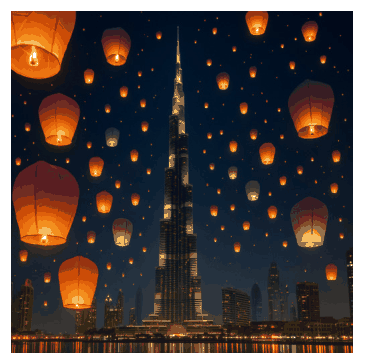
At 829.8 m, Dubai’s Burj Khalifa is the world's tallest structure. To simplify construction, many floors were made from similar pieces. Some artificial "molecular skyscrapers" can be made through coordination chemistry of just two pieces: metal ions and organic ligands.
In these 3D structures, every vertex contains a square planar \(\ce{Pd}\)(II) ion coordinated to four pyridine ligands. Along each edge is a bent organic ligand consisting of two pyridines linked together.
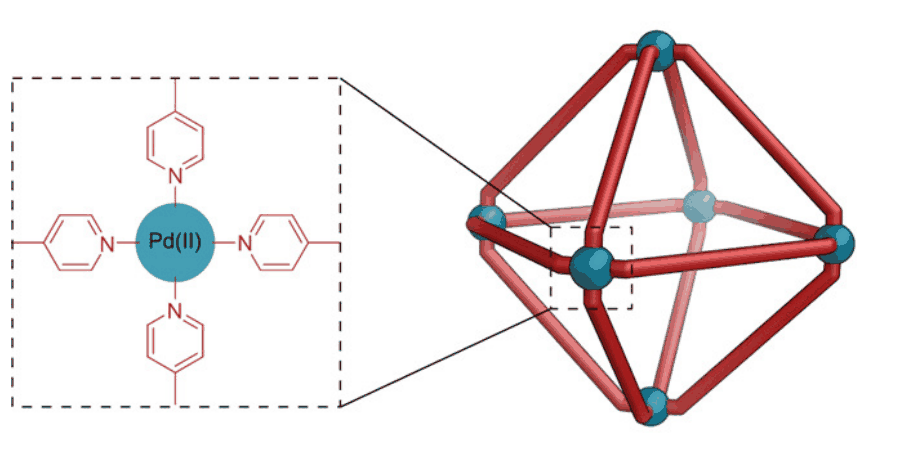
The angle between the two \(\ce{N -> Pd}\) bonds from the same ligand controls which structure forms. Larger angles give larger structures.
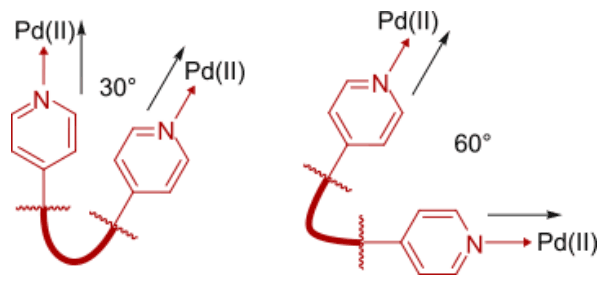
Where free rotation around a bond is possible, the ligand adopts a conformation to form a structure with the smallest possible angle.
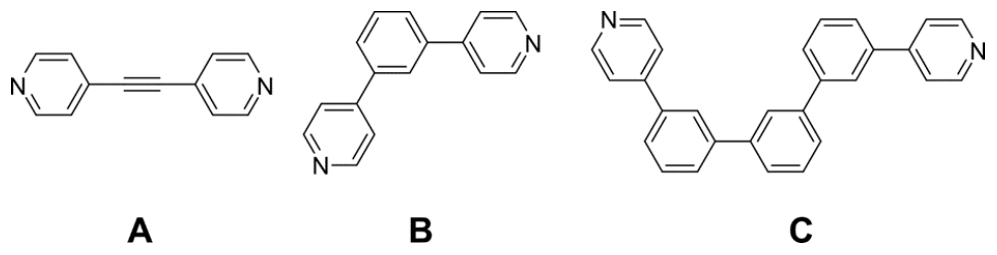
3.1 Tick the smallest angle (approximately) between the \(\ce{N -> Pd}\) bonds which could be achieved by ligands A, B, and C.
3.2 Using “<”, rank ligands D, E, and F, from smallest angle to largest angle between the \(\ce{N -> Pd}\) bonds that they could form.

One series of structures can be modelled as polyhedra with tetracoordinated \(\ce{Pd}\)(II) ions at the vertices. All structures have eight triangular faces (\(F_3\)), with various numbers of square faces (\(F_4\)).
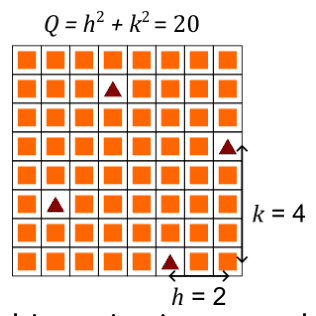
The triangular and square faces can be placed onto a square grid, where the relative position of two nearest triangles is described with integer coordinates \(h\) and \(k\). \(Q\) is then given by the equation:
\[ Q=h^2+k^2 \]
Part of the grid for a structure with \(h=2\) and \(k=4\) is shown below.
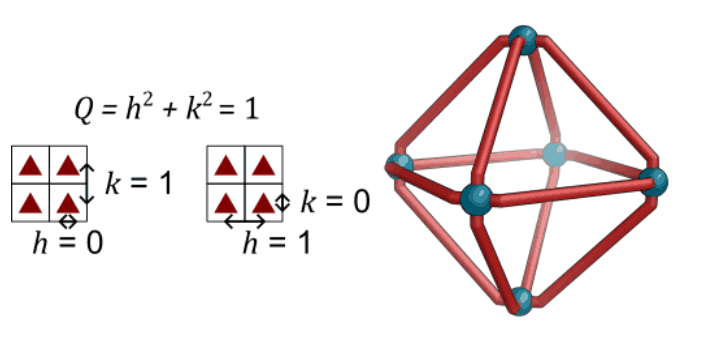
The smallest possible structure in this series is an octahedron, where \(Q=1\), and \((h,k)=(0,1)\) or \((1,0)\). It has six vertices, eight triangular faces, and 12 edges. Nearest triangles are a move of one face in one direction apart.
The second smallest structure is a cuboctahedron, where \(Q=2\). Nearest triangles are a move of one face in each direction apart.
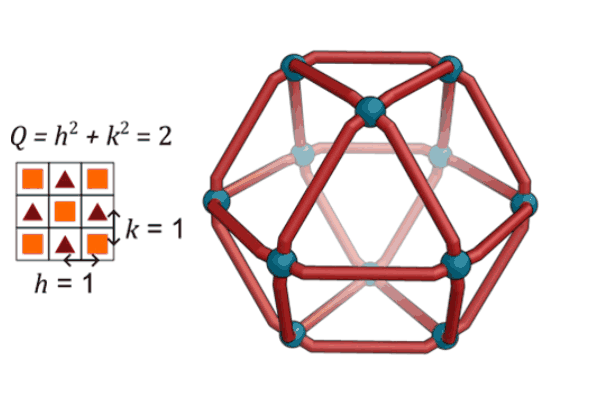
3.3 Complete the column in the table for \(Q=2\), describing the number of vertices, \(V\), number of edges \(E\), the total number of faces, \(F\), and the number of square faces, \(F_4\).
| \(Q\) | 1 | 2 |
|---|---|---|
| \((h,k)\) | \((0,1)\) or \((1,0)\) | \((1,1)\) |
| \(V\) | 6 | |
| \(E\) | 12 | |
| \(F\) | 8 | |
| \(F_3\) | 8 | 8 |
| \(F_4\) | 0 |
All structures obey the following rules:
\[ V-E+F=2 \]
\[ V=6Q \]
\[ F-V=2 \]
3.4 Complete the table for the third smallest structure, where \(Q=4\).
| \(Q\) | 4 |
|---|---|
| \((h,k)\) | |
| \(V\) | |
| \(E\) | |
| \(F\) | |
| \(F_3\) | 8 |
| \(F_4\) |
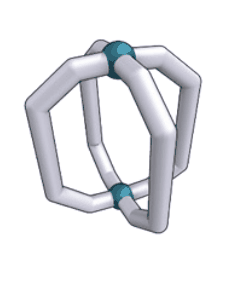
In contrast to these large structures, the smallest structures contain two metals and four ligands and are called lanterns. They are similar in shape to the traditional lanterns seen at the Dubai light festival. Lanterns are formed by ligands such as L, which make two parallel \(\ce{N -> Pd}\) bonds. Ligand L has two planes of symmetry and can adopt a planar conformation with the angles shown.
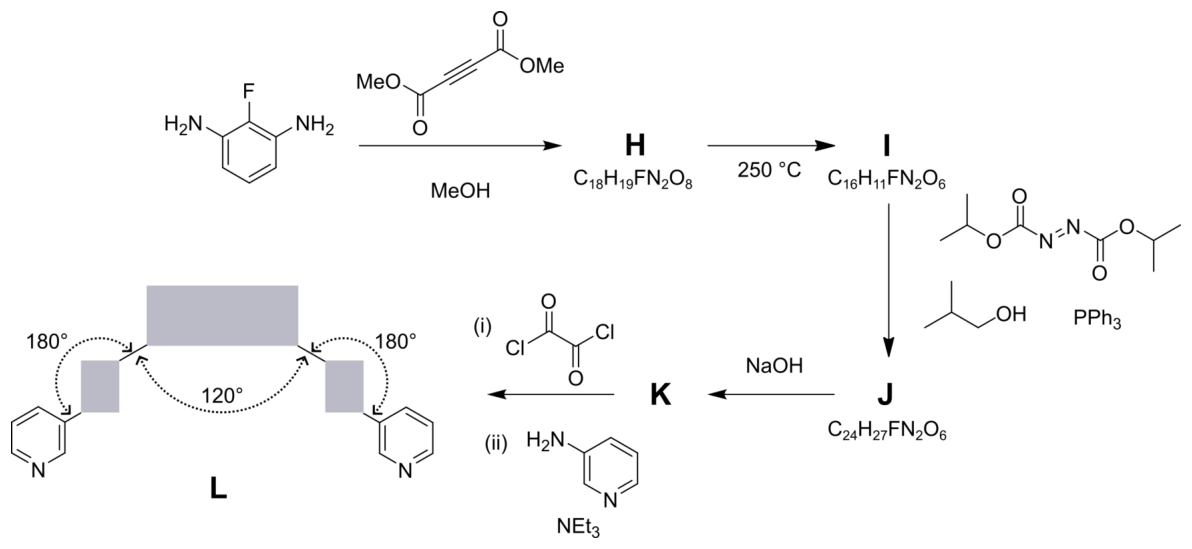
Hint:
- The transformation from H to I could also be achieved by Lewis acid catalysis.
3.5 Draw the structures of compounds H, I, J, K, and ligand L.
Unlike symmetrical ligand L, chiral ligand M lacks symmetry and exists as a pair of \(R\) and \(S\) enantiomers.
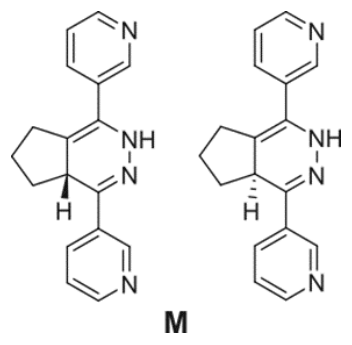
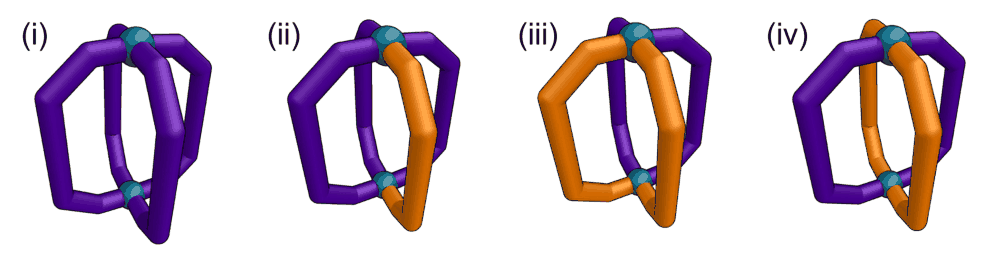
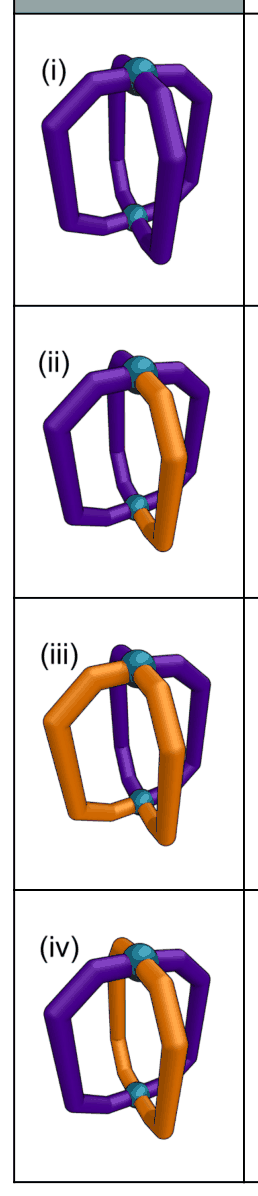
Multiple lantern isomers can be formed from ligand M. We can group these isomers in two ways. Firstly we categorise by the number of each type of ligand in the lantern: (i) all the same (\(RRRR\) or \(SSSS\)), (ii) one different (\(RRRS\) or \(SSSR\)), (iii) cis-\(RRSS\), and (iv) trans-\(RSRS\).
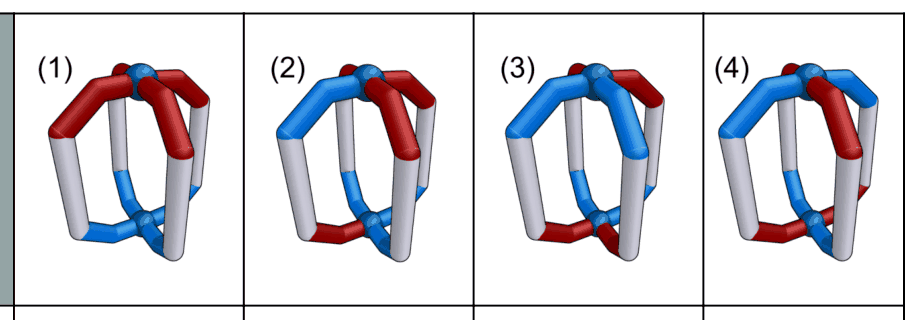
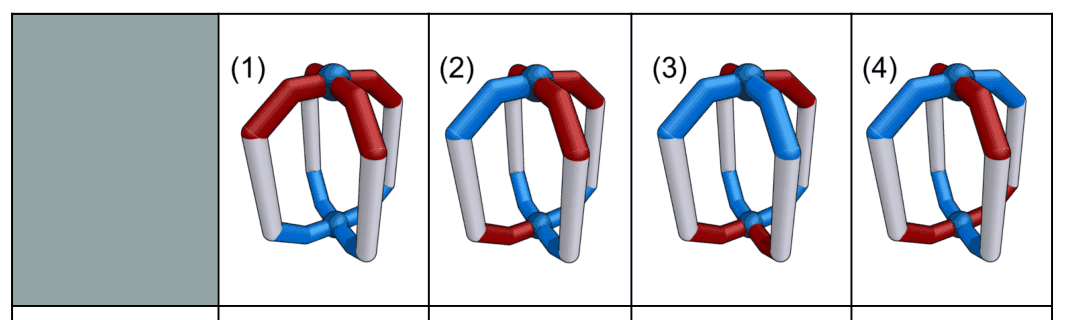
Secondly, the two ends of ligand M are not the same; the ligand has a head (H) and a tail (T). There are four categories of structure considering head-to-tail orientation: (1) all up (HHHH), (2) three up (HHHT), (3) cis-HHTT, and (4) trans-HTHT.
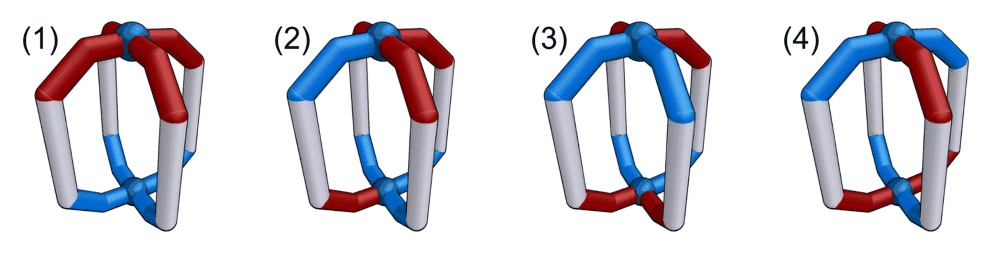
The 16 possible combinations of these categories are represented by empty cells in the table. Some combinations have only one possible isomer, whereas others have multiple possible isomers. In any one combination, all possible isomers are either chiral or achiral.
3.6 Complete the table by writing "C" for chiral and "A" for achiral. Note, in this part you will be awarded points for each correct answer but deducted points for each incorrect answer down to a minimum of zero. There is no penalty for empty cells.
| (1) | (2) | (3) | (4) | |
|---|---|---|---|---|
| (i) | ||||
| (ii) | ||||
| (iii) | ||||
| (iv) |
3.7 Complete the table with the number of possible isomers of each combination.

| (1) | (2) | (3) | (4) | |
|---|---|---|---|---|
| (i) | 2 | |||
| (ii) | 4 | |||
| (iii) | ||||
| (iv) |
Official English text of the problem.
Answers
-
3.1: \(\boxed{A:180^\circ,\quad B:120^\circ,\quad C:0^\circ}\).
-
3.2: \(\boxed{F<D<E}\).
-
3.3: \(\boxed{V=12,\ E=24,\ F=14,\ F_4=6}\).
-
3.4: \(\boxed{(h,k)=(0,2)\text{ or }(2,0),\ V=24,\ E=48,\ F=26,\ F_3=8,\ F_4=18}\).
-
3.5: The following structures specify the required drawings.
H — Tetramethyl (2Z,2′Z)-2,2′-[(2-fluorobenzene-1,3-diyl)bis(azanediyl)]bis(but-2-enedioate), the double aza-Michael adduct:
COC(=O)/C=C(\Nc1cccc(N/C(=C\C(=O)OC)C(=O)OC)c1F)C(=O)OC
I — Dimethyl 9-fluoro-4,5-dihydroxy-1,8-diazaanthracene-2,7-dicarboxylate, shown in its hydroxy tautomer:
COC(=O)c1cc(O)c2cc3c(O)cc(C(=O)OC)nc3c(F)c2n1
J — Dimethyl 9-fluoro-4,5-bis(2-methylpropoxy)-1,8-diazaanthracene-2,7-dicarboxylate:
COC(=O)c1cc(OCC(C)C)c2cc3c(OCC(C)C)cc(C(=O)OC)nc3c(F)c2n1
K — 9-Fluoro-4,5-bis(2-methylpropoxy)-1,8-diazaanthracene-2,7-dicarboxylic acid, after acid work-up:
O=C(O)c1cc(OCC(C)C)c2cc3c(OCC(C)C)cc(C(=O)O)nc3c(F)c2n1
L — 9-Fluoro-4,5-bis(2-methylpropoxy)-\(N^2,N^7\)-bis(pyridin-3-yl)-1,8-diazaanthracene-2,7-dicarboxamide:
O=C(Nc1cccnc1)c1cc(OCC(C)C)c2cc3c(OCC(C)C)cc(C(=O)Nc4cccnc4)nc3c(F)c2n1
- 3.6: Columns and rows follow the problem’s numbering.
| Ligand configurations | (1) HHHH | (2) HHHT | (3) cis-HHTT | (4) trans-HTHT |
|---|---|---|---|---|
| (i) RRRR or SSSS | C | C | C | C |
| (ii) RRRS or SSSR | C | C | C | C |
| (iii) cis-RRSS | A | C | A | C |
| (iv) trans-RSRS | A | C | A | A |
- 3.7: Enantiomers are counted separately.
| Ligand configurations | (1) HHHH | (2) HHHT | (3) cis-HHTT | (4) trans-HTHT |
|---|---|---|---|---|
| (i) RRRR or SSSS | 2 | 2 | 2 | 2 |
| (ii) RRRS or SSSR | 2 | 8 | 4 | 2 |
| (iii) cis-RRSS | 1 | 4 | 3 | 2 |
| (iv) trans-RSRS | 1 | 2 | 1 | 1 |
There are 39 stereoisomers: 7 achiral structures and 16 enantiomeric pairs.
Solution
3.1 — Minimum angles
The donor direction of a 4-pyridyl group lies along the line joining its nitrogen and its para substituent. Rotating that ring about its attachment bond therefore does not change the donor direction.
-
A, 1,2-bis(pyridin-4-yl)ethyne,
n1ccc(C#Cc2ccncc2)cc1, has a linear ethynyl connection. Its two donor vectors point in opposite directions: \[ \boxed{\theta_A=180^\circ}. \] -
B, 1,3-bis(pyridin-4-yl)benzene,
c1cc(-c2ccncc2)cc(-c2ccncc2)c1, has two outward substituent directions separated by approximately \(120^\circ\) at the central meta-substituted benzene: \[ \boxed{\theta_B=120^\circ}. \] -
C, 1,3-bis[3-(pyridin-4-yl)phenyl]benzene,
c1cc(-c2cccc(-c3ccncc3)c2)cc(-c2cccc(-c3ccncc3)c2)c1, contains three meta-phenylene bends. Rotation about the inter-ring single bonds permits a folded conformation in which the successive \(60^\circ\) changes of chain direction all have the same sense. The terminal donor vectors then point in the same direction: \[ \boxed{\theta_C=0^\circ}. \]
For the required drawing of C’s minimum-angle conformation, fold the aromatic chain into a U-shaped arrangement with the two terminal \(\ce{N -> Pd}\) arrows parallel and pointing the same way.
3.2 — Heterocycle-dependent angles
The ligands are:
| Ligand | Name | SMILES |
|---|---|---|
| D | 2,5-Bis(pyridin-4-yl)thiophene | s1c(-c2ccncc2)ccc1-c1ccncc1 |
| E | 2,5-Bis(pyridin-4-yl)selenophene | [se]1c(-c2ccncc2)ccc1-c1ccncc1 |
| F | 2,5-Bis(pyridin-4-yl)furan | o1c(-c2ccncc2)ccc1-c1ccncc1 |
The internal \(\ce{C-X-C}\) angle at the heteroatom decreases in the order oxygen, sulfur, selenium. The outward directions of the two pyridyl substituents consequently spread farther apart.
In an idealized trigonal-carbon construction, their angle is approximately
\[ \theta_{\text{donors}}\simeq240^\circ-\angle\ce{C-X-C}. \]
Thus,
\[ \boxed{F<D<E}. \]
3.3 — Cuboctahedron
The metal is palladium(II), [Pd+2]; its four donors are pyridine nitrogens, with pyridine represented by n1ccccc1. The local coordination geometry is square planar.
Each vertex has degree four. Counting edge ends gives
\[ 4V=2E,\qquad E=2V. \]
Euler’s equation then gives
\[ F=2-V+E=V+2. \]
Since eight faces are triangular,
\[ F_4=F-8=V-6. \]
For \(Q=2\),
\[ V=6Q=12,\qquad E=24,\qquad F=14,\qquad F_4=6. \]
The completed column is therefore:
| Quantity | \(Q=2\) |
|---|---|
| \((h,k)\) | \((1,1)\) |
| \(V\) | 12 |
| \(E\) | 24 |
| \(F\) | 14 |
| \(F_3\) | 8 |
| \(F_4\) | 6 |
3.4 — Third-smallest structure
For nonnegative grid coordinates,
\[ h^2+k^2=4 \]
has the solutions \((0,2)\) and \((2,0)\). Reversing coordinate directions gives equivalent signed choices.
Using the same relations,
\[ V=6(4)=24,\qquad E=2(24)=48, \]
\[ F=24+2=26,\qquad F_4=26-8=18. \]
These are the counts of a rhombicuboctahedron.
3.5 — Synthesis and structural identification
The SMILES in Answers specify the connectivity of each product.
Formation of H. The starting materials are 2-fluorobenzene-1,3-diamine, Nc1cccc(N)c1F, and dimethyl acetylenedicarboxylate, COC(=O)C#CC(=O)OC.
Each amino group adds across one electron-poor alkyne. Nitrogen attacks an alkyne carbon, and proton transfer gives an enamine arm:
\[ \ce{Ar-NH-C(CO2Me)=CH-CO2Me}. \]
Thus two equivalents of the alkyne are incorporated without elimination:
\[ \ce{C6H7FN2 + 2 C6H6O4 -> C18H19FN2O8}. \]
This reproduces H’s supplied molecular formula. Draw two identical enamine arms on the original amino nitrogens. In the cyclization-competent arrangement, each nitrogen and the distal ester are on the same side of the alkene.
Formation of I. Each enamine arm cyclizes at the unoccupied ortho position of its attached benzene ring. Fluorine occupies the other ortho position.
The aromatic carbon forms a bond to the distal ester carbonyl carbon, closing a six-membered ring. Acyl substitution and proton transfer eliminate methanol, CO, and produce a quinolin-4-one unit. Its hydroxy tautomer is a 4-hydroxyquinoline unit.
Both sides undergo this reaction:
\[ \ce{C18H19FN2O8 ->[\Delta] C16H11FN2O6 + 2 CH3OH}. \]
The formula difference is exactly two methanol molecules. The two new rings share opposite edges of the original benzene, giving the linear 1,8-diazaanthracene framework. Lewis acid activation of the ester carbonyl provides the alternative cyclization route mentioned in the hint.
For the drawing, retain fluorine on the central ring; place ester groups at positions 2 and 7 and hydroxy groups at positions 4 and 5. The corresponding doubly lactamized tautomer represents the same tautomeric system.
Formation of J. I assign this as Mitsunobu etherification of both hydroxy groups with 2-methylpropan-1-ol, CC(C)CO.
The reagents are triphenylphosphine, P(c1ccccc1)(c1ccccc1)c1ccccc1, and diisopropyl azodicarboxylate, CC(C)OC(=O)N=NC(=O)OC(C)C.
Each hydroxy oxygen attacks the activated primary alcohol carbon, installing
\[ \ce{-O-CH2-CH(CH3)2}. \]
Replacing two hydroxy hydrogens with two isobutyl groups adds \(\ce{C8H16}\):
\[ \ce{C16H11FN2O6 -> C24H27FN2O6}. \]
The complete Mitsunobu material balance is
\[ \begin{aligned} &\ce{C16H11FN2O6 + 2 C4H10O + 2 C18H15P + 2 C8H14N2O4}\\ &\qquad\ce{-> C24H27FN2O6 + 2 C18H15OP + 2 C8H16N2O4}. \end{aligned} \]
The additional products are triphenylphosphine oxide, O=P(c1ccccc1)(c1ccccc1)c1ccccc1, and diisopropyl hydrazine-1,2-dicarboxylate, CC(C)OC(=O)NNC(=O)OC(C)C.
Formation of K. Hydroxide, [OH-], saponifies the two methyl esters:
\[ \ce{C24H27FN2O6 + 2 OH- -> C22H21FN2O6^{2-} + 2 CH3OH}. \]
The resulting dicarboxylate is
O=C([O-])c1cc(OCC(C)C)c2cc3c(OCC(C)C)cc(C(=O)[O-])nc3c(F)c2n1
Acidification with protons, [H+], gives the diacid K:
\[ \ce{C22H21FN2O6^{2-} + 2 H+ -> C22H23FN2O6}. \]
The alkoxy substituents remain intact.
Formation of L. Oxalyl chloride, O=C(Cl)C(=O)Cl, first converts both carboxylic acids to acid chlorides:
\[ \ce{C22H23FN2O6 + 2 (COCl)2 -> C22H21Cl2FN2O4 + 2 CO + 2 CO2 + 2 HCl}. \]
The intermediate is K’s dicarbonyl dichloride:
O=C(Cl)c1cc(OCC(C)C)c2cc3c(OCC(C)C)cc(C(=O)Cl)nc3c(F)c2n1
The byproducts are carbon monoxide, [C-]#[O+], carbon dioxide, O=C=O, and hydrogen chloride, Cl.
Reaction with two equivalents of pyridin-3-amine, Nc1cccnc1, forms the two amides. Triethylamine, CCN(CC)CC, captures the hydrogen chloride:
\[ \ce{C22H21Cl2FN2O4 + 2 C5H6N2 + 2 NEt3 -> C32H31FN6O4 + 2 [HNEt3]Cl}. \]
Triethylammonium chloride is CC[NH+](CC)CC.[Cl-].
Each terminal connection in L must therefore be
\[ \ce{core-C(=O)-NH-(pyridin-3-yl)}. \]
For the requested ligand drawing, place the two amide–pyridyl arms as mirror-related arms on the fused core. Use the indicated \(120^\circ\) relationship between the core’s exit directions and the indicated \(180^\circ\) arrangements in the arms. Orient the terminal pyridine rings so that their two \(\ce{N -> Pd}\) vectors are parallel. These conformational choices are not encoded by ordinary connectivity SMILES.
3.6 — Chirality of the lanterns
The supplied ligand M is a cyclopentane-fused dipyridyl dihydropyridazine. Its enantiomers can be represented as:
- \(R\)-M:
C1(c2cccnc2)=C2CCC[C@H]2C(c2cccnc2)=NN1 - \(S\)-M:
C1(c2cccnc2)=C2CCC[C@@H]2C(c2cccnc2)=NN1
Number the four ligand positions \(0,1,2,3\) around the metal–metal axis. At each position record two attributes: \(R/S\), and whether the head or tail lies at the upper metal.
There are eight proper rotations that can identify arrangements:
- Four rotations about the metal–metal axis, giving cyclic permutations.
- Four half-turns about perpendicular axes. These reverse cyclic order and interchange upper and lower ends, so they also interchange H and T.
Proper rotations never interchange \(R\) and \(S\).
To test chirality, reflect the cage through its equatorial plane. This interchanges \(R\leftrightarrow S\) and H\(\leftrightarrow\)T at every position. An arrangement is achiral precisely when a proper rotation superposes it on this reflected arrangement.
For rows (i) and (ii), reflection changes the numbers of \(R\) and \(S\) ligands. A rotation cannot undo that change. Every entry in these rows is therefore C.
For the two balanced rows:
- HHHH: Both cis-RRSS and trans-RSRS permit a vertical reflection exchanging the appropriate \(R\) and \(S\) positions. Both are A.
- HHHT: The unique reversed ligand prevents a symmetry operation from exchanging all \(R\) and \(S\) positions while preserving the head pattern. Both are C.
- cis-HHTT: With cis-RRSS, inversion exchanges both pairs of attributes correctly. With trans-RSRS, a suitable vertical reflection does so. Both are A.
- trans-HTHT: The cis-RRSS combination lacks the required improper symmetry and is C. The trans-RSRS combination has an improper fourfold rotation, \(S_4\), and is A.
The last case illustrates why absence of an obvious mirror plane alone does not establish chirality: an \(S_4\) operation also makes a structure achiral.
3.7 — Number of isomers
We identify arrangements only under the eight proper rotations described above. Mirror-related structures remain separate unless superposable.
Before rotational identification, the numbers of head patterns in columns (1)–(4) are
\[ \mathbf n=(2,8,4,2). \]
These count HHHH/TTTT, the eight three-to-one patterns, the four adjacent two-to-two patterns, and the two alternating patterns.
Row (i): all configurations the same.
For fixed RRRR, all head patterns within each column are equivalent under rotations. Thus there is one arrangement per column. SSSS supplies its distinct enantiomer:
\[ \boxed{(2,2,2,2)}. \]
Row (ii): one configuration different.
Fix the position of the unique \(S\) ligand in RRRS. Two proper rotations preserve this \(R/S\) pattern: the identity and a perpendicular half-turn through the unique ligand and the opposite ligand.
The half-turn complements the head pattern and fixes none of the labeled head assignments. There are consequently \(\mathbf n/2\) arrangements for RRRS. The SSSR enantiomeric composition doubles this:
\[ \boxed{(2,8,4,2)}. \]
Row (iii): cis-RRSS.
Fix the cyclic pattern RRSS. Its preserving rotation group has two elements. The nonidentity element exchanges the two \(R\) positions, exchanges the two \(S\) positions, and complements H/T.
Its numbers of fixed head assignments are
\[ \mathbf f=(0,0,2,2). \]
Burnside’s counting formula gives
\[ \frac{\mathbf n+\mathbf f}{2} = \frac{(2,8,4,2)+(0,0,2,2)}2 = \boxed{(1,4,3,2)}. \]
Row (iv): trans-RSRS.
The alternating \(R/S\) pattern has four preserving proper rotations. Apart from the identity, the axial half-turn fixes
\[ \mathbf g=(2,0,0,2) \]
head assignments. Neither perpendicular half-turn fixes a head assignment, because each would have to complement H/T at a position it leaves fixed.
Thus,
\[ \frac{\mathbf n+\mathbf g}{4} = \frac{(2,8,4,2)+(2,0,0,2)}4 = \boxed{(1,2,1,1)}. \]
As an independent check, there are initially \(2^4\times2^4=256\) labeled assignments. Burnside’s formula over all eight proper rotations gives
\[ N=\frac{256+2(4)+16+2(0)+2(16)}8 =\boxed{39}. \]
Summing the entries marked A gives seven achiral structures. The remaining \(39-7=32\) structures form sixteen enantiomeric pairs.
The answers were checked against the official answers published by the organisers.
IChO 2025 · Theorieaufgabe 3
Laternen und der Burj Khalifa
7.5% der Gesamtpunktzahl
| 3.1 | 3.2 | 3.3 | 3.4 | 3.5 | 3.6 | 3.7 | Gesamt |
|---|---|---|---|---|---|---|---|
| 6 | 4 | 4 | 5 | 40 | 20 | 32 | 111 |
Mit 829.8 m ist der Burj Khalifa in Dubai das höchste Bauwerk der Welt. Um den Bau zu vereinfachen, wurden viele Stockwerke aus ähnlichen Bauteilen errichtet. Einige künstliche „molekulare Wolkenkratzer“ lassen sich mithilfe der Koordinationschemie aus nur zwei Bausteinen herstellen: Metallionen und organischen Liganden.
In diesen dreidimensionalen Strukturen befindet sich an jeder Ecke ein quadratisch-planar koordiniertes \(\ce{Pd}\)(II)-Ion, das an vier Pyridinliganden gebunden ist. Entlang jeder Kante liegt ein gewinkelter organischer Ligand, der aus zwei miteinander verknüpften Pyridinen besteht.
Der Winkel zwischen den beiden \(\ce{N -> Pd}\)-Bindungen desselben Liganden bestimmt, welche Struktur entsteht. Größere Winkel führen zu größeren Strukturen.
Wenn eine freie Drehung um eine Bindung möglich ist, nimmt der Ligand eine Konformation ein, die eine Struktur mit dem kleinstmöglichen Winkel bildet.
3.1 Kreuzen Sie den kleinsten Winkel (ungefähr) zwischen den \(\ce{N -> Pd}\)-Bindungen an, der mit den Liganden A, B und C erreicht werden könnte.
3.2 Ordnen Sie die Liganden D, E und F unter Verwendung von „<“ nach dem kleinsten bis zum größten Winkel zwischen den \(\ce{N -> Pd}\)-Bindungen, den sie bilden könnten.
Eine Reihe von Strukturen lässt sich als Polyeder mit vierfach koordinierten \(\ce{Pd}\)(II)-Ionen an den Ecken modellieren. Alle Strukturen besitzen acht dreieckige Flächen (\(F_3\)) und unterschiedlich viele quadratische Flächen (\(F_4\)).
Die dreieckigen und quadratischen Flächen können auf einem quadratischen Gitter angeordnet werden, wobei die relative Lage zweier nächstgelegener Dreiecke durch ganzzahlige Koordinaten \(h\) und \(k\) beschrieben wird. \(Q\) ist dann durch folgende Gleichung gegeben:
\[ Q=h^2+k^2 \]
Ein Teil des Gitters für eine Struktur mit \(h=2\) und \(k=4\) ist unten dargestellt.
Die kleinstmögliche Struktur dieser Reihe ist ein Oktaeder mit \(Q=1\) und \((h,k)=(0,1)\) oder \((1,0)\). Es besitzt sechs Ecken, acht dreieckige Flächen und 12 Kanten. Nächstgelegene Dreiecke sind um einen Schritt von einer Fläche in einer Richtung voneinander entfernt.
Die zweitkleinste Struktur ist ein Kuboktaeder mit \(Q=2\). Nächstgelegene Dreiecke sind um einen Schritt von einer Fläche in jeder Richtung voneinander entfernt.
3.3 Vervollständigen Sie die Spalte der Tabelle für \(Q=2\) mit der Anzahl der Ecken \(V\), der Anzahl der Kanten \(E\), der Gesamtzahl der Flächen \(F\) und der Anzahl der quadratischen Flächen \(F_4\).
| \(Q\) | 1 | 2 |
|---|---|---|
| \((h,k)\) | \((0,1)\) oder \((1,0)\) | \((1,1)\) |
| \(V\) | 6 | |
| \(E\) | 12 | |
| \(F\) | 8 | |
| \(F_3\) | 8 | 8 |
| \(F_4\) | 0 |
Alle Strukturen erfüllen die folgenden Regeln:
\[ V-E+F=2 \]
\[ V=6Q \]
\[ F-V=2 \]
3.4 Vervollständigen Sie die Tabelle für die drittkleinste Struktur mit \(Q=4\).
| \(Q\) | 4 |
|---|---|
| \((h,k)\) | |
| \(V\) | |
| \(E\) | |
| \(F\) | |
| \(F_3\) | 8 |
| \(F_4\) |
Im Gegensatz zu diesen großen Strukturen enthalten die kleinsten Strukturen zwei Metallzentren und vier Liganden und werden als Laternen bezeichnet. Ihre Form ähnelt den traditionellen Laternen, die beim Lichterfestival in Dubai zu sehen sind. Laternen werden von Liganden wie L gebildet, die zwei parallele \(\ce{N -> Pd}\)-Bindungen ausbilden. Ligand L besitzt zwei Symmetrieebenen und kann eine planare Konformation mit den angegebenen Winkeln einnehmen.
Hinweis:
- Die Umwandlung von H zu I könnte auch durch Lewis-Säure-Katalyse erreicht werden.
3.5 Zeichnen Sie die Strukturen der Verbindungen H, I, J, K und des Liganden L.
Im Gegensatz zum symmetrischen Liganden L besitzt der chirale Ligand M keine Symmetrie und liegt als Paar von \(R\)- und \(S\)-Enantiomeren vor.
Aus Ligand M können mehrere Laternenisomere entstehen. Diese Isomere lassen sich auf zwei Arten gruppieren. Zunächst werden sie nach der Anzahl der jeweiligen Ligandentypen in der Laterne eingeteilt: (i) alle gleich (\(RRRR\) oder \(SSSS\)), (ii) einer verschieden (\(RRRS\) oder \(SSSR\)), (iii) cis-\(RRSS\) und (iv) trans-\(RSRS\).
Zweitens sind die beiden Enden des Liganden M nicht gleich; der Ligand besitzt einen Kopf (H) und einen Schwanz (T). Hinsichtlich der Kopf-Schwanz-Orientierung gibt es vier Strukturkategorien: (1) alle nach oben (HHHH), (2) drei nach oben (HHHT), (3) cis-HHTT und (4) trans-HTHT.
Die 16 möglichen Kombinationen dieser Kategorien sind durch leere Zellen in der Tabelle dargestellt. Bei manchen Kombinationen ist nur ein Isomer möglich, bei anderen sind mehrere Isomere möglich. Innerhalb einer Kombination sind alle möglichen Isomere entweder chiral oder achiral.
3.6 Vervollständigen Sie die Tabelle, indem Sie „C“ für chiral und „A“ für achiral eintragen. Beachten Sie: In diesem Teil erhalten Sie für jede richtige Antwort Punkte; für jede falsche Antwort werden jedoch Punkte abgezogen, bis zu einem Minimum von null Punkten. Für leere Zellen gibt es keinen Punktabzug.
| (1) | (2) | (3) | (4) | |
|---|---|---|---|---|
| (i) | ||||
| (ii) | ||||
| (iii) | ||||
| (iv) |
3.7 Vervollständigen Sie die Tabelle mit der Anzahl der möglichen Isomere jeder Kombination.
| (1) | (2) | (3) | (4) | |
|---|---|---|---|---|
| (i) | 2 | |||
| (ii) | 4 | |||
| (iii) | ||||
| (iv) |
Aufgabentext aus dem offiziellen englischen Text übersetzt.
Antworten
-
3.1: \(\boxed{A:180^\circ,\quad B:120^\circ,\quad C:0^\circ}\).
-
3.2: \(\boxed{F<D<E}\).
-
3.3: \(\boxed{V=12,\ E=24,\ F=14,\ F_4=6}\).
-
3.4: \(\boxed{(h,k)=(0,2)\text{ oder }(2,0),\ V=24,\ E=48,\ F=26,\ F_3=8,\ F_4=18}\).
-
3.5: Die folgenden Strukturen legen die geforderten Zeichnungen fest.
H — Tetramethyl-(2Z,2′Z)-2,2′-[(2-fluorbenzol-1,3-diyl)bis(azandiyl)]bis(but-2-endioat), das doppelte Aza-Michael-Addukt:
COC(=O)/C=C(\Nc1cccc(N/C(=C\C(=O)OC)C(=O)OC)c1F)C(=O)OC
I — Dimethyl-9-fluor-4,5-dihydroxy-1,8-diazaanthracen-2,7-dicarboxylat, dargestellt als Hydroxytautomer:
COC(=O)c1cc(O)c2cc3c(O)cc(C(=O)OC)nc3c(F)c2n1
J — Dimethyl-9-fluor-4,5-bis(2-methylpropoxy)-1,8-diazaanthracen-2,7-dicarboxylat:
COC(=O)c1cc(OCC(C)C)c2cc3c(OCC(C)C)cc(C(=O)OC)nc3c(F)c2n1
K — 9-Fluor-4,5-bis(2-methylpropoxy)-1,8-diazaanthracen-2,7-dicarbonsäure, nach saurer Aufarbeitung:
O=C(O)c1cc(OCC(C)C)c2cc3c(OCC(C)C)cc(C(=O)O)nc3c(F)c2n1
L — 9-Fluor-4,5-bis(2-methylpropoxy)-\(N^2,N^7\)-bis(pyridin-3-yl)-1,8-diazaanthracen-2,7-dicarboxamid:
O=C(Nc1cccnc1)c1cc(OCC(C)C)c2cc3c(OCC(C)C)cc(C(=O)Nc4cccnc4)nc3c(F)c2n1
- 3.6: Spalten und Zeilen folgen der Nummerierung der Aufgabe.
| Ligandenkonfigurationen | (1) HHHH | (2) HHHT | (3) cis-HHTT | (4) trans-HTHT |
|---|---|---|---|---|
| (i) RRRR oder SSSS | C | C | C | C |
| (ii) RRRS oder SSSR | C | C | C | C |
| (iii) cis-RRSS | A | C | A | C |
| (iv) trans-RSRS | A | C | A | A |
- 3.7: Enantiomere werden getrennt gezählt.
| Ligandenkonfigurationen | (1) HHHH | (2) HHHT | (3) cis-HHTT | (4) trans-HTHT |
|---|---|---|---|---|
| (i) RRRR oder SSSS | 2 | 2 | 2 | 2 |
| (ii) RRRS oder SSSR | 2 | 8 | 4 | 2 |
| (iii) cis-RRSS | 1 | 4 | 3 | 2 |
| (iv) trans-RSRS | 1 | 2 | 1 | 1 |
Es gibt 39 Stereoisomere: 7 achirale Strukturen und 16 Enantiomerenpaare.
Lösung
3.1 — Minimale Winkel
Die Donorrichtung einer 4-Pyridylgruppe liegt auf der Geraden, die ihr Stickstoffatom mit ihrem para-Substituenten verbindet. Eine Drehung dieses Rings um seine Verknüpfungsbindung ändert daher die Donorrichtung nicht.
-
A, 1,2-Bis(pyridin-4-yl)ethin,
n1ccc(C#Cc2ccncc2)cc1, besitzt eine lineare Ethinylverknüpfung. Seine beiden Donorvektoren zeigen in entgegengesetzte Richtungen: \[ \boxed{\theta_A=180^\circ}. \] -
B, 1,3-Bis(pyridin-4-yl)benzol,
c1cc(-c2ccncc2)cc(-c2ccncc2)c1, besitzt am zentralen meta-substituierten Benzol zwei nach außen gerichtete Substituentenrichtungen, die einen Winkel von ungefähr \(120^\circ\) einschließen: \[ \boxed{\theta_B=120^\circ}. \] -
C, 1,3-Bis[3-(pyridin-4-yl)phenyl]benzol,
c1cc(-c2cccc(-c3ccncc3)c2)cc(-c2cccc(-c3ccncc3)c2)c1, enthält drei durch meta-Phenyleneinheiten verursachte Knicke. Die Drehung um die Einfachbindungen zwischen den Ringen ermöglicht eine gefaltete Konformation, in der die aufeinanderfolgenden Änderungen der Kettenrichtung um \(60^\circ\) alle denselben Drehsinn haben. Die endständigen Donorvektoren zeigen dann in dieselbe Richtung: \[ \boxed{\theta_C=0^\circ}. \]
Für die geforderte Zeichnung der Konformation von C mit minimalem Winkel falten Sie die aromatische Kette zu einer U-förmigen Anordnung, bei der die beiden endständigen \(\ce{N -> Pd}\)-Pfeile parallel sind und in dieselbe Richtung zeigen.
3.2 — Vom Heterocyclus abhängige Winkel
Die Liganden sind:
| Ligand | Name | SMILES |
|---|---|---|
| D | 2,5-Bis(pyridin-4-yl)thiophen | s1c(-c2ccncc2)ccc1-c1ccncc1 |
| E | 2,5-Bis(pyridin-4-yl)selenophen | [se]1c(-c2ccncc2)ccc1-c1ccncc1 |
| F | 2,5-Bis(pyridin-4-yl)furan | o1c(-c2ccncc2)ccc1-c1ccncc1 |
Der innere \(\ce{C-X-C}\)-Winkel am Heteroatom nimmt in der Reihenfolge Sauerstoff, Schwefel, Selen ab. Die nach außen gerichteten Richtungen der beiden Pyridylsubstituenten spreizen sich folglich weiter auseinander.
In einer idealisierten Konstruktion mit trigonal angeordneten Bindungen an den Kohlenstoffatomen beträgt ihr Winkel ungefähr
\[ \theta_{\text{Donoren}}\simeq240^\circ-\angle\ce{C-X-C}. \]
Somit gilt:
\[ \boxed{F<D<E}. \]
3.3 — Kuboktaeder
Das Metall ist Palladium(II), [Pd+2]; seine vier Donoren sind Pyridinstickstoffatome, wobei Pyridin durch n1ccccc1 dargestellt wird. Die lokale Koordinationsgeometrie ist quadratisch-planar.
Jede Ecke hat den Grad vier. Das Zählen der Kantenenden ergibt
\[ 4V=2E,\qquad E=2V. \]
Aus dem eulerschen Polyedersatz folgt dann
\[ F=2-V+E=V+2. \]
Da acht Flächen dreieckig sind, gilt
\[ F_4=F-8=V-6. \]
Für \(Q=2\) gilt
\[ V=6Q=12,\qquad E=24,\qquad F=14,\qquad F_4=6. \]
Die vervollständigte Spalte lautet daher:
| Größe | \(Q=2\) |
|---|---|
| \((h,k)\) | \((1,1)\) |
| \(V\) | 12 |
| \(E\) | 24 |
| \(F\) | 14 |
| \(F_3\) | 8 |
| \(F_4\) | 6 |
3.4 — Drittkleinste Struktur
Für nichtnegative Gitterkoordinaten hat
\[ h^2+k^2=4 \]
die Lösungen \((0,2)\) und \((2,0)\). Die Umkehrung der Koordinatenrichtungen liefert äquivalente vorzeichenbehaftete Möglichkeiten.
Mit denselben Beziehungen erhält man
\[ V=6(4)=24,\qquad E=2(24)=48, \]
\[ F=24+2=26,\qquad F_4=26-8=18. \]
Dies sind die Anzahlen eines Rhombenkuboktaeders.
3.5 — Synthese und Strukturaufklärung
Die SMILES unter Antworten geben die Konnektivität jedes Produkts an.
Bildung von H. Die Ausgangsstoffe sind 2-Fluorbenzol-1,3-diamin, Nc1cccc(N)c1F, und Dimethylacetylendicarboxylat, COC(=O)C#CC(=O)OC.
Jede Aminogruppe addiert an ein elektronenarmes Alkin. Der Stickstoff greift ein Alkinkohlenstoffatom an, und eine Protonenübertragung liefert einen Enaminarm:
\[ \ce{Ar-NH-C(CO2Me)=CH-CO2Me}. \]
Somit werden zwei Äquivalente des Alkins ohne Abspaltung eingebaut:
\[ \ce{C6H7FN2 + 2 C6H6O4 -> C18H19FN2O8}. \]
Dies ergibt die angegebene Summenformel von H. Zeichnen Sie zwei identische Enaminarme an den ursprünglichen Aminostickstoffatomen. In der zur Cyclisierung geeigneten Anordnung liegen jeweils der Stickstoff und die distale Estergruppe auf derselben Seite der Alkenbindung.
Bildung von I. Jeder Enaminarm cyclisiert an der unbesetzten ortho-Position des Benzolrings, an den er gebunden ist. Fluor besetzt die andere ortho-Position.
Das aromatische Kohlenstoffatom bildet eine Bindung zum Carbonylkohlenstoffatom der distalen Estergruppe, wodurch sich ein sechsgliedriger Ring schließt. Acylsubstitution und Protonenübertragung spalten Methanol, CO, ab und erzeugen eine Chinolin-4-on-Einheit. Ihr Hydroxytautomer ist eine 4-Hydroxychinolin-Einheit.
Beide Seiten durchlaufen diese Reaktion:
\[ \ce{C18H19FN2O8 ->[\Delta] C16H11FN2O6 + 2 CH3OH}. \]
Die Differenz der Summenformeln entspricht genau zwei Methanolmolekülen. Die beiden neuen Ringe teilen sich gegenüberliegende Kanten des ursprünglichen Benzolrings, wodurch das lineare 1,8-Diazaanthracengerüst entsteht. Die Aktivierung der Estercarbonylgruppe durch eine Lewis-Säure ermöglicht den im Hinweis erwähnten alternativen Cyclisierungsweg.
Belassen Sie für die Zeichnung das Fluor am zentralen Ring; setzen Sie Estergruppen an die Positionen 2 und 7 und Hydroxygruppen an die Positionen 4 und 5. Das entsprechende zweifache Lactamtautomer stellt dasselbe tautomere System dar.
Bildung von J. Ich ordne diesen Schritt als Mitsunobu-Veretherung beider Hydroxygruppen mit 2-Methylpropan-1-ol, CC(C)CO, zu.
Die Reagenzien sind Triphenylphosphin, P(c1ccccc1)(c1ccccc1)c1ccccc1, und Diisopropylazodicarboxylat, CC(C)OC(=O)N=NC(=O)OC(C)C.
Jedes Hydroxysauerstoffatom greift das aktivierte primäre Alkoholkohlenstoffatom an, wodurch die folgende Gruppe eingeführt wird:
\[ \ce{-O-CH2-CH(CH3)2}. \]
Der Ersatz zweier Hydroxywasserstoffatome durch zwei Isobutylgruppen fügt \(\ce{C8H16}\) hinzu:
\[ \ce{C16H11FN2O6 -> C24H27FN2O6}. \]
Die vollständige Stoffbilanz der Mitsunobu-Reaktion lautet
\[ \begin{aligned} &\ce{C16H11FN2O6 + 2 C4H10O + 2 C18H15P + 2 C8H14N2O4}\\ &\qquad\ce{-> C24H27FN2O6 + 2 C18H15OP + 2 C8H16N2O4}. \end{aligned} \]
Die weiteren Produkte sind Triphenylphosphinoxid, O=P(c1ccccc1)(c1ccccc1)c1ccccc1, und Diisopropylhydrazin-1,2-dicarboxylat, CC(C)OC(=O)NNC(=O)OC(C)C.
Bildung von K. Hydroxid, [OH-], verseift die beiden Methylester:
\[ \ce{C24H27FN2O6 + 2 OH- -> C22H21FN2O6^{2-} + 2 CH3OH}. \]
Das entstehende Dicarboxylat ist
O=C([O-])c1cc(OCC(C)C)c2cc3c(OCC(C)C)cc(C(=O)[O-])nc3c(F)c2n1
Ansäuern mit Protonen, [H+], ergibt die Dicarbonsäure K:
\[ \ce{C22H21FN2O6^{2-} + 2 H+ -> C22H23FN2O6}. \]
Die Alkoxysubstituenten bleiben unverändert.
Bildung von L. Oxalylchlorid, O=C(Cl)C(=O)Cl, wandelt zunächst beide Carbonsäuregruppen in Säurechloridgruppen um:
\[ \ce{C22H23FN2O6 + 2 (COCl)2 -> C22H21Cl2FN2O4 + 2 CO + 2 CO2 + 2 HCl}. \]
Das Zwischenprodukt ist das Dicarbonsäuredichlorid von K:
O=C(Cl)c1cc(OCC(C)C)c2cc3c(OCC(C)C)cc(C(=O)Cl)nc3c(F)c2n1
Die Nebenprodukte sind Kohlenstoffmonoxid, [C-]#[O+], Kohlenstoffdioxid, O=C=O, und Chlorwasserstoff, Cl.
Die Reaktion mit zwei Äquivalenten Pyridin-3-amin, Nc1cccnc1, bildet die beiden Amide. Triethylamin, CCN(CC)CC, fängt den Chlorwasserstoff ab:
\[ \ce{C22H21Cl2FN2O4 + 2 C5H6N2 + 2 NEt3 -> C32H31FN6O4 + 2 [HNEt3]Cl}. \]
Triethylammoniumchlorid ist CC[NH+](CC)CC.[Cl-].
Jede endständige Verknüpfung in L muss daher wie folgt aussehen:
\[ \ce{core-C(=O)-NH-(pyridin-3-yl)}. \]
Ordnen Sie für die geforderte Ligandenzeichnung die beiden Amid–Pyridyl-Arme spiegelbildlich am anellierten Grundgerüst an. Verwenden Sie den angegebenen Winkel von \(120^\circ\) zwischen den vom Grundgerüst ausgehenden Richtungen und die angegebenen \(180^\circ\)-Anordnungen in den Armen. Richten Sie die endständigen Pyridinringe so aus, dass ihre beiden \(\ce{N -> Pd}\)-Vektoren parallel sind. Diese Konformationsentscheidungen werden durch gewöhnliche Konnektivitäts-SMILES nicht codiert.
3.6 — Chiralität der Laternen
Der angegebene Ligand M ist ein mit Cyclopentan anelliertes Dipyridyldihydropyridazin. Seine Enantiomere lassen sich wie folgt darstellen:
- \(R\)-M:
C1(c2cccnc2)=C2CCC[C@H]2C(c2cccnc2)=NN1 - \(S\)-M:
C1(c2cccnc2)=C2CCC[C@@H]2C(c2cccnc2)=NN1
Nummerieren Sie die vier Ligandenpositionen um die Metall–Metall-Achse mit \(0,1,2,3\). Halten Sie an jeder Position zwei Merkmale fest: \(R/S\) und ob sich der Kopf oder der Schwanz am oberen Metallzentrum befindet.
Es gibt acht eigentliche Drehungen, durch die Anordnungen als identisch erkannt werden können:
- Vier Drehungen um die Metall–Metall-Achse, die zyklische Permutationen ergeben.
- Vier Halbdrehungen um dazu senkrechte Achsen. Diese kehren die zyklische Reihenfolge um und vertauschen die oberen und unteren Enden, sodass sie auch H und T vertauschen.
Eigentliche Drehungen vertauschen niemals \(R\) und \(S\).
Um die Chiralität zu prüfen, spiegeln Sie den Käfig an seiner Äquatorialebene. Dadurch werden an jeder Position \(R\leftrightarrow S\) und H\(\leftrightarrow\)T vertauscht. Eine Anordnung ist genau dann achiral, wenn sie durch eine eigentliche Drehung mit dieser gespiegelten Anordnung zur Deckung gebracht werden kann.
Für die Zeilen (i) und (ii) verändert die Spiegelung die Anzahlen der \(R\)- und \(S\)-Liganden. Eine Drehung kann diese Änderung nicht rückgängig machen. Daher ist jeder Eintrag in diesen Zeilen C.
Für die beiden Zeilen mit gleichen Anzahlen:
- HHHH: Sowohl cis-RRSS als auch trans-RSRS erlauben eine Spiegelung an einer vertikalen Ebene, die die entsprechenden \(R\)- und \(S\)-Positionen vertauscht. Beide sind A.
- HHHT: Der einzige umgekehrte Ligand verhindert eine Symmetrieoperation, die alle \(R\)- und \(S\)-Positionen vertauscht und dabei das Kopfmuster erhält. Beide sind C.
- cis-HHTT: Bei cis-RRSS vertauscht eine Inversion beide Merkmalspaare korrekt. Bei trans-RSRS bewirkt eine geeignete Spiegelung an einer vertikalen Ebene dasselbe. Beide sind A.
- trans-HTHT: Der Kombination cis-RRSS fehlt die erforderliche uneigentliche Symmetrie; sie ist C. Die Kombination trans-RSRS besitzt eine vierzählige Drehspiegelung, \(S_4\), und ist A.
Der letzte Fall verdeutlicht, warum das Fehlen einer offensichtlichen Spiegelebene allein keine Chiralität belegt: Auch eine \(S_4\)-Operation macht eine Struktur achiral.
3.7 — Anzahl der Isomere
Wir setzen Anordnungen nur unter den acht oben beschriebenen eigentlichen Drehungen gleich. Spiegelbildliche Strukturen bleiben getrennt, sofern sie nicht zur Deckung gebracht werden können.
Vor der Gleichsetzung durch Drehungen betragen die Anzahlen der Kopfmuster in den Spalten (1)–(4)
\[ \mathbf n=(2,8,4,2). \]
Dabei werden HHHH/TTTT, die acht Drei-zu-eins-Muster, die vier benachbarten Zwei-zu-zwei-Muster und die zwei alternierenden Muster gezählt.
Zeile (i): alle Konfigurationen gleich.
Für festes RRRR sind alle Kopfmuster innerhalb jeder Spalte unter Drehungen äquivalent. Somit gibt es eine Anordnung pro Spalte. SSSS liefert jeweils das davon verschiedene Enantiomer:
\[ \boxed{(2,2,2,2)}. \]
Zeile (ii): eine Konfiguration verschieden.
Fixieren Sie die Position des einzigen \(S\)-Liganden in RRRS. Zwei eigentliche Drehungen erhalten dieses \(R/S\)-Muster: die Identität und eine Halbdrehung um eine senkrechte Achse durch den einzigen anders konfigurierten Liganden und den gegenüberliegenden Liganden.
Die Halbdrehung komplementiert das Kopfmuster und lässt keine der Zuordnungen an den nummerierten Positionen unverändert. Folglich gibt es \(\mathbf n/2\) Anordnungen für RRRS. Die enantiomere Zusammensetzung SSSR verdoppelt diese Anzahl:
\[ \boxed{(2,8,4,2)}. \]
Zeile (iii): cis-RRSS.
Fixieren Sie das zyklische Muster RRSS. Die Drehgruppe, die dieses Muster erhält, besitzt zwei Elemente. Das von der Identität verschiedene Element vertauscht die beiden \(R\)-Positionen, vertauscht die beiden \(S\)-Positionen und komplementiert H/T.
Die Anzahlen der dabei unveränderten Kopfzuordnungen betragen
\[ \mathbf f=(0,0,2,2). \]
Die Zählformel von Burnside ergibt
\[ \frac{\mathbf n+\mathbf f}{2} = \frac{(2,8,4,2)+(0,0,2,2)}2 = \boxed{(1,4,3,2)}. \]
Zeile (iv): trans-RSRS.
Das alternierende \(R/S\)-Muster wird von vier eigentlichen Drehungen erhalten. Neben der Identität lässt die axiale Halbdrehung
\[ \mathbf g=(2,0,0,2) \]
Kopfzuordnungen unverändert. Keine der beiden senkrechten Halbdrehungen lässt eine Kopfzuordnung unverändert, da jede H/T an einer Position komplementieren müsste, die sie festlässt.
Somit gilt:
\[ \frac{\mathbf n+\mathbf g}{4} = \frac{(2,8,4,2)+(2,0,0,2)}4 = \boxed{(1,2,1,1)}. \]
Als unabhängige Kontrolle gibt es anfangs \(2^4\times2^4=256\) Zuordnungen an nummerierten Positionen. Die Formel von Burnside über alle acht eigentlichen Drehungen ergibt
\[ N=\frac{256+2(4)+16+2(0)+2(16)}8 =\boxed{39}. \]
Die Summe der mit A gekennzeichneten Einträge ergibt sieben achirale Strukturen. Die verbleibenden \(39-7=32\) Strukturen bilden sechzehn Enantiomerenpaare.
Die Ergebnisse wurden mit den von den Veranstaltern veröffentlichten offiziellen Ergebnissen abgeglichen.
IChO 2025 · Teori sorusu 3
Fenerler ve Burj Khalifa
Toplam puanın %7.5'i
| 3.1 | 3.2 | 3.3 | 3.4 | 3.5 | 3.6 | 3.7 | Toplam |
|---|---|---|---|---|---|---|---|
| 6 | 4 | 4 | 5 | 40 | 20 | 32 | 111 |
Dubai'deki Burj Khalifa, 829.8 m yüksekliğiyle dünyanın en yüksek yapısıdır. İnşaatı kolaylaştırmak için birçok kat benzer parçalardan yapılmıştır. Bazı yapay "moleküler gökdelenler", yalnızca iki parçanın koordinasyon kimyası yoluyla oluşturulabilir: metal iyonları ve organik ligandlar.
Bu üç boyutlu yapılarda her köşede, dört piridin ligandına koordine olmuş kare düzlemsel bir \(\ce{Pd}\)(II) iyonu bulunur. Her kenar boyunca, birbirine bağlanmış iki piridinden oluşan bükülmüş bir organik ligand yer alır.
Aynı liganddan gelen iki \(\ce{N -> Pd}\) bağı arasındaki açı, hangi yapının oluşacağını belirler. Daha büyük açılar daha büyük yapılar verir.
Bir bağ etrafında serbest dönmenin mümkün olduğu durumlarda, ligand, mümkün olan en küçük açıya sahip bir yapı oluşturacak konformasyonu benimser.
3.1 A, B ve C ligandlarının sağlayabileceği \(\ce{N -> Pd}\) bağları arasındaki en küçük açıyı (yaklaşık olarak) işaretleyiniz.
3.2 “<” kullanarak D, E ve F ligandlarını, oluşturabilecekleri \(\ce{N -> Pd}\) bağları arasındaki açıya göre en küçükten en büyüğe sıralayınız.
Bir yapı serisi, köşelerinde dört koordinasyonlu \(\ce{Pd}\)(II) iyonları bulunan çokyüzlüler olarak modellenebilir. Tüm yapılarda sekiz üçgen yüz (\(F_3\)) ve farklı sayılarda kare yüz (\(F_4\)) bulunur.
Üçgen ve kare yüzler, en yakın iki üçgenin birbirine göre konumunun \(h\) ve \(k\) tamsayı koordinatlarıyla tanımlandığı bir kare ızgaraya yerleştirilebilir. Bu durumda \(Q\), şu denklemle verilir:
\[ Q=h^2+k^2 \]
\(h=2\) ve \(k=4\) olan bir yapıya ait ızgaranın bir bölümü aşağıda gösterilmiştir.
Bu seride mümkün olan en küçük yapı, \(Q=1\) ve \((h,k)=(0,1)\) veya \((1,0)\) olan bir oktahedrondur. Altı köşesi, sekiz üçgen yüzü ve 12 kenarı vardır. En yakın üçgenler, bir yönde bir yüzlük ilerleme kadar birbirinden uzaktadır.
İkinci en küçük yapı, \(Q=2\) olan bir küboktahedrondur. En yakın üçgenler, her iki yönde birer yüzlük ilerleme kadar birbirinden uzaktadır.
3.3 Tabloda \(Q=2\) için verilen sütunu; köşe sayısı \(V\), kenar sayısı \(E\), toplam yüz sayısı \(F\) ve kare yüz sayısı \(F_4\) değerlerini yazarak tamamlayınız.
| \(Q\) | 1 | 2 |
|---|---|---|
| \((h,k)\) | \((0,1)\) veya \((1,0)\) | \((1,1)\) |
| \(V\) | 6 | |
| \(E\) | 12 | |
| \(F\) | 8 | |
| \(F_3\) | 8 | 8 |
| \(F_4\) | 0 |
Tüm yapılar aşağıdaki kurallara uyar:
\[ V-E+F=2 \]
\[ V=6Q \]
\[ F-V=2 \]
3.4 \(Q=4\) olan üçüncü en küçük yapı için tabloyu tamamlayınız.
| \(Q\) | 4 |
|---|---|
| \((h,k)\) | |
| \(V\) | |
| \(E\) | |
| \(F\) | |
| \(F_3\) | 8 |
| \(F_4\) |
Bu büyük yapıların aksine, en küçük yapılar iki metal ve dört ligand içerir ve fener olarak adlandırılır. Şekilleri, Dubai ışık festivalinde görülen geleneksel fenerlere benzer. Fenerler, birbirine paralel iki \(\ce{N -> Pd}\) bağı oluşturan L gibi ligandlarla oluşur. L ligandının iki simetri düzlemi vardır ve gösterilen açılara sahip düzlemsel bir konformasyon benimseyebilir.
İpucu:
- H'den I'ya dönüşüm, Lewis asidi kataliziyle de gerçekleştirilebilir.
3.5 H, I, J, K bileşiklerinin ve L ligandının yapılarını çiziniz.
Simetrik L ligandının aksine, kiral M ligandı simetriden yoksundur ve bir \(R\) ve \(S\) enantiyomer çifti olarak bulunur.
M ligandından birden fazla fener izomeri oluşabilir. Bu izomerleri iki şekilde gruplandırabiliriz. İlk olarak, fenerdeki her bir ligand türünün sayısına göre sınıflandırırız: (i) hepsi aynı (\(RRRR\) veya \(SSSS\)), (ii) biri farklı (\(RRRS\) veya \(SSSR\)), (iii) cis-\(RRSS\) ve (iv) trans-\(RSRS\).
İkinci olarak, M ligandının iki ucu aynı değildir; ligandın bir başı (H) ve bir kuyruğu (T) vardır. Baş-kuyruk yönelimine göre dört yapı kategorisi bulunur: (1) hepsi yukarı (HHHH), (2) üçü yukarı (HHHT), (3) cis-HHTT ve (4) trans-HTHT.
Bu kategorilerin olası 16 kombinasyonu, tablodaki boş hücrelerle gösterilmiştir. Bazı kombinasyonlarda yalnızca bir izomer mümkünken diğerlerinde birden fazla izomer mümkündür. Herhangi bir kombinasyondaki olası izomerlerin tümü ya kiraldir ya da akiraldir.
3.6 Kiral için "C", akiral için "A" yazarak tabloyu tamamlayınız. Dikkat: Bu bölümde her doğru cevap için puan alacak, ancak her yanlış cevap için puan kaybedeceksiniz; alabileceğiniz en düşük puan sıfırdır. Boş hücreler için puan kesilmez.
| (1) | (2) | (3) | (4) | |
|---|---|---|---|---|
| (i) | ||||
| (ii) | ||||
| (iii) | ||||
| (iv) |
3.7 Her kombinasyonun olası izomer sayısını yazarak tabloyu tamamlayınız.
| (1) | (2) | (3) | (4) | |
|---|---|---|---|---|
| (i) | 2 | |||
| (ii) | 4 | |||
| (iii) | ||||
| (iv) |
Soru metni resmi İngilizce metinden çevrilmiştir.
Cevaplar
-
3.1: \(\boxed{A:180^\circ,\quad B:120^\circ,\quad C:0^\circ}\).
-
3.2: \(\boxed{F<D<E}\).
-
3.3: \(\boxed{V=12,\ E=24,\ F=14,\ F_4=6}\).
-
3.4: \(\boxed{(h,k)=(0,2)\text{ veya }(2,0),\ V=24,\ E=48,\ F=26,\ F_3=8,\ F_4=18}\).
-
3.5: Aşağıdaki yapılar, istenen çizimleri belirtmektedir.
H — Tetrametil (2Z,2′Z)-2,2′-[(2-florobenzen-1,3-diil)bis(azandiil)]bis(but-2-endioat), çift aza-Michael katılma ürünü:
COC(=O)/C=C(\Nc1cccc(N/C(=C\C(=O)OC)C(=O)OC)c1F)C(=O)OC
I — Dimetil 9-floro-4,5-dihidroksi-1,8-diazaantrasen-2,7-dikarboksilat, hidroksi tautomeriyle gösterilmiştir:
COC(=O)c1cc(O)c2cc3c(O)cc(C(=O)OC)nc3c(F)c2n1
J — Dimetil 9-floro-4,5-bis(2-metilpropoksi)-1,8-diazaantrasen-2,7-dikarboksilat:
COC(=O)c1cc(OCC(C)C)c2cc3c(OCC(C)C)cc(C(=O)OC)nc3c(F)c2n1
K — 9-Floro-4,5-bis(2-metilpropoksi)-1,8-diazaantrasen-2,7-dikarboksilik asit, asitle son işlemden sonra:
O=C(O)c1cc(OCC(C)C)c2cc3c(OCC(C)C)cc(C(=O)O)nc3c(F)c2n1
L — 9-Floro-4,5-bis(2-metilpropoksi)-\(N^2,N^7\)-bis(piridin-3-il)-1,8-diazaantrasen-2,7-dikarboksamit:
O=C(Nc1cccnc1)c1cc(OCC(C)C)c2cc3c(OCC(C)C)cc(C(=O)Nc4cccnc4)nc3c(F)c2n1
- 3.6: Sütunlar ve satırlar, sorudaki numaralandırmayı izlemektedir.
| Ligand konfigürasyonları | (1) HHHH | (2) HHHT | (3) cis-HHTT | (4) trans-HTHT |
|---|---|---|---|---|
| (i) RRRR veya SSSS | C | C | C | C |
| (ii) RRRS veya SSSR | C | C | C | C |
| (iii) cis-RRSS | A | C | A | C |
| (iv) trans-RSRS | A | C | A | A |
- 3.7: Enantiyomerler ayrı ayrı sayılmıştır.
| Ligand konfigürasyonları | (1) HHHH | (2) HHHT | (3) cis-HHTT | (4) trans-HTHT |
|---|---|---|---|---|
| (i) RRRR veya SSSS | 2 | 2 | 2 | 2 |
| (ii) RRRS veya SSSR | 2 | 8 | 4 | 2 |
| (iii) cis-RRSS | 1 | 4 | 3 | 2 |
| (iv) trans-RSRS | 1 | 2 | 1 | 1 |
39 stereoizomer vardır: 7 akiral yapı ve 16 enantiyomer çifti.
Çözüm
3.1 — En küçük açılar
Bir 4-piridil grubunun donör yönü, azot atomunu ve para konumundaki sübstitüentini birleştiren doğru boyunca uzanır. Dolayısıyla bu halkanın bağlandığı bağ etrafında döndürülmesi, donör yönünü değiştirmez.
-
A, 1,2-bis(piridin-4-il)etin,
n1ccc(C#Cc2ccncc2)cc1, doğrusal bir etinil bağlantısına sahiptir. İki donör vektörü zıt yönlere bakar: \[ \boxed{\theta_A=180^\circ}. \] -
B, 1,3-bis(piridin-4-il)benzen,
c1cc(-c2ccncc2)cc(-c2ccncc2)c1, merkezdeki meta-sübstitüe benzende aralarında yaklaşık \(120^\circ\) bulunan, dışa dönük iki sübstitüent yönüne sahiptir: \[ \boxed{\theta_B=120^\circ}. \] -
C, 1,3-bis[3-(piridin-4-il)fenil]benzen,
c1cc(-c2cccc(-c3ccncc3)c2)cc(-c2cccc(-c3ccncc3)c2)c1, üç meta-fenilen bükümü içerir. Halkalar arası tekli bağlar etrafındaki dönme, zincir yönündeki ardışık \(60^\circ\)'lik değişimlerin tümünün aynı yönde olduğu katlanmış bir konformasyona izin verir. Bu durumda uçlardaki donör vektörleri aynı yöne bakar: \[ \boxed{\theta_C=0^\circ}. \]
C'nin en küçük açılı konformasyonunun istenen çizimi için aromatik zinciri, uçlardaki iki \(\ce{N -> Pd}\) oku paralel ve aynı yöne bakacak şekilde U biçiminde katlayınız.
3.2 — Heterohalkaya bağlı açılar
Ligandlar şunlardır:
| Ligand | Adı | SMILES |
|---|---|---|
| D | 2,5-Bis(piridin-4-il)tiyofen | s1c(-c2ccncc2)ccc1-c1ccncc1 |
| E | 2,5-Bis(piridin-4-il)selenofen | [se]1c(-c2ccncc2)ccc1-c1ccncc1 |
| F | 2,5-Bis(piridin-4-il)furan | o1c(-c2ccncc2)ccc1-c1ccncc1 |
Heteroatomdaki iç \(\ce{C-X-C}\) açısı, oksijen, kükürt, selenyum sırasıyla azalır. Bunun sonucunda iki piridil sübstitüentinin dışa dönük yönleri birbirinden daha fazla uzaklaşır.
Karbonların üçgen geometrili kabul edildiği idealleştirilmiş bir modelde, aralarındaki açı yaklaşık olarak
\[ \theta_{\text{donörler}}\simeq240^\circ-\angle\ce{C-X-C}. \]
olur. Dolayısıyla,
\[ \boxed{F<D<E}. \]
3.3 — Küboktahedron
Metal, paladyum(II), [Pd+2], olup dört donörü piridin azotlarıdır; piridin n1ccccc1 ile gösterilir. Yerel koordinasyon geometrisi kare düzlemseldir.
Her köşenin derecesi dörttür. Kenar uçlarının sayılmasıyla
\[ 4V=2E,\qquad E=2V. \]
elde edilir. Euler denklemi ise
\[ F=2-V+E=V+2. \]
sonucunu verir. Sekiz yüz üçgen olduğundan,
\[ F_4=F-8=V-6. \]
\(Q=2\) için,
\[ V=6Q=12,\qquad E=24,\qquad F=14,\qquad F_4=6. \]
Dolayısıyla tamamlanmış sütun şöyledir:
| Nicelik | \(Q=2\) |
|---|---|
| \((h,k)\) | \((1,1)\) |
| \(V\) | 12 |
| \(E\) | 24 |
| \(F\) | 14 |
| \(F_3\) | 8 |
| \(F_4\) | 6 |
3.4 — Üçüncü en küçük yapı
Negatif olmayan ızgara koordinatları için,
\[ h^2+k^2=4 \]
denkleminin çözümleri \((0,2)\) ve \((2,0)\)'dır. Koordinat yönlerinin ters çevrilmesi, bunlara eşdeğer işaretli seçenekler verir.
Aynı bağıntılar kullanıldığında,
\[ V=6(4)=24,\qquad E=2(24)=48, \]
\[ F=24+2=26,\qquad F_4=26-8=18. \]
Bu sayılar bir rombiküboktahedronun köşe, kenar ve yüz sayılarına karşılık gelir.
3.5 — Sentez ve yapı tayini
Cevaplar bölümündeki SMILES gösterimleri, her ürünün atomlarının bağlanma düzenini belirtir.
H'nin oluşumu. Başlangıç maddeleri 2-florobenzen-1,3-diamin, Nc1cccc(N)c1F, ve dimetil asetilendikarboksilat, COC(=O)C#CC(=O)OC, bileşikleridir.
Her amino grubu, elektronca fakir bir alkinin üçlü bağına katılır. Azot, bir alkin karbonuna saldırır ve proton aktarımı bir enamin kolu verir:
\[ \ce{Ar-NH-C(CO2Me)=CH-CO2Me}. \]
Böylece alkinin iki eşdeğeri, herhangi bir eliminasyon olmadan yapıya katılır:
\[ \ce{C6H7FN2 + 2 C6H6O4 -> C18H19FN2O8}. \]
Bu, H için verilen molekül formülünü sağlar. Başlangıçtaki amino azotları üzerinde birbirinin aynı iki enamin kolu çiziniz. Halkalaşmaya uygun düzenlenmede, her azot ve uzaktaki ester, alkenin aynı tarafında yer alır.
I'nın oluşumu. Her enamin kolu, bağlı olduğu benzen halkasının boş orto konumunda halkalaşır. Diğer orto konumunda flor bulunur.
Aromatik karbon, uzaktaki esterin karbonil karbonuna bir bağ oluşturarak altı üyeli bir halka kapatır. Açil sübstitüsyonu ve proton aktarımı, metanolün, CO, ayrılmasını sağlayarak bir kinolin-4-on birimi oluşturur. Bunun hidroksi tautomeri bir 4-hidroksikinolin birimidir.
Her iki taraf da bu tepkimeyi verir:
\[ \ce{C18H19FN2O8 ->[\Delta] C16H11FN2O6 + 2 CH3OH}. \]
Formüller arasındaki fark tam olarak iki metanol molekülüdür. İki yeni halka, başlangıçtaki benzenin karşılıklı kenarlarını paylaşarak doğrusal 1,8-diazaantrasen iskeletini oluşturur. Ester karbonilinin Lewis asidiyle etkinleştirilmesi, ipucunda belirtilen alternatif halkalaşma yolunu sağlar.
Çizimde floru merkez halkada tutunuz; ester gruplarını 2 ve 7 konumlarına, hidroksi gruplarını ise 4 ve 5 konumlarına yerleştiriniz. Karşılık gelen, iki tarafta da laktamlaşmış tautomer aynı tautomerik sistemi temsil eder.
J'nin oluşumu. Bu basamağı, her iki hidroksi grubunun 2-metilpropan-1-ol, CC(C)CO, ile Mitsunobu eterleşmesi olarak atıyorum.
Reaktifler trifenilfosfin, P(c1ccccc1)(c1ccccc1)c1ccccc1, ve diizopropil azodikarboksilat, CC(C)OC(=O)N=NC(=O)OC(C)C, bileşikleridir.
Her hidroksi oksijeni, etkinleştirilmiş birincil alkol karbonuna saldırarak şu grubu yerleştirir:
\[ \ce{-O-CH2-CH(CH3)2}. \]
İki hidroksi hidrojeninin iki izobütil grubuyla yer değiştirmesi, yapıya \(\ce{C8H16}\) ekler:
\[ \ce{C16H11FN2O6 -> C24H27FN2O6}. \]
Mitsunobu tepkimesinin tam madde bilançosu şöyledir:
\[ \begin{aligned} &\ce{C16H11FN2O6 + 2 C4H10O + 2 C18H15P + 2 C8H14N2O4}\\ &\qquad\ce{-> C24H27FN2O6 + 2 C18H15OP + 2 C8H16N2O4}. \end{aligned} \]
Diğer ürünler trifenilfosfin oksit, O=P(c1ccccc1)(c1ccccc1)c1ccccc1, ve diizopropil hidrazin-1,2-dikarboksilat, CC(C)OC(=O)NNC(=O)OC(C)C, bileşikleridir.
K'nin oluşumu. Hidroksit, [OH-], iki metil esterini sabunlaştırır:
\[ \ce{C24H27FN2O6 + 2 OH- -> C22H21FN2O6^{2-} + 2 CH3OH}. \]
Oluşan dikarboksilat şöyledir:
O=C([O-])c1cc(OCC(C)C)c2cc3c(OCC(C)C)cc(C(=O)[O-])nc3c(F)c2n1
Protonlarla, [H+], asitlendirme diasit K'yi verir:
\[ \ce{C22H21FN2O6^{2-} + 2 H+ -> C22H23FN2O6}. \]
Alkoksi sübstitüentleri değişmeden kalır.
L'nin oluşumu. Oksalil klorür, O=C(Cl)C(=O)Cl, önce her iki karboksilik asidi asit klorürlerine dönüştürür:
\[ \ce{C22H23FN2O6 + 2 (COCl)2 -> C22H21Cl2FN2O4 + 2 CO + 2 CO2 + 2 HCl}. \]
Ara ürün, K'nin dikarbonil diklorürüdür:
O=C(Cl)c1cc(OCC(C)C)c2cc3c(OCC(C)C)cc(C(=O)Cl)nc3c(F)c2n1
Yan ürünler karbon monoksit, [C-]#[O+], karbon dioksit, O=C=O, ve hidrojen klorür, Cl, bileşikleridir.
İki eşdeğer piridin-3-amin, Nc1cccnc1, ile tepkime iki amidi oluşturur. Trietilamin, CCN(CC)CC, hidrojen klorürü tutar:
\[ \ce{C22H21Cl2FN2O4 + 2 C5H6N2 + 2 NEt3 -> C32H31FN6O4 + 2 [HNEt3]Cl}. \]
Trietilamonyum klorürün gösterimi CC[NH+](CC)CC.[Cl-] şeklindedir.
Dolayısıyla L'deki her uç bağlantısı şu şekilde olmalıdır:
\[ \ce{core-C(=O)-NH-(pyridin-3-yl)}. \]
İstenen ligand çizimi için iki amit–piridil kolunu, kaynaşmış çekirdek üzerinde birbirinin ayna görüntüsü olacak biçimde yerleştiriniz. Çekirdekten çıkış yönleri arasında belirtilen \(120^\circ\)'lik ilişkiyi ve kollarda belirtilen \(180^\circ\)'lik düzenlenmeleri kullanınız. Uç piridin halkalarını, iki \(\ce{N -> Pd}\) vektörü paralel olacak şekilde yönlendiriniz. Bu konformasyon seçimleri, yalnızca bağlanma düzenini belirten sıradan SMILES gösterimlerinde kodlanmaz.
3.6 — Fenerlerin kiralliği
Verilen M ligandı, siklopentanla kaynaşmış bir dipiridil dihidropiridazindir. Enantiyomerleri şöyle gösterilebilir:
- \(R\)-M:
C1(c2cccnc2)=C2CCC[C@H]2C(c2cccnc2)=NN1 - \(S\)-M:
C1(c2cccnc2)=C2CCC[C@@H]2C(c2cccnc2)=NN1
Metal–metal ekseni etrafındaki dört ligand konumunu \(0,1,2,3\) olarak numaralandırınız. Her konumda iki özelliği kaydediniz: \(R/S\) konfigürasyonu ve üstteki metalde başın mı yoksa kuyruğun mu bulunduğu.
Düzenlenmelerin eşdeğerliğini belirleyebilen sekiz öz dönme vardır:
- Metal–metal ekseni etrafında döngüsel permütasyonlar veren dört dönme.
- Dik eksenler etrafında dört yarım tur. Bunlar döngüsel sırayı tersine çevirir ve üst ve alt uçları yer değiştirir; dolayısıyla H ve T'yi de yer değiştirir.
Öz dönmeler \(R\) ve \(S\)'yi asla yer değiştirmez.
Kiralliği sınamak için kafesi ekvator düzlemine göre yansıtınız. Bu, her konumda \(R\leftrightarrow S\) ve H\(\leftrightarrow\)T değişimlerini gerçekleştirir. Bir düzenlenme, ancak ve ancak bir öz dönmeyle bu yansıtılmış düzenlenmeyle çakıştırılabiliyorsa akiraldir.
(i) ve (ii) satırlarında yansıma, \(R\) ve \(S\) ligandlarının sayılarını değiştirir. Bir dönme bu değişimi geri alamaz. Dolayısıyla bu satırlardaki her hücre C'dir.
İki dengeli satır için:
- HHHH: Hem cis-RRSS hem de trans-RSRS, uygun \(R\) ve \(S\) konumlarını yer değiştiren düşey bir yansımaya izin verir. Her ikisi de A'dır.
- HHHT: Ters yönlenmiş tek ligand, baş düzenini korurken tüm \(R\) ve \(S\) konumlarını yer değiştirecek bir simetri işlemini engeller. Her ikisi de C'dir.
- cis-HHTT: cis-RRSS durumunda inversiyon, her iki özellik çiftini de doğru biçimde yer değiştirir. trans-RSRS durumunda ise uygun bir düşey yansıma bunu yapar. Her ikisi de A'dır.
- trans-HTHT: cis-RRSS kombinasyonu, gereken öz olmayan simetriye sahip değildir ve C'dir. trans-RSRS kombinasyonu, dört katlı bir öz olmayan dönmeye, \(S_4\), sahiptir ve A'dır.
Son durum, belirgin bir ayna düzleminin bulunmamasının tek başına neden kiralliği kanıtlamadığını gösterir: bir \(S_4\) işlemi de yapıyı akiral kılar.
3.7 — İzomer sayısı
Düzenlenmeleri yalnızca yukarıda açıklanan sekiz öz dönme altında eşdeğer kabul ederiz. Ayna görüntüsü ilişkisi olan yapılar, üst üste çakıştırılamadıkları sürece ayrı kalır.
Dönmelerle eşdeğerlik belirlenmeden önce, (1)–(4) sütunlarındaki baş düzenlerinin sayıları şöyledir:
\[ \mathbf n=(2,8,4,2). \]
Bunlar HHHH/TTTT'yi, sekiz üçe-bir düzenini, aynı tür uçların komşu olduğu dört ikiye-iki düzenini ve iki dönüşümlü düzeni sayar.
Satır (i): tüm konfigürasyonlar aynı.
RRRR sabit tutulduğunda, her sütundaki tüm baş düzenleri dönmeler altında eşdeğerdir. Dolayısıyla her sütunda bir düzenlenme vardır. SSSS, bunun farklı enantiyomerini sağlar:
\[ \boxed{(2,2,2,2)}. \]
Satır (ii): bir konfigürasyon farklı.
RRRS'deki tek \(S\) ligandının konumunu sabitleyiniz. Bu \(R/S\) düzenini iki öz dönme korur: birim işlem ve tek farklı ligand ile karşısındaki liganddan geçen dik eksen etrafında yarım tur.
Yarım tur, baş düzeninde her H'yi T'ye ve her T'yi H'ye dönüştürür ve etiketlenmiş baş atamalarının hiçbirini sabit bırakmaz. Dolayısıyla RRRS için \(\mathbf n/2\) düzenlenme vardır. Enantiyomerik SSSR bileşimi bu sayıyı iki katına çıkarır:
\[ \boxed{(2,8,4,2)}. \]
Satır (iii): cis-RRSS.
RRSS döngüsel düzenini sabitleyiniz. Bu düzeni koruyan dönme grubunun iki elemanı vardır. Birim işlem dışındaki eleman, iki \(R\) konumunu kendi aralarında, iki \(S\) konumunu kendi aralarında yer değiştirir ve H/T'yi tersine çevirir.
Bu işlemin sabit bıraktığı baş atamalarının sayıları şöyledir:
\[ \mathbf f=(0,0,2,2). \]
Burnside'ın sayma formülü şu sonucu verir:
\[ \frac{\mathbf n+\mathbf f}{2} = \frac{(2,8,4,2)+(0,0,2,2)}2 = \boxed{(1,4,3,2)}. \]
Satır (iv): trans-RSRS.
Dönüşümlü \(R/S\) düzenini koruyan dört öz dönme vardır. Birim işlem dışında, eksen etrafındaki yarım turun sabit bıraktığı baş atamalarının sayıları
\[ \mathbf g=(2,0,0,2) \]
şeklindedir. Dik eksenler etrafındaki yarım turların hiçbiri bir baş atamasını sabit bırakmaz; çünkü her birinin, sabit bıraktığı bir konumdaki H/T'yi tersine çevirmesi gerekir.
Dolayısıyla,
\[ \frac{\mathbf n+\mathbf g}{4} = \frac{(2,8,4,2)+(2,0,0,2)}4 = \boxed{(1,2,1,1)}. \]
Bağımsız bir kontrol olarak, başlangıçta \(2^4\times2^4=256\) etiketlenmiş atama vardır. Sekiz öz dönmenin tümü üzerinde Burnside formülü şu sonucu verir:
\[ N=\frac{256+2(4)+16+2(0)+2(16)}8 =\boxed{39}. \]
A ile işaretlenmiş hücrelerdeki sayıların toplamı yedi akiral yapı verir. Geriye kalan \(39-7=32\) yapı, on altı enantiyomer çifti oluşturur.
Sonuçlar, düzenleyicilerin yayımladığı resmi sonuçlarla karşılaştırılarak kontrol edildi.
IChO 2025 · Problema teórico 3
Faroles y el Burj Khalifa
7.5% del total
| 3.1 | 3.2 | 3.3 | 3.4 | 3.5 | 3.6 | 3.7 | Total |
|---|---|---|---|---|---|---|---|
| 6 | 4 | 4 | 5 | 40 | 20 | 32 | 111 |
Con sus 829.8 m, el Burj Khalifa de Dubái es la estructura más alta del mundo. Para simplificar su construcción, muchas plantas se construyeron con piezas similares. Algunos «rascacielos moleculares» artificiales pueden construirse mediante la química de coordinación de tan solo dos piezas: iones metálicos y ligandos orgánicos.
En estas estructuras tridimensionales, cada vértice contiene un ion \(\ce{Pd}\)(II) de geometría cuadrada plana coordinado a cuatro ligandos de piridina. A lo largo de cada arista hay un ligando orgánico angular formado por dos piridinas unidas entre sí.
El ángulo entre los dos enlaces \(\ce{N -> Pd}\) de un mismo ligando determina qué estructura se forma. Los ángulos mayores dan lugar a estructuras mayores.
Cuando es posible la rotación libre alrededor de un enlace, el ligando adopta una conformación que permite formar una estructura con el menor ángulo posible.
3.1 Marque el menor ángulo (aproximadamente) entre los enlaces \(\ce{N -> Pd}\) que podrían alcanzar los ligandos A, B y C.
3.2 Utilizando «<», ordene los ligandos D, E y F de menor a mayor ángulo entre los enlaces \(\ce{N -> Pd}\) que podrían formar.
Una serie de estructuras puede modelizarse como poliedros con iones \(\ce{Pd}\)(II) tetracoordinados en los vértices. Todas las estructuras tienen ocho caras triangulares (\(F_3\)), con distintos números de caras cuadradas (\(F_4\)).
Las caras triangulares y cuadradas pueden colocarse sobre una cuadrícula, en la que la posición relativa de dos triángulos más próximos se describe mediante las coordenadas enteras \(h\) y \(k\). Entonces, \(Q\) viene dado por la ecuación:
\[ Q=h^2+k^2 \]
A continuación se muestra parte de la cuadrícula para una estructura con \(h=2\) y \(k=4\).
La estructura más pequeña posible de esta serie es un octaedro, para el que \(Q=1\) y \((h,k)=(0,1)\) o \((1,0)\). Tiene seis vértices, ocho caras triangulares y 12 aristas. Los triángulos más próximos están separados por un desplazamiento de una cara en una dirección.
La segunda estructura más pequeña es un cuboctaedro, para el que \(Q=2\). Los triángulos más próximos están separados por un desplazamiento de una cara en cada dirección.
3.3 Complete la columna de la tabla correspondiente a \(Q=2\), indicando el número de vértices, \(V\), el número de aristas, \(E\), el número total de caras, \(F\), y el número de caras cuadradas, \(F_4\).
| \(Q\) | 1 | 2 |
|---|---|---|
| \((h,k)\) | \((0,1)\) o \((1,0)\) | \((1,1)\) |
| \(V\) | 6 | |
| \(E\) | 12 | |
| \(F\) | 8 | |
| \(F_3\) | 8 | 8 |
| \(F_4\) | 0 |
Todas las estructuras cumplen las siguientes reglas:
\[ V-E+F=2 \]
\[ V=6Q \]
\[ F-V=2 \]
3.4 Complete la tabla para la tercera estructura más pequeña, para la que \(Q=4\).
| \(Q\) | 4 |
|---|---|
| \((h,k)\) | |
| \(V\) | |
| \(E\) | |
| \(F\) | |
| \(F_3\) | 8 |
| \(F_4\) |
A diferencia de estas grandes estructuras, las estructuras más pequeñas contienen dos metales y cuatro ligandos y se denominan faroles. Su forma es similar a la de los faroles tradicionales que se ven en el festival de luces de Dubái. Los faroles se forman con ligandos como L, que forman dos enlaces \(\ce{N -> Pd}\) paralelos. El ligando L tiene dos planos de simetría y puede adoptar una conformación plana con los ángulos indicados.
Pista:
- La transformación de H en I también podría lograrse mediante catálisis por un ácido de Lewis.
3.5 Dibuje las estructuras de los compuestos H, I, J, K y del ligando L.
A diferencia del ligando simétrico L, el ligando quiral M carece de simetría y existe como un par de enantiómeros \(R\) y \(S\).
A partir del ligando M pueden formarse múltiples isómeros de faroles. Podemos agrupar estos isómeros de dos maneras. En primer lugar, los clasificamos según el número de ligandos de cada tipo presentes en el farol: (i) todos iguales (\(RRRR\) o \(SSSS\)), (ii) uno diferente (\(RRRS\) o \(SSSR\)), (iii) cis-\(RRSS\) y (iv) trans-\(RSRS\).
En segundo lugar, los dos extremos del ligando M no son iguales; el ligando tiene una cabeza (H) y una cola (T). Hay cuatro categorías de estructuras si se considera la orientación cabeza-cola: (1) todas hacia arriba (HHHH), (2) tres hacia arriba (HHHT), (3) cis-HHTT y (4) trans-HTHT.
Las 16 combinaciones posibles de estas categorías están representadas por las celdas vacías de la tabla. Algunas combinaciones tienen un solo isómero posible, mientras que otras tienen varios isómeros posibles. Dentro de una misma combinación, todos los isómeros posibles son quirales o todos son aquirales.
3.6 Complete la tabla escribiendo «C» para quiral y «A» para aquiral. Tenga en cuenta que, en este apartado, se le concederán puntos por cada respuesta correcta, pero se le restarán puntos por cada respuesta incorrecta hasta un mínimo de cero. No se penalizan las celdas vacías.
| (1) | (2) | (3) | (4) | |
|---|---|---|---|---|
| (i) | ||||
| (ii) | ||||
| (iii) | ||||
| (iv) |
3.7 Complete la tabla con el número de isómeros posibles de cada combinación.
| (1) | (2) | (3) | (4) | |
|---|---|---|---|---|
| (i) | 2 | |||
| (ii) | 4 | |||
| (iii) | ||||
| (iv) |
Enunciado traducido del texto oficial en inglés.
Respuestas
-
3.1: \(\boxed{A:180^\circ,\quad B:120^\circ,\quad C:0^\circ}\).
-
3.2: \(\boxed{F<D<E}\).
-
3.3: \(\boxed{V=12,\ E=24,\ F=14,\ F_4=6}\).
-
3.4: \(\boxed{(h,k)=(0,2)\text{ o }(2,0),\ V=24,\ E=48,\ F=26,\ F_3=8,\ F_4=18}\).
-
3.5: Las siguientes estructuras especifican los dibujos requeridos.
H — (2Z,2′Z)-2,2′-[(2-fluorobenceno-1,3-diil)bis(azanodiil)]bis(but-2-enedioato) de tetrametilo, el aducto de la doble adición aza-Michael:
COC(=O)/C=C(\Nc1cccc(N/C(=C\C(=O)OC)C(=O)OC)c1F)C(=O)OC
I — 9-Fluoro-4,5-dihidroxi-1,8-diazaantraceno-2,7-dicarboxilato de dimetilo, representado en su forma tautomérica hidroxi:
COC(=O)c1cc(O)c2cc3c(O)cc(C(=O)OC)nc3c(F)c2n1
J — 9-Fluoro-4,5-bis(2-metilpropoxi)-1,8-diazaantraceno-2,7-dicarboxilato de dimetilo:
COC(=O)c1cc(OCC(C)C)c2cc3c(OCC(C)C)cc(C(=O)OC)nc3c(F)c2n1
K — Ácido 9-fluoro-4,5-bis(2-metilpropoxi)-1,8-diazaantraceno-2,7-dicarboxílico, tras el tratamiento ácido:
O=C(O)c1cc(OCC(C)C)c2cc3c(OCC(C)C)cc(C(=O)O)nc3c(F)c2n1
L — 9-Fluoro-4,5-bis(2-metilpropoxi)-\(N^2,N^7\)-bis(piridin-3-il)-1,8-diazaantraceno-2,7-dicarboxamida:
O=C(Nc1cccnc1)c1cc(OCC(C)C)c2cc3c(OCC(C)C)cc(C(=O)Nc4cccnc4)nc3c(F)c2n1
- 3.6: Las columnas y las filas siguen la numeración del problema.
| Configuraciones de los ligandos | (1) HHHH | (2) HHHT | (3) cis-HHTT | (4) trans-HTHT |
|---|---|---|---|---|
| (i) RRRR o SSSS | C | C | C | C |
| (ii) RRRS o SSSR | C | C | C | C |
| (iii) cis-RRSS | A | C | A | C |
| (iv) trans-RSRS | A | C | A | A |
- 3.7: Los enantiómeros se cuentan por separado.
| Configuraciones de los ligandos | (1) HHHH | (2) HHHT | (3) cis-HHTT | (4) trans-HTHT |
|---|---|---|---|---|
| (i) RRRR o SSSS | 2 | 2 | 2 | 2 |
| (ii) RRRS o SSSR | 2 | 8 | 4 | 2 |
| (iii) cis-RRSS | 1 | 4 | 3 | 2 |
| (iv) trans-RSRS | 1 | 2 | 1 | 1 |
Hay 39 estereoisómeros: 7 estructuras aquirales y 16 pares de enantiómeros.
Solución
3.1 — Ángulos mínimos
La dirección donadora de un grupo 4-piridilo se encuentra a lo largo de la recta que une su nitrógeno y su sustituyente en para. Por tanto, la rotación de ese anillo alrededor del enlace que lo une al resto de la molécula no cambia la dirección donadora.
-
A, 1,2-bis(piridin-4-il)etino,
n1ccc(C#Cc2ccncc2)cc1, tiene una conexión etinílica lineal. Sus dos vectores donadores apuntan en sentidos opuestos: \[ \boxed{\theta_A=180^\circ}. \] -
B, 1,3-bis(piridin-4-il)benceno,
c1cc(-c2ccncc2)cc(-c2ccncc2)c1, tiene dos direcciones de sustituyentes orientadas hacia el exterior y separadas aproximadamente \(120^\circ\) en el benceno central sustituido en meta: \[ \boxed{\theta_B=120^\circ}. \] -
C, 1,3-bis[3-(piridin-4-il)fenil]benceno,
c1cc(-c2cccc(-c3ccncc3)c2)cc(-c2cccc(-c3ccncc3)c2)c1, contiene tres codos de meta-fenileno. La rotación alrededor de los enlaces simples entre anillos permite una conformación plegada en la que los sucesivos cambios de \(60^\circ\) en la dirección de la cadena tienen todos el mismo sentido. Los vectores donadores terminales apuntan entonces en la misma dirección y sentido: \[ \boxed{\theta_C=0^\circ}. \]
Para el dibujo requerido de la conformación de ángulo mínimo de C, pliegue la cadena aromática en una disposición en forma de U con las dos flechas terminales \(\ce{N -> Pd}\) paralelas y apuntando en el mismo sentido.
3.2 — Ángulos dependientes del heterociclo
Los ligandos son:
| Ligando | Nombre | SMILES |
|---|---|---|
| D | 2,5-Bis(piridin-4-il)tiofeno | s1c(-c2ccncc2)ccc1-c1ccncc1 |
| E | 2,5-Bis(piridin-4-il)selenofeno | [se]1c(-c2ccncc2)ccc1-c1ccncc1 |
| F | 2,5-Bis(piridin-4-il)furano | o1c(-c2ccncc2)ccc1-c1ccncc1 |
El ángulo interno \(\ce{C-X-C}\) en el heteroátomo disminuye en el orden oxígeno, azufre, selenio. En consecuencia, las direcciones hacia el exterior de los dos sustituyentes piridilo se separan cada vez más.
En una construcción idealizada con carbonos trigonales, su ángulo es aproximadamente
\[ \theta_{\text{donadores}}\simeq240^\circ-\angle\ce{C-X-C}. \]
Por tanto,
\[ \boxed{F<D<E}. \]
3.3 — Cuboctaedro
El metal es paladio(II), [Pd+2]; sus cuatro átomos donadores son nitrógenos de piridina, representada por n1ccccc1. La geometría de coordinación local es cuadrada plana.
Cada vértice tiene grado cuatro. Al contar los extremos de las aristas se obtiene
\[ 4V=2E,\qquad E=2V. \]
La ecuación de Euler da entonces
\[ F=2-V+E=V+2. \]
Como ocho caras son triangulares,
\[ F_4=F-8=V-6. \]
Para \(Q=2\),
\[ V=6Q=12,\qquad E=24,\qquad F=14,\qquad F_4=6. \]
Por tanto, la columna completada es:
| Magnitud | \(Q=2\) |
|---|---|
| \((h,k)\) | \((1,1)\) |
| \(V\) | 12 |
| \(E\) | 24 |
| \(F\) | 14 |
| \(F_3\) | 8 |
| \(F_4\) | 6 |
3.4 — Tercera estructura más pequeña
Para coordenadas no negativas de la cuadrícula,
\[ h^2+k^2=4 \]
tiene las soluciones \((0,2)\) y \((2,0)\). Invertir los sentidos de las coordenadas da opciones equivalentes con signo.
Utilizando las mismas relaciones,
\[ V=6(4)=24,\qquad E=2(24)=48, \]
\[ F=24+2=26,\qquad F_4=26-8=18. \]
Estas son las cantidades correspondientes a un rombicuboctaedro.
3.5 — Síntesis e identificación estructural
Los SMILES de Respuestas especifican la conectividad de cada producto.
Formación de H. Los materiales de partida son 2-fluorobenceno-1,3-diamina, Nc1cccc(N)c1F, y acetilenodicarboxilato de dimetilo, COC(=O)C#CC(=O)OC.
Cada grupo amino se adiciona a un alquino pobre en electrones. El nitrógeno ataca a un carbono del alquino y la transferencia de un protón da lugar a un brazo de enamina:
\[ \ce{Ar-NH-C(CO2Me)=CH-CO2Me}. \]
Así, se incorporan dos equivalentes del alquino sin eliminación:
\[ \ce{C6H7FN2 + 2 C6H6O4 -> C18H19FN2O8}. \]
Esto reproduce la fórmula molecular proporcionada de H. Dibuje dos brazos de enamina idénticos sobre los nitrógenos amino originales. En la disposición que permite la ciclación, cada nitrógeno y el éster distal se encuentran en el mismo lado del alqueno.
Formación de I. Cada brazo de enamina se cicla en la posición orto libre del anillo bencénico al que está unido. El flúor ocupa la otra posición orto.
El carbono aromático forma un enlace con el carbono carbonílico del éster distal, cerrando un anillo de seis miembros. La sustitución acílica y la transferencia de un protón eliminan metanol, CO, y producen una unidad de quinolin-4-ona. Su tautómero hidroxi es una unidad de 4-hidroxiquinolina.
Ambos lados experimentan esta reacción:
\[ \ce{C18H19FN2O8 ->[\Delta] C16H11FN2O6 + 2 CH3OH}. \]
La diferencia entre las fórmulas corresponde exactamente a dos moléculas de metanol. Los dos nuevos anillos comparten aristas opuestas del benceno original, dando lugar al esqueleto lineal de 1,8-diazaantraceno. La activación del carbonilo del éster por un ácido de Lewis proporciona la vía de ciclación alternativa mencionada en la pista.
Para el dibujo, conserve el flúor en el anillo central; coloque los grupos éster en las posiciones 2 y 7 y los grupos hidroxi en las posiciones 4 y 5. El tautómero correspondiente con dos grupos lactama representa el mismo sistema tautomérico.
Formación de J. Asigno esta etapa a una eterificación de Mitsunobu de ambos grupos hidroxi con 2-metilpropan-1-ol, CC(C)CO.
Los reactivos son trifenilfosfina, P(c1ccccc1)(c1ccccc1)c1ccccc1, y azodicarboxilato de diisopropilo, CC(C)OC(=O)N=NC(=O)OC(C)C.
Cada oxígeno de un grupo hidroxi ataca al carbono del alcohol primario activado, incorporando
\[ \ce{-O-CH2-CH(CH3)2}. \]
La sustitución de dos hidrógenos de los grupos hidroxi por dos grupos isobutilo añade \(\ce{C8H16}\):
\[ \ce{C16H11FN2O6 -> C24H27FN2O6}. \]
El balance de materia completo de la reacción de Mitsunobu es
\[ \begin{aligned} &\ce{C16H11FN2O6 + 2 C4H10O + 2 C18H15P + 2 C8H14N2O4}\\ &\qquad\ce{-> C24H27FN2O6 + 2 C18H15OP + 2 C8H16N2O4}. \end{aligned} \]
Los productos adicionales son óxido de trifenilfosfina, O=P(c1ccccc1)(c1ccccc1)c1ccccc1, e hidrazina-1,2-dicarboxilato de diisopropilo, CC(C)OC(=O)NNC(=O)OC(C)C.
Formación de K. El hidróxido, [OH-], saponifica los dos ésteres metílicos:
\[ \ce{C24H27FN2O6 + 2 OH- -> C22H21FN2O6^{2-} + 2 CH3OH}. \]
El dicarboxilato resultante es
O=C([O-])c1cc(OCC(C)C)c2cc3c(OCC(C)C)cc(C(=O)[O-])nc3c(F)c2n1
La acidificación con protones, [H+], da el diácido K:
\[ \ce{C22H21FN2O6^{2-} + 2 H+ -> C22H23FN2O6}. \]
Los sustituyentes alcoxi permanecen intactos.
Formación de L. El cloruro de oxalilo, O=C(Cl)C(=O)Cl, convierte primero ambos ácidos carboxílicos en cloruros de acilo:
\[ \ce{C22H23FN2O6 + 2 (COCl)2 -> C22H21Cl2FN2O4 + 2 CO + 2 CO2 + 2 HCl}. \]
El intermedio es el dicloruro de dicarbonilo de K:
O=C(Cl)c1cc(OCC(C)C)c2cc3c(OCC(C)C)cc(C(=O)Cl)nc3c(F)c2n1
Los subproductos son monóxido de carbono, [C-]#[O+], dióxido de carbono, O=C=O, y cloruro de hidrógeno, Cl.
La reacción con dos equivalentes de piridin-3-amina, Nc1cccnc1, forma las dos amidas. La trietilamina, CCN(CC)CC, captura el cloruro de hidrógeno:
\[ \ce{C22H21Cl2FN2O4 + 2 C5H6N2 + 2 NEt3 -> C32H31FN6O4 + 2 [HNEt3]Cl}. \]
El cloruro de trietilamonio es CC[NH+](CC)CC.[Cl-].
Por tanto, cada conexión terminal de L debe ser
\[ \ce{core-C(=O)-NH-(pyridin-3-yl)}. \]
Para el dibujo solicitado del ligando, coloque los dos brazos amida–piridilo sobre el núcleo fusionado de modo que sean imágenes especulares entre sí. Utilice la relación indicada de \(120^\circ\) entre las direcciones de salida del núcleo y las disposiciones indicadas de \(180^\circ\) en los brazos. Oriente los anillos de piridina terminales de manera que sus dos vectores \(\ce{N -> Pd}\) sean paralelos. Estas elecciones conformacionales no están codificadas en los SMILES ordinarios de conectividad.
3.6 — Quiralidad de los faroles
El ligando M proporcionado es una dipiridildihidropiridazina fusionada con un ciclopentano. Sus enantiómeros pueden representarse como:
- \(R\)-M:
C1(c2cccnc2)=C2CCC[C@H]2C(c2cccnc2)=NN1 - \(S\)-M:
C1(c2cccnc2)=C2CCC[C@@H]2C(c2cccnc2)=NN1
Numere las cuatro posiciones de los ligandos como \(0,1,2,3\) alrededor del eje metal–metal. En cada posición, registre dos atributos: \(R/S\) y si la cabeza o la cola se encuentra en el metal superior.
Hay ocho rotaciones propias que permiten identificar disposiciones equivalentes:
- Cuatro rotaciones alrededor del eje metal–metal, que dan permutaciones cíclicas.
- Cuatro giros de media vuelta alrededor de ejes perpendiculares. Estos invierten el orden cíclico e intercambian los extremos superior e inferior, por lo que también intercambian H y T.
Las rotaciones propias nunca intercambian \(R\) y \(S\).
Para comprobar la quiralidad, refleje la jaula respecto de su plano ecuatorial. Esto intercambia \(R\leftrightarrow S\) y H\(\leftrightarrow\)T en cada posición. Una disposición es aquiral precisamente cuando una rotación propia la superpone con esta disposición reflejada.
En las filas (i) y (ii), la reflexión cambia el número de ligandos \(R\) y \(S\). Una rotación no puede deshacer ese cambio. Por tanto, todas las entradas de estas filas son C.
Para las dos filas con igual número de ligandos de cada configuración:
- HHHH: Tanto cis-RRSS como trans-RSRS permiten una reflexión vertical que intercambia las posiciones \(R\) y \(S\) correspondientes. Ambas son A.
- HHHT: El único ligando invertido impide que una operación de simetría intercambie todas las posiciones \(R\) y \(S\) conservando el patrón de cabezas. Ambas son C.
- cis-HHTT: Con cis-RRSS, la inversión intercambia correctamente ambos pares de atributos. Con trans-RSRS, lo hace una reflexión vertical adecuada. Ambas son A.
- trans-HTHT: La combinación cis-RRSS carece de la simetría impropia requerida y es C. La combinación trans-RSRS tiene una rotación impropia de orden cuatro, \(S_4\), y es A.
El último caso ilustra por qué la ausencia de un plano de simetría evidente no basta para establecer la quiralidad: una operación \(S_4\) también hace que una estructura sea aquiral.
3.7 — Número de isómeros
Identificamos como equivalentes las disposiciones únicamente mediante las ocho rotaciones propias descritas anteriormente. Las estructuras relacionadas por reflexión se mantienen separadas salvo que sean superponibles.
Antes de identificar las disposiciones equivalentes por rotación, los números de patrones de cabezas de las columnas (1)–(4) son
\[ \mathbf n=(2,8,4,2). \]
Estos cuentan HHHH/TTTT, los ocho patrones de tres a uno, los cuatro patrones de dos a dos con posiciones adyacentes y los dos patrones alternantes.
Fila (i): todas las configuraciones iguales.
Para RRRR fijo, todos los patrones de cabezas dentro de cada columna son equivalentes por rotación. Por tanto, hay una disposición por columna. SSSS aporta su enantiómero distinto:
\[ \boxed{(2,2,2,2)}. \]
Fila (ii): una configuración diferente.
Fije la posición del único ligando \(S\) en RRRS. Dos rotaciones propias conservan este patrón \(R/S\): la identidad y un giro de media vuelta alrededor de un eje perpendicular que pasa por el ligando único y el ligando opuesto.
El giro de media vuelta transforma el patrón de cabezas en su complementario y no deja fija ninguna de las asignaciones de cabezas etiquetadas. En consecuencia, hay \(\mathbf n/2\) disposiciones para RRRS. La composición enantiomérica SSSR duplica esta cantidad:
\[ \boxed{(2,8,4,2)}. \]
Fila (iii): cis-RRSS.
Fije el patrón cíclico RRSS. Su grupo de rotaciones que lo conservan tiene dos elementos. El elemento distinto de la identidad intercambia las dos posiciones \(R\), intercambia las dos posiciones \(S\) y transforma H/T en su complementario.
Sus números de asignaciones de cabezas fijas son
\[ \mathbf f=(0,0,2,2). \]
La fórmula de conteo de Burnside da
\[ \frac{\mathbf n+\mathbf f}{2} = \frac{(2,8,4,2)+(0,0,2,2)}2 = \boxed{(1,4,3,2)}. \]
Fila (iv): trans-RSRS.
El patrón alternante \(R/S\) tiene cuatro rotaciones propias que lo conservan. Aparte de la identidad, el giro axial de media vuelta deja fijas
\[ \mathbf g=(2,0,0,2) \]
asignaciones de cabezas. Ninguno de los dos giros de media vuelta alrededor de ejes perpendiculares deja fija una asignación de cabezas, porque cada uno tendría que transformar H/T en su complementario en una posición que deja fija.
Por tanto,
\[ \frac{\mathbf n+\mathbf g}{4} = \frac{(2,8,4,2)+(2,0,0,2)}4 = \boxed{(1,2,1,1)}. \]
Como comprobación independiente, inicialmente hay \(2^4\times2^4=256\) asignaciones etiquetadas. La fórmula de Burnside aplicada a las ocho rotaciones propias da
\[ N=\frac{256+2(4)+16+2(0)+2(16)}8 =\boxed{39}. \]
La suma de las entradas marcadas con A da siete estructuras aquirales. Las \(39-7=32\) estructuras restantes forman dieciséis pares de enantiómeros.
Los resultados se comprobaron con los resultados oficiales publicados por los organizadores.
IChO 2025 · 理论题 3
灯笼与哈利法塔
占总分的 7.5%
| 3.1 | 3.2 | 3.3 | 3.4 | 3.5 | 3.6 | 3.7 | 总计 |
|---|---|---|---|---|---|---|---|
| 6 | 4 | 4 | 5 | 40 | 20 | 32 | 111 |
迪拜的哈利法塔高 829.8 m,是世界上最高的建筑物。为简化施工,许多楼层采用了相似的构件。通过配位化学,仅用两类构件——金属离子和有机配体——就能构筑某些人造的“分子摩天大楼”。
在这些三维结构中,每个顶点都含有一个与四个吡啶配体配位、呈平面正方形构型的 \(\ce{Pd}\)(II) 离子。每条棱上均有一个弯折的有机配体,由两个相连的吡啶组成。
同一配体上的两个 \(\ce{N -> Pd}\) 键之间的夹角决定了形成哪种结构。夹角越大,形成的结构就越大。
当可以绕某个键自由旋转时,配体会采取使夹角尽可能小的构象来形成结构。
3.1 勾选配体 A、B 和 C 所能达到的两个 \(\ce{N -> Pd}\) 键之间的最小夹角(近似值)。
3.2 使用“<”,按所能形成的两个 \(\ce{N -> Pd}\) 键之间的夹角从小到大,将配体 D、E 和 F 排序。
有一系列结构可用多面体建模,四配位的 \(\ce{Pd}\)(II) 离子位于顶点。所有结构都具有八个三角形面(\(F_3\)),以及数目不同的正方形面(\(F_4\))。
这些三角形面和正方形面可以铺在方格网格上,其中两个最近邻三角形的相对位置用整数坐标 \(h\) 和 \(k\) 描述。\(Q\) 则由下式给出:
\[ Q=h^2+k^2 \]
下图展示了 \(h=2\)、\(k=4\) 的结构所对应的部分网格。
这一系列中最小的可能结构是八面体,其中 \(Q=1\),且 \((h,k)=(0,1)\) 或 \((1,0)\)。它有六个顶点、八个三角形面和 12 条棱。两个最近邻三角形之间的距离相当于沿一个方向移动一个面。
第二小的结构是立方八面体,其中 \(Q=2\)。两个最近邻三角形之间的距离相当于沿两个方向各移动一个面。
3.3 填写表格中 \(Q=2\) 的一列,给出顶点数 \(V\)、棱数 \(E\)、面总数 \(F\) 和正方形面数 \(F_4\)。
| \(Q\) | 1 | 2 |
|---|---|---|
| \((h,k)\) | \((0,1)\) 或 \((1,0)\) | \((1,1)\) |
| \(V\) | 6 | |
| \(E\) | 12 | |
| \(F\) | 8 | |
| \(F_3\) | 8 | 8 |
| \(F_4\) | 0 |
所有结构均遵循以下规则:
\[ V-E+F=2 \]
\[ V=6Q \]
\[ F-V=2 \]
3.4 填写第三小的结构(\(Q=4\))对应的表格。
| \(Q\) | 4 |
|---|---|
| \((h,k)\) | |
| \(V\) | |
| \(E\) | |
| \(F\) | |
| \(F_3\) | 8 |
| \(F_4\) |
与这些大型结构相比,最小的结构含有两个金属中心和四个配体,被称为灯笼。它们的形状类似于迪拜灯光节上的传统灯笼。灯笼由 L 这类能形成两个平行 \(\ce{N -> Pd}\) 键的配体构成。配体 L 有两个对称面,并可采取具有图示角度的平面构象。
提示:
- 从 H 到 I 的转化也可通过路易斯酸催化实现。
3.5 画出化合物 H、I、J、K 和配体 L 的结构。
与对称配体 L 不同,手性配体 M 不具有对称性,并以 \(R\) 和 \(S\) 一对对映异构体的形式存在。
配体 M 可以形成多种灯笼异构体。我们可以用两种方式对这些异构体进行分类。首先,按灯笼中各类配体的数量分类:(i) 全部相同(\(RRRR\) 或 \(SSSS\)),(ii) 一个不同(\(RRRS\) 或 \(SSSR\)),(iii) 顺式-\(RRSS\),以及 (iv) 反式-\(RSRS\)。
其次,配体 M 的两端并不相同;配体具有头端(H)和尾端(T)。按头尾取向,结构可分为四类:(1) 全部朝上(HHHH),(2) 三个朝上(HHHT),(3) 顺式-HHTT,以及 (4) 反式-HTHT。
表格中的空白单元格表示这些类别的 16 种可能组合。有些组合只有一种可能的异构体,而另一些组合则有多种可能的异构体。在任一组合中,所有可能的异构体要么均为手性的,要么均为非手性的。
3.6 填写表格,用 “C” 表示手性,用 “A” 表示非手性。注意,本小题中,每个正确答案均可得分,每个错误答案均会扣分,最低扣至零分。空白单元格不扣分。
| (1) | (2) | (3) | (4) | |
|---|---|---|---|---|
| (i) | ||||
| (ii) | ||||
| (iii) | ||||
| (iv) |
3.7 填写表格,给出每种组合可能的异构体数目。
| (1) | (2) | (3) | (4) | |
|---|---|---|---|---|
| (i) | 2 | |||
| (ii) | 4 | |||
| (iii) | ||||
| (iv) |
题目译自官方英文原文。
答案
-
3.1: \(\boxed{A:180^\circ,\quad B:120^\circ,\quad C:0^\circ}\)。
-
3.2: \(\boxed{F<D<E}\)。
-
3.3: \(\boxed{V=12,\ E=24,\ F=14,\ F_4=6}\)。
-
3.4: \(\boxed{(h,k)=(0,2)\text{ 或 }(2,0),\ V=24,\ E=48,\ F=26,\ F_3=8,\ F_4=18}\)。
-
3.5: 以下结构明确给出了所需绘制的结构。
H — (2Z,2′Z)-2,2′-[(2-氟苯-1,3-二基)双(亚氨基)]双(丁-2-烯二酸)四甲酯,即双重氮杂 Michael 加成产物:
COC(=O)/C=C(\Nc1cccc(N/C(=C\C(=O)OC)C(=O)OC)c1F)C(=O)OC
I — 9-氟-4,5-二羟基-1,8-二氮杂蒽-2,7-二甲酸二甲酯,以其羟基互变异构体表示:
COC(=O)c1cc(O)c2cc3c(O)cc(C(=O)OC)nc3c(F)c2n1
J — 9-氟-4,5-双(2-甲基丙氧基)-1,8-二氮杂蒽-2,7-二甲酸二甲酯:
COC(=O)c1cc(OCC(C)C)c2cc3c(OCC(C)C)cc(C(=O)OC)nc3c(F)c2n1
K — 9-氟-4,5-双(2-甲基丙氧基)-1,8-二氮杂蒽-2,7-二甲酸,经酸化后处理得到:
O=C(O)c1cc(OCC(C)C)c2cc3c(OCC(C)C)cc(C(=O)O)nc3c(F)c2n1
L — 9-氟-4,5-双(2-甲基丙氧基)-\(N^2,N^7\)-双(吡啶-3-基)-1,8-二氮杂蒽-2,7-二甲酰胺:
O=C(Nc1cccnc1)c1cc(OCC(C)C)c2cc3c(OCC(C)C)cc(C(=O)Nc4cccnc4)nc3c(F)c2n1
- 3.6: 列和行均采用题目中的编号。
| 配体构型 | (1) HHHH | (2) HHHT | (3) 顺式-HHTT | (4) 反式-HTHT |
|---|---|---|---|---|
| (i) RRRR 或 SSSS | C | C | C | C |
| (ii) RRRS 或 SSSR | C | C | C | C |
| (iii) 顺式-RRSS | A | C | A | C |
| (iv) 反式-RSRS | A | C | A | A |
- 3.7: 对映异构体分别计数。
| 配体构型 | (1) HHHH | (2) HHHT | (3) 顺式-HHTT | (4) 反式-HTHT |
|---|---|---|---|---|
| (i) RRRR 或 SSSS | 2 | 2 | 2 | 2 |
| (ii) RRRS 或 SSSR | 2 | 8 | 4 | 2 |
| (iii) 顺式-RRSS | 1 | 4 | 3 | 2 |
| (iv) 反式-RSRS | 1 | 2 | 1 | 1 |
共有 39 种立体异构体:7 种非手性结构和 16 对对映异构体。
解答
3.1 — 最小夹角
吡啶-4-基的配位方向沿着连接其氮原子与对位取代基的直线。因此,将该环绕其连接键旋转不会改变配位方向。
-
A,1,2-双(吡啶-4-基)乙炔,
n1ccc(C#Cc2ccncc2)cc1,通过直线形的乙炔基连接。它的两个配位矢量指向相反方向: \[ \boxed{\theta_A=180^\circ}. \] -
B,1,3-双(吡啶-4-基)苯,
c1cc(-c2ccncc2)cc(-c2ccncc2)c1,在中央的间位二取代苯环上,两个取代基朝外的方向之间约成 \(120^\circ\) 夹角: \[ \boxed{\theta_B=120^\circ}. \] -
C,1,3-双[3-(吡啶-4-基)苯基]苯,
c1cc(-c2cccc(-c3ccncc3)c2)cc(-c2cccc(-c3ccncc3)c2)c1,含有三个由间亚苯基形成的弯折。绕环间单键的旋转可使其采取折叠构象,其中链方向每次连续改变 \(60^\circ\),且转向均相同。此时,末端的配位矢量指向同一方向: \[ \boxed{\theta_C=0^\circ}. \]
绘制 C 的最小夹角构象时,将芳香环链折叠成 U 形,使两个末端的 \(\ce{N -> Pd}\) 箭头平行且同向。
3.2 — 取决于杂环的夹角
这些配体为:
| 配体 | 名称 | SMILES |
|---|---|---|
| D | 2,5-双(吡啶-4-基)噻吩 | s1c(-c2ccncc2)ccc1-c1ccncc1 |
| E | 2,5-双(吡啶-4-基)硒吩 | [se]1c(-c2ccncc2)ccc1-c1ccncc1 |
| F | 2,5-双(吡啶-4-基)呋喃 | o1c(-c2ccncc2)ccc1-c1ccncc1 |
杂原子处的内角 \(\ce{C-X-C}\) 按氧、硫、硒的顺序减小。因此,两个吡啶基取代基朝外的方向之间的夹角逐渐增大。
在假设碳原子具有理想三角形构型的模型中,它们之间的夹角近似为
\[ \theta_{\text{配位矢量}}\simeq240^\circ-\angle\ce{C-X-C}. \]
因此,
\[ \boxed{F<D<E}. \]
3.3 — 立方八面体
金属为钯(II),[Pd+2];其四个配位原子均为吡啶氮,吡啶可表示为 n1ccccc1。局部配位几何构型为平面正方形。
每个顶点的度数为四。对棱的端点计数可得
\[ 4V=2E,\qquad E=2V. \]
由欧拉公式可得
\[ F=2-V+E=V+2. \]
由于有八个三角形面,
\[ F_4=F-8=V-6. \]
当 \(Q=2\) 时,
\[ V=6Q=12,\qquad E=24,\qquad F=14,\qquad F_4=6. \]
因此,填写完整的一列为:
| 量 | \(Q=2\) |
|---|---|
| \((h,k)\) | \((1,1)\) |
| \(V\) | 12 |
| \(E\) | 24 |
| \(F\) | 14 |
| \(F_3\) | 8 |
| \(F_4\) | 6 |
3.4 — 第三小的结构
对于非负网格坐标,
\[ h^2+k^2=4 \]
的解为 \((0,2)\) 和 \((2,0)\)。反转坐标方向可得到等价的带符号取值。
利用相同的关系式,
\[ V=6(4)=24,\qquad E=2(24)=48, \]
\[ F=24+2=26,\qquad F_4=26-8=18. \]
这些数目对应于小斜方截半立方体。
3.5 — 合成与结构鉴定
答案中的 SMILES 明确给出了各产物的连接关系。
H 的形成。起始原料为 2-氟苯-1,3-二胺,Nc1cccc(N)c1F,以及乙炔二甲酸二甲酯,COC(=O)C#CC(=O)OC。
每个氨基均与一个缺电子炔键发生加成。氮原子进攻一个炔碳原子,随后通过质子转移形成一条烯胺臂:
\[ \ce{Ar-NH-C(CO2Me)=CH-CO2Me}. \]
因此,有两当量的炔烃被引入,且不发生消除:
\[ \ce{C6H7FN2 + 2 C6H6O4 -> C18H19FN2O8}. \]
这与题目给出的 H 的分子式一致。在原有的两个氨基氮上画出两条相同的烯胺臂。在能够发生环化的排列中,每个氮原子与远端酯基位于烯键的同侧。
I 的形成。每条烯胺臂均在其所连接苯环的未被占据的邻位发生环化。另一个邻位被氟占据。
芳环碳原子与远端酯基的羰基碳原子形成键,闭合成一个六元环。酰基取代和质子转移使甲醇 CO 脱去,并生成喹啉-4-酮单元。其羟基互变异构体为 4-羟基喹啉单元。
两侧均发生这一反应:
\[ \ce{C18H19FN2O8 ->[\Delta] C16H11FN2O6 + 2 CH3OH}. \]
分子式之差恰好为两个甲醇分子。两个新形成的环分别与原苯环的两条相对的边共用,形成直线形的 1,8-二氮杂蒽骨架。用路易斯酸活化酯羰基即可实现提示中提到的另一种环化途径。
绘图时,保留中央环上的氟;在 2 位和 7 位放置酯基,在 4 位和 5 位放置羟基。相应的双内酰胺型互变异构体也表示同一互变异构体系。
J 的形成。我将这一步归属为两个羟基均与 2-甲基丙-1-醇 CC(C)CO 发生 Mitsunobu 醚化反应。
所用试剂为三苯基膦,P(c1ccccc1)(c1ccccc1)c1ccccc1,以及偶氮二甲酸二异丙酯,CC(C)OC(=O)N=NC(=O)OC(C)C。
每个羟基氧原子进攻经活化的伯醇碳原子,引入
\[ \ce{-O-CH2-CH(CH3)2}. \]
用两个异丁基取代两个羟基氢,使组成增加 \(\ce{C8H16}\):
\[ \ce{C16H11FN2O6 -> C24H27FN2O6}. \]
完整的 Mitsunobu 反应物料衡算为
\[ \begin{aligned} &\ce{C16H11FN2O6 + 2 C4H10O + 2 C18H15P + 2 C8H14N2O4}\\ &\qquad\ce{-> C24H27FN2O6 + 2 C18H15OP + 2 C8H16N2O4}. \end{aligned} \]
其他产物为三苯基氧化膦,O=P(c1ccccc1)(c1ccccc1)c1ccccc1,以及肼-1,2-二甲酸二异丙酯,CC(C)OC(=O)NNC(=O)OC(C)C。
K 的形成。氢氧根离子 [OH-] 使两个甲酯基皂化:
\[ \ce{C24H27FN2O6 + 2 OH- -> C22H21FN2O6^{2-} + 2 CH3OH}. \]
所得二羧酸根为
O=C([O-])c1cc(OCC(C)C)c2cc3c(OCC(C)C)cc(C(=O)[O-])nc3c(F)c2n1
用质子 [H+] 酸化,得到二元羧酸 K:
\[ \ce{C22H21FN2O6^{2-} + 2 H+ -> C22H23FN2O6}. \]
烷氧基取代基保持完整。
L 的形成。草酰氯 O=C(Cl)C(=O)Cl 首先将两个羧基转化为酰氯基:
\[ \ce{C22H23FN2O6 + 2 (COCl)2 -> C22H21Cl2FN2O4 + 2 CO + 2 CO2 + 2 HCl}. \]
中间体为 K 对应的二酰氯:
O=C(Cl)c1cc(OCC(C)C)c2cc3c(OCC(C)C)cc(C(=O)Cl)nc3c(F)c2n1
副产物为一氧化碳 [C-]#[O+]、二氧化碳 O=C=O 和氯化氢 Cl。
与两当量的吡啶-3-胺 Nc1cccnc1 反应,形成两个酰胺基。三乙胺 CCN(CC)CC 捕获氯化氢:
\[ \ce{C22H21Cl2FN2O4 + 2 C5H6N2 + 2 NEt3 -> C32H31FN6O4 + 2 [HNEt3]Cl}. \]
三乙胺盐酸盐为 CC[NH+](CC)CC.[Cl-]。
因此,L 中每个末端的连接方式必须为
\[ \ce{core-C(=O)-NH-(pyridin-3-yl)}. \]
绘制所要求的配体结构时,将两条酰胺–吡啶基臂放置在稠环核心上,使其互为镜像。采用图示的核心伸出方向之间的 \(120^\circ\) 夹角,以及臂中标示的 \(180^\circ\) 排列。调整末端吡啶环的取向,使两个 \(\ce{N -> Pd}\) 矢量平行。普通的连接关系 SMILES 并不编码这些构象选择。
3.6 — 灯笼的手性
题目给出的配体 M 是一种与环戊烷稠合的双吡啶基二氢哒嗪。其对映异构体可表示为:
- \(R\)-M:
C1(c2cccnc2)=C2CCC[C@H]2C(c2cccnc2)=NN1 - \(S\)-M:
C1(c2cccnc2)=C2CCC[C@@H]2C(c2cccnc2)=NN1
绕金属–金属轴将四个配体位置依次编号为 \(0,1,2,3\)。在每个位置记录两个属性:\(R/S\),以及位于上方金属处的是头端还是尾端。
有八种正常旋转可用于判定排列是否等价:
- 绕金属–金属轴的四种旋转,产生循环置换。
- 绕垂直于该轴的各轴进行的四种半周旋转。这些旋转会反转循环次序并交换上下两端,因此也会交换 H 和 T。
正常旋转绝不会交换 \(R\) 和 \(S\)。
检验手性时,将笼状结构关于其赤道面反射。这会在每个位置同时交换 \(R\leftrightarrow S\) 和 H\(\leftrightarrow\)T。当且仅当存在一种正常旋转,使某一排列与其反射后的排列重合时,该排列为非手性的。
对于 (i) 和 (ii) 两行,反射改变了 \(R\) 和 \(S\) 配体的数量。旋转无法消除这一变化。因此,这两行中的每一项均为 C。
对于两种数量相等的行:
- HHHH:顺式-RRSS 和反式-RSRS 均允许通过一个竖直镜面反射,交换相应的 \(R\) 和 \(S\) 位置。两者均为 A。
- HHHT:唯一一个反向的配体使得任何对称操作都无法在保持头端分布的同时交换全部 \(R\) 和 \(S\) 位置。两者均为 C。
- 顺式-HHTT:对于顺式-RRSS,反演能够正确交换两对属性。对于反式-RSRS,适当的竖直镜面反射可实现这一交换。两者均为 A。
- 反式-HTHT:与顺式-RRSS 的组合缺少所需的非正常对称性,因此为 C。与反式-RSRS 的组合具有四重非正常旋转 \(S_4\),因此为 A。
最后一种情形说明,仅凭缺少明显的镜面并不能确定结构具有手性:\(S_4\) 操作同样会使结构成为非手性的。
3.7 — 异构体数目
我们仅在上述八种正常旋转下判定排列是否等价。互为镜像的结构若不能重合,则分别计数。
在按旋转关系归并之前,(1)–(4) 各列的头端分布数目为
\[ \mathbf n=(2,8,4,2). \]
这些数目分别计入了 HHHH/TTTT、八种三比一分布、四种相邻的二比二分布,以及两种交替分布。
第 (i) 行:所有构型相同。
固定为 RRRR 时,每一列内的所有头端分布在旋转下均等价。因此,每列有一种排列。SSSS 则提供其不同的对映异构体:
\[ \boxed{(2,2,2,2)}. \]
第 (ii) 行:一个构型不同。
固定 RRRS 中唯一的 \(S\) 配体的位置。有两种正常旋转保持这一 \(R/S\) 分布:恒等操作,以及绕经过该唯一配体与其对面配体、垂直于金属–金属轴的轴进行半周旋转。
该半周旋转将头端分布取补,因此不会使任何有标号的头端指派保持不变。故 RRRS 有 \(\mathbf n/2\) 种排列。对映的 SSSR 组成使该数目加倍:
\[ \boxed{(2,8,4,2)}. \]
第 (iii) 行:顺式-RRSS。
固定循环分布 RRSS。保持这一分布的旋转群有两个元素。非恒等元素交换两个 \(R\) 位置,交换两个 \(S\) 位置,并将 H/T 取补。
该操作保持不变的头端指派数目为
\[ \mathbf f=(0,0,2,2). \]
由伯恩赛德计数公式可得
\[ \frac{\mathbf n+\mathbf f}{2} = \frac{(2,8,4,2)+(0,0,2,2)}2 = \boxed{(1,4,3,2)}. \]
第 (iv) 行:反式-RSRS。
交替的 \(R/S\) 分布在四种正常旋转下保持不变。除恒等操作外,绕主轴的半周旋转保持不变的头端指派数目如下:
\[ \mathbf g=(2,0,0,2) \]
绕垂直轴的两种半周旋转均不能保持任何头端指派不变,因为每种旋转都必须在一个位置保持不动的同时将该位置的 H/T 取补。
因此,
\[ \frac{\mathbf n+\mathbf g}{4} = \frac{(2,8,4,2)+(2,0,0,2)}4 = \boxed{(1,2,1,1)}. \]
作为独立核查,最初共有 \(2^4\times2^4=256\) 种有标号的指派。对全部八种正常旋转使用伯恩赛德公式,可得
\[ N=\frac{256+2(4)+16+2(0)+2(16)}8 =\boxed{39}. \]
将标记为 A 的各项相加,得到七种非手性结构。其余 \(39-7=32\) 种结构组成十六对对映异构体。
结果已与主办方公布的官方答案核对。
IChO 2025 · Теоретическая задача 3
Фонари и Бурдж-Халифа
7.5% от общего числа баллов
| 3.1 | 3.2 | 3.3 | 3.4 | 3.5 | 3.6 | 3.7 | Всего |
|---|---|---|---|---|---|---|---|
| 6 | 4 | 4 | 5 | 40 | 20 | 32 | 111 |
Дубайский небоскрёб Бурдж-Халифа высотой 829.8 м — самое высокое сооружение в мире. Для упрощения строительства многие этажи были построены из однотипных элементов. Некоторые искусственные «молекулярные небоскрёбы» можно получить с помощью координационной химии всего из двух типов компонентов: ионов металлов и органических лигандов.
В этих трёхмерных структурах в каждой вершине находится ион \(\ce{Pd}\)(II) с плоской квадратной координацией, связанный с четырьмя пиридиновыми лигандами. Вдоль каждого ребра расположен изогнутый органический лиганд, состоящий из двух соединённых друг с другом пиридиновых фрагментов.
Угол между двумя связями \(\ce{N -> Pd}\), образованными одним и тем же лигандом, определяет, какая структура образуется. При бо́льших углах образуются более крупные структуры.
Если вокруг связи возможно свободное вращение, лиганд принимает конформацию, позволяющую образовать структуру с наименьшим возможным углом.
3.1 Отметьте наименьший угол (приблизительно) между связями \(\ce{N -> Pd}\), который может быть достигнут для лигандов A, B и C.
3.2 Используя знак «<», расположите лиганды D, E и F в порядке возрастания угла между связями \(\ce{N -> Pd}\), которые они могут образовать.
Один ряд структур можно представить в виде многогранников, в вершинах которых находятся ионы \(\ce{Pd}\)(II) с координационным числом четыре. Все структуры имеют восемь треугольных граней (\(F_3\)) и различное число квадратных граней (\(F_4\)).
Треугольные и квадратные грани можно разместить на квадратной сетке, на которой взаимное расположение двух ближайших треугольников описывается целочисленными координатами \(h\) и \(k\). Тогда \(Q\) определяется уравнением:
\[ Q=h^2+k^2 \]
Ниже показан фрагмент сетки для структуры с \(h=2\) и \(k=4\).
Наименьшая возможная структура в этом ряду — октаэдр, для которого \(Q=1\), а \((h,k)=(0,1)\) или \((1,0)\). У него шесть вершин, восемь треугольных граней и 12 рёбер. Чтобы перейти от одного треугольника к ближайшему, нужно сместиться на одну грань в одном направлении.
Вторая по размеру структура — кубооктаэдр, для которого \(Q=2\). Чтобы перейти от одного треугольника к ближайшему, нужно сместиться на одну грань в каждом из двух направлений.
3.3 Заполните столбец таблицы для \(Q=2\), указав число вершин \(V\), число рёбер \(E\), общее число граней \(F\) и число квадратных граней \(F_4\).
| \(Q\) | 1 | 2 |
|---|---|---|
| \((h,k)\) | \((0,1)\) или \((1,0)\) | \((1,1)\) |
| \(V\) | 6 | |
| \(E\) | 12 | |
| \(F\) | 8 | |
| \(F_3\) | 8 | 8 |
| \(F_4\) | 0 |
Все структуры подчиняются следующим соотношениям:
\[ V-E+F=2 \]
\[ V=6Q \]
\[ F-V=2 \]
3.4 Заполните таблицу для третьей по размеру структуры, для которой \(Q=4\).
| \(Q\) | 4 |
|---|---|
| \((h,k)\) | |
| \(V\) | |
| \(E\) | |
| \(F\) | |
| \(F_3\) | 8 |
| \(F_4\) |
В отличие от этих крупных структур, самые маленькие структуры содержат два атома металла и четыре лиганда и называются фонарями. По форме они напоминают традиционные фонари, которые можно увидеть на фестивале света в Дубае. Фонари образуются из таких лигандов, как L, образующих две параллельные связи \(\ce{N -> Pd}\). Лиганд L имеет две плоскости симметрии и может принимать плоскую конформацию с указанными углами.
Подсказка:
- Превращение H в I можно также осуществить при катализе кислотой Льюиса.
3.5 Изобразите структуры соединений H, I, J, K и лиганда L.
В отличие от симметричного лиганда L, хиральный лиганд M не обладает симметрией и существует в виде пары \(R\)- и \(S\)-энантиомеров.
Из лиганда M может образоваться несколько изомерных фонарей. Эти изомеры можно классифицировать двумя способами. Во-первых, по числу лигандов каждого типа в фонаре: (i) все одинаковые (\(RRRR\) или \(SSSS\)), (ii) один отличается (\(RRRS\) или \(SSSR\)), (iii) цис-\(RRSS\) и (iv) транс-\(RSRS\).
Во-вторых, два конца лиганда M неодинаковы: у лиганда есть голова (H) и хвост (T). С учётом ориентации «голова — хвост» выделяют четыре категории структур: (1) все направлены вверх (HHHH), (2) три направлены вверх (HHHT), (3) цис-HHTT и (4) транс-HTHT.
Шестнадцать возможных сочетаний этих категорий представлены пустыми ячейками таблицы. Некоторым сочетаниям соответствует только один возможный изомер, а другим — несколько. Для каждого отдельного сочетания все возможные изомеры либо хиральны, либо ахиральны.
3.6 Заполните таблицу, записав «C» для хиральных и «A» для ахиральных структур. Обратите внимание: в этом пункте за каждый правильный ответ начисляются баллы, а за каждый неправильный ответ баллы вычитаются, но итоговая оценка не может быть ниже нуля. За пустые ячейки баллы не вычитаются.
| (1) | (2) | (3) | (4) | |
|---|---|---|---|---|
| (i) | ||||
| (ii) | ||||
| (iii) | ||||
| (iv) |
3.7 Заполните таблицу, указав число возможных изомеров для каждого сочетания.
| (1) | (2) | (3) | (4) | |
|---|---|---|---|---|
| (i) | 2 | |||
| (ii) | 4 | |||
| (iii) | ||||
| (iv) |
Условие переведено с официального английского текста.
Ответы
-
3.1: \(\boxed{A:180^\circ,\quad B:120^\circ,\quad C:0^\circ}\).
-
3.2: \(\boxed{F<D<E}\).
-
3.3: \(\boxed{V=12,\ E=24,\ F=14,\ F_4=6}\).
-
3.4: \(\boxed{(h,k)=(0,2)\text{ или }(2,0),\ V=24,\ E=48,\ F=26,\ F_3=8,\ F_4=18}\).
-
3.5: Следующие структуры задают требуемые изображения.
H — Тетраметиловый эфир (2Z,2′Z)-2,2′-[(2-фторбензол-1,3-диил)бис(азандиил)]бис(бут-2-ендиовой кислоты), продукт двойного аза-присоединения по Михаэлю:
COC(=O)/C=C(\Nc1cccc(N/C(=C\C(=O)OC)C(=O)OC)c1F)C(=O)OC
I — Диметил-9-фтор-4,5-дигидрокси-1,8-диазаантрацен-2,7-дикарбоксилат, представленный в гидроксильной таутомерной форме:
COC(=O)c1cc(O)c2cc3c(O)cc(C(=O)OC)nc3c(F)c2n1
J — Диметил-9-фтор-4,5-бис(2-метилпропокси)-1,8-диазаантрацен-2,7-дикарбоксилат:
COC(=O)c1cc(OCC(C)C)c2cc3c(OCC(C)C)cc(C(=O)OC)nc3c(F)c2n1
K — 9-Фтор-4,5-бис(2-метилпропокси)-1,8-диазаантрацен-2,7-дикарбоновая кислота, после подкисления реакционной смеси:
O=C(O)c1cc(OCC(C)C)c2cc3c(OCC(C)C)cc(C(=O)O)nc3c(F)c2n1
L — 9-Фтор-4,5-бис(2-метилпропокси)-\(N^2,N^7\)-бис(пиридин-3-ил)-1,8-диазаантрацен-2,7-дикарбоксамид:
O=C(Nc1cccnc1)c1cc(OCC(C)C)c2cc3c(OCC(C)C)cc(C(=O)Nc4cccnc4)nc3c(F)c2n1
- 3.6: Нумерация столбцов и строк соответствует условию задачи.
| Конфигурации лигандов | (1) HHHH | (2) HHHT | (3) цис-HHTT | (4) транс-HTHT |
|---|---|---|---|---|
| (i) RRRR или SSSS | C | C | C | C |
| (ii) RRRS или SSSR | C | C | C | C |
| (iii) цис-RRSS | A | C | A | C |
| (iv) транс-RSRS | A | C | A | A |
- 3.7: Энантиомеры учитываются отдельно.
| Конфигурации лигандов | (1) HHHH | (2) HHHT | (3) цис-HHTT | (4) транс-HTHT |
|---|---|---|---|---|
| (i) RRRR или SSSS | 2 | 2 | 2 | 2 |
| (ii) RRRS или SSSR | 2 | 8 | 4 | 2 |
| (iii) цис-RRSS | 1 | 4 | 3 | 2 |
| (iv) транс-RSRS | 1 | 2 | 1 | 1 |
Всего существует 39 стереоизомеров: 7 ахиральных структур и 16 пар энантиомеров.
Решение
3.1 — Минимальные углы
Донорное направление 4-пиридильной группы лежит на прямой, соединяющей её атом азота и заместитель в пара-положении. Поэтому вращение этого кольца вокруг связи, соединяющей его с остальной молекулой, не изменяет донорного направления.
-
A, 1,2-бис(пиридин-4-ил)этин,
n1ccc(C#Cc2ccncc2)cc1, содержит линейный этинильный фрагмент. Два его донорных вектора направлены в противоположные стороны: \[ \boxed{\theta_A=180^\circ}. \] -
B, 1,3-бис(пиридин-4-ил)бензол,
c1cc(-c2ccncc2)cc(-c2ccncc2)c1, имеет два направленных наружу заместителя, направления которых образуют угол приблизительно \(120^\circ\) при центральном мета-замещённом бензольном кольце: \[ \boxed{\theta_B=120^\circ}. \] -
C, 1,3-бис[3-(пиридин-4-ил)фенил]бензол,
c1cc(-c2cccc(-c3ccncc3)c2)cc(-c2cccc(-c3ccncc3)c2)c1, содержит три изгиба, обусловленных мета-фениленовыми фрагментами. Вращение вокруг одинарных связей между кольцами позволяет принять сложенную конформацию, в которой все последовательные изменения направления цепи на \(60^\circ\) происходят в одну сторону. Тогда концевые донорные векторы направлены одинаково: \[ \boxed{\theta_C=0^\circ}. \]
Чтобы изобразить требуемую конформацию C с минимальным углом, сложите ароматическую цепь U-образно, так чтобы две концевые стрелки \(\ce{N -> Pd}\) были параллельны и направлены в одну сторону.
3.2 — Углы, зависящие от гетероцикла
Лиганды имеют следующие структуры:
| Лиганд | Название | SMILES |
|---|---|---|
| D | 2,5-Бис(пиридин-4-ил)тиофен | s1c(-c2ccncc2)ccc1-c1ccncc1 |
| E | 2,5-Бис(пиридин-4-ил)селенофен | [se]1c(-c2ccncc2)ccc1-c1ccncc1 |
| F | 2,5-Бис(пиридин-4-ил)фуран | o1c(-c2ccncc2)ccc1-c1ccncc1 |
Внутренний угол \(\ce{C-X-C}\) при гетероатоме уменьшается в ряду кислород, сера, селен. Поэтому направленные наружу пиридильные заместители расходятся под всё бо́льшим углом.
В идеализированной геометрической модели с тригональным окружением атомов углерода угол между ними приблизительно равен
\[ \theta_{\text{доноров}}\simeq240^\circ-\angle\ce{C-X-C}. \]
Таким образом,
\[ \boxed{F<D<E}. \]
3.3 — Кубооктаэдр
Металл — палладий(II), [Pd+2]; четыре донорных атома — атомы азота пиридиновых фрагментов, причём пиридин представляется записью n1ccccc1. Локальная координационная геометрия — плоская квадратная.
Каждая вершина имеет степень четыре. Подсчёт концов рёбер даёт
\[ 4V=2E,\qquad E=2V. \]
Тогда из формулы Эйлера получаем
\[ F=2-V+E=V+2. \]
Поскольку восемь граней треугольные,
\[ F_4=F-8=V-6. \]
При \(Q=2\)
\[ V=6Q=12,\qquad E=24,\qquad F=14,\qquad F_4=6. \]
Таким образом, заполненный столбец имеет вид:
| Величина | \(Q=2\) |
|---|---|
| \((h,k)\) | \((1,1)\) |
| \(V\) | 12 |
| \(E\) | 24 |
| \(F\) | 14 |
| \(F_3\) | 8 |
| \(F_4\) | 6 |
3.4 — Третья по размеру структура
Для неотрицательных координат сетки уравнение
\[ h^2+k^2=4 \]
имеет решения \((0,2)\) и \((2,0)\). Изменение направлений координатных осей на противоположные даёт эквивалентные варианты с другими знаками.
Используя те же соотношения, получаем
\[ V=6(4)=24,\qquad E=2(24)=48, \]
\[ F=24+2=26,\qquad F_4=26-8=18. \]
Таковы числа вершин, рёбер и граней ромбокубооктаэдра.
3.5 — Синтез и установление структур
Записи SMILES в разделе Ответы задают порядок соединения атомов в каждом продукте.
Образование H. Исходные вещества — 2-фторбензол-1,3-диамин, Nc1cccc(N)c1F, и диметилацетилендикарбоксилат, COC(=O)C#CC(=O)OC.
Каждая аминогруппа присоединяется по тройной связи одной молекулы электронодефицитного алкина. Атом азота атакует атом углерода алкина, а перенос протона приводит к образованию енаминового фрагмента:
\[ \ce{Ar-NH-C(CO2Me)=CH-CO2Me}. \]
Таким образом, два эквивалента алкина присоединяются без отщепления каких-либо молекул:
\[ \ce{C6H7FN2 + 2 C6H6O4 -> C18H19FN2O8}. \]
Это согласуется с приведённой молекулярной формулой H. Изобразите два одинаковых енаминовых фрагмента при исходных атомах азота аминогрупп. В расположении, допускающем циклизацию, каждый атом азота и удалённая сложноэфирная группа находятся по одну сторону двойной связи.
Образование I. Каждый енаминовый фрагмент циклизуется по свободному орто-положению бензольного кольца, с которым он связан. Другое орто-положение занято фтором.
Ароматический атом углерода образует связь с карбонильным атомом углерода удалённой сложноэфирной группы, замыкая шестичленный цикл. Замещение при ацильном центре и перенос протона приводят к отщеплению метанола, CO, и образованию хинолин-4-онового фрагмента. Его гидроксильный таутомер представляет собой 4-гидроксихинолиновый фрагмент.
Эта реакция происходит с обеих сторон:
\[ \ce{C18H19FN2O8 ->[\Delta] C16H11FN2O6 + 2 CH3OH}. \]
Разность молекулярных формул соответствует ровно двум молекулам метанола. Два новых цикла имеют общие противоположные рёбра с исходным бензольным кольцом, образуя линейный скелет 1,8-диазаантрацена. Активация карбонильной группы сложного эфира кислотой Льюиса обеспечивает альтернативный путь циклизации, упомянутый в подсказке.
При изображении структуры сохраните фтор в центральном кольце; поместите сложноэфирные группы в положения 2 и 7, а гидроксильные группы — в положения 4 и 5. Соответствующий таутомер с двумя лактамными фрагментами относится к той же таутомерной системе.
Образование J. Я интерпретирую эту стадию как образование простых эфиров по реакции Мицунобу из обеих гидроксильных групп и 2-метилпропан-1-ола, CC(C)CO.
Реагенты — трифенилфосфин, P(c1ccccc1)(c1ccccc1)c1ccccc1, и диизопропилазодикарбоксилат, CC(C)OC(=O)N=NC(=O)OC(C)C.
Каждый атом кислорода гидроксильной группы атакует активированный первичный атом углерода спирта, в результате чего образуется фрагмент
\[ \ce{-O-CH2-CH(CH3)2}. \]
Замена двух атомов водорода гидроксильных групп двумя изобутильными группами добавляет \(\ce{C8H16}\):
\[ \ce{C16H11FN2O6 -> C24H27FN2O6}. \]
Полный материальный баланс реакции Мицунобу имеет вид
\[ \begin{aligned} &\ce{C16H11FN2O6 + 2 C4H10O + 2 C18H15P + 2 C8H14N2O4}\\ &\qquad\ce{-> C24H27FN2O6 + 2 C18H15OP + 2 C8H16N2O4}. \end{aligned} \]
Дополнительные продукты — оксид трифенилфосфина, O=P(c1ccccc1)(c1ccccc1)c1ccccc1, и диизопропилгидразин-1,2-дикарбоксилат, CC(C)OC(=O)NNC(=O)OC(C)C.
Образование K. Гидроксид-ион, [OH-], омыляет две метиловые сложноэфирные группы:
\[ \ce{C24H27FN2O6 + 2 OH- -> C22H21FN2O6^{2-} + 2 CH3OH}. \]
Образующийся дикарбоксилат имеет структуру
O=C([O-])c1cc(OCC(C)C)c2cc3c(OCC(C)C)cc(C(=O)[O-])nc3c(F)c2n1
При подкислении протонами, [H+], образуется дикарбоновая кислота K:
\[ \ce{C22H21FN2O6^{2-} + 2 H+ -> C22H23FN2O6}. \]
Алкоксильные заместители остаются неизменными.
Образование L. Оксалилхлорид, O=C(Cl)C(=O)Cl, сначала превращает обе карбоксильные группы в хлорангидридные:
\[ \ce{C22H23FN2O6 + 2 (COCl)2 -> C22H21Cl2FN2O4 + 2 CO + 2 CO2 + 2 HCl}. \]
Промежуточное соединение — дихлорангидрид кислоты K:
O=C(Cl)c1cc(OCC(C)C)c2cc3c(OCC(C)C)cc(C(=O)Cl)nc3c(F)c2n1
Побочные продукты — монооксид углерода, [C-]#[O+], диоксид углерода, O=C=O, и хлороводород, Cl.
При реакции с двумя эквивалентами пиридин-3-амина, Nc1cccnc1, образуются две амидные группы. Триэтиламин, CCN(CC)CC, связывает хлороводород:
\[ \ce{C22H21Cl2FN2O4 + 2 C5H6N2 + 2 NEt3 -> C32H31FN6O4 + 2 [HNEt3]Cl}. \]
Хлорид триэтиламмония имеет запись CC[NH+](CC)CC.[Cl-].
Следовательно, каждое концевое звено в L должно иметь вид
\[ \ce{core-C(=O)-NH-(pyridin-3-yl)}. \]
При изображении требуемого лиганда расположите два амидно-пиридильных фрагмента зеркально относительно друг друга на конденсированном ядре. Используйте указанный угол \(120^\circ\) между направлениями выхода связей из ядра и указанные углы \(180^\circ\) во фрагментах. Ориентируйте концевые пиридиновые кольца так, чтобы их два вектора \(\ce{N -> Pd}\) были параллельны. Эти конформационные особенности не кодируются обычными записями SMILES, задающими порядок соединения атомов.
3.6 — Хиральность фонарей
Приведённый лиганд M представляет собой дипиридильное производное дигидропиридазина, конденсированного с циклопентаном. Его энантиомеры можно представить следующим образом:
- \(R\)-M:
C1(c2cccnc2)=C2CCC[C@H]2C(c2cccnc2)=NN1 - \(S\)-M:
C1(c2cccnc2)=C2CCC[C@@H]2C(c2cccnc2)=NN1
Пронумеруем четыре положения лигандов вокруг оси металл–металл числами \(0,1,2,3\). Для каждого положения запишем два признака: \(R/S\) и то, находится ли у верхнего атома металла голова или хвост.
Существует восемь собственных вращений, при которых расположения могут совмещаться:
- Четыре вращения вокруг оси металл–металл, дающие циклические перестановки.
- Четыре поворота на пол-оборота вокруг перпендикулярных осей. Они меняют циклический порядок на обратный и переставляют верхние и нижние концы, поэтому также меняют местами H и T.
Собственные вращения никогда не меняют \(R\) и \(S\) местами.
Для проверки хиральности отразим каркас относительно его экваториальной плоскости. При этом в каждом положении меняются местами \(R\leftrightarrow S\) и H\(\leftrightarrow\)T. Расположение ахирально тогда и только тогда, когда некоторое собственное вращение совмещает его с этим отражённым расположением.
Для строк (i) и (ii) отражение изменяет число \(R\)- и \(S\)-лигандов. Вращение не может устранить это изменение. Поэтому во всех ячейках этих строк стоит C.
Для двух строк с равным числом конфигураций:
- HHHH: Как цис-RRSS, так и транс-RSRS допускают отражение относительно вертикальной плоскости, меняющее местами соответствующие положения \(R\) и \(S\). В обоих случаях стоит A.
- HHHT: Единственный лиганд с обратной ориентацией не позволяет операции симметрии поменять местами все положения \(R\) и \(S\), сохранив расположение голов. В обоих случаях стоит C.
- цис-HHTT: В случае цис-RRSS инверсия правильно меняет местами обе пары признаков. В случае транс-RSRS это делает отражение относительно подходящей вертикальной плоскости. В обоих случаях стоит A.
- транс-HTHT: Сочетание с цис-RRSS не обладает требуемой несобственной симметрией и обозначается C. Сочетание с транс-RSRS обладает зеркально-поворотной осью четвёртого порядка, \(S_4\), и обозначается A.
Последний случай показывает, почему одного лишь отсутствия очевидной плоскости симметрии недостаточно для установления хиральности: операция \(S_4\) также делает структуру ахиральной.
3.7 — Число изомеров
Мы считаем расположения эквивалентными только относительно восьми собственных вращений, описанных выше. Зеркально связанные структуры учитываются отдельно, если они не совмещаются.
До отождествления расположений, связанных вращениями, числа вариантов расположения голов в столбцах (1)–(4) равны
\[ \mathbf n=(2,8,4,2). \]
Здесь учтены HHHH/TTTT, восемь вариантов с соотношением три к одному, четыре варианта с соотношением два к двум и соседним расположением одинаковых концов, а также два чередующихся варианта.
Строка (i): все конфигурации одинаковы.
При фиксированной конфигурации RRRR все варианты расположения голов внутри каждого столбца эквивалентны относительно вращений. Поэтому на каждый столбец приходится одно расположение. SSSS даёт отдельный энантиомер:
\[ \boxed{(2,2,2,2)}. \]
Строка (ii): одна конфигурация отличается.
Зафиксируем положение единственного \(S\)-лиганда в RRRS. Два собственных вращения сохраняют это расположение \(R/S\): тождественное преобразование и поворот на пол-оборота вокруг перпендикулярной оси, проходящей через единственный отличающийся лиганд и противоположный ему лиганд.
Поворот на пол-оборота заменяет все головы хвостами и наоборот и не оставляет неизменным ни одного распределения голов по пронумерованным положениям. Следовательно, для RRRS существует \(\mathbf n/2\) расположений. Энантиомерный состав SSSR удваивает это число:
\[ \boxed{(2,8,4,2)}. \]
Строка (iii): цис-RRSS.
Зафиксируем циклическую последовательность RRSS. Группа вращений, сохраняющих её, содержит два элемента. Нетождественный элемент меняет местами два положения \(R\), меняет местами два положения \(S\) и заменяет H/T на противоположные.
Числа распределений голов, которые он оставляет неизменными, равны
\[ \mathbf f=(0,0,2,2). \]
По формуле подсчёта Бёрнсайда получаем
\[ \frac{\mathbf n+\mathbf f}{2} = \frac{(2,8,4,2)+(0,0,2,2)}2 = \boxed{(1,4,3,2)}. \]
Строка (iv): транс-RSRS.
Чередующееся расположение \(R/S\) сохраняется при четырёх собственных вращениях. Помимо тождественного преобразования, поворот на пол-оборота вокруг продольной оси оставляет неизменными
\[ \mathbf g=(2,0,0,2) \]
распределений голов. Ни один из двух поворотов на пол-оборота вокруг перпендикулярных осей не сохраняет ни одного распределения голов, поскольку каждый из них должен был бы заменить H/T на противоположное значение в положении, которое он оставляет на месте.
Таким образом,
\[ \frac{\mathbf n+\mathbf g}{4} = \frac{(2,8,4,2)+(2,0,0,2)}4 = \boxed{(1,2,1,1)}. \]
Для независимой проверки заметим, что исходно имеется \(2^4\times2^4=256\) распределений по пронумерованным положениям. Формула Бёрнсайда для всех восьми собственных вращений даёт
\[ N=\frac{256+2(4)+16+2(0)+2(16)}8 =\boxed{39}. \]
Суммирование значений в ячейках, отмеченных A, даёт семь ахиральных структур. Остальные \(39-7=32\) структуры образуют шестнадцать пар энантиомеров.
Ответы проверены по официальным ответам, опубликованным организаторами.
IChO 2025 · مسألة نظرية 3
الفوانيس وبرج خليفة
7.5% من المجموع الكلي
| 3.1 | 3.2 | 3.3 | 3.4 | 3.5 | 3.6 | 3.7 | المجموع |
|---|---|---|---|---|---|---|---|
| 6 | 4 | 4 | 5 | 40 | 20 | 32 | 111 |
يُعدّ برج خليفة في دبي، بارتفاعه البالغ 829.8 m، أطول منشأة في العالم. ولتبسيط عملية البناء، شُيِّدت طوابق عديدة من قطع متشابهة. ويمكن صنع بعض «ناطحات السحاب الجزيئية» الاصطناعية باستخدام كيمياء التناسق من مكوّنين فقط: أيونات فلزية وربيطات عضوية.
في هذه البنى ثلاثية الأبعاد، يحتوي كل رأس على أيون \(\ce{Pd}\)(II) ذي هندسة مربعة مستوية، متناسق مع أربع ربيطات بيريدين. وعلى امتداد كل حرف توجد ربيطة عضوية منحنية تتألف من وحدتي بيريدين مرتبطتين معًا.
تتحكم الزاوية بين رابطتي \(\ce{N -> Pd}\) المنتميتين إلى الربيطة نفسها في البنية المتكوّنة. فالزوايا الأكبر تعطي بنى أكبر.
حيثما يكون الدوران الحر حول رابطة ممكنًا، تتخذ الربيطة هيئة فراغية تكوّن بها بنية ذات أصغر زاوية ممكنة.
3.1 ضع علامة عند أصغر زاوية تقريبية بين رابطتي \(\ce{N -> Pd}\) يمكن أن تحققها الربيطات A وB وC.
3.2 باستخدام «<»، رتّب الربيطات D وE وF من أصغر زاوية إلى أكبر زاوية بين رابطتي \(\ce{N -> Pd}\) يمكن أن تكوّناها.
يمكن تمثيل إحدى سلاسل البنى بمتعددات أوجه تقع عند رؤوسها أيونات \(\ce{Pd}\)(II) رباعية التناسق. تحتوي جميع البنى على ثمانية أوجه مثلثة (\(F_3\))، مع أعداد مختلفة من الأوجه المربعة (\(F_4\)).
يمكن وضع الأوجه المثلثة والمربعة على شبكة مربعة، يُوصَف فيها الموضع النسبي لأقرب مثلثين بإحداثيين صحيحين \(h\) و\(k\). وتُعطى \(Q\) عندئذ بالمعادلة:
\[ Q=h^2+k^2 \]
يُعرض أدناه جزء من الشبكة لبنية يكون فيها \(h=2\) و\(k=4\).
أصغر بنية ممكنة في هذه السلسلة هي ثماني الأوجه، حيث \(Q=1\)، و\((h,k)=(0,1)\) أو \((1,0)\). وله ستة رؤوس، وثمانية أوجه مثلثة، و12 حرفًا. ويفصل بين أقرب مثلثين انتقال بمقدار وجه واحد في اتجاه واحد.
ثاني أصغر بنية هي المكعب الثماني الأوجه، حيث \(Q=2\). ويفصل بين أقرب مثلثين انتقال بمقدار وجه واحد في كل اتجاه.
3.3 أكمل العمود في الجدول الخاص بالحالة \(Q=2\)، موضحًا عدد الرؤوس \(V\)، وعدد الأحرف \(E\)، والعدد الكلي للأوجه \(F\)، وعدد الأوجه المربعة \(F_4\).
| \(Q\) | 1 | 2 |
|---|---|---|
| \((h,k)\) | \((0,1)\) أو \((1,0)\) | \((1,1)\) |
| \(V\) | 6 | |
| \(E\) | 12 | |
| \(F\) | 8 | |
| \(F_3\) | 8 | 8 |
| \(F_4\) | 0 |
تخضع جميع البنى للقواعد التالية:
\[ V-E+F=2 \]
\[ V=6Q \]
\[ F-V=2 \]
3.4 أكمل الجدول الخاص بثالث أصغر بنية، حيث \(Q=4\).
| \(Q\) | 4 |
|---|---|
| \((h,k)\) | |
| \(V\) | |
| \(E\) | |
| \(F\) | |
| \(F_3\) | 8 |
| \(F_4\) |
على النقيض من هذه البنى الكبيرة، تحتوي أصغر البنى على مركزين فلزيين وأربع ربيطات، وتُسمّى فوانيس. وهي تشبه في شكلها الفوانيس التقليدية التي تُرى في مهرجان دبي للأضواء. تتكوّن الفوانيس من ربيطات مثل L، التي تكوّن رابطتي \(\ce{N -> Pd}\) متوازيتين. وللربيطة L مستويا تناظر، ويمكنها اتخاذ هيئة مستوية بالزوايا الموضحة.
تلميح:
- يمكن أيضًا إجراء التحول من H إلى I بالتحفيز بحمض لويس.
3.5 ارسم بُنى المركبات H وI وJ وK والربيطة L.
بخلاف الربيطة المتناظرة L، تفتقر الربيطة الكيرالية M إلى التناظر، وتوجد على هيئة زوج من المتماكبات المرآتية \(R\) و\(S\).
يمكن أن تتكوّن متماكبات متعددة للفوانيس من الربيطة M. ويمكن تجميع هذه المتماكبات بطريقتين. أولًا، نصنّفها بحسب عدد الربيطات من كل نوع في الفانوس: (i) جميعها متماثلة (\(RRRR\) أو \(SSSS\))، و(ii) واحدة مختلفة (\(RRRS\) أو \(SSSR\))، و(iii) سيس-\(RRSS\)، و(iv) ترانس-\(RSRS\).
ثانيًا، طرفا الربيطة M غير متماثلين؛ إذ للربيطة رأس (H) وذيل (T). وتوجد أربع فئات للبنى عند النظر في اتجاه الرأس والذيل: (1) جميع الرؤوس إلى أعلى (HHHH)، و(2) ثلاثة رؤوس إلى أعلى (HHHT)، و(3) سيس-HHTT، و(4) ترانس-HTHT.
تُمثَّل التوليفات الممكنة الست عشرة لهذه الفئات بخلايا فارغة في الجدول. لبعض التوليفات متماكب واحد ممكن فقط، بينما لبعضها الآخر عدة متماكبات ممكنة. وفي أي توليفة بعينها، تكون جميع المتماكبات الممكنة إما كيرالية أو غير كيرالية.
3.6 أكمل الجدول بكتابة "C" للكيرالية و"A" لغير الكيرالية. لاحظ أنك في هذا الجزء ستحصل على نقاط عن كل إجابة صحيحة، ولكن ستُخصم نقاط عن كل إجابة غير صحيحة، على ألا تقل الدرجة عن الصفر. ولا تُخصم نقاط عن الخلايا الفارغة.
| (1) | (2) | (3) | (4) | |
|---|---|---|---|---|
| (i) | ||||
| (ii) | ||||
| (iii) | ||||
| (iv) |
3.7 أكمل الجدول بعدد المتماكبات الممكنة لكل توليفة.
| (1) | (2) | (3) | (4) | |
|---|---|---|---|---|
| (i) | 2 | |||
| (ii) | 4 | |||
| (iii) | ||||
| (iv) |
نص المسألة مترجم عن النص الإنجليزي الرسمي.
الإجابات
-
3.1: \(\boxed{A:180^\circ,\quad B:120^\circ,\quad C:0^\circ}\).
-
3.2: \(\boxed{F<D<E}\).
-
3.3: \(\boxed{V=12,\ E=24,\ F=14,\ F_4=6}\).
-
3.4: \(\boxed{(h,k)=(0,2)\text{ أو }(2,0),\ V=24,\ E=48,\ F=26,\ F_3=8,\ F_4=18}\).
-
3.5: تحدد البنى التالية الرسوم المطلوبة.
H — (2Z,2′Z)-2,2′-[(2-فلوروبنزين-1,3-دييل)بيس(أزاندييل)]بيس(بوت-2-ينديوات) رباعي الميثيل، ناتج إضافة آزا-مايكل المزدوجة:
COC(=O)/C=C(\Nc1cccc(N/C(=C\C(=O)OC)C(=O)OC)c1F)C(=O)OC
I — 9-فلورو-4,5-ثنائي هيدروكسي-1,8-ديازاأنثراسين-2,7-ثنائي كربوكسيلات ثنائي الميثيل، ممثلًا في صيغته التوتومرية الهيدروكسيلية:
COC(=O)c1cc(O)c2cc3c(O)cc(C(=O)OC)nc3c(F)c2n1
J — 9-فلورو-4,5-بيس(2-ميثيل بروبوكسي)-1,8-ديازاأنثراسين-2,7-ثنائي كربوكسيلات ثنائي الميثيل:
COC(=O)c1cc(OCC(C)C)c2cc3c(OCC(C)C)cc(C(=O)OC)nc3c(F)c2n1
K — حمض 9-فلورو-4,5-بيس(2-ميثيل بروبوكسي)-1,8-ديازاأنثراسين-2,7-ثنائي الكربوكسيليك، بعد المعالجة الحمضية النهائية:
O=C(O)c1cc(OCC(C)C)c2cc3c(OCC(C)C)cc(C(=O)O)nc3c(F)c2n1
L — 9-فلورو-4,5-بيس(2-ميثيل بروبوكسي)-\(N^2,N^7\)-بيس(بيريدين-3-يل)-1,8-ديازاأنثراسين-2,7-ثنائي كربوكساميد:
O=C(Nc1cccnc1)c1cc(OCC(C)C)c2cc3c(OCC(C)C)cc(C(=O)Nc4cccnc4)nc3c(F)c2n1
- 3.6: تتبع الأعمدة والصفوف ترقيم المسألة.
| التشكيلات الفراغية للربيطات | (1) HHHH | (2) HHHT | (3) سيس-HHTT | (4) ترانس-HTHT |
|---|---|---|---|---|
| (i) RRRR أو SSSS | C | C | C | C |
| (ii) RRRS أو SSSR | C | C | C | C |
| (iii) سيس-RRSS | A | C | A | C |
| (iv) ترانس-RSRS | A | C | A | A |
- 3.7: تُعدّ المتماكبات المرآتية كلٌّ على حدة.
| التشكيلات الفراغية للربيطات | (1) HHHH | (2) HHHT | (3) سيس-HHTT | (4) ترانس-HTHT |
|---|---|---|---|---|
| (i) RRRR أو SSSS | 2 | 2 | 2 | 2 |
| (ii) RRRS أو SSSR | 2 | 8 | 4 | 2 |
| (iii) سيس-RRSS | 1 | 4 | 3 | 2 |
| (iv) ترانس-RSRS | 1 | 2 | 1 | 1 |
يوجد 39 متماكبًا فراغيًا: 7 بنى غير كيرالية و16 زوجًا من المتماكبات المرآتية.
الحل
3.1 — الزوايا الدنيا
يقع اتجاه المنح لمجموعة 4-بيريديل على الخط الواصل بين ذرة النيتروجين فيها والمستبدل الواقع في موضع بارا. ولذلك فإن تدوير تلك الحلقة حول رابطة اتصالها لا يغيّر اتجاه المنح.
-
A، وهو 1,2-بيس(بيريدين-4-يل)إيثاين،
n1ccc(C#Cc2ccncc2)cc1، له وصلة إيثاينيل خطية. ويتجه متجها المنح فيه في اتجاهين متعاكسين: \[ \boxed{\theta_A=180^\circ}. \] -
B، وهو 1,3-بيس(بيريدين-4-يل)بنزين،
c1cc(-c2ccncc2)cc(-c2ccncc2)c1، له اتجاهان للمستبدلين نحو الخارج تفصل بينهما زاوية تقارب \(120^\circ\) عند حلقة البنزين المركزية المستبدلة في موضعي ميتا: \[ \boxed{\theta_B=120^\circ}. \] -
C، وهو 1,3-بيس[3-(بيريدين-4-يل)فينيل]بنزين،
c1cc(-c2cccc(-c3ccncc3)c2)cc(-c2cccc(-c3ccncc3)c2)c1، يحتوي على ثلاثة انحناءات ناتجة عن وحدات ميتا-فينيلين. ويتيح الدوران حول الروابط الأحادية بين الحلقات اتخاذ هيئة مطوية تكون فيها التغيرات المتعاقبة البالغة \(60^\circ\) في اتجاه السلسلة جميعها في المنحى نفسه. وعندئذ يتجه متجها المنح الطرفيان في الاتجاه نفسه: \[ \boxed{\theta_C=0^\circ}. \]
لرسم الهيئة ذات الزاوية الدنيا المطلوبة للمركب C، اطوِ السلسلة العطرية على هيئة حرف U، بحيث يكون سهما \(\ce{N -> Pd}\) الطرفيان متوازيين ومتجهين في الاتجاه نفسه.
3.2 — الزوايا المعتمدة على الحلقة غير المتجانسة
الربيطات هي:
| الربيطة | الاسم | SMILES |
|---|---|---|
| D | 2,5-بيس(بيريدين-4-يل)ثيوفين | s1c(-c2ccncc2)ccc1-c1ccncc1 |
| E | 2,5-بيس(بيريدين-4-يل)سيلينوفين | [se]1c(-c2ccncc2)ccc1-c1ccncc1 |
| F | 2,5-بيس(بيريدين-4-يل)فوران | o1c(-c2ccncc2)ccc1-c1ccncc1 |
تتناقص الزاوية الداخلية \(\ce{C-X-C}\) عند الذرة غير المتجانسة بالترتيب: الأكسجين، ثم الكبريت، ثم السيلينيوم. وبناءً على ذلك، يزداد تباعد الاتجاهين الخارجيين لمستبدلَي البيريديل.
في نموذج مثالي تكون فيه ذرات الكربون ذات هندسة مثلثية، تساوي الزاوية بينهما تقريبًا
\[ \theta_{\text{المانحين}}\simeq240^\circ-\angle\ce{C-X-C}. \]
ومن ثم،
\[ \boxed{F<D<E}. \]
3.3 — المكعب الثماني الأوجه
الفلز هو البلاديوم(II)، [Pd+2]؛ والذرات المانحة الأربع له هي ذرات نيتروجين البيريدين، الذي يُمثَّل بالصيغة n1ccccc1. وهندسة التناسق الموضعية مربعة مستوية.
درجة كل رأس تساوي أربعة. ويعطي عدّ نهايات الأحرف
\[ 4V=2E,\qquad E=2V. \]
ثم تعطي معادلة أويلر
\[ F=2-V+E=V+2. \]
وبما أن ثمانية أوجه مثلثة، فإن
\[ F_4=F-8=V-6. \]
عندما يكون \(Q=2\)،
\[ V=6Q=12,\qquad E=24,\qquad F=14,\qquad F_4=6. \]
إذن العمود المكتمل هو:
| الكمية | \(Q=2\) |
|---|---|
| \((h,k)\) | \((1,1)\) |
| \(V\) | 12 |
| \(E\) | 24 |
| \(F\) | 14 |
| \(F_3\) | 8 |
| \(F_4\) | 6 |
3.4 — ثالث أصغر بنية
بالنسبة إلى إحداثيات الشبكة غير السالبة، فإن المعادلة
\[ h^2+k^2=4 \]
لها الحلان \((0,2)\) و\((2,0)\). ويعطي عكس اتجاهات الإحداثيات خيارات مكافئة تختلف في الإشارة.
باستخدام العلاقات نفسها،
\[ V=6(4)=24,\qquad E=2(24)=48, \]
\[ F=24+2=26,\qquad F_4=26-8=18. \]
هذه هي أعداد عناصر المكعب الثماني الأوجه المعيني.
3.5 — الاصطناع وتحديد البنية
تحدد صيغ SMILES الواردة في الإجابات كيفية اتصال الذرات في كل ناتج.
تكوّن H. المادتان الابتدائيتان هما 2-فلوروبنزين-1,3-ثنائي أمين، Nc1cccc(N)c1F، وأسيتيلين ثنائي كربوكسيلات ثنائي الميثيل، COC(=O)C#CC(=O)OC.
تُضاف كل مجموعة أمينية عبر الرابطة الثلاثية لألكاين واحد فقير بالإلكترونات. يهاجم النيتروجين إحدى ذرتي كربون الألكاين، ويعطي انتقال بروتون ذراع إينامين:
\[ \ce{Ar-NH-C(CO2Me)=CH-CO2Me}. \]
وهكذا يندمج مكافئان من الألكاين دون حذف:
\[ \ce{C6H7FN2 + 2 C6H6O4 -> C18H19FN2O8}. \]
وهذا يطابق الصيغة الجزيئية المعطاة للمركب H. ارسم ذراعي إينامين متماثلتين على ذرتي نيتروجين المجموعتين الأمينيتين الأصليتين. وفي الترتيب الملائم للتحلّق، تقع كل ذرة نيتروجين ومجموعة الإستر البعيدة على الجانب نفسه من الألكين.
تكوّن I. تتحلّق كل ذراع إينامين عند موضع أورثو غير المشغول في حلقة البنزين المتصلة بها. ويشغل الفلور موضع أورثو الآخر.
تكوّن ذرة الكربون العطرية رابطة مع ذرة كربون الكربونيل في مجموعة الإستر البعيدة، فتُغلق حلقة سداسية. ويؤدي الاستبدال الأسيلي وانتقال البروتون إلى طرح الميثانول، CO، وإنتاج وحدة كينولين-4-ون. أما توتومرها الهيدروكسيلي فهو وحدة 4-هيدروكسي كينولين.
يخضع كلا الجانبين لهذا التفاعل:
\[ \ce{C18H19FN2O8 ->[\Delta] C16H11FN2O6 + 2 CH3OH}. \]
الفرق بين الصيغتين يعادل جزيئَي ميثانول بالضبط. وتشترك الحلقتان الجديدتان مع حلقة البنزين الأصلية في حرفين متقابلين، مما يعطي هيكل 1,8-ديازاأنثراسين الخطي. ويوفر تنشيط كربونيل الإستر بحمض لويس مسار التحلّق البديل المذكور في التلميح.
في الرسم، أبقِ الفلور على الحلقة المركزية؛ وضع مجموعتي الإستر في الموضعين 2 و7 ومجموعتي الهيدروكسيل في الموضعين 4 و5. ويمثّل التوتومر المقابل ذو وحدتي اللاكتام النظام التوتومري نفسه.
تكوّن J. أُعيّن هذه الخطوة على أنها تكوين إيثر بتفاعل ميتسونوبو لكلتا مجموعتي الهيدروكسيل مع 2-ميثيل بروبان-1-ول، CC(C)CO.
الكاشفان هما ثلاثي فينيل الفوسفين، P(c1ccccc1)(c1ccccc1)c1ccccc1، وآزوديكربوكسيلات ثنائي الأيزوبروبيل، CC(C)OC(=O)N=NC(=O)OC(C)C.
تهاجم ذرة الأكسجين في كل مجموعة هيدروكسيل ذرة الكربون المنشطة في الكحول الأولي، فتُدخِل المجموعة
\[ \ce{-O-CH2-CH(CH3)2}. \]
يؤدي استبدال ذرتي هيدروجين مجموعتي الهيدروكسيل بمجموعتي أيزوبوتيل إلى إضافة \(\ce{C8H16}\):
\[ \ce{C16H11FN2O6 -> C24H27FN2O6}. \]
الميزان المادي الكامل لتفاعل ميتسونوبو هو
\[ \begin{aligned} &\ce{C16H11FN2O6 + 2 C4H10O + 2 C18H15P + 2 C8H14N2O4}\\ &\qquad\ce{-> C24H27FN2O6 + 2 C18H15OP + 2 C8H16N2O4}. \end{aligned} \]
الناتجان الإضافيان هما أكسيد ثلاثي فينيل الفوسفين، O=P(c1ccccc1)(c1ccccc1)c1ccccc1، وهيدرازين-1,2-ثنائي كربوكسيلات ثنائي الأيزوبروبيل، CC(C)OC(=O)NNC(=O)OC(C)C.
تكوّن K. يُصبِّن الهيدروكسيد، [OH-]، مجموعتي إستر الميثيل:
\[ \ce{C24H27FN2O6 + 2 OH- -> C22H21FN2O6^{2-} + 2 CH3OH}. \]
ثنائي الكربوكسيلات الناتج هو
O=C([O-])c1cc(OCC(C)C)c2cc3c(OCC(C)C)cc(C(=O)[O-])nc3c(F)c2n1
يعطي التحميض بالبروتونات، [H+]، الحمض الثنائي K:
\[ \ce{C22H21FN2O6^{2-} + 2 H+ -> C22H23FN2O6}. \]
تبقى مستبدلات الألكوكسي دون تغيير.
تكوّن L. يحوّل كلوريد الأوكساليل، O=C(Cl)C(=O)Cl، أولًا كلتا مجموعتي الحمض الكربوكسيلي إلى كلوريدي حمض:
\[ \ce{C22H23FN2O6 + 2 (COCl)2 -> C22H21Cl2FN2O4 + 2 CO + 2 CO2 + 2 HCl}. \]
المركب الوسيط هو ثنائي كلوريد ثنائي الكربونيل المشتق من K:
O=C(Cl)c1cc(OCC(C)C)c2cc3c(OCC(C)C)cc(C(=O)Cl)nc3c(F)c2n1
النواتج الثانوية هي أحادي أكسيد الكربون، [C-]#[O+]، وثنائي أكسيد الكربون، O=C=O، وكلوريد الهيدروجين، Cl.
يؤدي التفاعل مع مكافئين من بيريدين-3-أمين، Nc1cccnc1، إلى تكوين مجموعتي الأميد. ويلتقط ثلاثي إيثيل الأمين، CCN(CC)CC، كلوريد الهيدروجين:
\[ \ce{C22H21Cl2FN2O4 + 2 C5H6N2 + 2 NEt3 -> C32H31FN6O4 + 2 [HNEt3]Cl}. \]
صيغة كلوريد ثلاثي إيثيل الأمونيوم هي CC[NH+](CC)CC.[Cl-].
لذلك لا بد أن تكون كل وصلة طرفية في L على الصورة
\[ \ce{core-C(=O)-NH-(pyridin-3-yl)}. \]
لرسم الربيطة المطلوب، ضع ذراعي الأميد–بيريديل على الهيكل الحلقي المندمج بحيث تكون إحداهما صورة مرآتية للأخرى. استخدم العلاقة الزاوية الموضحة البالغة \(120^\circ\) بين اتجاهي الخروج من الهيكل، والترتيبات الموضحة البالغة \(180^\circ\) في الذراعين. وجّه حلقتي البيريدين الطرفيتين بحيث يكون متجها \(\ce{N -> Pd}\) فيهما متوازيين. ولا تُشفَّر هذه الاختيارات الهيئية في صيغ SMILES العادية التي تصف اتصال الذرات.
3.6 — كيرالية الفوانيس
الربيطة M المعطاة هي ثنائي بيريديل ثنائي هيدروبيريدازين مندمج مع حلقة سيكلوبنتان. ويمكن تمثيل متماكبيها المرآتيين كما يلي:
- \(R\)-M:
C1(c2cccnc2)=C2CCC[C@H]2C(c2cccnc2)=NN1 - \(S\)-M:
C1(c2cccnc2)=C2CCC[C@@H]2C(c2cccnc2)=NN1
رقّم مواضع الربيطات الأربعة \(0,1,2,3\) حول المحور الواصل بين الفلزين. وسجّل عند كل موضع خاصيتين: \(R/S\)، وما إذا كان الرأس أو الذيل يقع عند الفلز العلوي.
توجد ثمانية دورانات صحيحة يمكن بها اعتبار ترتيبات مختلفة متكافئة:
- أربعة دورانات حول المحور الواصل بين الفلزين، تعطي تبديلات دورية.
- أربعة أنصاف دورات حول محاور متعامدة معه. تعكس هذه الدورانات الترتيب الدوري وتبادل بين الطرفين العلوي والسفلي، ولذلك فإنها تبادل أيضًا بين H وT.
الدورانات الصحيحة لا تبادل أبدًا بين \(R\) و\(S\).
لاختبار الكيرالية، اعكس القفص عبر مستواه الاستوائي. يبادل ذلك بين \(R\leftrightarrow S\) وبين H\(\leftrightarrow\)T عند كل موضع. ويكون الترتيب غير كيرالي إذا وفقط إذا أمكن لدوران صحيح أن يطابقه مع هذا الترتيب المنعكس.
بالنسبة إلى الصفين (i) و(ii)، يغيّر الانعكاس أعداد الربيطات \(R\) و\(S\). ولا يمكن لدوران أن يزيل ذلك التغير. ولذلك تكون كل خانة في هذين الصفين C.
أما الصفان ذوا العددين المتساويين:
- HHHH: يتيح كلٌّ من سيس-RRSS وترانس-RSRS انعكاسًا رأسيًا يبادل بين مواضع \(R\) و\(S\) المناسبة. وكلاهما A.
- HHHT: تمنع الربيطة الوحيدة المعكوسة وجود عملية تناظر تبادل بين جميع مواضع \(R\) و\(S\) مع الحفاظ على نمط الرؤوس. وكلاهما C.
- سيس-HHTT: مع سيس-RRSS، يبادل الانقلاب عبر مركز التناظر بين زوجَي الخصائص على النحو الصحيح. ومع ترانس-RSRS، يحقق انعكاس رأسي مناسب ذلك. وكلاهما A.
- ترانس-HTHT: تفتقر توليفة سيس-RRSS إلى التناظر غير الصحيح المطلوب، فتكون C. أما توليفة ترانس-RSRS فلها دوران غير صحيح رباعي الرتبة، \(S_4\)، وتكون A.
توضح الحالة الأخيرة سبب عدم كفاية غياب مستوى مرآة واضح وحده لإثبات الكيرالية: فوجود عملية \(S_4\) يجعل البنية أيضًا غير كيرالية.
3.7 — عدد المتماكبات
نعتبر الترتيبات متكافئة فقط بفعل الدورانات الصحيحة الثمانية الموصوفة أعلاه. وتظل البنى التي تربطها علاقة مرآتية منفصلة ما لم تكن قابلة للتطابق.
قبل اعتبار الترتيبات المتكافئة بالدوران ترتيبًا واحدًا، تكون أعداد أنماط الرؤوس في الأعمدة (1)–(4) هي
\[ \mathbf n=(2,8,4,2). \]
تعدّ هذه الأعداد النمطين HHHH/TTTT، والأنماط الثمانية ذات النسبة ثلاثة إلى واحد، والأنماط الأربعة ذات النسبة اثنين إلى اثنين المتجاورين، والنمطين المتناوبين.
الصف (i): جميع التشكيلات الفراغية متماثلة.
عند تثبيت RRRR، تكون جميع أنماط الرؤوس داخل كل عمود متكافئة بالدوران. ولذلك يوجد ترتيب واحد لكل عمود. ويعطي SSSS متماكبه المرآتي المتميز:
\[ \boxed{(2,2,2,2)}. \]
الصف (ii): تشكيل فراغي واحد مختلف.
ثبّت موضع الربيطة \(S\) الوحيدة في RRRS. يحافظ دورانان صحيحان على نمط \(R/S\) هذا: عملية الهوية ونصف دورة حول محور متعامد يمر بالربيطة الوحيدة والربيطة المقابلة لها.
يحوّل نصف الدورة نمط الرؤوس إلى متمّمه، ولا يترك أيًّا من توزيعات الرؤوس ذات المواضع المرقّمة ثابتًا. وبناءً على ذلك، يوجد \(\mathbf n/2\) ترتيبًا لـRRRS. ويضاعف التركيب المرآتي SSSR هذا العدد:
\[ \boxed{(2,8,4,2)}. \]
الصف (iii): سيس-RRSS.
ثبّت النمط الدوري RRSS. تتألف زمرة الدورانات التي تحافظ عليه من عنصرين. يبادل العنصر غير المحايد بين موضعَي \(R\)، وبين موضعَي \(S\)، ويحوّل H/T إلى متمّمه.
أعداد توزيعات الرؤوس التي يتركها ثابتة هي
\[ \mathbf f=(0,0,2,2). \]
تعطي صيغة برنسايد للعدّ
\[ \frac{\mathbf n+\mathbf f}{2} = \frac{(2,8,4,2)+(0,0,2,2)}2 = \boxed{(1,4,3,2)}. \]
الصف (iv): ترانس-RSRS.
للنمط المتناوب \(R/S\) أربعة دورانات صحيحة تحافظ عليه. وباستثناء عملية الهوية، يترك نصف الدورة حول المحور
\[ \mathbf g=(2,0,0,2) \]
من توزيعات الرؤوس ثابتة. ولا يترك أيٌّ من نصفَي الدورة حول المحورين المتعامدين توزيعًا للرؤوس ثابتًا، لأن كلًّا منهما سيتعين عليه تحويل H/T إلى متمّمه عند موضع يتركه ثابتًا.
ومن ثم،
\[ \frac{\mathbf n+\mathbf g}{4} = \frac{(2,8,4,2)+(2,0,0,2)}4 = \boxed{(1,2,1,1)}. \]
للتحقق بصورة مستقلة، يوجد في البداية \(2^4\times2^4=256\) توزيعًا ذا مواضع مرقّمة. وتعطي صيغة برنسايد على جميع الدورانات الصحيحة الثمانية
\[ N=\frac{256+2(4)+16+2(0)+2(16)}8 =\boxed{39}. \]
يعطي جمع الخانات المعلّمة بالرمز A سبع بنى غير كيرالية. وتشكّل البنى المتبقية، وعددها \(39-7=32\)، ستة عشر زوجًا من المتماكبات المرآتية.
تمت مراجعة النتائج بمقارنتها بالنتائج الرسمية التي نشرها المنظمون.