IChO 2025 · Theory problem 7
Dubai crude oil
7% of the total
| 7.1 | 7.2 | 7.3 | 7.4 | 7.5 | Total |
|---|---|---|---|---|---|
| 8 | 2 | 3 | 1 | 8 | 22 |
The petroleum industry plays an important role in the UAE economy. The oil called “Dubai Crude” is a benchmark for global oil prices. Crude oil is a complex mixture of organic compounds, mainly hydrocarbons, along with smaller amounts of S, N, and O-containing compounds.
The hydrocarbon composition of oil is characterised by the PONA number. The abbreviation stands for P – paraffins (alkanes), O – olefins (alkenes), N – naphthenes (cycloalkanes), and A – aromatics (arenes). One method to determine the composition of oil is gas chromatography–mass spectrometry (GC–MS).
Below are mass spectra (electron impact ionisation, \(I\) – relative intensity) of four hydrocarbons 1–4 of Dubai Crude oil. They include linear alkane P, linear alkene O, monosubstituted cycloalkane N, and arene A. Alkene O does not have cis–trans isomers. 1′–4′ are selected fragmentation products.
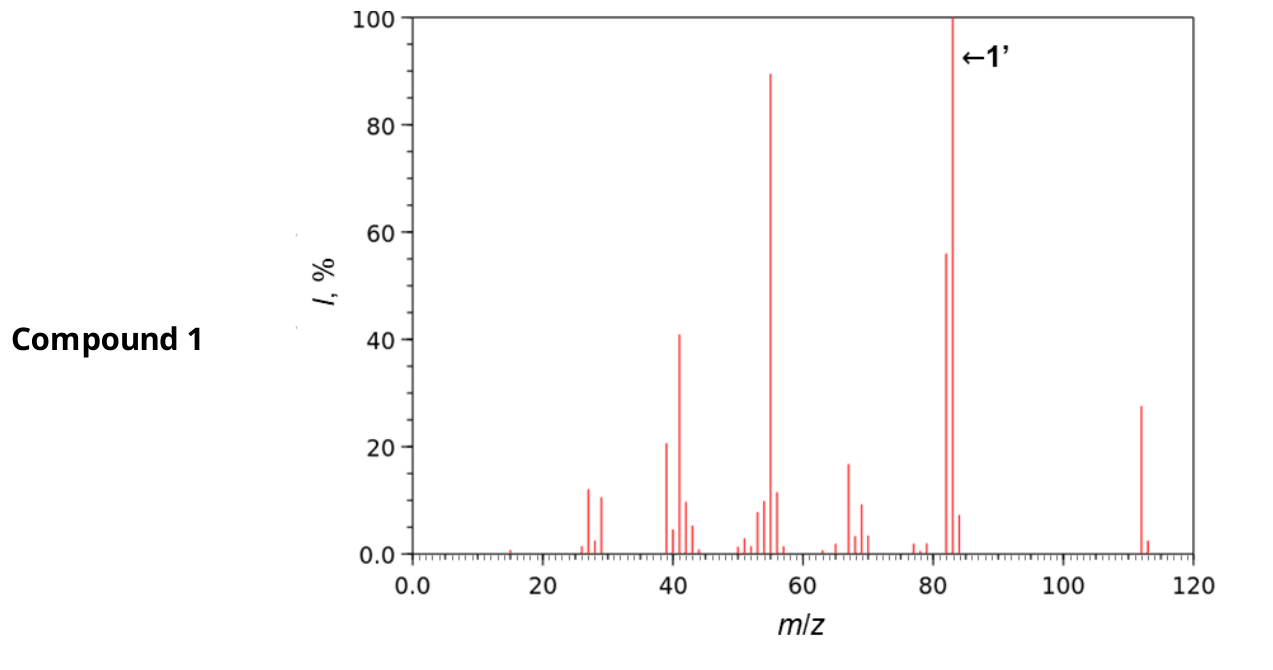
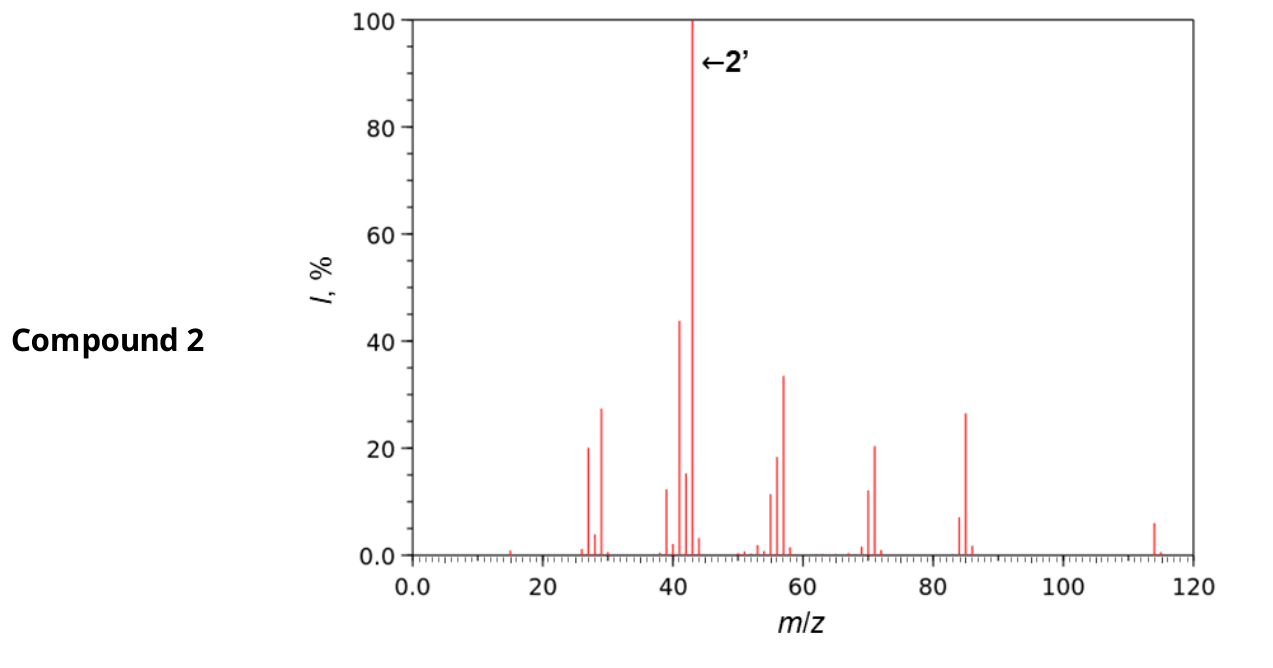
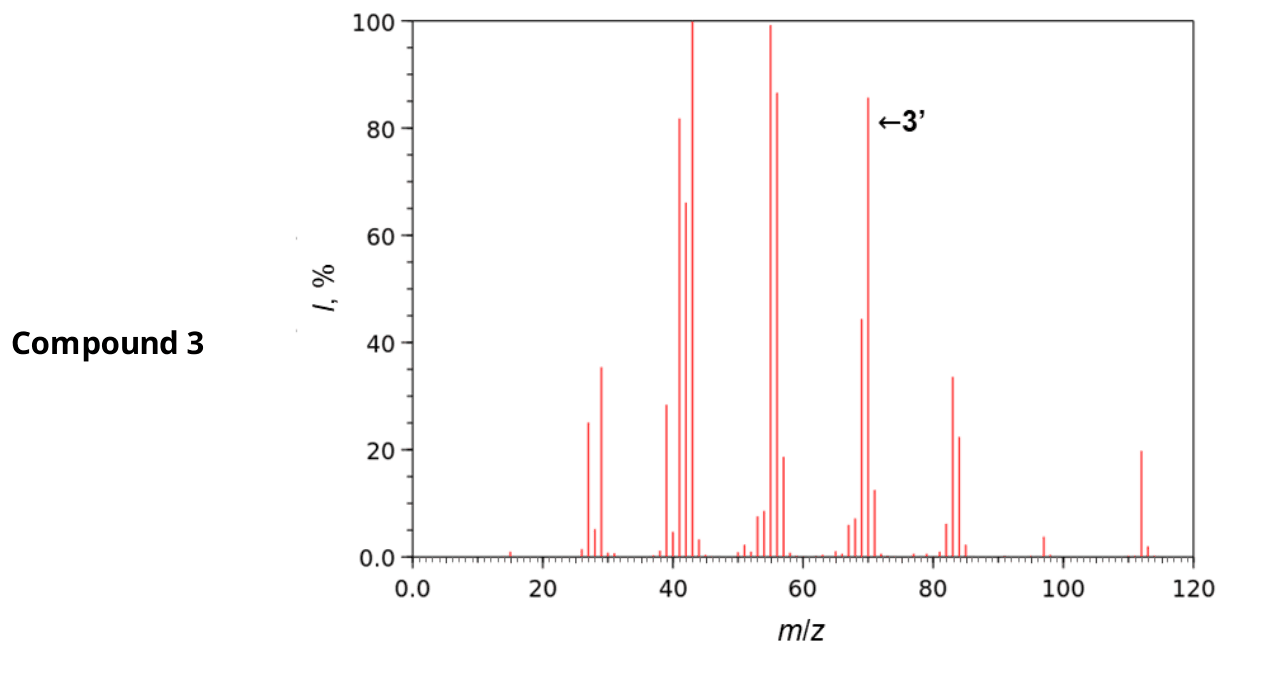
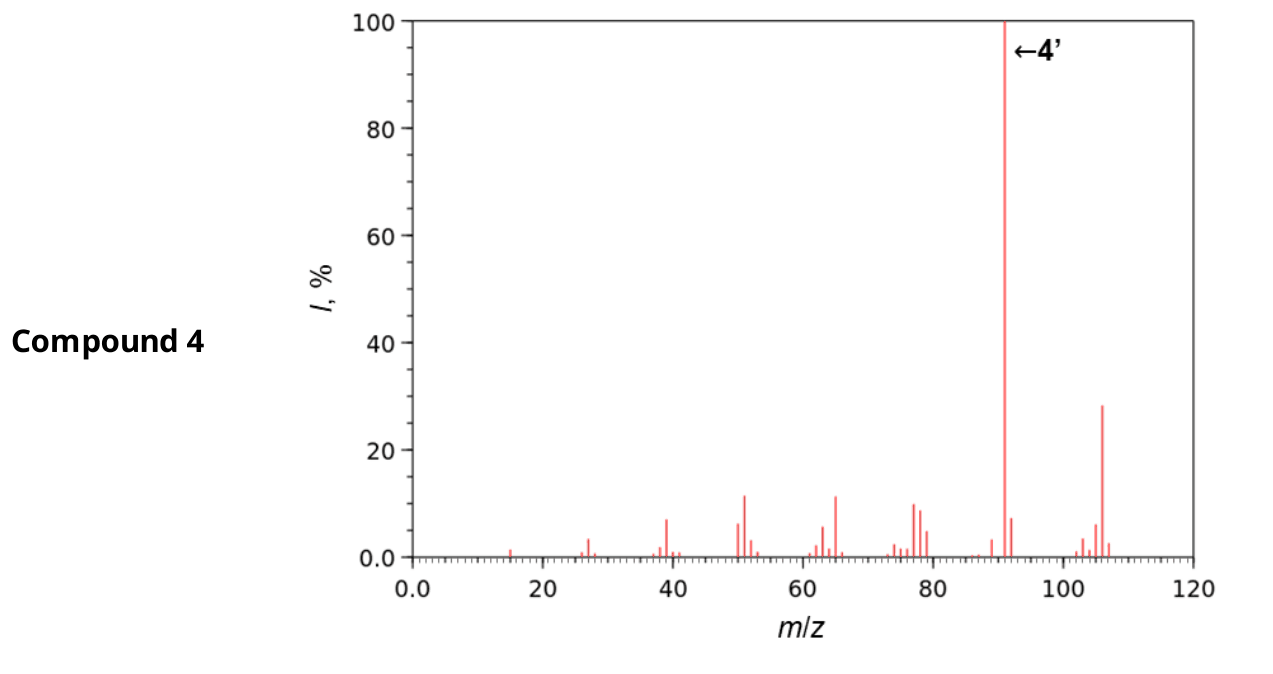
7.1 Draw the structures of 1–4 and 1′–4′. If you cannot determine the structure(s) of 1–4, write the corresponding letter code (P/O/N/A) and the molecular formula.
Hint: Species 3′ is formed by a rearrangement of the molecular ion by the McLafferty mechanism.
To differentiate isoparaffins (isoalkanes, I) from n-alkanes, the PIONA number may be used for a more precise description of crude oil composition. Below are two mass spectra of branched alkanes 5 and 6. In the mass spectrum of 6, the \(\ce{[M+1]+}\) peak has an intensity of ca. 5.4% relative to the intensity of the \(\ce{[M]+}\) peak of the molecular ion.
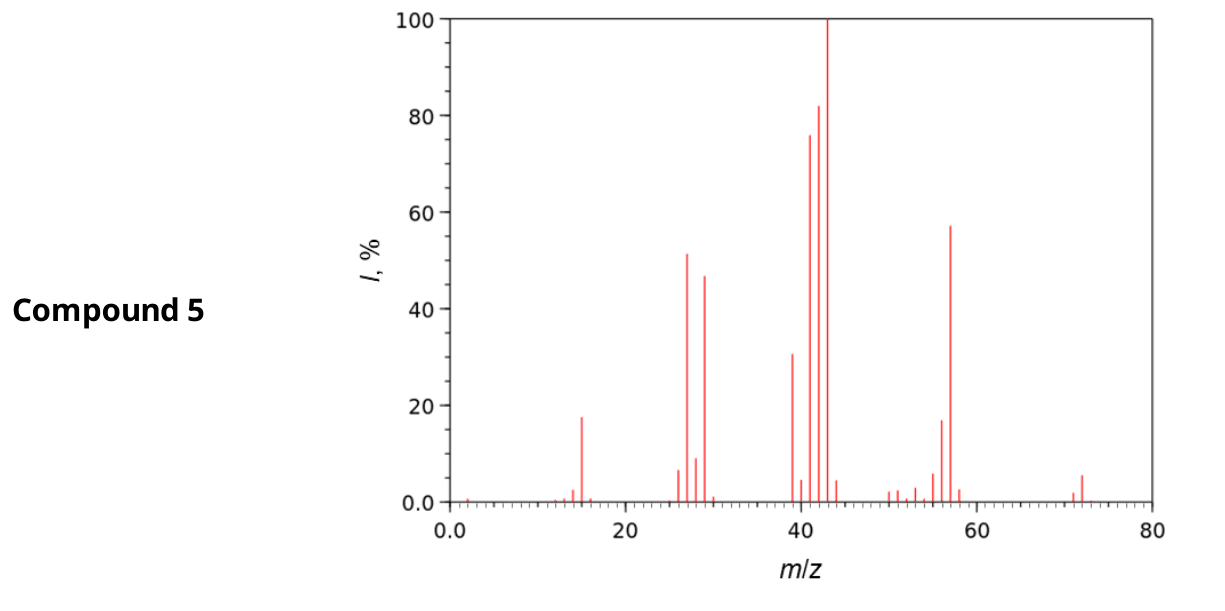
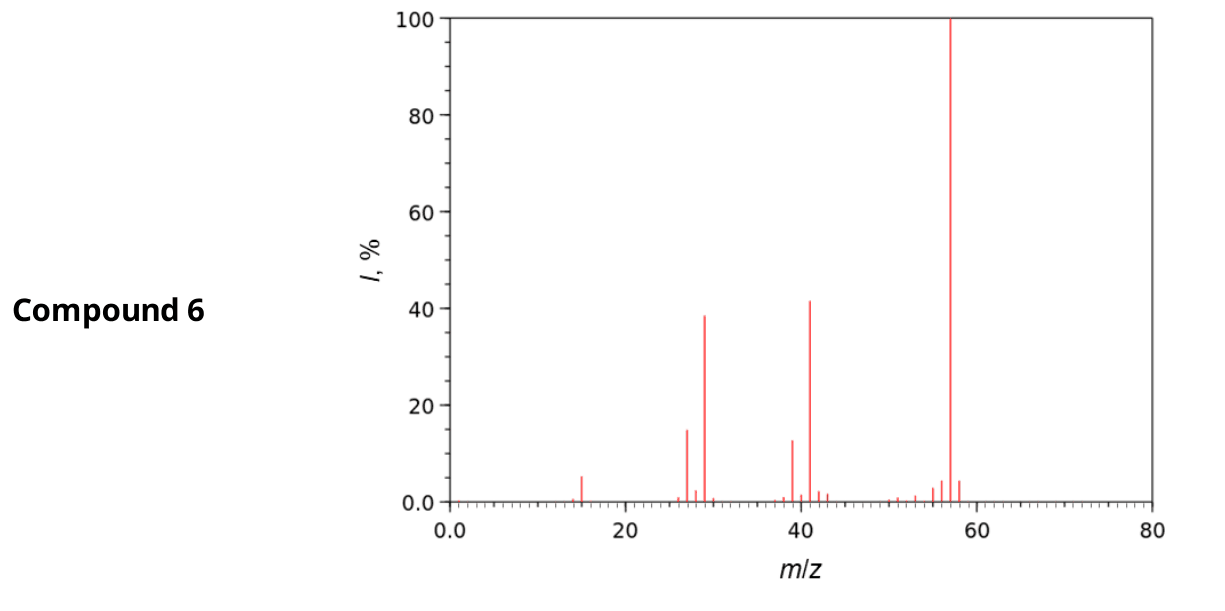
7.2 Draw the structures of compounds 5 and 6.
Crude oil is classified by the sulfur content as either sweet (<0.5 wt%) or sour (>0.5 wt%). A \(V=115\ \mathrm{\mu L}\) sample of Dubai Crude oil \((\rho=871\ \mathrm{g\,dm^{-3}})\) was completely burnt. The resulting gas mixture was passed through a \(\ce{H2O2}\) solution containing an excess of \(\ce{Ba(OH)2}\), leading to the formation of \(m=1.395\ \mathrm{g}\) of white precipitate. Upon acidification with \(\ce{HNO3}\), the precipitate’s mass decreased by 98.95%.
7.3 Calculate the sulfur content (\(w(\ce{S})\), wt%) of Dubai Crude oil.
In addition to sulfur, crude oil contains trace amounts of selenium, which transfers into the water used during refining. In aqueous solutions, selenium exists as \(\ce{SeO3^2-}\) and \(\ce{SeO4^2-}\).
The concentration of \(\ce{SeO3^2-}\) can be determined chromatographically by its selective reaction with diamine X under acidic conditions, forming piazoselenol Y. This reaction is complete only at the right pH range.
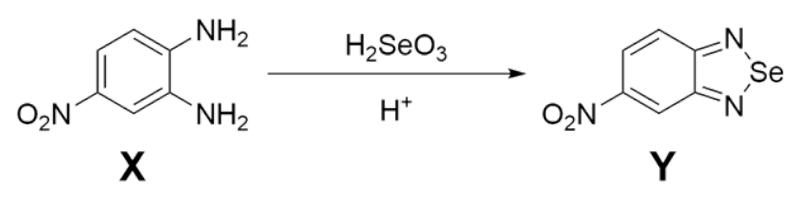
X and Y elute at different times (\(t\)) on the chromatogram shown below. The absorption spectra (1 mAbs corresponds to absorbance \(A=0.001\)) of X and Y are also provided.
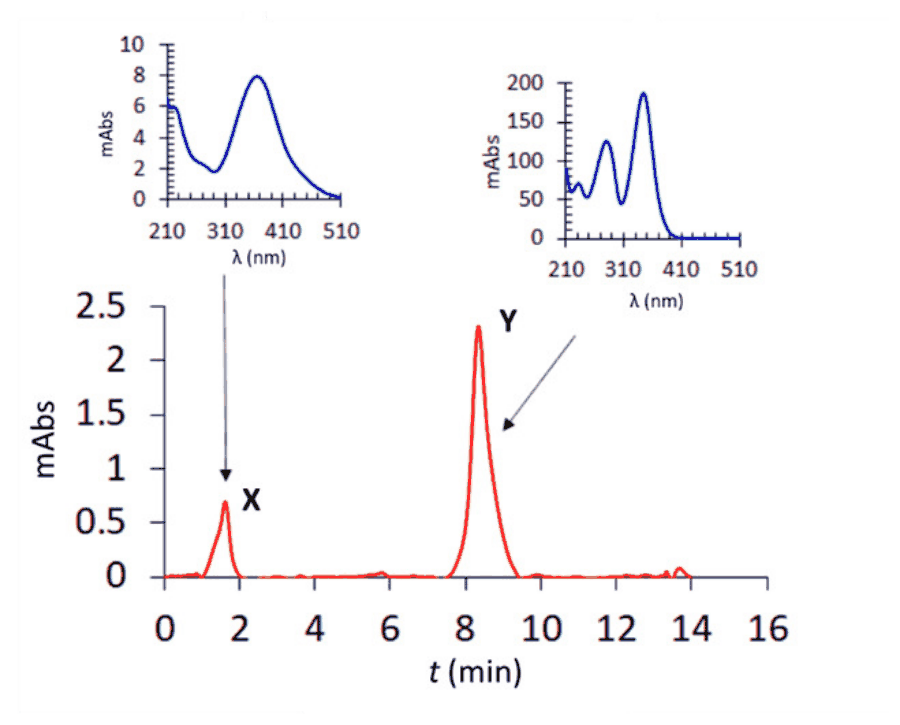
7.4 Tick the optimal wavelength (\(\lambda\)) for the absorbance measurements in the chromatogram.
☐ 270 nm ☐ 300 nm ☐ 350 nm ☐ 510 nm
Acidified water from the refining process, containing \(\ce{SeO3^2-}\) and \(\ce{SeO4^2-}\) (solution 1), was analysed as follows. A 9.50 mL sample was mixed with 0.50 mL of an aqueous solution of X (300 μM, excess) to form solution 2.
The area, \(S\), under each chromatogram peak was measured. These areas are proportional to the amount of the respective species in the peak. In a blank experiment under the same conditions with Se-free water, the peak area of X, \(S(\mathbf X)\) from the free diamine, was 0.825 mAbs·min. Running identical measurements with known amounts of \(\ce{SeO3^2-}\) showed that the peak area for Y (mAbs·min) depends on Se concentration (μM) as follows: \(S(\mathbf Y)=1.21\cdot c(\ce{Se})\).
The measurements for the Se-containing sample (solution 2) were carried out at different pH values, adjusted by adding four different strong acids. The ratios \(S(\mathbf X)/S(\mathbf Y)\) of the area under peak X to the area under peak Y for these measurements are shown in the table below. Assume all reactions have reached equilibrium.
Table. \(S(\mathbf X)/S(\mathbf Y)\) measured at different pH values with four strong acids
| pH | 3.0 | 2.0 | 1.5 | 1.0 | 0 | −0.50 |
|---|---|---|---|---|---|---|
| \(\ce{HNO3}\) | 1.523 | 3.334 | 5.454 | 7.783 | 10.232 | 13.450 |
| \(\ce{HCl}\) | 0.634 | 0.538 | 0.523 | 0.523 | 0.581 | 0.782 |
| \(\ce{HBr}\) | 0.523 | 0.377 | 0.368 | 0.368 | 0.399 | 0.546 |
| \(\ce{HI}\) | 1.722 | 2.223 | 5.114 | 8.123 | 11.736 | 15.780 |
Hint: You need only two values from the table to solve this question.
7.5 Calculate the concentrations of selenium species (\(c_0(\ce{SeO3^2-})\), \(c_0(\ce{SeO4^2-})\), in μM) in solution 1.
Periodic table
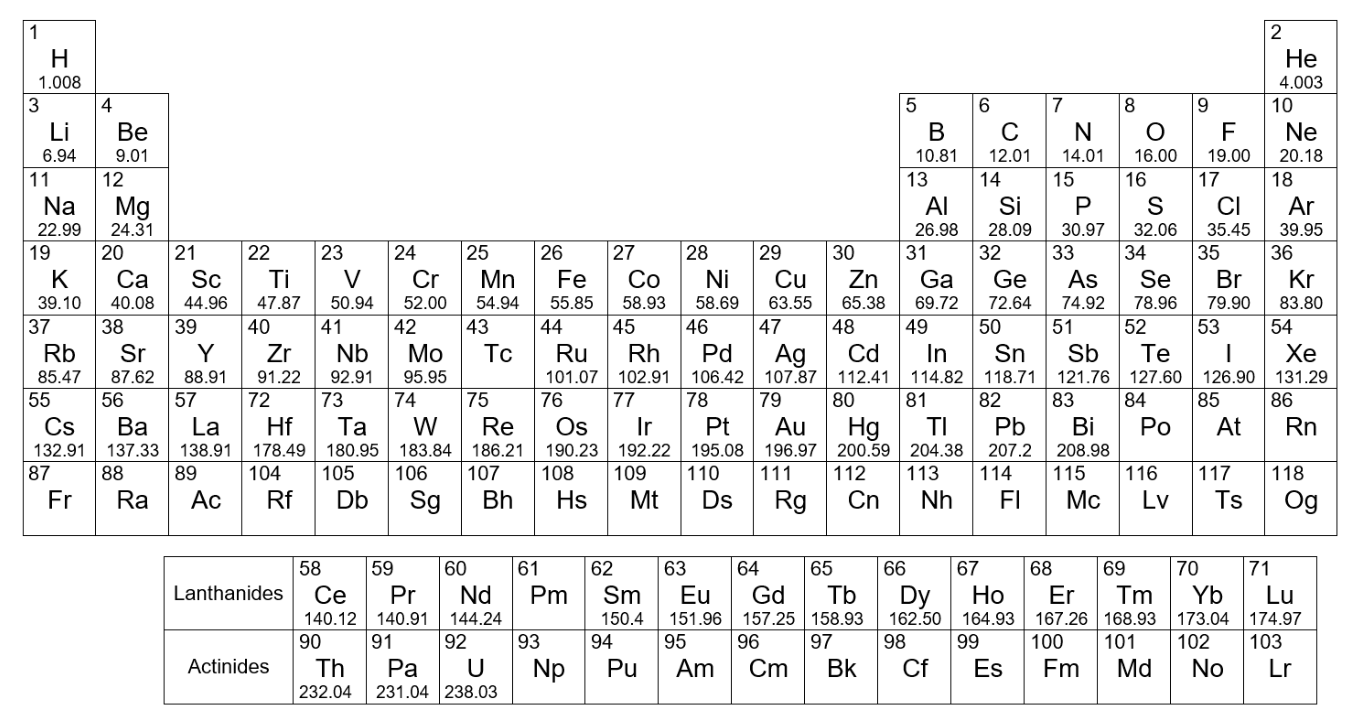
Official English text of the problem.
Answers
- 7.1
| Compound | Assignment | Molecular formula | SMILES |
|---|---|---|---|
| 1 | N, ethylcyclohexane | \(\ce{C8H16}\) | CCC1CCCCC1 |
| 2 | P, n-octane | \(\ce{C8H18}\) | CCCCCCCC |
| 3 | O, oct-1-ene | \(\ce{C8H16}\) | C=CCCCCCC |
| 4 | A, ethylbenzene, the preferred assignment | \(\ce{C8H10}\) | CCc1ccccc1 |
| Fragment | \(m/z\) | Assignment | SMILES |
|---|---|---|---|
| 1′ | 83 | Cyclohexyl cation, \(\ce{C6H11+}\) | [CH+]1CCCCC1 |
| 2′ | 43 | Propyl cation, \(\ce{C3H7+}\): propan-1-ylium from direct cleavage, capable of rearranging to propan-2-ylium | CC[CH2+]; rearranged form C[CH+]C |
| 3′ | 70 | Pent-1-ene radical cation, \(\ce{C5H10^{+\bullet}}\) | [CH2][CH+]CCC, a localized charge/radical representation |
| 4′ | 91 | Tropylium cation, \(\ce{C7H7+}\) | [CH+]1C=CC=CC=C1 |
-
7.2: 5 is 2-methylbutane,
CC(C)CC; 6 is 2,2-dimethylpropane (neopentane),CC(C)(C)C. -
7.3: \(\boxed{w(\ce{S})=2.01\ \mathrm{wt\%}}\). Dubai Crude is therefore sour.
-
7.4: Tick 350 nm.
-
7.5: In solution 1:
- Selenite, \(\ce{SeO3^2-}\),
[O-][Se](=O)[O-]: \(\boxed{c_0=1.26\ \mathrm{\mu M}}\). - Selenate, \(\ce{SeO4^2-}\),
[O-][Se](=O)(=O)[O-]: \(\boxed{c_0=0.473\ \mathrm{\mu M}}\), approximately \(0.47\ \mathrm{\mu M}\).
Solution
7.1 — Identification of compounds and fragments
The molecular-ion peaks occur at nominal \(m/z=112,\ 114,\ 112,\) and \(106\) for 1–4, respectively. The isotope peaks immediately above these masses are not separate molecular ions.
| Compound | Molecular-ion \(m/z\) | Formula | Degree of unsaturation |
|---|---|---|---|
| 1 | 112 | \(\ce{C8H16}\) | 1 |
| 2 | 114 | \(\ce{C8H18}\) | 0 |
| 3 | 112 | \(\ce{C8H16}\) | 1 |
| 4 | 106 | \(\ce{C8H10}\) | 4 |
Here the degree of unsaturation is \[ \mathrm{DBE}=\frac{2n_{\mathrm C}+2-n_{\mathrm H}}{2}. \]
Compound 1 and fragment 1′. The prominent fragment at \(m/z=83\) is \(\ce{C6H11+}\). Its formation from the molecular ion corresponds to loss of an ethyl radical:
\[ \ce{C8H16^{+\bullet} -> C6H11+ + C2H5^{\bullet}}. \]
The ethyl radical is C[CH2]. Cleavage of the bond between an ethyl substituent and a six-membered ring gives the secondary cyclohexyl cation, whose structure is listed in the answers. Thus 1 is assigned as ethylcyclohexane, the naphthene N.
On the answer sheet, draw a cyclohexane ring carrying one ethyl substituent for 1. For 1′, draw the six-membered ring with a positive charge on the ring carbon from which the ethyl group was removed; that carbon retains one hydrogen.
Compound 2 and fragment 2′. A molecular mass of 114 matches the linear alkane:
\[ 14n+2=114 \quad\Longrightarrow\quad n=8. \]
Consequently, 2 is \(n\)-octane, P. The peaks at \(m/z=43,\ 57,\ 71,\) and \(85\) belong to the characteristic alkyl-cation series, differing by successive \(\ce{CH2}\) units.
The selected \(m/z=43\) fragment has formula \(\ce{C3H7+}\). Direct chain cleavage can be written as
\[ \ce{C8H18^{+\bullet} -> C3H7+ + C5H11^{\bullet}}, \]
where the neutral cofragment is the pentan-1-yl radical, [CH2]CCCC.
Direct cleavage gives propan-1-ylium, CC[CH2+]. A subsequent 1,2-hydride shift gives the more stable secondary propan-2-ylium, C[CH+]C. The mass of this peak alone does not distinguish these ion structures.
Compound 3 and fragment 3′. This compound has formula \(\ce{C8H16}\) and is the specified linear alkene. An internal double bond in a linear eight-carbon monoalkene would permit cis–trans isomerism. Therefore the double bond must be terminal: 3 is oct-1-ene, O.
The marked fragment is at \(m/z=70\), corresponding to \(\ce{C5H10^{+\bullet}}\). Its formation involves loss of neutral propene, C=CC:
\[ \ce{C8H16^{+\bullet} -> C5H10^{+\bullet} + C3H6}. \]
Number the oct-1-ene chain from the double-bond end, so the initial double bond is between C1 and C2. In the McLafferty rearrangement:
- A hydrogen on C5 transfers to C1 through a six-membered arrangement involving C1–C5 and the transferred hydrogen.
- The C3–C4 bond breaks.
- Double bonds form between C2–C3 and C4–C5.
The C1–C3 portion becomes neutral propene. The C4–C8 portion becomes the pent-1-ene radical cation, 3′.
For the requested drawing, show the pent-1-ene structure in brackets with \(+\bullet\) outside the brackets. The SMILES [CH2][CH+]CCC gives one localized charge/radical representation; the ion’s electronic structure is delocalized over the original alkene unit. SMILES does not show the folded rearrangement geometry or the coupled electron movement described above.
Compound 4 and fragment 4′. The molecular ion at \(m/z=106\) gives \(\ce{C8H10}\), consistent with an arene. The dominant \(m/z=91\) peak is characteristic of the resonance-stabilized \(\ce{C7H7+}\) ion.
The preferred assignment is ethylbenzene, A. Loss of a methyl radical, [CH3], gives a benzyl cation, [CH2+]c1ccccc1, which can rearrange to the tropylium cation:
\[ \ce{C8H10^{+\bullet} -> C7H7+ + CH3^{\bullet}}. \]
For 4′, draw a seven-membered carbon ring with three alternating double bonds and an overall positive charge. The positive charge is delocalized; the ring contains six \(\pi\) electrons. The SMILES in the answer represents one Kekulé form.
7.2 — Identification of the branched alkanes
For 5, the molecular-ion peak at \(m/z=72\) gives
\[ 14n+2=72 \quad\Longrightarrow\quad n=5, \] so its formula is \(\ce{C5H12}\).
There are two branched alkane structures with this formula: 2-methylbutane, CC(C)CC, and 2,2-dimethylpropane, CC(C)(C)C.
The strong \(m/z=43\) peak of 5 is consistent with cleavage of 2-methylbutane to the secondary propan-2-ylium ion:
\[ \ce{C5H12^{+\bullet} -> C3H7+ + C2H5^{\bullet}}. \]
Thus 5 is 2-methylbutane.
For 6, the usual natural-abundance contribution of \(\ce{^{13}C}\) is approximately \(1.1\%\) to the \(M+1\) peak per carbon atom. Hence
\[ n_{\mathrm C}\approx\frac{5.4}{1.1}\approx5. \]
As an alkane, 6 therefore also has formula \(\ce{C5H12}\). Its dominant \(m/z=57\) peak corresponds to a tert-butyl cation, C[C+](C)C:
\[ \ce{C5H12^{+\bullet} -> C4H9+ + CH3^{\bullet}}. \]
All four carbon–carbon bonds of neopentane are equivalent, and cleavage of any one produces this stabilized tertiary carbocation. This accounts for the dominant fragment and the very weak molecular ion.
Thus 6 is 2,2-dimethylpropane. Draw one central carbon bonded to four methyl groups.
7.3 — Sulfur content
Combustion produces carbon dioxide and sulfur oxides. In the alkaline peroxide solution, carbon is collected as barium carbonate, [Ba+2].[O-]C(=O)[O-], and sulfur as barium sulfate, [Ba+2].[O-]S(=O)(=O)[O-].
The relevant balanced collection reactions are
\[ \ce{CO2 + Ba(OH)2 -> BaCO3(s) + H2O}, \]
\[ \ce{SO2 + H2O2 + Ba(OH)2 -> BaSO4(s) + 2H2O}. \]
Nitric acid dissolves the carbonate:
\[ \ce{BaCO3(s) + 2HNO3 -> Ba(NO3)2 + CO2(g) + H2O}. \]
Barium sulfate remains as the acid-insoluble precipitate.
The other species in these equations are carbon dioxide O=C=O, sulfur dioxide O=S=O, hydrogen peroxide OO, barium hydroxide [Ba+2].[OH-].[OH-], water O, nitric acid O=[N+]([O-])O, and barium nitrate [Ba+2].[O-][N+](=O)[O-].[O-][N+](=O)[O-]. The disconnected ionic SMILES specify composition, not crystal structures.
The remaining precipitate mass is
\[ m(\ce{BaSO4}) =1.395(1-0.9895) =0.0146475\ \mathrm g. \]
Using the supplied atomic masses,
\[ M(\ce{BaSO4}) =137.33+32.06+4(16.00) =233.39\ \mathrm{g\,mol^{-1}}. \]
Each mole of barium sulfate contains one mole of sulfur, so
\[ m(\ce S) =0.0146475\ \mathrm g \frac{32.06}{233.39} =2.01208\times10^{-3}\ \mathrm g. \]
The original oil mass is
\[ m_{\mathrm{oil}} =\rho V =(871\ \mathrm{g\,dm^{-3}}) (1.15\times10^{-4}\ \mathrm{dm^3}) =0.100165\ \mathrm g. \]
Therefore,
\[ w(\ce S) =\frac{2.01208\times10^{-3}}{0.100165}\times100\% =2.00876\%. \]
\[ \boxed{w(\ce S)=2.01\ \mathrm{wt\%}}. \]
Since this exceeds \(0.5\ \mathrm{wt\%}\), the oil is sour.
7.4 — Detection wavelength
Choose
\[ \boxed{\lambda=350\ \mathrm{nm}}. \]
The absorption spectrum of Y has its strongest maximum near this wavelength, giving the highest sensitivity for the selenium-containing derivative among the listed choices. The other wavelengths give weaker absorption by Y; at 510 nm its absorption is essentially zero.
7.5 — Selenium speciation
The derivatizing reagent X is 4-nitrobenzene-1,2-diamine, Nc1ccc([N+](=O)[O-])cc1N. Product Y is 5-nitro-2,1,3-benzoselenadiazole, O=[N+]([O-])c1ccc2n[se]nc2c1.
The condensation with selenous acid, O[Se](=O)O, is
\[ \ce{C6H7N3O2 + H2SeO3 ->[H+] C6H3N3O2Se + 3H2O}. \]
Thus one mole of X is consumed for each mole of Y formed, and each mole of Y contains one mole of selenium.
The two useful ratios are the constant minimum values at pH 1.0–1.5:
\[ R_{\ce{HCl}}=0.523, \qquad R_{\ce{HBr}}=0.368. \]
These are the conditions for quantitative derivatization. In hydrochloric acid, chloride, [Cl-], does not reduce selenate under these conditions, so the signal measures the original selenium(IV).
Bromide, [Br-], reduces selenium(VI) to selenium(IV):
\[ \ce{SeO4^2- + 2Br- + 2H+ -> SeO3^2- + Br2 + H2O}. \]
Here bromine is BrBr, and the proton is [H+]. The HBr measurement therefore measures the sum of the original selenium(IV) and selenium(VI).
First calculate the concentration of X introduced into solution 2:
\[ c_{\mathbf X,0} =300\ \mathrm{\mu M}\, \frac{0.50\ \mathrm{mL}}{10.00\ \mathrm{mL}} =15.0\ \mathrm{\mu M}. \]
The blank establishes the response coefficient for free X:
\[ k_{\mathbf X} =\frac{0.825\ \mathrm{mAbs\,min}}{15.0\ \mathrm{\mu M}} =0.0550\ \mathrm{mAbs\,min\,\mu M^{-1}}. \]
Let \(y\), expressed in μM, be the concentration of Y formed in solution 2. The remaining free diamine concentration is \(15.0-y\). Therefore,
\[ S(\mathbf X)=0.0550(15.0-y), \qquad S(\mathbf Y)=1.21y, \] with both peak areas in mAbs·min.
Consequently,
\[ R=\frac{S(\mathbf X)}{S(\mathbf Y)} =\frac{0.0550(15.0-y)}{1.21y}, \]
and
\[ y=\frac{0.825}{0.0550+1.21R} =\frac{15.0}{1+22.0R}\ \mathrm{\mu M}. \]
For the HCl measurement,
\[ y_{\ce{HCl}} =\frac{15.0}{1+22.0(0.523)} =1.199424\ \mathrm{\mu M}. \]
This is the original selenite concentration after dilution into solution 2.
For the HBr measurement,
\[ y_{\ce{HBr}} =\frac{15.0}{1+22.0(0.368)} =1.649077\ \mathrm{\mu M}. \]
This is the total selenium concentration in solution 2. Thus the original selenate contribution in solution 2 is
\[ 1.649077-1.199424 =0.449652\ \mathrm{\mu M}. \]
Finally, correct for dilution from 9.50 mL of solution 1 to 10.00 mL of solution 2:
\[ c_0(\ce{SeO3^2-}) =1.199424\frac{10.00}{9.50} =1.262552\ \mathrm{\mu M}, \]
\[ c_0(\ce{SeO4^2-}) =0.449652\frac{10.00}{9.50} =0.473318\ \mathrm{\mu M}. \]
Hence
\[ \boxed{c_0(\ce{SeO3^2-})=1.26\ \mathrm{\mu M}}, \qquad \boxed{c_0(\ce{SeO4^2-})=0.473\ \mathrm{\mu M}}. \]
The last value is about \(0.47\ \mathrm{\mu M}\), allowing for the rounding of the tabulated ratios.
The solution was checked against the official solution.
IChO 2025 · Theorieaufgabe 7
Dubai-Rohöl
7% der Gesamtpunktzahl
| 7.1 | 7.2 | 7.3 | 7.4 | 7.5 | Gesamt |
|---|---|---|---|---|---|
| 8 | 2 | 3 | 1 | 8 | 22 |
Die Erdölindustrie spielt eine wichtige Rolle in der Wirtschaft der VAE. Das als „Dubai Crude“ bezeichnete Öl dient als Referenz für die weltweiten Ölpreise. Rohöl ist ein komplexes Gemisch organischer Verbindungen, hauptsächlich Kohlenwasserstoffe, mit geringeren Anteilen an S-, N- und O-haltigen Verbindungen.
Die Kohlenwasserstoffzusammensetzung von Erdöl wird durch die PONA-Zahl charakterisiert. Die Abkürzung steht für P – Paraffine (Alkane), O – Olefine (Alkene), N – Naphthene (Cycloalkane) und A – Aromaten (Arene). Eine Methode zur Bestimmung der Zusammensetzung von Erdöl ist die Gaschromatographie–Massenspektrometrie (GC–MS).
Nachfolgend sind die Massenspektren (Elektronenstoßionisation, \(I\) – relative Intensität) von vier Kohlenwasserstoffen 1–4 aus Dubai-Rohöl dargestellt. Dazu gehören ein unverzweigtes Alkan P, ein unverzweigtes Alken O, ein monosubstituiertes Cycloalkan N und ein Aren A. Das Alken O besitzt keine cis–trans-Isomere. 1′–4′ sind ausgewählte Fragmentierungsprodukte.
7.1 Zeichnen Sie die Strukturen von 1–4 und 1′–4′. Falls Sie die Struktur(en) von 1–4 nicht bestimmen können, geben Sie den entsprechenden Buchstabencode (P/O/N/A) und die Summenformel an.
Hinweis: Die Spezies 3′ entsteht durch eine Umlagerung des Molekülions nach dem McLafferty-Mechanismus.
Um Isoparaffine (Isoalkane, I) von n-Alkanen zu unterscheiden, kann die PIONA-Zahl zur genaueren Beschreibung der Rohölzusammensetzung verwendet werden. Nachfolgend sind zwei Massenspektren der verzweigten Alkane 5 und 6 dargestellt. Im Massenspektrum von 6 beträgt die Intensität des \(\ce{[M+1]+}\)-Peaks ca. 5.4% der Intensität des \(\ce{[M]+}\)-Peaks des Molekülions.
7.2 Zeichnen Sie die Strukturen der Verbindungen 5 und 6.
Rohöl wird anhand seines Schwefelgehalts als süß (<0.5 Massen-%) oder sauer (>0.5 Massen-%) eingestuft. Eine Probe von Dubai-Rohöl mit \(V=115\ \mathrm{\mu L}\) \((\rho=871\ \mathrm{g\,dm^{-3}})\) wurde vollständig verbrannt. Das entstandene Gasgemisch wurde durch eine \(\ce{H2O2}\)-Lösung geleitet, die einen Überschuss an \(\ce{Ba(OH)2}\) enthielt, wobei sich \(m=1.395\ \mathrm{g}\) eines weißen Niederschlags bildeten. Beim Ansäuern mit \(\ce{HNO3}\) nahm die Masse des Niederschlags um 98.95% ab.
7.3 Berechnen Sie den Schwefelgehalt (\(w(\ce{S})\), Massen-%) von Dubai-Rohöl.
Neben Schwefel enthält Rohöl Spuren von Selen, das in das bei der Raffination verwendete Wasser übergeht. In wässrigen Lösungen liegt Selen als \(\ce{SeO3^2-}\) und \(\ce{SeO4^2-}\) vor.
Die Konzentration von \(\ce{SeO3^2-}\) lässt sich chromatographisch durch dessen selektive Reaktion mit dem Diamin X unter sauren Bedingungen bestimmen, wobei das Piazoselenol Y entsteht. Diese Reaktion verläuft nur im geeigneten pH-Bereich vollständig.
X und Y eluieren im unten gezeigten Chromatogramm zu unterschiedlichen Zeiten (\(t\)). Die Absorptionsspektren (1 mAbs entspricht einer Absorbanz \(A=0.001\)) von X und Y sind ebenfalls angegeben.
7.4 Kreuzen Sie die optimale Wellenlänge (\(\lambda\)) für die Absorbanzmessungen im Chromatogramm an.
☐ 270 nm ☐ 300 nm ☐ 350 nm ☐ 510 nm
Angesäuertes Wasser aus dem Raffinationsprozess, das \(\ce{SeO3^2-}\) und \(\ce{SeO4^2-}\) enthielt (Lösung 1), wurde wie folgt analysiert. Eine Probe von 9.50 mL wurde mit 0.50 mL einer wässrigen Lösung von X (300 μM, im Überschuss) vermischt, wodurch Lösung 2 entstand.
Die Fläche \(S\) unter jedem Peak des Chromatogramms wurde gemessen. Diese Flächen sind proportional zur Stoffmenge der jeweiligen Spezies im Peak. In einem Blindversuch unter denselben Bedingungen mit Se-freiem Wasser betrug die Peakfläche von X, \(S(\mathbf X)\), die vom freien Diamin stammt, 0.825 mAbs·min. Identische Messungen mit bekannten Mengen von \(\ce{SeO3^2-}\) zeigten, dass die Peakfläche für Y (mAbs·min) wie folgt von der Se-Konzentration (μM) abhängt: \(S(\mathbf Y)=1.21\cdot c(\ce{Se})\).
Die Messungen für die Se-haltige Probe (Lösung 2) wurden bei verschiedenen pH-Werten durchgeführt, die durch Zugabe von vier verschiedenen starken Säuren eingestellt wurden. Die Verhältnisse \(S(\mathbf X)/S(\mathbf Y)\) der Fläche unter Peak X zur Fläche unter Peak Y für diese Messungen sind in der nachfolgenden Tabelle angegeben. Nehmen Sie an, dass alle Reaktionen das Gleichgewicht erreicht haben.
Tabelle. \(S(\mathbf X)/S(\mathbf Y)\), gemessen bei verschiedenen pH-Werten mit vier starken Säuren
| pH | 3.0 | 2.0 | 1.5 | 1.0 | 0 | −0.50 |
|---|---|---|---|---|---|---|
| \(\ce{HNO3}\) | 1.523 | 3.334 | 5.454 | 7.783 | 10.232 | 13.450 |
| \(\ce{HCl}\) | 0.634 | 0.538 | 0.523 | 0.523 | 0.581 | 0.782 |
| \(\ce{HBr}\) | 0.523 | 0.377 | 0.368 | 0.368 | 0.399 | 0.546 |
| \(\ce{HI}\) | 1.722 | 2.223 | 5.114 | 8.123 | 11.736 | 15.780 |
Hinweis: Sie benötigen nur zwei Werte aus der Tabelle, um diese Frage zu lösen.
7.5 Berechnen Sie die Konzentrationen der Selenspezies (\(c_0(\ce{SeO3^2-})\), \(c_0(\ce{SeO4^2-})\), in μM) in Lösung 1.
Periodensystem
Aufgabentext aus dem offiziellen englischen Text übersetzt.
Antworten
- 7.1
| Verbindung | Zuordnung | Summenformel | SMILES |
|---|---|---|---|
| 1 | N, Ethylcyclohexan | \(\ce{C8H16}\) | CCC1CCCCC1 |
| 2 | P, n-Octan | \(\ce{C8H18}\) | CCCCCCCC |
| 3 | O, Oct-1-en | \(\ce{C8H16}\) | C=CCCCCCC |
| 4 | A, Ethylbenzol, die bevorzugte Zuordnung | \(\ce{C8H10}\) | CCc1ccccc1 |
| Fragment | \(m/z\) | Zuordnung | SMILES |
|---|---|---|---|
| 1′ | 83 | Cyclohexyl-Kation, \(\ce{C6H11+}\) | [CH+]1CCCCC1 |
| 2′ | 43 | Propyl-Kation, \(\ce{C3H7+}\): Propan-1-ylium aus direkter Spaltung, das sich zu Propan-2-ylium umlagern kann | CC[CH2+]; umgelagerte Form C[CH+]C |
| 3′ | 70 | Pent-1-en-Radikalkation, \(\ce{C5H10^{+\bullet}}\) | [CH2][CH+]CCC, eine Darstellung mit lokalisierter Ladung und lokalisiertem Radikal |
| 4′ | 91 | Tropylium-Kation, \(\ce{C7H7+}\) | [CH+]1C=CC=CC=C1 |
-
7.2: 5 ist 2-Methylbutan,
CC(C)CC; 6 ist 2,2-Dimethylpropan (Neopentan),CC(C)(C)C. -
7.3: \(\boxed{w(\ce{S})=2.01\ \mathrm{wt\%}}\). Dubai-Rohöl ist daher sauer.
-
7.4: 350 nm ankreuzen.
-
7.5: In Lösung 1:
- Selenit, \(\ce{SeO3^2-}\),
[O-][Se](=O)[O-]: \(\boxed{c_0=1.26\ \mathrm{\mu M}}\). - Selenat, \(\ce{SeO4^2-}\),
[O-][Se](=O)(=O)[O-]: \(\boxed{c_0=0.473\ \mathrm{\mu M}}\), ungefähr \(0.47\ \mathrm{\mu M}\).
Lösung
7.1 — Identifizierung der Verbindungen und Fragmente
Die Molekülionenpeaks liegen für 1–4 bei den nominalen Werten \(m/z=112,\ 114,\ 112,\) bzw. \(106\). Die Isotopenpeaks unmittelbar oberhalb dieser Massen sind keine eigenständigen Molekülionen.
| Verbindung | Molekülionen-\(m/z\) | Formel | Doppelbindungsäquivalente |
|---|---|---|---|
| 1 | 112 | \(\ce{C8H16}\) | 1 |
| 2 | 114 | \(\ce{C8H18}\) | 0 |
| 3 | 112 | \(\ce{C8H16}\) | 1 |
| 4 | 106 | \(\ce{C8H10}\) | 4 |
Die Zahl der Doppelbindungsäquivalente ist hier \[ \mathrm{DBE}=\frac{2n_{\mathrm C}+2-n_{\mathrm H}}{2}. \]
Verbindung 1 und Fragment 1′. Das auffällige Fragment bei \(m/z=83\) ist \(\ce{C6H11+}\). Seine Bildung aus dem Molekülion entspricht der Abspaltung eines Ethylradikals:
\[ \ce{C8H16^{+\bullet} -> C6H11+ + C2H5^{\bullet}}. \]
Das Ethylradikal ist C[CH2]. Die Spaltung der Bindung zwischen einem Ethylsubstituenten und einem Sechsring ergibt das sekundäre Cyclohexyl-Kation, dessen Struktur in den Antworten aufgeführt ist. Somit wird 1 als Ethylcyclohexan, das Naphthen N, zugeordnet.
Zeichnen Sie auf dem Antwortbogen für 1 einen Cyclohexanring mit einem Ethylsubstituenten. Zeichnen Sie für 1′ den Sechsring mit einer positiven Ladung an dem Ringkohlenstoffatom, von dem die Ethylgruppe abgespalten wurde; dieses Kohlenstoffatom behält ein Wasserstoffatom.
Verbindung 2 und Fragment 2′. Eine Molekülmasse von 114 passt zum unverzweigten Alkan:
\[ 14n+2=114 \quad\Longrightarrow\quad n=8. \]
Folglich ist 2 \(n\)-Octan, P. Die Peaks bei \(m/z=43,\ 57,\ 71,\) und \(85\) gehören zur charakteristischen Reihe der Alkylkationen, deren aufeinanderfolgende Glieder sich jeweils um eine \(\ce{CH2}\)-Einheit unterscheiden.
Das ausgewählte Fragment bei \(m/z=43\) hat die Formel \(\ce{C3H7+}\). Die direkte Kettenspaltung lässt sich wie folgt schreiben:
\[ \ce{C8H18^{+\bullet} -> C3H7+ + C5H11^{\bullet}}, \]
wobei das neutrale Gegenfragment das Pentan-1-yl-Radikal, [CH2]CCCC, ist.
Die direkte Spaltung ergibt Propan-1-ylium, CC[CH2+]. Eine anschließende 1,2-Hydridverschiebung ergibt das stabilere sekundäre Propan-2-ylium, C[CH+]C. Allein anhand der Masse dieses Peaks lassen sich diese Ionenstrukturen nicht unterscheiden.
Verbindung 3 und Fragment 3′. Diese Verbindung hat die Formel \(\ce{C8H16}\) und ist das angegebene unverzweigte Alken. Eine innenständige Doppelbindung in einem unverzweigten Monoalken mit acht Kohlenstoffatomen würde cis–trans-Isomerie ermöglichen. Daher muss die Doppelbindung endständig sein: 3 ist Oct-1-en, O.
Das markierte Fragment liegt bei \(m/z=70\), entsprechend \(\ce{C5H10^{+\bullet}}\). Bei seiner Bildung wird neutrales Propen, C=CC, abgespalten:
\[ \ce{C8H16^{+\bullet} -> C5H10^{+\bullet} + C3H6}. \]
Nummerieren Sie die Oct-1-en-Kette vom Ende mit der Doppelbindung aus, sodass die ursprüngliche Doppelbindung zwischen C1 und C2 liegt. Bei der McLafferty-Umlagerung:
- Ein Wasserstoffatom an C5 wird über eine sechsgliedrige Anordnung, an der C1–C5 und das übertragene Wasserstoffatom beteiligt sind, auf C1 übertragen.
- Die C3–C4-Bindung wird gespalten.
- Zwischen C2–C3 und C4–C5 bilden sich Doppelbindungen.
Der C1–C3-Teil wird zu neutralem Propen. Der C4–C8-Teil wird zum Pent-1-en-Radikalkation, 3′.
Zeichnen Sie für die geforderte Struktur die Pent-1-en-Struktur in Klammern mit \(+\bullet\) außerhalb der Klammern. Der SMILES-Ausdruck [CH2][CH+]CCC gibt eine Darstellung mit lokalisierter Ladung und lokalisiertem Radikal wieder; die elektronische Struktur des Ions ist über die ursprüngliche Alkeneinheit delokalisiert. SMILES zeigt weder die gefaltete Umlagerungsgeometrie noch die oben beschriebene gekoppelte Elektronenverschiebung.
Verbindung 4 und Fragment 4′. Das Molekülion bei \(m/z=106\) ergibt \(\ce{C8H10}\), was mit einem Aren vereinbar ist. Der dominierende Peak bei \(m/z=91\) ist charakteristisch für das mesomeriestabilisierte \(\ce{C7H7+}\)-Ion.
Die bevorzugte Zuordnung ist Ethylbenzol, A. Die Abspaltung eines Methylradikals, [CH3], ergibt ein Benzyl-Kation, [CH2+]c1ccccc1, das sich zum Tropylium-Kation umlagern kann:
\[ \ce{C8H10^{+\bullet} -> C7H7+ + CH3^{\bullet}}. \]
Zeichnen Sie für 4′ einen siebengliedrigen Kohlenstoffring mit drei alternierenden Doppelbindungen und einer insgesamt positiven Ladung. Die positive Ladung ist delokalisiert; der Ring enthält sechs \(\pi\)-Elektronen. Der SMILES-Ausdruck in der Antwort stellt eine Kekulé-Form dar.
7.2 — Identifizierung der verzweigten Alkane
Für 5 ergibt der Molekülionenpeak bei \(m/z=72\)
\[ 14n+2=72 \quad\Longrightarrow\quad n=5, \] also lautet seine Formel \(\ce{C5H12}\).
Es gibt zwei verzweigte Alkanstrukturen mit dieser Formel: 2-Methylbutan, CC(C)CC, und 2,2-Dimethylpropan, CC(C)(C)C.
Der starke Peak von 5 bei \(m/z=43\) ist mit der Spaltung von 2-Methylbutan zum sekundären Propan-2-ylium-Ion vereinbar:
\[ \ce{C5H12^{+\bullet} -> C3H7+ + C2H5^{\bullet}}. \]
Somit ist 5 2-Methylbutan.
Für 6 beträgt der übliche Beitrag von \(\ce{^{13}C}\) aufgrund seiner natürlichen Häufigkeit zum \(M+1\)-Peak etwa \(1.1\%\) pro Kohlenstoffatom. Daher gilt
\[ n_{\mathrm C}\approx\frac{5.4}{1.1}\approx5. \]
Als Alkan hat 6 somit ebenfalls die Formel \(\ce{C5H12}\). Sein dominierender Peak bei \(m/z=57\) entspricht einem tert-Butyl-Kation, C[C+](C)C:
\[ \ce{C5H12^{+\bullet} -> C4H9+ + CH3^{\bullet}}. \]
Alle vier Kohlenstoff–Kohlenstoff-Bindungen von Neopentan sind gleichwertig, und die Spaltung einer beliebigen dieser Bindungen erzeugt dieses stabilisierte tertiäre Carbokation. Dies erklärt das dominierende Fragment und das sehr schwache Molekülion.
Somit ist 6 2,2-Dimethylpropan. Zeichnen Sie ein zentrales Kohlenstoffatom, das an vier Methylgruppen gebunden ist.
7.3 — Schwefelgehalt
Bei der Verbrennung entstehen Kohlenstoffdioxid und Schwefeloxide. In der alkalischen Peroxidlösung wird Kohlenstoff als Bariumcarbonat, [Ba+2].[O-]C(=O)[O-], und Schwefel als Bariumsulfat, [Ba+2].[O-]S(=O)(=O)[O-], gebunden.
Die maßgeblichen ausgeglichenen Reaktionsgleichungen für diese Bindung lauten
\[ \ce{CO2 + Ba(OH)2 -> BaCO3(s) + H2O}, \]
\[ \ce{SO2 + H2O2 + Ba(OH)2 -> BaSO4(s) + 2H2O}. \]
Salpetersäure löst das Carbonat auf:
\[ \ce{BaCO3(s) + 2HNO3 -> Ba(NO3)2 + CO2(g) + H2O}. \]
Bariumsulfat bleibt als säureunlöslicher Niederschlag zurück.
Die anderen Spezies in diesen Gleichungen sind Kohlenstoffdioxid O=C=O, Schwefeldioxid O=S=O, Wasserstoffperoxid OO, Bariumhydroxid [Ba+2].[OH-].[OH-], Wasser O, Salpetersäure O=[N+]([O-])O und Bariumnitrat [Ba+2].[O-][N+](=O)[O-].[O-][N+](=O)[O-]. Die SMILES-Ausdrücke mit getrennten Ionen geben die Zusammensetzung an, nicht die Kristallstrukturen.
Die Masse des verbleibenden Niederschlags beträgt
\[ m(\ce{BaSO4}) =1.395(1-0.9895) =0.0146475\ \mathrm g. \]
Mit den angegebenen Atommassen ergibt sich
\[ M(\ce{BaSO4}) =137.33+32.06+4(16.00) =233.39\ \mathrm{g\,mol^{-1}}. \]
Jedes Mol Bariumsulfat enthält ein Mol Schwefel, also
\[ m(\ce S) =0.0146475\ \mathrm g \frac{32.06}{233.39} =2.01208\times10^{-3}\ \mathrm g. \]
Die ursprüngliche Ölmasse beträgt
\[ m_{\mathrm{oil}} =\rho V =(871\ \mathrm{g\,dm^{-3}}) (1.15\times10^{-4}\ \mathrm{dm^3}) =0.100165\ \mathrm g. \]
Daher gilt
\[ w(\ce S) =\frac{2.01208\times10^{-3}}{0.100165}\times100\% =2.00876\%. \]
\[ \boxed{w(\ce S)=2.01\ \mathrm{wt\%}}. \]
Da dieser Wert \(0.5\ \mathrm{wt\%}\) übersteigt, ist das Öl sauer.
7.4 — Detektionswellenlänge
Wählen Sie
\[ \boxed{\lambda=350\ \mathrm{nm}}. \]
Das Absorptionsspektrum von Y weist sein stärkstes Maximum in der Nähe dieser Wellenlänge auf, sodass sie unter den aufgeführten Möglichkeiten die höchste Empfindlichkeit für das selenhaltige Derivat bietet. Bei den anderen Wellenlängen absorbiert Y schwächer; bei 510 nm ist seine Absorption praktisch null.
7.5 — Selenspeziation
Das Derivatisierungsreagenz X ist 4-Nitrobenzol-1,2-diamin, Nc1ccc([N+](=O)[O-])cc1N. Das Produkt Y ist 5-Nitro-2,1,3-benzoselenadiazol, O=[N+]([O-])c1ccc2n[se]nc2c1.
Die Kondensation mit seleniger Säure, O[Se](=O)O, lautet
\[ \ce{C6H7N3O2 + H2SeO3 ->[H+] C6H3N3O2Se + 3H2O}. \]
Somit wird für jedes gebildete Mol Y ein Mol X verbraucht, und jedes Mol Y enthält ein Mol Selen.
Die beiden nutzbaren Verhältnisse sind die konstanten Minimalwerte bei pH 1.0–1.5:
\[ R_{\ce{HCl}}=0.523, \qquad R_{\ce{HBr}}=0.368. \]
Dies sind die Bedingungen für eine quantitative Derivatisierung. In Salzsäure reduziert Chlorid, [Cl-], unter diesen Bedingungen kein Selenat, sodass das Signal das ursprünglich vorhandene Selen(IV) erfasst.
Bromid, [Br-], reduziert Selen(VI) zu Selen(IV):
\[ \ce{SeO4^2- + 2Br- + 2H+ -> SeO3^2- + Br2 + H2O}. \]
Hier ist Brom BrBr und das Proton [H+]. Die HBr-Messung erfasst daher die Summe des ursprünglich vorhandenen Selens(IV) und Selens(VI).
Berechnen Sie zunächst die Konzentration von X, die in Lösung 2 eingebracht wurde:
\[ c_{\mathbf X,0} =300\ \mathrm{\mu M}\, \frac{0.50\ \mathrm{mL}}{10.00\ \mathrm{mL}} =15.0\ \mathrm{\mu M}. \]
Der Blindversuch liefert den Ansprechfaktor für freies X:
\[ k_{\mathbf X} =\frac{0.825\ \mathrm{mAbs\,min}}{15.0\ \mathrm{\mu M}} =0.0550\ \mathrm{mAbs\,min\,\mu M^{-1}}. \]
Sei \(y\), ausgedrückt in μM, die Konzentration von Y, das in Lösung 2 gebildet wurde. Die verbleibende Konzentration des freien Diamins beträgt \(15.0-y\). Daher gilt
\[ S(\mathbf X)=0.0550(15.0-y), \qquad S(\mathbf Y)=1.21y, \] wobei beide Peakflächen in mAbs·min angegeben sind.
Folglich gilt
\[ R=\frac{S(\mathbf X)}{S(\mathbf Y)} =\frac{0.0550(15.0-y)}{1.21y}, \]
und
\[ y=\frac{0.825}{0.0550+1.21R} =\frac{15.0}{1+22.0R}\ \mathrm{\mu M}. \]
Für die HCl-Messung gilt
\[ y_{\ce{HCl}} =\frac{15.0}{1+22.0(0.523)} =1.199424\ \mathrm{\mu M}. \]
Dies ist die ursprüngliche Selenitkonzentration nach der Verdünnung zu Lösung 2.
Für die HBr-Messung gilt
\[ y_{\ce{HBr}} =\frac{15.0}{1+22.0(0.368)} =1.649077\ \mathrm{\mu M}. \]
Dies ist die Gesamtselenkonzentration in Lösung 2. Somit beträgt der Beitrag des ursprünglich vorhandenen Selenats in Lösung 2
\[ 1.649077-1.199424 =0.449652\ \mathrm{\mu M}. \]
Korrigieren Sie abschließend für die Verdünnung von 9.50 mL Lösung 1 auf 10.00 mL Lösung 2:
\[ c_0(\ce{SeO3^2-}) =1.199424\frac{10.00}{9.50} =1.262552\ \mathrm{\mu M}, \]
\[ c_0(\ce{SeO4^2-}) =0.449652\frac{10.00}{9.50} =0.473318\ \mathrm{\mu M}. \]
Damit ergibt sich
\[ \boxed{c_0(\ce{SeO3^2-})=1.26\ \mathrm{\mu M}}, \qquad \boxed{c_0(\ce{SeO4^2-})=0.473\ \mathrm{\mu M}}. \]
Der letzte Wert beträgt unter Berücksichtigung der Rundung der tabellierten Verhältnisse etwa \(0.47\ \mathrm{\mu M}\).
Die Lösung wurde mit der offiziellen Lösung abgeglichen.
IChO 2025 · Teori sorusu 7
Dubai ham petrolü
Toplam puanın %7'si
| 7.1 | 7.2 | 7.3 | 7.4 | 7.5 | Toplam |
|---|---|---|---|---|---|
| 8 | 2 | 3 | 1 | 8 | 22 |
Petrol endüstrisi, Birleşik Arap Emirlikleri ekonomisinde önemli bir rol oynar. “Dubai Crude” olarak adlandırılan petrol, küresel petrol fiyatları için bir referanstır. Ham petrol, başlıca hidrokarbonların yanı sıra daha az miktarlarda S, N ve O içeren bileşiklerden oluşan karmaşık bir organik bileşik karışımıdır.
Petrolün hidrokarbon bileşimi PONA sayısı ile karakterize edilir. Bu kısaltmada P parafinleri (alkanları), O olefinleri (alkenleri), N naftenleri (sikloalkanları) ve A aromatikleri (arenleri) ifade eder. Petrolün bileşimini belirleme yöntemlerinden biri gaz kromatografisi–kütle spektrometrisidir (GC–MS).
Aşağıda Dubai ham petrolündeki dört hidrokarbonun (1–4) kütle spektrumları (elektron çarpmasıyla iyonlaşma, \(I\) – bağıl şiddet) verilmiştir. Bunlar doğrusal bir alkan P, doğrusal bir alken O, tek sübstitüentli bir sikloalkan N ve bir aren A içerir. Alken O'nun cis–trans izomerleri yoktur. 1′–4′, seçilmiş parçalanma ürünleridir.
7.1 1–4 ve 1′–4′ türlerinin yapılarını çiziniz. 1–4 bileşiklerinin yapılarını belirleyemiyorsanız ilgili harf kodunu (P/O/N/A) ve molekül formülünü yazınız.
İpucu: 3′ türü, molekül iyonunun McLafferty mekanizmasıyla yeniden düzenlenmesi sonucu oluşur.
İzoparafinleri (izoalkanlar, I) n-alkanlardan ayırt etmek için, ham petrol bileşiminin daha ayrıntılı tanımlanmasını sağlayan PIONA sayısı kullanılabilir. Aşağıda dallanmış alkanlar 5 ve 6'nın iki kütle spektrumu verilmiştir. 6'nın kütle spektrumunda \(\ce{[M+1]+}\) pikinin şiddeti, molekül iyonuna ait \(\ce{[M]+}\) pikinin şiddetinin yaklaşık %5.4'üdür.
7.2 5 ve 6 bileşiklerinin yapılarını çiziniz.
Ham petrol, kükürt içeriğine göre tatlı (kütlece <%0.5) veya ekşi (kütlece >%0.5) olarak sınıflandırılır. \(V=115\ \mathrm{\mu L}\) hacminde bir Dubai ham petrolü \((\rho=871\ \mathrm{g\,dm^{-3}})\) numunesi tamamen yakılmıştır. Oluşan gaz karışımı, aşırı miktarda \(\ce{Ba(OH)2}\) içeren bir \(\ce{H2O2}\) çözeltisinden geçirilmiş ve \(m=1.395\ \mathrm{g}\) beyaz çökelek oluşmuştur. \(\ce{HNO3}\) ile asitleştirildiğinde çökeleğin kütlesi %98.95 azalmıştır.
7.3 Dubai ham petrolünün kükürt içeriğini (\(w(\ce{S})\), kütlece %) hesaplayınız.
Ham petrol, kükürdün yanı sıra eser miktarda selenyum içerir; bu selenyum rafinasyon sırasında kullanılan suya geçer. Sulu çözeltilerde selenyum, \(\ce{SeO3^2-}\) ve \(\ce{SeO4^2-}\) hâlinde bulunur.
\(\ce{SeO3^2-}\) derişimi, asidik koşullarda diamin X ile seçici olarak tepkimeye girip piazoselenol Y'yi oluşturması yoluyla kromatografik olarak belirlenebilir. Bu tepkime yalnızca uygun pH aralığında tamamlanır.
X ve Y, aşağıda gösterilen kromatogramda farklı zamanlarda (\(t\)) elüe olur. X ve Y'nin soğurma spektrumları da verilmiştir (1 mAbs, \(A=0.001\) absorbansa karşılık gelir).
7.4 Kromatogramdaki absorbans ölçümleri için en uygun dalga boyunu (\(\lambda\)) işaretleyiniz.
☐ 270 nm ☐ 300 nm ☐ 350 nm ☐ 510 nm
Rafinasyon işleminden elde edilen, \(\ce{SeO3^2-}\) ve \(\ce{SeO4^2-}\) içeren asitleştirilmiş su (çözelti 1) aşağıdaki gibi analiz edilmiştir. 9.50 mL'lik bir numune, X'in sulu çözeltisinden (300 μM, aşırı miktarda) 0.50 mL ile karıştırılarak çözelti 2 hazırlanmıştır.
Her kromatogram pikinin altında kalan alan, \(S\), ölçülmüştür. Bu alanlar, ilgili pikteki türün miktarıyla orantılıdır. Aynı koşullarda Se içermeyen suyla yapılan bir kör deneyde, serbest diaminden kaynaklanan X pikinin alanı, \(S(\mathbf X)\), 0.825 mAbs·min olarak bulunmuştur. Bilinen miktarlarda \(\ce{SeO3^2-}\) ile aynı ölçümler yapıldığında, Y pikinin alanının (mAbs·min) Se derişimine (μM) şu şekilde bağlı olduğu görülmüştür: \(S(\mathbf Y)=1.21\cdot c(\ce{Se})\).
Se içeren numuneye (çözelti 2) ait ölçümler, dört farklı kuvvetli asit eklenerek ayarlanan farklı pH değerlerinde gerçekleştirilmiştir. Bu ölçümlerde X pikinin altında kalan alanın Y pikinin altında kalan alana oranları, \(S(\mathbf X)/S(\mathbf Y)\), aşağıdaki tabloda gösterilmiştir. Tüm tepkimelerin dengeye ulaştığını varsayınız.
Tablo. \(S(\mathbf X)/S(\mathbf Y)\) oranının dört kuvvetli asitle farklı pH değerlerinde ölçülen değerleri
| pH | 3.0 | 2.0 | 1.5 | 1.0 | 0 | −0.50 |
|---|---|---|---|---|---|---|
| \(\ce{HNO3}\) | 1.523 | 3.334 | 5.454 | 7.783 | 10.232 | 13.450 |
| \(\ce{HCl}\) | 0.634 | 0.538 | 0.523 | 0.523 | 0.581 | 0.782 |
| \(\ce{HBr}\) | 0.523 | 0.377 | 0.368 | 0.368 | 0.399 | 0.546 |
| \(\ce{HI}\) | 1.722 | 2.223 | 5.114 | 8.123 | 11.736 | 15.780 |
İpucu: Bu soruyu çözmek için tablodaki yalnızca iki değere ihtiyacınız vardır.
7.5 Çözelti 1'deki selenyum türlerinin derişimlerini (\(c_0(\ce{SeO3^2-})\), \(c_0(\ce{SeO4^2-})\), μM cinsinden) hesaplayınız.
Periyodik tablo
Soru metni resmi İngilizce metinden çevrilmiştir.
Cevaplar
- 7.1
| Bileşik | Tanımlama | Molekül formülü | SMILES |
|---|---|---|---|
| 1 | N, etilsikloheksan | \(\ce{C8H16}\) | CCC1CCCCC1 |
| 2 | P, n-oktan | \(\ce{C8H18}\) | CCCCCCCC |
| 3 | O, okt-1-en | \(\ce{C8H16}\) | C=CCCCCCC |
| 4 | A, etilbenzen, tercih edilen tanımlama | \(\ce{C8H10}\) | CCc1ccccc1 |
| Parçalanma ürünü | \(m/z\) | Tanımlama | SMILES |
|---|---|---|---|
| 1′ | 83 | Sikloheksil katyonu, \(\ce{C6H11+}\) | [CH+]1CCCCC1 |
| 2′ | 43 | Propil katyonu, \(\ce{C3H7+}\): doğrudan bağ kopmasıyla oluşan, yeniden düzenlenerek propan-2-ilyuma dönüşebilen propan-1-ilyum | CC[CH2+]; yeniden düzenlenmiş biçimi C[CH+]C |
| 3′ | 70 | Pent-1-en radikal katyonu, \(\ce{C5H10^{+\bullet}}\) | [CH2][CH+]CCC, yerelleştirilmiş bir yük/radikal gösterimi |
| 4′ | 91 | Tropilyum katyonu, \(\ce{C7H7+}\) | [CH+]1C=CC=CC=C1 |
-
7.2: 5, 2-metilbütandır,
CC(C)CC; 6, 2,2-dimetilpropandır (neopentan),CC(C)(C)C. -
7.3: \(\boxed{w(\ce{S})=2.01\ \mathrm{wt\%}}\). Dolayısıyla Dubai ham petrolü ekşidir.
-
7.4: 350 nm'yi işaretleyiniz.
-
7.5: Çözelti 1'de:
- Selenit, \(\ce{SeO3^2-}\),
[O-][Se](=O)[O-]: \(\boxed{c_0=1.26\ \mathrm{\mu M}}\). - Selenat, \(\ce{SeO4^2-}\),
[O-][Se](=O)(=O)[O-]: \(\boxed{c_0=0.473\ \mathrm{\mu M}}\), yaklaşık \(0.47\ \mathrm{\mu M}\).
Çözüm
7.1 — Bileşiklerin ve parçalanma ürünlerinin belirlenmesi
1–4 için molekül iyonu pikleri sırasıyla nominal \(m/z=112,\ 114,\ 112,\) ve \(106\) değerlerinde görülür. Bu kütlelerin hemen üzerindeki izotop pikleri ayrı molekül iyonları değildir.
| Bileşik | Molekül iyonunun \(m/z\) değeri | Formül | Doymamışlık derecesi |
|---|---|---|---|
| 1 | 112 | \(\ce{C8H16}\) | 1 |
| 2 | 114 | \(\ce{C8H18}\) | 0 |
| 3 | 112 | \(\ce{C8H16}\) | 1 |
| 4 | 106 | \(\ce{C8H10}\) | 4 |
Burada doymamışlık derecesi şöyledir: \[ \mathrm{DBE}=\frac{2n_{\mathrm C}+2-n_{\mathrm H}}{2}. \]
Bileşik 1 ve parçalanma ürünü 1′. \(m/z=83\) değerindeki belirgin parçalanma ürünü \(\ce{C6H11+}\)'dir. Bunun molekül iyonundan oluşumu, bir etil radikalinin kaybına karşılık gelir:
\[ \ce{C8H16^{+\bullet} -> C6H11+ + C2H5^{\bullet}}. \]
Etil radikali C[CH2] şeklindedir. Bir etil sübstitüenti ile altı üyeli halka arasındaki bağın kopması, yapısı cevaplarda verilen sekonder sikloheksil katyonunu oluşturur. Böylece 1, naften N olan etilsikloheksan olarak tanımlanır.
Cevap kâğıdında 1 için bir etil sübstitüenti taşıyan sikloheksan halkası çiziniz. 1′ için, etil grubunun ayrıldığı halka karbonunda pozitif yük bulunan altı üyeli halkayı çiziniz; bu karbon bir hidrojen taşımaya devam eder.
Bileşik 2 ve parçalanma ürünü 2′. 114'lük molekül kütlesi, şu doğrusal alkana karşılık gelir:
\[ 14n+2=114 \quad\Longrightarrow\quad n=8. \]
Dolayısıyla 2, \(n\)-oktan, P'dir. \(m/z=43,\ 57,\ 71,\) ve \(85\) değerlerindeki pikler, birbirini izleyen \(\ce{CH2}\) birimleriyle farklılaşan karakteristik alkil katyonu serisine aittir.
Seçilen \(m/z=43\) parçalanma ürününün formülü \(\ce{C3H7+}\)'dir. Zincirin doğrudan kopması şöyle yazılabilir:
\[ \ce{C8H18^{+\bullet} -> C3H7+ + C5H11^{\bullet}}, \]
burada birlikte oluşan nötr parçalanma ürünü pentan-1-il radikali, [CH2]CCCC'dir.
Doğrudan bağ kopması propan-1-ilyum, CC[CH2+] oluşturur. Ardından gerçekleşen 1,2-hidrür kayması, daha kararlı sekonder propan-2-ilyum, C[CH+]C oluşturur. Bu pikin kütlesi tek başına bu iyon yapılarını ayırt etmeye yetmez.
Bileşik 3 ve parçalanma ürünü 3′. Bu bileşiğin formülü \(\ce{C8H16}\)'dır ve belirtilen doğrusal alkendir. Doğrusal, sekiz karbonlu bir monoalkende iç konumda bulunan çift bağ, cis–trans izomerliğine olanak tanırdı. Dolayısıyla çift bağ uç konumda olmalıdır: 3, okt-1-endir, O.
İşaretlenen parçalanma ürünü \(m/z=70\) değerindedir ve \(\ce{C5H10^{+\bullet}}\)'a karşılık gelir. Oluşumu sırasında nötr propen, C=CC kaybedilir:
\[ \ce{C8H16^{+\bullet} -> C5H10^{+\bullet} + C3H6}. \]
Okt-1-en zincirini çift bağın bulunduğu uçtan numaralandırınız; böylece başlangıçtaki çift bağ C1 ile C2 arasında olur. McLafferty yeniden düzenlenmesinde:
- C5 üzerindeki bir hidrojen, C1–C5 atomlarını ve aktarılan hidrojeni içeren altı üyeli bir düzenlenme üzerinden C1'e aktarılır.
- C3–C4 bağı kopar.
- C2–C3 ve C4–C5 arasında çift bağlar oluşur.
C1–C3 bölümü nötr propene dönüşür. C4–C8 bölümü ise pent-1-en radikal katyonuna, 3′'ye dönüşür.
İstenen çizim için pent-1-en yapısını köşeli parantez içinde gösteriniz ve \(+\bullet\) işaretini parantezin dışına koyunuz. [CH2][CH+]CCC SMILES gösterimi, yerelleştirilmiş bir yük/radikal gösterimi verir; iyonun elektronik yapısı, başlangıçtaki alken birimi üzerinde delokalizedir. SMILES, yukarıda açıklanan katlanmış yeniden düzenlenme geometrisini veya eşleşmiş elektron hareketini göstermez.
Bileşik 4 ve parçalanma ürünü 4′. \(m/z=106\) değerindeki molekül iyonu, bir arenle uyumlu olan \(\ce{C8H10}\) formülünü verir. Baskın \(m/z=91\) piki, rezonansla kararlı hâle gelen \(\ce{C7H7+}\) iyonunun karakteristik pikidir.
Tercih edilen tanımlama etilbenzen, A'dır. Bir metil radikalinin, [CH3], kaybı, yeniden düzenlenerek tropilyum katyonuna dönüşebilen bir benzil katyonu, [CH2+]c1ccccc1, oluşturur:
\[ \ce{C8H10^{+\bullet} -> C7H7+ + CH3^{\bullet}}. \]
4′ için üç dönüşümlü çift bağ içeren ve toplamda pozitif yük taşıyan yedi üyeli bir karbon halkası çiziniz. Pozitif yük delokalizedir; halka altı \(\pi\) elektronu içerir. Cevaptaki SMILES gösterimi bir Kekulé biçimini temsil eder.
7.2 — Dallanmış alkanların belirlenmesi
5 için \(m/z=72\) değerindeki molekül iyonu piki şu sonucu verir:
\[ 14n+2=72 \quad\Longrightarrow\quad n=5, \] dolayısıyla formülü \(\ce{C5H12}\)'dir.
Bu formüle sahip iki dallanmış alkan yapısı vardır: 2-metilbütan, CC(C)CC ve 2,2-dimetilpropan, CC(C)(C)C.
5'in güçlü \(m/z=43\) piki, 2-metilbütanın parçalanarak sekonder propan-2-ilyum iyonu oluşturmasıyla uyumludur:
\[ \ce{C5H12^{+\bullet} -> C3H7+ + C2H5^{\bullet}}. \]
Böylece 5, 2-metilbütandır.
6 için, \(\ce{^{13}C}\)'ün doğal bolluğundan kaynaklanan olağan katkı, karbon atomu başına \(M+1\) pikine yaklaşık \(1.1\%\)'dir. Bu nedenle
\[ n_{\mathrm C}\approx\frac{5.4}{1.1}\approx5. \]
Dolayısıyla bir alkan olan 6'nın formülü de \(\ce{C5H12}\)'dir. Baskın \(m/z=57\) piki bir tert-bütil katyonuna, C[C+](C)C, karşılık gelir:
\[ \ce{C5H12^{+\bullet} -> C4H9+ + CH3^{\bullet}}. \]
Neopentanın dört karbon–karbon bağının tümü eşdeğerdir ve bunlardan herhangi birinin kopması, bu kararlı tersiyer karbokatyonu oluşturur. Bu durum, baskın parçalanma ürününü ve molekül iyonunun çok zayıf olmasını açıklar.
Böylece 6, 2,2-dimetilpropandır. Dört metil grubuna bağlı bir merkezî karbon çiziniz.
7.3 — Kükürt içeriği
Yanma sonucunda karbon dioksit ve kükürt oksitleri oluşur. Bazik peroksit çözeltisinde karbon, baryum karbonat, [Ba+2].[O-]C(=O)[O-], kükürt ise baryum sülfat, [Ba+2].[O-]S(=O)(=O)[O-], olarak tutulur.
İlgili denkleştirilmiş tutma tepkimeleri şöyledir:
\[ \ce{CO2 + Ba(OH)2 -> BaCO3(s) + H2O}, \]
\[ \ce{SO2 + H2O2 + Ba(OH)2 -> BaSO4(s) + 2H2O}. \]
Nitrik asit karbonatı çözer:
\[ \ce{BaCO3(s) + 2HNO3 -> Ba(NO3)2 + CO2(g) + H2O}. \]
Baryum sülfat, asitte çözünmeyen çökelek olarak kalır.
Bu denklemlerdeki diğer türler karbon dioksit O=C=O, kükürt dioksit O=S=O, hidrojen peroksit OO, baryum hidroksit [Ba+2].[OH-].[OH-], su O, nitrik asit O=[N+]([O-])O ve baryum nitrat [Ba+2].[O-][N+](=O)[O-].[O-][N+](=O)[O-] şeklindedir. Birbirine bağlı olmayan iyonları içeren SMILES gösterimleri, kristal yapılarını değil, bileşimi belirtir.
Kalan çökeleğin kütlesi şöyledir:
\[ m(\ce{BaSO4}) =1.395(1-0.9895) =0.0146475\ \mathrm g. \]
Verilen atom kütleleri kullanıldığında,
\[ M(\ce{BaSO4}) =137.33+32.06+4(16.00) =233.39\ \mathrm{g\,mol^{-1}}. \]
Her bir mol baryum sülfat bir mol kükürt içerir; dolayısıyla
\[ m(\ce S) =0.0146475\ \mathrm g \frac{32.06}{233.39} =2.01208\times10^{-3}\ \mathrm g. \]
Başlangıçtaki petrolün kütlesi şöyledir:
\[ m_{\mathrm{oil}} =\rho V =(871\ \mathrm{g\,dm^{-3}}) (1.15\times10^{-4}\ \mathrm{dm^3}) =0.100165\ \mathrm g. \]
Dolayısıyla,
\[ w(\ce S) =\frac{2.01208\times10^{-3}}{0.100165}\times100\% =2.00876\%. \]
\[ \boxed{w(\ce S)=2.01\ \mathrm{wt\%}}. \]
Bu değer \(0.5\ \mathrm{wt\%}\)'yi aştığı için petrol ekşidir.
7.4 — Algılama dalga boyu
Seçilmesi gereken dalga boyu şöyledir:
\[ \boxed{\lambda=350\ \mathrm{nm}}. \]
Y'nin soğurma spektrumundaki en güçlü maksimum bu dalga boyunun yakınındadır; bu nedenle verilen seçenekler arasında selenyum içeren türev için en yüksek duyarlılığı sağlar. Diğer dalga boylarında Y'nin soğurması daha zayıftır; 510 nm'de soğurması esasen sıfırdır.
7.5 — Selenyum türlendirmesi
Türevlendirme reaktifi X, 4-nitrobenzen-1,2-diamin, Nc1ccc([N+](=O)[O-])cc1N'dir. Ürün Y, 5-nitro-2,1,3-benzoselenadiazol, O=[N+]([O-])c1ccc2n[se]nc2c1'dür.
Selenöz asit, O[Se](=O)O, ile kondenzasyon tepkimesi şöyledir:
\[ \ce{C6H7N3O2 + H2SeO3 ->[H+] C6H3N3O2Se + 3H2O}. \]
Dolayısıyla oluşan her bir mol Y için bir mol X tüketilir ve her bir mol Y bir mol selenyum içerir.
Kullanılacak iki oran, pH 1.0–1.5 aralığındaki sabit minimum değerlerdir:
\[ R_{\ce{HCl}}=0.523, \qquad R_{\ce{HBr}}=0.368. \]
Bunlar nicel türevlendirme koşullarıdır. Hidroklorik asit ortamında klorür, [Cl-], bu koşullar altında selenatı indirgemez; dolayısıyla sinyal başlangıçtaki selenyum(IV)'ü ölçer.
Bromür, [Br-], selenyum(VI)'yı selenyum(IV)'e indirger:
\[ \ce{SeO4^2- + 2Br- + 2H+ -> SeO3^2- + Br2 + H2O}. \]
Burada brom BrBr, proton ise [H+] şeklindedir. Dolayısıyla HBr ölçümü, başlangıçtaki selenyum(IV) ile selenyum(VI)'nın toplamını ölçer.
Önce çözelti 2'ye eklenen X'in derişimini hesaplayınız:
\[ c_{\mathbf X,0} =300\ \mathrm{\mu M}\, \frac{0.50\ \mathrm{mL}}{10.00\ \mathrm{mL}} =15.0\ \mathrm{\mu M}. \]
Kör deney, serbest X için yanıt katsayısını verir:
\[ k_{\mathbf X} =\frac{0.825\ \mathrm{mAbs\,min}}{15.0\ \mathrm{\mu M}} =0.0550\ \mathrm{mAbs\,min\,\mu M^{-1}}. \]
Çözelti 2'de oluşan Y'nin μM cinsinden derişimi \(y\) olsun. Kalan serbest diamin derişimi \(15.0-y\)'dir. Dolayısıyla,
\[ S(\mathbf X)=0.0550(15.0-y), \qquad S(\mathbf Y)=1.21y, \] burada her iki pik alanı da mAbs·min cinsindendir.
Buna göre,
\[ R=\frac{S(\mathbf X)}{S(\mathbf Y)} =\frac{0.0550(15.0-y)}{1.21y}, \]
ve
\[ y=\frac{0.825}{0.0550+1.21R} =\frac{15.0}{1+22.0R}\ \mathrm{\mu M}. \]
HCl ölçümü için,
\[ y_{\ce{HCl}} =\frac{15.0}{1+22.0(0.523)} =1.199424\ \mathrm{\mu M}. \]
Bu, başlangıçtaki selenitin çözelti 2'ye seyreltilmesinden sonraki derişimidir.
HBr ölçümü için,
\[ y_{\ce{HBr}} =\frac{15.0}{1+22.0(0.368)} =1.649077\ \mathrm{\mu M}. \]
Bu, çözelti 2'deki toplam selenyum derişimidir. Dolayısıyla başlangıçtaki selenatın çözelti 2'deki derişim katkısı şöyledir:
\[ 1.649077-1.199424 =0.449652\ \mathrm{\mu M}. \]
Son olarak, 9.50 mL çözelti 1'den 10.00 mL çözelti 2'ye seyreltmeyi hesaba katarak düzeltiniz:
\[ c_0(\ce{SeO3^2-}) =1.199424\frac{10.00}{9.50} =1.262552\ \mathrm{\mu M}, \]
\[ c_0(\ce{SeO4^2-}) =0.449652\frac{10.00}{9.50} =0.473318\ \mathrm{\mu M}. \]
Böylece
\[ \boxed{c_0(\ce{SeO3^2-})=1.26\ \mathrm{\mu M}}, \qquad \boxed{c_0(\ce{SeO4^2-})=0.473\ \mathrm{\mu M}}. \]
Tabloda verilen oranların yuvarlanması dikkate alındığında son değer yaklaşık \(0.47\ \mathrm{\mu M}\)'dir.
Çözüm, resmi çözümle karşılaştırılarak kontrol edildi.
IChO 2025 · Problema teórico 7
Petróleo crudo de Dubai
7% del total
| 7.1 | 7.2 | 7.3 | 7.4 | 7.5 | Total |
|---|---|---|---|---|---|
| 8 | 2 | 3 | 1 | 8 | 22 |
La industria petrolera desempeña un papel importante en la economía de los EAU. El petróleo denominado «Dubai Crude» es una referencia para los precios mundiales del petróleo. El petróleo crudo es una mezcla compleja de compuestos orgánicos, principalmente hidrocarburos, junto con cantidades menores de compuestos que contienen S, N y O.
La composición de hidrocarburos del petróleo se caracteriza mediante el índice PONA. La abreviatura corresponde a P – parafinas (alcanos), O – olefinas (alquenos), N – naftenos (cicloalcanos) y A – aromáticos (arenos). Un método para determinar la composición del petróleo es la cromatografía de gases acoplada a espectrometría de masas (GC–MS).
A continuación se muestran los espectros de masas (ionización por impacto electrónico, \(I\) – intensidad relativa) de cuatro hidrocarburos 1–4 del petróleo Dubai Crude. Entre ellos se encuentran un alcano lineal P, un alqueno lineal O, un cicloalcano monosustituido N y un areno A. El alqueno O no presenta isómeros cis–trans. 1′–4′ son productos de fragmentación seleccionados.
7.1 Dibuje las estructuras de 1–4 y 1′–4′. Si no puede determinar la estructura o las estructuras de 1–4, escriba el código de letras correspondiente (P/O/N/A) y la fórmula molecular.
Pista: La especie 3′ se forma por un reordenamiento del ion molecular mediante el mecanismo de McLafferty.
Para diferenciar las isoparafinas (isoalcanos, I) de los n-alcanos, puede utilizarse el índice PIONA para describir con mayor precisión la composición del petróleo crudo. A continuación se muestran dos espectros de masas de los alcanos ramificados 5 y 6. En el espectro de masas de 6, el pico \(\ce{[M+1]+}\) tiene una intensidad de aproximadamente el 5.4% respecto a la intensidad del pico \(\ce{[M]+}\) del ion molecular.
7.2 Dibuje las estructuras de los compuestos 5 y 6.
El petróleo crudo se clasifica según su contenido de azufre como dulce (<0.5% en masa) o agrio (>0.5% en masa). Se quemó completamente una muestra de \(V=115\ \mathrm{\mu L}\) de petróleo Dubai Crude \((\rho=871\ \mathrm{g\,dm^{-3}})\). La mezcla gaseosa resultante se hizo pasar por una disolución de \(\ce{H2O2}\) que contenía un exceso de \(\ce{Ba(OH)2}\), lo que dio lugar a la formación de \(m=1.395\ \mathrm{g}\) de un precipitado blanco. Al acidificar con \(\ce{HNO3}\), la masa del precipitado disminuyó un 98.95%.
7.3 Calcule el contenido de azufre (\(w(\ce{S})\), % en masa) del petróleo Dubai Crude.
Además de azufre, el petróleo crudo contiene cantidades traza de selenio, que pasa al agua utilizada durante el refinado. En disolución acuosa, el selenio se encuentra como \(\ce{SeO3^2-}\) y \(\ce{SeO4^2-}\).
La concentración de \(\ce{SeO3^2-}\) puede determinarse cromatográficamente mediante su reacción selectiva con la diamina X en medio ácido, que forma el piazoselenol Y. Esta reacción solo es completa en el intervalo de pH adecuado.
X e Y eluyen a tiempos distintos (\(t\)) en el cromatograma que se muestra a continuación. También se proporcionan los espectros de absorción (1 mAbs corresponde a una absorbancia \(A=0.001\)) de X e Y.
7.4 Marque la longitud de onda (\(\lambda\)) óptima para las medidas de absorbancia en el cromatograma.
☐ 270 nm ☐ 300 nm ☐ 350 nm ☐ 510 nm
Se analizó del siguiente modo agua acidificada procedente del proceso de refinado, que contenía \(\ce{SeO3^2-}\) y \(\ce{SeO4^2-}\) (disolución 1). Se mezcló una muestra de 9.50 mL con 0.50 mL de una disolución acuosa de X (300 μM, en exceso) para formar la disolución 2.
Se midió el área, \(S\), bajo cada pico del cromatograma. Estas áreas son proporcionales a la cantidad de la especie correspondiente en el pico. En un ensayo en blanco realizado en las mismas condiciones con agua sin Se, el área del pico de X, \(S(\mathbf X)\), correspondiente a la diamina libre, fue de 0.825 mAbs·min. Al realizar medidas idénticas con cantidades conocidas de \(\ce{SeO3^2-}\), se observó que el área del pico de Y (mAbs·min) depende de la concentración de Se (μM) del siguiente modo: \(S(\mathbf Y)=1.21\cdot c(\ce{Se})\).
Las medidas de la muestra que contenía Se (disolución 2) se realizaron a distintos valores de pH, ajustados mediante la adición de cuatro ácidos fuertes diferentes. Los cocientes \(S(\mathbf X)/S(\mathbf Y)\) entre el área bajo el pico de X y el área bajo el pico de Y correspondientes a estas medidas se muestran en la tabla siguiente. Suponga que todas las reacciones han alcanzado el equilibrio.
Tabla. \(S(\mathbf X)/S(\mathbf Y)\) medido a distintos valores de pH con cuatro ácidos fuertes
| pH | 3.0 | 2.0 | 1.5 | 1.0 | 0 | −0.50 |
|---|---|---|---|---|---|---|
| \(\ce{HNO3}\) | 1.523 | 3.334 | 5.454 | 7.783 | 10.232 | 13.450 |
| \(\ce{HCl}\) | 0.634 | 0.538 | 0.523 | 0.523 | 0.581 | 0.782 |
| \(\ce{HBr}\) | 0.523 | 0.377 | 0.368 | 0.368 | 0.399 | 0.546 |
| \(\ce{HI}\) | 1.722 | 2.223 | 5.114 | 8.123 | 11.736 | 15.780 |
Pista: Solo necesita dos valores de la tabla para resolver esta pregunta.
7.5 Calcule las concentraciones de las especies de selenio (\(c_0(\ce{SeO3^2-})\), \(c_0(\ce{SeO4^2-})\), en μM) en la disolución 1.
Tabla periódica
Enunciado traducido del texto oficial en inglés.
Respuestas
- 7.1
| Compuesto | Asignación | Fórmula molecular | SMILES |
|---|---|---|---|
| 1 | N, etilciclohexano | \(\ce{C8H16}\) | CCC1CCCCC1 |
| 2 | P, n-octano | \(\ce{C8H18}\) | CCCCCCCC |
| 3 | O, oct-1-eno | \(\ce{C8H16}\) | C=CCCCCCC |
| 4 | A, etilbenceno, la asignación preferida | \(\ce{C8H10}\) | CCc1ccccc1 |
| Fragmento | \(m/z\) | Asignación | SMILES |
|---|---|---|---|
| 1′ | 83 | Catión ciclohexilo, \(\ce{C6H11+}\) | [CH+]1CCCCC1 |
| 2′ | 43 | Catión propilo, \(\ce{C3H7+}\): propan-1-ilio procedente de la ruptura directa, capaz de reordenarse a propan-2-ilio | CC[CH2+]; forma reordenada C[CH+]C |
| 3′ | 70 | Catión radical del pent-1-eno, \(\ce{C5H10^{+\bullet}}\) | [CH2][CH+]CCC, una representación con carga y radical localizados |
| 4′ | 91 | Catión tropilio, \(\ce{C7H7+}\) | [CH+]1C=CC=CC=C1 |
-
7.2: 5 es 2-metilbutano,
CC(C)CC; 6 es 2,2-dimetilpropano (neopentano),CC(C)(C)C. -
7.3: \(\boxed{w(\ce{S})=2.01\ \mathrm{wt\%}}\). Por tanto, el petróleo Dubai Crude es agrio.
-
7.4: Marque 350 nm.
-
7.5: En la disolución 1:
- Selenito, \(\ce{SeO3^2-}\),
[O-][Se](=O)[O-]: \(\boxed{c_0=1.26\ \mathrm{\mu M}}\). - Selenato, \(\ce{SeO4^2-}\),
[O-][Se](=O)(=O)[O-]: \(\boxed{c_0=0.473\ \mathrm{\mu M}}\), aproximadamente \(0.47\ \mathrm{\mu M}\).
Solución
7.1 — Identificación de los compuestos y los fragmentos
Los picos de los iones moleculares aparecen a valores nominales de \(m/z=112,\ 114,\ 112,\) y \(106\) para 1–4, respectivamente. Los picos isotópicos situados inmediatamente por encima de estas masas no son iones moleculares distintos.
| Compuesto | \(m/z\) del ion molecular | Fórmula | Grado de insaturación |
|---|---|---|---|
| 1 | 112 | \(\ce{C8H16}\) | 1 |
| 2 | 114 | \(\ce{C8H18}\) | 0 |
| 3 | 112 | \(\ce{C8H16}\) | 1 |
| 4 | 106 | \(\ce{C8H10}\) | 4 |
Aquí, el grado de insaturación es \[ \mathrm{DBE}=\frac{2n_{\mathrm C}+2-n_{\mathrm H}}{2}. \]
Compuesto 1 y fragmento 1′. El fragmento destacado a \(m/z=83\) es \(\ce{C6H11+}\). Su formación a partir del ion molecular corresponde a la pérdida de un radical etilo:
\[ \ce{C8H16^{+\bullet} -> C6H11+ + C2H5^{\bullet}}. \]
El radical etilo es C[CH2]. La ruptura del enlace entre un sustituyente etilo y un anillo de seis miembros da el catión ciclohexilo secundario, cuya estructura figura en las respuestas. Así, 1 se identifica como etilciclohexano, el nafteno N.
En la hoja de respuestas, dibuje para 1 un anillo de ciclohexano con un sustituyente etilo. Para 1′, dibuje el anillo de seis miembros con una carga positiva en el carbono del anillo del que se eliminó el grupo etilo; ese carbono conserva un hidrógeno.
Compuesto 2 y fragmento 2′. Una masa molecular de 114 corresponde al alcano lineal:
\[ 14n+2=114 \quad\Longrightarrow\quad n=8. \]
Por consiguiente, 2 es \(n\)-octano, P. Los picos a \(m/z=43,\ 57,\ 71,\) y \(85\) pertenecen a la serie característica de cationes alquilo, que difieren en unidades sucesivas de \(\ce{CH2}\).
El fragmento seleccionado a \(m/z=43\) tiene la fórmula \(\ce{C3H7+}\). La ruptura directa de la cadena puede escribirse como
\[ \ce{C8H18^{+\bullet} -> C3H7+ + C5H11^{\bullet}}, \]
donde el cofragmento neutro es el radical pentan-1-ilo, [CH2]CCCC.
La ruptura directa da propan-1-ilio, CC[CH2+]. Un desplazamiento 1,2 de hidruro posterior da el propan-2-ilio secundario, más estable, C[CH+]C. La masa de este pico por sí sola no permite distinguir estas estructuras iónicas.
Compuesto 3 y fragmento 3′. Este compuesto tiene la fórmula \(\ce{C8H16}\) y es el alqueno lineal especificado. Un doble enlace interno en un monoalqueno lineal de ocho carbonos permitiría la isomería cis–trans. Por tanto, el doble enlace debe ser terminal: 3 es oct-1-eno, O.
El fragmento señalado se encuentra a \(m/z=70\), lo que corresponde a \(\ce{C5H10^{+\bullet}}\). Su formación implica la pérdida de propeno neutro, C=CC:
\[ \ce{C8H16^{+\bullet} -> C5H10^{+\bullet} + C3H6}. \]
Numere la cadena de oct-1-eno desde el extremo del doble enlace, de modo que el doble enlace inicial esté entre C1 y C2. En el reordenamiento de McLafferty:
- Un hidrógeno de C5 se transfiere a C1 a través de una disposición de seis miembros en la que participan C1–C5 y el hidrógeno transferido.
- Se rompe el enlace C3–C4.
- Se forman dobles enlaces entre C2–C3 y C4–C5.
La porción C1–C3 se convierte en propeno neutro. La porción C4–C8 se convierte en el catión radical del pent-1-eno, 3′.
Para el dibujo solicitado, muestre la estructura del pent-1-eno entre corchetes con \(+\bullet\) fuera de ellos. El SMILES [CH2][CH+]CCC proporciona una representación con carga y radical localizados; la estructura electrónica del ion está deslocalizada sobre la unidad de alqueno original. El SMILES no muestra la geometría plegada del reordenamiento ni el movimiento acoplado de electrones descrito anteriormente.
Compuesto 4 y fragmento 4′. El ion molecular a \(m/z=106\) da \(\ce{C8H10}\), compatible con un areno. El pico dominante a \(m/z=91\) es característico del ion \(\ce{C7H7+}\), estabilizado por resonancia.
La asignación preferida es etilbenceno, A. La pérdida de un radical metilo, [CH3], da un catión bencilo, [CH2+]c1ccccc1, que puede reordenarse al catión tropilio:
\[ \ce{C8H10^{+\bullet} -> C7H7+ + CH3^{\bullet}}. \]
Para 4′, dibuje un anillo de siete átomos de carbono con tres dobles enlaces alternados y una carga positiva global. La carga positiva está deslocalizada; el anillo contiene seis electrones \(\pi\). El SMILES de la respuesta representa una forma de Kekulé.
7.2 — Identificación de los alcanos ramificados
Para 5, el pico del ion molecular a \(m/z=72\) da
\[ 14n+2=72 \quad\Longrightarrow\quad n=5, \] por lo que su fórmula es \(\ce{C5H12}\).
Existen dos estructuras de alcanos ramificados con esta fórmula: 2-metilbutano, CC(C)CC, y 2,2-dimetilpropano, CC(C)(C)C.
El intenso pico a \(m/z=43\) de 5 es compatible con la fragmentación del 2-metilbutano para dar el ion secundario propan-2-ilio:
\[ \ce{C5H12^{+\bullet} -> C3H7+ + C2H5^{\bullet}}. \]
Por tanto, 5 es 2-metilbutano.
Para 6, la contribución habitual de la abundancia natural de \(\ce{^{13}C}\) es de aproximadamente \(1.1\%\) al pico \(M+1\) por átomo de carbono. Por tanto,
\[ n_{\mathrm C}\approx\frac{5.4}{1.1}\approx5. \]
Al ser un alcano, 6 también tiene, por tanto, la fórmula \(\ce{C5H12}\). Su pico dominante a \(m/z=57\) corresponde a un catión terc-butilo, C[C+](C)C:
\[ \ce{C5H12^{+\bullet} -> C4H9+ + CH3^{\bullet}}. \]
Los cuatro enlaces carbono–carbono del neopentano son equivalentes, y la ruptura de cualquiera de ellos produce este carbocatión terciario estabilizado. Esto explica el fragmento dominante y el ion molecular de muy baja intensidad.
Por tanto, 6 es 2,2-dimetilpropano. Dibuje un carbono central unido a cuatro grupos metilo.
7.3 — Contenido de azufre
La combustión produce dióxido de carbono y óxidos de azufre. En la disolución alcalina de peróxido, el carbono se recoge como carbonato de bario, [Ba+2].[O-]C(=O)[O-], y el azufre como sulfato de bario, [Ba+2].[O-]S(=O)(=O)[O-].
Las reacciones ajustadas pertinentes para la recogida son
\[ \ce{CO2 + Ba(OH)2 -> BaCO3(s) + H2O}, \]
\[ \ce{SO2 + H2O2 + Ba(OH)2 -> BaSO4(s) + 2H2O}. \]
El ácido nítrico disuelve el carbonato:
\[ \ce{BaCO3(s) + 2HNO3 -> Ba(NO3)2 + CO2(g) + H2O}. \]
El sulfato de bario permanece como precipitado insoluble en ácido.
Las demás especies de estas ecuaciones son dióxido de carbono O=C=O, dióxido de azufre O=S=O, peróxido de hidrógeno OO, hidróxido de bario [Ba+2].[OH-].[OH-], agua O, ácido nítrico O=[N+]([O-])O y nitrato de bario [Ba+2].[O-][N+](=O)[O-].[O-][N+](=O)[O-]. Los SMILES iónicos con componentes desconectados especifican la composición, no las estructuras cristalinas.
La masa del precipitado restante es
\[ m(\ce{BaSO4}) =1.395(1-0.9895) =0.0146475\ \mathrm g. \]
Utilizando las masas atómicas proporcionadas,
\[ M(\ce{BaSO4}) =137.33+32.06+4(16.00) =233.39\ \mathrm{g\,mol^{-1}}. \]
Cada mol de sulfato de bario contiene un mol de azufre, por lo que
\[ m(\ce S) =0.0146475\ \mathrm g \frac{32.06}{233.39} =2.01208\times10^{-3}\ \mathrm g. \]
La masa original de petróleo es
\[ m_{\mathrm{oil}} =\rho V =(871\ \mathrm{g\,dm^{-3}}) (1.15\times10^{-4}\ \mathrm{dm^3}) =0.100165\ \mathrm g. \]
Por tanto,
\[ w(\ce S) =\frac{2.01208\times10^{-3}}{0.100165}\times100\% =2.00876\%. \]
\[ \boxed{w(\ce S)=2.01\ \mathrm{wt\%}}. \]
Como este valor supera el \(0.5\ \mathrm{wt\%}\), el petróleo es agrio.
7.4 — Longitud de onda de detección
Elija
\[ \boxed{\lambda=350\ \mathrm{nm}}. \]
El espectro de absorción de Y presenta su máximo más intenso cerca de esta longitud de onda, lo que proporciona la mayor sensibilidad para el derivado que contiene selenio entre las opciones indicadas. Las otras longitudes de onda dan una absorción más débil de Y; a 510 nm su absorción es esencialmente nula.
7.5 — Especiación del selenio
El reactivo de derivatización X es 4-nitrobenceno-1,2-diamina, Nc1ccc([N+](=O)[O-])cc1N. El producto Y es 5-nitro-2,1,3-benzoselenadiazol, O=[N+]([O-])c1ccc2n[se]nc2c1.
La condensación con ácido selenioso, O[Se](=O)O, es
\[ \ce{C6H7N3O2 + H2SeO3 ->[H+] C6H3N3O2Se + 3H2O}. \]
Por tanto, se consume un mol de X por cada mol de Y formado, y cada mol de Y contiene un mol de selenio.
Los dos cocientes útiles son los valores mínimos constantes a pH 1.0–1.5:
\[ R_{\ce{HCl}}=0.523, \qquad R_{\ce{HBr}}=0.368. \]
Estas son las condiciones para una derivatización cuantitativa. En ácido clorhídrico, el cloruro, [Cl-], no reduce el selenato en estas condiciones, de modo que la señal mide el selenio(IV) original.
El bromuro, [Br-], reduce el selenio(VI) a selenio(IV):
\[ \ce{SeO4^2- + 2Br- + 2H+ -> SeO3^2- + Br2 + H2O}. \]
Aquí, el bromo es BrBr y el protón es [H+]. Por tanto, la medida con HBr mide la suma del selenio(IV) y el selenio(VI) originales.
Primero, calcule la concentración de X introducida en la disolución 2:
\[ c_{\mathbf X,0} =300\ \mathrm{\mu M}\, \frac{0.50\ \mathrm{mL}}{10.00\ \mathrm{mL}} =15.0\ \mathrm{\mu M}. \]
El blanco establece el coeficiente de respuesta de X libre:
\[ k_{\mathbf X} =\frac{0.825\ \mathrm{mAbs\,min}}{15.0\ \mathrm{\mu M}} =0.0550\ \mathrm{mAbs\,min\,\mu M^{-1}}. \]
Sea \(y\), expresada en μM, la concentración de Y formada en la disolución 2. La concentración restante de diamina libre es \(15.0-y\). Por tanto,
\[ S(\mathbf X)=0.0550(15.0-y), \qquad S(\mathbf Y)=1.21y, \] con ambas áreas de pico en mAbs·min.
Por consiguiente,
\[ R=\frac{S(\mathbf X)}{S(\mathbf Y)} =\frac{0.0550(15.0-y)}{1.21y}, \]
y
\[ y=\frac{0.825}{0.0550+1.21R} =\frac{15.0}{1+22.0R}\ \mathrm{\mu M}. \]
Para la medida con HCl,
\[ y_{\ce{HCl}} =\frac{15.0}{1+22.0(0.523)} =1.199424\ \mathrm{\mu M}. \]
Esta es la concentración original de selenito después de la dilución para obtener la disolución 2.
Para la medida con HBr,
\[ y_{\ce{HBr}} =\frac{15.0}{1+22.0(0.368)} =1.649077\ \mathrm{\mu M}. \]
Esta es la concentración total de selenio en la disolución 2. Por tanto, la contribución del selenato original en la disolución 2 es
\[ 1.649077-1.199424 =0.449652\ \mathrm{\mu M}. \]
Por último, corrija la dilución de 9.50 mL de la disolución 1 a 10.00 mL de la disolución 2:
\[ c_0(\ce{SeO3^2-}) =1.199424\frac{10.00}{9.50} =1.262552\ \mathrm{\mu M}, \]
\[ c_0(\ce{SeO4^2-}) =0.449652\frac{10.00}{9.50} =0.473318\ \mathrm{\mu M}. \]
Por tanto,
\[ \boxed{c_0(\ce{SeO3^2-})=1.26\ \mathrm{\mu M}}, \qquad \boxed{c_0(\ce{SeO4^2-})=0.473\ \mathrm{\mu M}}. \]
El último valor es aproximadamente \(0.47\ \mathrm{\mu M}\), teniendo en cuenta el redondeo de los cocientes tabulados.
La solución se comprobó con la solución oficial.
IChO 2025 · 理论题 7
迪拜原油
占总分的 7%
| 7.1 | 7.2 | 7.3 | 7.4 | 7.5 | 总计 |
|---|---|---|---|---|---|
| 8 | 2 | 3 | 1 | 8 | 22 |
石油工业在阿联酋经济中发挥着重要作用。被称为“迪拜原油”的石油是全球油价的基准之一。原油是有机化合物的复杂混合物,主要由烃类组成,还含有少量含 S、N 和 O 的化合物。
石油的烃类组成用 PONA 值表征。该缩写分别表示:P——链烷烃(烷烃),O——烯烃,N——环烷烃,以及 A——芳香烃(芳烃)。气相色谱–质谱联用法(GC–MS)是测定石油组成的方法之一。
下图为迪拜原油中四种烃 1–4 的质谱图(电子轰击电离,\(I\)——相对强度)。它们包括直链烷烃 P、直链烯烃 O、单取代环烷烃 N 和芳烃 A。烯烃 O 不存在 顺反异构体。1′–4′ 是选定的碎裂产物。
7.1 画出 1–4 和 1′–4′ 的结构。如果无法确定 1–4 的结构,写出相应的字母代码(P/O/N/A)和分子式。
提示:物种 3′ 由分子离子按 McLafferty 机理发生重排而形成。
为了区分异构烷烃(异烷烃,I)与正烷烃,可以用 PIONA 值更精确地描述原油组成。下图为支链烷烃 5 和 6 的质谱图。在 6 的质谱图中,\(\ce{[M+1]+}\) 峰的强度约为分子离子的 \(\ce{[M]+}\) 峰强度的 5.4%。
7.2 画出化合物 5 和 6 的结构。
根据硫含量,原油可分为低硫原油(<0.5 wt%)或高硫原油(>0.5 wt%)。将一份体积为 \(V=115\ \mathrm{\mu L}\) 的迪拜原油样品 \((\rho=871\ \mathrm{g\,dm^{-3}})\) 完全燃烧。将所得混合气体通入含有过量 \(\ce{Ba(OH)2}\) 的 \(\ce{H2O2}\) 溶液中,生成了 \(m=1.395\ \mathrm{g}\) 白色沉淀。用 \(\ce{HNO3}\) 酸化后,沉淀的质量减少了 98.95%。
7.3 计算迪拜原油的硫含量(\(w(\ce{S})\),wt%)。
除硫以外,原油还含有痕量硒,硒会转移到炼油过程中使用的水中。在水溶液中,硒以 \(\ce{SeO3^2-}\) 和 \(\ce{SeO4^2-}\) 的形式存在。
\(\ce{SeO3^2-}\) 在酸性条件下可与二胺 X 选择性反应,生成苯并硒二唑衍生物 Y,利用这一反应可通过色谱法测定其浓度。只有在适当的 pH 范围内,该反应才能完全进行。
在下方所示的色谱图中,X 和 Y 在不同时间(\(t\))洗脱。图中还给出了 X 和 Y 的吸收光谱(1 mAbs 对应于吸光度 \(A=0.001\))。
7.4 勾选色谱分析中测量吸光度的最佳波长(\(\lambda\))。
☐ 270 nm ☐ 300 nm ☐ 350 nm ☐ 510 nm
对炼油过程中产生的含 \(\ce{SeO3^2-}\) 和 \(\ce{SeO4^2-}\) 的酸化水(溶液 1)进行如下分析。取 9.50 mL 样品,与 0.50 mL X 的水溶液(300 μM,过量)混合,配成溶液 2。
测量各色谱峰下的面积 \(S\)。这些面积与相应峰中物种的量成正比。在相同条件下,用不含硒的水进行空白实验,游离二胺 X 的峰面积 \(S(\mathbf X)\) 为 0.825 mAbs·min。用已知量的 \(\ce{SeO3^2-}\) 进行相同测量,结果表明 Y 的峰面积(mAbs·min)与 Se 浓度(μM)的关系为:\(S(\mathbf Y)=1.21\cdot c(\ce{Se})\)。
通过添加四种不同的强酸调节 pH,在不同 pH 下对含硒样品(溶液 2)进行测量。各次测量中峰 X 与峰 Y 的峰面积之比 \(S(\mathbf X)/S(\mathbf Y)\) 列于下表。假设所有反应均已达到平衡。
表:\(S(\mathbf X)/S(\mathbf Y)\),使用四种强酸在不同 pH 下测得
| pH | 3.0 | 2.0 | 1.5 | 1.0 | 0 | −0.50 |
|---|---|---|---|---|---|---|
| \(\ce{HNO3}\) | 1.523 | 3.334 | 5.454 | 7.783 | 10.232 | 13.450 |
| \(\ce{HCl}\) | 0.634 | 0.538 | 0.523 | 0.523 | 0.581 | 0.782 |
| \(\ce{HBr}\) | 0.523 | 0.377 | 0.368 | 0.368 | 0.399 | 0.546 |
| \(\ce{HI}\) | 1.722 | 2.223 | 5.114 | 8.123 | 11.736 | 15.780 |
提示:只需使用表中的两个数值即可解答本题。
7.5 计算 溶液 1 中各含硒物种的浓度(\(c_0(\ce{SeO3^2-})\)、\(c_0(\ce{SeO4^2-})\),单位为 μM)。
元素周期表
题目译自官方英文原文。
答案
- 7.1
| 化合物 | 归属 | 分子式 | SMILES |
|---|---|---|---|
| 1 | N,乙基环己烷 | \(\ce{C8H16}\) | CCC1CCCCC1 |
| 2 | P,正辛烷 | \(\ce{C8H18}\) | CCCCCCCC |
| 3 | O,1-辛烯 | \(\ce{C8H16}\) | C=CCCCCCC |
| 4 | A,乙苯,为优先归属 | \(\ce{C8H10}\) | CCc1ccccc1 |
| 碎片 | \(m/z\) | 归属 | SMILES |
|---|---|---|---|
| 1′ | 83 | 环己基正离子,\(\ce{C6H11+}\) | [CH+]1CCCCC1 |
| 2′ | 43 | 丙基正离子,\(\ce{C3H7+}\):直接断裂生成丙烷-1-基正离子,可重排为丙烷-2-基正离子 | CC[CH2+];重排后的形式为 C[CH+]C |
| 3′ | 70 | 1-戊烯自由基正离子,\(\ce{C5H10^{+\bullet}}\) | [CH2][CH+]CCC,一种电荷/自由基局域化的表示形式 |
| 4′ | 91 | 环庚三烯基正离子,\(\ce{C7H7+}\) | [CH+]1C=CC=CC=C1 |
-
7.2: 5 是 2-甲基丁烷,
CC(C)CC;6 是 2,2-二甲基丙烷(新戊烷),CC(C)(C)C。 -
7.3: \(\boxed{w(\ce{S})=2.01\ \mathrm{wt\%}}\)。因此,迪拜原油属于高硫原油。
-
7.4: 勾选 350 nm。
-
7.5: 在溶液 1 中:
- 亚硒酸根,\(\ce{SeO3^2-}\),
[O-][Se](=O)[O-]:\(\boxed{c_0=1.26\ \mathrm{\mu M}}\)。 - 硒酸根,\(\ce{SeO4^2-}\),
[O-][Se](=O)(=O)[O-]:\(\boxed{c_0=0.473\ \mathrm{\mu M}}\),约为 \(0.47\ \mathrm{\mu M}\)。
解答
7.1 — 化合物和碎片的鉴定
1–4 的分子离子峰分别出现在标称 \(m/z=112,\ 114,\ 112,\) 和 \(106\) 处。紧邻这些质量数且质量略高的同位素峰并非其他分子离子。
| 化合物 | 分子离子 \(m/z\) | 分子式 | 不饱和度 |
|---|---|---|---|
| 1 | 112 | \(\ce{C8H16}\) | 1 |
| 2 | 114 | \(\ce{C8H18}\) | 0 |
| 3 | 112 | \(\ce{C8H16}\) | 1 |
| 4 | 106 | \(\ce{C8H10}\) | 4 |
这里,不饱和度为 \[ \mathrm{DBE}=\frac{2n_{\mathrm C}+2-n_{\mathrm H}}{2}. \]
化合物 1 和碎片 1′。 \(m/z=83\) 处的显著碎片为 \(\ce{C6H11+}\)。它由分子离子失去一个乙基自由基而形成:
\[ \ce{C8H16^{+\bullet} -> C6H11+ + C2H5^{\bullet}}. \]
乙基自由基为 C[CH2]。乙基取代基与六元环之间的键断裂,生成仲环己基正离子,其结构列于答案中。因此,将 1 归属为乙基环己烷,即环烷烃 N。
在答题纸上,为 1 画出一个带有乙基取代基的环己烷环。对于 1′,画出六元环,并在脱去乙基的环碳原子上标出正电荷;该碳原子仍保留一个氢原子。
化合物 2 和碎片 2′。 分子质量为 114,对应于直链烷烃:
\[ 14n+2=114 \quad\Longrightarrow\quad n=8. \]
因此,2 是\(n\)-辛烷,即 P。\(m/z=43,\ 57,\ 71,\) 和 \(85\) 处的峰属于特征性的烷基正离子系列,相邻离子依次相差一个 \(\ce{CH2}\) 单元。
所选的 \(m/z=43\) 碎片的分子式为 \(\ce{C3H7+}\)。碳链直接断裂可写为
\[ \ce{C8H18^{+\bullet} -> C3H7+ + C5H11^{\bullet}}, \]
其中,同时生成的中性碎片为戊烷-1-基自由基,[CH2]CCCC。
直接断裂生成丙烷-1-基正离子,CC[CH2+]。随后发生 1,2-氢负离子迁移,生成更稳定的仲丙烷-2-基正离子,C[CH+]C。仅凭该峰的质量无法区分这些离子结构。
化合物 3 和碎片 3′。 该化合物的分子式为 \(\ce{C8H16}\),且是题目指定的直链烯烃。直链八碳单烯烃若含有内双键,就会存在顺反异构。因此,双键必定位于链端:3 是 1-辛烯,即 O。
标出的碎片位于 \(m/z=70\),对应于 \(\ce{C5H10^{+\bullet}}\)。其形成过程中失去中性丙烯,C=CC:
\[ \ce{C8H16^{+\bullet} -> C5H10^{+\bullet} + C3H6}. \]
从双键端开始对 1-辛烯碳链编号,因此初始双键位于 C1 与 C2 之间。在 McLafferty 重排中:
- C5 上的一个氢通过由 C1–C5 及所迁移的氢构成的六元排列转移至 C1。
- C3–C4 键断裂。
- C2–C3 和 C4–C5 之间形成双键。
C1–C3 部分变为中性丙烯。C4–C8 部分变为 1-戊烯自由基正离子,即 3′。
作答时,将 1-戊烯的结构画在方括号内,并在括号外标注 \(+\bullet\)。SMILES [CH2][CH+]CCC 给出了一种电荷/自由基局域化的表示形式;该离子的电子结构在原烯烃单元上离域。SMILES 并未表示上述重排所需的折叠几何构型或相互耦合的电子移动。
化合物 4 和碎片 4′。 \(m/z=106\) 处的分子离子对应于 \(\ce{C8H10}\),与芳烃相符。占主导的 \(m/z=91\) 峰是共振稳定的 \(\ce{C7H7+}\) 离子的特征峰。
优先将其归属为乙苯,即 A。失去一个甲基自由基 [CH3] 后生成苄基正离子 [CH2+]c1ccccc1,后者可重排为环庚三烯基正离子:
\[ \ce{C8H10^{+\bullet} -> C7H7+ + CH3^{\bullet}}. \]
对于 4′,画出一个含有三个交替双键、整体带一个正电荷的七元碳环。正电荷是离域的;该环含有六个 \(\pi\) 电子。答案中的 SMILES 表示一种 Kekulé 式。
7.2 — 支链烷烃的鉴定
对于 5,由 \(m/z=72\) 处的分子离子峰可得
\[ 14n+2=72 \quad\Longrightarrow\quad n=5, \] 因此其分子式为 \(\ce{C5H12}\)。
具有该分子式的支链烷烃有两种结构:2-甲基丁烷,CC(C)CC,以及 2,2-二甲基丙烷,CC(C)(C)C。
5 的强 \(m/z=43\) 峰与 2-甲基丁烷断裂生成仲丙烷-2-基正离子的过程相符:
\[ \ce{C5H12^{+\bullet} -> C3H7+ + C2H5^{\bullet}}. \]
因此,5 是 2-甲基丁烷。
对于 6,按通常的天然丰度,每个碳原子中的 \(\ce{^{13}C}\) 对 \(M+1\) 峰的贡献约为 \(1.1\%\)。因此
\[ n_{\mathrm C}\approx\frac{5.4}{1.1}\approx5. \]
由于 6 是烷烃,其分子式也为 \(\ce{C5H12}\)。它占主导的 \(m/z=57\) 峰对应于叔丁基正离子,C[C+](C)C:
\[ \ce{C5H12^{+\bullet} -> C4H9+ + CH3^{\bullet}}. \]
新戊烷的四个碳–碳键全部等价,任意一个键断裂都会生成这一稳定的叔碳正离子。这解释了该碎片为何占主导,以及分子离子峰为何很弱。
因此,6 是 2,2-二甲基丙烷。画出一个与四个甲基相连的中心碳原子。
7.3 — 硫含量
燃烧生成二氧化碳和硫的氧化物。在碱性过氧化氢溶液中,碳以碳酸钡 [Ba+2].[O-]C(=O)[O-] 的形式被收集,硫则以硫酸钡 [Ba+2].[O-]S(=O)(=O)[O-] 的形式被收集。
相关的已配平吸收反应为
\[ \ce{CO2 + Ba(OH)2 -> BaCO3(s) + H2O}, \]
\[ \ce{SO2 + H2O2 + Ba(OH)2 -> BaSO4(s) + 2H2O}. \]
硝酸使碳酸盐溶解:
\[ \ce{BaCO3(s) + 2HNO3 -> Ba(NO3)2 + CO2(g) + H2O}. \]
硫酸钡作为不溶于酸的沉淀保留下来。
这些方程式中的其他物种为二氧化碳 O=C=O、二氧化硫 O=S=O、过氧化氢 OO、氢氧化钡 [Ba+2].[OH-].[OH-]、水 O、硝酸 O=[N+]([O-])O 和硝酸钡 [Ba+2].[O-][N+](=O)[O-].[O-][N+](=O)[O-]。这些用点号分隔离子的 SMILES 表示的是组成,而非晶体结构。
剩余沉淀的质量为
\[ m(\ce{BaSO4}) =1.395(1-0.9895) =0.0146475\ \mathrm g. \]
使用题目给出的原子量,
\[ M(\ce{BaSO4}) =137.33+32.06+4(16.00) =233.39\ \mathrm{g\,mol^{-1}}. \]
每摩尔硫酸钡含有一摩尔硫,因此
\[ m(\ce S) =0.0146475\ \mathrm g \frac{32.06}{233.39} =2.01208\times10^{-3}\ \mathrm g. \]
原油样品的初始质量为
\[ m_{\mathrm{oil}} =\rho V =(871\ \mathrm{g\,dm^{-3}}) (1.15\times10^{-4}\ \mathrm{dm^3}) =0.100165\ \mathrm g. \]
因此,
\[ w(\ce S) =\frac{2.01208\times10^{-3}}{0.100165}\times100\% =2.00876\%. \]
\[ \boxed{w(\ce S)=2.01\ \mathrm{wt\%}}. \]
由于该值超过 \(0.5\ \mathrm{wt\%}\),该原油属于高硫原油。
7.4 — 检测波长
选择
\[ \boxed{\lambda=350\ \mathrm{nm}}. \]
Y 的吸收光谱在该波长附近具有最强的吸收峰,因此在所列选项中,该波长对含硒衍生物的检测灵敏度最高。在其他波长下,Y 的吸收较弱;在 510 nm 处,其吸收基本为零。
7.5 — 硒的形态分析
衍生化试剂 X 为 4-硝基苯-1,2-二胺,Nc1ccc([N+](=O)[O-])cc1N。产物 Y 为 5-硝基-2,1,3-苯并硒二唑,O=[N+]([O-])c1ccc2n[se]nc2c1。
与亚硒酸 O[Se](=O)O 的缩合反应为
\[ \ce{C6H7N3O2 + H2SeO3 ->[H+] C6H3N3O2Se + 3H2O}. \]
因此,每生成一摩尔 Y,就消耗一摩尔 X,且每摩尔 Y 含有一摩尔硒。
所需的两个比值是 pH 1.0–1.5 时保持恒定的最小值:
\[ R_{\ce{HCl}}=0.523, \qquad R_{\ce{HBr}}=0.368. \]
在这些条件下,衍生化反应可定量进行。在盐酸中,氯离子 [Cl-] 在这些条件下不会还原硒酸根,因此测得的信号对应于原有的硒(IV)。
溴离子 [Br-] 将硒(VI) 还原为硒(IV):
\[ \ce{SeO4^2- + 2Br- + 2H+ -> SeO3^2- + Br2 + H2O}. \]
这里,溴为 BrBr,质子为 [H+]。因此,HBr 条件下的测量测得的是原有硒(IV) 与硒(VI) 的总和。
首先计算加入溶液 2 中的 X 的浓度:
\[ c_{\mathbf X,0} =300\ \mathrm{\mu M}\, \frac{0.50\ \mathrm{mL}}{10.00\ \mathrm{mL}} =15.0\ \mathrm{\mu M}. \]
由空白实验确定游离 X 的响应系数:
\[ k_{\mathbf X} =\frac{0.825\ \mathrm{mAbs\,min}}{15.0\ \mathrm{\mu M}} =0.0550\ \mathrm{mAbs\,min\,\mu M^{-1}}. \]
设溶液 2 中生成的 Y 的浓度为 \(y\),单位为 μM。剩余游离二胺的浓度为 \(15.0-y\)。因此,
\[ S(\mathbf X)=0.0550(15.0-y), \qquad S(\mathbf Y)=1.21y, \] 两个峰面积的单位均为 mAbs·min。
由此可得,
\[ R=\frac{S(\mathbf X)}{S(\mathbf Y)} =\frac{0.0550(15.0-y)}{1.21y}, \]
以及
\[ y=\frac{0.825}{0.0550+1.21R} =\frac{15.0}{1+22.0R}\ \mathrm{\mu M}. \]
对于 HCl 条件下的测量,
\[ y_{\ce{HCl}} =\frac{15.0}{1+22.0(0.523)} =1.199424\ \mathrm{\mu M}. \]
这就是原有亚硒酸根稀释至溶液 2 后的浓度。
对于 HBr 条件下的测量,
\[ y_{\ce{HBr}} =\frac{15.0}{1+22.0(0.368)} =1.649077\ \mathrm{\mu M}. \]
这就是溶液 2 中硒的总浓度。因此,溶液 2 中原有硒酸根的浓度贡献为
\[ 1.649077-1.199424 =0.449652\ \mathrm{\mu M}. \]
最后,校正从 9.50 mL 溶液 1 稀释至 10.00 mL 溶液 2 的稀释效应:
\[ c_0(\ce{SeO3^2-}) =1.199424\frac{10.00}{9.50} =1.262552\ \mathrm{\mu M}, \]
\[ c_0(\ce{SeO4^2-}) =0.449652\frac{10.00}{9.50} =0.473318\ \mathrm{\mu M}. \]
因此
\[ \boxed{c_0(\ce{SeO3^2-})=1.26\ \mathrm{\mu M}}, \qquad \boxed{c_0(\ce{SeO4^2-})=0.473\ \mathrm{\mu M}}. \]
考虑到表中比值的舍入,最后一个数值约为 \(0.47\ \mathrm{\mu M}\)。
解答已与官方解答核对。
IChO 2025 · Теоретическая задача 7
Дубайская сырая нефть
7% от общего числа баллов
| 7.1 | 7.2 | 7.3 | 7.4 | 7.5 | Всего |
|---|---|---|---|---|---|
| 8 | 2 | 3 | 1 | 8 | 22 |
Нефтяная промышленность играет важную роль в экономике ОАЭ. Нефть под названием «Dubai Crude» служит эталоном для мировых цен на нефть. Сырая нефть представляет собой сложную смесь органических соединений, преимущественно углеводородов, а также меньших количеств соединений, содержащих S, N и O.
Углеводородный состав нефти характеризуют показателем PONA. Эта аббревиатура означает: P — парафины (алканы), O — олефины (алкены), N — нафтены (циклоалканы) и A — ароматические углеводороды (арены). Одним из методов определения состава нефти является газовая хроматография–масс-спектрометрия (ГХ–МС).
Ниже приведены масс-спектры (ионизация электронным ударом, \(I\) — относительная интенсивность) четырёх углеводородов 1–4, входящих в состав нефти Dubai Crude. Среди них имеются линейный алкан P, линейный алкен O, монозамещённый циклоалкан N и арен A. Алкен O не имеет цис–транс-изомеров. 1′–4′ — выбранные продукты фрагментации.
7.1 Изобразите структуры 1–4 и 1′–4′. Если вы не можете определить структуру (структуры) 1–4, напишите соответствующий буквенный код (P/O/N/A) и молекулярную формулу.
Подсказка: частица 3′ образуется при перегруппировке молекулярного иона по механизму Мак-Лафферти.
Для более точного описания состава сырой нефти можно использовать показатель PIONA, позволяющий отличить изопарафины (изоалканы, I) от н-алканов. Ниже приведены два масс-спектра разветвлённых алканов 5 и 6. В масс-спектре 6 интенсивность пика \(\ce{[M+1]+}\) составляет около 5.4% от интенсивности пика молекулярного иона \(\ce{[M]+}\).
7.2 Изобразите структуры соединений 5 и 6.
По содержанию серы сырую нефть относят к малосернистой (<0.5 мас.%) или сернистой (>0.5 мас.%). Образец нефти Dubai Crude объёмом \(V=115\ \mathrm{\mu L}\) \((\rho=871\ \mathrm{g\,dm^{-3}})\) полностью сожгли. Полученную газовую смесь пропустили через раствор \(\ce{H2O2}\), содержащий избыток \(\ce{Ba(OH)2}\), в результате чего образовалось \(m=1.395\ \mathrm{g}\) белого осадка. После подкисления \(\ce{HNO3}\) масса осадка уменьшилась на 98.95%.
7.3 Рассчитайте содержание серы (\(w(\ce{S})\), мас.%) в нефти Dubai Crude.
Помимо серы, сырая нефть содержит следовые количества селена, который переходит в воду, используемую при переработке. В водных растворах селен существует в виде \(\ce{SeO3^2-}\) и \(\ce{SeO4^2-}\).
Концентрацию \(\ce{SeO3^2-}\) можно определить хроматографически с помощью его селективной реакции с диамином X в кислой среде с образованием пиазоселенола Y. Эта реакция протекает полностью только в подходящем диапазоне pH.
На приведённой ниже хроматограмме X и Y элюируются в разное время (\(t\)). Также приведены спектры поглощения X и Y (1 mAbs соответствует оптической плотности \(A=0.001\)).
7.4 Отметьте оптимальную длину волны (\(\lambda\)) для измерения оптической плотности при регистрации хроматограммы.
☐ 270 нм ☐ 300 нм ☐ 350 нм ☐ 510 нм
Подкислённую воду, полученную в процессе нефтепереработки и содержащую \(\ce{SeO3^2-}\) и \(\ce{SeO4^2-}\) (раствор 1), анализировали следующим образом. Образец объёмом 9.50 мл смешали с 0.50 мл водного раствора X (300 мкМ, избыток), получив раствор 2.
Измерили площадь \(S\) под каждым пиком хроматограммы. Эти площади пропорциональны количеству соответствующих частиц в пике. В холостом опыте, проведённом в тех же условиях с водой, не содержащей Se, площадь пика X, \(S(\mathbf X)\), обусловленного свободным диамином, составила 0.825 mAbs·мин. Аналогичные измерения с известными количествами \(\ce{SeO3^2-}\) показали, что площадь пика Y (mAbs·мин) зависит от концентрации Se (мкМ) следующим образом: \(S(\mathbf Y)=1.21\cdot c(\ce{Se})\).
Измерения для образца, содержащего Se (раствор 2), проводили при разных значениях pH, которые устанавливали добавлением четырёх различных сильных кислот. Отношения \(S(\mathbf X)/S(\mathbf Y)\) площади под пиком X к площади под пиком Y, полученные в этих измерениях, приведены в таблице ниже. Считайте, что во всех реакциях достигнуто равновесие.
Таблица. \(S(\mathbf X)/S(\mathbf Y)\), измеренное при разных значениях pH с использованием четырёх сильных кислот
| pH | 3.0 | 2.0 | 1.5 | 1.0 | 0 | −0.50 |
|---|---|---|---|---|---|---|
| \(\ce{HNO3}\) | 1.523 | 3.334 | 5.454 | 7.783 | 10.232 | 13.450 |
| \(\ce{HCl}\) | 0.634 | 0.538 | 0.523 | 0.523 | 0.581 | 0.782 |
| \(\ce{HBr}\) | 0.523 | 0.377 | 0.368 | 0.368 | 0.399 | 0.546 |
| \(\ce{HI}\) | 1.722 | 2.223 | 5.114 | 8.123 | 11.736 | 15.780 |
Подсказка: для решения этого вопроса вам понадобятся только два значения из таблицы.
7.5 Рассчитайте концентрации форм селена (\(c_0(\ce{SeO3^2-})\), \(c_0(\ce{SeO4^2-})\), в мкМ) в растворе 1.
Периодическая таблица
Условие переведено с официального английского текста.
Ответы
- 7.1
| Соединение | Отнесение | Молекулярная формула | SMILES |
|---|---|---|---|
| 1 | N, этилциклогексан | \(\ce{C8H16}\) | CCC1CCCCC1 |
| 2 | P, н-октан | \(\ce{C8H18}\) | CCCCCCCC |
| 3 | O, окт-1-ен | \(\ce{C8H16}\) | C=CCCCCCC |
| 4 | A, этилбензол, предпочтительное отнесение | \(\ce{C8H10}\) | CCc1ccccc1 |
| Фрагмент | \(m/z\) | Отнесение | SMILES |
|---|---|---|---|
| 1′ | 83 | Циклогексильный катион, \(\ce{C6H11+}\) | [CH+]1CCCCC1 |
| 2′ | 43 | Пропильный катион, \(\ce{C3H7+}\): пропан-1-илий, образующийся при непосредственном разрыве связи и способный перегруппировываться в пропан-2-илий | CC[CH2+]; форма после перегруппировки C[CH+]C |
| 3′ | 70 | Радикал-катион пент-1-ена, \(\ce{C5H10^{+\bullet}}\) | [CH2][CH+]CCC, представление с локализованными зарядом и радикальным центром |
| 4′ | 91 | Катион тропилия, \(\ce{C7H7+}\) | [CH+]1C=CC=CC=C1 |
-
7.2: 5 — 2-метилбутан,
CC(C)CC; 6 — 2,2-диметилпропан (неопентан),CC(C)(C)C. -
7.3: \(\boxed{w(\ce{S})=2.01\ \mathrm{wt\%}}\). Следовательно, нефть Dubai Crude является сернистой.
-
7.4: Отметьте 350 нм.
-
7.5: В растворе 1:
- Селенит, \(\ce{SeO3^2-}\),
[O-][Se](=O)[O-]: \(\boxed{c_0=1.26\ \mathrm{\mu M}}\). - Селенат, \(\ce{SeO4^2-}\),
[O-][Se](=O)(=O)[O-]: \(\boxed{c_0=0.473\ \mathrm{\mu M}}\), приблизительно \(0.47\ \mathrm{\mu M}\).
Решение
7.1 — Идентификация соединений и фрагментов
Пики молекулярных ионов наблюдаются при номинальных значениях \(m/z=112,\ 114,\ 112,\) и \(106\) для 1–4 соответственно. Изотопные пики непосредственно выше этих масс не являются отдельными молекулярными ионами.
| Соединение | \(m/z\) молекулярного иона | Формула | Степень ненасыщенности |
|---|---|---|---|
| 1 | 112 | \(\ce{C8H16}\) | 1 |
| 2 | 114 | \(\ce{C8H18}\) | 0 |
| 3 | 112 | \(\ce{C8H16}\) | 1 |
| 4 | 106 | \(\ce{C8H10}\) | 4 |
Здесь степень ненасыщенности равна \[ \mathrm{DBE}=\frac{2n_{\mathrm C}+2-n_{\mathrm H}}{2}. \]
Соединение 1 и фрагмент 1′. Интенсивный пик фрагмента при \(m/z=83\) соответствует \(\ce{C6H11+}\). Его образование из молекулярного иона соответствует отщеплению этильного радикала:
\[ \ce{C8H16^{+\bullet} -> C6H11+ + C2H5^{\bullet}}. \]
Этильный радикал имеет запись C[CH2]. Разрыв связи между этильным заместителем и шестичленным кольцом даёт вторичный циклогексильный катион, структура которого приведена в ответах. Таким образом, 1 отнесено к этилциклогексану, нафтену N.
На листе ответов для 1 изобразите циклогексановое кольцо с одним этильным заместителем. Для 1′ изобразите шестичленное кольцо с положительным зарядом на том атоме углерода кольца, от которого отщепилась этильная группа; при этом атоме углерода сохраняется один атом водорода.
Соединение 2 и фрагмент 2′. Молекулярная масса 114 соответствует линейному алкану:
\[ 14n+2=114 \quad\Longrightarrow\quad n=8. \]
Следовательно, 2 — \(n\)-октан, P. Пики при \(m/z=43,\ 57,\ 71,\) и \(85\) относятся к характерному ряду алкильных катионов, последовательно различающихся на звенья \(\ce{CH2}\).
Выбранный фрагмент с \(m/z=43\) имеет формулу \(\ce{C3H7+}\). Непосредственный разрыв цепи можно записать как
\[ \ce{C8H18^{+\bullet} -> C3H7+ + C5H11^{\bullet}}, \]
где сопутствующим нейтральным фрагментом является пентан-1-ильный радикал, [CH2]CCCC.
Непосредственный разрыв даёт пропан-1-илий, CC[CH2+]. Последующий 1,2-гидридный сдвиг даёт более устойчивый вторичный пропан-2-илий, C[CH+]C. Одно лишь значение массы этого пика не позволяет различить эти структуры ионов.
Соединение 3 и фрагмент 3′. Это соединение имеет формулу \(\ce{C8H16}\) и является указанным в условии линейным алкеном. Внутренняя двойная связь в линейном моноалкене с восемью атомами углерода допускала бы цис–транс-изомерию. Поэтому двойная связь должна быть концевой: 3 — окт-1-ен, O.
Отмеченный фрагмент имеет \(m/z=70\), что соответствует \(\ce{C5H10^{+\bullet}}\). Его образование сопровождается отщеплением нейтрального пропена, C=CC:
\[ \ce{C8H16^{+\bullet} -> C5H10^{+\bullet} + C3H6}. \]
Пронумеруем цепь окт-1-ена с конца, ближайшего к двойной связи, так что исходная двойная связь находится между C1 и C2. При перегруппировке Мак-Лафферти:
- Атом водорода при C5 переносится на C1 через шестичленную конфигурацию, включающую C1–C5 и переносимый атом водорода.
- Связь C3–C4 разрывается.
- Между C2–C3 и C4–C5 образуются двойные связи.
Фрагмент C1–C3 превращается в нейтральный пропен. Фрагмент C4–C8 превращается в радикал-катион пент-1-ена, 3′.
В требуемом рисунке изобразите структуру пент-1-ена в скобках, поместив \(+\bullet\) за скобками. SMILES [CH2][CH+]CCC даёт одно из представлений с локализованными зарядом и радикальным центром; электронная структура иона делокализована по исходному алкеновому фрагменту. SMILES не показывает ни изогнутую геометрию, необходимую для перегруппировки, ни описанное выше сопряжённое перемещение электронов.
Соединение 4 и фрагмент 4′. Молекулярный ион при \(m/z=106\) соответствует \(\ce{C8H10}\), что согласуется с принадлежностью к аренам. Преобладающий пик при \(m/z=91\) характерен для резонансно-стабилизированного иона \(\ce{C7H7+}\).
Предпочтительное отнесение — этилбензол, A. Отщепление метильного радикала, [CH3], даёт бензильный катион, [CH2+]c1ccccc1, который может перегруппировываться в катион тропилия:
\[ \ce{C8H10^{+\bullet} -> C7H7+ + CH3^{\bullet}}. \]
Для 4′ изобразите семичленное углеродное кольцо с тремя чередующимися двойными связями и общим положительным зарядом. Положительный заряд делокализован; кольцо содержит шесть \(\pi\)-электронов. SMILES в ответе представляет одну из структур Кекуле.
7.2 — Идентификация разветвлённых алканов
Для 5 пик молекулярного иона при \(m/z=72\) даёт
\[ 14n+2=72 \quad\Longrightarrow\quad n=5, \] поэтому его формула — \(\ce{C5H12}\).
Существуют две структуры разветвлённых алканов с этой формулой: 2-метилбутан, CC(C)CC, и 2,2-диметилпропан, CC(C)(C)C.
Интенсивный пик \(m/z=43\) у 5 согласуется с фрагментацией 2-метилбутана с образованием вторичного иона пропан-2-илия:
\[ \ce{C5H12^{+\bullet} -> C3H7+ + C2H5^{\bullet}}. \]
Таким образом, 5 — 2-метилбутан.
Для 6 обычный вклад природного изотопа \(\ce{^{13}C}\) в пик \(M+1\) составляет приблизительно \(1.1\%\) на каждый атом углерода. Следовательно,
\[ n_{\mathrm C}\approx\frac{5.4}{1.1}\approx5. \]
Поскольку 6 — алкан, его формула также \(\ce{C5H12}\). Его преобладающий пик \(m/z=57\) соответствует трет-бутильному катиону, C[C+](C)C:
\[ \ce{C5H12^{+\bullet} -> C4H9+ + CH3^{\bullet}}. \]
Все четыре связи углерод–углерод в неопентане эквивалентны, и разрыв любой из них приводит к образованию этого стабилизированного третичного карбокатиона. Это объясняет преобладание данного фрагмента и очень низкую интенсивность пика молекулярного иона.
Таким образом, 6 — 2,2-диметилпропан. Изобразите один центральный атом углерода, связанный с четырьмя метильными группами.
7.3 — Содержание серы
При сгорании образуются диоксид углерода и оксиды серы. В щелочном растворе пероксида водорода углерод связывается в виде карбоната бария, [Ba+2].[O-]C(=O)[O-], а сера — в виде сульфата бария, [Ba+2].[O-]S(=O)(=O)[O-].
Соответствующие уравнения реакций связывания с расставленными коэффициентами имеют вид
\[ \ce{CO2 + Ba(OH)2 -> BaCO3(s) + H2O}, \]
\[ \ce{SO2 + H2O2 + Ba(OH)2 -> BaSO4(s) + 2H2O}. \]
Азотная кислота растворяет карбонат:
\[ \ce{BaCO3(s) + 2HNO3 -> Ba(NO3)2 + CO2(g) + H2O}. \]
Сульфат бария остаётся в виде нерастворимого в кислоте осадка.
Остальные вещества в этих уравнениях — диоксид углерода O=C=O, диоксид серы O=S=O, пероксид водорода OO, гидроксид бария [Ba+2].[OH-].[OH-], вода O, азотная кислота O=[N+]([O-])O и нитрат бария [Ba+2].[O-][N+](=O)[O-].[O-][N+](=O)[O-]. Ионные SMILES с несвязанными компонентами задают состав, а не кристаллические структуры.
Масса оставшегося осадка равна
\[ m(\ce{BaSO4}) =1.395(1-0.9895) =0.0146475\ \mathrm g. \]
Используя приведённые атомные массы, получаем
\[ M(\ce{BaSO4}) =137.33+32.06+4(16.00) =233.39\ \mathrm{g\,mol^{-1}}. \]
Каждый моль сульфата бария содержит один моль серы, поэтому
\[ m(\ce S) =0.0146475\ \mathrm g \frac{32.06}{233.39} =2.01208\times10^{-3}\ \mathrm g. \]
Масса исходного образца нефти равна
\[ m_{\mathrm{oil}} =\rho V =(871\ \mathrm{g\,dm^{-3}}) (1.15\times10^{-4}\ \mathrm{dm^3}) =0.100165\ \mathrm g. \]
Следовательно,
\[ w(\ce S) =\frac{2.01208\times10^{-3}}{0.100165}\times100\% =2.00876\%. \]
\[ \boxed{w(\ce S)=2.01\ \mathrm{wt\%}}. \]
Поскольку это значение превышает \(0.5\ \mathrm{wt\%}\), нефть является сернистой.
7.4 — Длина волны детектирования
Выбираем
\[ \boxed{\lambda=350\ \mathrm{nm}}. \]
Наиболее интенсивный максимум в спектре поглощения Y находится вблизи этой длины волны, что обеспечивает наибольшую чувствительность определения селенсодержащего производного среди предложенных вариантов. При остальных длинах волн поглощение Y слабее; при 510 нм оно практически равно нулю.
7.5 — Определение форм селена
Реагент для дериватизации X — 4-нитробензол-1,2-диамин, Nc1ccc([N+](=O)[O-])cc1N. Продукт Y — 5-нитро-2,1,3-бензоселенадиазол, O=[N+]([O-])c1ccc2n[se]nc2c1.
Конденсация с селенистой кислотой, O[Se](=O)O, протекает по уравнению
\[ \ce{C6H7N3O2 + H2SeO3 ->[H+] C6H3N3O2Se + 3H2O}. \]
Таким образом, на каждый моль образующегося Y расходуется один моль X, и каждый моль Y содержит один моль селена.
Два необходимых отношения — постоянные минимальные значения при pH 1.0–1.5:
\[ R_{\ce{HCl}}=0.523, \qquad R_{\ce{HBr}}=0.368. \]
Это условия количественного протекания дериватизации. В соляной кислоте хлорид-ион, [Cl-], в этих условиях не восстанавливает селенат, поэтому сигнал соответствует исходному селену(IV).
Бромид-ион, [Br-], восстанавливает селен(VI) до селена(IV):
\[ \ce{SeO4^2- + 2Br- + 2H+ -> SeO3^2- + Br2 + H2O}. \]
Здесь бром имеет запись BrBr, а протон — [H+]. Поэтому измерение с HBr позволяет определить сумму исходных селена(IV) и селена(VI).
Сначала рассчитаем концентрацию X, введённого в раствор 2:
\[ c_{\mathbf X,0} =300\ \mathrm{\mu M}\, \frac{0.50\ \mathrm{mL}}{10.00\ \mathrm{mL}} =15.0\ \mathrm{\mu M}. \]
Холостой опыт позволяет установить коэффициент отклика для свободного X:
\[ k_{\mathbf X} =\frac{0.825\ \mathrm{mAbs\,min}}{15.0\ \mathrm{\mu M}} =0.0550\ \mathrm{mAbs\,min\,\mu M^{-1}}. \]
Пусть \(y\), выраженная в мкМ, — концентрация Y, образовавшегося в растворе 2. Концентрация оставшегося свободного диамина равна \(15.0-y\). Следовательно,
\[ S(\mathbf X)=0.0550(15.0-y), \qquad S(\mathbf Y)=1.21y, \] где обе площади пиков выражены в mAbs·мин.
Таким образом,
\[ R=\frac{S(\mathbf X)}{S(\mathbf Y)} =\frac{0.0550(15.0-y)}{1.21y}, \]
и
\[ y=\frac{0.825}{0.0550+1.21R} =\frac{15.0}{1+22.0R}\ \mathrm{\mu M}. \]
Для измерения с HCl
\[ y_{\ce{HCl}} =\frac{15.0}{1+22.0(0.523)} =1.199424\ \mathrm{\mu M}. \]
Это исходная концентрация селенита после разбавления при получении раствора 2.
Для измерения с HBr
\[ y_{\ce{HBr}} =\frac{15.0}{1+22.0(0.368)} =1.649077\ \mathrm{\mu M}. \]
Это суммарная концентрация селена в растворе 2. Следовательно, вклад исходного селената в концентрацию селена в растворе 2 равен
\[ 1.649077-1.199424 =0.449652\ \mathrm{\mu M}. \]
Наконец, учтём разбавление 9.50 мл раствора 1 до 10.00 мл раствора 2:
\[ c_0(\ce{SeO3^2-}) =1.199424\frac{10.00}{9.50} =1.262552\ \mathrm{\mu M}, \]
\[ c_0(\ce{SeO4^2-}) =0.449652\frac{10.00}{9.50} =0.473318\ \mathrm{\mu M}. \]
Отсюда
\[ \boxed{c_0(\ce{SeO3^2-})=1.26\ \mathrm{\mu M}}, \qquad \boxed{c_0(\ce{SeO4^2-})=0.473\ \mathrm{\mu M}}. \]
Последнее значение составляет около \(0.47\ \mathrm{\mu M}\) с учётом округления отношений, приведённых в таблице.
Решение проверено по официальному решению.
IChO 2025 · مسألة نظرية 7
نفط دبي الخام
7% من المجموع الكلي
| 7.1 | 7.2 | 7.3 | 7.4 | 7.5 | المجموع |
|---|---|---|---|---|---|
| 8 | 2 | 3 | 1 | 8 | 22 |
تؤدي صناعة النفط دورًا مهمًا في اقتصاد دولة الإمارات العربية المتحدة. ويُعدّ النفط المسمّى «خام دبي» معيارًا مرجعيًا لأسعار النفط العالمية. والنفط الخام مزيج معقّد من المركّبات العضوية، معظمها هيدروكربونات، إلى جانب كميات أقل من مركّبات تحتوي على S وN وO.
يُوصَف التركيب الهيدروكربوني للنفط برقم PONA. ويشير هذا الاختصار إلى P – البارافينات (الألكانات)، وO – الأوليفينات (الألكينات)، وN – النفثينات (الألكانات الحلقية)، وA – المركّبات العطرية (الأرينات). ومن طرائق تحديد تركيب النفط الاستشراب الغازي المقترن بمطيافية الكتلة (GC–MS).
فيما يلي أطياف الكتلة (التأين بالقذف الإلكتروني، \(I\) – الشدة النسبية) لأربعة هيدروكربونات 1–4 من نفط دبي الخام. وتشمل ألكانًا خطيًا P، وألكينًا خطيًا O، وألكانًا حلقيًا أحادي الاستبدال N، وأرينًا A. لا توجد للألكين O متماكبات سيس–ترانس. وتمثّل 1′–4′ نواتج تشظٍّ مختارة.
7.1 ارسم بُنى 1–4 و1′–4′. إذا لم تتمكّن من تحديد بنية واحدة أو أكثر من 1–4، فاكتب الرمز الحرفي الموافق (P/O/N/A) والصيغة الجزيئية.
تلميح: يتكوّن النوع 3′ بإعادة ترتيب الأيون الجزيئي وفق آلية ماكلافرتي.
للتمييز بين الأيزوبارافينات (الأيزوألكانات، I) والألكانات النظامية n، يمكن استخدام رقم PIONA لوصف تركيب النفط الخام بدقة أكبر. فيما يلي طيفا الكتلة للألكانين المتفرّعين 5 و6. في طيف كتلة 6، تبلغ شدة قمة \(\ce{[M+1]+}\) نحو 5.4% من شدة قمة \(\ce{[M]+}\) للأيون الجزيئي.
7.2 ارسم بُنيتَي المركّبين 5 و6.
يُصنَّف النفط الخام بحسب محتواه من الكبريت إلى حلو (<0.5% كتليًا) أو حامض (>0.5% كتليًا). أُحرقت بالكامل عيّنة حجمها \(V=115\ \mathrm{\mu L}\) من نفط دبي الخام \((\rho=871\ \mathrm{g\,dm^{-3}})\). ومُرِّر المزيج الغازي الناتج عبر محلول \(\ce{H2O2}\) يحتوي على فائض من \(\ce{Ba(OH)2}\)، مما أدّى إلى تكوّن راسب أبيض كتلته \(m=1.395\ \mathrm{g}\). وعند التحميض باستخدام \(\ce{HNO3}\)، انخفضت كتلة الراسب بنسبة 98.95%.
7.3 احسب محتوى نفط دبي الخام من الكبريت (\(w(\ce{S})\)، بالنسبة المئوية الكتلية).
بالإضافة إلى الكبريت، يحتوي النفط الخام على كميات نزرة من السيلينيوم، تنتقل إلى الماء المستخدم أثناء التكرير. ويوجد السيلينيوم في المحاليل المائية على شكل \(\ce{SeO3^2-}\) و\(\ce{SeO4^2-}\).
يمكن تحديد تركيز \(\ce{SeO3^2-}\) استشرابيًا بتفاعله الانتقائي مع ثنائي الأمين X في وسط حمضي، لتكوين البيازوسيلينول Y. ولا يكتمل هذا التفاعل إلا ضمن المجال المناسب من pH.
يُستشرَد X وY عند زمنين مختلفين (\(t\)) في المخطّط الاستشرابي المبيّن أدناه. كما ترد أطياف الامتصاص لكلٍّ من X وY (تقابل 1 mAbs امتصاصية مقدارها \(A=0.001\)).
7.4 ضع علامة عند الطول الموجي الأمثل (\(\lambda\)) لقياسات الامتصاصية في المخطّط الاستشرابي.
☐ 270 nm ☐ 300 nm ☐ 350 nm ☐ 510 nm
حُلِّل ماء مُحمَّض ناتج عن عملية التكرير، يحتوي على \(\ce{SeO3^2-}\) و\(\ce{SeO4^2-}\) (المحلول 1)، على النحو الآتي. مُزجت عيّنة حجمها 9.50 mL مع 0.50 mL من محلول مائي للمركّب X (300 μM، بكمية فائضة) لتكوين المحلول 2.
قِيست المساحة، \(S\)، تحت كل قمة في المخطّط الاستشرابي. وتتناسب هذه المساحات مع كمية النوع الموافق في القمة. في تجربة شاهد أُجريت تحت الظروف نفسها باستخدام ماء خالٍ من Se، كانت مساحة قمة X، أي \(S(\mathbf X)\) الناتجة عن ثنائي الأمين الحر، تساوي 0.825 mAbs·min. وأظهرت قياسات مماثلة باستخدام كميات معلومة من \(\ce{SeO3^2-}\) أن مساحة قمة Y (بوحدة mAbs·min) تعتمد على تركيز Se (بوحدة μM) وفق العلاقة: \(S(\mathbf Y)=1.21\cdot c(\ce{Se})\).
أُجريت قياسات العيّنة المحتوية على Se (المحلول 2) عند قيم مختلفة من pH، ضُبطت بإضافة أربعة أحماض قوية مختلفة. وتَرِد في الجدول أدناه نسب \(S(\mathbf X)/S(\mathbf Y)\) لمساحة ما تحت قمة X إلى مساحة ما تحت قمة Y في هذه القياسات. افترض أن جميع التفاعلات قد بلغت حالة الاتزان.
جدول. \(S(\mathbf X)/S(\mathbf Y)\) المقيسة عند قيم مختلفة من pH باستخدام أربعة أحماض قوية
| pH | 3.0 | 2.0 | 1.5 | 1.0 | 0 | −0.50 |
|---|---|---|---|---|---|---|
| \(\ce{HNO3}\) | 1.523 | 3.334 | 5.454 | 7.783 | 10.232 | 13.450 |
| \(\ce{HCl}\) | 0.634 | 0.538 | 0.523 | 0.523 | 0.581 | 0.782 |
| \(\ce{HBr}\) | 0.523 | 0.377 | 0.368 | 0.368 | 0.399 | 0.546 |
| \(\ce{HI}\) | 1.722 | 2.223 | 5.114 | 8.123 | 11.736 | 15.780 |
تلميح: تحتاج إلى قيمتين فقط من الجدول لحل هذا السؤال.
7.5 احسب تركيزَي نوعَي السيلينيوم (\(c_0(\ce{SeO3^2-})\)، \(c_0(\ce{SeO4^2-})\)، بوحدة μM) في المحلول 1.
الجدول الدوري
نص المسألة مترجم عن النص الإنجليزي الرسمي.
الإجابات
- 7.1
| المركّب | تعيين الهوية | الصيغة الجزيئية | SMILES |
|---|---|---|---|
| 1 | N، إيثيل سيكلوهكسان | \(\ce{C8H16}\) | CCC1CCCCC1 |
| 2 | P، n-أوكتان | \(\ce{C8H18}\) | CCCCCCCC |
| 3 | O، أوكت-1-ين | \(\ce{C8H16}\) | C=CCCCCCC |
| 4 | A، إيثيل بنزين، وهو التعيين المرجّح | \(\ce{C8H10}\) | CCc1ccccc1 |
| الشظية | \(m/z\) | تعيين الهوية | SMILES |
|---|---|---|---|
| 1′ | 83 | كاتيون السيكلوهكسيل، \(\ce{C6H11+}\) | [CH+]1CCCCC1 |
| 2′ | 43 | كاتيون البروبيل، \(\ce{C3H7+}\): بروبان-1-يليوم الناتج عن الانشطار المباشر، والقادر على إعادة الترتيب إلى بروبان-2-يليوم | CC[CH2+]؛ الصيغة بعد إعادة الترتيب C[CH+]C |
| 3′ | 70 | الكاتيون الجذري للبنت-1-ين، \(\ce{C5H10^{+\bullet}}\) | [CH2][CH+]CCC، تمثيل موضعي للشحنة والجذر |
| 4′ | 91 | كاتيون التروبيليوم، \(\ce{C7H7+}\) | [CH+]1C=CC=CC=C1 |
-
7.2: 5 هو 2-ميثيل بوتان،
CC(C)CC؛ و6 هو 2,2-ثنائي ميثيل بروبان (نيوبنتان)،CC(C)(C)C. -
7.3: \(\boxed{w(\ce{S})=2.01\ \mathrm{wt\%}}\). لذلك يُعدّ نفط دبي الخام حامضًا.
-
7.4: ضع علامة عند 350 nm.
-
7.5: في المحلول 1:
- السيلينيت، \(\ce{SeO3^2-}\)،
[O-][Se](=O)[O-]: \(\boxed{c_0=1.26\ \mathrm{\mu M}}\). - السيلينات، \(\ce{SeO4^2-}\)،
[O-][Se](=O)(=O)[O-]: \(\boxed{c_0=0.473\ \mathrm{\mu M}}\)، أي نحو \(0.47\ \mathrm{\mu M}\).
الحل
7.1 — تحديد هوية المركّبات والشظايا
تظهر قمم الأيونات الجزيئية عند القيم الاسمية \(m/z=112,\ 114,\ 112,\) و\(106\) للمركّبات 1–4، على الترتيب. وليست قمم النظائر الواقعة مباشرة فوق هذه الكتل أيونات جزيئية منفصلة.
| المركّب | \(m/z\) للأيون الجزيئي | الصيغة | درجة عدم الإشباع |
|---|---|---|---|
| 1 | 112 | \(\ce{C8H16}\) | 1 |
| 2 | 114 | \(\ce{C8H18}\) | 0 |
| 3 | 112 | \(\ce{C8H16}\) | 1 |
| 4 | 106 | \(\ce{C8H10}\) | 4 |
تُعطى درجة عدم الإشباع هنا بالعلاقة \[ \mathrm{DBE}=\frac{2n_{\mathrm C}+2-n_{\mathrm H}}{2}. \]
المركّب 1 والشظية 1′. الشظية البارزة عند \(m/z=83\) هي \(\ce{C6H11+}\). ويقابل تكوّنها من الأيون الجزيئي فقدان جذر إيثيل:
\[ \ce{C8H16^{+\bullet} -> C6H11+ + C2H5^{\bullet}}. \]
جذر الإيثيل هو C[CH2]. ويعطي انشطار الرابطة بين مستبدَل إيثيل وحلقة سداسية الأعضاء كاتيون السيكلوهكسيل الثانوي، الذي ترد بنيته في الإجابات. وبذلك تُعيَّن هوية 1 بأنه إيثيل سيكلوهكسان، أي النفثين N.
ارسم في ورقة الإجابة حلقة سيكلوهكسان تحمل مستبدَل إيثيل واحدًا لتمثيل 1. ولتمثيل 1′، ارسم الحلقة السداسية مع شحنة موجبة على ذرة الكربون الحلقية التي أُزيلت منها مجموعة الإيثيل؛ وتحتفظ تلك الذرة بذرة هيدروجين واحدة.
المركّب 2 والشظية 2′. تتوافق الكتلة الجزيئية البالغة 114 مع الألكان الخطي:
\[ 14n+2=114 \quad\Longrightarrow\quad n=8. \]
وعليه، فإن 2 هو \(n\)-أوكتان، P. وتنتمي القمم عند \(m/z=43,\ 57,\ 71,\) و\(85\) إلى السلسلة المميّزة لكاتيونات الألكيل، التي تختلف فيما بينها بوحدات \(\ce{CH2}\) متتالية.
صيغة الشظية المختارة عند \(m/z=43\) هي \(\ce{C3H7+}\). ويمكن كتابة الانشطار المباشر للسلسلة على النحو الآتي
\[ \ce{C8H18^{+\bullet} -> C3H7+ + C5H11^{\bullet}}, \]
حيث تكون الشظية المتعادلة المصاحبة هي جذر البنتان-1-يل، [CH2]CCCC.
يعطي الانشطار المباشر بروبان-1-يليوم، CC[CH2+]. ويؤدي انتقال هيدريد لاحق من النوع 1,2 إلى تكوّن بروبان-2-يليوم الثانوي الأكثر استقرارًا، C[CH+]C. ولا تتيح كتلة هذه القمة وحدها التمييز بين بنيتَي الأيون هاتين.
المركّب 3 والشظية 3′. صيغة هذا المركّب هي \(\ce{C8H16}\)، وهو الألكين الخطي المحدّد في المسألة. إن وجود رابطة مزدوجة داخلية في ألكين خطي أحادي الرابطة المزدوجة ذي ثماني ذرات كربون يتيح التماكب سيس–ترانس. ولذلك يجب أن تكون الرابطة المزدوجة طرفية: 3 هو أوكت-1-ين، O.
تقع الشظية المحدّدة عند \(m/z=70\)، وهو ما يقابل \(\ce{C5H10^{+\bullet}}\). ويتضمّن تكوّنها فقدان البروبين المتعادل، C=CC:
\[ \ce{C8H16^{+\bullet} -> C5H10^{+\bullet} + C3H6}. \]
رقّم سلسلة الأوكت-1-ين بدءًا من طرف الرابطة المزدوجة، بحيث تكون الرابطة المزدوجة الأصلية بين C1 وC2. وفي إعادة ترتيب ماكلافرتي:
- تنتقل ذرة هيدروجين مرتبطة بـ C5 إلى C1 عبر ترتيب سداسي الأعضاء يضم C1–C5 وذرة الهيدروجين المنتقلة.
- تنكسر الرابطة C3–C4.
- تتكوّن رابطتان مزدوجتان بين C2–C3 وبين C4–C5.
يتحوّل الجزء C1–C3 إلى بروبين متعادل. ويتحوّل الجزء C4–C8 إلى الكاتيون الجذري للبنت-1-ين، 3′.
في الرسم المطلوب، أظهر بنية البنت-1-ين بين قوسين مع وضع \(+\bullet\) خارج القوسين. تعطي صيغة SMILES [CH2][CH+]CCC تمثيلًا موضعيًا واحدًا للشحنة والجذر؛ أما البنية الإلكترونية للأيون فهي غير متموضعة على امتداد وحدة الألكين الأصلية. ولا تُظهر صيغة SMILES الهيئة الهندسية المطوية لإعادة الترتيب ولا الحركة المترابطة للإلكترونات الموصوفتين أعلاه.
المركّب 4 والشظية 4′. يعطي الأيون الجزيئي عند \(m/z=106\) الصيغة \(\ce{C8H10}\)، المتوافقة مع أرين. وتميّز القمة السائدة عند \(m/z=91\) الأيون \(\ce{C7H7+}\) المستقر بالرنين.
التعيين المرجّح هو إيثيل بنزين، A. ويؤدي فقدان جذر ميثيل، [CH3]، إلى تكوّن كاتيون البنزيل، [CH2+]c1ccccc1، الذي يمكن أن يُعاد ترتيبه إلى كاتيون التروبيليوم:
\[ \ce{C8H10^{+\bullet} -> C7H7+ + CH3^{\bullet}}. \]
لتمثيل 4′، ارسم حلقة كربونية سباعية الأعضاء ذات ثلاث روابط مزدوجة متناوبة وشحنة موجبة كلية. والشحنة الموجبة غير متموضعة؛ وتحتوي الحلقة على ستة إلكترونات \(\pi\). وتمثّل صيغة SMILES الواردة في الإجابة إحدى صيغ كيكوله.
7.2 — تحديد هوية الألكانات المتفرّعة
بالنسبة إلى 5، تعطي قمة الأيون الجزيئي عند \(m/z=72\)
\[ 14n+2=72 \quad\Longrightarrow\quad n=5, \] ومن ثم تكون صيغته \(\ce{C5H12}\).
توجد بنيتان لألكانات متفرّعة بهذه الصيغة: 2-ميثيل بوتان، CC(C)CC، و2,2-ثنائي ميثيل بروبان، CC(C)(C)C.
تتوافق القمة الشديدة عند \(m/z=43\) للمركّب 5 مع انشطار 2-ميثيل بوتان إلى أيون بروبان-2-يليوم الثانوي:
\[ \ce{C5H12^{+\bullet} -> C3H7+ + C2H5^{\bullet}}. \]
إذن 5 هو 2-ميثيل بوتان.
بالنسبة إلى 6، تبلغ المساهمة المعتادة للوفرة الطبيعية لـ \(\ce{^{13}C}\) في قمة \(M+1\) نحو \(1.1\%\) لكل ذرة كربون. ومن ثم
\[ n_{\mathrm C}\approx\frac{5.4}{1.1}\approx5. \]
وبما أن 6 ألكان، فإن صيغته أيضًا هي \(\ce{C5H12}\). وتقابل قمته السائدة عند \(m/z=57\) كاتيون ثالثي البوتيل، C[C+](C)C:
\[ \ce{C5H12^{+\bullet} -> C4H9+ + CH3^{\bullet}}. \]
جميع روابط الكربون–الكربون الأربع في النيوبنتان متكافئة، ويؤدي انشطار أيٍّ منها إلى تكوين هذا الكربوكاتيون الثالثي المستقر. وهذا يفسّر الشظية السائدة وقمة الأيون الجزيئي الضعيفة جدًا.
إذن 6 هو 2,2-ثنائي ميثيل بروبان. ارسم ذرة كربون مركزية واحدة مرتبطة بأربع مجموعات ميثيل.
7.3 — محتوى الكبريت
ينتج عن الاحتراق ثاني أكسيد الكربون وأكاسيد الكبريت. وفي محلول البيروكسيد القلوي، يُحتجَز الكربون على هيئة كربونات الباريوم، [Ba+2].[O-]C(=O)[O-]، والكبريت على هيئة كبريتات الباريوم، [Ba+2].[O-]S(=O)(=O)[O-].
تفاعلات الاحتجاز الموزونة ذات الصلة هي
\[ \ce{CO2 + Ba(OH)2 -> BaCO3(s) + H2O}, \]
\[ \ce{SO2 + H2O2 + Ba(OH)2 -> BaSO4(s) + 2H2O}. \]
يُذيب حمض النتريك الكربونات:
\[ \ce{BaCO3(s) + 2HNO3 -> Ba(NO3)2 + CO2(g) + H2O}. \]
تبقى كبريتات الباريوم راسبًا غير ذائب في الحمض.
الأنواع الأخرى في هذه المعادلات هي ثاني أكسيد الكربون O=C=O، وثاني أكسيد الكبريت O=S=O، وبيروكسيد الهيدروجين OO، وهيدروكسيد الباريوم [Ba+2].[OH-].[OH-]، والماء O، وحمض النتريك O=[N+]([O-])O، ونترات الباريوم [Ba+2].[O-][N+](=O)[O-].[O-][N+](=O)[O-]. وتحدّد صيغ SMILES الأيونية المنفصلة التركيب، لا البُنى البلورية.
كتلة الراسب المتبقي هي
\[ m(\ce{BaSO4}) =1.395(1-0.9895) =0.0146475\ \mathrm g. \]
باستخدام الكتل الذرية المعطاة،
\[ M(\ce{BaSO4}) =137.33+32.06+4(16.00) =233.39\ \mathrm{g\,mol^{-1}}. \]
يحتوي كل مول من كبريتات الباريوم على مول واحد من الكبريت، لذا
\[ m(\ce S) =0.0146475\ \mathrm g \frac{32.06}{233.39} =2.01208\times10^{-3}\ \mathrm g. \]
كتلة النفط الأصلية هي
\[ m_{\mathrm{oil}} =\rho V =(871\ \mathrm{g\,dm^{-3}}) (1.15\times10^{-4}\ \mathrm{dm^3}) =0.100165\ \mathrm g. \]
وعليه،
\[ w(\ce S) =\frac{2.01208\times10^{-3}}{0.100165}\times100\% =2.00876\%. \]
\[ \boxed{w(\ce S)=2.01\ \mathrm{wt\%}}. \]
بما أن هذه القيمة تتجاوز \(0.5\ \mathrm{wt\%}\)، فإن النفط حامض.
7.4 — الطول الموجي للكشف
نختار
\[ \boxed{\lambda=350\ \mathrm{nm}}. \]
توجد أشد قمة في طيف امتصاص Y بالقرب من هذا الطول الموجي، مما يعطي أعلى حساسية للمشتق المحتوي على السيلينيوم من بين الخيارات المذكورة. ويكون امتصاص Y أضعف عند الأطوال الموجية الأخرى؛ وعند 510 nm يكون امتصاصه معدومًا تقريبًا.
7.5 — تحديد أنواع السيلينيوم
كاشف الاشتقاق X هو 4-نيتروبنزين-1,2-ثنائي الأمين، Nc1ccc([N+](=O)[O-])cc1N. والناتج Y هو 5-نيترو-2,1,3-بنزوسيليناديازول، O=[N+]([O-])c1ccc2n[se]nc2c1.
تفاعل التكاثف مع حمض السيلينوز، O[Se](=O)O، هو
\[ \ce{C6H7N3O2 + H2SeO3 ->[H+] C6H3N3O2Se + 3H2O}. \]
إذن يُستهلك مول واحد من X مقابل كل مول يتكوّن من Y، ويحتوي كل مول من Y على مول واحد من السيلينيوم.
النسبتان المفيدتان هما القيمتان الدنيا الثابتتان عند pH يساوي 1.0–1.5:
\[ R_{\ce{HCl}}=0.523, \qquad R_{\ce{HBr}}=0.368. \]
هذه هي شروط الاشتقاق الكمي. في حمض الهيدروكلوريك، لا يختزل الكلوريد، [Cl-]، السيلينات تحت هذه الظروف، لذا تقيس الإشارة السيلينيوم(IV) الموجود أصلًا.
يختزل البروميد، [Br-]، السيلينيوم(VI) إلى السيلينيوم(IV):
\[ \ce{SeO4^2- + 2Br- + 2H+ -> SeO3^2- + Br2 + H2O}. \]
البروم هنا هو BrBr، والبروتون هو [H+]. لذلك يقيس القياس باستخدام HBr مجموع السيلينيوم(IV) والسيلينيوم(VI) الموجودَين أصلًا.
نحسب أولًا تركيز X المُضاف إلى المحلول 2:
\[ c_{\mathbf X,0} =300\ \mathrm{\mu M}\, \frac{0.50\ \mathrm{mL}}{10.00\ \mathrm{mL}} =15.0\ \mathrm{\mu M}. \]
تحدّد تجربة الشاهد معامل الاستجابة لـ X الحر:
\[ k_{\mathbf X} =\frac{0.825\ \mathrm{mAbs\,min}}{15.0\ \mathrm{\mu M}} =0.0550\ \mathrm{mAbs\,min\,\mu M^{-1}}. \]
ليكن \(y\)، معبَّرًا عنه بوحدة μM، تركيز Y المتكوّن في المحلول 2. ويكون تركيز ثنائي الأمين الحر المتبقي \(15.0-y\). وعليه،
\[ S(\mathbf X)=0.0550(15.0-y), \qquad S(\mathbf Y)=1.21y, \] حيث تُعبَّر مساحتا القمتين بوحدة mAbs·min.
ومن ثم،
\[ R=\frac{S(\mathbf X)}{S(\mathbf Y)} =\frac{0.0550(15.0-y)}{1.21y}, \]
و
\[ y=\frac{0.825}{0.0550+1.21R} =\frac{15.0}{1+22.0R}\ \mathrm{\mu M}. \]
بالنسبة إلى القياس باستخدام HCl،
\[ y_{\ce{HCl}} =\frac{15.0}{1+22.0(0.523)} =1.199424\ \mathrm{\mu M}. \]
هذا هو تركيز السيلينيت الأصلي بعد التخفيف لتكوين المحلول 2.
بالنسبة إلى القياس باستخدام HBr،
\[ y_{\ce{HBr}} =\frac{15.0}{1+22.0(0.368)} =1.649077\ \mathrm{\mu M}. \]
هذا هو التركيز الكلي للسيلينيوم في المحلول 2. ولذلك تكون مساهمة السيلينات الأصلية في المحلول 2
\[ 1.649077-1.199424 =0.449652\ \mathrm{\mu M}. \]
أخيرًا، نصحّح أثر التخفيف من 9.50 mL من المحلول 1 إلى 10.00 mL من المحلول 2:
\[ c_0(\ce{SeO3^2-}) =1.199424\frac{10.00}{9.50} =1.262552\ \mathrm{\mu M}, \]
\[ c_0(\ce{SeO4^2-}) =0.449652\frac{10.00}{9.50} =0.473318\ \mathrm{\mu M}. \]
ومن ثم
\[ \boxed{c_0(\ce{SeO3^2-})=1.26\ \mathrm{\mu M}}, \qquad \boxed{c_0(\ce{SeO4^2-})=0.473\ \mathrm{\mu M}}. \]
تبلغ القيمة الأخيرة نحو \(0.47\ \mathrm{\mu M}\)، مع مراعاة تقريب النسب الواردة في الجدول.
تمت مراجعة الحل بمقارنته بالحل الرسمي.