IChO 2025 · Theory problem 8
Carbon monoxide: deadly poison or promising therapeutic agent?
7.5% of the total
| 8.1 | 8.2 | 8.3 | 8.4 | 8.5 | 8.6 | 8.7 | 8.8 | 8.9 | Total |
|---|---|---|---|---|---|---|---|---|---|
| 4 | 1 | 6 | 3 | 2 | 2 | 4 | 8 | 5 | 35 |
Carbon monoxide is a toxic gas because it binds to haemoglobin and blocks oxygen binding. A major source of \(\ce{CO}\) is incomplete combustion of engine fuel. Therefore, many exhausts are fitted with catalytic converters which remove \(\ce{CO}\) and other hazardous compounds including unburnt hydrocarbons and nitrogen oxides (\(\ce{NO_x}\)), forming mainly water vapour, carbon dioxide, and nitrogen.
8.1 Write the equations for the reactions of the following in a converter. Tick the box to indicate whether the carbon or nitrogen atom(s) have been oxidised by oxygen, "Ox", been reduced "Red", or stayed at the same oxidation state "Same". Please ignore any reactions between the exhaust gases.
(a) \(\ce{CO}\)
(b) Unburnt hydrocarbon \(\ce{C_xH_y}\)
(c) Nitrogen oxides \(\ce{NO_x}\)
Catalytic converters contain nanoparticles of noble metals which act as catalysts, immobilised on a cheap high surface area material such as \(\ce{Al2O3}\).
In one experiment, \(m(\mathrm{cat.})=0.10\ \mathrm{g}\) of catalyst containing \(w(\ce{Pd})=10\ \mathrm{wt\%}\) was used in a tube reactor. Gases were passed over the catalyst under continuous flow. The flow rate of \(\ce{CO}\) gas was \(v(\ce{CO})=10\ \mathrm{mL\,min^{-1}}\), which was mixed with a second flow of air (assume 20% \(\ce{O2}\), 80% \(\ce{N2}\)), at \(T=273.15\ \mathrm{K}\) and \(p=1.00\ \mathrm{atm}\), before entering the reactor.
8.2 Calculate the flow rate \(v\) (in \(\mathrm{mL\,min^{-1}}\)) of air required for the reactants to be present in a stoichiometric ratio.
Assume 10% of the \(\ce{Pd}\) atoms in the nanoparticles are exposed on the surface. Assume the conversion of \(\ce{CO}\) to \(\ce{CO2}\) was \(\eta=70\%\).
8.3 Calculate the number of \(\ce{CO2}\) molecules, \(N\), formed after \(t=1\ \mathrm{h}\) per surface \(\ce{Pd}\) atom.
Ruthenium nanoparticles are efficient catalysts for \(\ce{CO}\) combustion. The bonding interactions between \(\ce{CO}\) molecules and the surface \(\ce{Ru}\) atoms are of two types:
- \(\sigma\)-bonding through a lone pair on the carbon atom;
- \(\pi\)-interaction through an overlap between the \(\ce{Ru}\) valence d-orbitals and \(\ce{CO}\) molecular orbitals.
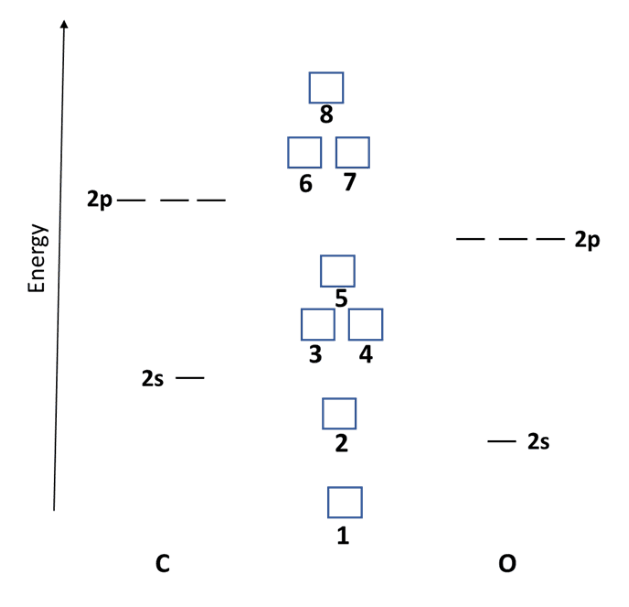
8.4 Complete the MO diagram for \(\ce{CO}\) with electrons and the following table with the type \((\sigma/\pi)\) of overlap for forming each MO.
| MO | 1 | 2 | 3 | 4 | 5 | 6 | 7 | 8 |
|---|---|---|---|---|---|---|---|---|
| Type of overlap |
8.5 What is the effect of the \(\ce{Ru-CO}\) \(\pi\)-interaction on the \(\ce{Ru-CO}\) and the \(\ce{C-O}\) bond strengths? Tick the correct answer.
(i) \(\ce{Ru-CO}\) bond strength:
☐ increases "in"
☐ decreases "dec"
☐ no change "nc"
(ii) \(\ce{C-O}\) bond strength:
☐ increases "in"
☐ decreases "dec"
☐ no change "nc"
Adsorbed \(\ce{CO}\) molecules have strong IR absorptions due to \(\ce{C-O}\) stretching vibrations. Three binding modes for \(\ce{CO}\) adsorbed on a metal surface are shown, where \(\ce{CO}\) can interact with one or more metal atoms. IR peaks in the spectra of free \(\ce{CO}\) and the three binding modes of adsorbed \(\ce{CO}\) were observed at values of 1850, 1930, 2100, and \(2143\ \mathrm{cm^{-1}}\).
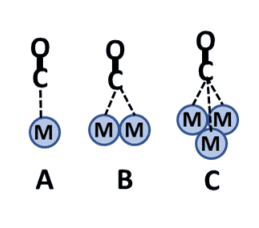
8.6 Tick which wavenumber corresponds to each adsorption mode (A, B, and C) and to free \(\ce{CO}\).
Dispersion of a metal catalyst refers to the percentage of its atoms exposed on the surface. Dispersion can be determined by pulse chemisorption of \(\ce{CO}\) since it adsorbs selectively onto surface atoms. Equal pulses of known amounts of \(\ce{CO}\) are injected and a certain amount is adsorbed from each pulse. The amount remaining is measured by a detector and a peak, the area under which correlates with the amount of unadsorbed \(\ce{CO}\) from each pulse, is plotted as shown below. Injections continue until no more \(\ce{CO}\) adsorbs.
One experiment used \(50\ \mathrm{\mu L}\) pulses consisting of 10% vol \(\ce{CO}\) in \(\ce{He}\), at \(25\ ^\circ\mathrm{C}\) and \(100\ \mathrm{kPa}\). \(15\ \mathrm{mg}\) catalyst was used, composed of 10 wt% \(\ce{Ni}\) on an \(\ce{Al2O3}\) support. Assume one \(\ce{CO}\) molecule adsorbs on each surface \(\ce{Ni}\) atom.
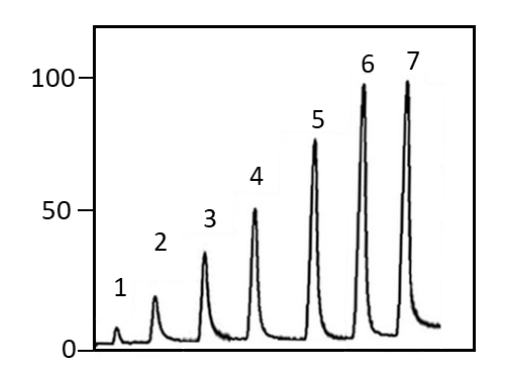
| Pulse # (x axis) | 1 | 2 | 3 | 4 | 5 | 6 | 7 |
|---|---|---|---|---|---|---|---|
| % of pulse unadsorbed (y axis) | 4 | 10 | 20 | 50 | 80 | 100 | 100 |
8.7 Calculate the percentage of \(\ce{Ni}\) atoms exposed on the surface, \(\%_{\ce{Ni}}\).
Despite being toxic at higher concentrations, at a concentration of 10-250 ppm, \(\ce{CO}\) shows anti-inflammatory properties. Prodrugs known as \(\ce{CO}\) releasing molecules (CORMs) target the delivery of effective dosages of \(\ce{CO}\) to tissues in response to a trigger. Mn(I) carbonyl complexes have shown promise as PhotoCORMs as they can release \(\ce{CO}\) when exposed to light.
Compounds A-D are all neutral Mn(I) carbonyl complexes.
B, C, and D do not contain two \(\ce{CO}\) ligands in a trans arrangement.
The IR spectrum of C contains a band at \(2042\ \mathrm{cm^{-1}}\) in addition to the \(\ce{CO}\) stretching bands. The table with the number of \(\ce{CO}\) stretching bands in the IR spectra of metal carbonyl complexes is given in the data sheet section at the beginning of the exam.
| Compound | %Mn by mass | Number of CO stretching bands |
|---|---|---|
| A | 19.98 | 3 |
| B | 12.15 | 3 |
| C | 13.26 | 3 |
| D | 12.95 | 2 |
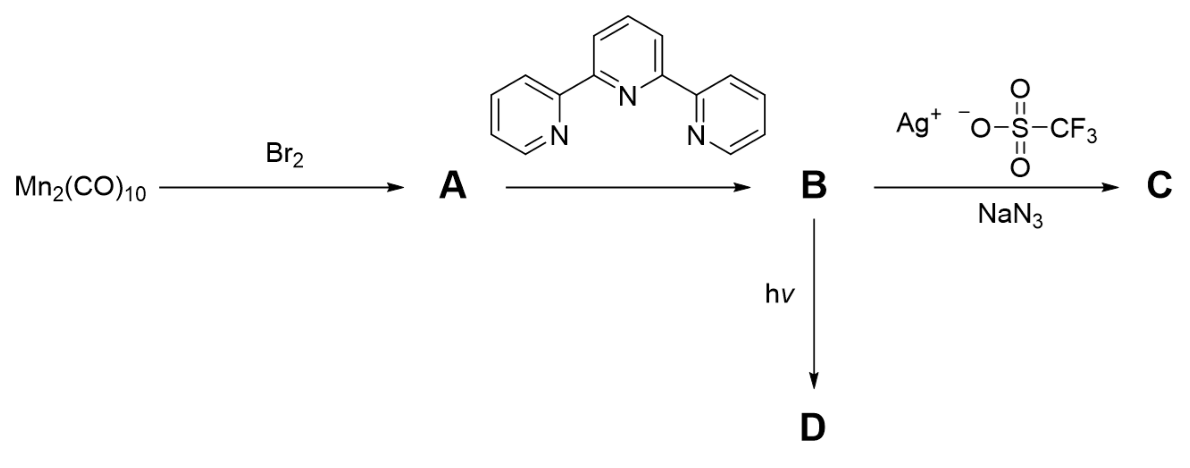
For simplicity, the ligand can be drawn as:
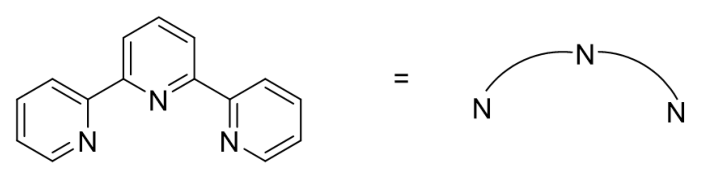
8.8 Draw the structures of compounds A-D, ensuring the three-dimensional shape is clear. If the compound is chiral, only one enantiomer needs to be drawn.
Compound C reacts with alkynes and this can be used to tag proteins. This is known as an Inorganic Click (iClick) reaction.

During the conversion of C to E, the \(2042\ \mathrm{cm^{-1}}\) band in the IR spectrum of C disappears. The IR spectrum of E has two new \(\ce{C=O}\) bands in the range of 1735-1725 \(\mathrm{cm^{-1}}\). After a further 6 h, compound E converts to compound F which only has one \(\ce{C=O}\) band in the range of 1735-1725 \(\mathrm{cm^{-1}}\). Compound G does not contain manganese and has two planes of symmetry.
8.9 Draw the structures of compounds E, F, and G, ensuring the three-dimensional shape is clear. If the compound is chiral, only one enantiomer needs to be drawn.
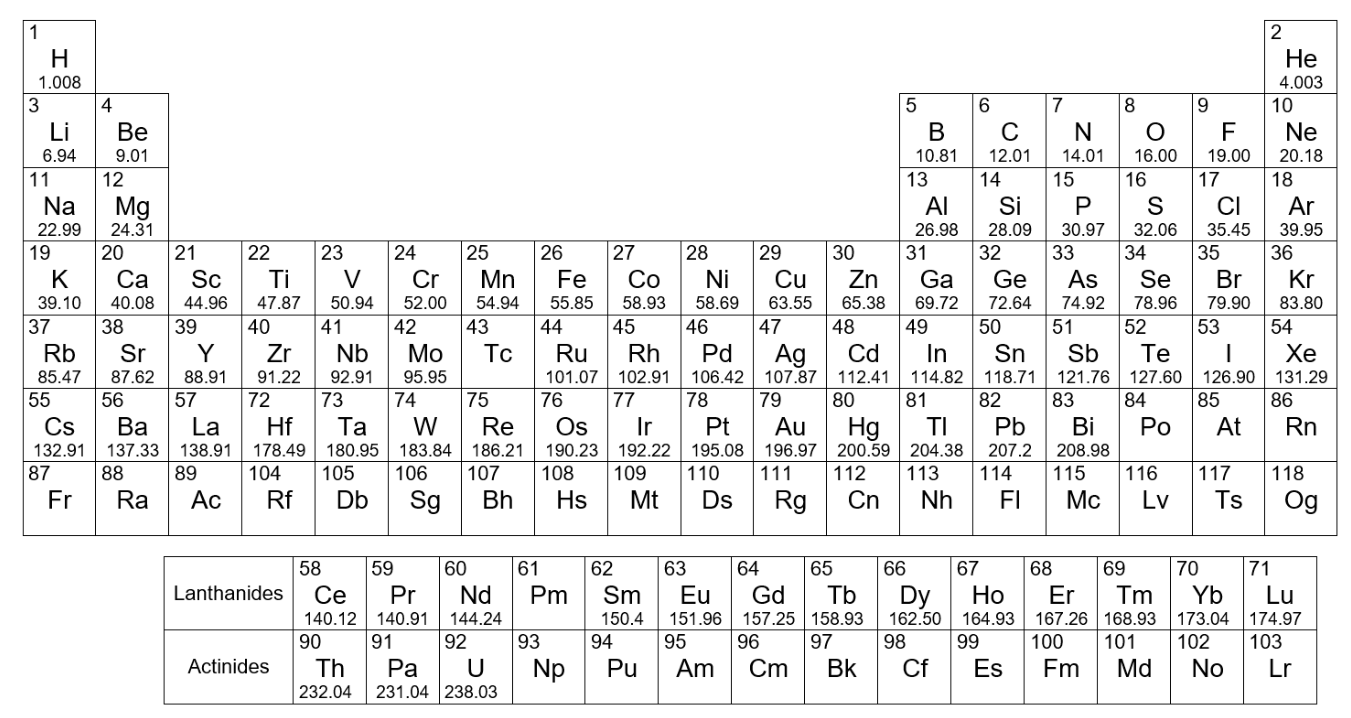
Periodic table and data sheet
Physical constants and formulae
| Avogadro constant | \(N_A\) | \(6.022\times10^{23}\ \mathrm{mol^{-1}}\) |
| molar gas constant | \(R\) | \(8.314\ \mathrm{J\,K^{-1}\,mol^{-1}}\) |
| Faraday constant | \(F\) | \(96485\ \mathrm{C\,mol^{-1}}\) |
| Planck constant | \(h\) | \(6.626\times10^{-34}\ \mathrm{J\,s}\) |
| speed of light in vacuum | \(c\) | \(2.998\times10^8\ \mathrm{m\,s^{-1}}\) |
| mass of electron | \(m_e\) | \(9.109\times10^{-31}\ \mathrm{kg}\) |
| charge of electron | \(e\) | \(1.602\times10^{-19}\ \mathrm{C}\) |
| atmospheric pressure | \(p_{\mathrm{atm}}\) | \(101325\ \mathrm{Pa}\) |
| ionic product of water at 298 K | \(K_w\) | \(10^{-14}\) |
| \(1\ \mathrm{nm}=1\times10^{-9}\ \mathrm{m}\) |
| \(1\ \text{Å}=1\times10^{-10}\ \mathrm{m}\) |
| \(1\ \mathrm{pm}=1\times10^{-12}\ \mathrm{m}\) |
| \(0\ ^\circ\mathrm{C}=273.15\ \mathrm{K}\) |
| \(1\ \mathrm{kWh}=3600\ \mathrm{kJ}\) |
| \(1\ \mathrm{W}=1\ \mathrm{J\,s^{-1}}\) |
| \(1\ \mathrm{eV}=1.602\times10^{-19}\ \mathrm{J}\) |
| \(1\ \mathrm{bar}=10^5\ \mathrm{Pa}\) |
| area of triangle | \(A=\frac12 ab\cdot\sin C\) |
| volume of cube | \(V=a^3\) |
| volume of sphere | \(V=\frac43\pi r^3\) |
| surface area of sphere | \(S=4\pi r^2\) |
| ideal gas equation | \(pV=nRT\) |
| frequency of light | \(\nu=\frac{c}{\lambda}\) |
| energy of a photon | \(E=\frac{hc}{\lambda}\) |
| Beer-Lambert law | \(A=\log\left(\frac{I_0}{I}\right)=\varepsilon cd\) |
| spin-only magnetic moment | \(\mu=\sqrt{n(n+2)}\ \mathrm{BM}\) |
| Henderson–Hasselbalch equation | \(\mathrm{pH}=\mathrm{p}K_a+\log\left(\frac{[\ce{A-}]}{[\ce{HA}]}\right)\) |
| \(0^{\mathrm{th}}\) order integrated rate law | \([\ce{A}]=[\ce{A}]_0-kt\) |
| \(1^{\mathrm{st}}\) order integrated rate law | \(\ln[\ce{A}]=\ln[\ce{A}]_0-kt\) |
| Arrhenius equation | \(k=A\cdot e^{-E_a/(RT)}\) |
| enthalpy | \(H=U+pV\) |
| Gibbs energy | \(G=H-TS\) |
| standard Gibbs energy change | \(\Delta_rG^\circ=-RT\ln K=-nFE^\circ_{\mathrm{cell}}\) |
| Clausius-Clapeyron equation | \(\ln\left(\frac{P_1}{P_2}\right)=\frac{\Delta H_{\mathrm{vap}}}{R}\left(\frac1{T_2}-\frac1{T_1}\right)\) |
| specific heat | \(Q=mC_p\Delta T\) |
| boiling point elevation | \(\Delta T=iK_bm_i\) |
| freezing point depression | \(\Delta T=iK_fm_i\) |
Consider all gases ideal unless told otherwise.
In equilibrium constant calculations, all concentrations are referenced to a concentration of \(1\ \mathrm{mol\,dm^{-3}}\).
IR absorption data
Bond stretching frequencies
| Bond type | Wavenumber \((\mathrm{cm^{-1}})\) | |
|---|---|---|
| \(\ce{C-H}\) | Alkane | 3000-2850 |
| Alkene | 3100-3000 | |
| Aromatic | 3150-3050 | |
| Alkyne | \(\sim3300\) | |
| Aldehyde | 2900-2700 | |
| \(\ce{C=C}\) | Alkene | 1680-1600 |
| Aromatic | 1600-1400 | |
| \(\ce{C#C}\) | Alkyne | 2250-2100 |
| \(\ce{C=O}\) | Aldehyde | 1740-1720 |
| Ketone | 1725-1705 | |
| Carboxylic acid | 1725-1700 | |
| Ester | 1750-1720 | |
| Amide | 1670-1640 | |
| Anhydride | 1810, 1760 | |
| \(\ce{C-O}\) | Alcohol, ether, ester, carboxylic acid, anhydride | 1300-800 |
| \(\ce{O-H}\) | Alcohol, phenol, free | 3600-3200 |
| Hydrogen bonded | 3500-3200 | |
| Carboxylic acid | 3400-2500 | |
| \(\ce{N-H}\) | Primary and secondary amine and amide | 3500-3100 |
| \(\ce{C-N}\) | Amine | 1350-1000 |
| \(\ce{C=N}\) | Imine and oxime | 1690-1640 |
| \(\ce{C#N}\) | Nitrile | 2260-2240 |
| \(\ce{N=O}\) | Nitro (\(\ce{R-NO2}\)) | 1600-1500, 1400-1300 |
| \(\ce{S=O}\) | Sulfoxide | 1050 |
| Sulfate, sulfonamide | 1200-1140 |
Characteristic bond stretching frequencies of anionic species
| Anion | Wavenumber \((\mathrm{cm^{-1}})\) |
|---|---|
| \(\ce{SO4^2-}\) | \(1100\text{-}1200\;(\nu_{\mathrm{as}})\) |
| \(\ce{ClO4-}\) | \(1050\text{-}1170\;(\nu_{\mathrm{as}})\) |
| \(\ce{NO3-}\) | \(1370\;(\nu_{\mathrm{as}})\) |
| \(\ce{CN-}\) | 2089 |
| \(\ce{SCN-}\) | \(2053\;(\nu_{\ce{C-N}}),\ 748\;(\nu_{\ce{C-S}})\) |
| \(\ce{N3-}\) | \(2042\;(\nu_{\mathrm{as}}),\ 1343\;(\nu_{\mathrm{s}})\) |
| \(\ce{CNO-}\) | \(2052\;(\nu_{\ce{C-N}}),\ 1057\;(\nu_{\ce{N-O}})\) |
Number of CO stretching bands in the IR spectra of metal carbonyl complexes
| Complex | Number of bands |
|---|---|
| \(\ce{M(CO)6}\) | 1 |
| \(\ce{M(CO)5X}\) | 3 |
| \(cis\text{-}\ce{M(CO)4X2}\) | 4 |
| \(trans\text{-}\ce{M(CO)4X2}\) | 1 |
| \(fac\text{-}\ce{M(CO)3X3}\) | 2 |
| \(mer\text{-}\ce{M(CO)3X3}\) | 3 |
| \(fac\text{-}\ce{M(CO)3X2Y}\) | 3 |
| \(cis\text{-}\ce{M(CO)2X4}\) | 2 |
| \(trans\text{-}\ce{M(CO)2X4}\) | 1 |
Periodic table
Official English text of the problem.
Answers
- 8.1 — 4 points
(a) \(\ce{2CO + O2 -> 2CO2}\): Ox.
(b) \(\ce{C_xH_y + (x+y/4)O2 -> xCO2 + (y/2)H2O}\): Ox.
(c) \(\ce{2NO_x -> N2 + xO2}\): Red.
The molecular species are carbon monoxide [C-]#[O+], oxygen O=O, carbon dioxide O=C=O, water O, and nitrogen N#N. The variable formulas \(\ce{C_xH_y}\) and \(\ce{NO_x}\) specify families, so neither has a unique SMILES.
- 8.2 — 1 point
\[ \boxed{v(\mathrm{air})=25\ \mathrm{mL\,min^{-1}}} \]
- 8.3 — 6 points
\[ \boxed{N=1.994\times10^3\approx2.0\times10^3 \text{ molecules of }\ce{CO2}\text{ per surface Pd atom}} \]
- 8.4 — 3 points
| MO | 1 | 2 | 3 | 4 | 5 | 6 | 7 | 8 |
|---|---|---|---|---|---|---|---|---|
| Electrons | \(\uparrow\downarrow\) | \(\uparrow\downarrow\) | \(\uparrow\downarrow\) | \(\uparrow\downarrow\) | \(\uparrow\downarrow\) | Empty | Empty | Empty |
| Type of overlap | \(\sigma\) | \(\sigma\) | \(\pi\) | \(\pi\) | \(\sigma\) | \(\pi\) | \(\pi\) | \(\sigma\) |
- 8.5 — 2 points
(i) \(\ce{Ru-CO}\) bond strength: increases, “in”.
(ii) \(\ce{C-O}\) bond strength: decreases, “dec”.
- 8.6 — 2 points
| Species or adsorption mode | Wavenumber \((\mathrm{cm^{-1}})\) | SMILES or schematic coordination SMILES |
|---|---|---|
| A: terminal carbon monoxide | 2100 | [C-](->*)#[O+] |
| B: doubly bridging carbon monoxide | 1930 | [C-](->*)(->*)#[O+] |
| C: triply bridging carbon monoxide | 1850 | [C-](->*)(->*)(->*)#[O+] |
| Free carbon monoxide | 2143 | [C-]#[O+] |
Here * denotes an unspecified surface metal atom. These fragments describe connectivity; they do not represent the metal surface or its \(\pi\)-backbonding electronically.
- 8.7 — 4 points
\[ \boxed{\%_{\ce{Ni}}=2.65\%\quad\text{(approximately }2.7\%\text{)}} \]
- 8.8 — 8 points
Write tpy for 2,2′:6′,2″-terpyridine, n1c(-c2ccccn2)cccc1-c3ccccn3.
All four complexes are octahedral. The coordination SMILES use donor-to-metal arrows; the @OH descriptors specify the octahedral arrangement. Explicit spatial descriptions are supplied in the Solution.
A: Bromidopentacarbonylmanganese(I), \(\ce{[MnBr(CO)5]}\).
SMILES: [Br-]->[Mn+](<-[C-]#[O+])(<-[C-]#[O+])(<-[C-]#[O+])(<-[C-]#[O+])<-[C-]#[O+]
B: fac-Bromidotricarbonyl(κ²-terpyridine)manganese(I), \(fac\text{-}\ce{[MnBr(CO)3(tpy)]}\). The central pyridyl nitrogen and one terminal pyridyl nitrogen bind; the other terminal nitrogen remains unbound.
SMILES: [O+]#[C-]->[Mn@OH3+]1(<-[C-]#[O+])(<-[C-]#[O+])(<-[Br-])<-[n]2c(-c3cccc[n]->13)cccc2-c1ccccn1
C: fac-Azidotricarbonyl(κ²-terpyridine)manganese(I), \(fac\text{-}\ce{[Mn(N3)(CO)3(tpy)]}\). Azide binds through a terminal nitrogen.
SMILES: [O+]#[C-]->[Mn@OH3+]1(<-[C-]#[O+])(<-[C-]#[O+])(<-[N-]=[N+]=[N-])<-[n]2c(-c3cccc[n]->13)cccc2-c1ccccn1
D: cis-Bromidodicarbonyl(κ³-terpyridine)manganese(I), \(cis\text{-}\ce{[MnBr(CO)2(tpy)]}\). All three terpyridine nitrogens bind in a meridional arrangement.
SMILES: [O+]#[C-]->[Mn@OH9+]12(<-[C-]#[O+])(<-[Br-])<-[n]3c(-c4cccc[n]->14)cccc3-c1cccc[n]->21
- 8.9 — 5 points
E: fac-Tricarbonyl(κ²-terpyridine)(4,5-bis(methoxycarbonyl)-1,2,3-triazolato-κN¹)manganese(I). The triazolate binds through an end nitrogen of its three-nitrogen sequence.
SMILES: [O+]#[C-]->[Mn@OH3+]1(<-[C-]#[O+])(<-[C-]#[O+])(<-[n-]2nnc(C(=O)OC)c2C(=O)OC)<-[n]2c(-c3cccc[n]->13)cccc2-c1ccccn1
F: fac-Tricarbonyl(κ²-terpyridine)(4,5-bis(methoxycarbonyl)-1,2,3-triazolato-κN²)manganese(I). The triazolate now binds through the middle nitrogen of its three-nitrogen sequence.
SMILES: [O+]#[C-]->[Mn@OH3+]1(<-[C-]#[O+])(<-[C-]#[O+])(<-[n-]2nc(C(=O)OC)c(C(=O)OC)n2)<-[n]2c(-c3cccc[n]->13)cccc2-c1ccccn1
G: Dimethyl 2H-1,2,3-triazole-4,5-dicarboxylate. The hydrogen is on the middle nitrogen, N2.
SMILES: COC(=O)c1n[nH]nc1C(=O)OC
Solution
8.1
Carbon monoxide is oxidised to carbon dioxide:
\[ \boxed{\ce{2CO + O2 -> 2CO2}} \]
The oxidation state of carbon increases from \(+2\) to \(+4\), so the correct box is Ox.
Complete combustion of an unburnt hydrocarbon gives carbon dioxide and water:
\[ \boxed{\ce{C_xH_y + (x+y/4)O2 -> xCO2 + (y/2)H2O}} \]
The products contain \(x\) carbon atoms, \(y\) hydrogen atoms, and \(2x+y/2\) oxygen atoms. Thus the oxygen coefficient is \(x+y/4\). The average carbon oxidation state rises from \(-y/x\) to \(+4\), so the correct box is Ox.
With reactions between exhaust gases excluded, the requested formal conversion of nitrogen oxides is:
\[ \boxed{\ce{2NO_x -> N2 + xO2}} \]
Nitrogen changes from an average oxidation state \(+2x\) to zero, so the correct box is Red. For example:
\[ \ce{2NO -> N2 + O2} \]
\[ \ce{2NO2 -> N2 + 2O2} \]
Here nitrogen monoxide is [N]=O, and nitrogen dioxide is O=[N+][O-]. These equations follow the problem’s instruction to exclude reduction by other exhaust constituents.
8.2
The combustion equation requires one mole of oxygen for every two moles of carbon monoxide. At the same temperature and pressure, gas volume flow rates have the same ratio:
\[ v(\ce{O2})=\frac12v(\ce{CO}) =\frac12(10)=5.0\ \mathrm{mL\,min^{-1}}. \]
Air contains 20% oxygen by volume, so
\[ 0.20\,v(\mathrm{air})=5.0\ \mathrm{mL\,min^{-1}}, \]
giving
\[ \boxed{v(\mathrm{air})=25\ \mathrm{mL\,min^{-1}}}. \]
8.3
In one hour, the inlet volume of carbon monoxide is
\[ V(\ce{CO})=(10\ \mathrm{mL\,min^{-1}})(60\ \mathrm{min}) =600\ \mathrm{mL}=6.00\times10^{-4}\ \mathrm{m^3}. \]
Each converted carbon monoxide molecule produces one carbon dioxide molecule. Therefore,
\[ n(\ce{CO2}) =\eta\frac{pV(\ce{CO})}{RT} =\frac{0.70(101325)(6.00\times10^{-4})} {(8.314)(273.15)} =1.87394\times10^{-2}\ \mathrm{mol}. \]
The total palladium mass is
\[ m(\ce{Pd})=(0.10\ \mathrm{g})(0.10)=0.010\ \mathrm{g}. \]
Since 10% of the palladium atoms are surface atoms,
\[ n(\ce{Pd})_{\mathrm{surface}} =0.10\frac{0.010\ \mathrm{g}}{106.42\ \mathrm{g\,mol^{-1}}} =9.39673\times10^{-6}\ \mathrm{mol}. \]
Avogadro’s constant cancels in the ratio:
\[ N= \frac{n(\ce{CO2})N_A} {n(\ce{Pd})_{\mathrm{surface}}N_A} =\frac{1.87394\times10^{-2}} {9.39673\times10^{-6}} =1994.24. \]
Thus,
\[ \boxed{N\approx2.0\times10^3\ \text{carbon dioxide molecules per surface Pd atom}}. \]
8.4
Carbon contributes four valence electrons and oxygen contributes six, giving ten valence electrons.
Fill the supplied levels from lowest to highest energy. Orbitals 1 and 2 each receive two electrons, the degenerate pair 3 and 4 receives four electrons in total, and orbital 5 receives the remaining two. Orbitals 6, 7, and 8 remain empty.
The valence configuration, using the usual orbital labels, is
\[ (\sigma_{2s})^2(\sigma_{2s}^{*})^2 (\pi_{2p_x})^2(\pi_{2p_y})^2(\sigma_{2p_z})^2. \]
Taking the molecular axis as \(z\), end-on overlap produces \(\sigma\) orbitals and side-on overlap produces \(\pi\) orbitals. Therefore:
| MO | Occupancy | Overlap type |
|---|---|---|
| 1 | 2 | \(\sigma\) |
| 2 | 2 | \(\sigma\) |
| 3 | 2 | \(\pi\) |
| 4 | 2 | \(\pi\) |
| 5 | 2 | \(\sigma\) |
| 6 | 0 | \(\pi\) |
| 7 | 0 | \(\pi\) |
| 8 | 0 | \(\sigma\) |
In the requested drawing, place an opposite-spin electron pair in each of boxes 1–5 and leave boxes 6–8 empty.
8.5
The \(\pi\)-interaction is metal-to-carbonyl back-donation: occupied ruthenium d orbitals donate electron density into the empty carbon monoxide \(\pi^*\) orbitals, represented by levels 6 and 7.
This interaction is bonding between ruthenium and the carbonyl ligand, but antibonding within carbon monoxide. Consequently:
\[ \boxed{\ce{Ru-CO}\text{ strengthens; }\ce{C-O}\text{ weakens}.} \]
8.6
For a stretching vibration,
\[ \widetilde{\nu}=\frac{1}{2\pi c}\sqrt{\frac{k}{\mu}}, \]
where \(k\) is the bond force constant and \(\mu\) is the reduced mass. As the atoms remain carbon and oxygen, the frequency ordering mainly reflects the \(\ce{C-O}\) force constant.
Free carbon monoxide has the strongest internal bond and therefore the highest wavenumber, \(2143\ \mathrm{cm^{-1}}\). Metal back-donation weakens that bond. In the adsorption modes shown, increasing the number of interacting metal atoms gives progressively lower stretching wavenumbers:
\[ \boxed{ \begin{aligned} \text{Free carbon monoxide}:&\quad2143\ \mathrm{cm^{-1}},\\ \text{A, terminal}:&\quad2100\ \mathrm{cm^{-1}},\\ \text{B, two-metal bridge}:&\quad1930\ \mathrm{cm^{-1}},\\ \text{C, three-metal bridge}:&\quad1850\ \mathrm{cm^{-1}}. \end{aligned}} \]
All three adsorption modes bind through the carbon end.
8.7
Each pulse contains
\[ V_{\ce{CO},\mathrm{pulse}} =(50\ \mathrm{\mu L})(0.10) =5.0\ \mathrm{\mu L} =5.0\times10^{-9}\ \mathrm{m^3}. \]
At \(T=298.15\ \mathrm{K}\) and \(p=1.00\times10^5\ \mathrm{Pa}\),
\[ n_{\ce{CO},\mathrm{pulse}} =\frac{pV}{RT} =\frac{(1.00\times10^5)(5.0\times10^{-9})} {(8.314)(298.15)} =2.01709\times10^{-7}\ \mathrm{mol}. \]
The adsorbed fractions are obtained by subtracting each unadsorbed fraction from one:
| Pulse | Adsorbed fraction |
|---|---|
| 1 | 0.96 |
| 2 | 0.90 |
| 3 | 0.80 |
| 4 | 0.50 |
| 5 | 0.20 |
| 6 | 0 |
| 7 | 0 |
Their sum is
\[ 0.96+0.90+0.80+0.50+0.20=3.36. \]
Thus the total adsorbed amount is
\[ n_{\ce{CO},\mathrm{ads}} =3.36(2.01709\times10^{-7}) =6.77742\times10^{-7}\ \mathrm{mol}. \]
One adsorbed molecule corresponds to one surface nickel atom, so this is also the amount of surface nickel atoms.
The total nickel amount is
\[ n_{\ce{Ni},\mathrm{total}} =\frac{(15\times10^{-3}\ \mathrm{g})(0.10)} {58.69\ \mathrm{g\,mol^{-1}}} =2.55580\times10^{-5}\ \mathrm{mol}. \]
Therefore,
\[ \boxed{ \%_{\ce{Ni}} =100\frac{6.77742\times10^{-7}} {2.55580\times10^{-5}} =2.65178\%\approx2.65\%. } \]
8.8
The terpyridine ligand has formula \(\ce{C15H11N3}\) and molar mass
\[ M(\mathrm{tpy}) =15(12.01)+11(1.008)+3(14.01) =233.268\ \mathrm{g\,mol^{-1}}. \]
Also,
\[ M(\ce{CO})=28.01\ \mathrm{g\,mol^{-1}}. \]
The proposed compositions give:
| Compound | Composition | Calculated molar mass \((\mathrm{g\,mol^{-1}})\) | Calculated Mn mass percentage |
|---|---|---|---|
| A | \(\ce{[MnBr(CO)5]}\) | 274.890 | 19.986% |
| B | \(\ce{[MnBr(CO)3(tpy)]}\) | 452.138 | 12.151% |
| C | \(\ce{[Mn(N3)(CO)3(tpy)]}\) | 414.268 | 13.262% |
| D | \(\ce{[MnBr(CO)2(tpy)]}\) | 424.128 | 12.954% |
These agree with the supplied compositions, apart from the insignificant last-decimal discrepancy for A.
Identification of A. Bromine cleaves the manganese–manganese bond, oxidising both manganese atoms from Mn(0) to Mn(I):
\[ \ce{Mn2(CO)10 + Br2 -> 2[MnBr(CO)5]}. \]
Bromine has SMILES BrBr. The starting material, decacarbonyldimanganese(0), has a manganese–manganese bond and five terminal carbonyls on each metal; its coordination SMILES is:
[Mn](<-[C-]#[O+])(<-[C-]#[O+])(<-[C-]#[O+])(<-[C-]#[O+])(<-[C-]#[O+])-[Mn](<-[C-]#[O+])(<-[C-]#[O+])(<-[C-]#[O+])(<-[C-]#[O+])<-[C-]#[O+]
A is an octahedral \(\ce{M(CO)5X}\) complex, consistent with its three carbonyl stretching bands.
Identification of B. Addition of one terpyridine ligand replaces two carbonyls:
\[ \ce{A + tpy -> B + 2CO}. \]
The mass percentage requires three retained carbonyls and one bromide ligand. These occupy four coordination sites, leaving two sites for terpyridine. Hence terpyridine binds through the central nitrogen and one terminal nitrogen; the other terminal pyridyl group remains pendant.
The absence of trans carbonyls requires a facial carbonyl arrangement. Its three carbonyl bands agree with the supplied \(fac\text{-}\ce{M(CO)3X2Y}\) pattern.
Identification of C. Silver removes bromide as silver bromide, and azide replaces it:
\[ \ce{B + AgCF3SO3 + NaN3 -> C + AgBr + NaCF3SO3}. \]
The species in this substitution are silver(I) triflate [Ag+].[O-]S(=O)(=O)C(F)(F)F, sodium azide [Na+].[N-]=[N+]=[N-], silver(I) bromide [Ag+].[Br-], and sodium triflate [Na+].[O-]S(=O)(=O)C(F)(F)F.
The \(2042\ \mathrm{cm^{-1}}\) band identifies the azide ion, [N-]=[N+]=[N-]. Its replacement of bromide also explains the mass change:
\[ 79.90-3(14.01)=37.87\ \mathrm{g\,mol^{-1}}. \]
C retains the facial tricarbonyl group and κ²-terpyridine. The azide binds end-on through a terminal nitrogen.
Identification of D. Photolysis removes one carbonyl:
\[ \ce{B ->[h\nu] D + CO}. \]
The previously unbound terminal pyridyl nitrogen then occupies the vacant site. Thus D contains κ³-terpyridine, two carbonyls, and bromide.
Terpyridine binds meridionally: its two terminal nitrogen donors are trans to one another. The two carbonyls are cis, as required by the question and supported by the two carbonyl stretching bands.
All four structures are consistent with an 18-electron Mn(I), \(d^6\), centre.
Precise three-dimensional descriptions. Put manganese at the origin and its six donor atoms along the \(\pm x,\pm y,\pm z\) axes. Opposite signs on the same axis are trans; all other site pairs are cis. Let \(N_c\) denote the central terpyridine nitrogen, \(N_t\) the first terminal nitrogen, and \(N_u\) the other terminal nitrogen.
| Compound | \(+x\) | \(-x\) | \(+y\) | \(-y\) | \(+z\) | \(-z\) |
|---|---|---|---|---|---|---|
| A | CO | CO | CO | CO | CO | Br |
| B | CO | \(N_c\) | CO | \(N_t\) | CO | Br |
| C | CO | \(N_c\) | CO | \(N_t\) | CO | Terminal N of azide |
| D | CO | \(N_c\) | \(N_u\) | \(N_t\) | CO | Br |
Every carbonyl binds through carbon. In B and C, \(N_u\) is uncoordinated. In D it occupies the site vacated by the \(+y\) carbonyl. Connect \(N_c\) to each terminal pyridyl ring through the actual terpyridine skeleton given in the SMILES.
This specifies one allowed stereoisomer of B and C; their mirror images are equally acceptable.
8.9
The alkyne is dimethyl acetylenedicarboxylate, also called dimethyl but-2-ynedioate, with SMILES COC(=O)C#CC(=O)OC.
Formation of E. The coordinated azide undergoes a \([3+2]\) cycloaddition with the alkyne. The three azide nitrogen atoms and the two alkyne carbon atoms become the five atoms of a 1,2,3-triazolate ring:
\[ \ce{C + C6H6O4 -> E}. \]
The original azide functionality is consumed, explaining the disappearance of its \(2042\ \mathrm{cm^{-1}}\) band. The two ester groups remain intact.
Number the ring consecutively N1–N2–N3–C4–C5, with C5 bonded back to N1. Both C4 and C5 carry a methoxycarbonyl group, \(\ce{-C(=O)OCH3}\).
In E, manganese remains bonded to the azide nitrogen that becomes N1. N1 is adjacent to C5, whereas the opposite end nitrogen N3 is adjacent to C4. This binding arrangement distinguishes the two ester-bearing sides of the ring and is consistent with the two new ester carbonyl bands.
Conversion of E to F. The metal attachment migrates from the end nitrogen N1 to the middle nitrogen N2:
\[ \ce{E -> F}. \]
In F, the triazolate’s two ester-substituted sides are related by the symmetry of the N2-bound ligand fragment, consistent with the reported single ester carbonyl band. E and F are therefore N1-bound and N2-bound coordination isomers, respectively; the ester groups have not been removed.
In both E and F, manganese retains its facial tricarbonyl group and κ²-terpyridine. Their octahedral arrangements are the same as C in the table above, with the \(-z\) site occupied by:
- E: triazolate N1;
- F: triazolate N2.
The ring is aromatic and approximately planar. Its rotational conformation about the metal–nitrogen bond is not fixed by the SMILES or by the supplied data.
Formation of G. Hydrobromic acid protonates the triazolate ligand and supplies bromide to regenerate B:
\[ \ce{F + HBr -> B + G}. \]
Hydrogen bromide has molecular SMILES Br; its aqueous dissociation can be represented as [H+].[Br-].
The product G is the 2H tautomer: the hydrogen is attached to N2, the middle nitrogen. Its formula is \(\ce{C6H7N3O4}\), and its SMILES is COC(=O)c1n[nH]nc1C(=O)OC.
For the requested drawing, make the triazole ring planar and draw the two identical ester groups in matching, symmetry-related conformations. The two mirror planes are:
- The plane of the triazole ring and the planar ester framework.
- A plane perpendicular to the ring, passing through N2–H and the midpoint of the C4–C5 bond. This exchanges N1 with N3, C4 with C5, and the two ester groups.
An N1-protonated tautomer would destroy the second of these planes, so the stated symmetry selects the 2H tautomer.
The solution was checked against the official solution.
IChO 2025 · Theorieaufgabe 8
Kohlenstoffmonoxid: tödliches Gift oder vielversprechender therapeutischer Wirkstoff?
7.5% der Gesamtpunktzahl
| 8.1 | 8.2 | 8.3 | 8.4 | 8.5 | 8.6 | 8.7 | 8.8 | 8.9 | Gesamt |
|---|---|---|---|---|---|---|---|---|---|
| 4 | 1 | 6 | 3 | 2 | 2 | 4 | 8 | 5 | 35 |
Kohlenstoffmonoxid ist ein giftiges Gas, da es an Hämoglobin bindet und die Bindung von Sauerstoff blockiert. Eine bedeutende Quelle von \(\ce{CO}\) ist die unvollständige Verbrennung von Motorkraftstoff. Daher sind viele Abgasanlagen mit Abgaskatalysatoren ausgestattet, die \(\ce{CO}\) und andere gefährliche Verbindungen, darunter unverbrannte Kohlenwasserstoffe und Stickstoffoxide (\(\ce{NO_x}\)), entfernen, wobei hauptsächlich Wasserdampf, Kohlenstoffdioxid und Stickstoff entstehen.
8.1 Stellen Sie die Reaktionsgleichungen für die Umsetzung der folgenden Stoffe in einem Abgaskatalysator auf. Kreuzen Sie das entsprechende Kästchen an, um anzugeben, ob die Kohlenstoff- oder Stickstoffatome durch Sauerstoff oxidiert wurden, "Ox", reduziert wurden, "Red", oder dieselbe Oxidationsstufe behalten haben, "Same". Vernachlässigen Sie sämtliche Reaktionen zwischen den Abgasbestandteilen.
(a) \(\ce{CO}\)
(b) Unverbrannter Kohlenwasserstoff \(\ce{C_xH_y}\)
(c) Stickstoffoxide \(\ce{NO_x}\)
Abgaskatalysatoren enthalten Nanopartikel aus Edelmetallen, die als Katalysatoren wirken und auf einem kostengünstigen Material mit großer spezifischer Oberfläche wie \(\ce{Al2O3}\) immobilisiert sind.
In einem Experiment wurden \(m(\mathrm{cat.})=0.10\ \mathrm{g}\) eines Katalysators mit einem Gehalt von \(w(\ce{Pd})=10\ \mathrm{wt\%}\) in einem Rohrreaktor eingesetzt. Gase wurden in einem kontinuierlichen Strom über den Katalysator geleitet. Der Volumenstrom des \(\ce{CO}\)-Gases betrug \(v(\ce{CO})=10\ \mathrm{mL\,min^{-1}}\). Vor dem Eintritt in den Reaktor wurde dieser bei \(T=273.15\ \mathrm{K}\) und \(p=1.00\ \mathrm{atm}\) mit einem zweiten Strom aus Luft (nehmen Sie 20% \(\ce{O2}\) und 80% \(\ce{N2}\) an) gemischt.
8.2 Berechnen Sie den Volumenstrom \(v\) (in \(\mathrm{mL\,min^{-1}}\)) der Luft, der erforderlich ist, damit die Reaktanten in einem stöchiometrischen Verhältnis vorliegen.
Nehmen Sie an, dass 10% der \(\ce{Pd}\)-Atome in den Nanopartikeln an der Oberfläche exponiert sind. Nehmen Sie an, dass der Umsatz von \(\ce{CO}\) zu \(\ce{CO2}\) \(\eta=70\%\) betrug.
8.3 Berechnen Sie die Anzahl \(N\) der \(\ce{CO2}\)-Moleküle, die nach \(t=1\ \mathrm{h}\) pro \(\ce{Pd}\)-Oberflächenatom gebildet wurden.
Ruthenium-Nanopartikel sind effiziente Katalysatoren für die Verbrennung von \(\ce{CO}\). Die Bindungswechselwirkungen zwischen \(\ce{CO}\)-Molekülen und den \(\ce{Ru}\)-Oberflächenatomen sind von zwei Arten:
- \(\sigma\)-Bindung über ein freies Elektronenpaar am Kohlenstoffatom;
- \(\pi\)-Wechselwirkung durch Überlappung zwischen den d-Valenzorbitalen von \(\ce{Ru}\) und den Molekülorbitalen von \(\ce{CO}\).
8.4 Vervollständigen Sie das MO-Diagramm für \(\ce{CO}\) mit Elektronen und die folgende Tabelle mit der Art \((\sigma/\pi)\) der Überlappung, durch die das jeweilige MO entsteht.
| MO | 1 | 2 | 3 | 4 | 5 | 6 | 7 | 8 |
|---|---|---|---|---|---|---|---|---|
| Art der Überlappung |
8.5 Welche Auswirkung hat die \(\ce{Ru-CO}\)-\(\pi\)-Wechselwirkung auf die Bindungsstärken von \(\ce{Ru-CO}\) und \(\ce{C-O}\)? Kreuzen Sie die richtige Antwort an.
(i) Bindungsstärke von \(\ce{Ru-CO}\):
☐ nimmt zu "in"
☐ nimmt ab "dec"
☐ keine Änderung "nc"
(ii) Bindungsstärke von \(\ce{C-O}\):
☐ nimmt zu "in"
☐ nimmt ab "dec"
☐ keine Änderung "nc"
Adsorbierte \(\ce{CO}\)-Moleküle zeigen aufgrund von \(\ce{C-O}\)-Valenzschwingungen starke IR-Absorptionen. Dargestellt sind drei Bindungsmodi von auf einer Metalloberfläche adsorbiertem \(\ce{CO}\), wobei \(\ce{CO}\) mit einem oder mehreren Metallatomen wechselwirken kann. In den Spektren von freiem \(\ce{CO}\) und den drei Bindungsmodi des adsorbierten \(\ce{CO}\) wurden IR-Peaks bei Werten von 1850, 1930, 2100 und \(2143\ \mathrm{cm^{-1}}\) beobachtet.
8.6 Kreuzen Sie an, welche Wellenzahl dem jeweiligen Adsorptionsmodus (A, B und C) sowie freiem \(\ce{CO}\) entspricht.
Die Dispersion eines Metallkatalysators bezeichnet den prozentualen Anteil seiner Atome, die an der Oberfläche exponiert sind. Die Dispersion lässt sich durch Pulschemisorption von \(\ce{CO}\) bestimmen, da dieses selektiv an Oberflächenatomen adsorbiert. Gleiche Pulse bekannter Mengen an \(\ce{CO}\) werden injiziert, und von jedem Puls wird eine bestimmte Menge adsorbiert. Die verbleibende Menge wird mit einem Detektor gemessen, und es wird, wie unten gezeigt, ein Peak aufgezeichnet, dessen Fläche mit der Menge des nicht adsorbierten \(\ce{CO}\) aus dem jeweiligen Puls korreliert. Die Injektionen werden fortgesetzt, bis kein weiteres \(\ce{CO}\) mehr adsorbiert wird.
In einem Experiment wurden bei \(25\ ^\circ\mathrm{C}\) und \(100\ \mathrm{kPa}\) Pulse von \(50\ \mathrm{\mu L}\) eingesetzt, die aus 10 Vol.-% \(\ce{CO}\) in \(\ce{He}\) bestanden. Verwendet wurden \(15\ \mathrm{mg}\) Katalysator, bestehend aus 10 Massen-% \(\ce{Ni}\) auf einem \(\ce{Al2O3}\)-Träger. Nehmen Sie an, dass an jedem \(\ce{Ni}\)-Oberflächenatom ein \(\ce{CO}\)-Molekül adsorbiert.
| Puls Nr. (x-Achse) | 1 | 2 | 3 | 4 | 5 | 6 | 7 |
|---|---|---|---|---|---|---|---|
| Nicht adsorbierter Anteil des Pulses in % (y-Achse) | 4 | 10 | 20 | 50 | 80 | 100 | 100 |
8.7 Berechnen Sie den prozentualen Anteil der \(\ce{Ni}\)-Atome, die an der Oberfläche exponiert sind, \(\%_{\ce{Ni}}\).
Obwohl \(\ce{CO}\) bei höheren Konzentrationen giftig ist, zeigt es bei einer Konzentration von 10-250 ppm entzündungshemmende Eigenschaften. Prodrugs, die als \(\ce{CO}\)-freisetzende Moleküle (CORMs) bezeichnet werden, ermöglichen als Reaktion auf einen Auslöser die gezielte Abgabe wirksamer Dosen von \(\ce{CO}\) an Gewebe. Mn(I)-Carbonylkomplexe haben sich als vielversprechende PhotoCORMs erwiesen, da sie unter Lichteinwirkung \(\ce{CO}\) freisetzen können.
Die Verbindungen A-D sind sämtlich neutrale Mn(I)-Carbonylkomplexe.
B, C und D enthalten keine zwei \(\ce{CO}\)-Liganden in trans-Anordnung.
Das IR-Spektrum von C enthält neben den \(\ce{CO}\)-Valenzschwingungsbanden eine Bande bei \(2042\ \mathrm{cm^{-1}}\). Die Tabelle mit der Anzahl der \(\ce{CO}\)-Valenzschwingungsbanden in den IR-Spektren von Metallcarbonylkomplexen befindet sich im Datenblattabschnitt am Anfang der Prüfung.
| Verbindung | Mn-Massenanteil in % | Anzahl der CO-Valenzschwingungsbanden |
|---|---|---|
| A | 19.98 | 3 |
| B | 12.15 | 3 |
| C | 13.26 | 3 |
| D | 12.95 | 2 |
Der Ligand kann vereinfacht wie folgt gezeichnet werden:
8.8 Zeichnen Sie die Strukturen der Verbindungen A-D, sodass die räumliche Gestalt deutlich erkennbar ist. Ist eine Verbindung chiral, muss nur ein Enantiomer gezeichnet werden.
Verbindung C reagiert mit Alkinen, was zur Markierung von Proteinen genutzt werden kann. Dies wird als anorganische Click-Reaktion (iClick) bezeichnet.
Bei der Umwandlung von C zu E verschwindet die Bande bei \(2042\ \mathrm{cm^{-1}}\) im IR-Spektrum von C. Das IR-Spektrum von E weist zwei neue \(\ce{C=O}\)-Banden im Bereich von 1735-1725 \(\mathrm{cm^{-1}}\) auf. Nach weiteren 6 h wandelt sich Verbindung E in Verbindung F um, die nur eine \(\ce{C=O}\)-Bande im Bereich von 1735-1725 \(\mathrm{cm^{-1}}\) aufweist. Verbindung G enthält kein Mangan und besitzt zwei Spiegelebenen.
8.9 Zeichnen Sie die Strukturen der Verbindungen E, F und G, sodass die räumliche Gestalt deutlich erkennbar ist. Ist eine Verbindung chiral, muss nur ein Enantiomer gezeichnet werden.
Periodensystem und Datenblatt
Physikalische Konstanten und Formeln
| Avogadro-Konstante | \(N_A\) | \(6.022\times10^{23}\ \mathrm{mol^{-1}}\) |
| Molare Gaskonstante | \(R\) | \(8.314\ \mathrm{J\,K^{-1}\,mol^{-1}}\) |
| Faraday-Konstante | \(F\) | \(96485\ \mathrm{C\,mol^{-1}}\) |
| Planck-Konstante | \(h\) | \(6.626\times10^{-34}\ \mathrm{J\,s}\) |
| Lichtgeschwindigkeit im Vakuum | \(c\) | \(2.998\times10^8\ \mathrm{m\,s^{-1}}\) |
| Elektronenmasse | \(m_e\) | \(9.109\times10^{-31}\ \mathrm{kg}\) |
| Elektronenladung | \(e\) | \(1.602\times10^{-19}\ \mathrm{C}\) |
| Atmosphärendruck | \(p_{\mathrm{atm}}\) | \(101325\ \mathrm{Pa}\) |
| Ionenprodukt des Wassers bei 298 K | \(K_w\) | \(10^{-14}\) |
| \(1\ \mathrm{nm}=1\times10^{-9}\ \mathrm{m}\) |
| \(1\ \text{Å}=1\times10^{-10}\ \mathrm{m}\) |
| \(1\ \mathrm{pm}=1\times10^{-12}\ \mathrm{m}\) |
| \(0\ ^\circ\mathrm{C}=273.15\ \mathrm{K}\) |
| \(1\ \mathrm{kWh}=3600\ \mathrm{kJ}\) |
| \(1\ \mathrm{W}=1\ \mathrm{J\,s^{-1}}\) |
| \(1\ \mathrm{eV}=1.602\times10^{-19}\ \mathrm{J}\) |
| \(1\ \mathrm{bar}=10^5\ \mathrm{Pa}\) |
| Flächeninhalt eines Dreiecks | \(A=\frac12 ab\cdot\sin C\) |
| Volumen eines Würfels | \(V=a^3\) |
| Volumen einer Kugel | \(V=\frac43\pi r^3\) |
| Oberfläche einer Kugel | \(S=4\pi r^2\) |
| Ideale Gasgleichung | \(pV=nRT\) |
| Frequenz des Lichts | \(\nu=\frac{c}{\lambda}\) |
| Energie eines Photons | \(E=\frac{hc}{\lambda}\) |
| Lambert-Beer-Gesetz | \(A=\log\left(\frac{I_0}{I}\right)=\varepsilon cd\) |
| Magnetisches Moment bei reinem Spinbeitrag | \(\mu=\sqrt{n(n+2)}\ \mathrm{BM}\) |
| Henderson–Hasselbalch-Gleichung | \(\mathrm{pH}=\mathrm{p}K_a+\log\left(\frac{[\ce{A-}]}{[\ce{HA}]}\right)\) |
| Integriertes Geschwindigkeitsgesetz \(0^{\mathrm{th}}\) Ordnung | \([\ce{A}]=[\ce{A}]_0-kt\) |
| Integriertes Geschwindigkeitsgesetz \(1^{\mathrm{st}}\) Ordnung | \(\ln[\ce{A}]=\ln[\ce{A}]_0-kt\) |
| Arrhenius-Gleichung | \(k=A\cdot e^{-E_a/(RT)}\) |
| Enthalpie | \(H=U+pV\) |
| Gibbs-Energie | \(G=H-TS\) |
| Änderung der Standard-Gibbs-Energie | \(\Delta_rG^\circ=-RT\ln K=-nFE^\circ_{\mathrm{cell}}\) |
| Clausius-Clapeyron-Gleichung | \(\ln\left(\frac{P_1}{P_2}\right)=\frac{\Delta H_{\mathrm{vap}}}{R}\left(\frac1{T_2}-\frac1{T_1}\right)\) |
| Spezifische Wärmekapazität | \(Q=mC_p\Delta T\) |
| Siedepunktserhöhung | \(\Delta T=iK_bm_i\) |
| Gefrierpunktserniedrigung | \(\Delta T=iK_fm_i\) |
Betrachten Sie alle Gase als ideal, sofern nicht anders angegeben.
Bei Berechnungen von Gleichgewichtskonstanten sind alle Konzentrationen auf eine Konzentration von \(1\ \mathrm{mol\,dm^{-3}}\) bezogen.
IR-Absorptionsdaten
Valenzschwingungsfrequenzen
| Bindungstyp | Wellenzahl \((\mathrm{cm^{-1}})\) | |
|---|---|---|
| \(\ce{C-H}\) | Alkane | 3000-2850 |
| Alkene | 3100-3000 | |
| Aromaten | 3150-3050 | |
| Alkine | \(\sim3300\) | |
| Aldehyde | 2900-2700 | |
| \(\ce{C=C}\) | Alkene | 1680-1600 |
| Aromaten | 1600-1400 | |
| \(\ce{C#C}\) | Alkine | 2250-2100 |
| \(\ce{C=O}\) | Aldehyde | 1740-1720 |
| Ketone | 1725-1705 | |
| Carbonsäuren | 1725-1700 | |
| Ester | 1750-1720 | |
| Amide | 1670-1640 | |
| Anhydride | 1810, 1760 | |
| \(\ce{C-O}\) | Alkohole, Ether, Ester, Carbonsäuren, Anhydride | 1300-800 |
| \(\ce{O-H}\) | Alkohole, Phenole, frei | 3600-3200 |
| Über Wasserstoffbrücken gebunden | 3500-3200 | |
| Carbonsäuren | 3400-2500 | |
| \(\ce{N-H}\) | Primäre und sekundäre Amine und Amide | 3500-3100 |
| \(\ce{C-N}\) | Amine | 1350-1000 |
| \(\ce{C=N}\) | Imine und Oxime | 1690-1640 |
| \(\ce{C#N}\) | Nitrile | 2260-2240 |
| \(\ce{N=O}\) | Nitroverbindungen (\(\ce{R-NO2}\)) | 1600-1500, 1400-1300 |
| \(\ce{S=O}\) | Sulfoxide | 1050 |
| Sulfate, Sulfonamide | 1200-1140 |
Charakteristische Valenzschwingungsfrequenzen anionischer Spezies
| Anion | Wellenzahl \((\mathrm{cm^{-1}})\) |
|---|---|
| \(\ce{SO4^2-}\) | \(1100\text{-}1200\;(\nu_{\mathrm{as}})\) |
| \(\ce{ClO4-}\) | \(1050\text{-}1170\;(\nu_{\mathrm{as}})\) |
| \(\ce{NO3-}\) | \(1370\;(\nu_{\mathrm{as}})\) |
| \(\ce{CN-}\) | 2089 |
| \(\ce{SCN-}\) | \(2053\;(\nu_{\ce{C-N}}),\ 748\;(\nu_{\ce{C-S}})\) |
| \(\ce{N3-}\) | \(2042\;(\nu_{\mathrm{as}}),\ 1343\;(\nu_{\mathrm{s}})\) |
| \(\ce{CNO-}\) | \(2052\;(\nu_{\ce{C-N}}),\ 1057\;(\nu_{\ce{N-O}})\) |
Anzahl der CO-Valenzschwingungsbanden in den IR-Spektren von Metallcarbonylkomplexen
| Komplex | Anzahl der Banden |
|---|---|
| \(\ce{M(CO)6}\) | 1 |
| \(\ce{M(CO)5X}\) | 3 |
| \(cis\text{-}\ce{M(CO)4X2}\) | 4 |
| \(trans\text{-}\ce{M(CO)4X2}\) | 1 |
| \(fac\text{-}\ce{M(CO)3X3}\) | 2 |
| \(mer\text{-}\ce{M(CO)3X3}\) | 3 |
| \(fac\text{-}\ce{M(CO)3X2Y}\) | 3 |
| \(cis\text{-}\ce{M(CO)2X4}\) | 2 |
| \(trans\text{-}\ce{M(CO)2X4}\) | 1 |
Periodensystem
Aufgabentext aus dem offiziellen englischen Text übersetzt.
Antworten
- 8.1 — 4 Punkte
(a) \(\ce{2CO + O2 -> 2CO2}\): Ox.
(b) \(\ce{C_xH_y + (x+y/4)O2 -> xCO2 + (y/2)H2O}\): Ox.
(c) \(\ce{2NO_x -> N2 + xO2}\): Red.
Die molekularen Spezies sind Kohlenstoffmonoxid [C-]#[O+], Sauerstoff O=O, Kohlenstoffdioxid O=C=O, Wasser O und Stickstoff N#N. Die variablen Formeln \(\ce{C_xH_y}\) und \(\ce{NO_x}\) bezeichnen Stofffamilien, daher besitzt keine von ihnen eine eindeutige SMILES-Darstellung.
- 8.2 — 1 Punkt
\[ \boxed{v(\mathrm{air})=25\ \mathrm{mL\,min^{-1}}} \]
- 8.3 — 6 Punkte
\[ \boxed{N=1.994\times10^3\approx2.0\times10^3 \text{ Moleküle }\ce{CO2}\text{ pro Pd-Oberflächenatom}} \]
- 8.4 — 3 Punkte
| MO | 1 | 2 | 3 | 4 | 5 | 6 | 7 | 8 |
|---|---|---|---|---|---|---|---|---|
| Elektronen | \(\uparrow\downarrow\) | \(\uparrow\downarrow\) | \(\uparrow\downarrow\) | \(\uparrow\downarrow\) | \(\uparrow\downarrow\) | Leer | Leer | Leer |
| Art der Überlappung | \(\sigma\) | \(\sigma\) | \(\pi\) | \(\pi\) | \(\sigma\) | \(\pi\) | \(\pi\) | \(\sigma\) |
- 8.5 — 2 Punkte
(i) Bindungsstärke von \(\ce{Ru-CO}\): nimmt zu, „in“.
(ii) Bindungsstärke von \(\ce{C-O}\): nimmt ab, „dec“.
- 8.6 — 2 Punkte
| Spezies oder Adsorptionsmodus | Wellenzahl \((\mathrm{cm^{-1}})\) | SMILES oder schematische Koordinations-SMILES |
|---|---|---|
| A: terminales Kohlenstoffmonoxid | 2100 | [C-](->*)#[O+] |
| B: zweifach verbrückendes Kohlenstoffmonoxid | 1930 | [C-](->*)(->*)#[O+] |
| C: dreifach verbrückendes Kohlenstoffmonoxid | 1850 | [C-](->*)(->*)(->*)#[O+] |
| Freies Kohlenstoffmonoxid | 2143 | [C-]#[O+] |
Hier bezeichnet * ein nicht näher bestimmtes Metallatom an der Oberfläche. Diese Fragmente beschreiben die Konnektivität; sie stellen weder die Metalloberfläche noch deren \(\pi\)-Rückbindung elektronisch dar.
- 8.7 — 4 Punkte
\[ \boxed{\%_{\ce{Ni}}=2.65\%\quad\text{(ungefähr }2.7\%\text{)}} \]
- 8.8 — 8 Punkte
Verwenden Sie tpy für 2,2′:6′,2″-Terpyridin, n1c(-c2ccccn2)cccc1-c3ccccn3.
Alle vier Komplexe sind oktaedrisch. Die Koordinations-SMILES verwenden Pfeile vom Donor zum Metall; die @OH-Deskriptoren legen die oktaedrische Anordnung fest. Explizite räumliche Beschreibungen sind in der Lösung angegeben.
A: Bromidopentacarbonylmangan(I), \(\ce{[MnBr(CO)5]}\).
SMILES: [Br-]->[Mn+](<-[C-]#[O+])(<-[C-]#[O+])(<-[C-]#[O+])(<-[C-]#[O+])<-[C-]#[O+]
B: fac-Bromidotricarbonyl(κ²-terpyridin)mangan(I), \(fac\text{-}\ce{[MnBr(CO)3(tpy)]}\). Das zentrale Pyridyl-Stickstoffatom und ein terminales Pyridyl-Stickstoffatom koordinieren; das andere terminale Stickstoffatom bleibt ungebunden.
SMILES: [O+]#[C-]->[Mn@OH3+]1(<-[C-]#[O+])(<-[C-]#[O+])(<-[Br-])<-[n]2c(-c3cccc[n]->13)cccc2-c1ccccn1
C: fac-Azidotricarbonyl(κ²-terpyridin)mangan(I), \(fac\text{-}\ce{[Mn(N3)(CO)3(tpy)]}\). Azid bindet über ein terminales Stickstoffatom.
SMILES: [O+]#[C-]->[Mn@OH3+]1(<-[C-]#[O+])(<-[C-]#[O+])(<-[N-]=[N+]=[N-])<-[n]2c(-c3cccc[n]->13)cccc2-c1ccccn1
D: cis-Bromidodicarbonyl(κ³-terpyridin)mangan(I), \(cis\text{-}\ce{[MnBr(CO)2(tpy)]}\). Alle drei Stickstoffatome des Terpyridins koordinieren in einer meridionalen Anordnung.
SMILES: [O+]#[C-]->[Mn@OH9+]12(<-[C-]#[O+])(<-[Br-])<-[n]3c(-c4cccc[n]->14)cccc3-c1cccc[n]->21
- 8.9 — 5 Punkte
E: fac-Tricarbonyl(κ²-terpyridin)(4,5-bis(methoxycarbonyl)-1,2,3-triazolato-κN¹)mangan(I). Das Triazolat bindet über ein endständiges Stickstoffatom seiner Sequenz aus drei Stickstoffatomen.
SMILES: [O+]#[C-]->[Mn@OH3+]1(<-[C-]#[O+])(<-[C-]#[O+])(<-[n-]2nnc(C(=O)OC)c2C(=O)OC)<-[n]2c(-c3cccc[n]->13)cccc2-c1ccccn1
F: fac-Tricarbonyl(κ²-terpyridin)(4,5-bis(methoxycarbonyl)-1,2,3-triazolato-κN²)mangan(I). Das Triazolat bindet nun über das mittlere Stickstoffatom seiner Sequenz aus drei Stickstoffatomen.
SMILES: [O+]#[C-]->[Mn@OH3+]1(<-[C-]#[O+])(<-[C-]#[O+])(<-[n-]2nc(C(=O)OC)c(C(=O)OC)n2)<-[n]2c(-c3cccc[n]->13)cccc2-c1ccccn1
G: Dimethyl-2H-1,2,3-triazol-4,5-dicarboxylat. Das Wasserstoffatom sitzt am mittleren Stickstoffatom N2.
SMILES: COC(=O)c1n[nH]nc1C(=O)OC
Lösung
8.1
Kohlenstoffmonoxid wird zu Kohlenstoffdioxid oxidiert:
\[ \boxed{\ce{2CO + O2 -> 2CO2}} \]
Die Oxidationsstufe des Kohlenstoffs steigt von \(+2\) auf \(+4\), daher ist Ox das richtige Kästchen.
Die vollständige Verbrennung eines unverbrannten Kohlenwasserstoffs liefert Kohlenstoffdioxid und Wasser:
\[ \boxed{\ce{C_xH_y + (x+y/4)O2 -> xCO2 + (y/2)H2O}} \]
Die Produkte enthalten \(x\) Kohlenstoffatome, \(y\) Wasserstoffatome und \(2x+y/2\) Sauerstoffatome. Der Koeffizient vor Sauerstoff beträgt somit \(x+y/4\). Die mittlere Oxidationsstufe des Kohlenstoffs steigt von \(-y/x\) auf \(+4\), daher ist Ox das richtige Kästchen.
Wenn Reaktionen zwischen Abgasbestandteilen ausgeschlossen werden, lautet die geforderte formale Umsetzung der Stickstoffoxide:
\[ \boxed{\ce{2NO_x -> N2 + xO2}} \]
Die mittlere Oxidationsstufe des Stickstoffs ändert sich von \(+2x\) auf null, daher ist Red das richtige Kästchen. Zum Beispiel:
\[ \ce{2NO -> N2 + O2} \]
\[ \ce{2NO2 -> N2 + 2O2} \]
Hier ist Stickstoffmonoxid [N]=O und Stickstoffdioxid O=[N+][O-]. Diese Gleichungen folgen der Anweisung der Aufgabe, eine Reduktion durch andere Abgasbestandteile auszuschließen.
8.2
Nach der Verbrennungsgleichung wird für je zwei Mol Kohlenstoffmonoxid ein Mol Sauerstoff benötigt. Bei gleicher Temperatur und gleichem Druck stehen die Gasvolumenströme im selben Verhältnis:
\[ v(\ce{O2})=\frac12v(\ce{CO}) =\frac12(10)=5.0\ \mathrm{mL\,min^{-1}}. \]
Luft enthält 20 Vol.-% Sauerstoff, also gilt
\[ 0.20\,v(\mathrm{air})=5.0\ \mathrm{mL\,min^{-1}}, \]
woraus folgt:
\[ \boxed{v(\mathrm{air})=25\ \mathrm{mL\,min^{-1}}}. \]
8.3
In einer Stunde beträgt das zugeführte Volumen an Kohlenstoffmonoxid
\[ V(\ce{CO})=(10\ \mathrm{mL\,min^{-1}})(60\ \mathrm{min}) =600\ \mathrm{mL}=6.00\times10^{-4}\ \mathrm{m^3}. \]
Jedes umgesetzte Kohlenstoffmonoxidmolekül erzeugt ein Kohlenstoffdioxidmolekül. Daher gilt:
\[ n(\ce{CO2}) =\eta\frac{pV(\ce{CO})}{RT} =\frac{0.70(101325)(6.00\times10^{-4})} {(8.314)(273.15)} =1.87394\times10^{-2}\ \mathrm{mol}. \]
Die gesamte Palladiummasse beträgt
\[ m(\ce{Pd})=(0.10\ \mathrm{g})(0.10)=0.010\ \mathrm{g}. \]
Da 10% der Palladiumatome Oberflächenatome sind, gilt
\[ n(\ce{Pd})_{\mathrm{surface}} =0.10\frac{0.010\ \mathrm{g}}{106.42\ \mathrm{g\,mol^{-1}}} =9.39673\times10^{-6}\ \mathrm{mol}. \]
Die Avogadro-Konstante kürzt sich im Verhältnis heraus:
\[ N= \frac{n(\ce{CO2})N_A} {n(\ce{Pd})_{\mathrm{surface}}N_A} =\frac{1.87394\times10^{-2}} {9.39673\times10^{-6}} =1994.24. \]
Damit ergibt sich:
\[ \boxed{N\approx2.0\times10^3\ \text{Kohlenstoffdioxidmoleküle pro Pd-Oberflächenatom}}. \]
8.4
Kohlenstoff trägt vier Valenzelektronen und Sauerstoff sechs bei, sodass insgesamt zehn Valenzelektronen vorliegen.
Besetzen Sie die vorgegebenen Niveaus von der niedrigsten zur höchsten Energie. Die Orbitale 1 und 2 erhalten jeweils zwei Elektronen, das entartete Paar 3 und 4 erhält insgesamt vier Elektronen, und Orbital 5 erhält die verbleibenden zwei. Die Orbitale 6, 7 und 8 bleiben leer.
Die Valenzelektronenkonfiguration lautet unter Verwendung der üblichen Orbitalbezeichnungen
\[ (\sigma_{2s})^2(\sigma_{2s}^{*})^2 (\pi_{2p_x})^2(\pi_{2p_y})^2(\sigma_{2p_z})^2. \]
Wird die Molekülachse als \(z\)-Achse gewählt, entstehen durch frontale Überlappung \(\sigma\)-Orbitale und durch seitliche Überlappung \(\pi\)-Orbitale. Daher gilt:
| MO | Besetzung | Art der Überlappung |
|---|---|---|
| 1 | 2 | \(\sigma\) |
| 2 | 2 | \(\sigma\) |
| 3 | 2 | \(\pi\) |
| 4 | 2 | \(\pi\) |
| 5 | 2 | \(\sigma\) |
| 6 | 0 | \(\pi\) |
| 7 | 0 | \(\pi\) |
| 8 | 0 | \(\sigma\) |
Tragen Sie in der geforderten Zeichnung in jedes der Kästchen 1–5 ein Elektronenpaar mit entgegengesetzten Spins ein und lassen Sie die Kästchen 6–8 leer.
8.5
Bei der \(\pi\)-Wechselwirkung handelt es sich um eine Rückbindung vom Metall zum Carbonylliganden: Besetzte d-Orbitale des Rutheniums übertragen Elektronendichte in die leeren \(\pi^*\)-Orbitale des Kohlenstoffmonoxids, die durch die Niveaus 6 und 7 dargestellt werden.
Diese Wechselwirkung ist zwischen Ruthenium und dem Carbonylliganden bindend, innerhalb des Kohlenstoffmonoxids jedoch antibindend. Folglich gilt:
\[ \boxed{\ce{Ru-CO}\text{ wird stärker; }\ce{C-O}\text{ wird schwächer}.} \]
8.6
Für eine Valenzschwingung gilt
\[ \widetilde{\nu}=\frac{1}{2\pi c}\sqrt{\frac{k}{\mu}}, \]
wobei \(k\) die Kraftkonstante der Bindung und \(\mu\) die reduzierte Masse ist. Da die beteiligten Atome weiterhin Kohlenstoff und Sauerstoff sind, spiegelt die Reihenfolge der Frequenzen hauptsächlich die \(\ce{C-O}\)-Kraftkonstante wider.
Freies Kohlenstoffmonoxid besitzt die stärkste innere Bindung und daher die höchste Wellenzahl, \(2143\ \mathrm{cm^{-1}}\). Die Rückbindung vom Metall schwächt diese Bindung. Bei den dargestellten Adsorptionsmodi führt eine zunehmende Anzahl wechselwirkender Metallatome zu zunehmend niedrigeren Wellenzahlen der Valenzschwingung:
\[ \boxed{ \begin{aligned} \text{Freies Kohlenstoffmonoxid}:&\quad2143\ \mathrm{cm^{-1}},\\ \text{A, terminal}:&\quad2100\ \mathrm{cm^{-1}},\\ \text{B, Zweimetallbrücke}:&\quad1930\ \mathrm{cm^{-1}},\\ \text{C, Dreimetallbrücke}:&\quad1850\ \mathrm{cm^{-1}}. \end{aligned}} \]
Bei allen drei Adsorptionsmodi erfolgt die Bindung über das Kohlenstoffende.
8.7
Jeder Puls enthält
\[ V_{\ce{CO},\mathrm{pulse}} =(50\ \mathrm{\mu L})(0.10) =5.0\ \mathrm{\mu L} =5.0\times10^{-9}\ \mathrm{m^3}. \]
Bei \(T=298.15\ \mathrm{K}\) und \(p=1.00\times10^5\ \mathrm{Pa}\) gilt
\[ n_{\ce{CO},\mathrm{pulse}} =\frac{pV}{RT} =\frac{(1.00\times10^5)(5.0\times10^{-9})} {(8.314)(298.15)} =2.01709\times10^{-7}\ \mathrm{mol}. \]
Die adsorbierten Anteile erhält man, indem man den jeweiligen nicht adsorbierten Anteil von eins abzieht:
| Puls | Adsorbierter Anteil |
|---|---|
| 1 | 0.96 |
| 2 | 0.90 |
| 3 | 0.80 |
| 4 | 0.50 |
| 5 | 0.20 |
| 6 | 0 |
| 7 | 0 |
Ihre Summe beträgt
\[ 0.96+0.90+0.80+0.50+0.20=3.36. \]
Die insgesamt adsorbierte Stoffmenge beträgt somit
\[ n_{\ce{CO},\mathrm{ads}} =3.36(2.01709\times10^{-7}) =6.77742\times10^{-7}\ \mathrm{mol}. \]
Ein adsorbiertes Molekül entspricht einem Nickel-Oberflächenatom, daher ist dies zugleich die Stoffmenge der Nickel-Oberflächenatome.
Die gesamte Nickelstoffmenge beträgt
\[ n_{\ce{Ni},\mathrm{total}} =\frac{(15\times10^{-3}\ \mathrm{g})(0.10)} {58.69\ \mathrm{g\,mol^{-1}}} =2.55580\times10^{-5}\ \mathrm{mol}. \]
Daraus folgt:
\[ \boxed{ \%_{\ce{Ni}} =100\frac{6.77742\times10^{-7}} {2.55580\times10^{-5}} =2.65178\%\approx2.65\%. } \]
8.8
Der Terpyridinligand hat die Formel \(\ce{C15H11N3}\) und die molare Masse
\[ M(\mathrm{tpy}) =15(12.01)+11(1.008)+3(14.01) =233.268\ \mathrm{g\,mol^{-1}}. \]
Außerdem gilt
\[ M(\ce{CO})=28.01\ \mathrm{g\,mol^{-1}}. \]
Die vorgeschlagenen Zusammensetzungen ergeben:
| Verbindung | Zusammensetzung | Berechnete molare Masse \((\mathrm{g\,mol^{-1}})\) | Berechneter Mn-Massenanteil in Prozent |
|---|---|---|---|
| A | \(\ce{[MnBr(CO)5]}\) | 274.890 | 19.986% |
| B | \(\ce{[MnBr(CO)3(tpy)]}\) | 452.138 | 12.151% |
| C | \(\ce{[Mn(N3)(CO)3(tpy)]}\) | 414.268 | 13.262% |
| D | \(\ce{[MnBr(CO)2(tpy)]}\) | 424.128 | 12.954% |
Diese Werte stimmen mit den angegebenen Zusammensetzungen überein, abgesehen von der unbedeutenden Abweichung in der letzten Dezimalstelle für A.
Identifizierung von A. Brom spaltet die Mangan–Mangan-Bindung und oxidiert dabei beide Manganatome von Mn(0) zu Mn(I):
\[ \ce{Mn2(CO)10 + Br2 -> 2[MnBr(CO)5]}. \]
Brom hat die SMILES-Darstellung BrBr. Der Ausgangsstoff Decacarbonyldimangan(0) besitzt eine Mangan–Mangan-Bindung und fünf terminale Carbonylliganden an jedem Metallatom; seine Koordinations-SMILES lautet:
[Mn](<-[C-]#[O+])(<-[C-]#[O+])(<-[C-]#[O+])(<-[C-]#[O+])(<-[C-]#[O+])-[Mn](<-[C-]#[O+])(<-[C-]#[O+])(<-[C-]#[O+])(<-[C-]#[O+])<-[C-]#[O+]
A ist ein oktaedrischer \(\ce{M(CO)5X}\)-Komplex, was mit seinen drei Carbonyl-Valenzschwingungsbanden übereinstimmt.
Identifizierung von B. Die Zugabe eines Terpyridinliganden ersetzt zwei Carbonylliganden:
\[ \ce{A + tpy -> B + 2CO}. \]
Der Massenanteil erfordert drei verbleibende Carbonylliganden und einen Bromidoliganden. Diese besetzen vier Koordinationsstellen, sodass zwei Stellen für Terpyridin verbleiben. Daher bindet Terpyridin über das zentrale Stickstoffatom und ein terminales Stickstoffatom; die andere terminale Pyridylgruppe bleibt unkoordiniert am Liganden.
Das Fehlen von trans-ständigen Carbonylliganden erfordert eine faciale Anordnung der Carbonylliganden. Die drei Carbonylbanden stimmen mit dem angegebenen Muster für \(fac\text{-}\ce{M(CO)3X2Y}\) überein.
Identifizierung von C. Silber entfernt Bromid als Silberbromid, und Azid ersetzt es:
\[ \ce{B + AgCF3SO3 + NaN3 -> C + AgBr + NaCF3SO3}. \]
Die an dieser Substitution beteiligten Spezies sind Silber(I)-triflat [Ag+].[O-]S(=O)(=O)C(F)(F)F, Natriumazid [Na+].[N-]=[N+]=[N-], Silber(I)-bromid [Ag+].[Br-] und Natriumtriflat [Na+].[O-]S(=O)(=O)C(F)(F)F.
Die Bande bei \(2042\ \mathrm{cm^{-1}}\) weist das Azidion, [N-]=[N+]=[N-], nach. Der Austausch von Bromid gegen Azid erklärt auch die Massenänderung:
\[ 79.90-3(14.01)=37.87\ \mathrm{g\,mol^{-1}}. \]
C behält die faciale Tricarbonylgruppe und κ²-Terpyridin bei. Das Azid bindet endständig über ein terminales Stickstoffatom.
Identifizierung von D. Durch Photolyse wird ein Carbonylligand entfernt:
\[ \ce{B ->[h\nu] D + CO}. \]
Das zuvor ungebundene terminale Pyridyl-Stickstoffatom besetzt anschließend die frei gewordene Stelle. Somit enthält D κ³-Terpyridin, zwei Carbonylliganden und Bromid.
Terpyridin bindet meridional: Seine beiden terminalen Stickstoffdonoren stehen trans zueinander. Die beiden Carbonylliganden stehen cis zueinander, wie in der Aufgabe gefordert und durch die zwei Carbonyl-Valenzschwingungsbanden gestützt.
Alle vier Strukturen sind mit einem Mn(I)-Zentrum mit 18 Elektronen und \(d^6\)-Konfiguration vereinbar.
Präzise dreidimensionale Beschreibungen. Platzieren Sie Mangan im Ursprung und seine sechs Donoratome entlang der Achsen \(\pm x,\pm y,\pm z\). Entgegengesetzte Vorzeichen auf derselben Achse bedeuten trans; alle anderen Paare von Koordinationsstellen stehen cis zueinander. Dabei bezeichnet \(N_c\) das zentrale Stickstoffatom des Terpyridins, \(N_t\) das erste terminale Stickstoffatom und \(N_u\) das andere terminale Stickstoffatom.
| Verbindung | \(+x\) | \(-x\) | \(+y\) | \(-y\) | \(+z\) | \(-z\) |
|---|---|---|---|---|---|---|
| A | CO | CO | CO | CO | CO | Br |
| B | CO | \(N_c\) | CO | \(N_t\) | CO | Br |
| C | CO | \(N_c\) | CO | \(N_t\) | CO | Terminales N des Azids |
| D | CO | \(N_c\) | \(N_u\) | \(N_t\) | CO | Br |
Jeder Carbonylligand bindet über Kohlenstoff. In B und C ist \(N_u\) unkoordiniert. In D besetzt es die Stelle, die durch den \(+y\)-Carbonylliganden frei geworden ist. Verbinden Sie \(N_c\) mit jedem terminalen Pyridylring über das tatsächliche, in der SMILES-Darstellung angegebene Terpyridingerüst.
Damit ist jeweils ein zulässiges Stereoisomer von B und C festgelegt; ihre Spiegelbilder sind ebenso zulässig.
8.9
Das Alkin ist Acetylendicarbonsäuredimethylester, auch Dimethylbut-2-indioat genannt, mit der SMILES-Darstellung COC(=O)C#CC(=O)OC.
Bildung von E. Das koordinierte Azid geht mit dem Alkin eine \([3+2]\)-Cycloaddition ein. Die drei Stickstoffatome des Azids und die beiden Kohlenstoffatome des Alkins bilden die fünf Atome eines 1,2,3-Triazolatrings:
\[ \ce{C + C6H6O4 -> E}. \]
Die ursprüngliche Azidfunktion wird dabei verbraucht, was das Verschwinden ihrer Bande bei \(2042\ \mathrm{cm^{-1}}\) erklärt. Die beiden Estergruppen bleiben intakt.
Nummerieren Sie den Ring fortlaufend als N1–N2–N3–C4–C5, wobei C5 wieder mit N1 verbunden ist. Sowohl C4 als auch C5 tragen eine Methoxycarbonylgruppe, \(\ce{-C(=O)OCH3}\).
In E bleibt Mangan an das Azid-Stickstoffatom gebunden, das zu N1 wird. N1 liegt neben C5, während das gegenüberliegende endständige Stickstoffatom N3 neben C4 liegt. Diese Bindungsanordnung macht die beiden estertragenden Seiten des Rings unterscheidbar und ist mit den zwei neuen Ester-Carbonylbanden vereinbar.
Umwandlung von E zu F. Die Bindungsstelle des Metalls wandert vom endständigen Stickstoffatom N1 zum mittleren Stickstoffatom N2:
\[ \ce{E -> F}. \]
In F sind die beiden ester-substituierten Seiten des Triazolats durch die Symmetrie des über N2 gebundenen Ligandenfragments miteinander verknüpft, was mit der angegebenen einzelnen Ester-Carbonylbande übereinstimmt. E und F sind somit N1-gebundene beziehungsweise N2-gebundene Koordinationsisomere; die Estergruppen wurden nicht entfernt.
Sowohl in E als auch in F behält Mangan seine faciale Tricarbonylgruppe und κ²-Terpyridin bei. Ihre oktaedrischen Anordnungen entsprechen derjenigen von C in der obigen Tabelle, wobei die \(-z\)-Stelle wie folgt besetzt ist:
- E: Triazolat-N1;
- F: Triazolat-N2.
Der Ring ist aromatisch und annähernd planar. Seine Rotationskonformation um die Metall–Stickstoff-Bindung wird weder durch die SMILES-Darstellung noch durch die angegebenen Daten festgelegt.
Bildung von G. Bromwasserstoffsäure protoniert den Triazolatliganden und liefert Bromid, wodurch B regeneriert wird:
\[ \ce{F + HBr -> B + G}. \]
Bromwasserstoff hat die molekulare SMILES-Darstellung Br; seine Dissoziation in Wasser kann als [H+].[Br-] dargestellt werden.
Das Produkt G ist das 2H-Tautomer: Das Wasserstoffatom ist an N2, das mittlere Stickstoffatom, gebunden. Seine Formel lautet \(\ce{C6H7N3O4}\), und seine SMILES-Darstellung ist COC(=O)c1n[nH]nc1C(=O)OC.
Zeichnen Sie für die geforderte Darstellung den Triazolring planar und die beiden identischen Estergruppen in übereinstimmenden, durch Symmetrie miteinander verknüpften Konformationen. Die beiden Spiegelebenen sind:
- Die Ebene des Triazolrings und des planaren Estergerüsts.
- Eine Ebene senkrecht zum Ring, die durch N2–H und den Mittelpunkt der C4–C5-Bindung verläuft. Sie vertauscht N1 mit N3, C4 mit C5 und die beiden Estergruppen miteinander.
Ein an N1 protoniertes Tautomer würde die zweite dieser Ebenen aufheben, daher legt die angegebene Symmetrie das 2H-Tautomer fest.
Die Lösung wurde mit der offiziellen Lösung abgeglichen.
IChO 2025 · Teori sorusu 8
Karbon monoksit: ölümcül zehir mi, umut vadeden bir tedavi ajanı mı?
Toplam puanın %7.5'i
| 8.1 | 8.2 | 8.3 | 8.4 | 8.5 | 8.6 | 8.7 | 8.8 | 8.9 | Toplam |
|---|---|---|---|---|---|---|---|---|---|
| 4 | 1 | 6 | 3 | 2 | 2 | 4 | 8 | 5 | 35 |
Karbon monoksit, hemoglobine bağlanarak oksijenin bağlanmasını engellediği için zehirli bir gazdır. \(\ce{CO}\)'nun başlıca kaynaklarından biri, motor yakıtının eksik yanmasıdır. Bu nedenle birçok egzoz sisteminde, \(\ce{CO}\)'yu ve yanmamış hidrokarbonlar ile azot oksitler (\(\ce{NO_x}\)) dahil diğer tehlikeli bileşikleri uzaklaştırarak başlıca su buharı, karbon dioksit ve azot oluşturan katalitik konvertörler bulunur.
8.1 Aşağıdakilerin bir konvertörde gerçekleşen tepkimelerinin denklemlerini yazınız. Karbon veya azot atomlarının oksijen tarafından yükseltgendiğini "Ox", indirgendiğini "Red" veya aynı yükseltgenme basamağında kaldığını "Same" belirtmek için ilgili kutuyu işaretleyiniz. Egzoz gazlarının kendi aralarındaki tepkimeleri göz ardı ediniz.
(a) \(\ce{CO}\)
(b) Yanmamış hidrokarbon \(\ce{C_xH_y}\)
(c) Azot oksitler \(\ce{NO_x}\)
Katalitik konvertörler, \(\ce{Al2O3}\) gibi ucuz ve yüzey alanı yüksek bir malzeme üzerine sabitlenmiş, katalizör görevi gören soy metal nanoparçacıkları içerir.
Bir deneyde, boru tipi bir reaktörde \(w(\ce{Pd})=10\ \mathrm{wt\%}\) içeren \(m(\mathrm{cat.})=0.10\ \mathrm{g}\) katalizör kullanılmıştır. Gazlar sürekli akış altında katalizörün üzerinden geçirilmiştir. \(\ce{CO}\) gazının debisi \(v(\ce{CO})=10\ \mathrm{mL\,min^{-1}}\) olup bu gaz, reaktöre girmeden önce \(T=273.15\ \mathrm{K}\) ve \(p=1.00\ \mathrm{atm}\) koşullarında ikinci bir hava akımıyla (%20 \(\ce{O2}\), %80 \(\ce{N2}\) olduğunu varsayınız) karıştırılmıştır.
8.2 Tepkimeye girenlerin stokiyometrik oranda bulunması için gereken hava debisini \(v\) (\(\mathrm{mL\,min^{-1}}\) cinsinden) hesaplayınız.
Nanoparçacıklardaki \(\ce{Pd}\) atomlarının %10'unun yüzeyde açıkta bulunduğunu varsayınız. \(\ce{CO}\)'nun \(\ce{CO2}\)'ye dönüşümünün \(\eta=70\%\) olduğunu varsayınız.
8.3 \(t=1\ \mathrm{h}\) sonunda yüzeydeki her bir \(\ce{Pd}\) atomu başına oluşan \(\ce{CO2}\) molekülü sayısını, \(N\), hesaplayınız.
Rutenyum nanoparçacıkları, \(\ce{CO}\)'nun yanması için etkin katalizörlerdir. \(\ce{CO}\) molekülleri ile yüzeydeki \(\ce{Ru}\) atomları arasındaki bağlanma etkileşimleri iki türdedir:
- Karbon atomu üzerindeki ortaklanmamış bir elektron çifti aracılığıyla \(\sigma\) bağlanması;
- \(\ce{Ru}\)'nun değerlik d orbitalleri ile \(\ce{CO}\)'nun molekül orbitalleri arasındaki örtüşme aracılığıyla \(\pi\) etkileşimi.
8.4 \(\ce{CO}\)'nun MO diyagramını elektronlarla ve aşağıdaki tabloyu her bir MO'nun oluşumundaki örtüşme türüyle \((\sigma/\pi)\) tamamlayınız.
| MO | 1 | 2 | 3 | 4 | 5 | 6 | 7 | 8 |
|---|---|---|---|---|---|---|---|---|
| Örtüşme türü |
8.5 \(\ce{Ru-CO}\) \(\pi\) etkileşiminin \(\ce{Ru-CO}\) ve \(\ce{C-O}\) bağlarının kuvvetlerine etkisi nedir? Doğru cevabı işaretleyiniz.
(i) \(\ce{Ru-CO}\) bağının kuvveti:
☐ artar "in"
☐ azalır "dec"
☐ değişmez "nc"
(ii) \(\ce{C-O}\) bağının kuvveti:
☐ artar "in"
☐ azalır "dec"
☐ değişmez "nc"
Adsorplanmış \(\ce{CO}\) molekülleri, \(\ce{C-O}\) gerilme titreşimlerinden kaynaklanan güçlü IR soğurmaları gösterir. Metal yüzeyine adsorplanmış \(\ce{CO}\) için, \(\ce{CO}\)'nun bir veya daha fazla metal atomuyla etkileşebildiği üç bağlanma biçimi gösterilmiştir. Serbest \(\ce{CO}\)'nun ve adsorplanmış \(\ce{CO}\)'nun üç bağlanma biçiminin spektrumlarında 1850, 1930, 2100 ve \(2143\ \mathrm{cm^{-1}}\) değerlerinde IR pikleri gözlenmiştir.
8.6 Her bir adsorpsiyon biçimine (A, B ve C) ve serbest \(\ce{CO}\)'ya karşılık gelen dalga sayısını işaretleyiniz.
Bir metal katalizörün dispersiyonu, atomlarının yüzeyde açıkta bulunan yüzdesini ifade eder. \(\ce{CO}\) yüzey atomlarına seçici olarak adsorplandığı için dispersiyon, darbeli \(\ce{CO}\) kemisorpsiyonuyla belirlenebilir. Bilinen miktarlarda \(\ce{CO}\) içeren eşit darbeler enjekte edilir ve her darbeden belirli bir miktar adsorplanır. Kalan miktar bir dedektörle ölçülür ve aşağıda gösterildiği gibi, altında kalan alanın her darbedeki adsorplanmamış \(\ce{CO}\) miktarıyla ilişkili olduğu bir pik çizilir. Enjeksiyonlara, artık \(\ce{CO}\) adsorplanmayıncaya kadar devam edilir.
Bir deneyde, \(25\ ^\circ\mathrm{C}\) ve \(100\ \mathrm{kPa}\) koşullarında, \(\ce{He}\) içinde hacimce %10 \(\ce{CO}\) içeren \(50\ \mathrm{\mu L}\)'lik darbeler kullanılmıştır. \(\ce{Al2O3}\) destek üzerinde kütlece %10 \(\ce{Ni}\) içeren \(15\ \mathrm{mg}\) katalizör kullanılmıştır. Yüzeydeki her bir \(\ce{Ni}\) atomuna bir \(\ce{CO}\) molekülünün adsorplandığını varsayınız.
| Darbe no. (x ekseni) | 1 | 2 | 3 | 4 | 5 | 6 | 7 |
|---|---|---|---|---|---|---|---|
| Darbenin adsorplanmayan yüzdesi (y ekseni) | 4 | 10 | 20 | 50 | 80 | 100 | 100 |
8.7 Yüzeyde açıkta bulunan \(\ce{Ni}\) atomlarının yüzdesini, \(\%_{\ce{Ni}}\), hesaplayınız.
Yüksek derişimlerde zehirli olmasına karşın \(\ce{CO}\), 10-250 ppm derişiminde antiinflamatuvar özellikler gösterir. \(\ce{CO}\) salan moleküller (CORM'lar) olarak bilinen ön ilaçlar, bir tetikleyiciye yanıt olarak dokulara etkili dozlarda \(\ce{CO}\) ulaştırılmasını hedefler. Mn(I) karbonil kompleksleri, ışığa maruz kaldıklarında \(\ce{CO}\) salabildikleri için PhotoCORM olarak umut vadetmektedir.
A-D bileşiklerinin tümü nötr Mn(I) karbonil kompleksleridir.
B, C ve D, birbirine göre trans konumunda iki \(\ce{CO}\) ligandı içermez.
C'nin IR spektrumunda, \(\ce{CO}\) gerilme bantlarına ek olarak \(2042\ \mathrm{cm^{-1}}\)'de bir bant bulunur. Metal karbonil komplekslerinin IR spektrumlarındaki \(\ce{CO}\) gerilme bantlarının sayısını veren tablo, sınavın başındaki veri sayfası bölümünde verilmiştir.
| Bileşik | Kütlece %Mn | CO gerilme bandı sayısı |
|---|---|---|
| A | 19.98 | 3 |
| B | 12.15 | 3 |
| C | 13.26 | 3 |
| D | 12.95 | 2 |
Basitlik açısından ligand aşağıdaki gibi çizilebilir:
8.8 Üç boyutlu şekilleri açıkça görülecek biçimde A-D bileşiklerinin yapılarını çiziniz. Bileşik kiral ise yalnızca bir enantiyomerinin çizilmesi yeterlidir.
C bileşiği alkinlerle tepkimeye girer ve bu özellik proteinleri etiketlemek için kullanılabilir. Bu, İnorganik Klik (iClick) tepkimesi olarak bilinir.
C'nin E'ye dönüşümü sırasında, C'nin IR spektrumundaki \(2042\ \mathrm{cm^{-1}}\) bandı kaybolur. E'nin IR spektrumunda 1735-1725 \(\mathrm{cm^{-1}}\) aralığında iki yeni \(\ce{C=O}\) bandı bulunur. 6 saat daha geçtikten sonra E bileşiği, 1735-1725 \(\mathrm{cm^{-1}}\) aralığında yalnızca bir \(\ce{C=O}\) bandı bulunan F bileşiğine dönüşür. G bileşiği mangan içermez ve iki simetri düzlemine sahiptir.
8.9 Üç boyutlu şekilleri açıkça görülecek biçimde E, F ve G bileşiklerinin yapılarını çiziniz. Bileşik kiral ise yalnızca bir enantiyomerinin çizilmesi yeterlidir.
Periyodik tablo ve veri sayfası
Fiziksel sabitler ve formüller
| Avogadro sabiti | \(N_A\) | \(6.022\times10^{23}\ \mathrm{mol^{-1}}\) |
| molar gaz sabiti | \(R\) | \(8.314\ \mathrm{J\,K^{-1}\,mol^{-1}}\) |
| Faraday sabiti | \(F\) | \(96485\ \mathrm{C\,mol^{-1}}\) |
| Planck sabiti | \(h\) | \(6.626\times10^{-34}\ \mathrm{J\,s}\) |
| ışığın boşluktaki hızı | \(c\) | \(2.998\times10^8\ \mathrm{m\,s^{-1}}\) |
| elektronun kütlesi | \(m_e\) | \(9.109\times10^{-31}\ \mathrm{kg}\) |
| elektronun yükü | \(e\) | \(1.602\times10^{-19}\ \mathrm{C}\) |
| atmosfer basıncı | \(p_{\mathrm{atm}}\) | \(101325\ \mathrm{Pa}\) |
| suyun 298 K'deki iyon çarpımı | \(K_w\) | \(10^{-14}\) |
| \(1\ \mathrm{nm}=1\times10^{-9}\ \mathrm{m}\) |
| \(1\ \text{Å}=1\times10^{-10}\ \mathrm{m}\) |
| \(1\ \mathrm{pm}=1\times10^{-12}\ \mathrm{m}\) |
| \(0\ ^\circ\mathrm{C}=273.15\ \mathrm{K}\) |
| \(1\ \mathrm{kWh}=3600\ \mathrm{kJ}\) |
| \(1\ \mathrm{W}=1\ \mathrm{J\,s^{-1}}\) |
| \(1\ \mathrm{eV}=1.602\times10^{-19}\ \mathrm{J}\) |
| \(1\ \mathrm{bar}=10^5\ \mathrm{Pa}\) |
| üçgenin alanı | \(A=\frac12 ab\cdot\sin C\) |
| küpün hacmi | \(V=a^3\) |
| kürenin hacmi | \(V=\frac43\pi r^3\) |
| kürenin yüzey alanı | \(S=4\pi r^2\) |
| ideal gaz denklemi | \(pV=nRT\) |
| ışığın frekansı | \(\nu=\frac{c}{\lambda}\) |
| bir fotonun enerjisi | \(E=\frac{hc}{\lambda}\) |
| Beer-Lambert yasası | \(A=\log\left(\frac{I_0}{I}\right)=\varepsilon cd\) |
| yalnızca spinden kaynaklanan manyetik moment | \(\mu=\sqrt{n(n+2)}\ \mathrm{BM}\) |
| Henderson–Hasselbalch denklemi | \(\mathrm{pH}=\mathrm{p}K_a+\log\left(\frac{[\ce{A-}]}{[\ce{HA}]}\right)\) |
| \(0^{\mathrm{th}}\) dereceden tümleşik hız yasası | \([\ce{A}]=[\ce{A}]_0-kt\) |
| \(1^{\mathrm{st}}\) dereceden tümleşik hız yasası | \(\ln[\ce{A}]=\ln[\ce{A}]_0-kt\) |
| Arrhenius denklemi | \(k=A\cdot e^{-E_a/(RT)}\) |
| entalpi | \(H=U+pV\) |
| Gibbs enerjisi | \(G=H-TS\) |
| standart Gibbs enerjisi değişimi | \(\Delta_rG^\circ=-RT\ln K=-nFE^\circ_{\mathrm{cell}}\) |
| Clausius-Clapeyron denklemi | \(\ln\left(\frac{P_1}{P_2}\right)=\frac{\Delta H_{\mathrm{vap}}}{R}\left(\frac1{T_2}-\frac1{T_1}\right)\) |
| özgül ısı | \(Q=mC_p\Delta T\) |
| kaynama noktası yükselmesi | \(\Delta T=iK_bm_i\) |
| donma noktası alçalması | \(\Delta T=iK_fm_i\) |
Aksi belirtilmedikçe tüm gazları ideal kabul ediniz.
Denge sabiti hesaplamalarında tüm derişimler, \(1\ \mathrm{mol\,dm^{-3}}\) derişimi referans alınarak ifade edilir.
IR soğurma verileri
Bağ gerilme frekansları
| Bağ türü | Dalga sayısı \((\mathrm{cm^{-1}})\) | |
|---|---|---|
| \(\ce{C-H}\) | Alkan | 3000-2850 |
| Alken | 3100-3000 | |
| Aromatik | 3150-3050 | |
| Alkin | \(\sim3300\) | |
| Aldehit | 2900-2700 | |
| \(\ce{C=C}\) | Alken | 1680-1600 |
| Aromatik | 1600-1400 | |
| \(\ce{C#C}\) | Alkin | 2250-2100 |
| \(\ce{C=O}\) | Aldehit | 1740-1720 |
| Keton | 1725-1705 | |
| Karboksilik asit | 1725-1700 | |
| Ester | 1750-1720 | |
| Amit | 1670-1640 | |
| Anhidrit | 1810, 1760 | |
| \(\ce{C-O}\) | Alkol, eter, ester, karboksilik asit, anhidrit | 1300-800 |
| \(\ce{O-H}\) | Alkol, fenol, serbest | 3600-3200 |
| Hidrojen bağı yapmış | 3500-3200 | |
| Karboksilik asit | 3400-2500 | |
| \(\ce{N-H}\) | Birincil ve ikincil amin ve amit | 3500-3100 |
| \(\ce{C-N}\) | Amin | 1350-1000 |
| \(\ce{C=N}\) | İmin ve oksim | 1690-1640 |
| \(\ce{C#N}\) | Nitril | 2260-2240 |
| \(\ce{N=O}\) | Nitro (\(\ce{R-NO2}\)) | 1600-1500, 1400-1300 |
| \(\ce{S=O}\) | Sülfoksit | 1050 |
| Sülfat, sülfonamit | 1200-1140 |
Anyonik türlerin karakteristik bağ gerilme frekansları
| Anyon | Dalga sayısı \((\mathrm{cm^{-1}})\) |
|---|---|
| \(\ce{SO4^2-}\) | \(1100\text{-}1200\;(\nu_{\mathrm{as}})\) |
| \(\ce{ClO4-}\) | \(1050\text{-}1170\;(\nu_{\mathrm{as}})\) |
| \(\ce{NO3-}\) | \(1370\;(\nu_{\mathrm{as}})\) |
| \(\ce{CN-}\) | 2089 |
| \(\ce{SCN-}\) | \(2053\;(\nu_{\ce{C-N}}),\ 748\;(\nu_{\ce{C-S}})\) |
| \(\ce{N3-}\) | \(2042\;(\nu_{\mathrm{as}}),\ 1343\;(\nu_{\mathrm{s}})\) |
| \(\ce{CNO-}\) | \(2052\;(\nu_{\ce{C-N}}),\ 1057\;(\nu_{\ce{N-O}})\) |
Metal karbonil komplekslerinin IR spektrumlarındaki CO gerilme bandı sayısı
| Kompleks | Bant sayısı |
|---|---|
| \(\ce{M(CO)6}\) | 1 |
| \(\ce{M(CO)5X}\) | 3 |
| \(cis\text{-}\ce{M(CO)4X2}\) | 4 |
| \(trans\text{-}\ce{M(CO)4X2}\) | 1 |
| \(fac\text{-}\ce{M(CO)3X3}\) | 2 |
| \(mer\text{-}\ce{M(CO)3X3}\) | 3 |
| \(fac\text{-}\ce{M(CO)3X2Y}\) | 3 |
| \(cis\text{-}\ce{M(CO)2X4}\) | 2 |
| \(trans\text{-}\ce{M(CO)2X4}\) | 1 |
Periyodik tablo
Soru metni resmi İngilizce metinden çevrilmiştir.
Cevaplar
- 8.1 — 4 puan
(a) \(\ce{2CO + O2 -> 2CO2}\): Ox.
(b) \(\ce{C_xH_y + (x+y/4)O2 -> xCO2 + (y/2)H2O}\): Ox.
(c) \(\ce{2NO_x -> N2 + xO2}\): Red.
Moleküler türler karbon monoksit [C-]#[O+], oksijen O=O, karbon dioksit O=C=O, su O ve azottur N#N. Değişken içeren \(\ce{C_xH_y}\) ve \(\ce{NO_x}\) formülleri bileşik ailelerini belirtir; dolayısıyla bunların hiçbirinin tek bir SMILES gösterimi yoktur.
- 8.2 — 1 puan
\[ \boxed{v(\mathrm{air})=25\ \mathrm{mL\,min^{-1}}} \]
- 8.3 — 6 puan
\[ \boxed{N=1.994\times10^3\approx2.0\times10^3 \text{ molekül }\ce{CO2}\text{ / yüzey Pd atomu}} \]
- 8.4 — 3 puan
| MO | 1 | 2 | 3 | 4 | 5 | 6 | 7 | 8 |
|---|---|---|---|---|---|---|---|---|
| Elektronlar | \(\uparrow\downarrow\) | \(\uparrow\downarrow\) | \(\uparrow\downarrow\) | \(\uparrow\downarrow\) | \(\uparrow\downarrow\) | Boş | Boş | Boş |
| Örtüşme türü | \(\sigma\) | \(\sigma\) | \(\pi\) | \(\pi\) | \(\sigma\) | \(\pi\) | \(\pi\) | \(\sigma\) |
- 8.5 — 2 puan
(i) \(\ce{Ru-CO}\) bağının kuvveti: artar, “in”.
(ii) \(\ce{C-O}\) bağının kuvveti: azalır, “dec”.
- 8.6 — 2 puan
| Tür veya adsorpsiyon biçimi | Dalga sayısı \((\mathrm{cm^{-1}})\) | SMILES veya şematik koordinasyon SMILES gösterimi |
|---|---|---|
| A: terminal karbon monoksit | 2100 | [C-](->*)#[O+] |
| B: iki metale köprü oluşturan karbon monoksit | 1930 | [C-](->*)(->*)#[O+] |
| C: üç metale köprü oluşturan karbon monoksit | 1850 | [C-](->*)(->*)(->*)#[O+] |
| Serbest karbon monoksit | 2143 | [C-]#[O+] |
Burada *, yüzeydeki belirtilmemiş bir metal atomunu gösterir. Bu parçalar atomların birbirine nasıl bağlandığını tanımlar; metal yüzeyini veya yüzeyin \(\pi\) geri bağlanmasını elektronik açıdan temsil etmez.
- 8.7 — 4 puan
\[ \boxed{\%_{\ce{Ni}}=2.65\%\quad\text{(yaklaşık }2.7\%\text{)}} \]
- 8.8 — 8 puan
2,2′:6′,2″-terpiridin için tpy yazınız: n1c(-c2ccccn2)cccc1-c3ccccn3.
Dört kompleksin tümü oktahedraldir. Koordinasyon SMILES gösterimlerinde donörden metale yönelen oklar kullanılır; @OH tanımlayıcıları oktahedral düzeni belirtir. Açık uzaysal betimlemeler Çözüm bölümünde verilmiştir.
A: Bromidopentakarbonilmangan(I), \(\ce{[MnBr(CO)5]}\).
SMILES: [Br-]->[Mn+](<-[C-]#[O+])(<-[C-]#[O+])(<-[C-]#[O+])(<-[C-]#[O+])<-[C-]#[O+]
B: fac-Bromidotrikarbonil(κ²-terpiridin)mangan(I), \(fac\text{-}\ce{[MnBr(CO)3(tpy)]}\). Merkezdeki piridil azotu ile uçtaki piridil azotlarından biri bağlanır; diğer uç azot bağlanmamış olarak kalır.
SMILES: [O+]#[C-]->[Mn@OH3+]1(<-[C-]#[O+])(<-[C-]#[O+])(<-[Br-])<-[n]2c(-c3cccc[n]->13)cccc2-c1ccccn1
C: fac-Azidotrikarbonil(κ²-terpiridin)mangan(I), \(fac\text{-}\ce{[Mn(N3)(CO)3(tpy)]}\). Azit, uçtaki bir azot üzerinden bağlanır.
SMILES: [O+]#[C-]->[Mn@OH3+]1(<-[C-]#[O+])(<-[C-]#[O+])(<-[N-]=[N+]=[N-])<-[n]2c(-c3cccc[n]->13)cccc2-c1ccccn1
D: cis-Bromidodikarbonil(κ³-terpiridin)mangan(I), \(cis\text{-}\ce{[MnBr(CO)2(tpy)]}\). Terpiridinin üç azotunun tümü meridyonal düzende bağlanır.
SMILES: [O+]#[C-]->[Mn@OH9+]12(<-[C-]#[O+])(<-[Br-])<-[n]3c(-c4cccc[n]->14)cccc3-c1cccc[n]->21
- 8.9 — 5 puan
E: fac-Trikarbonil(κ²-terpiridin)(4,5-bis(metoksikarbonil)-1,2,3-triazolato-κN¹)mangan(I). Triazolat, üç azotlu dizisinin uç azotlarından biri üzerinden bağlanır.
SMILES: [O+]#[C-]->[Mn@OH3+]1(<-[C-]#[O+])(<-[C-]#[O+])(<-[n-]2nnc(C(=O)OC)c2C(=O)OC)<-[n]2c(-c3cccc[n]->13)cccc2-c1ccccn1
F: fac-Trikarbonil(κ²-terpiridin)(4,5-bis(metoksikarbonil)-1,2,3-triazolato-κN²)mangan(I). Triazolat artık üç azotlu dizisinin ortasındaki azot üzerinden bağlanır.
SMILES: [O+]#[C-]->[Mn@OH3+]1(<-[C-]#[O+])(<-[C-]#[O+])(<-[n-]2nc(C(=O)OC)c(C(=O)OC)n2)<-[n]2c(-c3cccc[n]->13)cccc2-c1ccccn1
G: Dimetil 2H-1,2,3-triazol-4,5-dikarboksilat. Hidrojen, ortadaki azot olan N2 üzerindedir.
SMILES: COC(=O)c1n[nH]nc1C(=O)OC
Çözüm
8.1
Karbon monoksit, karbon dioksite yükseltgenir:
\[ \boxed{\ce{2CO + O2 -> 2CO2}} \]
Karbonun yükseltgenme basamağı \(+2\)'den \(+4\)'e yükselir; dolayısıyla doğru kutu Ox'tur.
Yanmamış bir hidrokarbonun tam yanması, karbon dioksit ve su verir:
\[ \boxed{\ce{C_xH_y + (x+y/4)O2 -> xCO2 + (y/2)H2O}} \]
Ürünler \(x\) karbon atomu, \(y\) hidrojen atomu ve \(2x+y/2\) oksijen atomu içerir. Bu nedenle oksijenin katsayısı \(x+y/4\)'tür. Karbonun ortalama yükseltgenme basamağı \(-y/x\)'ten \(+4\)'e yükselir; dolayısıyla doğru kutu Ox'tur.
Egzoz gazları arasındaki tepkimeler dışarıda bırakıldığında, azot oksitler için istenen biçimsel dönüşüm şöyledir:
\[ \boxed{\ce{2NO_x -> N2 + xO2}} \]
Azotun ortalama yükseltgenme basamağı \(+2x\)'ten sıfıra değişir; dolayısıyla doğru kutu Red'dir. Örneğin:
\[ \ce{2NO -> N2 + O2} \]
\[ \ce{2NO2 -> N2 + 2O2} \]
Burada azot monoksit [N]=O, azot dioksit ise O=[N+][O-] şeklindedir. Bu denklemler, sorunun diğer egzoz bileşenleri tarafından indirgenmeyi dışarıda bırakma talimatına uygundur.
8.2
Yanma denklemi, her iki mol karbon monoksit için bir mol oksijen gerektirir. Aynı sıcaklık ve basınçta gazların hacimsel debileri de aynı orandadır:
\[ v(\ce{O2})=\frac12v(\ce{CO}) =\frac12(10)=5.0\ \mathrm{mL\,min^{-1}}. \]
Hava hacimce %20 oksijen içerdiğinden
\[ 0.20\,v(\mathrm{air})=5.0\ \mathrm{mL\,min^{-1}}, \]
buradan
\[ \boxed{v(\mathrm{air})=25\ \mathrm{mL\,min^{-1}}}. \]
8.3
Bir saatte girişten geçen karbon monoksit hacmi şöyledir:
\[ V(\ce{CO})=(10\ \mathrm{mL\,min^{-1}})(60\ \mathrm{min}) =600\ \mathrm{mL}=6.00\times10^{-4}\ \mathrm{m^3}. \]
Dönüşen her karbon monoksit molekülü bir karbon dioksit molekülü oluşturur. Dolayısıyla,
\[ n(\ce{CO2}) =\eta\frac{pV(\ce{CO})}{RT} =\frac{0.70(101325)(6.00\times10^{-4})} {(8.314)(273.15)} =1.87394\times10^{-2}\ \mathrm{mol}. \]
Toplam paladyum kütlesi şöyledir:
\[ m(\ce{Pd})=(0.10\ \mathrm{g})(0.10)=0.010\ \mathrm{g}. \]
Paladyum atomlarının %10'u yüzey atomu olduğundan,
\[ n(\ce{Pd})_{\mathrm{surface}} =0.10\frac{0.010\ \mathrm{g}}{106.42\ \mathrm{g\,mol^{-1}}} =9.39673\times10^{-6}\ \mathrm{mol}. \]
Oran alındığında Avogadro sabiti sadeleşir:
\[ N= \frac{n(\ce{CO2})N_A} {n(\ce{Pd})_{\mathrm{surface}}N_A} =\frac{1.87394\times10^{-2}} {9.39673\times10^{-6}} =1994.24. \]
Böylece,
\[ \boxed{N\approx2.0\times10^3\ \text{karbon dioksit molekülü / yüzey Pd atomu}}. \]
8.4
Karbon dört, oksijen ise altı değerlik elektronu sağlar; toplam on değerlik elektronu vardır.
Verilen enerji düzeylerini en düşük enerjiden en yükseğe doğru doldurunuz. 1 ve 2 numaralı orbitallerin her birine ikişer elektron, eş enerjili 3 ve 4 numaralı orbital çiftine toplam dört elektron ve 5 numaralı orbitale kalan iki elektron yerleşir. 6, 7 ve 8 numaralı orbitaller boş kalır.
Alışılmış orbital etiketleriyle değerlik elektron dizilimi şöyledir:
\[ (\sigma_{2s})^2(\sigma_{2s}^{*})^2 (\pi_{2p_x})^2(\pi_{2p_y})^2(\sigma_{2p_z})^2. \]
Molekül ekseni \(z\) olarak alındığında, uç uca örtüşme \(\sigma\) orbitallerini, yanal örtüşme ise \(\pi\) orbitallerini oluşturur. Dolayısıyla:
| MO | Elektron sayısı | Örtüşme türü |
|---|---|---|
| 1 | 2 | \(\sigma\) |
| 2 | 2 | \(\sigma\) |
| 3 | 2 | \(\pi\) |
| 4 | 2 | \(\pi\) |
| 5 | 2 | \(\sigma\) |
| 6 | 0 | \(\pi\) |
| 7 | 0 | \(\pi\) |
| 8 | 0 | \(\sigma\) |
İstenen çizimde 1–5 numaralı kutuların her birine zıt spinli bir elektron çifti yerleştiriniz ve 6–8 numaralı kutuları boş bırakınız.
8.5
\(\pi\) etkileşimi, metalden karbonile geri elektron aktarımıdır: dolu rutenyum d orbitalleri, 6 ve 7 numaralı düzeylerle temsil edilen boş karbon monoksit \(\pi^*\) orbitallerine elektron yoğunluğu aktarır.
Bu etkileşim, rutenyum ile karbonil ligandı arasında bağlayıcı, ancak karbon monoksitin kendi içinde karşı bağlayıcıdır. Sonuç olarak:
\[ \boxed{\ce{Ru-CO}\text{ güçlenir; }\ce{C-O}\text{ zayıflar}.} \]
8.6
Bir gerilme titreşimi için,
\[ \widetilde{\nu}=\frac{1}{2\pi c}\sqrt{\frac{k}{\mu}}, \]
burada \(k\) bağın kuvvet sabiti, \(\mu\) ise indirgenmiş kütledir. Atomlar karbon ve oksijen olarak kaldığından, frekans sıralaması esas olarak \(\ce{C-O}\) kuvvet sabitini yansıtır.
Serbest karbon monoksit en güçlü iç bağa ve dolayısıyla en yüksek dalga sayısına, \(2143\ \mathrm{cm^{-1}}\), sahiptir. Metalden geri elektron aktarımı bu bağı zayıflatır. Gösterilen adsorpsiyon biçimlerinde, etkileşen metal atomlarının sayısının artması gerilme dalga sayılarının giderek düşmesine yol açar:
\[ \boxed{ \begin{aligned} \text{Serbest karbon monoksit}:&\quad2143\ \mathrm{cm^{-1}},\\ \text{A, terminal}:&\quad2100\ \mathrm{cm^{-1}},\\ \text{B, iki metalli köprü}:&\quad1930\ \mathrm{cm^{-1}},\\ \text{C, üç metalli köprü}:&\quad1850\ \mathrm{cm^{-1}}. \end{aligned}} \]
Üç adsorpsiyon biçiminin tümünde bağlanma karbon ucundan gerçekleşir.
8.7
Her darbe şu hacimde karbon monoksit içerir:
\[ V_{\ce{CO},\mathrm{pulse}} =(50\ \mathrm{\mu L})(0.10) =5.0\ \mathrm{\mu L} =5.0\times10^{-9}\ \mathrm{m^3}. \]
\(T=298.15\ \mathrm{K}\) ve \(p=1.00\times10^5\ \mathrm{Pa}\) koşullarında,
\[ n_{\ce{CO},\mathrm{pulse}} =\frac{pV}{RT} =\frac{(1.00\times10^5)(5.0\times10^{-9})} {(8.314)(298.15)} =2.01709\times10^{-7}\ \mathrm{mol}. \]
Adsorplanan kesirler, her bir adsorplanmayan kesrin birden çıkarılmasıyla elde edilir:
| Darbe | Adsorplanan kesir |
|---|---|
| 1 | 0.96 |
| 2 | 0.90 |
| 3 | 0.80 |
| 4 | 0.50 |
| 5 | 0.20 |
| 6 | 0 |
| 7 | 0 |
Bunların toplamı şöyledir:
\[ 0.96+0.90+0.80+0.50+0.20=3.36. \]
Böylece adsorplanan toplam madde miktarı şöyledir:
\[ n_{\ce{CO},\mathrm{ads}} =3.36(2.01709\times10^{-7}) =6.77742\times10^{-7}\ \mathrm{mol}. \]
Adsorplanan bir molekül, yüzeydeki bir nikel atomuna karşılık gelir; dolayısıyla bu, aynı zamanda yüzeydeki nikel atomlarının madde miktarıdır.
Toplam nikel miktarı şöyledir:
\[ n_{\ce{Ni},\mathrm{total}} =\frac{(15\times10^{-3}\ \mathrm{g})(0.10)} {58.69\ \mathrm{g\,mol^{-1}}} =2.55580\times10^{-5}\ \mathrm{mol}. \]
Dolayısıyla,
\[ \boxed{ \%_{\ce{Ni}} =100\frac{6.77742\times10^{-7}} {2.55580\times10^{-5}} =2.65178\%\approx2.65\%. } \]
8.8
Terpiridin ligandının formülü \(\ce{C15H11N3}\), molar kütlesi ise şöyledir:
\[ M(\mathrm{tpy}) =15(12.01)+11(1.008)+3(14.01) =233.268\ \mathrm{g\,mol^{-1}}. \]
Ayrıca,
\[ M(\ce{CO})=28.01\ \mathrm{g\,mol^{-1}}. \]
Önerilen bileşimler şu sonuçları verir:
| Bileşik | Bileşim | Hesaplanan molar kütle \((\mathrm{g\,mol^{-1}})\) | Hesaplanan Mn kütle yüzdesi |
|---|---|---|---|
| A | \(\ce{[MnBr(CO)5]}\) | 274.890 | 19.986% |
| B | \(\ce{[MnBr(CO)3(tpy)]}\) | 452.138 | 12.151% |
| C | \(\ce{[Mn(N3)(CO)3(tpy)]}\) | 414.268 | 13.262% |
| D | \(\ce{[MnBr(CO)2(tpy)]}\) | 424.128 | 12.954% |
Bu değerler, A için son ondalık basamaktaki önemsiz fark dışında, verilen bileşimlerle uyumludur.
A'nın belirlenmesi. Brom, mangan–mangan bağını kopararak her iki mangan atomunu Mn(0)'dan Mn(I)'e yükseltger:
\[ \ce{Mn2(CO)10 + Br2 -> 2[MnBr(CO)5]}. \]
Bromun SMILES gösterimi BrBr'dir. Başlangıç maddesi olan dekakarbonildimangan(0), bir mangan–mangan bağına ve her metal üzerinde beş terminal karbonile sahiptir; koordinasyon SMILES gösterimi şöyledir:
[Mn](<-[C-]#[O+])(<-[C-]#[O+])(<-[C-]#[O+])(<-[C-]#[O+])(<-[C-]#[O+])-[Mn](<-[C-]#[O+])(<-[C-]#[O+])(<-[C-]#[O+])(<-[C-]#[O+])<-[C-]#[O+]
A, üç karbonil gerilme bandıyla uyumlu, oktahedral bir \(\ce{M(CO)5X}\) kompleksidir.
B'nin belirlenmesi. Bir terpiridin ligandının eklenmesiyle iki karbonil yer değiştirir:
\[ \ce{A + tpy -> B + 2CO}. \]
Kütle yüzdesi, üç karbonilin korunmasını ve bir bromür ligandının bulunmasını gerektirir. Bunlar dört koordinasyon konumunu işgal eder ve terpiridin için iki konum bırakır. Dolayısıyla terpiridin, merkezdeki azot ve uçtaki azotlardan biri üzerinden bağlanır; diğer uç piridil grubu bağlanmadan sarkık kalır.
Trans karbonillerin bulunmaması, fasiyal karbonil düzenini gerektirir. Üç karbonil bandı, verilen \(fac\text{-}\ce{M(CO)3X2Y}\) örüntüsüyle uyumludur.
C'nin belirlenmesi. Gümüş, bromürü gümüş bromür olarak uzaklaştırır ve onun yerini azit alır:
\[ \ce{B + AgCF3SO3 + NaN3 -> C + AgBr + NaCF3SO3}. \]
Bu yer değiştirmedeki türler gümüş(I) triflat [Ag+].[O-]S(=O)(=O)C(F)(F)F, sodyum azit [Na+].[N-]=[N+]=[N-], gümüş(I) bromür [Ag+].[Br-] ve sodyum triflat [Na+].[O-]S(=O)(=O)C(F)(F)F'tır.
\(2042\ \mathrm{cm^{-1}}\) bandı, azit iyonunu, [N-]=[N+]=[N-], tanımlar. Bromürün yerini alması kütle değişimini de açıklar:
\[ 79.90-3(14.01)=37.87\ \mathrm{g\,mol^{-1}}. \]
C, fasiyal trikarbonil grubunu ve κ²-terpiridini korur. Azit, uç azotlarından biri üzerinden uçtan bağlanır.
D'nin belirlenmesi. Fotoliz bir karbonili uzaklaştırır:
\[ \ce{B ->[h\nu] D + CO}. \]
Daha önce bağlanmamış olan uç piridil azotu, ardından boşalan konumu işgal eder. Böylece D, κ³-terpiridin, iki karbonil ve bromür içerir.
Terpiridin meridyonal olarak bağlanır: iki uç azot donörü birbirine göre trans konumundadır. İki karbonil, sorunun gerektirdiği ve iki karbonil gerilme bandının desteklediği üzere cis konumundadır.
Dört yapının tümü, 18 elektronlu bir Mn(I), \(d^6\), merkeziyle uyumludur.
Kesin üç boyutlu betimlemeler. Manganı orijine, altı donör atomunu ise \(\pm x,\pm y,\pm z\) eksenleri boyunca yerleştiriniz. Aynı eksende zıt işaretli konumlar trans; diğer tüm konum çiftleri cis durumundadır. \(N_c\) merkezdeki terpiridin azotunu, \(N_t\) ilk uç azotu ve \(N_u\) diğer uç azotu göstersin.
| Bileşik | \(+x\) | \(-x\) | \(+y\) | \(-y\) | \(+z\) | \(-z\) |
|---|---|---|---|---|---|---|
| A | CO | CO | CO | CO | CO | Br |
| B | CO | \(N_c\) | CO | \(N_t\) | CO | Br |
| C | CO | \(N_c\) | CO | \(N_t\) | CO | Azitin uç N atomu |
| D | CO | \(N_c\) | \(N_u\) | \(N_t\) | CO | Br |
Her karbonil, karbon üzerinden bağlanır. B ve C'de \(N_u\) koordine olmamıştır. D'de ise \(+y\) karbonilinin boşalttığı konumu işgal eder. \(N_c\)'yi, SMILES gösteriminde verilen gerçek terpiridin iskeleti aracılığıyla uç piridil halkalarının her birine bağlayınız.
Bu, B ve C'nin izin verilen birer stereoizomerini tanımlar; bunların ayna görüntüleri de aynı şekilde kabul edilir.
8.9
Alkin, dimetil büt-2-indioat olarak da adlandırılan dimetil asetilendikarboksilat olup SMILES gösterimi COC(=O)C#CC(=O)OC'dir.
E'nin oluşumu. Koordine azit, alkinle bir \([3+2]\) siklokatılma tepkimesi verir. Azitin üç azot atomu ile alkinin iki karbon atomu, bir 1,2,3-triazolat halkasının beş atomunu oluşturur:
\[ \ce{C + C6H6O4 -> E}. \]
Başlangıçtaki azit işlevsel grubu tüketilir; bu da \(2042\ \mathrm{cm^{-1}}\) bandının kaybolmasını açıklar. İki ester grubu değişmeden kalır.
Halkayı, C5 tekrar N1'e bağlanacak şekilde sırasıyla N1–N2–N3–C4–C5 olarak numaralandırınız. Hem C4 hem de C5 birer metoksikarbonil grubu, \(\ce{-C(=O)OCH3}\), taşır.
E'de mangan, N1'e dönüşen azit azotuna bağlı kalır. N1, C5'e komşuyken karşı uçtaki azot N3, C4'e komşudur. Bu bağlanma düzeni, halkanın ester taşıyan iki tarafını birbirinden farklı kılar ve iki yeni ester karbonil bandıyla uyumludur.
E'nin F'ye dönüşümü. Metalin bağlanma konumu, uç azot N1'den ortadaki azot N2'ye kayar:
\[ \ce{E -> F}. \]
F'de triazolatın ester sübstitüentleri taşıyan iki tarafı, N2 üzerinden bağlanan ligand parçasının simetrisiyle birbiriyle ilişkilidir; bu, bildirilen tek ester karbonil bandıyla uyumludur. Dolayısıyla E ve F, sırasıyla N1 üzerinden ve N2 üzerinden bağlanmış koordinasyon izomerleridir; ester grupları uzaklaştırılmamıştır.
Hem E'de hem de F'de mangan, fasiyal trikarbonil grubunu ve κ²-terpiridini korur. Oktahedral düzenleri yukarıdaki tabloda C için verilenle aynıdır; \(-z\) konumunda şu atom bulunur:
- E: triazolat N1;
- F: triazolat N2.
Halka aromatiktir ve yaklaşık olarak düzlemseldir. Metal–azot bağı etrafındaki dönme konformasyonu, SMILES gösterimi veya verilen veriler tarafından belirlenmez.
G'nin oluşumu. Hidrobromik asit, triazolat ligandını protonlar ve B'yi yeniden oluşturmak için bromür sağlar:
\[ \ce{F + HBr -> B + G}. \]
Hidrojen bromürün moleküler SMILES gösterimi Br'dir; sudaki ayrışması [H+].[Br-] olarak gösterilebilir.
G ürünü 2H tautomeridir: hidrojen, ortadaki azot olan N2'ye bağlıdır. Formülü \(\ce{C6H7N3O4}\), SMILES gösterimi ise COC(=O)c1n[nH]nc1C(=O)OC'dir.
İstenen çizim için triazol halkasını düzlemsel olarak gösteriniz ve iki özdeş ester grubunu birbiriyle eşleşen, simetriyle ilişkili konformasyonlarda çiziniz. İki ayna düzlemi şunlardır:
- Triazol halkasının ve düzlemsel ester iskeletinin düzlemi.
- Halkaya dik olan, N2–H'den ve C4–C5 bağının orta noktasından geçen bir düzlem. Bu düzlem N1 ile N3'ü, C4 ile C5'i ve iki ester grubunu birbiriyle değiştirir.
N1'den protonlanmış bir tautomer, bu düzlemlerin ikincisini ortadan kaldıracağından, belirtilen simetri 2H tautomerini seçer.
Çözüm, resmi çözümle karşılaştırılarak kontrol edildi.
IChO 2025 · Problema teórico 8
Monóxido de carbono: ¿veneno mortal o agente terapéutico prometedor?
7.5% del total
| 8.1 | 8.2 | 8.3 | 8.4 | 8.5 | 8.6 | 8.7 | 8.8 | 8.9 | Total |
|---|---|---|---|---|---|---|---|---|---|
| 4 | 1 | 6 | 3 | 2 | 2 | 4 | 8 | 5 | 35 |
El monóxido de carbono es un gas tóxico porque se une a la hemoglobina e impide la unión del oxígeno. Una fuente importante de \(\ce{CO}\) es la combustión incompleta del combustible de los motores. Por ello, muchos sistemas de escape están equipados con convertidores catalíticos que eliminan el \(\ce{CO}\) y otros compuestos peligrosos, incluidos los hidrocarburos no quemados y los óxidos de nitrógeno (\(\ce{NO_x}\)), formando principalmente vapor de agua, dióxido de carbono y nitrógeno.
8.1 Escriba las ecuaciones de las reacciones de las siguientes sustancias en un convertidor. Marque la casilla para indicar si el átomo o los átomos de carbono o nitrógeno se han oxidado por acción del oxígeno, "Ox", se han reducido, "Red", o han permanecido en el mismo estado de oxidación, "Same". Ignore las reacciones entre los gases de escape.
(a) \(\ce{CO}\)
(b) Hidrocarburo no quemado \(\ce{C_xH_y}\)
(c) Óxidos de nitrógeno \(\ce{NO_x}\)
Los convertidores catalíticos contienen nanopartículas de metales nobles que actúan como catalizadores, inmovilizadas sobre un material económico de gran superficie específica, como el \(\ce{Al2O3}\).
En un experimento, se utilizaron \(m(\mathrm{cat.})=0.10\ \mathrm{g}\) de catalizador que contenía \(w(\ce{Pd})=10\ \mathrm{wt\%}\) en un reactor tubular. Se hicieron pasar gases sobre el catalizador en flujo continuo. El caudal de gas \(\ce{CO}\) era \(v(\ce{CO})=10\ \mathrm{mL\,min^{-1}}\), y se mezclaba con un segundo flujo de aire (suponga un 20% de \(\ce{O2}\) y un 80% de \(\ce{N2}\)), a \(T=273.15\ \mathrm{K}\) y \(p=1.00\ \mathrm{atm}\), antes de entrar en el reactor.
8.2 Calcule el caudal \(v\) (en \(\mathrm{mL\,min^{-1}}\)) de aire necesario para que los reactivos estén presentes en una proporción estequiométrica.
Suponga que el 10% de los átomos de \(\ce{Pd}\) de las nanopartículas están expuestos en la superficie. Suponga que la conversión de \(\ce{CO}\) en \(\ce{CO2}\) fue de \(\eta=70\%\).
8.3 Calcule el número de moléculas de \(\ce{CO2}\), \(N\), formadas después de \(t=1\ \mathrm{h}\) por cada átomo superficial de \(\ce{Pd}\).
Las nanopartículas de rutenio son catalizadores eficientes para la combustión del \(\ce{CO}\). Las interacciones de enlace entre las moléculas de \(\ce{CO}\) y los átomos superficiales de \(\ce{Ru}\) son de dos tipos:
- Enlace \(\sigma\) mediante un par de electrones no compartidos del átomo de carbono;
- Interacción \(\pi\) mediante el solapamiento entre los orbitales d de valencia del \(\ce{Ru}\) y los orbitales moleculares del \(\ce{CO}\).
8.4 Complete el diagrama de orbitales moleculares (OM) del \(\ce{CO}\) con electrones y la siguiente tabla con el tipo \((\sigma/\pi)\) de solapamiento que forma cada OM.
| OM | 1 | 2 | 3 | 4 | 5 | 6 | 7 | 8 |
|---|---|---|---|---|---|---|---|---|
| Tipo de solapamiento |
8.5 ¿Qué efecto tiene la interacción \(\pi\) \(\ce{Ru-CO}\) sobre la fuerza de los enlaces \(\ce{Ru-CO}\) y \(\ce{C-O}\)? Marque la respuesta correcta.
(i) Fuerza del enlace \(\ce{Ru-CO}\):
☐ aumenta "in"
☐ disminuye "dec"
☐ no cambia "nc"
(ii) Fuerza del enlace \(\ce{C-O}\):
☐ aumenta "in"
☐ disminuye "dec"
☐ no cambia "nc"
Las moléculas de \(\ce{CO}\) adsorbidas presentan absorciones IR intensas debidas a las vibraciones de tensión del enlace \(\ce{C-O}\). Se muestran tres modos de unión del \(\ce{CO}\) adsorbido sobre una superficie metálica, en los que el \(\ce{CO}\) puede interactuar con uno o varios átomos metálicos. Se observaron picos IR en los espectros del \(\ce{CO}\) libre y de los tres modos de unión del \(\ce{CO}\) adsorbido a valores de 1850, 1930, 2100 y \(2143\ \mathrm{cm^{-1}}\).
8.6 Marque qué número de onda corresponde a cada modo de adsorción (A, B y C) y al \(\ce{CO}\) libre.
La dispersión de un catalizador metálico se refiere al porcentaje de sus átomos expuestos en la superficie. La dispersión puede determinarse mediante quimisorción de \(\ce{CO}\) por pulsos, ya que este se adsorbe selectivamente sobre los átomos superficiales. Se inyectan pulsos iguales de cantidades conocidas de \(\ce{CO}\) y una cierta cantidad de cada pulso se adsorbe. La cantidad restante se mide con un detector y se representa un pico cuya área se correlaciona con la cantidad de \(\ce{CO}\) no adsorbido de cada pulso, como se muestra a continuación. Las inyecciones continúan hasta que deja de adsorberse \(\ce{CO}\).
En un experimento se utilizaron pulsos de \(50\ \mathrm{\mu L}\) constituidos por un 10% en volumen de \(\ce{CO}\) en \(\ce{He}\), a \(25\ ^\circ\mathrm{C}\) y \(100\ \mathrm{kPa}\). Se utilizaron \(15\ \mathrm{mg}\) de catalizador, compuesto por un 10% en masa de \(\ce{Ni}\) sobre un soporte de \(\ce{Al2O3}\). Suponga que se adsorbe una molécula de \(\ce{CO}\) sobre cada átomo superficial de \(\ce{Ni}\).
| N.º de pulso (eje x) | 1 | 2 | 3 | 4 | 5 | 6 | 7 |
|---|---|---|---|---|---|---|---|
| % del pulso no adsorbido (eje y) | 4 | 10 | 20 | 50 | 80 | 100 | 100 |
8.7 Calcule el porcentaje de átomos de \(\ce{Ni}\) expuestos en la superficie, \(\%_{\ce{Ni}}\).
A pesar de ser tóxico a concentraciones más altas, a una concentración de 10-250 ppm el \(\ce{CO}\) presenta propiedades antiinflamatorias. Los profármacos conocidos como moléculas liberadoras de \(\ce{CO}\) (CORMs) permiten administrar de forma dirigida dosis eficaces de \(\ce{CO}\) a los tejidos en respuesta a un estímulo. Los complejos carbonílicos de Mn(I) han mostrado resultados prometedores como PhotoCORMs, ya que pueden liberar \(\ce{CO}\) cuando se exponen a la luz.
Los compuestos A-D son todos complejos carbonílicos neutros de Mn(I).
B, C y D no contienen dos ligandos \(\ce{CO}\) en disposición trans.
El espectro IR de C contiene una banda a \(2042\ \mathrm{cm^{-1}}\), además de las bandas de tensión del \(\ce{CO}\). La tabla con el número de bandas de tensión del \(\ce{CO}\) en los espectros IR de complejos carbonílicos metálicos se encuentra en la sección de datos al principio del examen.
| Compuesto | % de Mn en masa | Número de bandas de tensión del CO |
|---|---|---|
| A | 19.98 | 3 |
| B | 12.15 | 3 |
| C | 13.26 | 3 |
| D | 12.95 | 2 |
Para simplificar, el ligando puede dibujarse así:
8.8 Dibuje las estructuras de los compuestos A-D, asegurándose de que la geometría tridimensional quede clara. Si el compuesto es quiral, basta con dibujar un enantiómero.
El compuesto C reacciona con alquinos y esto puede utilizarse para marcar proteínas. Esta reacción se conoce como reacción click inorgánica (iClick).
Durante la conversión de C en E, desaparece la banda a \(2042\ \mathrm{cm^{-1}}\) del espectro IR de C. El espectro IR de E presenta dos nuevas bandas de \(\ce{C=O}\) en el intervalo de 1735-1725 \(\mathrm{cm^{-1}}\). Tras otras 6 h, el compuesto E se convierte en el compuesto F, que solo presenta una banda de \(\ce{C=O}\) en el intervalo de 1735-1725 \(\mathrm{cm^{-1}}\). El compuesto G no contiene manganeso y tiene dos planos de simetría.
8.9 Dibuje las estructuras de los compuestos E, F y G, asegurándose de que la geometría tridimensional quede clara. Si el compuesto es quiral, basta con dibujar un enantiómero.
Tabla periódica y hoja de datos
Constantes físicas y fórmulas
| Constante de Avogadro | \(N_A\) | \(6.022\times10^{23}\ \mathrm{mol^{-1}}\) |
| Constante molar de los gases | \(R\) | \(8.314\ \mathrm{J\,K^{-1}\,mol^{-1}}\) |
| Constante de Faraday | \(F\) | \(96485\ \mathrm{C\,mol^{-1}}\) |
| Constante de Planck | \(h\) | \(6.626\times10^{-34}\ \mathrm{J\,s}\) |
| Velocidad de la luz en el vacío | \(c\) | \(2.998\times10^8\ \mathrm{m\,s^{-1}}\) |
| Masa del electrón | \(m_e\) | \(9.109\times10^{-31}\ \mathrm{kg}\) |
| Carga del electrón | \(e\) | \(1.602\times10^{-19}\ \mathrm{C}\) |
| Presión atmosférica | \(p_{\mathrm{atm}}\) | \(101325\ \mathrm{Pa}\) |
| Producto iónico del agua a 298 K | \(K_w\) | \(10^{-14}\) |
| \(1\ \mathrm{nm}=1\times10^{-9}\ \mathrm{m}\) |
| \(1\ \text{Å}=1\times10^{-10}\ \mathrm{m}\) |
| \(1\ \mathrm{pm}=1\times10^{-12}\ \mathrm{m}\) |
| \(0\ ^\circ\mathrm{C}=273.15\ \mathrm{K}\) |
| \(1\ \mathrm{kWh}=3600\ \mathrm{kJ}\) |
| \(1\ \mathrm{W}=1\ \mathrm{J\,s^{-1}}\) |
| \(1\ \mathrm{eV}=1.602\times10^{-19}\ \mathrm{J}\) |
| \(1\ \mathrm{bar}=10^5\ \mathrm{Pa}\) |
| Área de un triángulo | \(A=\frac12 ab\cdot\sin C\) |
| Volumen de un cubo | \(V=a^3\) |
| Volumen de una esfera | \(V=\frac43\pi r^3\) |
| Superficie de una esfera | \(S=4\pi r^2\) |
| Ecuación de los gases ideales | \(pV=nRT\) |
| Frecuencia de la luz | \(\nu=\frac{c}{\lambda}\) |
| Energía de un fotón | \(E=\frac{hc}{\lambda}\) |
| Ley de Beer-Lambert | \(A=\log\left(\frac{I_0}{I}\right)=\varepsilon cd\) |
| Momento magnético de solo espín | \(\mu=\sqrt{n(n+2)}\ \mathrm{BM}\) |
| Ecuación de Henderson–Hasselbalch | \(\mathrm{pH}=\mathrm{p}K_a+\log\left(\frac{[\ce{A-}]}{[\ce{HA}]}\right)\) |
| Ley de velocidad integrada de orden \(0^{\mathrm{th}}\) | \([\ce{A}]=[\ce{A}]_0-kt\) |
| Ley de velocidad integrada de orden \(1^{\mathrm{st}}\) | \(\ln[\ce{A}]=\ln[\ce{A}]_0-kt\) |
| Ecuación de Arrhenius | \(k=A\cdot e^{-E_a/(RT)}\) |
| Entalpía | \(H=U+pV\) |
| Energía de Gibbs | \(G=H-TS\) |
| Variación de la energía de Gibbs estándar | \(\Delta_rG^\circ=-RT\ln K=-nFE^\circ_{\mathrm{cell}}\) |
| Ecuación de Clausius-Clapeyron | \(\ln\left(\frac{P_1}{P_2}\right)=\frac{\Delta H_{\mathrm{vap}}}{R}\left(\frac1{T_2}-\frac1{T_1}\right)\) |
| Calor específico | \(Q=mC_p\Delta T\) |
| Elevación del punto de ebullición | \(\Delta T=iK_bm_i\) |
| Descenso del punto de congelación | \(\Delta T=iK_fm_i\) |
Considere ideales todos los gases, salvo que se indique lo contrario.
En los cálculos de constantes de equilibrio, todas las concentraciones se refieren a una concentración de \(1\ \mathrm{mol\,dm^{-3}}\).
Datos de absorción IR
Frecuencias de tensión de enlaces
| Tipo de enlace | Número de onda \((\mathrm{cm^{-1}})\) | |
|---|---|---|
| \(\ce{C-H}\) | Alcano | 3000-2850 |
| Alqueno | 3100-3000 | |
| Aromático | 3150-3050 | |
| Alquino | \(\sim3300\) | |
| Aldehído | 2900-2700 | |
| \(\ce{C=C}\) | Alqueno | 1680-1600 |
| Aromático | 1600-1400 | |
| \(\ce{C#C}\) | Alquino | 2250-2100 |
| \(\ce{C=O}\) | Aldehído | 1740-1720 |
| Cetona | 1725-1705 | |
| Ácido carboxílico | 1725-1700 | |
| Éster | 1750-1720 | |
| Amida | 1670-1640 | |
| Anhídrido | 1810, 1760 | |
| \(\ce{C-O}\) | Alcohol, éter, éster, ácido carboxílico, anhídrido | 1300-800 |
| \(\ce{O-H}\) | Alcohol, fenol, libre | 3600-3200 |
| Con enlace de hidrógeno | 3500-3200 | |
| Ácido carboxílico | 3400-2500 | |
| \(\ce{N-H}\) | Amina y amida primarias y secundarias | 3500-3100 |
| \(\ce{C-N}\) | Amina | 1350-1000 |
| \(\ce{C=N}\) | Imina y oxima | 1690-1640 |
| \(\ce{C#N}\) | Nitrilo | 2260-2240 |
| \(\ce{N=O}\) | Nitro (\(\ce{R-NO2}\)) | 1600-1500, 1400-1300 |
| \(\ce{S=O}\) | Sulfóxido | 1050 |
| Sulfato, sulfonamida | 1200-1140 |
Frecuencias características de tensión de enlaces de especies aniónicas
| Anión | Número de onda \((\mathrm{cm^{-1}})\) |
|---|---|
| \(\ce{SO4^2-}\) | \(1100\text{-}1200\;(\nu_{\mathrm{as}})\) |
| \(\ce{ClO4-}\) | \(1050\text{-}1170\;(\nu_{\mathrm{as}})\) |
| \(\ce{NO3-}\) | \(1370\;(\nu_{\mathrm{as}})\) |
| \(\ce{CN-}\) | 2089 |
| \(\ce{SCN-}\) | \(2053\;(\nu_{\ce{C-N}}),\ 748\;(\nu_{\ce{C-S}})\) |
| \(\ce{N3-}\) | \(2042\;(\nu_{\mathrm{as}}),\ 1343\;(\nu_{\mathrm{s}})\) |
| \(\ce{CNO-}\) | \(2052\;(\nu_{\ce{C-N}}),\ 1057\;(\nu_{\ce{N-O}})\) |
Número de bandas de tensión del CO en los espectros IR de complejos carbonílicos metálicos
| Complejo | Número de bandas |
|---|---|
| \(\ce{M(CO)6}\) | 1 |
| \(\ce{M(CO)5X}\) | 3 |
| \(cis\text{-}\ce{M(CO)4X2}\) | 4 |
| \(trans\text{-}\ce{M(CO)4X2}\) | 1 |
| \(fac\text{-}\ce{M(CO)3X3}\) | 2 |
| \(mer\text{-}\ce{M(CO)3X3}\) | 3 |
| \(fac\text{-}\ce{M(CO)3X2Y}\) | 3 |
| \(cis\text{-}\ce{M(CO)2X4}\) | 2 |
| \(trans\text{-}\ce{M(CO)2X4}\) | 1 |
Tabla periódica
Enunciado traducido del texto oficial en inglés.
Respuestas
- 8.1 — 4 puntos
(a) \(\ce{2CO + O2 -> 2CO2}\): Ox.
(b) \(\ce{C_xH_y + (x+y/4)O2 -> xCO2 + (y/2)H2O}\): Ox.
(c) \(\ce{2NO_x -> N2 + xO2}\): Red.
Las especies moleculares son monóxido de carbono [C-]#[O+], oxígeno O=O, dióxido de carbono O=C=O, agua O y nitrógeno N#N. Las fórmulas variables \(\ce{C_xH_y}\) y \(\ce{NO_x}\) especifican familias, por lo que ninguna tiene un SMILES único.
- 8.2 — 1 punto
\[ \boxed{v(\mathrm{air})=25\ \mathrm{mL\,min^{-1}}} \]
- 8.3 — 6 puntos
\[ \boxed{N=1.994\times10^3\approx2.0\times10^3 \text{ moléculas de }\ce{CO2}\text{ por átomo superficial de Pd}} \]
- 8.4 — 3 puntos
| OM | 1 | 2 | 3 | 4 | 5 | 6 | 7 | 8 |
|---|---|---|---|---|---|---|---|---|
| Electrones | \(\uparrow\downarrow\) | \(\uparrow\downarrow\) | \(\uparrow\downarrow\) | \(\uparrow\downarrow\) | \(\uparrow\downarrow\) | Vacío | Vacío | Vacío |
| Tipo de solapamiento | \(\sigma\) | \(\sigma\) | \(\pi\) | \(\pi\) | \(\sigma\) | \(\pi\) | \(\pi\) | \(\sigma\) |
- 8.5 — 2 puntos
(i) Fuerza del enlace \(\ce{Ru-CO}\): aumenta, “in”.
(ii) Fuerza del enlace \(\ce{C-O}\): disminuye, “dec”.
- 8.6 — 2 puntos
| Especie o modo de adsorción | Número de onda \((\mathrm{cm^{-1}})\) | SMILES o SMILES esquemático de coordinación |
|---|---|---|
| A: monóxido de carbono terminal | 2100 | [C-](->*)#[O+] |
| B: monóxido de carbono puente entre dos átomos | 1930 | [C-](->*)(->*)#[O+] |
| C: monóxido de carbono puente entre tres átomos | 1850 | [C-](->*)(->*)(->*)#[O+] |
| Monóxido de carbono libre | 2143 | [C-]#[O+] |
Aquí * denota un átomo metálico superficial no especificado. Estos fragmentos describen la conectividad; no representan electrónicamente la superficie metálica ni su retrodonación \(\pi\).
- 8.7 — 4 puntos
\[ \boxed{\%_{\ce{Ni}}=2.65\%\quad\text{(aproximadamente }2.7\%\text{)}} \]
- 8.8 — 8 puntos
Utilice tpy para la 2,2′:6′,2″-terpiridina, n1c(-c2ccccn2)cccc1-c3ccccn3.
Los cuatro complejos son octaédricos. Los SMILES de coordinación utilizan flechas del donador al metal; los descriptores @OH especifican la disposición octaédrica. En la Solución se proporcionan descripciones espaciales explícitas.
A: Bromidopentacarbonilmanganeso(I), \(\ce{[MnBr(CO)5]}\).
SMILES: [Br-]->[Mn+](<-[C-]#[O+])(<-[C-]#[O+])(<-[C-]#[O+])(<-[C-]#[O+])<-[C-]#[O+]
B: fac-Bromidotricarbonil(κ²-terpiridina)manganeso(I), \(fac\text{-}\ce{[MnBr(CO)3(tpy)]}\). Se coordinan el nitrógeno piridílico central y un nitrógeno piridílico terminal; el otro nitrógeno terminal permanece sin coordinar.
SMILES: [O+]#[C-]->[Mn@OH3+]1(<-[C-]#[O+])(<-[C-]#[O+])(<-[Br-])<-[n]2c(-c3cccc[n]->13)cccc2-c1ccccn1
C: fac-Azidotricarbonil(κ²-terpiridina)manganeso(I), \(fac\text{-}\ce{[Mn(N3)(CO)3(tpy)]}\). La azida se coordina a través de un nitrógeno terminal.
SMILES: [O+]#[C-]->[Mn@OH3+]1(<-[C-]#[O+])(<-[C-]#[O+])(<-[N-]=[N+]=[N-])<-[n]2c(-c3cccc[n]->13)cccc2-c1ccccn1
D: cis-Bromidodicarbonil(κ³-terpiridina)manganeso(I), \(cis\text{-}\ce{[MnBr(CO)2(tpy)]}\). Los tres nitrógenos de la terpiridina se coordinan en una disposición meridional.
SMILES: [O+]#[C-]->[Mn@OH9+]12(<-[C-]#[O+])(<-[Br-])<-[n]3c(-c4cccc[n]->14)cccc3-c1cccc[n]->21
- 8.9 — 5 puntos
E: fac-Tricarbonil(κ²-terpiridina)(4,5-bis(metoxicarbonil)-1,2,3-triazolato-κN¹)manganeso(I). El triazolato se coordina a través de un nitrógeno de un extremo de su secuencia de tres nitrógenos.
SMILES: [O+]#[C-]->[Mn@OH3+]1(<-[C-]#[O+])(<-[C-]#[O+])(<-[n-]2nnc(C(=O)OC)c2C(=O)OC)<-[n]2c(-c3cccc[n]->13)cccc2-c1ccccn1
F: fac-Tricarbonil(κ²-terpiridina)(4,5-bis(metoxicarbonil)-1,2,3-triazolato-κN²)manganeso(I). El triazolato se coordina ahora a través del nitrógeno central de su secuencia de tres nitrógenos.
SMILES: [O+]#[C-]->[Mn@OH3+]1(<-[C-]#[O+])(<-[C-]#[O+])(<-[n-]2nc(C(=O)OC)c(C(=O)OC)n2)<-[n]2c(-c3cccc[n]->13)cccc2-c1ccccn1
G: 2H-1,2,3-Triazol-4,5-dicarboxilato de dimetilo. El hidrógeno está en el nitrógeno central, N2.
SMILES: COC(=O)c1n[nH]nc1C(=O)OC
Solución
8.1
El monóxido de carbono se oxida a dióxido de carbono:
\[ \boxed{\ce{2CO + O2 -> 2CO2}} \]
El estado de oxidación del carbono aumenta de \(+2\) a \(+4\), por lo que la casilla correcta es Ox.
La combustión completa de un hidrocarburo no quemado produce dióxido de carbono y agua:
\[ \boxed{\ce{C_xH_y + (x+y/4)O2 -> xCO2 + (y/2)H2O}} \]
Los productos contienen \(x\) átomos de carbono, \(y\) átomos de hidrógeno y \(2x+y/2\) átomos de oxígeno. Por tanto, el coeficiente del oxígeno es \(x+y/4\). El estado de oxidación medio del carbono aumenta de \(-y/x\) a \(+4\), por lo que la casilla correcta es Ox.
Al excluir las reacciones entre los gases de escape, la conversión formal solicitada de los óxidos de nitrógeno es:
\[ \boxed{\ce{2NO_x -> N2 + xO2}} \]
El nitrógeno pasa de un estado de oxidación medio de \(+2x\) a cero, por lo que la casilla correcta es Red. Por ejemplo:
\[ \ce{2NO -> N2 + O2} \]
\[ \ce{2NO2 -> N2 + 2O2} \]
Aquí el monóxido de nitrógeno es [N]=O y el dióxido de nitrógeno es O=[N+][O-]. Estas ecuaciones siguen la instrucción del problema de excluir la reducción por otros componentes de los gases de escape.
8.2
La ecuación de combustión requiere un mol de oxígeno por cada dos moles de monóxido de carbono. A la misma temperatura y presión, los caudales volumétricos de los gases guardan la misma proporción:
\[ v(\ce{O2})=\frac12v(\ce{CO}) =\frac12(10)=5.0\ \mathrm{mL\,min^{-1}}. \]
El aire contiene un 20% de oxígeno en volumen, por lo que
\[ 0.20\,v(\mathrm{air})=5.0\ \mathrm{mL\,min^{-1}}, \]
de donde se obtiene
\[ \boxed{v(\mathrm{air})=25\ \mathrm{mL\,min^{-1}}}. \]
8.3
En una hora, el volumen de monóxido de carbono que entra es
\[ V(\ce{CO})=(10\ \mathrm{mL\,min^{-1}})(60\ \mathrm{min}) =600\ \mathrm{mL}=6.00\times10^{-4}\ \mathrm{m^3}. \]
Cada molécula de monóxido de carbono convertida produce una molécula de dióxido de carbono. Por tanto,
\[ n(\ce{CO2}) =\eta\frac{pV(\ce{CO})}{RT} =\frac{0.70(101325)(6.00\times10^{-4})} {(8.314)(273.15)} =1.87394\times10^{-2}\ \mathrm{mol}. \]
La masa total de paladio es
\[ m(\ce{Pd})=(0.10\ \mathrm{g})(0.10)=0.010\ \mathrm{g}. \]
Dado que el 10% de los átomos de paladio son átomos superficiales,
\[ n(\ce{Pd})_{\mathrm{surface}} =0.10\frac{0.010\ \mathrm{g}}{106.42\ \mathrm{g\,mol^{-1}}} =9.39673\times10^{-6}\ \mathrm{mol}. \]
La constante de Avogadro se cancela en el cociente:
\[ N= \frac{n(\ce{CO2})N_A} {n(\ce{Pd})_{\mathrm{surface}}N_A} =\frac{1.87394\times10^{-2}} {9.39673\times10^{-6}} =1994.24. \]
Así,
\[ \boxed{N\approx2.0\times10^3\ \text{moléculas de dióxido de carbono por átomo superficial de Pd}}. \]
8.4
El carbono aporta cuatro electrones de valencia y el oxígeno aporta seis, lo que da diez electrones de valencia.
Llene los niveles proporcionados de menor a mayor energía. Los orbitales 1 y 2 reciben dos electrones cada uno, el par degenerado 3 y 4 recibe cuatro electrones en total y el orbital 5 recibe los dos restantes. Los orbitales 6, 7 y 8 permanecen vacíos.
La configuración de valencia, utilizando las etiquetas orbitales habituales, es
\[ (\sigma_{2s})^2(\sigma_{2s}^{*})^2 (\pi_{2p_x})^2(\pi_{2p_y})^2(\sigma_{2p_z})^2. \]
Tomando \(z\) como eje molecular, el solapamiento frontal produce orbitales \(\sigma\) y el solapamiento lateral produce orbitales \(\pi\). Por tanto:
| OM | Ocupación | Tipo de solapamiento |
|---|---|---|
| 1 | 2 | \(\sigma\) |
| 2 | 2 | \(\sigma\) |
| 3 | 2 | \(\pi\) |
| 4 | 2 | \(\pi\) |
| 5 | 2 | \(\sigma\) |
| 6 | 0 | \(\pi\) |
| 7 | 0 | \(\pi\) |
| 8 | 0 | \(\sigma\) |
En el dibujo solicitado, coloque un par de electrones con espines opuestos en cada una de las casillas 1–5 y deje vacías las casillas 6–8.
8.5
La interacción \(\pi\) es una retrodonación del metal al carbonilo: los orbitales d ocupados del rutenio donan densidad electrónica a los orbitales \(\pi^*\) vacíos del monóxido de carbono, representados por los niveles 6 y 7.
Esta interacción es enlazante entre el rutenio y el ligando carbonilo, pero antienlazante dentro del monóxido de carbono. En consecuencia:
\[ \boxed{\ce{Ru-CO}\text{ se fortalece; }\ce{C-O}\text{ se debilita}.} \]
8.6
Para una vibración de tensión,
\[ \widetilde{\nu}=\frac{1}{2\pi c}\sqrt{\frac{k}{\mu}}, \]
donde \(k\) es la constante de fuerza del enlace y \(\mu\) es la masa reducida. Como los átomos siguen siendo carbono y oxígeno, el orden de las frecuencias refleja principalmente la constante de fuerza del enlace \(\ce{C-O}\).
El monóxido de carbono libre tiene el enlace interno más fuerte y, por tanto, el número de onda más alto, \(2143\ \mathrm{cm^{-1}}\). La retrodonación del metal debilita ese enlace. En los modos de adsorción mostrados, al aumentar el número de átomos metálicos que interactúan, los números de onda de tensión disminuyen progresivamente:
\[ \boxed{ \begin{aligned} \text{Monóxido de carbono libre}:&\quad2143\ \mathrm{cm^{-1}},\\ \text{A, terminal}:&\quad2100\ \mathrm{cm^{-1}},\\ \text{B, puente entre dos metales}:&\quad1930\ \mathrm{cm^{-1}},\\ \text{C, puente entre tres metales}:&\quad1850\ \mathrm{cm^{-1}}. \end{aligned}} \]
Los tres modos de adsorción se unen por el extremo del carbono.
8.7
Cada pulso contiene
\[ V_{\ce{CO},\mathrm{pulse}} =(50\ \mathrm{\mu L})(0.10) =5.0\ \mathrm{\mu L} =5.0\times10^{-9}\ \mathrm{m^3}. \]
A \(T=298.15\ \mathrm{K}\) y \(p=1.00\times10^5\ \mathrm{Pa}\),
\[ n_{\ce{CO},\mathrm{pulse}} =\frac{pV}{RT} =\frac{(1.00\times10^5)(5.0\times10^{-9})} {(8.314)(298.15)} =2.01709\times10^{-7}\ \mathrm{mol}. \]
Las fracciones adsorbidas se obtienen restando de uno cada fracción no adsorbida:
| Pulso | Fracción adsorbida |
|---|---|
| 1 | 0.96 |
| 2 | 0.90 |
| 3 | 0.80 |
| 4 | 0.50 |
| 5 | 0.20 |
| 6 | 0 |
| 7 | 0 |
Su suma es
\[ 0.96+0.90+0.80+0.50+0.20=3.36. \]
Así, la cantidad total adsorbida es
\[ n_{\ce{CO},\mathrm{ads}} =3.36(2.01709\times10^{-7}) =6.77742\times10^{-7}\ \mathrm{mol}. \]
Una molécula adsorbida corresponde a un átomo superficial de níquel, por lo que esta es también la cantidad de átomos superficiales de níquel.
La cantidad total de níquel es
\[ n_{\ce{Ni},\mathrm{total}} =\frac{(15\times10^{-3}\ \mathrm{g})(0.10)} {58.69\ \mathrm{g\,mol^{-1}}} =2.55580\times10^{-5}\ \mathrm{mol}. \]
Por tanto,
\[ \boxed{ \%_{\ce{Ni}} =100\frac{6.77742\times10^{-7}} {2.55580\times10^{-5}} =2.65178\%\approx2.65\%. } \]
8.8
El ligando terpiridina tiene la fórmula \(\ce{C15H11N3}\) y la masa molar
\[ M(\mathrm{tpy}) =15(12.01)+11(1.008)+3(14.01) =233.268\ \mathrm{g\,mol^{-1}}. \]
Además,
\[ M(\ce{CO})=28.01\ \mathrm{g\,mol^{-1}}. \]
Las composiciones propuestas dan:
| Compuesto | Composición | Masa molar calculada \((\mathrm{g\,mol^{-1}})\) | Porcentaje másico de Mn calculado |
|---|---|---|---|
| A | \(\ce{[MnBr(CO)5]}\) | 274.890 | 19.986% |
| B | \(\ce{[MnBr(CO)3(tpy)]}\) | 452.138 | 12.151% |
| C | \(\ce{[Mn(N3)(CO)3(tpy)]}\) | 414.268 | 13.262% |
| D | \(\ce{[MnBr(CO)2(tpy)]}\) | 424.128 | 12.954% |
Estos valores concuerdan con las composiciones proporcionadas, salvo por la discrepancia insignificante en el último decimal para A.
Identificación de A. El bromo rompe el enlace manganeso–manganeso y oxida ambos átomos de manganeso de Mn(0) a Mn(I):
\[ \ce{Mn2(CO)10 + Br2 -> 2[MnBr(CO)5]}. \]
El bromo tiene el SMILES BrBr. El material de partida, decacarbonildimanganeso(0), tiene un enlace manganeso–manganeso y cinco carbonilos terminales en cada metal; su SMILES de coordinación es:
[Mn](<-[C-]#[O+])(<-[C-]#[O+])(<-[C-]#[O+])(<-[C-]#[O+])(<-[C-]#[O+])-[Mn](<-[C-]#[O+])(<-[C-]#[O+])(<-[C-]#[O+])(<-[C-]#[O+])<-[C-]#[O+]
A es un complejo octaédrico \(\ce{M(CO)5X}\), lo que concuerda con sus tres bandas de tensión de carbonilo.
Identificación de B. La adición de un ligando terpiridina sustituye dos carbonilos:
\[ \ce{A + tpy -> B + 2CO}. \]
El porcentaje másico requiere que se conserven tres carbonilos y un ligando bromuro. Estos ocupan cuatro posiciones de coordinación, dejando dos posiciones para la terpiridina. Por ello, la terpiridina se coordina a través del nitrógeno central y de un nitrógeno terminal; el otro grupo piridilo terminal queda como grupo pendiente.
La ausencia de carbonilos trans exige una disposición facial de los carbonilos. Sus tres bandas de carbonilo concuerdan con el patrón proporcionado para \(fac\text{-}\ce{M(CO)3X2Y}\).
Identificación de C. La plata elimina el bromuro en forma de bromuro de plata, y la azida lo sustituye:
\[ \ce{B + AgCF3SO3 + NaN3 -> C + AgBr + NaCF3SO3}. \]
Las especies de esta sustitución son triflato de plata(I) [Ag+].[O-]S(=O)(=O)C(F)(F)F, azida de sodio [Na+].[N-]=[N+]=[N-], bromuro de plata(I) [Ag+].[Br-] y triflato de sodio [Na+].[O-]S(=O)(=O)C(F)(F)F.
La banda a \(2042\ \mathrm{cm^{-1}}\) identifica el ion azida, [N-]=[N+]=[N-]. La sustitución del bromuro por este ion también explica el cambio de masa:
\[ 79.90-3(14.01)=37.87\ \mathrm{g\,mol^{-1}}. \]
C conserva el grupo tricarbonilo facial y la κ²-terpiridina. La azida se coordina por un extremo, a través de un nitrógeno terminal.
Identificación de D. La fotólisis elimina un carbonilo:
\[ \ce{B ->[h\nu] D + CO}. \]
El nitrógeno piridílico terminal que antes no estaba coordinado ocupa entonces la posición vacante. Así, D contiene κ³-terpiridina, dos carbonilos y bromuro.
La terpiridina se coordina meridionalmente: sus dos nitrógenos donadores terminales están en posición trans entre sí. Los dos carbonilos están en posición cis, como exige la pregunta y como respaldan las dos bandas de tensión de carbonilo.
Las cuatro estructuras son compatibles con un centro de Mn(I), \(d^6\), de 18 electrones.
Descripciones tridimensionales precisas. Sitúe el manganeso en el origen y sus seis átomos donadores a lo largo de los ejes \(\pm x,\pm y,\pm z\). Los signos opuestos en un mismo eje corresponden a posiciones trans; todos los demás pares de posiciones son cis. Sea \(N_c\) el nitrógeno central de la terpiridina, \(N_t\) el primer nitrógeno terminal y \(N_u\) el otro nitrógeno terminal.
| Compuesto | \(+x\) | \(-x\) | \(+y\) | \(-y\) | \(+z\) | \(-z\) |
|---|---|---|---|---|---|---|
| A | CO | CO | CO | CO | CO | Br |
| B | CO | \(N_c\) | CO | \(N_t\) | CO | Br |
| C | CO | \(N_c\) | CO | \(N_t\) | CO | N terminal de la azida |
| D | CO | \(N_c\) | \(N_u\) | \(N_t\) | CO | Br |
Todos los carbonilos se coordinan a través del carbono. En B y C, \(N_u\) no está coordinado. En D ocupa la posición que deja vacante el carbonilo de \(+y\). Conecte \(N_c\) con cada anillo piridílico terminal mediante el esqueleto real de la terpiridina indicado en el SMILES.
Esto especifica un estereoisómero permitido de B y C; sus imágenes especulares son igualmente aceptables.
8.9
El alquino es acetilendicarboxilato de dimetilo, también llamado but-2-inodioato de dimetilo, con el SMILES COC(=O)C#CC(=O)OC.
Formación de E. La azida coordinada experimenta una cicloadición \([3+2]\) con el alquino. Los tres átomos de nitrógeno de la azida y los dos átomos de carbono del alquino se convierten en los cinco átomos de un anillo de 1,2,3-triazolato:
\[ \ce{C + C6H6O4 -> E}. \]
El grupo funcional azida original se consume, lo que explica la desaparición de su banda a \(2042\ \mathrm{cm^{-1}}\). Los dos grupos éster permanecen intactos.
Numere consecutivamente el anillo como N1–N2–N3–C4–C5, con C5 unido de nuevo a N1. Tanto C4 como C5 llevan un grupo metoxicarbonilo, \(\ce{-C(=O)OCH3}\).
En E, el manganeso permanece unido al nitrógeno de la azida que se convierte en N1. N1 es adyacente a C5, mientras que el nitrógeno del extremo opuesto, N3, es adyacente a C4. Esta disposición de coordinación distingue los dos lados del anillo que llevan grupos éster y es compatible con las dos nuevas bandas de carbonilo de éster.
Conversión de E en F. El punto de unión al metal migra del nitrógeno del extremo N1 al nitrógeno central N2:
\[ \ce{E -> F}. \]
En F, los dos lados del triazolato sustituidos con grupos éster están relacionados por la simetría del fragmento de ligando coordinado por N2, lo que concuerda con la única banda de carbonilo de éster observada. E y F son, por tanto, isómeros de coordinación unidos por N1 y por N2, respectivamente; los grupos éster no se han eliminado.
Tanto en E como en F, el manganeso conserva su grupo tricarbonilo facial y la κ²-terpiridina. Sus disposiciones octaédricas son las mismas que las de C en la tabla anterior, con la posición \(-z\) ocupada por:
- E: N1 del triazolato;
- F: N2 del triazolato.
El anillo es aromático y aproximadamente plano. Su conformación rotacional en torno al enlace metal–nitrógeno no queda fijada por el SMILES ni por los datos proporcionados.
Formación de G. El ácido bromhídrico protona el ligando triazolato y aporta bromuro para regenerar B:
\[ \ce{F + HBr -> B + G}. \]
El bromuro de hidrógeno tiene el SMILES molecular Br; su disociación acuosa puede representarse como [H+].[Br-].
El producto G es el tautómero 2H: el hidrógeno está unido a N2, el nitrógeno central. Su fórmula es \(\ce{C6H7N3O4}\) y su SMILES es COC(=O)c1n[nH]nc1C(=O)OC.
Para el dibujo solicitado, represente el anillo de triazol plano y dibuje los dos grupos éster idénticos en conformaciones equivalentes, relacionadas por simetría. Los dos planos de simetría son:
- El plano del anillo de triazol y del esqueleto plano de los grupos éster.
- Un plano perpendicular al anillo, que pasa por N2–H y por el punto medio del enlace C4–C5. Este intercambia N1 con N3, C4 con C5 y los dos grupos éster.
Un tautómero protonado en N1 destruiría el segundo de estos planos, por lo que la simetría indicada selecciona el tautómero 2H.
La solución se comprobó con la solución oficial.
IChO 2025 · 理论题 8
一氧化碳:致命毒物还是前景可期的治疗药物?
占总分的 7.5%
| 8.1 | 8.2 | 8.3 | 8.4 | 8.5 | 8.6 | 8.7 | 8.8 | 8.9 | 总计 |
|---|---|---|---|---|---|---|---|---|---|
| 4 | 1 | 6 | 3 | 2 | 2 | 4 | 8 | 5 | 35 |
一氧化碳是一种有毒气体,因为它会与血红蛋白结合,阻碍氧气的结合。发动机燃料的不完全燃烧是 \(\ce{CO}\) 的一个主要来源。因此,许多排气系统都装有催化转化器,用于去除 \(\ce{CO}\) 以及未燃烧的烃和氮氧化物(\(\ce{NO_x}\))等其他有害化合物,主要生成水蒸气、二氧化碳和氮气。
8.1 写出下列物质在催化转化器中发生反应的方程式。勾选方框,指出碳原子或氮原子是被氧气氧化了("Ox")、被还原了("Red"),还是保持了相同的氧化态("Same")。请忽略尾气中各气体之间的任何反应。
(a) \(\ce{CO}\)
(b) 未燃烧的烃 \(\ce{C_xH_y}\)
(c) 氮氧化物 \(\ce{NO_x}\)
催化转化器含有起催化作用的贵金属纳米颗粒,这些颗粒固定在廉价、高比表面积的材料上,例如 \(\ce{Al2O3}\)。
在一项实验中,在管式反应器中使用了 \(m(\mathrm{cat.})=0.10\ \mathrm{g}\) 的催化剂,其中 \(w(\ce{Pd})=10\ \mathrm{wt\%}\)。气体以连续流动的方式通过催化剂。\(\ce{CO}\) 气体的流量为 \(v(\ce{CO})=10\ \mathrm{mL\,min^{-1}}\),在进入反应器之前,于 \(T=273.15\ \mathrm{K}\) 和 \(p=1.00\ \mathrm{atm}\) 条件下与另一股空气流(假设含 20% \(\ce{O2}\)、80% \(\ce{N2}\))混合。
8.2 计算使反应物按化学计量比存在时所需的空气流量 \(v\)(以 \(\mathrm{mL\,min^{-1}}\) 为单位)。
假设纳米颗粒中 10% 的 \(\ce{Pd}\) 原子暴露在表面上。假设 \(\ce{CO}\) 转化为 \(\ce{CO2}\) 的转化率为 \(\eta=70\%\)。
8.3 计算经过 \(t=1\ \mathrm{h}\) 后,每个表面 \(\ce{Pd}\) 原子所对应生成的 \(\ce{CO2}\) 分子数 \(N\)。
钌纳米颗粒是 \(\ce{CO}\) 燃烧的高效催化剂。\(\ce{CO}\) 分子与表面 \(\ce{Ru}\) 原子之间的成键相互作用有两种类型:
- 通过碳原子上的孤电子对形成 \(\sigma\) 键;
- 通过 \(\ce{Ru}\) 的价层 d 轨道与 \(\ce{CO}\) 分子轨道的重叠形成 \(\pi\) 相互作用。
8.4 在 \(\ce{CO}\) 的分子轨道(MO)图中填入电子,并在下表中填写形成各分子轨道的重叠类型 \((\sigma/\pi)\)。
| MO | 1 | 2 | 3 | 4 | 5 | 6 | 7 | 8 |
|---|---|---|---|---|---|---|---|---|
| 重叠类型 |
8.5 \(\ce{Ru-CO}\) 的 \(\pi\) 相互作用对 \(\ce{Ru-CO}\) 和 \(\ce{C-O}\) 的键强度有何影响?勾选正确答案。
(i) \(\ce{Ru-CO}\) 键强度:
☐ 增强 "in"
☐ 减弱 "dec"
☐ 不变 "nc"
(ii) \(\ce{C-O}\) 键强度:
☐ 增强 "in"
☐ 减弱 "dec"
☐ 不变 "nc"
吸附的 \(\ce{CO}\) 分子因 \(\ce{C-O}\) 伸缩振动而具有强烈的红外吸收。下图展示了 \(\ce{CO}\) 在金属表面吸附时的三种结合模式,其中 \(\ce{CO}\) 可以与一个或多个金属原子相互作用。在游离 \(\ce{CO}\) 和三种结合模式的吸附态 \(\ce{CO}\) 的红外光谱中,观测到的吸收峰波数为 1850、1930、2100 和 \(2143\ \mathrm{cm^{-1}}\)。
8.6 勾选各吸附模式(A、B 和 C)以及游离 \(\ce{CO}\) 所对应的波数。
金属催化剂的分散度是指其暴露在表面上的原子所占的百分比。由于 \(\ce{CO}\) 会选择性地吸附在表面原子上,因此可以通过 \(\ce{CO}\) 脉冲化学吸附法测定分散度。以等量脉冲的形式注入已知量的 \(\ce{CO}\),每次脉冲中都有一定量被吸附。用检测器测量剩余量,并绘制如下所示的峰;每个峰下的面积与相应脉冲中未被吸附的 \(\ce{CO}\) 的量相关。持续注入,直至不再有 \(\ce{CO}\) 被吸附。
一项实验在 \(25\ ^\circ\mathrm{C}\) 和 \(100\ \mathrm{kPa}\) 条件下,使用了体积为 \(50\ \mathrm{\mu L}\) 的脉冲气体,其组成为以 \(\ce{He}\) 为载气、体积分数为 10% 的 \(\ce{CO}\)。实验使用了 \(15\ \mathrm{mg}\) 催化剂,其组成为负载于 \(\ce{Al2O3}\) 载体上的 10 wt% \(\ce{Ni}\)。假设每个表面 \(\ce{Ni}\) 原子吸附一个 \(\ce{CO}\) 分子。
| 脉冲编号(x 轴) | 1 | 2 | 3 | 4 | 5 | 6 | 7 |
|---|---|---|---|---|---|---|---|
| 脉冲中未被吸附的百分比(y 轴) | 4 | 10 | 20 | 50 | 80 | 100 | 100 |
8.7 计算暴露在表面上的 \(\ce{Ni}\) 原子的百分比 \(\%_{\ce{Ni}}\)。
尽管 \(\ce{CO}\) 在较高浓度下有毒,但在 10-250 ppm 的浓度下,它表现出抗炎作用。称为 \(\ce{CO}\) 释放分子(CORMs)的前药可响应触发信号,向组织靶向递送有效剂量的 \(\ce{CO}\)。Mn(I) 羰基配合物在光照下可以释放 \(\ce{CO}\),因此作为光控 CO 释放分子(PhotoCORMs)展现出应用前景。
化合物 A-D 均为中性的 Mn(I) 羰基配合物。
B、C 和 D 中均不存在两个呈反式排列的 \(\ce{CO}\) 配体。
C 的红外光谱除 \(\ce{CO}\) 伸缩振动吸收带外,还在 \(2042\ \mathrm{cm^{-1}}\) 处有一条吸收带。金属羰基配合物红外光谱中 \(\ce{CO}\) 伸缩振动吸收带数目的表格见试卷开头的数据表部分。
| 化合物 | Mn 的质量百分比 | CO 伸缩振动吸收带数目 |
|---|---|---|
| A | 19.98 | 3 |
| B | 12.15 | 3 |
| C | 13.26 | 3 |
| D | 12.95 | 2 |
为简便起见,可将配体画为:
8.8 画出化合物 A-D 的结构,确保清楚地表示其三维构型。若化合物具有手性,只需画出一个对映异构体。
化合物 C 可与炔烃反应,该反应可用于标记蛋白质。这称为无机点击(iClick)反应。
在 C 转化为 E 的过程中,C 的红外光谱中位于 \(2042\ \mathrm{cm^{-1}}\) 的吸收带消失。E 的红外光谱在 1735-1725 \(\mathrm{cm^{-1}}\) 范围内出现两条新的 \(\ce{C=O}\) 吸收带。再经过 6 h,化合物 E 转化为化合物 F,后者在 1735-1725 \(\mathrm{cm^{-1}}\) 范围内仅有一条 \(\ce{C=O}\) 吸收带。化合物 G 不含锰,并具有两个对称面。
8.9 画出化合物 E、F 和 G 的结构,确保清楚地表示其三维构型。若化合物具有手性,只需画出一个对映异构体。
元素周期表和数据表
物理常数和公式
| 阿伏伽德罗常数 | \(N_A\) | \(6.022\times10^{23}\ \mathrm{mol^{-1}}\) |
| 摩尔气体常数 | \(R\) | \(8.314\ \mathrm{J\,K^{-1}\,mol^{-1}}\) |
| 法拉第常数 | \(F\) | \(96485\ \mathrm{C\,mol^{-1}}\) |
| 普朗克常数 | \(h\) | \(6.626\times10^{-34}\ \mathrm{J\,s}\) |
| 真空中的光速 | \(c\) | \(2.998\times10^8\ \mathrm{m\,s^{-1}}\) |
| 电子质量 | \(m_e\) | \(9.109\times10^{-31}\ \mathrm{kg}\) |
| 电子电荷 | \(e\) | \(1.602\times10^{-19}\ \mathrm{C}\) |
| 大气压 | \(p_{\mathrm{atm}}\) | \(101325\ \mathrm{Pa}\) |
| 298 K 时水的离子积 | \(K_w\) | \(10^{-14}\) |
| \(1\ \mathrm{nm}=1\times10^{-9}\ \mathrm{m}\) |
| \(1\ \text{Å}=1\times10^{-10}\ \mathrm{m}\) |
| \(1\ \mathrm{pm}=1\times10^{-12}\ \mathrm{m}\) |
| \(0\ ^\circ\mathrm{C}=273.15\ \mathrm{K}\) |
| \(1\ \mathrm{kWh}=3600\ \mathrm{kJ}\) |
| \(1\ \mathrm{W}=1\ \mathrm{J\,s^{-1}}\) |
| \(1\ \mathrm{eV}=1.602\times10^{-19}\ \mathrm{J}\) |
| \(1\ \mathrm{bar}=10^5\ \mathrm{Pa}\) |
| 三角形面积 | \(A=\frac12 ab\cdot\sin C\) |
| 立方体体积 | \(V=a^3\) |
| 球体体积 | \(V=\frac43\pi r^3\) |
| 球体表面积 | \(S=4\pi r^2\) |
| 理想气体状态方程 | \(pV=nRT\) |
| 光的频率 | \(\nu=\frac{c}{\lambda}\) |
| 光子的能量 | \(E=\frac{hc}{\lambda}\) |
| 比尔–朗伯定律 | \(A=\log\left(\frac{I_0}{I}\right)=\varepsilon cd\) |
| 纯自旋磁矩 | \(\mu=\sqrt{n(n+2)}\ \mathrm{BM}\) |
| 亨德森–哈塞尔巴尔赫方程 | \(\mathrm{pH}=\mathrm{p}K_a+\log\left(\frac{[\ce{A-}]}{[\ce{HA}]}\right)\) |
| \(0^{\mathrm{th}}\) 级反应积分速率方程 | \([\ce{A}]=[\ce{A}]_0-kt\) |
| \(1^{\mathrm{st}}\) 级反应积分速率方程 | \(\ln[\ce{A}]=\ln[\ce{A}]_0-kt\) |
| 阿伦尼乌斯方程 | \(k=A\cdot e^{-E_a/(RT)}\) |
| 焓 | \(H=U+pV\) |
| 吉布斯能 | \(G=H-TS\) |
| 标准吉布斯能变 | \(\Delta_rG^\circ=-RT\ln K=-nFE^\circ_{\mathrm{cell}}\) |
| 克劳修斯–克拉佩龙方程 | \(\ln\left(\frac{P_1}{P_2}\right)=\frac{\Delta H_{\mathrm{vap}}}{R}\left(\frac1{T_2}-\frac1{T_1}\right)\) |
| 比热容 | \(Q=mC_p\Delta T\) |
| 沸点升高 | \(\Delta T=iK_bm_i\) |
| 凝固点降低 | \(\Delta T=iK_fm_i\) |
除非另有说明,所有气体均视为理想气体。
计算平衡常数时,所有浓度均以 \(1\ \mathrm{mol\,dm^{-3}}\) 为参照浓度。
红外吸收数据
键的伸缩振动频率
| 键的类型 | 波数 \((\mathrm{cm^{-1}})\) | |
|---|---|---|
| \(\ce{C-H}\) | 烷烃 | 3000-2850 |
| 烯烃 | 3100-3000 | |
| 芳香族化合物 | 3150-3050 | |
| 炔烃 | \(\sim3300\) | |
| 醛 | 2900-2700 | |
| \(\ce{C=C}\) | 烯烃 | 1680-1600 |
| 芳香族化合物 | 1600-1400 | |
| \(\ce{C#C}\) | 炔烃 | 2250-2100 |
| \(\ce{C=O}\) | 醛 | 1740-1720 |
| 酮 | 1725-1705 | |
| 羧酸 | 1725-1700 | |
| 酯 | 1750-1720 | |
| 酰胺 | 1670-1640 | |
| 酸酐 | 1810, 1760 | |
| \(\ce{C-O}\) | 醇、醚、酯、羧酸、酸酐 | 1300-800 |
| \(\ce{O-H}\) | 醇、酚,游离态 | 3600-3200 |
| 形成氢键 | 3500-3200 | |
| 羧酸 | 3400-2500 | |
| \(\ce{N-H}\) | 伯胺、仲胺及一级、二级酰胺 | 3500-3100 |
| \(\ce{C-N}\) | 胺 | 1350-1000 |
| \(\ce{C=N}\) | 亚胺和肟 | 1690-1640 |
| \(\ce{C#N}\) | 腈 | 2260-2240 |
| \(\ce{N=O}\) | 硝基(\(\ce{R-NO2}\)) | 1600-1500, 1400-1300 |
| \(\ce{S=O}\) | 亚砜 | 1050 |
| 硫酸盐、磺酰胺 | 1200-1140 |
阴离子物种的特征键伸缩振动频率
| 阴离子 | 波数 \((\mathrm{cm^{-1}})\) |
|---|---|
| \(\ce{SO4^2-}\) | \(1100\text{-}1200\;(\nu_{\mathrm{as}})\) |
| \(\ce{ClO4-}\) | \(1050\text{-}1170\;(\nu_{\mathrm{as}})\) |
| \(\ce{NO3-}\) | \(1370\;(\nu_{\mathrm{as}})\) |
| \(\ce{CN-}\) | 2089 |
| \(\ce{SCN-}\) | \(2053\;(\nu_{\ce{C-N}}),\ 748\;(\nu_{\ce{C-S}})\) |
| \(\ce{N3-}\) | \(2042\;(\nu_{\mathrm{as}}),\ 1343\;(\nu_{\mathrm{s}})\) |
| \(\ce{CNO-}\) | \(2052\;(\nu_{\ce{C-N}}),\ 1057\;(\nu_{\ce{N-O}})\) |
金属羰基配合物红外光谱中 CO 伸缩振动吸收带的数目
| 配合物 | 吸收带数目 |
|---|---|
| \(\ce{M(CO)6}\) | 1 |
| \(\ce{M(CO)5X}\) | 3 |
| \(cis\text{-}\ce{M(CO)4X2}\) | 4 |
| \(trans\text{-}\ce{M(CO)4X2}\) | 1 |
| \(fac\text{-}\ce{M(CO)3X3}\) | 2 |
| \(mer\text{-}\ce{M(CO)3X3}\) | 3 |
| \(fac\text{-}\ce{M(CO)3X2Y}\) | 3 |
| \(cis\text{-}\ce{M(CO)2X4}\) | 2 |
| \(trans\text{-}\ce{M(CO)2X4}\) | 1 |
元素周期表
题目译自官方英文原文。
答案
- 8.1 — 4 分
(a) \(\ce{2CO + O2 -> 2CO2}\):Ox。
(b) \(\ce{C_xH_y + (x+y/4)O2 -> xCO2 + (y/2)H2O}\):Ox。
(c) \(\ce{2NO_x -> N2 + xO2}\):Red。
这些分子物种分别为一氧化碳 [C-]#[O+]、氧气 O=O、二氧化碳 O=C=O、水 O 和氮气 N#N。含变量的化学式 \(\ce{C_xH_y}\) 和 \(\ce{NO_x}\) 表示的是一类物质,因此二者都没有唯一的 SMILES。
- 8.2 — 1 分
\[ \boxed{v(\mathrm{air})=25\ \mathrm{mL\,min^{-1}}} \]
- 8.3 — 6 分
\[ \boxed{N=1.994\times10^3\approx2.0\times10^3 \text{ 个 }\ce{CO2}\text{ 分子,对应每个表面 Pd 原子}} \]
- 8.4 — 3 分
| MO | 1 | 2 | 3 | 4 | 5 | 6 | 7 | 8 |
|---|---|---|---|---|---|---|---|---|
| 电子 | \(\uparrow\downarrow\) | \(\uparrow\downarrow\) | \(\uparrow\downarrow\) | \(\uparrow\downarrow\) | \(\uparrow\downarrow\) | 空 | 空 | 空 |
| 重叠类型 | \(\sigma\) | \(\sigma\) | \(\pi\) | \(\pi\) | \(\sigma\) | \(\pi\) | \(\pi\) | \(\sigma\) |
- 8.5 — 2 分
(i) \(\ce{Ru-CO}\) 键强度:增强,“in”。
(ii) \(\ce{C-O}\) 键强度:减弱,“dec”。
- 8.6 — 2 分
| 物种或吸附模式 | 波数 \((\mathrm{cm^{-1}})\) | SMILES 或示意性配位 SMILES |
|---|---|---|
| A:端位一氧化碳 | 2100 | [C-](->*)#[O+] |
| B:双桥联一氧化碳 | 1930 | [C-](->*)(->*)#[O+] |
| C:三桥联一氧化碳 | 1850 | [C-](->*)(->*)(->*)#[O+] |
| 游离一氧化碳 | 2143 | [C-]#[O+] |
此处 * 表示未指定的表面金属原子。这些片段描述的是连接关系;它们并未从电子结构的角度表示金属表面或其 \(\pi\) 反馈成键。
- 8.7 — 4 分
\[ \boxed{\%_{\ce{Ni}}=2.65\%\quad\text{(约为 }2.7\%\text{)}} \]
- 8.8 — 8 分
用 tpy 表示 2,2′:6′,2″-三联吡啶,n1c(-c2ccccn2)cccc1-c3ccccn3。
四种配合物均为八面体构型。配位 SMILES 使用从配位原子指向金属的箭头;@OH 描述符指定八面体排列方式。解答中给出了明确的空间描述。
A: 溴五羰基合锰(I),\(\ce{[MnBr(CO)5]}\)。
SMILES:[Br-]->[Mn+](<-[C-]#[O+])(<-[C-]#[O+])(<-[C-]#[O+])(<-[C-]#[O+])<-[C-]#[O+]
B: 面式-溴三羰基(κ²-三联吡啶)合锰(I),\(fac\text{-}\ce{[MnBr(CO)3(tpy)]}\)。中央吡啶基的氮原子和一个末端吡啶基的氮原子参与配位;另一个末端氮原子保持未配位状态。
SMILES:[O+]#[C-]->[Mn@OH3+]1(<-[C-]#[O+])(<-[C-]#[O+])(<-[Br-])<-[n]2c(-c3cccc[n]->13)cccc2-c1ccccn1
C: 面式-叠氮三羰基(κ²-三联吡啶)合锰(I),\(fac\text{-}\ce{[Mn(N3)(CO)3(tpy)]}\)。叠氮根通过一个末端氮原子配位。
SMILES:[O+]#[C-]->[Mn@OH3+]1(<-[C-]#[O+])(<-[C-]#[O+])(<-[N-]=[N+]=[N-])<-[n]2c(-c3cccc[n]->13)cccc2-c1ccccn1
D: 顺式-溴二羰基(κ³-三联吡啶)合锰(I),\(cis\text{-}\ce{[MnBr(CO)2(tpy)]}\)。三联吡啶的三个氮原子均以经式排列参与配位。
SMILES:[O+]#[C-]->[Mn@OH9+]12(<-[C-]#[O+])(<-[Br-])<-[n]3c(-c4cccc[n]->14)cccc3-c1cccc[n]->21
- 8.9 — 5 分
E: 面式-三羰基(κ²-三联吡啶)(4,5-双(甲氧羰基)-1,2,3-三唑根-κN¹)合锰(I)。三唑根通过其三个连续氮原子中的一个端位氮原子配位。
SMILES:[O+]#[C-]->[Mn@OH3+]1(<-[C-]#[O+])(<-[C-]#[O+])(<-[n-]2nnc(C(=O)OC)c2C(=O)OC)<-[n]2c(-c3cccc[n]->13)cccc2-c1ccccn1
F: 面式-三羰基(κ²-三联吡啶)(4,5-双(甲氧羰基)-1,2,3-三唑根-κN²)合锰(I)。此时,三唑根通过其三个连续氮原子中的中间氮原子配位。
SMILES:[O+]#[C-]->[Mn@OH3+]1(<-[C-]#[O+])(<-[C-]#[O+])(<-[n-]2nc(C(=O)OC)c(C(=O)OC)n2)<-[n]2c(-c3cccc[n]->13)cccc2-c1ccccn1
G: 2H-1,2,3-三唑-4,5-二甲酸二甲酯。氢原子位于中间的氮原子 N2 上。
SMILES:COC(=O)c1n[nH]nc1C(=O)OC
解答
8.1
一氧化碳被氧化为二氧化碳:
\[ \boxed{\ce{2CO + O2 -> 2CO2}} \]
碳的氧化态从 \(+2\) 升高至 \(+4\),因此应勾选 Ox。
未燃烧的烃完全燃烧生成二氧化碳和水:
\[ \boxed{\ce{C_xH_y + (x+y/4)O2 -> xCO2 + (y/2)H2O}} \]
产物含有 \(x\) 个碳原子、\(y\) 个氢原子和 \(2x+y/2\) 个氧原子。因此,氧气的系数为 \(x+y/4\)。碳的平均氧化态从 \(-y/x\) 升高至 \(+4\),因此应勾选 Ox。
排除尾气中各气体之间的反应后,题目要求的氮氧化物形式转化为:
\[ \boxed{\ce{2NO_x -> N2 + xO2}} \]
氮的平均氧化态从 \(+2x\) 变为零,因此应勾选 Red。例如:
\[ \ce{2NO -> N2 + O2} \]
\[ \ce{2NO2 -> N2 + 2O2} \]
此处一氧化氮为 [N]=O,二氧化氮为 O=[N+][O-]。这些方程式遵循了题目关于排除其他尾气组分还原作用的要求。
8.2
根据燃烧方程式,每两摩尔一氧化碳需要一摩尔氧气。在相同温度和压力下,气体体积流量具有相同的比例:
\[ v(\ce{O2})=\frac12v(\ce{CO}) =\frac12(10)=5.0\ \mathrm{mL\,min^{-1}}. \]
空气中氧气的体积分数为 20%,因此
\[ 0.20\,v(\mathrm{air})=5.0\ \mathrm{mL\,min^{-1}}, \]
得到
\[ \boxed{v(\mathrm{air})=25\ \mathrm{mL\,min^{-1}}}. \]
8.3
一小时内,通入的一氧化碳体积为
\[ V(\ce{CO})=(10\ \mathrm{mL\,min^{-1}})(60\ \mathrm{min}) =600\ \mathrm{mL}=6.00\times10^{-4}\ \mathrm{m^3}. \]
每个发生转化的一氧化碳分子生成一个二氧化碳分子。因此,
\[ n(\ce{CO2}) =\eta\frac{pV(\ce{CO})}{RT} =\frac{0.70(101325)(6.00\times10^{-4})} {(8.314)(273.15)} =1.87394\times10^{-2}\ \mathrm{mol}. \]
钯的总质量为
\[ m(\ce{Pd})=(0.10\ \mathrm{g})(0.10)=0.010\ \mathrm{g}. \]
由于 10% 的钯原子为表面原子,
\[ n(\ce{Pd})_{\mathrm{surface}} =0.10\frac{0.010\ \mathrm{g}}{106.42\ \mathrm{g\,mol^{-1}}} =9.39673\times10^{-6}\ \mathrm{mol}. \]
阿伏伽德罗常数在比值中约去:
\[ N= \frac{n(\ce{CO2})N_A} {n(\ce{Pd})_{\mathrm{surface}}N_A} =\frac{1.87394\times10^{-2}} {9.39673\times10^{-6}} =1994.24. \]
因此,
\[ \boxed{N\approx2.0\times10^3\ \text{个二氧化碳分子,对应每个表面 Pd 原子}}. \]
8.4
碳贡献四个价电子,氧贡献六个价电子,共有十个价电子。
按能量由低到高的顺序填充所给能级。轨道 1 和 2 各填入两个电子,简并轨道 3 和 4 总共填入四个电子,轨道 5 填入剩余的两个电子。轨道 6、7 和 8 保持空置。
使用通常的轨道标记,价电子组态为
\[ (\sigma_{2s})^2(\sigma_{2s}^{*})^2 (\pi_{2p_x})^2(\pi_{2p_y})^2(\sigma_{2p_z})^2. \]
取分子轴为 \(z\) 轴,头碰头重叠形成 \(\sigma\) 轨道,肩并肩重叠形成 \(\pi\) 轨道。因此:
| MO | 占据电子数 | 重叠类型 |
|---|---|---|
| 1 | 2 | \(\sigma\) |
| 2 | 2 | \(\sigma\) |
| 3 | 2 | \(\pi\) |
| 4 | 2 | \(\pi\) |
| 5 | 2 | \(\sigma\) |
| 6 | 0 | \(\pi\) |
| 7 | 0 | \(\pi\) |
| 8 | 0 | \(\sigma\) |
在题目要求的图中,在方框 1–5 中各填入一对自旋相反的电子,方框 6–8 留空。
8.5
该 \(\pi\) 相互作用是金属向羰基的反馈给电子作用:已占据的钌 d 轨道将电子密度给予一氧化碳的空 \(\pi^*\) 轨道,即能级 6 和 7。
这种相互作用在钌与羰基配体之间具有成键性,但在一氧化碳内部具有反键性。因此:
\[ \boxed{\ce{Ru-CO}\text{ 增强;}\ce{C-O}\text{ 减弱}.} \]
8.6
对于伸缩振动,
\[ \widetilde{\nu}=\frac{1}{2\pi c}\sqrt{\frac{k}{\mu}}, \]
其中 \(k\) 为键的力常数,\(\mu\) 为约化质量。由于参与振动的原子始终为碳和氧,频率的大小顺序主要反映 \(\ce{C-O}\) 的力常数。
游离一氧化碳的分子内键最强,因此波数最高,为 \(2143\ \mathrm{cm^{-1}}\)。金属的反馈给电子作用会削弱该键。在图示的吸附模式中,参与相互作用的金属原子数越多,伸缩振动波数越低:
\[ \boxed{ \begin{aligned} \text{游离一氧化碳}:&\quad2143\ \mathrm{cm^{-1}},\\ \text{A,端位}:&\quad2100\ \mathrm{cm^{-1}},\\ \text{B,双金属桥联}:&\quad1930\ \mathrm{cm^{-1}},\\ \text{C,三金属桥联}:&\quad1850\ \mathrm{cm^{-1}}. \end{aligned}} \]
三种吸附模式均通过碳端结合。
8.7
每次脉冲含有
\[ V_{\ce{CO},\mathrm{pulse}} =(50\ \mathrm{\mu L})(0.10) =5.0\ \mathrm{\mu L} =5.0\times10^{-9}\ \mathrm{m^3}. \]
在 \(T=298.15\ \mathrm{K}\) 和 \(p=1.00\times10^5\ \mathrm{Pa}\) 条件下,
\[ n_{\ce{CO},\mathrm{pulse}} =\frac{pV}{RT} =\frac{(1.00\times10^5)(5.0\times10^{-9})} {(8.314)(298.15)} =2.01709\times10^{-7}\ \mathrm{mol}. \]
用 1 减去每次脉冲中未被吸附的分数,即可得到被吸附的分数:
| 脉冲 | 被吸附的分数 |
|---|---|
| 1 | 0.96 |
| 2 | 0.90 |
| 3 | 0.80 |
| 4 | 0.50 |
| 5 | 0.20 |
| 6 | 0 |
| 7 | 0 |
它们的总和为
\[ 0.96+0.90+0.80+0.50+0.20=3.36. \]
因此,总吸附量为
\[ n_{\ce{CO},\mathrm{ads}} =3.36(2.01709\times10^{-7}) =6.77742\times10^{-7}\ \mathrm{mol}. \]
一个被吸附的分子对应一个表面镍原子,因此这也是表面镍原子的物质的量。
镍的总物质的量为
\[ n_{\ce{Ni},\mathrm{total}} =\frac{(15\times10^{-3}\ \mathrm{g})(0.10)} {58.69\ \mathrm{g\,mol^{-1}}} =2.55580\times10^{-5}\ \mathrm{mol}. \]
因此,
\[ \boxed{ \%_{\ce{Ni}} =100\frac{6.77742\times10^{-7}} {2.55580\times10^{-5}} =2.65178\%\approx2.65\%. } \]
8.8
三联吡啶配体的分子式为 \(\ce{C15H11N3}\),其摩尔质量为
\[ M(\mathrm{tpy}) =15(12.01)+11(1.008)+3(14.01) =233.268\ \mathrm{g\,mol^{-1}}. \]
此外,
\[ M(\ce{CO})=28.01\ \mathrm{g\,mol^{-1}}. \]
由提出的组成计算得到:
| 化合物 | 组成 | 计算所得摩尔质量 \((\mathrm{g\,mol^{-1}})\) | 计算所得 Mn 质量百分比 |
|---|---|---|---|
| A | \(\ce{[MnBr(CO)5]}\) | 274.890 | 19.986% |
| B | \(\ce{[MnBr(CO)3(tpy)]}\) | 452.138 | 12.151% |
| C | \(\ce{[Mn(N3)(CO)3(tpy)]}\) | 414.268 | 13.262% |
| D | \(\ce{[MnBr(CO)2(tpy)]}\) | 424.128 | 12.954% |
除 A 的最后一位小数存在可忽略的差异外,这些结果与所给的组成数据一致。
A 的鉴定。 溴使锰–锰键断裂,将两个锰原子均从 Mn(0) 氧化为 Mn(I):
\[ \ce{Mn2(CO)10 + Br2 -> 2[MnBr(CO)5]}. \]
溴的 SMILES 为 BrBr。起始物十羰基合二锰(0) 具有一根锰–锰键,每个金属上均连有五个端位羰基;其配位 SMILES 为:
[Mn](<-[C-]#[O+])(<-[C-]#[O+])(<-[C-]#[O+])(<-[C-]#[O+])(<-[C-]#[O+])-[Mn](<-[C-]#[O+])(<-[C-]#[O+])(<-[C-]#[O+])(<-[C-]#[O+])<-[C-]#[O+]
A 是八面体构型的 \(\ce{M(CO)5X}\) 配合物,这与其具有三条羰基伸缩振动吸收带相符。
B 的鉴定。 加入一个三联吡啶配体会取代两个羰基:
\[ \ce{A + tpy -> B + 2CO}. \]
由质量百分比可知,配合物保留了三个羰基和一个溴配体。这些配体占据四个配位位点,留给三联吡啶两个位点。因此,三联吡啶通过中央氮原子和一个末端氮原子配位;另一个末端吡啶基作为悬挂基团保持未配位状态。
不存在反式羰基,说明羰基必须呈面式排列。其三条羰基吸收带与所给的 \(fac\text{-}\ce{M(CO)3X2Y}\) 模式一致。
C 的鉴定。 银以溴化银的形式除去溴离子,叠氮根取代其位置:
\[ \ce{B + AgCF3SO3 + NaN3 -> C + AgBr + NaCF3SO3}. \]
该取代反应中的物种为三氟甲磺酸银(I) [Ag+].[O-]S(=O)(=O)C(F)(F)F、叠氮化钠 [Na+].[N-]=[N+]=[N-]、溴化银(I) [Ag+].[Br-] 和三氟甲磺酸钠 [Na+].[O-]S(=O)(=O)C(F)(F)F。
\(2042\ \mathrm{cm^{-1}}\) 处的吸收带表明存在叠氮根离子 [N-]=[N+]=[N-]。它取代溴离子也解释了质量变化:
\[ 79.90-3(14.01)=37.87\ \mathrm{g\,mol^{-1}}. \]
C 保留了面式三羰基基团和 κ²-三联吡啶。叠氮根通过一个末端氮原子以端位方式配位。
D 的鉴定。 光解脱去一个羰基:
\[ \ce{B ->[h\nu] D + CO}. \]
先前未配位的末端吡啶基氮原子随后占据空出的位点。因此,D 含有 κ³-三联吡啶、两个羰基和一个溴配体。
三联吡啶以经式方式配位:其两个末端氮配位原子互为反式。两个羰基互为顺式,这符合题目要求,也得到两条羰基伸缩振动吸收带的支持。
四种结构均与具有 18 电子的 Mn(I)、\(d^6\) 中心相符。
精确的三维描述。 将锰置于原点,其六个配位原子沿 \(\pm x,\pm y,\pm z\) 轴分布。同一轴上符号相反的位点互为反式;其余任意两个位点均互为顺式。令 \(N_c\) 表示三联吡啶的中央氮原子,\(N_t\) 表示第一个末端氮原子,\(N_u\) 表示另一个末端氮原子。
| 化合物 | \(+x\) | \(-x\) | \(+y\) | \(-y\) | \(+z\) | \(-z\) |
|---|---|---|---|---|---|---|
| A | CO | CO | CO | CO | CO | Br |
| B | CO | \(N_c\) | CO | \(N_t\) | CO | Br |
| C | CO | \(N_c\) | CO | \(N_t\) | CO | 叠氮根的末端 N |
| D | CO | \(N_c\) | \(N_u\) | \(N_t\) | CO | Br |
每个羰基均通过碳原子配位。在 B 和 C 中,\(N_u\) 未配位。在 D 中,它占据原先由 \(+y\) 方向羰基占据的位点。按照 SMILES 中给出的真实三联吡啶骨架,将 \(N_c\) 与每个末端吡啶环连接起来。
这给出了 B 和 C 各自的一种符合要求的立体异构体;其镜像也同样可以接受。
8.9
该炔烃为乙炔二甲酸二甲酯,也称为 2-丁炔二酸二甲酯,其 SMILES 为 COC(=O)C#CC(=O)OC。
E 的形成。 配位的叠氮根与炔烃发生 \([3+2]\) 环加成反应。叠氮根的三个氮原子和炔烃的两个碳原子成为 1,2,3-三唑根环的五个原子:
\[ \ce{C + C6H6O4 -> E}. \]
原有的叠氮官能团被消耗,这解释了其 \(2042\ \mathrm{cm^{-1}}\) 吸收带的消失。两个酯基保持完整。
将环依次编号为 N1–N2–N3–C4–C5,其中 C5 再与 N1 成键闭环。C4 和 C5 各连有一个甲氧羰基 \(\ce{-C(=O)OCH3}\)。
在 E 中,锰仍与叠氮根中形成 N1 的那个氮原子成键。N1 与 C5 相邻,而另一端的氮原子 N3 与 C4 相邻。这种配位方式使环上带有酯基的两侧不等价,与出现两条新的酯羰基吸收带相符。
E 向 F 的转化。 金属的连接位置从端位氮原子 N1 迁移至中间氮原子 N2:
\[ \ce{E -> F}. \]
在 F 中,由于通过 N2 配位的配体片段具有对称性,三唑根上带有酯基取代的两侧由对称操作关联,这与所报告的单条酯羰基吸收带一致。因此,E 和 F 分别为通过 N1 和 N2 配位的配位异构体;酯基并未脱去。
在 E 和 F 中,锰均保留其面式三羰基基团和 κ²-三联吡啶。它们的八面体排列与上表中的 C 相同,其中 \(-z\) 位点由以下原子占据:
- E: 三唑根的 N1;
- F: 三唑根的 N2。
该环具有芳香性,且近似为平面。SMILES 和所给数据均未确定其绕金属–氮键旋转的构象。
G 的形成。 氢溴酸使三唑根配体质子化,并提供溴离子以再生 B:
\[ \ce{F + HBr -> B + G}. \]
溴化氢的分子 SMILES 为 Br;其在水中的解离可表示为 [H+].[Br-]。
产物 G 为 2H 互变异构体:氢原子连接在中间的氮原子 N2 上。其分子式为 \(\ce{C6H7N3O4}\),SMILES 为 COC(=O)c1n[nH]nc1C(=O)OC。
按题目要求作图时,将三唑环画成平面,并将两个相同的酯基画成彼此匹配、由对称操作关联的构象。两个对称面为:
- 三唑环和平面酯基骨架所在的平面。
- 垂直于环平面,并通过 N2–H 和 C4–C5 键中点的平面。该对称面将 N1 与 N3、C4 与 C5 以及两个酯基互相交换。
N1 质子化的互变异构体会破坏上述第二个对称面,因此题目给出的对称性确定了产物为 2H 互变异构体。
解答已与官方解答核对。
IChO 2025 · Теоретическая задача 8
Монооксид углерода: смертельный яд или перспективное терапевтическое средство?
7.5% от общего числа баллов
| 8.1 | 8.2 | 8.3 | 8.4 | 8.5 | 8.6 | 8.7 | 8.8 | 8.9 | Всего |
|---|---|---|---|---|---|---|---|---|---|
| 4 | 1 | 6 | 3 | 2 | 2 | 4 | 8 | 5 | 35 |
Монооксид углерода — токсичный газ, поскольку он связывается с гемоглобином и препятствует связыванию кислорода. Одним из основных источников \(\ce{CO}\) является неполное сгорание моторного топлива. Поэтому многие выхлопные системы оснащают каталитическими нейтрализаторами, которые удаляют \(\ce{CO}\) и другие опасные соединения, включая несгоревшие углеводороды и оксиды азота (\(\ce{NO_x}\)), с образованием преимущественно водяного пара, диоксида углерода и азота.
8.1 Напишите уравнения реакций следующих веществ в нейтрализаторе. Отметьте соответствующую клетку, указав, окисляются ли атомы углерода или азота кислородом — «Ox», восстанавливаются — «Red» или сохраняют прежнюю степень окисления — «Same». Не учитывайте реакции между компонентами выхлопных газов.
(a) \(\ce{CO}\)
(b) Несгоревший углеводород \(\ce{C_xH_y}\)
(c) Оксиды азота \(\ce{NO_x}\)
Каталитические нейтрализаторы содержат наночастицы благородных металлов, выполняющие роль катализаторов и закреплённые на недорогом материале с высокой удельной поверхностью, например \(\ce{Al2O3}\).
В одном эксперименте в трубчатом реакторе использовали \(m(\mathrm{cat.})=0.10\ \mathrm{g}\) катализатора с содержанием \(w(\ce{Pd})=10\ \mathrm{wt\%}\). Газы непрерывно пропускали над катализатором. Объёмный расход газа \(\ce{CO}\) составлял \(v(\ce{CO})=10\ \mathrm{mL\,min^{-1}}\); перед входом в реактор его смешивали со вторым потоком — воздухом (считайте, что он содержит 20% \(\ce{O2}\) и 80% \(\ce{N2}\)) при \(T=273.15\ \mathrm{K}\) и \(p=1.00\ \mathrm{atm}\).
8.2 Рассчитайте объёмный расход воздуха \(v\) (в \(\mathrm{mL\,min^{-1}}\)), необходимый для обеспечения стехиометрического соотношения реагентов.
Считайте, что 10% атомов \(\ce{Pd}\) в наночастицах находятся на поверхности. Считайте, что степень превращения \(\ce{CO}\) в \(\ce{CO2}\) составляла \(\eta=70\%\).
8.3 Рассчитайте число молекул \(\ce{CO2}\), \(N\), образовавшихся за \(t=1\ \mathrm{h}\) в расчёте на один поверхностный атом \(\ce{Pd}\).
Наночастицы рутения являются эффективными катализаторами сгорания \(\ce{CO}\). Связывающие взаимодействия между молекулами \(\ce{CO}\) и поверхностными атомами \(\ce{Ru}\) бывают двух типов:
- \(\sigma\)-связывание с участием неподелённой электронной пары атома углерода;
- \(\pi\)-взаимодействие за счёт перекрывания валентных d-орбиталей \(\ce{Ru}\) с молекулярными орбиталями \(\ce{CO}\).
8.4 Заполните электронами диаграмму МО для \(\ce{CO}\) и приведённую ниже таблицу, указав тип \((\sigma/\pi)\) перекрывания при образовании каждой МО.
| МО | 1 | 2 | 3 | 4 | 5 | 6 | 7 | 8 |
|---|---|---|---|---|---|---|---|---|
| Тип перекрывания |
8.5 Как влияет \(\pi\)-взаимодействие \(\ce{Ru-CO}\) на прочность связей \(\ce{Ru-CO}\) и \(\ce{C-O}\)? Отметьте правильный ответ.
(i) Прочность связи \(\ce{Ru-CO}\):
☐ увеличивается «in»
☐ уменьшается «dec»
☐ не изменяется «nc»
(ii) Прочность связи \(\ce{C-O}\):
☐ увеличивается «in»
☐ уменьшается «dec»
☐ не изменяется «nc»
Адсорбированные молекулы \(\ce{CO}\) имеют интенсивные полосы ИК-поглощения, обусловленные валентными колебаниями \(\ce{C-O}\). Показаны три способа связывания \(\ce{CO}\), адсорбированного на поверхности металла, при которых \(\ce{CO}\) может взаимодействовать с одним или несколькими атомами металла. В спектрах свободного \(\ce{CO}\) и трёх форм адсорбированного \(\ce{CO}\) наблюдали ИК-пики при значениях 1850, 1930, 2100 и \(2143\ \mathrm{cm^{-1}}\).
8.6 Отметьте, какое волновое число соответствует каждому способу адсорбции (A, B и C) и свободному \(\ce{CO}\).
Дисперсность металлического катализатора — это процент его атомов, находящихся на поверхности. Дисперсность можно определить методом импульсной хемосорбции \(\ce{CO}\), поскольку он избирательно адсорбируется на поверхностных атомах. Вводят одинаковые импульсы, содержащие известное количество \(\ce{CO}\), и из каждого импульса адсорбируется определённое количество газа. Оставшееся количество измеряют детектором и строят пик, площадь под которым связана с количеством неадсорбированного \(\ce{CO}\) в каждом импульсе, как показано ниже. Введение импульсов продолжают до тех пор, пока \(\ce{CO}\) не перестанет адсорбироваться.
В одном эксперименте использовали импульсы объёмом \(50\ \mathrm{\mu L}\), содержащие 10 об.% \(\ce{CO}\) в \(\ce{He}\), при \(25\ ^\circ\mathrm{C}\) и \(100\ \mathrm{kPa}\). Использовали \(15\ \mathrm{mg}\) катализатора, содержащего 10 мас.% \(\ce{Ni}\) на носителе \(\ce{Al2O3}\). Считайте, что на каждом поверхностном атоме \(\ce{Ni}\) адсорбируется одна молекула \(\ce{CO}\).
| № импульса (ось x) | 1 | 2 | 3 | 4 | 5 | 6 | 7 |
|---|---|---|---|---|---|---|---|
| Неадсорбированная доля импульса, % (ось y) | 4 | 10 | 20 | 50 | 80 | 100 | 100 |
8.7 Рассчитайте процент атомов \(\ce{Ni}\), находящихся на поверхности, \(\%_{\ce{Ni}}\).
Несмотря на токсичность при более высоких концентрациях, при концентрации 10–250 ppm \(\ce{CO}\) проявляет противовоспалительные свойства. Пролекарства, известные как молекулы, высвобождающие \(\ce{CO}\) (CORMs), обеспечивают адресную доставку эффективных доз \(\ce{CO}\) в ткани в ответ на определённый стимул. Карбонильные комплексы Mn(I) показали свою перспективность в качестве PhotoCORMs, поскольку способны высвобождать \(\ce{CO}\) под действием света.
Все соединения A–D являются нейтральными карбонильными комплексами Mn(I).
B, C и D не содержат двух лигандов \(\ce{CO}\) в транс-положении.
ИК-спектр C содержит полосу при \(2042\ \mathrm{cm^{-1}}\) помимо полос валентных колебаний \(\ce{CO}\). Таблица числа полос валентных колебаний \(\ce{CO}\) в ИК-спектрах карбонильных комплексов металлов приведена в разделе справочных данных в начале экзаменационной работы.
| Соединение | Массовая доля Mn, % | Число полос валентных колебаний CO |
|---|---|---|
| A | 19.98 | 3 |
| B | 12.15 | 3 |
| C | 13.26 | 3 |
| D | 12.95 | 2 |
Для упрощения лиганд можно изображать следующим образом:
8.8 Изобразите структуры соединений A–D, чётко показывая их пространственное строение. Если соединение хирально, достаточно изобразить только один энантиомер.
Соединение C реагирует с алкинами, что можно использовать для мечения белков. Эта реакция известна как неорганическая клик-реакция (iClick).
При превращении C в E полоса \(2042\ \mathrm{cm^{-1}}\) в ИК-спектре C исчезает. В ИК-спектре E появляются две новые полосы \(\ce{C=O}\) в диапазоне 1735–1725 \(\mathrm{cm^{-1}}\). Ещё через 6 ч соединение E превращается в соединение F, у которого имеется только одна полоса \(\ce{C=O}\) в диапазоне 1735–1725 \(\mathrm{cm^{-1}}\). Соединение G не содержит марганца и имеет две плоскости симметрии.
8.9 Изобразите структуры соединений E, F и G, чётко показывая их пространственное строение. Если соединение хирально, достаточно изобразить только один энантиомер.
Периодическая таблица и справочные данные
Физические постоянные и формулы
| Постоянная Авогадро | \(N_A\) | \(6.022\times10^{23}\ \mathrm{mol^{-1}}\) |
| Универсальная газовая постоянная | \(R\) | \(8.314\ \mathrm{J\,K^{-1}\,mol^{-1}}\) |
| Постоянная Фарадея | \(F\) | \(96485\ \mathrm{C\,mol^{-1}}\) |
| Постоянная Планка | \(h\) | \(6.626\times10^{-34}\ \mathrm{J\,s}\) |
| Скорость света в вакууме | \(c\) | \(2.998\times10^8\ \mathrm{m\,s^{-1}}\) |
| Масса электрона | \(m_e\) | \(9.109\times10^{-31}\ \mathrm{kg}\) |
| Заряд электрона | \(e\) | \(1.602\times10^{-19}\ \mathrm{C}\) |
| Атмосферное давление | \(p_{\mathrm{atm}}\) | \(101325\ \mathrm{Pa}\) |
| Ионное произведение воды при 298 K | \(K_w\) | \(10^{-14}\) |
| \(1\ \mathrm{nm}=1\times10^{-9}\ \mathrm{m}\) |
| \(1\ \text{Å}=1\times10^{-10}\ \mathrm{m}\) |
| \(1\ \mathrm{pm}=1\times10^{-12}\ \mathrm{m}\) |
| \(0\ ^\circ\mathrm{C}=273.15\ \mathrm{K}\) |
| \(1\ \mathrm{kWh}=3600\ \mathrm{kJ}\) |
| \(1\ \mathrm{W}=1\ \mathrm{J\,s^{-1}}\) |
| \(1\ \mathrm{eV}=1.602\times10^{-19}\ \mathrm{J}\) |
| \(1\ \mathrm{bar}=10^5\ \mathrm{Pa}\) |
| Площадь треугольника | \(A=\frac12 ab\cdot\sin C\) |
| Объём куба | \(V=a^3\) |
| Объём шара | \(V=\frac43\pi r^3\) |
| Площадь поверхности сферы | \(S=4\pi r^2\) |
| Уравнение состояния идеального газа | \(pV=nRT\) |
| Частота света | \(\nu=\frac{c}{\lambda}\) |
| Энергия фотона | \(E=\frac{hc}{\lambda}\) |
| Закон Бугера–Ламберта–Бера | \(A=\log\left(\frac{I_0}{I}\right)=\varepsilon cd\) |
| Спиновой магнитный момент | \(\mu=\sqrt{n(n+2)}\ \mathrm{BM}\) |
| Уравнение Гендерсона–Хассельбаха | \(\mathrm{pH}=\mathrm{p}K_a+\log\left(\frac{[\ce{A-}]}{[\ce{HA}]}\right)\) |
| Интегральное кинетическое уравнение реакции \(0^{\mathrm{th}}\) порядка | \([\ce{A}]=[\ce{A}]_0-kt\) |
| Интегральное кинетическое уравнение реакции \(1^{\mathrm{st}}\) порядка | \(\ln[\ce{A}]=\ln[\ce{A}]_0-kt\) |
| Уравнение Аррениуса | \(k=A\cdot e^{-E_a/(RT)}\) |
| Энтальпия | \(H=U+pV\) |
| Энергия Гиббса | \(G=H-TS\) |
| Стандартное изменение энергии Гиббса | \(\Delta_rG^\circ=-RT\ln K=-nFE^\circ_{\mathrm{cell}}\) |
| Уравнение Клаузиуса–Клапейрона | \(\ln\left(\frac{P_1}{P_2}\right)=\frac{\Delta H_{\mathrm{vap}}}{R}\left(\frac1{T_2}-\frac1{T_1}\right)\) |
| Удельная теплоёмкость | \(Q=mC_p\Delta T\) |
| Повышение температуры кипения | \(\Delta T=iK_bm_i\) |
| Понижение температуры замерзания | \(\Delta T=iK_fm_i\) |
Если не указано иное, считайте все газы идеальными.
При расчёте констант равновесия все концентрации отнесены к концентрации \(1\ \mathrm{mol\,dm^{-3}}\).
Данные по ИК-поглощению
Частоты валентных колебаний связей
| Тип связи | Волновое число \((\mathrm{cm^{-1}})\) | |
|---|---|---|
| \(\ce{C-H}\) | Алкан | 3000-2850 |
| Алкен | 3100-3000 | |
| Ароматическое соединение | 3150-3050 | |
| Алкин | \(\sim3300\) | |
| Альдегид | 2900-2700 | |
| \(\ce{C=C}\) | Алкен | 1680-1600 |
| Ароматическое соединение | 1600-1400 | |
| \(\ce{C#C}\) | Алкин | 2250-2100 |
| \(\ce{C=O}\) | Альдегид | 1740-1720 |
| Кетон | 1725-1705 | |
| Карбоновая кислота | 1725-1700 | |
| Сложный эфир | 1750-1720 | |
| Амид | 1670-1640 | |
| Ангидрид | 1810, 1760 | |
| \(\ce{C-O}\) | Спирт, простой эфир, сложный эфир, карбоновая кислота, ангидрид | 1300-800 |
| \(\ce{O-H}\) | Спирт, фенол, свободная группа | 3600-3200 |
| При наличии водородной связи | 3500-3200 | |
| Карбоновая кислота | 3400-2500 | |
| \(\ce{N-H}\) | Первичный и вторичный амин и амид | 3500-3100 |
| \(\ce{C-N}\) | Амин | 1350-1000 |
| \(\ce{C=N}\) | Имин и оксим | 1690-1640 |
| \(\ce{C#N}\) | Нитрил | 2260-2240 |
| \(\ce{N=O}\) | Нитрогруппа (\(\ce{R-NO2}\)) | 1600-1500, 1400-1300 |
| \(\ce{S=O}\) | Сульфоксид | 1050 |
| Сульфат, сульфонамид | 1200-1140 |
Характеристические частоты валентных колебаний связей в анионах
| Анион | Волновое число \((\mathrm{cm^{-1}})\) |
|---|---|
| \(\ce{SO4^2-}\) | \(1100\text{-}1200\;(\nu_{\mathrm{as}})\) |
| \(\ce{ClO4-}\) | \(1050\text{-}1170\;(\nu_{\mathrm{as}})\) |
| \(\ce{NO3-}\) | \(1370\;(\nu_{\mathrm{as}})\) |
| \(\ce{CN-}\) | 2089 |
| \(\ce{SCN-}\) | \(2053\;(\nu_{\ce{C-N}}),\ 748\;(\nu_{\ce{C-S}})\) |
| \(\ce{N3-}\) | \(2042\;(\nu_{\mathrm{as}}),\ 1343\;(\nu_{\mathrm{s}})\) |
| \(\ce{CNO-}\) | \(2052\;(\nu_{\ce{C-N}}),\ 1057\;(\nu_{\ce{N-O}})\) |
Число полос валентных колебаний CO в ИК-спектрах карбонильных комплексов металлов
| Комплекс | Число полос |
|---|---|
| \(\ce{M(CO)6}\) | 1 |
| \(\ce{M(CO)5X}\) | 3 |
| \(cis\text{-}\ce{M(CO)4X2}\) | 4 |
| \(trans\text{-}\ce{M(CO)4X2}\) | 1 |
| \(fac\text{-}\ce{M(CO)3X3}\) | 2 |
| \(mer\text{-}\ce{M(CO)3X3}\) | 3 |
| \(fac\text{-}\ce{M(CO)3X2Y}\) | 3 |
| \(cis\text{-}\ce{M(CO)2X4}\) | 2 |
| \(trans\text{-}\ce{M(CO)2X4}\) | 1 |
Периодическая таблица
Условие переведено с официального английского текста.
Ответы
- 8.1 — 4 балла
(a) \(\ce{2CO + O2 -> 2CO2}\): Ox.
(b) \(\ce{C_xH_y + (x+y/4)O2 -> xCO2 + (y/2)H2O}\): Ox.
(c) \(\ce{2NO_x -> N2 + xO2}\): Red.
Молекулярные вещества: монооксид углерода [C-]#[O+], кислород O=O, диоксид углерода O=C=O, вода O и азот N#N. Формулы с переменными \(\ce{C_xH_y}\) и \(\ce{NO_x}\) задают семейства соединений, поэтому ни одной из них не соответствует единственная запись SMILES.
- 8.2 — 1 балл
\[ \boxed{v(\mathrm{air})=25\ \mathrm{mL\,min^{-1}}} \]
- 8.3 — 6 баллов
\[ \boxed{N=1.994\times10^3\approx2.0\times10^3 \text{ молекул }\ce{CO2}\text{ на один поверхностный атом Pd}} \]
- 8.4 — 3 балла
| МО | 1 | 2 | 3 | 4 | 5 | 6 | 7 | 8 |
|---|---|---|---|---|---|---|---|---|
| Электроны | \(\uparrow\downarrow\) | \(\uparrow\downarrow\) | \(\uparrow\downarrow\) | \(\uparrow\downarrow\) | \(\uparrow\downarrow\) | Пустая | Пустая | Пустая |
| Тип перекрывания | \(\sigma\) | \(\sigma\) | \(\pi\) | \(\pi\) | \(\sigma\) | \(\pi\) | \(\pi\) | \(\sigma\) |
- 8.5 — 2 балла
(i) Прочность связи \(\ce{Ru-CO}\): увеличивается, «in».
(ii) Прочность связи \(\ce{C-O}\): уменьшается, «dec».
- 8.6 — 2 балла
| Частица или способ адсорбции | Волновое число \((\mathrm{cm^{-1}})\) | SMILES или схематическая координационная запись SMILES |
|---|---|---|
| A: терминальный монооксид углерода | 2100 | [C-](->*)#[O+] |
| B: монооксид углерода, образующий мостик между двумя атомами металла | 1930 | [C-](->*)(->*)#[O+] |
| C: монооксид углерода, образующий мостик между тремя атомами металла | 1850 | [C-](->*)(->*)(->*)#[O+] |
| Свободный монооксид углерода | 2143 | [C-]#[O+] |
Здесь * обозначает неуточнённый поверхностный атом металла. Эти фрагменты описывают связность; они не отражают электронное строение поверхности металла или её \(\pi\)-дативного взаимодействия.
- 8.7 — 4 балла
\[ \boxed{\%_{\ce{Ni}}=2.65\%\quad\text{(приблизительно }2.7\%\text{)}} \]
- 8.8 — 8 баллов
Обозначим 2,2′:6′,2″-терпиридин как tpy, n1c(-c2ccccn2)cccc1-c3ccccn3.
Все четыре комплекса имеют октаэдрическое строение. В координационных записях SMILES используются стрелки от донора к металлу; дескрипторы @OH задают октаэдрическое расположение. Явные описания пространственного строения приведены в разделе «Решение».
A: Бромидопентакарбонилмарганец(I), \(\ce{[MnBr(CO)5]}\).
SMILES: [Br-]->[Mn+](<-[C-]#[O+])(<-[C-]#[O+])(<-[C-]#[O+])(<-[C-]#[O+])<-[C-]#[O+]
B: fac-Бромидотрикарбонил(κ²-терпиридин)марганец(I), \(fac\text{-}\ce{[MnBr(CO)3(tpy)]}\). Координируются центральный пиридильный атом азота и один концевой пиридильный атом азота; другой концевой атом азота остаётся несвязанным.
SMILES: [O+]#[C-]->[Mn@OH3+]1(<-[C-]#[O+])(<-[C-]#[O+])(<-[Br-])<-[n]2c(-c3cccc[n]->13)cccc2-c1ccccn1
C: fac-Азидотрикарбонил(κ²-терпиридин)марганец(I), \(fac\text{-}\ce{[Mn(N3)(CO)3(tpy)]}\). Азид координируется через концевой атом азота.
SMILES: [O+]#[C-]->[Mn@OH3+]1(<-[C-]#[O+])(<-[C-]#[O+])(<-[N-]=[N+]=[N-])<-[n]2c(-c3cccc[n]->13)cccc2-c1ccccn1
D: cis-Бромидодикарбонил(κ³-терпиридин)марганец(I), \(cis\text{-}\ce{[MnBr(CO)2(tpy)]}\). Все три атома азота терпиридина координируются в меридиональном расположении.
SMILES: [O+]#[C-]->[Mn@OH9+]12(<-[C-]#[O+])(<-[Br-])<-[n]3c(-c4cccc[n]->14)cccc3-c1cccc[n]->21
- 8.9 — 5 баллов
E: fac-Трикарбонил(κ²-терпиридин)(4,5-бис(метоксикарбонил)-1,2,3-триазолато-κN¹)марганец(I). Триазолат координируется через крайний атом азота в последовательности из трёх атомов азота.
SMILES: [O+]#[C-]->[Mn@OH3+]1(<-[C-]#[O+])(<-[C-]#[O+])(<-[n-]2nnc(C(=O)OC)c2C(=O)OC)<-[n]2c(-c3cccc[n]->13)cccc2-c1ccccn1
F: fac-Трикарбонил(κ²-терпиридин)(4,5-бис(метоксикарбонил)-1,2,3-триазолато-κN²)марганец(I). Теперь триазолат координируется через средний атом азота в последовательности из трёх атомов азота.
SMILES: [O+]#[C-]->[Mn@OH3+]1(<-[C-]#[O+])(<-[C-]#[O+])(<-[n-]2nc(C(=O)OC)c(C(=O)OC)n2)<-[n]2c(-c3cccc[n]->13)cccc2-c1ccccn1
G: Диметил-2H-1,2,3-триазол-4,5-дикарбоксилат. Атом водорода находится у среднего атома азота, N2.
SMILES: COC(=O)c1n[nH]nc1C(=O)OC
Решение
8.1
Монооксид углерода окисляется до диоксида углерода:
\[ \boxed{\ce{2CO + O2 -> 2CO2}} \]
Степень окисления углерода повышается с \(+2\) до \(+4\), поэтому правильная клетка — Ox.
При полном сгорании несгоревшего углеводорода образуются диоксид углерода и вода:
\[ \boxed{\ce{C_xH_y + (x+y/4)O2 -> xCO2 + (y/2)H2O}} \]
Продукты содержат \(x\) атомов углерода, \(y\) атомов водорода и \(2x+y/2\) атомов кислорода. Следовательно, коэффициент перед кислородом равен \(x+y/4\). Средняя степень окисления углерода повышается с \(-y/x\) до \(+4\), поэтому правильная клетка — Ox.
Если исключить реакции между компонентами выхлопных газов, требуемое формальное превращение оксидов азота имеет вид:
\[ \boxed{\ce{2NO_x -> N2 + xO2}} \]
Средняя степень окисления азота изменяется с \(+2x\) до нуля, поэтому правильная клетка — Red. Например:
\[ \ce{2NO -> N2 + O2} \]
\[ \ce{2NO2 -> N2 + 2O2} \]
Здесь монооксид азота имеет запись [N]=O, а диоксид азота — O=[N+][O-]. Эти уравнения соответствуют указанию в условии не учитывать восстановление другими компонентами выхлопных газов.
8.2
Согласно уравнению сгорания, на каждые два моля монооксида углерода требуется один моль кислорода. При одинаковых температуре и давлении объёмные расходы газов находятся в том же соотношении:
\[ v(\ce{O2})=\frac12v(\ce{CO}) =\frac12(10)=5.0\ \mathrm{mL\,min^{-1}}. \]
Воздух содержит 20% кислорода по объёму, поэтому
\[ 0.20\,v(\mathrm{air})=5.0\ \mathrm{mL\,min^{-1}}, \]
откуда
\[ \boxed{v(\mathrm{air})=25\ \mathrm{mL\,min^{-1}}}. \]
8.3
За один час объём поступившего монооксида углерода составляет
\[ V(\ce{CO})=(10\ \mathrm{mL\,min^{-1}})(60\ \mathrm{min}) =600\ \mathrm{mL}=6.00\times10^{-4}\ \mathrm{m^3}. \]
Из каждой прореагировавшей молекулы монооксида углерода образуется одна молекула диоксида углерода. Следовательно,
\[ n(\ce{CO2}) =\eta\frac{pV(\ce{CO})}{RT} =\frac{0.70(101325)(6.00\times10^{-4})} {(8.314)(273.15)} =1.87394\times10^{-2}\ \mathrm{mol}. \]
Общая масса палладия равна
\[ m(\ce{Pd})=(0.10\ \mathrm{g})(0.10)=0.010\ \mathrm{g}. \]
Поскольку 10% атомов палладия находятся на поверхности,
\[ n(\ce{Pd})_{\mathrm{surface}} =0.10\frac{0.010\ \mathrm{g}}{106.42\ \mathrm{g\,mol^{-1}}} =9.39673\times10^{-6}\ \mathrm{mol}. \]
Постоянная Авогадро в отношении сокращается:
\[ N= \frac{n(\ce{CO2})N_A} {n(\ce{Pd})_{\mathrm{surface}}N_A} =\frac{1.87394\times10^{-2}} {9.39673\times10^{-6}} =1994.24. \]
Таким образом,
\[ \boxed{N\approx2.0\times10^3\ \text{молекул диоксида углерода на один поверхностный атом Pd}}. \]
8.4
Углерод даёт четыре валентных электрона, а кислород — шесть, что в сумме составляет десять валентных электронов.
Заполняем приведённые уровни в порядке возрастания энергии. На орбиталях 1 и 2 размещается по два электрона, на вырожденной паре 3 и 4 — в общей сложности четыре электрона, а на орбитали 5 — оставшиеся два. Орбитали 6, 7 и 8 остаются пустыми.
Валентная электронная конфигурация в обычных обозначениях орбиталей имеет вид
\[ (\sigma_{2s})^2(\sigma_{2s}^{*})^2 (\pi_{2p_x})^2(\pi_{2p_y})^2(\sigma_{2p_z})^2. \]
Если принять молекулярную ось за \(z\), то лобовое перекрывание образует \(\sigma\)-орбитали, а боковое — \(\pi\)-орбитали. Следовательно:
| МО | Заселённость | Тип перекрывания |
|---|---|---|
| 1 | 2 | \(\sigma\) |
| 2 | 2 | \(\sigma\) |
| 3 | 2 | \(\pi\) |
| 4 | 2 | \(\pi\) |
| 5 | 2 | \(\sigma\) |
| 6 | 0 | \(\pi\) |
| 7 | 0 | \(\pi\) |
| 8 | 0 | \(\sigma\) |
На требуемом рисунке поместите в каждую из ячеек 1–5 пару электронов с противоположными спинами, а ячейки 6–8 оставьте пустыми.
8.5
\(\pi\)-Взаимодействие представляет собой обратное донорное взаимодействие от металла к карбонильному лиганду: заполненные d-орбитали рутения передают электронную плотность на пустые \(\pi^*\)-орбитали монооксида углерода, представленные уровнями 6 и 7.
Это взаимодействие является связывающим между рутением и карбонильным лигандом, но разрыхляющим внутри монооксида углерода. Следовательно:
\[ \boxed{\ce{Ru-CO}\text{ упрочняется; }\ce{C-O}\text{ ослабляется}.} \]
8.6
Для валентного колебания
\[ \widetilde{\nu}=\frac{1}{2\pi c}\sqrt{\frac{k}{\mu}}, \]
где \(k\) — силовая постоянная связи, а \(\mu\) — приведённая масса. Поскольку атомы по-прежнему являются углеродом и кислородом, порядок частот в основном отражает величину силовой постоянной \(\ce{C-O}\).
Свободный монооксид углерода имеет наиболее прочную внутреннюю связь и, следовательно, наибольшее волновое число, \(2143\ \mathrm{cm^{-1}}\). Обратное донорное взаимодействие со стороны металла ослабляет эту связь. Для показанных способов адсорбции увеличение числа взаимодействующих атомов металла приводит к последовательному снижению волновых чисел валентных колебаний:
\[ \boxed{ \begin{aligned} \text{Свободный монооксид углерода}:&\quad2143\ \mathrm{cm^{-1}},\\ \text{A, терминальный}:&\quad2100\ \mathrm{cm^{-1}},\\ \text{B, мостик между двумя атомами металла}:&\quad1930\ \mathrm{cm^{-1}},\\ \text{C, мостик между тремя атомами металла}:&\quad1850\ \mathrm{cm^{-1}}. \end{aligned}} \]
При всех трёх способах адсорбции связывание происходит через атом углерода.
8.7
Каждый импульс содержит
\[ V_{\ce{CO},\mathrm{pulse}} =(50\ \mathrm{\mu L})(0.10) =5.0\ \mathrm{\mu L} =5.0\times10^{-9}\ \mathrm{m^3}. \]
При \(T=298.15\ \mathrm{K}\) и \(p=1.00\times10^5\ \mathrm{Pa}\)
\[ n_{\ce{CO},\mathrm{pulse}} =\frac{pV}{RT} =\frac{(1.00\times10^5)(5.0\times10^{-9})} {(8.314)(298.15)} =2.01709\times10^{-7}\ \mathrm{mol}. \]
Адсорбированные доли получаем, вычитая каждую неадсорбированную долю из единицы:
| Импульс | Адсорбированная доля |
|---|---|
| 1 | 0.96 |
| 2 | 0.90 |
| 3 | 0.80 |
| 4 | 0.50 |
| 5 | 0.20 |
| 6 | 0 |
| 7 | 0 |
Их сумма равна
\[ 0.96+0.90+0.80+0.50+0.20=3.36. \]
Таким образом, общее адсорбированное количество вещества составляет
\[ n_{\ce{CO},\mathrm{ads}} =3.36(2.01709\times10^{-7}) =6.77742\times10^{-7}\ \mathrm{mol}. \]
Одной адсорбированной молекуле соответствует один поверхностный атом никеля, поэтому это также количество вещества поверхностных атомов никеля.
Общее количество вещества никеля равно
\[ n_{\ce{Ni},\mathrm{total}} =\frac{(15\times10^{-3}\ \mathrm{g})(0.10)} {58.69\ \mathrm{g\,mol^{-1}}} =2.55580\times10^{-5}\ \mathrm{mol}. \]
Следовательно,
\[ \boxed{ \%_{\ce{Ni}} =100\frac{6.77742\times10^{-7}} {2.55580\times10^{-5}} =2.65178\%\approx2.65\%. } \]
8.8
Терпиридиновый лиганд имеет формулу \(\ce{C15H11N3}\) и молярную массу
\[ M(\mathrm{tpy}) =15(12.01)+11(1.008)+3(14.01) =233.268\ \mathrm{g\,mol^{-1}}. \]
Кроме того,
\[ M(\ce{CO})=28.01\ \mathrm{g\,mol^{-1}}. \]
Для предполагаемых составов получаем:
| Соединение | Состав | Рассчитанная молярная масса \((\mathrm{g\,mol^{-1}})\) | Рассчитанная массовая доля Mn |
|---|---|---|---|
| A | \(\ce{[MnBr(CO)5]}\) | 274.890 | 19.986% |
| B | \(\ce{[MnBr(CO)3(tpy)]}\) | 452.138 | 12.151% |
| C | \(\ce{[Mn(N3)(CO)3(tpy)]}\) | 414.268 | 13.262% |
| D | \(\ce{[MnBr(CO)2(tpy)]}\) | 424.128 | 12.954% |
Эти значения согласуются с приведёнными данными о составе, за исключением несущественного расхождения в последнем десятичном знаке для A.
Установление структуры A. Бром разрывает связь марганец–марганец, окисляя оба атома марганца из Mn(0) в Mn(I):
\[ \ce{Mn2(CO)10 + Br2 -> 2[MnBr(CO)5]}. \]
SMILES брома — BrBr. Исходное вещество, декакарбонилдимарганец(0), содержит связь марганец–марганец и по пять терминальных карбонильных лигандов у каждого атома металла; его координационная запись SMILES:
[Mn](<-[C-]#[O+])(<-[C-]#[O+])(<-[C-]#[O+])(<-[C-]#[O+])(<-[C-]#[O+])-[Mn](<-[C-]#[O+])(<-[C-]#[O+])(<-[C-]#[O+])(<-[C-]#[O+])<-[C-]#[O+]
A — октаэдрический комплекс \(\ce{M(CO)5X}\), что согласуется с наличием трёх полос валентных колебаний карбонильных лигандов.
Установление структуры B. При добавлении одного терпиридинового лиганда замещаются два карбонильных лиганда:
\[ \ce{A + tpy -> B + 2CO}. \]
Массовая доля требует сохранения трёх карбонильных лигандов и одного бромидного лиганда. Они занимают четыре координационных места, оставляя два места для терпиридина. Следовательно, терпиридин координируется через центральный и один концевой атом азота; другая концевая пиридильная группа остаётся некоординированной.
Отсутствие карбонильных лигандов в транс-положении требует фациального расположения карбонильных лигандов. Три полосы их валентных колебаний согласуются с приведёнными данными для \(fac\text{-}\ce{M(CO)3X2Y}\).
Установление структуры C. Серебро удаляет бромид в виде бромида серебра, а азид замещает его:
\[ \ce{B + AgCF3SO3 + NaN3 -> C + AgBr + NaCF3SO3}. \]
В этом замещении участвуют трифлат серебра(I) [Ag+].[O-]S(=O)(=O)C(F)(F)F, азид натрия [Na+].[N-]=[N+]=[N-], бромид серебра(I) [Ag+].[Br-] и трифлат натрия [Na+].[O-]S(=O)(=O)C(F)(F)F.
Полоса \(2042\ \mathrm{cm^{-1}}\) указывает на азид-ион, [N-]=[N+]=[N-]. Замещение им бромида также объясняет изменение массы:
\[ 79.90-3(14.01)=37.87\ \mathrm{g\,mol^{-1}}. \]
C сохраняет фациальную трикарбонильную группу и κ²-терпиридин. Азид координируется одним концом через концевой атом азота.
Установление структуры D. Фотолиз приводит к отщеплению одного карбонильного лиганда:
\[ \ce{B ->[h\nu] D + CO}. \]
Затем ранее несвязанный концевой пиридильный атом азота занимает освободившееся место. Таким образом, D содержит κ³-терпиридин, два карбонильных лиганда и бромид.
Терпиридин координируется меридионально: два его концевых донорных атома азота находятся в транс-положении друг к другу. Два карбонильных лиганда находятся в цис-положении, как требуется по условию и подтверждается наличием двух полос валентных колебаний карбонильных лигандов.
Все четыре структуры согласуются с 18-электронным центром Mn(I), \(d^6\).
Точные описания пространственного строения. Поместим марганец в начало координат, а шесть его донорных атомов — вдоль осей \(\pm x,\pm y,\pm z\). Противоположные знаки на одной оси соответствуют транс-положению; все остальные пары мест находятся в цис-положении. Обозначим центральный атом азота терпиридина как \(N_c\), первый концевой атом азота — как \(N_t\), а другой концевой атом азота — как \(N_u\).
| Соединение | \(+x\) | \(-x\) | \(+y\) | \(-y\) | \(+z\) | \(-z\) |
|---|---|---|---|---|---|---|
| A | CO | CO | CO | CO | CO | Br |
| B | CO | \(N_c\) | CO | \(N_t\) | CO | Br |
| C | CO | \(N_c\) | CO | \(N_t\) | CO | Концевой N азида |
| D | CO | \(N_c\) | \(N_u\) | \(N_t\) | CO | Br |
Каждый карбонильный лиганд координируется через углерод. В B и C атом \(N_u\) не координирован. В D он занимает место, освобождённое карбонильным лигандом на \(+y\). Соедините \(N_c\) с каждым концевым пиридильным кольцом через реальный скелет терпиридина, заданный в SMILES.
Так задаётся один допустимый стереоизомер B и C; их зеркальные изображения также допустимы.
8.9
Алкин — диметилацетилендикарбоксилат, также называемый диметилбут-2-индиоатом, с записью SMILES COC(=O)C#CC(=O)OC.
Образование E. Координированный азид вступает в \([3+2]\)-циклоприсоединение с алкином. Три атома азота азида и два атома углерода алкина образуют пять атомов 1,2,3-триазолатного кольца:
\[ \ce{C + C6H6O4 -> E}. \]
Исходная азидная группа расходуется, что объясняет исчезновение её полосы \(2042\ \mathrm{cm^{-1}}\). Две сложноэфирные группы остаются неизменными.
Пронумеруем кольцо последовательно N1–N2–N3–C4–C5, причём C5 связан с N1, замыкая кольцо. И C4, и C5 несут метоксикарбонильную группу, \(\ce{-C(=O)OCH3}\).
В E марганец остаётся связанным с тем атомом азота азида, который становится N1. N1 соседствует с C5, тогда как противоположный крайний атом азота N3 соседствует с C4. Такое связывание делает две стороны кольца, несущие сложноэфирные группы, различными и согласуется с двумя новыми полосами карбонильных колебаний сложноэфирных групп.
Превращение E в F. Место связывания металла смещается с крайнего атома азота N1 на средний атом азота N2:
\[ \ce{E -> F}. \]
В F две стороны триазолата со сложноэфирными заместителями связаны симметрией лигандного фрагмента, координированного через N2, что согласуется с указанной единственной полосой карбонильных колебаний сложноэфирных групп. Следовательно, E и F являются координационными изомерами со связыванием через N1 и N2 соответственно; сложноэфирные группы не отщепляются.
И в E, и в F марганец сохраняет фациальную трикарбонильную группу и κ²-терпиридин. Их октаэдрическое расположение совпадает с расположением C в таблице выше, причём место \(-z\) занято:
- E: атомом N1 триазолата;
- F: атомом N2 триазолата.
Кольцо ароматическое и приблизительно плоское. Его поворотная конформация относительно связи металл–азот не фиксируется ни записью SMILES, ни приведёнными данными.
Образование G. Бромоводородная кислота протонирует триазолатный лиганд и поставляет бромид, регенерируя B:
\[ \ce{F + HBr -> B + G}. \]
Молекулярная запись SMILES бромоводорода — Br; его диссоциацию в воде можно представить как [H+].[Br-].
Продукт G — 2H-таутомер: водород присоединён к N2, среднему атому азота. Его формула — \(\ce{C6H7N3O4}\), а запись SMILES — COC(=O)c1n[nH]nc1C(=O)OC.
На требуемом рисунке изобразите триазольное кольцо плоским, а две одинаковые сложноэфирные группы — в соответствующих друг другу, симметрично связанных конформациях. Две плоскости симметрии:
- Плоскость триазольного кольца и плоского сложноэфирного каркаса.
- Плоскость, перпендикулярная кольцу и проходящая через N2–H и середину связи C4–C5. Она переводит N1 в N3, C4 в C5 и одну сложноэфирную группу в другую.
Таутомер, протонированный по N1, не имел бы второй из этих плоскостей, поэтому указанная симметрия определяет именно 2H-таутомер.
Решение проверено по официальному решению.
IChO 2025 · مسألة نظرية 8
أول أكسيد الكربون: سم قاتل أم عامل علاجي واعد؟
7.5% من المجموع الكلي
| 8.1 | 8.2 | 8.3 | 8.4 | 8.5 | 8.6 | 8.7 | 8.8 | 8.9 | المجموع |
|---|---|---|---|---|---|---|---|---|---|
| 4 | 1 | 6 | 3 | 2 | 2 | 4 | 8 | 5 | 35 |
أول أكسيد الكربون غاز سام لأنه يرتبط بالهيموغلوبين ويمنع ارتباط الأكسجين به. ويُعد الاحتراق غير الكامل لوقود المحركات مصدرًا رئيسيًا لـ \(\ce{CO}\). لذلك تُزوَّد كثير من أنظمة العادم بمحولات حفزية تزيل \(\ce{CO}\) وغيره من المركبات الخطرة، بما فيها الهيدروكربونات غير المحترقة وأكاسيد النيتروجين (\(\ce{NO_x}\))، وتنتج أساسًا بخار الماء وثاني أكسيد الكربون والنيتروجين.
8.1 اكتب معادلات تفاعلات المواد الآتية في المحول. ضع علامة في المربع لتحديد ما إذا كانت ذرة الكربون أو النيتروجين (أو ذراتهما) قد تأكسدت بفعل الأكسجين، "Ox"، أم اختُزلت، "Red"، أم بقيت في حالة الأكسدة نفسها، "Same". تجاهل أي تفاعلات بين غازات العادم.
(a) \(\ce{CO}\)
(b) هيدروكربون غير محترق \(\ce{C_xH_y}\)
(c) أكاسيد النيتروجين \(\ce{NO_x}\)
تحتوي المحولات الحفزية على جسيمات نانوية من فلزات نبيلة تعمل بوصفها حفازات، وتكون مثبتة على مادة رخيصة ذات مساحة سطحية كبيرة مثل \(\ce{Al2O3}\).
في إحدى التجارب، استُخدم \(m(\mathrm{cat.})=0.10\ \mathrm{g}\) من حفاز يحتوي على \(w(\ce{Pd})=10\ \mathrm{wt\%}\) في مفاعل أنبوبي. ومُرِّرت الغازات فوق الحفاز بتدفق مستمر. كان معدل التدفق الحجمي لغاز \(\ce{CO}\) هو \(v(\ce{CO})=10\ \mathrm{mL\,min^{-1}}\)، ومُزج بتيار ثانٍ من الهواء (افترض أنه يتكون من 20% \(\ce{O2}\) و80% \(\ce{N2}\))، عند \(T=273.15\ \mathrm{K}\) و\(p=1.00\ \mathrm{atm}\)، قبل دخوله المفاعل.
8.2 احسب معدل التدفق الحجمي \(v\) (بوحدة \(\mathrm{mL\,min^{-1}}\)) للهواء اللازم لتكون المتفاعلات موجودة بنسبة ستوكيومترية.
افترض أن 10% من ذرات \(\ce{Pd}\) في الجسيمات النانوية مكشوفة على السطح. وافترض أن نسبة تحويل \(\ce{CO}\) إلى \(\ce{CO2}\) كانت \(\eta=70\%\).
8.3 احسب عدد جزيئات \(\ce{CO2}\)، \(N\)، المتكونة بعد \(t=1\ \mathrm{h}\) لكل ذرة \(\ce{Pd}\) سطحية.
جسيمات الروثينيوم النانوية حفازات فعالة لاحتراق \(\ce{CO}\). وتوجد تآثرات الترابط بين جزيئات \(\ce{CO}\) وذرات \(\ce{Ru}\) السطحية بنوعين:
- ترابط \(\sigma\) عبر زوج إلكتروني حر على ذرة الكربون؛
- تآثر \(\pi\) عبر تداخل مدارات التكافؤ d في \(\ce{Ru}\) مع المدارات الجزيئية لـ \(\ce{CO}\).
8.4 أكمل مخطط المدارات الجزيئية (MO) لـ \(\ce{CO}\) بالإلكترونات، والجدول الآتي بنوع التداخل \((\sigma/\pi)\) الذي يُكوِّن كل مدار جزيئي.
| المدار الجزيئي | 1 | 2 | 3 | 4 | 5 | 6 | 7 | 8 |
|---|---|---|---|---|---|---|---|---|
| نوع التداخل |
8.5 ما تأثير تآثر \(\pi\) في \(\ce{Ru-CO}\) على قوتَي الرابطتين \(\ce{Ru-CO}\) و\(\ce{C-O}\)؟ ضع علامة أمام الإجابة الصحيحة.
(i) قوة رابطة \(\ce{Ru-CO}\):
☐ تزداد "in"
☐ تنخفض "dec"
☐ لا تتغير "nc"
(ii) قوة رابطة \(\ce{C-O}\):
☐ تزداد "in"
☐ تنخفض "dec"
☐ لا تتغير "nc"
تُظهر جزيئات \(\ce{CO}\) الممتزة امتصاصات قوية في الأشعة تحت الحمراء نتيجة اهتزازات استطالة رابطة \(\ce{C-O}\). وتُعرض ثلاثة أنماط لارتباط \(\ce{CO}\) الممتز على سطح فلزي، حيث يمكن أن يتآثر \(\ce{CO}\) مع ذرة فلز واحدة أو أكثر. وقد لوحظت قمم في أطياف الأشعة تحت الحمراء لـ \(\ce{CO}\) الحر ولأنماط ارتباط \(\ce{CO}\) الممتز الثلاثة عند القيم 1850 و1930 و2100 و\(2143\ \mathrm{cm^{-1}}\).
8.6 ضع علامة لتحديد العدد الموجي الموافق لكل نمط امتزاز (A وB وC) ولـ \(\ce{CO}\) الحر.
يشير تشتت الحفاز الفلزي إلى النسبة المئوية لذراته المكشوفة على السطح. ويمكن تحديد التشتت بالامتزاز الكيميائي النبضي لـ \(\ce{CO}\)، إذ يمتز انتقائيًا على الذرات السطحية. تُحقن نبضات متساوية من كميات معلومة من \(\ce{CO}\)، وتمتز كمية معينة من كل نبضة. وتُقاس الكمية المتبقية بكاشف، وتُرسم قمة ترتبط المساحة الواقعة تحتها بكمية \(\ce{CO}\) غير الممتز من كل نبضة، كما هو موضح أدناه. ويستمر الحقن إلى أن يتوقف امتزاز المزيد من \(\ce{CO}\).
استُخدمت في إحدى التجارب نبضات حجمها \(50\ \mathrm{\mu L}\)، تتكون من 10% حجميًا من \(\ce{CO}\) في \(\ce{He}\)، عند \(25\ ^\circ\mathrm{C}\) و\(100\ \mathrm{kPa}\). واستُخدم \(15\ \mathrm{mg}\) من حفاز يتكون من 10% كتليًا من \(\ce{Ni}\) على دعامة من \(\ce{Al2O3}\). افترض أن جزيئًا واحدًا من \(\ce{CO}\) يمتز على كل ذرة \(\ce{Ni}\) سطحية.
| رقم النبضة (المحور x) | 1 | 2 | 3 | 4 | 5 | 6 | 7 |
|---|---|---|---|---|---|---|---|
| النسبة المئوية غير الممتزة من النبضة (المحور y) | 4 | 10 | 20 | 50 | 80 | 100 | 100 |
8.7 احسب النسبة المئوية لذرات \(\ce{Ni}\) المكشوفة على السطح، \(\%_{\ce{Ni}}\).
على الرغم من سمية \(\ce{CO}\) عند التراكيز المرتفعة، فإنه يُظهر خواص مضادة للالتهاب عند تركيز 10-250 جزءًا في المليون. وتستهدف طلائع أدوية تُعرف بالجزيئات المُطلِقة لـ \(\ce{CO}\) (CORMs) إيصال جرعات فعالة من \(\ce{CO}\) إلى الأنسجة استجابةً لمحفز. وقد أظهرت معقدات كربونيل Mn(I) إمكانات واعدة بوصفها جزيئات مُطلِقة لـ \(\ce{CO}\) بالضوء (PhotoCORMs)، إذ يمكنها إطلاق \(\ce{CO}\) عند تعرضها للضوء.
المركبات A-D كلها معقدات كربونيل متعادلة لـ Mn(I).
لا يحتوي أي من B وC وD على ربيطتي \(\ce{CO}\) بترتيب متقابل.
يحتوي طيف الأشعة تحت الحمراء للمركب C على حزمة عند \(2042\ \mathrm{cm^{-1}}\)، إضافة إلى حزم استطالة \(\ce{CO}\). ويرد الجدول الذي يبين عدد حزم استطالة \(\ce{CO}\) في أطياف الأشعة تحت الحمراء لمعقدات كربونيل الفلزات في قسم ورقة البيانات في بداية الامتحان.
| المركب | النسبة المئوية الكتلية لـ Mn | عدد حزم استطالة CO |
|---|---|---|
| A | 19.98 | 3 |
| B | 12.15 | 3 |
| C | 13.26 | 3 |
| D | 12.95 | 2 |
للتبسيط، يمكن رسم الربيطة كما يأتي:
8.8 ارسم بُنى المركبات A-D، مع التأكد من وضوح الشكل ثلاثي الأبعاد. إذا كان المركب كيراليًا، فيكفي رسم متماكب مرآتي واحد فقط.
يتفاعل المركب C مع الألكاينات، ويمكن استخدام ذلك لوسم البروتينات. ويُعرف هذا بتفاعل النقر غير العضوي (iClick).
أثناء تحول C إلى E، تختفي الحزمة عند \(2042\ \mathrm{cm^{-1}}\) في طيف الأشعة تحت الحمراء للمركب C. ويحتوي طيف الأشعة تحت الحمراء للمركب E على حزمتين جديدتين لـ \(\ce{C=O}\) في المجال 1735-1725 \(\mathrm{cm^{-1}}\). وبعد 6 ساعات إضافية، يتحول المركب E إلى المركب F الذي لا يحتوي إلا على حزمة واحدة لـ \(\ce{C=O}\) في المجال 1735-1725 \(\mathrm{cm^{-1}}\). ولا يحتوي المركب G على المنغنيز، وله مستويا تناظر.
8.9 ارسم بُنى المركبات E وF وG، مع التأكد من وضوح الشكل ثلاثي الأبعاد. إذا كان المركب كيراليًا، فيكفي رسم متماكب مرآتي واحد فقط.
الجدول الدوري وورقة البيانات
الثوابت الفيزيائية والصيغ
| ثابت أفوغادرو | \(N_A\) | \(6.022\times10^{23}\ \mathrm{mol^{-1}}\) |
| ثابت الغازات المولي | \(R\) | \(8.314\ \mathrm{J\,K^{-1}\,mol^{-1}}\) |
| ثابت فاراداي | \(F\) | \(96485\ \mathrm{C\,mol^{-1}}\) |
| ثابت بلانك | \(h\) | \(6.626\times10^{-34}\ \mathrm{J\,s}\) |
| سرعة الضوء في الفراغ | \(c\) | \(2.998\times10^8\ \mathrm{m\,s^{-1}}\) |
| كتلة الإلكترون | \(m_e\) | \(9.109\times10^{-31}\ \mathrm{kg}\) |
| شحنة الإلكترون | \(e\) | \(1.602\times10^{-19}\ \mathrm{C}\) |
| الضغط الجوي | \(p_{\mathrm{atm}}\) | \(101325\ \mathrm{Pa}\) |
| الحاصل الأيوني للماء عند 298 K | \(K_w\) | \(10^{-14}\) |
| \(1\ \mathrm{nm}=1\times10^{-9}\ \mathrm{m}\) |
| \(1\ \text{Å}=1\times10^{-10}\ \mathrm{m}\) |
| \(1\ \mathrm{pm}=1\times10^{-12}\ \mathrm{m}\) |
| \(0\ ^\circ\mathrm{C}=273.15\ \mathrm{K}\) |
| \(1\ \mathrm{kWh}=3600\ \mathrm{kJ}\) |
| \(1\ \mathrm{W}=1\ \mathrm{J\,s^{-1}}\) |
| \(1\ \mathrm{eV}=1.602\times10^{-19}\ \mathrm{J}\) |
| \(1\ \mathrm{bar}=10^5\ \mathrm{Pa}\) |
| مساحة المثلث | \(A=\frac12 ab\cdot\sin C\) |
| حجم المكعب | \(V=a^3\) |
| حجم الكرة | \(V=\frac43\pi r^3\) |
| مساحة سطح الكرة | \(S=4\pi r^2\) |
| معادلة الغاز المثالي | \(pV=nRT\) |
| تردد الضوء | \(\nu=\frac{c}{\lambda}\) |
| طاقة الفوتون | \(E=\frac{hc}{\lambda}\) |
| قانون بير–لامبرت | \(A=\log\left(\frac{I_0}{I}\right)=\varepsilon cd\) |
| العزم المغناطيسي الناتج عن اللف المغزلي وحده | \(\mu=\sqrt{n(n+2)}\ \mathrm{BM}\) |
| معادلة هندرسون–هاسلبالخ | \(\mathrm{pH}=\mathrm{p}K_a+\log\left(\frac{[\ce{A-}]}{[\ce{HA}]}\right)\) |
| قانون السرعة المتكامل للرتبة \(0^{\mathrm{th}}\) | \([\ce{A}]=[\ce{A}]_0-kt\) |
| قانون السرعة المتكامل للرتبة \(1^{\mathrm{st}}\) | \(\ln[\ce{A}]=\ln[\ce{A}]_0-kt\) |
| معادلة أرهينيوس | \(k=A\cdot e^{-E_a/(RT)}\) |
| الإنثالبي | \(H=U+pV\) |
| طاقة غيبس | \(G=H-TS\) |
| التغير القياسي في طاقة غيبس | \(\Delta_rG^\circ=-RT\ln K=-nFE^\circ_{\mathrm{cell}}\) |
| معادلة كلاوزيوس–كلابيرون | \(\ln\left(\frac{P_1}{P_2}\right)=\frac{\Delta H_{\mathrm{vap}}}{R}\left(\frac1{T_2}-\frac1{T_1}\right)\) |
| الحرارة النوعية | \(Q=mC_p\Delta T\) |
| ارتفاع درجة الغليان | \(\Delta T=iK_bm_i\) |
| انخفاض درجة التجمد | \(\Delta T=iK_fm_i\) |
اعتبر جميع الغازات مثالية ما لم يُذكر خلاف ذلك.
في حسابات ثابت الاتزان، تُنسب جميع التراكيز إلى تركيز مرجعي قدره \(1\ \mathrm{mol\,dm^{-3}}\).
بيانات امتصاص الأشعة تحت الحمراء
ترددات استطالة الروابط
| نوع الرابطة | العدد الموجي \((\mathrm{cm^{-1}})\) | |
|---|---|---|
| \(\ce{C-H}\) | ألكان | 3000-2850 |
| ألكين | 3100-3000 | |
| مركب عطري | 3150-3050 | |
| ألكاين | \(\sim3300\) | |
| ألدهيد | 2900-2700 | |
| \(\ce{C=C}\) | ألكين | 1680-1600 |
| مركب عطري | 1600-1400 | |
| \(\ce{C#C}\) | ألكاين | 2250-2100 |
| \(\ce{C=O}\) | ألدهيد | 1740-1720 |
| كيتون | 1725-1705 | |
| حمض كربوكسيلي | 1725-1700 | |
| إستر | 1750-1720 | |
| أميد | 1670-1640 | |
| أنهيدريد | 1810, 1760 | |
| \(\ce{C-O}\) | كحول، إيثر، إستر، حمض كربوكسيلي، أنهيدريد | 1300-800 |
| \(\ce{O-H}\) | كحول، فينول، حرة | 3600-3200 |
| مرتبطة برابطة هيدروجينية | 3500-3200 | |
| حمض كربوكسيلي | 3400-2500 | |
| \(\ce{N-H}\) | أمين وأميد أوليان وثانويان | 3500-3100 |
| \(\ce{C-N}\) | أمين | 1350-1000 |
| \(\ce{C=N}\) | إيمين وأوكسيم | 1690-1640 |
| \(\ce{C#N}\) | نتريل | 2260-2240 |
| \(\ce{N=O}\) | نيترو (\(\ce{R-NO2}\)) | 1600-1500, 1400-1300 |
| \(\ce{S=O}\) | سلفوكسيد | 1050 |
| كبريتات، سلفوناميد | 1200-1140 |
ترددات استطالة الروابط المميزة للأنواع الأنيونية
| الأنيون | العدد الموجي \((\mathrm{cm^{-1}})\) |
|---|---|
| \(\ce{SO4^2-}\) | \(1100\text{-}1200\;(\nu_{\mathrm{as}})\) |
| \(\ce{ClO4-}\) | \(1050\text{-}1170\;(\nu_{\mathrm{as}})\) |
| \(\ce{NO3-}\) | \(1370\;(\nu_{\mathrm{as}})\) |
| \(\ce{CN-}\) | 2089 |
| \(\ce{SCN-}\) | \(2053\;(\nu_{\ce{C-N}}),\ 748\;(\nu_{\ce{C-S}})\) |
| \(\ce{N3-}\) | \(2042\;(\nu_{\mathrm{as}}),\ 1343\;(\nu_{\mathrm{s}})\) |
| \(\ce{CNO-}\) | \(2052\;(\nu_{\ce{C-N}}),\ 1057\;(\nu_{\ce{N-O}})\) |
عدد حزم استطالة CO في أطياف الأشعة تحت الحمراء لمعقدات كربونيل الفلزات
| المعقد | عدد الحزم |
|---|---|
| \(\ce{M(CO)6}\) | 1 |
| \(\ce{M(CO)5X}\) | 3 |
| \(cis\text{-}\ce{M(CO)4X2}\) | 4 |
| \(trans\text{-}\ce{M(CO)4X2}\) | 1 |
| \(fac\text{-}\ce{M(CO)3X3}\) | 2 |
| \(mer\text{-}\ce{M(CO)3X3}\) | 3 |
| \(fac\text{-}\ce{M(CO)3X2Y}\) | 3 |
| \(cis\text{-}\ce{M(CO)2X4}\) | 2 |
| \(trans\text{-}\ce{M(CO)2X4}\) | 1 |
الجدول الدوري
نص المسألة مترجم عن النص الإنجليزي الرسمي.
الإجابات
- 8.1 — 4 نقاط
(a) \(\ce{2CO + O2 -> 2CO2}\): Ox.
(b) \(\ce{C_xH_y + (x+y/4)O2 -> xCO2 + (y/2)H2O}\): Ox.
(c) \(\ce{2NO_x -> N2 + xO2}\): Red.
الأنواع الجزيئية هي أول أكسيد الكربون [C-]#[O+]، والأكسجين O=O، وثاني أكسيد الكربون O=C=O، والماء O، والنيتروجين N#N. وتحدد الصيغتان المتغيرتان \(\ce{C_xH_y}\) و\(\ce{NO_x}\) عائلات من المركبات، لذا لا توجد لأي منهما صيغة SMILES وحيدة.
- 8.2 — نقطة واحدة
\[ \boxed{v(\mathrm{air})=25\ \mathrm{mL\,min^{-1}}} \]
- 8.3 — 6 نقاط
\[ \boxed{N=1.994\times10^3\approx2.0\times10^3 \text{ جزيء من }\ce{CO2}\text{ لكل ذرة Pd سطحية}} \]
- 8.4 — 3 نقاط
| المدار الجزيئي | 1 | 2 | 3 | 4 | 5 | 6 | 7 | 8 |
|---|---|---|---|---|---|---|---|---|
| الإلكترونات | \(\uparrow\downarrow\) | \(\uparrow\downarrow\) | \(\uparrow\downarrow\) | \(\uparrow\downarrow\) | \(\uparrow\downarrow\) | فارغ | فارغ | فارغ |
| نوع التداخل | \(\sigma\) | \(\sigma\) | \(\pi\) | \(\pi\) | \(\sigma\) | \(\pi\) | \(\pi\) | \(\sigma\) |
- 8.5 — نقطتان
(i) قوة رابطة \(\ce{Ru-CO}\): تزداد، “in”.
(ii) قوة رابطة \(\ce{C-O}\): تنخفض، “dec”.
- 8.6 — نقطتان
| النوع أو نمط الامتزاز | العدد الموجي \((\mathrm{cm^{-1}})\) | صيغة SMILES أو صيغة SMILES تخطيطية للتناسق |
|---|---|---|
| A: أول أكسيد الكربون الطرفي | 2100 | [C-](->*)#[O+] |
| B: أول أكسيد الكربون الجسري ثنائي الارتباط | 1930 | [C-](->*)(->*)#[O+] |
| C: أول أكسيد الكربون الجسري ثلاثي الارتباط | 1850 | [C-](->*)(->*)(->*)#[O+] |
| أول أكسيد الكربون الحر | 2143 | [C-]#[O+] |
يرمز * هنا إلى ذرة فلز سطحية غير محددة. تصف هذه الأجزاء كيفية اتصال الذرات؛ ولا تمثل السطح الفلزي أو ترابطه الراجع من نوع \(\pi\) من الناحية الإلكترونية.
- 8.7 — 4 نقاط
\[ \boxed{\%_{\ce{Ni}}=2.65\%\quad\text{(تقريبًا }2.7\%\text{)}} \]
- 8.8 — 8 نقاط
استخدم tpy اختصارًا لـ 2,2′:6′,2″-تيربيريدين، n1c(-c2ccccn2)cccc1-c3ccccn3.
المعقدات الأربعة جميعها ثمانية السطوح. تستخدم صيغ SMILES التناسقية أسهمًا من الذرة المانحة إلى الفلز؛ وتحدد الواصفات @OH الترتيب ثماني السطوح. وترد أوصاف فراغية صريحة في الحل.
A: بروميدو خماسي كربونيل المنغنيز(I)، \(\ce{[MnBr(CO)5]}\).
SMILES: [Br-]->[Mn+](<-[C-]#[O+])(<-[C-]#[O+])(<-[C-]#[O+])(<-[C-]#[O+])<-[C-]#[O+]
B: fac-بروميدو ثلاثي كربونيل(κ²-تيربيريدين) المنغنيز(I)، \(fac\text{-}\ce{[MnBr(CO)3(tpy)]}\). ترتبط ذرة نيتروجين البيريديل المركزية وإحدى ذرتي نيتروجين البيريديل الطرفيتين؛ وتبقى ذرة النيتروجين الطرفية الأخرى غير مرتبطة.
SMILES: [O+]#[C-]->[Mn@OH3+]1(<-[C-]#[O+])(<-[C-]#[O+])(<-[Br-])<-[n]2c(-c3cccc[n]->13)cccc2-c1ccccn1
C: fac-أزيدو ثلاثي كربونيل(κ²-تيربيريدين) المنغنيز(I)، \(fac\text{-}\ce{[Mn(N3)(CO)3(tpy)]}\). يرتبط الأزيد عبر ذرة نيتروجين طرفية.
SMILES: [O+]#[C-]->[Mn@OH3+]1(<-[C-]#[O+])(<-[C-]#[O+])(<-[N-]=[N+]=[N-])<-[n]2c(-c3cccc[n]->13)cccc2-c1ccccn1
D: cis-بروميدو ثنائي كربونيل(κ³-تيربيريدين) المنغنيز(I)، \(cis\text{-}\ce{[MnBr(CO)2(tpy)]}\). ترتبط ذرات النيتروجين الثلاث في التيربيريدين جميعها بترتيب زوالي.
SMILES: [O+]#[C-]->[Mn@OH9+]12(<-[C-]#[O+])(<-[Br-])<-[n]3c(-c4cccc[n]->14)cccc3-c1cccc[n]->21
- 8.9 — 5 نقاط
E: fac-ثلاثي كربونيل(κ²-تيربيريدين)(4,5-ثنائي(ميثوكسي كربونيل)-1,2,3-تريازولاتو-κN¹) المنغنيز(I). يرتبط التريازولات عبر ذرة نيتروجين طرفية من تتابع ذرات النيتروجين الثلاث فيه.
SMILES: [O+]#[C-]->[Mn@OH3+]1(<-[C-]#[O+])(<-[C-]#[O+])(<-[n-]2nnc(C(=O)OC)c2C(=O)OC)<-[n]2c(-c3cccc[n]->13)cccc2-c1ccccn1
F: fac-ثلاثي كربونيل(κ²-تيربيريدين)(4,5-ثنائي(ميثوكسي كربونيل)-1,2,3-تريازولاتو-κN²) المنغنيز(I). يرتبط التريازولات الآن عبر ذرة النيتروجين الوسطى من تتابع ذرات النيتروجين الثلاث فيه.
SMILES: [O+]#[C-]->[Mn@OH3+]1(<-[C-]#[O+])(<-[C-]#[O+])(<-[n-]2nc(C(=O)OC)c(C(=O)OC)n2)<-[n]2c(-c3cccc[n]->13)cccc2-c1ccccn1
G: 2H-1,2,3-تريازول-4,5-ثنائي كربوكسيلات ثنائي الميثيل. تقع ذرة الهيدروجين على ذرة النيتروجين الوسطى، N2.
SMILES: COC(=O)c1n[nH]nc1C(=O)OC
الحل
8.1
يتأكسد أول أكسيد الكربون إلى ثاني أكسيد الكربون:
\[ \boxed{\ce{2CO + O2 -> 2CO2}} \]
ترتفع حالة أكسدة الكربون من \(+2\) إلى \(+4\)، لذا فالمربع الصحيح هو Ox.
ينتج عن الاحتراق الكامل لهيدروكربون غير محترق ثاني أكسيد الكربون والماء:
\[ \boxed{\ce{C_xH_y + (x+y/4)O2 -> xCO2 + (y/2)H2O}} \]
تحتوي النواتج على \(x\) ذرة كربون و\(y\) ذرة هيدروجين و\(2x+y/2\) ذرة أكسجين. ولذلك فإن معامل الأكسجين هو \(x+y/4\). وترتفع حالة الأكسدة المتوسطة للكربون من \(-y/x\) إلى \(+4\)، لذا فالمربع الصحيح هو Ox.
مع استبعاد التفاعلات بين غازات العادم، يكون التحول الصوري المطلوب لأكاسيد النيتروجين كما يأتي:
\[ \boxed{\ce{2NO_x -> N2 + xO2}} \]
يتغير النيتروجين من حالة أكسدة متوسطة مقدارها \(+2x\) إلى الصفر، لذا فالمربع الصحيح هو Red. على سبيل المثال:
\[ \ce{2NO -> N2 + O2} \]
\[ \ce{2NO2 -> N2 + 2O2} \]
هنا، صيغة أول أكسيد النيتروجين هي [N]=O، وصيغة ثاني أكسيد النيتروجين هي O=[N+][O-]. تتبع هذه المعادلات تعليمات المسألة باستبعاد الاختزال بمكونات العادم الأخرى.
8.2
تتطلب معادلة الاحتراق مولًا واحدًا من الأكسجين لكل مولين من أول أكسيد الكربون. وعند درجة الحرارة والضغط نفسيهما، تكون النسبة بين معدلات التدفق الحجمي للغازات هي النسبة نفسها:
\[ v(\ce{O2})=\frac12v(\ce{CO}) =\frac12(10)=5.0\ \mathrm{mL\,min^{-1}}. \]
يحتوي الهواء على 20% أكسجين حجميًا، لذا
\[ 0.20\,v(\mathrm{air})=5.0\ \mathrm{mL\,min^{-1}}, \]
ومن ثم
\[ \boxed{v(\mathrm{air})=25\ \mathrm{mL\,min^{-1}}}. \]
8.3
في ساعة واحدة، يكون حجم أول أكسيد الكربون الداخل
\[ V(\ce{CO})=(10\ \mathrm{mL\,min^{-1}})(60\ \mathrm{min}) =600\ \mathrm{mL}=6.00\times10^{-4}\ \mathrm{m^3}. \]
ينتج كل جزيء متحول من أول أكسيد الكربون جزيئًا واحدًا من ثاني أكسيد الكربون. ولذلك،
\[ n(\ce{CO2}) =\eta\frac{pV(\ce{CO})}{RT} =\frac{0.70(101325)(6.00\times10^{-4})} {(8.314)(273.15)} =1.87394\times10^{-2}\ \mathrm{mol}. \]
كتلة البلاديوم الكلية هي
\[ m(\ce{Pd})=(0.10\ \mathrm{g})(0.10)=0.010\ \mathrm{g}. \]
بما أن 10% من ذرات البلاديوم ذرات سطحية، فإن
\[ n(\ce{Pd})_{\mathrm{surface}} =0.10\frac{0.010\ \mathrm{g}}{106.42\ \mathrm{g\,mol^{-1}}} =9.39673\times10^{-6}\ \mathrm{mol}. \]
يُختزل ثابت أفوغادرو من النسبة:
\[ N= \frac{n(\ce{CO2})N_A} {n(\ce{Pd})_{\mathrm{surface}}N_A} =\frac{1.87394\times10^{-2}} {9.39673\times10^{-6}} =1994.24. \]
إذن،
\[ \boxed{N\approx2.0\times10^3\ \text{جزيء من ثاني أكسيد الكربون لكل ذرة Pd سطحية}}. \]
8.4
يسهم الكربون بأربعة إلكترونات تكافؤ، ويسهم الأكسجين بستة، ليكون المجموع عشرة إلكترونات تكافؤ.
املأ المستويات المعطاة بدءًا من الأقل طاقة إلى الأعلى. يستوعب كل من المدارين 1 و2 إلكترونين، ويستوعب الزوج المتساوي الطاقة 3 و4 أربعة إلكترونات إجمالًا، ويستوعب المدار 5 الإلكترونين المتبقيين. وتظل المدارات 6 و7 و8 فارغة.
يكون التوزيع الإلكتروني للتكافؤ، باستخدام الرموز المعتادة للمدارات، كما يأتي:
\[ (\sigma_{2s})^2(\sigma_{2s}^{*})^2 (\pi_{2p_x})^2(\pi_{2p_y})^2(\sigma_{2p_z})^2. \]
باتخاذ المحور الجزيئي محورًا \(z\)، ينتج التداخل الرأسي مدارات \(\sigma\)، وينتج التداخل الجانبي مدارات \(\pi\). ولذلك:
| المدار الجزيئي | عدد الإلكترونات | نوع التداخل |
|---|---|---|
| 1 | 2 | \(\sigma\) |
| 2 | 2 | \(\sigma\) |
| 3 | 2 | \(\pi\) |
| 4 | 2 | \(\pi\) |
| 5 | 2 | \(\sigma\) |
| 6 | 0 | \(\pi\) |
| 7 | 0 | \(\pi\) |
| 8 | 0 | \(\sigma\) |
في الرسم المطلوب، ضع زوجًا إلكترونيًا متعاكس اللف المغزلي في كل مربع من المربعات 1–5، واترك المربعات 6–8 فارغة.
8.5
تآثر \(\pi\) هو منح إلكتروني راجع من الفلز إلى الكربونيل: تمنح مدارات d المشغولة في الروثينيوم كثافة إلكترونية إلى مدارات \(\pi^*\) الفارغة في أول أكسيد الكربون، التي يمثلها المستويان 6 و7.
هذا التآثر رابط بين الروثينيوم وربيطة الكربونيل، لكنه مضاد للترابط داخل أول أكسيد الكربون. وبناءً على ذلك:
\[ \boxed{\ce{Ru-CO}\text{ تقوى؛ }\ce{C-O}\text{ تضعف}.} \]
8.6
لاهتزاز الاستطالة،
\[ \widetilde{\nu}=\frac{1}{2\pi c}\sqrt{\frac{k}{\mu}}, \]
حيث \(k\) ثابت قوة الرابطة و\(\mu\) الكتلة المختزلة. وبما أن الذرتين تظلان كربونًا وأكسجينًا، فإن ترتيب الترددات يعكس أساسًا ثابت قوة رابطة \(\ce{C-O}\).
يمتلك أول أكسيد الكربون الحر أقوى رابطة داخلية، وبالتالي أعلى عدد موجي، وهو \(2143\ \mathrm{cm^{-1}}\). ويُضعف المنح الإلكتروني الراجع من الفلز تلك الرابطة. وفي أنماط الامتزاز المعروضة، تؤدي زيادة عدد ذرات الفلز المتآثرة إلى انخفاض تدريجي في الأعداد الموجية للاستطالة:
\[ \boxed{ \begin{aligned} \text{أول أكسيد الكربون الحر}:&\quad2143\ \mathrm{cm^{-1}},\\ \text{A، طرفي}:&\quad2100\ \mathrm{cm^{-1}},\\ \text{B، جسر بين ذرتي فلز}:&\quad1930\ \mathrm{cm^{-1}},\\ \text{C، جسر بين ثلاث ذرات فلز}:&\quad1850\ \mathrm{cm^{-1}}. \end{aligned}} \]
يكون الارتباط في أنماط الامتزاز الثلاثة جميعها عبر طرف الكربون.
8.7
تحتوي كل نبضة على
\[ V_{\ce{CO},\mathrm{pulse}} =(50\ \mathrm{\mu L})(0.10) =5.0\ \mathrm{\mu L} =5.0\times10^{-9}\ \mathrm{m^3}. \]
عند \(T=298.15\ \mathrm{K}\) و\(p=1.00\times10^5\ \mathrm{Pa}\)،
\[ n_{\ce{CO},\mathrm{pulse}} =\frac{pV}{RT} =\frac{(1.00\times10^5)(5.0\times10^{-9})} {(8.314)(298.15)} =2.01709\times10^{-7}\ \mathrm{mol}. \]
تُستخرج الكسور الممتزة بطرح كل كسر غير ممتز من الواحد:
| النبضة | الكسر الممتز |
|---|---|
| 1 | 0.96 |
| 2 | 0.90 |
| 3 | 0.80 |
| 4 | 0.50 |
| 5 | 0.20 |
| 6 | 0 |
| 7 | 0 |
ومجموعها هو
\[ 0.96+0.90+0.80+0.50+0.20=3.36. \]
إذن، تكون الكمية الكلية الممتزة
\[ n_{\ce{CO},\mathrm{ads}} =3.36(2.01709\times10^{-7}) =6.77742\times10^{-7}\ \mathrm{mol}. \]
يقابل كل جزيء ممتز ذرة نيكل سطحية واحدة، لذا فهذه أيضًا كمية ذرات النيكل السطحية.
كمية النيكل الكلية هي
\[ n_{\ce{Ni},\mathrm{total}} =\frac{(15\times10^{-3}\ \mathrm{g})(0.10)} {58.69\ \mathrm{g\,mol^{-1}}} =2.55580\times10^{-5}\ \mathrm{mol}. \]
وبالتالي،
\[ \boxed{ \%_{\ce{Ni}} =100\frac{6.77742\times10^{-7}} {2.55580\times10^{-5}} =2.65178\%\approx2.65\%. } \]
8.8
صيغة ربيطة التيربيريدين هي \(\ce{C15H11N3}\)، وكتلتها المولية
\[ M(\mathrm{tpy}) =15(12.01)+11(1.008)+3(14.01) =233.268\ \mathrm{g\,mol^{-1}}. \]
وكذلك،
\[ M(\ce{CO})=28.01\ \mathrm{g\,mol^{-1}}. \]
تعطي التراكيب المقترحة ما يأتي:
| المركب | التركيب | الكتلة المولية المحسوبة \((\mathrm{g\,mol^{-1}})\) | النسبة المئوية الكتلية المحسوبة لـ Mn |
|---|---|---|---|
| A | \(\ce{[MnBr(CO)5]}\) | 274.890 | 19.986% |
| B | \(\ce{[MnBr(CO)3(tpy)]}\) | 452.138 | 12.151% |
| C | \(\ce{[Mn(N3)(CO)3(tpy)]}\) | 414.268 | 13.262% |
| D | \(\ce{[MnBr(CO)2(tpy)]}\) | 424.128 | 12.954% |
تتفق هذه القيم مع التراكيب المعطاة، باستثناء فرق غير ذي أهمية في المنزلة العشرية الأخيرة للمركب A.
تحديد هوية A. يشطر البروم رابطة المنغنيز–المنغنيز، مؤكسدًا كلتا ذرتي المنغنيز من Mn(0) إلى Mn(I):
\[ \ce{Mn2(CO)10 + Br2 -> 2[MnBr(CO)5]}. \]
صيغة SMILES للبروم هي BrBr. وتحتوي المادة الابتدائية، عشاري كربونيل ثنائي المنغنيز(0)، على رابطة منغنيز–منغنيز وخمس ربيطات كربونيل طرفية على كل فلز؛ وصيغة SMILES التناسقية لها هي:
[Mn](<-[C-]#[O+])(<-[C-]#[O+])(<-[C-]#[O+])(<-[C-]#[O+])(<-[C-]#[O+])-[Mn](<-[C-]#[O+])(<-[C-]#[O+])(<-[C-]#[O+])(<-[C-]#[O+])<-[C-]#[O+]
المركب A معقد ثماني السطوح من النمط \(\ce{M(CO)5X}\)، بما يتفق مع حزم استطالة الكربونيل الثلاث فيه.
تحديد هوية B. تحل ربيطة تيربيريدين واحدة مضافة محل ربيطتي كربونيل:
\[ \ce{A + tpy -> B + 2CO}. \]
تقتضي النسبة المئوية الكتلية بقاء ثلاث ربيطات كربونيل وربيطة بروميد واحدة. وتشغل هذه الربيطات أربعة مواقع تناسقية، تاركة موقعين للتيربيريدين. ومن ثم يرتبط التيربيريدين عبر ذرة النيتروجين المركزية وذرة نيتروجين طرفية واحدة؛ وتبقى مجموعة البيريديل الطرفية الأخرى متدلية غير منسقة.
يقتضي غياب ربيطات كربونيل متقابلة ترتيبًا وجهيًا لربيطات الكربونيل. وتتفق حزم الكربونيل الثلاث مع النمط المعطى \(fac\text{-}\ce{M(CO)3X2Y}\).
تحديد هوية C. تزيل الفضة البروميد على هيئة بروميد الفضة، ويحل الأزيد محله:
\[ \ce{B + AgCF3SO3 + NaN3 -> C + AgBr + NaCF3SO3}. \]
الأنواع المشاركة في هذا الاستبدال هي تريفلات الفضة(I) [Ag+].[O-]S(=O)(=O)C(F)(F)F، وأزيد الصوديوم [Na+].[N-]=[N+]=[N-]، وبروميد الفضة(I) [Ag+].[Br-]، وتريفلات الصوديوم [Na+].[O-]S(=O)(=O)C(F)(F)F.
تُحدد الحزمة عند \(2042\ \mathrm{cm^{-1}}\) وجود أيون الأزيد، [N-]=[N+]=[N-]. كما يفسر إحلاله محل البروميد تغير الكتلة:
\[ 79.90-3(14.01)=37.87\ \mathrm{g\,mol^{-1}}. \]
يحتفظ C بمجموعة ثلاثي الكربونيل الوجهية وبربيطة κ²-تيربيريدين. ويرتبط الأزيد من طرفه عبر ذرة نيتروجين طرفية.
تحديد هوية D. يزيل التحلل الضوئي ربيطة كربونيل واحدة:
\[ \ce{B ->[h\nu] D + CO}. \]
ثم تشغل ذرة نيتروجين البيريديل الطرفية التي كانت غير مرتبطة الموقع الشاغر. ولذلك يحتوي D على κ³-تيربيريدين وربيطتي كربونيل وبروميد.
يرتبط التيربيريدين بترتيب زوالي: تكون ذرتا النيتروجين الطرفيتان المانحتان متقابلتين. وتكون ربيطتا الكربونيل متجاورتين، كما يقتضي السؤال وتؤيده حزمتا استطالة الكربونيل.
تتفق البُنى الأربع جميعها مع مركز Mn(I) ذي 18 إلكترونًا وتوزيع \(d^6\).
أوصاف دقيقة ثلاثية الأبعاد. ضع المنغنيز عند نقطة الأصل وذراته المانحة الست على امتداد المحاور \(\pm x,\pm y,\pm z\). تشير الإشارتان المتعاكستان على المحور نفسه إلى ترتيب متقابل؛ وتكون جميع أزواج المواقع الأخرى متجاورة. ليرمز \(N_c\) إلى ذرة نيتروجين التيربيريدين المركزية، و\(N_t\) إلى ذرة النيتروجين الطرفية الأولى، و\(N_u\) إلى ذرة النيتروجين الطرفية الأخرى.
| المركب | \(+x\) | \(-x\) | \(+y\) | \(-y\) | \(+z\) | \(-z\) |
|---|---|---|---|---|---|---|
| A | CO | CO | CO | CO | CO | Br |
| B | CO | \(N_c\) | CO | \(N_t\) | CO | Br |
| C | CO | \(N_c\) | CO | \(N_t\) | CO | ذرة N الطرفية في الأزيد |
| D | CO | \(N_c\) | \(N_u\) | \(N_t\) | CO | Br |
ترتبط كل ربيطة كربونيل عبر الكربون. في B وC، تكون \(N_u\) غير منسقة. وفي D تشغل الموقع الذي أخلته ربيطة الكربونيل عند \(+y\). صِل \(N_c\) بكل حلقة بيريديل طرفية عبر الهيكل الفعلي للتيربيريدين المعطى في صيغة SMILES.
يحدد هذا أحد المتماكبات الفراغية المسموح بها لكل من B وC؛ وصورتاهما المرآتيتان مقبولتان بالقدر نفسه.
8.9
الألكاين هو أسيتيلين ثنائي كربوكسيلات ثنائي الميثيل، ويُسمى أيضًا بوت-2-اين ديوات ثنائي الميثيل، وصيغة SMILES له هي COC(=O)C#CC(=O)OC.
تكوّن E. يخضع الأزيد المنسق لإضافة حلقية \([3+2]\) مع الألكاين. وتصبح ذرات النيتروجين الثلاث في الأزيد وذرتا الكربون في الألكاين الذرات الخمس لحلقة 1,2,3-تريازولات:
\[ \ce{C + C6H6O4 -> E}. \]
تُستهلك مجموعة الأزيد الوظيفية الأصلية، وهو ما يفسر اختفاء حزمتها عند \(2042\ \mathrm{cm^{-1}}\). وتبقى مجموعتا الإستر سليمتين.
رقِّم الحلقة بالتتابع N1–N2–N3–C4–C5، بحيث ترتبط C5 مجددًا بـ N1. وتحمل كل من C4 وC5 مجموعة ميثوكسي كربونيل، \(\ce{-C(=O)OCH3}\).
في E، يظل المنغنيز مرتبطًا بذرة نيتروجين الأزيد التي تصبح N1. تجاور N1 الذرة C5، في حين تجاور ذرة النيتروجين الطرفية المقابلة N3 الذرة C4. يميز ترتيب الارتباط هذا بين جانبي الحلقة الحاملين للإستر، ويتفق مع حزمتي كربونيل الإستر الجديدتين.
تحول E إلى F. ينتقل موضع ارتباط الفلز من ذرة النيتروجين الطرفية N1 إلى ذرة النيتروجين الوسطى N2:
\[ \ce{E -> F}. \]
في F، يرتبط جانبا التريازولات المستبدلان بالإستر بعلاقة تناظر في جزء الربيطة المرتبط عبر N2، بما يتفق مع حزمة كربونيل الإستر الواحدة المذكورة. ولذلك فإن E وF متماكبان تناسقيان مرتبطان عبر N1 وعبر N2، على الترتيب؛ ولم تُزَل مجموعتا الإستر.
في كل من E وF، يحتفظ المنغنيز بمجموعة ثلاثي الكربونيل الوجهية وبربيطة κ²-تيربيريدين. وترتيباهما ثمانيا السطوح هما نفس ترتيب C في الجدول أعلاه، مع شغل الموقع \(-z\) بما يأتي:
- E: ذرة N1 في التريازولات؛
- F: ذرة N2 في التريازولات.
الحلقة عطرية ومستوية تقريبًا. ولا تحدد صيغة SMILES أو البيانات المعطاة تشكلها الدوراني حول رابطة الفلز–النيتروجين.
تكوّن G. يُبرتن حمض الهيدروبروميك ربيطة التريازولات، ويزود التفاعل بالبروميد لتجديد B:
\[ \ce{F + HBr -> B + G}. \]
صيغة SMILES الجزيئية لـ بروميد الهيدروجين هي Br؛ ويمكن تمثيل تفككه في الماء بالصيغة [H+].[Br-].
الناتج G هو التوتومر 2H: ترتبط ذرة الهيدروجين بـ N2، ذرة النيتروجين الوسطى. وصيغته هي \(\ce{C6H7N3O4}\)، وصيغة SMILES له هي COC(=O)c1n[nH]nc1C(=O)OC.
للرسم المطلوب، اجعل حلقة التريازول مستوية، وارسم مجموعتي الإستر المتطابقتين بتشكلين متوافقين مرتبطين بالتناظر. ومستَويا التناظر المرآتي هما:
- مستوى حلقة التريازول والهيكل المستوي للإستر.
- مستوى عمودي على الحلقة، يمر عبر N2–H ومنتصف رابطة C4–C5. ويبادل هذا المستوى N1 مع N3، وC4 مع C5، ومجموعتي الإستر إحداهما بالأخرى.
من شأن توتومر مُبرتن عند N1 أن يزيل ثاني هذين المستويين، لذا فإن التناظر المذكور يحدد التوتومر 2H.
تمت مراجعة الحل بمقارنته بالحل الرسمي.