IChO 2025 · Theory problem 9
Enzymes and cofactors
7% of the total
| 9.1 | 9.2 | 9.3 | 9.4 | 9.5 | 9.6 | Total |
|---|---|---|---|---|---|---|
| 2 | 6 | 2 | 6 | 10 | 10 | 36 |
In any answer for this task, stereochemistry is not required and the phosphate group can be abbreviated as "OP" (see the scheme below).
Transketolase (TK) and transaldolase (TA) are enzymes that catalyse C–C bond cleavage. TK contains the cofactor thiamine pyrophosphate 1, a derivative of vitamin B1, in the active site.
Breslow and coworkers studied cation 2, a model of cofactor 1, to demonstrate the relatively acidic properties of thiamine. Cation 2 underwent a single H/D exchange in \(\ce{D2O}\), which yielded 4 via intermediate 3.
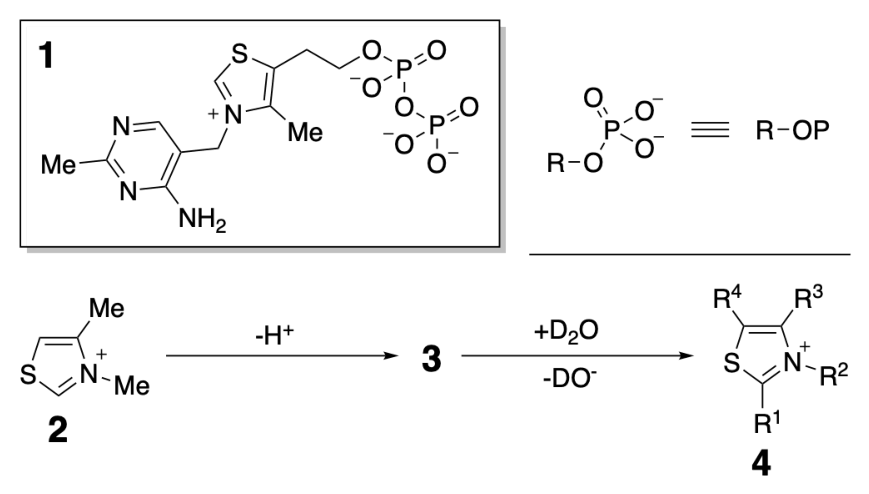
9.1 From the structures in the answer sheet, choose the one that corresponds to compound 4.
Compounds such as 3 have many applications in organocatalysis. When a catalytic amount of 3 is generated in a solution of benzaldehyde 5, a condensation reaction leads to product 9 via the catalytic cycle shown.
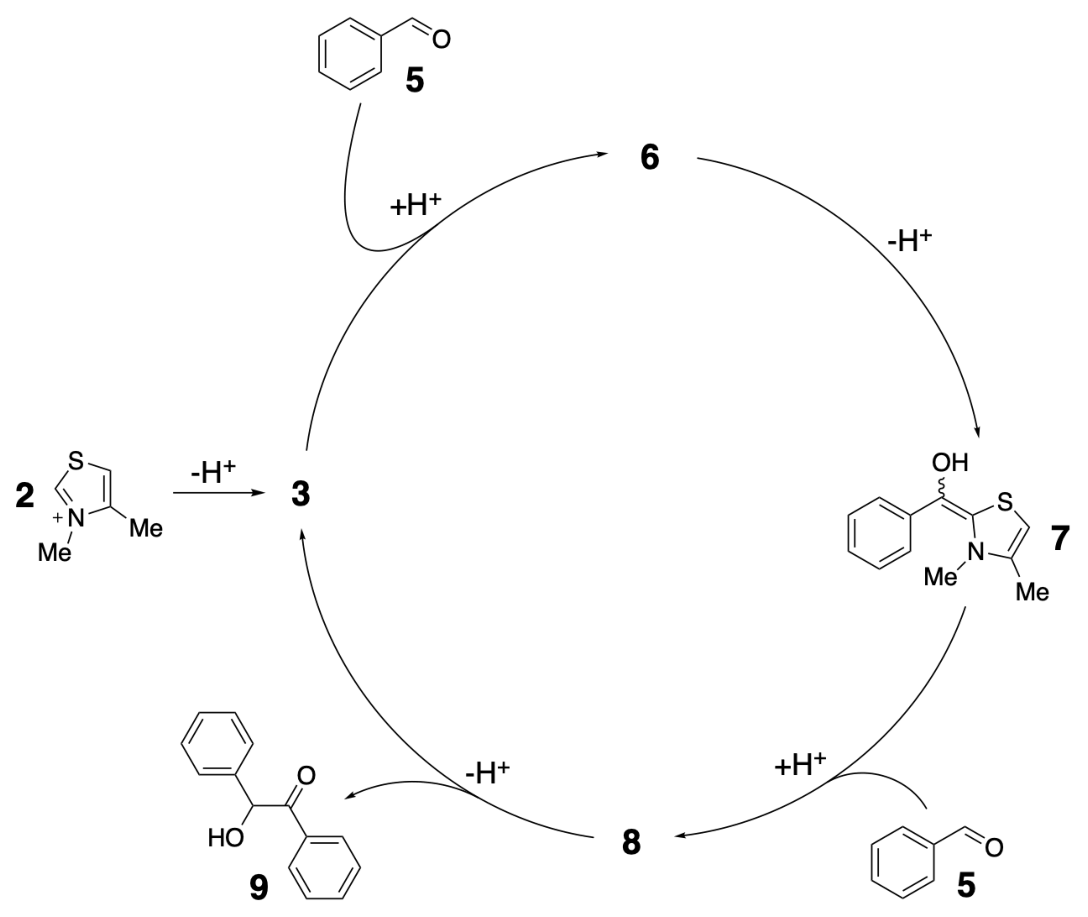
9.2 Draw the structures of compounds 3, 6, and 8. Intermediates 6 and 8 are cations. There is no rearrangement in this catalytic cycle.
An aldose is a sugar containing an aldehyde. A ketose is a sugar containing a ketone. Enzyme TK contains 1 as a cofactor which catalyses the transfer of a two-carbon fragment from a ketose to an aldose by the catalytic cycle presented below.
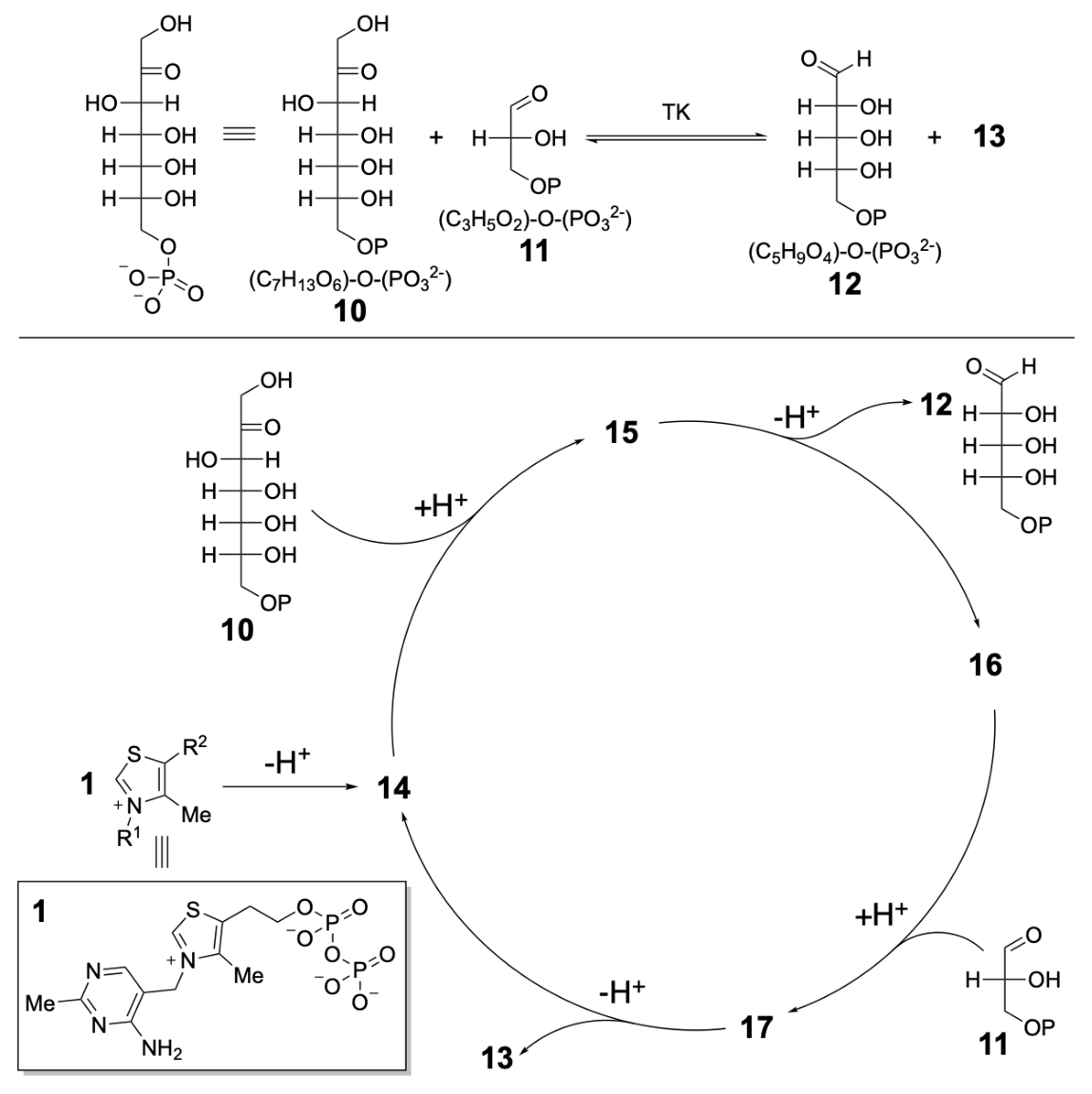
9.3 Draw the structure of 13.
9.4 Draw the structures of intermediates 15-17.
Enzyme TA catalyses the transfer of a three-carbon fragment from a ketose to an aldose. The residue of amino acid lysine 20 in the active site of TA is responsible for the enzyme activity.
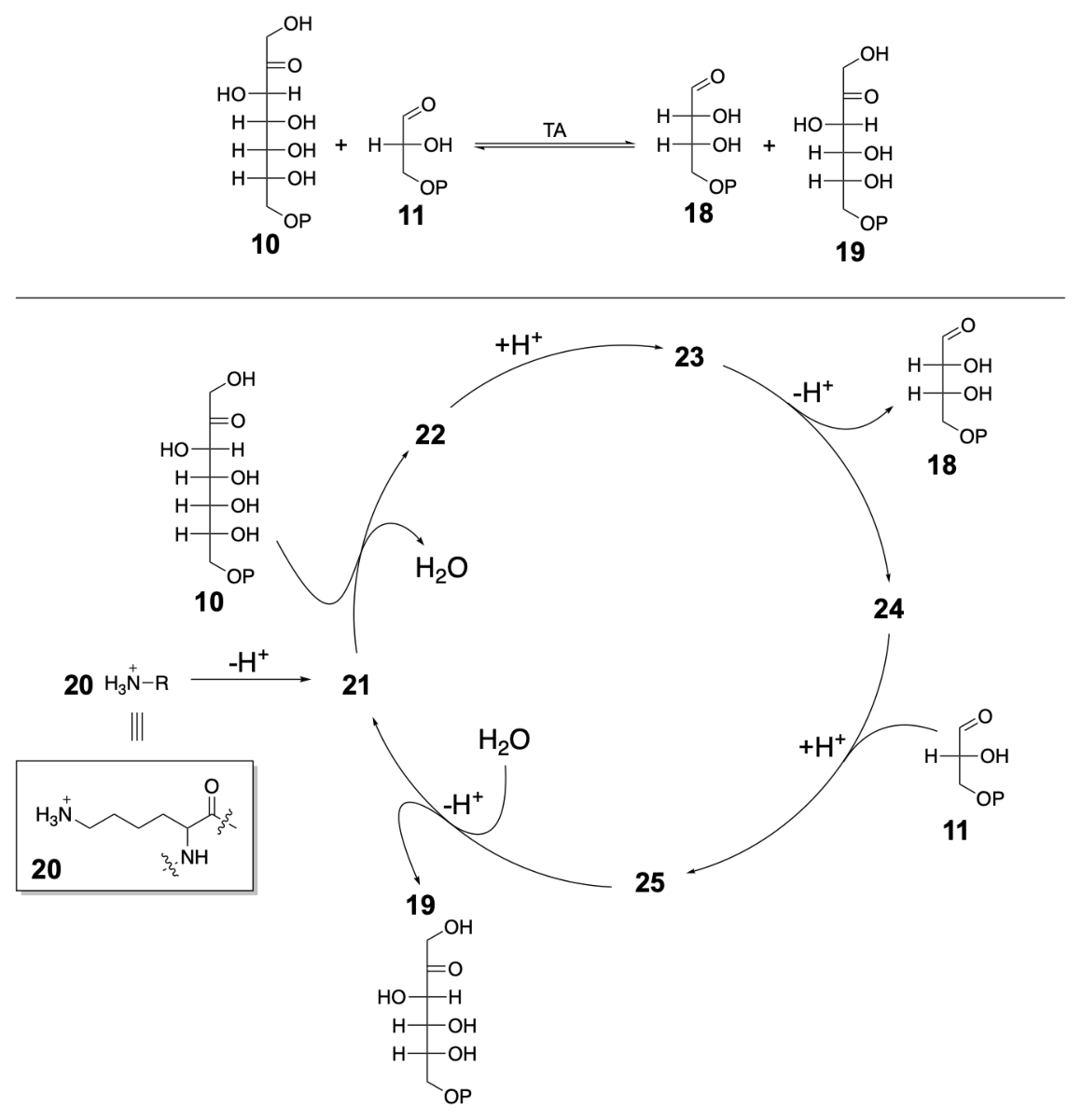
9.5 Draw the structures of intermediates 21-25. 23 and 25 have the same functional groups.
TK and TA are used in some organisms to transform five molecules of three-carbon sugars into three molecules of a five-carbon sugars.
9.6 Propose a reaction sequence for this transformation. Label all sugars with a letter followed by a number. Use the letter A for any aldose and the letter K for any ketose. Use the number corresponding to the number of carbon atoms in the sugar; see the example below (e.g., present structure 10 as K7; using full structural formulae is not required). The number of carbon atoms in the sugar intermediates is between 3 and 7. There are no non-enzymatic steps in the pathway.
Write either TA or TK as the catalyst for each step. Ignore any phosphorylation, dephosphorylation, and isomerisation reactions. Beside transaldolase activity, TA exhibits aldolase activity resulting in only one product. Any five-carbon sugar (A5 or K5) is an acceptable product. Use the same style as shown in the figure below.
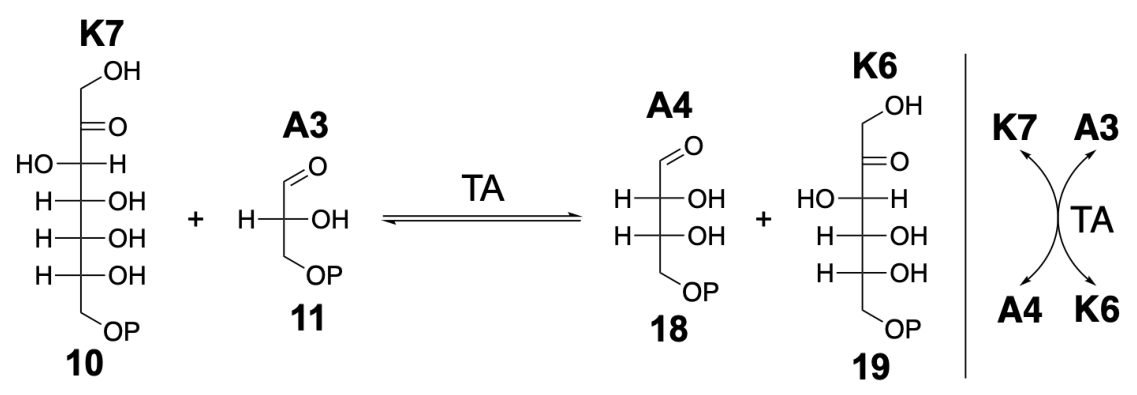
Official English text of the problem.
Answers
Stereochemistry is omitted throughout, as permitted. Phosphate charges in the SMILES follow the drawings. For 21–25, [*:1] represents the unchanged protein substituent \(R\) attached to the lysine nitrogen.
- 9.1 — 2 points.
4 is 2-deuterio-3,4-dimethylthiazolium, with D on the ring carbon between S and N:
C[N+]1=C([2H])SC=C1C
In the figure’s notation: \[ \boxed{R^1=\ce{D},\qquad R^2=R^3=\ce{CH3},\qquad R^4=\ce{H}.} \]
- 9.2 — 6 points.
3: 3,4-Dimethylthiazol-2-ylidene, shown as its neutral, charge-separated thiazolium-ylide resonance form:
C[N+]1=[C-]SC=C1C
6: 2-[Hydroxy(phenyl)methyl]-3,4-dimethylthiazolium, the first aldehyde adduct:
C[N+]1=C(C(O)c2ccccc2)SC=C1C
8: 2-(1,2-Dihydroxy-1,2-diphenylethyl)-3,4-dimethylthiazolium, the coupled diol adduct:
C[N+]1=C(C(O)(c2ccccc2)C(O)c2ccccc2)SC=C1C
-
9.3 — 2 points.
13 is ketopentose 5-phosphate, conventionally xylulose 5-phosphate: \[ \boxed{\ce{HOCH2-C(=O)-CH(OH)-CH(OH)-CH2OP}} \] SMILES:OCC(=O)C(O)C(O)COP(=O)([O-])[O-] -
9.4 — 6 points.
15: Sedoheptulose 7-phosphate–TPP covalent adduct; donor sugar C2 bears OH and is bonded to thiazolium C2:
Cc1ncc(C[N+]2=C(C(O)(CO)C(O)C(O)C(O)C(O)COP(=O)([O-])[O-])SC(CCOP(=O)([O-])OP(=O)([O-])[O-])=C2C)c(N)n1
16: Dihydroxyethyl-TPP enaminol; the thiazole C2 is double-bonded to the external carbon bearing OH and \(\ce{CH2OH}\):
Cc1ncc(CN2C(=C(O)CO)SC(CCOP(=O)([O-])OP(=O)([O-])[O-])=C2C)c(N)n1
17: Ketopentose 5-phosphate–TPP covalent adduct, immediately before ketopentose release:
Cc1ncc(C[N+]2=C(C(O)(CO)C(O)C(O)COP(=O)([O-])[O-])SC(CCOP(=O)([O-])OP(=O)([O-])[O-])=C2C)c(N)n1
- 9.5 — 10 points.
21: Neutral lysine ε-amine, \(\ce{RNH2}\):
[*:1]N
22: Sedoheptulose 7-phosphate–lysine ketimine, with an uncharged imine nitrogen:
[*:1]N=C(CO)C(O)C(O)C(O)C(O)COP(=O)([O-])[O-]
23: N-Protonated sedoheptulose 7-phosphate–lysine ketimine, an iminium intermediate:
[*:1][NH+]=C(CO)C(O)C(O)C(O)C(O)COP(=O)([O-])[O-]
24: Lysine-bound three-carbon enamine, \(\ce{RNH-C(CH2OH)=CH(OH)}\):
[*:1]NC(CO)=CO
25: N-Protonated fructose 6-phosphate–lysine ketimine, an iminium intermediate:
[*:1][NH+]=C(CO)C(O)C(O)C(O)COP(=O)([O-])[O-]
- 9.6 — 10 points.
A valid four-step sequence is \[ \begin{aligned} &\ce{K3 + A3 ->[TA] K6}\\ &\ce{K6 + A3 ->[TK] A4 + K5}\\ &\ce{K3 + A4 ->[TA] K7}\\ &\ce{K7 + A3 ->[TK] A5 + K5}. \end{aligned} \] TA acts as an aldolase in the first and third steps. The net transformation is \[ \boxed{\ce{2 K3 + 3 A3 -> A5 + 2 K5}.} \]
Solution
9.1
Compound 2 is 3,4-dimethylthiazolium, C[N+]1=CSC=C1C. Its most readily exchanged hydrogen is attached to C2, the carbon between sulfur and the positively charged nitrogen.
Removing this proton gives 3, a resonance-stabilized thiazolium ylide/N-heterocyclic carbene. The SMILES in the answers uses the ylide representation: N carries \(+1\), C2 carries \(-1\), and the molecule is neutral overall.
Reaction of this carbon centre with heavy water, \(\ce{D2O}\), [2H]O[2H], installs D at C2. Neither methyl group nor the other ring C–H position changes. The balanced net isotope exchange is
\[
\ce{C5H8NS+ + D2O <=> C5H7DNS+ + HDO},
\]
where \(\ce{HDO}\) is hydrogen deuterium oxide, [2H]O.
Thus the required drawing is the original thiazolium ring with its C2 hydrogen replaced by D.
9.2
The additional structures needed to follow the cycle are:
| Compound | Name | SMILES |
|---|---|---|
| 5 | Benzaldehyde | O=Cc1ccccc1 |
| 7 | Breslow enaminol intermediate | CN1C(=C(O)c2ccccc2)SC=C1C |
| 9 | Benzoin, 2-hydroxy-1,2-diphenylethan-1-one | O=C(c1ccccc1)C(O)c1ccccc1 |
Let \(C_{\mathrm T}\) denote C2 of the thiazole ring, and let Ph denote phenyl.
Formation of 6. The nucleophilic carbon of 3 attacks the carbonyl carbon of benzaldehyde. The carbonyl π electrons move to oxygen, which is then protonated. Therefore, draw a single bond from \(C_{\mathrm T}\) to a \(\ce{CH(OH)Ph}\) group. The thiazolium nitrogen remains positively charged.
Formation of 7. Intermediate 6 loses the proton on its benzylic carbon, not the hydroxyl proton. The resulting electron redistribution creates an exocyclic double bond between that carbon and \(C_{\mathrm T}\), while the ring \(\ce{N=C_{T}}\) bond becomes single. The nitrogen becomes neutral. This is the Breslow intermediate, an acyl-anion equivalent.
Formation of 8. The external enaminol carbon of 7 attacks the carbonyl carbon of a second benzaldehyde molecule. Protonation of the newly formed alkoxide gives 8. Its side-chain connectivity is \[ C_{\mathrm T}\!-\!\ce{C(OH)(Ph)-CH(OH)Ph}. \] The carbon directly attached to the catalyst has no hydrogen: it is bonded to OH, Ph, the second aldehyde-derived carbon, and \(C_{\mathrm T}\). The ring nitrogen is again positively charged.
Release of 9. Deprotonation of the hydroxyl directly adjacent to the catalyst allows that oxygen to form a carbonyl. Cleavage of the bond to \(C_{\mathrm T}\) releases benzoin and regenerates 3.
The balanced overall reaction is \[ \boxed{\ce{2 C6H5CHO ->[3] C6H5COCH(OH)C6H5}.} \] Although called a benzoin condensation, this net reaction does not eliminate water.
9.3
The given sugar identities and their open-chain structures are:
| Compound | Name | SMILES |
|---|---|---|
| 10 | Sedoheptulose 7-phosphate | OCC(=O)C(O)C(O)C(O)C(O)COP(=O)([O-])[O-] |
| 11 | Glyceraldehyde 3-phosphate | O=CC(O)COP(=O)([O-])[O-] |
| 12 | Ribose 5-phosphate | O=CC(O)C(O)C(O)COP(=O)([O-])[O-] |
Number the carbons of 10 from its unphosphorylated \(\ce{CH2OH}\) end. TK removes its C1–C2 two-carbon unit by breaking the C2–C3 bond. The remaining original C3–C7 fragment becomes the five-carbon aldose 12.
The transferred two-carbon unit then combines with the three-carbon aldose 11. Its carbonyl carbon becomes C2 of the new ketose, giving \[ \ce{HOCH2-C(=O)-CH(OH)-CH(OH)-CH2OP}, \] which is 13, a ketopentose 5-phosphate.
The balanced molecular equation, using the phosphate ionization shown in the question, is \[ \ce{C7H13O10P^{2-} + C3H5O6P^{2-} <=>[TK] C5H9O8P^{2-} + C5H9O8P^{2-}}. \] The two products have the same molecular formula but different carbonyl positions: 12 is an aldose and 13 a ketose.
9.4
Cofactor 1 is thiamine diphosphate, represented in the protonation state drawn in the question by:
Cc1ncc(C[N+]2=CSC(CCOP(=O)([O-])OP(=O)([O-])[O-])=C2C)c(N)n1
Its C2-deprotonated form 14, the thiamine diphosphate ylide, is:
Cc1ncc(C[N+]2=[C-]SC(CCOP(=O)([O-])OP(=O)([O-])[O-])=C2C)c(N)n1
The chemistry parallels the benzoin cycle.
Intermediate 15. The nucleophilic thiazole C2 of 14 attacks sugar C2, the ketone carbon of 10. Protonation of oxygen gives a tetrahedral alcohol.
For the drawing, retain all thiamine substituents and attach its thiazolium C2 to the second carbon of this chain: \[ \ce{HOCH2-C(OH)(T)-CH(OH)-CH(OH)-CH(OH)-CH(OH)-CH2OP}, \] where \(T\) marks the single bond to the thiazolium ring. The ring nitrogen carries \(+1\).
Intermediate 16. Break the bond between sugar C2 and C3. The hydroxyl on original C3 becomes the aldehyde oxygen of 12, with loss of its proton. The C1–C2 fragment remains attached to TPP.
Electron redistribution gives an exocyclic double bond from thiazole C2 to the retained carbon bearing OH and \(\ce{CH2OH}\). The thiazole C2–N bond is now single and N is neutral. This is the two-carbon enaminol 16.
Intermediate 17. The external enaminol carbon attacks the aldehyde carbon of 11. Protonation of the new alkoxide produces the five-carbon adduct: \[ \ce{HOCH2-C(OH)(T)-CH(OH)-CH(OH)-CH2OP}. \] The thiazolium nitrogen again carries \(+1\).
Finally, deprotonation of the hydroxyl at sugar C2 and formation of its carbonyl cleave the bond to the catalyst, releasing 13 and regenerating 14.
The positive nitrogen charges in 15 and 17 refer to the thiazolium ring; their complete structures also contain negatively charged phosphate groups.
9.5
The enzyme-bound lysine ammonium group 20 is represented by [*:1][NH3+]. Deprotonation gives the neutral ε-amine 21, \(\ce{RNH2}\).
The sugars released in this cycle are:
| Compound | Name | SMILES |
|---|---|---|
| 18 | Erythrose 4-phosphate | O=CC(O)C(O)COP(=O)([O-])[O-] |
| 19 | Fructose 6-phosphate | OCC(=O)C(O)C(O)C(O)COP(=O)([O-])[O-] |
Formation of 22. The lysine amine attacks the ketone carbon, C2, of 10. Loss of water, O, gives a Schiff base. Thus, replace the C2 carbonyl oxygen of 10 by \(\ce{N-R}\):
\[
\ce{HOCH2-C(=N-R)-CH(OH)-CH(OH)-CH(OH)-CH(OH)-CH2OP}.
\]
The imine nitrogen of 22 has no hydrogen and no formal charge.
Formation of 23. Protonation occurs at the imine nitrogen: \[ \ce{HOCH2-C(=[NH+]-R)-CH(OH)-CH(OH)-CH(OH)-CH(OH)-CH2OP}. \] The resulting iminium group facilitates the following C–C cleavage.
Formation of 24. Cleavage occurs between original sugar C3 and C4. The hydroxyl on C4 becomes an aldehyde, releasing the C4–C7 fragment as erythrose 4-phosphate 18.
The retained C1–C3 fragment becomes the enamine \[ \boxed{\ce{HOCH2-C(NH-R)=CH(OH)}}. \] The C2=C3 double bond is formed as the iminium π electrons move onto nitrogen. The nitrogen is therefore neutral and retains its hydrogen.
Formation of 25. The terminal enamine carbon, original C3, attacks the aldehyde carbon of 11. The new alkoxide is protonated, and the iminium bond is restored. The resulting six-carbon structure is \[ \ce{HOCH2-C(=[NH+]-R)-CH(OH)-CH(OH)-CH(OH)-CH2OP}. \]
Thus 23 and 25 both contain an iminium group, alcohol groups, and a phosphate ester, as required. They differ in carbon-chain length.
Hydrolysis of 25 consumes water and restores the ketone, releasing fructose 6-phosphate 19, neutral lysine amine 21, and a proton, \(\ce{H+}\), [H+].
Water released during Schiff-base formation is consumed during hydrolysis. The balanced overall transformation is \[ \boxed{\ce{C7H13O10P^{2-} + C3H5O6P^{2-} <=>[TA] C4H7O7P^{2-} + C6H11O9P^{2-}}.} \]
9.6
Choose two K3 molecules and three A3 molecules as the five starting trioses. For this part, phosphorylation is suppressed as instructed. Representative sugar identities are:
| Label | Representative sugar | SMILES without stereochemistry or phosphate |
|---|---|---|
| A3 | Glyceraldehyde | O=CC(O)CO |
| K3 | Dihydroxyacetone | OCC(=O)CO |
| A4 | Erythrose | O=CC(O)C(O)CO |
| A5 | Ribose | O=CC(O)C(O)C(O)CO |
| K5 | Xylulose | OCC(=O)C(O)C(O)CO |
| K6 | Fructose | OCC(=O)C(O)C(O)C(O)CO |
| K7 | Sedoheptulose | OCC(=O)C(O)C(O)C(O)C(O)CO |
The sequence works as follows:
| Step | Reaction | Explanation |
|---|---|---|
| 1 | \(\ce{K3 + A3 ->[TA] K6}\) | TA’s aldolase activity joins two trioses, producing one six-carbon ketose. |
| 2 | \(\ce{K6 + A3 ->[TK] A4 + K5}\) | TK transfers two carbons from K6 to A3. Retain the K5 as a final product. |
| 3 | \(\ce{K3 + A4 ->[TA] K7}\) | TA’s aldolase activity joins the remaining K3 to A4, producing one seven-carbon ketose. |
| 4 | \(\ce{K7 + A3 ->[TK] A5 + K5}\) | TK transfers two carbons from K7 to the remaining A3, giving two further pentoses. |
For the answer-sheet diagram, connect these four steps in order through K6, A4, and K7. Draw a K5 output branch at step 2, and terminate step 4 with A5 and K5. Label the successive reactions TA, TK, TA, TK.
Cancelling the intermediates gives \[ \ce{2 K3 + 3 A3 -> A5 + 2 K5}. \] With phosphorylation suppressed, the molecular balance is \[ \ce{5 C3H6O3 -> 3 C5H10O5}. \] Hence \[ 5\times3=3\times5=15 \] carbon atoms are conserved. Every sugar contains between three and seven carbons, and every displayed reaction is enzymatic. The two aldolase steps are additions; they do not involve net elimination of water.
The answers were checked against the official answers published by the organisers.
IChO 2025 · Theorieaufgabe 9
Enzyme und Cofaktoren
7% der Gesamtpunktzahl
| 9.1 | 9.2 | 9.3 | 9.4 | 9.5 | 9.6 | Gesamt |
|---|---|---|---|---|---|---|
| 2 | 6 | 2 | 6 | 10 | 10 | 36 |
Bei allen Antworten zu dieser Aufgabe ist die Angabe der Stereochemie nicht erforderlich, und die Phosphatgruppe kann als „OP“ abgekürzt werden (siehe das folgende Schema).
Transketolase (TK) und Transaldolase (TA) sind Enzyme, die die Spaltung von C–C-Bindungen katalysieren. TK enthält im aktiven Zentrum den Cofaktor Thiaminpyrophosphat 1, ein Derivat von Vitamin B1.
Breslow und Mitarbeiter untersuchten das Kation 2, ein Modell des Cofaktors 1, um die vergleichsweise sauren Eigenschaften von Thiamin nachzuweisen. Das Kation 2 erfuhr in \(\ce{D2O}\) einen einfachen H/D-Austausch, wobei über das Zwischenprodukt 3 die Verbindung 4 entstand.
9.1 Wählen Sie aus den Strukturen auf dem Antwortblatt diejenige aus, die der Verbindung 4 entspricht.
Verbindungen wie 3 finden vielfältige Anwendungen in der Organokatalyse. Wird eine katalytische Menge von 3 in einer Lösung von Benzaldehyd 5 erzeugt, führt eine Kondensationsreaktion über den dargestellten Katalysezyklus zum Produkt 9.
9.2 Zeichnen Sie die Strukturen der Verbindungen 3, 6 und 8. Die Zwischenprodukte 6 und 8 sind Kationen. In diesem Katalysezyklus findet keine Umlagerung statt.
Eine Aldose ist ein Zucker mit einer Aldehydgruppe. Eine Ketose ist ein Zucker mit einer Ketogruppe. Das Enzym TK enthält 1 als Cofaktor, der über den nachstehend dargestellten Katalysezyklus die Übertragung eines Fragments mit zwei Kohlenstoffatomen von einer Ketose auf eine Aldose katalysiert.
9.3 Zeichnen Sie die Struktur von 13.
9.4 Zeichnen Sie die Strukturen der Zwischenprodukte 15-17.
Das Enzym TA katalysiert die Übertragung eines Fragments mit drei Kohlenstoffatomen von einer Ketose auf eine Aldose. Der Rest der Aminosäure Lysin 20 im aktiven Zentrum der TA ist für die Enzymaktivität verantwortlich.
9.5 Zeichnen Sie die Strukturen der Zwischenprodukte 21-25. 23 und 25 besitzen dieselben funktionellen Gruppen.
TK und TA werden in einigen Organismen genutzt, um fünf Moleküle von Zuckern mit drei Kohlenstoffatomen in drei Moleküle von Zuckern mit fünf Kohlenstoffatomen umzuwandeln.
9.6 Schlagen Sie eine Reaktionsfolge für diese Umwandlung vor. Kennzeichnen Sie alle Zucker mit einem Buchstaben, gefolgt von einer Zahl. Verwenden Sie den Buchstaben A für jede Aldose und den Buchstaben K für jede Ketose. Verwenden Sie die Zahl, die der Anzahl der Kohlenstoffatome im Zucker entspricht; siehe das folgende Beispiel (geben Sie beispielsweise die Struktur 10 als K7 an; die Verwendung vollständiger Strukturformeln ist nicht erforderlich). Die Anzahl der Kohlenstoffatome in den als Zwischenprodukte auftretenden Zuckern liegt zwischen 3 und 7. Der Reaktionsweg enthält keine nichtenzymatischen Schritte.
Geben Sie für jeden Schritt entweder TA oder TK als Katalysator an. Ignorieren Sie alle Phosphorylierungs-, Dephosphorylierungs- und Isomerisierungsreaktionen. Neben der Transaldolaseaktivität weist TA eine Aldolaseaktivität auf, bei der nur ein Produkt entsteht. Jeder Zucker mit fünf Kohlenstoffatomen (A5 oder K5) ist als Produkt zulässig. Verwenden Sie dieselbe Darstellungsweise wie in der folgenden Abbildung.
Aufgabentext aus dem offiziellen englischen Text übersetzt.
Antworten
Die Stereochemie wird, wie gestattet, durchgehend weggelassen. Die Phosphatladungen in den SMILES entsprechen den Zeichnungen. Bei 21–25 steht [*:1] für den unveränderten Proteinsubstituenten \(R\), der an den Lysinstickstoff gebunden ist.
- 9.1 — 2 Punkte.
4 ist 2-Deuterio-3,4-dimethylthiazolium, mit D am Ringkohlenstoff zwischen S und N:
C[N+]1=C([2H])SC=C1C
In der Notation der Abbildung: \[ \boxed{R^1=\ce{D},\qquad R^2=R^3=\ce{CH3},\qquad R^4=\ce{H}.} \]
- 9.2 — 6 Punkte.
3: 3,4-Dimethylthiazol-2-yliden, dargestellt als seine neutrale, ladungsgetrennte Thiazoliumylid-Grenzstruktur:
C[N+]1=[C-]SC=C1C
6: 2-[Hydroxy(phenyl)methyl]-3,4-dimethylthiazolium, das erste Aldehydaddukt:
C[N+]1=C(C(O)c2ccccc2)SC=C1C
8: 2-(1,2-Dihydroxy-1,2-diphenylethyl)-3,4-dimethylthiazolium, das durch Kupplung gebildete Dioladdukt:
C[N+]1=C(C(O)(c2ccccc2)C(O)c2ccccc2)SC=C1C
-
9.3 — 2 Punkte.
13 ist ein Ketopentose-5-phosphat, üblicherweise Xylulose-5-phosphat: \[ \boxed{\ce{HOCH2-C(=O)-CH(OH)-CH(OH)-CH2OP}} \] SMILES:OCC(=O)C(O)C(O)COP(=O)([O-])[O-] -
9.4 — 6 Punkte.
15: Kovalentes Sedoheptulose-7-phosphat–TPP-Addukt; C2 des Donorzuckers trägt OH und ist an C2 des Thiazoliumrings gebunden:
Cc1ncc(C[N+]2=C(C(O)(CO)C(O)C(O)C(O)C(O)COP(=O)([O-])[O-])SC(CCOP(=O)([O-])OP(=O)([O-])[O-])=C2C)c(N)n1
16: Dihydroxyethyl-TPP-Enaminol; C2 des Thiazolrings ist über eine Doppelbindung mit dem äußeren Kohlenstoffatom verbunden, das OH und \(\ce{CH2OH}\) trägt:
Cc1ncc(CN2C(=C(O)CO)SC(CCOP(=O)([O-])OP(=O)([O-])[O-])=C2C)c(N)n1
17: Kovalentes Ketopentose-5-phosphat–TPP-Addukt, unmittelbar vor der Freisetzung der Ketopentose:
Cc1ncc(C[N+]2=C(C(O)(CO)C(O)C(O)COP(=O)([O-])[O-])SC(CCOP(=O)([O-])OP(=O)([O-])[O-])=C2C)c(N)n1
- 9.5 — 10 Punkte.
21: Neutrales ε-Amin des Lysins, \(\ce{RNH2}\):
[*:1]N
22: Sedoheptulose-7-phosphat–Lysin-Ketimin, mit einem ungeladenen Iminstickstoff:
[*:1]N=C(CO)C(O)C(O)C(O)C(O)COP(=O)([O-])[O-]
23: N-protoniertes Sedoheptulose-7-phosphat–Lysin-Ketimin, ein Iminium-Zwischenprodukt:
[*:1][NH+]=C(CO)C(O)C(O)C(O)C(O)COP(=O)([O-])[O-]
24: An Lysin gebundenes Enamin mit drei Kohlenstoffatomen, \(\ce{RNH-C(CH2OH)=CH(OH)}\):
[*:1]NC(CO)=CO
25: N-protoniertes Fructose-6-phosphat–Lysin-Ketimin, ein Iminium-Zwischenprodukt:
[*:1][NH+]=C(CO)C(O)C(O)C(O)COP(=O)([O-])[O-]
- 9.6 — 10 Punkte.
Eine gültige Folge aus vier Schritten lautet \[ \begin{aligned} &\ce{K3 + A3 ->[TA] K6}\\ &\ce{K6 + A3 ->[TK] A4 + K5}\\ &\ce{K3 + A4 ->[TA] K7}\\ &\ce{K7 + A3 ->[TK] A5 + K5}. \end{aligned} \] TA wirkt im ersten und dritten Schritt als Aldolase. Die Nettoumwandlung lautet \[ \boxed{\ce{2 K3 + 3 A3 -> A5 + 2 K5}.} \]
Lösung
9.1
Verbindung 2 ist 3,4-Dimethylthiazolium, C[N+]1=CSC=C1C. Ihr am leichtesten austauschbares Wasserstoffatom ist an C2, das Kohlenstoffatom zwischen Schwefel und dem positiv geladenen Stickstoff, gebunden.
Durch Abspaltung dieses Protons entsteht 3, ein mesomeriestabilisiertes Thiazoliumylid/N-heterocyclisches Carben. Der SMILES in den Antworten verwendet die Ylid-Darstellung: N trägt \(+1\), C2 trägt \(-1\), und das Molekül ist insgesamt neutral.
Die Reaktion dieses Kohlenstoffzentrums mit schwerem Wasser, \(\ce{D2O}\), [2H]O[2H], führt D an C2 ein. Weder die Methylgruppen noch die andere C–H-Position im Ring verändern sich. Der ausgeglichene Netto-Isotopenaustausch lautet
\[
\ce{C5H8NS+ + D2O <=> C5H7DNS+ + HDO},
\]
wobei \(\ce{HDO}\) Wasserstoffdeuteriumoxid, [2H]O, ist.
Die gesuchte Zeichnung zeigt somit den ursprünglichen Thiazoliumring, dessen Wasserstoffatom an C2 durch D ersetzt ist.
9.2
Die weiteren Strukturen, die zum Nachvollziehen des Zyklus benötigt werden, sind:
| Verbindung | Name | SMILES |
|---|---|---|
| 5 | Benzaldehyd | O=Cc1ccccc1 |
| 7 | Breslow-Enaminol-Zwischenprodukt | CN1C(=C(O)c2ccccc2)SC=C1C |
| 9 | Benzoin, 2-Hydroxy-1,2-diphenylethan-1-on | O=C(c1ccccc1)C(O)c1ccccc1 |
\(C_{\mathrm T}\) bezeichne C2 des Thiazolrings, und Ph stehe für Phenyl.
Bildung von 6. Das nucleophile Kohlenstoffatom von 3 greift das Carbonylkohlenstoffatom des Benzaldehyds an. Die π-Elektronen der Carbonylgruppe werden auf den Sauerstoff verschoben, der anschließend protoniert wird. Zeichnen Sie daher eine Einfachbindung von \(C_{\mathrm T}\) zu einer \(\ce{CH(OH)Ph}\)-Gruppe. Der Thiazoliumstickstoff bleibt positiv geladen.
Bildung von 7. Zwischenprodukt 6 verliert das Proton an seinem benzylischen Kohlenstoffatom, nicht das Hydroxyproton. Die daraus resultierende Elektronenverschiebung erzeugt eine exocyclische Doppelbindung zwischen diesem Kohlenstoffatom und \(C_{\mathrm T}\), während die \(\ce{N=C_{T}}\)-Bindung im Ring zu einer Einfachbindung wird. Der Stickstoff wird neutral. Dies ist das Breslow-Zwischenprodukt, ein Acylanion-Äquivalent.
Bildung von 8. Das äußere Enaminol-Kohlenstoffatom von 7 greift das Carbonylkohlenstoffatom eines zweiten Benzaldehydmoleküls an. Die Protonierung des neu gebildeten Alkoholats ergibt 8. Die Verknüpfung der Atome in seiner Seitenkette lautet \[ C_{\mathrm T}\!-\!\ce{C(OH)(Ph)-CH(OH)Ph}. \] Das direkt an den Katalysator gebundene Kohlenstoffatom trägt kein Wasserstoffatom: Es ist an OH, Ph, das vom zweiten Aldehyd stammende Kohlenstoffatom und \(C_{\mathrm T}\) gebunden. Der Ringstickstoff ist wieder positiv geladen.
Freisetzung von 9. Die Deprotonierung der unmittelbar an den Katalysator angrenzenden Hydroxygruppe ermöglicht es diesem Sauerstoffatom, eine Carbonylgruppe zu bilden. Die Spaltung der Bindung zu \(C_{\mathrm T}\) setzt Benzoin frei und regeneriert 3.
Die ausgeglichene Gesamtreaktion lautet \[ \boxed{\ce{2 C6H5CHO ->[3] C6H5COCH(OH)C6H5}.} \] Obwohl sie als Benzoinkondensation bezeichnet wird, wird bei dieser Nettoreaktion kein Wasser abgespalten.
9.3
Die angegebenen Zucker und ihre offenkettigen Strukturen sind:
| Verbindung | Name | SMILES |
|---|---|---|
| 10 | Sedoheptulose-7-phosphat | OCC(=O)C(O)C(O)C(O)C(O)COP(=O)([O-])[O-] |
| 11 | Glycerinaldehyd-3-phosphat | O=CC(O)COP(=O)([O-])[O-] |
| 12 | Ribose-5-phosphat | O=CC(O)C(O)C(O)COP(=O)([O-])[O-] |
Nummerieren Sie die Kohlenstoffatome von 10 ausgehend von seinem nicht phosphorylierten \(\ce{CH2OH}\)-Ende. TK spaltet seine C1–C2-Einheit mit zwei Kohlenstoffatomen durch Spaltung der C2–C3-Bindung ab. Das verbleibende ursprüngliche C3–C7-Fragment wird zur Aldose 12 mit fünf Kohlenstoffatomen.
Die übertragene Einheit mit zwei Kohlenstoffatomen verbindet sich anschließend mit der Aldose 11 mit drei Kohlenstoffatomen. Ihr Carbonylkohlenstoffatom wird zu C2 der neuen Ketose, wodurch \[ \ce{HOCH2-C(=O)-CH(OH)-CH(OH)-CH2OP}, \] entsteht; dies ist 13, ein Ketopentose-5-phosphat.
Die ausgeglichene Reaktionsgleichung in Summenformeln lautet unter Verwendung des in der Aufgabenstellung gezeigten Ionisierungszustands der Phosphatgruppen \[ \ce{C7H13O10P^{2-} + C3H5O6P^{2-} <=>[TK] C5H9O8P^{2-} + C5H9O8P^{2-}}. \] Die beiden Produkte haben dieselbe Summenformel, aber unterschiedliche Positionen der Carbonylgruppe: 12 ist eine Aldose und 13 eine Ketose.
9.4
Cofaktor 1 ist Thiamindiphosphat, das im in der Aufgabenstellung gezeichneten Protonierungszustand wie folgt dargestellt wird:
Cc1ncc(C[N+]2=CSC(CCOP(=O)([O-])OP(=O)([O-])[O-])=C2C)c(N)n1
Seine an C2 deprotonierte Form 14, das Thiamindiphosphatylid, ist:
Cc1ncc(C[N+]2=[C-]SC(CCOP(=O)([O-])OP(=O)([O-])[O-])=C2C)c(N)n1
Die chemischen Vorgänge entsprechen denen des Benzoinzyklus.
Zwischenprodukt 15. Das nucleophile C2 des Thiazolrings von 14 greift C2 des Zuckers, das Ketonkohlenstoffatom von 10, an. Die Protonierung des Sauerstoffs ergibt einen tetraedrischen Alkohol.
Behalten Sie in der Zeichnung alle Thiaminsubstituenten bei und verbinden Sie C2 seines Thiazoliumrings mit dem zweiten Kohlenstoffatom dieser Kette: \[ \ce{HOCH2-C(OH)(T)-CH(OH)-CH(OH)-CH(OH)-CH(OH)-CH2OP}, \] wobei \(T\) die Einfachbindung zum Thiazoliumring kennzeichnet. Der Ringstickstoff trägt \(+1\).
Zwischenprodukt 16. Spalten Sie die Bindung zwischen C2 und C3 des Zuckers. Die Hydroxygruppe am ursprünglichen C3 wird unter Abgabe ihres Protons zum Aldehydsauerstoff von 12. Das C1–C2-Fragment bleibt an TPP gebunden.
Durch Elektronenverschiebung entsteht eine exocyclische Doppelbindung zwischen C2 des Thiazolrings und dem zurückbehaltenen Kohlenstoffatom, das OH und \(\ce{CH2OH}\) trägt. Die C2–N-Bindung im Thiazolring ist nun eine Einfachbindung, und N ist neutral. Dies ist das Enaminol 16 mit zwei Kohlenstoffatomen.
Zwischenprodukt 17. Das äußere Enaminol-Kohlenstoffatom greift das Aldehydkohlenstoffatom von 11 an. Die Protonierung des neuen Alkoholats ergibt das Addukt mit fünf Kohlenstoffatomen: \[ \ce{HOCH2-C(OH)(T)-CH(OH)-CH(OH)-CH2OP}. \] Der Thiazoliumstickstoff trägt wieder \(+1\).
Schließlich führen die Deprotonierung der Hydroxygruppe an C2 des Zuckers und die Bildung der zugehörigen Carbonylgruppe zur Spaltung der Bindung zum Katalysator, wodurch 13 freigesetzt und 14 regeneriert wird.
Die positiven Stickstoffladungen in 15 und 17 beziehen sich auf den Thiazoliumring; ihre vollständigen Strukturen enthalten außerdem negativ geladene Phosphatgruppen.
9.5
Die enzymgebundene Lysin-Ammoniumgruppe 20 wird durch [*:1][NH3+] dargestellt. Deprotonierung ergibt das neutrale ε-Amin 21, \(\ce{RNH2}\).
Die in diesem Zyklus freigesetzten Zucker sind:
| Verbindung | Name | SMILES |
|---|---|---|
| 18 | Erythrose-4-phosphat | O=CC(O)C(O)COP(=O)([O-])[O-] |
| 19 | Fructose-6-phosphat | OCC(=O)C(O)C(O)C(O)COP(=O)([O-])[O-] |
Bildung von 22. Die Aminogruppe des Lysins greift das Ketonkohlenstoffatom C2 von 10 an. Die Abspaltung von Wasser, O, ergibt eine Schiff-Base. Ersetzen Sie daher den Carbonylsauerstoff an C2 von 10 durch \(\ce{N-R}\):
\[
\ce{HOCH2-C(=N-R)-CH(OH)-CH(OH)-CH(OH)-CH(OH)-CH2OP}.
\]
Der Iminstickstoff von 22 trägt weder ein Wasserstoffatom noch eine Formalladung.
Bildung von 23. Die Protonierung erfolgt am Iminstickstoff: \[ \ce{HOCH2-C(=[NH+]-R)-CH(OH)-CH(OH)-CH(OH)-CH(OH)-CH2OP}. \] Die entstehende Iminiumgruppe erleichtert die folgende C–C-Spaltung.
Bildung von 24. Die Spaltung erfolgt zwischen C3 und C4 des ursprünglichen Zuckers. Die Hydroxygruppe an C4 wird zu einer Aldehydgruppe, wodurch das C4–C7-Fragment als Erythrose-4-phosphat 18 freigesetzt wird.
Das zurückbehaltene C1–C3-Fragment wird zum Enamin \[ \boxed{\ce{HOCH2-C(NH-R)=CH(OH)}}. \] Die C2=C3-Doppelbindung entsteht, indem die π-Elektronen der Iminiumgruppe auf den Stickstoff verschoben werden. Der Stickstoff ist daher neutral und behält sein Wasserstoffatom.
Bildung von 25. Das endständige Enamin-Kohlenstoffatom, das ursprüngliche C3, greift das Aldehydkohlenstoffatom von 11 an. Das neue Alkoholat wird protoniert, und die Iminiumbindung wird wiederhergestellt. Die entstehende Struktur mit sechs Kohlenstoffatomen lautet \[ \ce{HOCH2-C(=[NH+]-R)-CH(OH)-CH(OH)-CH(OH)-CH2OP}. \]
Somit enthalten sowohl 23 als auch 25 eine Iminiumgruppe, Alkoholgruppen und einen Phosphatester, wie gefordert. Sie unterscheiden sich in der Länge der Kohlenstoffkette.
Die Hydrolyse von 25 verbraucht Wasser und stellt die Ketogruppe wieder her, wobei Fructose-6-phosphat 19, das neutrale Lysin-Amin 21 und ein Proton, \(\ce{H+}\), [H+], freigesetzt werden.
Das bei der Bildung der Schiff-Base freigesetzte Wasser wird bei der Hydrolyse verbraucht. Die ausgeglichene Gesamtumwandlung lautet \[ \boxed{\ce{C7H13O10P^{2-} + C3H5O6P^{2-} <=>[TA] C4H7O7P^{2-} + C6H11O9P^{2-}}.} \]
9.6
Wählen Sie zwei K3-Moleküle und drei A3-Moleküle als die fünf Ausgangstriosen. In diesem Teil wird die Phosphorylierung gemäß der Anweisung nicht berücksichtigt. Beispiele für die jeweiligen Zucker sind:
| Kennzeichnung | Beispielzucker | SMILES ohne Stereochemie oder Phosphat |
|---|---|---|
| A3 | Glycerinaldehyd | O=CC(O)CO |
| K3 | Dihydroxyaceton | OCC(=O)CO |
| A4 | Erythrose | O=CC(O)C(O)CO |
| A5 | Ribose | O=CC(O)C(O)C(O)CO |
| K5 | Xylulose | OCC(=O)C(O)C(O)CO |
| K6 | Fructose | OCC(=O)C(O)C(O)C(O)CO |
| K7 | Sedoheptulose | OCC(=O)C(O)C(O)C(O)C(O)CO |
Die Reaktionsfolge läuft wie folgt ab:
| Schritt | Reaktion | Erklärung |
|---|---|---|
| 1 | \(\ce{K3 + A3 ->[TA] K6}\) | Die Aldolaseaktivität der TA verbindet zwei Triosen und erzeugt eine Ketose mit sechs Kohlenstoffatomen. |
| 2 | \(\ce{K6 + A3 ->[TK] A4 + K5}\) | TK überträgt zwei Kohlenstoffatome von K6 auf A3. Behalten Sie K5 als Endprodukt bei. |
| 3 | \(\ce{K3 + A4 ->[TA] K7}\) | Die Aldolaseaktivität der TA verbindet das verbleibende K3 mit A4 und erzeugt eine Ketose mit sieben Kohlenstoffatomen. |
| 4 | \(\ce{K7 + A3 ->[TK] A5 + K5}\) | TK überträgt zwei Kohlenstoffatome von K7 auf das verbleibende A3, wodurch zwei weitere Pentosen entstehen. |
Verbinden Sie für das Schema auf dem Antwortblatt diese vier Schritte der Reihe nach über K6, A4 und K7. Zeichnen Sie bei Schritt 2 eine Abzweigung zum Produkt K5, und lassen Sie Schritt 4 mit A5 und K5 enden. Beschriften Sie die aufeinanderfolgenden Reaktionen mit TA, TK, TA, TK.
Das Kürzen der Zwischenprodukte ergibt \[ \ce{2 K3 + 3 A3 -> A5 + 2 K5}. \] Ohne Berücksichtigung der Phosphorylierung lautet die Bilanz in Summenformeln \[ \ce{5 C3H6O3 -> 3 C5H10O5}. \] Somit bleiben \[ 5\times3=3\times5=15 \] Kohlenstoffatome erhalten. Jeder Zucker enthält zwischen drei und sieben Kohlenstoffatome, und jede dargestellte Reaktion ist enzymatisch. Die beiden Aldolaseschritte sind Additionen; bei ihnen wird netto kein Wasser abgespalten.
Die Ergebnisse wurden mit den von den Veranstaltern veröffentlichten offiziellen Ergebnissen abgeglichen.
IChO 2025 · Teori sorusu 9
Enzimler ve kofaktörler
Toplam puanın %7'si
| 9.1 | 9.2 | 9.3 | 9.4 | 9.5 | 9.6 | Toplam |
|---|---|---|---|---|---|---|
| 2 | 6 | 2 | 6 | 10 | 10 | 36 |
Bu soruya verilen hiçbir cevapta stereokimyanın gösterilmesi gerekli değildir ve fosfat grubu "OP" olarak kısaltılabilir (aşağıdaki şemaya bakınız).
Transketolaz (TK) ve transaldolaz (TA), C–C bağlarının kırılmasını katalizleyen enzimlerdir. TK, aktif bölgesinde B1 vitamininin bir türevi olan tiamin pirofosfat 1 kofaktörünü içerir.
Breslow ve çalışma arkadaşları, tiaminin görece asidik özelliklerini göstermek için kofaktör 1'in bir modeli olan 2 katyonunu incelediler. 2 katyonu, \(\ce{D2O}\) içinde tek bir H/D değişimine uğrayarak 3 ara ürünü üzerinden 4'ü oluşturdu.
9.1 Cevap kâğıdındaki yapılardan 4 bileşiğine karşılık geleni seçiniz.
3 gibi bileşiklerin organokatalizde birçok uygulaması vardır. Benzaldehit 5 çözeltisinde katalitik miktarda 3 oluşturulduğunda, gösterilen katalitik döngü üzerinden gerçekleşen bir kondenzasyon tepkimesiyle 9 ürünü oluşur.
9.2 3, 6 ve 8 bileşiklerinin yapılarını çiziniz. 6 ve 8 ara ürünleri katyondur. Bu katalitik döngüde yeniden düzenlenme yoktur.
Aldoz, aldehit grubu içeren bir şekerdir. Ketoz, keton grubu içeren bir şekerdir. TK enzimi, aşağıda sunulan katalitik döngü yoluyla iki karbonlu bir parçanın bir ketozdan bir aldoza aktarılmasını katalizleyen 1'i kofaktör olarak içerir.
9.3 13'ün yapısını çiziniz.
9.4 15-17 ara ürünlerinin yapılarını çiziniz.
TA enzimi, üç karbonlu bir parçanın bir ketozdan bir aldoza aktarılmasını katalizler. TA'nın aktif bölgesindeki lizin amino asidi kalıntısı 20, enzimin etkinliğinden sorumludur.
9.5 21-25 ara ürünlerinin yapılarını çiziniz. 23 ve 25 aynı fonksiyonel gruplara sahiptir.
TK ve TA, bazı organizmalarda üç karbonlu şekerlerin beş molekülünü, beş karbonlu şekerlerin üç molekülüne dönüştürmek için kullanılır.
9.6 Bu dönüşüm için bir tepkime dizisi öneriniz. Tüm şekerleri bir harf ve ardından bir sayı ile etiketleyiniz. Herhangi bir aldoz için A, herhangi bir ketoz için K harfini kullanınız. Şekerdeki karbon atomu sayısına karşılık gelen sayıyı kullanınız; aşağıdaki örneğe bakınız (örneğin, 10 yapısını K7 olarak gösteriniz; tam yapı formüllerinin kullanılması gerekli değildir). Şeker ara ürünlerindeki karbon atomu sayısı 3 ile 7 arasındadır. Tepkime yolunda enzimatik olmayan hiçbir basamak yoktur.
Her basamak için katalizör olarak TA veya TK yazınız. Fosforilasyon, defosforilasyon ve izomerleşme tepkimelerini dikkate almayınız. TA, transaldolaz etkinliğinin yanı sıra yalnızca tek bir ürün oluşumuyla sonuçlanan aldolaz etkinliği de gösterir. Beş karbonlu herhangi bir şeker (A5 veya K5) kabul edilebilir bir üründür. Aşağıdaki şekilde gösterilenle aynı gösterim biçimini kullanınız.
Soru metni resmi İngilizce metinden çevrilmiştir.
Cevaplar
İzin verildiği üzere, metnin tamamında stereokimya gösterilmemiştir. SMILES gösterimlerindeki fosfat yükleri çizimlerle uyumludur. 21–25 için [*:1], lizin azotuna bağlı, değişmeden kalan protein sübstitüenti \(R\)'yi temsil eder.
- 9.1 — 2 puan.
4, D'nin S ile N arasındaki halka karbonunda bulunduğu 2-döterio-3,4-dimetiltiyazolyumdur:
C[N+]1=C([2H])SC=C1C
Şekildeki gösterimle: \[ \boxed{R^1=\ce{D},\qquad R^2=R^3=\ce{CH3},\qquad R^4=\ce{H}.} \]
- 9.2 — 6 puan.
3: Nötr, yüklerin ayrıldığı tiyazolyum ilidi rezonans biçimiyle gösterilen 3,4-dimetiltiyazol-2-iliden:
C[N+]1=[C-]SC=C1C
6: İlk aldehit katılma ürünü olan 2-[hidroksi(fenil)metil]-3,4-dimetiltiyazolyum:
C[N+]1=C(C(O)c2ccccc2)SC=C1C
8: Birleşme sonucu oluşan diol katılma ürünü 2-(1,2-dihidroksi-1,2-difeniletil)-3,4-dimetiltiyazolyum:
C[N+]1=C(C(O)(c2ccccc2)C(O)c2ccccc2)SC=C1C
-
9.3 — 2 puan.
13, geleneksel olarak ksilüloz 5-fosfat olarak adlandırılan ketopentoz 5-fosfattır: \[ \boxed{\ce{HOCH2-C(=O)-CH(OH)-CH(OH)-CH2OP}} \] SMILES:OCC(=O)C(O)C(O)COP(=O)([O-])[O-] -
9.4 — 6 puan.
15: Sedoheptüloz 7-fosfat–TPP kovalent katılma ürünü; verici şekerin C2 atomu OH taşır ve tiyazolyumun C2 atomuna bağlıdır:
Cc1ncc(C[N+]2=C(C(O)(CO)C(O)C(O)C(O)C(O)COP(=O)([O-])[O-])SC(CCOP(=O)([O-])OP(=O)([O-])[O-])=C2C)c(N)n1
16: Dihidroksietil-TPP enaminolü; tiyazolün C2 atomu, OH ve \(\ce{CH2OH}\) taşıyan halka dışı karbona çift bağla bağlıdır:
Cc1ncc(CN2C(=C(O)CO)SC(CCOP(=O)([O-])OP(=O)([O-])[O-])=C2C)c(N)n1
17: Ketopentozun serbest kalmasından hemen önceki ketopentoz 5-fosfat–TPP kovalent katılma ürünü:
Cc1ncc(C[N+]2=C(C(O)(CO)C(O)C(O)COP(=O)([O-])[O-])SC(CCOP(=O)([O-])OP(=O)([O-])[O-])=C2C)c(N)n1
- 9.5 — 10 puan.
21: Nötr lizin ε-amini, \(\ce{RNH2}\):
[*:1]N
22: İmin azotu yüksüz olan sedoheptüloz 7-fosfat–lizin ketimini:
[*:1]N=C(CO)C(O)C(O)C(O)C(O)COP(=O)([O-])[O-]
23: Bir iminyum ara ürünü olan N-protonlanmış sedoheptüloz 7-fosfat–lizin ketimini:
[*:1][NH+]=C(CO)C(O)C(O)C(O)C(O)COP(=O)([O-])[O-]
24: Lizine bağlı üç karbonlu enamin, \(\ce{RNH-C(CH2OH)=CH(OH)}\):
[*:1]NC(CO)=CO
25: Bir iminyum ara ürünü olan N-protonlanmış fruktoz 6-fosfat–lizin ketimini:
[*:1][NH+]=C(CO)C(O)C(O)C(O)COP(=O)([O-])[O-]
- 9.6 — 10 puan.
Geçerli bir dört basamaklı dizi şöyledir: \[ \begin{aligned} &\ce{K3 + A3 ->[TA] K6}\\ &\ce{K6 + A3 ->[TK] A4 + K5}\\ &\ce{K3 + A4 ->[TA] K7}\\ &\ce{K7 + A3 ->[TK] A5 + K5}. \end{aligned} \] TA, birinci ve üçüncü basamaklarda aldolaz olarak işlev görür. Net dönüşüm şöyledir: \[ \boxed{\ce{2 K3 + 3 A3 -> A5 + 2 K5}.} \]
Çözüm
9.1
2 bileşiği 3,4-dimetiltiyazolyumdur, C[N+]1=CSC=C1C. En kolay değişime uğrayan hidrojeni, kükürt ile pozitif yüklü azot arasındaki karbon olan C2'ye bağlıdır.
Bu protonun uzaklaştırılmasıyla, rezonansla kararlı hâle gelen bir tiyazolyum ilidi/N-heterosiklik karben olan 3 oluşur. Cevaplardaki SMILES, ilit gösterimini kullanır: N, \(+1\) yük; C2, \(-1\) yük taşır ve molekülün toplam yükü sıfırdır.
Bu karbon merkezinin ağır su, \(\ce{D2O}\), [2H]O[2H], ile tepkimesi C2'ye D bağlanmasını sağlar. Ne metil grupları ne de halkadaki diğer C–H konumu değişir. Denkleştirilmiş net izotop değişimi şöyledir:
\[
\ce{C5H8NS+ + D2O <=> C5H7DNS+ + HDO},
\]
burada \(\ce{HDO}\), hidrojen döteryum oksittir, [2H]O.
Dolayısıyla istenen çizim, C2 hidrojeninin D ile değiştirildiği başlangıçtaki tiyazolyum halkasıdır.
9.2
Döngüyü takip etmek için gereken ek yapılar şunlardır:
| Bileşik | Adı | SMILES |
|---|---|---|
| 5 | Benzaldehit | O=Cc1ccccc1 |
| 7 | Breslow enaminol ara ürünü | CN1C(=C(O)c2ccccc2)SC=C1C |
| 9 | Benzoin, 2-hidroksi-1,2-difeniletan-1-on | O=C(c1ccccc1)C(O)c1ccccc1 |
\(C_{\mathrm T}\), tiyazol halkasının C2 atomunu; Ph ise fenili göstersin.
6'nın oluşumu. 3'ün nükleofilik karbonu, benzaldehidin karbonil karbonuna saldırır. Karbonil π elektronları oksijene geçer; ardından oksijen protonlanır. Bu nedenle, \(C_{\mathrm T}\)'den bir \(\ce{CH(OH)Ph}\) grubuna tek bağ çiziniz. Tiyazolyum azotu pozitif yüklü kalır.
7'nin oluşumu. 6 ara ürünü, hidroksil protonunu değil, benzilik karbonundaki protonu kaybeder. Bunun sonucunda elektronların yeniden dağılması, bu karbon ile \(C_{\mathrm T}\) arasında halka dışı bir çift bağ oluştururken halkadaki \(\ce{N=C_{T}}\) bağı tek bağa dönüşür. Azot nötr hâle gelir. Bu, bir açil anyonu eşdeğeri olan Breslow ara ürünüdür.
8'in oluşumu. 7'nin halka dışındaki enaminol karbonu, ikinci bir benzaldehit molekülünün karbonil karbonuna saldırır. Yeni oluşan alkoksitin protonlanmasıyla 8 elde edilir. Yan zincirindeki bağlanma düzeni şöyledir: \[ C_{\mathrm T}\!-\!\ce{C(OH)(Ph)-CH(OH)Ph}. \] Doğrudan katalizöre bağlı karbonda hidrojen yoktur: bu karbon OH'ye, Ph'ye, ikinci aldehitten gelen karbona ve \(C_{\mathrm T}\)'ye bağlıdır. Halka azotu yeniden pozitif yüklüdür.
9'un serbest kalması. Katalizöre doğrudan komşu hidroksilin deprotonlanması, bu oksijenin bir karbonil oluşturmasını sağlar. \(C_{\mathrm T}\)'ye olan bağın kırılması benzoini serbest bırakır ve 3'ü yeniden oluşturur.
Denkleştirilmiş toplam tepkime şöyledir: \[ \boxed{\ce{2 C6H5CHO ->[3] C6H5COCH(OH)C6H5}.} \] Benzoin kondenzasyonu olarak adlandırılmasına karşın, bu net tepkimede su ayrılmaz.
9.3
Verilen şekerlerin adları ve açık zincirli yapıları şunlardır:
| Bileşik | Adı | SMILES |
|---|---|---|
| 10 | Sedoheptüloz 7-fosfat | OCC(=O)C(O)C(O)C(O)C(O)COP(=O)([O-])[O-] |
| 11 | Gliseraldehit 3-fosfat | O=CC(O)COP(=O)([O-])[O-] |
| 12 | Riboz 5-fosfat | O=CC(O)C(O)C(O)COP(=O)([O-])[O-] |
10'un karbonlarını fosforillenmemiş \(\ce{CH2OH}\) ucundan başlayarak numaralandırınız. TK, C2–C3 bağını kırarak C1–C2 iki karbonlu birimini ayırır. Başlangıçtaki C3–C7 parçasının geriye kalan kısmı, beş karbonlu aldoz 12'ye dönüşür.
Aktarılan iki karbonlu birim daha sonra üç karbonlu aldoz 11 ile birleşir. Bu birimin karbonil karbonu, yeni ketozun C2 atomu olur ve şu yapı elde edilir: \[ \ce{HOCH2-C(=O)-CH(OH)-CH(OH)-CH2OP}, \] bu yapı, bir ketopentoz 5-fosfat olan 13'tür.
Soruda gösterilen fosfat iyonlaşması kullanıldığında, denkleştirilmiş moleküler denklem şöyledir: \[ \ce{C7H13O10P^{2-} + C3H5O6P^{2-} <=>[TK] C5H9O8P^{2-} + C5H9O8P^{2-}}. \] İki ürün aynı molekül formülüne, ancak farklı karbonil konumlarına sahiptir: 12 bir aldoz, 13 ise bir ketozdur.
9.4
1 kofaktörü tiamin difosfattır ve soruda çizilen protonlanma durumunda şu şekilde gösterilir:
Cc1ncc(C[N+]2=CSC(CCOP(=O)([O-])OP(=O)([O-])[O-])=C2C)c(N)n1
C2'den deprotonlanmış biçimi 14, yani tiamin difosfat ilidi, şöyledir:
Cc1ncc(C[N+]2=[C-]SC(CCOP(=O)([O-])OP(=O)([O-])[O-])=C2C)c(N)n1
Buradaki kimyasal süreç benzoin döngüsüyle paraleldir.
15 ara ürünü. 14'ün nükleofilik tiyazol C2 atomu, 10'un keton karbonu olan şeker C2 atomuna saldırır. Oksijenin protonlanmasıyla tetrahedral bir alkol oluşur.
Çizim için tüm tiamin sübstitüentlerini koruyunuz ve tiyazolyumun C2 atomunu şu zincirin ikinci karbonuna bağlayınız: \[ \ce{HOCH2-C(OH)(T)-CH(OH)-CH(OH)-CH(OH)-CH(OH)-CH2OP}, \] burada \(T\), tiyazolyum halkasına olan tek bağı gösterir. Halka azotu \(+1\) yük taşır.
16 ara ürünü. Şekerin C2 ve C3 atomları arasındaki bağı kırınız. Başlangıçtaki C3 üzerindeki hidroksil, protonunu kaybederek 12'nin aldehit oksijenine dönüşür. C1–C2 parçası TPP'ye bağlı kalır.
Elektronların yeniden dağılması, tiyazolün C2 atomundan OH ve \(\ce{CH2OH}\) taşıyan, bağlı kalmış karbona uzanan halka dışı bir çift bağ oluşturur. Tiyazolün C2–N bağı artık tek bağdır ve N nötrdür. Bu, iki karbonlu enaminol 16'dır.
17 ara ürünü. Halka dışındaki enaminol karbonu, 11'in aldehit karbonuna saldırır. Yeni alkoksitin protonlanmasıyla beş karbonlu katılma ürünü oluşur: \[ \ce{HOCH2-C(OH)(T)-CH(OH)-CH(OH)-CH2OP}. \] Tiyazolyum azotu yeniden \(+1\) yük taşır.
Son olarak, şekerin C2 atomundaki hidroksilin deprotonlanması ve karbonil grubunun oluşması, katalizöre olan bağı kırarak 13'ü serbest bırakır ve 14'ü yeniden oluşturur.
15 ve 17'deki pozitif azot yükleri tiyazolyum halkasına aittir; bu ara ürünlerin tam yapıları ayrıca negatif yüklü fosfat grupları da içerir.
9.5
Enzime bağlı lizin amonyum grubu 20, [*:1][NH3+] ile gösterilir. Deprotonlanmasıyla nötr ε-amin 21, \(\ce{RNH2}\), oluşur.
Bu döngüde serbest kalan şekerler şunlardır:
| Bileşik | Adı | SMILES |
|---|---|---|
| 18 | Eritroz 4-fosfat | O=CC(O)C(O)COP(=O)([O-])[O-] |
| 19 | Fruktoz 6-fosfat | OCC(=O)C(O)C(O)C(O)COP(=O)([O-])[O-] |
22'nin oluşumu. Lizinin amin grubu, 10'un keton karbonu C2'ye saldırır. Su, O, kaybıyla bir Schiff bazı oluşur. Dolayısıyla 10'un C2 karbonil oksijenini \(\ce{N-R}\) ile değiştiriniz:
\[
\ce{HOCH2-C(=N-R)-CH(OH)-CH(OH)-CH(OH)-CH(OH)-CH2OP}.
\]
22'nin imin azotunda hidrojen ve formal yük yoktur.
23'ün oluşumu. Protonlanma imin azotunda gerçekleşir: \[ \ce{HOCH2-C(=[NH+]-R)-CH(OH)-CH(OH)-CH(OH)-CH(OH)-CH2OP}. \] Oluşan iminyum grubu, sonraki C–C bağı kırılmasını kolaylaştırır.
24'ün oluşumu. Bağ kırılması, başlangıçtaki şekerin C3 ve C4 atomları arasında gerçekleşir. C4 üzerindeki hidroksil bir aldehite dönüşür ve C4–C7 parçası eritroz 4-fosfat 18 olarak serbest kalır.
Bağlı kalan C1–C3 parçası şu enamine dönüşür: \[ \boxed{\ce{HOCH2-C(NH-R)=CH(OH)}}. \] İminyum π elektronları azota geçerken C2=C3 çift bağı oluşur. Dolayısıyla azot nötrdür ve hidrojenini korur.
25'in oluşumu. Uçtaki enamin karbonu, yani başlangıçtaki C3, 11'in aldehit karbonuna saldırır. Yeni alkoksit protonlanır ve iminyum bağı yeniden oluşur. Elde edilen altı karbonlu yapı şöyledir: \[ \ce{HOCH2-C(=[NH+]-R)-CH(OH)-CH(OH)-CH(OH)-CH2OP}. \]
Böylece, istendiği gibi 23 ve 25'in her ikisi de bir iminyum grubu, alkol grupları ve bir fosfat esteri içerir. Karbon zinciri uzunlukları farklıdır.
25'in hidrolizi su tüketir ve keton grubunu yeniden oluşturur; fruktoz 6-fosfat 19, nötr lizin amini 21 ve bir proton, \(\ce{H+}\), [H+], serbest kalır.
Schiff bazı oluşumu sırasında açığa çıkan su, hidroliz sırasında tüketilir. Denkleştirilmiş toplam dönüşüm şöyledir: \[ \boxed{\ce{C7H13O10P^{2-} + C3H5O6P^{2-} <=>[TA] C4H7O7P^{2-} + C6H11O9P^{2-}}.} \]
9.6
Başlangıçtaki beş trioz olarak iki K3 molekülü ve üç A3 molekülü seçiniz. Bu kısımda, belirtildiği üzere fosforilasyon gösterilmemiştir. Şekerlerin temsili örnekleri şunlardır:
| Etiket | Temsili şeker | Stereokimya veya fosfat içermeyen SMILES |
|---|---|---|
| A3 | Gliseraldehit | O=CC(O)CO |
| K3 | Dihidroksiaseton | OCC(=O)CO |
| A4 | Eritroz | O=CC(O)C(O)CO |
| A5 | Riboz | O=CC(O)C(O)C(O)CO |
| K5 | Ksilüloz | OCC(=O)C(O)C(O)CO |
| K6 | Fruktoz | OCC(=O)C(O)C(O)C(O)CO |
| K7 | Sedoheptüloz | OCC(=O)C(O)C(O)C(O)C(O)CO |
Dizi şu şekilde işler:
| Basamak | Tepkime | Açıklama |
|---|---|---|
| 1 | \(\ce{K3 + A3 ->[TA] K6}\) | TA'nın aldolaz etkinliği iki triozu birleştirerek bir adet altı karbonlu ketoz oluşturur. |
| 2 | \(\ce{K6 + A3 ->[TK] A4 + K5}\) | TK, K6'dan A3'e iki karbon aktarır. K5'i son ürün olarak ayırınız. |
| 3 | \(\ce{K3 + A4 ->[TA] K7}\) | TA'nın aldolaz etkinliği, kalan K3'ü A4 ile birleştirerek bir adet yedi karbonlu ketoz oluşturur. |
| 4 | \(\ce{K7 + A3 ->[TK] A5 + K5}\) | TK, K7'den kalan A3'e iki karbon aktararak iki pentoz daha oluşturur. |
Cevap kâğıdındaki şema için bu dört basamağı K6, A4 ve K7 üzerinden sırayla birbirine bağlayınız. 2. basamakta bir K5 çıkış dalı çiziniz ve 4. basamağı A5 ve K5 ile sonlandırınız. Ardışık tepkimeleri TA, TK, TA, TK olarak etiketleyiniz.
Ara ürünler sadeleştirildiğinde şu sonuç elde edilir: \[ \ce{2 K3 + 3 A3 -> A5 + 2 K5}. \] Fosforilasyon gösterilmediğinde moleküler denge şöyledir: \[ \ce{5 C3H6O3 -> 3 C5H10O5}. \] Dolayısıyla \[ 5\times3=3\times5=15 \] karbon atomu korunur. Her şeker üç ile yedi arasında karbon içerir ve gösterilen her tepkime enzimatiktir. İki aldolaz basamağı da katılma tepkimesidir; net su ayrılması içermezler.
Sonuçlar, düzenleyicilerin yayımladığı resmi sonuçlarla karşılaştırılarak kontrol edildi.
IChO 2025 · Problema teórico 9
Enzimas y cofactores
7% del total
| 9.1 | 9.2 | 9.3 | 9.4 | 9.5 | 9.6 | Total |
|---|---|---|---|---|---|---|
| 2 | 6 | 2 | 6 | 10 | 10 | 36 |
En cualquier respuesta a este problema, no se requiere indicar la estereoquímica y el grupo fosfato puede abreviarse como "OP" (véase el esquema siguiente).
La transcetolasa (TK) y la transaldolasa (TA) son enzimas que catalizan la ruptura de enlaces C–C. La TK contiene en su centro activo el cofactor pirofosfato de tiamina 1, un derivado de la vitamina B1.
Breslow y sus colaboradores estudiaron el catión 2, un modelo del cofactor 1, para demostrar las propiedades relativamente ácidas de la tiamina. El catión 2 experimentó un único intercambio H/D en \(\ce{D2O}\), que produjo 4 a través del intermedio 3.
9.1 De las estructuras de la hoja de respuestas, elija la que corresponde al compuesto 4.
Los compuestos como 3 tienen numerosas aplicaciones en organocatálisis. Cuando se genera una cantidad catalítica de 3 en una disolución de benzaldehído 5, una reacción de condensación da lugar al producto 9 mediante el ciclo catalítico mostrado.
9.2 Dibuje las estructuras de los compuestos 3, 6 y 8. Los intermedios 6 y 8 son cationes. No hay ningún reordenamiento en este ciclo catalítico.
Una aldosa es un azúcar que contiene un grupo aldehído. Una cetosa es un azúcar que contiene un grupo cetona. La enzima TK contiene 1 como cofactor, que cataliza la transferencia de un fragmento de dos carbonos de una cetosa a una aldosa mediante el ciclo catalítico que se presenta a continuación.
9.3 Dibuje la estructura de 13.
9.4 Dibuje las estructuras de los intermedios 15-17.
La enzima TA cataliza la transferencia de un fragmento de tres carbonos de una cetosa a una aldosa. El residuo del aminoácido lisina 20 situado en el centro activo de la TA es responsable de la actividad enzimática.
9.5 Dibuje las estructuras de los intermedios 21-25. 23 y 25 tienen los mismos grupos funcionales.
Algunos organismos utilizan la TK y la TA para transformar cinco moléculas de azúcares de tres carbonos en tres moléculas de azúcares de cinco carbonos.
9.6 Proponga una secuencia de reacciones para esta transformación. Identifique todos los azúcares con una letra seguida de un número. Utilice la letra A para cualquier aldosa y la letra K para cualquier cetosa. Utilice el número correspondiente al número de átomos de carbono del azúcar; véase el ejemplo siguiente (p. ej., represente la estructura 10 como K7; no es necesario utilizar fórmulas estructurales completas). El número de átomos de carbono de los azúcares intermedios está entre 3 y 7. No hay etapas no enzimáticas en la ruta.
Escriba TA o TK como catalizador de cada etapa. Ignore cualquier reacción de fosforilación, desfosforilación e isomerización. Además de su actividad transaldolasa, la TA presenta actividad aldolasa que da lugar a un único producto. Cualquier azúcar de cinco carbonos (A5 o K5) es un producto aceptable. Utilice el mismo estilo que se muestra en la figura siguiente.
Enunciado traducido del texto oficial en inglés.
Respuestas
Se omite la estereoquímica en todo el texto, tal como se permite. Las cargas de los fosfatos en los SMILES corresponden a las de los dibujos. Para 21–25, [*:1] representa el sustituyente proteico inalterado \(R\) unido al nitrógeno de la lisina.
- 9.1 — 2 puntos.
4 es 2-deuterio-3,4-dimetiltiazolio, con D en el carbono del anillo situado entre S y N:
C[N+]1=C([2H])SC=C1C
En la notación de la figura: \[ \boxed{R^1=\ce{D},\qquad R^2=R^3=\ce{CH3},\qquad R^4=\ce{H}.} \]
- 9.2 — 6 puntos.
3: 3,4-Dimetiltiazol-2-ilideno, representado mediante su forma resonante de iluro de tiazolio, neutra y con separación de cargas:
C[N+]1=[C-]SC=C1C
6: 2-[Hidroxi(fenil)metil]-3,4-dimetiltiazolio, el primer aducto con el aldehído:
C[N+]1=C(C(O)c2ccccc2)SC=C1C
8: 2-(1,2-Dihidroxi-1,2-difeniletil)-3,4-dimetiltiazolio, el aducto diólico formado por acoplamiento:
C[N+]1=C(C(O)(c2ccccc2)C(O)c2ccccc2)SC=C1C
-
9.3 — 2 puntos.
13 es cetopentosa 5-fosfato, convencionalmente xilulosa 5-fosfato: \[ \boxed{\ce{HOCH2-C(=O)-CH(OH)-CH(OH)-CH2OP}} \] SMILES:OCC(=O)C(O)C(O)COP(=O)([O-])[O-] -
9.4 — 6 puntos.
15: Aducto covalente de sedoheptulosa 7-fosfato–TPP; el C2 del azúcar donante lleva un grupo OH y está unido al C2 del tiazolio:
Cc1ncc(C[N+]2=C(C(O)(CO)C(O)C(O)C(O)C(O)COP(=O)([O-])[O-])SC(CCOP(=O)([O-])OP(=O)([O-])[O-])=C2C)c(N)n1
16: Enaminol de dihidroxietil-TPP; el C2 del tiazol está unido mediante un doble enlace al carbono externo que lleva OH y \(\ce{CH2OH}\):
Cc1ncc(CN2C(=C(O)CO)SC(CCOP(=O)([O-])OP(=O)([O-])[O-])=C2C)c(N)n1
17: Aducto covalente de cetopentosa 5-fosfato–TPP, inmediatamente antes de la liberación de la cetopentosa:
Cc1ncc(C[N+]2=C(C(O)(CO)C(O)C(O)COP(=O)([O-])[O-])SC(CCOP(=O)([O-])OP(=O)([O-])[O-])=C2C)c(N)n1
- 9.5 — 10 puntos.
21: ε-Amina neutra de la lisina, \(\ce{RNH2}\):
[*:1]N
22: Cetimina de sedoheptulosa 7-fosfato–lisina, con el nitrógeno imínico sin carga:
[*:1]N=C(CO)C(O)C(O)C(O)C(O)COP(=O)([O-])[O-]
23: Cetimina de sedoheptulosa 7-fosfato–lisina protonada en N, un intermedio de iminio:
[*:1][NH+]=C(CO)C(O)C(O)C(O)C(O)COP(=O)([O-])[O-]
24: Enamina de tres carbonos unida a la lisina, \(\ce{RNH-C(CH2OH)=CH(OH)}\):
[*:1]NC(CO)=CO
25: Cetimina de fructosa 6-fosfato–lisina protonada en N, un intermedio de iminio:
[*:1][NH+]=C(CO)C(O)C(O)C(O)COP(=O)([O-])[O-]
- 9.6 — 10 puntos.
Una secuencia válida de cuatro etapas es \[ \begin{aligned} &\ce{K3 + A3 ->[TA] K6}\\ &\ce{K6 + A3 ->[TK] A4 + K5}\\ &\ce{K3 + A4 ->[TA] K7}\\ &\ce{K7 + A3 ->[TK] A5 + K5}. \end{aligned} \] La TA actúa como aldolasa en la primera y la tercera etapas. La transformación neta es \[ \boxed{\ce{2 K3 + 3 A3 -> A5 + 2 K5}.} \]
Solución
9.1
El compuesto 2 es 3,4-dimetiltiazolio, C[N+]1=CSC=C1C. El hidrógeno que se intercambia con mayor facilidad está unido al C2, el carbono situado entre el azufre y el nitrógeno con carga positiva.
La eliminación de este protón da lugar a 3, un iluro de tiazolio/carbeno N-heterocíclico estabilizado por resonancia. El SMILES de las respuestas utiliza la representación de iluro: N tiene una carga de \(+1\), C2 tiene una carga de \(-1\) y la molécula es globalmente neutra.
La reacción de este centro de carbono con agua pesada, \(\ce{D2O}\), [2H]O[2H], incorpora D en C2. No se modifica ninguno de los grupos metilo ni la otra posición C–H del anillo. El intercambio isotópico neto ajustado es
\[
\ce{C5H8NS+ + D2O <=> C5H7DNS+ + HDO},
\]
donde \(\ce{HDO}\) es óxido de hidrógeno y deuterio, [2H]O.
Por tanto, el dibujo requerido es el anillo de tiazolio original con su hidrógeno de C2 sustituido por D.
9.2
Las estructuras adicionales necesarias para seguir el ciclo son:
| Compuesto | Nombre | SMILES |
|---|---|---|
| 5 | Benzaldehído | O=Cc1ccccc1 |
| 7 | Intermedio enaminólico de Breslow | CN1C(=C(O)c2ccccc2)SC=C1C |
| 9 | Benzoína, 2-hidroxi-1,2-difeniletan-1-ona | O=C(c1ccccc1)C(O)c1ccccc1 |
Sea \(C_{\mathrm T}\) el C2 del anillo de tiazol y sea Ph el grupo fenilo.
Formación de 6. El carbono nucleófilo de 3 ataca al carbono carbonílico del benzaldehído. Los electrones π del carbonilo se desplazan hacia el oxígeno, que después se protona. Por tanto, dibuje un enlace sencillo entre \(C_{\mathrm T}\) y un grupo \(\ce{CH(OH)Ph}\). El nitrógeno del tiazolio conserva su carga positiva.
Formación de 7. El intermedio 6 pierde el protón de su carbono bencílico, no el protón del hidroxilo. La redistribución electrónica resultante crea un doble enlace exocíclico entre ese carbono y \(C_{\mathrm T}\), mientras que el enlace \(\ce{N=C_{T}}\) del anillo pasa a ser sencillo. El nitrógeno se vuelve neutro. Este es el intermedio de Breslow, un equivalente de anión acilo.
Formación de 8. El carbono externo del enaminol 7 ataca al carbono carbonílico de una segunda molécula de benzaldehído. La protonación del alcóxido recién formado da lugar a 8. La conectividad de su cadena lateral es \[ C_{\mathrm T}\!-\!\ce{C(OH)(Ph)-CH(OH)Ph}. \] El carbono directamente unido al catalizador no tiene hidrógeno: está unido a OH, Ph, al carbono procedente del segundo aldehído y a \(C_{\mathrm T}\). El nitrógeno del anillo vuelve a tener carga positiva.
Liberación de 9. La desprotonación del hidroxilo directamente adyacente al catalizador permite que ese oxígeno forme un carbonilo. La ruptura del enlace con \(C_{\mathrm T}\) libera benzoína y regenera 3.
La reacción global ajustada es \[ \boxed{\ce{2 C6H5CHO ->[3] C6H5COCH(OH)C6H5}.} \] Aunque se denomina condensación benzoínica, esta reacción neta no elimina agua.
9.3
Las identidades de los azúcares dados y sus estructuras de cadena abierta son:
| Compuesto | Nombre | SMILES |
|---|---|---|
| 10 | Sedoheptulosa 7-fosfato | OCC(=O)C(O)C(O)C(O)C(O)COP(=O)([O-])[O-] |
| 11 | Gliceraldehído 3-fosfato | O=CC(O)COP(=O)([O-])[O-] |
| 12 | Ribosa 5-fosfato | O=CC(O)C(O)C(O)COP(=O)([O-])[O-] |
Numere los carbonos de 10 desde su extremo \(\ce{CH2OH}\) no fosforilado. La TK separa su unidad de dos carbonos C1–C2 al romper el enlace C2–C3. El fragmento restante, constituido por los carbonos C3–C7 originales, se convierte en la aldosa de cinco carbonos 12.
La unidad de dos carbonos transferida se combina entonces con la aldosa de tres carbonos 11. Su carbono carbonílico se convierte en el C2 de la nueva cetosa, lo que da lugar a \[ \ce{HOCH2-C(=O)-CH(OH)-CH(OH)-CH2OP}, \] que es 13, una cetopentosa 5-fosfato.
La ecuación molecular ajustada, utilizando el estado de ionización del fosfato mostrado en el enunciado, es \[ \ce{C7H13O10P^{2-} + C3H5O6P^{2-} <=>[TK] C5H9O8P^{2-} + C5H9O8P^{2-}}. \] Los dos productos tienen la misma fórmula molecular, pero distintas posiciones del carbonilo: 12 es una aldosa y 13, una cetosa.
9.4
El cofactor 1 es difosfato de tiamina, representado en el estado de protonación dibujado en el enunciado mediante:
Cc1ncc(C[N+]2=CSC(CCOP(=O)([O-])OP(=O)([O-])[O-])=C2C)c(N)n1
Su forma desprotonada en C2, 14, el iluro de difosfato de tiamina, es:
Cc1ncc(C[N+]2=[C-]SC(CCOP(=O)([O-])OP(=O)([O-])[O-])=C2C)c(N)n1
La química es análoga a la del ciclo de la benzoína.
Intermedio 15. El C2 nucleófilo del tiazol de 14 ataca al C2 del azúcar, el carbono cetónico de 10. La protonación del oxígeno da lugar a un alcohol tetraédrico.
Para el dibujo, conserve todos los sustituyentes de la tiamina y una su C2 del tiazolio al segundo carbono de esta cadena: \[ \ce{HOCH2-C(OH)(T)-CH(OH)-CH(OH)-CH(OH)-CH(OH)-CH2OP}, \] donde \(T\) indica el enlace sencillo con el anillo de tiazolio. El nitrógeno del anillo tiene una carga de \(+1\).
Intermedio 16. Rompa el enlace entre C2 y C3 del azúcar. El hidroxilo del C3 original se convierte en el oxígeno aldehídico de 12, con pérdida de su protón. El fragmento C1–C2 permanece unido a TPP.
La redistribución electrónica da lugar a un doble enlace exocíclico entre el C2 del tiazol y el carbono retenido que lleva OH y \(\ce{CH2OH}\). El enlace C2–N del tiazol es ahora sencillo y N es neutro. Este es el enaminol de dos carbonos 16.
Intermedio 17. El carbono externo del enaminol ataca al carbono aldehídico de 11. La protonación del nuevo alcóxido produce el aducto de cinco carbonos: \[ \ce{HOCH2-C(OH)(T)-CH(OH)-CH(OH)-CH2OP}. \] El nitrógeno del tiazolio vuelve a tener una carga de \(+1\).
Finalmente, la desprotonación del hidroxilo del C2 del azúcar y la formación de su carbonilo rompen el enlace con el catalizador, liberando 13 y regenerando 14.
Las cargas positivas del nitrógeno en 15 y 17 corresponden al anillo de tiazolio; sus estructuras completas también contienen grupos fosfato con carga negativa.
9.5
El grupo amonio de la lisina unida a la enzima 20 se representa mediante [*:1][NH3+]. La desprotonación da lugar a la ε-amina neutra 21, \(\ce{RNH2}\).
Los azúcares liberados en este ciclo son:
| Compuesto | Nombre | SMILES |
|---|---|---|
| 18 | Eritrosa 4-fosfato | O=CC(O)C(O)COP(=O)([O-])[O-] |
| 19 | Fructosa 6-fosfato | OCC(=O)C(O)C(O)C(O)COP(=O)([O-])[O-] |
Formación de 22. La amina de la lisina ataca al carbono cetónico, C2, de 10. La pérdida de agua, O, da lugar a una base de Schiff. Por tanto, sustituya el oxígeno carbonílico del C2 de 10 por \(\ce{N-R}\):
\[
\ce{HOCH2-C(=N-R)-CH(OH)-CH(OH)-CH(OH)-CH(OH)-CH2OP}.
\]
El nitrógeno imínico de 22 no tiene hidrógeno ni carga formal.
Formación de 23. La protonación se produce en el nitrógeno imínico: \[ \ce{HOCH2-C(=[NH+]-R)-CH(OH)-CH(OH)-CH(OH)-CH(OH)-CH2OP}. \] El grupo iminio resultante facilita la siguiente ruptura C–C.
Formación de 24. La ruptura se produce entre los carbonos C3 y C4 del azúcar original. El hidroxilo de C4 se convierte en un aldehído, liberando el fragmento C4–C7 como eritrosa 4-fosfato 18.
El fragmento C1–C3 retenido se convierte en la enamina \[ \boxed{\ce{HOCH2-C(NH-R)=CH(OH)}}. \] El doble enlace C2=C3 se forma a medida que los electrones π del iminio se desplazan hacia el nitrógeno. Por tanto, el nitrógeno es neutro y conserva su hidrógeno.
Formación de 25. El carbono terminal de la enamina, el C3 original, ataca al carbono aldehídico de 11. El nuevo alcóxido se protona y se restablece el enlace de iminio. La estructura resultante de seis carbonos es \[ \ce{HOCH2-C(=[NH+]-R)-CH(OH)-CH(OH)-CH(OH)-CH2OP}. \]
Así, tanto 23 como 25 contienen un grupo iminio, grupos alcohol y un éster fosfórico, tal como se requiere. Difieren en la longitud de la cadena carbonada.
La hidrólisis de 25 consume agua y restablece la cetona, liberando fructosa 6-fosfato 19, la amina neutra de la lisina 21 y un protón, \(\ce{H+}\), [H+].
El agua liberada durante la formación de la base de Schiff se consume durante la hidrólisis. La transformación global ajustada es \[ \boxed{\ce{C7H13O10P^{2-} + C3H5O6P^{2-} <=>[TA] C4H7O7P^{2-} + C6H11O9P^{2-}}.} \]
9.6
Elija dos moléculas de K3 y tres moléculas de A3 como las cinco triosas de partida. En este apartado se omite la fosforilación, tal como se indica. Las identidades de algunos azúcares representativos son:
| Etiqueta | Azúcar representativo | SMILES sin estereoquímica ni fosfato |
|---|---|---|
| A3 | Gliceraldehído | O=CC(O)CO |
| K3 | Dihidroxiacetona | OCC(=O)CO |
| A4 | Eritrosa | O=CC(O)C(O)CO |
| A5 | Ribosa | O=CC(O)C(O)C(O)CO |
| K5 | Xilulosa | OCC(=O)C(O)C(O)CO |
| K6 | Fructosa | OCC(=O)C(O)C(O)C(O)CO |
| K7 | Sedoheptulosa | OCC(=O)C(O)C(O)C(O)C(O)CO |
La secuencia funciona de la siguiente manera:
| Etapa | Reacción | Explicación |
|---|---|---|
| 1 | \(\ce{K3 + A3 ->[TA] K6}\) | La actividad aldolasa de la TA une dos triosas y produce una cetosa de seis carbonos. |
| 2 | \(\ce{K6 + A3 ->[TK] A4 + K5}\) | La TK transfiere dos carbonos de K6 a A3. Conserve K5 como producto final. |
| 3 | \(\ce{K3 + A4 ->[TA] K7}\) | La actividad aldolasa de la TA une la K3 restante a A4 y produce una cetosa de siete carbonos. |
| 4 | \(\ce{K7 + A3 ->[TK] A5 + K5}\) | La TK transfiere dos carbonos de K7 a la A3 restante, dando lugar a otras dos pentosas. |
Para el diagrama de la hoja de respuestas, conecte estas cuatro etapas en orden a través de K6, A4 y K7. Dibuje una rama de salida de K5 en la etapa 2 y termine la etapa 4 con A5 y K5. Etiquete las reacciones sucesivas como TA, TK, TA, TK.
Al cancelar los intermedios se obtiene \[ \ce{2 K3 + 3 A3 -> A5 + 2 K5}. \] Al omitir la fosforilación, el balance molecular es \[ \ce{5 C3H6O3 -> 3 C5H10O5}. \] Por tanto, se conservan \[ 5\times3=3\times5=15 \] átomos de carbono. Todos los azúcares contienen entre tres y siete carbonos y todas las reacciones mostradas son enzimáticas. Las dos etapas de aldolasa son adiciones; no implican una eliminación neta de agua.
Los resultados se comprobaron con los resultados oficiales publicados por los organizadores.
IChO 2025 · 理论题 9
酶与辅因子
占总分的 7%
| 9.1 | 9.2 | 9.3 | 9.4 | 9.5 | 9.6 | 总计 |
|---|---|---|---|---|---|---|
| 2 | 6 | 2 | 6 | 10 | 10 | 36 |
本题所有答案均无须表示立体化学,磷酸基团可简写为“OP”(见下图)。
转酮醇酶(TK)和转醛醇酶(TA)是催化 C–C 键断裂的酶。TK 的活性位点含有辅因子焦磷酸硫胺素 1,它是维生素 B1 的衍生物。
Breslow 及其合作者研究了辅因子 1 的模型阳离子 2,以证明硫胺素具有较强的酸性。阳离子 2 在 \(\ce{D2O}\) 中发生了一次 H/D 交换,经由中间体 3 生成 4。
9.1 从答题纸所列的结构中,选出与化合物 4 对应的结构。
像 3 这样的化合物在有机催化中有着广泛的应用。在苯甲醛 5 的溶液中生成催化量的 3 时,会通过所示的催化循环发生缩合反应,得到产物 9。
9.2 画出化合物 3、6 和 8 的结构。中间体 6 和 8 是阳离子。该催化循环中不发生重排。
醛糖是含有醛基的糖。酮糖是含有酮基的糖。酶 TK 含有辅因子 1,通过下述催化循环催化一个二碳片段从酮糖转移到醛糖。
9.3 画出 13 的结构。
9.4 画出中间体 15-17 的结构。
酶 TA 催化一个三碳片段从酮糖转移到醛糖。TA 活性位点中的赖氨酸残基 20 负责该酶的催化活性。
9.5 画出中间体 21-25 的结构。23 和 25 具有相同的官能团。
某些生物利用 TK 和 TA 将五分子三碳糖转化为三分子五碳糖。
9.6 提出实现这一转化的反应序列。用一个字母后接一个数字来标记所有糖。对所有醛糖使用字母 A,对所有酮糖使用字母 K。使用与糖的碳原子数对应的数字;参见下方示例(例如,将结构 10 表示为 K7;无须使用完整的结构式)。糖中间体的碳原子数在 3 到 7 之间。该途径中没有非酶促步骤。
为每一步写出催化剂 TA 或 TK。忽略所有磷酸化、去磷酸化和异构化反应。除转醛醇酶活性外,TA 还具有醛缩酶活性,该活性所催化的反应仅生成一种产物。任何五碳糖(A5 或 K5)均可作为产物。使用与下图相同的表示方式。
题目译自官方英文原文。
答案
按照题目要求,全文均省略立体化学。SMILES 中磷酸基团的电荷与图示一致。对于 21–25,[*:1] 表示连接在赖氨酸氮原子上的、保持不变的蛋白质取代基 \(R\)。
- 9.1 — 2 分。
4 是 2-氘代-3,4-二甲基噻唑鎓,D 位于 S 与 N 之间的环碳原子上:
C[N+]1=C([2H])SC=C1C
用图中的符号表示: \[ \boxed{R^1=\ce{D},\qquad R^2=R^3=\ce{CH3},\qquad R^4=\ce{H}.} \]
- 9.2 — 6 分。
3: 3,4-二甲基噻唑-2-亚基,以其整体电中性的电荷分离式噻唑鎓叶立德共振式表示:
C[N+]1=[C-]SC=C1C
6: 2-[羟基(苯基)甲基]-3,4-二甲基噻唑鎓,第一个醛加成产物:
C[N+]1=C(C(O)c2ccccc2)SC=C1C
8: 2-(1,2-二羟基-1,2-二苯基乙基)-3,4-二甲基噻唑鎓,偶联形成的二醇加成产物:
C[N+]1=C(C(O)(c2ccccc2)C(O)c2ccccc2)SC=C1C
-
9.3 — 2 分。
13 是酮戊糖-5-磷酸,通常为木酮糖-5-磷酸: \[ \boxed{\ce{HOCH2-C(=O)-CH(OH)-CH(OH)-CH2OP}} \] SMILES:OCC(=O)C(O)C(O)COP(=O)([O-])[O-] -
9.4 — 6 分。
15: 景天庚酮糖-7-磷酸–TPP 共价加成产物;供体糖的 C2 连有 OH,并与噻唑鎓的 C2 成键:
Cc1ncc(C[N+]2=C(C(O)(CO)C(O)C(O)C(O)C(O)COP(=O)([O-])[O-])SC(CCOP(=O)([O-])OP(=O)([O-])[O-])=C2C)c(N)n1
16: 二羟乙基-TPP 烯胺醇;噻唑环的 C2 与环外带有 OH 和 \(\ce{CH2OH}\) 的碳原子以双键相连:
Cc1ncc(CN2C(=C(O)CO)SC(CCOP(=O)([O-])OP(=O)([O-])[O-])=C2C)c(N)n1
17: 酮戊糖-5-磷酸–TPP 共价加成产物,为释放酮戊糖前的中间体:
Cc1ncc(C[N+]2=C(C(O)(CO)C(O)C(O)COP(=O)([O-])[O-])SC(CCOP(=O)([O-])OP(=O)([O-])[O-])=C2C)c(N)n1
- 9.5 — 10 分。
21: 赖氨酸的中性 ε-氨基,\(\ce{RNH2}\):
[*:1]N
22: 景天庚酮糖-7-磷酸–赖氨酸酮亚胺,其亚胺氮原子不带电荷:
[*:1]N=C(CO)C(O)C(O)C(O)C(O)COP(=O)([O-])[O-]
23: N-质子化的景天庚酮糖-7-磷酸–赖氨酸酮亚胺,一种亚胺鎓中间体:
[*:1][NH+]=C(CO)C(O)C(O)C(O)C(O)COP(=O)([O-])[O-]
24: 与赖氨酸结合的三碳烯胺,\(\ce{RNH-C(CH2OH)=CH(OH)}\):
[*:1]NC(CO)=CO
25: N-质子化的果糖-6-磷酸–赖氨酸酮亚胺,一种亚胺鎓中间体:
[*:1][NH+]=C(CO)C(O)C(O)C(O)COP(=O)([O-])[O-]
- 9.6 — 10 分。
一个可行的四步反应序列为 \[ \begin{aligned} &\ce{K3 + A3 ->[TA] K6}\\ &\ce{K6 + A3 ->[TK] A4 + K5}\\ &\ce{K3 + A4 ->[TA] K7}\\ &\ce{K7 + A3 ->[TK] A5 + K5}. \end{aligned} \] TA 在第一步和第三步中发挥醛缩酶作用。净转化为 \[ \boxed{\ce{2 K3 + 3 A3 -> A5 + 2 K5}.} \]
解答
9.1
化合物 2 是 3,4-二甲基噻唑鎓,C[N+]1=CSC=C1C。其中最容易发生交换的氢连接在 C2,即硫原子与带正电荷的氮原子之间的碳原子上。
脱去这个质子得到 3,即通过共振稳定的噻唑鎓叶立德/N-杂环卡宾。答案中的 SMILES 采用叶立德表示法:N 带 \(+1\) 电荷,C2 带 \(-1\) 电荷,分子整体呈电中性。
该碳中心与重水 \(\ce{D2O}\)、[2H]O[2H] 反应,使 D 连接到 C2 上。两个甲基以及环上另一处 C–H 均不发生变化。配平后的净同位素交换反应为
\[
\ce{C5H8NS+ + D2O <=> C5H7DNS+ + HDO},
\]
其中 \(\ce{HDO}\) 为一氘代水,[2H]O。
因此,所需绘制的结构为原来的噻唑鎓环,但其 C2 上的氢被 D 取代。
9.2
理解该循环还需要以下结构:
| 化合物 | 名称 | SMILES |
|---|---|---|
| 5 | 苯甲醛 | O=Cc1ccccc1 |
| 7 | Breslow 烯胺醇中间体 | CN1C(=C(O)c2ccccc2)SC=C1C |
| 9 | 苯偶姻,2-羟基-1,2-二苯基乙-1-酮 | O=C(c1ccccc1)C(O)c1ccccc1 |
令 \(C_{\mathrm T}\) 表示噻唑环的 C2,Ph 表示苯基。
6 的形成。 3 中的亲核碳原子进攻苯甲醛的羰基碳。羰基的 π 电子转移至氧原子,随后氧原子被质子化。因此,应画出从 \(C_{\mathrm T}\) 到 \(\ce{CH(OH)Ph}\) 基团的一根单键。噻唑鎓的氮原子仍带正电荷。
7 的形成。 中间体 6 失去的是其苄位碳原子上的质子,而不是羟基质子。由此引起的电子重排使该碳原子与 \(C_{\mathrm T}\) 之间形成环外双键,同时环内的 \(\ce{N=C_{T}}\) 键变为单键。氮原子变为电中性。这就是 Breslow 中间体,它是酰基负离子等价体。
8 的形成。 7 的环外烯胺醇碳原子进攻第二分子苯甲醛的羰基碳。新形成的醇盐被质子化,得到 8。其侧链的连接方式为 \[ C_{\mathrm T}\!-\!\ce{C(OH)(Ph)-CH(OH)Ph}. \] 直接与催化剂相连的碳原子上没有氢:它与 OH、Ph、来自第二分子醛的碳原子以及 \(C_{\mathrm T}\) 成键。环上的氮原子再次带正电荷。
9 的释放。 紧邻催化剂的羟基去质子化后,其氧原子可形成羰基。与 \(C_{\mathrm T}\) 相连的键断裂,释放苯偶姻并再生 3。
配平后的总反应为 \[ \boxed{\ce{2 C6H5CHO ->[3] C6H5COCH(OH)C6H5}.} \] 虽然称为苯偶姻缩合,但该净反应并不脱水。
9.3
给定各糖的名称及其开链结构如下:
| 化合物 | 名称 | SMILES |
|---|---|---|
| 10 | 景天庚酮糖-7-磷酸 | OCC(=O)C(O)C(O)C(O)C(O)COP(=O)([O-])[O-] |
| 11 | 甘油醛-3-磷酸 | O=CC(O)COP(=O)([O-])[O-] |
| 12 | 核糖-5-磷酸 | O=CC(O)C(O)C(O)COP(=O)([O-])[O-] |
从 10 未磷酸化的 \(\ce{CH2OH}\) 端开始对碳原子编号。TK 通过断裂 C2–C3 键,移走其 C1–C2 二碳单元。剩余的原 C3–C7 片段变为五碳醛糖 12。
随后,转移的二碳单元与三碳醛糖 11 结合。该二碳单元的羰基碳成为新酮糖的 C2,得到 \[ \ce{HOCH2-C(=O)-CH(OH)-CH(OH)-CH2OP}, \] 即 13,一种酮戊糖-5-磷酸。
采用题目所示的磷酸基团电离状态,配平后的分子方程式为 \[ \ce{C7H13O10P^{2-} + C3H5O6P^{2-} <=>[TK] C5H9O8P^{2-} + C5H9O8P^{2-}}. \] 两种产物的分子式相同,但羰基位置不同:12 为醛糖,13 为酮糖。
9.4
辅因子 1 是二磷酸硫胺素,按题图所示的质子化状态表示为:
Cc1ncc(C[N+]2=CSC(CCOP(=O)([O-])OP(=O)([O-])[O-])=C2C)c(N)n1
其 C2 去质子化形式 14,即二磷酸硫胺素叶立德,为:
Cc1ncc(C[N+]2=[C-]SC(CCOP(=O)([O-])OP(=O)([O-])[O-])=C2C)c(N)n1
其化学过程与苯偶姻催化循环类似。
中间体 15。 14 中具有亲核性的噻唑环 C2 进攻糖的 C2,即 10 的酮羰基碳。氧原子质子化后,得到具有四面体构型的醇。
绘图时,保留硫胺素的所有取代基,并将其噻唑鎓 C2 与下列碳链的第二个碳原子相连: \[ \ce{HOCH2-C(OH)(T)-CH(OH)-CH(OH)-CH(OH)-CH(OH)-CH2OP}, \] 其中 \(T\) 表示与噻唑鎓环相连的单键。环上的氮原子带 \(+1\) 电荷。
中间体 16。 断开糖的 C2 与 C3 之间的键。原 C3 上的羟基失去质子,其氧原子成为 12 的醛基氧。C1–C2 片段仍与 TPP 相连。
电子重排使噻唑环 C2 与保留下来的、带有 OH 和 \(\ce{CH2OH}\) 的碳原子之间形成环外双键。此时噻唑环的 C2–N 键为单键,N 呈电中性。这就是二碳烯胺醇 16。
中间体 17。 环外烯胺醇碳原子进攻 11 的醛基碳。新形成的醇盐质子化后,生成五碳加成产物: \[ \ce{HOCH2-C(OH)(T)-CH(OH)-CH(OH)-CH2OP}. \] 噻唑鎓的氮原子再次带 \(+1\) 电荷。
最后,糖 C2 上的羟基去质子化并形成羰基,使其与催化剂之间的键断裂,释放 13 并再生 14。
15 和 17 中氮原子的正电荷是指噻唑鎓环上的电荷;它们的完整结构还包含带负电荷的磷酸基团。
9.5
与酶相连的赖氨酸铵基 20 表示为 [*:1][NH3+]。去质子化后得到中性的 ε-氨基 21,\(\ce{RNH2}\)。
该循环中释放的糖为:
| 化合物 | 名称 | SMILES |
|---|---|---|
| 18 | 赤藓糖-4-磷酸 | O=CC(O)C(O)COP(=O)([O-])[O-] |
| 19 | 果糖-6-磷酸 | OCC(=O)C(O)C(O)C(O)COP(=O)([O-])[O-] |
22 的形成。 赖氨酸的氨基进攻 10 的酮羰基碳 C2。失去水 O 后,得到席夫碱。因此,将 10 的 C2 羰基氧替换为 \(\ce{N-R}\):
\[
\ce{HOCH2-C(=N-R)-CH(OH)-CH(OH)-CH(OH)-CH(OH)-CH2OP}.
\]
22 的亚胺氮原子上没有氢,也不带形式电荷。
23 的形成。 质子化发生在亚胺氮原子上: \[ \ce{HOCH2-C(=[NH+]-R)-CH(OH)-CH(OH)-CH(OH)-CH(OH)-CH2OP}. \] 生成的亚胺鎓基团有利于随后发生的 C–C 键断裂。
24 的形成。 键断裂发生在原糖的 C3 与 C4 之间。C4 上的羟基转变为醛基,使 C4–C7 片段以赤藓糖-4-磷酸 18 的形式释放。
保留下来的 C1–C3 片段转变为烯胺 \[ \boxed{\ce{HOCH2-C(NH-R)=CH(OH)}}. \] 亚胺鎓的 π 电子转移到氮原子上,同时形成 C2=C3 双键。因此,氮原子呈电中性,并保留其氢原子。
25 的形成。 烯胺末端的碳原子,即原来的 C3,进攻 11 的醛基碳。新形成的醇盐被质子化,同时恢复亚胺鎓键。生成的六碳结构为 \[ \ce{HOCH2-C(=[NH+]-R)-CH(OH)-CH(OH)-CH(OH)-CH2OP}. \]
因此,23 和 25 均含有亚胺鎓基团、醇羟基和磷酸酯,符合题目要求。两者的区别在于碳链长度。
25 的水解消耗水并恢复酮基,释放果糖-6-磷酸 19、赖氨酸的中性氨基 21,以及一个质子 \(\ce{H+}\)、[H+]。
形成席夫碱时释放的水在水解时被消耗。配平后的总转化为 \[ \boxed{\ce{C7H13O10P^{2-} + C3H5O6P^{2-} <=>[TA] C4H7O7P^{2-} + C6H11O9P^{2-}}.} \]
9.6
选择两分子 K3 和三分子 A3 作为起始的五分子丙糖。本小题按要求省略磷酸化。各类糖的代表如下:
| 标记 | 代表性糖 | 不含立体化学或磷酸基团的 SMILES |
|---|---|---|
| A3 | 甘油醛 | O=CC(O)CO |
| K3 | 二羟基丙酮 | OCC(=O)CO |
| A4 | 赤藓糖 | O=CC(O)C(O)CO |
| A5 | 核糖 | O=CC(O)C(O)C(O)CO |
| K5 | 木酮糖 | OCC(=O)C(O)C(O)CO |
| K6 | 果糖 | OCC(=O)C(O)C(O)C(O)CO |
| K7 | 景天庚酮糖 | OCC(=O)C(O)C(O)C(O)C(O)CO |
该反应序列的过程如下:
| 步骤 | 反应 | 说明 |
|---|---|---|
| 1 | \(\ce{K3 + A3 ->[TA] K6}\) | TA 的醛缩酶活性使两分子丙糖结合,生成一分子六碳酮糖。 |
| 2 | \(\ce{K6 + A3 ->[TK] A4 + K5}\) | TK 将两个碳原子从 K6 转移至 A3。保留 K5 作为最终产物。 |
| 3 | \(\ce{K3 + A4 ->[TA] K7}\) | TA 的醛缩酶活性使剩余的 K3 与 A4 结合,生成一分子七碳酮糖。 |
| 4 | \(\ce{K7 + A3 ->[TK] A5 + K5}\) | TK 将两个碳原子从 K7 转移至剩余的 A3,再生成两分子戊糖。 |
在答题纸的示意图中,通过 K6、A4 和 K7 将这四步依次连接起来。在第 2 步画出一个 K5 产物支路,并以 A5 和 K5 作为第 4 步的终产物。将各步反应依次标记为 TA、TK、TA、TK。
消去中间体后得到 \[ \ce{2 K3 + 3 A3 -> A5 + 2 K5}. \] 省略磷酸化时,分子计量关系为 \[ \ce{5 C3H6O3 -> 3 C5H10O5}. \] 因此, \[ 5\times3=3\times5=15 \] 个碳原子守恒。每种糖都含有三至七个碳原子,所列的每个反应都是酶促反应。两个醛缩酶催化步骤均为加成反应;它们不涉及净脱水。
结果已与主办方公布的官方答案核对。
IChO 2025 · Теоретическая задача 9
Ферменты и кофакторы
7% от общего числа баллов
| 9.1 | 9.2 | 9.3 | 9.4 | 9.5 | 9.6 | Всего |
|---|---|---|---|---|---|---|
| 2 | 6 | 2 | 6 | 10 | 10 | 36 |
Во всех ответах на эту задачу указывать стереохимию не требуется, а фосфатную группу можно обозначать сокращённо как «OP» (см. схему ниже).
Транскетолаза (TK) и трансальдолаза (TA) — ферменты, катализирующие расщепление связей C–C. В активном центре TK содержится кофактор тиаминпирофосфат 1, производное витамина B1.
Бреслоу с сотрудниками исследовали катион 2, модель кофактора 1, чтобы продемонстрировать сравнительно выраженные кислотные свойства тиамина. В \(\ce{D2O}\) катион 2 подвергался однократному H/D-обмену с образованием 4 через промежуточное соединение 3.
9.1 Из структур, приведённых в бланке ответов, выберите ту, которая соответствует соединению 4.
Соединения, подобные 3, широко применяются в органокатализе. При образовании каталитического количества 3 в растворе бензальдегида 5 реакция конденсации приводит к продукту 9 в соответствии с представленным каталитическим циклом.
9.2 Изобразите структуры соединений 3, 6 и 8. Промежуточные соединения 6 и 8 являются катионами. В этом каталитическом цикле перегруппировки не происходят.
Альдоза — это сахар, содержащий альдегидную группу. Кетоза — это сахар, содержащий кетонную группу. Фермент TK содержит 1 в качестве кофактора, который катализирует перенос двухуглеродного фрагмента с кетозы на альдозу в соответствии с представленным ниже каталитическим циклом.
9.3 Изобразите структуру 13.
9.4 Изобразите структуры промежуточных соединений 15-17.
Фермент TA катализирует перенос трёхуглеродного фрагмента с кетозы на альдозу. Остаток аминокислоты лизина 20 в активном центре TA обеспечивает активность фермента.
9.5 Изобразите структуры промежуточных соединений 21-25. 23 и 25 содержат одинаковые функциональные группы.
В некоторых организмах TK и TA используются для превращения пяти молекул трёхуглеродных сахаров в три молекулы пятиуглеродных сахаров.
9.6 Предложите последовательность реакций для этого превращения. Обозначьте все сахара буквой, за которой следует число. Используйте букву A для любой альдозы и букву K для любой кетозы. Используйте число, соответствующее количеству атомов углерода в сахаре; см. пример ниже (например, представьте структуру 10 как K7; использовать полные структурные формулы не требуется). Число атомов углерода в промежуточных сахарах составляет от 3 до 7. В этом пути нет неферментативных стадий.
Укажите TA или TK в качестве катализатора каждой стадии. Не учитывайте реакции фосфорилирования, дефосфорилирования и изомеризации. Помимо трансальдолазной активности, TA проявляет альдолазную активность, приводящую к образованию только одного продукта. В качестве продукта допустим любой пятиуглеродный сахар (A5 или K5). Используйте тот же способ оформления, что и на рисунке ниже.
Условие переведено с официального английского текста.
Ответы
Стереохимия нигде не указана, как и разрешено условием. Заряды фосфатных групп в SMILES соответствуют рисункам. Для 21–25 [*:1] обозначает неизменяющийся белковый заместитель \(R\), связанный с атомом азота лизина.
- 9.1 — 2 балла.
4 — это 2-дейтерио-3,4-диметилтиазолий, в котором D находится при атоме углерода кольца между S и N:
C[N+]1=C([2H])SC=C1C
В обозначениях рисунка: \[ \boxed{R^1=\ce{D},\qquad R^2=R^3=\ce{CH3},\qquad R^4=\ce{H}.} \]
- 9.2 — 6 баллов.
3: 3,4-Диметилтиазол-2-илиден, представленный в виде нейтральной резонансной формы тиазолиевого илида с разделёнными зарядами:
C[N+]1=[C-]SC=C1C
6: 2-[Гидрокси(фенил)метил]-3,4-диметилтиазолий, первый аддукт с альдегидом:
C[N+]1=C(C(O)c2ccccc2)SC=C1C
8: 2-(1,2-Дигидрокси-1,2-дифенилэтил)-3,4-диметилтиазолий, диольный аддукт, образовавшийся в результате сочетания:
C[N+]1=C(C(O)(c2ccccc2)C(O)c2ccccc2)SC=C1C
-
9.3 — 2 балла.
13 — это 5-фосфат кетопентозы, обычно ксилулозо-5-фосфат: \[ \boxed{\ce{HOCH2-C(=O)-CH(OH)-CH(OH)-CH2OP}} \] SMILES:OCC(=O)C(O)C(O)COP(=O)([O-])[O-] -
9.4 — 6 баллов.
15: Ковалентный аддукт седогептулозо-7-фосфата с TPP; атом C2 сахара-донора несёт OH и связан с атомом C2 тиазолиевого кольца:
Cc1ncc(C[N+]2=C(C(O)(CO)C(O)C(O)C(O)C(O)COP(=O)([O-])[O-])SC(CCOP(=O)([O-])OP(=O)([O-])[O-])=C2C)c(N)n1
16: Енаминол дигидроксиэтил-TPP; атом C2 тиазольного кольца связан двойной связью с внешним атомом углерода, несущим OH и \(\ce{CH2OH}\):
Cc1ncc(CN2C(=C(O)CO)SC(CCOP(=O)([O-])OP(=O)([O-])[O-])=C2C)c(N)n1
17: Ковалентный аддукт 5-фосфата кетопентозы с TPP, непосредственно предшествующий высвобождению кетопентозы:
Cc1ncc(C[N+]2=C(C(O)(CO)C(O)C(O)COP(=O)([O-])[O-])SC(CCOP(=O)([O-])OP(=O)([O-])[O-])=C2C)c(N)n1
- 9.5 — 10 баллов.
21: Нейтральная ε-аминогруппа лизина, \(\ce{RNH2}\):
[*:1]N
22: Кетимин седогептулозо-7-фосфата и лизина, с незаряженным иминным атомом азота:
[*:1]N=C(CO)C(O)C(O)C(O)C(O)COP(=O)([O-])[O-]
23: N-Протонированный кетимин седогептулозо-7-фосфата и лизина, иминиевое промежуточное соединение:
[*:1][NH+]=C(CO)C(O)C(O)C(O)C(O)COP(=O)([O-])[O-]
24: Связанный с лизином трёхуглеродный енамин, \(\ce{RNH-C(CH2OH)=CH(OH)}\):
[*:1]NC(CO)=CO
25: N-Протонированный кетимин фруктозо-6-фосфата и лизина, иминиевое промежуточное соединение:
[*:1][NH+]=C(CO)C(O)C(O)C(O)COP(=O)([O-])[O-]
- 9.6 — 10 баллов.
Подходящая последовательность из четырёх стадий: \[ \begin{aligned} &\ce{K3 + A3 ->[TA] K6}\\ &\ce{K6 + A3 ->[TK] A4 + K5}\\ &\ce{K3 + A4 ->[TA] K7}\\ &\ce{K7 + A3 ->[TK] A5 + K5}. \end{aligned} \] На первой и третьей стадиях TA действует как альдолаза. Суммарное превращение: \[ \boxed{\ce{2 K3 + 3 A3 -> A5 + 2 K5}.} \]
Решение
9.1
Соединение 2 — это 3,4-диметилтиазолий, C[N+]1=CSC=C1C. Легче всего в нём обменивается атом водорода, связанный с C2 — атомом углерода между серой и положительно заряженным атомом азота.
Отщепление этого протона даёт 3 — резонансно-стабилизированный тиазолиевый илид/N-гетероциклический карбен. В SMILES в ответах использовано илидное представление: N несёт заряд \(+1\), C2 — заряд \(-1\), а молекула в целом нейтральна.
Реакция этого углеродного центра с тяжёлой водой, \(\ce{D2O}\), [2H]O[2H], приводит к введению D в положение C2. Ни одна из метильных групп и другая связь C–H кольца не изменяются. Сбалансированное суммарное уравнение изотопного обмена:
\[
\ce{C5H8NS+ + D2O <=> C5H7DNS+ + HDO},
\]
где \(\ce{HDO}\) — оксид водорода-дейтерия, [2H]O.
Таким образом, требуется изобразить исходное тиазолиевое кольцо, заменив водород при C2 на D.
9.2
Дополнительные структуры, необходимые для рассмотрения цикла:
| Соединение | Название | SMILES |
|---|---|---|
| 5 | Бензальдегид | O=Cc1ccccc1 |
| 7 | Енаминольное промежуточное соединение Бреслоу | CN1C(=C(O)c2ccccc2)SC=C1C |
| 9 | Бензоин, 2-гидрокси-1,2-дифенилэтан-1-он | O=C(c1ccccc1)C(O)c1ccccc1 |
Обозначим через \(C_{\mathrm T}\) атом C2 тиазольного кольца, а через Ph — фенил.
Образование 6. Нуклеофильный атом углерода 3 атакует карбонильный атом углерода бензальдегида. π-Электроны карбонильной группы переходят к кислороду, который затем протонируется. Поэтому следует изобразить одинарную связь между \(C_{\mathrm T}\) и группой \(\ce{CH(OH)Ph}\). Атом азота тиазолиевого кольца остаётся положительно заряженным.
Образование 7. Промежуточное соединение 6 теряет протон при бензильном атоме углерода, а не протон гидроксильной группы. Последующее перераспределение электронов приводит к образованию экзоциклической двойной связи между этим атомом углерода и \(C_{\mathrm T}\), а связь \(\ce{N=C_{T}}\) в кольце становится одинарной. Атом азота становится нейтральным. Это промежуточное соединение Бреслоу — эквивалент ацил-аниона.
Образование 8. Внешний атом углерода енаминольного фрагмента 7 атакует карбонильный атом углерода второй молекулы бензальдегида. Протонирование образовавшегося алкоголята даёт 8. Последовательность связей в его боковой цепи: \[ C_{\mathrm T}\!-\!\ce{C(OH)(Ph)-CH(OH)Ph}. \] Атом углерода, непосредственно связанный с катализатором, не несёт водорода: он связан с OH, Ph, атомом углерода, происходящим из второй молекулы альдегида, и \(C_{\mathrm T}\). Атом азота кольца вновь положительно заряжен.
Высвобождение 9. Депротонирование гидроксильной группы, непосредственно соседствующей с катализатором, позволяет её атому кислорода образовать карбонильную группу. Расщепление связи с \(C_{\mathrm T}\) высвобождает бензоин и регенерирует 3.
Сбалансированное суммарное уравнение реакции: \[ \boxed{\ce{2 C6H5CHO ->[3] C6H5COCH(OH)C6H5}.} \] Хотя эта реакция называется бензоиновой конденсацией, в суммарной реакции вода не отщепляется.
9.3
Названия данных сахаров и структуры их открытых форм:
| Соединение | Название | SMILES |
|---|---|---|
| 10 | Седогептулозо-7-фосфат | OCC(=O)C(O)C(O)C(O)C(O)COP(=O)([O-])[O-] |
| 11 | Глицеральдегид-3-фосфат | O=CC(O)COP(=O)([O-])[O-] |
| 12 | Рибозо-5-фосфат | O=CC(O)C(O)C(O)COP(=O)([O-])[O-] |
Пронумеруем атомы углерода 10, начиная с нефосфорилированного конца \(\ce{CH2OH}\). TK отщепляет двухуглеродный фрагмент C1–C2, разрывая связь C2–C3. Оставшийся фрагмент, состоящий из исходных атомов C3–C7, превращается в пятиуглеродную альдозу 12.
Переносимый двухуглеродный фрагмент затем соединяется с трёхуглеродной альдозой 11. Его карбонильный атом углерода становится C2 новой кетозы, образуя \[ \ce{HOCH2-C(=O)-CH(OH)-CH(OH)-CH2OP}, \] то есть 13, 5-фосфат кетопентозы.
Сбалансированное молекулярное уравнение с учётом показанной в условии степени ионизации фосфатных групп: \[ \ce{C7H13O10P^{2-} + C3H5O6P^{2-} <=>[TK] C5H9O8P^{2-} + C5H9O8P^{2-}}. \] Оба продукта имеют одинаковую молекулярную формулу, но различаются положением карбонильной группы: 12 — альдоза, а 13 — кетоза.
9.4
Кофактор 1 — это тиаминдифосфат, который в показанном в условии состоянии протонирования представляется следующим образом:
Cc1ncc(C[N+]2=CSC(CCOP(=O)([O-])OP(=O)([O-])[O-])=C2C)c(N)n1
Его депротонированная по C2 форма 14, илид тиаминдифосфата:
Cc1ncc(C[N+]2=[C-]SC(CCOP(=O)([O-])OP(=O)([O-])[O-])=C2C)c(N)n1
Химические превращения аналогичны таковым в цикле бензоиновой конденсации.
Промежуточное соединение 15. Нуклеофильный атом C2 тиазольного кольца 14 атакует C2 сахара — атом углерода кетонной группы 10. Протонирование кислорода даёт спирт с тетраэдрическим атомом углерода.
При изображении структуры сохраните все заместители тиамина и соедините атом C2 его тиазолиевого кольца со вторым атомом углерода следующей цепи: \[ \ce{HOCH2-C(OH)(T)-CH(OH)-CH(OH)-CH(OH)-CH(OH)-CH2OP}, \] где \(T\) обозначает одинарную связь с тиазолиевым кольцом. Атом азота кольца несёт заряд \(+1\).
Промежуточное соединение 16. Разорвите связь между C2 и C3 сахара. Кислород гидроксильной группы при исходном C3 становится альдегидным кислородом 12 с отщеплением протона этой группы. Фрагмент C1–C2 остаётся связанным с TPP.
Перераспределение электронов даёт экзоциклическую двойную связь между C2 тиазольного кольца и сохранившимся атомом углерода, несущим OH и \(\ce{CH2OH}\). Связь C2–N в тиазольном кольце теперь одинарная, а N нейтрален. Это двухуглеродный енаминол 16.
Промежуточное соединение 17. Внешний атом углерода енаминольного фрагмента атакует альдегидный атом углерода 11. Протонирование нового алкоголята даёт пятиуглеродный аддукт: \[ \ce{HOCH2-C(OH)(T)-CH(OH)-CH(OH)-CH2OP}. \] Атом азота тиазолиевого кольца вновь несёт заряд \(+1\).
Наконец, депротонирование гидроксильной группы при C2 сахара и образование карбонильной группы приводят к расщеплению связи с катализатором, высвобождению 13 и регенерации 14.
Положительные заряды на атомах азота в 15 и 17 относятся к тиазолиевому кольцу; их полные структуры также содержат отрицательно заряженные фосфатные группы.
9.5
Аммонийная группа лизина 20, входящего в состав фермента, представляется как [*:1][NH3+]. Депротонирование даёт нейтральную ε-аминогруппу 21, \(\ce{RNH2}\).
Сахара, высвобождающиеся в этом цикле:
| Соединение | Название | SMILES |
|---|---|---|
| 18 | Эритрозо-4-фосфат | O=CC(O)C(O)COP(=O)([O-])[O-] |
| 19 | Фруктозо-6-фосфат | OCC(=O)C(O)C(O)C(O)COP(=O)([O-])[O-] |
Образование 22. Аминогруппа лизина атакует атом углерода кетонной группы C2 соединения 10. Отщепление воды, O, даёт основание Шиффа. Таким образом, замените карбонильный кислород при C2 соединения 10 на \(\ce{N-R}\):
\[
\ce{HOCH2-C(=N-R)-CH(OH)-CH(OH)-CH(OH)-CH(OH)-CH2OP}.
\]
Иминный атом азота 22 не несёт ни водорода, ни формального заряда.
Образование 23. Протонирование происходит по иминному атому азота: \[ \ce{HOCH2-C(=[NH+]-R)-CH(OH)-CH(OH)-CH(OH)-CH(OH)-CH2OP}. \] Образовавшаяся иминиевая группа облегчает последующее расщепление связи C–C.
Образование 24. Расщепляется связь между исходными атомами C3 и C4 сахара. Гидроксильная группа при C4 превращается в альдегидную, и фрагмент C4–C7 высвобождается в виде эритрозо-4-фосфата 18.
Сохранившийся фрагмент C1–C3 превращается в енамин \[ \boxed{\ce{HOCH2-C(NH-R)=CH(OH)}}. \] Двойная связь C2=C3 образуется при переходе π-электронов иминиевой группы на азот. Поэтому атом азота нейтрален и сохраняет связанный с ним водород.
Образование 25. Концевой атом углерода енаминного фрагмента, исходный C3, атакует альдегидный атом углерода 11. Образовавшийся алкоголят протонируется, а иминиевая связь восстанавливается. Получается следующая шестиуглеродная структура: \[ \ce{HOCH2-C(=[NH+]-R)-CH(OH)-CH(OH)-CH(OH)-CH2OP}. \]
Таким образом, и 23, и 25 содержат иминиевую группу, спиртовые группы и фосфатный эфир, как и требуется. Они различаются длиной углеродной цепи.
При гидролизе 25 расходуется вода и восстанавливается кетонная группа, при этом высвобождаются фруктозо-6-фосфат 19, нейтральная аминогруппа лизина 21 и протон, \(\ce{H+}\), [H+].
Вода, выделившаяся при образовании основания Шиффа, расходуется при гидролизе. Сбалансированное суммарное уравнение превращения: \[ \boxed{\ce{C7H13O10P^{2-} + C3H5O6P^{2-} <=>[TA] C4H7O7P^{2-} + C6H11O9P^{2-}}.} \]
9.6
Выберем в качестве пяти исходных триоз две молекулы K3 и три молекулы A3. В этой части фосфорилирование не учитывается согласно условию. Примеры соответствующих сахаров:
| Обозначение | Пример сахара | SMILES без стереохимии и фосфатных групп |
|---|---|---|
| A3 | Глицеральдегид | O=CC(O)CO |
| K3 | Дигидроксиацетон | OCC(=O)CO |
| A4 | Эритроза | O=CC(O)C(O)CO |
| A5 | Рибоза | O=CC(O)C(O)C(O)CO |
| K5 | Ксилулоза | OCC(=O)C(O)C(O)CO |
| K6 | Фруктоза | OCC(=O)C(O)C(O)C(O)CO |
| K7 | Седогептулоза | OCC(=O)C(O)C(O)C(O)C(O)CO |
Последовательность осуществляется следующим образом:
| Стадия | Реакция | Пояснение |
|---|---|---|
| 1 | \(\ce{K3 + A3 ->[TA] K6}\) | Благодаря альдолазной активности TA соединяет две триозы с образованием одной шестиуглеродной кетозы. |
| 2 | \(\ce{K6 + A3 ->[TK] A4 + K5}\) | TK переносит два атома углерода с K6 на A3. Сохраните K5 в качестве конечного продукта. |
| 3 | \(\ce{K3 + A4 ->[TA] K7}\) | Благодаря альдолазной активности TA соединяет оставшуюся K3 с A4 с образованием одной семиуглеродной кетозы. |
| 4 | \(\ce{K7 + A3 ->[TK] A5 + K5}\) | TK переносит два атома углерода с K7 на оставшуюся A3, давая ещё две пентозы. |
На схеме в бланке ответов последовательно соедините эти четыре стадии через K6, A4 и K7. Изобразите ответвление с выходом K5 на стадии 2 и завершите стадию 4 продуктами A5 и K5. Обозначьте последовательные реакции как TA, TK, TA, TK.
Сокращение промежуточных соединений даёт \[ \ce{2 K3 + 3 A3 -> A5 + 2 K5}. \] Если не учитывать фосфорилирование, молекулярный баланс имеет вид \[ \ce{5 C3H6O3 -> 3 C5H10O5}. \] Следовательно, число атомов углерода \[ 5\times3=3\times5=15 \] сохраняется. Каждый сахар содержит от трёх до семи атомов углерода, и каждая из показанных реакций является ферментативной. Обе альдолазные стадии представляют собой реакции присоединения; суммарного отщепления воды в них не происходит.
Ответы проверены по официальным ответам, опубликованным организаторами.
IChO 2025 · مسألة نظرية 9
الإنزيمات والعوامل المساعدة
7% من المجموع الكلي
| 9.1 | 9.2 | 9.3 | 9.4 | 9.5 | 9.6 | المجموع |
|---|---|---|---|---|---|---|
| 2 | 6 | 2 | 6 | 10 | 10 | 36 |
في أي إجابة عن هذه المسألة، لا يُشترط بيان الكيمياء الفراغية، ويمكن اختصار مجموعة الفوسفات بالرمز "OP" (انظر المخطط أدناه).
الترانس كيتولاز (TK) والترانس ألدولاز (TA) إنزيمان يحفّزان شطر الروابط C–C. يحتوي TK في موقعه الفعّال على العامل المساعد بيروفوسفات الثيامين 1، وهو مشتق من فيتامين B1.
درس بريسلو وزملاؤه الكاتيون 2، وهو نموذج للعامل المساعد 1، لإظهار الخواص الحمضية النسبية للثيامين. خضع الكاتيون 2 لتبادل H/D واحد في \(\ce{D2O}\)، مما أعطى 4 عبر المركب الوسيط 3.
9.1 من بين البنى الموجودة في ورقة الإجابة، اختر البنية التي تقابل المركب 4.
للمركبات مثل 3 تطبيقات عديدة في التحفيز العضوي. عند توليد كمية حفزية من 3 في محلول من البنزالدهيد 5، يؤدي تفاعل تكاثف إلى الناتج 9 عبر الدورة الحفزية الموضّحة.
9.2 ارسم بُنى المركبات 3 و6 و8. المركبان الوسيطان 6 و8 كاتيونان. لا تحدث إعادة ترتيب في هذه الدورة الحفزية.
الألدوز سكر يحتوي على مجموعة ألدهيد. والكيتوز سكر يحتوي على مجموعة كيتون. يحتوي إنزيم TK على 1 بوصفه عاملًا مساعدًا يحفّز نقل جزء ثنائي الكربون من كيتوز إلى ألدوز عبر الدورة الحفزية المعروضة أدناه.
9.3 ارسم بنية 13.
9.4 ارسم بُنى المركبات الوسيطة 15-17.
يحفّز إنزيم TA نقل جزء ثلاثي الكربون من كيتوز إلى ألدوز. وتُعدّ بقية الحمض الأميني ليسين 20 في الموقع الفعّال لـ TA مسؤولة عن نشاط الإنزيم.
9.5 ارسم بُنى المركبات الوسيطة 21-25. يحتوي 23 و25 على المجموعات الوظيفية نفسها.
تستخدم بعض الكائنات الحية TK وTA لتحويل خمسة جزيئات من سكريات ثلاثية الكربون إلى ثلاثة جزيئات من سكريات خماسية الكربون.
9.6 اقترح تسلسلًا من التفاعلات لهذا التحوّل. ضع رمزًا لكل سكر يتكوّن من حرف يتبعه رقم. استخدم الحرف A لأي ألدوز والحرف K لأي كيتوز. استخدم الرقم الموافق لعدد ذرات الكربون في السكر؛ انظر المثال أدناه (مثلًا، مثّل البنية 10 بالرمز K7؛ ولا يُشترط استخدام الصيغ البنائية الكاملة). يتراوح عدد ذرات الكربون في السكريات الوسيطة بين 3 و7. لا توجد خطوات غير إنزيمية في المسار.
اكتب إما TA أو TK بوصفه العامل الحفّاز لكل خطوة. تجاهل أي تفاعلات فسفرة أو نزع فسفرة أو تصاوغ. إلى جانب نشاط الترانس ألدولاز، يُظهر TA نشاط الألدولاز الذي يؤدي إلى ناتج واحد فقط. يُقبل أي سكر خماسي الكربون (A5 أو K5) بوصفه ناتجًا. استخدم الأسلوب نفسه المبيّن في الشكل أدناه.
نص المسألة مترجم عن النص الإنجليزي الرسمي.
الإجابات
أُغفل بيان الكيمياء الفراغية في جميع المواضع، وفقًا لما هو مسموح به. تتّبع شحنات الفوسفات في SMILES الرسوم. بالنسبة إلى 21–25، يمثّل [*:1] المستبدَل البروتيني غير المتغيّر \(R\) المرتبط بنيتروجين الليسين.
- 9.1 — درجتان.
4 هو 2-ديوتيريو-3،4-ثنائي ميثيل ثيازوليوم، حيث تقع D على ذرة الكربون الحلقية بين S وN:
C[N+]1=C([2H])SC=C1C
وفقًا للترميز المستخدم في الشكل: \[ \boxed{R^1=\ce{D},\qquad R^2=R^3=\ce{CH3},\qquad R^4=\ce{H}.} \]
- 9.2 — 6 درجات.
3: 3،4-ثنائي ميثيل ثيازول-2-يليدين، ممثّلًا بصيغته الرنينية المتعادلة ذات الشحنات المنفصلة، وهي صيغة إيليد الثيازوليوم:
C[N+]1=[C-]SC=C1C
6: 2-[هيدروكسي(فينيل)ميثيل]-3،4-ثنائي ميثيل ثيازوليوم، ناتج الإضافة الأول للألدهيد:
C[N+]1=C(C(O)c2ccccc2)SC=C1C
8: 2-(1،2-ثنائي هيدروكسي-1،2-ثنائي فينيل إيثيل)-3،4-ثنائي ميثيل ثيازوليوم، ناتج إضافة الديول المتكوّن بالاقتران:
C[N+]1=C(C(O)(c2ccccc2)C(O)c2ccccc2)SC=C1C
-
9.3 — درجتان.
13 هو كيتوبنتوز 5-فوسفات، ويُسمّى عادةً زيلولوز 5-فوسفات: \[ \boxed{\ce{HOCH2-C(=O)-CH(OH)-CH(OH)-CH2OP}} \] SMILES:OCC(=O)C(O)C(O)COP(=O)([O-])[O-] -
9.4 — 6 درجات.
15: ناتج الإضافة التساهمي لسيدوهبتولوز 7-فوسفات–TPP؛ تحمل ذرة C2 في السكر المانح مجموعة OH وترتبط بذرة C2 في الثيازوليوم:
Cc1ncc(C[N+]2=C(C(O)(CO)C(O)C(O)C(O)C(O)COP(=O)([O-])[O-])SC(CCOP(=O)([O-])OP(=O)([O-])[O-])=C2C)c(N)n1
16: إينامينول ثنائي هيدروكسي إيثيل-TPP؛ ترتبط ذرة C2 في الثيازول برابطة مزدوجة بذرة الكربون الخارجية التي تحمل OH و\(\ce{CH2OH}\):
Cc1ncc(CN2C(=C(O)CO)SC(CCOP(=O)([O-])OP(=O)([O-])[O-])=C2C)c(N)n1
17: ناتج الإضافة التساهمي لكيتوبنتوز 5-فوسفات–TPP، مباشرةً قبل تحرّر الكيتوبنتوز:
Cc1ncc(C[N+]2=C(C(O)(CO)C(O)C(O)COP(=O)([O-])[O-])SC(CCOP(=O)([O-])OP(=O)([O-])[O-])=C2C)c(N)n1
- 9.5 — 10 درجات.
21: مجموعة ε-أمين المتعادلة في الليسين، \(\ce{RNH2}\):
[*:1]N
22: كيتيمين سيدوهبتولوز 7-فوسفات–ليسين، حيث تكون ذرة نيتروجين الإيمين غير مشحونة:
[*:1]N=C(CO)C(O)C(O)C(O)C(O)COP(=O)([O-])[O-]
23: كيتيمين سيدوهبتولوز 7-فوسفات–ليسين المُبرتن عند N، وهو مركب إيمينيوم وسيط:
[*:1][NH+]=C(CO)C(O)C(O)C(O)C(O)COP(=O)([O-])[O-]
24: إينامين ثلاثي الكربون مرتبط بالليسين، \(\ce{RNH-C(CH2OH)=CH(OH)}\):
[*:1]NC(CO)=CO
25: كيتيمين فركتوز 6-فوسفات–ليسين المُبرتن عند N، وهو مركب إيمينيوم وسيط:
[*:1][NH+]=C(CO)C(O)C(O)C(O)COP(=O)([O-])[O-]
- 9.6 — 10 درجات.
تسلسل صحيح من أربع خطوات هو \[ \begin{aligned} &\ce{K3 + A3 ->[TA] K6}\\ &\ce{K6 + A3 ->[TK] A4 + K5}\\ &\ce{K3 + A4 ->[TA] K7}\\ &\ce{K7 + A3 ->[TK] A5 + K5}. \end{aligned} \] يعمل TA بوصفه ألدولازًا في الخطوتين الأولى والثالثة. والتحوّل الصافي هو \[ \boxed{\ce{2 K3 + 3 A3 -> A5 + 2 K5}.} \]
الحل
9.1
المركب 2 هو 3،4-ثنائي ميثيل ثيازوليوم، C[N+]1=CSC=C1C. وترتبط ذرة الهيدروجين الأكثر قابلية للتبادل فيه بذرة C2، وهي ذرة الكربون الواقعة بين الكبريت والنيتروجين ذي الشحنة الموجبة.
يؤدي نزع هذا البروتون إلى إعطاء 3، وهو إيليد ثيازوليوم/كربين حلقي غير متجانس يحتوي على النيتروجين، مستقر بالرنين. تستخدم صيغة SMILES في الإجابات تمثيل الإيليد: تحمل N شحنة \(+1\)، وتحمل C2 شحنة \(-1\)، ويكون الجزيء متعادلًا إجمالًا.
يؤدي تفاعل هذا المركز الكربوني مع الماء الثقيل، \(\ce{D2O}\)، [2H]O[2H]، إلى إدخال D عند C2. ولا تتغيّر أيّ من مجموعتي الميثيل أو موضع C–H الآخر في الحلقة. ومعادلة التبادل النظائري الصافية الموزونة هي
\[
\ce{C5H8NS+ + D2O <=> C5H7DNS+ + HDO},
\]
حيث \(\ce{HDO}\) هو أكسيد الهيدروجين والديوتيريوم، [2H]O.
إذن، الرسم المطلوب هو حلقة الثيازوليوم الأصلية مع استبدال الهيدروجين عند C2 بذرة D.
9.2
البُنى الإضافية اللازمة لتتبّع الدورة هي:
| المركب | الاسم | SMILES |
|---|---|---|
| 5 | بنزالدهيد | O=Cc1ccccc1 |
| 7 | مركب بريسلو الوسيط من نوع الإينامينول | CN1C(=C(O)c2ccccc2)SC=C1C |
| 9 | بنزوين، 2-هيدروكسي-1،2-ثنائي فينيل إيثان-1-ون | O=C(c1ccccc1)C(O)c1ccccc1 |
لنرمز بـ \(C_{\mathrm T}\) إلى C2 في حلقة الثيازول، وبـ Ph إلى الفينيل.
تكوّن 6. تهاجم ذرة الكربون النوكليوفيلية في 3 ذرة كربون الكربونيل في البنزالدهيد. تنتقل إلكترونات π للكربونيل إلى الأكسجين، الذي يخضع بعد ذلك للبرتنة. لذلك، ارسم رابطة أحادية من \(C_{\mathrm T}\) إلى مجموعة \(\ce{CH(OH)Ph}\). ويبقى نيتروجين الثيازوليوم موجب الشحنة.
تكوّن 7. يفقد المركب الوسيط 6 البروتون الموجود على ذرة الكربون البنزيلية، لا بروتون الهيدروكسيل. وتؤدي إعادة توزيع الإلكترونات الناتجة إلى تكوين رابطة مزدوجة خارج الحلقة بين تلك الذرة و\(C_{\mathrm T}\)، بينما تصبح الرابطة الحلقية \(\ce{N=C_{T}}\) أحادية. ويصبح النيتروجين متعادلًا. وهذا هو مركب بريسلو الوسيط، وهو مكافئ لأنيون الأسيل.
تكوّن 8. تهاجم ذرة الكربون الخارجية للإينامينول في 7 ذرة كربون الكربونيل في جزيء ثانٍ من البنزالدهيد. وتؤدي برتنة الألكوكسيد المتكوّن حديثًا إلى إعطاء 8. ويكون ترابط الذرات في سلسلته الجانبية كما يلي \[ C_{\mathrm T}\!-\!\ce{C(OH)(Ph)-CH(OH)Ph}. \] ذرة الكربون المرتبطة مباشرةً بالعامل الحفّاز لا تحمل أي هيدروجين: فهي مرتبطة بـ OH وPh وذرة الكربون المشتقة من الألدهيد الثاني و\(C_{\mathrm T}\). ويصبح نيتروجين الحلقة موجب الشحنة مجددًا.
تحرّر 9. يتيح نزع بروتون مجموعة الهيدروكسيل المجاورة مباشرةً للعامل الحفّاز لأكسجينها تكوين مجموعة كربونيل. ويؤدي شطر الرابطة مع \(C_{\mathrm T}\) إلى تحرير البنزوين وإعادة توليد 3.
التفاعل الكلي الموزون هو \[ \boxed{\ce{2 C6H5CHO ->[3] C6H5COCH(OH)C6H5}.} \] على الرغم من تسميته تكاثف البنزوين، فإن هذا التفاعل الصافي لا يصاحبه حذف للماء.
9.3
السكريات المعطاة وبُناها ذات السلاسل المفتوحة هي:
| المركب | الاسم | SMILES |
|---|---|---|
| 10 | سيدوهبتولوز 7-فوسفات | OCC(=O)C(O)C(O)C(O)C(O)COP(=O)([O-])[O-] |
| 11 | غليسرألدهيد 3-فوسفات | O=CC(O)COP(=O)([O-])[O-] |
| 12 | ريبوز 5-فوسفات | O=CC(O)C(O)C(O)COP(=O)([O-])[O-] |
رقّم ذرات الكربون في 10 بدءًا من طرف \(\ce{CH2OH}\) غير المفسفر. يزيل TK منه الوحدة ثنائية الكربون C1–C2 بكسر الرابطة C2–C3. ويتحوّل الجزء المتبقي، المؤلّف من الذرات الأصلية C3–C7، إلى الألدوز خماسي الكربون 12.
ثم تتحد الوحدة ثنائية الكربون المنقولة مع الألدوز ثلاثي الكربون 11. وتصبح ذرة كربون الكربونيل فيها C2 في الكيتوز الجديد، مما يعطي \[ \ce{HOCH2-C(=O)-CH(OH)-CH(OH)-CH2OP}, \] وهو 13، كيتوبنتوز 5-فوسفات.
المعادلة الجزيئية الموزونة، باستخدام حالة تأيّن الفوسفات المبيّنة في السؤال، هي \[ \ce{C7H13O10P^{2-} + C3H5O6P^{2-} <=>[TK] C5H9O8P^{2-} + C5H9O8P^{2-}}. \] للناتجين الصيغة الجزيئية نفسها، لكنهما يختلفان في موضع مجموعة الكربونيل: 12 ألدوز و13 كيتوز.
9.4
العامل المساعد 1 هو ثنائي فوسفات الثيامين، ويُمثَّل في حالة البرتنة المرسومة في السؤال كما يلي:
Cc1ncc(C[N+]2=CSC(CCOP(=O)([O-])OP(=O)([O-])[O-])=C2C)c(N)n1
أما صورته المنزوعة البروتون عند C2، 14، وهي إيليد ثنائي فوسفات الثيامين، فهي:
Cc1ncc(C[N+]2=[C-]SC(CCOP(=O)([O-])OP(=O)([O-])[O-])=C2C)c(N)n1
تُماثل هذه الكيمياء دورة البنزوين.
المركب الوسيط 15. تهاجم ذرة C2 النوكليوفيلية في ثيازول 14 ذرة C2 في السكر، وهي ذرة كربون الكيتون في 10. وتُعطي برتنة الأكسجين كحولًا ذا مركز رباعي السطوح.
في الرسم، أبقِ جميع مستبدَلات الثيامين واربط ذرة C2 في الثيازوليوم بذرة الكربون الثانية في هذه السلسلة: \[ \ce{HOCH2-C(OH)(T)-CH(OH)-CH(OH)-CH(OH)-CH(OH)-CH2OP}, \] حيث يشير \(T\) إلى الرابطة الأحادية مع حلقة الثيازوليوم. ويحمل نيتروجين الحلقة شحنة \(+1\).
المركب الوسيط 16. اكسر الرابطة بين C2 وC3 في السكر. تتحوّل مجموعة الهيدروكسيل على C3 الأصلية إلى أكسجين الألدهيد في 12 مع فقد بروتونها. ويبقى الجزء C1–C2 مرتبطًا بـ TPP.
تُعطي إعادة توزيع الإلكترونات رابطة مزدوجة خارج الحلقة تصل C2 في الثيازول بذرة الكربون المحتفَظ بها التي تحمل OH و\(\ce{CH2OH}\). وتصبح الرابطة C2–N في الثيازول أحادية، وتكون N متعادلة. وهذا هو الإينامينول ثنائي الكربون 16.
المركب الوسيط 17. تهاجم ذرة الكربون الخارجية للإينامينول ذرة كربون الألدهيد في 11. وتنتج عن برتنة الألكوكسيد الجديد إضافةٌ خماسية الكربون: \[ \ce{HOCH2-C(OH)(T)-CH(OH)-CH(OH)-CH2OP}. \] ويحمل نيتروجين الثيازوليوم مجددًا شحنة \(+1\).
أخيرًا، يؤدي نزع بروتون الهيدروكسيل عند C2 في السكر وتكوّن مجموعة الكربونيل فيها إلى شطر الرابطة مع العامل الحفّاز، فتتحرّر 13 ويُعاد توليد 14.
تشير شحنات النيتروجين الموجبة في 15 و17 إلى حلقة الثيازوليوم؛ وتحتوي بُناهما الكاملة أيضًا على مجموعات فوسفات سالبة الشحنة.
9.5
تُمثَّل مجموعة أمونيوم الليسين المرتبطة بالإنزيم 20 بالصيغة [*:1][NH3+]. ويُعطي نزع البروتون مجموعة ε-أمين المتعادلة 21، \(\ce{RNH2}\).
السكريات المتحرّرة في هذه الدورة هي:
| المركب | الاسم | SMILES |
|---|---|---|
| 18 | إريثروز 4-فوسفات | O=CC(O)C(O)COP(=O)([O-])[O-] |
| 19 | فركتوز 6-فوسفات | OCC(=O)C(O)C(O)C(O)COP(=O)([O-])[O-] |
تكوّن 22. تهاجم مجموعة أمين الليسين ذرة كربون الكيتون، C2، في 10. ويُعطي فقد الماء، O، قاعدة شيف. لذا، استبدل أكسجين الكربونيل عند C2 في 10 بـ \(\ce{N-R}\):
\[
\ce{HOCH2-C(=N-R)-CH(OH)-CH(OH)-CH(OH)-CH(OH)-CH2OP}.
\]
لا يحمل نيتروجين الإيمين في 22 هيدروجينًا ولا شحنة صورية.
تكوّن 23. تحدث البرتنة عند نيتروجين الإيمين: \[ \ce{HOCH2-C(=[NH+]-R)-CH(OH)-CH(OH)-CH(OH)-CH(OH)-CH2OP}. \] تُسهّل مجموعة الإيمينيوم الناتجة شطر الرابطة C–C التالي.
تكوّن 24. يحدث الشطر بين ذرتي الكربون الأصليتين C3 وC4 في السكر. وتتحوّل مجموعة الهيدروكسيل على C4 إلى مجموعة ألدهيد، فيتحرّر الجزء C4–C7 على هيئة إريثروز 4-فوسفات 18.
ويتحوّل الجزء المحتفَظ به C1–C3 إلى الإينامين \[ \boxed{\ce{HOCH2-C(NH-R)=CH(OH)}}. \] تتكوّن الرابطة المزدوجة C2=C3 مع انتقال إلكترونات π للإيمينيوم إلى النيتروجين. ولذلك يكون النيتروجين متعادلًا ويحتفظ بذرة الهيدروجين المرتبطة به.
تكوّن 25. تهاجم ذرة الكربون الطرفية للإينامين، وهي C3 الأصلية، ذرة كربون الألدهيد في 11. ويخضع الألكوكسيد الجديد للبرتنة، وتُستعاد رابطة الإيمينيوم. وتكون البنية الناتجة سداسية الكربون كما يلي \[ \ce{HOCH2-C(=[NH+]-R)-CH(OH)-CH(OH)-CH(OH)-CH2OP}. \]
إذن يحتوي كلٌّ من 23 و25 على مجموعة إيمينيوم ومجموعات كحول وإستر فوسفات، كما هو مطلوب. ويختلفان في طول السلسلة الكربونية.
يستهلك التحلّل المائي لـ 25 الماء ويُعيد تكوين الكيتون، محرّرًا فركتوز 6-فوسفات 19 ومجموعة أمين الليسين المتعادلة 21 وبروتونًا، \(\ce{H+}\)، [H+].
يُستهلك الماء المتحرّر أثناء تكوّن قاعدة شيف خلال التحلّل المائي. والتحوّل الكلي الموزون هو \[ \boxed{\ce{C7H13O10P^{2-} + C3H5O6P^{2-} <=>[TA] C4H7O7P^{2-} + C6H11O9P^{2-}}.} \]
9.6
اختر جزيئين من K3 وثلاثة جزيئات من A3 بوصفها السكريات الثلاثية الخمسة الابتدائية. في هذا الجزء، تُغفل الفسفرة وفقًا للتعليمات. ومن الأمثلة الممثّلة لهذه السكريات:
| الرمز | سكر ممثّل | SMILES دون بيان الكيمياء الفراغية أو الفوسفات |
|---|---|---|
| A3 | غليسرألدهيد | O=CC(O)CO |
| K3 | ثنائي هيدروكسي أسيتون | OCC(=O)CO |
| A4 | إريثروز | O=CC(O)C(O)CO |
| A5 | ريبوز | O=CC(O)C(O)C(O)CO |
| K5 | زيلولوز | OCC(=O)C(O)C(O)CO |
| K6 | فركتوز | OCC(=O)C(O)C(O)C(O)CO |
| K7 | سيدوهبتولوز | OCC(=O)C(O)C(O)C(O)C(O)CO |
يعمل التسلسل على النحو الآتي:
| الخطوة | التفاعل | التفسير |
|---|---|---|
| 1 | \(\ce{K3 + A3 ->[TA] K6}\) | يجمع نشاط الألدولاز لدى TA سكرين ثلاثيي الكربون، منتجًا كيتوزًا واحدًا سداسي الكربون. |
| 2 | \(\ce{K6 + A3 ->[TK] A4 + K5}\) | ينقل TK ذرتي كربون من K6 إلى A3. احتفظ بـ K5 بوصفه ناتجًا نهائيًا. |
| 3 | \(\ce{K3 + A4 ->[TA] K7}\) | يضمّ نشاط الألدولاز لدى TA جزيء K3 المتبقي إلى A4، منتجًا كيتوزًا واحدًا سباعي الكربون. |
| 4 | \(\ce{K7 + A3 ->[TK] A5 + K5}\) | ينقل TK ذرتي كربون من K7 إلى جزيء A3 المتبقي، مما يعطي سكرين خماسيي الكربون إضافيين. |
في مخطط ورقة الإجابة، صِل هذه الخطوات الأربع بالترتيب عبر K6 وA4 وK7. ارسم فرعًا لخروج K5 عند الخطوة 2، واجعل نهاية الخطوة 4 A5 وK5. ضع على التفاعلات المتتالية الرموز TA وTK وTA وTK.
بحذف المركبات الوسيطة نحصل على \[ \ce{2 K3 + 3 A3 -> A5 + 2 K5}. \] ومع إغفال الفسفرة، تكون الموازنة الجزيئية \[ \ce{5 C3H6O3 -> 3 C5H10O5}. \] ومن ثم يُحفظ عدد ذرات الكربون، إذ يساوي \[ 5\times3=3\times5=15 \] ذرة كربون. يحتوي كل سكر على ما بين ثلاث وسبع ذرات كربون، وكل تفاعل معروض إنزيمي. وخطوتا الألدولاز تفاعلا إضافة؛ ولا تنطويان على حذف صافٍ للماء.
تمت مراجعة النتائج بمقارنتها بالنتائج الرسمية التي نشرها المنظمون.