International Chemistry Olympiad
IChO 2026
Tashkent, Uzbekistan · 9 theory problems with complete solutions
Problem 1: A journey through time: The secrets of Avicenna
T1. A journey through time: The secrets of Avicenna
7%
1.1 1.2 1.3 1.4 1.5 1.6 \(\sum\) 3 4 3 4 7 4 25 
A chemist found herself in the 11th Century, where she met the renowned physician Avicenna. In Avicenna's laboratory, she discovered a blue elixir and a yellow mysterious stone. She brought them back to 2026. Determined to uncover their composition, she began her research.
Part 1. The blue elixir
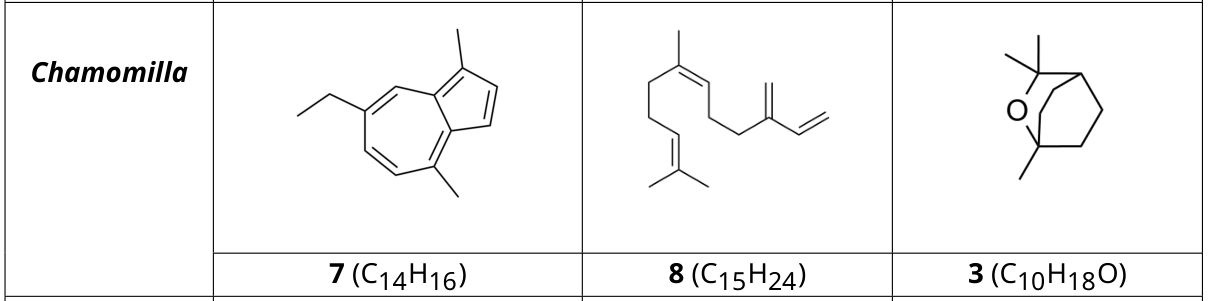
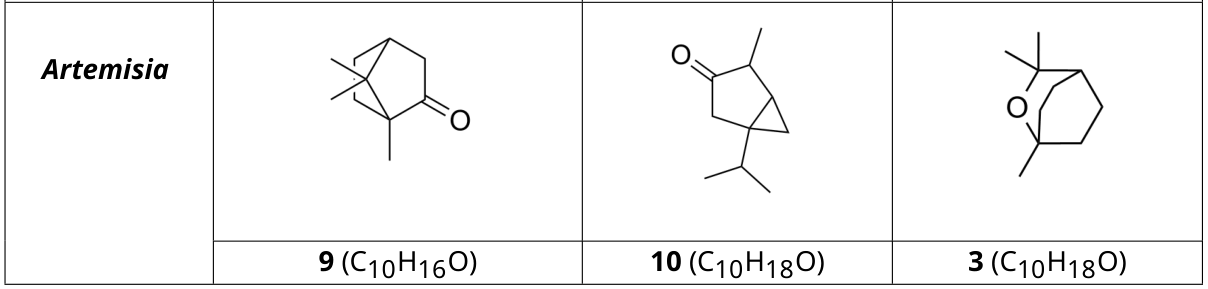
At first, the chemist compiled a table listing the names of the only four plants which she saw in Avicenna’s lab that could have been used to prepare the elixir, and the compounds that can be extracted from these plants.
Plants Compounds that can be extracted Zingiber 1 (\(\ce{C11H14O3}\)) 2 (\(\ce{C10H18O}\)) 3 (\(\ce{C10H18O}\)) Hypericum 4 (\(\ce{C6H12O}\)) 5 (\(\ce{C10H12O2}\)) 6 (\(\ce{C10H18O}\)) Chamomilla 7 (\(\ce{C14H16}\)) 8 (\(\ce{C15H24}\)) 3 (\(\ce{C10H18O}\)) Artemisia 9 (\(\ce{C10H16O}\)) 10 (\(\ce{C10H18O}\)) 3 (\(\ce{C10H18O}\)) 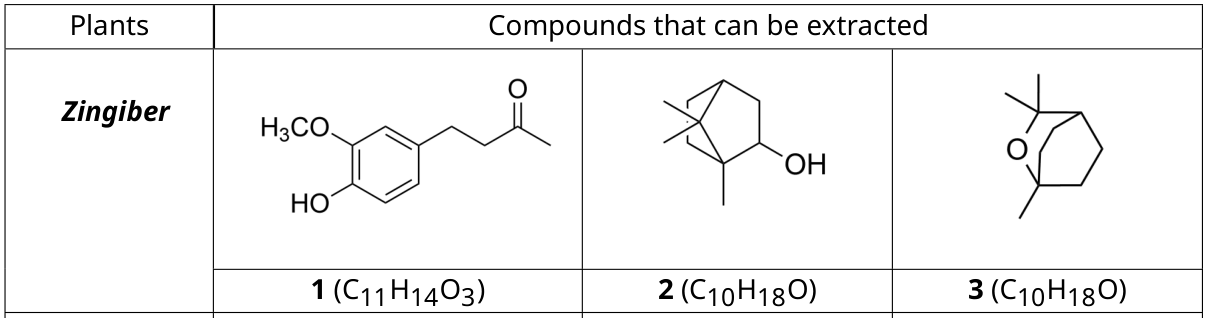

Using chromatography, she determined that the elixir consists of four different substances (X, Y, Z and W).
The chemist then discovered that X can isomerise into Y in an acidic medium and that Y has a plane of symmetry.
1.1 Identify X and Y. — 3.0 pt
Chromatography also revealed it was substance Z that gave the elixir its blue colour. Z is a derivative of the well-known substance A, which has two perpendicular planes of symmetry. When heated, A isomerises into aromatic compound B, which has three mutually perpendicular planes of symmetry. When substance Z is chlorinated, a pair of peaks with an intensity ratio of 3:1 is observed in the mass spectrum at \(m/z\) 218 and 220, respectively.
1.2 Identify Z and draw the structures of substances A and B. — 4.0 pt
The chemist extracted W from the elixir. When W was added to an aqueous \(\ce{Fe^3+}\) solution, a characteristic colour change was observed. Mass spectrometric analysis of W revealed the intensity ratio of \([\mathrm{M}]^+:[\mathrm{M}+1]^+=9:1\), where M is the molecular ion. Assume carbon consists exclusively of \(\ce{^{12}C}\) and \(\ce{^{13}C}\), the natural isotopic abundance of \(\ce{^{12}C}\) is 98.9%, and all other elements are monoisotopic.
1.3 Determine the number of carbon atoms (\(n\)) from the mass spec data and identify W. Show your calculations. — 3.0 pt
Part 2. The mysterious stone
Avicenna had told her the stone was a stoichiometric compound. She dissolved it in dilute nitric acid. After that, she adjusted the pH of the solution to ~4 and added \(\ce{NaF}\). This led to the formation of precipitate \(\mathbf{C}\cdot x\ce{H2O}\), which contained 39.16% water by mass. Anhydrous C reacts with an excess of \(\ce{NaF}\) to yield compound D, which contains 32.85% sodium and 12.85% of metal Q by mass, and is used in the industrial production of Q.
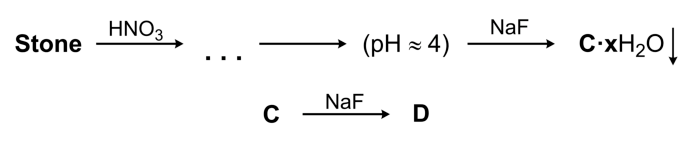
1.4 Identify metal Q and compounds \(\mathbf{C}\cdot x\ce{H2O}\) and D. — 4.0 pt
Avicenna told her that he found the stone in a coal deposit. The stone contains the anion of a highly symmetrical acid F. Reaction of F with \(\ce{P2O5}\) gives binary compound G, which contains 49.98% of oxygen by mass and has a three-fold symmetry axis. F can be prepared by oxidising compound E with potassium permanganate in an acidic solution. E contains 11.18% of hydrogen by mass and has a six-fold symmetry axis.
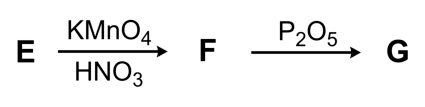
1.5 Draw the structures of E, F, and G. — 7.0 pt
Then, she analysed the stone thermogravimetrically in open air. A 10.00 g sample began to lose mass at approximately \(100\,^\circ\mathrm{C}\) and stopped at 5.75 g at \(200\,^\circ\mathrm{C}\). A second drop in mass was observed at \(400\,^\circ\mathrm{C}\), with a final mass of 1.50 g of compound H remaining constant at higher temperatures.
1.6 Determine the chemical formulae of the stone and compound H using thermogravimetric data. — 4.0 pt
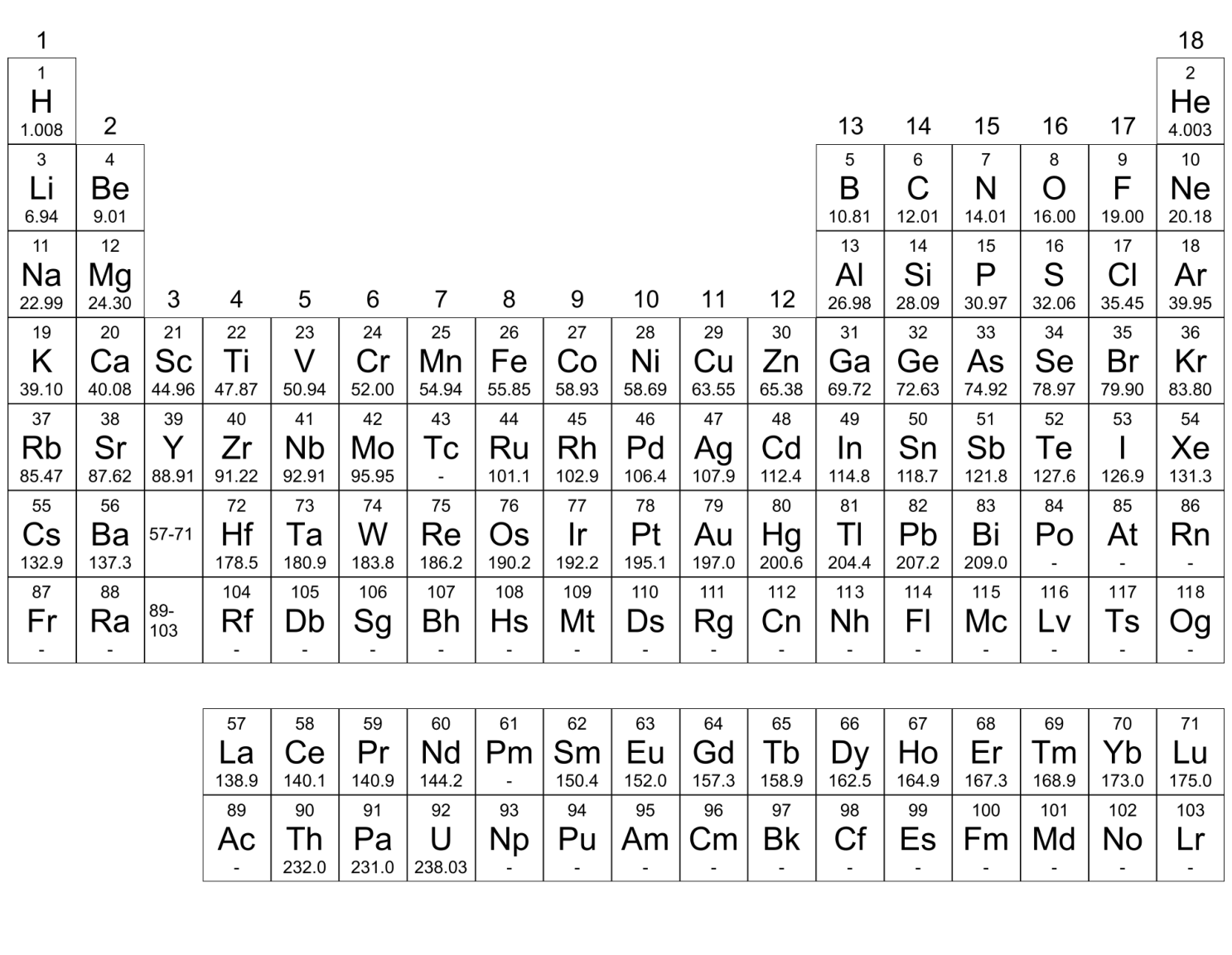
Periodic Table of Elements
Official English text of the problem.
Problem 2: Kinetics of the Belousov-Zhabotinsky reaction
T2. Kinetics of the Belousov-Zhabotinsky reaction
6%
2.1 2.2 2.3 2.4 2.5 2.6 2.7 \(\sum\) 2 11 4 2 9 4 3 35 When the chemicals \(\ce{KBrO3}\), \(\ce{CH2(COOH)2}\) (malonic acid, – MA), \(\ce{Ce(SO4)2}\), and \(\ce{H2SO4}\) are mixed, the concentration, \(C\), of Ce species and the colour of the solution oscillates between yellow (due to \(\ce{Ce^4+}\)) and colourless (due to \(\ce{Ce^3+}\)). A schematic picture is given below:
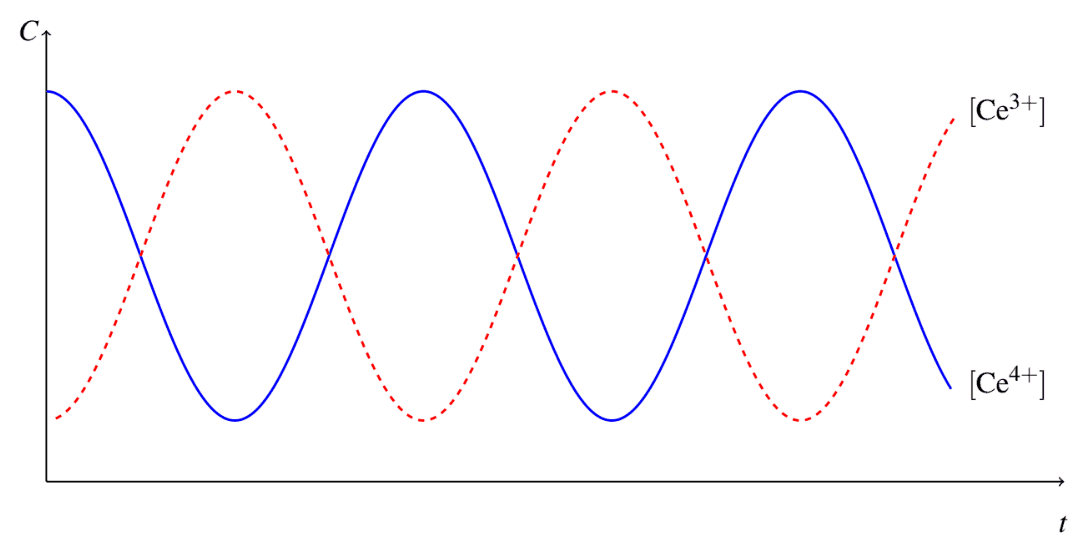
2.1 — 2.0 pt
Write the overall balanced reaction equation of the Belousov-Zhabotinsky reaction (BZ reaction). Note: in this reaction, MA is oxidised to \(\ce{CO2}\), \(\ce{BrO3-}\) is reduced to \(\ce{Br-}\), and Ce(IV) is a catalyst.
The mechanism of the BZ reaction is shown below (BMA – \(\ce{CHBr(COOH)2}\)):
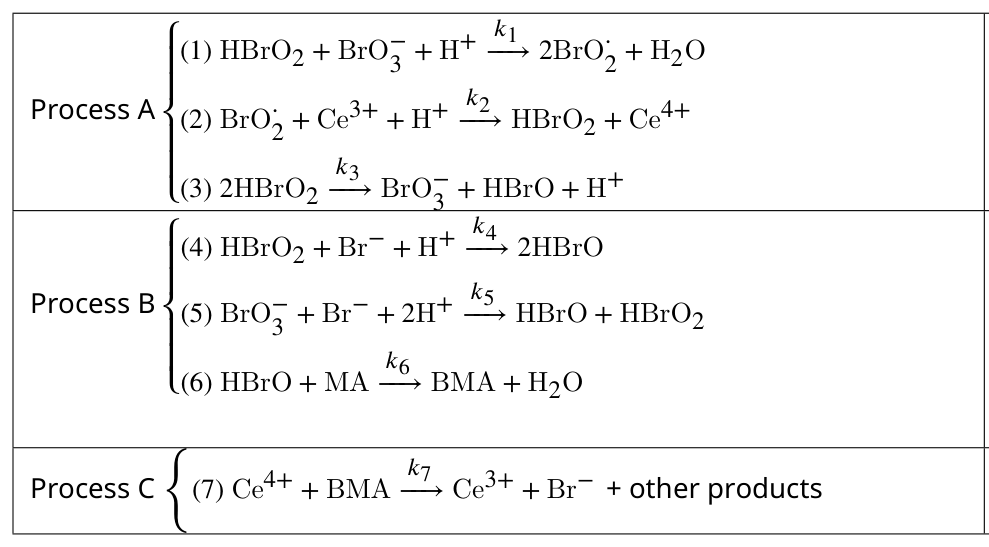
\(k_1=1.0\times10^4\ \mathrm{M^{-2}\,s^{-1}}\)
\(k_2=6.2\times10^4\ \mathrm{M^{-2}\,s^{-1}}\)
\(k_3=4.0\times10^7\ \mathrm{M^{-1}\,s^{-1}}\)\(k_4=2.0\times10^9\ \mathrm{M^{-2}\,s^{-1}}\)
\(k_5=2.1\ \mathrm{M^{-3}\,s^{-1}}\)
\(k_6=8.2\ \mathrm{M^{-1}\,s^{-1}}\)\(k_7=1.0\times10^2\ \mathrm{M^{-1}\,s^{-1}}\) In the BZ reaction, Process C occurs continuously, while Processes A and B alternate with each other.
Assume that:
- when Process A occurs the solution is yellow and Process B practically does not occur;
- when Process B occurs the solution is colourless and Process A practically does not occur;
- \([\ce{BrO3-}]_0=0.06\ \mathrm{M}\), \([\mathrm{MA}]_0=0.1\ \mathrm{M}\), \([\ce{H+}]_0=0.8\ \mathrm{M}\), \([\ce{Ce^4+}]_0=0.001\ \mathrm{M}\);
- the concentrations of the reactants (except \(\ce{Ce^4+}\)) and pH are maintained constant throughout the BZ reaction.
2.2 — 11.0 pt
Using the steady-state approximation, calculate the stationary molar concentrations of \(\ce{HBrO2}\) in Processes A and B, \([\ce{HBrO2}]_{\mathrm A}\) and \([\ce{HBrO2}]_{\mathrm B}\).
If you could not calculate \([\ce{HBrO2}]_{\mathrm A}\) and \([\ce{HBrO2}]_{\mathrm B}\), you can use the values \([\ce{HBrO2}]_{\mathrm A}=1\times10^{-5}\ \mathrm{M}\) and \([\ce{HBrO2}]_{\mathrm B}=1\times10^{-10}\ \mathrm{M}\) for the following calculations.
During the BZ reaction, the concentrations of \(\ce{HBrO2}\) and \(\ce{Br-}\) oscillate strictly in relation to each other, and this is sketched in the phase portrait of \([\ce{HBrO2}]\) vs \([\ce{Br-}]\):
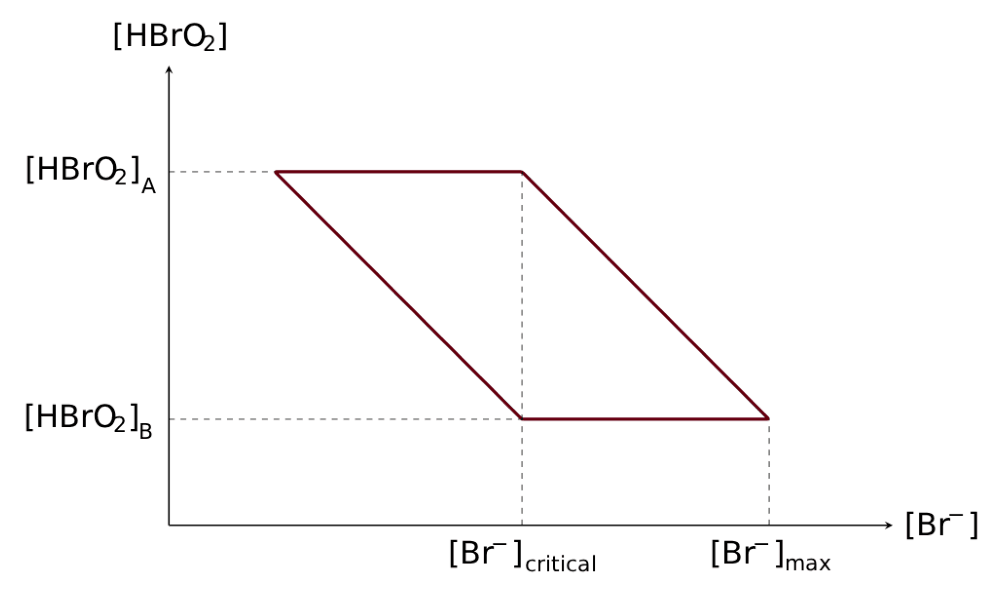
Here \([\ce{Br-}]_{\max}\) is the maximum concentration and \([\ce{Br-}]_{\mathrm{critical}}\) is the critical concentration of \(\ce{Br-}\) at which there is a switch over in processes from A to B or from B to A. To switch Process A to Process B, the reaction rate of the elementary step (4) must exceed that of the elementary step (1) and vice versa.
2.3 — 4.0 pt
Calculate \([\ce{Br-}]_{\mathrm{critical}}\).
If you could not calculate \([\ce{Br-}]_{\mathrm{critical}}\), use \([\ce{Br-}]_{\mathrm{critical}}=1\times10^{-7}\ \mathrm{M}\) for the following calculations.
2.4 — 2.0 pt
In which direction in the phase portrait of \([\ce{HBrO2}]\) vs \([\ce{Br-}]\) will the concentrations of \([\ce{HBrO2}]\) and \([\ce{Br-}]\) change over time? Tick the correct box.
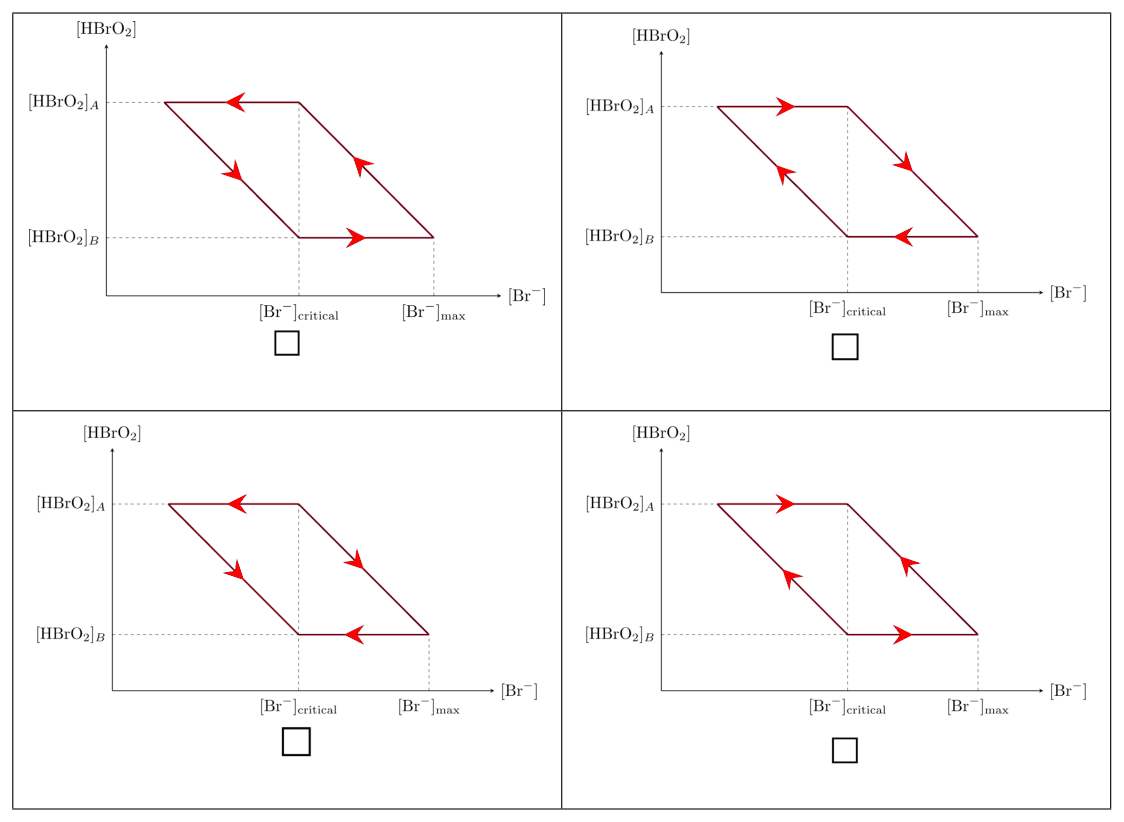
The system does not traverse the phase portrait of \([\ce{HBrO2}]\) vs \([\ce{Br-}]\) at a constant velocity, that is the concentration of \([\ce{Br-}]\) slowly decreases from \([\ce{Br-}]_{\max}=7.0\times10^{-4}\ \mathrm{M}\) to \([\ce{Br-}]_{\mathrm{critical}}\), and then almost immediately reaches \([\ce{Br-}]_{\max}\) again.
2.5 — 9.0 pt
Calculate based on the data the period of oscillations, \(\tau\), of the BZ reaction, in seconds.
2.6 — 4.0 pt
What will be the effect if the following actions (1-4) are performed on an open system where a BZ reaction is taking place? Tick only one box (a-e) for each case.
1. Adding of small amount of \(\ce{Ce^4+}\) during Process A.
2. Adding of a small amount of \(\ce{Ag+}\) during Process B.
3. Adding of a small amount of \(\ce{Br-}\) during Process B.
4. Continuous addition of \(\ce{Br-}\).[ a ] prolongs Process A
[ b ] prolongs Process B
[ c ] Process A switches to Process B
[ d ] Process B switches to Process A
[ e ] oscillations stop2.7 — 3.0 pt
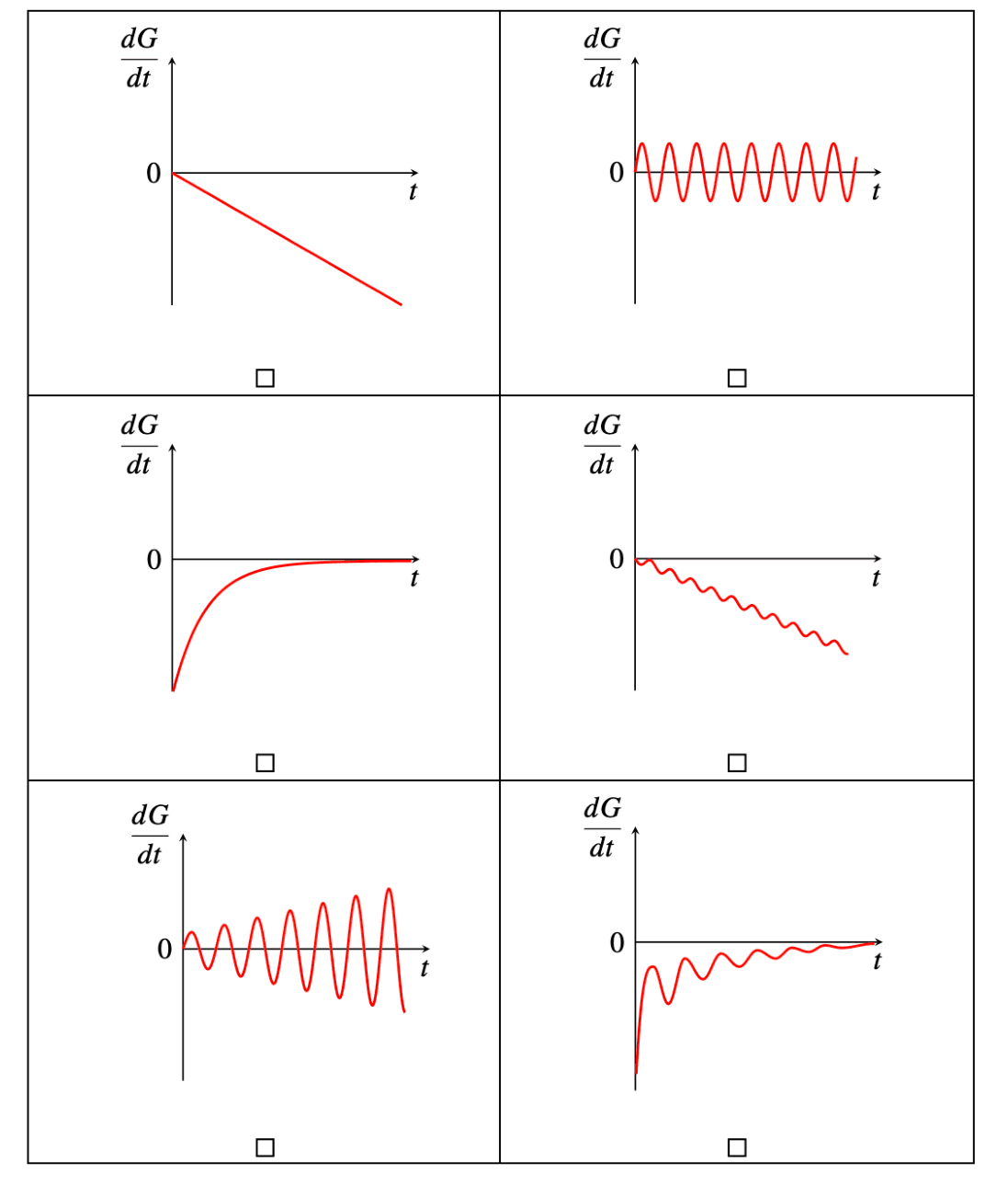
Which graph qualitatively illustrates the rate of change of Gibbs energy \(\left(\frac{dG}{dt}\right)\) of a closed system in which an oscillatory reaction occurs? Tick the correct box.
Official English text of the problem.
Problem 3: Into Reticular Chemistry
T3. Into Reticular Chemistry
7%
3.1 3.2 3.3 3.4 3.5 3.6 3.7 \(\sum\) 2 3 23 12 6 12 5 63 Covalent organic frameworks (COFs) are a class of polymers that form two- or three-dimensional structures through reactions between organic precursors, resulting in covalent bonds to afford porous, crystalline materials. Two examples of honeycomb type 2D-COFs formed by boronate ester and boroxine rings (repeat units indicated using dashed lines) are shown in the figure below.
The black and red bold lines represent different building blocks in all COF topology figures.
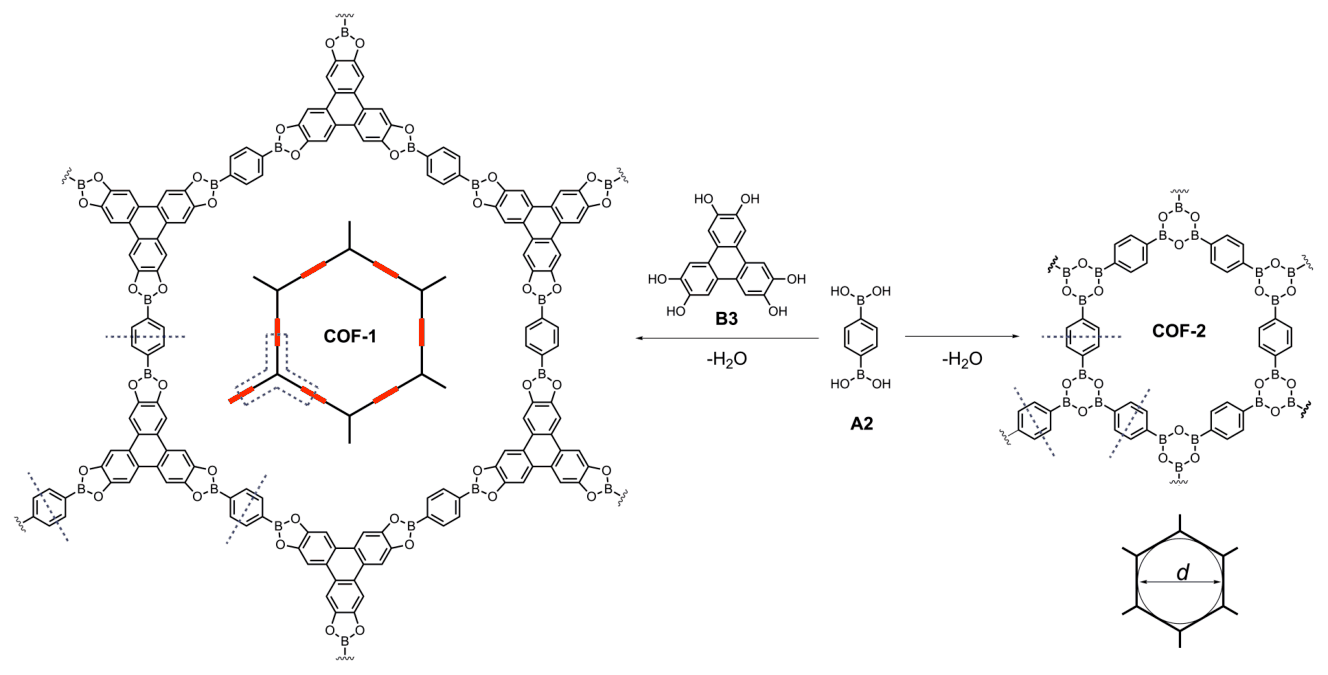
3.1 Determine the empirical formula of COF-1 and calculate the mass percentage (%, to two decimal places) of carbon in COF-1. 2.0 pt
3.2 Calculate the internal diameter, \(d\), in Å, of the honeycomb for COF-2, with the following assumptions: 3.0 pt
- \(\ce{C-C}/\ce{C=C}\) (arenes) = 1.39 Å
- \(\ce{C-B}\) = 1.56 Å
- \(\ce{B-O}\) = 1.38 Å
- Note, the diameter of a circle, \(d\), inscribed inside a hexagon, is given by \(d=\sqrt{3}a\), where \(a\) is the side length of the hexagon.
- Neglect the width of the linkers.
The structures shown below can form 2D and 3D COFs. For this question consider only formation of COFs with boronate esters, imines, and \(\ce{C=C}\) bonds through condensation reactions. A–E represent compound classes with different functional groups.
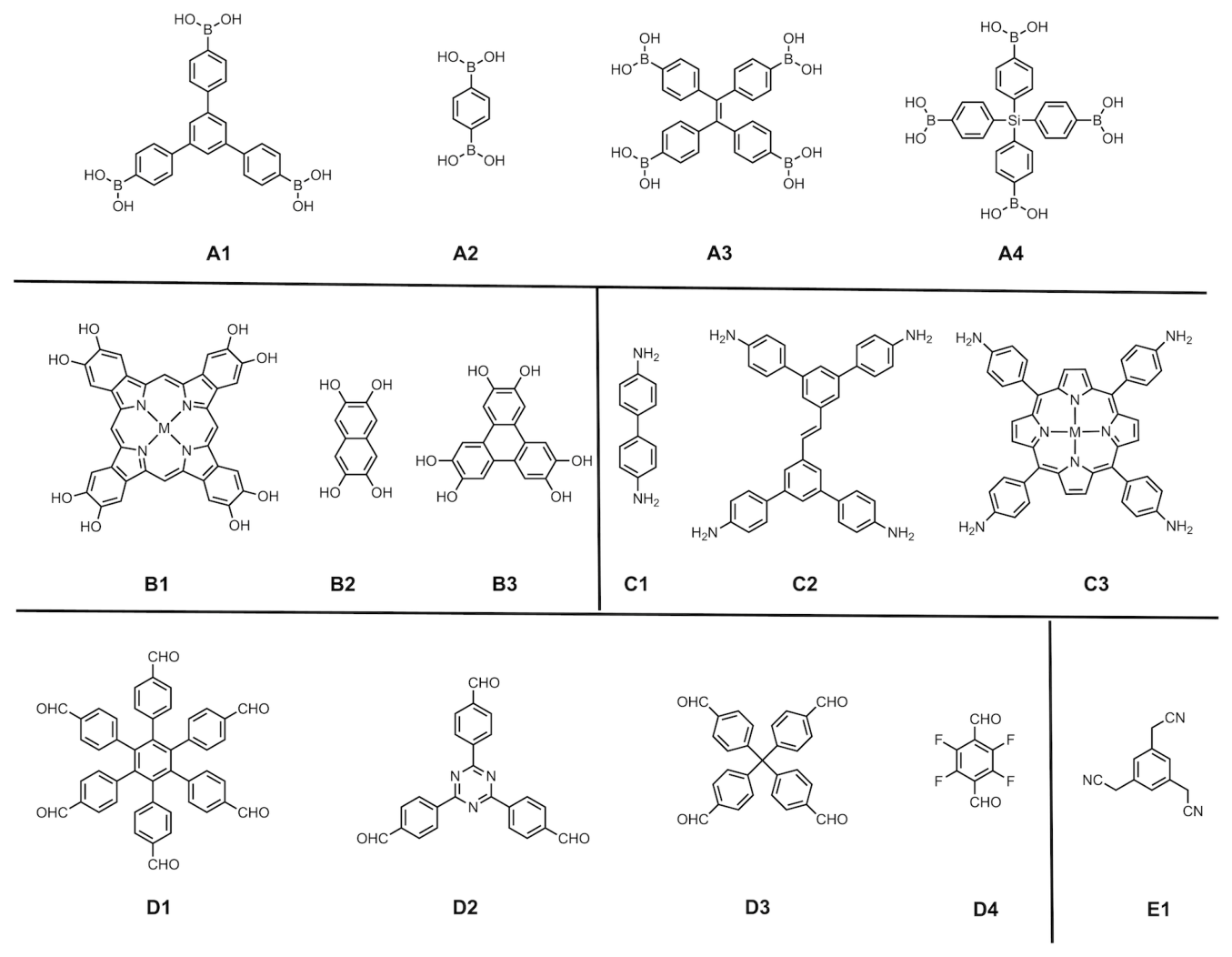

Tetragonal means Tetragonal, Hexagonal means Hexagonal, Trigonal means Trigonal, Kagome means Kagome, Tetrahedral means Tetrahedral.
3.3 Fill all the table cells with either new examples of monomer combinations that give the topologies shown above or with “XXX” if you are certain that no additional combinations satisfy that topology. Both the combinations and the “XXX” entries will be graded. Incorrect answers (both combinations and “XXX” entries) will be penalised. Blank table cells will not be graded. 23.0 pt
Tetragonal 1 Tetragonal 2 Hexagonal 1 Hexagonal 2 Trigonal Kagome Tetrahedral ■ ■ A2 + B3 E1 + D2 ■ C2 + D4 ■ Whilst imine-based COFs are easily synthesised, they are also vulnerable to hydrolysis under strongly acidic and basic conditions. The addition of hydroxy groups to the aldehyde or amine monomers can overcome this. IR spectrum of COF-3 contained stretches corresponding to the imine functional group, but COF-4 did not. COF-4 contains a different type of \(\ce{C=N}\) bonds, and elemental analysis revealed a loss of six additional hydrogen atoms per repeat unit relative to COF-3 as the only change. COF-5 irreversibly isomerises to COF-6, which did not contain imine stretches in its IR spectrum.


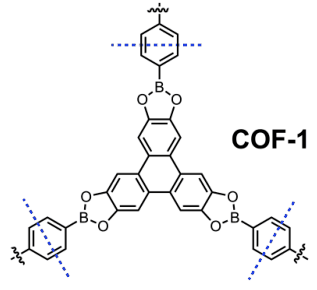
3.4 Draw the repeat units for COFs 3–6. Indicate the edges of each repeat unit with a dashed line as shown for COF-1 below. 12.0 pt
Macrocycle X was synthesised by post-synthetic modification of COF-7 (C2 + D4) followed by degradation.
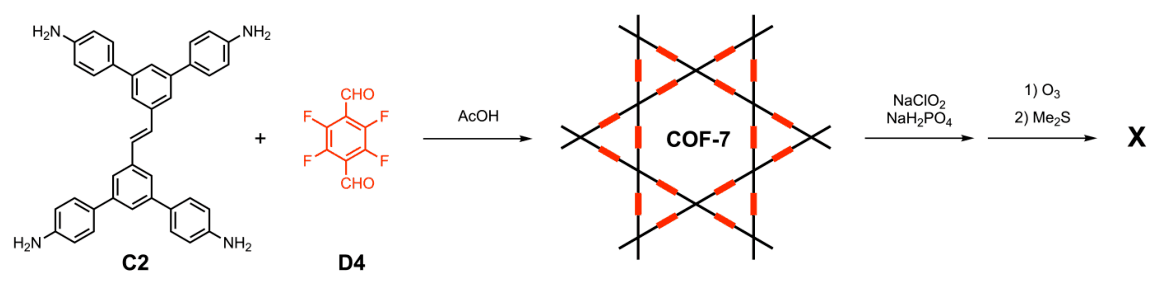
3.5 Draw the smallest repeat unit of macrocycle X. 6.0 pt
π-π interactions result in different stacking modes of COF layers, some of which are shown below.
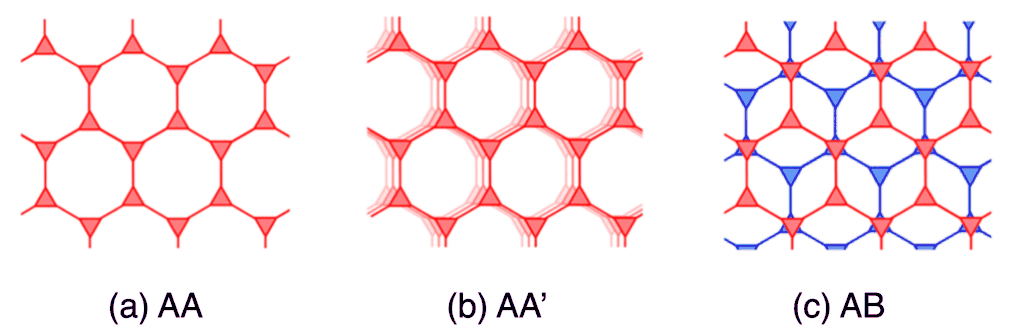
Depending on stacking geometry, the interaction energy can be different as shown below.
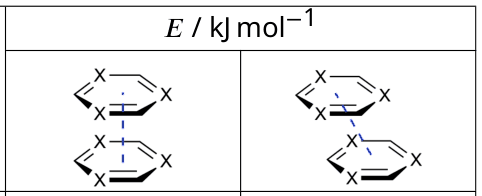
Interaction geometry \(E/\mathrm{kJ\,mol^{-1}}\) \(E/\mathrm{kJ\,mol^{-1}}\) benzene (\(\ce{X = CH}\)) – benzene (b-b) −7.9 −12.6 benzene-triazine (\(\ce{X = N}\)) (b-t) −49.8 −55.6 triazine–triazine (t-t) −6.7 −16.7 COF-8, synthesised from (E1 + D2), is notable for its remarkable stability. The AA′ slightly shifted mode of a COF-8 bilayer has a π-π stacking interaction energy of \(-67.1\ \mathrm{kJ\,mol^{-1}}\) between two layers of one repeat unit.
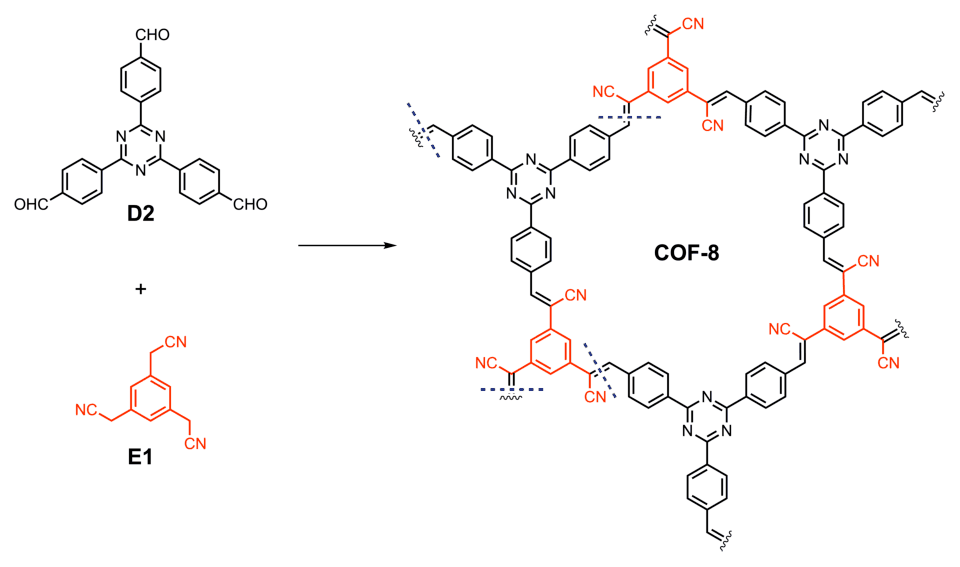
3.6 Calculate the π-π stacking energy between two layers of one repeat unit of COF-8, for the AA, AB and AB′ arrangements. Assume π-π stacking happens only between aromatic units. 12.0 pt
COF-9, obtained from COF-8, absorbs \(\ce{UO2^{2+}}\) ions and loses its fluorescence. In an experiment, a suspension of 5.000 mg COF-9 in \(19.90\ \mathrm{mg\,dm^{-3}}\) \(\ce{UO2^{2+}}\) solution (200.0 mL) was filtered after equilibrium was reached. The final concentration of \(\ce{UO2^{2+}}\) was \(9.225\ \mathrm{mg\,dm^{-3}}\).
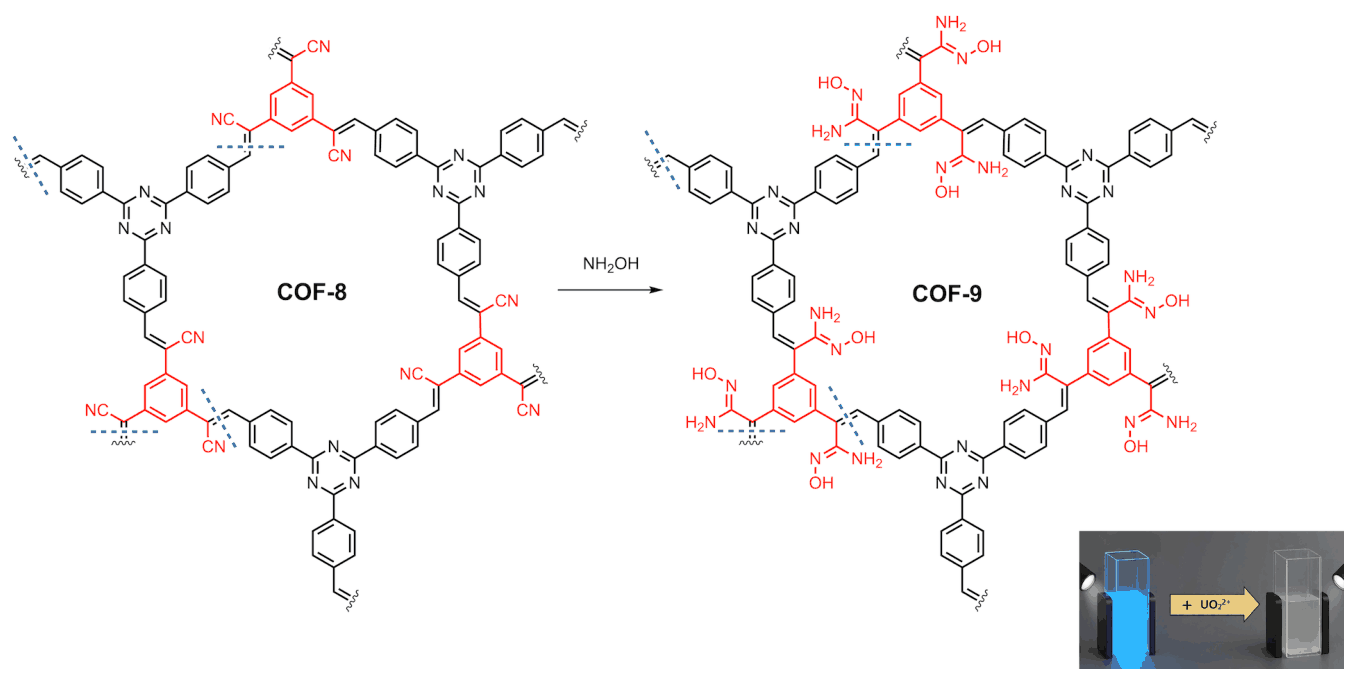
3.7 Calculate the equilibrium absorption capacity at a given temperature (\(q_e\)) in \(\mathrm{mg\,g^{-1}}\) of COF-9. Indicate the number of \(\ce{UO2^{2+}}\) ions absorbed per pore. Assume that all uranium exists as \(\ce{UO2^{2+}}\) ions. 5.0 pt
Periodic Table of Elements
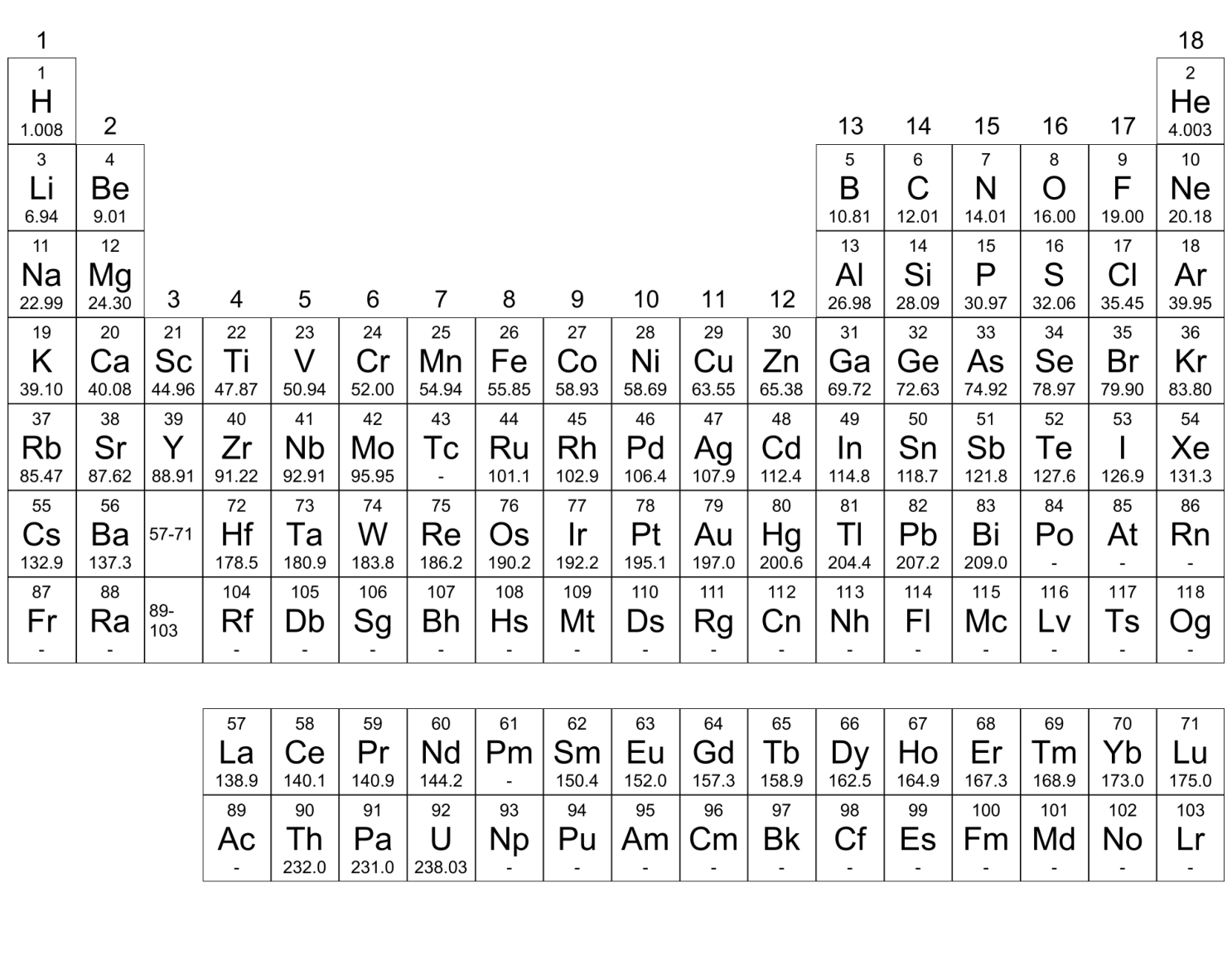
Official English text of the problem.
Problem 4: The nuclear past of Uzbekistan
T4. The nuclear past of Uzbekistan
6%
4.1 4.2 4.3 4.4 4.5 4.6 4.7 4.8 4.9 \(\sum\) 2 3 3 2 2 2 2 2 4 22 Natural uranium consists primarily of two isotopes, \(\ce{^{235}U}\) and \(\ce{^{238}U}\). \(\ce{^{235}U}\) is responsible for sustaining nuclear fission reactions.
4.1 Calculate the atomic abundance of \(\ce{^{235}U}\) in natural uranium, assuming it consists only of isotopes \(\ce{^{235}U}\) (235.04 a.u.) and \(\ce{^{238}U}\) (238.05 a.u.). 2.0 pt
The main reaction occurring in nuclear power plants is the reaction where \(\ce{^{235}U}\) absorbs a neutron and undergoes fission, releasing energy and producing three additional neutrons, thus sustaining a chain reaction.
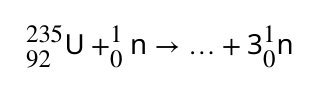
Neutrons that induce the chain reaction are produced by several ways:
a) Reaction of \(\ce{^{11}B}\) with \(\alpha\)-particles inside the reactor core
b) Interaction of \(\gamma\) rays with \(\ce{^{2}D}\) nuclei present in the reactor coolant water
c) Reaction of \(\ce{^{9}Be}\) with \(\alpha\)-particles produced in an externally installed neutron source.
4.2 Write the nuclear reaction equations for (a), (b), and (c). 3.0 pt
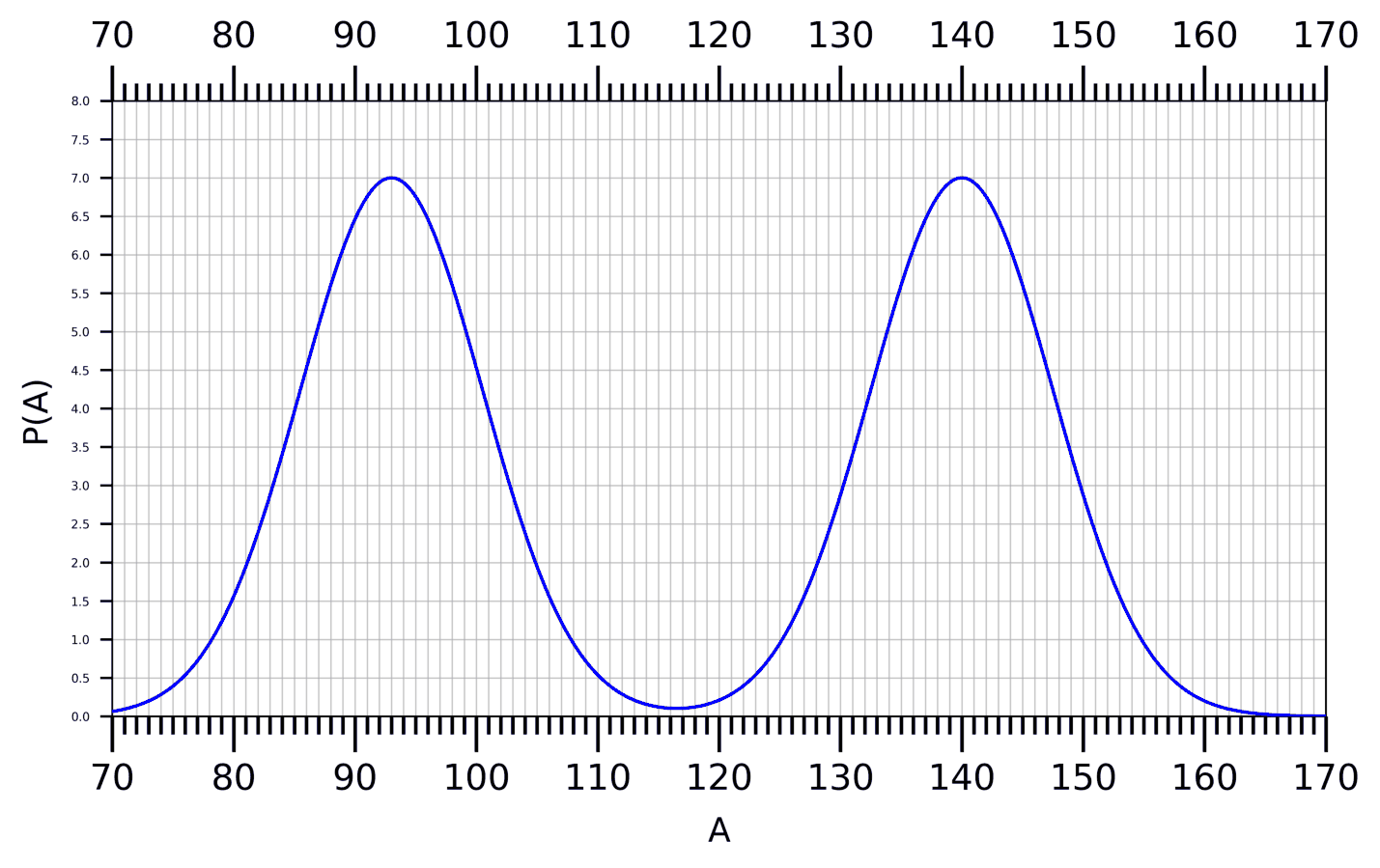
The graph above displays the percentage yield, \(P(A)\), of fission products by mass number, \(A\), resulting from \(\ce{^{235}U}\) fission.
4.3 Write the main nuclear fission equation for splitting of \(\ce{^{235}U}\) upon neutron absorption. The pair of elements formed in this reaction are in the same group of Periodic Table. 3.0 pt
4.4 Calculate the energy released in this reaction (\(\Delta E\), MeV), if the binding energy \(BE(\ce{^{235}U})=7.59\ \text{MeV/nucleon}\) and average binding energy for fission products \(BE(\text{fis.})=8.45\ \text{MeV/nucleon}\). Neglect the binding energy of free neutrons. 2.0 pt
Fission neutrons are produced with an average energy of 2 MeV and slow down through many scatterings with nuclei. After several collisions, their speed decreases until their average kinetic energy matches that of the surrounding atoms or molecules.
The logarithmic energy decrement, \(\xi\), shows the average decrease per collision in the logarithm of the neutron energy:
\[ \xi=\ln\left(\frac{E_{\mathit{initial}}}{E_{\mathit{final}}}\right) \]
\(E_{\mathit{initial}}\) and \(E_{\mathit{final}}\) are the initial and final neutron energies per collision.
\(\xi\) is a constant for each type of material and does not depend on the initial neutron energy.
4.5 Determine the average number of collisions required, \(n_c\), to slow a neutron from 2 MeV to 0.012 eV, using water as the moderator. \(\xi\) (water)=0.948 2.0 pt
In 1963, the Urtabulak gas field suffered an uncontrolled natural gas well blowout, releasing enormous volumes of burning methane.
4.6 Calculate \(\Delta_rH^\circ_{298}\) (\(\mathrm{kJ\,mol^{-1}}\)) for one mole of methane combustion reaction at 298 K. Assume all species are gaseous. Use the thermodynamic data below 2.0 pt
\(\Delta_fH^\circ_{298}(\ce{CH4})\) \(-74.8\ \mathrm{kJ\,mol^{-1}}\) \(\Delta_fH^\circ_{298}(\ce{H2O},\text{ gas})\) \(-241.8\ \mathrm{kJ\,mol^{-1}}\) \(\Delta_fH^\circ_{298}(\ce{CO2})\) \(-393.5\ \mathrm{kJ\,mol^{-1}}\) \(C_P(\ce{CH4})\) \(35\ \mathrm{J\,mol^{-1}\,K^{-1}}\) \(C_P(\ce{H2O},\text{ gas})\) \(34\ \mathrm{J\,mol^{-1}\,K^{-1}}\) \(C_P(\ce{O2})\) \(29\ \mathrm{J\,mol^{-1}\,K^{-1}}\) \(C_P(\ce{CO2})\) \(37\ \mathrm{J\,mol^{-1}\,K^{-1}}\) If you did not get an answer for 4.6, use \(\Delta_rH^\circ_{298}=-750\ \mathrm{kJ\,mol^{-1}}\) for further calculations.
4.7 Calculate \(\Delta_rH_{2000}\) (\(\mathrm{kJ\,mol^{-1}}\)) per mole of methane combustion reaction at 2000 K. Assume all species are gaseous. 2.0 pt
If you did not get an answer for 4.7, use \(\Delta_rH_{2000}=-700\ \mathrm{kJ\,mol^{-1}}\) for further calculations.
Assume that methane is flowing out the well at 101.325 kPa and 298 K with volumetric flow \(Q=2.2\times10^5\ \mathrm{m^3}\) per day before it catches fire.
4.8 Calculate the total energy released per day, \(E\), (in \(\mathrm{J\,day^{-1}}\)) by complete isothermic combustion of methane at \(T=2000\ \mathrm K\) 2.0 pt
The Urtabulak gas leak was ended by detonating a 30-kiloton in TNT equivalent underground nuclear explosion that collapsed the reservoir and sealed the leak. 1 ton of TNT equivalent is 4.184 GJ of energy.
4.9 Using the value from 4.4, calculate the total number of fissions, \(TN\), during the nuclear explosion. Calculate the mass, \(m\), of enriched uranium used in the explosion (in kg), assuming it contained 90% by mass of the \(\ce{^{235}U}\) isotope, and 33% of the \(\ce{^{235}U}\) underwent fission.
If you did not get an answer for 4.4, use \(\Delta E=200\ \mathrm{MeV}\). 4.0 ptPhysical Constants and Equations
Constants
Avogadro constant \(N_A=6.022\times10^{23}\ \mathrm{mol^{-1}}\) Universal gas constant \(R=8.314\ \mathrm{J\,K^{-1}\,mol^{-1}}\) Faraday constant \(F=96\,485\ \mathrm{C\,mol^{-1}}\) Planck constant \(h=6.626\times10^{-34}\ \mathrm{J\,s}\) Speed of light in vacuum \(c=2.998\times10^8\ \mathrm{m\,s^{-1}}\) Mass of electron \(m_e=9.109\times10^{-31}\ \mathrm{kg}\) Charge of electron \(e=1.602\times10^{-19}\ \mathrm C\) Standard pressure \(P^\circ=1\ \mathrm{bar}=10^5\ \mathrm{Pa}\) Ionic product of water at \(25\,^\circ\mathrm C\) \(K_w=1.00\times10^{-14}\) Zero of the Celsius scale \(0\,^\circ\mathrm C=273.15\ \mathrm K\) Electronvolt \(1\ \mathrm{eV}=1.602\times10^{-19}\ \mathrm J\) Watt \(1\ \mathrm W=1\ \mathrm{J\,s^{-1}}\) Coulomb \(1\ \mathrm C=1\ \mathrm{A\,s}\) Nanometre \(1\ \mathrm{nm}=1\times10^{-9}\ \mathrm m\) Ångstrom \(1\ \text{Å}=1\times10^{-10}\ \mathrm m\) metric ton \(1\ \mathrm{ton}=1000\ \mathrm{kg}\) litre \(1\ \mathrm L=1\ \mathrm{dm^3}\) Equations
Ideal gas law \(PV=nRT\) Dalton law \(P_i=x_iP\) Beer–Lambert law \(A=\log_{10}\dfrac{I_0}{I}=\varepsilon cl\) Energy of a photon \(E=h\nu=\dfrac{hc}{\lambda}\) Heat and temperature change \(Q=nC_m\Delta T\) Gibbs energy definition \(G=H-TS\) Gibbs energy and equilibrium constant \(\Delta_rG^\circ=-RT\ln K\) Enthalpy change dependence on temperature (at \(\Delta_rC_p=\mathit{const}\)) \(\Delta_rH_{T_2}=\Delta_rH_{T_1}+\Delta_rC_p(T_2-T_1)\) Entropy change dependence on temperature (at \(\Delta_rC_p=\mathit{const}\)) \(\Delta_rS_{T_2}=\Delta_rS_{T_1}+\Delta_rC_p\ln\dfrac{T_2}{T_1}\) Henderson–Hasselbalch equation \(\mathrm{pH}=\mathrm pK_a+\log_{10}\dfrac{[\ce{A-}]}{[\ce{HA}]}\) Average reaction rate \(r=\dfrac{\Delta c}{\Delta t}\) The rate law \(r=k[A]^x[B]^y\) Arrhenius law \(k=A\exp\left(-\dfrac{E_a}{RT}\right)\) Integrated rate law for a 1st order reaction \(c=c_0e^{-kt}\)
\(kt=\ln\dfrac{c_0}{c}\)Lifetime of a reagent in a 1st order reaction \(\tau=\dfrac1k\) Integrated rate law for n-th order reaction (\(n\ne1\)) \(kt=\dfrac1{n-1}\left(c^{1-n}-c_0^{1-n}\right)\) for \(n\ne1\) Concentration of an intermediate in a consecutive reaction: \([B]=\dfrac{k_1[A]_0}{k_2-k_1}\left(e^{-k_1t}-e^{-k_2t}\right)\) 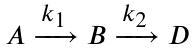
The ratio of products in the competitive reactions: \(\dfrac{[B]}{[C]}=\dfrac{k_1}{k_2}\) 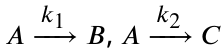
Michaelis–Menten equation \(r_0=r_{\max}\dfrac{[S]_0}{K_M+[S]_0}\) Specific surface area \(s=\dfrac Sm\) Progressions: arithmetic geometric \(a_n=a_1+d(n-1)\)
\(a_n=a_1q^{n-1}\)Sum of geometric progression \(\displaystyle\sum_{k=0}^{n}a_1q^k=a_1\dfrac{q^{n+1}-1}{q-1}\) Volume of a sphere with radius \(r\) \(V=\dfrac43\pi r^3\) Surface area of sphere with radius \(r\) \(S=4\pi r^2\) Volume of a cone with base radius \(r\) and height \(h\) \(V=\dfrac13\pi r^2h\) Volume of a cylinder with base radius \(r\) and height \(h\) \(V=\pi r^2h\) Consider all gases ideal.
In equilibrium constant calculations, all concentrations are referenced to the concentration of \(1\ \mathrm{mol\,dm^{-3}}\).
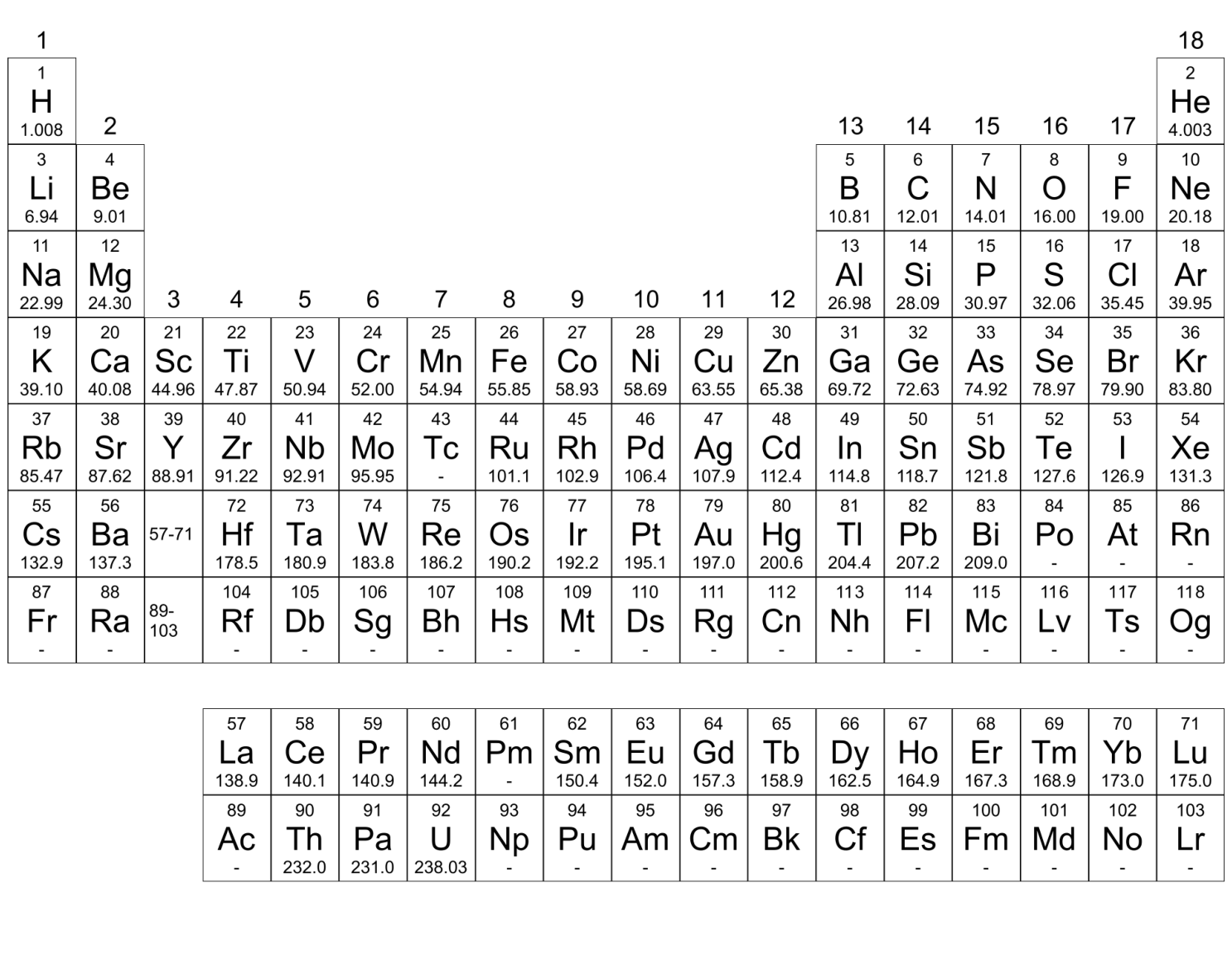
Periodic Table of Elements
Official English text of the problem.
Problem 5: Cardiolipins
T5. Cardiolipins
6%
5.1 5.2 5.3 5.4 5.5 5.6 \(\Sigma\) 1 6 4 2 2 3 18 In this problem you are asked to be creative and build molecules from fragments. For instance, if you are required to draw a chiral phospholipid such as W using fragments a-e, it can be assembled as shown below.
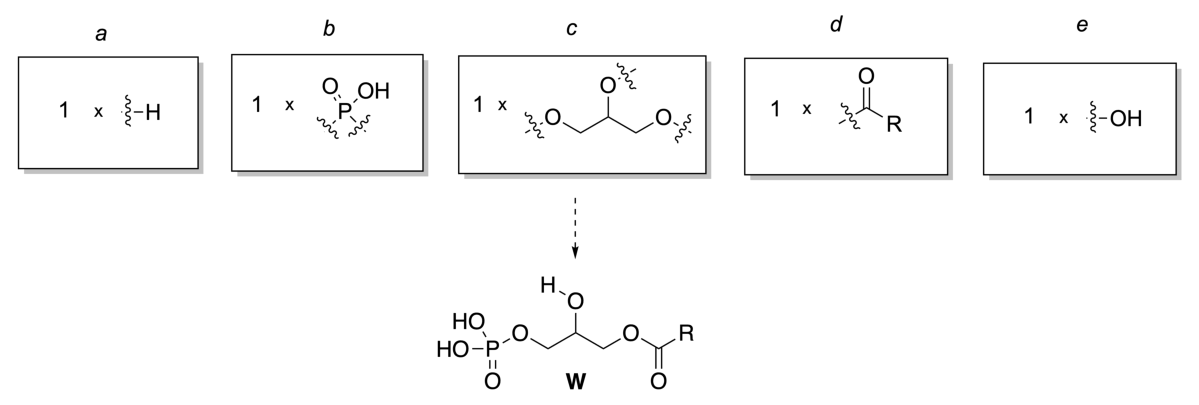
Cardiolipins are a family of acyclic phospholipids differing in fatty acid residues. They are essential for energy production and membrane stability. Defects can lead to certain diseases. PL1 belongs to this family. Using only the structural elements a-d in the quantities stated below, it is possible to assemble the non-ionised form of PL1. R is a hydrocarbon substituent in the fatty acid structure.
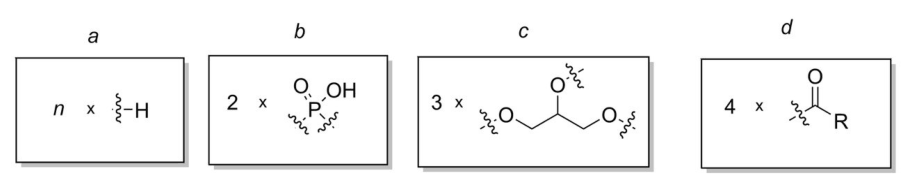
PL1 does not contain any peroxide bonds.
5.1 Tick one correct statement regarding the value of \(n\) (number of type \(a\) fragments). 1.0 pt
(a) \(n\) is an even number,
(b) \(n\) is an odd number,
(c) \(n\) can be either an odd or an even number.Some cardiolipins are chiral molecules, even if they contain four identical fatty acid residues, as in the case of PL1. One enantiomer of PL1 is found in prokaryotes and eukaryotes, and the other only in archaea. All other diastereomers of PL1 are achiral molecules, since they have a plane of symmetry. Do not consider the chirality of phosphorus atoms as stereocentres.
PL1 is a diprotic acid with the same acidic groups. Its second deprotonation is less favourable (\(pK_{a_2}\gg pK_{a_1}\)) due to the special, stable structure of monoanion Y.
5.2 Draw the structure of one enantiomer of PL1. Draw the structure of Y in a way that shows the stabilisation that explains the difference between \(pK_{a_1}\) and \(pK_{a_2}\). Use the abbreviation R for the fatty acid residues. 6.0 pt
A series of experiments was conducted to identify the fatty acid (RCOOH) in PL1 found predominantly in mammalian hearts. During reductive ozonolysis, RCOOH forms three different organic products in equimolar amounts.
5.3 Determine the molecular formula of the fatty acid (RCOOH), if the non-ionised form of PL1 contains 255 \(\sigma\) and \(\pi\) bonds between atoms in total. Support your answer with calculations. 4.0 pt
If you were unable to find the structural formula of PL1, you can use a-d fragments from 5.1.
100 g of RCOOH reacts with 181.0 g of iodine. RCOOH also reacts in similar way with X and forms an adduct with an iodine mass fraction of 36.57%.
5.4 Determine the molecular formula of X. Support your answer with calculations. 2.0 pt
The phase behavior of PL1 depends on pH. In physiological conditions, PL1 is a dianion and it forms a lamellar phase.
5.5 Which lipid phase is formed by PL1 when both acid residues in it are protonated? 2.0 pt
Note that knowledge of PL1 structure is not required to solve this question.
Tick the correct answer.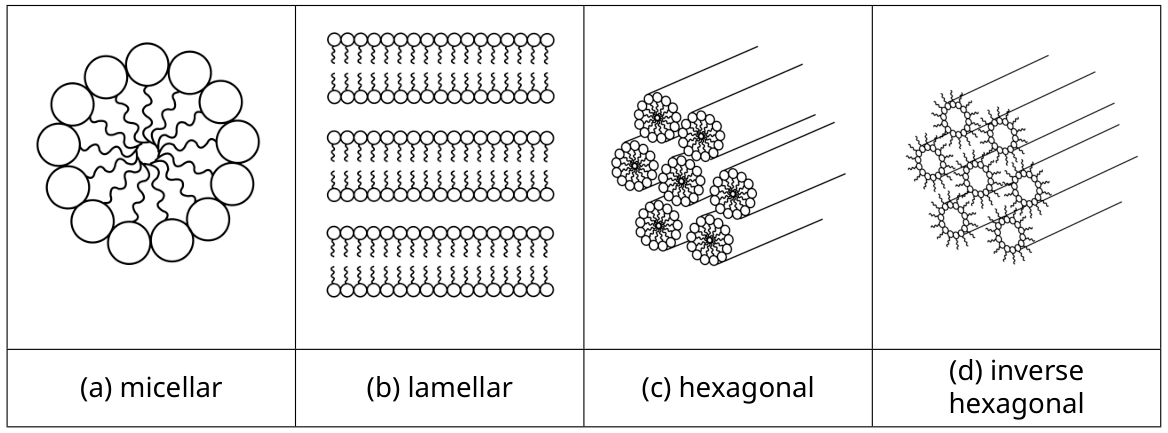
The following balanced reaction equations show the hydrolysis of phospholipids PL1-PL3:
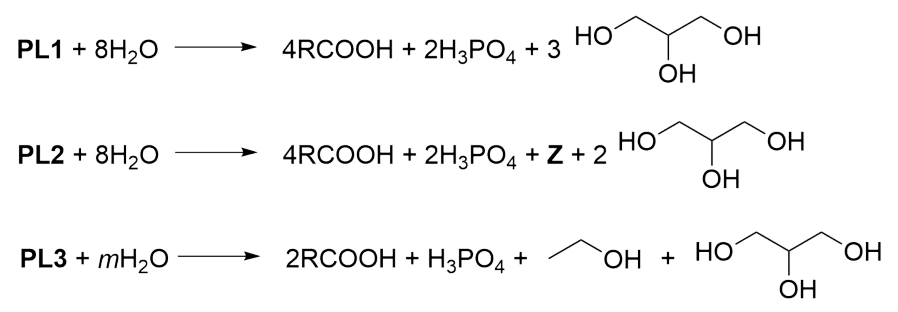
- The non-ionised form of PL2 contains 254 \(\sigma\) and \(\pi\) bonds between atoms in total. It is a chiral and a more symmetrical molecule than PL1,
- Z contains C, H, and O only, and it doesn’t react with \(\ce{H2}\) in the presence of a catalyst,
- Phospholipid PL3 is a charged molecule at physiological pH values, and it exists as pair of enantiomers.
5.6 Draw the structures of PL2 and PL3 using R to show the fatty acid residues. Show stereochemistry where appropriate. 3.0 pt
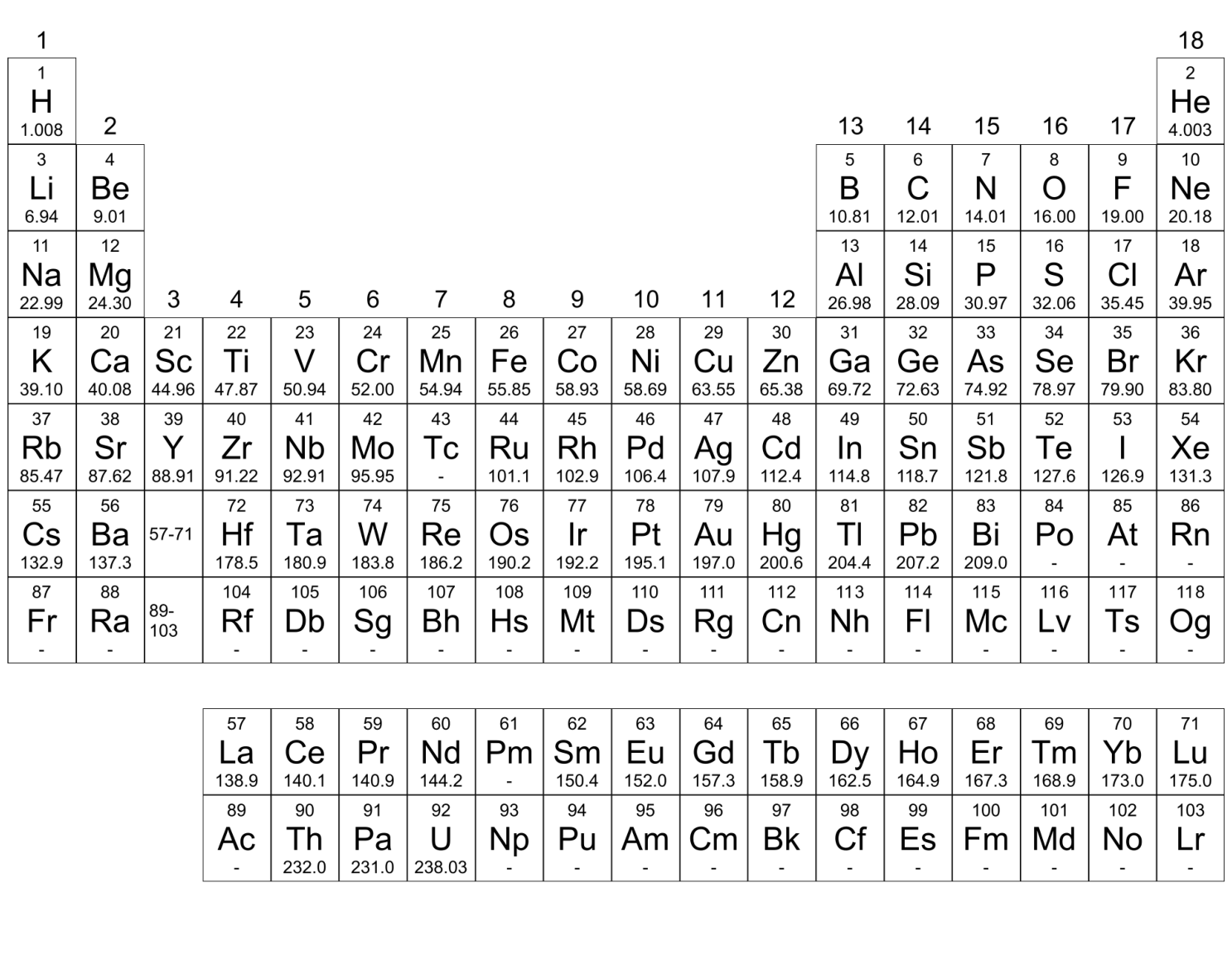
Periodic Table of Elements
Official English text of the problem.
Problem 6: Carbon Nanorings
T6. Carbon Nanorings
7%
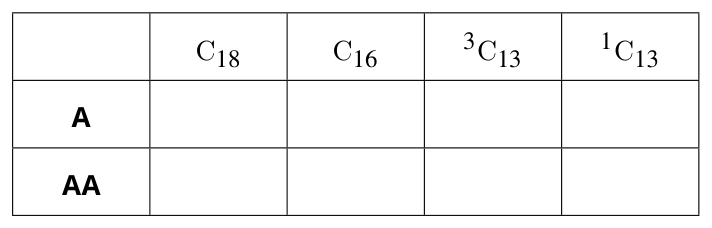
6.1 6.2 6.3 6.4 6.5 6.6 6.7 \(\sum\) 10 11 2 12 24 20 4 83 In 2019, \(\ce{C18}\), the first example of a new class of carbon allotropes called cyclo[n]carbons (\(\ce{C_n}\)) was detected. Cyclocarbons are monocyclic, all-carbon compounds with high strain energy and low stability. They can be generated and analysed by bond-resolved Atomic Force Microscopy (AFM). Cyclocarbons have interesting aromatic properties based on their \(\pi\) systems. \(\ce{C13}\) has triplet (\({}^{3}\ce{C13}\), spin \(S=1\)), and singlet (\({}^{1}\ce{C13}\), spin \(S=0\)) forms.
6.1 Based on Hückel’s rule, fill in the table with the number of distinct aromatic (A) and anti-aromatic (AA) \(\pi\)-systems present in each of \(\ce{C18}\), \(\ce{C16}\), \({}^{3}\ce{C13}\), and \({}^{1}\ce{C13}\). Fill in all blanks. 10.0 pt
Later, cyclo[n]carbons \(\ce{C10}\), \(\ce{C12}\), \(\ce{C14}\), \(\ce{C20}\), and \(\ce{C26}\) were generated by a combination of dehalogenation and retro-Bergman (1) reactions on a surface. AFM images taken during the synthesis of \(\ce{C14}\) are shown below:
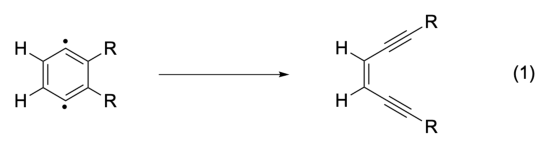
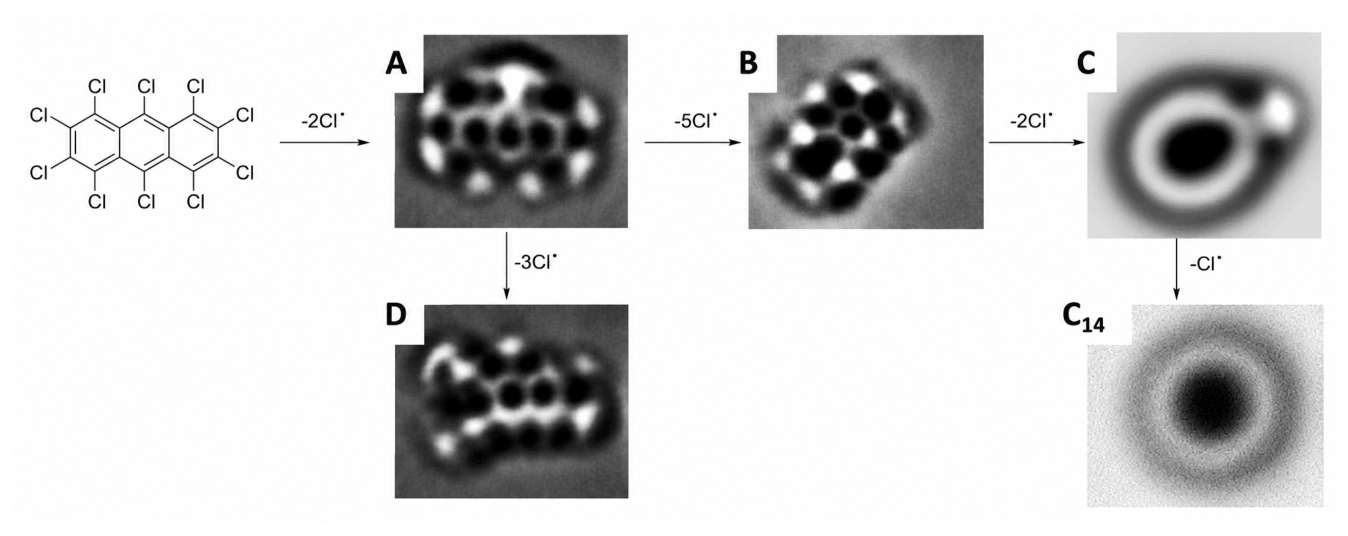
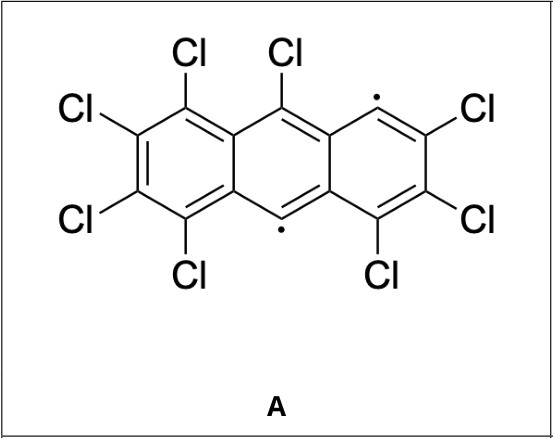
6.2 Draw structures B-D. Note they may contain one or more unpaired electrons. The structure of A is given as an example. 11.0 pt
6.3 The voltages applied during the AFM-mediated synthesis of \(\ce{C_n}\) may vary. Using the given C–X bond energies, choose the possible halogen(s) in the halogenated reagent for \(\ce{C18}\) synthesis via a retro-Bergman reaction with a voltage of 2.5 V acting on the electrons. 2.0 pt
Bond (C–X) Bond Dissociation Energy / \(\mathrm{kJ\,mol^{-1}}\) C–F 467 C–Cl 346 C–Br 290 C–I 228 In 2025, the first relatively stable cyclo[48]carbon was synthesised. The molecule was stabilised by catenation (forming interlocking rings) with macrocycle E and was first characterised by electrospray mass spectrometry in positive mode.
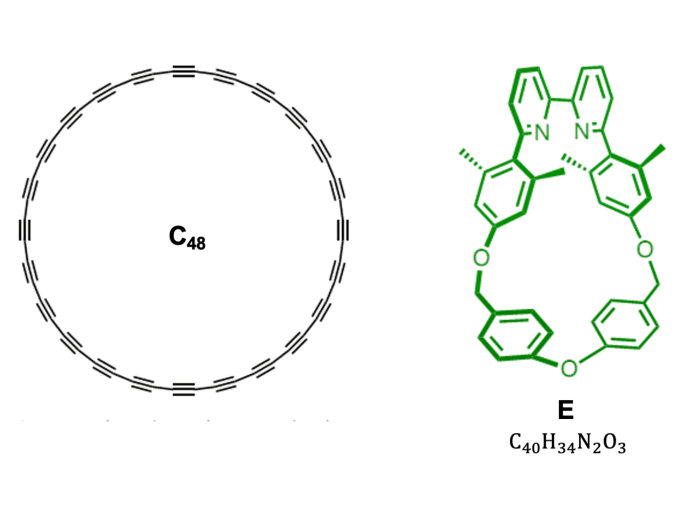
6.4 In the mass spectrum obtained, four intense peaks were observed \(m/z\): 591, 783, 879, and 1174. Suggest the identity of these ions. Use integer atomic masses and assume no fragmentation happened. The ion corresponding to \(m/z=591\) is given as an example. 12.0 pt

Cycloparaphenylene (CPP) is another cyclic, highly-strained molecule commonly called a carbon nanohoop. The synthesis of the smallest known member, [5]CPP, is shown below, where \(\ce{PhI(OAc)2}\) acts as a two electron oxidant.
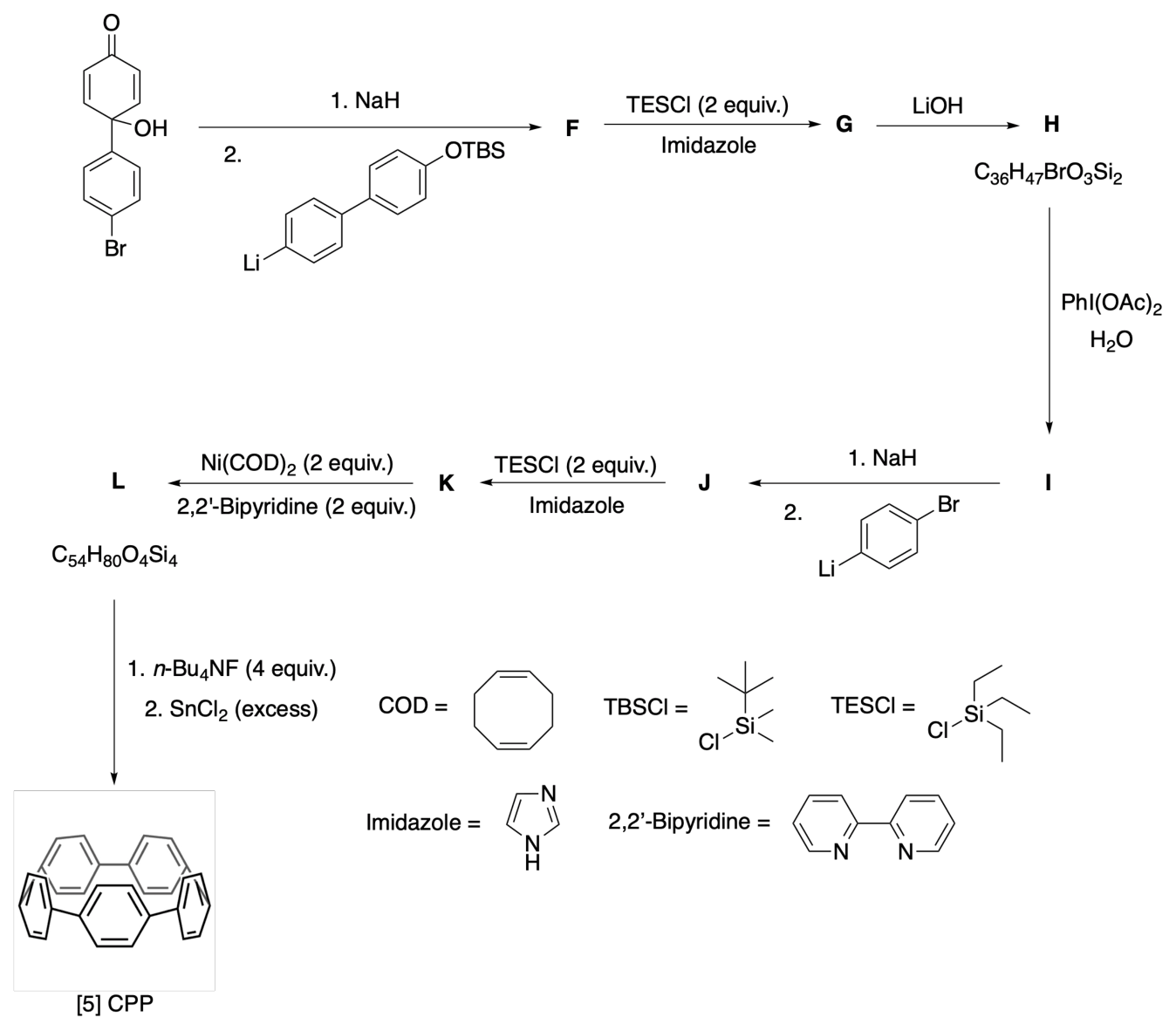
(equiv. = Equivalent, excess = Excess)
6.5 Draw the structures of F-L. 24.0 pt
Next generation nanobelts were constructed from porphyrin rings and triple bonds using the template synthesis method. Hint: M is the thermodynamic product and has four types of protons.
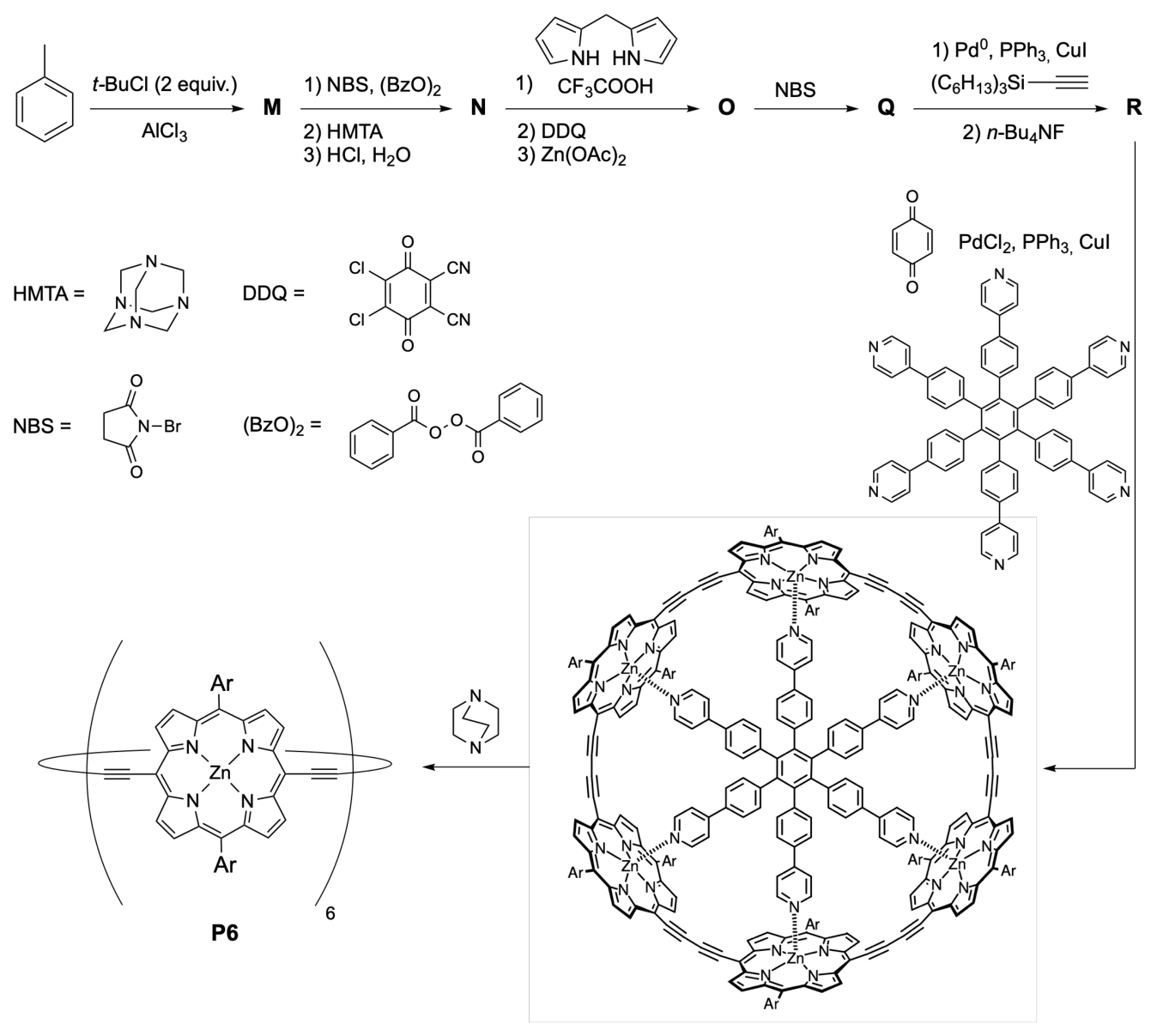
(equiv. = Equivalent)
6.6 Draw the structures of M-R. 20.0 pt
When aromatic rings are joined to form a macrocycle, oxidation or reduction can produce global aromaticity, in which \(\pi\) electrons are delocalised around the entire macrocycle. Only the \(\pi\) system forming the continuous conjugated pathway around the ring participates in this delocalisation. As an example, [n]CPPs can become globally aromatic upon addition or removal of electrons. The number of \(\pi\) electrons is counted only along the bold pathway shown below.
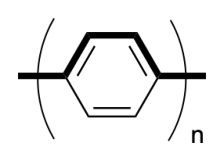
When P6 is oxidised, it can exhibit global aromaticity and global anti-aromaticity.
6.7 Based on Hückel’s rule, find the minimum number of electrons, \(n(e)\), from P6 that should be removed to achieve global aromaticity. Write the total number of \(\pi\) electrons, \(n(t)\), in the global aromatic system. 4.0 pt
Physical Constants and Equations
Constants
Constant Value Avogadro constant \(N_A=6.022\times10^{23}\ \mathrm{mol^{-1}}\) Universal gas constant \(R=8.314\ \mathrm{J\,K^{-1}\,mol^{-1}}\) Faraday constant \(F=96\,485\ \mathrm{C\,mol^{-1}}\) Planck constant \(h=6.626\times10^{-34}\ \mathrm{J\,s}\) Speed of light in vacuum \(c=2.998\times10^8\ \mathrm{m\,s^{-1}}\) Mass of electron \(m_e=9.109\times10^{-31}\ \mathrm{kg}\) Charge of electron \(e=1.602\times10^{-19}\ \mathrm{C}\) Standard pressure \(P^\circ=1\ \mathrm{bar}=10^5\ \mathrm{Pa}\) Ionic product of water at \(25\,^\circ\mathrm C\) \(K_w=1.00\times10^{-14}\) Zero of the Celsius scale \(0\,^\circ\mathrm C=273.15\ \mathrm K\) Electronvolt \(1\ \mathrm{eV}=1.602\times10^{-19}\ \mathrm J\) Watt \(1\ \mathrm W=1\ \mathrm{J\,s^{-1}}\) Coulomb \(1\ \mathrm C=1\ \mathrm{A\,s}\) Nanometre \(1\ \mathrm{nm}=1\times10^{-9}\ \mathrm m\) Ångstrom \(1\ \text{Å}=1\times10^{-10}\ \mathrm m\) metric ton \(1\ \mathrm{ton}=1000\ \mathrm{kg}\) litre \(1\ \mathrm L=1\ \mathrm{dm^3}\) Official English text of the problem.
Problem 7: Nitrogen Fixation
T7. Nitrogen Fixation
7%
7.1 7.2 7.3 7.4 7.5 7.6 7.7 \(\sum\) 3 8 15 3 6 6 13 54 The Haber–Bosch process is the principal industrial method for ammonia production. A simplified diagram of an ammonia synthesis plant is shown below.
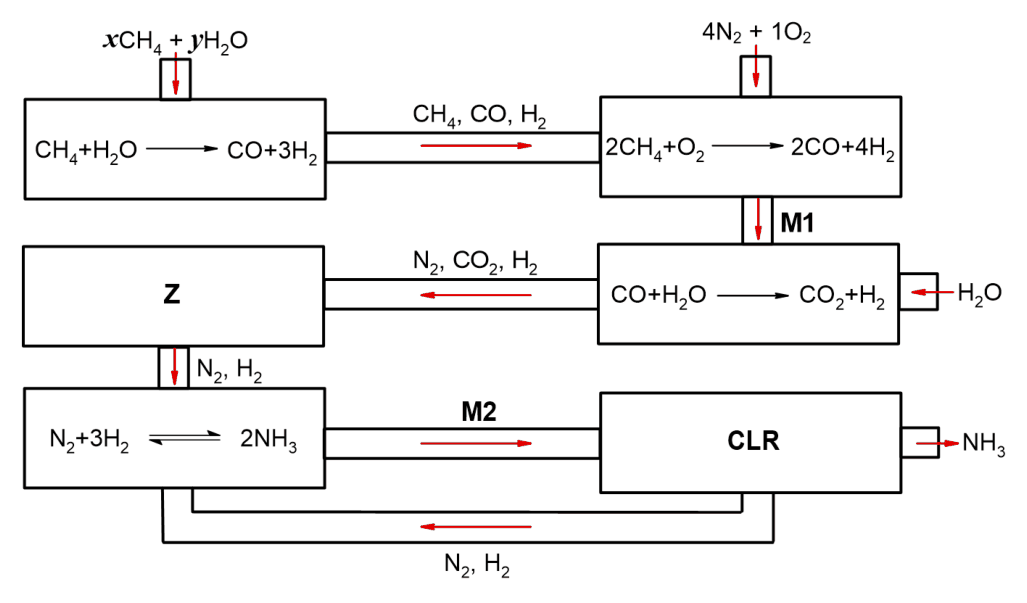
Fig. 1. M1 - Mixture 1, M2 - Mixture 2, Z – \(\ce{CO2}\) scrubber, CLR - cooler
In the following calculations, assume that all reactions in Fig. 1, except \(\ce{NH3}\) formation, are quantitative.
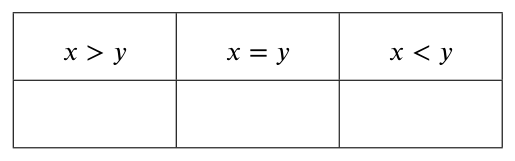
7.1 Tick the gases contained in M1 and M2; and tick the correct relationship between \(x\) and \(y\). 3.0 pt

An ammonia production complex with a capacity of 660,000 tons per year was commissioned at the Navoiazot plant in Uzbekistan, which operates with a 97.0% of overall yield.
7.2 Calculate the mass of \(\ce{CH4}\) (tons) required annually to produce 660,000 tons of ammonia, if the Navoiazot operates according to the Fig. 1. 8.0 pt
Consider a model of a real reaction system, which includes recirculation of reagents. An open system operates in a cyclic mode. Each cycle consists of four steps:
- A stoichiometric \(\ce{N2}:\ce{H2}=1:3\) mixture with a total amount of \(n_0\) mol is fed into the reactor after each cycle.
- The reaction proceeds with a constant yield of \(\eta=0.150\).
- Ammonia is separated by liquification.
- Unreacted gases are returned into the reactor.
The cycle is repeated until the required overall yield is reached.
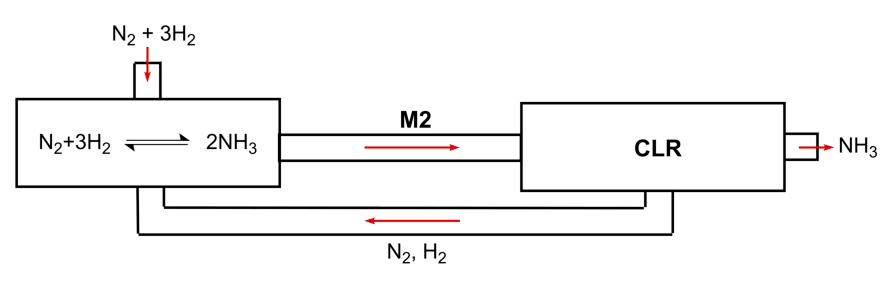
Fig. 2. M2. – Mixture 2, CLR - cooler.
7.3
a) Calculate the amount of nitrogen, present in the system after the 58th cycle (before the addition of 59th portion of mixture), if \(n_0=4\) mol. Provide 4 decimal places. Hint: a formula for the sum of the terms of a geometric progression is needed.
b) Calculate the number of cycles needed to increase the overall yield from 15.0% to 97.0%. 15.0 ptAn aqueous solution of 3 is being used to remove \(\ce{CO2}\) from the mixture.
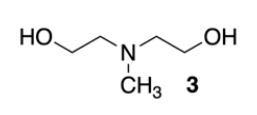
7.4 Write the equation for this reaction. 3.0 pt
Complex 5 is obtained through the fixation of the molecular nitrogen according to the scheme below.
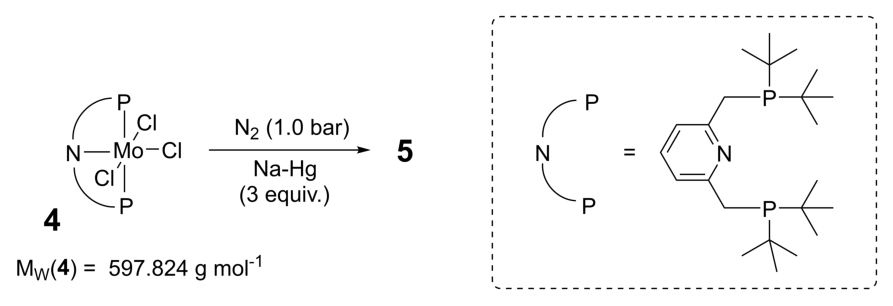
7.5 Draw the structure of 5 using simplified scheme for the ligand. Note that 1.00 g of 4 will react stoichiometrically with 94.97 \(\mathrm{cm^3}\) of \(\ce{N2}\) at 273.15 K and 1.0 bar. 6.0 pt
The effect of different reductants and additives on the yield of \(\ce{NH3}\) was examined. The different Red and Ad combinations, their respective \(E^\circ\) and \(pK_a\), together with the resulting \(\ce{NH3}\) yield are presented below.
Red
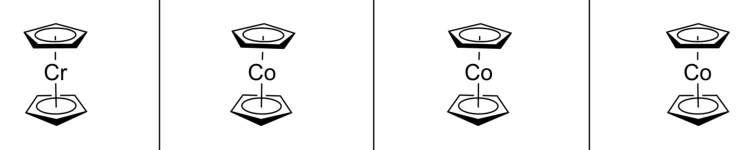
Ad
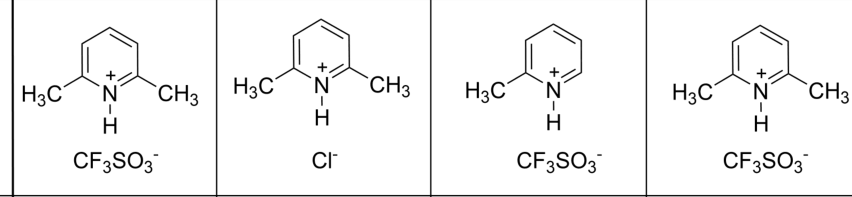
# 1 2 3 4 \(E^\circ\) (V) −0.88 −1.15 −1.15 −1.15 \(pK_a\) 14.4 14.4 13.9 14.4 \(\ce{NH3}\) yield (mole) 0 0.7 9.1 11.8 7.6 Rank the following Red/Ad combinations A-D by the decrease in ammonia yield. 6.0 pt
Red
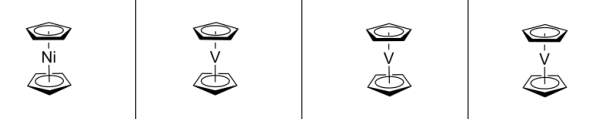
Ad
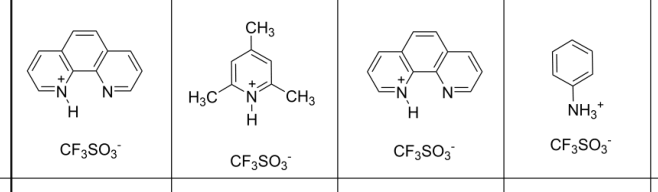
# A B C D \(E^\circ\) (V) −0.09 −1.10 −1.10 −1.10 \(pK_a\) 13.7 15.0 13.7 10.6 Nitrogen fixation can also be achieved via binary nitrides (compounds containing \(\ce{N^3-}\)). Such nitrides 7, 8, 9 were obtained from pure elements. When they are heated together with \(\ce{SiO2}\), red crystals of a stable compound 10 are formed as the single product. The minimal possible formula, describing the structure of compound 10 is \(\ce{Q_{\alpha}R_{\beta}S2T[Si12N24]}\). In addition:
- Mass fractions of nitrogen are \(w(\ce{N})_7=9.16\%\), \(w(\ce{N})_8=18.90\%\), \(w(\ce{N})_9=39.94\%\)
- Q and R are metal cations in their highest oxidation state.
- S is a monoatomic anion.
- T is an anion with tetrahedral configuration.
- For the quantitative formation of 10, the mass ratio 7 : 8 : 9 : \(\ce{SiO2}\) = 5.09 : 2.96 : 3.27 : 1.00.
7.7 Identify the empirical formulae of 7–10. Specify the composition of anions S and T. 13.0 pt
Physical Constants and Equations
Constants
Constant Value Avogadro constant \(N_A=6.022\times10^{23}\ \mathrm{mol^{-1}}\) Universal gas constant \(R=8.314\ \mathrm{J\,K^{-1}\,mol^{-1}}\) Faraday constant \(F=96\,485\ \mathrm{C\,mol^{-1}}\) Planck constant \(h=6.626\times10^{-34}\ \mathrm{J\,s}\) Speed of light in vacuum \(c=2.998\times10^8\ \mathrm{m\,s^{-1}}\) Mass of electron \(m_e=9.109\times10^{-31}\ \mathrm{kg}\) Charge of electron \(e=1.602\times10^{-19}\ \mathrm{C}\) Standard pressure \(P^\circ=1\ \mathrm{bar}=10^5\ \mathrm{Pa}\) Ionic product of water at \(25\,^\circ\mathrm{C}\) \(K_w=1.00\times10^{-14}\) Zero of the Celsius scale \(0\,^\circ\mathrm{C}=273.15\ \mathrm{K}\) Electronvolt \(1\ \mathrm{eV}=1.602\times10^{-19}\ \mathrm{J}\) Watt \(1\ \mathrm{W}=1\ \mathrm{J\,s^{-1}}\) Coulomb \(1\ \mathrm{C}=1\ \mathrm{A\,s}\) Nanometre \(1\ \mathrm{nm}=1\times10^{-9}\ \mathrm{m}\) Ångstrom \(1\ \text{Å}=1\times10^{-10}\ \mathrm{m}\) metric ton \(1\ \mathrm{ton}=1000\ \mathrm{kg}\) litre \(1\ \mathrm{L}=1\ \mathrm{dm^3}\) Equations
Equation Expression Ideal gas law \(PV=nRT\) Dalton law \(P_i=x_iP\) Beer–Lambert law \(A=\log_{10}\dfrac{I_0}{I}=\varepsilon cl\) Energy of a photon \(E=h\nu=\dfrac{hc}{\lambda}\) Heat and temperature change \(Q=nC_m\Delta T\) Gibbs energy definition \(G=H-TS\) Gibbs energy and equilibrium constant \(\Delta_rG^\circ=-RT\ln K\) Enthalpy change dependence on temperature (at \(\Delta_rC_p=\mathrm{const}\)) \(\Delta_rH_{T_2}=\Delta_rH_{T_1}+\Delta_rC_p(T_2-T_1)\) Entropy change dependence on temperature (at \(\Delta_rC_p=\mathrm{const}\)) \(\Delta_rS_{T_2}=\Delta_rS_{T_1}+\Delta_rC_p\ln\dfrac{T_2}{T_1}\) Henderson–Hasselbalch equation \(pH=pK_a+\log_{10}\dfrac{[\ce{A-}]}{[\ce{HA}]}\) Average reaction rate \(r=\dfrac{\Delta c}{\Delta t}\) The rate law \(r=k[A]^x[B]^y\) Arrhenius law \(k=A\exp\left(-\dfrac{E_a}{RT}\right)\) Integrated rate law for a 1st order reaction \(c=c_0e^{-kt}\); \(kt=\ln\dfrac{c_0}{c}\) Lifetime of a reagent in a 1st order reaction \(\tau=\dfrac1k\) Integrated rate law for n-th order reaction (\(n\ne1\)) \(kt=\dfrac1{n-1}\left(c^{1-n}-c_0^{1-n}\right)\), for \(n\ne1\) Concentration of an intermediate in a consecutive reaction: \(\ce{A ->[$k_1$] B ->[$k_2$] D}\) \([B]=\dfrac{k_1[A]_0}{k_2-k_1}\left(e^{-k_1t}-e^{-k_2t}\right)\) The ratio of products in the competitive reactions: \(\ce{A ->[$k_1$] B}\), \(\ce{A ->[$k_2$] C}\) \(\dfrac{[B]}{[C]}=\dfrac{k_1}{k_2}\) Michaelis–Menten equation \(r_0=r_{\max}\dfrac{[S]_0}{K_M+[S]_0}\) Specific surface area \(s=\dfrac{S}{m}\) Progressions: arithmetic geometric \(a_n=a_1+d(n-1)\); \(a_n=a_1q^{n-1}\) Sum of geometric progression \(\displaystyle\sum_{k=0}^{n}a_1q^k=a_1\dfrac{q^{n+1}-1}{q-1}\) Volume of a sphere with radius \(r\) \(V=\dfrac43\pi r^3\) Surface area of sphere with radius \(r\) \(S=4\pi r^2\) Volume of a cone with base radius \(r\) and height \(h\) \(V=\dfrac13\pi r^2h\) Volume of a cylinder with base radius \(r\) and height \(h\) \(V=\pi r^2h\) Consider all gases ideal.
In equilibrium constant calculations, all concentrations are referenced to the concentration of \(1\ \mathrm{mol\,dm^{-3}}\).
Periodic Table of Elements
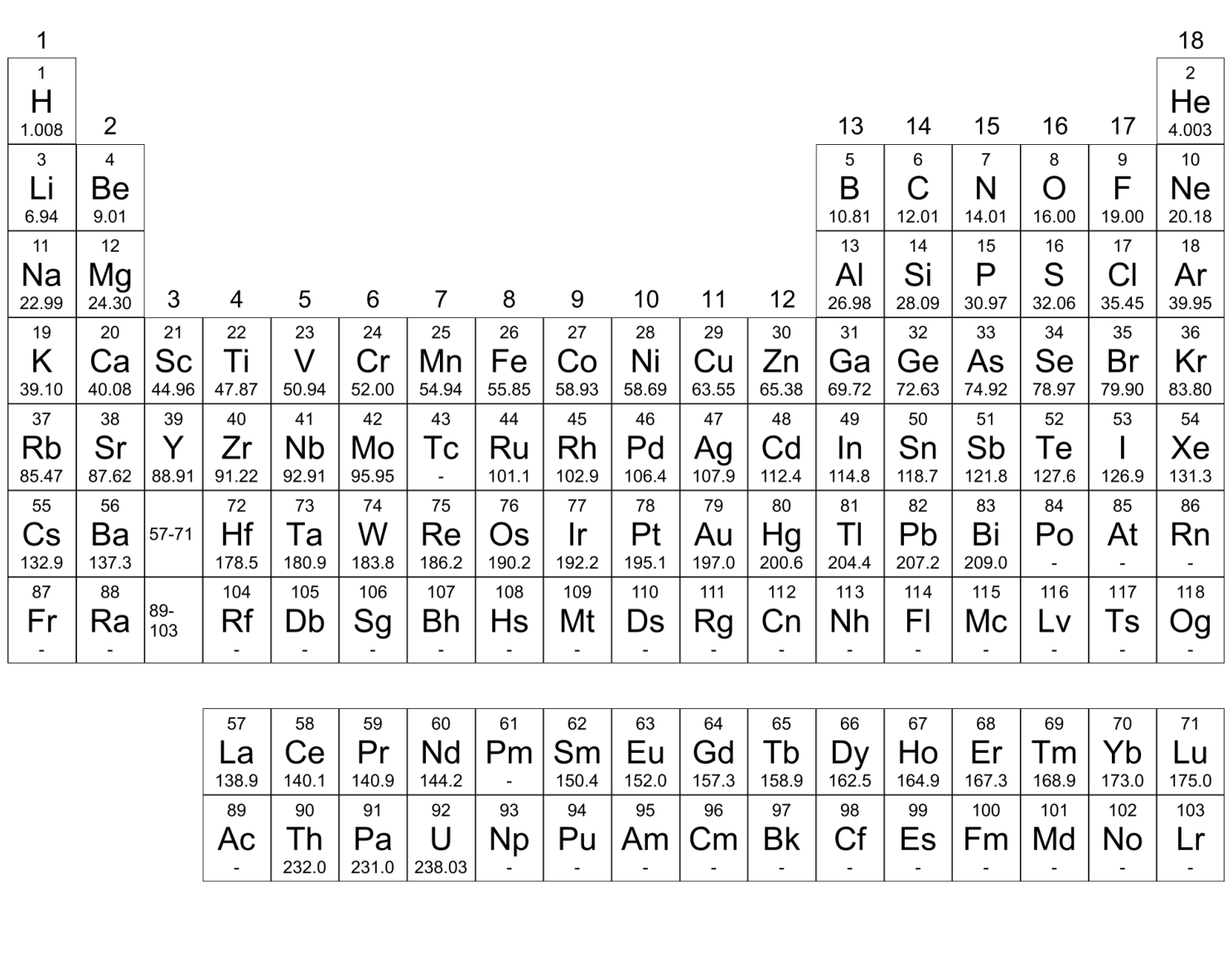
Official English text of the problem.
Problem 8: Recycling of Carbon Dioxide
T8. Recycling of Carbon Dioxide
7%
8.1 8.2 8.3 8.4 8.5 8.6 8.7 8.8 8.9 8.10 \(\sum\) 2 16 2 29 5 10 2 4 12 2 84 Removing \(\ce{CO2}\) gas from the atmosphere is key to combat climate change. One promising solution is the photocatalytic reduction of \(\ce{CO2}\) to \(\ce{CO}\) using molecular catalyst 1.
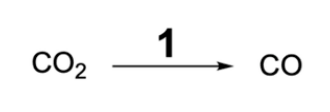
8.1 Write the half equation for the reduction of \(\ce{CO2}\) to \(\ce{CO}\) in an acidic medium. 2.0 pt
The conjugate oxidation reaction occurs with sacrificial reductant 2 in aqueous solution with the following mechanism:
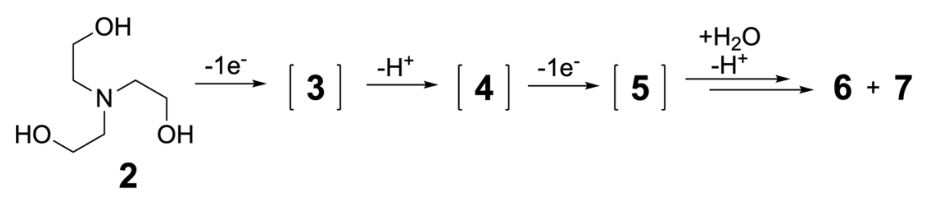
Species 3, 4, and 5 are short-lived ionic and/or radical intermediates. 7 yields a silver mirror with the \(\ce{[Ag(NH3)2]OH}\) test.
8.2 Draw the structures of 3-7. 16.0 pt
Catalyst 1 can be synthesised with the following reaction.

8.3 Tick the correct geometry for the structure of 1. 2.0 pt
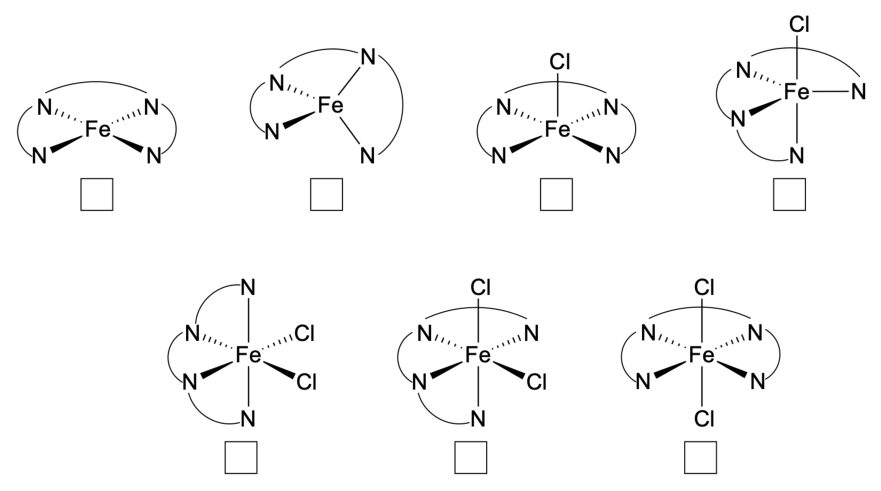
When 1 is loaded on crystalline carbon nitride (\(\ce{C3N4}\)) support material, it can reduce \(\ce{CO2}\) via the following mechanism.
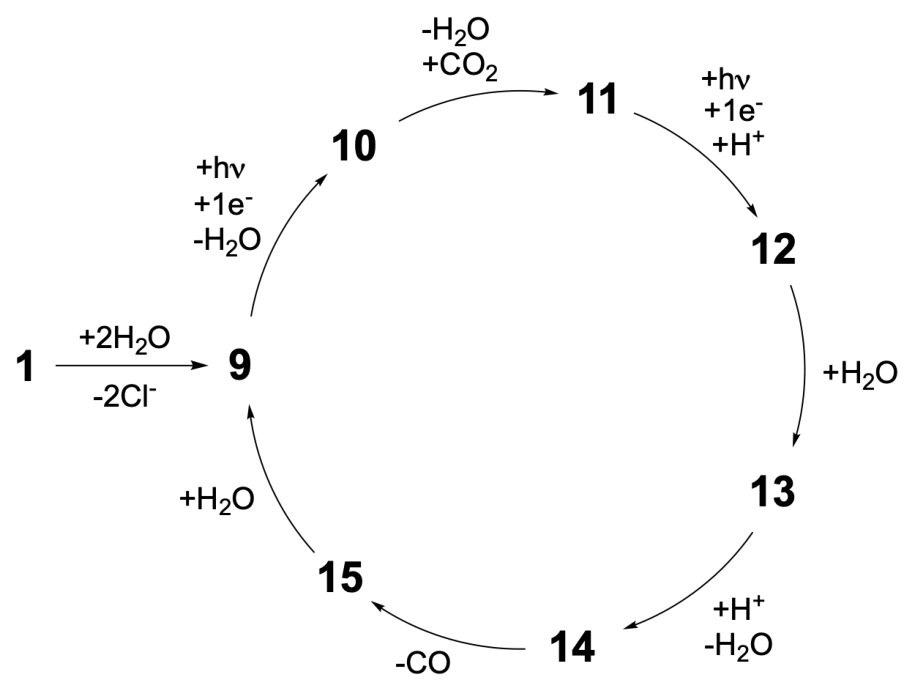
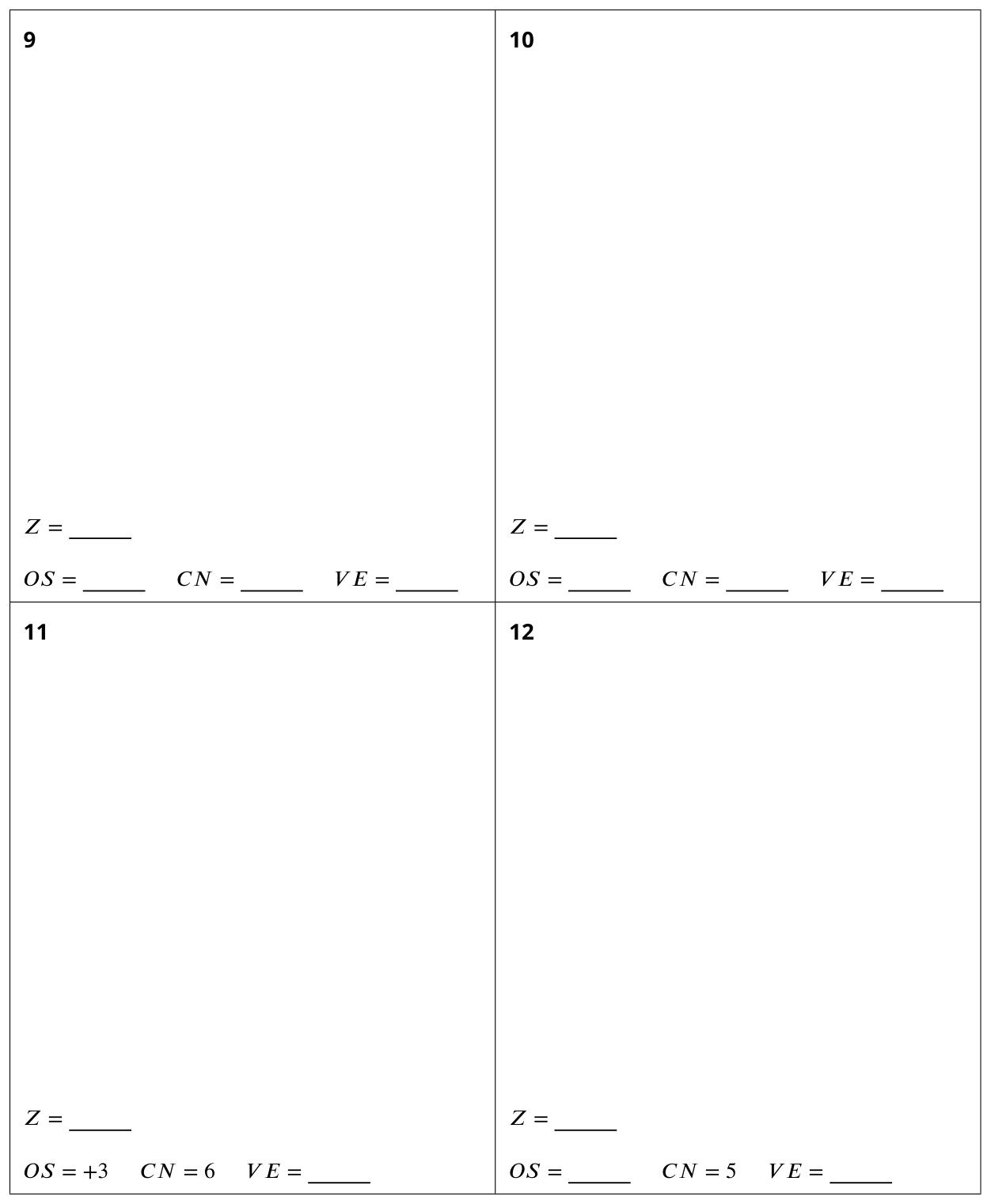
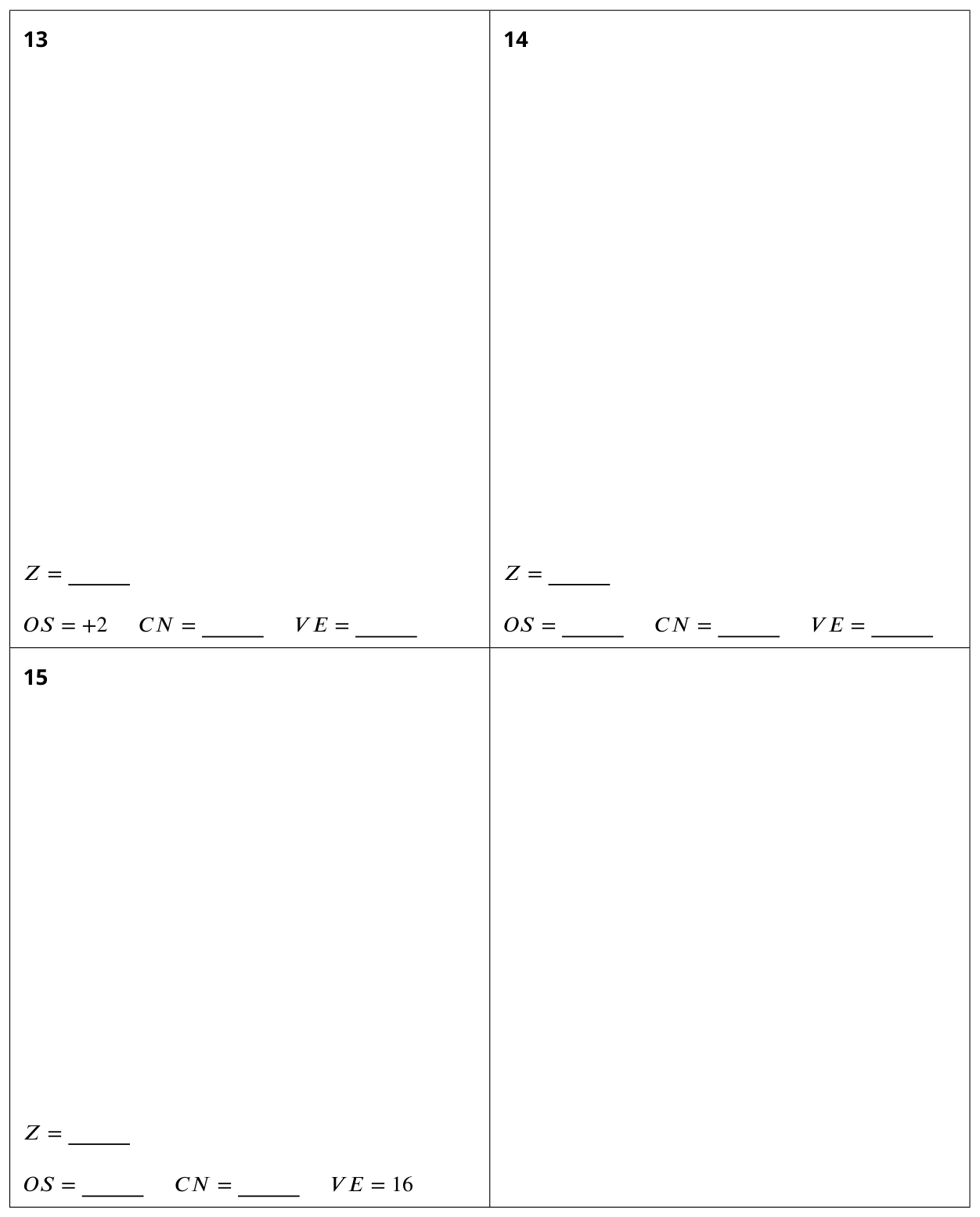
8.4 Draw the structures of 9-15. Use the cartoon structure for ligand 8 shown above. For 9-15, specify the oxidation state, \(OS\), coordination number, \(CN\), and number of valence electrons, \(VE\), of \(\ce{Fe}\), along with the total charge of corresponding complex structures, \(Z\). Note: Some information is provided on the answer sheet. 29.0 pt
8.5 Calculate the number of catalytic molecules per \(\mathrm{nm^2}\), \(N_{\mathrm{cat}}\), of \(\ce{C3N4}\) loaded with 1, when the mass fraction of catalyst, \(\omega_{\mathrm{cat}}=3.8\%\), if the specific surface area of \(\ce{C3N4}\) is \(17.8\ \mathrm{m^2\,g^{-1}}\). \(M_{\mathrm{cat}}=557.21\ \mathrm{g\,mol^{-1}}\). 5.0 pt
The Turnover Frequency of a catalyst (TOF) is the number of product molecules formed per active catalyst molecule per hour. Under LED illumination (\(\lambda=390\ \mathrm{nm}\)) with power of \(50\ \mathrm{mW}\), there was a TOF of \(8\ \mathrm{h^{-1}}\) for \(10\ \mathrm{mg}\) of \(\ce{C3N4}\), loaded with 1 with \(\omega_{\mathrm{cat}}=3.8\%\)
The formula for calculating the quantum yield is given below:
\[ \varphi= \frac{\textit{number of reacted electrons}} {\textit{number of incident photons}}\cdot100\% \]
8.6 Calculate the quantum yield, \(\varphi(\%)\), for \(\ce{CO}\) formation. 10.0 pt
The diagram below shows the change in the TOF of \(\ce{CO}\) as \(\omega_{\mathrm{cat}}\) is varied.
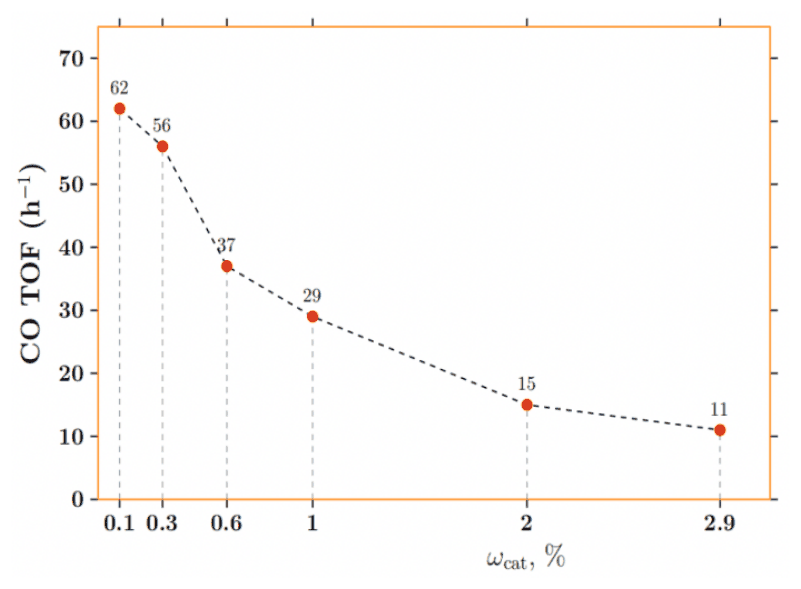
8.7 How does the overall rate of \(\ce{CO}\) formation per gram of \(\ce{C3N4}\) loaded with 1 change with increasing \(\omega_{\mathrm{cat}}\), within the range \(0.1\leq\omega_{\mathrm{cat}}\leq2.9\)? Tick the correct box. 2.0 pt
a) increases
b) decreases
c) doesn't changeThe reduction of \(\ce{CO2}\) can be accompanied by the reduction of additional protons. The changes in Gibbs energy during these two reactions are shown in the diagram.
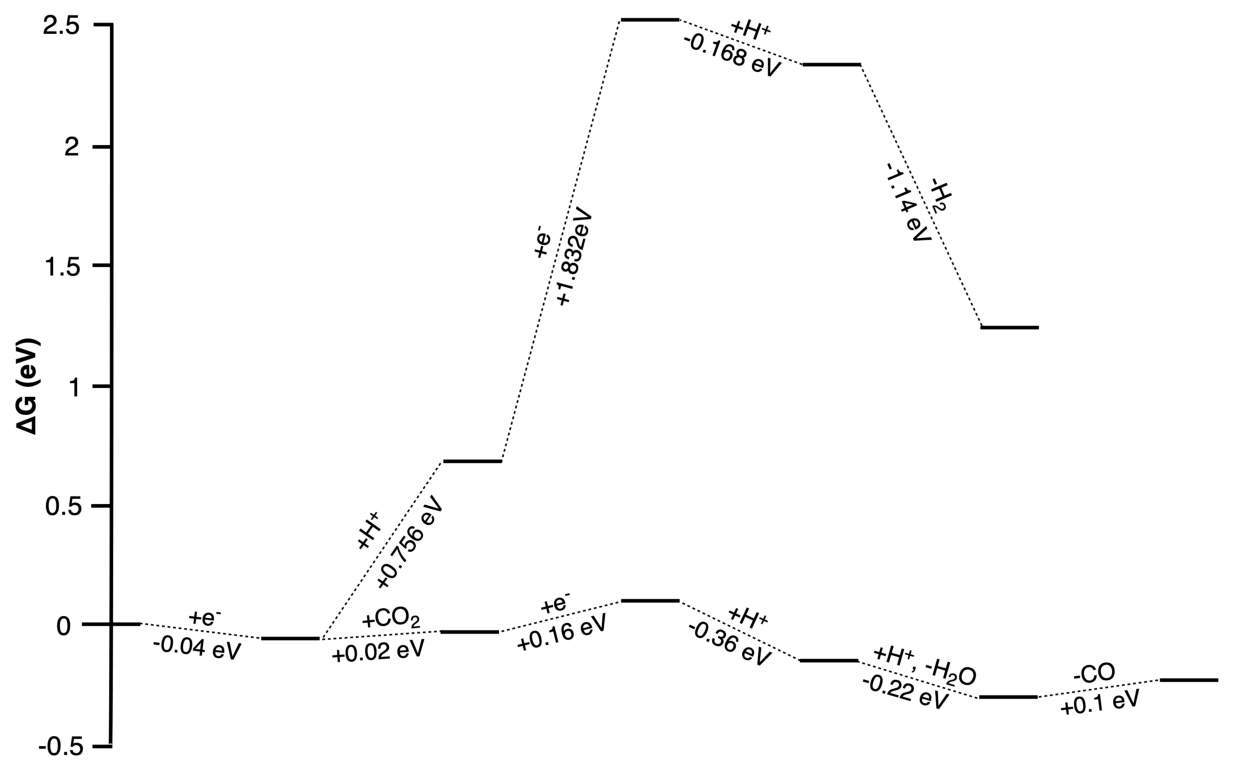
The system was irradiated using different LEDs. The diagram below shows the mole percentages, \(\chi\), of \(\ce{H2}\) and \(\ce{CO}\) produced during the reduction of \(\ce{CO2}\) under four different conditions: no irradiation (N) and irradiation with red (R), green (G), and blue (B) light.
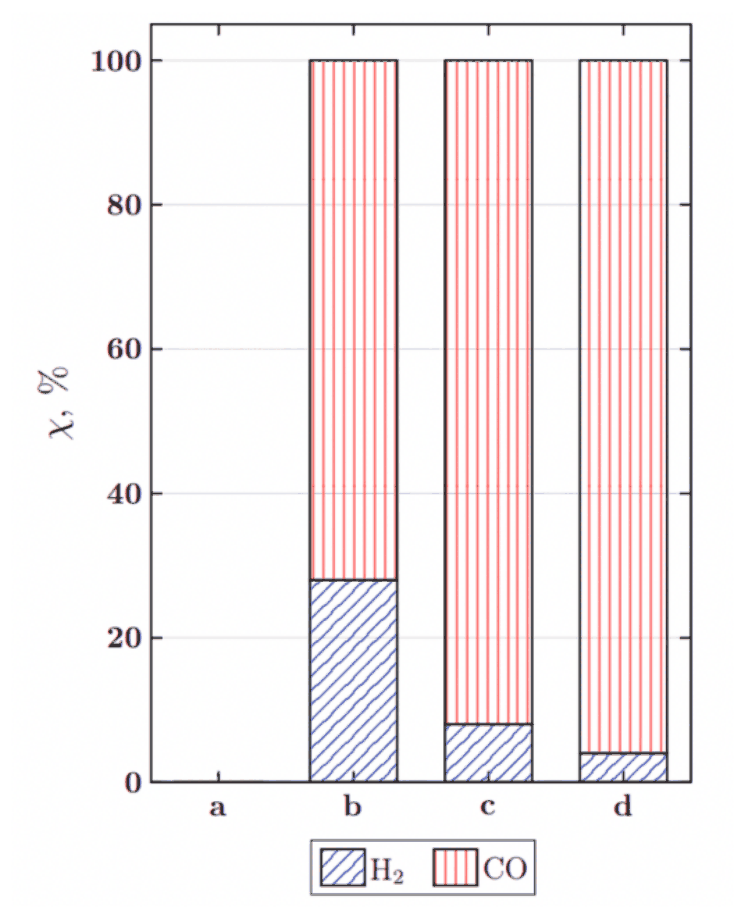
8.8 Tick which of the four conditions, mentioned above, corresponds to a, b, c and d in the diagram. 4.0 pt
Photosensitisers (PS) offer some advantages over \(\ce{C3N4}\) for the reduction of \(\ce{CO2}\). Mn(I)-containing complexes combined with PS can achieve ~23% quantum yield. In this system, reductive quenching of the singlet (\(\mathbf{S}_1\)) and triplet (\(\mathbf{T}_1\)) excited states of a PS by reductant (Red) forms \(\ce{PS^{\bullet-}}\), which donates electrons to \(\ce{CO2}\) through the Mn(I)-containing complex.
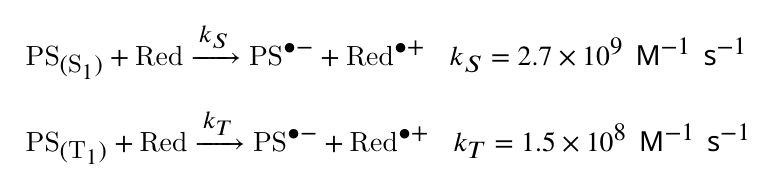
The following Jablonski diagram describes the processes occurring in the PS:
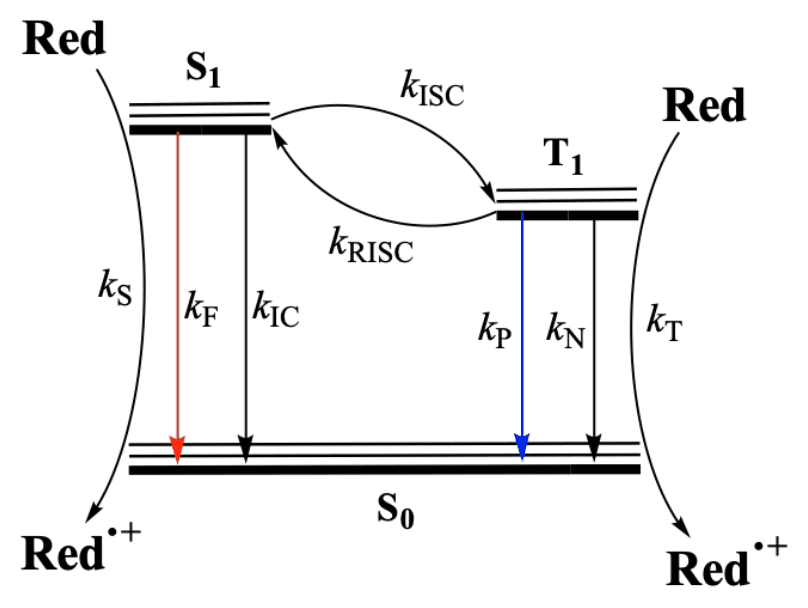
\(\tau_0(\mathbf{S}_1)=2.9\ \mathrm{ns}\) and \(\tau_0(\mathbf{T}_1)=84\ \mathrm{\mu s}\), where \(\tau_0\) is the emission lifetime in the absence of the quencher.
8.9 Calculate the percentage of quenching, \(\eta_q\), (in %) of S₁ and T₁ states, when \([\mathrm{Red}]=0.1\ \mathrm{M}\). Note: here the values of \(k_{\mathrm{ISC}}\) and \(k_{\mathrm{RISC}}\) are negligible. 12.0 pt
8.10 How do the emission lifetimes of S₁ and T₁ states change when \([\mathrm{Red}]\) increases?
Tick the correct box. 2.0 pta) increases
b) decreases
c) doesn't changePhysical Constants and Equations
Constants
Constant Value Avogadro constant \(N_A=6.022\times10^{23}\ \mathrm{mol^{-1}}\) Universal gas constant \(R=8.314\ \mathrm{J\,K^{-1}\,mol^{-1}}\) Faraday constant \(F=96\,485\ \mathrm{C\,mol^{-1}}\) Planck constant \(h=6.626\times10^{-34}\ \mathrm{J\,s}\) Speed of light in vacuum \(c=2.998\times10^8\ \mathrm{m\,s^{-1}}\) Mass of electron \(m_e=9.109\times10^{-31}\ \mathrm{kg}\) Charge of electron \(e=1.602\times10^{-19}\ \mathrm{C}\) Standard pressure \(P^\circ=1\ \mathrm{bar}=10^5\ \mathrm{Pa}\) Ionic product of water at \(25\,^\circ\mathrm{C}\) \(K_w=1.00\times10^{-14}\) Zero of the Celsius scale \(0\,^\circ\mathrm{C}=273.15\ \mathrm{K}\) Electronvolt \(1\ \mathrm{eV}=1.602\times10^{-19}\ \mathrm{J}\) Watt \(1\ \mathrm{W}=1\ \mathrm{J\,s^{-1}}\) Coulomb \(1\ \mathrm{C}=1\ \mathrm{A\,s}\) Nanometre \(1\ \mathrm{nm}=1\times10^{-9}\ \mathrm{m}\) Ångstrom \(1\ \text{Å}=1\times10^{-10}\ \mathrm{m}\) metric ton \(1\ \mathrm{ton}=1000\ \mathrm{kg}\) litre \(1\ \mathrm{L}=1\ \mathrm{dm^3}\) Equations
Equation Expression Ideal gas law \(PV=nRT\) Dalton law \(P_i=x_iP\) Beer–Lambert law \(A=\log_{10}\dfrac{I_0}{I}=\varepsilon cl\) Energy of a photon \(E=h\nu=\dfrac{hc}{\lambda}\) Heat and temperature change \(Q=nC_m\Delta T\) Gibbs energy definition \(G=H-TS\) Gibbs energy and equilibrium constant \(\Delta_rG^\circ=-RT\ln K\) Enthalpy change dependence on temperature (at \(\Delta_rC_p=const\)) \(\Delta_rH_{T_2}=\Delta_rH_{T_1}+\Delta_rC_p(T_2-T_1)\) Entropy change dependence on temperature (at \(\Delta_rC_p=const\)) \(\Delta_rS_{T_2}=\Delta_rS_{T_1}+\Delta_rC_p\ln\dfrac{T_2}{T_1}\) Henderson–Hasselbalch equation \(\mathrm{pH}=\mathrm{p}K_a+\log_{10}\dfrac{[\ce{A-}]}{[\ce{HA}]}\) Average reaction rate \(r=\dfrac{\Delta c}{\Delta t}\) The rate law \(r=k[A]^x[B]^y\) Arrhenius law \(k=A\exp\left(-\dfrac{E_a}{RT}\right)\) Integrated rate law for a 1st order reaction \(c=c_0e^{-kt}\), \(kt=\ln\dfrac{c_0}{c}\) Lifetime of a reagent in a 1st order reaction \(\tau=\dfrac1k\) Integrated rate law for n-th order reaction (\(n\neq1\)) \(kt=\dfrac{1}{n-1}\left(c^{1-n}-c_0^{1-n}\right)\) for \(n\neq1\) Concentration of an intermediate in a consecutive reaction: \(\ce{A ->[k_1] B ->[k_2] D}\) \([B]=\dfrac{k_1[A]_0}{k_2-k_1}\left(e^{-k_1t}-e^{-k_2t}\right)\) The ratio of products in the competitive reactions: \(\ce{A ->[k_1] B}\), \(\ce{A ->[k_2] C}\) \(\dfrac{[B]}{[C]}=\dfrac{k_1}{k_2}\) Michaelis–Menten equation \(r_0=r_{\max}\dfrac{[S]_0}{K_M+[S]_0}\) Specific surface area \(s=\dfrac{S}{m}\) Progressions: arithmetic geometric \(a_n=a_1+d(n-1)\), \(a_n=a_1q^{n-1}\) Sum of geometric progression \(\displaystyle\sum_{k=0}^{n}a_1q^k=a_1\dfrac{q^{n+1}-1}{q-1}\) Volume of a sphere with radius \(r\) \(V=\dfrac43\pi r^3\) Surface area of sphere with radius \(r\) \(S=4\pi r^2\) Volume of a cone with base radius \(r\) and height \(h\) \(V=\dfrac13\pi r^2h\) Volume of a cylinder with base radius \(r\) and height \(h\) \(V=\pi r^2h\) Consider all gases ideal.
In equilibrium constant calculations, all concentrations are referenced to the concentration of \(1\ \mathrm{mol\,dm^{-3}}\).
Official English text of the problem.
Problem 9: Cyclodextrin Chemistry
T9. Cyclodextrin Chemistry
7%
9.1 9.2 9.3 9.4 9.5 9.6 9.7 9.8 9.9 \(\sum\) 2 6 8 3 2 4 6 18 4 53 Cyclodextrins (CD) are a family of cyclic oligosaccharides, consisting of glucose subunits joined by α-1,4-glycosidic bonds. The three most common cyclodextrins (α-, β-, γ-cyclodextrin) contain 6, 7, and 8 α-D-glucopyranoside units, respectively.
9.1 Calculate the molar mass of β-CD. Assume \(M_w(\text{glucose})=180.16\ \mathrm{g\,mol^{-1}}\). 2.0 pt
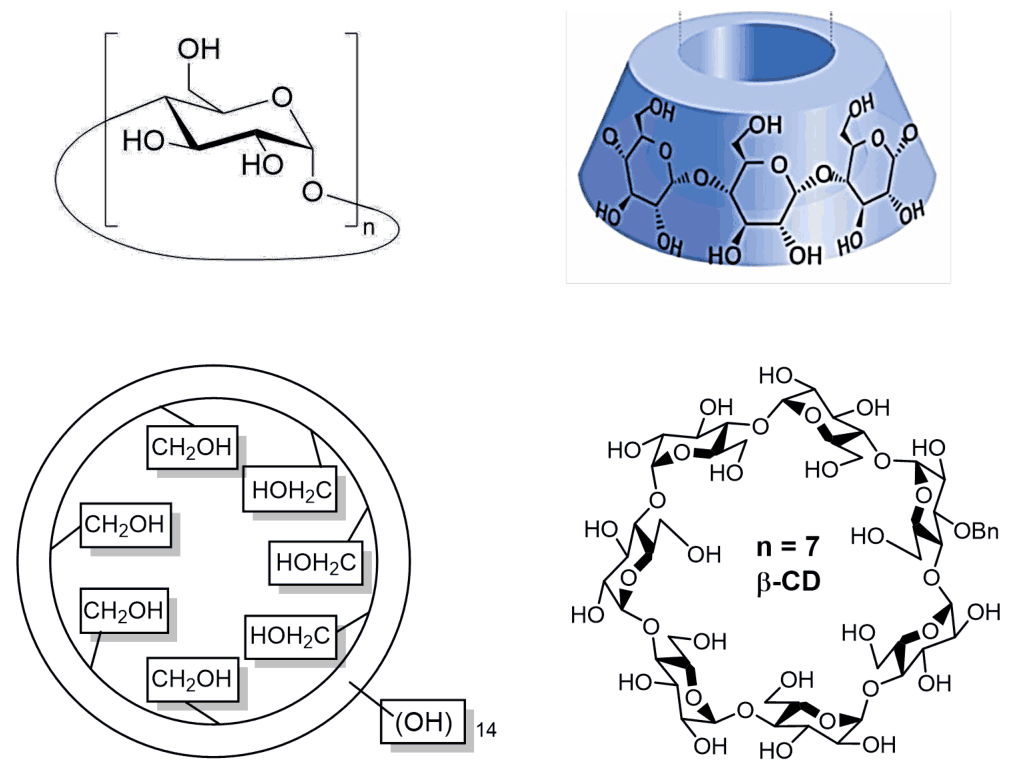
CDs combine macrocyclic properties with glucose chemistry, which was demonstrated in the synthesis of X. Primary and secondary hydroxy groups show different reactivity due to being a part of CDs. Stoddart et al. synthesised compound K, where only one OH group remained free per glucopyranoside unit.
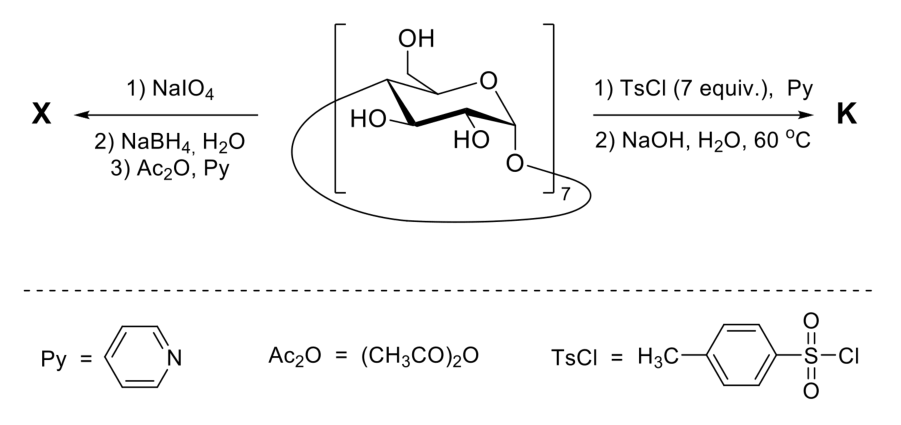
equiv.= equivalent
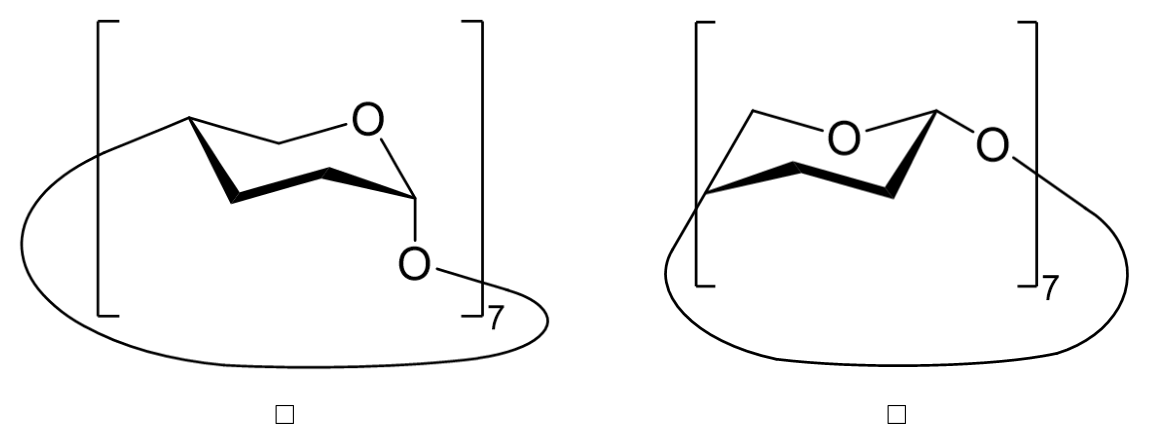
9.2 Tick the favorable chair conformation and draw the structure of K by completing the CD template. Show stereochemistry unambiguously. 6.0 pt
9.3 Determine the ring size, \(rs\), of macrocycle X. Give the number of stereocentres, \(sc\), in X. 8.0 pt
α-Cycloaltrin, a synthetic analogue of α-CD, was synthesised as follows.
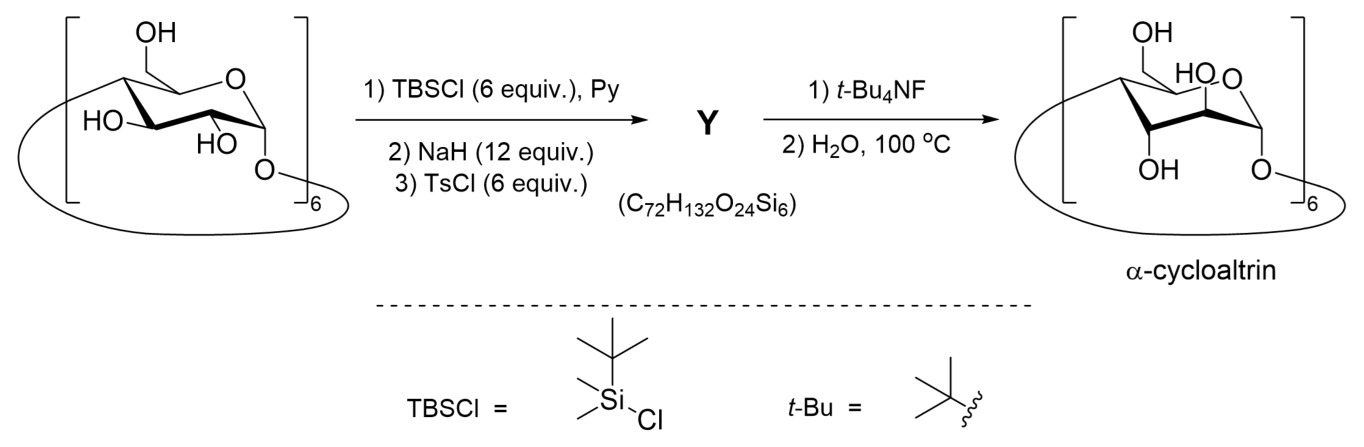
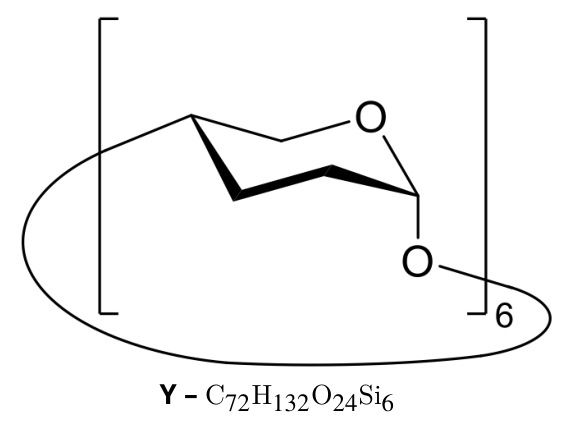
9.4 Draw the structure of Y with stereochemistry by completing the CD template. 3.0 pt
In 2000, Sinay et al. demonstrated that a single protic group (NH and OH) at unit 1 directs the next reductive debenzylation of a primary OH group to unit 4 in the macrocyclic ring (or to unit 3 if the unit 4 position is not available). This allowed the synthesis of the following β-CD dimer as a mixture of constitutional linkage isomers.
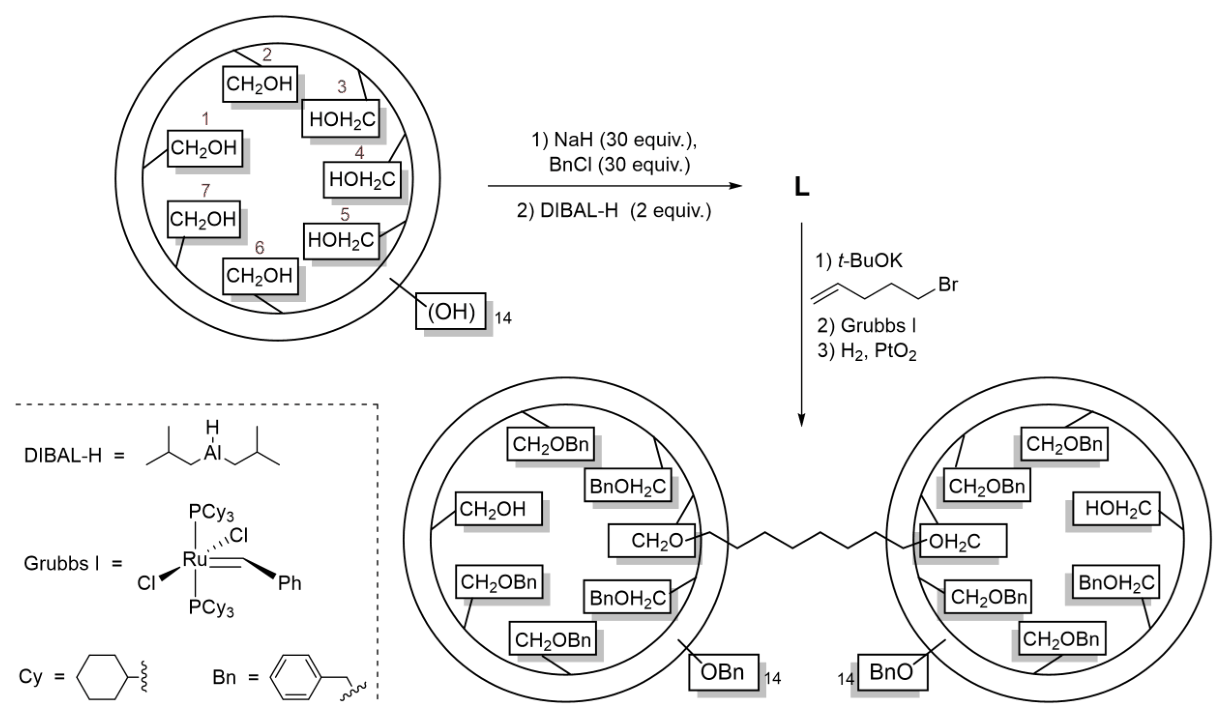
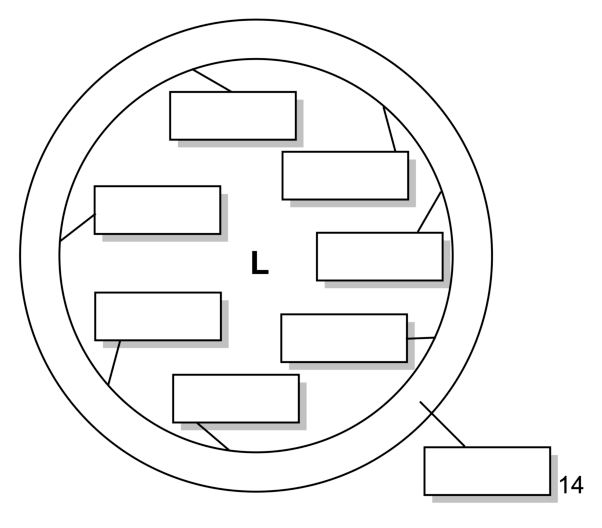
9.5 Draw the structure of L on the β-CD template. Fill in all the boxes. 2.0 pt
9.6 Determine the number of isomers of the β-CD dimer that can form during the synthesis by Sinay et. al. 4.0 pt
To confirm the positions of debenzylation, L was subjected to the “hexo-5-enose degradation” reaction, as shown below. The products were then analysed by mass spectrometry.
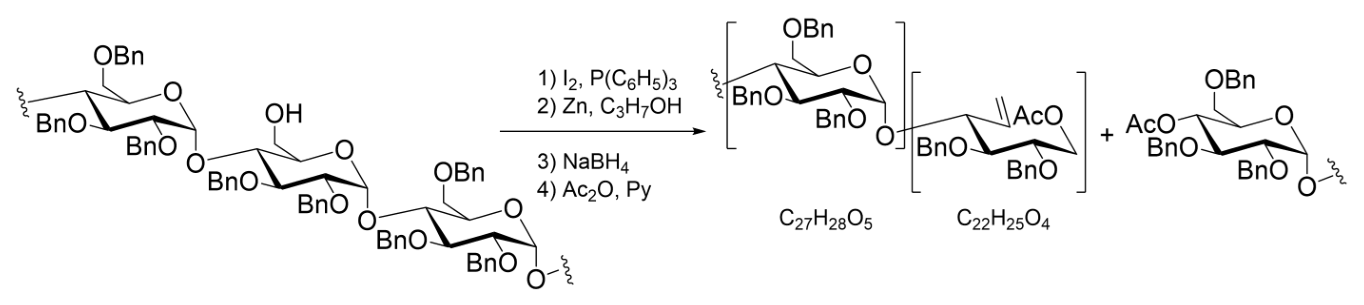
9.7 Calculate the \(m/z\) value for the two \(\ce{[M+Na]+}\) peaks that were observed for the degradation products from L. Use integer values of atomic mass. 6.0 pt
Later, Sollogoub et al. applied the ability of alkenes to direct the debenzylation to the “ortho”-glucopyranose unit for the synthesis of hexadifferentiated α-CD S:
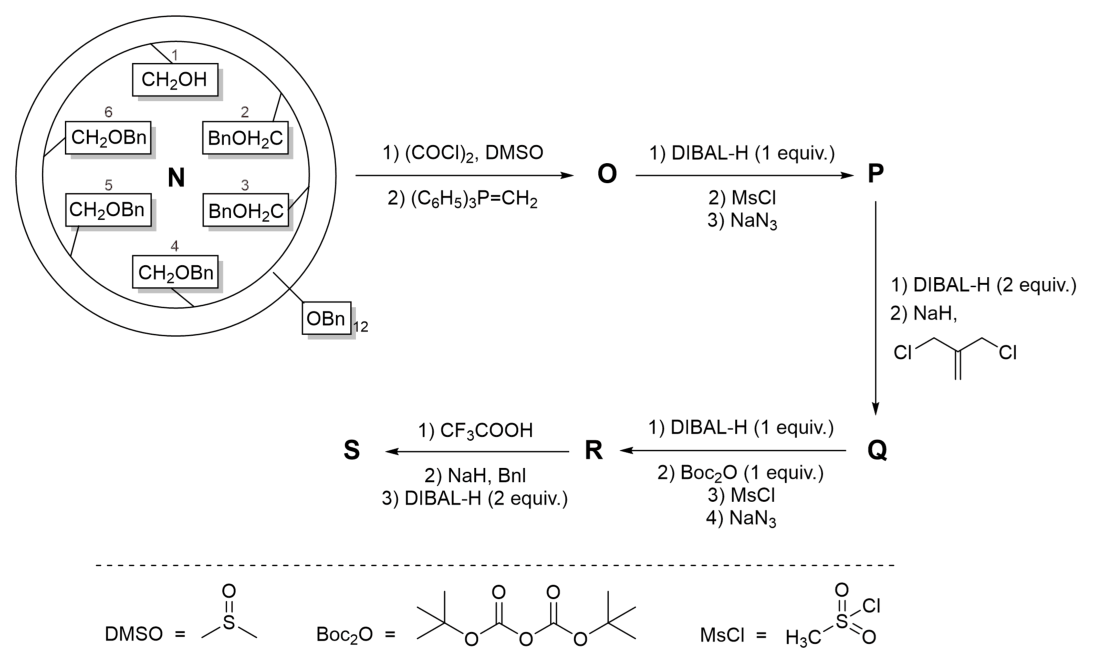
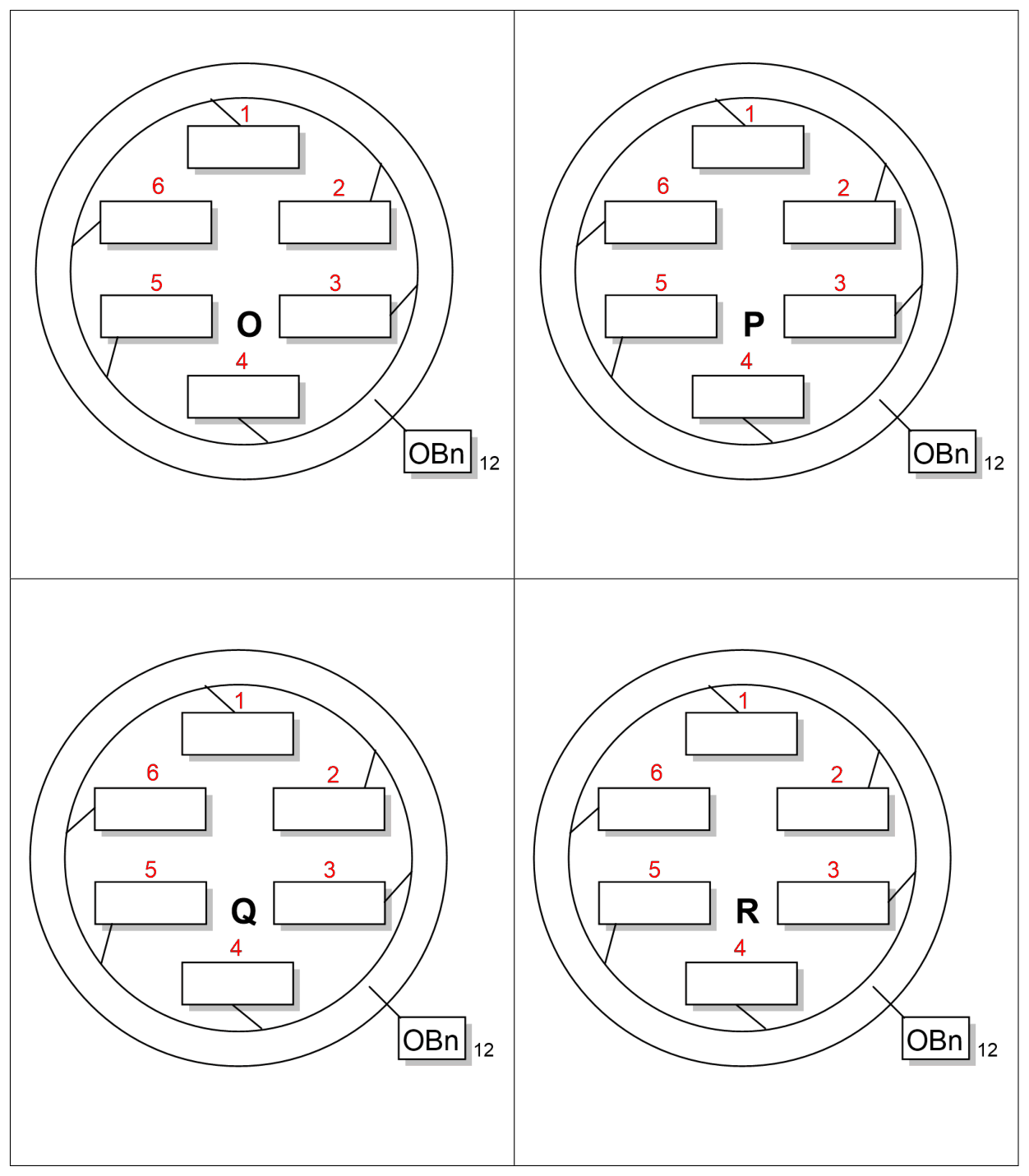
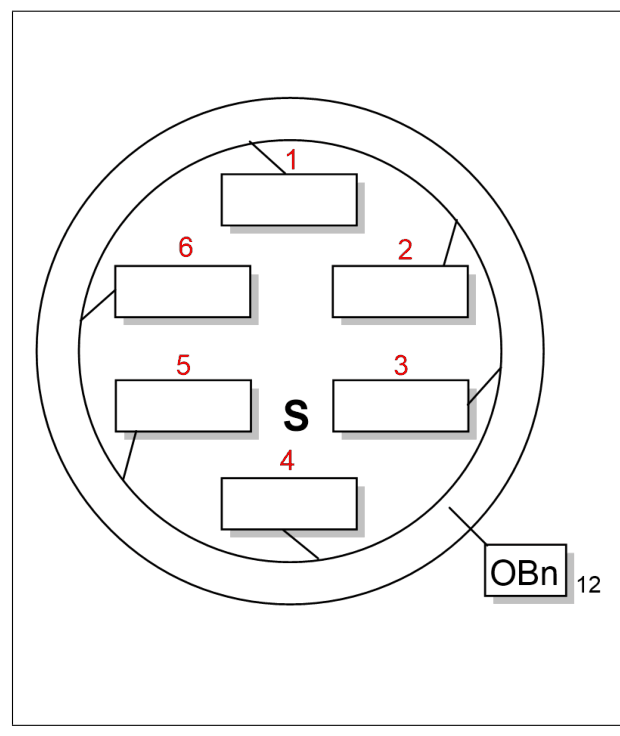
9.8 Draw the structures of O–S on the α-CD templates. Fill in all the boxes. You may draw structures outside the boxes if appropriate. Assume 1,2-unit modification happens clockwise, while 1,3-unit modification happens counterclockwise. Protic groups have stronger directing effects than alkenes. 18.0 pt
9.9 Determine the number of all possible arrangements of the functional groups on a hexadifferentiated α-CD (assume only the \(\ce{CH2OH}\) groups have been modified). 4.0 pt
Periodic Table of Elements
Official English text of the problem.
Internationale Chemie-Olympiade
IChO 2026
Taschkent, Usbekistan · 9 Theorieaufgaben mit vollständigen Lösungen
Aufgabe 1: Eine Reise durch die Zeit: Die Geheimnisse Avicennas
T1. Eine Reise durch die Zeit: Die Geheimnisse Avicennas
7%
1.1 1.2 1.3 1.4 1.5 1.6 \(\sum\) 3 4 3 4 7 4 25 Eine Chemikerin fand sich im 11. Jahrhundert wieder, wo sie dem berühmten Arzt Avicenna begegnete. In Avicennas Labor entdeckte sie ein blaues Elixier und einen gelben geheimnisvollen Stein. Sie brachte beide mit zurück ins Jahr 2026. Entschlossen, ihre Zusammensetzung aufzuklären, begann sie mit ihren Untersuchungen.
Teil 1. Das blaue Elixier
Zunächst stellte die Chemikerin eine Tabelle mit den Namen der einzigen vier Pflanzen zusammen, die sie in Avicennas Labor gesehen hatte und die zur Herstellung des Elixiers hätten verwendet werden können, sowie mit den Verbindungen, die sich aus diesen Pflanzen extrahieren lassen.
Pflanzen Extrahierbare Verbindungen Zingiber 1 (\(\ce{C11H14O3}\)) 2 (\(\ce{C10H18O}\)) 3 (\(\ce{C10H18O}\)) Hypericum 4 (\(\ce{C6H12O}\)) 5 (\(\ce{C10H12O2}\)) 6 (\(\ce{C10H18O}\)) Chamomilla 7 (\(\ce{C14H16}\)) 8 (\(\ce{C15H24}\)) 3 (\(\ce{C10H18O}\)) Artemisia 9 (\(\ce{C10H16O}\)) 10 (\(\ce{C10H18O}\)) 3 (\(\ce{C10H18O}\)) Mithilfe der Chromatographie stellte sie fest, dass das Elixier aus vier verschiedenen Stoffen (X, Y, Z und W) besteht.
Anschließend entdeckte die Chemikerin, dass X in saurem Medium zu Y isomerisieren kann und dass Y eine Symmetrieebene besitzt.
1.1 Identifizieren Sie X und Y. — 3.0 Pkt.
Die Chromatographie zeigte außerdem, dass der Stoff Z dem Elixier seine blaue Farbe verlieh. Z ist ein Derivat des wohlbekannten Stoffes A, der zwei senkrecht zueinander stehende Symmetrieebenen besitzt. Beim Erhitzen isomerisiert A zur aromatischen Verbindung B, die drei paarweise senkrecht zueinander stehende Symmetrieebenen besitzt. Bei der Chlorierung des Stoffes Z wird im Massenspektrum ein Peakpaar bei \(m/z\) 218 bzw. 220 mit einem Intensitätsverhältnis von 3:1 beobachtet.
1.2 Identifizieren Sie Z und zeichnen Sie die Strukturen der Stoffe A und B. — 4.0 Pkt.
Die Chemikerin extrahierte W aus dem Elixier. Als W zu einer wässrigen \(\ce{Fe^3+}\)-Lösung gegeben wurde, beobachtete sie eine charakteristische Farbänderung. Die massenspektrometrische Analyse von W ergab das Intensitätsverhältnis \([\mathrm{M}]^+:[\mathrm{M}+1]^+=9:1\), wobei M das Molekülion ist. Nehmen Sie an, dass Kohlenstoff ausschließlich aus \(\ce{^{12}C}\) und \(\ce{^{13}C}\) besteht, die natürliche Isotopenhäufigkeit von \(\ce{^{12}C}\) 98.9% beträgt und alle anderen Elemente monoisotopisch sind.
1.3 Bestimmen Sie die Anzahl der Kohlenstoffatome (\(n\)) anhand der massenspektrometrischen Daten und identifizieren Sie W. Geben Sie Ihre Berechnungen an. — 3.0 Pkt.
Teil 2. Der geheimnisvolle Stein
Avicenna hatte ihr erzählt, dass der Stein eine stöchiometrische Verbindung sei. Sie löste ihn in verdünnter Salpetersäure. Danach stellte sie den pH-Wert der Lösung auf ~4 ein und gab \(\ce{NaF}\) hinzu. Dies führte zur Bildung des Niederschlags \(\mathbf{C}\cdot x\ce{H2O}\), dessen Wassergehalt 39.16 Massenprozent betrug. Wasserfreies C reagiert mit einem Überschuss an \(\ce{NaF}\) zur Verbindung D, die 32.85 Massenprozent Natrium und 12.85 Massenprozent des Metalls Q enthält und bei der industriellen Herstellung von Q verwendet wird.
1.4 Identifizieren Sie das Metall Q und die Verbindungen \(\mathbf{C}\cdot x\ce{H2O}\) und D. — 4.0 Pkt.
Avicenna erzählte ihr, dass er den Stein in einer Kohlelagerstätte gefunden hatte. Der Stein enthält das Anion einer hochsymmetrischen Säure F. Die Reaktion von F mit \(\ce{P2O5}\) ergibt die binäre Verbindung G, die 49.98 Massenprozent Sauerstoff enthält und eine dreizählige Symmetrieachse besitzt. F lässt sich durch Oxidation der Verbindung E mit Kaliumpermanganat in saurer Lösung herstellen. E enthält 11.18 Massenprozent Wasserstoff und besitzt eine sechszählige Symmetrieachse.
1.5 Zeichnen Sie die Strukturen von E, F und G. — 7.0 Pkt.
Anschließend analysierte sie den Stein thermogravimetrisch an der Luft. Eine Probe von 10.00 g begann bei etwa \(100\,^\circ\mathrm{C}\) an Masse zu verlieren und erreichte bei \(200\,^\circ\mathrm{C}\) eine konstante Masse von 5.75 g. Ein zweiter Massenverlust wurde bei \(400\,^\circ\mathrm{C}\) beobachtet; dabei verblieb eine Endmasse von 1.50 g der Verbindung H, die bei höheren Temperaturen konstant blieb.
1.6 Bestimmen Sie mithilfe der thermogravimetrischen Daten die chemischen Formeln des Steins und der Verbindung H. — 4.0 Pkt.
Periodensystem der Elemente
Aufgabentext aus dem offiziellen englischen Text übersetzt.
Aufgabe 2: Kinetik der Belousov-Zhabotinsky-Reaktion
T2. Kinetik der Belousov-Zhabotinsky-Reaktion
6%
2.1 2.2 2.3 2.4 2.5 2.6 2.7 \(\sum\) 2 11 4 2 9 4 3 35 Wenn die Chemikalien \(\ce{KBrO3}\), \(\ce{CH2(COOH)2}\) (Malonsäure, – MA), \(\ce{Ce(SO4)2}\) und \(\ce{H2SO4}\) gemischt werden, oszillieren die Konzentration \(C\) der Ce-Spezies und die Farbe der Lösung, wobei die Farbe zwischen gelb (aufgrund von \(\ce{Ce^4+}\)) und farblos (aufgrund von \(\ce{Ce^3+}\)) wechselt. Eine schematische Darstellung ist unten gezeigt:
2.1 — 2.0 Punkte
Stellen Sie die ausgeglichene Gesamtreaktionsgleichung der Belousov-Zhabotinsky-Reaktion (BZ-Reaktion) auf. Hinweis: Bei dieser Reaktion wird MA zu \(\ce{CO2}\) oxidiert, \(\ce{BrO3-}\) zu \(\ce{Br-}\) reduziert, und Ce(IV) ist ein Katalysator.
Der Mechanismus der BZ-Reaktion ist unten dargestellt (BMA – \(\ce{CHBr(COOH)2}\)):
\(k_1=1.0\times10^4\ \mathrm{M^{-2}\,s^{-1}}\)
\(k_2=6.2\times10^4\ \mathrm{M^{-2}\,s^{-1}}\)
\(k_3=4.0\times10^7\ \mathrm{M^{-1}\,s^{-1}}\)\(k_4=2.0\times10^9\ \mathrm{M^{-2}\,s^{-1}}\)
\(k_5=2.1\ \mathrm{M^{-3}\,s^{-1}}\)
\(k_6=8.2\ \mathrm{M^{-1}\,s^{-1}}\)\(k_7=1.0\times10^2\ \mathrm{M^{-1}\,s^{-1}}\) Bei der BZ-Reaktion läuft Prozess C kontinuierlich ab, während sich die Prozesse A und B abwechseln.
Nehmen Sie an, dass:
- beim Ablauf von Prozess A die Lösung gelb ist und Prozess B praktisch nicht abläuft;
- beim Ablauf von Prozess B die Lösung farblos ist und Prozess A praktisch nicht abläuft;
- \([\ce{BrO3-}]_0=0.06\ \mathrm{M}\), \([\mathrm{MA}]_0=0.1\ \mathrm{M}\), \([\ce{H+}]_0=0.8\ \mathrm{M}\), \([\ce{Ce^4+}]_0=0.001\ \mathrm{M}\);
- die Konzentrationen der Reaktanten (außer \(\ce{Ce^4+}\)) und der pH-Wert während der gesamten BZ-Reaktion konstant gehalten werden.
2.2 — 11.0 Punkte
Berechnen Sie mithilfe der Quasistationaritätsnäherung die stationären molaren Konzentrationen von \(\ce{HBrO2}\) in den Prozessen A und B, \([\ce{HBrO2}]_{\mathrm A}\) und \([\ce{HBrO2}]_{\mathrm B}\).
Falls Sie \([\ce{HBrO2}]_{\mathrm A}\) und \([\ce{HBrO2}]_{\mathrm B}\) nicht berechnen konnten, können Sie für die folgenden Berechnungen die Werte \([\ce{HBrO2}]_{\mathrm A}=1\times10^{-5}\ \mathrm{M}\) und \([\ce{HBrO2}]_{\mathrm B}=1\times10^{-10}\ \mathrm{M}\) verwenden.
Während der BZ-Reaktion oszillieren die Konzentrationen von \(\ce{HBrO2}\) und \(\ce{Br-}\) in einer festen Beziehung zueinander. Dies ist im Phasenporträt von \([\ce{HBrO2}]\) gegen \([\ce{Br-}]\) skizziert:
Hier ist \([\ce{Br-}]_{\max}\) die maximale Konzentration und \([\ce{Br-}]_{\mathrm{critical}}\) die kritische Konzentration von \(\ce{Br-}\), bei der ein Wechsel der Prozesse von A zu B oder von B zu A stattfindet. Damit Prozess A zu Prozess B wechselt, muss die Reaktionsgeschwindigkeit des Elementarschritts (4) diejenige des Elementarschritts (1) übersteigen und umgekehrt.
2.3 — 4.0 Punkte
Berechnen Sie \([\ce{Br-}]_{\mathrm{critical}}\).
Falls Sie \([\ce{Br-}]_{\mathrm{critical}}\) nicht berechnen konnten, verwenden Sie für die folgenden Berechnungen \([\ce{Br-}]_{\mathrm{critical}}=1\times10^{-7}\ \mathrm{M}\).
2.4 — 2.0 Punkte
In welcher Richtung im Phasenporträt von \([\ce{HBrO2}]\) gegen \([\ce{Br-}]\) ändern sich die Konzentrationen \([\ce{HBrO2}]\) und \([\ce{Br-}]\) mit der Zeit? Kreuzen Sie das richtige Kästchen an.
Das System durchläuft das Phasenporträt von \([\ce{HBrO2}]\) gegen \([\ce{Br-}]\) nicht mit konstanter Geschwindigkeit, das heißt, die Konzentration \([\ce{Br-}]\) nimmt langsam von \([\ce{Br-}]_{\max}=7.0\times10^{-4}\ \mathrm{M}\) auf \([\ce{Br-}]_{\mathrm{critical}}\) ab und erreicht anschließend fast augenblicklich wieder \([\ce{Br-}]_{\max}\).
2.5 — 9.0 Punkte
Berechnen Sie anhand der Daten die Periodendauer \(\tau\) der Oszillationen der BZ-Reaktion in Sekunden.
2.6 — 4.0 Punkte
Welche Auswirkungen haben die folgenden Maßnahmen (1-4) auf ein offenes System, in dem eine BZ-Reaktion abläuft? Kreuzen Sie für jeden Fall nur ein Kästchen (a-e) an.
1. Zugabe einer kleinen Menge \(\ce{Ce^4+}\) während Prozess A.
2. Zugabe einer kleinen Menge \(\ce{Ag+}\) während Prozess B.
3. Zugabe einer kleinen Menge \(\ce{Br-}\) während Prozess B.
4. Kontinuierliche Zugabe von \(\ce{Br-}\).[ a ] verlängert Prozess A
[ b ] verlängert Prozess B
[ c ] Prozess A wechselt zu Prozess B
[ d ] Prozess B wechselt zu Prozess A
[ e ] die Oszillationen hören auf2.7 — 3.0 Punkte
Welcher Graph stellt qualitativ die Änderungsrate der Gibbs-Energie \(\left(\frac{dG}{dt}\right)\) eines geschlossenen Systems dar, in dem eine oszillierende Reaktion abläuft? Kreuzen Sie das richtige Kästchen an.
Aufgabentext aus dem offiziellen englischen Text übersetzt.
Aufgabe 3: Einblick in die retikuläre Chemie
T3. Einblick in die retikuläre Chemie
7%
3.1 3.2 3.3 3.4 3.5 3.6 3.7 \(\sum\) 2 3 23 12 6 12 5 63 Kovalente organische Gerüstverbindungen (COFs) sind eine Klasse von Polymeren, die durch Reaktionen zwischen organischen Vorstufen zwei- oder dreidimensionale Strukturen bilden, wobei kovalente Bindungen entstehen und poröse, kristalline Materialien erhalten werden. Zwei Beispiele für wabenförmige 2D-COFs, die durch Boronsäureester- und Boroxinringe gebildet werden (Wiederholungseinheiten sind durch gestrichelte Linien gekennzeichnet), sind in der folgenden Abbildung dargestellt.
Die schwarzen und roten dicken Linien stellen in allen Abbildungen der COF-Topologien unterschiedliche Bausteine dar.
3.1 Bestimmen Sie die Verhältnisformel von COF-1 und berechnen Sie den Massenanteil (in %, auf zwei Dezimalstellen) von Kohlenstoff in COF-1. 2.0 Pkt.
3.2 Berechnen Sie den Innendurchmesser \(d\) der Wabe von COF-2 in Å unter den folgenden Annahmen: 3.0 Pkt.
- \(\ce{C-C}/\ce{C=C}\) (Arene) = 1.39 Å
- \(\ce{C-B}\) = 1.56 Å
- \(\ce{B-O}\) = 1.38 Å
- Beachten Sie, dass der Durchmesser \(d\) eines einem Sechseck einbeschriebenen Kreises durch \(d=\sqrt{3}a\) gegeben ist, wobei \(a\) die Seitenlänge des Sechsecks ist.
- Vernachlässigen Sie die Breite der Linker.
Die unten gezeigten Strukturen können 2D- und 3D-COFs bilden. Berücksichtigen Sie bei dieser Aufgabe nur die Bildung von COFs mit Boronsäureestern, Iminen und \(\ce{C=C}\)-Bindungen durch Kondensationsreaktionen. A–E stehen für Verbindungsklassen mit unterschiedlichen funktionellen Gruppen.
Tetragonal bedeutet tetragonal, Hexagonal bedeutet hexagonal, Trigonal bedeutet trigonal, Kagome bedeutet Kagome, Tetrahedral bedeutet tetraedrisch.
3.3 Füllen Sie alle Tabellenfelder entweder mit weiteren Beispielen für Monomerkombinationen, die die oben gezeigten Topologien ergeben, oder mit „XXX“, wenn Sie sicher sind, dass keine weiteren Kombinationen diese Topologie ergeben. Sowohl die Kombinationen als auch die „XXX“-Einträge werden bewertet. Für falsche Antworten (sowohl Kombinationen als auch „XXX“-Einträge) werden Punkte abgezogen. Leere Tabellenfelder werden nicht bewertet. 23.0 Pkt.
Tetragonal 1 Tetragonal 2 Hexagonal 1 Hexagonal 2 Trigonal Kagome Tetraedrisch ■ ■ A2 + B3 E1 + D2 ■ C2 + D4 ■ COFs auf Iminbasis lassen sich zwar leicht synthetisieren, sind jedoch unter stark sauren und basischen Bedingungen auch hydrolyseempfindlich. Durch die Einführung von Hydroxygruppen in die Aldehyd- oder Aminmonomere lässt sich dieses Problem überwinden. Das IR-Spektrum von COF-3 enthielt Banden von Streckschwingungen der funktionellen Imingruppe, das von COF-4 hingegen nicht. COF-4 enthält eine andere Art von \(\ce{C=N}\)-Bindungen, und die Elementaranalyse ergab als einzige Änderung gegenüber COF-3 den Verlust von sechs zusätzlichen Wasserstoffatomen pro Wiederholungseinheit. COF-5 isomerisiert irreversibel zu COF-6, dessen IR-Spektrum keine Imin-Streckschwingungsbanden aufwies.
3.4 Zeichnen Sie die Wiederholungseinheiten der COFs 3–6. Kennzeichnen Sie die Grenzen jeder Wiederholungseinheit durch eine gestrichelte Linie, wie unten für COF-1 gezeigt. 12.0 Pkt.
Der Makrocyclus X wurde durch postsynthetische Modifikation von COF-7 (C2 + D4) mit anschließendem Abbau synthetisiert.
3.5 Zeichnen Sie die kleinste Wiederholungseinheit des Makrocyclus X. 6.0 Pkt.
π-π-Wechselwirkungen führen zu unterschiedlichen Stapelungsanordnungen der COF-Schichten, von denen einige unten dargestellt sind.
Je nach Stapelungsgeometrie kann die Wechselwirkungsenergie unterschiedlich sein, wie unten gezeigt.
Wechselwirkungsgeometrie \(E/\mathrm{kJ\,mol^{-1}}\) \(E/\mathrm{kJ\,mol^{-1}}\) Benzol (\(\ce{X = CH}\)) – Benzol (b-b) −7.9 −12.6 Benzol–Triazin (\(\ce{X = N}\)) (b-t) −49.8 −55.6 Triazin–Triazin (t-t) −6.7 −16.7 COF-8, das aus (E1 + D2) synthetisiert wird, zeichnet sich durch seine bemerkenswerte Stabilität aus. Die leicht versetzte AA′-Anordnung einer COF-8-Doppelschicht weist zwischen zwei Schichten einer Wiederholungseinheit eine π-π-Stapelungsenergie von \(-67.1\ \mathrm{kJ\,mol^{-1}}\) auf.
3.6 Berechnen Sie die π-π-Stapelungsenergie zwischen zwei Schichten einer Wiederholungseinheit von COF-8 für die Anordnungen AA, AB und AB′. Nehmen Sie an, dass die π-π-Stapelung nur zwischen aromatischen Einheiten stattfindet. 12.0 Pkt.
COF-9, das aus COF-8 erhalten wird, nimmt \(\ce{UO2^{2+}}\)-Ionen auf und verliert seine Fluoreszenz. In einem Experiment wurde eine Suspension von 5.000 mg COF-9 in einer \(19.90\ \mathrm{mg\,dm^{-3}}\) \(\ce{UO2^{2+}}\)-Lösung (200.0 mL) nach Erreichen des Gleichgewichts filtriert. Die Endkonzentration von \(\ce{UO2^{2+}}\) betrug \(9.225\ \mathrm{mg\,dm^{-3}}\).
3.7 Berechnen Sie die Gleichgewichtsaufnahmekapazität bei einer gegebenen Temperatur (\(q_e\)) in \(\mathrm{mg\,g^{-1}}\) von COF-9. Geben Sie die Anzahl der pro Pore aufgenommenen \(\ce{UO2^{2+}}\)-Ionen an. Nehmen Sie an, dass das gesamte Uran als \(\ce{UO2^{2+}}\)-Ionen vorliegt. 5.0 Pkt.
Periodensystem der Elemente
Aufgabentext aus dem offiziellen englischen Text übersetzt.
Aufgabe 4: Die nukleare Vergangenheit Usbekistans
T4. Die nukleare Vergangenheit Usbekistans
6%
4.1 4.2 4.3 4.4 4.5 4.6 4.7 4.8 4.9 \(\sum\) 2 3 3 2 2 2 2 2 4 22 Natürliches Uran besteht hauptsächlich aus zwei Isotopen, \(\ce{^{235}U}\) und \(\ce{^{238}U}\). \(\ce{^{235}U}\) ist für die Aufrechterhaltung von Kernspaltungsreaktionen verantwortlich.
4.1 Berechnen Sie die relative Atomhäufigkeit von \(\ce{^{235}U}\) in natürlichem Uran unter der Annahme, dass es nur aus den Isotopen \(\ce{^{235}U}\) (235.04 a.u.) und \(\ce{^{238}U}\) (238.05 a.u.) besteht. 2.0 P.
Die wichtigste Reaktion in Kernkraftwerken ist die Reaktion, bei der \(\ce{^{235}U}\) ein Neutron absorbiert und gespalten wird, wobei Energie freigesetzt wird und drei zusätzliche Neutronen entstehen, wodurch eine Kettenreaktion aufrechterhalten wird.
Neutronen, die die Kettenreaktion auslösen, werden auf verschiedene Arten erzeugt:
a) Reaktion von \(\ce{^{11}B}\) mit \(\alpha\)-Teilchen im Reaktorkern
b) Wechselwirkung von \(\gamma\)-Strahlung mit \(\ce{^{2}D}\)-Kernen, die im Kühlwasser des Reaktors vorhanden sind
c) Reaktion von \(\ce{^{9}Be}\) mit \(\alpha\)-Teilchen, die in einer extern installierten Neutronenquelle erzeugt werden.
4.2 Geben Sie die Kernreaktionsgleichungen für (a), (b) und (c) an. 3.0 P.
Das obige Diagramm zeigt die prozentuale Ausbeute \(P(A)\) der bei der Spaltung von \(\ce{^{235}U}\) entstehenden Spaltprodukte in Abhängigkeit von der Massenzahl \(A\).
4.3 Geben Sie die Gleichung der wichtigsten Kernspaltungsreaktion von \(\ce{^{235}U}\) nach Neutronenabsorption an. Die beiden bei dieser Reaktion gebildeten Elemente stehen in derselben Gruppe des Periodensystems. 3.0 P.
4.4 Berechnen Sie die bei dieser Reaktion freigesetzte Energie (\(\Delta E\), MeV), wenn die Bindungsenergie \(BE(\ce{^{235}U})=7.59\ \text{MeV/Nukleon}\) und die mittlere Bindungsenergie der Spaltprodukte \(BE(\text{Spaltpr.})=8.45\ \text{MeV/Nukleon}\) beträgt. Vernachlässigen Sie die Bindungsenergie freier Neutronen. 2.0 P.
Spaltneutronen entstehen mit einer mittleren Energie von 2 MeV und werden durch zahlreiche Streuprozesse an Kernen abgebremst. Nach mehreren Stößen nimmt ihre Geschwindigkeit so weit ab, dass ihre mittlere kinetische Energie derjenigen der umgebenden Atome oder Moleküle entspricht.
Das logarithmische Energiedekrement \(\xi\) gibt die mittlere Abnahme des Logarithmus der Neutronenenergie pro Stoß an:
\[ \xi=\ln\left(\frac{E_{\mathit{initial}}}{E_{\mathit{final}}}\right) \]
\(E_{\mathit{initial}}\) und \(E_{\mathit{final}}\) sind die Neutronenenergien vor bzw. nach einem Stoß.
\(\xi\) ist für jede Materialart konstant und hängt nicht von der anfänglichen Neutronenenergie ab.
4.5 Bestimmen Sie die mittlere Anzahl der erforderlichen Stöße \(n_c\), um ein Neutron von 2 MeV auf 0.012 eV abzubremsen, wenn Wasser als Moderator verwendet wird. \(\xi\) (Wasser)=0.948 2.0 P.
Im Jahr 1963 kam es im Gasfeld Urtabulak zu einem unkontrollierten Erdgasausbruch aus einem Bohrloch, bei dem enorme Mengen brennenden Methans austraten.
4.6 Berechnen Sie \(\Delta_rH^\circ_{298}\) (\(\mathrm{kJ\,mol^{-1}}\)) für die Verbrennung von einem Mol Methan bei 298 K. Nehmen Sie an, dass alle Stoffe gasförmig sind. Verwenden Sie die folgenden thermodynamischen Daten. 2.0 P.
\(\Delta_fH^\circ_{298}(\ce{CH4})\) \(-74.8\ \mathrm{kJ\,mol^{-1}}\) \(\Delta_fH^\circ_{298}(\ce{H2O},\text{ gasförmig})\) \(-241.8\ \mathrm{kJ\,mol^{-1}}\) \(\Delta_fH^\circ_{298}(\ce{CO2})\) \(-393.5\ \mathrm{kJ\,mol^{-1}}\) \(C_P(\ce{CH4})\) \(35\ \mathrm{J\,mol^{-1}\,K^{-1}}\) \(C_P(\ce{H2O},\text{ gasförmig})\) \(34\ \mathrm{J\,mol^{-1}\,K^{-1}}\) \(C_P(\ce{O2})\) \(29\ \mathrm{J\,mol^{-1}\,K^{-1}}\) \(C_P(\ce{CO2})\) \(37\ \mathrm{J\,mol^{-1}\,K^{-1}}\) Falls Sie für 4.6 kein Ergebnis erhalten haben, verwenden Sie für die weiteren Berechnungen \(\Delta_rH^\circ_{298}=-750\ \mathrm{kJ\,mol^{-1}}\).
4.7 Berechnen Sie \(\Delta_rH_{2000}\) (\(\mathrm{kJ\,mol^{-1}}\)) pro Mol Methan für die Verbrennungsreaktion bei 2000 K. Nehmen Sie an, dass alle Stoffe gasförmig sind. 2.0 P.
Falls Sie für 4.7 kein Ergebnis erhalten haben, verwenden Sie für die weiteren Berechnungen \(\Delta_rH_{2000}=-700\ \mathrm{kJ\,mol^{-1}}\).
Nehmen Sie an, dass Methan vor seiner Entzündung bei 101.325 kPa und 298 K mit einem Volumenstrom von \(Q=2.2\times10^5\ \mathrm{m^3}\) pro Tag aus dem Bohrloch strömt.
4.8 Berechnen Sie die gesamte pro Tag durch vollständige isotherme Verbrennung von Methan bei \(T=2000\ \mathrm K\) freigesetzte Energie \(E\) (in \(\mathrm{J\,day^{-1}}\)). 2.0 P.
Der Gasaustritt in Urtabulak wurde durch eine unterirdische Kernexplosion mit einem TNT-Äquivalent von 30 Kilotonnen beendet, die die Lagerstätte zum Einsturz brachte und die Austrittsstelle abdichtete. 1 Tonne TNT-Äquivalent entspricht einer Energie von 4.184 GJ.
4.9 Berechnen Sie mit dem Wert aus 4.4 die Gesamtzahl der Spaltungen \(TN\) während der Kernexplosion. Berechnen Sie die Masse \(m\) des bei der Explosion verwendeten angereicherten Urans (in kg) unter der Annahme, dass es einen Massenanteil von 90% des Isotops \(\ce{^{235}U}\) enthielt und 33% des \(\ce{^{235}U}\) gespalten wurden.
Falls Sie für 4.4 kein Ergebnis erhalten haben, verwenden Sie \(\Delta E=200\ \mathrm{MeV}\). 4.0 P.Physikalische Konstanten und Gleichungen
Konstanten
Avogadro-Konstante \(N_A=6.022\times10^{23}\ \mathrm{mol^{-1}}\) Universelle Gaskonstante \(R=8.314\ \mathrm{J\,K^{-1}\,mol^{-1}}\) Faraday-Konstante \(F=96\,485\ \mathrm{C\,mol^{-1}}\) Planck-Konstante \(h=6.626\times10^{-34}\ \mathrm{J\,s}\) Lichtgeschwindigkeit im Vakuum \(c=2.998\times10^8\ \mathrm{m\,s^{-1}}\) Masse des Elektrons \(m_e=9.109\times10^{-31}\ \mathrm{kg}\) Ladung des Elektrons \(e=1.602\times10^{-19}\ \mathrm C\) Standarddruck \(P^\circ=1\ \mathrm{bar}=10^5\ \mathrm{Pa}\) Ionenprodukt des Wassers bei \(25\,^\circ\mathrm C\) \(K_w=1.00\times10^{-14}\) Nullpunkt der Celsius-Skala \(0\,^\circ\mathrm C=273.15\ \mathrm K\) Elektronenvolt \(1\ \mathrm{eV}=1.602\times10^{-19}\ \mathrm J\) Watt \(1\ \mathrm W=1\ \mathrm{J\,s^{-1}}\) Coulomb \(1\ \mathrm C=1\ \mathrm{A\,s}\) Nanometer \(1\ \mathrm{nm}=1\times10^{-9}\ \mathrm m\) Ångström \(1\ \text{Å}=1\times10^{-10}\ \mathrm m\) Metrische Tonne \(1\ \mathrm{ton}=1000\ \mathrm{kg}\) Liter \(1\ \mathrm L=1\ \mathrm{dm^3}\) Gleichungen
Ideale Gasgleichung \(PV=nRT\) Daltonsches Gesetz \(P_i=x_iP\) Lambert-Beersches Gesetz \(A=\log_{10}\dfrac{I_0}{I}=\varepsilon cl\) Energie eines Photons \(E=h\nu=\dfrac{hc}{\lambda}\) Wärme und Temperaturänderung \(Q=nC_m\Delta T\) Definition der Gibbs-Energie \(G=H-TS\) Gibbs-Energie und Gleichgewichtskonstante \(\Delta_rG^\circ=-RT\ln K\) Temperaturabhängigkeit der Enthalpieänderung (bei \(\Delta_rC_p=\mathit{const}\)) \(\Delta_rH_{T_2}=\Delta_rH_{T_1}+\Delta_rC_p(T_2-T_1)\) Temperaturabhängigkeit der Entropieänderung (bei \(\Delta_rC_p=\mathit{const}\)) \(\Delta_rS_{T_2}=\Delta_rS_{T_1}+\Delta_rC_p\ln\dfrac{T_2}{T_1}\) Henderson-Hasselbalch-Gleichung \(\mathrm{pH}=\mathrm pK_a+\log_{10}\dfrac{[\ce{A-}]}{[\ce{HA}]}\) Mittlere Reaktionsgeschwindigkeit \(r=\dfrac{\Delta c}{\Delta t}\) Geschwindigkeitsgesetz \(r=k[A]^x[B]^y\) Arrhenius-Gleichung \(k=A\exp\left(-\dfrac{E_a}{RT}\right)\) Integriertes Geschwindigkeitsgesetz einer Reaktion 1. Ordnung \(c=c_0e^{-kt}\)
\(kt=\ln\dfrac{c_0}{c}\)Lebensdauer eines Reaktanden bei einer Reaktion 1. Ordnung \(\tau=\dfrac1k\) Integriertes Geschwindigkeitsgesetz einer Reaktion n-ter Ordnung (\(n\ne1\)) \(kt=\dfrac1{n-1}\left(c^{1-n}-c_0^{1-n}\right)\) für \(n\ne1\) Konzentration eines Zwischenprodukts bei einer Folgereaktion: \([B]=\dfrac{k_1[A]_0}{k_2-k_1}\left(e^{-k_1t}-e^{-k_2t}\right)\) Verhältnis der Produkte bei konkurrierenden Reaktionen: \(\dfrac{[B]}{[C]}=\dfrac{k_1}{k_2}\) Michaelis-Menten-Gleichung \(r_0=r_{\max}\dfrac{[S]_0}{K_M+[S]_0}\) Spezifische Oberfläche \(s=\dfrac Sm\) Folgen: arithmetisch, geometrisch \(a_n=a_1+d(n-1)\)
\(a_n=a_1q^{n-1}\)Summe einer geometrischen Folge \(\displaystyle\sum_{k=0}^{n}a_1q^k=a_1\dfrac{q^{n+1}-1}{q-1}\) Volumen einer Kugel mit Radius \(r\) \(V=\dfrac43\pi r^3\) Oberfläche einer Kugel mit Radius \(r\) \(S=4\pi r^2\) Volumen eines Kegels mit Grundkreisradius \(r\) und Höhe \(h\) \(V=\dfrac13\pi r^2h\) Volumen eines Zylinders mit Grundkreisradius \(r\) und Höhe \(h\) \(V=\pi r^2h\) Betrachten Sie alle Gase als ideal.
Bei Berechnungen von Gleichgewichtskonstanten werden alle Konzentrationen auf die Konzentration \(1\ \mathrm{mol\,dm^{-3}}\) bezogen.
Periodensystem der Elemente
Aufgabentext aus dem offiziellen englischen Text übersetzt.
Aufgabe 5: Cardiolipine
T5. Cardiolipine
6%
5.1 5.2 5.3 5.4 5.5 5.6 \(\Sigma\) 1 6 4 2 2 3 18 In dieser Aufgabe sollen Sie kreativ sein und Moleküle aus Fragmenten zusammensetzen. Wenn Sie beispielsweise ein chirales Phospholipid wie W mithilfe der Fragmente a-e zeichnen sollen, lässt es sich wie unten gezeigt zusammensetzen.
Cardiolipine sind eine Familie acyclischer Phospholipide, die sich in ihren Fettsäureresten unterscheiden. Sie sind für die Energiegewinnung und die Membranstabilität unerlässlich. Defekte können zu bestimmten Erkrankungen führen. PL1 gehört zu dieser Familie. Ausschließlich mit den Strukturelementen a-d in den unten angegebenen Anzahlen lässt sich die nichtionisierte Form von PL1 zusammensetzen. R ist ein Kohlenwasserstoffsubstituent in der Fettsäurestruktur.
PL1 enthält keine Peroxidbindungen.
5.1 Kreuzen Sie eine richtige Aussage zum Wert von \(n\) (Anzahl der Fragmente vom Typ \(a\)) an. 1.0 Pkt.
(a) \(n\) ist eine gerade Zahl,
(b) \(n\) ist eine ungerade Zahl,
(c) \(n\) kann entweder eine ungerade oder eine gerade Zahl sein.Einige Cardiolipine sind chirale Moleküle, selbst wenn sie wie PL1 vier identische Fettsäurereste enthalten. Ein Enantiomer von PL1 kommt in Prokaryoten und Eukaryoten vor, das andere nur in Archaeen. Alle übrigen Diastereomere von PL1 sind achirale Moleküle, da sie eine Symmetrieebene besitzen. Berücksichtigen Sie die Chiralität von Phosphoratomen als Stereozentren nicht.
PL1 ist eine zweiprotonige Säure mit gleichartigen sauren Gruppen. Ihre zweite Deprotonierung ist aufgrund der besonderen, stabilen Struktur des Monoanions Y weniger günstig (\(pK_{a_2}\gg pK_{a_1}\)).
5.2 Zeichnen Sie die Struktur eines Enantiomers von PL1. Zeichnen Sie die Struktur von Y so, dass die Stabilisierung sichtbar wird, die den Unterschied zwischen \(pK_{a_1}\) und \(pK_{a_2}\) erklärt. Verwenden Sie die Abkürzung R für die Fettsäurereste. 6.0 Pkt.
Zur Identifizierung der Fettsäure (RCOOH) in PL1, das vorwiegend in den Herzen von Säugetieren vorkommt, wurde eine Reihe von Experimenten durchgeführt. Bei der reduktiven Ozonolyse bildet RCOOH drei verschiedene organische Produkte in äquimolaren Mengen.
5.3 Bestimmen Sie die Summenformel der Fettsäure (RCOOH), wenn die nichtionisierte Form von PL1 insgesamt 255 \(\sigma\)- und \(\pi\)-Bindungen zwischen Atomen enthält. Belegen Sie Ihre Antwort durch Berechnungen. 4.0 Pkt.
Falls Sie die Strukturformel von PL1 nicht ermitteln konnten, können Sie die Fragmente a-d aus 5.1 verwenden.
100 g RCOOH reagieren mit 181.0 g Iod. RCOOH reagiert auch in ähnlicher Weise mit X und bildet ein Addukt mit einem Iod-Massenanteil von 36.57%.
5.4 Bestimmen Sie die Summenformel von X. Belegen Sie Ihre Antwort durch Berechnungen. 2.0 Pkt.
Das Phasenverhalten von PL1 hängt vom pH-Wert ab. Unter physiologischen Bedingungen liegt PL1 als Dianion vor und bildet eine lamellare Phase.
5.5 Welche Lipidphase bildet PL1, wenn beide Säurereste darin protoniert sind? 2.0 Pkt.
Beachten Sie, dass zur Lösung dieser Frage keine Kenntnis der Struktur von PL1 erforderlich ist.
Kreuzen Sie die richtige Antwort an.Die folgenden ausgeglichenen Reaktionsgleichungen zeigen die Hydrolyse der Phospholipide PL1-PL3:
- Die nichtionisierte Form von PL2 enthält insgesamt 254 \(\sigma\)- und \(\pi\)-Bindungen zwischen Atomen. Es ist ein chirales und symmetrischeres Molekül als PL1,
- Z enthält nur C, H und O und reagiert in Gegenwart eines Katalysators nicht mit \(\ce{H2}\),
- Das Phospholipid PL3 ist bei physiologischen pH-Werten ein geladenes Molekül und liegt als Enantiomerenpaar vor.
5.6 Zeichnen Sie die Strukturen von PL2 und PL3 und verwenden Sie R zur Darstellung der Fettsäurereste. Geben Sie gegebenenfalls die Stereochemie an. 3.0 Pkt.
Periodensystem der Elemente
Aufgabentext aus dem offiziellen englischen Text übersetzt.
Aufgabe 6: Kohlenstoff-Nanoringe
T6. Kohlenstoff-Nanoringe
7%
6.1 6.2 6.3 6.4 6.5 6.6 6.7 \(\sum\) 10 11 2 12 24 20 4 83 Im Jahr 2019 wurde \(\ce{C18}\) als erstes Beispiel einer neuen Klasse von Kohlenstoffallotropen nachgewiesen, die als Cyclo[n]kohlenstoffe (\(\ce{C_n}\)) bezeichnet werden. Cyclokohlenstoffe sind monocyclische, ausschließlich aus Kohlenstoff bestehende Verbindungen mit hoher Spannungsenergie und geringer Stabilität. Sie können mittels bindungsaufgelöster Rasterkraftmikroskopie (AFM) erzeugt und analysiert werden. Cyclokohlenstoffe weisen aufgrund ihrer \(\pi\)-Systeme interessante aromatische Eigenschaften auf. \(\ce{C13}\) besitzt eine Triplettform (\({}^{3}\ce{C13}\), Spin \(S=1\)) und eine Singulettform (\({}^{1}\ce{C13}\), Spin \(S=0\)).
6.1 Tragen Sie anhand der Hückel-Regel die Anzahl der verschiedenen aromatischen (A) und antiaromatischen (AA) \(\pi\)-Systeme, die jeweils in \(\ce{C18}\), \(\ce{C16}\), \({}^{3}\ce{C13}\) und \({}^{1}\ce{C13}\) vorliegen, in die Tabelle ein. Füllen Sie alle Leerfelder aus. 10.0 Pkt.
Später wurden die Cyclo[n]kohlenstoffe \(\ce{C10}\), \(\ce{C12}\), \(\ce{C14}\), \(\ce{C20}\) und \(\ce{C26}\) durch eine Kombination aus Dehalogenierungs- und Retro-Bergman-Reaktionen (1) auf einer Oberfläche erzeugt. Während der Synthese von \(\ce{C14}\) aufgenommene AFM-Bilder sind unten gezeigt:
6.2 Zeichnen Sie die Strukturen B-D. Beachten Sie, dass diese ein oder mehrere ungepaarte Elektronen enthalten können. Die Struktur von A ist als Beispiel angegeben. 11.0 Pkt.
6.3 Die während der AFM-vermittelten Synthese von \(\ce{C_n}\) angelegten Spannungen können variieren. Wählen Sie anhand der angegebenen C–X-Bindungsenergien das mögliche Halogen bzw. die möglichen Halogene im halogenierten Reagenz für die Synthese von \(\ce{C18}\) über eine Retro-Bergman-Reaktion bei einer auf die Elektronen wirkenden Spannung von 2.5 V aus. 2.0 Pkt.
Bindung (C–X) Bindungsdissoziationsenergie / \(\mathrm{kJ\,mol^{-1}}\) C–F 467 C–Cl 346 C–Br 290 C–I 228 Im Jahr 2025 wurde erstmals ein relativ stabiler Cyclo[48]kohlenstoff synthetisiert. Das Molekül wurde durch Catenanbildung (Bildung ineinander verschlungener Ringe) mit dem Makrocyclus E stabilisiert und zunächst mittels Elektrospray-Massenspektrometrie im positiven Modus charakterisiert.
6.4 Im erhaltenen Massenspektrum wurden vier intensive Peaks beobachtet, \(m/z\): 591, 783, 879 und 1174. Schlagen Sie die Identität dieser Ionen vor. Verwenden Sie ganzzahlige Atommassen und nehmen Sie an, dass keine Fragmentierung stattgefunden hat. Das Ion, das \(m/z=591\) entspricht, ist als Beispiel angegeben. 12.0 Pkt.
Cycloparaphenylen (CPP) ist ein weiteres cyclisches, stark gespanntes Molekül, das häufig als Kohlenstoff-Nanoreifen bezeichnet wird. Die Synthese des kleinsten bekannten Vertreters, [5]CPP, ist unten dargestellt; dabei wirkt \(\ce{PhI(OAc)2}\) als Zweielektronen-Oxidationsmittel.
(equiv. = Äquivalent, excess = Überschuss)
6.5 Zeichnen Sie die Strukturen von F-L. 24.0 Pkt.
Nanogürtel der nächsten Generation wurden mithilfe der Templatsynthese aus Porphyrinringen und Dreifachbindungen aufgebaut. Hinweis: M ist das thermodynamische Produkt und besitzt vier Arten von Protonen.
(equiv. = Äquivalent)
6.6 Zeichnen Sie die Strukturen von M-R. 20.0 Pkt.
Wenn aromatische Ringe zu einem Makrocyclus verbunden werden, kann durch Oxidation oder Reduktion globale Aromatizität entstehen, bei der \(\pi\)-Elektronen über den gesamten Makrocyclus delokalisiert sind. Nur das \(\pi\)-System, das den durchgehenden konjugierten Pfad um den Ring bildet, nimmt an dieser Delokalisierung teil. Beispielsweise können [n]CPPs durch Aufnahme oder Abgabe von Elektronen global aromatisch werden. Die Anzahl der \(\pi\)-Elektronen wird ausschließlich entlang des unten fett dargestellten Pfades gezählt.
Bei der Oxidation von P6 kann dieses globale Aromatizität und globale Antiaromatizität aufweisen.
6.7 Bestimmen Sie anhand der Hückel-Regel die Mindestanzahl an Elektronen, \(n(e)\), die aus P6 entfernt werden müssen, um globale Aromatizität zu erreichen. Geben Sie die Gesamtzahl der \(\pi\)-Elektronen, \(n(t)\), im globalen aromatischen System an. 4.0 Pkt.
Physikalische Konstanten und Gleichungen
Konstanten
Konstante Wert Avogadro-Konstante \(N_A=6.022\times10^{23}\ \mathrm{mol^{-1}}\) Universelle Gaskonstante \(R=8.314\ \mathrm{J\,K^{-1}\,mol^{-1}}\) Faraday-Konstante \(F=96\,485\ \mathrm{C\,mol^{-1}}\) Planck-Konstante \(h=6.626\times10^{-34}\ \mathrm{J\,s}\) Lichtgeschwindigkeit im Vakuum \(c=2.998\times10^8\ \mathrm{m\,s^{-1}}\) Elektronenmasse \(m_e=9.109\times10^{-31}\ \mathrm{kg}\) Elektronenladung \(e=1.602\times10^{-19}\ \mathrm{C}\) Standarddruck \(P^\circ=1\ \mathrm{bar}=10^5\ \mathrm{Pa}\) Ionenprodukt des Wassers bei \(25\,^\circ\mathrm C\) \(K_w=1.00\times10^{-14}\) Nullpunkt der Celsius-Skala \(0\,^\circ\mathrm C=273.15\ \mathrm K\) Elektronenvolt \(1\ \mathrm{eV}=1.602\times10^{-19}\ \mathrm J\) Watt \(1\ \mathrm W=1\ \mathrm{J\,s^{-1}}\) Coulomb \(1\ \mathrm C=1\ \mathrm{A\,s}\) Nanometer \(1\ \mathrm{nm}=1\times10^{-9}\ \mathrm m\) Ångström \(1\ \text{Å}=1\times10^{-10}\ \mathrm m\) Metrische Tonne \(1\ \mathrm{ton}=1000\ \mathrm{kg}\) Liter \(1\ \mathrm L=1\ \mathrm{dm^3}\) Aufgabentext aus dem offiziellen englischen Text übersetzt.
Aufgabe 7: Stickstofffixierung
T7. Stickstofffixierung
7%
7.1 7.2 7.3 7.4 7.5 7.6 7.7 \(\sum\) 3 8 15 3 6 6 13 54 Das Haber–Bosch-Verfahren ist das wichtigste industrielle Verfahren zur Herstellung von Ammoniak. Nachfolgend ist ein vereinfachtes Fließschema einer Ammoniaksyntheseanlage dargestellt.
Abb. 1. M1 - Gemisch 1, M2 - Gemisch 2, Z – \(\ce{CO2}\)-Wäscher, CLR - Kühler
Nehmen Sie bei den folgenden Berechnungen an, dass alle Reaktionen in Abb. 1 mit Ausnahme der Bildung von \(\ce{NH3}\) quantitativ ablaufen.
7.1 Kreuzen Sie die in M1 und M2 enthaltenen Gase an; kreuzen Sie außerdem die richtige Beziehung zwischen \(x\) und \(y\) an. 3.0 Pkt.
Im Werk Navoiazot in Usbekistan wurde ein Ammoniakproduktionskomplex mit einer Kapazität von 660,000 Tonnen pro Jahr in Betrieb genommen, der mit einer Gesamtausbeute von 97.0% arbeitet.
7.2 Berechnen Sie die jährlich erforderliche Masse an \(\ce{CH4}\) (in Tonnen) zur Herstellung von 660,000 Tonnen Ammoniak, wenn Navoiazot gemäß Abb. 1 arbeitet. 8.0 Pkt.
Betrachten Sie ein Modell eines realen Reaktionssystems, das eine Rückführung der Edukte umfasst. Ein offenes System wird zyklisch betrieben. Jeder Zyklus besteht aus vier Schritten:
- Nach jedem Zyklus wird ein stöchiometrisches \(\ce{N2}:\ce{H2}=1:3\)-Gemisch mit einer Gesamtstoffmenge von \(n_0\) mol in den Reaktor eingespeist.
- Die Reaktion läuft mit einer konstanten Ausbeute von \(\eta=0.150\) ab.
- Ammoniak wird durch Verflüssigung abgetrennt.
- Nicht umgesetzte Gase werden in den Reaktor zurückgeführt.
Der Zyklus wird wiederholt, bis die erforderliche Gesamtausbeute erreicht ist.
Abb. 2. M2. – Gemisch 2, CLR - Kühler.
7.3
a) Berechnen Sie die Stoffmenge an Stickstoff, die nach dem 58. Zyklus (vor der Zugabe der 59. Portion des Gemisches) im System vorhanden ist, wenn \(n_0=4\) mol gilt. Geben Sie das Ergebnis mit 4 Nachkommastellen an. Hinweis: Es wird eine Formel für die Summe der Glieder einer geometrischen Folge benötigt.
b) Berechnen Sie die Anzahl der Zyklen, die erforderlich sind, um die Gesamtausbeute von 15.0% auf 97.0% zu erhöhen. 15.0 Pkt.Zur Entfernung von \(\ce{CO2}\) aus dem Gemisch wird eine wässrige Lösung von 3 verwendet.
7.4 Stellen Sie die Gleichung für diese Reaktion auf. 3.0 Pkt.
Komplex 5 wird durch Fixierung von molekularem Stickstoff gemäß dem nachfolgenden Schema erhalten.
7.5 Zeichnen Sie die Struktur von 5 unter Verwendung der vereinfachten Darstellung des Liganden. Beachten Sie, dass 1.00 g von 4 bei 273.15 K und 1.0 bar stöchiometrisch mit 94.97 \(\mathrm{cm^3}\) \(\ce{N2}\) reagieren. 6.0 Pkt.
Der Einfluss verschiedener Reduktionsmittel und Zusätze auf die Ausbeute an \(\ce{NH3}\) wurde untersucht. Die verschiedenen Kombinationen von Red und Ad, ihre jeweiligen Werte für \(E^\circ\) und \(pK_a\) sowie die resultierende Ausbeute an \(\ce{NH3}\) sind nachfolgend angegeben.
Red
Ad
# 1 2 3 4 \(E^\circ\) (V) −0.88 −1.15 −1.15 −1.15 \(pK_a\) 14.4 14.4 13.9 14.4 \(\ce{NH3}\)-Ausbeute (mol) 0 0.7 9.1 11.8 7.6 Ordnen Sie die folgenden Red/Ad-Kombinationen A-D nach abnehmender Ammoniakausbeute. 6.0 Pkt.
Red
Ad
# A B C D \(E^\circ\) (V) −0.09 −1.10 −1.10 −1.10 \(pK_a\) 13.7 15.0 13.7 10.6 Stickstofffixierung kann auch über binäre Nitride (Verbindungen, die \(\ce{N^3-}\) enthalten) erfolgen. Solche Nitride 7, 8, 9 wurden aus den reinen Elementen erhalten. Werden sie zusammen mit \(\ce{SiO2}\) erhitzt, entstehen rote Kristalle einer stabilen Verbindung 10 als einziges Produkt. Die kleinstmögliche Formel, die die Struktur der Verbindung 10 beschreibt, lautet \(\ce{Q_{\alpha}R_{\beta}S2T[Si12N24]}\). Außerdem gilt:
- Die Massenanteile von Stickstoff betragen \(w(\ce{N})_7=9.16\%\), \(w(\ce{N})_8=18.90\%\), \(w(\ce{N})_9=39.94\%\)
- Q und R sind Metallkationen in ihrer höchsten Oxidationsstufe.
- S ist ein einatomiges Anion.
- T ist ein Anion mit tetraedrischer Konfiguration.
- Für die quantitative Bildung von 10 beträgt das Massenverhältnis 7 : 8 : 9 : \(\ce{SiO2}\) = 5.09 : 2.96 : 3.27 : 1.00.
7.7 Bestimmen Sie die Verhältnisformeln von 7–10. Geben Sie die Zusammensetzung der Anionen S und T an. 13.0 Pkt.
Physikalische Konstanten und Gleichungen
Konstanten
Konstante Wert Avogadro-Konstante \(N_A=6.022\times10^{23}\ \mathrm{mol^{-1}}\) Universelle Gaskonstante \(R=8.314\ \mathrm{J\,K^{-1}\,mol^{-1}}\) Faraday-Konstante \(F=96\,485\ \mathrm{C\,mol^{-1}}\) Planck-Konstante \(h=6.626\times10^{-34}\ \mathrm{J\,s}\) Lichtgeschwindigkeit im Vakuum \(c=2.998\times10^8\ \mathrm{m\,s^{-1}}\) Elektronenmasse \(m_e=9.109\times10^{-31}\ \mathrm{kg}\) Elektronenladung \(e=1.602\times10^{-19}\ \mathrm{C}\) Standarddruck \(P^\circ=1\ \mathrm{bar}=10^5\ \mathrm{Pa}\) Ionenprodukt des Wassers bei \(25\,^\circ\mathrm{C}\) \(K_w=1.00\times10^{-14}\) Nullpunkt der Celsius-Skala \(0\,^\circ\mathrm{C}=273.15\ \mathrm{K}\) Elektronenvolt \(1\ \mathrm{eV}=1.602\times10^{-19}\ \mathrm{J}\) Watt \(1\ \mathrm{W}=1\ \mathrm{J\,s^{-1}}\) Coulomb \(1\ \mathrm{C}=1\ \mathrm{A\,s}\) Nanometer \(1\ \mathrm{nm}=1\times10^{-9}\ \mathrm{m}\) Ångström \(1\ \text{Å}=1\times10^{-10}\ \mathrm{m}\) Metrische Tonne \(1\ \mathrm{ton}=1000\ \mathrm{kg}\) Liter \(1\ \mathrm{L}=1\ \mathrm{dm^3}\) Gleichungen
Gleichung Ausdruck Ideale Gasgleichung \(PV=nRT\) Dalton-Gesetz \(P_i=x_iP\) Lambert–Beer-Gesetz \(A=\log_{10}\dfrac{I_0}{I}=\varepsilon cl\) Energie eines Photons \(E=h\nu=\dfrac{hc}{\lambda}\) Wärme und Temperaturänderung \(Q=nC_m\Delta T\) Definition der Gibbs-Energie \(G=H-TS\) Gibbs-Energie und Gleichgewichtskonstante \(\Delta_rG^\circ=-RT\ln K\) Temperaturabhängigkeit der Enthalpieänderung (bei \(\Delta_rC_p=\mathrm{const}\)) \(\Delta_rH_{T_2}=\Delta_rH_{T_1}+\Delta_rC_p(T_2-T_1)\) Temperaturabhängigkeit der Entropieänderung (bei \(\Delta_rC_p=\mathrm{const}\)) \(\Delta_rS_{T_2}=\Delta_rS_{T_1}+\Delta_rC_p\ln\dfrac{T_2}{T_1}\) Henderson–Hasselbalch-Gleichung \(pH=pK_a+\log_{10}\dfrac{[\ce{A-}]}{[\ce{HA}]}\) Mittlere Reaktionsgeschwindigkeit \(r=\dfrac{\Delta c}{\Delta t}\) Geschwindigkeitsgesetz \(r=k[A]^x[B]^y\) Arrhenius-Gleichung \(k=A\exp\left(-\dfrac{E_a}{RT}\right)\) Integriertes Geschwindigkeitsgesetz für eine Reaktion 1. Ordnung \(c=c_0e^{-kt}\); \(kt=\ln\dfrac{c_0}{c}\) Lebensdauer eines Edukts bei einer Reaktion 1. Ordnung \(\tau=\dfrac1k\) Integriertes Geschwindigkeitsgesetz für eine Reaktion n-ter Ordnung (\(n\ne1\)) \(kt=\dfrac1{n-1}\left(c^{1-n}-c_0^{1-n}\right)\), für \(n\ne1\) Konzentration eines Zwischenprodukts bei einer Folgereaktion: \(\ce{A ->[$k_1$] B ->[$k_2$] D}\) \([B]=\dfrac{k_1[A]_0}{k_2-k_1}\left(e^{-k_1t}-e^{-k_2t}\right)\) Verhältnis der Produkte bei konkurrierenden Reaktionen: \(\ce{A ->[$k_1$] B}\), \(\ce{A ->[$k_2$] C}\) \(\dfrac{[B]}{[C]}=\dfrac{k_1}{k_2}\) Michaelis–Menten-Gleichung \(r_0=r_{\max}\dfrac{[S]_0}{K_M+[S]_0}\) Spezifische Oberfläche \(s=\dfrac{S}{m}\) Folgen: arithmetisch, geometrisch \(a_n=a_1+d(n-1)\); \(a_n=a_1q^{n-1}\) Summe einer geometrischen Folge \(\displaystyle\sum_{k=0}^{n}a_1q^k=a_1\dfrac{q^{n+1}-1}{q-1}\) Volumen einer Kugel mit Radius \(r\) \(V=\dfrac43\pi r^3\) Oberfläche einer Kugel mit Radius \(r\) \(S=4\pi r^2\) Volumen eines Kegels mit Grundkreisradius \(r\) und Höhe \(h\) \(V=\dfrac13\pi r^2h\) Volumen eines Zylinders mit Grundkreisradius \(r\) und Höhe \(h\) \(V=\pi r^2h\) Betrachten Sie alle Gase als ideal.
Bei der Berechnung von Gleichgewichtskonstanten werden alle Konzentrationen auf die Konzentration von \(1\ \mathrm{mol\,dm^{-3}}\) bezogen.
Periodensystem der Elemente
Aufgabentext aus dem offiziellen englischen Text übersetzt.
Aufgabe 8: Recycling von Kohlenstoffdioxid
T8. Recycling von Kohlenstoffdioxid
7%
8.1 8.2 8.3 8.4 8.5 8.6 8.7 8.8 8.9 8.10 \(\sum\) 2 16 2 29 5 10 2 4 12 2 84 Die Entfernung von gasförmigem \(\ce{CO2}\) aus der Atmosphäre ist entscheidend für die Bekämpfung des Klimawandels. Ein vielversprechender Ansatz ist die photokatalytische Reduktion von \(\ce{CO2}\) zu \(\ce{CO}\) mithilfe des molekularen Katalysators 1.
8.1 Stellen Sie die Teilgleichung für die Reduktion von \(\ce{CO2}\) zu \(\ce{CO}\) in saurem Medium auf. 2.0 Pkt.
Die zugehörige Oxidationsreaktion erfolgt mit dem Opferreduktionsmittel 2 in wässriger Lösung nach folgendem Mechanismus:
Die Spezies 3, 4 und 5 sind kurzlebige ionische und/oder radikalische Zwischenstufen. 7 ergibt bei der Probe mit \(\ce{[Ag(NH3)2]OH}\) einen Silberspiegel.
8.2 Zeichnen Sie die Strukturen von 3-7. 16.0 Pkt.
Katalysator 1 kann durch die folgende Reaktion synthetisiert werden.
8.3 Kreuzen Sie die richtige Geometrie für die Struktur von 1 an. 2.0 Pkt.
Wenn 1 auf kristallinem Kohlenstoffnitrid (\(\ce{C3N4}\)) als Trägermaterial aufgebracht wird, kann es \(\ce{CO2}\) nach dem folgenden Mechanismus reduzieren.
8.4 Zeichnen Sie die Strukturen von 9-15. Verwenden Sie die oben gezeigte schematische Darstellung des Liganden 8. Geben Sie für 9-15 die Oxidationszahl \(OS\), die Koordinationszahl \(CN\) und die Anzahl der Valenzelektronen \(VE\) von \(\ce{Fe}\) sowie die Gesamtladung \(Z\) der jeweiligen Komplexstrukturen an. Hinweis: Einige Angaben sind auf dem Antwortbogen vorgegeben. 29.0 Pkt.
8.5 Berechnen Sie die Anzahl der Katalysatormoleküle pro \(\mathrm{nm^2}\), \(N_{\mathrm{cat}}\), von mit 1 beladenem \(\ce{C3N4}\) bei einem Massenanteil des Katalysators von \(\omega_{\mathrm{cat}}=3.8\%\), wenn die spezifische Oberfläche von \(\ce{C3N4}\) \(17.8\ \mathrm{m^2\,g^{-1}}\) beträgt. \(M_{\mathrm{cat}}=557.21\ \mathrm{g\,mol^{-1}}\). 5.0 Pkt.
Die Umsatzfrequenz eines Katalysators (TOF) ist die Anzahl der pro aktivem Katalysatormolekül und Stunde gebildeten Produktmoleküle. Unter LED-Bestrahlung (\(\lambda=390\ \mathrm{nm}\)) mit einer Leistung von \(50\ \mathrm{mW}\) wurde für \(10\ \mathrm{mg}\) \(\ce{C3N4}\), das mit 1 mit \(\omega_{\mathrm{cat}}=3.8\%\) beladen war, eine TOF von \(8\ \mathrm{h^{-1}}\) erhalten.
Die Formel zur Berechnung der Quantenausbeute ist unten angegeben:
\[ \varphi= \frac{\textit{Anzahl der umgesetzten Elektronen}} {\textit{Anzahl der einfallenden Photonen}}\cdot100\% \]
8.6 Berechnen Sie die Quantenausbeute \(\varphi(\%)\) für die Bildung von \(\ce{CO}\). 10.0 Pkt.
Das folgende Diagramm zeigt die Änderung der TOF von \(\ce{CO}\) bei Variation von \(\omega_{\mathrm{cat}}\).
8.7 Wie ändert sich die Gesamtgeschwindigkeit der Bildung von \(\ce{CO}\) pro Gramm des mit 1 beladenen \(\ce{C3N4}\) mit zunehmendem \(\omega_{\mathrm{cat}}\) im Bereich \(0.1\leq\omega_{\mathrm{cat}}\leq2.9\)? Kreuzen Sie das richtige Kästchen an. 2.0 Pkt.
a) nimmt zu
b) nimmt ab
c) bleibt unverändertDie Reduktion von \(\ce{CO2}\) kann von der Reduktion zusätzlicher Protonen begleitet werden. Die Änderungen der Gibbs-Energie während dieser beiden Reaktionen sind im Diagramm dargestellt.
Das System wurde mit verschiedenen LEDs bestrahlt. Das folgende Diagramm zeigt die Stoffmengenanteile in Prozent, \(\chi\), von \(\ce{H2}\) und \(\ce{CO}\), die bei der Reduktion von \(\ce{CO2}\) unter vier verschiedenen Bedingungen entstehen: ohne Bestrahlung (N) sowie bei Bestrahlung mit rotem (R), grünem (G) und blauem (B) Licht.
8.8 Kreuzen Sie an, welche der vier oben genannten Bedingungen jeweils a, b, c und d im Diagramm entspricht. 4.0 Pkt.
Photosensibilisatoren (PS) bieten bei der Reduktion von \(\ce{CO2}\) einige Vorteile gegenüber \(\ce{C3N4}\). Mn(I)-haltige Komplexe können in Kombination mit PS eine Quantenausbeute von ~23% erreichen. In diesem System führt die reduktive Löschung der angeregten Singulett- (\(\mathbf{S}_1\)) und Triplett-Zustände (\(\mathbf{T}_1\)) eines PS durch ein Reduktionsmittel (Red) zur Bildung von \(\ce{PS^{\bullet-}}\), das über den Mn(I)-haltigen Komplex Elektronen auf \(\ce{CO2}\) überträgt.
Das folgende Jablonski-Diagramm beschreibt die im PS ablaufenden Prozesse:
\(\tau_0(\mathbf{S}_1)=2.9\ \mathrm{ns}\) und \(\tau_0(\mathbf{T}_1)=84\ \mathrm{\mu s}\), wobei \(\tau_0\) die Emissionslebensdauer in Abwesenheit des Löschers ist.
8.9 Berechnen Sie den prozentualen Löschungsanteil \(\eta_q\) (in %) der Zustände S₁ und T₁ bei \([\mathrm{Red}]=0.1\ \mathrm{M}\). Hinweis: Hier sind die Werte von \(k_{\mathrm{ISC}}\) und \(k_{\mathrm{RISC}}\) vernachlässigbar. 12.0 Pkt.
8.10 Wie ändern sich die Emissionslebensdauern der Zustände S₁ und T₁, wenn \([\mathrm{Red}]\) zunimmt?
Kreuzen Sie das richtige Kästchen an. 2.0 Pkt.a) nehmen zu
b) nehmen ab
c) bleiben unverändertPhysikalische Konstanten und Gleichungen
Konstanten
Konstante Wert Avogadro-Konstante \(N_A=6.022\times10^{23}\ \mathrm{mol^{-1}}\) Universelle Gaskonstante \(R=8.314\ \mathrm{J\,K^{-1}\,mol^{-1}}\) Faraday-Konstante \(F=96\,485\ \mathrm{C\,mol^{-1}}\) Planck-Konstante \(h=6.626\times10^{-34}\ \mathrm{J\,s}\) Lichtgeschwindigkeit im Vakuum \(c=2.998\times10^8\ \mathrm{m\,s^{-1}}\) Masse des Elektrons \(m_e=9.109\times10^{-31}\ \mathrm{kg}\) Ladung des Elektrons \(e=1.602\times10^{-19}\ \mathrm{C}\) Standarddruck \(P^\circ=1\ \mathrm{bar}=10^5\ \mathrm{Pa}\) Ionenprodukt des Wassers bei \(25\,^\circ\mathrm{C}\) \(K_w=1.00\times10^{-14}\) Nullpunkt der Celsius-Skala \(0\,^\circ\mathrm{C}=273.15\ \mathrm{K}\) Elektronenvolt \(1\ \mathrm{eV}=1.602\times10^{-19}\ \mathrm{J}\) Watt \(1\ \mathrm{W}=1\ \mathrm{J\,s^{-1}}\) Coulomb \(1\ \mathrm{C}=1\ \mathrm{A\,s}\) Nanometer \(1\ \mathrm{nm}=1\times10^{-9}\ \mathrm{m}\) Ångström \(1\ \text{Å}=1\times10^{-10}\ \mathrm{m}\) Metrische Tonne \(1\ \mathrm{ton}=1000\ \mathrm{kg}\) Liter \(1\ \mathrm{L}=1\ \mathrm{dm^3}\) Gleichungen
Gleichung Ausdruck Ideales Gasgesetz \(PV=nRT\) Dalton-Gesetz \(P_i=x_iP\) Lambert-Beer-Gesetz \(A=\log_{10}\dfrac{I_0}{I}=\varepsilon cl\) Energie eines Photons \(E=h\nu=\dfrac{hc}{\lambda}\) Wärme und Temperaturänderung \(Q=nC_m\Delta T\) Definition der Gibbs-Energie \(G=H-TS\) Gibbs-Energie und Gleichgewichtskonstante \(\Delta_rG^\circ=-RT\ln K\) Temperaturabhängigkeit der Enthalpieänderung (bei \(\Delta_rC_p=const\)) \(\Delta_rH_{T_2}=\Delta_rH_{T_1}+\Delta_rC_p(T_2-T_1)\) Temperaturabhängigkeit der Entropieänderung (bei \(\Delta_rC_p=const\)) \(\Delta_rS_{T_2}=\Delta_rS_{T_1}+\Delta_rC_p\ln\dfrac{T_2}{T_1}\) Henderson-Hasselbalch-Gleichung \(\mathrm{pH}=\mathrm{p}K_a+\log_{10}\dfrac{[\ce{A-}]}{[\ce{HA}]}\) Mittlere Reaktionsgeschwindigkeit \(r=\dfrac{\Delta c}{\Delta t}\) Geschwindigkeitsgesetz \(r=k[A]^x[B]^y\) Arrhenius-Gesetz \(k=A\exp\left(-\dfrac{E_a}{RT}\right)\) Integriertes Geschwindigkeitsgesetz für eine Reaktion 1. Ordnung \(c=c_0e^{-kt}\), \(kt=\ln\dfrac{c_0}{c}\) Lebensdauer eines Reaktanden bei einer Reaktion 1. Ordnung \(\tau=\dfrac1k\) Integriertes Geschwindigkeitsgesetz für eine Reaktion n-ter Ordnung (\(n\neq1\)) \(kt=\dfrac{1}{n-1}\left(c^{1-n}-c_0^{1-n}\right)\) für \(n\neq1\) Konzentration einer Zwischenstufe in einer Folgereaktion: \(\ce{A ->[k_1] B ->[k_2] D}\) \([B]=\dfrac{k_1[A]_0}{k_2-k_1}\left(e^{-k_1t}-e^{-k_2t}\right)\) Verhältnis der Produkte bei konkurrierenden Reaktionen: \(\ce{A ->[k_1] B}\), \(\ce{A ->[k_2] C}\) \(\dfrac{[B]}{[C]}=\dfrac{k_1}{k_2}\) Michaelis-Menten-Gleichung \(r_0=r_{\max}\dfrac{[S]_0}{K_M+[S]_0}\) Spezifische Oberfläche \(s=\dfrac{S}{m}\) Folgen: arithmetisch, geometrisch \(a_n=a_1+d(n-1)\), \(a_n=a_1q^{n-1}\) Summe einer geometrischen Folge \(\displaystyle\sum_{k=0}^{n}a_1q^k=a_1\dfrac{q^{n+1}-1}{q-1}\) Volumen einer Kugel mit Radius \(r\) \(V=\dfrac43\pi r^3\) Oberfläche einer Kugel mit Radius \(r\) \(S=4\pi r^2\) Volumen eines Kegels mit Grundkreisradius \(r\) und Höhe \(h\) \(V=\dfrac13\pi r^2h\) Volumen eines Zylinders mit Grundkreisradius \(r\) und Höhe \(h\) \(V=\pi r^2h\) Betrachten Sie alle Gase als ideal.
Bei Berechnungen von Gleichgewichtskonstanten werden alle Konzentrationen auf die Konzentration \(1\ \mathrm{mol\,dm^{-3}}\) bezogen.
Aufgabentext aus dem offiziellen englischen Text übersetzt.
Aufgabe 9: Chemie der Cyclodextrine
T9. Chemie der Cyclodextrine
7%
9.1 9.2 9.3 9.4 9.5 9.6 9.7 9.8 9.9 \(\sum\) 2 6 8 3 2 4 6 18 4 53 Cyclodextrine (CD) sind eine Familie cyclischer Oligosaccharide, die aus Glucoseeinheiten bestehen, welche durch α-1,4-glycosidische Bindungen miteinander verknüpft sind. Die drei häufigsten Cyclodextrine (α-, β-, γ-Cyclodextrin) enthalten jeweils 6, 7 bzw. 8 α-D-Glucopyranosid-Einheiten.
9.1 Berechnen Sie die molare Masse von β-CD. Nehmen Sie \(M_w(\text{Glucose})=180.16\ \mathrm{g\,mol^{-1}}\) an. 2.0 Pkt.
CDs verbinden makrocyclische Eigenschaften mit der Chemie der Glucose, was anhand der Synthese von X gezeigt wurde. Primäre und sekundäre Hydroxygruppen weisen aufgrund ihrer Zugehörigkeit zu CDs unterschiedliche Reaktivitäten auf. Stoddart et al. synthetisierten die Verbindung K, in der pro Glucopyranosid-Einheit nur eine OH-Gruppe frei blieb.
equiv.= Äquivalent
9.2 Kreuzen Sie die bevorzugte Sesselkonformation an und zeichnen Sie die Struktur von K, indem Sie die CD-Vorlage vervollständigen. Geben Sie die Stereochemie eindeutig an. 6.0 Pkt.
9.3 Bestimmen Sie die Ringgröße \(rs\) des Makrocyclus X. Geben Sie die Anzahl der Stereozentren \(sc\) in X an. 8.0 Pkt.
α-Cycloaltrin, ein synthetisches Analogon von α-CD, wurde wie folgt synthetisiert.
9.4 Zeichnen Sie die Struktur von Y einschließlich der Stereochemie, indem Sie die CD-Vorlage vervollständigen. 3.0 Pkt.
Im Jahr 2000 zeigten Sinay et al., dass eine einzelne protische Gruppe (NH und OH) an Einheit 1 die nächste reduktive Debenzylierung einer primären OH-Gruppe zu Einheit 4 im makrocyclischen Ring dirigiert (oder zu Einheit 3, falls die Position an Einheit 4 nicht verfügbar ist). Dies ermöglichte die Synthese des folgenden β-CD-Dimers als Gemisch konstitutionsisomerer Verknüpfungsisomere.
9.5 Zeichnen Sie die Struktur von L auf der β-CD-Vorlage. Füllen Sie alle Kästchen aus. 2.0 Pkt.
9.6 Bestimmen Sie die Anzahl der Isomere des β-CD-Dimers, die bei der Synthese nach Sinay et. al. entstehen können. 4.0 Pkt.
Zur Bestätigung der Debenzylierungspositionen wurde L dem unten gezeigten „Hex-5-enose-Abbau“ unterzogen. Die Produkte wurden anschließend massenspektrometrisch analysiert.
9.7 Berechnen Sie den \(m/z\)-Wert für die beiden \(\ce{[M+Na]+}\)-Peaks, die für die Abbauprodukte von L beobachtet wurden. Verwenden Sie ganzzahlige Atommassen. 6.0 Pkt.
Später nutzten Sollogoub et al. die Fähigkeit von Alkenen, die Debenzylierung zur „ortho“-Glucopyranoseeinheit zu dirigieren, zur Synthese des sechsfach differenzierten α-CD S:
9.8 Zeichnen Sie die Strukturen von O–S auf den α-CD-Vorlagen. Füllen Sie alle Kästchen aus. Sie dürfen gegebenenfalls Strukturen außerhalb der Kästchen zeichnen. Nehmen Sie an, dass eine 1,2-Modifikation der Einheiten im Uhrzeigersinn erfolgt, während eine 1,3-Modifikation der Einheiten gegen den Uhrzeigersinn erfolgt. Protische Gruppen haben eine stärkere dirigierende Wirkung als Alkene. 18.0 Pkt.
9.9 Bestimmen Sie die Anzahl aller möglichen Anordnungen der funktionellen Gruppen an einem sechsfach differenzierten α-CD (nehmen Sie an, dass nur die \(\ce{CH2OH}\)-Gruppen modifiziert wurden). 4.0 Pkt.
Periodensystem der Elemente
Aufgabentext aus dem offiziellen englischen Text übersetzt.
Uluslararası Kimya Olimpiyatı
IChO 2026
Taşkent, Özbekistan · 9 teori sorusu, tam çözümleriyle
Soru 1: Zamanda bir yolculuk: Avicenna'nın sırları
T1. Zamanda bir yolculuk: Avicenna'nın sırları
7%
1.1 1.2 1.3 1.4 1.5 1.6 \(\sum\) 3 4 3 4 7 4 25 Bir kimyager kendini 11. yüzyılda buldu ve burada ünlü hekim Avicenna ile tanıştı. Avicenna'nın laboratuvarında mavi bir iksir ve sarı, gizemli bir taş keşfetti. Bunları 2026 yılına geri getirdi. Bileşimlerini ortaya çıkarmaya kararlı olan kimyager, araştırmasına başladı.
Bölüm 1. Mavi iksir
Kimyager ilk olarak, Avicenna'nın laboratuvarında gördüğü ve iksirin hazırlanmasında kullanılmış olabilecek yalnızca dört bitkinin adlarını ve bu bitkilerden özütlenebilen bileşikleri listeleyen bir tablo hazırladı.
Bitkiler Özütlenebilen bileşikler Zingiber 1 (\(\ce{C11H14O3}\)) 2 (\(\ce{C10H18O}\)) 3 (\(\ce{C10H18O}\)) Hypericum 4 (\(\ce{C6H12O}\)) 5 (\(\ce{C10H12O2}\)) 6 (\(\ce{C10H18O}\)) Chamomilla 7 (\(\ce{C14H16}\)) 8 (\(\ce{C15H24}\)) 3 (\(\ce{C10H18O}\)) Artemisia 9 (\(\ce{C10H16O}\)) 10 (\(\ce{C10H18O}\)) 3 (\(\ce{C10H18O}\)) Kromatografi kullanarak iksirin dört farklı maddeden (X, Y, Z ve W) oluştuğunu belirledi.
Kimyager daha sonra X'in asidik ortamda izomerleşerek Y'ye dönüşebildiğini ve Y'nin bir simetri düzlemine sahip olduğunu keşfetti.
1.1 X ve Y'yi belirleyiniz. — 3.0 puan
Kromatografi ayrıca iksire mavi rengini veren maddenin Z olduğunu ortaya koydu. Z, birbirine dik iki simetri düzlemine sahip, iyi bilinen A maddesinin bir türevidir. A, ısıtıldığında, birbirine dik üç simetri düzlemine sahip aromatik B bileşiğine izomerleşir. Z maddesi klorlandığında, kütle spektrumunda sırasıyla \(m/z\) 218 ve 220'de, şiddet oranları 3:1 olan bir pik çifti gözlenir.
1.2 Z'yi belirleyiniz ve A ve B maddelerinin yapılarını çiziniz. — 4.0 puan
Kimyager iksirden W'yi özütledi. W, sulu bir \(\ce{Fe^3+}\) çözeltisine eklendiğinde karakteristik bir renk değişimi gözlendi. W'nin kütle spektrometrik analizi, M moleküler iyon olmak üzere, şiddet oranının \([\mathrm{M}]^+:[\mathrm{M}+1]^+=9:1\) olduğunu ortaya koydu. Karbonun yalnızca \(\ce{^{12}C}\) ve \(\ce{^{13}C}\)'ten oluştuğunu, \(\ce{^{12}C}\)'nin doğal izotop bolluğunun 98.9% olduğunu ve diğer tüm elementlerin tek izotoplu olduğunu varsayınız.
1.3 Kütle spektrumu verilerinden karbon atomlarının sayısını (\(n\)) belirleyiniz ve W'yi tanımlayınız. Hesaplamalarınızı gösteriniz. — 3.0 puan
Bölüm 2. Gizemli taş
Avicenna, kimyagere taşın stokiyometrik bir bileşik olduğunu söylemişti. Kimyager taşı seyreltik nitrik asitte çözdü. Ardından çözeltinin pH'ını ~4'e ayarladı ve \(\ce{NaF}\) ekledi. Bunun sonucunda, kütlece 39.16% su içeren \(\mathbf{C}\cdot x\ce{H2O}\) çökeltisi oluştu. Susuz C, aşırı miktarda \(\ce{NaF}\) ile tepkimeye girerek kütlece 32.85% sodyum ve 12.85% Q metali içeren ve Q'nun endüstriyel üretiminde kullanılan D bileşiğini oluşturur.
1.4 Q metalini ve \(\mathbf{C}\cdot x\ce{H2O}\) ve D bileşiklerini belirleyiniz. — 4.0 puan
Avicenna, kimyagere taşı bir kömür yatağında bulduğunu söyledi. Taş, yüksek simetriye sahip bir F asidinin anyonunu içerir. F'nin \(\ce{P2O5}\) ile tepkimesi, kütlece 49.98% oksijen içeren ve üç katlı bir simetri eksenine sahip olan ikili G bileşiğini verir. F, E bileşiğinin asidik çözeltide potasyum permanganat ile yükseltgenmesiyle hazırlanabilir. E, kütlece 11.18% hidrojen içerir ve altı katlı bir simetri eksenine sahiptir.
1.5 E, F ve G'nin yapılarını çiziniz. — 7.0 puan
Kimyager daha sonra taşı açık havada termogravimetrik olarak analiz etti. 10.00 g'lık bir örnek yaklaşık \(100\,^\circ\mathrm{C}\)'de kütle kaybetmeye başladı ve \(200\,^\circ\mathrm{C}\)'de kütlesi 5.75 g'a düşerek sabit kaldı. \(400\,^\circ\mathrm{C}\)'de ikinci bir kütle azalması gözlendi; geriye kalan H bileşiğinin 1.50 g'lık son kütlesi daha yüksek sıcaklıklarda sabit kaldı.
1.6 Termogravimetrik verileri kullanarak taşın ve H bileşiğinin kimyasal formüllerini belirleyiniz. — 4.0 puan
Elementlerin Periyodik Tablosu
Soru metni resmi İngilizce metinden çevrilmiştir.
Soru 2: Belousov-Zhabotinsky tepkimesinin kinetiği
T2. Belousov-Zhabotinsky tepkimesinin kinetiği
6%
2.1 2.2 2.3 2.4 2.5 2.6 2.7 \(\sum\) 2 11 4 2 9 4 3 35 \(\ce{KBrO3}\), \(\ce{CH2(COOH)2}\) (malonik asit, – MA), \(\ce{Ce(SO4)2}\) ve \(\ce{H2SO4}\) kimyasalları karıştırıldığında, Ce türlerinin derişimi, \(C\), salınım yapar ve çözeltinin rengi sarı (\(\ce{Ce^4+}\) nedeniyle) ile renksiz (\(\ce{Ce^3+}\) nedeniyle) arasında gidip gelir. Aşağıda şematik bir gösterim verilmiştir:
2.1 — 2.0 puan
Belousov-Zhabotinsky tepkimesinin (BZ tepkimesi) toplam denkleştirilmiş tepkime denklemini yazınız. Not: Bu tepkimede MA, \(\ce{CO2}\)'ye yükseltgenir; \(\ce{BrO3-}\), \(\ce{Br-}\)'ye indirgenir ve Ce(IV) katalizördür.
BZ tepkimesinin mekanizması aşağıda gösterilmiştir (BMA – \(\ce{CHBr(COOH)2}\)):
\(k_1=1.0\times10^4\ \mathrm{M^{-2}\,s^{-1}}\)
\(k_2=6.2\times10^4\ \mathrm{M^{-2}\,s^{-1}}\)
\(k_3=4.0\times10^7\ \mathrm{M^{-1}\,s^{-1}}\)\(k_4=2.0\times10^9\ \mathrm{M^{-2}\,s^{-1}}\)
\(k_5=2.1\ \mathrm{M^{-3}\,s^{-1}}\)
\(k_6=8.2\ \mathrm{M^{-1}\,s^{-1}}\)\(k_7=1.0\times10^2\ \mathrm{M^{-1}\,s^{-1}}\) BZ tepkimesinde C süreci sürekli gerçekleşirken A ve B süreçleri dönüşümlü olarak gerçekleşir.
Şunları varsayınız:
- A süreci gerçekleşirken çözelti sarıdır ve B süreci pratikte gerçekleşmez;
- B süreci gerçekleşirken çözelti renksizdir ve A süreci pratikte gerçekleşmez;
- \([\ce{BrO3-}]_0=0.06\ \mathrm{M}\), \([\mathrm{MA}]_0=0.1\ \mathrm{M}\), \([\ce{H+}]_0=0.8\ \mathrm{M}\), \([\ce{Ce^4+}]_0=0.001\ \mathrm{M}\);
- reaktanların derişimleri (\(\ce{Ce^4+}\) hariç) ve pH, BZ tepkimesi boyunca sabit tutulur.
2.2 — 11.0 puan
Kararlı hâl yaklaşımını kullanarak A ve B süreçlerinde \(\ce{HBrO2}\)'nin kararlı molar derişimlerini, \([\ce{HBrO2}]_{\mathrm A}\) ve \([\ce{HBrO2}]_{\mathrm B}\), hesaplayınız.
\([\ce{HBrO2}]_{\mathrm A}\) ve \([\ce{HBrO2}]_{\mathrm B}\)'yi hesaplayamadıysanız, sonraki hesaplamalar için \([\ce{HBrO2}]_{\mathrm A}=1\times10^{-5}\ \mathrm{M}\) ve \([\ce{HBrO2}]_{\mathrm B}=1\times10^{-10}\ \mathrm{M}\) değerlerini kullanabilirsiniz.
BZ tepkimesi sırasında \(\ce{HBrO2}\) ve \(\ce{Br-}\) derişimleri birbirleriyle sıkı bir ilişki içinde salınım yapar; bu durum, \([\ce{HBrO2}]\)'nin \([\ce{Br-}]\)'ye karşı çizildiği faz portresinde şematik olarak gösterilmiştir:
Burada \([\ce{Br-}]_{\max}\), \(\ce{Br-}\)'nin en yüksek derişimi; \([\ce{Br-}]_{\mathrm{critical}}\) ise süreçler arasında A'dan B'ye veya B'den A'ya geçişin gerçekleştiği kritik derişimidir. A sürecinden B sürecine geçilebilmesi için (4) numaralı elementer basamağın tepkime hızı, (1) numaralı elementer basamağın tepkime hızını aşmalıdır; ters yöndeki geçiş için de bunun tersi geçerlidir.
2.3 — 4.0 puan
\([\ce{Br-}]_{\mathrm{critical}}\)'i hesaplayınız.
\([\ce{Br-}]_{\mathrm{critical}}\)'i hesaplayamadıysanız, sonraki hesaplamalar için \([\ce{Br-}]_{\mathrm{critical}}=1\times10^{-7}\ \mathrm{M}\) değerini kullanınız.
2.4 — 2.0 puan
\([\ce{HBrO2}]\)'nin \([\ce{Br-}]\)'ye karşı çizildiği faz portresinde, \([\ce{HBrO2}]\) ve \([\ce{Br-}]\) derişimleri zamanla hangi yönde değişir? Doğru kutuyu işaretleyiniz.
Sistem, \([\ce{HBrO2}]\)'nin \([\ce{Br-}]\)'ye karşı çizildiği faz portresini sabit bir hızla dolaşmaz; yani \([\ce{Br-}]\) derişimi, \([\ce{Br-}]_{\max}=7.0\times10^{-4}\ \mathrm{M}\)'dan \([\ce{Br-}]_{\mathrm{critical}}\)'e yavaşça azalır, ardından neredeyse anında yeniden \([\ce{Br-}]_{\max}\)'a ulaşır.
2.5 — 9.0 puan
Verilere dayanarak BZ tepkimesinin salınım periyodunu, \(\tau\), saniye cinsinden hesaplayınız.
2.6 — 4.0 puan
BZ tepkimesinin gerçekleştiği açık bir sisteme aşağıdaki (1-4) işlemleri uygulanırsa etkileri ne olur? Her durum için (a-e) kutularından yalnızca birini işaretleyiniz.
1. A süreci sırasında az miktarda \(\ce{Ce^4+}\) eklenmesi.
2. B süreci sırasında az miktarda \(\ce{Ag+}\) eklenmesi.
3. B süreci sırasında az miktarda \(\ce{Br-}\) eklenmesi.
4. Sürekli \(\ce{Br-}\) eklenmesi.[ a ] A sürecini uzatır
[ b ] B sürecini uzatır
[ c ] A süreci, B sürecine geçer
[ d ] B süreci, A sürecine geçer
[ e ] salınımlar durur2.7 — 3.0 puan
Hangi grafik, salınımlı bir tepkimenin gerçekleştiği kapalı bir sistemin Gibbs enerjisinin değişim hızını \(\left(\frac{dG}{dt}\right)\) nitel olarak gösterir? Doğru kutuyu işaretleyiniz.
Soru metni resmi İngilizce metinden çevrilmiştir.
Soru 3: Retiküler Kimyaya Giriş
T3. Retiküler Kimyaya Giriş
7%
3.1 3.2 3.3 3.4 3.5 3.6 3.7 \(\sum\) 2 3 23 12 6 12 5 63 Kovalent organik kafesler (COF'lar), organik öncüller arasındaki tepkimelerle kovalent bağlar oluşturarak iki veya üç boyutlu yapılar meydana getiren ve böylece gözenekli, kristal malzemeler veren bir polimer sınıfıdır. Boronat ester ve boroksin halkalarıyla oluşan, bal peteği tipindeki iki boyutlu COF'lara ait iki örnek aşağıdaki şekilde gösterilmiştir (tekrar birimleri kesikli çizgilerle belirtilmiştir).
Tüm COF topolojisi şekillerinde siyah ve kırmızı kalın çizgiler farklı yapı taşlarını temsil eder.
3.1 COF-1'in basit formülünü belirleyiniz ve COF-1'deki karbonun kütlece yüzdesini (%, virgülden sonra iki basamakla) hesaplayınız. 2.0 puan
3.2 Aşağıdaki varsayımları kullanarak COF-2'nin bal peteğinin iç çapını, \(d\), Å cinsinden hesaplayınız: 3.0 puan
- \(\ce{C-C}/\ce{C=C}\) (arenler) = 1.39 Å
- \(\ce{C-B}\) = 1.56 Å
- \(\ce{B-O}\) = 1.38 Å
- Bir altıgenin içine çizilen teğet çemberin çapının, \(d\), \(d=\sqrt{3}a\) bağıntısıyla verildiğine dikkat ediniz; burada \(a\), altıgenin kenar uzunluğudur.
- Bağlayıcıların genişliğini ihmal ediniz.
Aşağıda gösterilen yapılar iki ve üç boyutlu COF'lar oluşturabilir. Bu soru için yalnızca kondenzasyon tepkimeleri yoluyla boronat esterleri, iminler ve \(\ce{C=C}\) bağları içeren COF'ların oluşumunu dikkate alınız. A–E, farklı fonksiyonel gruplara sahip bileşik sınıflarını temsil etmektedir.
Tetragonal, Tetragonal; Hexagonal, Hekzagonal; Trigonal, Trigonal; Kagome, Kagome; Tetrahedral, Tetrahedral anlamına gelir.
3.3 Tablodaki tüm hücreleri, yukarıda gösterilen topolojileri veren yeni monomer kombinasyonu örnekleriyle veya o topolojiyi sağlayan başka bir kombinasyon bulunmadığından eminseniz “XXX” ile doldurunuz. Hem kombinasyonlar hem de “XXX” girdileri puanlandırılacaktır. Yanlış cevaplar (hem kombinasyonlar hem de “XXX” girdileri) puan kaybına neden olacaktır. Boş bırakılan tablo hücreleri puanlandırılmayacaktır. 23.0 puan
Tetragonal 1 Tetragonal 2 Hekzagonal 1 Hekzagonal 2 Trigonal Kagome Tetrahedral ■ ■ A2 + B3 E1 + D2 ■ C2 + D4 ■ İmin esaslı COF'lar kolayca sentezlenebilmekle birlikte, kuvvetli asidik ve bazik koşullarda hidrolize de duyarlıdır. Aldehit veya amin monomerlerine hidroksi gruplarının eklenmesi bu sorunu giderebilir. COF-3'ün IR spektrumu imin fonksiyonel grubuna karşılık gelen gerilme bantları içerirken COF-4'ünki içermemiştir. COF-4, farklı bir tür \(\ce{C=N}\) bağı içerir ve element analizi, COF-3'e göre tek değişimin tekrar birimi başına ilave altı hidrojen atomunun kaybı olduğunu ortaya koymuştur. COF-5, IR spektrumunda imin gerilme bantları bulunmayan COF-6'ya tersinmez biçimde izomerleşir.
3.4 COF 3–6'nın tekrar birimlerini çiziniz. Aşağıda COF-1 için gösterildiği gibi, her tekrar biriminin sınırlarını kesikli çizgiyle belirtiniz. 12.0 puan
Makrohalkalı X, COF-7 (C2 + D4)'ün sentez sonrası modifikasyonunu izleyen parçalanmayla sentezlenmiştir.
3.5 Makrohalkalı X'in en küçük tekrar birimini çiziniz. 6.0 puan
π-π etkileşimleri, COF tabakalarının farklı istiflenme biçimleri oluşturmasına yol açar; bunlardan bazıları aşağıda gösterilmiştir.
İstiflenme geometrisine bağlı olarak etkileşim enerjisi aşağıda gösterildiği gibi farklılık gösterebilir.
Etkileşim geometrisi \(E/\mathrm{kJ\,mol^{-1}}\) \(E/\mathrm{kJ\,mol^{-1}}\) benzen (\(\ce{X = CH}\)) – benzen (b-b) −7.9 −12.6 benzen-triazin (\(\ce{X = N}\)) (b-t) −49.8 −55.6 triazin–triazin (t-t) −6.7 −16.7 (E1 + D2)'den sentezlenen COF-8, olağanüstü kararlılığıyla dikkat çeker. İki tabakalı bir COF-8 yapısının hafifçe kaydırılmış AA′ biçiminde, bir tekrar birimine ait iki tabaka arasındaki π-π istiflenme etkileşim enerjisi \(-67.1\ \mathrm{kJ\,mol^{-1}}\)'dür.
3.6 AA, AB ve AB′ düzenlenmeleri için COF-8'in bir tekrar birimine ait iki tabaka arasındaki π-π istiflenme enerjisini hesaplayınız. π-π istiflenmesinin yalnızca aromatik birimler arasında gerçekleştiğini varsayınız. 12.0 puan
COF-8'den elde edilen COF-9, \(\ce{UO2^{2+}}\) iyonlarını absorplar ve floresansını kaybeder. Bir deneyde, 5.000 mg COF-9'un \(19.90\ \mathrm{mg\,dm^{-3}}\) derişimindeki \(\ce{UO2^{2+}}\) çözeltisinde (200.0 mL) oluşturduğu süspansiyon, dengeye ulaşıldıktan sonra süzülmüştür. Son \(\ce{UO2^{2+}}\) derişimi \(9.225\ \mathrm{mg\,dm^{-3}}\) olmuştur.
3.7 COF-9'un belirli bir sıcaklıktaki denge absorpsiyon kapasitesini (\(q_e\)) \(\mathrm{mg\,g^{-1}}\) cinsinden hesaplayınız. Gözenek başına absorplanan \(\ce{UO2^{2+}}\) iyonu sayısını belirtiniz. Uranyumun tamamının \(\ce{UO2^{2+}}\) iyonları hâlinde bulunduğunu varsayınız. 5.0 puan
Elementlerin Periyodik Tablosu
Soru metni resmi İngilizce metinden çevrilmiştir.
Soru 4: Özbekistan'ın nükleer geçmişi
T4. Özbekistan'ın nükleer geçmişi
6%
4.1 4.2 4.3 4.4 4.5 4.6 4.7 4.8 4.9 \(\sum\) 2 3 3 2 2 2 2 2 4 22 Doğal uranyum başlıca iki izotoptan, \(\ce{^{235}U}\) ve \(\ce{^{238}U}\) izotoplarından oluşur. Nükleer fisyon tepkimelerinin sürdürülmesini \(\ce{^{235}U}\) sağlar.
4.1 Doğal uranyumun yalnızca \(\ce{^{235}U}\) (235.04 a.u.) ve \(\ce{^{238}U}\) (238.05 a.u.) izotoplarından oluştuğunu varsayarak doğal uranyumdaki \(\ce{^{235}U}\) izotopunun atomik bolluğunu hesaplayınız. 2.0 puan
Nükleer santrallerde gerçekleşen başlıca tepkimede \(\ce{^{235}U}\) bir nötron soğurarak fisyona uğrar; enerji açığa çıkarır ve üç yeni nötron üreterek zincir tepkimesinin sürmesini sağlar.
Zincir tepkimesini başlatan nötronlar çeşitli yollarla üretilir:
a) Reaktör çekirdeğinde \(\ce{^{11}B}\) ile \(\alpha\) parçacıklarının tepkimesi
b) \(\gamma\) ışınlarının reaktörün soğutma suyunda bulunan \(\ce{^{2}D}\) çekirdekleriyle etkileşimi
c) Haricen yerleştirilmiş bir nötron kaynağında üretilen \(\alpha\) parçacıkları ile \(\ce{^{9}Be}\) tepkimesi.
4.2 (a), (b) ve (c) için nükleer tepkime denklemlerini yazınız. 3.0 puan
Yukarıdaki grafik, \(\ce{^{235}U}\) fisyonu sonucunda oluşan fisyon ürünlerinin yüzde verimini, \(P(A)\), kütle numarasına, \(A\), göre göstermektedir.
4.3 \(\ce{^{235}U}\) çekirdeğinin nötron soğurması üzerine bölünmesine ilişkin başlıca nükleer fisyon denklemini yazınız. Bu tepkimede oluşan iki element, Periyodik Tablo'nun aynı grubundadır. 3.0 puan
4.4 Bağlanma enerjisi \(BE(\ce{^{235}U})=7.59\ \text{MeV/nucleon}\) ve fisyon ürünlerinin ortalama bağlanma enerjisi \(BE(\text{fis.})=8.45\ \text{MeV/nucleon}\) ise bu tepkimede açığa çıkan enerjiyi (\(\Delta E\), MeV) hesaplayınız. Serbest nötronların bağlanma enerjisini ihmal ediniz. 2.0 puan
Fisyon nötronları ortalama 2 MeV enerjiyle üretilir ve çekirdeklerle çok sayıda saçılma sonucu yavaşlar. Birkaç çarpışmadan sonra, ortalama kinetik enerjileri çevredeki atom veya moleküllerin ortalama kinetik enerjisine eşit oluncaya kadar hızları azalır.
Logaritmik enerji azalması, \(\xi\), nötron enerjisinin logaritmasındaki çarpışma başına ortalama azalmayı gösterir:
\[ \xi=\ln\left(\frac{E_{\mathit{initial}}}{E_{\mathit{final}}}\right) \]
\(E_{\mathit{initial}}\) ve \(E_{\mathit{final}}\), her bir çarpışma için nötronun başlangıç ve son enerjileridir.
\(\xi\), her malzeme türü için sabittir ve nötronun başlangıç enerjisine bağlı değildir.
4.5 Yavaşlatıcı olarak su kullanıldığında, bir nötronu 2 MeV'den 0.012 eV'ye yavaşlatmak için gereken ortalama çarpışma sayısını, \(n_c\), belirleyiniz. \(\xi\) (su)=0.948 2.0 puan
1963 yılında Urtabulak gaz sahasında bir doğal gaz kuyusunda kontrolsüz bir püskürme meydana gelmiş ve muazzam hacimlerde yanan metan açığa çıkmıştır.
4.6 298 K'de bir mol metanın yanma tepkimesi için \(\Delta_rH^\circ_{298}\) (\(\mathrm{kJ\,mol^{-1}}\)) değerini hesaplayınız. Tüm türlerin gaz hâlinde olduğunu varsayınız. Aşağıdaki termodinamik verileri kullanınız. 2.0 puan
\(\Delta_fH^\circ_{298}(\ce{CH4})\) \(-74.8\ \mathrm{kJ\,mol^{-1}}\) \(\Delta_fH^\circ_{298}(\ce{H2O},\text{ gaz})\) \(-241.8\ \mathrm{kJ\,mol^{-1}}\) \(\Delta_fH^\circ_{298}(\ce{CO2})\) \(-393.5\ \mathrm{kJ\,mol^{-1}}\) \(C_P(\ce{CH4})\) \(35\ \mathrm{J\,mol^{-1}\,K^{-1}}\) \(C_P(\ce{H2O},\text{ gaz})\) \(34\ \mathrm{J\,mol^{-1}\,K^{-1}}\) \(C_P(\ce{O2})\) \(29\ \mathrm{J\,mol^{-1}\,K^{-1}}\) \(C_P(\ce{CO2})\) \(37\ \mathrm{J\,mol^{-1}\,K^{-1}}\) 4.6 için bir sonuç elde edemediyseniz sonraki hesaplamalarda \(\Delta_rH^\circ_{298}=-750\ \mathrm{kJ\,mol^{-1}}\) değerini kullanınız.
4.7 2000 K'de metanın yanma tepkimesi için mol başına \(\Delta_rH_{2000}\) (\(\mathrm{kJ\,mol^{-1}}\)) değerini hesaplayınız. Tüm türlerin gaz hâlinde olduğunu varsayınız. 2.0 puan
4.7 için bir sonuç elde edemediyseniz sonraki hesaplamalarda \(\Delta_rH_{2000}=-700\ \mathrm{kJ\,mol^{-1}}\) değerini kullanınız.
Metanın tutuşmadan önce kuyudan 101.325 kPa ve 298 K'de, günlük \(Q=2.2\times10^5\ \mathrm{m^3}\) hacimsel debiyle çıktığını varsayınız.
4.8 Metanın \(T=2000\ \mathrm K\) sıcaklığında izotermal olarak tamamen yanmasıyla bir günde açığa çıkan toplam enerjiyi, \(E\), (\(\mathrm{J\,day^{-1}}\) cinsinden) hesaplayınız. 2.0 puan
Urtabulak gaz sızıntısı, yer altında TNT eşdeğeri 30 kiloton olan bir nükleer patlama gerçekleştirilerek sona erdirilmiştir; patlama rezervuarı çökertmiş ve sızıntıyı kapatmıştır. 1 ton TNT eşdeğeri, 4.184 GJ enerjiye karşılık gelir.
4.9 4.4'teki değeri kullanarak nükleer patlama sırasında gerçekleşen toplam fisyon sayısını, \(TN\), hesaplayınız. Patlamada kullanılan zenginleştirilmiş uranyumun kütlece %90 oranında \(\ce{^{235}U}\) izotopu içerdiğini ve \(\ce{^{235}U}\) izotopunun %33'ünün fisyona uğradığını varsayarak bu uranyumun kütlesini, \(m\), (kg cinsinden) hesaplayınız.
4.4 için bir sonuç elde edemediyseniz \(\Delta E=200\ \mathrm{MeV}\) değerini kullanınız. 4.0 puan**Fiziksel Sabitler ve Denklemler
Sabitler
Avogadro sabiti \(N_A=6.022\times10^{23}\ \mathrm{mol^{-1}}\) Evrensel gaz sabiti \(R=8.314\ \mathrm{J\,K^{-1}\,mol^{-1}}\) Faraday sabiti \(F=96\,485\ \mathrm{C\,mol^{-1}}\) Planck sabiti \(h=6.626\times10^{-34}\ \mathrm{J\,s}\) Işığın boşluktaki hızı \(c=2.998\times10^8\ \mathrm{m\,s^{-1}}\) Elektronun kütlesi \(m_e=9.109\times10^{-31}\ \mathrm{kg}\) Elektronun yükü \(e=1.602\times10^{-19}\ \mathrm C\) Standart basınç \(P^\circ=1\ \mathrm{bar}=10^5\ \mathrm{Pa}\) Suyun \(25\,^\circ\mathrm C\)'deki iyon çarpımı \(K_w=1.00\times10^{-14}\) Celsius ölçeğinin sıfır noktası \(0\,^\circ\mathrm C=273.15\ \mathrm K\) Elektronvolt \(1\ \mathrm{eV}=1.602\times10^{-19}\ \mathrm J\) Watt \(1\ \mathrm W=1\ \mathrm{J\,s^{-1}}\) Coulomb \(1\ \mathrm C=1\ \mathrm{A\,s}\) Nanometre \(1\ \mathrm{nm}=1\times10^{-9}\ \mathrm m\) Ångström \(1\ \text{Å}=1\times10^{-10}\ \mathrm m\) Metrik ton \(1\ \mathrm{ton}=1000\ \mathrm{kg}\) Litre \(1\ \mathrm L=1\ \mathrm{dm^3}\) Denklemler
İdeal gaz yasası \(PV=nRT\) Dalton yasası \(P_i=x_iP\) Beer–Lambert yasası \(A=\log_{10}\dfrac{I_0}{I}=\varepsilon cl\) Bir fotonun enerjisi \(E=h\nu=\dfrac{hc}{\lambda}\) Isı ve sıcaklık değişimi \(Q=nC_m\Delta T\) Gibbs enerjisinin tanımı \(G=H-TS\) Gibbs enerjisi ve denge sabiti \(\Delta_rG^\circ=-RT\ln K\) Entalpi değişiminin sıcaklığa bağımlılığı (\(\Delta_rC_p=\mathit{const}\) iken) \(\Delta_rH_{T_2}=\Delta_rH_{T_1}+\Delta_rC_p(T_2-T_1)\) Entropi değişiminin sıcaklığa bağımlılığı (\(\Delta_rC_p=\mathit{const}\) iken) \(\Delta_rS_{T_2}=\Delta_rS_{T_1}+\Delta_rC_p\ln\dfrac{T_2}{T_1}\) Henderson–Hasselbalch denklemi \(\mathrm{pH}=\mathrm pK_a+\log_{10}\dfrac{[\ce{A-}]}{[\ce{HA}]}\) Ortalama tepkime hızı \(r=\dfrac{\Delta c}{\Delta t}\) Hız yasası \(r=k[A]^x[B]^y\) Arrhenius yasası \(k=A\exp\left(-\dfrac{E_a}{RT}\right)\) Birinci dereceden bir tepkime için tümleşik hız yasası \(c=c_0e^{-kt}\)
\(kt=\ln\dfrac{c_0}{c}\)Birinci dereceden bir tepkimede bir reaktanın ömrü \(\tau=\dfrac1k\) n'inci dereceden bir tepkime için tümleşik hız yasası (\(n\ne1\)) \(kt=\dfrac1{n-1}\left(c^{1-n}-c_0^{1-n}\right)\), \(n\ne1\) için Ardışık bir tepkimede ara ürünün derişimi: \([B]=\dfrac{k_1[A]_0}{k_2-k_1}\left(e^{-k_1t}-e^{-k_2t}\right)\) Yarışmalı tepkimelerde ürünlerin oranı: \(\dfrac{[B]}{[C]}=\dfrac{k_1}{k_2}\) Michaelis–Menten denklemi \(r_0=r_{\max}\dfrac{[S]_0}{K_M+[S]_0}\) Özgül yüzey alanı \(s=\dfrac Sm\) Diziler: aritmetik geometrik \(a_n=a_1+d(n-1)\)
\(a_n=a_1q^{n-1}\)Geometrik dizinin toplamı \(\displaystyle\sum_{k=0}^{n}a_1q^k=a_1\dfrac{q^{n+1}-1}{q-1}\) Yarıçapı \(r\) olan bir kürenin hacmi \(V=\dfrac43\pi r^3\) Yarıçapı \(r\) olan bir kürenin yüzey alanı \(S=4\pi r^2\) Taban yarıçapı \(r\) ve yüksekliği \(h\) olan bir koninin hacmi \(V=\dfrac13\pi r^2h\) Taban yarıçapı \(r\) ve yüksekliği \(h\) olan bir silindirin hacmi \(V=\pi r^2h\) Tüm gazları ideal kabul ediniz.
Denge sabiti hesaplamalarında tüm derişimler, \(1\ \mathrm{mol\,dm^{-3}}\) derişimine göre ifade edilir.
Elementlerin Periyodik Tablosu
Soru metni resmi İngilizce metinden çevrilmiştir.
Soru 5: Kardiyolipinler
T5. Kardiyolipinler
6%
5.1 5.2 5.3 5.4 5.5 5.6 \(\Sigma\) 1 6 4 2 2 3 18 Bu soruda yaratıcı olmanız ve parçalardan moleküller oluşturmanız istenmektedir. Örneğin, a-e parçalarını kullanarak W gibi kiral bir fosfolipit çizmeniz istenirse, bu molekül aşağıda gösterildiği gibi birleştirilebilir.
Kardiyolipinler, yağ asidi kalıntıları bakımından birbirinden farklılaşan bir asiklik fosfolipit ailesidir. Enerji üretimi ve zar kararlılığı için gereklidirler. Bunlardaki bozukluklar bazı hastalıklara yol açabilir. PL1 bu aileye aittir. Yalnızca aşağıda belirtilen sayılardaki a-d yapı elemanları kullanılarak PL1'in iyonlaşmamış biçimi oluşturulabilir. R, yağ asidi yapısındaki bir hidrokarbon sübstitüentidir.
PL1 herhangi bir peroksit bağı içermez.
5.1 İşaretleyiniz: \(n\) (\(a\) türündeki parçaların sayısı) değeriyle ilgili doğru olan tek ifadeyi seçiniz. 1.0 puan
(a) \(n\) bir çift sayıdır,
(b) \(n\) bir tek sayıdır,
(c) \(n\) tek veya çift sayı olabilir.Bazı kardiyolipinler, PL1 örneğinde olduğu gibi dört özdeş yağ asidi kalıntısı içerseler bile kiral moleküllerdir. PL1'in bir enantiyomeri prokaryotlarda ve ökaryotlarda, diğeri ise yalnızca arkelerde bulunur. PL1'in diğer tüm diastereomerleri bir simetri düzlemine sahip olduklarından akiral moleküllerdir. Fosfor atomlarını stereomerkez olarak değerlendirip kiralitelerini dikkate almayınız.
PL1, aynı tür asidik gruplara sahip diprotik bir asittir. Monoanyon Y'nin özel ve kararlı yapısı nedeniyle ikinci deprotonasyonu daha az elverişlidir (\(pK_{a_2}\gg pK_{a_1}\)).
5.2 Çiziniz: PL1'in bir enantiyomerinin yapısını çiziniz. Y'nin yapısını, \(pK_{a_1}\) ile \(pK_{a_2}\) arasındaki farkı açıklayan kararlılaşmayı gösterecek şekilde çiziniz. Yağ asidi kalıntıları için R kısaltmasını kullanınız. 6.0 puan
Ağırlıklı olarak memeli kalplerinde bulunan PL1'deki yağ asidini (RCOOH) belirlemek için bir dizi deney yapılmıştır. İndirgen ozonoliz sırasında RCOOH, eşmolar miktarlarda üç farklı organik ürün oluşturur.
5.3 Belirleyiniz: PL1'in iyonlaşmamış biçiminde atomlar arasında toplam 255 \(\sigma\) ve \(\pi\) bağı bulunduğuna göre yağ asidinin (RCOOH) molekül formülünü belirleyiniz. Cevabınızı hesaplamalarla destekleyiniz. 4.0 puan
PL1*'in yapı formülünü bulamadıysanız, 5.1*'deki a-d parçalarını kullanabilirsiniz.
100 g RCOOH, 181.0 g iyot ile tepkimeye girer. RCOOH, X ile de benzer şekilde tepkimeye girerek iyodun kütle kesrinin 36.57% olduğu bir katılma ürünü oluşturur.
5.4 Belirleyiniz: X'in molekül formülünü belirleyiniz. Cevabınızı hesaplamalarla destekleyiniz. 2.0 puan
PL1'in faz davranışı pH'ye bağlıdır. Fizyolojik koşullarda PL1 bir dianyondur ve lamelli faz oluşturur.
5.5 PL1'deki her iki asit kalıntısı protonlandığında hangi lipit fazı oluşur? 2.0 puan
Bu soruyu çözmek için PL1'in yapısını bilmenin gerekli olmadığını unutmayınız.
Doğru cevabı işaretleyiniz.Aşağıdaki denkleştirilmiş tepkime denklemleri PL1-PL3 fosfolipitlerinin hidrolizini göstermektedir:
- PL2'nin iyonlaşmamış biçiminde atomlar arasında toplam 254 \(\sigma\) ve \(\pi\) bağı bulunur. PL1'den daha simetrik ve kiral bir moleküldür,
- Z yalnızca C, H ve O içerir ve bir katalizör varlığında \(\ce{H2}\) ile tepkimeye girmez,
- PL3 fosfolipidi, fizyolojik pH değerlerinde yüklü bir moleküldür ve bir enantiyomer çifti hâlinde bulunur.
5.6 Çiziniz: Yağ asidi kalıntılarını göstermek için R kullanarak PL2 ve PL3'ün yapılarını çiziniz. Gereken yerlerde stereokimyayı gösteriniz. 3.0 puan
Elementlerin Periyodik Tablosu
Soru metni resmi İngilizce metinden çevrilmiştir.
Soru 6: Karbon Nanohalkalar
T6. Karbon Nanohalkalar
7%
6.1 6.2 6.3 6.4 6.5 6.6 6.7 \(\sum\) 10 11 2 12 24 20 4 83 2019 yılında, siklo[n]karbonlar (\(\ce{C_n}\)) adı verilen yeni bir karbon allotropu sınıfının ilk örneği olan \(\ce{C18}\) tespit edildi. Siklokarbonlar, yüksek gerilim enerjisine ve düşük kararlılığa sahip, yalnızca karbon atomlarından oluşan tek halkalı bileşiklerdir. Bağ çözünürlüklü Atomik Kuvvet Mikroskopisi (AFM) ile oluşturulabilir ve analiz edilebilirler. Siklokarbonlar, \(\pi\) sistemlerine dayanan ilginç aromatik özelliklere sahiptir. \(\ce{C13}\)'ün triplet (\({}^{3}\ce{C13}\), spin \(S=1\)) ve singlet (\({}^{1}\ce{C13}\), spin \(S=0\)) biçimleri vardır.
6.1 Hückel kuralına dayanarak, \(\ce{C18}\), \(\ce{C16}\), \({}^{3}\ce{C13}\) ve \({}^{1}\ce{C13}\)'ün her birinde bulunan ayrı aromatik (A) ve antiaromatik (AA) \(\pi\) sistemlerinin sayılarıyla tabloyu doldurunuz. Tüm boşlukları doldurunuz. 10.0 puan
Daha sonra, siklo[n]karbonlar \(\ce{C10}\), \(\ce{C12}\), \(\ce{C14}\), \(\ce{C20}\) ve \(\ce{C26}\), bir yüzey üzerinde dehalojenasyon ve retro-Bergman (1) tepkimelerinin bir arada kullanılmasıyla oluşturuldu. \(\ce{C14}\) sentezi sırasında alınan AFM görüntüleri aşağıda gösterilmiştir:
6.2 B-D yapılarını çiziniz. Bu yapıların bir veya daha fazla eşleşmemiş elektron içerebileceğine dikkat ediniz. A yapısı örnek olarak verilmiştir. 11.0 puan
6.3 \(\ce{C_n}\)'nin AFM aracılı sentezi sırasında uygulanan gerilimler değişebilir. Verilen C–X bağ enerjilerini kullanarak, elektronlara etki eden 2.5 V gerilim altında retro-Bergman tepkimesi yoluyla \(\ce{C18}\) sentezinde kullanılacak halojenli reaktifte bulunabilecek halojen(ler)i seçiniz. 2.0 puan
Bağ (C–X) Bağ Ayrışma Enerjisi / \(\mathrm{kJ\,mol^{-1}}\) C–F 467 C–Cl 346 C–Br 290 C–I 228 2025 yılında, görece kararlı ilk siklo[48]karbon sentezlendi. Molekül, E makrohalkası ile katenasyon (birbirine kenetlenmiş halkalar oluşturma) yoluyla kararlı hâle getirildi ve ilk olarak pozitif modda elektrosprey kütle spektrometrisiyle karakterize edildi.
6.4 Elde edilen kütle spektrumunda \(m/z\): 591, 783, 879 ve 1174 değerlerinde dört şiddetli pik gözlendi. Bu iyonların kimlikleri için öneride bulununuz. Tam sayı atom kütlelerini kullanınız ve parçalanma olmadığını varsayınız. \(m/z=591\)'e karşılık gelen iyon örnek olarak verilmiştir. 12.0 puan
Sikloparafenilen (CPP), yaygın olarak karbon nanoçember olarak adlandırılan, yüksek gerilimli başka bir halkalı moleküldür. Bilinen en küçük üyesi olan [5]CPP'nin sentezi aşağıda gösterilmiştir; burada \(\ce{PhI(OAc)2}\), iki elektronlu bir yükseltgen olarak görev yapar.
(equiv. = Eşdeğer, excess = Fazla miktarda)
6.5 F-L yapılarını çiziniz. 24.0 puan
Yeni nesil nanoşeritler, şablon sentezi yöntemi kullanılarak porfirin halkalarından ve üçlü bağlardan oluşturulmuştur. İpucu: M, termodinamik üründür ve dört tür proton içerir.
(equiv. = Eşdeğer)
6.6 M-R yapılarını çiziniz. 20.0 puan
Aromatik halkalar bir makrohalka oluşturmak üzere birleştirildiğinde, yükseltgenme veya indirgenme, \(\pi\) elektronlarının makrohalkanın tamamı boyunca delokalize olduğu global aromatiklik oluşturabilir. Bu delokalizasyona yalnızca halka çevresinde kesintisiz konjuge yolu oluşturan \(\pi\) sistemi katılır. Örneğin, [n]CPP'ler elektron eklenmesi veya uzaklaştırılmasıyla global aromatik hâle gelebilir. \(\pi\) elektronlarının sayısı, yalnızca aşağıda kalın çizgiyle gösterilen yol boyunca sayılır.
P6 yükseltgendiğinde, global aromatiklik ve global antiaromatiklik gösterebilir.
6.7 Hückel kuralına dayanarak, global aromatikliğe ulaşmak için P6'dan uzaklaştırılması gereken en az elektron sayısını, \(n(e)\), bulunuz. Global aromatik sistemdeki toplam \(\pi\) elektronu sayısını, \(n(t)\), yazınız. 4.0 puan
Fiziksel Sabitler ve Denklemler
Sabitler
Sabit Değer Avogadro sabiti \(N_A=6.022\times10^{23}\ \mathrm{mol^{-1}}\) Evrensel gaz sabiti \(R=8.314\ \mathrm{J\,K^{-1}\,mol^{-1}}\) Faraday sabiti \(F=96\,485\ \mathrm{C\,mol^{-1}}\) Planck sabiti \(h=6.626\times10^{-34}\ \mathrm{J\,s}\) Işığın boşluktaki hızı \(c=2.998\times10^8\ \mathrm{m\,s^{-1}}\) Elektronun kütlesi \(m_e=9.109\times10^{-31}\ \mathrm{kg}\) Elektronun yükü \(e=1.602\times10^{-19}\ \mathrm{C}\) Standart basınç \(P^\circ=1\ \mathrm{bar}=10^5\ \mathrm{Pa}\) Suyun \(25\,^\circ\mathrm C\)'deki iyon çarpımı \(K_w=1.00\times10^{-14}\) Celsius ölçeğinin sıfır noktası \(0\,^\circ\mathrm C=273.15\ \mathrm K\) Elektronvolt \(1\ \mathrm{eV}=1.602\times10^{-19}\ \mathrm J\) Watt \(1\ \mathrm W=1\ \mathrm{J\,s^{-1}}\) Coulomb \(1\ \mathrm C=1\ \mathrm{A\,s}\) Nanometre \(1\ \mathrm{nm}=1\times10^{-9}\ \mathrm m\) Ångström \(1\ \text{Å}=1\times10^{-10}\ \mathrm m\) metrik ton \(1\ \mathrm{ton}=1000\ \mathrm{kg}\) litre \(1\ \mathrm L=1\ \mathrm{dm^3}\) Soru metni resmi İngilizce metinden çevrilmiştir.
Soru 7: Azot Fiksasyonu
T7. Azot Fiksasyonu
7%
7.1 7.2 7.3 7.4 7.5 7.6 7.7 \(\sum\) 3 8 15 3 6 6 13 54 Haber–Bosch prosesi, amonyak üretiminde kullanılan başlıca endüstriyel yöntemdir. Bir amonyak sentez tesisinin basitleştirilmiş şeması aşağıda gösterilmiştir.
Şekil 1. M1 - Karışım 1, M2 - Karışım 2, Z – \(\ce{CO2}\) yıkayıcısı, CLR - soğutucu
Aşağıdaki hesaplamalarda, Şekil 1'deki \(\ce{NH3}\) oluşumu dışındaki tüm tepkimelerin tam verimle gerçekleştiğini varsayın.
7.1 M1 ve M2'de bulunan gazları işaretleyin ve \(x\) ile \(y\) arasındaki doğru ilişkiyi işaretleyin. 3.0 puan
Özbekistan'daki Navoiazot tesisinde, yılda 660,000 ton kapasiteli ve toplam verimi 97.0% olan bir amonyak üretim kompleksi işletmeye alınmıştır.
7.2 Navoiazot tesisi Şekil 1'e göre çalışıyorsa, 660,000 ton amonyak üretmek için yıllık gereken \(\ce{CH4}\) kütlesini (ton) hesaplayın. 8.0 puan
Tepkimeye giren maddelerin geri devrini içeren gerçek bir tepkime sistemi modelini ele alın. Açık bir sistem, döngüsel olarak çalışmaktadır. Her döngü dört adımdan oluşur:
- Her döngüden sonra reaktöre toplam miktarı \(n_0\) mol olan stokiyometrik bir \(\ce{N2}:\ce{H2}=1:3\) karışımı beslenir.
- Tepkime, sabit \(\eta=0.150\) verimiyle gerçekleşir.
- Amonyak sıvılaştırılarak ayrılır.
- Tepkimeye girmeyen gazlar reaktöre geri gönderilir.
Gerekli toplam verime ulaşılıncaya kadar döngü tekrarlanır.
Şekil 2. M2. – Karışım 2, CLR - soğutucu.
7.3
a) \(n_0=4\) mol ise, 58. döngüden sonra (karışımın 59. porsiyonu eklenmeden önce) sistemde bulunan azot miktarını hesaplayın. Sonucu ondalık noktadan sonra 4 basamakla verin. İpucu: Bir geometrik dizinin terimlerinin toplamı için kullanılan formül gereklidir.
b) Toplam verimi 15.0%'ten 97.0%'ye çıkarmak için gereken döngü sayısını hesaplayın. 15.0 puanKarışımdan \(\ce{CO2}\)'yi uzaklaştırmak için 3'ün sulu çözeltisi kullanılmaktadır.
7.4 Bu tepkimenin denklemini yazın. 3.0 puan
5 kompleksi, aşağıdaki şemaya göre moleküler azotun fiksasyonu yoluyla elde edilir.
7.5 Ligand için basitleştirilmiş gösterimi kullanarak 5'in yapısını çizin. 1.00 g 4'ün, 273.15 K ve 1.0 bar koşullarında 94.97 \(\mathrm{cm^3}\) \(\ce{N2}\) ile stokiyometrik olarak tepkimeye girdiğini dikkate alın. 6.0 puan
Farklı indirgenlerin ve katkı maddelerinin \(\ce{NH3}\) verimi üzerindeki etkisi incelenmiştir. Farklı Red ve Ad kombinasyonları, bunlara ait \(E^\circ\) ve \(pK_a\) değerleri ve elde edilen \(\ce{NH3}\) verimi aşağıda sunulmuştur.
Red
Ad
# 1 2 3 4 \(E^\circ\) (V) −0.88 −1.15 −1.15 −1.15 \(pK_a\) 14.4 14.4 13.9 14.4 \(\ce{NH3}\) verimi (mol) 0 0.7 9.1 11.8 7.6 Aşağıdaki A-D Red/Ad kombinasyonlarını azalan amonyak verimine göre sıralayın. 6.0 puan
Red
Ad
# A B C D \(E^\circ\) (V) −0.09 −1.10 −1.10 −1.10 \(pK_a\) 13.7 15.0 13.7 10.6 Azot fiksasyonu, ikili nitrürler (\(\ce{N^3-}\) içeren bileşikler) yoluyla da gerçekleştirilebilir. Bu tür nitrürler olan 7, 8, 9, saf elementlerden elde edilmiştir. Bunlar \(\ce{SiO2}\) ile birlikte ısıtıldığında, tek ürün olarak kararlı bir 10 bileşiğinin kırmızı kristalleri oluşur. 10 bileşiğinin yapısını tanımlayan mümkün olan en basit formül \(\ce{Q_{\alpha}R_{\beta}S2T[Si12N24]}\)'tür. Ayrıca:
- Azotun kütle kesirleri \(w(\ce{N})_7=9.16\%\), \(w(\ce{N})_8=18.90\%\), \(w(\ce{N})_9=39.94\%\)'tür.
- Q ve R, en yüksek yükseltgenme basamaklarındaki metal katyonlarıdır.
- S, tek atomlu bir anyondur.
- T, tetrahedral geometrili bir anyondur.
- 10'un tam verimle oluşması için kütle oranı 7 : 8 : 9 : \(\ce{SiO2}\) = 5.09 : 2.96 : 3.27 : 1.00'dır.
7.7 7–10'un basit formüllerini belirleyin. S ve T anyonlarının bileşimini belirtin. 13.0 puan
Fiziksel Sabitler ve Denklemler
Sabitler
Sabit Değer Avogadro sabiti \(N_A=6.022\times10^{23}\ \mathrm{mol^{-1}}\) Evrensel gaz sabiti \(R=8.314\ \mathrm{J\,K^{-1}\,mol^{-1}}\) Faraday sabiti \(F=96\,485\ \mathrm{C\,mol^{-1}}\) Planck sabiti \(h=6.626\times10^{-34}\ \mathrm{J\,s}\) Işığın boşluktaki hızı \(c=2.998\times10^8\ \mathrm{m\,s^{-1}}\) Elektronun kütlesi \(m_e=9.109\times10^{-31}\ \mathrm{kg}\) Elektronun yükü \(e=1.602\times10^{-19}\ \mathrm{C}\) Standart basınç \(P^\circ=1\ \mathrm{bar}=10^5\ \mathrm{Pa}\) \(25\,^\circ\mathrm{C}\)'de suyun iyon çarpımı \(K_w=1.00\times10^{-14}\) Celsius ölçeğinin sıfır noktası \(0\,^\circ\mathrm{C}=273.15\ \mathrm{K}\) Elektronvolt \(1\ \mathrm{eV}=1.602\times10^{-19}\ \mathrm{J}\) Watt \(1\ \mathrm{W}=1\ \mathrm{J\,s^{-1}}\) Coulomb \(1\ \mathrm{C}=1\ \mathrm{A\,s}\) Nanometre \(1\ \mathrm{nm}=1\times10^{-9}\ \mathrm{m}\) Ångström \(1\ \text{Å}=1\times10^{-10}\ \mathrm{m}\) Metrik ton \(1\ \mathrm{ton}=1000\ \mathrm{kg}\) Litre \(1\ \mathrm{L}=1\ \mathrm{dm^3}\) Denklemler
Denklem İfade İdeal gaz yasası \(PV=nRT\) Dalton yasası \(P_i=x_iP\) Beer–Lambert yasası \(A=\log_{10}\dfrac{I_0}{I}=\varepsilon cl\) Bir fotonun enerjisi \(E=h\nu=\dfrac{hc}{\lambda}\) Isı ve sıcaklık değişimi \(Q=nC_m\Delta T\) Gibbs enerjisinin tanımı \(G=H-TS\) Gibbs enerjisi ve denge sabiti \(\Delta_rG^\circ=-RT\ln K\) Entalpi değişiminin sıcaklığa bağımlılığı (\(\Delta_rC_p=\mathrm{const}\) iken) \(\Delta_rH_{T_2}=\Delta_rH_{T_1}+\Delta_rC_p(T_2-T_1)\) Entropi değişiminin sıcaklığa bağımlılığı (\(\Delta_rC_p=\mathrm{const}\) iken) \(\Delta_rS_{T_2}=\Delta_rS_{T_1}+\Delta_rC_p\ln\dfrac{T_2}{T_1}\) Henderson–Hasselbalch denklemi \(pH=pK_a+\log_{10}\dfrac{[\ce{A-}]}{[\ce{HA}]}\) Ortalama tepkime hızı \(r=\dfrac{\Delta c}{\Delta t}\) Hız yasası \(r=k[A]^x[B]^y\) Arrhenius yasası \(k=A\exp\left(-\dfrac{E_a}{RT}\right)\) Birinci dereceden bir tepkime için tümleşik hız yasası \(c=c_0e^{-kt}\); \(kt=\ln\dfrac{c_0}{c}\) Birinci dereceden bir tepkimede tepkimeye giren maddenin ömrü \(\tau=\dfrac1k\) n. dereceden bir tepkime için tümleşik hız yasası (\(n\ne1\)) \(kt=\dfrac1{n-1}\left(c^{1-n}-c_0^{1-n}\right)\), \(n\ne1\) için Ardışık bir tepkimede ara ürünün derişimi: \(\ce{A ->[$k_1$] B ->[$k_2$] D}\) \([B]=\dfrac{k_1[A]_0}{k_2-k_1}\left(e^{-k_1t}-e^{-k_2t}\right)\) Yarışmalı tepkimelerde ürünlerin oranı: \(\ce{A ->[$k_1$] B}\), \(\ce{A ->[$k_2$] C}\) \(\dfrac{[B]}{[C]}=\dfrac{k_1}{k_2}\) Michaelis–Menten denklemi \(r_0=r_{\max}\dfrac{[S]_0}{K_M+[S]_0}\) Özgül yüzey alanı \(s=\dfrac{S}{m}\) Diziler: aritmetik, geometrik \(a_n=a_1+d(n-1)\); \(a_n=a_1q^{n-1}\) Geometrik dizinin toplamı \(\displaystyle\sum_{k=0}^{n}a_1q^k=a_1\dfrac{q^{n+1}-1}{q-1}\) Yarıçapı \(r\) olan bir kürenin hacmi \(V=\dfrac43\pi r^3\) Yarıçapı \(r\) olan bir kürenin yüzey alanı \(S=4\pi r^2\) Taban yarıçapı \(r\) ve yüksekliği \(h\) olan bir koninin hacmi \(V=\dfrac13\pi r^2h\) Taban yarıçapı \(r\) ve yüksekliği \(h\) olan bir silindirin hacmi \(V=\pi r^2h\) Tüm gazları ideal kabul edin.
Denge sabiti hesaplamalarında tüm derişimler, \(1\ \mathrm{mol\,dm^{-3}}\) derişimine göre ifade edilmiştir.
Elementlerin Periyodik Tablosu
Soru metni resmi İngilizce metinden çevrilmiştir.
Soru 8: Karbondioksitin Geri Dönüşümü
T8. Karbondioksitin Geri Dönüşümü
7%
8.1 8.2 8.3 8.4 8.5 8.6 8.7 8.8 8.9 8.10 \(\sum\) 2 16 2 29 5 10 2 4 12 2 84 \(\ce{CO2}\) gazının atmosferden uzaklaştırılması, iklim değişikliğiyle mücadelede kilit öneme sahiptir. Umut vadeden çözümlerden biri, moleküler katalizör 1 kullanılarak \(\ce{CO2}\)'nin fotokatalitik olarak \(\ce{CO}\)'ya indirgenmesidir.
8.1 Asidik ortamda \(\ce{CO2}\)'nin \(\ce{CO}\)'ya indirgenmesinin yarı tepkime denklemini yazınız. 2.0 puan
Buna eşlik eden yükseltgenme tepkimesi, sulu çözeltide tüketilen indirgeyici 2 ile aşağıdaki mekanizmaya göre gerçekleşir:
3, 4 ve 5 türleri, kısa ömürlü iyonik ve/veya radikal ara ürünlerdir. 7, \(\ce{[Ag(NH3)2]OH}\) testinde gümüş aynası oluşturur.
8.2 3-7'nin yapılarını çiziniz. 16.0 puan
Katalizör 1, aşağıdaki tepkimeyle sentezlenebilir.
8.3 1'in yapısı için doğru geometriyi işaretleyiniz. 2.0 puan
1, kristal karbon nitrür (\(\ce{C3N4}\)) destek malzemesine yüklendiğinde, \(\ce{CO2}\)'yi aşağıdaki mekanizmayla indirgeyebilir.
8.4 9-15'in yapılarını çiziniz. Ligand 8 için yukarıda gösterilen şematik yapıyı kullanınız. 9-15 için \(\ce{Fe}\)'nin yükseltgenme basamağını, \(OS\), koordinasyon sayısını, \(CN\), ve değerlik elektronlarının sayısını, \(VE\), ilgili kompleks yapıların toplam yükü, \(Z\), ile birlikte belirtiniz. Not: Bazı bilgiler cevap kâğıdında verilmiştir. 29.0 puan
8.5 Katalizörün kütle kesri \(\omega_{\mathrm{cat}}=3.8\%\) ve \(\ce{C3N4}\)'ün özgül yüzey alanı \(17.8\ \mathrm{m^2\,g^{-1}}\) olduğunda, 1 yüklenmiş \(\ce{C3N4}\)'ün \(\mathrm{nm^2}\) başına katalizör molekülü sayısını, \(N_{\mathrm{cat}}\), hesaplayınız. \(M_{\mathrm{cat}}=557.21\ \mathrm{g\,mol^{-1}}\). 5.0 puan
Bir katalizörün çevrim frekansı (TOF), aktif katalizör molekülü başına saatte oluşan ürün molekülü sayısıdır. \(50\ \mathrm{mW}\) gücünde LED ışığı (\(\lambda=390\ \mathrm{nm}\)) altında, \(\omega_{\mathrm{cat}}=3.8\%\) olacak şekilde 1 yüklenmiş \(10\ \mathrm{mg}\) \(\ce{C3N4}\) için TOF değeri \(8\ \mathrm{h^{-1}}\) olarak bulunmuştur.
Kuantum verimini hesaplamak için kullanılan formül aşağıda verilmiştir:
\[ \varphi= \frac{\textit{tepkimeye giren elektron sayısı}} {\textit{gelen foton sayısı}}\cdot100\% \]
8.6 \(\ce{CO}\) oluşumunun kuantum verimini, \(\varphi(\%)\), hesaplayınız. 10.0 puan
Aşağıdaki grafik, \(\omega_{\mathrm{cat}}\) değiştirildiğinde \(\ce{CO}\)'nun TOF değerindeki değişimi göstermektedir.
8.7 \(0.1\leq\omega_{\mathrm{cat}}\leq2.9\) aralığında \(\omega_{\mathrm{cat}}\) arttıkça, 1 yüklenmiş \(\ce{C3N4}\)'ün gramı başına toplam \(\ce{CO}\) oluşum hızı nasıl değişir? Doğru kutuyu işaretleyiniz. 2.0 puan
a) artar
b) azalır
c) değişmez\(\ce{CO2}\)'nin indirgenmesine, ek protonların indirgenmesi de eşlik edebilir. Bu iki tepkime sırasındaki Gibbs enerjisi değişimleri diyagramda gösterilmiştir.
Sistem farklı LED'ler kullanılarak ışınlanmıştır. Aşağıdaki grafik, dört farklı koşulda \(\ce{CO2}\)'nin indirgenmesi sırasında oluşan \(\ce{H2}\) ve \(\ce{CO}\)'nun mol yüzdelerini, \(\chi\), göstermektedir: ışınlama yokken (N) ve kırmızı (R), yeşil (G) ve mavi (B) ışıkla ışınlama altında.
8.8 Yukarıda belirtilen dört koşuldan hangisinin grafikteki a, b, c ve d'ye karşılık geldiğini işaretleyiniz. 4.0 puan
Işığa duyarlılaştırıcılar (PS), \(\ce{CO2}\)'nin indirgenmesinde \(\ce{C3N4}\)'e göre bazı avantajlar sunar. PS ile birlikte kullanılan Mn(I) içeren kompleksler, ~23% kuantum verimine ulaşabilir. Bu sistemde, bir PS'nin singlet (\(\mathbf{S}_1\)) ve triplet (\(\mathbf{T}_1\)) uyarılmış hâllerinin indirgeyici (Red) tarafından indirgen sönümlenmesiyle \(\ce{PS^{\bullet-}}\) oluşur; bu tür, Mn(I) içeren kompleks aracılığıyla \(\ce{CO2}\)'ye elektron verir.
Aşağıdaki Jablonski diyagramı, PS'de gerçekleşen süreçleri açıklamaktadır:
\(\tau_0(\mathbf{S}_1)=2.9\ \mathrm{ns}\) ve \(\tau_0(\mathbf{T}_1)=84\ \mathrm{\mu s}\); burada \(\tau_0\), sönümleyicinin yokluğundaki emisyon ömrüdür.
8.9 \([\mathrm{Red}]=0.1\ \mathrm{M}\) olduğunda S₁ ve T₁ hâllerinin sönümlenme yüzdesini, \(\eta_q\), (% olarak) hesaplayınız. Not: Burada \(k_{\mathrm{ISC}}\) ve \(k_{\mathrm{RISC}}\) değerleri ihmal edilebilir. 12.0 puan
8.10 \([\mathrm{Red}]\) arttığında S₁ ve T₁ hâllerinin emisyon ömürleri nasıl değişir?
Doğru kutuyu işaretleyiniz. 2.0 puana) artar
b) azalır
c) değişmezFiziksel Sabitler ve Denklemler
Sabitler
Sabit Değer Avogadro sabiti \(N_A=6.022\times10^{23}\ \mathrm{mol^{-1}}\) Evrensel gaz sabiti \(R=8.314\ \mathrm{J\,K^{-1}\,mol^{-1}}\) Faraday sabiti \(F=96\,485\ \mathrm{C\,mol^{-1}}\) Planck sabiti \(h=6.626\times10^{-34}\ \mathrm{J\,s}\) Işığın boşluktaki hızı \(c=2.998\times10^8\ \mathrm{m\,s^{-1}}\) Elektronun kütlesi \(m_e=9.109\times10^{-31}\ \mathrm{kg}\) Elektronun yükü \(e=1.602\times10^{-19}\ \mathrm{C}\) Standart basınç \(P^\circ=1\ \mathrm{bar}=10^5\ \mathrm{Pa}\) Suyun \(25\,^\circ\mathrm{C}\)'deki iyonlar çarpımı \(K_w=1.00\times10^{-14}\) Celsius ölçeğinin sıfır noktası \(0\,^\circ\mathrm{C}=273.15\ \mathrm{K}\) Elektronvolt \(1\ \mathrm{eV}=1.602\times10^{-19}\ \mathrm{J}\) Watt \(1\ \mathrm{W}=1\ \mathrm{J\,s^{-1}}\) Coulomb \(1\ \mathrm{C}=1\ \mathrm{A\,s}\) Nanometre \(1\ \mathrm{nm}=1\times10^{-9}\ \mathrm{m}\) Ångström \(1\ \text{Å}=1\times10^{-10}\ \mathrm{m}\) metrik ton \(1\ \mathrm{ton}=1000\ \mathrm{kg}\) litre \(1\ \mathrm{L}=1\ \mathrm{dm^3}\) Denklemler
Denklem İfade İdeal gaz yasası \(PV=nRT\) Dalton yasası \(P_i=x_iP\) Beer–Lambert yasası \(A=\log_{10}\dfrac{I_0}{I}=\varepsilon cl\) Bir fotonun enerjisi \(E=h\nu=\dfrac{hc}{\lambda}\) Isı ve sıcaklık değişimi \(Q=nC_m\Delta T\) Gibbs enerjisinin tanımı \(G=H-TS\) Gibbs enerjisi ve denge sabiti \(\Delta_rG^\circ=-RT\ln K\) Entalpi değişiminin sıcaklığa bağlılığı (\(\Delta_rC_p=const\) iken) \(\Delta_rH_{T_2}=\Delta_rH_{T_1}+\Delta_rC_p(T_2-T_1)\) Entropi değişiminin sıcaklığa bağlılığı (\(\Delta_rC_p=const\) iken) \(\Delta_rS_{T_2}=\Delta_rS_{T_1}+\Delta_rC_p\ln\dfrac{T_2}{T_1}\) Henderson–Hasselbalch denklemi \(\mathrm{pH}=\mathrm{p}K_a+\log_{10}\dfrac{[\ce{A-}]}{[\ce{HA}]}\) Ortalama tepkime hızı \(r=\dfrac{\Delta c}{\Delta t}\) Hız yasası \(r=k[A]^x[B]^y\) Arrhenius yasası \(k=A\exp\left(-\dfrac{E_a}{RT}\right)\) Birinci dereceden tepkime için integre hız yasası \(c=c_0e^{-kt}\), \(kt=\ln\dfrac{c_0}{c}\) Birinci dereceden tepkimede bir reaktifin ömrü \(\tau=\dfrac1k\) n'inci dereceden tepkime için integre hız yasası (\(n\neq1\)) \(kt=\dfrac{1}{n-1}\left(c^{1-n}-c_0^{1-n}\right)\), \(n\neq1\) için Ardışık bir tepkimede ara ürünün derişimi: \(\ce{A ->[k_1] B ->[k_2] D}\) \([B]=\dfrac{k_1[A]_0}{k_2-k_1}\left(e^{-k_1t}-e^{-k_2t}\right)\) Yarışan tepkimelerde ürünlerin oranı: \(\ce{A ->[k_1] B}\), \(\ce{A ->[k_2] C}\) \(\dfrac{[B]}{[C]}=\dfrac{k_1}{k_2}\) Michaelis–Menten denklemi \(r_0=r_{\max}\dfrac{[S]_0}{K_M+[S]_0}\) Özgül yüzey alanı \(s=\dfrac{S}{m}\) Diziler: aritmetik, geometrik \(a_n=a_1+d(n-1)\), \(a_n=a_1q^{n-1}\) Geometrik dizinin toplamı \(\displaystyle\sum_{k=0}^{n}a_1q^k=a_1\dfrac{q^{n+1}-1}{q-1}\) Yarıçapı \(r\) olan kürenin hacmi \(V=\dfrac43\pi r^3\) Yarıçapı \(r\) olan kürenin yüzey alanı \(S=4\pi r^2\) Taban yarıçapı \(r\) ve yüksekliği \(h\) olan koninin hacmi \(V=\dfrac13\pi r^2h\) Taban yarıçapı \(r\) ve yüksekliği \(h\) olan silindirin hacmi \(V=\pi r^2h\) Tüm gazları ideal kabul ediniz.
Denge sabiti hesaplamalarında, tüm derişimler \(1\ \mathrm{mol\,dm^{-3}}\) derişimine göre ifade edilmiştir.
Soru metni resmi İngilizce metinden çevrilmiştir.
Soru 9: Siklodekstrin Kimyası
T9. Siklodekstrin Kimyası
7%
9.1 9.2 9.3 9.4 9.5 9.6 9.7 9.8 9.9 \(\sum\) 2 6 8 3 2 4 6 18 4 53 Siklodekstrinler (CD), α-1,4-glikozidik bağlarla birbirine bağlanmış glikoz alt birimlerinden oluşan halkalı oligosakkaritler ailesidir. En yaygın üç siklodekstrin (α-, β-, γ-siklodekstrin), sırasıyla 6, 7 ve 8 α-D-glikopiranozit birimi içerir.
9.1 β-CD'nin molar kütlesini hesaplayınız. \(M_w(\text{glikoz})=180.16\ \mathrm{g\,mol^{-1}}\) olduğunu varsayınız. 2.0 puan
CD'ler, X'in sentezinde gösterildiği gibi, makrosiklik özellikleri glikoz kimyasıyla birleştirir. Birincil ve ikincil hidroksil grupları, CD'lerin bir parçası olmaları nedeniyle farklı reaktivite gösterir. Stoddart ve ark., glikopiranozit birimi başına yalnızca bir OH grubunun serbest kaldığı K bileşiğini sentezlemiştir.
equiv.= eşdeğer
9.2 Tercih edilen sandalye konformasyonunu işaretleyiniz ve CD şablonunu tamamlayarak K'nın yapısını çiziniz. Stereokimyayı açık ve kesin biçimde gösteriniz. 6.0 puan
9.3 X makrohalkasının halka büyüklüğünü, \(rs\), belirleyiniz. X'teki stereomerkez sayısını, \(sc\), veriniz. 8.0 puan
α-CD'nin sentetik bir analoğu olan α-sikloaltrin aşağıdaki gibi sentezlenmiştir.
9.4 CD şablonunu tamamlayarak Y'nin yapısını stereokimyasıyla birlikte çiziniz. 3.0 puan
2000 yılında Sinay ve ark., 1. birimdeki tek bir protik grubun (NH ve OH), bir birincil OH grubunun bir sonraki indirgeyici debenzilasyonunu makrosiklik halkada 4. birime (ya da 4. birimdeki konum uygun değilse 3. birime) yönlendirdiğini göstermiştir. Bu, aşağıdaki β-CD dimerinin, bağlanma biçimleri farklı yapı izomerlerinin bir karışımı olarak sentezlenmesini sağlamıştır.
9.5 β-CD şablonu üzerinde L'nin yapısını çiziniz. Tüm kutuları doldurunuz. 2.0 puan
9.6 Sinay ve ark. tarafından gerçekleştirilen sentez sırasında oluşabilecek β-CD dimeri izomerlerinin sayısını belirleyiniz. 4.0 puan
Debenzilasyon konumlarını doğrulamak için L, aşağıda gösterildiği gibi “hekso-5-enoz bozunması” tepkimesine tabi tutulmuştur. Ürünler daha sonra kütle spektrometrisiyle analiz edilmiştir.
9.7 L'nin bozunma ürünleri için gözlenen iki \(\ce{[M+Na]+}\) pikinin \(m/z\) değerlerini hesaplayınız. Atom kütlelerinin tam sayı değerlerini kullanınız. 6.0 puan
Daha sonra Sollogoub ve ark., altı birimi farklılaştırılmış α-CD S'nin sentezi için alkenlerin debenzilasyonu “orto”-glikopiranoz birimine yönlendirme özelliğinden yararlanmıştır:
9.8 α-CD şablonları üzerinde O–S'nin yapılarını çiziniz. Tüm kutuları doldurunuz. Uygun olduğunda yapıları kutuların dışına çizebilirsiniz. 1,2-birim modifikasyonunun saat yönünde, 1,3-birim modifikasyonunun ise saat yönünün tersine gerçekleştiğini varsayınız. Protik grupların yönlendirme etkileri alkenlerinkinden daha güçlüdür. 18.0 puan
9.9 Altı birimi farklılaştırılmış bir α-CD üzerindeki fonksiyonel grupların olası tüm dizilişlerinin sayısını belirleyiniz (yalnızca \(\ce{CH2OH}\) gruplarının modifiye edildiğini varsayınız). 4.0 puan
Elementlerin Periyodik Tablosu
Soru metni resmi İngilizce metinden çevrilmiştir.
Olimpiada Internacional de Química
IChO 2026
Taskent, Uzbekistán · 9 problemas teóricos con soluciones completas
Problema 1: Un viaje a través del tiempo: Los secretos de Avicenna
T1. Un viaje a través del tiempo: Los secretos de Avicenna
7%
1.1 1.2 1.3 1.4 1.5 1.6 \(\sum\) 3 4 3 4 7 4 25 Una química se encontró en el siglo XI, donde conoció al célebre médico Avicenna. En el laboratorio de Avicenna, descubrió un elixir azul y una misteriosa piedra amarilla. Los trajo consigo de vuelta a 2026. Decidida a descubrir su composición, comenzó su investigación.
Parte 1. El elixir azul
En primer lugar, la química elaboró una tabla con los nombres de las únicas cuatro plantas que vio en el laboratorio de Avicenna que podrían haberse utilizado para preparar el elixir, y los compuestos que pueden extraerse de estas plantas.
Plantas Compuestos que pueden extraerse Zingiber 1 (\(\ce{C11H14O3}\)) 2 (\(\ce{C10H18O}\)) 3 (\(\ce{C10H18O}\)) Hypericum 4 (\(\ce{C6H12O}\)) 5 (\(\ce{C10H12O2}\)) 6 (\(\ce{C10H18O}\)) Chamomilla 7 (\(\ce{C14H16}\)) 8 (\(\ce{C15H24}\)) 3 (\(\ce{C10H18O}\)) Artemisia 9 (\(\ce{C10H16O}\)) 10 (\(\ce{C10H18O}\)) 3 (\(\ce{C10H18O}\)) Mediante cromatografía, determinó que el elixir consta de cuatro sustancias diferentes (X, Y, Z y W).
La química descubrió entonces que X puede isomerizarse a Y en un medio ácido y que Y tiene un plano de simetría.
1.1 Identifique X e Y. — 3.0 pt
La cromatografía también reveló que era la sustancia Z la que confería al elixir su color azul. Z es un derivado de la conocida sustancia A, que tiene dos planos de simetría perpendiculares. Al calentarse, A se isomeriza al compuesto aromático B, que tiene tres planos de simetría mutuamente perpendiculares. Cuando se clora la sustancia Z, se observa en el espectro de masas un par de picos con una relación de intensidades de 3:1 a \(m/z\) 218 y 220, respectivamente.
1.2 Identifique Z y dibuje las estructuras de las sustancias A y B. — 4.0 pt
La química extrajo W del elixir. Al añadir W a una disolución acuosa de \(\ce{Fe^3+}\), se observó un cambio de color característico. El análisis de W por espectrometría de masas reveló una relación de intensidades de \([\mathrm{M}]^+:[\mathrm{M}+1]^+=9:1\), donde M es el ion molecular. Suponga que el carbono consta exclusivamente de \(\ce{^{12}C}\) y \(\ce{^{13}C}\), que la abundancia isotópica natural de \(\ce{^{12}C}\) es del 98.9% y que todos los demás elementos son monoisotópicos.
1.3 Determine el número de átomos de carbono (\(n\)) a partir de los datos de espectrometría de masas e identifique W. Muestre sus cálculos. — 3.0 pt
Parte 2. La piedra misteriosa
Avicenna le había dicho que la piedra era un compuesto estequiométrico. La disolvió en ácido nítrico diluido. Después, ajustó el pH de la disolución a ~4 y añadió \(\ce{NaF}\). Esto dio lugar a la formación del precipitado \(\mathbf{C}\cdot x\ce{H2O}\), que contenía un 39.16% de agua en masa. C anhidro reacciona con un exceso de \(\ce{NaF}\) para dar el compuesto D, que contiene un 32.85% de sodio y un 12.85% del metal Q en masa, y se utiliza en la producción industrial de Q.
1.4 Identifique el metal Q y los compuestos \(\mathbf{C}\cdot x\ce{H2O}\) y D. — 4.0 pt
Avicenna le dijo que había encontrado la piedra en un yacimiento de carbón. La piedra contiene el anión de un ácido F muy simétrico. La reacción de F con \(\ce{P2O5}\) da el compuesto binario G, que contiene un 49.98% de oxígeno en masa y tiene un eje de simetría de orden tres. F puede prepararse oxidando el compuesto E con permanganato de potasio en disolución ácida. E contiene un 11.18% de hidrógeno en masa y tiene un eje de simetría de orden seis.
1.5 Dibuje las estructuras de E, F y G. — 7.0 pt
A continuación, analizó la piedra mediante termogravimetría al aire. Una muestra de 10.00 g comenzó a perder masa a aproximadamente \(100\,^\circ\mathrm{C}\) y dejó de perderla al alcanzar 5.75 g a \(200\,^\circ\mathrm{C}\). Se observó una segunda disminución de masa a \(400\,^\circ\mathrm{C}\), con una masa final de 1.50 g del compuesto H que permaneció constante a temperaturas superiores.
1.6 Determine las fórmulas químicas de la piedra y del compuesto H utilizando los datos termogravimétricos. — 4.0 pt
Tabla periódica de los elementos
Enunciado traducido del texto oficial en inglés.
Problema 2: Cinética de la reacción de Belousov-Zhabotinsky
T2. Cinética de la reacción de Belousov-Zhabotinsky
6%
2.1 2.2 2.3 2.4 2.5 2.6 2.7 \(\sum\) 2 11 4 2 9 4 3 35 Cuando se mezclan las sustancias \(\ce{KBrO3}\), \(\ce{CH2(COOH)2}\) (ácido malónico, – MA), \(\ce{Ce(SO4)2}\) y \(\ce{H2SO4}\), la concentración, \(C\), de las especies de Ce oscila, y el color de la disolución alterna entre amarillo (debido a \(\ce{Ce^4+}\)) e incoloro (debido a \(\ce{Ce^3+}\)). A continuación se muestra una representación esquemática:
2.1 — 2.0 pt
Escriba la ecuación global ajustada de la reacción de Belousov-Zhabotinsky (reacción BZ). Nota: en esta reacción, MA se oxida a \(\ce{CO2}\), \(\ce{BrO3-}\) se reduce a \(\ce{Br-}\) y Ce(IV) es un catalizador.
El mecanismo de la reacción BZ se muestra a continuación (BMA – \(\ce{CHBr(COOH)2}\)):
\(k_1=1.0\times10^4\ \mathrm{M^{-2}\,s^{-1}}\)
\(k_2=6.2\times10^4\ \mathrm{M^{-2}\,s^{-1}}\)
\(k_3=4.0\times10^7\ \mathrm{M^{-1}\,s^{-1}}\)\(k_4=2.0\times10^9\ \mathrm{M^{-2}\,s^{-1}}\)
\(k_5=2.1\ \mathrm{M^{-3}\,s^{-1}}\)
\(k_6=8.2\ \mathrm{M^{-1}\,s^{-1}}\)\(k_7=1.0\times10^2\ \mathrm{M^{-1}\,s^{-1}}\) En la reacción BZ, el Proceso C tiene lugar de forma continua, mientras que los Procesos A y B se alternan.
Suponga que:
- cuando tiene lugar el Proceso A, la disolución es amarilla y el Proceso B prácticamente no tiene lugar;
- cuando tiene lugar el Proceso B, la disolución es incolora y el Proceso A prácticamente no tiene lugar;
- \([\ce{BrO3-}]_0=0.06\ \mathrm{M}\), \([\mathrm{MA}]_0=0.1\ \mathrm{M}\), \([\ce{H+}]_0=0.8\ \mathrm{M}\), \([\ce{Ce^4+}]_0=0.001\ \mathrm{M}\);
- las concentraciones de los reactivos (excepto \(\ce{Ce^4+}\)) y el pH se mantienen constantes durante toda la reacción BZ.
2.2 — 11.0 pt
Utilizando la aproximación del estado estacionario, calcule las concentraciones molares estacionarias de \(\ce{HBrO2}\) en los Procesos A y B, \([\ce{HBrO2}]_{\mathrm A}\) y \([\ce{HBrO2}]_{\mathrm B}\).
Si no ha podido calcular \([\ce{HBrO2}]_{\mathrm A}\) y \([\ce{HBrO2}]_{\mathrm B}\), puede utilizar los valores \([\ce{HBrO2}]_{\mathrm A}=1\times10^{-5}\ \mathrm{M}\) y \([\ce{HBrO2}]_{\mathrm B}=1\times10^{-10}\ \mathrm{M}\) para los cálculos siguientes.
Durante la reacción BZ, las concentraciones de \(\ce{HBrO2}\) y \(\ce{Br-}\) oscilan de forma estrictamente correlacionada, como se representa esquemáticamente en el retrato de fases de \([\ce{HBrO2}]\) frente a \([\ce{Br-}]\):
Aquí, \([\ce{Br-}]_{\max}\) es la concentración máxima y \([\ce{Br-}]_{\mathrm{critical}}\) es la concentración crítica de \(\ce{Br-}\) a la que se produce un cambio de proceso de A a B o de B a A. Para pasar del Proceso A al Proceso B, la velocidad de reacción de la etapa elemental (4) debe superar la de la etapa elemental (1), y viceversa.
2.3 — 4.0 pt
Calcule \([\ce{Br-}]_{\mathrm{critical}}\).
Si no ha podido calcular \([\ce{Br-}]_{\mathrm{critical}}\), utilice \([\ce{Br-}]_{\mathrm{critical}}=1\times10^{-7}\ \mathrm{M}\) para los cálculos siguientes.
2.4 — 2.0 pt
¿En qué sentido cambiarán con el tiempo las concentraciones de \([\ce{HBrO2}]\) y \([\ce{Br-}]\) en el retrato de fases de \([\ce{HBrO2}]\) frente a \([\ce{Br-}]\)? Marque la casilla correcta.
El sistema no recorre el retrato de fases de \([\ce{HBrO2}]\) frente a \([\ce{Br-}]\) a velocidad constante; es decir, la concentración de \([\ce{Br-}]\) disminuye lentamente desde \([\ce{Br-}]_{\max}=7.0\times10^{-4}\ \mathrm{M}\) hasta \([\ce{Br-}]_{\mathrm{critical}}\) y, a continuación, vuelve a alcanzar casi inmediatamente \([\ce{Br-}]_{\max}\).
2.5 — 9.0 pt
Calcule, a partir de los datos, el período de las oscilaciones, \(\tau\), de la reacción BZ, en segundos.
2.6 — 4.0 pt
¿Qué efecto tendrán las siguientes acciones (1-4) sobre un sistema abierto en el que tiene lugar una reacción BZ? Marque solo una casilla (a-e) para cada caso.
1. Adición de una pequeña cantidad de \(\ce{Ce^4+}\) durante el Proceso A.
2. Adición de una pequeña cantidad de \(\ce{Ag+}\) durante el Proceso B.
3. Adición de una pequeña cantidad de \(\ce{Br-}\) durante el Proceso B.
4. Adición continua de \(\ce{Br-}\).[ a ] prolonga el Proceso A
[ b ] prolonga el Proceso B
[ c ] el Proceso A cambia al Proceso B
[ d ] el Proceso B cambia al Proceso A
[ e ] las oscilaciones se detienen2.7 — 3.0 pt
¿Qué gráfica ilustra cualitativamente la velocidad de variación de la energía de Gibbs \(\left(\frac{dG}{dt}\right)\) de un sistema cerrado en el que tiene lugar una reacción oscilante? Marque la casilla correcta.
Enunciado traducido del texto oficial en inglés.
Problema 3: Adentrándonos en la química reticular
T3. Adentrándonos en la química reticular
7%
3.1 3.2 3.3 3.4 3.5 3.6 3.7 \(\sum\) 2 3 23 12 6 12 5 63 Las redes orgánicas covalentes (COF) son una clase de polímeros que forman estructuras bidimensionales o tridimensionales mediante reacciones entre precursores orgánicos, en las que se generan enlaces covalentes para dar materiales porosos y cristalinos. En la figura siguiente se muestran dos ejemplos de COF bidimensionales de tipo panal formadas por anillos de éster de boronato y de boroxina (las unidades de repetición se indican mediante líneas discontinuas).
Las líneas negras y rojas gruesas representan diferentes unidades de construcción en todas las figuras de topologías de COF.
3.1 Determine la fórmula empírica de COF-1 y calcule el porcentaje en masa (%, con dos decimales) de carbono en COF-1. 2.0 pt
3.2 Calcule el diámetro interior, \(d\), en Å, del panal de COF-2, con las siguientes suposiciones: 3.0 pt
- \(\ce{C-C}/\ce{C=C}\) (arenos) = 1.39 Å
- \(\ce{C-B}\) = 1.56 Å
- \(\ce{B-O}\) = 1.38 Å
- Tenga en cuenta que el diámetro de un círculo, \(d\), inscrito en un hexágono viene dado por \(d=\sqrt{3}a\), donde \(a\) es la longitud del lado del hexágono.
- Desprecie la anchura de los conectores.
Las estructuras que se muestran a continuación pueden formar COF bidimensionales y tridimensionales. Para esta pregunta, considere únicamente la formación de COF con ésteres de boronato, iminas y enlaces \(\ce{C=C}\) mediante reacciones de condensación. A–E representan clases de compuestos con diferentes grupos funcionales.
Tetragonal significa tetragonal, Hexagonal significa hexagonal, Trigonal significa trigonal, Kagome significa Kagome, Tetrahedral significa tetraédrica.
3.3 Rellene todas las celdas de la tabla con nuevos ejemplos de combinaciones de monómeros que den las topologías mostradas arriba o con «XXX» si tiene la certeza de que ninguna combinación adicional satisface esa topología. Se evaluarán tanto las combinaciones como las entradas «XXX». Las respuestas incorrectas (tanto las combinaciones como las entradas «XXX») se penalizarán. Las celdas de la tabla que se dejen en blanco no se evaluarán. 23.0 pt
Tetragonal 1 Tetragonal 2 Hexagonal 1 Hexagonal 2 Trigonal Kagome Tetraédrica ■ ■ A2 + B3 E1 + D2 ■ C2 + D4 ■ Aunque las COF basadas en iminas se sintetizan fácilmente, también son susceptibles a la hidrólisis en condiciones fuertemente ácidas y básicas. La incorporación de grupos hidroxi a los monómeros de aldehído o de amina permite superar este problema. El espectro IR de COF-3 presentaba bandas de tensión correspondientes al grupo funcional imina, pero el de COF-4 no. COF-4 contiene un tipo diferente de enlaces \(\ce{C=N}\), y el análisis elemental reveló como único cambio la pérdida de seis átomos de hidrógeno adicionales por unidad de repetición con respecto a COF-3. COF-5 se isomeriza irreversiblemente a COF-6, cuyo espectro IR no presentaba bandas de tensión de imina.
3.4 Dibuje las unidades de repetición de las COF 3–6. Indique los límites de cada unidad de repetición con una línea discontinua, como se muestra a continuación para COF-1. 12.0 pt
El macrociclo X se sintetizó mediante modificación postsintética de COF-7 (C2 + D4) seguida de degradación.
3.5 Dibuje la unidad de repetición más pequeña del macrociclo X. 6.0 pt
Las interacciones π-π dan lugar a diferentes modos de apilamiento de las capas de COF, algunos de los cuales se muestran a continuación.
Dependiendo de la geometría de apilamiento, la energía de interacción puede ser diferente, como se muestra a continuación.
Geometría de interacción \(E/\mathrm{kJ\,mol^{-1}}\) \(E/\mathrm{kJ\,mol^{-1}}\) benceno (\(\ce{X = CH}\)) – benceno (b-b) −7.9 −12.6 benceno-triazina (\(\ce{X = N}\)) (b-t) −49.8 −55.6 triazina–triazina (t-t) −6.7 −16.7 COF-8, sintetizada a partir de (E1 + D2), destaca por su notable estabilidad. El modo AA′ ligeramente desplazado de una bicapa de COF-8 tiene una energía de interacción de apilamiento π-π de \(-67.1\ \mathrm{kJ\,mol^{-1}}\) entre dos capas de una unidad de repetición.
3.6 Calcule la energía de apilamiento π-π entre dos capas de una unidad de repetición de COF-8, para las disposiciones AA, AB y AB′. Suponga que el apilamiento π-π solo se produce entre unidades aromáticas. 12.0 pt
COF-9, obtenida a partir de COF-8, absorbe iones \(\ce{UO2^{2+}}\) y pierde su fluorescencia. En un experimento, se filtró una suspensión de 5.000 mg de COF-9 en una disolución de \(\ce{UO2^{2+}}\) de \(19.90\ \mathrm{mg\,dm^{-3}}\) (200.0 mL) una vez alcanzado el equilibrio. La concentración final de \(\ce{UO2^{2+}}\) fue de \(9.225\ \mathrm{mg\,dm^{-3}}\).
3.7 Calcule la capacidad de absorción en el equilibrio a una temperatura dada (\(q_e\)) en \(\mathrm{mg\,g^{-1}}\) de COF-9. Indique el número de iones \(\ce{UO2^{2+}}\) absorbidos por poro. Suponga que todo el uranio se encuentra en forma de iones \(\ce{UO2^{2+}}\). 5.0 pt
Tabla periódica de los elementos
Enunciado traducido del texto oficial en inglés.
Problema 4: El pasado nuclear de Uzbekistán
T4. El pasado nuclear de Uzbekistán
6%
4.1 4.2 4.3 4.4 4.5 4.6 4.7 4.8 4.9 \(\sum\) 2 3 3 2 2 2 2 2 4 22 El uranio natural está compuesto principalmente por dos isótopos, \(\ce{^{235}U}\) y \(\ce{^{238}U}\). El \(\ce{^{235}U}\) es el responsable de mantener las reacciones de fisión nuclear.
4.1 Calcule la abundancia atómica de \(\ce{^{235}U}\) en el uranio natural, suponiendo que está compuesto únicamente por los isótopos \(\ce{^{235}U}\) (235.04 u.m.a.) y \(\ce{^{238}U}\) (238.05 u.m.a.). 2.0 pt
La reacción principal que tiene lugar en las centrales nucleares es aquella en la que el \(\ce{^{235}U}\) absorbe un neutrón y experimenta fisión, liberando energía y produciendo tres neutrones adicionales, lo que mantiene una reacción en cadena.
Los neutrones que inducen la reacción en cadena se producen de varias maneras:
a) Reacción de \(\ce{^{11}B}\) con partículas \(\alpha\) en el interior del núcleo del reactor
b) Interacción de rayos \(\gamma\) con núcleos de \(\ce{^{2}D}\) presentes en el agua de refrigeración del reactor
c) Reacción de \(\ce{^{9}Be}\) con partículas \(\alpha\) producidas en una fuente de neutrones instalada externamente.
4.2 Escriba las ecuaciones de las reacciones nucleares correspondientes a (a), (b) y (c). 3.0 pt
La gráfica anterior muestra el rendimiento porcentual, \(P(A)\), de los productos de fisión en función del número másico, \(A\), resultantes de la fisión del \(\ce{^{235}U}\).
4.3 Escriba la ecuación principal de fisión nuclear correspondiente a la división del \(\ce{^{235}U}\) tras la absorción de un neutrón. Los dos elementos formados en esta reacción pertenecen al mismo grupo de la tabla periódica. 3.0 pt
4.4 Calcule la energía liberada en esta reacción (\(\Delta E\), MeV), si la energía de enlace es \(BE(\ce{^{235}U})=7.59\ \text{MeV/nucleón}\) y la energía de enlace media de los productos de fisión es \(BE(\text{fis.})=8.45\ \text{MeV/nucleón}\). Desprecie la energía de enlace de los neutrones libres. 2.0 pt
Los neutrones de fisión se producen con una energía media de 2 MeV y se ralentizan mediante numerosas dispersiones con núcleos. Tras varias colisiones, su velocidad disminuye hasta que su energía cinética media iguala la de los átomos o moléculas circundantes.
El decremento logarítmico de energía, \(\xi\), indica la disminución media por colisión del logaritmo de la energía del neutrón:
\[ \xi=\ln\left(\frac{E_{\mathit{initial}}}{E_{\mathit{final}}}\right) \]
\(E_{\mathit{initial}}\) y \(E_{\mathit{final}}\) son las energías inicial y final del neutrón en cada colisión.
\(\xi\) es una constante para cada tipo de material y no depende de la energía inicial del neutrón.
4.5 Determine el número medio de colisiones necesarias, \(n_c\), para ralentizar un neutrón de 2 MeV a 0.012 eV, utilizando agua como moderador. \(\xi\) (agua)=0.948 2.0 pt
En 1963, el yacimiento de gas de Urtabulak sufrió una erupción incontrolada de un pozo de gas natural, que liberó enormes volúmenes de metano en llamas.
4.6 Calcule \(\Delta_rH^\circ_{298}\) (\(\mathrm{kJ\,mol^{-1}}\)) para la reacción de combustión de un mol de metano a 298 K. Suponga que todas las especies son gaseosas. Utilice los datos termodinámicos siguientes 2.0 pt
\(\Delta_fH^\circ_{298}(\ce{CH4})\) \(-74.8\ \mathrm{kJ\,mol^{-1}}\) \(\Delta_fH^\circ_{298}(\ce{H2O},\text{ gas})\) \(-241.8\ \mathrm{kJ\,mol^{-1}}\) \(\Delta_fH^\circ_{298}(\ce{CO2})\) \(-393.5\ \mathrm{kJ\,mol^{-1}}\) \(C_P(\ce{CH4})\) \(35\ \mathrm{J\,mol^{-1}\,K^{-1}}\) \(C_P(\ce{H2O},\text{ gas})\) \(34\ \mathrm{J\,mol^{-1}\,K^{-1}}\) \(C_P(\ce{O2})\) \(29\ \mathrm{J\,mol^{-1}\,K^{-1}}\) \(C_P(\ce{CO2})\) \(37\ \mathrm{J\,mol^{-1}\,K^{-1}}\) Si no ha obtenido una respuesta para 4.6, utilice \(\Delta_rH^\circ_{298}=-750\ \mathrm{kJ\,mol^{-1}}\) en los cálculos posteriores.
4.7 Calcule \(\Delta_rH_{2000}\) (\(\mathrm{kJ\,mol^{-1}}\)) por mol de metano en la reacción de combustión a 2000 K. Suponga que todas las especies son gaseosas. 2.0 pt
Si no ha obtenido una respuesta para 4.7, utilice \(\Delta_rH_{2000}=-700\ \mathrm{kJ\,mol^{-1}}\) en los cálculos posteriores.
Suponga que el metano sale del pozo a 101.325 kPa y 298 K con un caudal volumétrico de \(Q=2.2\times10^5\ \mathrm{m^3}\) por día antes de inflamarse.
4.8 Calcule la energía total liberada por día, \(E\), (en \(\mathrm{J\,day^{-1}}\)) por la combustión isotérmica completa del metano a \(T=2000\ \mathrm K\) 2.0 pt
La fuga de gas de Urtabulak se detuvo mediante una explosión nuclear subterránea de 30 kilotones de equivalente de TNT que provocó el colapso del yacimiento y selló la fuga. 1 tonelada de equivalente de TNT corresponde a 4.184 GJ de energía.
4.9 Utilizando el valor de 4.4, calcule el número total de fisiones, \(TN\), durante la explosión nuclear. Calcule la masa, \(m\), de uranio enriquecido utilizada en la explosión (en kg), suponiendo que contenía un 90% en masa del isótopo \(\ce{^{235}U}\) y que el 33% del \(\ce{^{235}U}\) experimentó fisión.
Si no ha obtenido una respuesta para 4.4, utilice \(\Delta E=200\ \mathrm{MeV}\). 4.0 ptConstantes físicas y ecuaciones
Constantes
Constante de Avogadro \(N_A=6.022\times10^{23}\ \mathrm{mol^{-1}}\) Constante universal de los gases \(R=8.314\ \mathrm{J\,K^{-1}\,mol^{-1}}\) Constante de Faraday \(F=96\,485\ \mathrm{C\,mol^{-1}}\) Constante de Planck \(h=6.626\times10^{-34}\ \mathrm{J\,s}\) Velocidad de la luz en el vacío \(c=2.998\times10^8\ \mathrm{m\,s^{-1}}\) Masa del electrón \(m_e=9.109\times10^{-31}\ \mathrm{kg}\) Carga del electrón \(e=1.602\times10^{-19}\ \mathrm C\) Presión estándar \(P^\circ=1\ \mathrm{bar}=10^5\ \mathrm{Pa}\) Producto iónico del agua a \(25\,^\circ\mathrm C\) \(K_w=1.00\times10^{-14}\) Cero de la escala Celsius \(0\,^\circ\mathrm C=273.15\ \mathrm K\) Electronvoltio \(1\ \mathrm{eV}=1.602\times10^{-19}\ \mathrm J\) Vatio \(1\ \mathrm W=1\ \mathrm{J\,s^{-1}}\) Culombio \(1\ \mathrm C=1\ \mathrm{A\,s}\) Nanómetro \(1\ \mathrm{nm}=1\times10^{-9}\ \mathrm m\) Ångström \(1\ \text{Å}=1\times10^{-10}\ \mathrm m\) tonelada métrica \(1\ \mathrm{ton}=1000\ \mathrm{kg}\) litro \(1\ \mathrm L=1\ \mathrm{dm^3}\) Ecuaciones
Ley de los gases ideales \(PV=nRT\) Ley de Dalton \(P_i=x_iP\) Ley de Beer–Lambert \(A=\log_{10}\dfrac{I_0}{I}=\varepsilon cl\) Energía de un fotón \(E=h\nu=\dfrac{hc}{\lambda}\) Calor y cambio de temperatura \(Q=nC_m\Delta T\) Definición de la energía de Gibbs \(G=H-TS\) Energía de Gibbs y constante de equilibrio \(\Delta_rG^\circ=-RT\ln K\) Dependencia de la variación de entalpía con la temperatura (con \(\Delta_rC_p=\mathit{const}\)) \(\Delta_rH_{T_2}=\Delta_rH_{T_1}+\Delta_rC_p(T_2-T_1)\) Dependencia de la variación de entropía con la temperatura (con \(\Delta_rC_p=\mathit{const}\)) \(\Delta_rS_{T_2}=\Delta_rS_{T_1}+\Delta_rC_p\ln\dfrac{T_2}{T_1}\) Ecuación de Henderson–Hasselbalch \(\mathrm{pH}=\mathrm pK_a+\log_{10}\dfrac{[\ce{A-}]}{[\ce{HA}]}\) Velocidad media de reacción \(r=\dfrac{\Delta c}{\Delta t}\) Ley de velocidad \(r=k[A]^x[B]^y\) Ley de Arrhenius \(k=A\exp\left(-\dfrac{E_a}{RT}\right)\) Ley de velocidad integrada para una reacción de primer orden \(c=c_0e^{-kt}\)
\(kt=\ln\dfrac{c_0}{c}\)Vida media de un reactivo en una reacción de primer orden \(\tau=\dfrac1k\) Ley de velocidad integrada para una reacción de orden n (\(n\ne1\)) \(kt=\dfrac1{n-1}\left(c^{1-n}-c_0^{1-n}\right)\) para \(n\ne1\) Concentración de un intermedio en una reacción consecutiva: \([B]=\dfrac{k_1[A]_0}{k_2-k_1}\left(e^{-k_1t}-e^{-k_2t}\right)\) Relación entre los productos en las reacciones competitivas: \(\dfrac{[B]}{[C]}=\dfrac{k_1}{k_2}\) Ecuación de Michaelis–Menten \(r_0=r_{\max}\dfrac{[S]_0}{K_M+[S]_0}\) Superficie específica \(s=\dfrac Sm\) Progresiones: aritmética geométrica \(a_n=a_1+d(n-1)\)
\(a_n=a_1q^{n-1}\)Suma de una progresión geométrica \(\displaystyle\sum_{k=0}^{n}a_1q^k=a_1\dfrac{q^{n+1}-1}{q-1}\) Volumen de una esfera de radio \(r\) \(V=\dfrac43\pi r^3\) Área de la superficie de una esfera de radio \(r\) \(S=4\pi r^2\) Volumen de un cono de radio de la base \(r\) y altura \(h\) \(V=\dfrac13\pi r^2h\) Volumen de un cilindro de radio de la base \(r\) y altura \(h\) \(V=\pi r^2h\) Considere ideales todos los gases.
En los cálculos de constantes de equilibrio, todas las concentraciones se refieren a la concentración de \(1\ \mathrm{mol\,dm^{-3}}\).
Tabla periódica de los elementos
Enunciado traducido del texto oficial en inglés.
Problema 5: Cardiolipinas
T5. Cardiolipinas
6%
5.1 5.2 5.3 5.4 5.5 5.6 \(\Sigma\) 1 6 4 2 2 3 18 En este problema se le pide que sea creativo y construya moléculas a partir de fragmentos. Por ejemplo, si se le pide dibujar un fosfolípido quiral como W utilizando los fragmentos a-e, se puede ensamblar como se muestra a continuación.
Las cardiolipinas son una familia de fosfolípidos acíclicos que difieren en sus residuos de ácidos grasos. Son esenciales para la producción de energía y la estabilidad de las membranas. Sus defectos pueden dar lugar a determinadas enfermedades. PL1 pertenece a esta familia. Utilizando únicamente los elementos estructurales a-d en las cantidades indicadas a continuación, es posible ensamblar la forma no ionizada de PL1. R es un sustituyente hidrocarbonado en la estructura del ácido graso.
PL1 no contiene ningún enlace peróxido.
5.1 Marque una afirmación correcta sobre el valor de \(n\) (número de fragmentos de tipo \(a\)). 1.0 pt
(a) \(n\) es un número par,
(b) \(n\) es un número impar,
(c) \(n\) puede ser un número impar o par.Algunas cardiolipinas son moléculas quirales, incluso si contienen cuatro residuos de ácidos grasos idénticos, como en el caso de PL1. Un enantiómero de PL1 se encuentra en procariotas y eucariotas, y el otro solo en arqueas. Todos los demás diastereómeros de PL1 son moléculas aquirales, ya que tienen un plano de simetría. No considere la quiralidad de los átomos de fósforo como centros estereogénicos.
PL1 es un ácido diprótico con grupos ácidos iguales. Su segunda desprotonación es menos favorable (\(pK_{a_2}\gg pK_{a_1}\)) debido a la estructura especial y estable del monoanión Y.
5.2 Dibuje la estructura de un enantiómero de PL1. Dibuje la estructura de Y de manera que muestre la estabilización que explica la diferencia entre \(pK_{a_1}\) y \(pK_{a_2}\). Utilice la abreviatura R para los residuos de ácidos grasos. 6.0 pt
Se realizó una serie de experimentos para identificar el ácido graso (RCOOH) de PL1 que se encuentra predominantemente en los corazones de mamíferos. Durante la ozonólisis reductora, RCOOH forma tres productos orgánicos diferentes en cantidades equimolares.
5.3 Determine la fórmula molecular del ácido graso (RCOOH), si la forma no ionizada de PL1 contiene un total de 255 enlaces \(\sigma\) y \(\pi\) entre átomos. Justifique su respuesta con cálculos. 4.0 pt
Si no ha podido encontrar la fórmula estructural de PL1, puede utilizar los fragmentos a-d de 5.1.
100 g de RCOOH reaccionan con 181.0 g de yodo. RCOOH también reacciona de forma similar con X y forma un aducto con una fracción másica de yodo del 36.57%.
5.4 Determine la fórmula molecular de X. Justifique su respuesta con cálculos. 2.0 pt
El comportamiento de fases de PL1 depende del pH. En condiciones fisiológicas, PL1 es un dianión y forma una fase lamelar.
5.5 ¿Qué fase lipídica forma PL1 cuando sus dos residuos ácidos están protonados? 2.0 pt
Tenga en cuenta que no es necesario conocer la estructura de PL1 para resolver esta pregunta.
Marque la respuesta correcta.Las siguientes ecuaciones de reacción ajustadas muestran la hidrólisis de los fosfolípidos PL1-PL3:
- La forma no ionizada de PL2 contiene un total de 254 enlaces \(\sigma\) y \(\pi\) entre átomos. Es una molécula quiral y más simétrica que PL1,
- Z contiene únicamente C, H y O, y no reacciona con \(\ce{H2}\) en presencia de un catalizador,
- El fosfolípido PL3 es una molécula con carga a valores fisiológicos de pH y existe como un par de enantiómeros.
5.6 Dibuje las estructuras de PL2 y PL3 utilizando R para representar los residuos de ácidos grasos. Muestre la estereoquímica cuando corresponda. 3.0 pt
Tabla periódica de los elementos
Enunciado traducido del texto oficial en inglés.
Problema 6: Nanoanillos de carbono
T6. Nanoanillos de carbono
7%
6.1 6.2 6.3 6.4 6.5 6.6 6.7 \(\sum\) 10 11 2 12 24 20 4 83 En 2019 se detectó \(\ce{C18}\), el primer ejemplo de una nueva clase de alótropos del carbono llamados ciclo[n]carbonos (\(\ce{C_n}\)). Los ciclocarbonos son compuestos monocíclicos constituidos exclusivamente por carbono, con una elevada energía de tensión y baja estabilidad. Pueden generarse y analizarse mediante microscopía de fuerza atómica (AFM) con resolución de enlaces. Los ciclocarbonos presentan propiedades aromáticas interesantes basadas en sus sistemas \(\pi\). El \(\ce{C13}\) presenta formas triplete (\({}^{3}\ce{C13}\), espín \(S=1\)) y singlete (\({}^{1}\ce{C13}\), espín \(S=0\)).
6.1 Basándose en la regla de Hückel, complete la tabla con el número de sistemas \(\pi\) aromáticos (A) y antiaromáticos (AA) distintos presentes en cada una de las especies \(\ce{C18}\), \(\ce{C16}\), \({}^{3}\ce{C13}\) y \({}^{1}\ce{C13}\). Rellene todos los espacios en blanco. 10.0 pt
Posteriormente se generaron los ciclo[n]carbonos \(\ce{C10}\), \(\ce{C12}\), \(\ce{C14}\), \(\ce{C20}\) y \(\ce{C26}\) mediante una combinación de reacciones de deshalogenación y retro-Bergman (1) sobre una superficie. A continuación se muestran imágenes de AFM tomadas durante la síntesis de \(\ce{C14}\):
6.2 Dibuje las estructuras B-D. Tenga en cuenta que pueden contener uno o más electrones desapareados. La estructura de A se proporciona como ejemplo. 11.0 pt
6.3 Los voltajes aplicados durante la síntesis de \(\ce{C_n}\) mediada por AFM pueden variar. Utilizando las energías de enlace C–X proporcionadas, elija el halógeno o los halógenos posibles en el reactivo halogenado para la síntesis de \(\ce{C18}\) mediante una reacción retro-Bergman con un voltaje de 2.5 V que actúa sobre los electrones. 2.0 pt
Enlace (C–X) Energía de disociación del enlace / \(\mathrm{kJ\,mol^{-1}}\) C–F 467 C–Cl 346 C–Br 290 C–I 228 En 2025 se sintetizó el primer ciclo[48]carbono relativamente estable. La molécula se estabilizó mediante catenación (formación de anillos entrelazados) con el macrociclo E y se caracterizó por primera vez mediante espectrometría de masas con ionización por electropulverización en modo positivo.
6.4 En el espectro de masas obtenido se observaron cuatro picos intensos en \(m/z\): 591, 783, 879 y 1174. Proponga la identidad de estos iones. Utilice masas atómicas enteras y suponga que no se produjo fragmentación. El ion correspondiente a \(m/z=591\) se proporciona como ejemplo. 12.0 pt
El cicloparafenileno (CPP) es otra molécula cíclica con una elevada tensión, comúnmente denominada nanoaro de carbono. A continuación se muestra la síntesis del miembro más pequeño conocido, [5]CPP, en la que \(\ce{PhI(OAc)2}\) actúa como oxidante de dos electrones.
(equiv. = Equivalente, excess = Exceso)
6.5 Dibuje las estructuras de F-L. 24.0 pt
Se construyeron nanocinturones de nueva generación a partir de anillos de porfirina y enlaces triples mediante el método de síntesis con plantilla. Pista: M es el producto termodinámico y presenta cuatro tipos de protones.
(equiv. = Equivalente)
6.6 Dibuje las estructuras de M-R. 20.0 pt
Cuando se unen anillos aromáticos para formar un macrociclo, la oxidación o la reducción pueden producir aromaticidad global, en la que los electrones \(\pi\) están deslocalizados por todo el macrociclo. Solo participa en esta deslocalización el sistema \(\pi\) que forma la trayectoria conjugada continua alrededor del anillo. Por ejemplo, los [n]CPP pueden volverse globalmente aromáticos al añadir o extraer electrones. El número de electrones \(\pi\) se cuenta únicamente a lo largo de la trayectoria resaltada en negrita que se muestra a continuación.
Cuando P6 se oxida, puede presentar aromaticidad global y antiaromaticidad global.
6.7 Basándose en la regla de Hückel, determine el número mínimo de electrones, \(n(e)\), que deben extraerse de P6 para conseguir aromaticidad global. Escriba el número total de electrones \(\pi\), \(n(t)\), del sistema aromático global. 4.0 pt
Constantes físicas y ecuaciones
Constantes
Constante Valor Constante de Avogadro \(N_A=6.022\times10^{23}\ \mathrm{mol^{-1}}\) Constante universal de los gases \(R=8.314\ \mathrm{J\,K^{-1}\,mol^{-1}}\) Constante de Faraday \(F=96\,485\ \mathrm{C\,mol^{-1}}\) Constante de Planck \(h=6.626\times10^{-34}\ \mathrm{J\,s}\) Velocidad de la luz en el vacío \(c=2.998\times10^8\ \mathrm{m\,s^{-1}}\) Masa del electrón \(m_e=9.109\times10^{-31}\ \mathrm{kg}\) Carga del electrón \(e=1.602\times10^{-19}\ \mathrm{C}\) Presión estándar \(P^\circ=1\ \mathrm{bar}=10^5\ \mathrm{Pa}\) Producto iónico del agua a \(25\,^\circ\mathrm C\) \(K_w=1.00\times10^{-14}\) Cero de la escala Celsius \(0\,^\circ\mathrm C=273.15\ \mathrm K\) Electronvoltio \(1\ \mathrm{eV}=1.602\times10^{-19}\ \mathrm J\) Vatio \(1\ \mathrm W=1\ \mathrm{J\,s^{-1}}\) Culombio \(1\ \mathrm C=1\ \mathrm{A\,s}\) Nanómetro \(1\ \mathrm{nm}=1\times10^{-9}\ \mathrm m\) Ångström \(1\ \text{Å}=1\times10^{-10}\ \mathrm m\) tonelada métrica \(1\ \mathrm{ton}=1000\ \mathrm{kg}\) litro \(1\ \mathrm L=1\ \mathrm{dm^3}\) Enunciado traducido del texto oficial en inglés.
Problema 7: Fijación del nitrógeno
T7. Fijación del nitrógeno
7%
7.1 7.2 7.3 7.4 7.5 7.6 7.7 \(\sum\) 3 8 15 3 6 6 13 54 El proceso Haber–Bosch es el principal método industrial de producción de amoníaco. A continuación se muestra un esquema simplificado de una planta de síntesis de amoníaco.
Fig. 1. M1 - Mezcla 1, M2 - Mezcla 2, Z – depurador de \(\ce{CO2}\), CLR - enfriador
En los cálculos siguientes, suponga que todas las reacciones de la Fig. 1, excepto la formación de \(\ce{NH3}\), son cuantitativas.
7.1 Marque los gases presentes en M1 y M2; y marque la relación correcta entre \(x\) e \(y\). 3.0 pt
En la planta Navoiazot, en Uzbekistán, se puso en servicio un complejo de producción de amoníaco con una capacidad de 660,000 toneladas anuales, que opera con un rendimiento global del 97.0%.
7.2 Calcule la masa de \(\ce{CH4}\) (toneladas) necesaria anualmente para producir 660,000 toneladas de amoníaco, si Navoiazot opera según la Fig. 1. 8.0 pt
Considere un modelo de un sistema de reacción real que incluye la recirculación de los reactivos. Un sistema abierto funciona de forma cíclica. Cada ciclo consta de cuatro etapas:
- Después de cada ciclo se introduce en el reactor una mezcla estequiométrica \(\ce{N2}:\ce{H2}=1:3\) con una cantidad total de \(n_0\) mol.
- La reacción transcurre con un rendimiento constante de \(\eta=0.150\).
- El amoníaco se separa por licuefacción.
- Los gases que no han reaccionado se devuelven al reactor.
El ciclo se repite hasta alcanzar el rendimiento global requerido.
Fig. 2. M2. – Mezcla 2, CLR - enfriador.
7.3
a) Calcule la cantidad de nitrógeno presente en el sistema después del ciclo 58 (antes de añadir la porción 59 de mezcla), si \(n_0=4\) mol. Exprese el resultado con 4 decimales. Pista: se necesita una fórmula para la suma de los términos de una progresión geométrica.
b) Calcule el número de ciclos necesarios para aumentar el rendimiento global del 15.0% al 97.0%. 15.0 ptSe utiliza una disolución acuosa de 3 para eliminar el \(\ce{CO2}\) de la mezcla.
7.4 Escriba la ecuación de esta reacción. 3.0 pt
El complejo 5 se obtiene mediante la fijación del nitrógeno molecular según el esquema siguiente.
7.5 Dibuje la estructura de 5 utilizando una representación simplificada del ligando. Tenga en cuenta que 1.00 g de 4 reaccionan estequiométricamente con 94.97 \(\mathrm{cm^3}\) de \(\ce{N2}\) a 273.15 K y 1.0 bar. 6.0 pt
Se estudió el efecto de distintos reductores y aditivos sobre el rendimiento de \(\ce{NH3}\). A continuación se presentan las distintas combinaciones de Red y Ad, sus respectivos valores de \(E^\circ\) y \(pK_a\), junto con el rendimiento de \(\ce{NH3}\) obtenido.
Red
Ad
# 1 2 3 4 \(E^\circ\) (V) −0.88 −1.15 −1.15 −1.15 \(pK_a\) 14.4 14.4 13.9 14.4 Rendimiento de \(\ce{NH3}\) (mol) 0 0.7 9.1 11.8 7.6 Ordene las siguientes combinaciones Red/Ad A-D por rendimiento decreciente de amoníaco. 6.0 pt
Red
Ad
# A B C D \(E^\circ\) (V) −0.09 −1.10 −1.10 −1.10 \(pK_a\) 13.7 15.0 13.7 10.6 La fijación del nitrógeno también puede lograrse mediante nitruros binarios (compuestos que contienen \(\ce{N^3-}\)). Se obtuvieron los nitruros 7, 8, 9 a partir de los elementos puros. Al calentarlos junto con \(\ce{SiO2}\), se forman cristales rojos de un compuesto estable 10 como único producto. La fórmula mínima posible que describe la estructura del compuesto 10 es \(\ce{Q_{\alpha}R_{\beta}S2T[Si12N24]}\). Además:
- Las fracciones másicas de nitrógeno son \(w(\ce{N})_7=9.16\%\), \(w(\ce{N})_8=18.90\%\), \(w(\ce{N})_9=39.94\%\)
- Q y R son cationes metálicos en su estado de oxidación más alto.
- S es un anión monoatómico.
- T es un anión con configuración tetraédrica.
- Para la formación cuantitativa de 10, la relación de masas es 7 : 8 : 9 : \(\ce{SiO2}\) = 5.09 : 2.96 : 3.27 : 1.00.
7.7 Identifique las fórmulas empíricas de 7–10. Especifique la composición de los aniones S y T. 13.0 pt
Constantes físicas y ecuaciones
Constantes
Constante Valor Constante de Avogadro \(N_A=6.022\times10^{23}\ \mathrm{mol^{-1}}\) Constante universal de los gases \(R=8.314\ \mathrm{J\,K^{-1}\,mol^{-1}}\) Constante de Faraday \(F=96\,485\ \mathrm{C\,mol^{-1}}\) Constante de Planck \(h=6.626\times10^{-34}\ \mathrm{J\,s}\) Velocidad de la luz en el vacío \(c=2.998\times10^8\ \mathrm{m\,s^{-1}}\) Masa del electrón \(m_e=9.109\times10^{-31}\ \mathrm{kg}\) Carga del electrón \(e=1.602\times10^{-19}\ \mathrm{C}\) Presión estándar \(P^\circ=1\ \mathrm{bar}=10^5\ \mathrm{Pa}\) Producto iónico del agua a \(25\,^\circ\mathrm{C}\) \(K_w=1.00\times10^{-14}\) Cero de la escala Celsius \(0\,^\circ\mathrm{C}=273.15\ \mathrm{K}\) Electronvoltio \(1\ \mathrm{eV}=1.602\times10^{-19}\ \mathrm{J}\) Vatio \(1\ \mathrm{W}=1\ \mathrm{J\,s^{-1}}\) Culombio \(1\ \mathrm{C}=1\ \mathrm{A\,s}\) Nanómetro \(1\ \mathrm{nm}=1\times10^{-9}\ \mathrm{m}\) Ångström \(1\ \text{Å}=1\times10^{-10}\ \mathrm{m}\) Tonelada métrica \(1\ \mathrm{ton}=1000\ \mathrm{kg}\) Litro \(1\ \mathrm{L}=1\ \mathrm{dm^3}\) Ecuaciones
Ecuación Expresión Ley de los gases ideales \(PV=nRT\) Ley de Dalton \(P_i=x_iP\) Ley de Beer–Lambert \(A=\log_{10}\dfrac{I_0}{I}=\varepsilon cl\) Energía de un fotón \(E=h\nu=\dfrac{hc}{\lambda}\) Calor y variación de temperatura \(Q=nC_m\Delta T\) Definición de la energía de Gibbs \(G=H-TS\) Energía de Gibbs y constante de equilibrio \(\Delta_rG^\circ=-RT\ln K\) Dependencia de la variación de entalpía con la temperatura (a \(\Delta_rC_p=\mathrm{const}\)) \(\Delta_rH_{T_2}=\Delta_rH_{T_1}+\Delta_rC_p(T_2-T_1)\) Dependencia de la variación de entropía con la temperatura (a \(\Delta_rC_p=\mathrm{const}\)) \(\Delta_rS_{T_2}=\Delta_rS_{T_1}+\Delta_rC_p\ln\dfrac{T_2}{T_1}\) Ecuación de Henderson–Hasselbalch \(pH=pK_a+\log_{10}\dfrac{[\ce{A-}]}{[\ce{HA}]}\) Velocidad media de reacción \(r=\dfrac{\Delta c}{\Delta t}\) Ley de velocidad \(r=k[A]^x[B]^y\) Ley de Arrhenius \(k=A\exp\left(-\dfrac{E_a}{RT}\right)\) Ley de velocidad integrada para una reacción de primer orden \(c=c_0e^{-kt}\); \(kt=\ln\dfrac{c_0}{c}\) Tiempo de vida de un reactivo en una reacción de primer orden \(\tau=\dfrac1k\) Ley de velocidad integrada para una reacción de orden n (\(n\ne1\)) \(kt=\dfrac1{n-1}\left(c^{1-n}-c_0^{1-n}\right)\), para \(n\ne1\) Concentración de un intermedio en una reacción consecutiva: \(\ce{A ->[$k_1$] B ->[$k_2$] D}\) \([B]=\dfrac{k_1[A]_0}{k_2-k_1}\left(e^{-k_1t}-e^{-k_2t}\right)\) Relación de productos en reacciones competitivas: \(\ce{A ->[$k_1$] B}\), \(\ce{A ->[$k_2$] C}\) \(\dfrac{[B]}{[C]}=\dfrac{k_1}{k_2}\) Ecuación de Michaelis–Menten \(r_0=r_{\max}\dfrac{[S]_0}{K_M+[S]_0}\) Superficie específica \(s=\dfrac{S}{m}\) Progresiones: aritmética y geométrica \(a_n=a_1+d(n-1)\); \(a_n=a_1q^{n-1}\) Suma de una progresión geométrica \(\displaystyle\sum_{k=0}^{n}a_1q^k=a_1\dfrac{q^{n+1}-1}{q-1}\) Volumen de una esfera de radio \(r\) \(V=\dfrac43\pi r^3\) Área de la superficie de una esfera de radio \(r\) \(S=4\pi r^2\) Volumen de un cono de radio de la base \(r\) y altura \(h\) \(V=\dfrac13\pi r^2h\) Volumen de un cilindro de radio de la base \(r\) y altura \(h\) \(V=\pi r^2h\) Considere todos los gases ideales.
En los cálculos de las constantes de equilibrio, todas las concentraciones están referidas a la concentración de \(1\ \mathrm{mol\,dm^{-3}}\).
Tabla periódica de los elementos
Enunciado traducido del texto oficial en inglés.
Problema 8: Reciclaje del dióxido de carbono
T8. Reciclaje del dióxido de carbono
7%
8.1 8.2 8.3 8.4 8.5 8.6 8.7 8.8 8.9 8.10 \(\sum\) 2 16 2 29 5 10 2 4 12 2 84 Eliminar el gas \(\ce{CO2}\) de la atmósfera es fundamental para combatir el cambio climático. Una solución prometedora es la reducción fotocatalítica de \(\ce{CO2}\) a \(\ce{CO}\) utilizando el catalizador molecular 1.
8.1 Escriba la semirreacción de reducción de \(\ce{CO2}\) a \(\ce{CO}\) en medio ácido. 2.0 pt
La reacción de oxidación acoplada tiene lugar con el reductor de sacrificio 2 en disolución acuosa mediante el siguiente mecanismo:
Las especies 3, 4 y 5 son intermedios iónicos y/o radicalarios de vida corta. 7 produce un espejo de plata en el ensayo con \(\ce{[Ag(NH3)2]OH}\).
8.2 Dibuje las estructuras de 3-7. 16.0 pt
El catalizador 1 puede sintetizarse mediante la siguiente reacción.
8.3 Marque la geometría correcta de la estructura de 1. 2.0 pt
Cuando 1 se deposita sobre un soporte de nitruro de carbono cristalino (\(\ce{C3N4}\)), puede reducir \(\ce{CO2}\) mediante el siguiente mecanismo.
8.4 Dibuje las estructuras de 9-15. Utilice la representación esquemática del ligando 8 mostrada arriba. Para 9-15, especifique el estado de oxidación, \(OS\), el número de coordinación, \(CN\), y el número de electrones de valencia, \(VE\), del \(\ce{Fe}\), junto con la carga total de las estructuras de los complejos correspondientes, \(Z\). Nota: Se proporciona parte de la información en la hoja de respuestas. 29.0 pt
8.5 Calcule el número de moléculas de catalizador por \(\mathrm{nm^2}\), \(N_{\mathrm{cat}}\), de \(\ce{C3N4}\) cargado con 1, cuando la fracción másica de catalizador es \(\omega_{\mathrm{cat}}=3.8\%\), si la superficie específica del \(\ce{C3N4}\) es \(17.8\ \mathrm{m^2\,g^{-1}}\). \(M_{\mathrm{cat}}=557.21\ \mathrm{g\,mol^{-1}}\). 5.0 pt
La frecuencia de recambio de un catalizador (TOF) es el número de moléculas de producto formadas por molécula de catalizador activo y por hora. Bajo iluminación LED (\(\lambda=390\ \mathrm{nm}\)) con una potencia de \(50\ \mathrm{mW}\), se obtuvo una TOF de \(8\ \mathrm{h^{-1}}\) para \(10\ \mathrm{mg}\) de \(\ce{C3N4}\), cargado con 1 con \(\omega_{\mathrm{cat}}=3.8\%\)
La fórmula para calcular el rendimiento cuántico se indica a continuación:
\[ \varphi= \frac{\textit{número de electrones que han reaccionado}} {\textit{número de fotones incidentes}}\cdot100\% \]
8.6 Calcule el rendimiento cuántico, \(\varphi(\%)\), de la formación de \(\ce{CO}\). 10.0 pt
El siguiente diagrama muestra cómo cambia la TOF de \(\ce{CO}\) al variar \(\omega_{\mathrm{cat}}\).
8.7 ¿Cómo cambia la velocidad global de formación de \(\ce{CO}\) por gramo de \(\ce{C3N4}\) cargado con 1 al aumentar \(\omega_{\mathrm{cat}}\), dentro del intervalo \(0.1\leq\omega_{\mathrm{cat}}\leq2.9\)? Marque la casilla correcta. 2.0 pt
a) aumenta
b) disminuye
c) no cambiaLa reducción de \(\ce{CO2}\) puede ir acompañada de la reducción de protones adicionales. En el diagrama se muestran las variaciones de energía de Gibbs durante estas dos reacciones.
El sistema se irradió utilizando distintos LED. El siguiente diagrama muestra los porcentajes molares, \(\chi\), de \(\ce{H2}\) y \(\ce{CO}\) producidos durante la reducción de \(\ce{CO2}\) en cuatro condiciones distintas: sin irradiación (N) e irradiación con luz roja (R), verde (G) y azul (B).
8.8 Marque cuál de las cuatro condiciones mencionadas anteriormente corresponde a a, b, c y d en el diagrama. 4.0 pt
Los fotosensibilizadores (PS) ofrecen algunas ventajas frente al \(\ce{C3N4}\) para la reducción de \(\ce{CO2}\). Los complejos que contienen Mn(I), combinados con PS, pueden alcanzar un rendimiento cuántico de ~23%. En este sistema, la desactivación reductora de los estados excitados singlete (\(\mathbf{S}_1\)) y triplete (\(\mathbf{T}_1\)) de un PS por un reductor (Red) forma \(\ce{PS^{\bullet-}}\), que cede electrones al \(\ce{CO2}\) a través del complejo que contiene Mn(I).
El siguiente diagrama de Jablonski describe los procesos que tienen lugar en el PS:
\(\tau_0(\mathbf{S}_1)=2.9\ \mathrm{ns}\) y \(\tau_0(\mathbf{T}_1)=84\ \mathrm{\mu s}\), donde \(\tau_0\) es el tiempo de vida de emisión en ausencia del desactivador.
8.9 Calcule el porcentaje de desactivación, \(\eta_q\), (en %) de los estados S₁ y T₁, cuando \([\mathrm{Red}]=0.1\ \mathrm{M}\). Nota: aquí los valores de \(k_{\mathrm{ISC}}\) y \(k_{\mathrm{RISC}}\) son despreciables. 12.0 pt
8.10 ¿Cómo cambian los tiempos de vida de emisión de los estados S₁ y T₁ cuando aumenta \([\mathrm{Red}]\)?
Marque la casilla correcta. 2.0 pta) aumentan
b) disminuyen
c) no cambianConstantes físicas y ecuaciones
Constantes
Constante Valor Constante de Avogadro \(N_A=6.022\times10^{23}\ \mathrm{mol^{-1}}\) Constante universal de los gases \(R=8.314\ \mathrm{J\,K^{-1}\,mol^{-1}}\) Constante de Faraday \(F=96\,485\ \mathrm{C\,mol^{-1}}\) Constante de Planck \(h=6.626\times10^{-34}\ \mathrm{J\,s}\) Velocidad de la luz en el vacío \(c=2.998\times10^8\ \mathrm{m\,s^{-1}}\) Masa del electrón \(m_e=9.109\times10^{-31}\ \mathrm{kg}\) Carga del electrón \(e=1.602\times10^{-19}\ \mathrm{C}\) Presión estándar \(P^\circ=1\ \mathrm{bar}=10^5\ \mathrm{Pa}\) Producto iónico del agua a \(25\,^\circ\mathrm{C}\) \(K_w=1.00\times10^{-14}\) Cero de la escala Celsius \(0\,^\circ\mathrm{C}=273.15\ \mathrm{K}\) Electronvoltio \(1\ \mathrm{eV}=1.602\times10^{-19}\ \mathrm{J}\) Vatio \(1\ \mathrm{W}=1\ \mathrm{J\,s^{-1}}\) Culombio \(1\ \mathrm{C}=1\ \mathrm{A\,s}\) Nanómetro \(1\ \mathrm{nm}=1\times10^{-9}\ \mathrm{m}\) Ångström \(1\ \text{Å}=1\times10^{-10}\ \mathrm{m}\) tonelada métrica \(1\ \mathrm{ton}=1000\ \mathrm{kg}\) litro \(1\ \mathrm{L}=1\ \mathrm{dm^3}\) Ecuaciones
Ecuación Expresión Ley de los gases ideales \(PV=nRT\) Ley de Dalton \(P_i=x_iP\) Ley de Beer–Lambert \(A=\log_{10}\dfrac{I_0}{I}=\varepsilon cl\) Energía de un fotón \(E=h\nu=\dfrac{hc}{\lambda}\) Calor y variación de temperatura \(Q=nC_m\Delta T\) Definición de la energía de Gibbs \(G=H-TS\) Energía de Gibbs y constante de equilibrio \(\Delta_rG^\circ=-RT\ln K\) Dependencia de la variación de entalpía con la temperatura (con \(\Delta_rC_p=const\)) \(\Delta_rH_{T_2}=\Delta_rH_{T_1}+\Delta_rC_p(T_2-T_1)\) Dependencia de la variación de entropía con la temperatura (con \(\Delta_rC_p=const\)) \(\Delta_rS_{T_2}=\Delta_rS_{T_1}+\Delta_rC_p\ln\dfrac{T_2}{T_1}\) Ecuación de Henderson–Hasselbalch \(\mathrm{pH}=\mathrm{p}K_a+\log_{10}\dfrac{[\ce{A-}]}{[\ce{HA}]}\) Velocidad media de reacción \(r=\dfrac{\Delta c}{\Delta t}\) Ley de velocidad \(r=k[A]^x[B]^y\) Ley de Arrhenius \(k=A\exp\left(-\dfrac{E_a}{RT}\right)\) Ley de velocidad integrada para una reacción de primer orden \(c=c_0e^{-kt}\), \(kt=\ln\dfrac{c_0}{c}\) Tiempo de vida de un reactivo en una reacción de primer orden \(\tau=\dfrac1k\) Ley de velocidad integrada para una reacción de orden n (\(n\neq1\)) \(kt=\dfrac{1}{n-1}\left(c^{1-n}-c_0^{1-n}\right)\) para \(n\neq1\) Concentración de un intermedio en una reacción consecutiva: \(\ce{A ->[k_1] B ->[k_2] D}\) \([B]=\dfrac{k_1[A]_0}{k_2-k_1}\left(e^{-k_1t}-e^{-k_2t}\right)\) Relación de productos en las reacciones competitivas: \(\ce{A ->[k_1] B}\), \(\ce{A ->[k_2] C}\) \(\dfrac{[B]}{[C]}=\dfrac{k_1}{k_2}\) Ecuación de Michaelis–Menten \(r_0=r_{\max}\dfrac{[S]_0}{K_M+[S]_0}\) Superficie específica \(s=\dfrac{S}{m}\) Progresiones: aritmética y geométrica \(a_n=a_1+d(n-1)\), \(a_n=a_1q^{n-1}\) Suma de una progresión geométrica \(\displaystyle\sum_{k=0}^{n}a_1q^k=a_1\dfrac{q^{n+1}-1}{q-1}\) Volumen de una esfera de radio \(r\) \(V=\dfrac43\pi r^3\) Área de la superficie de una esfera de radio \(r\) \(S=4\pi r^2\) Volumen de un cono de radio de la base \(r\) y altura \(h\) \(V=\dfrac13\pi r^2h\) Volumen de un cilindro de radio de la base \(r\) y altura \(h\) \(V=\pi r^2h\) Considere ideales todos los gases.
En los cálculos de constantes de equilibrio, todas las concentraciones están referidas a la concentración de \(1\ \mathrm{mol\,dm^{-3}}\).
Enunciado traducido del texto oficial en inglés.
Problema 9: Química de las ciclodextrinas
T9. Química de las ciclodextrinas
7%
9.1 9.2 9.3 9.4 9.5 9.6 9.7 9.8 9.9 \(\sum\) 2 6 8 3 2 4 6 18 4 53 Las ciclodextrinas (CD) son una familia de oligosacáridos cíclicos constituidos por subunidades de glucosa unidas mediante enlaces α-1,4-glucosídicos. Las tres ciclodextrinas más comunes (α-, β-, γ-ciclodextrina) contienen 6, 7 y 8 unidades de α-D-glucopiranósido, respectivamente.
9.1 Calcule la masa molar de la β-CD. Suponga que \(M_w(\text{glucosa})=180.16\ \mathrm{g\,mol^{-1}}\). 2.0 pt
Las CD combinan propiedades macrocíclicas con la química de la glucosa, como se demostró en la síntesis de X. Los grupos hidroxilo primarios y secundarios presentan distinta reactividad por formar parte de las CD. Stoddart et al. sintetizaron el compuesto K, en el que solo quedó un grupo OH libre por unidad de glucopiranósido.
equiv.= equivalente
9.2 Marque la conformación de silla favorable y dibuje la estructura de K completando la plantilla de CD. Indique la estereoquímica de forma inequívoca. 6.0 pt
9.3 Determine el tamaño del anillo, \(rs\), del macrociclo X. Indique el número de centros estereogénicos, \(sc\), de X. 8.0 pt
La α-cicloaltrina, un análogo sintético de la α-CD, se sintetizó del siguiente modo.
9.4 Dibuje la estructura de Y con su estereoquímica completando la plantilla de CD. 3.0 pt
En 2000, Sinay et al. demostraron que un único grupo prótico (NH y OH) en la unidad 1 dirige la siguiente desbencilación reductora de un grupo OH primario hacia la unidad 4 del anillo macrocíclico (o hacia la unidad 3 si la posición de la unidad 4 no está disponible). Esto permitió sintetizar el siguiente dímero de β-CD como una mezcla de isómeros constitucionales de enlace.
9.5 Dibuje la estructura de L en la plantilla de β-CD. Complete todas las casillas. 2.0 pt
9.6 Determine el número de isómeros del dímero de β-CD que pueden formarse durante la síntesis de Sinay et. al. 4.0 pt
Para confirmar las posiciones de desbencilación, L se sometió a la reacción de «degradación de hexo-5-enosa», como se muestra a continuación. Después, los productos se analizaron mediante espectrometría de masas.
9.7 Calcule el valor de \(m/z\) de los dos picos \(\ce{[M+Na]+}\) observados para los productos de degradación de L. Utilice valores enteros de masa atómica. 6.0 pt
Posteriormente, Sollogoub et al. aprovecharon la capacidad de los alquenos para dirigir la desbencilación hacia la unidad de glucopiranosa en «orto» para sintetizar la α-CD hexadiferenciada S:
9.8 Dibuje las estructuras de O–S en las plantillas de α-CD. Complete todas las casillas. Puede dibujar estructuras fuera de las casillas si resulta conveniente. Suponga que la modificación de las unidades 1,2 tiene lugar en sentido horario, mientras que la modificación de las unidades 1,3 tiene lugar en sentido antihorario. Los grupos próticos tienen efectos directores más intensos que los alquenos. 18.0 pt
9.9 Determine el número de todas las disposiciones posibles de los grupos funcionales en una α-CD hexadiferenciada (suponga que solo se han modificado los grupos \(\ce{CH2OH}\)). 4.0 pt
Tabla periódica de los elementos
Enunciado traducido del texto oficial en inglés.
国际化学奥林匹克
IChO 2026
乌兹别克斯坦塔什干 · 9 道理论题及完整解答
题目 1:穿越时空之旅:阿维森纳的秘密
T1. 穿越时空之旅:阿维森纳的秘密
7%
1.1 1.2 1.3 1.4 1.5 1.6 \(\sum\) 3 4 3 4 7 4 25 一位化学家发现自己来到了 11 世纪,并在那里遇见了著名医师阿维森纳。在阿维森纳的实验室里,她发现了一种蓝色药剂和一块黄色的神秘石头。她将它们带回了 2026 年。为了揭开它们的组成之谜,她开始了研究。
第 1 部分. 蓝色药剂
首先,这位化学家编制了一张表,列出了她在阿维森纳的实验室里见到的、仅有的四种可能用于配制该药剂的植物名称,以及可从这些植物中提取的化合物。
植物 可提取的化合物 姜属 1 (\(\ce{C11H14O3}\)) 2 (\(\ce{C10H18O}\)) 3 (\(\ce{C10H18O}\)) 金丝桃属 4 (\(\ce{C6H12O}\)) 5 (\(\ce{C10H12O2}\)) 6 (\(\ce{C10H18O}\)) 母菊属 7 (\(\ce{C14H16}\)) 8 (\(\ce{C15H24}\)) 3 (\(\ce{C10H18O}\)) 蒿属 9 (\(\ce{C10H16O}\)) 10 (\(\ce{C10H18O}\)) 3 (\(\ce{C10H18O}\)) 通过色谱分析,她确定该药剂由四种不同的物质(X、Y、Z 和 W)组成。
随后,这位化学家发现,X 在酸性介质中可异构化为 Y,且 Y 具有一个对称面。
1.1 确定 X 和 Y。— 3.0 分
色谱分析还表明,使药剂呈蓝色的是物质 Z。Z 是一种熟知的物质 A 的衍生物,A 具有两个相互垂直的对称面。加热时,A 异构化为芳香族化合物 B,后者具有三个两两垂直的对称面。对物质 Z 进行氯化后,在质谱中分别于 \(m/z\) 218 和 220 处观察到一对强度比为 3:1 的峰。
1.2 确定 Z,并画出物质 A 和 B 的结构。— 4.0 分
这位化学家从药剂中提取出了 W。将 W 加入 \(\ce{Fe^3+}\) 水溶液时,观察到了特征性的颜色变化。对 W 的质谱分析显示,峰强度比为 \([\mathrm{M}]^+:[\mathrm{M}+1]^+=9:1\),其中 M 为分子离子。假设碳仅由 \(\ce{^{12}C}\) 和 \(\ce{^{13}C}\) 组成,\(\ce{^{12}C}\) 的天然同位素丰度为 98.9%,其他所有元素均为单一同位素。
1.3 根据质谱数据确定碳原子数(\(n\)),并确定 W。写出计算过程。— 3.0 分
第 2 部分. 神秘的石头
阿维森纳曾告诉她,这块石头是一种化学计量化合物。她将其溶于稀硝酸中。随后,她将溶液的 pH 调节至约 4,并加入 \(\ce{NaF}\)。这使溶液中生成了沉淀 \(\mathbf{C}\cdot x\ce{H2O}\),其中水的质量分数为 39.16%。无水 C 与过量 \(\ce{NaF}\) 反应生成化合物 D,其中钠和金属 Q 的质量分数分别为 32.85% 和 12.85%,且 D 用于 Q 的工业生产。
1.4 确定金属 Q 以及化合物 \(\mathbf{C}\cdot x\ce{H2O}\) 和 D。— 4.0 分
阿维森纳告诉她,他是在一处煤矿床中发现这块石头的。这块石头含有一种高度对称的酸 F 的阴离子。F 与 \(\ce{P2O5}\) 反应生成二元化合物 G,其中氧的质量分数为 49.98%,且具有一条三重对称轴。用高锰酸钾在酸性溶液中氧化化合物 E,可以制得 F。E 中氢的质量分数为 11.18%,且具有一条六重对称轴。
1.5 画出 E、F 和 G 的结构。— 7.0 分
接着,她在空气中对这块石头进行了热重分析。一份 10.00 g 的样品在约 \(100\,^\circ\mathrm{C}\) 时开始失重,到 \(200\,^\circ\mathrm{C}\) 时质量降至 5.75 g 后停止下降。在 \(400\,^\circ\mathrm{C}\) 时观察到第二次失重,最终留下 1.50 g 化合物 H,在更高温度下其质量保持不变。
1.6 利用热重分析数据确定石头和化合物 H 的化学式。— 4.0 分
元素周期表
题目译自官方英文原文。
题目 2:别洛索夫–扎博京斯基反应的动力学
T2. 别洛索夫–扎博京斯基反应的动力学
6%
2.1 2.2 2.3 2.4 2.5 2.6 2.7 \(\sum\) 2 11 4 2 9 4 3 35 将化学试剂 \(\ce{KBrO3}\)、\(\ce{CH2(COOH)2}\)(丙二酸,– MA)、\(\ce{Ce(SO4)2}\) 和 \(\ce{H2SO4}\) 混合后,Ce 各物种的浓度 \(C\) 发生振荡,溶液的颜色也在黄色(由 \(\ce{Ce^4+}\) 引起)与无色(由 \(\ce{Ce^3+}\) 引起)之间振荡。示意图如下:
2.1 — 2.0 分
写出 别洛索夫–扎博京斯基反应(BZ 反应)配平后的总反应方程式。注意:在此反应中,MA 被氧化为 \(\ce{CO2}\),\(\ce{BrO3-}\) 被还原为 \(\ce{Br-}\),Ce(IV) 为催化剂。
BZ 反应的机理如下所示(BMA – \(\ce{CHBr(COOH)2}\)):
\(k_1=1.0\times10^4\ \mathrm{M^{-2}\,s^{-1}}\)
\(k_2=6.2\times10^4\ \mathrm{M^{-2}\,s^{-1}}\)
\(k_3=4.0\times10^7\ \mathrm{M^{-1}\,s^{-1}}\)\(k_4=2.0\times10^9\ \mathrm{M^{-2}\,s^{-1}}\)
\(k_5=2.1\ \mathrm{M^{-3}\,s^{-1}}\)
\(k_6=8.2\ \mathrm{M^{-1}\,s^{-1}}\)\(k_7=1.0\times10^2\ \mathrm{M^{-1}\,s^{-1}}\) 在 BZ 反应中,过程 C 持续进行,而过程 A 和 B 交替进行。
假设:
- 过程 A 进行时,溶液呈黄色,且过程 B 几乎不发生;
- 过程 B 进行时,溶液呈无色,且过程 A 几乎不发生;
- \([\ce{BrO3-}]_0=0.06\ \mathrm{M}\)、\([\mathrm{MA}]_0=0.1\ \mathrm{M}\)、\([\ce{H+}]_0=0.8\ \mathrm{M}\)、\([\ce{Ce^4+}]_0=0.001\ \mathrm{M}\);
- 在整个 BZ 反应过程中,反应物(\(\ce{Ce^4+}\) 除外)的浓度和 pH 均保持恒定。
2.2 — 11.0 分
利用稳态近似,计算 \(\ce{HBrO2}\) 在过程 A 和 B 中的稳态摩尔浓度 \([\ce{HBrO2}]_{\mathrm A}\) 和 \([\ce{HBrO2}]_{\mathrm B}\)。
若未能计算出 \([\ce{HBrO2}]_{\mathrm A}\) 和 \([\ce{HBrO2}]_{\mathrm B}\),可在后续计算中使用 \([\ce{HBrO2}]_{\mathrm A}=1\times10^{-5}\ \mathrm{M}\) 和 \([\ce{HBrO2}]_{\mathrm B}=1\times10^{-10}\ \mathrm{M}\)。
在 BZ 反应过程中,\(\ce{HBrO2}\) 和 \(\ce{Br-}\) 的浓度振荡具有严格的相互关系,如下方 \([\ce{HBrO2}]\) 对 \([\ce{Br-}]\) 的相图所示:
其中,\([\ce{Br-}]_{\max}\) 为 \(\ce{Br-}\) 的最大浓度,\([\ce{Br-}]_{\mathrm{critical}}\) 为过程从 A 切换至 B 或从 B 切换至 A 时 \(\ce{Br-}\) 的临界浓度。要使过程 A 切换至过程 B,基元步骤 (4) 的反应速率必须超过基元步骤 (1) 的反应速率,反之亦然。
2.3 — 4.0 分
计算 \([\ce{Br-}]_{\mathrm{critical}}\)。
若未能计算出 \([\ce{Br-}]_{\mathrm{critical}}\),请在后续计算中使用 \([\ce{Br-}]_{\mathrm{critical}}=1\times10^{-7}\ \mathrm{M}\)。
2.4 — 2.0 分
随着时间推移,\([\ce{HBrO2}]\) 和 \([\ce{Br-}]\) 的浓度将在 \([\ce{HBrO2}]\) 对 \([\ce{Br-}]\) 的相图中沿哪个方向变化?在正确的方框内打勾。
体系并非以恒定速度沿 \([\ce{HBrO2}]\) 对 \([\ce{Br-}]\) 的相图运动,即 \([\ce{Br-}]\) 的浓度从 \([\ce{Br-}]_{\max}=7.0\times10^{-4}\ \mathrm{M}\) 缓慢降低至 \([\ce{Br-}]_{\mathrm{critical}}\),随后几乎立即再次达到 \([\ce{Br-}]_{\max}\)。
2.5 — 9.0 分
根据所给数据,计算 BZ 反应的振荡周期 \(\tau\),单位为秒。
2.6 — 4.0 分
对正在发生 BZ 反应的开放体系进行以下操作 (1-4),会产生什么影响?每种情况仅在 (a-e) 中的一个方框内打勾。
1. 在过程 A 期间加入少量 \(\ce{Ce^4+}\)。
2. 在过程 B 期间加入少量 \(\ce{Ag+}\)。
3. 在过程 B 期间加入少量 \(\ce{Br-}\)。
4. 持续加入 \(\ce{Br-}\)。[ a ] 延长过程 A
[ b ] 延长过程 B
[ c ] 过程 A 切换至过程 B
[ d ] 过程 B 切换至过程 A
[ e ] 振荡停止2.7 — 3.0 分
哪幅图定性地表示了发生振荡反应的封闭体系中吉布斯能的变化速率 \(\left(\frac{dG}{dt}\right)\)?在正确的方框内打勾。
题目译自官方英文原文。
题目 3:走进网状化学
T3. 走进网状化学
7%
| 3.1 | 3.2 | 3.3 | 3.4 | 3.5 | 3.6 | 3.7 | \(\sum\) | |---:|---:|---:|---:|---:|---:|---:|---:|---:| | 2 | 3 | 23 | 12 | 6 | 12 | 5 | 63 |
共价有机框架(COF)是一类聚合物,有机前体通过反应形成共价键,构筑二维或三维结构,从而得到多孔晶态材料。下图展示了由硼酸酯和硼氧六环形成的蜂窝型二维 COF 的两个例子(重复单元用虚线标出)。
所有 COF 拓扑结构图中的黑色和红色粗线代表不同的构筑单元。
3.1 确定 COF-1 的最简式,并计算 COF-1 中碳的质量百分数(%,保留两位小数)。2.0 分
3.2 根据以下假设,计算 COF-2 蜂窝的内径 \(d\),单位为 Å:3.0 分
- \(\ce{C-C}/\ce{C=C}\)(芳烃)= 1.39 Å
- \(\ce{C-B}\) = 1.56 Å
- \(\ce{B-O}\) = 1.38 Å
- 注意,六边形内切圆的直径 \(d\) 为 \(d=\sqrt{3}a\),其中 \(a\) 为六边形的边长。
- 忽略连接体的宽度。
下列结构可以形成二维和三维 COF。本题仅考虑通过缩合反应形成含有硼酸酯、亚胺及 \(\ce{C=C}\) 键的 COF。A–E 代表具有不同官能团的化合物类别。
Tetragonal 表示四方形,Hexagonal 表示六方形,Trigonal 表示三角形,Kagome 表示笼目形,Tetrahedral 表示四面体形。
3.3 在表格的所有空白单元格中填写能形成上述拓扑结构的其他单体组合示例;若你确定没有其他组合满足该拓扑结构,则填写 “XXX”。所填组合和 “XXX” 均计分。错误答案(包括组合和 “XXX”)将被扣分。空白单元格不计分。23.0 分
四方形 1 四方形 2 六方形 1 六方形 2 三角形 笼目形 四面体形 ■ ■ A2 + B3 E1 + D2 ■ C2 + D4 ■ 亚胺基 COF 虽然易于合成,但在强酸和强碱条件下也容易水解。在醛或胺单体中引入羟基可以克服这一问题。COF-3 的红外光谱中含有对应于亚胺官能团的伸缩振动吸收带,而 COF-4 中没有。COF-4 含有另一种类型的 \(\ce{C=N}\) 键,元素分析表明,与 COF-3 相比,唯一的变化是每个重复单元额外失去了六个氢原子。COF-5 不可逆地异构化为 COF-6,后者的红外光谱中没有亚胺伸缩振动吸收带。
3.4 画出 COF 3–6 的重复单元。用虚线标明各重复单元的边界,如下方 COF-1 所示。12.0 分
大环化合物 X 由 COF-7 (C2 + D4) 经合成后修饰,再经降解制得。
3.5 画出大环化合物 X 的最小重复单元。6.0 分
π-π 相互作用使 COF 层形成不同的堆积模式,其中一些如下所示。
相互作用能可随堆积几何构型而变化,如下所示。
相互作用几何构型 \(E/\mathrm{kJ\,mol^{-1}}\) \(E/\mathrm{kJ\,mol^{-1}}\) 苯(\(\ce{X = CH}\))–苯 (b-b) −7.9 −12.6 苯–三嗪(\(\ce{X = N}\))(b-t) −49.8 −55.6 三嗪–三嗪 (t-t) −6.7 −16.7 由 (E1 + D2) 合成的 COF-8 以其出色的稳定性而著称。COF-8 双层结构采用略微错位的 AA′ 模式时,一个重复单元的两层之间的 π-π 堆积相互作用能为 \(-67.1\ \mathrm{kJ\,mol^{-1}}\)。
3.6 计算 COF-8 在 AA、AB 和 AB′ 排列中,一个重复单元的两层之间的 π-π 堆积能。假设 π-π 堆积仅发生在芳香单元之间。12.0 分
由 COF-8 得到的 COF-9 吸附 \(\ce{UO2^{2+}}\) 离子后会失去荧光。在一项实验中,将 5.000 mg COF-9 悬浮于 \(19.90\ \mathrm{mg\,dm^{-3}}\) 的 \(\ce{UO2^{2+}}\) 溶液(200.0 mL)中,达到平衡后过滤。\(\ce{UO2^{2+}}\) 的最终浓度为 \(9.225\ \mathrm{mg\,dm^{-3}}\)。
3.7 计算 COF-9 在给定温度下的平衡吸附容量(\(q_e\)),单位为 \(\mathrm{mg\,g^{-1}}\)。指出每个孔吸附的 \(\ce{UO2^{2+}}\) 离子数。假设所有铀均以 \(\ce{UO2^{2+}}\) 离子形式存在。5.0 分
元素周期表
题目译自官方英文原文。
题目 4:乌兹别克斯坦的核历史
T4. 乌兹别克斯坦的核历史
6%
4.1 4.2 4.3 4.4 4.5 4.6 4.7 4.8 4.9 \(\sum\) 2 3 3 2 2 2 2 2 4 22 天然铀主要由两种同位素组成,即 \(\ce{^{235}U}\) 和 \(\ce{^{238}U}\)。\(\ce{^{235}U}\) 是维持核裂变反应的同位素。
4.1 假设天然铀仅由同位素 \(\ce{^{235}U}\)(235.04 a.u.)和 \(\ce{^{238}U}\)(238.05 a.u.)组成,计算天然铀中 \(\ce{^{235}U}\) 的原子丰度。2.0 分
核电站中发生的主要反应是 \(\ce{^{235}U}\) 吸收一个中子后发生裂变,释放能量并产生三个额外的中子,从而维持链式反应。
引发链式反应的中子可通过以下几种方式产生:
a) 反应堆堆芯内 \(\ce{^{11}B}\) 与 \(\alpha\) 粒子的反应
b) \(\gamma\) 射线与反应堆冷却水中存在的 \(\ce{^{2}D}\) 原子核的相互作用
c) \(\ce{^{9}Be}\) 与外部安装的中子源中产生的 \(\alpha\) 粒子的反应。
4.2 写出 (a)、(b) 和 (c) 的核反应方程式。3.0 分
上图显示了 \(\ce{^{235}U}\) 裂变产物的百分产额 \(P(A)\) 随质量数 \(A\) 的分布。
4.3 写出 \(\ce{^{235}U}\) 吸收中子后发生裂变的主要核裂变方程式。该反应生成的两种元素位于元素周期表的同一族。3.0 分
4.4 若结合能 \(BE(\ce{^{235}U})=7.59\ \text{MeV/nucleon}\),且裂变产物的平均结合能为 \(BE(\text{裂变产物})=8.45\ \text{MeV/nucleon}\),计算该反应释放的能量(\(\Delta E\),MeV)。忽略自由中子的结合能。2.0 分
裂变中子产生时的平均能量为 2 MeV,并通过与原子核的多次散射而减速。经过若干次碰撞后,中子的速度降低,直至其平均动能与周围原子或分子的平均动能相同。
对数能降 \(\xi\) 表示每次碰撞中,中子能量的对数的平均减少量:
\[ \xi=\ln\left(\frac{E_{\mathit{initial}}}{E_{\mathit{final}}}\right) \]
\(E_{\mathit{initial}}\) 和 \(E_{\mathit{final}}\) 分别为每次碰撞前、后的中子能量。
对于每种材料,\(\xi\) 均为常数,与中子的初始能量无关。
4.5 以水为慢化剂,确定将中子从 2 MeV 慢化至 0.012 eV 所需的平均碰撞次数 \(n_c\)。\(\xi\)(水)=0.948 2.0 分
1963 年,乌尔塔布拉克气田发生了失控的天然气井井喷,大量甲烷喷出并燃烧。
4.6 计算在 298 K 下每摩尔甲烷燃烧反应的 \(\Delta_rH^\circ_{298}\)(\(\mathrm{kJ\,mol^{-1}}\))。假设所有物质均为气态。使用下列热力学数据。2.0 分
\(\Delta_fH^\circ_{298}(\ce{CH4})\) \(-74.8\ \mathrm{kJ\,mol^{-1}}\) \(\Delta_fH^\circ_{298}(\ce{H2O},\text{ 气态})\) \(-241.8\ \mathrm{kJ\,mol^{-1}}\) \(\Delta_fH^\circ_{298}(\ce{CO2})\) \(-393.5\ \mathrm{kJ\,mol^{-1}}\) \(C_P(\ce{CH4})\) \(35\ \mathrm{J\,mol^{-1}\,K^{-1}}\) \(C_P(\ce{H2O},\text{ 气态})\) \(34\ \mathrm{J\,mol^{-1}\,K^{-1}}\) \(C_P(\ce{O2})\) \(29\ \mathrm{J\,mol^{-1}\,K^{-1}}\) \(C_P(\ce{CO2})\) \(37\ \mathrm{J\,mol^{-1}\,K^{-1}}\) 若未能求得 4.6 的答案,请在后续计算中使用 \(\Delta_rH^\circ_{298}=-750\ \mathrm{kJ\,mol^{-1}}\)。
4.7 计算在 2000 K 下每摩尔甲烷燃烧反应的 \(\Delta_rH_{2000}\)(\(\mathrm{kJ\,mol^{-1}}\))。假设所有物质均为气态。2.0 分
若未能求得 4.7 的答案,请在后续计算中使用 \(\Delta_rH_{2000}=-700\ \mathrm{kJ\,mol^{-1}}\)。
假设甲烷在着火前以 101.325 kPa、298 K 的状态从井中流出,体积流量为每天 \(Q=2.2\times10^5\ \mathrm{m^3}\)。
4.8 计算甲烷在 \(T=2000\ \mathrm K\) 下完全等温燃烧时每天释放的总能量 \(E\)(单位为 \(\mathrm{J\,day^{-1}}\))。2.0 分
通过引爆一次 TNT 当量为 30 千吨的地下核爆炸,使储气层坍塌并封堵泄漏,乌尔塔布拉克气田的天然气泄漏得以终止。1 吨 TNT 当量对应 4.184 GJ 的能量。
4.9 使用 4.4 中的数值,计算核爆炸期间的裂变总次数 \(TN\)。假设所用浓缩铀中 \(\ce{^{235}U}\) 同位素的质量分数为 90%,且其中 33% 的 \(\ce{^{235}U}\) 发生了裂变,计算爆炸中所用浓缩铀的质量 \(m\)(单位为 kg)。
若未能求得 4.4 的答案,请使用 \(\Delta E=200\ \mathrm{MeV}\)。 4.0 分物理常数与方程
常数
阿伏伽德罗常数 \(N_A=6.022\times10^{23}\ \mathrm{mol^{-1}}\) 摩尔气体常数 \(R=8.314\ \mathrm{J\,K^{-1}\,mol^{-1}}\) 法拉第常数 \(F=96\,485\ \mathrm{C\,mol^{-1}}\) 普朗克常数 \(h=6.626\times10^{-34}\ \mathrm{J\,s}\) 真空中的光速 \(c=2.998\times10^8\ \mathrm{m\,s^{-1}}\) 电子质量 \(m_e=9.109\times10^{-31}\ \mathrm{kg}\) 电子电荷量 \(e=1.602\times10^{-19}\ \mathrm C\) 标准压力 \(P^\circ=1\ \mathrm{bar}=10^5\ \mathrm{Pa}\) \(25\,^\circ\mathrm C\) 时水的离子积 \(K_w=1.00\times10^{-14}\) 摄氏温标的零点 \(0\,^\circ\mathrm C=273.15\ \mathrm K\) 电子伏特 \(1\ \mathrm{eV}=1.602\times10^{-19}\ \mathrm J\) 瓦特 \(1\ \mathrm W=1\ \mathrm{J\,s^{-1}}\) 库仑 \(1\ \mathrm C=1\ \mathrm{A\,s}\) 纳米 \(1\ \mathrm{nm}=1\times10^{-9}\ \mathrm m\) 埃 \(1\ \text{Å}=1\times10^{-10}\ \mathrm m\) 公吨 \(1\ \mathrm{ton}=1000\ \mathrm{kg}\) 升 \(1\ \mathrm L=1\ \mathrm{dm^3}\) 方程
理想气体状态方程 \(PV=nRT\) 道尔顿定律 \(P_i=x_iP\) 朗伯–比尔定律 \(A=\log_{10}\dfrac{I_0}{I}=\varepsilon cl\) 光子的能量 \(E=h\nu=\dfrac{hc}{\lambda}\) 热量与温度变化 \(Q=nC_m\Delta T\) 吉布斯能的定义 \(G=H-TS\) 吉布斯能与平衡常数 \(\Delta_rG^\circ=-RT\ln K\) 焓变与温度的关系(当 \(\Delta_rC_p=\mathit{const}\) 时) \(\Delta_rH_{T_2}=\Delta_rH_{T_1}+\Delta_rC_p(T_2-T_1)\) 熵变与温度的关系(当 \(\Delta_rC_p=\mathit{const}\) 时) \(\Delta_rS_{T_2}=\Delta_rS_{T_1}+\Delta_rC_p\ln\dfrac{T_2}{T_1}\) 亨德森–哈塞尔巴尔赫方程 \(\mathrm{pH}=\mathrm pK_a+\log_{10}\dfrac{[\ce{A-}]}{[\ce{HA}]}\) 平均反应速率 \(r=\dfrac{\Delta c}{\Delta t}\) 速率方程 \(r=k[A]^x[B]^y\) 阿伦尼乌斯方程 \(k=A\exp\left(-\dfrac{E_a}{RT}\right)\) 一级反应的积分速率方程 \(c=c_0e^{-kt}\)
\(kt=\ln\dfrac{c_0}{c}\)一级反应中反应物的寿命 \(\tau=\dfrac1k\) n 级反应的积分速率方程(\(n\ne1\)) \(kt=\dfrac1{n-1}\left(c^{1-n}-c_0^{1-n}\right)\),其中 \(n\ne1\) 连续反应中中间体的浓度: \([B]=\dfrac{k_1[A]_0}{k_2-k_1}\left(e^{-k_1t}-e^{-k_2t}\right)\) 竞争反应中的产物比例: \(\dfrac{[B]}{[C]}=\dfrac{k_1}{k_2}\) 米氏方程 \(r_0=r_{\max}\dfrac{[S]_0}{K_M+[S]_0}\) 比表面积 \(s=\dfrac Sm\) 数列:等差数列、等比数列 \(a_n=a_1+d(n-1)\)
\(a_n=a_1q^{n-1}\)等比数列求和 \(\displaystyle\sum_{k=0}^{n}a_1q^k=a_1\dfrac{q^{n+1}-1}{q-1}\) 半径为 \(r\) 的球的体积 \(V=\dfrac43\pi r^3\) 半径为 \(r\) 的球的表面积 \(S=4\pi r^2\) 底面半径为 \(r\)、高为 \(h\) 的圆锥体的体积 \(V=\dfrac13\pi r^2h\) 底面半径为 \(r\)、高为 \(h\) 的圆柱体的体积 \(V=\pi r^2h\) 将所有气体视为理想气体。
在平衡常数的计算中,所有浓度均以 \(1\ \mathrm{mol\,dm^{-3}}\) 的浓度为参照。
元素周期表
题目译自官方英文原文。
题目 5:心磷脂
T5. 心磷脂
6%
5.1 5.2 5.3 5.4 5.5 5.6 \(\Sigma\) 1 6 4 2 2 3 18 本题要求你发挥创造力,用片段构建分子。例如,若要求你用片段 a-e 画出一种手性磷脂,如 W,则可按下图所示进行组装。
心磷脂是一类脂肪酸残基各不相同的无环磷脂。它们对能量生成和膜的稳定性至关重要。心磷脂的缺陷可导致某些疾病。PL1 属于这一类。仅使用下列指定数量的结构单元 a-d,即可组装出 PL1 的未电离形式。R 是脂肪酸结构中的烃基取代基。
PL1 不含任何过氧键。
5.1 勾选关于 \(n\)(\(a\) 型片段的数量)取值的一项正确陈述。1.0 分
(a) \(n\) 是偶数,
(b) \(n\) 是奇数,
(c) \(n\) 既可以是奇数,也可以是偶数。有些心磷脂即使含有四个相同的脂肪酸残基,仍是手性分子,PL1 就是如此。PL1 的一个对映异构体存在于原核生物和真核生物中,另一个则仅存在于古菌中。PL1 的所有其他非对映异构体均为非手性分子,因为它们具有对称面。不考虑磷原子作为立体中心所产生的手性。
PL1 是一种具有相同酸性基团的二元酸。由于单阴离子 Y 具有特殊的稳定结构,其第二次去质子化较难发生(\(pK_{a_2}\gg pK_{a_1}\))。
5.2 画出 PL1 的一个对映异构体的结构。画出 Y 的结构,并在图中体现能够解释 \(pK_{a_1}\) 与 \(pK_{a_2}\) 差异的稳定作用。用缩写 R 表示脂肪酸残基。6.0 分
为鉴定主要存在于哺乳动物心脏中的 PL1 所含的脂肪酸(RCOOH),进行了一系列实验。在还原性臭氧分解过程中,RCOOH 生成三种不同的有机产物,且它们的物质的量相等。
5.3 确定该脂肪酸(RCOOH)的分子式,已知 PL1 的未电离形式中原子间的 \(\sigma\) 键和 \(\pi\) 键总数为 255。用计算支持你的答案。4.0 分
如果你未能确定 PL1 的结构式,可以使用 5.1 中的 a-d 片段。
100 g RCOOH 与 181.0 g 碘反应。RCOOH 也以类似方式与 X 反应,形成碘的质量分数为 36.57% 的加成产物。
5.4 确定 X 的分子式。用计算支持你的答案。2.0 分
PL1 的相行为取决于 pH。在生理条件下,PL1 为二价阴离子,并形成层状相。
5.5 当 PL1 中的两个酸性残基均被质子化时,它会形成哪种脂质相?2.0 分
注意,解答本题不需要知道 PL1 的结构。
勾选正确答案。下列已配平的反应方程式表示磷脂 PL1-PL3 的水解:
- PL2 的未电离形式中原子间的 \(\sigma\) 键和 \(\pi\) 键总数为 254。它是一个手性分子,且对称性比 PL1 更高,
- Z 仅含 C、H 和 O,且在催化剂存在下不与 \(\ce{H2}\) 反应,
- 磷脂 PL3 在生理 pH 下是带电分子,并以一对对映异构体的形式存在。
5.6 画出 PL2 和 PL3 的结构,用 R 表示脂肪酸残基。在适当的位置标明立体化学。3.0 分
元素周期表
题目译自官方英文原文。
题目 6:碳纳米环
T6. 碳纳米环
7%
6.1 6.2 6.3 6.4 6.5 6.6 6.7 \(\sum\) 10 11 2 12 24 20 4 83 2019 年,人们检测到了 \(\ce{C18}\),它是一类称为环[n]碳(\(\ce{C_n}\))的新型碳同素异形体的首个实例。环碳是具有高应变能、低稳定性的单环全碳化合物。它们可以通过具有化学键分辨能力的原子力显微镜(AFM)生成和分析。环碳的 \(\pi\) 体系赋予其有趣的芳香性。\(\ce{C13}\) 存在三重态(\({}^{3}\ce{C13}\),自旋 \(S=1\))和单重态(\({}^{1}\ce{C13}\),自旋 \(S=0\))两种形式。
6.1 根据休克尔规则,在表中填入 \(\ce{C18}\)、\(\ce{C16}\)、\({}^{3}\ce{C13}\) 和 \({}^{1}\ce{C13}\) 各自所含的独立芳香性(A)和反芳香性(AA)\(\pi\) 体系的数目。填满所有空格。 10.0 分
此后,人们通过在表面上结合脱卤反应和逆 Bergman 反应(1),生成了环[n]碳 \(\ce{C10}\)、\(\ce{C12}\)、\(\ce{C14}\)、\(\ce{C20}\) 和 \(\ce{C26}\)。下图为合成 \(\ce{C14}\) 过程中拍摄的 AFM 图像:
6.2 画出 B–D 的结构。注意,它们可能含有一个或多个未成对电子。已给出 A 的结构作为示例。11.0 分
6.3 在 AFM 介导的 \(\ce{C_n}\) 合成过程中,所施加的电压可以不同。利用所给的 C–X 键能,选择在 2.5 V 电压作用于电子时,可通过逆 Bergman 反应合成 \(\ce{C18}\) 的卤代反应物中可能含有的卤素。2.0 分
键(C–X) 键解离能 / \(\mathrm{kJ\,mol^{-1}}\) C–F 467 C–Cl 346 C–Br 290 C–I 228 2025 年,人们合成了首个相对稳定的环[48]碳。该分子通过与大环 E 形成索烃(形成相互套连的环)而得到稳定,并首先通过正离子模式电喷雾质谱进行了表征。
6.4 在所得质谱中,观察到四个强峰,其 \(m/z\) 分别为 591、783、879 和 1174。推测这些离子的组成。使用整数原子质量,并假设未发生碎裂。已给出 \(m/z=591\) 对应的离子作为示例。12.0 分
环对苯撑(CPP)是另一类具有高应变的环状分子,通常称为碳纳米箍。已知最小成员 [5]CPP 的合成路线如下,其中 \(\ce{PhI(OAc)2}\) 作为双电子氧化剂。
(equiv. = 当量,excess = 过量)
6.5 画出 F–L 的结构。24.0 分
利用模板合成法,由卟啉环和三键构筑了新一代纳米带。提示: M 是热力学产物,具有四类质子。
(equiv. = 当量)
6.6 画出 M–R 的结构。20.0 分
将芳香环连接成大环后,氧化或还原可使其产生全局芳香性,此时 \(\pi\) 电子沿整个大环离域。只有构成环周连续共轭路径的 \(\pi\) 体系才参与这种离域。例如,[n]CPP 在得到或失去电子后可表现出全局芳香性。\(\pi\) 电子数仅沿下图中加粗的路径计数。
P6 被氧化时,可表现出全局芳香性和全局反芳香性。
6.7 根据休克尔规则,求出为使 P6 获得全局芳香性而至少应移除的电子数 \(n(e)\)。写出该全局芳香体系中的 \(\pi\) 电子总数 \(n(t)\)。4.0 分
物理常数与方程
常数
常数 数值 阿伏伽德罗常数 \(N_A=6.022\times10^{23}\ \mathrm{mol^{-1}}\) 摩尔气体常数 \(R=8.314\ \mathrm{J\,K^{-1}\,mol^{-1}}\) 法拉第常数 \(F=96\,485\ \mathrm{C\,mol^{-1}}\) 普朗克常数 \(h=6.626\times10^{-34}\ \mathrm{J\,s}\) 真空光速 \(c=2.998\times10^8\ \mathrm{m\,s^{-1}}\) 电子质量 \(m_e=9.109\times10^{-31}\ \mathrm{kg}\) 电子电荷 \(e=1.602\times10^{-19}\ \mathrm{C}\) 标准压力 \(P^\circ=1\ \mathrm{bar}=10^5\ \mathrm{Pa}\) \(25\,^\circ\mathrm C\) 时水的离子积 \(K_w=1.00\times10^{-14}\) 摄氏温标的零点 \(0\,^\circ\mathrm C=273.15\ \mathrm K\) 电子伏特 \(1\ \mathrm{eV}=1.602\times10^{-19}\ \mathrm J\) 瓦特 \(1\ \mathrm W=1\ \mathrm{J\,s^{-1}}\) 库仑 \(1\ \mathrm C=1\ \mathrm{A\,s}\) 纳米 \(1\ \mathrm{nm}=1\times10^{-9}\ \mathrm m\) 埃 \(1\ \text{Å}=1\times10^{-10}\ \mathrm m\) 公吨 \(1\ \mathrm{ton}=1000\ \mathrm{kg}\) 升 \(1\ \mathrm L=1\ \mathrm{dm^3}\) 题目译自官方英文原文。
题目 7:固氮
T7. 固氮
7%
7.1 7.2 7.3 7.4 7.5 7.6 7.7 \(\sum\) 3 8 15 3 6 6 13 54 哈伯–博施法是工业生产氨的主要方法。下图为合成氨工厂的简化流程图。
图 1. M1 - 混合物 1,M2 - 混合物 2,Z – \(\ce{CO2}\) 洗涤器,CLR - 冷却器
在以下计算中,假设图 1 中除生成 \(\ce{NH3}\) 的反应外,所有反应均定量进行。
7.1 勾选 M1 和 M2 中所含的气体;并勾选 \(x\) 与 \(y\) 之间的正确关系。3.0 分
乌兹别克斯坦的 Navoiazot 工厂投产了一套年产能为 660,000 吨的合成氨装置,其总收率为 97.0%。
7.2 若 Navoiazot 按照图 1 所示流程运行,计算每年生产 660,000 吨氨所需的 \(\ce{CH4}\) 质量(吨)。8.0 分
考虑一个包含反应物循环利用的实际反应体系模型。该开放体系以循环模式运行。每个循环包含四个步骤:
- 每个循环结束后,向反应器中加入总物质的量为 \(n_0\) mol、化学计量比为 \(\ce{N2}:\ce{H2}=1:3\) 的混合气体。
- 反应以恒定收率 \(\eta=0.150\) 进行。
- 通过液化分离氨。
- 将未反应的气体返回反应器。
重复此循环,直至达到所需的总收率。
图 2. M2. – 混合物 2,CLR - 冷却器。
7.3
a) 若 \(n_0=4\) mol,计算第 58 个循环结束后(加入第 59 份混合气体之前)体系中氮气的物质的量。结果保留 4 位小数。提示:需要用到等比数列的求和公式。
b) 计算将总收率从 15.0% 提高到 97.0% 所需的循环次数。15.0 分使用 3 的水溶液从混合物中除去 \(\ce{CO2}\)。
7.4 写出该反应的方程式。3.0 分
按照下列反应路线,通过固定分子氮得到配合物 5。
7.5 使用配体的简化表示法,画出 5 的结构。已知 1.00 g 4 恰好与 273.15 K、1.0 bar 下的 94.97 \(\mathrm{cm^3}\) \(\ce{N2}\) 按化学计量比反应。6.0 分
研究了不同还原剂和添加剂对 \(\ce{NH3}\) 收率的影响。下表列出了不同的 Red 和 Ad 组合、各自的 \(E^\circ\) 和 \(pK_a\),以及所得的 \(\ce{NH3}\) 产量。
Red
Ad
# 1 2 3 4 \(E^\circ\)(V) −0.88 −1.15 −1.15 −1.15 \(pK_a\) 14.4 14.4 13.9 14.4 \(\ce{NH3}\) 产量(摩尔) 0 0.7 9.1 11.8 7.6 按氨收率从高到低的顺序,对下列 Red/Ad 组合 A-D 排序。6.0 分
Red
Ad
# A B C D \(E^\circ\)(V) −0.09 −1.10 −1.10 −1.10 \(pK_a\) 13.7 15.0 13.7 10.6 固氮也可以通过二元氮化物(含有 \(\ce{N^3-}\) 的化合物)实现。由纯单质制得了此类氮化物 7、8、9。将它们与 \(\ce{SiO2}\) 一起加热时,会生成稳定化合物 10 的红色晶体,且该化合物是唯一产物。能够描述化合物 10 结构的最简式为 \(\ce{Q_{\alpha}R_{\beta}S2T[Si12N24]}\)。此外:
- 氮的质量分数为 \(w(\ce{N})_7=9.16\%\)、\(w(\ce{N})_8=18.90\%\)、\(w(\ce{N})_9=39.94\%\)
- Q 和 R 是处于其最高氧化态的金属阳离子。
- S 是单原子阴离子。
- T 是具有四面体构型的阴离子。
- 为使 10 定量生成,质量比为 7 : 8 : 9 : \(\ce{SiO2}\) = 5.09 : 2.96 : 3.27 : 1.00。
7.7 确定 7–10 的实验式。写明阴离子 S 和 T 的组成。13.0 分
物理常数与方程
常数
常数 数值 阿伏伽德罗常数 \(N_A=6.022\times10^{23}\ \mathrm{mol^{-1}}\) 摩尔气体常数 \(R=8.314\ \mathrm{J\,K^{-1}\,mol^{-1}}\) 法拉第常数 \(F=96\,485\ \mathrm{C\,mol^{-1}}\) 普朗克常数 \(h=6.626\times10^{-34}\ \mathrm{J\,s}\) 真空中的光速 \(c=2.998\times10^8\ \mathrm{m\,s^{-1}}\) 电子质量 \(m_e=9.109\times10^{-31}\ \mathrm{kg}\) 电子电荷 \(e=1.602\times10^{-19}\ \mathrm{C}\) 标准压力 \(P^\circ=1\ \mathrm{bar}=10^5\ \mathrm{Pa}\) \(25\,^\circ\mathrm{C}\) 时水的离子积 \(K_w=1.00\times10^{-14}\) 摄氏温标的零点 \(0\,^\circ\mathrm{C}=273.15\ \mathrm{K}\) 电子伏特 \(1\ \mathrm{eV}=1.602\times10^{-19}\ \mathrm{J}\) 瓦特 \(1\ \mathrm{W}=1\ \mathrm{J\,s^{-1}}\) 库仑 \(1\ \mathrm{C}=1\ \mathrm{A\,s}\) 纳米 \(1\ \mathrm{nm}=1\times10^{-9}\ \mathrm{m}\) 埃 \(1\ \text{Å}=1\times10^{-10}\ \mathrm{m}\) 公吨 \(1\ \mathrm{ton}=1000\ \mathrm{kg}\) 升 \(1\ \mathrm{L}=1\ \mathrm{dm^3}\) 方程
方程 表达式 理想气体状态方程 \(PV=nRT\) 道尔顿定律 \(P_i=x_iP\) 比尔–朗伯定律 \(A=\log_{10}\dfrac{I_0}{I}=\varepsilon cl\) 光子的能量 \(E=h\nu=\dfrac{hc}{\lambda}\) 热量与温度变化 \(Q=nC_m\Delta T\) 吉布斯能的定义 \(G=H-TS\) 吉布斯能与平衡常数 \(\Delta_rG^\circ=-RT\ln K\) 焓变与温度的关系(当 \(\Delta_rC_p=\mathrm{const}\) 时) \(\Delta_rH_{T_2}=\Delta_rH_{T_1}+\Delta_rC_p(T_2-T_1)\) 熵变与温度的关系(当 \(\Delta_rC_p=\mathrm{const}\) 时) \(\Delta_rS_{T_2}=\Delta_rS_{T_1}+\Delta_rC_p\ln\dfrac{T_2}{T_1}\) 亨德森–哈塞尔巴尔赫方程 \(pH=pK_a+\log_{10}\dfrac{[\ce{A-}]}{[\ce{HA}]}\) 平均反应速率 \(r=\dfrac{\Delta c}{\Delta t}\) 速率方程 \(r=k[A]^x[B]^y\) 阿伦尼乌斯定律 \(k=A\exp\left(-\dfrac{E_a}{RT}\right)\) 一级反应的积分速率方程 \(c=c_0e^{-kt}\);\(kt=\ln\dfrac{c_0}{c}\) 一级反应中反应物的寿命 \(\tau=\dfrac1k\) n 级反应的积分速率方程(\(n\ne1\)) \(kt=\dfrac1{n-1}\left(c^{1-n}-c_0^{1-n}\right)\),其中 \(n\ne1\) 连续反应中中间体的浓度:\(\ce{A ->[$k_1$] B ->[$k_2$] D}\) \([B]=\dfrac{k_1[A]_0}{k_2-k_1}\left(e^{-k_1t}-e^{-k_2t}\right)\) 竞争反应中的产物比:\(\ce{A ->[$k_1$] B}\)、\(\ce{A ->[$k_2$] C}\) \(\dfrac{[B]}{[C]}=\dfrac{k_1}{k_2}\) 米氏方程 \(r_0=r_{\max}\dfrac{[S]_0}{K_M+[S]_0}\) 比表面积 \(s=\dfrac{S}{m}\) 数列:等差数列、等比数列 \(a_n=a_1+d(n-1)\);\(a_n=a_1q^{n-1}\) 等比数列求和 \(\displaystyle\sum_{k=0}^{n}a_1q^k=a_1\dfrac{q^{n+1}-1}{q-1}\) 半径为 \(r\) 的球的体积 \(V=\dfrac43\pi r^3\) 半径为 \(r\) 的球的表面积 \(S=4\pi r^2\) 底面半径为 \(r\)、高为 \(h\) 的圆锥的体积 \(V=\dfrac13\pi r^2h\) 底面半径为 \(r\)、高为 \(h\) 的圆柱的体积 \(V=\pi r^2h\) 将所有气体视为理想气体。
在平衡常数的计算中,所有浓度均以 \(1\ \mathrm{mol\,dm^{-3}}\) 的浓度为参照。
元素周期表
题目译自官方英文原文。
题目 8:二氧化碳的循环利用
T8. 二氧化碳的循环利用
7%
8.1 8.2 8.3 8.4 8.5 8.6 8.7 8.8 8.9 8.10 \(\sum\) 2 16 2 29 5 10 2 4 12 2 84 从大气中去除 \(\ce{CO2}\) 气体是应对气候变化的关键。一种很有前景的方法是利用分子催化剂 1,通过光催化将 \(\ce{CO2}\) 还原为 \(\ce{CO}\)。
8.1 写出酸性介质中 \(\ce{CO2}\) 还原为 \(\ce{CO}\) 的半反应方程式。2.0 分
与之配对的氧化反应由牺牲性还原剂 2 在水溶液中按以下机理进行:
物种 3、4 和 5 是寿命很短的离子和/或自由基中间体。7 在 \(\ce{[Ag(NH3)2]OH}\) 检验中产生银镜。
8.2 画出 3-7 的结构。16.0 分
催化剂 1 可通过以下反应合成。
8.3 勾选 1 的正确几何构型。2.0 分
将 1 负载于晶态氮化碳(\(\ce{C3N4}\))载体材料上后,它可通过以下机理还原 \(\ce{CO2}\)。
8.4 画出 9-15 的结构。使用上图中配体 8 的示意结构。对于 9-15,注明 \(\ce{Fe}\) 的氧化态 \(OS\)、配位数 \(CN\) 和价电子数 \(VE\),以及相应配合物结构的总电荷 \(Z\)。注意:答题纸上已给出部分信息。29.0 分
8.5 已知催化剂的质量分数 \(\omega_{\mathrm{cat}}=3.8\%\),\(\ce{C3N4}\) 的比表面积为 \(17.8\ \mathrm{m^2\,g^{-1}}\),计算负载 1 的 \(\ce{C3N4}\) 每 \(\mathrm{nm^2}\) 上的催化剂分子数 \(N_{\mathrm{cat}}\)。\(M_{\mathrm{cat}}=557.21\ \mathrm{g\,mol^{-1}}\)。5.0 分
催化剂的转换频率(TOF)是每个活性催化剂分子每小时生成的产物分子数。在功率为 \(50\ \mathrm{mW}\) 的 LED 光照(\(\lambda=390\ \mathrm{nm}\))下,对于负载了 1、且 \(\omega_{\mathrm{cat}}=3.8\%\) 的 \(10\ \mathrm{mg}\) \(\ce{C3N4}\),TOF 为 \(8\ \mathrm{h^{-1}}\)。
量子产率的计算公式如下:
\[ \varphi= \frac{\textit{参与反应的电子数}} {\textit{入射光子数}}\cdot100\% \]
8.6 计算生成 \(\ce{CO}\) 的量子产率 \(\varphi(\%)\)。10.0 分
下图展示了 \(\ce{CO}\) 的 TOF 随 \(\omega_{\mathrm{cat}}\) 的变化。
8.7 在 \(0.1\leq\omega_{\mathrm{cat}}\leq2.9\) 范围内,随着 \(\omega_{\mathrm{cat}}\) 增大,每克负载 1 的 \(\ce{C3N4}\) 生成 \(\ce{CO}\) 的总速率如何变化?勾选正确选项。2.0 分
a) 增大
b) 减小
c) 不变\(\ce{CO2}\) 的还原可能伴随额外质子的还原。下图展示了这两个反应过程中的吉布斯能变化。
用不同的 LED 照射该体系。下图展示了四种不同条件下还原 \(\ce{CO2}\) 时生成的 \(\ce{H2}\) 和 \(\ce{CO}\) 的摩尔百分数 \(\chi\):无光照(N),以及红光(R)、绿光(G)和蓝光(B)照射。
8.8 勾选上述四种条件中分别对应图中 a、b、c 和 d 的条件。4.0 分
与 \(\ce{C3N4}\) 相比,光敏剂(PS)在还原 \(\ce{CO2}\) 方面具有一些优势。含 Mn(I) 的配合物与 PS 联用可实现约 23% 的量子产率。在该体系中,还原剂(Red)对 PS 的单重态(\(\mathbf{S}_1\))和三重态(\(\mathbf{T}_1\))激发态进行还原性猝灭,形成 \(\ce{PS^{\bullet-}}\),后者通过含 Mn(I) 的配合物向 \(\ce{CO2}\) 提供电子。
下列雅布隆斯基图描述了 PS 中发生的过程:
\(\tau_0(\mathbf{S}_1)=2.9\ \mathrm{ns}\) 且 \(\tau_0(\mathbf{T}_1)=84\ \mathrm{\mu s}\),其中 \(\tau_0\) 是不存在猝灭剂时的发光寿命。
8.9 当 \([\mathrm{Red}]=0.1\ \mathrm{M}\) 时,计算 S₁ 和 T₁ 态的猝灭百分比 \(\eta_q\)(以 % 表示)。注意:此处 \(k_{\mathrm{ISC}}\) 和 \(k_{\mathrm{RISC}}\) 的数值可忽略不计。12.0 分
8.10 当 \([\mathrm{Red}]\) 增大时,S₁ 和 T₁ 态的发光寿命如何变化?
勾选正确选项。2.0 分a) 增大
b) 减小
c) 不变物理常数与方程
常数
常数 数值 阿伏伽德罗常数 \(N_A=6.022\times10^{23}\ \mathrm{mol^{-1}}\) 摩尔气体常数 \(R=8.314\ \mathrm{J\,K^{-1}\,mol^{-1}}\) 法拉第常数 \(F=96\,485\ \mathrm{C\,mol^{-1}}\) 普朗克常数 \(h=6.626\times10^{-34}\ \mathrm{J\,s}\) 真空中的光速 \(c=2.998\times10^8\ \mathrm{m\,s^{-1}}\) 电子质量 \(m_e=9.109\times10^{-31}\ \mathrm{kg}\) 电子电荷量 \(e=1.602\times10^{-19}\ \mathrm{C}\) 标准压力 \(P^\circ=1\ \mathrm{bar}=10^5\ \mathrm{Pa}\) \(25\,^\circ\mathrm{C}\) 时水的离子积 \(K_w=1.00\times10^{-14}\) 摄氏温标的零点 \(0\,^\circ\mathrm{C}=273.15\ \mathrm{K}\) 电子伏特 \(1\ \mathrm{eV}=1.602\times10^{-19}\ \mathrm{J}\) 瓦特 \(1\ \mathrm{W}=1\ \mathrm{J\,s^{-1}}\) 库仑 \(1\ \mathrm{C}=1\ \mathrm{A\,s}\) 纳米 \(1\ \mathrm{nm}=1\times10^{-9}\ \mathrm{m}\) 埃 \(1\ \text{Å}=1\times10^{-10}\ \mathrm{m}\) 公吨 \(1\ \mathrm{ton}=1000\ \mathrm{kg}\) 升 \(1\ \mathrm{L}=1\ \mathrm{dm^3}\) 方程
方程 表达式 理想气体状态方程 \(PV=nRT\) 道尔顿定律 \(P_i=x_iP\) 比尔–朗伯定律 \(A=\log_{10}\dfrac{I_0}{I}=\varepsilon cl\) 光子的能量 \(E=h\nu=\dfrac{hc}{\lambda}\) 热量与温度变化 \(Q=nC_m\Delta T\) 吉布斯能的定义 \(G=H-TS\) 吉布斯能与平衡常数 \(\Delta_rG^\circ=-RT\ln K\) 焓变随温度的变化(当 \(\Delta_rC_p=const\) 时) \(\Delta_rH_{T_2}=\Delta_rH_{T_1}+\Delta_rC_p(T_2-T_1)\) 熵变随温度的变化(当 \(\Delta_rC_p=const\) 时) \(\Delta_rS_{T_2}=\Delta_rS_{T_1}+\Delta_rC_p\ln\dfrac{T_2}{T_1}\) 亨德森–哈塞尔巴尔赫方程 \(\mathrm{pH}=\mathrm{p}K_a+\log_{10}\dfrac{[\ce{A-}]}{[\ce{HA}]}\) 平均反应速率 \(r=\dfrac{\Delta c}{\Delta t}\) 速率方程 \(r=k[A]^x[B]^y\) 阿伦尼乌斯定律 \(k=A\exp\left(-\dfrac{E_a}{RT}\right)\) 一级反应的积分速率方程 \(c=c_0e^{-kt}\),\(kt=\ln\dfrac{c_0}{c}\) 一级反应中反应物的寿命 \(\tau=\dfrac1k\) n 级反应的积分速率方程(\(n\neq1\)) \(kt=\dfrac{1}{n-1}\left(c^{1-n}-c_0^{1-n}\right)\),适用于 \(n\neq1\) 连续反应中间体的浓度:\(\ce{A ->[k_1] B ->[k_2] D}\) \([B]=\dfrac{k_1[A]_0}{k_2-k_1}\left(e^{-k_1t}-e^{-k_2t}\right)\) 竞争反应的产物之比:\(\ce{A ->[k_1] B}\),\(\ce{A ->[k_2] C}\) \(\dfrac{[B]}{[C]}=\dfrac{k_1}{k_2}\) 米氏方程 \(r_0=r_{\max}\dfrac{[S]_0}{K_M+[S]_0}\) 比表面积 \(s=\dfrac{S}{m}\) 数列:等差数列、等比数列 \(a_n=a_1+d(n-1)\),\(a_n=a_1q^{n-1}\) 等比数列求和 \(\displaystyle\sum_{k=0}^{n}a_1q^k=a_1\dfrac{q^{n+1}-1}{q-1}\) 半径为 \(r\) 的球的体积 \(V=\dfrac43\pi r^3\) 半径为 \(r\) 的球的表面积 \(S=4\pi r^2\) 底面半径为 \(r\)、高为 \(h\) 的圆锥的体积 \(V=\dfrac13\pi r^2h\) 底面半径为 \(r\)、高为 \(h\) 的圆柱的体积 \(V=\pi r^2h\) 将所有气体视为理想气体。
在平衡常数计算中,所有浓度均以 \(1\ \mathrm{mol\,dm^{-3}}\) 的浓度为参照。
题目译自官方英文原文。
题目 9:环糊精化学
T9. 环糊精化学
7%
9.1 9.2 9.3 9.4 9.5 9.6 9.7 9.8 9.9 \(\sum\) 2 6 8 3 2 4 6 18 4 53 环糊精(CD)是一类环状低聚糖,由葡萄糖亚基通过 α-1,4-糖苷键连接而成。最常见的三种环糊精(α-、β-、γ-环糊精)分别含有 6、7 和 8 个 α-D-吡喃葡萄糖苷单元。
9.1 计算 β-CD 的摩尔质量。假设 \(M_w(\text{葡萄糖})=180.16\ \mathrm{g\,mol^{-1}}\)。2.0 分
CD 兼具大环化合物的性质与葡萄糖的化学性质,这一点在 X 的合成中得到了体现。由于处于 CD 结构中,伯羟基和仲羟基表现出不同的反应活性。Stoddart 等人合成了化合物 K,其中每个吡喃葡萄糖苷单元仅保留一个游离 OH 基团。
equiv.= 当量
9.2 勾选有利的椅式构象,并通过补全 CD 模板画出 K 的结构。明确表示其立体化学。6.0 分
9.3 确定大环化合物 X 的环大小 \(rs\)。给出 X 中立体中心的数目 \(sc\)。8.0 分
α-环阿卓糖是 α-CD 的合成类似物,其合成路线如下。
9.4 通过补全 CD 模板,画出 Y 的结构并表示其立体化学。3.0 分
2000 年,Sinay 等人证明,单元 1 上的单个质子性基团(NH 或 OH)可将下一次伯羟基的还原脱苄基反应定向至大环中的单元 4(若单元 4 的位置不可用,则定向至单元 3)。借助这一性质,他们合成了以下 β-CD 二聚体,产物为连接方式不同的构造异构体的混合物。
9.5 在 β-CD 模板上画出 L 的结构。填写所有方框。2.0 分
9.6 确定在 Sinay 等人的合成过程中可能形成的 β-CD 二聚体异构体的数目。4.0 分
为确认脱苄基的位置,对 L 进行了如下所示的“己-5-烯糖降解”反应。随后用质谱法分析产物。
9.7 计算 L 的降解产物中观测到的两个 \(\ce{[M+Na]+}\) 峰的 \(m/z\) 值。原子质量使用整数值。6.0 分
后来,Sollogoub 等人利用烯烃能将脱苄基反应定向至“邻位”吡喃葡萄糖单元的性质,合成了六个单元分别具有不同修饰的 α-CD S:
9.8 在 α-CD 模板上画出 O–S 的结构。填写所有方框。必要时可将结构画在方框外。假设 1,2-单元修饰沿顺时针方向发生,而 1,3-单元修饰沿逆时针方向发生。质子性基团的定向效应强于烯烃。18.0 分
9.9 确定六个单元分别具有不同修饰的 α-CD 上官能团的所有可能排列的数目(假设仅 \(\ce{CH2OH}\) 基团发生了修饰)。4.0 分
元素周期表
题目译自官方英文原文。
Международная химическая олимпиада
IChO 2026
Ташкент, Узбекистан · 9 теоретических задач с полными решениями
Задача 1: Путешествие во времени: тайны Авиценны
T1. Путешествие во времени: тайны Авиценны
7%
1.1 1.2 1.3 1.4 1.5 1.6 \(\sum\) 3 4 3 4 7 4 25 Женщина-химик оказалась в XI веке, где встретила знаменитого врача Авиценну. В лаборатории Авиценны она обнаружила синий эликсир и загадочный жёлтый камень. Она привезла их с собой в 2026 год. Решив выяснить их состав, она приступила к исследованию.
Часть 1. Синий эликсир
Сначала химик составила таблицу с названиями всего четырёх растений, которые она видела в лаборатории Авиценны и которые могли использоваться для приготовления эликсира, а также соединениями, которые можно выделить из этих растений.
Растения Соединения, которые можно выделить Zingiber 1 (\(\ce{C11H14O3}\)) 2 (\(\ce{C10H18O}\)) 3 (\(\ce{C10H18O}\)) Hypericum 4 (\(\ce{C6H12O}\)) 5 (\(\ce{C10H12O2}\)) 6 (\(\ce{C10H18O}\)) Chamomilla 7 (\(\ce{C14H16}\)) 8 (\(\ce{C15H24}\)) 3 (\(\ce{C10H18O}\)) Artemisia 9 (\(\ce{C10H16O}\)) 10 (\(\ce{C10H18O}\)) 3 (\(\ce{C10H18O}\)) С помощью хроматографии она установила, что эликсир состоит из четырёх различных веществ (X, Y, Z и W).
Затем химик обнаружила, что X может изомеризоваться в Y в кислой среде и что Y имеет плоскость симметрии.
1.1 Определите X и Y. — 3.0 балла
Хроматография также показала, что именно вещество Z придаёт эликсиру синюю окраску. Z является производным хорошо известного вещества A, имеющего две перпендикулярные плоскости симметрии. При нагревании A изомеризуется в ароматическое соединение B, имеющее три взаимно перпендикулярные плоскости симметрии. При хлорировании вещества Z в масс-спектре наблюдается пара пиков при \(m/z\) 218 и 220 соответственно с отношением интенсивностей 3:1.
1.2 Определите Z и изобразите структуры веществ A и B. — 4.0 балла
Химик выделила W из эликсира. При добавлении W к водному раствору \(\ce{Fe^3+}\) наблюдалось характерное изменение окраски. Масс-спектрометрический анализ W показал отношение интенсивностей \([\mathrm{M}]^+:[\mathrm{M}+1]^+=9:1\), где M — молекулярный ион. Считайте, что углерод состоит исключительно из \(\ce{^{12}C}\) и \(\ce{^{13}C}\), природная изотопная распространённость \(\ce{^{12}C}\) составляет 98.9%, а все остальные элементы моноизотопны.
1.3 Определите число атомов углерода (\(n\)) по масс-спектрометрическим данным и установите вещество W. Приведите расчёты. — 3.0 балла
Часть 2. Загадочный камень
Авиценна сказал ей, что камень представляет собой соединение стехиометрического состава. Она растворила его в разбавленной азотной кислоте. Затем она довела pH раствора до ~4 и добавила \(\ce{NaF}\). Это привело к образованию осадка \(\mathbf{C}\cdot x\ce{H2O}\), содержавшего 39.16% воды по массе. Безводное вещество C реагирует с избытком \(\ce{NaF}\) с образованием соединения D, которое содержит 32.85% натрия и 12.85% металла Q по массе и используется в промышленном производстве Q.
1.4 Определите металл Q и соединения \(\mathbf{C}\cdot x\ce{H2O}\) и D. — 4.0 балла
Авиценна рассказал ей, что нашёл камень в угольном месторождении. Камень содержит анион высокосимметричной кислоты F. Реакция F с \(\ce{P2O5}\) приводит к образованию бинарного соединения G, которое содержит 49.98% кислорода по массе и имеет ось симметрии третьего порядка. F можно получить окислением соединения E перманганатом калия в кислом растворе. E содержит 11.18% водорода по массе и имеет ось симметрии шестого порядка.
1.5 Изобразите структуры E, F и G. — 7.0 балла
Затем она провела термогравиметрический анализ камня на открытом воздухе. Образец массой 10.00 г начал терять массу примерно при \(100\,^\circ\mathrm{C}\), а при \(200\,^\circ\mathrm{C}\) его масса стабилизировалась на уровне 5.75 г. Второе уменьшение массы наблюдалось при \(400\,^\circ\mathrm{C}\); конечная масса соединения H составила 1.50 г и оставалась постоянной при более высоких температурах.
1.6 Определите химические формулы камня и соединения H, используя термогравиметрические данные. — 4.0 балла
Периодическая система элементов
Условие переведено с официального английского текста.
Задача 2: Кинетика реакции Белоусова — Жаботинского
T2. Кинетика реакции Белоусова — Жаботинского
6%
2.1 2.2 2.3 2.4 2.5 2.6 2.7 \(\sum\) 2 11 4 2 9 4 3 35 При смешивании веществ \(\ce{KBrO3}\), \(\ce{CH2(COOH)2}\) (малоновая кислота — MA), \(\ce{Ce(SO4)2}\) и \(\ce{H2SO4}\) концентрация \(C\) форм Ce колеблется, а окраска раствора периодически меняется от жёлтой (обусловленной \(\ce{Ce^4+}\)) до бесцветной (обусловленной \(\ce{Ce^3+}\)). Ниже приведено схематическое изображение:
2.1 — 2.0 балла
Запишите суммарное уравнение реакции Белоусова — Жаботинского (реакции BZ), расставив коэффициенты. Примечание: в этой реакции MA окисляется до \(\ce{CO2}\), \(\ce{BrO3-}\) восстанавливается до \(\ce{Br-}\), а Ce(IV) является катализатором.
Механизм реакции BZ представлен ниже (BMA — \(\ce{CHBr(COOH)2}\)):
\(k_1=1.0\times10^4\ \mathrm{M^{-2}\,s^{-1}}\)
\(k_2=6.2\times10^4\ \mathrm{M^{-2}\,s^{-1}}\)
\(k_3=4.0\times10^7\ \mathrm{M^{-1}\,s^{-1}}\)\(k_4=2.0\times10^9\ \mathrm{M^{-2}\,s^{-1}}\)
\(k_5=2.1\ \mathrm{M^{-3}\,s^{-1}}\)
\(k_6=8.2\ \mathrm{M^{-1}\,s^{-1}}\)\(k_7=1.0\times10^2\ \mathrm{M^{-1}\,s^{-1}}\) В реакции BZ процесс C протекает непрерывно, а процессы A и B чередуются.
Примите следующие допущения:
- когда протекает процесс A, раствор имеет жёлтую окраску, а процесс B практически не протекает;
- когда протекает процесс B, раствор бесцветен, а процесс A практически не протекает;
- \([\ce{BrO3-}]_0=0.06\ \mathrm{M}\), \([\mathrm{MA}]_0=0.1\ \mathrm{M}\), \([\ce{H+}]_0=0.8\ \mathrm{M}\), \([\ce{Ce^4+}]_0=0.001\ \mathrm{M}\);
- концентрации реагентов (кроме \(\ce{Ce^4+}\)) и pH поддерживаются постоянными на протяжении всей реакции BZ.
2.2 — 11.0 балла
Используя приближение стационарных концентраций, рассчитайте стационарные молярные концентрации \(\ce{HBrO2}\) в процессах A и B, \([\ce{HBrO2}]_{\mathrm A}\) и \([\ce{HBrO2}]_{\mathrm B}\).
Если вам не удалось рассчитать \([\ce{HBrO2}]_{\mathrm A}\) и \([\ce{HBrO2}]_{\mathrm B}\), в дальнейших расчётах можно использовать значения \([\ce{HBrO2}]_{\mathrm A}=1\times10^{-5}\ \mathrm{M}\) и \([\ce{HBrO2}]_{\mathrm B}=1\times10^{-10}\ \mathrm{M}\).
В ходе реакции BZ колебания концентраций \(\ce{HBrO2}\) и \(\ce{Br-}\) строго взаимосвязаны, что схематически показано на фазовом портрете в координатах \([\ce{HBrO2}]\) и \([\ce{Br-}]\):
Здесь \([\ce{Br-}]_{\max}\) — максимальная концентрация, а \([\ce{Br-}]_{\mathrm{critical}}\) — критическая концентрация \(\ce{Br-}\), при которой происходит переключение процессов с A на B или с B на A. Для переключения процесса A на процесс B скорость элементарной стадии (4) должна превысить скорость элементарной стадии (1), и наоборот.
2.3 — 4.0 балла
Рассчитайте \([\ce{Br-}]_{\mathrm{critical}}\).
Если вам не удалось рассчитать \([\ce{Br-}]_{\mathrm{critical}}\), в дальнейших расчётах используйте \([\ce{Br-}]_{\mathrm{critical}}=1\times10^{-7}\ \mathrm{M}\).
2.4 — 2.0 балла
В каком направлении на фазовом портрете в координатах \([\ce{HBrO2}]\) и \([\ce{Br-}]\) будут изменяться со временем концентрации \([\ce{HBrO2}]\) и \([\ce{Br-}]\)? Отметьте правильный вариант.
Система движется по фазовому портрету в координатах \([\ce{HBrO2}]\) и \([\ce{Br-}]\) с непостоянной скоростью: концентрация \([\ce{Br-}]\) медленно уменьшается от \([\ce{Br-}]_{\max}=7.0\times10^{-4}\ \mathrm{M}\) до \([\ce{Br-}]_{\mathrm{critical}}\), а затем почти мгновенно вновь достигает \([\ce{Br-}]_{\max}\).
2.5 — 9.0 балла
На основании приведённых данных рассчитайте период колебаний \(\tau\) реакции BZ в секундах.
2.6 — 4.0 балла
Как повлияют следующие действия (1-4) на открытую систему, в которой протекает реакция BZ? Для каждого случая отметьте только один вариант (a-e).
1. Добавление небольшого количества \(\ce{Ce^4+}\) во время процесса A.
2. Добавление небольшого количества \(\ce{Ag+}\) во время процесса B.
3. Добавление небольшого количества \(\ce{Br-}\) во время процесса B.
4. Непрерывное добавление \(\ce{Br-}\).[ a ] продлевает процесс A
[ b ] продлевает процесс B
[ c ] процесс A переключается на процесс B
[ d ] процесс B переключается на процесс A
[ e ] колебания прекращаются2.7 — 3.0 балла
Какой график качественно отражает скорость изменения энергии Гиббса \(\left(\frac{dG}{dt}\right)\) закрытой системы, в которой протекает колебательная реакция? Отметьте правильный вариант.
Условие переведено с официального английского текста.
Задача 3: Введение в ретикулярную химию
T3. Введение в ретикулярную химию
7%
3.1 3.2 3.3 3.4 3.5 3.6 3.7 \(\sum\) 2 3 23 12 6 12 5 63 Ковалентные органические каркасы (COF) — это класс полимеров, образующих двумерные или трёхмерные структуры в результате реакций между органическими предшественниками с образованием ковалентных связей; получающиеся материалы являются пористыми и кристаллическими. На рисунке ниже показаны два примера двумерных COF с сотовой структурой, образованных боронатными сложноэфирными и бороксиновыми циклами (повторяющиеся звенья обозначены пунктирными линиями).
На всех рисунках, изображающих топологию COF, чёрные и красные жирные линии обозначают различные строительные блоки.
3.1 Определите простейшую формулу COF-1 и рассчитайте массовую долю (%, до двух знаков после запятой) углерода в COF-1. 2.0 балла
3.2 Рассчитайте внутренний диаметр, \(d\), в Å, сотовой ячейки COF-2, используя следующие допущения: 3.0 балла
- \(\ce{C-C}/\ce{C=C}\) (арены) = 1.39 Å
- \(\ce{C-B}\) = 1.56 Å
- \(\ce{B-O}\) = 1.38 Å
- Учтите, что диаметр окружности, \(d\), вписанной в шестиугольник, задаётся выражением \(d=\sqrt{3}a\), где \(a\) — длина стороны шестиугольника.
- Пренебрегите шириной линкеров.
Представленные ниже структуры могут образовывать двумерные и трёхмерные COF. В этом задании рассматривайте только образование COF с боронатными сложноэфирными группами, иминными группами и связями \(\ce{C=C}\) в результате реакций конденсации. A–E обозначают классы соединений с различными функциональными группами.
Tetragonal означает тетрагональная, Hexagonal означает гексагональная, Trigonal означает тригональная, Kagome означает кагоме, Tetrahedral означает тетраэдрическая.
3.3 Заполните все ячейки таблицы либо новыми примерами сочетаний мономеров, дающих показанные выше топологии, либо обозначением «XXX», если вы уверены, что других сочетаний, соответствующих данной топологии, нет. Оцениваться будут как сочетания, так и записи «XXX». За неверные ответы (как сочетания, так и записи «XXX») будут вычитаться баллы. Пустые ячейки таблицы оцениваться не будут. 23.0 балла
Тетрагональная 1 Тетрагональная 2 Гексагональная 1 Гексагональная 2 Тригональная Кагоме Тетраэдрическая ■ ■ A2 + B3 E1 + D2 ■ C2 + D4 ■ Хотя COF на основе иминов легко синтезировать, они также подвержены гидролизу в сильно кислой и сильно щелочной среде. Введение гидроксильных групп в альдегидные или аминные мономеры позволяет преодолеть эту проблему. В ИК-спектре COF-3 присутствовали полосы валентных колебаний иминной функциональной группы, а в спектре COF-4 их не было. COF-4 содержит связи \(\ce{C=N}\) другого типа, а элементный анализ показал, что единственным изменением по сравнению с COF-3 является потеря ещё шести атомов водорода на повторяющееся звено. COF-5 необратимо изомеризуется в COF-6, в ИК-спектре которого отсутствовали полосы валентных колебаний иминных групп.
3.4 Изобразите повторяющиеся звенья COF 3–6. Обозначьте границы каждого повторяющегося звена пунктирной линией, как показано ниже для COF-1. 12.0 балла
Макроцикл X был синтезирован путём постсинтетической модификации COF-7 (C2 + D4) с последующим расщеплением.
3.5 Изобразите наименьшее повторяющееся звено макроцикла X. 6.0 балла
π-π-взаимодействия приводят к различным способам укладки слоёв COF, некоторые из которых показаны ниже.
В зависимости от геометрии укладки энергия взаимодействия может различаться, как показано ниже.
Геометрия взаимодействия \(E/\mathrm{kJ\,mol^{-1}}\) \(E/\mathrm{kJ\,mol^{-1}}\) бензол (\(\ce{X = CH}\)) – бензол (b-b) −7.9 −12.6 бензол–триазин (\(\ce{X = N}\)) (b-t) −49.8 −55.6 триазин–триазин (t-t) −6.7 −16.7 COF-8, синтезированный из (E1 + D2), отличается исключительной устойчивостью. При слегка смещённой укладке AA′ двухслойного COF-8 энергия π-π-стэкингового взаимодействия между двумя слоями в расчёте на одно повторяющееся звено составляет \(-67.1\ \mathrm{kJ\,mol^{-1}}\).
3.6 Рассчитайте энергию π-π-стэкинга между двумя слоями в расчёте на одно повторяющееся звено COF-8 для укладок AA, AB и AB′. Считайте, что π-π-стэкинг происходит только между ароматическими фрагментами. 12.0 балла
COF-9, полученный из COF-8, поглощает ионы \(\ce{UO2^{2+}}\) и теряет флуоресценцию. В одном эксперименте суспензию 5.000 мг COF-9 в растворе \(\ce{UO2^{2+}}\) (200.0 мл) с концентрацией \(19.90\ \mathrm{mg\,dm^{-3}}\) отфильтровали после установления равновесия. Конечная концентрация \(\ce{UO2^{2+}}\) составила \(9.225\ \mathrm{mg\,dm^{-3}}\).
3.7 Рассчитайте равновесную сорбционную ёмкость при данной температуре (\(q_e\)) в \(\mathrm{mg\,g^{-1}}\) для COF-9. Укажите число ионов \(\ce{UO2^{2+}}\), поглощённых в расчёте на одну пору. Считайте, что весь уран находится в виде ионов \(\ce{UO2^{2+}}\). 5.0 балла
Периодическая таблица элементов
Условие переведено с официального английского текста.
Задача 4: Ядерное прошлое Узбекистана
T4. Ядерное прошлое Узбекистана
6%
4.1 4.2 4.3 4.4 4.5 4.6 4.7 4.8 4.9 \(\sum\) 2 3 3 2 2 2 2 2 4 22 Природный уран состоит преимущественно из двух изотопов: \(\ce{^{235}U}\) и \(\ce{^{238}U}\). \(\ce{^{235}U}\) обеспечивает поддержание реакций ядерного деления.
4.1 Рассчитайте атомную долю \(\ce{^{235}U}\) в природном уране, предполагая, что он состоит только из изотопов \(\ce{^{235}U}\) (235.04 а.е.м.) и \(\ce{^{238}U}\) (238.05 а.е.м.). 2.0 балла
Основная реакция, протекающая на атомных электростанциях, — это реакция, в которой \(\ce{^{235}U}\) поглощает нейтрон и подвергается делению с выделением энергии и образованием трёх дополнительных нейтронов, поддерживая тем самым цепную реакцию.
Нейтроны, вызывающие цепную реакцию, получают несколькими способами:
a) Реакция \(\ce{^{11}B}\) с \(\alpha\)-частицами внутри активной зоны реактора
b) Взаимодействие \(\gamma\)-излучения с ядрами \(\ce{^{2}D}\), присутствующими в воде, используемой в качестве теплоносителя реактора
c) Реакция \(\ce{^{9}Be}\) с \(\alpha\)-частицами, образующимися во внешнем источнике нейтронов.
4.2 Напишите уравнения ядерных реакций для (a), (b) и (c). 3.0 балла
На графике выше показан выход продуктов деления \(\ce{^{235}U}\) в процентах, \(P(A)\), в зависимости от массового числа \(A\).
4.3 Напишите уравнение основной реакции ядерного деления \(\ce{^{235}U}\) при поглощении нейтрона. Два элемента, образующихся в этой реакции, находятся в одной группе Периодической таблицы. 3.0 балла
4.4 Рассчитайте энергию, выделяющуюся в этой реакции (\(\Delta E\), МэВ), если энергия связи \(BE(\ce{^{235}U})=7.59\ \text{MeV/nucleon}\), а средняя энергия связи продуктов деления \(BE(\text{дел.})=8.45\ \text{MeV/nucleon}\). Пренебрегите энергией связи свободных нейтронов. 2.0 балла
Нейтроны деления образуются со средней энергией 2 МэВ и замедляются в результате многократного рассеяния на ядрах. После нескольких столкновений их скорость уменьшается до тех пор, пока их средняя кинетическая энергия не сравняется со средней кинетической энергией окружающих атомов или молекул.
Логарифмический декремент энергии, \(\xi\), характеризует среднее уменьшение логарифма энергии нейтрона за одно столкновение:
\[ \xi=\ln\left(\frac{E_{\mathit{initial}}}{E_{\mathit{final}}}\right) \]
\(E_{\mathit{initial}}\) и \(E_{\mathit{final}}\) — энергии нейтрона до и после одного столкновения.
\(\xi\) — постоянная величина для каждого материала, не зависящая от начальной энергии нейтрона.
4.5 Определите среднее число столкновений \(n_c\), необходимое для замедления нейтрона от 2 МэВ до 0.012 эВ при использовании воды в качестве замедлителя. \(\xi\) (вода)=0.948 2.0 балла
В 1963 году на газовом месторождении Уртабулак произошёл неконтролируемый выброс природного газа из скважины, сопровождавшийся выделением огромных объёмов горящего метана.
4.6 Рассчитайте \(\Delta_rH^\circ_{298}\) (\(\mathrm{kJ\,mol^{-1}}\)) реакции сгорания одного моля метана при 298 К. Считайте, что все вещества находятся в газообразном состоянии. Используйте приведённые ниже термодинамические данные. 2.0 балла
\(\Delta_fH^\circ_{298}(\ce{CH4})\) \(-74.8\ \mathrm{kJ\,mol^{-1}}\) \(\Delta_fH^\circ_{298}(\ce{H2O},\text{ газ})\) \(-241.8\ \mathrm{kJ\,mol^{-1}}\) \(\Delta_fH^\circ_{298}(\ce{CO2})\) \(-393.5\ \mathrm{kJ\,mol^{-1}}\) \(C_P(\ce{CH4})\) \(35\ \mathrm{J\,mol^{-1}\,K^{-1}}\) \(C_P(\ce{H2O},\text{ газ})\) \(34\ \mathrm{J\,mol^{-1}\,K^{-1}}\) \(C_P(\ce{O2})\) \(29\ \mathrm{J\,mol^{-1}\,K^{-1}}\) \(C_P(\ce{CO2})\) \(37\ \mathrm{J\,mol^{-1}\,K^{-1}}\) Если вы не получили ответ в пункте 4.6, используйте в дальнейших расчётах \(\Delta_rH^\circ_{298}=-750\ \mathrm{kJ\,mol^{-1}}\).
4.7 Рассчитайте \(\Delta_rH_{2000}\) (\(\mathrm{kJ\,mol^{-1}}\)) реакции сгорания метана при 2000 К в расчёте на один моль метана. Считайте, что все вещества находятся в газообразном состоянии. 2.0 балла
Если вы не получили ответ в пункте 4.7, используйте в дальнейших расчётах \(\Delta_rH_{2000}=-700\ \mathrm{kJ\,mol^{-1}}\).
Предположим, что до воспламенения метан вытекает из скважины при 101.325 кПа и 298 К с объёмным расходом \(Q=2.2\times10^5\ \mathrm{m^3}\) в сутки.
4.8 Рассчитайте полную энергию \(E\), выделяющуюся за сутки (в \(\mathrm{J\,day^{-1}}\)) при полном изотермическом сгорании метана при \(T=2000\ \mathrm K\). 2.0 балла
Утечку газа на месторождении Уртабулак удалось прекратить с помощью подземного ядерного взрыва мощностью 30 килотонн в тротиловом эквиваленте, который вызвал обрушение газоносного пласта и перекрыл утечку. 1 тонна тротилового эквивалента соответствует энергии 4.184 ГДж.
4.9 Используя значение из пункта 4.4, рассчитайте общее число актов деления \(TN\) при ядерном взрыве. Рассчитайте массу \(m\) обогащённого урана, использованного при взрыве (в кг), предполагая, что массовая доля изотопа \(\ce{^{235}U}\) в нём составляла 90%, а делению подверглось 33% \(\ce{^{235}U}\).
Если вы не получили ответ в пункте 4.4, используйте \(\Delta E=200\ \mathrm{MeV}\). 4.0 баллаФизические постоянные и уравнения
Постоянные
Постоянная Авогадро \(N_A=6.022\times10^{23}\ \mathrm{mol^{-1}}\) Универсальная газовая постоянная \(R=8.314\ \mathrm{J\,K^{-1}\,mol^{-1}}\) Постоянная Фарадея \(F=96\,485\ \mathrm{C\,mol^{-1}}\) Постоянная Планка \(h=6.626\times10^{-34}\ \mathrm{J\,s}\) Скорость света в вакууме \(c=2.998\times10^8\ \mathrm{m\,s^{-1}}\) Масса электрона \(m_e=9.109\times10^{-31}\ \mathrm{kg}\) Заряд электрона \(e=1.602\times10^{-19}\ \mathrm C\) Стандартное давление \(P^\circ=1\ \mathrm{bar}=10^5\ \mathrm{Pa}\) Ионное произведение воды при \(25\,^\circ\mathrm C\) \(K_w=1.00\times10^{-14}\) Нуль шкалы Цельсия \(0\,^\circ\mathrm C=273.15\ \mathrm K\) Электронвольт \(1\ \mathrm{eV}=1.602\times10^{-19}\ \mathrm J\) Ватт \(1\ \mathrm W=1\ \mathrm{J\,s^{-1}}\) Кулон \(1\ \mathrm C=1\ \mathrm{A\,s}\) Нанометр \(1\ \mathrm{nm}=1\times10^{-9}\ \mathrm m\) Ангстрем \(1\ \text{Å}=1\times10^{-10}\ \mathrm m\) Метрическая тонна \(1\ \mathrm{ton}=1000\ \mathrm{kg}\) Литр \(1\ \mathrm L=1\ \mathrm{dm^3}\) Уравнения
Уравнение состояния идеального газа \(PV=nRT\) Закон Дальтона \(P_i=x_iP\) Закон Бугера — Ламберта — Бера \(A=\log_{10}\dfrac{I_0}{I}=\varepsilon cl\) Энергия фотона \(E=h\nu=\dfrac{hc}{\lambda}\) Количество теплоты и изменение температуры \(Q=nC_m\Delta T\) Определение энергии Гиббса \(G=H-TS\) Энергия Гиббса и константа равновесия \(\Delta_rG^\circ=-RT\ln K\) Зависимость изменения энтальпии от температуры (при \(\Delta_rC_p=\mathit{const}\)) \(\Delta_rH_{T_2}=\Delta_rH_{T_1}+\Delta_rC_p(T_2-T_1)\) Зависимость изменения энтропии от температуры (при \(\Delta_rC_p=\mathit{const}\)) \(\Delta_rS_{T_2}=\Delta_rS_{T_1}+\Delta_rC_p\ln\dfrac{T_2}{T_1}\) Уравнение Гендерсона — Хассельбаха \(\mathrm{pH}=\mathrm pK_a+\log_{10}\dfrac{[\ce{A-}]}{[\ce{HA}]}\) Средняя скорость реакции \(r=\dfrac{\Delta c}{\Delta t}\) Кинетическое уравнение \(r=k[A]^x[B]^y\) Уравнение Аррениуса \(k=A\exp\left(-\dfrac{E_a}{RT}\right)\) Интегральное кинетическое уравнение реакции первого порядка \(c=c_0e^{-kt}\)
\(kt=\ln\dfrac{c_0}{c}\)Время жизни реагента в реакции первого порядка \(\tau=\dfrac1k\) Интегральное кинетическое уравнение реакции n-го порядка (\(n\ne1\)) \(kt=\dfrac1{n-1}\left(c^{1-n}-c_0^{1-n}\right)\) при \(n\ne1\) Концентрация промежуточного вещества в последовательной реакции: \([B]=\dfrac{k_1[A]_0}{k_2-k_1}\left(e^{-k_1t}-e^{-k_2t}\right)\) Соотношение продуктов в конкурирующих реакциях: \(\dfrac{[B]}{[C]}=\dfrac{k_1}{k_2}\) Уравнение Михаэлиса — Ментен \(r_0=r_{\max}\dfrac{[S]_0}{K_M+[S]_0}\) Удельная площадь поверхности \(s=\dfrac Sm\) Прогрессии: арифметическая, геометрическая \(a_n=a_1+d(n-1)\)
\(a_n=a_1q^{n-1}\)Сумма геометрической прогрессии \(\displaystyle\sum_{k=0}^{n}a_1q^k=a_1\dfrac{q^{n+1}-1}{q-1}\) Объём шара радиуса \(r\) \(V=\dfrac43\pi r^3\) Площадь поверхности шара радиуса \(r\) \(S=4\pi r^2\) Объём конуса с радиусом основания \(r\) и высотой \(h\) \(V=\dfrac13\pi r^2h\) Объём цилиндра с радиусом основания \(r\) и высотой \(h\) \(V=\pi r^2h\) Считайте все газы идеальными.
При расчёте констант равновесия все концентрации отнесены к концентрации \(1\ \mathrm{mol\,dm^{-3}}\).
Периодическая таблица элементов
Условие переведено с официального английского текста.
Задача 5: Кардиолипины
T5. Кардиолипины
6%
5.1 5.2 5.3 5.4 5.5 5.6 \(\Sigma\) 1 6 4 2 2 3 18 В этой задаче вам предлагается проявить творческий подход и построить молекулы из фрагментов. Например, если требуется изобразить хиральный фосфолипид, такой как W, используя фрагменты a-e, его можно собрать так, как показано ниже.
Кардиолипины — это семейство ациклических фосфолипидов, различающихся остатками жирных кислот. Они необходимы для выработки энергии и поддержания стабильности мембран. Нарушения их структуры могут приводить к определённым заболеваниям. PL1 принадлежит к этому семейству. Используя только структурные элементы a-d в указанных ниже количествах, можно собрать неионизированную форму PL1. R — углеводородный заместитель в структуре жирной кислоты.
PL1 не содержит пероксидных связей.
5.1 Отметьте одно верное утверждение о значении \(n\) (числе фрагментов типа \(a\)). 1.0 балла
(a) \(n\) — чётное число,
(b) \(n\) — нечётное число,
(c) \(n\) может быть как нечётным, так и чётным числом.Некоторые кардиолипины являются хиральными молекулами, даже если содержат четыре одинаковых остатка жирных кислот, как в случае PL1. Один энантиомер PL1 встречается у прокариот и эукариот, а другой — только у архей. Все остальные диастереомеры PL1 являются ахиральными молекулами, поскольку имеют плоскость симметрии. Не рассматривайте атомы фосфора как стереоцентры, обусловливающие хиральность.
PL1 — двухосновная кислота с одинаковыми кислотными группами. Её второе депротонирование менее выгодно (\(pK_{a_2}\gg pK_{a_1}\)) вследствие особой устойчивой структуры моноаниона Y.
5.2 Изобразите структуру одного энантиомера PL1. Изобразите структуру Y так, чтобы показать стабилизацию, объясняющую различие между \(pK_{a_1}\) и \(pK_{a_2}\). Используйте сокращение R для остатков жирных кислот. 6.0 балла
Для определения жирной кислоты (RCOOH) в PL1, встречающемся преимущественно в сердце млекопитающих, была проведена серия экспериментов. При восстановительном озонолизе RCOOH образует три различных органических продукта в эквимолярных количествах.
5.3 Определите молекулярную формулу жирной кислоты (RCOOH), если неионизированная форма PL1 содержит в общей сложности 255 \(\sigma\)- и \(\pi\)-связей между атомами. Подтвердите свой ответ расчётами. 4.0 балла
Если вам не удалось установить структурную формулу PL1, можно использовать фрагменты a-d из 5.1.
100 г RCOOH реагирует со 181.0 г иода. RCOOH также аналогичным образом реагирует с X и образует аддукт с массовой долей иода 36.57%.
5.4 Определите молекулярную формулу X. Подтвердите свой ответ расчётами. 2.0 балла
Фазовое поведение PL1 зависит от pH. В физиологических условиях PL1 представляет собой дианион и образует ламеллярную фазу.
5.5 Какую липидную фазу образует PL1, когда оба кислотных остатка в нём протонированы? 2.0 балла
Обратите внимание, что для ответа на этот вопрос знать структуру PL1 не требуется.
Отметьте правильный ответ.Следующие уравнения реакций с расставленными коэффициентами показывают гидролиз фосфолипидов PL1-PL3:
- Неионизированная форма PL2 содержит в общей сложности 254 \(\sigma\)- и \(\pi\)-связи между атомами. Это хиральная молекула, более симметричная, чем PL1,
- Z содержит только C, H и O и не реагирует с \(\ce{H2}\) в присутствии катализатора,
- Фосфолипид PL3 является заряженной молекулой при физиологических значениях pH и существует в виде пары энантиомеров.
5.6 Изобразите структуры PL2 и PL3, используя R для обозначения остатков жирных кислот. Укажите стереохимию там, где это необходимо. 3.0 балла
Периодическая система химических элементов
Условие переведено с официального английского текста.
Задача 6: Углеродные нанокольца
T6. Углеродные нанокольца
7%
6.1 6.2 6.3 6.4 6.5 6.6 6.7 \(\sum\) 10 11 2 12 24 20 4 83 В 2019 году был обнаружен \(\ce{C18}\) — первый представитель нового класса аллотропных форм углерода, называемых цикло[n]углеродами (\(\ce{C_n}\)). Циклоуглероды — моноциклические соединения, состоящие исключительно из атомов углерода и обладающие высокой энергией напряжения и низкой устойчивостью. Их можно получать и исследовать методом атомно-силовой микроскопии (АСМ) с разрешением отдельных связей. Циклоуглероды обладают интересными ароматическими свойствами, обусловленными их \(\pi\)-системами. \(\ce{C13}\) существует в триплетной (\({}^{3}\ce{C13}\), спин \(S=1\)) и синглетной (\({}^{1}\ce{C13}\), спин \(S=0\)) формах.
6.1 На основании правила Хюккеля заполните таблицу, указав число отдельных ароматических (A) и антиароматических (AA) \(\pi\)-систем в каждом из соединений \(\ce{C18}\), \(\ce{C16}\), \({}^{3}\ce{C13}\) и \({}^{1}\ce{C13}\). Заполните все пропуски. 10.0 балла
Позднее цикло[n]углероды \(\ce{C10}\), \(\ce{C12}\), \(\ce{C14}\), \(\ce{C20}\) и \(\ce{C26}\) были получены сочетанием реакций дегалогенирования и ретро-Бергмана (1) на поверхности. Ниже приведены АСМ-изображения, полученные в ходе синтеза \(\ce{C14}\):
6.2 Изобразите структуры B-D. Учтите, что они могут содержать один или несколько неспаренных электронов. Структура A приведена в качестве примера. 11.0 балла
6.3 Напряжения, прикладываемые при синтезе \(\ce{C_n}\) с помощью АСМ, могут различаться. Используя приведённые энергии связей C–X, выберите возможный галоген (галогены) в галогенированном реагенте для синтеза \(\ce{C18}\) посредством реакции ретро-Бергмана при действии на электроны напряжения 2.5 В. 2.0 балла
Связь (C–X) Энергия диссоциации связи / \(\mathrm{kJ\,mol^{-1}}\) C–F 467 C–Cl 346 C–Br 290 C–I 228 В 2025 году впервые был синтезирован относительно устойчивый цикло[48]углерод. Молекулу стабилизировали путём катенирования (образования механически сцепленных колец) с макроциклом E и впервые охарактеризовали методом масс-спектрометрии с электрораспылительной ионизацией в режиме регистрации положительных ионов.
6.4 В полученном масс-спектре наблюдались четыре интенсивных пика \(m/z\): 591, 783, 879 и 1174. Предположите, каким ионам они соответствуют. Используйте целочисленные атомные массы и считайте, что фрагментация не происходила. Ион, соответствующий \(m/z=591\), приведён в качестве примера. 12.0 балла
Циклопарафенилен (CPP) — ещё одна циклическая молекула с высоким напряжением, которую обычно называют углеродным нанообручем. Ниже показан синтез наименьшего известного представителя, [5]CPP, в котором \(\ce{PhI(OAc)2}\) выступает в роли двухэлектронного окислителя.
(equiv. = эквивалент, excess = избыток)
6.5 Изобразите структуры F-L. 24.0 балла
Нанопояса следующего поколения были построены из порфириновых колец и тройных связей методом темплатного синтеза. Подсказка: M — термодинамический продукт, содержащий четыре типа протонов.
(equiv. = эквивалент)
6.6 Изобразите структуры M-R. 20.0 балла
Когда ароматические кольца соединены в макроцикл, окисление или восстановление может приводить к возникновению глобальной ароматичности, при которой \(\pi\)-электроны делокализованы по всему макроциклу. В этой делокализации участвует только та \(\pi\)-система, которая образует непрерывный путь сопряжения вдоль кольца. Например, [n]CPP могут приобретать глобальную ароматичность при присоединении или удалении электронов. Число \(\pi\)-электронов подсчитывают только вдоль выделенного жирными линиями пути, показанного ниже.
При окислении P6 может проявлять глобальную ароматичность и глобальную антиароматичность.
6.7 На основании правила Хюккеля найдите минимальное число электронов \(n(e)\), которое необходимо удалить из P6 для достижения глобальной ароматичности. Запишите общее число \(\pi\)-электронов \(n(t)\) в глобальной ароматической системе. 4.0 балла
Физические постоянные и уравнения
Постоянные
Постоянная Значение Постоянная Авогадро \(N_A=6.022\times10^{23}\ \mathrm{mol^{-1}}\) Универсальная газовая постоянная \(R=8.314\ \mathrm{J\,K^{-1}\,mol^{-1}}\) Постоянная Фарадея \(F=96\,485\ \mathrm{C\,mol^{-1}}\) Постоянная Планка \(h=6.626\times10^{-34}\ \mathrm{J\,s}\) Скорость света в вакууме \(c=2.998\times10^8\ \mathrm{m\,s^{-1}}\) Масса электрона \(m_e=9.109\times10^{-31}\ \mathrm{kg}\) Заряд электрона \(e=1.602\times10^{-19}\ \mathrm{C}\) Стандартное давление \(P^\circ=1\ \mathrm{bar}=10^5\ \mathrm{Pa}\) Ионное произведение воды при \(25\,^\circ\mathrm C\) \(K_w=1.00\times10^{-14}\) Нуль шкалы Цельсия \(0\,^\circ\mathrm C=273.15\ \mathrm K\) Электронвольт \(1\ \mathrm{eV}=1.602\times10^{-19}\ \mathrm J\) Ватт \(1\ \mathrm W=1\ \mathrm{J\,s^{-1}}\) Кулон \(1\ \mathrm C=1\ \mathrm{A\,s}\) Нанометр \(1\ \mathrm{nm}=1\times10^{-9}\ \mathrm m\) Ангстрем \(1\ \text{Å}=1\times10^{-10}\ \mathrm m\) Метрическая тонна \(1\ \mathrm{ton}=1000\ \mathrm{kg}\) Литр \(1\ \mathrm L=1\ \mathrm{dm^3}\) Условие переведено с официального английского текста.
Задача 7: Фиксация азота
T7. Фиксация азота
7%
7.1 7.2 7.3 7.4 7.5 7.6 7.7 \(\sum\) 3 8 15 3 6 6 13 54 Процесс Габера — Боша — основной промышленный способ получения аммиака. Ниже приведена упрощённая схема установки для синтеза аммиака.
Рис. 1. M1 — смесь 1, M2 — смесь 2, Z — скруббер для удаления \(\ce{CO2}\), CLR — холодильник
В последующих расчётах считайте, что все реакции на рис. 1, кроме образования \(\ce{NH3}\), протекают количественно.
7.1 Отметьте газы, содержащиеся в M1 и M2, и отметьте правильное соотношение между \(x\) и \(y\). 3.0 балла
На заводе «Навоиазот» в Узбекистане введён в эксплуатацию комплекс по производству аммиака мощностью 660,000 тонн в год, работающий с общим выходом 97.0%.
7.2 Рассчитайте массу \(\ce{CH4}\) (в тоннах), ежегодно необходимую для производства 660,000 тонн аммиака, если «Навоиазот» работает по схеме на рис. 1. 8.0 балла
Рассмотрим модель реальной реакционной системы, включающей рециркуляцию реагентов. Открытая система работает в циклическом режиме. Каждый цикл состоит из четырёх стадий:
- После каждого цикла в реактор подают стехиометрическую смесь \(\ce{N2}:\ce{H2}=1:3\) с общим количеством вещества \(n_0\) моль.
- Реакция протекает с постоянным выходом \(\eta=0.150\).
- Аммиак отделяют сжижением.
- Непрореагировавшие газы возвращают в реактор.
Цикл повторяют до достижения требуемого общего выхода.
Рис. 2. M2. — смесь 2, CLR — холодильник.
7.3
a) Рассчитайте количество вещества азота, находящегося в системе после 58-го цикла (до добавления 59-й порции смеси), если \(n_0=4\) моль. Приведите результат с 4 знаками после десятичной точки. Подсказка: потребуется формула суммы членов геометрической прогрессии.
b) Рассчитайте число циклов, необходимое для увеличения общего выхода с 15.0% до 97.0%. 15.0 баллаДля удаления \(\ce{CO2}\) из смеси используют водный раствор 3.
7.4 Напишите уравнение этой реакции. 3.0 балла
Комплекс 5 получают путём фиксации молекулярного азота по приведённой ниже схеме.
7.5 Изобразите структуру 5, используя упрощённое обозначение лиганда. Учтите, что 1.00 г 4 стехиометрически реагирует с 94.97 \(\mathrm{cm^3}\) \(\ce{N2}\) при 273.15 K и 1.0 бар. 6.0 балла
Было исследовано влияние различных восстановителей и добавок на выход \(\ce{NH3}\). Ниже представлены различные сочетания Red и Ad, соответствующие им значения \(E^\circ\) и \(pK_a\), а также полученный выход \(\ce{NH3}\).
Red
Ad
№ 1 2 3 4 \(E^\circ\) (В) −0.88 −1.15 −1.15 −1.15 \(pK_a\) 14.4 14.4 13.9 14.4 Выход \(\ce{NH3}\) (моль) 0 0.7 9.1 11.8 7.6 Расположите следующие сочетания Red/Ad A-D в порядке убывания выхода аммиака. 6.0 балла
Red
Ad
№ A B C D \(E^\circ\) (В) −0.09 −1.10 −1.10 −1.10 \(pK_a\) 13.7 15.0 13.7 10.6 Фиксацию азота можно также осуществить с помощью бинарных нитридов (соединений, содержащих \(\ce{N^3-}\)). Такие нитриды 7, 8, 9 были получены из чистых простых веществ. При их совместном нагревании с \(\ce{SiO2}\) в качестве единственного продукта образуются красные кристаллы устойчивого соединения 10. Минимальная возможная формула, описывающая структуру соединения 10, имеет вид \(\ce{Q_{\alpha}R_{\beta}S2T[Si12N24]}\). Кроме того:
- Массовые доли азота составляют \(w(\ce{N})_7=9.16\%\), \(w(\ce{N})_8=18.90\%\), \(w(\ce{N})_9=39.94\%\)
- Q и R — катионы металлов в их высшей степени окисления.
- S — одноатомный анион.
- T — анион тетраэдрической конфигурации.
- Для количественного образования 10 массовое соотношение 7 : 8 : 9 : \(\ce{SiO2}\) = 5.09 : 2.96 : 3.27 : 1.00.
7.7 Определите эмпирические формулы 7–10. Укажите состав анионов S и T. 13.0 балла
Физические постоянные и уравнения
Постоянные
Постоянная Значение Постоянная Авогадро \(N_A=6.022\times10^{23}\ \mathrm{mol^{-1}}\) Универсальная газовая постоянная \(R=8.314\ \mathrm{J\,K^{-1}\,mol^{-1}}\) Постоянная Фарадея \(F=96\,485\ \mathrm{C\,mol^{-1}}\) Постоянная Планка \(h=6.626\times10^{-34}\ \mathrm{J\,s}\) Скорость света в вакууме \(c=2.998\times10^8\ \mathrm{m\,s^{-1}}\) Масса электрона \(m_e=9.109\times10^{-31}\ \mathrm{kg}\) Заряд электрона \(e=1.602\times10^{-19}\ \mathrm{C}\) Стандартное давление \(P^\circ=1\ \mathrm{bar}=10^5\ \mathrm{Pa}\) Ионное произведение воды при \(25\,^\circ\mathrm{C}\) \(K_w=1.00\times10^{-14}\) Нуль шкалы Цельсия \(0\,^\circ\mathrm{C}=273.15\ \mathrm{K}\) Электронвольт \(1\ \mathrm{eV}=1.602\times10^{-19}\ \mathrm{J}\) Ватт \(1\ \mathrm{W}=1\ \mathrm{J\,s^{-1}}\) Кулон \(1\ \mathrm{C}=1\ \mathrm{A\,s}\) Нанометр \(1\ \mathrm{nm}=1\times10^{-9}\ \mathrm{m}\) Ангстрем \(1\ \text{Å}=1\times10^{-10}\ \mathrm{m}\) Метрическая тонна \(1\ \mathrm{ton}=1000\ \mathrm{kg}\) Литр \(1\ \mathrm{L}=1\ \mathrm{dm^3}\) Уравнения
Уравнение Выражение Уравнение состояния идеального газа \(PV=nRT\) Закон Дальтона \(P_i=x_iP\) Закон Бугера — Ламберта — Бера \(A=\log_{10}\dfrac{I_0}{I}=\varepsilon cl\) Энергия фотона \(E=h\nu=\dfrac{hc}{\lambda}\) Теплота и изменение температуры \(Q=nC_m\Delta T\) Определение энергии Гиббса \(G=H-TS\) Энергия Гиббса и константа равновесия \(\Delta_rG^\circ=-RT\ln K\) Зависимость изменения энтальпии от температуры (при \(\Delta_rC_p=\mathrm{const}\)) \(\Delta_rH_{T_2}=\Delta_rH_{T_1}+\Delta_rC_p(T_2-T_1)\) Зависимость изменения энтропии от температуры (при \(\Delta_rC_p=\mathrm{const}\)) \(\Delta_rS_{T_2}=\Delta_rS_{T_1}+\Delta_rC_p\ln\dfrac{T_2}{T_1}\) Уравнение Гендерсона — Хассельбаха \(pH=pK_a+\log_{10}\dfrac{[\ce{A-}]}{[\ce{HA}]}\) Средняя скорость реакции \(r=\dfrac{\Delta c}{\Delta t}\) Кинетическое уравнение \(r=k[A]^x[B]^y\) Уравнение Аррениуса \(k=A\exp\left(-\dfrac{E_a}{RT}\right)\) Интегральное кинетическое уравнение реакции 1-го порядка \(c=c_0e^{-kt}\); \(kt=\ln\dfrac{c_0}{c}\) Время жизни реагента в реакции 1-го порядка \(\tau=\dfrac1k\) Интегральное кинетическое уравнение реакции n-го порядка (\(n\ne1\)) \(kt=\dfrac1{n-1}\left(c^{1-n}-c_0^{1-n}\right)\), при \(n\ne1\) Концентрация промежуточного вещества в последовательной реакции: \(\ce{A ->[$k_1$] B ->[$k_2$] D}\) \([B]=\dfrac{k_1[A]_0}{k_2-k_1}\left(e^{-k_1t}-e^{-k_2t}\right)\) Соотношение продуктов конкурирующих реакций: \(\ce{A ->[$k_1$] B}\), \(\ce{A ->[$k_2$] C}\) \(\dfrac{[B]}{[C]}=\dfrac{k_1}{k_2}\) Уравнение Михаэлиса — Ментен \(r_0=r_{\max}\dfrac{[S]_0}{K_M+[S]_0}\) Удельная площадь поверхности \(s=\dfrac{S}{m}\) Прогрессии: арифметическая, геометрическая \(a_n=a_1+d(n-1)\); \(a_n=a_1q^{n-1}\) Сумма геометрической прогрессии \(\displaystyle\sum_{k=0}^{n}a_1q^k=a_1\dfrac{q^{n+1}-1}{q-1}\) Объём шара радиуса \(r\) \(V=\dfrac43\pi r^3\) Площадь поверхности шара радиуса \(r\) \(S=4\pi r^2\) Объём конуса с радиусом основания \(r\) и высотой \(h\) \(V=\dfrac13\pi r^2h\) Объём цилиндра с радиусом основания \(r\) и высотой \(h\) \(V=\pi r^2h\) Считайте все газы идеальными.
При расчёте констант равновесия все концентрации отнесены к концентрации \(1\ \mathrm{mol\,dm^{-3}}\).
Периодическая таблица элементов
Условие переведено с официального английского текста.
Задача 8: Переработка диоксида углерода
T8. Переработка диоксида углерода
7%
8.1 8.2 8.3 8.4 8.5 8.6 8.7 8.8 8.9 8.10 \(\sum\) 2 16 2 29 5 10 2 4 12 2 84 Удаление газообразного \(\ce{CO2}\) из атмосферы имеет ключевое значение для борьбы с изменением климата. Одним из перспективных решений является фотокаталитическое восстановление \(\ce{CO2}\) до \(\ce{CO}\) с использованием молекулярного катализатора 1.
8.1 Запишите уравнение полуреакции восстановления \(\ce{CO2}\) до \(\ce{CO}\) в кислой среде. 2.0 балла
Сопряжённая реакция окисления протекает с участием жертвенного восстановителя 2 в водном растворе по следующему механизму:
Частицы 3, 4 и 5 представляют собой короткоживущие ионные и/или радикальные интермедиаты. Соединение 7 даёт реакцию серебряного зеркала с \(\ce{[Ag(NH3)2]OH}\).
8.2 Изобразите структуры 3-7. 16.0 балла
Катализатор 1 можно синтезировать с помощью следующей реакции.
8.3 Отметьте правильную геометрию структуры 1. 2.0 балла
При нанесении 1 на носитель из кристаллического нитрида углерода (\(\ce{C3N4}\)) он может восстанавливать \(\ce{CO2}\) по следующему механизму.
8.4 Изобразите структуры 9-15. Используйте приведённое выше схематическое изображение лиганда 8. Для 9-15 укажите степень окисления \(OS\), координационное число \(CN\) и число валентных электронов \(VE\) атома \(\ce{Fe}\), а также суммарный заряд соответствующих комплексов \(Z\). Примечание: часть информации приведена в листе ответов. 29.0 балла
8.5 Рассчитайте число молекул катализатора на \(\mathrm{nm^2}\), \(N_{\mathrm{cat}}\), для \(\ce{C3N4}\) с нанесённым 1 при массовой доле катализатора \(\omega_{\mathrm{cat}}=3.8\%\), если удельная площадь поверхности \(\ce{C3N4}\) составляет \(17.8\ \mathrm{m^2\,g^{-1}}\). \(M_{\mathrm{cat}}=557.21\ \mathrm{g\,mol^{-1}}\). 5.0 балла
Частота оборотов катализатора (TOF) — это число молекул продукта, образующихся в расчёте на одну активную молекулу катализатора за час. При освещении светодиодом (\(\lambda=390\ \mathrm{nm}\)) мощностью \(50\ \mathrm{mW}\) для \(10\ \mathrm{mg}\) \(\ce{C3N4}\) с нанесённым 1 при \(\omega_{\mathrm{cat}}=3.8\%\) значение TOF составляло \(8\ \mathrm{h^{-1}}\).
Формула для расчёта квантового выхода приведена ниже:
\[ \varphi= \frac{\textit{число электронов, участвовавших в реакции}} {\textit{число падающих фотонов}}\cdot100\% \]
8.6 Рассчитайте квантовый выход \(\varphi(\%)\) образования \(\ce{CO}\). 10.0 балла
На приведённом ниже графике показано изменение TOF образования \(\ce{CO}\) при изменении \(\omega_{\mathrm{cat}}\).
8.7 Как изменяется общая скорость образования \(\ce{CO}\) в расчёте на грамм \(\ce{C3N4}\) с нанесённым 1 при увеличении \(\omega_{\mathrm{cat}}\) в диапазоне \(0.1\leq\omega_{\mathrm{cat}}\leq2.9\)? Отметьте правильный вариант. 2.0 балла
a) увеличивается
b) уменьшается
c) не изменяетсяВосстановление \(\ce{CO2}\) может сопровождаться восстановлением дополнительных протонов. Изменения энергии Гиббса в ходе этих двух реакций показаны на диаграмме.
Систему облучали с помощью различных светодиодов. На приведённой ниже диаграмме показаны мольные доли в процентах, \(\chi\), \(\ce{H2}\) и \(\ce{CO}\), образующихся при восстановлении \(\ce{CO2}\) в четырёх различных условиях: без облучения (N) и при облучении красным (R), зелёным (G) и синим (B) светом.
8.8 Отметьте, какое из четырёх упомянутых выше условий соответствует a, b, c и d на диаграмме. 4.0 балла
Фотосенсибилизаторы (PS) обладают некоторыми преимуществами перед \(\ce{C3N4}\) при восстановлении \(\ce{CO2}\). Комплексы, содержащие Mn(I), в сочетании с PS позволяют достичь квантового выхода ~23%. В этой системе восстановительное тушение синглетного (\(\mathbf{S}_1\)) и триплетного (\(\mathbf{T}_1\)) возбуждённых состояний PS восстановителем (Red) приводит к образованию \(\ce{PS^{\bullet-}}\), который передаёт электроны \(\ce{CO2}\) через комплекс, содержащий Mn(I).
Следующая диаграмма Яблонского описывает процессы, происходящие в PS:
\(\tau_0(\mathbf{S}_1)=2.9\ \mathrm{ns}\) и \(\tau_0(\mathbf{T}_1)=84\ \mathrm{\mu s}\), где \(\tau_0\) — время жизни излучения в отсутствие тушителя.
8.9 Рассчитайте степень тушения \(\eta_q\) (в %) состояний S₁ и T₁ при \([\mathrm{Red}]=0.1\ \mathrm{M}\). Примечание: здесь значениями \(k_{\mathrm{ISC}}\) и \(k_{\mathrm{RISC}}\) можно пренебречь. 12.0 балла
8.10 Как изменяются времена жизни излучения состояний S₁ и T₁ при увеличении \([\mathrm{Red}]\)?
Отметьте правильный вариант. 2.0 баллаa) увеличиваются
b) уменьшаются
c) не изменяютсяФизические постоянные и уравнения
Постоянные
Постоянная Значение Постоянная Авогадро \(N_A=6.022\times10^{23}\ \mathrm{mol^{-1}}\) Универсальная газовая постоянная \(R=8.314\ \mathrm{J\,K^{-1}\,mol^{-1}}\) Постоянная Фарадея \(F=96\,485\ \mathrm{C\,mol^{-1}}\) Постоянная Планка \(h=6.626\times10^{-34}\ \mathrm{J\,s}\) Скорость света в вакууме \(c=2.998\times10^8\ \mathrm{m\,s^{-1}}\) Масса электрона \(m_e=9.109\times10^{-31}\ \mathrm{kg}\) Заряд электрона \(e=1.602\times10^{-19}\ \mathrm{C}\) Стандартное давление \(P^\circ=1\ \mathrm{bar}=10^5\ \mathrm{Pa}\) Ионное произведение воды при \(25\,^\circ\mathrm{C}\) \(K_w=1.00\times10^{-14}\) Нуль шкалы Цельсия \(0\,^\circ\mathrm{C}=273.15\ \mathrm{K}\) Электронвольт \(1\ \mathrm{eV}=1.602\times10^{-19}\ \mathrm{J}\) Ватт \(1\ \mathrm{W}=1\ \mathrm{J\,s^{-1}}\) Кулон \(1\ \mathrm{C}=1\ \mathrm{A\,s}\) Нанометр \(1\ \mathrm{nm}=1\times10^{-9}\ \mathrm{m}\) Ангстрем \(1\ \text{Å}=1\times10^{-10}\ \mathrm{m}\) Метрическая тонна \(1\ \mathrm{ton}=1000\ \mathrm{kg}\) Литр \(1\ \mathrm{L}=1\ \mathrm{dm^3}\) Уравнения
Уравнение Выражение Уравнение состояния идеального газа \(PV=nRT\) Закон Дальтона \(P_i=x_iP\) Закон Бугера — Ламберта — Бера \(A=\log_{10}\dfrac{I_0}{I}=\varepsilon cl\) Энергия фотона \(E=h\nu=\dfrac{hc}{\lambda}\) Количество теплоты и изменение температуры \(Q=nC_m\Delta T\) Определение энергии Гиббса \(G=H-TS\) Энергия Гиббса и константа равновесия \(\Delta_rG^\circ=-RT\ln K\) Зависимость изменения энтальпии от температуры (при \(\Delta_rC_p=const\)) \(\Delta_rH_{T_2}=\Delta_rH_{T_1}+\Delta_rC_p(T_2-T_1)\) Зависимость изменения энтропии от температуры (при \(\Delta_rC_p=const\)) \(\Delta_rS_{T_2}=\Delta_rS_{T_1}+\Delta_rC_p\ln\dfrac{T_2}{T_1}\) Уравнение Гендерсона — Хассельбаха \(\mathrm{pH}=\mathrm{p}K_a+\log_{10}\dfrac{[\ce{A-}]}{[\ce{HA}]}\) Средняя скорость реакции \(r=\dfrac{\Delta c}{\Delta t}\) Кинетическое уравнение \(r=k[A]^x[B]^y\) Уравнение Аррениуса \(k=A\exp\left(-\dfrac{E_a}{RT}\right)\) Интегральное кинетическое уравнение реакции первого порядка \(c=c_0e^{-kt}\), \(kt=\ln\dfrac{c_0}{c}\) Время жизни реагента в реакции первого порядка \(\tau=\dfrac1k\) Интегральное кинетическое уравнение реакции n-го порядка (\(n\neq1\)) \(kt=\dfrac{1}{n-1}\left(c^{1-n}-c_0^{1-n}\right)\) при \(n\neq1\) Концентрация промежуточного вещества в последовательной реакции: \(\ce{A ->[k_1] B ->[k_2] D}\) \([B]=\dfrac{k_1[A]_0}{k_2-k_1}\left(e^{-k_1t}-e^{-k_2t}\right)\) Соотношение продуктов в конкурирующих реакциях: \(\ce{A ->[k_1] B}\), \(\ce{A ->[k_2] C}\) \(\dfrac{[B]}{[C]}=\dfrac{k_1}{k_2}\) Уравнение Михаэлиса — Ментен \(r_0=r_{\max}\dfrac{[S]_0}{K_M+[S]_0}\) Удельная площадь поверхности \(s=\dfrac{S}{m}\) Прогрессии: арифметическая, геометрическая \(a_n=a_1+d(n-1)\), \(a_n=a_1q^{n-1}\) Сумма геометрической прогрессии \(\displaystyle\sum_{k=0}^{n}a_1q^k=a_1\dfrac{q^{n+1}-1}{q-1}\) Объём шара радиуса \(r\) \(V=\dfrac43\pi r^3\) Площадь поверхности шара радиуса \(r\) \(S=4\pi r^2\) Объём конуса с радиусом основания \(r\) и высотой \(h\) \(V=\dfrac13\pi r^2h\) Объём цилиндра с радиусом основания \(r\) и высотой \(h\) \(V=\pi r^2h\) Считайте все газы идеальными.
При расчёте констант равновесия все концентрации отнесены к концентрации \(1\ \mathrm{mol\,dm^{-3}}\).
Условие переведено с официального английского текста.
Задача 9: Химия циклодекстринов
T9. Химия циклодекстринов
7%
9.1 9.2 9.3 9.4 9.5 9.6 9.7 9.8 9.9 \(\sum\) 2 6 8 3 2 4 6 18 4 53 Циклодекстрины (CD) — семейство циклических олигосахаридов, состоящих из остатков глюкозы, соединённых α-1,4-гликозидными связями. Три наиболее распространённых циклодекстрина (α-, β-, γ-циклодекстрин) содержат соответственно 6, 7 и 8 α-D-глюкопиранозидных звеньев.
9.1 Рассчитайте молярную массу β-CD. Примите \(M_w(\text{глюкоза})=180.16\ \mathrm{g\,mol^{-1}}\). 2.0 балла
CD сочетают свойства макроциклических соединений с химическими свойствами глюкозы, что было продемонстрировано при синтезе X. В составе CD первичные и вторичные гидроксильные группы проявляют различную реакционную способность. Стоддарт и соавт. синтезировали соединение K, в котором на каждое глюкопиранозидное звено приходилась лишь одна свободная OH-группа.
equiv.= эквивалент
9.2 Отметьте предпочтительную конформацию кресла и изобразите структуру K, дополнив шаблон CD. Укажите стереохимию однозначно. 6.0 балла
9.3 Определите размер кольца, \(rs\), макроцикла X. Укажите число стереоцентров, \(sc\), в X. 8.0 балла
α-Циклоальтрин, синтетический аналог α-CD, был синтезирован следующим образом.
9.4 Изобразите структуру Y с указанием стереохимии, дополнив шаблон CD. 3.0 балла
В 2000 году Синаи и соавт. показали, что единственная протонодонорная группа (NH или OH) в звене 1 направляет следующее восстановительное дебензилирование первичной OH-группы в звено 4 макроциклического кольца (или в звено 3, если положение в звене 4 недоступно). Это позволило синтезировать следующий димер β-CD в виде смеси структурных изомеров, различающихся способом соединения фрагментов.
9.5 Изобразите структуру L на шаблоне β-CD. Заполните все ячейки. 2.0 балла
9.6 Определите число изомеров димера β-CD, которые могут образоваться при синтезе по методу Синаи и соавт. 4.0 балла
Для подтверждения положений дебензилирования L подвергли реакции «расщепления через гекс-5-енозу», показанной ниже. Затем продукты проанализировали методом масс-спектрометрии.
9.7 Рассчитайте значения \(m/z\) для двух пиков \(\ce{[M+Na]+}\), наблюдавшихся для продуктов расщепления L. Используйте целочисленные значения атомных масс. 6.0 балла
Позднее Соллогуб и соавт. использовали способность алкенов направлять дебензилирование в «орто»-глюкопиранозное звено для синтеза α-CD S с шестью различным образом функционализированными звеньями:
9.8 Изобразите структуры O–S на шаблонах α-CD. Заполните все ячейки. При необходимости структуры можно изображать за пределами ячеек. Считайте, что модификация звеньев в соотношении 1,2 происходит по часовой стрелке, а модификация в соотношении 1,3 — против часовой стрелки. Протонодонорные группы обладают более сильным направляющим действием, чем алкены. 18.0 балла
9.9 Определите число всех возможных расположений функциональных групп в α-CD с шестью различным образом функционализированными звеньями (считайте, что модифицированы только группы \(\ce{CH2OH}\)). 4.0 балла
Периодическая таблица элементов
Условие переведено с официального английского текста.
الأولمبياد الدولي للكيمياء
IChO 2026
طشقند، أوزبكستان · 9 مسائل نظرية مع حلول كاملة
المسألة 1: رحلة عبر الزمن: أسرار ابن سينا
T1. رحلة عبر الزمن: أسرار ابن سينا
7%
1.1 1.2 1.3 1.4 1.5 1.6 \(\sum\) 3 4 3 4 7 4 25 وجدت كيميائية نفسها في القرن الحادي عشر، حيث التقت بالطبيب الشهير ابن سينا. وفي مختبر ابن سينا، اكتشفت إكسيرًا أزرق وحجرًا أصفر غامضًا. فأعادتهما معها إلى عام 2026. وعقدت العزم على كشف تركيبهما، فبدأت أبحاثها.
الجزء 1. الإكسير الأزرق
في البداية، أعدّت الكيميائية جدولًا يضم أسماء النباتات الأربعة الوحيدة التي رأتها في مختبر ابن سينا والتي كان من الممكن استخدامها لتحضير الإكسير، والمركبات التي يمكن استخلاصها من هذه النباتات.
النباتات المركبات التي يمكن استخلاصها Zingiber 1 (\(\ce{C11H14O3}\)) 2 (\(\ce{C10H18O}\)) 3 (\(\ce{C10H18O}\)) Hypericum 4 (\(\ce{C6H12O}\)) 5 (\(\ce{C10H12O2}\)) 6 (\(\ce{C10H18O}\)) Chamomilla 7 (\(\ce{C14H16}\)) 8 (\(\ce{C15H24}\)) 3 (\(\ce{C10H18O}\)) Artemisia 9 (\(\ce{C10H16O}\)) 10 (\(\ce{C10H18O}\)) 3 (\(\ce{C10H18O}\)) باستخدام الاستشراب، تبيّن لها أن الإكسير يتكون من أربع مواد مختلفة (X, Y, Z وW).
ثم اكتشفت الكيميائية أن X يمكن أن يتماكب إلى Y في وسط حمضي، وأن Y له مستوى تناظر.
1.1 حدّد X وY. — 3.0 نقطة
كشف الاستشراب أيضًا أن المادة Z هي التي أكسبت الإكسير لونه الأزرق. والمادة Z مشتق من المادة المعروفة A، التي لها مستويا تناظر متعامدان. وعند التسخين، تتماكب A إلى المركب العطري B، الذي له ثلاثة مستويات تناظر متعامدة بعضها على بعض. وعند كلورة المادة Z، يُلاحظ في طيف الكتلة زوج من القمم بنسبة شدة 3:1 عند \(m/z\) 218 و220، على الترتيب.
1.2 حدّد Z وارسم بنيتي المادتين A وB. — 4.0 نقطة
استخلصت الكيميائية W من الإكسير. وعند إضافة W إلى محلول مائي من \(\ce{Fe^3+}\)، لوحظ تغير مميز في اللون. وكشف تحليل W بمطيافية الكتلة أن نسبة الشدة هي \([\mathrm{M}]^+:[\mathrm{M}+1]^+=9:1\)، حيث M هو الأيون الجزيئي. افترض أن الكربون يتكون حصريًا من \(\ce{^{12}C}\) و\(\ce{^{13}C}\)، وأن الوفرة النظيرية الطبيعية لـ\(\ce{^{12}C}\) تساوي 98.9%، وأن جميع العناصر الأخرى أحادية النظير.
1.3 حدّد عدد ذرات الكربون (\(n\)) من بيانات طيف الكتلة، وحدّد W. أظهر حساباتك. — 3.0 نقطة
الجزء 2. الحجر الغامض
كان ابن سينا قد أخبرها أن الحجر مركب ذو تركيب ستوكيومتري. أذابته في حمض النتريك المخفف. وبعد ذلك، ضبطت الأس الهيدروجيني للمحلول عند ~4 وأضافت \(\ce{NaF}\). فأدى ذلك إلى تكوّن راسب \(\mathbf{C}\cdot x\ce{H2O}\)، يحتوي على 39.16% ماء بالكتلة. ويتفاعل C اللامائي مع فائض من \(\ce{NaF}\) ليعطي المركب D، الذي يحتوي على 32.85% صوديوم و12.85% من الفلز Q بالكتلة، ويُستخدم في الإنتاج الصناعي لـQ.
1.4 حدّد الفلز Q والمركبين \(\mathbf{C}\cdot x\ce{H2O}\) وD. — 4.0 نقطة
أخبرها ابن سينا بأنه وجد الحجر في مكمن للفحم. ويحتوي الحجر على أنيون حمض عالي التناظر F. ويعطي تفاعل F مع \(\ce{P2O5}\) المركب الثنائي G، الذي يحتوي على 49.98% أكسجين بالكتلة، وله محور تناظر ثلاثي الرتبة. ويمكن تحضير F بأكسدة المركب E ببرمنغنات البوتاسيوم في محلول حمضي. ويحتوي E على 11.18% هيدروجين بالكتلة، وله محور تناظر سداسي الرتبة.
1.5 ارسم بنى E وF وG. — 7.0 نقطة
ثم أجرت تحليلًا وزنيًا حراريًا لـالحجر في الهواء الطلق. بدأت عينة كتلتها 10.00 g بفقدان الكتلة عند نحو \(100\,^\circ\mathrm{C}\)، وتوقف الفقد عند كتلة 5.75 g عند \(200\,^\circ\mathrm{C}\). ولوحظ انخفاض ثانٍ في الكتلة عند \(400\,^\circ\mathrm{C}\)، وكانت الكتلة النهائية 1.50 g من المركب H، وظلت ثابتة عند درجات الحرارة الأعلى.
1.6 حدّد الصيغتين الكيميائيتين للحجر والمركب H باستخدام بيانات التحليل الوزني الحراري. — 4.0 نقطة
الجدول الدوري للعناصر
نص المسألة مترجم عن النص الإنجليزي الرسمي.
المسألة 2: حركية تفاعل بيلوسوف–جابوتنسكي
T2. حركية تفاعل بيلوسوف–جابوتنسكي
6%
2.1 2.2 2.3 2.4 2.5 2.6 2.7 \(\sum\) 2 11 4 2 9 4 3 35 عند مزج المواد الكيميائية \(\ce{KBrO3}\) و\(\ce{CH2(COOH)2}\) (حمض المالونيك، – MA) و\(\ce{Ce(SO4)2}\) و\(\ce{H2SO4}\)، يتذبذب تركيز الأنواع الكيميائية للسيريوم Ce، \(C\)، ويتناوب لون المحلول بين الأصفر (بسبب \(\ce{Ce^4+}\)) وانعدام اللون (بسبب \(\ce{Ce^3+}\)). يرد رسم تخطيطي أدناه:
2.1 — 2.0 نقطة
اكتب المعادلة الإجمالية الموزونة لتفاعل بيلوسوف–جابوتنسكي (تفاعل BZ). ملاحظة: في هذا التفاعل، يتأكسد MA إلى \(\ce{CO2}\)، ويُختزل \(\ce{BrO3-}\) إلى \(\ce{Br-}\)، ويعمل Ce(IV) حفازًا.
تُعرض آلية تفاعل BZ أدناه (BMA – \(\ce{CHBr(COOH)2}\)):
\(k_1=1.0\times10^4\ \mathrm{M^{-2}\,s^{-1}}\)
\(k_2=6.2\times10^4\ \mathrm{M^{-2}\,s^{-1}}\)
\(k_3=4.0\times10^7\ \mathrm{M^{-1}\,s^{-1}}\)\(k_4=2.0\times10^9\ \mathrm{M^{-2}\,s^{-1}}\)
\(k_5=2.1\ \mathrm{M^{-3}\,s^{-1}}\)
\(k_6=8.2\ \mathrm{M^{-1}\,s^{-1}}\)\(k_7=1.0\times10^2\ \mathrm{M^{-1}\,s^{-1}}\) في تفاعل BZ، تحدث العملية C باستمرار، بينما تتناوب العمليتان A وB.
افترض ما يأتي:
- عندما تحدث العملية A يكون المحلول أصفر اللون، ولا تحدث العملية B عمليًا؛
- عندما تحدث العملية B يكون المحلول عديم اللون، ولا تحدث العملية A عمليًا؛
- \([\ce{BrO3-}]_0=0.06\ \mathrm{M}\)، \([\mathrm{MA}]_0=0.1\ \mathrm{M}\)، \([\ce{H+}]_0=0.8\ \mathrm{M}\)، \([\ce{Ce^4+}]_0=0.001\ \mathrm{M}\)؛
- تُحافَظ على ثبات تراكيز المتفاعلات (باستثناء \(\ce{Ce^4+}\)) والأس الهيدروجيني pH طوال تفاعل BZ.
2.2 — 11.0 نقطة
باستخدام تقريب الحالة المستقرة، احسب التركيزين الموليين المستقرين لـ\(\ce{HBrO2}\) في العمليتين A وB، وهما \([\ce{HBrO2}]_{\mathrm A}\) و\([\ce{HBrO2}]_{\mathrm B}\).
إذا لم تتمكن من حساب \([\ce{HBrO2}]_{\mathrm A}\) و\([\ce{HBrO2}]_{\mathrm B}\)، فيمكنك استخدام القيمتين \([\ce{HBrO2}]_{\mathrm A}=1\times10^{-5}\ \mathrm{M}\) و\([\ce{HBrO2}]_{\mathrm B}=1\times10^{-10}\ \mathrm{M}\) في الحسابات التالية.
أثناء تفاعل BZ، تتذبذب تراكيز \(\ce{HBrO2}\) و\(\ce{Br-}\) بعلاقة محددة تمامًا فيما بينها، ويُبيّن ذلك تخطيطيًا في مخطط الطور لـ\([\ce{HBrO2}]\) مقابل \([\ce{Br-}]\):
هنا، يمثّل \([\ce{Br-}]_{\max}\) التركيز الأقصى، ويمثّل \([\ce{Br-}]_{\mathrm{critical}}\) التركيز الحرج لـ\(\ce{Br-}\) الذي يحدث عنده الانتقال بين العمليات من A إلى B أو من B إلى A. لكي تنتقل العملية A إلى العملية B، يجب أن يتجاوز معدل تفاعل الخطوة الأولية (4) معدل تفاعل الخطوة الأولية (1)، والعكس صحيح.
2.3 — 4.0 نقطة
احسب \([\ce{Br-}]_{\mathrm{critical}}\).
إذا لم تتمكن من حساب \([\ce{Br-}]_{\mathrm{critical}}\)، فاستخدم \([\ce{Br-}]_{\mathrm{critical}}=1\times10^{-7}\ \mathrm{M}\) في الحسابات التالية.
2.4 — 2.0 نقطة
في أي اتجاه على مخطط الطور لـ\([\ce{HBrO2}]\) مقابل \([\ce{Br-}]\) سيتغير التركيزان \([\ce{HBrO2}]\) و\([\ce{Br-}]\) بمرور الزمن؟ ضع علامة في المربع الصحيح.
لا يجتاز النظام مخطط الطور لـ\([\ce{HBrO2}]\) مقابل \([\ce{Br-}]\) بسرعة ثابتة؛ أي إن التركيز \([\ce{Br-}]\) ينخفض ببطء من \([\ce{Br-}]_{\max}=7.0\times10^{-4}\ \mathrm{M}\) إلى \([\ce{Br-}]_{\mathrm{critical}}\)، ثم يصل مجددًا إلى \([\ce{Br-}]_{\max}\) بصورة شبه فورية.
2.5 — 9.0 نقطة
احسب، استنادًا إلى المعطيات، الزمن الدوري للتذبذبات، \(\tau\)، في تفاعل BZ، بالثواني.
2.6 — 4.0 نقطة
ما التأثير الناتج عن إجراء العمليات التالية (1-4) على نظام مفتوح يجري فيه تفاعل BZ؟ ضع علامة في مربع واحد فقط (a-e) لكل حالة.
1. إضافة كمية صغيرة من \(\ce{Ce^4+}\) أثناء العملية A.
2. إضافة كمية صغيرة من \(\ce{Ag+}\) أثناء العملية B.
3. إضافة كمية صغيرة من \(\ce{Br-}\) أثناء العملية B.
4. الإضافة المستمرة لـ\(\ce{Br-}\).[ a ] تطيل العملية A
[ b ] تطيل العملية B
[ c ] تنتقل العملية A إلى العملية B
[ d ] تنتقل العملية B إلى العملية A
[ e ] تتوقف التذبذبات2.7 — 3.0 نقطة
أي رسم بياني يوضّح نوعيًا معدل تغير طاقة غيبس \(\left(\frac{dG}{dt}\right)\) لنظام مغلق يحدث فيه تفاعل تذبذبي؟ ضع علامة في المربع الصحيح.
نص المسألة مترجم عن النص الإنجليزي الرسمي.
المسألة 3: مدخل إلى الكيمياء الشبكية
T3. مدخل إلى الكيمياء الشبكية
7%
3.1 3.2 3.3 3.4 3.5 3.6 3.7 \(\sum\) 2 3 23 12 6 12 5 63 الأطر العضوية التساهمية (COFs) فئة من البوليمرات التي تكوّن بُنى ثنائية أو ثلاثية الأبعاد من خلال تفاعلات بين طلائع عضوية، تنشأ عنها روابط تساهمية لتعطي مواد بلورية مسامية. يوضح الشكل أدناه مثالين لأطر عضوية تساهمية ثنائية الأبعاد من نمط قرص العسل، تتشكل من حلقات إستر البورونات والبوروكسين (أُشير إلى وحدات التكرار بخطوط متقطعة).
تمثل الخطوط السوداء والحمراء الغليظة وحدات بناء مختلفة في جميع أشكال طوبولوجيا الأطر العضوية التساهمية.
3.1 حدّد الصيغة الأولية لـ COF-1 واحسب النسبة المئوية الكتلية (٪، إلى منزلتين عشريتين) للكربون في COF-1. 2.0 نقطة
3.2 احسب القطر الداخلي، \(d\)، بوحدة Å، لقرص العسل في COF-2، وفق الافتراضات الآتية: 3.0 نقاط
- \(\ce{C-C}/\ce{C=C}\) (الأرينات) = 1.39 Å
- \(\ce{C-B}\) = 1.56 Å
- \(\ce{B-O}\) = 1.38 Å
- لاحظ أن قطر دائرة، \(d\)، مرسومة داخل مسدس ومماسة لأضلاعه، يُعطى بالعلاقة \(d=\sqrt{3}a\)، حيث \(a\) طول ضلع المسدس.
- أهمل عرض الوصلات.
يمكن للبُنى الموضحة أدناه تكوين أطر عضوية تساهمية ثنائية وثلاثية الأبعاد. في هذا السؤال، اقتصر على تكوّن الأطر العضوية التساهمية ذات إسترات البورونات والإيمينات وروابط \(\ce{C=C}\) من خلال تفاعلات التكاثف. تمثل A–E فئات من المركبات ذات مجموعات وظيفية مختلفة.
رباعي يعني رباعي، وسداسي يعني سداسي، وثلاثي يعني ثلاثي، وكاغومي يعني كاغومي، ورباعي السطوح يعني رباعي السطوح.
3.3 املأ جميع خلايا الجدول إما بأمثلة جديدة لتوليفات من المونومرات تعطي الطوبولوجيات الموضحة أعلاه، أو بـ “XXX” إذا كنت متأكدًا من عدم وجود توليفات إضافية تحقق تلك الطوبولوجيا. ستُقيَّم التوليفات وكذلك إدخالات “XXX”. ستُخصم درجات مقابل الإجابات الخاطئة (سواء التوليفات أو إدخالات “XXX”). لن تُقيَّم خلايا الجدول الفارغة. 23.0 نقطة
رباعي 1 رباعي 2 سداسي 1 سداسي 2 ثلاثي كاغومي رباعي السطوح ■ ■ A2 + B3 E1 + D2 ■ C2 + D4 ■ مع أن الأطر العضوية التساهمية القائمة على الإيمين سهلة التحضير، فإنها عرضة أيضًا للتحلل المائي في الظروف شديدة الحموضة والقاعدية. ويمكن التغلب على ذلك بإضافة مجموعات هيدروكسي إلى مونومرات الألدهيد أو الأمين. احتوى طيف الأشعة تحت الحمراء لـ COF-3 على اهتزازات استطالة تقابل مجموعة الإيمين الوظيفية، بينما لم يحتوِ عليها COF-4. يحتوي COF-4 على نوع مختلف من روابط \(\ce{C=N}\)، وقد كشف التحليل العنصري أن التغير الوحيد هو فقدان ست ذرات هيدروجين إضافية لكل وحدة تكرار مقارنةً بـ COF-3. يتماكب COF-5 بصورة غير عكوسة إلى COF-6، الذي لم يحتوِ طيف الأشعة تحت الحمراء له على اهتزازات استطالة الإيمين.
3.4 ارسم وحدات التكرار للأطر COFs 3–6. بيّن حدود كل وحدة تكرار بخط متقطع كما هو موضح لـ COF-1 أدناه. 12.0 نقطة
حُضِّر المركب الحلقي الكبير X بتعديل COF-7 (C2 + D4) بعد تحضيره، ثم تفكيكه.
3.5 ارسم أصغر وحدة تكرار للمركب الحلقي الكبير X. 6.0 نقاط
تؤدي تآثرات π-π إلى أنماط تراص مختلفة لطبقات الأطر العضوية التساهمية، ويُعرض بعضها أدناه.
يمكن أن تختلف طاقة التآثر بحسب هندسة التراص، كما هو موضح أدناه.
هندسة التآثر \(E/\mathrm{kJ\,mol^{-1}}\) \(E/\mathrm{kJ\,mol^{-1}}\) بنزين (\(\ce{X = CH}\)) – بنزين (b-b) −7.9 −12.6 بنزين–تريازين (\(\ce{X = N}\)) (b-t) −49.8 −55.6 تريازين–تريازين (t-t) −6.7 −16.7 يتميز COF-8، المحضَّر من (E1 + D2)، بثباته الملحوظ. تبلغ طاقة تآثر تراص π-π بين طبقتين لوحدة تكرار واحدة في النمط AA′ المزاح قليلًا لطبقة مزدوجة من COF-8 مقدار \(-67.1\ \mathrm{kJ\,mol^{-1}}\).
3.6 احسب طاقة تراص π-π بين طبقتين لوحدة تكرار واحدة من COF-8، للترتيبات AA, AB وAB′. افترض أن تراص π-π يحدث بين الوحدات العطرية فقط. 12.0 نقطة
يمتص COF-9، المستحصَل من COF-8، أيونات \(\ce{UO2^{2+}}\) ويفقد فلورته. في إحدى التجارب، رُشِّح معلَّق من 5.000 mg من COF-9 في محلول \(\ce{UO2^{2+}}\) بتركيز \(19.90\ \mathrm{mg\,dm^{-3}}\) (200.0 mL) بعد بلوغ الاتزان. كان التركيز النهائي لـ \(\ce{UO2^{2+}}\) هو \(9.225\ \mathrm{mg\,dm^{-3}}\).
3.7 احسب سعة الامتصاص عند الاتزان ودرجة حرارة معينة (\(q_e\)) بوحدة \(\mathrm{mg\,g^{-1}}\) لـ COF-9. بيّن عدد أيونات \(\ce{UO2^{2+}}\) الممتصة لكل مسام. افترض أن اليورانيوم كله موجود على هيئة أيونات \(\ce{UO2^{2+}}\). 5.0 نقاط
الجدول الدوري للعناصر
نص المسألة مترجم عن النص الإنجليزي الرسمي.
المسألة 4: الماضي النووي لأوزبكستان
T4. الماضي النووي لأوزبكستان
6%
4.1 4.2 4.3 4.4 4.5 4.6 4.7 4.8 4.9 \(\sum\) 2 3 3 2 2 2 2 2 4 22 يتكون اليورانيوم الطبيعي أساسًا من نظيرين، هما \(\ce{^{235}U}\) و\(\ce{^{238}U}\). ويُعدّ \(\ce{^{235}U}\) المسؤول عن استمرار تفاعلات الانشطار النووي.
4.1 احسب الوفرة الذرية للنظير \(\ce{^{235}U}\) في اليورانيوم الطبيعي، بافتراض أنه يتكون فقط من النظيرين \(\ce{^{235}U}\) (235.04 وحدة كتلة ذرية) و\(\ce{^{238}U}\) (238.05 وحدة كتلة ذرية). 2.0 نقطة
التفاعل الرئيسي الذي يحدث في محطات الطاقة النووية هو التفاعل الذي يمتص فيه \(\ce{^{235}U}\) نيوترونًا وينشطر، مطلقًا طاقة ومنتجًا ثلاثة نيوترونات إضافية، مما يحافظ على استمرار تفاعل متسلسل.
تُنتَج النيوترونات التي تُحفّز التفاعل المتسلسل بطرائق عدة:
a) تفاعل \(\ce{^{11}B}\) مع جسيمات \(\alpha\) داخل قلب المفاعل
b) تفاعل أشعة \(\gamma\) مع نوى \(\ce{^{2}D}\) الموجودة في ماء تبريد المفاعل
c) تفاعل \(\ce{^{9}Be}\) مع جسيمات \(\alpha\) المنتَجة في مصدر نيوترونات مركّب خارج المفاعل.
4.2 اكتب معادلات التفاعلات النووية لكلٍّ من (a)، و(b)، و(c). 3.0 نقاط
يُبيّن الرسم البياني أعلاه المردود المئوي، \(P(A)\)، لنواتج انشطار \(\ce{^{235}U}\) بحسب العدد الكتلي، \(A\).
4.3 اكتب معادلة الانشطار النووي الرئيسية لانشطار \(\ce{^{235}U}\) عند امتصاص نيوترون. يقع العنصران الناتجان في هذا التفاعل في المجموعة نفسها من الجدول الدوري. 3.0 نقاط
4.4 احسب الطاقة المنطلقة في هذا التفاعل (\(\Delta E\)، MeV)، إذا كانت طاقة الربط \(BE(\ce{^{235}U})=7.59\ \text{MeV/nucleon}\) ومتوسط طاقة الربط لنواتج الانشطار \(BE(\text{الانشطار})=8.45\ \text{MeV/nucleon}\). أهمل طاقة ربط النيوترونات الحرة. 2.0 نقطة
تُنتَج نيوترونات الانشطار بطاقة متوسطة مقدارها 2 MeV، وتتباطأ بفعل تشتتها المتكرر عن النوى. وبعد عدة تصادمات، تنخفض سرعتها حتى يصبح متوسط طاقتها الحركية مساويًا لمتوسط الطاقة الحركية للذرات أو الجزيئات المحيطة بها.
يُعبّر التناقص اللوغاريتمي للطاقة، \(\xi\)، عن متوسط الانخفاض في لوغاريتم طاقة النيوترون لكل تصادم:
\[ \xi=\ln\left(\frac{E_{\mathit{initial}}}{E_{\mathit{final}}}\right) \]
حيث إن \(E_{\mathit{initial}}\) و\(E_{\mathit{final}}\) هما طاقتا النيوترون الابتدائية والنهائية في كل تصادم.
تكون \(\xi\) ثابتة لكل نوع من المواد، ولا تعتمد على طاقة النيوترون الابتدائية.
4.5 حدّد متوسط عدد التصادمات اللازم، \(n_c\)، لإبطاء نيوترون من 2 MeV إلى 0.012 eV، باستخدام الماء مُهدِّئًا. \(\xi\) (الماء)=0.948 2.0 نقطة
في عام 1963، شهد حقل غاز أورتابولاك اندفاعًا خارجًا عن السيطرة من بئر غاز طبيعي، مما أدى إلى انبعاث كميات هائلة من الميثان المشتعل.
4.6 احسب \(\Delta_rH^\circ_{298}\) (\(\mathrm{kJ\,mol^{-1}}\)) لتفاعل احتراق مول واحد من الميثان عند 298 K. افترض أن جميع الأنواع الكيميائية غازية. استخدم البيانات الديناميكية الحرارية أدناه 2.0 نقطة
\(\Delta_fH^\circ_{298}(\ce{CH4})\) \(-74.8\ \mathrm{kJ\,mol^{-1}}\) \(\Delta_fH^\circ_{298}(\ce{H2O},\text{ غاز})\) \(-241.8\ \mathrm{kJ\,mol^{-1}}\) \(\Delta_fH^\circ_{298}(\ce{CO2})\) \(-393.5\ \mathrm{kJ\,mol^{-1}}\) \(C_P(\ce{CH4})\) \(35\ \mathrm{J\,mol^{-1}\,K^{-1}}\) \(C_P(\ce{H2O},\text{ غاز})\) \(34\ \mathrm{J\,mol^{-1}\,K^{-1}}\) \(C_P(\ce{O2})\) \(29\ \mathrm{J\,mol^{-1}\,K^{-1}}\) \(C_P(\ce{CO2})\) \(37\ \mathrm{J\,mol^{-1}\,K^{-1}}\) إذا لم تتوصل إلى إجابة عن 4.6، فاستخدم \(\Delta_rH^\circ_{298}=-750\ \mathrm{kJ\,mol^{-1}}\) في الحسابات اللاحقة.
4.7 احسب \(\Delta_rH_{2000}\) (\(\mathrm{kJ\,mol^{-1}}\)) لكل مول في تفاعل احتراق الميثان عند 2000 K. افترض أن جميع الأنواع الكيميائية غازية. 2.0 نقطة
إذا لم تتوصل إلى إجابة عن 4.7، فاستخدم \(\Delta_rH_{2000}=-700\ \mathrm{kJ\,mol^{-1}}\) في الحسابات اللاحقة.
افترض أن الميثان يتدفق خارج البئر عند ضغط 101.325 kPa ودرجة حرارة 298 K بمعدل تدفق حجمي \(Q=2.2\times10^5\ \mathrm{m^3}\) في اليوم قبل اشتعاله.
4.8 احسب إجمالي الطاقة المنطلقة يوميًا، \(E\)، (بوحدة \(\mathrm{J\,day^{-1}}\)) من الاحتراق الكامل للميثان عند درجة حرارة ثابتة \(T=2000\ \mathrm K\) 2.0 نقطة
أُوقِف تسرّب الغاز في أورتابولاك بإحداث انفجار نووي تحت الأرض بقوة تعادل 30 كيلوطنًا من TNT، مما أدى إلى انهيار المكمن وسدّ موضع التسرّب. يعادل طن واحد من مكافئ TNT طاقة مقدارها 4.184 GJ.
4.9 باستخدام القيمة المحسوبة في 4.4، احسب العدد الإجمالي لعمليات الانشطار، \(TN\)، أثناء الانفجار النووي. احسب كتلة اليورانيوم المخصب المستخدمة في الانفجار، \(m\)، (بوحدة kg)، بافتراض أنه يحتوي على 90% كتليًا من النظير \(\ce{^{235}U}\)، وأن 33% من \(\ce{^{235}U}\) قد خضع للانشطار.
إذا لم تتوصل إلى إجابة عن 4.4، فاستخدم \(\Delta E=200\ \mathrm{MeV}\). 4.0 نقاطالثوابت الفيزيائية والمعادلات
الثوابت
ثابت أفوغادرو \(N_A=6.022\times10^{23}\ \mathrm{mol^{-1}}\) ثابت الغازات العام \(R=8.314\ \mathrm{J\,K^{-1}\,mol^{-1}}\) ثابت فاراداي \(F=96\,485\ \mathrm{C\,mol^{-1}}\) ثابت بلانك \(h=6.626\times10^{-34}\ \mathrm{J\,s}\) سرعة الضوء في الفراغ \(c=2.998\times10^8\ \mathrm{m\,s^{-1}}\) كتلة الإلكترون \(m_e=9.109\times10^{-31}\ \mathrm{kg}\) شحنة الإلكترون \(e=1.602\times10^{-19}\ \mathrm C\) الضغط القياسي \(P^\circ=1\ \mathrm{bar}=10^5\ \mathrm{Pa}\) الحاصل الأيوني للماء عند \(25\,^\circ\mathrm C\) \(K_w=1.00\times10^{-14}\) نقطة الصفر في مقياس سلسيوس \(0\,^\circ\mathrm C=273.15\ \mathrm K\) الإلكترون فولت \(1\ \mathrm{eV}=1.602\times10^{-19}\ \mathrm J\) الواط \(1\ \mathrm W=1\ \mathrm{J\,s^{-1}}\) الكولوم \(1\ \mathrm C=1\ \mathrm{A\,s}\) النانومتر \(1\ \mathrm{nm}=1\times10^{-9}\ \mathrm m\) الأنغستروم \(1\ \text{Å}=1\times10^{-10}\ \mathrm m\) الطن المتري \(1\ \mathrm{ton}=1000\ \mathrm{kg}\) اللتر \(1\ \mathrm L=1\ \mathrm{dm^3}\) المعادلات
قانون الغاز المثالي \(PV=nRT\) قانون دالتون \(P_i=x_iP\) قانون بير–لامبرت \(A=\log_{10}\dfrac{I_0}{I}=\varepsilon cl\) طاقة الفوتون \(E=h\nu=\dfrac{hc}{\lambda}\) الحرارة والتغير في درجة الحرارة \(Q=nC_m\Delta T\) تعريف طاقة غيبس \(G=H-TS\) طاقة غيبس وثابت الاتزان \(\Delta_rG^\circ=-RT\ln K\) اعتماد تغير الإنثالبي على درجة الحرارة (عندما \(\Delta_rC_p=\mathit{const}\)) \(\Delta_rH_{T_2}=\Delta_rH_{T_1}+\Delta_rC_p(T_2-T_1)\) اعتماد تغير الإنتروبيا على درجة الحرارة (عندما \(\Delta_rC_p=\mathit{const}\)) \(\Delta_rS_{T_2}=\Delta_rS_{T_1}+\Delta_rC_p\ln\dfrac{T_2}{T_1}\) معادلة هندرسون–هاسلبالخ \(\mathrm{pH}=\mathrm pK_a+\log_{10}\dfrac{[\ce{A-}]}{[\ce{HA}]}\) متوسط سرعة التفاعل \(r=\dfrac{\Delta c}{\Delta t}\) قانون السرعة \(r=k[A]^x[B]^y\) قانون أرهينيوس \(k=A\exp\left(-\dfrac{E_a}{RT}\right)\) قانون السرعة المتكامل لتفاعل من الرتبة الأولى \(c=c_0e^{-kt}\)
\(kt=\ln\dfrac{c_0}{c}\)عمر مادة متفاعلة في تفاعل من الرتبة الأولى \(\tau=\dfrac1k\) قانون السرعة المتكامل لتفاعل من الرتبة n (\(n\ne1\)) \(kt=\dfrac1{n-1}\left(c^{1-n}-c_0^{1-n}\right)\) عندما \(n\ne1\) تركيز مادة وسيطة في تفاعل متتالٍ: \([B]=\dfrac{k_1[A]_0}{k_2-k_1}\left(e^{-k_1t}-e^{-k_2t}\right)\) نسبة النواتج في التفاعلات المتنافسة: \(\dfrac{[B]}{[C]}=\dfrac{k_1}{k_2}\) معادلة ميكايليس–منتن \(r_0=r_{\max}\dfrac{[S]_0}{K_M+[S]_0}\) المساحة السطحية النوعية \(s=\dfrac Sm\) المتتاليات: الحسابية والهندسية \(a_n=a_1+d(n-1)\)
\(a_n=a_1q^{n-1}\)مجموع المتتالية الهندسية \(\displaystyle\sum_{k=0}^{n}a_1q^k=a_1\dfrac{q^{n+1}-1}{q-1}\) حجم كرة نصف قطرها \(r\) \(V=\dfrac43\pi r^3\) مساحة سطح كرة نصف قطرها \(r\) \(S=4\pi r^2\) حجم مخروط نصف قطر قاعدته \(r\) وارتفاعه \(h\) \(V=\dfrac13\pi r^2h\) حجم أسطوانة نصف قطر قاعدتها \(r\) وارتفاعها \(h\) \(V=\pi r^2h\) اعتبر جميع الغازات مثالية.
في حسابات ثابت الاتزان، تُنسَب جميع التراكيز إلى التركيز \(1\ \mathrm{mol\,dm^{-3}}\).
الجدول الدوري للعناصر
نص المسألة مترجم عن النص الإنجليزي الرسمي.
المسألة 5: الكارديوليبينات
T5. الكارديوليبينات
6%
5.1 5.2 5.3 5.4 5.5 5.6 \(\Sigma\) 1 6 4 2 2 3 18 يُطلب منك في هذه المسألة أن تُبدع في بناء جزيئات من شظايا. فعلى سبيل المثال، إذا طُلب منك رسم فوسفوليبيد كيرالي مثل W باستخدام الشظايا a-e، فيمكن تجميعه كما هو موضح أدناه.
الكارديوليبينات عائلة من الفوسفوليبيدات غير الحلقية تختلف في بقايا الأحماض الدهنية. وهي ضرورية لإنتاج الطاقة واستقرار الأغشية. وقد تؤدي الاختلالات فيها إلى أمراض معينة. ينتمي PL1 إلى هذه العائلة. وباستخدام العناصر البنيوية a-d وحدها بالكميات المحددة أدناه، يمكن تجميع الصورة غير المتأينة من PL1. وتمثل R مستبدَلًا هيدروكربونيًا في بنية الحمض الدهني.
لا يحتوي PL1 على أي روابط بيروكسيدية.
5.1 ضع علامة أمام عبارة صحيحة واحدة تتعلق بقيمة \(n\) (عدد الشظايا من النوع \(a\)). 1.0 نقطة
(a) \(n\) عدد زوجي،
(b) \(n\) عدد فردي،
(c) يمكن أن يكون \(n\) عددًا فرديًا أو زوجيًا.بعض الكارديوليبينات جزيئات كيرالية، حتى إن احتوت على أربع بقايا متطابقة من الأحماض الدهنية، كما هي الحال في PL1. يوجد أحد المتماكبين المرآتيين لـ PL1 في بدائيات النوى وحقيقيات النوى، بينما يوجد الآخر في العتائق فقط. وجميع المتماكبات الفراغية غير المرآتية الأخرى لـ PL1 جزيئات غير كيرالية، إذ تمتلك مستوى تناظر. لا تأخذ كيرالية ذرات الفوسفور بوصفها مراكز فراغية في الحسبان.
PL1 حمض ثنائي البروتون ذو مجموعتين حمضيتين متماثلتين. ويكون نزع البروتون الثاني منه أقل ملاءمة (\(pK_{a_2}\gg pK_{a_1}\)) بسبب البنية الخاصة المستقرة للأنيون الأحادي Y.
5.2 ارسم بنية أحد المتماكبين المرآتيين لـ PL1. ارسم بنية Y بطريقة تُظهر الاستقرار الذي يفسر الفرق بين \(pK_{a_1}\) و\(pK_{a_2}\). استخدم الاختصار R لبقايا الأحماض الدهنية. 6.0 نقاط
أُجريت سلسلة من التجارب لتحديد الحمض الدهني (RCOOH) في PL1 الموجود بصورة سائدة في قلوب الثدييات. أثناء التحلل بالأوزون الاختزالي، يُكوّن RCOOH ثلاثة نواتج عضوية مختلفة بكميات متساوية مولاريًا.
5.3 حدّد الصيغة الجزيئية للحمض الدهني (RCOOH)، إذا كانت الصورة غير المتأينة من PL1 تحتوي على ما مجموعه 255 رابطة \(\sigma\) و\(\pi\) بين الذرات. ادعم إجابتك بالحسابات. 4.0 نقاط
إذا لم تتمكن من إيجاد الصيغة البنائية لـ PL1، فيمكنك استخدام الشظايا a-d من 5.1.
يتفاعل 100 g من RCOOH مع 181.0 g من اليود. ويتفاعل RCOOH أيضًا بطريقة مماثلة مع X، ويُكوّن ناتج إضافة يبلغ الكسر الكتلي لليود فيه 36.57%.
5.4 حدّد الصيغة الجزيئية لـ X. ادعم إجابتك بالحسابات. 2.0 نقطتان
يعتمد السلوك الطوري لـ PL1 على الأس الهيدروجيني. ففي الظروف الفسيولوجية، يكون PL1 أنيونًا ثنائي الشحنة ويُكوّن طورًا صفائحيًا.
5.5 ما الطور الليبيدي الذي يُكوّنه PL1 عند بروتنة كلتا البقيتين الحمضيتين فيه؟ 2.0 نقطتان
لاحظ أن معرفة بنية PL1 ليست مطلوبة لحل هذا السؤال.
ضع علامة أمام الإجابة الصحيحة.تُظهر معادلات التفاعل الموزونة الآتية التحلل المائي للفوسفوليبيدات PL1-PL3:
- تحتوي الصورة غير المتأينة من PL2 على ما مجموعه 254 رابطة \(\sigma\) و\(\pi\) بين الذرات. وهو جزيء كيرالي وأكثر تناظرًا من PL1،
- يحتوي Z على C وH وO فقط، ولا يتفاعل مع \(\ce{H2}\) بوجود حفاز،
- الفوسفوليبيد PL3 جزيء مشحون عند قيم الأس الهيدروجيني الفسيولوجية، ويوجد على هيئة زوج من المتماكبات المرآتية.
5.6 ارسم بنيتي PL2 وPL3 مستخدمًا R لتمثيل بقايا الأحماض الدهنية. بيّن الكيمياء الفراغية حيثما يلزم. 3.0 نقاط
الجدول الدوري للعناصر
نص المسألة مترجم عن النص الإنجليزي الرسمي.
المسألة 6: الحلقات النانوية الكربونية
T6. الحلقات النانوية الكربونية
7%
6.1 6.2 6.3 6.4 6.5 6.6 6.7 \(\sum\) 10 11 2 12 24 20 4 83 في عام 2019، كُشف عن \(\ce{C18}\)، وهو أول مثال على فئة جديدة من متآصلات الكربون تُسمّى سيكلو[n]كربونات (\(\ce{C_n}\)). والسيكلوكربونات مركّبات أحادية الحلقة تتكوّن بالكامل من الكربون، وتتميّز بطاقة إجهاد عالية وثبات منخفض. ويمكن توليدها وتحليلها باستخدام مجهر القوة الذرية (AFM) القادر على تمييز الروابط. وللسيكلوكربونات خواص عطرية مثيرة للاهتمام تستند إلى أنظمة \(\pi\) فيها. ولـ \(\ce{C13}\) شكل ثلاثي (\({}^{3}\ce{C13}\)، لف مغزلي \(S=1\)) وشكل أحادي (\({}^{1}\ce{C13}\)، لف مغزلي \(S=0\)).
6.1 استنادًا إلى قاعدة هوكل، أكمل الجدول بعدد أنظمة \(\pi\) العطرية (A) والمضادة للعطرية (AA) المتميّزة الموجودة في كلٍّ من \(\ce{C18}\)، و\(\ce{C16}\)، و\({}^{3}\ce{C13}\)، و\({}^{1}\ce{C13}\). املأ جميع الفراغات. 10.0 نقطة
لاحقًا، وُلِّدت السيكلو[n]كربونات \(\ce{C10}\)، و\(\ce{C12}\)، و\(\ce{C14}\)، و\(\ce{C20}\)، و\(\ce{C26}\) بمزيج من تفاعلات نزع الهالوجين وتفاعلات برغمان العكسية (1) على سطح. وتُعرض أدناه صور AFM الملتقطة أثناء اصطناع \(\ce{C14}\):
6.2 ارسم البنى B-D. لاحظ أنها قد تحتوي على إلكترون غير مزدوج واحد أو أكثر. أُعطيت بنية A مثالًا. 11.0 نقطة
6.3 قد تختلف الفولتيات المطبّقة أثناء اصطناع \(\ce{C_n}\) بوساطة AFM. باستخدام طاقات روابط C–X المعطاة، اختر الهالوجين أو الهالوجينات الممكنة في الكاشف المهلجن المستخدم لاصطناع \(\ce{C18}\) عبر تفاعل برغمان العكسي بفولتية مقدارها 2.5 V تؤثّر في الإلكترونات. 2.0 نقطة
الرابطة (C–X) طاقة تفكّك الرابطة / \(\mathrm{kJ\,mol^{-1}}\) C–F 467 C–Cl 346 C–Br 290 C–I 228 في عام 2025، اصطُنع أول سيكلو[48]كربون ثابت نسبيًا. وثُبِّت الجزيء بالتكاتن (تكوين حلقات متشابكة) مع الحلقة الكبيرة E، ووُصِّف أولًا بمطيافية الكتلة بالتأين بالرش الكهربائي في النمط الموجب.
6.4 لوحظت في طيف الكتلة الناتج أربع قمم شديدة عند \(m/z\): 591، و783، و879، و1174. اقترح هوية هذه الأيونات. استخدم كتلًا ذرية صحيحة وافترض عدم حدوث أي تشظٍّ. أُعطي الأيون الموافق لـ \(m/z=591\) مثالًا. 12.0 نقطة
السيكلوبارافينيلين (CPP) جزيء حلقي آخر شديد الإجهاد يُسمّى عادةً طوقًا نانويًا كربونيًا. يُعرض أدناه اصطناع أصغر أفراد هذه الفئة المعروفين، [5]CPP، حيث يعمل \(\ce{PhI(OAc)2}\) مؤكسدًا يستقبل إلكترونين.
(equiv. = مكافئ، excess = فائض)
6.5 ارسم بنى F-L. 24.0 نقطة
بُنيت أحزمة نانوية من الجيل التالي من حلقات البورفيرين وروابط ثلاثية باستخدام طريقة الاصطناع بالقالب. تلميح: M هو الناتج المفضّل ديناميكيًا حراريًا، وله أربعة أنواع من البروتونات.
(equiv. = مكافئ)
6.6 ارسم بنى M-R. 20.0 نقطة
عندما ترتبط حلقات عطرية لتكوين حلقة كبيرة، يمكن أن تؤدي الأكسدة أو الاختزال إلى عطرية شاملة، تكون فيها إلكترونات \(\pi\) غير متمركزة على امتداد الحلقة الكبيرة بأكملها. ولا يشارك في عدم التمركز هذا إلا نظام \(\pi\) الذي يشكّل المسار المترافق المتصل حول الحلقة. على سبيل المثال، يمكن أن تصبح مركّبات [n]CPP عطريةً على نحو شامل عند إضافة إلكترونات أو نزعها. ولا يُحصى عدد إلكترونات \(\pi\) إلا على طول المسار الموضّح بخط عريض أدناه.
عند أكسدة P6، يمكن أن يُظهر عطرية شاملة ومضادّة شاملة للعطرية.
6.7 استنادًا إلى قاعدة هوكل، أوجد أقل عدد من الإلكترونات، \(n(e)\)، التي ينبغي نزعها من P6 لتحقيق العطرية الشاملة. اكتب العدد الكلّي لإلكترونات \(\pi\)، وهو \(n(t)\)، في النظام العطري الشامل. 4.0 نقطة
الثوابت والمعادلات الفيزيائية
الثوابت
الثابت القيمة ثابت أفوغادرو \(N_A=6.022\times10^{23}\ \mathrm{mol^{-1}}\) ثابت الغازات العام \(R=8.314\ \mathrm{J\,K^{-1}\,mol^{-1}}\) ثابت فاراداي \(F=96\,485\ \mathrm{C\,mol^{-1}}\) ثابت بلانك \(h=6.626\times10^{-34}\ \mathrm{J\,s}\) سرعة الضوء في الفراغ \(c=2.998\times10^8\ \mathrm{m\,s^{-1}}\) كتلة الإلكترون \(m_e=9.109\times10^{-31}\ \mathrm{kg}\) شحنة الإلكترون \(e=1.602\times10^{-19}\ \mathrm{C}\) الضغط القياسي \(P^\circ=1\ \mathrm{bar}=10^5\ \mathrm{Pa}\) الحاصل الأيوني للماء عند \(25\,^\circ\mathrm C\) \(K_w=1.00\times10^{-14}\) صفر مقياس سلسيوس \(0\,^\circ\mathrm C=273.15\ \mathrm K\) إلكترون فولت \(1\ \mathrm{eV}=1.602\times10^{-19}\ \mathrm J\) واط \(1\ \mathrm W=1\ \mathrm{J\,s^{-1}}\) كولوم \(1\ \mathrm C=1\ \mathrm{A\,s}\) نانومتر \(1\ \mathrm{nm}=1\times10^{-9}\ \mathrm m\) أنغستروم \(1\ \text{Å}=1\times10^{-10}\ \mathrm m\) طن متري \(1\ \mathrm{ton}=1000\ \mathrm{kg}\) لتر \(1\ \mathrm L=1\ \mathrm{dm^3}\) نص المسألة مترجم عن النص الإنجليزي الرسمي.
المسألة 7: تثبيت النيتروجين
T7. تثبيت النيتروجين
7%
7.1 7.2 7.3 7.4 7.5 7.6 7.7 \(\sum\) 3 8 15 3 6 6 13 54 تُعدّ عملية هابر–بوش الطريقة الصناعية الرئيسية لإنتاج الأمونيا. يوضّح المخطط المبسّط أدناه مصنعًا لتخليق الأمونيا.
الشكل 1. M1 - المزيج 1، M2 - المزيج 2، Z – غاسل \(\ce{CO2}\)، CLR - مبرّد
في الحسابات التالية، افترض أن جميع التفاعلات في الشكل 1 تتم بصورة كمية، باستثناء تكوّن \(\ce{NH3}\).
7.1 ضع علامة أمام الغازات الموجودة في M1 وM2؛ وضع علامة أمام العلاقة الصحيحة بين \(x\) و\(y\). 3.0 درجات
بدأ تشغيل مجمّع لإنتاج الأمونيا بطاقة إنتاجية قدرها 660,000 طن سنويًا في مصنع نافوي آزوت في أوزبكستان، الذي يعمل بمردود إجمالي قدره 97.0%.
7.2 احسب كتلة \(\ce{CH4}\) (بالطن) المطلوبة سنويًا لإنتاج 660,000 طن من الأمونيا، إذا كان نافوي آزوت يعمل وفقًا للشكل 1. 8.0 درجات
اعتبر نموذجًا لنظام تفاعل حقيقي يتضمن إعادة تدوير المتفاعلات. يعمل نظام مفتوح بصورة دورية. تتكون كل دورة من أربع خطوات:
- يُغذّى المفاعل بعد كل دورة بمزيج ذي نسبة ستوكيومترية \(\ce{N2}:\ce{H2}=1:3\)، ومقدار كلي قدره \(n_0\) مول.
- يجري التفاعل بمردود ثابت قدره \(\eta=0.150\).
- تُفصل الأمونيا بالإسالة.
- تُعاد الغازات التي لم تتفاعل إلى المفاعل.
تُكرّر الدورة حتى بلوغ المردود الإجمالي المطلوب.
الشكل 2. M2. – المزيج 2، CLR - مبرّد.
7.3
a) احسب كمية النيتروجين الموجودة في النظام بعد الدورة الثامنة والخمسين (قبل إضافة الدفعة التاسعة والخمسين من المزيج)، إذا كان \(n_0=4\) مول. أعطِ النتيجة بأربع منازل عشرية. تلميح: يلزم استخدام صيغة مجموع حدود متتالية هندسية.
b) احسب عدد الدورات اللازمة لزيادة المردود الإجمالي من 15.0% إلى 97.0%. 15.0 درجةيُستخدم محلول مائي من 3 لإزالة \(\ce{CO2}\) من المزيج.
7.4 اكتب معادلة هذا التفاعل. 3.0 درجات
يُحصل على المعقّد 5 بتثبيت النيتروجين الجزيئي وفق المخطط أدناه.
7.5 ارسم بنية 5 باستخدام تمثيل مبسّط للربيطة. لاحظ أن 1.00 g من 4 تتفاعل ستوكيومتريًا مع 94.97 \(\mathrm{cm^3}\) من \(\ce{N2}\) عند 273.15 K و1.0 bar. 6.0 درجات
دُرس تأثير عوامل اختزال ومواد مضافة مختلفة في مردود \(\ce{NH3}\). تُعرض أدناه التوليفات المختلفة من Red وAd، والقيم المقابلة لها من \(E^\circ\) و\(pK_a\)، إلى جانب مردود \(\ce{NH3}\) الناتج.
Red
Ad
# 1 2 3 4 \(E^\circ\) (V) −0.88 −1.15 −1.15 −1.15 \(pK_a\) 14.4 14.4 13.9 14.4 مردود \(\ce{NH3}\) (مول) 0 0.7 9.1 11.8 7.6 رتّب توليفات Red/Ad التالية A-D ترتيبًا تنازليًا بحسب مردود الأمونيا. 6.0 درجات
Red
Ad
# A B C D \(E^\circ\) (V) −0.09 −1.10 −1.10 −1.10 \(pK_a\) 13.7 15.0 13.7 10.6 يمكن أيضًا تثبيت النيتروجين بواسطة النتريدات الثنائية (مركّبات تحتوي على \(\ce{N^3-}\)). حُضّرت النتريدات 7، 8، 9 من هذا النوع انطلاقًا من العناصر النقية. وعند تسخينها مع \(\ce{SiO2}\)، تتكوّن بلورات حمراء من مركّب مستقر 10 بوصفه الناتج الوحيد. أبسط صيغة ممكنة تصف بنية المركّب 10 هي \(\ce{Q_{\alpha}R_{\beta}S2T[Si12N24]}\). إضافةً إلى ذلك:
- الكسور الكتلية للنيتروجين هي \(w(\ce{N})_7=9.16\%\)، و\(w(\ce{N})_8=18.90\%\)، و\(w(\ce{N})_9=39.94\%\)
- Q وR كاتيونان فلزيان في أعلى حالة أكسدة لهما.
- S أنيون أحادي الذرة.
- T أنيون ذو شكل رباعي السطوح.
- للتكوّن الكمي للمركّب 10، تكون نسبة الكتل 7 : 8 : 9 : \(\ce{SiO2}\) = 5.09 : 2.96 : 3.27 : 1.00.
7.7 حدّد الصيغ الأولية للمركّبات 7–10. بيّن تركيب الأنيونين S وT. 13.0 درجة
الثوابت الفيزيائية والمعادلات
الثوابت
الثابت القيمة ثابت أفوغادرو \(N_A=6.022\times10^{23}\ \mathrm{mol^{-1}}\) ثابت الغازات العام \(R=8.314\ \mathrm{J\,K^{-1}\,mol^{-1}}\) ثابت فاراداي \(F=96\,485\ \mathrm{C\,mol^{-1}}\) ثابت بلانك \(h=6.626\times10^{-34}\ \mathrm{J\,s}\) سرعة الضوء في الفراغ \(c=2.998\times10^8\ \mathrm{m\,s^{-1}}\) كتلة الإلكترون \(m_e=9.109\times10^{-31}\ \mathrm{kg}\) شحنة الإلكترون \(e=1.602\times10^{-19}\ \mathrm{C}\) الضغط القياسي \(P^\circ=1\ \mathrm{bar}=10^5\ \mathrm{Pa}\) الحاصل الأيوني للماء عند \(25\,^\circ\mathrm{C}\) \(K_w=1.00\times10^{-14}\) صفر المقياس المئوي \(0\,^\circ\mathrm{C}=273.15\ \mathrm{K}\) الإلكترون فولت \(1\ \mathrm{eV}=1.602\times10^{-19}\ \mathrm{J}\) الواط \(1\ \mathrm{W}=1\ \mathrm{J\,s^{-1}}\) الكولوم \(1\ \mathrm{C}=1\ \mathrm{A\,s}\) النانومتر \(1\ \mathrm{nm}=1\times10^{-9}\ \mathrm{m}\) الأنغستروم \(1\ \text{Å}=1\times10^{-10}\ \mathrm{m}\) الطن المتري \(1\ \mathrm{ton}=1000\ \mathrm{kg}\) اللتر \(1\ \mathrm{L}=1\ \mathrm{dm^3}\) المعادلات
المعادلة التعبير قانون الغاز المثالي \(PV=nRT\) قانون دالتون \(P_i=x_iP\) قانون بير–لامبرت \(A=\log_{10}\dfrac{I_0}{I}=\varepsilon cl\) طاقة الفوتون \(E=h\nu=\dfrac{hc}{\lambda}\) الحرارة وتغيّر درجة الحرارة \(Q=nC_m\Delta T\) تعريف طاقة غيبس \(G=H-TS\) طاقة غيبس وثابت الاتزان \(\Delta_rG^\circ=-RT\ln K\) اعتماد تغيّر الإنثالبي على درجة الحرارة (عند \(\Delta_rC_p=\mathrm{const}\)) \(\Delta_rH_{T_2}=\Delta_rH_{T_1}+\Delta_rC_p(T_2-T_1)\) اعتماد تغيّر الإنتروبيا على درجة الحرارة (عند \(\Delta_rC_p=\mathrm{const}\)) \(\Delta_rS_{T_2}=\Delta_rS_{T_1}+\Delta_rC_p\ln\dfrac{T_2}{T_1}\) معادلة هندرسون–هاسلبالخ \(pH=pK_a+\log_{10}\dfrac{[\ce{A-}]}{[\ce{HA}]}\) متوسط سرعة التفاعل \(r=\dfrac{\Delta c}{\Delta t}\) قانون السرعة \(r=k[A]^x[B]^y\) قانون أرهينيوس \(k=A\exp\left(-\dfrac{E_a}{RT}\right)\) قانون السرعة المتكامل لتفاعل من الرتبة الأولى \(c=c_0e^{-kt}\)؛ \(kt=\ln\dfrac{c_0}{c}\) زمن بقاء متفاعل في تفاعل من الرتبة الأولى \(\tau=\dfrac1k\) قانون السرعة المتكامل لتفاعل من الرتبة n (\(n\ne1\)) \(kt=\dfrac1{n-1}\left(c^{1-n}-c_0^{1-n}\right)\)، حيث \(n\ne1\) تركيز وسيط في تفاعل متتابع: \(\ce{A ->[$k_1$] B ->[$k_2$] D}\) \([B]=\dfrac{k_1[A]_0}{k_2-k_1}\left(e^{-k_1t}-e^{-k_2t}\right)\) نسبة النواتج في التفاعلات المتنافسة: \(\ce{A ->[$k_1$] B}\)، \(\ce{A ->[$k_2$] C}\) \(\dfrac{[B]}{[C]}=\dfrac{k_1}{k_2}\) معادلة ميكايليس–منتن \(r_0=r_{\max}\dfrac{[S]_0}{K_M+[S]_0}\) مساحة السطح النوعية \(s=\dfrac{S}{m}\) المتتاليات: الحسابية والهندسية \(a_n=a_1+d(n-1)\)؛ \(a_n=a_1q^{n-1}\) مجموع متتالية هندسية \(\displaystyle\sum_{k=0}^{n}a_1q^k=a_1\dfrac{q^{n+1}-1}{q-1}\) حجم كرة نصف قطرها \(r\) \(V=\dfrac43\pi r^3\) مساحة سطح كرة نصف قطرها \(r\) \(S=4\pi r^2\) حجم مخروط نصف قطر قاعدته \(r\) وارتفاعه \(h\) \(V=\dfrac13\pi r^2h\) حجم أسطوانة نصف قطر قاعدتها \(r\) وارتفاعها \(h\) \(V=\pi r^2h\) اعتبر جميع الغازات مثالية.
في حسابات ثابت الاتزان، تُنسب جميع التراكيز إلى التركيز \(1\ \mathrm{mol\,dm^{-3}}\).
الجدول الدوري للعناصر
نص المسألة مترجم عن النص الإنجليزي الرسمي.
المسألة 8: إعادة تدوير ثاني أكسيد الكربون
T8. إعادة تدوير ثاني أكسيد الكربون
7%
8.1 8.2 8.3 8.4 8.5 8.6 8.7 8.8 8.9 8.10 \(\sum\) 2 16 2 29 5 10 2 4 12 2 84 تُعدّ إزالة غاز \(\ce{CO2}\) من الغلاف الجوي أمرًا أساسيًا لمكافحة تغيّر المناخ. ومن الحلول الواعدة الاختزال التحفيزي الضوئي لـ \(\ce{CO2}\) إلى \(\ce{CO}\) باستخدام الحفّاز الجزيئي 1.
8.1 اكتب نصف معادلة اختزال \(\ce{CO2}\) إلى \(\ce{CO}\) في وسط حمضي. 2.0 نقطة
يحدث تفاعل الأكسدة المقترن باستخدام العامل المختزل المُضحّي 2 في محلول مائي وفق الآلية الآتية:
الأنواع الكيميائية 3 و4 و5 هي وسائط أيونية و/أو جذرية قصيرة العمر. ويعطي 7 مرآة فضية عند اختباره بـ \(\ce{[Ag(NH3)2]OH}\).
8.2 ارسم بُنى 3-7. 16.0 نقطة
يمكن تحضير الحفّاز 1 بالتفاعل الآتي.
8.3 ضع علامة على الشكل الهندسي الصحيح لبنية 1. 2.0 نقطة
عند تحميل 1 على مادة داعمة من نتريد الكربون البلوري (\(\ce{C3N4}\))، يمكنه اختزال \(\ce{CO2}\) وفق الآلية الآتية.
8.4 ارسم بُنى 9-15. استخدم التمثيل التخطيطي لليغاند 8 الموضّح أعلاه. بالنسبة إلى 9-15، حدّد حالة الأكسدة، \(OS\)، وعدد التناسق، \(CN\)، وعدد إلكترونات التكافؤ، \(VE\)، لـ \(\ce{Fe}\)، وكذلك الشحنة الكلية لبُنى المعقّدات المقابلة، \(Z\). ملاحظة: تُعطى بعض المعلومات في ورقة الإجابة. 29.0 نقطة
8.5 احسب عدد جزيئات الحفّاز لكل \(\mathrm{nm^2}\)، \(N_{\mathrm{cat}}\)، من \(\ce{C3N4}\) المحمّل بـ 1، عندما يكون الكسر الكتلي للحفّاز \(\omega_{\mathrm{cat}}=3.8\%\)، إذا كانت المساحة السطحية النوعية لـ \(\ce{C3N4}\) تساوي \(17.8\ \mathrm{m^2\,g^{-1}}\). \(M_{\mathrm{cat}}=557.21\ \mathrm{g\,mol^{-1}}\). 5.0 نقطة
تردّد الدوران التحفيزي للحفّاز (TOF) هو عدد جزيئات الناتج المتكوّنة لكل جزيء حفّاز نشط في الساعة. تحت إضاءة صمام ثنائي باعث للضوء (LED) (\(\lambda=390\ \mathrm{nm}\)) بقدرة \(50\ \mathrm{mW}\)، بلغ تردّد الدوران التحفيزي \(8\ \mathrm{h^{-1}}\) لعينة مقدارها \(10\ \mathrm{mg}\) من \(\ce{C3N4}\)، محمّلة بـ 1 بكسر كتلي \(\omega_{\mathrm{cat}}=3.8\%\)
تُعطى صيغة حساب المردود الكمّي فيما يأتي:
\[ \varphi= \frac{\textit{عدد الإلكترونات المتفاعلة}} {\textit{عدد الفوتونات الساقطة}}\cdot100\% \]
8.6 احسب المردود الكمّي، \(\varphi(\%)\)، لتكوّن \(\ce{CO}\). 10.0 نقطة
يوضّح المخطط أدناه تغيّر تردّد الدوران التحفيزي لتكوّن \(\ce{CO}\) مع تغيير \(\omega_{\mathrm{cat}}\).
8.7 كيف يتغيّر المعدّل الكلي لتكوّن \(\ce{CO}\) لكل غرام من \(\ce{C3N4}\) المحمّل بـ 1 مع زيادة \(\omega_{\mathrm{cat}}\)، ضمن المجال \(0.1\leq\omega_{\mathrm{cat}}\leq2.9\)؟ ضع علامة في المربّع الصحيح. 2.0 نقطة
a) يزداد
b) ينخفض
c) لا يتغيّرقد يصاحب اختزال \(\ce{CO2}\) اختزال بروتونات إضافية. ويُظهر المخطط تغيّرات طاقة غيبس خلال هذين التفاعلين.
عُرّض النظام للإشعاع باستخدام صمامات ثنائية باعثة للضوء مختلفة. يوضّح المخطط أدناه النسب المئوية المولية، \(\chi\)، لـ \(\ce{H2}\) و\(\ce{CO}\) الناتجين أثناء اختزال \(\ce{CO2}\) في أربعة ظروف مختلفة: دون تشعيع (N)، والتشعيع بضوء أحمر (R)، وأخضر (G)، وأزرق (B).
8.8 ضع علامة لتحديد أيّ من الظروف الأربعة المذكورة أعلاه يقابل a وb وc وd في المخطط. 4.0 نقطة
توفّر المُحسِّسات الضوئية (PS) بعض المزايا مقارنةً بـ \(\ce{C3N4}\) لاختزال \(\ce{CO2}\). ويمكن للمعقّدات المحتوية على Mn(I)، عند استخدامها مع PS، أن تحقق مردودًا كمّيًا قدره ~23%. في هذا النظام، يؤدّي الإخماد الاختزالي للحالتين المثارَتين الأحادية (\(\mathbf{S}_1\)) والثلاثية (\(\mathbf{T}_1\)) للمُحسِّس الضوئي PS بواسطة عامل مختزل (Red) إلى تكوين \(\ce{PS^{\bullet-}}\)، الذي يمنح الإلكترونات إلى \(\ce{CO2}\) عبر المعقّد المحتوي على Mn(I).
يصف مخطط يابلونسكي الآتي العمليات التي تحدث في PS:
\(\tau_0(\mathbf{S}_1)=2.9\ \mathrm{ns}\) و\(\tau_0(\mathbf{T}_1)=84\ \mathrm{\mu s}\)، حيث \(\tau_0\) هو عمر الانبعاث في غياب المُخمِد.
8.9 احسب النسبة المئوية للإخماد، \(\eta_q\)، (بوحدة %) للحالتين S₁ وT₁، عندما يكون \([\mathrm{Red}]=0.1\ \mathrm{M}\). ملاحظة: تُعدّ قيمتا \(k_{\mathrm{ISC}}\) و\(k_{\mathrm{RISC}}\) هنا مهملتين. 12.0 نقطة
8.10 كيف تتغيّر أعمار الانبعاث للحالتين S₁ وT₁ عند زيادة \([\mathrm{Red}]\)؟
ضع علامة في المربّع الصحيح. 2.0 نقطةa) تزداد
b) تنخفض
c) لا تتغيّرالثوابت والمعادلات الفيزيائية
الثوابت
الثابت القيمة ثابت أفوغادرو \(N_A=6.022\times10^{23}\ \mathrm{mol^{-1}}\) ثابت الغازات العام \(R=8.314\ \mathrm{J\,K^{-1}\,mol^{-1}}\) ثابت فاراداي \(F=96\,485\ \mathrm{C\,mol^{-1}}\) ثابت بلانك \(h=6.626\times10^{-34}\ \mathrm{J\,s}\) سرعة الضوء في الفراغ \(c=2.998\times10^8\ \mathrm{m\,s^{-1}}\) كتلة الإلكترون \(m_e=9.109\times10^{-31}\ \mathrm{kg}\) شحنة الإلكترون \(e=1.602\times10^{-19}\ \mathrm{C}\) الضغط القياسي \(P^\circ=1\ \mathrm{bar}=10^5\ \mathrm{Pa}\) الحاصل الأيوني للماء عند \(25\,^\circ\mathrm{C}\) \(K_w=1.00\times10^{-14}\) صفر المقياس المئوي \(0\,^\circ\mathrm{C}=273.15\ \mathrm{K}\) الإلكترون فولت \(1\ \mathrm{eV}=1.602\times10^{-19}\ \mathrm{J}\) الواط \(1\ \mathrm{W}=1\ \mathrm{J\,s^{-1}}\) الكولوم \(1\ \mathrm{C}=1\ \mathrm{A\,s}\) النانومتر \(1\ \mathrm{nm}=1\times10^{-9}\ \mathrm{m}\) الأنغستروم \(1\ \text{Å}=1\times10^{-10}\ \mathrm{m}\) الطن المتري \(1\ \mathrm{ton}=1000\ \mathrm{kg}\) اللتر \(1\ \mathrm{L}=1\ \mathrm{dm^3}\) المعادلات
المعادلة الصيغة قانون الغاز المثالي \(PV=nRT\) قانون دالتون \(P_i=x_iP\) قانون بير–لامبرت \(A=\log_{10}\dfrac{I_0}{I}=\varepsilon cl\) طاقة الفوتون \(E=h\nu=\dfrac{hc}{\lambda}\) الحرارة وتغيّر درجة الحرارة \(Q=nC_m\Delta T\) تعريف طاقة غيبس \(G=H-TS\) طاقة غيبس وثابت الاتزان \(\Delta_rG^\circ=-RT\ln K\) اعتماد تغيّر الإنثالبي على درجة الحرارة (عند \(\Delta_rC_p=const\)) \(\Delta_rH_{T_2}=\Delta_rH_{T_1}+\Delta_rC_p(T_2-T_1)\) اعتماد تغيّر الإنتروبيا على درجة الحرارة (عند \(\Delta_rC_p=const\)) \(\Delta_rS_{T_2}=\Delta_rS_{T_1}+\Delta_rC_p\ln\dfrac{T_2}{T_1}\) معادلة هندرسون–هاسلبالخ \(\mathrm{pH}=\mathrm{p}K_a+\log_{10}\dfrac{[\ce{A-}]}{[\ce{HA}]}\) متوسط سرعة التفاعل \(r=\dfrac{\Delta c}{\Delta t}\) قانون السرعة \(r=k[A]^x[B]^y\) قانون أرهينيوس \(k=A\exp\left(-\dfrac{E_a}{RT}\right)\) قانون السرعة المتكامل لتفاعل من الرتبة الأولى \(c=c_0e^{-kt}\)، \(kt=\ln\dfrac{c_0}{c}\) عمر مادة متفاعلة في تفاعل من الرتبة الأولى \(\tau=\dfrac1k\) قانون السرعة المتكامل لتفاعل من الرتبة n (\(n\neq1\)) \(kt=\dfrac{1}{n-1}\left(c^{1-n}-c_0^{1-n}\right)\) عندما \(n\neq1\) تركيز وسيط في تفاعل متتابع: \(\ce{A ->[k_1] B ->[k_2] D}\) \([B]=\dfrac{k_1[A]_0}{k_2-k_1}\left(e^{-k_1t}-e^{-k_2t}\right)\) نسبة النواتج في التفاعلات المتنافسة: \(\ce{A ->[k_1] B}\)، \(\ce{A ->[k_2] C}\) \(\dfrac{[B]}{[C]}=\dfrac{k_1}{k_2}\) معادلة ميكايليس–منتن \(r_0=r_{\max}\dfrac{[S]_0}{K_M+[S]_0}\) المساحة السطحية النوعية \(s=\dfrac{S}{m}\) المتتاليات: الحسابية والهندسية \(a_n=a_1+d(n-1)\)، \(a_n=a_1q^{n-1}\) مجموع متتالية هندسية \(\displaystyle\sum_{k=0}^{n}a_1q^k=a_1\dfrac{q^{n+1}-1}{q-1}\) حجم كرة نصف قطرها \(r\) \(V=\dfrac43\pi r^3\) مساحة سطح كرة نصف قطرها \(r\) \(S=4\pi r^2\) حجم مخروط نصف قطر قاعدته \(r\) وارتفاعه \(h\) \(V=\dfrac13\pi r^2h\) حجم أسطوانة نصف قطر قاعدتها \(r\) وارتفاعها \(h\) \(V=\pi r^2h\) اعتبر جميع الغازات مثالية.
في حسابات ثابت الاتزان، تُنسب جميع التراكيز إلى التركيز \(1\ \mathrm{mol\,dm^{-3}}\).
نص المسألة مترجم عن النص الإنجليزي الرسمي.
المسألة 9: كيمياء السيكلودكسترين
T9. كيمياء السيكلودكسترين
7%
9.1 9.2 9.3 9.4 9.5 9.6 9.7 9.8 9.9 \(\sum\) 2 6 8 3 2 4 6 18 4 53 السيكلودكسترينات (CD) عائلة من السكريات قليلة التعدد الحلقية، تتكون من وحدات فرعية من الغلوكوز مرتبطة بروابط غليكوسيدية من النوع α-1,4. وتحتوي السيكلودكسترينات الثلاثة الأكثر شيوعًا (α- وβ- وγ-سيكلودكسترين) على 6 و7 و8 وحدات من α-D-غلوكوبيرانوزيد، على الترتيب.
9.1 احسب الكتلة المولية لـ β-CD. افترض أن \(M_w(\text{الغلوكوز})=180.16\ \mathrm{g\,mol^{-1}}\). 2.0 نقطة
تجمع السيكلودكسترينات بين خصائص الحلقات الكبيرة وكيمياء الغلوكوز، وقد تجلّى ذلك في اصطناع X. وتُظهر مجموعات الهيدروكسيل الأولية والثانوية تفاعلية مختلفة لكونها جزءًا من السيكلودكسترينات. اصطَنَع Stoddart وآخرون المركب K، الذي بقيت فيه مجموعة OH واحدة فقط حرة في كل وحدة غلوكوبيرانوزيد.
equiv.= مكافئ
9.2 ضع علامة على التشكل الكرسي المفضّل وارسم بنية K بإكمال قالب السيكلودكسترين. بيّن الكيمياء الفراغية بوضوح لا لبس فيه. 6.0 نقاط
9.3 حدّد حجم الحلقة، \(rs\)، في الحلقة الكبيرة X. اذكر عدد المراكز الفراغية، \(sc\)، في X. 8.0 نقاط
اصطُنِع α-سيكلوألترين، وهو نظير اصطناعي لـ α-CD، كما يأتي.
9.4 ارسم بنية Y مع بيان الكيمياء الفراغية بإكمال قالب السيكلودكسترين. 3.0 نقاط
في عام 2000، بيّن Sinay وآخرون أن مجموعة بروتونية واحدة (NH وOH) في الوحدة 1 توجّه نزع البنزيل الاختزالي التالي من مجموعة OH أولية إلى الوحدة 4 في الحلقة الكبيرة (أو إلى الوحدة 3 إذا لم يكن موضع الوحدة 4 متاحًا). وأتاح ذلك اصطناع ثنائي الوحدات التالي من β-CD على هيئة مزيج من متماكبات الارتباط البنائية.
9.5 ارسم بنية L على قالب β-CD. املأ جميع الخانات. 2.0 نقطة
9.6 حدّد عدد متماكبات ثنائي الوحدات من β-CD التي يمكن أن تتكوّن أثناء الاصطناع الذي أجراه Sinay وآخرون. 4.0 نقاط
لتأكيد مواضع نزع البنزيل، أُخضع L لتفاعل «تفكيك هكس-5-إينوز»، كما هو موضح أدناه. ثم حُلّلت النواتج باستخدام مطيافية الكتلة.
9.7 احسب قيمة \(m/z\) لكل من قمّتَي \(\ce{[M+Na]+}\) اللتين لوحظتا لنواتج تفكيك L. استخدم قيمًا صحيحة للكتل الذرية. 6.0 نقاط
لاحقًا، استخدم Sollogoub وآخرون قدرة الألكينات على توجيه نزع البنزيل إلى وحدة الغلوكوبيرانوز الواقعة في الموضع «أورثو» لاصطناع α-CD ذي الوحدات الست المتمايزة S:
9.8 ارسم بُنى O–S على قوالب α-CD. املأ جميع الخانات. يمكنك رسم البُنى خارج الخانات إذا كان ذلك مناسبًا. افترض أن تعديل الوحدتين 1,2 يحدث باتجاه عقارب الساعة، بينما يحدث تعديل الوحدتين 1,3 بعكس اتجاه عقارب الساعة. للمجموعات البروتونية تأثيرات توجيهية أقوى من الألكينات. 18.0 نقطة
9.9 حدّد عدد جميع الترتيبات الممكنة للمجموعات الوظيفية على α-CD ذي الوحدات الست المتمايزة (افترض أن مجموعات \(\ce{CH2OH}\) وحدها قد عُدّلت). 4.0 نقاط
الجدول الدوري للعناصر
نص المسألة مترجم عن النص الإنجليزي الرسمي.