IChO 2026 · Theory problem 2
Kinetics of the Belousov-Zhabotinsky reaction
T2. Kinetics of the Belousov-Zhabotinsky reaction
6%
| 2.1 | 2.2 | 2.3 | 2.4 | 2.5 | 2.6 | 2.7 | \(\sum\) |
|---|---|---|---|---|---|---|---|
| 2 | 11 | 4 | 2 | 9 | 4 | 3 | 35 |
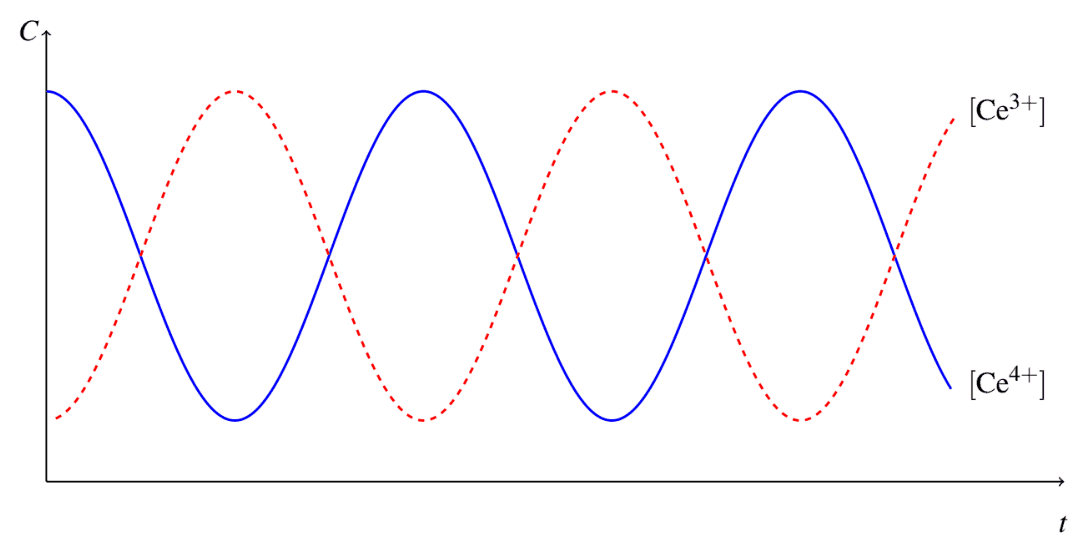
When the chemicals \(\ce{KBrO3}\), \(\ce{CH2(COOH)2}\) (malonic acid, – MA), \(\ce{Ce(SO4)2}\), and \(\ce{H2SO4}\) are mixed, the concentration, \(C\), of Ce species and the colour of the solution oscillates between yellow (due to \(\ce{Ce^4+}\)) and colourless (due to \(\ce{Ce^3+}\)). A schematic picture is given below:
2.1 — 2.0 pt
Write the overall balanced reaction equation of the Belousov-Zhabotinsky reaction (BZ reaction). Note: in this reaction, MA is oxidised to \(\ce{CO2}\), \(\ce{BrO3-}\) is reduced to \(\ce{Br-}\), and Ce(IV) is a catalyst.
The mechanism of the BZ reaction is shown below (BMA – \(\ce{CHBr(COOH)2}\)):
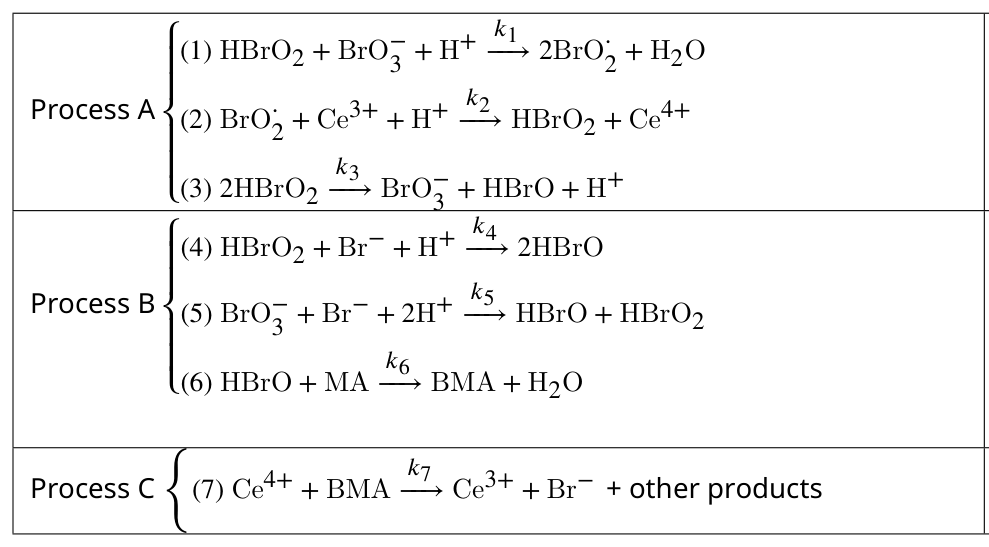
| \(k_1=1.0\times10^4\ \mathrm{M^{-2}\,s^{-1}}\) \(k_2=6.2\times10^4\ \mathrm{M^{-2}\,s^{-1}}\) \(k_3=4.0\times10^7\ \mathrm{M^{-1}\,s^{-1}}\) |
| \(k_4=2.0\times10^9\ \mathrm{M^{-2}\,s^{-1}}\) \(k_5=2.1\ \mathrm{M^{-3}\,s^{-1}}\) \(k_6=8.2\ \mathrm{M^{-1}\,s^{-1}}\) |
| \(k_7=1.0\times10^2\ \mathrm{M^{-1}\,s^{-1}}\) |
In the BZ reaction, Process C occurs continuously, while Processes A and B alternate with each other.
Assume that:
- when Process A occurs the solution is yellow and Process B practically does not occur;
- when Process B occurs the solution is colourless and Process A practically does not occur;
- \([\ce{BrO3-}]_0=0.06\ \mathrm{M}\), \([\mathrm{MA}]_0=0.1\ \mathrm{M}\), \([\ce{H+}]_0=0.8\ \mathrm{M}\), \([\ce{Ce^4+}]_0=0.001\ \mathrm{M}\);
- the concentrations of the reactants (except \(\ce{Ce^4+}\)) and pH are maintained constant throughout the BZ reaction.
2.2 — 11.0 pt
Using the steady-state approximation, calculate the stationary molar concentrations of \(\ce{HBrO2}\) in Processes A and B, \([\ce{HBrO2}]_{\mathrm A}\) and \([\ce{HBrO2}]_{\mathrm B}\).
If you could not calculate \([\ce{HBrO2}]_{\mathrm A}\) and \([\ce{HBrO2}]_{\mathrm B}\), you can use the values \([\ce{HBrO2}]_{\mathrm A}=1\times10^{-5}\ \mathrm{M}\) and \([\ce{HBrO2}]_{\mathrm B}=1\times10^{-10}\ \mathrm{M}\) for the following calculations.
During the BZ reaction, the concentrations of \(\ce{HBrO2}\) and \(\ce{Br-}\) oscillate strictly in relation to each other, and this is sketched in the phase portrait of \([\ce{HBrO2}]\) vs \([\ce{Br-}]\):
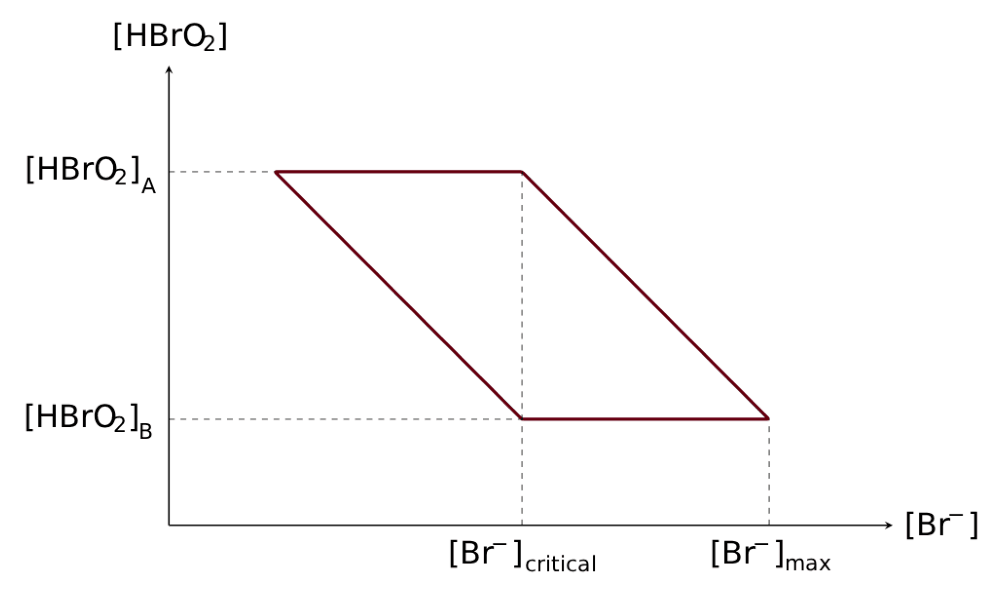
Here \([\ce{Br-}]_{\max}\) is the maximum concentration and \([\ce{Br-}]_{\mathrm{critical}}\) is the critical concentration of \(\ce{Br-}\) at which there is a switch over in processes from A to B or from B to A. To switch Process A to Process B, the reaction rate of the elementary step (4) must exceed that of the elementary step (1) and vice versa.
2.3 — 4.0 pt
Calculate \([\ce{Br-}]_{\mathrm{critical}}\).
If you could not calculate \([\ce{Br-}]_{\mathrm{critical}}\), use \([\ce{Br-}]_{\mathrm{critical}}=1\times10^{-7}\ \mathrm{M}\) for the following calculations.
2.4 — 2.0 pt
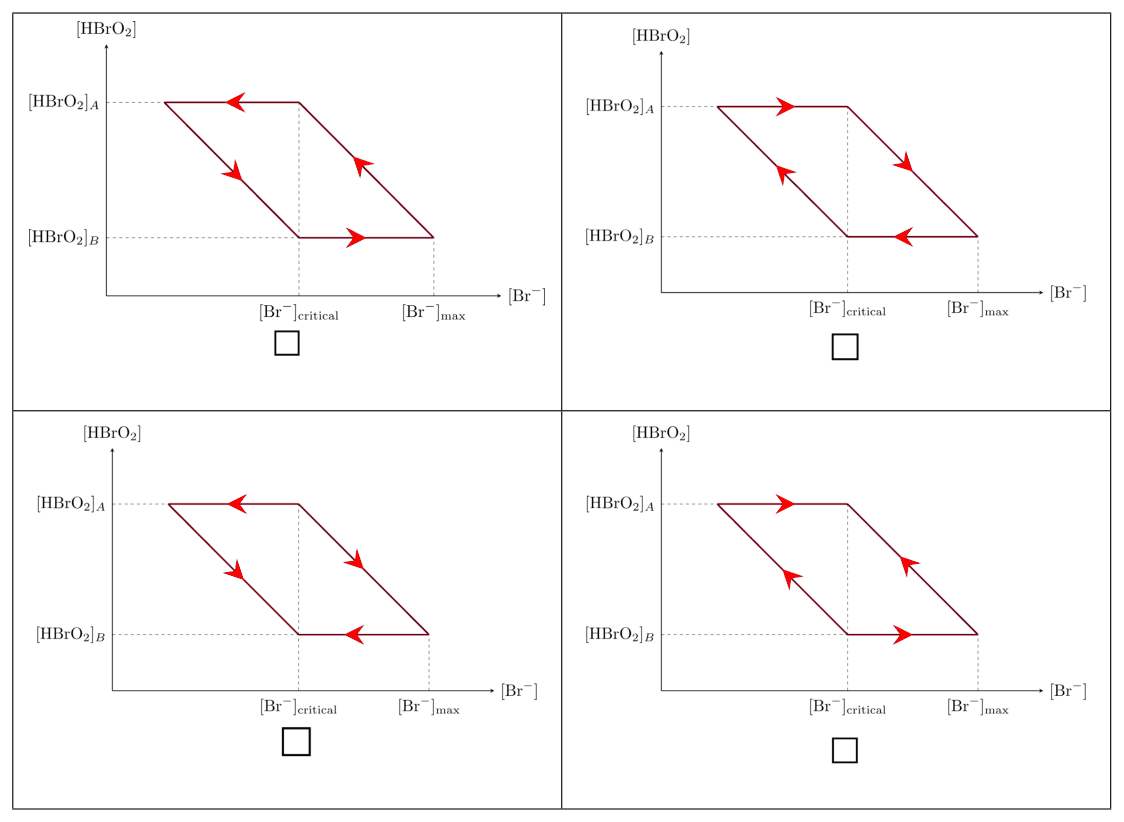
In which direction in the phase portrait of \([\ce{HBrO2}]\) vs \([\ce{Br-}]\) will the concentrations of \([\ce{HBrO2}]\) and \([\ce{Br-}]\) change over time? Tick the correct box.
The system does not traverse the phase portrait of \([\ce{HBrO2}]\) vs \([\ce{Br-}]\) at a constant velocity, that is the concentration of \([\ce{Br-}]\) slowly decreases from \([\ce{Br-}]_{\max}=7.0\times10^{-4}\ \mathrm{M}\) to \([\ce{Br-}]_{\mathrm{critical}}\), and then almost immediately reaches \([\ce{Br-}]_{\max}\) again.
2.5 — 9.0 pt
Calculate based on the data the period of oscillations, \(\tau\), of the BZ reaction, in seconds.
2.6 — 4.0 pt
What will be the effect if the following actions (1-4) are performed on an open system where a BZ reaction is taking place? Tick only one box (a-e) for each case.
| 1. Adding of small amount of \(\ce{Ce^4+}\) during Process A. 2. Adding of a small amount of \(\ce{Ag+}\) during Process B. 3. Adding of a small amount of \(\ce{Br-}\) during Process B. 4. Continuous addition of \(\ce{Br-}\). |
[ a ] prolongs Process A [ b ] prolongs Process B [ c ] Process A switches to Process B [ d ] Process B switches to Process A [ e ] oscillations stop |
2.7 — 3.0 pt
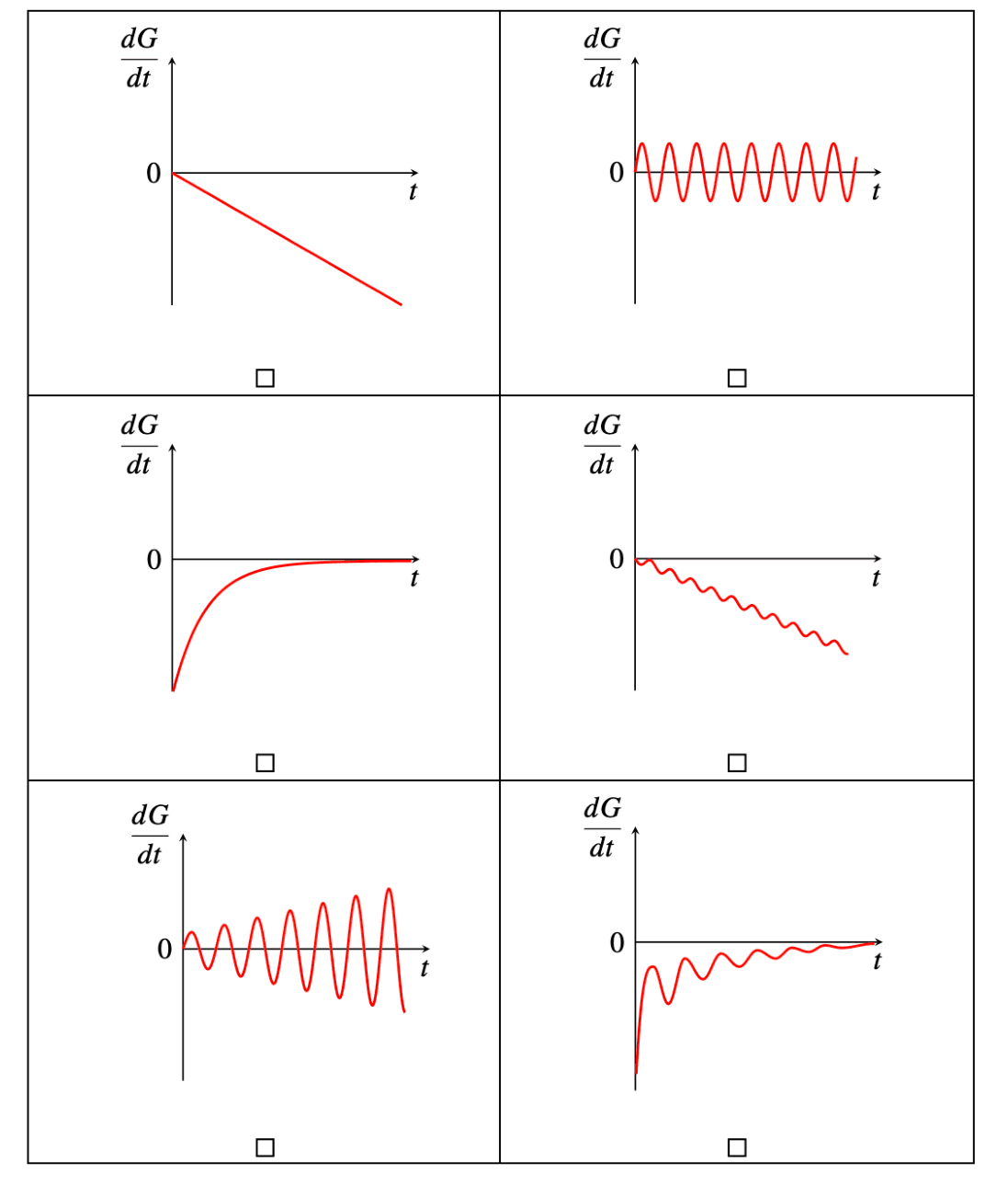
Which graph qualitatively illustrates the rate of change of Gibbs energy \(\left(\frac{dG}{dt}\right)\) of a closed system in which an oscillatory reaction occurs? Tick the correct box.
Official English text of the problem.
Answers
- 2.1: \(\ce{3CH2(COOH)2 + 4BrO3- -> 9CO2 + 4Br- + 6H2O}\).
- 2.2: \([\ce{HBrO2}]_{\mathrm A}=\boxed{6.0\times10^{-6}\ \mathrm{M}}\); \([\ce{HBrO2}]_{\mathrm B}=\boxed{5.0\times10^{-11}\ \mathrm{M}}\).
- 2.3: \([\ce{Br-}]_{\mathrm{critical}}=\boxed{3.0\times10^{-7}\ \mathrm{M}}\).
- 2.4: Upper-right diagram of the answer-sheet figure for 2.4: clockwise traversal.
- 2.5: \(\boxed{\tau\approx48\ \mathrm{s}}\).
- 2.6: Intended choices: 1–c; 2–d; 3–b; 4–e, subject to sufficient perturbation strength as explained below.
- 2.7: Bottom-right graph of the answer-sheet figure for 2.7: \(dG/dt\) undergoes damped oscillations below zero and approaches zero.
Solution
The species used below have the following names and SMILES.
| Species | Name | SMILES |
|---|---|---|
| \(\ce{CH2(COOH)2}\), MA | Malonic acid | O=C(O)CC(=O)O |
| \(\ce{CHBr(COOH)2}\), BMA | Bromomalonic acid | O=C(O)C(Br)C(=O)O |
| \(\ce{BrO3-}\) | Bromate ion | [O-][Br](=O)=O |
| \(\ce{Br-}\) | Bromide ion | [Br-] |
| \(\ce{HBrO2}\) | Bromous acid | O[Br]=O |
| \(\ce{HBrO}\) | Hypobromous acid | OBr |
| \(\ce{BrO2^{\bullet}}\) | Bromine dioxide radical | O=[Br]=O |
| \(\ce{CO2}\) | Carbon dioxide | O=C=O |
| \(\ce{H2O}\) | Water | O |
| \(\ce{H+}\) | Hydrogen ion (proton) | [H+] |
| \(\ce{Ce^4+}\) | Cerium(IV) ion | [Ce+4] |
| \(\ce{Ce^3+}\) | Cerium(III) ion | [Ce+3] |
| \(\ce{Ag+}\) | Silver(I) ion | [Ag+] |
| \(\ce{AgBr}\) | Silver bromide | [Ag+].[Br-] |
The silver bromide SMILES specifies its constituent ions, not the solid’s crystal lattice. The ionic SMILES do not show solvation.
2.1
Complete oxidation of one molecule of malonic acid to three molecules of carbon dioxide releases eight electrons:
\[ \ce{CH2(COOH)2 + 2H2O -> 3CO2 + 8H+ + 8e-}. \]
Reduction of bromate to bromide consumes six electrons:
\[ \ce{BrO3- + 6H+ + 6e- -> Br- + 3H2O}. \]
Multiply the oxidation half-reaction by 3 and the reduction half-reaction by 4. Cancelling 24 electrons, 24 hydrogen ions, and the common water gives
\[ \boxed{\ce{3CH2(COOH)2 + 4BrO3- -> 9CO2 + 4Br- + 6H2O}}. \]
Cerium cycles between its oxidation states and is regenerated, so it does not appear in the net equation.
2.2
Define
\[ x=[\ce{HBrO2}],\qquad r=[\ce{BrO2^{\bullet}}],\qquad b=[\ce{Br-}], \] \[ a=[\ce{BrO3-}]=0.06\ \mathrm{M},\qquad h=[\ce{H+}]=0.8\ \mathrm{M}. \]
Let \(v_i\) denote the reaction rate of elementary step \(i\), with stoichiometric factors included separately in species balances.
For Process A,
\[ v_1=k_1xah,\qquad v_2=k_2r[\ce{Ce^3+}]h,\qquad v_3=k_3x^2. \]
Applying the steady-state approximation to the bromine dioxide radical gives
\[ \frac{dr}{dt}=2v_1-v_2\simeq0 \quad\Longrightarrow\quad v_2=2v_1. \]
The bromous-acid balance is
\[ \frac{dx}{dt}=-v_1+v_2-2v_3\simeq0. \]
The factor 2 before \(v_3\) is essential: each occurrence of step (3) consumes two molecules of bromous acid. Substituting \(v_2=2v_1\),
\[ k_1xah-2k_3x^2=0. \]
The nonzero stationary concentration corresponding to active Process A is therefore
\[ x_{\mathrm A}=\frac{k_1ah}{2k_3}. \]
Numerically,
\[ x_{\mathrm A} = \frac{ (1.0\times10^4\ \mathrm{M^{-2}s^{-1}}) (0.06\ \mathrm M)(0.8\ \mathrm M) }{ 2(4.0\times10^7\ \mathrm{M^{-1}s^{-1}}) } = \boxed{6.0\times10^{-6}\ \mathrm M}. \]
For Process B, step (5) produces bromous acid and step (4) consumes it:
\[ v_4=k_4xbh,\qquad v_5=k_5abh^2. \]
Thus
\[ \frac{dx}{dt}=v_5-v_4\simeq0, \]
and, cancelling the nonzero factors \(b\) and \(h\),
\[ x_{\mathrm B}=\frac{k_5ah}{k_4}. \]
Hence
\[ x_{\mathrm B} = \frac{ (2.1\ \mathrm{M^{-3}s^{-1}}) (0.06\ \mathrm M)(0.8\ \mathrm M) }{ 2.0\times10^9\ \mathrm{M^{-2}s^{-1}} } = 5.04\times10^{-11}\ \mathrm M \approx \boxed{5.0\times10^{-11}\ \mathrm M}. \]
2.3
At the switching threshold, steps (1) and (4) have equal rates:
\[ k_1xah=k_4xb_{\mathrm{critical}}h. \]
Cancelling \(x\) and \(h\) gives
\[ b_{\mathrm{critical}} =\frac{k_1a}{k_4} = \frac{1.0\times10^4}{2.0\times10^9} (0.06\ \mathrm M) = \boxed{3.0\times10^{-7}\ \mathrm M}. \]
Below this concentration, step (1) dominates and favours Process A. Above it, step (4) dominates and favours Process B.
2.4
During Process A, the solution contains appreciable cerium(IV), so Process C produces bromide. The bromide concentration increases along the upper branch until the system switches to Process B.
During Process B, bromide is consumed while the bromous-acid concentration remains low. The system moves left along the lower branch until bromide falls to the switching threshold and Process A resumes.
Consequently, the arrows must point:
- right along the upper horizontal edge;
- down and right along the right sloping edge;
- left along the lower horizontal edge;
- up and left along the left sloping edge.
This is clockwise traversal, shown in the upper-right diagram of the answer-sheet figure for 2.4.
2.5
The period is dominated by the slow decrease of bromide during Process B. The subsequent return to the maximum concentration is taken to require negligible time.
The full bromide balance during B is
\[ \frac{db}{dt}=-v_4-v_5+v_7. \]
In the intended approximation, the colourless B interval has very little cerium(IV), so
\[ v_7=k_7[\ce{Ce^4+}][\mathrm{BMA}] \]
is neglected during this slow interval. From the steady-state calculation, \(v_4=v_5\). Therefore,
\[ \frac{db}{dt}\simeq-2v_5=-2k_5ah^2b. \]
Both steps (4) and (5) consume bromide; this supplies the factor 2.
The effective first-order decay constant is
\[ k_{\mathrm{eff}} =2k_5ah^2 =2(2.1\ \mathrm{M^{-3}s^{-1}}) (0.06\ \mathrm M)(0.8\ \mathrm M)^2 =0.16128\ \mathrm{s^{-1}}. \]
Integration gives
\[ b(t)=b_{\max}e^{-k_{\mathrm{eff}}t}. \]
Setting \(b(\tau)=b_{\mathrm{critical}}\),
\[ \tau \simeq \frac{1}{k_{\mathrm{eff}}} \ln\left(\frac{b_{\max}}{b_{\mathrm{critical}}}\right). \]
Thus
\[ \tau = \frac{ \ln\left(\dfrac{7.0\times10^{-4}}{3.0\times10^{-7}}\right) }{ 0.16128\ \mathrm{s^{-1}} } =48.0844\ \mathrm s \approx \boxed{48\ \mathrm s}. \]
2.6
-
Adding cerium(IV) during Process A: (c).
Increasing \([\ce{Ce^4+}]\) accelerates Process C and therefore bromide production. If this raises bromide through its critical concentration, step (4) overtakes step (1), and Process A switches to Process B. -
Adding silver(I) during Process B: (d).
Silver(I) removes bromide by precipitation: \[ \ce{Ag+ + Br- -> AgBr(s)}. \] If bromide falls below its critical concentration, step (1) becomes dominant, and Process B switches to Process A. -
Adding bromide during Process B: (b).
The bromide concentration is moved farther above the switching threshold. More time is needed to consume it down to that threshold, so the addition prolongs Process B. -
Continuous addition of bromide: (e).
A sufficient continuous supply maintains bromide above the critical concentration, sustaining Process B and preventing the alternating switches. The oscillations stop.
2.7
For a spontaneously reacting closed system at constant temperature and pressure,
\[ \frac{dG}{dt}\leq0. \]
The concentrations can oscillate, and the rate of Gibbs-energy decrease can vary, while Gibbs energy itself continues to decrease. As equilibrium is approached,
\[ \frac{dG}{dt}\longrightarrow0. \]
The intended graph therefore shows oscillations in \(dG/dt\) that remain below zero and diminish as the curve approaches zero: the bottom-right graph of the answer-sheet figure for 2.7.
The solution was checked against the official solution.
IChO 2026 · Theorieaufgabe 2
Kinetik der Belousov-Zhabotinsky-Reaktion
T2. Kinetik der Belousov-Zhabotinsky-Reaktion
6%
| 2.1 | 2.2 | 2.3 | 2.4 | 2.5 | 2.6 | 2.7 | \(\sum\) |
|---|---|---|---|---|---|---|---|
| 2 | 11 | 4 | 2 | 9 | 4 | 3 | 35 |
Wenn die Chemikalien \(\ce{KBrO3}\), \(\ce{CH2(COOH)2}\) (Malonsäure, – MA), \(\ce{Ce(SO4)2}\) und \(\ce{H2SO4}\) gemischt werden, oszillieren die Konzentration \(C\) der Ce-Spezies und die Farbe der Lösung, wobei die Farbe zwischen gelb (aufgrund von \(\ce{Ce^4+}\)) und farblos (aufgrund von \(\ce{Ce^3+}\)) wechselt. Eine schematische Darstellung ist unten gezeigt:
2.1 — 2.0 Punkte
Stellen Sie die ausgeglichene Gesamtreaktionsgleichung der Belousov-Zhabotinsky-Reaktion (BZ-Reaktion) auf. Hinweis: Bei dieser Reaktion wird MA zu \(\ce{CO2}\) oxidiert, \(\ce{BrO3-}\) zu \(\ce{Br-}\) reduziert, und Ce(IV) ist ein Katalysator.
Der Mechanismus der BZ-Reaktion ist unten dargestellt (BMA – \(\ce{CHBr(COOH)2}\)):
| \(k_1=1.0\times10^4\ \mathrm{M^{-2}\,s^{-1}}\) \(k_2=6.2\times10^4\ \mathrm{M^{-2}\,s^{-1}}\) \(k_3=4.0\times10^7\ \mathrm{M^{-1}\,s^{-1}}\) |
| \(k_4=2.0\times10^9\ \mathrm{M^{-2}\,s^{-1}}\) \(k_5=2.1\ \mathrm{M^{-3}\,s^{-1}}\) \(k_6=8.2\ \mathrm{M^{-1}\,s^{-1}}\) |
| \(k_7=1.0\times10^2\ \mathrm{M^{-1}\,s^{-1}}\) |
Bei der BZ-Reaktion läuft Prozess C kontinuierlich ab, während sich die Prozesse A und B abwechseln.
Nehmen Sie an, dass:
- beim Ablauf von Prozess A die Lösung gelb ist und Prozess B praktisch nicht abläuft;
- beim Ablauf von Prozess B die Lösung farblos ist und Prozess A praktisch nicht abläuft;
- \([\ce{BrO3-}]_0=0.06\ \mathrm{M}\), \([\mathrm{MA}]_0=0.1\ \mathrm{M}\), \([\ce{H+}]_0=0.8\ \mathrm{M}\), \([\ce{Ce^4+}]_0=0.001\ \mathrm{M}\);
- die Konzentrationen der Reaktanten (außer \(\ce{Ce^4+}\)) und der pH-Wert während der gesamten BZ-Reaktion konstant gehalten werden.
2.2 — 11.0 Punkte
Berechnen Sie mithilfe der Quasistationaritätsnäherung die stationären molaren Konzentrationen von \(\ce{HBrO2}\) in den Prozessen A und B, \([\ce{HBrO2}]_{\mathrm A}\) und \([\ce{HBrO2}]_{\mathrm B}\).
Falls Sie \([\ce{HBrO2}]_{\mathrm A}\) und \([\ce{HBrO2}]_{\mathrm B}\) nicht berechnen konnten, können Sie für die folgenden Berechnungen die Werte \([\ce{HBrO2}]_{\mathrm A}=1\times10^{-5}\ \mathrm{M}\) und \([\ce{HBrO2}]_{\mathrm B}=1\times10^{-10}\ \mathrm{M}\) verwenden.
Während der BZ-Reaktion oszillieren die Konzentrationen von \(\ce{HBrO2}\) und \(\ce{Br-}\) in einer festen Beziehung zueinander. Dies ist im Phasenporträt von \([\ce{HBrO2}]\) gegen \([\ce{Br-}]\) skizziert:
Hier ist \([\ce{Br-}]_{\max}\) die maximale Konzentration und \([\ce{Br-}]_{\mathrm{critical}}\) die kritische Konzentration von \(\ce{Br-}\), bei der ein Wechsel der Prozesse von A zu B oder von B zu A stattfindet. Damit Prozess A zu Prozess B wechselt, muss die Reaktionsgeschwindigkeit des Elementarschritts (4) diejenige des Elementarschritts (1) übersteigen und umgekehrt.
2.3 — 4.0 Punkte
Berechnen Sie \([\ce{Br-}]_{\mathrm{critical}}\).
Falls Sie \([\ce{Br-}]_{\mathrm{critical}}\) nicht berechnen konnten, verwenden Sie für die folgenden Berechnungen \([\ce{Br-}]_{\mathrm{critical}}=1\times10^{-7}\ \mathrm{M}\).
2.4 — 2.0 Punkte
In welcher Richtung im Phasenporträt von \([\ce{HBrO2}]\) gegen \([\ce{Br-}]\) ändern sich die Konzentrationen \([\ce{HBrO2}]\) und \([\ce{Br-}]\) mit der Zeit? Kreuzen Sie das richtige Kästchen an.
Das System durchläuft das Phasenporträt von \([\ce{HBrO2}]\) gegen \([\ce{Br-}]\) nicht mit konstanter Geschwindigkeit, das heißt, die Konzentration \([\ce{Br-}]\) nimmt langsam von \([\ce{Br-}]_{\max}=7.0\times10^{-4}\ \mathrm{M}\) auf \([\ce{Br-}]_{\mathrm{critical}}\) ab und erreicht anschließend fast augenblicklich wieder \([\ce{Br-}]_{\max}\).
2.5 — 9.0 Punkte
Berechnen Sie anhand der Daten die Periodendauer \(\tau\) der Oszillationen der BZ-Reaktion in Sekunden.
2.6 — 4.0 Punkte
Welche Auswirkungen haben die folgenden Maßnahmen (1-4) auf ein offenes System, in dem eine BZ-Reaktion abläuft? Kreuzen Sie für jeden Fall nur ein Kästchen (a-e) an.
| 1. Zugabe einer kleinen Menge \(\ce{Ce^4+}\) während Prozess A. 2. Zugabe einer kleinen Menge \(\ce{Ag+}\) während Prozess B. 3. Zugabe einer kleinen Menge \(\ce{Br-}\) während Prozess B. 4. Kontinuierliche Zugabe von \(\ce{Br-}\). |
[ a ] verlängert Prozess A [ b ] verlängert Prozess B [ c ] Prozess A wechselt zu Prozess B [ d ] Prozess B wechselt zu Prozess A [ e ] die Oszillationen hören auf |
2.7 — 3.0 Punkte
Welcher Graph stellt qualitativ die Änderungsrate der Gibbs-Energie \(\left(\frac{dG}{dt}\right)\) eines geschlossenen Systems dar, in dem eine oszillierende Reaktion abläuft? Kreuzen Sie das richtige Kästchen an.
Aufgabentext aus dem offiziellen englischen Text übersetzt.
Antworten
- 2.1: \(\ce{3CH2(COOH)2 + 4BrO3- -> 9CO2 + 4Br- + 6H2O}\).
- 2.2: \([\ce{HBrO2}]_{\mathrm A}=\boxed{6.0\times10^{-6}\ \mathrm{M}}\); \([\ce{HBrO2}]_{\mathrm B}=\boxed{5.0\times10^{-11}\ \mathrm{M}}\).
- 2.3: \([\ce{Br-}]_{\mathrm{critical}}=\boxed{3.0\times10^{-7}\ \mathrm{M}}\).
- 2.4: Diagramm oben rechts in der Abbildung auf dem Antwortbogen zu 2.4: Durchlaufen im Uhrzeigersinn.
- 2.5: \(\boxed{\tau\approx48\ \mathrm{s}}\).
- 2.6: Vorgesehene Antworten: 1–c; 2–d; 3–b; 4–e, vorausgesetzt, die Störung ist ausreichend stark, wie unten erläutert.
- 2.7: Graph unten rechts in der Abbildung auf dem Antwortbogen zu 2.7: \(dG/dt\) führt gedämpfte Oszillationen unterhalb von null aus und nähert sich null an.
Lösung
Die im Folgenden verwendeten Spezies haben die folgenden Namen und SMILES.
| Spezies | Name | SMILES |
|---|---|---|
| \(\ce{CH2(COOH)2}\), MA | Malonsäure | O=C(O)CC(=O)O |
| \(\ce{CHBr(COOH)2}\), BMA | Brommalonsäure | O=C(O)C(Br)C(=O)O |
| \(\ce{BrO3-}\) | Bromat-Ion | [O-][Br](=O)=O |
| \(\ce{Br-}\) | Bromid-Ion | [Br-] |
| \(\ce{HBrO2}\) | Bromige Säure | O[Br]=O |
| \(\ce{HBrO}\) | Hypobromige Säure | OBr |
| \(\ce{BrO2^{\bullet}}\) | Bromdioxid-Radikal | O=[Br]=O |
| \(\ce{CO2}\) | Kohlenstoffdioxid | O=C=O |
| \(\ce{H2O}\) | Wasser | O |
| \(\ce{H+}\) | Wasserstoff-Ion (Proton) | [H+] |
| \(\ce{Ce^4+}\) | Cer(IV)-Ion | [Ce+4] |
| \(\ce{Ce^3+}\) | Cer(III)-Ion | [Ce+3] |
| \(\ce{Ag+}\) | Silber(I)-Ion | [Ag+] |
| \(\ce{AgBr}\) | Silberbromid | [Ag+].[Br-] |
Der SMILES-Ausdruck für Silberbromid gibt die Ionen an, aus denen es besteht, nicht das Kristallgitter des Feststoffs. Die SMILES-Ausdrücke der Ionen zeigen keine Solvatation.
2.1
Bei der vollständigen Oxidation eines Moleküls Malonsäure zu drei Molekülen Kohlenstoffdioxid werden acht Elektronen freigesetzt:
\[ \ce{CH2(COOH)2 + 2H2O -> 3CO2 + 8H+ + 8e-}. \]
Bei der Reduktion von Bromat zu Bromid werden sechs Elektronen verbraucht:
\[ \ce{BrO3- + 6H+ + 6e- -> Br- + 3H2O}. \]
Die Oxidationshalbreaktion wird mit 3 und die Reduktionshalbreaktion mit 4 multipliziert. Durch Kürzen von 24 Elektronen, 24 Wasserstoff-Ionen und des auf beiden Seiten vorkommenden Wassers erhält man
\[ \boxed{\ce{3CH2(COOH)2 + 4BrO3- -> 9CO2 + 4Br- + 6H2O}}. \]
Cer wechselt zyklisch zwischen seinen Oxidationsstufen und wird regeneriert, sodass es in der Nettogleichung nicht erscheint.
2.2
Wir definieren
\[ x=[\ce{HBrO2}],\qquad r=[\ce{BrO2^{\bullet}}],\qquad b=[\ce{Br-}], \] \[ a=[\ce{BrO3-}]=0.06\ \mathrm{M},\qquad h=[\ce{H+}]=0.8\ \mathrm{M}. \]
Dabei bezeichne \(v_i\) die Reaktionsgeschwindigkeit des Elementarschritts \(i\); stöchiometrische Faktoren werden in den Stoffbilanzen der Spezies gesondert berücksichtigt.
Für Prozess A gilt
\[ v_1=k_1xah,\qquad v_2=k_2r[\ce{Ce^3+}]h,\qquad v_3=k_3x^2. \]
Die Anwendung der Quasistationaritätsnäherung auf das Bromdioxid-Radikal ergibt
\[ \frac{dr}{dt}=2v_1-v_2\simeq0 \quad\Longrightarrow\quad v_2=2v_1. \]
Die Bilanz für bromige Säure lautet
\[ \frac{dx}{dt}=-v_1+v_2-2v_3\simeq0. \]
Der Faktor 2 vor \(v_3\) ist wesentlich: Bei jedem Ablauf von Schritt (3) werden zwei Moleküle bromige Säure verbraucht. Durch Einsetzen von \(v_2=2v_1\) erhält man
\[ k_1xah-2k_3x^2=0. \]
Die von null verschiedene stationäre Konzentration, die dem aktiven Prozess A entspricht, ist daher
\[ x_{\mathrm A}=\frac{k_1ah}{2k_3}. \]
Numerisch ergibt sich
\[ x_{\mathrm A} = \frac{ (1.0\times10^4\ \mathrm{M^{-2}s^{-1}}) (0.06\ \mathrm M)(0.8\ \mathrm M) }{ 2(4.0\times10^7\ \mathrm{M^{-1}s^{-1}}) } = \boxed{6.0\times10^{-6}\ \mathrm M}. \]
Bei Prozess B wird in Schritt (5) bromige Säure gebildet und in Schritt (4) verbraucht:
\[ v_4=k_4xbh,\qquad v_5=k_5abh^2. \]
Somit gilt
\[ \frac{dx}{dt}=v_5-v_4\simeq0, \]
und durch Kürzen der von null verschiedenen Faktoren \(b\) und \(h\) erhält man
\[ x_{\mathrm B}=\frac{k_5ah}{k_4}. \]
Daraus folgt
\[ x_{\mathrm B} = \frac{ (2.1\ \mathrm{M^{-3}s^{-1}}) (0.06\ \mathrm M)(0.8\ \mathrm M) }{ 2.0\times10^9\ \mathrm{M^{-2}s^{-1}} } = 5.04\times10^{-11}\ \mathrm M \approx \boxed{5.0\times10^{-11}\ \mathrm M}. \]
2.3
An der Umschaltschwelle haben die Schritte (1) und (4) gleiche Geschwindigkeiten:
\[ k_1xah=k_4xb_{\mathrm{critical}}h. \]
Durch Kürzen von \(x\) und \(h\) erhält man
\[ b_{\mathrm{critical}} =\frac{k_1a}{k_4} = \frac{1.0\times10^4}{2.0\times10^9} (0.06\ \mathrm M) = \boxed{3.0\times10^{-7}\ \mathrm M}. \]
Unterhalb dieser Konzentration dominiert Schritt (1) und begünstigt Prozess A. Oberhalb davon dominiert Schritt (4) und begünstigt Prozess B.
2.4
Während Prozess A enthält die Lösung eine nennenswerte Menge Cer(IV), sodass Prozess C Bromid erzeugt. Die Bromidkonzentration steigt entlang des oberen Astes, bis das System zu Prozess B wechselt.
Während Prozess B wird Bromid verbraucht, während die Konzentration der bromigen Säure niedrig bleibt. Das System bewegt sich entlang des unteren Astes nach links, bis die Bromidkonzentration auf die Umschaltschwelle fällt und Prozess A wieder einsetzt.
Folglich müssen die Pfeile in die folgenden Richtungen zeigen:
- nach rechts entlang der oberen horizontalen Kante;
- nach unten und rechts entlang der rechten schrägen Kante;
- nach links entlang der unteren horizontalen Kante;
- nach oben und links entlang der linken schrägen Kante.
Dies entspricht einem Durchlaufen im Uhrzeigersinn, wie im Diagramm oben rechts in der Abbildung auf dem Antwortbogen zu 2.4 dargestellt.
2.5
Die Periodendauer wird durch die langsame Abnahme der Bromidkonzentration während Prozess B bestimmt. Für die anschließende Rückkehr zur maximalen Konzentration wird eine vernachlässigbare Zeit angenommen.
Die vollständige Bromidbilanz während B lautet
\[ \frac{db}{dt}=-v_4-v_5+v_7. \]
In der vorgesehenen Näherung ist während des farblosen B-Intervalls sehr wenig Cer(IV) vorhanden, sodass
\[ v_7=k_7[\ce{Ce^4+}][\mathrm{BMA}] \]
während dieses langsamen Intervalls vernachlässigt wird. Aus der Berechnung unter der Quasistationaritätsnäherung folgt \(v_4=v_5\). Daher gilt
\[ \frac{db}{dt}\simeq-2v_5=-2k_5ah^2b. \]
Sowohl Schritt (4) als auch Schritt (5) verbrauchen Bromid; daraus ergibt sich der Faktor 2.
Die effektive Geschwindigkeitskonstante für den Abbau erster Ordnung ist
\[ k_{\mathrm{eff}} =2k_5ah^2 =2(2.1\ \mathrm{M^{-3}s^{-1}}) (0.06\ \mathrm M)(0.8\ \mathrm M)^2 =0.16128\ \mathrm{s^{-1}}. \]
Integration ergibt
\[ b(t)=b_{\max}e^{-k_{\mathrm{eff}}t}. \]
Mit \(b(\tau)=b_{\mathrm{critical}}\) erhält man
\[ \tau \simeq \frac{1}{k_{\mathrm{eff}}} \ln\left(\frac{b_{\max}}{b_{\mathrm{critical}}}\right). \]
Somit gilt
\[ \tau = \frac{ \ln\left(\dfrac{7.0\times10^{-4}}{3.0\times10^{-7}}\right) }{ 0.16128\ \mathrm{s^{-1}} } =48.0844\ \mathrm s \approx \boxed{48\ \mathrm s}. \]
2.6
-
Zugabe von Cer(IV) während Prozess A: (c).
Eine Erhöhung von \([\ce{Ce^4+}]\) beschleunigt Prozess C und damit die Bromidbildung. Wenn dadurch die Bromidkonzentration über ihren kritischen Wert steigt, übertrifft die Geschwindigkeit von Schritt (4) diejenige von Schritt (1), und Prozess A wechselt zu Prozess B. -
Zugabe von Silber(I) während Prozess B: (d).
Silber(I) entfernt Bromid durch Fällung: \[ \ce{Ag+ + Br- -> AgBr(s)}. \] Wenn die Bromidkonzentration unter ihren kritischen Wert fällt, wird Schritt (1) dominant, und Prozess B wechselt zu Prozess A. -
Zugabe von Bromid während Prozess B: (b).
Die Bromidkonzentration wird weiter über die Umschaltschwelle angehoben. Es wird mehr Zeit benötigt, um das Bromid bis zu dieser Schwelle zu verbrauchen; daher verlängert die Zugabe Prozess B. -
Kontinuierliche Zugabe von Bromid: (e).
Eine ausreichend starke kontinuierliche Zufuhr hält die Bromidkonzentration oberhalb des kritischen Werts, wodurch Prozess B aufrechterhalten wird und die abwechselnden Umschaltungen verhindert werden. Die Oszillationen hören auf.
2.7
Für ein spontan reagierendes geschlossenes System bei konstanter Temperatur und konstantem Druck gilt
\[ \frac{dG}{dt}\leq0. \]
Die Konzentrationen können oszillieren, und die Geschwindigkeit der Abnahme der Gibbs-Energie kann variieren, während die Gibbs-Energie selbst weiter abnimmt. Bei Annäherung an das Gleichgewicht gilt
\[ \frac{dG}{dt}\longrightarrow0. \]
Der vorgesehene Graph zeigt daher Oszillationen von \(dG/dt\), die unterhalb von null bleiben und abklingen, während sich die Kurve null annähert: der Graph unten rechts in der Abbildung auf dem Antwortbogen zu 2.7.
Die Lösung wurde mit der offiziellen Lösung abgeglichen.
IChO 2026 · Teori sorusu 2
Belousov-Zhabotinsky tepkimesinin kinetiği
T2. Belousov-Zhabotinsky tepkimesinin kinetiği
6%
| 2.1 | 2.2 | 2.3 | 2.4 | 2.5 | 2.6 | 2.7 | \(\sum\) |
|---|---|---|---|---|---|---|---|
| 2 | 11 | 4 | 2 | 9 | 4 | 3 | 35 |
\(\ce{KBrO3}\), \(\ce{CH2(COOH)2}\) (malonik asit, – MA), \(\ce{Ce(SO4)2}\) ve \(\ce{H2SO4}\) kimyasalları karıştırıldığında, Ce türlerinin derişimi, \(C\), salınım yapar ve çözeltinin rengi sarı (\(\ce{Ce^4+}\) nedeniyle) ile renksiz (\(\ce{Ce^3+}\) nedeniyle) arasında gidip gelir. Aşağıda şematik bir gösterim verilmiştir:
2.1 — 2.0 puan
Belousov-Zhabotinsky tepkimesinin (BZ tepkimesi) toplam denkleştirilmiş tepkime denklemini yazınız. Not: Bu tepkimede MA, \(\ce{CO2}\)'ye yükseltgenir; \(\ce{BrO3-}\), \(\ce{Br-}\)'ye indirgenir ve Ce(IV) katalizördür.
BZ tepkimesinin mekanizması aşağıda gösterilmiştir (BMA – \(\ce{CHBr(COOH)2}\)):
| \(k_1=1.0\times10^4\ \mathrm{M^{-2}\,s^{-1}}\) \(k_2=6.2\times10^4\ \mathrm{M^{-2}\,s^{-1}}\) \(k_3=4.0\times10^7\ \mathrm{M^{-1}\,s^{-1}}\) |
| \(k_4=2.0\times10^9\ \mathrm{M^{-2}\,s^{-1}}\) \(k_5=2.1\ \mathrm{M^{-3}\,s^{-1}}\) \(k_6=8.2\ \mathrm{M^{-1}\,s^{-1}}\) |
| \(k_7=1.0\times10^2\ \mathrm{M^{-1}\,s^{-1}}\) |
BZ tepkimesinde C süreci sürekli gerçekleşirken A ve B süreçleri dönüşümlü olarak gerçekleşir.
Şunları varsayınız:
- A süreci gerçekleşirken çözelti sarıdır ve B süreci pratikte gerçekleşmez;
- B süreci gerçekleşirken çözelti renksizdir ve A süreci pratikte gerçekleşmez;
- \([\ce{BrO3-}]_0=0.06\ \mathrm{M}\), \([\mathrm{MA}]_0=0.1\ \mathrm{M}\), \([\ce{H+}]_0=0.8\ \mathrm{M}\), \([\ce{Ce^4+}]_0=0.001\ \mathrm{M}\);
- reaktanların derişimleri (\(\ce{Ce^4+}\) hariç) ve pH, BZ tepkimesi boyunca sabit tutulur.
2.2 — 11.0 puan
Kararlı hâl yaklaşımını kullanarak A ve B süreçlerinde \(\ce{HBrO2}\)'nin kararlı molar derişimlerini, \([\ce{HBrO2}]_{\mathrm A}\) ve \([\ce{HBrO2}]_{\mathrm B}\), hesaplayınız.
\([\ce{HBrO2}]_{\mathrm A}\) ve \([\ce{HBrO2}]_{\mathrm B}\)'yi hesaplayamadıysanız, sonraki hesaplamalar için \([\ce{HBrO2}]_{\mathrm A}=1\times10^{-5}\ \mathrm{M}\) ve \([\ce{HBrO2}]_{\mathrm B}=1\times10^{-10}\ \mathrm{M}\) değerlerini kullanabilirsiniz.
BZ tepkimesi sırasında \(\ce{HBrO2}\) ve \(\ce{Br-}\) derişimleri birbirleriyle sıkı bir ilişki içinde salınım yapar; bu durum, \([\ce{HBrO2}]\)'nin \([\ce{Br-}]\)'ye karşı çizildiği faz portresinde şematik olarak gösterilmiştir:
Burada \([\ce{Br-}]_{\max}\), \(\ce{Br-}\)'nin en yüksek derişimi; \([\ce{Br-}]_{\mathrm{critical}}\) ise süreçler arasında A'dan B'ye veya B'den A'ya geçişin gerçekleştiği kritik derişimidir. A sürecinden B sürecine geçilebilmesi için (4) numaralı elementer basamağın tepkime hızı, (1) numaralı elementer basamağın tepkime hızını aşmalıdır; ters yöndeki geçiş için de bunun tersi geçerlidir.
2.3 — 4.0 puan
\([\ce{Br-}]_{\mathrm{critical}}\)'i hesaplayınız.
\([\ce{Br-}]_{\mathrm{critical}}\)'i hesaplayamadıysanız, sonraki hesaplamalar için \([\ce{Br-}]_{\mathrm{critical}}=1\times10^{-7}\ \mathrm{M}\) değerini kullanınız.
2.4 — 2.0 puan
\([\ce{HBrO2}]\)'nin \([\ce{Br-}]\)'ye karşı çizildiği faz portresinde, \([\ce{HBrO2}]\) ve \([\ce{Br-}]\) derişimleri zamanla hangi yönde değişir? Doğru kutuyu işaretleyiniz.
Sistem, \([\ce{HBrO2}]\)'nin \([\ce{Br-}]\)'ye karşı çizildiği faz portresini sabit bir hızla dolaşmaz; yani \([\ce{Br-}]\) derişimi, \([\ce{Br-}]_{\max}=7.0\times10^{-4}\ \mathrm{M}\)'dan \([\ce{Br-}]_{\mathrm{critical}}\)'e yavaşça azalır, ardından neredeyse anında yeniden \([\ce{Br-}]_{\max}\)'a ulaşır.
2.5 — 9.0 puan
Verilere dayanarak BZ tepkimesinin salınım periyodunu, \(\tau\), saniye cinsinden hesaplayınız.
2.6 — 4.0 puan
BZ tepkimesinin gerçekleştiği açık bir sisteme aşağıdaki (1-4) işlemleri uygulanırsa etkileri ne olur? Her durum için (a-e) kutularından yalnızca birini işaretleyiniz.
| 1. A süreci sırasında az miktarda \(\ce{Ce^4+}\) eklenmesi. 2. B süreci sırasında az miktarda \(\ce{Ag+}\) eklenmesi. 3. B süreci sırasında az miktarda \(\ce{Br-}\) eklenmesi. 4. Sürekli \(\ce{Br-}\) eklenmesi. |
[ a ] A sürecini uzatır [ b ] B sürecini uzatır [ c ] A süreci, B sürecine geçer [ d ] B süreci, A sürecine geçer [ e ] salınımlar durur |
2.7 — 3.0 puan
Hangi grafik, salınımlı bir tepkimenin gerçekleştiği kapalı bir sistemin Gibbs enerjisinin değişim hızını \(\left(\frac{dG}{dt}\right)\) nitel olarak gösterir? Doğru kutuyu işaretleyiniz.
Soru metni resmi İngilizce metinden çevrilmiştir.
Cevaplar
- 2.1: \(\ce{3CH2(COOH)2 + 4BrO3- -> 9CO2 + 4Br- + 6H2O}\).
- 2.2: \([\ce{HBrO2}]_{\mathrm A}=\boxed{6.0\times10^{-6}\ \mathrm{M}}\); \([\ce{HBrO2}]_{\mathrm B}=\boxed{5.0\times10^{-11}\ \mathrm{M}}\).
- 2.3: \([\ce{Br-}]_{\mathrm{critical}}=\boxed{3.0\times10^{-7}\ \mathrm{M}}\).
- 2.4: 2.4 için cevap kâğıdındaki şeklin sağ üst diyagramı: saat yönünde dolaşım.
- 2.5: \(\boxed{\tau\approx48\ \mathrm{s}}\).
- 2.6: Beklenen seçenekler: aşağıda açıklandığı üzere, pertürbasyonun yeterince güçlü olması koşuluyla 1–c; 2–d; 3–b; 4–e.
- 2.7: 2.7 için cevap kâğıdındaki şeklin sağ alt grafiği: \(dG/dt\), sıfırın altında sönümlü salınımlar yapar ve sıfıra yaklaşır.
Çözüm
Aşağıda kullanılan türlerin adları ve SMILES gösterimleri şöyledir.
| Tür | Adı | SMILES |
|---|---|---|
| \(\ce{CH2(COOH)2}\), MA | Malonik asit | O=C(O)CC(=O)O |
| \(\ce{CHBr(COOH)2}\), BMA | Bromomalonik asit | O=C(O)C(Br)C(=O)O |
| \(\ce{BrO3-}\) | Bromat iyonu | [O-][Br](=O)=O |
| \(\ce{Br-}\) | Bromür iyonu | [Br-] |
| \(\ce{HBrO2}\) | Bromöz asit | O[Br]=O |
| \(\ce{HBrO}\) | Hipobromöz asit | OBr |
| \(\ce{BrO2^{\bullet}}\) | Brom dioksit radikali | O=[Br]=O |
| \(\ce{CO2}\) | Karbon dioksit | O=C=O |
| \(\ce{H2O}\) | Su | O |
| \(\ce{H+}\) | Hidrojen iyonu (proton) | [H+] |
| \(\ce{Ce^4+}\) | Seryum(IV) iyonu | [Ce+4] |
| \(\ce{Ce^3+}\) | Seryum(III) iyonu | [Ce+3] |
| \(\ce{Ag+}\) | Gümüş(I) iyonu | [Ag+] |
| \(\ce{AgBr}\) | Gümüş bromür | [Ag+].[Br-] |
Gümüş bromürün SMILES gösterimi, katının kristal örgüsünü değil, onu oluşturan iyonları belirtir. İyonik SMILES gösterimleri solvatasyonu göstermez.
2.1
Bir malonik asit molekülünün üç karbon dioksit molekülüne tamamen yükseltgenmesiyle sekiz elektron açığa çıkar:
\[ \ce{CH2(COOH)2 + 2H2O -> 3CO2 + 8H+ + 8e-}. \]
Bromatın bromüre indirgenmesinde altı elektron tüketilir:
\[ \ce{BrO3- + 6H+ + 6e- -> Br- + 3H2O}. \]
Yükseltgenme yarı tepkimesini 3 ile, indirgenme yarı tepkimesini ise 4 ile çarpınız. 24 elektron, 24 hidrojen iyonu ve her iki tarafta ortak bulunan su sadeleştirildiğinde şu denklem elde edilir:
\[ \boxed{\ce{3CH2(COOH)2 + 4BrO3- -> 9CO2 + 4Br- + 6H2O}}. \]
Seryum, yükseltgenme basamakları arasında döngüsel olarak dönüşür ve yeniden oluşur; bu nedenle net denklemde yer almaz.
2.2
Şu tanımları yapalım:
\[ x=[\ce{HBrO2}],\qquad r=[\ce{BrO2^{\bullet}}],\qquad b=[\ce{Br-}], \] \[ a=[\ce{BrO3-}]=0.06\ \mathrm{M},\qquad h=[\ce{H+}]=0.8\ \mathrm{M}. \]
\(v_i\), \(i\) numaralı elementer basamağın tepkime hızını göstersin; stokiyometrik çarpanlar türlerin madde denkliklerine ayrıca dâhil edilsin.
A süreci için,
\[ v_1=k_1xah,\qquad v_2=k_2r[\ce{Ce^3+}]h,\qquad v_3=k_3x^2. \]
Brom dioksit radikaline kararlı hâl yaklaşımı uygulandığında şu sonuç elde edilir:
\[ \frac{dr}{dt}=2v_1-v_2\simeq0 \quad\Longrightarrow\quad v_2=2v_1. \]
Bromöz asidin madde denkliği şöyledir:
\[ \frac{dx}{dt}=-v_1+v_2-2v_3\simeq0. \]
\(v_3\)'ün önündeki 2 çarpanı zorunludur: (3) numaralı basamağın her gerçekleşmesinde iki bromöz asit molekülü tüketilir. \(v_2=2v_1\) yerine yazıldığında,
\[ k_1xah-2k_3x^2=0. \]
Dolayısıyla, etkin A sürecine karşılık gelen sıfırdan farklı kararlı derişim şöyledir:
\[ x_{\mathrm A}=\frac{k_1ah}{2k_3}. \]
Sayısal olarak,
\[ x_{\mathrm A} = \frac{ (1.0\times10^4\ \mathrm{M^{-2}s^{-1}}) (0.06\ \mathrm M)(0.8\ \mathrm M) }{ 2(4.0\times10^7\ \mathrm{M^{-1}s^{-1}}) } = \boxed{6.0\times10^{-6}\ \mathrm M}. \]
B sürecinde, (5) numaralı basamak bromöz asit üretir, (4) numaralı basamak ise onu tüketir:
\[ v_4=k_4xbh,\qquad v_5=k_5abh^2. \]
Böylece,
\[ \frac{dx}{dt}=v_5-v_4\simeq0, \]
ve sıfırdan farklı \(b\) ve \(h\) çarpanları sadeleştirildiğinde,
\[ x_{\mathrm B}=\frac{k_5ah}{k_4}. \]
Buradan,
\[ x_{\mathrm B} = \frac{ (2.1\ \mathrm{M^{-3}s^{-1}}) (0.06\ \mathrm M)(0.8\ \mathrm M) }{ 2.0\times10^9\ \mathrm{M^{-2}s^{-1}} } = 5.04\times10^{-11}\ \mathrm M \approx \boxed{5.0\times10^{-11}\ \mathrm M}. \]
2.3
Geçiş eşiğinde (1) ve (4) numaralı basamakların hızları eşittir:
\[ k_1xah=k_4xb_{\mathrm{critical}}h. \]
\(x\) ve \(h\) sadeleştirildiğinde şu sonuç elde edilir:
\[ b_{\mathrm{critical}} =\frac{k_1a}{k_4} = \frac{1.0\times10^4}{2.0\times10^9} (0.06\ \mathrm M) = \boxed{3.0\times10^{-7}\ \mathrm M}. \]
Bu derişimin altında (1) numaralı basamak baskındır ve A sürecini destekler. Üzerinde ise (4) numaralı basamak baskındır ve B sürecini destekler.
2.4
A süreci sırasında çözelti kayda değer miktarda seryum(IV) içerir; bu nedenle C süreci bromür üretir. Sistem B sürecine geçene kadar bromür derişimi üst dal boyunca artar.
B süreci sırasında bromöz asit derişimi düşük kalırken bromür tüketilir. Bromür derişimi geçiş eşiğine düşüp A süreci yeniden başlayana kadar sistem alt dal boyunca sola doğru ilerler.
Dolayısıyla oklar şu yönleri göstermelidir:
- üst yatay kenar boyunca sağa;
- sağdaki eğik kenar boyunca aşağıya ve sağa;
- alt yatay kenar boyunca sola;
- soldaki eğik kenar boyunca yukarıya ve sola.
Bu, 2.4 için cevap kâğıdındaki şeklin sağ üst diyagramında gösterilen saat yönünde dolaşımdır.
2.5
Periyodu esas olarak B süreci sırasında bromür derişiminin yavaşça azalması belirler. Ardından en yüksek derişime dönüşün ihmal edilebilir bir sürede gerçekleştiği kabul edilir.
B sırasında bromürün tam madde denkliği şöyledir:
\[ \frac{db}{dt}=-v_4-v_5+v_7. \]
Soruda öngörülen yaklaşımda, renksiz B evresinde çok az seryum(IV) bulunur; dolayısıyla
\[ v_7=k_7[\ce{Ce^4+}][\mathrm{BMA}] \]
bu yavaş evre boyunca ihmal edilir. Kararlı hâl hesabından \(v_4=v_5\) elde edilir. Bu nedenle,
\[ \frac{db}{dt}\simeq-2v_5=-2k_5ah^2b. \]
Hem (4) hem de (5) numaralı basamak bromür tüketir; 2 çarpanı buradan gelir.
Etkin birinci dereceden azalma sabiti şöyledir:
\[ k_{\mathrm{eff}} =2k_5ah^2 =2(2.1\ \mathrm{M^{-3}s^{-1}}) (0.06\ \mathrm M)(0.8\ \mathrm M)^2 =0.16128\ \mathrm{s^{-1}}. \]
İntegrasyonla şu ifade elde edilir:
\[ b(t)=b_{\max}e^{-k_{\mathrm{eff}}t}. \]
\(b(\tau)=b_{\mathrm{critical}}\) alınırsa,
\[ \tau \simeq \frac{1}{k_{\mathrm{eff}}} \ln\left(\frac{b_{\max}}{b_{\mathrm{critical}}}\right). \]
Böylece,
\[ \tau = \frac{ \ln\left(\dfrac{7.0\times10^{-4}}{3.0\times10^{-7}}\right) }{ 0.16128\ \mathrm{s^{-1}} } =48.0844\ \mathrm s \approx \boxed{48\ \mathrm s}. \]
2.6
-
A süreci sırasında seryum(IV) eklenmesi: (c).
\([\ce{Ce^4+}]\)'nin artırılması C sürecini ve dolayısıyla bromür üretimini hızlandırır. Bu, bromür derişimini kritik derişimin üzerine çıkarırsa (4) numaralı basamağın hızı (1) numaralı basamağın hızını aşar ve A süreci B sürecine geçer. -
B süreci sırasında gümüş(I) eklenmesi: (d).
Gümüş(I), bromürü çöktürerek ortamdan uzaklaştırır: \[ \ce{Ag+ + Br- -> AgBr(s)}. \] Bromür derişimi kritik derişimin altına düşerse (1) numaralı basamak baskın hâle gelir ve B süreci A sürecine geçer. -
B süreci sırasında bromür eklenmesi: (b).
Bromür derişimi geçiş eşiğinin daha da üzerine çıkar. Bromürün tüketilerek derişiminin bu eşiğe düşmesi için daha fazla zaman gerekir; dolayısıyla bu ekleme B sürecini uzatır. -
Sürekli bromür eklenmesi: (e).
Yeterli miktarda sürekli bromür beslemesi, bromür derişimini kritik derişimin üzerinde tutarak B sürecini sürdürür ve dönüşümlü geçişleri önler. Salınımlar durur.
2.7
Sabit sıcaklık ve basınçta kendiliğinden tepkime veren kapalı bir sistem için,
\[ \frac{dG}{dt}\leq0. \]
Gibbs enerjisinin kendisi azalmaya devam ederken derişimler salınım yapabilir ve Gibbs enerjisinin azalma hızı değişebilir. Dengeye yaklaşıldıkça,
\[ \frac{dG}{dt}\longrightarrow0. \]
Dolayısıyla beklenen grafik, \(dG/dt\)'de sıfırın altında kalan ve eğri sıfıra yaklaştıkça küçülen salınımlar gösterir: 2.7 için cevap kâğıdındaki şeklin sağ alt grafiği.
Çözüm, resmi çözümle karşılaştırılarak kontrol edildi.
IChO 2026 · Problema teórico 2
Cinética de la reacción de Belousov-Zhabotinsky
T2. Cinética de la reacción de Belousov-Zhabotinsky
6%
| 2.1 | 2.2 | 2.3 | 2.4 | 2.5 | 2.6 | 2.7 | \(\sum\) |
|---|---|---|---|---|---|---|---|
| 2 | 11 | 4 | 2 | 9 | 4 | 3 | 35 |
Cuando se mezclan las sustancias \(\ce{KBrO3}\), \(\ce{CH2(COOH)2}\) (ácido malónico, – MA), \(\ce{Ce(SO4)2}\) y \(\ce{H2SO4}\), la concentración, \(C\), de las especies de Ce oscila, y el color de la disolución alterna entre amarillo (debido a \(\ce{Ce^4+}\)) e incoloro (debido a \(\ce{Ce^3+}\)). A continuación se muestra una representación esquemática:
2.1 — 2.0 pt
Escriba la ecuación global ajustada de la reacción de Belousov-Zhabotinsky (reacción BZ). Nota: en esta reacción, MA se oxida a \(\ce{CO2}\), \(\ce{BrO3-}\) se reduce a \(\ce{Br-}\) y Ce(IV) es un catalizador.
El mecanismo de la reacción BZ se muestra a continuación (BMA – \(\ce{CHBr(COOH)2}\)):
| \(k_1=1.0\times10^4\ \mathrm{M^{-2}\,s^{-1}}\) \(k_2=6.2\times10^4\ \mathrm{M^{-2}\,s^{-1}}\) \(k_3=4.0\times10^7\ \mathrm{M^{-1}\,s^{-1}}\) |
| \(k_4=2.0\times10^9\ \mathrm{M^{-2}\,s^{-1}}\) \(k_5=2.1\ \mathrm{M^{-3}\,s^{-1}}\) \(k_6=8.2\ \mathrm{M^{-1}\,s^{-1}}\) |
| \(k_7=1.0\times10^2\ \mathrm{M^{-1}\,s^{-1}}\) |
En la reacción BZ, el Proceso C tiene lugar de forma continua, mientras que los Procesos A y B se alternan.
Suponga que:
- cuando tiene lugar el Proceso A, la disolución es amarilla y el Proceso B prácticamente no tiene lugar;
- cuando tiene lugar el Proceso B, la disolución es incolora y el Proceso A prácticamente no tiene lugar;
- \([\ce{BrO3-}]_0=0.06\ \mathrm{M}\), \([\mathrm{MA}]_0=0.1\ \mathrm{M}\), \([\ce{H+}]_0=0.8\ \mathrm{M}\), \([\ce{Ce^4+}]_0=0.001\ \mathrm{M}\);
- las concentraciones de los reactivos (excepto \(\ce{Ce^4+}\)) y el pH se mantienen constantes durante toda la reacción BZ.
2.2 — 11.0 pt
Utilizando la aproximación del estado estacionario, calcule las concentraciones molares estacionarias de \(\ce{HBrO2}\) en los Procesos A y B, \([\ce{HBrO2}]_{\mathrm A}\) y \([\ce{HBrO2}]_{\mathrm B}\).
Si no ha podido calcular \([\ce{HBrO2}]_{\mathrm A}\) y \([\ce{HBrO2}]_{\mathrm B}\), puede utilizar los valores \([\ce{HBrO2}]_{\mathrm A}=1\times10^{-5}\ \mathrm{M}\) y \([\ce{HBrO2}]_{\mathrm B}=1\times10^{-10}\ \mathrm{M}\) para los cálculos siguientes.
Durante la reacción BZ, las concentraciones de \(\ce{HBrO2}\) y \(\ce{Br-}\) oscilan de forma estrictamente correlacionada, como se representa esquemáticamente en el retrato de fases de \([\ce{HBrO2}]\) frente a \([\ce{Br-}]\):
Aquí, \([\ce{Br-}]_{\max}\) es la concentración máxima y \([\ce{Br-}]_{\mathrm{critical}}\) es la concentración crítica de \(\ce{Br-}\) a la que se produce un cambio de proceso de A a B o de B a A. Para pasar del Proceso A al Proceso B, la velocidad de reacción de la etapa elemental (4) debe superar la de la etapa elemental (1), y viceversa.
2.3 — 4.0 pt
Calcule \([\ce{Br-}]_{\mathrm{critical}}\).
Si no ha podido calcular \([\ce{Br-}]_{\mathrm{critical}}\), utilice \([\ce{Br-}]_{\mathrm{critical}}=1\times10^{-7}\ \mathrm{M}\) para los cálculos siguientes.
2.4 — 2.0 pt
¿En qué sentido cambiarán con el tiempo las concentraciones de \([\ce{HBrO2}]\) y \([\ce{Br-}]\) en el retrato de fases de \([\ce{HBrO2}]\) frente a \([\ce{Br-}]\)? Marque la casilla correcta.
El sistema no recorre el retrato de fases de \([\ce{HBrO2}]\) frente a \([\ce{Br-}]\) a velocidad constante; es decir, la concentración de \([\ce{Br-}]\) disminuye lentamente desde \([\ce{Br-}]_{\max}=7.0\times10^{-4}\ \mathrm{M}\) hasta \([\ce{Br-}]_{\mathrm{critical}}\) y, a continuación, vuelve a alcanzar casi inmediatamente \([\ce{Br-}]_{\max}\).
2.5 — 9.0 pt
Calcule, a partir de los datos, el período de las oscilaciones, \(\tau\), de la reacción BZ, en segundos.
2.6 — 4.0 pt
¿Qué efecto tendrán las siguientes acciones (1-4) sobre un sistema abierto en el que tiene lugar una reacción BZ? Marque solo una casilla (a-e) para cada caso.
| 1. Adición de una pequeña cantidad de \(\ce{Ce^4+}\) durante el Proceso A. 2. Adición de una pequeña cantidad de \(\ce{Ag+}\) durante el Proceso B. 3. Adición de una pequeña cantidad de \(\ce{Br-}\) durante el Proceso B. 4. Adición continua de \(\ce{Br-}\). |
[ a ] prolonga el Proceso A [ b ] prolonga el Proceso B [ c ] el Proceso A cambia al Proceso B [ d ] el Proceso B cambia al Proceso A [ e ] las oscilaciones se detienen |
2.7 — 3.0 pt
¿Qué gráfica ilustra cualitativamente la velocidad de variación de la energía de Gibbs \(\left(\frac{dG}{dt}\right)\) de un sistema cerrado en el que tiene lugar una reacción oscilante? Marque la casilla correcta.
Enunciado traducido del texto oficial en inglés.
Respuestas
- 2.1: \(\ce{3CH2(COOH)2 + 4BrO3- -> 9CO2 + 4Br- + 6H2O}\).
- 2.2: \([\ce{HBrO2}]_{\mathrm A}=\boxed{6.0\times10^{-6}\ \mathrm{M}}\); \([\ce{HBrO2}]_{\mathrm B}=\boxed{5.0\times10^{-11}\ \mathrm{M}}\).
- 2.3: \([\ce{Br-}]_{\mathrm{critical}}=\boxed{3.0\times10^{-7}\ \mathrm{M}}\).
- 2.4: Diagrama superior derecho de la figura de la hoja de respuestas para 2.4: recorrido en sentido horario.
- 2.5: \(\boxed{\tau\approx48\ \mathrm{s}}\).
- 2.6: Opciones previstas: 1–c; 2–d; 3–b; 4–e, siempre que la perturbación sea suficientemente intensa, como se explica a continuación.
- 2.7: Gráfica inferior derecha de la figura de la hoja de respuestas para 2.7: \(dG/dt\) presenta oscilaciones amortiguadas por debajo de cero y se aproxima a cero.
Solución
Las especies utilizadas a continuación tienen los siguientes nombres y SMILES.
| Especie | Nombre | SMILES |
|---|---|---|
| \(\ce{CH2(COOH)2}\), MA | Ácido malónico | O=C(O)CC(=O)O |
| \(\ce{CHBr(COOH)2}\), BMA | Ácido bromomalónico | O=C(O)C(Br)C(=O)O |
| \(\ce{BrO3-}\) | Ion bromato | [O-][Br](=O)=O |
| \(\ce{Br-}\) | Ion bromuro | [Br-] |
| \(\ce{HBrO2}\) | Ácido bromoso | O[Br]=O |
| \(\ce{HBrO}\) | Ácido hipobromoso | OBr |
| \(\ce{BrO2^{\bullet}}\) | Radical dióxido de bromo | O=[Br]=O |
| \(\ce{CO2}\) | Dióxido de carbono | O=C=O |
| \(\ce{H2O}\) | Agua | O |
| \(\ce{H+}\) | Ion hidrógeno (protón) | [H+] |
| \(\ce{Ce^4+}\) | Ion cerio(IV) | [Ce+4] |
| \(\ce{Ce^3+}\) | Ion cerio(III) | [Ce+3] |
| \(\ce{Ag+}\) | Ion plata(I) | [Ag+] |
| \(\ce{AgBr}\) | Bromuro de plata | [Ag+].[Br-] |
El SMILES del bromuro de plata especifica los iones que lo constituyen, no la red cristalina del sólido. Los SMILES iónicos no muestran la solvatación.
2.1
La oxidación completa de una molécula de ácido malónico a tres moléculas de dióxido de carbono libera ocho electrones:
\[ \ce{CH2(COOH)2 + 2H2O -> 3CO2 + 8H+ + 8e-}. \]
La reducción del bromato a bromuro consume seis electrones:
\[ \ce{BrO3- + 6H+ + 6e- -> Br- + 3H2O}. \]
Multiplicamos la semirreacción de oxidación por 3 y la semirreacción de reducción por 4. Al cancelar 24 electrones, 24 iones hidrógeno y el agua común a ambos miembros, se obtiene
\[ \boxed{\ce{3CH2(COOH)2 + 4BrO3- -> 9CO2 + 4Br- + 6H2O}}. \]
El cerio alterna cíclicamente entre sus estados de oxidación y se regenera, por lo que no aparece en la ecuación neta.
2.2
Definimos
\[ x=[\ce{HBrO2}],\qquad r=[\ce{BrO2^{\bullet}}],\qquad b=[\ce{Br-}], \] \[ a=[\ce{BrO3-}]=0.06\ \mathrm{M},\qquad h=[\ce{H+}]=0.8\ \mathrm{M}. \]
Sea \(v_i\) la velocidad de reacción de la etapa elemental \(i\), con los factores estequiométricos incluidos por separado en los balances de las especies.
Para el Proceso A,
\[ v_1=k_1xah,\qquad v_2=k_2r[\ce{Ce^3+}]h,\qquad v_3=k_3x^2. \]
Al aplicar la aproximación del estado estacionario al radical dióxido de bromo, se obtiene
\[ \frac{dr}{dt}=2v_1-v_2\simeq0 \quad\Longrightarrow\quad v_2=2v_1. \]
El balance del ácido bromoso es
\[ \frac{dx}{dt}=-v_1+v_2-2v_3\simeq0. \]
El factor 2 que precede a \(v_3\) es esencial: cada vez que tiene lugar la etapa (3), se consumen dos moléculas de ácido bromoso. Al sustituir \(v_2=2v_1\),
\[ k_1xah-2k_3x^2=0. \]
Por tanto, la concentración estacionaria no nula correspondiente al Proceso A activo es
\[ x_{\mathrm A}=\frac{k_1ah}{2k_3}. \]
Numéricamente,
\[ x_{\mathrm A} = \frac{ (1.0\times10^4\ \mathrm{M^{-2}s^{-1}}) (0.06\ \mathrm M)(0.8\ \mathrm M) }{ 2(4.0\times10^7\ \mathrm{M^{-1}s^{-1}}) } = \boxed{6.0\times10^{-6}\ \mathrm M}. \]
Para el Proceso B, la etapa (5) produce ácido bromoso y la etapa (4) lo consume:
\[ v_4=k_4xbh,\qquad v_5=k_5abh^2. \]
Por tanto,
\[ \frac{dx}{dt}=v_5-v_4\simeq0, \]
y, al cancelar los factores no nulos \(b\) y \(h\),
\[ x_{\mathrm B}=\frac{k_5ah}{k_4}. \]
Así,
\[ x_{\mathrm B} = \frac{ (2.1\ \mathrm{M^{-3}s^{-1}}) (0.06\ \mathrm M)(0.8\ \mathrm M) }{ 2.0\times10^9\ \mathrm{M^{-2}s^{-1}} } = 5.04\times10^{-11}\ \mathrm M \approx \boxed{5.0\times10^{-11}\ \mathrm M}. \]
2.3
En el umbral de cambio, las etapas (1) y (4) tienen la misma velocidad:
\[ k_1xah=k_4xb_{\mathrm{critical}}h. \]
Al cancelar \(x\) y \(h\), se obtiene
\[ b_{\mathrm{critical}} =\frac{k_1a}{k_4} = \frac{1.0\times10^4}{2.0\times10^9} (0.06\ \mathrm M) = \boxed{3.0\times10^{-7}\ \mathrm M}. \]
Por debajo de esta concentración, predomina la etapa (1), que favorece el Proceso A. Por encima de ella, predomina la etapa (4), que favorece el Proceso B.
2.4
Durante el Proceso A, la disolución contiene una cantidad apreciable de cerio(IV), por lo que el Proceso C produce bromuro. La concentración de bromuro aumenta a lo largo de la rama superior hasta que el sistema cambia al Proceso B.
Durante el Proceso B, se consume bromuro mientras la concentración de ácido bromoso permanece baja. El sistema se desplaza hacia la izquierda a lo largo de la rama inferior hasta que el bromuro desciende al umbral de cambio y se reanuda el Proceso A.
Por consiguiente, las flechas deben apuntar:
- hacia la derecha a lo largo del borde horizontal superior;
- hacia abajo y hacia la derecha a lo largo del borde inclinado derecho;
- hacia la izquierda a lo largo del borde horizontal inferior;
- hacia arriba y hacia la izquierda a lo largo del borde inclinado izquierdo.
Este es un recorrido en sentido horario, representado en el diagrama superior derecho de la figura de la hoja de respuestas para 2.4.
2.5
El período está dominado por la disminución lenta del bromuro durante el Proceso B. Se considera que el retorno posterior a la concentración máxima requiere un tiempo despreciable.
El balance completo del bromuro durante B es
\[ \frac{db}{dt}=-v_4-v_5+v_7. \]
En la aproximación prevista, durante el intervalo incoloro B hay muy poco cerio(IV), por lo que
\[ v_7=k_7[\ce{Ce^4+}][\mathrm{BMA}] \]
se desprecia durante este intervalo lento. Del cálculo del estado estacionario se obtiene \(v_4=v_5\). Por tanto,
\[ \frac{db}{dt}\simeq-2v_5=-2k_5ah^2b. \]
Tanto la etapa (4) como la (5) consumen bromuro; de ahí procede el factor 2.
La constante efectiva de disminución de primer orden es
\[ k_{\mathrm{eff}} =2k_5ah^2 =2(2.1\ \mathrm{M^{-3}s^{-1}}) (0.06\ \mathrm M)(0.8\ \mathrm M)^2 =0.16128\ \mathrm{s^{-1}}. \]
La integración da
\[ b(t)=b_{\max}e^{-k_{\mathrm{eff}}t}. \]
Al hacer \(b(\tau)=b_{\mathrm{critical}}\),
\[ \tau \simeq \frac{1}{k_{\mathrm{eff}}} \ln\left(\frac{b_{\max}}{b_{\mathrm{critical}}}\right). \]
Por tanto,
\[ \tau = \frac{ \ln\left(\dfrac{7.0\times10^{-4}}{3.0\times10^{-7}}\right) }{ 0.16128\ \mathrm{s^{-1}} } =48.0844\ \mathrm s \approx \boxed{48\ \mathrm s}. \]
2.6
-
Adición de cerio(IV) durante el Proceso A: (c).
El aumento de \([\ce{Ce^4+}]\) acelera el Proceso C y, por tanto, la producción de bromuro. Si esto eleva la concentración de bromuro por encima de su valor crítico, la etapa (4) supera en velocidad a la etapa (1) y el Proceso A cambia al Proceso B. -
Adición de plata(I) durante el Proceso B: (d).
La plata(I) elimina bromuro por precipitación: \[ \ce{Ag+ + Br- -> AgBr(s)}. \] Si la concentración de bromuro desciende por debajo de su valor crítico, la etapa (1) pasa a ser predominante y el Proceso B cambia al Proceso A. -
Adición de bromuro durante el Proceso B: (b).
La concentración de bromuro se sitúa aún más por encima del umbral de cambio. Se necesita más tiempo para consumirlo hasta alcanzar dicho umbral, por lo que la adición prolonga el Proceso B. -
Adición continua de bromuro: (e).
Un aporte continuo suficiente mantiene el bromuro por encima de la concentración crítica, lo que sostiene el Proceso B e impide los cambios alternantes. Las oscilaciones se detienen.
2.7
Para un sistema cerrado en el que tiene lugar una reacción espontánea a temperatura y presión constantes,
\[ \frac{dG}{dt}\leq0. \]
Las concentraciones pueden oscilar y la velocidad de disminución de la energía de Gibbs puede variar, mientras la propia energía de Gibbs sigue disminuyendo. A medida que se aproxima el equilibrio,
\[ \frac{dG}{dt}\longrightarrow0. \]
Por tanto, la gráfica prevista muestra oscilaciones de \(dG/dt\) que permanecen por debajo de cero y se atenúan a medida que la curva se aproxima a cero: la gráfica inferior derecha de la figura de la hoja de respuestas para 2.7.
La solución se comprobó con la solución oficial.
IChO 2026 · 理论题 2
别洛索夫–扎博京斯基反应的动力学
T2. 别洛索夫–扎博京斯基反应的动力学
6%
| 2.1 | 2.2 | 2.3 | 2.4 | 2.5 | 2.6 | 2.7 | \(\sum\) |
|---|---|---|---|---|---|---|---|
| 2 | 11 | 4 | 2 | 9 | 4 | 3 | 35 |
将化学试剂 \(\ce{KBrO3}\)、\(\ce{CH2(COOH)2}\)(丙二酸,– MA)、\(\ce{Ce(SO4)2}\) 和 \(\ce{H2SO4}\) 混合后,Ce 各物种的浓度 \(C\) 发生振荡,溶液的颜色也在黄色(由 \(\ce{Ce^4+}\) 引起)与无色(由 \(\ce{Ce^3+}\) 引起)之间振荡。示意图如下:
2.1 — 2.0 分
写出 别洛索夫–扎博京斯基反应(BZ 反应)配平后的总反应方程式。注意:在此反应中,MA 被氧化为 \(\ce{CO2}\),\(\ce{BrO3-}\) 被还原为 \(\ce{Br-}\),Ce(IV) 为催化剂。
BZ 反应的机理如下所示(BMA – \(\ce{CHBr(COOH)2}\)):
| \(k_1=1.0\times10^4\ \mathrm{M^{-2}\,s^{-1}}\) \(k_2=6.2\times10^4\ \mathrm{M^{-2}\,s^{-1}}\) \(k_3=4.0\times10^7\ \mathrm{M^{-1}\,s^{-1}}\) |
| \(k_4=2.0\times10^9\ \mathrm{M^{-2}\,s^{-1}}\) \(k_5=2.1\ \mathrm{M^{-3}\,s^{-1}}\) \(k_6=8.2\ \mathrm{M^{-1}\,s^{-1}}\) |
| \(k_7=1.0\times10^2\ \mathrm{M^{-1}\,s^{-1}}\) |
在 BZ 反应中,过程 C 持续进行,而过程 A 和 B 交替进行。
假设:
- 过程 A 进行时,溶液呈黄色,且过程 B 几乎不发生;
- 过程 B 进行时,溶液呈无色,且过程 A 几乎不发生;
- \([\ce{BrO3-}]_0=0.06\ \mathrm{M}\)、\([\mathrm{MA}]_0=0.1\ \mathrm{M}\)、\([\ce{H+}]_0=0.8\ \mathrm{M}\)、\([\ce{Ce^4+}]_0=0.001\ \mathrm{M}\);
- 在整个 BZ 反应过程中,反应物(\(\ce{Ce^4+}\) 除外)的浓度和 pH 均保持恒定。
2.2 — 11.0 分
利用稳态近似,计算 \(\ce{HBrO2}\) 在过程 A 和 B 中的稳态摩尔浓度 \([\ce{HBrO2}]_{\mathrm A}\) 和 \([\ce{HBrO2}]_{\mathrm B}\)。
若未能计算出 \([\ce{HBrO2}]_{\mathrm A}\) 和 \([\ce{HBrO2}]_{\mathrm B}\),可在后续计算中使用 \([\ce{HBrO2}]_{\mathrm A}=1\times10^{-5}\ \mathrm{M}\) 和 \([\ce{HBrO2}]_{\mathrm B}=1\times10^{-10}\ \mathrm{M}\)。
在 BZ 反应过程中,\(\ce{HBrO2}\) 和 \(\ce{Br-}\) 的浓度振荡具有严格的相互关系,如下方 \([\ce{HBrO2}]\) 对 \([\ce{Br-}]\) 的相图所示:
其中,\([\ce{Br-}]_{\max}\) 为 \(\ce{Br-}\) 的最大浓度,\([\ce{Br-}]_{\mathrm{critical}}\) 为过程从 A 切换至 B 或从 B 切换至 A 时 \(\ce{Br-}\) 的临界浓度。要使过程 A 切换至过程 B,基元步骤 (4) 的反应速率必须超过基元步骤 (1) 的反应速率,反之亦然。
2.3 — 4.0 分
计算 \([\ce{Br-}]_{\mathrm{critical}}\)。
若未能计算出 \([\ce{Br-}]_{\mathrm{critical}}\),请在后续计算中使用 \([\ce{Br-}]_{\mathrm{critical}}=1\times10^{-7}\ \mathrm{M}\)。
2.4 — 2.0 分
随着时间推移,\([\ce{HBrO2}]\) 和 \([\ce{Br-}]\) 的浓度将在 \([\ce{HBrO2}]\) 对 \([\ce{Br-}]\) 的相图中沿哪个方向变化?在正确的方框内打勾。
体系并非以恒定速度沿 \([\ce{HBrO2}]\) 对 \([\ce{Br-}]\) 的相图运动,即 \([\ce{Br-}]\) 的浓度从 \([\ce{Br-}]_{\max}=7.0\times10^{-4}\ \mathrm{M}\) 缓慢降低至 \([\ce{Br-}]_{\mathrm{critical}}\),随后几乎立即再次达到 \([\ce{Br-}]_{\max}\)。
2.5 — 9.0 分
根据所给数据,计算 BZ 反应的振荡周期 \(\tau\),单位为秒。
2.6 — 4.0 分
对正在发生 BZ 反应的开放体系进行以下操作 (1-4),会产生什么影响?每种情况仅在 (a-e) 中的一个方框内打勾。
| 1. 在过程 A 期间加入少量 \(\ce{Ce^4+}\)。 2. 在过程 B 期间加入少量 \(\ce{Ag+}\)。 3. 在过程 B 期间加入少量 \(\ce{Br-}\)。 4. 持续加入 \(\ce{Br-}\)。 |
[ a ] 延长过程 A [ b ] 延长过程 B [ c ] 过程 A 切换至过程 B [ d ] 过程 B 切换至过程 A [ e ] 振荡停止 |
2.7 — 3.0 分
哪幅图定性地表示了发生振荡反应的封闭体系中吉布斯能的变化速率 \(\left(\frac{dG}{dt}\right)\)?在正确的方框内打勾。
题目译自官方英文原文。
答案
- 2.1: \(\ce{3CH2(COOH)2 + 4BrO3- -> 9CO2 + 4Br- + 6H2O}\)。
- 2.2: \([\ce{HBrO2}]_{\mathrm A}=\boxed{6.0\times10^{-6}\ \mathrm{M}}\);\([\ce{HBrO2}]_{\mathrm B}=\boxed{5.0\times10^{-11}\ \mathrm{M}}\)。
- 2.3: \([\ce{Br-}]_{\mathrm{critical}}=\boxed{3.0\times10^{-7}\ \mathrm{M}}\)。
- 2.4: 答题纸中 2.4 配图的右上图:沿顺时针方向运动。
- 2.5: \(\boxed{\tau\approx48\ \mathrm{s}}\)。
- 2.6: 预期选项为:1–c;2–d;3–b;4–e,前提是扰动强度足够大,具体解释见下文。
- 2.7: 答题纸中 2.7 配图的右下图:\(dG/dt\) 在零以下作阻尼振荡并趋近于零。
解答
下文所用物种的名称和 SMILES 如下。
| 物种 | 名称 | SMILES |
|---|---|---|
| \(\ce{CH2(COOH)2}\),MA | 丙二酸 | O=C(O)CC(=O)O |
| \(\ce{CHBr(COOH)2}\),BMA | 溴丙二酸 | O=C(O)C(Br)C(=O)O |
| \(\ce{BrO3-}\) | 溴酸根离子 | [O-][Br](=O)=O |
| \(\ce{Br-}\) | 溴离子 | [Br-] |
| \(\ce{HBrO2}\) | 亚溴酸 | O[Br]=O |
| \(\ce{HBrO}\) | 次溴酸 | OBr |
| \(\ce{BrO2^{\bullet}}\) | 二氧化溴自由基 | O=[Br]=O |
| \(\ce{CO2}\) | 二氧化碳 | O=C=O |
| \(\ce{H2O}\) | 水 | O |
| \(\ce{H+}\) | 氢离子(质子) | [H+] |
| \(\ce{Ce^4+}\) | 铈(IV)离子 | [Ce+4] |
| \(\ce{Ce^3+}\) | 铈(III)离子 | [Ce+3] |
| \(\ce{Ag+}\) | 银(I)离子 | [Ag+] |
| \(\ce{AgBr}\) | 溴化银 | [Ag+].[Br-] |
溴化银的 SMILES 表示其组成离子,而非固体的晶格结构。这些离子的 SMILES 未表示溶剂化。
2.1
一个丙二酸分子完全氧化为三个二氧化碳分子时,释放八个电子:
\[ \ce{CH2(COOH)2 + 2H2O -> 3CO2 + 8H+ + 8e-}. \]
溴酸根离子还原为溴离子时,消耗六个电子:
\[ \ce{BrO3- + 6H+ + 6e- -> Br- + 3H2O}. \]
将氧化半反应乘以 3,还原半反应乘以 4。消去 24 个电子、24 个氢离子以及两边共有的水,得到
\[ \boxed{\ce{3CH2(COOH)2 + 4BrO3- -> 9CO2 + 4Br- + 6H2O}}. \]
铈在其氧化态之间循环转化并得到再生,因此不出现在净反应方程式中。
2.2
定义
\[ x=[\ce{HBrO2}],\qquad r=[\ce{BrO2^{\bullet}}],\qquad b=[\ce{Br-}], \] \[ a=[\ce{BrO3-}]=0.06\ \mathrm{M},\qquad h=[\ce{H+}]=0.8\ \mathrm{M}. \]
令 \(v_i\) 表示基元步骤 \(i\) 的反应速率,化学计量因子在各物种的衡算式中另行计入。
对于过程 A,
\[ v_1=k_1xah,\qquad v_2=k_2r[\ce{Ce^3+}]h,\qquad v_3=k_3x^2. \]
对二氧化溴自由基应用稳态近似,得到
\[ \frac{dr}{dt}=2v_1-v_2\simeq0 \quad\Longrightarrow\quad v_2=2v_1. \]
亚溴酸的衡算式为
\[ \frac{dx}{dt}=-v_1+v_2-2v_3\simeq0. \]
\(v_3\) 前的因子 2 必不可少:步骤 (3) 每发生一次,就消耗两个亚溴酸分子。代入 \(v_2=2v_1\),得
\[ k_1xah-2k_3x^2=0. \]
因此,对应于正在进行的过程 A 的非零稳态浓度为
\[ x_{\mathrm A}=\frac{k_1ah}{2k_3}. \]
代入数值得
\[ x_{\mathrm A} = \frac{ (1.0\times10^4\ \mathrm{M^{-2}s^{-1}}) (0.06\ \mathrm M)(0.8\ \mathrm M) }{ 2(4.0\times10^7\ \mathrm{M^{-1}s^{-1}}) } = \boxed{6.0\times10^{-6}\ \mathrm M}. \]
对于过程 B,步骤 (5) 生成亚溴酸,步骤 (4) 消耗亚溴酸:
\[ v_4=k_4xbh,\qquad v_5=k_5abh^2. \]
因此
\[ \frac{dx}{dt}=v_5-v_4\simeq0, \]
约去非零因子 \(b\) 和 \(h\),得
\[ x_{\mathrm B}=\frac{k_5ah}{k_4}. \]
于是
\[ x_{\mathrm B} = \frac{ (2.1\ \mathrm{M^{-3}s^{-1}}) (0.06\ \mathrm M)(0.8\ \mathrm M) }{ 2.0\times10^9\ \mathrm{M^{-2}s^{-1}} } = 5.04\times10^{-11}\ \mathrm M \approx \boxed{5.0\times10^{-11}\ \mathrm M}. \]
2.3
在切换阈值处,步骤 (1) 和 (4) 的速率相等:
\[ k_1xah=k_4xb_{\mathrm{critical}}h. \]
约去 \(x\) 和 \(h\),得
\[ b_{\mathrm{critical}} =\frac{k_1a}{k_4} = \frac{1.0\times10^4}{2.0\times10^9} (0.06\ \mathrm M) = \boxed{3.0\times10^{-7}\ \mathrm M}. \]
低于此浓度时,步骤 (1) 占主导,有利于过程 A 进行。高于此浓度时,步骤 (4) 占主导,有利于过程 B 进行。
2.4
在过程 A 期间,溶液中含有相当量的铈(IV),因此过程 C 生成溴离子。溴离子浓度沿上方分支增加,直至体系切换至过程 B。
在过程 B 期间,溴离子被消耗,而亚溴酸浓度保持在较低水平。体系沿下方分支向左移动,直至溴离子浓度降至切换阈值,过程 A 重新开始。
因此,箭头必须指向:
- 沿上方水平边向右;
- 沿右侧斜边向右下方;
- 沿下方水平边向左;
- 沿左侧斜边向左上方。
这就是沿顺时针方向运动,如答题纸中 2.4 配图的右上图所示。
2.5
振荡周期主要由过程 B 期间溴离子浓度缓慢降低所需的时间决定。随后恢复至最大浓度所需的时间视为可以忽略。
在 B 期间,完整的溴离子衡算式为
\[ \frac{db}{dt}=-v_4-v_5+v_7. \]
按照题目预期采用的近似,无色的 B 阶段中铈(IV) 的含量极少,因此在这一缓慢阶段忽略
\[ v_7=k_7[\ce{Ce^4+}][\mathrm{BMA}] \]
这一项。由稳态计算可知,\(v_4=v_5\)。因此,
\[ \frac{db}{dt}\simeq-2v_5=-2k_5ah^2b. \]
步骤 (4) 和 (5) 都消耗溴离子;因子 2 由此而来。
有效一级衰减速率常数为
\[ k_{\mathrm{eff}} =2k_5ah^2 =2(2.1\ \mathrm{M^{-3}s^{-1}}) (0.06\ \mathrm M)(0.8\ \mathrm M)^2 =0.16128\ \mathrm{s^{-1}}. \]
积分得
\[ b(t)=b_{\max}e^{-k_{\mathrm{eff}}t}. \]
令 \(b(\tau)=b_{\mathrm{critical}}\),得
\[ \tau \simeq \frac{1}{k_{\mathrm{eff}}} \ln\left(\frac{b_{\max}}{b_{\mathrm{critical}}}\right). \]
因此
\[ \tau = \frac{ \ln\left(\dfrac{7.0\times10^{-4}}{3.0\times10^{-7}}\right) }{ 0.16128\ \mathrm{s^{-1}} } =48.0844\ \mathrm s \approx \boxed{48\ \mathrm s}. \]
2.6
-
在过程 A 期间加入铈(IV):(c)。
增大 \([\ce{Ce^4+}]\) 会加快过程 C,从而加快溴离子的生成。若这使溴离子浓度升高并超过临界浓度,步骤 (4) 的速率就会超过步骤 (1),于是过程 A 切换至过程 B。 -
在过程 B 期间加入银(I):(d)。
银(I) 通过沉淀反应除去溴离子: \[ \ce{Ag+ + Br- -> AgBr(s)}. \] 若溴离子浓度降至临界浓度以下,步骤 (1) 就会占主导,于是过程 B 切换至过程 A。 -
在过程 B 期间加入溴离子:(b)。
溴离子浓度升高,与切换阈值的差距增大。将其消耗至该阈值所需的时间更长,因此加入溴离子会延长过程 B。 -
持续加入溴离子:(e)。
以足够的速率持续供给溴离子,可使其浓度保持在临界浓度以上,从而维持过程 B 并阻止交替切换。振荡停止。
2.7
对于恒温恒压下发生自发反应的封闭体系,
\[ \frac{dG}{dt}\leq0. \]
浓度可以发生振荡,吉布斯能降低的速率也可以变化,但吉布斯能本身始终在降低。当体系趋近平衡时,
\[ \frac{dG}{dt}\longrightarrow0. \]
因此,预期的图像应显示 \(dG/dt\) 始终在零以下振荡,且随着曲线趋近于零,振幅逐渐减小:即答题纸中 2.7 配图的右下图。
解答已与官方解答核对。
IChO 2026 · Теоретическая задача 2
Кинетика реакции Белоусова — Жаботинского
T2. Кинетика реакции Белоусова — Жаботинского
6%
| 2.1 | 2.2 | 2.3 | 2.4 | 2.5 | 2.6 | 2.7 | \(\sum\) |
|---|---|---|---|---|---|---|---|
| 2 | 11 | 4 | 2 | 9 | 4 | 3 | 35 |
При смешивании веществ \(\ce{KBrO3}\), \(\ce{CH2(COOH)2}\) (малоновая кислота — MA), \(\ce{Ce(SO4)2}\) и \(\ce{H2SO4}\) концентрация \(C\) форм Ce колеблется, а окраска раствора периодически меняется от жёлтой (обусловленной \(\ce{Ce^4+}\)) до бесцветной (обусловленной \(\ce{Ce^3+}\)). Ниже приведено схематическое изображение:
2.1 — 2.0 балла
Запишите суммарное уравнение реакции Белоусова — Жаботинского (реакции BZ), расставив коэффициенты. Примечание: в этой реакции MA окисляется до \(\ce{CO2}\), \(\ce{BrO3-}\) восстанавливается до \(\ce{Br-}\), а Ce(IV) является катализатором.
Механизм реакции BZ представлен ниже (BMA — \(\ce{CHBr(COOH)2}\)):
| \(k_1=1.0\times10^4\ \mathrm{M^{-2}\,s^{-1}}\) \(k_2=6.2\times10^4\ \mathrm{M^{-2}\,s^{-1}}\) \(k_3=4.0\times10^7\ \mathrm{M^{-1}\,s^{-1}}\) |
| \(k_4=2.0\times10^9\ \mathrm{M^{-2}\,s^{-1}}\) \(k_5=2.1\ \mathrm{M^{-3}\,s^{-1}}\) \(k_6=8.2\ \mathrm{M^{-1}\,s^{-1}}\) |
| \(k_7=1.0\times10^2\ \mathrm{M^{-1}\,s^{-1}}\) |
В реакции BZ процесс C протекает непрерывно, а процессы A и B чередуются.
Примите следующие допущения:
- когда протекает процесс A, раствор имеет жёлтую окраску, а процесс B практически не протекает;
- когда протекает процесс B, раствор бесцветен, а процесс A практически не протекает;
- \([\ce{BrO3-}]_0=0.06\ \mathrm{M}\), \([\mathrm{MA}]_0=0.1\ \mathrm{M}\), \([\ce{H+}]_0=0.8\ \mathrm{M}\), \([\ce{Ce^4+}]_0=0.001\ \mathrm{M}\);
- концентрации реагентов (кроме \(\ce{Ce^4+}\)) и pH поддерживаются постоянными на протяжении всей реакции BZ.
2.2 — 11.0 балла
Используя приближение стационарных концентраций, рассчитайте стационарные молярные концентрации \(\ce{HBrO2}\) в процессах A и B, \([\ce{HBrO2}]_{\mathrm A}\) и \([\ce{HBrO2}]_{\mathrm B}\).
Если вам не удалось рассчитать \([\ce{HBrO2}]_{\mathrm A}\) и \([\ce{HBrO2}]_{\mathrm B}\), в дальнейших расчётах можно использовать значения \([\ce{HBrO2}]_{\mathrm A}=1\times10^{-5}\ \mathrm{M}\) и \([\ce{HBrO2}]_{\mathrm B}=1\times10^{-10}\ \mathrm{M}\).
В ходе реакции BZ колебания концентраций \(\ce{HBrO2}\) и \(\ce{Br-}\) строго взаимосвязаны, что схематически показано на фазовом портрете в координатах \([\ce{HBrO2}]\) и \([\ce{Br-}]\):
Здесь \([\ce{Br-}]_{\max}\) — максимальная концентрация, а \([\ce{Br-}]_{\mathrm{critical}}\) — критическая концентрация \(\ce{Br-}\), при которой происходит переключение процессов с A на B или с B на A. Для переключения процесса A на процесс B скорость элементарной стадии (4) должна превысить скорость элементарной стадии (1), и наоборот.
2.3 — 4.0 балла
Рассчитайте \([\ce{Br-}]_{\mathrm{critical}}\).
Если вам не удалось рассчитать \([\ce{Br-}]_{\mathrm{critical}}\), в дальнейших расчётах используйте \([\ce{Br-}]_{\mathrm{critical}}=1\times10^{-7}\ \mathrm{M}\).
2.4 — 2.0 балла
В каком направлении на фазовом портрете в координатах \([\ce{HBrO2}]\) и \([\ce{Br-}]\) будут изменяться со временем концентрации \([\ce{HBrO2}]\) и \([\ce{Br-}]\)? Отметьте правильный вариант.
Система движется по фазовому портрету в координатах \([\ce{HBrO2}]\) и \([\ce{Br-}]\) с непостоянной скоростью: концентрация \([\ce{Br-}]\) медленно уменьшается от \([\ce{Br-}]_{\max}=7.0\times10^{-4}\ \mathrm{M}\) до \([\ce{Br-}]_{\mathrm{critical}}\), а затем почти мгновенно вновь достигает \([\ce{Br-}]_{\max}\).
2.5 — 9.0 балла
На основании приведённых данных рассчитайте период колебаний \(\tau\) реакции BZ в секундах.
2.6 — 4.0 балла
Как повлияют следующие действия (1-4) на открытую систему, в которой протекает реакция BZ? Для каждого случая отметьте только один вариант (a-e).
| 1. Добавление небольшого количества \(\ce{Ce^4+}\) во время процесса A. 2. Добавление небольшого количества \(\ce{Ag+}\) во время процесса B. 3. Добавление небольшого количества \(\ce{Br-}\) во время процесса B. 4. Непрерывное добавление \(\ce{Br-}\). |
[ a ] продлевает процесс A [ b ] продлевает процесс B [ c ] процесс A переключается на процесс B [ d ] процесс B переключается на процесс A [ e ] колебания прекращаются |
2.7 — 3.0 балла
Какой график качественно отражает скорость изменения энергии Гиббса \(\left(\frac{dG}{dt}\right)\) закрытой системы, в которой протекает колебательная реакция? Отметьте правильный вариант.
Условие переведено с официального английского текста.
Ответы
- 2.1: \(\ce{3CH2(COOH)2 + 4BrO3- -> 9CO2 + 4Br- + 6H2O}\).
- 2.2: \([\ce{HBrO2}]_{\mathrm A}=\boxed{6.0\times10^{-6}\ \mathrm{M}}\); \([\ce{HBrO2}]_{\mathrm B}=\boxed{5.0\times10^{-11}\ \mathrm{M}}\).
- 2.3: \([\ce{Br-}]_{\mathrm{critical}}=\boxed{3.0\times10^{-7}\ \mathrm{M}}\).
- 2.4: Верхняя правая схема на рисунке в бланке ответов к пункту 2.4: движение по часовой стрелке.
- 2.5: \(\boxed{\tau\approx48\ \mathrm{s}}\).
- 2.6: Предполагаемые варианты ответа: 1–c; 2–d; 3–b; 4–e, при условии достаточной силы возмущения, как поясняется ниже.
- 2.7: Нижний правый график на рисунке в бланке ответов к пункту 2.7: \(dG/dt\) совершает затухающие колебания в области отрицательных значений и стремится к нулю.
Решение
Используемые ниже химические частицы имеют следующие названия и SMILES.
| Частица | Название | SMILES |
|---|---|---|
| \(\ce{CH2(COOH)2}\), MA | Малоновая кислота | O=C(O)CC(=O)O |
| \(\ce{CHBr(COOH)2}\), BMA | Броммалоновая кислота | O=C(O)C(Br)C(=O)O |
| \(\ce{BrO3-}\) | Бромат-ион | [O-][Br](=O)=O |
| \(\ce{Br-}\) | Бромид-ион | [Br-] |
| \(\ce{HBrO2}\) | Бромистая кислота | O[Br]=O |
| \(\ce{HBrO}\) | Бромноватистая кислота | OBr |
| \(\ce{BrO2^{\bullet}}\) | Радикал диоксида брома | O=[Br]=O |
| \(\ce{CO2}\) | Диоксид углерода | O=C=O |
| \(\ce{H2O}\) | Вода | O |
| \(\ce{H+}\) | Ион водорода (протон) | [H+] |
| \(\ce{Ce^4+}\) | Ион церия(IV) | [Ce+4] |
| \(\ce{Ce^3+}\) | Ион церия(III) | [Ce+3] |
| \(\ce{Ag+}\) | Ион серебра(I) | [Ag+] |
| \(\ce{AgBr}\) | Бромид серебра | [Ag+].[Br-] |
SMILES бромида серебра указывает составляющие его ионы, а не кристаллическую решётку твёрдого вещества. В SMILES ионов сольватация не показана.
2.1
При полном окислении одной молекулы малоновой кислоты до трёх молекул диоксида углерода высвобождаются восемь электронов:
\[ \ce{CH2(COOH)2 + 2H2O -> 3CO2 + 8H+ + 8e-}. \]
При восстановлении бромата до бромида поглощаются шесть электронов:
\[ \ce{BrO3- + 6H+ + 6e- -> Br- + 3H2O}. \]
Умножим полуреакцию окисления на 3, а полуреакцию восстановления — на 4. После сокращения 24 электронов, 24 ионов водорода и воды, присутствующей в обеих частях уравнения, получаем
\[ \boxed{\ce{3CH2(COOH)2 + 4BrO3- -> 9CO2 + 4Br- + 6H2O}}. \]
Церий циклически переходит из одной степени окисления в другую и регенерируется, поэтому в суммарное уравнение он не входит.
2.2
Введём обозначения
\[ x=[\ce{HBrO2}],\qquad r=[\ce{BrO2^{\bullet}}],\qquad b=[\ce{Br-}], \] \[ a=[\ce{BrO3-}]=0.06\ \mathrm{M},\qquad h=[\ce{H+}]=0.8\ \mathrm{M}. \]
Пусть \(v_i\) обозначает скорость реакции на элементарной стадии \(i\), причём стехиометрические коэффициенты учитываются отдельно в уравнениях баланса частиц.
Для процесса A
\[ v_1=k_1xah,\qquad v_2=k_2r[\ce{Ce^3+}]h,\qquad v_3=k_3x^2. \]
Применение приближения стационарных концентраций к радикалу диоксида брома даёт
\[ \frac{dr}{dt}=2v_1-v_2\simeq0 \quad\Longrightarrow\quad v_2=2v_1. \]
Уравнение баланса бромистой кислоты имеет вид
\[ \frac{dx}{dt}=-v_1+v_2-2v_3\simeq0. \]
Множитель 2 перед \(v_3\) принципиально важен: при каждом акте стадии (3) расходуются две молекулы бромистой кислоты. Подставляя \(v_2=2v_1\), получаем
\[ k_1xah-2k_3x^2=0. \]
Следовательно, ненулевая стационарная концентрация, соответствующая протекающему процессу A, равна
\[ x_{\mathrm A}=\frac{k_1ah}{2k_3}. \]
Численно
\[ x_{\mathrm A} = \frac{ (1.0\times10^4\ \mathrm{M^{-2}s^{-1}}) (0.06\ \mathrm M)(0.8\ \mathrm M) }{ 2(4.0\times10^7\ \mathrm{M^{-1}s^{-1}}) } = \boxed{6.0\times10^{-6}\ \mathrm M}. \]
В процессе B бромистая кислота образуется на стадии (5) и расходуется на стадии (4):
\[ v_4=k_4xbh,\qquad v_5=k_5abh^2. \]
Таким образом,
\[ \frac{dx}{dt}=v_5-v_4\simeq0, \]
и после сокращения ненулевых множителей \(b\) и \(h\) получаем
\[ x_{\mathrm B}=\frac{k_5ah}{k_4}. \]
Следовательно,
\[ x_{\mathrm B} = \frac{ (2.1\ \mathrm{M^{-3}s^{-1}}) (0.06\ \mathrm M)(0.8\ \mathrm M) }{ 2.0\times10^9\ \mathrm{M^{-2}s^{-1}} } = 5.04\times10^{-11}\ \mathrm M \approx \boxed{5.0\times10^{-11}\ \mathrm M}. \]
2.3
На пороге переключения скорости стадий (1) и (4) равны:
\[ k_1xah=k_4xb_{\mathrm{critical}}h. \]
Сокращая \(x\) и \(h\), получаем
\[ b_{\mathrm{critical}} =\frac{k_1a}{k_4} = \frac{1.0\times10^4}{2.0\times10^9} (0.06\ \mathrm M) = \boxed{3.0\times10^{-7}\ \mathrm M}. \]
При концентрации ниже этого значения преобладает стадия (1), что способствует протеканию процесса A. При концентрации выше этого значения преобладает стадия (4), что способствует протеканию процесса B.
2.4
Во время процесса A раствор содержит заметное количество церия(IV), поэтому в процессе C образуется бромид. Концентрация бромида увеличивается вдоль верхней ветви, пока система не переключится на процесс B.
Во время процесса B бромид расходуется, а концентрация бромистой кислоты остаётся низкой. Система движется влево вдоль нижней ветви, пока концентрация бромида не снизится до порога переключения и процесс A не возобновится.
Следовательно, стрелки должны быть направлены:
- вправо вдоль верхнего горизонтального участка;
- вниз и вправо вдоль правого наклонного участка;
- влево вдоль нижнего горизонтального участка;
- вверх и влево вдоль левого наклонного участка.
Это движение по часовой стрелке, показанное на верхней правой схеме на рисунке в бланке ответов к пункту 2.4.
2.5
Период определяется главным образом медленным уменьшением концентрации бромида во время процесса B. Считается, что последующее возвращение к максимальной концентрации занимает пренебрежимо малое время.
Полное уравнение баланса бромида во время B имеет вид
\[ \frac{db}{dt}=-v_4-v_5+v_7. \]
В предполагаемом приближении в интервале B, когда раствор бесцветен, церия(IV) очень мало, поэтому величиной
\[ v_7=k_7[\ce{Ce^4+}][\mathrm{BMA}] \]
на этом медленном участке пренебрегают. Из расчёта стационарной концентрации следует, что \(v_4=v_5\). Поэтому
\[ \frac{db}{dt}\simeq-2v_5=-2k_5ah^2b. \]
Бромид расходуется на обеих стадиях, (4) и (5); этим обусловлен множитель 2.
Эффективная константа скорости убывания концентрации по первому порядку равна
\[ k_{\mathrm{eff}} =2k_5ah^2 =2(2.1\ \mathrm{M^{-3}s^{-1}}) (0.06\ \mathrm M)(0.8\ \mathrm M)^2 =0.16128\ \mathrm{s^{-1}}. \]
Интегрирование даёт
\[ b(t)=b_{\max}e^{-k_{\mathrm{eff}}t}. \]
Полагая \(b(\tau)=b_{\mathrm{critical}}\), получаем
\[ \tau \simeq \frac{1}{k_{\mathrm{eff}}} \ln\left(\frac{b_{\max}}{b_{\mathrm{critical}}}\right). \]
Таким образом,
\[ \tau = \frac{ \ln\left(\dfrac{7.0\times10^{-4}}{3.0\times10^{-7}}\right) }{ 0.16128\ \mathrm{s^{-1}} } =48.0844\ \mathrm s \approx \boxed{48\ \mathrm s}. \]
2.6
-
Добавление церия(IV) во время процесса A: (c).
Увеличение \([\ce{Ce^4+}]\) ускоряет процесс C и, следовательно, образование бромида. Если в результате концентрация бромида превысит критическую, скорость стадии (4) станет больше скорости стадии (1), и процесс A переключится на процесс B. -
Добавление серебра(I) во время процесса B: (d).
Серебро(I) удаляет бромид посредством осаждения: \[ \ce{Ag+ + Br- -> AgBr(s)}. \] Если концентрация бромида снизится ниже критической, стадия (1) станет преобладающей, и процесс B переключится на процесс A. -
Добавление бромида во время процесса B: (b).
Концентрация бромида ещё больше превышает порог переключения. Для его расходования до этого порога требуется больше времени, поэтому добавление продлевает процесс B. -
Непрерывное добавление бромида: (e).
Непрерывная подача с достаточной скоростью поддерживает концентрацию бромида выше критической, обеспечивая протекание процесса B и препятствуя чередованию процессов. Колебания прекращаются.
2.7
Для закрытой системы, в которой самопроизвольно протекает реакция при постоянных температуре и давлении,
\[ \frac{dG}{dt}\leq0. \]
Концентрации могут колебаться, а скорость уменьшения энергии Гиббса — изменяться, при этом сама энергия Гиббса продолжает уменьшаться. По мере приближения к равновесию
\[ \frac{dG}{dt}\longrightarrow0. \]
Поэтому предполагаемый график показывает колебания \(dG/dt\), которые остаются в области отрицательных значений и затухают по мере приближения кривой к нулю: это нижний правый график на рисунке в бланке ответов к пункту 2.7.
Решение проверено по официальному решению.
IChO 2026 · مسألة نظرية 2
حركية تفاعل بيلوسوف–جابوتنسكي
T2. حركية تفاعل بيلوسوف–جابوتنسكي
6%
| 2.1 | 2.2 | 2.3 | 2.4 | 2.5 | 2.6 | 2.7 | \(\sum\) |
|---|---|---|---|---|---|---|---|
| 2 | 11 | 4 | 2 | 9 | 4 | 3 | 35 |
عند مزج المواد الكيميائية \(\ce{KBrO3}\) و\(\ce{CH2(COOH)2}\) (حمض المالونيك، – MA) و\(\ce{Ce(SO4)2}\) و\(\ce{H2SO4}\)، يتذبذب تركيز الأنواع الكيميائية للسيريوم Ce، \(C\)، ويتناوب لون المحلول بين الأصفر (بسبب \(\ce{Ce^4+}\)) وانعدام اللون (بسبب \(\ce{Ce^3+}\)). يرد رسم تخطيطي أدناه:
2.1 — 2.0 نقطة
اكتب المعادلة الإجمالية الموزونة لتفاعل بيلوسوف–جابوتنسكي (تفاعل BZ). ملاحظة: في هذا التفاعل، يتأكسد MA إلى \(\ce{CO2}\)، ويُختزل \(\ce{BrO3-}\) إلى \(\ce{Br-}\)، ويعمل Ce(IV) حفازًا.
تُعرض آلية تفاعل BZ أدناه (BMA – \(\ce{CHBr(COOH)2}\)):
| \(k_1=1.0\times10^4\ \mathrm{M^{-2}\,s^{-1}}\) \(k_2=6.2\times10^4\ \mathrm{M^{-2}\,s^{-1}}\) \(k_3=4.0\times10^7\ \mathrm{M^{-1}\,s^{-1}}\) |
| \(k_4=2.0\times10^9\ \mathrm{M^{-2}\,s^{-1}}\) \(k_5=2.1\ \mathrm{M^{-3}\,s^{-1}}\) \(k_6=8.2\ \mathrm{M^{-1}\,s^{-1}}\) |
| \(k_7=1.0\times10^2\ \mathrm{M^{-1}\,s^{-1}}\) |
في تفاعل BZ، تحدث العملية C باستمرار، بينما تتناوب العمليتان A وB.
افترض ما يأتي:
- عندما تحدث العملية A يكون المحلول أصفر اللون، ولا تحدث العملية B عمليًا؛
- عندما تحدث العملية B يكون المحلول عديم اللون، ولا تحدث العملية A عمليًا؛
- \([\ce{BrO3-}]_0=0.06\ \mathrm{M}\)، \([\mathrm{MA}]_0=0.1\ \mathrm{M}\)، \([\ce{H+}]_0=0.8\ \mathrm{M}\)، \([\ce{Ce^4+}]_0=0.001\ \mathrm{M}\)؛
- تُحافَظ على ثبات تراكيز المتفاعلات (باستثناء \(\ce{Ce^4+}\)) والأس الهيدروجيني pH طوال تفاعل BZ.
2.2 — 11.0 نقطة
باستخدام تقريب الحالة المستقرة، احسب التركيزين الموليين المستقرين لـ\(\ce{HBrO2}\) في العمليتين A وB، وهما \([\ce{HBrO2}]_{\mathrm A}\) و\([\ce{HBrO2}]_{\mathrm B}\).
إذا لم تتمكن من حساب \([\ce{HBrO2}]_{\mathrm A}\) و\([\ce{HBrO2}]_{\mathrm B}\)، فيمكنك استخدام القيمتين \([\ce{HBrO2}]_{\mathrm A}=1\times10^{-5}\ \mathrm{M}\) و\([\ce{HBrO2}]_{\mathrm B}=1\times10^{-10}\ \mathrm{M}\) في الحسابات التالية.
أثناء تفاعل BZ، تتذبذب تراكيز \(\ce{HBrO2}\) و\(\ce{Br-}\) بعلاقة محددة تمامًا فيما بينها، ويُبيّن ذلك تخطيطيًا في مخطط الطور لـ\([\ce{HBrO2}]\) مقابل \([\ce{Br-}]\):
هنا، يمثّل \([\ce{Br-}]_{\max}\) التركيز الأقصى، ويمثّل \([\ce{Br-}]_{\mathrm{critical}}\) التركيز الحرج لـ\(\ce{Br-}\) الذي يحدث عنده الانتقال بين العمليات من A إلى B أو من B إلى A. لكي تنتقل العملية A إلى العملية B، يجب أن يتجاوز معدل تفاعل الخطوة الأولية (4) معدل تفاعل الخطوة الأولية (1)، والعكس صحيح.
2.3 — 4.0 نقطة
احسب \([\ce{Br-}]_{\mathrm{critical}}\).
إذا لم تتمكن من حساب \([\ce{Br-}]_{\mathrm{critical}}\)، فاستخدم \([\ce{Br-}]_{\mathrm{critical}}=1\times10^{-7}\ \mathrm{M}\) في الحسابات التالية.
2.4 — 2.0 نقطة
في أي اتجاه على مخطط الطور لـ\([\ce{HBrO2}]\) مقابل \([\ce{Br-}]\) سيتغير التركيزان \([\ce{HBrO2}]\) و\([\ce{Br-}]\) بمرور الزمن؟ ضع علامة في المربع الصحيح.
لا يجتاز النظام مخطط الطور لـ\([\ce{HBrO2}]\) مقابل \([\ce{Br-}]\) بسرعة ثابتة؛ أي إن التركيز \([\ce{Br-}]\) ينخفض ببطء من \([\ce{Br-}]_{\max}=7.0\times10^{-4}\ \mathrm{M}\) إلى \([\ce{Br-}]_{\mathrm{critical}}\)، ثم يصل مجددًا إلى \([\ce{Br-}]_{\max}\) بصورة شبه فورية.
2.5 — 9.0 نقطة
احسب، استنادًا إلى المعطيات، الزمن الدوري للتذبذبات، \(\tau\)، في تفاعل BZ، بالثواني.
2.6 — 4.0 نقطة
ما التأثير الناتج عن إجراء العمليات التالية (1-4) على نظام مفتوح يجري فيه تفاعل BZ؟ ضع علامة في مربع واحد فقط (a-e) لكل حالة.
| 1. إضافة كمية صغيرة من \(\ce{Ce^4+}\) أثناء العملية A. 2. إضافة كمية صغيرة من \(\ce{Ag+}\) أثناء العملية B. 3. إضافة كمية صغيرة من \(\ce{Br-}\) أثناء العملية B. 4. الإضافة المستمرة لـ\(\ce{Br-}\). |
[ a ] تطيل العملية A [ b ] تطيل العملية B [ c ] تنتقل العملية A إلى العملية B [ d ] تنتقل العملية B إلى العملية A [ e ] تتوقف التذبذبات |
2.7 — 3.0 نقطة
أي رسم بياني يوضّح نوعيًا معدل تغير طاقة غيبس \(\left(\frac{dG}{dt}\right)\) لنظام مغلق يحدث فيه تفاعل تذبذبي؟ ضع علامة في المربع الصحيح.
نص المسألة مترجم عن النص الإنجليزي الرسمي.
الإجابات
- 2.1: \(\ce{3CH2(COOH)2 + 4BrO3- -> 9CO2 + 4Br- + 6H2O}\).
- 2.2: \([\ce{HBrO2}]_{\mathrm A}=\boxed{6.0\times10^{-6}\ \mathrm{M}}\)؛ \([\ce{HBrO2}]_{\mathrm B}=\boxed{5.0\times10^{-11}\ \mathrm{M}}\).
- 2.3: \([\ce{Br-}]_{\mathrm{critical}}=\boxed{3.0\times10^{-7}\ \mathrm{M}}\).
- 2.4: الرسم العلوي الأيمن في الشكل الخاص بـ2.4 في ورقة الإجابة: اجتياز باتجاه عقارب الساعة.
- 2.5: \(\boxed{\tau\approx48\ \mathrm{s}}\).
- 2.6: الخيارات المقصودة: 1–c; 2–d; 3–b; 4–e، بشرط أن تكون شدة الاضطراب كافية، كما هو موضح أدناه.
- 2.7: الرسم البياني السفلي الأيمن في الشكل الخاص بـ2.7 في ورقة الإجابة: يخضع \(dG/dt\) لتذبذبات مخمّدة تحت الصفر ويقترب من الصفر.
الحل
للأنواع الكيميائية المستخدمة أدناه الأسماء وتمثيلات SMILES التالية.
| النوع الكيميائي | الاسم | SMILES |
|---|---|---|
| \(\ce{CH2(COOH)2}\)، MA | حمض المالونيك | O=C(O)CC(=O)O |
| \(\ce{CHBr(COOH)2}\)، BMA | حمض البرومومالونيك | O=C(O)C(Br)C(=O)O |
| \(\ce{BrO3-}\) | أيون البرومات | [O-][Br](=O)=O |
| \(\ce{Br-}\) | أيون البروميد | [Br-] |
| \(\ce{HBrO2}\) | حمض البروموز | O[Br]=O |
| \(\ce{HBrO}\) | حمض الهيبوبروموز | OBr |
| \(\ce{BrO2^{\bullet}}\) | جذر ثاني أكسيد البروم | O=[Br]=O |
| \(\ce{CO2}\) | ثاني أكسيد الكربون | O=C=O |
| \(\ce{H2O}\) | الماء | O |
| \(\ce{H+}\) | أيون الهيدروجين (بروتون) | [H+] |
| \(\ce{Ce^4+}\) | أيون السيريوم(IV) | [Ce+4] |
| \(\ce{Ce^3+}\) | أيون السيريوم(III) | [Ce+3] |
| \(\ce{Ag+}\) | أيون الفضة(I) | [Ag+] |
| \(\ce{AgBr}\) | بروميد الفضة | [Ag+].[Br-] |
يحدّد تمثيل SMILES لبروميد الفضة الأيونات المكوّنة له، ولا يصف الشبكة البلورية للمادة الصلبة. ولا تُظهر تمثيلات SMILES الأيونية الاستذواب.
2.1
تُحرّر الأكسدة التامة لجزيء واحد من حمض المالونيك إلى ثلاثة جزيئات من ثاني أكسيد الكربون ثمانية إلكترونات:
\[ \ce{CH2(COOH)2 + 2H2O -> 3CO2 + 8H+ + 8e-}. \]
يستهلك اختزال البرومات إلى البروميد ستة إلكترونات:
\[ \ce{BrO3- + 6H+ + 6e- -> Br- + 3H2O}. \]
نضرب نصف تفاعل الأكسدة في 3 ونصف تفاعل الاختزال في 4. وبحذف 24 إلكترونًا و24 أيون هيدروجين والماء المشترك بين الطرفين، نحصل على
\[ \boxed{\ce{3CH2(COOH)2 + 4BrO3- -> 9CO2 + 4Br- + 6H2O}}. \]
يتناوب السيريوم بين حالتي أكسدته ويُستعاد، لذلك لا يظهر في المعادلة الصافية.
2.2
نعرّف
\[ x=[\ce{HBrO2}],\qquad r=[\ce{BrO2^{\bullet}}],\qquad b=[\ce{Br-}], \] \[ a=[\ce{BrO3-}]=0.06\ \mathrm{M},\qquad h=[\ce{H+}]=0.8\ \mathrm{M}. \]
ليكن \(v_i\) معدل تفاعل الخطوة الأولية \(i\)، مع إدراج المعاملات الستوكيومترية على نحو منفصل في موازنات الأنواع الكيميائية.
بالنسبة إلى العملية A،
\[ v_1=k_1xah,\qquad v_2=k_2r[\ce{Ce^3+}]h,\qquad v_3=k_3x^2. \]
بتطبيق تقريب الحالة المستقرة على جذر ثاني أكسيد البروم، نحصل على
\[ \frac{dr}{dt}=2v_1-v_2\simeq0 \quad\Longrightarrow\quad v_2=2v_1. \]
موازنة حمض البروموز هي
\[ \frac{dx}{dt}=-v_1+v_2-2v_3\simeq0. \]
المعامل 2 أمام \(v_3\) ضروري: فكل حدوث للخطوة (3) يستهلك جزيئين من حمض البروموز. وبالتعويض بـ\(v_2=2v_1\)،
\[ k_1xah-2k_3x^2=0. \]
إذن، التركيز المستقر غير الصفري الموافق للعملية A النشطة هو
\[ x_{\mathrm A}=\frac{k_1ah}{2k_3}. \]
عدديًا،
\[ x_{\mathrm A} = \frac{ (1.0\times10^4\ \mathrm{M^{-2}s^{-1}}) (0.06\ \mathrm M)(0.8\ \mathrm M) }{ 2(4.0\times10^7\ \mathrm{M^{-1}s^{-1}}) } = \boxed{6.0\times10^{-6}\ \mathrm M}. \]
بالنسبة إلى العملية B، تُنتج الخطوة (5) حمض البروموز وتستهلكه الخطوة (4):
\[ v_4=k_4xbh,\qquad v_5=k_5abh^2. \]
ومن ثمّ
\[ \frac{dx}{dt}=v_5-v_4\simeq0, \]
وباختزال العاملين غير الصفريين \(b\) و\(h\)،
\[ x_{\mathrm B}=\frac{k_5ah}{k_4}. \]
وعليه،
\[ x_{\mathrm B} = \frac{ (2.1\ \mathrm{M^{-3}s^{-1}}) (0.06\ \mathrm M)(0.8\ \mathrm M) }{ 2.0\times10^9\ \mathrm{M^{-2}s^{-1}} } = 5.04\times10^{-11}\ \mathrm M \approx \boxed{5.0\times10^{-11}\ \mathrm M}. \]
2.3
عند عتبة الانتقال، يتساوى معدلا الخطوتين (1) و(4):
\[ k_1xah=k_4xb_{\mathrm{critical}}h. \]
وباختزال \(x\) و\(h\)، نحصل على
\[ b_{\mathrm{critical}} =\frac{k_1a}{k_4} = \frac{1.0\times10^4}{2.0\times10^9} (0.06\ \mathrm M) = \boxed{3.0\times10^{-7}\ \mathrm M}. \]
دون هذا التركيز، تسود الخطوة (1) وتُرجّح العملية A. وفوقه، تسود الخطوة (4) وتُرجّح العملية B.
2.4
أثناء العملية A، يحتوي المحلول على كمية يُعتدّ بها من السيريوم(IV)، ولذلك تُنتج العملية C البروميد. يزداد تركيز البروميد على امتداد الفرع العلوي حتى ينتقل النظام إلى العملية B.
أثناء العملية B، يُستهلك البروميد بينما يظل تركيز حمض البروموز منخفضًا. يتحرك النظام يسارًا على امتداد الفرع السفلي حتى ينخفض البروميد إلى عتبة الانتقال وتُستأنف العملية A.
وبناءً على ذلك، يجب أن تشير الأسهم:
- إلى اليمين على امتداد الحافة الأفقية العليا؛
- إلى الأسفل واليمين على امتداد الحافة المائلة اليمنى؛
- إلى اليسار على امتداد الحافة الأفقية السفلى؛
- إلى الأعلى واليسار على امتداد الحافة المائلة اليسرى.
وهذا اجتياز باتجاه عقارب الساعة، كما يظهر في الرسم العلوي الأيمن في الشكل الخاص بـ2.4 في ورقة الإجابة.
2.5
يستغرق الانخفاض البطيء للبروميد أثناء العملية B معظم الزمن الدوري. ويُفترض أن العودة اللاحقة إلى التركيز الأقصى تستغرق زمنًا مهملًا.
الموازنة الكاملة للبروميد أثناء B هي
\[ \frac{db}{dt}=-v_4-v_5+v_7. \]
في التقريب المقصود، تكون كمية السيريوم(IV) ضئيلة جدًا خلال الفترة B التي يكون فيها المحلول عديم اللون، ولذلك يُهمَل
\[ v_7=k_7[\ce{Ce^4+}][\mathrm{BMA}] \]
خلال هذه الفترة البطيئة. ومن حساب الحالة المستقرة، \(v_4=v_5\). لذلك،
\[ \frac{db}{dt}\simeq-2v_5=-2k_5ah^2b. \]
تستهلك كلتا الخطوتين (4) و(5) البروميد؛ ومن هنا يأتي المعامل 2.
ثابت التناقص الفعّال من الرتبة الأولى هو
\[ k_{\mathrm{eff}} =2k_5ah^2 =2(2.1\ \mathrm{M^{-3}s^{-1}}) (0.06\ \mathrm M)(0.8\ \mathrm M)^2 =0.16128\ \mathrm{s^{-1}}. \]
بالتكامل نحصل على
\[ b(t)=b_{\max}e^{-k_{\mathrm{eff}}t}. \]
بوضع \(b(\tau)=b_{\mathrm{critical}}\)،
\[ \tau \simeq \frac{1}{k_{\mathrm{eff}}} \ln\left(\frac{b_{\max}}{b_{\mathrm{critical}}}\right). \]
إذن،
\[ \tau = \frac{ \ln\left(\dfrac{7.0\times10^{-4}}{3.0\times10^{-7}}\right) }{ 0.16128\ \mathrm{s^{-1}} } =48.0844\ \mathrm s \approx \boxed{48\ \mathrm s}. \]
2.6
-
إضافة السيريوم(IV) أثناء العملية A: (c).
تؤدي زيادة \([\ce{Ce^4+}]\) إلى تسريع العملية C، ومن ثمّ إنتاج البروميد. وإذا أدت هذه الزيادة إلى ارتفاع تركيز البروميد متجاوزًا تركيزه الحرج، فإن الخطوة (4) تتفوق على الخطوة (1)، وتنتقل العملية A إلى العملية B. -
إضافة الفضة(I) أثناء العملية B: (d).
تزيل الفضة(I) البروميد بالترسيب: \[ \ce{Ag+ + Br- -> AgBr(s)}. \] إذا انخفض البروميد دون تركيزه الحرج، تصبح الخطوة (1) هي السائدة، وتنتقل العملية B إلى العملية A. -
إضافة البروميد أثناء العملية B: (b).
يزداد تركيز البروميد فيبتعد أكثر فوق عتبة الانتقال. ويلزم وقت أطول لاستهلاكه حتى ينخفض إلى تلك العتبة، ولذلك تطيل الإضافة العملية B. -
الإضافة المستمرة للبروميد: (e).
يحافظ الإمداد المستمر الكافي على تركيز البروميد فوق التركيز الحرج، مما يُبقي العملية B مستمرة ويمنع الانتقالات المتناوبة. وبذلك تتوقف التذبذبات.
2.7
لنظام مغلق يجري فيه تفاعل تلقائي عند ثبوت درجة الحرارة والضغط،
\[ \frac{dG}{dt}\leq0. \]
يمكن أن تتذبذب التراكيز، وأن يتغير معدل انخفاض طاقة غيبس، بينما تستمر طاقة غيبس نفسها في الانخفاض. ومع الاقتراب من الاتزان،
\[ \frac{dG}{dt}\longrightarrow0. \]
لذلك يُظهر الرسم البياني المقصود تذبذبات في \(dG/dt\) تظل تحت الصفر وتتناقص سعتها كلما اقترب المنحنى من الصفر: وهو الرسم البياني السفلي الأيمن في الشكل الخاص بـ2.7 في ورقة الإجابة.
تمت مراجعة الحل بمقارنته بالحل الرسمي.