IChO 2026 · Theory problem 3
Into Reticular Chemistry
T3. Into Reticular Chemistry
7%
| 3.1 | 3.2 | 3.3 | 3.4 | 3.5 | 3.6 | 3.7 | \(\sum\) |
|---|---|---|---|---|---|---|---|
| 2 | 3 | 23 | 12 | 6 | 12 | 5 | 63 |
Covalent organic frameworks (COFs) are a class of polymers that form two- or three-dimensional structures through reactions between organic precursors, resulting in covalent bonds to afford porous, crystalline materials. Two examples of honeycomb type 2D-COFs formed by boronate ester and boroxine rings (repeat units indicated using dashed lines) are shown in the figure below.
The black and red bold lines represent different building blocks in all COF topology figures.
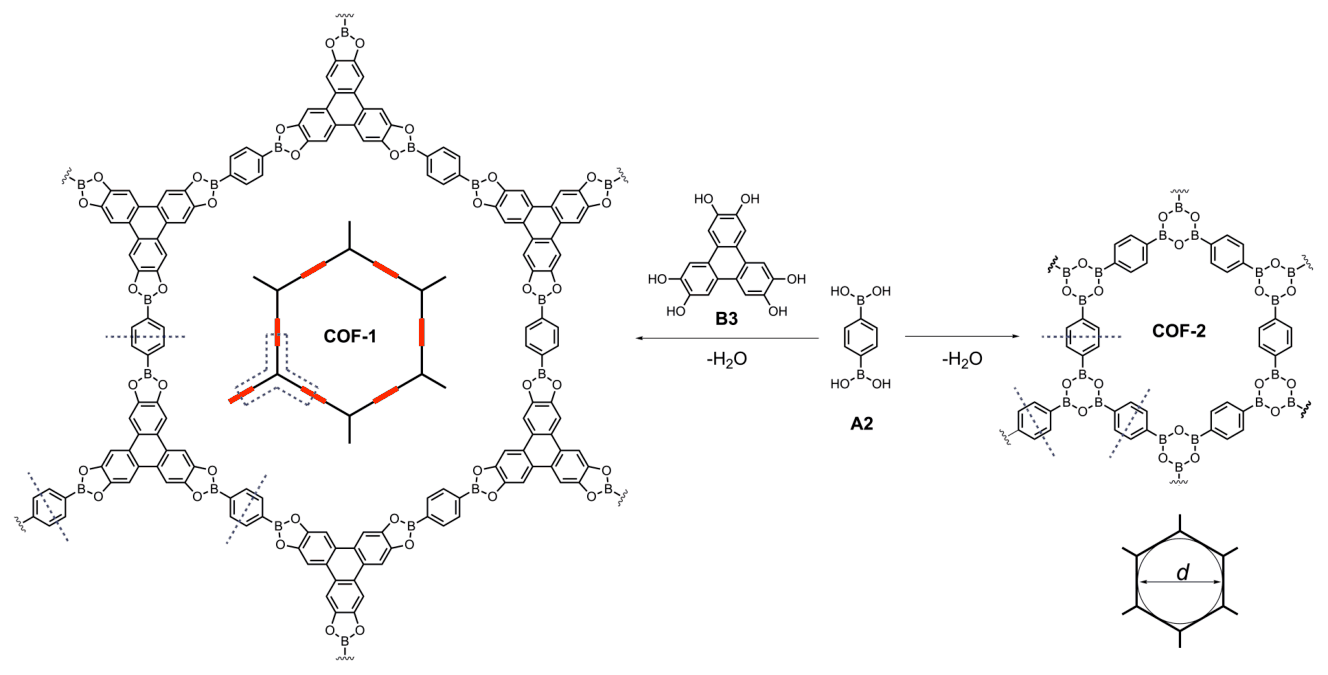
3.1 Determine the empirical formula of COF-1 and calculate the mass percentage (%, to two decimal places) of carbon in COF-1. 2.0 pt
3.2 Calculate the internal diameter, \(d\), in Å, of the honeycomb for COF-2, with the following assumptions: 3.0 pt
- \(\ce{C-C}/\ce{C=C}\) (arenes) = 1.39 Å
- \(\ce{C-B}\) = 1.56 Å
- \(\ce{B-O}\) = 1.38 Å
- Note, the diameter of a circle, \(d\), inscribed inside a hexagon, is given by \(d=\sqrt{3}a\), where \(a\) is the side length of the hexagon.
- Neglect the width of the linkers.
The structures shown below can form 2D and 3D COFs. For this question consider only formation of COFs with boronate esters, imines, and \(\ce{C=C}\) bonds through condensation reactions. A–E represent compound classes with different functional groups.
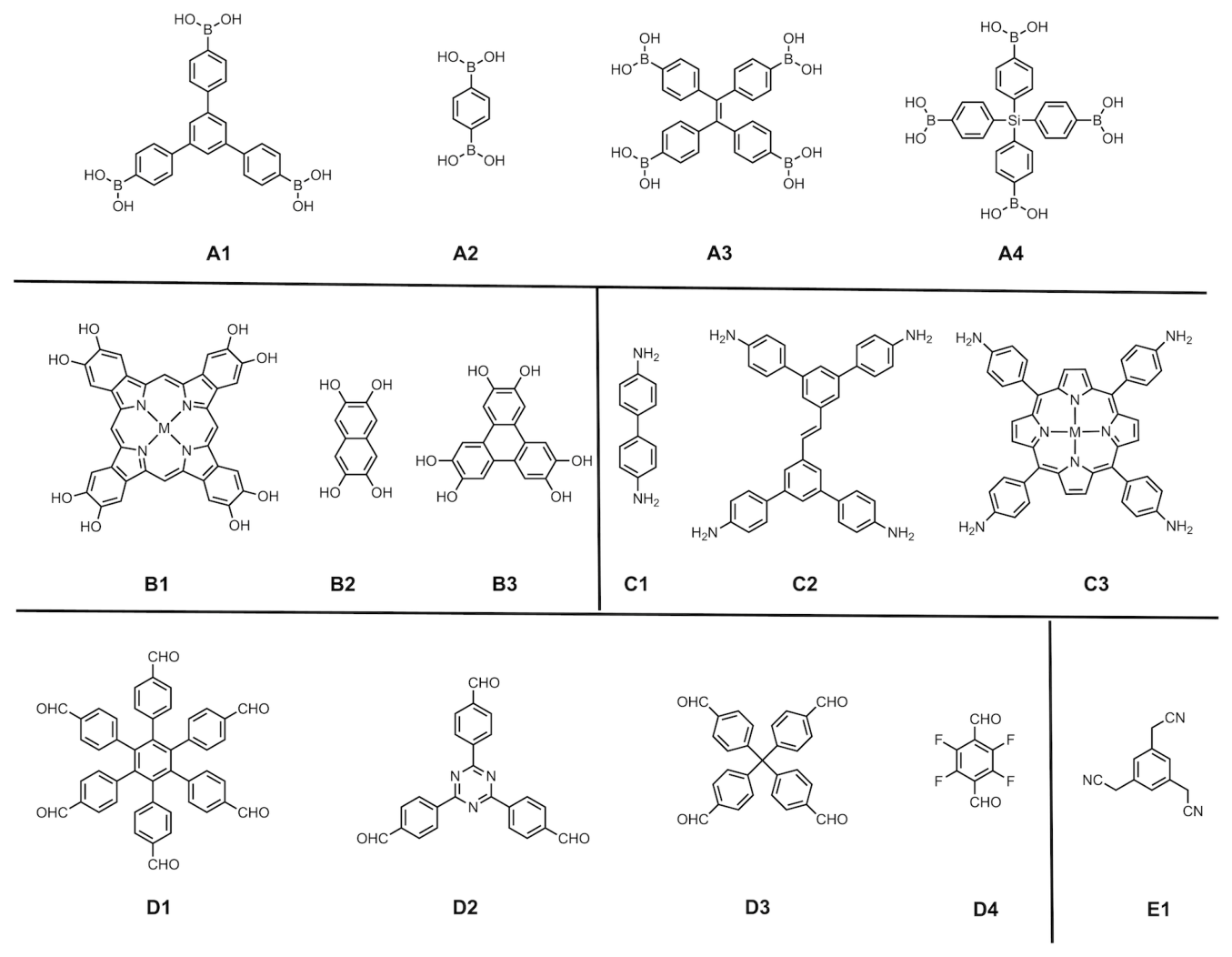

Tetragonal means Tetragonal, Hexagonal means Hexagonal, Trigonal means Trigonal, Kagome means Kagome, Tetrahedral means Tetrahedral.
3.3 Fill all the table cells with either new examples of monomer combinations that give the topologies shown above or with “XXX” if you are certain that no additional combinations satisfy that topology. Both the combinations and the “XXX” entries will be graded. Incorrect answers (both combinations and “XXX” entries) will be penalised. Blank table cells will not be graded. 23.0 pt
| Tetragonal 1 | Tetragonal 2 | Hexagonal 1 | Hexagonal 2 | Trigonal | Kagome | Tetrahedral |
|---|---|---|---|---|---|---|
| ■ | ■ | A2 + B3 | E1 + D2 | ■ | C2 + D4 | ■ |
Whilst imine-based COFs are easily synthesised, they are also vulnerable to hydrolysis under strongly acidic and basic conditions. The addition of hydroxy groups to the aldehyde or amine monomers can overcome this. IR spectrum of COF-3 contained stretches corresponding to the imine functional group, but COF-4 did not. COF-4 contains a different type of \(\ce{C=N}\) bonds, and elemental analysis revealed a loss of six additional hydrogen atoms per repeat unit relative to COF-3 as the only change. COF-5 irreversibly isomerises to COF-6, which did not contain imine stretches in its IR spectrum.


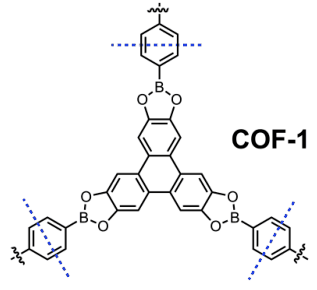
3.4 Draw the repeat units for COFs 3–6. Indicate the edges of each repeat unit with a dashed line as shown for COF-1 below. 12.0 pt
Macrocycle X was synthesised by post-synthetic modification of COF-7 (C2 + D4) followed by degradation.
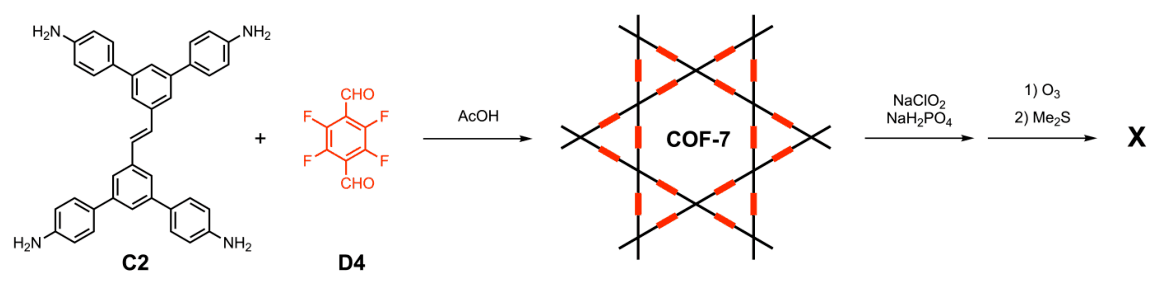
3.5 Draw the smallest repeat unit of macrocycle X. 6.0 pt
π-π interactions result in different stacking modes of COF layers, some of which are shown below.
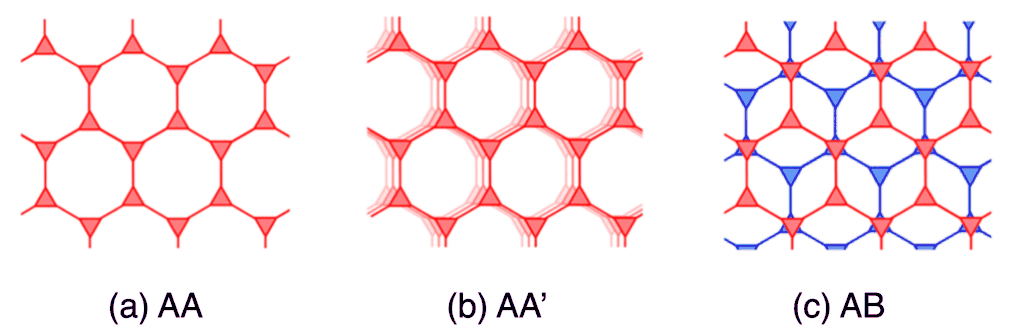
Depending on stacking geometry, the interaction energy can be different as shown below.
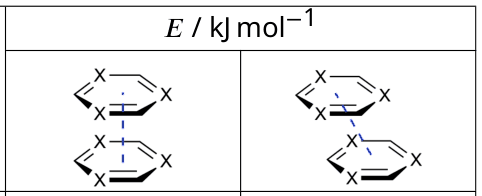
| Interaction geometry | \(E/\mathrm{kJ\,mol^{-1}}\) | \(E/\mathrm{kJ\,mol^{-1}}\) |
|---|---|---|
| benzene (\(\ce{X = CH}\)) – benzene (b-b) | −7.9 | −12.6 |
| benzene-triazine (\(\ce{X = N}\)) (b-t) | −49.8 | −55.6 |
| triazine–triazine (t-t) | −6.7 | −16.7 |
COF-8, synthesised from (E1 + D2), is notable for its remarkable stability. The AA′ slightly shifted mode of a COF-8 bilayer has a π-π stacking interaction energy of \(-67.1\ \mathrm{kJ\,mol^{-1}}\) between two layers of one repeat unit.
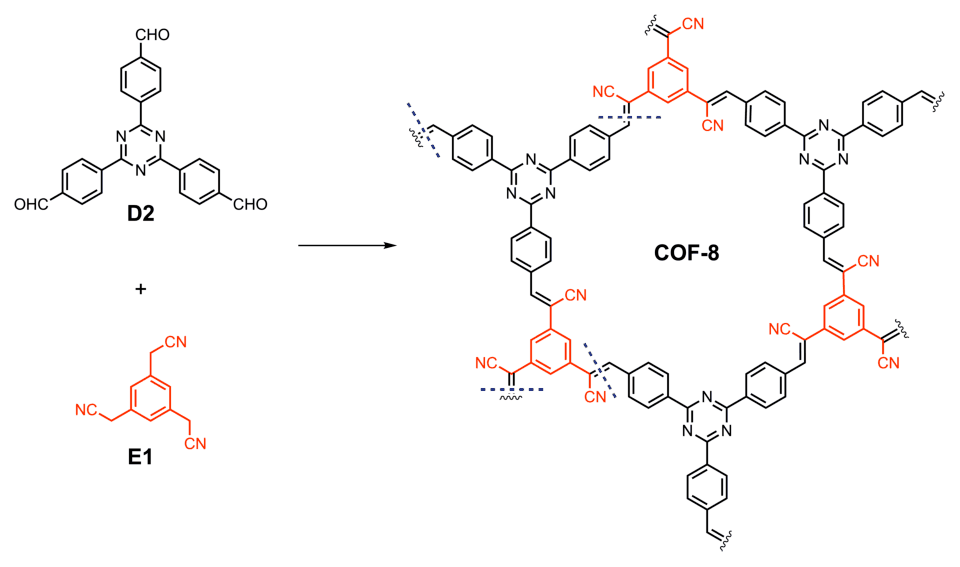
3.6 Calculate the π-π stacking energy between two layers of one repeat unit of COF-8, for the AA, AB and AB′ arrangements. Assume π-π stacking happens only between aromatic units. 12.0 pt
COF-9, obtained from COF-8, absorbs \(\ce{UO2^{2+}}\) ions and loses its fluorescence. In an experiment, a suspension of 5.000 mg COF-9 in \(19.90\ \mathrm{mg\,dm^{-3}}\) \(\ce{UO2^{2+}}\) solution (200.0 mL) was filtered after equilibrium was reached. The final concentration of \(\ce{UO2^{2+}}\) was \(9.225\ \mathrm{mg\,dm^{-3}}\).
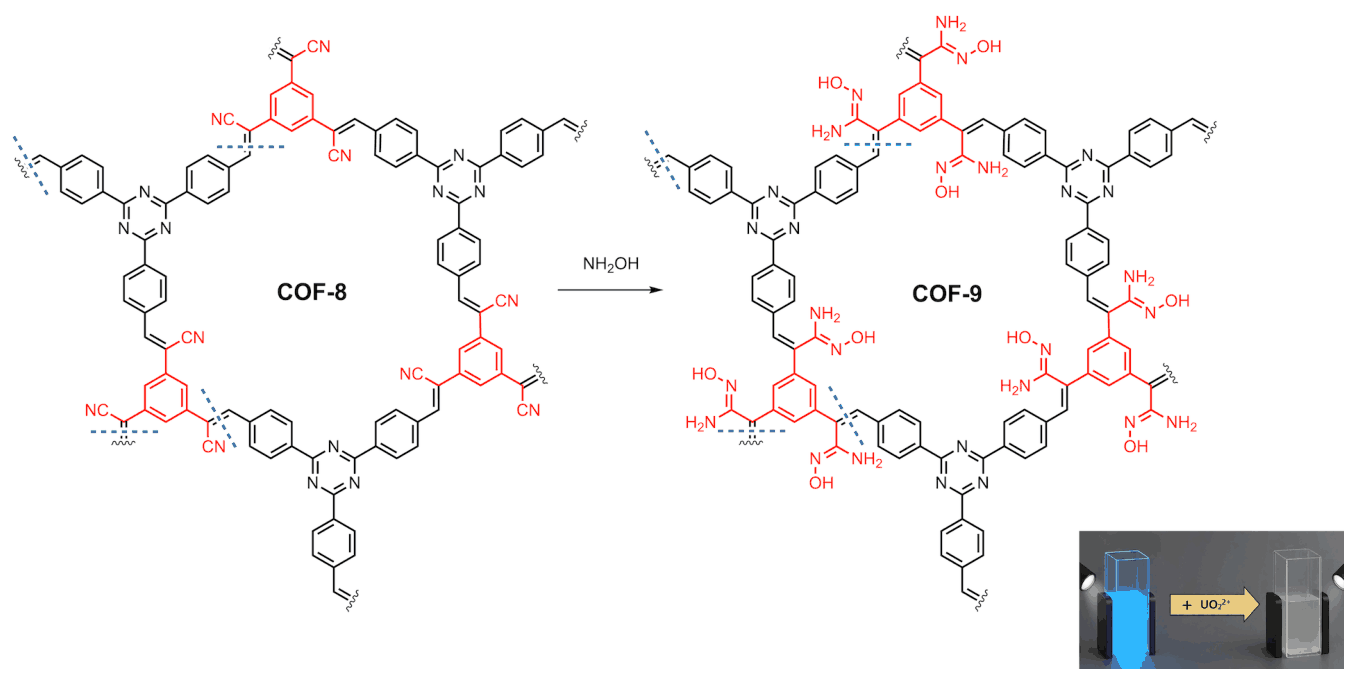
3.7 Calculate the equilibrium absorption capacity at a given temperature (\(q_e\)) in \(\mathrm{mg\,g^{-1}}\) of COF-9. Indicate the number of \(\ce{UO2^{2+}}\) ions absorbed per pore. Assume that all uranium exists as \(\ce{UO2^{2+}}\) ions. 5.0 pt
Periodic Table of Elements
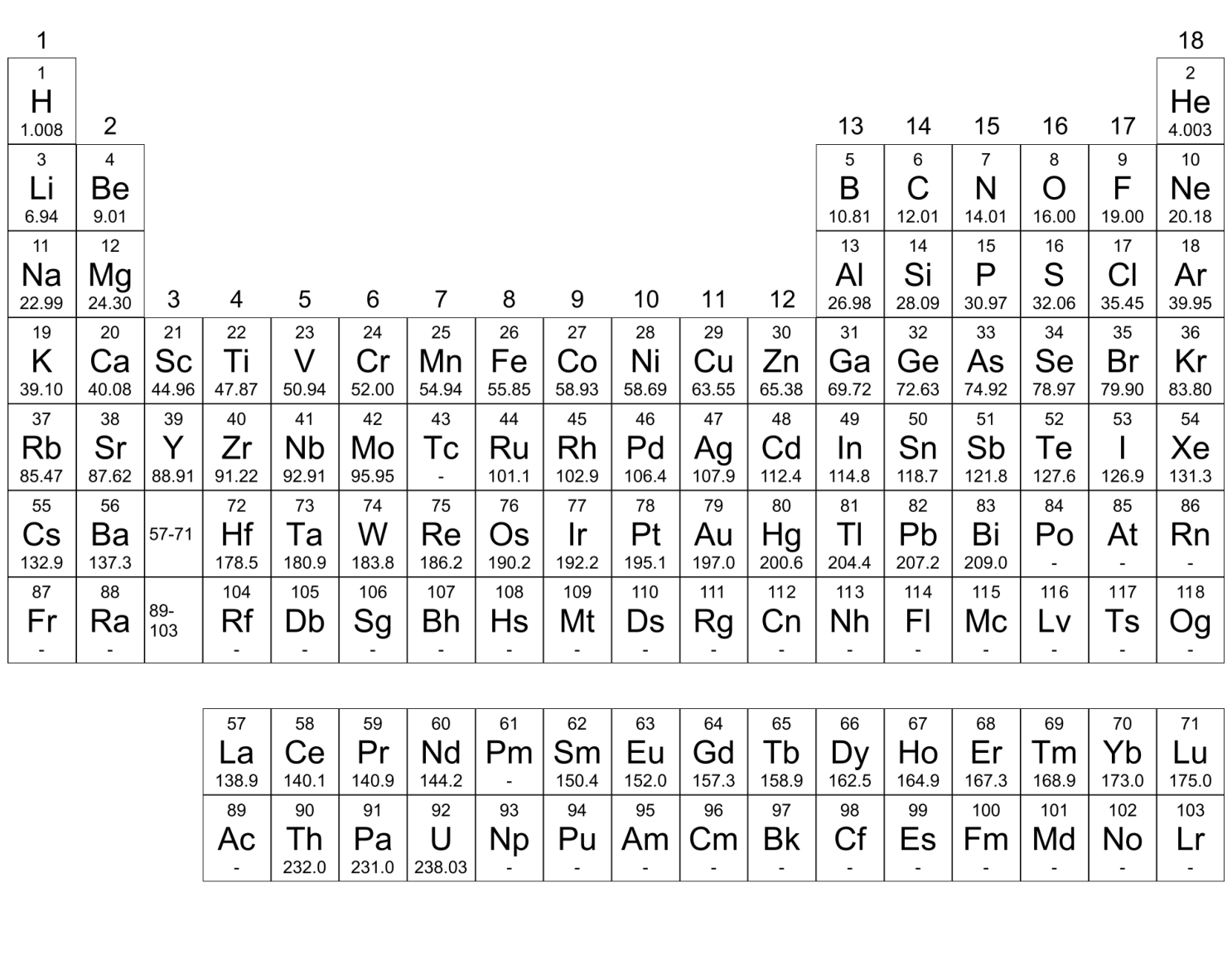
Official English text of the problem.
Answers
- 3.1: Empirical formula \(\boxed{\ce{C9H4BO2}}\); carbon mass percentage \(\boxed{69.77\%}\).
- 3.2: \(\boxed{d=15.00\ \text{Å}}\).
- 3.3: Fill the two empty rows as follows:
| Tetragonal 1 | Tetragonal 2 | Hexagonal 1 | Hexagonal 2 | Trigonal | Kagome | Tetrahedral |
|---|---|---|---|---|---|---|
| A2 + B1 | XXX | A1 + B2 | A1 + B3 | C1 + D1 | A3 + B2 | A4 + B2 |
| C3 + D4 | XXX | C1 + D2 | XXX | XXX | XXX | C1 + D3 |
- 3.4: COF-3: hydroxy-substituted imine framework; COF-4: benzobisoxazole framework; COF-5: enol–imine framework; COF-6: β-ketoenamine framework. Their precise connectivity, SMILES fragments and repeat boundaries are given below.
- 3.5: The smallest repeat contains one 3,5-bis(4-aminophenyl)benzaldehyde-derived unit and one tetrafluoroterephthaloyl unit, joined by amide bonds. Its formula is \(\ce{C27H14F4N2O3}\), and its attachment-point SMILES is
[*:1]Nc1ccc(cc1)-c1cc(C=O)cc(c1)-c1ccc(cc1)NC(=O)c1c(F)c(F)c(c(F)c1F)C(=O)[*:2]. - 3.6: \(\boxed{E_{\mathrm{AA}}=-38.3,\quad E_{\mathrm{AB}}=-49.8,\quad E_{\mathrm{AB'}}=-55.6\ \mathrm{kJ\,mol^{-1}}}\), per pair of repeat units.
- 3.7: \(\boxed{q_e=427.0\ \mathrm{mg\,g^{-1}}}\); \(\boxed{\text{approximately one }\ce{UO2^{2+}}\text{ ion per pore}}\).
Solution
In the structural SMILES below, [*] denotes an attachment to the rest of the framework. These are finite structural fragments: ordinary SMILES does not itself specify an infinite periodic framework or its dashed repeat boundaries. Water, eliminated in the condensations, has SMILES O.
3.1 — Composition of COF-1
The monomers are:
- A2, benzene-1,4-diboronic acid, \(\ce{C6H8B2O4}\):
OB(O)c1ccc(B(O)O)cc1. - B3, triphenylene-2,3,6,7,10,11-hexol, \(\ce{C18H12O6}\):
Oc1cc2c(cc1O)c1cc(O)c(O)cc1c1cc(O)c(O)cc21.
Each B3 molecule contains three catechol groups, while A2 contains two boronic acid groups. Thus their stoichiometric ratio is
\[ n(\mathrm{A2}):n(\mathrm{B3})=3:2. \]
Formation of each cyclic boronate ester eliminates two water molecules. Six such linkages therefore give
\[ \ce{3C6H8B2O4 + 2C18H12O6 -> C54H24B6O12 + 12H2O}. \]
The product formula here denotes a framework composition, rather than an isolated molecule. Dividing its subscripts by six gives
\[ \boxed{\ce{C9H4BO2}}. \]
Using the supplied atomic masses,
\[ M=9(12.01)+4(1.008)+10.81+2(16.00) =154.932\ \mathrm{g\,mol^{-1}}. \]
Consequently,
\[ w_{\mathrm C} =\frac{9(12.01)}{154.932}\times100\% =\boxed{69.77\%}. \]
3.2 — Internal diameter of COF-2
COF-2 contains boroxine nodes, whose substituted ring can be represented by [*]B1OB([*])OB([*])O1. Their formation follows the balanced condensation
\[ \ce{3R-B(OH)2 -> (RBO)3 + 3H2O}. \]
Treating the boroxine ring as the regular hexagon drawn, its centre-to-boron distance equals its side length, \(1.38\ \text{Å}\). The separation between opposite carbon atoms of a regular benzene ring is twice its side length.
The distance between two neighbouring boroxine centres—the honeycomb side length—is therefore
\[ \begin{aligned} a &=2r_{\mathrm{B-O}}+2r_{\mathrm{C-B}}+2r_{\mathrm{C-C}}\\ &=2(1.38)+2(1.56)+2(1.39)\\ &=8.66\ \text{Å}. \end{aligned} \]
Neglecting linker width as instructed,
\[ d=\sqrt3\,a=\sqrt3(8.66) =\boxed{15.00\ \text{Å}}. \]
3.3 — Monomer combinations and topology
The allowed complementary functional groups are:
| Combination | Linkage formed | Condensation stoichiometry |
|---|---|---|
| A + B | Cyclic boronate ester | One boronic acid group + one catechol group eliminates two water molecules |
| C + D | Imine | One amine + one aldehyde eliminates one water molecule |
| E + D | Cyano-substituted alkene | One activated methylene group + one aldehyde eliminates one water molecule |
The latter two reactions can be written
\[ \ce{R-CHO + H2N-R' -> R-CH=N-R' + H2O}, \]
\[ \ce{R-CHO + R'-CH2-CN -> R-CH=C(CN)-R' + H2O}. \]
The idealized connection geometries in the supplied drawings are:
| Connection geometry | Monomers |
|---|---|
| Linear, two connections | A2, B2, C1, D4 |
| Trigonal, three connections | A1, B3, D2, E1 |
| Square, four connections | B1, C3 |
| Four connections suited to the Kagome arrangement | A3, C2 |
| Planar, six connections | D1 |
| Tetrahedral, four connections | A4, D3 |
These give the completed table:
| Tetragonal 1 | Tetragonal 2 | Hexagonal 1 | Hexagonal 2 | Trigonal | Kagome | Tetrahedral |
|---|---|---|---|---|---|---|
| ■ | ■ | A2 + B3 | E1 + D2 | ■ | C2 + D4 | ■ |
| A2 + B1 | XXX | A1 + B2 | A1 + B3 | C1 + D1 | A3 + B2 | A4 + B2 |
| C3 + D4 | XXX | C1 + D2 | XXX | XXX | XXX | C1 + D3 |
The assignments follow directly from the geometry:
- Tetragonal 1: square nodes connected by linear linkers.
- Tetragonal 2: requires complementary square nodes of both colours. None of the supplied pairs meets this requirement: A3 has the Kagome-type connection geometry, while D3 is tetrahedral.
- Hexagonal 1: trigonal nodes connected by linear linkers.
- Hexagonal 2: alternating complementary trigonal nodes.
- Trigonal: six-connected D1 nodes joined through linear C1 linkers.
- Kagome: A3 and C2 supply the appropriate four-connected geometry; their compatible linear partners are B2 and D4, respectively.
- Tetrahedral: tetrahedral A4 or D3 nodes joined through compatible linear linkers.
E1 + D4 is another possible Hexagonal 1 combination; the two new examples entered above already fill its available cells.
For completeness, the names and SMILES identifying the monomers used in these assignments are listed below. A2 and B3 were specified in 3.1.
| Label | Name | SMILES |
|---|---|---|
| A1 | 1,3,5-Tris(4-boronophenyl)benzene | c1(-c2ccc(B(O)O)cc2)cc(-c2ccc(B(O)O)cc2)cc(-c2ccc(B(O)O)cc2)c1 |
| A3 | 1,1,2,2-Tetrakis(4-boronophenyl)ethene | C(=C(c1ccc(B(O)O)cc1)c1ccc(B(O)O)cc1)(c1ccc(B(O)O)cc1)c1ccc(B(O)O)cc1 |
| A4 | Tetrakis(4-boronophenyl)silane | [Si](c1ccc(B(O)O)cc1)(c1ccc(B(O)O)cc1)(c1ccc(B(O)O)cc1)c1ccc(B(O)O)cc1 |
| B1 | Metal phthalocyanine bearing four peripheral catechol groups | Free-base ligand: Oc1cc2c(cc1O)-c1nc-2nc2[nH]c(nc3nc(nc4[nH]c(n1)c1cc(O)c(O)cc41)-c1cc(O)c(O)cc1-3)c1cc(O)c(O)cc21 |
| B2 | Naphthalene-2,3,6,7-tetrol | Oc1cc2cc(O)c(O)cc2cc1O |
| C1 | Biphenyl-4,4′-diamine, or benzidine | Nc1ccc(-c2ccc(N)cc2)cc1 |
| C2 | \((E)\)-1,2-Bis[3,5-bis(4-aminophenyl)phenyl]ethene | Nc1ccc(-c2cc(-c3ccc(N)cc3)cc(/C=C/c3cc(-c4ccc(N)cc4)cc(-c4ccc(N)cc4)c3)c2)cc1 |
| C3 | Metal meso-tetrakis(4-aminophenyl)porphyrin | Free-base ligand: Nc1ccc(-c2c3nc(c(-c4ccc(N)cc4)c4ccc([nH]4)c(-c4ccc(N)cc4)c4nc(c(-c5ccc(N)cc5)c5ccc2[nH]5)C=C4)C=C3)cc1 |
| D1 | Hexakis(4-formylphenyl)benzene | c1(-c2ccc(C=O)cc2)c(-c2ccc(C=O)cc2)c(-c2ccc(C=O)cc2)c(-c2ccc(C=O)cc2)c(-c2ccc(C=O)cc2)c1-c1ccc(C=O)cc1 |
| D2 | 2,4,6-Tris(4-formylphenyl)-1,3,5-triazine | O=Cc1ccc(-c2nc(-c3ccc(C=O)cc3)nc(-c3ccc(C=O)cc3)n2)cc1 |
| D3 | Tetrakis(4-formylphenyl)methane | C(c1ccc(C=O)cc1)(c1ccc(C=O)cc1)(c1ccc(C=O)cc1)c1ccc(C=O)cc1 |
| D4 | 2,3,5,6-Tetrafluorobenzene-1,4-dicarbaldehyde | O=Cc1c(F)c(F)c(C=O)c(F)c1F |
| E1 | 1,3,5-Tris(cyanomethyl)benzene | N#CCc1cc(CC#N)cc(CC#N)c1 |
For B1 and C3, the figure does not identify the metal \(M\). The listed SMILES therefore describe their free-base ligands. In the depicted metal complexes, the two inner N–H protons are replaced on metallation, and \(M\) coordinates the four inward-facing nitrogen atoms in an approximately planar \(\ce{N4}\) pocket.
3.4 — Repeat units of COFs 3–6
The additional starting compounds are:
| Name | Formula | SMILES |
|---|---|---|
| Benzene-1,3,5-tricarbaldehyde | \(\ce{C9H6O3}\) | O=Cc1cc(C=O)cc(C=O)c1 |
| 2,5-Diaminobenzene-1,4-diol | \(\ce{C6H8N2O2}\) | Nc1c(O)cc(N)c(O)c1 |
| 2,4,6-Trihydroxybenzene-1,3,5-tricarbaldehyde | \(\ce{C9H6O6}\) | O=Cc1c(O)c(C=O)c(O)c(C=O)c1O |
| Benzene-1,4-diamine | \(\ce{C6H8N2}\) | Nc1ccc(N)cc1 |
For each requested repeat drawing, place one complete three-connected central node in the middle, draw its three attached linkers, and draw a dashed boundary across the middle of each linker’s central benzene ring. Thus each repeat contains one node and three half-linkers, just as in the supplied COF-1 example.
COF-3: hydroxy-substituted imine framework
Condensation produces three imine connections per central benzene node:
\[ \ce{2C9H6O3 + 3C6H8N2O2 -> 2(C18H12N3O3)_{$repeat$} + 6H2O}. \]
Each complete linker between central benzene nodes is
\[ \ce{Ar-CH=N-C6H2(OH)2-N=CH-Ar}. \]
The two imine nitrogen substituents are para to each other on the linker ring; each retained hydroxy group is ortho to one imine nitrogen substituent.
- Three-connected benzene node:
[*:1]c1cc([*:2])cc([*:3])c1 - Hydroxy-substituted bis(imine) linker:
[*:1]/C=N/c1c(O)cc(/N=C/[*:2])c(O)c1
The slashes show the extended imine configuration. The repeat composition is \(\ce{C18H12N3O3}\).
COF-4: benzobisoxazole framework
Each ortho-hydroxy imine undergoes oxidative cyclization. The phenolic oxygen bonds to the neighbouring imine carbon, producing a fused five-membered 1,3-oxazole ring.
At each site, the imine-carbon hydrogen and the phenolic hydrogen are lost overall. Three sites per repeat therefore remove six hydrogen atoms:
\[ \ce{(C18H12N3O3)_{$repeat$} + 3[O] -> (C18H6N3O3)_{$repeat$} + 3H2O}. \]
Here \(\ce{[O]}\) denotes an oxidizing oxygen equivalent.
The central three-connected benzene node remains unchanged. Each linker becomes a benzene ring fused to an oxazole on each of two opposite edges:
- Benzene-fused bis(1,3-oxazole) linker:
[*:1]c1nc2cc3oc([*:2])nc3cc2o1
Both external attachment points are at the carbon atoms between O and N in the respective oxazole rings.
This accounts for all the observations: no oxygen or nitrogen is lost, exactly six hydrogens disappear per repeat, and the remaining \(\ce{C=N}\) bonds belong to aromatic oxazole rings rather than ordinary imine groups.
COF-5: enol–imine framework
Initial condensation retains the three phenolic hydroxy groups of the aldehyde monomer:
\[ \ce{2C9H6O6 + 3C6H8N2 -> 2(C18H12N3O3)_{$repeat$} + 6H2O}. \]
Draw a central benzene ring with alternating \(\ce{OH}\) groups and \(\ce{-CH=N-}\) arms. The nitrogen atoms connect through para-phenylene linkers to adjacent nodes.
- Hydroxylated three-connected node:
Oc1c([*:1])c(O)c([*:2])c(O)c1[*:3] - Para-phenylene bis(imine) linker:
[*:1]/C=N/c1ccc(/N=C/[*:2])cc1
The repeat formula is again \(\ce{C18H12N3O3}\).
COF-6: β-ketoenamine framework
COF-5 undergoes proton transfer and bond rearrangement:
\[ \ce{Ar-C(OH)=C(-CH=N-R)- -> Ar-C(=O)-C(=CH-NH-R)-}. \]
This is a tautomerization, so no atoms are added or removed:
\[ \ce{COF-5 -> COF-6}. \]
For the repeat drawing:
- Replace the three phenolic \(\ce{C-OH}\) groups by three \(\ce{C=O}\) groups.
- Replace each exocyclic \(\ce{-CH=N-Ar}\) connection by \(\ce{=CH-NH-Ar}\).
- Draw the central six-membered ring with single bonds between its ring atoms.
Thus the central motif is 2,4,6-tris(arylaminomethylene)cyclohexane-1,3,5-trione:
- Ketoenamine node fragment:
O=C1C(=CN[*:1])C(=O)C(=CN[*:2])C(=O)C1=CN[*:3] - Connecting para-phenylene group:
[*:1]c1ccc([*:2])cc1
The repeat remains \(\ce{C18H12N3O3}\). Its nitrogen atoms are now enamine \(\ce{NH}\) atoms, explaining the absence of ordinary imine stretches.
3.5 — Smallest repeat unit of macrocycle X
There are two successive structural changes.
First, the imines of COF-7 are oxidized to amides:
\[ \ce{R-CH=N-R' + [O] -> R-C(=O)-NH-R'}. \]
Consequently, every carbonyl carbon in these new amides comes from a D4 aldehyde, and every amide nitrogen comes from C2. The correct linkage orientation is therefore
\[ \ce{(C2)-Ar-NH-C(=O)-C6F4-C(=O)-NH-Ar-(C2)}. \]
The reagents are sodium chlorite, [Na+].[O-]Cl=O, and sodium dihydrogen phosphate, [Na+].[O-]P(=O)(O)O. Acetic acid, CC(=O)O, catalyses the preceding imine formation.
Second, reductive ozonolysis cleaves the central alkene of C2:
\[ \ce{Ar-CH=CH-Ar + O3 + (CH3)2S -> 2Ar-CHO + (CH3)2SO}. \]
Here ozone is [O-][O+]=O, dimethyl sulfide is CSC, and dimethyl sulfoxide is CS(C)=O.
Each C2 half therefore becomes a 3,5-bis(4-aminophenyl)benzaldehyde-derived fragment, with its amino groups already incorporated into amides. The corresponding free diamine is 3,5-bis(4-aminophenyl)benzaldehyde, O=Cc1cc(-c2ccc(N)cc2)cc(-c2ccc(N)cc2)c1.
The smallest repeat of X consists of:
- one central benzene ring bearing a formyl group and two aryl substituents at alternating positions;
- a para-phenylene group on each aryl arm;
- two amide connections;
- one tetrafluorinated benzene ring bearing its two carbonyl groups para to each other.
Its unambiguous repeat-fragment SMILES is
[*:1]Nc1ccc(cc1)-c1cc(C=O)cc(c1)-c1ccc(cc1)NC(=O)c1c(F)c(F)c(c(F)c1F)C(=O)[*:2]
Join the terminal carbonyl carbon of one repeat to the initial nitrogen of the next. The surviving hexagonal circuit contains six such repeats, giving the cyclic hexamer X, \(\ce{C162H84F24N12O18}\). Its full molecular SMILES is
N1c2ccc(cc2)-c2cc(C=O)cc(c2)-c2ccc(cc2)NC(=O)c2c(F)c(F)c(c(F)c2F)C(=O)Nc2ccc(cc2)-c2cc(C=O)cc(c2)-c2ccc(cc2)NC(=O)c2c(F)c(F)c(c(F)c2F)C(=O)Nc2ccc(cc2)-c2cc(C=O)cc(c2)-c2ccc(cc2)NC(=O)c2c(F)c(F)c(c(F)c2F)C(=O)Nc2ccc(cc2)-c2cc(C=O)cc(c2)-c2ccc(cc2)NC(=O)c2c(F)c(F)c(c(F)c2F)C(=O)Nc2ccc(cc2)-c2cc(C=O)cc(c2)-c2ccc(cc2)NC(=O)c2c(F)c(F)c(c(F)c2F)C(=O)Nc2ccc(cc2)-c2cc(C=O)cc(c2)-c2ccc(cc2)NC(=O)c2c(F)c(F)c(c(F)c2F)C(=O)1
This specifies connectivity; it does not assert a unique three-dimensional conformation of the macrocycle.
3.6 — Stacking energies of COF-8
One primitive repeat contains one D2-derived node and one E1-derived node. Its aromatic rings are:
- three peripheral benzene rings from D2;
- one central 1,3,5-triazine ring from D2;
- one benzene ring from E1.
Thus there are four benzene rings and one triazine ring per repeat. Benzene is c1ccccc1; 1,3,5-triazine is c1ncncn1.
The given AA′ energy verifies this count:
\[ 4(-12.6)+(-16.7) =-67.1\ \mathrm{kJ\,mol^{-1}}. \]
For AA, all corresponding rings are directly superposed:
\[ E_{\mathrm{AA}} =4E_{\mathrm{b-b}}+E_{\mathrm{t-t}} =4(-7.9)+(-6.7) =\boxed{-38.3\ \mathrm{kJ\,mol^{-1}}}. \]
For AB, the displacement places an E1-derived benzene node over a D2-derived triazine node. There is one such aromatic contact per primitive repeat. The other node lies over a pore, and the peripheral phenylene rings are not mutually registered.
Therefore,
\[ E_{\mathrm{AB}} =E_{\mathrm{b-t}} =\boxed{-49.8\ \mathrm{kJ\,mol^{-1}}}. \]
For the slightly displaced AB′ arrangement, use the displaced benzene–triazine interaction:
\[ E_{\mathrm{AB'}} =\boxed{-55.6\ \mathrm{kJ\,mol^{-1}}}. \]
The contact accounting is:
| Arrangement | b-b pairs | b-t pairs | t-t pairs | Energy / \(\mathrm{kJ\,mol^{-1}}\) |
|---|---|---|---|---|
| AA | 4 | 0 | 1 | −38.3 |
| AA′, given check | 4 | 0 | 1 | −67.1 |
| AB | 0 | 1 | 0 | −49.8 |
| AB′ | 0 | 1 | 0 | −55.6 |
Each aromatic pair is counted once, despite involving two layers.
3.7 — Uptake capacity and uranyl ions per pore
The absorbed uranyl mass is
\[ \begin{aligned} m_{\mathrm{absorbed}} &=(C_0-C_e)V\\ &=(19.90-9.225)\ \mathrm{mg\,dm^{-3}} \times0.2000\ \mathrm{dm^3}\\ &=2.135\ \mathrm{mg}. \end{aligned} \]
Hence
\[ q_e=\frac{2.135\ \mathrm{mg}}{0.005000\ \mathrm g} =\boxed{427.0\ \mathrm{mg\,g^{-1}}}. \]
To determine the number of ions per pore, first find the framework mass associated with one pore.
D2 and E1 have formulas \(\ce{C24H15N3O3}\) and \(\ce{C12H9N3}\), respectively. Three condensations per repeat give
\[ \ce{C24H15N3O3 + C12H9N3 -> (C36H18N6)_{$repeat$} + 3H2O}. \]
Hydroxylamine, NO, converts each nitrile into an amidoxime, represented by [*]C(=NO)N:
\[ \ce{R-C#N + NH2OH -> R-C(=N-OH)-NH2}. \]
There are three nitriles per repeat, so
\[ \ce{(C36H18N6)_{$repeat$} + 3NH2OH -> (C36H27N9O3)_{$repeat$}}. \]
Therefore,
\[ \begin{aligned} M_{\mathrm{COF-9,repeat}} &=36(12.01)+27(1.008)+9(14.01)+3(16.00)\\ &=633.666\ \mathrm{g\,mol^{-1}}. \end{aligned} \]
A honeycomb pore has six vertices, each shared among three pores. It therefore corresponds to two complete nodes: one D2-derived node and one E1-derived node. Thus one primitive repeat corresponds to one pore.
The uranyl ion, O=[U+2]=O, has a linear \(\ce{O-U-O}\) unit and molar mass
\[ M_{\ce{UO2^{2+}}}=238.03+2(16.00) =270.03\ \mathrm{g\,mol^{-1}}. \]
The amounts in the experiment are
\[ n_{\ce{UO2^{2+}}} =\frac{2.135\times10^{-3}}{270.03} =7.907\times10^{-6}\ \mathrm{mol}, \]
\[ n_{\mathrm{pores}} =\frac{5.000\times10^{-3}}{633.666} =7.891\times10^{-6}\ \mathrm{mol}. \]
Their ratio is
\[ \frac{n_{\ce{UO2^{2+}}}}{n_{\mathrm{pores}}} =1.002 \approx\boxed{1\ \text{uranyl ion per pore}}. \]
The solution was checked against the official solution.
IChO 2026 · Theorieaufgabe 3
Einblick in die retikuläre Chemie
T3. Einblick in die retikuläre Chemie
7%
| 3.1 | 3.2 | 3.3 | 3.4 | 3.5 | 3.6 | 3.7 | \(\sum\) |
|---|---|---|---|---|---|---|---|
| 2 | 3 | 23 | 12 | 6 | 12 | 5 | 63 |
Kovalente organische Gerüstverbindungen (COFs) sind eine Klasse von Polymeren, die durch Reaktionen zwischen organischen Vorstufen zwei- oder dreidimensionale Strukturen bilden, wobei kovalente Bindungen entstehen und poröse, kristalline Materialien erhalten werden. Zwei Beispiele für wabenförmige 2D-COFs, die durch Boronsäureester- und Boroxinringe gebildet werden (Wiederholungseinheiten sind durch gestrichelte Linien gekennzeichnet), sind in der folgenden Abbildung dargestellt.
Die schwarzen und roten dicken Linien stellen in allen Abbildungen der COF-Topologien unterschiedliche Bausteine dar.
3.1 Bestimmen Sie die Verhältnisformel von COF-1 und berechnen Sie den Massenanteil (in %, auf zwei Dezimalstellen) von Kohlenstoff in COF-1. 2.0 Pkt.
3.2 Berechnen Sie den Innendurchmesser \(d\) der Wabe von COF-2 in Å unter den folgenden Annahmen: 3.0 Pkt.
- \(\ce{C-C}/\ce{C=C}\) (Arene) = 1.39 Å
- \(\ce{C-B}\) = 1.56 Å
- \(\ce{B-O}\) = 1.38 Å
- Beachten Sie, dass der Durchmesser \(d\) eines einem Sechseck einbeschriebenen Kreises durch \(d=\sqrt{3}a\) gegeben ist, wobei \(a\) die Seitenlänge des Sechsecks ist.
- Vernachlässigen Sie die Breite der Linker.
Die unten gezeigten Strukturen können 2D- und 3D-COFs bilden. Berücksichtigen Sie bei dieser Aufgabe nur die Bildung von COFs mit Boronsäureestern, Iminen und \(\ce{C=C}\)-Bindungen durch Kondensationsreaktionen. A–E stehen für Verbindungsklassen mit unterschiedlichen funktionellen Gruppen.
Tetragonal bedeutet tetragonal, Hexagonal bedeutet hexagonal, Trigonal bedeutet trigonal, Kagome bedeutet Kagome, Tetrahedral bedeutet tetraedrisch.
3.3 Füllen Sie alle Tabellenfelder entweder mit weiteren Beispielen für Monomerkombinationen, die die oben gezeigten Topologien ergeben, oder mit „XXX“, wenn Sie sicher sind, dass keine weiteren Kombinationen diese Topologie ergeben. Sowohl die Kombinationen als auch die „XXX“-Einträge werden bewertet. Für falsche Antworten (sowohl Kombinationen als auch „XXX“-Einträge) werden Punkte abgezogen. Leere Tabellenfelder werden nicht bewertet. 23.0 Pkt.
| Tetragonal 1 | Tetragonal 2 | Hexagonal 1 | Hexagonal 2 | Trigonal | Kagome | Tetraedrisch |
|---|---|---|---|---|---|---|
| ■ | ■ | A2 + B3 | E1 + D2 | ■ | C2 + D4 | ■ |
COFs auf Iminbasis lassen sich zwar leicht synthetisieren, sind jedoch unter stark sauren und basischen Bedingungen auch hydrolyseempfindlich. Durch die Einführung von Hydroxygruppen in die Aldehyd- oder Aminmonomere lässt sich dieses Problem überwinden. Das IR-Spektrum von COF-3 enthielt Banden von Streckschwingungen der funktionellen Imingruppe, das von COF-4 hingegen nicht. COF-4 enthält eine andere Art von \(\ce{C=N}\)-Bindungen, und die Elementaranalyse ergab als einzige Änderung gegenüber COF-3 den Verlust von sechs zusätzlichen Wasserstoffatomen pro Wiederholungseinheit. COF-5 isomerisiert irreversibel zu COF-6, dessen IR-Spektrum keine Imin-Streckschwingungsbanden aufwies.
3.4 Zeichnen Sie die Wiederholungseinheiten der COFs 3–6. Kennzeichnen Sie die Grenzen jeder Wiederholungseinheit durch eine gestrichelte Linie, wie unten für COF-1 gezeigt. 12.0 Pkt.
Der Makrocyclus X wurde durch postsynthetische Modifikation von COF-7 (C2 + D4) mit anschließendem Abbau synthetisiert.
3.5 Zeichnen Sie die kleinste Wiederholungseinheit des Makrocyclus X. 6.0 Pkt.
π-π-Wechselwirkungen führen zu unterschiedlichen Stapelungsanordnungen der COF-Schichten, von denen einige unten dargestellt sind.
Je nach Stapelungsgeometrie kann die Wechselwirkungsenergie unterschiedlich sein, wie unten gezeigt.
| Wechselwirkungsgeometrie | \(E/\mathrm{kJ\,mol^{-1}}\) | \(E/\mathrm{kJ\,mol^{-1}}\) |
|---|---|---|
| Benzol (\(\ce{X = CH}\)) – Benzol (b-b) | −7.9 | −12.6 |
| Benzol–Triazin (\(\ce{X = N}\)) (b-t) | −49.8 | −55.6 |
| Triazin–Triazin (t-t) | −6.7 | −16.7 |
COF-8, das aus (E1 + D2) synthetisiert wird, zeichnet sich durch seine bemerkenswerte Stabilität aus. Die leicht versetzte AA′-Anordnung einer COF-8-Doppelschicht weist zwischen zwei Schichten einer Wiederholungseinheit eine π-π-Stapelungsenergie von \(-67.1\ \mathrm{kJ\,mol^{-1}}\) auf.
3.6 Berechnen Sie die π-π-Stapelungsenergie zwischen zwei Schichten einer Wiederholungseinheit von COF-8 für die Anordnungen AA, AB und AB′. Nehmen Sie an, dass die π-π-Stapelung nur zwischen aromatischen Einheiten stattfindet. 12.0 Pkt.
COF-9, das aus COF-8 erhalten wird, nimmt \(\ce{UO2^{2+}}\)-Ionen auf und verliert seine Fluoreszenz. In einem Experiment wurde eine Suspension von 5.000 mg COF-9 in einer \(19.90\ \mathrm{mg\,dm^{-3}}\) \(\ce{UO2^{2+}}\)-Lösung (200.0 mL) nach Erreichen des Gleichgewichts filtriert. Die Endkonzentration von \(\ce{UO2^{2+}}\) betrug \(9.225\ \mathrm{mg\,dm^{-3}}\).
3.7 Berechnen Sie die Gleichgewichtsaufnahmekapazität bei einer gegebenen Temperatur (\(q_e\)) in \(\mathrm{mg\,g^{-1}}\) von COF-9. Geben Sie die Anzahl der pro Pore aufgenommenen \(\ce{UO2^{2+}}\)-Ionen an. Nehmen Sie an, dass das gesamte Uran als \(\ce{UO2^{2+}}\)-Ionen vorliegt. 5.0 Pkt.
Periodensystem der Elemente
Aufgabentext aus dem offiziellen englischen Text übersetzt.
Antworten
- 3.1: Verhältnisformel \(\boxed{\ce{C9H4BO2}}\); Kohlenstoffmassenanteil \(\boxed{69.77\%}\).
- 3.2: \(\boxed{d=15.00\ \text{Å}}\).
- 3.3: Die beiden leeren Zeilen sind wie folgt auszufüllen:
| Tetragonal 1 | Tetragonal 2 | Hexagonal 1 | Hexagonal 2 | Trigonal | Kagome | Tetraedrisch |
|---|---|---|---|---|---|---|
| A2 + B1 | XXX | A1 + B2 | A1 + B3 | C1 + D1 | A3 + B2 | A4 + B2 |
| C3 + D4 | XXX | C1 + D2 | XXX | XXX | XXX | C1 + D3 |
- 3.4: COF-3: hydroxysubstituiertes Imingerüst; COF-4: Benzobisoxazolgerüst; COF-5: Enol–Imin-Gerüst; COF-6: β-Ketoenamingerüst. Die genaue Verknüpfung, die SMILES-Fragmente und die Grenzen der Wiederholungseinheiten sind unten angegeben.
- 3.5: Die kleinste Wiederholungseinheit enthält eine von 3,5-Bis(4-aminophenyl)benzaldehyd abgeleitete Einheit und eine Tetrafluorterephthaloyleinheit, die durch Amidbindungen miteinander verbunden sind. Ihre Formel lautet \(\ce{C27H14F4N2O3}\), und ihr SMILES mit Verknüpfungspunkten ist
[*:1]Nc1ccc(cc1)-c1cc(C=O)cc(c1)-c1ccc(cc1)NC(=O)c1c(F)c(F)c(c(F)c1F)C(=O)[*:2]. - 3.6: \(\boxed{E_{\mathrm{AA}}=-38.3,\quad E_{\mathrm{AB}}=-49.8,\quad E_{\mathrm{AB'}}=-55.6\ \mathrm{kJ\,mol^{-1}}}\), pro Paar von Wiederholungseinheiten.
- 3.7: \(\boxed{q_e=427.0\ \mathrm{mg\,g^{-1}}}\); \(\boxed{\text{ungefähr ein }\ce{UO2^{2+}}\text{-Ion pro Pore}}\).
Lösung
In den folgenden Struktur-SMILES bezeichnet [*] eine Verknüpfung mit dem übrigen Gerüst. Es handelt sich um endliche Strukturfragmente: Gewöhnliche SMILES legen für sich genommen weder ein unendliches periodisches Gerüst noch dessen gestrichelte Wiederholungsgrenzen fest. Wasser, das bei den Kondensationen abgespalten wird, hat den SMILES O.
3.1 — Zusammensetzung von COF-1
Die Monomere sind:
- A2, Benzol-1,4-diboronsäure, \(\ce{C6H8B2O4}\):
OB(O)c1ccc(B(O)O)cc1. - B3, Triphenylen-2,3,6,7,10,11-hexol, \(\ce{C18H12O6}\):
Oc1cc2c(cc1O)c1cc(O)c(O)cc1c1cc(O)c(O)cc21.
Jedes B3-Molekül enthält drei Catecholgruppen, während A2 zwei Boronsäuregruppen enthält. Ihr stöchiometrisches Verhältnis ist somit
\[ n(\mathrm{A2}):n(\mathrm{B3})=3:2. \]
Bei der Bildung jedes cyclischen Boronsäureesters werden zwei Wassermoleküle abgespalten. Sechs solche Verknüpfungen ergeben daher
\[ \ce{3C6H8B2O4 + 2C18H12O6 -> C54H24B6O12 + 12H2O}. \]
Die Produktformel bezeichnet hier die Zusammensetzung eines Gerüsts und kein isoliertes Molekül. Division ihrer Indizes durch sechs ergibt
\[ \boxed{\ce{C9H4BO2}}. \]
Mit den angegebenen Atommassen erhält man
\[ M=9(12.01)+4(1.008)+10.81+2(16.00) =154.932\ \mathrm{g\,mol^{-1}}. \]
Folglich gilt
\[ w_{\mathrm C} =\frac{9(12.01)}{154.932}\times100\% =\boxed{69.77\%}. \]
3.2 — Innendurchmesser von COF-2
COF-2 enthält Boroxinknoten, deren substituierter Ring durch [*]B1OB([*])OB([*])O1 dargestellt werden kann. Ihre Bildung folgt der ausgeglichenen Kondensationsgleichung
\[ \ce{3R-B(OH)2 -> (RBO)3 + 3H2O}. \]
Betrachtet man den Boroxinring als das gezeichnete regelmäßige Sechseck, so ist sein Abstand vom Mittelpunkt zu einem Boratom gleich seiner Seitenlänge, \(1.38\ \text{Å}\). Der Abstand zwischen gegenüberliegenden Kohlenstoffatomen eines regelmäßigen Benzolrings beträgt das Doppelte seiner Seitenlänge.
Der Abstand zwischen den Mittelpunkten zweier benachbarter Boroxinringe – die Seitenlänge der Wabe – beträgt daher
\[ \begin{aligned} a &=2r_{\mathrm{B-O}}+2r_{\mathrm{C-B}}+2r_{\mathrm{C-C}}\\ &=2(1.38)+2(1.56)+2(1.39)\\ &=8.66\ \text{Å}. \end{aligned} \]
Bei Vernachlässigung der Linkerbreite gemäß der Aufgabenstellung ergibt sich
\[ d=\sqrt3\,a=\sqrt3(8.66) =\boxed{15.00\ \text{Å}}. \]
3.3 — Monomerkombinationen und Topologie
Die zulässigen komplementären funktionellen Gruppen sind:
| Kombination | Gebildete Verknüpfung | Stöchiometrie der Kondensation |
|---|---|---|
| A + B | Cyclischer Boronsäureester | Eine Boronsäuregruppe + eine Catecholgruppe spalten zwei Wassermoleküle ab |
| C + D | Imin | Ein Amin + ein Aldehyd spalten ein Wassermolekül ab |
| E + D | Cyansubstituiertes Alken | Eine aktivierte Methylengruppe + ein Aldehyd spalten ein Wassermolekül ab |
Die beiden letztgenannten Reaktionen lassen sich schreiben als
\[ \ce{R-CHO + H2N-R' -> R-CH=N-R' + H2O}, \]
\[ \ce{R-CHO + R'-CH2-CN -> R-CH=C(CN)-R' + H2O}. \]
Die idealisierten Verknüpfungsgeometrien in den vorgegebenen Zeichnungen sind:
| Verknüpfungsgeometrie | Monomere |
|---|---|
| Linear, zwei Verknüpfungen | A2, B2, C1, D4 |
| Trigonal, drei Verknüpfungen | A1, B3, D2, E1 |
| Quadratisch, vier Verknüpfungen | B1, C3 |
| Vier Verknüpfungen, die für die Kagome-Anordnung geeignet sind | A3, C2 |
| Planar, sechs Verknüpfungen | D1 |
| Tetraedrisch, vier Verknüpfungen | A4, D3 |
Daraus ergibt sich die vollständig ausgefüllte Tabelle:
| Tetragonal 1 | Tetragonal 2 | Hexagonal 1 | Hexagonal 2 | Trigonal | Kagome | Tetraedrisch |
|---|---|---|---|---|---|---|
| ■ | ■ | A2 + B3 | E1 + D2 | ■ | C2 + D4 | ■ |
| A2 + B1 | XXX | A1 + B2 | A1 + B3 | C1 + D1 | A3 + B2 | A4 + B2 |
| C3 + D4 | XXX | C1 + D2 | XXX | XXX | XXX | C1 + D3 |
Die Zuordnungen folgen unmittelbar aus der Geometrie:
- Tetragonal 1: quadratische Knoten, die durch lineare Linker verbunden sind.
- Tetragonal 2: erfordert komplementäre quadratische Knoten beider Farben. Keines der vorgegebenen Paare erfüllt diese Anforderung: A3 besitzt die Verknüpfungsgeometrie des Kagome-Typs, während D3 tetraedrisch ist.
- Hexagonal 1: trigonale Knoten, die durch lineare Linker verbunden sind.
- Hexagonal 2: alternierende komplementäre trigonale Knoten.
- Trigonal: sechsfach verknüpfte D1-Knoten, die über lineare C1-Linker verbunden sind.
- Kagome: A3 und C2 liefern die geeignete Geometrie mit vier Verknüpfungen; ihre kompatiblen linearen Partner sind B2 beziehungsweise D4.
- Tetraedrisch: tetraedrische A4- oder D3-Knoten, die über kompatible lineare Linker verbunden sind.
E1 + D4 ist eine weitere mögliche Kombination für Hexagonal 1; die beiden oben eingetragenen neuen Beispiele füllen die verfügbaren Felder bereits aus.
Der Vollständigkeit halber sind im Folgenden die Namen und SMILES zur Identifizierung der bei diesen Zuordnungen verwendeten Monomere aufgeführt. A2 und B3 wurden in 3.1 angegeben.
| Bezeichnung | Name | SMILES |
|---|---|---|
| A1 | 1,3,5-Tris(4-boronophenyl)benzol | c1(-c2ccc(B(O)O)cc2)cc(-c2ccc(B(O)O)cc2)cc(-c2ccc(B(O)O)cc2)c1 |
| A3 | 1,1,2,2-Tetrakis(4-boronophenyl)ethen | C(=C(c1ccc(B(O)O)cc1)c1ccc(B(O)O)cc1)(c1ccc(B(O)O)cc1)c1ccc(B(O)O)cc1 |
| A4 | Tetrakis(4-boronophenyl)silan | [Si](c1ccc(B(O)O)cc1)(c1ccc(B(O)O)cc1)(c1ccc(B(O)O)cc1)c1ccc(B(O)O)cc1 |
| B1 | Metallphthalocyanin mit vier peripheren Catecholgruppen | Ligand als freie Base: Oc1cc2c(cc1O)-c1nc-2nc2[nH]c(nc3nc(nc4[nH]c(n1)c1cc(O)c(O)cc41)-c1cc(O)c(O)cc1-3)c1cc(O)c(O)cc21 |
| B2 | Naphthalin-2,3,6,7-tetrol | Oc1cc2cc(O)c(O)cc2cc1O |
| C1 | Biphenyl-4,4′-diamin oder Benzidin | Nc1ccc(-c2ccc(N)cc2)cc1 |
| C2 | \((E)\)-1,2-Bis[3,5-bis(4-aminophenyl)phenyl]ethen | Nc1ccc(-c2cc(-c3ccc(N)cc3)cc(/C=C/c3cc(-c4ccc(N)cc4)cc(-c4ccc(N)cc4)c3)c2)cc1 |
| C3 | Metall-meso-tetrakis(4-aminophenyl)porphyrin | Ligand als freie Base: Nc1ccc(-c2c3nc(c(-c4ccc(N)cc4)c4ccc([nH]4)c(-c4ccc(N)cc4)c4nc(c(-c5ccc(N)cc5)c5ccc2[nH]5)C=C4)C=C3)cc1 |
| D1 | Hexakis(4-formylphenyl)benzol | c1(-c2ccc(C=O)cc2)c(-c2ccc(C=O)cc2)c(-c2ccc(C=O)cc2)c(-c2ccc(C=O)cc2)c(-c2ccc(C=O)cc2)c1-c1ccc(C=O)cc1 |
| D2 | 2,4,6-Tris(4-formylphenyl)-1,3,5-triazin | O=Cc1ccc(-c2nc(-c3ccc(C=O)cc3)nc(-c3ccc(C=O)cc3)n2)cc1 |
| D3 | Tetrakis(4-formylphenyl)methan | C(c1ccc(C=O)cc1)(c1ccc(C=O)cc1)(c1ccc(C=O)cc1)c1ccc(C=O)cc1 |
| D4 | 2,3,5,6-Tetrafluorbenzol-1,4-dicarbaldehyd | O=Cc1c(F)c(F)c(C=O)c(F)c1F |
| E1 | 1,3,5-Tris(cyanmethyl)benzol | N#CCc1cc(CC#N)cc(CC#N)c1 |
Für B1 und C3 ist das Metall \(M\) in der Abbildung nicht angegeben. Die aufgeführten SMILES beschreiben daher ihre Liganden als freie Basen. In den dargestellten Metallkomplexen werden die beiden inneren N–H-Protonen bei der Metallierung ersetzt, und \(M\) koordiniert an die vier nach innen gerichteten Stickstoffatome in einer annähernd planaren \(\ce{N4}\)-Tasche.
3.4 — Wiederholungseinheiten der COFs 3–6
Die zusätzlichen Ausgangsverbindungen sind:
| Name | Formel | SMILES |
|---|---|---|
| Benzol-1,3,5-tricarbaldehyd | \(\ce{C9H6O3}\) | O=Cc1cc(C=O)cc(C=O)c1 |
| 2,5-Diaminobenzol-1,4-diol | \(\ce{C6H8N2O2}\) | Nc1c(O)cc(N)c(O)c1 |
| 2,4,6-Trihydroxybenzol-1,3,5-tricarbaldehyd | \(\ce{C9H6O6}\) | O=Cc1c(O)c(C=O)c(O)c(C=O)c1O |
| Benzol-1,4-diamin | \(\ce{C6H8N2}\) | Nc1ccc(N)cc1 |
Platzieren Sie für jede geforderte Zeichnung einer Wiederholungseinheit einen vollständigen zentralen Knoten mit drei Verknüpfungen in der Mitte, zeichnen Sie die drei daran gebundenen Linker und führen Sie eine gestrichelte Grenzlinie durch die Mitte des zentralen Benzolrings jedes Linkers. Jede Wiederholungseinheit enthält somit einen Knoten und drei halbe Linker, genau wie im vorgegebenen Beispiel COF-1.
COF-3: hydroxysubstituiertes Imingerüst
Durch Kondensation entstehen drei Iminverknüpfungen pro zentralem Benzolknoten:
\[ \ce{2C9H6O3 + 3C6H8N2O2 -> 2(C18H12N3O3)_{$repeat$} + 6H2O}. \]
Jeder vollständige Linker zwischen zentralen Benzolknoten lautet
\[ \ce{Ar-CH=N-C6H2(OH)2-N=CH-Ar}. \]
Die beiden über den Iminstickstoff gebundenen Substituenten stehen am Linkerring para zueinander; jede erhalten gebliebene Hydroxygruppe steht ortho zu einem über den Iminstickstoff gebundenen Substituenten.
- Benzolknoten mit drei Verknüpfungen:
[*:1]c1cc([*:2])cc([*:3])c1 - Hydroxysubstituierter Bis(imin)-Linker:
[*:1]/C=N/c1c(O)cc(/N=C/[*:2])c(O)c1
Die Schrägstriche zeigen die gestreckte Iminkonfiguration. Die Zusammensetzung der Wiederholungseinheit ist \(\ce{C18H12N3O3}\).
COF-4: Benzobisoxazolgerüst
Jedes ortho-Hydroxyimin durchläuft eine oxidative Cyclisierung. Der phenolische Sauerstoff bindet an den benachbarten Iminkohlenstoff, wodurch ein anellierter fünfgliedriger 1,3-Oxazolring entsteht.
An jeder Stelle gehen insgesamt der Wasserstoff am Iminkohlenstoff und der phenolische Wasserstoff verloren. Drei Stellen pro Wiederholungseinheit führen daher zum Verlust von sechs Wasserstoffatomen:
\[ \ce{(C18H12N3O3)_{$repeat$} + 3[O] -> (C18H6N3O3)_{$repeat$} + 3H2O}. \]
Hier bezeichnet \(\ce{[O]}\) ein oxidierendes Sauerstoffäquivalent.
Der zentrale Benzolknoten mit drei Verknüpfungen bleibt unverändert. Jeder Linker wird zu einem Benzolring, an dessen beiden gegenüberliegenden Kanten jeweils ein Oxazolring anelliert ist:
- An Benzol anellierter Bis(1,3-oxazol)-Linker:
[*:1]c1nc2cc3oc([*:2])nc3cc2o1
Beide äußeren Verknüpfungspunkte liegen an den Kohlenstoffatomen zwischen O und N in den jeweiligen Oxazolringen.
Dies erklärt sämtliche Beobachtungen: Es geht weder Sauerstoff noch Stickstoff verloren, pro Wiederholungseinheit verschwinden genau sechs Wasserstoffatome, und die verbleibenden \(\ce{C=N}\)-Bindungen gehören zu aromatischen Oxazolringen statt zu gewöhnlichen Imingruppen.
COF-5: Enol–Imin-Gerüst
Bei der anfänglichen Kondensation bleiben die drei phenolischen Hydroxygruppen des Aldehydmonomers erhalten:
\[ \ce{2C9H6O6 + 3C6H8N2 -> 2(C18H12N3O3)_{$repeat$} + 6H2O}. \]
Zeichnen Sie einen zentralen Benzolring mit alternierenden \(\ce{OH}\)-Gruppen und \(\ce{-CH=N-}\)-Armen. Die Stickstoffatome sind über para-Phenylenlinker mit benachbarten Knoten verbunden.
- Hydroxylierter Knoten mit drei Verknüpfungen:
Oc1c([*:1])c(O)c([*:2])c(O)c1[*:3] - Para-Phenylen-Bis(imin)-Linker:
[*:1]/C=N/c1ccc(/N=C/[*:2])cc1
Die Formel der Wiederholungseinheit lautet wiederum \(\ce{C18H12N3O3}\).
COF-6: β-Ketoenamingerüst
COF-5 durchläuft eine Protonenübertragung und eine Umlagerung der Bindungen:
\[ \ce{Ar-C(OH)=C(-CH=N-R)- -> Ar-C(=O)-C(=CH-NH-R)-}. \]
Dies ist eine Tautomerisierung, sodass keine Atome hinzukommen oder entfernt werden:
\[ \ce{COF-5 -> COF-6}. \]
Für die Zeichnung der Wiederholungseinheit:
- Ersetzen Sie die drei phenolischen \(\ce{C-OH}\)-Gruppen durch drei \(\ce{C=O}\)-Gruppen.
- Ersetzen Sie jede exocyclische \(\ce{-CH=N-Ar}\)-Verknüpfung durch \(\ce{=CH-NH-Ar}\).
- Zeichnen Sie den zentralen sechsgliedrigen Ring mit Einfachbindungen zwischen seinen Ringatomen.
Das zentrale Strukturmotiv ist somit 2,4,6-Tris(arylaminomethylen)cyclohexan-1,3,5-trion:
- Ketoenamin-Knotenfragment:
O=C1C(=CN[*:1])C(=O)C(=CN[*:2])C(=O)C1=CN[*:3] - Verknüpfende para-Phenylengruppe:
[*:1]c1ccc([*:2])cc1
Die Wiederholungseinheit bleibt \(\ce{C18H12N3O3}\). Ihre Stickstoffatome sind nun Enamin-\(\ce{NH}\)-Atome, was das Fehlen gewöhnlicher Imin-Streckschwingungsbanden erklärt.
3.5 — Kleinste Wiederholungseinheit des Makrocyclus X
Es finden zwei aufeinanderfolgende Strukturänderungen statt.
Zunächst werden die Imine von COF-7 zu Amiden oxidiert:
\[ \ce{R-CH=N-R' + [O] -> R-C(=O)-NH-R'}. \]
Folglich stammt jedes Carbonylkohlenstoffatom in diesen neuen Amiden aus einem D4-Aldehyd und jedes Amidstickstoffatom aus C2. Die korrekte Orientierung der Verknüpfung ist daher
\[ \ce{(C2)-Ar-NH-C(=O)-C6F4-C(=O)-NH-Ar-(C2)}. \]
Die Reagenzien sind Natriumchlorit, [Na+].[O-]Cl=O, und Natriumdihydrogenphosphat, [Na+].[O-]P(=O)(O)O. Essigsäure, CC(=O)O, katalysiert die vorausgehende Iminbildung.
Anschließend spaltet eine reduktive Ozonolyse das zentrale Alken von C2:
\[ \ce{Ar-CH=CH-Ar + O3 + (CH3)2S -> 2Ar-CHO + (CH3)2SO}. \]
Hier ist Ozon [O-][O+]=O, Dimethylsulfid ist CSC und Dimethylsulfoxid ist CS(C)=O.
Jede C2-Hälfte wird daher zu einem von 3,5-Bis(4-aminophenyl)benzaldehyd abgeleiteten Fragment, dessen Aminogruppen bereits in Amide eingebaut sind. Das entsprechende freie Diamin ist 3,5-Bis(4-aminophenyl)benzaldehyd, O=Cc1cc(-c2ccc(N)cc2)cc(-c2ccc(N)cc2)c1.
Die kleinste Wiederholungseinheit von X besteht aus:
- einem zentralen Benzolring mit einer Formylgruppe und zwei Arylsubstituenten an alternierenden Positionen;
- einer para-Phenylengruppe an jedem Arylarm;
- zwei Amidverknüpfungen;
- einem tetrafluorierten Benzolring, dessen beide Carbonylgruppen para zueinander stehen.
Ihr eindeutiger SMILES für das Wiederholungsfragment lautet
[*:1]Nc1ccc(cc1)-c1cc(C=O)cc(c1)-c1ccc(cc1)NC(=O)c1c(F)c(F)c(c(F)c1F)C(=O)[*:2]
Verbinden Sie den endständigen Carbonylkohlenstoff einer Wiederholungseinheit mit dem Stickstoff am Anfang der nächsten. Der erhalten gebliebene hexagonale Ringzug enthält sechs solche Wiederholungseinheiten und ergibt das cyclische Hexamer X, \(\ce{C162H84F24N12O18}\). Sein vollständiger molekularer SMILES lautet
N1c2ccc(cc2)-c2cc(C=O)cc(c2)-c2ccc(cc2)NC(=O)c2c(F)c(F)c(c(F)c2F)C(=O)Nc2ccc(cc2)-c2cc(C=O)cc(c2)-c2ccc(cc2)NC(=O)c2c(F)c(F)c(c(F)c2F)C(=O)Nc2ccc(cc2)-c2cc(C=O)cc(c2)-c2ccc(cc2)NC(=O)c2c(F)c(F)c(c(F)c2F)C(=O)Nc2ccc(cc2)-c2cc(C=O)cc(c2)-c2ccc(cc2)NC(=O)c2c(F)c(F)c(c(F)c2F)C(=O)Nc2ccc(cc2)-c2cc(C=O)cc(c2)-c2ccc(cc2)NC(=O)c2c(F)c(F)c(c(F)c2F)C(=O)Nc2ccc(cc2)-c2cc(C=O)cc(c2)-c2ccc(cc2)NC(=O)c2c(F)c(F)c(c(F)c2F)C(=O)1
Dies legt die Konnektivität fest; eine eindeutige dreidimensionale Konformation des Makrocyclus wird damit nicht behauptet.
3.6 — Stapelungsenergien von COF-8
Eine primitive Wiederholungseinheit enthält einen von D2 abgeleiteten Knoten und einen von E1 abgeleiteten Knoten. Ihre aromatischen Ringe sind:
- drei periphere Benzolringe aus D2;
- ein zentraler 1,3,5-Triazinring aus D2;
- ein Benzolring aus E1.
Somit gibt es vier Benzolringe und einen Triazinring pro Wiederholungseinheit. Benzol ist c1ccccc1; 1,3,5-Triazin ist c1ncncn1.
Die angegebene AA′-Energie bestätigt diese Anzahl:
\[ 4(-12.6)+(-16.7) =-67.1\ \mathrm{kJ\,mol^{-1}}. \]
Bei AA liegen alle entsprechenden Ringe direkt übereinander:
\[ E_{\mathrm{AA}} =4E_{\mathrm{b-b}}+E_{\mathrm{t-t}} =4(-7.9)+(-6.7) =\boxed{-38.3\ \mathrm{kJ\,mol^{-1}}}. \]
Bei AB liegt infolge der Verschiebung ein von E1 abgeleiteter Benzolknoten über einem von D2 abgeleiteten Triazinknoten. Pro primitiver Wiederholungseinheit gibt es einen solchen aromatischen Kontakt. Der andere Knoten liegt über einer Pore, und die peripheren Phenylenringe liegen nicht deckungsgleich übereinander.
Daher gilt
\[ E_{\mathrm{AB}} =E_{\mathrm{b-t}} =\boxed{-49.8\ \mathrm{kJ\,mol^{-1}}}. \]
Für die leicht versetzte AB′-Anordnung ist die Wechselwirkung zwischen versetzt angeordnetem Benzol und Triazin zu verwenden:
\[ E_{\mathrm{AB'}} =\boxed{-55.6\ \mathrm{kJ\,mol^{-1}}}. \]
Die Kontaktbilanz lautet:
| Anordnung | b-b-Paare | b-t-Paare | t-t-Paare | Energie / \(\mathrm{kJ\,mol^{-1}}\) |
|---|---|---|---|---|
| AA | 4 | 0 | 1 | −38.3 |
| AA′, vorgegebene Kontrolle | 4 | 0 | 1 | −67.1 |
| AB | 0 | 1 | 0 | −49.8 |
| AB′ | 0 | 1 | 0 | −55.6 |
Jedes aromatische Paar wird einmal gezählt, obwohl es zwei Schichten umfasst.
3.7 — Aufnahmekapazität und Uranylionen pro Pore
Die aufgenommene Uranylmasse beträgt
\[ \begin{aligned} m_{\mathrm{absorbed}} &=(C_0-C_e)V\\ &=(19.90-9.225)\ \mathrm{mg\,dm^{-3}} \times0.2000\ \mathrm{dm^3}\\ &=2.135\ \mathrm{mg}. \end{aligned} \]
Damit ergibt sich
\[ q_e=\frac{2.135\ \mathrm{mg}}{0.005000\ \mathrm g} =\boxed{427.0\ \mathrm{mg\,g^{-1}}}. \]
Um die Anzahl der Ionen pro Pore zu bestimmen, ist zunächst die einer Pore zugeordnete Gerüstmasse zu ermitteln.
D2 und E1 haben die Formeln \(\ce{C24H15N3O3}\) beziehungsweise \(\ce{C12H9N3}\). Drei Kondensationen pro Wiederholungseinheit ergeben
\[ \ce{C24H15N3O3 + C12H9N3 -> (C36H18N6)_{$repeat$} + 3H2O}. \]
Hydroxylamin, NO, wandelt jede Nitrilgruppe in ein Amidoxim um, das durch [*]C(=NO)N dargestellt wird:
\[ \ce{R-C#N + NH2OH -> R-C(=N-OH)-NH2}. \]
Pro Wiederholungseinheit gibt es drei Nitrilgruppen, daher gilt
\[ \ce{(C36H18N6)_{$repeat$} + 3NH2OH -> (C36H27N9O3)_{$repeat$}}. \]
Somit ergibt sich
\[ \begin{aligned} M_{\mathrm{COF-9,repeat}} &=36(12.01)+27(1.008)+9(14.01)+3(16.00)\\ &=633.666\ \mathrm{g\,mol^{-1}}. \end{aligned} \]
Eine wabenförmige Pore hat sechs Eckpunkte, von denen jeder drei Poren gemeinsam ist. Sie entspricht daher zwei vollständigen Knoten: einem von D2 abgeleiteten Knoten und einem von E1 abgeleiteten Knoten. Somit entspricht eine primitive Wiederholungseinheit einer Pore.
Das Uranylion, O=[U+2]=O, besitzt eine lineare \(\ce{O-U-O}\)-Einheit und die molare Masse
\[ M_{\ce{UO2^{2+}}}=238.03+2(16.00) =270.03\ \mathrm{g\,mol^{-1}}. \]
Die Stoffmengen im Experiment betragen
\[ n_{\ce{UO2^{2+}}} =\frac{2.135\times10^{-3}}{270.03} =7.907\times10^{-6}\ \mathrm{mol}, \]
\[ n_{\mathrm{pores}} =\frac{5.000\times10^{-3}}{633.666} =7.891\times10^{-6}\ \mathrm{mol}. \]
Ihr Verhältnis ist
\[ \frac{n_{\ce{UO2^{2+}}}}{n_{\mathrm{pores}}} =1.002 \approx\boxed{1\ \text{Uranylion pro Pore}}. \]
Die Lösung wurde mit der offiziellen Lösung abgeglichen.
IChO 2026 · Teori sorusu 3
Retiküler Kimyaya Giriş
T3. Retiküler Kimyaya Giriş
7%
| 3.1 | 3.2 | 3.3 | 3.4 | 3.5 | 3.6 | 3.7 | \(\sum\) |
|---|---|---|---|---|---|---|---|
| 2 | 3 | 23 | 12 | 6 | 12 | 5 | 63 |
Kovalent organik kafesler (COF'lar), organik öncüller arasındaki tepkimelerle kovalent bağlar oluşturarak iki veya üç boyutlu yapılar meydana getiren ve böylece gözenekli, kristal malzemeler veren bir polimer sınıfıdır. Boronat ester ve boroksin halkalarıyla oluşan, bal peteği tipindeki iki boyutlu COF'lara ait iki örnek aşağıdaki şekilde gösterilmiştir (tekrar birimleri kesikli çizgilerle belirtilmiştir).
Tüm COF topolojisi şekillerinde siyah ve kırmızı kalın çizgiler farklı yapı taşlarını temsil eder.
3.1 COF-1'in basit formülünü belirleyiniz ve COF-1'deki karbonun kütlece yüzdesini (%, virgülden sonra iki basamakla) hesaplayınız. 2.0 puan
3.2 Aşağıdaki varsayımları kullanarak COF-2'nin bal peteğinin iç çapını, \(d\), Å cinsinden hesaplayınız: 3.0 puan
- \(\ce{C-C}/\ce{C=C}\) (arenler) = 1.39 Å
- \(\ce{C-B}\) = 1.56 Å
- \(\ce{B-O}\) = 1.38 Å
- Bir altıgenin içine çizilen teğet çemberin çapının, \(d\), \(d=\sqrt{3}a\) bağıntısıyla verildiğine dikkat ediniz; burada \(a\), altıgenin kenar uzunluğudur.
- Bağlayıcıların genişliğini ihmal ediniz.
Aşağıda gösterilen yapılar iki ve üç boyutlu COF'lar oluşturabilir. Bu soru için yalnızca kondenzasyon tepkimeleri yoluyla boronat esterleri, iminler ve \(\ce{C=C}\) bağları içeren COF'ların oluşumunu dikkate alınız. A–E, farklı fonksiyonel gruplara sahip bileşik sınıflarını temsil etmektedir.
Tetragonal, Tetragonal; Hexagonal, Hekzagonal; Trigonal, Trigonal; Kagome, Kagome; Tetrahedral, Tetrahedral anlamına gelir.
3.3 Tablodaki tüm hücreleri, yukarıda gösterilen topolojileri veren yeni monomer kombinasyonu örnekleriyle veya o topolojiyi sağlayan başka bir kombinasyon bulunmadığından eminseniz “XXX” ile doldurunuz. Hem kombinasyonlar hem de “XXX” girdileri puanlandırılacaktır. Yanlış cevaplar (hem kombinasyonlar hem de “XXX” girdileri) puan kaybına neden olacaktır. Boş bırakılan tablo hücreleri puanlandırılmayacaktır. 23.0 puan
| Tetragonal 1 | Tetragonal 2 | Hekzagonal 1 | Hekzagonal 2 | Trigonal | Kagome | Tetrahedral |
|---|---|---|---|---|---|---|
| ■ | ■ | A2 + B3 | E1 + D2 | ■ | C2 + D4 | ■ |
İmin esaslı COF'lar kolayca sentezlenebilmekle birlikte, kuvvetli asidik ve bazik koşullarda hidrolize de duyarlıdır. Aldehit veya amin monomerlerine hidroksi gruplarının eklenmesi bu sorunu giderebilir. COF-3'ün IR spektrumu imin fonksiyonel grubuna karşılık gelen gerilme bantları içerirken COF-4'ünki içermemiştir. COF-4, farklı bir tür \(\ce{C=N}\) bağı içerir ve element analizi, COF-3'e göre tek değişimin tekrar birimi başına ilave altı hidrojen atomunun kaybı olduğunu ortaya koymuştur. COF-5, IR spektrumunda imin gerilme bantları bulunmayan COF-6'ya tersinmez biçimde izomerleşir.
3.4 COF 3–6'nın tekrar birimlerini çiziniz. Aşağıda COF-1 için gösterildiği gibi, her tekrar biriminin sınırlarını kesikli çizgiyle belirtiniz. 12.0 puan
Makrohalkalı X, COF-7 (C2 + D4)'ün sentez sonrası modifikasyonunu izleyen parçalanmayla sentezlenmiştir.
3.5 Makrohalkalı X'in en küçük tekrar birimini çiziniz. 6.0 puan
π-π etkileşimleri, COF tabakalarının farklı istiflenme biçimleri oluşturmasına yol açar; bunlardan bazıları aşağıda gösterilmiştir.
İstiflenme geometrisine bağlı olarak etkileşim enerjisi aşağıda gösterildiği gibi farklılık gösterebilir.
| Etkileşim geometrisi | \(E/\mathrm{kJ\,mol^{-1}}\) | \(E/\mathrm{kJ\,mol^{-1}}\) |
|---|---|---|
| benzen (\(\ce{X = CH}\)) – benzen (b-b) | −7.9 | −12.6 |
| benzen-triazin (\(\ce{X = N}\)) (b-t) | −49.8 | −55.6 |
| triazin–triazin (t-t) | −6.7 | −16.7 |
(E1 + D2)'den sentezlenen COF-8, olağanüstü kararlılığıyla dikkat çeker. İki tabakalı bir COF-8 yapısının hafifçe kaydırılmış AA′ biçiminde, bir tekrar birimine ait iki tabaka arasındaki π-π istiflenme etkileşim enerjisi \(-67.1\ \mathrm{kJ\,mol^{-1}}\)'dür.
3.6 AA, AB ve AB′ düzenlenmeleri için COF-8'in bir tekrar birimine ait iki tabaka arasındaki π-π istiflenme enerjisini hesaplayınız. π-π istiflenmesinin yalnızca aromatik birimler arasında gerçekleştiğini varsayınız. 12.0 puan
COF-8'den elde edilen COF-9, \(\ce{UO2^{2+}}\) iyonlarını absorplar ve floresansını kaybeder. Bir deneyde, 5.000 mg COF-9'un \(19.90\ \mathrm{mg\,dm^{-3}}\) derişimindeki \(\ce{UO2^{2+}}\) çözeltisinde (200.0 mL) oluşturduğu süspansiyon, dengeye ulaşıldıktan sonra süzülmüştür. Son \(\ce{UO2^{2+}}\) derişimi \(9.225\ \mathrm{mg\,dm^{-3}}\) olmuştur.
3.7 COF-9'un belirli bir sıcaklıktaki denge absorpsiyon kapasitesini (\(q_e\)) \(\mathrm{mg\,g^{-1}}\) cinsinden hesaplayınız. Gözenek başına absorplanan \(\ce{UO2^{2+}}\) iyonu sayısını belirtiniz. Uranyumun tamamının \(\ce{UO2^{2+}}\) iyonları hâlinde bulunduğunu varsayınız. 5.0 puan
Elementlerin Periyodik Tablosu
Soru metni resmi İngilizce metinden çevrilmiştir.
Cevaplar
- 3.1: Basit formül \(\boxed{\ce{C9H4BO2}}\); karbonun kütlece yüzdesi \(\boxed{69.77\%}\).
- 3.2: \(\boxed{d=15.00\ \text{Å}}\).
- 3.3: İki boş satırı aşağıdaki gibi doldurunuz:
| Tetragonal 1 | Tetragonal 2 | Hekzagonal 1 | Hekzagonal 2 | Trigonal | Kagome | Tetrahedral |
|---|---|---|---|---|---|---|
| A2 + B1 | XXX | A1 + B2 | A1 + B3 | C1 + D1 | A3 + B2 | A4 + B2 |
| C3 + D4 | XXX | C1 + D2 | XXX | XXX | XXX | C1 + D3 |
- 3.4: COF-3: hidroksi sübstitüe imin kafesi; COF-4: benzobisoksazol kafesi; COF-5: enol–imin kafesi; COF-6: β-ketoenamin kafesi. Bunların kesin bağlanma düzenleri, SMILES parçaları ve tekrar sınırları aşağıda verilmiştir.
- 3.5: En küçük tekrar birimi, amit bağlarıyla birleşmiş bir 3,5-bis(4-aminofenil)benzaldehit türevi birim ve bir tetraflorotereftaloil birimi içerir. Formülü \(\ce{C27H14F4N2O3}\), bağlanma noktalarını gösteren SMILES gösterimi ise
[*:1]Nc1ccc(cc1)-c1cc(C=O)cc(c1)-c1ccc(cc1)NC(=O)c1c(F)c(F)c(c(F)c1F)C(=O)[*:2]şeklindedir. - 3.6: Tekrar birimi çifti başına \(\boxed{E_{\mathrm{AA}}=-38.3,\quad E_{\mathrm{AB}}=-49.8,\quad E_{\mathrm{AB'}}=-55.6\ \mathrm{kJ\,mol^{-1}}}\).
- 3.7: \(\boxed{q_e=427.0\ \mathrm{mg\,g^{-1}}}\); \(\boxed{\text{gözenek başına yaklaşık bir }\ce{UO2^{2+}}\text{ iyonu}}\).
Çözüm
Aşağıdaki yapısal SMILES gösterimlerinde [*], kafesin geri kalanına bağlanmayı belirtir. Bunlar sonlu yapısal parçalardır: sıradan SMILES gösterimi tek başına sonsuz periyodik bir kafesi veya onun kesikli tekrar sınırlarını tanımlamaz. Kondenzasyonlarda ayrılan suyun SMILES gösterimi O'dur.
3.1 — COF-1'in bileşimi
Monomerler şunlardır:
- A2, benzen-1,4-diboronik asit, \(\ce{C6H8B2O4}\):
OB(O)c1ccc(B(O)O)cc1. - B3, trifenilen-2,3,6,7,10,11-heksol, \(\ce{C18H12O6}\):
Oc1cc2c(cc1O)c1cc(O)c(O)cc1c1cc(O)c(O)cc21.
Her B3 molekülü üç katekol grubu içerirken A2 iki boronik asit grubu içerir. Dolayısıyla stokiyometrik oranları şöyledir:
\[ n(\mathrm{A2}):n(\mathrm{B3})=3:2. \]
Her halkalı boronat esterinin oluşumunda iki su molekülü ayrılır. Dolayısıyla bu tür altı bağlantı şu sonucu verir:
\[ \ce{3C6H8B2O4 + 2C18H12O6 -> C54H24B6O12 + 12H2O}. \]
Buradaki ürün formülü, tek başına bir molekülü değil, kafesin bileşimini belirtir. Alt indislerin altıya bölünmesiyle şu elde edilir:
\[ \boxed{\ce{C9H4BO2}}. \]
Verilen atom kütleleri kullanıldığında,
\[ M=9(12.01)+4(1.008)+10.81+2(16.00) =154.932\ \mathrm{g\,mol^{-1}}. \]
Buna göre,
\[ w_{\mathrm C} =\frac{9(12.01)}{154.932}\times100\% =\boxed{69.77\%}. \]
3.2 — COF-2'nin iç çapı
COF-2, sübstitüe halkası [*]B1OB([*])OB([*])O1 ile gösterilebilen boroksin düğümleri içerir. Bunların oluşumu aşağıdaki denkleştirilmiş kondenzasyon tepkimesine göre gerçekleşir:
\[ \ce{3R-B(OH)2 -> (RBO)3 + 3H2O}. \]
Boroksin halkası çizimdeki gibi düzgün bir altıgen olarak ele alındığında, merkezinden bor atomuna olan uzaklık kenar uzunluğuna, yani \(1.38\ \text{Å}\)'e eşittir. Düzgün bir benzen halkasında karşılıklı karbon atomları arasındaki uzaklık, kenar uzunluğunun iki katıdır.
Dolayısıyla iki komşu boroksin merkezi arasındaki uzaklık, yani bal peteğinin kenar uzunluğu, şöyledir:
\[ \begin{aligned} a &=2r_{\mathrm{B-O}}+2r_{\mathrm{C-B}}+2r_{\mathrm{C-C}}\\ &=2(1.38)+2(1.56)+2(1.39)\\ &=8.66\ \text{Å}. \end{aligned} \]
İstendiği gibi bağlayıcı genişliği ihmal edildiğinde,
\[ d=\sqrt3\,a=\sqrt3(8.66) =\boxed{15.00\ \text{Å}}. \]
3.3 — Monomer kombinasyonları ve topoloji
İzin verilen tamamlayıcı fonksiyonel gruplar şunlardır:
| Kombinasyon | Oluşan bağlantı | Kondenzasyon stokiyometrisi |
|---|---|---|
| A + B | Halkalı boronat esteri | Bir boronik asit grubu + bir katekol grubu tepkimeye girerken iki su molekülü ayrılır |
| C + D | İmin | Bir amin + bir aldehit tepkimeye girerken bir su molekülü ayrılır |
| E + D | Siyano sübstitüe alken | Bir etkinleştirilmiş metilen grubu + bir aldehit tepkimeye girerken bir su molekülü ayrılır |
Son iki tepkime şöyle yazılabilir:
\[ \ce{R-CHO + H2N-R' -> R-CH=N-R' + H2O}, \]
\[ \ce{R-CHO + R'-CH2-CN -> R-CH=C(CN)-R' + H2O}. \]
Verilen çizimlerdeki idealleştirilmiş bağlantı geometrileri şunlardır:
| Bağlantı geometrisi | Monomerler |
|---|---|
| Doğrusal, iki bağlantı | A2, B2, C1, D4 |
| Trigonal, üç bağlantı | A1, B3, D2, E1 |
| Kare, dört bağlantı | B1, C3 |
| Kagome düzenlenmesine uygun dört bağlantı | A3, C2 |
| Düzlemsel, altı bağlantı | D1 |
| Tetrahedral, dört bağlantı | A4, D3 |
Bunlar tamamlanmış tabloyu verir:
| Tetragonal 1 | Tetragonal 2 | Hekzagonal 1 | Hekzagonal 2 | Trigonal | Kagome | Tetrahedral |
|---|---|---|---|---|---|---|
| ■ | ■ | A2 + B3 | E1 + D2 | ■ | C2 + D4 | ■ |
| A2 + B1 | XXX | A1 + B2 | A1 + B3 | C1 + D1 | A3 + B2 | A4 + B2 |
| C3 + D4 | XXX | C1 + D2 | XXX | XXX | XXX | C1 + D3 |
Eşleştirmeler doğrudan geometriden çıkar:
- Tetragonal 1: doğrusal bağlayıcılarla bağlanmış kare düğümler.
- Tetragonal 2: her iki renkten tamamlayıcı kare düğümler gerektirir. Verilen çiftlerin hiçbiri bu koşulu sağlamaz: A3, Kagome tipi bağlantı geometrisine sahipken D3 tetrahedraldir.
- Hekzagonal 1: doğrusal bağlayıcılarla bağlanmış trigonal düğümler.
- Hekzagonal 2: dönüşümlü olarak sıralanan tamamlayıcı trigonal düğümler.
- Trigonal: doğrusal C1 bağlayıcıları aracılığıyla birleştirilmiş, altı bağlantılı D1 düğümleri.
- Kagome: A3 ve C2, uygun dört bağlantılı geometriyi sağlar; bunların uyumlu doğrusal eşleri sırasıyla B2 ve D4'tür.
- Tetrahedral: uyumlu doğrusal bağlayıcılar aracılığıyla birleştirilmiş tetrahedral A4 veya D3 düğümleri.
E1 + D4 de olası bir Hekzagonal 1 kombinasyonudur; yukarıda girilen iki yeni örnek, bu sütundaki kullanılabilir hücreleri zaten doldurur.
Eksiksiz olması için, bu eşleştirmelerde kullanılan monomerleri tanımlayan adlar ve SMILES gösterimleri aşağıda listelenmiştir. A2 ve B3, 3.1'de belirtilmiştir.
| Etiket | Ad | SMILES |
|---|---|---|
| A1 | 1,3,5-Tris(4-boronofenil)benzen | c1(-c2ccc(B(O)O)cc2)cc(-c2ccc(B(O)O)cc2)cc(-c2ccc(B(O)O)cc2)c1 |
| A3 | 1,1,2,2-Tetrakis(4-boronofenil)eten | C(=C(c1ccc(B(O)O)cc1)c1ccc(B(O)O)cc1)(c1ccc(B(O)O)cc1)c1ccc(B(O)O)cc1 |
| A4 | Tetrakis(4-boronofenil)silan | [Si](c1ccc(B(O)O)cc1)(c1ccc(B(O)O)cc1)(c1ccc(B(O)O)cc1)c1ccc(B(O)O)cc1 |
| B1 | Çevresinde dört katekol grubu taşıyan metal ftalosiyanin | Serbest baz ligandı: Oc1cc2c(cc1O)-c1nc-2nc2[nH]c(nc3nc(nc4[nH]c(n1)c1cc(O)c(O)cc41)-c1cc(O)c(O)cc1-3)c1cc(O)c(O)cc21 |
| B2 | Naftalen-2,3,6,7-tetrol | Oc1cc2cc(O)c(O)cc2cc1O |
| C1 | Bifenil-4,4′-diamin veya benzidin | Nc1ccc(-c2ccc(N)cc2)cc1 |
| C2 | \((E)\)-1,2-Bis[3,5-bis(4-aminofenil)fenil]eten | Nc1ccc(-c2cc(-c3ccc(N)cc3)cc(/C=C/c3cc(-c4ccc(N)cc4)cc(-c4ccc(N)cc4)c3)c2)cc1 |
| C3 | Metal mezo-tetrakis(4-aminofenil)porfirin | Serbest baz ligandı: Nc1ccc(-c2c3nc(c(-c4ccc(N)cc4)c4ccc([nH]4)c(-c4ccc(N)cc4)c4nc(c(-c5ccc(N)cc5)c5ccc2[nH]5)C=C4)C=C3)cc1 |
| D1 | Heksakis(4-formilfenil)benzen | c1(-c2ccc(C=O)cc2)c(-c2ccc(C=O)cc2)c(-c2ccc(C=O)cc2)c(-c2ccc(C=O)cc2)c(-c2ccc(C=O)cc2)c1-c1ccc(C=O)cc1 |
| D2 | 2,4,6-Tris(4-formilfenil)-1,3,5-triazin | O=Cc1ccc(-c2nc(-c3ccc(C=O)cc3)nc(-c3ccc(C=O)cc3)n2)cc1 |
| D3 | Tetrakis(4-formilfenil)metan | C(c1ccc(C=O)cc1)(c1ccc(C=O)cc1)(c1ccc(C=O)cc1)c1ccc(C=O)cc1 |
| D4 | 2,3,5,6-Tetraflorobenzen-1,4-dikarbaldehit | O=Cc1c(F)c(F)c(C=O)c(F)c1F |
| E1 | 1,3,5-Tris(siyanometil)benzen | N#CCc1cc(CC#N)cc(CC#N)c1 |
B1 ve C3 için şekilde metal \(M\)'nin kimliği belirtilmemiştir. Bu nedenle listelenen SMILES gösterimleri bunların serbest baz ligandlarını tanımlar. Gösterilen metal komplekslerinde, metalasyon sırasında içteki iki N–H protonu yer değiştirir ve \(M\), yaklaşık düzlemsel bir \(\ce{N4}\) boşluğunda içe dönük dört azot atomuna koordine olur.
3.4 — COF 3–6'nın tekrar birimleri
İlave başlangıç bileşikleri şunlardır:
| Ad | Formül | SMILES |
|---|---|---|
| Benzen-1,3,5-trikarbaldehit | \(\ce{C9H6O3}\) | O=Cc1cc(C=O)cc(C=O)c1 |
| 2,5-Diaminobenzen-1,4-diol | \(\ce{C6H8N2O2}\) | Nc1c(O)cc(N)c(O)c1 |
| 2,4,6-Trihidroksibenzen-1,3,5-trikarbaldehit | \(\ce{C9H6O6}\) | O=Cc1c(O)c(C=O)c(O)c(C=O)c1O |
| Benzen-1,4-diamin | \(\ce{C6H8N2}\) | Nc1ccc(N)cc1 |
İstenen her tekrar birimi çiziminde, ortaya üç bağlantılı bir merkez düğümünün tamamını yerleştiriniz, ona bağlı üç bağlayıcıyı çiziniz ve her bağlayıcının merkezindeki benzen halkasının ortasından geçen kesikli bir sınır çiziniz. Böylece, verilen COF-1 örneğinde olduğu gibi, her tekrar birimi bir düğüm ve üç yarım bağlayıcı içerir.
COF-3: hidroksi sübstitüe imin kafesi
Kondenzasyon, merkezdeki benzen düğümü başına üç imin bağlantısı oluşturur:
\[ \ce{2C9H6O3 + 3C6H8N2O2 -> 2(C18H12N3O3)_{$repeat$} + 6H2O}. \]
Merkezdeki benzen düğümleri arasındaki her tam bağlayıcı şöyledir:
\[ \ce{Ar-CH=N-C6H2(OH)2-N=CH-Ar}. \]
İki imin azotu sübstitüenti, bağlayıcı halkası üzerinde birbirine göre para konumundadır; korunan her hidroksi grubu, imin azotu sübstitüentlerinden birine göre orto konumundadır.
- Üç bağlantılı benzen düğümü:
[*:1]c1cc([*:2])cc([*:3])c1 - Hidroksi sübstitüe bis(imin) bağlayıcısı:
[*:1]/C=N/c1c(O)cc(/N=C/[*:2])c(O)c1
Eğik çizgiler, uzanmış imin konfigürasyonunu gösterir. Tekrar biriminin bileşimi \(\ce{C18H12N3O3}\)'tür.
COF-4: benzobisoksazol kafesi
Her orto-hidroksi imin, yükseltgen halkalaşmaya uğrar. Fenolik oksijen, komşu imin karbonuna bağlanarak kaynaşmış beş üyeli bir 1,3-oksazol halkası oluşturur.
Her bölgede, toplamda imin karbonuna bağlı hidrojen ile fenolik hidrojen kaybedilir. Dolayısıyla tekrar birimi başına üç bölgeden altı hidrojen atomu uzaklaşır:
\[ \ce{(C18H12N3O3)_{$repeat$} + 3[O] -> (C18H6N3O3)_{$repeat$} + 3H2O}. \]
Burada \(\ce{[O]}\), yükseltgeyici bir oksijen eşdeğerini belirtir.
Merkezdeki üç bağlantılı benzen düğümü değişmeden kalır. Her bağlayıcı, karşılıklı iki kenarının her birinde bir oksazolla kaynaşmış bir benzen halkasına dönüşür:
- Benzenle kaynaşmış bis(1,3-oksazol) bağlayıcısı:
[*:1]c1nc2cc3oc([*:2])nc3cc2o1
Her iki dış bağlanma noktası da ilgili oksazol halkalarında O ile N arasındaki karbon atomlarında bulunur.
Bu, tüm gözlemleri açıklar: oksijen veya azot kaybı olmaz, tekrar birimi başına tam olarak altı hidrojen kaybolur ve geriye kalan \(\ce{C=N}\) bağları sıradan imin gruplarına değil, aromatik oksazol halkalarına aittir.
COF-5: enol–imin kafesi
Başlangıçtaki kondenzasyonda aldehit monomerinin üç fenolik hidroksi grubu korunur:
\[ \ce{2C9H6O6 + 3C6H8N2 -> 2(C18H12N3O3)_{$repeat$} + 6H2O}. \]
Merkezde, \(\ce{OH}\) grupları ile \(\ce{-CH=N-}\) kollarının dönüşümlü yer aldığı bir benzen halkası çiziniz. Azot atomları, para-fenilen bağlayıcıları aracılığıyla komşu düğümlere bağlanır.
- Hidroksillenmiş üç bağlantılı düğüm:
Oc1c([*:1])c(O)c([*:2])c(O)c1[*:3] - Para-fenilen bis(imin) bağlayıcısı:
[*:1]/C=N/c1ccc(/N=C/[*:2])cc1
Tekrar biriminin formülü yine \(\ce{C18H12N3O3}\)'tür.
COF-6: β-ketoenamin kafesi
COF-5, proton aktarımına ve bağların yeniden düzenlenmesine uğrar:
\[ \ce{Ar-C(OH)=C(-CH=N-R)- -> Ar-C(=O)-C(=CH-NH-R)-}. \]
Bu bir tautomerleşmedir; dolayısıyla hiçbir atom eklenmez veya uzaklaştırılmaz:
\[ \ce{COF-5 -> COF-6}. \]
Tekrar biriminin çizimi için:
- Üç fenolik \(\ce{C-OH}\) grubunu üç \(\ce{C=O}\) grubuyla değiştiriniz.
- Halka dışındaki her \(\ce{-CH=N-Ar}\) bağlantısını \(\ce{=CH-NH-Ar}\) ile değiştiriniz.
- Merkezdeki altı üyeli halkayı, halka atomları arasında tekli bağlar olacak şekilde çiziniz.
Böylece merkezdeki motif 2,4,6-tris(arilaminometilen)sikloheksan-1,3,5-trion olur:
- Ketoenamin düğüm parçası:
O=C1C(=CN[*:1])C(=O)C(=CN[*:2])C(=O)C1=CN[*:3] - Bağlayıcı para-fenilen grubu:
[*:1]c1ccc([*:2])cc1
Tekrar birimi \(\ce{C18H12N3O3}\) olarak kalır. Azot atomları artık enamin \(\ce{NH}\) atomlarıdır; bu da sıradan imin gerilme bantlarının bulunmamasını açıklar.
3.5 — Makrohalkalı X'in en küçük tekrar birimi
Art arda iki yapısal değişim gerçekleşir.
İlk olarak, COF-7'nin iminleri amitlere yükseltgenir:
\[ \ce{R-CH=N-R' + [O] -> R-C(=O)-NH-R'}. \]
Sonuç olarak, bu yeni amitlerdeki her karbonil karbonu bir D4 aldehidinden, her amit azotu ise C2'den gelir. Dolayısıyla doğru bağlantı yönelimi şöyledir:
\[ \ce{(C2)-Ar-NH-C(=O)-C6F4-C(=O)-NH-Ar-(C2)}. \]
Reaktifler sodyum klorit, [Na+].[O-]Cl=O, ve sodyum dihidrojen fosfat, [Na+].[O-]P(=O)(O)O'tır. Asetik asit, CC(=O)O, önceki imin oluşumunu katalizler.
İkinci olarak, indirgen ozonoliz C2'nin merkezindeki alkeni parçalar:
\[ \ce{Ar-CH=CH-Ar + O3 + (CH3)2S -> 2Ar-CHO + (CH3)2SO}. \]
Burada ozon [O-][O+]=O, dimetil sülfür CSC ve dimetil sülfoksit CS(C)=O şeklindedir.
Dolayısıyla C2'nin her yarısı, amino grupları zaten amitlerin yapısına katılmış olan bir 3,5-bis(4-aminofenil)benzaldehit türevi parçaya dönüşür. Buna karşılık gelen serbest diamin 3,5-bis(4-aminofenil)benzaldehit, O=Cc1cc(-c2ccc(N)cc2)cc(-c2ccc(N)cc2)c1, bileşiğidir.
X'in en küçük tekrar birimi şunlardan oluşur:
- dönüşümlü konumlarda bir formil grubu ve iki aril sübstitüenti taşıyan bir merkez benzen halkası;
- her aril kolunda bir para-fenilen grubu;
- iki amit bağlantısı;
- iki karbonil grubu birbirine göre para konumunda olan, dört flor atomuyla sübstitüe edilmiş bir benzen halkası.
Tekrar parçasını kesin olarak tanımlayan SMILES gösterimi şöyledir:
[*:1]Nc1ccc(cc1)-c1cc(C=O)cc(c1)-c1ccc(cc1)NC(=O)c1c(F)c(F)c(c(F)c1F)C(=O)[*:2]
Bir tekrar biriminin uç karbonil karbonunu, sonraki tekrar biriminin başlangıç azotuna bağlayınız. Korunan altıgen çevrim, bu tür altı tekrar birimi içerir ve halkalı hekzamer X'i, \(\ce{C162H84F24N12O18}\), verir. Tam moleküler SMILES gösterimi şöyledir:
N1c2ccc(cc2)-c2cc(C=O)cc(c2)-c2ccc(cc2)NC(=O)c2c(F)c(F)c(c(F)c2F)C(=O)Nc2ccc(cc2)-c2cc(C=O)cc(c2)-c2ccc(cc2)NC(=O)c2c(F)c(F)c(c(F)c2F)C(=O)Nc2ccc(cc2)-c2cc(C=O)cc(c2)-c2ccc(cc2)NC(=O)c2c(F)c(F)c(c(F)c2F)C(=O)Nc2ccc(cc2)-c2cc(C=O)cc(c2)-c2ccc(cc2)NC(=O)c2c(F)c(F)c(c(F)c2F)C(=O)Nc2ccc(cc2)-c2cc(C=O)cc(c2)-c2ccc(cc2)NC(=O)c2c(F)c(F)c(c(F)c2F)C(=O)Nc2ccc(cc2)-c2cc(C=O)cc(c2)-c2ccc(cc2)NC(=O)c2c(F)c(F)c(c(F)c2F)C(=O)1
Bu gösterim bağlanma düzenini belirtir; makrohalkanın tek bir üç boyutlu konformasyona sahip olduğunu ileri sürmez.
3.6 — COF-8'in istiflenme enerjileri
Bir ilkel tekrar birimi, D2'den türeyen bir düğüm ve E1'den türeyen bir düğüm içerir. Aromatik halkaları şunlardır:
- D2'den gelen çevresel üç benzen halkası;
- D2'den gelen merkezî bir 1,3,5-triazin halkası;
- E1'den gelen bir benzen halkası.
Dolayısıyla tekrar birimi başına dört benzen halkası ve bir triazin halkası bulunur. Benzen c1ccccc1; 1,3,5-triazin ise c1ncncn1 şeklindedir.
Verilen AA′ enerjisi bu sayımı doğrular:
\[ 4(-12.6)+(-16.7) =-67.1\ \mathrm{kJ\,mol^{-1}}. \]
AA için, birbirine karşılık gelen tüm halkalar doğrudan üst üste gelir:
\[ E_{\mathrm{AA}} =4E_{\mathrm{b-b}}+E_{\mathrm{t-t}} =4(-7.9)+(-6.7) =\boxed{-38.3\ \mathrm{kJ\,mol^{-1}}}. \]
AB için kayma, E1'den türeyen bir benzen düğümünü D2'den türeyen bir triazin düğümünün üzerine getirir. İlkel tekrar birimi başına böyle bir aromatik temas vardır. Diğer düğüm bir gözenek üzerinde yer alır ve çevresel fenilen halkaları karşılıklı olarak hizalanmaz.
Dolayısıyla,
\[ E_{\mathrm{AB}} =E_{\mathrm{b-t}} =\boxed{-49.8\ \mathrm{kJ\,mol^{-1}}}. \]
Hafifçe kaydırılmış AB′ düzenlenmesi için, kaydırılmış benzen–triazin etkileşimini kullanınız:
\[ E_{\mathrm{AB'}} =\boxed{-55.6\ \mathrm{kJ\,mol^{-1}}}. \]
Temasların dökümü şöyledir:
| Düzenlenme | b-b çiftleri | b-t çiftleri | t-t çiftleri | Enerji / \(\mathrm{kJ\,mol^{-1}}\) |
|---|---|---|---|---|
| AA | 4 | 0 | 1 | −38.3 |
| AA′, verilen kontrol değeri | 4 | 0 | 1 | −67.1 |
| AB | 0 | 1 | 0 | −49.8 |
| AB′ | 0 | 1 | 0 | −55.6 |
İki tabakayı içermesine rağmen her aromatik çift bir kez sayılır.
3.7 — Tutma kapasitesi ve gözenek başına uranil iyonları
Absorplanan uranil kütlesi şöyledir:
\[ \begin{aligned} m_{\mathrm{absorbed}} &=(C_0-C_e)V\\ &=(19.90-9.225)\ \mathrm{mg\,dm^{-3}} \times0.2000\ \mathrm{dm^3}\\ &=2.135\ \mathrm{mg}. \end{aligned} \]
Böylece,
\[ q_e=\frac{2.135\ \mathrm{mg}}{0.005000\ \mathrm g} =\boxed{427.0\ \mathrm{mg\,g^{-1}}}. \]
Gözenek başına iyon sayısını belirlemek için önce bir gözeneğe karşılık gelen kafes kütlesini bulunuz.
D2 ve E1'in formülleri sırasıyla \(\ce{C24H15N3O3}\) ve \(\ce{C12H9N3}\)'tür. Tekrar birimi başına üç kondenzasyon şu sonucu verir:
\[ \ce{C24H15N3O3 + C12H9N3 -> (C36H18N6)_{$repeat$} + 3H2O}. \]
Hidroksilamin, NO, her nitrili [*]C(=NO)N ile gösterilen bir amidoksime dönüştürür:
\[ \ce{R-C#N + NH2OH -> R-C(=N-OH)-NH2}. \]
Tekrar birimi başına üç nitril vardır; dolayısıyla,
\[ \ce{(C36H18N6)_{$repeat$} + 3NH2OH -> (C36H27N9O3)_{$repeat$}}. \]
Buna göre,
\[ \begin{aligned} M_{\mathrm{COF-9,repeat}} &=36(12.01)+27(1.008)+9(14.01)+3(16.00)\\ &=633.666\ \mathrm{g\,mol^{-1}}. \end{aligned} \]
Bir bal peteği gözeneğinin altı köşesi vardır ve her köşe üç gözenek arasında paylaşılır. Dolayısıyla bir gözenek iki tam düğüme karşılık gelir: D2'den türeyen bir düğüm ve E1'den türeyen bir düğüm. Böylece bir ilkel tekrar birimi bir gözeneğe karşılık gelir.
Uranil iyonu, O=[U+2]=O, doğrusal bir \(\ce{O-U-O}\) birimine sahiptir ve molar kütlesi şöyledir:
\[ M_{\ce{UO2^{2+}}}=238.03+2(16.00) =270.03\ \mathrm{g\,mol^{-1}}. \]
Deneydeki madde miktarları şöyledir:
\[ n_{\ce{UO2^{2+}}} =\frac{2.135\times10^{-3}}{270.03} =7.907\times10^{-6}\ \mathrm{mol}, \]
\[ n_{\mathrm{pores}} =\frac{5.000\times10^{-3}}{633.666} =7.891\times10^{-6}\ \mathrm{mol}. \]
Bunların oranı şöyledir:
\[ \frac{n_{\ce{UO2^{2+}}}}{n_{\mathrm{pores}}} =1.002 \approx\boxed{1\ \text{gözenek başına uranil iyonu}}. \]
Çözüm, resmi çözümle karşılaştırılarak kontrol edildi.
IChO 2026 · Problema teórico 3
Adentrándonos en la química reticular
T3. Adentrándonos en la química reticular
7%
| 3.1 | 3.2 | 3.3 | 3.4 | 3.5 | 3.6 | 3.7 | \(\sum\) |
|---|---|---|---|---|---|---|---|
| 2 | 3 | 23 | 12 | 6 | 12 | 5 | 63 |
Las redes orgánicas covalentes (COF) son una clase de polímeros que forman estructuras bidimensionales o tridimensionales mediante reacciones entre precursores orgánicos, en las que se generan enlaces covalentes para dar materiales porosos y cristalinos. En la figura siguiente se muestran dos ejemplos de COF bidimensionales de tipo panal formadas por anillos de éster de boronato y de boroxina (las unidades de repetición se indican mediante líneas discontinuas).
Las líneas negras y rojas gruesas representan diferentes unidades de construcción en todas las figuras de topologías de COF.
3.1 Determine la fórmula empírica de COF-1 y calcule el porcentaje en masa (%, con dos decimales) de carbono en COF-1. 2.0 pt
3.2 Calcule el diámetro interior, \(d\), en Å, del panal de COF-2, con las siguientes suposiciones: 3.0 pt
- \(\ce{C-C}/\ce{C=C}\) (arenos) = 1.39 Å
- \(\ce{C-B}\) = 1.56 Å
- \(\ce{B-O}\) = 1.38 Å
- Tenga en cuenta que el diámetro de un círculo, \(d\), inscrito en un hexágono viene dado por \(d=\sqrt{3}a\), donde \(a\) es la longitud del lado del hexágono.
- Desprecie la anchura de los conectores.
Las estructuras que se muestran a continuación pueden formar COF bidimensionales y tridimensionales. Para esta pregunta, considere únicamente la formación de COF con ésteres de boronato, iminas y enlaces \(\ce{C=C}\) mediante reacciones de condensación. A–E representan clases de compuestos con diferentes grupos funcionales.
Tetragonal significa tetragonal, Hexagonal significa hexagonal, Trigonal significa trigonal, Kagome significa Kagome, Tetrahedral significa tetraédrica.
3.3 Rellene todas las celdas de la tabla con nuevos ejemplos de combinaciones de monómeros que den las topologías mostradas arriba o con «XXX» si tiene la certeza de que ninguna combinación adicional satisface esa topología. Se evaluarán tanto las combinaciones como las entradas «XXX». Las respuestas incorrectas (tanto las combinaciones como las entradas «XXX») se penalizarán. Las celdas de la tabla que se dejen en blanco no se evaluarán. 23.0 pt
| Tetragonal 1 | Tetragonal 2 | Hexagonal 1 | Hexagonal 2 | Trigonal | Kagome | Tetraédrica |
|---|---|---|---|---|---|---|
| ■ | ■ | A2 + B3 | E1 + D2 | ■ | C2 + D4 | ■ |
Aunque las COF basadas en iminas se sintetizan fácilmente, también son susceptibles a la hidrólisis en condiciones fuertemente ácidas y básicas. La incorporación de grupos hidroxi a los monómeros de aldehído o de amina permite superar este problema. El espectro IR de COF-3 presentaba bandas de tensión correspondientes al grupo funcional imina, pero el de COF-4 no. COF-4 contiene un tipo diferente de enlaces \(\ce{C=N}\), y el análisis elemental reveló como único cambio la pérdida de seis átomos de hidrógeno adicionales por unidad de repetición con respecto a COF-3. COF-5 se isomeriza irreversiblemente a COF-6, cuyo espectro IR no presentaba bandas de tensión de imina.
3.4 Dibuje las unidades de repetición de las COF 3–6. Indique los límites de cada unidad de repetición con una línea discontinua, como se muestra a continuación para COF-1. 12.0 pt
El macrociclo X se sintetizó mediante modificación postsintética de COF-7 (C2 + D4) seguida de degradación.
3.5 Dibuje la unidad de repetición más pequeña del macrociclo X. 6.0 pt
Las interacciones π-π dan lugar a diferentes modos de apilamiento de las capas de COF, algunos de los cuales se muestran a continuación.
Dependiendo de la geometría de apilamiento, la energía de interacción puede ser diferente, como se muestra a continuación.
| Geometría de interacción | \(E/\mathrm{kJ\,mol^{-1}}\) | \(E/\mathrm{kJ\,mol^{-1}}\) |
|---|---|---|
| benceno (\(\ce{X = CH}\)) – benceno (b-b) | −7.9 | −12.6 |
| benceno-triazina (\(\ce{X = N}\)) (b-t) | −49.8 | −55.6 |
| triazina–triazina (t-t) | −6.7 | −16.7 |
COF-8, sintetizada a partir de (E1 + D2), destaca por su notable estabilidad. El modo AA′ ligeramente desplazado de una bicapa de COF-8 tiene una energía de interacción de apilamiento π-π de \(-67.1\ \mathrm{kJ\,mol^{-1}}\) entre dos capas de una unidad de repetición.
3.6 Calcule la energía de apilamiento π-π entre dos capas de una unidad de repetición de COF-8, para las disposiciones AA, AB y AB′. Suponga que el apilamiento π-π solo se produce entre unidades aromáticas. 12.0 pt
COF-9, obtenida a partir de COF-8, absorbe iones \(\ce{UO2^{2+}}\) y pierde su fluorescencia. En un experimento, se filtró una suspensión de 5.000 mg de COF-9 en una disolución de \(\ce{UO2^{2+}}\) de \(19.90\ \mathrm{mg\,dm^{-3}}\) (200.0 mL) una vez alcanzado el equilibrio. La concentración final de \(\ce{UO2^{2+}}\) fue de \(9.225\ \mathrm{mg\,dm^{-3}}\).
3.7 Calcule la capacidad de absorción en el equilibrio a una temperatura dada (\(q_e\)) en \(\mathrm{mg\,g^{-1}}\) de COF-9. Indique el número de iones \(\ce{UO2^{2+}}\) absorbidos por poro. Suponga que todo el uranio se encuentra en forma de iones \(\ce{UO2^{2+}}\). 5.0 pt
Tabla periódica de los elementos
Enunciado traducido del texto oficial en inglés.
Respuestas
- 3.1: Fórmula empírica \(\boxed{\ce{C9H4BO2}}\); porcentaje en masa de carbono \(\boxed{69.77\%}\).
- 3.2: \(\boxed{d=15.00\ \text{Å}}\).
- 3.3: Rellene las dos filas vacías de la siguiente manera:
| Tetragonal 1 | Tetragonal 2 | Hexagonal 1 | Hexagonal 2 | Trigonal | Kagome | Tetraédrica |
|---|---|---|---|---|---|---|
| A2 + B1 | XXX | A1 + B2 | A1 + B3 | C1 + D1 | A3 + B2 | A4 + B2 |
| C3 + D4 | XXX | C1 + D2 | XXX | XXX | XXX | C1 + D3 |
- 3.4: COF-3: red de imina sustituida con grupos hidroxi; COF-4: red de benzobisoxazol; COF-5: red de enol–imina; COF-6: red de β-cetoenamina. Su conectividad precisa, sus fragmentos SMILES y los límites de las unidades de repetición se indican más adelante.
- 3.5: La unidad de repetición más pequeña contiene una unidad derivada del 3,5-bis(4-aminofenil)benzaldehído y una unidad de tetrafluorotereftaloilo, unidas mediante enlaces amida. Su fórmula es \(\ce{C27H14F4N2O3}\), y su SMILES con puntos de unión es
[*:1]Nc1ccc(cc1)-c1cc(C=O)cc(c1)-c1ccc(cc1)NC(=O)c1c(F)c(F)c(c(F)c1F)C(=O)[*:2]. - 3.6: \(\boxed{E_{\mathrm{AA}}=-38.3,\quad E_{\mathrm{AB}}=-49.8,\quad E_{\mathrm{AB'}}=-55.6\ \mathrm{kJ\,mol^{-1}}}\), por par de unidades de repetición.
- 3.7: \(\boxed{q_e=427.0\ \mathrm{mg\,g^{-1}}}\); \(\boxed{\text{aproximadamente un ion }\ce{UO2^{2+}}\text{ por poro}}\).
Solución
En los SMILES estructurales que aparecen a continuación, [*] denota una unión con el resto de la red. Se trata de fragmentos estructurales finitos: un SMILES ordinario no especifica por sí mismo una red periódica infinita ni los límites discontinuos de sus unidades de repetición. El agua, eliminada en las condensaciones, tiene el SMILES O.
3.1 — Composición de COF-1
Los monómeros son:
- A2, ácido benceno-1,4-diborónico, \(\ce{C6H8B2O4}\):
OB(O)c1ccc(B(O)O)cc1. - B3, trifenileno-2,3,6,7,10,11-hexol, \(\ce{C18H12O6}\):
Oc1cc2c(cc1O)c1cc(O)c(O)cc1c1cc(O)c(O)cc21.
Cada molécula de B3 contiene tres grupos catecol, mientras que A2 contiene dos grupos de ácido borónico. Por tanto, su proporción estequiométrica es
\[ n(\mathrm{A2}):n(\mathrm{B3})=3:2. \]
La formación de cada éster de boronato cíclico elimina dos moléculas de agua. Por tanto, seis uniones de este tipo dan
\[ \ce{3C6H8B2O4 + 2C18H12O6 -> C54H24B6O12 + 12H2O}. \]
La fórmula del producto representa aquí la composición de una red, en lugar de una molécula aislada. Al dividir sus subíndices entre seis se obtiene
\[ \boxed{\ce{C9H4BO2}}. \]
Utilizando las masas atómicas proporcionadas,
\[ M=9(12.01)+4(1.008)+10.81+2(16.00) =154.932\ \mathrm{g\,mol^{-1}}. \]
En consecuencia,
\[ w_{\mathrm C} =\frac{9(12.01)}{154.932}\times100\% =\boxed{69.77\%}. \]
3.2 — Diámetro interior de COF-2
COF-2 contiene nodos de boroxina, cuyo anillo sustituido puede representarse mediante [*]B1OB([*])OB([*])O1. Su formación sigue la condensación ajustada
\[ \ce{3R-B(OH)2 -> (RBO)3 + 3H2O}. \]
Si se considera el anillo de boroxina como el hexágono regular dibujado, la distancia desde su centro hasta el boro es igual a la longitud de su lado, \(1.38\ \text{Å}\). La separación entre átomos de carbono opuestos de un anillo de benceno regular es el doble de la longitud de su lado.
Por tanto, la distancia entre dos centros de boroxina vecinos —la longitud del lado del panal— es
\[ \begin{aligned} a &=2r_{\mathrm{B-O}}+2r_{\mathrm{C-B}}+2r_{\mathrm{C-C}}\\ &=2(1.38)+2(1.56)+2(1.39)\\ &=8.66\ \text{Å}. \end{aligned} \]
Despreciando la anchura de los conectores, tal como se indica,
\[ d=\sqrt3\,a=\sqrt3(8.66) =\boxed{15.00\ \text{Å}}. \]
3.3 — Combinaciones de monómeros y topología
Los grupos funcionales complementarios permitidos son:
| Combinación | Unión formada | Estequiometría de la condensación |
|---|---|---|
| A + B | Éster de boronato cíclico | Un grupo de ácido borónico + un grupo catecol eliminan dos moléculas de agua |
| C + D | Imina | Una amina + un aldehído eliminan una molécula de agua |
| E + D | Alqueno sustituido con un grupo ciano | Un grupo metileno activado + un aldehído eliminan una molécula de agua |
Las dos últimas reacciones pueden escribirse como
\[ \ce{R-CHO + H2N-R' -> R-CH=N-R' + H2O}, \]
\[ \ce{R-CHO + R'-CH2-CN -> R-CH=C(CN)-R' + H2O}. \]
Las geometrías de conexión idealizadas de los dibujos proporcionados son:
| Geometría de conexión | Monómeros |
|---|---|
| Lineal, dos conexiones | A2, B2, C1, D4 |
| Trigonal, tres conexiones | A1, B3, D2, E1 |
| Cuadrada, cuatro conexiones | B1, C3 |
| Cuatro conexiones adecuadas para la disposición Kagome | A3, C2 |
| Plana, seis conexiones | D1 |
| Tetraédrica, cuatro conexiones | A4, D3 |
Estas dan la tabla completa:
| Tetragonal 1 | Tetragonal 2 | Hexagonal 1 | Hexagonal 2 | Trigonal | Kagome | Tetraédrica |
|---|---|---|---|---|---|---|
| ■ | ■ | A2 + B3 | E1 + D2 | ■ | C2 + D4 | ■ |
| A2 + B1 | XXX | A1 + B2 | A1 + B3 | C1 + D1 | A3 + B2 | A4 + B2 |
| C3 + D4 | XXX | C1 + D2 | XXX | XXX | XXX | C1 + D3 |
Las asignaciones se deducen directamente de la geometría:
- Tetragonal 1: nodos cuadrados conectados mediante conectores lineales.
- Tetragonal 2: requiere nodos cuadrados complementarios de ambos colores. Ninguno de los pares proporcionados cumple este requisito: A3 tiene la geometría de conexión de tipo Kagome, mientras que D3 es tetraédrico.
- Hexagonal 1: nodos trigonales conectados mediante conectores lineales.
- Hexagonal 2: nodos trigonales complementarios alternados.
- Trigonal: nodos D1 con seis conexiones unidos mediante conectores C1 lineales.
- Kagome: A3 y C2 proporcionan la geometría adecuada de cuatro conexiones; sus parejas lineales compatibles son B2 y D4, respectivamente.
- Tetraédrica: nodos tetraédricos A4 o D3 unidos mediante conectores lineales compatibles.
E1 + D4 es otra combinación posible para Hexagonal 1; los dos nuevos ejemplos introducidos arriba ya ocupan sus celdas disponibles.
Para completar la información, a continuación se enumeran los nombres y los SMILES que identifican los monómeros utilizados en estas asignaciones. A2 y B3 se especificaron en 3.1.
| Etiqueta | Nombre | SMILES |
|---|---|---|
| A1 | 1,3,5-Tris(4-boronofenil)benceno | c1(-c2ccc(B(O)O)cc2)cc(-c2ccc(B(O)O)cc2)cc(-c2ccc(B(O)O)cc2)c1 |
| A3 | 1,1,2,2-Tetrakis(4-boronofenil)eteno | C(=C(c1ccc(B(O)O)cc1)c1ccc(B(O)O)cc1)(c1ccc(B(O)O)cc1)c1ccc(B(O)O)cc1 |
| A4 | Tetrakis(4-boronofenil)silano | [Si](c1ccc(B(O)O)cc1)(c1ccc(B(O)O)cc1)(c1ccc(B(O)O)cc1)c1ccc(B(O)O)cc1 |
| B1 | Ftalocianina metálica con cuatro grupos catecol periféricos | Ligando en forma de base libre: Oc1cc2c(cc1O)-c1nc-2nc2[nH]c(nc3nc(nc4[nH]c(n1)c1cc(O)c(O)cc41)-c1cc(O)c(O)cc1-3)c1cc(O)c(O)cc21 |
| B2 | Naftaleno-2,3,6,7-tetrol | Oc1cc2cc(O)c(O)cc2cc1O |
| C1 | Bifenilo-4,4′-diamina, o bencidina | Nc1ccc(-c2ccc(N)cc2)cc1 |
| C2 | \((E)\)-1,2-Bis[3,5-bis(4-aminofenil)fenil]eteno | Nc1ccc(-c2cc(-c3ccc(N)cc3)cc(/C=C/c3cc(-c4ccc(N)cc4)cc(-c4ccc(N)cc4)c3)c2)cc1 |
| C3 | meso-Tetrakis(4-aminofenil)porfirina metálica | Ligando en forma de base libre: Nc1ccc(-c2c3nc(c(-c4ccc(N)cc4)c4ccc([nH]4)c(-c4ccc(N)cc4)c4nc(c(-c5ccc(N)cc5)c5ccc2[nH]5)C=C4)C=C3)cc1 |
| D1 | Hexakis(4-formilfenil)benceno | c1(-c2ccc(C=O)cc2)c(-c2ccc(C=O)cc2)c(-c2ccc(C=O)cc2)c(-c2ccc(C=O)cc2)c(-c2ccc(C=O)cc2)c1-c1ccc(C=O)cc1 |
| D2 | 2,4,6-Tris(4-formilfenil)-1,3,5-triazina | O=Cc1ccc(-c2nc(-c3ccc(C=O)cc3)nc(-c3ccc(C=O)cc3)n2)cc1 |
| D3 | Tetrakis(4-formilfenil)metano | C(c1ccc(C=O)cc1)(c1ccc(C=O)cc1)(c1ccc(C=O)cc1)c1ccc(C=O)cc1 |
| D4 | 2,3,5,6-Tetrafluorobenceno-1,4-dicarbaldehído | O=Cc1c(F)c(F)c(C=O)c(F)c1F |
| E1 | 1,3,5-Tris(cianometil)benceno | N#CCc1cc(CC#N)cc(CC#N)c1 |
Para B1 y C3, la figura no identifica el metal \(M\). Por tanto, los SMILES indicados describen sus ligandos en forma de base libre. En los complejos metálicos representados, los dos protones N–H internos se sustituyen durante la metalación, y \(M\) se coordina a los cuatro átomos de nitrógeno orientados hacia el interior en una cavidad \(\ce{N4}\) aproximadamente plana.
3.4 — Unidades de repetición de las COF 3–6
Los compuestos de partida adicionales son:
| Nombre | Fórmula | SMILES |
|---|---|---|
| Benceno-1,3,5-tricarbaldehído | \(\ce{C9H6O3}\) | O=Cc1cc(C=O)cc(C=O)c1 |
| 2,5-Diaminobenceno-1,4-diol | \(\ce{C6H8N2O2}\) | Nc1c(O)cc(N)c(O)c1 |
| 2,4,6-Trihidroxibenceno-1,3,5-tricarbaldehído | \(\ce{C9H6O6}\) | O=Cc1c(O)c(C=O)c(O)c(C=O)c1O |
| Benceno-1,4-diamina | \(\ce{C6H8N2}\) | Nc1ccc(N)cc1 |
Para cada dibujo de unidad de repetición solicitado, coloque un nodo central completo con tres conexiones en el centro, dibuje sus tres conectores unidos a él y trace un límite discontinuo que atraviese el centro del anillo de benceno central de cada conector. De este modo, cada unidad de repetición contiene un nodo y tres medios conectores, igual que en el ejemplo de COF-1 proporcionado.
COF-3: red de imina sustituida con grupos hidroxi
La condensación produce tres conexiones imina por nodo central de benceno:
\[ \ce{2C9H6O3 + 3C6H8N2O2 -> 2(C18H12N3O3)_{$repeat$} + 6H2O}. \]
Cada conector completo entre nodos centrales de benceno es
\[ \ce{Ar-CH=N-C6H2(OH)2-N=CH-Ar}. \]
Los dos sustituyentes nitrogenados de imina se encuentran en posición para entre sí en el anillo del conector; cada grupo hidroxi que se conserva está en posición orto respecto a uno de los sustituyentes nitrogenados de imina.
- Nodo de benceno con tres conexiones:
[*:1]c1cc([*:2])cc([*:3])c1 - Conector bis(imina) sustituido con grupos hidroxi:
[*:1]/C=N/c1c(O)cc(/N=C/[*:2])c(O)c1
Las barras oblicuas muestran la configuración extendida de la imina. La composición de la unidad de repetición es \(\ce{C18H12N3O3}\).
COF-4: red de benzobisoxazol
Cada orto-hidroxiimina experimenta una ciclación oxidativa. El oxígeno fenólico se enlaza al carbono imínico vecino, produciendo un anillo de 1,3-oxazol fusionado de cinco miembros.
En cada sitio se pierden, en total, el hidrógeno del carbono imínico y el hidrógeno fenólico. Por tanto, los tres sitios por unidad de repetición eliminan seis átomos de hidrógeno:
\[ \ce{(C18H12N3O3)_{$repeat$} + 3[O] -> (C18H6N3O3)_{$repeat$} + 3H2O}. \]
Aquí, \(\ce{[O]}\) denota un equivalente de oxígeno oxidante.
El nodo central de benceno con tres conexiones permanece inalterado. Cada conector se convierte en un anillo de benceno fusionado a un oxazol en cada uno de dos lados opuestos:
- Conector bis(1,3-oxazol) fusionado con benceno:
[*:1]c1nc2cc3oc([*:2])nc3cc2o1
Ambos puntos de unión externos se encuentran en los átomos de carbono situados entre O y N en los respectivos anillos de oxazol.
Esto explica todas las observaciones: no se pierde oxígeno ni nitrógeno, desaparecen exactamente seis hidrógenos por unidad de repetición y los enlaces \(\ce{C=N}\) restantes pertenecen a anillos aromáticos de oxazol en lugar de a grupos imina ordinarios.
COF-5: red de enol–imina
La condensación inicial conserva los tres grupos hidroxi fenólicos del monómero de aldehído:
\[ \ce{2C9H6O6 + 3C6H8N2 -> 2(C18H12N3O3)_{$repeat$} + 6H2O}. \]
Dibuje un anillo de benceno central con grupos \(\ce{OH}\) y brazos \(\ce{-CH=N-}\) alternados. Los átomos de nitrógeno se conectan mediante conectores para-fenileno a los nodos adyacentes.
- Nodo hidroxilado con tres conexiones:
Oc1c([*:1])c(O)c([*:2])c(O)c1[*:3] - Conector bis(imina) de para-fenileno:
[*:1]/C=N/c1ccc(/N=C/[*:2])cc1
La fórmula de la unidad de repetición es de nuevo \(\ce{C18H12N3O3}\).
COF-6: red de β-cetoenamina
COF-5 experimenta una transferencia de protones y una reorganización de enlaces:
\[ \ce{Ar-C(OH)=C(-CH=N-R)- -> Ar-C(=O)-C(=CH-NH-R)-}. \]
Se trata de una tautomerización, por lo que no se añaden ni se eliminan átomos:
\[ \ce{COF-5 -> COF-6}. \]
Para el dibujo de la unidad de repetición:
- Sustituya los tres grupos fenólicos \(\ce{C-OH}\) por tres grupos \(\ce{C=O}\).
- Sustituya cada conexión exocíclica \(\ce{-CH=N-Ar}\) por \(\ce{=CH-NH-Ar}\).
- Dibuje el anillo central de seis miembros con enlaces sencillos entre los átomos del anillo.
Así, el motivo central es 2,4,6-tris(arilaminometileno)ciclohexano-1,3,5-triona:
- Fragmento del nodo de cetoenamina:
O=C1C(=CN[*:1])C(=O)C(=CN[*:2])C(=O)C1=CN[*:3] - Grupo para-fenileno conector:
[*:1]c1ccc([*:2])cc1
La unidad de repetición sigue siendo \(\ce{C18H12N3O3}\). Sus átomos de nitrógeno son ahora átomos \(\ce{NH}\) de enamina, lo que explica la ausencia de bandas de tensión de imina ordinarias.
3.5 — Unidad de repetición más pequeña del macrociclo X
Se producen dos cambios estructurales sucesivos.
En primer lugar, las iminas de COF-7 se oxidan a amidas:
\[ \ce{R-CH=N-R' + [O] -> R-C(=O)-NH-R'}. \]
En consecuencia, cada carbono carbonílico de estas nuevas amidas procede de un aldehído de D4, y cada nitrógeno amídico procede de C2. Por tanto, la orientación correcta de la unión es
\[ \ce{(C2)-Ar-NH-C(=O)-C6F4-C(=O)-NH-Ar-(C2)}. \]
Los reactivos son clorito de sodio, [Na+].[O-]Cl=O, y dihidrogenofosfato de sodio, [Na+].[O-]P(=O)(O)O. El ácido acético, CC(=O)O, cataliza la formación de imina precedente.
En segundo lugar, la ozonólisis reductora escinde el alqueno central de C2:
\[ \ce{Ar-CH=CH-Ar + O3 + (CH3)2S -> 2Ar-CHO + (CH3)2SO}. \]
Aquí, el ozono es [O-][O+]=O, el sulfuro de dimetilo es CSC y el dimetilsulfóxido es CS(C)=O.
Por tanto, cada mitad de C2 se convierte en un fragmento derivado del 3,5-bis(4-aminofenil)benzaldehído, con sus grupos amino ya incorporados en amidas. La diamina libre correspondiente es 3,5-bis(4-aminofenil)benzaldehído, O=Cc1cc(-c2ccc(N)cc2)cc(-c2ccc(N)cc2)c1.
La unidad de repetición más pequeña de X consta de:
- un anillo de benceno central con un grupo formilo y dos sustituyentes arilo en posiciones alternadas;
- un grupo para-fenileno en cada brazo arilo;
- dos conexiones amida;
- un anillo de benceno tetrafluorado con sus dos grupos carbonilo en posición para entre sí.
El SMILES inequívoco de su fragmento de repetición es
[*:1]Nc1ccc(cc1)-c1cc(C=O)cc(c1)-c1ccc(cc1)NC(=O)c1c(F)c(F)c(c(F)c1F)C(=O)[*:2]
Una el carbono carbonílico terminal de una unidad de repetición al nitrógeno inicial de la siguiente. El circuito hexagonal que se conserva contiene seis de estas unidades de repetición, dando el hexámero cíclico X, \(\ce{C162H84F24N12O18}\). Su SMILES molecular completo es
N1c2ccc(cc2)-c2cc(C=O)cc(c2)-c2ccc(cc2)NC(=O)c2c(F)c(F)c(c(F)c2F)C(=O)Nc2ccc(cc2)-c2cc(C=O)cc(c2)-c2ccc(cc2)NC(=O)c2c(F)c(F)c(c(F)c2F)C(=O)Nc2ccc(cc2)-c2cc(C=O)cc(c2)-c2ccc(cc2)NC(=O)c2c(F)c(F)c(c(F)c2F)C(=O)Nc2ccc(cc2)-c2cc(C=O)cc(c2)-c2ccc(cc2)NC(=O)c2c(F)c(F)c(c(F)c2F)C(=O)Nc2ccc(cc2)-c2cc(C=O)cc(c2)-c2ccc(cc2)NC(=O)c2c(F)c(F)c(c(F)c2F)C(=O)Nc2ccc(cc2)-c2cc(C=O)cc(c2)-c2ccc(cc2)NC(=O)c2c(F)c(F)c(c(F)c2F)C(=O)1
Esto especifica la conectividad; no establece una conformación tridimensional única del macrociclo.
3.6 — Energías de apilamiento de COF-8
Una unidad de repetición primitiva contiene un nodo derivado de D2 y un nodo derivado de E1. Sus anillos aromáticos son:
- tres anillos de benceno periféricos procedentes de D2;
- un anillo central de 1,3,5-triazina procedente de D2;
- un anillo de benceno procedente de E1.
Por tanto, hay cuatro anillos de benceno y un anillo de triazina por unidad de repetición. El benceno es c1ccccc1; la 1,3,5-triazina es c1ncncn1.
La energía AA′ dada verifica este recuento:
\[ 4(-12.6)+(-16.7) =-67.1\ \mathrm{kJ\,mol^{-1}}. \]
Para AA, todos los anillos correspondientes están directamente superpuestos:
\[ E_{\mathrm{AA}} =4E_{\mathrm{b-b}}+E_{\mathrm{t-t}} =4(-7.9)+(-6.7) =\boxed{-38.3\ \mathrm{kJ\,mol^{-1}}}. \]
Para AB, el desplazamiento sitúa un nodo de benceno derivado de E1 sobre un nodo de triazina derivado de D2. Hay un contacto aromático de este tipo por unidad de repetición primitiva. El otro nodo se sitúa sobre un poro, y los anillos de fenileno periféricos no quedan alineados entre sí.
Por tanto,
\[ E_{\mathrm{AB}} =E_{\mathrm{b-t}} =\boxed{-49.8\ \mathrm{kJ\,mol^{-1}}}. \]
Para la disposición AB′ ligeramente desplazada, utilice la interacción benceno–triazina desplazada:
\[ E_{\mathrm{AB'}} =\boxed{-55.6\ \mathrm{kJ\,mol^{-1}}}. \]
El recuento de contactos es:
| Disposición | Pares b-b | Pares b-t | Pares t-t | Energía / \(\mathrm{kJ\,mol^{-1}}\) |
|---|---|---|---|---|
| AA | 4 | 0 | 1 | −38.3 |
| AA′, comprobación con el dato proporcionado | 4 | 0 | 1 | −67.1 |
| AB | 0 | 1 | 0 | −49.8 |
| AB′ | 0 | 1 | 0 | −55.6 |
Cada par aromático se cuenta una sola vez, aunque involucre dos capas.
3.7 — Capacidad de absorción e iones uranilo por poro
La masa de uranilo absorbida es
\[ \begin{aligned} m_{\mathrm{absorbed}} &=(C_0-C_e)V\\ &=(19.90-9.225)\ \mathrm{mg\,dm^{-3}} \times0.2000\ \mathrm{dm^3}\\ &=2.135\ \mathrm{mg}. \end{aligned} \]
Por tanto,
\[ q_e=\frac{2.135\ \mathrm{mg}}{0.005000\ \mathrm g} =\boxed{427.0\ \mathrm{mg\,g^{-1}}}. \]
Para determinar el número de iones por poro, calcule primero la masa de la red asociada a un poro.
D2 y E1 tienen las fórmulas \(\ce{C24H15N3O3}\) y \(\ce{C12H9N3}\), respectivamente. Tres condensaciones por unidad de repetición dan
\[ \ce{C24H15N3O3 + C12H9N3 -> (C36H18N6)_{$repeat$} + 3H2O}. \]
La hidroxilamina, NO, convierte cada nitrilo en una amidoxima, representada por [*]C(=NO)N:
\[ \ce{R-C#N + NH2OH -> R-C(=N-OH)-NH2}. \]
Hay tres nitrilos por unidad de repetición, de modo que
\[ \ce{(C36H18N6)_{$repeat$} + 3NH2OH -> (C36H27N9O3)_{$repeat$}}. \]
Por tanto,
\[ \begin{aligned} M_{\mathrm{COF-9,repeat}} &=36(12.01)+27(1.008)+9(14.01)+3(16.00)\\ &=633.666\ \mathrm{g\,mol^{-1}}. \end{aligned} \]
Un poro del panal tiene seis vértices, cada uno compartido entre tres poros. Por tanto, corresponde a dos nodos completos: un nodo derivado de D2 y un nodo derivado de E1. Así, una unidad de repetición primitiva corresponde a un poro.
El ion uranilo, O=[U+2]=O, tiene una unidad \(\ce{O-U-O}\) lineal y una masa molar
\[ M_{\ce{UO2^{2+}}}=238.03+2(16.00) =270.03\ \mathrm{g\,mol^{-1}}. \]
Las cantidades de sustancia en el experimento son
\[ n_{\ce{UO2^{2+}}} =\frac{2.135\times10^{-3}}{270.03} =7.907\times10^{-6}\ \mathrm{mol}, \]
\[ n_{\mathrm{pores}} =\frac{5.000\times10^{-3}}{633.666} =7.891\times10^{-6}\ \mathrm{mol}. \]
Su cociente es
\[ \frac{n_{\ce{UO2^{2+}}}}{n_{\mathrm{pores}}} =1.002 \approx\boxed{1\ \text{ion uranilo por poro}}. \]
La solución se comprobó con la solución oficial.
IChO 2026 · 理论题 3
走进网状化学
T3. 走进网状化学
7%
| 3.1 | 3.2 | 3.3 | 3.4 | 3.5 | 3.6 | 3.7 | \(\sum\) | |---:|---:|---:|---:|---:|---:|---:|---:|---:| | 2 | 3 | 23 | 12 | 6 | 12 | 5 | 63 |
共价有机框架(COF)是一类聚合物,有机前体通过反应形成共价键,构筑二维或三维结构,从而得到多孔晶态材料。下图展示了由硼酸酯和硼氧六环形成的蜂窝型二维 COF 的两个例子(重复单元用虚线标出)。
所有 COF 拓扑结构图中的黑色和红色粗线代表不同的构筑单元。
3.1 确定 COF-1 的最简式,并计算 COF-1 中碳的质量百分数(%,保留两位小数)。2.0 分
3.2 根据以下假设,计算 COF-2 蜂窝的内径 \(d\),单位为 Å:3.0 分
- \(\ce{C-C}/\ce{C=C}\)(芳烃)= 1.39 Å
- \(\ce{C-B}\) = 1.56 Å
- \(\ce{B-O}\) = 1.38 Å
- 注意,六边形内切圆的直径 \(d\) 为 \(d=\sqrt{3}a\),其中 \(a\) 为六边形的边长。
- 忽略连接体的宽度。
下列结构可以形成二维和三维 COF。本题仅考虑通过缩合反应形成含有硼酸酯、亚胺及 \(\ce{C=C}\) 键的 COF。A–E 代表具有不同官能团的化合物类别。
Tetragonal 表示四方形,Hexagonal 表示六方形,Trigonal 表示三角形,Kagome 表示笼目形,Tetrahedral 表示四面体形。
3.3 在表格的所有空白单元格中填写能形成上述拓扑结构的其他单体组合示例;若你确定没有其他组合满足该拓扑结构,则填写 “XXX”。所填组合和 “XXX” 均计分。错误答案(包括组合和 “XXX”)将被扣分。空白单元格不计分。23.0 分
| 四方形 1 | 四方形 2 | 六方形 1 | 六方形 2 | 三角形 | 笼目形 | 四面体形 |
|---|---|---|---|---|---|---|
| ■ | ■ | A2 + B3 | E1 + D2 | ■ | C2 + D4 | ■ |
亚胺基 COF 虽然易于合成,但在强酸和强碱条件下也容易水解。在醛或胺单体中引入羟基可以克服这一问题。COF-3 的红外光谱中含有对应于亚胺官能团的伸缩振动吸收带,而 COF-4 中没有。COF-4 含有另一种类型的 \(\ce{C=N}\) 键,元素分析表明,与 COF-3 相比,唯一的变化是每个重复单元额外失去了六个氢原子。COF-5 不可逆地异构化为 COF-6,后者的红外光谱中没有亚胺伸缩振动吸收带。
3.4 画出 COF 3–6 的重复单元。用虚线标明各重复单元的边界,如下方 COF-1 所示。12.0 分
大环化合物 X 由 COF-7 (C2 + D4) 经合成后修饰,再经降解制得。
3.5 画出大环化合物 X 的最小重复单元。6.0 分
π-π 相互作用使 COF 层形成不同的堆积模式,其中一些如下所示。
相互作用能可随堆积几何构型而变化,如下所示。
| 相互作用几何构型 | \(E/\mathrm{kJ\,mol^{-1}}\) | \(E/\mathrm{kJ\,mol^{-1}}\) |
|---|---|---|
| 苯(\(\ce{X = CH}\))–苯 (b-b) | −7.9 | −12.6 |
| 苯–三嗪(\(\ce{X = N}\))(b-t) | −49.8 | −55.6 |
| 三嗪–三嗪 (t-t) | −6.7 | −16.7 |
由 (E1 + D2) 合成的 COF-8 以其出色的稳定性而著称。COF-8 双层结构采用略微错位的 AA′ 模式时,一个重复单元的两层之间的 π-π 堆积相互作用能为 \(-67.1\ \mathrm{kJ\,mol^{-1}}\)。
3.6 计算 COF-8 在 AA、AB 和 AB′ 排列中,一个重复单元的两层之间的 π-π 堆积能。假设 π-π 堆积仅发生在芳香单元之间。12.0 分
由 COF-8 得到的 COF-9 吸附 \(\ce{UO2^{2+}}\) 离子后会失去荧光。在一项实验中,将 5.000 mg COF-9 悬浮于 \(19.90\ \mathrm{mg\,dm^{-3}}\) 的 \(\ce{UO2^{2+}}\) 溶液(200.0 mL)中,达到平衡后过滤。\(\ce{UO2^{2+}}\) 的最终浓度为 \(9.225\ \mathrm{mg\,dm^{-3}}\)。
3.7 计算 COF-9 在给定温度下的平衡吸附容量(\(q_e\)),单位为 \(\mathrm{mg\,g^{-1}}\)。指出每个孔吸附的 \(\ce{UO2^{2+}}\) 离子数。假设所有铀均以 \(\ce{UO2^{2+}}\) 离子形式存在。5.0 分
元素周期表
题目译自官方英文原文。
答案
- 3.1: 最简式为 \(\boxed{\ce{C9H4BO2}}\);碳的质量百分数为 \(\boxed{69.77\%}\)。
- 3.2: \(\boxed{d=15.00\ \text{Å}}\)。
- 3.3: 两个空白行填写如下:
| 四方形 1 | 四方形 2 | 六方形 1 | 六方形 2 | 三角形 | 笼目形 | 四面体形 |
|---|---|---|---|---|---|---|
| A2 + B1 | XXX | A1 + B2 | A1 + B3 | C1 + D1 | A3 + B2 | A4 + B2 |
| C3 + D4 | XXX | C1 + D2 | XXX | XXX | XXX | C1 + D3 |
- 3.4: COF-3: 羟基取代的亚胺框架;COF-4: 苯并双噁唑框架;COF-5: 烯醇–亚胺框架;COF-6: β-酮烯胺框架。它们的确切连接方式、SMILES 片段及重复单元边界见下文。
- 3.5: 最小重复单元含有一个 3,5-双(4-氨基苯基)苯甲醛衍生单元和一个四氟对苯二甲酰基单元,二者通过酰胺键连接。其分子式为 \(\ce{C27H14F4N2O3}\),带连接位点的 SMILES 为
[*:1]Nc1ccc(cc1)-c1cc(C=O)cc(c1)-c1ccc(cc1)NC(=O)c1c(F)c(F)c(c(F)c1F)C(=O)[*:2]。 - 3.6: 每对重复单元的能量为 \(\boxed{E_{\mathrm{AA}}=-38.3,\quad E_{\mathrm{AB}}=-49.8,\quad E_{\mathrm{AB'}}=-55.6\ \mathrm{kJ\,mol^{-1}}}\)。
- 3.7: \(\boxed{q_e=427.0\ \mathrm{mg\,g^{-1}}}\);\(\boxed{\text{每个孔约有一个 }\ce{UO2^{2+}}\text{ 离子}}\)。
解答
在下列结构 SMILES 中,[*] 表示与框架其余部分的连接。这些表示的是有限的结构片段:普通 SMILES 本身并不指定无限周期框架或其虚线重复单元边界。缩合反应中消去的水的 SMILES 为 O。
3.1 — COF-1 的组成
单体为:
- A2,苯-1,4-二硼酸,\(\ce{C6H8B2O4}\):
OB(O)c1ccc(B(O)O)cc1。 - B3,苯并菲-2,3,6,7,10,11-六醇,\(\ce{C18H12O6}\):
Oc1cc2c(cc1O)c1cc(O)c(O)cc1c1cc(O)c(O)cc21。
每个 B3 分子含有三个邻苯二酚基团,而 A2 含有两个硼酸基团。因此,它们的化学计量比为
\[ n(\mathrm{A2}):n(\mathrm{B3})=3:2. \]
每形成一个环状硼酸酯,就消去两个水分子。因此,形成六处这样的连接可得
\[ \ce{3C6H8B2O4 + 2C18H12O6 -> C54H24B6O12 + 12H2O}. \]
此处的产物化学式表示框架的组成,而非独立的分子。将各下标除以六,得到
\[ \boxed{\ce{C9H4BO2}}. \]
使用题目提供的原子质量,
\[ M=9(12.01)+4(1.008)+10.81+2(16.00) =154.932\ \mathrm{g\,mol^{-1}}. \]
因此,
\[ w_{\mathrm C} =\frac{9(12.01)}{154.932}\times100\% =\boxed{69.77\%}. \]
3.2 — COF-2 的内径
COF-2 含有硼氧六环节点,其取代环可表示为 [*]B1OB([*])OB([*])O1。其形成遵循以下配平的缩合反应:
\[ \ce{3R-B(OH)2 -> (RBO)3 + 3H2O}. \]
将硼氧六环视为图中所画的正六边形,其中心至硼原子的距离等于边长,即 \(1.38\ \text{Å}\)。正六边形苯环中相对的两个碳原子之间的距离为边长的两倍。
因此,相邻两个硼氧六环中心之间的距离,即蜂窝的边长,为
\[ \begin{aligned} a &=2r_{\mathrm{B-O}}+2r_{\mathrm{C-B}}+2r_{\mathrm{C-C}}\\ &=2(1.38)+2(1.56)+2(1.39)\\ &=8.66\ \text{Å}. \end{aligned} \]
按题意忽略连接体的宽度,
\[ d=\sqrt3\,a=\sqrt3(8.66) =\boxed{15.00\ \text{Å}}. \]
3.3 — 单体组合与拓扑结构
允许的互补官能团组合为:
| 组合 | 形成的连接结构 | 缩合反应的化学计量关系 |
|---|---|---|
| A + B | 环状硼酸酯 | 一个硼酸基团与一个邻苯二酚基团反应,消去两个水分子 |
| C + D | 亚胺 | 一个氨基与一个醛基反应,消去一个水分子 |
| E + D | 氰基取代的烯烃 | 一个活化亚甲基与一个醛基反应,消去一个水分子 |
后两种反应可写为
\[ \ce{R-CHO + H2N-R' -> R-CH=N-R' + H2O}, \]
\[ \ce{R-CHO + R'-CH2-CN -> R-CH=C(CN)-R' + H2O}. \]
题图中理想化的连接几何构型为:
| 连接几何构型 | 单体 |
|---|---|
| 线形,两个连接位点 | A2, B2, C1, D4 |
| 三角形,三个连接位点 | A1, B3, D2, E1 |
| 正方形,四个连接位点 | B1, C3 |
| 适合笼目排列的四连接位点构型 | A3, C2 |
| 平面形,六个连接位点 | D1 |
| 四面体形,四个连接位点 | A4, D3 |
由此得到填写完整的表格:
| 四方形 1 | 四方形 2 | 六方形 1 | 六方形 2 | 三角形 | 笼目形 | 四面体形 |
|---|---|---|---|---|---|---|
| ■ | ■ | A2 + B3 | E1 + D2 | ■ | C2 + D4 | ■ |
| A2 + B1 | XXX | A1 + B2 | A1 + B3 | C1 + D1 | A3 + B2 | A4 + B2 |
| C3 + D4 | XXX | C1 + D2 | XXX | XXX | XXX | C1 + D3 |
这些归属直接由几何构型得出:
- 四方形 1: 正方形节点通过线形连接体连接。
- 四方形 2: 需要两种颜色的互补正方形节点。题目提供的单体配对均不满足这一要求:A3 具有笼目型连接几何构型,而 D3 为四面体形。
- 六方形 1: 三角形节点通过线形连接体连接。
- 六方形 2: 互补的三角形节点交替排列。
- 三角形: 六连接的 D1 节点通过线形 C1 连接体相连。
- 笼目形: A3 和 C2 提供适当的四连接几何构型;与之相容的线形单体分别为 B2 和 D4。
- 四面体形: 四面体形 A4 或 D3 节点通过相容的线形连接体相连。
E1 + D4 是另一种可行的六方形 1 组合;上面填入的两个新示例已占满其可用单元格。
为完整起见,下表列出了上述归属中所用单体的名称及其 SMILES。A2 和 B3 已在 3.1 中给出。
| 标号 | 名称 | SMILES |
|---|---|---|
| A1 | 1,3,5-三(4-硼酸基苯基)苯 | c1(-c2ccc(B(O)O)cc2)cc(-c2ccc(B(O)O)cc2)cc(-c2ccc(B(O)O)cc2)c1 |
| A3 | 1,1,2,2-四(4-硼酸基苯基)乙烯 | C(=C(c1ccc(B(O)O)cc1)c1ccc(B(O)O)cc1)(c1ccc(B(O)O)cc1)c1ccc(B(O)O)cc1 |
| A4 | 四(4-硼酸基苯基)硅烷 | [Si](c1ccc(B(O)O)cc1)(c1ccc(B(O)O)cc1)(c1ccc(B(O)O)cc1)c1ccc(B(O)O)cc1 |
| B1 | 外围带有四个邻苯二酚基团的金属酞菁 | 自由碱配体:Oc1cc2c(cc1O)-c1nc-2nc2[nH]c(nc3nc(nc4[nH]c(n1)c1cc(O)c(O)cc41)-c1cc(O)c(O)cc1-3)c1cc(O)c(O)cc21 |
| B2 | 萘-2,3,6,7-四醇 | Oc1cc2cc(O)c(O)cc2cc1O |
| C1 | 联苯-4,4′-二胺,即联苯胺 | Nc1ccc(-c2ccc(N)cc2)cc1 |
| C2 | \((E)\)-1,2-双[3,5-双(4-氨基苯基)苯基]乙烯 | Nc1ccc(-c2cc(-c3ccc(N)cc3)cc(/C=C/c3cc(-c4ccc(N)cc4)cc(-c4ccc(N)cc4)c3)c2)cc1 |
| C3 | 金属 meso-四(4-氨基苯基)卟啉 | 自由碱配体:Nc1ccc(-c2c3nc(c(-c4ccc(N)cc4)c4ccc([nH]4)c(-c4ccc(N)cc4)c4nc(c(-c5ccc(N)cc5)c5ccc2[nH]5)C=C4)C=C3)cc1 |
| D1 | 六(4-甲酰基苯基)苯 | c1(-c2ccc(C=O)cc2)c(-c2ccc(C=O)cc2)c(-c2ccc(C=O)cc2)c(-c2ccc(C=O)cc2)c(-c2ccc(C=O)cc2)c1-c1ccc(C=O)cc1 |
| D2 | 2,4,6-三(4-甲酰基苯基)-1,3,5-三嗪 | O=Cc1ccc(-c2nc(-c3ccc(C=O)cc3)nc(-c3ccc(C=O)cc3)n2)cc1 |
| D3 | 四(4-甲酰基苯基)甲烷 | C(c1ccc(C=O)cc1)(c1ccc(C=O)cc1)(c1ccc(C=O)cc1)c1ccc(C=O)cc1 |
| D4 | 2,3,5,6-四氟苯-1,4-二甲醛 | O=Cc1c(F)c(F)c(C=O)c(F)c1F |
| E1 | 1,3,5-三(氰甲基)苯 | N#CCc1cc(CC#N)cc(CC#N)c1 |
对于 B1 和 C3,图中没有指明金属 \(M\)。因此,所列 SMILES 描述的是它们的自由碱配体。在图示金属配合物中,金属化时两个内侧 N–H 质子被取代,\(M\) 与近似平面的 \(\ce{N4}\) 配位腔中四个朝内的氮原子配位。
3.4 — COF 3–6 的重复单元
另外用到的起始化合物为:
| 名称 | 分子式 | SMILES |
|---|---|---|
| 苯-1,3,5-三甲醛 | \(\ce{C9H6O3}\) | O=Cc1cc(C=O)cc(C=O)c1 |
| 2,5-二氨基苯-1,4-二醇 | \(\ce{C6H8N2O2}\) | Nc1c(O)cc(N)c(O)c1 |
| 2,4,6-三羟基苯-1,3,5-三甲醛 | \(\ce{C9H6O6}\) | O=Cc1c(O)c(C=O)c(O)c(C=O)c1O |
| 苯-1,4-二胺 | \(\ce{C6H8N2}\) | Nc1ccc(N)cc1 |
绘制每个所要求的重复单元时,在中间放置一个完整的三连接中心节点,画出与其连接的三个连接体,并画出穿过各连接体中央苯环中部的虚线边界。这样,每个重复单元包含一个节点和三个半连接体,与题目所给的 COF-1 示例相同。
COF-3:羟基取代的亚胺框架
缩合反应在每个中心苯节点处形成三个亚胺连接:
\[ \ce{2C9H6O3 + 3C6H8N2O2 -> 2(C18H12N3O3)_{$repeat$} + 6H2O}. \]
中心苯节点之间的每个完整连接体为
\[ \ce{Ar-CH=N-C6H2(OH)2-N=CH-Ar}. \]
两个通过亚胺氮连接的取代基在连接体的环上互为对位;每个保留的羟基均位于一个亚胺氮取代基的邻位。
- 三连接苯节点:
[*:1]c1cc([*:2])cc([*:3])c1 - 羟基取代的双亚胺连接体:
[*:1]/C=N/c1c(O)cc(/N=C/[*:2])c(O)c1
斜线表示伸展的亚胺构型。重复单元的组成为 \(\ce{C18H12N3O3}\)。
COF-4:苯并双噁唑框架
每个邻羟基亚胺都发生氧化环化。酚氧原子与相邻的亚胺碳原子成键,形成稠合的五元 1,3-噁唑环。
在每个位点,净结果是失去亚胺碳上的氢和酚羟基上的氢。因此,每个重复单元的三个位点共脱去六个氢原子:
\[ \ce{(C18H12N3O3)_{$repeat$} + 3[O] -> (C18H6N3O3)_{$repeat$} + 3H2O}. \]
这里的 \(\ce{[O]}\) 表示一个氧化用氧当量。
中心的三连接苯节点保持不变。每个连接体变为一个在两条相对边上各稠合一个噁唑环的苯环:
- 苯并双(1,3-噁唑)连接体:
[*:1]c1nc2cc3oc([*:2])nc3cc2o1
两个外部连接位点均位于各自噁唑环中 O 与 N 之间的碳原子上。
这解释了所有观测结果:没有失去氧或氮,每个重复单元恰好失去六个氢,而剩余的 \(\ce{C=N}\) 键属于芳香性噁唑环,并非普通亚胺基团。
COF-5:烯醇–亚胺框架
初始缩合反应保留了醛单体的三个酚羟基:
\[ \ce{2C9H6O6 + 3C6H8N2 -> 2(C18H12N3O3)_{$repeat$} + 6H2O}. \]
画出一个中心苯环,其上交替连接 \(\ce{OH}\) 基团和 \(\ce{-CH=N-}\) 支臂。氮原子通过对亚苯基连接体与相邻节点相连。
- 羟基化的三连接节点:
Oc1c([*:1])c(O)c([*:2])c(O)c1[*:3] - 对亚苯基双亚胺连接体:
[*:1]/C=N/c1ccc(/N=C/[*:2])cc1
重复单元的化学式仍为 \(\ce{C18H12N3O3}\)。
COF-6:β-酮烯胺框架
COF-5 发生质子转移和化学键重排:
\[ \ce{Ar-C(OH)=C(-CH=N-R)- -> Ar-C(=O)-C(=CH-NH-R)-}. \]
这是互变异构化,因此没有原子的增加或减少:
\[ \ce{COF-5 -> COF-6}. \]
绘制重复单元时:
- 将三个酚羟基 \(\ce{C-OH}\) 基团替换为三个 \(\ce{C=O}\) 基团。
- 将每个环外 \(\ce{-CH=N-Ar}\) 连接替换为 \(\ce{=CH-NH-Ar}\)。
- 将中心六元环的环原子之间均画为单键。
因此,中心结构基元为 2,4,6-三(芳氨基亚甲基)环己烷-1,3,5-三酮:
- 酮烯胺节点片段:
O=C1C(=CN[*:1])C(=O)C(=CN[*:2])C(=O)C1=CN[*:3] - 起连接作用的对亚苯基:
[*:1]c1ccc([*:2])cc1
重复单元仍为 \(\ce{C18H12N3O3}\)。其中的氮原子现在是烯胺 \(\ce{NH}\) 中的氮原子,这解释了普通亚胺伸缩振动吸收带的缺失。
3.5 — 大环化合物 X 的最小重复单元
这里依次发生两步结构变化。
首先,COF-7 的亚胺被氧化为酰胺:
\[ \ce{R-CH=N-R' + [O] -> R-C(=O)-NH-R'}. \]
因此,这些新生成的酰胺中,每个羰基碳均来自 D4 的醛基,每个酰胺氮均来自 C2。故正确的连接方向为
\[ \ce{(C2)-Ar-NH-C(=O)-C6F4-C(=O)-NH-Ar-(C2)}. \]
所用试剂为亚氯酸钠 [Na+].[O-]Cl=O 和磷酸二氢钠 [Na+].[O-]P(=O)(O)O。乙酸 CC(=O)O 催化此前的亚胺形成反应。
其次,还原性臭氧分解使 C2 中央的烯键断裂:
\[ \ce{Ar-CH=CH-Ar + O3 + (CH3)2S -> 2Ar-CHO + (CH3)2SO}. \]
这里,臭氧为 [O-][O+]=O,二甲硫醚为 CSC,二甲基亚砜为 CS(C)=O。
因此,C2 的每一半都变为一个 3,5-双(4-氨基苯基)苯甲醛衍生片段,其中氨基已参与形成酰胺。对应的游离二胺为 3,5-双(4-氨基苯基)苯甲醛,O=Cc1cc(-c2ccc(N)cc2)cc(-c2ccc(N)cc2)c1。
X 的最小重复单元由以下部分组成:
- 一个中心苯环,在交替位置上带有一个甲酰基和两个芳基取代基;
- 每条芳基支臂上的一个对亚苯基;
- 两处酰胺连接;
- 一个四氟取代苯环,其上的两个羰基互为对位。
明确表示其重复片段的 SMILES 为
[*:1]Nc1ccc(cc1)-c1cc(C=O)cc(c1)-c1ccc(cc1)NC(=O)c1c(F)c(F)c(c(F)c1F)C(=O)[*:2]
将一个重复单元末端的羰基碳与下一个重复单元起始的氮相连。保留下来的六边形环路包含六个这样的重复单元,形成环状六聚体 X,\(\ce{C162H84F24N12O18}\)。其完整分子的 SMILES 为
N1c2ccc(cc2)-c2cc(C=O)cc(c2)-c2ccc(cc2)NC(=O)c2c(F)c(F)c(c(F)c2F)C(=O)Nc2ccc(cc2)-c2cc(C=O)cc(c2)-c2ccc(cc2)NC(=O)c2c(F)c(F)c(c(F)c2F)C(=O)Nc2ccc(cc2)-c2cc(C=O)cc(c2)-c2ccc(cc2)NC(=O)c2c(F)c(F)c(c(F)c2F)C(=O)Nc2ccc(cc2)-c2cc(C=O)cc(c2)-c2ccc(cc2)NC(=O)c2c(F)c(F)c(c(F)c2F)C(=O)Nc2ccc(cc2)-c2cc(C=O)cc(c2)-c2ccc(cc2)NC(=O)c2c(F)c(F)c(c(F)c2F)C(=O)Nc2ccc(cc2)-c2cc(C=O)cc(c2)-c2ccc(cc2)NC(=O)c2c(F)c(F)c(c(F)c2F)C(=O)1
这一表示指定了连接关系,并不意味着该大环化合物具有唯一的三维构象。
3.6 — COF-8 的堆积能
一个原始重复单元包含一个 D2 衍生节点和一个 E1 衍生节点。其中的芳香环为:
- 来自 D2 的三个外围苯环;
- 来自 D2 的一个中心 1,3,5-三嗪环;
- 来自 E1 的一个苯环。
因此,每个重复单元含有四个苯环和一个三嗪环。苯为 c1ccccc1;1,3,5-三嗪为 c1ncncn1。
题给的 AA′ 能量验证了这一计数:
\[ 4(-12.6)+(-16.7) =-67.1\ \mathrm{kJ\,mol^{-1}}. \]
对于 AA,所有对应的环均直接重叠:
\[ E_{\mathrm{AA}} =4E_{\mathrm{b-b}}+E_{\mathrm{t-t}} =4(-7.9)+(-6.7) =\boxed{-38.3\ \mathrm{kJ\,mol^{-1}}}. \]
对于 AB,位移使一个 E1 衍生的苯节点位于一个 D2 衍生的三嗪节点上方。每个原始重复单元有一处这样的芳香环接触。另一个节点位于孔的上方,而外围亚苯基环之间并未相互对齐。
因此,
\[ E_{\mathrm{AB}} =E_{\mathrm{b-t}} =\boxed{-49.8\ \mathrm{kJ\,mol^{-1}}}. \]
对于略微错位的 AB′ 排列,使用错位的苯–三嗪相互作用能:
\[ E_{\mathrm{AB'}} =\boxed{-55.6\ \mathrm{kJ\,mol^{-1}}}. \]
接触对的计数如下:
| 排列 | b-b 对数 | b-t 对数 | t-t 对数 | 能量 / \(\mathrm{kJ\,mol^{-1}}\) |
|---|---|---|---|---|
| AA | 4 | 0 | 1 | −38.3 |
| AA′,用于核对的题给值 | 4 | 0 | 1 | −67.1 |
| AB | 0 | 1 | 0 | −49.8 |
| AB′ | 0 | 1 | 0 | −55.6 |
尽管涉及两层,每对芳香环只计数一次。
3.7 — 吸附容量及每个孔中的铀酰离子数
吸附的铀酰离子质量为
\[ \begin{aligned} m_{\mathrm{absorbed}} &=(C_0-C_e)V\\ &=(19.90-9.225)\ \mathrm{mg\,dm^{-3}} \times0.2000\ \mathrm{dm^3}\\ &=2.135\ \mathrm{mg}. \end{aligned} \]
因此
\[ q_e=\frac{2.135\ \mathrm{mg}}{0.005000\ \mathrm g} =\boxed{427.0\ \mathrm{mg\,g^{-1}}}. \]
为确定每个孔中的离子数,首先求出一个孔所对应的框架质量。
D2 和 E1 的分子式分别为 \(\ce{C24H15N3O3}\) 和 \(\ce{C12H9N3}\)。每个重复单元发生三次缩合,得到
\[ \ce{C24H15N3O3 + C12H9N3 -> (C36H18N6)_{$repeat$} + 3H2O}. \]
羟胺 NO 将每个腈基转化为偕胺肟基团,可表示为 [*]C(=NO)N:
\[ \ce{R-C#N + NH2OH -> R-C(=N-OH)-NH2}. \]
每个重复单元有三个腈基,因此
\[ \ce{(C36H18N6)_{$repeat$} + 3NH2OH -> (C36H27N9O3)_{$repeat$}}. \]
于是,
\[ \begin{aligned} M_{\mathrm{COF-9,repeat}} &=36(12.01)+27(1.008)+9(14.01)+3(16.00)\\ &=633.666\ \mathrm{g\,mol^{-1}}. \end{aligned} \]
一个蜂窝孔有六个顶点,每个顶点由三个孔共享。因此,一个孔对应两个完整节点:一个 D2 衍生节点和一个 E1 衍生节点。所以,一个原始重复单元对应一个孔。
铀酰离子 O=[U+2]=O 具有线形 \(\ce{O-U-O}\) 单元,其摩尔质量为
\[ M_{\ce{UO2^{2+}}}=238.03+2(16.00) =270.03\ \mathrm{g\,mol^{-1}}. \]
实验中的物质的量为
\[ n_{\ce{UO2^{2+}}} =\frac{2.135\times10^{-3}}{270.03} =7.907\times10^{-6}\ \mathrm{mol}, \]
\[ n_{\mathrm{pores}} =\frac{5.000\times10^{-3}}{633.666} =7.891\times10^{-6}\ \mathrm{mol}. \]
二者之比为
\[ \frac{n_{\ce{UO2^{2+}}}}{n_{\mathrm{pores}}} =1.002 \approx\boxed{1\ \text{个铀酰离子/孔}}. \]
解答已与官方解答核对。
IChO 2026 · Теоретическая задача 3
Введение в ретикулярную химию
T3. Введение в ретикулярную химию
7%
| 3.1 | 3.2 | 3.3 | 3.4 | 3.5 | 3.6 | 3.7 | \(\sum\) |
|---|---|---|---|---|---|---|---|
| 2 | 3 | 23 | 12 | 6 | 12 | 5 | 63 |
Ковалентные органические каркасы (COF) — это класс полимеров, образующих двумерные или трёхмерные структуры в результате реакций между органическими предшественниками с образованием ковалентных связей; получающиеся материалы являются пористыми и кристаллическими. На рисунке ниже показаны два примера двумерных COF с сотовой структурой, образованных боронатными сложноэфирными и бороксиновыми циклами (повторяющиеся звенья обозначены пунктирными линиями).
На всех рисунках, изображающих топологию COF, чёрные и красные жирные линии обозначают различные строительные блоки.
3.1 Определите простейшую формулу COF-1 и рассчитайте массовую долю (%, до двух знаков после запятой) углерода в COF-1. 2.0 балла
3.2 Рассчитайте внутренний диаметр, \(d\), в Å, сотовой ячейки COF-2, используя следующие допущения: 3.0 балла
- \(\ce{C-C}/\ce{C=C}\) (арены) = 1.39 Å
- \(\ce{C-B}\) = 1.56 Å
- \(\ce{B-O}\) = 1.38 Å
- Учтите, что диаметр окружности, \(d\), вписанной в шестиугольник, задаётся выражением \(d=\sqrt{3}a\), где \(a\) — длина стороны шестиугольника.
- Пренебрегите шириной линкеров.
Представленные ниже структуры могут образовывать двумерные и трёхмерные COF. В этом задании рассматривайте только образование COF с боронатными сложноэфирными группами, иминными группами и связями \(\ce{C=C}\) в результате реакций конденсации. A–E обозначают классы соединений с различными функциональными группами.
Tetragonal означает тетрагональная, Hexagonal означает гексагональная, Trigonal означает тригональная, Kagome означает кагоме, Tetrahedral означает тетраэдрическая.
3.3 Заполните все ячейки таблицы либо новыми примерами сочетаний мономеров, дающих показанные выше топологии, либо обозначением «XXX», если вы уверены, что других сочетаний, соответствующих данной топологии, нет. Оцениваться будут как сочетания, так и записи «XXX». За неверные ответы (как сочетания, так и записи «XXX») будут вычитаться баллы. Пустые ячейки таблицы оцениваться не будут. 23.0 балла
| Тетрагональная 1 | Тетрагональная 2 | Гексагональная 1 | Гексагональная 2 | Тригональная | Кагоме | Тетраэдрическая |
|---|---|---|---|---|---|---|
| ■ | ■ | A2 + B3 | E1 + D2 | ■ | C2 + D4 | ■ |
Хотя COF на основе иминов легко синтезировать, они также подвержены гидролизу в сильно кислой и сильно щелочной среде. Введение гидроксильных групп в альдегидные или аминные мономеры позволяет преодолеть эту проблему. В ИК-спектре COF-3 присутствовали полосы валентных колебаний иминной функциональной группы, а в спектре COF-4 их не было. COF-4 содержит связи \(\ce{C=N}\) другого типа, а элементный анализ показал, что единственным изменением по сравнению с COF-3 является потеря ещё шести атомов водорода на повторяющееся звено. COF-5 необратимо изомеризуется в COF-6, в ИК-спектре которого отсутствовали полосы валентных колебаний иминных групп.
3.4 Изобразите повторяющиеся звенья COF 3–6. Обозначьте границы каждого повторяющегося звена пунктирной линией, как показано ниже для COF-1. 12.0 балла
Макроцикл X был синтезирован путём постсинтетической модификации COF-7 (C2 + D4) с последующим расщеплением.
3.5 Изобразите наименьшее повторяющееся звено макроцикла X. 6.0 балла
π-π-взаимодействия приводят к различным способам укладки слоёв COF, некоторые из которых показаны ниже.
В зависимости от геометрии укладки энергия взаимодействия может различаться, как показано ниже.
| Геометрия взаимодействия | \(E/\mathrm{kJ\,mol^{-1}}\) | \(E/\mathrm{kJ\,mol^{-1}}\) |
|---|---|---|
| бензол (\(\ce{X = CH}\)) – бензол (b-b) | −7.9 | −12.6 |
| бензол–триазин (\(\ce{X = N}\)) (b-t) | −49.8 | −55.6 |
| триазин–триазин (t-t) | −6.7 | −16.7 |
COF-8, синтезированный из (E1 + D2), отличается исключительной устойчивостью. При слегка смещённой укладке AA′ двухслойного COF-8 энергия π-π-стэкингового взаимодействия между двумя слоями в расчёте на одно повторяющееся звено составляет \(-67.1\ \mathrm{kJ\,mol^{-1}}\).
3.6 Рассчитайте энергию π-π-стэкинга между двумя слоями в расчёте на одно повторяющееся звено COF-8 для укладок AA, AB и AB′. Считайте, что π-π-стэкинг происходит только между ароматическими фрагментами. 12.0 балла
COF-9, полученный из COF-8, поглощает ионы \(\ce{UO2^{2+}}\) и теряет флуоресценцию. В одном эксперименте суспензию 5.000 мг COF-9 в растворе \(\ce{UO2^{2+}}\) (200.0 мл) с концентрацией \(19.90\ \mathrm{mg\,dm^{-3}}\) отфильтровали после установления равновесия. Конечная концентрация \(\ce{UO2^{2+}}\) составила \(9.225\ \mathrm{mg\,dm^{-3}}\).
3.7 Рассчитайте равновесную сорбционную ёмкость при данной температуре (\(q_e\)) в \(\mathrm{mg\,g^{-1}}\) для COF-9. Укажите число ионов \(\ce{UO2^{2+}}\), поглощённых в расчёте на одну пору. Считайте, что весь уран находится в виде ионов \(\ce{UO2^{2+}}\). 5.0 балла
Периодическая таблица элементов
Условие переведено с официального английского текста.
Ответы
- 3.1: Простейшая формула \(\boxed{\ce{C9H4BO2}}\); массовая доля углерода \(\boxed{69.77\%}\).
- 3.2: \(\boxed{d=15.00\ \text{Å}}\).
- 3.3: Заполните две пустые строки следующим образом:
| Тетрагональная 1 | Тетрагональная 2 | Гексагональная 1 | Гексагональная 2 | Тригональная | Кагоме | Тетраэдрическая |
|---|---|---|---|---|---|---|
| A2 + B1 | XXX | A1 + B2 | A1 + B3 | C1 + D1 | A3 + B2 | A4 + B2 |
| C3 + D4 | XXX | C1 + D2 | XXX | XXX | XXX | C1 + D3 |
- 3.4: COF-3: гидроксизамещённый иминный каркас; COF-4: бензобисоксазольный каркас; COF-5: енол-иминный каркас; COF-6: β-кетоенаминовый каркас. Точная связность их атомов, SMILES фрагментов и границы повторяющихся звеньев приведены ниже.
- 3.5: Наименьшее повторяющееся звено содержит один фрагмент, производный от 3,5-бис(4-аминофенил)бензальдегида, и один тетрафтортерефталоильный фрагмент, соединённые амидными связями. Его формула — \(\ce{C27H14F4N2O3}\), а SMILES с обозначенными точками присоединения —
[*:1]Nc1ccc(cc1)-c1cc(C=O)cc(c1)-c1ccc(cc1)NC(=O)c1c(F)c(F)c(c(F)c1F)C(=O)[*:2]. - 3.6: \(\boxed{E_{\mathrm{AA}}=-38.3,\quad E_{\mathrm{AB}}=-49.8,\quad E_{\mathrm{AB'}}=-55.6\ \mathrm{kJ\,mol^{-1}}}\), в расчёте на пару повторяющихся звеньев.
- 3.7: \(\boxed{q_e=427.0\ \mathrm{mg\,g^{-1}}}\); \(\boxed{\text{приблизительно один ион }\ce{UO2^{2+}}\text{ на пору}}\).
Решение
В приведённых ниже структурных записях SMILES [*] обозначает присоединение к остальной части каркаса. Это конечные структурные фрагменты: обычная запись SMILES сама по себе не задаёт бесконечный периодический каркас или пунктирные границы его повторяющихся звеньев. Вода, отщепляющаяся при конденсациях, имеет SMILES O.
3.1 — Состав COF-1
Мономерами являются:
- A2, бензол-1,4-дибороновая кислота, \(\ce{C6H8B2O4}\):
OB(O)c1ccc(B(O)O)cc1. - B3, трифенилен-2,3,6,7,10,11-гексол, \(\ce{C18H12O6}\):
Oc1cc2c(cc1O)c1cc(O)c(O)cc1c1cc(O)c(O)cc21.
Каждая молекула B3 содержит три катехольные группы, а A2 — две боронокислотные группы. Поэтому их стехиометрическое соотношение равно
\[ n(\mathrm{A2}):n(\mathrm{B3})=3:2. \]
Образование каждого циклического боронатного сложного эфира сопровождается отщеплением двух молекул воды. Таким образом, образование шести таких связующих фрагментов даёт
\[ \ce{3C6H8B2O4 + 2C18H12O6 -> C54H24B6O12 + 12H2O}. \]
Формула продукта здесь обозначает состав каркаса, а не отдельную молекулу. Деление индексов на шесть даёт
\[ \boxed{\ce{C9H4BO2}}. \]
Используя приведённые атомные массы, получаем
\[ M=9(12.01)+4(1.008)+10.81+2(16.00) =154.932\ \mathrm{g\,mol^{-1}}. \]
Следовательно,
\[ w_{\mathrm C} =\frac{9(12.01)}{154.932}\times100\% =\boxed{69.77\%}. \]
3.2 — Внутренний диаметр COF-2
COF-2 содержит бороксиновые узлы, замещённый цикл которых можно представить записью [*]B1OB([*])OB([*])O1. Их образование описывается уравнением конденсации с расставленными коэффициентами
\[ \ce{3R-B(OH)2 -> (RBO)3 + 3H2O}. \]
Если рассматривать бороксиновый цикл как изображённый правильный шестиугольник, расстояние от его центра до атома бора равно длине его стороны, \(1.38\ \text{Å}\). Расстояние между противоположными атомами углерода правильного бензольного кольца равно удвоенной длине его стороны.
Следовательно, расстояние между центрами двух соседних бороксиновых циклов — длина стороны сотовой ячейки — равно
\[ \begin{aligned} a &=2r_{\mathrm{B-O}}+2r_{\mathrm{C-B}}+2r_{\mathrm{C-C}}\\ &=2(1.38)+2(1.56)+2(1.39)\\ &=8.66\ \text{Å}. \end{aligned} \]
Пренебрегая шириной линкеров, как указано в условии, получаем
\[ d=\sqrt3\,a=\sqrt3(8.66) =\boxed{15.00\ \text{Å}}. \]
3.3 — Сочетания мономеров и топология
Допустимые пары взаимодополняющих функциональных групп:
| Сочетание | Образующийся связующий фрагмент | Стехиометрия конденсации |
|---|---|---|
| A + B | Циклический боронатный сложный эфир | Одна боронокислотная группа + одна катехольная группа отщепляют две молекулы воды |
| C + D | Имин | Один амин + один альдегид отщепляют одну молекулу воды |
| E + D | Цианозамещённый алкен | Одна активированная метиленовая группа + один альдегид отщепляют одну молекулу воды |
Последние две реакции можно записать следующим образом:
\[ \ce{R-CHO + H2N-R' -> R-CH=N-R' + H2O}, \]
\[ \ce{R-CHO + R'-CH2-CN -> R-CH=C(CN)-R' + H2O}. \]
Идеализированная геометрия соединений на приведённых рисунках:
| Геометрия соединений | Мономеры |
|---|---|
| Линейная, два соединения | A2, B2, C1, D4 |
| Тригональная, три соединения | A1, B3, D2, E1 |
| Квадратная, четыре соединения | B1, C3 |
| Четыре соединения, подходящие для структуры кагоме | A3, C2 |
| Плоская, шесть соединений | D1 |
| Тетраэдрическая, четыре соединения | A4, D3 |
На этой основе получаем заполненную таблицу:
| Тетрагональная 1 | Тетрагональная 2 | Гексагональная 1 | Гексагональная 2 | Тригональная | Кагоме | Тетраэдрическая |
|---|---|---|---|---|---|---|
| ■ | ■ | A2 + B3 | E1 + D2 | ■ | C2 + D4 | ■ |
| A2 + B1 | XXX | A1 + B2 | A1 + B3 | C1 + D1 | A3 + B2 | A4 + B2 |
| C3 + D4 | XXX | C1 + D2 | XXX | XXX | XXX | C1 + D3 |
Эти соответствия непосредственно следуют из геометрии:
- Тетрагональная 1: квадратные узлы, соединённые линейными линкерами.
- Тетрагональная 2: требуются взаимодополняющие квадратные узлы обоих цветов. Ни одна из приведённых пар не удовлетворяет этому требованию: A3 имеет геометрию соединений типа кагоме, а D3 — тетраэдрическую.
- Гексагональная 1: тригональные узлы, соединённые линейными линкерами.
- Гексагональная 2: чередующиеся взаимодополняющие тригональные узлы.
- Тригональная: узлы D1 с шестью соединениями, связанные линейными линкерами C1.
- Кагоме: A3 и C2 обеспечивают подходящую геометрию с четырьмя соединениями; совместимые с ними линейные партнёры — B2 и D4 соответственно.
- Тетраэдрическая: тетраэдрические узлы A4 или D3, соединённые совместимыми линейными линкерами.
E1 + D4 — ещё одно возможное сочетание для топологии «Гексагональная 1»; два новых примера, внесённых выше, уже занимают все доступные для неё ячейки.
Для полноты ниже приведены названия и SMILES, идентифицирующие мономеры, использованные при установлении этих соответствий. A2 и B3 были указаны в 3.1.
| Обозначение | Название | SMILES |
|---|---|---|
| A1 | 1,3,5-Трис(4-боронофенил)бензол | c1(-c2ccc(B(O)O)cc2)cc(-c2ccc(B(O)O)cc2)cc(-c2ccc(B(O)O)cc2)c1 |
| A3 | 1,1,2,2-Тетракис(4-боронофенил)этен | C(=C(c1ccc(B(O)O)cc1)c1ccc(B(O)O)cc1)(c1ccc(B(O)O)cc1)c1ccc(B(O)O)cc1 |
| A4 | Тетракис(4-боронофенил)силан | [Si](c1ccc(B(O)O)cc1)(c1ccc(B(O)O)cc1)(c1ccc(B(O)O)cc1)c1ccc(B(O)O)cc1 |
| B1 | Фталоцианин металла с четырьмя периферическими катехольными группами | Лиганд в форме свободного основания: Oc1cc2c(cc1O)-c1nc-2nc2[nH]c(nc3nc(nc4[nH]c(n1)c1cc(O)c(O)cc41)-c1cc(O)c(O)cc1-3)c1cc(O)c(O)cc21 |
| B2 | Нафталин-2,3,6,7-тетрол | Oc1cc2cc(O)c(O)cc2cc1O |
| C1 | Бифенил-4,4′-диамин, или бензидин | Nc1ccc(-c2ccc(N)cc2)cc1 |
| C2 | \((E)\)-1,2-Бис[3,5-бис(4-аминофенил)фенил]этен | Nc1ccc(-c2cc(-c3ccc(N)cc3)cc(/C=C/c3cc(-c4ccc(N)cc4)cc(-c4ccc(N)cc4)c3)c2)cc1 |
| C3 | Комплекс металла с мезо-тетракис(4-аминофенил)порфирином | Лиганд в форме свободного основания: Nc1ccc(-c2c3nc(c(-c4ccc(N)cc4)c4ccc([nH]4)c(-c4ccc(N)cc4)c4nc(c(-c5ccc(N)cc5)c5ccc2[nH]5)C=C4)C=C3)cc1 |
| D1 | Гексакис(4-формилфенил)бензол | c1(-c2ccc(C=O)cc2)c(-c2ccc(C=O)cc2)c(-c2ccc(C=O)cc2)c(-c2ccc(C=O)cc2)c(-c2ccc(C=O)cc2)c1-c1ccc(C=O)cc1 |
| D2 | 2,4,6-Трис(4-формилфенил)-1,3,5-триазин | O=Cc1ccc(-c2nc(-c3ccc(C=O)cc3)nc(-c3ccc(C=O)cc3)n2)cc1 |
| D3 | Тетракис(4-формилфенил)метан | C(c1ccc(C=O)cc1)(c1ccc(C=O)cc1)(c1ccc(C=O)cc1)c1ccc(C=O)cc1 |
| D4 | 2,3,5,6-Тетрафторбензол-1,4-дикарбальдегид | O=Cc1c(F)c(F)c(C=O)c(F)c1F |
| E1 | 1,3,5-Трис(цианометил)бензол | N#CCc1cc(CC#N)cc(CC#N)c1 |
Для B1 и C3 на рисунке не указан металл \(M\). Поэтому приведённые SMILES описывают их лиганды в форме свободных оснований. В изображённых комплексах металлов два внутренних протона N–H замещаются при металлировании, а \(M\) координирует четыре направленных внутрь атома азота в приблизительно плоской полости \(\ce{N4}\).
3.4 — Повторяющиеся звенья COF 3–6
Дополнительные исходные соединения:
| Название | Формула | SMILES |
|---|---|---|
| Бензол-1,3,5-трикарбальдегид | \(\ce{C9H6O3}\) | O=Cc1cc(C=O)cc(C=O)c1 |
| 2,5-Диаминобензол-1,4-диол | \(\ce{C6H8N2O2}\) | Nc1c(O)cc(N)c(O)c1 |
| 2,4,6-Тригидроксибензол-1,3,5-трикарбальдегид | \(\ce{C9H6O6}\) | O=Cc1c(O)c(C=O)c(O)c(C=O)c1O |
| Бензол-1,4-диамин | \(\ce{C6H8N2}\) | Nc1ccc(N)cc1 |
На каждом требуемом рисунке повторяющегося звена поместите в середину один полный центральный узел с тремя соединениями, изобразите три присоединённых к нему линкера и проведите пунктирную границу через середину центрального бензольного кольца каждого линкера. Таким образом, каждое повторяющееся звено содержит один узел и три половины линкеров, как и в приведённом примере COF-1.
COF-3: гидроксизамещённый иминный каркас
Конденсация приводит к образованию трёх иминных связующих фрагментов на каждый центральный бензольный узел:
\[ \ce{2C9H6O3 + 3C6H8N2O2 -> 2(C18H12N3O3)_{$repeat$} + 6H2O}. \]
Каждый полный линкер между центральными бензольными узлами имеет вид
\[ \ce{Ar-CH=N-C6H2(OH)2-N=CH-Ar}. \]
Два заместителя с иминными атомами азота находятся в пара-положениях друг к другу в кольце линкера; каждая сохраняющаяся гидроксильная группа находится в орто-положении к одному из этих заместителей.
- Бензольный узел с тремя соединениями:
[*:1]c1cc([*:2])cc([*:3])c1 - Гидроксизамещённый бис(иминный) линкер:
[*:1]/C=N/c1c(O)cc(/N=C/[*:2])c(O)c1
Косые черты показывают вытянутую конфигурацию иминных групп. Состав повторяющегося звена — \(\ce{C18H12N3O3}\).
COF-4: бензобисоксазольный каркас
Каждый орто-гидроксиимин подвергается окислительной циклизации. Фенольный атом кислорода образует связь с соседним иминным атомом углерода, в результате чего возникает конденсированный пятичленный 1,3-оксазольный цикл.
На каждом таком участке в сумме отщепляются водород при иминном атоме углерода и фенольный водород. Поэтому три таких участка на повторяющееся звено обеспечивают удаление шести атомов водорода:
\[ \ce{(C18H12N3O3)_{$repeat$} + 3[O] -> (C18H6N3O3)_{$repeat$} + 3H2O}. \]
Здесь \(\ce{[O]}\) обозначает окислительный эквивалент кислорода.
Центральный бензольный узел с тремя соединениями остаётся неизменным. Каждый линкер превращается в бензольное кольцо, конденсированное с двумя оксазольными циклами по двум противоположным рёбрам:
- Бис(1,3-оксазольный) линкер, конденсированный с бензольным кольцом:
[*:1]c1nc2cc3oc([*:2])nc3cc2o1
Обе внешние точки присоединения находятся на атомах углерода между O и N в соответствующих оксазольных циклах.
Это объясняет все наблюдения: кислород и азот не теряются, на каждое повторяющееся звено исчезает ровно шесть атомов водорода, а оставшиеся связи \(\ce{C=N}\) принадлежат ароматическим оксазольным циклам, а не обычным иминным группам.
COF-5: енол-иминный каркас
При первоначальной конденсации сохраняются три фенольные гидроксильные группы альдегидного мономера:
\[ \ce{2C9H6O6 + 3C6H8N2 -> 2(C18H12N3O3)_{$repeat$} + 6H2O}. \]
Изобразите центральное бензольное кольцо с чередующимися группами \(\ce{OH}\) и ответвлениями \(\ce{-CH=N-}\). Атомы азота связаны через пара-фениленовые линкеры с соседними узлами.
- Гидроксилированный узел с тремя соединениями:
Oc1c([*:1])c(O)c([*:2])c(O)c1[*:3] - Пара-фениленовый бис(иминный) линкер:
[*:1]/C=N/c1ccc(/N=C/[*:2])cc1
Формула повторяющегося звена снова имеет вид \(\ce{C18H12N3O3}\).
COF-6: β-кетоенаминовый каркас
В COF-5 происходят перенос протонов и перераспределение связей:
\[ \ce{Ar-C(OH)=C(-CH=N-R)- -> Ar-C(=O)-C(=CH-NH-R)-}. \]
Это таутомеризация, поэтому никакие атомы не добавляются и не удаляются:
\[ \ce{COF-5 -> COF-6}. \]
Чтобы изобразить повторяющееся звено:
- Замените три фенольные группы \(\ce{C-OH}\) тремя группами \(\ce{C=O}\).
- Замените каждый экзоциклический связующий фрагмент \(\ce{-CH=N-Ar}\) на \(\ce{=CH-NH-Ar}\).
- Изобразите центральное шестичленное кольцо с одинарными связями между атомами кольца.
Таким образом, центральный структурный мотив представляет собой 2,4,6-трис(ариламинометилен)циклогексан-1,3,5-трион:
- Фрагмент кетоенаминового узла:
O=C1C(=CN[*:1])C(=O)C(=CN[*:2])C(=O)C1=CN[*:3] - Соединяющая пара-фениленовая группа:
[*:1]c1ccc([*:2])cc1
Состав повторяющегося звена остаётся \(\ce{C18H12N3O3}\). Теперь его атомы азота входят в состав енаминных групп \(\ce{NH}\), что объясняет отсутствие полос обычных иминных валентных колебаний.
3.5 — Наименьшее повторяющееся звено макроцикла X
Происходят два последовательных структурных изменения.
Сначала иминные группы COF-7 окисляются до амидных:
\[ \ce{R-CH=N-R' + [O] -> R-C(=O)-NH-R'}. \]
Следовательно, каждый карбонильный атом углерода в этих новых амидах происходит из альдегида D4, а каждый амидный атом азота — из C2. Поэтому правильная ориентация связующих фрагментов имеет вид
\[ \ce{(C2)-Ar-NH-C(=O)-C6F4-C(=O)-NH-Ar-(C2)}. \]
Реагентами являются хлорит натрия, [Na+].[O-]Cl=O, и дигидрофосфат натрия, [Na+].[O-]P(=O)(O)O. Уксусная кислота, CC(=O)O, катализирует предшествующее образование иминных групп.
Затем восстановительный озонолиз расщепляет центральную алкеновую связь C2:
\[ \ce{Ar-CH=CH-Ar + O3 + (CH3)2S -> 2Ar-CHO + (CH3)2SO}. \]
Здесь озон имеет SMILES [O-][O+]=O, диметилсульфид — CSC, а диметилсульфоксид — CS(C)=O.
Таким образом, каждая половина C2 превращается во фрагмент, производный от 3,5-бис(4-аминофенил)бензальдегида, аминогруппы которого уже входят в состав амидных групп. Соответствующий свободный диамин — 3,5-бис(4-аминофенил)бензальдегид, O=Cc1cc(-c2ccc(N)cc2)cc(-c2ccc(N)cc2)c1.
Наименьшее повторяющееся звено X состоит из:
- одного центрального бензольного кольца с формильной группой и двумя арильными заместителями в чередующихся положениях;
- пара-фениленовой группы в каждом арильном ответвлении;
- двух амидных связующих фрагментов;
- одного тетрафторированного бензольного кольца с двумя карбонильными группами в пара-положениях друг к другу.
Однозначная запись SMILES фрагмента повторяющегося звена:
[*:1]Nc1ccc(cc1)-c1cc(C=O)cc(c1)-c1ccc(cc1)NC(=O)c1c(F)c(F)c(c(F)c1F)C(=O)[*:2]
Соедините концевой карбонильный атом углерода одного звена с начальным атомом азота следующего. Сохраняющийся шестиугольный контур содержит шесть таких звеньев, образуя циклический гексамер X, \(\ce{C162H84F24N12O18}\). Его полная молекулярная запись SMILES:
N1c2ccc(cc2)-c2cc(C=O)cc(c2)-c2ccc(cc2)NC(=O)c2c(F)c(F)c(c(F)c2F)C(=O)Nc2ccc(cc2)-c2cc(C=O)cc(c2)-c2ccc(cc2)NC(=O)c2c(F)c(F)c(c(F)c2F)C(=O)Nc2ccc(cc2)-c2cc(C=O)cc(c2)-c2ccc(cc2)NC(=O)c2c(F)c(F)c(c(F)c2F)C(=O)Nc2ccc(cc2)-c2cc(C=O)cc(c2)-c2ccc(cc2)NC(=O)c2c(F)c(F)c(c(F)c2F)C(=O)Nc2ccc(cc2)-c2cc(C=O)cc(c2)-c2ccc(cc2)NC(=O)c2c(F)c(F)c(c(F)c2F)C(=O)Nc2ccc(cc2)-c2cc(C=O)cc(c2)-c2ccc(cc2)NC(=O)c2c(F)c(F)c(c(F)c2F)C(=O)1
Эта запись задаёт связность атомов; она не утверждает существования единственной трёхмерной конформации макроцикла.
3.6 — Энергии стэкинга COF-8
Одно примитивное повторяющееся звено содержит один узел, образованный из D2, и один узел, образованный из E1. В него входят следующие ароматические кольца:
- три периферических бензольных кольца из D2;
- одно центральное 1,3,5-триазиновое кольцо из D2;
- одно бензольное кольцо из E1.
Таким образом, на повторяющееся звено приходятся четыре бензольных кольца и одно триазиновое кольцо. Бензол имеет SMILES c1ccccc1; 1,3,5-триазин — c1ncncn1.
Приведённая энергия AA′ подтверждает этот подсчёт:
\[ 4(-12.6)+(-16.7) =-67.1\ \mathrm{kJ\,mol^{-1}}. \]
При укладке AA все соответствующие кольца расположены точно друг над другом:
\[ E_{\mathrm{AA}} =4E_{\mathrm{b-b}}+E_{\mathrm{t-t}} =4(-7.9)+(-6.7) =\boxed{-38.3\ \mathrm{kJ\,mol^{-1}}}. \]
При укладке AB смещение помещает бензольный узел, образованный из E1, над триазиновым узлом, образованным из D2. На примитивное повторяющееся звено приходится один такой ароматический контакт. Другой узел находится над порой, а периферические фениленовые кольца не расположены друг над другом.
Следовательно,
\[ E_{\mathrm{AB}} =E_{\mathrm{b-t}} =\boxed{-49.8\ \mathrm{kJ\,mol^{-1}}}. \]
Для слегка смещённой укладки AB′ используем энергию взаимодействия бензол–триазин со смещением:
\[ E_{\mathrm{AB'}} =\boxed{-55.6\ \mathrm{kJ\,mol^{-1}}}. \]
Подсчёт контактов:
| Укладка | Пары b-b | Пары b-t | Пары t-t | Энергия / \(\mathrm{kJ\,mol^{-1}}\) |
|---|---|---|---|---|
| AA | 4 | 0 | 1 | −38.3 |
| AA′, проверка по условию | 4 | 0 | 1 | −67.1 |
| AB | 0 | 1 | 0 | −49.8 |
| AB′ | 0 | 1 | 0 | −55.6 |
Каждая пара ароматических колец учитывается один раз, хотя в ней участвуют два слоя.
3.7 — Сорбционная ёмкость и число ионов уранила на пору
Масса поглощённого уранила равна
\[ \begin{aligned} m_{\mathrm{absorbed}} &=(C_0-C_e)V\\ &=(19.90-9.225)\ \mathrm{mg\,dm^{-3}} \times0.2000\ \mathrm{dm^3}\\ &=2.135\ \mathrm{mg}. \end{aligned} \]
Отсюда
\[ q_e=\frac{2.135\ \mathrm{mg}}{0.005000\ \mathrm g} =\boxed{427.0\ \mathrm{mg\,g^{-1}}}. \]
Чтобы определить число ионов на пору, сначала найдём массу каркаса, приходящуюся на одну пору.
D2 и E1 имеют формулы \(\ce{C24H15N3O3}\) и \(\ce{C12H9N3}\) соответственно. Три реакции конденсации на повторяющееся звено дают
\[ \ce{C24H15N3O3 + C12H9N3 -> (C36H18N6)_{$repeat$} + 3H2O}. \]
Гидроксиламин, NO, превращает каждую нитрильную группу в амидоксимную, представленную записью [*]C(=NO)N:
\[ \ce{R-C#N + NH2OH -> R-C(=N-OH)-NH2}. \]
На повторяющееся звено приходятся три нитрильные группы, поэтому
\[ \ce{(C36H18N6)_{$repeat$} + 3NH2OH -> (C36H27N9O3)_{$repeat$}}. \]
Следовательно,
\[ \begin{aligned} M_{\mathrm{COF-9,repeat}} &=36(12.01)+27(1.008)+9(14.01)+3(16.00)\\ &=633.666\ \mathrm{g\,mol^{-1}}. \end{aligned} \]
Сотовая пора имеет шесть вершин, каждая из которых является общей для трёх пор. Поэтому ей соответствуют два полных узла: один узел, образованный из D2, и один узел, образованный из E1. Таким образом, одно примитивное повторяющееся звено соответствует одной поре.
Ион уранила, O=[U+2]=O, имеет линейный фрагмент \(\ce{O-U-O}\) и молярную массу
\[ M_{\ce{UO2^{2+}}}=238.03+2(16.00) =270.03\ \mathrm{g\,mol^{-1}}. \]
Количества вещества в эксперименте составляют
\[ n_{\ce{UO2^{2+}}} =\frac{2.135\times10^{-3}}{270.03} =7.907\times10^{-6}\ \mathrm{mol}, \]
\[ n_{\mathrm{pores}} =\frac{5.000\times10^{-3}}{633.666} =7.891\times10^{-6}\ \mathrm{mol}. \]
Их отношение равно
\[ \frac{n_{\ce{UO2^{2+}}}}{n_{\mathrm{pores}}} =1.002 \approx\boxed{1\ \text{ион уранила на пору}}. \]
Решение проверено по официальному решению.
IChO 2026 · مسألة نظرية 3
مدخل إلى الكيمياء الشبكية
T3. مدخل إلى الكيمياء الشبكية
7%
| 3.1 | 3.2 | 3.3 | 3.4 | 3.5 | 3.6 | 3.7 | \(\sum\) |
|---|---|---|---|---|---|---|---|
| 2 | 3 | 23 | 12 | 6 | 12 | 5 | 63 |
الأطر العضوية التساهمية (COFs) فئة من البوليمرات التي تكوّن بُنى ثنائية أو ثلاثية الأبعاد من خلال تفاعلات بين طلائع عضوية، تنشأ عنها روابط تساهمية لتعطي مواد بلورية مسامية. يوضح الشكل أدناه مثالين لأطر عضوية تساهمية ثنائية الأبعاد من نمط قرص العسل، تتشكل من حلقات إستر البورونات والبوروكسين (أُشير إلى وحدات التكرار بخطوط متقطعة).
تمثل الخطوط السوداء والحمراء الغليظة وحدات بناء مختلفة في جميع أشكال طوبولوجيا الأطر العضوية التساهمية.
3.1 حدّد الصيغة الأولية لـ COF-1 واحسب النسبة المئوية الكتلية (٪، إلى منزلتين عشريتين) للكربون في COF-1. 2.0 نقطة
3.2 احسب القطر الداخلي، \(d\)، بوحدة Å، لقرص العسل في COF-2، وفق الافتراضات الآتية: 3.0 نقاط
- \(\ce{C-C}/\ce{C=C}\) (الأرينات) = 1.39 Å
- \(\ce{C-B}\) = 1.56 Å
- \(\ce{B-O}\) = 1.38 Å
- لاحظ أن قطر دائرة، \(d\)، مرسومة داخل مسدس ومماسة لأضلاعه، يُعطى بالعلاقة \(d=\sqrt{3}a\)، حيث \(a\) طول ضلع المسدس.
- أهمل عرض الوصلات.
يمكن للبُنى الموضحة أدناه تكوين أطر عضوية تساهمية ثنائية وثلاثية الأبعاد. في هذا السؤال، اقتصر على تكوّن الأطر العضوية التساهمية ذات إسترات البورونات والإيمينات وروابط \(\ce{C=C}\) من خلال تفاعلات التكاثف. تمثل A–E فئات من المركبات ذات مجموعات وظيفية مختلفة.
رباعي يعني رباعي، وسداسي يعني سداسي، وثلاثي يعني ثلاثي، وكاغومي يعني كاغومي، ورباعي السطوح يعني رباعي السطوح.
3.3 املأ جميع خلايا الجدول إما بأمثلة جديدة لتوليفات من المونومرات تعطي الطوبولوجيات الموضحة أعلاه، أو بـ “XXX” إذا كنت متأكدًا من عدم وجود توليفات إضافية تحقق تلك الطوبولوجيا. ستُقيَّم التوليفات وكذلك إدخالات “XXX”. ستُخصم درجات مقابل الإجابات الخاطئة (سواء التوليفات أو إدخالات “XXX”). لن تُقيَّم خلايا الجدول الفارغة. 23.0 نقطة
| رباعي 1 | رباعي 2 | سداسي 1 | سداسي 2 | ثلاثي | كاغومي | رباعي السطوح |
|---|---|---|---|---|---|---|
| ■ | ■ | A2 + B3 | E1 + D2 | ■ | C2 + D4 | ■ |
مع أن الأطر العضوية التساهمية القائمة على الإيمين سهلة التحضير، فإنها عرضة أيضًا للتحلل المائي في الظروف شديدة الحموضة والقاعدية. ويمكن التغلب على ذلك بإضافة مجموعات هيدروكسي إلى مونومرات الألدهيد أو الأمين. احتوى طيف الأشعة تحت الحمراء لـ COF-3 على اهتزازات استطالة تقابل مجموعة الإيمين الوظيفية، بينما لم يحتوِ عليها COF-4. يحتوي COF-4 على نوع مختلف من روابط \(\ce{C=N}\)، وقد كشف التحليل العنصري أن التغير الوحيد هو فقدان ست ذرات هيدروجين إضافية لكل وحدة تكرار مقارنةً بـ COF-3. يتماكب COF-5 بصورة غير عكوسة إلى COF-6، الذي لم يحتوِ طيف الأشعة تحت الحمراء له على اهتزازات استطالة الإيمين.
3.4 ارسم وحدات التكرار للأطر COFs 3–6. بيّن حدود كل وحدة تكرار بخط متقطع كما هو موضح لـ COF-1 أدناه. 12.0 نقطة
حُضِّر المركب الحلقي الكبير X بتعديل COF-7 (C2 + D4) بعد تحضيره، ثم تفكيكه.
3.5 ارسم أصغر وحدة تكرار للمركب الحلقي الكبير X. 6.0 نقاط
تؤدي تآثرات π-π إلى أنماط تراص مختلفة لطبقات الأطر العضوية التساهمية، ويُعرض بعضها أدناه.
يمكن أن تختلف طاقة التآثر بحسب هندسة التراص، كما هو موضح أدناه.
| هندسة التآثر | \(E/\mathrm{kJ\,mol^{-1}}\) | \(E/\mathrm{kJ\,mol^{-1}}\) |
|---|---|---|
| بنزين (\(\ce{X = CH}\)) – بنزين (b-b) | −7.9 | −12.6 |
| بنزين–تريازين (\(\ce{X = N}\)) (b-t) | −49.8 | −55.6 |
| تريازين–تريازين (t-t) | −6.7 | −16.7 |
يتميز COF-8، المحضَّر من (E1 + D2)، بثباته الملحوظ. تبلغ طاقة تآثر تراص π-π بين طبقتين لوحدة تكرار واحدة في النمط AA′ المزاح قليلًا لطبقة مزدوجة من COF-8 مقدار \(-67.1\ \mathrm{kJ\,mol^{-1}}\).
3.6 احسب طاقة تراص π-π بين طبقتين لوحدة تكرار واحدة من COF-8، للترتيبات AA, AB وAB′. افترض أن تراص π-π يحدث بين الوحدات العطرية فقط. 12.0 نقطة
يمتص COF-9، المستحصَل من COF-8، أيونات \(\ce{UO2^{2+}}\) ويفقد فلورته. في إحدى التجارب، رُشِّح معلَّق من 5.000 mg من COF-9 في محلول \(\ce{UO2^{2+}}\) بتركيز \(19.90\ \mathrm{mg\,dm^{-3}}\) (200.0 mL) بعد بلوغ الاتزان. كان التركيز النهائي لـ \(\ce{UO2^{2+}}\) هو \(9.225\ \mathrm{mg\,dm^{-3}}\).
3.7 احسب سعة الامتصاص عند الاتزان ودرجة حرارة معينة (\(q_e\)) بوحدة \(\mathrm{mg\,g^{-1}}\) لـ COF-9. بيّن عدد أيونات \(\ce{UO2^{2+}}\) الممتصة لكل مسام. افترض أن اليورانيوم كله موجود على هيئة أيونات \(\ce{UO2^{2+}}\). 5.0 نقاط
الجدول الدوري للعناصر
نص المسألة مترجم عن النص الإنجليزي الرسمي.
الإجابات
- 3.1: الصيغة الأولية \(\boxed{\ce{C9H4BO2}}\)؛ النسبة المئوية الكتلية للكربون \(\boxed{69.77\%}\).
- 3.2: \(\boxed{d=15.00\ \text{Å}}\).
- 3.3: املأ الصفين الفارغين كما يأتي:
| رباعي 1 | رباعي 2 | سداسي 1 | سداسي 2 | ثلاثي | كاغومي | رباعي السطوح |
|---|---|---|---|---|---|---|
| A2 + B1 | XXX | A1 + B2 | A1 + B3 | C1 + D1 | A3 + B2 | A4 + B2 |
| C3 + D4 | XXX | C1 + D2 | XXX | XXX | XXX | C1 + D3 |
- 3.4: COF-3: إطار إيميني مستبدَل بمجموعات هيدروكسي؛ COF-4: إطار بنزوبيس أوكسازول؛ COF-5: إطار إينول–إيمين؛ COF-6: إطار β-كيتوإينامين. ترد أدناه كيفية ترابطها الدقيقة، ومقاطع SMILES، وحدود وحدات التكرار.
- 3.5: تحتوي أصغر وحدة تكرار على وحدة مشتقة من 3,5-بيس(4-أمينوفينيل)بنزالدهيد ووحدة رباعي فلورو تيريفثالويل، متصلتين بروابط أميدية. صيغتها هي \(\ce{C27H14F4N2O3}\)، وتمثيل SMILES لها مع نقطتي الاتصال هو
[*:1]Nc1ccc(cc1)-c1cc(C=O)cc(c1)-c1ccc(cc1)NC(=O)c1c(F)c(F)c(c(F)c1F)C(=O)[*:2]. - 3.6: \(\boxed{E_{\mathrm{AA}}=-38.3,\quad E_{\mathrm{AB}}=-49.8,\quad E_{\mathrm{AB'}}=-55.6\ \mathrm{kJ\,mol^{-1}}}\)، لكل زوج من وحدات التكرار.
- 3.7: \(\boxed{q_e=427.0\ \mathrm{mg\,g^{-1}}}\)؛ \(\boxed{\text{نحو أيون واحد من }\ce{UO2^{2+}}\text{ لكل مسام}}\).
الحل
في تمثيلات SMILES البنيوية أدناه، يرمز [*] إلى اتصال ببقية الإطار. وهذه مقاطع بنيوية محدودة: فتمثيل SMILES العادي لا يحدد بحد ذاته إطارًا دوريًا لا نهائيًا ولا الحدود المتقطعة لوحدات تكراره. وتمثيل SMILES للماء، المطروح في تفاعلات التكاثف، هو O.
3.1 — تركيب COF-1
المونومران هما:
- A2، حمض البنزين-1,4-ثنائي البورونيك، \(\ce{C6H8B2O4}\):
OB(O)c1ccc(B(O)O)cc1. - B3، تريفينيلين-2,3,6,7,10,11-هكسول، \(\ce{C18H12O6}\):
Oc1cc2c(cc1O)c1cc(O)c(O)cc1c1cc(O)c(O)cc21.
يحتوي كل جزيء من B3 على ثلاث مجموعات كاتيكول، بينما يحتوي A2 على مجموعتي حمض بورونيك. لذا فإن نسبتهما الستوكيومترية هي
\[ n(\mathrm{A2}):n(\mathrm{B3})=3:2. \]
يؤدي تكوّن كل إستر بورونات حلقي إلى طرح جزيئَي ماء. ومن ثم تعطي ست وصلات من هذا النوع
\[ \ce{3C6H8B2O4 + 2C18H12O6 -> C54H24B6O12 + 12H2O}. \]
تدل صيغة الناتج هنا على تركيب إطار، وليس على جزيء منفرد. وبقسمة الأرقام السفلية في الصيغة على ستة نحصل على
\[ \boxed{\ce{C9H4BO2}}. \]
باستخدام الكتل الذرية المعطاة،
\[ M=9(12.01)+4(1.008)+10.81+2(16.00) =154.932\ \mathrm{g\,mol^{-1}}. \]
وبالتالي،
\[ w_{\mathrm C} =\frac{9(12.01)}{154.932}\times100\% =\boxed{69.77\%}. \]
3.2 — القطر الداخلي لـ COF-2
يحتوي COF-2 على عُقد بوروكسين، يمكن تمثيل حلقتها المستبدَلة بالصيغة [*]B1OB([*])OB([*])O1. ويتبع تكوّنها تفاعل التكاثف الموزون
\[ \ce{3R-B(OH)2 -> (RBO)3 + 3H2O}. \]
بمعاملة حلقة البوروكسين على أنها المسدس المنتظم المرسوم، فإن المسافة من مركزها إلى ذرة البورون تساوي طول ضلعها، \(1.38\ \text{Å}\). والمسافة الفاصلة بين ذرتَي الكربون المتقابلتين في حلقة بنزين منتظمة تساوي ضعف طول ضلعها.
إذًا، تكون المسافة بين مركزَي بوروكسين متجاورين — وهي طول ضلع قرص العسل — كما يأتي
\[ \begin{aligned} a &=2r_{\mathrm{B-O}}+2r_{\mathrm{C-B}}+2r_{\mathrm{C-C}}\\ &=2(1.38)+2(1.56)+2(1.39)\\ &=8.66\ \text{Å}. \end{aligned} \]
بإهمال عرض الوصلة وفق التعليمات،
\[ d=\sqrt3\,a=\sqrt3(8.66) =\boxed{15.00\ \text{Å}}. \]
3.3 — توليفات المونومرات والطوبولوجيا
المجموعات الوظيفية المتكاملة المسموح بها هي:
| التوليفة | الوصلة المتكوّنة | ستوكيومترية التكاثف |
|---|---|---|
| A + B | إستر بورونات حلقي | تطرح مجموعة حمض بورونيك واحدة مع مجموعة كاتيكول واحدة جزيئَي ماء |
| C + D | إيمين | يطرح أمين واحد مع ألدهيد واحد جزيء ماء واحدًا |
| E + D | ألكين مستبدَل بمجموعة سيانو | تطرح مجموعة ميثيلين منشَّطة واحدة مع ألدهيد واحد جزيء ماء واحدًا |
يمكن كتابة التفاعلين الأخيرين كما يأتي
\[ \ce{R-CHO + H2N-R' -> R-CH=N-R' + H2O}, \]
\[ \ce{R-CHO + R'-CH2-CN -> R-CH=C(CN)-R' + H2O}. \]
الأشكال الهندسية المثالية للاتصال في الرسوم المعطاة هي:
| هندسة الاتصال | المونومرات |
|---|---|
| خطية، اتصالان | A2, B2, C1, D4 |
| ثلاثية، ثلاثة اتصالات | A1, B3, D2, E1 |
| مربعة، أربعة اتصالات | B1, C3 |
| أربعة اتصالات ملائمة لترتيب كاغومي | A3, C2 |
| مستوية، ستة اتصالات | D1 |
| رباعية السطوح، أربعة اتصالات | A4, D3 |
وتعطي هذه الأشكال الجدول المكتمل الآتي:
| رباعي 1 | رباعي 2 | سداسي 1 | سداسي 2 | ثلاثي | كاغومي | رباعي السطوح |
|---|---|---|---|---|---|---|
| ■ | ■ | A2 + B3 | E1 + D2 | ■ | C2 + D4 | ■ |
| A2 + B1 | XXX | A1 + B2 | A1 + B3 | C1 + D1 | A3 + B2 | A4 + B2 |
| C3 + D4 | XXX | C1 + D2 | XXX | XXX | XXX | C1 + D3 |
تُستنتَج هذه التعيينات مباشرةً من الهندسة:
- رباعي 1: عُقد مربعة متصلة بوصلات خطية.
- رباعي 2: يتطلب عُقدًا مربعة متكاملة من كلا اللونين. لا يحقق أي من الأزواج المعطاة هذا الشرط: إذ يمتلك A3 هندسة اتصال من نمط كاغومي، بينما يكون D3 رباعي السطوح.
- سداسي 1: عُقد ثلاثية متصلة بوصلات خطية.
- سداسي 2: عُقد ثلاثية متكاملة متناوبة.
- ثلاثي: عُقد D1 سداسية الاتصال مترابطة بوصلات C1 خطية.
- كاغومي: يوفر A3 وC2 الهندسة الرباعية الاتصال المناسبة؛ وشريكاهما الخطيان المتوافقان هما B2 وD4، على الترتيب.
- رباعي السطوح: عُقد A4 أو D3 رباعية السطوح مترابطة بوصلات خطية متوافقة.
تمثل E1 + D4 توليفة ممكنة أخرى للطوبولوجيا السداسية 1؛ وقد ملأ المثالان الجديدان المدخلان أعلاه بالفعل الخليتين المتاحتين لها.
لاستكمال العرض، ترد أدناه الأسماء وتمثيلات SMILES التي تحدد المونومرات المستخدمة في هذه التعيينات. وقد حُدِّد A2 وB3 في 3.1.
| الرمز | الاسم | SMILES |
|---|---|---|
| A1 | 1,3,5-تريس(4-بورونوفينيل)بنزين | c1(-c2ccc(B(O)O)cc2)cc(-c2ccc(B(O)O)cc2)cc(-c2ccc(B(O)O)cc2)c1 |
| A3 | 1,1,2,2-تتراكيس(4-بورونوفينيل)إيثين | C(=C(c1ccc(B(O)O)cc1)c1ccc(B(O)O)cc1)(c1ccc(B(O)O)cc1)c1ccc(B(O)O)cc1 |
| A4 | تتراكيس(4-بورونوفينيل)سيلان | [Si](c1ccc(B(O)O)cc1)(c1ccc(B(O)O)cc1)(c1ccc(B(O)O)cc1)c1ccc(B(O)O)cc1 |
| B1 | فثالوسيانين فلزي يحمل أربع مجموعات كاتيكول طرفية | الربيطة في صورة القاعدة الحرة: Oc1cc2c(cc1O)-c1nc-2nc2[nH]c(nc3nc(nc4[nH]c(n1)c1cc(O)c(O)cc41)-c1cc(O)c(O)cc1-3)c1cc(O)c(O)cc21 |
| B2 | نفثالين-2,3,6,7-تترول | Oc1cc2cc(O)c(O)cc2cc1O |
| C1 | ثنائي الفينيل-4,4′-ثنائي الأمين، أو بنزيدين | Nc1ccc(-c2ccc(N)cc2)cc1 |
| C2 | \((E)\)-1,2-بيس[3,5-بيس(4-أمينوفينيل)فينيل]إيثين | Nc1ccc(-c2cc(-c3ccc(N)cc3)cc(/C=C/c3cc(-c4ccc(N)cc4)cc(-c4ccc(N)cc4)c3)c2)cc1 |
| C3 | ميزو-تتراكيس(4-أمينوفينيل)بورفيرين فلزي | الربيطة في صورة القاعدة الحرة: Nc1ccc(-c2c3nc(c(-c4ccc(N)cc4)c4ccc([nH]4)c(-c4ccc(N)cc4)c4nc(c(-c5ccc(N)cc5)c5ccc2[nH]5)C=C4)C=C3)cc1 |
| D1 | هكساكيس(4-فورميل فينيل)بنزين | c1(-c2ccc(C=O)cc2)c(-c2ccc(C=O)cc2)c(-c2ccc(C=O)cc2)c(-c2ccc(C=O)cc2)c(-c2ccc(C=O)cc2)c1-c1ccc(C=O)cc1 |
| D2 | 2,4,6-تريس(4-فورميل فينيل)-1,3,5-تريازين | O=Cc1ccc(-c2nc(-c3ccc(C=O)cc3)nc(-c3ccc(C=O)cc3)n2)cc1 |
| D3 | تتراكيس(4-فورميل فينيل)ميثان | C(c1ccc(C=O)cc1)(c1ccc(C=O)cc1)(c1ccc(C=O)cc1)c1ccc(C=O)cc1 |
| D4 | 2,3,5,6-رباعي فلورو بنزين-1,4-ثنائي الكربالدهيد | O=Cc1c(F)c(F)c(C=O)c(F)c1F |
| E1 | 1,3,5-تريس(سيانوميثيل)بنزين | N#CCc1cc(CC#N)cc(CC#N)c1 |
بالنسبة إلى B1 وC3، لا يحدد الشكل الفلز \(M\). لذلك تصف تمثيلات SMILES المدرجة ربيطتيهما في صورة القاعدة الحرة. في المعقدات الفلزية المرسومة، يُستبدَل بروتونا N–H الداخليان عند إدخال الفلز، ويرتبط \(M\) تناسقيًا بذرات النيتروجين الأربع المتجهة إلى الداخل في تجويف \(\ce{N4}\) شبه مستوٍ.
3.4 — وحدات تكرار الأطر COFs 3–6
المركبات الابتدائية الإضافية هي:
| الاسم | الصيغة | SMILES |
|---|---|---|
| بنزين-1,3,5-ثلاثي الكربالدهيد | \(\ce{C9H6O3}\) | O=Cc1cc(C=O)cc(C=O)c1 |
| 2,5-ثنائي أمينو بنزين-1,4-ديول | \(\ce{C6H8N2O2}\) | Nc1c(O)cc(N)c(O)c1 |
| 2,4,6-ثلاثي هيدروكسي بنزين-1,3,5-ثلاثي الكربالدهيد | \(\ce{C9H6O6}\) | O=Cc1c(O)c(C=O)c(O)c(C=O)c1O |
| بنزين-1,4-ثنائي الأمين | \(\ce{C6H8N2}\) | Nc1ccc(N)cc1 |
لكل رسم مطلوب لوحدة تكرار، ضع عقدة مركزية واحدة كاملة ثلاثية الاتصال في الوسط، وارسم الوصلات الثلاث المتصلة بها، وارسم حدًا متقطعًا يمر بمنتصف حلقة البنزين المركزية لكل وصلة. وهكذا تحتوي كل وحدة تكرار على عقدة واحدة وثلاثة أنصاف وصلات، تمامًا كما في مثال COF-1 المعطى.
COF-3: إطار إيميني مستبدَل بمجموعات هيدروكسي
ينتج عن التكاثف ثلاث وصلات إيمينية لكل عقدة بنزين مركزية:
\[ \ce{2C9H6O3 + 3C6H8N2O2 -> 2(C18H12N3O3)_{$repeat$} + 6H2O}. \]
كل وصلة كاملة بين عُقد البنزين المركزية هي
\[ \ce{Ar-CH=N-C6H2(OH)2-N=CH-Ar}. \]
تقع المستبدلتان المرتبطتان بذرتَي نيتروجين الإيمين في وضع بارا إحداهما بالنسبة إلى الأخرى على حلقة الوصلة؛ وتقع كل مجموعة هيدروكسي محتفَظ بها في وضع أورثو بالنسبة إلى إحدى المستبدلتين المرتبطتين بنيتروجين الإيمين.
- عقدة بنزين ثلاثية الاتصال:
[*:1]c1cc([*:2])cc([*:3])c1 - وصلة بيس(إيمين) مستبدَلة بمجموعات هيدروكسي:
[*:1]/C=N/c1c(O)cc(/N=C/[*:2])c(O)c1
توضح الشرطات المائلة التشكيل الممتد للإيمين. وتركيب وحدة التكرار هو \(\ce{C18H12N3O3}\).
COF-4: إطار بنزوبيس أوكسازول
يخضع كل إيمين ذي مجموعة هيدروكسي في وضع أورثو لتحلّق تأكسدي. ترتبط ذرة الأكسجين الفينولية بذرة كربون الإيمين المجاورة، فتنتج حلقة 1,3-أوكسازول خماسية مندمجة.
في كل موضع، يُفقَد إجمالًا هيدروجين كربون الإيمين والهيدروجين الفينولي. ولذلك تزيل المواضع الثلاثة في كل وحدة تكرار ست ذرات هيدروجين:
\[ \ce{(C18H12N3O3)_{$repeat$} + 3[O] -> (C18H6N3O3)_{$repeat$} + 3H2O}. \]
يرمز \(\ce{[O]}\) هنا إلى مكافئ أكسجين مؤكسِد.
تبقى عقدة البنزين المركزية الثلاثية الاتصال دون تغيير. وتصبح كل وصلة حلقة بنزين مندمجة مع حلقة أوكسازول عند كل من ضلعين متقابلين:
- وصلة بيس(1,3-أوكسازول) مندمجة مع البنزين:
[*:1]c1nc2cc3oc([*:2])nc3cc2o1
تقع نقطتا الاتصال الخارجيتان عند ذرتَي الكربون الواقعتين بين O وN في حلقتَي الأوكسازول المعنيتين.
يفسر هذا جميع الملاحظات: لا يُفقَد أي أكسجين أو نيتروجين، وتختفي ست ذرات هيدروجين بالضبط لكل وحدة تكرار، وتنتمي روابط \(\ce{C=N}\) المتبقية إلى حلقات أوكسازول عطرية، لا إلى مجموعات إيمين عادية.
COF-5: إطار إينول–إيمين
يحتفظ التكاثف الأولي بمجموعات الهيدروكسي الفينولية الثلاث لمونومر الألدهيد:
\[ \ce{2C9H6O6 + 3C6H8N2 -> 2(C18H12N3O3)_{$repeat$} + 6H2O}. \]
ارسم حلقة بنزين مركزية تتناوب عليها مجموعات \(\ce{OH}\) وأذرع \(\ce{-CH=N-}\). وتتصل ذرات النيتروجين عبر وصلات بارا-فينيلين بالعُقد المجاورة.
- عقدة ثلاثية الاتصال حاملة لمجموعات هيدروكسيل:
Oc1c([*:1])c(O)c([*:2])c(O)c1[*:3] - وصلة بارا-فينيلين بيس(إيمين):
[*:1]/C=N/c1ccc(/N=C/[*:2])cc1
تكون صيغة وحدة التكرار مرة أخرى \(\ce{C18H12N3O3}\).
COF-6: إطار β-كيتوإينامين
يخضع COF-5 لانتقال بروتون وإعادة ترتيب الروابط:
\[ \ce{Ar-C(OH)=C(-CH=N-R)- -> Ar-C(=O)-C(=CH-NH-R)-}. \]
هذا تحول توتومري، لذا لا تُضاف أي ذرات ولا تُزال:
\[ \ce{COF-5 -> COF-6}. \]
لرسم وحدة التكرار:
- استبدل بمجموعات \(\ce{C-OH}\) الفينولية الثلاث ثلاث مجموعات \(\ce{C=O}\).
- استبدل بكل وصلة \(\ce{-CH=N-Ar}\) خارج الحلقة وصلة \(\ce{=CH-NH-Ar}\).
- ارسم الحلقة المركزية السداسية بروابط أحادية بين ذراتها.
وهكذا تكون الوحدة البنيوية المركزية هي 2,4,6-تريس(أريل أمينو ميثيلين)سيكلوهكسان-1,3,5-تريون:
- مقطع عقدة الكيتوإينامين:
O=C1C(=CN[*:1])C(=O)C(=CN[*:2])C(=O)C1=CN[*:3] - مجموعة بارا-فينيلين الواصلة:
[*:1]c1ccc([*:2])cc1
تبقى وحدة التكرار \(\ce{C18H12N3O3}\). وأصبحت ذرات النيتروجين فيها الآن ذرات \(\ce{NH}\) إينامينية، وهو ما يفسر غياب اهتزازات استطالة الإيمين العادية.
3.5 — أصغر وحدة تكرار للمركب الحلقي الكبير X
هناك تغيران بنيويان متتاليان.
أولًا، تتأكسد إيمينات COF-7 إلى أميدات:
\[ \ce{R-CH=N-R' + [O] -> R-C(=O)-NH-R'}. \]
وبالتالي، فإن كل ذرة كربون كربونيلية في هذه الأميدات الجديدة تأتي من ألدهيد D4، وكل ذرة نيتروجين أميدية تأتي من C2. لذلك يكون الاتجاه الصحيح للوصلة هو
\[ \ce{(C2)-Ar-NH-C(=O)-C6F4-C(=O)-NH-Ar-(C2)}. \]
الكاشفان هما كلوريت الصوديوم، [Na+].[O-]Cl=O، وثنائي هيدروجين فوسفات الصوديوم، [Na+].[O-]P(=O)(O)O. ويحفز حمض الأسيتيك، CC(=O)O، تكوّن الإيمين السابق.
ثانيًا، يشطر التحلل بالأوزون الاختزالي الألكين المركزي في C2:
\[ \ce{Ar-CH=CH-Ar + O3 + (CH3)2S -> 2Ar-CHO + (CH3)2SO}. \]
هنا يكون تمثيل الأوزون [O-][O+]=O، وتمثيل كبريتيد ثنائي الميثيل CSC، وتمثيل ثنائي ميثيل سلفوكسيد CS(C)=O.
لذلك يصبح كل نصف من C2 مقطعًا مشتقًا من 3,5-بيس(4-أمينوفينيل)بنزالدهيد، وقد اندمجت مجموعتا الأمينو فيه بالفعل في أميدات. وثنائي الأمين الحر المقابل هو 3,5-بيس(4-أمينوفينيل)بنزالدهيد، O=Cc1cc(-c2ccc(N)cc2)cc(-c2ccc(N)cc2)c1.
تتكون أصغر وحدة تكرار في X مما يأتي:
- حلقة بنزين مركزية واحدة تحمل مجموعة فورميل ومستبدلتَي أريل في مواضع متناوبة؛
- مجموعة بارا-فينيلين على كل ذراع أريل؛
- وصلتين أميديتين؛
- حلقة بنزين واحدة رباعية الفلورة تحمل مجموعتَي كربونيل في وضع بارا إحداهما بالنسبة إلى الأخرى.
تمثيل SMILES غير الملتبس لمقطع وحدة التكرار هو
[*:1]Nc1ccc(cc1)-c1cc(C=O)cc(c1)-c1ccc(cc1)NC(=O)c1c(F)c(F)c(c(F)c1F)C(=O)[*:2]
صِل ذرة الكربون الكربونيلية الطرفية لإحدى وحدات التكرار بذرة النيتروجين الأولى في الوحدة التالية. يحتوي المسار السداسي المتبقي على ست وحدات تكرار من هذا النوع، فيعطي سداسي الوحدات الحلقي X، \(\ce{C162H84F24N12O18}\). وتمثيل SMILES الجزيئي الكامل له هو
N1c2ccc(cc2)-c2cc(C=O)cc(c2)-c2ccc(cc2)NC(=O)c2c(F)c(F)c(c(F)c2F)C(=O)Nc2ccc(cc2)-c2cc(C=O)cc(c2)-c2ccc(cc2)NC(=O)c2c(F)c(F)c(c(F)c2F)C(=O)Nc2ccc(cc2)-c2cc(C=O)cc(c2)-c2ccc(cc2)NC(=O)c2c(F)c(F)c(c(F)c2F)C(=O)Nc2ccc(cc2)-c2cc(C=O)cc(c2)-c2ccc(cc2)NC(=O)c2c(F)c(F)c(c(F)c2F)C(=O)Nc2ccc(cc2)-c2cc(C=O)cc(c2)-c2ccc(cc2)NC(=O)c2c(F)c(F)c(c(F)c2F)C(=O)Nc2ccc(cc2)-c2cc(C=O)cc(c2)-c2ccc(cc2)NC(=O)c2c(F)c(F)c(c(F)c2F)C(=O)1
يحدد هذا كيفية الترابط؛ ولا يقرر وجود هيئة فراغية ثلاثية الأبعاد وحيدة للمركب الحلقي الكبير.
3.6 — طاقات تراص COF-8
تحتوي وحدة تكرار بدائية واحدة على عقدة واحدة مشتقة من D2 وعقدة واحدة مشتقة من E1. وحلقاتها العطرية هي:
- ثلاث حلقات بنزين طرفية من D2؛
- حلقة 1,3,5-تريازين مركزية واحدة من D2؛
- حلقة بنزين واحدة من E1.
إذًا، توجد أربع حلقات بنزين وحلقة تريازين واحدة لكل وحدة تكرار. تمثيل البنزين هو c1ccccc1؛ وتمثيل 1,3,5-تريازين هو c1ncncn1.
تؤكد طاقة AA′ المعطاة هذا العدّ:
\[ 4(-12.6)+(-16.7) =-67.1\ \mathrm{kJ\,mol^{-1}}. \]
في AA، تتراكب جميع الحلقات المتناظرة مباشرةً بعضها فوق بعض:
\[ E_{\mathrm{AA}} =4E_{\mathrm{b-b}}+E_{\mathrm{t-t}} =4(-7.9)+(-6.7) =\boxed{-38.3\ \mathrm{kJ\,mol^{-1}}}. \]
في AB، تضع الإزاحة عقدة بنزين مشتقة من E1 فوق عقدة تريازين مشتقة من D2. ويوجد تماس عطري واحد من هذا النوع لكل وحدة تكرار بدائية. وتقع العقدة الأخرى فوق مسام، ولا تتطابق مواضع حلقات الفينيلين الطرفية بعضها مع بعض.
لذلك،
\[ E_{\mathrm{AB}} =E_{\mathrm{b-t}} =\boxed{-49.8\ \mathrm{kJ\,mol^{-1}}}. \]
للترتيب AB′ المزاح قليلًا، استخدم تآثر البنزين–التريازين المزاح:
\[ E_{\mathrm{AB'}} =\boxed{-55.6\ \mathrm{kJ\,mol^{-1}}}. \]
يكون حصر التماسات كما يأتي:
| الترتيب | أزواج b-b | أزواج b-t | أزواج t-t | الطاقة / \(\mathrm{kJ\,mol^{-1}}\) |
|---|---|---|---|---|
| AA | 4 | 0 | 1 | −38.3 |
| AA′، تحقق بالقيمة المعطاة | 4 | 0 | 1 | −67.1 |
| AB | 0 | 1 | 0 | −49.8 |
| AB′ | 0 | 1 | 0 | −55.6 |
يُحتسَب كل زوج عطري مرة واحدة، على الرغم من أنه يشمل طبقتين.
3.7 — سعة الامتصاص وأيونات اليورانيل لكل مسام
كتلة اليورانيل الممتصة هي
\[ \begin{aligned} m_{\mathrm{absorbed}} &=(C_0-C_e)V\\ &=(19.90-9.225)\ \mathrm{mg\,dm^{-3}} \times0.2000\ \mathrm{dm^3}\\ &=2.135\ \mathrm{mg}. \end{aligned} \]
ومن ثم
\[ q_e=\frac{2.135\ \mathrm{mg}}{0.005000\ \mathrm g} =\boxed{427.0\ \mathrm{mg\,g^{-1}}}. \]
لتحديد عدد الأيونات لكل مسام، أوجد أولًا كتلة الإطار المرتبطة بمسام واحد.
صيغتا D2 وE1 هما \(\ce{C24H15N3O3}\) و\(\ce{C12H9N3}\)، على الترتيب. وتعطي ثلاثة تفاعلات تكاثف لكل وحدة تكرار
\[ \ce{C24H15N3O3 + C12H9N3 -> (C36H18N6)_{$repeat$} + 3H2O}. \]
يحوّل الهيدروكسيل أمين، NO، كل مجموعة نتريل إلى أميدوكسيم، يُمثَّل بالصيغة [*]C(=NO)N:
\[ \ce{R-C#N + NH2OH -> R-C(=N-OH)-NH2}. \]
توجد ثلاث مجموعات نتريل لكل وحدة تكرار، لذا
\[ \ce{(C36H18N6)_{$repeat$} + 3NH2OH -> (C36H27N9O3)_{$repeat$}}. \]
ولذلك،
\[ \begin{aligned} M_{\mathrm{COF-9,repeat}} &=36(12.01)+27(1.008)+9(14.01)+3(16.00)\\ &=633.666\ \mathrm{g\,mol^{-1}}. \end{aligned} \]
للمسام ذي شكل قرص العسل ستة رؤوس، يشترك في كل منها ثلاثة مسام. لذلك يقابل عقدتين كاملتين: عقدة واحدة مشتقة من D2 وعقدة واحدة مشتقة من E1. وهكذا تقابل وحدة تكرار بدائية واحدة مسامًا واحدًا.
يحتوي أيون اليورانيل، O=[U+2]=O، على وحدة \(\ce{O-U-O}\) خطية، وتبلغ كتلته المولية
\[ M_{\ce{UO2^{2+}}}=238.03+2(16.00) =270.03\ \mathrm{g\,mol^{-1}}. \]
كميتا المادة في التجربة هما
\[ n_{\ce{UO2^{2+}}} =\frac{2.135\times10^{-3}}{270.03} =7.907\times10^{-6}\ \mathrm{mol}, \]
\[ n_{\mathrm{pores}} =\frac{5.000\times10^{-3}}{633.666} =7.891\times10^{-6}\ \mathrm{mol}. \]
ونسبتهما هي
\[ \frac{n_{\ce{UO2^{2+}}}}{n_{\mathrm{pores}}} =1.002 \approx\boxed{1\ \text{أيون يورانيل لكل مسام}}. \]
تمت مراجعة الحل بمقارنته بالحل الرسمي.