IChO 2026 · Theory problem 4
The nuclear past of Uzbekistan
T4. The nuclear past of Uzbekistan
6%
| 4.1 | 4.2 | 4.3 | 4.4 | 4.5 | 4.6 | 4.7 | 4.8 | 4.9 | \(\sum\) |
|---|---|---|---|---|---|---|---|---|---|
| 2 | 3 | 3 | 2 | 2 | 2 | 2 | 2 | 4 | 22 |
Natural uranium consists primarily of two isotopes, \(\ce{^{235}U}\) and \(\ce{^{238}U}\). \(\ce{^{235}U}\) is responsible for sustaining nuclear fission reactions.
4.1 Calculate the atomic abundance of \(\ce{^{235}U}\) in natural uranium, assuming it consists only of isotopes \(\ce{^{235}U}\) (235.04 a.u.) and \(\ce{^{238}U}\) (238.05 a.u.). 2.0 pt
The main reaction occurring in nuclear power plants is the reaction where \(\ce{^{235}U}\) absorbs a neutron and undergoes fission, releasing energy and producing three additional neutrons, thus sustaining a chain reaction.
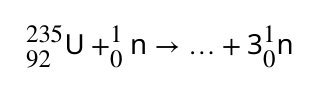
Neutrons that induce the chain reaction are produced by several ways:
a) Reaction of \(\ce{^{11}B}\) with \(\alpha\)-particles inside the reactor core
b) Interaction of \(\gamma\) rays with \(\ce{^{2}D}\) nuclei present in the reactor coolant water
c) Reaction of \(\ce{^{9}Be}\) with \(\alpha\)-particles produced in an externally installed neutron source.
4.2 Write the nuclear reaction equations for (a), (b), and (c). 3.0 pt
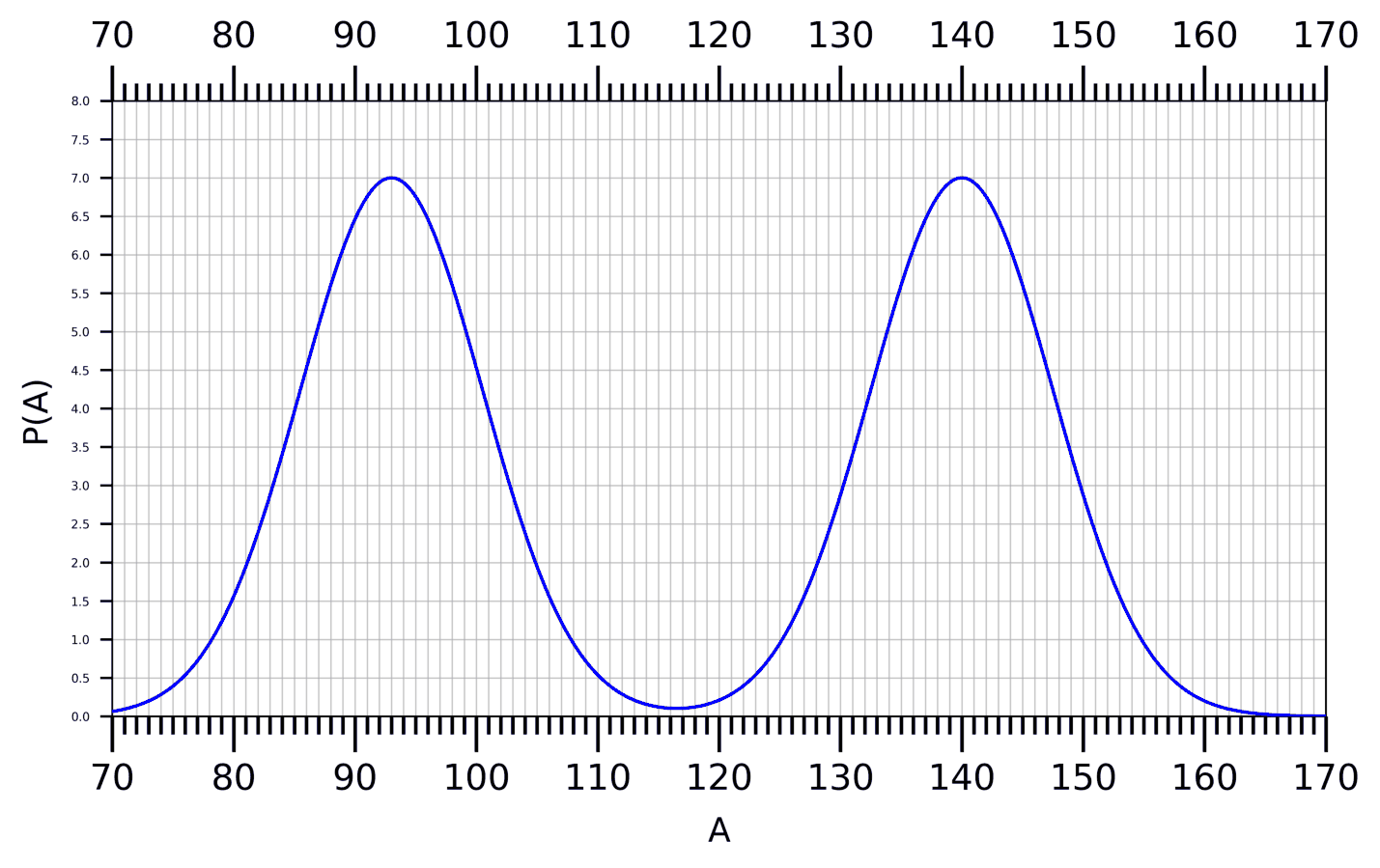
The graph above displays the percentage yield, \(P(A)\), of fission products by mass number, \(A\), resulting from \(\ce{^{235}U}\) fission.
4.3 Write the main nuclear fission equation for splitting of \(\ce{^{235}U}\) upon neutron absorption. The pair of elements formed in this reaction are in the same group of Periodic Table. 3.0 pt
4.4 Calculate the energy released in this reaction (\(\Delta E\), MeV), if the binding energy \(BE(\ce{^{235}U})=7.59\ \text{MeV/nucleon}\) and average binding energy for fission products \(BE(\text{fis.})=8.45\ \text{MeV/nucleon}\). Neglect the binding energy of free neutrons. 2.0 pt
Fission neutrons are produced with an average energy of 2 MeV and slow down through many scatterings with nuclei. After several collisions, their speed decreases until their average kinetic energy matches that of the surrounding atoms or molecules.
The logarithmic energy decrement, \(\xi\), shows the average decrease per collision in the logarithm of the neutron energy:
\[ \xi=\ln\left(\frac{E_{\mathit{initial}}}{E_{\mathit{final}}}\right) \]
\(E_{\mathit{initial}}\) and \(E_{\mathit{final}}\) are the initial and final neutron energies per collision.
\(\xi\) is a constant for each type of material and does not depend on the initial neutron energy.
4.5 Determine the average number of collisions required, \(n_c\), to slow a neutron from 2 MeV to 0.012 eV, using water as the moderator. \(\xi\) (water)=0.948 2.0 pt
In 1963, the Urtabulak gas field suffered an uncontrolled natural gas well blowout, releasing enormous volumes of burning methane.
4.6 Calculate \(\Delta_rH^\circ_{298}\) (\(\mathrm{kJ\,mol^{-1}}\)) for one mole of methane combustion reaction at 298 K. Assume all species are gaseous. Use the thermodynamic data below 2.0 pt
| \(\Delta_fH^\circ_{298}(\ce{CH4})\) | \(-74.8\ \mathrm{kJ\,mol^{-1}}\) |
| \(\Delta_fH^\circ_{298}(\ce{H2O},\text{ gas})\) | \(-241.8\ \mathrm{kJ\,mol^{-1}}\) |
| \(\Delta_fH^\circ_{298}(\ce{CO2})\) | \(-393.5\ \mathrm{kJ\,mol^{-1}}\) |
| \(C_P(\ce{CH4})\) | \(35\ \mathrm{J\,mol^{-1}\,K^{-1}}\) |
| \(C_P(\ce{H2O},\text{ gas})\) | \(34\ \mathrm{J\,mol^{-1}\,K^{-1}}\) |
| \(C_P(\ce{O2})\) | \(29\ \mathrm{J\,mol^{-1}\,K^{-1}}\) |
| \(C_P(\ce{CO2})\) | \(37\ \mathrm{J\,mol^{-1}\,K^{-1}}\) |
If you did not get an answer for 4.6, use \(\Delta_rH^\circ_{298}=-750\ \mathrm{kJ\,mol^{-1}}\) for further calculations.
4.7 Calculate \(\Delta_rH_{2000}\) (\(\mathrm{kJ\,mol^{-1}}\)) per mole of methane combustion reaction at 2000 K. Assume all species are gaseous. 2.0 pt
If you did not get an answer for 4.7, use \(\Delta_rH_{2000}=-700\ \mathrm{kJ\,mol^{-1}}\) for further calculations.
Assume that methane is flowing out the well at 101.325 kPa and 298 K with volumetric flow \(Q=2.2\times10^5\ \mathrm{m^3}\) per day before it catches fire.
4.8 Calculate the total energy released per day, \(E\), (in \(\mathrm{J\,day^{-1}}\)) by complete isothermic combustion of methane at \(T=2000\ \mathrm K\) 2.0 pt
The Urtabulak gas leak was ended by detonating a 30-kiloton in TNT equivalent underground nuclear explosion that collapsed the reservoir and sealed the leak. 1 ton of TNT equivalent is 4.184 GJ of energy.
4.9 Using the value from 4.4, calculate the total number of fissions, \(TN\), during the nuclear explosion. Calculate the mass, \(m\), of enriched uranium used in the explosion (in kg), assuming it contained 90% by mass of the \(\ce{^{235}U}\) isotope, and 33% of the \(\ce{^{235}U}\) underwent fission.
If you did not get an answer for 4.4, use \(\Delta E=200\ \mathrm{MeV}\). 4.0 pt
Physical Constants and Equations
Constants
| Avogadro constant | \(N_A=6.022\times10^{23}\ \mathrm{mol^{-1}}\) |
| Universal gas constant | \(R=8.314\ \mathrm{J\,K^{-1}\,mol^{-1}}\) |
| Faraday constant | \(F=96\,485\ \mathrm{C\,mol^{-1}}\) |
| Planck constant | \(h=6.626\times10^{-34}\ \mathrm{J\,s}\) |
| Speed of light in vacuum | \(c=2.998\times10^8\ \mathrm{m\,s^{-1}}\) |
| Mass of electron | \(m_e=9.109\times10^{-31}\ \mathrm{kg}\) |
| Charge of electron | \(e=1.602\times10^{-19}\ \mathrm C\) |
| Standard pressure | \(P^\circ=1\ \mathrm{bar}=10^5\ \mathrm{Pa}\) |
| Ionic product of water at \(25\,^\circ\mathrm C\) | \(K_w=1.00\times10^{-14}\) |
| Zero of the Celsius scale | \(0\,^\circ\mathrm C=273.15\ \mathrm K\) |
| Electronvolt | \(1\ \mathrm{eV}=1.602\times10^{-19}\ \mathrm J\) |
| Watt | \(1\ \mathrm W=1\ \mathrm{J\,s^{-1}}\) |
| Coulomb | \(1\ \mathrm C=1\ \mathrm{A\,s}\) |
| Nanometre | \(1\ \mathrm{nm}=1\times10^{-9}\ \mathrm m\) |
| Ångstrom | \(1\ \text{Å}=1\times10^{-10}\ \mathrm m\) |
| metric ton | \(1\ \mathrm{ton}=1000\ \mathrm{kg}\) |
| litre | \(1\ \mathrm L=1\ \mathrm{dm^3}\) |
Equations
| Ideal gas law | \(PV=nRT\) |
| Dalton law | \(P_i=x_iP\) |
| Beer–Lambert law | \(A=\log_{10}\dfrac{I_0}{I}=\varepsilon cl\) |
| Energy of a photon | \(E=h\nu=\dfrac{hc}{\lambda}\) |
| Heat and temperature change | \(Q=nC_m\Delta T\) |
| Gibbs energy definition | \(G=H-TS\) |
| Gibbs energy and equilibrium constant | \(\Delta_rG^\circ=-RT\ln K\) |
| Enthalpy change dependence on temperature (at \(\Delta_rC_p=\mathit{const}\)) | \(\Delta_rH_{T_2}=\Delta_rH_{T_1}+\Delta_rC_p(T_2-T_1)\) |
| Entropy change dependence on temperature (at \(\Delta_rC_p=\mathit{const}\)) | \(\Delta_rS_{T_2}=\Delta_rS_{T_1}+\Delta_rC_p\ln\dfrac{T_2}{T_1}\) |
| Henderson–Hasselbalch equation | \(\mathrm{pH}=\mathrm pK_a+\log_{10}\dfrac{[\ce{A-}]}{[\ce{HA}]}\) |
| Average reaction rate | \(r=\dfrac{\Delta c}{\Delta t}\) |
| The rate law | \(r=k[A]^x[B]^y\) |
| Arrhenius law | \(k=A\exp\left(-\dfrac{E_a}{RT}\right)\) |
| Integrated rate law for a 1st order reaction | \(c=c_0e^{-kt}\) \(kt=\ln\dfrac{c_0}{c}\) |
| Lifetime of a reagent in a 1st order reaction | \(\tau=\dfrac1k\) |
| Integrated rate law for n-th order reaction (\(n\ne1\)) | \(kt=\dfrac1{n-1}\left(c^{1-n}-c_0^{1-n}\right)\) for \(n\ne1\) |
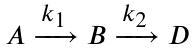
| Concentration of an intermediate in a consecutive reaction: | \([B]=\dfrac{k_1[A]_0}{k_2-k_1}\left(e^{-k_1t}-e^{-k_2t}\right)\) |
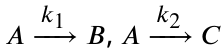
| The ratio of products in the competitive reactions: | \(\dfrac{[B]}{[C]}=\dfrac{k_1}{k_2}\) |
| Michaelis–Menten equation | \(r_0=r_{\max}\dfrac{[S]_0}{K_M+[S]_0}\) |
| Specific surface area | \(s=\dfrac Sm\) |
| Progressions: arithmetic geometric | \(a_n=a_1+d(n-1)\) \(a_n=a_1q^{n-1}\) |
| Sum of geometric progression | \(\displaystyle\sum_{k=0}^{n}a_1q^k=a_1\dfrac{q^{n+1}-1}{q-1}\) |
| Volume of a sphere with radius \(r\) | \(V=\dfrac43\pi r^3\) |
| Surface area of sphere with radius \(r\) | \(S=4\pi r^2\) |
| Volume of a cone with base radius \(r\) and height \(h\) | \(V=\dfrac13\pi r^2h\) |
| Volume of a cylinder with base radius \(r\) and height \(h\) | \(V=\pi r^2h\) |
Consider all gases ideal.
In equilibrium constant calculations, all concentrations are referenced to the concentration of \(1\ \mathrm{mol\,dm^{-3}}\).
Periodic Table of Elements
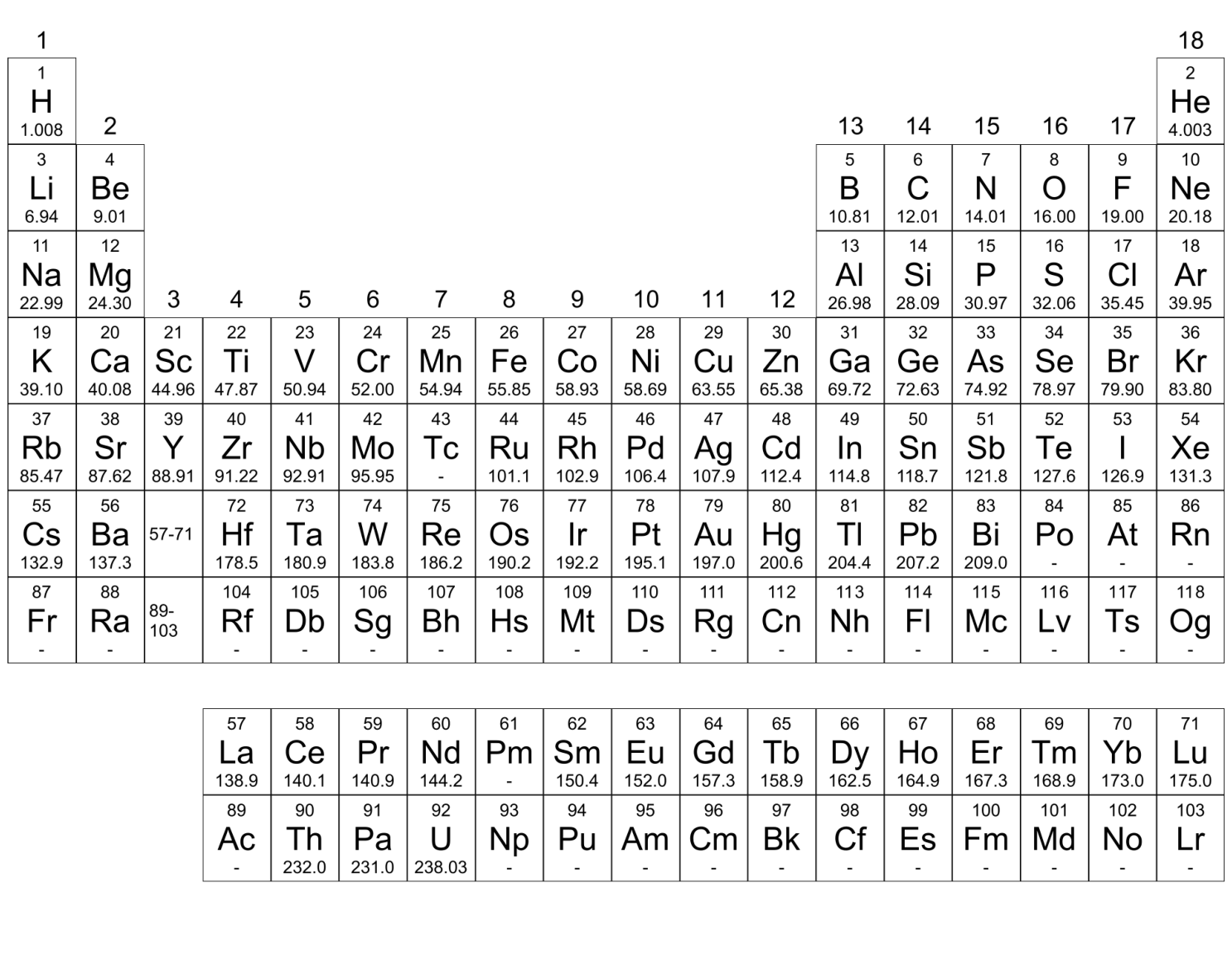
Official English text of the problem.
Answers
-
4.1: The atomic abundance of \(\ce{^{235}U}\) is \(\boxed{0.664\%\approx0.66\%}\).
-
4.2: \[ \begin{aligned} \text{(a)}\quad&\ce{^{11}_{5}B + ^{4}_{2}He -> ^{14}_{7}N + ^{1}_{0}n}\\ \text{(b)}\quad&\ce{^{2}_{1}H + \gamma -> ^{1}_{1}H + ^{1}_{0}n}\\ \text{(c)}\quad&\ce{^{9}_{4}Be + ^{4}_{2}He -> ^{12}_{6}C + ^{1}_{0}n} \end{aligned} \]
-
4.3: The fragments are rubidium-93 and cesium-140, both group 1 elements: \[ \boxed{\ce{^{235}_{92}U + ^{1}_{0}n -> ^{93}_{37}Rb + ^{140}_{55}Cs + 3 ^{1}_{0}n}} \]
-
4.4: \(\boxed{\Delta E=185.2\ \mathrm{MeV}}\) per fission.
-
4.5: \(\boxed{n_c=19.97\approx20\text{ collisions}}\).
-
4.6: \(\boxed{\Delta_rH^\circ_{298}=-802.3\ \mathrm{kJ\,mol^{-1}}}\).
-
4.7: \(\boxed{\Delta_rH_{2000}=-781.9\ \mathrm{kJ\,mol^{-1}}}\).
-
4.8: \(\boxed{E\approx7.0\times10^{12}\ \mathrm{J\,day^{-1}}}\).
-
4.9: \(\boxed{TN\approx4.23\times10^{24}\text{ fissions}}\); the enriched uranium mass is \(\boxed{m\approx5.6\ \mathrm{kg}}\).
Solution
4.1 — Atomic abundance
The supplied periodic table gives the average atomic mass of natural uranium as \(238.03\) a.u. Let \(x\) be the atomic fraction of \(\ce{^{235}U}\). The atomic fraction of \(\ce{^{238}U}\) is then \(1-x\), so
\[ 238.03=235.04x+238.05(1-x). \]
Therefore,
\[ x=\frac{238.05-238.03}{238.05-235.04} =\frac{0.02}{3.01} =0.0066445. \]
Thus, using the supplied rounded atomic masses,
\[ \boxed{100x=0.66445\%\approx0.66\%}. \]
4.2 — Neutron-producing reactions
In each nuclear reaction, both mass number \(A\) and atomic number \(Z\) are conserved. An \(\alpha\)-particle is a helium-4 nucleus, \(\ce{^{4}_{2}He}\).
(a) After emission of one neutron, the residual nucleus has
\[ A=11+4-1=14,\qquad Z=5+2=7. \]
Atomic number 7 identifies nitrogen, so the product is nitrogen-14:
\[ \boxed{\ce{^{11}_{5}B + ^{4}_{2}He -> ^{14}_{7}N + ^{1}_{0}n}}. \]
(b) A deuterium nucleus, \(\ce{^{2}_{1}H}\), contains one proton and one neutron. Absorption of a sufficiently energetic photon separates them:
\[ \boxed{\ce{^{2}_{1}H + \gamma -> ^{1}_{1}H + ^{1}_{0}n}}. \]
The hydrogen-1 nucleus is a proton.
(c) The residual nucleus has
\[ A=9+4-1=12,\qquad Z=4+2=6. \]
Atomic number 6 identifies carbon, giving carbon-12:
\[ \boxed{\ce{^{9}_{4}Be + ^{4}_{2}He -> ^{12}_{6}C + ^{1}_{0}n}}. \]
These nuclear equations specify nuclei; electron populations do not enter the balances.
4.3 — Identification of the fission fragments
The two maxima in the supplied graph occur at approximately
\[ A_{\text{light}}=93,\qquad A_{\text{heavy}}=140. \]
Their sum is \(233\), consistent with the stated emission of three neutrons:
\[ 235+1=93+140+3. \]
Conservation of atomic number requires
\[ Z_{\text{light}}+Z_{\text{heavy}}=92. \]
Rubidium and cesium satisfy the same-group condition: both are group 1 elements, and
\[ Z(\ce{Rb})+Z(\ce{Cs})=37+55=92. \]
Assigning rubidium to the lighter fragment and cesium to the heavier fragment gives
\[ \boxed{\ce{^{235}_{92}U + ^{1}_{0}n -> ^{93}_{37}Rb + ^{140}_{55}Cs + 3 ^{1}_{0}n}}. \]
Both mass number and atomic number are balanced.
4.4 — Energy released per fission
The energy released equals the increase in total nuclear binding energy.
Initially, the uranium nucleus contains \(235\) bound nucleons. The incoming neutron is free and contributes no binding energy under the stated approximation. Finally, the two fragments contain
\[ 93+140=233 \]
bound nucleons; the three emitted neutrons are free.
Consequently,
\[ \begin{aligned} \Delta E &=BE_{\text{products}}-BE_{\text{reactants}}\\ &=233(8.45)-235(7.59)\\ &=1968.85-1783.65\\ &=\boxed{185.2\ \mathrm{MeV}}. \end{aligned} \]
The positive value is the energy released per fission.
4.5 — Average number of collisions
The moderator is water, \(\ce{H2O}\), SMILES O.
Because the logarithmic energy decrements add over successive collisions,
\[ \ln\left(\frac{E_0}{E_f}\right)=n_c\xi. \]
Using the same energy unit in numerator and denominator,
\[ E_0=2\ \mathrm{MeV}=2\times10^6\ \mathrm{eV}. \]
Therefore,
\[ n_c= \frac{\ln\left(\dfrac{2\times10^6}{0.012}\right)}{0.948} =19.9699. \]
Thus,
\[ \boxed{n_c\approx20\text{ collisions}}. \]
4.6 — Methane combustion at 298 K
The molecular species are methane, \(\ce{CH4}\), SMILES C; dioxygen, \(\ce{O2}\), SMILES O=O; carbon dioxide, \(\ce{CO2}\), SMILES O=C=O; and water, \(\ce{H2O}\), SMILES O.
Complete combustion of one mole of methane is
\[ \ce{CH4(g) + 2 O2(g) -> CO2(g) + 2 H2O(g)}. \]
By Hess’s law,
\[ \Delta_rH^\circ_{298} =\sum_{\text{products}}\nu_i\Delta_fH^\circ_i -\sum_{\text{reactants}}\nu_i\Delta_fH^\circ_i. \]
The standard enthalpy of formation of \(\ce{O2(g)}\), an element in its reference state, is zero. Hence
\[ \begin{aligned} \Delta_rH^\circ_{298} &=\left[-393.5+2(-241.8)\right] -\left[-74.8+2(0)\right]\\ &=\boxed{-802.3\ \mathrm{kJ\,mol^{-1}}}. \end{aligned} \]
The negative sign indicates an exothermic reaction.
4.7 — Methane combustion at 2000 K
For the same balanced combustion reaction,
\[ \begin{aligned} \Delta_rC_P &=C_P(\ce{CO2})+2C_P(\ce{H2O}) -C_P(\ce{CH4})-2C_P(\ce{O2})\\ &=37+2(34)-35-2(29)\\ &=12\ \mathrm{J\,mol^{-1}\,K^{-1}}\\ &=0.012\ \mathrm{kJ\,mol^{-1}\,K^{-1}}. \end{aligned} \]
Treating the supplied heat capacities as constant, Kirchhoff’s law gives
\[ \begin{aligned} \Delta_rH_{2000} &=\Delta_rH^\circ_{298}+\Delta_rC_P(2000-298)\\ &=-802.3+0.012(1702)\\ &=-781.876\ \mathrm{kJ\,mol^{-1}}. \end{aligned} \]
Thus,
\[ \boxed{\Delta_rH_{2000}\approx-781.9\ \mathrm{kJ\,mol^{-1}}}. \]
4.8 — Energy released per day
The volumetric flow is specified at \(298\ \mathrm K\), so that temperature must be used to convert the gas volume to an amount of methane.
From the ideal gas law, the molar flow is
\[ \begin{aligned} \dot n &=\frac{pQ}{RT}\\ &=\frac{ (101325\ \mathrm{Pa}) (2.2\times10^5\ \mathrm{m^3\,day^{-1}}) }{ (8.314\ \mathrm{J\,mol^{-1}\,K^{-1}}) (298\ \mathrm K) }\\ &=8.9973\times10^6\ \mathrm{mol\,day^{-1}}. \end{aligned} \]
Here, \(\mathrm{Pa\,m^3}=\mathrm J\). The energy released is the positive magnitude of the combustion enthalpy:
\[ \begin{aligned} E &=-\dot n\,\Delta_rH_{2000}\\ &=(8.9973\times10^6\ \mathrm{mol\,day^{-1}}) (781876\ \mathrm{J\,mol^{-1}})\\ &=7.0348\times10^{12}\ \mathrm{J\,day^{-1}}. \end{aligned} \]
To two significant figures, consistent with the volumetric flow,
\[ \boxed{E=7.0\times10^{12}\ \mathrm{J\,day^{-1}}}. \]
4.9 — Number of fissions and uranium mass
The total energy represented by 30 kilotons of TNT is
\[ \begin{aligned} E_{\text{explosion}} &=(30\times10^3\ \mathrm{ton}) (4.184\times10^9\ \mathrm{J\,ton^{-1}})\\ &=1.2552\times10^{14}\ \mathrm J. \end{aligned} \]
Using the result from 4.4, the energy per fission in joules is
\[ \begin{aligned} \varepsilon_{\text{fission}} &=(185.2\ \mathrm{MeV}) (10^6\ \mathrm{eV\,MeV^{-1}}) (1.602\times10^{-19}\ \mathrm{J\,eV^{-1}})\\ &=2.966904\times10^{-11}\ \mathrm J. \end{aligned} \]
Therefore, the total number of fissions is
\[ TN=\frac{E_{\text{explosion}}}{\varepsilon_{\text{fission}}} =\frac{1.2552\times10^{14}}{2.966904\times10^{-11}} =\boxed{4.23\times10^{24}\text{ fissions}}. \]
Each fission consumes one \(\ce{^{235}U}\) nucleus. Thus, the mass of \(\ce{^{235}U}\) that actually underwent fission is
\[ \begin{aligned} m_{\text{fissioned}} &=\frac{TN}{N_A}M(\ce{^{235}U})\\ &=\frac{4.23067\times10^{24}} {6.022\times10^{23}\ \mathrm{mol^{-1}}} (235.04\ \mathrm{g\,mol^{-1}})\\ &=1651.24\ \mathrm g =1.65124\ \mathrm{kg}. \end{aligned} \]
If \(m\) is the initial mass of enriched uranium, its initial \(\ce{^{235}U}\) mass is \(0.90m\). Since \(33\%\) of that isotope underwent fission,
\[ m_{\text{fissioned}}=0.33(0.90m). \]
Hence
\[ m=\frac{1.65124}{0.33\times0.90} =5.5597\ \mathrm{kg}. \]
With sensible rounding,
\[ \boxed{m\approx5.6\ \mathrm{kg}}. \]
The solution was checked against the official solution.
IChO 2026 · Theorieaufgabe 4
Die nukleare Vergangenheit Usbekistans
T4. Die nukleare Vergangenheit Usbekistans
6%
| 4.1 | 4.2 | 4.3 | 4.4 | 4.5 | 4.6 | 4.7 | 4.8 | 4.9 | \(\sum\) |
|---|---|---|---|---|---|---|---|---|---|
| 2 | 3 | 3 | 2 | 2 | 2 | 2 | 2 | 4 | 22 |
Natürliches Uran besteht hauptsächlich aus zwei Isotopen, \(\ce{^{235}U}\) und \(\ce{^{238}U}\). \(\ce{^{235}U}\) ist für die Aufrechterhaltung von Kernspaltungsreaktionen verantwortlich.
4.1 Berechnen Sie die relative Atomhäufigkeit von \(\ce{^{235}U}\) in natürlichem Uran unter der Annahme, dass es nur aus den Isotopen \(\ce{^{235}U}\) (235.04 a.u.) und \(\ce{^{238}U}\) (238.05 a.u.) besteht. 2.0 P.
Die wichtigste Reaktion in Kernkraftwerken ist die Reaktion, bei der \(\ce{^{235}U}\) ein Neutron absorbiert und gespalten wird, wobei Energie freigesetzt wird und drei zusätzliche Neutronen entstehen, wodurch eine Kettenreaktion aufrechterhalten wird.
Neutronen, die die Kettenreaktion auslösen, werden auf verschiedene Arten erzeugt:
a) Reaktion von \(\ce{^{11}B}\) mit \(\alpha\)-Teilchen im Reaktorkern
b) Wechselwirkung von \(\gamma\)-Strahlung mit \(\ce{^{2}D}\)-Kernen, die im Kühlwasser des Reaktors vorhanden sind
c) Reaktion von \(\ce{^{9}Be}\) mit \(\alpha\)-Teilchen, die in einer extern installierten Neutronenquelle erzeugt werden.
4.2 Geben Sie die Kernreaktionsgleichungen für (a), (b) und (c) an. 3.0 P.
Das obige Diagramm zeigt die prozentuale Ausbeute \(P(A)\) der bei der Spaltung von \(\ce{^{235}U}\) entstehenden Spaltprodukte in Abhängigkeit von der Massenzahl \(A\).
4.3 Geben Sie die Gleichung der wichtigsten Kernspaltungsreaktion von \(\ce{^{235}U}\) nach Neutronenabsorption an. Die beiden bei dieser Reaktion gebildeten Elemente stehen in derselben Gruppe des Periodensystems. 3.0 P.
4.4 Berechnen Sie die bei dieser Reaktion freigesetzte Energie (\(\Delta E\), MeV), wenn die Bindungsenergie \(BE(\ce{^{235}U})=7.59\ \text{MeV/Nukleon}\) und die mittlere Bindungsenergie der Spaltprodukte \(BE(\text{Spaltpr.})=8.45\ \text{MeV/Nukleon}\) beträgt. Vernachlässigen Sie die Bindungsenergie freier Neutronen. 2.0 P.
Spaltneutronen entstehen mit einer mittleren Energie von 2 MeV und werden durch zahlreiche Streuprozesse an Kernen abgebremst. Nach mehreren Stößen nimmt ihre Geschwindigkeit so weit ab, dass ihre mittlere kinetische Energie derjenigen der umgebenden Atome oder Moleküle entspricht.
Das logarithmische Energiedekrement \(\xi\) gibt die mittlere Abnahme des Logarithmus der Neutronenenergie pro Stoß an:
\[ \xi=\ln\left(\frac{E_{\mathit{initial}}}{E_{\mathit{final}}}\right) \]
\(E_{\mathit{initial}}\) und \(E_{\mathit{final}}\) sind die Neutronenenergien vor bzw. nach einem Stoß.
\(\xi\) ist für jede Materialart konstant und hängt nicht von der anfänglichen Neutronenenergie ab.
4.5 Bestimmen Sie die mittlere Anzahl der erforderlichen Stöße \(n_c\), um ein Neutron von 2 MeV auf 0.012 eV abzubremsen, wenn Wasser als Moderator verwendet wird. \(\xi\) (Wasser)=0.948 2.0 P.
Im Jahr 1963 kam es im Gasfeld Urtabulak zu einem unkontrollierten Erdgasausbruch aus einem Bohrloch, bei dem enorme Mengen brennenden Methans austraten.
4.6 Berechnen Sie \(\Delta_rH^\circ_{298}\) (\(\mathrm{kJ\,mol^{-1}}\)) für die Verbrennung von einem Mol Methan bei 298 K. Nehmen Sie an, dass alle Stoffe gasförmig sind. Verwenden Sie die folgenden thermodynamischen Daten. 2.0 P.
| \(\Delta_fH^\circ_{298}(\ce{CH4})\) | \(-74.8\ \mathrm{kJ\,mol^{-1}}\) |
| \(\Delta_fH^\circ_{298}(\ce{H2O},\text{ gasförmig})\) | \(-241.8\ \mathrm{kJ\,mol^{-1}}\) |
| \(\Delta_fH^\circ_{298}(\ce{CO2})\) | \(-393.5\ \mathrm{kJ\,mol^{-1}}\) |
| \(C_P(\ce{CH4})\) | \(35\ \mathrm{J\,mol^{-1}\,K^{-1}}\) |
| \(C_P(\ce{H2O},\text{ gasförmig})\) | \(34\ \mathrm{J\,mol^{-1}\,K^{-1}}\) |
| \(C_P(\ce{O2})\) | \(29\ \mathrm{J\,mol^{-1}\,K^{-1}}\) |
| \(C_P(\ce{CO2})\) | \(37\ \mathrm{J\,mol^{-1}\,K^{-1}}\) |
Falls Sie für 4.6 kein Ergebnis erhalten haben, verwenden Sie für die weiteren Berechnungen \(\Delta_rH^\circ_{298}=-750\ \mathrm{kJ\,mol^{-1}}\).
4.7 Berechnen Sie \(\Delta_rH_{2000}\) (\(\mathrm{kJ\,mol^{-1}}\)) pro Mol Methan für die Verbrennungsreaktion bei 2000 K. Nehmen Sie an, dass alle Stoffe gasförmig sind. 2.0 P.
Falls Sie für 4.7 kein Ergebnis erhalten haben, verwenden Sie für die weiteren Berechnungen \(\Delta_rH_{2000}=-700\ \mathrm{kJ\,mol^{-1}}\).
Nehmen Sie an, dass Methan vor seiner Entzündung bei 101.325 kPa und 298 K mit einem Volumenstrom von \(Q=2.2\times10^5\ \mathrm{m^3}\) pro Tag aus dem Bohrloch strömt.
4.8 Berechnen Sie die gesamte pro Tag durch vollständige isotherme Verbrennung von Methan bei \(T=2000\ \mathrm K\) freigesetzte Energie \(E\) (in \(\mathrm{J\,day^{-1}}\)). 2.0 P.
Der Gasaustritt in Urtabulak wurde durch eine unterirdische Kernexplosion mit einem TNT-Äquivalent von 30 Kilotonnen beendet, die die Lagerstätte zum Einsturz brachte und die Austrittsstelle abdichtete. 1 Tonne TNT-Äquivalent entspricht einer Energie von 4.184 GJ.
4.9 Berechnen Sie mit dem Wert aus 4.4 die Gesamtzahl der Spaltungen \(TN\) während der Kernexplosion. Berechnen Sie die Masse \(m\) des bei der Explosion verwendeten angereicherten Urans (in kg) unter der Annahme, dass es einen Massenanteil von 90% des Isotops \(\ce{^{235}U}\) enthielt und 33% des \(\ce{^{235}U}\) gespalten wurden.
Falls Sie für 4.4 kein Ergebnis erhalten haben, verwenden Sie \(\Delta E=200\ \mathrm{MeV}\). 4.0 P.
Physikalische Konstanten und Gleichungen
Konstanten
| Avogadro-Konstante | \(N_A=6.022\times10^{23}\ \mathrm{mol^{-1}}\) |
| Universelle Gaskonstante | \(R=8.314\ \mathrm{J\,K^{-1}\,mol^{-1}}\) |
| Faraday-Konstante | \(F=96\,485\ \mathrm{C\,mol^{-1}}\) |
| Planck-Konstante | \(h=6.626\times10^{-34}\ \mathrm{J\,s}\) |
| Lichtgeschwindigkeit im Vakuum | \(c=2.998\times10^8\ \mathrm{m\,s^{-1}}\) |
| Masse des Elektrons | \(m_e=9.109\times10^{-31}\ \mathrm{kg}\) |
| Ladung des Elektrons | \(e=1.602\times10^{-19}\ \mathrm C\) |
| Standarddruck | \(P^\circ=1\ \mathrm{bar}=10^5\ \mathrm{Pa}\) |
| Ionenprodukt des Wassers bei \(25\,^\circ\mathrm C\) | \(K_w=1.00\times10^{-14}\) |
| Nullpunkt der Celsius-Skala | \(0\,^\circ\mathrm C=273.15\ \mathrm K\) |
| Elektronenvolt | \(1\ \mathrm{eV}=1.602\times10^{-19}\ \mathrm J\) |
| Watt | \(1\ \mathrm W=1\ \mathrm{J\,s^{-1}}\) |
| Coulomb | \(1\ \mathrm C=1\ \mathrm{A\,s}\) |
| Nanometer | \(1\ \mathrm{nm}=1\times10^{-9}\ \mathrm m\) |
| Ångström | \(1\ \text{Å}=1\times10^{-10}\ \mathrm m\) |
| Metrische Tonne | \(1\ \mathrm{ton}=1000\ \mathrm{kg}\) |
| Liter | \(1\ \mathrm L=1\ \mathrm{dm^3}\) |
Gleichungen
| Ideale Gasgleichung | \(PV=nRT\) |
| Daltonsches Gesetz | \(P_i=x_iP\) |
| Lambert-Beersches Gesetz | \(A=\log_{10}\dfrac{I_0}{I}=\varepsilon cl\) |
| Energie eines Photons | \(E=h\nu=\dfrac{hc}{\lambda}\) |
| Wärme und Temperaturänderung | \(Q=nC_m\Delta T\) |
| Definition der Gibbs-Energie | \(G=H-TS\) |
| Gibbs-Energie und Gleichgewichtskonstante | \(\Delta_rG^\circ=-RT\ln K\) |
| Temperaturabhängigkeit der Enthalpieänderung (bei \(\Delta_rC_p=\mathit{const}\)) | \(\Delta_rH_{T_2}=\Delta_rH_{T_1}+\Delta_rC_p(T_2-T_1)\) |
| Temperaturabhängigkeit der Entropieänderung (bei \(\Delta_rC_p=\mathit{const}\)) | \(\Delta_rS_{T_2}=\Delta_rS_{T_1}+\Delta_rC_p\ln\dfrac{T_2}{T_1}\) |
| Henderson-Hasselbalch-Gleichung | \(\mathrm{pH}=\mathrm pK_a+\log_{10}\dfrac{[\ce{A-}]}{[\ce{HA}]}\) |
| Mittlere Reaktionsgeschwindigkeit | \(r=\dfrac{\Delta c}{\Delta t}\) |
| Geschwindigkeitsgesetz | \(r=k[A]^x[B]^y\) |
| Arrhenius-Gleichung | \(k=A\exp\left(-\dfrac{E_a}{RT}\right)\) |
| Integriertes Geschwindigkeitsgesetz einer Reaktion 1. Ordnung | \(c=c_0e^{-kt}\) \(kt=\ln\dfrac{c_0}{c}\) |
| Lebensdauer eines Reaktanden bei einer Reaktion 1. Ordnung | \(\tau=\dfrac1k\) |
| Integriertes Geschwindigkeitsgesetz einer Reaktion n-ter Ordnung (\(n\ne1\)) | \(kt=\dfrac1{n-1}\left(c^{1-n}-c_0^{1-n}\right)\) für \(n\ne1\) |
| Konzentration eines Zwischenprodukts bei einer Folgereaktion: | \([B]=\dfrac{k_1[A]_0}{k_2-k_1}\left(e^{-k_1t}-e^{-k_2t}\right)\) |
| Verhältnis der Produkte bei konkurrierenden Reaktionen: | \(\dfrac{[B]}{[C]}=\dfrac{k_1}{k_2}\) |
| Michaelis-Menten-Gleichung | \(r_0=r_{\max}\dfrac{[S]_0}{K_M+[S]_0}\) |
| Spezifische Oberfläche | \(s=\dfrac Sm\) |
| Folgen: arithmetisch, geometrisch | \(a_n=a_1+d(n-1)\) \(a_n=a_1q^{n-1}\) |
| Summe einer geometrischen Folge | \(\displaystyle\sum_{k=0}^{n}a_1q^k=a_1\dfrac{q^{n+1}-1}{q-1}\) |
| Volumen einer Kugel mit Radius \(r\) | \(V=\dfrac43\pi r^3\) |
| Oberfläche einer Kugel mit Radius \(r\) | \(S=4\pi r^2\) |
| Volumen eines Kegels mit Grundkreisradius \(r\) und Höhe \(h\) | \(V=\dfrac13\pi r^2h\) |
| Volumen eines Zylinders mit Grundkreisradius \(r\) und Höhe \(h\) | \(V=\pi r^2h\) |
Betrachten Sie alle Gase als ideal.
Bei Berechnungen von Gleichgewichtskonstanten werden alle Konzentrationen auf die Konzentration \(1\ \mathrm{mol\,dm^{-3}}\) bezogen.
Periodensystem der Elemente
Aufgabentext aus dem offiziellen englischen Text übersetzt.
Antworten
-
4.1: Die relative Atomhäufigkeit von \(\ce{^{235}U}\) beträgt \(\boxed{0.664\%\approx0.66\%}\).
-
4.2: \[ \begin{aligned} \text{(a)}\quad&\ce{^{11}_{5}B + ^{4}_{2}He -> ^{14}_{7}N + ^{1}_{0}n}\\ \text{(b)}\quad&\ce{^{2}_{1}H + \gamma -> ^{1}_{1}H + ^{1}_{0}n}\\ \text{(c)}\quad&\ce{^{9}_{4}Be + ^{4}_{2}He -> ^{12}_{6}C + ^{1}_{0}n} \end{aligned} \]
-
4.3: Die Spaltfragmente sind Rubidium-93 und Caesium-140, beides Elemente der Gruppe 1: \[ \boxed{\ce{^{235}_{92}U + ^{1}_{0}n -> ^{93}_{37}Rb + ^{140}_{55}Cs + 3 ^{1}_{0}n}} \]
-
4.4: \(\boxed{\Delta E=185.2\ \mathrm{MeV}}\) pro Spaltung.
-
4.5: \(\boxed{n_c=19.97\approx20\text{ Stöße}}\).
-
4.6: \(\boxed{\Delta_rH^\circ_{298}=-802.3\ \mathrm{kJ\,mol^{-1}}}\).
-
4.7: \(\boxed{\Delta_rH_{2000}=-781.9\ \mathrm{kJ\,mol^{-1}}}\).
-
4.8: \(\boxed{E\approx7.0\times10^{12}\ \mathrm{J\,day^{-1}}}\).
-
4.9: \(\boxed{TN\approx4.23\times10^{24}\text{ Spaltungen}}\); die Masse des angereicherten Urans beträgt \(\boxed{m\approx5.6\ \mathrm{kg}}\).
Lösung
4.1 — Relative Atomhäufigkeit
Das bereitgestellte Periodensystem gibt die mittlere Atommasse von natürlichem Uran mit \(238.03\) a.u. an. Sei \(x\) der Atomanteil von \(\ce{^{235}U}\). Der Atomanteil von \(\ce{^{238}U}\) ist dann \(1-x\), sodass
\[ 238.03=235.04x+238.05(1-x). \]
Daraus folgt
\[ x=\frac{238.05-238.03}{238.05-235.04} =\frac{0.02}{3.01} =0.0066445. \]
Mit den angegebenen gerundeten Atommassen ergibt sich somit
\[ \boxed{100x=0.66445\%\approx0.66\%}. \]
4.2 — Neutronenerzeugende Reaktionen
Bei jeder Kernreaktion bleiben sowohl die Massenzahl \(A\) als auch die Ordnungszahl \(Z\) erhalten. Ein \(\alpha\)-Teilchen ist ein Helium-4-Kern, \(\ce{^{4}_{2}He}\).
(a) Nach der Emission eines Neutrons hat der Restkern
\[ A=11+4-1=14,\qquad Z=5+2=7. \]
Die Ordnungszahl 7 gehört zu Stickstoff, sodass das Produkt Stickstoff-14 ist:
\[ \boxed{\ce{^{11}_{5}B + ^{4}_{2}He -> ^{14}_{7}N + ^{1}_{0}n}}. \]
(b) Ein Deuteriumkern, \(\ce{^{2}_{1}H}\), enthält ein Proton und ein Neutron. Durch die Absorption eines Photons mit ausreichend hoher Energie werden sie voneinander getrennt:
\[ \boxed{\ce{^{2}_{1}H + \gamma -> ^{1}_{1}H + ^{1}_{0}n}}. \]
Der Wasserstoff-1-Kern ist ein Proton.
(c) Der Restkern hat
\[ A=9+4-1=12,\qquad Z=4+2=6. \]
Die Ordnungszahl 6 gehört zu Kohlenstoff, sodass Kohlenstoff-12 entsteht:
\[ \boxed{\ce{^{9}_{4}Be + ^{4}_{2}He -> ^{12}_{6}C + ^{1}_{0}n}}. \]
Diese Kernreaktionsgleichungen beschreiben Atomkerne; die Elektronenzahlen gehen nicht in die Bilanzen ein.
4.3 — Identifizierung der Spaltfragmente
Die beiden Maxima im bereitgestellten Diagramm liegen ungefähr bei
\[ A_{\text{leicht}}=93,\qquad A_{\text{schwer}}=140. \]
Ihre Summe beträgt \(233\), was mit der angegebenen Emission von drei Neutronen übereinstimmt:
\[ 235+1=93+140+3. \]
Die Erhaltung der Ordnungszahl erfordert
\[ Z_{\text{leicht}}+Z_{\text{schwer}}=92. \]
Rubidium und Caesium erfüllen die Bedingung, derselben Gruppe anzugehören: Beide sind Elemente der Gruppe 1, und es gilt
\[ Z(\ce{Rb})+Z(\ce{Cs})=37+55=92. \]
Ordnet man Rubidium dem leichteren und Caesium dem schwereren Fragment zu, erhält man
\[ \boxed{\ce{^{235}_{92}U + ^{1}_{0}n -> ^{93}_{37}Rb + ^{140}_{55}Cs + 3 ^{1}_{0}n}}. \]
Sowohl die Massenzahl als auch die Ordnungszahl sind bilanziert.
4.4 — Pro Spaltung freigesetzte Energie
Die freigesetzte Energie entspricht der Zunahme der gesamten Kernbindungsenergie.
Anfangs enthält der Urankern \(235\) gebundene Nukleonen. Das einfallende Neutron ist frei und trägt im Rahmen der angegebenen Näherung nicht zur Bindungsenergie bei. Am Ende enthalten die beiden Fragmente
\[ 93+140=233 \]
gebundene Nukleonen; die drei emittierten Neutronen sind frei.
Folglich gilt
\[ \begin{aligned} \Delta E &=BE_{\text{Produkte}}-BE_{\text{Edukte}}\\ &=233(8.45)-235(7.59)\\ &=1968.85-1783.65\\ &=\boxed{185.2\ \mathrm{MeV}}. \end{aligned} \]
Der positive Wert ist die pro Spaltung freigesetzte Energie.
4.5 — Mittlere Anzahl der Stöße
Der Moderator ist Wasser, \(\ce{H2O}\), SMILES O.
Da sich die logarithmischen Energiedekremente bei aufeinanderfolgenden Stößen addieren, gilt
\[ \ln\left(\frac{E_0}{E_f}\right)=n_c\xi. \]
Für die Verwendung derselben Energieeinheit in Zähler und Nenner gilt
\[ E_0=2\ \mathrm{MeV}=2\times10^6\ \mathrm{eV}. \]
Daraus folgt
\[ n_c= \frac{\ln\left(\dfrac{2\times10^6}{0.012}\right)}{0.948} =19.9699. \]
Somit ergibt sich
\[ \boxed{n_c\approx20\text{ Stöße}}. \]
4.6 — Methanverbrennung bei 298 K
Die molekularen Spezies sind Methan, \(\ce{CH4}\), SMILES C; Disauerstoff, \(\ce{O2}\), SMILES O=O; Kohlenstoffdioxid, \(\ce{CO2}\), SMILES O=C=O; und Wasser, \(\ce{H2O}\), SMILES O.
Die vollständige Verbrennung von einem Mol Methan lautet
\[ \ce{CH4(g) + 2 O2(g) -> CO2(g) + 2 H2O(g)}. \]
Nach dem Hessschen Satz gilt
\[ \Delta_rH^\circ_{298} =\sum_{\text{Produkte}}\nu_i\Delta_fH^\circ_i -\sum_{\text{Edukte}}\nu_i\Delta_fH^\circ_i. \]
Die Standardbildungsenthalpie von \(\ce{O2(g)}\), einem Element in seinem Referenzzustand, ist null. Daher gilt
\[ \begin{aligned} \Delta_rH^\circ_{298} &=\left[-393.5+2(-241.8)\right] -\left[-74.8+2(0)\right]\\ &=\boxed{-802.3\ \mathrm{kJ\,mol^{-1}}}. \end{aligned} \]
Das negative Vorzeichen kennzeichnet eine exotherme Reaktion.
4.7 — Methanverbrennung bei 2000 K
Für dieselbe ausgeglichene Verbrennungsreaktion gilt
\[ \begin{aligned} \Delta_rC_P &=C_P(\ce{CO2})+2C_P(\ce{H2O}) -C_P(\ce{CH4})-2C_P(\ce{O2})\\ &=37+2(34)-35-2(29)\\ &=12\ \mathrm{J\,mol^{-1}\,K^{-1}}\\ &=0.012\ \mathrm{kJ\,mol^{-1}\,K^{-1}}. \end{aligned} \]
Werden die angegebenen Wärmekapazitäten als konstant betrachtet, liefert das Kirchhoffsche Gesetz
\[ \begin{aligned} \Delta_rH_{2000} &=\Delta_rH^\circ_{298}+\Delta_rC_P(2000-298)\\ &=-802.3+0.012(1702)\\ &=-781.876\ \mathrm{kJ\,mol^{-1}}. \end{aligned} \]
Somit ergibt sich
\[ \boxed{\Delta_rH_{2000}\approx-781.9\ \mathrm{kJ\,mol^{-1}}}. \]
4.8 — Pro Tag freigesetzte Energie
Der Volumenstrom ist bei \(298\ \mathrm K\) angegeben, daher muss diese Temperatur zur Umrechnung des Gasvolumens in eine Stoffmenge Methan verwendet werden.
Aus der idealen Gasgleichung ergibt sich der Stoffmengenstrom zu
\[ \begin{aligned} \dot n &=\frac{pQ}{RT}\\ &=\frac{ (101325\ \mathrm{Pa}) (2.2\times10^5\ \mathrm{m^3\,day^{-1}}) }{ (8.314\ \mathrm{J\,mol^{-1}\,K^{-1}}) (298\ \mathrm K) }\\ &=8.9973\times10^6\ \mathrm{mol\,day^{-1}}. \end{aligned} \]
Hierbei gilt \(\mathrm{Pa\,m^3}=\mathrm J\). Die freigesetzte Energie ist der positive Betrag der Verbrennungsenthalpie:
\[ \begin{aligned} E &=-\dot n\,\Delta_rH_{2000}\\ &=(8.9973\times10^6\ \mathrm{mol\,day^{-1}}) (781876\ \mathrm{J\,mol^{-1}})\\ &=7.0348\times10^{12}\ \mathrm{J\,day^{-1}}. \end{aligned} \]
Auf zwei signifikante Stellen gerundet, entsprechend dem Volumenstrom, ergibt sich
\[ \boxed{E=7.0\times10^{12}\ \mathrm{J\,day^{-1}}}. \]
4.9 — Anzahl der Spaltungen und Uranmasse
Die Gesamtenergie, die 30 Kilotonnen TNT entspricht, beträgt
\[ \begin{aligned} E_{\text{Explosion}} &=(30\times10^3\ \mathrm{ton}) (4.184\times10^9\ \mathrm{J\,ton^{-1}})\\ &=1.2552\times10^{14}\ \mathrm J. \end{aligned} \]
Mit dem Ergebnis aus 4.4 beträgt die Energie pro Spaltung in Joule
\[ \begin{aligned} \varepsilon_{\text{Spaltung}} &=(185.2\ \mathrm{MeV}) (10^6\ \mathrm{eV\,MeV^{-1}}) (1.602\times10^{-19}\ \mathrm{J\,eV^{-1}})\\ &=2.966904\times10^{-11}\ \mathrm J. \end{aligned} \]
Die Gesamtzahl der Spaltungen ist daher
\[ TN=\frac{E_{\text{Explosion}}}{\varepsilon_{\text{Spaltung}}} =\frac{1.2552\times10^{14}}{2.966904\times10^{-11}} =\boxed{4.23\times10^{24}\text{ Spaltungen}}. \]
Bei jeder Spaltung wird ein \(\ce{^{235}U}\)-Kern verbraucht. Die Masse des tatsächlich gespaltenen \(\ce{^{235}U}\) beträgt somit
\[ \begin{aligned} m_{\text{gespalten}} &=\frac{TN}{N_A}M(\ce{^{235}U})\\ &=\frac{4.23067\times10^{24}} {6.022\times10^{23}\ \mathrm{mol^{-1}}} (235.04\ \mathrm{g\,mol^{-1}})\\ &=1651.24\ \mathrm g =1.65124\ \mathrm{kg}. \end{aligned} \]
Ist \(m\) die anfängliche Masse des angereicherten Urans, so beträgt seine anfängliche \(\ce{^{235}U}\)-Masse \(0.90m\). Da \(33\%\) dieses Isotops gespalten wurden, gilt
\[ m_{\text{gespalten}}=0.33(0.90m). \]
Daraus folgt
\[ m=\frac{1.65124}{0.33\times0.90} =5.5597\ \mathrm{kg}. \]
Bei sinnvoller Rundung ergibt sich
\[ \boxed{m\approx5.6\ \mathrm{kg}}. \]
Die Lösung wurde mit der offiziellen Lösung abgeglichen.
IChO 2026 · Teori sorusu 4
Özbekistan'ın nükleer geçmişi
T4. Özbekistan'ın nükleer geçmişi
6%
| 4.1 | 4.2 | 4.3 | 4.4 | 4.5 | 4.6 | 4.7 | 4.8 | 4.9 | \(\sum\) |
|---|---|---|---|---|---|---|---|---|---|
| 2 | 3 | 3 | 2 | 2 | 2 | 2 | 2 | 4 | 22 |
Doğal uranyum başlıca iki izotoptan, \(\ce{^{235}U}\) ve \(\ce{^{238}U}\) izotoplarından oluşur. Nükleer fisyon tepkimelerinin sürdürülmesini \(\ce{^{235}U}\) sağlar.
4.1 Doğal uranyumun yalnızca \(\ce{^{235}U}\) (235.04 a.u.) ve \(\ce{^{238}U}\) (238.05 a.u.) izotoplarından oluştuğunu varsayarak doğal uranyumdaki \(\ce{^{235}U}\) izotopunun atomik bolluğunu hesaplayınız. 2.0 puan
Nükleer santrallerde gerçekleşen başlıca tepkimede \(\ce{^{235}U}\) bir nötron soğurarak fisyona uğrar; enerji açığa çıkarır ve üç yeni nötron üreterek zincir tepkimesinin sürmesini sağlar.
Zincir tepkimesini başlatan nötronlar çeşitli yollarla üretilir:
a) Reaktör çekirdeğinde \(\ce{^{11}B}\) ile \(\alpha\) parçacıklarının tepkimesi
b) \(\gamma\) ışınlarının reaktörün soğutma suyunda bulunan \(\ce{^{2}D}\) çekirdekleriyle etkileşimi
c) Haricen yerleştirilmiş bir nötron kaynağında üretilen \(\alpha\) parçacıkları ile \(\ce{^{9}Be}\) tepkimesi.
4.2 (a), (b) ve (c) için nükleer tepkime denklemlerini yazınız. 3.0 puan
Yukarıdaki grafik, \(\ce{^{235}U}\) fisyonu sonucunda oluşan fisyon ürünlerinin yüzde verimini, \(P(A)\), kütle numarasına, \(A\), göre göstermektedir.
4.3 \(\ce{^{235}U}\) çekirdeğinin nötron soğurması üzerine bölünmesine ilişkin başlıca nükleer fisyon denklemini yazınız. Bu tepkimede oluşan iki element, Periyodik Tablo'nun aynı grubundadır. 3.0 puan
4.4 Bağlanma enerjisi \(BE(\ce{^{235}U})=7.59\ \text{MeV/nucleon}\) ve fisyon ürünlerinin ortalama bağlanma enerjisi \(BE(\text{fis.})=8.45\ \text{MeV/nucleon}\) ise bu tepkimede açığa çıkan enerjiyi (\(\Delta E\), MeV) hesaplayınız. Serbest nötronların bağlanma enerjisini ihmal ediniz. 2.0 puan
Fisyon nötronları ortalama 2 MeV enerjiyle üretilir ve çekirdeklerle çok sayıda saçılma sonucu yavaşlar. Birkaç çarpışmadan sonra, ortalama kinetik enerjileri çevredeki atom veya moleküllerin ortalama kinetik enerjisine eşit oluncaya kadar hızları azalır.
Logaritmik enerji azalması, \(\xi\), nötron enerjisinin logaritmasındaki çarpışma başına ortalama azalmayı gösterir:
\[ \xi=\ln\left(\frac{E_{\mathit{initial}}}{E_{\mathit{final}}}\right) \]
\(E_{\mathit{initial}}\) ve \(E_{\mathit{final}}\), her bir çarpışma için nötronun başlangıç ve son enerjileridir.
\(\xi\), her malzeme türü için sabittir ve nötronun başlangıç enerjisine bağlı değildir.
4.5 Yavaşlatıcı olarak su kullanıldığında, bir nötronu 2 MeV'den 0.012 eV'ye yavaşlatmak için gereken ortalama çarpışma sayısını, \(n_c\), belirleyiniz. \(\xi\) (su)=0.948 2.0 puan
1963 yılında Urtabulak gaz sahasında bir doğal gaz kuyusunda kontrolsüz bir püskürme meydana gelmiş ve muazzam hacimlerde yanan metan açığa çıkmıştır.
4.6 298 K'de bir mol metanın yanma tepkimesi için \(\Delta_rH^\circ_{298}\) (\(\mathrm{kJ\,mol^{-1}}\)) değerini hesaplayınız. Tüm türlerin gaz hâlinde olduğunu varsayınız. Aşağıdaki termodinamik verileri kullanınız. 2.0 puan
| \(\Delta_fH^\circ_{298}(\ce{CH4})\) | \(-74.8\ \mathrm{kJ\,mol^{-1}}\) |
| \(\Delta_fH^\circ_{298}(\ce{H2O},\text{ gaz})\) | \(-241.8\ \mathrm{kJ\,mol^{-1}}\) |
| \(\Delta_fH^\circ_{298}(\ce{CO2})\) | \(-393.5\ \mathrm{kJ\,mol^{-1}}\) |
| \(C_P(\ce{CH4})\) | \(35\ \mathrm{J\,mol^{-1}\,K^{-1}}\) |
| \(C_P(\ce{H2O},\text{ gaz})\) | \(34\ \mathrm{J\,mol^{-1}\,K^{-1}}\) |
| \(C_P(\ce{O2})\) | \(29\ \mathrm{J\,mol^{-1}\,K^{-1}}\) |
| \(C_P(\ce{CO2})\) | \(37\ \mathrm{J\,mol^{-1}\,K^{-1}}\) |
4.6 için bir sonuç elde edemediyseniz sonraki hesaplamalarda \(\Delta_rH^\circ_{298}=-750\ \mathrm{kJ\,mol^{-1}}\) değerini kullanınız.
4.7 2000 K'de metanın yanma tepkimesi için mol başına \(\Delta_rH_{2000}\) (\(\mathrm{kJ\,mol^{-1}}\)) değerini hesaplayınız. Tüm türlerin gaz hâlinde olduğunu varsayınız. 2.0 puan
4.7 için bir sonuç elde edemediyseniz sonraki hesaplamalarda \(\Delta_rH_{2000}=-700\ \mathrm{kJ\,mol^{-1}}\) değerini kullanınız.
Metanın tutuşmadan önce kuyudan 101.325 kPa ve 298 K'de, günlük \(Q=2.2\times10^5\ \mathrm{m^3}\) hacimsel debiyle çıktığını varsayınız.
4.8 Metanın \(T=2000\ \mathrm K\) sıcaklığında izotermal olarak tamamen yanmasıyla bir günde açığa çıkan toplam enerjiyi, \(E\), (\(\mathrm{J\,day^{-1}}\) cinsinden) hesaplayınız. 2.0 puan
Urtabulak gaz sızıntısı, yer altında TNT eşdeğeri 30 kiloton olan bir nükleer patlama gerçekleştirilerek sona erdirilmiştir; patlama rezervuarı çökertmiş ve sızıntıyı kapatmıştır. 1 ton TNT eşdeğeri, 4.184 GJ enerjiye karşılık gelir.
4.9 4.4'teki değeri kullanarak nükleer patlama sırasında gerçekleşen toplam fisyon sayısını, \(TN\), hesaplayınız. Patlamada kullanılan zenginleştirilmiş uranyumun kütlece %90 oranında \(\ce{^{235}U}\) izotopu içerdiğini ve \(\ce{^{235}U}\) izotopunun %33'ünün fisyona uğradığını varsayarak bu uranyumun kütlesini, \(m\), (kg cinsinden) hesaplayınız.
4.4 için bir sonuç elde edemediyseniz \(\Delta E=200\ \mathrm{MeV}\) değerini kullanınız. 4.0 puan**
Fiziksel Sabitler ve Denklemler
Sabitler
| Avogadro sabiti | \(N_A=6.022\times10^{23}\ \mathrm{mol^{-1}}\) |
| Evrensel gaz sabiti | \(R=8.314\ \mathrm{J\,K^{-1}\,mol^{-1}}\) |
| Faraday sabiti | \(F=96\,485\ \mathrm{C\,mol^{-1}}\) |
| Planck sabiti | \(h=6.626\times10^{-34}\ \mathrm{J\,s}\) |
| Işığın boşluktaki hızı | \(c=2.998\times10^8\ \mathrm{m\,s^{-1}}\) |
| Elektronun kütlesi | \(m_e=9.109\times10^{-31}\ \mathrm{kg}\) |
| Elektronun yükü | \(e=1.602\times10^{-19}\ \mathrm C\) |
| Standart basınç | \(P^\circ=1\ \mathrm{bar}=10^5\ \mathrm{Pa}\) |
| Suyun \(25\,^\circ\mathrm C\)'deki iyon çarpımı | \(K_w=1.00\times10^{-14}\) |
| Celsius ölçeğinin sıfır noktası | \(0\,^\circ\mathrm C=273.15\ \mathrm K\) |
| Elektronvolt | \(1\ \mathrm{eV}=1.602\times10^{-19}\ \mathrm J\) |
| Watt | \(1\ \mathrm W=1\ \mathrm{J\,s^{-1}}\) |
| Coulomb | \(1\ \mathrm C=1\ \mathrm{A\,s}\) |
| Nanometre | \(1\ \mathrm{nm}=1\times10^{-9}\ \mathrm m\) |
| Ångström | \(1\ \text{Å}=1\times10^{-10}\ \mathrm m\) |
| Metrik ton | \(1\ \mathrm{ton}=1000\ \mathrm{kg}\) |
| Litre | \(1\ \mathrm L=1\ \mathrm{dm^3}\) |
Denklemler
| İdeal gaz yasası | \(PV=nRT\) |
| Dalton yasası | \(P_i=x_iP\) |
| Beer–Lambert yasası | \(A=\log_{10}\dfrac{I_0}{I}=\varepsilon cl\) |
| Bir fotonun enerjisi | \(E=h\nu=\dfrac{hc}{\lambda}\) |
| Isı ve sıcaklık değişimi | \(Q=nC_m\Delta T\) |
| Gibbs enerjisinin tanımı | \(G=H-TS\) |
| Gibbs enerjisi ve denge sabiti | \(\Delta_rG^\circ=-RT\ln K\) |
| Entalpi değişiminin sıcaklığa bağımlılığı (\(\Delta_rC_p=\mathit{const}\) iken) | \(\Delta_rH_{T_2}=\Delta_rH_{T_1}+\Delta_rC_p(T_2-T_1)\) |
| Entropi değişiminin sıcaklığa bağımlılığı (\(\Delta_rC_p=\mathit{const}\) iken) | \(\Delta_rS_{T_2}=\Delta_rS_{T_1}+\Delta_rC_p\ln\dfrac{T_2}{T_1}\) |
| Henderson–Hasselbalch denklemi | \(\mathrm{pH}=\mathrm pK_a+\log_{10}\dfrac{[\ce{A-}]}{[\ce{HA}]}\) |
| Ortalama tepkime hızı | \(r=\dfrac{\Delta c}{\Delta t}\) |
| Hız yasası | \(r=k[A]^x[B]^y\) |
| Arrhenius yasası | \(k=A\exp\left(-\dfrac{E_a}{RT}\right)\) |
| Birinci dereceden bir tepkime için tümleşik hız yasası | \(c=c_0e^{-kt}\) \(kt=\ln\dfrac{c_0}{c}\) |
| Birinci dereceden bir tepkimede bir reaktanın ömrü | \(\tau=\dfrac1k\) |
| n'inci dereceden bir tepkime için tümleşik hız yasası (\(n\ne1\)) | \(kt=\dfrac1{n-1}\left(c^{1-n}-c_0^{1-n}\right)\), \(n\ne1\) için |
| Ardışık bir tepkimede ara ürünün derişimi: | \([B]=\dfrac{k_1[A]_0}{k_2-k_1}\left(e^{-k_1t}-e^{-k_2t}\right)\) |
| Yarışmalı tepkimelerde ürünlerin oranı: | \(\dfrac{[B]}{[C]}=\dfrac{k_1}{k_2}\) |
| Michaelis–Menten denklemi | \(r_0=r_{\max}\dfrac{[S]_0}{K_M+[S]_0}\) |
| Özgül yüzey alanı | \(s=\dfrac Sm\) |
| Diziler: aritmetik geometrik | \(a_n=a_1+d(n-1)\) \(a_n=a_1q^{n-1}\) |
| Geometrik dizinin toplamı | \(\displaystyle\sum_{k=0}^{n}a_1q^k=a_1\dfrac{q^{n+1}-1}{q-1}\) |
| Yarıçapı \(r\) olan bir kürenin hacmi | \(V=\dfrac43\pi r^3\) |
| Yarıçapı \(r\) olan bir kürenin yüzey alanı | \(S=4\pi r^2\) |
| Taban yarıçapı \(r\) ve yüksekliği \(h\) olan bir koninin hacmi | \(V=\dfrac13\pi r^2h\) |
| Taban yarıçapı \(r\) ve yüksekliği \(h\) olan bir silindirin hacmi | \(V=\pi r^2h\) |
Tüm gazları ideal kabul ediniz.
Denge sabiti hesaplamalarında tüm derişimler, \(1\ \mathrm{mol\,dm^{-3}}\) derişimine göre ifade edilir.
Elementlerin Periyodik Tablosu
Soru metni resmi İngilizce metinden çevrilmiştir.
Cevaplar
-
4.1: \(\ce{^{235}U}\) izotopunun atomik bolluğu \(\boxed{0.664\%\approx0.66\%}\) değerindedir.
-
4.2: \[ \begin{aligned} \text{(a)}\quad&\ce{^{11}_{5}B + ^{4}_{2}He -> ^{14}_{7}N + ^{1}_{0}n}\\ \text{(b)}\quad&\ce{^{2}_{1}H + \gamma -> ^{1}_{1}H + ^{1}_{0}n}\\ \text{(c)}\quad&\ce{^{9}_{4}Be + ^{4}_{2}He -> ^{12}_{6}C + ^{1}_{0}n} \end{aligned} \]
-
4.3: Fisyon parçaları rubidyum-93 ve sezyum-140'tır; her ikisi de 1. grup elementidir: \[ \boxed{\ce{^{235}_{92}U + ^{1}_{0}n -> ^{93}_{37}Rb + ^{140}_{55}Cs + 3 ^{1}_{0}n}} \]
-
4.4: Fisyon başına \(\boxed{\Delta E=185.2\ \mathrm{MeV}}\).
-
4.5: \(\boxed{n_c=19.97\approx20\text{ çarpışma}}\).
-
4.6: \(\boxed{\Delta_rH^\circ_{298}=-802.3\ \mathrm{kJ\,mol^{-1}}}\).
-
4.7: \(\boxed{\Delta_rH_{2000}=-781.9\ \mathrm{kJ\,mol^{-1}}}\).
-
4.8: \(\boxed{E\approx7.0\times10^{12}\ \mathrm{J\,day^{-1}}}\).
-
4.9: \(\boxed{TN\approx4.23\times10^{24}\text{ fisyon}}\); zenginleştirilmiş uranyumun kütlesi \(\boxed{m\approx5.6\ \mathrm{kg}}\) değerindedir.
Çözüm
4.1 — Atomik bolluk
Verilen periyodik tabloda doğal uranyumun ortalama atom kütlesi \(238.03\) a.u. olarak belirtilmiştir. \(\ce{^{235}U}\) izotopunun atom kesri \(x\) olsun. Bu durumda \(\ce{^{238}U}\) izotopunun atom kesri \(1-x\) olur; dolayısıyla
\[ 238.03=235.04x+238.05(1-x). \]
Buradan,
\[ x=\frac{238.05-238.03}{238.05-235.04} =\frac{0.02}{3.01} =0.0066445. \]
Böylece, verilen yuvarlatılmış atom kütleleri kullanıldığında,
\[ \boxed{100x=0.66445\%\approx0.66\%}. \]
4.2 — Nötron üreten tepkimeler
Her nükleer tepkimede hem kütle numarası \(A\) hem de atom numarası \(Z\) korunur. Bir \(\alpha\) parçacığı, helyum-4 çekirdeğidir: \(\ce{^{4}_{2}He}\).
(a) Bir nötronun yayılmasından sonra kalan çekirdek için
\[ A=11+4-1=14,\qquad Z=5+2=7. \]
Atom numarası 7 olan element azottur; dolayısıyla ürün azot-14'tür:
\[ \boxed{\ce{^{11}_{5}B + ^{4}_{2}He -> ^{14}_{7}N + ^{1}_{0}n}}. \]
(b) Bir döteryum çekirdeği, \(\ce{^{2}_{1}H}\), bir proton ve bir nötron içerir. Yeterince yüksek enerjili bir fotonun soğurulması bunları birbirinden ayırır:
\[ \boxed{\ce{^{2}_{1}H + \gamma -> ^{1}_{1}H + ^{1}_{0}n}}. \]
Hidrojen-1 çekirdeği bir protondur.
(c) Kalan çekirdek için
\[ A=9+4-1=12,\qquad Z=4+2=6. \]
Atom numarası 6 olan element karbondur; dolayısıyla karbon-12 oluşur:
\[ \boxed{\ce{^{9}_{4}Be + ^{4}_{2}He -> ^{12}_{6}C + ^{1}_{0}n}}. \]
Bu nükleer denklemler çekirdekleri belirtir; elektron sayıları denkliklere dâhil edilmez.
4.3 — Fisyon parçalarının belirlenmesi
Verilen grafikteki iki maksimum yaklaşık olarak şu kütle numaralarındadır:
\[ A_{\text{hafif}}=93,\qquad A_{\text{ağır}}=140. \]
Bunların toplamı \(233\) olup belirtilen üç nötron yayılmasıyla tutarlıdır:
\[ 235+1=93+140+3. \]
Atom numarasının korunumu şu koşulu gerektirir:
\[ Z_{\text{hafif}}+Z_{\text{ağır}}=92. \]
Rubidyum ve sezyum aynı grupta olma koşulunu sağlar: her ikisi de 1. grup elementidir ve
\[ Z(\ce{Rb})+Z(\ce{Cs})=37+55=92. \]
Hafif parçanın rubidyum, ağır parçanın ise sezyum olarak belirlenmesiyle
\[ \boxed{\ce{^{235}_{92}U + ^{1}_{0}n -> ^{93}_{37}Rb + ^{140}_{55}Cs + 3 ^{1}_{0}n}}. \]
Hem kütle numarası hem de atom numarası bakımından denklik sağlanır.
4.4 — Fisyon başına açığa çıkan enerji
Açığa çıkan enerji, toplam nükleer bağlanma enerjisindeki artışa eşittir.
Başlangıçta uranyum çekirdeği \(235\) bağlı nükleon içerir. Gelen nötron serbesttir ve belirtilen yaklaşım altında bağlanma enerjisine katkıda bulunmaz. Son durumda iki parçada
\[ 93+140=233 \]
bağlı nükleon bulunur; yayılan üç nötron ise serbesttir.
Sonuç olarak,
\[ \begin{aligned} \Delta E &=BE_{\text{ürünler}}-BE_{\text{reaktanlar}}\\ &=233(8.45)-235(7.59)\\ &=1968.85-1783.65\\ &=\boxed{185.2\ \mathrm{MeV}}. \end{aligned} \]
Pozitif değer, fisyon başına açığa çıkan enerjidir.
4.5 — Ortalama çarpışma sayısı
Yavaşlatıcı sudur, \(\ce{H2O}\), SMILES O.
Ardışık çarpışmalardaki logaritmik enerji azalmaları toplandığından,
\[ \ln\left(\frac{E_0}{E_f}\right)=n_c\xi. \]
Pay ve paydada aynı enerji birimini kullanmak üzere,
\[ E_0=2\ \mathrm{MeV}=2\times10^6\ \mathrm{eV}. \]
Dolayısıyla,
\[ n_c= \frac{\ln\left(\dfrac{2\times10^6}{0.012}\right)}{0.948} =19.9699. \]
Böylece,
\[ \boxed{n_c\approx20\text{ çarpışma}}. \]
4.6 — Metanın 298 K'de yanması
Moleküler türler metan, \(\ce{CH4}\), SMILES C; dioksijen, \(\ce{O2}\), SMILES O=O; karbon dioksit, \(\ce{CO2}\), SMILES O=C=O; ve su, \(\ce{H2O}\), SMILES O şeklindedir.
Bir mol metanın tam yanması şöyledir:
\[ \ce{CH4(g) + 2 O2(g) -> CO2(g) + 2 H2O(g)}. \]
Hess yasasına göre,
\[ \Delta_rH^\circ_{298} =\sum_{\text{ürünler}}\nu_i\Delta_fH^\circ_i -\sum_{\text{reaktanlar}}\nu_i\Delta_fH^\circ_i. \]
Referans hâlindeki bir element olan \(\ce{O2(g)}\)'nin standart oluşum entalpisi sıfırdır. Dolayısıyla
\[ \begin{aligned} \Delta_rH^\circ_{298} &=\left[-393.5+2(-241.8)\right] -\left[-74.8+2(0)\right]\\ &=\boxed{-802.3\ \mathrm{kJ\,mol^{-1}}}. \end{aligned} \]
Negatif işaret, tepkimenin ekzotermik olduğunu gösterir.
4.7 — Metanın 2000 K'de yanması
Aynı denkleştirilmiş yanma tepkimesi için,
\[ \begin{aligned} \Delta_rC_P &=C_P(\ce{CO2})+2C_P(\ce{H2O}) -C_P(\ce{CH4})-2C_P(\ce{O2})\\ &=37+2(34)-35-2(29)\\ &=12\ \mathrm{J\,mol^{-1}\,K^{-1}}\\ &=0.012\ \mathrm{kJ\,mol^{-1}\,K^{-1}}. \end{aligned} \]
Verilen ısı kapasiteleri sabit kabul edildiğinde Kirchhoff yasası şu sonucu verir:
\[ \begin{aligned} \Delta_rH_{2000} &=\Delta_rH^\circ_{298}+\Delta_rC_P(2000-298)\\ &=-802.3+0.012(1702)\\ &=-781.876\ \mathrm{kJ\,mol^{-1}}. \end{aligned} \]
Böylece,
\[ \boxed{\Delta_rH_{2000}\approx-781.9\ \mathrm{kJ\,mol^{-1}}}. \]
4.8 — Bir günde açığa çıkan enerji
Hacimsel debi \(298\ \mathrm K\)'de verildiğinden, gaz hacmini metan miktarına dönüştürmek için bu sıcaklık kullanılmalıdır.
İdeal gaz yasasına göre molar debi şöyledir:
\[ \begin{aligned} \dot n &=\frac{pQ}{RT}\\ &=\frac{ (101325\ \mathrm{Pa}) (2.2\times10^5\ \mathrm{m^3\,day^{-1}}) }{ (8.314\ \mathrm{J\,mol^{-1}\,K^{-1}}) (298\ \mathrm K) }\\ &=8.9973\times10^6\ \mathrm{mol\,day^{-1}}. \end{aligned} \]
Burada \(\mathrm{Pa\,m^3}=\mathrm J\) eşitliği geçerlidir. Açığa çıkan enerji, yanma entalpisinin pozitif büyüklüğüdür:
\[ \begin{aligned} E &=-\dot n\,\Delta_rH_{2000}\\ &=(8.9973\times10^6\ \mathrm{mol\,day^{-1}}) (781876\ \mathrm{J\,mol^{-1}})\\ &=7.0348\times10^{12}\ \mathrm{J\,day^{-1}}. \end{aligned} \]
Hacimsel debiyle tutarlı olacak şekilde iki anlamlı rakamla,
\[ \boxed{E=7.0\times10^{12}\ \mathrm{J\,day^{-1}}}. \]
4.9 — Fisyon sayısı ve uranyum kütlesi
30 kiloton TNT'nin karşılık geldiği toplam enerji şöyledir:
\[ \begin{aligned} E_{\text{patlama}} &=(30\times10^3\ \mathrm{ton}) (4.184\times10^9\ \mathrm{J\,ton^{-1}})\\ &=1.2552\times10^{14}\ \mathrm J. \end{aligned} \]
4.4'teki sonuç kullanıldığında, joule cinsinden fisyon başına enerji şöyledir:
\[ \begin{aligned} \varepsilon_{\text{fisyon}} &=(185.2\ \mathrm{MeV}) (10^6\ \mathrm{eV\,MeV^{-1}}) (1.602\times10^{-19}\ \mathrm{J\,eV^{-1}})\\ &=2.966904\times10^{-11}\ \mathrm J. \end{aligned} \]
Dolayısıyla toplam fisyon sayısı
\[ TN=\frac{E_{\text{patlama}}}{\varepsilon_{\text{fisyon}}} =\frac{1.2552\times10^{14}}{2.966904\times10^{-11}} =\boxed{4.23\times10^{24}\text{ fisyon}}. \]
Her fisyonda bir \(\ce{^{235}U}\) çekirdeği tüketilir. Böylece, gerçekten fisyona uğrayan \(\ce{^{235}U}\) kütlesi şöyledir:
\[ \begin{aligned} m_{\text{fisyona uğrayan}} &=\frac{TN}{N_A}M(\ce{^{235}U})\\ &=\frac{4.23067\times10^{24}} {6.022\times10^{23}\ \mathrm{mol^{-1}}} (235.04\ \mathrm{g\,mol^{-1}})\\ &=1651.24\ \mathrm g =1.65124\ \mathrm{kg}. \end{aligned} \]
Zenginleştirilmiş uranyumun başlangıç kütlesi \(m\) ise başlangıçtaki \(\ce{^{235}U}\) kütlesi \(0.90m\) olur. Bu izotopun \(33\%\)'ü fisyona uğradığından,
\[ m_{\text{fisyona uğrayan}}=0.33(0.90m). \]
Buradan
\[ m=\frac{1.65124}{0.33\times0.90} =5.5597\ \mathrm{kg}. \]
Uygun biçimde yuvarlandığında,
\[ \boxed{m\approx5.6\ \mathrm{kg}}. \]
Çözüm, resmi çözümle karşılaştırılarak kontrol edildi.
IChO 2026 · Problema teórico 4
El pasado nuclear de Uzbekistán
T4. El pasado nuclear de Uzbekistán
6%
| 4.1 | 4.2 | 4.3 | 4.4 | 4.5 | 4.6 | 4.7 | 4.8 | 4.9 | \(\sum\) |
|---|---|---|---|---|---|---|---|---|---|
| 2 | 3 | 3 | 2 | 2 | 2 | 2 | 2 | 4 | 22 |
El uranio natural está compuesto principalmente por dos isótopos, \(\ce{^{235}U}\) y \(\ce{^{238}U}\). El \(\ce{^{235}U}\) es el responsable de mantener las reacciones de fisión nuclear.
4.1 Calcule la abundancia atómica de \(\ce{^{235}U}\) en el uranio natural, suponiendo que está compuesto únicamente por los isótopos \(\ce{^{235}U}\) (235.04 u.m.a.) y \(\ce{^{238}U}\) (238.05 u.m.a.). 2.0 pt
La reacción principal que tiene lugar en las centrales nucleares es aquella en la que el \(\ce{^{235}U}\) absorbe un neutrón y experimenta fisión, liberando energía y produciendo tres neutrones adicionales, lo que mantiene una reacción en cadena.
Los neutrones que inducen la reacción en cadena se producen de varias maneras:
a) Reacción de \(\ce{^{11}B}\) con partículas \(\alpha\) en el interior del núcleo del reactor
b) Interacción de rayos \(\gamma\) con núcleos de \(\ce{^{2}D}\) presentes en el agua de refrigeración del reactor
c) Reacción de \(\ce{^{9}Be}\) con partículas \(\alpha\) producidas en una fuente de neutrones instalada externamente.
4.2 Escriba las ecuaciones de las reacciones nucleares correspondientes a (a), (b) y (c). 3.0 pt
La gráfica anterior muestra el rendimiento porcentual, \(P(A)\), de los productos de fisión en función del número másico, \(A\), resultantes de la fisión del \(\ce{^{235}U}\).
4.3 Escriba la ecuación principal de fisión nuclear correspondiente a la división del \(\ce{^{235}U}\) tras la absorción de un neutrón. Los dos elementos formados en esta reacción pertenecen al mismo grupo de la tabla periódica. 3.0 pt
4.4 Calcule la energía liberada en esta reacción (\(\Delta E\), MeV), si la energía de enlace es \(BE(\ce{^{235}U})=7.59\ \text{MeV/nucleón}\) y la energía de enlace media de los productos de fisión es \(BE(\text{fis.})=8.45\ \text{MeV/nucleón}\). Desprecie la energía de enlace de los neutrones libres. 2.0 pt
Los neutrones de fisión se producen con una energía media de 2 MeV y se ralentizan mediante numerosas dispersiones con núcleos. Tras varias colisiones, su velocidad disminuye hasta que su energía cinética media iguala la de los átomos o moléculas circundantes.
El decremento logarítmico de energía, \(\xi\), indica la disminución media por colisión del logaritmo de la energía del neutrón:
\[ \xi=\ln\left(\frac{E_{\mathit{initial}}}{E_{\mathit{final}}}\right) \]
\(E_{\mathit{initial}}\) y \(E_{\mathit{final}}\) son las energías inicial y final del neutrón en cada colisión.
\(\xi\) es una constante para cada tipo de material y no depende de la energía inicial del neutrón.
4.5 Determine el número medio de colisiones necesarias, \(n_c\), para ralentizar un neutrón de 2 MeV a 0.012 eV, utilizando agua como moderador. \(\xi\) (agua)=0.948 2.0 pt
En 1963, el yacimiento de gas de Urtabulak sufrió una erupción incontrolada de un pozo de gas natural, que liberó enormes volúmenes de metano en llamas.
4.6 Calcule \(\Delta_rH^\circ_{298}\) (\(\mathrm{kJ\,mol^{-1}}\)) para la reacción de combustión de un mol de metano a 298 K. Suponga que todas las especies son gaseosas. Utilice los datos termodinámicos siguientes 2.0 pt
| \(\Delta_fH^\circ_{298}(\ce{CH4})\) | \(-74.8\ \mathrm{kJ\,mol^{-1}}\) |
| \(\Delta_fH^\circ_{298}(\ce{H2O},\text{ gas})\) | \(-241.8\ \mathrm{kJ\,mol^{-1}}\) |
| \(\Delta_fH^\circ_{298}(\ce{CO2})\) | \(-393.5\ \mathrm{kJ\,mol^{-1}}\) |
| \(C_P(\ce{CH4})\) | \(35\ \mathrm{J\,mol^{-1}\,K^{-1}}\) |
| \(C_P(\ce{H2O},\text{ gas})\) | \(34\ \mathrm{J\,mol^{-1}\,K^{-1}}\) |
| \(C_P(\ce{O2})\) | \(29\ \mathrm{J\,mol^{-1}\,K^{-1}}\) |
| \(C_P(\ce{CO2})\) | \(37\ \mathrm{J\,mol^{-1}\,K^{-1}}\) |
Si no ha obtenido una respuesta para 4.6, utilice \(\Delta_rH^\circ_{298}=-750\ \mathrm{kJ\,mol^{-1}}\) en los cálculos posteriores.
4.7 Calcule \(\Delta_rH_{2000}\) (\(\mathrm{kJ\,mol^{-1}}\)) por mol de metano en la reacción de combustión a 2000 K. Suponga que todas las especies son gaseosas. 2.0 pt
Si no ha obtenido una respuesta para 4.7, utilice \(\Delta_rH_{2000}=-700\ \mathrm{kJ\,mol^{-1}}\) en los cálculos posteriores.
Suponga que el metano sale del pozo a 101.325 kPa y 298 K con un caudal volumétrico de \(Q=2.2\times10^5\ \mathrm{m^3}\) por día antes de inflamarse.
4.8 Calcule la energía total liberada por día, \(E\), (en \(\mathrm{J\,day^{-1}}\)) por la combustión isotérmica completa del metano a \(T=2000\ \mathrm K\) 2.0 pt
La fuga de gas de Urtabulak se detuvo mediante una explosión nuclear subterránea de 30 kilotones de equivalente de TNT que provocó el colapso del yacimiento y selló la fuga. 1 tonelada de equivalente de TNT corresponde a 4.184 GJ de energía.
4.9 Utilizando el valor de 4.4, calcule el número total de fisiones, \(TN\), durante la explosión nuclear. Calcule la masa, \(m\), de uranio enriquecido utilizada en la explosión (en kg), suponiendo que contenía un 90% en masa del isótopo \(\ce{^{235}U}\) y que el 33% del \(\ce{^{235}U}\) experimentó fisión.
Si no ha obtenido una respuesta para 4.4, utilice \(\Delta E=200\ \mathrm{MeV}\). 4.0 pt
Constantes físicas y ecuaciones
Constantes
| Constante de Avogadro | \(N_A=6.022\times10^{23}\ \mathrm{mol^{-1}}\) |
| Constante universal de los gases | \(R=8.314\ \mathrm{J\,K^{-1}\,mol^{-1}}\) |
| Constante de Faraday | \(F=96\,485\ \mathrm{C\,mol^{-1}}\) |
| Constante de Planck | \(h=6.626\times10^{-34}\ \mathrm{J\,s}\) |
| Velocidad de la luz en el vacío | \(c=2.998\times10^8\ \mathrm{m\,s^{-1}}\) |
| Masa del electrón | \(m_e=9.109\times10^{-31}\ \mathrm{kg}\) |
| Carga del electrón | \(e=1.602\times10^{-19}\ \mathrm C\) |
| Presión estándar | \(P^\circ=1\ \mathrm{bar}=10^5\ \mathrm{Pa}\) |
| Producto iónico del agua a \(25\,^\circ\mathrm C\) | \(K_w=1.00\times10^{-14}\) |
| Cero de la escala Celsius | \(0\,^\circ\mathrm C=273.15\ \mathrm K\) |
| Electronvoltio | \(1\ \mathrm{eV}=1.602\times10^{-19}\ \mathrm J\) |
| Vatio | \(1\ \mathrm W=1\ \mathrm{J\,s^{-1}}\) |
| Culombio | \(1\ \mathrm C=1\ \mathrm{A\,s}\) |
| Nanómetro | \(1\ \mathrm{nm}=1\times10^{-9}\ \mathrm m\) |
| Ångström | \(1\ \text{Å}=1\times10^{-10}\ \mathrm m\) |
| tonelada métrica | \(1\ \mathrm{ton}=1000\ \mathrm{kg}\) |
| litro | \(1\ \mathrm L=1\ \mathrm{dm^3}\) |
Ecuaciones
| Ley de los gases ideales | \(PV=nRT\) |
| Ley de Dalton | \(P_i=x_iP\) |
| Ley de Beer–Lambert | \(A=\log_{10}\dfrac{I_0}{I}=\varepsilon cl\) |
| Energía de un fotón | \(E=h\nu=\dfrac{hc}{\lambda}\) |
| Calor y cambio de temperatura | \(Q=nC_m\Delta T\) |
| Definición de la energía de Gibbs | \(G=H-TS\) |
| Energía de Gibbs y constante de equilibrio | \(\Delta_rG^\circ=-RT\ln K\) |
| Dependencia de la variación de entalpía con la temperatura (con \(\Delta_rC_p=\mathit{const}\)) | \(\Delta_rH_{T_2}=\Delta_rH_{T_1}+\Delta_rC_p(T_2-T_1)\) |
| Dependencia de la variación de entropía con la temperatura (con \(\Delta_rC_p=\mathit{const}\)) | \(\Delta_rS_{T_2}=\Delta_rS_{T_1}+\Delta_rC_p\ln\dfrac{T_2}{T_1}\) |
| Ecuación de Henderson–Hasselbalch | \(\mathrm{pH}=\mathrm pK_a+\log_{10}\dfrac{[\ce{A-}]}{[\ce{HA}]}\) |
| Velocidad media de reacción | \(r=\dfrac{\Delta c}{\Delta t}\) |
| Ley de velocidad | \(r=k[A]^x[B]^y\) |
| Ley de Arrhenius | \(k=A\exp\left(-\dfrac{E_a}{RT}\right)\) |
| Ley de velocidad integrada para una reacción de primer orden | \(c=c_0e^{-kt}\) \(kt=\ln\dfrac{c_0}{c}\) |
| Vida media de un reactivo en una reacción de primer orden | \(\tau=\dfrac1k\) |
| Ley de velocidad integrada para una reacción de orden n (\(n\ne1\)) | \(kt=\dfrac1{n-1}\left(c^{1-n}-c_0^{1-n}\right)\) para \(n\ne1\) |
| Concentración de un intermedio en una reacción consecutiva: | \([B]=\dfrac{k_1[A]_0}{k_2-k_1}\left(e^{-k_1t}-e^{-k_2t}\right)\) |
| Relación entre los productos en las reacciones competitivas: | \(\dfrac{[B]}{[C]}=\dfrac{k_1}{k_2}\) |
| Ecuación de Michaelis–Menten | \(r_0=r_{\max}\dfrac{[S]_0}{K_M+[S]_0}\) |
| Superficie específica | \(s=\dfrac Sm\) |
| Progresiones: aritmética geométrica | \(a_n=a_1+d(n-1)\) \(a_n=a_1q^{n-1}\) |
| Suma de una progresión geométrica | \(\displaystyle\sum_{k=0}^{n}a_1q^k=a_1\dfrac{q^{n+1}-1}{q-1}\) |
| Volumen de una esfera de radio \(r\) | \(V=\dfrac43\pi r^3\) |
| Área de la superficie de una esfera de radio \(r\) | \(S=4\pi r^2\) |
| Volumen de un cono de radio de la base \(r\) y altura \(h\) | \(V=\dfrac13\pi r^2h\) |
| Volumen de un cilindro de radio de la base \(r\) y altura \(h\) | \(V=\pi r^2h\) |
Considere ideales todos los gases.
En los cálculos de constantes de equilibrio, todas las concentraciones se refieren a la concentración de \(1\ \mathrm{mol\,dm^{-3}}\).
Tabla periódica de los elementos
Enunciado traducido del texto oficial en inglés.
Respuestas
-
4.1: La abundancia atómica de \(\ce{^{235}U}\) es \(\boxed{0.664\%\approx0.66\%}\).
-
4.2: \[ \begin{aligned} \text{(a)}\quad&\ce{^{11}_{5}B + ^{4}_{2}He -> ^{14}_{7}N + ^{1}_{0}n}\\ \text{(b)}\quad&\ce{^{2}_{1}H + \gamma -> ^{1}_{1}H + ^{1}_{0}n}\\ \text{(c)}\quad&\ce{^{9}_{4}Be + ^{4}_{2}He -> ^{12}_{6}C + ^{1}_{0}n} \end{aligned} \]
-
4.3: Los fragmentos son rubidio-93 y cesio-140, ambos elementos del grupo 1: \[ \boxed{\ce{^{235}_{92}U + ^{1}_{0}n -> ^{93}_{37}Rb + ^{140}_{55}Cs + 3 ^{1}_{0}n}} \]
-
4.4: \(\boxed{\Delta E=185.2\ \mathrm{MeV}}\) por fisión.
-
4.5: \(\boxed{n_c=19.97\approx20\text{ colisiones}}\).
-
4.6: \(\boxed{\Delta_rH^\circ_{298}=-802.3\ \mathrm{kJ\,mol^{-1}}}\).
-
4.7: \(\boxed{\Delta_rH_{2000}=-781.9\ \mathrm{kJ\,mol^{-1}}}\).
-
4.8: \(\boxed{E\approx7.0\times10^{12}\ \mathrm{J\,day^{-1}}}\).
-
4.9: \(\boxed{TN\approx4.23\times10^{24}\text{ fisiones}}\); la masa de uranio enriquecido es \(\boxed{m\approx5.6\ \mathrm{kg}}\).
Solución
4.1 — Abundancia atómica
La tabla periódica proporcionada indica que la masa atómica media del uranio natural es \(238.03\) u.m.a. Sea \(x\) la fracción atómica de \(\ce{^{235}U}\). La fracción atómica de \(\ce{^{238}U}\) es entonces \(1-x\), por lo que
\[ 238.03=235.04x+238.05(1-x). \]
Por tanto,
\[ x=\frac{238.05-238.03}{238.05-235.04} =\frac{0.02}{3.01} =0.0066445. \]
Así, utilizando las masas atómicas redondeadas proporcionadas,
\[ \boxed{100x=0.66445\%\approx0.66\%}. \]
4.2 — Reacciones productoras de neutrones
En cada reacción nuclear se conservan tanto el número másico \(A\) como el número atómico \(Z\). Una partícula \(\alpha\) es un núcleo de helio-4, \(\ce{^{4}_{2}He}\).
(a) Tras la emisión de un neutrón, el núcleo residual tiene
\[ A=11+4-1=14,\qquad Z=5+2=7. \]
El número atómico 7 identifica al nitrógeno, por lo que el producto es nitrógeno-14:
\[ \boxed{\ce{^{11}_{5}B + ^{4}_{2}He -> ^{14}_{7}N + ^{1}_{0}n}}. \]
(b) Un núcleo de deuterio, \(\ce{^{2}_{1}H}\), contiene un protón y un neutrón. La absorción de un fotón suficientemente energético los separa:
\[ \boxed{\ce{^{2}_{1}H + \gamma -> ^{1}_{1}H + ^{1}_{0}n}}. \]
El núcleo de hidrógeno-1 es un protón.
(c) El núcleo residual tiene
\[ A=9+4-1=12,\qquad Z=4+2=6. \]
El número atómico 6 identifica al carbono, lo que da lugar a carbono-12:
\[ \boxed{\ce{^{9}_{4}Be + ^{4}_{2}He -> ^{12}_{6}C + ^{1}_{0}n}}. \]
Estas ecuaciones nucleares representan núcleos; las poblaciones de electrones no intervienen en los balances.
4.3 — Identificación de los fragmentos de fisión
Los dos máximos de la gráfica proporcionada se encuentran aproximadamente en
\[ A_{\text{ligero}}=93,\qquad A_{\text{pesado}}=140. \]
Su suma es \(233\), lo que concuerda con la emisión indicada de tres neutrones:
\[ 235+1=93+140+3. \]
La conservación del número atómico exige que
\[ Z_{\text{ligero}}+Z_{\text{pesado}}=92. \]
El rubidio y el cesio cumplen la condición de pertenecer al mismo grupo: ambos son elementos del grupo 1, y
\[ Z(\ce{Rb})+Z(\ce{Cs})=37+55=92. \]
Al asignar el rubidio al fragmento más ligero y el cesio al más pesado se obtiene
\[ \boxed{\ce{^{235}_{92}U + ^{1}_{0}n -> ^{93}_{37}Rb + ^{140}_{55}Cs + 3 ^{1}_{0}n}}. \]
Tanto el número másico como el número atómico están equilibrados.
4.4 — Energía liberada por fisión
La energía liberada es igual al aumento de la energía de enlace nuclear total.
Inicialmente, el núcleo de uranio contiene \(235\) nucleones ligados. El neutrón incidente es libre y no contribuye a la energía de enlace según la aproximación indicada. Finalmente, los dos fragmentos contienen
\[ 93+140=233 \]
nucleones ligados; los tres neutrones emitidos son libres.
En consecuencia,
\[ \begin{aligned} \Delta E &=BE_{\text{productos}}-BE_{\text{reactivos}}\\ &=233(8.45)-235(7.59)\\ &=1968.85-1783.65\\ &=\boxed{185.2\ \mathrm{MeV}}. \end{aligned} \]
El valor positivo es la energía liberada por fisión.
4.5 — Número medio de colisiones
El moderador es agua, \(\ce{H2O}\), SMILES O.
Como los decrementos logarítmicos de energía se suman a lo largo de las colisiones sucesivas,
\[ \ln\left(\frac{E_0}{E_f}\right)=n_c\xi. \]
Utilizando la misma unidad de energía en el numerador y en el denominador,
\[ E_0=2\ \mathrm{MeV}=2\times10^6\ \mathrm{eV}. \]
Por tanto,
\[ n_c= \frac{\ln\left(\dfrac{2\times10^6}{0.012}\right)}{0.948} =19.9699. \]
Así,
\[ \boxed{n_c\approx20\text{ colisiones}}. \]
4.6 — Combustión del metano a 298 K
Las especies moleculares son metano, \(\ce{CH4}\), SMILES C; dioxígeno, \(\ce{O2}\), SMILES O=O; dióxido de carbono, \(\ce{CO2}\), SMILES O=C=O; y agua, \(\ce{H2O}\), SMILES O.
La combustión completa de un mol de metano es
\[ \ce{CH4(g) + 2 O2(g) -> CO2(g) + 2 H2O(g)}. \]
Según la ley de Hess,
\[ \Delta_rH^\circ_{298} =\sum_{\text{productos}}\nu_i\Delta_fH^\circ_i -\sum_{\text{reactivos}}\nu_i\Delta_fH^\circ_i. \]
La entalpía estándar de formación del \(\ce{O2(g)}\), un elemento en su estado de referencia, es cero. Por ello,
\[ \begin{aligned} \Delta_rH^\circ_{298} &=\left[-393.5+2(-241.8)\right] -\left[-74.8+2(0)\right]\\ &=\boxed{-802.3\ \mathrm{kJ\,mol^{-1}}}. \end{aligned} \]
El signo negativo indica una reacción exotérmica.
4.7 — Combustión del metano a 2000 K
Para la misma reacción de combustión ajustada,
\[ \begin{aligned} \Delta_rC_P &=C_P(\ce{CO2})+2C_P(\ce{H2O}) -C_P(\ce{CH4})-2C_P(\ce{O2})\\ &=37+2(34)-35-2(29)\\ &=12\ \mathrm{J\,mol^{-1}\,K^{-1}}\\ &=0.012\ \mathrm{kJ\,mol^{-1}\,K^{-1}}. \end{aligned} \]
Considerando constantes las capacidades caloríficas proporcionadas, la ley de Kirchhoff da
\[ \begin{aligned} \Delta_rH_{2000} &=\Delta_rH^\circ_{298}+\Delta_rC_P(2000-298)\\ &=-802.3+0.012(1702)\\ &=-781.876\ \mathrm{kJ\,mol^{-1}}. \end{aligned} \]
Así,
\[ \boxed{\Delta_rH_{2000}\approx-781.9\ \mathrm{kJ\,mol^{-1}}}. \]
4.8 — Energía liberada por día
El caudal volumétrico se especifica a \(298\ \mathrm K\), por lo que debe utilizarse esa temperatura para convertir el volumen de gas en una cantidad de metano.
A partir de la ley de los gases ideales, el caudal molar es
\[ \begin{aligned} \dot n &=\frac{pQ}{RT}\\ &=\frac{ (101325\ \mathrm{Pa}) (2.2\times10^5\ \mathrm{m^3\,day^{-1}}) }{ (8.314\ \mathrm{J\,mol^{-1}\,K^{-1}}) (298\ \mathrm K) }\\ &=8.9973\times10^6\ \mathrm{mol\,day^{-1}}. \end{aligned} \]
Aquí, \(\mathrm{Pa\,m^3}=\mathrm J\). La energía liberada es el valor absoluto positivo de la entalpía de combustión:
\[ \begin{aligned} E &=-\dot n\,\Delta_rH_{2000}\\ &=(8.9973\times10^6\ \mathrm{mol\,day^{-1}}) (781876\ \mathrm{J\,mol^{-1}})\\ &=7.0348\times10^{12}\ \mathrm{J\,day^{-1}}. \end{aligned} \]
Con dos cifras significativas, de acuerdo con el caudal volumétrico,
\[ \boxed{E=7.0\times10^{12}\ \mathrm{J\,day^{-1}}}. \]
4.9 — Número de fisiones y masa de uranio
La energía total representada por 30 kilotones de TNT es
\[ \begin{aligned} E_{\text{explosión}} &=(30\times10^3\ \mathrm{ton}) (4.184\times10^9\ \mathrm{J\,ton^{-1}})\\ &=1.2552\times10^{14}\ \mathrm J. \end{aligned} \]
Utilizando el resultado de 4.4, la energía por fisión en julios es
\[ \begin{aligned} \varepsilon_{\text{fisión}} &=(185.2\ \mathrm{MeV}) (10^6\ \mathrm{eV\,MeV^{-1}}) (1.602\times10^{-19}\ \mathrm{J\,eV^{-1}})\\ &=2.966904\times10^{-11}\ \mathrm J. \end{aligned} \]
Por tanto, el número total de fisiones es
\[ TN=\frac{E_{\text{explosión}}}{\varepsilon_{\text{fisión}}} =\frac{1.2552\times10^{14}}{2.966904\times10^{-11}} =\boxed{4.23\times10^{24}\text{ fisiones}}. \]
Cada fisión consume un núcleo de \(\ce{^{235}U}\). Así, la masa de \(\ce{^{235}U}\) que realmente experimentó fisión es
\[ \begin{aligned} m_{\text{fisionado}} &=\frac{TN}{N_A}M(\ce{^{235}U})\\ &=\frac{4.23067\times10^{24}} {6.022\times10^{23}\ \mathrm{mol^{-1}}} (235.04\ \mathrm{g\,mol^{-1}})\\ &=1651.24\ \mathrm g =1.65124\ \mathrm{kg}. \end{aligned} \]
Si \(m\) es la masa inicial de uranio enriquecido, su masa inicial de \(\ce{^{235}U}\) es \(0.90m\). Puesto que el \(33\%\) de ese isótopo experimentó fisión,
\[ m_{\text{fisionado}}=0.33(0.90m). \]
Por ello,
\[ m=\frac{1.65124}{0.33\times0.90} =5.5597\ \mathrm{kg}. \]
Con un redondeo razonable,
\[ \boxed{m\approx5.6\ \mathrm{kg}}. \]
La solución se comprobó con la solución oficial.
IChO 2026 · 理论题 4
乌兹别克斯坦的核历史
T4. 乌兹别克斯坦的核历史
6%
| 4.1 | 4.2 | 4.3 | 4.4 | 4.5 | 4.6 | 4.7 | 4.8 | 4.9 | \(\sum\) |
|---|---|---|---|---|---|---|---|---|---|
| 2 | 3 | 3 | 2 | 2 | 2 | 2 | 2 | 4 | 22 |
天然铀主要由两种同位素组成,即 \(\ce{^{235}U}\) 和 \(\ce{^{238}U}\)。\(\ce{^{235}U}\) 是维持核裂变反应的同位素。
4.1 假设天然铀仅由同位素 \(\ce{^{235}U}\)(235.04 a.u.)和 \(\ce{^{238}U}\)(238.05 a.u.)组成,计算天然铀中 \(\ce{^{235}U}\) 的原子丰度。2.0 分
核电站中发生的主要反应是 \(\ce{^{235}U}\) 吸收一个中子后发生裂变,释放能量并产生三个额外的中子,从而维持链式反应。
引发链式反应的中子可通过以下几种方式产生:
a) 反应堆堆芯内 \(\ce{^{11}B}\) 与 \(\alpha\) 粒子的反应
b) \(\gamma\) 射线与反应堆冷却水中存在的 \(\ce{^{2}D}\) 原子核的相互作用
c) \(\ce{^{9}Be}\) 与外部安装的中子源中产生的 \(\alpha\) 粒子的反应。
4.2 写出 (a)、(b) 和 (c) 的核反应方程式。3.0 分
上图显示了 \(\ce{^{235}U}\) 裂变产物的百分产额 \(P(A)\) 随质量数 \(A\) 的分布。
4.3 写出 \(\ce{^{235}U}\) 吸收中子后发生裂变的主要核裂变方程式。该反应生成的两种元素位于元素周期表的同一族。3.0 分
4.4 若结合能 \(BE(\ce{^{235}U})=7.59\ \text{MeV/nucleon}\),且裂变产物的平均结合能为 \(BE(\text{裂变产物})=8.45\ \text{MeV/nucleon}\),计算该反应释放的能量(\(\Delta E\),MeV)。忽略自由中子的结合能。2.0 分
裂变中子产生时的平均能量为 2 MeV,并通过与原子核的多次散射而减速。经过若干次碰撞后,中子的速度降低,直至其平均动能与周围原子或分子的平均动能相同。
对数能降 \(\xi\) 表示每次碰撞中,中子能量的对数的平均减少量:
\[ \xi=\ln\left(\frac{E_{\mathit{initial}}}{E_{\mathit{final}}}\right) \]
\(E_{\mathit{initial}}\) 和 \(E_{\mathit{final}}\) 分别为每次碰撞前、后的中子能量。
对于每种材料,\(\xi\) 均为常数,与中子的初始能量无关。
4.5 以水为慢化剂,确定将中子从 2 MeV 慢化至 0.012 eV 所需的平均碰撞次数 \(n_c\)。\(\xi\)(水)=0.948 2.0 分
1963 年,乌尔塔布拉克气田发生了失控的天然气井井喷,大量甲烷喷出并燃烧。
4.6 计算在 298 K 下每摩尔甲烷燃烧反应的 \(\Delta_rH^\circ_{298}\)(\(\mathrm{kJ\,mol^{-1}}\))。假设所有物质均为气态。使用下列热力学数据。2.0 分
| \(\Delta_fH^\circ_{298}(\ce{CH4})\) | \(-74.8\ \mathrm{kJ\,mol^{-1}}\) |
| \(\Delta_fH^\circ_{298}(\ce{H2O},\text{ 气态})\) | \(-241.8\ \mathrm{kJ\,mol^{-1}}\) |
| \(\Delta_fH^\circ_{298}(\ce{CO2})\) | \(-393.5\ \mathrm{kJ\,mol^{-1}}\) |
| \(C_P(\ce{CH4})\) | \(35\ \mathrm{J\,mol^{-1}\,K^{-1}}\) |
| \(C_P(\ce{H2O},\text{ 气态})\) | \(34\ \mathrm{J\,mol^{-1}\,K^{-1}}\) |
| \(C_P(\ce{O2})\) | \(29\ \mathrm{J\,mol^{-1}\,K^{-1}}\) |
| \(C_P(\ce{CO2})\) | \(37\ \mathrm{J\,mol^{-1}\,K^{-1}}\) |
若未能求得 4.6 的答案,请在后续计算中使用 \(\Delta_rH^\circ_{298}=-750\ \mathrm{kJ\,mol^{-1}}\)。
4.7 计算在 2000 K 下每摩尔甲烷燃烧反应的 \(\Delta_rH_{2000}\)(\(\mathrm{kJ\,mol^{-1}}\))。假设所有物质均为气态。2.0 分
若未能求得 4.7 的答案,请在后续计算中使用 \(\Delta_rH_{2000}=-700\ \mathrm{kJ\,mol^{-1}}\)。
假设甲烷在着火前以 101.325 kPa、298 K 的状态从井中流出,体积流量为每天 \(Q=2.2\times10^5\ \mathrm{m^3}\)。
4.8 计算甲烷在 \(T=2000\ \mathrm K\) 下完全等温燃烧时每天释放的总能量 \(E\)(单位为 \(\mathrm{J\,day^{-1}}\))。2.0 分
通过引爆一次 TNT 当量为 30 千吨的地下核爆炸,使储气层坍塌并封堵泄漏,乌尔塔布拉克气田的天然气泄漏得以终止。1 吨 TNT 当量对应 4.184 GJ 的能量。
4.9 使用 4.4 中的数值,计算核爆炸期间的裂变总次数 \(TN\)。假设所用浓缩铀中 \(\ce{^{235}U}\) 同位素的质量分数为 90%,且其中 33% 的 \(\ce{^{235}U}\) 发生了裂变,计算爆炸中所用浓缩铀的质量 \(m\)(单位为 kg)。
若未能求得 4.4 的答案,请使用 \(\Delta E=200\ \mathrm{MeV}\)。 4.0 分
物理常数与方程
常数
| 阿伏伽德罗常数 | \(N_A=6.022\times10^{23}\ \mathrm{mol^{-1}}\) |
| 摩尔气体常数 | \(R=8.314\ \mathrm{J\,K^{-1}\,mol^{-1}}\) |
| 法拉第常数 | \(F=96\,485\ \mathrm{C\,mol^{-1}}\) |
| 普朗克常数 | \(h=6.626\times10^{-34}\ \mathrm{J\,s}\) |
| 真空中的光速 | \(c=2.998\times10^8\ \mathrm{m\,s^{-1}}\) |
| 电子质量 | \(m_e=9.109\times10^{-31}\ \mathrm{kg}\) |
| 电子电荷量 | \(e=1.602\times10^{-19}\ \mathrm C\) |
| 标准压力 | \(P^\circ=1\ \mathrm{bar}=10^5\ \mathrm{Pa}\) |
| \(25\,^\circ\mathrm C\) 时水的离子积 | \(K_w=1.00\times10^{-14}\) |
| 摄氏温标的零点 | \(0\,^\circ\mathrm C=273.15\ \mathrm K\) |
| 电子伏特 | \(1\ \mathrm{eV}=1.602\times10^{-19}\ \mathrm J\) |
| 瓦特 | \(1\ \mathrm W=1\ \mathrm{J\,s^{-1}}\) |
| 库仑 | \(1\ \mathrm C=1\ \mathrm{A\,s}\) |
| 纳米 | \(1\ \mathrm{nm}=1\times10^{-9}\ \mathrm m\) |
| 埃 | \(1\ \text{Å}=1\times10^{-10}\ \mathrm m\) |
| 公吨 | \(1\ \mathrm{ton}=1000\ \mathrm{kg}\) |
| 升 | \(1\ \mathrm L=1\ \mathrm{dm^3}\) |
方程
| 理想气体状态方程 | \(PV=nRT\) |
| 道尔顿定律 | \(P_i=x_iP\) |
| 朗伯–比尔定律 | \(A=\log_{10}\dfrac{I_0}{I}=\varepsilon cl\) |
| 光子的能量 | \(E=h\nu=\dfrac{hc}{\lambda}\) |
| 热量与温度变化 | \(Q=nC_m\Delta T\) |
| 吉布斯能的定义 | \(G=H-TS\) |
| 吉布斯能与平衡常数 | \(\Delta_rG^\circ=-RT\ln K\) |
| 焓变与温度的关系(当 \(\Delta_rC_p=\mathit{const}\) 时) | \(\Delta_rH_{T_2}=\Delta_rH_{T_1}+\Delta_rC_p(T_2-T_1)\) |
| 熵变与温度的关系(当 \(\Delta_rC_p=\mathit{const}\) 时) | \(\Delta_rS_{T_2}=\Delta_rS_{T_1}+\Delta_rC_p\ln\dfrac{T_2}{T_1}\) |
| 亨德森–哈塞尔巴尔赫方程 | \(\mathrm{pH}=\mathrm pK_a+\log_{10}\dfrac{[\ce{A-}]}{[\ce{HA}]}\) |
| 平均反应速率 | \(r=\dfrac{\Delta c}{\Delta t}\) |
| 速率方程 | \(r=k[A]^x[B]^y\) |
| 阿伦尼乌斯方程 | \(k=A\exp\left(-\dfrac{E_a}{RT}\right)\) |
| 一级反应的积分速率方程 | \(c=c_0e^{-kt}\) \(kt=\ln\dfrac{c_0}{c}\) |
| 一级反应中反应物的寿命 | \(\tau=\dfrac1k\) |
| n 级反应的积分速率方程(\(n\ne1\)) | \(kt=\dfrac1{n-1}\left(c^{1-n}-c_0^{1-n}\right)\),其中 \(n\ne1\) |
| 连续反应中中间体的浓度: | \([B]=\dfrac{k_1[A]_0}{k_2-k_1}\left(e^{-k_1t}-e^{-k_2t}\right)\) |
| 竞争反应中的产物比例: | \(\dfrac{[B]}{[C]}=\dfrac{k_1}{k_2}\) |
| 米氏方程 | \(r_0=r_{\max}\dfrac{[S]_0}{K_M+[S]_0}\) |
| 比表面积 | \(s=\dfrac Sm\) |
| 数列:等差数列、等比数列 | \(a_n=a_1+d(n-1)\) \(a_n=a_1q^{n-1}\) |
| 等比数列求和 | \(\displaystyle\sum_{k=0}^{n}a_1q^k=a_1\dfrac{q^{n+1}-1}{q-1}\) |
| 半径为 \(r\) 的球的体积 | \(V=\dfrac43\pi r^3\) |
| 半径为 \(r\) 的球的表面积 | \(S=4\pi r^2\) |
| 底面半径为 \(r\)、高为 \(h\) 的圆锥体的体积 | \(V=\dfrac13\pi r^2h\) |
| 底面半径为 \(r\)、高为 \(h\) 的圆柱体的体积 | \(V=\pi r^2h\) |
将所有气体视为理想气体。
在平衡常数的计算中,所有浓度均以 \(1\ \mathrm{mol\,dm^{-3}}\) 的浓度为参照。
元素周期表
题目译自官方英文原文。
答案
-
4.1: \(\ce{^{235}U}\) 的原子丰度为 \(\boxed{0.664\%\approx0.66\%}\)。
-
4.2: \[ \begin{aligned} \text{(a)}\quad&\ce{^{11}_{5}B + ^{4}_{2}He -> ^{14}_{7}N + ^{1}_{0}n}\\ \text{(b)}\quad&\ce{^{2}_{1}H + \gamma -> ^{1}_{1}H + ^{1}_{0}n}\\ \text{(c)}\quad&\ce{^{9}_{4}Be + ^{4}_{2}He -> ^{12}_{6}C + ^{1}_{0}n} \end{aligned} \]
-
4.3: 裂变碎片为铷-93 和铯-140,两者均为第 1 族元素: \[ \boxed{\ce{^{235}_{92}U + ^{1}_{0}n -> ^{93}_{37}Rb + ^{140}_{55}Cs + 3 ^{1}_{0}n}} \]
-
4.4: 每次裂变释放 \(\boxed{\Delta E=185.2\ \mathrm{MeV}}\)。
-
4.5: \(\boxed{n_c=19.97\approx20\text{ 次碰撞}}\)。
-
4.6: \(\boxed{\Delta_rH^\circ_{298}=-802.3\ \mathrm{kJ\,mol^{-1}}}\)。
-
4.7: \(\boxed{\Delta_rH_{2000}=-781.9\ \mathrm{kJ\,mol^{-1}}}\)。
-
4.8: \(\boxed{E\approx7.0\times10^{12}\ \mathrm{J\,day^{-1}}}\)。
-
4.9: \(\boxed{TN\approx4.23\times10^{24}\text{ 次裂变}}\);浓缩铀的质量为 \(\boxed{m\approx5.6\ \mathrm{kg}}\)。
解答
4.1 — 原子丰度
题目所附元素周期表给出的天然铀平均原子质量为 \(238.03\) a.u.。设 \(\ce{^{235}U}\) 的原子分数为 \(x\),则 \(\ce{^{238}U}\) 的原子分数为 \(1-x\),因此
\[ 238.03=235.04x+238.05(1-x). \]
所以,
\[ x=\frac{238.05-238.03}{238.05-235.04} =\frac{0.02}{3.01} =0.0066445. \]
因此,使用题目给出的经舍入的原子质量,可得
\[ \boxed{100x=0.66445\%\approx0.66\%}. \]
4.2 — 产生中子的反应
在每个核反应中,质量数 \(A\) 和原子序数 \(Z\) 均守恒。\(\alpha\) 粒子是氦-4 原子核,即 \(\ce{^{4}_{2}He}\)。
(a) 发射一个中子后,剩余原子核的质量数和原子序数为
\[ A=11+4-1=14,\qquad Z=5+2=7. \]
原子序数为 7 的元素是氮,因此产物为氮-14:
\[ \boxed{\ce{^{11}_{5}B + ^{4}_{2}He -> ^{14}_{7}N + ^{1}_{0}n}}. \]
(b) 氘核 \(\ce{^{2}_{1}H}\) 含有一个质子和一个中子。吸收能量足够高的光子后,两者分离:
\[ \boxed{\ce{^{2}_{1}H + \gamma -> ^{1}_{1}H + ^{1}_{0}n}}. \]
氢-1 原子核就是质子。
(c) 剩余原子核的质量数和原子序数为
\[ A=9+4-1=12,\qquad Z=4+2=6. \]
原子序数为 6 的元素是碳,因此生成碳-12:
\[ \boxed{\ce{^{9}_{4}Be + ^{4}_{2}He -> ^{12}_{6}C + ^{1}_{0}n}}. \]
这些核反应方程式表示的是原子核;电子数不参与配平。
4.3 — 裂变碎片的确定
题目所给图中的两个峰值大致位于
\[ A_{\text{轻}}=93,\qquad A_{\text{重}}=140. \]
两者之和为 \(233\),与题目所述发射三个中子相符:
\[ 235+1=93+140+3. \]
原子序数守恒要求
\[ Z_{\text{轻}}+Z_{\text{重}}=92. \]
铷和铯满足同族条件:两者均为第 1 族元素,且
\[ Z(\ce{Rb})+Z(\ce{Cs})=37+55=92. \]
将铷指定为较轻的碎片、铯指定为较重的碎片,得到
\[ \boxed{\ce{^{235}_{92}U + ^{1}_{0}n -> ^{93}_{37}Rb + ^{140}_{55}Cs + 3 ^{1}_{0}n}}. \]
质量数和原子序数均已配平。
4.4 — 每次裂变释放的能量
释放的能量等于总核结合能的增加量。
初始时,铀核含有 \(235\) 个束缚核子。入射中子是自由中子,在题目给定的近似下不贡献结合能。最终,两个碎片共含有
\[ 93+140=233 \]
个束缚核子;发射出的三个中子均为自由中子。
因此,
\[ \begin{aligned} \Delta E &=BE_{\text{产物}}-BE_{\text{反应物}}\\ &=233(8.45)-235(7.59)\\ &=1968.85-1783.65\\ &=\boxed{185.2\ \mathrm{MeV}}. \end{aligned} \]
这一正值为每次裂变释放的能量。
4.5 — 平均碰撞次数
慢化剂为水,\(\ce{H2O}\),SMILES 为 O。
由于连续碰撞中的对数能降可以相加,
\[ \ln\left(\frac{E_0}{E_f}\right)=n_c\xi. \]
分子和分母使用相同的能量单位,
\[ E_0=2\ \mathrm{MeV}=2\times10^6\ \mathrm{eV}. \]
因此,
\[ n_c= \frac{\ln\left(\dfrac{2\times10^6}{0.012}\right)}{0.948} =19.9699. \]
所以,
\[ \boxed{n_c\approx20\text{ 次碰撞}}. \]
4.6 — 298 K 下的甲烷燃烧
涉及的分子为甲烷,\(\ce{CH4}\),SMILES 为 C;氧气,\(\ce{O2}\),SMILES 为 O=O;二氧化碳,\(\ce{CO2}\),SMILES 为 O=C=O;以及水,\(\ce{H2O}\),SMILES 为 O。
一摩尔甲烷完全燃烧的反应为
\[ \ce{CH4(g) + 2 O2(g) -> CO2(g) + 2 H2O(g)}. \]
根据盖斯定律,
\[ \Delta_rH^\circ_{298} =\sum_{\text{产物}}\nu_i\Delta_fH^\circ_i -\sum_{\text{反应物}}\nu_i\Delta_fH^\circ_i. \]
\(\ce{O2(g)}\) 是处于参考状态的单质,其标准生成焓为零。因此
\[ \begin{aligned} \Delta_rH^\circ_{298} &=\left[-393.5+2(-241.8)\right] -\left[-74.8+2(0)\right]\\ &=\boxed{-802.3\ \mathrm{kJ\,mol^{-1}}}. \end{aligned} \]
负号表示该反应为放热反应。
4.7 — 2000 K 下的甲烷燃烧
对于同一配平后的燃烧反应,
\[ \begin{aligned} \Delta_rC_P &=C_P(\ce{CO2})+2C_P(\ce{H2O}) -C_P(\ce{CH4})-2C_P(\ce{O2})\\ &=37+2(34)-35-2(29)\\ &=12\ \mathrm{J\,mol^{-1}\,K^{-1}}\\ &=0.012\ \mathrm{kJ\,mol^{-1}\,K^{-1}}. \end{aligned} \]
将题目给出的热容视为常数,根据基尔霍夫定律可得
\[ \begin{aligned} \Delta_rH_{2000} &=\Delta_rH^\circ_{298}+\Delta_rC_P(2000-298)\\ &=-802.3+0.012(1702)\\ &=-781.876\ \mathrm{kJ\,mol^{-1}}. \end{aligned} \]
所以,
\[ \boxed{\Delta_rH_{2000}\approx-781.9\ \mathrm{kJ\,mol^{-1}}}. \]
4.8 — 每天释放的能量
体积流量是在 \(298\ \mathrm K\) 下给出的,因此将气体体积换算为甲烷的物质的量时,必须使用该温度。
由理想气体状态方程,摩尔流量为
\[ \begin{aligned} \dot n &=\frac{pQ}{RT}\\ &=\frac{ (101325\ \mathrm{Pa}) (2.2\times10^5\ \mathrm{m^3\,day^{-1}}) }{ (8.314\ \mathrm{J\,mol^{-1}\,K^{-1}}) (298\ \mathrm K) }\\ &=8.9973\times10^6\ \mathrm{mol\,day^{-1}}. \end{aligned} \]
这里,\(\mathrm{Pa\,m^3}=\mathrm J\)。释放的能量为燃烧焓的绝对值,是一个正值:
\[ \begin{aligned} E &=-\dot n\,\Delta_rH_{2000}\\ &=(8.9973\times10^6\ \mathrm{mol\,day^{-1}}) (781876\ \mathrm{J\,mol^{-1}})\\ &=7.0348\times10^{12}\ \mathrm{J\,day^{-1}}. \end{aligned} \]
保留两位有效数字,与体积流量的精度一致,得
\[ \boxed{E=7.0\times10^{12}\ \mathrm{J\,day^{-1}}}. \]
4.9 — 裂变次数与铀的质量
30 千吨 TNT 所对应的总能量为
\[ \begin{aligned} E_{\text{爆炸}} &=(30\times10^3\ \mathrm{ton}) (4.184\times10^9\ \mathrm{J\,ton^{-1}})\\ &=1.2552\times10^{14}\ \mathrm J. \end{aligned} \]
利用 4.4 的结果,以焦耳表示的每次裂变释放的能量为
\[ \begin{aligned} \varepsilon_{\text{裂变}} &=(185.2\ \mathrm{MeV}) (10^6\ \mathrm{eV\,MeV^{-1}}) (1.602\times10^{-19}\ \mathrm{J\,eV^{-1}})\\ &=2.966904\times10^{-11}\ \mathrm J. \end{aligned} \]
因此,裂变总次数为
\[ TN=\frac{E_{\text{爆炸}}}{\varepsilon_{\text{裂变}}} =\frac{1.2552\times10^{14}}{2.966904\times10^{-11}} =\boxed{4.23\times10^{24}\text{ 次裂变}}. \]
每次裂变消耗一个 \(\ce{^{235}U}\) 原子核。因此,实际发生裂变的 \(\ce{^{235}U}\) 的质量为
\[ \begin{aligned} m_{\text{已裂变}} &=\frac{TN}{N_A}M(\ce{^{235}U})\\ &=\frac{4.23067\times10^{24}} {6.022\times10^{23}\ \mathrm{mol^{-1}}} (235.04\ \mathrm{g\,mol^{-1}})\\ &=1651.24\ \mathrm g =1.65124\ \mathrm{kg}. \end{aligned} \]
若 \(m\) 为浓缩铀的初始质量,则其中 \(\ce{^{235}U}\) 的初始质量为 \(0.90m\)。由于该同位素中有 \(33\%\) 发生了裂变,
\[ m_{\text{已裂变}}=0.33(0.90m). \]
因此
\[ m=\frac{1.65124}{0.33\times0.90} =5.5597\ \mathrm{kg}. \]
适当舍入后,
\[ \boxed{m\approx5.6\ \mathrm{kg}}. \]
解答已与官方解答核对。
IChO 2026 · Теоретическая задача 4
Ядерное прошлое Узбекистана
T4. Ядерное прошлое Узбекистана
6%
| 4.1 | 4.2 | 4.3 | 4.4 | 4.5 | 4.6 | 4.7 | 4.8 | 4.9 | \(\sum\) |
|---|---|---|---|---|---|---|---|---|---|
| 2 | 3 | 3 | 2 | 2 | 2 | 2 | 2 | 4 | 22 |
Природный уран состоит преимущественно из двух изотопов: \(\ce{^{235}U}\) и \(\ce{^{238}U}\). \(\ce{^{235}U}\) обеспечивает поддержание реакций ядерного деления.
4.1 Рассчитайте атомную долю \(\ce{^{235}U}\) в природном уране, предполагая, что он состоит только из изотопов \(\ce{^{235}U}\) (235.04 а.е.м.) и \(\ce{^{238}U}\) (238.05 а.е.м.). 2.0 балла
Основная реакция, протекающая на атомных электростанциях, — это реакция, в которой \(\ce{^{235}U}\) поглощает нейтрон и подвергается делению с выделением энергии и образованием трёх дополнительных нейтронов, поддерживая тем самым цепную реакцию.
Нейтроны, вызывающие цепную реакцию, получают несколькими способами:
a) Реакция \(\ce{^{11}B}\) с \(\alpha\)-частицами внутри активной зоны реактора
b) Взаимодействие \(\gamma\)-излучения с ядрами \(\ce{^{2}D}\), присутствующими в воде, используемой в качестве теплоносителя реактора
c) Реакция \(\ce{^{9}Be}\) с \(\alpha\)-частицами, образующимися во внешнем источнике нейтронов.
4.2 Напишите уравнения ядерных реакций для (a), (b) и (c). 3.0 балла
На графике выше показан выход продуктов деления \(\ce{^{235}U}\) в процентах, \(P(A)\), в зависимости от массового числа \(A\).
4.3 Напишите уравнение основной реакции ядерного деления \(\ce{^{235}U}\) при поглощении нейтрона. Два элемента, образующихся в этой реакции, находятся в одной группе Периодической таблицы. 3.0 балла
4.4 Рассчитайте энергию, выделяющуюся в этой реакции (\(\Delta E\), МэВ), если энергия связи \(BE(\ce{^{235}U})=7.59\ \text{MeV/nucleon}\), а средняя энергия связи продуктов деления \(BE(\text{дел.})=8.45\ \text{MeV/nucleon}\). Пренебрегите энергией связи свободных нейтронов. 2.0 балла
Нейтроны деления образуются со средней энергией 2 МэВ и замедляются в результате многократного рассеяния на ядрах. После нескольких столкновений их скорость уменьшается до тех пор, пока их средняя кинетическая энергия не сравняется со средней кинетической энергией окружающих атомов или молекул.
Логарифмический декремент энергии, \(\xi\), характеризует среднее уменьшение логарифма энергии нейтрона за одно столкновение:
\[ \xi=\ln\left(\frac{E_{\mathit{initial}}}{E_{\mathit{final}}}\right) \]
\(E_{\mathit{initial}}\) и \(E_{\mathit{final}}\) — энергии нейтрона до и после одного столкновения.
\(\xi\) — постоянная величина для каждого материала, не зависящая от начальной энергии нейтрона.
4.5 Определите среднее число столкновений \(n_c\), необходимое для замедления нейтрона от 2 МэВ до 0.012 эВ при использовании воды в качестве замедлителя. \(\xi\) (вода)=0.948 2.0 балла
В 1963 году на газовом месторождении Уртабулак произошёл неконтролируемый выброс природного газа из скважины, сопровождавшийся выделением огромных объёмов горящего метана.
4.6 Рассчитайте \(\Delta_rH^\circ_{298}\) (\(\mathrm{kJ\,mol^{-1}}\)) реакции сгорания одного моля метана при 298 К. Считайте, что все вещества находятся в газообразном состоянии. Используйте приведённые ниже термодинамические данные. 2.0 балла
| \(\Delta_fH^\circ_{298}(\ce{CH4})\) | \(-74.8\ \mathrm{kJ\,mol^{-1}}\) |
| \(\Delta_fH^\circ_{298}(\ce{H2O},\text{ газ})\) | \(-241.8\ \mathrm{kJ\,mol^{-1}}\) |
| \(\Delta_fH^\circ_{298}(\ce{CO2})\) | \(-393.5\ \mathrm{kJ\,mol^{-1}}\) |
| \(C_P(\ce{CH4})\) | \(35\ \mathrm{J\,mol^{-1}\,K^{-1}}\) |
| \(C_P(\ce{H2O},\text{ газ})\) | \(34\ \mathrm{J\,mol^{-1}\,K^{-1}}\) |
| \(C_P(\ce{O2})\) | \(29\ \mathrm{J\,mol^{-1}\,K^{-1}}\) |
| \(C_P(\ce{CO2})\) | \(37\ \mathrm{J\,mol^{-1}\,K^{-1}}\) |
Если вы не получили ответ в пункте 4.6, используйте в дальнейших расчётах \(\Delta_rH^\circ_{298}=-750\ \mathrm{kJ\,mol^{-1}}\).
4.7 Рассчитайте \(\Delta_rH_{2000}\) (\(\mathrm{kJ\,mol^{-1}}\)) реакции сгорания метана при 2000 К в расчёте на один моль метана. Считайте, что все вещества находятся в газообразном состоянии. 2.0 балла
Если вы не получили ответ в пункте 4.7, используйте в дальнейших расчётах \(\Delta_rH_{2000}=-700\ \mathrm{kJ\,mol^{-1}}\).
Предположим, что до воспламенения метан вытекает из скважины при 101.325 кПа и 298 К с объёмным расходом \(Q=2.2\times10^5\ \mathrm{m^3}\) в сутки.
4.8 Рассчитайте полную энергию \(E\), выделяющуюся за сутки (в \(\mathrm{J\,day^{-1}}\)) при полном изотермическом сгорании метана при \(T=2000\ \mathrm K\). 2.0 балла
Утечку газа на месторождении Уртабулак удалось прекратить с помощью подземного ядерного взрыва мощностью 30 килотонн в тротиловом эквиваленте, который вызвал обрушение газоносного пласта и перекрыл утечку. 1 тонна тротилового эквивалента соответствует энергии 4.184 ГДж.
4.9 Используя значение из пункта 4.4, рассчитайте общее число актов деления \(TN\) при ядерном взрыве. Рассчитайте массу \(m\) обогащённого урана, использованного при взрыве (в кг), предполагая, что массовая доля изотопа \(\ce{^{235}U}\) в нём составляла 90%, а делению подверглось 33% \(\ce{^{235}U}\).
Если вы не получили ответ в пункте 4.4, используйте \(\Delta E=200\ \mathrm{MeV}\). 4.0 балла
Физические постоянные и уравнения
Постоянные
| Постоянная Авогадро | \(N_A=6.022\times10^{23}\ \mathrm{mol^{-1}}\) |
| Универсальная газовая постоянная | \(R=8.314\ \mathrm{J\,K^{-1}\,mol^{-1}}\) |
| Постоянная Фарадея | \(F=96\,485\ \mathrm{C\,mol^{-1}}\) |
| Постоянная Планка | \(h=6.626\times10^{-34}\ \mathrm{J\,s}\) |
| Скорость света в вакууме | \(c=2.998\times10^8\ \mathrm{m\,s^{-1}}\) |
| Масса электрона | \(m_e=9.109\times10^{-31}\ \mathrm{kg}\) |
| Заряд электрона | \(e=1.602\times10^{-19}\ \mathrm C\) |
| Стандартное давление | \(P^\circ=1\ \mathrm{bar}=10^5\ \mathrm{Pa}\) |
| Ионное произведение воды при \(25\,^\circ\mathrm C\) | \(K_w=1.00\times10^{-14}\) |
| Нуль шкалы Цельсия | \(0\,^\circ\mathrm C=273.15\ \mathrm K\) |
| Электронвольт | \(1\ \mathrm{eV}=1.602\times10^{-19}\ \mathrm J\) |
| Ватт | \(1\ \mathrm W=1\ \mathrm{J\,s^{-1}}\) |
| Кулон | \(1\ \mathrm C=1\ \mathrm{A\,s}\) |
| Нанометр | \(1\ \mathrm{nm}=1\times10^{-9}\ \mathrm m\) |
| Ангстрем | \(1\ \text{Å}=1\times10^{-10}\ \mathrm m\) |
| Метрическая тонна | \(1\ \mathrm{ton}=1000\ \mathrm{kg}\) |
| Литр | \(1\ \mathrm L=1\ \mathrm{dm^3}\) |
Уравнения
| Уравнение состояния идеального газа | \(PV=nRT\) |
| Закон Дальтона | \(P_i=x_iP\) |
| Закон Бугера — Ламберта — Бера | \(A=\log_{10}\dfrac{I_0}{I}=\varepsilon cl\) |
| Энергия фотона | \(E=h\nu=\dfrac{hc}{\lambda}\) |
| Количество теплоты и изменение температуры | \(Q=nC_m\Delta T\) |
| Определение энергии Гиббса | \(G=H-TS\) |
| Энергия Гиббса и константа равновесия | \(\Delta_rG^\circ=-RT\ln K\) |
| Зависимость изменения энтальпии от температуры (при \(\Delta_rC_p=\mathit{const}\)) | \(\Delta_rH_{T_2}=\Delta_rH_{T_1}+\Delta_rC_p(T_2-T_1)\) |
| Зависимость изменения энтропии от температуры (при \(\Delta_rC_p=\mathit{const}\)) | \(\Delta_rS_{T_2}=\Delta_rS_{T_1}+\Delta_rC_p\ln\dfrac{T_2}{T_1}\) |
| Уравнение Гендерсона — Хассельбаха | \(\mathrm{pH}=\mathrm pK_a+\log_{10}\dfrac{[\ce{A-}]}{[\ce{HA}]}\) |
| Средняя скорость реакции | \(r=\dfrac{\Delta c}{\Delta t}\) |
| Кинетическое уравнение | \(r=k[A]^x[B]^y\) |
| Уравнение Аррениуса | \(k=A\exp\left(-\dfrac{E_a}{RT}\right)\) |
| Интегральное кинетическое уравнение реакции первого порядка | \(c=c_0e^{-kt}\) \(kt=\ln\dfrac{c_0}{c}\) |
| Время жизни реагента в реакции первого порядка | \(\tau=\dfrac1k\) |
| Интегральное кинетическое уравнение реакции n-го порядка (\(n\ne1\)) | \(kt=\dfrac1{n-1}\left(c^{1-n}-c_0^{1-n}\right)\) при \(n\ne1\) |
| Концентрация промежуточного вещества в последовательной реакции: | \([B]=\dfrac{k_1[A]_0}{k_2-k_1}\left(e^{-k_1t}-e^{-k_2t}\right)\) |
| Соотношение продуктов в конкурирующих реакциях: | \(\dfrac{[B]}{[C]}=\dfrac{k_1}{k_2}\) |
| Уравнение Михаэлиса — Ментен | \(r_0=r_{\max}\dfrac{[S]_0}{K_M+[S]_0}\) |
| Удельная площадь поверхности | \(s=\dfrac Sm\) |
| Прогрессии: арифметическая, геометрическая | \(a_n=a_1+d(n-1)\) \(a_n=a_1q^{n-1}\) |
| Сумма геометрической прогрессии | \(\displaystyle\sum_{k=0}^{n}a_1q^k=a_1\dfrac{q^{n+1}-1}{q-1}\) |
| Объём шара радиуса \(r\) | \(V=\dfrac43\pi r^3\) |
| Площадь поверхности шара радиуса \(r\) | \(S=4\pi r^2\) |
| Объём конуса с радиусом основания \(r\) и высотой \(h\) | \(V=\dfrac13\pi r^2h\) |
| Объём цилиндра с радиусом основания \(r\) и высотой \(h\) | \(V=\pi r^2h\) |
Считайте все газы идеальными.
При расчёте констант равновесия все концентрации отнесены к концентрации \(1\ \mathrm{mol\,dm^{-3}}\).
Периодическая таблица элементов
Условие переведено с официального английского текста.
Ответы
-
4.1: Атомная доля \(\ce{^{235}U}\) равна \(\boxed{0.664\%\approx0.66\%}\).
-
4.2: \[ \begin{aligned} \text{(a)}\quad&\ce{^{11}_{5}B + ^{4}_{2}He -> ^{14}_{7}N + ^{1}_{0}n}\\ \text{(b)}\quad&\ce{^{2}_{1}H + \gamma -> ^{1}_{1}H + ^{1}_{0}n}\\ \text{(c)}\quad&\ce{^{9}_{4}Be + ^{4}_{2}He -> ^{12}_{6}C + ^{1}_{0}n} \end{aligned} \]
-
4.3: Осколки деления — рубидий-93 и цезий-140, оба элемента относятся к группе 1: \[ \boxed{\ce{^{235}_{92}U + ^{1}_{0}n -> ^{93}_{37}Rb + ^{140}_{55}Cs + 3 ^{1}_{0}n}} \]
-
4.4: \(\boxed{\Delta E=185.2\ \mathrm{MeV}}\) на один акт деления.
-
4.5: \(\boxed{n_c=19.97\approx20\text{ столкновений}}\).
-
4.6: \(\boxed{\Delta_rH^\circ_{298}=-802.3\ \mathrm{kJ\,mol^{-1}}}\).
-
4.7: \(\boxed{\Delta_rH_{2000}=-781.9\ \mathrm{kJ\,mol^{-1}}}\).
-
4.8: \(\boxed{E\approx7.0\times10^{12}\ \mathrm{J\,day^{-1}}}\).
-
4.9: \(\boxed{TN\approx4.23\times10^{24}\text{ актов деления}}\); масса обогащённого урана равна \(\boxed{m\approx5.6\ \mathrm{kg}}\).
Решение
4.1 — Атомная доля
В приведённой Периодической таблице средняя атомная масса природного урана равна \(238.03\) а.е.м. Пусть \(x\) — атомная доля \(\ce{^{235}U}\). Тогда атомная доля \(\ce{^{238}U}\) равна \(1-x\), поэтому
\[ 238.03=235.04x+238.05(1-x). \]
Следовательно,
\[ x=\frac{238.05-238.03}{238.05-235.04} =\frac{0.02}{3.01} =0.0066445. \]
Таким образом, используя приведённые округлённые атомные массы, получаем
\[ \boxed{100x=0.66445\%\approx0.66\%}. \]
4.2 — Реакции, в которых образуются нейтроны
В каждой ядерной реакции сохраняются как массовое число \(A\), так и атомный номер \(Z\). \(\alpha\)-Частица представляет собой ядро гелия-4, \(\ce{^{4}_{2}He}\).
(a) После испускания одного нейтрона остаточное ядро имеет
\[ A=11+4-1=14,\qquad Z=5+2=7. \]
Атомный номер 7 соответствует азоту, поэтому продуктом является азот-14:
\[ \boxed{\ce{^{11}_{5}B + ^{4}_{2}He -> ^{14}_{7}N + ^{1}_{0}n}}. \]
(b) Ядро дейтерия, \(\ce{^{2}_{1}H}\), содержит один протон и один нейтрон. Поглощение фотона с достаточно высокой энергией разделяет их:
\[ \boxed{\ce{^{2}_{1}H + \gamma -> ^{1}_{1}H + ^{1}_{0}n}}. \]
Ядро водорода-1 представляет собой протон.
(c) Остаточное ядро имеет
\[ A=9+4-1=12,\qquad Z=4+2=6. \]
Атомный номер 6 соответствует углероду, поэтому образуется углерод-12:
\[ \boxed{\ce{^{9}_{4}Be + ^{4}_{2}He -> ^{12}_{6}C + ^{1}_{0}n}}. \]
В этих уравнениях ядерных реакций указаны ядра; число электронов не учитывается при составлении балансов.
4.3 — Определение осколков деления
Два максимума на приведённом графике находятся приблизительно при
\[ A_{\text{лёгкий}}=93,\qquad A_{\text{тяжёлый}}=140. \]
Их сумма равна \(233\), что согласуется с указанным в условии испусканием трёх нейтронов:
\[ 235+1=93+140+3. \]
Сохранение атомного номера требует, чтобы
\[ Z_{\text{лёгкий}}+Z_{\text{тяжёлый}}=92. \]
Рубидий и цезий удовлетворяют условию принадлежности к одной группе: оба являются элементами группы 1, и
\[ Z(\ce{Rb})+Z(\ce{Cs})=37+55=92. \]
Относя рубидий к более лёгкому осколку, а цезий — к более тяжёлому, получаем
\[ \boxed{\ce{^{235}_{92}U + ^{1}_{0}n -> ^{93}_{37}Rb + ^{140}_{55}Cs + 3 ^{1}_{0}n}}. \]
Баланс соблюдается как по массовому числу, так и по атомному номеру.
4.4 — Энергия, выделяющаяся при одном акте деления
Выделяющаяся энергия равна увеличению суммарной энергии связи ядер.
В исходном состоянии ядро урана содержит \(235\) связанных нуклонов. Налетающий нейтрон свободен и в рамках указанного приближения не вносит вклада в энергию связи. В конечном состоянии два осколка содержат
\[ 93+140=233 \]
связанных нуклона; три испущенных нейтрона свободны.
Следовательно,
\[ \begin{aligned} \Delta E &=BE_{\text{продукты}}-BE_{\text{реагенты}}\\ &=233(8.45)-235(7.59)\\ &=1968.85-1783.65\\ &=\boxed{185.2\ \mathrm{MeV}}. \end{aligned} \]
Это положительное значение представляет собой энергию, выделяющуюся при одном акте деления.
4.5 — Среднее число столкновений
Замедлитель — вода, \(\ce{H2O}\), SMILES O.
Поскольку логарифмические декременты энергии при последовательных столкновениях складываются,
\[ \ln\left(\frac{E_0}{E_f}\right)=n_c\xi. \]
Выразим энергии в числителе и знаменателе в одинаковых единицах:
\[ E_0=2\ \mathrm{MeV}=2\times10^6\ \mathrm{eV}. \]
Следовательно,
\[ n_c= \frac{\ln\left(\dfrac{2\times10^6}{0.012}\right)}{0.948} =19.9699. \]
Таким образом,
\[ \boxed{n_c\approx20\text{ столкновений}}. \]
4.6 — Сгорание метана при 298 К
Молекулярные вещества: метан, \(\ce{CH4}\), SMILES C; кислород, \(\ce{O2}\), SMILES O=O; диоксид углерода, \(\ce{CO2}\), SMILES O=C=O; и вода, \(\ce{H2O}\), SMILES O.
Полное сгорание одного моля метана описывается уравнением
\[ \ce{CH4(g) + 2 O2(g) -> CO2(g) + 2 H2O(g)}. \]
По закону Гесса,
\[ \Delta_rH^\circ_{298} =\sum_{\text{продукты}}\nu_i\Delta_fH^\circ_i -\sum_{\text{реагенты}}\nu_i\Delta_fH^\circ_i. \]
Стандартная энтальпия образования \(\ce{O2(g)}\), простого вещества в стандартном состоянии, равна нулю. Следовательно,
\[ \begin{aligned} \Delta_rH^\circ_{298} &=\left[-393.5+2(-241.8)\right] -\left[-74.8+2(0)\right]\\ &=\boxed{-802.3\ \mathrm{kJ\,mol^{-1}}}. \end{aligned} \]
Отрицательный знак указывает на экзотермический характер реакции.
4.7 — Сгорание метана при 2000 К
Для того же уравнения реакции сгорания с расставленными коэффициентами
\[ \begin{aligned} \Delta_rC_P &=C_P(\ce{CO2})+2C_P(\ce{H2O}) -C_P(\ce{CH4})-2C_P(\ce{O2})\\ &=37+2(34)-35-2(29)\\ &=12\ \mathrm{J\,mol^{-1}\,K^{-1}}\\ &=0.012\ \mathrm{kJ\,mol^{-1}\,K^{-1}}. \end{aligned} \]
Считая приведённые теплоёмкости постоянными, по закону Кирхгофа получаем
\[ \begin{aligned} \Delta_rH_{2000} &=\Delta_rH^\circ_{298}+\Delta_rC_P(2000-298)\\ &=-802.3+0.012(1702)\\ &=-781.876\ \mathrm{kJ\,mol^{-1}}. \end{aligned} \]
Таким образом,
\[ \boxed{\Delta_rH_{2000}\approx-781.9\ \mathrm{kJ\,mol^{-1}}}. \]
4.8 — Энергия, выделяющаяся за сутки
Объёмный расход указан при \(298\ \mathrm K\), поэтому для пересчёта объёма газа в количество вещества метана необходимо использовать именно эту температуру.
Из уравнения состояния идеального газа молярный расход равен
\[ \begin{aligned} \dot n &=\frac{pQ}{RT}\\ &=\frac{ (101325\ \mathrm{Pa}) (2.2\times10^5\ \mathrm{m^3\,day^{-1}}) }{ (8.314\ \mathrm{J\,mol^{-1}\,K^{-1}}) (298\ \mathrm K) }\\ &=8.9973\times10^6\ \mathrm{mol\,day^{-1}}. \end{aligned} \]
Здесь \(\mathrm{Pa\,m^3}=\mathrm J\). Выделяющаяся энергия равна модулю энтальпии сгорания:
\[ \begin{aligned} E &=-\dot n\,\Delta_rH_{2000}\\ &=(8.9973\times10^6\ \mathrm{mol\,day^{-1}}) (781876\ \mathrm{J\,mol^{-1}})\\ &=7.0348\times10^{12}\ \mathrm{J\,day^{-1}}. \end{aligned} \]
С округлением до двух значащих цифр, в соответствии с точностью объёмного расхода,
\[ \boxed{E=7.0\times10^{12}\ \mathrm{J\,day^{-1}}}. \]
4.9 — Число актов деления и масса урана
Полная энергия, соответствующая 30 килотоннам тротилового эквивалента, равна
\[ \begin{aligned} E_{\text{взрыв}} &=(30\times10^3\ \mathrm{ton}) (4.184\times10^9\ \mathrm{J\,ton^{-1}})\\ &=1.2552\times10^{14}\ \mathrm J. \end{aligned} \]
Используя результат пункта 4.4, выразим энергию одного акта деления в джоулях:
\[ \begin{aligned} \varepsilon_{\text{деление}} &=(185.2\ \mathrm{MeV}) (10^6\ \mathrm{eV\,MeV^{-1}}) (1.602\times10^{-19}\ \mathrm{J\,eV^{-1}})\\ &=2.966904\times10^{-11}\ \mathrm J. \end{aligned} \]
Следовательно, общее число актов деления равно
\[ TN=\frac{E_{\text{взрыв}}}{\varepsilon_{\text{деление}}} =\frac{1.2552\times10^{14}}{2.966904\times10^{-11}} =\boxed{4.23\times10^{24}\text{ актов деления}}. \]
В каждом акте деления расходуется одно ядро \(\ce{^{235}U}\). Таким образом, масса \(\ce{^{235}U}\), фактически подвергшегося делению, равна
\[ \begin{aligned} m_{\text{подвергшийся делению}} &=\frac{TN}{N_A}M(\ce{^{235}U})\\ &=\frac{4.23067\times10^{24}} {6.022\times10^{23}\ \mathrm{mol^{-1}}} (235.04\ \mathrm{g\,mol^{-1}})\\ &=1651.24\ \mathrm g =1.65124\ \mathrm{kg}. \end{aligned} \]
Если \(m\) — исходная масса обогащённого урана, то исходная масса \(\ce{^{235}U}\) в нём равна \(0.90m\). Поскольку делению подверглось \(33\%\) этого изотопа,
\[ m_{\text{подвергшийся делению}}=0.33(0.90m). \]
Отсюда
\[ m=\frac{1.65124}{0.33\times0.90} =5.5597\ \mathrm{kg}. \]
После разумного округления
\[ \boxed{m\approx5.6\ \mathrm{kg}}. \]
Решение проверено по официальному решению.
IChO 2026 · مسألة نظرية 4
الماضي النووي لأوزبكستان
T4. الماضي النووي لأوزبكستان
6%
| 4.1 | 4.2 | 4.3 | 4.4 | 4.5 | 4.6 | 4.7 | 4.8 | 4.9 | \(\sum\) |
|---|---|---|---|---|---|---|---|---|---|
| 2 | 3 | 3 | 2 | 2 | 2 | 2 | 2 | 4 | 22 |
يتكون اليورانيوم الطبيعي أساسًا من نظيرين، هما \(\ce{^{235}U}\) و\(\ce{^{238}U}\). ويُعدّ \(\ce{^{235}U}\) المسؤول عن استمرار تفاعلات الانشطار النووي.
4.1 احسب الوفرة الذرية للنظير \(\ce{^{235}U}\) في اليورانيوم الطبيعي، بافتراض أنه يتكون فقط من النظيرين \(\ce{^{235}U}\) (235.04 وحدة كتلة ذرية) و\(\ce{^{238}U}\) (238.05 وحدة كتلة ذرية). 2.0 نقطة
التفاعل الرئيسي الذي يحدث في محطات الطاقة النووية هو التفاعل الذي يمتص فيه \(\ce{^{235}U}\) نيوترونًا وينشطر، مطلقًا طاقة ومنتجًا ثلاثة نيوترونات إضافية، مما يحافظ على استمرار تفاعل متسلسل.
تُنتَج النيوترونات التي تُحفّز التفاعل المتسلسل بطرائق عدة:
a) تفاعل \(\ce{^{11}B}\) مع جسيمات \(\alpha\) داخل قلب المفاعل
b) تفاعل أشعة \(\gamma\) مع نوى \(\ce{^{2}D}\) الموجودة في ماء تبريد المفاعل
c) تفاعل \(\ce{^{9}Be}\) مع جسيمات \(\alpha\) المنتَجة في مصدر نيوترونات مركّب خارج المفاعل.
4.2 اكتب معادلات التفاعلات النووية لكلٍّ من (a)، و(b)، و(c). 3.0 نقاط
يُبيّن الرسم البياني أعلاه المردود المئوي، \(P(A)\)، لنواتج انشطار \(\ce{^{235}U}\) بحسب العدد الكتلي، \(A\).
4.3 اكتب معادلة الانشطار النووي الرئيسية لانشطار \(\ce{^{235}U}\) عند امتصاص نيوترون. يقع العنصران الناتجان في هذا التفاعل في المجموعة نفسها من الجدول الدوري. 3.0 نقاط
4.4 احسب الطاقة المنطلقة في هذا التفاعل (\(\Delta E\)، MeV)، إذا كانت طاقة الربط \(BE(\ce{^{235}U})=7.59\ \text{MeV/nucleon}\) ومتوسط طاقة الربط لنواتج الانشطار \(BE(\text{الانشطار})=8.45\ \text{MeV/nucleon}\). أهمل طاقة ربط النيوترونات الحرة. 2.0 نقطة
تُنتَج نيوترونات الانشطار بطاقة متوسطة مقدارها 2 MeV، وتتباطأ بفعل تشتتها المتكرر عن النوى. وبعد عدة تصادمات، تنخفض سرعتها حتى يصبح متوسط طاقتها الحركية مساويًا لمتوسط الطاقة الحركية للذرات أو الجزيئات المحيطة بها.
يُعبّر التناقص اللوغاريتمي للطاقة، \(\xi\)، عن متوسط الانخفاض في لوغاريتم طاقة النيوترون لكل تصادم:
\[ \xi=\ln\left(\frac{E_{\mathit{initial}}}{E_{\mathit{final}}}\right) \]
حيث إن \(E_{\mathit{initial}}\) و\(E_{\mathit{final}}\) هما طاقتا النيوترون الابتدائية والنهائية في كل تصادم.
تكون \(\xi\) ثابتة لكل نوع من المواد، ولا تعتمد على طاقة النيوترون الابتدائية.
4.5 حدّد متوسط عدد التصادمات اللازم، \(n_c\)، لإبطاء نيوترون من 2 MeV إلى 0.012 eV، باستخدام الماء مُهدِّئًا. \(\xi\) (الماء)=0.948 2.0 نقطة
في عام 1963، شهد حقل غاز أورتابولاك اندفاعًا خارجًا عن السيطرة من بئر غاز طبيعي، مما أدى إلى انبعاث كميات هائلة من الميثان المشتعل.
4.6 احسب \(\Delta_rH^\circ_{298}\) (\(\mathrm{kJ\,mol^{-1}}\)) لتفاعل احتراق مول واحد من الميثان عند 298 K. افترض أن جميع الأنواع الكيميائية غازية. استخدم البيانات الديناميكية الحرارية أدناه 2.0 نقطة
| \(\Delta_fH^\circ_{298}(\ce{CH4})\) | \(-74.8\ \mathrm{kJ\,mol^{-1}}\) |
| \(\Delta_fH^\circ_{298}(\ce{H2O},\text{ غاز})\) | \(-241.8\ \mathrm{kJ\,mol^{-1}}\) |
| \(\Delta_fH^\circ_{298}(\ce{CO2})\) | \(-393.5\ \mathrm{kJ\,mol^{-1}}\) |
| \(C_P(\ce{CH4})\) | \(35\ \mathrm{J\,mol^{-1}\,K^{-1}}\) |
| \(C_P(\ce{H2O},\text{ غاز})\) | \(34\ \mathrm{J\,mol^{-1}\,K^{-1}}\) |
| \(C_P(\ce{O2})\) | \(29\ \mathrm{J\,mol^{-1}\,K^{-1}}\) |
| \(C_P(\ce{CO2})\) | \(37\ \mathrm{J\,mol^{-1}\,K^{-1}}\) |
إذا لم تتوصل إلى إجابة عن 4.6، فاستخدم \(\Delta_rH^\circ_{298}=-750\ \mathrm{kJ\,mol^{-1}}\) في الحسابات اللاحقة.
4.7 احسب \(\Delta_rH_{2000}\) (\(\mathrm{kJ\,mol^{-1}}\)) لكل مول في تفاعل احتراق الميثان عند 2000 K. افترض أن جميع الأنواع الكيميائية غازية. 2.0 نقطة
إذا لم تتوصل إلى إجابة عن 4.7، فاستخدم \(\Delta_rH_{2000}=-700\ \mathrm{kJ\,mol^{-1}}\) في الحسابات اللاحقة.
افترض أن الميثان يتدفق خارج البئر عند ضغط 101.325 kPa ودرجة حرارة 298 K بمعدل تدفق حجمي \(Q=2.2\times10^5\ \mathrm{m^3}\) في اليوم قبل اشتعاله.
4.8 احسب إجمالي الطاقة المنطلقة يوميًا، \(E\)، (بوحدة \(\mathrm{J\,day^{-1}}\)) من الاحتراق الكامل للميثان عند درجة حرارة ثابتة \(T=2000\ \mathrm K\) 2.0 نقطة
أُوقِف تسرّب الغاز في أورتابولاك بإحداث انفجار نووي تحت الأرض بقوة تعادل 30 كيلوطنًا من TNT، مما أدى إلى انهيار المكمن وسدّ موضع التسرّب. يعادل طن واحد من مكافئ TNT طاقة مقدارها 4.184 GJ.
4.9 باستخدام القيمة المحسوبة في 4.4، احسب العدد الإجمالي لعمليات الانشطار، \(TN\)، أثناء الانفجار النووي. احسب كتلة اليورانيوم المخصب المستخدمة في الانفجار، \(m\)، (بوحدة kg)، بافتراض أنه يحتوي على 90% كتليًا من النظير \(\ce{^{235}U}\)، وأن 33% من \(\ce{^{235}U}\) قد خضع للانشطار.
إذا لم تتوصل إلى إجابة عن 4.4، فاستخدم \(\Delta E=200\ \mathrm{MeV}\). 4.0 نقاط
الثوابت الفيزيائية والمعادلات
الثوابت
| ثابت أفوغادرو | \(N_A=6.022\times10^{23}\ \mathrm{mol^{-1}}\) |
| ثابت الغازات العام | \(R=8.314\ \mathrm{J\,K^{-1}\,mol^{-1}}\) |
| ثابت فاراداي | \(F=96\,485\ \mathrm{C\,mol^{-1}}\) |
| ثابت بلانك | \(h=6.626\times10^{-34}\ \mathrm{J\,s}\) |
| سرعة الضوء في الفراغ | \(c=2.998\times10^8\ \mathrm{m\,s^{-1}}\) |
| كتلة الإلكترون | \(m_e=9.109\times10^{-31}\ \mathrm{kg}\) |
| شحنة الإلكترون | \(e=1.602\times10^{-19}\ \mathrm C\) |
| الضغط القياسي | \(P^\circ=1\ \mathrm{bar}=10^5\ \mathrm{Pa}\) |
| الحاصل الأيوني للماء عند \(25\,^\circ\mathrm C\) | \(K_w=1.00\times10^{-14}\) |
| نقطة الصفر في مقياس سلسيوس | \(0\,^\circ\mathrm C=273.15\ \mathrm K\) |
| الإلكترون فولت | \(1\ \mathrm{eV}=1.602\times10^{-19}\ \mathrm J\) |
| الواط | \(1\ \mathrm W=1\ \mathrm{J\,s^{-1}}\) |
| الكولوم | \(1\ \mathrm C=1\ \mathrm{A\,s}\) |
| النانومتر | \(1\ \mathrm{nm}=1\times10^{-9}\ \mathrm m\) |
| الأنغستروم | \(1\ \text{Å}=1\times10^{-10}\ \mathrm m\) |
| الطن المتري | \(1\ \mathrm{ton}=1000\ \mathrm{kg}\) |
| اللتر | \(1\ \mathrm L=1\ \mathrm{dm^3}\) |
المعادلات
| قانون الغاز المثالي | \(PV=nRT\) |
| قانون دالتون | \(P_i=x_iP\) |
| قانون بير–لامبرت | \(A=\log_{10}\dfrac{I_0}{I}=\varepsilon cl\) |
| طاقة الفوتون | \(E=h\nu=\dfrac{hc}{\lambda}\) |
| الحرارة والتغير في درجة الحرارة | \(Q=nC_m\Delta T\) |
| تعريف طاقة غيبس | \(G=H-TS\) |
| طاقة غيبس وثابت الاتزان | \(\Delta_rG^\circ=-RT\ln K\) |
| اعتماد تغير الإنثالبي على درجة الحرارة (عندما \(\Delta_rC_p=\mathit{const}\)) | \(\Delta_rH_{T_2}=\Delta_rH_{T_1}+\Delta_rC_p(T_2-T_1)\) |
| اعتماد تغير الإنتروبيا على درجة الحرارة (عندما \(\Delta_rC_p=\mathit{const}\)) | \(\Delta_rS_{T_2}=\Delta_rS_{T_1}+\Delta_rC_p\ln\dfrac{T_2}{T_1}\) |
| معادلة هندرسون–هاسلبالخ | \(\mathrm{pH}=\mathrm pK_a+\log_{10}\dfrac{[\ce{A-}]}{[\ce{HA}]}\) |
| متوسط سرعة التفاعل | \(r=\dfrac{\Delta c}{\Delta t}\) |
| قانون السرعة | \(r=k[A]^x[B]^y\) |
| قانون أرهينيوس | \(k=A\exp\left(-\dfrac{E_a}{RT}\right)\) |
| قانون السرعة المتكامل لتفاعل من الرتبة الأولى | \(c=c_0e^{-kt}\) \(kt=\ln\dfrac{c_0}{c}\) |
| عمر مادة متفاعلة في تفاعل من الرتبة الأولى | \(\tau=\dfrac1k\) |
| قانون السرعة المتكامل لتفاعل من الرتبة n (\(n\ne1\)) | \(kt=\dfrac1{n-1}\left(c^{1-n}-c_0^{1-n}\right)\) عندما \(n\ne1\) |
| تركيز مادة وسيطة في تفاعل متتالٍ: | \([B]=\dfrac{k_1[A]_0}{k_2-k_1}\left(e^{-k_1t}-e^{-k_2t}\right)\) |
| نسبة النواتج في التفاعلات المتنافسة: | \(\dfrac{[B]}{[C]}=\dfrac{k_1}{k_2}\) |
| معادلة ميكايليس–منتن | \(r_0=r_{\max}\dfrac{[S]_0}{K_M+[S]_0}\) |
| المساحة السطحية النوعية | \(s=\dfrac Sm\) |
| المتتاليات: الحسابية والهندسية | \(a_n=a_1+d(n-1)\) \(a_n=a_1q^{n-1}\) |
| مجموع المتتالية الهندسية | \(\displaystyle\sum_{k=0}^{n}a_1q^k=a_1\dfrac{q^{n+1}-1}{q-1}\) |
| حجم كرة نصف قطرها \(r\) | \(V=\dfrac43\pi r^3\) |
| مساحة سطح كرة نصف قطرها \(r\) | \(S=4\pi r^2\) |
| حجم مخروط نصف قطر قاعدته \(r\) وارتفاعه \(h\) | \(V=\dfrac13\pi r^2h\) |
| حجم أسطوانة نصف قطر قاعدتها \(r\) وارتفاعها \(h\) | \(V=\pi r^2h\) |
اعتبر جميع الغازات مثالية.
في حسابات ثابت الاتزان، تُنسَب جميع التراكيز إلى التركيز \(1\ \mathrm{mol\,dm^{-3}}\).
الجدول الدوري للعناصر
نص المسألة مترجم عن النص الإنجليزي الرسمي.
الإجابات
-
4.1: الوفرة الذرية للنظير \(\ce{^{235}U}\) هي \(\boxed{0.664\%\approx0.66\%}\).
-
4.2: \[ \begin{aligned} \text{(a)}\quad&\ce{^{11}_{5}B + ^{4}_{2}He -> ^{14}_{7}N + ^{1}_{0}n}\\ \text{(b)}\quad&\ce{^{2}_{1}H + \gamma -> ^{1}_{1}H + ^{1}_{0}n}\\ \text{(c)}\quad&\ce{^{9}_{4}Be + ^{4}_{2}He -> ^{12}_{6}C + ^{1}_{0}n} \end{aligned} \]
-
4.3: الشظيتان هما الروبيديوم-93 والسيزيوم-140، وكلاهما من عناصر المجموعة 1: \[ \boxed{\ce{^{235}_{92}U + ^{1}_{0}n -> ^{93}_{37}Rb + ^{140}_{55}Cs + 3 ^{1}_{0}n}} \]
-
4.4: \(\boxed{\Delta E=185.2\ \mathrm{MeV}}\) لكل عملية انشطار.
-
4.5: \(\boxed{n_c=19.97\approx20\text{ تصادمًا}}\).
-
4.6: \(\boxed{\Delta_rH^\circ_{298}=-802.3\ \mathrm{kJ\,mol^{-1}}}\).
-
4.7: \(\boxed{\Delta_rH_{2000}=-781.9\ \mathrm{kJ\,mol^{-1}}}\).
-
4.8: \(\boxed{E\approx7.0\times10^{12}\ \mathrm{J\,day^{-1}}}\).
-
4.9: \(\boxed{TN\approx4.23\times10^{24}\text{ عملية انشطار}}\)؛ وكتلة اليورانيوم المخصب هي \(\boxed{m\approx5.6\ \mathrm{kg}}\).
الحل
4.1 — الوفرة الذرية
يعطي الجدول الدوري المرفق متوسط الكتلة الذرية لليورانيوم الطبيعي بقيمة \(238.03\) وحدة كتلة ذرية. ليكن \(x\) الكسر الذري للنظير \(\ce{^{235}U}\). عندئذٍ يكون الكسر الذري للنظير \(\ce{^{238}U}\) هو \(1-x\)، ومن ثم
\[ 238.03=235.04x+238.05(1-x). \]
وعليه،
\[ x=\frac{238.05-238.03}{238.05-235.04} =\frac{0.02}{3.01} =0.0066445. \]
إذن، باستخدام الكتل الذرية المقرّبة المعطاة،
\[ \boxed{100x=0.66445\%\approx0.66\%}. \]
4.2 — التفاعلات المنتِجة للنيوترونات
في كل تفاعل نووي، يُحفَظ كلٌّ من العدد الكتلي \(A\) والعدد الذري \(Z\). وجسيم \(\alpha\) هو نواة الهيليوم-4، \(\ce{^{4}_{2}He}\).
(a) بعد انبعاث نيوترون واحد، يكون للنواة المتبقية
\[ A=11+4-1=14,\qquad Z=5+2=7. \]
العدد الذري 7 يخصّ النيتروجين، لذا يكون الناتج هو النيتروجين-14:
\[ \boxed{\ce{^{11}_{5}B + ^{4}_{2}He -> ^{14}_{7}N + ^{1}_{0}n}}. \]
(b) تحتوي نواة الديوتيريوم، \(\ce{^{2}_{1}H}\)، على بروتون واحد ونيوترون واحد. ويؤدي امتصاص فوتون ذي طاقة كافية إلى فصلهما:
\[ \boxed{\ce{^{2}_{1}H + \gamma -> ^{1}_{1}H + ^{1}_{0}n}}. \]
نواة الهيدروجين-1 هي بروتون.
(c) يكون للنواة المتبقية
\[ A=9+4-1=12,\qquad Z=4+2=6. \]
العدد الذري 6 يخصّ الكربون، فيكون الناتج هو الكربون-12:
\[ \boxed{\ce{^{9}_{4}Be + ^{4}_{2}He -> ^{12}_{6}C + ^{1}_{0}n}}. \]
تُحدّد هذه المعادلات النووية النوى؛ ولا تدخل أعداد الإلكترونات في الموازنة.
4.3 — تحديد شظيتي الانشطار
تقع القمتان في الرسم البياني المرفق تقريبًا عند
\[ A_{\text{الخفيفة}}=93,\qquad A_{\text{الثقيلة}}=140. \]
ومجموعهما هو \(233\)، بما يتوافق مع انبعاث ثلاثة نيوترونات كما ورد في نص المسألة:
\[ 235+1=93+140+3. \]
يتطلب حفظ العدد الذري أن يكون
\[ Z_{\text{الخفيفة}}+Z_{\text{الثقيلة}}=92. \]
يستوفي الروبيديوم والسيزيوم شرط الانتماء إلى المجموعة نفسها: فكلاهما من عناصر المجموعة 1، كما أن
\[ Z(\ce{Rb})+Z(\ce{Cs})=37+55=92. \]
بإسناد الروبيديوم إلى الشظية الأخف والسيزيوم إلى الشظية الأثقل، نحصل على
\[ \boxed{\ce{^{235}_{92}U + ^{1}_{0}n -> ^{93}_{37}Rb + ^{140}_{55}Cs + 3 ^{1}_{0}n}}. \]
يتوازن كلٌّ من العدد الكتلي والعدد الذري.
4.4 — الطاقة المنطلقة لكل عملية انشطار
تساوي الطاقة المنطلقة الزيادة في طاقة الربط النووي الكلية.
في البداية، تحتوي نواة اليورانيوم على \(235\) نوكليونًا مرتبطًا. ويكون النيوترون الوارد حرًا، فلا يسهم في طاقة الربط وفق التقريب المذكور. وفي النهاية، تحتوي الشظيتان على
\[ 93+140=233 \]
نوكليونًا مرتبطًا؛ أما النيوترونات الثلاثة المنبعثة فهي حرة.
وبناءً على ذلك،
\[ \begin{aligned} \Delta E &=BE_{\text{النواتج}}-BE_{\text{المتفاعلات}}\\ &=233(8.45)-235(7.59)\\ &=1968.85-1783.65\\ &=\boxed{185.2\ \mathrm{MeV}}. \end{aligned} \]
تمثل القيمة الموجبة الطاقة المنطلقة لكل عملية انشطار.
4.5 — متوسط عدد التصادمات
المُهدِّئ هو الماء، \(\ce{H2O}\)، وتمثيله بصيغة SMILES هو O.
بما أن قيم التناقص اللوغاريتمي للطاقة تتجمع عبر التصادمات المتتالية، فإن
\[ \ln\left(\frac{E_0}{E_f}\right)=n_c\xi. \]
باستخدام وحدة الطاقة نفسها في البسط والمقام،
\[ E_0=2\ \mathrm{MeV}=2\times10^6\ \mathrm{eV}. \]
وعليه،
\[ n_c= \frac{\ln\left(\dfrac{2\times10^6}{0.012}\right)}{0.948} =19.9699. \]
إذن،
\[ \boxed{n_c\approx20\text{ تصادمًا}}. \]
4.6 — احتراق الميثان عند 298 K
الأنواع الجزيئية هي الميثان، \(\ce{CH4}\)، وتمثيله بصيغة SMILES هو C؛ وثنائي الأكسجين، \(\ce{O2}\)، وتمثيله بصيغة SMILES هو O=O؛ وثاني أكسيد الكربون، \(\ce{CO2}\)، وتمثيله بصيغة SMILES هو O=C=O؛ والماء، \(\ce{H2O}\)، وتمثيله بصيغة SMILES هو O.
يُعبَّر عن الاحتراق الكامل لمول واحد من الميثان بالمعادلة
\[ \ce{CH4(g) + 2 O2(g) -> CO2(g) + 2 H2O(g)}. \]
وفقًا لقانون هس،
\[ \Delta_rH^\circ_{298} =\sum_{\text{النواتج}}\nu_i\Delta_fH^\circ_i -\sum_{\text{المتفاعلات}}\nu_i\Delta_fH^\circ_i. \]
إنثالبي التكوين القياسي لـ\(\ce{O2(g)}\)، وهو عنصر في حالته المرجعية، يساوي صفرًا. ومن ثم
\[ \begin{aligned} \Delta_rH^\circ_{298} &=\left[-393.5+2(-241.8)\right] -\left[-74.8+2(0)\right]\\ &=\boxed{-802.3\ \mathrm{kJ\,mol^{-1}}}. \end{aligned} \]
تشير الإشارة السالبة إلى أن التفاعل طارد للحرارة.
4.7 — احتراق الميثان عند 2000 K
لتفاعل الاحتراق الموزون نفسه،
\[ \begin{aligned} \Delta_rC_P &=C_P(\ce{CO2})+2C_P(\ce{H2O}) -C_P(\ce{CH4})-2C_P(\ce{O2})\\ &=37+2(34)-35-2(29)\\ &=12\ \mathrm{J\,mol^{-1}\,K^{-1}}\\ &=0.012\ \mathrm{kJ\,mol^{-1}\,K^{-1}}. \end{aligned} \]
باعتبار السعات الحرارية المعطاة ثابتة، يعطي قانون كيرشوف
\[ \begin{aligned} \Delta_rH_{2000} &=\Delta_rH^\circ_{298}+\Delta_rC_P(2000-298)\\ &=-802.3+0.012(1702)\\ &=-781.876\ \mathrm{kJ\,mol^{-1}}. \end{aligned} \]
إذن،
\[ \boxed{\Delta_rH_{2000}\approx-781.9\ \mathrm{kJ\,mol^{-1}}}. \]
4.8 — الطاقة المنطلقة يوميًا
معدل التدفق الحجمي محدد عند \(298\ \mathrm K\)، لذا يجب استخدام درجة الحرارة هذه لتحويل حجم الغاز إلى كمية من الميثان.
من قانون الغاز المثالي، يكون معدل التدفق المولي
\[ \begin{aligned} \dot n &=\frac{pQ}{RT}\\ &=\frac{ (101325\ \mathrm{Pa}) (2.2\times10^5\ \mathrm{m^3\,day^{-1}}) }{ (8.314\ \mathrm{J\,mol^{-1}\,K^{-1}}) (298\ \mathrm K) }\\ &=8.9973\times10^6\ \mathrm{mol\,day^{-1}}. \end{aligned} \]
هنا، \(\mathrm{Pa\,m^3}=\mathrm J\). والطاقة المنطلقة هي المقدار الموجب لإنثالبي الاحتراق:
\[ \begin{aligned} E &=-\dot n\,\Delta_rH_{2000}\\ &=(8.9973\times10^6\ \mathrm{mol\,day^{-1}}) (781876\ \mathrm{J\,mol^{-1}})\\ &=7.0348\times10^{12}\ \mathrm{J\,day^{-1}}. \end{aligned} \]
بالتقريب إلى رقمين معنويين، بما يتوافق مع معدل التدفق الحجمي،
\[ \boxed{E=7.0\times10^{12}\ \mathrm{J\,day^{-1}}}. \]
4.9 — عدد عمليات الانشطار وكتلة اليورانيوم
الطاقة الكلية التي يكافئها 30 كيلوطنًا من TNT هي
\[ \begin{aligned} E_{\text{الانفجار}} &=(30\times10^3\ \mathrm{ton}) (4.184\times10^9\ \mathrm{J\,ton^{-1}})\\ &=1.2552\times10^{14}\ \mathrm J. \end{aligned} \]
باستخدام نتيجة 4.4، تكون الطاقة لكل عملية انشطار بوحدة الجول
\[ \begin{aligned} \varepsilon_{\text{الانشطار}} &=(185.2\ \mathrm{MeV}) (10^6\ \mathrm{eV\,MeV^{-1}}) (1.602\times10^{-19}\ \mathrm{J\,eV^{-1}})\\ &=2.966904\times10^{-11}\ \mathrm J. \end{aligned} \]
وعليه، يكون العدد الإجمالي لعمليات الانشطار
\[ TN=\frac{E_{\text{الانفجار}}}{\varepsilon_{\text{الانشطار}}} =\frac{1.2552\times10^{14}}{2.966904\times10^{-11}} =\boxed{4.23\times10^{24}\text{ عملية انشطار}}. \]
تستهلك كل عملية انشطار نواة واحدة من \(\ce{^{235}U}\). ومن ثم، فإن كتلة \(\ce{^{235}U}\) التي خضعت فعليًا للانشطار هي
\[ \begin{aligned} m_{\text{المنشطر}} &=\frac{TN}{N_A}M(\ce{^{235}U})\\ &=\frac{4.23067\times10^{24}} {6.022\times10^{23}\ \mathrm{mol^{-1}}} (235.04\ \mathrm{g\,mol^{-1}})\\ &=1651.24\ \mathrm g =1.65124\ \mathrm{kg}. \end{aligned} \]
إذا كانت \(m\) هي الكتلة الابتدائية لليورانيوم المخصب، فإن كتلته الابتدائية من \(\ce{^{235}U}\) هي \(0.90m\). وبما أن \(33\%\) من ذلك النظير قد خضع للانشطار، فإن
\[ m_{\text{المنشطر}}=0.33(0.90m). \]
ومن ثم
\[ m=\frac{1.65124}{0.33\times0.90} =5.5597\ \mathrm{kg}. \]
وبالتقريب المناسب،
\[ \boxed{m\approx5.6\ \mathrm{kg}}. \]
تمت مراجعة الحل بمقارنته بالحل الرسمي.