IChO 2026 · Theory problem 5
Cardiolipins
T5. Cardiolipins
6%
| 5.1 | 5.2 | 5.3 | 5.4 | 5.5 | 5.6 | \(\Sigma\) |
|---|---|---|---|---|---|---|
| 1 | 6 | 4 | 2 | 2 | 3 | 18 |
In this problem you are asked to be creative and build molecules from fragments. For instance, if you are required to draw a chiral phospholipid such as W using fragments a-e, it can be assembled as shown below.
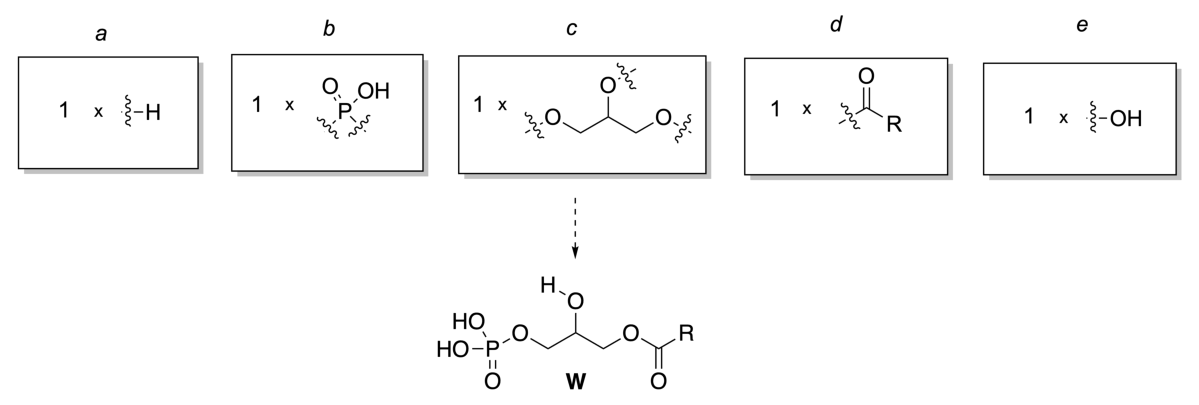
Cardiolipins are a family of acyclic phospholipids differing in fatty acid residues. They are essential for energy production and membrane stability. Defects can lead to certain diseases. PL1 belongs to this family. Using only the structural elements a-d in the quantities stated below, it is possible to assemble the non-ionised form of PL1. R is a hydrocarbon substituent in the fatty acid structure.
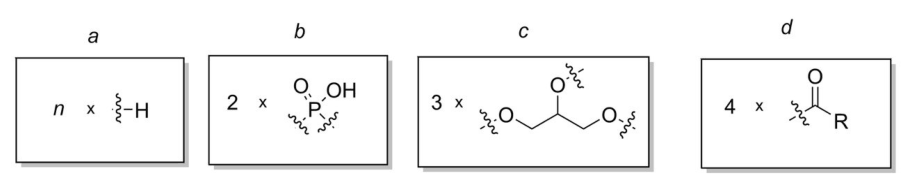
PL1 does not contain any peroxide bonds.
5.1 Tick one correct statement regarding the value of \(n\) (number of type \(a\) fragments). 1.0 pt
(a) \(n\) is an even number,
(b) \(n\) is an odd number,
(c) \(n\) can be either an odd or an even number.
Some cardiolipins are chiral molecules, even if they contain four identical fatty acid residues, as in the case of PL1. One enantiomer of PL1 is found in prokaryotes and eukaryotes, and the other only in archaea. All other diastereomers of PL1 are achiral molecules, since they have a plane of symmetry. Do not consider the chirality of phosphorus atoms as stereocentres.
PL1 is a diprotic acid with the same acidic groups. Its second deprotonation is less favourable (\(pK_{a_2}\gg pK_{a_1}\)) due to the special, stable structure of monoanion Y.
5.2 Draw the structure of one enantiomer of PL1. Draw the structure of Y in a way that shows the stabilisation that explains the difference between \(pK_{a_1}\) and \(pK_{a_2}\). Use the abbreviation R for the fatty acid residues. 6.0 pt
A series of experiments was conducted to identify the fatty acid (RCOOH) in PL1 found predominantly in mammalian hearts. During reductive ozonolysis, RCOOH forms three different organic products in equimolar amounts.
5.3 Determine the molecular formula of the fatty acid (RCOOH), if the non-ionised form of PL1 contains 255 \(\sigma\) and \(\pi\) bonds between atoms in total. Support your answer with calculations. 4.0 pt
If you were unable to find the structural formula of PL1, you can use a-d fragments from 5.1.
100 g of RCOOH reacts with 181.0 g of iodine. RCOOH also reacts in similar way with X and forms an adduct with an iodine mass fraction of 36.57%.
5.4 Determine the molecular formula of X. Support your answer with calculations. 2.0 pt
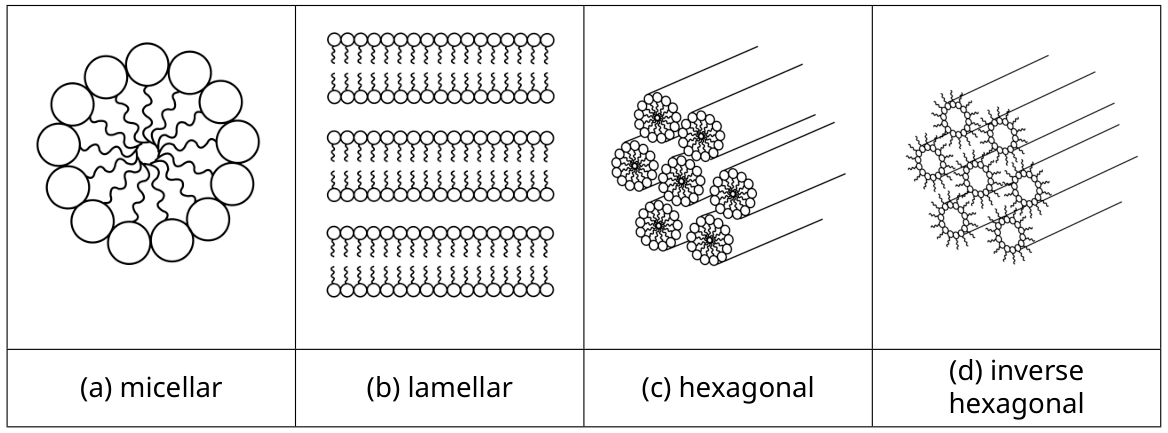
The phase behavior of PL1 depends on pH. In physiological conditions, PL1 is a dianion and it forms a lamellar phase.
5.5 Which lipid phase is formed by PL1 when both acid residues in it are protonated? 2.0 pt
Note that knowledge of PL1 structure is not required to solve this question.
Tick the correct answer.
The following balanced reaction equations show the hydrolysis of phospholipids PL1-PL3:
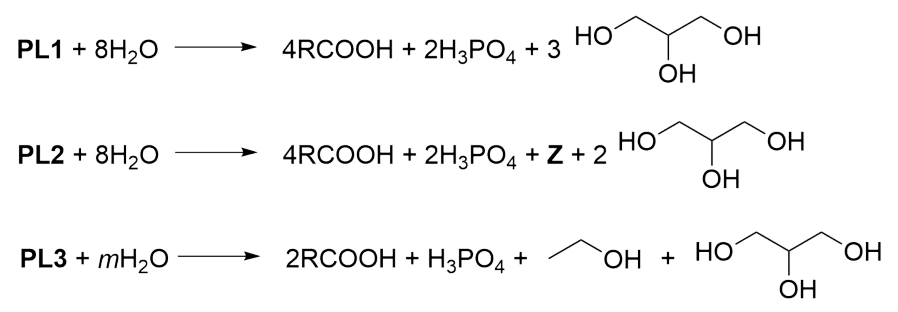
- The non-ionised form of PL2 contains 254 \(\sigma\) and \(\pi\) bonds between atoms in total. It is a chiral and a more symmetrical molecule than PL1,
- Z contains C, H, and O only, and it doesn’t react with \(\ce{H2}\) in the presence of a catalyst,
- Phospholipid PL3 is a charged molecule at physiological pH values, and it exists as pair of enantiomers.
5.6 Draw the structures of PL2 and PL3 using R to show the fatty acid residues. Show stereochemistry where appropriate. 3.0 pt
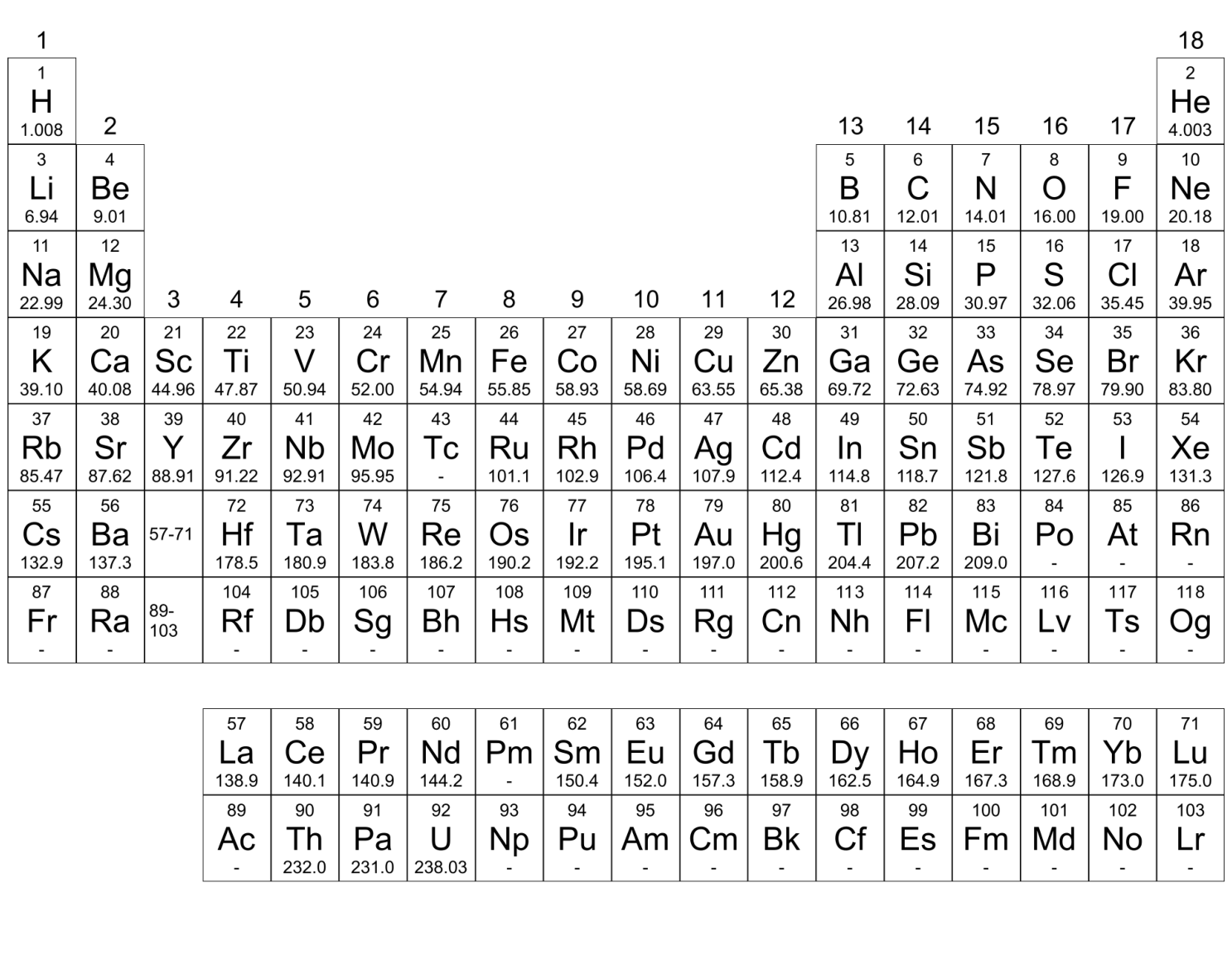
Periodic Table of Elements
Official English text of the problem.
Answers
In the generic structural SMILES below, every * denotes the same hydrocarbon substituent R. Phosphorus stereochemistry is omitted as instructed.
-
5.1: (b), \(n\) is odd. Specifically, \(n=1\).
-
5.2: PL1 is cardiolipin, 1,3-bis(phosphatidyl)glycerol. One enantiomer, with both outer glycerol stereocentres \(S\), is
*C(=O)OC[C@H](OC(=O)*)COP(=O)(O)OCC(O)COP(=O)(O)OC[C@@H](OC(=O)*)COC(=O)*
Y is the cardiolipin monoanion. One proton-localized representation is
*C(=O)OC[C@H](OC(=O)*)COP(=O)(O)OC[C@H](O)COP(=O)([O-])OC[C@@H](OC(=O)*)COC(=O)*
Draw two intramolecular hydrogen bonds: phosphate \(\ce{O-H}\) donates to the central glycerol oxygen, whose \(\ce{O-H}\) donates to the other phosphate’s negatively charged oxygen.
-
5.3: \(\boxed{\ce{C18H32O2}}\), an octadecadienoic acid. A compatible representative is linoleic acid, \((9Z,12Z)\)-octadeca-9,12-dienoic acid:
CCCCC/C=C\C/C=C\CCCCCCCC(=O)O
The supplied data do not uniquely establish the double-bond positions or geometry. -
5.4: \(\boxed{\ce{IBr}}\), iodine monobromide,
IBr. -
5.5: (d), inverse hexagonal phase.
-
5.6: PL2 is 2′-deoxycardiolipin, containing a propane-1,3-diol bridge. One enantiomer is
*C(=O)OC[C@H](OC(=O)*)COP(=O)(O)OCCCOP(=O)(O)OC[C@@H](OC(=O)*)COC(=O)*
Z is propane-1,3-diol, OCCCO.
PL3 is phosphatidylethanol. One enantiomer of its physiological monoanion is
CCOP(=O)([O-])OC[C@@H](OC(=O)*)COC(=O)*
Its other enantiomer has @ in place of @@. The hydrolysis coefficient is \(\boxed{m=4}\).
Solution
5.1 — Number of hydrogen fragments
Each glycerol fragment has three attachment sites, each phosphorus fragment has two, and each acyl fragment has one. Including the hydrogen fragments, the number of attachment sites is therefore
\[ 3(3)+2(2)+4(1)+n=17+n. \]
Each new bond consumes two attachment sites, so \(17+n\) must be even. Consequently, \(n\) is odd, giving answer (b).
The exact value follows from acyclicity. There are \(9+n\) fragments, and connecting them into one acyclic molecule requires \(8+n\) interfragment bonds:
\[ \frac{17+n}{2}=8+n \quad\Longrightarrow\quad \boxed{n=1}. \]
In the resulting cardiolipin, this hydrogen completes the central glycerol hydroxyl group. The two phosphate hydroxyl hydrogens are already present in fragments \(b\).
5.2 — PL1, its stereochemistry, and stabilization of Y
For the requested drawing, use a central glycerol unit whose two terminal hydroxyl groups form phosphate esters. Its secondary hydroxyl remains free.
Each phosphate has:
- one \(\ce{P=O}\) bond;
- one acidic \(\ce{P-OH}\) group;
- one ester linkage to the central glycerol;
- one ester linkage to a terminal oxygen of an outer glycerol.
Each outer glycerol carries two fatty acyl esters: one on its secondary oxygen and one on its remaining terminal oxygen. This uses exactly three glycerol fragments, two phosphate fragments, four acyl fragments, and one additional hydrogen.
The two outer glycerol stereocentres must have the same absolute configuration: either \((S,S)\), as encoded in the answer SMILES, or \((R,R)\). These structures are enantiomers. With identical arms, the central glycerol carbon in neutral PL1 is not a stereocentre. Opposite outer configurations allow the achiral, internally reflection-symmetric alternatives described in the question.
For Y, remove one phosphate proton and fold the central head group to form the hydrogen-bond sequence
\[ \underbrace{\ce{P-O-H}}_{\text{one phosphate}} \;\cdots\; \underbrace{\ce{O-H}}_{\text{central glycerol hydroxyl}} \;\cdots\; \underbrace{\ce{O^- -P}}_{\text{other phosphate}}. \]
The central oxygen accepts the first hydrogen bond and donates the second. Together with the covalent glycerol–phosphate framework, these interactions close two seven-membered hydrogen-bonded rings, counting the bridging hydrogen in each ring.
This cooperative hydrogen bonding stabilizes the monoanion. Removing the remaining phosphate proton removes a hydrogen-bond donor and creates a second negative charge in the compact head group. Thus the second deprotonation is substantially less favourable:
\[ \boxed{pK_{a_2}\gg pK_{a_1}}. \]
The SMILES specifies connectivity, formal charge, and a proton-localized stereochemical representation; it does not encode this folded conformation or the hydrogen bonds.
5.3 — Molecular formula of the fatty acid
Reductive ozonolysis retains the original carboxyl group in one product. Since there is only one carboxyl group per fatty-acid molecule, the carboxyl-containing product is formed once per molecule.
The three products occur in equimolar amounts, so each fatty-acid molecule produces three fragments. For an acyclic fatty acid, this requires two carbon–carbon double bonds.
An acyclic monocarboxylic acid containing \(c\) carbon atoms and two carbon–carbon double bonds therefore has formula
\[ \ce{C_{$c$}H_{2$c$-4}O2}. \]
Let \(B\) denote the total number of \(\sigma\) and \(\pi\) bonds, counting a double bond as two. From the usual valences,
\[ B_{\mathrm{fatty\ acid}} = \frac{4c+(2c-4)+2(2)}{2} =3c. \]
The small molecules in the hydrolysis are water, O; glycerol, OCC(O)CO; and phosphoric acid, OP(=O)(O)O. Their bond totals are
\[ B_{\ce{H2O}}=2,\qquad B_{\mathrm{glycerol}}=13,\qquad B_{\ce{H3PO4}}=8. \]
The balanced hydrolysis is
\[ \ce{PL1 + 8H2O -> 4RCOOH + 2H3PO4 + 3C3H8O3}. \]
Hydrolysis replaces each ester linkage by two bonds to the atoms of water, preserving the total bond-order sum across this equation. Hence
\[ 255+8(2)=4B_{\mathrm{fatty\ acid}}+2(8)+3(13), \]
\[ 271=4B_{\mathrm{fatty\ acid}}+55, \]
\[ B_{\mathrm{fatty\ acid}}=54. \]
Therefore,
\[ 3c=54,\qquad c=18, \]
and
\[ \boxed{\mathrm{RCOOH}=\ce{C18H32O2}}. \]
As an independent check, condensation of the hydrolysis products gives
\[ \ce{PL1}=\ce{C81H142O17P2}. \]
Its total bond count is
\[ B_{\mathrm{PL1}} = \frac{4(81)+142+2(17)+5(2)}{2} =\boxed{255}. \]
Here phosphorus has bond-order sum five, consistent with the supplied \(\ce{P=O}\) drawings.
The linoleic-acid SMILES in the answer is a compatible structural representative. Formula determination alone does not establish its particular double-bond positions or \(Z\) configurations.
5.4 — Identification of X
Using the supplied atomic masses,
\[ M(\ce{C18H32O2}) =18(12.01)+32(1.008)+2(16.00) =280.436\ \mathrm{g\,mol^{-1}}. \]
Iodine is \(\ce{I2}\), SMILES II, with
\[ M(\ce{I2})=253.8\ \mathrm{g\,mol^{-1}}. \]
The amount of iodine consumed per mole of fatty acid is
\[ \frac{n(\ce{I2})}{n(\mathrm{fatty\ acid})} = \frac{181.0/253.8}{100/280.436} =2.000. \]
This agrees with addition across two double bonds:
\[ \ce{C18H32O2 + 2I2 -> C18H32I4O2}. \]
For addition of an iodine-containing interhalogen, two reagent molecules introduce two iodine atoms per fatty-acid molecule. Thus
\[ 0.3657 = \frac{2(126.9)} {280.436+2M(X)}. \]
Solving,
\[ M(X) = \frac{253.8/0.3657-280.436}{2} =206.79\ \mathrm{g\,mol^{-1}}. \]
The mass remaining after accounting for one iodine atom is
\[ 206.79-126.9=79.89\ \mathrm{g\,mol^{-1}}, \]
which matches bromine, \(79.90\ \mathrm{g\,mol^{-1}}\). Therefore,
\[ \boxed{X=\ce{IBr}}, \]
iodine monobromide, IBr.
The balanced addition is
\[ \ce{C18H32O2 + 2IBr -> C18H32Br2I2O2}. \]
Checking the iodine fraction,
\[ w_{\mathrm I} = \frac{253.8} {280.436+2(126.9+79.90)} =0.365687 \approx\boxed{36.57\%}. \]
For the compatible linoleic-acid representative, constitutional representations of the addition products are 9,10,12,13-tetraiodooctadecanoic acid, CCCCCC(I)C(I)CC(I)C(I)CCCCCCCC(=O)O, and 9,12-dibromo-10,13-diiodooctadecanoic acid, CCCCCC(I)C(Br)CC(I)C(Br)CCCCCCCC(=O)O. These SMILES leave addition-product stereochemistry unspecified; neither stereochemistry nor alternative interhalogen regiochemistry affects the mass calculation.
5.5 — Lipid phase after protonation
Protonating both phosphate groups reduces electrostatic repulsion and hydration of the polar head group, decreasing its effective cross-sectional area. The four hydrocarbon tails retain their large volume.
Consequently, the packing parameter
\[ p=\frac{v}{a_0l_c} \]
increases as the head-group area \(a_0\) decreases. This favours curvature around aqueous channels and formation of the inverse hexagonal phase.
Tick (d). In that drawing, polar heads face inward toward water-filled cylindrical channels, while hydrocarbon tails extend outward into the surrounding lipid region.
5.6 — Structures of PL2 and PL3
For PL2, compare its hydrolysis with that of PL1. The fatty acids, phosphoric acid, and water coefficients are unchanged; one glycerol molecule is replaced by Z. Therefore,
\[ B(Z)-B(\mathrm{glycerol}) = B(\mathrm{PL2})-B(\mathrm{PL1}) =-1, \]
so
\[ B(Z)=13-1=\boxed{12}. \]
For an acyclic saturated diol, \(\ce{C_{$k$}H_{2$k$+2}O2}\),
\[ B(Z) = \frac{4k+(2k+2)+4}{2} =3k+3. \]
Thus
\[ 3k+3=12 \quad\Longrightarrow\quad k=3. \]
The required symmetry places the two hydroxyl groups at equivalent terminal positions, giving propane-1,3-diol, \(\ce{HOCH2CH2CH2OH}\), OCCCO.
A central carbonyl alternative, dihydroxyacetone, OCC(=O)CO, would also reduce the bond total by one relative to glycerol, but it would undergo catalytic hydrogenation. The stated nonreactivity excludes it.
Accordingly, draw PL2 by replacing the central \(\ce{-CH(OH)-}\) group of PL1 with \(\ce{-CH2-}\), retaining the same two outer glycerol configurations. This gives 2′-deoxycardiolipin, whose SMILES is listed in the answers. Replacing the central hydroxyl by hydrogen allows greater symmetry, including a conformation with a twofold rotation exchanging the two identical halves.
Its neutral molecular formula and balanced hydrolysis are
\[ \ce{PL2}=\ce{C81H142O16P2}, \]
\[ \ce{C81H142O16P2 + 8H2O -> 4C18H32O2 + 2H3PO4 + C3H8O2 + 2C3H8O3}. \]
Removing one oxygen from PL1 lowers the bond-order sum by one:
\[ B_{\mathrm{PL2}} = \frac{4(81)+142+2(16)+5(2)}{2} =\boxed{254}. \]
For PL3, the hydrolysis products identify two fatty acyl groups, one glycerol, one phosphate, and ethanol, CCO.
Draw a glycerol with fatty acyl esters on its secondary oxygen and one terminal oxygen. Connect its other terminal oxygen to a phosphate group, and connect ethanol through oxygen to that same phosphate. The phosphate retains one acidic hydroxyl:
\[ \ce{R-C(=O)-O-CH2-CH[O-C(=O)-R]-CH2-O-P(=O)(OH)-O-CH2-CH3}. \]
This is phosphatidylethanol. One enantiomer of its neutral acid form is
CCOP(=O)(O)OC[C@@H](OC(=O)*)COC(=O)*
At physiological pH, its remaining phosphate hydroxyl is deprotonated, giving the monoanion shown in the answers. A phosphate on the central glycerol oxygen, with identical acyl groups on both terminal oxygens, would instead give an achiral structure; this is excluded by the stated enantiomeric pair.
There are two carboxylic ester linkages and two phosphate ester linkages to hydrolyse, requiring four water molecules:
\[ \boxed{m=4}. \]
For the neutral acid form, the balanced equation is
\[ \ce{C41H73O8P + 4H2O -> 2C18H32O2 + H3PO4 + C2H6O + C3H8O3}. \]
The solution was checked against the official solution.
IChO 2026 · Theorieaufgabe 5
Cardiolipine
T5. Cardiolipine
6%
| 5.1 | 5.2 | 5.3 | 5.4 | 5.5 | 5.6 | \(\Sigma\) |
|---|---|---|---|---|---|---|
| 1 | 6 | 4 | 2 | 2 | 3 | 18 |
In dieser Aufgabe sollen Sie kreativ sein und Moleküle aus Fragmenten zusammensetzen. Wenn Sie beispielsweise ein chirales Phospholipid wie W mithilfe der Fragmente a-e zeichnen sollen, lässt es sich wie unten gezeigt zusammensetzen.
Cardiolipine sind eine Familie acyclischer Phospholipide, die sich in ihren Fettsäureresten unterscheiden. Sie sind für die Energiegewinnung und die Membranstabilität unerlässlich. Defekte können zu bestimmten Erkrankungen führen. PL1 gehört zu dieser Familie. Ausschließlich mit den Strukturelementen a-d in den unten angegebenen Anzahlen lässt sich die nichtionisierte Form von PL1 zusammensetzen. R ist ein Kohlenwasserstoffsubstituent in der Fettsäurestruktur.
PL1 enthält keine Peroxidbindungen.
5.1 Kreuzen Sie eine richtige Aussage zum Wert von \(n\) (Anzahl der Fragmente vom Typ \(a\)) an. 1.0 Pkt.
(a) \(n\) ist eine gerade Zahl,
(b) \(n\) ist eine ungerade Zahl,
(c) \(n\) kann entweder eine ungerade oder eine gerade Zahl sein.
Einige Cardiolipine sind chirale Moleküle, selbst wenn sie wie PL1 vier identische Fettsäurereste enthalten. Ein Enantiomer von PL1 kommt in Prokaryoten und Eukaryoten vor, das andere nur in Archaeen. Alle übrigen Diastereomere von PL1 sind achirale Moleküle, da sie eine Symmetrieebene besitzen. Berücksichtigen Sie die Chiralität von Phosphoratomen als Stereozentren nicht.
PL1 ist eine zweiprotonige Säure mit gleichartigen sauren Gruppen. Ihre zweite Deprotonierung ist aufgrund der besonderen, stabilen Struktur des Monoanions Y weniger günstig (\(pK_{a_2}\gg pK_{a_1}\)).
5.2 Zeichnen Sie die Struktur eines Enantiomers von PL1. Zeichnen Sie die Struktur von Y so, dass die Stabilisierung sichtbar wird, die den Unterschied zwischen \(pK_{a_1}\) und \(pK_{a_2}\) erklärt. Verwenden Sie die Abkürzung R für die Fettsäurereste. 6.0 Pkt.
Zur Identifizierung der Fettsäure (RCOOH) in PL1, das vorwiegend in den Herzen von Säugetieren vorkommt, wurde eine Reihe von Experimenten durchgeführt. Bei der reduktiven Ozonolyse bildet RCOOH drei verschiedene organische Produkte in äquimolaren Mengen.
5.3 Bestimmen Sie die Summenformel der Fettsäure (RCOOH), wenn die nichtionisierte Form von PL1 insgesamt 255 \(\sigma\)- und \(\pi\)-Bindungen zwischen Atomen enthält. Belegen Sie Ihre Antwort durch Berechnungen. 4.0 Pkt.
Falls Sie die Strukturformel von PL1 nicht ermitteln konnten, können Sie die Fragmente a-d aus 5.1 verwenden.
100 g RCOOH reagieren mit 181.0 g Iod. RCOOH reagiert auch in ähnlicher Weise mit X und bildet ein Addukt mit einem Iod-Massenanteil von 36.57%.
5.4 Bestimmen Sie die Summenformel von X. Belegen Sie Ihre Antwort durch Berechnungen. 2.0 Pkt.
Das Phasenverhalten von PL1 hängt vom pH-Wert ab. Unter physiologischen Bedingungen liegt PL1 als Dianion vor und bildet eine lamellare Phase.
5.5 Welche Lipidphase bildet PL1, wenn beide Säurereste darin protoniert sind? 2.0 Pkt.
Beachten Sie, dass zur Lösung dieser Frage keine Kenntnis der Struktur von PL1 erforderlich ist.
Kreuzen Sie die richtige Antwort an.
Die folgenden ausgeglichenen Reaktionsgleichungen zeigen die Hydrolyse der Phospholipide PL1-PL3:
- Die nichtionisierte Form von PL2 enthält insgesamt 254 \(\sigma\)- und \(\pi\)-Bindungen zwischen Atomen. Es ist ein chirales und symmetrischeres Molekül als PL1,
- Z enthält nur C, H und O und reagiert in Gegenwart eines Katalysators nicht mit \(\ce{H2}\),
- Das Phospholipid PL3 ist bei physiologischen pH-Werten ein geladenes Molekül und liegt als Enantiomerenpaar vor.
5.6 Zeichnen Sie die Strukturen von PL2 und PL3 und verwenden Sie R zur Darstellung der Fettsäurereste. Geben Sie gegebenenfalls die Stereochemie an. 3.0 Pkt.
Periodensystem der Elemente
Aufgabentext aus dem offiziellen englischen Text übersetzt.
Antworten
In den folgenden generischen Struktur-SMILES steht jedes * für denselben Kohlenwasserstoffsubstituenten R. Die Stereochemie am Phosphor wird entsprechend der Anweisung weggelassen.
-
5.1: (b), \(n\) ist ungerade. Konkret gilt \(n=1\).
-
5.2: PL1 ist Cardiolipin, 1,3-Bis(phosphatidyl)glycerol. Ein Enantiomer, bei dem beide äußeren Glycerol-Stereozentren die Konfiguration \(S\) besitzen, ist
*C(=O)OC[C@H](OC(=O)*)COP(=O)(O)OCC(O)COP(=O)(O)OC[C@@H](OC(=O)*)COC(=O)*
Y ist das Cardiolipin-Monoanion. Eine Darstellung mit lokalisiertem Proton ist
*C(=O)OC[C@H](OC(=O)*)COP(=O)(O)OC[C@H](O)COP(=O)([O-])OC[C@@H](OC(=O)*)COC(=O)*
Zeichnen Sie zwei intramolekulare Wasserstoffbrückenbindungen ein: Die \(\ce{O-H}\)-Gruppe eines Phosphats wirkt als Donor gegenüber dem zentralen Glycerol-Sauerstoffatom, dessen \(\ce{O-H}\)-Gruppe wiederum als Donor gegenüber dem negativ geladenen Sauerstoffatom des anderen Phosphats wirkt.
-
5.3: \(\boxed{\ce{C18H32O2}}\), eine Octadecadiensäure. Ein mit den Angaben vereinbarer Vertreter ist Linolsäure, \((9Z,12Z)\)-Octadeca-9,12-diensäure:
CCCCC/C=C\C/C=C\CCCCCCCC(=O)O
Die angegebenen Daten legen die Positionen oder die Geometrie der Doppelbindungen nicht eindeutig fest. -
5.4: \(\boxed{\ce{IBr}}\), Iodmonobromid,
IBr. -
5.5: (d), inverse hexagonale Phase.
-
5.6: PL2 ist 2′-Desoxycardiolipin und enthält eine Propan-1,3-diol-Brücke. Ein Enantiomer ist
*C(=O)OC[C@H](OC(=O)*)COP(=O)(O)OCCCOP(=O)(O)OC[C@@H](OC(=O)*)COC(=O)*
Z ist Propan-1,3-diol, OCCCO.
PL3 ist Phosphatidylethanol. Ein Enantiomer seines unter physiologischen Bedingungen vorliegenden Monoanions ist
CCOP(=O)([O-])OC[C@@H](OC(=O)*)COC(=O)*
Sein anderes Enantiomer besitzt @ anstelle von @@. Der Hydrolysekoeffizient ist \(\boxed{m=4}\).
Lösung
5.1 — Anzahl der Wasserstofffragmente
Jedes Glycerolfragment besitzt drei Verknüpfungsstellen, jedes Phosphorfragment zwei und jedes Acylfragment eine. Einschließlich der Wasserstofffragmente beträgt die Anzahl der Verknüpfungsstellen daher
\[ 3(3)+2(2)+4(1)+n=17+n. \]
Jede neue Bindung beansprucht zwei Verknüpfungsstellen, sodass \(17+n\) gerade sein muss. Folglich ist \(n\) ungerade, womit Antwort (b) richtig ist.
Der genaue Wert folgt aus der Acyclizität. Es gibt \(9+n\) Fragmente, und um sie zu einem einzigen acyclischen Molekül zu verbinden, sind \(8+n\) Bindungen zwischen den Fragmenten erforderlich:
\[ \frac{17+n}{2}=8+n \quad\Longrightarrow\quad \boxed{n=1}. \]
Im entstehenden Cardiolipin vervollständigt dieses Wasserstoffatom die Hydroxygruppe des zentralen Glycerols. Die beiden Wasserstoffatome der Phosphat-Hydroxygruppen sind bereits in den Fragmenten \(b\) enthalten.
5.2 — PL1, seine Stereochemie und die Stabilisierung von Y
Verwenden Sie für die geforderte Zeichnung eine zentrale Glyceroleinheit, deren beide endständigen Hydroxygruppen Phosphatester bilden. Ihre sekundäre Hydroxygruppe bleibt frei.
Jedes Phosphat besitzt:
- eine \(\ce{P=O}\)-Bindung;
- eine saure \(\ce{P-OH}\)-Gruppe;
- eine Esterbindung zum zentralen Glycerol;
- eine Esterbindung zu einem endständigen Sauerstoffatom eines äußeren Glycerols.
Jedes äußere Glycerol trägt zwei Fettsäureestergruppen: eine an seinem sekundären Sauerstoffatom und eine an seinem verbleibenden endständigen Sauerstoffatom. Dabei werden genau drei Glycerolfragmente, zwei Phosphatfragmente, vier Acylfragmente und ein zusätzliches Wasserstoffatom verwendet.
Die beiden äußeren Glycerol-Stereozentren müssen die gleiche absolute Konfiguration besitzen: entweder \((S,S)\), wie in den SMILES der Antwort codiert, oder \((R,R)\). Diese Strukturen sind Enantiomere. Bei identischen Armen ist das zentrale Glycerol-Kohlenstoffatom im neutralen PL1 kein Stereozentrum. Entgegengesetzte äußere Konfigurationen ermöglichen die in der Aufgabenstellung beschriebenen achiralen Alternativen mit einer inneren Spiegelebene.
Entfernen Sie für Y ein Phosphatproton und falten Sie die zentrale Kopfgruppe so, dass die folgende Wasserstoffbrückensequenz entsteht:
\[ \underbrace{\ce{P-O-H}}_{\text{ein Phosphat}} \;\cdots\; \underbrace{\ce{O-H}}_{\text{zentrale Glycerol-Hydroxygruppe}} \;\cdots\; \underbrace{\ce{O^- -P}}_{\text{anderes Phosphat}}. \]
Das zentrale Sauerstoffatom akzeptiert die erste Wasserstoffbrückenbindung und wirkt als Donor für die zweite. Zusammen mit dem kovalenten Glycerol–Phosphat-Gerüst schließen diese Wechselwirkungen zwei siebengliedrige, durch Wasserstoffbrücken gebundene Ringe, wobei das verbrückende Wasserstoffatom in jedem Ring mitgezählt wird.
Diese kooperative Wasserstoffbrückenbildung stabilisiert das Monoanion. Durch die Entfernung des verbleibenden Phosphatprotons geht ein Wasserstoffbrückendonor verloren, und in der kompakten Kopfgruppe entsteht eine zweite negative Ladung. Daher ist die zweite Deprotonierung wesentlich weniger günstig:
\[ \boxed{pK_{a_2}\gg pK_{a_1}}. \]
Die SMILES geben die Konnektivität, die Formalladung und eine stereochemische Darstellung mit lokalisiertem Proton an; sie codieren nicht diese gefaltete Konformation oder die Wasserstoffbrückenbindungen.
5.3 — Summenformel der Fettsäure
Bei der reduktiven Ozonolyse bleibt die ursprüngliche Carboxygruppe in einem Produkt erhalten. Da jedes Fettsäuremolekül nur eine Carboxygruppe besitzt, entsteht das carboxygruppenhaltige Produkt einmal pro Molekül.
Die drei Produkte treten in äquimolaren Mengen auf, sodass jedes Fettsäuremolekül drei Fragmente liefert. Bei einer acyclischen Fettsäure erfordert dies zwei Kohlenstoff–Kohlenstoff-Doppelbindungen.
Eine acyclische Monocarbonsäure mit \(c\) Kohlenstoffatomen und zwei Kohlenstoff–Kohlenstoff-Doppelbindungen hat daher die Formel
\[ \ce{C_{$c$}H_{2$c$-4}O2}. \]
Sei \(B\) die Gesamtzahl der \(\sigma\)- und \(\pi\)-Bindungen, wobei eine Doppelbindung als zwei Bindungen gezählt wird. Aus den üblichen Wertigkeiten ergibt sich
\[ B_{\mathrm{fatty\ acid}} = \frac{4c+(2c-4)+2(2)}{2} =3c. \]
Die kleinen Moleküle bei der Hydrolyse sind Wasser, O, Glycerol, OCC(O)CO, und Phosphorsäure, OP(=O)(O)O. Ihre Gesamtbindungszahlen betragen
\[ B_{\ce{H2O}}=2,\qquad B_{\mathrm{glycerol}}=13,\qquad B_{\ce{H3PO4}}=8. \]
Die ausgeglichene Hydrolysegleichung lautet
\[ \ce{PL1 + 8H2O -> 4RCOOH + 2H3PO4 + 3C3H8O3}. \]
Bei der Hydrolyse wird jede Esterbindung durch zwei Bindungen zu den Atomen des Wassers ersetzt, wobei die gesamte Bindungsordnungssumme über diese Gleichung hinweg erhalten bleibt. Somit gilt
\[ 255+8(2)=4B_{\mathrm{fatty\ acid}}+2(8)+3(13), \]
\[ 271=4B_{\mathrm{fatty\ acid}}+55, \]
\[ B_{\mathrm{fatty\ acid}}=54. \]
Daher gilt
\[ 3c=54,\qquad c=18, \]
und
\[ \boxed{\mathrm{RCOOH}=\ce{C18H32O2}}. \]
Als unabhängige Kontrolle ergibt die Kondensation der Hydrolyseprodukte
\[ \ce{PL1}=\ce{C81H142O17P2}. \]
Die Gesamtbindungszahl beträgt
\[ B_{\mathrm{PL1}} = \frac{4(81)+142+2(17)+5(2)}{2} =\boxed{255}. \]
Hier besitzt Phosphor die Bindungsordnungssumme fünf, in Übereinstimmung mit den vorgegebenen \(\ce{P=O}\)-Darstellungen.
Die Linolsäure-SMILES in der Antwort beschreiben einen mit den Angaben vereinbaren Strukturvertreter. Die Bestimmung der Summenformel allein legt dessen konkrete Doppelbindungspositionen oder \(Z\)-Konfigurationen nicht fest.
5.4 — Identifizierung von X
Mit den angegebenen Atommassen ergibt sich
\[ M(\ce{C18H32O2}) =18(12.01)+32(1.008)+2(16.00) =280.436\ \mathrm{g\,mol^{-1}}. \]
Iod liegt als \(\ce{I2}\) vor, SMILES II, mit
\[ M(\ce{I2})=253.8\ \mathrm{g\,mol^{-1}}. \]
Die pro Mol Fettsäure verbrauchte Stoffmenge an Iod beträgt
\[ \frac{n(\ce{I2})}{n(\mathrm{fatty\ acid})} = \frac{181.0/253.8}{100/280.436} =2.000. \]
Dies stimmt mit einer Addition an zwei Doppelbindungen überein:
\[ \ce{C18H32O2 + 2I2 -> C18H32I4O2}. \]
Bei der Addition einer iodhaltigen Interhalogenverbindung führen zwei Reagenzmoleküle zwei Iodatome pro Fettsäuremolekül ein. Somit gilt
\[ 0.3657 = \frac{2(126.9)} {280.436+2M(X)}. \]
Auflösen ergibt
\[ M(X) = \frac{253.8/0.3657-280.436}{2} =206.79\ \mathrm{g\,mol^{-1}}. \]
Nach Abzug des Beitrags eines Iodatoms verbleibt die molare Masse
\[ 206.79-126.9=79.89\ \mathrm{g\,mol^{-1}}, \]
die mit der von Brom, \(79.90\ \mathrm{g\,mol^{-1}}\), übereinstimmt. Daher gilt
\[ \boxed{X=\ce{IBr}}, \]
Iodmonobromid, IBr.
Die ausgeglichene Additionsgleichung lautet
\[ \ce{C18H32O2 + 2IBr -> C18H32Br2I2O2}. \]
Die Überprüfung des Iodanteils ergibt
\[ w_{\mathrm I} = \frac{253.8} {280.436+2(126.9+79.90)} =0.365687 \approx\boxed{36.57\%}. \]
Für den mit den Angaben vereinbaren Vertreter Linolsäure sind Konstitutionsdarstellungen der Additionsprodukte 9,10,12,13-Tetraiodoctadecansäure, CCCCCC(I)C(I)CC(I)C(I)CCCCCCCC(=O)O, und 9,12-Dibrom-10,13-diiodoctadecansäure, CCCCCC(I)C(Br)CC(I)C(Br)CCCCCCCC(=O)O. Diese SMILES lassen die Stereochemie der Additionsprodukte offen; weder die Stereochemie noch eine alternative Regiochemie der Interhalogenaddition beeinflusst die Massenberechnung.
5.5 — Lipidphase nach der Protonierung
Die Protonierung beider Phosphatgruppen verringert die elektrostatische Abstoßung und die Hydratation der polaren Kopfgruppe, wodurch ihre effektive Querschnittsfläche abnimmt. Die vier Kohlenwasserstoffketten behalten ihr großes Volumen bei.
Folglich steigt der Packungsparameter
\[ p=\frac{v}{a_0l_c} \]
mit abnehmender Kopfgruppenfläche \(a_0\). Dies begünstigt eine Krümmung um wässrige Kanäle und die Bildung der inversen hexagonalen Phase.
Kreuzen Sie (d) an. In dieser Zeichnung sind die polaren Köpfe nach innen zu wassergefüllten zylindrischen Kanälen gerichtet, während sich die Kohlenwasserstoffketten nach außen in den umgebenden Lipidbereich erstrecken.
5.6 — Strukturen von PL2 und PL3
Vergleichen Sie für PL2 dessen Hydrolyse mit der von PL1. Die Koeffizienten der Fettsäuren, der Phosphorsäure und des Wassers bleiben unverändert; ein Glycerolmolekül wird durch Z ersetzt. Daher gilt
\[ B(Z)-B(\mathrm{glycerol}) = B(\mathrm{PL2})-B(\mathrm{PL1}) =-1, \]
also
\[ B(Z)=13-1=\boxed{12}. \]
Für ein acyclisches gesättigtes Diol, \(\ce{C_{$k$}H_{2$k$+2}O2}\), gilt
\[ B(Z) = \frac{4k+(2k+2)+4}{2} =3k+3. \]
Somit gilt
\[ 3k+3=12 \quad\Longrightarrow\quad k=3. \]
Die erforderliche Symmetrie bedingt, dass sich die beiden Hydroxygruppen an gleichwertigen endständigen Positionen befinden. Daraus ergibt sich Propan-1,3-diol, \(\ce{HOCH2CH2CH2OH}\), OCCCO.
Eine Alternative mit einer zentralen Carbonylgruppe, Dihydroxyaceton, OCC(=O)CO, würde die Gesamtbindungszahl gegenüber Glycerol ebenfalls um eins verringern, würde jedoch katalytisch hydriert werden. Die angegebene fehlende Reaktivität schließt diese Alternative aus.
Zeichnen Sie PL2 dementsprechend, indem Sie die zentrale \(\ce{-CH(OH)-}\)-Gruppe von PL1 durch \(\ce{-CH2-}\) ersetzen und dabei die gleichen beiden äußeren Glycerolkonfigurationen beibehalten. So entsteht 2′-Desoxycardiolipin, dessen SMILES in den Antworten angegeben sind. Der Ersatz der zentralen Hydroxygruppe durch Wasserstoff ermöglicht eine höhere Symmetrie, einschließlich einer Konformation mit einer zweizähligen Drehung, die die beiden identischen Hälften vertauscht.
Seine neutrale Summenformel und die ausgeglichene Hydrolysegleichung lauten
\[ \ce{PL2}=\ce{C81H142O16P2}, \]
\[ \ce{C81H142O16P2 + 8H2O -> 4C18H32O2 + 2H3PO4 + C3H8O2 + 2C3H8O3}. \]
Durch das Entfernen eines Sauerstoffatoms aus PL1 sinkt die Bindungsordnungssumme um eins:
\[ B_{\mathrm{PL2}} = \frac{4(81)+142+2(16)+5(2)}{2} =\boxed{254}. \]
Für PL3 lassen sich aus den Hydrolyseprodukten zwei Fettsäureacylgruppen, ein Glycerol, ein Phosphat und Ethanol, CCO, erkennen.
Zeichnen Sie ein Glycerol mit Fettsäureestergruppen an seinem sekundären Sauerstoffatom und an einem endständigen Sauerstoffatom. Verbinden Sie sein anderes endständiges Sauerstoffatom mit einer Phosphatgruppe und Ethanol über dessen Sauerstoffatom mit derselben Phosphatgruppe. Das Phosphat behält eine saure Hydroxygruppe:
\[ \ce{R-C(=O)-O-CH2-CH[O-C(=O)-R]-CH2-O-P(=O)(OH)-O-CH2-CH3}. \]
Dies ist Phosphatidylethanol. Ein Enantiomer seiner neutralen Säureform ist
CCOP(=O)(O)OC[C@@H](OC(=O)*)COC(=O)*
Bei physiologischem pH-Wert ist die verbleibende Phosphat-Hydroxygruppe deprotoniert, wodurch das in den Antworten gezeigte Monoanion entsteht. Ein Phosphat am zentralen Glycerol-Sauerstoffatom mit identischen Acylgruppen an beiden endständigen Sauerstoffatomen würde dagegen eine achirale Struktur ergeben; dies wird durch das angegebene Enantiomerenpaar ausgeschlossen.
Es sind zwei Carbonsäureesterbindungen und zwei Phosphatesterbindungen zu hydrolysieren, wofür vier Wassermoleküle benötigt werden:
\[ \boxed{m=4}. \]
Für die neutrale Säureform lautet die ausgeglichene Gleichung
\[ \ce{C41H73O8P + 4H2O -> 2C18H32O2 + H3PO4 + C2H6O + C3H8O3}. \]
Die Lösung wurde mit der offiziellen Lösung abgeglichen.
IChO 2026 · Teori sorusu 5
Kardiyolipinler
T5. Kardiyolipinler
6%
| 5.1 | 5.2 | 5.3 | 5.4 | 5.5 | 5.6 | \(\Sigma\) |
|---|---|---|---|---|---|---|
| 1 | 6 | 4 | 2 | 2 | 3 | 18 |
Bu soruda yaratıcı olmanız ve parçalardan moleküller oluşturmanız istenmektedir. Örneğin, a-e parçalarını kullanarak W gibi kiral bir fosfolipit çizmeniz istenirse, bu molekül aşağıda gösterildiği gibi birleştirilebilir.
Kardiyolipinler, yağ asidi kalıntıları bakımından birbirinden farklılaşan bir asiklik fosfolipit ailesidir. Enerji üretimi ve zar kararlılığı için gereklidirler. Bunlardaki bozukluklar bazı hastalıklara yol açabilir. PL1 bu aileye aittir. Yalnızca aşağıda belirtilen sayılardaki a-d yapı elemanları kullanılarak PL1'in iyonlaşmamış biçimi oluşturulabilir. R, yağ asidi yapısındaki bir hidrokarbon sübstitüentidir.
PL1 herhangi bir peroksit bağı içermez.
5.1 İşaretleyiniz: \(n\) (\(a\) türündeki parçaların sayısı) değeriyle ilgili doğru olan tek ifadeyi seçiniz. 1.0 puan
(a) \(n\) bir çift sayıdır,
(b) \(n\) bir tek sayıdır,
(c) \(n\) tek veya çift sayı olabilir.
Bazı kardiyolipinler, PL1 örneğinde olduğu gibi dört özdeş yağ asidi kalıntısı içerseler bile kiral moleküllerdir. PL1'in bir enantiyomeri prokaryotlarda ve ökaryotlarda, diğeri ise yalnızca arkelerde bulunur. PL1'in diğer tüm diastereomerleri bir simetri düzlemine sahip olduklarından akiral moleküllerdir. Fosfor atomlarını stereomerkez olarak değerlendirip kiralitelerini dikkate almayınız.
PL1, aynı tür asidik gruplara sahip diprotik bir asittir. Monoanyon Y'nin özel ve kararlı yapısı nedeniyle ikinci deprotonasyonu daha az elverişlidir (\(pK_{a_2}\gg pK_{a_1}\)).
5.2 Çiziniz: PL1'in bir enantiyomerinin yapısını çiziniz. Y'nin yapısını, \(pK_{a_1}\) ile \(pK_{a_2}\) arasındaki farkı açıklayan kararlılaşmayı gösterecek şekilde çiziniz. Yağ asidi kalıntıları için R kısaltmasını kullanınız. 6.0 puan
Ağırlıklı olarak memeli kalplerinde bulunan PL1'deki yağ asidini (RCOOH) belirlemek için bir dizi deney yapılmıştır. İndirgen ozonoliz sırasında RCOOH, eşmolar miktarlarda üç farklı organik ürün oluşturur.
5.3 Belirleyiniz: PL1'in iyonlaşmamış biçiminde atomlar arasında toplam 255 \(\sigma\) ve \(\pi\) bağı bulunduğuna göre yağ asidinin (RCOOH) molekül formülünü belirleyiniz. Cevabınızı hesaplamalarla destekleyiniz. 4.0 puan
PL1*'in yapı formülünü bulamadıysanız, 5.1*'deki a-d parçalarını kullanabilirsiniz.
100 g RCOOH, 181.0 g iyot ile tepkimeye girer. RCOOH, X ile de benzer şekilde tepkimeye girerek iyodun kütle kesrinin 36.57% olduğu bir katılma ürünü oluşturur.
5.4 Belirleyiniz: X'in molekül formülünü belirleyiniz. Cevabınızı hesaplamalarla destekleyiniz. 2.0 puan
PL1'in faz davranışı pH'ye bağlıdır. Fizyolojik koşullarda PL1 bir dianyondur ve lamelli faz oluşturur.
5.5 PL1'deki her iki asit kalıntısı protonlandığında hangi lipit fazı oluşur? 2.0 puan
Bu soruyu çözmek için PL1'in yapısını bilmenin gerekli olmadığını unutmayınız.
Doğru cevabı işaretleyiniz.
Aşağıdaki denkleştirilmiş tepkime denklemleri PL1-PL3 fosfolipitlerinin hidrolizini göstermektedir:
- PL2'nin iyonlaşmamış biçiminde atomlar arasında toplam 254 \(\sigma\) ve \(\pi\) bağı bulunur. PL1'den daha simetrik ve kiral bir moleküldür,
- Z yalnızca C, H ve O içerir ve bir katalizör varlığında \(\ce{H2}\) ile tepkimeye girmez,
- PL3 fosfolipidi, fizyolojik pH değerlerinde yüklü bir moleküldür ve bir enantiyomer çifti hâlinde bulunur.
5.6 Çiziniz: Yağ asidi kalıntılarını göstermek için R kullanarak PL2 ve PL3'ün yapılarını çiziniz. Gereken yerlerde stereokimyayı gösteriniz. 3.0 puan
Elementlerin Periyodik Tablosu
Soru metni resmi İngilizce metinden çevrilmiştir.
Cevaplar
Aşağıdaki genel yapısal SMILES gösterimlerinde her *, aynı hidrokarbon sübstitüenti R'yi belirtir. Yönerge uyarınca fosfor stereokimyası gösterilmemiştir.
-
5.1: (b), \(n\) tektir. Daha açık olarak, \(n=1\).
-
5.2: PL1, kardiyolipin, yani 1,3-bis(fosfatidil)gliseroldür. Dıştaki her iki gliserol stereomerkezinin de \(S\) olduğu bir enantiyomeri şöyledir:
*C(=O)OC[C@H](OC(=O)*)COP(=O)(O)OCC(O)COP(=O)(O)OC[C@@H](OC(=O)*)COC(=O)*
Y, kardiyolipin monoanyonudur. Protonun belirli bir konuma yerleştirildiği bir gösterim şöyledir:
*C(=O)OC[C@H](OC(=O)*)COP(=O)(O)OC[C@H](O)COP(=O)([O-])OC[C@@H](OC(=O)*)COC(=O)*
İki molekül içi hidrojen bağı çiziniz: fosfatın \(\ce{O-H}\) grubu merkezdeki gliserol oksijenine hidrojen bağı verir; bu oksijenin \(\ce{O-H}\) grubu da diğer fosfatın negatif yüklü oksijenine hidrojen bağı verir.
-
5.3: \(\boxed{\ce{C18H32O2}}\), bir oktadekadienoik asit. Verilerle uyumlu bir örnek linoleik asit, yani \((9Z,12Z)\)-oktadeka-9,12-dienoik asittir:
CCCCC/C=C\C/C=C\CCCCCCCC(=O)O
Verilen bilgiler, çift bağların konumlarını veya geometrisini tek bir olasılığa indirgeyerek belirlemez. -
5.4: \(\boxed{\ce{IBr}}\), iyot monobromür,
IBr. -
5.5: (d), ters hekzagonal faz.
-
5.6: PL2, 2′-deoksikardiyolipindir ve bir propan-1,3-diol köprüsü içerir. Bir enantiyomeri şöyledir:
*C(=O)OC[C@H](OC(=O)*)COP(=O)(O)OCCCOP(=O)(O)OC[C@@H](OC(=O)*)COC(=O)*
Z, propan-1,3-dioldür, OCCCO.
PL3, fosfatidiletanoldür. Fizyolojik koşullardaki monoanyonunun bir enantiyomeri şöyledir:
CCOP(=O)([O-])OC[C@@H](OC(=O)*)COC(=O)*
Diğer enantiyomerinde @@ yerine @ bulunur. Hidroliz katsayısı \(\boxed{m=4}\)'tür.
Çözüm
5.1 — Hidrojen parçalarının sayısı
Her gliserol parçasının üç, her fosfor parçasının iki ve her açil parçasının bir bağlanma noktası vardır. Hidrojen parçaları da hesaba katıldığında bağlanma noktalarının sayısı dolayısıyla şöyledir:
\[ 3(3)+2(2)+4(1)+n=17+n. \]
Her yeni bağ iki bağlanma noktası tükettiğinden \(17+n\) çift olmalıdır. Dolayısıyla \(n\) tektir ve cevap (b)'dir.
Kesin değer, yapının asiklik olmasından elde edilir. \(9+n\) parça vardır ve bunları tek bir asiklik molekül oluşturacak şekilde birleştirmek için parçalar arasında \(8+n\) bağ gerekir:
\[ \frac{17+n}{2}=8+n \quad\Longrightarrow\quad \boxed{n=1}. \]
Oluşan kardiyolipinde bu hidrojen, merkezdeki gliserolün hidroksil grubunu tamamlar. İki fosfat hidroksilinin hidrojenleri zaten \(b\) parçalarında bulunmaktadır.
5.2 — PL1, stereokimyası ve Y'nin kararlılaşması
İstenen çizim için, uçlardaki iki hidroksil grubu fosfat esterleri oluşturan bir merkezî gliserol birimi kullanınız. Sekonder hidroksili serbest kalır.
Her fosfat şunları içerir:
- bir \(\ce{P=O}\) bağı;
- bir asidik \(\ce{P-OH}\) grubu;
- merkezdeki gliserole bir ester bağlantısı;
- dıştaki bir gliserolün uç oksijenine bir ester bağlantısı.
Dıştaki her gliserol iki yağ açil esteri taşır: biri sekonder oksijeninde, diğeri ise kalan uç oksijenindedir. Böylece tam olarak üç gliserol parçası, iki fosfat parçası, dört açil parçası ve bir ek hidrojen kullanılır.
Dıştaki iki gliserol stereomerkezi aynı mutlak konfigürasyona sahip olmalıdır: cevapta verilen SMILES gösteriminde kodlandığı gibi \((S,S)\) veya \((R,R)\). Bu yapılar enantiyomerdir. Kollar özdeş olduğundan, nötr PL1'de merkezdeki gliserol karbonu bir stereomerkez değildir. Dıştaki konfigürasyonların zıt olması, soruda belirtilen akiral ve molekül içi yansıma simetrisine sahip alternatif yapılara olanak verir.
Y için bir fosfat protonunu uzaklaştırınız ve merkezdeki baş grubunu aşağıdaki hidrojen bağı dizisini oluşturacak şekilde katlayınız:
\[ \underbrace{\ce{P-O-H}}_{\text{bir fosfat}} \;\cdots\; \underbrace{\ce{O-H}}_{\text{merkezdeki gliserol hidroksili}} \;\cdots\; \underbrace{\ce{O^- -P}}_{\text{diğer fosfat}}. \]
Merkezdeki oksijen ilk hidrojen bağında alıcı, ikincisinde ise vericidir. Bu etkileşimler, kovalent gliserol–fosfat iskeletiyle birlikte, her halkada köprü oluşturan hidrojen de sayıldığında yedi üyeli olan iki hidrojen bağlı halkayı kapatır.
Bu kooperatif hidrojen bağı oluşumu monoanyonu kararlılaştırır. Kalan fosfat protonunun uzaklaştırılması bir hidrojen bağı vericisini ortadan kaldırır ve sıkı yapıdaki baş grubunda ikinci bir negatif yük oluşturur. Bu nedenle ikinci deprotonasyon belirgin biçimde daha az elverişlidir:
\[ \boxed{pK_{a_2}\gg pK_{a_1}}. \]
SMILES, atomların bağlanma düzenini, formal yükü ve protonun belirli bir konuma yerleştirildiği stereokimyasal gösterimi belirtir; bu katlanmış konformasyonu veya hidrojen bağlarını kodlamaz.
5.3 — Yağ asidinin molekül formülü
İndirgen ozonolizde başlangıçtaki karboksil grubu ürünlerden birinde korunur. Her yağ asidi molekülünde yalnızca bir karboksil grubu bulunduğundan, molekül başına karboksil içeren üründen bir tane oluşur.
Üç ürün eşmolar miktarlarda oluştuğuna göre her yağ asidi molekülü üç parça verir. Asiklik bir yağ asidi için bu, iki karbon–karbon çift bağı gerektirir.
Dolayısıyla \(c\) karbon atomu ve iki karbon–karbon çift bağı içeren asiklik bir monokarboksilik asidin formülü şöyledir:
\[ \ce{C_{$c$}H_{2$c$-4}O2}. \]
Çift bağ iki bağ olarak sayılmak üzere, \(B\) toplam \(\sigma\) ve \(\pi\) bağı sayısını göstersin. Yaygın değerliklerden,
\[ B_{\mathrm{fatty\ acid}} = \frac{4c+(2c-4)+2(2)}{2} =3c. \]
Hidrolizde yer alan küçük moleküller su, O; gliserol, OCC(O)CO; ve fosforik asit, OP(=O)(O)O'dur. Bunların toplam bağ sayıları şöyledir:
\[ B_{\ce{H2O}}=2,\qquad B_{\mathrm{glycerol}}=13,\qquad B_{\ce{H3PO4}}=8. \]
Denkleştirilmiş hidroliz tepkimesi şöyledir:
\[ \ce{PL1 + 8H2O -> 4RCOOH + 2H3PO4 + 3C3H8O3}. \]
Hidroliz, her ester bağlantısının yerine suyun atomlarına kurulan iki bağ getirerek bu denklemin iki tarafındaki toplam bağ mertebesini korur. Dolayısıyla
\[ 255+8(2)=4B_{\mathrm{fatty\ acid}}+2(8)+3(13), \]
\[ 271=4B_{\mathrm{fatty\ acid}}+55, \]
\[ B_{\mathrm{fatty\ acid}}=54. \]
Böylece,
\[ 3c=54,\qquad c=18, \]
ve
\[ \boxed{\mathrm{RCOOH}=\ce{C18H32O2}}. \]
Bağımsız bir kontrol olarak, hidroliz ürünlerinin kondenzasyonu şu sonucu verir:
\[ \ce{PL1}=\ce{C81H142O17P2}. \]
Toplam bağ sayısı şöyledir:
\[ B_{\mathrm{PL1}} = \frac{4(81)+142+2(17)+5(2)}{2} =\boxed{255}. \]
Burada fosforun bağ mertebeleri toplamı, verilen \(\ce{P=O}\) çizimleriyle uyumlu olarak beştir.
Cevaptaki linoleik asit SMILES gösterimi, verilerle uyumlu bir yapı örneğidir. Yalnızca formülün belirlenmesi, bu yapıya özgü çift bağ konumlarını veya \(Z\) konfigürasyonlarını ortaya koymaz.
5.4 — X'in belirlenmesi
Verilen atom kütleleri kullanılırsa,
\[ M(\ce{C18H32O2}) =18(12.01)+32(1.008)+2(16.00) =280.436\ \mathrm{g\,mol^{-1}}. \]
İyot, SMILES gösterimi II olan \(\ce{I2}\)'dir ve
\[ M(\ce{I2})=253.8\ \mathrm{g\,mol^{-1}}. \]
Yağ asidinin molü başına tüketilen iyot miktarı şöyledir:
\[ \frac{n(\ce{I2})}{n(\mathrm{fatty\ acid})} = \frac{181.0/253.8}{100/280.436} =2.000. \]
Bu, iki çift bağa katılmayla uyumludur:
\[ \ce{C18H32O2 + 2I2 -> C18H32I4O2}. \]
İyot içeren bir interhalojen bileşiğinin katılmasında, iki reaktif molekülü her yağ asidi molekülüne iki iyot atomu ekler. Dolayısıyla
\[ 0.3657 = \frac{2(126.9)} {280.436+2M(X)}. \]
Çözülürse,
\[ M(X) = \frac{253.8/0.3657-280.436}{2} =206.79\ \mathrm{g\,mol^{-1}}. \]
Bir iyot atomunun katkısı çıkarıldıktan sonra kalan kütle,
\[ 206.79-126.9=79.89\ \mathrm{g\,mol^{-1}}, \]
olup bromun \(79.90\ \mathrm{g\,mol^{-1}}\) değeriyle örtüşür. Bu nedenle,
\[ \boxed{X=\ce{IBr}}, \]
yani iyot monobromür, IBr.
Denkleştirilmiş katılma tepkimesi şöyledir:
\[ \ce{C18H32O2 + 2IBr -> C18H32Br2I2O2}. \]
İyodun kütle kesri kontrol edilirse,
\[ w_{\mathrm I} = \frac{253.8} {280.436+2(126.9+79.90)} =0.365687 \approx\boxed{36.57\%}. \]
Verilerle uyumlu linoleik asit örneği için katılma ürünlerinin bağlanma düzenini gösteren yapılar 9,10,12,13-tetraiyodooktadekanoik asit, CCCCCC(I)C(I)CC(I)C(I)CCCCCCCC(=O)O, ve 9,12-dibromo-10,13-diiyodooktadekanoik asit, CCCCCC(I)C(Br)CC(I)C(Br)CCCCCCCC(=O)O şeklindedir. Bu SMILES gösterimleri katılma ürünlerinin stereokimyasını belirtmez; ne stereokimya ne de interhalojen katılmasının alternatif bölge kimyası kütle hesabını etkiler.
5.5 — Protonlanma sonrası lipit fazı
Her iki fosfat grubunun protonlanması, polar baş grubunun elektrostatik itmesini ve hidratasyonunu azaltarak etkin kesit alanını küçültür. Dört hidrokarbon kuyruğu ise büyük hacimlerini korur.
Sonuç olarak, paketlenme parametresi
\[ p=\frac{v}{a_0l_c} \]
baş grubu alanı \(a_0\) azaldıkça artar. Bu durum, sulu kanallar çevresinde eğrilik oluşmasını ve ters hekzagonal fazın meydana gelmesini destekler.
(d)'yi işaretleyiniz. Bu çizimde polar başlar içe, suyla dolu silindirik kanallara doğru yönelirken hidrokarbon kuyrukları dışa, çevredeki lipit bölgesine doğru uzanır.
5.6 — PL2 ve PL3'ün yapıları
PL2 için hidrolizini PL1'inkiyle karşılaştırınız. Yağ asitlerinin, fosforik asidin ve suyun katsayıları değişmez; bir gliserol molekülünün yerini Z alır. Bu nedenle,
\[ B(Z)-B(\mathrm{glycerol}) = B(\mathrm{PL2})-B(\mathrm{PL1}) =-1, \]
dolayısıyla
\[ B(Z)=13-1=\boxed{12}. \]
Asiklik doymuş bir diol, \(\ce{C_{$k$}H_{2$k$+2}O2}\), için,
\[ B(Z) = \frac{4k+(2k+2)+4}{2} =3k+3. \]
Böylece
\[ 3k+3=12 \quad\Longrightarrow\quad k=3. \]
Gerekli simetri, iki hidroksil grubunu eşdeğer uç konumlara yerleştirir ve propan-1,3-diol, \(\ce{HOCH2CH2CH2OH}\), OCCCO elde edilir.
Merkezde karbonil grubu içeren alternatif yapı olan dihidroksiaseton, OCC(=O)CO, da toplam bağ sayısını gliserole göre bir azaltırdı; ancak katalitik hidrojenlenmeye uğrardı. Belirtilen tepkime vermeme özelliği bu olasılığı dışlar.
Buna göre, PL1'in merkezindeki \(\ce{-CH(OH)-}\) grubunu \(\ce{-CH2-}\) ile değiştirip dıştaki iki gliserolün konfigürasyonlarını aynı tutarak PL2'yi çiziniz. Böylece SMILES gösterimi cevaplarda verilen 2′-deoksikardiyolipin elde edilir. Merkezdeki hidroksilin hidrojenle değiştirilmesi, iki özdeş yarının yerlerini değiştiren iki katlı dönme simetrisine sahip bir konformasyon da dâhil olmak üzere daha yüksek simetriye olanak verir.
Nötr molekül formülü ve denkleştirilmiş hidroliz tepkimesi şöyledir:
\[ \ce{PL2}=\ce{C81H142O16P2}, \]
\[ \ce{C81H142O16P2 + 8H2O -> 4C18H32O2 + 2H3PO4 + C3H8O2 + 2C3H8O3}. \]
PL1'den bir oksijenin çıkarılması, bağ mertebeleri toplamını bir azaltır:
\[ B_{\mathrm{PL2}} = \frac{4(81)+142+2(16)+5(2)}{2} =\boxed{254}. \]
PL3 için hidroliz ürünleri, iki yağ açil grubu, bir gliserol, bir fosfat ve etanol, CCO, bulunduğunu gösterir.
Sekonder oksijeninde ve bir uç oksijeninde yağ açil esterleri bulunan bir gliserol çiziniz. Diğer uç oksijenini bir fosfat grubuna bağlayınız ve etanolü oksijeni üzerinden aynı fosfata bağlayınız. Fosfatta bir asidik hidroksil kalır:
\[ \ce{R-C(=O)-O-CH2-CH[O-C(=O)-R]-CH2-O-P(=O)(OH)-O-CH2-CH3}. \]
Bu yapı fosfatidiletanoldür. Nötr asit biçiminin bir enantiyomeri şöyledir:
CCOP(=O)(O)OC[C@@H](OC(=O)*)COC(=O)*
Fizyolojik pH'de kalan fosfat hidroksili deprotonlanır ve cevaplarda gösterilen monoanyon oluşur. Fosfatın gliserolün merkezdeki oksijeninde, özdeş açil gruplarının ise her iki uç oksijende bulunması akiral bir yapı verirdi; belirtilen enantiyomer çifti bu olasılığı dışlar.
Hidrolize uğrayacak iki karboksilik ester bağlantısı ve iki fosfat ester bağlantısı vardır; bunlar dört su molekülü gerektirir:
\[ \boxed{m=4}. \]
Nötr asit biçimi için denkleştirilmiş denklem şöyledir:
\[ \ce{C41H73O8P + 4H2O -> 2C18H32O2 + H3PO4 + C2H6O + C3H8O3}. \]
Çözüm, resmi çözümle karşılaştırılarak kontrol edildi.
IChO 2026 · Problema teórico 5
Cardiolipinas
T5. Cardiolipinas
6%
| 5.1 | 5.2 | 5.3 | 5.4 | 5.5 | 5.6 | \(\Sigma\) |
|---|---|---|---|---|---|---|
| 1 | 6 | 4 | 2 | 2 | 3 | 18 |
En este problema se le pide que sea creativo y construya moléculas a partir de fragmentos. Por ejemplo, si se le pide dibujar un fosfolípido quiral como W utilizando los fragmentos a-e, se puede ensamblar como se muestra a continuación.
Las cardiolipinas son una familia de fosfolípidos acíclicos que difieren en sus residuos de ácidos grasos. Son esenciales para la producción de energía y la estabilidad de las membranas. Sus defectos pueden dar lugar a determinadas enfermedades. PL1 pertenece a esta familia. Utilizando únicamente los elementos estructurales a-d en las cantidades indicadas a continuación, es posible ensamblar la forma no ionizada de PL1. R es un sustituyente hidrocarbonado en la estructura del ácido graso.
PL1 no contiene ningún enlace peróxido.
5.1 Marque una afirmación correcta sobre el valor de \(n\) (número de fragmentos de tipo \(a\)). 1.0 pt
(a) \(n\) es un número par,
(b) \(n\) es un número impar,
(c) \(n\) puede ser un número impar o par.
Algunas cardiolipinas son moléculas quirales, incluso si contienen cuatro residuos de ácidos grasos idénticos, como en el caso de PL1. Un enantiómero de PL1 se encuentra en procariotas y eucariotas, y el otro solo en arqueas. Todos los demás diastereómeros de PL1 son moléculas aquirales, ya que tienen un plano de simetría. No considere la quiralidad de los átomos de fósforo como centros estereogénicos.
PL1 es un ácido diprótico con grupos ácidos iguales. Su segunda desprotonación es menos favorable (\(pK_{a_2}\gg pK_{a_1}\)) debido a la estructura especial y estable del monoanión Y.
5.2 Dibuje la estructura de un enantiómero de PL1. Dibuje la estructura de Y de manera que muestre la estabilización que explica la diferencia entre \(pK_{a_1}\) y \(pK_{a_2}\). Utilice la abreviatura R para los residuos de ácidos grasos. 6.0 pt
Se realizó una serie de experimentos para identificar el ácido graso (RCOOH) de PL1 que se encuentra predominantemente en los corazones de mamíferos. Durante la ozonólisis reductora, RCOOH forma tres productos orgánicos diferentes en cantidades equimolares.
5.3 Determine la fórmula molecular del ácido graso (RCOOH), si la forma no ionizada de PL1 contiene un total de 255 enlaces \(\sigma\) y \(\pi\) entre átomos. Justifique su respuesta con cálculos. 4.0 pt
Si no ha podido encontrar la fórmula estructural de PL1, puede utilizar los fragmentos a-d de 5.1.
100 g de RCOOH reaccionan con 181.0 g de yodo. RCOOH también reacciona de forma similar con X y forma un aducto con una fracción másica de yodo del 36.57%.
5.4 Determine la fórmula molecular de X. Justifique su respuesta con cálculos. 2.0 pt
El comportamiento de fases de PL1 depende del pH. En condiciones fisiológicas, PL1 es un dianión y forma una fase lamelar.
5.5 ¿Qué fase lipídica forma PL1 cuando sus dos residuos ácidos están protonados? 2.0 pt
Tenga en cuenta que no es necesario conocer la estructura de PL1 para resolver esta pregunta.
Marque la respuesta correcta.
Las siguientes ecuaciones de reacción ajustadas muestran la hidrólisis de los fosfolípidos PL1-PL3:
- La forma no ionizada de PL2 contiene un total de 254 enlaces \(\sigma\) y \(\pi\) entre átomos. Es una molécula quiral y más simétrica que PL1,
- Z contiene únicamente C, H y O, y no reacciona con \(\ce{H2}\) en presencia de un catalizador,
- El fosfolípido PL3 es una molécula con carga a valores fisiológicos de pH y existe como un par de enantiómeros.
5.6 Dibuje las estructuras de PL2 y PL3 utilizando R para representar los residuos de ácidos grasos. Muestre la estereoquímica cuando corresponda. 3.0 pt
Tabla periódica de los elementos
Enunciado traducido del texto oficial en inglés.
Respuestas
En los SMILES estructurales genéricos que aparecen a continuación, cada * representa el mismo sustituyente hidrocarbonado R. Se omite la estereoquímica del fósforo, tal como se indica en las instrucciones.
-
5.1: (b), \(n\) es impar. En concreto, \(n=1\).
-
5.2: PL1 es cardiolipina, 1,3-bis(fosfatidil)glicerol. Un enantiómero, con ambos centros estereogénicos de los gliceroles externos de configuración \(S\), es
*C(=O)OC[C@H](OC(=O)*)COP(=O)(O)OCC(O)COP(=O)(O)OC[C@@H](OC(=O)*)COC(=O)*
Y es el monoanión de la cardiolipina. Una representación con el protón localizado es
*C(=O)OC[C@H](OC(=O)*)COP(=O)(O)OC[C@H](O)COP(=O)([O-])OC[C@@H](OC(=O)*)COC(=O)*
Dibuje dos enlaces de hidrógeno intramoleculares: el grupo \(\ce{O-H}\) de un fosfato actúa como donante hacia el oxígeno del glicerol central, cuyo grupo \(\ce{O-H}\) actúa como donante hacia el oxígeno con carga negativa del otro fosfato.
-
5.3: \(\boxed{\ce{C18H32O2}}\), un ácido octadecadienoico. Un representante compatible es el ácido linoleico, ácido \((9Z,12Z)\)-octadeca-9,12-dienoico:
CCCCC/C=C\C/C=C\CCCCCCCC(=O)O
Los datos proporcionados no determinan de forma unívoca las posiciones ni la geometría de los dobles enlaces. -
5.4: \(\boxed{\ce{IBr}}\), monobromuro de yodo,
IBr. -
5.5: (d), fase hexagonal inversa.
-
5.6: PL2 es 2′-desoxicardiolipina, que contiene un puente de propano-1,3-diol. Un enantiómero es
*C(=O)OC[C@H](OC(=O)*)COP(=O)(O)OCCCOP(=O)(O)OC[C@@H](OC(=O)*)COC(=O)*
Z es propano-1,3-diol, OCCCO.
PL3 es fosfatidiletanol. Un enantiómero de su monoanión fisiológico es
CCOP(=O)([O-])OC[C@@H](OC(=O)*)COC(=O)*
Su otro enantiómero tiene @ en lugar de @@. El coeficiente de hidrólisis es \(\boxed{m=4}\).
Solución
5.1 — Número de fragmentos de hidrógeno
Cada fragmento de glicerol tiene tres puntos de unión, cada fragmento de fósforo tiene dos y cada fragmento acilo tiene uno. Incluyendo los fragmentos de hidrógeno, el número de puntos de unión es, por tanto,
\[ 3(3)+2(2)+4(1)+n=17+n. \]
Cada enlace nuevo consume dos puntos de unión, por lo que \(17+n\) debe ser par. En consecuencia, \(n\) es impar, lo que da la respuesta (b).
El valor exacto se deduce del carácter acíclico. Hay \(9+n\) fragmentos, y conectarlos para formar una sola molécula acíclica requiere \(8+n\) enlaces entre fragmentos:
\[ \frac{17+n}{2}=8+n \quad\Longrightarrow\quad \boxed{n=1}. \]
En la cardiolipina resultante, este hidrógeno completa el grupo hidroxilo del glicerol central. Los dos hidrógenos de los grupos hidroxilo de los fosfatos ya están presentes en los fragmentos \(b\).
5.2 — PL1, su estereoquímica y la estabilización de Y
Para el dibujo solicitado, utilice una unidad central de glicerol cuyos dos grupos hidroxilo terminales formen ésteres de fosfato. Su hidroxilo secundario permanece libre.
Cada fosfato tiene:
- un enlace \(\ce{P=O}\);
- un grupo ácido \(\ce{P-OH}\);
- un enlace éster con el glicerol central;
- un enlace éster con un oxígeno terminal de un glicerol externo.
Cada glicerol externo lleva dos ésteres de acilo graso: uno en su oxígeno secundario y otro en su oxígeno terminal restante. Esto utiliza exactamente tres fragmentos de glicerol, dos fragmentos de fosfato, cuatro fragmentos acilo y un hidrógeno adicional.
Los dos centros estereogénicos de los gliceroles externos deben tener la misma configuración absoluta: \((S,S)\), como se codifica en el SMILES de la respuesta, o \((R,R)\). Estas estructuras son enantiómeros. Al tener brazos idénticos, el carbono del glicerol central de PL1 neutro no es un centro estereogénico. Las configuraciones opuestas de los centros externos permiten las alternativas aquirales con un plano de simetría interno descritas en la pregunta.
Para Y, elimine un protón de un fosfato y pliegue el grupo de cabeza central para formar la secuencia de enlaces de hidrógeno
\[ \underbrace{\ce{P-O-H}}_{\text{un fosfato}} \;\cdots\; \underbrace{\ce{O-H}}_{\text{hidroxilo del glicerol central}} \;\cdots\; \underbrace{\ce{O^- -P}}_{\text{el otro fosfato}}. \]
El oxígeno central acepta el primer enlace de hidrógeno y dona el segundo. Junto con el armazón covalente de glicerol–fosfato, estas interacciones cierran dos anillos de siete miembros unidos por enlaces de hidrógeno, contando el hidrógeno puente en cada anillo.
Estos enlaces de hidrógeno cooperativos estabilizan el monoanión. La eliminación del protón restante del fosfato elimina un donante de enlace de hidrógeno y crea una segunda carga negativa en el grupo de cabeza compacto. Por ello, la segunda desprotonación es considerablemente menos favorable:
\[ \boxed{pK_{a_2}\gg pK_{a_1}}. \]
El SMILES especifica la conectividad, la carga formal y una representación estereoquímica con el protón localizado; no codifica esta conformación plegada ni los enlaces de hidrógeno.
5.3 — Fórmula molecular del ácido graso
La ozonólisis reductora conserva el grupo carboxilo original en uno de los productos. Puesto que solo hay un grupo carboxilo por molécula de ácido graso, el producto que contiene el carboxilo se forma una vez por molécula.
Los tres productos se obtienen en cantidades equimolares, por lo que cada molécula de ácido graso produce tres fragmentos. Para un ácido graso acíclico, esto requiere dos dobles enlaces carbono–carbono.
Por tanto, un ácido monocarboxílico acíclico que contiene \(c\) átomos de carbono y dos dobles enlaces carbono–carbono tiene la fórmula
\[ \ce{C_{$c$}H_{2$c$-4}O2}. \]
Sea \(B\) el número total de enlaces \(\sigma\) y \(\pi\), contando un enlace doble como dos. A partir de las valencias habituales,
\[ B_{\mathrm{fatty\ acid}} = \frac{4c+(2c-4)+2(2)}{2} =3c. \]
Las moléculas pequeñas que intervienen en la hidrólisis son agua, O; glicerol, OCC(O)CO; y ácido fosfórico, OP(=O)(O)O. Sus números totales de enlaces son
\[ B_{\ce{H2O}}=2,\qquad B_{\mathrm{glycerol}}=13,\qquad B_{\ce{H3PO4}}=8. \]
La ecuación ajustada de la hidrólisis es
\[ \ce{PL1 + 8H2O -> 4RCOOH + 2H3PO4 + 3C3H8O3}. \]
La hidrólisis sustituye cada enlace éster por dos enlaces con los átomos del agua, conservando la suma total de los órdenes de enlace en esta ecuación. Por tanto,
\[ 255+8(2)=4B_{\mathrm{fatty\ acid}}+2(8)+3(13), \]
\[ 271=4B_{\mathrm{fatty\ acid}}+55, \]
\[ B_{\mathrm{fatty\ acid}}=54. \]
Por tanto,
\[ 3c=54,\qquad c=18, \]
y
\[ \boxed{\mathrm{RCOOH}=\ce{C18H32O2}}. \]
Como comprobación independiente, la condensación de los productos de hidrólisis da
\[ \ce{PL1}=\ce{C81H142O17P2}. \]
Su número total de enlaces es
\[ B_{\mathrm{PL1}} = \frac{4(81)+142+2(17)+5(2)}{2} =\boxed{255}. \]
Aquí el fósforo tiene una suma de órdenes de enlace de cinco, coherente con los dibujos de \(\ce{P=O}\) proporcionados.
El SMILES del ácido linoleico de la respuesta es un representante estructural compatible. La determinación de la fórmula por sí sola no establece las posiciones concretas de sus dobles enlaces ni sus configuraciones \(Z\).
5.4 — Identificación de X
Utilizando las masas atómicas proporcionadas,
\[ M(\ce{C18H32O2}) =18(12.01)+32(1.008)+2(16.00) =280.436\ \mathrm{g\,mol^{-1}}. \]
El yodo es \(\ce{I2}\), SMILES II, con
\[ M(\ce{I2})=253.8\ \mathrm{g\,mol^{-1}}. \]
La cantidad de yodo consumida por mol de ácido graso es
\[ \frac{n(\ce{I2})}{n(\mathrm{fatty\ acid})} = \frac{181.0/253.8}{100/280.436} =2.000. \]
Esto concuerda con la adición a dos dobles enlaces:
\[ \ce{C18H32O2 + 2I2 -> C18H32I4O2}. \]
En la adición de un compuesto interhalogenado que contiene yodo, dos moléculas de reactivo introducen dos átomos de yodo por molécula de ácido graso. Por tanto,
\[ 0.3657 = \frac{2(126.9)} {280.436+2M(X)}. \]
Despejando,
\[ M(X) = \frac{253.8/0.3657-280.436}{2} =206.79\ \mathrm{g\,mol^{-1}}. \]
La masa restante tras descontar un átomo de yodo es
\[ 206.79-126.9=79.89\ \mathrm{g\,mol^{-1}}, \]
que coincide con la del bromo, \(79.90\ \mathrm{g\,mol^{-1}}\). Por tanto,
\[ \boxed{X=\ce{IBr}}, \]
monobromuro de yodo, IBr.
La ecuación ajustada de la adición es
\[ \ce{C18H32O2 + 2IBr -> C18H32Br2I2O2}. \]
Comprobando la fracción de yodo,
\[ w_{\mathrm I} = \frac{253.8} {280.436+2(126.9+79.90)} =0.365687 \approx\boxed{36.57\%}. \]
Para el ácido linoleico como representante compatible, las representaciones constitucionales de los productos de adición son el ácido 9,10,12,13-tetrayodooctadecanoico, CCCCCC(I)C(I)CC(I)C(I)CCCCCCCC(=O)O, y el ácido 9,12-dibromo-10,13-diyodooctadecanoico, CCCCCC(I)C(Br)CC(I)C(Br)CCCCCCCC(=O)O. Estos SMILES dejan sin especificar la estereoquímica de los productos de adición; ni la estereoquímica ni una regioquímica alternativa de la adición del compuesto interhalogenado afectan al cálculo de masas.
5.5 — Fase lipídica tras la protonación
La protonación de ambos grupos fosfato reduce la repulsión electrostática y la hidratación del grupo de cabeza polar, disminuyendo su área transversal efectiva. Las cuatro colas hidrocarbonadas conservan su gran volumen.
En consecuencia, el parámetro de empaquetamiento
\[ p=\frac{v}{a_0l_c} \]
aumenta al disminuir el área del grupo de cabeza \(a_0\). Esto favorece la curvatura alrededor de canales acuosos y la formación de la fase hexagonal inversa.
Marque (d). En ese dibujo, las cabezas polares se orientan hacia el interior, hacia canales cilíndricos llenos de agua, mientras que las colas hidrocarbonadas se extienden hacia el exterior, en la región lipídica circundante.
5.6 — Estructuras de PL2 y PL3
Para PL2, compare su hidrólisis con la de PL1. Los coeficientes de los ácidos grasos, del ácido fosfórico y del agua no cambian; una molécula de glicerol se sustituye por Z. Por tanto,
\[ B(Z)-B(\mathrm{glycerol}) = B(\mathrm{PL2})-B(\mathrm{PL1}) =-1, \]
de modo que
\[ B(Z)=13-1=\boxed{12}. \]
Para un diol acíclico saturado, \(\ce{C_{$k$}H_{2$k$+2}O2}\),
\[ B(Z) = \frac{4k+(2k+2)+4}{2} =3k+3. \]
Así,
\[ 3k+3=12 \quad\Longrightarrow\quad k=3. \]
La simetría requerida sitúa los dos grupos hidroxilo en posiciones terminales equivalentes, lo que da propano-1,3-diol, \(\ce{HOCH2CH2CH2OH}\), OCCCO.
Una alternativa con un carbonilo central, la dihidroxiacetona, OCC(=O)CO, también reduciría el número total de enlaces en uno respecto al glicerol, pero experimentaría hidrogenación catalítica. La ausencia de reactividad indicada la descarta.
Por consiguiente, dibuje PL2 sustituyendo el grupo central \(\ce{-CH(OH)-}\) de PL1 por \(\ce{-CH2-}\), conservando las mismas configuraciones de los dos gliceroles externos. Esto da 2′-desoxicardiolipina, cuyo SMILES figura en las respuestas. Sustituir el hidroxilo central por hidrógeno permite una mayor simetría, incluida una conformación con un eje de rotación de orden dos que intercambia las dos mitades idénticas.
Su fórmula molecular neutra y la ecuación ajustada de su hidrólisis son
\[ \ce{PL2}=\ce{C81H142O16P2}, \]
\[ \ce{C81H142O16P2 + 8H2O -> 4C18H32O2 + 2H3PO4 + C3H8O2 + 2C3H8O3}. \]
Eliminar un oxígeno de PL1 reduce la suma de los órdenes de enlace en uno:
\[ B_{\mathrm{PL2}} = \frac{4(81)+142+2(16)+5(2)}{2} =\boxed{254}. \]
Para PL3, los productos de hidrólisis identifican dos grupos acilo grasos, un glicerol, un fosfato y etanol, CCO.
Dibuje un glicerol con ésteres de acilo graso en su oxígeno secundario y en un oxígeno terminal. Conecte su otro oxígeno terminal a un grupo fosfato y conecte el etanol a través del oxígeno a ese mismo fosfato. El fosfato conserva un hidroxilo ácido:
\[ \ce{R-C(=O)-O-CH2-CH[O-C(=O)-R]-CH2-O-P(=O)(OH)-O-CH2-CH3}. \]
Esto es fosfatidiletanol. Un enantiómero de su forma ácida neutra es
CCOP(=O)(O)OC[C@@H](OC(=O)*)COC(=O)*
A pH fisiológico, el hidroxilo restante de su fosfato está desprotonado, lo que da el monoanión mostrado en las respuestas. En cambio, un fosfato en el oxígeno central del glicerol, con grupos acilo idénticos en ambos oxígenos terminales, daría una estructura aquiral; esto queda excluido por el par de enantiómeros indicado.
Hay dos enlaces éster carboxílicos y dos enlaces éster de fosfato que deben hidrolizarse, lo que requiere cuatro moléculas de agua:
\[ \boxed{m=4}. \]
Para la forma ácida neutra, la ecuación ajustada es
\[ \ce{C41H73O8P + 4H2O -> 2C18H32O2 + H3PO4 + C2H6O + C3H8O3}. \]
La solución se comprobó con la solución oficial.
IChO 2026 · 理论题 5
心磷脂
T5. 心磷脂
6%
| 5.1 | 5.2 | 5.3 | 5.4 | 5.5 | 5.6 | \(\Sigma\) |
|---|---|---|---|---|---|---|
| 1 | 6 | 4 | 2 | 2 | 3 | 18 |
本题要求你发挥创造力,用片段构建分子。例如,若要求你用片段 a-e 画出一种手性磷脂,如 W,则可按下图所示进行组装。
心磷脂是一类脂肪酸残基各不相同的无环磷脂。它们对能量生成和膜的稳定性至关重要。心磷脂的缺陷可导致某些疾病。PL1 属于这一类。仅使用下列指定数量的结构单元 a-d,即可组装出 PL1 的未电离形式。R 是脂肪酸结构中的烃基取代基。
PL1 不含任何过氧键。
5.1 勾选关于 \(n\)(\(a\) 型片段的数量)取值的一项正确陈述。1.0 分
(a) \(n\) 是偶数,
(b) \(n\) 是奇数,
(c) \(n\) 既可以是奇数,也可以是偶数。
有些心磷脂即使含有四个相同的脂肪酸残基,仍是手性分子,PL1 就是如此。PL1 的一个对映异构体存在于原核生物和真核生物中,另一个则仅存在于古菌中。PL1 的所有其他非对映异构体均为非手性分子,因为它们具有对称面。不考虑磷原子作为立体中心所产生的手性。
PL1 是一种具有相同酸性基团的二元酸。由于单阴离子 Y 具有特殊的稳定结构,其第二次去质子化较难发生(\(pK_{a_2}\gg pK_{a_1}\))。
5.2 画出 PL1 的一个对映异构体的结构。画出 Y 的结构,并在图中体现能够解释 \(pK_{a_1}\) 与 \(pK_{a_2}\) 差异的稳定作用。用缩写 R 表示脂肪酸残基。6.0 分
为鉴定主要存在于哺乳动物心脏中的 PL1 所含的脂肪酸(RCOOH),进行了一系列实验。在还原性臭氧分解过程中,RCOOH 生成三种不同的有机产物,且它们的物质的量相等。
5.3 确定该脂肪酸(RCOOH)的分子式,已知 PL1 的未电离形式中原子间的 \(\sigma\) 键和 \(\pi\) 键总数为 255。用计算支持你的答案。4.0 分
如果你未能确定 PL1 的结构式,可以使用 5.1 中的 a-d 片段。
100 g RCOOH 与 181.0 g 碘反应。RCOOH 也以类似方式与 X 反应,形成碘的质量分数为 36.57% 的加成产物。
5.4 确定 X 的分子式。用计算支持你的答案。2.0 分
PL1 的相行为取决于 pH。在生理条件下,PL1 为二价阴离子,并形成层状相。
5.5 当 PL1 中的两个酸性残基均被质子化时,它会形成哪种脂质相?2.0 分
注意,解答本题不需要知道 PL1 的结构。
勾选正确答案。
下列已配平的反应方程式表示磷脂 PL1-PL3 的水解:
- PL2 的未电离形式中原子间的 \(\sigma\) 键和 \(\pi\) 键总数为 254。它是一个手性分子,且对称性比 PL1 更高,
- Z 仅含 C、H 和 O,且在催化剂存在下不与 \(\ce{H2}\) 反应,
- 磷脂 PL3 在生理 pH 下是带电分子,并以一对对映异构体的形式存在。
5.6 画出 PL2 和 PL3 的结构,用 R 表示脂肪酸残基。在适当的位置标明立体化学。3.0 分
元素周期表
题目译自官方英文原文。
答案
在下列通用结构的 SMILES 中,每个 * 均表示相同的烃基取代基 R。按题目要求省略磷的立体化学。
-
5.1: (b),\(n\) 是奇数。具体而言,\(n=1\)。
-
5.2: PL1 是心磷脂,即 1,3-双(磷脂酰)甘油。其中一个对映异构体的两个外侧甘油立体中心均为 \(S\),其结构为
*C(=O)OC[C@H](OC(=O)*)COP(=O)(O)OCC(O)COP(=O)(O)OC[C@@H](OC(=O)*)COC(=O)*
Y 是心磷脂单阴离子。一种质子定域的表示形式为
*C(=O)OC[C@H](OC(=O)*)COP(=O)(O)OC[C@H](O)COP(=O)([O-])OC[C@@H](OC(=O)*)COC(=O)*
画出两个分子内氢键:磷酸基团的 \(\ce{O-H}\) 向中央甘油的氧原子提供氢键,而该氧原子上的 \(\ce{O-H}\) 向另一个磷酸基团中带负电的氧原子提供氢键。
-
5.3: \(\boxed{\ce{C18H32O2}}\),一种十八碳二烯酸。一个符合条件的代表是亚油酸,即 \((9Z,12Z)\)-十八碳-9,12-二烯酸:
CCCCC/C=C\C/C=C\CCCCCCCC(=O)O
所给数据不能唯一确定双键的位置或几何构型。 -
5.4: \(\boxed{\ce{IBr}}\),一溴化碘,
IBr。 -
5.5: (d),反六方相。
-
5.6: PL2 是 2′-脱氧心磷脂,含有一个丙烷-1,3-二醇桥连单元。其一个对映异构体为
*C(=O)OC[C@H](OC(=O)*)COP(=O)(O)OCCCOP(=O)(O)OC[C@@H](OC(=O)*)COC(=O)*
Z 是丙烷-1,3-二醇,OCCCO。
PL3 是磷脂酰乙醇。其在生理条件下形成的单阴离子的一个对映异构体为
CCOP(=O)([O-])OC[C@@H](OC(=O)*)COC(=O)*
其另一个对映异构体将 @@ 替换为 @。水解反应的系数为 \(\boxed{m=4}\)。
解答
5.1 — 氢片段的数量
每个甘油片段有三个连接位点,每个磷片段有两个,每个酰基片段有一个。因此,计入氢片段后,连接位点的数量为
\[ 3(3)+2(2)+4(1)+n=17+n. \]
每形成一个新键都会消耗两个连接位点,因此 \(17+n\) 必须为偶数。所以,\(n\) 是奇数,答案为 (b)。
由无环性可求出其确切值。共有 \(9+n\) 个片段,将它们连接成一个无环分子需要 \(8+n\) 个片段间的键:
\[ \frac{17+n}{2}=8+n \quad\Longrightarrow\quad \boxed{n=1}. \]
在形成的心磷脂中,这个氢使中央甘油的羟基完整。两个磷酸羟基上的氢已包含在片段 \(b\) 中。
5.2 — PL1、其立体化学以及 Y 的稳定作用
按题目要求绘制结构时,采用一个中央甘油单元,其两端的羟基形成磷酸酯。它的仲羟基保持游离。
每个磷酸基团具有:
- 一个 \(\ce{P=O}\) 键;
- 一个酸性 \(\ce{P-OH}\) 基团;
- 一个与中央甘油相连的酯键;
- 一个与外侧甘油末端氧原子相连的酯键。
每个外侧甘油均带有两个脂肪酰基酯基:一个位于仲羟基的氧原子上,另一个位于其余的末端氧原子上。这恰好使用了三个甘油片段、两个磷酸片段、四个酰基片段以及一个额外的氢。
两个外侧甘油立体中心必须具有相同的绝对构型:可以是答案中 SMILES 所编码的 \((S,S)\),也可以是 \((R,R)\)。这两种结构互为对映异构体。由于两条臂相同,中性 PL1 的中央甘油碳原子不是立体中心。外侧构型相反时,则可形成题目所述的具有内部镜面对称性的非手性结构。
对于 Y,移去一个磷酸基团的质子,并使中央头基折叠,形成如下氢键序列
\[ \underbrace{\ce{P-O-H}}_{\text{一个磷酸基团}} \;\cdots\; \underbrace{\ce{O-H}}_{\text{中央甘油羟基}} \;\cdots\; \underbrace{\ce{O^- -P}}_{\text{另一个磷酸基团}}. \]
中央氧原子接受第一个氢键,并提供第二个氢键。这些相互作用与甘油–磷酸的共价骨架共同闭合成两个由氢键形成的七元环,每个环的计数均包含桥连氢原子。
这种协同氢键作用使单阴离子稳定。移去剩余的磷酸基团质子会消除一个氢键供体,并在紧凑的头基中产生第二个负电荷。因此,第二次去质子化明显更难发生:
\[ \boxed{pK_{a_2}\gg pK_{a_1}}. \]
SMILES 指明了连接关系、形式电荷以及一种质子定域的立体化学表示;它并不编码这种折叠构象或氢键。
5.3 — 脂肪酸的分子式
还原性臭氧分解会将原有的羧基保留在一种产物中。由于每个脂肪酸分子只有一个羧基,因此每个分子只生成一分子含羧基产物。
三种产物的物质的量相等,因此每个脂肪酸分子生成三个片段。对于无环脂肪酸,这要求分子含有两个碳碳双键。
因此,含有 \(c\) 个碳原子和两个碳碳双键的无环一元羧酸,其分子式为
\[ \ce{C_{$c$}H_{2$c$-4}O2}. \]
令 \(B\) 表示 \(\sigma\) 键和 \(\pi\) 键的总数,其中一个双键计为两个键。根据通常的化合价,
\[ B_{\mathrm{fatty\ acid}} = \frac{4c+(2c-4)+2(2)}{2} =3c. \]
水解过程中的小分子包括水 O、甘油 OCC(O)CO 和磷酸 OP(=O)(O)O。它们的键总数为
\[ B_{\ce{H2O}}=2,\qquad B_{\mathrm{glycerol}}=13,\qquad B_{\ce{H3PO4}}=8. \]
配平后的水解反应为
\[ \ce{PL1 + 8H2O -> 4RCOOH + 2H3PO4 + 3C3H8O3}. \]
水解将每个酯键替换为两个与水中原子形成的键,使该方程式两侧的键级总和保持相等。因此
\[ 255+8(2)=4B_{\mathrm{fatty\ acid}}+2(8)+3(13), \]
\[ 271=4B_{\mathrm{fatty\ acid}}+55, \]
\[ B_{\mathrm{fatty\ acid}}=54. \]
所以,
\[ 3c=54,\qquad c=18, \]
且
\[ \boxed{\mathrm{RCOOH}=\ce{C18H32O2}}. \]
作为独立核验,由水解产物缩合可得
\[ \ce{PL1}=\ce{C81H142O17P2}. \]
其键总数为
\[ B_{\mathrm{PL1}} = \frac{4(81)+142+2(17)+5(2)}{2} =\boxed{255}. \]
这里磷的键级总和为五,与所给的 \(\ce{P=O}\) 结构图一致。
答案中的亚油酸 SMILES 是一个符合条件的代表性结构。仅确定分子式,并不能确定其具体的双键位置或 \(Z\) 构型。
5.4 — X 的鉴定
使用所给的原子质量,
\[ M(\ce{C18H32O2}) =18(12.01)+32(1.008)+2(16.00) =280.436\ \mathrm{g\,mol^{-1}}. \]
碘为 \(\ce{I2}\),SMILES 为 II,其摩尔质量为
\[ M(\ce{I2})=253.8\ \mathrm{g\,mol^{-1}}. \]
每摩尔脂肪酸消耗的碘的物质的量为
\[ \frac{n(\ce{I2})}{n(\mathrm{fatty\ acid})} = \frac{181.0/253.8}{100/280.436} =2.000. \]
这与在两个双键上发生加成一致:
\[ \ce{C18H32O2 + 2I2 -> C18H32I4O2}. \]
含碘的卤素互化物发生加成时,每个脂肪酸分子与两个试剂分子反应,引入两个碘原子。因此
\[ 0.3657 = \frac{2(126.9)} {280.436+2M(X)}. \]
解得,
\[ M(X) = \frac{253.8/0.3657-280.436}{2} =206.79\ \mathrm{g\,mol^{-1}}. \]
扣除一个碘原子所占的质量后,剩余部分为
\[ 206.79-126.9=79.89\ \mathrm{g\,mol^{-1}}, \]
与溴的数值 \(79.90\ \mathrm{g\,mol^{-1}}\) 相符。因此,
\[ \boxed{X=\ce{IBr}}, \]
即一溴化碘,IBr。
配平后的加成反应为
\[ \ce{C18H32O2 + 2IBr -> C18H32Br2I2O2}. \]
核验碘的质量分数,
\[ w_{\mathrm I} = \frac{253.8} {280.436+2(126.9+79.90)} =0.365687 \approx\boxed{36.57\%}. \]
对于符合条件的代表性分子亚油酸,加成产物的构造表示为 9,10,12,13-四碘十八烷酸,CCCCCC(I)C(I)CC(I)C(I)CCCCCCCC(=O)O,以及 9,12-二溴-10,13-二碘十八烷酸,CCCCCC(I)C(Br)CC(I)C(Br)CCCCCCCC(=O)O。这些 SMILES 未指定加成产物的立体化学;立体化学以及卤素互化物加成时其他可能的区域化学取向均不影响质量计算。
5.5 — 质子化后的脂质相
两个磷酸基团均被质子化后,极性头基的静电排斥和水合作用减弱,其有效横截面积减小。四条烃链尾部仍保持较大的体积。
因此,堆积参数
\[ p=\frac{v}{a_0l_c} \]
随着头基面积 \(a_0\) 的减小而增大。这有利于脂质围绕水相通道弯曲,并形成反六方相。
勾选 (d)。在该图中,极性头基朝向内侧充满水的圆柱形通道,而烃链尾部向外伸入周围的脂质区域。
5.6 — PL2 和 PL3 的结构
对于 PL2,将其水解反应与 PL1 的水解反应比较。脂肪酸、磷酸和水的系数不变;一个甘油分子被 Z 替代。因此,
\[ B(Z)-B(\mathrm{glycerol}) = B(\mathrm{PL2})-B(\mathrm{PL1}) =-1, \]
所以
\[ B(Z)=13-1=\boxed{12}. \]
对于无环饱和二元醇 \(\ce{C_{$k$}H_{2$k$+2}O2}\),
\[ B(Z) = \frac{4k+(2k+2)+4}{2} =3k+3. \]
因此
\[ 3k+3=12 \quad\Longrightarrow\quad k=3. \]
所要求的对称性使两个羟基位于等价的末端位置,得到丙烷-1,3-二醇,\(\ce{HOCH2CH2CH2OH}\),OCCCO。
另一种中央含羰基的结构,即二羟基丙酮,OCC(=O)CO,相较于甘油也会使键总数减少一,但它会发生催化加氢。题目所述的不反应性质排除了这一结构。
因此,绘制 PL2 时,将 PL1 中央的 \(\ce{-CH(OH)-}\) 基团替换为 \(\ce{-CH2-}\),并保留两个外侧甘油原有的构型。这样得到 2′-脱氧心磷脂,其 SMILES 已列于答案中。将中央羟基替换为氢可提高对称性,包括形成一种具有二重旋转对称性的构象,该旋转可使两个相同的半部互换。
其中性分子式及配平后的水解反应为
\[ \ce{PL2}=\ce{C81H142O16P2}, \]
\[ \ce{C81H142O16P2 + 8H2O -> 4C18H32O2 + 2H3PO4 + C3H8O2 + 2C3H8O3}. \]
从 PL1 中移去一个氧原子,使键级总和减少一:
\[ B_{\mathrm{PL2}} = \frac{4(81)+142+2(16)+5(2)}{2} =\boxed{254}. \]
对于 PL3,由水解产物可知它含有两个脂肪酰基、一个甘油、一个磷酸基团以及乙醇 CCO。
画出一个甘油,使其仲羟基氧原子和一个末端氧原子形成脂肪酰基酯。将另一个末端氧原子连接至磷酸基团,再将乙醇通过氧原子连接至同一个磷酸基团。该磷酸基团保留一个酸性羟基:
\[ \ce{R-C(=O)-O-CH2-CH[O-C(=O)-R]-CH2-O-P(=O)(OH)-O-CH2-CH3}. \]
这就是磷脂酰乙醇。其中性酸形式的一个对映异构体为
CCOP(=O)(O)OC[C@@H](OC(=O)*)COC(=O)*
在生理 pH 下,其剩余的磷酸羟基去质子化,形成答案中所示的单阴离子。如果磷酸基团连接在甘油中央的氧原子上,而两个末端氧原子连接相同的酰基,则会得到非手性结构;题目所述的对映异构体对排除了这种情况。
需要水解的键包括两个羧酸酯键和两个磷酸酯键,因此需要四个水分子:
\[ \boxed{m=4}. \]
对于中性酸形式,配平后的方程式为
\[ \ce{C41H73O8P + 4H2O -> 2C18H32O2 + H3PO4 + C2H6O + C3H8O3}. \]
解答已与官方解答核对。
IChO 2026 · Теоретическая задача 5
Кардиолипины
T5. Кардиолипины
6%
| 5.1 | 5.2 | 5.3 | 5.4 | 5.5 | 5.6 | \(\Sigma\) |
|---|---|---|---|---|---|---|
| 1 | 6 | 4 | 2 | 2 | 3 | 18 |
В этой задаче вам предлагается проявить творческий подход и построить молекулы из фрагментов. Например, если требуется изобразить хиральный фосфолипид, такой как W, используя фрагменты a-e, его можно собрать так, как показано ниже.
Кардиолипины — это семейство ациклических фосфолипидов, различающихся остатками жирных кислот. Они необходимы для выработки энергии и поддержания стабильности мембран. Нарушения их структуры могут приводить к определённым заболеваниям. PL1 принадлежит к этому семейству. Используя только структурные элементы a-d в указанных ниже количествах, можно собрать неионизированную форму PL1. R — углеводородный заместитель в структуре жирной кислоты.
PL1 не содержит пероксидных связей.
5.1 Отметьте одно верное утверждение о значении \(n\) (числе фрагментов типа \(a\)). 1.0 балла
(a) \(n\) — чётное число,
(b) \(n\) — нечётное число,
(c) \(n\) может быть как нечётным, так и чётным числом.
Некоторые кардиолипины являются хиральными молекулами, даже если содержат четыре одинаковых остатка жирных кислот, как в случае PL1. Один энантиомер PL1 встречается у прокариот и эукариот, а другой — только у архей. Все остальные диастереомеры PL1 являются ахиральными молекулами, поскольку имеют плоскость симметрии. Не рассматривайте атомы фосфора как стереоцентры, обусловливающие хиральность.
PL1 — двухосновная кислота с одинаковыми кислотными группами. Её второе депротонирование менее выгодно (\(pK_{a_2}\gg pK_{a_1}\)) вследствие особой устойчивой структуры моноаниона Y.
5.2 Изобразите структуру одного энантиомера PL1. Изобразите структуру Y так, чтобы показать стабилизацию, объясняющую различие между \(pK_{a_1}\) и \(pK_{a_2}\). Используйте сокращение R для остатков жирных кислот. 6.0 балла
Для определения жирной кислоты (RCOOH) в PL1, встречающемся преимущественно в сердце млекопитающих, была проведена серия экспериментов. При восстановительном озонолизе RCOOH образует три различных органических продукта в эквимолярных количествах.
5.3 Определите молекулярную формулу жирной кислоты (RCOOH), если неионизированная форма PL1 содержит в общей сложности 255 \(\sigma\)- и \(\pi\)-связей между атомами. Подтвердите свой ответ расчётами. 4.0 балла
Если вам не удалось установить структурную формулу PL1, можно использовать фрагменты a-d из 5.1.
100 г RCOOH реагирует со 181.0 г иода. RCOOH также аналогичным образом реагирует с X и образует аддукт с массовой долей иода 36.57%.
5.4 Определите молекулярную формулу X. Подтвердите свой ответ расчётами. 2.0 балла
Фазовое поведение PL1 зависит от pH. В физиологических условиях PL1 представляет собой дианион и образует ламеллярную фазу.
5.5 Какую липидную фазу образует PL1, когда оба кислотных остатка в нём протонированы? 2.0 балла
Обратите внимание, что для ответа на этот вопрос знать структуру PL1 не требуется.
Отметьте правильный ответ.
Следующие уравнения реакций с расставленными коэффициентами показывают гидролиз фосфолипидов PL1-PL3:
- Неионизированная форма PL2 содержит в общей сложности 254 \(\sigma\)- и \(\pi\)-связи между атомами. Это хиральная молекула, более симметричная, чем PL1,
- Z содержит только C, H и O и не реагирует с \(\ce{H2}\) в присутствии катализатора,
- Фосфолипид PL3 является заряженной молекулой при физиологических значениях pH и существует в виде пары энантиомеров.
5.6 Изобразите структуры PL2 и PL3, используя R для обозначения остатков жирных кислот. Укажите стереохимию там, где это необходимо. 3.0 балла
Периодическая система химических элементов
Условие переведено с официального английского текста.
Ответы
В приведённых ниже обобщённых структурных записях SMILES каждый символ * обозначает один и тот же углеводородный заместитель R. Стереохимия фосфора опущена в соответствии с указанием.
-
5.1: (b), \(n\) нечётно. В частности, \(n=1\).
-
5.2: PL1 — кардиолипин, 1,3-бис(фосфатидил)глицерин. Один энантиомер, у которого оба стереоцентра внешних глицериновых остатков имеют конфигурацию \(S\), —
*C(=O)OC[C@H](OC(=O)*)COP(=O)(O)OCC(O)COP(=O)(O)OC[C@@H](OC(=O)*)COC(=O)*
Y — моноанион кардиолипина. Одно из представлений с локализованным протоном —
*C(=O)OC[C@H](OC(=O)*)COP(=O)(O)OC[C@H](O)COP(=O)([O-])OC[C@@H](OC(=O)*)COC(=O)*
Изобразите две внутримолекулярные водородные связи: фосфатная группа \(\ce{O-H}\) служит донором водородной связи с центральным атомом кислорода глицеринового остатка, а его группа \(\ce{O-H}\) служит донором водородной связи с отрицательно заряженным атомом кислорода другого фосфата.
-
5.3: \(\boxed{\ce{C18H32O2}}\), октадекадиеновая кислота. Подходящий представитель — линолевая кислота, \((9Z,12Z)\)-октадека-9,12-диеновая кислота:
CCCCC/C=C\C/C=C\CCCCCCCC(=O)O
Приведённые данные не позволяют однозначно установить положения или геометрию двойных связей. -
5.4: \(\boxed{\ce{IBr}}\), монобромид иода,
IBr. -
5.5: (d), обратная гексагональная фаза.
-
5.6: PL2 — 2′-дезоксикардиолипин, содержащий мостик из остатка пропан-1,3-диола. Один энантиомер —
*C(=O)OC[C@H](OC(=O)*)COP(=O)(O)OCCCOP(=O)(O)OC[C@@H](OC(=O)*)COC(=O)*
Z — пропан-1,3-диол, OCCCO.
PL3 — фосфатидилэтанол. Один энантиомер его моноаниона, существующего в физиологических условиях, —
CCOP(=O)([O-])OC[C@@H](OC(=O)*)COC(=O)*
У другого энантиомера вместо @@ стоит @. Коэффициент в уравнении гидролиза равен \(\boxed{m=4}\).
Решение
5.1 — Число водородных фрагментов
Каждый глицериновый фрагмент имеет три места присоединения, каждый фосфорсодержащий фрагмент — два, а каждый ацильный фрагмент — одно. Поэтому с учётом водородных фрагментов число мест присоединения равно
\[ 3(3)+2(2)+4(1)+n=17+n. \]
На образование каждой новой связи расходуются два места присоединения, поэтому \(17+n\) должно быть чётным. Следовательно, \(n\) нечётно, что даёт ответ (b).
Точное значение следует из ацикличности. Всего имеется \(9+n\) фрагментов, и для соединения их в одну ациклическую молекулу требуется \(8+n\) межфрагментных связей:
\[ \frac{17+n}{2}=8+n \quad\Longrightarrow\quad \boxed{n=1}. \]
В полученном кардиолипине этот атом водорода завершает гидроксильную группу центрального глицеринового остатка. Два атома водорода фосфатных гидроксильных групп уже присутствуют во фрагментах \(b\).
5.2 — PL1, его стереохимия и стабилизация Y
Чтобы изобразить требуемую структуру, используйте центральное глицериновое звено, две концевые гидроксильные группы которого образуют сложные эфиры фосфорной кислоты. Его вторичная гидроксильная группа остаётся свободной.
Каждая фосфатная группа содержит:
- одну связь \(\ce{P=O}\);
- одну кислотную группу \(\ce{P-OH}\);
- одну сложноэфирную связь с центральным глицериновым остатком;
- одну сложноэфирную связь с концевым атомом кислорода внешнего глицеринового остатка.
Каждый внешний глицериновый остаток несёт две сложноэфирные группы жирных кислот: одну при вторичном атоме кислорода и одну при оставшемся концевом атоме кислорода. При этом используются ровно три глицериновых фрагмента, два фосфатных фрагмента, четыре ацильных фрагмента и один дополнительный атом водорода.
Два стереоцентра внешних глицериновых остатков должны иметь одинаковую абсолютную конфигурацию: либо \((S,S)\), как в записи SMILES в ответе, либо \((R,R)\). Эти структуры являются энантиомерами. При одинаковых боковых частях молекулы центральный атом углерода глицеринового остатка в нейтральном PL1 не является стереоцентром. Противоположные конфигурации внешних стереоцентров допускают описанные в условии ахиральные варианты с внутренней плоскостью симметрии.
Для Y удалите один фосфатный протон и изогните центральную головную группу так, чтобы образовалась последовательность водородных связей
\[ \underbrace{\ce{P-O-H}}_{\text{одна фосфатная группа}} \;\cdots\; \underbrace{\ce{O-H}}_{\text{гидроксильная группа центрального глицеринового остатка}} \;\cdots\; \underbrace{\ce{O^- -P}}_{\text{другая фосфатная группа}}. \]
Центральный атом кислорода является акцептором первой водородной связи и донором второй. Вместе с ковалентным глицерин-фосфатным каркасом эти взаимодействия замыкают два семичленных цикла с водородными связями, если в каждом цикле учитывать мостиковый атом водорода.
Это кооперативное образование водородных связей стабилизирует моноанион. Удаление оставшегося фосфатного протона устраняет донор водородной связи и создаёт второй отрицательный заряд в компактной головной группе. Поэтому второе депротонирование существенно менее выгодно:
\[ \boxed{pK_{a_2}\gg pK_{a_1}}. \]
Запись SMILES задаёт порядок соединения атомов, формальный заряд и стереохимическое представление с локализованным протоном; она не кодирует эту изогнутую конформацию или водородные связи.
5.3 — Молекулярная формула жирной кислоты
При восстановительном озонолизе исходная карбоксильная группа сохраняется в одном из продуктов. Поскольку на молекулу жирной кислоты приходится только одна карбоксильная группа, из каждой молекулы образуется одна молекула карбоксилсодержащего продукта.
Три продукта образуются в эквимолярных количествах, поэтому каждая молекула жирной кислоты даёт три фрагмента. Для ациклической жирной кислоты это требует наличия двух двойных связей углерод–углерод.
Таким образом, ациклическая монокарбоновая кислота, содержащая \(c\) атомов углерода и две двойные связи углерод–углерод, имеет формулу
\[ \ce{C_{$c$}H_{2$c$-4}O2}. \]
Обозначим через \(B\) общее число \(\sigma\)- и \(\pi\)-связей, считая двойную связь за две. Из обычных валентностей получаем
\[ B_{\mathrm{fatty\ acid}} = \frac{4c+(2c-4)+2(2)}{2} =3c. \]
Малые молекулы, участвующие в гидролизе, — вода, O; глицерин, OCC(O)CO; и фосфорная кислота, OP(=O)(O)O. Общее число связей в них равно
\[ B_{\ce{H2O}}=2,\qquad B_{\mathrm{glycerol}}=13,\qquad B_{\ce{H3PO4}}=8. \]
Уравнение гидролиза с расставленными коэффициентами имеет вид
\[ \ce{PL1 + 8H2O -> 4RCOOH + 2H3PO4 + 3C3H8O3}. \]
При гидролизе каждая сложноэфирная связь заменяется двумя связями с атомами воды, при этом общая сумма порядков связей в обеих частях уравнения сохраняется. Следовательно,
\[ 255+8(2)=4B_{\mathrm{fatty\ acid}}+2(8)+3(13), \]
\[ 271=4B_{\mathrm{fatty\ acid}}+55, \]
\[ B_{\mathrm{fatty\ acid}}=54. \]
Таким образом,
\[ 3c=54,\qquad c=18, \]
и
\[ \boxed{\mathrm{RCOOH}=\ce{C18H32O2}}. \]
Для независимой проверки: конденсация продуктов гидролиза даёт
\[ \ce{PL1}=\ce{C81H142O17P2}. \]
Общее число связей в нём равно
\[ B_{\mathrm{PL1}} = \frac{4(81)+142+2(17)+5(2)}{2} =\boxed{255}. \]
Здесь сумма порядков связей фосфора равна пяти, что согласуется с приведёнными структурами с \(\ce{P=O}\).
Запись SMILES линолевой кислоты в ответе представляет собой подходящий структурный пример. Само по себе определение формулы не устанавливает конкретные положения её двойных связей или их \(Z\)-конфигурации.
5.4 — Определение X
Используя приведённые атомные массы, получаем
\[ M(\ce{C18H32O2}) =18(12.01)+32(1.008)+2(16.00) =280.436\ \mathrm{g\,mol^{-1}}. \]
Иод — это \(\ce{I2}\), SMILES II, причём
\[ M(\ce{I2})=253.8\ \mathrm{g\,mol^{-1}}. \]
Количество иода, расходуемое на один моль жирной кислоты, составляет
\[ \frac{n(\ce{I2})}{n(\mathrm{fatty\ acid})} = \frac{181.0/253.8}{100/280.436} =2.000. \]
Это согласуется с присоединением по двум двойным связям:
\[ \ce{C18H32O2 + 2I2 -> C18H32I4O2}. \]
При присоединении иодсодержащего межгалогенного соединения две молекулы реагента вводят два атома иода на молекулу жирной кислоты. Поэтому
\[ 0.3657 = \frac{2(126.9)} {280.436+2M(X)}. \]
Решая уравнение, получаем
\[ M(X) = \frac{253.8/0.3657-280.436}{2} =206.79\ \mathrm{g\,mol^{-1}}. \]
Масса, остающаяся после вычитания вклада одного атома иода, равна
\[ 206.79-126.9=79.89\ \mathrm{g\,mol^{-1}}, \]
что соответствует брому, \(79.90\ \mathrm{g\,mol^{-1}}\). Следовательно,
\[ \boxed{X=\ce{IBr}}, \]
монобромид иода, IBr.
Уравнение присоединения с расставленными коэффициентами имеет вид
\[ \ce{C18H32O2 + 2IBr -> C18H32Br2I2O2}. \]
Проверим массовую долю иода:
\[ w_{\mathrm I} = \frac{253.8} {280.436+2(126.9+79.90)} =0.365687 \approx\boxed{36.57\%}. \]
Для подходящего примера — линолевой кислоты — структурные представления продуктов присоединения соответствуют 9,10,12,13-тетраиодоктадекановой кислоте, CCCCCC(I)C(I)CC(I)C(I)CCCCCCCC(=O)O, и 9,12-дибром-10,13-дииодоктадекановой кислоте, CCCCCC(I)C(Br)CC(I)C(Br)CCCCCCCC(=O)O. Эти записи SMILES не задают стереохимию продуктов присоединения; ни стереохимия, ни альтернативная региохимия присоединения межгалогенного соединения не влияют на расчёт массы.
5.5 — Липидная фаза после протонирования
Протонирование обеих фосфатных групп уменьшает электростатическое отталкивание и гидратацию полярной головной группы, снижая её эффективную площадь поперечного сечения. Четыре углеводородных хвоста сохраняют свой большой объём.
Следовательно, параметр упаковки
\[ p=\frac{v}{a_0l_c} \]
увеличивается при уменьшении площади головной группы \(a_0\). Это способствует искривлению поверхности вокруг водных каналов и образованию обратной гексагональной фазы.
Отметьте (d). На этом рисунке полярные головки обращены внутрь, к заполненным водой цилиндрическим каналам, а углеводородные хвосты направлены наружу, в окружающую липидную область.
5.6 — Структуры PL2 и PL3
Для PL2 сравним его гидролиз с гидролизом PL1. Коэффициенты перед жирными кислотами, фосфорной кислотой и водой не меняются; одна молекула глицерина заменяется на Z. Следовательно,
\[ B(Z)-B(\mathrm{glycerol}) = B(\mathrm{PL2})-B(\mathrm{PL1}) =-1, \]
поэтому
\[ B(Z)=13-1=\boxed{12}. \]
Для ациклического насыщенного диола, \(\ce{C_{$k$}H_{2$k$+2}O2}\),
\[ B(Z) = \frac{4k+(2k+2)+4}{2} =3k+3. \]
Таким образом,
\[ 3k+3=12 \quad\Longrightarrow\quad k=3. \]
Требуемая симметрия предполагает расположение двух гидроксильных групп в эквивалентных концевых положениях, что даёт пропан-1,3-диол, \(\ce{HOCH2CH2CH2OH}\), OCCCO.
Альтернативное соединение с центральной карбонильной группой, дигидроксиацетон, OCC(=O)CO, также уменьшило бы общее число связей на одну по сравнению с глицерином, но подвергалось бы каталитическому гидрированию. Указанное отсутствие реакционной способности исключает его.
Соответственно, изобразите PL2, заменив центральную группу \(\ce{-CH(OH)-}\) в PL1 на \(\ce{-CH2-}\) и сохранив те же конфигурации двух внешних глицериновых остатков. Получается 2′-дезоксикардиолипин, запись SMILES которого приведена в ответах. Замена центральной гидроксильной группы на водород допускает более высокую симметрию, включая конформацию с осью вращения второго порядка, при повороте вокруг которой две одинаковые половины меняются местами.
Его молекулярная формула в нейтральной форме и уравнение гидролиза с расставленными коэффициентами имеют вид
\[ \ce{PL2}=\ce{C81H142O16P2}, \]
\[ \ce{C81H142O16P2 + 8H2O -> 4C18H32O2 + 2H3PO4 + C3H8O2 + 2C3H8O3}. \]
Удаление одного атома кислорода из PL1 уменьшает сумму порядков связей на единицу:
\[ B_{\mathrm{PL2}} = \frac{4(81)+142+2(16)+5(2)}{2} =\boxed{254}. \]
Для PL3 продукты гидролиза указывают на наличие двух жирнокислотных ацильных групп, одного глицеринового остатка, одной фосфатной группы и этанола, CCO.
Изобразите глицериновый остаток со сложноэфирными группами жирных кислот при вторичном атоме кислорода и одном концевом атоме кислорода. Соедините другой концевой атом кислорода с фосфатной группой и присоедините этанол через атом кислорода к той же фосфатной группе. В фосфатной группе сохраняется одна кислотная гидроксильная группа:
\[ \ce{R-C(=O)-O-CH2-CH[O-C(=O)-R]-CH2-O-P(=O)(OH)-O-CH2-CH3}. \]
Это фосфатидилэтанол. Один энантиомер его нейтральной кислотной формы —
CCOP(=O)(O)OC[C@@H](OC(=O)*)COC(=O)*
При физиологическом pH его оставшаяся фосфатная гидроксильная группа депротонирована, что даёт моноанион, приведённый в ответах. Фосфатная группа при центральном атоме кислорода глицеринового остатка и одинаковые ацильные группы при обоих концевых атомах кислорода дали бы ахиральную структуру; это исключается указанным существованием пары энантиомеров.
Гидролизу подлежат две сложноэфирные связи карбоновых кислот и две сложноэфирные связи фосфорной кислоты, для чего требуются четыре молекулы воды:
\[ \boxed{m=4}. \]
Для нейтральной кислотной формы уравнение с расставленными коэффициентами имеет вид
\[ \ce{C41H73O8P + 4H2O -> 2C18H32O2 + H3PO4 + C2H6O + C3H8O3}. \]
Решение проверено по официальному решению.
IChO 2026 · مسألة نظرية 5
الكارديوليبينات
T5. الكارديوليبينات
6%
| 5.1 | 5.2 | 5.3 | 5.4 | 5.5 | 5.6 | \(\Sigma\) |
|---|---|---|---|---|---|---|
| 1 | 6 | 4 | 2 | 2 | 3 | 18 |
يُطلب منك في هذه المسألة أن تُبدع في بناء جزيئات من شظايا. فعلى سبيل المثال، إذا طُلب منك رسم فوسفوليبيد كيرالي مثل W باستخدام الشظايا a-e، فيمكن تجميعه كما هو موضح أدناه.
الكارديوليبينات عائلة من الفوسفوليبيدات غير الحلقية تختلف في بقايا الأحماض الدهنية. وهي ضرورية لإنتاج الطاقة واستقرار الأغشية. وقد تؤدي الاختلالات فيها إلى أمراض معينة. ينتمي PL1 إلى هذه العائلة. وباستخدام العناصر البنيوية a-d وحدها بالكميات المحددة أدناه، يمكن تجميع الصورة غير المتأينة من PL1. وتمثل R مستبدَلًا هيدروكربونيًا في بنية الحمض الدهني.
لا يحتوي PL1 على أي روابط بيروكسيدية.
5.1 ضع علامة أمام عبارة صحيحة واحدة تتعلق بقيمة \(n\) (عدد الشظايا من النوع \(a\)). 1.0 نقطة
(a) \(n\) عدد زوجي،
(b) \(n\) عدد فردي،
(c) يمكن أن يكون \(n\) عددًا فرديًا أو زوجيًا.
بعض الكارديوليبينات جزيئات كيرالية، حتى إن احتوت على أربع بقايا متطابقة من الأحماض الدهنية، كما هي الحال في PL1. يوجد أحد المتماكبين المرآتيين لـ PL1 في بدائيات النوى وحقيقيات النوى، بينما يوجد الآخر في العتائق فقط. وجميع المتماكبات الفراغية غير المرآتية الأخرى لـ PL1 جزيئات غير كيرالية، إذ تمتلك مستوى تناظر. لا تأخذ كيرالية ذرات الفوسفور بوصفها مراكز فراغية في الحسبان.
PL1 حمض ثنائي البروتون ذو مجموعتين حمضيتين متماثلتين. ويكون نزع البروتون الثاني منه أقل ملاءمة (\(pK_{a_2}\gg pK_{a_1}\)) بسبب البنية الخاصة المستقرة للأنيون الأحادي Y.
5.2 ارسم بنية أحد المتماكبين المرآتيين لـ PL1. ارسم بنية Y بطريقة تُظهر الاستقرار الذي يفسر الفرق بين \(pK_{a_1}\) و\(pK_{a_2}\). استخدم الاختصار R لبقايا الأحماض الدهنية. 6.0 نقاط
أُجريت سلسلة من التجارب لتحديد الحمض الدهني (RCOOH) في PL1 الموجود بصورة سائدة في قلوب الثدييات. أثناء التحلل بالأوزون الاختزالي، يُكوّن RCOOH ثلاثة نواتج عضوية مختلفة بكميات متساوية مولاريًا.
5.3 حدّد الصيغة الجزيئية للحمض الدهني (RCOOH)، إذا كانت الصورة غير المتأينة من PL1 تحتوي على ما مجموعه 255 رابطة \(\sigma\) و\(\pi\) بين الذرات. ادعم إجابتك بالحسابات. 4.0 نقاط
إذا لم تتمكن من إيجاد الصيغة البنائية لـ PL1، فيمكنك استخدام الشظايا a-d من 5.1.
يتفاعل 100 g من RCOOH مع 181.0 g من اليود. ويتفاعل RCOOH أيضًا بطريقة مماثلة مع X، ويُكوّن ناتج إضافة يبلغ الكسر الكتلي لليود فيه 36.57%.
5.4 حدّد الصيغة الجزيئية لـ X. ادعم إجابتك بالحسابات. 2.0 نقطتان
يعتمد السلوك الطوري لـ PL1 على الأس الهيدروجيني. ففي الظروف الفسيولوجية، يكون PL1 أنيونًا ثنائي الشحنة ويُكوّن طورًا صفائحيًا.
5.5 ما الطور الليبيدي الذي يُكوّنه PL1 عند بروتنة كلتا البقيتين الحمضيتين فيه؟ 2.0 نقطتان
لاحظ أن معرفة بنية PL1 ليست مطلوبة لحل هذا السؤال.
ضع علامة أمام الإجابة الصحيحة.
تُظهر معادلات التفاعل الموزونة الآتية التحلل المائي للفوسفوليبيدات PL1-PL3:
- تحتوي الصورة غير المتأينة من PL2 على ما مجموعه 254 رابطة \(\sigma\) و\(\pi\) بين الذرات. وهو جزيء كيرالي وأكثر تناظرًا من PL1،
- يحتوي Z على C وH وO فقط، ولا يتفاعل مع \(\ce{H2}\) بوجود حفاز،
- الفوسفوليبيد PL3 جزيء مشحون عند قيم الأس الهيدروجيني الفسيولوجية، ويوجد على هيئة زوج من المتماكبات المرآتية.
5.6 ارسم بنيتي PL2 وPL3 مستخدمًا R لتمثيل بقايا الأحماض الدهنية. بيّن الكيمياء الفراغية حيثما يلزم. 3.0 نقاط
الجدول الدوري للعناصر
نص المسألة مترجم عن النص الإنجليزي الرسمي.
الإجابات
في تمثيلات SMILES البنيوية العامة أدناه، تشير كل * إلى المستبدَل الهيدروكربوني نفسه R. وقد أُغفلت الكيمياء الفراغية للفوسفور وفقًا للتعليمات.
-
5.1: (b)، \(n\) عدد فردي. وعلى وجه التحديد، \(n=1\).
-
5.2: PL1 هو الكارديوليبين، 1,3-ثنائي(فوسفاتيديل) الغليسرول. أحد المتماكبين المرآتيين، الذي يكون فيه كلا المركزين الفراغيين للغليسرول الخارجيين من التشكيل \(S\)، هو
*C(=O)OC[C@H](OC(=O)*)COP(=O)(O)OCC(O)COP(=O)(O)OC[C@@H](OC(=O)*)COC(=O)*
Y هو الأنيون الأحادي للكارديوليبين. أحد تمثيلاته ذات البروتون الموضعي هو
*C(=O)OC[C@H](OC(=O)*)COP(=O)(O)OC[C@H](O)COP(=O)([O-])OC[C@@H](OC(=O)*)COC(=O)*
ارسم رابطتين هيدروجينيتين داخل الجزيء: تمنح مجموعة \(\ce{O-H}\) الفوسفاتية رابطة هيدروجينية إلى أكسجين الغليسرول المركزي، وتمنح مجموعة \(\ce{O-H}\) التابعة له رابطة هيدروجينية إلى أكسجين مجموعة الفوسفات الأخرى ذي الشحنة السالبة.
-
5.3: \(\boxed{\ce{C18H32O2}}\)، وهو حمض أوكتاديكادينويك. ومن الأمثلة المتوافقة حمض اللينوليك، حمض \((9Z,12Z)\)-أوكتاديكا-9,12-ديينويك:
CCCCC/C=C\C/C=C\CCCCCCCC(=O)O
لا تحدد المعطيات المقدمة مواضع الروابط المزدوجة أو هندستها تحديدًا وحيدًا. -
5.4: \(\boxed{\ce{IBr}}\)، أحادي بروميد اليود،
IBr. -
5.5: (d)، الطور السداسي المعكوس.
-
5.6: PL2 هو 2′-ديوكسي كارديوليبين، ويحتوي على جسر من البروبان-1,3-ديول. أحد المتماكبين المرآتيين هو
*C(=O)OC[C@H](OC(=O)*)COP(=O)(O)OCCCOP(=O)(O)OC[C@@H](OC(=O)*)COC(=O)*
Z هو البروبان-1,3-ديول، OCCCO.
PL3 هو فوسفاتيديل إيثانول. أحد المتماكبين المرآتيين لأنيونه الأحادي في الظروف الفسيولوجية هو
CCOP(=O)([O-])OC[C@@H](OC(=O)*)COC(=O)*
يحتوي متماكبه المرآتي الآخر على @ بدلًا من @@. ومعامل التحلل المائي هو \(\boxed{m=4}\).
الحل
5.1 — عدد شظايا الهيدروجين
لكل شظية غليسرول ثلاثة مواقع ارتباط، ولكل شظية فوسفور موقعان، ولكل شظية أسيل موقع واحد. وعند احتساب شظايا الهيدروجين، يكون عدد مواقع الارتباط إذن
\[ 3(3)+2(2)+4(1)+n=17+n. \]
تستهلك كل رابطة جديدة موقعي ارتباط، لذا يجب أن يكون \(17+n\) زوجيًا. ومن ثم، \(n\) عدد فردي، فتكون الإجابة (b).
تُستنتج القيمة الدقيقة من كون الجزيء غير حلقي. يوجد \(9+n\) شظية، ويتطلب وصلها في جزيء واحد غير حلقي \(8+n\) رابطة بين الشظايا:
\[ \frac{17+n}{2}=8+n \quad\Longrightarrow\quad \boxed{n=1}. \]
في الكارديوليبين الناتج، يُكمل هذا الهيدروجين مجموعة هيدروكسيل الغليسرول المركزي. أما ذرتا هيدروجين هيدروكسيل الفوسفات فموجودتان أصلًا في الشظايا \(b\).
5.2 — PL1 وكيمياؤه الفراغية واستقرار Y
للرسم المطلوب، استخدم وحدة غليسرول مركزية تُكوّن مجموعتا الهيدروكسيل الطرفيتان فيها إسترات فوسفاتية. وتبقى مجموعة الهيدروكسيل الثانوية فيها حرة.
تحتوي كل مجموعة فوسفات على:
- رابطة \(\ce{P=O}\) واحدة؛
- مجموعة \(\ce{P-OH}\) حمضية واحدة؛
- رابطة إسترية واحدة مع الغليسرول المركزي؛
- رابطة إسترية واحدة مع أكسجين طرفي لغليسرول خارجي.
يحمل كل غليسرول خارجي إسترين لأسيل دهني: أحدهما على أكسجينه الثانوي والآخر على أكسجينه الطرفي المتبقي. ويستهلك هذا بالضبط ثلاث شظايا غليسرول، وشظيتي فوسفات، وأربع شظايا أسيل، وذرة هيدروجين إضافية واحدة.
يجب أن يكون للمركزين الفراغيين للغليسرول الخارجيين التشكيل المطلق نفسه: إما \((S,S)\)، كما هو مرمّز في تمثيل SMILES في الإجابة، أو \((R,R)\). وهاتان البنيتان متماكبان مرآتيان. ومع تماثل الذراعين، لا تكون ذرة كربون الغليسرول المركزي في PL1 المتعادل مركزًا فراغيًا. أما التشكيلان المتعاكسان للمركزين الخارجيين فيتيحان البنى البديلة غير الكيرالية ذات التناظر الانعكاسي الداخلي الموصوفة في السؤال.
بالنسبة إلى Y، انزع بروتونًا واحدًا من الفوسفات واطوِ مجموعة الرأس المركزية لتكوين تسلسل الروابط الهيدروجينية
\[ \underbrace{\ce{P-O-H}}_{\text{إحدى مجموعتي الفوسفات}} \;\cdots\; \underbrace{\ce{O-H}}_{\text{هيدروكسيل الغليسرول المركزي}} \;\cdots\; \underbrace{\ce{O^- -P}}_{\text{مجموعة الفوسفات الأخرى}}. \]
يستقبل الأكسجين المركزي الرابطة الهيدروجينية الأولى ويمنح الثانية. وتُغلق هذه التآثرات، مع الهيكل التساهمي للغليسرول–الفوسفات، حلقتين سباعيتي الأعضاء مترابطتين هيدروجينيًا، مع احتساب الهيدروجين الجسري في كل حلقة.
يُثبّت هذا الترابط الهيدروجيني التعاوني الأنيون الأحادي. ويؤدي نزع بروتون الفوسفات المتبقي إلى إزالة مانح لرابطة هيدروجينية وإنشاء شحنة سالبة ثانية في مجموعة الرأس المتراصة. ولذلك يكون نزع البروتون الثاني أقل ملاءمة بدرجة كبيرة:
\[ \boxed{pK_{a_2}\gg pK_{a_1}}. \]
يحدد تمثيل SMILES ترابط الذرات والشحنة الشكلية وتمثيلًا فراغيًا ذا بروتون موضعي؛ لكنه لا يرمّز هذا التشكل المطوي أو الروابط الهيدروجينية.
5.3 — الصيغة الجزيئية للحمض الدهني
يُبقي التحلل بالأوزون الاختزالي مجموعة الكربوكسيل الأصلية في أحد النواتج. ولأن كل جزيء حمض دهني يحتوي على مجموعة كربوكسيل واحدة فقط، يتكوّن جزيء واحد من الناتج المحتوي على الكربوكسيل لكل جزيء من الحمض الدهني.
تتكون النواتج الثلاثة بكميات متساوية مولاريًا، لذا ينتج كل جزيء حمض دهني ثلاث شظايا. وبالنسبة إلى حمض دهني غير حلقي، يتطلب ذلك وجود رابطتين مزدوجتين بين الكربون والكربون.
وعليه، فإن حمضًا أحادي الكربوكسيل غير حلقي يحتوي على \(c\) ذرة كربون ورابطتين مزدوجتين بين الكربون والكربون تكون صيغته
\[ \ce{C_{$c$}H_{2$c$-4}O2}. \]
لنرمز بـ \(B\) إلى العدد الكلي لروابط \(\sigma\) و\(\pi\)، مع احتساب الرابطة المزدوجة رابطتين. انطلاقًا من التكافؤات المعتادة،
\[ B_{\mathrm{fatty\ acid}} = \frac{4c+(2c-4)+2(2)}{2} =3c. \]
الجزيئات الصغيرة في التحلل المائي هي الماء، O؛ والغليسرول، OCC(O)CO؛ وحمض الفوسفوريك، OP(=O)(O)O. ومجاميع روابطها هي
\[ B_{\ce{H2O}}=2,\qquad B_{\mathrm{glycerol}}=13,\qquad B_{\ce{H3PO4}}=8. \]
معادلة التحلل المائي الموزونة هي
\[ \ce{PL1 + 8H2O -> 4RCOOH + 2H3PO4 + 3C3H8O3}. \]
يستبدل التحلل المائي كل رابطة إسترية برابطتين مع ذرات الماء، محافظًا على المجموع الكلي لرتب الروابط عبر هذه المعادلة. ومن ثم
\[ 255+8(2)=4B_{\mathrm{fatty\ acid}}+2(8)+3(13), \]
\[ 271=4B_{\mathrm{fatty\ acid}}+55, \]
\[ B_{\mathrm{fatty\ acid}}=54. \]
إذن،
\[ 3c=54,\qquad c=18, \]
و
\[ \boxed{\mathrm{RCOOH}=\ce{C18H32O2}}. \]
وللتحقق بصورة مستقلة، يعطي تكاثف نواتج التحلل المائي
\[ \ce{PL1}=\ce{C81H142O17P2}. \]
ويكون العدد الكلي لروابطه
\[ B_{\mathrm{PL1}} = \frac{4(81)+142+2(17)+5(2)}{2} =\boxed{255}. \]
هنا يبلغ مجموع رتب روابط الفوسفور خمسة، بما يتسق مع رسومات \(\ce{P=O}\) المعطاة.
تمثيل SMILES لحمض اللينوليك الوارد في الإجابة مثال بنيوي متوافق. ولا يكفي تحديد الصيغة وحده لإثبات مواضع روابطه المزدوجة المعينة أو تشكيلاتها \(Z\).
5.4 — تحديد هوية X
باستخدام الكتل الذرية المعطاة،
\[ M(\ce{C18H32O2}) =18(12.01)+32(1.008)+2(16.00) =280.436\ \mathrm{g\,mol^{-1}}. \]
اليود هو \(\ce{I2}\)، وتمثيله بصيغة SMILES هو II، حيث
\[ M(\ce{I2})=253.8\ \mathrm{g\,mol^{-1}}. \]
كمية اليود المستهلكة لكل مول من الحمض الدهني هي
\[ \frac{n(\ce{I2})}{n(\mathrm{fatty\ acid})} = \frac{181.0/253.8}{100/280.436} =2.000. \]
ويتفق هذا مع الإضافة إلى رابطتين مزدوجتين:
\[ \ce{C18H32O2 + 2I2 -> C18H32I4O2}. \]
عند إضافة مركب بين هالوجيني يحتوي على اليود، يُدخل جزيئان من الكاشف ذرتي يود لكل جزيء حمض دهني. ومن ثم
\[ 0.3657 = \frac{2(126.9)} {280.436+2M(X)}. \]
وبالحل،
\[ M(X) = \frac{253.8/0.3657-280.436}{2} =206.79\ \mathrm{g\,mol^{-1}}. \]
الكتلة المتبقية بعد احتساب ذرة يود واحدة هي
\[ 206.79-126.9=79.89\ \mathrm{g\,mol^{-1}}, \]
وهي تطابق كتلة البروم، \(79.90\ \mathrm{g\,mol^{-1}}\). إذن،
\[ \boxed{X=\ce{IBr}}, \]
وهو أحادي بروميد اليود، IBr.
معادلة الإضافة الموزونة هي
\[ \ce{C18H32O2 + 2IBr -> C18H32Br2I2O2}. \]
وبالتحقق من الكسر الكتلي لليود،
\[ w_{\mathrm I} = \frac{253.8} {280.436+2(126.9+79.90)} =0.365687 \approx\boxed{36.57\%}. \]
بالنسبة إلى مثال حمض اللينوليك المتوافق، فإن التمثيلين البنائيين لناتجي الإضافة هما حمض 9,10,12,13-رباعي يودو أوكتاديكانويك، CCCCCC(I)C(I)CC(I)C(I)CCCCCCCC(=O)O، وحمض 9,12-ثنائي برومو-10,13-ثنائي يودو أوكتاديكانويك، CCCCCC(I)C(Br)CC(I)C(Br)CCCCCCCC(=O)O. تترك تمثيلات SMILES هذه الكيمياء الفراغية لنواتج الإضافة غير محددة؛ ولا تؤثر الكيمياء الفراغية ولا التوجهات الموضعية البديلة لإضافة المركب بين الهالوجيني في حساب الكتلة.
5.5 — الطور الليبيدي بعد البروتنة
تقلل بروتنة مجموعتي الفوسفات كلتيهما التنافر الكهروستاتيكي وإماهة مجموعة الرأس القطبية، مما يقلل مساحة مقطعها العرضي الفعالة. وتحتفظ الذيول الهيدروكربونية الأربعة بحجمها الكبير.
وبالتالي، فإن معامل التراص
\[ p=\frac{v}{a_0l_c} \]
يزداد مع انخفاض مساحة مجموعة الرأس \(a_0\). وهذا يرجّح الانحناء حول القنوات المائية وتكوّن الطور السداسي المعكوس.
ضع علامة أمام (d). في ذلك الرسم، تتجه الرؤوس القطبية إلى الداخل نحو قنوات أسطوانية مملوءة بالماء، بينما تمتد الذيول الهيدروكربونية إلى الخارج في المنطقة الليبيدية المحيطة.
5.6 — بنيتا PL2 وPL3
بالنسبة إلى PL2، قارن تحلله المائي بتحلل PL1. تبقى معاملات الأحماض الدهنية وحمض الفوسفوريك والماء دون تغيير؛ ويُستبدل جزيء غليسرول واحد بـ Z. إذن،
\[ B(Z)-B(\mathrm{glycerol}) = B(\mathrm{PL2})-B(\mathrm{PL1}) =-1, \]
ومن ثم
\[ B(Z)=13-1=\boxed{12}. \]
بالنسبة إلى ديول مشبع غير حلقي، \(\ce{C_{$k$}H_{2$k$+2}O2}\)،
\[ B(Z) = \frac{4k+(2k+2)+4}{2} =3k+3. \]
إذن
\[ 3k+3=12 \quad\Longrightarrow\quad k=3. \]
يقتضي التناظر المطلوب وجود مجموعتي الهيدروكسيل في موضعين طرفيين متكافئين، مما يعطي البروبان-1,3-ديول، \(\ce{HOCH2CH2CH2OH}\)، OCCCO.
من شأن بديل ذي مجموعة كربونيل مركزية، هو ثنائي هيدروكسي الأسيتون، OCC(=O)CO، أن يقلل أيضًا مجموع الروابط بمقدار واحد مقارنة بالغليسرول، لكنه يخضع للهدرجة الحفزية. ويستبعده عدم التفاعل المذكور.
وعليه، ارسم PL2 باستبدال مجموعة \(\ce{-CH(OH)-}\) المركزية في PL1 بمجموعة \(\ce{-CH2-}\)، مع الإبقاء على تشكيلي الغليسرول الخارجيين نفسيهما. وينتج عن ذلك 2′-ديوكسي كارديوليبين، الذي يرد تمثيله بصيغة SMILES في الإجابات. ويتيح استبدال الهيدروكسيل المركزي بالهيدروجين تناظرًا أكبر، بما في ذلك تشكل ذو محور دوران ثنائي الرتبة يبادل النصفين المتطابقين.
صيغته الجزيئية المتعادلة ومعادلة تحلله المائي الموزونة هما
\[ \ce{PL2}=\ce{C81H142O16P2}, \]
\[ \ce{C81H142O16P2 + 8H2O -> 4C18H32O2 + 2H3PO4 + C3H8O2 + 2C3H8O3}. \]
تؤدي إزالة ذرة أكسجين واحدة من PL1 إلى خفض مجموع رتب الروابط بمقدار واحد:
\[ B_{\mathrm{PL2}} = \frac{4(81)+142+2(16)+5(2)}{2} =\boxed{254}. \]
بالنسبة إلى PL3، تُبيّن نواتج التحلل المائي وجود مجموعتي أسيل دهني، وغليسرول واحد، وفوسفات واحد، وإيثانول، CCO.
ارسم غليسرولًا يحمل إسترات أسيل دهني على أكسجينه الثانوي وعلى أحد أكسجينيه الطرفيين. صِل أكسجينه الطرفي الآخر بمجموعة فوسفات، وصِل الإيثانول عبر الأكسجين بمجموعة الفوسفات نفسها. وتحتفظ مجموعة الفوسفات بهيدروكسيل حمضي واحد:
\[ \ce{R-C(=O)-O-CH2-CH[O-C(=O)-R]-CH2-O-P(=O)(OH)-O-CH2-CH3}. \]
هذا هو فوسفاتيديل إيثانول. أحد المتماكبين المرآتيين لصورته الحمضية المتعادلة هو
CCOP(=O)(O)OC[C@@H](OC(=O)*)COC(=O)*
عند الأس الهيدروجيني الفسيولوجي، يُنزع البروتون من هيدروكسيل الفوسفات المتبقي، فينتج الأنيون الأحادي الموضح في الإجابات. أما وجود الفوسفات على أكسجين الغليسرول المركزي، مع مجموعتي أسيل متطابقتين على كلا الأكسجينين الطرفيين، فيعطي بدلًا من ذلك بنية غير كيرالية؛ ويستبعدها وجود زوج المتماكبات المرآتية المذكور.
توجد رابطتا إستر كربوكسيليتان ورابطتا إستر فوسفاتيتان مطلوب تحللهما مائيًا، مما يتطلب أربعة جزيئات ماء:
\[ \boxed{m=4}. \]
بالنسبة إلى الصورة الحمضية المتعادلة، تكون المعادلة الموزونة
\[ \ce{C41H73O8P + 4H2O -> 2C18H32O2 + H3PO4 + C2H6O + C3H8O3}. \]
تمت مراجعة الحل بمقارنته بالحل الرسمي.