IChO 2026 · Theory problem 6
Carbon Nanorings
T6. Carbon Nanorings
7%
| 6.1 | 6.2 | 6.3 | 6.4 | 6.5 | 6.6 | 6.7 | \(\sum\) |
|---|---|---|---|---|---|---|---|
| 10 | 11 | 2 | 12 | 24 | 20 | 4 | 83 |
In 2019, \(\ce{C18}\), the first example of a new class of carbon allotropes called cyclo[n]carbons (\(\ce{C_n}\)) was detected. Cyclocarbons are monocyclic, all-carbon compounds with high strain energy and low stability. They can be generated and analysed by bond-resolved Atomic Force Microscopy (AFM). Cyclocarbons have interesting aromatic properties based on their \(\pi\) systems. \(\ce{C13}\) has triplet (\({}^{3}\ce{C13}\), spin \(S=1\)), and singlet (\({}^{1}\ce{C13}\), spin \(S=0\)) forms.
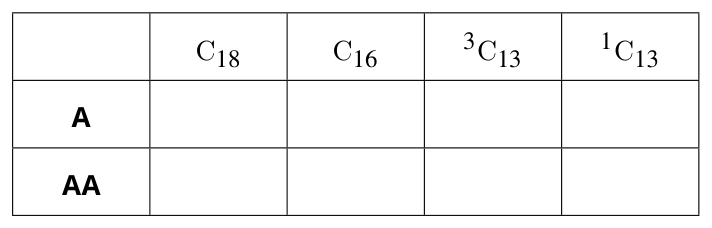
6.1 Based on Hückel’s rule, fill in the table with the number of distinct aromatic (A) and anti-aromatic (AA) \(\pi\)-systems present in each of \(\ce{C18}\), \(\ce{C16}\), \({}^{3}\ce{C13}\), and \({}^{1}\ce{C13}\). Fill in all blanks. 10.0 pt
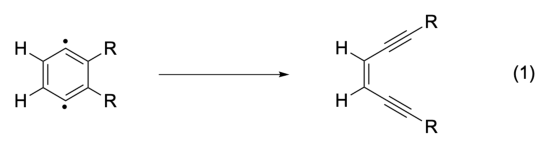
Later, cyclo[n]carbons \(\ce{C10}\), \(\ce{C12}\), \(\ce{C14}\), \(\ce{C20}\), and \(\ce{C26}\) were generated by a combination of dehalogenation and retro-Bergman (1) reactions on a surface. AFM images taken during the synthesis of \(\ce{C14}\) are shown below:
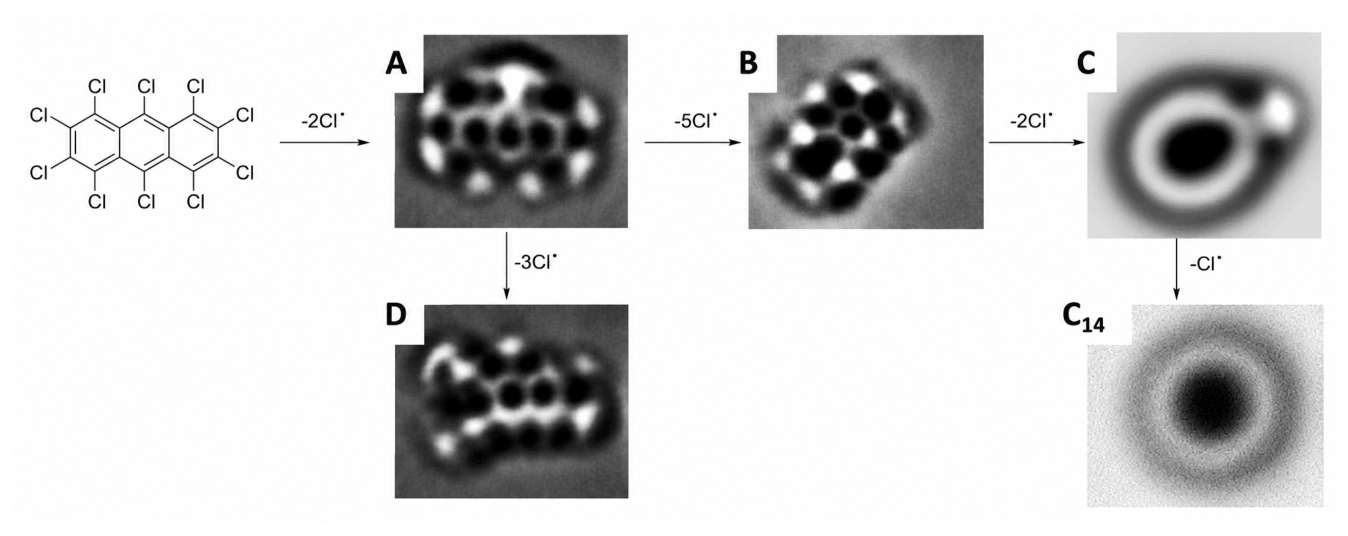
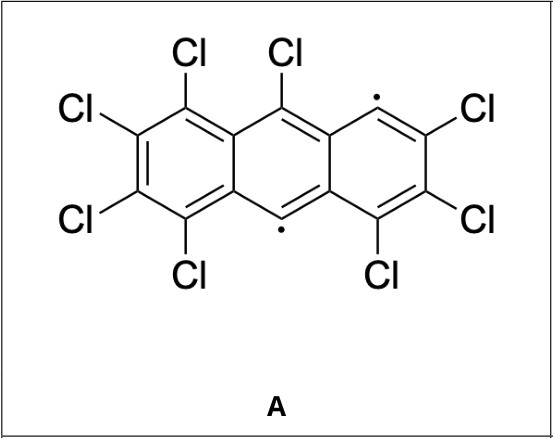
6.2 Draw structures B-D. Note they may contain one or more unpaired electrons. The structure of A is given as an example. 11.0 pt
6.3 The voltages applied during the AFM-mediated synthesis of \(\ce{C_n}\) may vary. Using the given C–X bond energies, choose the possible halogen(s) in the halogenated reagent for \(\ce{C18}\) synthesis via a retro-Bergman reaction with a voltage of 2.5 V acting on the electrons. 2.0 pt
| Bond (C–X) | Bond Dissociation Energy / \(\mathrm{kJ\,mol^{-1}}\) |
|---|---|
| C–F | 467 |
| C–Cl | 346 |
| C–Br | 290 |
| C–I | 228 |
In 2025, the first relatively stable cyclo[48]carbon was synthesised. The molecule was stabilised by catenation (forming interlocking rings) with macrocycle E and was first characterised by electrospray mass spectrometry in positive mode.
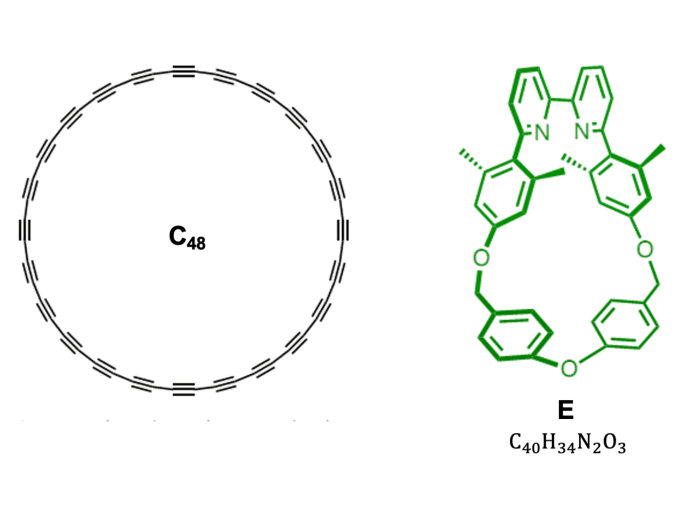
6.4 In the mass spectrum obtained, four intense peaks were observed \(m/z\): 591, 783, 879, and 1174. Suggest the identity of these ions. Use integer atomic masses and assume no fragmentation happened. The ion corresponding to \(m/z=591\) is given as an example. 12.0 pt

Cycloparaphenylene (CPP) is another cyclic, highly-strained molecule commonly called a carbon nanohoop. The synthesis of the smallest known member, [5]CPP, is shown below, where \(\ce{PhI(OAc)2}\) acts as a two electron oxidant.
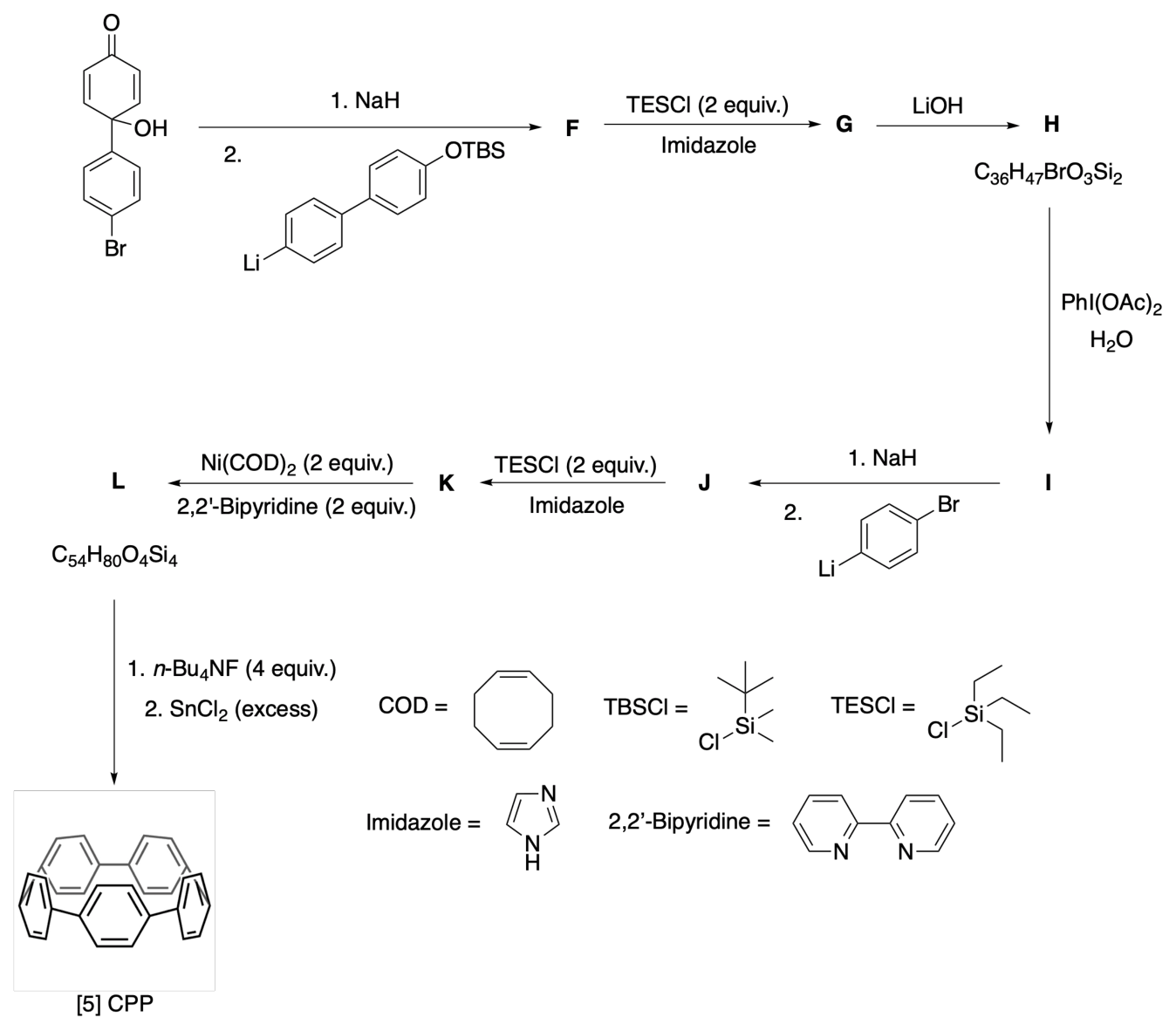
(equiv. = Equivalent, excess = Excess)
6.5 Draw the structures of F-L. 24.0 pt
Next generation nanobelts were constructed from porphyrin rings and triple bonds using the template synthesis method. Hint: M is the thermodynamic product and has four types of protons.
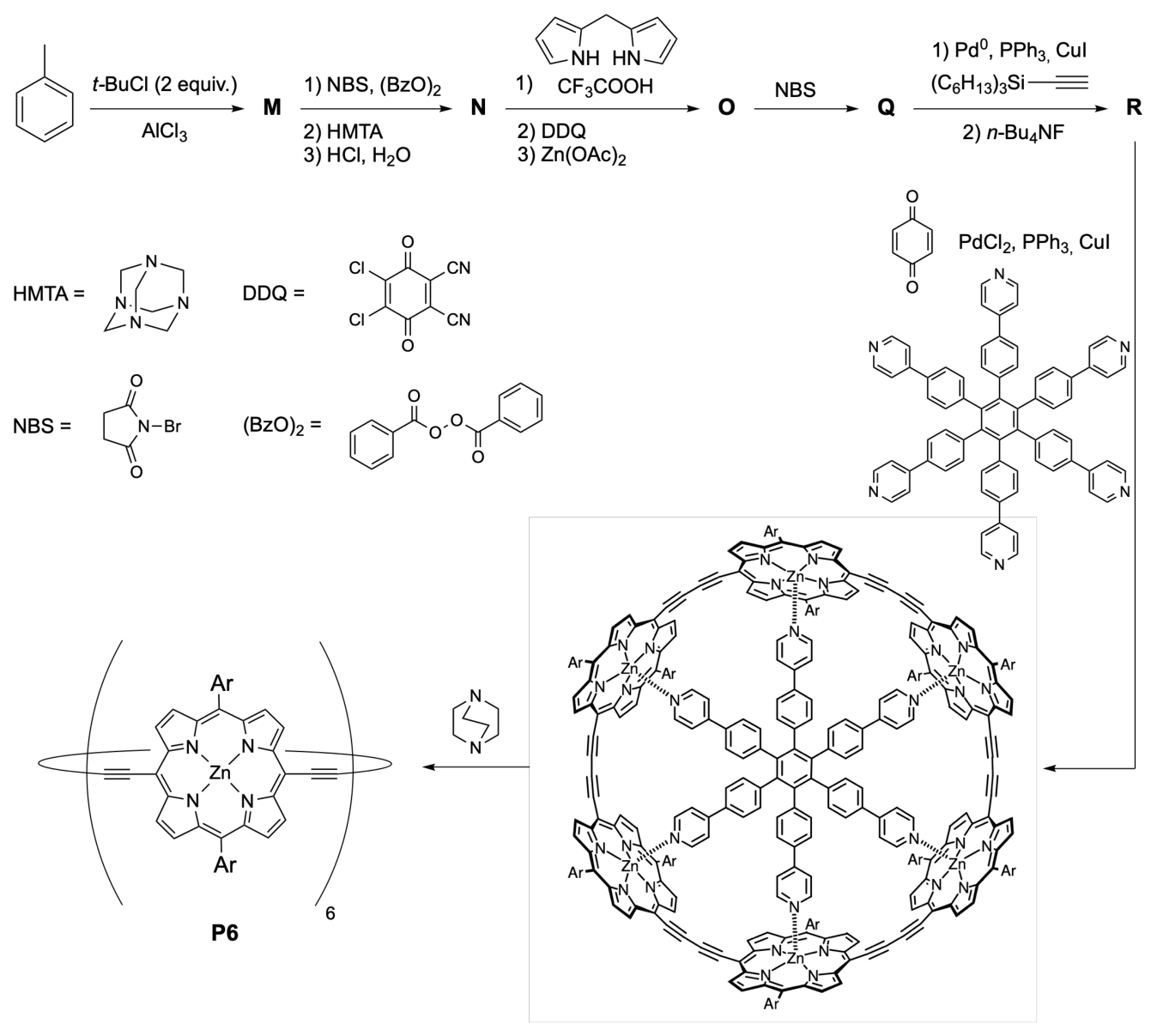
(equiv. = Equivalent)
6.6 Draw the structures of M-R. 20.0 pt
When aromatic rings are joined to form a macrocycle, oxidation or reduction can produce global aromaticity, in which \(\pi\) electrons are delocalised around the entire macrocycle. Only the \(\pi\) system forming the continuous conjugated pathway around the ring participates in this delocalisation. As an example, [n]CPPs can become globally aromatic upon addition or removal of electrons. The number of \(\pi\) electrons is counted only along the bold pathway shown below.
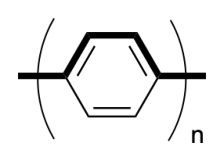
When P6 is oxidised, it can exhibit global aromaticity and global anti-aromaticity.
6.7 Based on Hückel’s rule, find the minimum number of electrons, \(n(e)\), from P6 that should be removed to achieve global aromaticity. Write the total number of \(\pi\) electrons, \(n(t)\), in the global aromatic system. 4.0 pt
Physical Constants and Equations
Constants
| Constant | Value |
|---|---|
| Avogadro constant | \(N_A=6.022\times10^{23}\ \mathrm{mol^{-1}}\) |
| Universal gas constant | \(R=8.314\ \mathrm{J\,K^{-1}\,mol^{-1}}\) |
| Faraday constant | \(F=96\,485\ \mathrm{C\,mol^{-1}}\) |
| Planck constant | \(h=6.626\times10^{-34}\ \mathrm{J\,s}\) |
| Speed of light in vacuum | \(c=2.998\times10^8\ \mathrm{m\,s^{-1}}\) |
| Mass of electron | \(m_e=9.109\times10^{-31}\ \mathrm{kg}\) |
| Charge of electron | \(e=1.602\times10^{-19}\ \mathrm{C}\) |
| Standard pressure | \(P^\circ=1\ \mathrm{bar}=10^5\ \mathrm{Pa}\) |
| Ionic product of water at \(25\,^\circ\mathrm C\) | \(K_w=1.00\times10^{-14}\) |
| Zero of the Celsius scale | \(0\,^\circ\mathrm C=273.15\ \mathrm K\) |
| Electronvolt | \(1\ \mathrm{eV}=1.602\times10^{-19}\ \mathrm J\) |
| Watt | \(1\ \mathrm W=1\ \mathrm{J\,s^{-1}}\) |
| Coulomb | \(1\ \mathrm C=1\ \mathrm{A\,s}\) |
| Nanometre | \(1\ \mathrm{nm}=1\times10^{-9}\ \mathrm m\) |
| Ångstrom | \(1\ \text{Å}=1\times10^{-10}\ \mathrm m\) |
| metric ton | \(1\ \mathrm{ton}=1000\ \mathrm{kg}\) |
| litre | \(1\ \mathrm L=1\ \mathrm{dm^3}\) |
Official English text of the problem.
Answers
The structures named here are specified explicitly by SMILES in the corresponding Solution entries.
-
6.1: In the order \(\ce{C18}\), \(\ce{C16}\), \({}^{3}\ce{C13}\), \({}^{1}\ce{C13}\):
A: \(2,\ 0,\ 0,\ 1\).
AA: \(0,\ 2,\ 0,\ 1\). -
6.2:
B: A benzene-fused ten-membered ring containing four triple bonds; the retained benzenoid ring has chlorine at C5, C6 and C7, and a radical at C8. Formula \(\ce{C14Cl3}\), one unpaired electron.
C: A monocyclic \(\ce{C14Cl}\) radical containing six triple bonds and an adjacent \(\ce{C(Cl)=C^{\bullet}}\) pair.
D: 1,6,7-Trichloro-2,3-bis(chloroethynyl)naphthalene-4,5,8-triyl, \(\ce{C14Cl5}\), three unpaired electrons. -
6.3: \(X=\mathrm I\), iodine only.
-
6.4:
\(591:\ \ce{[E + H]+}\).
\(783:\ \ce{[C48 + 3E + 3H]^3+}\).
\(879:\ \ce{[C48 + 2E + 2H]^2+}\).
\(1174:\ \ce{[C48 + 3E + 2H]^2+}\). -
6.5:
F: The cis cyclohexadiene diol formed by addition of the TBS-protected biphenylyllithium reagent.
G: Its bis-TES ether.
H: The terminal phenol obtained by selective TBS removal.
I: The terminal para-quinol obtained by oxidative dearomatisation of H.
J: The second cis diol, formed by addition of 4-bromophenyllithium to I.
K: The tetra-TES-protected dibromide.
L: The cyclic product formed by coupling K’s two terminal brominated aryl carbons. -
6.6:
M: 3,5-Di-tert-butyltoluene.
N: 3,5-Di-tert-butylbenzaldehyde.
O: Zinc(II) 5,15-bis(3,5-di-tert-butylphenyl)porphyrin.
Q: Its 10,20-dibromo derivative.
R: Its 10,20-diethynyl derivative. -
6.7: \(\boxed{n(e)=2,\qquad n(t)=82}\).
Solution
6.1 — Separate counts for the two perpendicular π systems
Each cyclocarbon has two perpendicular sets of π orbitals: one perpendicular to the molecular plane and one lying in that plane.
Hückel’s electron-counting criterion is applied separately to each system:
\[ 4k+2\ \text{π electrons: aromatic},\qquad 4k\ \text{π electrons: anti-aromatic}. \]
The electron distributions in the idealised configurations considered here are:
| Species | π electrons in the two systems | A | AA |
|---|---|---|---|
| \(\ce{C18}\) | \(18,\ 18\) | 2 | 0 |
| \(\ce{C16}\) | \(16,\ 16\) | 0 | 2 |
| \({}^{3}\ce{C13}\) | \(13,\ 13\) | 0 | 0 |
| \({}^{1}\ce{C13}\) | \(14,\ 12\) | 1 | 1 |
For \(\ce{C18}\), \(18=4(4)+2\), so both systems are aromatic. For \(\ce{C16}\), \(16=4(4)\), so both are anti-aromatic.
In the triplet \(\ce{C13}\) configuration, each system has an odd electron count and one unpaired electron; neither satisfies the stated closed-shell Hückel counts. In the paired singlet configuration, the 26 π electrons are distributed as 14 and 12, giving one aromatic and one anti-aromatic system.
6.2 — Ring-opened intermediates
Retro-Bergman reactions break C–C bonds of the original fused framework and generate new triple bonds. Chlorine loss and carbon valence must both be respected.
In the following SMILES, bracketed [c] and [C] atoms identify the carbon radicals through their explicitly unsatisfied valence.
B — Trichlorinated benzene-fused cyclodecatetrayne radical
SMILES: Clc1c(Cl)c(Cl)[c]c2c1C#CC#CC#CC#C2
Retain one six-membered benzenoid ring. Its four nonfusion positions, numbered C5–C8 consecutively, carry:
- C5: chlorine;
- C6: chlorine;
- C7: chlorine;
- C8: one unpaired electron, adjacent to a fusion carbon.
The two fusion carbons are also connected by the eight-carbon chain
\[ \ce{-C#C-C#C-C#C-C#C-}, \]
forming a fused ten-membered ring. Thus B contains four triple bonds, three chlorine atoms and one radical, with formula \(\ce{C14Cl3}\).
C — Monochlorocyclo[14]carbon radical
SMILES: ClC1=[C]C#CC#CC#CC#CC#CC#C1
Draw a single fourteen-membered carbon ring with six alternating triple bonds and one double bond. One carbon of the double bond carries chlorine; the other carries the unpaired electron:
\[ \ce{-C(Cl)=C^{\bullet}-}. \]
The remaining bonds between these unsaturated units are single bonds. C therefore has formula \(\ce{C14Cl}\), with the radical next to the chlorine-bearing carbon.
D — 1,6,7-Trichloro-2,3-bis(chloroethynyl)naphthalene-4,5,8-triyl
SMILES: Clc1c(C#CCl)c(C#CCl)[c]c2[c]c(Cl)c(Cl)[c]c12
Use the standard naphthalene numbering:
- C2 and C3 each carry a chloroethynyl arm, \(\ce{-C#C-Cl}\).
- C1, C6 and C7 each carry chlorine.
- C4, C5 and C8 each carry one unpaired electron.
The naphthalene core remains intact, while the opened third ring supplies the two chloroethynyl arms. The formula is \(\ce{C14Cl5}\), with three radicals.
The chlorine balances for the displayed sequence are:
\[ \begin{aligned} \ce{C14Cl10 &-> C14Cl8 + 2Cl^{\bullet}} &&\text{formation of A},\\ \ce{C14Cl8 &-> C14Cl3 + 5Cl^{\bullet}} &&\text{A to B},\\ \ce{C14Cl3 &-> C14Cl + 2Cl^{\bullet}} &&\text{B to C},\\ \ce{C14Cl8 &-> C14Cl5 + 3Cl^{\bullet}} &&\text{A to D},\\ \ce{C14Cl &-> C14 + Cl^{\bullet}} &&\text{C to cyclo[14]carbon}. \end{aligned} \]
The final cyclo[14]carbon has seven alternating triple bonds.
Name: cyclo[14]carbon.
SMILES: C1#CC#CC#CC#CC#CC#CC#C1
6.3 — Electron energy and bond dissociation
An electron accelerated through a potential difference \(U\) gains energy \(eU\). Per mole of electrons,
\[ E_{\mathrm{mol}}=FU =(96\,485\ \mathrm{C\,mol^{-1}})(2.5\ \mathrm{J\,C^{-1}}) =241\,212.5\ \mathrm{J\,mol^{-1}}. \]
Thus the available energy is approximately
\[ E_{\mathrm{mol}}=241\ \mathrm{kJ\,mol^{-1}} \approx2.4\times10^2\ \mathrm{kJ\,mol^{-1}}. \]
Only the C–I bond energy lies below this value:
\[ 228<241<290<346<467 \qquad(\mathrm{kJ\,mol^{-1}}). \]
Therefore,
\[ \boxed{X=\mathrm I}. \]
6.4 — Masses, stoichiometries and charge states
Using the supplied formula of E,
\[ M(E)=40(12)+34(1)+2(14)+3(16)=590\ \mathrm{Da}. \]
For cyclo[48]carbon,
\[ M(\ce{C48})=48(12)=576\ \mathrm{Da}. \]
For a complex containing one carbon ring, \(a\) macrocycles E and \(z\) added protons,
\[ \frac mz=\frac{576+590a+z}{z}. \]
The assignments are:
| \(m/z\) | Assignment | Calculation |
|---|---|---|
| 591 | \(\ce{[E + H]+}\) | \(590+1=591\) |
| 783 | \(\ce{[C48 + 3E + 3H]^3+}\) | \((576+3\times590+3)/3=783\) |
| 879 | \(\ce{[C48 + 2E + 2H]^2+}\) | \((576+2\times590+2)/2=879\) |
| 1174 | \(\ce{[C48 + 3E + 2H]^2+}\) | \((576+3\times590+2)/2=1174\) |
The following are explicit component SMILES for these ions. A dot separates covalently disconnected rings; SMILES does not encode their mechanical interlocking. The protonated pyridyl nitrogens shown are representative protonation sites.
\(m/z=591\): monoprotonated bipyridine-containing macrocycle E
SMILES: [nH+]1c(-c2c(C)cc(O3)cc2C)cccc1-c1cccc(-c2c(C)cc(OCc4ccc(Oc5ccc(C3)cc5)cc4)cc2C)n1
\(m/z=783\): triprotonated [4]catenane containing cyclo[48]carbon and three E rings
SMILES: C1#CC#CC#CC#CC#CC#CC#CC#CC#CC#CC#CC#CC#CC#CC#CC#CC#CC#CC#CC#CC#CC#CC#CC#C1.[nH+]1c(-c2c(C)cc(O3)cc2C)cccc1-c1cccc(-c2c(C)cc(OCc4ccc(Oc5ccc(C3)cc5)cc4)cc2C)n1.[nH+]1c(-c2c(C)cc(O3)cc2C)cccc1-c1cccc(-c2c(C)cc(OCc4ccc(Oc5ccc(C3)cc5)cc4)cc2C)n1.[nH+]1c(-c2c(C)cc(O3)cc2C)cccc1-c1cccc(-c2c(C)cc(OCc4ccc(Oc5ccc(C3)cc5)cc4)cc2C)n1
\(m/z=879\): diprotonated [3]catenane containing cyclo[48]carbon and two E rings
SMILES: C1#CC#CC#CC#CC#CC#CC#CC#CC#CC#CC#CC#CC#CC#CC#CC#CC#CC#CC#CC#CC#CC#CC#CC#C1.[nH+]1c(-c2c(C)cc(O3)cc2C)cccc1-c1cccc(-c2c(C)cc(OCc4ccc(Oc5ccc(C3)cc5)cc4)cc2C)n1.[nH+]1c(-c2c(C)cc(O3)cc2C)cccc1-c1cccc(-c2c(C)cc(OCc4ccc(Oc5ccc(C3)cc5)cc4)cc2C)n1
\(m/z=1174\): diprotonated [4]catenane containing cyclo[48]carbon and three E rings
SMILES: C1#CC#CC#CC#CC#CC#CC#CC#CC#CC#CC#CC#CC#CC#CC#CC#CC#CC#CC#CC#CC#CC#CC#CC#C1.[nH+]1c(-c2c(C)cc(O3)cc2C)cccc1-c1cccc(-c2c(C)cc(OCc4ccc(Oc5ccc(C3)cc5)cc4)cc2C)n1.[nH+]1c(-c2c(C)cc(O3)cc2C)cccc1-c1cccc(-c2c(C)cc(OCc4ccc(Oc5ccc(C3)cc5)cc4)cc2C)n1.n1c(-c2c(C)cc(O3)cc2C)cccc1-c1cccc(-c2c(C)cc(OCc4ccc(Oc5ccc(C3)cc5)cc4)cc2C)n1
Their respective formulas are \(\ce{C40H35N2O3+}\), \(\ce{C168H105N6O9^3+}\), \(\ce{C128H70N4O6^2+}\), and \(\ce{C168H104N6O9^2+}\).
6.5 — Construction of [5]CPP
The useful cyclohexadiene building blocks have their two aryl substituents cis to one another; the two oxygen substituents are correspondingly cis on the other face. These bent units allow macrocyclisation before the highly strained aromatic nanohoop is generated.
The paired @ symbols below specify this relative stereochemistry. They do not specify a unique overall macrocycle conformation.
F — cis-1-(4-Bromophenyl)-4-[4′-(tert-butyldimethylsiloxy)biphenyl-4-yl]cyclohexa-2,5-diene-1,4-diol
SMILES: Brc1ccc([C@]2(O)C=C[C@](O)(c3ccc(-c4ccc(O[Si](C)(C)C(C)(C)C)cc4)cc3)C=C2)cc1
First, sodium hydride deprotonates the existing alcohol:
\[ \ce{ROH + NaH -> RONa + H2}. \]
The aryllithium reagent then adds to the ketone carbonyl. After work-up, that carbonyl becomes a tertiary alcohol:
\[ \ce{R2C=O + ArLi + H2O -> R2C(OH)Ar + LiOH}. \]
The original alkoxide is also protonated during work-up. F therefore has two free hydroxyl groups and retains the terminal TBS-protected phenol.
G — Bis(triethylsilyl) ether of F
SMILES: Brc1ccc([C@]2(O[Si](CC)(CC)CC)C=C[C@](O[Si](CC)(CC)CC)(c3ccc(-c4ccc(O[Si](C)(C)C(C)(C)C)cc4)cc3)C=C2)cc1
Two equivalents of TESCl protect both tertiary alcohols. With Im denoting imidazole, each protection has the balance
\[ \ce{ROH + Et3SiCl + Im -> ROSiEt3 + [ImH]Cl}. \]
The terminal phenolic TBS ether remains present.
H — Terminal phenol obtained by selective TBS deprotection of G
SMILES: Brc1ccc([C@]2(O[Si](CC)(CC)CC)C=C[C@](O[Si](CC)(CC)CC)(c3ccc(-c4ccc(O)cc4)cc3)C=C2)cc1
LiOH hydrolyses the phenolic TBS ether:
\[ \ce{ArOSiMe2(t-Bu) + H2O ->[LiOH] ArOH + HOSiMe2(t-Bu)}. \]
The two tertiary TES ethers remain. This gives exactly the supplied formula:
\[ \boxed{\ce{C36H47BrO3Si2}}. \]
I — Terminal para-quinol formed by oxidative dearomatisation of H
SMILES: Brc1ccc([C@]2(O[Si](CC)(CC)CC)C=C[C@](O[Si](CC)(CC)CC)(c3ccc(C4(O)C=CC(=O)C=C4)cc3)C=C2)cc1
The terminal phenol becomes a cyclohexa-2,5-dien-1-one. Its para carbon, already carrying the rest of the molecule, acquires an OH group.
The two-electron oxidation is balanced by
\[ \ce{C36H47BrO3Si2 + PhI(OAc)2 + H2O -> C36H47BrO4Si2 + PhI + 2CH3COOH}. \]
Thus I contains the original protected cyclohexadiene unit and a new hydroxycyclohexadienone unit.
J — Second cis-diol addition product
SMILES: Brc1ccc([C@]2(O[Si](CC)(CC)CC)C=C[C@](O[Si](CC)(CC)CC)(c3ccc([C@]4(O)C=C[C@](O)(c5ccc(Br)cc5)C=C4)cc3)C=C2)cc1
NaH deprotonates I’s newly formed OH group. Then 4-bromophenyllithium adds to the remaining ketone, as in the formation of F.
The five-ring chain now has the sequence
\[ \text{bromophenyl–protected diene–phenylene–diol diene–bromophenyl}. \]
J has formula \(\ce{C42H52Br2O4Si2}\).
K — Tetra-TES-protected dibromide precursor
SMILES: Brc1ccc([C@]2(O[Si](CC)(CC)CC)C=C[C@](O[Si](CC)(CC)CC)(c3ccc([C@]4(O[Si](CC)(CC)CC)C=C[C@](O[Si](CC)(CC)CC)(c5ccc(Br)cc5)C=C4)cc3)C=C2)cc1
Two more equivalents of TESCl protect J’s two free hydroxyl groups. K therefore contains four TES ethers and two terminal aryl bromides:
\[ \ce{C54H80Br2O4Si4}. \]
L — Tetra-TES-protected, doubly dearomatised [5]cycloparaphenylene
SMILES: c1%10ccc([C@]2(O[Si](CC)(CC)CC)C=C[C@](O[Si](CC)(CC)CC)(c3ccc([C@]4(O[Si](CC)(CC)CC)C=C[C@](O[Si](CC)(CC)CC)(c5ccc-%10cc5)C=C4)cc3)C=C2)cc1
Nickel-mediated intramolecular coupling joins the two aromatic carbons that originally carried bromine. This closes the five-unit hoop.
The net coupling balance is
\[ \ce{C54H80Br2O4Si4 + Ni -> C54H80O4Si4 + NiBr2}. \]
The resulting formula agrees with the problem:
\[ \boxed{\ce{C54H80O4Si4}}. \]
The two equivalents of nickel complex shown are the experimental reagent loading; the net redox balance consumes one equivalent of \(\ce{Ni(0)}\).
Finally, fluoride removes all four TES groups. For each group, a hydrolytic work-up can be represented by
\[ \ce{ROSiEt3 + F- + H2O -> ROH + Et3SiF + OH-}. \]
The resulting tetrol has formula \(\ce{C30H24O4}\). Reductive aromatisation then gives [5]CPP. Its balanced reduction half-equation is
\[ \ce{C30H24O4 + 4H+ + 4e- -> C30H20 + 4H2O}. \]
Tin(II) supplies the electrons:
\[ \ce{2Sn^2+ -> 2Sn^4+ + 4e-}. \]
Name: [5]cycloparaphenylene.
SMILES: c1%10ccc(-c2ccc(-c3ccc(-c4ccc(-c5ccc-%10cc5)cc4)cc3)cc2)cc1
6.6 — Porphyrin building block
Define \(\mathrm{Ar}\) here as 3,5-di-tert-butylphenyl.
M — 3,5-Di-tert-butyltoluene
SMILES: Cc1cc(C(C)(C)C)cc(C(C)(C)C)c1
Under the thermodynamic alkylation conditions, the bulky substituents adopt the alternating 1,3,5 arrangement, avoiding adjacent methyl/tert-butyl substitution.
The net alkylation is
\[ \ce{C6H5CH3 + 2(CH3)3CCl ->[AlCl3] C6H3(CH3)[C(CH3)3]2 + 2HCl}. \]
M has the required four proton environments:
- the methyl group, 3 H;
- the two equivalent tert-butyl groups, 18 H;
- aromatic H2 and H6, 2 H;
- aromatic H4, 1 H.
N — 3,5-Di-tert-butylbenzaldehyde
SMILES: O=Cc1cc(C(C)(C)C)cc(C(C)(C)C)c1
NBS with peroxide initiator brominates the benzylic methyl group:
\[ \ce{ArCH3 + NBS -> ArCH2Br + succinimide}. \]
The intermediate is 3,5-di-tert-butylbenzyl bromide.
SMILES: BrCc1cc(C(C)(C)C)cc(C(C)(C)C)c1
HMTA followed by acidic hydrolysis effects the Sommelet conversion to the aldehyde. Writing the amine hydrolysis products in their neutral forms gives the balanced net equation
\[ \ce{ArCH2Br + C6H12N4 + 6H2O -> ArCHO + 5HCHO + CH3NH2 + 3NH3 + HBr}. \]
In the acidic reaction medium, the amines are protonated.
O — Zinc(II) 5,15-bis(3,5-di-tert-butylphenyl)porphyrin
SMILES: CC(C)(C)c1cc(-c2c3[n]4->[Zn+2]56<-[n]7c(cc8ccc2[n-]->58)C=Cc7c(-c2cc(C(C)(C)C)cc(C(C)(C)C)c2)c2ccc(cc4C=C3)[n-]->62)cc(C(C)(C)C)c1
Two aldehydes and two dipyrromethanes furnish the porphyrin framework. The aldehyde-derived carbons become two opposite meso carbons bearing Ar. The other two meso positions retain hydrogen.
Condensation and oxidation by DDQ have the overall balance
\[ \ce{2C15H22O + 2C9H10N2 + 3DDQ -> C48H54N4 + 2H2O + 3DDQH2}. \]
Zinc insertion then replaces the two inner N–H protons:
\[ \ce{C48H54N4 + Zn(OAc)2 -> C48H52N4Zn + 2CH3COOH}. \]
The SMILES explicitly includes N-to-Zn dative bonds. The four porphyrin nitrogens coordinate zinc in an approximately square-planar arrangement; that geometry is not specified by the SMILES itself.
Q — Zinc(II) 10,20-dibromo-5,15-bis(3,5-di-tert-butylphenyl)porphyrin
SMILES: CC(C)(C)c1cc(-c2c3[n]4->[Zn+2]56<-[n]7c(c(Br)c8ccc2[n-]->58)C=Cc7c(-c2cc(C(C)(C)C)cc(C(C)(C)C)c2)c2ccc(c(Br)c4C=C3)[n-]->62)cc(C(C)(C)C)c1
NBS replaces the two remaining meso hydrogens by bromine. The net balance is
\[ \ce{C48H52N4Zn + 2NBS -> C48H50Br2N4Zn + 2succinimide}. \]
R — Zinc(II) 10,20-diethynyl-5,15-bis(3,5-di-tert-butylphenyl)porphyrin
SMILES: C#Cc1c2[n]3->[Zn+2]45<-[n]6c(c(C#C)c7ccc(c(-c8cc(C(C)(C)C)cc(C(C)(C)C)c8)c3C=C2)[n-]->47)C=Cc6c(-c2cc(C(C)(C)C)cc(C(C)(C)C)c2)c2ccc1[n-]->52
Each meso bromide undergoes Sonogashira coupling with trihexylsilyl-protected acetylene:
\[ \ce{P-Br + HC#C-Si(C6H13)3 -> P-C#C-Si(C6H13)3 + HBr}, \]
where P denotes the remaining porphyrin framework.
Fluoride then removes both silyl protecting groups. Per ethynyl group,
\[ \ce{P-C#C-Si(C6H13)3 + F- + H2O -> P-C#CH + (C6H13)3SiF + OH-}. \]
R therefore contains two opposite terminal ethynyl groups and has formula \(\ce{C52H52N4Zn}\). Oxidative coupling of these terminal groups subsequently generates the butadiyne connections between porphyrins in P6.
6.7 — Global π-electron count
Count only the orbitals belonging to one continuous conjugated route around the entire nanoring.
Each porphyrin contributes 10 π electrons along the route between its two opposite linker-bearing meso positions. Each butadiyne bridge,
\[ \ce{-C#C-C#C-}, \]
contributes 4 π electrons: only one of the two perpendicular π systems of each triple bond belongs to the global conjugation pathway.
With six porphyrins and six butadiyne bridges,
\[ N_\pi=6(10)+6(4)=84. \]
After removing \(n(e)\) electrons, the Hückel condition is
\[ 84-n(e)=4k+2. \]
Removing one electron gives 83, which does not satisfy the condition. Removing two gives
\[ 82=4(20)+2. \]
Therefore, under the Hückel-counting criterion requested,
\[ \boxed{n(e)=2,\qquad n(t)=82}. \]
The solution was checked against the official solution.
IChO 2026 · Theorieaufgabe 6
Kohlenstoff-Nanoringe
T6. Kohlenstoff-Nanoringe
7%
| 6.1 | 6.2 | 6.3 | 6.4 | 6.5 | 6.6 | 6.7 | \(\sum\) |
|---|---|---|---|---|---|---|---|
| 10 | 11 | 2 | 12 | 24 | 20 | 4 | 83 |
Im Jahr 2019 wurde \(\ce{C18}\) als erstes Beispiel einer neuen Klasse von Kohlenstoffallotropen nachgewiesen, die als Cyclo[n]kohlenstoffe (\(\ce{C_n}\)) bezeichnet werden. Cyclokohlenstoffe sind monocyclische, ausschließlich aus Kohlenstoff bestehende Verbindungen mit hoher Spannungsenergie und geringer Stabilität. Sie können mittels bindungsaufgelöster Rasterkraftmikroskopie (AFM) erzeugt und analysiert werden. Cyclokohlenstoffe weisen aufgrund ihrer \(\pi\)-Systeme interessante aromatische Eigenschaften auf. \(\ce{C13}\) besitzt eine Triplettform (\({}^{3}\ce{C13}\), Spin \(S=1\)) und eine Singulettform (\({}^{1}\ce{C13}\), Spin \(S=0\)).
6.1 Tragen Sie anhand der Hückel-Regel die Anzahl der verschiedenen aromatischen (A) und antiaromatischen (AA) \(\pi\)-Systeme, die jeweils in \(\ce{C18}\), \(\ce{C16}\), \({}^{3}\ce{C13}\) und \({}^{1}\ce{C13}\) vorliegen, in die Tabelle ein. Füllen Sie alle Leerfelder aus. 10.0 Pkt.
Später wurden die Cyclo[n]kohlenstoffe \(\ce{C10}\), \(\ce{C12}\), \(\ce{C14}\), \(\ce{C20}\) und \(\ce{C26}\) durch eine Kombination aus Dehalogenierungs- und Retro-Bergman-Reaktionen (1) auf einer Oberfläche erzeugt. Während der Synthese von \(\ce{C14}\) aufgenommene AFM-Bilder sind unten gezeigt:
6.2 Zeichnen Sie die Strukturen B-D. Beachten Sie, dass diese ein oder mehrere ungepaarte Elektronen enthalten können. Die Struktur von A ist als Beispiel angegeben. 11.0 Pkt.
6.3 Die während der AFM-vermittelten Synthese von \(\ce{C_n}\) angelegten Spannungen können variieren. Wählen Sie anhand der angegebenen C–X-Bindungsenergien das mögliche Halogen bzw. die möglichen Halogene im halogenierten Reagenz für die Synthese von \(\ce{C18}\) über eine Retro-Bergman-Reaktion bei einer auf die Elektronen wirkenden Spannung von 2.5 V aus. 2.0 Pkt.
| Bindung (C–X) | Bindungsdissoziationsenergie / \(\mathrm{kJ\,mol^{-1}}\) |
|---|---|
| C–F | 467 |
| C–Cl | 346 |
| C–Br | 290 |
| C–I | 228 |
Im Jahr 2025 wurde erstmals ein relativ stabiler Cyclo[48]kohlenstoff synthetisiert. Das Molekül wurde durch Catenanbildung (Bildung ineinander verschlungener Ringe) mit dem Makrocyclus E stabilisiert und zunächst mittels Elektrospray-Massenspektrometrie im positiven Modus charakterisiert.
6.4 Im erhaltenen Massenspektrum wurden vier intensive Peaks beobachtet, \(m/z\): 591, 783, 879 und 1174. Schlagen Sie die Identität dieser Ionen vor. Verwenden Sie ganzzahlige Atommassen und nehmen Sie an, dass keine Fragmentierung stattgefunden hat. Das Ion, das \(m/z=591\) entspricht, ist als Beispiel angegeben. 12.0 Pkt.
Cycloparaphenylen (CPP) ist ein weiteres cyclisches, stark gespanntes Molekül, das häufig als Kohlenstoff-Nanoreifen bezeichnet wird. Die Synthese des kleinsten bekannten Vertreters, [5]CPP, ist unten dargestellt; dabei wirkt \(\ce{PhI(OAc)2}\) als Zweielektronen-Oxidationsmittel.
(equiv. = Äquivalent, excess = Überschuss)
6.5 Zeichnen Sie die Strukturen von F-L. 24.0 Pkt.
Nanogürtel der nächsten Generation wurden mithilfe der Templatsynthese aus Porphyrinringen und Dreifachbindungen aufgebaut. Hinweis: M ist das thermodynamische Produkt und besitzt vier Arten von Protonen.
(equiv. = Äquivalent)
6.6 Zeichnen Sie die Strukturen von M-R. 20.0 Pkt.
Wenn aromatische Ringe zu einem Makrocyclus verbunden werden, kann durch Oxidation oder Reduktion globale Aromatizität entstehen, bei der \(\pi\)-Elektronen über den gesamten Makrocyclus delokalisiert sind. Nur das \(\pi\)-System, das den durchgehenden konjugierten Pfad um den Ring bildet, nimmt an dieser Delokalisierung teil. Beispielsweise können [n]CPPs durch Aufnahme oder Abgabe von Elektronen global aromatisch werden. Die Anzahl der \(\pi\)-Elektronen wird ausschließlich entlang des unten fett dargestellten Pfades gezählt.
Bei der Oxidation von P6 kann dieses globale Aromatizität und globale Antiaromatizität aufweisen.
6.7 Bestimmen Sie anhand der Hückel-Regel die Mindestanzahl an Elektronen, \(n(e)\), die aus P6 entfernt werden müssen, um globale Aromatizität zu erreichen. Geben Sie die Gesamtzahl der \(\pi\)-Elektronen, \(n(t)\), im globalen aromatischen System an. 4.0 Pkt.
Physikalische Konstanten und Gleichungen
Konstanten
| Konstante | Wert |
|---|---|
| Avogadro-Konstante | \(N_A=6.022\times10^{23}\ \mathrm{mol^{-1}}\) |
| Universelle Gaskonstante | \(R=8.314\ \mathrm{J\,K^{-1}\,mol^{-1}}\) |
| Faraday-Konstante | \(F=96\,485\ \mathrm{C\,mol^{-1}}\) |
| Planck-Konstante | \(h=6.626\times10^{-34}\ \mathrm{J\,s}\) |
| Lichtgeschwindigkeit im Vakuum | \(c=2.998\times10^8\ \mathrm{m\,s^{-1}}\) |
| Elektronenmasse | \(m_e=9.109\times10^{-31}\ \mathrm{kg}\) |
| Elektronenladung | \(e=1.602\times10^{-19}\ \mathrm{C}\) |
| Standarddruck | \(P^\circ=1\ \mathrm{bar}=10^5\ \mathrm{Pa}\) |
| Ionenprodukt des Wassers bei \(25\,^\circ\mathrm C\) | \(K_w=1.00\times10^{-14}\) |
| Nullpunkt der Celsius-Skala | \(0\,^\circ\mathrm C=273.15\ \mathrm K\) |
| Elektronenvolt | \(1\ \mathrm{eV}=1.602\times10^{-19}\ \mathrm J\) |
| Watt | \(1\ \mathrm W=1\ \mathrm{J\,s^{-1}}\) |
| Coulomb | \(1\ \mathrm C=1\ \mathrm{A\,s}\) |
| Nanometer | \(1\ \mathrm{nm}=1\times10^{-9}\ \mathrm m\) |
| Ångström | \(1\ \text{Å}=1\times10^{-10}\ \mathrm m\) |
| Metrische Tonne | \(1\ \mathrm{ton}=1000\ \mathrm{kg}\) |
| Liter | \(1\ \mathrm L=1\ \mathrm{dm^3}\) |
Aufgabentext aus dem offiziellen englischen Text übersetzt.
Antworten
Die hier genannten Strukturen sind in den entsprechenden Einträgen der Lösung ausdrücklich durch SMILES angegeben.
-
6.1: In der Reihenfolge \(\ce{C18}\), \(\ce{C16}\), \({}^{3}\ce{C13}\), \({}^{1}\ce{C13}\):
A: \(2,\ 0,\ 0,\ 1\).
AA: \(0,\ 2,\ 0,\ 1\). -
6.2:
B: Ein mit einem Benzolring kondensierter Zehnring mit vier Dreifachbindungen; der erhalten gebliebene benzoide Ring trägt Chlor an C5, C6 und C7 sowie ein Radikal an C8. Formel \(\ce{C14Cl3}\), ein ungepaartes Elektron.
C: Ein monocyclisches \(\ce{C14Cl}\)-Radikal mit sechs Dreifachbindungen und einem benachbarten \(\ce{C(Cl)=C^{\bullet}}\)-Paar.
D: 1,6,7-Trichlor-2,3-bis(chlorethinyl)naphthalin-4,5,8-triyl, \(\ce{C14Cl5}\), drei ungepaarte Elektronen. -
6.3: \(X=\mathrm I\), nur Iod.
-
6.4:
\(591:\ \ce{[E + H]+}\).
\(783:\ \ce{[C48 + 3E + 3H]^3+}\).
\(879:\ \ce{[C48 + 2E + 2H]^2+}\).
\(1174:\ \ce{[C48 + 3E + 2H]^2+}\). -
6.5:
F: Das durch Addition des TBS-geschützten Biphenylyllithium-Reagenzes gebildete cis-Cyclohexadiendiol.
G: Dessen Bis-TES-Ether.
H: Das durch selektive Abspaltung der TBS-Gruppe erhaltene endständige Phenol.
I: Das durch oxidative Dearomatisierung von H erhaltene endständige para-Chinol.
J: Das zweite cis-Diol, gebildet durch Addition von 4-Bromphenyllithium an I.
K: Das tetra-TES-geschützte Dibromid.
L: Das cyclische Produkt, das durch Kupplung der beiden endständigen bromierten Aryl-Kohlenstoffatome von K entsteht. -
6.6:
M: 3,5-Di-tert-butyltoluol.
N: 3,5-Di-tert-butylbenzaldehyd.
O: Zink(II)-5,15-bis(3,5-di-tert-butylphenyl)porphyrin.
Q: Dessen 10,20-Dibromderivat.
R: Dessen 10,20-Diethinylderivat. -
6.7: \(\boxed{n(e)=2,\qquad n(t)=82}\).
Lösung
6.1 — Getrennte Zählung für die beiden senkrecht zueinander stehenden π-Systeme
Jeder Cyclokohlenstoff besitzt zwei senkrecht zueinander stehende Sätze von π-Orbitalen: einen senkrecht zur Molekülebene und einen in dieser Ebene.
Das Hückelsche Elektronenzählkriterium wird auf jedes System getrennt angewendet:
\[ 4k+2\ \text{π-Elektronen: aromatisch},\qquad 4k\ \text{π-Elektronen: antiaromatisch}. \]
Die Elektronenverteilungen in den hier betrachteten idealisierten Konfigurationen sind:
| Spezies | π-Elektronen in den beiden Systemen | A | AA |
|---|---|---|---|
| \(\ce{C18}\) | \(18,\ 18\) | 2 | 0 |
| \(\ce{C16}\) | \(16,\ 16\) | 0 | 2 |
| \({}^{3}\ce{C13}\) | \(13,\ 13\) | 0 | 0 |
| \({}^{1}\ce{C13}\) | \(14,\ 12\) | 1 | 1 |
Für \(\ce{C18}\) gilt \(18=4(4)+2\), sodass beide Systeme aromatisch sind. Für \(\ce{C16}\) gilt \(16=4(4)\), sodass beide antiaromatisch sind.
In der Triplettkonfiguration von \(\ce{C13}\) besitzt jedes System eine ungerade Elektronenzahl und ein ungepaartes Elektron; keines erfüllt die angegebenen Hückelschen Elektronenzahlen für geschlossene Schalen. In der gepaarten Singulettkonfiguration verteilen sich die 26 π-Elektronen auf 14 und 12, wodurch ein aromatisches und ein antiaromatisches System entstehen.
6.2 — Ringgeöffnete Zwischenprodukte
Retro-Bergman-Reaktionen spalten C–C-Bindungen des ursprünglichen kondensierten Gerüsts und erzeugen neue Dreifachbindungen. Sowohl die Abspaltung von Chlor als auch die Valenz des Kohlenstoffs müssen berücksichtigt werden.
In den folgenden SMILES kennzeichnen die in eckigen Klammern stehenden [c]- und [C]-Atome die Kohlenstoffradikale durch ihre ausdrücklich nicht abgesättigte Valenz.
B — Dreifach chloriertes, mit einem Benzolring kondensiertes Cyclodecatetrain-Radikal
SMILES: Clc1c(Cl)c(Cl)[c]c2c1C#CC#CC#CC#C2
Ein sechsgliedriger benzoider Ring bleibt erhalten. Seine vier nicht an der Ringverknüpfung beteiligten Positionen, fortlaufend als C5–C8 nummeriert, tragen:
- C5: Chlor;
- C6: Chlor;
- C7: Chlor;
- C8: ein ungepaartes Elektron, benachbart zu einem Kohlenstoffatom der Ringverknüpfung.
Die beiden Kohlenstoffatome der Ringverknüpfung sind außerdem durch die Kette aus acht Kohlenstoffatomen
\[ \ce{-C#C-C#C-C#C-C#C-}, \]
verbunden, wodurch ein kondensierter Zehnring entsteht. Somit enthält B vier Dreifachbindungen, drei Chloratome und ein Radikal und besitzt die Formel \(\ce{C14Cl3}\).
C — Monochlorcyclo[14]kohlenstoff-Radikal
SMILES: ClC1=[C]C#CC#CC#CC#CC#CC#C1
Zeichnen Sie einen einzelnen vierzehngliedrigen Kohlenstoffring mit sechs alternierenden Dreifachbindungen und einer Doppelbindung. Ein Kohlenstoffatom der Doppelbindung trägt Chlor; das andere trägt das ungepaarte Elektron:
\[ \ce{-C(Cl)=C^{\bullet}-}. \]
Die übrigen Bindungen zwischen diesen ungesättigten Einheiten sind Einfachbindungen. C besitzt daher die Formel \(\ce{C14Cl}\), wobei sich das Radikal neben dem chlortragenden Kohlenstoffatom befindet.
D — 1,6,7-Trichlor-2,3-bis(chlorethinyl)naphthalin-4,5,8-triyl
SMILES: Clc1c(C#CCl)c(C#CCl)[c]c2[c]c(Cl)c(Cl)[c]c12
Verwenden Sie die übliche Naphthalin-Nummerierung:
- C2 und C3 tragen jeweils einen Chlorethinylarm, \(\ce{-C#C-Cl}\).
- C1, C6 und C7 tragen jeweils Chlor.
- C4, C5 und C8 tragen jeweils ein ungepaartes Elektron.
Das Naphthalingerüst bleibt intakt, während der geöffnete dritte Ring die beiden Chlorethinylarme liefert. Die Formel lautet \(\ce{C14Cl5}\), mit drei Radikalen.
Die Chlorbilanzen für die dargestellte Sequenz lauten:
\[ \begin{aligned} \ce{C14Cl10 &-> C14Cl8 + 2Cl^{\bullet}} &&\text{Bildung von A},\\ \ce{C14Cl8 &-> C14Cl3 + 5Cl^{\bullet}} &&\text{A zu B},\\ \ce{C14Cl3 &-> C14Cl + 2Cl^{\bullet}} &&\text{B zu C},\\ \ce{C14Cl8 &-> C14Cl5 + 3Cl^{\bullet}} &&\text{A zu D},\\ \ce{C14Cl &-> C14 + Cl^{\bullet}} &&\text{C zu Cyclo[14]kohlenstoff}. \end{aligned} \]
Der abschließend erhaltene Cyclo[14]kohlenstoff besitzt sieben alternierende Dreifachbindungen.
Name: Cyclo[14]kohlenstoff.
SMILES: C1#CC#CC#CC#CC#CC#CC#C1
6.3 — Elektronenenergie und Bindungsdissoziation
Ein Elektron, das durch eine Potentialdifferenz \(U\) beschleunigt wird, gewinnt die Energie \(eU\). Pro Mol Elektronen gilt:
\[ E_{\mathrm{mol}}=FU =(96\,485\ \mathrm{C\,mol^{-1}})(2.5\ \mathrm{J\,C^{-1}}) =241\,212.5\ \mathrm{J\,mol^{-1}}. \]
Die verfügbare Energie beträgt somit näherungsweise
\[ E_{\mathrm{mol}}=241\ \mathrm{kJ\,mol^{-1}} \approx2.4\times10^2\ \mathrm{kJ\,mol^{-1}}. \]
Nur die C–I-Bindungsenergie liegt unter diesem Wert:
\[ 228<241<290<346<467 \qquad(\mathrm{kJ\,mol^{-1}}). \]
Daher gilt:
\[ \boxed{X=\mathrm I}. \]
6.4 — Massen, Stöchiometrien und Ladungszustände
Mit der angegebenen Formel von E ergibt sich:
\[ M(E)=40(12)+34(1)+2(14)+3(16)=590\ \mathrm{Da}. \]
Für Cyclo[48]kohlenstoff gilt:
\[ M(\ce{C48})=48(12)=576\ \mathrm{Da}. \]
Für einen Komplex mit einem Kohlenstoffring, \(a\) Makrocyclen E und \(z\) hinzugefügten Protonen gilt:
\[ \frac mz=\frac{576+590a+z}{z}. \]
Die Zuordnungen lauten:
| \(m/z\) | Zuordnung | Berechnung |
|---|---|---|
| 591 | \(\ce{[E + H]+}\) | \(590+1=591\) |
| 783 | \(\ce{[C48 + 3E + 3H]^3+}\) | \((576+3\times590+3)/3=783\) |
| 879 | \(\ce{[C48 + 2E + 2H]^2+}\) | \((576+2\times590+2)/2=879\) |
| 1174 | \(\ce{[C48 + 3E + 2H]^2+}\) | \((576+3\times590+2)/2=1174\) |
Im Folgenden sind die Komponenten dieser Ionen ausdrücklich durch SMILES angegeben. Ein Punkt trennt kovalent nicht miteinander verbundene Ringe; SMILES codiert ihre mechanische Verschlingung nicht. Die dargestellten protonierten Pyridyl-Stickstoffatome sind repräsentative Protonierungsstellen.
\(m/z=591\): einfach protonierter, bipyridinhaltiger Makrocyclus E
SMILES: [nH+]1c(-c2c(C)cc(O3)cc2C)cccc1-c1cccc(-c2c(C)cc(OCc4ccc(Oc5ccc(C3)cc5)cc4)cc2C)n1
\(m/z=783\): dreifach protoniertes [4]Catenan aus Cyclo[48]kohlenstoff und drei E-Ringen
SMILES: C1#CC#CC#CC#CC#CC#CC#CC#CC#CC#CC#CC#CC#CC#CC#CC#CC#CC#CC#CC#CC#CC#CC#CC#C1.[nH+]1c(-c2c(C)cc(O3)cc2C)cccc1-c1cccc(-c2c(C)cc(OCc4ccc(Oc5ccc(C3)cc5)cc4)cc2C)n1.[nH+]1c(-c2c(C)cc(O3)cc2C)cccc1-c1cccc(-c2c(C)cc(OCc4ccc(Oc5ccc(C3)cc5)cc4)cc2C)n1.[nH+]1c(-c2c(C)cc(O3)cc2C)cccc1-c1cccc(-c2c(C)cc(OCc4ccc(Oc5ccc(C3)cc5)cc4)cc2C)n1
\(m/z=879\): zweifach protoniertes [3]Catenan aus Cyclo[48]kohlenstoff und zwei E-Ringen
SMILES: C1#CC#CC#CC#CC#CC#CC#CC#CC#CC#CC#CC#CC#CC#CC#CC#CC#CC#CC#CC#CC#CC#CC#CC#C1.[nH+]1c(-c2c(C)cc(O3)cc2C)cccc1-c1cccc(-c2c(C)cc(OCc4ccc(Oc5ccc(C3)cc5)cc4)cc2C)n1.[nH+]1c(-c2c(C)cc(O3)cc2C)cccc1-c1cccc(-c2c(C)cc(OCc4ccc(Oc5ccc(C3)cc5)cc4)cc2C)n1
\(m/z=1174\): zweifach protoniertes [4]Catenan aus Cyclo[48]kohlenstoff und drei E-Ringen
SMILES: C1#CC#CC#CC#CC#CC#CC#CC#CC#CC#CC#CC#CC#CC#CC#CC#CC#CC#CC#CC#CC#CC#CC#CC#C1.[nH+]1c(-c2c(C)cc(O3)cc2C)cccc1-c1cccc(-c2c(C)cc(OCc4ccc(Oc5ccc(C3)cc5)cc4)cc2C)n1.[nH+]1c(-c2c(C)cc(O3)cc2C)cccc1-c1cccc(-c2c(C)cc(OCc4ccc(Oc5ccc(C3)cc5)cc4)cc2C)n1.n1c(-c2c(C)cc(O3)cc2C)cccc1-c1cccc(-c2c(C)cc(OCc4ccc(Oc5ccc(C3)cc5)cc4)cc2C)n1
Ihre jeweiligen Formeln lauten \(\ce{C40H35N2O3+}\), \(\ce{C168H105N6O9^3+}\), \(\ce{C128H70N4O6^2+}\) und \(\ce{C168H104N6O9^2+}\).
6.5 — Aufbau von [5]CPP
Bei den geeigneten Cyclohexadien-Bausteinen stehen die beiden Arylsubstituenten cis zueinander; die beiden Sauerstoffsubstituenten stehen entsprechend auf der anderen Seite cis zueinander. Diese gebogenen Einheiten ermöglichen die Makrocyclisierung, bevor der stark gespannte aromatische Nanoreifen erzeugt wird.
Die nachstehenden paarweisen @-Symbole geben diese relative Stereochemie an. Sie legen keine eindeutige Gesamtkonformation des Makrocyclus fest.
F — cis-1-(4-Bromphenyl)-4-[4′-(tert-butyldimethylsiloxy)biphenyl-4-yl]cyclohexa-2,5-dien-1,4-diol
SMILES: Brc1ccc([C@]2(O)C=C[C@](O)(c3ccc(-c4ccc(O[Si](C)(C)C(C)(C)C)cc4)cc3)C=C2)cc1
Zunächst deprotoniert Natriumhydrid den vorhandenen Alkohol:
\[ \ce{ROH + NaH -> RONa + H2}. \]
Anschließend addiert das Aryllithium-Reagenz an die Carbonylgruppe des Ketons. Nach der Aufarbeitung ist diese Carbonylgruppe in einen tertiären Alkohol umgewandelt:
\[ \ce{R2C=O + ArLi + H2O -> R2C(OH)Ar + LiOH}. \]
Das ursprüngliche Alkoholat wird während der Aufarbeitung ebenfalls protoniert. F besitzt daher zwei freie Hydroxygruppen und behält das endständige TBS-geschützte Phenol bei.
G — Bis(triethylsilyl)ether von F
SMILES: Brc1ccc([C@]2(O[Si](CC)(CC)CC)C=C[C@](O[Si](CC)(CC)CC)(c3ccc(-c4ccc(O[Si](C)(C)C(C)(C)C)cc4)cc3)C=C2)cc1
Zwei Äquivalente TESCl schützen beide tertiären Alkohole. Mit Im als Bezeichnung für Imidazol lautet die Bilanz jeder Schutzgruppenbildung:
\[ \ce{ROH + Et3SiCl + Im -> ROSiEt3 + [ImH]Cl}. \]
Der endständige phenolische TBS-Ether bleibt erhalten.
H — Endständiges Phenol, erhalten durch selektive TBS-Entschützung von G
SMILES: Brc1ccc([C@]2(O[Si](CC)(CC)CC)C=C[C@](O[Si](CC)(CC)CC)(c3ccc(-c4ccc(O)cc4)cc3)C=C2)cc1
LiOH hydrolysiert den phenolischen TBS-Ether:
\[ \ce{ArOSiMe2(t-Bu) + H2O ->[LiOH] ArOH + HOSiMe2(t-Bu)}. \]
Die beiden tertiären TES-Ether bleiben erhalten. Dies ergibt genau die angegebene Formel:
\[ \boxed{\ce{C36H47BrO3Si2}}. \]
I — Endständiges para-Chinol, gebildet durch oxidative Dearomatisierung von H
SMILES: Brc1ccc([C@]2(O[Si](CC)(CC)CC)C=C[C@](O[Si](CC)(CC)CC)(c3ccc(C4(O)C=CC(=O)C=C4)cc3)C=C2)cc1
Das endständige Phenol wird in ein Cyclohexa-2,5-dien-1-on umgewandelt. Sein para-Kohlenstoffatom, das bereits den Rest des Moleküls trägt, erhält eine OH-Gruppe.
Die ausgeglichene Gleichung der Zweielektronenoxidation lautet:
\[ \ce{C36H47BrO3Si2 + PhI(OAc)2 + H2O -> C36H47BrO4Si2 + PhI + 2CH3COOH}. \]
Somit enthält I die ursprüngliche geschützte Cyclohexadieneinheit und eine neue Hydroxycyclohexadienoneinheit.
J — Zweites cis-Diol-Additionsprodukt
SMILES: Brc1ccc([C@]2(O[Si](CC)(CC)CC)C=C[C@](O[Si](CC)(CC)CC)(c3ccc([C@]4(O)C=C[C@](O)(c5ccc(Br)cc5)C=C4)cc3)C=C2)cc1
NaH deprotoniert die neu gebildete OH-Gruppe von I. Anschließend addiert 4-Bromphenyllithium an das verbleibende Keton, wie bei der Bildung von F.
Die Kette aus fünf Ringen weist nun folgende Abfolge auf:
\[ \text{Bromphenyl–geschütztes Dien–Phenylen–Dioldien–Bromphenyl}. \]
J besitzt die Formel \(\ce{C42H52Br2O4Si2}\).
K — Tetra-TES-geschützte Dibromid-Vorstufe
SMILES: Brc1ccc([C@]2(O[Si](CC)(CC)CC)C=C[C@](O[Si](CC)(CC)CC)(c3ccc([C@]4(O[Si](CC)(CC)CC)C=C[C@](O[Si](CC)(CC)CC)(c5ccc(Br)cc5)C=C4)cc3)C=C2)cc1
Zwei weitere Äquivalente TESCl schützen die beiden freien Hydroxygruppen von J. K enthält daher vier TES-Ether und zwei endständige Arylbromide:
\[ \ce{C54H80Br2O4Si4}. \]
L — Tetra-TES-geschütztes, zweifach dearomatisiertes [5]Cycloparaphenylen
SMILES: c1%10ccc([C@]2(O[Si](CC)(CC)CC)C=C[C@](O[Si](CC)(CC)CC)(c3ccc([C@]4(O[Si](CC)(CC)CC)C=C[C@](O[Si](CC)(CC)CC)(c5ccc-%10cc5)C=C4)cc3)C=C2)cc1
Die nickelvermittelte intramolekulare Kupplung verbindet die beiden aromatischen Kohlenstoffatome, die ursprünglich Brom trugen. Dadurch wird der aus fünf Einheiten bestehende Reifen geschlossen.
Die Nettobilanz der Kupplung lautet:
\[ \ce{C54H80Br2O4Si4 + Ni -> C54H80O4Si4 + NiBr2}. \]
Die resultierende Formel stimmt mit der Aufgabenstellung überein:
\[ \boxed{\ce{C54H80O4Si4}}. \]
Die dargestellten zwei Äquivalente Nickelkomplex entsprechen der experimentell eingesetzten Reagenzmenge; die Netto-Redoxbilanz verbraucht ein Äquivalent \(\ce{Ni(0)}\).
Schließlich spaltet Fluorid alle vier TES-Gruppen ab. Für jede Gruppe lässt sich eine hydrolytische Aufarbeitung wie folgt darstellen:
\[ \ce{ROSiEt3 + F- + H2O -> ROH + Et3SiF + OH-}. \]
Das resultierende Tetrol besitzt die Formel \(\ce{C30H24O4}\). Reduktive Aromatisierung liefert anschließend [5]CPP. Die ausgeglichene Reduktionshalbgleichung lautet:
\[ \ce{C30H24O4 + 4H+ + 4e- -> C30H20 + 4H2O}. \]
Zinn(II) liefert die Elektronen:
\[ \ce{2Sn^2+ -> 2Sn^4+ + 4e-}. \]
Name: [5]Cycloparaphenylen.
SMILES: c1%10ccc(-c2ccc(-c3ccc(-c4ccc(-c5ccc-%10cc5)cc4)cc3)cc2)cc1
6.6 — Porphyrin-Baustein
Hier sei \(\mathrm{Ar}\) als 3,5-Di-tert-butylphenyl definiert.
M — 3,5-Di-tert-butyltoluol
SMILES: Cc1cc(C(C)(C)C)cc(C(C)(C)C)c1
Unter den thermodynamisch kontrollierten Alkylierungsbedingungen nehmen die sperrigen Substituenten die alternierende 1,3,5-Anordnung ein, wodurch eine benachbarte Methyl-/tert-Butyl-Substitution vermieden wird.
Die Nettoalkylierung lautet:
\[ \ce{C6H5CH3 + 2(CH3)3CCl ->[AlCl3] C6H3(CH3)[C(CH3)3]2 + 2HCl}. \]
M besitzt die geforderten vier Protonenumgebungen:
- die Methylgruppe, 3 H;
- die beiden äquivalenten tert-Butylgruppen, 18 H;
- die aromatischen H2 und H6, 2 H;
- das aromatische H4, 1 H.
N — 3,5-Di-tert-butylbenzaldehyd
SMILES: O=Cc1cc(C(C)(C)C)cc(C(C)(C)C)c1
NBS bromiert mit einem Peroxidinitiator die benzylische Methylgruppe:
\[ \ce{ArCH3 + NBS -> ArCH2Br + succinimide}. \]
Das Zwischenprodukt ist 3,5-Di-tert-butylbenzylbromid.
SMILES: BrCc1cc(C(C)(C)C)cc(C(C)(C)C)c1
HMTA bewirkt mit anschließender saurer Hydrolyse die Sommelet-Umwandlung zum Aldehyd. Werden die bei der Hydrolyse entstehenden Amine in ihrer neutralen Form geschrieben, ergibt sich die ausgeglichene Nettogleichung:
\[ \ce{ArCH2Br + C6H12N4 + 6H2O -> ArCHO + 5HCHO + CH3NH2 + 3NH3 + HBr}. \]
Im sauren Reaktionsmedium sind die Amine protoniert.
O — Zink(II)-5,15-bis(3,5-di-tert-butylphenyl)porphyrin
SMILES: CC(C)(C)c1cc(-c2c3[n]4->[Zn+2]56<-[n]7c(cc8ccc2[n-]->58)C=Cc7c(-c2cc(C(C)(C)C)cc(C(C)(C)C)c2)c2ccc(cc4C=C3)[n-]->62)cc(C(C)(C)C)c1
Zwei Aldehyde und zwei Dipyrromethane liefern das Porphyringerüst. Die aus den Aldehyden stammenden Kohlenstoffatome werden zu zwei gegenüberliegenden meso-Kohlenstoffatomen, die Ar tragen. Die beiden anderen meso-Positionen behalten Wasserstoff.
Für die Kondensation und die Oxidation durch DDQ ergibt sich die Gesamtbilanz:
\[ \ce{2C15H22O + 2C9H10N2 + 3DDQ -> C48H54N4 + 2H2O + 3DDQH2}. \]
Durch den anschließenden Einbau von Zink werden die beiden inneren N–H-Protonen ersetzt:
\[ \ce{C48H54N4 + Zn(OAc)2 -> C48H52N4Zn + 2CH3COOH}. \]
Der SMILES enthält ausdrücklich koordinative N-zu-Zn-Bindungen. Die vier Porphyrin-Stickstoffatome koordinieren Zink in einer annähernd quadratisch-planaren Anordnung; diese Geometrie wird durch den SMILES selbst nicht festgelegt.
Q — Zink(II)-10,20-dibrom-5,15-bis(3,5-di-tert-butylphenyl)porphyrin
SMILES: CC(C)(C)c1cc(-c2c3[n]4->[Zn+2]56<-[n]7c(c(Br)c8ccc2[n-]->58)C=Cc7c(-c2cc(C(C)(C)C)cc(C(C)(C)C)c2)c2ccc(c(Br)c4C=C3)[n-]->62)cc(C(C)(C)C)c1
NBS ersetzt die beiden verbliebenen meso-Wasserstoffatome durch Brom. Die Nettobilanz lautet:
\[ \ce{C48H52N4Zn + 2NBS -> C48H50Br2N4Zn + 2succinimide}. \]
R — Zink(II)-10,20-diethinyl-5,15-bis(3,5-di-tert-butylphenyl)porphyrin
SMILES: C#Cc1c2[n]3->[Zn+2]45<-[n]6c(c(C#C)c7ccc(c(-c8cc(C(C)(C)C)cc(C(C)(C)C)c8)c3C=C2)[n-]->47)C=Cc6c(-c2cc(C(C)(C)C)cc(C(C)(C)C)c2)c2ccc1[n-]->52
Jedes meso-Bromid geht eine Sonogashira-Kupplung mit trihexylsilylgeschütztem Acetylen ein:
\[ \ce{P-Br + HC#C-Si(C6H13)3 -> P-C#C-Si(C6H13)3 + HBr}, \]
wobei P das übrige Porphyringerüst bezeichnet.
Fluorid spaltet anschließend beide Silylschutzgruppen ab. Pro Ethinylgruppe gilt:
\[ \ce{P-C#C-Si(C6H13)3 + F- + H2O -> P-C#CH + (C6H13)3SiF + OH-}. \]
R enthält daher zwei gegenüberliegende endständige Ethinylgruppen und besitzt die Formel \(\ce{C52H52N4Zn}\). Durch oxidative Kupplung dieser endständigen Gruppen entstehen anschließend die Butadiin-Verknüpfungen zwischen den Porphyrinen in P6.
6.7 — Globale π-Elektronenzahl
Zählen Sie nur die Orbitale, die zu einem durchgehenden konjugierten Pfad um den gesamten Nanoring gehören.
Jedes Porphyrin trägt entlang des Pfades zwischen seinen beiden gegenüberliegenden meso-Positionen, an denen die Verknüpfungsgruppen sitzen, 10 π-Elektronen bei. Jede Butadiinbrücke,
\[ \ce{-C#C-C#C-}, \]
trägt 4 π-Elektronen bei: Nur eines der beiden senkrecht zueinander stehenden π-Systeme jeder Dreifachbindung gehört zum globalen Konjugationspfad.
Mit sechs Porphyrinen und sechs Butadiinbrücken gilt:
\[ N_\pi=6(10)+6(4)=84. \]
Nach Entfernung von \(n(e)\) Elektronen lautet die Hückel-Bedingung:
\[ 84-n(e)=4k+2. \]
Die Entfernung eines Elektrons ergibt 83, was die Bedingung nicht erfüllt. Die Entfernung zweier Elektronen ergibt:
\[ 82=4(20)+2. \]
Nach dem geforderten Hückelschen Elektronenzählkriterium gilt daher:
\[ \boxed{n(e)=2,\qquad n(t)=82}. \]
Die Lösung wurde mit der offiziellen Lösung abgeglichen.
IChO 2026 · Teori sorusu 6
Karbon Nanohalkalar
T6. Karbon Nanohalkalar
7%
| 6.1 | 6.2 | 6.3 | 6.4 | 6.5 | 6.6 | 6.7 | \(\sum\) |
|---|---|---|---|---|---|---|---|
| 10 | 11 | 2 | 12 | 24 | 20 | 4 | 83 |
2019 yılında, siklo[n]karbonlar (\(\ce{C_n}\)) adı verilen yeni bir karbon allotropu sınıfının ilk örneği olan \(\ce{C18}\) tespit edildi. Siklokarbonlar, yüksek gerilim enerjisine ve düşük kararlılığa sahip, yalnızca karbon atomlarından oluşan tek halkalı bileşiklerdir. Bağ çözünürlüklü Atomik Kuvvet Mikroskopisi (AFM) ile oluşturulabilir ve analiz edilebilirler. Siklokarbonlar, \(\pi\) sistemlerine dayanan ilginç aromatik özelliklere sahiptir. \(\ce{C13}\)'ün triplet (\({}^{3}\ce{C13}\), spin \(S=1\)) ve singlet (\({}^{1}\ce{C13}\), spin \(S=0\)) biçimleri vardır.
6.1 Hückel kuralına dayanarak, \(\ce{C18}\), \(\ce{C16}\), \({}^{3}\ce{C13}\) ve \({}^{1}\ce{C13}\)'ün her birinde bulunan ayrı aromatik (A) ve antiaromatik (AA) \(\pi\) sistemlerinin sayılarıyla tabloyu doldurunuz. Tüm boşlukları doldurunuz. 10.0 puan
Daha sonra, siklo[n]karbonlar \(\ce{C10}\), \(\ce{C12}\), \(\ce{C14}\), \(\ce{C20}\) ve \(\ce{C26}\), bir yüzey üzerinde dehalojenasyon ve retro-Bergman (1) tepkimelerinin bir arada kullanılmasıyla oluşturuldu. \(\ce{C14}\) sentezi sırasında alınan AFM görüntüleri aşağıda gösterilmiştir:
6.2 B-D yapılarını çiziniz. Bu yapıların bir veya daha fazla eşleşmemiş elektron içerebileceğine dikkat ediniz. A yapısı örnek olarak verilmiştir. 11.0 puan
6.3 \(\ce{C_n}\)'nin AFM aracılı sentezi sırasında uygulanan gerilimler değişebilir. Verilen C–X bağ enerjilerini kullanarak, elektronlara etki eden 2.5 V gerilim altında retro-Bergman tepkimesi yoluyla \(\ce{C18}\) sentezinde kullanılacak halojenli reaktifte bulunabilecek halojen(ler)i seçiniz. 2.0 puan
| Bağ (C–X) | Bağ Ayrışma Enerjisi / \(\mathrm{kJ\,mol^{-1}}\) |
|---|---|
| C–F | 467 |
| C–Cl | 346 |
| C–Br | 290 |
| C–I | 228 |
2025 yılında, görece kararlı ilk siklo[48]karbon sentezlendi. Molekül, E makrohalkası ile katenasyon (birbirine kenetlenmiş halkalar oluşturma) yoluyla kararlı hâle getirildi ve ilk olarak pozitif modda elektrosprey kütle spektrometrisiyle karakterize edildi.
6.4 Elde edilen kütle spektrumunda \(m/z\): 591, 783, 879 ve 1174 değerlerinde dört şiddetli pik gözlendi. Bu iyonların kimlikleri için öneride bulununuz. Tam sayı atom kütlelerini kullanınız ve parçalanma olmadığını varsayınız. \(m/z=591\)'e karşılık gelen iyon örnek olarak verilmiştir. 12.0 puan
Sikloparafenilen (CPP), yaygın olarak karbon nanoçember olarak adlandırılan, yüksek gerilimli başka bir halkalı moleküldür. Bilinen en küçük üyesi olan [5]CPP'nin sentezi aşağıda gösterilmiştir; burada \(\ce{PhI(OAc)2}\), iki elektronlu bir yükseltgen olarak görev yapar.
(equiv. = Eşdeğer, excess = Fazla miktarda)
6.5 F-L yapılarını çiziniz. 24.0 puan
Yeni nesil nanoşeritler, şablon sentezi yöntemi kullanılarak porfirin halkalarından ve üçlü bağlardan oluşturulmuştur. İpucu: M, termodinamik üründür ve dört tür proton içerir.
(equiv. = Eşdeğer)
6.6 M-R yapılarını çiziniz. 20.0 puan
Aromatik halkalar bir makrohalka oluşturmak üzere birleştirildiğinde, yükseltgenme veya indirgenme, \(\pi\) elektronlarının makrohalkanın tamamı boyunca delokalize olduğu global aromatiklik oluşturabilir. Bu delokalizasyona yalnızca halka çevresinde kesintisiz konjuge yolu oluşturan \(\pi\) sistemi katılır. Örneğin, [n]CPP'ler elektron eklenmesi veya uzaklaştırılmasıyla global aromatik hâle gelebilir. \(\pi\) elektronlarının sayısı, yalnızca aşağıda kalın çizgiyle gösterilen yol boyunca sayılır.
P6 yükseltgendiğinde, global aromatiklik ve global antiaromatiklik gösterebilir.
6.7 Hückel kuralına dayanarak, global aromatikliğe ulaşmak için P6'dan uzaklaştırılması gereken en az elektron sayısını, \(n(e)\), bulunuz. Global aromatik sistemdeki toplam \(\pi\) elektronu sayısını, \(n(t)\), yazınız. 4.0 puan
Fiziksel Sabitler ve Denklemler
Sabitler
| Sabit | Değer |
|---|---|
| Avogadro sabiti | \(N_A=6.022\times10^{23}\ \mathrm{mol^{-1}}\) |
| Evrensel gaz sabiti | \(R=8.314\ \mathrm{J\,K^{-1}\,mol^{-1}}\) |
| Faraday sabiti | \(F=96\,485\ \mathrm{C\,mol^{-1}}\) |
| Planck sabiti | \(h=6.626\times10^{-34}\ \mathrm{J\,s}\) |
| Işığın boşluktaki hızı | \(c=2.998\times10^8\ \mathrm{m\,s^{-1}}\) |
| Elektronun kütlesi | \(m_e=9.109\times10^{-31}\ \mathrm{kg}\) |
| Elektronun yükü | \(e=1.602\times10^{-19}\ \mathrm{C}\) |
| Standart basınç | \(P^\circ=1\ \mathrm{bar}=10^5\ \mathrm{Pa}\) |
| Suyun \(25\,^\circ\mathrm C\)'deki iyon çarpımı | \(K_w=1.00\times10^{-14}\) |
| Celsius ölçeğinin sıfır noktası | \(0\,^\circ\mathrm C=273.15\ \mathrm K\) |
| Elektronvolt | \(1\ \mathrm{eV}=1.602\times10^{-19}\ \mathrm J\) |
| Watt | \(1\ \mathrm W=1\ \mathrm{J\,s^{-1}}\) |
| Coulomb | \(1\ \mathrm C=1\ \mathrm{A\,s}\) |
| Nanometre | \(1\ \mathrm{nm}=1\times10^{-9}\ \mathrm m\) |
| Ångström | \(1\ \text{Å}=1\times10^{-10}\ \mathrm m\) |
| metrik ton | \(1\ \mathrm{ton}=1000\ \mathrm{kg}\) |
| litre | \(1\ \mathrm L=1\ \mathrm{dm^3}\) |
Soru metni resmi İngilizce metinden çevrilmiştir.
Cevaplar
Burada adlandırılan yapılar, karşılık gelen Çözüm maddelerinde SMILES ile açıkça belirtilmiştir.
-
6.1: \(\ce{C18}\), \(\ce{C16}\), \({}^{3}\ce{C13}\), \({}^{1}\ce{C13}\) sırasıyla:
A: \(2,\ 0,\ 0,\ 1\).
AA: \(0,\ 2,\ 0,\ 1\). -
6.2:
B: Dört üçlü bağ içeren, benzenle kaynaşmış on üyeli bir halka; korunan benzenoid halkanın C5, C6 ve C7 konumlarında klor, C8 konumunda ise bir radikal bulunur. Formülü \(\ce{C14Cl3}\) olup bir eşleşmemiş elektron içerir.
C: Altı üçlü bağ ve birbirine komşu bir \(\ce{C(Cl)=C^{\bullet}}\) çifti içeren, tek halkalı bir \(\ce{C14Cl}\) radikali.
D: 1,6,7-Trikloro-2,3-bis(kloroetinil)naftalen-4,5,8-triil, \(\ce{C14Cl5}\), üç eşleşmemiş elektron. -
6.3: \(X=\mathrm I\), yalnızca iyot.
-
6.4:
\(591:\ \ce{[E + H]+}\).
\(783:\ \ce{[C48 + 3E + 3H]^3+}\).
\(879:\ \ce{[C48 + 2E + 2H]^2+}\).
\(1174:\ \ce{[C48 + 3E + 2H]^2+}\). -
6.5:
F: TBS ile korunmuş bifenilillityum reaktifinin katılmasıyla oluşan cis sikloheksadien diol.
G: Bunun bis-TES eteri.
H: TBS grubunun seçici olarak uzaklaştırılmasıyla elde edilen uç fenol.
I: H'nin yükseltgen dearomatizasyonuyla elde edilen uç para-kinol.
J: I'ya 4-bromofenillityum katılmasıyla oluşan ikinci cis diol.
K: Dört TES grubuyla korunmuş dibromür.
L: K'nin uçlardaki brom taşıyan iki aril karbonunun kenetlenmesiyle oluşan halkalı ürün. -
6.6:
M: 3,5-Di-tert-bütiltoluen.
N: 3,5-Di-tert-bütilbenzaldehit.
O: Çinko(II) 5,15-bis(3,5-di-tert-bütilfenil)porfirin.
Q: Bunun 10,20-dibromo türevi.
R: Bunun 10,20-dietinil türevi. -
6.7: \(\boxed{n(e)=2,\qquad n(t)=82}\).
Çözüm
6.1 — Birbirine dik iki π sistemi için ayrı sayımlar
Her siklokarbonun birbirine dik iki π orbital kümesi vardır: biri molekül düzlemine diktir, diğeri ise bu düzlem içinde yer alır.
Hückel'in elektron sayımı ölçütü her sisteme ayrı ayrı uygulanır:
\[ 4k+2\ \text{π elektronu: aromatik},\qquad 4k\ \text{π elektronu: antiaromatik}. \]
Burada ele alınan idealleştirilmiş konfigürasyonlardaki elektron dağılımları şöyledir:
| Tür | İki sistemdeki π elektronları | A | AA |
|---|---|---|---|
| \(\ce{C18}\) | \(18,\ 18\) | 2 | 0 |
| \(\ce{C16}\) | \(16,\ 16\) | 0 | 2 |
| \({}^{3}\ce{C13}\) | \(13,\ 13\) | 0 | 0 |
| \({}^{1}\ce{C13}\) | \(14,\ 12\) | 1 | 1 |
\(\ce{C18}\) için \(18=4(4)+2\) olduğundan her iki sistem de aromatiktir. \(\ce{C16}\) için \(16=4(4)\) olduğundan her ikisi de antiaromatiktir.
Triplet \(\ce{C13}\) konfigürasyonunda, her sistem tek sayıda elektron ve bir eşleşmemiş elektron içerir; hiçbiri belirtilen kapalı kabuk Hückel elektron sayılarını sağlamaz. Elektronların eşleştiği singlet konfigürasyonunda, 26 π elektronu 14 ve 12 olarak dağılır; böylece bir aromatik ve bir antiaromatik sistem oluşur.
6.2 — Halka açılmasıyla oluşan ara ürünler
Retro-Bergman tepkimeleri, başlangıçtaki kaynaşmış iskeletin C–C bağlarını kırar ve yeni üçlü bağlar oluşturur. Hem klor kaybı hem de karbonun değerliği dikkate alınmalıdır.
Aşağıdaki SMILES gösterimlerinde, köşeli parantez içindeki [c] ve [C] atomları, açıkça tamamlanmamış değerlikleri aracılığıyla karbon radikallerini belirtir.
B — Üç klor taşıyan, benzenle kaynaşmış siklodekatetrain radikali
SMILES: Clc1c(Cl)c(Cl)[c]c2c1C#CC#CC#CC#C2
Altı üyeli bir benzenoid halkayı koruyunuz. Bu halkanın, kaynaşma noktaları dışında kalan ve ardışık olarak C5–C8 diye numaralandırılan dört konumunda şunlar bulunur:
- C5: klor;
- C6: klor;
- C7: klor;
- C8: bir kaynaşma karbonuna komşu, bir eşleşmemiş elektron.
İki kaynaşma karbonu ayrıca sekiz karbonlu
\[ \ce{-C#C-C#C-C#C-C#C-}, \]
zinciriyle birbirine bağlanarak kaynaşmış on üyeli bir halka oluşturur. Dolayısıyla B, dört üçlü bağ, üç klor atomu ve bir radikal içerir ve formülü \(\ce{C14Cl3}\)'tür.
C — Monoklorosiklo[14]karbon radikali
SMILES: ClC1=[C]C#CC#CC#CC#CC#CC#C1
Altı dönüşümlü üçlü bağ ve bir çift bağ içeren, on dört üyeli tek bir karbon halkası çiziniz. Çift bağın bir karbonu klor taşırken diğeri eşleşmemiş elektronu taşır:
\[ \ce{-C(Cl)=C^{\bullet}-}. \]
Bu doymamış birimler arasındaki diğer bağlar tekli bağlardır. Dolayısıyla C'nin formülü \(\ce{C14Cl}\)'dir ve radikal klor taşıyan karbonun yanındadır.
D — 1,6,7-Trikloro-2,3-bis(kloroetinil)naftalen-4,5,8-triil
SMILES: Clc1c(C#CCl)c(C#CCl)[c]c2[c]c(Cl)c(Cl)[c]c12
Standart naftalen numaralandırmasını kullanınız:
- C2 ve C3'ün her biri bir kloroetinil kolu, \(\ce{-C#C-Cl}\), taşır.
- C1, C6 ve C7'nin her biri klor taşır.
- C4, C5 ve C8'in her biri bir eşleşmemiş elektron taşır.
Naftalen çekirdeği bozulmadan kalırken, açılan üçüncü halka iki kloroetinil kolunu sağlar. Formülü \(\ce{C14Cl5}\)'tir ve üç radikal içerir.
Gösterilen tepkime dizisi için klor bilançoları şöyledir:
\[ \begin{aligned} \ce{C14Cl10 &-> C14Cl8 + 2Cl^{\bullet}} &&\text{A oluşumu},\\ \ce{C14Cl8 &-> C14Cl3 + 5Cl^{\bullet}} &&\text{A'dan B'ye},\\ \ce{C14Cl3 &-> C14Cl + 2Cl^{\bullet}} &&\text{B'den C'ye},\\ \ce{C14Cl8 &-> C14Cl5 + 3Cl^{\bullet}} &&\text{A'dan D'ye},\\ \ce{C14Cl &-> C14 + Cl^{\bullet}} &&\text{C'den siklo[14]karbona}. \end{aligned} \]
Son ürün olan siklo[14]karbon, yedi dönüşümlü üçlü bağ içerir.
Adı: siklo[14]karbon.
SMILES: C1#CC#CC#CC#CC#CC#CC#C1
6.3 — Elektron enerjisi ve bağ ayrışması
\(U\) potansiyel farkı altında hızlandırılan bir elektron, \(eU\) kadar enerji kazanır. Bir mol elektron başına,
\[ E_{\mathrm{mol}}=FU =(96\,485\ \mathrm{C\,mol^{-1}})(2.5\ \mathrm{J\,C^{-1}}) =241\,212.5\ \mathrm{J\,mol^{-1}}. \]
Dolayısıyla kullanılabilir enerji yaklaşık olarak
\[ E_{\mathrm{mol}}=241\ \mathrm{kJ\,mol^{-1}} \approx2.4\times10^2\ \mathrm{kJ\,mol^{-1}}. \]
Yalnızca C–I bağının enerjisi bu değerin altındadır:
\[ 228<241<290<346<467 \qquad(\mathrm{kJ\,mol^{-1}}). \]
Bu nedenle,
\[ \boxed{X=\mathrm I}. \]
6.4 — Kütleler, stokiyometriler ve yük durumları
E'nin verilen formülü kullanıldığında,
\[ M(E)=40(12)+34(1)+2(14)+3(16)=590\ \mathrm{Da}. \]
Siklo[48]karbon için,
\[ M(\ce{C48})=48(12)=576\ \mathrm{Da}. \]
Bir karbon halkası, \(a\) adet E makrohalkası ve eklenmiş \(z\) proton içeren bir kompleks için,
\[ \frac mz=\frac{576+590a+z}{z}. \]
Pik atamaları şöyledir:
| \(m/z\) | Atama | Hesaplama |
|---|---|---|
| 591 | \(\ce{[E + H]+}\) | \(590+1=591\) |
| 783 | \(\ce{[C48 + 3E + 3H]^3+}\) | \((576+3\times590+3)/3=783\) |
| 879 | \(\ce{[C48 + 2E + 2H]^2+}\) | \((576+2\times590+2)/2=879\) |
| 1174 | \(\ce{[C48 + 3E + 2H]^2+}\) | \((576+3\times590+2)/2=1174\) |
Aşağıda bu iyonların bileşenleri açık SMILES gösterimleriyle verilmiştir. Nokta, birbirine kovalent olarak bağlı olmayan halkaları ayırır; SMILES, bunların mekanik olarak kenetlenmesini kodlamaz. Gösterilen protonlanmış piridil azotları, olası protonlanma yerlerini temsil eder.
\(m/z=591\): bir proton almış, bipiridin içeren E makrohalkası
SMILES: [nH+]1c(-c2c(C)cc(O3)cc2C)cccc1-c1cccc(-c2c(C)cc(OCc4ccc(Oc5ccc(C3)cc5)cc4)cc2C)n1
\(m/z=783\): siklo[48]karbon ve üç E halkası içeren, üç proton almış [4]katenan
SMILES: C1#CC#CC#CC#CC#CC#CC#CC#CC#CC#CC#CC#CC#CC#CC#CC#CC#CC#CC#CC#CC#CC#CC#CC#C1.[nH+]1c(-c2c(C)cc(O3)cc2C)cccc1-c1cccc(-c2c(C)cc(OCc4ccc(Oc5ccc(C3)cc5)cc4)cc2C)n1.[nH+]1c(-c2c(C)cc(O3)cc2C)cccc1-c1cccc(-c2c(C)cc(OCc4ccc(Oc5ccc(C3)cc5)cc4)cc2C)n1.[nH+]1c(-c2c(C)cc(O3)cc2C)cccc1-c1cccc(-c2c(C)cc(OCc4ccc(Oc5ccc(C3)cc5)cc4)cc2C)n1
\(m/z=879\): siklo[48]karbon ve iki E halkası içeren, iki proton almış [3]katenan
SMILES: C1#CC#CC#CC#CC#CC#CC#CC#CC#CC#CC#CC#CC#CC#CC#CC#CC#CC#CC#CC#CC#CC#CC#CC#C1.[nH+]1c(-c2c(C)cc(O3)cc2C)cccc1-c1cccc(-c2c(C)cc(OCc4ccc(Oc5ccc(C3)cc5)cc4)cc2C)n1.[nH+]1c(-c2c(C)cc(O3)cc2C)cccc1-c1cccc(-c2c(C)cc(OCc4ccc(Oc5ccc(C3)cc5)cc4)cc2C)n1
\(m/z=1174\): siklo[48]karbon ve üç E halkası içeren, iki proton almış [4]katenan
SMILES: C1#CC#CC#CC#CC#CC#CC#CC#CC#CC#CC#CC#CC#CC#CC#CC#CC#CC#CC#CC#CC#CC#CC#CC#C1.[nH+]1c(-c2c(C)cc(O3)cc2C)cccc1-c1cccc(-c2c(C)cc(OCc4ccc(Oc5ccc(C3)cc5)cc4)cc2C)n1.[nH+]1c(-c2c(C)cc(O3)cc2C)cccc1-c1cccc(-c2c(C)cc(OCc4ccc(Oc5ccc(C3)cc5)cc4)cc2C)n1.n1c(-c2c(C)cc(O3)cc2C)cccc1-c1cccc(-c2c(C)cc(OCc4ccc(Oc5ccc(C3)cc5)cc4)cc2C)n1
Bunların formülleri sırasıyla \(\ce{C40H35N2O3+}\), \(\ce{C168H105N6O9^3+}\), \(\ce{C128H70N4O6^2+}\) ve \(\ce{C168H104N6O9^2+}\)'dır.
6.5 — [5]CPP'nin oluşturulması
Kullanışlı sikloheksadien yapı taşlarındaki iki aril sübstitüenti birbirine göre cis konumdadır; iki oksijen sübstitüenti de buna karşılık diğer yüzde cis konumdadır. Bu bükülmüş birimler, yüksek gerilimli aromatik nanoçember oluşturulmadan önce makrohalkalaşmaya olanak tanır.
Aşağıdaki eşleştirilmiş @ sembolleri bu bağıl stereokimyayı belirtir. Makrohalkanın bütününe ait tek bir konformasyonu belirtmezler.
F — cis-1-(4-Bromofenil)-4-[4′-(tert-bütildimetilsiloksi)bifenil-4-il]sikloheksa-2,5-dien-1,4-diol
SMILES: Brc1ccc([C@]2(O)C=C[C@](O)(c3ccc(-c4ccc(O[Si](C)(C)C(C)(C)C)cc4)cc3)C=C2)cc1
Önce sodyum hidrür, mevcut alkolün protonunu uzaklaştırır:
\[ \ce{ROH + NaH -> RONa + H2}. \]
Ardından arillityum reaktifi keton karboniline katılır. Tepkime sonrası işlemlerden sonra bu karbonil, bir tersiyer alkole dönüşür:
\[ \ce{R2C=O + ArLi + H2O -> R2C(OH)Ar + LiOH}. \]
Başlangıçtaki alkoksit de tepkime sonrası işlemler sırasında protonlanır. Dolayısıyla F, iki serbest hidroksil grubuna sahiptir ve uçtaki TBS ile korunmuş fenolü muhafaza eder.
G — F'nin bis(trietilsilil) eteri
SMILES: Brc1ccc([C@]2(O[Si](CC)(CC)CC)C=C[C@](O[Si](CC)(CC)CC)(c3ccc(-c4ccc(O[Si](C)(C)C(C)(C)C)cc4)cc3)C=C2)cc1
İki eşdeğer TESCl, her iki tersiyer alkolü de korur. Im imidazolü göstermek üzere, her bir koruma işleminin denkliği şöyledir:
\[ \ce{ROH + Et3SiCl + Im -> ROSiEt3 + [ImH]Cl}. \]
Uçtaki fenolik TBS eteri korunur.
H — G'nin TBS koruyucu grubunun seçici olarak uzaklaştırılmasıyla elde edilen uç fenol
SMILES: Brc1ccc([C@]2(O[Si](CC)(CC)CC)C=C[C@](O[Si](CC)(CC)CC)(c3ccc(-c4ccc(O)cc4)cc3)C=C2)cc1
LiOH, fenolik TBS eterini hidroliz eder:
\[ \ce{ArOSiMe2(t-Bu) + H2O ->[LiOH] ArOH + HOSiMe2(t-Bu)}. \]
İki tersiyer TES eteri korunur. Böylece tam olarak verilen formül elde edilir:
\[ \boxed{\ce{C36H47BrO3Si2}}. \]
I — H'nin yükseltgen dearomatizasyonuyla oluşan uç para-kinol
SMILES: Brc1ccc([C@]2(O[Si](CC)(CC)CC)C=C[C@](O[Si](CC)(CC)CC)(c3ccc(C4(O)C=CC(=O)C=C4)cc3)C=C2)cc1
Uçtaki fenol, sikloheksa-2,5-dien-1-ona dönüşür. Molekülün geri kalanını zaten taşıyan para karbonuna bir OH grubu bağlanır.
İki elektronlu yükseltgenmenin denkleştirilmiş hâli şöyledir:
\[ \ce{C36H47BrO3Si2 + PhI(OAc)2 + H2O -> C36H47BrO4Si2 + PhI + 2CH3COOH}. \]
Dolayısıyla I, başlangıçtaki korunmuş sikloheksadien birimini ve yeni bir hidroksisikloheksadienon birimini içerir.
J — İkinci cis-diol katılma ürünü
SMILES: Brc1ccc([C@]2(O[Si](CC)(CC)CC)C=C[C@](O[Si](CC)(CC)CC)(c3ccc([C@]4(O)C=C[C@](O)(c5ccc(Br)cc5)C=C4)cc3)C=C2)cc1
NaH, I'nın yeni oluşan OH grubunun protonunu uzaklaştırır. Ardından 4-bromofenillityum, F'nin oluşumunda olduğu gibi kalan ketona katılır.
Beş halkalı zincir artık şu dizilişe sahiptir:
\[ \text{bromofenil–korunmuş dien–fenilen–diol dien–bromofenil}. \]
J'nin formülü \(\ce{C42H52Br2O4Si2}\)'dir.
K — Dört TES grubuyla korunmuş dibromür öncülü
SMILES: Brc1ccc([C@]2(O[Si](CC)(CC)CC)C=C[C@](O[Si](CC)(CC)CC)(c3ccc([C@]4(O[Si](CC)(CC)CC)C=C[C@](O[Si](CC)(CC)CC)(c5ccc(Br)cc5)C=C4)cc3)C=C2)cc1
İki eşdeğer daha TESCl, J'nin iki serbest hidroksil grubunu korur. Dolayısıyla K, dört TES eteri ve uçlarda iki aril bromür içerir:
\[ \ce{C54H80Br2O4Si4}. \]
L — Dört TES grubuyla korunmuş, iki halkası dearomatize edilmiş [5]sikloparafenilen
SMILES: c1%10ccc([C@]2(O[Si](CC)(CC)CC)C=C[C@](O[Si](CC)(CC)CC)(c3ccc([C@]4(O[Si](CC)(CC)CC)C=C[C@](O[Si](CC)(CC)CC)(c5ccc-%10cc5)C=C4)cc3)C=C2)cc1
Nikel aracılı molekül içi kenetlenme, başlangıçta brom taşıyan iki aromatik karbonu birbirine bağlar. Böylece beş birimli çember kapanır.
Net kenetlenme denklemi şöyledir:
\[ \ce{C54H80Br2O4Si4 + Ni -> C54H80O4Si4 + NiBr2}. \]
Elde edilen formül, soruda verilenle uyumludur:
\[ \boxed{\ce{C54H80O4Si4}}. \]
Gösterilen iki eşdeğer nikel kompleksi, deneyde kullanılan reaktif miktarıdır; net redoks denkliğinde bir eşdeğer \(\ce{Ni(0)}\) tüketilir.
Son olarak florür, dört TES grubunun tümünü uzaklaştırır. Her grup için hidrolitik tepkime sonrası işlemi şöyle gösterilebilir:
\[ \ce{ROSiEt3 + F- + H2O -> ROH + Et3SiF + OH-}. \]
Oluşan tetrolün formülü \(\ce{C30H24O4}\)'tür. Ardından indirgen aromatizasyonla [5]CPP elde edilir. Bunun denkleştirilmiş indirgenme yarı tepkimesi şöyledir:
\[ \ce{C30H24O4 + 4H+ + 4e- -> C30H20 + 4H2O}. \]
Elektronları kalay(II) sağlar:
\[ \ce{2Sn^2+ -> 2Sn^4+ + 4e-}. \]
Adı: [5]sikloparafenilen.
SMILES: c1%10ccc(-c2ccc(-c3ccc(-c4ccc(-c5ccc-%10cc5)cc4)cc3)cc2)cc1
6.6 — Porfirin yapı taşı
Burada \(\mathrm{Ar}\)'yi 3,5-di-tert-bütilfenil olarak tanımlayınız.
M — 3,5-Di-tert-bütiltoluen
SMILES: Cc1cc(C(C)(C)C)cc(C(C)(C)C)c1
Termodinamik alkilleme koşullarında, hacimli sübstitüentler dönüşümlü 1,3,5 düzenini benimseyerek metil/tert-bütil gruplarının komşu konumlarda bulunmasını önler.
Net alkilleme tepkimesi şöyledir:
\[ \ce{C6H5CH3 + 2(CH3)3CCl ->[AlCl3] C6H3(CH3)[C(CH3)3]2 + 2HCl}. \]
M, istenen dört proton ortamına sahiptir:
- metil grubu, 3 H;
- eşdeğer iki tert-bütil grubu, 18 H;
- aromatik H2 ve H6, 2 H;
- aromatik H4, 1 H.
N — 3,5-Di-tert-bütilbenzaldehit
SMILES: O=Cc1cc(C(C)(C)C)cc(C(C)(C)C)c1
Peroksit başlatıcısı varlığında NBS, benzilik metil grubunu bromlar:
\[ \ce{ArCH3 + NBS -> ArCH2Br + succinimide}. \]
Ara ürün, 3,5-di-tert-bütilbenzil bromürdür.
SMILES: BrCc1cc(C(C)(C)C)cc(C(C)(C)C)c1
HMTA ve ardından uygulanan asidik hidroliz, Sommelet dönüşümüyle aldehiti oluşturur. Amin hidroliz ürünleri nötr biçimleriyle yazıldığında, denkleştirilmiş net denklem şöyle olur:
\[ \ce{ArCH2Br + C6H12N4 + 6H2O -> ArCHO + 5HCHO + CH3NH2 + 3NH3 + HBr}. \]
Asidik tepkime ortamında aminler protonlanmıştır.
O — Çinko(II) 5,15-bis(3,5-di-tert-bütilfenil)porfirin
SMILES: CC(C)(C)c1cc(-c2c3[n]4->[Zn+2]56<-[n]7c(cc8ccc2[n-]->58)C=Cc7c(-c2cc(C(C)(C)C)cc(C(C)(C)C)c2)c2ccc(cc4C=C3)[n-]->62)cc(C(C)(C)C)c1
İki aldehit ve iki dipirolmetan, porfirin iskeletini oluşturur. Aldehitlerden gelen karbonlar, Ar taşıyan karşılıklı iki mezo karbonuna dönüşür. Diğer iki mezo konumu hidrojenlerini korur.
Kondenzasyon ve DDQ ile yükseltgenmenin toplam denklemi şöyledir:
\[ \ce{2C15H22O + 2C9H10N2 + 3DDQ -> C48H54N4 + 2H2O + 3DDQH2}. \]
Ardından çinkonun yapıya girmesiyle, iç kısımdaki iki N–H protonunun yerini çinko alır:
\[ \ce{C48H54N4 + Zn(OAc)2 -> C48H52N4Zn + 2CH3COOH}. \]
SMILES, N'den Zn'ye koordinatif bağları açıkça içerir. Dört porfirin azotu, yaklaşık kare düzlemsel bir düzende çinkoya koordine olur; bu geometri SMILES gösteriminin kendisinde belirtilmez.
Q — Çinko(II) 10,20-dibromo-5,15-bis(3,5-di-tert-bütilfenil)porfirin
SMILES: CC(C)(C)c1cc(-c2c3[n]4->[Zn+2]56<-[n]7c(c(Br)c8ccc2[n-]->58)C=Cc7c(-c2cc(C(C)(C)C)cc(C(C)(C)C)c2)c2ccc(c(Br)c4C=C3)[n-]->62)cc(C(C)(C)C)c1
NBS, kalan iki mezo hidrojeninin yerine brom geçirir. Net denklem şöyledir:
\[ \ce{C48H52N4Zn + 2NBS -> C48H50Br2N4Zn + 2succinimide}. \]
R — Çinko(II) 10,20-dietinil-5,15-bis(3,5-di-tert-bütilfenil)porfirin
SMILES: C#Cc1c2[n]3->[Zn+2]45<-[n]6c(c(C#C)c7ccc(c(-c8cc(C(C)(C)C)cc(C(C)(C)C)c8)c3C=C2)[n-]->47)C=Cc6c(-c2cc(C(C)(C)C)cc(C(C)(C)C)c2)c2ccc1[n-]->52
Her mezo bromür, triheksilsilil ile korunmuş asetilenle Sonogashira kenetlenmesine girer:
\[ \ce{P-Br + HC#C-Si(C6H13)3 -> P-C#C-Si(C6H13)3 + HBr}, \]
burada P, porfirin iskeletinin geri kalanını gösterir.
Ardından florür, her iki silil koruyucu grubunu da uzaklaştırır. Her bir etinil grubu için,
\[ \ce{P-C#C-Si(C6H13)3 + F- + H2O -> P-C#CH + (C6H13)3SiF + OH-}. \]
Dolayısıyla R, karşılıklı iki uç etinil grubu içerir ve formülü \(\ce{C52H52N4Zn}\)'dir. Bu uç grupların daha sonraki yükseltgen kenetlenmesi, P6'daki porfirinler arasında bütadiin bağlantılarını oluşturur.
6.7 — Global π elektronu sayımı
Yalnızca nanohalkanın tamamı çevresindeki tek bir kesintisiz konjuge yola ait orbitalleri sayınız.
Her porfirin, karşılıklı iki bağlayıcı taşıyan mezo konumu arasındaki yol boyunca 10 π elektronu sağlar. Her bütadiin köprüsü,
\[ \ce{-C#C-C#C-}, \]
4 π elektronu sağlar: her üçlü bağın birbirine dik iki π sisteminden yalnızca biri global konjugasyon yoluna aittir.
Altı porfirin ve altı bütadiin köprüsü için,
\[ N_\pi=6(10)+6(4)=84. \]
\(n(e)\) elektron uzaklaştırıldıktan sonra Hückel koşulu şöyledir:
\[ 84-n(e)=4k+2. \]
Bir elektron uzaklaştırıldığında 83 elde edilir; bu sayı koşulu sağlamaz. İki elektron uzaklaştırıldığında ise
\[ 82=4(20)+2. \]
Dolayısıyla, istenen Hückel sayım ölçütüne göre,
\[ \boxed{n(e)=2,\qquad n(t)=82}. \]
Çözüm, resmi çözümle karşılaştırılarak kontrol edildi.
IChO 2026 · Problema teórico 6
Nanoanillos de carbono
T6. Nanoanillos de carbono
7%
| 6.1 | 6.2 | 6.3 | 6.4 | 6.5 | 6.6 | 6.7 | \(\sum\) |
|---|---|---|---|---|---|---|---|
| 10 | 11 | 2 | 12 | 24 | 20 | 4 | 83 |
En 2019 se detectó \(\ce{C18}\), el primer ejemplo de una nueva clase de alótropos del carbono llamados ciclo[n]carbonos (\(\ce{C_n}\)). Los ciclocarbonos son compuestos monocíclicos constituidos exclusivamente por carbono, con una elevada energía de tensión y baja estabilidad. Pueden generarse y analizarse mediante microscopía de fuerza atómica (AFM) con resolución de enlaces. Los ciclocarbonos presentan propiedades aromáticas interesantes basadas en sus sistemas \(\pi\). El \(\ce{C13}\) presenta formas triplete (\({}^{3}\ce{C13}\), espín \(S=1\)) y singlete (\({}^{1}\ce{C13}\), espín \(S=0\)).
6.1 Basándose en la regla de Hückel, complete la tabla con el número de sistemas \(\pi\) aromáticos (A) y antiaromáticos (AA) distintos presentes en cada una de las especies \(\ce{C18}\), \(\ce{C16}\), \({}^{3}\ce{C13}\) y \({}^{1}\ce{C13}\). Rellene todos los espacios en blanco. 10.0 pt
Posteriormente se generaron los ciclo[n]carbonos \(\ce{C10}\), \(\ce{C12}\), \(\ce{C14}\), \(\ce{C20}\) y \(\ce{C26}\) mediante una combinación de reacciones de deshalogenación y retro-Bergman (1) sobre una superficie. A continuación se muestran imágenes de AFM tomadas durante la síntesis de \(\ce{C14}\):
6.2 Dibuje las estructuras B-D. Tenga en cuenta que pueden contener uno o más electrones desapareados. La estructura de A se proporciona como ejemplo. 11.0 pt
6.3 Los voltajes aplicados durante la síntesis de \(\ce{C_n}\) mediada por AFM pueden variar. Utilizando las energías de enlace C–X proporcionadas, elija el halógeno o los halógenos posibles en el reactivo halogenado para la síntesis de \(\ce{C18}\) mediante una reacción retro-Bergman con un voltaje de 2.5 V que actúa sobre los electrones. 2.0 pt
| Enlace (C–X) | Energía de disociación del enlace / \(\mathrm{kJ\,mol^{-1}}\) |
|---|---|
| C–F | 467 |
| C–Cl | 346 |
| C–Br | 290 |
| C–I | 228 |
En 2025 se sintetizó el primer ciclo[48]carbono relativamente estable. La molécula se estabilizó mediante catenación (formación de anillos entrelazados) con el macrociclo E y se caracterizó por primera vez mediante espectrometría de masas con ionización por electropulverización en modo positivo.
6.4 En el espectro de masas obtenido se observaron cuatro picos intensos en \(m/z\): 591, 783, 879 y 1174. Proponga la identidad de estos iones. Utilice masas atómicas enteras y suponga que no se produjo fragmentación. El ion correspondiente a \(m/z=591\) se proporciona como ejemplo. 12.0 pt
El cicloparafenileno (CPP) es otra molécula cíclica con una elevada tensión, comúnmente denominada nanoaro de carbono. A continuación se muestra la síntesis del miembro más pequeño conocido, [5]CPP, en la que \(\ce{PhI(OAc)2}\) actúa como oxidante de dos electrones.
(equiv. = Equivalente, excess = Exceso)
6.5 Dibuje las estructuras de F-L. 24.0 pt
Se construyeron nanocinturones de nueva generación a partir de anillos de porfirina y enlaces triples mediante el método de síntesis con plantilla. Pista: M es el producto termodinámico y presenta cuatro tipos de protones.
(equiv. = Equivalente)
6.6 Dibuje las estructuras de M-R. 20.0 pt
Cuando se unen anillos aromáticos para formar un macrociclo, la oxidación o la reducción pueden producir aromaticidad global, en la que los electrones \(\pi\) están deslocalizados por todo el macrociclo. Solo participa en esta deslocalización el sistema \(\pi\) que forma la trayectoria conjugada continua alrededor del anillo. Por ejemplo, los [n]CPP pueden volverse globalmente aromáticos al añadir o extraer electrones. El número de electrones \(\pi\) se cuenta únicamente a lo largo de la trayectoria resaltada en negrita que se muestra a continuación.
Cuando P6 se oxida, puede presentar aromaticidad global y antiaromaticidad global.
6.7 Basándose en la regla de Hückel, determine el número mínimo de electrones, \(n(e)\), que deben extraerse de P6 para conseguir aromaticidad global. Escriba el número total de electrones \(\pi\), \(n(t)\), del sistema aromático global. 4.0 pt
Constantes físicas y ecuaciones
Constantes
| Constante | Valor |
|---|---|
| Constante de Avogadro | \(N_A=6.022\times10^{23}\ \mathrm{mol^{-1}}\) |
| Constante universal de los gases | \(R=8.314\ \mathrm{J\,K^{-1}\,mol^{-1}}\) |
| Constante de Faraday | \(F=96\,485\ \mathrm{C\,mol^{-1}}\) |
| Constante de Planck | \(h=6.626\times10^{-34}\ \mathrm{J\,s}\) |
| Velocidad de la luz en el vacío | \(c=2.998\times10^8\ \mathrm{m\,s^{-1}}\) |
| Masa del electrón | \(m_e=9.109\times10^{-31}\ \mathrm{kg}\) |
| Carga del electrón | \(e=1.602\times10^{-19}\ \mathrm{C}\) |
| Presión estándar | \(P^\circ=1\ \mathrm{bar}=10^5\ \mathrm{Pa}\) |
| Producto iónico del agua a \(25\,^\circ\mathrm C\) | \(K_w=1.00\times10^{-14}\) |
| Cero de la escala Celsius | \(0\,^\circ\mathrm C=273.15\ \mathrm K\) |
| Electronvoltio | \(1\ \mathrm{eV}=1.602\times10^{-19}\ \mathrm J\) |
| Vatio | \(1\ \mathrm W=1\ \mathrm{J\,s^{-1}}\) |
| Culombio | \(1\ \mathrm C=1\ \mathrm{A\,s}\) |
| Nanómetro | \(1\ \mathrm{nm}=1\times10^{-9}\ \mathrm m\) |
| Ångström | \(1\ \text{Å}=1\times10^{-10}\ \mathrm m\) |
| tonelada métrica | \(1\ \mathrm{ton}=1000\ \mathrm{kg}\) |
| litro | \(1\ \mathrm L=1\ \mathrm{dm^3}\) |
Enunciado traducido del texto oficial en inglés.
Respuestas
Las estructuras que se nombran aquí se especifican explícitamente mediante SMILES en los apartados correspondientes de la Solución.
-
6.1: En el orden \(\ce{C18}\), \(\ce{C16}\), \({}^{3}\ce{C13}\), \({}^{1}\ce{C13}\):
A: \(2,\ 0,\ 0,\ 1\).
AA: \(0,\ 2,\ 0,\ 1\). -
6.2:
B: Un anillo de diez miembros fusionado con un anillo de benceno que contiene cuatro enlaces triples; el anillo bencenoide conservado tiene cloro en C5, C6 y C7, y un radical en C8. Fórmula \(\ce{C14Cl3}\), un electrón desapareado.
C: Un radical monocíclico \(\ce{C14Cl}\) que contiene seis enlaces triples y un par adyacente \(\ce{C(Cl)=C^{\bullet}}\).
D: 1,6,7-Tricloro-2,3-bis(cloroetinil)naftaleno-4,5,8-triilo, \(\ce{C14Cl5}\), tres electrones desapareados. -
6.3: \(X=\mathrm I\), solo yodo.
-
6.4:
\(591:\ \ce{[E + H]+}\).
\(783:\ \ce{[C48 + 3E + 3H]^3+}\).
\(879:\ \ce{[C48 + 2E + 2H]^2+}\).
\(1174:\ \ce{[C48 + 3E + 2H]^2+}\). -
6.5:
F: El ciclohexadienodiol cis formado por adición del reactivo de bifenilil-litio protegido con TBS.
G: Su biséter de TES.
H: El fenol terminal obtenido por eliminación selectiva del TBS.
I: El para-quinol terminal obtenido por desaromatización oxidativa de H.
J: El segundo diol cis, formado por adición de 4-bromofenil-litio a I.
K: El dibromuro protegido con cuatro grupos TES.
L: El producto cíclico formado por acoplamiento de los dos carbonos arílicos terminales bromados de K. -
6.6:
M: 3,5-Di-terc-butiltolueno.
N: 3,5-Di-terc-butilbenzaldehído.
O: 5,15-Bis(3,5-di-terc-butilfenil)porfirina de zinc(II).
Q: Su derivado 10,20-dibromado.
R: Su derivado 10,20-dietinílico. -
6.7: \(\boxed{n(e)=2,\qquad n(t)=82}\).
Solución
6.1 — Recuentos separados para los dos sistemas π perpendiculares
Cada ciclocarbono tiene dos conjuntos perpendiculares de orbitales π: uno perpendicular al plano molecular y otro situado en ese plano.
El criterio de recuento de electrones de Hückel se aplica por separado a cada sistema:
\[ 4k+2\ \text{electrones π: aromático},\qquad 4k\ \text{electrones π: antiaromático}. \]
Las distribuciones electrónicas de las configuraciones idealizadas que se consideran aquí son:
| Especie | Electrones π en los dos sistemas | A | AA |
|---|---|---|---|
| \(\ce{C18}\) | \(18,\ 18\) | 2 | 0 |
| \(\ce{C16}\) | \(16,\ 16\) | 0 | 2 |
| \({}^{3}\ce{C13}\) | \(13,\ 13\) | 0 | 0 |
| \({}^{1}\ce{C13}\) | \(14,\ 12\) | 1 | 1 |
Para \(\ce{C18}\), \(18=4(4)+2\), por lo que ambos sistemas son aromáticos. Para \(\ce{C16}\), \(16=4(4)\), por lo que ambos son antiaromáticos.
En la configuración triplete de \(\ce{C13}\), cada sistema tiene un número impar de electrones y un electrón desapareado; ninguno satisface los recuentos de Hückel de capa cerrada indicados. En la configuración singlete apareada, los 26 electrones π se distribuyen en 14 y 12, lo que da un sistema aromático y otro antiaromático.
6.2 — Intermedios de apertura de anillo
Las reacciones retro-Bergman rompen enlaces C–C del esqueleto fusionado original y generan nuevos enlaces triples. Deben respetarse tanto la pérdida de cloro como la valencia del carbono.
En los siguientes SMILES, los átomos [c] y [C] entre corchetes identifican los radicales de carbono mediante su valencia explícitamente insatisfecha.
B — Radical de ciclodecatetraino triclorado fusionado con benceno
SMILES: Clc1c(Cl)c(Cl)[c]c2c1C#CC#CC#CC#C2
Conserve un anillo bencenoide de seis miembros. Sus cuatro posiciones que no participan en la fusión, numeradas consecutivamente C5–C8, llevan:
- C5: cloro;
- C6: cloro;
- C7: cloro;
- C8: un electrón desapareado, adyacente a un carbono de fusión.
Los dos carbonos de fusión también están conectados por la cadena de ocho carbonos
\[ \ce{-C#C-C#C-C#C-C#C-}, \]
que forma un anillo fusionado de diez miembros. Por tanto, B contiene cuatro enlaces triples, tres átomos de cloro y un radical, con fórmula \(\ce{C14Cl3}\).
C — Radical de monoclorociclo[14]carbono
SMILES: ClC1=[C]C#CC#CC#CC#CC#CC#C1
Dibuje un único anillo de carbono de catorce miembros con seis enlaces triples alternados y un enlace doble. Uno de los carbonos del enlace doble lleva cloro; el otro lleva el electrón desapareado:
\[ \ce{-C(Cl)=C^{\bullet}-}. \]
Los enlaces restantes entre estas unidades insaturadas son simples. Por tanto, C tiene fórmula \(\ce{C14Cl}\), con el radical junto al carbono que lleva el cloro.
D — 1,6,7-Tricloro-2,3-bis(cloroetinil)naftaleno-4,5,8-triilo
SMILES: Clc1c(C#CCl)c(C#CCl)[c]c2[c]c(Cl)c(Cl)[c]c12
Utilice la numeración estándar del naftaleno:
- C2 y C3 llevan cada uno un brazo cloroetinilo, \(\ce{-C#C-Cl}\).
- C1, C6 y C7 llevan cada uno un cloro.
- C4, C5 y C8 llevan cada uno un electrón desapareado.
El núcleo de naftaleno permanece intacto, mientras que el tercer anillo abierto proporciona los dos brazos cloroetinilo. La fórmula es \(\ce{C14Cl5}\), con tres radicales.
Los balances de cloro para la secuencia mostrada son:
\[ \begin{aligned} \ce{C14Cl10 &-> C14Cl8 + 2Cl^{\bullet}} &&\text{formación de A},\\ \ce{C14Cl8 &-> C14Cl3 + 5Cl^{\bullet}} &&\text{de A a B},\\ \ce{C14Cl3 &-> C14Cl + 2Cl^{\bullet}} &&\text{de B a C},\\ \ce{C14Cl8 &-> C14Cl5 + 3Cl^{\bullet}} &&\text{de A a D},\\ \ce{C14Cl &-> C14 + Cl^{\bullet}} &&\text{de C a ciclo[14]carbono}. \end{aligned} \]
El ciclo[14]carbono final tiene siete enlaces triples alternados.
Nombre: ciclo[14]carbono.
SMILES: C1#CC#CC#CC#CC#CC#CC#C1
6.3 — Energía del electrón y disociación de enlaces
Un electrón acelerado a través de una diferencia de potencial \(U\) adquiere una energía \(eU\). Por mol de electrones,
\[ E_{\mathrm{mol}}=FU =(96\,485\ \mathrm{C\,mol^{-1}})(2.5\ \mathrm{J\,C^{-1}}) =241\,212.5\ \mathrm{J\,mol^{-1}}. \]
Por tanto, la energía disponible es aproximadamente
\[ E_{\mathrm{mol}}=241\ \mathrm{kJ\,mol^{-1}} \approx2.4\times10^2\ \mathrm{kJ\,mol^{-1}}. \]
Solo la energía del enlace C–I es inferior a este valor:
\[ 228<241<290<346<467 \qquad(\mathrm{kJ\,mol^{-1}}). \]
Por tanto,
\[ \boxed{X=\mathrm I}. \]
6.4 — Masas, estequiometrías y estados de carga
Utilizando la fórmula de E proporcionada,
\[ M(E)=40(12)+34(1)+2(14)+3(16)=590\ \mathrm{Da}. \]
Para el ciclo[48]carbono,
\[ M(\ce{C48})=48(12)=576\ \mathrm{Da}. \]
Para un complejo que contiene un anillo de carbono, \(a\) macrociclos E y \(z\) protones añadidos,
\[ \frac mz=\frac{576+590a+z}{z}. \]
Las asignaciones son:
| \(m/z\) | Asignación | Cálculo |
|---|---|---|
| 591 | \(\ce{[E + H]+}\) | \(590+1=591\) |
| 783 | \(\ce{[C48 + 3E + 3H]^3+}\) | \((576+3\times590+3)/3=783\) |
| 879 | \(\ce{[C48 + 2E + 2H]^2+}\) | \((576+2\times590+2)/2=879\) |
| 1174 | \(\ce{[C48 + 3E + 2H]^2+}\) | \((576+3\times590+2)/2=1174\) |
A continuación se presentan los SMILES explícitos de los componentes de estos iones. Un punto separa anillos no conectados covalentemente; SMILES no codifica su entrelazamiento mecánico. Los nitrógenos piridílicos protonados que se muestran son sitios de protonación representativos.
\(m/z=591\): macrociclo E monoprotonado que contiene bipiridina
SMILES: [nH+]1c(-c2c(C)cc(O3)cc2C)cccc1-c1cccc(-c2c(C)cc(OCc4ccc(Oc5ccc(C3)cc5)cc4)cc2C)n1
\(m/z=783\): [4]catenano triprotonado que contiene ciclo[48]carbono y tres anillos E
SMILES: C1#CC#CC#CC#CC#CC#CC#CC#CC#CC#CC#CC#CC#CC#CC#CC#CC#CC#CC#CC#CC#CC#CC#CC#C1.[nH+]1c(-c2c(C)cc(O3)cc2C)cccc1-c1cccc(-c2c(C)cc(OCc4ccc(Oc5ccc(C3)cc5)cc4)cc2C)n1.[nH+]1c(-c2c(C)cc(O3)cc2C)cccc1-c1cccc(-c2c(C)cc(OCc4ccc(Oc5ccc(C3)cc5)cc4)cc2C)n1.[nH+]1c(-c2c(C)cc(O3)cc2C)cccc1-c1cccc(-c2c(C)cc(OCc4ccc(Oc5ccc(C3)cc5)cc4)cc2C)n1
\(m/z=879\): [3]catenano diprotonado que contiene ciclo[48]carbono y dos anillos E
SMILES: C1#CC#CC#CC#CC#CC#CC#CC#CC#CC#CC#CC#CC#CC#CC#CC#CC#CC#CC#CC#CC#CC#CC#CC#C1.[nH+]1c(-c2c(C)cc(O3)cc2C)cccc1-c1cccc(-c2c(C)cc(OCc4ccc(Oc5ccc(C3)cc5)cc4)cc2C)n1.[nH+]1c(-c2c(C)cc(O3)cc2C)cccc1-c1cccc(-c2c(C)cc(OCc4ccc(Oc5ccc(C3)cc5)cc4)cc2C)n1
\(m/z=1174\): [4]catenano diprotonado que contiene ciclo[48]carbono y tres anillos E
SMILES: C1#CC#CC#CC#CC#CC#CC#CC#CC#CC#CC#CC#CC#CC#CC#CC#CC#CC#CC#CC#CC#CC#CC#CC#C1.[nH+]1c(-c2c(C)cc(O3)cc2C)cccc1-c1cccc(-c2c(C)cc(OCc4ccc(Oc5ccc(C3)cc5)cc4)cc2C)n1.[nH+]1c(-c2c(C)cc(O3)cc2C)cccc1-c1cccc(-c2c(C)cc(OCc4ccc(Oc5ccc(C3)cc5)cc4)cc2C)n1.n1c(-c2c(C)cc(O3)cc2C)cccc1-c1cccc(-c2c(C)cc(OCc4ccc(Oc5ccc(C3)cc5)cc4)cc2C)n1
Sus fórmulas respectivas son \(\ce{C40H35N2O3+}\), \(\ce{C168H105N6O9^3+}\), \(\ce{C128H70N4O6^2+}\) y \(\ce{C168H104N6O9^2+}\).
6.5 — Construcción de [5]CPP
Los bloques de construcción de ciclohexadieno útiles tienen sus dos sustituyentes arilo en disposición cis entre sí; los dos sustituyentes oxigenados están, de forma correspondiente, en disposición cis en la otra cara. Estas unidades angulares permiten la macrociclación antes de generar el nanoaro aromático con elevada tensión.
Los símbolos @ emparejados que aparecen a continuación especifican esta estereoquímica relativa. No especifican una conformación global única del macrociclo.
F — cis-1-(4-Bromofenil)-4-[4′-(terc-butildimetilsiloxi)bifenil-4-il]ciclohexa-2,5-dieno-1,4-diol
SMILES: Brc1ccc([C@]2(O)C=C[C@](O)(c3ccc(-c4ccc(O[Si](C)(C)C(C)(C)C)cc4)cc3)C=C2)cc1
Primero, el hidruro de sodio desprotona el alcohol existente:
\[ \ce{ROH + NaH -> RONa + H2}. \]
El reactivo de aril-litio se adiciona después al carbonilo de la cetona. Tras el tratamiento final, ese carbonilo se convierte en un alcohol terciario:
\[ \ce{R2C=O + ArLi + H2O -> R2C(OH)Ar + LiOH}. \]
El alcóxido original también se protona durante el tratamiento final. Por tanto, F tiene dos grupos hidroxilo libres y conserva el fenol terminal protegido con TBS.
G — Éter bis(trietilsilílico) de F
SMILES: Brc1ccc([C@]2(O[Si](CC)(CC)CC)C=C[C@](O[Si](CC)(CC)CC)(c3ccc(-c4ccc(O[Si](C)(C)C(C)(C)C)cc4)cc3)C=C2)cc1
Dos equivalentes de TESCl protegen ambos alcoholes terciarios. Si Im representa el imidazol, el balance de cada protección es
\[ \ce{ROH + Et3SiCl + Im -> ROSiEt3 + [ImH]Cl}. \]
El éter fenólico terminal de TBS permanece presente.
H — Fenol terminal obtenido por desprotección selectiva del TBS de G
SMILES: Brc1ccc([C@]2(O[Si](CC)(CC)CC)C=C[C@](O[Si](CC)(CC)CC)(c3ccc(-c4ccc(O)cc4)cc3)C=C2)cc1
El LiOH hidroliza el éter fenólico de TBS:
\[ \ce{ArOSiMe2(t-Bu) + H2O ->[LiOH] ArOH + HOSiMe2(t-Bu)}. \]
Los dos éteres terciarios de TES permanecen. Esto da exactamente la fórmula proporcionada:
\[ \boxed{\ce{C36H47BrO3Si2}}. \]
I — Para-quinol terminal formado por desaromatización oxidativa de H
SMILES: Brc1ccc([C@]2(O[Si](CC)(CC)CC)C=C[C@](O[Si](CC)(CC)CC)(c3ccc(C4(O)C=CC(=O)C=C4)cc3)C=C2)cc1
El fenol terminal se convierte en una ciclohexa-2,5-dien-1-ona. Su carbono para, que ya lleva el resto de la molécula, adquiere un grupo OH.
La oxidación de dos electrones se ajusta mediante
\[ \ce{C36H47BrO3Si2 + PhI(OAc)2 + H2O -> C36H47BrO4Si2 + PhI + 2CH3COOH}. \]
Por tanto, I contiene la unidad original de ciclohexadieno protegida y una nueva unidad de hidroxiciclohexadienona.
J — Segundo producto de adición cis-diol
SMILES: Brc1ccc([C@]2(O[Si](CC)(CC)CC)C=C[C@](O[Si](CC)(CC)CC)(c3ccc([C@]4(O)C=C[C@](O)(c5ccc(Br)cc5)C=C4)cc3)C=C2)cc1
El NaH desprotona el grupo OH recién formado de I. Después, el 4-bromofenil-litio se adiciona a la cetona restante, como en la formación de F.
La cadena de cinco anillos presenta ahora la secuencia
\[ \text{bromofenilo–dieno protegido–fenileno–dieno diol–bromofenilo}. \]
J tiene fórmula \(\ce{C42H52Br2O4Si2}\).
K — Precursor dibromuro protegido con cuatro grupos TES
SMILES: Brc1ccc([C@]2(O[Si](CC)(CC)CC)C=C[C@](O[Si](CC)(CC)CC)(c3ccc([C@]4(O[Si](CC)(CC)CC)C=C[C@](O[Si](CC)(CC)CC)(c5ccc(Br)cc5)C=C4)cc3)C=C2)cc1
Otros dos equivalentes de TESCl protegen los dos grupos hidroxilo libres de J. Por tanto, K contiene cuatro éteres de TES y dos bromuros de arilo terminales:
\[ \ce{C54H80Br2O4Si4}. \]
L — [5]Cicloparafenileno doblemente desaromatizado y protegido con cuatro grupos TES
SMILES: c1%10ccc([C@]2(O[Si](CC)(CC)CC)C=C[C@](O[Si](CC)(CC)CC)(c3ccc([C@]4(O[Si](CC)(CC)CC)C=C[C@](O[Si](CC)(CC)CC)(c5ccc-%10cc5)C=C4)cc3)C=C2)cc1
El acoplamiento intramolecular mediado por níquel une los dos carbonos aromáticos que originalmente llevaban bromo. Esto cierra el aro de cinco unidades.
El balance neto del acoplamiento es
\[ \ce{C54H80Br2O4Si4 + Ni -> C54H80O4Si4 + NiBr2}. \]
La fórmula resultante concuerda con la del problema:
\[ \boxed{\ce{C54H80O4Si4}}. \]
Los dos equivalentes del complejo de níquel mostrados corresponden a la cantidad de reactivo utilizada experimentalmente; el balance redox neto consume un equivalente de \(\ce{Ni(0)}\).
Por último, el fluoruro elimina los cuatro grupos TES. Para cada grupo, el tratamiento final hidrolítico puede representarse mediante
\[ \ce{ROSiEt3 + F- + H2O -> ROH + Et3SiF + OH-}. \]
El tetrol resultante tiene fórmula \(\ce{C30H24O4}\). La aromatización reductora da entonces [5]CPP. Su semirreacción de reducción ajustada es
\[ \ce{C30H24O4 + 4H+ + 4e- -> C30H20 + 4H2O}. \]
El estaño(II) aporta los electrones:
\[ \ce{2Sn^2+ -> 2Sn^4+ + 4e-}. \]
Nombre: [5]cicloparafenileno.
SMILES: c1%10ccc(-c2ccc(-c3ccc(-c4ccc(-c5ccc-%10cc5)cc4)cc3)cc2)cc1
6.6 — Bloque de construcción de porfirina
Aquí se define \(\mathrm{Ar}\) como 3,5-di-terc-butilfenilo.
M — 3,5-Di-terc-butiltolueno
SMILES: Cc1cc(C(C)(C)C)cc(C(C)(C)C)c1
En las condiciones de alquilación bajo control termodinámico, los sustituyentes voluminosos adoptan la disposición alternada 1,3,5, evitando que los sustituyentes metilo y terc-butilo sean adyacentes.
La alquilación neta es
\[ \ce{C6H5CH3 + 2(CH3)3CCl ->[AlCl3] C6H3(CH3)[C(CH3)3]2 + 2HCl}. \]
M presenta los cuatro entornos de protones requeridos:
- el grupo metilo, 3 H;
- los dos grupos terc-butilo equivalentes, 18 H;
- H2 y H6 aromáticos, 2 H;
- H4 aromático, 1 H.
N — 3,5-Di-terc-butilbenzaldehído
SMILES: O=Cc1cc(C(C)(C)C)cc(C(C)(C)C)c1
La NBS con un iniciador de peróxido broma el grupo metilo bencílico:
\[ \ce{ArCH3 + NBS -> ArCH2Br + succinimide}. \]
El intermedio es el bromuro de 3,5-di-terc-butilbencilo.
SMILES: BrCc1cc(C(C)(C)C)cc(C(C)(C)C)c1
La HMTA seguida de hidrólisis ácida efectúa la conversión de Sommelet al aldehído. Al escribir los productos amínicos de la hidrólisis en sus formas neutras, se obtiene la ecuación neta ajustada
\[ \ce{ArCH2Br + C6H12N4 + 6H2O -> ArCHO + 5HCHO + CH3NH2 + 3NH3 + HBr}. \]
En el medio de reacción ácido, las aminas están protonadas.
O — 5,15-Bis(3,5-di-terc-butilfenil)porfirina de zinc(II)
SMILES: CC(C)(C)c1cc(-c2c3[n]4->[Zn+2]56<-[n]7c(cc8ccc2[n-]->58)C=Cc7c(-c2cc(C(C)(C)C)cc(C(C)(C)C)c2)c2ccc(cc4C=C3)[n-]->62)cc(C(C)(C)C)c1
Dos aldehídos y dos dipirrometanos forman el esqueleto de porfirina. Los carbonos derivados de los aldehídos se convierten en dos carbonos meso opuestos que llevan Ar. Las otras dos posiciones meso conservan hidrógeno.
La condensación y la oxidación con DDQ tienen el balance global
\[ \ce{2C15H22O + 2C9H10N2 + 3DDQ -> C48H54N4 + 2H2O + 3DDQH2}. \]
La inserción de zinc sustituye entonces los dos protones N–H internos:
\[ \ce{C48H54N4 + Zn(OAc)2 -> C48H52N4Zn + 2CH3COOH}. \]
El SMILES incluye explícitamente los enlaces dativos de N a Zn. Los cuatro nitrógenos de la porfirina se coordinan al zinc en una disposición aproximadamente cuadrada plana; el propio SMILES no especifica esa geometría.
Q — 10,20-Dibromo-5,15-bis(3,5-di-terc-butilfenil)porfirina de zinc(II)
SMILES: CC(C)(C)c1cc(-c2c3[n]4->[Zn+2]56<-[n]7c(c(Br)c8ccc2[n-]->58)C=Cc7c(-c2cc(C(C)(C)C)cc(C(C)(C)C)c2)c2ccc(c(Br)c4C=C3)[n-]->62)cc(C(C)(C)C)c1
La NBS sustituye por bromo los dos hidrógenos meso restantes. El balance neto es
\[ \ce{C48H52N4Zn + 2NBS -> C48H50Br2N4Zn + 2succinimide}. \]
R — 10,20-Dietinil-5,15-bis(3,5-di-terc-butilfenil)porfirina de zinc(II)
SMILES: C#Cc1c2[n]3->[Zn+2]45<-[n]6c(c(C#C)c7ccc(c(-c8cc(C(C)(C)C)cc(C(C)(C)C)c8)c3C=C2)[n-]->47)C=Cc6c(-c2cc(C(C)(C)C)cc(C(C)(C)C)c2)c2ccc1[n-]->52
Cada bromuro meso experimenta un acoplamiento de Sonogashira con acetileno protegido con trihexilsililo:
\[ \ce{P-Br + HC#C-Si(C6H13)3 -> P-C#C-Si(C6H13)3 + HBr}, \]
donde P representa el resto del esqueleto de porfirina.
El fluoruro elimina después ambos grupos protectores sililo. Por cada grupo etinilo,
\[ \ce{P-C#C-Si(C6H13)3 + F- + H2O -> P-C#CH + (C6H13)3SiF + OH-}. \]
Por tanto, R contiene dos grupos etinilo terminales opuestos y tiene fórmula \(\ce{C52H52N4Zn}\). El acoplamiento oxidativo de estos grupos terminales genera posteriormente las conexiones de butadiino entre las porfirinas de P6.
6.7 — Recuento global de electrones π
Cuente únicamente los orbitales que pertenecen a una trayectoria conjugada continua alrededor de todo el nanoanillo.
Cada porfirina aporta 10 electrones π a lo largo de la trayectoria entre sus dos posiciones meso opuestas que llevan los grupos de enlace. Cada puente de butadiino,
\[ \ce{-C#C-C#C-}, \]
aporta 4 electrones π: solo uno de los dos sistemas π perpendiculares de cada enlace triple pertenece a la trayectoria de conjugación global.
Con seis porfirinas y seis puentes de butadiino,
\[ N_\pi=6(10)+6(4)=84. \]
Tras extraer \(n(e)\) electrones, la condición de Hückel es
\[ 84-n(e)=4k+2. \]
Al extraer un electrón se obtiene 83, que no satisface la condición. Al extraer dos se obtiene
\[ 82=4(20)+2. \]
Por tanto, según el criterio de recuento de Hückel solicitado,
\[ \boxed{n(e)=2,\qquad n(t)=82}. \]
La solución se comprobó con la solución oficial.
IChO 2026 · 理论题 6
碳纳米环
T6. 碳纳米环
7%
| 6.1 | 6.2 | 6.3 | 6.4 | 6.5 | 6.6 | 6.7 | \(\sum\) |
|---|---|---|---|---|---|---|---|
| 10 | 11 | 2 | 12 | 24 | 20 | 4 | 83 |
2019 年,人们检测到了 \(\ce{C18}\),它是一类称为环[n]碳(\(\ce{C_n}\))的新型碳同素异形体的首个实例。环碳是具有高应变能、低稳定性的单环全碳化合物。它们可以通过具有化学键分辨能力的原子力显微镜(AFM)生成和分析。环碳的 \(\pi\) 体系赋予其有趣的芳香性。\(\ce{C13}\) 存在三重态(\({}^{3}\ce{C13}\),自旋 \(S=1\))和单重态(\({}^{1}\ce{C13}\),自旋 \(S=0\))两种形式。
6.1 根据休克尔规则,在表中填入 \(\ce{C18}\)、\(\ce{C16}\)、\({}^{3}\ce{C13}\) 和 \({}^{1}\ce{C13}\) 各自所含的独立芳香性(A)和反芳香性(AA)\(\pi\) 体系的数目。填满所有空格。 10.0 分
此后,人们通过在表面上结合脱卤反应和逆 Bergman 反应(1),生成了环[n]碳 \(\ce{C10}\)、\(\ce{C12}\)、\(\ce{C14}\)、\(\ce{C20}\) 和 \(\ce{C26}\)。下图为合成 \(\ce{C14}\) 过程中拍摄的 AFM 图像:
6.2 画出 B–D 的结构。注意,它们可能含有一个或多个未成对电子。已给出 A 的结构作为示例。11.0 分
6.3 在 AFM 介导的 \(\ce{C_n}\) 合成过程中,所施加的电压可以不同。利用所给的 C–X 键能,选择在 2.5 V 电压作用于电子时,可通过逆 Bergman 反应合成 \(\ce{C18}\) 的卤代反应物中可能含有的卤素。2.0 分
| 键(C–X) | 键解离能 / \(\mathrm{kJ\,mol^{-1}}\) |
|---|---|
| C–F | 467 |
| C–Cl | 346 |
| C–Br | 290 |
| C–I | 228 |
2025 年,人们合成了首个相对稳定的环[48]碳。该分子通过与大环 E 形成索烃(形成相互套连的环)而得到稳定,并首先通过正离子模式电喷雾质谱进行了表征。
6.4 在所得质谱中,观察到四个强峰,其 \(m/z\) 分别为 591、783、879 和 1174。推测这些离子的组成。使用整数原子质量,并假设未发生碎裂。已给出 \(m/z=591\) 对应的离子作为示例。12.0 分
环对苯撑(CPP)是另一类具有高应变的环状分子,通常称为碳纳米箍。已知最小成员 [5]CPP 的合成路线如下,其中 \(\ce{PhI(OAc)2}\) 作为双电子氧化剂。
(equiv. = 当量,excess = 过量)
6.5 画出 F–L 的结构。24.0 分
利用模板合成法,由卟啉环和三键构筑了新一代纳米带。提示: M 是热力学产物,具有四类质子。
(equiv. = 当量)
6.6 画出 M–R 的结构。20.0 分
将芳香环连接成大环后,氧化或还原可使其产生全局芳香性,此时 \(\pi\) 电子沿整个大环离域。只有构成环周连续共轭路径的 \(\pi\) 体系才参与这种离域。例如,[n]CPP 在得到或失去电子后可表现出全局芳香性。\(\pi\) 电子数仅沿下图中加粗的路径计数。
P6 被氧化时,可表现出全局芳香性和全局反芳香性。
6.7 根据休克尔规则,求出为使 P6 获得全局芳香性而至少应移除的电子数 \(n(e)\)。写出该全局芳香体系中的 \(\pi\) 电子总数 \(n(t)\)。4.0 分
物理常数与方程
常数
| 常数 | 数值 |
|---|---|
| 阿伏伽德罗常数 | \(N_A=6.022\times10^{23}\ \mathrm{mol^{-1}}\) |
| 摩尔气体常数 | \(R=8.314\ \mathrm{J\,K^{-1}\,mol^{-1}}\) |
| 法拉第常数 | \(F=96\,485\ \mathrm{C\,mol^{-1}}\) |
| 普朗克常数 | \(h=6.626\times10^{-34}\ \mathrm{J\,s}\) |
| 真空光速 | \(c=2.998\times10^8\ \mathrm{m\,s^{-1}}\) |
| 电子质量 | \(m_e=9.109\times10^{-31}\ \mathrm{kg}\) |
| 电子电荷 | \(e=1.602\times10^{-19}\ \mathrm{C}\) |
| 标准压力 | \(P^\circ=1\ \mathrm{bar}=10^5\ \mathrm{Pa}\) |
| \(25\,^\circ\mathrm C\) 时水的离子积 | \(K_w=1.00\times10^{-14}\) |
| 摄氏温标的零点 | \(0\,^\circ\mathrm C=273.15\ \mathrm K\) |
| 电子伏特 | \(1\ \mathrm{eV}=1.602\times10^{-19}\ \mathrm J\) |
| 瓦特 | \(1\ \mathrm W=1\ \mathrm{J\,s^{-1}}\) |
| 库仑 | \(1\ \mathrm C=1\ \mathrm{A\,s}\) |
| 纳米 | \(1\ \mathrm{nm}=1\times10^{-9}\ \mathrm m\) |
| 埃 | \(1\ \text{Å}=1\times10^{-10}\ \mathrm m\) |
| 公吨 | \(1\ \mathrm{ton}=1000\ \mathrm{kg}\) |
| 升 | \(1\ \mathrm L=1\ \mathrm{dm^3}\) |
题目译自官方英文原文。
答案
此处所述结构均在相应的解答条目中以 SMILES 明确表示。
-
6.1: 按 \(\ce{C18}\)、\(\ce{C16}\)、\({}^{3}\ce{C13}\)、\({}^{1}\ce{C13}\) 的顺序:
A: \(2,\ 0,\ 0,\ 1\)。
AA: \(0,\ 2,\ 0,\ 1\)。 -
6.2:
B: 与苯环稠合且含有四个三键的十元环;保留的苯型环在 C5、C6 和 C7 位带有氯原子,C8 位为自由基中心。分子式为 \(\ce{C14Cl3}\),含一个未成对电子。
C: 单环 \(\ce{C14Cl}\) 自由基,含有六个三键和一对相邻的 \(\ce{C(Cl)=C^{\bullet}}\) 碳原子。
D: 1,6,7-三氯-2,3-双(氯乙炔基)萘-4,5,8-三基,\(\ce{C14Cl5}\),含三个未成对电子。 -
6.3: \(X=\mathrm I\),仅碘。
-
6.4:
\(591:\ \ce{[E + H]+}\)。
\(783:\ \ce{[C48 + 3E + 3H]^3+}\)。
\(879:\ \ce{[C48 + 2E + 2H]^2+}\)。
\(1174:\ \ce{[C48 + 3E + 2H]^2+}\)。 -
6.5:
F: 由 TBS 保护的联苯基锂试剂加成形成的顺式环己二烯二醇。
G: F 的双 TES 醚。
H: 通过选择性脱除 TBS 得到的末端酚。
I: 由 H 经氧化去芳构化得到的末端对醌醇。
J: 4-溴苯基锂与 I 加成形成的第二个顺式二醇。
K: 四个羟基均由 TES 保护的二溴化物。
L: K 的两个末端溴代芳基碳原子偶联形成的环状产物。 -
6.6:
M: 3,5-二叔丁基甲苯。
N: 3,5-二叔丁基苯甲醛。
O: 5,15-双(3,5-二叔丁基苯基)卟啉锌(II)。
Q: O 的 10,20-二溴衍生物。
R: O 的 10,20-二乙炔基衍生物。 -
6.7: \(\boxed{n(e)=2,\qquad n(t)=82}\)。
解答
6.1 — 对两个相互垂直的 π 体系分别计数
每个环碳均具有两组相互垂直的 π 轨道:一组垂直于分子平面,另一组位于分子平面内。
对每个体系分别应用休克尔电子计数判据:
\[ 4k+2\ \text{π 电子:芳香性},\qquad 4k\ \text{π 电子:反芳香性}. \]
此处所考虑的理想化组态中的电子分布如下:
| 物种 | 两个体系中的 π 电子数 | A | AA |
|---|---|---|---|
| \(\ce{C18}\) | \(18,\ 18\) | 2 | 0 |
| \(\ce{C16}\) | \(16,\ 16\) | 0 | 2 |
| \({}^{3}\ce{C13}\) | \(13,\ 13\) | 0 | 0 |
| \({}^{1}\ce{C13}\) | \(14,\ 12\) | 1 | 1 |
对于 \(\ce{C18}\),\(18=4(4)+2\),因此两个体系均具有芳香性。对于 \(\ce{C16}\),\(16=4(4)\),因此两个体系均具有反芳香性。
在三重态 \(\ce{C13}\) 组态中,每个体系的电子数均为奇数,且各有一个未成对电子;两者均不满足上述闭壳层休克尔电子数条件。在电子配对的单重态组态中,26 个 π 电子分配为 14 个和 12 个,得到一个芳香性体系和一个反芳香性体系。
6.2 — 开环中间体
逆 Bergman 反应断裂原有稠合骨架中的 C–C 键,并生成新的三键。必须同时考虑氯原子的脱除和碳的化合价。
在下列 SMILES 中,方括号内的 [c] 和 [C] 原子通过其明确未满足的价态标示碳自由基。
B — 三氯取代的苯并环癸四炔自由基
SMILES: Clc1c(Cl)c(Cl)[c]c2c1C#CC#CC#CC#C2
保留一个六元苯型环。其四个非稠合位置依次编号为 C5–C8,分别带有:
- C5:氯原子;
- C6:氯原子;
- C7:氯原子;
- C8:一个未成对电子,该位置与一个稠合碳原子相邻。
两个稠合碳原子还通过以下八碳链相连
\[ \ce{-C#C-C#C-C#C-C#C-}, \]
形成一个稠合的十元环。因此,B 含有四个三键、三个氯原子和一个自由基中心,分子式为 \(\ce{C14Cl3}\)。
C — 一氯环[14]碳自由基
SMILES: ClC1=[C]C#CC#CC#CC#CC#CC#C1
画出一个十四元单碳环,其中含有六个交替分布的三键和一个双键。双键的一个碳原子带有氯原子,另一个带有未成对电子:
\[ \ce{-C(Cl)=C^{\bullet}-}. \]
这些不饱和单元之间的其余键均为单键。因此,C 的分子式为 \(\ce{C14Cl}\),自由基中心位于连有氯原子的碳原子旁边。
D — 1,6,7-三氯-2,3-双(氯乙炔基)萘-4,5,8-三基
SMILES: Clc1c(C#CCl)c(C#CCl)[c]c2[c]c(Cl)c(Cl)[c]c12
采用萘的标准编号:
- C2 和 C3 各带有一条氯乙炔基支链 \(\ce{-C#C-Cl}\)。
- C1、C6 和 C7 各带有一个氯原子。
- C4、C5 和 C8 各带有一个未成对电子。
萘核保持完整,而第三个环开环后形成两条氯乙炔基支链。其分子式为 \(\ce{C14Cl5}\),含有三个自由基中心。
图示反应序列的氯原子收支如下:
\[ \begin{aligned} \ce{C14Cl10 &-> C14Cl8 + 2Cl^{\bullet}} &&\text{生成 A},\\ \ce{C14Cl8 &-> C14Cl3 + 5Cl^{\bullet}} &&\text{A 转化为 B},\\ \ce{C14Cl3 &-> C14Cl + 2Cl^{\bullet}} &&\text{B 转化为 C},\\ \ce{C14Cl8 &-> C14Cl5 + 3Cl^{\bullet}} &&\text{A 转化为 D},\\ \ce{C14Cl &-> C14 + Cl^{\bullet}} &&\text{C 转化为环[14]碳}. \end{aligned} \]
最终的环[14]碳具有七个交替分布的三键。
名称:环[14]碳。
SMILES: C1#CC#CC#CC#CC#CC#CC#C1
6.3 — 电子能量与键解离
一个电子经过电势差 \(U\) 加速后获得能量 \(eU\)。对于每摩尔电子,
\[ E_{\mathrm{mol}}=FU =(96\,485\ \mathrm{C\,mol^{-1}})(2.5\ \mathrm{J\,C^{-1}}) =241\,212.5\ \mathrm{J\,mol^{-1}}. \]
因此,可用能量约为
\[ E_{\mathrm{mol}}=241\ \mathrm{kJ\,mol^{-1}} \approx2.4\times10^2\ \mathrm{kJ\,mol^{-1}}. \]
只有 C–I 键的键能低于此值:
\[ 228<241<290<346<467 \qquad(\mathrm{kJ\,mol^{-1}}). \]
因此,
\[ \boxed{X=\mathrm I}. \]
6.4 — 质量、化学计量组成和电荷态
利用题目所给 E 的分子式,
\[ M(E)=40(12)+34(1)+2(14)+3(16)=590\ \mathrm{Da}. \]
对于环[48]碳,
\[ M(\ce{C48})=48(12)=576\ \mathrm{Da}. \]
对于含有一个碳环、\(a\) 个大环 E 和 \(z\) 个附加质子的复合物,
\[ \frac mz=\frac{576+590a+z}{z}. \]
各峰的归属如下:
| \(m/z\) | 归属 | 计算 |
|---|---|---|
| 591 | \(\ce{[E + H]+}\) | \(590+1=591\) |
| 783 | \(\ce{[C48 + 3E + 3H]^3+}\) | \((576+3\times590+3)/3=783\) |
| 879 | \(\ce{[C48 + 2E + 2H]^2+}\) | \((576+2\times590+2)/2=879\) |
| 1174 | \(\ce{[C48 + 3E + 2H]^2+}\) | \((576+3\times590+2)/2=1174\) |
以下以 SMILES 明确表示这些离子的各个组分。点号分隔彼此不以共价键相连的环;SMILES 不编码它们的机械互锁关系。所示质子化吡啶基氮原子是代表性的质子化位点。
\(m/z=591\):含联吡啶的大环 E 的单质子化形式
SMILES: [nH+]1c(-c2c(C)cc(O3)cc2C)cccc1-c1cccc(-c2c(C)cc(OCc4ccc(Oc5ccc(C3)cc5)cc4)cc2C)n1
\(m/z=783\):含环[48]碳和三个 E 环的三质子化 [4]索烃
SMILES: C1#CC#CC#CC#CC#CC#CC#CC#CC#CC#CC#CC#CC#CC#CC#CC#CC#CC#CC#CC#CC#CC#CC#CC#C1.[nH+]1c(-c2c(C)cc(O3)cc2C)cccc1-c1cccc(-c2c(C)cc(OCc4ccc(Oc5ccc(C3)cc5)cc4)cc2C)n1.[nH+]1c(-c2c(C)cc(O3)cc2C)cccc1-c1cccc(-c2c(C)cc(OCc4ccc(Oc5ccc(C3)cc5)cc4)cc2C)n1.[nH+]1c(-c2c(C)cc(O3)cc2C)cccc1-c1cccc(-c2c(C)cc(OCc4ccc(Oc5ccc(C3)cc5)cc4)cc2C)n1
\(m/z=879\):含环[48]碳和两个 E 环的二质子化 [3]索烃
SMILES: C1#CC#CC#CC#CC#CC#CC#CC#CC#CC#CC#CC#CC#CC#CC#CC#CC#CC#CC#CC#CC#CC#CC#CC#C1.[nH+]1c(-c2c(C)cc(O3)cc2C)cccc1-c1cccc(-c2c(C)cc(OCc4ccc(Oc5ccc(C3)cc5)cc4)cc2C)n1.[nH+]1c(-c2c(C)cc(O3)cc2C)cccc1-c1cccc(-c2c(C)cc(OCc4ccc(Oc5ccc(C3)cc5)cc4)cc2C)n1
\(m/z=1174\):含环[48]碳和三个 E 环的二质子化 [4]索烃
SMILES: C1#CC#CC#CC#CC#CC#CC#CC#CC#CC#CC#CC#CC#CC#CC#CC#CC#CC#CC#CC#CC#CC#CC#CC#C1.[nH+]1c(-c2c(C)cc(O3)cc2C)cccc1-c1cccc(-c2c(C)cc(OCc4ccc(Oc5ccc(C3)cc5)cc4)cc2C)n1.[nH+]1c(-c2c(C)cc(O3)cc2C)cccc1-c1cccc(-c2c(C)cc(OCc4ccc(Oc5ccc(C3)cc5)cc4)cc2C)n1.n1c(-c2c(C)cc(O3)cc2C)cccc1-c1cccc(-c2c(C)cc(OCc4ccc(Oc5ccc(C3)cc5)cc4)cc2C)n1
它们的分子式分别为 \(\ce{C40H35N2O3+}\)、\(\ce{C168H105N6O9^3+}\)、\(\ce{C128H70N4O6^2+}\) 和 \(\ce{C168H104N6O9^2+}\)。
6.5 — [5]CPP 的构筑
所用环己二烯构筑单元中的两个芳基取代基彼此为顺式;两个含氧取代基则相应地在另一面呈顺式。这些弯曲的单元使得在生成高应变芳香性纳米箍之前能够先完成大环化。
下列成对的 @ 符号指定了这一相对立体化学关系。它们并不指定唯一的整体大环构象。
F — 顺式-1-(4-溴苯基)-4-[4′-(叔丁基二甲基硅氧基)联苯-4-基]环己-2,5-二烯-1,4-二醇
SMILES: Brc1ccc([C@]2(O)C=C[C@](O)(c3ccc(-c4ccc(O[Si](C)(C)C(C)(C)C)cc4)cc3)C=C2)cc1
首先,氢化钠使原有的醇羟基去质子化:
\[ \ce{ROH + NaH -> RONa + H2}. \]
随后,芳基锂试剂加成至酮羰基。经后处理,该羰基转变为叔醇:
\[ \ce{R2C=O + ArLi + H2O -> R2C(OH)Ar + LiOH}. \]
原有的醇盐也在后处理时被质子化。因此,F 含有两个游离羟基,并保留末端由 TBS 保护的酚羟基。
G — F 的双(三乙基硅基)醚
SMILES: Brc1ccc([C@]2(O[Si](CC)(CC)CC)C=C[C@](O[Si](CC)(CC)CC)(c3ccc(-c4ccc(O[Si](C)(C)C(C)(C)C)cc4)cc3)C=C2)cc1
两当量 TESCl 将两个叔醇羟基均保护起来。以 Im 表示咪唑,则每次保护反应的配平方程式为
\[ \ce{ROH + Et3SiCl + Im -> ROSiEt3 + [ImH]Cl}. \]
末端酚的 TBS 醚仍然保留。
H — G 经选择性 TBS 脱保护得到的末端酚
SMILES: Brc1ccc([C@]2(O[Si](CC)(CC)CC)C=C[C@](O[Si](CC)(CC)CC)(c3ccc(-c4ccc(O)cc4)cc3)C=C2)cc1
LiOH 使酚的 TBS 醚水解:
\[ \ce{ArOSiMe2(t-Bu) + H2O ->[LiOH] ArOH + HOSiMe2(t-Bu)}. \]
两个叔醇的 TES 醚保留。所得分子式恰好与题目所给一致:
\[ \boxed{\ce{C36H47BrO3Si2}}. \]
I — H 经氧化去芳构化形成的末端对醌醇
SMILES: Brc1ccc([C@]2(O[Si](CC)(CC)CC)C=C[C@](O[Si](CC)(CC)CC)(c3ccc(C4(O)C=CC(=O)C=C4)cc3)C=C2)cc1
末端酚转变为环己-2,5-二烯-1-酮。其对位碳原子原本已连接分子的其余部分,此时再引入一个 OH 基团。
该双电子氧化反应的配平方程式为
\[ \ce{C36H47BrO3Si2 + PhI(OAc)2 + H2O -> C36H47BrO4Si2 + PhI + 2CH3COOH}. \]
因此,I 含有原有的受保护环己二烯单元和一个新的羟基环己二烯酮单元。
J — 第二个顺式二醇加成产物
SMILES: Brc1ccc([C@]2(O[Si](CC)(CC)CC)C=C[C@](O[Si](CC)(CC)CC)(c3ccc([C@]4(O)C=C[C@](O)(c5ccc(Br)cc5)C=C4)cc3)C=C2)cc1
NaH 使 I 中新形成的 OH 基团去质子化。随后,4-溴苯基锂加成至剩余的酮羰基,过程与 F 的形成相同。
此时,含五个环的链具有如下排列顺序
\[ \text{溴苯基–受保护的二烯–亚苯基–二醇二烯–溴苯基}. \]
J 的分子式为 \(\ce{C42H52Br2O4Si2}\)。
K — 四个羟基均由 TES 保护的二溴前体
SMILES: Brc1ccc([C@]2(O[Si](CC)(CC)CC)C=C[C@](O[Si](CC)(CC)CC)(c3ccc([C@]4(O[Si](CC)(CC)CC)C=C[C@](O[Si](CC)(CC)CC)(c5ccc(Br)cc5)C=C4)cc3)C=C2)cc1
再用两当量 TESCl 保护 J 的两个游离羟基。因此,K 含有四个 TES 醚和两个末端芳基溴基团:
\[ \ce{C54H80Br2O4Si4}. \]
L — 四个羟基均由 TES 保护、两个环已去芳构化的 [5]环对苯撑
SMILES: c1%10ccc([C@]2(O[Si](CC)(CC)CC)C=C[C@](O[Si](CC)(CC)CC)(c3ccc([C@]4(O[Si](CC)(CC)CC)C=C[C@](O[Si](CC)(CC)CC)(c5ccc-%10cc5)C=C4)cc3)C=C2)cc1
镍介导的分子内偶联将原先连接溴原子的两个芳香碳原子连接起来,从而闭合形成由五个单元组成的环箍。
总偶联反应的配平方程式为
\[ \ce{C54H80Br2O4Si4 + Ni -> C54H80O4Si4 + NiBr2}. \]
所得分子式与题目一致:
\[ \boxed{\ce{C54H80O4Si4}}. \]
图示的两当量镍配合物是实验中的试剂用量;按总氧化还原反应的计量关系,消耗一当量 \(\ce{Ni(0)}\)。
最后,氟离子脱除全部四个 TES 基团。对于每个基团,水解后处理可表示为
\[ \ce{ROSiEt3 + F- + H2O -> ROH + Et3SiF + OH-}. \]
所得四醇的分子式为 \(\ce{C30H24O4}\)。随后经还原芳构化得到 [5]CPP。其配平的还原半反应方程式为
\[ \ce{C30H24O4 + 4H+ + 4e- -> C30H20 + 4H2O}. \]
锡(II) 提供电子:
\[ \ce{2Sn^2+ -> 2Sn^4+ + 4e-}. \]
名称:[5]环对苯撑。
SMILES: c1%10ccc(-c2ccc(-c3ccc(-c4ccc(-c5ccc-%10cc5)cc4)cc3)cc2)cc1
6.6 — 卟啉构筑单元
此处定义 \(\mathrm{Ar}\) 为 3,5-二叔丁基苯基。
M — 3,5-二叔丁基甲苯
SMILES: Cc1cc(C(C)(C)C)cc(C(C)(C)C)c1
在热力学控制的烷基化条件下,大体积取代基采取交替的 1,3,5 排列,避免甲基与叔丁基相邻取代。
总烷基化反应为
\[ \ce{C6H5CH3 + 2(CH3)3CCl ->[AlCl3] C6H3(CH3)[C(CH3)3]2 + 2HCl}. \]
M 具有题目要求的四种质子环境:
- 甲基,3 H;
- 两个等价的叔丁基,18 H;
- 芳环上的 H2 和 H6,2 H;
- 芳环上的 H4,1 H。
N — 3,5-二叔丁基苯甲醛
SMILES: O=Cc1cc(C(C)(C)C)cc(C(C)(C)C)c1
NBS 在过氧化物引发剂存在下使苄位甲基发生溴化:
\[ \ce{ArCH3 + NBS -> ArCH2Br + succinimide}. \]
该中间体为 3,5-二叔丁基溴化苄。
SMILES: BrCc1cc(C(C)(C)C)cc(C(C)(C)C)c1
先用 HMTA 处理,再进行酸性水解,通过 Sommelet 反应转化为醛。将胺类水解产物写成中性形式,得到配平的总反应方程式
\[ \ce{ArCH2Br + C6H12N4 + 6H2O -> ArCHO + 5HCHO + CH3NH2 + 3NH3 + HBr}. \]
在酸性反应介质中,胺被质子化。
O — 5,15-双(3,5-二叔丁基苯基)卟啉锌(II)
SMILES: CC(C)(C)c1cc(-c2c3[n]4->[Zn+2]56<-[n]7c(cc8ccc2[n-]->58)C=Cc7c(-c2cc(C(C)(C)C)cc(C(C)(C)C)c2)c2ccc(cc4C=C3)[n-]->62)cc(C(C)(C)C)c1
两个醛分子与两个二吡咯甲烷分子构成卟啉骨架。来自醛的碳原子成为两个彼此相对、带有 Ar 的中位碳原子。另外两个中位保留氢原子。
缩合及 DDQ 氧化的总配平方程式为
\[ \ce{2C15H22O + 2C9H10N2 + 3DDQ -> C48H54N4 + 2H2O + 3DDQH2}. \]
随后,锌的嵌入取代两个内侧 N–H 质子:
\[ \ce{C48H54N4 + Zn(OAc)2 -> C48H52N4Zn + 2CH3COOH}. \]
该 SMILES 明确包含从 N 指向 Zn 的配位键。四个卟啉氮原子以近似平面正方形的排列方式与锌配位;SMILES 本身并未指定这一几何构型。
Q — 10,20-二溴-5,15-双(3,5-二叔丁基苯基)卟啉锌(II)
SMILES: CC(C)(C)c1cc(-c2c3[n]4->[Zn+2]56<-[n]7c(c(Br)c8ccc2[n-]->58)C=Cc7c(-c2cc(C(C)(C)C)cc(C(C)(C)C)c2)c2ccc(c(Br)c4C=C3)[n-]->62)cc(C(C)(C)C)c1
NBS 将剩余的两个中位氢原子替换为溴原子。总配平方程式为
\[ \ce{C48H52N4Zn + 2NBS -> C48H50Br2N4Zn + 2succinimide}. \]
R — 10,20-二乙炔基-5,15-双(3,5-二叔丁基苯基)卟啉锌(II)
SMILES: C#Cc1c2[n]3->[Zn+2]45<-[n]6c(c(C#C)c7ccc(c(-c8cc(C(C)(C)C)cc(C(C)(C)C)c8)c3C=C2)[n-]->47)C=Cc6c(-c2cc(C(C)(C)C)cc(C(C)(C)C)c2)c2ccc1[n-]->52
每个中位溴代位点均与三己基硅基保护的乙炔发生 Sonogashira 偶联:
\[ \ce{P-Br + HC#C-Si(C6H13)3 -> P-C#C-Si(C6H13)3 + HBr}, \]
其中 P 表示其余的卟啉骨架。
随后,氟离子脱除两个硅基保护基。对于每个乙炔基,
\[ \ce{P-C#C-Si(C6H13)3 + F- + H2O -> P-C#CH + (C6H13)3SiF + OH-}. \]
因此,R 含有两个彼此相对的末端乙炔基,分子式为 \(\ce{C52H52N4Zn}\)。这些末端基团随后发生氧化偶联,生成 P6 中连接卟啉的丁二炔连接基。
6.7 — 全局 π 电子计数
仅计入属于环绕整个纳米环的一条连续共轭路径的轨道。
每个卟啉沿其两个相对且带有连接基的中位之间的路径贡献 10 个 π 电子。每个丁二炔桥,
\[ \ce{-C#C-C#C-}, \]
贡献 4 个 π 电子:每个三键的两个相互垂直的 π 体系中,只有一个属于全局共轭路径。
对于六个卟啉和六个丁二炔桥,
\[ N_\pi=6(10)+6(4)=84. \]
移除 \(n(e)\) 个电子后,休克尔条件为
\[ 84-n(e)=4k+2. \]
移除一个电子后为 83,不满足该条件。移除两个电子后得到
\[ 82=4(20)+2. \]
因此,根据题目要求的休克尔电子计数判据,
\[ \boxed{n(e)=2,\qquad n(t)=82}. \]
解答已与官方解答核对。
IChO 2026 · Теоретическая задача 6
Углеродные нанокольца
T6. Углеродные нанокольца
7%
| 6.1 | 6.2 | 6.3 | 6.4 | 6.5 | 6.6 | 6.7 | \(\sum\) |
|---|---|---|---|---|---|---|---|
| 10 | 11 | 2 | 12 | 24 | 20 | 4 | 83 |
В 2019 году был обнаружен \(\ce{C18}\) — первый представитель нового класса аллотропных форм углерода, называемых цикло[n]углеродами (\(\ce{C_n}\)). Циклоуглероды — моноциклические соединения, состоящие исключительно из атомов углерода и обладающие высокой энергией напряжения и низкой устойчивостью. Их можно получать и исследовать методом атомно-силовой микроскопии (АСМ) с разрешением отдельных связей. Циклоуглероды обладают интересными ароматическими свойствами, обусловленными их \(\pi\)-системами. \(\ce{C13}\) существует в триплетной (\({}^{3}\ce{C13}\), спин \(S=1\)) и синглетной (\({}^{1}\ce{C13}\), спин \(S=0\)) формах.
6.1 На основании правила Хюккеля заполните таблицу, указав число отдельных ароматических (A) и антиароматических (AA) \(\pi\)-систем в каждом из соединений \(\ce{C18}\), \(\ce{C16}\), \({}^{3}\ce{C13}\) и \({}^{1}\ce{C13}\). Заполните все пропуски. 10.0 балла
Позднее цикло[n]углероды \(\ce{C10}\), \(\ce{C12}\), \(\ce{C14}\), \(\ce{C20}\) и \(\ce{C26}\) были получены сочетанием реакций дегалогенирования и ретро-Бергмана (1) на поверхности. Ниже приведены АСМ-изображения, полученные в ходе синтеза \(\ce{C14}\):
6.2 Изобразите структуры B-D. Учтите, что они могут содержать один или несколько неспаренных электронов. Структура A приведена в качестве примера. 11.0 балла
6.3 Напряжения, прикладываемые при синтезе \(\ce{C_n}\) с помощью АСМ, могут различаться. Используя приведённые энергии связей C–X, выберите возможный галоген (галогены) в галогенированном реагенте для синтеза \(\ce{C18}\) посредством реакции ретро-Бергмана при действии на электроны напряжения 2.5 В. 2.0 балла
| Связь (C–X) | Энергия диссоциации связи / \(\mathrm{kJ\,mol^{-1}}\) |
|---|---|
| C–F | 467 |
| C–Cl | 346 |
| C–Br | 290 |
| C–I | 228 |
В 2025 году впервые был синтезирован относительно устойчивый цикло[48]углерод. Молекулу стабилизировали путём катенирования (образования механически сцепленных колец) с макроциклом E и впервые охарактеризовали методом масс-спектрометрии с электрораспылительной ионизацией в режиме регистрации положительных ионов.
6.4 В полученном масс-спектре наблюдались четыре интенсивных пика \(m/z\): 591, 783, 879 и 1174. Предположите, каким ионам они соответствуют. Используйте целочисленные атомные массы и считайте, что фрагментация не происходила. Ион, соответствующий \(m/z=591\), приведён в качестве примера. 12.0 балла
Циклопарафенилен (CPP) — ещё одна циклическая молекула с высоким напряжением, которую обычно называют углеродным нанообручем. Ниже показан синтез наименьшего известного представителя, [5]CPP, в котором \(\ce{PhI(OAc)2}\) выступает в роли двухэлектронного окислителя.
(equiv. = эквивалент, excess = избыток)
6.5 Изобразите структуры F-L. 24.0 балла
Нанопояса следующего поколения были построены из порфириновых колец и тройных связей методом темплатного синтеза. Подсказка: M — термодинамический продукт, содержащий четыре типа протонов.
(equiv. = эквивалент)
6.6 Изобразите структуры M-R. 20.0 балла
Когда ароматические кольца соединены в макроцикл, окисление или восстановление может приводить к возникновению глобальной ароматичности, при которой \(\pi\)-электроны делокализованы по всему макроциклу. В этой делокализации участвует только та \(\pi\)-система, которая образует непрерывный путь сопряжения вдоль кольца. Например, [n]CPP могут приобретать глобальную ароматичность при присоединении или удалении электронов. Число \(\pi\)-электронов подсчитывают только вдоль выделенного жирными линиями пути, показанного ниже.
При окислении P6 может проявлять глобальную ароматичность и глобальную антиароматичность.
6.7 На основании правила Хюккеля найдите минимальное число электронов \(n(e)\), которое необходимо удалить из P6 для достижения глобальной ароматичности. Запишите общее число \(\pi\)-электронов \(n(t)\) в глобальной ароматической системе. 4.0 балла
Физические постоянные и уравнения
Постоянные
| Постоянная | Значение |
|---|---|
| Постоянная Авогадро | \(N_A=6.022\times10^{23}\ \mathrm{mol^{-1}}\) |
| Универсальная газовая постоянная | \(R=8.314\ \mathrm{J\,K^{-1}\,mol^{-1}}\) |
| Постоянная Фарадея | \(F=96\,485\ \mathrm{C\,mol^{-1}}\) |
| Постоянная Планка | \(h=6.626\times10^{-34}\ \mathrm{J\,s}\) |
| Скорость света в вакууме | \(c=2.998\times10^8\ \mathrm{m\,s^{-1}}\) |
| Масса электрона | \(m_e=9.109\times10^{-31}\ \mathrm{kg}\) |
| Заряд электрона | \(e=1.602\times10^{-19}\ \mathrm{C}\) |
| Стандартное давление | \(P^\circ=1\ \mathrm{bar}=10^5\ \mathrm{Pa}\) |
| Ионное произведение воды при \(25\,^\circ\mathrm C\) | \(K_w=1.00\times10^{-14}\) |
| Нуль шкалы Цельсия | \(0\,^\circ\mathrm C=273.15\ \mathrm K\) |
| Электронвольт | \(1\ \mathrm{eV}=1.602\times10^{-19}\ \mathrm J\) |
| Ватт | \(1\ \mathrm W=1\ \mathrm{J\,s^{-1}}\) |
| Кулон | \(1\ \mathrm C=1\ \mathrm{A\,s}\) |
| Нанометр | \(1\ \mathrm{nm}=1\times10^{-9}\ \mathrm m\) |
| Ангстрем | \(1\ \text{Å}=1\times10^{-10}\ \mathrm m\) |
| Метрическая тонна | \(1\ \mathrm{ton}=1000\ \mathrm{kg}\) |
| Литр | \(1\ \mathrm L=1\ \mathrm{dm^3}\) |
Условие переведено с официального английского текста.
Ответы
Названные здесь структуры явно заданы строками SMILES в соответствующих пунктах раздела «Решение».
-
6.1: В порядке \(\ce{C18}\), \(\ce{C16}\), \({}^{3}\ce{C13}\), \({}^{1}\ce{C13}\):
A: \(2,\ 0,\ 0,\ 1\).
AA: \(0,\ 2,\ 0,\ 1\). -
6.2:
B: Десятичленное кольцо, конденсированное с бензольным кольцом и содержащее четыре тройные связи; сохранившееся бензоидное кольцо содержит атомы хлора при C5, C6 и C7 и радикальный центр при C8. Формула \(\ce{C14Cl3}\), один неспаренный электрон.
C: Моноциклический радикал \(\ce{C14Cl}\), содержащий шесть тройных связей и пару соседних атомов \(\ce{C(Cl)=C^{\bullet}}\).
D: 1,6,7-Трихлор-2,3-бис(хлорэтинил)нафталин-4,5,8-триил, \(\ce{C14Cl5}\), три неспаренных электрона. -
6.3: \(X=\mathrm I\), только иод.
-
6.4:
\(591:\ \ce{[E + H]+}\).
\(783:\ \ce{[C48 + 3E + 3H]^3+}\).
\(879:\ \ce{[C48 + 2E + 2H]^2+}\).
\(1174:\ \ce{[C48 + 3E + 2H]^2+}\). -
6.5:
F: Цис-циклогексадиендиол, образующийся при присоединении TBS-защищённого бифениллитиевого реагента.
G: Его бис-TES-эфир.
H: Концевой фенол, получаемый селективным удалением TBS-группы.
I: Концевой пара-хинол, получаемый окислительной деароматизацией H.
J: Второй цис-диол, образующийся при присоединении 4-бромфениллития к I.
K: Дибромид с четырьмя TES-защитными группами.
L: Циклический продукт, образующийся при сочетании двух концевых атомов углерода арильных групп K, несущих бром. -
6.6:
M: 3,5-Ди-трет-бутилтолуол.
N: 3,5-Ди-трет-бутилбензальдегид.
O: Цинковый(II) комплекс 5,15-бис(3,5-ди-трет-бутилфенил)порфирина.
Q: Его 10,20-дибромпроизводное.
R: Его 10,20-диэтинилпроизводное. -
6.7: \(\boxed{n(e)=2,\qquad n(t)=82}\).
Решение
6.1 — Раздельный подсчёт для двух перпендикулярных π-систем
Каждый циклоуглерод имеет два перпендикулярных набора π-орбиталей: один перпендикулярен плоскости молекулы, а другой лежит в этой плоскости.
Критерий Хюккеля для числа электронов применяется отдельно к каждой системе:
\[ 4k+2\ \text{π-электронов: ароматическая},\qquad 4k\ \text{π-электронов: антиароматическая}. \]
В рассматриваемых здесь идеализированных конфигурациях электроны распределены следующим образом:
| Частица | π-Электроны в двух системах | A | AA |
|---|---|---|---|
| \(\ce{C18}\) | \(18,\ 18\) | 2 | 0 |
| \(\ce{C16}\) | \(16,\ 16\) | 0 | 2 |
| \({}^{3}\ce{C13}\) | \(13,\ 13\) | 0 | 0 |
| \({}^{1}\ce{C13}\) | \(14,\ 12\) | 1 | 1 |
Для \(\ce{C18}\) выполняется \(18=4(4)+2\), поэтому обе системы ароматические. Для \(\ce{C16}\) выполняется \(16=4(4)\), поэтому обе системы антиароматические.
В триплетной конфигурации \(\ce{C13}\) каждая система имеет нечётное число электронов и один неспаренный электрон; ни одна из них не удовлетворяет указанным условиям Хюккеля для замкнутой электронной оболочки. В синглетной конфигурации со спаренными электронами 26 π-электронов распределяются как 14 и 12, что даёт одну ароматическую и одну антиароматическую систему.
6.2 — Промежуточные соединения с раскрытыми циклами
Реакции ретро-Бергмана разрывают связи C–C исходного конденсированного каркаса и образуют новые тройные связи. Необходимо учитывать как отщепление хлора, так и валентность углерода.
В следующих строках SMILES атомы [c] и [C] в квадратных скобках обозначают углеродные радикальные центры за счёт явно незаполненной валентности.
B — Трихлорированный радикал циклодекатетраина, конденсированного с бензольным кольцом
SMILES: Clc1c(Cl)c(Cl)[c]c2c1C#CC#CC#CC#C2
Сохраните одно шестичленное бензоидное кольцо. Его четыре положения, не участвующие в сочленении колец и последовательно пронумерованные C5–C8, несут:
- C5: хлор;
- C6: хлор;
- C7: хлор;
- C8: один неспаренный электрон, рядом с атомом углерода сочленения колец.
Два атома углерода сочленения колец также соединены восьмиуглеродной цепью
\[ \ce{-C#C-C#C-C#C-C#C-}, \]
образующей конденсированное десятичленное кольцо. Таким образом, B содержит четыре тройные связи, три атома хлора и один радикальный центр и имеет формулу \(\ce{C14Cl3}\).
C — Радикал монохлорцикло[14]углерода
SMILES: ClC1=[C]C#CC#CC#CC#CC#CC#C1
Изобразите одно четырнадцатичленное углеродное кольцо с шестью чередующимися тройными связями и одной двойной связью. Один атом углерода двойной связи несёт хлор, а другой — неспаренный электрон:
\[ \ce{-C(Cl)=C^{\bullet}-}. \]
Остальные связи между этими ненасыщенными фрагментами — одинарные. Следовательно, C имеет формулу \(\ce{C14Cl}\), причём радикальный центр расположен рядом с атомом углерода, несущим хлор.
D — 1,6,7-Трихлор-2,3-бис(хлорэтинил)нафталин-4,5,8-триил
SMILES: Clc1c(C#CCl)c(C#CCl)[c]c2[c]c(Cl)c(Cl)[c]c12
Используйте стандартную нумерацию нафталина:
- C2 и C3 несут по хлорэтинильной группе \(\ce{-C#C-Cl}\).
- C1, C6 и C7 несут по атому хлора.
- C4, C5 и C8 несут по одному неспаренному электрону.
Нафталиновое ядро остаётся неизменным, а из раскрывшегося третьего кольца образуются две хлорэтинильные группы. Формула — \(\ce{C14Cl5}\), с тремя радикальными центрами.
Балансы хлора для показанной последовательности имеют вид:
\[ \begin{aligned} \ce{C14Cl10 &-> C14Cl8 + 2Cl^{\bullet}} &&\text{образование A},\\ \ce{C14Cl8 &-> C14Cl3 + 5Cl^{\bullet}} &&\text{из A в B},\\ \ce{C14Cl3 &-> C14Cl + 2Cl^{\bullet}} &&\text{из B в C},\\ \ce{C14Cl8 &-> C14Cl5 + 3Cl^{\bullet}} &&\text{из A в D},\\ \ce{C14Cl &-> C14 + Cl^{\bullet}} &&\text{из C в цикло[14]углерод}. \end{aligned} \]
Конечный цикло[14]углерод содержит семь чередующихся тройных связей.
Название: цикло[14]углерод.
SMILES: C1#CC#CC#CC#CC#CC#CC#C1
6.3 — Энергия электрона и диссоциация связи
Электрон, ускоренный разностью потенциалов \(U\), приобретает энергию \(eU\). В расчёте на моль электронов
\[ E_{\mathrm{mol}}=FU =(96\,485\ \mathrm{C\,mol^{-1}})(2.5\ \mathrm{J\,C^{-1}}) =241\,212.5\ \mathrm{J\,mol^{-1}}. \]
Таким образом, доступная энергия приблизительно равна
\[ E_{\mathrm{mol}}=241\ \mathrm{kJ\,mol^{-1}} \approx2.4\times10^2\ \mathrm{kJ\,mol^{-1}}. \]
Только энергия связи C–I ниже этого значения:
\[ 228<241<290<346<467 \qquad(\mathrm{kJ\,mol^{-1}}). \]
Следовательно,
\[ \boxed{X=\mathrm I}. \]
6.4 — Массы, стехиометрический состав и зарядовые состояния
Используя приведённую формулу E, получаем
\[ M(E)=40(12)+34(1)+2(14)+3(16)=590\ \mathrm{Da}. \]
Для цикло[48]углерода
\[ M(\ce{C48})=48(12)=576\ \mathrm{Da}. \]
Для комплекса, содержащего одно углеродное кольцо, \(a\) макроциклов E и \(z\) присоединённых протонов,
\[ \frac mz=\frac{576+590a+z}{z}. \]
Отнесения пиков:
| \(m/z\) | Отнесение | Расчёт |
|---|---|---|
| 591 | \(\ce{[E + H]+}\) | \(590+1=591\) |
| 783 | \(\ce{[C48 + 3E + 3H]^3+}\) | \((576+3\times590+3)/3=783\) |
| 879 | \(\ce{[C48 + 2E + 2H]^2+}\) | \((576+2\times590+2)/2=879\) |
| 1174 | \(\ce{[C48 + 3E + 2H]^2+}\) | \((576+3\times590+2)/2=1174\) |
Ниже приведены явные строки SMILES компонентов этих ионов. Точка разделяет кольца, не связанные ковалентно; SMILES не кодирует их механическое сцепление. Показанные протонированные атомы азота пиридильных групп представляют возможные центры протонирования.
\(m/z=591\): монопротонированный бипиридинсодержащий макроцикл E
SMILES: [nH+]1c(-c2c(C)cc(O3)cc2C)cccc1-c1cccc(-c2c(C)cc(OCc4ccc(Oc5ccc(C3)cc5)cc4)cc2C)n1
\(m/z=783\): трипротонированный [4]катенан, содержащий цикло[48]углерод и три кольца E
SMILES: C1#CC#CC#CC#CC#CC#CC#CC#CC#CC#CC#CC#CC#CC#CC#CC#CC#CC#CC#CC#CC#CC#CC#CC#C1.[nH+]1c(-c2c(C)cc(O3)cc2C)cccc1-c1cccc(-c2c(C)cc(OCc4ccc(Oc5ccc(C3)cc5)cc4)cc2C)n1.[nH+]1c(-c2c(C)cc(O3)cc2C)cccc1-c1cccc(-c2c(C)cc(OCc4ccc(Oc5ccc(C3)cc5)cc4)cc2C)n1.[nH+]1c(-c2c(C)cc(O3)cc2C)cccc1-c1cccc(-c2c(C)cc(OCc4ccc(Oc5ccc(C3)cc5)cc4)cc2C)n1
\(m/z=879\): дипротонированный [3]катенан, содержащий цикло[48]углерод и два кольца E
SMILES: C1#CC#CC#CC#CC#CC#CC#CC#CC#CC#CC#CC#CC#CC#CC#CC#CC#CC#CC#CC#CC#CC#CC#CC#C1.[nH+]1c(-c2c(C)cc(O3)cc2C)cccc1-c1cccc(-c2c(C)cc(OCc4ccc(Oc5ccc(C3)cc5)cc4)cc2C)n1.[nH+]1c(-c2c(C)cc(O3)cc2C)cccc1-c1cccc(-c2c(C)cc(OCc4ccc(Oc5ccc(C3)cc5)cc4)cc2C)n1
\(m/z=1174\): дипротонированный [4]катенан, содержащий цикло[48]углерод и три кольца E
SMILES: C1#CC#CC#CC#CC#CC#CC#CC#CC#CC#CC#CC#CC#CC#CC#CC#CC#CC#CC#CC#CC#CC#CC#CC#C1.[nH+]1c(-c2c(C)cc(O3)cc2C)cccc1-c1cccc(-c2c(C)cc(OCc4ccc(Oc5ccc(C3)cc5)cc4)cc2C)n1.[nH+]1c(-c2c(C)cc(O3)cc2C)cccc1-c1cccc(-c2c(C)cc(OCc4ccc(Oc5ccc(C3)cc5)cc4)cc2C)n1.n1c(-c2c(C)cc(O3)cc2C)cccc1-c1cccc(-c2c(C)cc(OCc4ccc(Oc5ccc(C3)cc5)cc4)cc2C)n1
Их формулы соответственно: \(\ce{C40H35N2O3+}\), \(\ce{C168H105N6O9^3+}\), \(\ce{C128H70N4O6^2+}\) и \(\ce{C168H104N6O9^2+}\).
6.5 — Построение [5]CPP
В подходящих циклогексадиеновых строительных блоках два арильных заместителя расположены цис друг к другу; соответственно, два кислородных заместителя расположены цис на другой стороне. Эти изогнутые звенья позволяют осуществить макроциклизацию до образования сильно напряжённого ароматического нанообруча.
Парные символы @ ниже задают эту относительную стереохимию. Они не задают единственную общую конформацию макроцикла.
F — цис-1-(4-Бромфенил)-4-[4′-(трет-бутилдиметилсилокси)бифенил-4-ил]циклогекса-2,5-диен-1,4-диол
SMILES: Brc1ccc([C@]2(O)C=C[C@](O)(c3ccc(-c4ccc(O[Si](C)(C)C(C)(C)C)cc4)cc3)C=C2)cc1
Сначала гидрид натрия депротонирует имеющуюся спиртовую группу:
\[ \ce{ROH + NaH -> RONa + H2}. \]
Затем ариллитиевый реагент присоединяется к карбонильной группе кетона. После обработки реакционной смеси эта карбонильная группа превращается в третичную спиртовую группу:
\[ \ce{R2C=O + ArLi + H2O -> R2C(OH)Ar + LiOH}. \]
Исходный алкоголят также протонируется при обработке реакционной смеси. Таким образом, F содержит две свободные гидроксильные группы и сохраняет концевую фенольную группу, защищённую TBS.
G — Бис(триэтилсилиловый) эфир F
SMILES: Brc1ccc([C@]2(O[Si](CC)(CC)CC)C=C[C@](O[Si](CC)(CC)CC)(c3ccc(-c4ccc(O[Si](C)(C)C(C)(C)C)cc4)cc3)C=C2)cc1
Два эквивалента TESCl защищают обе третичные спиртовые группы. Если Im обозначает имидазол, баланс каждой реакции введения защиты имеет вид
\[ \ce{ROH + Et3SiCl + Im -> ROSiEt3 + [ImH]Cl}. \]
Концевой TBS-эфир фенола сохраняется.
H — Концевой фенол, получаемый селективным удалением TBS-защиты из G
SMILES: Brc1ccc([C@]2(O[Si](CC)(CC)CC)C=C[C@](O[Si](CC)(CC)CC)(c3ccc(-c4ccc(O)cc4)cc3)C=C2)cc1
LiOH гидролизует TBS-эфир фенола:
\[ \ce{ArOSiMe2(t-Bu) + H2O ->[LiOH] ArOH + HOSiMe2(t-Bu)}. \]
Две TES-эфирные группы третичных спиртов сохраняются. Это даёт в точности приведённую формулу:
\[ \boxed{\ce{C36H47BrO3Si2}}. \]
I — Концевой пара-хинол, образующийся при окислительной деароматизации H
SMILES: Brc1ccc([C@]2(O[Si](CC)(CC)CC)C=C[C@](O[Si](CC)(CC)CC)(c3ccc(C4(O)C=CC(=O)C=C4)cc3)C=C2)cc1
Концевая фенольная группа превращается в циклогекса-2,5-диен-1-он. Его атом углерода в пара-положении, уже несущий остальную часть молекулы, приобретает группу OH.
Баланс двухэлектронного окисления имеет вид
\[ \ce{C36H47BrO3Si2 + PhI(OAc)2 + H2O -> C36H47BrO4Si2 + PhI + 2CH3COOH}. \]
Таким образом, I содержит исходное защищённое циклогексадиеновое звено и новое гидроксициклогексадиеноновое звено.
J — Второй цис-диольный продукт присоединения
SMILES: Brc1ccc([C@]2(O[Si](CC)(CC)CC)C=C[C@](O[Si](CC)(CC)CC)(c3ccc([C@]4(O)C=C[C@](O)(c5ccc(Br)cc5)C=C4)cc3)C=C2)cc1
NaH депротонирует вновь образовавшуюся группу OH соединения I. Затем 4-бромфениллитий присоединяется к оставшейся кетонной группе, как при образовании F.
Теперь цепь из пяти колец имеет следующую последовательность:
\[ \text{бромфенил–защищённый диен–фенилен–диольный диен–бромфенил}. \]
J имеет формулу \(\ce{C42H52Br2O4Si2}\).
K — Дибромидный предшественник с четырьмя TES-защитными группами
SMILES: Brc1ccc([C@]2(O[Si](CC)(CC)CC)C=C[C@](O[Si](CC)(CC)CC)(c3ccc([C@]4(O[Si](CC)(CC)CC)C=C[C@](O[Si](CC)(CC)CC)(c5ccc(Br)cc5)C=C4)cc3)C=C2)cc1
Ещё два эквивалента TESCl защищают две свободные гидроксильные группы J. Следовательно, K содержит четыре TES-эфирные группы и две концевые арилбромидные группы:
\[ \ce{C54H80Br2O4Si4}. \]
L — Дважды деароматизированный [5]циклопарафенилен с четырьмя TES-защитными группами
SMILES: c1%10ccc([C@]2(O[Si](CC)(CC)CC)C=C[C@](O[Si](CC)(CC)CC)(c3ccc([C@]4(O[Si](CC)(CC)CC)C=C[C@](O[Si](CC)(CC)CC)(c5ccc-%10cc5)C=C4)cc3)C=C2)cc1
Внутримолекулярное сочетание под действием никеля соединяет два ароматических атома углерода, которые исходно несли бром. При этом замыкается обруч из пяти звеньев.
Суммарный баланс сочетания имеет вид
\[ \ce{C54H80Br2O4Si4 + Ni -> C54H80O4Si4 + NiBr2}. \]
Полученная формула согласуется с условием задачи:
\[ \boxed{\ce{C54H80O4Si4}}. \]
Указанные два эквивалента комплекса никеля — количество реагента, использованное в эксперименте; согласно суммарному окислительно-восстановительному балансу расходуется один эквивалент \(\ce{Ni(0)}\).
Наконец, фторид удаляет все четыре TES-группы. Для каждой группы гидролитическую обработку можно представить уравнением
\[ \ce{ROSiEt3 + F- + H2O -> ROH + Et3SiF + OH-}. \]
Полученный тетраол имеет формулу \(\ce{C30H24O4}\). Последующая восстановительная ароматизация даёт [5]CPP. Сбалансированное полууравнение восстановления имеет вид
\[ \ce{C30H24O4 + 4H+ + 4e- -> C30H20 + 4H2O}. \]
Олово(II) поставляет электроны:
\[ \ce{2Sn^2+ -> 2Sn^4+ + 4e-}. \]
Название: [5]циклопарафенилен.
SMILES: c1%10ccc(-c2ccc(-c3ccc(-c4ccc(-c5ccc-%10cc5)cc4)cc3)cc2)cc1
6.6 — Порфириновый строительный блок
Здесь обозначим через \(\mathrm{Ar}\) 3,5-ди-трет-бутилфенил.
M — 3,5-Ди-трет-бутилтолуол
SMILES: Cc1cc(C(C)(C)C)cc(C(C)(C)C)c1
В условиях термодинамического контроля алкилирования объёмные заместители занимают чередующиеся положения 1,3,5, избегая соседнего расположения метильной и трет-бутильной групп.
Суммарное уравнение алкилирования:
\[ \ce{C6H5CH3 + 2(CH3)3CCl ->[AlCl3] C6H3(CH3)[C(CH3)3]2 + 2HCl}. \]
M имеет требуемые четыре типа протонов:
- метильная группа, 3 H;
- две эквивалентные трет-бутильные группы, 18 H;
- ароматические H2 и H6, 2 H;
- ароматический H4, 1 H.
N — 3,5-Ди-трет-бутилбензальдегид
SMILES: O=Cc1cc(C(C)(C)C)cc(C(C)(C)C)c1
NBS в присутствии пероксидного инициатора бромирует метильную группу в бензильном положении:
\[ \ce{ArCH3 + NBS -> ArCH2Br + succinimide}. \]
Промежуточное соединение — 3,5-ди-трет-бутилбензилбромид.
SMILES: BrCc1cc(C(C)(C)C)cc(C(C)(C)C)c1
Обработка HMTA с последующим кислотным гидролизом приводит к превращению в альдегид по реакции Соммле. Если записать аминные продукты гидролиза в нейтральной форме, сбалансированное суммарное уравнение имеет вид
\[ \ce{ArCH2Br + C6H12N4 + 6H2O -> ArCHO + 5HCHO + CH3NH2 + 3NH3 + HBr}. \]
В кислой реакционной среде амины протонированы.
O — Цинковый(II) комплекс 5,15-бис(3,5-ди-трет-бутилфенил)порфирина
SMILES: CC(C)(C)c1cc(-c2c3[n]4->[Zn+2]56<-[n]7c(cc8ccc2[n-]->58)C=Cc7c(-c2cc(C(C)(C)C)cc(C(C)(C)C)c2)c2ccc(cc4C=C3)[n-]->62)cc(C(C)(C)C)c1
Две молекулы альдегида и две молекулы дипиррометана образуют порфириновый каркас. Атомы углерода альдегидных групп становятся двумя противоположными мезо-атомами углерода, несущими Ar. Два других мезо-положения сохраняют водород.
Конденсация и окисление DDQ имеют следующий суммарный баланс:
\[ \ce{2C15H22O + 2C9H10N2 + 3DDQ -> C48H54N4 + 2H2O + 3DDQH2}. \]
Последующее введение цинка замещает два внутренних протона N–H:
\[ \ce{C48H54N4 + Zn(OAc)2 -> C48H52N4Zn + 2CH3COOH}. \]
Строка SMILES явно включает донорно-акцепторные связи от N к Zn. Четыре атома азота порфирина координируют цинк, образуя приблизительно плоскоквадратное окружение; сама строка SMILES эту геометрию не задаёт.
Q — Цинковый(II) комплекс 10,20-дибром-5,15-бис(3,5-ди-трет-бутилфенил)порфирина
SMILES: CC(C)(C)c1cc(-c2c3[n]4->[Zn+2]56<-[n]7c(c(Br)c8ccc2[n-]->58)C=Cc7c(-c2cc(C(C)(C)C)cc(C(C)(C)C)c2)c2ccc(c(Br)c4C=C3)[n-]->62)cc(C(C)(C)C)c1
NBS замещает два оставшихся мезо-атома водорода бромом. Суммарный баланс имеет вид
\[ \ce{C48H52N4Zn + 2NBS -> C48H50Br2N4Zn + 2succinimide}. \]
R — Цинковый(II) комплекс 10,20-диэтинил-5,15-бис(3,5-ди-трет-бутилфенил)порфирина
SMILES: C#Cc1c2[n]3->[Zn+2]45<-[n]6c(c(C#C)c7ccc(c(-c8cc(C(C)(C)C)cc(C(C)(C)C)c8)c3C=C2)[n-]->47)C=Cc6c(-c2cc(C(C)(C)C)cc(C(C)(C)C)c2)c2ccc1[n-]->52
Каждая бромидная группа в мезо-положении вступает в сочетание Соногаширы с ацетиленом, защищённым тригексилсилильной группой:
\[ \ce{P-Br + HC#C-Si(C6H13)3 -> P-C#C-Si(C6H13)3 + HBr}, \]
где P обозначает остальную часть порфиринового каркаса.
Затем фторид удаляет обе силильные защитные группы. В расчёте на одну этинильную группу
\[ \ce{P-C#C-Si(C6H13)3 + F- + H2O -> P-C#CH + (C6H13)3SiF + OH-}. \]
Таким образом, R содержит две противоположно расположенные концевые этинильные группы и имеет формулу \(\ce{C52H52N4Zn}\). Последующее окислительное сочетание этих концевых групп образует бутадииновые связи между порфиринами в P6.
6.7 — Подсчёт π-электронов глобальной системы
Учитывайте только орбитали, принадлежащие одному непрерывному пути сопряжения вокруг всего нанокольца.
Каждый порфирин вносит 10 π-электронов вдоль пути между двумя противоположными мезо-положениями, несущими соединительные звенья. Каждый бутадииновый мостик
\[ \ce{-C#C-C#C-}, \]
вносит 4 π-электрона: только одна из двух перпендикулярных π-систем каждой тройной связи принадлежит глобальному пути сопряжения.
Для шести порфиринов и шести бутадииновых мостиков
\[ N_\pi=6(10)+6(4)=84. \]
После удаления \(n(e)\) электронов условие Хюккеля имеет вид
\[ 84-n(e)=4k+2. \]
Удаление одного электрона даёт 83, что не удовлетворяет условию. Удаление двух даёт
\[ 82=4(20)+2. \]
Следовательно, согласно требуемому критерию подсчёта электронов Хюккеля,
\[ \boxed{n(e)=2,\qquad n(t)=82}. \]
Решение проверено по официальному решению.
IChO 2026 · مسألة نظرية 6
الحلقات النانوية الكربونية
T6. الحلقات النانوية الكربونية
7%
| 6.1 | 6.2 | 6.3 | 6.4 | 6.5 | 6.6 | 6.7 | \(\sum\) |
|---|---|---|---|---|---|---|---|
| 10 | 11 | 2 | 12 | 24 | 20 | 4 | 83 |
في عام 2019، كُشف عن \(\ce{C18}\)، وهو أول مثال على فئة جديدة من متآصلات الكربون تُسمّى سيكلو[n]كربونات (\(\ce{C_n}\)). والسيكلوكربونات مركّبات أحادية الحلقة تتكوّن بالكامل من الكربون، وتتميّز بطاقة إجهاد عالية وثبات منخفض. ويمكن توليدها وتحليلها باستخدام مجهر القوة الذرية (AFM) القادر على تمييز الروابط. وللسيكلوكربونات خواص عطرية مثيرة للاهتمام تستند إلى أنظمة \(\pi\) فيها. ولـ \(\ce{C13}\) شكل ثلاثي (\({}^{3}\ce{C13}\)، لف مغزلي \(S=1\)) وشكل أحادي (\({}^{1}\ce{C13}\)، لف مغزلي \(S=0\)).
6.1 استنادًا إلى قاعدة هوكل، أكمل الجدول بعدد أنظمة \(\pi\) العطرية (A) والمضادة للعطرية (AA) المتميّزة الموجودة في كلٍّ من \(\ce{C18}\)، و\(\ce{C16}\)، و\({}^{3}\ce{C13}\)، و\({}^{1}\ce{C13}\). املأ جميع الفراغات. 10.0 نقطة
لاحقًا، وُلِّدت السيكلو[n]كربونات \(\ce{C10}\)، و\(\ce{C12}\)، و\(\ce{C14}\)، و\(\ce{C20}\)، و\(\ce{C26}\) بمزيج من تفاعلات نزع الهالوجين وتفاعلات برغمان العكسية (1) على سطح. وتُعرض أدناه صور AFM الملتقطة أثناء اصطناع \(\ce{C14}\):
6.2 ارسم البنى B-D. لاحظ أنها قد تحتوي على إلكترون غير مزدوج واحد أو أكثر. أُعطيت بنية A مثالًا. 11.0 نقطة
6.3 قد تختلف الفولتيات المطبّقة أثناء اصطناع \(\ce{C_n}\) بوساطة AFM. باستخدام طاقات روابط C–X المعطاة، اختر الهالوجين أو الهالوجينات الممكنة في الكاشف المهلجن المستخدم لاصطناع \(\ce{C18}\) عبر تفاعل برغمان العكسي بفولتية مقدارها 2.5 V تؤثّر في الإلكترونات. 2.0 نقطة
| الرابطة (C–X) | طاقة تفكّك الرابطة / \(\mathrm{kJ\,mol^{-1}}\) |
|---|---|
| C–F | 467 |
| C–Cl | 346 |
| C–Br | 290 |
| C–I | 228 |
في عام 2025، اصطُنع أول سيكلو[48]كربون ثابت نسبيًا. وثُبِّت الجزيء بالتكاتن (تكوين حلقات متشابكة) مع الحلقة الكبيرة E، ووُصِّف أولًا بمطيافية الكتلة بالتأين بالرش الكهربائي في النمط الموجب.
6.4 لوحظت في طيف الكتلة الناتج أربع قمم شديدة عند \(m/z\): 591، و783، و879، و1174. اقترح هوية هذه الأيونات. استخدم كتلًا ذرية صحيحة وافترض عدم حدوث أي تشظٍّ. أُعطي الأيون الموافق لـ \(m/z=591\) مثالًا. 12.0 نقطة
السيكلوبارافينيلين (CPP) جزيء حلقي آخر شديد الإجهاد يُسمّى عادةً طوقًا نانويًا كربونيًا. يُعرض أدناه اصطناع أصغر أفراد هذه الفئة المعروفين، [5]CPP، حيث يعمل \(\ce{PhI(OAc)2}\) مؤكسدًا يستقبل إلكترونين.
(equiv. = مكافئ، excess = فائض)
6.5 ارسم بنى F-L. 24.0 نقطة
بُنيت أحزمة نانوية من الجيل التالي من حلقات البورفيرين وروابط ثلاثية باستخدام طريقة الاصطناع بالقالب. تلميح: M هو الناتج المفضّل ديناميكيًا حراريًا، وله أربعة أنواع من البروتونات.
(equiv. = مكافئ)
6.6 ارسم بنى M-R. 20.0 نقطة
عندما ترتبط حلقات عطرية لتكوين حلقة كبيرة، يمكن أن تؤدي الأكسدة أو الاختزال إلى عطرية شاملة، تكون فيها إلكترونات \(\pi\) غير متمركزة على امتداد الحلقة الكبيرة بأكملها. ولا يشارك في عدم التمركز هذا إلا نظام \(\pi\) الذي يشكّل المسار المترافق المتصل حول الحلقة. على سبيل المثال، يمكن أن تصبح مركّبات [n]CPP عطريةً على نحو شامل عند إضافة إلكترونات أو نزعها. ولا يُحصى عدد إلكترونات \(\pi\) إلا على طول المسار الموضّح بخط عريض أدناه.
عند أكسدة P6، يمكن أن يُظهر عطرية شاملة ومضادّة شاملة للعطرية.
6.7 استنادًا إلى قاعدة هوكل، أوجد أقل عدد من الإلكترونات، \(n(e)\)، التي ينبغي نزعها من P6 لتحقيق العطرية الشاملة. اكتب العدد الكلّي لإلكترونات \(\pi\)، وهو \(n(t)\)، في النظام العطري الشامل. 4.0 نقطة
الثوابت والمعادلات الفيزيائية
الثوابت
| الثابت | القيمة |
|---|---|
| ثابت أفوغادرو | \(N_A=6.022\times10^{23}\ \mathrm{mol^{-1}}\) |
| ثابت الغازات العام | \(R=8.314\ \mathrm{J\,K^{-1}\,mol^{-1}}\) |
| ثابت فاراداي | \(F=96\,485\ \mathrm{C\,mol^{-1}}\) |
| ثابت بلانك | \(h=6.626\times10^{-34}\ \mathrm{J\,s}\) |
| سرعة الضوء في الفراغ | \(c=2.998\times10^8\ \mathrm{m\,s^{-1}}\) |
| كتلة الإلكترون | \(m_e=9.109\times10^{-31}\ \mathrm{kg}\) |
| شحنة الإلكترون | \(e=1.602\times10^{-19}\ \mathrm{C}\) |
| الضغط القياسي | \(P^\circ=1\ \mathrm{bar}=10^5\ \mathrm{Pa}\) |
| الحاصل الأيوني للماء عند \(25\,^\circ\mathrm C\) | \(K_w=1.00\times10^{-14}\) |
| صفر مقياس سلسيوس | \(0\,^\circ\mathrm C=273.15\ \mathrm K\) |
| إلكترون فولت | \(1\ \mathrm{eV}=1.602\times10^{-19}\ \mathrm J\) |
| واط | \(1\ \mathrm W=1\ \mathrm{J\,s^{-1}}\) |
| كولوم | \(1\ \mathrm C=1\ \mathrm{A\,s}\) |
| نانومتر | \(1\ \mathrm{nm}=1\times10^{-9}\ \mathrm m\) |
| أنغستروم | \(1\ \text{Å}=1\times10^{-10}\ \mathrm m\) |
| طن متري | \(1\ \mathrm{ton}=1000\ \mathrm{kg}\) |
| لتر | \(1\ \mathrm L=1\ \mathrm{dm^3}\) |
نص المسألة مترجم عن النص الإنجليزي الرسمي.
الإجابات
البنى المذكورة هنا محدّدة صراحةً بصيغ SMILES في البنود المقابلة من الحل.
-
6.1: بالترتيب \(\ce{C18}\)، و\(\ce{C16}\)، و\({}^{3}\ce{C13}\)، و\({}^{1}\ce{C13}\):
A: \(2,\ 0,\ 0,\ 1\).
AA: \(0,\ 2,\ 0,\ 1\). -
6.2:
B: حلقة عشرية مندمجة مع البنزين تحتوي على أربع روابط ثلاثية؛ تحمل الحلقة البنزينويدية المحتفَظ بها كلورًا عند C5 وC6 وC7، وجذرًا حرًا عند C8. الصيغة \(\ce{C14Cl3}\)، وإلكترون واحد غير مزدوج.
C: جذر حر أحادي الحلقة صيغته \(\ce{C14Cl}\)، يحتوي على ست روابط ثلاثية وزوج متجاور \(\ce{C(Cl)=C^{\bullet}}\).
D: 1,6,7-ثلاثي كلورو-2,3-بيس(كلوروإيثاينيل)نفثالين-4,5,8-ترييل، \(\ce{C14Cl5}\)، وثلاثة إلكترونات غير مزدوجة. -
6.3: \(X=\mathrm I\)، اليود فقط.
-
6.4:
\(591:\ \ce{[E + H]+}\).
\(783:\ \ce{[C48 + 3E + 3H]^3+}\).
\(879:\ \ce{[C48 + 2E + 2H]^2+}\).
\(1174:\ \ce{[C48 + 3E + 2H]^2+}\). -
6.5:
F: ديول السيكلوهكساديين ذو التشكيل سيس، الناتج عن إضافة كاشف ثنائي الفينيليل ليثيوم المحمي بـ TBS.
G: إيثره الثنائي المحمي بـ TES.
H: الفينول الطرفي الناتج عن الإزالة الانتقائية لـ TBS.
I: البارا-كينول الطرفي الناتج عن نزع عطرية H بالأكسدة.
J: الديول الثاني ذو التشكيل سيس، الناتج عن إضافة 4-بروموفينيل ليثيوم إلى I.
K: ثنائي البروميد المحمي بأربع مجموعات TES.
L: الناتج الحلقي المتكوّن باقتران ذرتَي كربون الأريل الطرفيتين الحاملتين للبروم في K. -
6.6:
M: 3,5-ثنائي ثالثي بيوتيل تولوين.
N: 3,5-ثنائي ثالثي بيوتيل بنزالدهيد.
O: 5,15-بيس(3,5-ثنائي ثالثي بيوتيل فينيل)بورفيرين الزنك(II).
Q: مشتقّه 10,20-ثنائي البرومو.
R: مشتقّه 10,20-ثنائي الإيثاينيل. -
6.7: \(\boxed{n(e)=2,\qquad n(t)=82}\).
الحل
6.1 — الإحصاء المنفصل لنظامَي π المتعامدين
لكل سيكلوكربون مجموعتان متعامدتان من مدارات π: إحداهما عمودية على مستوى الجزيء، والأخرى تقع في ذلك المستوى.
يُطبّق معيار هوكل لعدّ الإلكترونات على كل نظام على حدة:
\[ 4k+2\ \text{إلكترونات π: عطري},\qquad 4k\ \text{إلكترونات π: مضاد للعطرية}. \]
توزيعات الإلكترونات في التشكيلات المثالية المدروسة هنا هي:
| النوع الكيميائي | إلكترونات π في النظامين | A | AA | |---|---:|---:|---:|---:| | \(\ce{C18}\) | \(18,\ 18\) | 2 | 0 | | \(\ce{C16}\) | \(16,\ 16\) | 0 | 2 | | \({}^{3}\ce{C13}\) | \(13,\ 13\) | 0 | 0 | | \({}^{1}\ce{C13}\) | \(14,\ 12\) | 1 | 1 |
بالنسبة إلى \(\ce{C18}\)، لدينا \(18=4(4)+2\)، لذا فكلا النظامين عطري. وبالنسبة إلى \(\ce{C16}\)، لدينا \(16=4(4)\)، لذا فكلاهما مضاد للعطرية.
في التشكيل الثلاثي لـ \(\ce{C13}\)، يحوي كل نظام عددًا فرديًا من الإلكترونات وإلكترونًا واحدًا غير مزدوج؛ ولا يحقّق أيٌّ منهما أعداد هوكل المذكورة للغلاف المغلق. وفي التشكيل الأحادي ذي الإلكترونات المزدوجة، تتوزّع إلكترونات π الستة والعشرون إلى 14 و12، مما يعطي نظامًا عطريًا واحدًا وآخر مضادًا للعطرية.
6.2 — الوسائط الناتجة عن فتح الحلقة
تكسر تفاعلات برغمان العكسية روابط C–C في الهيكل المندمج الأصلي، وتولّد روابط ثلاثية جديدة. ويجب مراعاة كلٍّ من فقدان الكلور وتكافؤ الكربون.
في صيغ SMILES التالية، تحدّد ذرات [c] و[C] الموضوعة بين أقواس مربعة الجذور الحرة الكربونية من خلال تكافؤها غير المستوفى صراحةً.
B — جذر سيكلوديكاتترايين مندمج مع البنزين وثلاثي الكلورة
SMILES: Clc1c(Cl)c(Cl)[c]c2c1C#CC#CC#CC#C2
احتفظ بحلقة بنزينويدية سداسية واحدة. وتحمل مواضعها الأربعة غير المشاركة في الاندماج، والمرقّمة بالتتابع C5–C8، ما يلي:
- C5: كلور؛
- C6: كلور؛
- C7: كلور؛
- C8: إلكترون واحد غير مزدوج، مجاور لذرة كربون اندماج.
ترتبط ذرتا كربون الاندماج أيضًا بالسلسلة ذات ذرات الكربون الثماني
\[ \ce{-C#C-C#C-C#C-C#C-}, \]
فتتكوّن حلقة عشرية مندمجة. وبذلك يحتوي B على أربع روابط ثلاثية وثلاث ذرات كلور وجذر حر واحد، وصيغته \(\ce{C14Cl3}\).
C — جذر سيكلو[14]كربون أحادي الكلورة
SMILES: ClC1=[C]C#CC#CC#CC#CC#CC#C1
ارسم حلقة كربونية واحدة من أربع عشرة ذرة، فيها ست روابط ثلاثية متناوبة ورابطة مزدوجة واحدة. تحمل إحدى ذرتَي كربون الرابطة المزدوجة كلورًا؛ وتحمل الأخرى الإلكترون غير المزدوج:
\[ \ce{-C(Cl)=C^{\bullet}-}. \]
أما الروابط المتبقية بين هذه الوحدات غير المشبعة فهي روابط أحادية. ولذلك تكون صيغة C هي \(\ce{C14Cl}\)، ويقع الجذر الحر بجوار ذرة الكربون الحاملة للكلور.
D — 1,6,7-ثلاثي كلورو-2,3-بيس(كلوروإيثاينيل)نفثالين-4,5,8-ترييل
SMILES: Clc1c(C#CCl)c(C#CCl)[c]c2[c]c(Cl)c(Cl)[c]c12
استخدم الترقيم القياسي للنفثالين:
- تحمل كلٌّ من C2 وC3 ذراع كلوروإيثاينيل، \(\ce{-C#C-Cl}\).
- تحمل كلٌّ من C1 وC6 وC7 كلورًا.
- تحمل كلٌّ من C4 وC5 وC8 إلكترونًا واحدًا غير مزدوج.
تبقى نواة النفثالين سليمة، بينما توفّر الحلقة الثالثة المفتوحة ذراعَي الكلوروإيثاينيل. والصيغة هي \(\ce{C14Cl5}\)، مع ثلاثة جذور حرة.
موازنات الكلور للتسلسل المعروض هي:
\[ \begin{aligned} \ce{C14Cl10 &-> C14Cl8 + 2Cl^{\bullet}} &&\text{تكوّن A},\\ \ce{C14Cl8 &-> C14Cl3 + 5Cl^{\bullet}} &&\text{من A إلى B},\\ \ce{C14Cl3 &-> C14Cl + 2Cl^{\bullet}} &&\text{من B إلى C},\\ \ce{C14Cl8 &-> C14Cl5 + 3Cl^{\bullet}} &&\text{من A إلى D},\\ \ce{C14Cl &-> C14 + Cl^{\bullet}} &&\text{من C إلى سيكلو[14]كربون}. \end{aligned} \]
يحتوي السيكلو[14]كربون النهائي على سبع روابط ثلاثية متناوبة.
الاسم: سيكلو[14]كربون.
SMILES: C1#CC#CC#CC#CC#CC#CC#C1
6.3 — طاقة الإلكترون وتفكّك الرابطة
يكتسب الإلكترون المسرَّع عبر فرق جهد \(U\) طاقة \(eU\). ولكل مول من الإلكترونات،
\[ E_{\mathrm{mol}}=FU =(96\,485\ \mathrm{C\,mol^{-1}})(2.5\ \mathrm{J\,C^{-1}}) =241\,212.5\ \mathrm{J\,mol^{-1}}. \]
إذًا، تبلغ الطاقة المتاحة تقريبًا
\[ E_{\mathrm{mol}}=241\ \mathrm{kJ\,mol^{-1}} \approx2.4\times10^2\ \mathrm{kJ\,mol^{-1}}. \]
طاقة رابطة C–I وحدها أقل من هذه القيمة:
\[ 228<241<290<346<467 \qquad(\mathrm{kJ\,mol^{-1}}). \]
ولذلك،
\[ \boxed{X=\mathrm I}. \]
6.4 — الكتل والنسب الستوكيومترية وحالات الشحنة
باستخدام صيغة E المعطاة،
\[ M(E)=40(12)+34(1)+2(14)+3(16)=590\ \mathrm{Da}. \]
بالنسبة إلى سيكلو[48]كربون،
\[ M(\ce{C48})=48(12)=576\ \mathrm{Da}. \]
لمعقّد يحتوي على حلقة كربونية واحدة، و\(a\) من الحلقات الكبيرة E، و\(z\) من البروتونات المضافة،
\[ \frac mz=\frac{576+590a+z}{z}. \]
تعيينات الأيونات هي:
| \(m/z\) | التعيين | الحساب |
|---|---|---|
| 591 | \(\ce{[E + H]+}\) | \(590+1=591\) |
| 783 | \(\ce{[C48 + 3E + 3H]^3+}\) | \((576+3\times590+3)/3=783\) |
| 879 | \(\ce{[C48 + 2E + 2H]^2+}\) | \((576+2\times590+2)/2=879\) |
| 1174 | \(\ce{[C48 + 3E + 2H]^2+}\) | \((576+3\times590+2)/2=1174\) |
فيما يلي صيغ SMILES الصريحة لمكوّنات هذه الأيونات. تفصل النقطة بين حلقات غير متصلة تساهميًا؛ ولا ترمّز SMILES تشابكها الميكانيكي. وتمثّل ذرات نيتروجين البيريديل المبرطنة الموضّحة مواقع نموذجية للبرطنة.
\(m/z=591\): الحلقة الكبيرة E المحتوية على ثنائي البيريدين والمبرطنة ببروتون واحد
SMILES: [nH+]1c(-c2c(C)cc(O3)cc2C)cccc1-c1cccc(-c2c(C)cc(OCc4ccc(Oc5ccc(C3)cc5)cc4)cc2C)n1
\(m/z=783\): [4]كاتينان مبرطن بثلاثة بروتونات يحتوي على سيكلو[48]كربون وثلاث حلقات E
SMILES: C1#CC#CC#CC#CC#CC#CC#CC#CC#CC#CC#CC#CC#CC#CC#CC#CC#CC#CC#CC#CC#CC#CC#CC#C1.[nH+]1c(-c2c(C)cc(O3)cc2C)cccc1-c1cccc(-c2c(C)cc(OCc4ccc(Oc5ccc(C3)cc5)cc4)cc2C)n1.[nH+]1c(-c2c(C)cc(O3)cc2C)cccc1-c1cccc(-c2c(C)cc(OCc4ccc(Oc5ccc(C3)cc5)cc4)cc2C)n1.[nH+]1c(-c2c(C)cc(O3)cc2C)cccc1-c1cccc(-c2c(C)cc(OCc4ccc(Oc5ccc(C3)cc5)cc4)cc2C)n1
\(m/z=879\): [3]كاتينان مبرطن ببروتونين يحتوي على سيكلو[48]كربون وحلقتَي E
SMILES: C1#CC#CC#CC#CC#CC#CC#CC#CC#CC#CC#CC#CC#CC#CC#CC#CC#CC#CC#CC#CC#CC#CC#CC#C1.[nH+]1c(-c2c(C)cc(O3)cc2C)cccc1-c1cccc(-c2c(C)cc(OCc4ccc(Oc5ccc(C3)cc5)cc4)cc2C)n1.[nH+]1c(-c2c(C)cc(O3)cc2C)cccc1-c1cccc(-c2c(C)cc(OCc4ccc(Oc5ccc(C3)cc5)cc4)cc2C)n1
\(m/z=1174\): [4]كاتينان مبرطن ببروتونين يحتوي على سيكلو[48]كربون وثلاث حلقات E
SMILES: C1#CC#CC#CC#CC#CC#CC#CC#CC#CC#CC#CC#CC#CC#CC#CC#CC#CC#CC#CC#CC#CC#CC#CC#C1.[nH+]1c(-c2c(C)cc(O3)cc2C)cccc1-c1cccc(-c2c(C)cc(OCc4ccc(Oc5ccc(C3)cc5)cc4)cc2C)n1.[nH+]1c(-c2c(C)cc(O3)cc2C)cccc1-c1cccc(-c2c(C)cc(OCc4ccc(Oc5ccc(C3)cc5)cc4)cc2C)n1.n1c(-c2c(C)cc(O3)cc2C)cccc1-c1cccc(-c2c(C)cc(OCc4ccc(Oc5ccc(C3)cc5)cc4)cc2C)n1
وصيغها، على الترتيب، هي \(\ce{C40H35N2O3+}\)، و\(\ce{C168H105N6O9^3+}\)، و\(\ce{C128H70N4O6^2+}\)، و\(\ce{C168H104N6O9^2+}\).
6.5 — بناء [5]CPP
تكون مجموعتا الأريل المستبدلتان في وحدات بناء السيكلوهكساديين المفيدة في وضع سيس إحداهما بالنسبة إلى الأخرى؛ وتكون المجموعتان المستبدلتان الأكسجينيتان، تبعًا لذلك، في وضع سيس على الوجه الآخر. وتتيح هذه الوحدات المنحنية تكوين الحلقة الكبيرة قبل توليد الطوق النانوي العطري شديد الإجهاد.
تحدّد أزواج الرموز @ أدناه هذه الكيمياء الفراغية النسبية. وهي لا تحدّد هيئة فراغية كلية وحيدة للحلقة الكبيرة.
F — سيس-1-(4-بروموفينيل)-4-[4′-(ثالثي بوتيل ثنائي ميثيل سيلوكسي)ثنائي فينيل-4-يل]سيكلوهكسا-2,5-ديين-1,4-ديول
SMILES: Brc1ccc([C@]2(O)C=C[C@](O)(c3ccc(-c4ccc(O[Si](C)(C)C(C)(C)C)cc4)cc3)C=C2)cc1
أولًا، ينزع هيدريد الصوديوم بروتون الكحول الموجود:
\[ \ce{ROH + NaH -> RONa + H2}. \]
ثم يضاف كاشف الأريل ليثيوم إلى مجموعة كربونيل الكيتون. وبعد المعالجة الختامية، تتحوّل مجموعة الكربونيل هذه إلى كحول ثالثي:
\[ \ce{R2C=O + ArLi + H2O -> R2C(OH)Ar + LiOH}. \]
ويُبرطن الألكوكسيد الأصلي أيضًا أثناء المعالجة الختامية. ولذلك يحوي F مجموعتَي هيدروكسيل حرّتين، ويحتفظ بالفينول الطرفي المحمي بـ TBS.
G — إيثر F الثنائي (ثلاثي إيثيل سيليل)
SMILES: Brc1ccc([C@]2(O[Si](CC)(CC)CC)C=C[C@](O[Si](CC)(CC)CC)(c3ccc(-c4ccc(O[Si](C)(C)C(C)(C)C)cc4)cc3)C=C2)cc1
يحمي مكافئان من TESCl كلتا مجموعتَي الكحول الثالثي. وباعتبار Im رمزًا للإيميدازول، تكون معادلة كل عملية حماية الموزونة
\[ \ce{ROH + Et3SiCl + Im -> ROSiEt3 + [ImH]Cl}. \]
يبقى إيثر TBS الفينولي الطرفي موجودًا.
H — الفينول الطرفي الناتج عن النزع الانتقائي لحماية TBS من G
SMILES: Brc1ccc([C@]2(O[Si](CC)(CC)CC)C=C[C@](O[Si](CC)(CC)CC)(c3ccc(-c4ccc(O)cc4)cc3)C=C2)cc1
يُحلمِه LiOH إيثر TBS الفينولي:
\[ \ce{ArOSiMe2(t-Bu) + H2O ->[LiOH] ArOH + HOSiMe2(t-Bu)}. \]
يبقى إيثرا TES الثالثيان. وهذا يعطي الصيغة المعطاة تمامًا:
\[ \boxed{\ce{C36H47BrO3Si2}}. \]
I — البارا-كينول الطرفي المتكوّن بنزع عطرية H بالأكسدة
SMILES: Brc1ccc([C@]2(O[Si](CC)(CC)CC)C=C[C@](O[Si](CC)(CC)CC)(c3ccc(C4(O)C=CC(=O)C=C4)cc3)C=C2)cc1
يتحوّل الفينول الطرفي إلى سيكلوهكسا-2,5-ديين-1-ون. وتكتسب ذرة الكربون في موضع بارا، التي تحمل أصلًا بقية الجزيء، مجموعة OH.
تُوازَن الأكسدة ذات الإلكترونين وفق المعادلة
\[ \ce{C36H47BrO3Si2 + PhI(OAc)2 + H2O -> C36H47BrO4Si2 + PhI + 2CH3COOH}. \]
إذًا، يحتوي I على وحدة السيكلوهكساديين المحمية الأصلية، ووحدة هيدروكسي سيكلوهكساديينون جديدة.
J — ناتج الإضافة الثاني من نوع سيس-ديول
SMILES: Brc1ccc([C@]2(O[Si](CC)(CC)CC)C=C[C@](O[Si](CC)(CC)CC)(c3ccc([C@]4(O)C=C[C@](O)(c5ccc(Br)cc5)C=C4)cc3)C=C2)cc1
ينزع NaH بروتون مجموعة OH المتكوّنة حديثًا في I. ثم يضاف 4-بروموفينيل ليثيوم إلى الكيتون المتبقي، كما في تكوّن F.
أصبح تسلسل السلسلة المؤلّفة من خمس حلقات الآن
\[ \text{بروموفينيل–ديين محمي–فينيلين–ديين ديول–بروموفينيل}. \]
صيغة J هي \(\ce{C42H52Br2O4Si2}\).
K — طليعة ثنائية البروميد محمية بأربع مجموعات TES
SMILES: Brc1ccc([C@]2(O[Si](CC)(CC)CC)C=C[C@](O[Si](CC)(CC)CC)(c3ccc([C@]4(O[Si](CC)(CC)CC)C=C[C@](O[Si](CC)(CC)CC)(c5ccc(Br)cc5)C=C4)cc3)C=C2)cc1
يحمي مكافئان إضافيان من TESCl مجموعتَي الهيدروكسيل الحرّتين في J. ولذلك يحتوي K على أربعة إيثرات TES وبروميدَي أريل طرفيين:
\[ \ce{C54H80Br2O4Si4}. \]
L — [5]سيكلوبارافينيلين محمي بأربع مجموعات TES ومنزوع العطرية في وحدتين
SMILES: c1%10ccc([C@]2(O[Si](CC)(CC)CC)C=C[C@](O[Si](CC)(CC)CC)(c3ccc([C@]4(O[Si](CC)(CC)CC)C=C[C@](O[Si](CC)(CC)CC)(c5ccc-%10cc5)C=C4)cc3)C=C2)cc1
يربط الاقتران داخل الجزيء بوساطة النيكل بين ذرتَي الكربون العطريتين اللتين كانتا تحملان البروم أصلًا. وبذلك يُغلق الطوق المؤلّف من خمس وحدات.
معادلة الاقتران الصافية الموزونة هي
\[ \ce{C54H80Br2O4Si4 + Ni -> C54H80O4Si4 + NiBr2}. \]
تتفق الصيغة الناتجة مع ما ورد في المسألة:
\[ \boxed{\ce{C54H80O4Si4}}. \]
يمثّل المكافئان الموضّحان من معقّد النيكل كمية الكاشف المستخدمة تجريبيًا؛ أما موازنة الأكسدة والاختزال الصافية فتستهلك مكافئًا واحدًا من \(\ce{Ni(0)}\).
أخيرًا، يزيل الفلوريد مجموعات TES الأربع جميعها. ولكل مجموعة، يمكن تمثيل المعالجة الختامية بالحلمهة وفق المعادلة
\[ \ce{ROSiEt3 + F- + H2O -> ROH + Et3SiF + OH-}. \]
صيغة التترول الناتج هي \(\ce{C30H24O4}\). ثم تعطي الأرمتة الاختزالية [5]CPP. ونصف معادلة الاختزال الموزونة هو
\[ \ce{C30H24O4 + 4H+ + 4e- -> C30H20 + 4H2O}. \]
يوفّر القصدير(II) الإلكترونات:
\[ \ce{2Sn^2+ -> 2Sn^4+ + 4e-}. \]
الاسم: [5]سيكلوبارافينيلين.
SMILES: c1%10ccc(-c2ccc(-c3ccc(-c4ccc(-c5ccc-%10cc5)cc4)cc3)cc2)cc1
6.6 — وحدة بناء البورفيرين
نعرّف \(\mathrm{Ar}\) هنا بأنه 3,5-ثنائي ثالثي بيوتيل فينيل.
M — 3,5-ثنائي ثالثي بيوتيل تولوين
SMILES: Cc1cc(C(C)(C)C)cc(C(C)(C)C)c1
في ظروف الألكلة الخاضعة للتحكّم الديناميكي الحراري، تتخذ المجموعات المستبدلة الضخمة الترتيب المتناوب 1,3,5، متجنّبةً تجاور مجموعتَي الميثيل وثالثي البيوتيل.
معادلة الألكلة الصافية هي
\[ \ce{C6H5CH3 + 2(CH3)3CCl ->[AlCl3] C6H3(CH3)[C(CH3)3]2 + 2HCl}. \]
لـ M بيئات البروتونات الأربع المطلوبة:
- مجموعة الميثيل، 3 H؛
- مجموعتا ثالثي البيوتيل المتكافئتان، 18 H؛
- البروتونان العطريان H2 وH6، 2 H؛
- البروتون العطري H4، 1 H.
N — 3,5-ثنائي ثالثي بيوتيل بنزالدهيد
SMILES: O=Cc1cc(C(C)(C)C)cc(C(C)(C)C)c1
يُبروم NBS، مع بادئ بيروكسيدي، مجموعة الميثيل البنزيلية:
\[ \ce{ArCH3 + NBS -> ArCH2Br + succinimide}. \]
الوسيط هو بروميد 3,5-ثنائي ثالثي بيوتيل البنزيل.
SMILES: BrCc1cc(C(C)(C)C)cc(C(C)(C)C)c1
يُجري HMTA، متبوعًا بالحلمهة الحمضية، تحويل سومليه إلى الألدهيد. وبكتابة نواتج حلمهة الأمين بصورها المتعادلة نحصل على المعادلة الصافية الموزونة
\[ \ce{ArCH2Br + C6H12N4 + 6H2O -> ArCHO + 5HCHO + CH3NH2 + 3NH3 + HBr}. \]
تكون الأمينات مبرطنة في وسط التفاعل الحمضي.
O — 5,15-بيس(3,5-ثنائي ثالثي بيوتيل فينيل)بورفيرين الزنك(II)
SMILES: CC(C)(C)c1cc(-c2c3[n]4->[Zn+2]56<-[n]7c(cc8ccc2[n-]->58)C=Cc7c(-c2cc(C(C)(C)C)cc(C(C)(C)C)c2)c2ccc(cc4C=C3)[n-]->62)cc(C(C)(C)C)c1
يوفّر جزيئان من الألدهيد وجزيئان من ثنائي البيروليل ميثان هيكل البورفيرين. وتصبح ذرتا الكربون المشتقتان من الألدهيد ذرتَي كربون ميزو متقابلتين تحملان Ar. ويحتفظ موضعا ميزو الآخران بالهيدروجين.
تكون الموازنة الكلية للتكاثف والأكسدة بواسطة DDQ
\[ \ce{2C15H22O + 2C9H10N2 + 3DDQ -> C48H54N4 + 2H2O + 3DDQH2}. \]
ثم يحلّ الزنك، عند إدخاله، محلّ بروتونَي N–H الداخليين:
\[ \ce{C48H54N4 + Zn(OAc)2 -> C48H52N4Zn + 2CH3COOH}. \]
تتضمّن صيغة SMILES صراحةً روابط تناسقية مانحة من N إلى Zn. وتتناسق ذرات النيتروجين الأربع في البورفيرين مع الزنك بترتيب مربّع مستوٍ تقريبًا؛ ولا تحدّد صيغة SMILES نفسها هذه الهندسة.
Q — 10,20-ثنائي برومو-5,15-بيس(3,5-ثنائي ثالثي بيوتيل فينيل)بورفيرين الزنك(II)
SMILES: CC(C)(C)c1cc(-c2c3[n]4->[Zn+2]56<-[n]7c(c(Br)c8ccc2[n-]->58)C=Cc7c(-c2cc(C(C)(C)C)cc(C(C)(C)C)c2)c2ccc(c(Br)c4C=C3)[n-]->62)cc(C(C)(C)C)c1
يستبدل NBS ذرتَي الهيدروجين المتبقيتين في موضعَي ميزو بالبروم. والموازنة الصافية هي
\[ \ce{C48H52N4Zn + 2NBS -> C48H50Br2N4Zn + 2succinimide}. \]
R — 10,20-ثنائي إيثاينيل-5,15-بيس(3,5-ثنائي ثالثي بيوتيل فينيل)بورفيرين الزنك(II)
SMILES: C#Cc1c2[n]3->[Zn+2]45<-[n]6c(c(C#C)c7ccc(c(-c8cc(C(C)(C)C)cc(C(C)(C)C)c8)c3C=C2)[n-]->47)C=Cc6c(-c2cc(C(C)(C)C)cc(C(C)(C)C)c2)c2ccc1[n-]->52
يخضع كل بروميد في موضع ميزو لاقتران سونوغاشيرا مع الأسيتيلين المحمي بثلاثي هكسيل سيليل:
\[ \ce{P-Br + HC#C-Si(C6H13)3 -> P-C#C-Si(C6H13)3 + HBr}, \]
حيث يرمز P إلى بقية هيكل البورفيرين.
ثم يزيل الفلوريد كلتا مجموعتَي الحماية السيليليتين. ولكل مجموعة إيثاينيل،
\[ \ce{P-C#C-Si(C6H13)3 + F- + H2O -> P-C#CH + (C6H13)3SiF + OH-}. \]
ولذلك يحتوي R على مجموعتَي إيثاينيل طرفيتين متقابلتين، وصيغته \(\ce{C52H52N4Zn}\). ويولّد الاقتران التأكسدي لهذه المجموعات الطرفية لاحقًا وصلات البوتا-1,3-دايين بين وحدات البورفيرين في P6.
6.7 — عدّ إلكترونات π الشاملة
احسب فقط المدارات التي تنتمي إلى مسار مترافق متصل واحد حول الحلقة النانوية بأكملها.
تُسهم كل وحدة بورفيرين بـ 10 إلكترونات π على طول المسار بين موضعَي ميزو المتقابلين الحاملين لوحدتَي الربط. ويُسهم كل جسر بوتا-1,3-دايين،
\[ \ce{-C#C-C#C-}, \]
بـ 4 إلكترونات π: إذ ينتمي نظام واحد فقط من نظامَي π المتعامدين في كل رابطة ثلاثية إلى مسار الترافق الشامل.
بوجود ست وحدات بورفيرين وستة جسور بوتا-1,3-دايين،
\[ N_\pi=6(10)+6(4)=84. \]
بعد نزع \(n(e)\) من الإلكترونات، يكون شرط هوكل
\[ 84-n(e)=4k+2. \]
يعطي نزع إلكترون واحد 83، وهو ما لا يحقّق الشرط. ويعطي نزع إلكترونين
\[ 82=4(20)+2. \]
ولذلك، وفق معيار العدّ لهوكل المطلوب،
\[ \boxed{n(e)=2,\qquad n(t)=82}. \]
تمت مراجعة الحل بمقارنته بالحل الرسمي.