IChO 2026 · Theory problem 7
Nitrogen Fixation
T7. Nitrogen Fixation
7%
| 7.1 | 7.2 | 7.3 | 7.4 | 7.5 | 7.6 | 7.7 | \(\sum\) |
|---|---|---|---|---|---|---|---|
| 3 | 8 | 15 | 3 | 6 | 6 | 13 | 54 |
The Haber–Bosch process is the principal industrial method for ammonia production. A simplified diagram of an ammonia synthesis plant is shown below.
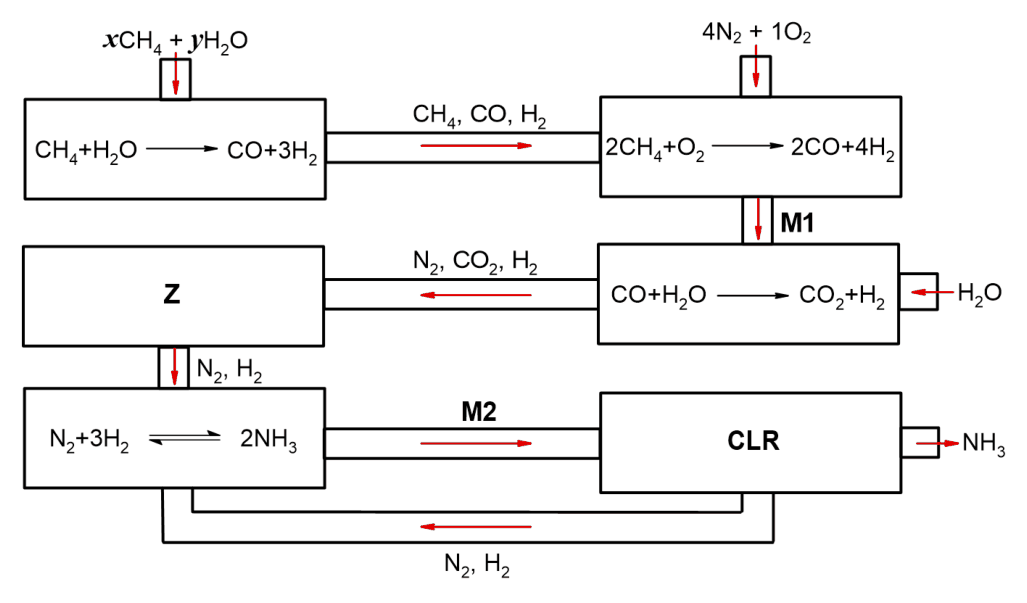
Fig. 1. M1 - Mixture 1, M2 - Mixture 2, Z – \(\ce{CO2}\) scrubber, CLR - cooler
In the following calculations, assume that all reactions in Fig. 1, except \(\ce{NH3}\) formation, are quantitative.
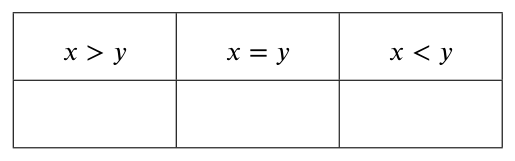
7.1 Tick the gases contained in M1 and M2; and tick the correct relationship between \(x\) and \(y\). 3.0 pt

An ammonia production complex with a capacity of 660,000 tons per year was commissioned at the Navoiazot plant in Uzbekistan, which operates with a 97.0% of overall yield.
7.2 Calculate the mass of \(\ce{CH4}\) (tons) required annually to produce 660,000 tons of ammonia, if the Navoiazot operates according to the Fig. 1. 8.0 pt
Consider a model of a real reaction system, which includes recirculation of reagents. An open system operates in a cyclic mode. Each cycle consists of four steps:
- A stoichiometric \(\ce{N2}:\ce{H2}=1:3\) mixture with a total amount of \(n_0\) mol is fed into the reactor after each cycle.
- The reaction proceeds with a constant yield of \(\eta=0.150\).
- Ammonia is separated by liquification.
- Unreacted gases are returned into the reactor.
The cycle is repeated until the required overall yield is reached.
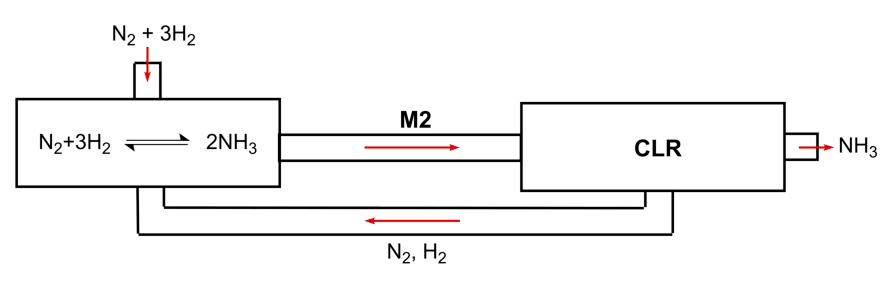
Fig. 2. M2. – Mixture 2, CLR - cooler.
7.3
a) Calculate the amount of nitrogen, present in the system after the 58th cycle (before the addition of 59th portion of mixture), if \(n_0=4\) mol. Provide 4 decimal places. Hint: a formula for the sum of the terms of a geometric progression is needed.
b) Calculate the number of cycles needed to increase the overall yield from 15.0% to 97.0%. 15.0 pt
An aqueous solution of 3 is being used to remove \(\ce{CO2}\) from the mixture.
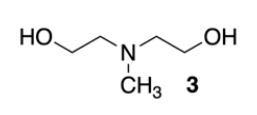
7.4 Write the equation for this reaction. 3.0 pt
Complex 5 is obtained through the fixation of the molecular nitrogen according to the scheme below.
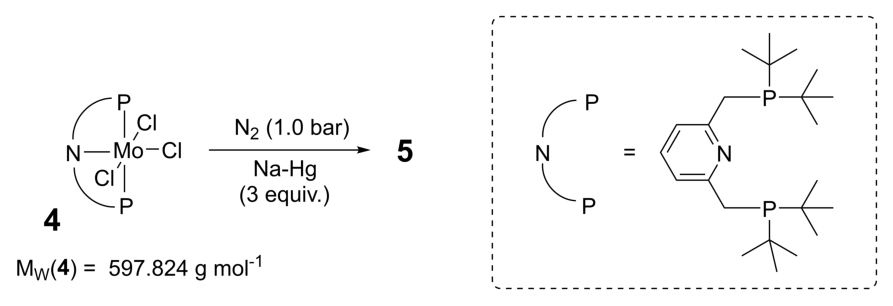
7.5 Draw the structure of 5 using simplified scheme for the ligand. Note that 1.00 g of 4 will react stoichiometrically with 94.97 \(\mathrm{cm^3}\) of \(\ce{N2}\) at 273.15 K and 1.0 bar. 6.0 pt
The effect of different reductants and additives on the yield of \(\ce{NH3}\) was examined. The different Red and Ad combinations, their respective \(E^\circ\) and \(pK_a\), together with the resulting \(\ce{NH3}\) yield are presented below.
Red
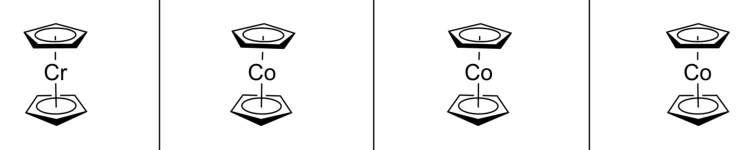
Ad
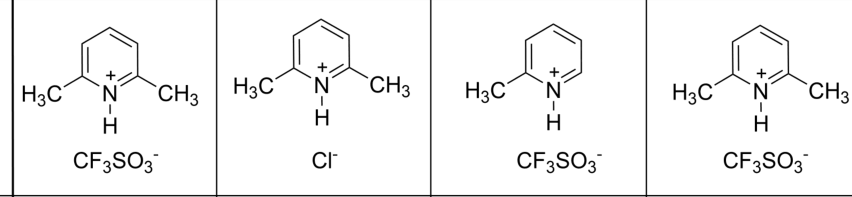
| # | 1 | 2 | 3 | 4 |
|---|---|---|---|---|
| \(E^\circ\) (V) | −0.88 | −1.15 | −1.15 | −1.15 |
| \(pK_a\) | 14.4 | 14.4 | 13.9 | 14.4 |
| \(\ce{NH3}\) yield (mole) | 0 | 0.7 | 9.1 | 11.8 |
7.6 Rank the following Red/Ad combinations A-D by the decrease in ammonia yield. 6.0 pt
Red
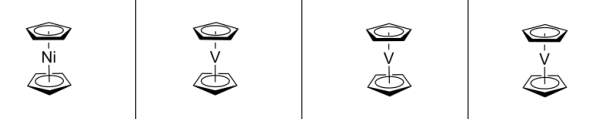
Ad
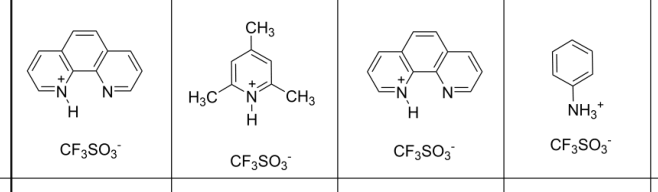
| # | A | B | C | D |
|---|---|---|---|---|
| \(E^\circ\) (V) | −0.09 | −1.10 | −1.10 | −1.10 |
| \(pK_a\) | 13.7 | 15.0 | 13.7 | 10.6 |
Nitrogen fixation can also be achieved via binary nitrides (compounds containing \(\ce{N^3-}\)). Such nitrides 7, 8, 9 were obtained from pure elements. When they are heated together with \(\ce{SiO2}\), red crystals of a stable compound 10 are formed as the single product. The minimal possible formula, describing the structure of compound 10 is \(\ce{Q_{\alpha}R_{\beta}S2T[Si12N24]}\). In addition:
- Mass fractions of nitrogen are \(w(\ce{N})_7=9.16\%\), \(w(\ce{N})_8=18.90\%\), \(w(\ce{N})_9=39.94\%\)
- Q and R are metal cations in their highest oxidation state.
- S is a monoatomic anion.
- T is an anion with tetrahedral configuration.
- For the quantitative formation of 10, the mass ratio 7 : 8 : 9 : \(\ce{SiO2}\) = 5.09 : 2.96 : 3.27 : 1.00.
7.7 Identify the empirical formulae of 7–10. Specify the composition of anions S and T. 13.0 pt
Physical Constants and Equations
Constants
| Constant | Value |
|---|---|
| Avogadro constant | \(N_A=6.022\times10^{23}\ \mathrm{mol^{-1}}\) |
| Universal gas constant | \(R=8.314\ \mathrm{J\,K^{-1}\,mol^{-1}}\) |
| Faraday constant | \(F=96\,485\ \mathrm{C\,mol^{-1}}\) |
| Planck constant | \(h=6.626\times10^{-34}\ \mathrm{J\,s}\) |
| Speed of light in vacuum | \(c=2.998\times10^8\ \mathrm{m\,s^{-1}}\) |
| Mass of electron | \(m_e=9.109\times10^{-31}\ \mathrm{kg}\) |
| Charge of electron | \(e=1.602\times10^{-19}\ \mathrm{C}\) |
| Standard pressure | \(P^\circ=1\ \mathrm{bar}=10^5\ \mathrm{Pa}\) |
| Ionic product of water at \(25\,^\circ\mathrm{C}\) | \(K_w=1.00\times10^{-14}\) |
| Zero of the Celsius scale | \(0\,^\circ\mathrm{C}=273.15\ \mathrm{K}\) |
| Electronvolt | \(1\ \mathrm{eV}=1.602\times10^{-19}\ \mathrm{J}\) |
| Watt | \(1\ \mathrm{W}=1\ \mathrm{J\,s^{-1}}\) |
| Coulomb | \(1\ \mathrm{C}=1\ \mathrm{A\,s}\) |
| Nanometre | \(1\ \mathrm{nm}=1\times10^{-9}\ \mathrm{m}\) |
| Ångstrom | \(1\ \text{Å}=1\times10^{-10}\ \mathrm{m}\) |
| metric ton | \(1\ \mathrm{ton}=1000\ \mathrm{kg}\) |
| litre | \(1\ \mathrm{L}=1\ \mathrm{dm^3}\) |
Equations
| Equation | Expression |
|---|---|
| Ideal gas law | \(PV=nRT\) |
| Dalton law | \(P_i=x_iP\) |
| Beer–Lambert law | \(A=\log_{10}\dfrac{I_0}{I}=\varepsilon cl\) |
| Energy of a photon | \(E=h\nu=\dfrac{hc}{\lambda}\) |
| Heat and temperature change | \(Q=nC_m\Delta T\) |
| Gibbs energy definition | \(G=H-TS\) |
| Gibbs energy and equilibrium constant | \(\Delta_rG^\circ=-RT\ln K\) |
| Enthalpy change dependence on temperature (at \(\Delta_rC_p=\mathrm{const}\)) | \(\Delta_rH_{T_2}=\Delta_rH_{T_1}+\Delta_rC_p(T_2-T_1)\) |
| Entropy change dependence on temperature (at \(\Delta_rC_p=\mathrm{const}\)) | \(\Delta_rS_{T_2}=\Delta_rS_{T_1}+\Delta_rC_p\ln\dfrac{T_2}{T_1}\) |
| Henderson–Hasselbalch equation | \(pH=pK_a+\log_{10}\dfrac{[\ce{A-}]}{[\ce{HA}]}\) |
| Average reaction rate | \(r=\dfrac{\Delta c}{\Delta t}\) |
| The rate law | \(r=k[A]^x[B]^y\) |
| Arrhenius law | \(k=A\exp\left(-\dfrac{E_a}{RT}\right)\) |
| Integrated rate law for a 1st order reaction | \(c=c_0e^{-kt}\); \(kt=\ln\dfrac{c_0}{c}\) |
| Lifetime of a reagent in a 1st order reaction | \(\tau=\dfrac1k\) |
| Integrated rate law for n-th order reaction (\(n\ne1\)) | \(kt=\dfrac1{n-1}\left(c^{1-n}-c_0^{1-n}\right)\), for \(n\ne1\) |
| Concentration of an intermediate in a consecutive reaction: \(\ce{A ->[$k_1$] B ->[$k_2$] D}\) | \([B]=\dfrac{k_1[A]_0}{k_2-k_1}\left(e^{-k_1t}-e^{-k_2t}\right)\) |
| The ratio of products in the competitive reactions: \(\ce{A ->[$k_1$] B}\), \(\ce{A ->[$k_2$] C}\) | \(\dfrac{[B]}{[C]}=\dfrac{k_1}{k_2}\) |
| Michaelis–Menten equation | \(r_0=r_{\max}\dfrac{[S]_0}{K_M+[S]_0}\) |
| Specific surface area | \(s=\dfrac{S}{m}\) |
| Progressions: arithmetic geometric | \(a_n=a_1+d(n-1)\); \(a_n=a_1q^{n-1}\) |
| Sum of geometric progression | \(\displaystyle\sum_{k=0}^{n}a_1q^k=a_1\dfrac{q^{n+1}-1}{q-1}\) |
| Volume of a sphere with radius \(r\) | \(V=\dfrac43\pi r^3\) |
| Surface area of sphere with radius \(r\) | \(S=4\pi r^2\) |
| Volume of a cone with base radius \(r\) and height \(h\) | \(V=\dfrac13\pi r^2h\) |
| Volume of a cylinder with base radius \(r\) and height \(h\) | \(V=\pi r^2h\) |
Consider all gases ideal.
In equilibrium constant calculations, all concentrations are referenced to the concentration of \(1\ \mathrm{mol\,dm^{-3}}\).
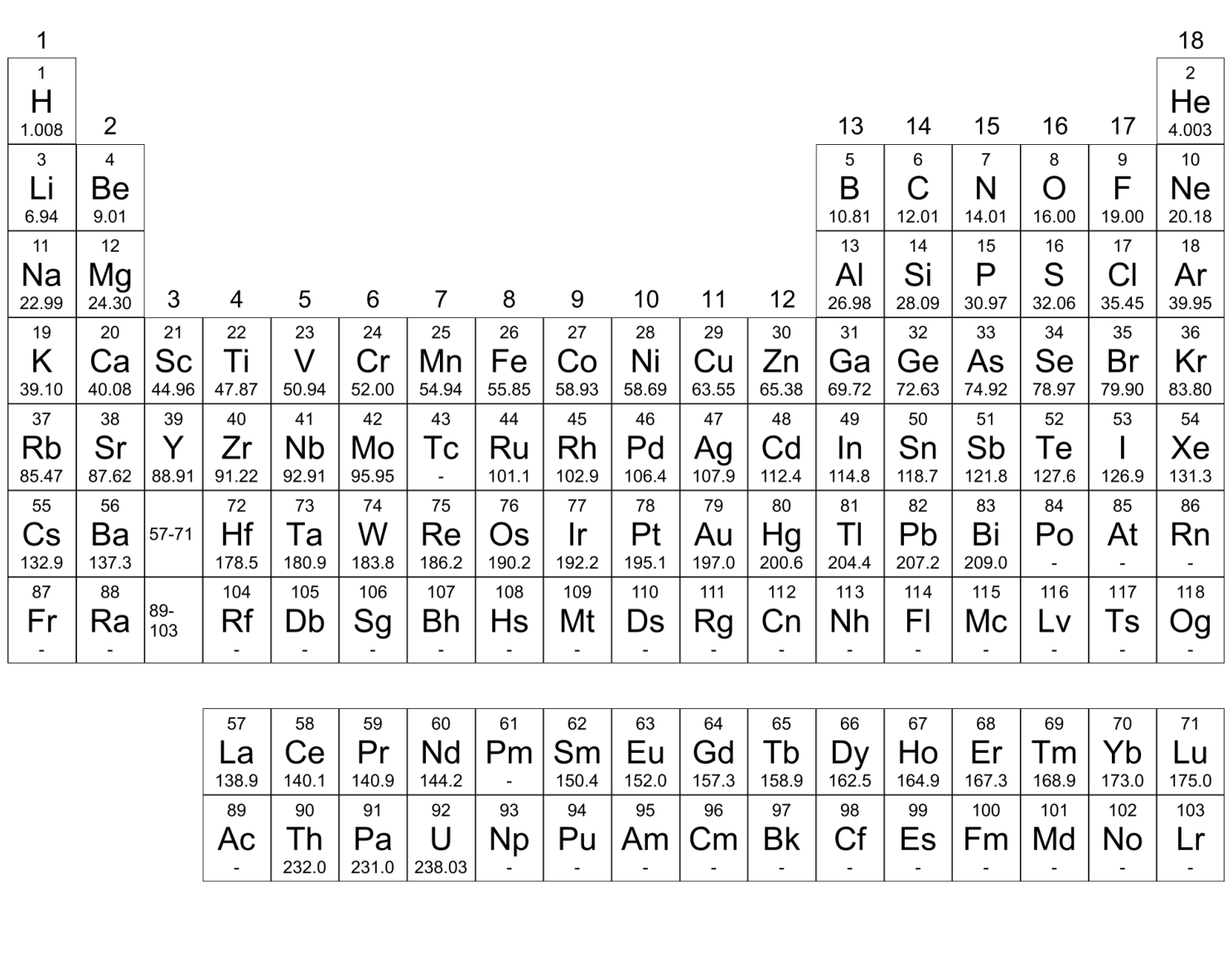
Periodic Table of Elements
Official English text of the problem.
Answers
- 7.1: Tick \(\ce{CO}\), \(\ce{H2}\), and \(\ce{N2}\) for M1; tick \(\ce{H2}\), \(\ce{N2}\), and \(\ce{NH3}\) for M2. Tick \(x>y\).
- 7.2: \(\boxed{2.80\times10^5\ \text{tons of }\ce{CH4}\text{ per year}}\).
- 7.3(a): \(\boxed{5.6662\ \mathrm{mol}\text{ of }\ce{N2}}\).
- 7.3(b): \(\boxed{189\text{ total cycles}}\), or 188 additional cycles after the first cycle, which gives 15.0%.
- 7.4:
\[ \boxed{\ce{CH3N(CH2CH2OH)2 + CO2 + H2O <=> [CH3NH(CH2CH2OH)2]+ + HCO3-}} \] - 7.5: 5 is \(\boxed{\ce{[Mo2(L)2(N2)5]}}\): two octahedral molybdenum(0) centres, each bearing one tridentate PNP ligand \(L\) and two terminal dinitrogen ligands, joined by one end-on/end-on bridging dinitrogen ligand.
- 7.6: \(\boxed{\mathrm{B>C>D>A}}\), in decreasing ammonia yield.
- 7.7: 7 = lanthanum(III) nitride, \(\ce{LaN}\); 8 = calcium nitride, \(\ce{Ca3N2}\); 9 = silicon nitride, \(\ce{Si3N4}\). 10 has empirical formula \(\boxed{\ce{Ca9La5Si13N25O5}}\), written structurally as \(\boxed{\ce{Ca9La5O2[SiNO3][Si12N24]}}\). Thus S is \(\ce{O^2-}\), and T is tetrahedral \(\ce{[SiNO3]^5-}\).
Solution
7.1 — Gases in the two mixtures
The molecular species used in the process are methane C, water O, carbon monoxide [C-]#[O+], dioxygen O=O, dihydrogen [H][H], dinitrogen N#N, ammonia N, and carbon dioxide O=C=O.
The first reactor carries out steam reforming:
\[ \ce{CH4 + H2O -> CO + 3H2}. \]
Its outlet contains unreacted methane, carbon monoxide, and hydrogen. Water has been consumed, whereas methane remains; therefore,
\[ \boxed{x>y}. \]
The remaining methane then reacts quantitatively with the oxygen introduced alongside nitrogen:
\[ \ce{2CH4 + O2 -> 2CO + 4H2}. \]
Consequently, immediately after this reactor,
\[ \boxed{\mathrm{M1}:\ \ce{CO},\ \ce{H2},\ \ce{N2}}. \]
The subsequent water–gas shift reaction is
\[ \ce{CO + H2O -> CO2 + H2}. \]
The scrubber removes the resulting carbon dioxide, leaving nitrogen and hydrogen for ammonia synthesis:
\[ \ce{N2 + 3H2 <=> 2NH3}. \]
Because ammonia formation is incomplete, its reactor outlet contains product and unreacted reagents:
\[ \boxed{\mathrm{M2}:\ \ce{H2},\ \ce{N2},\ \ce{NH3}}. \]
No other boxes should be ticked.
7.2 — Annual methane requirement
Use a basis of \(1\ \mathrm{mol}\) of oxygen supplied with \(4\ \mathrm{mol}\) of nitrogen.
In the first reactor, \(y\) mol of methane react with \(y\) mol of water. The remaining methane is \(x-y\) mol. The second reactor consumes \(2\) mol of methane per mole of oxygen, so
\[ x-y=2. \]
Before the shift reaction, the amounts are
\[ n(\ce{CO})=y+2, \qquad n(\ce{H2})=3y+4. \]
Converting all carbon monoxide into carbon dioxide produces a further \(y+2\) mol of hydrogen. Hence
\[ n(\ce{H2})=4y+6. \]
The \(4\ \mathrm{mol}\) of nitrogen require \(12\ \mathrm{mol}\) of hydrogen for stoichiometric ammonia synthesis:
\[ 4y+6=12, \qquad y=1.5, \qquad x=3.5. \]
Thus \(3.5\ \mathrm{mol}\) of methane supply the reagents for \(8\ \mathrm{mol}\) of ammonia. With integer coefficients, the overall theoretical reaction is
\[ \boxed{\ce{7CH4 + 10H2O + 2O2 + 8N2 -> 7CO2 + 16NH3}}. \]
The molar masses calculated from the supplied table are
\[ M(\ce{CH4})=12.01+4(1.008)=16.042\ \mathrm{g\,mol^{-1}}, \]
\[ M(\ce{NH3})=14.01+3(1.008)=17.034\ \mathrm{g\,mol^{-1}}. \]
Accounting for the overall yield,
\[ m(\ce{CH4}) = \frac{660\,000\ \mathrm{tons}}{0.970} \frac{7}{16} \frac{16.042}{17.034} = 280\,344.6\ \mathrm{tons}. \]
Therefore,
\[ \boxed{m(\ce{CH4})=2.80\times10^5\ \mathrm{tons\,year^{-1}}}. \]
7.3(a) — Nitrogen remaining after 58 cycles
Each fresh portion contains
\[ a=\frac{n_0}{4}=1\ \mathrm{mol} \]
of nitrogen. Let \(r_k\) be the amount of unreacted nitrogen after cycle \(k\), after ammonia removal and before the next addition. The unreacted fraction per cycle is
\[ q=1-\eta=0.850. \]
The recurrence is
\[ r_k=q(r_{k-1}+a), \qquad r_0=0. \]
Therefore,
\[ r_k=a(q+q^2+\cdots+q^k) =a\frac{q(1-q^k)}{1-q}. \]
For \(k=58\),
\[ r_{58} =(1\ \mathrm{mol}) \frac{0.85(1-0.85^{58})}{0.15} =5.6662099726\ \mathrm{mol}. \]
To four decimal places,
\[ \boxed{r_{58}=5.6662\ \mathrm{mol\ of\ }\ce{N2}}. \]
7.3(b) — Cycles needed for 97.0% overall yield
After \(k\) cycles, the total amount of nitrogen introduced is \(ka\), and the amount converted is \(ka-r_k\). Consequently, the cumulative ammonia yield is
\[ Y_k = \frac{2(ka-r_k)}{2ka} = 1-\frac{q(1-q^k)}{k(1-q)}. \]
Thus
\[ Y_k = 1-\frac{0.85(1-0.85^k)}{0.15k}. \]
The required condition is \(Y_k\geq0.970\). The two consecutive values surrounding the threshold are
\[ Y_{188}=0.9698581560=96.9858\%, \]
\[ Y_{189}=0.9700176367=97.0018\%. \]
The overall yield increases with the number of cycles, so the minimum is
\[ \boxed{189\text{ total cycles}}. \]
Since the first cycle gives 15.0%, this is 188 additional cycles after the first. Fresh reagent is added every cycle; a calculation for repeatedly recycling a single initial charge would describe a different system.
7.4 — Carbon dioxide absorption
Compound 3 is N-methyldiethanolamine, SMILES CN(CCO)CCO.
It is a tertiary amine. In aqueous solution it accepts a proton as dissolved carbon dioxide forms hydrogencarbonate:
\[ \boxed{\ce{CH3N(CH2CH2OH)2 + CO2 + H2O <=> [CH3NH(CH2CH2OH)2]+ + HCO3-}}. \]
The products are N-methyldiethanolammonium, SMILES C[NH+](CCO)CCO, and hydrogencarbonate (bicarbonate), SMILES O=C([O-])O.
The amine has no nitrogen-bound hydrogen initially, so the appropriate net absorption product is hydrogencarbonate rather than an ordinary amine carbamate.
7.5 — Structure of complex 5
Denote the neutral pincer ligand by \(L\). Its name is 2,6-bis[(di-tert-butylphosphino)methyl]pyridine, and its SMILES is:
n1c(CP(C(C)(C)C)C(C)(C)C)cccc1CP(C(C)(C)C)C(C)(C)C
It coordinates through both phosphorus atoms and the pyridine nitrogen, giving a meridional \(\kappa^3\)-P,N,P arrangement.
Starting complex 4 is trichlorido(L)molybdenum(III), \(\ce{[MoCl3(L)]}\). A dative-bond SMILES representation is:
[Cl-]->[Mo+3]12(<-[Cl-])(<-[Cl-])<-n3c(CP->1(C(C)(C)C)C(C)(C)C)cccc3CP->2(C(C)(C)C)C(C)(C)C
The amount of 4 is
\[ n(4) = \frac{1.00\ \mathrm{g}}{597.824\ \mathrm{g\,mol^{-1}}} = 1.672733\times10^{-3}\ \mathrm{mol}. \]
For nitrogen,
\[ n(\ce{N2}) = \frac{PV}{RT} = \frac{(1.0\times10^5\ \mathrm{Pa})(94.97\times10^{-6}\ \mathrm{m^3})} {(8.314\ \mathrm{J\,K^{-1}\,mol^{-1}})(273.15\ \mathrm{K})} = 4.181915\times10^{-3}\ \mathrm{mol}. \]
Therefore,
\[ \frac{n(\ce{N2})}{n(4)} = 2.50005 \approx\frac52. \]
The simplest product unit thus contains two molybdenum atoms and five dinitrogen molecules.
Three equivalents of sodium reduce each molybdenum(III) centre to molybdenum(0), removing the three chlorides as sodium chloride. The balanced preparation is
\[ \ce{2[MoCl3(L)] + 6Na + 5N2 -> [Mo2(L)2(N2)5] + 6NaCl}. \]
Sodium chloride has formula-unit SMILES [Na+].[Cl-]; mercury serves as the amalgam medium.
The expected structure is μ-dinitrogen-bis[bis(dinitrogen)(L)molybdenum(0)]:
- Draw two molybdenum centres joined by a linear, end-on/end-on \(\ce{Mo-N#N-Mo}\) bridge.
- Attach one tridentate PNP ligand to each molybdenum.
- Attach two additional, terminal, end-on dinitrogen ligands to each molybdenum.
- Each molybdenum is approximately octahedral. The two terminal dinitrogen ligands are mutually trans; the bridging dinitrogen is trans to the pyridine nitrogen.
Each metal is then an 18-electron centre:
\[ 6\quad(d^6\text{ Mo(0)}) + 6\quad(L) + 4\quad(\text{two terminal dinitrogens}) + 2\quad(\text{bridging dinitrogen}) =18. \]
A dative-bond SMILES specifying this connectivity is:
[Mo]12(<-N#N)(<-N#N)(<-N#N->[Mo]45(<-N#N)(<-N#N)<-n6c(CP->4(C(C)(C)C)C(C)(C)C)cccc6CP->5(C(C)(C)C)C(C)(C)C)<-n3c(CP->1(C(C)(C)C)C(C)(C)C)cccc3CP->2(C(C)(C)C)C(C)(C)C
This SMILES specifies donor–metal connectivity; the octahedral and trans relationships are supplied by the drawing instructions above.
7.6 — Ranking the reductant/additive combinations
Comparing combinations 1 and 4 in the supplied experimental table shows that the stronger reductant, with the more negative potential, supports ammonia formation. Combination A has a much less negative potential, \(-0.09\ \mathrm{V}\), so it is predicted to give the lowest yield.
B, C, and D have the same reductant potential and the same counterion. The comparison of experimental combinations 3 and 4 associates the higher additive \(pK_a\), corresponding to the weaker acid, with the higher ammonia yield. Applying that trend gives
\[ pK_a(\mathrm{B})=15.0 > pK_a(\mathrm{C})=13.7 > pK_a(\mathrm{D})=10.6. \]
The intended decreasing-yield ranking is therefore
\[ \boxed{\mathrm{B>C>D>A}}. \]
7.7 — Identification of the nitrides and compound 10
For a binary nitride \(\ce{E_aN_b}\), let the oxidation state of element \(E\) be \(+z\). Since nitrogen is present as nitride,
\[ az=3b. \]
Its nitrogen mass fraction is
\[ w(\ce{N}) = \frac{14.01b}{aM(E)+14.01b}. \]
Using \(a/b=3/z\),
\[ \frac{M(E)}{z} = \frac{14.01}{3} \left(\frac1{w(\ce{N})}-1\right). \]
The three supplied percentages give the following identifications:
| Compound | \(M(E)/z\), \(\mathrm{g\,mol^{-1}}\) | Identification | Formula | Calculated nitrogen mass fraction |
|---|---|---|---|---|
| 7 | 46.3125 | \(z=3\), \(M(E)\approx138.94\): lanthanum | \(\ce{LaN}\) | 9.1623% |
| 8 | 20.0390 | \(z=2\), \(M(E)\approx40.078\): calcium | \(\ce{Ca3N2}\) | 18.8992% |
| 9 | 7.02254 | \(z=4\), \(M(E)\approx28.090\): silicon | \(\ce{Si3N4}\) | 39.9401% |
Thus 7 is lanthanum(III) nitride, formula-unit SMILES [La+3].[N-3]; 8 is calcium nitride, formula-unit SMILES [Ca+2].[Ca+2].[Ca+2].[N-3].[N-3]; and 9 is silicon nitride. A formal charge-separated composition for the latter is [Si+4].[Si+4].[Si+4].[N-3].[N-3].[N-3].[N-3]. These disconnected strings express compositions, not crystal connectivity; silicon nitride is an extended covalent solid.
Their formation from the elements is represented by
\[ \ce{2La + N2 -> 2LaN}, \]
\[ \ce{3Ca + N2 -> Ca3N2}, \]
\[ \ce{3Si + 2N2 -> Si3N4}. \]
To find the composition of 10, convert the given mass ratio to a molar ratio:
\[ M(\ce{LaN})=152.91\ \mathrm{g\,mol^{-1}}, \]
\[ M(\ce{Ca3N2})=148.26\ \mathrm{g\,mol^{-1}}, \]
\[ M(\ce{Si3N4})=140.31\ \mathrm{g\,mol^{-1}}, \qquad M(\ce{SiO2})=60.09\ \mathrm{g\,mol^{-1}}. \]
Hence
\[ n(\ce{LaN}):n(\ce{Ca3N2}):n(\ce{Si3N4}):n(\ce{SiO2}) = \frac{5.09}{152.91}: \frac{2.96}{148.26}: \frac{3.27}{140.31}: \frac{1.00}{60.09}. \]
Normalizing gives
\[ 2.00025:1.19969:1.40043:1 \approx10:6:7:5. \]
These quantities contain
\[ \ce{La10Ca18Si26N50O10}, \]
which reduces to the empirical formula
\[ \boxed{\ce{Ca9La5Si13N25O5}}. \]
The prescribed structural formula already contains \(\ce{Si12N24}\). Subtracting this unit leaves one silicon, one nitrogen, and five oxygen atoms in addition to the metal cations.
The two identical monoatomic anions must therefore be oxide ions:
\[ \boxed{\mathrm{S}=\ce{O^2-}}, \]
named oxide, SMILES [O-2].
After assigning two oxygen atoms to these oxide ions, the tetrahedral anion has composition \(\ce{SiNO3}\). Its charge is
\[ (+4)+(-3)+3(-2)=-5, \]
so
\[ \boxed{\mathrm{T}=\ce{[SiNO3]^5-}}. \]
This is nitridotrioxidosilicate(5−), SMILES [N-2][Si]([O-])([O-])[O-]. Draw silicon at the centre of a tetrahedron, bonded to one nitrogen and three oxygen atoms. The formal charges in this bonded SMILES sum to \(-5\); nitrogen’s oxidation state remains \(-3\).
Thus 10, a calcium lanthanum oxonitridosilicate, is
\[ \boxed{\ce{Ca9La5O2[SiNO3][Si12N24]}}. \]
One assignment is \(Q=\ce{Ca^2+}\), \(\alpha=9\), \(R=\ce{La^3+}\), and \(\beta=5\). The cation SMILES are [Ca+2] and [La+3], respectively.
The charge balance confirms the result:
\[ 9(2)+5(3)=33, \]
\[ 2(-2)+(-5)+\bigl[12(4)+24(-3)\bigr] =-4-5-24=-33. \]
The balanced synthesis is
\[ \boxed{\ce{10LaN + 6Ca3N2 + 7Si3N4 + 5SiO2 -> 2Ca9La5O2[SiNO3][Si12N24]}}. \]
The extended \(\ce{[Si12N24]^24-}\) framework’s connectivity is not supplied, so a unique structural SMILES for the complete crystalline compound 10 cannot be inferred from its formula.
The solution was checked against the official solution.
IChO 2026 · Theorieaufgabe 7
Stickstofffixierung
T7. Stickstofffixierung
7%
| 7.1 | 7.2 | 7.3 | 7.4 | 7.5 | 7.6 | 7.7 | \(\sum\) |
|---|---|---|---|---|---|---|---|
| 3 | 8 | 15 | 3 | 6 | 6 | 13 | 54 |
Das Haber–Bosch-Verfahren ist das wichtigste industrielle Verfahren zur Herstellung von Ammoniak. Nachfolgend ist ein vereinfachtes Fließschema einer Ammoniaksyntheseanlage dargestellt.
Abb. 1. M1 - Gemisch 1, M2 - Gemisch 2, Z – \(\ce{CO2}\)-Wäscher, CLR - Kühler
Nehmen Sie bei den folgenden Berechnungen an, dass alle Reaktionen in Abb. 1 mit Ausnahme der Bildung von \(\ce{NH3}\) quantitativ ablaufen.
7.1 Kreuzen Sie die in M1 und M2 enthaltenen Gase an; kreuzen Sie außerdem die richtige Beziehung zwischen \(x\) und \(y\) an. 3.0 Pkt.
Im Werk Navoiazot in Usbekistan wurde ein Ammoniakproduktionskomplex mit einer Kapazität von 660,000 Tonnen pro Jahr in Betrieb genommen, der mit einer Gesamtausbeute von 97.0% arbeitet.
7.2 Berechnen Sie die jährlich erforderliche Masse an \(\ce{CH4}\) (in Tonnen) zur Herstellung von 660,000 Tonnen Ammoniak, wenn Navoiazot gemäß Abb. 1 arbeitet. 8.0 Pkt.
Betrachten Sie ein Modell eines realen Reaktionssystems, das eine Rückführung der Edukte umfasst. Ein offenes System wird zyklisch betrieben. Jeder Zyklus besteht aus vier Schritten:
- Nach jedem Zyklus wird ein stöchiometrisches \(\ce{N2}:\ce{H2}=1:3\)-Gemisch mit einer Gesamtstoffmenge von \(n_0\) mol in den Reaktor eingespeist.
- Die Reaktion läuft mit einer konstanten Ausbeute von \(\eta=0.150\) ab.
- Ammoniak wird durch Verflüssigung abgetrennt.
- Nicht umgesetzte Gase werden in den Reaktor zurückgeführt.
Der Zyklus wird wiederholt, bis die erforderliche Gesamtausbeute erreicht ist.
Abb. 2. M2. – Gemisch 2, CLR - Kühler.
7.3
a) Berechnen Sie die Stoffmenge an Stickstoff, die nach dem 58. Zyklus (vor der Zugabe der 59. Portion des Gemisches) im System vorhanden ist, wenn \(n_0=4\) mol gilt. Geben Sie das Ergebnis mit 4 Nachkommastellen an. Hinweis: Es wird eine Formel für die Summe der Glieder einer geometrischen Folge benötigt.
b) Berechnen Sie die Anzahl der Zyklen, die erforderlich sind, um die Gesamtausbeute von 15.0% auf 97.0% zu erhöhen. 15.0 Pkt.
Zur Entfernung von \(\ce{CO2}\) aus dem Gemisch wird eine wässrige Lösung von 3 verwendet.
7.4 Stellen Sie die Gleichung für diese Reaktion auf. 3.0 Pkt.
Komplex 5 wird durch Fixierung von molekularem Stickstoff gemäß dem nachfolgenden Schema erhalten.
7.5 Zeichnen Sie die Struktur von 5 unter Verwendung der vereinfachten Darstellung des Liganden. Beachten Sie, dass 1.00 g von 4 bei 273.15 K und 1.0 bar stöchiometrisch mit 94.97 \(\mathrm{cm^3}\) \(\ce{N2}\) reagieren. 6.0 Pkt.
Der Einfluss verschiedener Reduktionsmittel und Zusätze auf die Ausbeute an \(\ce{NH3}\) wurde untersucht. Die verschiedenen Kombinationen von Red und Ad, ihre jeweiligen Werte für \(E^\circ\) und \(pK_a\) sowie die resultierende Ausbeute an \(\ce{NH3}\) sind nachfolgend angegeben.
Red
Ad
| # | 1 | 2 | 3 | 4 |
|---|---|---|---|---|
| \(E^\circ\) (V) | −0.88 | −1.15 | −1.15 | −1.15 |
| \(pK_a\) | 14.4 | 14.4 | 13.9 | 14.4 |
| \(\ce{NH3}\)-Ausbeute (mol) | 0 | 0.7 | 9.1 | 11.8 |
7.6 Ordnen Sie die folgenden Red/Ad-Kombinationen A-D nach abnehmender Ammoniakausbeute. 6.0 Pkt.
Red
Ad
| # | A | B | C | D |
|---|---|---|---|---|
| \(E^\circ\) (V) | −0.09 | −1.10 | −1.10 | −1.10 |
| \(pK_a\) | 13.7 | 15.0 | 13.7 | 10.6 |
Stickstofffixierung kann auch über binäre Nitride (Verbindungen, die \(\ce{N^3-}\) enthalten) erfolgen. Solche Nitride 7, 8, 9 wurden aus den reinen Elementen erhalten. Werden sie zusammen mit \(\ce{SiO2}\) erhitzt, entstehen rote Kristalle einer stabilen Verbindung 10 als einziges Produkt. Die kleinstmögliche Formel, die die Struktur der Verbindung 10 beschreibt, lautet \(\ce{Q_{\alpha}R_{\beta}S2T[Si12N24]}\). Außerdem gilt:
- Die Massenanteile von Stickstoff betragen \(w(\ce{N})_7=9.16\%\), \(w(\ce{N})_8=18.90\%\), \(w(\ce{N})_9=39.94\%\)
- Q und R sind Metallkationen in ihrer höchsten Oxidationsstufe.
- S ist ein einatomiges Anion.
- T ist ein Anion mit tetraedrischer Konfiguration.
- Für die quantitative Bildung von 10 beträgt das Massenverhältnis 7 : 8 : 9 : \(\ce{SiO2}\) = 5.09 : 2.96 : 3.27 : 1.00.
7.7 Bestimmen Sie die Verhältnisformeln von 7–10. Geben Sie die Zusammensetzung der Anionen S und T an. 13.0 Pkt.
Physikalische Konstanten und Gleichungen
Konstanten
| Konstante | Wert |
|---|---|
| Avogadro-Konstante | \(N_A=6.022\times10^{23}\ \mathrm{mol^{-1}}\) |
| Universelle Gaskonstante | \(R=8.314\ \mathrm{J\,K^{-1}\,mol^{-1}}\) |
| Faraday-Konstante | \(F=96\,485\ \mathrm{C\,mol^{-1}}\) |
| Planck-Konstante | \(h=6.626\times10^{-34}\ \mathrm{J\,s}\) |
| Lichtgeschwindigkeit im Vakuum | \(c=2.998\times10^8\ \mathrm{m\,s^{-1}}\) |
| Elektronenmasse | \(m_e=9.109\times10^{-31}\ \mathrm{kg}\) |
| Elektronenladung | \(e=1.602\times10^{-19}\ \mathrm{C}\) |
| Standarddruck | \(P^\circ=1\ \mathrm{bar}=10^5\ \mathrm{Pa}\) |
| Ionenprodukt des Wassers bei \(25\,^\circ\mathrm{C}\) | \(K_w=1.00\times10^{-14}\) |
| Nullpunkt der Celsius-Skala | \(0\,^\circ\mathrm{C}=273.15\ \mathrm{K}\) |
| Elektronenvolt | \(1\ \mathrm{eV}=1.602\times10^{-19}\ \mathrm{J}\) |
| Watt | \(1\ \mathrm{W}=1\ \mathrm{J\,s^{-1}}\) |
| Coulomb | \(1\ \mathrm{C}=1\ \mathrm{A\,s}\) |
| Nanometer | \(1\ \mathrm{nm}=1\times10^{-9}\ \mathrm{m}\) |
| Ångström | \(1\ \text{Å}=1\times10^{-10}\ \mathrm{m}\) |
| Metrische Tonne | \(1\ \mathrm{ton}=1000\ \mathrm{kg}\) |
| Liter | \(1\ \mathrm{L}=1\ \mathrm{dm^3}\) |
Gleichungen
| Gleichung | Ausdruck |
|---|---|
| Ideale Gasgleichung | \(PV=nRT\) |
| Dalton-Gesetz | \(P_i=x_iP\) |
| Lambert–Beer-Gesetz | \(A=\log_{10}\dfrac{I_0}{I}=\varepsilon cl\) |
| Energie eines Photons | \(E=h\nu=\dfrac{hc}{\lambda}\) |
| Wärme und Temperaturänderung | \(Q=nC_m\Delta T\) |
| Definition der Gibbs-Energie | \(G=H-TS\) |
| Gibbs-Energie und Gleichgewichtskonstante | \(\Delta_rG^\circ=-RT\ln K\) |
| Temperaturabhängigkeit der Enthalpieänderung (bei \(\Delta_rC_p=\mathrm{const}\)) | \(\Delta_rH_{T_2}=\Delta_rH_{T_1}+\Delta_rC_p(T_2-T_1)\) |
| Temperaturabhängigkeit der Entropieänderung (bei \(\Delta_rC_p=\mathrm{const}\)) | \(\Delta_rS_{T_2}=\Delta_rS_{T_1}+\Delta_rC_p\ln\dfrac{T_2}{T_1}\) |
| Henderson–Hasselbalch-Gleichung | \(pH=pK_a+\log_{10}\dfrac{[\ce{A-}]}{[\ce{HA}]}\) |
| Mittlere Reaktionsgeschwindigkeit | \(r=\dfrac{\Delta c}{\Delta t}\) |
| Geschwindigkeitsgesetz | \(r=k[A]^x[B]^y\) |
| Arrhenius-Gleichung | \(k=A\exp\left(-\dfrac{E_a}{RT}\right)\) |
| Integriertes Geschwindigkeitsgesetz für eine Reaktion 1. Ordnung | \(c=c_0e^{-kt}\); \(kt=\ln\dfrac{c_0}{c}\) |
| Lebensdauer eines Edukts bei einer Reaktion 1. Ordnung | \(\tau=\dfrac1k\) |
| Integriertes Geschwindigkeitsgesetz für eine Reaktion n-ter Ordnung (\(n\ne1\)) | \(kt=\dfrac1{n-1}\left(c^{1-n}-c_0^{1-n}\right)\), für \(n\ne1\) |
| Konzentration eines Zwischenprodukts bei einer Folgereaktion: \(\ce{A ->[$k_1$] B ->[$k_2$] D}\) | \([B]=\dfrac{k_1[A]_0}{k_2-k_1}\left(e^{-k_1t}-e^{-k_2t}\right)\) |
| Verhältnis der Produkte bei konkurrierenden Reaktionen: \(\ce{A ->[$k_1$] B}\), \(\ce{A ->[$k_2$] C}\) | \(\dfrac{[B]}{[C]}=\dfrac{k_1}{k_2}\) |
| Michaelis–Menten-Gleichung | \(r_0=r_{\max}\dfrac{[S]_0}{K_M+[S]_0}\) |
| Spezifische Oberfläche | \(s=\dfrac{S}{m}\) |
| Folgen: arithmetisch, geometrisch | \(a_n=a_1+d(n-1)\); \(a_n=a_1q^{n-1}\) |
| Summe einer geometrischen Folge | \(\displaystyle\sum_{k=0}^{n}a_1q^k=a_1\dfrac{q^{n+1}-1}{q-1}\) |
| Volumen einer Kugel mit Radius \(r\) | \(V=\dfrac43\pi r^3\) |
| Oberfläche einer Kugel mit Radius \(r\) | \(S=4\pi r^2\) |
| Volumen eines Kegels mit Grundkreisradius \(r\) und Höhe \(h\) | \(V=\dfrac13\pi r^2h\) |
| Volumen eines Zylinders mit Grundkreisradius \(r\) und Höhe \(h\) | \(V=\pi r^2h\) |
Betrachten Sie alle Gase als ideal.
Bei der Berechnung von Gleichgewichtskonstanten werden alle Konzentrationen auf die Konzentration von \(1\ \mathrm{mol\,dm^{-3}}\) bezogen.
Periodensystem der Elemente
Aufgabentext aus dem offiziellen englischen Text übersetzt.
Antworten
- 7.1: Kreuzen Sie für M1 \(\ce{CO}\), \(\ce{H2}\) und \(\ce{N2}\) an; kreuzen Sie für M2 \(\ce{H2}\), \(\ce{N2}\) und \(\ce{NH3}\) an. Kreuzen Sie \(x>y\) an.
- 7.2: \(\boxed{2.80\times10^5\ \text{Tonnen }\ce{CH4}\text{ pro Jahr}}\).
- 7.3(a): \(\boxed{5.6662\ \mathrm{mol}\text{ an }\ce{N2}}\).
- 7.3(b): \(\boxed{189\text{ Zyklen insgesamt}}\), oder 188 zusätzliche Zyklen nach dem ersten Zyklus, der 15.0% liefert.
- 7.4:
\[ \boxed{\ce{CH3N(CH2CH2OH)2 + CO2 + H2O <=> [CH3NH(CH2CH2OH)2]+ + HCO3-}} \] - 7.5: 5 ist \(\boxed{\ce{[Mo2(L)2(N2)5]}}\): zwei oktaedrische Molybdän(0)-Zentren, die jeweils einen dreizähnigen PNP-Liganden \(L\) und zwei terminale Distickstoffliganden tragen und durch einen endständig/endständig verbrückenden Distickstoffliganden verbunden sind.
- 7.6: \(\boxed{\mathrm{B>C>D>A}}\), nach abnehmender Ammoniakausbeute.
- 7.7: 7 = Lanthan(III)-nitrid, \(\ce{LaN}\); 8 = Calciumnitrid, \(\ce{Ca3N2}\); 9 = Siliciumnitrid, \(\ce{Si3N4}\). 10 hat die Verhältnisformel \(\boxed{\ce{Ca9La5Si13N25O5}}\), strukturell geschrieben als \(\boxed{\ce{Ca9La5O2[SiNO3][Si12N24]}}\). Somit ist S \(\ce{O^2-}\) und T tetraedrisches \(\ce{[SiNO3]^5-}\).
Lösung
7.1 — Gase in den beiden Gemischen
Die im Verfahren verwendeten molekularen Spezies sind Methan C, Wasser O, Kohlenstoffmonoxid [C-]#[O+], Disauerstoff O=O, Diwasserstoff [H][H], Distickstoff N#N, Ammoniak N und Kohlenstoffdioxid O=C=O.
Im ersten Reaktor findet die Dampfreformierung statt:
\[ \ce{CH4 + H2O -> CO + 3H2}. \]
Sein Austrittsstrom enthält nicht umgesetztes Methan, Kohlenstoffmonoxid und Wasserstoff. Das Wasser ist verbraucht, während Methan zurückbleibt; daher gilt
\[ \boxed{x>y}. \]
Das verbleibende Methan reagiert anschließend quantitativ mit dem zusammen mit Stickstoff zugeführten Sauerstoff:
\[ \ce{2CH4 + O2 -> 2CO + 4H2}. \]
Folglich gilt unmittelbar nach diesem Reaktor:
\[ \boxed{\mathrm{M1}:\ \ce{CO},\ \ce{H2},\ \ce{N2}}. \]
Die anschließende Wassergas-Shift-Reaktion lautet
\[ \ce{CO + H2O -> CO2 + H2}. \]
Der Wäscher entfernt das entstandene Kohlenstoffdioxid, sodass Stickstoff und Wasserstoff für die Ammoniaksynthese verbleiben:
\[ \ce{N2 + 3H2 <=> 2NH3}. \]
Da die Ammoniakbildung unvollständig ist, enthält der Austrittsstrom dieses Reaktors das Produkt und nicht umgesetzte Edukte:
\[ \boxed{\mathrm{M2}:\ \ce{H2},\ \ce{N2},\ \ce{NH3}}. \]
Es sind keine weiteren Kästchen anzukreuzen.
7.2 — Jährlicher Methanbedarf
Als Berechnungsgrundlage dienen \(1\ \mathrm{mol}\) Sauerstoff, die zusammen mit \(4\ \mathrm{mol}\) Stickstoff zugeführt werden.
Im ersten Reaktor reagieren \(y\) mol Methan mit \(y\) mol Wasser. Es verbleiben \(x-y\) mol Methan. Der zweite Reaktor verbraucht \(2\) mol Methan pro Mol Sauerstoff, sodass
\[ x-y=2. \]
Vor der Shift-Reaktion betragen die Stoffmengen
\[ n(\ce{CO})=y+2, \qquad n(\ce{H2})=3y+4. \]
Bei der vollständigen Umwandlung von Kohlenstoffmonoxid in Kohlenstoffdioxid entstehen weitere \(y+2\) mol Wasserstoff. Somit gilt
\[ n(\ce{H2})=4y+6. \]
Für die stöchiometrische Ammoniaksynthese benötigen die \(4\ \mathrm{mol}\) Stickstoff \(12\ \mathrm{mol}\) Wasserstoff:
\[ 4y+6=12, \qquad y=1.5, \qquad x=3.5. \]
Somit liefern \(3.5\ \mathrm{mol}\) Methan die Edukte für \(8\ \mathrm{mol}\) Ammoniak. Mit ganzzahligen Koeffizienten lautet die theoretische Gesamtreaktion
\[ \boxed{\ce{7CH4 + 10H2O + 2O2 + 8N2 -> 7CO2 + 16NH3}}. \]
Die aus der bereitgestellten Tabelle berechneten molaren Massen betragen
\[ M(\ce{CH4})=12.01+4(1.008)=16.042\ \mathrm{g\,mol^{-1}}, \]
\[ M(\ce{NH3})=14.01+3(1.008)=17.034\ \mathrm{g\,mol^{-1}}. \]
Unter Berücksichtigung der Gesamtausbeute ergibt sich
\[ m(\ce{CH4}) = \frac{660\,000\ \mathrm{tons}}{0.970} \frac{7}{16} \frac{16.042}{17.034} = 280\,344.6\ \mathrm{tons}. \]
Daher gilt
\[ \boxed{m(\ce{CH4})=2.80\times10^5\ \mathrm{tons\,year^{-1}}}. \]
7.3(a) — Verbleibender Stickstoff nach 58 Zyklen
Jede frisch zugeführte Portion enthält
\[ a=\frac{n_0}{4}=1\ \mathrm{mol} \]
Stickstoff. Sei \(r_k\) die Stoffmenge an nicht umgesetztem Stickstoff nach Zyklus \(k\), nach der Abtrennung von Ammoniak und vor der nächsten Zugabe. Der nicht umgesetzte Anteil pro Zyklus beträgt
\[ q=1-\eta=0.850. \]
Die Rekursionsgleichung lautet
\[ r_k=q(r_{k-1}+a), \qquad r_0=0. \]
Daraus folgt
\[ r_k=a(q+q^2+\cdots+q^k) =a\frac{q(1-q^k)}{1-q}. \]
Für \(k=58\) gilt
\[ r_{58} =(1\ \mathrm{mol}) \frac{0.85(1-0.85^{58})}{0.15} =5.6662099726\ \mathrm{mol}. \]
Auf vier Nachkommastellen ergibt sich
\[ \boxed{r_{58}=5.6662\ \mathrm{mol\ of\ }\ce{N2}}. \]
7.3(b) — Für 97.0% Gesamtausbeute erforderliche Zyklen
Nach \(k\) Zyklen beträgt die insgesamt zugeführte Stickstoffstoffmenge \(ka\) und die umgesetzte Stoffmenge \(ka-r_k\). Folglich beträgt die kumulative Ammoniakausbeute
\[ Y_k = \frac{2(ka-r_k)}{2ka} = 1-\frac{q(1-q^k)}{k(1-q)}. \]
Somit gilt
\[ Y_k = 1-\frac{0.85(1-0.85^k)}{0.15k}. \]
Die erforderliche Bedingung lautet \(Y_k\geq0.970\). Die beiden aufeinanderfolgenden Werte beiderseits des Schwellenwerts sind
\[ Y_{188}=0.9698581560=96.9858\%, \]
\[ Y_{189}=0.9700176367=97.0018\%. \]
Die Gesamtausbeute steigt mit der Anzahl der Zyklen; die Mindestanzahl beträgt daher
\[ \boxed{189\text{ Zyklen insgesamt}}. \]
Da der erste Zyklus 15.0% liefert, sind dies 188 zusätzliche Zyklen nach dem ersten. In jedem Zyklus werden frische Edukte zugegeben; eine Berechnung für die wiederholte Rückführung einer einzigen Anfangscharge würde ein anderes System beschreiben.
7.4 — Absorption von Kohlenstoffdioxid
Verbindung 3 ist N-Methyldiethanolamin, SMILES CN(CCO)CCO.
Es handelt sich um ein tertiäres Amin. In wässriger Lösung nimmt es ein Proton auf, während gelöstes Kohlenstoffdioxid Hydrogencarbonat bildet:
\[ \boxed{\ce{CH3N(CH2CH2OH)2 + CO2 + H2O <=> [CH3NH(CH2CH2OH)2]+ + HCO3-}}. \]
Die Produkte sind N-Methyldiethanolammonium, SMILES C[NH+](CCO)CCO, und Hydrogencarbonat (Bicarbonat), SMILES O=C([O-])O.
Das Amin besitzt anfangs keinen an Stickstoff gebundenen Wasserstoff, sodass das entsprechende Nettoprodukt der Absorption Hydrogencarbonat und kein gewöhnliches Amincarbamat ist.
7.5 — Struktur des Komplexes 5
Der neutrale Pincer-Ligand sei mit \(L\) bezeichnet. Sein Name lautet 2,6-Bis[(di-tert-butylphosphino)methyl]pyridin, und sein SMILES lautet:
n1c(CP(C(C)(C)C)C(C)(C)C)cccc1CP(C(C)(C)C)C(C)(C)C
Er koordiniert über beide Phosphoratome und den Pyridinstickstoff, wodurch eine meridionale \(\kappa^3\)-P,N,P-Anordnung entsteht.
Der Ausgangskomplex 4 ist Trichlorido(L)molybdän(III), \(\ce{[MoCl3(L)]}\). Eine SMILES-Darstellung mit koordinativen Bindungen lautet:
[Cl-]->[Mo+3]12(<-[Cl-])(<-[Cl-])<-n3c(CP->1(C(C)(C)C)C(C)(C)C)cccc3CP->2(C(C)(C)C)C(C)(C)C
Die Stoffmenge von 4 beträgt
\[ n(4) = \frac{1.00\ \mathrm{g}}{597.824\ \mathrm{g\,mol^{-1}}} = 1.672733\times10^{-3}\ \mathrm{mol}. \]
Für Stickstoff gilt
\[ n(\ce{N2}) = \frac{PV}{RT} = \frac{(1.0\times10^5\ \mathrm{Pa})(94.97\times10^{-6}\ \mathrm{m^3})} {(8.314\ \mathrm{J\,K^{-1}\,mol^{-1}})(273.15\ \mathrm{K})} = 4.181915\times10^{-3}\ \mathrm{mol}. \]
Daher gilt
\[ \frac{n(\ce{N2})}{n(4)} = 2.50005 \approx\frac52. \]
Die einfachste Produkteinheit enthält somit zwei Molybdänatome und fünf Distickstoffmoleküle.
Drei Äquivalente Natrium reduzieren jedes Molybdän(III)-Zentrum zu Molybdän(0), wobei die drei Chloride als Natriumchlorid entfernt werden. Die ausgeglichene Darstellungsgleichung lautet
\[ \ce{2[MoCl3(L)] + 6Na + 5N2 -> [Mo2(L)2(N2)5] + 6NaCl}. \]
Natriumchlorid hat den SMILES der Formeleinheit [Na+].[Cl-]; Quecksilber dient als Amalgammedium.
Die erwartete Struktur ist μ-Distickstoff-bis[bis(distickstoff)(L)molybdän(0)]:
- Zeichnen Sie zwei Molybdänzentren, die durch eine lineare, endständig/endständig koordinierende \(\ce{Mo-N#N-Mo}\)-Brücke verbunden sind.
- Bringen Sie an jedem Molybdän einen dreizähnigen PNP-Liganden an.
- Bringen Sie an jedem Molybdän zwei zusätzliche terminale, endständig koordinierende Distickstoffliganden an.
- Jedes Molybdän ist annähernd oktaedrisch koordiniert. Die beiden terminalen Distickstoffliganden stehen zueinander trans; der verbrückende Distickstoff steht trans zum Pyridinstickstoff.
Jedes Metall ist dann ein 18-Elektronen-Zentrum:
\[ 6\quad(d^6\text{ Mo(0)}) + 6\quad(L) + 4\quad(\text{zwei terminale Distickstoffliganden}) + 2\quad(\text{verbrückender Distickstoff}) =18. \]
Ein SMILES mit koordinativen Bindungen, der diese Konnektivität angibt, lautet:
[Mo]12(<-N#N)(<-N#N)(<-N#N->[Mo]45(<-N#N)(<-N#N)<-n6c(CP->4(C(C)(C)C)C(C)(C)C)cccc6CP->5(C(C)(C)C)C(C)(C)C)<-n3c(CP->1(C(C)(C)C)C(C)(C)C)cccc3CP->2(C(C)(C)C)C(C)(C)C
Dieser SMILES gibt die Donor–Metall-Konnektivität an; die oktaedrische Anordnung und die trans-Beziehungen sind durch die obigen Zeichenanweisungen festgelegt.
7.6 — Rangfolge der Reduktionsmittel/Zusatz-Kombinationen
Der Vergleich der Kombinationen 1 und 4 in der vorgegebenen experimentellen Tabelle zeigt, dass das stärkere Reduktionsmittel mit dem negativeren Potential die Ammoniakbildung begünstigt. Kombination A hat ein deutlich weniger negatives Potential von \(-0.09\ \mathrm{V}\), sodass für sie die niedrigste Ausbeute vorhergesagt wird.
B, C und D haben das gleiche Reduktionsmittelpotential und das gleiche Gegenion. Der Vergleich der experimentellen Kombinationen 3 und 4 zeigt einen Zusammenhang zwischen dem höheren \(pK_a\) des Zusatzes, der einer schwächeren Säure entspricht, und einer höheren Ammoniakausbeute. Die Anwendung dieses Trends ergibt
\[ pK_a(\mathrm{B})=15.0 > pK_a(\mathrm{C})=13.7 > pK_a(\mathrm{D})=10.6. \]
Die gesuchte Rangfolge nach abnehmender Ausbeute lautet daher
\[ \boxed{\mathrm{B>C>D>A}}. \]
7.7 — Identifizierung der Nitride und der Verbindung 10
Für ein binäres Nitrid \(\ce{E_aN_b}\) sei die Oxidationsstufe des Elements \(E\) gleich \(+z\). Da Stickstoff als Nitrid vorliegt, gilt
\[ az=3b. \]
Sein Stickstoffmassenanteil beträgt
\[ w(\ce{N}) = \frac{14.01b}{aM(E)+14.01b}. \]
Mit \(a/b=3/z\) folgt
\[ \frac{M(E)}{z} = \frac{14.01}{3} \left(\frac1{w(\ce{N})}-1\right). \]
Die drei angegebenen Prozentwerte ermöglichen folgende Zuordnungen:
| Verbindung | \(M(E)/z\), \(\mathrm{g\,mol^{-1}}\) | Zuordnung | Formel | Berechneter Stickstoffmassenanteil |
|---|---|---|---|---|
| 7 | 46.3125 | \(z=3\), \(M(E)\approx138.94\): Lanthan | \(\ce{LaN}\) | 9.1623% |
| 8 | 20.0390 | \(z=2\), \(M(E)\approx40.078\): Calcium | \(\ce{Ca3N2}\) | 18.8992% |
| 9 | 7.02254 | \(z=4\), \(M(E)\approx28.090\): Silicium | \(\ce{Si3N4}\) | 39.9401% |
Somit ist 7 Lanthan(III)-nitrid, SMILES der Formeleinheit [La+3].[N-3]; 8 ist Calciumnitrid, SMILES der Formeleinheit [Ca+2].[Ca+2].[Ca+2].[N-3].[N-3]; und 9 ist Siliciumnitrid. Eine formale ladungsgetrennte Darstellung der Zusammensetzung des Letzteren ist [Si+4].[Si+4].[Si+4].[N-3].[N-3].[N-3].[N-3]. Diese Zeichenketten mit unverbundenen Komponenten geben Zusammensetzungen und keine Kristallkonnektivität wieder; Siliciumnitrid ist ein kovalenter Netzwerkfeststoff.
Ihre Bildung aus den Elementen wird durch folgende Gleichungen dargestellt:
\[ \ce{2La + N2 -> 2LaN}, \]
\[ \ce{3Ca + N2 -> Ca3N2}, \]
\[ \ce{3Si + 2N2 -> Si3N4}. \]
Um die Zusammensetzung von 10 zu bestimmen, wird das angegebene Massenverhältnis in ein Stoffmengenverhältnis umgerechnet:
\[ M(\ce{LaN})=152.91\ \mathrm{g\,mol^{-1}}, \]
\[ M(\ce{Ca3N2})=148.26\ \mathrm{g\,mol^{-1}}, \]
\[ M(\ce{Si3N4})=140.31\ \mathrm{g\,mol^{-1}}, \qquad M(\ce{SiO2})=60.09\ \mathrm{g\,mol^{-1}}. \]
Somit gilt
\[ n(\ce{LaN}):n(\ce{Ca3N2}):n(\ce{Si3N4}):n(\ce{SiO2}) = \frac{5.09}{152.91}: \frac{2.96}{148.26}: \frac{3.27}{140.31}: \frac{1.00}{60.09}. \]
Die Normierung ergibt
\[ 2.00025:1.19969:1.40043:1 \approx10:6:7:5. \]
Diese Mengen enthalten
\[ \ce{La10Ca18Si26N50O10}, \]
und nach Kürzen ergibt sich die Verhältnisformel
\[ \boxed{\ce{Ca9La5Si13N25O5}}. \]
Die vorgegebene Strukturformel enthält bereits \(\ce{Si12N24}\). Nach Abzug dieser Einheit verbleiben neben den Metallkationen ein Siliciumatom, ein Stickstoffatom und fünf Sauerstoffatome.
Die beiden identischen einatomigen Anionen müssen daher Oxidionen sein:
\[ \boxed{\mathrm{S}=\ce{O^2-}}, \]
bezeichnet als Oxid, SMILES [O-2].
Nach Zuordnung von zwei Sauerstoffatomen zu diesen Oxidionen hat das tetraedrische Anion die Zusammensetzung \(\ce{SiNO3}\). Seine Ladung beträgt
\[ (+4)+(-3)+3(-2)=-5, \]
sodass
\[ \boxed{\mathrm{T}=\ce{[SiNO3]^5-}}. \]
Dies ist Nitridotrioxidosilicat(5−), SMILES [N-2][Si]([O-])([O-])[O-]. Zeichnen Sie Silicium im Zentrum eines Tetraeders, gebunden an ein Stickstoffatom und drei Sauerstoffatome. Die Formalladungen in diesem SMILES mit Bindungen ergeben in der Summe \(-5\); die Oxidationsstufe des Stickstoffs bleibt \(-3\).
Somit ist 10, ein Calcium-Lanthan-Oxonitridosilicat,
\[ \boxed{\ce{Ca9La5O2[SiNO3][Si12N24]}}. \]
Eine mögliche Zuordnung ist \(Q=\ce{Ca^2+}\), \(\alpha=9\), \(R=\ce{La^3+}\) und \(\beta=5\). Die SMILES der Kationen lauten entsprechend [Ca+2] und [La+3].
Die Ladungsbilanz bestätigt das Ergebnis:
\[ 9(2)+5(3)=33, \]
\[ 2(-2)+(-5)+\bigl[12(4)+24(-3)\bigr] =-4-5-24=-33. \]
Die ausgeglichene Synthesegleichung lautet
\[ \boxed{\ce{10LaN + 6Ca3N2 + 7Si3N4 + 5SiO2 -> 2Ca9La5O2[SiNO3][Si12N24]}}. \]
Die Konnektivität des ausgedehnten \(\ce{[Si12N24]^24-}\)-Gerüsts ist nicht angegeben, sodass aus der Formel kein eindeutiger Struktur-SMILES für die vollständige kristalline Verbindung 10 abgeleitet werden kann.
Die Lösung wurde mit der offiziellen Lösung abgeglichen.
IChO 2026 · Teori sorusu 7
Azot Fiksasyonu
T7. Azot Fiksasyonu
7%
| 7.1 | 7.2 | 7.3 | 7.4 | 7.5 | 7.6 | 7.7 | \(\sum\) |
|---|---|---|---|---|---|---|---|
| 3 | 8 | 15 | 3 | 6 | 6 | 13 | 54 |
Haber–Bosch prosesi, amonyak üretiminde kullanılan başlıca endüstriyel yöntemdir. Bir amonyak sentez tesisinin basitleştirilmiş şeması aşağıda gösterilmiştir.
Şekil 1. M1 - Karışım 1, M2 - Karışım 2, Z – \(\ce{CO2}\) yıkayıcısı, CLR - soğutucu
Aşağıdaki hesaplamalarda, Şekil 1'deki \(\ce{NH3}\) oluşumu dışındaki tüm tepkimelerin tam verimle gerçekleştiğini varsayın.
7.1 M1 ve M2'de bulunan gazları işaretleyin ve \(x\) ile \(y\) arasındaki doğru ilişkiyi işaretleyin. 3.0 puan
Özbekistan'daki Navoiazot tesisinde, yılda 660,000 ton kapasiteli ve toplam verimi 97.0% olan bir amonyak üretim kompleksi işletmeye alınmıştır.
7.2 Navoiazot tesisi Şekil 1'e göre çalışıyorsa, 660,000 ton amonyak üretmek için yıllık gereken \(\ce{CH4}\) kütlesini (ton) hesaplayın. 8.0 puan
Tepkimeye giren maddelerin geri devrini içeren gerçek bir tepkime sistemi modelini ele alın. Açık bir sistem, döngüsel olarak çalışmaktadır. Her döngü dört adımdan oluşur:
- Her döngüden sonra reaktöre toplam miktarı \(n_0\) mol olan stokiyometrik bir \(\ce{N2}:\ce{H2}=1:3\) karışımı beslenir.
- Tepkime, sabit \(\eta=0.150\) verimiyle gerçekleşir.
- Amonyak sıvılaştırılarak ayrılır.
- Tepkimeye girmeyen gazlar reaktöre geri gönderilir.
Gerekli toplam verime ulaşılıncaya kadar döngü tekrarlanır.
Şekil 2. M2. – Karışım 2, CLR - soğutucu.
7.3
a) \(n_0=4\) mol ise, 58. döngüden sonra (karışımın 59. porsiyonu eklenmeden önce) sistemde bulunan azot miktarını hesaplayın. Sonucu ondalık noktadan sonra 4 basamakla verin. İpucu: Bir geometrik dizinin terimlerinin toplamı için kullanılan formül gereklidir.
b) Toplam verimi 15.0%'ten 97.0%'ye çıkarmak için gereken döngü sayısını hesaplayın. 15.0 puan
Karışımdan \(\ce{CO2}\)'yi uzaklaştırmak için 3'ün sulu çözeltisi kullanılmaktadır.
7.4 Bu tepkimenin denklemini yazın. 3.0 puan
5 kompleksi, aşağıdaki şemaya göre moleküler azotun fiksasyonu yoluyla elde edilir.
7.5 Ligand için basitleştirilmiş gösterimi kullanarak 5'in yapısını çizin. 1.00 g 4'ün, 273.15 K ve 1.0 bar koşullarında 94.97 \(\mathrm{cm^3}\) \(\ce{N2}\) ile stokiyometrik olarak tepkimeye girdiğini dikkate alın. 6.0 puan
Farklı indirgenlerin ve katkı maddelerinin \(\ce{NH3}\) verimi üzerindeki etkisi incelenmiştir. Farklı Red ve Ad kombinasyonları, bunlara ait \(E^\circ\) ve \(pK_a\) değerleri ve elde edilen \(\ce{NH3}\) verimi aşağıda sunulmuştur.
Red
Ad
| # | 1 | 2 | 3 | 4 |
|---|---|---|---|---|
| \(E^\circ\) (V) | −0.88 | −1.15 | −1.15 | −1.15 |
| \(pK_a\) | 14.4 | 14.4 | 13.9 | 14.4 |
| \(\ce{NH3}\) verimi (mol) | 0 | 0.7 | 9.1 | 11.8 |
7.6 Aşağıdaki A-D Red/Ad kombinasyonlarını azalan amonyak verimine göre sıralayın. 6.0 puan
Red
Ad
| # | A | B | C | D |
|---|---|---|---|---|
| \(E^\circ\) (V) | −0.09 | −1.10 | −1.10 | −1.10 |
| \(pK_a\) | 13.7 | 15.0 | 13.7 | 10.6 |
Azot fiksasyonu, ikili nitrürler (\(\ce{N^3-}\) içeren bileşikler) yoluyla da gerçekleştirilebilir. Bu tür nitrürler olan 7, 8, 9, saf elementlerden elde edilmiştir. Bunlar \(\ce{SiO2}\) ile birlikte ısıtıldığında, tek ürün olarak kararlı bir 10 bileşiğinin kırmızı kristalleri oluşur. 10 bileşiğinin yapısını tanımlayan mümkün olan en basit formül \(\ce{Q_{\alpha}R_{\beta}S2T[Si12N24]}\)'tür. Ayrıca:
- Azotun kütle kesirleri \(w(\ce{N})_7=9.16\%\), \(w(\ce{N})_8=18.90\%\), \(w(\ce{N})_9=39.94\%\)'tür.
- Q ve R, en yüksek yükseltgenme basamaklarındaki metal katyonlarıdır.
- S, tek atomlu bir anyondur.
- T, tetrahedral geometrili bir anyondur.
- 10'un tam verimle oluşması için kütle oranı 7 : 8 : 9 : \(\ce{SiO2}\) = 5.09 : 2.96 : 3.27 : 1.00'dır.
7.7 7–10'un basit formüllerini belirleyin. S ve T anyonlarının bileşimini belirtin. 13.0 puan
Fiziksel Sabitler ve Denklemler
Sabitler
| Sabit | Değer |
|---|---|
| Avogadro sabiti | \(N_A=6.022\times10^{23}\ \mathrm{mol^{-1}}\) |
| Evrensel gaz sabiti | \(R=8.314\ \mathrm{J\,K^{-1}\,mol^{-1}}\) |
| Faraday sabiti | \(F=96\,485\ \mathrm{C\,mol^{-1}}\) |
| Planck sabiti | \(h=6.626\times10^{-34}\ \mathrm{J\,s}\) |
| Işığın boşluktaki hızı | \(c=2.998\times10^8\ \mathrm{m\,s^{-1}}\) |
| Elektronun kütlesi | \(m_e=9.109\times10^{-31}\ \mathrm{kg}\) |
| Elektronun yükü | \(e=1.602\times10^{-19}\ \mathrm{C}\) |
| Standart basınç | \(P^\circ=1\ \mathrm{bar}=10^5\ \mathrm{Pa}\) |
| \(25\,^\circ\mathrm{C}\)'de suyun iyon çarpımı | \(K_w=1.00\times10^{-14}\) |
| Celsius ölçeğinin sıfır noktası | \(0\,^\circ\mathrm{C}=273.15\ \mathrm{K}\) |
| Elektronvolt | \(1\ \mathrm{eV}=1.602\times10^{-19}\ \mathrm{J}\) |
| Watt | \(1\ \mathrm{W}=1\ \mathrm{J\,s^{-1}}\) |
| Coulomb | \(1\ \mathrm{C}=1\ \mathrm{A\,s}\) |
| Nanometre | \(1\ \mathrm{nm}=1\times10^{-9}\ \mathrm{m}\) |
| Ångström | \(1\ \text{Å}=1\times10^{-10}\ \mathrm{m}\) |
| Metrik ton | \(1\ \mathrm{ton}=1000\ \mathrm{kg}\) |
| Litre | \(1\ \mathrm{L}=1\ \mathrm{dm^3}\) |
Denklemler
| Denklem | İfade |
|---|---|
| İdeal gaz yasası | \(PV=nRT\) |
| Dalton yasası | \(P_i=x_iP\) |
| Beer–Lambert yasası | \(A=\log_{10}\dfrac{I_0}{I}=\varepsilon cl\) |
| Bir fotonun enerjisi | \(E=h\nu=\dfrac{hc}{\lambda}\) |
| Isı ve sıcaklık değişimi | \(Q=nC_m\Delta T\) |
| Gibbs enerjisinin tanımı | \(G=H-TS\) |
| Gibbs enerjisi ve denge sabiti | \(\Delta_rG^\circ=-RT\ln K\) |
| Entalpi değişiminin sıcaklığa bağımlılığı (\(\Delta_rC_p=\mathrm{const}\) iken) | \(\Delta_rH_{T_2}=\Delta_rH_{T_1}+\Delta_rC_p(T_2-T_1)\) |
| Entropi değişiminin sıcaklığa bağımlılığı (\(\Delta_rC_p=\mathrm{const}\) iken) | \(\Delta_rS_{T_2}=\Delta_rS_{T_1}+\Delta_rC_p\ln\dfrac{T_2}{T_1}\) |
| Henderson–Hasselbalch denklemi | \(pH=pK_a+\log_{10}\dfrac{[\ce{A-}]}{[\ce{HA}]}\) |
| Ortalama tepkime hızı | \(r=\dfrac{\Delta c}{\Delta t}\) |
| Hız yasası | \(r=k[A]^x[B]^y\) |
| Arrhenius yasası | \(k=A\exp\left(-\dfrac{E_a}{RT}\right)\) |
| Birinci dereceden bir tepkime için tümleşik hız yasası | \(c=c_0e^{-kt}\); \(kt=\ln\dfrac{c_0}{c}\) |
| Birinci dereceden bir tepkimede tepkimeye giren maddenin ömrü | \(\tau=\dfrac1k\) |
| n. dereceden bir tepkime için tümleşik hız yasası (\(n\ne1\)) | \(kt=\dfrac1{n-1}\left(c^{1-n}-c_0^{1-n}\right)\), \(n\ne1\) için |
| Ardışık bir tepkimede ara ürünün derişimi: \(\ce{A ->[$k_1$] B ->[$k_2$] D}\) | \([B]=\dfrac{k_1[A]_0}{k_2-k_1}\left(e^{-k_1t}-e^{-k_2t}\right)\) |
| Yarışmalı tepkimelerde ürünlerin oranı: \(\ce{A ->[$k_1$] B}\), \(\ce{A ->[$k_2$] C}\) | \(\dfrac{[B]}{[C]}=\dfrac{k_1}{k_2}\) |
| Michaelis–Menten denklemi | \(r_0=r_{\max}\dfrac{[S]_0}{K_M+[S]_0}\) |
| Özgül yüzey alanı | \(s=\dfrac{S}{m}\) |
| Diziler: aritmetik, geometrik | \(a_n=a_1+d(n-1)\); \(a_n=a_1q^{n-1}\) |
| Geometrik dizinin toplamı | \(\displaystyle\sum_{k=0}^{n}a_1q^k=a_1\dfrac{q^{n+1}-1}{q-1}\) |
| Yarıçapı \(r\) olan bir kürenin hacmi | \(V=\dfrac43\pi r^3\) |
| Yarıçapı \(r\) olan bir kürenin yüzey alanı | \(S=4\pi r^2\) |
| Taban yarıçapı \(r\) ve yüksekliği \(h\) olan bir koninin hacmi | \(V=\dfrac13\pi r^2h\) |
| Taban yarıçapı \(r\) ve yüksekliği \(h\) olan bir silindirin hacmi | \(V=\pi r^2h\) |
Tüm gazları ideal kabul edin.
Denge sabiti hesaplamalarında tüm derişimler, \(1\ \mathrm{mol\,dm^{-3}}\) derişimine göre ifade edilmiştir.
Elementlerin Periyodik Tablosu
Soru metni resmi İngilizce metinden çevrilmiştir.
Cevaplar
- 7.1: M1 için \(\ce{CO}\), \(\ce{H2}\) ve \(\ce{N2}\)'yi; M2 için \(\ce{H2}\), \(\ce{N2}\) ve \(\ce{NH3}\)'ü işaretleyin. \(x>y\)'yi işaretleyin.
- 7.2: \(\boxed{2.80\times10^5\ \text{ton }\ce{CH4}\text{ / yıl}}\).
- 7.3(a): \(\boxed{5.6662\ \mathrm{mol}\text{ }\ce{N2}}\).
- 7.3(b): \(\boxed{189\text{ toplam döngü}}\) veya 15.0% verim sağlayan ilk döngüden sonra 188 ek döngü.
- 7.4:
\[ \boxed{\ce{CH3N(CH2CH2OH)2 + CO2 + H2O <=> [CH3NH(CH2CH2OH)2]+ + HCO3-}} \] - 7.5: 5, \(\boxed{\ce{[Mo2(L)2(N2)5]}}\)'tir: her biri bir üç dişli PNP ligandı \(L\) ve iki terminal diazot ligandı taşıyan, her iki ucundan bağlanan bir köprü diazot ligandı ile birbirine bağlanmış iki oktahedral molibden(0) merkezi.
- 7.6: Azalan amonyak verimine göre \(\boxed{\mathrm{B>C>D>A}}\).
- 7.7: 7 = lantan(III) nitrür, \(\ce{LaN}\); 8 = kalsiyum nitrür, \(\ce{Ca3N2}\); 9 = silisyum nitrür, \(\ce{Si3N4}\). 10'un basit formülü \(\boxed{\ce{Ca9La5Si13N25O5}}\) olup yapısal olarak \(\boxed{\ce{Ca9La5O2[SiNO3][Si12N24]}}\) biçiminde yazılır. Dolayısıyla S, \(\ce{O^2-}\); T ise tetrahedral \(\ce{[SiNO3]^5-}\)'tür.
Çözüm
7.1 — İki karışımdaki gazlar
Proseste kullanılan moleküler türler metan C, su O, karbon monoksit [C-]#[O+], dioksijen O=O, dihidrojen [H][H], diazot N#N, amonyak N ve karbon dioksittir O=C=O.
İlk reaktörde buhar reformlama gerçekleşir:
\[ \ce{CH4 + H2O -> CO + 3H2}. \]
Çıkış akımı, tepkimeye girmemiş metan, karbon monoksit ve hidrojen içerir. Su tükenmişken metan kalmıştır; dolayısıyla,
\[ \boxed{x>y}. \]
Kalan metan daha sonra azotla birlikte verilen oksijenle tam verimle tepkimeye girer:
\[ \ce{2CH4 + O2 -> 2CO + 4H2}. \]
Sonuç olarak, bu reaktörün hemen çıkışında,
\[ \boxed{\mathrm{M1}:\ \ce{CO},\ \ce{H2},\ \ce{N2}}. \]
Ardından gerçekleşen su gazı kaydırma tepkimesi şöyledir:
\[ \ce{CO + H2O -> CO2 + H2}. \]
Yıkayıcı, oluşan karbon dioksiti uzaklaştırır ve amonyak sentezi için geriye azot ve hidrojen kalır:
\[ \ce{N2 + 3H2 <=> 2NH3}. \]
Amonyak oluşumu tamamlanmadığından, reaktör çıkışı ürün ve tepkimeye girmemiş maddeler içerir:
\[ \boxed{\mathrm{M2}:\ \ce{H2},\ \ce{N2},\ \ce{NH3}}. \]
Başka hiçbir kutucuk işaretlenmemelidir.
7.2 — Yıllık metan gereksinimi
Hesaplamada, \(4\ \mathrm{mol}\) azotla birlikte beslenen \(1\ \mathrm{mol}\) oksijeni esas alın.
İlk reaktörde \(y\) mol metan, \(y\) mol suyla tepkimeye girer. Kalan metan miktarı \(x-y\) mol'dür. İkinci reaktör, her mol oksijen başına \(2\) mol metan tüketir; dolayısıyla
\[ x-y=2. \]
Kaydırma tepkimesinden önce miktarlar şöyledir:
\[ n(\ce{CO})=y+2, \qquad n(\ce{H2})=3y+4. \]
Karbon monoksitin tamamının karbon dioksite dönüştürülmesiyle ek olarak \(y+2\) mol hidrojen oluşur. Böylece
\[ n(\ce{H2})=4y+6. \]
Stokiyometrik amonyak sentezinde \(4\ \mathrm{mol}\) azot için \(12\ \mathrm{mol}\) hidrojen gerekir:
\[ 4y+6=12, \qquad y=1.5, \qquad x=3.5. \]
Dolayısıyla \(3.5\ \mathrm{mol}\) metan, \(8\ \mathrm{mol}\) amonyak için gereken tepkime maddelerini sağlar. Tam sayı katsayılarla toplam teorik tepkime şöyledir:
\[ \boxed{\ce{7CH4 + 10H2O + 2O2 + 8N2 -> 7CO2 + 16NH3}}. \]
Verilen tablodan hesaplanan molar kütleler şöyledir:
\[ M(\ce{CH4})=12.01+4(1.008)=16.042\ \mathrm{g\,mol^{-1}}, \]
\[ M(\ce{NH3})=14.01+3(1.008)=17.034\ \mathrm{g\,mol^{-1}}. \]
Toplam verim hesaba katıldığında,
\[ m(\ce{CH4}) = \frac{660\,000\ \mathrm{tons}}{0.970} \frac{7}{16} \frac{16.042}{17.034} = 280\,344.6\ \mathrm{tons}. \]
Dolayısıyla,
\[ \boxed{m(\ce{CH4})=2.80\times10^5\ \mathrm{tons\,year^{-1}}}. \]
7.3(a) — 58 döngüden sonra kalan azot
Her yeni porsiyonun içerdiği azot miktarı
\[ a=\frac{n_0}{4}=1\ \mathrm{mol} \]
kadardır. \(r_k\), \(k\). döngüden sonra, amonyak uzaklaştırıldıktan sonra ve bir sonraki eklemeden önce tepkimeye girmemiş azot miktarı olsun. Her döngüde tepkimeye girmeyen kesir şöyledir:
\[ q=1-\eta=0.850. \]
Yineleme bağıntısı şöyledir:
\[ r_k=q(r_{k-1}+a), \qquad r_0=0. \]
Dolayısıyla,
\[ r_k=a(q+q^2+\cdots+q^k) =a\frac{q(1-q^k)}{1-q}. \]
\(k=58\) için,
\[ r_{58} =(1\ \mathrm{mol}) \frac{0.85(1-0.85^{58})}{0.15} =5.6662099726\ \mathrm{mol}. \]
Ondalık noktadan sonra dört basamakla,
\[ \boxed{r_{58}=5.6662\ \mathrm{mol\ of\ }\ce{N2}}. \]
7.3(b) — 97.0% toplam verim için gereken döngüler
\(k\) döngüden sonra eklenen toplam azot miktarı \(ka\), dönüşen miktar ise \(ka-r_k\)'dır. Dolayısıyla, birikimli amonyak verimi şöyledir:
\[ Y_k = \frac{2(ka-r_k)}{2ka} = 1-\frac{q(1-q^k)}{k(1-q)}. \]
Böylece
\[ Y_k = 1-\frac{0.85(1-0.85^k)}{0.15k}. \]
Gerekli koşul \(Y_k\geq0.970\)'tir. Eşiğin iki yanında yer alan ardışık iki değer şöyledir:
\[ Y_{188}=0.9698581560=96.9858\%, \]
\[ Y_{189}=0.9700176367=97.0018\%. \]
Toplam verim döngü sayısıyla birlikte arttığından, en az
\[ \boxed{189\text{ toplam döngü}} \]
gerekir. İlk döngü 15.0% verim sağladığı için bu, ilk döngüden sonra 188 ek döngü demektir. Her döngüde taze tepkime maddesi eklenir; başlangıçta bir kez yüklenen maddelerin tekrar tekrar geri devredildiği bir hesaplama, farklı bir sistemi tanımlar.
7.4 — Karbon dioksit absorpsiyonu
3 bileşiği N-metildietanolamin olup SMILES gösterimi CN(CCO)CCO'dur.
Bu bileşik bir tersiyer amindir. Sulu çözeltide, çözünmüş karbon dioksit hidrojenkarbonat oluştururken bir proton alır:
\[ \boxed{\ce{CH3N(CH2CH2OH)2 + CO2 + H2O <=> [CH3NH(CH2CH2OH)2]+ + HCO3-}}. \]
Ürünler, SMILES gösterimi C[NH+](CCO)CCO olan N-metildietanolamonyum ve SMILES gösterimi O=C([O-])O olan hidrojenkarbonat (bikarbonat)tır.
Aminin başlangıçta azota bağlı hidrojeni yoktur; bu nedenle uygun net absorpsiyon ürünü, sıradan bir amin karbamatı değil, hidrojenkarbonattır.
7.5 — 5 kompleksinin yapısı
Nötr kıskaç ligandını \(L\) ile gösterelim. Adı 2,6-bis[(di-tert-bütilfosfino)metil]piridin olup SMILES gösterimi şöyledir:
n1c(CP(C(C)(C)C)C(C)(C)C)cccc1CP(C(C)(C)C)C(C)(C)C
Her iki fosfor atomu ve piridin azotu üzerinden koordine olarak meridyonal bir \(\kappa^3\)-P,N,P düzenlenmesi oluşturur.
Başlangıç kompleksi 4, triklorido(L)molibden(III), \(\ce{[MoCl3(L)]}\)'tür. Koordinatif bağları içeren bir SMILES gösterimi şöyledir:
[Cl-]->[Mo+3]12(<-[Cl-])(<-[Cl-])<-n3c(CP->1(C(C)(C)C)C(C)(C)C)cccc3CP->2(C(C)(C)C)C(C)(C)C
4'ün miktarı şöyledir:
\[ n(4) = \frac{1.00\ \mathrm{g}}{597.824\ \mathrm{g\,mol^{-1}}} = 1.672733\times10^{-3}\ \mathrm{mol}. \]
Azot için,
\[ n(\ce{N2}) = \frac{PV}{RT} = \frac{(1.0\times10^5\ \mathrm{Pa})(94.97\times10^{-6}\ \mathrm{m^3})} {(8.314\ \mathrm{J\,K^{-1}\,mol^{-1}})(273.15\ \mathrm{K})} = 4.181915\times10^{-3}\ \mathrm{mol}. \]
Dolayısıyla,
\[ \frac{n(\ce{N2})}{n(4)} = 2.50005 \approx\frac52. \]
Bu nedenle en basit ürün birimi iki molibden atomu ve beş diazot molekülü içerir.
Üç eşdeğer sodyum, her molibden(III) merkezini molibden(0)'a indirger ve üç klorürü sodyum klorür olarak uzaklaştırır. Denkleştirilmiş sentez tepkimesi şöyledir:
\[ \ce{2[MoCl3(L)] + 6Na + 5N2 -> [Mo2(L)2(N2)5] + 6NaCl}. \]
Sodyum klorürün formül birimi SMILES gösterimi [Na+].[Cl-]'dir; cıva, amalgam ortamı olarak işlev görür.
Beklenen yapı μ-diazot-bis[bis(diazot)(L)molibden(0)]'dır:
- Her iki ucundan bağlanan doğrusal bir \(\ce{Mo-N#N-Mo}\) köprüsüyle birbirine bağlanmış iki molibden merkezi çizin.
- Her molibdene bir üç dişli PNP ligandı bağlayın.
- Her molibdene, uçtan bağlanan iki ek terminal diazot ligandı bağlayın.
- Her molibden yaklaşık olarak oktahedraldir. İki terminal diazot ligandı birbirine göre trans konumdadır; köprü diazot ise piridin azotuna göre trans konumdadır.
Bu durumda her metal, 18 elektronlu bir merkezdir:
\[ 6\quad(d^6\text{ Mo(0)}) + 6\quad(L) + 4\quad(\text{iki terminal diazot}) + 2\quad(\text{köprü diazot}) =18. \]
Bu bağlanma düzenini belirten, koordinatif bağları içeren bir SMILES gösterimi şöyledir:
[Mo]12(<-N#N)(<-N#N)(<-N#N->[Mo]45(<-N#N)(<-N#N)<-n6c(CP->4(C(C)(C)C)C(C)(C)C)cccc6CP->5(C(C)(C)C)C(C)(C)C)<-n3c(CP->1(C(C)(C)C)C(C)(C)C)cccc3CP->2(C(C)(C)C)C(C)(C)C
Bu SMILES gösterimi, donör–metal bağlanma düzenini belirtir; oktahedral geometri ve trans ilişkileri yukarıdaki çizim yönergelerinde verilmiştir.
7.6 — İndirgen/katkı maddesi kombinasyonlarının sıralanması
Verilen deneysel tablodaki 1 ve 4 numaralı kombinasyonların karşılaştırılması, daha negatif potansiyele sahip daha güçlü indirgenin amonyak oluşumunu desteklediğini gösterir. A kombinasyonunun potansiyeli çok daha az negatiftir, \(-0.09\ \mathrm{V}\); bu nedenle en düşük verimi vermesi öngörülür.
B, C ve D'nin indirgen potansiyelleri ve karşı iyonları aynıdır. Deneysel 3 ve 4 kombinasyonlarının karşılaştırılması, daha zayıf aside karşılık gelen daha yüksek katkı maddesi \(pK_a\) değerini, daha yüksek amonyak verimiyle ilişkilendirir. Bu eğilim uygulandığında
\[ pK_a(\mathrm{B})=15.0 > pK_a(\mathrm{C})=13.7 > pK_a(\mathrm{D})=10.6. \]
Dolayısıyla beklenen azalan verim sıralaması şöyledir:
\[ \boxed{\mathrm{B>C>D>A}}. \]
7.7 — Nitrürlerin ve 10 bileşiğinin belirlenmesi
İkili bir \(\ce{E_aN_b}\) nitrüründe, \(E\) elementinin yükseltgenme basamağı \(+z\) olsun. Azot nitrür olarak bulunduğundan,
\[ az=3b. \]
Azotun kütle kesri şöyledir:
\[ w(\ce{N}) = \frac{14.01b}{aM(E)+14.01b}. \]
\(a/b=3/z\) kullanılırsa,
\[ \frac{M(E)}{z} = \frac{14.01}{3} \left(\frac1{w(\ce{N})}-1\right). \]
Verilen üç yüzde değeriyle aşağıdaki tanımlamalar elde edilir:
| Bileşik | \(M(E)/z\), \(\mathrm{g\,mol^{-1}}\) | Tanımlama | Formül | Hesaplanan azot kütle kesri |
|---|---|---|---|---|
| 7 | 46.3125 | \(z=3\), \(M(E)\approx138.94\): lantan | \(\ce{LaN}\) | 9.1623% |
| 8 | 20.0390 | \(z=2\), \(M(E)\approx40.078\): kalsiyum | \(\ce{Ca3N2}\) | 18.8992% |
| 9 | 7.02254 | \(z=4\), \(M(E)\approx28.090\): silisyum | \(\ce{Si3N4}\) | 39.9401% |
Dolayısıyla 7, formül birimi SMILES gösterimi [La+3].[N-3] olan lantan(III) nitrür; 8, formül birimi SMILES gösterimi [Ca+2].[Ca+2].[Ca+2].[N-3].[N-3] olan kalsiyum nitrür; 9 ise silisyum nitrürdür. Sonuncusu için yüklerin biçimsel olarak ayrıldığı bir bileşim gösterimi [Si+4].[Si+4].[Si+4].[N-3].[N-3].[N-3].[N-3]'tür. Birbirinden kopuk bu dizgeler, kristaldeki bağlanma düzenini değil bileşimleri ifade eder; silisyum nitrür, sürekli kovalent ağ yapısına sahip bir katıdır.
Elementlerinden oluşumları şöyle gösterilir:
\[ \ce{2La + N2 -> 2LaN}, \]
\[ \ce{3Ca + N2 -> Ca3N2}, \]
\[ \ce{3Si + 2N2 -> Si3N4}. \]
10'un bileşimini bulmak için verilen kütle oranını molar orana dönüştürün:
\[ M(\ce{LaN})=152.91\ \mathrm{g\,mol^{-1}}, \]
\[ M(\ce{Ca3N2})=148.26\ \mathrm{g\,mol^{-1}}, \]
\[ M(\ce{Si3N4})=140.31\ \mathrm{g\,mol^{-1}}, \qquad M(\ce{SiO2})=60.09\ \mathrm{g\,mol^{-1}}. \]
Böylece
\[ n(\ce{LaN}):n(\ce{Ca3N2}):n(\ce{Si3N4}):n(\ce{SiO2}) = \frac{5.09}{152.91}: \frac{2.96}{148.26}: \frac{3.27}{140.31}: \frac{1.00}{60.09}. \]
Normalize edildiğinde
\[ 2.00025:1.19969:1.40043:1 \approx10:6:7:5. \]
Bu miktarların içerdiği atomlar
\[ \ce{La10Ca18Si26N50O10}, \]
şeklinde gösterilir ve bu, aşağıdaki basit formüle indirgenir:
\[ \boxed{\ce{Ca9La5Si13N25O5}}. \]
Verilen yapısal formül zaten \(\ce{Si12N24}\) içermektedir. Bu birim çıkarıldığında, metal katyonlarına ek olarak bir silisyum, bir azot ve beş oksijen atomu kalır.
Bu nedenle iki özdeş tek atomlu anyon, oksit iyonları olmalıdır:
\[ \boxed{\mathrm{S}=\ce{O^2-}}, \]
adı oksit, SMILES gösterimi [O-2]'dir.
İki oksijen atomu bu oksit iyonlarına ayrıldıktan sonra, tetrahedral anyonun bileşimi \(\ce{SiNO3}\) olur. Yükü şöyledir:
\[ (+4)+(-3)+3(-2)=-5, \]
dolayısıyla
\[ \boxed{\mathrm{T}=\ce{[SiNO3]^5-}}. \]
Bu, SMILES gösterimi [N-2][Si]([O-])([O-])[O-] olan nitridotrioksidosilikat(5−)tır. Silisyumu bir tetrahedronun merkezinde, bir azot ve üç oksijen atomuna bağlı olarak çizin. Bağları gösteren bu SMILES'taki biçimsel yüklerin toplamı \(-5\)'tir; azotun yükseltgenme basamağı \(-3\) olarak kalır.
Dolayısıyla bir kalsiyum lantan oksonitridosilikat olan 10 şöyledir:
\[ \boxed{\ce{Ca9La5O2[SiNO3][Si12N24]}}. \]
Olası bir atama \(Q=\ce{Ca^2+}\), \(\alpha=9\), \(R=\ce{La^3+}\) ve \(\beta=5\)'tir. Katyonların SMILES gösterimleri sırasıyla [Ca+2] ve [La+3]'tür.
Yük dengesi sonucu doğrular:
\[ 9(2)+5(3)=33, \]
\[ 2(-2)+(-5)+\bigl[12(4)+24(-3)\bigr] =-4-5-24=-33. \]
Denkleştirilmiş sentez tepkimesi şöyledir:
\[ \boxed{\ce{10LaN + 6Ca3N2 + 7Si3N4 + 5SiO2 -> 2Ca9La5O2[SiNO3][Si12N24]}}. \]
Sürekli \(\ce{[Si12N24]^24-}\) ağının bağlanma düzeni verilmediğinden, kristal bileşik 10'un tamamı için tek bir yapısal SMILES gösterimi yalnızca formülünden çıkarılamaz.
Çözüm, resmi çözümle karşılaştırılarak kontrol edildi.
IChO 2026 · Problema teórico 7
Fijación del nitrógeno
T7. Fijación del nitrógeno
7%
| 7.1 | 7.2 | 7.3 | 7.4 | 7.5 | 7.6 | 7.7 | \(\sum\) |
|---|---|---|---|---|---|---|---|
| 3 | 8 | 15 | 3 | 6 | 6 | 13 | 54 |
El proceso Haber–Bosch es el principal método industrial de producción de amoníaco. A continuación se muestra un esquema simplificado de una planta de síntesis de amoníaco.
Fig. 1. M1 - Mezcla 1, M2 - Mezcla 2, Z – depurador de \(\ce{CO2}\), CLR - enfriador
En los cálculos siguientes, suponga que todas las reacciones de la Fig. 1, excepto la formación de \(\ce{NH3}\), son cuantitativas.
7.1 Marque los gases presentes en M1 y M2; y marque la relación correcta entre \(x\) e \(y\). 3.0 pt
En la planta Navoiazot, en Uzbekistán, se puso en servicio un complejo de producción de amoníaco con una capacidad de 660,000 toneladas anuales, que opera con un rendimiento global del 97.0%.
7.2 Calcule la masa de \(\ce{CH4}\) (toneladas) necesaria anualmente para producir 660,000 toneladas de amoníaco, si Navoiazot opera según la Fig. 1. 8.0 pt
Considere un modelo de un sistema de reacción real que incluye la recirculación de los reactivos. Un sistema abierto funciona de forma cíclica. Cada ciclo consta de cuatro etapas:
- Después de cada ciclo se introduce en el reactor una mezcla estequiométrica \(\ce{N2}:\ce{H2}=1:3\) con una cantidad total de \(n_0\) mol.
- La reacción transcurre con un rendimiento constante de \(\eta=0.150\).
- El amoníaco se separa por licuefacción.
- Los gases que no han reaccionado se devuelven al reactor.
El ciclo se repite hasta alcanzar el rendimiento global requerido.
Fig. 2. M2. – Mezcla 2, CLR - enfriador.
7.3
a) Calcule la cantidad de nitrógeno presente en el sistema después del ciclo 58 (antes de añadir la porción 59 de mezcla), si \(n_0=4\) mol. Exprese el resultado con 4 decimales. Pista: se necesita una fórmula para la suma de los términos de una progresión geométrica.
b) Calcule el número de ciclos necesarios para aumentar el rendimiento global del 15.0% al 97.0%. 15.0 pt
Se utiliza una disolución acuosa de 3 para eliminar el \(\ce{CO2}\) de la mezcla.
7.4 Escriba la ecuación de esta reacción. 3.0 pt
El complejo 5 se obtiene mediante la fijación del nitrógeno molecular según el esquema siguiente.
7.5 Dibuje la estructura de 5 utilizando una representación simplificada del ligando. Tenga en cuenta que 1.00 g de 4 reaccionan estequiométricamente con 94.97 \(\mathrm{cm^3}\) de \(\ce{N2}\) a 273.15 K y 1.0 bar. 6.0 pt
Se estudió el efecto de distintos reductores y aditivos sobre el rendimiento de \(\ce{NH3}\). A continuación se presentan las distintas combinaciones de Red y Ad, sus respectivos valores de \(E^\circ\) y \(pK_a\), junto con el rendimiento de \(\ce{NH3}\) obtenido.
Red
Ad
| # | 1 | 2 | 3 | 4 |
|---|---|---|---|---|
| \(E^\circ\) (V) | −0.88 | −1.15 | −1.15 | −1.15 |
| \(pK_a\) | 14.4 | 14.4 | 13.9 | 14.4 |
| Rendimiento de \(\ce{NH3}\) (mol) | 0 | 0.7 | 9.1 | 11.8 |
7.6 Ordene las siguientes combinaciones Red/Ad A-D por rendimiento decreciente de amoníaco. 6.0 pt
Red
Ad
| # | A | B | C | D |
|---|---|---|---|---|
| \(E^\circ\) (V) | −0.09 | −1.10 | −1.10 | −1.10 |
| \(pK_a\) | 13.7 | 15.0 | 13.7 | 10.6 |
La fijación del nitrógeno también puede lograrse mediante nitruros binarios (compuestos que contienen \(\ce{N^3-}\)). Se obtuvieron los nitruros 7, 8, 9 a partir de los elementos puros. Al calentarlos junto con \(\ce{SiO2}\), se forman cristales rojos de un compuesto estable 10 como único producto. La fórmula mínima posible que describe la estructura del compuesto 10 es \(\ce{Q_{\alpha}R_{\beta}S2T[Si12N24]}\). Además:
- Las fracciones másicas de nitrógeno son \(w(\ce{N})_7=9.16\%\), \(w(\ce{N})_8=18.90\%\), \(w(\ce{N})_9=39.94\%\)
- Q y R son cationes metálicos en su estado de oxidación más alto.
- S es un anión monoatómico.
- T es un anión con configuración tetraédrica.
- Para la formación cuantitativa de 10, la relación de masas es 7 : 8 : 9 : \(\ce{SiO2}\) = 5.09 : 2.96 : 3.27 : 1.00.
7.7 Identifique las fórmulas empíricas de 7–10. Especifique la composición de los aniones S y T. 13.0 pt
Constantes físicas y ecuaciones
Constantes
| Constante | Valor |
|---|---|
| Constante de Avogadro | \(N_A=6.022\times10^{23}\ \mathrm{mol^{-1}}\) |
| Constante universal de los gases | \(R=8.314\ \mathrm{J\,K^{-1}\,mol^{-1}}\) |
| Constante de Faraday | \(F=96\,485\ \mathrm{C\,mol^{-1}}\) |
| Constante de Planck | \(h=6.626\times10^{-34}\ \mathrm{J\,s}\) |
| Velocidad de la luz en el vacío | \(c=2.998\times10^8\ \mathrm{m\,s^{-1}}\) |
| Masa del electrón | \(m_e=9.109\times10^{-31}\ \mathrm{kg}\) |
| Carga del electrón | \(e=1.602\times10^{-19}\ \mathrm{C}\) |
| Presión estándar | \(P^\circ=1\ \mathrm{bar}=10^5\ \mathrm{Pa}\) |
| Producto iónico del agua a \(25\,^\circ\mathrm{C}\) | \(K_w=1.00\times10^{-14}\) |
| Cero de la escala Celsius | \(0\,^\circ\mathrm{C}=273.15\ \mathrm{K}\) |
| Electronvoltio | \(1\ \mathrm{eV}=1.602\times10^{-19}\ \mathrm{J}\) |
| Vatio | \(1\ \mathrm{W}=1\ \mathrm{J\,s^{-1}}\) |
| Culombio | \(1\ \mathrm{C}=1\ \mathrm{A\,s}\) |
| Nanómetro | \(1\ \mathrm{nm}=1\times10^{-9}\ \mathrm{m}\) |
| Ångström | \(1\ \text{Å}=1\times10^{-10}\ \mathrm{m}\) |
| Tonelada métrica | \(1\ \mathrm{ton}=1000\ \mathrm{kg}\) |
| Litro | \(1\ \mathrm{L}=1\ \mathrm{dm^3}\) |
Ecuaciones
| Ecuación | Expresión |
|---|---|
| Ley de los gases ideales | \(PV=nRT\) |
| Ley de Dalton | \(P_i=x_iP\) |
| Ley de Beer–Lambert | \(A=\log_{10}\dfrac{I_0}{I}=\varepsilon cl\) |
| Energía de un fotón | \(E=h\nu=\dfrac{hc}{\lambda}\) |
| Calor y variación de temperatura | \(Q=nC_m\Delta T\) |
| Definición de la energía de Gibbs | \(G=H-TS\) |
| Energía de Gibbs y constante de equilibrio | \(\Delta_rG^\circ=-RT\ln K\) |
| Dependencia de la variación de entalpía con la temperatura (a \(\Delta_rC_p=\mathrm{const}\)) | \(\Delta_rH_{T_2}=\Delta_rH_{T_1}+\Delta_rC_p(T_2-T_1)\) |
| Dependencia de la variación de entropía con la temperatura (a \(\Delta_rC_p=\mathrm{const}\)) | \(\Delta_rS_{T_2}=\Delta_rS_{T_1}+\Delta_rC_p\ln\dfrac{T_2}{T_1}\) |
| Ecuación de Henderson–Hasselbalch | \(pH=pK_a+\log_{10}\dfrac{[\ce{A-}]}{[\ce{HA}]}\) |
| Velocidad media de reacción | \(r=\dfrac{\Delta c}{\Delta t}\) |
| Ley de velocidad | \(r=k[A]^x[B]^y\) |
| Ley de Arrhenius | \(k=A\exp\left(-\dfrac{E_a}{RT}\right)\) |
| Ley de velocidad integrada para una reacción de primer orden | \(c=c_0e^{-kt}\); \(kt=\ln\dfrac{c_0}{c}\) |
| Tiempo de vida de un reactivo en una reacción de primer orden | \(\tau=\dfrac1k\) |
| Ley de velocidad integrada para una reacción de orden n (\(n\ne1\)) | \(kt=\dfrac1{n-1}\left(c^{1-n}-c_0^{1-n}\right)\), para \(n\ne1\) |
| Concentración de un intermedio en una reacción consecutiva: \(\ce{A ->[$k_1$] B ->[$k_2$] D}\) | \([B]=\dfrac{k_1[A]_0}{k_2-k_1}\left(e^{-k_1t}-e^{-k_2t}\right)\) |
| Relación de productos en reacciones competitivas: \(\ce{A ->[$k_1$] B}\), \(\ce{A ->[$k_2$] C}\) | \(\dfrac{[B]}{[C]}=\dfrac{k_1}{k_2}\) |
| Ecuación de Michaelis–Menten | \(r_0=r_{\max}\dfrac{[S]_0}{K_M+[S]_0}\) |
| Superficie específica | \(s=\dfrac{S}{m}\) |
| Progresiones: aritmética y geométrica | \(a_n=a_1+d(n-1)\); \(a_n=a_1q^{n-1}\) |
| Suma de una progresión geométrica | \(\displaystyle\sum_{k=0}^{n}a_1q^k=a_1\dfrac{q^{n+1}-1}{q-1}\) |
| Volumen de una esfera de radio \(r\) | \(V=\dfrac43\pi r^3\) |
| Área de la superficie de una esfera de radio \(r\) | \(S=4\pi r^2\) |
| Volumen de un cono de radio de la base \(r\) y altura \(h\) | \(V=\dfrac13\pi r^2h\) |
| Volumen de un cilindro de radio de la base \(r\) y altura \(h\) | \(V=\pi r^2h\) |
Considere todos los gases ideales.
En los cálculos de las constantes de equilibrio, todas las concentraciones están referidas a la concentración de \(1\ \mathrm{mol\,dm^{-3}}\).
Tabla periódica de los elementos
Enunciado traducido del texto oficial en inglés.
Respuestas
- 7.1: Marque \(\ce{CO}\), \(\ce{H2}\) y \(\ce{N2}\) para M1; marque \(\ce{H2}\), \(\ce{N2}\) y \(\ce{NH3}\) para M2. Marque \(x>y\).
- 7.2: \(\boxed{2.80\times10^5\ \text{toneladas de }\ce{CH4}\text{ al año}}\).
- 7.3(a): \(\boxed{5.6662\ \mathrm{mol}\text{ de }\ce{N2}}\).
- 7.3(b): \(\boxed{189\text{ ciclos en total}}\), o 188 ciclos adicionales después del primer ciclo, que da un 15.0%.
- 7.4:
\[ \boxed{\ce{CH3N(CH2CH2OH)2 + CO2 + H2O <=> [CH3NH(CH2CH2OH)2]+ + HCO3-}} \] - 7.5: 5 es \(\boxed{\ce{[Mo2(L)2(N2)5]}}\): dos centros octaédricos de molibdeno(0), cada uno con un ligando PNP tridentado \(L\) y dos ligandos dinitrógeno terminales, unidos por un ligando dinitrógeno puente coordinado por un extremo a cada centro.
- 7.6: \(\boxed{\mathrm{B>C>D>A}}\), en orden decreciente de rendimiento de amoníaco.
- 7.7: 7 = nitruro de lantano(III), \(\ce{LaN}\); 8 = nitruro de calcio, \(\ce{Ca3N2}\); 9 = nitruro de silicio, \(\ce{Si3N4}\). 10 tiene la fórmula empírica \(\boxed{\ce{Ca9La5Si13N25O5}}\), que se escribe estructuralmente como \(\boxed{\ce{Ca9La5O2[SiNO3][Si12N24]}}\). Por tanto, S es \(\ce{O^2-}\) y T es \(\ce{[SiNO3]^5-}\), de geometría tetraédrica.
Solución
7.1 — Gases presentes en las dos mezclas
Las especies moleculares utilizadas en el proceso son metano C, agua O, monóxido de carbono [C-]#[O+], dioxígeno O=O, dihidrógeno [H][H], dinitrógeno N#N, amoníaco N y dióxido de carbono O=C=O.
En el primer reactor se lleva a cabo el reformado con vapor:
\[ \ce{CH4 + H2O -> CO + 3H2}. \]
Su corriente de salida contiene metano sin reaccionar, monóxido de carbono e hidrógeno. El agua se ha consumido, mientras que queda metano; por tanto,
\[ \boxed{x>y}. \]
El metano restante reacciona entonces cuantitativamente con el oxígeno introducido junto con el nitrógeno:
\[ \ce{2CH4 + O2 -> 2CO + 4H2}. \]
En consecuencia, inmediatamente después de este reactor,
\[ \boxed{\mathrm{M1}:\ \ce{CO},\ \ce{H2},\ \ce{N2}}. \]
La reacción posterior de desplazamiento del gas de agua es
\[ \ce{CO + H2O -> CO2 + H2}. \]
El depurador elimina el dióxido de carbono resultante, dejando nitrógeno e hidrógeno para la síntesis de amoníaco:
\[ \ce{N2 + 3H2 <=> 2NH3}. \]
Como la formación de amoníaco es incompleta, la corriente de salida de su reactor contiene el producto y los reactivos sin reaccionar:
\[ \boxed{\mathrm{M2}:\ \ce{H2},\ \ce{N2},\ \ce{NH3}}. \]
No debe marcarse ninguna otra casilla.
7.2 — Necesidad anual de metano
Tome como base \(1\ \mathrm{mol}\) de oxígeno suministrado junto con \(4\ \mathrm{mol}\) de nitrógeno.
En el primer reactor, \(y\) mol de metano reaccionan con \(y\) mol de agua. Quedan \(x-y\) mol de metano. El segundo reactor consume \(2\) mol de metano por mol de oxígeno, de modo que
\[ x-y=2. \]
Antes de la reacción de desplazamiento, las cantidades son
\[ n(\ce{CO})=y+2, \qquad n(\ce{H2})=3y+4. \]
La conversión de todo el monóxido de carbono en dióxido de carbono produce \(y+2\) mol adicionales de hidrógeno. Por tanto,
\[ n(\ce{H2})=4y+6. \]
Los \(4\ \mathrm{mol}\) de nitrógeno requieren \(12\ \mathrm{mol}\) de hidrógeno para la síntesis estequiométrica de amoníaco:
\[ 4y+6=12, \qquad y=1.5, \qquad x=3.5. \]
Así, \(3.5\ \mathrm{mol}\) de metano proporcionan los reactivos necesarios para obtener \(8\ \mathrm{mol}\) de amoníaco. Con coeficientes enteros, la reacción teórica global es
\[ \boxed{\ce{7CH4 + 10H2O + 2O2 + 8N2 -> 7CO2 + 16NH3}}. \]
Las masas molares calculadas a partir de la tabla proporcionada son
\[ M(\ce{CH4})=12.01+4(1.008)=16.042\ \mathrm{g\,mol^{-1}}, \]
\[ M(\ce{NH3})=14.01+3(1.008)=17.034\ \mathrm{g\,mol^{-1}}. \]
Teniendo en cuenta el rendimiento global,
\[ m(\ce{CH4}) = \frac{660\,000\ \mathrm{tons}}{0.970} \frac{7}{16} \frac{16.042}{17.034} = 280\,344.6\ \mathrm{tons}. \]
Por tanto,
\[ \boxed{m(\ce{CH4})=2.80\times10^5\ \mathrm{tons\,year^{-1}}}. \]
7.3(a) — Nitrógeno restante después de 58 ciclos
Cada porción nueva contiene
\[ a=\frac{n_0}{4}=1\ \mathrm{mol} \]
de nitrógeno. Sea \(r_k\) la cantidad de nitrógeno sin reaccionar después del ciclo \(k\), tras la eliminación del amoníaco y antes de la siguiente adición. La fracción que no reacciona en cada ciclo es
\[ q=1-\eta=0.850. \]
La relación de recurrencia es
\[ r_k=q(r_{k-1}+a), \qquad r_0=0. \]
Por tanto,
\[ r_k=a(q+q^2+\cdots+q^k) =a\frac{q(1-q^k)}{1-q}. \]
Para \(k=58\),
\[ r_{58} =(1\ \mathrm{mol}) \frac{0.85(1-0.85^{58})}{0.15} =5.6662099726\ \mathrm{mol}. \]
Con cuatro decimales,
\[ \boxed{r_{58}=5.6662\ \mathrm{mol\ of\ }\ce{N2}}. \]
7.3(b) — Ciclos necesarios para un rendimiento global del 97.0%
Después de \(k\) ciclos, la cantidad total de nitrógeno introducida es \(ka\), y la cantidad convertida es \(ka-r_k\). En consecuencia, el rendimiento acumulado de amoníaco es
\[ Y_k = \frac{2(ka-r_k)}{2ka} = 1-\frac{q(1-q^k)}{k(1-q)}. \]
Así,
\[ Y_k = 1-\frac{0.85(1-0.85^k)}{0.15k}. \]
La condición requerida es \(Y_k\geq0.970\). Los dos valores consecutivos que delimitan el umbral son
\[ Y_{188}=0.9698581560=96.9858\%, \]
\[ Y_{189}=0.9700176367=97.0018\%. \]
El rendimiento global aumenta con el número de ciclos, por lo que el mínimo es
\[ \boxed{189\text{ ciclos en total}}. \]
Como el primer ciclo da un 15.0%, esto corresponde a 188 ciclos adicionales después del primero. En cada ciclo se añade reactivo nuevo; un cálculo basado en la recirculación repetida de una única carga inicial describiría un sistema diferente.
7.4 — Absorción de dióxido de carbono
El compuesto 3 es N-metildietanolamina, SMILES CN(CCO)CCO.
Es una amina terciaria. En disolución acuosa acepta un protón mientras el dióxido de carbono disuelto forma hidrogenocarbonato:
\[ \boxed{\ce{CH3N(CH2CH2OH)2 + CO2 + H2O <=> [CH3NH(CH2CH2OH)2]+ + HCO3-}}. \]
Los productos son N-metildietanolamonio, SMILES C[NH+](CCO)CCO, e hidrogenocarbonato (bicarbonato), SMILES O=C([O-])O.
La amina no tiene inicialmente ningún hidrógeno unido al nitrógeno, de modo que el producto neto de absorción apropiado es el hidrogenocarbonato, en lugar de un carbamato de amina convencional.
7.5 — Estructura del complejo 5
Denotemos el ligando pinza neutro por \(L\). Su nombre es 2,6-bis[(di-terc-butilfosfino)metil]piridina, y su SMILES es:
n1c(CP(C(C)(C)C)C(C)(C)C)cccc1CP(C(C)(C)C)C(C)(C)C
Se coordina a través de ambos átomos de fósforo y del nitrógeno piridínico, dando una disposición meridional \(\kappa^3\)-P,N,P.
El complejo de partida 4 es triclorido(L)molibdeno(III), \(\ce{[MoCl3(L)]}\). Una representación SMILES con enlaces dativos es:
[Cl-]->[Mo+3]12(<-[Cl-])(<-[Cl-])<-n3c(CP->1(C(C)(C)C)C(C)(C)C)cccc3CP->2(C(C)(C)C)C(C)(C)C
La cantidad de 4 es
\[ n(4) = \frac{1.00\ \mathrm{g}}{597.824\ \mathrm{g\,mol^{-1}}} = 1.672733\times10^{-3}\ \mathrm{mol}. \]
Para el nitrógeno,
\[ n(\ce{N2}) = \frac{PV}{RT} = \frac{(1.0\times10^5\ \mathrm{Pa})(94.97\times10^{-6}\ \mathrm{m^3})} {(8.314\ \mathrm{J\,K^{-1}\,mol^{-1}})(273.15\ \mathrm{K})} = 4.181915\times10^{-3}\ \mathrm{mol}. \]
Por tanto,
\[ \frac{n(\ce{N2})}{n(4)} = 2.50005 \approx\frac52. \]
La unidad de producto más sencilla contiene, por tanto, dos átomos de molibdeno y cinco moléculas de dinitrógeno.
Tres equivalentes de sodio reducen cada centro de molibdeno(III) a molibdeno(0), eliminando los tres cloruros como cloruro de sodio. La ecuación ajustada de la preparación es
\[ \ce{2[MoCl3(L)] + 6Na + 5N2 -> [Mo2(L)2(N2)5] + 6NaCl}. \]
El cloruro de sodio tiene el SMILES de unidad fórmula [Na+].[Cl-]; el mercurio actúa como medio de la amalgama.
La estructura esperada es μ-dinitrógeno-bis[bis(dinitrógeno)(L)molibdeno(0)]:
- Dibuje dos centros de molibdeno unidos por un puente lineal \(\ce{Mo-N#N-Mo}\), con el dinitrógeno coordinado por un extremo a cada centro.
- Una un ligando PNP tridentado a cada molibdeno.
- Una a cada molibdeno dos ligandos dinitrógeno adicionales, terminales y coordinados por un extremo.
- Cada molibdeno tiene una geometría aproximadamente octaédrica. Los dos ligandos dinitrógeno terminales están en posición trans entre sí; el dinitrógeno puente está en posición trans respecto al nitrógeno piridínico.
Cada metal es entonces un centro de 18 electrones:
\[ 6\quad(d^6\text{ Mo(0)}) + 6\quad(L) + 4\quad(\text{dos dinitrógenos terminales}) + 2\quad(\text{dinitrógeno puente}) =18. \]
Un SMILES con enlaces dativos que especifica esta conectividad es:
[Mo]12(<-N#N)(<-N#N)(<-N#N->[Mo]45(<-N#N)(<-N#N)<-n6c(CP->4(C(C)(C)C)C(C)(C)C)cccc6CP->5(C(C)(C)C)C(C)(C)C)<-n3c(CP->1(C(C)(C)C)C(C)(C)C)cccc3CP->2(C(C)(C)C)C(C)(C)C
Este SMILES especifica la conectividad donante–metal; las instrucciones de dibujo anteriores proporcionan la geometría octaédrica y las relaciones trans.
7.6 — Ordenación de las combinaciones de reductor y aditivo
La comparación de las combinaciones 1 y 4 de la tabla experimental proporcionada muestra que el reductor más fuerte, con el potencial más negativo, favorece la formación de amoníaco. La combinación A tiene un potencial mucho menos negativo, \(-0.09\ \mathrm{V}\), por lo que se predice que dará el rendimiento más bajo.
B, C y D tienen el mismo potencial del reductor y el mismo contraión. La comparación de las combinaciones experimentales 3 y 4 relaciona el mayor \(pK_a\) del aditivo, correspondiente al ácido más débil, con el mayor rendimiento de amoníaco. Al aplicar esta tendencia se obtiene
\[ pK_a(\mathrm{B})=15.0 > pK_a(\mathrm{C})=13.7 > pK_a(\mathrm{D})=10.6. \]
Por tanto, el orden esperado de rendimiento decreciente es
\[ \boxed{\mathrm{B>C>D>A}}. \]
7.7 — Identificación de los nitruros y del compuesto 10
Para un nitruro binario \(\ce{E_aN_b}\), sea \(+z\) el estado de oxidación del elemento \(E\). Como el nitrógeno está presente en forma de nitruro,
\[ az=3b. \]
Su fracción másica de nitrógeno es
\[ w(\ce{N}) = \frac{14.01b}{aM(E)+14.01b}. \]
Utilizando \(a/b=3/z\),
\[ \frac{M(E)}{z} = \frac{14.01}{3} \left(\frac1{w(\ce{N})}-1\right). \]
Los tres porcentajes proporcionados permiten las siguientes identificaciones:
| Compuesto | \(M(E)/z\), \(\mathrm{g\,mol^{-1}}\) | Identificación | Fórmula | Fracción másica de nitrógeno calculada |
|---|---|---|---|---|
| 7 | 46.3125 | \(z=3\), \(M(E)\approx138.94\): lantano | \(\ce{LaN}\) | 9.1623% |
| 8 | 20.0390 | \(z=2\), \(M(E)\approx40.078\): calcio | \(\ce{Ca3N2}\) | 18.8992% |
| 9 | 7.02254 | \(z=4\), \(M(E)\approx28.090\): silicio | \(\ce{Si3N4}\) | 39.9401% |
Así, 7 es nitruro de lantano(III), con SMILES de unidad fórmula [La+3].[N-3]; 8 es nitruro de calcio, con SMILES de unidad fórmula [Ca+2].[Ca+2].[Ca+2].[N-3].[N-3]; y 9 es nitruro de silicio. Una representación formal de la composición de este último con separación de cargas es [Si+4].[Si+4].[Si+4].[N-3].[N-3].[N-3].[N-3]. Estas cadenas desconectadas expresan composiciones, no la conectividad cristalina; el nitruro de silicio es un sólido covalente de red extendida.
Su formación a partir de los elementos se representa mediante
\[ \ce{2La + N2 -> 2LaN}, \]
\[ \ce{3Ca + N2 -> Ca3N2}, \]
\[ \ce{3Si + 2N2 -> Si3N4}. \]
Para determinar la composición de 10, convierta la relación de masas dada en una relación molar:
\[ M(\ce{LaN})=152.91\ \mathrm{g\,mol^{-1}}, \]
\[ M(\ce{Ca3N2})=148.26\ \mathrm{g\,mol^{-1}}, \]
\[ M(\ce{Si3N4})=140.31\ \mathrm{g\,mol^{-1}}, \qquad M(\ce{SiO2})=60.09\ \mathrm{g\,mol^{-1}}. \]
Por tanto,
\[ n(\ce{LaN}):n(\ce{Ca3N2}):n(\ce{Si3N4}):n(\ce{SiO2}) = \frac{5.09}{152.91}: \frac{2.96}{148.26}: \frac{3.27}{140.31}: \frac{1.00}{60.09}. \]
Al normalizar se obtiene
\[ 2.00025:1.19969:1.40043:1 \approx10:6:7:5. \]
Estas cantidades contienen
\[ \ce{La10Ca18Si26N50O10}, \]
que se reduce a la fórmula empírica
\[ \boxed{\ce{Ca9La5Si13N25O5}}. \]
La fórmula estructural indicada ya contiene \(\ce{Si12N24}\). Al restar esta unidad quedan un átomo de silicio, uno de nitrógeno y cinco de oxígeno, además de los cationes metálicos.
Los dos aniones monoatómicos idénticos deben ser, por tanto, iones óxido:
\[ \boxed{\mathrm{S}=\ce{O^2-}}, \]
denominados óxido, SMILES [O-2].
Tras asignar dos átomos de oxígeno a estos iones óxido, el anión tetraédrico tiene la composición \(\ce{SiNO3}\). Su carga es
\[ (+4)+(-3)+3(-2)=-5, \]
por lo que
\[ \boxed{\mathrm{T}=\ce{[SiNO3]^5-}}. \]
Se trata del nitridotrioxidosilicato(5−), SMILES [N-2][Si]([O-])([O-])[O-]. Dibuje el silicio en el centro de un tetraedro, unido a un átomo de nitrógeno y a tres átomos de oxígeno. Las cargas formales de este SMILES con enlaces suman \(-5\); el estado de oxidación del nitrógeno sigue siendo \(-3\).
Así, 10, un oxonitrurosilicato de calcio y lantano, es
\[ \boxed{\ce{Ca9La5O2[SiNO3][Si12N24]}}. \]
Una asignación es \(Q=\ce{Ca^2+}\), \(\alpha=9\), \(R=\ce{La^3+}\) y \(\beta=5\). Los SMILES de los cationes son [Ca+2] y [La+3], respectivamente.
El balance de cargas confirma el resultado:
\[ 9(2)+5(3)=33, \]
\[ 2(-2)+(-5)+\bigl[12(4)+24(-3)\bigr] =-4-5-24=-33. \]
La ecuación ajustada de la síntesis es
\[ \boxed{\ce{10LaN + 6Ca3N2 + 7Si3N4 + 5SiO2 -> 2Ca9La5O2[SiNO3][Si12N24]}}. \]
No se proporciona la conectividad de la red extendida \(\ce{[Si12N24]^24-}\), por lo que no puede deducirse de su fórmula un SMILES estructural único para el compuesto cristalino completo 10.
La solución se comprobó con la solución oficial.
IChO 2026 · 理论题 7
固氮
T7. 固氮
7%
| 7.1 | 7.2 | 7.3 | 7.4 | 7.5 | 7.6 | 7.7 | \(\sum\) |
|---|---|---|---|---|---|---|---|
| 3 | 8 | 15 | 3 | 6 | 6 | 13 | 54 |
哈伯–博施法是工业生产氨的主要方法。下图为合成氨工厂的简化流程图。
图 1. M1 - 混合物 1,M2 - 混合物 2,Z – \(\ce{CO2}\) 洗涤器,CLR - 冷却器
在以下计算中,假设图 1 中除生成 \(\ce{NH3}\) 的反应外,所有反应均定量进行。
7.1 勾选 M1 和 M2 中所含的气体;并勾选 \(x\) 与 \(y\) 之间的正确关系。3.0 分
乌兹别克斯坦的 Navoiazot 工厂投产了一套年产能为 660,000 吨的合成氨装置,其总收率为 97.0%。
7.2 若 Navoiazot 按照图 1 所示流程运行,计算每年生产 660,000 吨氨所需的 \(\ce{CH4}\) 质量(吨)。8.0 分
考虑一个包含反应物循环利用的实际反应体系模型。该开放体系以循环模式运行。每个循环包含四个步骤:
- 每个循环结束后,向反应器中加入总物质的量为 \(n_0\) mol、化学计量比为 \(\ce{N2}:\ce{H2}=1:3\) 的混合气体。
- 反应以恒定收率 \(\eta=0.150\) 进行。
- 通过液化分离氨。
- 将未反应的气体返回反应器。
重复此循环,直至达到所需的总收率。
图 2. M2. – 混合物 2,CLR - 冷却器。
7.3
a) 若 \(n_0=4\) mol,计算第 58 个循环结束后(加入第 59 份混合气体之前)体系中氮气的物质的量。结果保留 4 位小数。提示:需要用到等比数列的求和公式。
b) 计算将总收率从 15.0% 提高到 97.0% 所需的循环次数。15.0 分
使用 3 的水溶液从混合物中除去 \(\ce{CO2}\)。
7.4 写出该反应的方程式。3.0 分
按照下列反应路线,通过固定分子氮得到配合物 5。
7.5 使用配体的简化表示法,画出 5 的结构。已知 1.00 g 4 恰好与 273.15 K、1.0 bar 下的 94.97 \(\mathrm{cm^3}\) \(\ce{N2}\) 按化学计量比反应。6.0 分
研究了不同还原剂和添加剂对 \(\ce{NH3}\) 收率的影响。下表列出了不同的 Red 和 Ad 组合、各自的 \(E^\circ\) 和 \(pK_a\),以及所得的 \(\ce{NH3}\) 产量。
Red
Ad
| # | 1 | 2 | 3 | 4 |
|---|---|---|---|---|
| \(E^\circ\)(V) | −0.88 | −1.15 | −1.15 | −1.15 |
| \(pK_a\) | 14.4 | 14.4 | 13.9 | 14.4 |
| \(\ce{NH3}\) 产量(摩尔) | 0 | 0.7 | 9.1 | 11.8 |
7.6 按氨收率从高到低的顺序,对下列 Red/Ad 组合 A-D 排序。6.0 分
Red
Ad
| # | A | B | C | D |
|---|---|---|---|---|
| \(E^\circ\)(V) | −0.09 | −1.10 | −1.10 | −1.10 |
| \(pK_a\) | 13.7 | 15.0 | 13.7 | 10.6 |
固氮也可以通过二元氮化物(含有 \(\ce{N^3-}\) 的化合物)实现。由纯单质制得了此类氮化物 7、8、9。将它们与 \(\ce{SiO2}\) 一起加热时,会生成稳定化合物 10 的红色晶体,且该化合物是唯一产物。能够描述化合物 10 结构的最简式为 \(\ce{Q_{\alpha}R_{\beta}S2T[Si12N24]}\)。此外:
- 氮的质量分数为 \(w(\ce{N})_7=9.16\%\)、\(w(\ce{N})_8=18.90\%\)、\(w(\ce{N})_9=39.94\%\)
- Q 和 R 是处于其最高氧化态的金属阳离子。
- S 是单原子阴离子。
- T 是具有四面体构型的阴离子。
- 为使 10 定量生成,质量比为 7 : 8 : 9 : \(\ce{SiO2}\) = 5.09 : 2.96 : 3.27 : 1.00。
7.7 确定 7–10 的实验式。写明阴离子 S 和 T 的组成。13.0 分
物理常数与方程
常数
| 常数 | 数值 |
|---|---|
| 阿伏伽德罗常数 | \(N_A=6.022\times10^{23}\ \mathrm{mol^{-1}}\) |
| 摩尔气体常数 | \(R=8.314\ \mathrm{J\,K^{-1}\,mol^{-1}}\) |
| 法拉第常数 | \(F=96\,485\ \mathrm{C\,mol^{-1}}\) |
| 普朗克常数 | \(h=6.626\times10^{-34}\ \mathrm{J\,s}\) |
| 真空中的光速 | \(c=2.998\times10^8\ \mathrm{m\,s^{-1}}\) |
| 电子质量 | \(m_e=9.109\times10^{-31}\ \mathrm{kg}\) |
| 电子电荷 | \(e=1.602\times10^{-19}\ \mathrm{C}\) |
| 标准压力 | \(P^\circ=1\ \mathrm{bar}=10^5\ \mathrm{Pa}\) |
| \(25\,^\circ\mathrm{C}\) 时水的离子积 | \(K_w=1.00\times10^{-14}\) |
| 摄氏温标的零点 | \(0\,^\circ\mathrm{C}=273.15\ \mathrm{K}\) |
| 电子伏特 | \(1\ \mathrm{eV}=1.602\times10^{-19}\ \mathrm{J}\) |
| 瓦特 | \(1\ \mathrm{W}=1\ \mathrm{J\,s^{-1}}\) |
| 库仑 | \(1\ \mathrm{C}=1\ \mathrm{A\,s}\) |
| 纳米 | \(1\ \mathrm{nm}=1\times10^{-9}\ \mathrm{m}\) |
| 埃 | \(1\ \text{Å}=1\times10^{-10}\ \mathrm{m}\) |
| 公吨 | \(1\ \mathrm{ton}=1000\ \mathrm{kg}\) |
| 升 | \(1\ \mathrm{L}=1\ \mathrm{dm^3}\) |
方程
| 方程 | 表达式 |
|---|---|
| 理想气体状态方程 | \(PV=nRT\) |
| 道尔顿定律 | \(P_i=x_iP\) |
| 比尔–朗伯定律 | \(A=\log_{10}\dfrac{I_0}{I}=\varepsilon cl\) |
| 光子的能量 | \(E=h\nu=\dfrac{hc}{\lambda}\) |
| 热量与温度变化 | \(Q=nC_m\Delta T\) |
| 吉布斯能的定义 | \(G=H-TS\) |
| 吉布斯能与平衡常数 | \(\Delta_rG^\circ=-RT\ln K\) |
| 焓变与温度的关系(当 \(\Delta_rC_p=\mathrm{const}\) 时) | \(\Delta_rH_{T_2}=\Delta_rH_{T_1}+\Delta_rC_p(T_2-T_1)\) |
| 熵变与温度的关系(当 \(\Delta_rC_p=\mathrm{const}\) 时) | \(\Delta_rS_{T_2}=\Delta_rS_{T_1}+\Delta_rC_p\ln\dfrac{T_2}{T_1}\) |
| 亨德森–哈塞尔巴尔赫方程 | \(pH=pK_a+\log_{10}\dfrac{[\ce{A-}]}{[\ce{HA}]}\) |
| 平均反应速率 | \(r=\dfrac{\Delta c}{\Delta t}\) |
| 速率方程 | \(r=k[A]^x[B]^y\) |
| 阿伦尼乌斯定律 | \(k=A\exp\left(-\dfrac{E_a}{RT}\right)\) |
| 一级反应的积分速率方程 | \(c=c_0e^{-kt}\);\(kt=\ln\dfrac{c_0}{c}\) |
| 一级反应中反应物的寿命 | \(\tau=\dfrac1k\) |
| n 级反应的积分速率方程(\(n\ne1\)) | \(kt=\dfrac1{n-1}\left(c^{1-n}-c_0^{1-n}\right)\),其中 \(n\ne1\) |
| 连续反应中中间体的浓度:\(\ce{A ->[$k_1$] B ->[$k_2$] D}\) | \([B]=\dfrac{k_1[A]_0}{k_2-k_1}\left(e^{-k_1t}-e^{-k_2t}\right)\) |
| 竞争反应中的产物比:\(\ce{A ->[$k_1$] B}\)、\(\ce{A ->[$k_2$] C}\) | \(\dfrac{[B]}{[C]}=\dfrac{k_1}{k_2}\) |
| 米氏方程 | \(r_0=r_{\max}\dfrac{[S]_0}{K_M+[S]_0}\) |
| 比表面积 | \(s=\dfrac{S}{m}\) |
| 数列:等差数列、等比数列 | \(a_n=a_1+d(n-1)\);\(a_n=a_1q^{n-1}\) |
| 等比数列求和 | \(\displaystyle\sum_{k=0}^{n}a_1q^k=a_1\dfrac{q^{n+1}-1}{q-1}\) |
| 半径为 \(r\) 的球的体积 | \(V=\dfrac43\pi r^3\) |
| 半径为 \(r\) 的球的表面积 | \(S=4\pi r^2\) |
| 底面半径为 \(r\)、高为 \(h\) 的圆锥的体积 | \(V=\dfrac13\pi r^2h\) |
| 底面半径为 \(r\)、高为 \(h\) 的圆柱的体积 | \(V=\pi r^2h\) |
将所有气体视为理想气体。
在平衡常数的计算中,所有浓度均以 \(1\ \mathrm{mol\,dm^{-3}}\) 的浓度为参照。
元素周期表
题目译自官方英文原文。
答案
- 7.1: 对 M1 勾选 \(\ce{CO}\)、\(\ce{H2}\) 和 \(\ce{N2}\);对 M2 勾选 \(\ce{H2}\)、\(\ce{N2}\) 和 \(\ce{NH3}\)。勾选 \(x>y\)。
- 7.2: \(\boxed{2.80\times10^5\ \text{吨}\ce{CH4}\text{每年}}\)。
- 7.3(a): \(\boxed{5.6662\ \mathrm{mol}\text{的}\ce{N2}}\)。
- 7.3(b): \(\boxed{189\text{个循环,共计}}\),即在达到 15.0% 收率的第一个循环之后再进行 188 个循环。
- 7.4:
\[ \boxed{\ce{CH3N(CH2CH2OH)2 + CO2 + H2O <=> [CH3NH(CH2CH2OH)2]+ + HCO3-}} \] - 7.5: 5 为 \(\boxed{\ce{[Mo2(L)2(N2)5]}}\):两个八面体构型的钼(0)中心各配位一个三齿 PNP 配体 \(L\) 和两个端位双氮配体,并通过一个两端均以端接方式配位的桥联双氮配体相连接。
- 7.6: 按氨收率从高到低排列为 \(\boxed{\mathrm{B>C>D>A}}\)。
- 7.7: 7 = 氮化镧(III),\(\ce{LaN}\);8 = 氮化钙,\(\ce{Ca3N2}\);9 = 氮化硅,\(\ce{Si3N4}\)。10 的实验式为 \(\boxed{\ce{Ca9La5Si13N25O5}}\),按结构可写为 \(\boxed{\ce{Ca9La5O2[SiNO3][Si12N24]}}\)。因此,S 为 \(\ce{O^2-}\),T 为四面体构型的 \(\ce{[SiNO3]^5-}\)。
解答
7.1 — 两种混合物中的气体
该流程中使用的分子物种为甲烷 C、水 O、一氧化碳 [C-]#[O+]、氧气 O=O、氢气 [H][H]、氮气 N#N、氨 N 和二氧化碳 O=C=O。
第一个反应器进行蒸汽重整反应:
\[ \ce{CH4 + H2O -> CO + 3H2}. \]
其出口物流含有未反应的甲烷、一氧化碳和氢气。水已耗尽,而甲烷仍有剩余;因此,
\[ \boxed{x>y}. \]
随后,剩余甲烷与随氮气一同引入的氧气定量反应:
\[ \ce{2CH4 + O2 -> 2CO + 4H2}. \]
因此,在该反应器出口处,
\[ \boxed{\mathrm{M1}:\ \ce{CO},\ \ce{H2},\ \ce{N2}}. \]
随后发生的水煤气变换反应为
\[ \ce{CO + H2O -> CO2 + H2}. \]
洗涤器除去生成的二氧化碳,留下氮气和氢气用于合成氨:
\[ \ce{N2 + 3H2 <=> 2NH3}. \]
由于合成氨反应未完全进行,该反应器的出口物流中含有产物和未反应的反应物:
\[ \boxed{\mathrm{M2}:\ \ce{H2},\ \ce{N2},\ \ce{NH3}}. \]
不应勾选其他方框。
7.2 — 甲烷的年需求量
以随 \(4\ \mathrm{mol}\) 氮气一同供入的 \(1\ \mathrm{mol}\) 氧气为计算基准。
在第一个反应器中,\(y\) mol 甲烷与 \(y\) mol 水反应。剩余甲烷为 \(x-y\) mol。第二个反应器每消耗一摩尔氧气,就消耗 \(2\) mol 甲烷,因此
\[ x-y=2. \]
在变换反应之前,各物质的量为
\[ n(\ce{CO})=y+2, \qquad n(\ce{H2})=3y+4. \]
将全部一氧化碳转化为二氧化碳,会额外生成 \(y+2\) mol 氢气。因此
\[ n(\ce{H2})=4y+6. \]
按化学计量比合成氨时,\(4\ \mathrm{mol}\) 氮气需要 \(12\ \mathrm{mol}\) 氢气:
\[ 4y+6=12, \qquad y=1.5, \qquad x=3.5. \]
因此,\(3.5\ \mathrm{mol}\) 甲烷可为生成 \(8\ \mathrm{mol}\) 氨提供所需的反应物。用整数系数表示,总的理论反应为
\[ \boxed{\ce{7CH4 + 10H2O + 2O2 + 8N2 -> 7CO2 + 16NH3}}. \]
根据所给周期表计算得到的摩尔质量为
\[ M(\ce{CH4})=12.01+4(1.008)=16.042\ \mathrm{g\,mol^{-1}}, \]
\[ M(\ce{NH3})=14.01+3(1.008)=17.034\ \mathrm{g\,mol^{-1}}. \]
考虑总收率,
\[ m(\ce{CH4}) = \frac{660\,000\ \mathrm{tons}}{0.970} \frac{7}{16} \frac{16.042}{17.034} = 280\,344.6\ \mathrm{tons}. \]
因此,
\[ \boxed{m(\ce{CH4})=2.80\times10^5\ \mathrm{tons\,year^{-1}}}. \]
7.3(a) — 58 个循环后剩余的氮气
每份新加入的混合气体含有
\[ a=\frac{n_0}{4}=1\ \mathrm{mol} \]
的氮气。设 \(r_k\) 为第 \(k\) 个循环结束后,已除去氨且尚未进行下一次加料时,未反应氮气的物质的量。每个循环中未反应的比例为
\[ q=1-\eta=0.850. \]
递推关系为
\[ r_k=q(r_{k-1}+a), \qquad r_0=0. \]
因此,
\[ r_k=a(q+q^2+\cdots+q^k) =a\frac{q(1-q^k)}{1-q}. \]
当 \(k=58\) 时,
\[ r_{58} =(1\ \mathrm{mol}) \frac{0.85(1-0.85^{58})}{0.15} =5.6662099726\ \mathrm{mol}. \]
保留四位小数,
\[ \boxed{r_{58}=5.6662\ \mathrm{mol\ of\ }\ce{N2}}. \]
7.3(b) — 达到 97.0% 总收率所需的循环次数
经过 \(k\) 个循环后,加入的氮气总物质的量为 \(ka\),已转化的物质的量为 \(ka-r_k\)。因此,氨的累计收率为
\[ Y_k = \frac{2(ka-r_k)}{2ka} = 1-\frac{q(1-q^k)}{k(1-q)}. \]
于是
\[ Y_k = 1-\frac{0.85(1-0.85^k)}{0.15k}. \]
所需满足的条件为 \(Y_k\geq0.970\)。阈值两侧的两个相邻值为
\[ Y_{188}=0.9698581560=96.9858\%, \]
\[ Y_{189}=0.9700176367=97.0018\%. \]
总收率随循环次数增加而增大,因此最少需要
\[ \boxed{189\text{个循环,共计}}. \]
由于第一个循环的收率为 15.0%,这意味着在第一个循环之后再进行 188 个循环。每个循环都会加入新鲜反应物;若按仅对最初加入的一份原料反复循环来计算,描述的将是另一种体系。
7.4 — 二氧化碳的吸收
化合物 3 为 N-甲基二乙醇胺,SMILES 为 CN(CCO)CCO。
它是一种叔胺。在水溶液中,溶解的二氧化碳形成碳酸氢根离子,同时该胺接受一个质子:
\[ \boxed{\ce{CH3N(CH2CH2OH)2 + CO2 + H2O <=> [CH3NH(CH2CH2OH)2]+ + HCO3-}}. \]
产物为 N-甲基二乙醇铵离子,SMILES 为 C[NH+](CCO)CCO,以及碳酸氢根离子(重碳酸根离子),SMILES 为 O=C([O-])O。
该胺最初没有与氮相连的氢,因此相应的净吸收产物为碳酸氢根离子,而不是普通的胺基甲酸盐。
7.5 — 配合物 5 的结构
将中性钳形配体记为 \(L\)。其名称为 2,6-双[(二叔丁基膦基)甲基]吡啶,SMILES 为:
n1c(CP(C(C)(C)C)C(C)(C)C)cccc1CP(C(C)(C)C)C(C)(C)C
它通过两个磷原子和吡啶氮原子配位,形成经式 \(\kappa^3\)-P,N,P 排列。
起始配合物 4 为三氯(L)合钼(III),\(\ce{[MoCl3(L)]}\)。使用配位键的 SMILES 表示为:
[Cl-]->[Mo+3]12(<-[Cl-])(<-[Cl-])<-n3c(CP->1(C(C)(C)C)C(C)(C)C)cccc3CP->2(C(C)(C)C)C(C)(C)C
4 的物质的量为
\[ n(4) = \frac{1.00\ \mathrm{g}}{597.824\ \mathrm{g\,mol^{-1}}} = 1.672733\times10^{-3}\ \mathrm{mol}. \]
对于氮气,
\[ n(\ce{N2}) = \frac{PV}{RT} = \frac{(1.0\times10^5\ \mathrm{Pa})(94.97\times10^{-6}\ \mathrm{m^3})} {(8.314\ \mathrm{J\,K^{-1}\,mol^{-1}})(273.15\ \mathrm{K})} = 4.181915\times10^{-3}\ \mathrm{mol}. \]
因此,
\[ \frac{n(\ce{N2})}{n(4)} = 2.50005 \approx\frac52. \]
因此,最简单的产物单元含有两个钼原子和五个氮分子。
三个当量的钠将每个钼(III)中心还原为钼(0),并使三个氯离子以氯化钠的形式脱去。配平后的制备反应为
\[ \ce{2[MoCl3(L)] + 6Na + 5N2 -> [Mo2(L)2(N2)5] + 6NaCl}. \]
氯化钠的化学式单位 SMILES 为 [Na+].[Cl-];汞作为形成汞齐的介质。
预期结构为 μ-双氮-双[二(双氮)(L)合钼(0)]:
- 画出两个钼中心,以一个线性、两端均为端接配位的 \(\ce{Mo-N#N-Mo}\) 桥相连。
- 在每个钼上连接一个三齿 PNP 配体。
- 在每个钼上再连接两个以端接方式配位的端位双氮配体。
- 每个钼中心近似为八面体构型。两个端位双氮配体互为反式;桥联双氮与吡啶氮互为反式。
这样,每个金属中心均满足 18 电子构型:
\[ 6\quad(d^6\text{ Mo(0)}) + 6\quad(L) + 4\quad(\text{两个端位双氮配体}) + 2\quad(\text{桥联双氮配体}) =18. \]
使用配位键明确表示这一连接关系的 SMILES 为:
[Mo]12(<-N#N)(<-N#N)(<-N#N->[Mo]45(<-N#N)(<-N#N)<-n6c(CP->4(C(C)(C)C)C(C)(C)C)cccc6CP->5(C(C)(C)C)C(C)(C)C)<-n3c(CP->1(C(C)(C)C)C(C)(C)C)cccc3CP->2(C(C)(C)C)C(C)(C)C
该 SMILES 指定了给体原子与金属之间的连接关系;八面体构型和反式关系由上述绘图说明给出。
7.6 — 还原剂/添加剂组合的排序
比较所给实验表中的组合 1 和 4 可知,电势更负、还原性更强的还原剂有利于生成氨。组合 A 的电势为 \(-0.09\ \mathrm{V}\),负值的绝对值小得多,因此预计其收率最低。
B、C 和 D 的还原剂电势相同,抗衡离子也相同。比较实验组合 3 和 4 可见,添加剂的 \(pK_a\) 越高,即酸性越弱,氨收率越高。应用这一趋势可得
\[ pK_a(\mathrm{B})=15.0 > pK_a(\mathrm{C})=13.7 > pK_a(\mathrm{D})=10.6. \]
因此,题目所要求的收率递减顺序为
\[ \boxed{\mathrm{B>C>D>A}}. \]
7.7 — 氮化物及化合物 10 的鉴定
对于二元氮化物 \(\ce{E_aN_b}\),设元素 \(E\) 的氧化态为 \(+z\)。由于氮以氮化物离子的形式存在,
\[ az=3b. \]
其氮的质量分数为
\[ w(\ce{N}) = \frac{14.01b}{aM(E)+14.01b}. \]
利用 \(a/b=3/z\),
\[ \frac{M(E)}{z} = \frac{14.01}{3} \left(\frac1{w(\ce{N})}-1\right). \]
由所给的三个百分数可作出如下鉴定:
| 化合物 | \(M(E)/z\),\(\mathrm{g\,mol^{-1}}\) | 鉴定结果 | 化学式 | 计算得到的氮质量分数 |
|---|---|---|---|---|
| 7 | 46.3125 | \(z=3\),\(M(E)\approx138.94\):镧 | \(\ce{LaN}\) | 9.1623% |
| 8 | 20.0390 | \(z=2\),\(M(E)\approx40.078\):钙 | \(\ce{Ca3N2}\) | 18.8992% |
| 9 | 7.02254 | \(z=4\),\(M(E)\approx28.090\):硅 | \(\ce{Si3N4}\) | 39.9401% |
因此,7 为氮化镧(III),化学式单位 SMILES 为 [La+3].[N-3];8 为氮化钙,化学式单位 SMILES 为 [Ca+2].[Ca+2].[Ca+2].[N-3].[N-3];9 为氮化硅。后者以形式电荷分离方式表示的组成为 [Si+4].[Si+4].[Si+4].[N-3].[N-3].[N-3].[N-3]。这些不相连的字符串表示的是组成,而不是晶体中的连接关系;氮化硅是一种具有延展共价网络的固体。
它们由单质生成的反应可表示为
\[ \ce{2La + N2 -> 2LaN}, \]
\[ \ce{3Ca + N2 -> Ca3N2}, \]
\[ \ce{3Si + 2N2 -> Si3N4}. \]
为求出 10 的组成,将给定的质量比换算为物质的量比:
\[ M(\ce{LaN})=152.91\ \mathrm{g\,mol^{-1}}, \]
\[ M(\ce{Ca3N2})=148.26\ \mathrm{g\,mol^{-1}}, \]
\[ M(\ce{Si3N4})=140.31\ \mathrm{g\,mol^{-1}}, \qquad M(\ce{SiO2})=60.09\ \mathrm{g\,mol^{-1}}. \]
因此
\[ n(\ce{LaN}):n(\ce{Ca3N2}):n(\ce{Si3N4}):n(\ce{SiO2}) = \frac{5.09}{152.91}: \frac{2.96}{148.26}: \frac{3.27}{140.31}: \frac{1.00}{60.09}. \]
归一化后得到
\[ 2.00025:1.19969:1.40043:1 \approx10:6:7:5. \]
这些物质的量对应的总组成为
\[ \ce{La10Ca18Si26N50O10}, \]
约简后得到实验式
\[ \boxed{\ce{Ca9La5Si13N25O5}}. \]
题目规定的结构式中已含有 \(\ce{Si12N24}\)。扣除这一单元后,除金属阳离子外,还剩下一个硅原子、一个氮原子和五个氧原子。
因此,两个相同的单原子阴离子必定为氧离子:
\[ \boxed{\mathrm{S}=\ce{O^2-}}, \]
名称为氧离子,SMILES 为 [O-2]。
将两个氧原子分配给这两个氧离子后,四面体阴离子的组成为 \(\ce{SiNO3}\)。其电荷为
\[ (+4)+(-3)+3(-2)=-5, \]
因此
\[ \boxed{\mathrm{T}=\ce{[SiNO3]^5-}}. \]
这就是一氮三氧合硅酸根(5−),SMILES 为 [N-2][Si]([O-])([O-])[O-]。绘图时,将硅置于四面体中心,与一个氮原子和三个氧原子成键。该含键 SMILES 中的形式电荷之和为 \(-5\);氮的氧化态仍为 \(-3\)。
因此,10 是一种氧氮硅酸钙镧,其化学式为
\[ \boxed{\ce{Ca9La5O2[SiNO3][Si12N24]}}. \]
一种指派方式为 \(Q=\ce{Ca^2+}\)、\(\alpha=9\)、\(R=\ce{La^3+}\) 和 \(\beta=5\)。两种阳离子的 SMILES 分别为 [Ca+2] 和 [La+3]。
电荷平衡验证了这一结果:
\[ 9(2)+5(3)=33, \]
\[ 2(-2)+(-5)+\bigl[12(4)+24(-3)\bigr] =-4-5-24=-33. \]
配平后的合成反应为
\[ \boxed{\ce{10LaN + 6Ca3N2 + 7Si3N4 + 5SiO2 -> 2Ca9La5O2[SiNO3][Si12N24]}}. \]
题目未给出延展的 \(\ce{[Si12N24]^24-}\) 骨架的连接关系,因此无法仅由化合物 10 的化学式推断出其完整晶体的唯一结构 SMILES。
解答已与官方解答核对。
IChO 2026 · Теоретическая задача 7
Фиксация азота
T7. Фиксация азота
7%
| 7.1 | 7.2 | 7.3 | 7.4 | 7.5 | 7.6 | 7.7 | \(\sum\) |
|---|---|---|---|---|---|---|---|
| 3 | 8 | 15 | 3 | 6 | 6 | 13 | 54 |
Процесс Габера — Боша — основной промышленный способ получения аммиака. Ниже приведена упрощённая схема установки для синтеза аммиака.
Рис. 1. M1 — смесь 1, M2 — смесь 2, Z — скруббер для удаления \(\ce{CO2}\), CLR — холодильник
В последующих расчётах считайте, что все реакции на рис. 1, кроме образования \(\ce{NH3}\), протекают количественно.
7.1 Отметьте газы, содержащиеся в M1 и M2, и отметьте правильное соотношение между \(x\) и \(y\). 3.0 балла
На заводе «Навоиазот» в Узбекистане введён в эксплуатацию комплекс по производству аммиака мощностью 660,000 тонн в год, работающий с общим выходом 97.0%.
7.2 Рассчитайте массу \(\ce{CH4}\) (в тоннах), ежегодно необходимую для производства 660,000 тонн аммиака, если «Навоиазот» работает по схеме на рис. 1. 8.0 балла
Рассмотрим модель реальной реакционной системы, включающей рециркуляцию реагентов. Открытая система работает в циклическом режиме. Каждый цикл состоит из четырёх стадий:
- После каждого цикла в реактор подают стехиометрическую смесь \(\ce{N2}:\ce{H2}=1:3\) с общим количеством вещества \(n_0\) моль.
- Реакция протекает с постоянным выходом \(\eta=0.150\).
- Аммиак отделяют сжижением.
- Непрореагировавшие газы возвращают в реактор.
Цикл повторяют до достижения требуемого общего выхода.
Рис. 2. M2. — смесь 2, CLR — холодильник.
7.3
a) Рассчитайте количество вещества азота, находящегося в системе после 58-го цикла (до добавления 59-й порции смеси), если \(n_0=4\) моль. Приведите результат с 4 знаками после десятичной точки. Подсказка: потребуется формула суммы членов геометрической прогрессии.
b) Рассчитайте число циклов, необходимое для увеличения общего выхода с 15.0% до 97.0%. 15.0 балла
Для удаления \(\ce{CO2}\) из смеси используют водный раствор 3.
7.4 Напишите уравнение этой реакции. 3.0 балла
Комплекс 5 получают путём фиксации молекулярного азота по приведённой ниже схеме.
7.5 Изобразите структуру 5, используя упрощённое обозначение лиганда. Учтите, что 1.00 г 4 стехиометрически реагирует с 94.97 \(\mathrm{cm^3}\) \(\ce{N2}\) при 273.15 K и 1.0 бар. 6.0 балла
Было исследовано влияние различных восстановителей и добавок на выход \(\ce{NH3}\). Ниже представлены различные сочетания Red и Ad, соответствующие им значения \(E^\circ\) и \(pK_a\), а также полученный выход \(\ce{NH3}\).
Red
Ad
| № | 1 | 2 | 3 | 4 |
|---|---|---|---|---|
| \(E^\circ\) (В) | −0.88 | −1.15 | −1.15 | −1.15 |
| \(pK_a\) | 14.4 | 14.4 | 13.9 | 14.4 |
| Выход \(\ce{NH3}\) (моль) | 0 | 0.7 | 9.1 | 11.8 |
7.6 Расположите следующие сочетания Red/Ad A-D в порядке убывания выхода аммиака. 6.0 балла
Red
Ad
| № | A | B | C | D |
|---|---|---|---|---|
| \(E^\circ\) (В) | −0.09 | −1.10 | −1.10 | −1.10 |
| \(pK_a\) | 13.7 | 15.0 | 13.7 | 10.6 |
Фиксацию азота можно также осуществить с помощью бинарных нитридов (соединений, содержащих \(\ce{N^3-}\)). Такие нитриды 7, 8, 9 были получены из чистых простых веществ. При их совместном нагревании с \(\ce{SiO2}\) в качестве единственного продукта образуются красные кристаллы устойчивого соединения 10. Минимальная возможная формула, описывающая структуру соединения 10, имеет вид \(\ce{Q_{\alpha}R_{\beta}S2T[Si12N24]}\). Кроме того:
- Массовые доли азота составляют \(w(\ce{N})_7=9.16\%\), \(w(\ce{N})_8=18.90\%\), \(w(\ce{N})_9=39.94\%\)
- Q и R — катионы металлов в их высшей степени окисления.
- S — одноатомный анион.
- T — анион тетраэдрической конфигурации.
- Для количественного образования 10 массовое соотношение 7 : 8 : 9 : \(\ce{SiO2}\) = 5.09 : 2.96 : 3.27 : 1.00.
7.7 Определите эмпирические формулы 7–10. Укажите состав анионов S и T. 13.0 балла
Физические постоянные и уравнения
Постоянные
| Постоянная | Значение |
|---|---|
| Постоянная Авогадро | \(N_A=6.022\times10^{23}\ \mathrm{mol^{-1}}\) |
| Универсальная газовая постоянная | \(R=8.314\ \mathrm{J\,K^{-1}\,mol^{-1}}\) |
| Постоянная Фарадея | \(F=96\,485\ \mathrm{C\,mol^{-1}}\) |
| Постоянная Планка | \(h=6.626\times10^{-34}\ \mathrm{J\,s}\) |
| Скорость света в вакууме | \(c=2.998\times10^8\ \mathrm{m\,s^{-1}}\) |
| Масса электрона | \(m_e=9.109\times10^{-31}\ \mathrm{kg}\) |
| Заряд электрона | \(e=1.602\times10^{-19}\ \mathrm{C}\) |
| Стандартное давление | \(P^\circ=1\ \mathrm{bar}=10^5\ \mathrm{Pa}\) |
| Ионное произведение воды при \(25\,^\circ\mathrm{C}\) | \(K_w=1.00\times10^{-14}\) |
| Нуль шкалы Цельсия | \(0\,^\circ\mathrm{C}=273.15\ \mathrm{K}\) |
| Электронвольт | \(1\ \mathrm{eV}=1.602\times10^{-19}\ \mathrm{J}\) |
| Ватт | \(1\ \mathrm{W}=1\ \mathrm{J\,s^{-1}}\) |
| Кулон | \(1\ \mathrm{C}=1\ \mathrm{A\,s}\) |
| Нанометр | \(1\ \mathrm{nm}=1\times10^{-9}\ \mathrm{m}\) |
| Ангстрем | \(1\ \text{Å}=1\times10^{-10}\ \mathrm{m}\) |
| Метрическая тонна | \(1\ \mathrm{ton}=1000\ \mathrm{kg}\) |
| Литр | \(1\ \mathrm{L}=1\ \mathrm{dm^3}\) |
Уравнения
| Уравнение | Выражение |
|---|---|
| Уравнение состояния идеального газа | \(PV=nRT\) |
| Закон Дальтона | \(P_i=x_iP\) |
| Закон Бугера — Ламберта — Бера | \(A=\log_{10}\dfrac{I_0}{I}=\varepsilon cl\) |
| Энергия фотона | \(E=h\nu=\dfrac{hc}{\lambda}\) |
| Теплота и изменение температуры | \(Q=nC_m\Delta T\) |
| Определение энергии Гиббса | \(G=H-TS\) |
| Энергия Гиббса и константа равновесия | \(\Delta_rG^\circ=-RT\ln K\) |
| Зависимость изменения энтальпии от температуры (при \(\Delta_rC_p=\mathrm{const}\)) | \(\Delta_rH_{T_2}=\Delta_rH_{T_1}+\Delta_rC_p(T_2-T_1)\) |
| Зависимость изменения энтропии от температуры (при \(\Delta_rC_p=\mathrm{const}\)) | \(\Delta_rS_{T_2}=\Delta_rS_{T_1}+\Delta_rC_p\ln\dfrac{T_2}{T_1}\) |
| Уравнение Гендерсона — Хассельбаха | \(pH=pK_a+\log_{10}\dfrac{[\ce{A-}]}{[\ce{HA}]}\) |
| Средняя скорость реакции | \(r=\dfrac{\Delta c}{\Delta t}\) |
| Кинетическое уравнение | \(r=k[A]^x[B]^y\) |
| Уравнение Аррениуса | \(k=A\exp\left(-\dfrac{E_a}{RT}\right)\) |
| Интегральное кинетическое уравнение реакции 1-го порядка | \(c=c_0e^{-kt}\); \(kt=\ln\dfrac{c_0}{c}\) |
| Время жизни реагента в реакции 1-го порядка | \(\tau=\dfrac1k\) |
| Интегральное кинетическое уравнение реакции n-го порядка (\(n\ne1\)) | \(kt=\dfrac1{n-1}\left(c^{1-n}-c_0^{1-n}\right)\), при \(n\ne1\) |
| Концентрация промежуточного вещества в последовательной реакции: \(\ce{A ->[$k_1$] B ->[$k_2$] D}\) | \([B]=\dfrac{k_1[A]_0}{k_2-k_1}\left(e^{-k_1t}-e^{-k_2t}\right)\) |
| Соотношение продуктов конкурирующих реакций: \(\ce{A ->[$k_1$] B}\), \(\ce{A ->[$k_2$] C}\) | \(\dfrac{[B]}{[C]}=\dfrac{k_1}{k_2}\) |
| Уравнение Михаэлиса — Ментен | \(r_0=r_{\max}\dfrac{[S]_0}{K_M+[S]_0}\) |
| Удельная площадь поверхности | \(s=\dfrac{S}{m}\) |
| Прогрессии: арифметическая, геометрическая | \(a_n=a_1+d(n-1)\); \(a_n=a_1q^{n-1}\) |
| Сумма геометрической прогрессии | \(\displaystyle\sum_{k=0}^{n}a_1q^k=a_1\dfrac{q^{n+1}-1}{q-1}\) |
| Объём шара радиуса \(r\) | \(V=\dfrac43\pi r^3\) |
| Площадь поверхности шара радиуса \(r\) | \(S=4\pi r^2\) |
| Объём конуса с радиусом основания \(r\) и высотой \(h\) | \(V=\dfrac13\pi r^2h\) |
| Объём цилиндра с радиусом основания \(r\) и высотой \(h\) | \(V=\pi r^2h\) |
Считайте все газы идеальными.
При расчёте констант равновесия все концентрации отнесены к концентрации \(1\ \mathrm{mol\,dm^{-3}}\).
Периодическая таблица элементов
Условие переведено с официального английского текста.
Ответы
- 7.1: Для M1 отметьте \(\ce{CO}\), \(\ce{H2}\) и \(\ce{N2}\); для M2 отметьте \(\ce{H2}\), \(\ce{N2}\) и \(\ce{NH3}\). Отметьте \(x>y\).
- 7.2: \(\boxed{2.80\times10^5\ \text{тонн }\ce{CH4}\text{ в год}}\).
- 7.3(a): \(\boxed{5.6662\ \mathrm{mol}\text{ }\ce{N2}}\).
- 7.3(b): \(\boxed{189\text{ циклов всего}}\), или 188 дополнительных циклов после первого цикла, который даёт выход 15.0%.
- 7.4:
\[ \boxed{\ce{CH3N(CH2CH2OH)2 + CO2 + H2O <=> [CH3NH(CH2CH2OH)2]+ + HCO3-}} \] - 7.5: 5 — это \(\boxed{\ce{[Mo2(L)2(N2)5]}}\): два октаэдрических центра молибдена(0), каждый из которых связан с одним тридентатным PNP-лигандом \(L\) и двумя концевыми лигандами молекулярного азота; центры соединены одним мостиковым лигандом молекулярного азота, координированным к обоим центрам концевым способом.
- 7.6: \(\boxed{\mathrm{B>C>D>A}}\), в порядке убывания выхода аммиака.
- 7.7: 7 = нитрид лантана(III), \(\ce{LaN}\); 8 = нитрид кальция, \(\ce{Ca3N2}\); 9 = нитрид кремния, \(\ce{Si3N4}\). Эмпирическая формула 10 — \(\boxed{\ce{Ca9La5Si13N25O5}}\), структурная запись — \(\boxed{\ce{Ca9La5O2[SiNO3][Si12N24]}}\). Таким образом, S — это \(\ce{O^2-}\), а T — тетраэдрический анион \(\ce{[SiNO3]^5-}\).
Решение
7.1 — Газы в двух смесях
В процессе используются следующие молекулярные вещества: метан C, вода O, монооксид углерода [C-]#[O+], кислород O=O, водород [H][H], азот N#N, аммиак N и диоксид углерода O=C=O.
В первом реакторе происходит паровая конверсия метана:
\[ \ce{CH4 + H2O -> CO + 3H2}. \]
Выходящая из него смесь содержит непрореагировавший метан, монооксид углерода и водород. Вода израсходована, а метан остаётся; следовательно,
\[ \boxed{x>y}. \]
Затем оставшийся метан количественно реагирует с кислородом, введённым вместе с азотом:
\[ \ce{2CH4 + O2 -> 2CO + 4H2}. \]
Следовательно, непосредственно после этого реактора:
\[ \boxed{\mathrm{M1}:\ \ce{CO},\ \ce{H2},\ \ce{N2}}. \]
Далее протекает реакция конверсии монооксида углерода водяным паром:
\[ \ce{CO + H2O -> CO2 + H2}. \]
Скруббер удаляет образовавшийся диоксид углерода, оставляя азот и водород для синтеза аммиака:
\[ \ce{N2 + 3H2 <=> 2NH3}. \]
Поскольку образование аммиака протекает не полностью, на выходе из реактора его синтеза присутствуют продукт и непрореагировавшие реагенты:
\[ \boxed{\mathrm{M2}:\ \ce{H2},\ \ce{N2},\ \ce{NH3}}. \]
Другие клетки отмечать не следует.
7.2 — Годовая потребность в метане
Проведём расчёт на \(1\ \mathrm{mol}\) кислорода, подаваемого вместе с \(4\ \mathrm{mol}\) азота.
В первом реакторе \(y\) моль метана реагирует с \(y\) моль воды. Остаётся \(x-y\) моль метана. Во втором реакторе расходуется \(2\) моль метана на моль кислорода, поэтому
\[ x-y=2. \]
До реакции конверсии монооксида углерода количества веществ составляют
\[ n(\ce{CO})=y+2, \qquad n(\ce{H2})=3y+4. \]
При превращении всего монооксида углерода в диоксид углерода образуется ещё \(y+2\) моль водорода. Следовательно,
\[ n(\ce{H2})=4y+6. \]
Для стехиометрического синтеза аммиака из \(4\ \mathrm{mol}\) азота требуется \(12\ \mathrm{mol}\) водорода:
\[ 4y+6=12, \qquad y=1.5, \qquad x=3.5. \]
Таким образом, \(3.5\ \mathrm{mol}\) метана обеспечивают реагенты для получения \(8\ \mathrm{mol}\) аммиака. Суммарная теоретическая реакция с целочисленными коэффициентами имеет вид
\[ \boxed{\ce{7CH4 + 10H2O + 2O2 + 8N2 -> 7CO2 + 16NH3}}. \]
Молярные массы, рассчитанные по приведённой таблице, равны
\[ M(\ce{CH4})=12.01+4(1.008)=16.042\ \mathrm{g\,mol^{-1}}, \]
\[ M(\ce{NH3})=14.01+3(1.008)=17.034\ \mathrm{g\,mol^{-1}}. \]
С учётом общего выхода:
\[ m(\ce{CH4}) = \frac{660\,000\ \mathrm{tons}}{0.970} \frac{7}{16} \frac{16.042}{17.034} = 280\,344.6\ \mathrm{tons}. \]
Следовательно,
\[ \boxed{m(\ce{CH4})=2.80\times10^5\ \mathrm{tons\,year^{-1}}}. \]
7.3(a) — Азот, оставшийся после 58 циклов
Каждая свежая порция содержит
\[ a=\frac{n_0}{4}=1\ \mathrm{mol} \]
азота. Пусть \(r_k\) — количество вещества непрореагировавшего азота после цикла \(k\), после удаления аммиака и до следующего добавления. Доля, остающаяся непрореагировавшей за один цикл, равна
\[ q=1-\eta=0.850. \]
Рекуррентное соотношение имеет вид
\[ r_k=q(r_{k-1}+a), \qquad r_0=0. \]
Следовательно,
\[ r_k=a(q+q^2+\cdots+q^k) =a\frac{q(1-q^k)}{1-q}. \]
При \(k=58\):
\[ r_{58} =(1\ \mathrm{mol}) \frac{0.85(1-0.85^{58})}{0.15} =5.6662099726\ \mathrm{mol}. \]
С точностью до четырёх знаков после десятичной точки:
\[ \boxed{r_{58}=5.6662\ \mathrm{mol\ of\ }\ce{N2}}. \]
7.3(b) — Число циклов, необходимое для общего выхода 97.0%
После \(k\) циклов общее количество вещества введённого азота равно \(ka\), а количество вещества прореагировавшего азота — \(ka-r_k\). Следовательно, суммарный выход аммиака равен
\[ Y_k = \frac{2(ka-r_k)}{2ka} = 1-\frac{q(1-q^k)}{k(1-q)}. \]
Таким образом,
\[ Y_k = 1-\frac{0.85(1-0.85^k)}{0.15k}. \]
Требуемое условие — \(Y_k\geq0.970\). Два последовательных значения по разные стороны от порога составляют
\[ Y_{188}=0.9698581560=96.9858\%, \]
\[ Y_{189}=0.9700176367=97.0018\%. \]
Общий выход возрастает с числом циклов, поэтому минимальное число равно
\[ \boxed{189\text{ циклов всего}}. \]
Поскольку первый цикл даёт выход 15.0%, это 188 дополнительных циклов после первого. Свежий реагент добавляют в каждом цикле; расчёт многократной рециркуляции одной начальной загрузки описывал бы другую систему.
7.4 — Поглощение диоксида углерода
Соединение 3 — N-метилдиэтаноламин, SMILES CN(CCO)CCO.
Это третичный амин. В водном растворе он принимает протон при образовании гидрокарбоната из растворённого диоксида углерода:
\[ \boxed{\ce{CH3N(CH2CH2OH)2 + CO2 + H2O <=> [CH3NH(CH2CH2OH)2]+ + HCO3-}}. \]
Продукты — N-метилдиэтаноламмоний, SMILES C[NH+](CCO)CCO, и гидрокарбонат (бикарбонат), SMILES O=C([O-])O.
В исходном амине нет атома водорода, связанного с азотом, поэтому соответствующим конечным продуктом поглощения является гидрокарбонат, а не обычный карбамат амина.
7.5 — Структура комплекса 5
Обозначим нейтральный пинцерный лиганд через \(L\). Его название — 2,6-бис[(ди-трет-бутилфосфино)метил]пиридин, а SMILES имеет вид:
n1c(CP(C(C)(C)C)C(C)(C)C)cccc1CP(C(C)(C)C)C(C)(C)C
Он координируется через оба атома фосфора и атом азота пиридинового кольца, образуя меридиональное расположение \(\kappa^3\)-P,N,P.
Исходный комплекс 4 — трихлоридо(L)молибден(III), \(\ce{[MoCl3(L)]}\). Запись SMILES с донорно-акцепторными связями имеет вид:
[Cl-]->[Mo+3]12(<-[Cl-])(<-[Cl-])<-n3c(CP->1(C(C)(C)C)C(C)(C)C)cccc3CP->2(C(C)(C)C)C(C)(C)C
Количество вещества 4 равно
\[ n(4) = \frac{1.00\ \mathrm{g}}{597.824\ \mathrm{g\,mol^{-1}}} = 1.672733\times10^{-3}\ \mathrm{mol}. \]
Для азота:
\[ n(\ce{N2}) = \frac{PV}{RT} = \frac{(1.0\times10^5\ \mathrm{Pa})(94.97\times10^{-6}\ \mathrm{m^3})} {(8.314\ \mathrm{J\,K^{-1}\,mol^{-1}})(273.15\ \mathrm{K})} = 4.181915\times10^{-3}\ \mathrm{mol}. \]
Следовательно,
\[ \frac{n(\ce{N2})}{n(4)} = 2.50005 \approx\frac52. \]
Таким образом, простейшая единица продукта содержит два атома молибдена и пять молекул азота.
Три эквивалента натрия восстанавливают каждый центр молибдена(III) до молибдена(0), удаляя три хлоридных лиганда в виде хлорида натрия. Уравнение получения с расставленными коэффициентами:
\[ \ce{2[MoCl3(L)] + 6Na + 5N2 -> [Mo2(L)2(N2)5] + 6NaCl}. \]
SMILES формульной единицы хлорида натрия — [Na+].[Cl-]; ртуть служит средой для образования амальгамы.
Ожидаемая структура — μ-диазот-бис[бис(диазот)(L)молибден(0)]:
- Изобразите два центра молибдена, соединённых линейным мостиком \(\ce{Mo-N#N-Mo}\), в котором молекула азота координирована к обоим центрам концевым способом.
- Присоедините к каждому атому молибдена один тридентатный PNP-лиганд.
- Присоедините к каждому атому молибдена ещё два концевых лиганда молекулярного азота с координацией через один атом азота.
- Каждый атом молибдена имеет приблизительно октаэдрическое окружение. Два концевых лиганда молекулярного азота находятся в транс-положении друг к другу; мостиковый лиганд молекулярного азота находится в транс-положении к атому азота пиридинового кольца.
При этом каждый атом металла представляет собой 18-электронный центр:
\[ 6\quad(d^6\text{ Mo(0)}) + 6\quad(L) + 4\quad(\text{два концевых лиганда молекулярного азота}) + 2\quad(\text{мостиковый лиганд молекулярного азота}) =18. \]
SMILES с донорно-акцепторными связями, задающий такую связность, имеет вид:
[Mo]12(<-N#N)(<-N#N)(<-N#N->[Mo]45(<-N#N)(<-N#N)<-n6c(CP->4(C(C)(C)C)C(C)(C)C)cccc6CP->5(C(C)(C)C)C(C)(C)C)<-n3c(CP->1(C(C)(C)C)C(C)(C)C)cccc3CP->2(C(C)(C)C)C(C)(C)C
Эта запись SMILES задаёт связи между донорными атомами и металлом; октаэдрическое окружение и взаимные транс-положения определяются приведёнными выше указаниями к рисунку.
7.6 — Ранжирование сочетаний восстановителя и добавки
Сравнение сочетаний 1 и 4 в приведённой экспериментальной таблице показывает, что более сильный восстановитель с более отрицательным потенциалом способствует образованию аммиака. Сочетание A имеет значительно менее отрицательный потенциал, \(-0.09\ \mathrm{V}\), поэтому для него прогнозируется наименьший выход.
B, C и D имеют одинаковый потенциал восстановителя и одинаковый противоион. Сравнение экспериментальных сочетаний 3 и 4 связывает более высокое значение \(pK_a\) добавки, соответствующее более слабой кислоте, с более высоким выходом аммиака. Применяя эту закономерность, получаем
\[ pK_a(\mathrm{B})=15.0 > pK_a(\mathrm{C})=13.7 > pK_a(\mathrm{D})=10.6. \]
Следовательно, ожидаемый порядок убывания выхода:
\[ \boxed{\mathrm{B>C>D>A}}. \]
7.7 — Определение нитридов и соединения 10
Для бинарного нитрида \(\ce{E_aN_b}\) обозначим степень окисления элемента \(E\) через \(+z\). Поскольку азот присутствует в виде нитрид-иона,
\[ az=3b. \]
Массовая доля азота в нём равна
\[ w(\ce{N}) = \frac{14.01b}{aM(E)+14.01b}. \]
Используя \(a/b=3/z\), получаем
\[ \frac{M(E)}{z} = \frac{14.01}{3} \left(\frac1{w(\ce{N})}-1\right). \]
Три заданных процентных содержания позволяют определить следующие вещества:
| Соединение | \(M(E)/z\), \(\mathrm{g\,mol^{-1}}\) | Определение элемента | Формула | Рассчитанная массовая доля азота |
|---|---|---|---|---|
| 7 | 46.3125 | \(z=3\), \(M(E)\approx138.94\): лантан | \(\ce{LaN}\) | 9.1623% |
| 8 | 20.0390 | \(z=2\), \(M(E)\approx40.078\): кальций | \(\ce{Ca3N2}\) | 18.8992% |
| 9 | 7.02254 | \(z=4\), \(M(E)\approx28.090\): кремний | \(\ce{Si3N4}\) | 39.9401% |
Таким образом, 7 — нитрид лантана(III), SMILES формульной единицы [La+3].[N-3]; 8 — нитрид кальция, SMILES формульной единицы [Ca+2].[Ca+2].[Ca+2].[N-3].[N-3]; 9 — нитрид кремния. Формальная запись состава последнего с разделёнными зарядами имеет вид [Si+4].[Si+4].[Si+4].[N-3].[N-3].[N-3].[N-3]. Эти строки с несвязанными фрагментами выражают состав, а не связность кристалла; нитрид кремния является твёрдым веществом с протяжённой ковалентной структурой.
Их образование из простых веществ описывается уравнениями
\[ \ce{2La + N2 -> 2LaN}, \]
\[ \ce{3Ca + N2 -> Ca3N2}, \]
\[ \ce{3Si + 2N2 -> Si3N4}. \]
Чтобы найти состав 10, переведём заданное массовое соотношение в мольное:
\[ M(\ce{LaN})=152.91\ \mathrm{g\,mol^{-1}}, \]
\[ M(\ce{Ca3N2})=148.26\ \mathrm{g\,mol^{-1}}, \]
\[ M(\ce{Si3N4})=140.31\ \mathrm{g\,mol^{-1}}, \qquad M(\ce{SiO2})=60.09\ \mathrm{g\,mol^{-1}}. \]
Следовательно,
\[ n(\ce{LaN}):n(\ce{Ca3N2}):n(\ce{Si3N4}):n(\ce{SiO2}) = \frac{5.09}{152.91}: \frac{2.96}{148.26}: \frac{3.27}{140.31}: \frac{1.00}{60.09}. \]
После нормировки получаем
\[ 2.00025:1.19969:1.40043:1 \approx10:6:7:5. \]
Эти количества веществ содержат
\[ \ce{La10Ca18Si26N50O10}, \]
что после сокращения даёт эмпирическую формулу
\[ \boxed{\ce{Ca9La5Si13N25O5}}. \]
Заданная структурная формула уже содержит \(\ce{Si12N24}\). После вычитания этого фрагмента помимо катионов металлов остаются один атом кремния, один атом азота и пять атомов кислорода.
Следовательно, два одинаковых одноатомных аниона должны быть оксид-ионами:
\[ \boxed{\mathrm{S}=\ce{O^2-}}, \]
их название — оксид-ионы, SMILES [O-2].
После отнесения двух атомов кислорода к этим оксид-ионам тетраэдрический анион имеет состав \(\ce{SiNO3}\). Его заряд равен
\[ (+4)+(-3)+3(-2)=-5, \]
поэтому
\[ \boxed{\mathrm{T}=\ce{[SiNO3]^5-}}. \]
Это нитридотриоксидосиликат(5−), SMILES [N-2][Si]([O-])([O-])[O-]. Изобразите кремний в центре тетраэдра, связанным с одним атомом азота и тремя атомами кислорода. Сумма формальных зарядов в этой записи SMILES с указанными связями равна \(-5\); степень окисления азота остаётся равной \(-3\).
Таким образом, 10, оксонитридосиликат кальция и лантана, имеет формулу
\[ \boxed{\ce{Ca9La5O2[SiNO3][Si12N24]}}. \]
Один из вариантов обозначений: \(Q=\ce{Ca^2+}\), \(\alpha=9\), \(R=\ce{La^3+}\) и \(\beta=5\). SMILES катионов — [Ca+2] и [La+3] соответственно.
Баланс зарядов подтверждает результат:
\[ 9(2)+5(3)=33, \]
\[ 2(-2)+(-5)+\bigl[12(4)+24(-3)\bigr] =-4-5-24=-33. \]
Уравнение синтеза с расставленными коэффициентами:
\[ \boxed{\ce{10LaN + 6Ca3N2 + 7Si3N4 + 5SiO2 -> 2Ca9La5O2[SiNO3][Si12N24]}}. \]
Связность протяжённого каркаса \(\ce{[Si12N24]^24-}\) не задана, поэтому из формулы полного кристаллического соединения 10 нельзя вывести единственную структурную запись SMILES.
Решение проверено по официальному решению.
IChO 2026 · مسألة نظرية 7
تثبيت النيتروجين
T7. تثبيت النيتروجين
7%
| 7.1 | 7.2 | 7.3 | 7.4 | 7.5 | 7.6 | 7.7 | \(\sum\) |
|---|---|---|---|---|---|---|---|
| 3 | 8 | 15 | 3 | 6 | 6 | 13 | 54 |
تُعدّ عملية هابر–بوش الطريقة الصناعية الرئيسية لإنتاج الأمونيا. يوضّح المخطط المبسّط أدناه مصنعًا لتخليق الأمونيا.
الشكل 1. M1 - المزيج 1، M2 - المزيج 2، Z – غاسل \(\ce{CO2}\)، CLR - مبرّد
في الحسابات التالية، افترض أن جميع التفاعلات في الشكل 1 تتم بصورة كمية، باستثناء تكوّن \(\ce{NH3}\).
7.1 ضع علامة أمام الغازات الموجودة في M1 وM2؛ وضع علامة أمام العلاقة الصحيحة بين \(x\) و\(y\). 3.0 درجات
بدأ تشغيل مجمّع لإنتاج الأمونيا بطاقة إنتاجية قدرها 660,000 طن سنويًا في مصنع نافوي آزوت في أوزبكستان، الذي يعمل بمردود إجمالي قدره 97.0%.
7.2 احسب كتلة \(\ce{CH4}\) (بالطن) المطلوبة سنويًا لإنتاج 660,000 طن من الأمونيا، إذا كان نافوي آزوت يعمل وفقًا للشكل 1. 8.0 درجات
اعتبر نموذجًا لنظام تفاعل حقيقي يتضمن إعادة تدوير المتفاعلات. يعمل نظام مفتوح بصورة دورية. تتكون كل دورة من أربع خطوات:
- يُغذّى المفاعل بعد كل دورة بمزيج ذي نسبة ستوكيومترية \(\ce{N2}:\ce{H2}=1:3\)، ومقدار كلي قدره \(n_0\) مول.
- يجري التفاعل بمردود ثابت قدره \(\eta=0.150\).
- تُفصل الأمونيا بالإسالة.
- تُعاد الغازات التي لم تتفاعل إلى المفاعل.
تُكرّر الدورة حتى بلوغ المردود الإجمالي المطلوب.
الشكل 2. M2. – المزيج 2، CLR - مبرّد.
7.3
a) احسب كمية النيتروجين الموجودة في النظام بعد الدورة الثامنة والخمسين (قبل إضافة الدفعة التاسعة والخمسين من المزيج)، إذا كان \(n_0=4\) مول. أعطِ النتيجة بأربع منازل عشرية. تلميح: يلزم استخدام صيغة مجموع حدود متتالية هندسية.
b) احسب عدد الدورات اللازمة لزيادة المردود الإجمالي من 15.0% إلى 97.0%. 15.0 درجة
يُستخدم محلول مائي من 3 لإزالة \(\ce{CO2}\) من المزيج.
7.4 اكتب معادلة هذا التفاعل. 3.0 درجات
يُحصل على المعقّد 5 بتثبيت النيتروجين الجزيئي وفق المخطط أدناه.
7.5 ارسم بنية 5 باستخدام تمثيل مبسّط للربيطة. لاحظ أن 1.00 g من 4 تتفاعل ستوكيومتريًا مع 94.97 \(\mathrm{cm^3}\) من \(\ce{N2}\) عند 273.15 K و1.0 bar. 6.0 درجات
دُرس تأثير عوامل اختزال ومواد مضافة مختلفة في مردود \(\ce{NH3}\). تُعرض أدناه التوليفات المختلفة من Red وAd، والقيم المقابلة لها من \(E^\circ\) و\(pK_a\)، إلى جانب مردود \(\ce{NH3}\) الناتج.
Red
Ad
| # | 1 | 2 | 3 | 4 |
|---|---|---|---|---|
| \(E^\circ\) (V) | −0.88 | −1.15 | −1.15 | −1.15 |
| \(pK_a\) | 14.4 | 14.4 | 13.9 | 14.4 |
| مردود \(\ce{NH3}\) (مول) | 0 | 0.7 | 9.1 | 11.8 |
7.6 رتّب توليفات Red/Ad التالية A-D ترتيبًا تنازليًا بحسب مردود الأمونيا. 6.0 درجات
Red
Ad
| # | A | B | C | D |
|---|---|---|---|---|
| \(E^\circ\) (V) | −0.09 | −1.10 | −1.10 | −1.10 |
| \(pK_a\) | 13.7 | 15.0 | 13.7 | 10.6 |
يمكن أيضًا تثبيت النيتروجين بواسطة النتريدات الثنائية (مركّبات تحتوي على \(\ce{N^3-}\)). حُضّرت النتريدات 7، 8، 9 من هذا النوع انطلاقًا من العناصر النقية. وعند تسخينها مع \(\ce{SiO2}\)، تتكوّن بلورات حمراء من مركّب مستقر 10 بوصفه الناتج الوحيد. أبسط صيغة ممكنة تصف بنية المركّب 10 هي \(\ce{Q_{\alpha}R_{\beta}S2T[Si12N24]}\). إضافةً إلى ذلك:
- الكسور الكتلية للنيتروجين هي \(w(\ce{N})_7=9.16\%\)، و\(w(\ce{N})_8=18.90\%\)، و\(w(\ce{N})_9=39.94\%\)
- Q وR كاتيونان فلزيان في أعلى حالة أكسدة لهما.
- S أنيون أحادي الذرة.
- T أنيون ذو شكل رباعي السطوح.
- للتكوّن الكمي للمركّب 10، تكون نسبة الكتل 7 : 8 : 9 : \(\ce{SiO2}\) = 5.09 : 2.96 : 3.27 : 1.00.
7.7 حدّد الصيغ الأولية للمركّبات 7–10. بيّن تركيب الأنيونين S وT. 13.0 درجة
الثوابت الفيزيائية والمعادلات
الثوابت
| الثابت | القيمة |
|---|---|
| ثابت أفوغادرو | \(N_A=6.022\times10^{23}\ \mathrm{mol^{-1}}\) |
| ثابت الغازات العام | \(R=8.314\ \mathrm{J\,K^{-1}\,mol^{-1}}\) |
| ثابت فاراداي | \(F=96\,485\ \mathrm{C\,mol^{-1}}\) |
| ثابت بلانك | \(h=6.626\times10^{-34}\ \mathrm{J\,s}\) |
| سرعة الضوء في الفراغ | \(c=2.998\times10^8\ \mathrm{m\,s^{-1}}\) |
| كتلة الإلكترون | \(m_e=9.109\times10^{-31}\ \mathrm{kg}\) |
| شحنة الإلكترون | \(e=1.602\times10^{-19}\ \mathrm{C}\) |
| الضغط القياسي | \(P^\circ=1\ \mathrm{bar}=10^5\ \mathrm{Pa}\) |
| الحاصل الأيوني للماء عند \(25\,^\circ\mathrm{C}\) | \(K_w=1.00\times10^{-14}\) |
| صفر المقياس المئوي | \(0\,^\circ\mathrm{C}=273.15\ \mathrm{K}\) |
| الإلكترون فولت | \(1\ \mathrm{eV}=1.602\times10^{-19}\ \mathrm{J}\) |
| الواط | \(1\ \mathrm{W}=1\ \mathrm{J\,s^{-1}}\) |
| الكولوم | \(1\ \mathrm{C}=1\ \mathrm{A\,s}\) |
| النانومتر | \(1\ \mathrm{nm}=1\times10^{-9}\ \mathrm{m}\) |
| الأنغستروم | \(1\ \text{Å}=1\times10^{-10}\ \mathrm{m}\) |
| الطن المتري | \(1\ \mathrm{ton}=1000\ \mathrm{kg}\) |
| اللتر | \(1\ \mathrm{L}=1\ \mathrm{dm^3}\) |
المعادلات
| المعادلة | التعبير |
|---|---|
| قانون الغاز المثالي | \(PV=nRT\) |
| قانون دالتون | \(P_i=x_iP\) |
| قانون بير–لامبرت | \(A=\log_{10}\dfrac{I_0}{I}=\varepsilon cl\) |
| طاقة الفوتون | \(E=h\nu=\dfrac{hc}{\lambda}\) |
| الحرارة وتغيّر درجة الحرارة | \(Q=nC_m\Delta T\) |
| تعريف طاقة غيبس | \(G=H-TS\) |
| طاقة غيبس وثابت الاتزان | \(\Delta_rG^\circ=-RT\ln K\) |
| اعتماد تغيّر الإنثالبي على درجة الحرارة (عند \(\Delta_rC_p=\mathrm{const}\)) | \(\Delta_rH_{T_2}=\Delta_rH_{T_1}+\Delta_rC_p(T_2-T_1)\) |
| اعتماد تغيّر الإنتروبيا على درجة الحرارة (عند \(\Delta_rC_p=\mathrm{const}\)) | \(\Delta_rS_{T_2}=\Delta_rS_{T_1}+\Delta_rC_p\ln\dfrac{T_2}{T_1}\) |
| معادلة هندرسون–هاسلبالخ | \(pH=pK_a+\log_{10}\dfrac{[\ce{A-}]}{[\ce{HA}]}\) |
| متوسط سرعة التفاعل | \(r=\dfrac{\Delta c}{\Delta t}\) |
| قانون السرعة | \(r=k[A]^x[B]^y\) |
| قانون أرهينيوس | \(k=A\exp\left(-\dfrac{E_a}{RT}\right)\) |
| قانون السرعة المتكامل لتفاعل من الرتبة الأولى | \(c=c_0e^{-kt}\)؛ \(kt=\ln\dfrac{c_0}{c}\) |
| زمن بقاء متفاعل في تفاعل من الرتبة الأولى | \(\tau=\dfrac1k\) |
| قانون السرعة المتكامل لتفاعل من الرتبة n (\(n\ne1\)) | \(kt=\dfrac1{n-1}\left(c^{1-n}-c_0^{1-n}\right)\)، حيث \(n\ne1\) |
| تركيز وسيط في تفاعل متتابع: \(\ce{A ->[$k_1$] B ->[$k_2$] D}\) | \([B]=\dfrac{k_1[A]_0}{k_2-k_1}\left(e^{-k_1t}-e^{-k_2t}\right)\) |
| نسبة النواتج في التفاعلات المتنافسة: \(\ce{A ->[$k_1$] B}\)، \(\ce{A ->[$k_2$] C}\) | \(\dfrac{[B]}{[C]}=\dfrac{k_1}{k_2}\) |
| معادلة ميكايليس–منتن | \(r_0=r_{\max}\dfrac{[S]_0}{K_M+[S]_0}\) |
| مساحة السطح النوعية | \(s=\dfrac{S}{m}\) |
| المتتاليات: الحسابية والهندسية | \(a_n=a_1+d(n-1)\)؛ \(a_n=a_1q^{n-1}\) |
| مجموع متتالية هندسية | \(\displaystyle\sum_{k=0}^{n}a_1q^k=a_1\dfrac{q^{n+1}-1}{q-1}\) |
| حجم كرة نصف قطرها \(r\) | \(V=\dfrac43\pi r^3\) |
| مساحة سطح كرة نصف قطرها \(r\) | \(S=4\pi r^2\) |
| حجم مخروط نصف قطر قاعدته \(r\) وارتفاعه \(h\) | \(V=\dfrac13\pi r^2h\) |
| حجم أسطوانة نصف قطر قاعدتها \(r\) وارتفاعها \(h\) | \(V=\pi r^2h\) |
اعتبر جميع الغازات مثالية.
في حسابات ثابت الاتزان، تُنسب جميع التراكيز إلى التركيز \(1\ \mathrm{mol\,dm^{-3}}\).
الجدول الدوري للعناصر
نص المسألة مترجم عن النص الإنجليزي الرسمي.
الإجابات
- 7.1: ضع علامة أمام \(\ce{CO}\)، و\(\ce{H2}\)، و\(\ce{N2}\) للمزيج M1؛ وضع علامة أمام \(\ce{H2}\)، و\(\ce{N2}\)، و\(\ce{NH3}\) للمزيج M2. ضع علامة أمام \(x>y\).
- 7.2: \(\boxed{2.80\times10^5\ \text{طن من }\ce{CH4}\text{ سنويًا}}\).
- 7.3(a): \(\boxed{5.6662\ \mathrm{mol}\text{ من }\ce{N2}}\).
- 7.3(b): \(\boxed{189\text{ دورة إجمالًا}}\)، أو 188 دورة إضافية بعد الدورة الأولى، التي تعطي مردودًا قدره 15.0%.
- 7.4:
\[ \boxed{\ce{CH3N(CH2CH2OH)2 + CO2 + H2O <=> [CH3NH(CH2CH2OH)2]+ + HCO3-}} \] - 7.5: 5 هو \(\boxed{\ce{[Mo2(L)2(N2)5]}}\): مركزان من الموليبدينوم(0) ثمانيا السطوح، يحمل كل منهما ربيطة PNP ثلاثية السن \(L\) وربيطتين طرفيتين من ثنائي النيتروجين، وتربط بينهما ربيطة جسرية واحدة من ثنائي النيتروجين ترتبط من طرف بكل مركز.
- 7.6: \(\boxed{\mathrm{B>C>D>A}}\)، بترتيب تنازلي لمردود الأمونيا.
- 7.7: 7 = نتريد اللانثانوم(III)، \(\ce{LaN}\)؛ 8 = نتريد الكالسيوم، \(\ce{Ca3N2}\)؛ 9 = نتريد السيليكون، \(\ce{Si3N4}\). الصيغة الأولية للمركّب 10 هي \(\boxed{\ce{Ca9La5Si13N25O5}}\)، وتُكتب بنيويًا على الصورة \(\boxed{\ce{Ca9La5O2[SiNO3][Si12N24]}}\). وعليه، فإن S هو \(\ce{O^2-}\)، وT هو \(\ce{[SiNO3]^5-}\) رباعي السطوح.
الحل
7.1 — الغازات في المزيجين
الأنواع الجزيئية المستخدمة في العملية هي الميثان C، والماء O، وأحادي أكسيد الكربون [C-]#[O+]، وثنائي الأكسجين O=O، وثنائي الهيدروجين [H][H]، وثنائي النيتروجين N#N، والأمونيا N، وثنائي أكسيد الكربون O=C=O.
تجري في المفاعل الأول عملية الإصلاح بالبخار:
\[ \ce{CH4 + H2O -> CO + 3H2}. \]
يحتوي التيار الخارج منه على ميثان لم يتفاعل، وأحادي أكسيد الكربون، والهيدروجين. وقد استُهلك الماء، بينما تبقّى الميثان؛ ولذلك،
\[ \boxed{x>y}. \]
يتفاعل الميثان المتبقّي بعد ذلك بصورة كمية مع الأكسجين المُدخل برفقة النيتروجين:
\[ \ce{2CH4 + O2 -> 2CO + 4H2}. \]
وبالتالي، مباشرةً بعد هذا المفاعل،
\[ \boxed{\mathrm{M1}:\ \ce{CO},\ \ce{H2},\ \ce{N2}}. \]
تفاعل إزاحة غاز الماء اللاحق هو
\[ \ce{CO + H2O -> CO2 + H2}. \]
يزيل الغاسل ثنائي أكسيد الكربون الناتج، ويُبقي النيتروجين والهيدروجين لتخليق الأمونيا:
\[ \ce{N2 + 3H2 <=> 2NH3}. \]
نظرًا إلى أن تكوّن الأمونيا غير تام، فإن التيار الخارج من مفاعلها يحتوي على الناتج ومتفاعلات لم تتفاعل:
\[ \boxed{\mathrm{M2}:\ \ce{H2},\ \ce{N2},\ \ce{NH3}}. \]
يجب عدم وضع علامة في أي مربعات أخرى.
7.2 — الاحتياج السنوي من الميثان
اتخذ أساسًا للحساب \(1\ \mathrm{mol}\) من الأكسجين المُزوّد مع \(4\ \mathrm{mol}\) من النيتروجين.
في المفاعل الأول، يتفاعل \(y\) مول من الميثان مع \(y\) مول من الماء. وتكون كمية الميثان المتبقّي \(x-y\) مول. يستهلك المفاعل الثاني \(2\) مول من الميثان لكل مول من الأكسجين، ومن ثم
\[ x-y=2. \]
قبل تفاعل الإزاحة، تكون الكميات
\[ n(\ce{CO})=y+2, \qquad n(\ce{H2})=3y+4. \]
ينتج عن تحويل كل أحادي أكسيد الكربون إلى ثنائي أكسيد الكربون \(y+2\) مول إضافية من الهيدروجين. وبالتالي
\[ n(\ce{H2})=4y+6. \]
تتطلب كمية النيتروجين البالغة \(4\ \mathrm{mol}\) كميةً قدرها \(12\ \mathrm{mol}\) من الهيدروجين لتخليق الأمونيا ستوكيومتريًا:
\[ 4y+6=12, \qquad y=1.5, \qquad x=3.5. \]
إذن، توفّر \(3.5\ \mathrm{mol}\) من الميثان المتفاعلات اللازمة لإنتاج \(8\ \mathrm{mol}\) من الأمونيا. وباستخدام معاملات صحيحة، يكون التفاعل النظري الكلي
\[ \boxed{\ce{7CH4 + 10H2O + 2O2 + 8N2 -> 7CO2 + 16NH3}}. \]
الكتل المولية المحسوبة من الجدول المعطى هي
\[ M(\ce{CH4})=12.01+4(1.008)=16.042\ \mathrm{g\,mol^{-1}}, \]
\[ M(\ce{NH3})=14.01+3(1.008)=17.034\ \mathrm{g\,mol^{-1}}. \]
مع أخذ المردود الإجمالي في الحسبان،
\[ m(\ce{CH4}) = \frac{660\,000\ \mathrm{tons}}{0.970} \frac{7}{16} \frac{16.042}{17.034} = 280\,344.6\ \mathrm{tons}. \]
وعليه،
\[ \boxed{m(\ce{CH4})=2.80\times10^5\ \mathrm{tons\,year^{-1}}}. \]
7.3(a) — النيتروجين المتبقّي بعد 58 دورة
تحتوي كل دفعة جديدة على
\[ a=\frac{n_0}{4}=1\ \mathrm{mol} \]
من النيتروجين. لتكن \(r_k\) كمية النيتروجين الذي لم يتفاعل بعد الدورة \(k\)، عقب إزالة الأمونيا وقبل الإضافة التالية. الكسر الذي لا يتفاعل في كل دورة هو
\[ q=1-\eta=0.850. \]
العلاقة التكرارية هي
\[ r_k=q(r_{k-1}+a), \qquad r_0=0. \]
وعليه،
\[ r_k=a(q+q^2+\cdots+q^k) =a\frac{q(1-q^k)}{1-q}. \]
عند \(k=58\)،
\[ r_{58} =(1\ \mathrm{mol}) \frac{0.85(1-0.85^{58})}{0.15} =5.6662099726\ \mathrm{mol}. \]
بأربع منازل عشرية،
\[ \boxed{r_{58}=5.6662\ \mathrm{mol\ of\ }\ce{N2}}. \]
7.3(b) — الدورات اللازمة لبلوغ مردود إجمالي قدره 97.0%
بعد \(k\) دورة، تكون الكمية الكلية للنيتروجين المُدخل \(ka\)، والكمية المتحوّلة \(ka-r_k\). وبالتالي، يكون المردود التراكمي للأمونيا
\[ Y_k = \frac{2(ka-r_k)}{2ka} = 1-\frac{q(1-q^k)}{k(1-q)}. \]
إذن
\[ Y_k = 1-\frac{0.85(1-0.85^k)}{0.15k}. \]
الشرط المطلوب هو \(Y_k\geq0.970\). والقيمتان المتتاليتان اللتان تقع بينهما العتبة هما
\[ Y_{188}=0.9698581560=96.9858\%, \]
\[ Y_{189}=0.9700176367=97.0018\%. \]
يزداد المردود الإجمالي مع عدد الدورات، لذا فإن الحد الأدنى هو
\[ \boxed{189\text{ دورة إجمالًا}}. \]
بما أن الدورة الأولى تعطي 15.0%، فهذا يعني 188 دورة إضافية بعد الأولى. يُضاف متفاعل جديد في كل دورة؛ أما إجراء حساب لإعادة تدوير شحنة ابتدائية واحدة مرارًا فسيصف نظامًا مختلفًا.
7.4 — امتصاص ثنائي أكسيد الكربون
المركّب 3 هو N-ميثيل ثنائي إيثانول أمين، وتمثيله بصيغة SMILES هو CN(CCO)CCO.
وهو أمين ثالثي. في المحلول المائي، يستقبل بروتونًا عندما يُكوّن ثنائي أكسيد الكربون المذاب هيدروجين الكربونات:
\[ \boxed{\ce{CH3N(CH2CH2OH)2 + CO2 + H2O <=> [CH3NH(CH2CH2OH)2]+ + HCO3-}}. \]
الناتجان هما N-ميثيل ثنائي إيثانول أمونيوم، وتمثيله بصيغة SMILES هو C[NH+](CCO)CCO، وهيدروجين الكربونات (البيكربونات)، وتمثيله بصيغة SMILES هو O=C([O-])O.
لا يحتوي الأمين في البداية على هيدروجين مرتبط بالنيتروجين، لذا فإن الناتج الصافي المناسب للامتصاص هو هيدروجين الكربونات، لا كربامات الأمين المعتادة.
7.5 — بنية المعقّد 5
لنرمز إلى الربيطة الكماشية المتعادلة بالرمز \(L\). اسمها 2,6-بيس[(ثنائي ثالثي-بوتيل فوسفينو)ميثيل]بيريدين، وتمثيلها بصيغة SMILES هو:
n1c(CP(C(C)(C)C)C(C)(C)C)cccc1CP(C(C)(C)C)C(C)(C)C
تتناسق عبر ذرتَي الفوسفور وذرة نيتروجين البيريدين، لتعطي ترتيبًا زواليًا \(\kappa^3\)-P,N,P.
المعقّد الابتدائي 4 هو ثلاثي كلوريدو(L)الموليبدينوم(III)، \(\ce{[MoCl3(L)]}\). وتمثيله بصيغة SMILES مع الروابط التناسقية هو:
[Cl-]->[Mo+3]12(<-[Cl-])(<-[Cl-])<-n3c(CP->1(C(C)(C)C)C(C)(C)C)cccc3CP->2(C(C)(C)C)C(C)(C)C
كمية 4 هي
\[ n(4) = \frac{1.00\ \mathrm{g}}{597.824\ \mathrm{g\,mol^{-1}}} = 1.672733\times10^{-3}\ \mathrm{mol}. \]
بالنسبة إلى النيتروجين،
\[ n(\ce{N2}) = \frac{PV}{RT} = \frac{(1.0\times10^5\ \mathrm{Pa})(94.97\times10^{-6}\ \mathrm{m^3})} {(8.314\ \mathrm{J\,K^{-1}\,mol^{-1}})(273.15\ \mathrm{K})} = 4.181915\times10^{-3}\ \mathrm{mol}. \]
وعليه،
\[ \frac{n(\ce{N2})}{n(4)} = 2.50005 \approx\frac52. \]
إذن، تحتوي أبسط وحدة للناتج على ذرتَي موليبدينوم وخمسة جزيئات من ثنائي النيتروجين.
تختزل ثلاثة مكافئات من الصوديوم كل مركز موليبدينوم(III) إلى موليبدينوم(0)، مع إزالة أيونات الكلوريد الثلاثة على هيئة كلوريد الصوديوم. ومعادلة التحضير الموزونة هي
\[ \ce{2[MoCl3(L)] + 6Na + 5N2 -> [Mo2(L)2(N2)5] + 6NaCl}. \]
تمثيل الوحدة الصيغية لكلوريد الصوديوم بصيغة SMILES هو [Na+].[Cl-]؛ ويؤدي الزئبق دور وسط الملغم.
البنية المتوقعة هي μ-ثنائي النيتروجين-بيس[بيس(ثنائي النيتروجين)(L)الموليبدينوم(0)]:
- ارسم مركزَي موليبدينوم تربط بينهما قنطرة خطية \(\ce{Mo-N#N-Mo}\)، يرتبط كل طرف منها بأحد المركزين.
- اربط ربيطة PNP ثلاثية السن واحدة بكل ذرة موليبدينوم.
- اربط بكل ذرة موليبدينوم ربيطتين إضافيتين طرفيتين من ثنائي النيتروجين، ترتبط كل منهما من طرف واحد.
- يكون كل مركز موليبدينوم ثماني السطوح تقريبًا. تقع ربيطتا ثنائي النيتروجين الطرفيتان في وضع متقابل إحداهما بالنسبة إلى الأخرى؛ وتقع ربيطة ثنائي النيتروجين الجسرية في وضع متقابل بالنسبة إلى نيتروجين البيريدين.
عندئذ يكون كل فلز مركزًا ذا 18 إلكترونًا:
\[ 6\quad(d^6\text{ Mo(0)}) + 6\quad(L) + 4\quad(\text{ربيطتا ثنائي نيتروجين طرفيتان}) + 2\quad(\text{ثنائي نيتروجين جسري}) =18. \]
تمثيل SMILES بالروابط التناسقية الذي يحدّد هذا الترابط هو:
[Mo]12(<-N#N)(<-N#N)(<-N#N->[Mo]45(<-N#N)(<-N#N)<-n6c(CP->4(C(C)(C)C)C(C)(C)C)cccc6CP->5(C(C)(C)C)C(C)(C)C)<-n3c(CP->1(C(C)(C)C)C(C)(C)C)cccc3CP->2(C(C)(C)C)C(C)(C)C
يحدّد هذا التمثيل بصيغة SMILES الترابط بين الذرات المانحة والفلز؛ أما الهندسة ثمانية السطوح وعلاقات الوضع المتقابل فتحدّدها تعليمات الرسم أعلاه.
7.6 — ترتيب توليفات عامل الاختزال/المادة المضافة
تُظهر مقارنة التوليفتين 1 و4 في الجدول التجريبي المعطى أن عامل الاختزال الأقوى، ذا الجهد الأكثر سلبية، يدعم تكوّن الأمونيا. وللتوليفة A جهد أقل سلبية بكثير، وهو \(-0.09\ \mathrm{V}\)، لذا يُتوقّع أن تعطي أدنى مردود.
للتوليفات B وC وD الجهد نفسه لعامل الاختزال والأيون المقابل نفسه. وتربط مقارنة التوليفتين التجريبيتين 3 و4 بين ارتفاع \(pK_a\) للمادة المضافة، الذي يقابل حمضًا أضعف، وارتفاع مردود الأمونيا. وبتطبيق هذا الاتجاه نحصل على
\[ pK_a(\mathrm{B})=15.0 > pK_a(\mathrm{C})=13.7 > pK_a(\mathrm{D})=10.6. \]
وعليه، فإن الترتيب المقصود تنازليًا بحسب المردود هو
\[ \boxed{\mathrm{B>C>D>A}}. \]
7.7 — تعيين النتريدات والمركّب 10
لنتريد ثنائي \(\ce{E_aN_b}\)، لتكن حالة أكسدة العنصر \(E\) هي \(+z\). بما أن النيتروجين موجود على هيئة نتريد، فإن
\[ az=3b. \]
الكسر الكتلي للنيتروجين فيه هو
\[ w(\ce{N}) = \frac{14.01b}{aM(E)+14.01b}. \]
باستخدام \(a/b=3/z\)،
\[ \frac{M(E)}{z} = \frac{14.01}{3} \left(\frac1{w(\ce{N})}-1\right). \]
تؤدي النسب المئوية الثلاث المعطاة إلى التعيينات التالية:
| المركّب | \(M(E)/z\)، \(\mathrm{g\,mol^{-1}}\) | التعيين | الصيغة | الكسر الكتلي المحسوب للنيتروجين |
|---|---|---|---|---|
| 7 | 46.3125 | \(z=3\)، \(M(E)\approx138.94\): اللانثانوم | \(\ce{LaN}\) | 9.1623% |
| 8 | 20.0390 | \(z=2\)، \(M(E)\approx40.078\): الكالسيوم | \(\ce{Ca3N2}\) | 18.8992% |
| 9 | 7.02254 | \(z=4\)، \(M(E)\approx28.090\): السيليكون | \(\ce{Si3N4}\) | 39.9401% |
إذن 7 هو نتريد اللانثانوم(III)، وتمثيل وحدته الصيغية بصيغة SMILES هو [La+3].[N-3]؛ و8 هو نتريد الكالسيوم، وتمثيل وحدته الصيغية بصيغة SMILES هو [Ca+2].[Ca+2].[Ca+2].[N-3].[N-3]؛ و9 هو نتريد السيليكون. ويمكن تمثيل تركيب الأخير بشحنات شكلية منفصلة على الصورة [Si+4].[Si+4].[Si+4].[N-3].[N-3].[N-3].[N-3]. تعبّر هذه السلاسل غير المتصلة عن التراكيب، لا عن الترابط البلوري؛ فنتريد السيليكون مادة صلبة تساهمية ممتدة.
يُمثّل تكوّنها من العناصر بالمعادلات
\[ \ce{2La + N2 -> 2LaN}, \]
\[ \ce{3Ca + N2 -> Ca3N2}, \]
\[ \ce{3Si + 2N2 -> Si3N4}. \]
لإيجاد تركيب 10، حوّل نسبة الكتل المعطاة إلى نسبة مولية:
\[ M(\ce{LaN})=152.91\ \mathrm{g\,mol^{-1}}, \]
\[ M(\ce{Ca3N2})=148.26\ \mathrm{g\,mol^{-1}}, \]
\[ M(\ce{Si3N4})=140.31\ \mathrm{g\,mol^{-1}}, \qquad M(\ce{SiO2})=60.09\ \mathrm{g\,mol^{-1}}. \]
وبالتالي
\[ n(\ce{LaN}):n(\ce{Ca3N2}):n(\ce{Si3N4}):n(\ce{SiO2}) = \frac{5.09}{152.91}: \frac{2.96}{148.26}: \frac{3.27}{140.31}: \frac{1.00}{60.09}. \]
بالتطبيع نحصل على
\[ 2.00025:1.19969:1.40043:1 \approx10:6:7:5. \]
تحتوي هذه الكميات على
\[ \ce{La10Ca18Si26N50O10}, \]
وهو ما يُختزل إلى الصيغة الأولية
\[ \boxed{\ce{Ca9La5Si13N25O5}}. \]
تحتوي الصيغة البنائية المحدّدة مسبقًا على \(\ce{Si12N24}\). وبطرح هذه الوحدة، تتبقّى ذرة سيليكون واحدة، وذرة نيتروجين واحدة، وخمس ذرات أكسجين، إضافةً إلى الكاتيونات الفلزية.
لذلك، لا بد أن يكون الأنيونان الأحاديان الذرة المتماثلان أيونَي أكسيد:
\[ \boxed{\mathrm{S}=\ce{O^2-}}, \]
واسمه أكسيد، وتمثيله بصيغة SMILES هو [O-2].
بعد تخصيص ذرتَي أكسجين لأيونَي الأكسيد هذين، يكون تركيب الأنيون رباعي السطوح \(\ce{SiNO3}\). وشحنته هي
\[ (+4)+(-3)+3(-2)=-5, \]
ومن ثم
\[ \boxed{\mathrm{T}=\ce{[SiNO3]^5-}}. \]
هذا هو نتريدو ثلاثي أكسيدو سيليكات(5−)، وتمثيله بصيغة SMILES هو [N-2][Si]([O-])([O-])[O-]. ارسم السيليكون في مركز رباعي سطوح، مرتبطًا بذرة نيتروجين واحدة وثلاث ذرات أكسجين. مجموع الشحنات الشكلية في تمثيل SMILES هذا ذي الروابط هو \(-5\)؛ وتبقى حالة أكسدة النيتروجين \(-3\).
إذن 10، وهو أوكسونتريدو سيليكات الكالسيوم واللانثانوم، هو
\[ \boxed{\ce{Ca9La5O2[SiNO3][Si12N24]}}. \]
أحد التعيينات هو \(Q=\ce{Ca^2+}\)، و\(\alpha=9\)، و\(R=\ce{La^3+}\)، و\(\beta=5\). وتمثيلا الكاتيونين بصيغة SMILES هما [Ca+2] و[La+3]، على الترتيب.
يؤكّد توازن الشحنة النتيجة:
\[ 9(2)+5(3)=33, \]
\[ 2(-2)+(-5)+\bigl[12(4)+24(-3)\bigr] =-4-5-24=-33. \]
معادلة التخليق الموزونة هي
\[ \boxed{\ce{10LaN + 6Ca3N2 + 7Si3N4 + 5SiO2 -> 2Ca9La5O2[SiNO3][Si12N24]}}. \]
لم يُعطَ ترابط الهيكل الممتد \(\ce{[Si12N24]^24-}\)، لذا لا يمكن استنتاج تمثيل بنيوي وحيد بصيغة SMILES للمركّب البلوري الكامل 10 من صيغته.
تمت مراجعة الحل بمقارنته بالحل الرسمي.