IChO 2026 · Theory problem 8
Recycling of Carbon Dioxide
T8. Recycling of Carbon Dioxide
7%
| 8.1 | 8.2 | 8.3 | 8.4 | 8.5 | 8.6 | 8.7 | 8.8 | 8.9 | 8.10 | \(\sum\) |
|---|---|---|---|---|---|---|---|---|---|---|
| 2 | 16 | 2 | 29 | 5 | 10 | 2 | 4 | 12 | 2 | 84 |
Removing \(\ce{CO2}\) gas from the atmosphere is key to combat climate change. One promising solution is the photocatalytic reduction of \(\ce{CO2}\) to \(\ce{CO}\) using molecular catalyst 1.
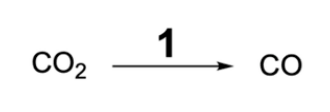
8.1 Write the half equation for the reduction of \(\ce{CO2}\) to \(\ce{CO}\) in an acidic medium. 2.0 pt
The conjugate oxidation reaction occurs with sacrificial reductant 2 in aqueous solution with the following mechanism:
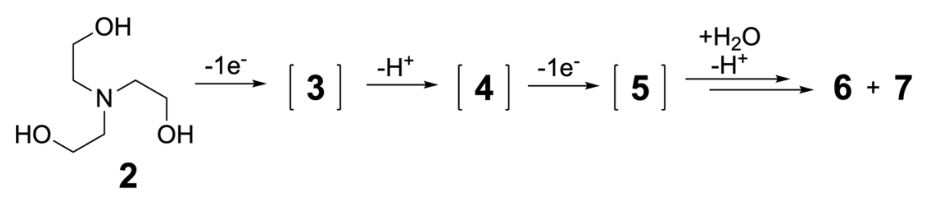
Species 3, 4, and 5 are short-lived ionic and/or radical intermediates. 7 yields a silver mirror with the \(\ce{[Ag(NH3)2]OH}\) test.
8.2 Draw the structures of 3-7. 16.0 pt
Catalyst 1 can be synthesised with the following reaction.

8.3 Tick the correct geometry for the structure of 1. 2.0 pt
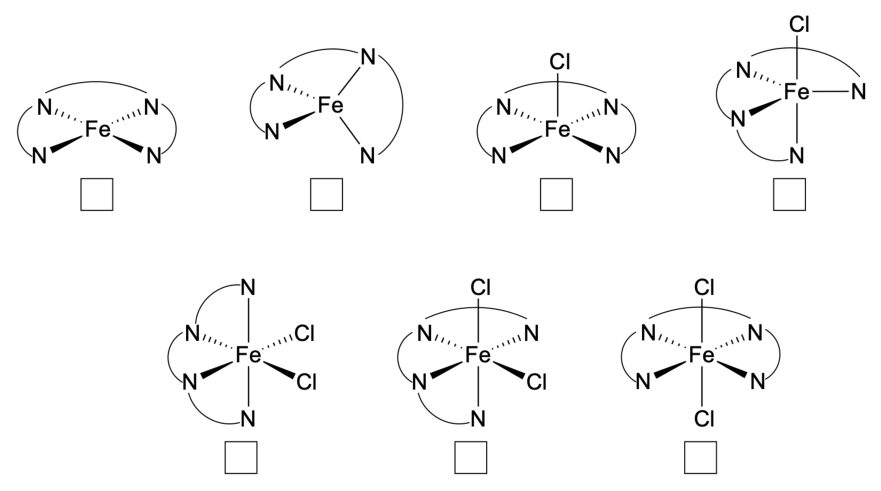
When 1 is loaded on crystalline carbon nitride (\(\ce{C3N4}\)) support material, it can reduce \(\ce{CO2}\) via the following mechanism.
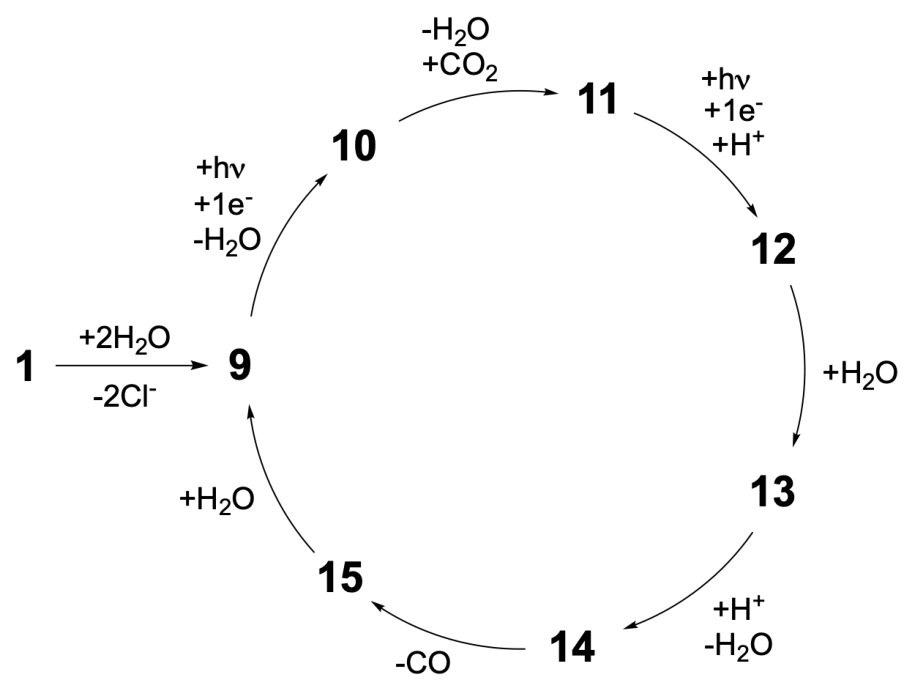
8.4 Draw the structures of 9-15. Use the cartoon structure for ligand 8 shown above. For 9-15, specify the oxidation state, \(OS\), coordination number, \(CN\), and number of valence electrons, \(VE\), of \(\ce{Fe}\), along with the total charge of corresponding complex structures, \(Z\). Note: Some information is provided on the answer sheet. 29.0 pt
8.5 Calculate the number of catalytic molecules per \(\mathrm{nm^2}\), \(N_{\mathrm{cat}}\), of \(\ce{C3N4}\) loaded with 1, when the mass fraction of catalyst, \(\omega_{\mathrm{cat}}=3.8\%\), if the specific surface area of \(\ce{C3N4}\) is \(17.8\ \mathrm{m^2\,g^{-1}}\). \(M_{\mathrm{cat}}=557.21\ \mathrm{g\,mol^{-1}}\). 5.0 pt
The Turnover Frequency of a catalyst (TOF) is the number of product molecules formed per active catalyst molecule per hour. Under LED illumination (\(\lambda=390\ \mathrm{nm}\)) with power of \(50\ \mathrm{mW}\), there was a TOF of \(8\ \mathrm{h^{-1}}\) for \(10\ \mathrm{mg}\) of \(\ce{C3N4}\), loaded with 1 with \(\omega_{\mathrm{cat}}=3.8\%\)
The formula for calculating the quantum yield is given below:
\[ \varphi= \frac{\textit{number of reacted electrons}} {\textit{number of incident photons}}\cdot100\% \]
8.6 Calculate the quantum yield, \(\varphi(\%)\), for \(\ce{CO}\) formation. 10.0 pt
The diagram below shows the change in the TOF of \(\ce{CO}\) as \(\omega_{\mathrm{cat}}\) is varied.
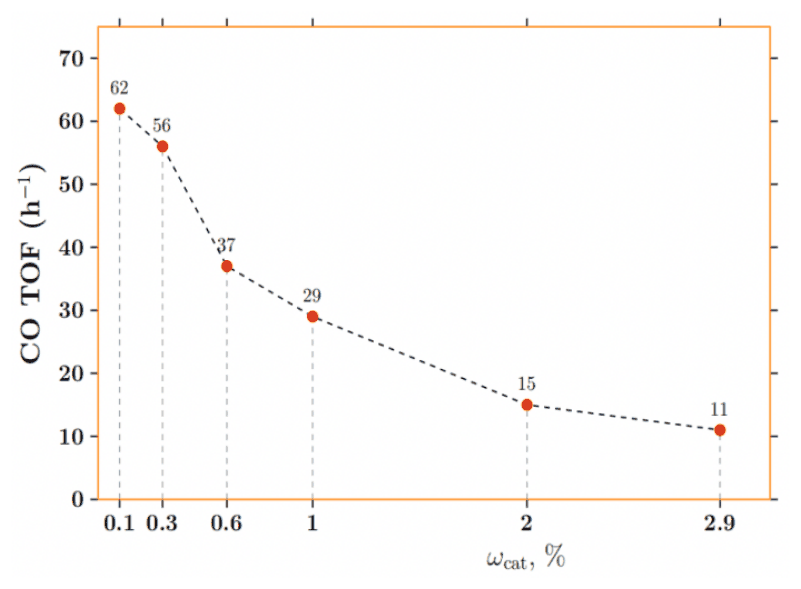
8.7 How does the overall rate of \(\ce{CO}\) formation per gram of \(\ce{C3N4}\) loaded with 1 change with increasing \(\omega_{\mathrm{cat}}\), within the range \(0.1\leq\omega_{\mathrm{cat}}\leq2.9\)? Tick the correct box. 2.0 pt
a) increases
b) decreases
c) doesn't change
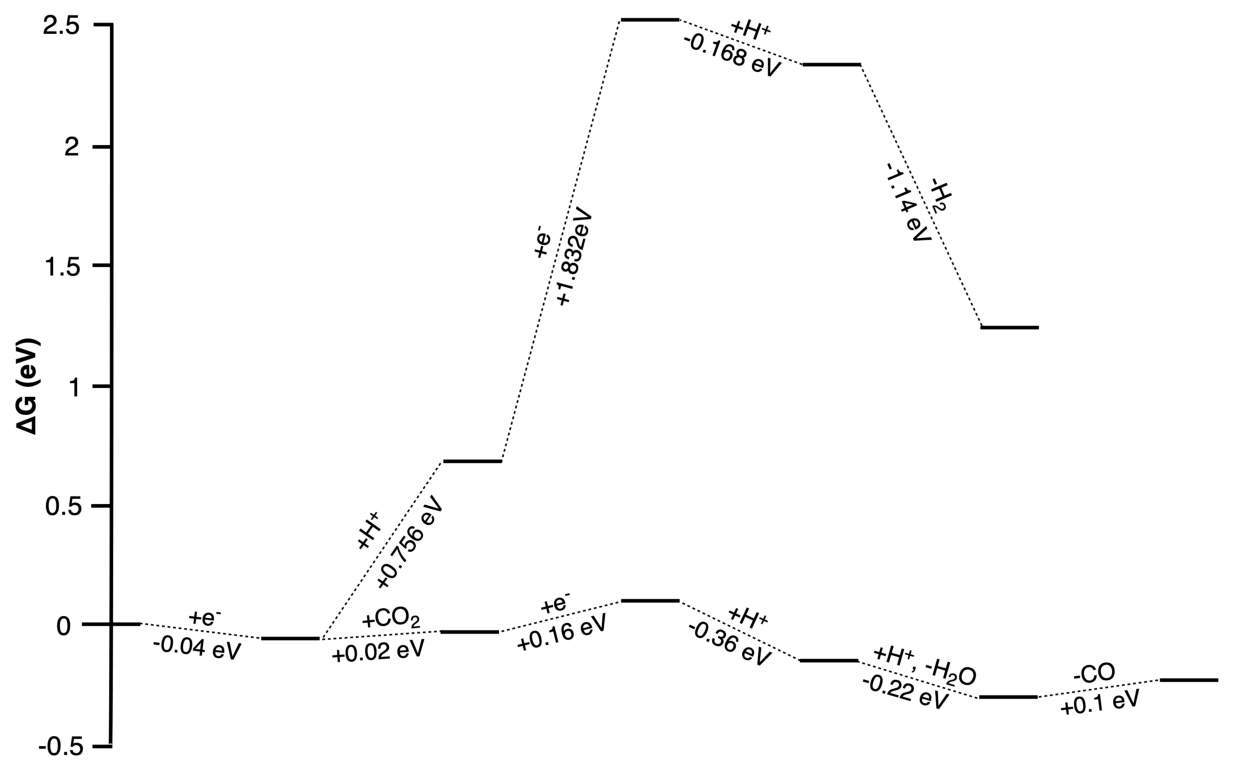
The reduction of \(\ce{CO2}\) can be accompanied by the reduction of additional protons. The changes in Gibbs energy during these two reactions are shown in the diagram.
The system was irradiated using different LEDs. The diagram below shows the mole percentages, \(\chi\), of \(\ce{H2}\) and \(\ce{CO}\) produced during the reduction of \(\ce{CO2}\) under four different conditions: no irradiation (N) and irradiation with red (R), green (G), and blue (B) light.
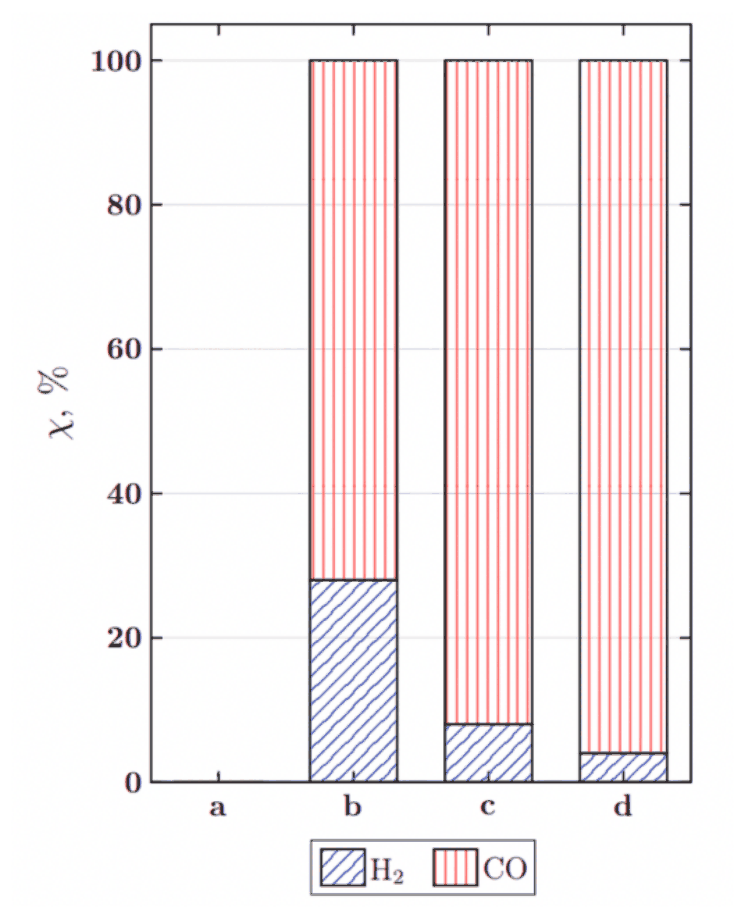
8.8 Tick which of the four conditions, mentioned above, corresponds to a, b, c and d in the diagram. 4.0 pt
Photosensitisers (PS) offer some advantages over \(\ce{C3N4}\) for the reduction of \(\ce{CO2}\). Mn(I)-containing complexes combined with PS can achieve ~23% quantum yield. In this system, reductive quenching of the singlet (\(\mathbf{S}_1\)) and triplet (\(\mathbf{T}_1\)) excited states of a PS by reductant (Red) forms \(\ce{PS^{\bullet-}}\), which donates electrons to \(\ce{CO2}\) through the Mn(I)-containing complex.
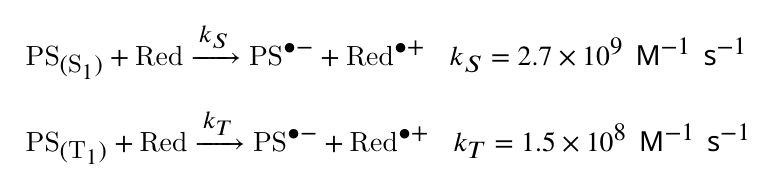
The following Jablonski diagram describes the processes occurring in the PS:
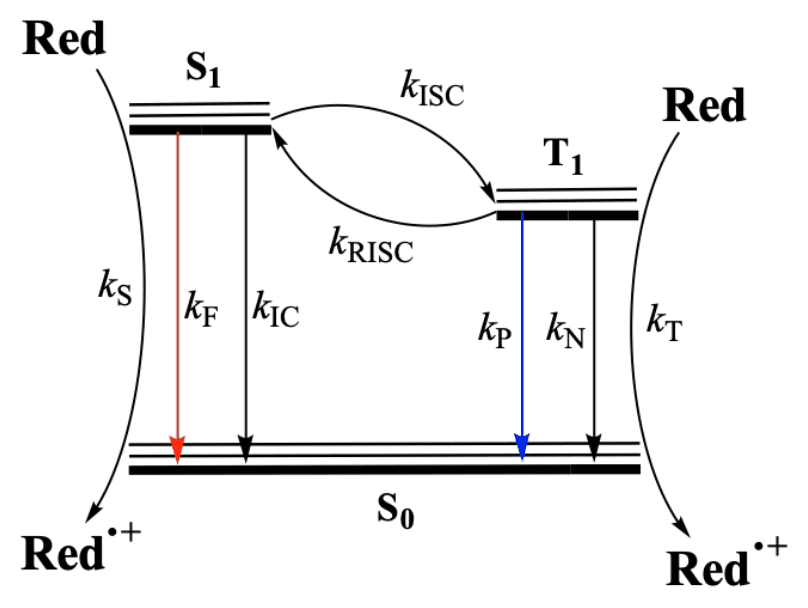
\(\tau_0(\mathbf{S}_1)=2.9\ \mathrm{ns}\) and \(\tau_0(\mathbf{T}_1)=84\ \mathrm{\mu s}\), where \(\tau_0\) is the emission lifetime in the absence of the quencher.
8.9 Calculate the percentage of quenching, \(\eta_q\), (in %) of S₁ and T₁ states, when \([\mathrm{Red}]=0.1\ \mathrm{M}\). Note: here the values of \(k_{\mathrm{ISC}}\) and \(k_{\mathrm{RISC}}\) are negligible. 12.0 pt
8.10 How do the emission lifetimes of S₁ and T₁ states change when \([\mathrm{Red}]\) increases?
Tick the correct box. 2.0 pt
a) increases
b) decreases
c) doesn't change
Physical Constants and Equations
Constants
| Constant | Value |
|---|---|
| Avogadro constant | \(N_A=6.022\times10^{23}\ \mathrm{mol^{-1}}\) |
| Universal gas constant | \(R=8.314\ \mathrm{J\,K^{-1}\,mol^{-1}}\) |
| Faraday constant | \(F=96\,485\ \mathrm{C\,mol^{-1}}\) |
| Planck constant | \(h=6.626\times10^{-34}\ \mathrm{J\,s}\) |
| Speed of light in vacuum | \(c=2.998\times10^8\ \mathrm{m\,s^{-1}}\) |
| Mass of electron | \(m_e=9.109\times10^{-31}\ \mathrm{kg}\) |
| Charge of electron | \(e=1.602\times10^{-19}\ \mathrm{C}\) |
| Standard pressure | \(P^\circ=1\ \mathrm{bar}=10^5\ \mathrm{Pa}\) |
| Ionic product of water at \(25\,^\circ\mathrm{C}\) | \(K_w=1.00\times10^{-14}\) |
| Zero of the Celsius scale | \(0\,^\circ\mathrm{C}=273.15\ \mathrm{K}\) |
| Electronvolt | \(1\ \mathrm{eV}=1.602\times10^{-19}\ \mathrm{J}\) |
| Watt | \(1\ \mathrm{W}=1\ \mathrm{J\,s^{-1}}\) |
| Coulomb | \(1\ \mathrm{C}=1\ \mathrm{A\,s}\) |
| Nanometre | \(1\ \mathrm{nm}=1\times10^{-9}\ \mathrm{m}\) |
| Ångstrom | \(1\ \text{Å}=1\times10^{-10}\ \mathrm{m}\) |
| metric ton | \(1\ \mathrm{ton}=1000\ \mathrm{kg}\) |
| litre | \(1\ \mathrm{L}=1\ \mathrm{dm^3}\) |
Equations
| Equation | Expression |
|---|---|
| Ideal gas law | \(PV=nRT\) |
| Dalton law | \(P_i=x_iP\) |
| Beer–Lambert law | \(A=\log_{10}\dfrac{I_0}{I}=\varepsilon cl\) |
| Energy of a photon | \(E=h\nu=\dfrac{hc}{\lambda}\) |
| Heat and temperature change | \(Q=nC_m\Delta T\) |
| Gibbs energy definition | \(G=H-TS\) |
| Gibbs energy and equilibrium constant | \(\Delta_rG^\circ=-RT\ln K\) |
| Enthalpy change dependence on temperature (at \(\Delta_rC_p=const\)) | \(\Delta_rH_{T_2}=\Delta_rH_{T_1}+\Delta_rC_p(T_2-T_1)\) |
| Entropy change dependence on temperature (at \(\Delta_rC_p=const\)) | \(\Delta_rS_{T_2}=\Delta_rS_{T_1}+\Delta_rC_p\ln\dfrac{T_2}{T_1}\) |
| Henderson–Hasselbalch equation | \(\mathrm{pH}=\mathrm{p}K_a+\log_{10}\dfrac{[\ce{A-}]}{[\ce{HA}]}\) |
| Average reaction rate | \(r=\dfrac{\Delta c}{\Delta t}\) |
| The rate law | \(r=k[A]^x[B]^y\) |
| Arrhenius law | \(k=A\exp\left(-\dfrac{E_a}{RT}\right)\) |
| Integrated rate law for a 1st order reaction | \(c=c_0e^{-kt}\), \(kt=\ln\dfrac{c_0}{c}\) |
| Lifetime of a reagent in a 1st order reaction | \(\tau=\dfrac1k\) |
| Integrated rate law for n-th order reaction (\(n\neq1\)) | \(kt=\dfrac{1}{n-1}\left(c^{1-n}-c_0^{1-n}\right)\) for \(n\neq1\) |
| Concentration of an intermediate in a consecutive reaction: \(\ce{A ->[k_1] B ->[k_2] D}\) | \([B]=\dfrac{k_1[A]_0}{k_2-k_1}\left(e^{-k_1t}-e^{-k_2t}\right)\) |
| The ratio of products in the competitive reactions: \(\ce{A ->[k_1] B}\), \(\ce{A ->[k_2] C}\) | \(\dfrac{[B]}{[C]}=\dfrac{k_1}{k_2}\) |
| Michaelis–Menten equation | \(r_0=r_{\max}\dfrac{[S]_0}{K_M+[S]_0}\) |
| Specific surface area | \(s=\dfrac{S}{m}\) |
| Progressions: arithmetic geometric | \(a_n=a_1+d(n-1)\), \(a_n=a_1q^{n-1}\) |
| Sum of geometric progression | \(\displaystyle\sum_{k=0}^{n}a_1q^k=a_1\dfrac{q^{n+1}-1}{q-1}\) |
| Volume of a sphere with radius \(r\) | \(V=\dfrac43\pi r^3\) |
| Surface area of sphere with radius \(r\) | \(S=4\pi r^2\) |
| Volume of a cone with base radius \(r\) and height \(h\) | \(V=\dfrac13\pi r^2h\) |
| Volume of a cylinder with base radius \(r\) and height \(h\) | \(V=\pi r^2h\) |
Consider all gases ideal.
In equilibrium constant calculations, all concentrations are referenced to the concentration of \(1\ \mathrm{mol\,dm^{-3}}\).
Official English text of the problem.
Answers
-
8.1. \[ \boxed{\ce{CO2 + 2H+ + 2e- -> CO + H2O}} \]
-
8.2.
| Species | Identification | SMILES |
|---|---|---|
| 3 | Triethanolamine radical cation; radical and positive charge on nitrogen | [N+](CCO)(CCO)CCO |
| 4 | Triethanolamine-derived α-amino carbon radical | OCCN(CCO)[CH]CO |
| 5 | N,N-Bis(2-hydroxyethyl)-2-hydroxyethaniminium ion | [N+](CCO)(CCO)=CCO |
| 6 | Diethanolamine | OCCNCCO |
| 7 | Glycolaldehyde, or 2-hydroxyethanal | OCC=O |
-
8.3. Tick the bottom-right, seventh structure: octahedral trans-dichlorido(L)iron(II), with four nitrogen donors in the equatorial plane and two mutually trans chlorido ligands. Here \(L\) is ligand 8.
-
8.4. All four nitrogen atoms of neutral \(L\) remain coordinated. Full coordination SMILES and drawing descriptions are given in the Solution.
| Species | Structure and binding mode | \(OS\) | \(CN\) | \(VE\) | \(Z\) |
|---|---|---|---|---|---|
| 9 | \(\ce{[Fe(L)(H2O)2]^2+}\) | \(+2\) | 6 | 18 | \(+2\) |
| 10 | \(\ce{[Fe(L)(H2O)]^+}\) | \(+1\) | 5 | 17 | \(+1\) |
| 11 | \(\ce{[Fe(L)(CO2)]^+}\); C,O-bound \(\ce{CO2^2-}\), forming an Fe–C–O ring | \(+3\) | 6 | 17 | \(+1\) |
| 12 | \(\ce{[Fe(L)(COOH)]^+}\); carbon-bound hydroxycarbonyl | \(+2\) | 5 | 16 | \(+1\) |
| 13 | \(\ce{[Fe(L)(COOH)(H2O)]^+}\); carbon-bound hydroxycarbonyl | \(+2\) | 6 | 18 | \(+1\) |
| 14 | \(\ce{[Fe(L)(CO)(H2O)]^2+}\); carbon-bound carbonyl | \(+2\) | 6 | 18 | \(+2\) |
| 15 | \(\ce{[Fe(L)(H2O)]^2+}\) | \(+2\) | 5 | 16 | \(+2\) |
-
8.5. \(\boxed{N_{\mathrm{cat}}\approx2.40\ \text{molecules}\,\mathrm{nm^{-2}}}\), treating \(3.8\%\) as the mass fraction in the composite and \(17.8\ \mathrm{m^2\,g^{-1}}\) as the area per gram of bare support. If the surface area is instead per gram of loaded material, the result is \(2.31\ \text{molecules}\,\mathrm{nm^{-2}}\).
-
8.6. \(\boxed{\varphi\approx1.93\%}\) for \(10\ \mathrm{mg}\) of bare support. If \(10\ \mathrm{mg}\) denotes the total loaded material, \(\boxed{\varphi\approx1.86\%}\). Both are approximately \(1.9\%\).
-
8.7. \(\boxed{\text{a) increases}}\).
-
8.8. \(\boxed{\mathrm{a=N,\quad b=B,\quad c=G,\quad d=R}}\).
-
8.9. \[ \boxed{\eta_q(\mathrm{S}_1)=43.9\%,\qquad \eta_q(\mathrm{T}_1)=99.92\%} \]
-
8.10. \(\boxed{\text{b) decreases}}\) for both states.
Solution
8.1 — Reduction half-equation
Carbon changes from oxidation state \(+4\) in carbon dioxide to \(+2\) in carbon monoxide, so two electrons are required. Balancing oxygen with water and hydrogen with protons gives
\[ \boxed{\ce{CO2 + 2H+ + 2e- -> CO + H2O}}. \]
Both atoms and charge are balanced.
The small molecular species used throughout the solution are carbon dioxide O=C=O, carbon monoxide [C-]#[O+], water O, dihydrogen [H][H], the proton [H+], and chloride [Cl-].
8.2 — Oxidation of the sacrificial reductant
Compound 2 is triethanolamine, OCCN(CCO)CCO. Write \(R\) for a 2-hydroxyethyl group, \(\ce{-CH2CH2OH}\), so 2 is \(\ce{R3N}\).
The first oxidation removes one electron from the nitrogen lone pair:
\[ \ce{R3N -> [R3N]^{\bullet+} + e-}. \]
Thus 3 is the nitrogen-centred radical cation given in the Answers.
Deprotonation occurs at a carbon directly attached to nitrogen. All three arms are equivalent, so choosing any one gives the same constitutional intermediate:
\[ \ce{[R3N]^{\bullet+} -> R2N-CH^{\bullet}-CH2OH + H+}. \]
This produces 4, with the unpaired electron on the α-carbon. Loss of a second electron gives the iminium ion 5:
\[ \ce{R2N-CH^{\bullet}-CH2OH -> [R2N=CH-CH2OH]+ + e-}. \]
Water attacks the electrophilic iminium carbon. Proton transfer and cleavage of its carbon–nitrogen bond give the secondary amine 6 and aldehyde 7:
\[ \ce{[R2N=CH-CH2OH]+ + H2O -> R2NH + HOCH2CHO + H+}. \]
Therefore 6 is diethanolamine and 7 is glycolaldehyde. The aldehyde group of 7 accounts for its positive silver-mirror test.
The overall oxidation half-equation is
\[ \boxed{\ce{ N(CH2CH2OH)3 + H2O -> HN(CH2CH2OH)2 + HOCH2CHO + 2H+ + 2e- }}. \]
For the requested drawings, show the nitrogen radical cation in 3, the α-carbon radical in 4, and the positively charged nitrogen–carbon double bond in 5. The SMILES in the Answers specify their connectivity and radical locations.
8.3 — Geometry of catalyst 1
Ligand 8, denoted \(L\), is 4-(4-carboxyphenyl)-2,2′:6′,2″:6″,2‴-quaterpyridine. Its SMILES is
O=C(O)c1ccc(-c2ccnc(-c3cccc(-c4cccc(-c5ccccn5)n4)n3)c2)cc1
Its four pyridine nitrogen atoms provide four neutral donor sites. Together with two chlorido ligands, they give an iron coordination number of six. The quaterpyridine donor arrangement places the four nitrogen atoms around the equatorial plane, leaving the two axial sites for mutually trans chlorido ligands.
Therefore 1 is trans-dichlorido(L)iron(II), and the correct choice is the bottom-right structure.
Coordination SMILES:
[Cl-]->[Fe+2]6789<-[Cl-].O=C(O)c1ccc(-c2ccn->6c(-c3cccc(-c4cccc(-c5ccccn5->7)n4->8)n3->9)c2)cc1
The coordination SMILES used here and below employ dative bonds, -> and <-. Matching ring numbers connect the ligand to iron across the dot. These strings specify connectivity and formal charges; the coordination geometry is specified in words.
8.4 — Catalytic intermediates and electron counting
The pendant carboxylic acid group of \(L\) remains unchanged, so \(L\) is neutral and donates \(4\times2=8\) electrons.
For iron, a group-8 metal,
\[ d\text{-electron count}=8-OS. \]
Each coordinated water, carbonyl, nitrogen donor, or X-type donor contributes two electrons in the ionic counting method.
9 — Diaqua(L)iron(II) ion
Both chlorido ligands of 1 are replaced by water:
\[ \ce{[Fe(L)Cl2] + 2H2O -> [Fe(L)(H2O)2]^2+ + 2Cl-}. \]
Draw four nitrogen donors around iron and two water ligands in the positions previously occupied by chloride.
SMILES:
[OH2]->[Fe+2]6789<-[OH2].O=C(O)c1ccc(-c2ccn->6c(-c3cccc(-c4cccc(-c5ccccn5->7)n4->8)n3->9)c2)cc1
All ligands are neutral, so \(Z=OS=+2\). The electron count is
\[ VE=6+8+2(2)=18,\qquad CN=6. \]
10 — Aqua(L)iron(I) ion
One-electron reduction of 9, accompanied by loss of one water ligand, gives 10:
\[ \ce{[Fe(L)(H2O)2]^2+ + e- -> [Fe(L)(H2O)]^+ + H2O}. \]
Draw the four nitrogen donors and one water ligand.
SMILES:
[OH2]->[Fe+]6789.O=C(O)c1ccc(-c2ccn->6c(-c3cccc(-c4cccc(-c5ccccn5->7)n4->8)n3->9)c2)cc1
Thus
\[ OS=+1,\quad Z=+1,\quad CN=5,\quad VE=7+8+2=17. \]
11 — C,O-bound carbonite complex of iron(III)
The remaining water is displaced by carbon dioxide. The answer-sheet information specifies \(OS=+3\) and \(CN=6\). Because four coordination sites come from \(L\), carbon dioxide must bind through two atoms.
Draw an Fe–C–O three-membered ring, with the carbon also double-bonded to the second oxygen. This is the C,O-bound, formally two-electron-reduced carbon dioxide ligand, \(\ce{CO2^2-}\), often called carbonite.
SMILES:
[Fe+3]16789<-[O-][C-](=O)->1.O=C(O)c1ccc(-c2ccn->6c(-c3cccc(-c4cccc(-c5ccccn5->7)n4->8)n3->9)c2)cc1
Formation of this ligand formally transfers two electrons from iron(I) to carbon dioxide, giving iron(III). Consequently,
\[ Z=(+3)+(-2)=+1, \]
\[ CN=4+2=6,\qquad VE=5+8+4=17. \]
12 — Hydroxycarbonyl(L)iron(II) ion
Addition of one electron reduces iron(III) to iron(II). Protonation of the coordinated oxygen opens the Fe–C–O ring, leaving a carbon-bound hydroxycarbonyl ligand.
Draw the connectivity
\[ \ce{Fe-C(=O)-OH}, \]
with all four nitrogen donors still attached and no water ligand.
SMILES:
[Fe+2]6789<-[C-](=O)O.O=C(O)c1ccc(-c2ccn->6c(-c3cccc(-c4cccc(-c5ccccn5->7)n4->8)n3->9)c2)cc1
The hydroxycarbonyl ligand has formal charge \(-1\), so
\[ OS=+2,\quad Z=+1,\quad CN=5,\quad VE=6+8+2=16. \]
13 — Aqua(hydroxycarbonyl)(L)iron(II) ion
Water coordinates to 12:
\[ \ce{[Fe(L)(COOH)]^+ + H2O -> [Fe(L)(COOH)(H2O)]^+}. \]
Draw the same carbon-bound hydroxycarbonyl group, with one additional water ligand.
SMILES:
[OH2]->[Fe+2]6789<-[C-](=O)O.O=C(O)c1ccc(-c2ccn->6c(-c3cccc(-c4cccc(-c5ccccn5->7)n4->8)n3->9)c2)cc1
Water coordination changes neither charge nor oxidation state:
\[ OS=+2,\quad Z=+1,\quad CN=6,\quad VE=6+8+2+2=18. \]
14 — Aqua(carbonyl)(L)iron(II) ion
Protonation of the hydroxycarbonyl group permits loss of water, producing a carbonyl ligand:
\[ \ce{[Fe(L)(COOH)(H2O)]^+ + H+ -> [Fe(L)(CO)(H2O)]^2+ + H2O}. \]
Draw carbon monoxide attached through carbon, together with the retained water ligand.
SMILES:
[OH2]->[Fe+2]6789<-[C-]#[O+].O=C(O)c1ccc(-c2ccn->6c(-c3cccc(-c4cccc(-c5ccccn5->7)n4->8)n3->9)c2)cc1
Carbon monoxide is a neutral two-electron donor. Therefore
\[ OS=+2,\quad Z=+2,\quad CN=6,\quad VE=6+8+2+2=18. \]
15 — Aqua(L)iron(II) ion
Carbon monoxide dissociates:
\[ \ce{[Fe(L)(CO)(H2O)]^2+ -> [Fe(L)(H2O)]^2+ + CO}. \]
Draw iron coordinated to the four nitrogen donors and one water ligand.
SMILES:
[OH2]->[Fe+2]6789.O=C(O)c1ccc(-c2ccn->6c(-c3cccc(-c4cccc(-c5ccccn5->7)n4->8)n3->9)c2)cc1
Hence
\[ OS=+2,\quad Z=+2,\quad CN=5,\quad VE=6+8+2=16, \]
consistent with the supplied electron count. Addition of water regenerates 9.
Summing the cycle gives the reduction half-equation in 8.1.
8.5 — Surface density of catalyst molecules
Use the standard definition of mass fraction:
\[ w=\omega_{\mathrm{cat}} =\frac{m_{\mathrm{cat}}}{m_{\mathrm{cat}}+m_{\mathrm{support}}} =0.038. \]
Taking \(1.000\ \mathrm{g}\) of loaded material gives
\[ m_{\mathrm{cat}}=0.038\ \mathrm{g}, \qquad m_{\mathrm{support}}=0.962\ \mathrm{g}. \]
The number of catalyst molecules is
\[ N= \frac{0.038\ \mathrm{g}} {557.21\ \mathrm{g\,mol^{-1}}} (6.022\times10^{23}\ \mathrm{mol^{-1}}) =4.1068\times10^{19}. \]
If the stated specific surface area is per gram of bare \(\ce{C3N4}\), its area is
\[ S=(0.962\ \mathrm{g})(17.8\ \mathrm{m^2\,g^{-1}}) =17.1236\ \mathrm{m^2} =1.71236\times10^{19}\ \mathrm{nm^2}. \]
Thus
\[ \boxed{ N_{\mathrm{cat}} =\frac{wN_A}{(1-w)M_{\mathrm{cat}}s\,10^{18}} =2.398\approx2.4\ \text{molecules}\,\mathrm{nm^{-2}} }. \]
If \(17.8\ \mathrm{m^2\,g^{-1}}\) is instead the area per gram of loaded material, the factor \(1-w\) is absent:
\[ \boxed{ N_{\mathrm{cat}} =\frac{wN_A}{M_{\mathrm{cat}}s\,10^{18}} =2.307\approx2.3\ \text{molecules}\,\mathrm{nm^{-2}} }. \]
8.6 — Quantum yield
Each molecule of carbon monoxide requires two electrons.
First interpret the stated \(10\ \mathrm{mg}\) as the mass of the bare support. The catalyst mass is then
\[ m_{\mathrm{cat}} =\frac{w}{1-w}m_{\mathrm{support}} =\frac{0.038}{0.962}(0.010\ \mathrm{g}) =3.9501\times10^{-4}\ \mathrm{g}. \]
Consequently,
\[ n_{\mathrm{cat}} =\frac{3.9501\times10^{-4}}{557.21} =7.0891\times10^{-7}\ \mathrm{mol}. \]
In one hour,
\[ n_{\ce{CO}} =(8\ \mathrm{h^{-1}}) (7.0891\times10^{-7}\ \mathrm{mol}) (1\ \mathrm{h}) =5.6713\times10^{-6}\ \mathrm{mol}. \]
The number of reacted electrons is
\[ N_e=2n_{\ce{CO}}N_A =6.8305\times10^{18}. \]
The energy of each incident photon is
\[ E_\gamma=\frac{hc}{\lambda} = \frac{ (6.626\times10^{-34}\ \mathrm{J\,s}) (2.998\times10^8\ \mathrm{m\,s^{-1}}) }{ 390\times10^{-9}\ \mathrm{m} } =5.0935\times10^{-19}\ \mathrm{J}. \]
The incident energy in one hour is
\[ Pt=(0.050\ \mathrm{J\,s^{-1}})(3600\ \mathrm{s}) =180\ \mathrm{J}, \]
so
\[ N_\gamma=\frac{180}{5.0935\times10^{-19}} =3.5339\times10^{20}. \]
Therefore
\[ \boxed{ \varphi =\frac{6.8305\times10^{18}}{3.5339\times10^{20}} \times100\% =1.93\% }. \]
If \(10\ \mathrm{mg}\) denotes the total loaded material, then
\[ m_{\mathrm{cat}}=(0.038)(0.010\ \mathrm{g}) =3.80\times10^{-4}\ \mathrm{g}, \]
and the same calculation gives
\[ \boxed{\varphi=1.86\%}. \]
The result is approximately \(1.9\%\) under either interpretation.
8.7 — Overall rate versus catalyst loading
TOF is the rate per catalyst molecule. The amount of catalyst per gram of loaded material increases in proportion to its mass fraction, so
\[ r_{\ce{CO}} =\frac{w}{M_{\mathrm{cat}}}\,\mathrm{TOF}. \]
It is therefore the product \(w\,\mathrm{TOF}\), not TOF alone, that determines the overall rate.
| Catalyst loading | TOF / \(\mathrm{h^{-1}}\) | \(w\,\mathrm{TOF}\) / \(\mathrm{h^{-1}}\) |
|---|---|---|
| \(0.1\%\) | 62 | 0.062 |
| \(0.3\%\) | 56 | 0.168 |
| \(0.6\%\) | 37 | 0.222 |
| \(1.0\%\) | 29 | 0.290 |
| \(2.0\%\) | 15 | 0.300 |
| \(2.9\%\) | 11 | 0.319 |
The product increases throughout the plotted range. Normalizing to bare support instead introduces the factor \(1/(1-w)\), which also increases and does not change the conclusion.
\[ \boxed{\text{a) increases}} \]
8.8 — Identification of irradiation conditions
The empty position a corresponds to no irradiation, N.
Photon energies follow
\[ E_{\mathrm{blue}}>E_{\mathrm{green}}>E_{\mathrm{red}}, \]
because \(E=hc/\lambda\).
The hydrogen-evolution branch has substantially larger uphill free-energy changes, including a \(+1.832\ \mathrm{eV}\) step. In the qualitative interpretation intended by the problem, higher-energy illumination permits a larger contribution from this competing pathway.
The hydrogen fractions decrease from b to c to d, approximately \(28\%\), \(8\%\), and \(4\%\). Accordingly,
\[ \boxed{ \mathrm{a=N,\qquad b=B,\qquad c=G,\qquad d=R} }. \]
8.9 — Quenching efficiencies
With intersystem crossing and reverse intersystem crossing neglected, each excited state has two competing types of decay:
- intrinsic decay, with total rate constant \(k_0=1/\tau_0\);
- reductive quenching, with pseudo-first-order rate constant \(k_q[\mathrm{Red}]\).
The probability that an excited molecule is quenched is therefore
\[ \eta_q = \frac{k_q[\mathrm{Red}]}{k_0+k_q[\mathrm{Red}]}\times100\% = \frac{k_q[\mathrm{Red}]\tau_0} {1+k_q[\mathrm{Red}]\tau_0}\times100\%. \]
For the singlet state,
\[ k_S[\mathrm{Red}]\tau_0(\mathrm{S}_1) = (2.7\times10^9\ \mathrm{M^{-1}s^{-1}}) (0.1\ \mathrm{M}) (2.9\times10^{-9}\ \mathrm{s}) =0.783. \]
Thus
\[ \boxed{ \eta_q(\mathrm{S}_1) =\frac{0.783}{1+0.783}\times100\% =43.9\% }. \]
For the triplet state,
\[ k_T[\mathrm{Red}]\tau_0(\mathrm{T}_1) = (1.5\times10^8\ \mathrm{M^{-1}s^{-1}}) (0.1\ \mathrm{M}) (84\times10^{-6}\ \mathrm{s}) =1260. \]
Hence
\[ \boxed{ \eta_q(\mathrm{T}_1) =\frac{1260}{1261}\times100\% =99.92\% }. \]
Although the triplet quenching rate constant is smaller, its much longer unquenched lifetime makes quenching nearly quantitative.
8.10 — Dependence of emission lifetime on reductant concentration
The observed lifetime is
\[ \boxed{ \tau= \frac{1}{k_0+k_q[\mathrm{Red}]} =\frac{\tau_0}{1+k_q[\mathrm{Red}]\tau_0} }. \]
Increasing reductant concentration increases the total decay rate and therefore decreases the lifetime of both excited states.
At the concentration used in 8.9, the lifetimes are
\[ \tau(\mathrm{S}_1)=\frac{2.9\ \mathrm{ns}}{1.783} =1.63\ \mathrm{ns}, \]
\[ \tau(\mathrm{T}_1)=\frac{84\ \mathrm{\mu s}}{1261} =0.0666\ \mathrm{\mu s} =66.6\ \mathrm{ns}. \]
Thus the correct choice is
\[ \boxed{\text{b) decreases, for both states}}. \]
The solution was checked against the official solution.
IChO 2026 · Theorieaufgabe 8
Recycling von Kohlenstoffdioxid
T8. Recycling von Kohlenstoffdioxid
7%
| 8.1 | 8.2 | 8.3 | 8.4 | 8.5 | 8.6 | 8.7 | 8.8 | 8.9 | 8.10 | \(\sum\) |
|---|---|---|---|---|---|---|---|---|---|---|
| 2 | 16 | 2 | 29 | 5 | 10 | 2 | 4 | 12 | 2 | 84 |
Die Entfernung von gasförmigem \(\ce{CO2}\) aus der Atmosphäre ist entscheidend für die Bekämpfung des Klimawandels. Ein vielversprechender Ansatz ist die photokatalytische Reduktion von \(\ce{CO2}\) zu \(\ce{CO}\) mithilfe des molekularen Katalysators 1.
8.1 Stellen Sie die Teilgleichung für die Reduktion von \(\ce{CO2}\) zu \(\ce{CO}\) in saurem Medium auf. 2.0 Pkt.
Die zugehörige Oxidationsreaktion erfolgt mit dem Opferreduktionsmittel 2 in wässriger Lösung nach folgendem Mechanismus:
Die Spezies 3, 4 und 5 sind kurzlebige ionische und/oder radikalische Zwischenstufen. 7 ergibt bei der Probe mit \(\ce{[Ag(NH3)2]OH}\) einen Silberspiegel.
8.2 Zeichnen Sie die Strukturen von 3-7. 16.0 Pkt.
Katalysator 1 kann durch die folgende Reaktion synthetisiert werden.
8.3 Kreuzen Sie die richtige Geometrie für die Struktur von 1 an. 2.0 Pkt.
Wenn 1 auf kristallinem Kohlenstoffnitrid (\(\ce{C3N4}\)) als Trägermaterial aufgebracht wird, kann es \(\ce{CO2}\) nach dem folgenden Mechanismus reduzieren.
8.4 Zeichnen Sie die Strukturen von 9-15. Verwenden Sie die oben gezeigte schematische Darstellung des Liganden 8. Geben Sie für 9-15 die Oxidationszahl \(OS\), die Koordinationszahl \(CN\) und die Anzahl der Valenzelektronen \(VE\) von \(\ce{Fe}\) sowie die Gesamtladung \(Z\) der jeweiligen Komplexstrukturen an. Hinweis: Einige Angaben sind auf dem Antwortbogen vorgegeben. 29.0 Pkt.
8.5 Berechnen Sie die Anzahl der Katalysatormoleküle pro \(\mathrm{nm^2}\), \(N_{\mathrm{cat}}\), von mit 1 beladenem \(\ce{C3N4}\) bei einem Massenanteil des Katalysators von \(\omega_{\mathrm{cat}}=3.8\%\), wenn die spezifische Oberfläche von \(\ce{C3N4}\) \(17.8\ \mathrm{m^2\,g^{-1}}\) beträgt. \(M_{\mathrm{cat}}=557.21\ \mathrm{g\,mol^{-1}}\). 5.0 Pkt.
Die Umsatzfrequenz eines Katalysators (TOF) ist die Anzahl der pro aktivem Katalysatormolekül und Stunde gebildeten Produktmoleküle. Unter LED-Bestrahlung (\(\lambda=390\ \mathrm{nm}\)) mit einer Leistung von \(50\ \mathrm{mW}\) wurde für \(10\ \mathrm{mg}\) \(\ce{C3N4}\), das mit 1 mit \(\omega_{\mathrm{cat}}=3.8\%\) beladen war, eine TOF von \(8\ \mathrm{h^{-1}}\) erhalten.
Die Formel zur Berechnung der Quantenausbeute ist unten angegeben:
\[ \varphi= \frac{\textit{Anzahl der umgesetzten Elektronen}} {\textit{Anzahl der einfallenden Photonen}}\cdot100\% \]
8.6 Berechnen Sie die Quantenausbeute \(\varphi(\%)\) für die Bildung von \(\ce{CO}\). 10.0 Pkt.
Das folgende Diagramm zeigt die Änderung der TOF von \(\ce{CO}\) bei Variation von \(\omega_{\mathrm{cat}}\).
8.7 Wie ändert sich die Gesamtgeschwindigkeit der Bildung von \(\ce{CO}\) pro Gramm des mit 1 beladenen \(\ce{C3N4}\) mit zunehmendem \(\omega_{\mathrm{cat}}\) im Bereich \(0.1\leq\omega_{\mathrm{cat}}\leq2.9\)? Kreuzen Sie das richtige Kästchen an. 2.0 Pkt.
a) nimmt zu
b) nimmt ab
c) bleibt unverändert
Die Reduktion von \(\ce{CO2}\) kann von der Reduktion zusätzlicher Protonen begleitet werden. Die Änderungen der Gibbs-Energie während dieser beiden Reaktionen sind im Diagramm dargestellt.
Das System wurde mit verschiedenen LEDs bestrahlt. Das folgende Diagramm zeigt die Stoffmengenanteile in Prozent, \(\chi\), von \(\ce{H2}\) und \(\ce{CO}\), die bei der Reduktion von \(\ce{CO2}\) unter vier verschiedenen Bedingungen entstehen: ohne Bestrahlung (N) sowie bei Bestrahlung mit rotem (R), grünem (G) und blauem (B) Licht.
8.8 Kreuzen Sie an, welche der vier oben genannten Bedingungen jeweils a, b, c und d im Diagramm entspricht. 4.0 Pkt.
Photosensibilisatoren (PS) bieten bei der Reduktion von \(\ce{CO2}\) einige Vorteile gegenüber \(\ce{C3N4}\). Mn(I)-haltige Komplexe können in Kombination mit PS eine Quantenausbeute von ~23% erreichen. In diesem System führt die reduktive Löschung der angeregten Singulett- (\(\mathbf{S}_1\)) und Triplett-Zustände (\(\mathbf{T}_1\)) eines PS durch ein Reduktionsmittel (Red) zur Bildung von \(\ce{PS^{\bullet-}}\), das über den Mn(I)-haltigen Komplex Elektronen auf \(\ce{CO2}\) überträgt.
Das folgende Jablonski-Diagramm beschreibt die im PS ablaufenden Prozesse:
\(\tau_0(\mathbf{S}_1)=2.9\ \mathrm{ns}\) und \(\tau_0(\mathbf{T}_1)=84\ \mathrm{\mu s}\), wobei \(\tau_0\) die Emissionslebensdauer in Abwesenheit des Löschers ist.
8.9 Berechnen Sie den prozentualen Löschungsanteil \(\eta_q\) (in %) der Zustände S₁ und T₁ bei \([\mathrm{Red}]=0.1\ \mathrm{M}\). Hinweis: Hier sind die Werte von \(k_{\mathrm{ISC}}\) und \(k_{\mathrm{RISC}}\) vernachlässigbar. 12.0 Pkt.
8.10 Wie ändern sich die Emissionslebensdauern der Zustände S₁ und T₁, wenn \([\mathrm{Red}]\) zunimmt?
Kreuzen Sie das richtige Kästchen an. 2.0 Pkt.
a) nehmen zu
b) nehmen ab
c) bleiben unverändert
Physikalische Konstanten und Gleichungen
Konstanten
| Konstante | Wert |
|---|---|
| Avogadro-Konstante | \(N_A=6.022\times10^{23}\ \mathrm{mol^{-1}}\) |
| Universelle Gaskonstante | \(R=8.314\ \mathrm{J\,K^{-1}\,mol^{-1}}\) |
| Faraday-Konstante | \(F=96\,485\ \mathrm{C\,mol^{-1}}\) |
| Planck-Konstante | \(h=6.626\times10^{-34}\ \mathrm{J\,s}\) |
| Lichtgeschwindigkeit im Vakuum | \(c=2.998\times10^8\ \mathrm{m\,s^{-1}}\) |
| Masse des Elektrons | \(m_e=9.109\times10^{-31}\ \mathrm{kg}\) |
| Ladung des Elektrons | \(e=1.602\times10^{-19}\ \mathrm{C}\) |
| Standarddruck | \(P^\circ=1\ \mathrm{bar}=10^5\ \mathrm{Pa}\) |
| Ionenprodukt des Wassers bei \(25\,^\circ\mathrm{C}\) | \(K_w=1.00\times10^{-14}\) |
| Nullpunkt der Celsius-Skala | \(0\,^\circ\mathrm{C}=273.15\ \mathrm{K}\) |
| Elektronenvolt | \(1\ \mathrm{eV}=1.602\times10^{-19}\ \mathrm{J}\) |
| Watt | \(1\ \mathrm{W}=1\ \mathrm{J\,s^{-1}}\) |
| Coulomb | \(1\ \mathrm{C}=1\ \mathrm{A\,s}\) |
| Nanometer | \(1\ \mathrm{nm}=1\times10^{-9}\ \mathrm{m}\) |
| Ångström | \(1\ \text{Å}=1\times10^{-10}\ \mathrm{m}\) |
| Metrische Tonne | \(1\ \mathrm{ton}=1000\ \mathrm{kg}\) |
| Liter | \(1\ \mathrm{L}=1\ \mathrm{dm^3}\) |
Gleichungen
| Gleichung | Ausdruck |
|---|---|
| Ideales Gasgesetz | \(PV=nRT\) |
| Dalton-Gesetz | \(P_i=x_iP\) |
| Lambert-Beer-Gesetz | \(A=\log_{10}\dfrac{I_0}{I}=\varepsilon cl\) |
| Energie eines Photons | \(E=h\nu=\dfrac{hc}{\lambda}\) |
| Wärme und Temperaturänderung | \(Q=nC_m\Delta T\) |
| Definition der Gibbs-Energie | \(G=H-TS\) |
| Gibbs-Energie und Gleichgewichtskonstante | \(\Delta_rG^\circ=-RT\ln K\) |
| Temperaturabhängigkeit der Enthalpieänderung (bei \(\Delta_rC_p=const\)) | \(\Delta_rH_{T_2}=\Delta_rH_{T_1}+\Delta_rC_p(T_2-T_1)\) |
| Temperaturabhängigkeit der Entropieänderung (bei \(\Delta_rC_p=const\)) | \(\Delta_rS_{T_2}=\Delta_rS_{T_1}+\Delta_rC_p\ln\dfrac{T_2}{T_1}\) |
| Henderson-Hasselbalch-Gleichung | \(\mathrm{pH}=\mathrm{p}K_a+\log_{10}\dfrac{[\ce{A-}]}{[\ce{HA}]}\) |
| Mittlere Reaktionsgeschwindigkeit | \(r=\dfrac{\Delta c}{\Delta t}\) |
| Geschwindigkeitsgesetz | \(r=k[A]^x[B]^y\) |
| Arrhenius-Gesetz | \(k=A\exp\left(-\dfrac{E_a}{RT}\right)\) |
| Integriertes Geschwindigkeitsgesetz für eine Reaktion 1. Ordnung | \(c=c_0e^{-kt}\), \(kt=\ln\dfrac{c_0}{c}\) |
| Lebensdauer eines Reaktanden bei einer Reaktion 1. Ordnung | \(\tau=\dfrac1k\) |
| Integriertes Geschwindigkeitsgesetz für eine Reaktion n-ter Ordnung (\(n\neq1\)) | \(kt=\dfrac{1}{n-1}\left(c^{1-n}-c_0^{1-n}\right)\) für \(n\neq1\) |
| Konzentration einer Zwischenstufe in einer Folgereaktion: \(\ce{A ->[k_1] B ->[k_2] D}\) | \([B]=\dfrac{k_1[A]_0}{k_2-k_1}\left(e^{-k_1t}-e^{-k_2t}\right)\) |
| Verhältnis der Produkte bei konkurrierenden Reaktionen: \(\ce{A ->[k_1] B}\), \(\ce{A ->[k_2] C}\) | \(\dfrac{[B]}{[C]}=\dfrac{k_1}{k_2}\) |
| Michaelis-Menten-Gleichung | \(r_0=r_{\max}\dfrac{[S]_0}{K_M+[S]_0}\) |
| Spezifische Oberfläche | \(s=\dfrac{S}{m}\) |
| Folgen: arithmetisch, geometrisch | \(a_n=a_1+d(n-1)\), \(a_n=a_1q^{n-1}\) |
| Summe einer geometrischen Folge | \(\displaystyle\sum_{k=0}^{n}a_1q^k=a_1\dfrac{q^{n+1}-1}{q-1}\) |
| Volumen einer Kugel mit Radius \(r\) | \(V=\dfrac43\pi r^3\) |
| Oberfläche einer Kugel mit Radius \(r\) | \(S=4\pi r^2\) |
| Volumen eines Kegels mit Grundkreisradius \(r\) und Höhe \(h\) | \(V=\dfrac13\pi r^2h\) |
| Volumen eines Zylinders mit Grundkreisradius \(r\) und Höhe \(h\) | \(V=\pi r^2h\) |
Betrachten Sie alle Gase als ideal.
Bei Berechnungen von Gleichgewichtskonstanten werden alle Konzentrationen auf die Konzentration \(1\ \mathrm{mol\,dm^{-3}}\) bezogen.
Aufgabentext aus dem offiziellen englischen Text übersetzt.
Antworten
-
8.1. \[ \boxed{\ce{CO2 + 2H+ + 2e- -> CO + H2O}} \]
-
8.2.
| Spezies | Identifizierung | SMILES |
|---|---|---|
| 3 | Triethanolamin-Radikalkation; Radikal und positive Ladung am Stickstoff | [N+](CCO)(CCO)CCO |
| 4 | Von Triethanolamin abgeleitetes α-Aminokohlenstoffradikal | OCCN(CCO)[CH]CO |
| 5 | N,N-Bis(2-hydroxyethyl)-2-hydroxyethaniminium-Ion | [N+](CCO)(CCO)=CCO |
| 6 | Diethanolamin | OCCNCCO |
| 7 | Glycolaldehyd oder 2-Hydroxyethanal | OCC=O |
-
8.3. Anzukreuzen ist die siebte Struktur unten rechts: oktaedrisches trans-Dichlorido(L)eisen(II) mit vier Stickstoffdonoren in der Äquatorialebene und zwei zueinander trans-ständigen Chloridoliganden. Dabei ist \(L\) der Ligand 8.
-
8.4. Alle vier Stickstoffatome des neutralen \(L\) bleiben koordiniert. Vollständige Koordinations-SMILES und Beschreibungen der Zeichnungen sind in der Lösung angegeben.
| Spezies | Struktur und Bindungsmodus | \(OS\) | \(CN\) | \(VE\) | \(Z\) |
|---|---|---|---|---|---|
| 9 | \(\ce{[Fe(L)(H2O)2]^2+}\) | \(+2\) | 6 | 18 | \(+2\) |
| 10 | \(\ce{[Fe(L)(H2O)]^+}\) | \(+1\) | 5 | 17 | \(+1\) |
| 11 | \(\ce{[Fe(L)(CO2)]^+}\); C,O-gebundenes \(\ce{CO2^2-}\), das einen Fe–C–O-Ring bildet | \(+3\) | 6 | 17 | \(+1\) |
| 12 | \(\ce{[Fe(L)(COOH)]^+}\); über Kohlenstoff gebundener Hydroxycarbonylligand | \(+2\) | 5 | 16 | \(+1\) |
| 13 | \(\ce{[Fe(L)(COOH)(H2O)]^+}\); über Kohlenstoff gebundener Hydroxycarbonylligand | \(+2\) | 6 | 18 | \(+1\) |
| 14 | \(\ce{[Fe(L)(CO)(H2O)]^2+}\); über Kohlenstoff gebundener Carbonylligand | \(+2\) | 6 | 18 | \(+2\) |
| 15 | \(\ce{[Fe(L)(H2O)]^2+}\) | \(+2\) | 5 | 16 | \(+2\) |
-
8.5. \(\boxed{N_{\mathrm{cat}}\approx2.40\ \text{Moleküle}\,\mathrm{nm^{-2}}}\), wenn \(3.8\%\) als Massenanteil im Verbundmaterial und \(17.8\ \mathrm{m^2\,g^{-1}}\) als Oberfläche pro Gramm des unbeladenen Trägers aufgefasst werden. Bezieht sich die Oberfläche stattdessen auf ein Gramm des beladenen Materials, ergibt sich \(2.31\ \text{Moleküle}\,\mathrm{nm^{-2}}\).
-
8.6. \(\boxed{\varphi\approx1.93\%}\) für \(10\ \mathrm{mg}\) des unbeladenen Trägers. Bezeichnet \(10\ \mathrm{mg}\) das gesamte beladene Material, gilt \(\boxed{\varphi\approx1.86\%}\). Beide Werte betragen ungefähr \(1.9\%\).
-
8.7. \(\boxed{\text{a) nimmt zu}}\).
-
8.8. \(\boxed{\mathrm{a=N,\quad b=B,\quad c=G,\quad d=R}}\).
-
8.9. \[ \boxed{\eta_q(\mathrm{S}_1)=43.9\%,\qquad \eta_q(\mathrm{T}_1)=99.92\%} \]
-
8.10. \(\boxed{\text{b) nimmt ab}}\) für beide Zustände.
Lösung
8.1 — Reduktions-Teilgleichung
Kohlenstoff geht von der Oxidationszahl \(+4\) in Kohlenstoffdioxid zur Oxidationszahl \(+2\) in Kohlenstoffmonoxid über, sodass zwei Elektronen benötigt werden. Der Ausgleich von Sauerstoff mit Wasser und von Wasserstoff mit Protonen ergibt
\[ \boxed{\ce{CO2 + 2H+ + 2e- -> CO + H2O}}. \]
Sowohl die Atome als auch die Ladung sind ausgeglichen.
Die in der gesamten Lösung verwendeten kleinen molekularen Spezies sind Kohlenstoffdioxid O=C=O, Kohlenstoffmonoxid [C-]#[O+], Wasser O, molekularer Wasserstoff [H][H], das Proton [H+] und Chlorid [Cl-].
8.2 — Oxidation des Opferreduktionsmittels
Verbindung 2 ist Triethanolamin, OCCN(CCO)CCO. Mit \(R\) wird eine 2-Hydroxyethylgruppe, \(\ce{-CH2CH2OH}\), bezeichnet; damit ist 2 \(\ce{R3N}\).
Bei der ersten Oxidation wird ein Elektron aus dem freien Elektronenpaar des Stickstoffs entfernt:
\[ \ce{R3N -> [R3N]^{\bullet+} + e-}. \]
Somit ist 3 das in den Antworten angegebene stickstoffzentrierte Radikalkation.
Die Deprotonierung erfolgt an einem direkt an Stickstoff gebundenen Kohlenstoffatom. Alle drei Arme sind gleichwertig, sodass die Wahl eines beliebigen Arms zur gleichen konstitutionellen Zwischenstufe führt:
\[ \ce{[R3N]^{\bullet+} -> R2N-CH^{\bullet}-CH2OH + H+}. \]
Dabei entsteht 4, bei dem sich das ungepaarte Elektron am α-Kohlenstoffatom befindet. Die Abgabe eines zweiten Elektrons liefert das Iminiumion 5:
\[ \ce{R2N-CH^{\bullet}-CH2OH -> [R2N=CH-CH2OH]+ + e-}. \]
Wasser greift das elektrophile Iminium-Kohlenstoffatom an. Protonenübertragung und Spaltung seiner Kohlenstoff–Stickstoff-Bindung ergeben das sekundäre Amin 6 und den Aldehyd 7:
\[ \ce{[R2N=CH-CH2OH]+ + H2O -> R2NH + HOCH2CHO + H+}. \]
Demnach ist 6 Diethanolamin und 7 Glycolaldehyd. Die Aldehydgruppe von 7 erklärt die positive Silberspiegelprobe.
Die gesamte Oxidations-Teilgleichung lautet
\[ \boxed{\ce{ N(CH2CH2OH)3 + H2O -> HN(CH2CH2OH)2 + HOCH2CHO + 2H+ + 2e- }}. \]
In den geforderten Zeichnungen sind das Stickstoff-Radikalkation in 3, das α-Kohlenstoffradikal in 4 und die positiv geladene Stickstoff–Kohlenstoff-Doppelbindung in 5 darzustellen. Die SMILES in den Antworten geben ihre Konnektivität und die Positionen der Radikale an.
8.3 — Geometrie des Katalysators 1
Ligand 8, mit \(L\) bezeichnet, ist 4-(4-Carboxyphenyl)-2,2′:6′,2″:6″,2‴-quaterpyridin. Sein SMILES lautet
O=C(O)c1ccc(-c2ccnc(-c3cccc(-c4cccc(-c5ccccn5)n4)n3)c2)cc1
Seine vier Pyridin-Stickstoffatome stellen vier neutrale Donorstellen bereit. Zusammen mit zwei Chloridoliganden ergeben sie für Eisen die Koordinationszahl sechs. Durch die Anordnung der Donorstellen im Quaterpyridin liegen die vier Stickstoffatome in der Äquatorialebene, sodass die beiden axialen Positionen für zueinander trans-ständige Chloridoliganden frei bleiben.
Daher ist 1 trans-Dichlorido(L)eisen(II), und die richtige Auswahl ist die Struktur unten rechts.
Koordinations-SMILES:
[Cl-]->[Fe+2]6789<-[Cl-].O=C(O)c1ccc(-c2ccn->6c(-c3cccc(-c4cccc(-c5ccccn5->7)n4->8)n3->9)c2)cc1
Die hier und im Folgenden verwendeten Koordinations-SMILES verwenden koordinative Bindungen, -> und <-. Übereinstimmende Ringnummern verbinden den Liganden über den Punkt hinweg mit Eisen. Diese Zeichenfolgen geben die Konnektivität und die Formalladungen an; die Koordinationsgeometrie wird in Worten beschrieben.
8.4 — Katalytische Zwischenstufen und Elektronenzählung
Die seitenständige Carbonsäuregruppe von \(L\) bleibt unverändert, sodass \(L\) neutral ist und \(4\times2=8\) Elektronen spendet.
Für Eisen, ein Metall der Gruppe 8, gilt
\[ d\text{-Elektronenzahl}=8-OS. \]
Jeder koordinierte Wasserligand, Carbonylligand, Stickstoffdonor oder X-Typ-Donor trägt bei der ionischen Zählmethode zwei Elektronen bei.
9 — Diaqua(L)eisen(II)-Ion
Beide Chloridoliganden von 1 werden durch Wasser ersetzt:
\[ \ce{[Fe(L)Cl2] + 2H2O -> [Fe(L)(H2O)2]^2+ + 2Cl-}. \]
Zu zeichnen sind vier Stickstoffdonoren um Eisen und zwei Wasserliganden an den zuvor von Chlorid besetzten Positionen.
SMILES:
[OH2]->[Fe+2]6789<-[OH2].O=C(O)c1ccc(-c2ccn->6c(-c3cccc(-c4cccc(-c5ccccn5->7)n4->8)n3->9)c2)cc1
Alle Liganden sind neutral, daher gilt \(Z=OS=+2\). Die Elektronenzählung ergibt
\[ VE=6+8+2(2)=18,\qquad CN=6. \]
10 — Aqua(L)eisen(I)-Ion
Die Ein-Elektronen-Reduktion von 9, begleitet von der Abspaltung eines Wasserliganden, ergibt 10:
\[ \ce{[Fe(L)(H2O)2]^2+ + e- -> [Fe(L)(H2O)]^+ + H2O}. \]
Zu zeichnen sind die vier Stickstoffdonoren und ein Wasserligand.
SMILES:
[OH2]->[Fe+]6789.O=C(O)c1ccc(-c2ccn->6c(-c3cccc(-c4cccc(-c5ccccn5->7)n4->8)n3->9)c2)cc1
Somit gilt
\[ OS=+1,\quad Z=+1,\quad CN=5,\quad VE=7+8+2=17. \]
11 — C,O-gebundener Carbonitkomplex von Eisen(III)
Der verbleibende Wasserligand wird durch Kohlenstoffdioxid verdrängt. Die Angaben auf dem Antwortbogen legen \(OS=+3\) und \(CN=6\) fest. Da vier Koordinationsstellen von \(L\) stammen, muss Kohlenstoffdioxid über zwei Atome binden.
Zu zeichnen ist ein Fe–C–O-Dreiring, wobei das Kohlenstoffatom zusätzlich über eine Doppelbindung an das zweite Sauerstoffatom gebunden ist. Dies ist der C,O-gebundene, formal um zwei Elektronen reduzierte Kohlenstoffdioxidligand \(\ce{CO2^2-}\), der häufig als Carbonit bezeichnet wird.
SMILES:
[Fe+3]16789<-[O-][C-](=O)->1.O=C(O)c1ccc(-c2ccn->6c(-c3cccc(-c4cccc(-c5ccccn5->7)n4->8)n3->9)c2)cc1
Bei der Bildung dieses Liganden werden formal zwei Elektronen von Eisen(I) auf Kohlenstoffdioxid übertragen, wodurch Eisen(III) entsteht. Folglich gilt
\[ Z=(+3)+(-2)=+1, \]
\[ CN=4+2=6,\qquad VE=5+8+4=17. \]
12 — Hydroxycarbonyl(L)eisen(II)-Ion
Die Aufnahme eines Elektrons reduziert Eisen(III) zu Eisen(II). Durch Protonierung des koordinierten Sauerstoffatoms öffnet sich der Fe–C–O-Ring, wobei ein über Kohlenstoff gebundener Hydroxycarbonylligand zurückbleibt.
Zu zeichnen ist die Verknüpfung
\[ \ce{Fe-C(=O)-OH}, \]
wobei alle vier Stickstoffdonoren weiterhin gebunden sind und kein Wasserligand vorhanden ist.
SMILES:
[Fe+2]6789<-[C-](=O)O.O=C(O)c1ccc(-c2ccn->6c(-c3cccc(-c4cccc(-c5ccccn5->7)n4->8)n3->9)c2)cc1
Der Hydroxycarbonylligand hat die Formalladung \(-1\), sodass
\[ OS=+2,\quad Z=+1,\quad CN=5,\quad VE=6+8+2=16. \]
13 — Aqua(hydroxycarbonyl)(L)eisen(II)-Ion
Wasser koordiniert an 12:
\[ \ce{[Fe(L)(COOH)]^+ + H2O -> [Fe(L)(COOH)(H2O)]^+}. \]
Zu zeichnen ist dieselbe über Kohlenstoff gebundene Hydroxycarbonylgruppe mit einem zusätzlichen Wasserliganden.
SMILES:
[OH2]->[Fe+2]6789<-[C-](=O)O.O=C(O)c1ccc(-c2ccn->6c(-c3cccc(-c4cccc(-c5ccccn5->7)n4->8)n3->9)c2)cc1
Die Koordination von Wasser ändert weder die Ladung noch die Oxidationszahl:
\[ OS=+2,\quad Z=+1,\quad CN=6,\quad VE=6+8+2+2=18. \]
14 — Aqua(carbonyl)(L)eisen(II)-Ion
Die Protonierung der Hydroxycarbonylgruppe ermöglicht die Abspaltung von Wasser, wobei ein Carbonylligand entsteht:
\[ \ce{[Fe(L)(COOH)(H2O)]^+ + H+ -> [Fe(L)(CO)(H2O)]^2+ + H2O}. \]
Zu zeichnen ist über Kohlenstoff gebundenes Kohlenstoffmonoxid zusammen mit dem erhalten gebliebenen Wasserliganden.
SMILES:
[OH2]->[Fe+2]6789<-[C-]#[O+].O=C(O)c1ccc(-c2ccn->6c(-c3cccc(-c4cccc(-c5ccccn5->7)n4->8)n3->9)c2)cc1
Kohlenstoffmonoxid ist ein neutraler Zwei-Elektronen-Donor. Daher gilt
\[ OS=+2,\quad Z=+2,\quad CN=6,\quad VE=6+8+2+2=18. \]
15 — Aqua(L)eisen(II)-Ion
Kohlenstoffmonoxid dissoziiert:
\[ \ce{[Fe(L)(CO)(H2O)]^2+ -> [Fe(L)(H2O)]^2+ + CO}. \]
Zu zeichnen ist Eisen, das an die vier Stickstoffdonoren und einen Wasserliganden koordiniert ist.
SMILES:
[OH2]->[Fe+2]6789.O=C(O)c1ccc(-c2ccn->6c(-c3cccc(-c4cccc(-c5ccccn5->7)n4->8)n3->9)c2)cc1
Damit gilt
\[ OS=+2,\quad Z=+2,\quad CN=5,\quad VE=6+8+2=16, \]
in Übereinstimmung mit der vorgegebenen Elektronenzahl. Die Anlagerung von Wasser regeneriert 9.
Die Summierung des Zyklus ergibt die Reduktions-Teilgleichung aus 8.1.
8.5 — Oberflächendichte der Katalysatormoleküle
Es wird die übliche Definition des Massenanteils verwendet:
\[ w=\omega_{\mathrm{cat}} =\frac{m_{\mathrm{cat}}}{m_{\mathrm{cat}}+m_{\mathrm{support}}} =0.038. \]
Für \(1.000\ \mathrm{g}\) des beladenen Materials ergibt sich
\[ m_{\mathrm{cat}}=0.038\ \mathrm{g}, \qquad m_{\mathrm{support}}=0.962\ \mathrm{g}. \]
Die Anzahl der Katalysatormoleküle beträgt
\[ N= \frac{0.038\ \mathrm{g}} {557.21\ \mathrm{g\,mol^{-1}}} (6.022\times10^{23}\ \mathrm{mol^{-1}}) =4.1068\times10^{19}. \]
Wenn sich die angegebene spezifische Oberfläche auf ein Gramm unbeladenes \(\ce{C3N4}\) bezieht, beträgt dessen Oberfläche
\[ S=(0.962\ \mathrm{g})(17.8\ \mathrm{m^2\,g^{-1}}) =17.1236\ \mathrm{m^2} =1.71236\times10^{19}\ \mathrm{nm^2}. \]
Somit gilt
\[ \boxed{ N_{\mathrm{cat}} =\frac{wN_A}{(1-w)M_{\mathrm{cat}}s\,10^{18}} =2.398\approx2.4\ \text{Moleküle}\,\mathrm{nm^{-2}} }. \]
Wenn \(17.8\ \mathrm{m^2\,g^{-1}}\) stattdessen die Oberfläche pro Gramm des beladenen Materials ist, entfällt der Faktor \(1-w\):
\[ \boxed{ N_{\mathrm{cat}} =\frac{wN_A}{M_{\mathrm{cat}}s\,10^{18}} =2.307\approx2.3\ \text{Moleküle}\,\mathrm{nm^{-2}} }. \]
8.6 — Quantenausbeute
Für jedes Molekül Kohlenstoffmonoxid werden zwei Elektronen benötigt.
Zunächst werden die angegebenen \(10\ \mathrm{mg}\) als Masse des unbeladenen Trägers aufgefasst. Die Katalysatormasse beträgt dann
\[ m_{\mathrm{cat}} =\frac{w}{1-w}m_{\mathrm{support}} =\frac{0.038}{0.962}(0.010\ \mathrm{g}) =3.9501\times10^{-4}\ \mathrm{g}. \]
Folglich gilt
\[ n_{\mathrm{cat}} =\frac{3.9501\times10^{-4}}{557.21} =7.0891\times10^{-7}\ \mathrm{mol}. \]
In einer Stunde gilt
\[ n_{\ce{CO}} =(8\ \mathrm{h^{-1}}) (7.0891\times10^{-7}\ \mathrm{mol}) (1\ \mathrm{h}) =5.6713\times10^{-6}\ \mathrm{mol}. \]
Die Anzahl der umgesetzten Elektronen beträgt
\[ N_e=2n_{\ce{CO}}N_A =6.8305\times10^{18}. \]
Die Energie jedes einfallenden Photons beträgt
\[ E_\gamma=\frac{hc}{\lambda} = \frac{ (6.626\times10^{-34}\ \mathrm{J\,s}) (2.998\times10^8\ \mathrm{m\,s^{-1}}) }{ 390\times10^{-9}\ \mathrm{m} } =5.0935\times10^{-19}\ \mathrm{J}. \]
Die in einer Stunde eingestrahlte Energie beträgt
\[ Pt=(0.050\ \mathrm{J\,s^{-1}})(3600\ \mathrm{s}) =180\ \mathrm{J}, \]
sodass
\[ N_\gamma=\frac{180}{5.0935\times10^{-19}} =3.5339\times10^{20}. \]
Daher gilt
\[ \boxed{ \varphi =\frac{6.8305\times10^{18}}{3.5339\times10^{20}} \times100\% =1.93\% }. \]
Wenn \(10\ \mathrm{mg}\) das gesamte beladene Material bezeichnet, gilt
\[ m_{\mathrm{cat}}=(0.038)(0.010\ \mathrm{g}) =3.80\times10^{-4}\ \mathrm{g}, \]
und dieselbe Rechnung ergibt
\[ \boxed{\varphi=1.86\%}. \]
Bei beiden Auslegungen beträgt das Ergebnis ungefähr \(1.9\%\).
8.7 — Gesamtgeschwindigkeit in Abhängigkeit von der Katalysatorbeladung
Die TOF ist die Geschwindigkeit pro Katalysatormolekül. Die Katalysatormenge pro Gramm des beladenen Materials nimmt proportional zu seinem Massenanteil zu, sodass
\[ r_{\ce{CO}} =\frac{w}{M_{\mathrm{cat}}}\,\mathrm{TOF}. \]
Die Gesamtgeschwindigkeit wird daher durch das Produkt \(w\,\mathrm{TOF}\) bestimmt und nicht durch die TOF allein.
| Katalysatorbeladung | TOF / \(\mathrm{h^{-1}}\) | \(w\,\mathrm{TOF}\) / \(\mathrm{h^{-1}}\) |
|---|---|---|
| \(0.1\%\) | 62 | 0.062 |
| \(0.3\%\) | 56 | 0.168 |
| \(0.6\%\) | 37 | 0.222 |
| \(1.0\%\) | 29 | 0.290 |
| \(2.0\%\) | 15 | 0.300 |
| \(2.9\%\) | 11 | 0.319 |
Das Produkt nimmt im gesamten dargestellten Bereich zu. Bei einer Normierung auf den unbeladenen Träger kommt stattdessen der Faktor \(1/(1-w)\) hinzu, der ebenfalls zunimmt und die Schlussfolgerung nicht ändert.
\[ \boxed{\text{a) nimmt zu}} \]
8.8 — Zuordnung der Bestrahlungsbedingungen
Die leere Position a entspricht dem Fall ohne Bestrahlung, N.
Für die Photonenenergien gilt
\[ E_{\mathrm{blue}}>E_{\mathrm{green}}>E_{\mathrm{red}}, \]
da \(E=hc/\lambda\).
Der Reaktionszweig der Wasserstoffentwicklung weist wesentlich größere Anstiege der freien Enthalpie auf, darunter einen Schritt mit \(+1.832\ \mathrm{eV}\). In der von der Aufgabe beabsichtigten qualitativen Deutung ermöglicht energiereichere Bestrahlung einen größeren Beitrag dieses konkurrierenden Reaktionswegs.
Die Wasserstoffanteile nehmen von b über c zu d ab und betragen ungefähr \(28\%\), \(8\%\) und \(4\%\). Dementsprechend gilt
\[ \boxed{ \mathrm{a=N,\qquad b=B,\qquad c=G,\qquad d=R} }. \]
8.9 — Löschungseffizienzen
Unter Vernachlässigung von Intersystem Crossing und umgekehrtem Intersystem Crossing besitzt jeder angeregte Zustand zwei konkurrierende Arten der Desaktivierung:
- intrinsische Desaktivierung mit der Gesamtgeschwindigkeitskonstante \(k_0=1/\tau_0\);
- reduktive Löschung mit der Geschwindigkeitskonstante pseudo-erster Ordnung \(k_q[\mathrm{Red}]\).
Die Wahrscheinlichkeit, dass ein angeregtes Molekül gelöscht wird, beträgt daher
\[ \eta_q = \frac{k_q[\mathrm{Red}]}{k_0+k_q[\mathrm{Red}]}\times100\% = \frac{k_q[\mathrm{Red}]\tau_0} {1+k_q[\mathrm{Red}]\tau_0}\times100\%. \]
Für den Singulettzustand gilt
\[ k_S[\mathrm{Red}]\tau_0(\mathrm{S}_1) = (2.7\times10^9\ \mathrm{M^{-1}s^{-1}}) (0.1\ \mathrm{M}) (2.9\times10^{-9}\ \mathrm{s}) =0.783. \]
Somit gilt
\[ \boxed{ \eta_q(\mathrm{S}_1) =\frac{0.783}{1+0.783}\times100\% =43.9\% }. \]
Für den Triplettzustand gilt
\[ k_T[\mathrm{Red}]\tau_0(\mathrm{T}_1) = (1.5\times10^8\ \mathrm{M^{-1}s^{-1}}) (0.1\ \mathrm{M}) (84\times10^{-6}\ \mathrm{s}) =1260. \]
Daraus folgt
\[ \boxed{ \eta_q(\mathrm{T}_1) =\frac{1260}{1261}\times100\% =99.92\% }. \]
Obwohl die Geschwindigkeitskonstante der Triplettlöschung kleiner ist, führt die wesentlich längere Lebensdauer ohne Löschung zu einer nahezu quantitativen Löschung.
8.10 — Abhängigkeit der Emissionslebensdauer von der Reduktionsmittelkonzentration
Die beobachtete Lebensdauer beträgt
\[ \boxed{ \tau= \frac{1}{k_0+k_q[\mathrm{Red}]} =\frac{\tau_0}{1+k_q[\mathrm{Red}]\tau_0} }. \]
Eine Erhöhung der Reduktionsmittelkonzentration erhöht die gesamte Desaktivierungsgeschwindigkeit und verringert daher die Lebensdauer beider angeregten Zustände.
Bei der in 8.9 verwendeten Konzentration betragen die Lebensdauern
\[ \tau(\mathrm{S}_1)=\frac{2.9\ \mathrm{ns}}{1.783} =1.63\ \mathrm{ns}, \]
\[ \tau(\mathrm{T}_1)=\frac{84\ \mathrm{\mu s}}{1261} =0.0666\ \mathrm{\mu s} =66.6\ \mathrm{ns}. \]
Die richtige Auswahl ist somit
\[ \boxed{\text{b) nimmt ab, für beide Zustände}}. \]
Die Lösung wurde mit der offiziellen Lösung abgeglichen.
IChO 2026 · Teori sorusu 8
Karbondioksitin Geri Dönüşümü
T8. Karbondioksitin Geri Dönüşümü
7%
| 8.1 | 8.2 | 8.3 | 8.4 | 8.5 | 8.6 | 8.7 | 8.8 | 8.9 | 8.10 | \(\sum\) |
|---|---|---|---|---|---|---|---|---|---|---|
| 2 | 16 | 2 | 29 | 5 | 10 | 2 | 4 | 12 | 2 | 84 |
\(\ce{CO2}\) gazının atmosferden uzaklaştırılması, iklim değişikliğiyle mücadelede kilit öneme sahiptir. Umut vadeden çözümlerden biri, moleküler katalizör 1 kullanılarak \(\ce{CO2}\)'nin fotokatalitik olarak \(\ce{CO}\)'ya indirgenmesidir.
8.1 Asidik ortamda \(\ce{CO2}\)'nin \(\ce{CO}\)'ya indirgenmesinin yarı tepkime denklemini yazınız. 2.0 puan
Buna eşlik eden yükseltgenme tepkimesi, sulu çözeltide tüketilen indirgeyici 2 ile aşağıdaki mekanizmaya göre gerçekleşir:
3, 4 ve 5 türleri, kısa ömürlü iyonik ve/veya radikal ara ürünlerdir. 7, \(\ce{[Ag(NH3)2]OH}\) testinde gümüş aynası oluşturur.
8.2 3-7'nin yapılarını çiziniz. 16.0 puan
Katalizör 1, aşağıdaki tepkimeyle sentezlenebilir.
8.3 1'in yapısı için doğru geometriyi işaretleyiniz. 2.0 puan
1, kristal karbon nitrür (\(\ce{C3N4}\)) destek malzemesine yüklendiğinde, \(\ce{CO2}\)'yi aşağıdaki mekanizmayla indirgeyebilir.
8.4 9-15'in yapılarını çiziniz. Ligand 8 için yukarıda gösterilen şematik yapıyı kullanınız. 9-15 için \(\ce{Fe}\)'nin yükseltgenme basamağını, \(OS\), koordinasyon sayısını, \(CN\), ve değerlik elektronlarının sayısını, \(VE\), ilgili kompleks yapıların toplam yükü, \(Z\), ile birlikte belirtiniz. Not: Bazı bilgiler cevap kâğıdında verilmiştir. 29.0 puan
8.5 Katalizörün kütle kesri \(\omega_{\mathrm{cat}}=3.8\%\) ve \(\ce{C3N4}\)'ün özgül yüzey alanı \(17.8\ \mathrm{m^2\,g^{-1}}\) olduğunda, 1 yüklenmiş \(\ce{C3N4}\)'ün \(\mathrm{nm^2}\) başına katalizör molekülü sayısını, \(N_{\mathrm{cat}}\), hesaplayınız. \(M_{\mathrm{cat}}=557.21\ \mathrm{g\,mol^{-1}}\). 5.0 puan
Bir katalizörün çevrim frekansı (TOF), aktif katalizör molekülü başına saatte oluşan ürün molekülü sayısıdır. \(50\ \mathrm{mW}\) gücünde LED ışığı (\(\lambda=390\ \mathrm{nm}\)) altında, \(\omega_{\mathrm{cat}}=3.8\%\) olacak şekilde 1 yüklenmiş \(10\ \mathrm{mg}\) \(\ce{C3N4}\) için TOF değeri \(8\ \mathrm{h^{-1}}\) olarak bulunmuştur.
Kuantum verimini hesaplamak için kullanılan formül aşağıda verilmiştir:
\[ \varphi= \frac{\textit{tepkimeye giren elektron sayısı}} {\textit{gelen foton sayısı}}\cdot100\% \]
8.6 \(\ce{CO}\) oluşumunun kuantum verimini, \(\varphi(\%)\), hesaplayınız. 10.0 puan
Aşağıdaki grafik, \(\omega_{\mathrm{cat}}\) değiştirildiğinde \(\ce{CO}\)'nun TOF değerindeki değişimi göstermektedir.
8.7 \(0.1\leq\omega_{\mathrm{cat}}\leq2.9\) aralığında \(\omega_{\mathrm{cat}}\) arttıkça, 1 yüklenmiş \(\ce{C3N4}\)'ün gramı başına toplam \(\ce{CO}\) oluşum hızı nasıl değişir? Doğru kutuyu işaretleyiniz. 2.0 puan
a) artar
b) azalır
c) değişmez
\(\ce{CO2}\)'nin indirgenmesine, ek protonların indirgenmesi de eşlik edebilir. Bu iki tepkime sırasındaki Gibbs enerjisi değişimleri diyagramda gösterilmiştir.
Sistem farklı LED'ler kullanılarak ışınlanmıştır. Aşağıdaki grafik, dört farklı koşulda \(\ce{CO2}\)'nin indirgenmesi sırasında oluşan \(\ce{H2}\) ve \(\ce{CO}\)'nun mol yüzdelerini, \(\chi\), göstermektedir: ışınlama yokken (N) ve kırmızı (R), yeşil (G) ve mavi (B) ışıkla ışınlama altında.
8.8 Yukarıda belirtilen dört koşuldan hangisinin grafikteki a, b, c ve d'ye karşılık geldiğini işaretleyiniz. 4.0 puan
Işığa duyarlılaştırıcılar (PS), \(\ce{CO2}\)'nin indirgenmesinde \(\ce{C3N4}\)'e göre bazı avantajlar sunar. PS ile birlikte kullanılan Mn(I) içeren kompleksler, ~23% kuantum verimine ulaşabilir. Bu sistemde, bir PS'nin singlet (\(\mathbf{S}_1\)) ve triplet (\(\mathbf{T}_1\)) uyarılmış hâllerinin indirgeyici (Red) tarafından indirgen sönümlenmesiyle \(\ce{PS^{\bullet-}}\) oluşur; bu tür, Mn(I) içeren kompleks aracılığıyla \(\ce{CO2}\)'ye elektron verir.
Aşağıdaki Jablonski diyagramı, PS'de gerçekleşen süreçleri açıklamaktadır:
\(\tau_0(\mathbf{S}_1)=2.9\ \mathrm{ns}\) ve \(\tau_0(\mathbf{T}_1)=84\ \mathrm{\mu s}\); burada \(\tau_0\), sönümleyicinin yokluğundaki emisyon ömrüdür.
8.9 \([\mathrm{Red}]=0.1\ \mathrm{M}\) olduğunda S₁ ve T₁ hâllerinin sönümlenme yüzdesini, \(\eta_q\), (% olarak) hesaplayınız. Not: Burada \(k_{\mathrm{ISC}}\) ve \(k_{\mathrm{RISC}}\) değerleri ihmal edilebilir. 12.0 puan
8.10 \([\mathrm{Red}]\) arttığında S₁ ve T₁ hâllerinin emisyon ömürleri nasıl değişir?
Doğru kutuyu işaretleyiniz. 2.0 puan
a) artar
b) azalır
c) değişmez
Fiziksel Sabitler ve Denklemler
Sabitler
| Sabit | Değer |
|---|---|
| Avogadro sabiti | \(N_A=6.022\times10^{23}\ \mathrm{mol^{-1}}\) |
| Evrensel gaz sabiti | \(R=8.314\ \mathrm{J\,K^{-1}\,mol^{-1}}\) |
| Faraday sabiti | \(F=96\,485\ \mathrm{C\,mol^{-1}}\) |
| Planck sabiti | \(h=6.626\times10^{-34}\ \mathrm{J\,s}\) |
| Işığın boşluktaki hızı | \(c=2.998\times10^8\ \mathrm{m\,s^{-1}}\) |
| Elektronun kütlesi | \(m_e=9.109\times10^{-31}\ \mathrm{kg}\) |
| Elektronun yükü | \(e=1.602\times10^{-19}\ \mathrm{C}\) |
| Standart basınç | \(P^\circ=1\ \mathrm{bar}=10^5\ \mathrm{Pa}\) |
| Suyun \(25\,^\circ\mathrm{C}\)'deki iyonlar çarpımı | \(K_w=1.00\times10^{-14}\) |
| Celsius ölçeğinin sıfır noktası | \(0\,^\circ\mathrm{C}=273.15\ \mathrm{K}\) |
| Elektronvolt | \(1\ \mathrm{eV}=1.602\times10^{-19}\ \mathrm{J}\) |
| Watt | \(1\ \mathrm{W}=1\ \mathrm{J\,s^{-1}}\) |
| Coulomb | \(1\ \mathrm{C}=1\ \mathrm{A\,s}\) |
| Nanometre | \(1\ \mathrm{nm}=1\times10^{-9}\ \mathrm{m}\) |
| Ångström | \(1\ \text{Å}=1\times10^{-10}\ \mathrm{m}\) |
| metrik ton | \(1\ \mathrm{ton}=1000\ \mathrm{kg}\) |
| litre | \(1\ \mathrm{L}=1\ \mathrm{dm^3}\) |
Denklemler
| Denklem | İfade |
|---|---|
| İdeal gaz yasası | \(PV=nRT\) |
| Dalton yasası | \(P_i=x_iP\) |
| Beer–Lambert yasası | \(A=\log_{10}\dfrac{I_0}{I}=\varepsilon cl\) |
| Bir fotonun enerjisi | \(E=h\nu=\dfrac{hc}{\lambda}\) |
| Isı ve sıcaklık değişimi | \(Q=nC_m\Delta T\) |
| Gibbs enerjisinin tanımı | \(G=H-TS\) |
| Gibbs enerjisi ve denge sabiti | \(\Delta_rG^\circ=-RT\ln K\) |
| Entalpi değişiminin sıcaklığa bağlılığı (\(\Delta_rC_p=const\) iken) | \(\Delta_rH_{T_2}=\Delta_rH_{T_1}+\Delta_rC_p(T_2-T_1)\) |
| Entropi değişiminin sıcaklığa bağlılığı (\(\Delta_rC_p=const\) iken) | \(\Delta_rS_{T_2}=\Delta_rS_{T_1}+\Delta_rC_p\ln\dfrac{T_2}{T_1}\) |
| Henderson–Hasselbalch denklemi | \(\mathrm{pH}=\mathrm{p}K_a+\log_{10}\dfrac{[\ce{A-}]}{[\ce{HA}]}\) |
| Ortalama tepkime hızı | \(r=\dfrac{\Delta c}{\Delta t}\) |
| Hız yasası | \(r=k[A]^x[B]^y\) |
| Arrhenius yasası | \(k=A\exp\left(-\dfrac{E_a}{RT}\right)\) |
| Birinci dereceden tepkime için integre hız yasası | \(c=c_0e^{-kt}\), \(kt=\ln\dfrac{c_0}{c}\) |
| Birinci dereceden tepkimede bir reaktifin ömrü | \(\tau=\dfrac1k\) |
| n'inci dereceden tepkime için integre hız yasası (\(n\neq1\)) | \(kt=\dfrac{1}{n-1}\left(c^{1-n}-c_0^{1-n}\right)\), \(n\neq1\) için |
| Ardışık bir tepkimede ara ürünün derişimi: \(\ce{A ->[k_1] B ->[k_2] D}\) | \([B]=\dfrac{k_1[A]_0}{k_2-k_1}\left(e^{-k_1t}-e^{-k_2t}\right)\) |
| Yarışan tepkimelerde ürünlerin oranı: \(\ce{A ->[k_1] B}\), \(\ce{A ->[k_2] C}\) | \(\dfrac{[B]}{[C]}=\dfrac{k_1}{k_2}\) |
| Michaelis–Menten denklemi | \(r_0=r_{\max}\dfrac{[S]_0}{K_M+[S]_0}\) |
| Özgül yüzey alanı | \(s=\dfrac{S}{m}\) |
| Diziler: aritmetik, geometrik | \(a_n=a_1+d(n-1)\), \(a_n=a_1q^{n-1}\) |
| Geometrik dizinin toplamı | \(\displaystyle\sum_{k=0}^{n}a_1q^k=a_1\dfrac{q^{n+1}-1}{q-1}\) |
| Yarıçapı \(r\) olan kürenin hacmi | \(V=\dfrac43\pi r^3\) |
| Yarıçapı \(r\) olan kürenin yüzey alanı | \(S=4\pi r^2\) |
| Taban yarıçapı \(r\) ve yüksekliği \(h\) olan koninin hacmi | \(V=\dfrac13\pi r^2h\) |
| Taban yarıçapı \(r\) ve yüksekliği \(h\) olan silindirin hacmi | \(V=\pi r^2h\) |
Tüm gazları ideal kabul ediniz.
Denge sabiti hesaplamalarında, tüm derişimler \(1\ \mathrm{mol\,dm^{-3}}\) derişimine göre ifade edilmiştir.
Soru metni resmi İngilizce metinden çevrilmiştir.
Cevaplar
-
8.1. \[ \boxed{\ce{CO2 + 2H+ + 2e- -> CO + H2O}} \]
-
8.2.
| Tür | Tanımı | SMILES |
|---|---|---|
| 3 | Trietanolamin radikal katyonu; radikal ve pozitif yük azot üzerindedir | [N+](CCO)(CCO)CCO |
| 4 | Trietanolaminden türeyen α-amino karbon radikali | OCCN(CCO)[CH]CO |
| 5 | N,N-Bis(2-hidroksietil)-2-hidroksietaniminyum iyonu | [N+](CCO)(CCO)=CCO |
| 6 | Dietanolamin | OCCNCCO |
| 7 | Glikolaldehit veya 2-hidroksietanal | OCC=O |
-
8.3. Sağ alttaki yedinci yapıyı işaretleyiniz: ekvator düzleminde dört azot donörü ve birbirine trans konumda iki klorido ligandı içeren oktahedral trans-diklorido(L)demir(II). Burada \(L\), ligand 8'dir.
-
8.4. Nötr \(L\)'nin dört azot atomunun tümü koordine hâlde kalır. Tam koordinasyon SMILES gösterimleri ve çizim açıklamaları Çözüm bölümünde verilmiştir.
| Tür | Yapı ve bağlanma biçimi | \(OS\) | \(CN\) | \(VE\) | \(Z\) |
|---|---|---|---|---|---|
| 9 | \(\ce{[Fe(L)(H2O)2]^2+}\) | \(+2\) | 6 | 18 | \(+2\) |
| 10 | \(\ce{[Fe(L)(H2O)]^+}\) | \(+1\) | 5 | 17 | \(+1\) |
| 11 | \(\ce{[Fe(L)(CO2)]^+}\); Fe–C–O halkası oluşturan, C,O üzerinden bağlı \(\ce{CO2^2-}\) | \(+3\) | 6 | 17 | \(+1\) |
| 12 | \(\ce{[Fe(L)(COOH)]^+}\); karbon üzerinden bağlı hidroksikarbonil | \(+2\) | 5 | 16 | \(+1\) |
| 13 | \(\ce{[Fe(L)(COOH)(H2O)]^+}\); karbon üzerinden bağlı hidroksikarbonil | \(+2\) | 6 | 18 | \(+1\) |
| 14 | \(\ce{[Fe(L)(CO)(H2O)]^2+}\); karbon üzerinden bağlı karbonil | \(+2\) | 6 | 18 | \(+2\) |
| 15 | \(\ce{[Fe(L)(H2O)]^2+}\) | \(+2\) | 5 | 16 | \(+2\) |
-
8.5. \(3.8\%\) kompozitteki kütle kesri ve \(17.8\ \mathrm{m^2\,g^{-1}}\) çıplak desteğin gramı başına alan olarak alındığında, \(\boxed{N_{\mathrm{cat}}\approx2.40\ \text{molekül}\,\mathrm{nm^{-2}}}\). Yüzey alanı bunun yerine yüklenmiş malzemenin gramı başına verilmişse sonuç \(2.31\ \text{molekül}\,\mathrm{nm^{-2}}\) olur.
-
8.6. \(10\ \mathrm{mg}\) çıplak destek için \(\boxed{\varphi\approx1.93\%}\). \(10\ \mathrm{mg}\), yüklenmiş malzemenin toplamını ifade ediyorsa \(\boxed{\varphi\approx1.86\%}\). Her ikisi de yaklaşık \(1.9\%\)'dur.
-
8.7. \(\boxed{\text{a) artar}}\).
-
8.8. \(\boxed{\mathrm{a=N,\quad b=B,\quad c=G,\quad d=R}}\).
-
8.9. \[ \boxed{\eta_q(\mathrm{S}_1)=43.9\%,\qquad \eta_q(\mathrm{T}_1)=99.92\%} \]
-
8.10. Her iki hâl için de \(\boxed{\text{b) azalır}}\).
Çözüm
8.1 — İndirgenme yarı tepkime denklemi
Karbonun yükseltgenme basamağı karbondioksitte \(+4\) iken karbonmonoksitte \(+2\)'ye değişir; dolayısıyla iki elektron gerekir. Oksijenin su, hidrojenin ise protonlarla denkleştirilmesiyle şu denklem elde edilir:
\[ \boxed{\ce{CO2 + 2H+ + 2e- -> CO + H2O}}. \]
Hem atomlar hem de yük denktir.
Çözüm boyunca kullanılan küçük moleküler türler karbondioksit O=C=O, karbonmonoksit [C-]#[O+], su O, dihidrojen [H][H], proton [H+] ve klorür [Cl-]'dür.
8.2 — Tüketilen indirgeyicinin yükseltgenmesi
Bileşik 2, trietanolamin, OCCN(CCO)CCO, bileşiğidir. 2-hidroksietil grubu, \(\ce{-CH2CH2OH}\), için \(R\) yazılırsa 2, \(\ce{R3N}\) olur.
İlk yükseltgenmede azotun ortaklanmamış elektron çiftinden bir elektron uzaklaştırılır:
\[ \ce{R3N -> [R3N]^{\bullet+} + e-}. \]
Dolayısıyla 3, Cevaplar bölümünde verilen azot merkezli radikal katyondur.
Proton kaybı, doğrudan azota bağlı bir karbonda gerçekleşir. Üç kolun tümü eşdeğerdir; dolayısıyla hangisi seçilirse seçilsin aynı bağlanma düzenine sahip ara ürün elde edilir:
\[ \ce{[R3N]^{\bullet+} -> R2N-CH^{\bullet}-CH2OH + H+}. \]
Böylece eşleşmemiş elektronu α-karbon üzerinde bulunan 4 oluşur. İkinci bir elektronun kaybı, iminyum iyonu 5'i verir:
\[ \ce{R2N-CH^{\bullet}-CH2OH -> [R2N=CH-CH2OH]+ + e-}. \]
Su, elektrofilik iminyum karbonuna saldırır. Proton aktarımı ve bu karbonun azotla bağının kırılması, sekonder amin 6'yı ve aldehit 7'yi verir:
\[ \ce{[R2N=CH-CH2OH]+ + H2O -> R2NH + HOCH2CHO + H+}. \]
Bu nedenle 6 dietanolamin, 7 ise glikolaldehittir. 7'nin aldehit grubu, gümüş aynası testinin pozitif olmasını açıklar.
Toplam yükseltgenme yarı tepkime denklemi şöyledir:
\[ \boxed{\ce{ N(CH2CH2OH)3 + H2O -> HN(CH2CH2OH)2 + HOCH2CHO + 2H+ + 2e- }}. \]
İstenen çizimlerde 3'te azot radikal katyonunu, 4'te α-karbon radikalini ve 5'te pozitif yüklü azot–karbon çift bağını gösteriniz. Cevaplar bölümündeki SMILES gösterimleri, bunların bağlanma düzenlerini ve radikal konumlarını belirtir.
8.3 — Katalizör 1'in geometrisi
\(L\) ile gösterilen ligand 8, 4-(4-karboksifenil)-2,2′:6′,2″:6″,2‴-kuaterpiridin bileşiğidir. SMILES gösterimi şöyledir:
O=C(O)c1ccc(-c2ccnc(-c3cccc(-c4cccc(-c5ccccn5)n4)n3)c2)cc1
Dört piridin azot atomu, dört nötr donör merkezi sağlar. İki klorido ligandı ile birlikte demirin koordinasyon sayısını altı yaparlar. Kuaterpiridinin donör düzeni, dört azot atomunu ekvator düzlemine yerleştirir ve iki eksenel konumu birbirine trans klorido ligandlarına bırakır.
Dolayısıyla 1, trans-diklorido(L)demir(II)'dir ve doğru seçenek sağ alttaki yapıdır.
Koordinasyon SMILES gösterimi:
[Cl-]->[Fe+2]6789<-[Cl-].O=C(O)c1ccc(-c2ccn->6c(-c3cccc(-c4cccc(-c5ccccn5->7)n4->8)n3->9)c2)cc1
Burada ve aşağıda kullanılan koordinasyon SMILES gösterimlerinde koordinatif bağlar, -> ve <-, kullanılır. Eşleşen halka numaraları, noktanın iki tarafındaki ligand ile demiri birbirine bağlar. Bu dizgeler bağlanma düzenini ve formal yükleri belirtir; koordinasyon geometrisi sözel olarak açıklanmıştır.
8.4 — Katalitik ara ürünler ve elektron sayımı
\(L\)'ye yan grup olarak bağlı karboksilik asit grubu değişmeden kalır; dolayısıyla \(L\) nötrdür ve \(4\times2=8\) elektron verir.
- grup metali olan demir için
\[ d\text{-elektron sayısı}=8-OS. \]
İyonik sayım yönteminde, koordine olmuş her su, karbonil, azot donörü veya X tipi donör iki elektron katkıda bulunur.
9 — Diakua(L)demir(II) iyonu
1'in her iki klorido ligandı da su ile yer değiştirir:
\[ \ce{[Fe(L)Cl2] + 2H2O -> [Fe(L)(H2O)2]^2+ + 2Cl-}. \]
Demirin çevresine dört azot donörünü ve daha önce klorürün bulunduğu konumlara iki su ligandını çiziniz.
SMILES:
[OH2]->[Fe+2]6789<-[OH2].O=C(O)c1ccc(-c2ccn->6c(-c3cccc(-c4cccc(-c5ccccn5->7)n4->8)n3->9)c2)cc1
Tüm ligandlar nötrdür; dolayısıyla \(Z=OS=+2\). Elektron sayısı şöyledir:
\[ VE=6+8+2(2)=18,\qquad CN=6. \]
10 — Akua(L)demir(I) iyonu
Bir su ligandının kaybının eşlik ettiği, 9'un bir elektronla indirgenmesi 10'u verir:
\[ \ce{[Fe(L)(H2O)2]^2+ + e- -> [Fe(L)(H2O)]^+ + H2O}. \]
Dört azot donörünü ve bir su ligandını çiziniz.
SMILES:
[OH2]->[Fe+]6789.O=C(O)c1ccc(-c2ccn->6c(-c3cccc(-c4cccc(-c5ccccn5->7)n4->8)n3->9)c2)cc1
Böylece
\[ OS=+1,\quad Z=+1,\quad CN=5,\quad VE=7+8+2=17. \]
11 — Demir(III)'ün C,O üzerinden bağlı karbonit kompleksi
Kalan suyun yerini karbondioksit alır. Cevap kâğıdındaki bilgiler \(OS=+3\) ve \(CN=6\) olduğunu belirtir. Dört koordinasyon merkezi \(L\)'den geldiği için karbondioksit iki atom üzerinden bağlanmalıdır.
Karbonun ikinci oksijene ayrıca çift bağla bağlı olduğu, üç üyeli bir Fe–C–O halkası çiziniz. Bu, C,O üzerinden bağlı, formal olarak iki elektronla indirgenmiş karbondioksit ligandı, \(\ce{CO2^2-}\), olup sıklıkla karbonit olarak adlandırılır.
SMILES:
[Fe+3]16789<-[O-][C-](=O)->1.O=C(O)c1ccc(-c2ccn->6c(-c3cccc(-c4cccc(-c5ccccn5->7)n4->8)n3->9)c2)cc1
Bu ligandın oluşumunda, formal olarak demir(I)'den karbondioksite iki elektron aktarılır ve demir(III) oluşur. Sonuç olarak,
\[ Z=(+3)+(-2)=+1, \]
\[ CN=4+2=6,\qquad VE=5+8+4=17. \]
12 — Hidroksikarbonil(L)demir(II) iyonu
Bir elektron eklenmesi, demir(III)'ü demir(II)'ye indirger. Koordine oksijenin protonlanması Fe–C–O halkasını açar ve geriye karbon üzerinden bağlı bir hidroksikarbonil ligandı kalır.
Bağlanma düzenini
\[ \ce{Fe-C(=O)-OH}, \]
dört azot donörünün tümü bağlı kalacak ve su ligandı bulunmayacak şekilde çiziniz.
SMILES:
[Fe+2]6789<-[C-](=O)O.O=C(O)c1ccc(-c2ccn->6c(-c3cccc(-c4cccc(-c5ccccn5->7)n4->8)n3->9)c2)cc1
Hidroksikarbonil ligandının formal yükü \(-1\)'dir; dolayısıyla
\[ OS=+2,\quad Z=+1,\quad CN=5,\quad VE=6+8+2=16. \]
13 — Akua(hidroksikarbonil)(L)demir(II) iyonu
Su, 12'ye koordine olur:
\[ \ce{[Fe(L)(COOH)]^+ + H2O -> [Fe(L)(COOH)(H2O)]^+}. \]
Karbon üzerinden bağlı aynı hidroksikarbonil grubunu, bir ek su ligandı ile birlikte çiziniz.
SMILES:
[OH2]->[Fe+2]6789<-[C-](=O)O.O=C(O)c1ccc(-c2ccn->6c(-c3cccc(-c4cccc(-c5ccccn5->7)n4->8)n3->9)c2)cc1
Suyun koordinasyonu ne yükü ne de yükseltgenme basamağını değiştirir:
\[ OS=+2,\quad Z=+1,\quad CN=6,\quad VE=6+8+2+2=18. \]
14 — Akua(karbonil)(L)demir(II) iyonu
Hidroksikarbonil grubunun protonlanması, su kaybını mümkün kılar ve bir karbonil ligandı oluşturur:
\[ \ce{[Fe(L)(COOH)(H2O)]^+ + H+ -> [Fe(L)(CO)(H2O)]^2+ + H2O}. \]
Karbonmonoksiti, bağlı kalan su ligandı ile birlikte, karbon üzerinden bağlı olacak şekilde çiziniz.
SMILES:
[OH2]->[Fe+2]6789<-[C-]#[O+].O=C(O)c1ccc(-c2ccn->6c(-c3cccc(-c4cccc(-c5ccccn5->7)n4->8)n3->9)c2)cc1
Karbonmonoksit nötr bir iki elektron donörüdür. Bu nedenle
\[ OS=+2,\quad Z=+2,\quad CN=6,\quad VE=6+8+2+2=18. \]
15 — Akua(L)demir(II) iyonu
Karbonmonoksit ayrılır:
\[ \ce{[Fe(L)(CO)(H2O)]^2+ -> [Fe(L)(H2O)]^2+ + CO}. \]
Demiri dört azot donörüne ve bir su ligandına koordine olmuş şekilde çiziniz.
SMILES:
[OH2]->[Fe+2]6789.O=C(O)c1ccc(-c2ccn->6c(-c3cccc(-c4cccc(-c5ccccn5->7)n4->8)n3->9)c2)cc1
Böylece
\[ OS=+2,\quad Z=+2,\quad CN=5,\quad VE=6+8+2=16, \]
verilen elektron sayısıyla uyumludur. Su eklenmesi 9'u yeniden oluşturur.
Çevrimdeki tepkimelerin toplanması, 8.1'deki indirgenme yarı tepkime denklemini verir.
8.5 — Katalizör moleküllerinin yüzey yoğunluğu
Kütle kesrinin standart tanımını kullanınız:
\[ w=\omega_{\mathrm{cat}} =\frac{m_{\mathrm{cat}}}{m_{\mathrm{cat}}+m_{\mathrm{support}}} =0.038. \]
\(1.000\ \mathrm{g}\) yüklenmiş malzeme alındığında
\[ m_{\mathrm{cat}}=0.038\ \mathrm{g}, \qquad m_{\mathrm{support}}=0.962\ \mathrm{g}. \]
Katalizör moleküllerinin sayısı şöyledir:
\[ N= \frac{0.038\ \mathrm{g}} {557.21\ \mathrm{g\,mol^{-1}}} (6.022\times10^{23}\ \mathrm{mol^{-1}}) =4.1068\times10^{19}. \]
Belirtilen özgül yüzey alanı çıplak \(\ce{C3N4}\)'ün gramı başına verilmişse yüzey alanı şöyledir:
\[ S=(0.962\ \mathrm{g})(17.8\ \mathrm{m^2\,g^{-1}}) =17.1236\ \mathrm{m^2} =1.71236\times10^{19}\ \mathrm{nm^2}. \]
Böylece
\[ \boxed{ N_{\mathrm{cat}} =\frac{wN_A}{(1-w)M_{\mathrm{cat}}s\,10^{18}} =2.398\approx2.4\ \text{molekül}\,\mathrm{nm^{-2}} }. \]
\(17.8\ \mathrm{m^2\,g^{-1}}\) bunun yerine yüklenmiş malzemenin gramı başına alan ise \(1-w\) çarpanı yer almaz:
\[ \boxed{ N_{\mathrm{cat}} =\frac{wN_A}{M_{\mathrm{cat}}s\,10^{18}} =2.307\approx2.3\ \text{molekül}\,\mathrm{nm^{-2}} }. \]
8.6 — Kuantum verimi
Her karbonmonoksit molekülü için iki elektron gerekir.
Önce verilen \(10\ \mathrm{mg}\) değerini çıplak desteğin kütlesi olarak yorumlayalım. Bu durumda katalizörün kütlesi
\[ m_{\mathrm{cat}} =\frac{w}{1-w}m_{\mathrm{support}} =\frac{0.038}{0.962}(0.010\ \mathrm{g}) =3.9501\times10^{-4}\ \mathrm{g}. \]
Sonuç olarak,
\[ n_{\mathrm{cat}} =\frac{3.9501\times10^{-4}}{557.21} =7.0891\times10^{-7}\ \mathrm{mol}. \]
Bir saatte,
\[ n_{\ce{CO}} =(8\ \mathrm{h^{-1}}) (7.0891\times10^{-7}\ \mathrm{mol}) (1\ \mathrm{h}) =5.6713\times10^{-6}\ \mathrm{mol}. \]
Tepkimeye giren elektron sayısı şöyledir:
\[ N_e=2n_{\ce{CO}}N_A =6.8305\times10^{18}. \]
Gelen her fotonun enerjisi şöyledir:
\[ E_\gamma=\frac{hc}{\lambda} = \frac{ (6.626\times10^{-34}\ \mathrm{J\,s}) (2.998\times10^8\ \mathrm{m\,s^{-1}}) }{ 390\times10^{-9}\ \mathrm{m} } =5.0935\times10^{-19}\ \mathrm{J}. \]
Bir saatte gelen enerji
\[ Pt=(0.050\ \mathrm{J\,s^{-1}})(3600\ \mathrm{s}) =180\ \mathrm{J}, \]
dolayısıyla
\[ N_\gamma=\frac{180}{5.0935\times10^{-19}} =3.5339\times10^{20}. \]
Bu nedenle
\[ \boxed{ \varphi =\frac{6.8305\times10^{18}}{3.5339\times10^{20}} \times100\% =1.93\% }. \]
\(10\ \mathrm{mg}\), yüklenmiş malzemenin toplamını ifade ediyorsa
\[ m_{\mathrm{cat}}=(0.038)(0.010\ \mathrm{g}) =3.80\times10^{-4}\ \mathrm{g}, \]
ve aynı hesaplama şu sonucu verir:
\[ \boxed{\varphi=1.86\%}. \]
Her iki yorumda da sonuç yaklaşık \(1.9\%\)'dur.
8.7 — Katalizör yüklemesine bağlı toplam hız
TOF, katalizör molekülü başına hızdır. Yüklenmiş malzemenin gramı başına katalizör miktarı, kütle kesriyle orantılı olarak artar; dolayısıyla
\[ r_{\ce{CO}} =\frac{w}{M_{\mathrm{cat}}}\,\mathrm{TOF}. \]
Bu nedenle toplam hızı belirleyen, tek başına TOF değil, \(w\,\mathrm{TOF}\) çarpımıdır.
| Katalizör yüklemesi | TOF / \(\mathrm{h^{-1}}\) | \(w\,\mathrm{TOF}\) / \(\mathrm{h^{-1}}\) |
|---|---|---|
| \(0.1\%\) | 62 | 0.062 |
| \(0.3\%\) | 56 | 0.168 |
| \(0.6\%\) | 37 | 0.222 |
| \(1.0\%\) | 29 | 0.290 |
| \(2.0\%\) | 15 | 0.300 |
| \(2.9\%\) | 11 | 0.319 |
Bu çarpım, grafikte verilen aralığın tamamında artar. Bunun yerine çıplak desteğe göre normalleştirme yapılması, yine artan ve sonucu değiştirmeyen \(1/(1-w)\) çarpanını getirir.
\[ \boxed{\text{a) artar}} \]
8.8 — Işınlama koşullarının belirlenmesi
Boş a konumu, ışınlama yapılmayan N koşuluna karşılık gelir.
Foton enerjileri
\[ E_{\mathrm{blue}}>E_{\mathrm{green}}>E_{\mathrm{red}}, \]
sıralamasını izler; çünkü \(E=hc/\lambda\).
Hidrojen oluşumu kolunda, \(+1.832\ \mathrm{eV}\)'luk bir basamak da dâhil olmak üzere, serbest enerjinin arttığı basamaklardaki değişimler belirgin biçimde daha büyüktür. Sorunun amaçladığı nitel yoruma göre, daha yüksek enerjili ışık, yarışan bu yolun daha fazla katkıda bulunmasını sağlar.
Hidrojen kesirleri b'den c'ye ve d'ye doğru azalır; yaklaşık olarak sırasıyla \(28\%\), \(8\%\) ve \(4\%\)'tür. Buna göre,
\[ \boxed{ \mathrm{a=N,\qquad b=B,\qquad c=G,\qquad d=R} }. \]
8.9 — Sönümlenme verimleri
Sistemler arası geçiş ve ters sistemler arası geçiş ihmal edildiğinde, her uyarılmış hâl için birbiriyle yarışan iki tür bozunma vardır:
- toplam hız sabiti \(k_0=1/\tau_0\) olan doğal bozunma;
- yalancı birinci dereceden hız sabiti \(k_q[\mathrm{Red}]\) olan indirgen sönümlenme.
Dolayısıyla uyarılmış bir molekülün sönümlenme olasılığı şöyledir:
\[ \eta_q = \frac{k_q[\mathrm{Red}]}{k_0+k_q[\mathrm{Red}]}\times100\% = \frac{k_q[\mathrm{Red}]\tau_0} {1+k_q[\mathrm{Red}]\tau_0}\times100\%. \]
Singlet hâl için,
\[ k_S[\mathrm{Red}]\tau_0(\mathrm{S}_1) = (2.7\times10^9\ \mathrm{M^{-1}s^{-1}}) (0.1\ \mathrm{M}) (2.9\times10^{-9}\ \mathrm{s}) =0.783. \]
Böylece
\[ \boxed{ \eta_q(\mathrm{S}_1) =\frac{0.783}{1+0.783}\times100\% =43.9\% }. \]
Triplet hâl için,
\[ k_T[\mathrm{Red}]\tau_0(\mathrm{T}_1) = (1.5\times10^8\ \mathrm{M^{-1}s^{-1}}) (0.1\ \mathrm{M}) (84\times10^{-6}\ \mathrm{s}) =1260. \]
Dolayısıyla
\[ \boxed{ \eta_q(\mathrm{T}_1) =\frac{1260}{1261}\times100\% =99.92\% }. \]
Triplet hâlin sönümlenme hız sabiti daha küçük olsa da, sönümleyici yokluğundaki çok daha uzun ömrü, sönümlenmeyi neredeyse nicel hâle getirir.
8.10 — Emisyon ömrünün indirgeyici derişimine bağlılığı
Gözlenen ömür şöyledir:
\[ \boxed{ \tau= \frac{1}{k_0+k_q[\mathrm{Red}]} =\frac{\tau_0}{1+k_q[\mathrm{Red}]\tau_0} }. \]
İndirgeyici derişiminin artması, toplam bozunma hızını artırır ve dolayısıyla her iki uyarılmış hâlin de ömrünü azaltır.
8.9'da kullanılan derişimde ömürler şöyledir:
\[ \tau(\mathrm{S}_1)=\frac{2.9\ \mathrm{ns}}{1.783} =1.63\ \mathrm{ns}, \]
\[ \tau(\mathrm{T}_1)=\frac{84\ \mathrm{\mu s}}{1261} =0.0666\ \mathrm{\mu s} =66.6\ \mathrm{ns}. \]
Dolayısıyla doğru seçenek
\[ \boxed{\text{b) her iki hâl için de azalır}}. \]
Çözüm, resmi çözümle karşılaştırılarak kontrol edildi.
IChO 2026 · Problema teórico 8
Reciclaje del dióxido de carbono
T8. Reciclaje del dióxido de carbono
7%
| 8.1 | 8.2 | 8.3 | 8.4 | 8.5 | 8.6 | 8.7 | 8.8 | 8.9 | 8.10 | \(\sum\) |
|---|---|---|---|---|---|---|---|---|---|---|
| 2 | 16 | 2 | 29 | 5 | 10 | 2 | 4 | 12 | 2 | 84 |
Eliminar el gas \(\ce{CO2}\) de la atmósfera es fundamental para combatir el cambio climático. Una solución prometedora es la reducción fotocatalítica de \(\ce{CO2}\) a \(\ce{CO}\) utilizando el catalizador molecular 1.
8.1 Escriba la semirreacción de reducción de \(\ce{CO2}\) a \(\ce{CO}\) en medio ácido. 2.0 pt
La reacción de oxidación acoplada tiene lugar con el reductor de sacrificio 2 en disolución acuosa mediante el siguiente mecanismo:
Las especies 3, 4 y 5 son intermedios iónicos y/o radicalarios de vida corta. 7 produce un espejo de plata en el ensayo con \(\ce{[Ag(NH3)2]OH}\).
8.2 Dibuje las estructuras de 3-7. 16.0 pt
El catalizador 1 puede sintetizarse mediante la siguiente reacción.
8.3 Marque la geometría correcta de la estructura de 1. 2.0 pt
Cuando 1 se deposita sobre un soporte de nitruro de carbono cristalino (\(\ce{C3N4}\)), puede reducir \(\ce{CO2}\) mediante el siguiente mecanismo.
8.4 Dibuje las estructuras de 9-15. Utilice la representación esquemática del ligando 8 mostrada arriba. Para 9-15, especifique el estado de oxidación, \(OS\), el número de coordinación, \(CN\), y el número de electrones de valencia, \(VE\), del \(\ce{Fe}\), junto con la carga total de las estructuras de los complejos correspondientes, \(Z\). Nota: Se proporciona parte de la información en la hoja de respuestas. 29.0 pt
8.5 Calcule el número de moléculas de catalizador por \(\mathrm{nm^2}\), \(N_{\mathrm{cat}}\), de \(\ce{C3N4}\) cargado con 1, cuando la fracción másica de catalizador es \(\omega_{\mathrm{cat}}=3.8\%\), si la superficie específica del \(\ce{C3N4}\) es \(17.8\ \mathrm{m^2\,g^{-1}}\). \(M_{\mathrm{cat}}=557.21\ \mathrm{g\,mol^{-1}}\). 5.0 pt
La frecuencia de recambio de un catalizador (TOF) es el número de moléculas de producto formadas por molécula de catalizador activo y por hora. Bajo iluminación LED (\(\lambda=390\ \mathrm{nm}\)) con una potencia de \(50\ \mathrm{mW}\), se obtuvo una TOF de \(8\ \mathrm{h^{-1}}\) para \(10\ \mathrm{mg}\) de \(\ce{C3N4}\), cargado con 1 con \(\omega_{\mathrm{cat}}=3.8\%\)
La fórmula para calcular el rendimiento cuántico se indica a continuación:
\[ \varphi= \frac{\textit{número de electrones que han reaccionado}} {\textit{número de fotones incidentes}}\cdot100\% \]
8.6 Calcule el rendimiento cuántico, \(\varphi(\%)\), de la formación de \(\ce{CO}\). 10.0 pt
El siguiente diagrama muestra cómo cambia la TOF de \(\ce{CO}\) al variar \(\omega_{\mathrm{cat}}\).
8.7 ¿Cómo cambia la velocidad global de formación de \(\ce{CO}\) por gramo de \(\ce{C3N4}\) cargado con 1 al aumentar \(\omega_{\mathrm{cat}}\), dentro del intervalo \(0.1\leq\omega_{\mathrm{cat}}\leq2.9\)? Marque la casilla correcta. 2.0 pt
a) aumenta
b) disminuye
c) no cambia
La reducción de \(\ce{CO2}\) puede ir acompañada de la reducción de protones adicionales. En el diagrama se muestran las variaciones de energía de Gibbs durante estas dos reacciones.
El sistema se irradió utilizando distintos LED. El siguiente diagrama muestra los porcentajes molares, \(\chi\), de \(\ce{H2}\) y \(\ce{CO}\) producidos durante la reducción de \(\ce{CO2}\) en cuatro condiciones distintas: sin irradiación (N) e irradiación con luz roja (R), verde (G) y azul (B).
8.8 Marque cuál de las cuatro condiciones mencionadas anteriormente corresponde a a, b, c y d en el diagrama. 4.0 pt
Los fotosensibilizadores (PS) ofrecen algunas ventajas frente al \(\ce{C3N4}\) para la reducción de \(\ce{CO2}\). Los complejos que contienen Mn(I), combinados con PS, pueden alcanzar un rendimiento cuántico de ~23%. En este sistema, la desactivación reductora de los estados excitados singlete (\(\mathbf{S}_1\)) y triplete (\(\mathbf{T}_1\)) de un PS por un reductor (Red) forma \(\ce{PS^{\bullet-}}\), que cede electrones al \(\ce{CO2}\) a través del complejo que contiene Mn(I).
El siguiente diagrama de Jablonski describe los procesos que tienen lugar en el PS:
\(\tau_0(\mathbf{S}_1)=2.9\ \mathrm{ns}\) y \(\tau_0(\mathbf{T}_1)=84\ \mathrm{\mu s}\), donde \(\tau_0\) es el tiempo de vida de emisión en ausencia del desactivador.
8.9 Calcule el porcentaje de desactivación, \(\eta_q\), (en %) de los estados S₁ y T₁, cuando \([\mathrm{Red}]=0.1\ \mathrm{M}\). Nota: aquí los valores de \(k_{\mathrm{ISC}}\) y \(k_{\mathrm{RISC}}\) son despreciables. 12.0 pt
8.10 ¿Cómo cambian los tiempos de vida de emisión de los estados S₁ y T₁ cuando aumenta \([\mathrm{Red}]\)?
Marque la casilla correcta. 2.0 pt
a) aumentan
b) disminuyen
c) no cambian
Constantes físicas y ecuaciones
Constantes
| Constante | Valor |
|---|---|
| Constante de Avogadro | \(N_A=6.022\times10^{23}\ \mathrm{mol^{-1}}\) |
| Constante universal de los gases | \(R=8.314\ \mathrm{J\,K^{-1}\,mol^{-1}}\) |
| Constante de Faraday | \(F=96\,485\ \mathrm{C\,mol^{-1}}\) |
| Constante de Planck | \(h=6.626\times10^{-34}\ \mathrm{J\,s}\) |
| Velocidad de la luz en el vacío | \(c=2.998\times10^8\ \mathrm{m\,s^{-1}}\) |
| Masa del electrón | \(m_e=9.109\times10^{-31}\ \mathrm{kg}\) |
| Carga del electrón | \(e=1.602\times10^{-19}\ \mathrm{C}\) |
| Presión estándar | \(P^\circ=1\ \mathrm{bar}=10^5\ \mathrm{Pa}\) |
| Producto iónico del agua a \(25\,^\circ\mathrm{C}\) | \(K_w=1.00\times10^{-14}\) |
| Cero de la escala Celsius | \(0\,^\circ\mathrm{C}=273.15\ \mathrm{K}\) |
| Electronvoltio | \(1\ \mathrm{eV}=1.602\times10^{-19}\ \mathrm{J}\) |
| Vatio | \(1\ \mathrm{W}=1\ \mathrm{J\,s^{-1}}\) |
| Culombio | \(1\ \mathrm{C}=1\ \mathrm{A\,s}\) |
| Nanómetro | \(1\ \mathrm{nm}=1\times10^{-9}\ \mathrm{m}\) |
| Ångström | \(1\ \text{Å}=1\times10^{-10}\ \mathrm{m}\) |
| tonelada métrica | \(1\ \mathrm{ton}=1000\ \mathrm{kg}\) |
| litro | \(1\ \mathrm{L}=1\ \mathrm{dm^3}\) |
Ecuaciones
| Ecuación | Expresión |
|---|---|
| Ley de los gases ideales | \(PV=nRT\) |
| Ley de Dalton | \(P_i=x_iP\) |
| Ley de Beer–Lambert | \(A=\log_{10}\dfrac{I_0}{I}=\varepsilon cl\) |
| Energía de un fotón | \(E=h\nu=\dfrac{hc}{\lambda}\) |
| Calor y variación de temperatura | \(Q=nC_m\Delta T\) |
| Definición de la energía de Gibbs | \(G=H-TS\) |
| Energía de Gibbs y constante de equilibrio | \(\Delta_rG^\circ=-RT\ln K\) |
| Dependencia de la variación de entalpía con la temperatura (con \(\Delta_rC_p=const\)) | \(\Delta_rH_{T_2}=\Delta_rH_{T_1}+\Delta_rC_p(T_2-T_1)\) |
| Dependencia de la variación de entropía con la temperatura (con \(\Delta_rC_p=const\)) | \(\Delta_rS_{T_2}=\Delta_rS_{T_1}+\Delta_rC_p\ln\dfrac{T_2}{T_1}\) |
| Ecuación de Henderson–Hasselbalch | \(\mathrm{pH}=\mathrm{p}K_a+\log_{10}\dfrac{[\ce{A-}]}{[\ce{HA}]}\) |
| Velocidad media de reacción | \(r=\dfrac{\Delta c}{\Delta t}\) |
| Ley de velocidad | \(r=k[A]^x[B]^y\) |
| Ley de Arrhenius | \(k=A\exp\left(-\dfrac{E_a}{RT}\right)\) |
| Ley de velocidad integrada para una reacción de primer orden | \(c=c_0e^{-kt}\), \(kt=\ln\dfrac{c_0}{c}\) |
| Tiempo de vida de un reactivo en una reacción de primer orden | \(\tau=\dfrac1k\) |
| Ley de velocidad integrada para una reacción de orden n (\(n\neq1\)) | \(kt=\dfrac{1}{n-1}\left(c^{1-n}-c_0^{1-n}\right)\) para \(n\neq1\) |
| Concentración de un intermedio en una reacción consecutiva: \(\ce{A ->[k_1] B ->[k_2] D}\) | \([B]=\dfrac{k_1[A]_0}{k_2-k_1}\left(e^{-k_1t}-e^{-k_2t}\right)\) |
| Relación de productos en las reacciones competitivas: \(\ce{A ->[k_1] B}\), \(\ce{A ->[k_2] C}\) | \(\dfrac{[B]}{[C]}=\dfrac{k_1}{k_2}\) |
| Ecuación de Michaelis–Menten | \(r_0=r_{\max}\dfrac{[S]_0}{K_M+[S]_0}\) |
| Superficie específica | \(s=\dfrac{S}{m}\) |
| Progresiones: aritmética y geométrica | \(a_n=a_1+d(n-1)\), \(a_n=a_1q^{n-1}\) |
| Suma de una progresión geométrica | \(\displaystyle\sum_{k=0}^{n}a_1q^k=a_1\dfrac{q^{n+1}-1}{q-1}\) |
| Volumen de una esfera de radio \(r\) | \(V=\dfrac43\pi r^3\) |
| Área de la superficie de una esfera de radio \(r\) | \(S=4\pi r^2\) |
| Volumen de un cono de radio de la base \(r\) y altura \(h\) | \(V=\dfrac13\pi r^2h\) |
| Volumen de un cilindro de radio de la base \(r\) y altura \(h\) | \(V=\pi r^2h\) |
Considere ideales todos los gases.
En los cálculos de constantes de equilibrio, todas las concentraciones están referidas a la concentración de \(1\ \mathrm{mol\,dm^{-3}}\).
Enunciado traducido del texto oficial en inglés.
Respuestas
-
8.1. \[ \boxed{\ce{CO2 + 2H+ + 2e- -> CO + H2O}} \]
-
8.2.
| Especie | Identificación | SMILES |
|---|---|---|
| 3 | Catión radical de la trietanolamina; radical y carga positiva en el nitrógeno | [N+](CCO)(CCO)CCO |
| 4 | Radical carbonado α-amino derivado de la trietanolamina | OCCN(CCO)[CH]CO |
| 5 | Ion N,N-bis(2-hidroxietil)-2-hidroxietaniminio | [N+](CCO)(CCO)=CCO |
| 6 | Dietanolamina | OCCNCCO |
| 7 | Glicolaldehído, o 2-hidroxietanal | OCC=O |
-
8.3. Marque la séptima estructura, abajo a la derecha: trans-diclorido(L)hierro(II) octaédrico, con cuatro átomos donadores de nitrógeno en el plano ecuatorial y dos ligandos clorido en disposición trans entre sí. Aquí \(L\) es el ligando 8.
-
8.4. Los cuatro átomos de nitrógeno del ligando neutro \(L\) permanecen coordinados. En la Solución se proporcionan los SMILES de coordinación completos y las descripciones de los dibujos.
| Especie | Estructura y modo de coordinación | \(OS\) | \(CN\) | \(VE\) | \(Z\) |
|---|---|---|---|---|---|
| 9 | \(\ce{[Fe(L)(H2O)2]^2+}\) | \(+2\) | 6 | 18 | \(+2\) |
| 10 | \(\ce{[Fe(L)(H2O)]^+}\) | \(+1\) | 5 | 17 | \(+1\) |
| 11 | \(\ce{[Fe(L)(CO2)]^+}\); \(\ce{CO2^2-}\) coordinado por C,O, formando un anillo Fe–C–O | \(+3\) | 6 | 17 | \(+1\) |
| 12 | \(\ce{[Fe(L)(COOH)]^+}\); hidroxicarbonilo coordinado por el carbono | \(+2\) | 5 | 16 | \(+1\) |
| 13 | \(\ce{[Fe(L)(COOH)(H2O)]^+}\); hidroxicarbonilo coordinado por el carbono | \(+2\) | 6 | 18 | \(+1\) |
| 14 | \(\ce{[Fe(L)(CO)(H2O)]^2+}\); carbonilo coordinado por el carbono | \(+2\) | 6 | 18 | \(+2\) |
| 15 | \(\ce{[Fe(L)(H2O)]^2+}\) | \(+2\) | 5 | 16 | \(+2\) |
-
8.5. \(\boxed{N_{\mathrm{cat}}\approx2.40\ \text{moléculas}\,\mathrm{nm^{-2}}}\), considerando \(3.8\%\) como la fracción másica en el material compuesto y \(17.8\ \mathrm{m^2\,g^{-1}}\) como el área por gramo de soporte sin cargar. Si, en cambio, la superficie específica se expresa por gramo de material cargado, el resultado es \(2.31\ \text{moléculas}\,\mathrm{nm^{-2}}\).
-
8.6. \(\boxed{\varphi\approx1.93\%}\) para \(10\ \mathrm{mg}\) de soporte sin cargar. Si \(10\ \mathrm{mg}\) designa la masa total del material cargado, \(\boxed{\varphi\approx1.86\%}\). Ambos valores son aproximadamente \(1.9\%\).
-
8.7. \(\boxed{\text{a) aumenta}}\).
-
8.8. \(\boxed{\mathrm{a=N,\quad b=B,\quad c=G,\quad d=R}}\).
-
8.9. \[ \boxed{\eta_q(\mathrm{S}_1)=43.9\%,\qquad \eta_q(\mathrm{T}_1)=99.92\%} \]
-
8.10. \(\boxed{\text{b) disminuyen}}\) para ambos estados.
Solución
8.1 — Semirreacción de reducción
El carbono pasa del estado de oxidación \(+4\) en el dióxido de carbono a \(+2\) en el monóxido de carbono, por lo que se requieren dos electrones. Al ajustar el oxígeno con agua y el hidrógeno con protones se obtiene
\[ \boxed{\ce{CO2 + 2H+ + 2e- -> CO + H2O}}. \]
Tanto los átomos como la carga están ajustados.
Las especies moleculares pequeñas utilizadas a lo largo de la solución son dióxido de carbono O=C=O, monóxido de carbono [C-]#[O+], agua O, dihidrógeno [H][H], el protón [H+] y cloruro [Cl-].
8.2 — Oxidación del reductor de sacrificio
El compuesto 2 es trietanolamina, OCCN(CCO)CCO. Denotemos por \(R\) un grupo 2-hidroxietilo, \(\ce{-CH2CH2OH}\), de modo que 2 es \(\ce{R3N}\).
La primera oxidación elimina un electrón del par solitario del nitrógeno:
\[ \ce{R3N -> [R3N]^{\bullet+} + e-}. \]
Por tanto, 3 es el catión radical centrado en el nitrógeno indicado en las Respuestas.
La desprotonación tiene lugar en un carbono unido directamente al nitrógeno. Los tres brazos son equivalentes, por lo que elegir cualquiera de ellos da un intermedio con la misma constitución:
\[ \ce{[R3N]^{\bullet+} -> R2N-CH^{\bullet}-CH2OH + H+}. \]
Esto produce 4, con el electrón desapareado en el carbono α. La pérdida de un segundo electrón da el ion iminio 5:
\[ \ce{R2N-CH^{\bullet}-CH2OH -> [R2N=CH-CH2OH]+ + e-}. \]
El agua ataca al carbono electrófilo del iminio. La transferencia de un protón y la ruptura de su enlace carbono–nitrógeno dan la amina secundaria 6 y el aldehído 7:
\[ \ce{[R2N=CH-CH2OH]+ + H2O -> R2NH + HOCH2CHO + H+}. \]
Por tanto, 6 es dietanolamina y 7 es glicolaldehído. El grupo aldehído de 7 explica su resultado positivo en el ensayo del espejo de plata.
La semirreacción global de oxidación es
\[ \boxed{\ce{ N(CH2CH2OH)3 + H2O -> HN(CH2CH2OH)2 + HOCH2CHO + 2H+ + 2e- }}. \]
En los dibujos solicitados, muestre el catión radical en el nitrógeno en 3, el radical en el carbono α en 4 y el doble enlace nitrógeno–carbono con carga positiva en 5. Los SMILES de las Respuestas especifican su conectividad y las posiciones de los radicales.
8.3 — Geometría del catalizador 1
El ligando 8, denotado \(L\), es 4-(4-carboxifenil)-2,2′:6′,2″:6″,2‴-cuaterpiridina. Su SMILES es
O=C(O)c1ccc(-c2ccnc(-c3cccc(-c4cccc(-c5ccccn5)n4)n3)c2)cc1
Sus cuatro átomos de nitrógeno piridínicos proporcionan cuatro centros donadores neutros. Junto con dos ligandos clorido, dan al hierro un número de coordinación de seis. La disposición de los átomos donadores de la cuaterpiridina sitúa los cuatro átomos de nitrógeno en el plano ecuatorial alrededor del hierro, dejando las dos posiciones axiales para los ligandos clorido en disposición trans entre sí.
Por tanto, 1 es trans-diclorido(L)hierro(II), y la opción correcta es la estructura de abajo a la derecha.
SMILES de coordinación:
[Cl-]->[Fe+2]6789<-[Cl-].O=C(O)c1ccc(-c2ccn->6c(-c3cccc(-c4cccc(-c5ccccn5->7)n4->8)n3->9)c2)cc1
Los SMILES de coordinación utilizados aquí y más adelante emplean enlaces dativos, -> y <-. Los números de anillo coincidentes conectan el ligando con el hierro a través del punto. Estas cadenas especifican la conectividad y las cargas formales; la geometría de coordinación se describe con palabras.
8.4 — Intermedios catalíticos y recuento de electrones
El grupo ácido carboxílico lateral de \(L\) permanece inalterado, por lo que \(L\) es neutro y dona \(4\times2=8\) electrones.
Para el hierro, un metal del grupo 8,
\[ d\text{-recuento de electrones}=8-OS. \]
Cada molécula de agua coordinada, carbonilo, átomo donador de nitrógeno o donador de tipo X aporta dos electrones en el método de recuento iónico.
9 — Ion diaqua(L)hierro(II)
Ambos ligandos clorido de 1 se sustituyen por agua:
\[ \ce{[Fe(L)Cl2] + 2H2O -> [Fe(L)(H2O)2]^2+ + 2Cl-}. \]
Dibuje cuatro átomos donadores de nitrógeno alrededor del hierro y dos ligandos agua en las posiciones ocupadas anteriormente por el cloruro.
SMILES:
[OH2]->[Fe+2]6789<-[OH2].O=C(O)c1ccc(-c2ccn->6c(-c3cccc(-c4cccc(-c5ccccn5->7)n4->8)n3->9)c2)cc1
Todos los ligandos son neutros, por lo que \(Z=OS=+2\). El recuento de electrones es
\[ VE=6+8+2(2)=18,\qquad CN=6. \]
10 — Ion aqua(L)hierro(I)
La reducción monoelectrónica de 9, acompañada de la pérdida de un ligando agua, da 10:
\[ \ce{[Fe(L)(H2O)2]^2+ + e- -> [Fe(L)(H2O)]^+ + H2O}. \]
Dibuje los cuatro átomos donadores de nitrógeno y un ligando agua.
SMILES:
[OH2]->[Fe+]6789.O=C(O)c1ccc(-c2ccn->6c(-c3cccc(-c4cccc(-c5ccccn5->7)n4->8)n3->9)c2)cc1
Así,
\[ OS=+1,\quad Z=+1,\quad CN=5,\quad VE=7+8+2=17. \]
11 — Complejo de hierro(III) con carbonito coordinado por C,O
El agua restante es desplazada por dióxido de carbono. La información de la hoja de respuestas especifica \(OS=+3\) y \(CN=6\). Como cuatro posiciones de coordinación proceden de \(L\), el dióxido de carbono debe coordinarse a través de dos átomos.
Dibuje un anillo de tres miembros Fe–C–O, con el carbono unido también mediante un doble enlace al segundo oxígeno. Se trata del ligando dióxido de carbono coordinado por C,O, formalmente reducido por dos electrones, \(\ce{CO2^2-}\), denominado a menudo carbonito.
SMILES:
[Fe+3]16789<-[O-][C-](=O)->1.O=C(O)c1ccc(-c2ccn->6c(-c3cccc(-c4cccc(-c5ccccn5->7)n4->8)n3->9)c2)cc1
La formación de este ligando transfiere formalmente dos electrones del hierro(I) al dióxido de carbono, dando hierro(III). En consecuencia,
\[ Z=(+3)+(-2)=+1, \]
\[ CN=4+2=6,\qquad VE=5+8+4=17. \]
12 — Ion hidroxicarbonil(L)hierro(II)
La adición de un electrón reduce el hierro(III) a hierro(II). La protonación del oxígeno coordinado abre el anillo Fe–C–O, dejando un ligando hidroxicarbonilo coordinado por el carbono.
Dibuje la conectividad
\[ \ce{Fe-C(=O)-OH}, \]
con los cuatro átomos donadores de nitrógeno todavía unidos y sin ningún ligando agua.
SMILES:
[Fe+2]6789<-[C-](=O)O.O=C(O)c1ccc(-c2ccn->6c(-c3cccc(-c4cccc(-c5ccccn5->7)n4->8)n3->9)c2)cc1
El ligando hidroxicarbonilo tiene carga formal \(-1\), por lo que
\[ OS=+2,\quad Z=+1,\quad CN=5,\quad VE=6+8+2=16. \]
13 — Ion aqua(hidroxicarbonil)(L)hierro(II)
El agua se coordina a 12:
\[ \ce{[Fe(L)(COOH)]^+ + H2O -> [Fe(L)(COOH)(H2O)]^+}. \]
Dibuje el mismo grupo hidroxicarbonilo coordinado por el carbono, con un ligando agua adicional.
SMILES:
[OH2]->[Fe+2]6789<-[C-](=O)O.O=C(O)c1ccc(-c2ccn->6c(-c3cccc(-c4cccc(-c5ccccn5->7)n4->8)n3->9)c2)cc1
La coordinación del agua no cambia ni la carga ni el estado de oxidación:
\[ OS=+2,\quad Z=+1,\quad CN=6,\quad VE=6+8+2+2=18. \]
14 — Ion aqua(carbonil)(L)hierro(II)
La protonación del grupo hidroxicarbonilo permite la pérdida de agua, produciendo un ligando carbonilo:
\[ \ce{[Fe(L)(COOH)(H2O)]^+ + H+ -> [Fe(L)(CO)(H2O)]^2+ + H2O}. \]
Dibuje el monóxido de carbono unido a través del carbono, junto con el ligando agua que se conserva.
SMILES:
[OH2]->[Fe+2]6789<-[C-]#[O+].O=C(O)c1ccc(-c2ccn->6c(-c3cccc(-c4cccc(-c5ccccn5->7)n4->8)n3->9)c2)cc1
El monóxido de carbono es un donador neutro de dos electrones. Por tanto,
\[ OS=+2,\quad Z=+2,\quad CN=6,\quad VE=6+8+2+2=18. \]
15 — Ion aqua(L)hierro(II)
El monóxido de carbono se disocia:
\[ \ce{[Fe(L)(CO)(H2O)]^2+ -> [Fe(L)(H2O)]^2+ + CO}. \]
Dibuje el hierro coordinado a los cuatro átomos donadores de nitrógeno y a un ligando agua.
SMILES:
[OH2]->[Fe+2]6789.O=C(O)c1ccc(-c2ccn->6c(-c3cccc(-c4cccc(-c5ccccn5->7)n4->8)n3->9)c2)cc1
Por consiguiente,
\[ OS=+2,\quad Z=+2,\quad CN=5,\quad VE=6+8+2=16, \]
de acuerdo con el recuento de electrones proporcionado. La adición de agua regenera 9.
Al sumar las etapas del ciclo se obtiene la semirreacción de reducción de 8.1.
8.5 — Densidad superficial de moléculas de catalizador
Utilice la definición habitual de fracción másica:
\[ w=\omega_{\mathrm{cat}} =\frac{m_{\mathrm{cat}}}{m_{\mathrm{cat}}+m_{\mathrm{support}}} =0.038. \]
Tomando \(1.000\ \mathrm{g}\) de material cargado se obtiene
\[ m_{\mathrm{cat}}=0.038\ \mathrm{g}, \qquad m_{\mathrm{support}}=0.962\ \mathrm{g}. \]
El número de moléculas de catalizador es
\[ N= \frac{0.038\ \mathrm{g}} {557.21\ \mathrm{g\,mol^{-1}}} (6.022\times10^{23}\ \mathrm{mol^{-1}}) =4.1068\times10^{19}. \]
Si la superficie específica indicada se expresa por gramo de \(\ce{C3N4}\) sin cargar, su área es
\[ S=(0.962\ \mathrm{g})(17.8\ \mathrm{m^2\,g^{-1}}) =17.1236\ \mathrm{m^2} =1.71236\times10^{19}\ \mathrm{nm^2}. \]
Así,
\[ \boxed{ N_{\mathrm{cat}} =\frac{wN_A}{(1-w)M_{\mathrm{cat}}s\,10^{18}} =2.398\approx2.4\ \text{moléculas}\,\mathrm{nm^{-2}} }. \]
Si, en cambio, \(17.8\ \mathrm{m^2\,g^{-1}}\) es el área por gramo de material cargado, no aparece el factor \(1-w\):
\[ \boxed{ N_{\mathrm{cat}} =\frac{wN_A}{M_{\mathrm{cat}}s\,10^{18}} =2.307\approx2.3\ \text{moléculas}\,\mathrm{nm^{-2}} }. \]
8.6 — Rendimiento cuántico
Cada molécula de monóxido de carbono requiere dos electrones.
Interpretemos primero los \(10\ \mathrm{mg}\) indicados como la masa del soporte sin cargar. La masa de catalizador es entonces
\[ m_{\mathrm{cat}} =\frac{w}{1-w}m_{\mathrm{support}} =\frac{0.038}{0.962}(0.010\ \mathrm{g}) =3.9501\times10^{-4}\ \mathrm{g}. \]
En consecuencia,
\[ n_{\mathrm{cat}} =\frac{3.9501\times10^{-4}}{557.21} =7.0891\times10^{-7}\ \mathrm{mol}. \]
En una hora,
\[ n_{\ce{CO}} =(8\ \mathrm{h^{-1}}) (7.0891\times10^{-7}\ \mathrm{mol}) (1\ \mathrm{h}) =5.6713\times10^{-6}\ \mathrm{mol}. \]
El número de electrones que han reaccionado es
\[ N_e=2n_{\ce{CO}}N_A =6.8305\times10^{18}. \]
La energía de cada fotón incidente es
\[ E_\gamma=\frac{hc}{\lambda} = \frac{ (6.626\times10^{-34}\ \mathrm{J\,s}) (2.998\times10^8\ \mathrm{m\,s^{-1}}) }{ 390\times10^{-9}\ \mathrm{m} } =5.0935\times10^{-19}\ \mathrm{J}. \]
La energía incidente en una hora es
\[ Pt=(0.050\ \mathrm{J\,s^{-1}})(3600\ \mathrm{s}) =180\ \mathrm{J}, \]
por lo que
\[ N_\gamma=\frac{180}{5.0935\times10^{-19}} =3.5339\times10^{20}. \]
Por tanto,
\[ \boxed{ \varphi =\frac{6.8305\times10^{18}}{3.5339\times10^{20}} \times100\% =1.93\% }. \]
Si \(10\ \mathrm{mg}\) designa la masa total del material cargado, entonces
\[ m_{\mathrm{cat}}=(0.038)(0.010\ \mathrm{g}) =3.80\times10^{-4}\ \mathrm{g}, \]
y el mismo cálculo da
\[ \boxed{\varphi=1.86\%}. \]
El resultado es aproximadamente \(1.9\%\) con cualquiera de las dos interpretaciones.
8.7 — Velocidad global frente a carga de catalizador
La TOF es la velocidad por molécula de catalizador. La cantidad de catalizador por gramo de material cargado aumenta en proporción a su fracción másica, por lo que
\[ r_{\ce{CO}} =\frac{w}{M_{\mathrm{cat}}}\,\mathrm{TOF}. \]
Por tanto, es el producto \(w\,\mathrm{TOF}\), y no la TOF por sí sola, lo que determina la velocidad global.
| Carga de catalizador | TOF / \(\mathrm{h^{-1}}\) | \(w\,\mathrm{TOF}\) / \(\mathrm{h^{-1}}\) |
|---|---|---|
| \(0.1\%\) | 62 | 0.062 |
| \(0.3\%\) | 56 | 0.168 |
| \(0.6\%\) | 37 | 0.222 |
| \(1.0\%\) | 29 | 0.290 |
| \(2.0\%\) | 15 | 0.300 |
| \(2.9\%\) | 11 | 0.319 |
El producto aumenta en todo el intervalo representado. Normalizar respecto al soporte sin cargar introduce, en cambio, el factor \(1/(1-w)\), que también aumenta y no cambia la conclusión.
\[ \boxed{\text{a) aumenta}} \]
8.8 — Identificación de las condiciones de irradiación
La posición vacía a corresponde a la ausencia de irradiación, N.
Las energías de los fotones cumplen
\[ E_{\mathrm{blue}}>E_{\mathrm{green}}>E_{\mathrm{red}}, \]
porque \(E=hc/\lambda\).
La rama de desprendimiento de hidrógeno presenta aumentos de energía libre considerablemente mayores, incluida una etapa de \(+1.832\ \mathrm{eV}\). En la interpretación cualitativa prevista en el problema, la iluminación de mayor energía permite una contribución mayor de esta vía competitiva.
Las fracciones de hidrógeno disminuyen de b a c y a d, aproximadamente \(28\%\), \(8\%\) y \(4\%\). En consecuencia,
\[ \boxed{ \mathrm{a=N,\qquad b=B,\qquad c=G,\qquad d=R} }. \]
8.9 — Eficiencias de desactivación
Al despreciar el cruce intersistemas y el cruce intersistemas inverso, cada estado excitado presenta dos tipos de decaimiento que compiten entre sí:
- decaimiento intrínseco, con constante de velocidad total \(k_0=1/\tau_0\);
- desactivación reductora, con constante de velocidad de pseudoprimer orden \(k_q[\mathrm{Red}]\).
La probabilidad de que una molécula excitada sea desactivada es, por tanto,
\[ \eta_q = \frac{k_q[\mathrm{Red}]}{k_0+k_q[\mathrm{Red}]}\times100\% = \frac{k_q[\mathrm{Red}]\tau_0} {1+k_q[\mathrm{Red}]\tau_0}\times100\%. \]
Para el estado singlete,
\[ k_S[\mathrm{Red}]\tau_0(\mathrm{S}_1) = (2.7\times10^9\ \mathrm{M^{-1}s^{-1}}) (0.1\ \mathrm{M}) (2.9\times10^{-9}\ \mathrm{s}) =0.783. \]
Así,
\[ \boxed{ \eta_q(\mathrm{S}_1) =\frac{0.783}{1+0.783}\times100\% =43.9\% }. \]
Para el estado triplete,
\[ k_T[\mathrm{Red}]\tau_0(\mathrm{T}_1) = (1.5\times10^8\ \mathrm{M^{-1}s^{-1}}) (0.1\ \mathrm{M}) (84\times10^{-6}\ \mathrm{s}) =1260. \]
Por consiguiente,
\[ \boxed{ \eta_q(\mathrm{T}_1) =\frac{1260}{1261}\times100\% =99.92\% }. \]
Aunque la constante de velocidad de desactivación del triplete es menor, su tiempo de vida mucho más largo en ausencia de desactivación hace que la desactivación sea casi cuantitativa.
8.10 — Dependencia del tiempo de vida de emisión con la concentración de reductor
El tiempo de vida observado es
\[ \boxed{ \tau= \frac{1}{k_0+k_q[\mathrm{Red}]} =\frac{\tau_0}{1+k_q[\mathrm{Red}]\tau_0} }. \]
El aumento de la concentración de reductor aumenta la velocidad total de decaimiento y, por tanto, disminuye el tiempo de vida de ambos estados excitados.
A la concentración utilizada en 8.9, los tiempos de vida son
\[ \tau(\mathrm{S}_1)=\frac{2.9\ \mathrm{ns}}{1.783} =1.63\ \mathrm{ns}, \]
\[ \tau(\mathrm{T}_1)=\frac{84\ \mathrm{\mu s}}{1261} =0.0666\ \mathrm{\mu s} =66.6\ \mathrm{ns}. \]
Así, la opción correcta es
\[ \boxed{\text{b) disminuyen, para ambos estados}}. \]
La solución se comprobó con la solución oficial.
IChO 2026 · 理论题 8
二氧化碳的循环利用
T8. 二氧化碳的循环利用
7%
| 8.1 | 8.2 | 8.3 | 8.4 | 8.5 | 8.6 | 8.7 | 8.8 | 8.9 | 8.10 | \(\sum\) |
|---|---|---|---|---|---|---|---|---|---|---|
| 2 | 16 | 2 | 29 | 5 | 10 | 2 | 4 | 12 | 2 | 84 |
从大气中去除 \(\ce{CO2}\) 气体是应对气候变化的关键。一种很有前景的方法是利用分子催化剂 1,通过光催化将 \(\ce{CO2}\) 还原为 \(\ce{CO}\)。
8.1 写出酸性介质中 \(\ce{CO2}\) 还原为 \(\ce{CO}\) 的半反应方程式。2.0 分
与之配对的氧化反应由牺牲性还原剂 2 在水溶液中按以下机理进行:
物种 3、4 和 5 是寿命很短的离子和/或自由基中间体。7 在 \(\ce{[Ag(NH3)2]OH}\) 检验中产生银镜。
8.2 画出 3-7 的结构。16.0 分
催化剂 1 可通过以下反应合成。
8.3 勾选 1 的正确几何构型。2.0 分
将 1 负载于晶态氮化碳(\(\ce{C3N4}\))载体材料上后,它可通过以下机理还原 \(\ce{CO2}\)。
8.4 画出 9-15 的结构。使用上图中配体 8 的示意结构。对于 9-15,注明 \(\ce{Fe}\) 的氧化态 \(OS\)、配位数 \(CN\) 和价电子数 \(VE\),以及相应配合物结构的总电荷 \(Z\)。注意:答题纸上已给出部分信息。29.0 分
8.5 已知催化剂的质量分数 \(\omega_{\mathrm{cat}}=3.8\%\),\(\ce{C3N4}\) 的比表面积为 \(17.8\ \mathrm{m^2\,g^{-1}}\),计算负载 1 的 \(\ce{C3N4}\) 每 \(\mathrm{nm^2}\) 上的催化剂分子数 \(N_{\mathrm{cat}}\)。\(M_{\mathrm{cat}}=557.21\ \mathrm{g\,mol^{-1}}\)。5.0 分
催化剂的转换频率(TOF)是每个活性催化剂分子每小时生成的产物分子数。在功率为 \(50\ \mathrm{mW}\) 的 LED 光照(\(\lambda=390\ \mathrm{nm}\))下,对于负载了 1、且 \(\omega_{\mathrm{cat}}=3.8\%\) 的 \(10\ \mathrm{mg}\) \(\ce{C3N4}\),TOF 为 \(8\ \mathrm{h^{-1}}\)。
量子产率的计算公式如下:
\[ \varphi= \frac{\textit{参与反应的电子数}} {\textit{入射光子数}}\cdot100\% \]
8.6 计算生成 \(\ce{CO}\) 的量子产率 \(\varphi(\%)\)。10.0 分
下图展示了 \(\ce{CO}\) 的 TOF 随 \(\omega_{\mathrm{cat}}\) 的变化。
8.7 在 \(0.1\leq\omega_{\mathrm{cat}}\leq2.9\) 范围内,随着 \(\omega_{\mathrm{cat}}\) 增大,每克负载 1 的 \(\ce{C3N4}\) 生成 \(\ce{CO}\) 的总速率如何变化?勾选正确选项。2.0 分
a) 增大
b) 减小
c) 不变
\(\ce{CO2}\) 的还原可能伴随额外质子的还原。下图展示了这两个反应过程中的吉布斯能变化。
用不同的 LED 照射该体系。下图展示了四种不同条件下还原 \(\ce{CO2}\) 时生成的 \(\ce{H2}\) 和 \(\ce{CO}\) 的摩尔百分数 \(\chi\):无光照(N),以及红光(R)、绿光(G)和蓝光(B)照射。
8.8 勾选上述四种条件中分别对应图中 a、b、c 和 d 的条件。4.0 分
与 \(\ce{C3N4}\) 相比,光敏剂(PS)在还原 \(\ce{CO2}\) 方面具有一些优势。含 Mn(I) 的配合物与 PS 联用可实现约 23% 的量子产率。在该体系中,还原剂(Red)对 PS 的单重态(\(\mathbf{S}_1\))和三重态(\(\mathbf{T}_1\))激发态进行还原性猝灭,形成 \(\ce{PS^{\bullet-}}\),后者通过含 Mn(I) 的配合物向 \(\ce{CO2}\) 提供电子。
下列雅布隆斯基图描述了 PS 中发生的过程:
\(\tau_0(\mathbf{S}_1)=2.9\ \mathrm{ns}\) 且 \(\tau_0(\mathbf{T}_1)=84\ \mathrm{\mu s}\),其中 \(\tau_0\) 是不存在猝灭剂时的发光寿命。
8.9 当 \([\mathrm{Red}]=0.1\ \mathrm{M}\) 时,计算 S₁ 和 T₁ 态的猝灭百分比 \(\eta_q\)(以 % 表示)。注意:此处 \(k_{\mathrm{ISC}}\) 和 \(k_{\mathrm{RISC}}\) 的数值可忽略不计。12.0 分
8.10 当 \([\mathrm{Red}]\) 增大时,S₁ 和 T₁ 态的发光寿命如何变化?
勾选正确选项。2.0 分
a) 增大
b) 减小
c) 不变
物理常数与方程
常数
| 常数 | 数值 |
|---|---|
| 阿伏伽德罗常数 | \(N_A=6.022\times10^{23}\ \mathrm{mol^{-1}}\) |
| 摩尔气体常数 | \(R=8.314\ \mathrm{J\,K^{-1}\,mol^{-1}}\) |
| 法拉第常数 | \(F=96\,485\ \mathrm{C\,mol^{-1}}\) |
| 普朗克常数 | \(h=6.626\times10^{-34}\ \mathrm{J\,s}\) |
| 真空中的光速 | \(c=2.998\times10^8\ \mathrm{m\,s^{-1}}\) |
| 电子质量 | \(m_e=9.109\times10^{-31}\ \mathrm{kg}\) |
| 电子电荷量 | \(e=1.602\times10^{-19}\ \mathrm{C}\) |
| 标准压力 | \(P^\circ=1\ \mathrm{bar}=10^5\ \mathrm{Pa}\) |
| \(25\,^\circ\mathrm{C}\) 时水的离子积 | \(K_w=1.00\times10^{-14}\) |
| 摄氏温标的零点 | \(0\,^\circ\mathrm{C}=273.15\ \mathrm{K}\) |
| 电子伏特 | \(1\ \mathrm{eV}=1.602\times10^{-19}\ \mathrm{J}\) |
| 瓦特 | \(1\ \mathrm{W}=1\ \mathrm{J\,s^{-1}}\) |
| 库仑 | \(1\ \mathrm{C}=1\ \mathrm{A\,s}\) |
| 纳米 | \(1\ \mathrm{nm}=1\times10^{-9}\ \mathrm{m}\) |
| 埃 | \(1\ \text{Å}=1\times10^{-10}\ \mathrm{m}\) |
| 公吨 | \(1\ \mathrm{ton}=1000\ \mathrm{kg}\) |
| 升 | \(1\ \mathrm{L}=1\ \mathrm{dm^3}\) |
方程
| 方程 | 表达式 |
|---|---|
| 理想气体状态方程 | \(PV=nRT\) |
| 道尔顿定律 | \(P_i=x_iP\) |
| 比尔–朗伯定律 | \(A=\log_{10}\dfrac{I_0}{I}=\varepsilon cl\) |
| 光子的能量 | \(E=h\nu=\dfrac{hc}{\lambda}\) |
| 热量与温度变化 | \(Q=nC_m\Delta T\) |
| 吉布斯能的定义 | \(G=H-TS\) |
| 吉布斯能与平衡常数 | \(\Delta_rG^\circ=-RT\ln K\) |
| 焓变随温度的变化(当 \(\Delta_rC_p=const\) 时) | \(\Delta_rH_{T_2}=\Delta_rH_{T_1}+\Delta_rC_p(T_2-T_1)\) |
| 熵变随温度的变化(当 \(\Delta_rC_p=const\) 时) | \(\Delta_rS_{T_2}=\Delta_rS_{T_1}+\Delta_rC_p\ln\dfrac{T_2}{T_1}\) |
| 亨德森–哈塞尔巴尔赫方程 | \(\mathrm{pH}=\mathrm{p}K_a+\log_{10}\dfrac{[\ce{A-}]}{[\ce{HA}]}\) |
| 平均反应速率 | \(r=\dfrac{\Delta c}{\Delta t}\) |
| 速率方程 | \(r=k[A]^x[B]^y\) |
| 阿伦尼乌斯定律 | \(k=A\exp\left(-\dfrac{E_a}{RT}\right)\) |
| 一级反应的积分速率方程 | \(c=c_0e^{-kt}\),\(kt=\ln\dfrac{c_0}{c}\) |
| 一级反应中反应物的寿命 | \(\tau=\dfrac1k\) |
| n 级反应的积分速率方程(\(n\neq1\)) | \(kt=\dfrac{1}{n-1}\left(c^{1-n}-c_0^{1-n}\right)\),适用于 \(n\neq1\) |
| 连续反应中间体的浓度:\(\ce{A ->[k_1] B ->[k_2] D}\) | \([B]=\dfrac{k_1[A]_0}{k_2-k_1}\left(e^{-k_1t}-e^{-k_2t}\right)\) |
| 竞争反应的产物之比:\(\ce{A ->[k_1] B}\),\(\ce{A ->[k_2] C}\) | \(\dfrac{[B]}{[C]}=\dfrac{k_1}{k_2}\) |
| 米氏方程 | \(r_0=r_{\max}\dfrac{[S]_0}{K_M+[S]_0}\) |
| 比表面积 | \(s=\dfrac{S}{m}\) |
| 数列:等差数列、等比数列 | \(a_n=a_1+d(n-1)\),\(a_n=a_1q^{n-1}\) |
| 等比数列求和 | \(\displaystyle\sum_{k=0}^{n}a_1q^k=a_1\dfrac{q^{n+1}-1}{q-1}\) |
| 半径为 \(r\) 的球的体积 | \(V=\dfrac43\pi r^3\) |
| 半径为 \(r\) 的球的表面积 | \(S=4\pi r^2\) |
| 底面半径为 \(r\)、高为 \(h\) 的圆锥的体积 | \(V=\dfrac13\pi r^2h\) |
| 底面半径为 \(r\)、高为 \(h\) 的圆柱的体积 | \(V=\pi r^2h\) |
将所有气体视为理想气体。
在平衡常数计算中,所有浓度均以 \(1\ \mathrm{mol\,dm^{-3}}\) 的浓度为参照。
题目译自官方英文原文。
答案
-
8.1. \[ \boxed{\ce{CO2 + 2H+ + 2e- -> CO + H2O}} \]
-
8.2.
| 物种 | 物种说明 | SMILES |
|---|---|---|
| 3 | 三乙醇胺自由基阳离子;自由基和正电荷均位于氮原子上 | [N+](CCO)(CCO)CCO |
| 4 | 由三乙醇胺衍生的 α-氨基碳自由基 | OCCN(CCO)[CH]CO |
| 5 | N,N-双(2-羟乙基)-2-羟基乙亚胺鎓离子 | [N+](CCO)(CCO)=CCO |
| 6 | 二乙醇胺 | OCCNCCO |
| 7 | 羟基乙醛,即 2-羟基乙醛 | OCC=O |
-
8.3. 勾选右下角的第七个结构:八面体构型的反式-二氯(L)合铁(II),四个氮给体位于赤道平面内,两个氯配体互为反式。这里 \(L\) 为配体 8。
-
8.4. 中性配体 \(L\) 的四个氮原子始终全部参与配位。完整的配位 SMILES 和绘图说明见解答。
| 物种 | 结构与配位方式 | \(OS\) | \(CN\) | \(VE\) | \(Z\) |
|---|---|---|---|---|---|
| 9 | \(\ce{[Fe(L)(H2O)2]^2+}\) | \(+2\) | 6 | 18 | \(+2\) |
| 10 | \(\ce{[Fe(L)(H2O)]^+}\) | \(+1\) | 5 | 17 | \(+1\) |
| 11 | \(\ce{[Fe(L)(CO2)]^+}\);以 C、O 双齿配位的 \(\ce{CO2^2-}\),形成 Fe–C–O 环 | \(+3\) | 6 | 17 | \(+1\) |
| 12 | \(\ce{[Fe(L)(COOH)]^+}\);通过碳原子配位的羟基羰基 | \(+2\) | 5 | 16 | \(+1\) |
| 13 | \(\ce{[Fe(L)(COOH)(H2O)]^+}\);通过碳原子配位的羟基羰基 | \(+2\) | 6 | 18 | \(+1\) |
| 14 | \(\ce{[Fe(L)(CO)(H2O)]^2+}\);通过碳原子配位的羰基 | \(+2\) | 6 | 18 | \(+2\) |
| 15 | \(\ce{[Fe(L)(H2O)]^2+}\) | \(+2\) | 5 | 16 | \(+2\) |
-
8.5. \(\boxed{N_{\mathrm{cat}}\approx2.40\ \text{个分子}\,\mathrm{nm^{-2}}}\),此处将 \(3.8\%\) 视为催化剂在复合材料中的质量分数,将 \(17.8\ \mathrm{m^2\,g^{-1}}\) 视为每克未负载载体的表面积。如果该表面积是按每克负载材料计,则结果为 \(2.31\ \text{个分子}\,\mathrm{nm^{-2}}\)。
-
8.6. 对于 \(10\ \mathrm{mg}\) 未负载载体,\(\boxed{\varphi\approx1.93\%}\)。如果 \(10\ \mathrm{mg}\) 指负载材料的总质量,则 \(\boxed{\varphi\approx1.86\%}\)。两者均约为 \(1.9\%\)。
-
8.7. \(\boxed{\text{a) 增大}}\)。
-
8.8. \(\boxed{\mathrm{a=N,\quad b=B,\quad c=G,\quad d=R}}\)。
-
8.9. \[ \boxed{\eta_q(\mathrm{S}_1)=43.9\%,\qquad \eta_q(\mathrm{T}_1)=99.92\%} \]
-
8.10. 两个态均为 \(\boxed{\text{b) 减小}}\)。
解答
8.1 — 还原半反应方程式
碳的氧化态由二氧化碳中的 \(+4\) 变为一氧化碳中的 \(+2\),因此需要两个电子。用水配平氧原子,用质子配平氢原子,得到
\[ \boxed{\ce{CO2 + 2H+ + 2e- -> CO + H2O}}. \]
原子数和电荷均已配平。
本解答中使用的小分子物种包括二氧化碳 O=C=O、一氧化碳 [C-]#[O+]、水 O、氢气 [H][H]、质子 [H+] 和氯离子 [Cl-]。
8.2 — 牺牲性还原剂的氧化
化合物 2 为三乙醇胺,OCCN(CCO)CCO。用 \(R\) 表示 2-羟乙基 \(\ce{-CH2CH2OH}\),则 2 可表示为 \(\ce{R3N}\)。
第一次氧化从氮原子的孤电子对中移去一个电子:
\[ \ce{R3N -> [R3N]^{\bullet+} + e-}. \]
因此,3 是答案中给出的以氮为中心的自由基阳离子。
去质子化发生在与氮原子直接相连的碳原子上。三个支链均等价,因此任选其中一个,均得到相同构造的中间体:
\[ \ce{[R3N]^{\bullet+} -> R2N-CH^{\bullet}-CH2OH + H+}. \]
由此生成 4,其未成对电子位于 α-碳原子上。再失去一个电子,得到亚胺鎓离子 5:
\[ \ce{R2N-CH^{\bullet}-CH2OH -> [R2N=CH-CH2OH]+ + e-}. \]
水进攻具有亲电性的亚胺鎓碳原子。经质子转移及该碳–氮键断裂,生成仲胺 6 和醛 7:
\[ \ce{[R2N=CH-CH2OH]+ + H2O -> R2NH + HOCH2CHO + H+}. \]
因此,6 为二乙醇胺,7 为羟基乙醛。7 中的醛基使其银镜检验呈阳性。
总氧化半反应方程式为
\[ \boxed{\ce{ N(CH2CH2OH)3 + H2O -> HN(CH2CH2OH)2 + HOCH2CHO + 2H+ + 2e- }}. \]
绘制所要求的结构时,应在 3 中标出氮自由基阳离子,在 4 中标出 α-碳自由基,在 5 中标出带正电荷的氮–碳双键。答案中的 SMILES 指定了它们的连接关系和自由基位置。
8.3 — 催化剂 1 的几何构型
配体 8 记为 \(L\),是 4-(4-羧基苯基)-2,2′:6′,2″:6″,2‴-四联吡啶。其 SMILES 为
O=C(O)c1ccc(-c2ccnc(-c3cccc(-c4cccc(-c5ccccn5)n4)n3)c2)cc1
其四个吡啶氮原子提供四个中性给体位点。加上两个氯配体,铁的配位数为六。四联吡啶的给体排列使四个氮原子分布于赤道平面内,留下两个轴向位点供互为反式的氯配体占据。
因此,1 为反式-二氯(L)合铁(II),正确选项是右下角的结构。
配位 SMILES:
[Cl-]->[Fe+2]6789<-[Cl-].O=C(O)c1ccc(-c2ccn->6c(-c3cccc(-c4cccc(-c5ccccn5->7)n4->8)n3->9)c2)cc1
这里及下文使用的配位 SMILES 以 -> 和 <- 表示配位键。相同的环编号将点号两侧的配体与铁连接起来。这些字符串指定连接关系和形式电荷;配位几何构型则用文字说明。
8.4 — 催化中间体与电子计数
\(L\) 的侧链羧酸基保持不变,因此 \(L\) 为中性,并提供 \(4\times2=8\) 个电子。
铁是第 8 族金属,因此
\[ d\text{电子数}=8-OS. \]
采用离子法计数时,每个配位水、羰基、氮给体或 X 型给体均贡献两个电子。
9 — 二水(L)合铁(II)离子
1 的两个氯配体均被水取代:
\[ \ce{[Fe(L)Cl2] + 2H2O -> [Fe(L)(H2O)2]^2+ + 2Cl-}. \]
在铁周围画出四个氮给体,并在原来氯离子占据的位置画出两个水配体。
SMILES:
[OH2]->[Fe+2]6789<-[OH2].O=C(O)c1ccc(-c2ccn->6c(-c3cccc(-c4cccc(-c5ccccn5->7)n4->8)n3->9)c2)cc1
所有配体均为中性,因此 \(Z=OS=+2\)。电子数为
\[ VE=6+8+2(2)=18,\qquad CN=6. \]
10 — 水(L)合铁(I)离子
9 经单电子还原,同时失去一个水配体,生成 10:
\[ \ce{[Fe(L)(H2O)2]^2+ + e- -> [Fe(L)(H2O)]^+ + H2O}. \]
画出四个氮给体和一个水配体。
SMILES:
[OH2]->[Fe+]6789.O=C(O)c1ccc(-c2ccn->6c(-c3cccc(-c4cccc(-c5ccccn5->7)n4->8)n3->9)c2)cc1
因此
\[ OS=+1,\quad Z=+1,\quad CN=5,\quad VE=7+8+2=17. \]
11 — 以 C、O 配位的亚碳酸根合铁(III)配合物
剩余的水被二氧化碳取代。答题纸给出的信息指定 \(OS=+3\) 且 \(CN=6\)。由于 \(L\) 提供四个配位位点,二氧化碳必须通过两个原子配位。
画出一个 Fe–C–O 三元环,其中碳原子还与第二个氧原子形成双键。这是通过 C、O 配位、形式上经双电子还原的二氧化碳配体 \(\ce{CO2^2-}\),通常称为亚碳酸根。
SMILES:
[Fe+3]16789<-[O-][C-](=O)->1.O=C(O)c1ccc(-c2ccn->6c(-c3cccc(-c4cccc(-c5ccccn5->7)n4->8)n3->9)c2)cc1
该配体的形成在形式上使两个电子从铁(I)转移至二氧化碳,得到铁(III)。因此,
\[ Z=(+3)+(-2)=+1, \]
\[ CN=4+2=6,\qquad VE=5+8+4=17. \]
12 — 羟基羰基(L)合铁(II)离子
加入一个电子使铁(III)还原为铁(II)。配位氧原子发生质子化,使 Fe–C–O 环打开,留下通过碳原子配位的羟基羰基配体。
画出如下连接关系
\[ \ce{Fe-C(=O)-OH}, \]
其中四个氮给体仍全部与铁相连,且没有水配体。
SMILES:
[Fe+2]6789<-[C-](=O)O.O=C(O)c1ccc(-c2ccn->6c(-c3cccc(-c4cccc(-c5ccccn5->7)n4->8)n3->9)c2)cc1
羟基羰基配体的形式电荷为 \(-1\),因此
\[ OS=+2,\quad Z=+1,\quad CN=5,\quad VE=6+8+2=16. \]
13 — 水(羟基羰基)(L)合铁(II)离子
水与 12 配位:
\[ \ce{[Fe(L)(COOH)]^+ + H2O -> [Fe(L)(COOH)(H2O)]^+}. \]
画出相同的通过碳原子配位的羟基羰基,并增加一个水配体。
SMILES:
[OH2]->[Fe+2]6789<-[C-](=O)O.O=C(O)c1ccc(-c2ccn->6c(-c3cccc(-c4cccc(-c5ccccn5->7)n4->8)n3->9)c2)cc1
水的配位既不改变电荷,也不改变氧化态:
\[ OS=+2,\quad Z=+1,\quad CN=6,\quad VE=6+8+2+2=18. \]
14 — 水(羰基)(L)合铁(II)离子
羟基羰基的质子化使其能够脱去水,生成羰基配体:
\[ \ce{[Fe(L)(COOH)(H2O)]^+ + H+ -> [Fe(L)(CO)(H2O)]^2+ + H2O}. \]
画出通过碳原子连接的一氧化碳,以及保留的水配体。
SMILES:
[OH2]->[Fe+2]6789<-[C-]#[O+].O=C(O)c1ccc(-c2ccn->6c(-c3cccc(-c4cccc(-c5ccccn5->7)n4->8)n3->9)c2)cc1
一氧化碳是中性双电子给体。因此
\[ OS=+2,\quad Z=+2,\quad CN=6,\quad VE=6+8+2+2=18. \]
15 — 水(L)合铁(II)离子
一氧化碳解离:
\[ \ce{[Fe(L)(CO)(H2O)]^2+ -> [Fe(L)(H2O)]^2+ + CO}. \]
画出与四个氮给体和一个水配体配位的铁。
SMILES:
[OH2]->[Fe+2]6789.O=C(O)c1ccc(-c2ccn->6c(-c3cccc(-c4cccc(-c5ccccn5->7)n4->8)n3->9)c2)cc1
因此
\[ OS=+2,\quad Z=+2,\quad CN=5,\quad VE=6+8+2=16, \]
这与给定的电子数一致。加入水后再生 9。
将循环中的各步相加,得到 8.1 中的还原半反应方程式。
8.5 — 催化剂分子的表面密度
采用质量分数的标准定义:
\[ w=\omega_{\mathrm{cat}} =\frac{m_{\mathrm{cat}}}{m_{\mathrm{cat}}+m_{\mathrm{support}}} =0.038. \]
取 \(1.000\ \mathrm{g}\) 负载材料,则有
\[ m_{\mathrm{cat}}=0.038\ \mathrm{g}, \qquad m_{\mathrm{support}}=0.962\ \mathrm{g}. \]
催化剂分子数为
\[ N= \frac{0.038\ \mathrm{g}} {557.21\ \mathrm{g\,mol^{-1}}} (6.022\times10^{23}\ \mathrm{mol^{-1}}) =4.1068\times10^{19}. \]
如果所给比表面积是按每克未负载的 \(\ce{C3N4}\) 计,则其表面积为
\[ S=(0.962\ \mathrm{g})(17.8\ \mathrm{m^2\,g^{-1}}) =17.1236\ \mathrm{m^2} =1.71236\times10^{19}\ \mathrm{nm^2}. \]
因此
\[ \boxed{ N_{\mathrm{cat}} =\frac{wN_A}{(1-w)M_{\mathrm{cat}}s\,10^{18}} =2.398\approx2.4\ \text{个分子}\,\mathrm{nm^{-2}} }. \]
如果 \(17.8\ \mathrm{m^2\,g^{-1}}\) 是每克负载材料的表面积,则不含因子 \(1-w\):
\[ \boxed{ N_{\mathrm{cat}} =\frac{wN_A}{M_{\mathrm{cat}}s\,10^{18}} =2.307\approx2.3\ \text{个分子}\,\mathrm{nm^{-2}} }. \]
8.6 — 量子产率
生成每个一氧化碳分子需要两个电子。
首先将题目所给的 \(10\ \mathrm{mg}\) 理解为未负载载体的质量。此时催化剂的质量为
\[ m_{\mathrm{cat}} =\frac{w}{1-w}m_{\mathrm{support}} =\frac{0.038}{0.962}(0.010\ \mathrm{g}) =3.9501\times10^{-4}\ \mathrm{g}. \]
因此,
\[ n_{\mathrm{cat}} =\frac{3.9501\times10^{-4}}{557.21} =7.0891\times10^{-7}\ \mathrm{mol}. \]
一小时内,
\[ n_{\ce{CO}} =(8\ \mathrm{h^{-1}}) (7.0891\times10^{-7}\ \mathrm{mol}) (1\ \mathrm{h}) =5.6713\times10^{-6}\ \mathrm{mol}. \]
参与反应的电子数为
\[ N_e=2n_{\ce{CO}}N_A =6.8305\times10^{18}. \]
每个入射光子的能量为
\[ E_\gamma=\frac{hc}{\lambda} = \frac{ (6.626\times10^{-34}\ \mathrm{J\,s}) (2.998\times10^8\ \mathrm{m\,s^{-1}}) }{ 390\times10^{-9}\ \mathrm{m} } =5.0935\times10^{-19}\ \mathrm{J}. \]
一小时内的入射能量为
\[ Pt=(0.050\ \mathrm{J\,s^{-1}})(3600\ \mathrm{s}) =180\ \mathrm{J}, \]
所以
\[ N_\gamma=\frac{180}{5.0935\times10^{-19}} =3.5339\times10^{20}. \]
因此
\[ \boxed{ \varphi =\frac{6.8305\times10^{18}}{3.5339\times10^{20}} \times100\% =1.93\% }. \]
如果 \(10\ \mathrm{mg}\) 指负载材料的总质量,则
\[ m_{\mathrm{cat}}=(0.038)(0.010\ \mathrm{g}) =3.80\times10^{-4}\ \mathrm{g}, \]
采用相同计算方法,得到
\[ \boxed{\varphi=1.86\%}. \]
无论采用哪种理解,结果均约为 \(1.9\%\)。
8.7 — 总速率与催化剂负载量的关系
TOF 是每个催化剂分子的反应速率。每克负载材料中催化剂的量随其质量分数成比例增加,因此
\[ r_{\ce{CO}} =\frac{w}{M_{\mathrm{cat}}}\,\mathrm{TOF}. \]
所以,决定总速率的是乘积 \(w\,\mathrm{TOF}\),而非单独的 TOF。
| 催化剂负载量 | TOF / \(\mathrm{h^{-1}}\) | \(w\,\mathrm{TOF}\) / \(\mathrm{h^{-1}}\) |
|---|---|---|
| \(0.1\%\) | 62 | 0.062 |
| \(0.3\%\) | 56 | 0.168 |
| \(0.6\%\) | 37 | 0.222 |
| \(1.0\%\) | 29 | 0.290 |
| \(2.0\%\) | 15 | 0.300 |
| \(2.9\%\) | 11 | 0.319 |
该乘积在图示的整个范围内持续增大。若改为按未负载载体质量归一化,则会引入因子 \(1/(1-w)\),该因子也随之增大,不会改变结论。
\[ \boxed{\text{a) 增大}} \]
8.8 — 光照条件的判定
空白位置 a 对应无光照条件 N。
光子能量满足
\[ E_{\mathrm{blue}}>E_{\mathrm{green}}>E_{\mathrm{red}}, \]
因为 \(E=hc/\lambda\)。
析氢支路中使自由能升高的变化幅度显著更大,其中包括一个 \(+1.832\ \mathrm{eV}\) 的步骤。按照本题预期的定性解释,能量更高的光照使这一竞争途径的贡献增大。
氢气的比例从 b 到 c 再到 d 依次降低,分别约为 \(28\%\)、\(8\%\) 和 \(4\%\)。因此,
\[ \boxed{ \mathrm{a=N,\qquad b=B,\qquad c=G,\qquad d=R} }. \]
8.9 — 猝灭效率
忽略系间窜越和反向系间窜越时,每个激发态均有两类相互竞争的衰减过程:
- 本征衰减,总速率常数为 \(k_0=1/\tau_0\);
- 还原性猝灭,准一级速率常数为 \(k_q[\mathrm{Red}]\)。
因此,一个激发态分子被猝灭的概率为
\[ \eta_q = \frac{k_q[\mathrm{Red}]}{k_0+k_q[\mathrm{Red}]}\times100\% = \frac{k_q[\mathrm{Red}]\tau_0} {1+k_q[\mathrm{Red}]\tau_0}\times100\%. \]
对于单重态,
\[ k_S[\mathrm{Red}]\tau_0(\mathrm{S}_1) = (2.7\times10^9\ \mathrm{M^{-1}s^{-1}}) (0.1\ \mathrm{M}) (2.9\times10^{-9}\ \mathrm{s}) =0.783. \]
因此
\[ \boxed{ \eta_q(\mathrm{S}_1) =\frac{0.783}{1+0.783}\times100\% =43.9\% }. \]
对于三重态,
\[ k_T[\mathrm{Red}]\tau_0(\mathrm{T}_1) = (1.5\times10^8\ \mathrm{M^{-1}s^{-1}}) (0.1\ \mathrm{M}) (84\times10^{-6}\ \mathrm{s}) =1260. \]
因此
\[ \boxed{ \eta_q(\mathrm{T}_1) =\frac{1260}{1261}\times100\% =99.92\% }. \]
虽然三重态的猝灭速率常数较小,但其未被猝灭时的寿命长得多,使猝灭几乎定量进行。
8.10 — 发光寿命与还原剂浓度的关系
观测到的寿命为
\[ \boxed{ \tau= \frac{1}{k_0+k_q[\mathrm{Red}]} =\frac{\tau_0}{1+k_q[\mathrm{Red}]\tau_0} }. \]
增大还原剂浓度会增大总衰减速率,因此两个激发态的寿命均缩短。
在 8.9 所用的浓度下,寿命为
\[ \tau(\mathrm{S}_1)=\frac{2.9\ \mathrm{ns}}{1.783} =1.63\ \mathrm{ns}, \]
\[ \tau(\mathrm{T}_1)=\frac{84\ \mathrm{\mu s}}{1261} =0.0666\ \mathrm{\mu s} =66.6\ \mathrm{ns}. \]
因此,正确选项为
\[ \boxed{\text{b) 减小,两个态均如此}}. \]
解答已与官方解答核对。
IChO 2026 · Теоретическая задача 8
Переработка диоксида углерода
T8. Переработка диоксида углерода
7%
| 8.1 | 8.2 | 8.3 | 8.4 | 8.5 | 8.6 | 8.7 | 8.8 | 8.9 | 8.10 | \(\sum\) |
|---|---|---|---|---|---|---|---|---|---|---|
| 2 | 16 | 2 | 29 | 5 | 10 | 2 | 4 | 12 | 2 | 84 |
Удаление газообразного \(\ce{CO2}\) из атмосферы имеет ключевое значение для борьбы с изменением климата. Одним из перспективных решений является фотокаталитическое восстановление \(\ce{CO2}\) до \(\ce{CO}\) с использованием молекулярного катализатора 1.
8.1 Запишите уравнение полуреакции восстановления \(\ce{CO2}\) до \(\ce{CO}\) в кислой среде. 2.0 балла
Сопряжённая реакция окисления протекает с участием жертвенного восстановителя 2 в водном растворе по следующему механизму:
Частицы 3, 4 и 5 представляют собой короткоживущие ионные и/или радикальные интермедиаты. Соединение 7 даёт реакцию серебряного зеркала с \(\ce{[Ag(NH3)2]OH}\).
8.2 Изобразите структуры 3-7. 16.0 балла
Катализатор 1 можно синтезировать с помощью следующей реакции.
8.3 Отметьте правильную геометрию структуры 1. 2.0 балла
При нанесении 1 на носитель из кристаллического нитрида углерода (\(\ce{C3N4}\)) он может восстанавливать \(\ce{CO2}\) по следующему механизму.
8.4 Изобразите структуры 9-15. Используйте приведённое выше схематическое изображение лиганда 8. Для 9-15 укажите степень окисления \(OS\), координационное число \(CN\) и число валентных электронов \(VE\) атома \(\ce{Fe}\), а также суммарный заряд соответствующих комплексов \(Z\). Примечание: часть информации приведена в листе ответов. 29.0 балла
8.5 Рассчитайте число молекул катализатора на \(\mathrm{nm^2}\), \(N_{\mathrm{cat}}\), для \(\ce{C3N4}\) с нанесённым 1 при массовой доле катализатора \(\omega_{\mathrm{cat}}=3.8\%\), если удельная площадь поверхности \(\ce{C3N4}\) составляет \(17.8\ \mathrm{m^2\,g^{-1}}\). \(M_{\mathrm{cat}}=557.21\ \mathrm{g\,mol^{-1}}\). 5.0 балла
Частота оборотов катализатора (TOF) — это число молекул продукта, образующихся в расчёте на одну активную молекулу катализатора за час. При освещении светодиодом (\(\lambda=390\ \mathrm{nm}\)) мощностью \(50\ \mathrm{mW}\) для \(10\ \mathrm{mg}\) \(\ce{C3N4}\) с нанесённым 1 при \(\omega_{\mathrm{cat}}=3.8\%\) значение TOF составляло \(8\ \mathrm{h^{-1}}\).
Формула для расчёта квантового выхода приведена ниже:
\[ \varphi= \frac{\textit{число электронов, участвовавших в реакции}} {\textit{число падающих фотонов}}\cdot100\% \]
8.6 Рассчитайте квантовый выход \(\varphi(\%)\) образования \(\ce{CO}\). 10.0 балла
На приведённом ниже графике показано изменение TOF образования \(\ce{CO}\) при изменении \(\omega_{\mathrm{cat}}\).
8.7 Как изменяется общая скорость образования \(\ce{CO}\) в расчёте на грамм \(\ce{C3N4}\) с нанесённым 1 при увеличении \(\omega_{\mathrm{cat}}\) в диапазоне \(0.1\leq\omega_{\mathrm{cat}}\leq2.9\)? Отметьте правильный вариант. 2.0 балла
a) увеличивается
b) уменьшается
c) не изменяется
Восстановление \(\ce{CO2}\) может сопровождаться восстановлением дополнительных протонов. Изменения энергии Гиббса в ходе этих двух реакций показаны на диаграмме.
Систему облучали с помощью различных светодиодов. На приведённой ниже диаграмме показаны мольные доли в процентах, \(\chi\), \(\ce{H2}\) и \(\ce{CO}\), образующихся при восстановлении \(\ce{CO2}\) в четырёх различных условиях: без облучения (N) и при облучении красным (R), зелёным (G) и синим (B) светом.
8.8 Отметьте, какое из четырёх упомянутых выше условий соответствует a, b, c и d на диаграмме. 4.0 балла
Фотосенсибилизаторы (PS) обладают некоторыми преимуществами перед \(\ce{C3N4}\) при восстановлении \(\ce{CO2}\). Комплексы, содержащие Mn(I), в сочетании с PS позволяют достичь квантового выхода ~23%. В этой системе восстановительное тушение синглетного (\(\mathbf{S}_1\)) и триплетного (\(\mathbf{T}_1\)) возбуждённых состояний PS восстановителем (Red) приводит к образованию \(\ce{PS^{\bullet-}}\), который передаёт электроны \(\ce{CO2}\) через комплекс, содержащий Mn(I).
Следующая диаграмма Яблонского описывает процессы, происходящие в PS:
\(\tau_0(\mathbf{S}_1)=2.9\ \mathrm{ns}\) и \(\tau_0(\mathbf{T}_1)=84\ \mathrm{\mu s}\), где \(\tau_0\) — время жизни излучения в отсутствие тушителя.
8.9 Рассчитайте степень тушения \(\eta_q\) (в %) состояний S₁ и T₁ при \([\mathrm{Red}]=0.1\ \mathrm{M}\). Примечание: здесь значениями \(k_{\mathrm{ISC}}\) и \(k_{\mathrm{RISC}}\) можно пренебречь. 12.0 балла
8.10 Как изменяются времена жизни излучения состояний S₁ и T₁ при увеличении \([\mathrm{Red}]\)?
Отметьте правильный вариант. 2.0 балла
a) увеличиваются
b) уменьшаются
c) не изменяются
Физические постоянные и уравнения
Постоянные
| Постоянная | Значение |
|---|---|
| Постоянная Авогадро | \(N_A=6.022\times10^{23}\ \mathrm{mol^{-1}}\) |
| Универсальная газовая постоянная | \(R=8.314\ \mathrm{J\,K^{-1}\,mol^{-1}}\) |
| Постоянная Фарадея | \(F=96\,485\ \mathrm{C\,mol^{-1}}\) |
| Постоянная Планка | \(h=6.626\times10^{-34}\ \mathrm{J\,s}\) |
| Скорость света в вакууме | \(c=2.998\times10^8\ \mathrm{m\,s^{-1}}\) |
| Масса электрона | \(m_e=9.109\times10^{-31}\ \mathrm{kg}\) |
| Заряд электрона | \(e=1.602\times10^{-19}\ \mathrm{C}\) |
| Стандартное давление | \(P^\circ=1\ \mathrm{bar}=10^5\ \mathrm{Pa}\) |
| Ионное произведение воды при \(25\,^\circ\mathrm{C}\) | \(K_w=1.00\times10^{-14}\) |
| Нуль шкалы Цельсия | \(0\,^\circ\mathrm{C}=273.15\ \mathrm{K}\) |
| Электронвольт | \(1\ \mathrm{eV}=1.602\times10^{-19}\ \mathrm{J}\) |
| Ватт | \(1\ \mathrm{W}=1\ \mathrm{J\,s^{-1}}\) |
| Кулон | \(1\ \mathrm{C}=1\ \mathrm{A\,s}\) |
| Нанометр | \(1\ \mathrm{nm}=1\times10^{-9}\ \mathrm{m}\) |
| Ангстрем | \(1\ \text{Å}=1\times10^{-10}\ \mathrm{m}\) |
| Метрическая тонна | \(1\ \mathrm{ton}=1000\ \mathrm{kg}\) |
| Литр | \(1\ \mathrm{L}=1\ \mathrm{dm^3}\) |
Уравнения
| Уравнение | Выражение |
|---|---|
| Уравнение состояния идеального газа | \(PV=nRT\) |
| Закон Дальтона | \(P_i=x_iP\) |
| Закон Бугера — Ламберта — Бера | \(A=\log_{10}\dfrac{I_0}{I}=\varepsilon cl\) |
| Энергия фотона | \(E=h\nu=\dfrac{hc}{\lambda}\) |
| Количество теплоты и изменение температуры | \(Q=nC_m\Delta T\) |
| Определение энергии Гиббса | \(G=H-TS\) |
| Энергия Гиббса и константа равновесия | \(\Delta_rG^\circ=-RT\ln K\) |
| Зависимость изменения энтальпии от температуры (при \(\Delta_rC_p=const\)) | \(\Delta_rH_{T_2}=\Delta_rH_{T_1}+\Delta_rC_p(T_2-T_1)\) |
| Зависимость изменения энтропии от температуры (при \(\Delta_rC_p=const\)) | \(\Delta_rS_{T_2}=\Delta_rS_{T_1}+\Delta_rC_p\ln\dfrac{T_2}{T_1}\) |
| Уравнение Гендерсона — Хассельбаха | \(\mathrm{pH}=\mathrm{p}K_a+\log_{10}\dfrac{[\ce{A-}]}{[\ce{HA}]}\) |
| Средняя скорость реакции | \(r=\dfrac{\Delta c}{\Delta t}\) |
| Кинетическое уравнение | \(r=k[A]^x[B]^y\) |
| Уравнение Аррениуса | \(k=A\exp\left(-\dfrac{E_a}{RT}\right)\) |
| Интегральное кинетическое уравнение реакции первого порядка | \(c=c_0e^{-kt}\), \(kt=\ln\dfrac{c_0}{c}\) |
| Время жизни реагента в реакции первого порядка | \(\tau=\dfrac1k\) |
| Интегральное кинетическое уравнение реакции n-го порядка (\(n\neq1\)) | \(kt=\dfrac{1}{n-1}\left(c^{1-n}-c_0^{1-n}\right)\) при \(n\neq1\) |
| Концентрация промежуточного вещества в последовательной реакции: \(\ce{A ->[k_1] B ->[k_2] D}\) | \([B]=\dfrac{k_1[A]_0}{k_2-k_1}\left(e^{-k_1t}-e^{-k_2t}\right)\) |
| Соотношение продуктов в конкурирующих реакциях: \(\ce{A ->[k_1] B}\), \(\ce{A ->[k_2] C}\) | \(\dfrac{[B]}{[C]}=\dfrac{k_1}{k_2}\) |
| Уравнение Михаэлиса — Ментен | \(r_0=r_{\max}\dfrac{[S]_0}{K_M+[S]_0}\) |
| Удельная площадь поверхности | \(s=\dfrac{S}{m}\) |
| Прогрессии: арифметическая, геометрическая | \(a_n=a_1+d(n-1)\), \(a_n=a_1q^{n-1}\) |
| Сумма геометрической прогрессии | \(\displaystyle\sum_{k=0}^{n}a_1q^k=a_1\dfrac{q^{n+1}-1}{q-1}\) |
| Объём шара радиуса \(r\) | \(V=\dfrac43\pi r^3\) |
| Площадь поверхности шара радиуса \(r\) | \(S=4\pi r^2\) |
| Объём конуса с радиусом основания \(r\) и высотой \(h\) | \(V=\dfrac13\pi r^2h\) |
| Объём цилиндра с радиусом основания \(r\) и высотой \(h\) | \(V=\pi r^2h\) |
Считайте все газы идеальными.
При расчёте констант равновесия все концентрации отнесены к концентрации \(1\ \mathrm{mol\,dm^{-3}}\).
Условие переведено с официального английского текста.
Ответы
-
8.1. \[ \boxed{\ce{CO2 + 2H+ + 2e- -> CO + H2O}} \]
-
8.2.
| Частица | Идентификация | SMILES |
|---|---|---|
| 3 | Катион-радикал триэтаноламина; радикальный центр и положительный заряд на атоме азота | [N+](CCO)(CCO)CCO |
| 4 | α-Аминоуглеродный радикал, образующийся из триэтаноламина | OCCN(CCO)[CH]CO |
| 5 | Ион N,N-бис(2-гидроксиэтил)-2-гидроксиэтаниминия | [N+](CCO)(CCO)=CCO |
| 6 | Диэтаноламин | OCCNCCO |
| 7 | Гликолевый альдегид, или 2-гидроксиэтаналь | OCC=O |
-
8.3. Отметьте седьмую структуру, внизу справа: октаэдрический транс-дихлоридо(L)железо(II) с четырьмя донорными атомами азота в экваториальной плоскости и двумя хлоридо-лигандами в транс-положении друг к другу. Здесь \(L\) — лиганд 8.
-
8.4. Все четыре атома азота нейтрального \(L\) остаются координированными. Полные координационные SMILES и описания структурных рисунков приведены в разделе «Решение».
| Частица | Структура и способ координации | \(OS\) | \(CN\) | \(VE\) | \(Z\) |
|---|---|---|---|---|---|
| 9 | \(\ce{[Fe(L)(H2O)2]^2+}\) | \(+2\) | 6 | 18 | \(+2\) |
| 10 | \(\ce{[Fe(L)(H2O)]^+}\) | \(+1\) | 5 | 17 | \(+1\) |
| 11 | \(\ce{[Fe(L)(CO2)]^+}\); \(\ce{CO2^2-}\), координированный через C и O с образованием цикла Fe–C–O | \(+3\) | 6 | 17 | \(+1\) |
| 12 | \(\ce{[Fe(L)(COOH)]^+}\); гидроксикарбонильный лиганд, связанный через атом углерода | \(+2\) | 5 | 16 | \(+1\) |
| 13 | \(\ce{[Fe(L)(COOH)(H2O)]^+}\); гидроксикарбонильный лиганд, связанный через атом углерода | \(+2\) | 6 | 18 | \(+1\) |
| 14 | \(\ce{[Fe(L)(CO)(H2O)]^2+}\); карбонильный лиганд, связанный через атом углерода | \(+2\) | 6 | 18 | \(+2\) |
| 15 | \(\ce{[Fe(L)(H2O)]^2+}\) | \(+2\) | 5 | 16 | \(+2\) |
-
8.5. \(\boxed{N_{\mathrm{cat}}\approx2.40\ \text{молекул}\,\mathrm{nm^{-2}}}\), если считать \(3.8\%\) массовой долей в композите, а \(17.8\ \mathrm{m^2\,g^{-1}}\) — площадью на грамм носителя без катализатора. Если же площадь поверхности отнесена к грамму материала с нанесённым катализатором, результат составляет \(2.31\ \text{молекул}\,\mathrm{nm^{-2}}\).
-
8.6. \(\boxed{\varphi\approx1.93\%}\) для \(10\ \mathrm{mg}\) носителя без катализатора. Если \(10\ \mathrm{mg}\) обозначает общую массу материала с нанесённым катализатором, то \(\boxed{\varphi\approx1.86\%}\). Оба значения приблизительно равны \(1.9\%\).
-
8.7. \(\boxed{\text{a) увеличивается}}\).
-
8.8. \(\boxed{\mathrm{a=N,\quad b=B,\quad c=G,\quad d=R}}\).
-
8.9. \[ \boxed{\eta_q(\mathrm{S}_1)=43.9\%,\qquad \eta_q(\mathrm{T}_1)=99.92\%} \]
-
8.10. \(\boxed{\text{b) уменьшается}}\) для обоих состояний.
Решение
8.1 — Уравнение полуреакции восстановления
Степень окисления углерода изменяется от \(+4\) в диоксиде углерода до \(+2\) в монооксиде углерода, поэтому необходимы два электрона. Уравнивая кислород с помощью воды, а водород — с помощью протонов, получаем
\[ \boxed{\ce{CO2 + 2H+ + 2e- -> CO + H2O}}. \]
Соблюдается баланс как атомов, так и заряда.
Малые молекулы и ионы, используемые в решении: диоксид углерода O=C=O, монооксид углерода [C-]#[O+], вода O, молекулярный водород [H][H], протон [H+] и хлорид-ион [Cl-].
8.2 — Окисление жертвенного восстановителя
Соединение 2 — триэтаноламин, OCCN(CCO)CCO. Обозначим через \(R\) 2-гидроксиэтильную группу \(\ce{-CH2CH2OH}\); тогда 2 имеет формулу \(\ce{R3N}\).
При первом окислении удаляется один электрон из неподелённой пары азота:
\[ \ce{R3N -> [R3N]^{\bullet+} + e-}. \]
Следовательно, 3 — приведённый в ответах катион-радикал с радикальным центром на атоме азота.
Депротонирование происходит у атома углерода, непосредственно связанного с азотом. Все три заместителя эквивалентны, поэтому выбор любого из них приводит к одному и тому же по строению интермедиату:
\[ \ce{[R3N]^{\bullet+} -> R2N-CH^{\bullet}-CH2OH + H+}. \]
При этом образуется 4 с неспаренным электроном на α-атоме углерода. Потеря второго электрона даёт ион иминия 5:
\[ \ce{R2N-CH^{\bullet}-CH2OH -> [R2N=CH-CH2OH]+ + e-}. \]
Вода атакует электрофильный атом углерода иминиевой группы. Перенос протона и разрыв связи этого атома углерода с азотом приводят к образованию вторичного амина 6 и альдегида 7:
\[ \ce{[R2N=CH-CH2OH]+ + H2O -> R2NH + HOCH2CHO + H+}. \]
Таким образом, 6 — диэтаноламин, а 7 — гликолевый альдегид. Наличие альдегидной группы у 7 объясняет положительную реакцию серебряного зеркала.
Суммарное уравнение полуреакции окисления имеет вид
\[ \boxed{\ce{ N(CH2CH2OH)3 + H2O -> HN(CH2CH2OH)2 + HOCH2CHO + 2H+ + 2e- }}. \]
В требуемых структурных рисунках изобразите катион-радикальный центр на атоме азота в 3, радикальный центр на α-атоме углерода в 4 и двойную связь азот–углерод с положительным зарядом на азоте в 5. SMILES в разделе «Ответы» задают порядок соединения атомов и положения радикальных центров.
8.3 — Геометрия катализатора 1
Лиганд 8, обозначаемый \(L\), — 4-(4-карбоксифенил)-2,2′:6′,2″:6″,2‴-кватерпиридин. Его SMILES:
O=C(O)c1ccc(-c2ccnc(-c3cccc(-c4cccc(-c5ccccn5)n4)n3)c2)cc1
Четыре пиридиновых атома азота образуют четыре нейтральных донорных центра. Вместе с двумя хлоридо-лигандами они обеспечивают координационное число железа, равное шести. Расположение донорных центров кватерпиридина помещает четыре атома азота в экваториальную плоскость, оставляя два аксиальных места для хлоридо-лигандов в транс-положении друг к другу.
Таким образом, 1 — транс-дихлоридо(L)железо(II), и правильный вариант — структура внизу справа.
Координационный SMILES:
[Cl-]->[Fe+2]6789<-[Cl-].O=C(O)c1ccc(-c2ccn->6c(-c3cccc(-c4cccc(-c5ccccn5->7)n4->8)n3->9)c2)cc1
В координационных SMILES здесь и далее используются донорно-акцепторные связи -> и <-. Совпадающие номера замыкания циклов соединяют лиганд с железом через точку. Эти строки задают порядок соединения атомов и формальные заряды; координационная геометрия описана словами.
8.4 — Каталитические интермедиаты и подсчёт электронов
Боковая карбоксильная группа \(L\) остаётся неизменной, поэтому \(L\) нейтрален и отдаёт \(4\times2=8\) электронов.
Для железа, металла 8-й группы,
\[ d\text{-электронное число}=8-OS. \]
При ионном методе подсчёта каждая координированная молекула воды, карбонильный лиганд, донорный атом азота или донор X-типа вносит два электрона.
9 — Ион диаква(L)железа(II)
Оба хлоридо-лиганда в 1 замещаются водой:
\[ \ce{[Fe(L)Cl2] + 2H2O -> [Fe(L)(H2O)2]^2+ + 2Cl-}. \]
Изобразите четыре донорных атома азота вокруг железа и два аквалиганда в положениях, ранее занятых хлорид-ионами.
SMILES:
[OH2]->[Fe+2]6789<-[OH2].O=C(O)c1ccc(-c2ccn->6c(-c3cccc(-c4cccc(-c5ccccn5->7)n4->8)n3->9)c2)cc1
Все лиганды нейтральны, поэтому \(Z=OS=+2\). Число электронов составляет
\[ VE=6+8+2(2)=18,\qquad CN=6. \]
10 — Ион аква(L)железа(I)
Одноэлектронное восстановление 9, сопровождающееся отщеплением одного аквалиганда, даёт 10:
\[ \ce{[Fe(L)(H2O)2]^2+ + e- -> [Fe(L)(H2O)]^+ + H2O}. \]
Изобразите четыре донорных атома азота и один аквалиганд.
SMILES:
[OH2]->[Fe+]6789.O=C(O)c1ccc(-c2ccn->6c(-c3cccc(-c4cccc(-c5ccccn5->7)n4->8)n3->9)c2)cc1
Следовательно,
\[ OS=+1,\quad Z=+1,\quad CN=5,\quad VE=7+8+2=17. \]
11 — Карбонитный комплекс железа(III) с координацией через C и O
Оставшаяся молекула воды замещается диоксидом углерода. В листе ответов указаны \(OS=+3\) и \(CN=6\). Поскольку четыре координационных места занимает \(L\), диоксид углерода должен связываться через два атома.
Изобразите трёхчленный цикл Fe–C–O, в котором атом углерода также связан двойной связью со вторым атомом кислорода. Это координированный через C и O, формально двухэлектронно восстановленный лиганд диоксида углерода \(\ce{CO2^2-}\), часто называемый карбонитом.
SMILES:
[Fe+3]16789<-[O-][C-](=O)->1.O=C(O)c1ccc(-c2ccn->6c(-c3cccc(-c4cccc(-c5ccccn5->7)n4->8)n3->9)c2)cc1
При образовании этого лиганда формально происходит перенос двух электронов от железа(I) к диоксиду углерода с образованием железа(III). Следовательно,
\[ Z=(+3)+(-2)=+1, \]
\[ CN=4+2=6,\qquad VE=5+8+4=17. \]
12 — Ион гидроксикарбонил(L)железа(II)
Присоединение одного электрона восстанавливает железо(III) до железа(II). Протонирование координированного атома кислорода раскрывает цикл Fe–C–O, оставляя гидроксикарбонильный лиганд, связанный через атом углерода.
Изобразите последовательность связей
\[ \ce{Fe-C(=O)-OH}, \]
причём все четыре донорных атома азота остаются связанными с железом, а аквалиганд отсутствует.
SMILES:
[Fe+2]6789<-[C-](=O)O.O=C(O)c1ccc(-c2ccn->6c(-c3cccc(-c4cccc(-c5ccccn5->7)n4->8)n3->9)c2)cc1
Формальный заряд гидроксикарбонильного лиганда равен \(-1\), поэтому
\[ OS=+2,\quad Z=+1,\quad CN=5,\quad VE=6+8+2=16. \]
13 — Ион аква(гидроксикарбонил)(L)железа(II)
К 12 координируется вода:
\[ \ce{[Fe(L)(COOH)]^+ + H2O -> [Fe(L)(COOH)(H2O)]^+}. \]
Изобразите ту же гидроксикарбонильную группу, связанную через атом углерода, с одним дополнительным аквалигандом.
SMILES:
[OH2]->[Fe+2]6789<-[C-](=O)O.O=C(O)c1ccc(-c2ccn->6c(-c3cccc(-c4cccc(-c5ccccn5->7)n4->8)n3->9)c2)cc1
Координация воды не изменяет ни заряд, ни степень окисления:
\[ OS=+2,\quad Z=+1,\quad CN=6,\quad VE=6+8+2+2=18. \]
14 — Ион аква(карбонил)(L)железа(II)
Протонирование гидроксикарбонильной группы позволяет отщепиться воде с образованием карбонильного лиганда:
\[ \ce{[Fe(L)(COOH)(H2O)]^+ + H+ -> [Fe(L)(CO)(H2O)]^2+ + H2O}. \]
Изобразите монооксид углерода, связанный через атом углерода, вместе с сохранившимся аквалигандом.
SMILES:
[OH2]->[Fe+2]6789<-[C-]#[O+].O=C(O)c1ccc(-c2ccn->6c(-c3cccc(-c4cccc(-c5ccccn5->7)n4->8)n3->9)c2)cc1
Монооксид углерода — нейтральный двухэлектронный донор. Поэтому
\[ OS=+2,\quad Z=+2,\quad CN=6,\quad VE=6+8+2+2=18. \]
15 — Ион аква(L)железа(II)
Монооксид углерода диссоциирует:
\[ \ce{[Fe(L)(CO)(H2O)]^2+ -> [Fe(L)(H2O)]^2+ + CO}. \]
Изобразите железо, координированное с четырьмя донорными атомами азота и одним аквалигандом.
SMILES:
[OH2]->[Fe+2]6789.O=C(O)c1ccc(-c2ccn->6c(-c3cccc(-c4cccc(-c5ccccn5->7)n4->8)n3->9)c2)cc1
Следовательно,
\[ OS=+2,\quad Z=+2,\quad CN=5,\quad VE=6+8+2=16, \]
что согласуется с указанным числом электронов. Присоединение воды регенерирует 9.
Суммирование стадий цикла даёт уравнение полуреакции восстановления из 8.1.
8.5 — Поверхностная плотность молекул катализатора
Используем стандартное определение массовой доли:
\[ w=\omega_{\mathrm{cat}} =\frac{m_{\mathrm{cat}}}{m_{\mathrm{cat}}+m_{\mathrm{support}}} =0.038. \]
Если взять \(1.000\ \mathrm{g}\) материала с нанесённым катализатором, получим
\[ m_{\mathrm{cat}}=0.038\ \mathrm{g}, \qquad m_{\mathrm{support}}=0.962\ \mathrm{g}. \]
Число молекул катализатора составляет
\[ N= \frac{0.038\ \mathrm{g}} {557.21\ \mathrm{g\,mol^{-1}}} (6.022\times10^{23}\ \mathrm{mol^{-1}}) =4.1068\times10^{19}. \]
Если указанная удельная площадь поверхности отнесена к грамму \(\ce{C3N4}\) без катализатора, то площадь его поверхности равна
\[ S=(0.962\ \mathrm{g})(17.8\ \mathrm{m^2\,g^{-1}}) =17.1236\ \mathrm{m^2} =1.71236\times10^{19}\ \mathrm{nm^2}. \]
Таким образом,
\[ \boxed{ N_{\mathrm{cat}} =\frac{wN_A}{(1-w)M_{\mathrm{cat}}s\,10^{18}} =2.398\approx2.4\ \text{молекул}\,\mathrm{nm^{-2}} }. \]
Если же \(17.8\ \mathrm{m^2\,g^{-1}}\) — площадь на грамм материала с нанесённым катализатором, множитель \(1-w\) отсутствует:
\[ \boxed{ N_{\mathrm{cat}} =\frac{wN_A}{M_{\mathrm{cat}}s\,10^{18}} =2.307\approx2.3\ \text{молекул}\,\mathrm{nm^{-2}} }. \]
8.6 — Квантовый выход
Для образования каждой молекулы монооксида углерода требуются два электрона.
Сначала будем считать, что указанные \(10\ \mathrm{mg}\) — масса носителя без катализатора. Тогда масса катализатора равна
\[ m_{\mathrm{cat}} =\frac{w}{1-w}m_{\mathrm{support}} =\frac{0.038}{0.962}(0.010\ \mathrm{g}) =3.9501\times10^{-4}\ \mathrm{g}. \]
Следовательно,
\[ n_{\mathrm{cat}} =\frac{3.9501\times10^{-4}}{557.21} =7.0891\times10^{-7}\ \mathrm{mol}. \]
За один час
\[ n_{\ce{CO}} =(8\ \mathrm{h^{-1}}) (7.0891\times10^{-7}\ \mathrm{mol}) (1\ \mathrm{h}) =5.6713\times10^{-6}\ \mathrm{mol}. \]
Число электронов, участвовавших в реакции, составляет
\[ N_e=2n_{\ce{CO}}N_A =6.8305\times10^{18}. \]
Энергия каждого падающего фотона равна
\[ E_\gamma=\frac{hc}{\lambda} = \frac{ (6.626\times10^{-34}\ \mathrm{J\,s}) (2.998\times10^8\ \mathrm{m\,s^{-1}}) }{ 390\times10^{-9}\ \mathrm{m} } =5.0935\times10^{-19}\ \mathrm{J}. \]
Энергия падающего излучения за один час составляет
\[ Pt=(0.050\ \mathrm{J\,s^{-1}})(3600\ \mathrm{s}) =180\ \mathrm{J}, \]
поэтому
\[ N_\gamma=\frac{180}{5.0935\times10^{-19}} =3.5339\times10^{20}. \]
Следовательно,
\[ \boxed{ \varphi =\frac{6.8305\times10^{18}}{3.5339\times10^{20}} \times100\% =1.93\% }. \]
Если \(10\ \mathrm{mg}\) обозначает общую массу материала с нанесённым катализатором, то
\[ m_{\mathrm{cat}}=(0.038)(0.010\ \mathrm{g}) =3.80\times10^{-4}\ \mathrm{g}, \]
и тот же расчёт даёт
\[ \boxed{\varphi=1.86\%}. \]
При обоих толкованиях результат приблизительно равен \(1.9\%\).
8.7 — Зависимость общей скорости от содержания катализатора
TOF — это скорость в расчёте на одну молекулу катализатора. Количество катализатора на грамм материала с нанесённым катализатором увеличивается пропорционально его массовой доле, поэтому
\[ r_{\ce{CO}} =\frac{w}{M_{\mathrm{cat}}}\,\mathrm{TOF}. \]
Следовательно, общая скорость определяется произведением \(w\,\mathrm{TOF}\), а не только TOF.
| Содержание катализатора | TOF / \(\mathrm{h^{-1}}\) | \(w\,\mathrm{TOF}\) / \(\mathrm{h^{-1}}\) |
|---|---|---|
| \(0.1\%\) | 62 | 0.062 |
| \(0.3\%\) | 56 | 0.168 |
| \(0.6\%\) | 37 | 0.222 |
| \(1.0\%\) | 29 | 0.290 |
| \(2.0\%\) | 15 | 0.300 |
| \(2.9\%\) | 11 | 0.319 |
Произведение увеличивается во всём диапазоне, представленном на графике. При нормировке на массу носителя без катализатора появляется множитель \(1/(1-w)\), который также увеличивается и не меняет вывода.
\[ \boxed{\text{a) увеличивается}} \]
8.8 — Определение условий облучения
Пустая позиция a соответствует отсутствию облучения, N.
Энергии фотонов соотносятся следующим образом:
\[ E_{\mathrm{blue}}>E_{\mathrm{green}}>E_{\mathrm{red}}, \]
поскольку \(E=hc/\lambda\).
Для пути выделения водорода характерны существенно более высокие положительные изменения свободной энергии, включая стадию с \(+1.832\ \mathrm{eV}\). В рамках качественного объяснения, предполагаемого условием задачи, облучение фотонами большей энергии допускает больший вклад этого конкурирующего пути.
Доля водорода уменьшается от b к c и далее к d, составляя приблизительно \(28\%\), \(8\%\) и \(4\%\). Соответственно,
\[ \boxed{ \mathrm{a=N,\qquad b=B,\qquad c=G,\qquad d=R} }. \]
8.9 — Эффективность тушения
Если пренебречь интеркомбинационной и обратной интеркомбинационной конверсией, для каждого возбуждённого состояния существуют два конкурирующих типа дезактивации:
- собственная дезактивация с суммарной константой скорости \(k_0=1/\tau_0\);
- восстановительное тушение с константой скорости псевдопервого порядка \(k_q[\mathrm{Red}]\).
Поэтому вероятность тушения возбуждённой молекулы равна
\[ \eta_q = \frac{k_q[\mathrm{Red}]}{k_0+k_q[\mathrm{Red}]}\times100\% = \frac{k_q[\mathrm{Red}]\tau_0} {1+k_q[\mathrm{Red}]\tau_0}\times100\%. \]
Для синглетного состояния
\[ k_S[\mathrm{Red}]\tau_0(\mathrm{S}_1) = (2.7\times10^9\ \mathrm{M^{-1}s^{-1}}) (0.1\ \mathrm{M}) (2.9\times10^{-9}\ \mathrm{s}) =0.783. \]
Таким образом,
\[ \boxed{ \eta_q(\mathrm{S}_1) =\frac{0.783}{1+0.783}\times100\% =43.9\% }. \]
Для триплетного состояния
\[ k_T[\mathrm{Red}]\tau_0(\mathrm{T}_1) = (1.5\times10^8\ \mathrm{M^{-1}s^{-1}}) (0.1\ \mathrm{M}) (84\times10^{-6}\ \mathrm{s}) =1260. \]
Следовательно,
\[ \boxed{ \eta_q(\mathrm{T}_1) =\frac{1260}{1261}\times100\% =99.92\% }. \]
Хотя константа скорости тушения триплетного состояния меньше, его гораздо большее время жизни в отсутствие тушителя делает тушение практически количественным.
8.10 — Зависимость времени жизни излучения от концентрации восстановителя
Наблюдаемое время жизни равно
\[ \boxed{ \tau= \frac{1}{k_0+k_q[\mathrm{Red}]} =\frac{\tau_0}{1+k_q[\mathrm{Red}]\tau_0} }. \]
Увеличение концентрации восстановителя повышает общую скорость дезактивации и, следовательно, уменьшает время жизни обоих возбуждённых состояний.
При концентрации, использованной в 8.9, времена жизни составляют
\[ \tau(\mathrm{S}_1)=\frac{2.9\ \mathrm{ns}}{1.783} =1.63\ \mathrm{ns}, \]
\[ \tau(\mathrm{T}_1)=\frac{84\ \mathrm{\mu s}}{1261} =0.0666\ \mathrm{\mu s} =66.6\ \mathrm{ns}. \]
Таким образом, правильный вариант:
\[ \boxed{\text{b) уменьшается, для обоих состояний}}. \]
Решение проверено по официальному решению.
IChO 2026 · مسألة نظرية 8
إعادة تدوير ثاني أكسيد الكربون
T8. إعادة تدوير ثاني أكسيد الكربون
7%
| 8.1 | 8.2 | 8.3 | 8.4 | 8.5 | 8.6 | 8.7 | 8.8 | 8.9 | 8.10 | \(\sum\) |
|---|---|---|---|---|---|---|---|---|---|---|
| 2 | 16 | 2 | 29 | 5 | 10 | 2 | 4 | 12 | 2 | 84 |
تُعدّ إزالة غاز \(\ce{CO2}\) من الغلاف الجوي أمرًا أساسيًا لمكافحة تغيّر المناخ. ومن الحلول الواعدة الاختزال التحفيزي الضوئي لـ \(\ce{CO2}\) إلى \(\ce{CO}\) باستخدام الحفّاز الجزيئي 1.
8.1 اكتب نصف معادلة اختزال \(\ce{CO2}\) إلى \(\ce{CO}\) في وسط حمضي. 2.0 نقطة
يحدث تفاعل الأكسدة المقترن باستخدام العامل المختزل المُضحّي 2 في محلول مائي وفق الآلية الآتية:
الأنواع الكيميائية 3 و4 و5 هي وسائط أيونية و/أو جذرية قصيرة العمر. ويعطي 7 مرآة فضية عند اختباره بـ \(\ce{[Ag(NH3)2]OH}\).
8.2 ارسم بُنى 3-7. 16.0 نقطة
يمكن تحضير الحفّاز 1 بالتفاعل الآتي.
8.3 ضع علامة على الشكل الهندسي الصحيح لبنية 1. 2.0 نقطة
عند تحميل 1 على مادة داعمة من نتريد الكربون البلوري (\(\ce{C3N4}\))، يمكنه اختزال \(\ce{CO2}\) وفق الآلية الآتية.
8.4 ارسم بُنى 9-15. استخدم التمثيل التخطيطي لليغاند 8 الموضّح أعلاه. بالنسبة إلى 9-15، حدّد حالة الأكسدة، \(OS\)، وعدد التناسق، \(CN\)، وعدد إلكترونات التكافؤ، \(VE\)، لـ \(\ce{Fe}\)، وكذلك الشحنة الكلية لبُنى المعقّدات المقابلة، \(Z\). ملاحظة: تُعطى بعض المعلومات في ورقة الإجابة. 29.0 نقطة
8.5 احسب عدد جزيئات الحفّاز لكل \(\mathrm{nm^2}\)، \(N_{\mathrm{cat}}\)، من \(\ce{C3N4}\) المحمّل بـ 1، عندما يكون الكسر الكتلي للحفّاز \(\omega_{\mathrm{cat}}=3.8\%\)، إذا كانت المساحة السطحية النوعية لـ \(\ce{C3N4}\) تساوي \(17.8\ \mathrm{m^2\,g^{-1}}\). \(M_{\mathrm{cat}}=557.21\ \mathrm{g\,mol^{-1}}\). 5.0 نقطة
تردّد الدوران التحفيزي للحفّاز (TOF) هو عدد جزيئات الناتج المتكوّنة لكل جزيء حفّاز نشط في الساعة. تحت إضاءة صمام ثنائي باعث للضوء (LED) (\(\lambda=390\ \mathrm{nm}\)) بقدرة \(50\ \mathrm{mW}\)، بلغ تردّد الدوران التحفيزي \(8\ \mathrm{h^{-1}}\) لعينة مقدارها \(10\ \mathrm{mg}\) من \(\ce{C3N4}\)، محمّلة بـ 1 بكسر كتلي \(\omega_{\mathrm{cat}}=3.8\%\)
تُعطى صيغة حساب المردود الكمّي فيما يأتي:
\[ \varphi= \frac{\textit{عدد الإلكترونات المتفاعلة}} {\textit{عدد الفوتونات الساقطة}}\cdot100\% \]
8.6 احسب المردود الكمّي، \(\varphi(\%)\)، لتكوّن \(\ce{CO}\). 10.0 نقطة
يوضّح المخطط أدناه تغيّر تردّد الدوران التحفيزي لتكوّن \(\ce{CO}\) مع تغيير \(\omega_{\mathrm{cat}}\).
8.7 كيف يتغيّر المعدّل الكلي لتكوّن \(\ce{CO}\) لكل غرام من \(\ce{C3N4}\) المحمّل بـ 1 مع زيادة \(\omega_{\mathrm{cat}}\)، ضمن المجال \(0.1\leq\omega_{\mathrm{cat}}\leq2.9\)؟ ضع علامة في المربّع الصحيح. 2.0 نقطة
a) يزداد
b) ينخفض
c) لا يتغيّر
قد يصاحب اختزال \(\ce{CO2}\) اختزال بروتونات إضافية. ويُظهر المخطط تغيّرات طاقة غيبس خلال هذين التفاعلين.
عُرّض النظام للإشعاع باستخدام صمامات ثنائية باعثة للضوء مختلفة. يوضّح المخطط أدناه النسب المئوية المولية، \(\chi\)، لـ \(\ce{H2}\) و\(\ce{CO}\) الناتجين أثناء اختزال \(\ce{CO2}\) في أربعة ظروف مختلفة: دون تشعيع (N)، والتشعيع بضوء أحمر (R)، وأخضر (G)، وأزرق (B).
8.8 ضع علامة لتحديد أيّ من الظروف الأربعة المذكورة أعلاه يقابل a وb وc وd في المخطط. 4.0 نقطة
توفّر المُحسِّسات الضوئية (PS) بعض المزايا مقارنةً بـ \(\ce{C3N4}\) لاختزال \(\ce{CO2}\). ويمكن للمعقّدات المحتوية على Mn(I)، عند استخدامها مع PS، أن تحقق مردودًا كمّيًا قدره ~23%. في هذا النظام، يؤدّي الإخماد الاختزالي للحالتين المثارَتين الأحادية (\(\mathbf{S}_1\)) والثلاثية (\(\mathbf{T}_1\)) للمُحسِّس الضوئي PS بواسطة عامل مختزل (Red) إلى تكوين \(\ce{PS^{\bullet-}}\)، الذي يمنح الإلكترونات إلى \(\ce{CO2}\) عبر المعقّد المحتوي على Mn(I).
يصف مخطط يابلونسكي الآتي العمليات التي تحدث في PS:
\(\tau_0(\mathbf{S}_1)=2.9\ \mathrm{ns}\) و\(\tau_0(\mathbf{T}_1)=84\ \mathrm{\mu s}\)، حيث \(\tau_0\) هو عمر الانبعاث في غياب المُخمِد.
8.9 احسب النسبة المئوية للإخماد، \(\eta_q\)، (بوحدة %) للحالتين S₁ وT₁، عندما يكون \([\mathrm{Red}]=0.1\ \mathrm{M}\). ملاحظة: تُعدّ قيمتا \(k_{\mathrm{ISC}}\) و\(k_{\mathrm{RISC}}\) هنا مهملتين. 12.0 نقطة
8.10 كيف تتغيّر أعمار الانبعاث للحالتين S₁ وT₁ عند زيادة \([\mathrm{Red}]\)؟
ضع علامة في المربّع الصحيح. 2.0 نقطة
a) تزداد
b) تنخفض
c) لا تتغيّر
الثوابت والمعادلات الفيزيائية
الثوابت
| الثابت | القيمة |
|---|---|
| ثابت أفوغادرو | \(N_A=6.022\times10^{23}\ \mathrm{mol^{-1}}\) |
| ثابت الغازات العام | \(R=8.314\ \mathrm{J\,K^{-1}\,mol^{-1}}\) |
| ثابت فاراداي | \(F=96\,485\ \mathrm{C\,mol^{-1}}\) |
| ثابت بلانك | \(h=6.626\times10^{-34}\ \mathrm{J\,s}\) |
| سرعة الضوء في الفراغ | \(c=2.998\times10^8\ \mathrm{m\,s^{-1}}\) |
| كتلة الإلكترون | \(m_e=9.109\times10^{-31}\ \mathrm{kg}\) |
| شحنة الإلكترون | \(e=1.602\times10^{-19}\ \mathrm{C}\) |
| الضغط القياسي | \(P^\circ=1\ \mathrm{bar}=10^5\ \mathrm{Pa}\) |
| الحاصل الأيوني للماء عند \(25\,^\circ\mathrm{C}\) | \(K_w=1.00\times10^{-14}\) |
| صفر المقياس المئوي | \(0\,^\circ\mathrm{C}=273.15\ \mathrm{K}\) |
| الإلكترون فولت | \(1\ \mathrm{eV}=1.602\times10^{-19}\ \mathrm{J}\) |
| الواط | \(1\ \mathrm{W}=1\ \mathrm{J\,s^{-1}}\) |
| الكولوم | \(1\ \mathrm{C}=1\ \mathrm{A\,s}\) |
| النانومتر | \(1\ \mathrm{nm}=1\times10^{-9}\ \mathrm{m}\) |
| الأنغستروم | \(1\ \text{Å}=1\times10^{-10}\ \mathrm{m}\) |
| الطن المتري | \(1\ \mathrm{ton}=1000\ \mathrm{kg}\) |
| اللتر | \(1\ \mathrm{L}=1\ \mathrm{dm^3}\) |
المعادلات
| المعادلة | الصيغة |
|---|---|
| قانون الغاز المثالي | \(PV=nRT\) |
| قانون دالتون | \(P_i=x_iP\) |
| قانون بير–لامبرت | \(A=\log_{10}\dfrac{I_0}{I}=\varepsilon cl\) |
| طاقة الفوتون | \(E=h\nu=\dfrac{hc}{\lambda}\) |
| الحرارة وتغيّر درجة الحرارة | \(Q=nC_m\Delta T\) |
| تعريف طاقة غيبس | \(G=H-TS\) |
| طاقة غيبس وثابت الاتزان | \(\Delta_rG^\circ=-RT\ln K\) |
| اعتماد تغيّر الإنثالبي على درجة الحرارة (عند \(\Delta_rC_p=const\)) | \(\Delta_rH_{T_2}=\Delta_rH_{T_1}+\Delta_rC_p(T_2-T_1)\) |
| اعتماد تغيّر الإنتروبيا على درجة الحرارة (عند \(\Delta_rC_p=const\)) | \(\Delta_rS_{T_2}=\Delta_rS_{T_1}+\Delta_rC_p\ln\dfrac{T_2}{T_1}\) |
| معادلة هندرسون–هاسلبالخ | \(\mathrm{pH}=\mathrm{p}K_a+\log_{10}\dfrac{[\ce{A-}]}{[\ce{HA}]}\) |
| متوسط سرعة التفاعل | \(r=\dfrac{\Delta c}{\Delta t}\) |
| قانون السرعة | \(r=k[A]^x[B]^y\) |
| قانون أرهينيوس | \(k=A\exp\left(-\dfrac{E_a}{RT}\right)\) |
| قانون السرعة المتكامل لتفاعل من الرتبة الأولى | \(c=c_0e^{-kt}\)، \(kt=\ln\dfrac{c_0}{c}\) |
| عمر مادة متفاعلة في تفاعل من الرتبة الأولى | \(\tau=\dfrac1k\) |
| قانون السرعة المتكامل لتفاعل من الرتبة n (\(n\neq1\)) | \(kt=\dfrac{1}{n-1}\left(c^{1-n}-c_0^{1-n}\right)\) عندما \(n\neq1\) |
| تركيز وسيط في تفاعل متتابع: \(\ce{A ->[k_1] B ->[k_2] D}\) | \([B]=\dfrac{k_1[A]_0}{k_2-k_1}\left(e^{-k_1t}-e^{-k_2t}\right)\) |
| نسبة النواتج في التفاعلات المتنافسة: \(\ce{A ->[k_1] B}\)، \(\ce{A ->[k_2] C}\) | \(\dfrac{[B]}{[C]}=\dfrac{k_1}{k_2}\) |
| معادلة ميكايليس–منتن | \(r_0=r_{\max}\dfrac{[S]_0}{K_M+[S]_0}\) |
| المساحة السطحية النوعية | \(s=\dfrac{S}{m}\) |
| المتتاليات: الحسابية والهندسية | \(a_n=a_1+d(n-1)\)، \(a_n=a_1q^{n-1}\) |
| مجموع متتالية هندسية | \(\displaystyle\sum_{k=0}^{n}a_1q^k=a_1\dfrac{q^{n+1}-1}{q-1}\) |
| حجم كرة نصف قطرها \(r\) | \(V=\dfrac43\pi r^3\) |
| مساحة سطح كرة نصف قطرها \(r\) | \(S=4\pi r^2\) |
| حجم مخروط نصف قطر قاعدته \(r\) وارتفاعه \(h\) | \(V=\dfrac13\pi r^2h\) |
| حجم أسطوانة نصف قطر قاعدتها \(r\) وارتفاعها \(h\) | \(V=\pi r^2h\) |
اعتبر جميع الغازات مثالية.
في حسابات ثابت الاتزان، تُنسب جميع التراكيز إلى التركيز \(1\ \mathrm{mol\,dm^{-3}}\).
نص المسألة مترجم عن النص الإنجليزي الرسمي.
الإجابات
-
8.1. \[ \boxed{\ce{CO2 + 2H+ + 2e- -> CO + H2O}} \]
-
8.2.
| النوع الكيميائي | التعريف | SMILES |
|---|---|---|
| 3 | الكاتيون الجذري لثلاثي إيثانول أمين؛ الجذر والشحنة الموجبة على النيتروجين | [N+](CCO)(CCO)CCO |
| 4 | جذر كربوني α-أميني مشتق من ثلاثي إيثانول أمين | OCCN(CCO)[CH]CO |
| 5 | أيون N,N-ثنائي(2-هيدروكسي إيثيل)-2-هيدروكسي إيثانيمينيوم | [N+](CCO)(CCO)=CCO |
| 6 | ثنائي إيثانول أمين | OCCNCCO |
| 7 | غليكول ألدهيد، أو 2-هيدروكسي إيثانال | OCC=O |
-
8.3. ضع علامة على البنية السابعة، في أسفل اليمين: ترانس-ثنائي كلوريدو(L)حديد(II) ثماني السطوح، بأربع ذرات نيتروجين مانحة في المستوى الاستوائي وليغاندَي كلوريدو متقابلين في وضع ترانس. هنا \(L\) هو الليغاند 8.
-
8.4. تظل ذرات النيتروجين الأربع جميعها في \(L\) المتعادل مرتبطة تناسقيًا. تُعطى صيغ SMILES التناسقية الكاملة وأوصاف الرسوم في الحل.
| النوع الكيميائي | البنية ونمط الارتباط | \(OS\) | \(CN\) | \(VE\) | \(Z\) |
|---|---|---|---|---|---|
| 9 | \(\ce{[Fe(L)(H2O)2]^2+}\) | \(+2\) | 6 | 18 | \(+2\) |
| 10 | \(\ce{[Fe(L)(H2O)]^+}\) | \(+1\) | 5 | 17 | \(+1\) |
| 11 | \(\ce{[Fe(L)(CO2)]^+}\)؛ \(\ce{CO2^2-}\) مرتبط عبر C,O، مكوّنًا حلقة Fe–C–O | \(+3\) | 6 | 17 | \(+1\) |
| 12 | \(\ce{[Fe(L)(COOH)]^+}\)؛ هيدروكسي كربونيل مرتبط عبر الكربون | \(+2\) | 5 | 16 | \(+1\) |
| 13 | \(\ce{[Fe(L)(COOH)(H2O)]^+}\)؛ هيدروكسي كربونيل مرتبط عبر الكربون | \(+2\) | 6 | 18 | \(+1\) |
| 14 | \(\ce{[Fe(L)(CO)(H2O)]^2+}\)؛ كربونيل مرتبط عبر الكربون | \(+2\) | 6 | 18 | \(+2\) |
| 15 | \(\ce{[Fe(L)(H2O)]^2+}\) | \(+2\) | 5 | 16 | \(+2\) |
-
8.5. \(\boxed{N_{\mathrm{cat}}\approx2.40\ \text{جزيئات}\,\mathrm{nm^{-2}}}\)، باعتبار \(3.8\%\) الكسر الكتلي في المادة المركّبة و\(17.8\ \mathrm{m^2\,g^{-1}}\) المساحة لكل غرام من الدعامة غير المحمّلة. أمّا إذا كانت المساحة السطحية معطاة لكل غرام من المادة المحمّلة، فتكون النتيجة \(2.31\ \text{جزيئات}\,\mathrm{nm^{-2}}\).
-
8.6. \(\boxed{\varphi\approx1.93\%}\) لعينة مقدارها \(10\ \mathrm{mg}\) من الدعامة غير المحمّلة. وإذا كان \(10\ \mathrm{mg}\) يشير إلى المادة المحمّلة بأكملها، فإن \(\boxed{\varphi\approx1.86\%}\). وكلتا النتيجتين تساوي تقريبًا \(1.9\%\).
-
8.7. \(\boxed{\text{a) يزداد}}\).
-
8.8. \(\boxed{\mathrm{a=N,\quad b=B,\quad c=G,\quad d=R}}\).
-
8.9. \[ \boxed{\eta_q(\mathrm{S}_1)=43.9\%,\qquad \eta_q(\mathrm{T}_1)=99.92\%} \]
-
8.10. \(\boxed{\text{b) تنخفض}}\) لكلتا الحالتين.
الحل
8.1 — نصف معادلة الاختزال
ينتقل الكربون من حالة الأكسدة \(+4\) في ثاني أكسيد الكربون إلى \(+2\) في أول أكسيد الكربون، لذا يلزم إلكترونان. وبموازنة الأكسجين بالماء والهيدروجين بالبروتونات نحصل على
\[ \boxed{\ce{CO2 + 2H+ + 2e- -> CO + H2O}}. \]
كلٌّ من الذرات والشحنة متوازن.
الأنواع الجزيئية الصغيرة المستخدمة في أنحاء الحل هي ثاني أكسيد الكربون O=C=O، وأول أكسيد الكربون [C-]#[O+]، والماء O، وثنائي الهيدروجين [H][H]، والبروتون [H+]، والكلوريد [Cl-].
8.2 — أكسدة العامل المختزل المُضحّي
المركّب 2 هو ثلاثي إيثانول أمين، OCCN(CCO)CCO. لنرمز بـ \(R\) إلى مجموعة 2-هيدروكسي إيثيل، \(\ce{-CH2CH2OH}\)، فتكون صيغة 2 هي \(\ce{R3N}\).
تنتزع الأكسدة الأولى إلكترونًا واحدًا من الزوج الإلكتروني المنفرد على النيتروجين:
\[ \ce{R3N -> [R3N]^{\bullet+} + e-}. \]
إذًا 3 هو الكاتيون الجذري المتمركز على النيتروجين والمذكور في الإجابات.
يحدث نزع البروتون عند ذرة كربون مرتبطة مباشرة بالنيتروجين. والأذرع الثلاثة جميعها متكافئة، لذا يؤدّي اختيار أيّ منها إلى الوسيط نفسه من حيث الترابط البنيوي:
\[ \ce{[R3N]^{\bullet+} -> R2N-CH^{\bullet}-CH2OH + H+}. \]
ينتج عن ذلك 4، حيث يوجد الإلكترون غير المزدوج على كربون α. ويعطي فقد إلكترون ثانٍ أيون الإيمينيوم 5:
\[ \ce{R2N-CH^{\bullet}-CH2OH -> [R2N=CH-CH2OH]+ + e-}. \]
يهاجم الماء كربون الإيمينيوم المحبّ للإلكترونات. ويؤدّي انتقال البروتون وانشطار الرابطة بين الكربون والنيتروجين إلى الأمين الثانوي 6 والألدهيد 7:
\[ \ce{[R2N=CH-CH2OH]+ + H2O -> R2NH + HOCH2CHO + H+}. \]
وعليه فإن 6 هو ثنائي إيثانول أمين و7 هو غليكول ألدهيد. وتفسّر مجموعة الألدهيد في 7 النتيجة الإيجابية لاختبار المرآة الفضية.
نصف معادلة الأكسدة الكلية هو
\[ \boxed{\ce{ N(CH2CH2OH)3 + H2O -> HN(CH2CH2OH)2 + HOCH2CHO + 2H+ + 2e- }}. \]
في الرسوم المطلوبة، أظهر الكاتيون الجذري على النيتروجين في 3، والجذر على كربون α في 4، والرابطة المزدوجة بين النيتروجين والكربون ذات الشحنة الموجبة في 5. وتحدّد صيغ SMILES في الإجابات ترابط الذرات ومواضع الجذور.
8.3 — الشكل الهندسي للحفّاز 1
الليغاند 8، الذي يُرمز إليه بـ \(L\)، هو 4-(4-كربوكسي فينيل)-2,2′:6′,2″:6″,2‴-كواتربيريدين. وصيغة SMILES له هي
O=C(O)c1ccc(-c2ccnc(-c3cccc(-c4cccc(-c5ccccn5)n4)n3)c2)cc1
توفّر ذرات نيتروجين البيريدين الأربع فيه أربعة مواقع مانحة متعادلة. وبالاشتراك مع ليغاندَي كلوريدو، تعطي عدد تناسق للحديد يساوي ستة. يضع ترتيب المواقع المانحة في الكواتربيريدين ذرات النيتروجين الأربع حول المستوى الاستوائي، تاركًا الموقعين المحوريين لليغاندَي الكلوريدو المتقابلين في وضع ترانس.
لذلك فإن 1 هو ترانس-ثنائي كلوريدو(L)حديد(II)، والاختيار الصحيح هو البنية في أسفل اليمين.
صيغة SMILES التناسقية:
[Cl-]->[Fe+2]6789<-[Cl-].O=C(O)c1ccc(-c2ccn->6c(-c3cccc(-c4cccc(-c5ccccn5->7)n4->8)n3->9)c2)cc1
تستخدم صيغ SMILES التناسقية هنا وفيما يأتي روابط تناسقية، -> و<-. وتصل أرقام الحلقات المتطابقة الليغاند بالحديد عبر النقطة. تحدّد هذه السلاسل ترابط الذرات والشحنات الشكلية؛ أمّا الشكل الهندسي التناسقي فيُحدَّد بالكلمات.
8.4 — الوسائط التحفيزية وعدّ الإلكترونات
تبقى مجموعة حمض الكربوكسيليك الجانبية في \(L\) دون تغيير، لذا فإن \(L\) متعادل ويمنح \(4\times2=8\) إلكترونات.
بالنسبة إلى الحديد، وهو فلز من المجموعة 8،
\[ d\text{-عدد الإلكترونات}=8-OS. \]
يساهم كل جزيء ماء أو كربونيل أو ذرة نيتروجين مانحة أو مانح من النوع X مرتبط تناسقيًا بإلكترونين في طريقة العدّ الأيونية.
9 — أيون ثنائي أكوا(L)حديد(II)
يُستبدل كلا ليغاندَي الكلوريدو في 1 بالماء:
\[ \ce{[Fe(L)Cl2] + 2H2O -> [Fe(L)(H2O)2]^2+ + 2Cl-}. \]
ارسم أربع ذرات نيتروجين مانحة حول الحديد وليغاندَي ماء في الموقعين اللذين كان يشغلهما الكلوريد.
SMILES:
[OH2]->[Fe+2]6789<-[OH2].O=C(O)c1ccc(-c2ccn->6c(-c3cccc(-c4cccc(-c5ccccn5->7)n4->8)n3->9)c2)cc1
جميع الليغاندات متعادلة، لذا فإن \(Z=OS=+2\). وعدد الإلكترونات هو
\[ VE=6+8+2(2)=18,\qquad CN=6. \]
10 — أيون أكوا(L)حديد(I)
يؤدّي اختزال 9 بإلكترون واحد، مصحوبًا بفقد ليغاند ماء واحد، إلى 10:
\[ \ce{[Fe(L)(H2O)2]^2+ + e- -> [Fe(L)(H2O)]^+ + H2O}. \]
ارسم ذرات النيتروجين المانحة الأربع وليغاند ماء واحدًا.
SMILES:
[OH2]->[Fe+]6789.O=C(O)c1ccc(-c2ccn->6c(-c3cccc(-c4cccc(-c5ccccn5->7)n4->8)n3->9)c2)cc1
إذًا
\[ OS=+1,\quad Z=+1,\quad CN=5,\quad VE=7+8+2=17. \]
11 — معقّد الكربونيت للحديد(III) المرتبط عبر C,O
يحلّ ثاني أكسيد الكربون محلّ الماء المتبقّي. وتحدّد معلومات ورقة الإجابة أن \(OS=+3\) و\(CN=6\). وبما أن أربعة مواقع تناسقية تأتي من \(L\)، فلا بدّ أن يرتبط ثاني أكسيد الكربون عبر ذرتين.
ارسم حلقة ثلاثية الأعضاء Fe–C–O، مع ارتباط الكربون أيضًا برابطة مزدوجة بذرة الأكسجين الثانية. هذا هو ليغاند ثاني أكسيد الكربون المرتبط عبر C,O، والمختزَل شكليًا بإلكترونين، \(\ce{CO2^2-}\)، والذي يُسمّى غالبًا الكربونيت.
SMILES:
[Fe+3]16789<-[O-][C-](=O)->1.O=C(O)c1ccc(-c2ccn->6c(-c3cccc(-c4cccc(-c5ccccn5->7)n4->8)n3->9)c2)cc1
ينقل تكوّن هذا الليغاند شكليًا إلكترونين من الحديد(I) إلى ثاني أكسيد الكربون، معطيًا الحديد(III). وبالتالي،
\[ Z=(+3)+(-2)=+1, \]
\[ CN=4+2=6,\qquad VE=5+8+4=17. \]
12 — أيون هيدروكسي كربونيل(L)حديد(II)
تختزل إضافة إلكترون واحد الحديد(III) إلى الحديد(II). وتفتح بروتنة الأكسجين المرتبط تناسقيًا حلقة Fe–C–O، تاركةً ليغاند هيدروكسي كربونيل مرتبطًا عبر الكربون.
ارسم الترابط
\[ \ce{Fe-C(=O)-OH}, \]
مع بقاء ذرات النيتروجين المانحة الأربع جميعها مرتبطة، ودون ليغاند ماء.
SMILES:
[Fe+2]6789<-[C-](=O)O.O=C(O)c1ccc(-c2ccn->6c(-c3cccc(-c4cccc(-c5ccccn5->7)n4->8)n3->9)c2)cc1
للّيغاند هيدروكسي كربونيل شحنة شكلية مقدارها \(-1\)، لذا
\[ OS=+2,\quad Z=+1,\quad CN=5,\quad VE=6+8+2=16. \]
13 — أيون أكوا(هيدروكسي كربونيل)(L)حديد(II)
يرتبط الماء تناسقيًا بـ 12:
\[ \ce{[Fe(L)(COOH)]^+ + H2O -> [Fe(L)(COOH)(H2O)]^+}. \]
ارسم مجموعة هيدروكسي كربونيل نفسها المرتبطة عبر الكربون، مع ليغاند ماء إضافي واحد.
SMILES:
[OH2]->[Fe+2]6789<-[C-](=O)O.O=C(O)c1ccc(-c2ccn->6c(-c3cccc(-c4cccc(-c5ccccn5->7)n4->8)n3->9)c2)cc1
لا يغيّر ارتباط الماء تناسقيًا الشحنة ولا حالة الأكسدة:
\[ OS=+2,\quad Z=+1,\quad CN=6,\quad VE=6+8+2+2=18. \]
14 — أيون أكوا(كربونيل)(L)حديد(II)
تتيح بروتنة مجموعة هيدروكسي كربونيل فقد الماء، منتجةً ليغاند كربونيل:
\[ \ce{[Fe(L)(COOH)(H2O)]^+ + H+ -> [Fe(L)(CO)(H2O)]^2+ + H2O}. \]
ارسم أول أكسيد الكربون مرتبطًا عبر الكربون، مع ليغاند الماء الذي بقي مرتبطًا.
SMILES:
[OH2]->[Fe+2]6789<-[C-]#[O+].O=C(O)c1ccc(-c2ccn->6c(-c3cccc(-c4cccc(-c5ccccn5->7)n4->8)n3->9)c2)cc1
أول أكسيد الكربون مانح متعادل لإلكترونين. لذلك
\[ OS=+2,\quad Z=+2,\quad CN=6,\quad VE=6+8+2+2=18. \]
15 — أيون أكوا(L)حديد(II)
ينفصل أول أكسيد الكربون:
\[ \ce{[Fe(L)(CO)(H2O)]^2+ -> [Fe(L)(H2O)]^2+ + CO}. \]
ارسم الحديد مرتبطًا تناسقيًا بذرات النيتروجين المانحة الأربع وليغاند ماء واحد.
SMILES:
[OH2]->[Fe+2]6789.O=C(O)c1ccc(-c2ccn->6c(-c3cccc(-c4cccc(-c5ccccn5->7)n4->8)n3->9)c2)cc1
ومن ثمّ
\[ OS=+2,\quad Z=+2,\quad CN=5,\quad VE=6+8+2=16, \]
وهو ما يتّفق مع عدد الإلكترونات المعطى. وتؤدّي إضافة الماء إلى تجديد 9.
يعطي جمع خطوات الدورة نصف معادلة الاختزال في 8.1.
8.5 — الكثافة السطحية لجزيئات الحفّاز
استخدم التعريف المعتاد للكسر الكتلي:
\[ w=\omega_{\mathrm{cat}} =\frac{m_{\mathrm{cat}}}{m_{\mathrm{cat}}+m_{\mathrm{support}}} =0.038. \]
بأخذ \(1.000\ \mathrm{g}\) من المادة المحمّلة نحصل على
\[ m_{\mathrm{cat}}=0.038\ \mathrm{g}, \qquad m_{\mathrm{support}}=0.962\ \mathrm{g}. \]
عدد جزيئات الحفّاز هو
\[ N= \frac{0.038\ \mathrm{g}} {557.21\ \mathrm{g\,mol^{-1}}} (6.022\times10^{23}\ \mathrm{mol^{-1}}) =4.1068\times10^{19}. \]
إذا كانت المساحة السطحية النوعية المذكورة لكل غرام من \(\ce{C3N4}\) غير المحمّل، فإن مساحته تكون
\[ S=(0.962\ \mathrm{g})(17.8\ \mathrm{m^2\,g^{-1}}) =17.1236\ \mathrm{m^2} =1.71236\times10^{19}\ \mathrm{nm^2}. \]
إذًا
\[ \boxed{ N_{\mathrm{cat}} =\frac{wN_A}{(1-w)M_{\mathrm{cat}}s\,10^{18}} =2.398\approx2.4\ \text{جزيئات}\,\mathrm{nm^{-2}} }. \]
أمّا إذا كانت \(17.8\ \mathrm{m^2\,g^{-1}}\) هي المساحة لكل غرام من المادة المحمّلة، فإن العامل \(1-w\) لا يظهر:
\[ \boxed{ N_{\mathrm{cat}} =\frac{wN_A}{M_{\mathrm{cat}}s\,10^{18}} =2.307\approx2.3\ \text{جزيئات}\,\mathrm{nm^{-2}} }. \]
8.6 — المردود الكمّي
يتطلّب كل جزيء من أول أكسيد الكربون إلكترونين.
نفسّر أولًا الكمية المذكورة \(10\ \mathrm{mg}\) على أنها كتلة الدعامة غير المحمّلة. عندئذ تكون كتلة الحفّاز
\[ m_{\mathrm{cat}} =\frac{w}{1-w}m_{\mathrm{support}} =\frac{0.038}{0.962}(0.010\ \mathrm{g}) =3.9501\times10^{-4}\ \mathrm{g}. \]
وبالتالي،
\[ n_{\mathrm{cat}} =\frac{3.9501\times10^{-4}}{557.21} =7.0891\times10^{-7}\ \mathrm{mol}. \]
خلال ساعة واحدة،
\[ n_{\ce{CO}} =(8\ \mathrm{h^{-1}}) (7.0891\times10^{-7}\ \mathrm{mol}) (1\ \mathrm{h}) =5.6713\times10^{-6}\ \mathrm{mol}. \]
عدد الإلكترونات المتفاعلة هو
\[ N_e=2n_{\ce{CO}}N_A =6.8305\times10^{18}. \]
طاقة كل فوتون ساقط هي
\[ E_\gamma=\frac{hc}{\lambda} = \frac{ (6.626\times10^{-34}\ \mathrm{J\,s}) (2.998\times10^8\ \mathrm{m\,s^{-1}}) }{ 390\times10^{-9}\ \mathrm{m} } =5.0935\times10^{-19}\ \mathrm{J}. \]
الطاقة الساقطة خلال ساعة واحدة هي
\[ Pt=(0.050\ \mathrm{J\,s^{-1}})(3600\ \mathrm{s}) =180\ \mathrm{J}, \]
لذا
\[ N_\gamma=\frac{180}{5.0935\times10^{-19}} =3.5339\times10^{20}. \]
وعليه
\[ \boxed{ \varphi =\frac{6.8305\times10^{18}}{3.5339\times10^{20}} \times100\% =1.93\% }. \]
إذا كان \(10\ \mathrm{mg}\) يشير إلى المادة المحمّلة بأكملها، فإن
\[ m_{\mathrm{cat}}=(0.038)(0.010\ \mathrm{g}) =3.80\times10^{-4}\ \mathrm{g}, \]
ويعطي الحساب نفسه
\[ \boxed{\varphi=1.86\%}. \]
النتيجة تساوي تقريبًا \(1.9\%\) وفق أيّ من التفسيرين.
8.7 — المعدّل الكلي بدلالة تحميل الحفّاز
TOF هو المعدّل لكل جزيء حفّاز. وتزداد كمية الحفّاز لكل غرام من المادة المحمّلة تناسبًا مع كسره الكتلي، لذا
\[ r_{\ce{CO}} =\frac{w}{M_{\mathrm{cat}}}\,\mathrm{TOF}. \]
وعليه فإن حاصل الضرب \(w\,\mathrm{TOF}\)، وليس TOF وحده، هو الذي يحدّد المعدّل الكلي.
| تحميل الحفّاز | TOF / \(\mathrm{h^{-1}}\) | \(w\,\mathrm{TOF}\) / \(\mathrm{h^{-1}}\) |
|---|---|---|
| \(0.1\%\) | 62 | 0.062 |
| \(0.3\%\) | 56 | 0.168 |
| \(0.6\%\) | 37 | 0.222 |
| \(1.0\%\) | 29 | 0.290 |
| \(2.0\%\) | 15 | 0.300 |
| \(2.9\%\) | 11 | 0.319 |
يزداد حاصل الضرب على امتداد المجال المرسوم. وإذا نُسب المعدّل إلى الدعامة غير المحمّلة بدلًا من ذلك، ظهر العامل \(1/(1-w)\)، الذي يزداد أيضًا ولا يغيّر الاستنتاج.
\[ \boxed{\text{a) يزداد}} \]
8.8 — تحديد ظروف التشعيع
يقابل الموضع الفارغ a حالة عدم التشعيع، N.
تتبع طاقات الفوتونات الترتيب
\[ E_{\mathrm{blue}}>E_{\mathrm{green}}>E_{\mathrm{red}}, \]
لأن \(E=hc/\lambda\).
يتضمّن فرع انطلاق الهيدروجين تغيّرات تصاعدية في الطاقة الحرة أكبر بكثير، بما فيها خطوة مقدارها \(+1.832\ \mathrm{eV}\). وفي التفسير النوعي الذي تقصده المسألة، تسمح الإضاءة الأعلى طاقةً بمساهمة أكبر لهذا المسار المنافس.
تتناقص كسور الهيدروجين من b إلى c إلى d، وتساوي تقريبًا \(28\%\) و\(8\%\) و\(4\%\). وبناءً على ذلك،
\[ \boxed{ \mathrm{a=N,\qquad b=B,\qquad c=G,\qquad d=R} }. \]
8.9 — كفاءات الإخماد
بإهمال العبور بين الأنظمة والعبور العكسي بين الأنظمة، يكون لكل حالة مثارة نوعان متنافسان من الاضمحلال:
- الاضمحلال الذاتي، بثابت سرعة كلي \(k_0=1/\tau_0\)؛
- الإخماد الاختزالي، بثابت سرعة من الرتبة الأولى الظاهرية \(k_q[\mathrm{Red}]\).
لذلك فإن احتمال تعرّض جزيء مثار للإخماد هو
\[ \eta_q = \frac{k_q[\mathrm{Red}]}{k_0+k_q[\mathrm{Red}]}\times100\% = \frac{k_q[\mathrm{Red}]\tau_0} {1+k_q[\mathrm{Red}]\tau_0}\times100\%. \]
بالنسبة إلى الحالة الأحادية،
\[ k_S[\mathrm{Red}]\tau_0(\mathrm{S}_1) = (2.7\times10^9\ \mathrm{M^{-1}s^{-1}}) (0.1\ \mathrm{M}) (2.9\times10^{-9}\ \mathrm{s}) =0.783. \]
إذًا
\[ \boxed{ \eta_q(\mathrm{S}_1) =\frac{0.783}{1+0.783}\times100\% =43.9\% }. \]
بالنسبة إلى الحالة الثلاثية،
\[ k_T[\mathrm{Red}]\tau_0(\mathrm{T}_1) = (1.5\times10^8\ \mathrm{M^{-1}s^{-1}}) (0.1\ \mathrm{M}) (84\times10^{-6}\ \mathrm{s}) =1260. \]
ومن ثمّ
\[ \boxed{ \eta_q(\mathrm{T}_1) =\frac{1260}{1261}\times100\% =99.92\% }. \]
على الرغم من أن ثابت سرعة إخماد الحالة الثلاثية أصغر، فإن عمرها الأطول بكثير في غياب الإخماد يجعل إخمادها شبه تام.
8.10 — اعتماد عمر الانبعاث على تركيز العامل المختزل
العمر المرصود هو
\[ \boxed{ \tau= \frac{1}{k_0+k_q[\mathrm{Red}]} =\frac{\tau_0}{1+k_q[\mathrm{Red}]\tau_0} }. \]
تزيد زيادة تركيز العامل المختزل معدّل الاضمحلال الكلي، ومن ثمّ تقلّل عمر كلتا الحالتين المثارَتين.
عند التركيز المستخدم في 8.9، تكون الأعمار
\[ \tau(\mathrm{S}_1)=\frac{2.9\ \mathrm{ns}}{1.783} =1.63\ \mathrm{ns}, \]
\[ \tau(\mathrm{T}_1)=\frac{84\ \mathrm{\mu s}}{1261} =0.0666\ \mathrm{\mu s} =66.6\ \mathrm{ns}. \]
إذًا الاختيار الصحيح هو
\[ \boxed{\text{b) تنخفض، لكلتا الحالتين}}. \]
تمت مراجعة الحل بمقارنته بالحل الرسمي.