IChO 2026 · Theory problem 9
Cyclodextrin Chemistry
T9. Cyclodextrin Chemistry
7%
| 9.1 | 9.2 | 9.3 | 9.4 | 9.5 | 9.6 | 9.7 | 9.8 | 9.9 | \(\sum\) |
|---|---|---|---|---|---|---|---|---|---|
| 2 | 6 | 8 | 3 | 2 | 4 | 6 | 18 | 4 | 53 |
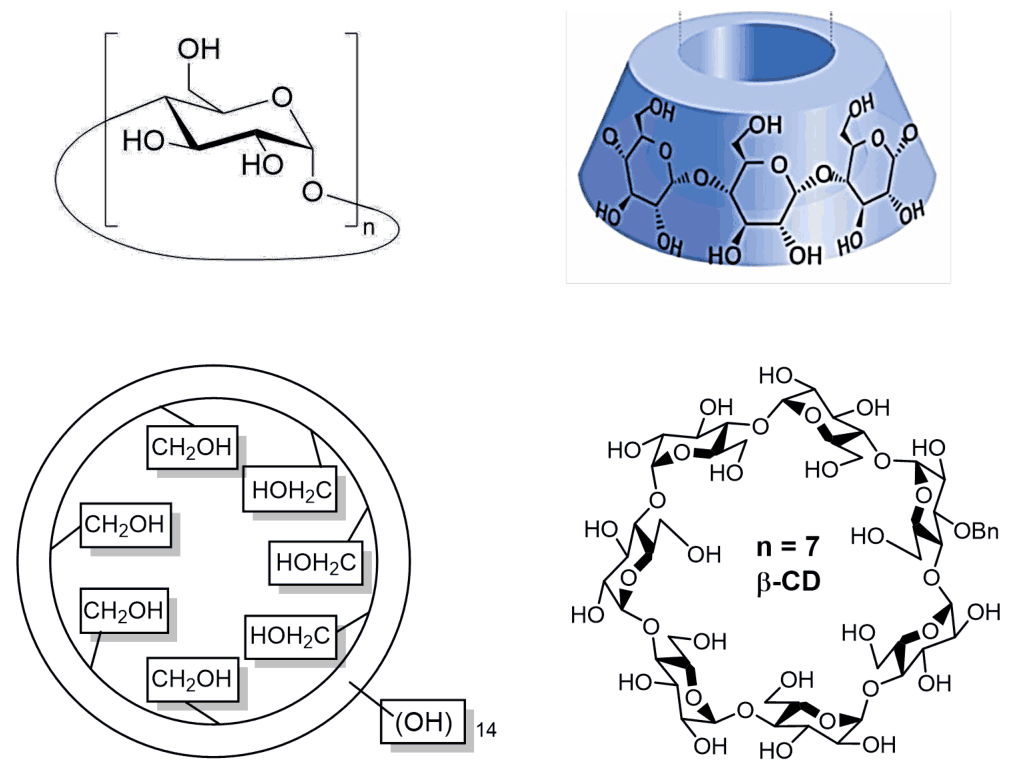
Cyclodextrins (CD) are a family of cyclic oligosaccharides, consisting of glucose subunits joined by α-1,4-glycosidic bonds. The three most common cyclodextrins (α-, β-, γ-cyclodextrin) contain 6, 7, and 8 α-D-glucopyranoside units, respectively.
9.1 Calculate the molar mass of β-CD. Assume \(M_w(\text{glucose})=180.16\ \mathrm{g\,mol^{-1}}\). 2.0 pt
CDs combine macrocyclic properties with glucose chemistry, which was demonstrated in the synthesis of X. Primary and secondary hydroxy groups show different reactivity due to being a part of CDs. Stoddart et al. synthesised compound K, where only one OH group remained free per glucopyranoside unit.
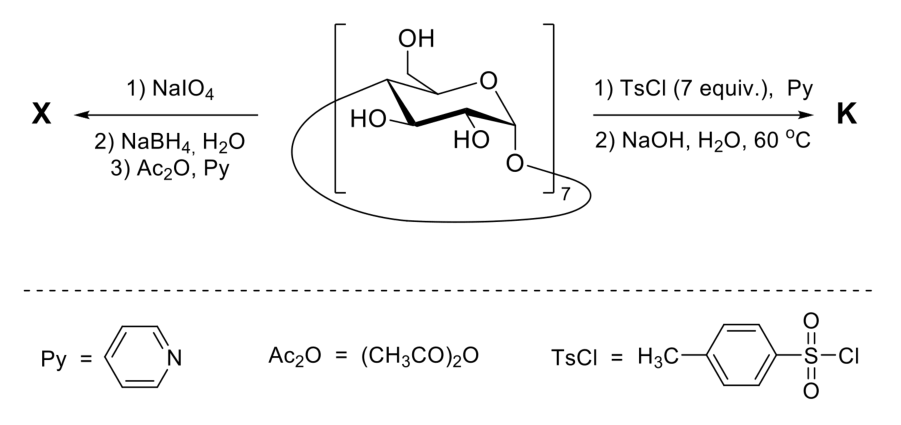
equiv.= equivalent
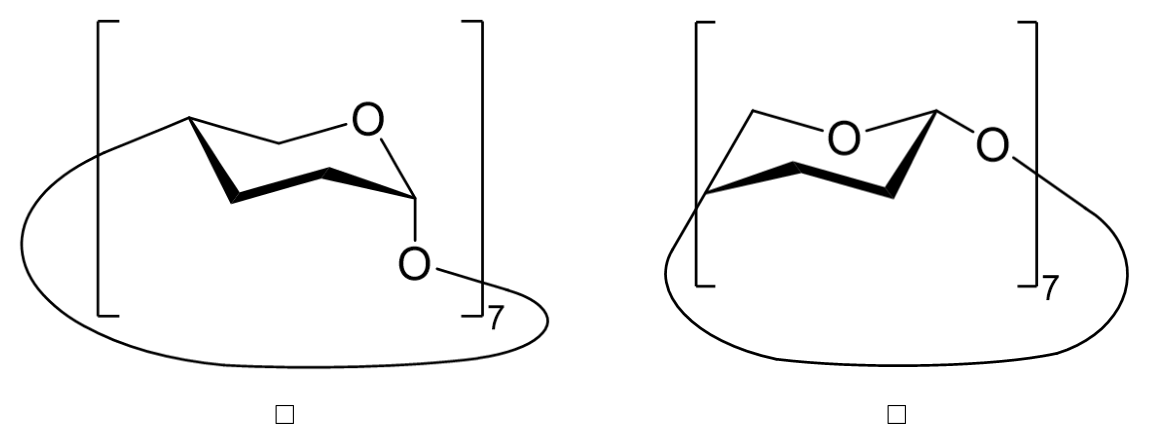
9.2 Tick the favorable chair conformation and draw the structure of K by completing the CD template. Show stereochemistry unambiguously. 6.0 pt
9.3 Determine the ring size, \(rs\), of macrocycle X. Give the number of stereocentres, \(sc\), in X. 8.0 pt
α-Cycloaltrin, a synthetic analogue of α-CD, was synthesised as follows.
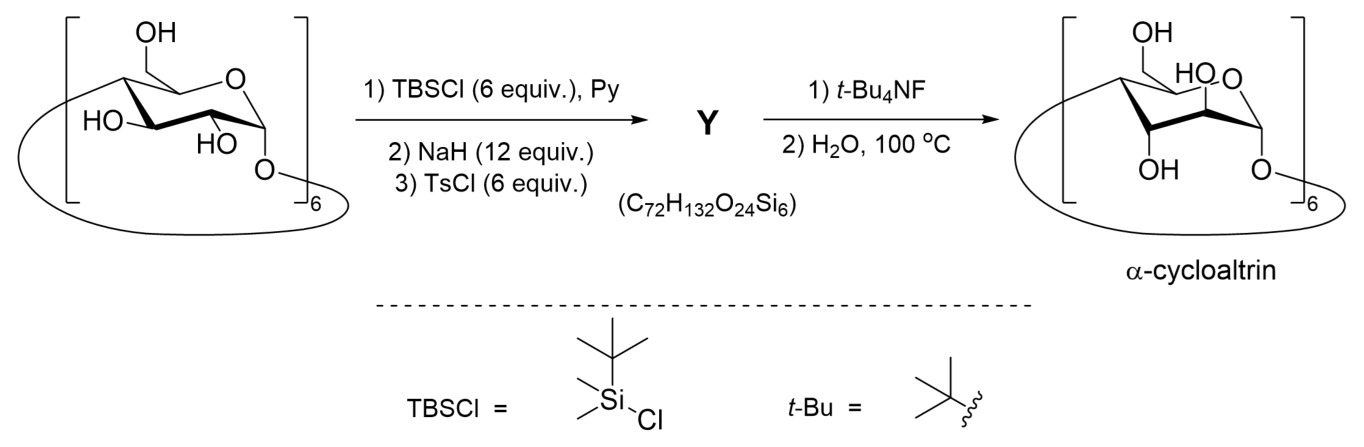
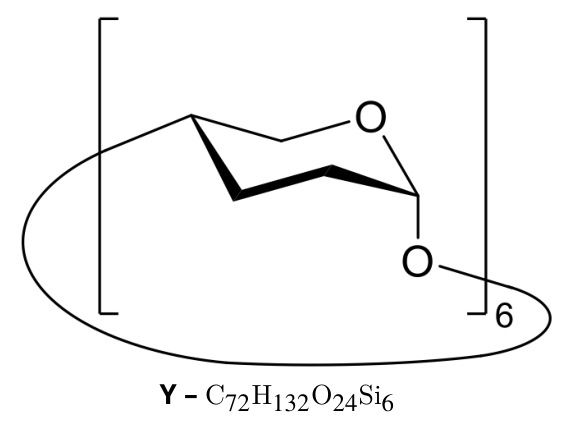
9.4 Draw the structure of Y with stereochemistry by completing the CD template. 3.0 pt
In 2000, Sinay et al. demonstrated that a single protic group (NH and OH) at unit 1 directs the next reductive debenzylation of a primary OH group to unit 4 in the macrocyclic ring (or to unit 3 if the unit 4 position is not available). This allowed the synthesis of the following β-CD dimer as a mixture of constitutional linkage isomers.
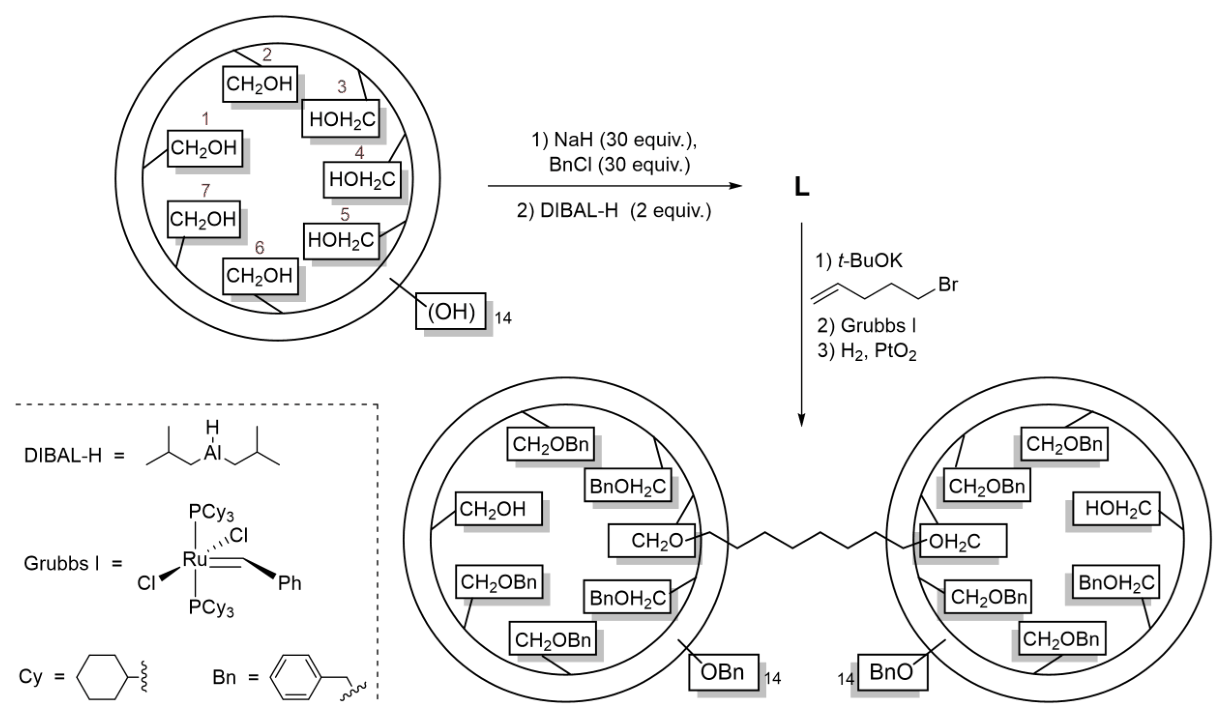
9.5 Draw the structure of L on the β-CD template. Fill in all the boxes. 2.0 pt
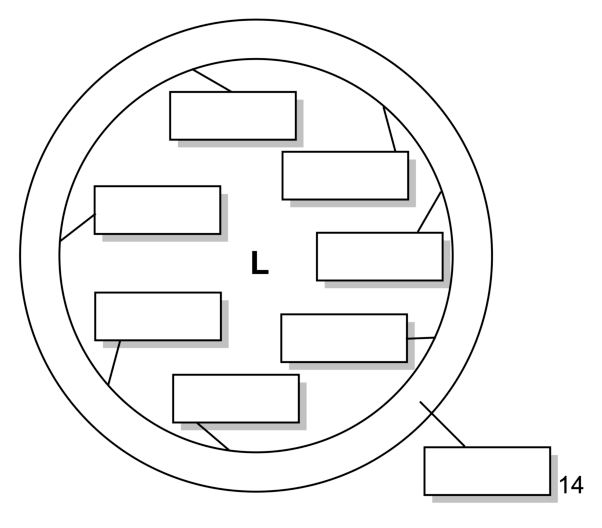
9.6 Determine the number of isomers of the β-CD dimer that can form during the synthesis by Sinay et. al. 4.0 pt
To confirm the positions of debenzylation, L was subjected to the “hexo-5-enose degradation” reaction, as shown below. The products were then analysed by mass spectrometry.
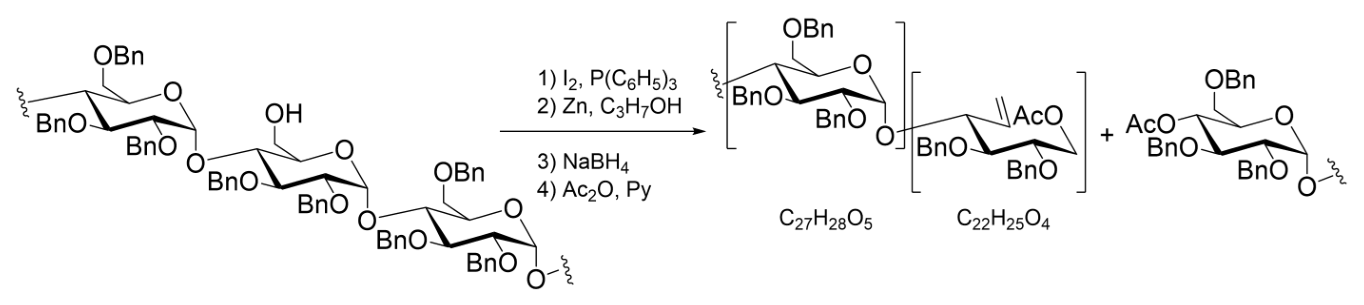
9.7 Calculate the \(m/z\) value for the two \(\ce{[M+Na]+}\) peaks that were observed for the degradation products from L. Use integer values of atomic mass. 6.0 pt
Later, Sollogoub et al. applied the ability of alkenes to direct the debenzylation to the “ortho”-glucopyranose unit for the synthesis of hexadifferentiated α-CD S:
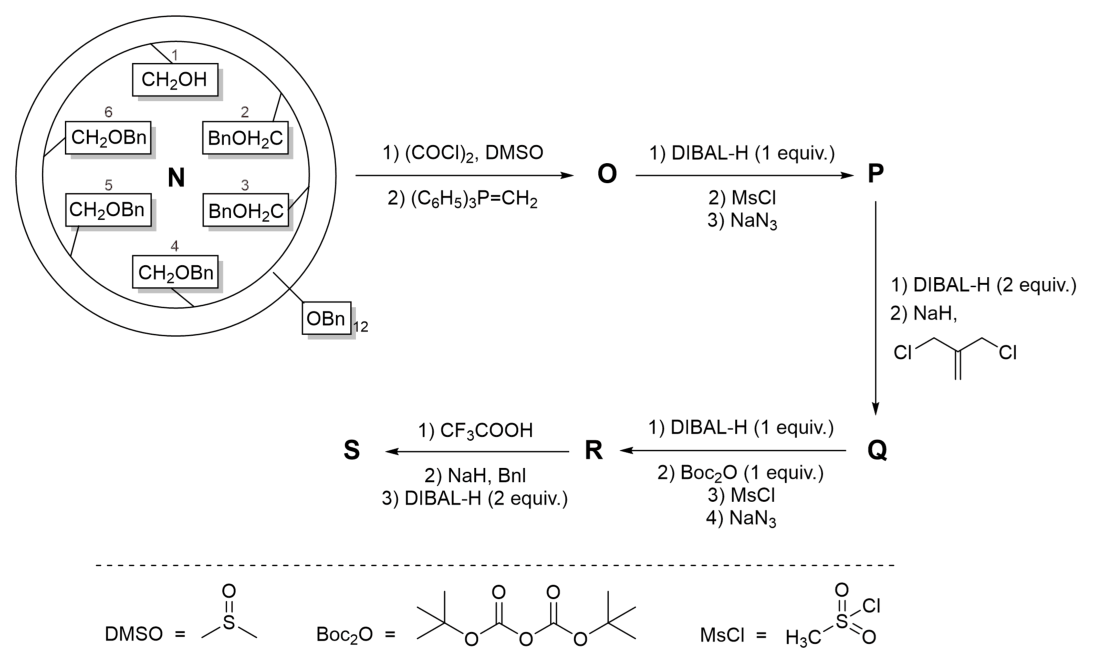
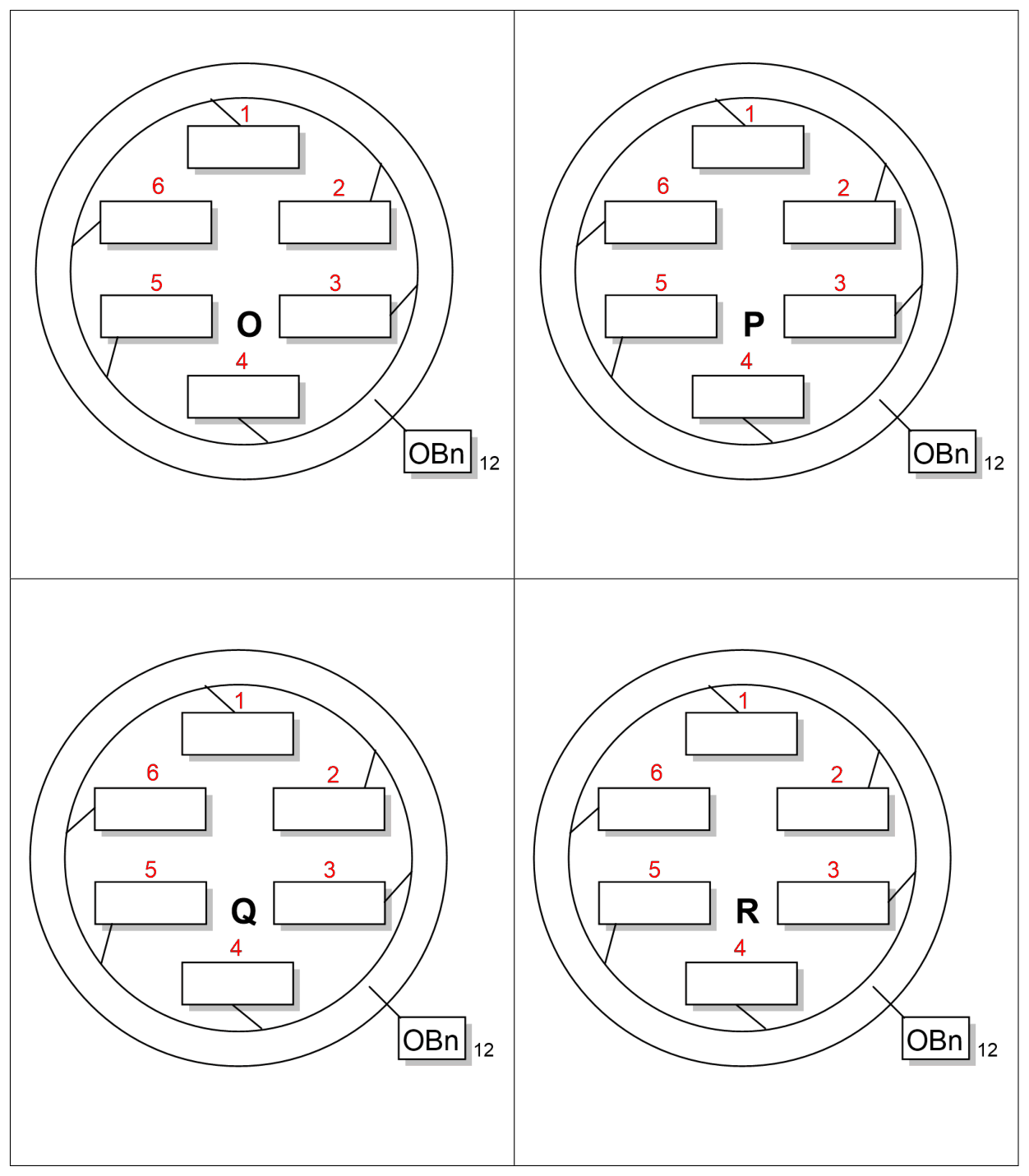
9.8 Draw the structures of O–S on the α-CD templates. Fill in all the boxes. You may draw structures outside the boxes if appropriate. Assume 1,2-unit modification happens clockwise, while 1,3-unit modification happens counterclockwise. Protic groups have stronger directing effects than alkenes. 18.0 pt
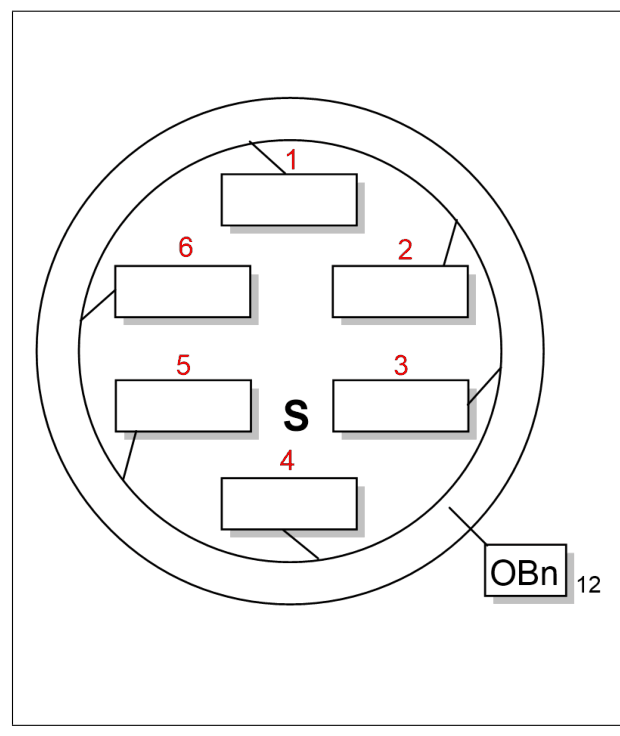
9.9 Determine the number of all possible arrangements of the functional groups on a hexadifferentiated α-CD (assume only the \(\ce{CH2OH}\) groups have been modified). 4.0 pt
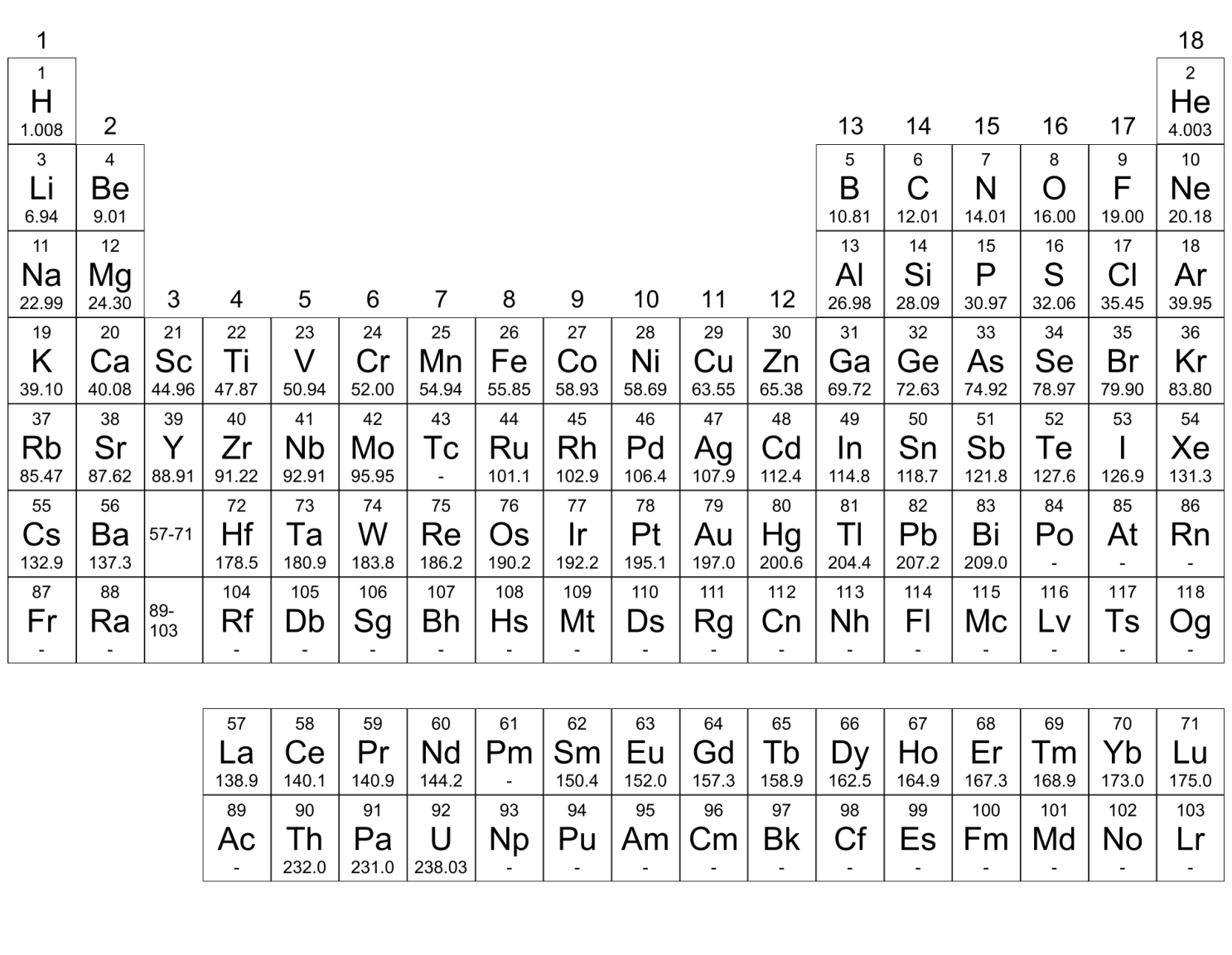
Periodic Table of Elements
Official English text of the problem.
Answers
- 9.1: \(\boxed{M(\beta\text{-CD})=1135.0\ \mathrm{g\,mol^{-1}}}\).
- 9.2: Tick the right-hand chair, \(^{1}C_{4}\). K is heptakis(3,6-anhydro)-β-cyclodextrin: every residue has a C3–O–C6 bridge and a free C2–OH.
- 9.3: \(\boxed{rs=35,\quad sc=21}\).
- 9.4: Y is the per-6-O-TBS-protected, per-2,3-anhydro manno derivative of α-CD. Each epoxide oxygen lies on the same face as the C5–\(\ce{CH2OTBS}\) substituent.
- 9.5: L: primary boxes 1 and 4 contain \(\ce{CH2OH}\); boxes 2, 3, 5, 6, and 7 contain \(\ce{CH2OBn}\); the external box contains \(\ce{OBn}\), repeated 14 times.
- 9.6: \(\boxed{3}\) constitutional linkage isomers.
- 9.7: \(\boxed{m/z=1299\text{ and }1731}\).
- 9.8: The complete substitution patterns are given below. All twelve secondary oxygen substituents remain \(\ce{OBn}\).
- 9.9: \(\boxed{120}\) arrangements.
For 9.8, the numbers identify glucose units, clockwise as on the answer sheet. Each entry is the substituent attached to that unit’s C5.
| Compound | Unit 1 | Unit 2 | Unit 3 | Unit 4 | Unit 5 | Unit 6 |
|---|---|---|---|---|---|---|
| O | \(\ce{CH=CH2}\) | \(\ce{CH2OBn}\) | \(\ce{CH2OBn}\) | \(\ce{CH2OBn}\) | \(\ce{CH2OBn}\) | \(\ce{CH2OBn}\) |
| P | \(\ce{CH=CH2}\) | \(\ce{CH2N3}\) | \(\ce{CH2OBn}\) | \(\ce{CH2OBn}\) | \(\ce{CH2OBn}\) | \(\ce{CH2OBn}\) |
| Q | \(\ce{CH=CH2}\) | \(\ce{CH2NH}\), bridge end | \(\ce{CH2OBn}\) | \(\ce{CH2OBn}\) | \(\ce{CH2O}\), bridge end | \(\ce{CH2OBn}\) |
| R | \(\ce{CH=CH2}\) | \(\ce{CH2N(Boc)}\), bridge end | \(\ce{CH2OBn}\) | \(\ce{CH2OBn}\) | \(\ce{CH2O}\), bridge end | \(\ce{CH2N3}\) |
| S | \(\ce{CH=CH2}\) | \(\ce{CH2N(Bn)}\), bridge end | \(\ce{CH2OH}\) | \(\ce{CH2OBn}\) | \(\ce{CH2O}\), bridge end | \(\ce{CH2NH2}\) |
In Q, R, and S, join the indicated nitrogen at unit 2 to the oxygen at unit 5 through
\[ \ce{N-CH2-C(=CH2)-CH2-O}. \]
Thus the complete bridge runs from unit 2 to unit 5 as
\[ \ce{CH2-N(R)-CH2-C(=CH2)-CH2-O-CH2}, \]
where \(R=\ce{H}\), Boc, and Bn in Q, R, and S, respectively.
Solution
The SMILES below specify complete molecular connectivity and stereochemistry. Chair conformations and the positions on the printed templates are specified separately in words.
The substituent abbreviations are benzyl, Bn, *Cc1ccccc1; acetyl, Ac, *C(=O)C; tert-butyldimethylsilyl, TBS, *[Si](C)(C)C(C)(C)C; and tert-butoxycarbonyl, Boc, *C(=O)OC(C)(C)C. Here * marks the attachment point of a substituent.
9.1
A cyclic assembly of seven glucose molecules contains seven glycosidic bonds. Consequently, formation of β-CD eliminates seven water molecules:
\[ \ce{7C6H12O6 -> C42H70O35 + 7H2O}. \]
Using the supplied atomic masses,
\[ M(\ce{H2O})=2(1.008)+16.00=18.016\ \mathrm{g\,mol^{-1}}, \]
and therefore
\[ \begin{aligned} M(\beta\text{-CD}) &=7(180.16)-7(18.016)\\ &=1135.008\ \mathrm{g\,mol^{-1}}\\ &\approx\boxed{1135.0\ \mathrm{g\,mol^{-1}}}. \end{aligned} \]
Glucose in the α-D-glucopyranose form has SMILES OC[C@H]1O[C@H](O)[C@H](O)[C@@H](O)[C@@H]1O; water has SMILES O.
β-Cyclodextrin, \(\ce{C42H70O35}\), has SMILES:
OC[C@H]1O[C@@H]2O[C@@H]3[C@H](O)[C@@H](O)[C@@H](O[C@@H]4[C@H](O)[C@@H](O)[C@@H](O[C@@H]5[C@H](O)[C@@H](O)[C@@H](O[C@@H]6[C@H](O)[C@@H](O)[C@@H](O[C@@H]7[C@H](O)[C@@H](O)[C@@H](O[C@@H]8[C@H](O)[C@@H](O)[C@@H](O[C@@H]1[C@H](O)[C@H]2O)O[C@@H]8CO)O[C@@H]7CO)O[C@@H]6CO)O[C@@H]5CO)O[C@@H]4CO)O[C@@H]3CO
9.2
The seven equivalents of tosyl chloride preferentially activate the seven primary C6 hydroxyl groups. Under basic conditions, the C3 alkoxide of each glucose residue attacks its own C6 carbon by intramolecular \(S_\mathrm{N}2\) displacement of tosylate. This produces a 3,6-anhydro ether bridge.
The C2 hydroxyl group remains free. Substitution occurs at the non-stereogenic C6 carbon, so the existing configurations of the glucose stereocentres are retained.
The 3,6 bridge requires the inverted \(^{1}C_4\) chair, which is the right-hand template. To complete it:
- Place the C5–C6 substituent above the ring.
- Connect C6 through oxygen to C3, also on the upper face.
- Draw the remaining C2–OH axial down.
- Retain the α-glycosidic connections already shown.
K, heptakis(3,6-anhydro)-β-cyclodextrin, has formula \(\ce{C42H56O28}\) and SMILES:
O[C@H]1[C@H]2O[C@@H]3[C@@H]4OC[C@H]3O[C@H](O[C@@H]3[C@@H]5OC[C@H]3O[C@H](O[C@@H]3[C@@H]6OC[C@H]3O[C@H](O[C@@H]3[C@@H]7OC[C@H]3O[C@H](O[C@@H]3[C@@H]8OC[C@H]3O[C@H](O[C@@H]3[C@@H]9OC[C@H]3O[C@H](O[C@@H]3[C@@H]1OC[C@H]3O2)[C@@H]9O)[C@@H]8O)[C@@H]7O)[C@@H]6O)[C@@H]5O)[C@@H]4O
9.3
Periodate cleaves the C2–C3 bond of every glucose residue because C2 and C3 bear a vicinal diol. The corresponding general atom balance is
\[ \ce{R-CH(OH)-CH(OH)-R' + IO4- -> R-CHO + R'-CHO + IO3- + H2O}. \]
Borohydride reduces both aldehydes to primary alcohols. Acetic anhydride then acetylates the hydroxyl groups at the original C2, C3, and C6 positions.
After C2–C3 cleavage, the surviving macrocyclic path through each residue is
\[ \mathrm{C1-O5-C5-C4-O4}, \]
followed by C1 of the next residue along that path. There are five macrocyclic atoms per glucose-derived unit:
\[ \boxed{rs=7\times5=35}. \]
C2 and C3 become \(\ce{CH2OAc}\) groups and lose their stereochemistry. The configurations at C1, C4, and C5 remain:
\[ \boxed{sc=7\times3=21}. \]
X, the peracetylated, periodate-cleaved and reduced β-cyclodextrin derivative, has formula \(\ce{C84H126O56}\) and SMILES:
CC(=O)OC[C@H]1O[C@H](COC(C)=O)O[C@H](COC(C)=O)[C@@H](COC(C)=O)O[C@H](COC(C)=O)O[C@H](COC(C)=O)[C@@H](COC(C)=O)O[C@H](COC(C)=O)O[C@H](COC(C)=O)[C@@H](COC(C)=O)O[C@H](COC(C)=O)O[C@H](COC(C)=O)[C@@H](COC(C)=O)O[C@H](COC(C)=O)O[C@H](COC(C)=O)[C@@H](COC(C)=O)O[C@H](COC(C)=O)O[C@H](COC(C)=O)[C@@H](COC(C)=O)O[C@H](COC(C)=O)O[C@@H]1COC(C)=O
9.4
TBS chloride protects the six primary C6 hydroxyl groups. Sodium hydride deprotonates the twelve remaining secondary hydroxyl groups.
Tosylation at O2 followed by intramolecular attack of O3 at C2 produces a 2,3-epoxide, with inversion at C2. Consequently, the epoxide has the manno configuration: its oxygen lies above the ring, on the same face as the C5–\(\ce{CH2OTBS}\) group.
To complete the template, draw:
- \(\ce{CH2OTBS}\) at C5, with the original D configuration;
- an oxygen bonded to both C2 and C3 on the upper face;
- no free hydroxyl groups.
The formula provides an independent check. Before epoxide formation, the six TBS-protected residues give \(\ce{C72H144O30Si6}\). Formation of six epoxides corresponds to loss of six water equivalents from the carbohydrate framework:
\[ \ce{C72H144O30Si6 -> C72H132O24Si6 + 6H2O}. \]
Subsequent fluoride treatment removes the TBS groups. Water opens the epoxide at C3 with inversion, giving the C2-up/C3-down hydroxyl arrangement of the drawn α-cycloaltrin.
Y, hexakis(2,3-anhydro-6-O-tert-butyldimethylsilyl)-α-cyclomannin, has SMILES:
CC(C)(C)[Si](C)(C)OC[C@H]1O[C@@H]2O[C@@H]3[C@@H]4O[C@@H]4[C@@H](O[C@@H]4[C@@H]5O[C@@H]5[C@@H](O[C@@H]5[C@@H]6O[C@@H]6[C@@H](O[C@@H]6[C@@H]7O[C@@H]7[C@@H](O[C@@H]7[C@@H]8O[C@@H]8[C@@H](O[C@@H]1[C@@H]1O[C@H]21)O[C@@H]7CO[Si](C)(C)C(C)(C)C)O[C@@H]6CO[Si](C)(C)C(C)(C)C)O[C@@H]5CO[Si](C)(C)C(C)(C)C)O[C@@H]4CO[Si](C)(C)C(C)(C)C)O[C@@H]3CO[Si](C)(C)C(C)(C)C
9.5
The first reaction benzylates all 21 hydroxyl groups of β-CD.
The first reductive debenzylation can be designated as occurring at unit 1, since all units were initially equivalent. Its newly formed primary OH directs the second debenzylation to unit 4.
Thus L contains two primary hydroxyl groups and nineteen benzyl ethers:
\[ \begin{array}{c|ccccccc} \text{Unit}&1&2&3&4&5&6&7\\ \hline \text{Primary substituent} &\ce{CH2OH}&\ce{CH2OBn}&\ce{CH2OBn}&\ce{CH2OH} &\ce{CH2OBn}&\ce{CH2OBn}&\ce{CH2OBn} \end{array} \]
The external box is \(\ce{OBn}\), with the printed multiplier 14.
L, the 1,4-primary-diol derivative of per-O-benzyl-β-cyclodextrin, has formula \(\ce{C175H184O35}\) and SMILES:
OC[C@H]1O[C@@H]2O[C@@H]3[C@H](OCc4ccccc4)[C@@H](OCc4ccccc4)[C@@H](O[C@@H]4[C@H](OCc5ccccc5)[C@@H](OCc5ccccc5)[C@@H](O[C@@H]5[C@H](OCc6ccccc6)[C@@H](OCc6ccccc6)[C@@H](O[C@@H]6[C@H](OCc7ccccc7)[C@@H](OCc7ccccc7)[C@@H](O[C@@H]7[C@H](OCc8ccccc8)[C@@H](OCc8ccccc8)[C@@H](O[C@@H]8[C@H](OCc9ccccc9)[C@@H](OCc9ccccc9)[C@@H](O[C@@H]1[C@H](OCc1ccccc1)[C@H]2OCc1ccccc1)O[C@@H]8COCc1ccccc1)O[C@@H]7COCc1ccccc1)O[C@@H]6CO)O[C@@H]5COCc1ccccc1)O[C@@H]4COCc1ccccc1)O[C@@H]3COCc1ccccc1
9.6
The two free primary hydroxyl groups in L are constitutionally distinguishable on the directed cyclodextrin scaffold. Linking two molecules therefore permits the combinations
\[ 1-1',\qquad 1-4',\qquad 4-4'. \]
The combination \(4-1'\) is identical to \(1-4'\) after exchanging the two identical cyclodextrin components.
Any alkene \(E/Z\) distinction generated during metathesis disappears upon hydrogenation. Therefore,
\[ \boxed{N_{\text{isomers}}=3}. \]
9.7
Degradation at units 1 and 4 divides the seven-unit ring into fragments containing three and four original glucose units.
For a fragment containing \(n\) original units, the depicted product contains:
- \(n-1\) intact protected residue blocks, each \(\ce{C27H28O5}\);
- one degraded terminal block, \(\ce{C22H25O4}\);
- one additional acetoxy end group, \(\ce{C2H3O2}\), at the other end.
Their integer masses are
\[ \begin{aligned} M(\ce{C27H28O5})&=27(12)+28+5(16)=432,\\ M(\ce{C22H25O4})&=22(12)+25+4(16)=353,\\ M(\ce{C2H3O2})&=2(12)+3+2(16)=59. \end{aligned} \]
Thus
\[ M_n=432(n-1)+353+59. \]
For the three-unit fragment,
\[ M_3=2(432)+353+59=1276, \]
and for the four-unit fragment,
\[ M_4=3(432)+353+59=1708. \]
Adding one sodium ion of integer mass 23 and charge \(+1\),
\[ \boxed{\left(\frac mz\right)_3=1276+23=1299}, \qquad \boxed{\left(\frac mz\right)_4=1708+23=1731}. \]
The neutral fragments have formulas \(\ce{C78H84O16}\) and \(\ce{C105H112O21}\), respectively.
Sodium adduct of the three-unit degradation fragment, \(\ce{[C78H84O16 + Na]+}\), has SMILES:
C=C[C@H](O[C@H]1O[C@H](COCc2ccccc2)[C@H](O[C@H]2O[C@H](COCc3ccccc3)[C@H](OC(C)=O)[C@H](OCc3ccccc3)[C@H]2OCc2ccccc2)[C@H](OCc2ccccc2)[C@H]1OCc1ccccc1)[C@H](OCc1ccccc1)[C@H](COC(C)=O)OCc1ccccc1.[Na+]
Sodium adduct of the four-unit degradation fragment, \(\ce{[C105H112O21 + Na]+}\), has SMILES:
C=C[C@H](O[C@H]1O[C@H](COCc2ccccc2)[C@H](O[C@H]2O[C@H](COCc3ccccc3)[C@H](O[C@H]3O[C@H](COCc4ccccc4)[C@H](OC(C)=O)[C@H](OCc4ccccc4)[C@H]3OCc3ccccc3)[C@H](OCc3ccccc3)[C@H]2OCc2ccccc2)[C@H](OCc2ccccc2)[C@H]1OCc1ccccc1)[C@H](OCc1ccccc1)[C@H](COC(C)=O)OCc1ccccc1.[Na+]
The disconnected sodium component in these SMILES specifies the adduct composition; the problem does not establish a particular sodium coordination geometry.
9.8
Throughout this sequence, the twelve secondary benzyl ethers remain intact.
Formation of O. Swern oxidation converts the free \(\ce{CH2OH}\) group at unit 1 into an aldehyde. Wittig methylenation then converts that side chain into \(\ce{CH=CH2}\). Units 2–6 retain \(\ce{CH2OBn}\).
O, the unit-1-vinyl α-cyclodextrin derivative, has SMILES:
C=C[C@H]1O[C@@H]2O[C@@H]3[C@H](OCc4ccccc4)[C@@H](OCc4ccccc4)[C@@H](O[C@@H]4[C@H](OCc5ccccc5)[C@@H](OCc5ccccc5)[C@@H](O[C@@H]5[C@H](OCc6ccccc6)[C@@H](OCc6ccccc6)[C@@H](O[C@@H]6[C@H](OCc7ccccc7)[C@@H](OCc7ccccc7)[C@@H](O[C@@H]7[C@H](OCc8ccccc8)[C@@H](OCc8ccccc8)[C@@H](O[C@@H]1[C@H](OCc1ccccc1)[C@H]2OCc1ccccc1)O[C@@H]7COCc1ccccc1)O[C@@H]6COCc1ccccc1)O[C@@H]5COCc1ccccc1)O[C@@H]4COCc1ccccc1)O[C@@H]3COCc1ccccc1
Formation of P. The alkene at unit 1 directs the first debenzylation to its clockwise neighbour, unit 2. Mesylation followed by azide displacement converts the resulting \(\ce{CH2OH}\) into \(\ce{CH2N3}\).
P, the unit-2-azidomethyl derivative of O, has SMILES:
C=C[C@H]1O[C@@H]2O[C@@H]3[C@H](OCc4ccccc4)[C@@H](OCc4ccccc4)[C@@H](O[C@@H]4[C@H](OCc5ccccc5)[C@@H](OCc5ccccc5)[C@@H](O[C@@H]5[C@H](OCc6ccccc6)[C@@H](OCc6ccccc6)[C@@H](O[C@@H]6[C@H](OCc7ccccc7)[C@@H](OCc7ccccc7)[C@@H](O[C@@H]7[C@H](OCc8ccccc8)[C@@H](OCc8ccccc8)[C@@H](O[C@@H]1[C@H](OCc1ccccc1)[C@H]2OCc1ccccc1)O[C@@H]7COCc1ccccc1)O[C@@H]6COCc1ccccc1)O[C@@H]5COCc1ccccc1)O[C@@H]4COCc1ccccc1)O[C@@H]3CN=[N+]=[N-]
Formation of Q. DIBAL-H first reduces the azide at unit 2 to a primary amine. Its protic NH group then directs debenzylation to the opposite unit, unit 5.
The two available groups are consequently \(\ce{CH2NH2}\) at unit 2 and \(\ce{CH2OH}\) at unit 5. Reaction with 1,3-dichloro-2-methylenepropane, C=C(CCl)CCl, joins them through an N,O bridge:
\[ \ce{CH2-NH-CH2-C(=CH2)-CH2-O-CH2}. \]
One N–H bond remains, so the nitrogen can direct the next debenzylation.
Q, the unit-2/unit-5 N,O-bridged α-cyclodextrin derivative, has SMILES:
C=C[C@H]1O[C@@H]2O[C@@H]3[C@H](OCc4ccccc4)[C@@H](OCc4ccccc4)[C@H]4O[C@@H]5[C@H](OCc6ccccc6)[C@@H](OCc6ccccc6)[C@@H](O[C@@H]6[C@H](OCc7ccccc7)[C@@H](OCc7ccccc7)[C@@H](O[C@@H]7[C@H](OCc8ccccc8)[C@@H](OCc8ccccc8)[C@@H](O[C@@H]8[C@H](OCc9ccccc9)[C@@H](OCc9ccccc9)[C@@H](O[C@@H]1[C@H](OCc1ccccc1)[C@H]2OCc1ccccc1)O[C@@H]8COCc1ccccc1)O[C@@H]7COCC(=C)CNC[C@H]3O4)O[C@@H]6COCc1ccccc1)O[C@@H]5COCc1ccccc1
Formation of R. The secondary NH at unit 2 is the strongest directing group. Its usual 1,4 target, unit 5, is already incorporated into the bridge and has no benzyl ether to remove.
The fallback is therefore a 1,3 modification counterclockwise from unit 2:
\[ 2\longrightarrow1\longrightarrow6. \]
DIBAL-H unveils the primary OH at unit 6. Boc protection blocks the bridge nitrogen, while mesylation and azide displacement convert the newly exposed unit-6 side chain into \(\ce{CH2N3}\).
R, the N-Boc-protected, unit-6-azidomethyl derivative of Q, has SMILES:
C=C[C@H]1O[C@@H]2O[C@@H]3[C@H](OCc4ccccc4)[C@@H](OCc4ccccc4)[C@H]4O[C@@H]5[C@H](OCc6ccccc6)[C@@H](OCc6ccccc6)[C@@H](O[C@@H]6[C@H](OCc7ccccc7)[C@@H](OCc7ccccc7)[C@@H](O[C@@H]7[C@H](OCc8ccccc8)[C@@H](OCc8ccccc8)[C@@H](O[C@@H]8[C@H](OCc9ccccc9)[C@@H](OCc9ccccc9)[C@@H](O[C@@H]1[C@H](OCc1ccccc1)[C@H]2OCc1ccccc1)O[C@@H]8CN=[N+]=[N-])O[C@@H]7COCC(=C)CN(C(=O)OC(C)(C)C)C[C@H]3O4)O[C@@H]6COCc1ccccc1)O[C@@H]5COCc1ccccc1
Formation of S. Trifluoroacetic acid removes Boc. Benzylation then converts the bridge nitrogen into a tertiary N-benzyl amine, eliminating its N–H directing group.
DIBAL-H reduces the azide at unit 6 to \(\ce{CH2NH2}\). This newly formed protic group directs debenzylation to the opposite unit, unit 3, giving \(\ce{CH2OH}\) there. Unit 4 retains its primary benzyl ether.
The final six side chains are therefore all differentiated: vinyl, bridged N-benzylamino, hydroxymethyl, benzyloxymethyl, bridged oxymethyl, and aminomethyl, in that clockwise order.
S, the hexadifferentiated α-cyclodextrin derivative, has SMILES:
C=C[C@H]1O[C@@H]2O[C@@H]3[C@H](OCc4ccccc4)[C@@H](OCc4ccccc4)[C@H]4O[C@@H]5[C@H](OCc6ccccc6)[C@@H](OCc6ccccc6)[C@@H](O[C@@H]6[C@H](OCc7ccccc7)[C@@H](OCc7ccccc7)[C@@H](O[C@@H]7[C@H](OCc8ccccc8)[C@@H](OCc8ccccc8)[C@@H](O[C@@H]8[C@H](OCc9ccccc9)[C@@H](OCc9ccccc9)[C@@H](O[C@@H]1[C@H](OCc1ccccc1)[C@H]2OCc1ccccc1)O[C@@H]8CN)O[C@@H]7COCC(=C)CN(Cc1ccccc1)C[C@H]3O4)O[C@@H]6COCc1ccccc1)O[C@@H]5CO
9.9
Six different substituents can be assigned to six labelled sites in \(6!\) ways. Rotating the whole α-CD ring does not produce a new arrangement, so each arrangement has been counted six times:
\[ N=\frac{6!}{6}=5!=\boxed{120}. \]
There is no further division by two. Reversing the cyclic order is not a symmetry operation of the directed, chiral α-D-glucopyranoside scaffold.
The solution was checked against the official solution.
IChO 2026 · Theorieaufgabe 9
Chemie der Cyclodextrine
T9. Chemie der Cyclodextrine
7%
| 9.1 | 9.2 | 9.3 | 9.4 | 9.5 | 9.6 | 9.7 | 9.8 | 9.9 | \(\sum\) |
|---|---|---|---|---|---|---|---|---|---|
| 2 | 6 | 8 | 3 | 2 | 4 | 6 | 18 | 4 | 53 |
Cyclodextrine (CD) sind eine Familie cyclischer Oligosaccharide, die aus Glucoseeinheiten bestehen, welche durch α-1,4-glycosidische Bindungen miteinander verknüpft sind. Die drei häufigsten Cyclodextrine (α-, β-, γ-Cyclodextrin) enthalten jeweils 6, 7 bzw. 8 α-D-Glucopyranosid-Einheiten.
9.1 Berechnen Sie die molare Masse von β-CD. Nehmen Sie \(M_w(\text{Glucose})=180.16\ \mathrm{g\,mol^{-1}}\) an. 2.0 Pkt.
CDs verbinden makrocyclische Eigenschaften mit der Chemie der Glucose, was anhand der Synthese von X gezeigt wurde. Primäre und sekundäre Hydroxygruppen weisen aufgrund ihrer Zugehörigkeit zu CDs unterschiedliche Reaktivitäten auf. Stoddart et al. synthetisierten die Verbindung K, in der pro Glucopyranosid-Einheit nur eine OH-Gruppe frei blieb.
equiv.= Äquivalent
9.2 Kreuzen Sie die bevorzugte Sesselkonformation an und zeichnen Sie die Struktur von K, indem Sie die CD-Vorlage vervollständigen. Geben Sie die Stereochemie eindeutig an. 6.0 Pkt.
9.3 Bestimmen Sie die Ringgröße \(rs\) des Makrocyclus X. Geben Sie die Anzahl der Stereozentren \(sc\) in X an. 8.0 Pkt.
α-Cycloaltrin, ein synthetisches Analogon von α-CD, wurde wie folgt synthetisiert.
9.4 Zeichnen Sie die Struktur von Y einschließlich der Stereochemie, indem Sie die CD-Vorlage vervollständigen. 3.0 Pkt.
Im Jahr 2000 zeigten Sinay et al., dass eine einzelne protische Gruppe (NH und OH) an Einheit 1 die nächste reduktive Debenzylierung einer primären OH-Gruppe zu Einheit 4 im makrocyclischen Ring dirigiert (oder zu Einheit 3, falls die Position an Einheit 4 nicht verfügbar ist). Dies ermöglichte die Synthese des folgenden β-CD-Dimers als Gemisch konstitutionsisomerer Verknüpfungsisomere.
9.5 Zeichnen Sie die Struktur von L auf der β-CD-Vorlage. Füllen Sie alle Kästchen aus. 2.0 Pkt.
9.6 Bestimmen Sie die Anzahl der Isomere des β-CD-Dimers, die bei der Synthese nach Sinay et. al. entstehen können. 4.0 Pkt.
Zur Bestätigung der Debenzylierungspositionen wurde L dem unten gezeigten „Hex-5-enose-Abbau“ unterzogen. Die Produkte wurden anschließend massenspektrometrisch analysiert.
9.7 Berechnen Sie den \(m/z\)-Wert für die beiden \(\ce{[M+Na]+}\)-Peaks, die für die Abbauprodukte von L beobachtet wurden. Verwenden Sie ganzzahlige Atommassen. 6.0 Pkt.
Später nutzten Sollogoub et al. die Fähigkeit von Alkenen, die Debenzylierung zur „ortho“-Glucopyranoseeinheit zu dirigieren, zur Synthese des sechsfach differenzierten α-CD S:
9.8 Zeichnen Sie die Strukturen von O–S auf den α-CD-Vorlagen. Füllen Sie alle Kästchen aus. Sie dürfen gegebenenfalls Strukturen außerhalb der Kästchen zeichnen. Nehmen Sie an, dass eine 1,2-Modifikation der Einheiten im Uhrzeigersinn erfolgt, während eine 1,3-Modifikation der Einheiten gegen den Uhrzeigersinn erfolgt. Protische Gruppen haben eine stärkere dirigierende Wirkung als Alkene. 18.0 Pkt.
9.9 Bestimmen Sie die Anzahl aller möglichen Anordnungen der funktionellen Gruppen an einem sechsfach differenzierten α-CD (nehmen Sie an, dass nur die \(\ce{CH2OH}\)-Gruppen modifiziert wurden). 4.0 Pkt.
Periodensystem der Elemente
Aufgabentext aus dem offiziellen englischen Text übersetzt.
Antworten
- 9.1: \(\boxed{M(\beta\text{-CD})=1135.0\ \mathrm{g\,mol^{-1}}}\).
- 9.2: Kreuzen Sie den rechten Sessel, \(^{1}C_{4}\), an. K ist Heptakis(3,6-anhydro)-β-cyclodextrin: Jeder Rest besitzt eine C3–O–C6-Brücke und eine freie C2–OH-Gruppe.
- 9.3: \(\boxed{rs=35,\quad sc=21}\).
- 9.4: Y ist das per-6-O-TBS-geschützte per-2,3-Anhydro-manno-Derivat von α-CD. Jedes Epoxid-Sauerstoffatom liegt auf derselben Seite wie der C5–\(\ce{CH2OTBS}\)-Substituent.
- 9.5: L: Die Kästchen für die primären Substituenten 1 und 4 enthalten \(\ce{CH2OH}\); die Kästchen 2, 3, 5, 6 und 7 enthalten \(\ce{CH2OBn}\); das äußere Kästchen enthält \(\ce{OBn}\), das 14-mal vorkommt.
- 9.6: \(\boxed{3}\) konstitutionsisomere Verknüpfungsisomere.
- 9.7: \(\boxed{m/z=1299\text{ und }1731}\).
- 9.8: Die vollständigen Substitutionsmuster sind unten angegeben. Alle zwölf sekundären Sauerstoffsubstituenten bleiben \(\ce{OBn}\).
- 9.9: \(\boxed{120}\) Anordnungen.
Für 9.8 bezeichnen die Zahlen die Glucoseeinheiten, im Uhrzeigersinn wie auf dem Antwortbogen. Jeder Eintrag ist der Substituent, der an C5 der jeweiligen Einheit gebunden ist.
| Verbindung | Einheit 1 | Einheit 2 | Einheit 3 | Einheit 4 | Einheit 5 | Einheit 6 |
|---|---|---|---|---|---|---|
| O | \(\ce{CH=CH2}\) | \(\ce{CH2OBn}\) | \(\ce{CH2OBn}\) | \(\ce{CH2OBn}\) | \(\ce{CH2OBn}\) | \(\ce{CH2OBn}\) |
| P | \(\ce{CH=CH2}\) | \(\ce{CH2N3}\) | \(\ce{CH2OBn}\) | \(\ce{CH2OBn}\) | \(\ce{CH2OBn}\) | \(\ce{CH2OBn}\) |
| Q | \(\ce{CH=CH2}\) | \(\ce{CH2NH}\), Brückenende | \(\ce{CH2OBn}\) | \(\ce{CH2OBn}\) | \(\ce{CH2O}\), Brückenende | \(\ce{CH2OBn}\) |
| R | \(\ce{CH=CH2}\) | \(\ce{CH2N(Boc)}\), Brückenende | \(\ce{CH2OBn}\) | \(\ce{CH2OBn}\) | \(\ce{CH2O}\), Brückenende | \(\ce{CH2N3}\) |
| S | \(\ce{CH=CH2}\) | \(\ce{CH2N(Bn)}\), Brückenende | \(\ce{CH2OH}\) | \(\ce{CH2OBn}\) | \(\ce{CH2O}\), Brückenende | \(\ce{CH2NH2}\) |
Verbinden Sie in Q, R und S das angegebene Stickstoffatom an Einheit 2 mit dem Sauerstoffatom an Einheit 5 über
\[ \ce{N-CH2-C(=CH2)-CH2-O}. \]
Die vollständige Brücke verläuft somit von Einheit 2 zu Einheit 5 als
\[ \ce{CH2-N(R)-CH2-C(=CH2)-CH2-O-CH2}, \]
wobei \(R=\ce{H}\), Boc bzw. Bn in Q, R bzw. S ist.
Lösung
Die folgenden SMILES geben die vollständige molekulare Konnektivität und Stereochemie an. Sesselkonformationen und Positionen auf den gedruckten Vorlagen werden gesondert in Worten angegeben.
Die Substituentenabkürzungen sind Benzyl, Bn, *Cc1ccccc1; Acetyl, Ac, *C(=O)C; tert-Butyldimethylsilyl, TBS, *[Si](C)(C)C(C)(C)C; und tert-Butoxycarbonyl, Boc, *C(=O)OC(C)(C)C. Dabei kennzeichnet * die Verknüpfungsstelle eines Substituenten.
9.1
Ein cyclischer Verband aus sieben Glucosemolekülen enthält sieben glycosidische Bindungen. Folglich werden bei der Bildung von β-CD sieben Wassermoleküle abgespalten:
\[ \ce{7C6H12O6 -> C42H70O35 + 7H2O}. \]
Mit den angegebenen Atommassen gilt
\[ M(\ce{H2O})=2(1.008)+16.00=18.016\ \mathrm{g\,mol^{-1}}, \]
und somit
\[ \begin{aligned} M(\beta\text{-CD}) &=7(180.16)-7(18.016)\\ &=1135.008\ \mathrm{g\,mol^{-1}}\\ &\approx\boxed{1135.0\ \mathrm{g\,mol^{-1}}}. \end{aligned} \]
Glucose in der α-D-Glucopyranoseform hat den SMILES OC[C@H]1O[C@H](O)[C@H](O)[C@@H](O)[C@@H]1O; Wasser hat den SMILES O.
β-Cyclodextrin, \(\ce{C42H70O35}\), hat den SMILES:
OC[C@H]1O[C@@H]2O[C@@H]3[C@H](O)[C@@H](O)[C@@H](O[C@@H]4[C@H](O)[C@@H](O)[C@@H](O[C@@H]5[C@H](O)[C@@H](O)[C@@H](O[C@@H]6[C@H](O)[C@@H](O)[C@@H](O[C@@H]7[C@H](O)[C@@H](O)[C@@H](O[C@@H]8[C@H](O)[C@@H](O)[C@@H](O[C@@H]1[C@H](O)[C@H]2O)O[C@@H]8CO)O[C@@H]7CO)O[C@@H]6CO)O[C@@H]5CO)O[C@@H]4CO)O[C@@H]3CO
9.2
Die sieben Äquivalente Tosylchlorid aktivieren bevorzugt die sieben primären C6-Hydroxygruppen. Unter basischen Bedingungen greift das C3-Alkoxid jedes Glucoserestes sein eigenes C6-Kohlenstoffatom unter intramolekularer \(S_\mathrm{N}2\)-Verdrängung von Tosylat an. Dabei entsteht eine 3,6-Anhydro-Etherbrücke.
Die C2-Hydroxygruppe bleibt frei. Die Substitution erfolgt am nicht stereogenen C6-Kohlenstoffatom, sodass die bestehenden Konfigurationen der Glucose-Stereozentren erhalten bleiben.
Die 3,6-Brücke erfordert den invertierten \(^{1}C_4\)-Sessel, der der rechten Vorlage entspricht. Vervollständigen Sie diese wie folgt:
- Platzieren Sie den C5–C6-Substituenten oberhalb des Rings.
- Verbinden Sie C6 über ein Sauerstoffatom mit C3, ebenfalls auf der oberen Seite.
- Zeichnen Sie die verbleibende C2–OH-Gruppe axial nach unten.
- Behalten Sie die bereits dargestellten α-glycosidischen Verknüpfungen bei.
K, Heptakis(3,6-anhydro)-β-cyclodextrin, hat die Summenformel \(\ce{C42H56O28}\) und den SMILES:
O[C@H]1[C@H]2O[C@@H]3[C@@H]4OC[C@H]3O[C@H](O[C@@H]3[C@@H]5OC[C@H]3O[C@H](O[C@@H]3[C@@H]6OC[C@H]3O[C@H](O[C@@H]3[C@@H]7OC[C@H]3O[C@H](O[C@@H]3[C@@H]8OC[C@H]3O[C@H](O[C@@H]3[C@@H]9OC[C@H]3O[C@H](O[C@@H]3[C@@H]1OC[C@H]3O2)[C@@H]9O)[C@@H]8O)[C@@H]7O)[C@@H]6O)[C@@H]5O)[C@@H]4O
9.3
Periodat spaltet die C2–C3-Bindung jedes Glucoserestes, da C2 und C3 ein vicinales Diol tragen. Die entsprechende allgemeine Atombilanz lautet
\[ \ce{R-CH(OH)-CH(OH)-R' + IO4- -> R-CHO + R'-CHO + IO3- + H2O}. \]
Borhydrid reduziert beide Aldehyde zu primären Alkoholen. Essigsäureanhydrid acetyliert anschließend die Hydroxygruppen an den ursprünglichen Positionen C2, C3 und C6.
Nach der C2–C3-Spaltung verläuft der erhaltene makrocyclische Pfad durch jeden Rest über
\[ \mathrm{C1-O5-C5-C4-O4}, \]
gefolgt von C1 des nächsten Restes entlang dieses Pfades. Pro aus Glucose hervorgegangener Einheit gibt es fünf Atome im Makrocyclus:
\[ \boxed{rs=7\times5=35}. \]
C2 und C3 werden zu \(\ce{CH2OAc}\)-Gruppen und verlieren ihre Stereochemie. Die Konfigurationen an C1, C4 und C5 bleiben erhalten:
\[ \boxed{sc=7\times3=21}. \]
X, das peracetylierte, durch Periodat gespaltene und reduzierte β-Cyclodextrin-Derivat, hat die Summenformel \(\ce{C84H126O56}\) und den SMILES:
CC(=O)OC[C@H]1O[C@H](COC(C)=O)O[C@H](COC(C)=O)[C@@H](COC(C)=O)O[C@H](COC(C)=O)O[C@H](COC(C)=O)[C@@H](COC(C)=O)O[C@H](COC(C)=O)O[C@H](COC(C)=O)[C@@H](COC(C)=O)O[C@H](COC(C)=O)O[C@H](COC(C)=O)[C@@H](COC(C)=O)O[C@H](COC(C)=O)O[C@H](COC(C)=O)[C@@H](COC(C)=O)O[C@H](COC(C)=O)O[C@H](COC(C)=O)[C@@H](COC(C)=O)O[C@H](COC(C)=O)O[C@@H]1COC(C)=O
9.4
TBS-Chlorid schützt die sechs primären C6-Hydroxygruppen. Natriumhydrid deprotoniert die zwölf verbleibenden sekundären Hydroxygruppen.
Tosylierung an O2 mit anschließendem intramolekularem Angriff von O3 an C2 erzeugt ein 2,3-Epoxid unter Inversion an C2. Folglich besitzt das Epoxid die manno-Konfiguration: Sein Sauerstoffatom liegt oberhalb des Rings, auf derselben Seite wie die C5–\(\ce{CH2OTBS}\)-Gruppe.
Zeichnen Sie zur Vervollständigung der Vorlage:
- \(\ce{CH2OTBS}\) an C5 mit der ursprünglichen D-Konfiguration;
- ein Sauerstoffatom, das sowohl an C2 als auch an C3 auf der oberen Seite gebunden ist;
- keine freien Hydroxygruppen.
Die Summenformel ermöglicht eine unabhängige Überprüfung. Vor der Epoxidbildung ergeben die sechs TBS-geschützten Reste \(\ce{C72H144O30Si6}\). Die Bildung von sechs Epoxiden entspricht dem Verlust von sechs Wasseräquivalenten aus dem Kohlenhydratgerüst:
\[ \ce{C72H144O30Si6 -> C72H132O24Si6 + 6H2O}. \]
Die anschließende Behandlung mit Fluorid entfernt die TBS-Gruppen. Wasser öffnet das Epoxid an C3 unter Inversion, wodurch die Hydroxygruppenanordnung C2 nach oben/C3 nach unten des dargestellten α-Cycloaltrins entsteht.
Y, Hexakis(2,3-anhydro-6-O-tert-butyldimethylsilyl)-α-cyclomannin, hat den SMILES:
CC(C)(C)[Si](C)(C)OC[C@H]1O[C@@H]2O[C@@H]3[C@@H]4O[C@@H]4[C@@H](O[C@@H]4[C@@H]5O[C@@H]5[C@@H](O[C@@H]5[C@@H]6O[C@@H]6[C@@H](O[C@@H]6[C@@H]7O[C@@H]7[C@@H](O[C@@H]7[C@@H]8O[C@@H]8[C@@H](O[C@@H]1[C@@H]1O[C@H]21)O[C@@H]7CO[Si](C)(C)C(C)(C)C)O[C@@H]6CO[Si](C)(C)C(C)(C)C)O[C@@H]5CO[Si](C)(C)C(C)(C)C)O[C@@H]4CO[Si](C)(C)C(C)(C)C)O[C@@H]3CO[Si](C)(C)C(C)(C)C
9.5
Die erste Reaktion benzyliert alle 21 Hydroxygruppen von β-CD.
Die erste reduktive Debenzylierung kann als an Einheit 1 stattfindend bezeichnet werden, da anfangs alle Einheiten äquivalent waren. Die dabei neu gebildete primäre OH-Gruppe dirigiert die zweite Debenzylierung zu Einheit 4.
Somit enthält L zwei primäre Hydroxygruppen und neunzehn Benzylether:
\[ \begin{array}{c|ccccccc} \text{Einheit}&1&2&3&4&5&6&7\\ \hline \text{Primärer Substituent} &\ce{CH2OH}&\ce{CH2OBn}&\ce{CH2OBn}&\ce{CH2OH} &\ce{CH2OBn}&\ce{CH2OBn}&\ce{CH2OBn} \end{array} \]
Das äußere Kästchen enthält \(\ce{OBn}\), mit dem aufgedruckten Multiplikator 14.
L, das primäre 1,4-Diol-Derivat von per-O-Benzyl-β-cyclodextrin, hat die Summenformel \(\ce{C175H184O35}\) und den SMILES:
OC[C@H]1O[C@@H]2O[C@@H]3[C@H](OCc4ccccc4)[C@@H](OCc4ccccc4)[C@@H](O[C@@H]4[C@H](OCc5ccccc5)[C@@H](OCc5ccccc5)[C@@H](O[C@@H]5[C@H](OCc6ccccc6)[C@@H](OCc6ccccc6)[C@@H](O[C@@H]6[C@H](OCc7ccccc7)[C@@H](OCc7ccccc7)[C@@H](O[C@@H]7[C@H](OCc8ccccc8)[C@@H](OCc8ccccc8)[C@@H](O[C@@H]8[C@H](OCc9ccccc9)[C@@H](OCc9ccccc9)[C@@H](O[C@@H]1[C@H](OCc1ccccc1)[C@H]2OCc1ccccc1)O[C@@H]8COCc1ccccc1)O[C@@H]7COCc1ccccc1)O[C@@H]6CO)O[C@@H]5COCc1ccccc1)O[C@@H]4COCc1ccccc1)O[C@@H]3COCc1ccccc1
9.6
Die beiden freien primären Hydroxygruppen in L sind am gerichteten Cyclodextrin-Gerüst konstitutionell unterscheidbar. Bei der Verknüpfung zweier Moleküle sind daher die folgenden Kombinationen möglich:
\[ 1-1',\qquad 1-4',\qquad 4-4'. \]
Die Kombination \(4-1'\) ist nach Vertauschung der beiden identischen Cyclodextrin-Komponenten mit \(1-4'\) identisch.
Eine gegebenenfalls während der Metathese entstandene \(E/Z\)-Unterscheidung der Alkene verschwindet bei der Hydrierung. Daher gilt
\[ \boxed{N_{\text{Isomere}}=3}. \]
9.7
Der Abbau an den Einheiten 1 und 4 teilt den Ring aus sieben Einheiten in Fragmente auf, die drei bzw. vier ursprüngliche Glucoseeinheiten enthalten.
Für ein Fragment mit \(n\) ursprünglichen Einheiten enthält das dargestellte Produkt:
- \(n-1\) intakte geschützte Restbausteine, jeweils \(\ce{C27H28O5}\);
- einen abgebauten endständigen Baustein, \(\ce{C22H25O4}\);
- eine zusätzliche Acetoxy-Endgruppe, \(\ce{C2H3O2}\), am anderen Ende.
Ihre ganzzahligen Massen betragen
\[ \begin{aligned} M(\ce{C27H28O5})&=27(12)+28+5(16)=432,\\ M(\ce{C22H25O4})&=22(12)+25+4(16)=353,\\ M(\ce{C2H3O2})&=2(12)+3+2(16)=59. \end{aligned} \]
Somit gilt
\[ M_n=432(n-1)+353+59. \]
Für das Fragment aus drei Einheiten gilt
\[ M_3=2(432)+353+59=1276, \]
und für das Fragment aus vier Einheiten gilt
\[ M_4=3(432)+353+59=1708. \]
Durch Addition eines Natriumions mit der ganzzahligen Masse 23 und der Ladung \(+1\) erhält man
\[ \boxed{\left(\frac mz\right)_3=1276+23=1299}, \qquad \boxed{\left(\frac mz\right)_4=1708+23=1731}. \]
Die neutralen Fragmente haben die Summenformeln \(\ce{C78H84O16}\) bzw. \(\ce{C105H112O21}\).
Das Natriumaddukt des Abbaufragments aus drei Einheiten, \(\ce{[C78H84O16 + Na]+}\), hat den SMILES:
C=C[C@H](O[C@H]1O[C@H](COCc2ccccc2)[C@H](O[C@H]2O[C@H](COCc3ccccc3)[C@H](OC(C)=O)[C@H](OCc3ccccc3)[C@H]2OCc2ccccc2)[C@H](OCc2ccccc2)[C@H]1OCc1ccccc1)[C@H](OCc1ccccc1)[C@H](COC(C)=O)OCc1ccccc1.[Na+]
Das Natriumaddukt des Abbaufragments aus vier Einheiten, \(\ce{[C105H112O21 + Na]+}\), hat den SMILES:
C=C[C@H](O[C@H]1O[C@H](COCc2ccccc2)[C@H](O[C@H]2O[C@H](COCc3ccccc3)[C@H](O[C@H]3O[C@H](COCc4ccccc4)[C@H](OC(C)=O)[C@H](OCc4ccccc4)[C@H]3OCc3ccccc3)[C@H](OCc3ccccc3)[C@H]2OCc2ccccc2)[C@H](OCc2ccccc2)[C@H]1OCc1ccccc1)[C@H](OCc1ccccc1)[C@H](COC(C)=O)OCc1ccccc1.[Na+]
Die nicht verbundene Natriumkomponente in diesen SMILES gibt die Zusammensetzung des Addukts an; die Aufgabe legt keine bestimmte Koordinationsgeometrie des Natriums fest.
9.8
Während dieser gesamten Reaktionsfolge bleiben die zwölf sekundären Benzylether intakt.
Bildung von O. Die Swern-Oxidation wandelt die freie \(\ce{CH2OH}\)-Gruppe an Einheit 1 in einen Aldehyd um. Durch Wittig-Methylenierung wird diese Seitenkette anschließend in \(\ce{CH=CH2}\) umgewandelt. Die Einheiten 2–6 behalten \(\ce{CH2OBn}\).
O, das an Einheit 1 vinylsubstituierte α-Cyclodextrin-Derivat, hat den SMILES:
C=C[C@H]1O[C@@H]2O[C@@H]3[C@H](OCc4ccccc4)[C@@H](OCc4ccccc4)[C@@H](O[C@@H]4[C@H](OCc5ccccc5)[C@@H](OCc5ccccc5)[C@@H](O[C@@H]5[C@H](OCc6ccccc6)[C@@H](OCc6ccccc6)[C@@H](O[C@@H]6[C@H](OCc7ccccc7)[C@@H](OCc7ccccc7)[C@@H](O[C@@H]7[C@H](OCc8ccccc8)[C@@H](OCc8ccccc8)[C@@H](O[C@@H]1[C@H](OCc1ccccc1)[C@H]2OCc1ccccc1)O[C@@H]7COCc1ccccc1)O[C@@H]6COCc1ccccc1)O[C@@H]5COCc1ccccc1)O[C@@H]4COCc1ccccc1)O[C@@H]3COCc1ccccc1
Bildung von P. Das Alken an Einheit 1 dirigiert die erste Debenzylierung zu seiner im Uhrzeigersinn benachbarten Einheit 2. Mesylierung mit anschließender Substitution durch Azid wandelt die entstandene \(\ce{CH2OH}\)-Gruppe in \(\ce{CH2N3}\) um.
P, das Azidomethyl-Derivat von O an Einheit 2, hat den SMILES:
C=C[C@H]1O[C@@H]2O[C@@H]3[C@H](OCc4ccccc4)[C@@H](OCc4ccccc4)[C@@H](O[C@@H]4[C@H](OCc5ccccc5)[C@@H](OCc5ccccc5)[C@@H](O[C@@H]5[C@H](OCc6ccccc6)[C@@H](OCc6ccccc6)[C@@H](O[C@@H]6[C@H](OCc7ccccc7)[C@@H](OCc7ccccc7)[C@@H](O[C@@H]7[C@H](OCc8ccccc8)[C@@H](OCc8ccccc8)[C@@H](O[C@@H]1[C@H](OCc1ccccc1)[C@H]2OCc1ccccc1)O[C@@H]7COCc1ccccc1)O[C@@H]6COCc1ccccc1)O[C@@H]5COCc1ccccc1)O[C@@H]4COCc1ccccc1)O[C@@H]3CN=[N+]=[N-]
Bildung von Q. DIBAL-H reduziert zunächst das Azid an Einheit 2 zu einem primären Amin. Dessen protische NH-Gruppe dirigiert anschließend die Debenzylierung zur gegenüberliegenden Einheit, Einheit 5.
Die beiden verfügbaren Gruppen sind folglich \(\ce{CH2NH2}\) an Einheit 2 und \(\ce{CH2OH}\) an Einheit 5. Die Reaktion mit 1,3-Dichlor-2-methylenpropan, C=C(CCl)CCl, verknüpft sie über eine N,O-Brücke:
\[ \ce{CH2-NH-CH2-C(=CH2)-CH2-O-CH2}. \]
Eine N–H-Bindung bleibt erhalten, sodass das Stickstoffatom die nächste Debenzylierung dirigieren kann.
Q, das zwischen Einheit 2 und Einheit 5 N,O-verbrückte α-Cyclodextrin-Derivat, hat den SMILES:
C=C[C@H]1O[C@@H]2O[C@@H]3[C@H](OCc4ccccc4)[C@@H](OCc4ccccc4)[C@H]4O[C@@H]5[C@H](OCc6ccccc6)[C@@H](OCc6ccccc6)[C@@H](O[C@@H]6[C@H](OCc7ccccc7)[C@@H](OCc7ccccc7)[C@@H](O[C@@H]7[C@H](OCc8ccccc8)[C@@H](OCc8ccccc8)[C@@H](O[C@@H]8[C@H](OCc9ccccc9)[C@@H](OCc9ccccc9)[C@@H](O[C@@H]1[C@H](OCc1ccccc1)[C@H]2OCc1ccccc1)O[C@@H]8COCc1ccccc1)O[C@@H]7COCC(=C)CNC[C@H]3O4)O[C@@H]6COCc1ccccc1)O[C@@H]5COCc1ccccc1
Bildung von R. Die sekundäre NH-Gruppe an Einheit 2 ist die stärkste dirigierende Gruppe. Ihr übliches 1,4-Ziel, Einheit 5, ist bereits in die Brücke eingebunden und besitzt keinen Benzylether, der entfernt werden könnte.
Als Ausweichmöglichkeit erfolgt daher eine 1,3-Modifikation gegen den Uhrzeigersinn von Einheit 2 aus:
\[ 2\longrightarrow1\longrightarrow6. \]
DIBAL-H legt die primäre OH-Gruppe an Einheit 6 frei. Die Boc-Schützung blockiert das Brückenstickstoffatom, während Mesylierung und Substitution durch Azid die neu freigelegte Seitenkette an Einheit 6 in \(\ce{CH2N3}\) umwandeln.
R, das N-Boc-geschützte Azidomethyl-Derivat von Q an Einheit 6, hat den SMILES:
C=C[C@H]1O[C@@H]2O[C@@H]3[C@H](OCc4ccccc4)[C@@H](OCc4ccccc4)[C@H]4O[C@@H]5[C@H](OCc6ccccc6)[C@@H](OCc6ccccc6)[C@@H](O[C@@H]6[C@H](OCc7ccccc7)[C@@H](OCc7ccccc7)[C@@H](O[C@@H]7[C@H](OCc8ccccc8)[C@@H](OCc8ccccc8)[C@@H](O[C@@H]8[C@H](OCc9ccccc9)[C@@H](OCc9ccccc9)[C@@H](O[C@@H]1[C@H](OCc1ccccc1)[C@H]2OCc1ccccc1)O[C@@H]8CN=[N+]=[N-])O[C@@H]7COCC(=C)CN(C(=O)OC(C)(C)C)C[C@H]3O4)O[C@@H]6COCc1ccccc1)O[C@@H]5COCc1ccccc1
Bildung von S. Trifluoressigsäure entfernt Boc. Durch Benzylierung wird das Brückenstickstoffatom anschließend in ein tertiäres N-Benzylamin überführt, wodurch seine dirigierende N–H-Gruppe entfällt.
DIBAL-H reduziert das Azid an Einheit 6 zu \(\ce{CH2NH2}\). Diese neu gebildete protische Gruppe dirigiert die Debenzylierung zur gegenüberliegenden Einheit, Einheit 3, wodurch dort \(\ce{CH2OH}\) entsteht. Einheit 4 behält ihren primären Benzylether.
Die sechs abschließenden Seitenketten sind somit alle differenziert: Vinyl, verbrücktes N-Benzylamino, Hydroxymethyl, Benzyloxymethyl, verbrücktes Oxymethyl und Aminomethyl, in dieser Reihenfolge im Uhrzeigersinn.
S, das sechsfach differenzierte α-Cyclodextrin-Derivat, hat den SMILES:
C=C[C@H]1O[C@@H]2O[C@@H]3[C@H](OCc4ccccc4)[C@@H](OCc4ccccc4)[C@H]4O[C@@H]5[C@H](OCc6ccccc6)[C@@H](OCc6ccccc6)[C@@H](O[C@@H]6[C@H](OCc7ccccc7)[C@@H](OCc7ccccc7)[C@@H](O[C@@H]7[C@H](OCc8ccccc8)[C@@H](OCc8ccccc8)[C@@H](O[C@@H]8[C@H](OCc9ccccc9)[C@@H](OCc9ccccc9)[C@@H](O[C@@H]1[C@H](OCc1ccccc1)[C@H]2OCc1ccccc1)O[C@@H]8CN)O[C@@H]7COCC(=C)CN(Cc1ccccc1)C[C@H]3O4)O[C@@H]6COCc1ccccc1)O[C@@H]5CO
9.9
Sechs verschiedene Substituenten können auf \(6!\) Arten auf sechs gekennzeichnete Positionen verteilt werden. Eine Drehung des gesamten α-CD-Rings erzeugt keine neue Anordnung, sodass jede Anordnung sechsmal gezählt wurde:
\[ N=\frac{6!}{6}=5!=\boxed{120}. \]
Es wird nicht zusätzlich durch zwei geteilt. Die Umkehrung der cyclischen Reihenfolge ist keine Symmetrieoperation des gerichteten, chiralen α-D-Glucopyranosid-Gerüsts.
Die Lösung wurde mit der offiziellen Lösung abgeglichen.
IChO 2026 · Teori sorusu 9
Siklodekstrin Kimyası
T9. Siklodekstrin Kimyası
7%
| 9.1 | 9.2 | 9.3 | 9.4 | 9.5 | 9.6 | 9.7 | 9.8 | 9.9 | \(\sum\) |
|---|---|---|---|---|---|---|---|---|---|
| 2 | 6 | 8 | 3 | 2 | 4 | 6 | 18 | 4 | 53 |
Siklodekstrinler (CD), α-1,4-glikozidik bağlarla birbirine bağlanmış glikoz alt birimlerinden oluşan halkalı oligosakkaritler ailesidir. En yaygın üç siklodekstrin (α-, β-, γ-siklodekstrin), sırasıyla 6, 7 ve 8 α-D-glikopiranozit birimi içerir.
9.1 β-CD'nin molar kütlesini hesaplayınız. \(M_w(\text{glikoz})=180.16\ \mathrm{g\,mol^{-1}}\) olduğunu varsayınız. 2.0 puan
CD'ler, X'in sentezinde gösterildiği gibi, makrosiklik özellikleri glikoz kimyasıyla birleştirir. Birincil ve ikincil hidroksil grupları, CD'lerin bir parçası olmaları nedeniyle farklı reaktivite gösterir. Stoddart ve ark., glikopiranozit birimi başına yalnızca bir OH grubunun serbest kaldığı K bileşiğini sentezlemiştir.
equiv.= eşdeğer
9.2 Tercih edilen sandalye konformasyonunu işaretleyiniz ve CD şablonunu tamamlayarak K'nın yapısını çiziniz. Stereokimyayı açık ve kesin biçimde gösteriniz. 6.0 puan
9.3 X makrohalkasının halka büyüklüğünü, \(rs\), belirleyiniz. X'teki stereomerkez sayısını, \(sc\), veriniz. 8.0 puan
α-CD'nin sentetik bir analoğu olan α-sikloaltrin aşağıdaki gibi sentezlenmiştir.
9.4 CD şablonunu tamamlayarak Y'nin yapısını stereokimyasıyla birlikte çiziniz. 3.0 puan
2000 yılında Sinay ve ark., 1. birimdeki tek bir protik grubun (NH ve OH), bir birincil OH grubunun bir sonraki indirgeyici debenzilasyonunu makrosiklik halkada 4. birime (ya da 4. birimdeki konum uygun değilse 3. birime) yönlendirdiğini göstermiştir. Bu, aşağıdaki β-CD dimerinin, bağlanma biçimleri farklı yapı izomerlerinin bir karışımı olarak sentezlenmesini sağlamıştır.
9.5 β-CD şablonu üzerinde L'nin yapısını çiziniz. Tüm kutuları doldurunuz. 2.0 puan
9.6 Sinay ve ark. tarafından gerçekleştirilen sentez sırasında oluşabilecek β-CD dimeri izomerlerinin sayısını belirleyiniz. 4.0 puan
Debenzilasyon konumlarını doğrulamak için L, aşağıda gösterildiği gibi “hekso-5-enoz bozunması” tepkimesine tabi tutulmuştur. Ürünler daha sonra kütle spektrometrisiyle analiz edilmiştir.
9.7 L'nin bozunma ürünleri için gözlenen iki \(\ce{[M+Na]+}\) pikinin \(m/z\) değerlerini hesaplayınız. Atom kütlelerinin tam sayı değerlerini kullanınız. 6.0 puan
Daha sonra Sollogoub ve ark., altı birimi farklılaştırılmış α-CD S'nin sentezi için alkenlerin debenzilasyonu “orto”-glikopiranoz birimine yönlendirme özelliğinden yararlanmıştır:
9.8 α-CD şablonları üzerinde O–S'nin yapılarını çiziniz. Tüm kutuları doldurunuz. Uygun olduğunda yapıları kutuların dışına çizebilirsiniz. 1,2-birim modifikasyonunun saat yönünde, 1,3-birim modifikasyonunun ise saat yönünün tersine gerçekleştiğini varsayınız. Protik grupların yönlendirme etkileri alkenlerinkinden daha güçlüdür. 18.0 puan
9.9 Altı birimi farklılaştırılmış bir α-CD üzerindeki fonksiyonel grupların olası tüm dizilişlerinin sayısını belirleyiniz (yalnızca \(\ce{CH2OH}\) gruplarının modifiye edildiğini varsayınız). 4.0 puan
Elementlerin Periyodik Tablosu
Soru metni resmi İngilizce metinden çevrilmiştir.
Cevaplar
- 9.1: \(\boxed{M(\beta\text{-CD})=1135.0\ \mathrm{g\,mol^{-1}}}\).
- 9.2: Sağdaki sandalye konformasyonunu, \(^{1}C_{4}\), işaretleyiniz. K, heptakis(3,6-anhidro)-β-siklodekstrindir: her kalıntıda bir C3–O–C6 köprüsü ve serbest bir C2–OH bulunur.
- 9.3: \(\boxed{rs=35,\quad sc=21}\).
- 9.4: Y, α-CD'nin per-6-O-TBS korumalı, per-2,3-anhidro manno türevidir. Her epoksit oksijeni, C5–\(\ce{CH2OTBS}\) sübstitüentiyle aynı yüzde yer alır.
- 9.5: L: 1 ve 4 numaralı birincil kutular \(\ce{CH2OH}\); 2, 3, 5, 6 ve 7 numaralı kutular \(\ce{CH2OBn}\); dıştaki kutu ise 14 kez tekrarlanan \(\ce{OBn}\) içerir.
- 9.6: Bağlanma biçimleri farklı \(\boxed{3}\) yapı izomeri.
- 9.7: \(\boxed{m/z=1299\text{ ve }1731}\).
- 9.8: Sübstitüsyon düzenlerinin tamamı aşağıda verilmiştir. On iki ikincil oksijen sübstitüentinin tümü \(\ce{OBn}\) olarak kalır.
- 9.9: \(\boxed{120}\) diziliş.
9.8 için sayılar, cevap kâğıdındaki gibi saat yönünde glikoz birimlerini belirtir. Her hücre, ilgili birimin C5 atomuna bağlı sübstitüenti gösterir.
| Bileşik | Birim 1 | Birim 2 | Birim 3 | Birim 4 | Birim 5 | Birim 6 |
|---|---|---|---|---|---|---|
| O | \(\ce{CH=CH2}\) | \(\ce{CH2OBn}\) | \(\ce{CH2OBn}\) | \(\ce{CH2OBn}\) | \(\ce{CH2OBn}\) | \(\ce{CH2OBn}\) |
| P | \(\ce{CH=CH2}\) | \(\ce{CH2N3}\) | \(\ce{CH2OBn}\) | \(\ce{CH2OBn}\) | \(\ce{CH2OBn}\) | \(\ce{CH2OBn}\) |
| Q | \(\ce{CH=CH2}\) | \(\ce{CH2NH}\), köprü ucu | \(\ce{CH2OBn}\) | \(\ce{CH2OBn}\) | \(\ce{CH2O}\), köprü ucu | \(\ce{CH2OBn}\) |
| R | \(\ce{CH=CH2}\) | \(\ce{CH2N(Boc)}\), köprü ucu | \(\ce{CH2OBn}\) | \(\ce{CH2OBn}\) | \(\ce{CH2O}\), köprü ucu | \(\ce{CH2N3}\) |
| S | \(\ce{CH=CH2}\) | \(\ce{CH2N(Bn)}\), köprü ucu | \(\ce{CH2OH}\) | \(\ce{CH2OBn}\) | \(\ce{CH2O}\), köprü ucu | \(\ce{CH2NH2}\) |
Q, R ve S'de, 2. birimde belirtilen azotu 5. birimdeki oksijene şu yapı üzerinden bağlayınız:
\[ \ce{N-CH2-C(=CH2)-CH2-O}. \]
Böylece köprünün tamamı 2. birimden 5. birime şu şekilde uzanır:
\[ \ce{CH2-N(R)-CH2-C(=CH2)-CH2-O-CH2}, \]
burada Q, R ve S'de sırasıyla \(R=\ce{H}\), Boc ve Bn'dir.
Çözüm
Aşağıdaki SMILES gösterimleri, moleküllerdeki bağlanma düzenini ve stereokimyayı eksiksiz olarak belirtir. Sandalye konformasyonları ve basılı şablonlardaki konumlar ayrıca sözel olarak belirtilmiştir.
Sübstitüent kısaltmaları şunlardır: benzil, Bn, *Cc1ccccc1; asetil, Ac, *C(=O)C; tert-bütildimetilsilil, TBS, *[Si](C)(C)C(C)(C)C; ve tert-bütoksikarbonil, Boc, *C(=O)OC(C)(C)C. Burada *, sübstitüentin bağlanma noktasını gösterir.
9.1
Yedi glikoz molekülünün oluşturduğu halkalı yapı yedi glikozidik bağ içerir. Dolayısıyla β-CD oluşurken yedi su molekülü ayrılır:
\[ \ce{7C6H12O6 -> C42H70O35 + 7H2O}. \]
Verilen atom kütleleri kullanıldığında,
\[ M(\ce{H2O})=2(1.008)+16.00=18.016\ \mathrm{g\,mol^{-1}}, \]
ve dolayısıyla
\[ \begin{aligned} M(\beta\text{-CD}) &=7(180.16)-7(18.016)\\ &=1135.008\ \mathrm{g\,mol^{-1}}\\ &\approx\boxed{1135.0\ \mathrm{g\,mol^{-1}}}. \end{aligned} \]
α-D-glikopiranoz biçimindeki glikozun SMILES gösterimi OC[C@H]1O[C@H](O)[C@H](O)[C@@H](O)[C@@H]1O; suyun SMILES gösterimi ise O şeklindedir.
β-Siklodekstrinin, \(\ce{C42H70O35}\), SMILES gösterimi şöyledir:
OC[C@H]1O[C@@H]2O[C@@H]3[C@H](O)[C@@H](O)[C@@H](O[C@@H]4[C@H](O)[C@@H](O)[C@@H](O[C@@H]5[C@H](O)[C@@H](O)[C@@H](O[C@@H]6[C@H](O)[C@@H](O)[C@@H](O[C@@H]7[C@H](O)[C@@H](O)[C@@H](O[C@@H]8[C@H](O)[C@@H](O)[C@@H](O[C@@H]1[C@H](O)[C@H]2O)O[C@@H]8CO)O[C@@H]7CO)O[C@@H]6CO)O[C@@H]5CO)O[C@@H]4CO)O[C@@H]3CO
9.2
Yedi eşdeğer tosil klorür, tercihen yedi birincil C6 hidroksil grubunu etkinleştirir. Bazik koşullarda her glikoz kalıntısının C3 alkoksiti, molekül içi \(S_\mathrm{N}2\) yer değiştirmesiyle tosilatı uzaklaştırarak kendi C6 karbonuna saldırır. Bu, bir 3,6-anhidro eter köprüsü oluşturur.
C2 hidroksil grubu serbest kalır. Sübstitüsyon, stereojenik olmayan C6 karbonunda gerçekleştiği için glikoz stereomerkezlerinin mevcut konfigürasyonları korunur.
3,6 köprüsü, sağdaki şablon olan ters dönmüş \(^{1}C_4\) sandalye konformasyonunu gerektirir. Bunu tamamlamak için:
- C5–C6 sübstitüentini halkanın üstüne yerleştiriniz.
- C6'yı oksijen üzerinden yine üst yüzde bulunan C3'e bağlayınız.
- Kalan C2–OH grubunu aksiyal ve aşağı yönlü çiziniz.
- Önceden gösterilmiş α-glikozidik bağlantıları koruyunuz.
Heptakis(3,6-anhidro)-β-siklodekstrin olan K'nın formülü \(\ce{C42H56O28}\), SMILES gösterimi ise şöyledir:
O[C@H]1[C@H]2O[C@@H]3[C@@H]4OC[C@H]3O[C@H](O[C@@H]3[C@@H]5OC[C@H]3O[C@H](O[C@@H]3[C@@H]6OC[C@H]3O[C@H](O[C@@H]3[C@@H]7OC[C@H]3O[C@H](O[C@@H]3[C@@H]8OC[C@H]3O[C@H](O[C@@H]3[C@@H]9OC[C@H]3O[C@H](O[C@@H]3[C@@H]1OC[C@H]3O2)[C@@H]9O)[C@@H]8O)[C@@H]7O)[C@@H]6O)[C@@H]5O)[C@@H]4O
9.3
Periyodat, C2 ve C3 bir komşu diol grubu taşıdığı için her glikoz kalıntısının C2–C3 bağını kırar. Buna karşılık gelen genel atom denkliği şöyledir:
\[ \ce{R-CH(OH)-CH(OH)-R' + IO4- -> R-CHO + R'-CHO + IO3- + H2O}. \]
Borohidrür her iki aldehidi de birincil alkollere indirger. Ardından asetik anhidrit, başlangıçtaki C2, C3 ve C6 konumlarında bulunan hidroksil gruplarını asetiller.
C2–C3 bağının kırılmasından sonra, her kalıntı boyunca korunmuş olan makrosiklik yol
\[ \mathrm{C1-O5-C5-C4-O4}, \]
şeklindedir ve bu yol boyunca bir sonraki kalıntının C1 atomuyla devam eder. Glikozdan türeyen her birim başına makrohalkada beş atom bulunur:
\[ \boxed{rs=7\times5=35}. \]
C2 ve C3, \(\ce{CH2OAc}\) gruplarına dönüşür ve stereokimyalarını kaybeder. C1, C4 ve C5'teki konfigürasyonlar korunur:
\[ \boxed{sc=7\times3=21}. \]
Periyodatla bağı kırılmış, indirgenmiş ve tüm hidroksil grupları asetillenmiş β-siklodekstrin türevi olan X'in formülü \(\ce{C84H126O56}\), SMILES gösterimi ise şöyledir:
CC(=O)OC[C@H]1O[C@H](COC(C)=O)O[C@H](COC(C)=O)[C@@H](COC(C)=O)O[C@H](COC(C)=O)O[C@H](COC(C)=O)[C@@H](COC(C)=O)O[C@H](COC(C)=O)O[C@H](COC(C)=O)[C@@H](COC(C)=O)O[C@H](COC(C)=O)O[C@H](COC(C)=O)[C@@H](COC(C)=O)O[C@H](COC(C)=O)O[C@H](COC(C)=O)[C@@H](COC(C)=O)O[C@H](COC(C)=O)O[C@H](COC(C)=O)[C@@H](COC(C)=O)O[C@H](COC(C)=O)O[C@@H]1COC(C)=O
9.4
TBS klorür, altı birincil C6 hidroksil grubunu korur. Sodyum hidrür, geriye kalan on iki ikincil hidroksil grubundan proton koparır.
O2'deki tosillemeyi izleyen O3'ün C2'ye molekül içi saldırısı, C2'de konfigürasyonun tersine dönmesiyle bir 2,3-epoksit oluşturur. Dolayısıyla epoksit manno konfigürasyonuna sahiptir: oksijeni, halkanın üstünde, C5–\(\ce{CH2OTBS}\) grubuyla aynı yüzde yer alır.
Şablonu tamamlamak için şunları çiziniz:
- C5'te, başlangıçtaki D konfigürasyonunu koruyan \(\ce{CH2OTBS}\);
- üst yüzde hem C2'ye hem de C3'e bağlı bir oksijen;
- serbest hidroksil grubu bulunmayan bir yapı.
Formül, bağımsız bir kontrol sağlar. Epoksit oluşumundan önce, TBS ile korunan altı kalıntı \(\ce{C72H144O30Si6}\) formülünü verir. Altı epoksidin oluşumu, karbonhidrat iskeletinden altı eşdeğer suyun ayrılmasına karşılık gelir:
\[ \ce{C72H144O30Si6 -> C72H132O24Si6 + 6H2O}. \]
Ardından florürle işlem, TBS gruplarını uzaklaştırır. Su, C3'te konfigürasyonu tersine çevirerek epoksidi açar ve çizilen α-sikloaltrinin C2-yukarı/C3-aşağı hidroksil düzenini verir.
Heksakis(2,3-anhidro-6-O-tert-bütildimetilsilil)-α-siklomannin olan Y'nin SMILES gösterimi şöyledir:
CC(C)(C)[Si](C)(C)OC[C@H]1O[C@@H]2O[C@@H]3[C@@H]4O[C@@H]4[C@@H](O[C@@H]4[C@@H]5O[C@@H]5[C@@H](O[C@@H]5[C@@H]6O[C@@H]6[C@@H](O[C@@H]6[C@@H]7O[C@@H]7[C@@H](O[C@@H]7[C@@H]8O[C@@H]8[C@@H](O[C@@H]1[C@@H]1O[C@H]21)O[C@@H]7CO[Si](C)(C)C(C)(C)C)O[C@@H]6CO[Si](C)(C)C(C)(C)C)O[C@@H]5CO[Si](C)(C)C(C)(C)C)O[C@@H]4CO[Si](C)(C)C(C)(C)C)O[C@@H]3CO[Si](C)(C)C(C)(C)C
9.5
İlk tepkime, β-CD'nin 21 hidroksil grubunun tümünü benziller.
Başlangıçta tüm birimler eşdeğer olduğundan ilk indirgeyici debenzilasyonun 1. birimde gerçekleştiği kabul edilebilir. Yeni oluşan birincil OH grubu, ikinci debenzilasyonu 4. birime yönlendirir.
Dolayısıyla L, iki birincil hidroksil grubu ve on dokuz benzil eter içerir:
\[ \begin{array}{c|ccccccc} \text{Birim}&1&2&3&4&5&6&7\\ \hline \text{Birincil sübstitüent} &\ce{CH2OH}&\ce{CH2OBn}&\ce{CH2OBn}&\ce{CH2OH} &\ce{CH2OBn}&\ce{CH2OBn}&\ce{CH2OBn} \end{array} \]
Dıştaki kutu, basılı 14 çarpanıyla birlikte \(\ce{OBn}\) içerir.
Per-O-benzil-β-siklodekstrinin 1,4-birincil-diol türevi olan L'nin formülü \(\ce{C175H184O35}\), SMILES gösterimi ise şöyledir:
OC[C@H]1O[C@@H]2O[C@@H]3[C@H](OCc4ccccc4)[C@@H](OCc4ccccc4)[C@@H](O[C@@H]4[C@H](OCc5ccccc5)[C@@H](OCc5ccccc5)[C@@H](O[C@@H]5[C@H](OCc6ccccc6)[C@@H](OCc6ccccc6)[C@@H](O[C@@H]6[C@H](OCc7ccccc7)[C@@H](OCc7ccccc7)[C@@H](O[C@@H]7[C@H](OCc8ccccc8)[C@@H](OCc8ccccc8)[C@@H](O[C@@H]8[C@H](OCc9ccccc9)[C@@H](OCc9ccccc9)[C@@H](O[C@@H]1[C@H](OCc1ccccc1)[C@H]2OCc1ccccc1)O[C@@H]8COCc1ccccc1)O[C@@H]7COCc1ccccc1)O[C@@H]6CO)O[C@@H]5COCc1ccccc1)O[C@@H]4COCc1ccccc1)O[C@@H]3COCc1ccccc1
9.6
L'deki iki serbest birincil hidroksil grubu, belirli bir yönü olan siklodekstrin iskeleti üzerinde bağlanma düzenleri bakımından birbirinden ayırt edilebilir. Bu nedenle iki molekülün birbirine bağlanması şu kombinasyonlara olanak tanır:
\[ 1-1',\qquad 1-4',\qquad 4-4'. \]
\(4-1'\) kombinasyonu, özdeş iki siklodekstrin bileşeni yer değiştirdiğinde \(1-4'\) ile aynıdır.
Metatez sırasında oluşan herhangi bir alken \(E/Z\) ayrımı, hidrojenleme sonucunda ortadan kalkar. Bu nedenle,
\[ \boxed{N_{\text{izomerler}}=3}. \]
9.7
1 ve 4. birimlerdeki bozunma, yedi birimli halkayı başlangıçtaki glikoz birimlerinden üçünü ve dördünü içeren parçalara ayırır.
Başlangıçtaki birimlerden \(n\) tanesini içeren bir parça için, gösterilen ürün şunları içerir:
- her biri \(\ce{C27H28O5}\) olan, bozulmamış \(n-1\) korumalı kalıntı bloğu;
- bozunmuş bir uç blok, \(\ce{C22H25O4}\);
- diğer uçta ek bir asetoksi uç grubu, \(\ce{C2H3O2}\).
Bunların tam sayı kütleleri şöyledir:
\[ \begin{aligned} M(\ce{C27H28O5})&=27(12)+28+5(16)=432,\\ M(\ce{C22H25O4})&=22(12)+25+4(16)=353,\\ M(\ce{C2H3O2})&=2(12)+3+2(16)=59. \end{aligned} \]
Böylece
\[ M_n=432(n-1)+353+59. \]
Üç birimli parça için,
\[ M_3=2(432)+353+59=1276, \]
ve dört birimli parça için,
\[ M_4=3(432)+353+59=1708. \]
Tam sayı kütlesi 23 ve yükü \(+1\) olan bir sodyum iyonu eklendiğinde,
\[ \boxed{\left(\frac mz\right)_3=1276+23=1299}, \qquad \boxed{\left(\frac mz\right)_4=1708+23=1731}. \]
Nötr parçaların formülleri sırasıyla \(\ce{C78H84O16}\) ve \(\ce{C105H112O21}\) şeklindedir.
Üç birimli bozunma parçasının sodyum katılma iyonunun, \(\ce{[C78H84O16 + Na]+}\), SMILES gösterimi şöyledir:
C=C[C@H](O[C@H]1O[C@H](COCc2ccccc2)[C@H](O[C@H]2O[C@H](COCc3ccccc3)[C@H](OC(C)=O)[C@H](OCc3ccccc3)[C@H]2OCc2ccccc2)[C@H](OCc2ccccc2)[C@H]1OCc1ccccc1)[C@H](OCc1ccccc1)[C@H](COC(C)=O)OCc1ccccc1.[Na+]
Dört birimli bozunma parçasının sodyum katılma iyonunun, \(\ce{[C105H112O21 + Na]+}\), SMILES gösterimi şöyledir:
C=C[C@H](O[C@H]1O[C@H](COCc2ccccc2)[C@H](O[C@H]2O[C@H](COCc3ccccc3)[C@H](O[C@H]3O[C@H](COCc4ccccc4)[C@H](OC(C)=O)[C@H](OCc4ccccc4)[C@H]3OCc3ccccc3)[C@H](OCc3ccccc3)[C@H]2OCc2ccccc2)[C@H](OCc2ccccc2)[C@H]1OCc1ccccc1)[C@H](OCc1ccccc1)[C@H](COC(C)=O)OCc1ccccc1.[Na+]
Bu SMILES gösterimlerindeki bağlantısız sodyum bileşeni, katılma iyonunun bileşimini belirtir; soruda belirli bir sodyum koordinasyon geometrisi ortaya konmamıştır.
9.8
Bu tepkime dizisi boyunca on iki ikincil benzil eter değişmeden kalır.
O'nun oluşumu. Swern yükseltgemesi, 1. birimdeki serbest \(\ce{CH2OH}\) grubunu bir aldehide dönüştürür. Ardından Wittig metilenlemesi bu yan zinciri \(\ce{CH=CH2}\) grubuna dönüştürür. 2–6. birimlerde \(\ce{CH2OBn}\) korunur.
- biriminde vinil grubu bulunan α-siklodekstrin türevi O'nun SMILES gösterimi şöyledir:
C=C[C@H]1O[C@@H]2O[C@@H]3[C@H](OCc4ccccc4)[C@@H](OCc4ccccc4)[C@@H](O[C@@H]4[C@H](OCc5ccccc5)[C@@H](OCc5ccccc5)[C@@H](O[C@@H]5[C@H](OCc6ccccc6)[C@@H](OCc6ccccc6)[C@@H](O[C@@H]6[C@H](OCc7ccccc7)[C@@H](OCc7ccccc7)[C@@H](O[C@@H]7[C@H](OCc8ccccc8)[C@@H](OCc8ccccc8)[C@@H](O[C@@H]1[C@H](OCc1ccccc1)[C@H]2OCc1ccccc1)O[C@@H]7COCc1ccccc1)O[C@@H]6COCc1ccccc1)O[C@@H]5COCc1ccccc1)O[C@@H]4COCc1ccccc1)O[C@@H]3COCc1ccccc1
P'nin oluşumu. 1. birimdeki alken, ilk debenzilasyonu saat yönündeki komşusu olan 2. birime yönlendirir. Mesillemeyi izleyen azit ile yer değiştirme, oluşan \(\ce{CH2OH}\) grubunu \(\ce{CH2N3}\) grubuna dönüştürür.
O'nun 2. biriminde azidometil grubu bulunan türevi P'nin SMILES gösterimi şöyledir:
C=C[C@H]1O[C@@H]2O[C@@H]3[C@H](OCc4ccccc4)[C@@H](OCc4ccccc4)[C@@H](O[C@@H]4[C@H](OCc5ccccc5)[C@@H](OCc5ccccc5)[C@@H](O[C@@H]5[C@H](OCc6ccccc6)[C@@H](OCc6ccccc6)[C@@H](O[C@@H]6[C@H](OCc7ccccc7)[C@@H](OCc7ccccc7)[C@@H](O[C@@H]7[C@H](OCc8ccccc8)[C@@H](OCc8ccccc8)[C@@H](O[C@@H]1[C@H](OCc1ccccc1)[C@H]2OCc1ccccc1)O[C@@H]7COCc1ccccc1)O[C@@H]6COCc1ccccc1)O[C@@H]5COCc1ccccc1)O[C@@H]4COCc1ccccc1)O[C@@H]3CN=[N+]=[N-]
Q'nun oluşumu. DIBAL-H önce 2. birimdeki azidi bir birincil amine indirger. Bunun protik NH grubu daha sonra debenzilasyonu karşıdaki birime, 5. birime, yönlendirir.
Dolayısıyla tepkimeye girebilecek iki grup, 2. birimdeki \(\ce{CH2NH2}\) ve 5. birimdeki \(\ce{CH2OH}\) gruplarıdır. 1,3-Dikloro-2-metilenpropan, C=C(CCl)CCl, ile tepkime bunları bir N,O köprüsü üzerinden birbirine bağlar:
\[ \ce{CH2-NH-CH2-C(=CH2)-CH2-O-CH2}. \]
Bir N–H bağı kaldığından azot bir sonraki debenzilasyonu yönlendirebilir.
- birim ile 5. birim arasında N,O köprüsü bulunan α-siklodekstrin türevi Q'nun SMILES gösterimi şöyledir:
C=C[C@H]1O[C@@H]2O[C@@H]3[C@H](OCc4ccccc4)[C@@H](OCc4ccccc4)[C@H]4O[C@@H]5[C@H](OCc6ccccc6)[C@@H](OCc6ccccc6)[C@@H](O[C@@H]6[C@H](OCc7ccccc7)[C@@H](OCc7ccccc7)[C@@H](O[C@@H]7[C@H](OCc8ccccc8)[C@@H](OCc8ccccc8)[C@@H](O[C@@H]8[C@H](OCc9ccccc9)[C@@H](OCc9ccccc9)[C@@H](O[C@@H]1[C@H](OCc1ccccc1)[C@H]2OCc1ccccc1)O[C@@H]8COCc1ccccc1)O[C@@H]7COCC(=C)CNC[C@H]3O4)O[C@@H]6COCc1ccccc1)O[C@@H]5COCc1ccccc1
R'nin oluşumu. 2. birimdeki ikincil NH, en güçlü yönlendirici gruptur. Olağan 1,4 hedefi olan 5. birim, köprüye zaten katılmıştır ve uzaklaştırılabilecek bir benzil eter içermez.
Bu nedenle alternatif yol, 2. birimden saat yönünün tersine bir 1,3 modifikasyonudur:
\[ 2\longrightarrow1\longrightarrow6. \]
DIBAL-H, 6. birimdeki birincil OH grubunu açığa çıkarır. Boc ile koruma köprü azotunu bloke ederken, mesilleme ve azit ile yer değiştirme, 6. birimde yeni açığa çıkan yan zinciri \(\ce{CH2N3}\) grubuna dönüştürür.
Q'nun N-Boc korumalı ve 6. biriminde azidometil grubu bulunan türevi R'nin SMILES gösterimi şöyledir:
C=C[C@H]1O[C@@H]2O[C@@H]3[C@H](OCc4ccccc4)[C@@H](OCc4ccccc4)[C@H]4O[C@@H]5[C@H](OCc6ccccc6)[C@@H](OCc6ccccc6)[C@@H](O[C@@H]6[C@H](OCc7ccccc7)[C@@H](OCc7ccccc7)[C@@H](O[C@@H]7[C@H](OCc8ccccc8)[C@@H](OCc8ccccc8)[C@@H](O[C@@H]8[C@H](OCc9ccccc9)[C@@H](OCc9ccccc9)[C@@H](O[C@@H]1[C@H](OCc1ccccc1)[C@H]2OCc1ccccc1)O[C@@H]8CN=[N+]=[N-])O[C@@H]7COCC(=C)CN(C(=O)OC(C)(C)C)C[C@H]3O4)O[C@@H]6COCc1ccccc1)O[C@@H]5COCc1ccccc1
S'nin oluşumu. Trifloroasetik asit Boc grubunu uzaklaştırır. Ardından benzilleme, köprü azotunu bir üçüncül N-benzil amine dönüştürerek onun N–H yönlendirici grubunu ortadan kaldırır.
DIBAL-H, 6. birimdeki azidi \(\ce{CH2NH2}\) grubuna indirger. Yeni oluşan bu protik grup, debenzilasyonu karşıdaki birime, 3. birime, yönlendirir ve burada \(\ce{CH2OH}\) oluşur. 4. birim, birincil benzil eterini korur.
Böylece son durumdaki altı yan zincirin tümü farklılaştırılmıştır: saat yönünde sırasıyla vinil, köprü oluşturan N-benzilamino, hidroksimetil, benziloksimetil, köprü oluşturan oksimetil ve aminometil.
Altı birimi farklılaştırılmış α-siklodekstrin türevi S'nin SMILES gösterimi şöyledir:
C=C[C@H]1O[C@@H]2O[C@@H]3[C@H](OCc4ccccc4)[C@@H](OCc4ccccc4)[C@H]4O[C@@H]5[C@H](OCc6ccccc6)[C@@H](OCc6ccccc6)[C@@H](O[C@@H]6[C@H](OCc7ccccc7)[C@@H](OCc7ccccc7)[C@@H](O[C@@H]7[C@H](OCc8ccccc8)[C@@H](OCc8ccccc8)[C@@H](O[C@@H]8[C@H](OCc9ccccc9)[C@@H](OCc9ccccc9)[C@@H](O[C@@H]1[C@H](OCc1ccccc1)[C@H]2OCc1ccccc1)O[C@@H]8CN)O[C@@H]7COCC(=C)CN(Cc1ccccc1)C[C@H]3O4)O[C@@H]6COCc1ccccc1)O[C@@H]5CO
9.9
Altı farklı sübstitüent, etiketlenmiş altı konuma \(6!\) farklı biçimde yerleştirilebilir. α-CD halkasının tamamını döndürmek yeni bir diziliş oluşturmadığından her diziliş altı kez sayılmıştır:
\[ N=\frac{6!}{6}=5!=\boxed{120}. \]
Ayrıca ikiye bölme yapılmaz. Halkadaki sırayı tersine çevirmek, belirli bir yönü olan kiral α-D-glikopiranozit iskeletinin bir simetri işlemi değildir.
Çözüm, resmi çözümle karşılaştırılarak kontrol edildi.
IChO 2026 · Problema teórico 9
Química de las ciclodextrinas
T9. Química de las ciclodextrinas
7%
| 9.1 | 9.2 | 9.3 | 9.4 | 9.5 | 9.6 | 9.7 | 9.8 | 9.9 | \(\sum\) |
|---|---|---|---|---|---|---|---|---|---|
| 2 | 6 | 8 | 3 | 2 | 4 | 6 | 18 | 4 | 53 |
Las ciclodextrinas (CD) son una familia de oligosacáridos cíclicos constituidos por subunidades de glucosa unidas mediante enlaces α-1,4-glucosídicos. Las tres ciclodextrinas más comunes (α-, β-, γ-ciclodextrina) contienen 6, 7 y 8 unidades de α-D-glucopiranósido, respectivamente.
9.1 Calcule la masa molar de la β-CD. Suponga que \(M_w(\text{glucosa})=180.16\ \mathrm{g\,mol^{-1}}\). 2.0 pt
Las CD combinan propiedades macrocíclicas con la química de la glucosa, como se demostró en la síntesis de X. Los grupos hidroxilo primarios y secundarios presentan distinta reactividad por formar parte de las CD. Stoddart et al. sintetizaron el compuesto K, en el que solo quedó un grupo OH libre por unidad de glucopiranósido.
equiv.= equivalente
9.2 Marque la conformación de silla favorable y dibuje la estructura de K completando la plantilla de CD. Indique la estereoquímica de forma inequívoca. 6.0 pt
9.3 Determine el tamaño del anillo, \(rs\), del macrociclo X. Indique el número de centros estereogénicos, \(sc\), de X. 8.0 pt
La α-cicloaltrina, un análogo sintético de la α-CD, se sintetizó del siguiente modo.
9.4 Dibuje la estructura de Y con su estereoquímica completando la plantilla de CD. 3.0 pt
En 2000, Sinay et al. demostraron que un único grupo prótico (NH y OH) en la unidad 1 dirige la siguiente desbencilación reductora de un grupo OH primario hacia la unidad 4 del anillo macrocíclico (o hacia la unidad 3 si la posición de la unidad 4 no está disponible). Esto permitió sintetizar el siguiente dímero de β-CD como una mezcla de isómeros constitucionales de enlace.
9.5 Dibuje la estructura de L en la plantilla de β-CD. Complete todas las casillas. 2.0 pt
9.6 Determine el número de isómeros del dímero de β-CD que pueden formarse durante la síntesis de Sinay et. al. 4.0 pt
Para confirmar las posiciones de desbencilación, L se sometió a la reacción de «degradación de hexo-5-enosa», como se muestra a continuación. Después, los productos se analizaron mediante espectrometría de masas.
9.7 Calcule el valor de \(m/z\) de los dos picos \(\ce{[M+Na]+}\) observados para los productos de degradación de L. Utilice valores enteros de masa atómica. 6.0 pt
Posteriormente, Sollogoub et al. aprovecharon la capacidad de los alquenos para dirigir la desbencilación hacia la unidad de glucopiranosa en «orto» para sintetizar la α-CD hexadiferenciada S:
9.8 Dibuje las estructuras de O–S en las plantillas de α-CD. Complete todas las casillas. Puede dibujar estructuras fuera de las casillas si resulta conveniente. Suponga que la modificación de las unidades 1,2 tiene lugar en sentido horario, mientras que la modificación de las unidades 1,3 tiene lugar en sentido antihorario. Los grupos próticos tienen efectos directores más intensos que los alquenos. 18.0 pt
9.9 Determine el número de todas las disposiciones posibles de los grupos funcionales en una α-CD hexadiferenciada (suponga que solo se han modificado los grupos \(\ce{CH2OH}\)). 4.0 pt
Tabla periódica de los elementos
Enunciado traducido del texto oficial en inglés.
Respuestas
- 9.1: \(\boxed{M(\beta\text{-CD})=1135.0\ \mathrm{g\,mol^{-1}}}\).
- 9.2: Marque la silla de la derecha, \(^{1}C_{4}\). K es la heptakis(3,6-anhidro)-β-ciclodextrina: cada residuo tiene un puente C3–O–C6 y un C2–OH libre.
- 9.3: \(\boxed{rs=35,\quad sc=21}\).
- 9.4: Y es el derivado manno per-2,3-anhidro de la α-CD, protegido con TBS en todos los O de las posiciones 6. El oxígeno de cada epóxido se encuentra en la misma cara que el sustituyente C5–\(\ce{CH2OTBS}\).
- 9.5: L: las casillas primarias 1 y 4 contienen \(\ce{CH2OH}\); las casillas 2, 3, 5, 6 y 7 contienen \(\ce{CH2OBn}\); la casilla externa contiene \(\ce{OBn}\), repetido 14 veces.
- 9.6: \(\boxed{3}\) isómeros constitucionales de enlace.
- 9.7: \(\boxed{m/z=1299\text{ y }1731}\).
- 9.8: Los patrones de sustitución completos se indican a continuación. Los doce sustituyentes oxigenados secundarios permanecen como \(\ce{OBn}\).
- 9.9: \(\boxed{120}\) disposiciones.
En 9.8, los números identifican las unidades de glucosa, en sentido horario, como en la hoja de respuestas. Cada entrada corresponde al sustituyente unido al C5 de esa unidad.
| Compuesto | Unidad 1 | Unidad 2 | Unidad 3 | Unidad 4 | Unidad 5 | Unidad 6 |
|---|---|---|---|---|---|---|
| O | \(\ce{CH=CH2}\) | \(\ce{CH2OBn}\) | \(\ce{CH2OBn}\) | \(\ce{CH2OBn}\) | \(\ce{CH2OBn}\) | \(\ce{CH2OBn}\) |
| P | \(\ce{CH=CH2}\) | \(\ce{CH2N3}\) | \(\ce{CH2OBn}\) | \(\ce{CH2OBn}\) | \(\ce{CH2OBn}\) | \(\ce{CH2OBn}\) |
| Q | \(\ce{CH=CH2}\) | \(\ce{CH2NH}\), extremo del puente | \(\ce{CH2OBn}\) | \(\ce{CH2OBn}\) | \(\ce{CH2O}\), extremo del puente | \(\ce{CH2OBn}\) |
| R | \(\ce{CH=CH2}\) | \(\ce{CH2N(Boc)}\), extremo del puente | \(\ce{CH2OBn}\) | \(\ce{CH2OBn}\) | \(\ce{CH2O}\), extremo del puente | \(\ce{CH2N3}\) |
| S | \(\ce{CH=CH2}\) | \(\ce{CH2N(Bn)}\), extremo del puente | \(\ce{CH2OH}\) | \(\ce{CH2OBn}\) | \(\ce{CH2O}\), extremo del puente | \(\ce{CH2NH2}\) |
En Q, R y S, una el nitrógeno indicado en la unidad 2 al oxígeno de la unidad 5 mediante
\[ \ce{N-CH2-C(=CH2)-CH2-O}. \]
Así, el puente completo va desde la unidad 2 hasta la unidad 5 como
\[ \ce{CH2-N(R)-CH2-C(=CH2)-CH2-O-CH2}, \]
donde \(R=\ce{H}\), Boc y Bn en Q, R y S, respectivamente.
Solución
Los SMILES que figuran a continuación especifican la conectividad molecular completa y la estereoquímica. Las conformaciones de silla y las posiciones en las plantillas impresas se especifican por separado mediante palabras.
Las abreviaturas de los sustituyentes son bencilo, Bn, *Cc1ccccc1; acetilo, Ac, *C(=O)C; terc-butildimetilsililo, TBS, *[Si](C)(C)C(C)(C)C; y terc-butoxicarbonilo, Boc, *C(=O)OC(C)(C)C. Aquí, * señala el punto de unión de un sustituyente.
9.1
Una agrupación cíclica de siete moléculas de glucosa contiene siete enlaces glucosídicos. Por consiguiente, la formación de β-CD elimina siete moléculas de agua:
\[ \ce{7C6H12O6 -> C42H70O35 + 7H2O}. \]
Utilizando las masas atómicas proporcionadas,
\[ M(\ce{H2O})=2(1.008)+16.00=18.016\ \mathrm{g\,mol^{-1}}, \]
y, por tanto,
\[ \begin{aligned} M(\beta\text{-CD}) &=7(180.16)-7(18.016)\\ &=1135.008\ \mathrm{g\,mol^{-1}}\\ &\approx\boxed{1135.0\ \mathrm{g\,mol^{-1}}}. \end{aligned} \]
La glucosa en forma de α-D-glucopiranosa tiene el SMILES OC[C@H]1O[C@H](O)[C@H](O)[C@@H](O)[C@@H]1O; el agua tiene el SMILES O.
La β-ciclodextrina, \(\ce{C42H70O35}\), tiene el SMILES:
OC[C@H]1O[C@@H]2O[C@@H]3[C@H](O)[C@@H](O)[C@@H](O[C@@H]4[C@H](O)[C@@H](O)[C@@H](O[C@@H]5[C@H](O)[C@@H](O)[C@@H](O[C@@H]6[C@H](O)[C@@H](O)[C@@H](O[C@@H]7[C@H](O)[C@@H](O)[C@@H](O[C@@H]8[C@H](O)[C@@H](O)[C@@H](O[C@@H]1[C@H](O)[C@H]2O)O[C@@H]8CO)O[C@@H]7CO)O[C@@H]6CO)O[C@@H]5CO)O[C@@H]4CO)O[C@@H]3CO
9.2
Los siete equivalentes de cloruro de tosilo activan preferentemente los siete grupos hidroxilo primarios de C6. En condiciones básicas, el alcóxido de C3 de cada residuo de glucosa ataca a su propio carbono C6 mediante un desplazamiento intramolecular \(S_\mathrm{N}2\) del tosilato. Esto produce un puente éter 3,6-anhidro.
El grupo hidroxilo de C2 permanece libre. La sustitución tiene lugar en el carbono C6, que no es estereogénico, por lo que se conservan las configuraciones existentes de los centros estereogénicos de la glucosa.
El puente 3,6 requiere la silla \(^{1}C_4\) invertida, que corresponde a la plantilla de la derecha. Para completarla:
- Sitúe el sustituyente C5–C6 por encima del anillo.
- Conecte C6 con C3 a través de un oxígeno, también en la cara superior.
- Dibuje el C2–OH restante en posición axial hacia abajo.
- Conserve las conexiones α-glucosídicas ya indicadas.
K, la heptakis(3,6-anhidro)-β-ciclodextrina, tiene la fórmula \(\ce{C42H56O28}\) y el SMILES:
O[C@H]1[C@H]2O[C@@H]3[C@@H]4OC[C@H]3O[C@H](O[C@@H]3[C@@H]5OC[C@H]3O[C@H](O[C@@H]3[C@@H]6OC[C@H]3O[C@H](O[C@@H]3[C@@H]7OC[C@H]3O[C@H](O[C@@H]3[C@@H]8OC[C@H]3O[C@H](O[C@@H]3[C@@H]9OC[C@H]3O[C@H](O[C@@H]3[C@@H]1OC[C@H]3O2)[C@@H]9O)[C@@H]8O)[C@@H]7O)[C@@H]6O)[C@@H]5O)[C@@H]4O
9.3
El peryodato rompe el enlace C2–C3 de cada residuo de glucosa porque C2 y C3 portan un diol vecinal. El balance atómico general correspondiente es
\[ \ce{R-CH(OH)-CH(OH)-R' + IO4- -> R-CHO + R'-CHO + IO3- + H2O}. \]
El borohidruro reduce ambos aldehídos a alcoholes primarios. A continuación, el anhídrido acético acetila los grupos hidroxilo de las posiciones originales C2, C3 y C6.
Tras la ruptura de C2–C3, la trayectoria macrocíclica que se conserva a través de cada residuo es
\[ \mathrm{C1-O5-C5-C4-O4}, \]
seguida por C1 del siguiente residuo a lo largo de esa trayectoria. Hay cinco átomos macrocíclicos por unidad derivada de glucosa:
\[ \boxed{rs=7\times5=35}. \]
C2 y C3 se convierten en grupos \(\ce{CH2OAc}\) y pierden su estereoquímica. Las configuraciones en C1, C4 y C5 se mantienen:
\[ \boxed{sc=7\times3=21}. \]
X, el derivado de β-ciclodextrina escindido con peryodato, reducido y peracetilado, tiene la fórmula \(\ce{C84H126O56}\) y el SMILES:
CC(=O)OC[C@H]1O[C@H](COC(C)=O)O[C@H](COC(C)=O)[C@@H](COC(C)=O)O[C@H](COC(C)=O)O[C@H](COC(C)=O)[C@@H](COC(C)=O)O[C@H](COC(C)=O)O[C@H](COC(C)=O)[C@@H](COC(C)=O)O[C@H](COC(C)=O)O[C@H](COC(C)=O)[C@@H](COC(C)=O)O[C@H](COC(C)=O)O[C@H](COC(C)=O)[C@@H](COC(C)=O)O[C@H](COC(C)=O)O[C@H](COC(C)=O)[C@@H](COC(C)=O)O[C@H](COC(C)=O)O[C@@H]1COC(C)=O
9.4
El cloruro de TBS protege los seis grupos hidroxilo primarios de C6. El hidruro de sodio desprotona los doce grupos hidroxilo secundarios restantes.
La tosilación en O2, seguida del ataque intramolecular de O3 a C2, produce un 2,3-epóxido, con inversión en C2. Por consiguiente, el epóxido tiene la configuración manno: su oxígeno se encuentra por encima del anillo, en la misma cara que el grupo C5–\(\ce{CH2OTBS}\).
Para completar la plantilla, dibuje:
- \(\ce{CH2OTBS}\) en C5, con la configuración D original;
- un oxígeno unido a C2 y C3 en la cara superior;
- ningún grupo hidroxilo libre.
La fórmula permite una comprobación independiente. Antes de la formación de los epóxidos, los seis residuos protegidos con TBS dan \(\ce{C72H144O30Si6}\). La formación de seis epóxidos corresponde a la pérdida de seis equivalentes de agua del esqueleto del carbohidrato:
\[ \ce{C72H144O30Si6 -> C72H132O24Si6 + 6H2O}. \]
El tratamiento posterior con fluoruro elimina los grupos TBS. El agua abre el epóxido en C3 con inversión, dando la disposición de los hidroxilos C2-arriba/C3-abajo de la α-cicloaltrina representada.
Y, la hexakis(2,3-anhidro-6-O-terc-butildimetilsilil)-α-ciclomanina, tiene el SMILES:
CC(C)(C)[Si](C)(C)OC[C@H]1O[C@@H]2O[C@@H]3[C@@H]4O[C@@H]4[C@@H](O[C@@H]4[C@@H]5O[C@@H]5[C@@H](O[C@@H]5[C@@H]6O[C@@H]6[C@@H](O[C@@H]6[C@@H]7O[C@@H]7[C@@H](O[C@@H]7[C@@H]8O[C@@H]8[C@@H](O[C@@H]1[C@@H]1O[C@H]21)O[C@@H]7CO[Si](C)(C)C(C)(C)C)O[C@@H]6CO[Si](C)(C)C(C)(C)C)O[C@@H]5CO[Si](C)(C)C(C)(C)C)O[C@@H]4CO[Si](C)(C)C(C)(C)C)O[C@@H]3CO[Si](C)(C)C(C)(C)C
9.5
La primera reacción bencila los 21 grupos hidroxilo de la β-CD.
Puede designarse la unidad 1 como aquella en la que ocurre la primera desbencilación reductora, ya que inicialmente todas las unidades eran equivalentes. Su OH primario recién formado dirige la segunda desbencilación hacia la unidad 4.
Por tanto, L contiene dos grupos hidroxilo primarios y diecinueve éteres bencílicos:
\[ \begin{array}{c|ccccccc} \text{Unidad}&1&2&3&4&5&6&7\\ \hline \text{Sustituyente primario} &\ce{CH2OH}&\ce{CH2OBn}&\ce{CH2OBn}&\ce{CH2OH} &\ce{CH2OBn}&\ce{CH2OBn}&\ce{CH2OBn} \end{array} \]
La casilla externa contiene \(\ce{OBn}\), con el multiplicador impreso 14.
L, el derivado con un diol primario en las unidades 1,4 de la per-O-bencil-β-ciclodextrina, tiene la fórmula \(\ce{C175H184O35}\) y el SMILES:
OC[C@H]1O[C@@H]2O[C@@H]3[C@H](OCc4ccccc4)[C@@H](OCc4ccccc4)[C@@H](O[C@@H]4[C@H](OCc5ccccc5)[C@@H](OCc5ccccc5)[C@@H](O[C@@H]5[C@H](OCc6ccccc6)[C@@H](OCc6ccccc6)[C@@H](O[C@@H]6[C@H](OCc7ccccc7)[C@@H](OCc7ccccc7)[C@@H](O[C@@H]7[C@H](OCc8ccccc8)[C@@H](OCc8ccccc8)[C@@H](O[C@@H]8[C@H](OCc9ccccc9)[C@@H](OCc9ccccc9)[C@@H](O[C@@H]1[C@H](OCc1ccccc1)[C@H]2OCc1ccccc1)O[C@@H]8COCc1ccccc1)O[C@@H]7COCc1ccccc1)O[C@@H]6CO)O[C@@H]5COCc1ccccc1)O[C@@H]4COCc1ccccc1)O[C@@H]3COCc1ccccc1
9.6
Los dos grupos hidroxilo primarios libres de L son constitucionalmente distinguibles en el esqueleto orientado de la ciclodextrina. Por tanto, la unión de dos moléculas permite las combinaciones
\[ 1-1',\qquad 1-4',\qquad 4-4'. \]
La combinación \(4-1'\) es idéntica a \(1-4'\) al intercambiar los dos componentes idénticos de ciclodextrina.
Cualquier distinción \(E/Z\) del alqueno generada durante la metátesis desaparece con la hidrogenación. Por tanto,
\[ \boxed{N_{\text{isómeros}}=3}. \]
9.7
La degradación en las unidades 1 y 4 divide el anillo de siete unidades en fragmentos que contienen tres y cuatro unidades de glucosa originales.
Para un fragmento que contiene \(n\) unidades originales, el producto representado contiene:
- \(n-1\) bloques de residuos protegidos intactos, cada uno de ellos \(\ce{C27H28O5}\);
- un bloque terminal degradado, \(\ce{C22H25O4}\);
- un grupo terminal acetoxi adicional, \(\ce{C2H3O2}\), en el otro extremo.
Sus masas enteras son
\[ \begin{aligned} M(\ce{C27H28O5})&=27(12)+28+5(16)=432,\\ M(\ce{C22H25O4})&=22(12)+25+4(16)=353,\\ M(\ce{C2H3O2})&=2(12)+3+2(16)=59. \end{aligned} \]
Así,
\[ M_n=432(n-1)+353+59. \]
Para el fragmento de tres unidades,
\[ M_3=2(432)+353+59=1276, \]
y para el fragmento de cuatro unidades,
\[ M_4=3(432)+353+59=1708. \]
Al añadir un ion sodio de masa entera 23 y carga \(+1\),
\[ \boxed{\left(\frac mz\right)_3=1276+23=1299}, \qquad \boxed{\left(\frac mz\right)_4=1708+23=1731}. \]
Los fragmentos neutros tienen las fórmulas \(\ce{C78H84O16}\) y \(\ce{C105H112O21}\), respectivamente.
El aducto de sodio del fragmento de degradación de tres unidades, \(\ce{[C78H84O16 + Na]+}\), tiene el SMILES:
C=C[C@H](O[C@H]1O[C@H](COCc2ccccc2)[C@H](O[C@H]2O[C@H](COCc3ccccc3)[C@H](OC(C)=O)[C@H](OCc3ccccc3)[C@H]2OCc2ccccc2)[C@H](OCc2ccccc2)[C@H]1OCc1ccccc1)[C@H](OCc1ccccc1)[C@H](COC(C)=O)OCc1ccccc1.[Na+]
El aducto de sodio del fragmento de degradación de cuatro unidades, \(\ce{[C105H112O21 + Na]+}\), tiene el SMILES:
C=C[C@H](O[C@H]1O[C@H](COCc2ccccc2)[C@H](O[C@H]2O[C@H](COCc3ccccc3)[C@H](O[C@H]3O[C@H](COCc4ccccc4)[C@H](OC(C)=O)[C@H](OCc4ccccc4)[C@H]3OCc3ccccc3)[C@H](OCc3ccccc3)[C@H]2OCc2ccccc2)[C@H](OCc2ccccc2)[C@H]1OCc1ccccc1)[C@H](OCc1ccccc1)[C@H](COC(C)=O)OCc1ccccc1.[Na+]
El componente de sodio desconectado en estos SMILES especifica la composición del aducto; el problema no establece una geometría de coordinación concreta para el sodio.
9.8
A lo largo de esta secuencia, los doce éteres bencílicos secundarios permanecen intactos.
Formación de O. La oxidación de Swern convierte el grupo \(\ce{CH2OH}\) libre de la unidad 1 en un aldehído. A continuación, la metilenación de Wittig convierte esa cadena lateral en \(\ce{CH=CH2}\). Las unidades 2–6 conservan \(\ce{CH2OBn}\).
O, el derivado de α-ciclodextrina con un grupo vinilo en la unidad 1, tiene el SMILES:
C=C[C@H]1O[C@@H]2O[C@@H]3[C@H](OCc4ccccc4)[C@@H](OCc4ccccc4)[C@@H](O[C@@H]4[C@H](OCc5ccccc5)[C@@H](OCc5ccccc5)[C@@H](O[C@@H]5[C@H](OCc6ccccc6)[C@@H](OCc6ccccc6)[C@@H](O[C@@H]6[C@H](OCc7ccccc7)[C@@H](OCc7ccccc7)[C@@H](O[C@@H]7[C@H](OCc8ccccc8)[C@@H](OCc8ccccc8)[C@@H](O[C@@H]1[C@H](OCc1ccccc1)[C@H]2OCc1ccccc1)O[C@@H]7COCc1ccccc1)O[C@@H]6COCc1ccccc1)O[C@@H]5COCc1ccccc1)O[C@@H]4COCc1ccccc1)O[C@@H]3COCc1ccccc1
Formación de P. El alqueno de la unidad 1 dirige la primera desbencilación hacia su vecina en sentido horario, la unidad 2. La mesilación seguida de sustitución por azida convierte el \(\ce{CH2OH}\) resultante en \(\ce{CH2N3}\).
P, el derivado de O con un grupo azidometilo en la unidad 2, tiene el SMILES:
C=C[C@H]1O[C@@H]2O[C@@H]3[C@H](OCc4ccccc4)[C@@H](OCc4ccccc4)[C@@H](O[C@@H]4[C@H](OCc5ccccc5)[C@@H](OCc5ccccc5)[C@@H](O[C@@H]5[C@H](OCc6ccccc6)[C@@H](OCc6ccccc6)[C@@H](O[C@@H]6[C@H](OCc7ccccc7)[C@@H](OCc7ccccc7)[C@@H](O[C@@H]7[C@H](OCc8ccccc8)[C@@H](OCc8ccccc8)[C@@H](O[C@@H]1[C@H](OCc1ccccc1)[C@H]2OCc1ccccc1)O[C@@H]7COCc1ccccc1)O[C@@H]6COCc1ccccc1)O[C@@H]5COCc1ccccc1)O[C@@H]4COCc1ccccc1)O[C@@H]3CN=[N+]=[N-]
Formación de Q. El DIBAL-H reduce primero la azida de la unidad 2 a una amina primaria. A continuación, su grupo NH prótico dirige la desbencilación hacia la unidad opuesta, la unidad 5.
En consecuencia, los dos grupos disponibles son \(\ce{CH2NH2}\) en la unidad 2 y \(\ce{CH2OH}\) en la unidad 5. La reacción con 1,3-dicloro-2-metilenpropano, C=C(CCl)CCl, los une mediante un puente N,O:
\[ \ce{CH2-NH-CH2-C(=CH2)-CH2-O-CH2}. \]
Queda un enlace N–H, por lo que el nitrógeno puede dirigir la siguiente desbencilación.
Q, el derivado de α-ciclodextrina con un puente N,O entre las unidades 2 y 5, tiene el SMILES:
C=C[C@H]1O[C@@H]2O[C@@H]3[C@H](OCc4ccccc4)[C@@H](OCc4ccccc4)[C@H]4O[C@@H]5[C@H](OCc6ccccc6)[C@@H](OCc6ccccc6)[C@@H](O[C@@H]6[C@H](OCc7ccccc7)[C@@H](OCc7ccccc7)[C@@H](O[C@@H]7[C@H](OCc8ccccc8)[C@@H](OCc8ccccc8)[C@@H](O[C@@H]8[C@H](OCc9ccccc9)[C@@H](OCc9ccccc9)[C@@H](O[C@@H]1[C@H](OCc1ccccc1)[C@H]2OCc1ccccc1)O[C@@H]8COCc1ccccc1)O[C@@H]7COCC(=C)CNC[C@H]3O4)O[C@@H]6COCc1ccccc1)O[C@@H]5COCc1ccccc1
Formación de R. El NH secundario de la unidad 2 es el grupo director más potente. Su objetivo 1,4 habitual, la unidad 5, ya está incorporado al puente y no tiene ningún éter bencílico que eliminar.
Por tanto, la alternativa es una modificación 1,3 en sentido antihorario desde la unidad 2:
\[ 2\longrightarrow1\longrightarrow6. \]
El DIBAL-H libera el OH primario de la unidad 6. La protección con Boc bloquea el nitrógeno del puente, mientras que la mesilación y la sustitución por azida convierten la cadena lateral recién desprotegida de la unidad 6 en \(\ce{CH2N3}\).
R, el derivado de Q protegido con N-Boc y con un grupo azidometilo en la unidad 6, tiene el SMILES:
C=C[C@H]1O[C@@H]2O[C@@H]3[C@H](OCc4ccccc4)[C@@H](OCc4ccccc4)[C@H]4O[C@@H]5[C@H](OCc6ccccc6)[C@@H](OCc6ccccc6)[C@@H](O[C@@H]6[C@H](OCc7ccccc7)[C@@H](OCc7ccccc7)[C@@H](O[C@@H]7[C@H](OCc8ccccc8)[C@@H](OCc8ccccc8)[C@@H](O[C@@H]8[C@H](OCc9ccccc9)[C@@H](OCc9ccccc9)[C@@H](O[C@@H]1[C@H](OCc1ccccc1)[C@H]2OCc1ccccc1)O[C@@H]8CN=[N+]=[N-])O[C@@H]7COCC(=C)CN(C(=O)OC(C)(C)C)C[C@H]3O4)O[C@@H]6COCc1ccccc1)O[C@@H]5COCc1ccccc1
Formación de S. El ácido trifluoroacético elimina el Boc. A continuación, la bencilación convierte el nitrógeno del puente en una amina terciaria N-bencilada, eliminando su grupo director N–H.
El DIBAL-H reduce la azida de la unidad 6 a \(\ce{CH2NH2}\). Este grupo prótico recién formado dirige la desbencilación hacia la unidad opuesta, la unidad 3, dando allí \(\ce{CH2OH}\). La unidad 4 conserva su éter bencílico primario.
Por tanto, las seis cadenas laterales finales están todas diferenciadas: vinilo, N-bencilamino que forma parte del puente, hidroximetilo, benciloximetilo, oximetilo que forma parte del puente y aminometilo, en ese orden en sentido horario.
S, el derivado de α-ciclodextrina hexadiferenciado, tiene el SMILES:
C=C[C@H]1O[C@@H]2O[C@@H]3[C@H](OCc4ccccc4)[C@@H](OCc4ccccc4)[C@H]4O[C@@H]5[C@H](OCc6ccccc6)[C@@H](OCc6ccccc6)[C@@H](O[C@@H]6[C@H](OCc7ccccc7)[C@@H](OCc7ccccc7)[C@@H](O[C@@H]7[C@H](OCc8ccccc8)[C@@H](OCc8ccccc8)[C@@H](O[C@@H]8[C@H](OCc9ccccc9)[C@@H](OCc9ccccc9)[C@@H](O[C@@H]1[C@H](OCc1ccccc1)[C@H]2OCc1ccccc1)O[C@@H]8CN)O[C@@H]7COCC(=C)CN(Cc1ccccc1)C[C@H]3O4)O[C@@H]6COCc1ccccc1)O[C@@H]5CO
9.9
Se pueden asignar seis sustituyentes diferentes a seis posiciones etiquetadas de \(6!\) formas. Girar todo el anillo de α-CD no produce una nueva disposición, por lo que cada disposición se ha contado seis veces:
\[ N=\frac{6!}{6}=5!=\boxed{120}. \]
No se divide además por dos. Invertir el orden cíclico no es una operación de simetría del esqueleto orientado y quiral de α-D-glucopiranósido.
La solución se comprobó con la solución oficial.
IChO 2026 · 理论题 9
环糊精化学
T9. 环糊精化学
7%
| 9.1 | 9.2 | 9.3 | 9.4 | 9.5 | 9.6 | 9.7 | 9.8 | 9.9 | \(\sum\) |
|---|---|---|---|---|---|---|---|---|---|
| 2 | 6 | 8 | 3 | 2 | 4 | 6 | 18 | 4 | 53 |
环糊精(CD)是一类环状低聚糖,由葡萄糖亚基通过 α-1,4-糖苷键连接而成。最常见的三种环糊精(α-、β-、γ-环糊精)分别含有 6、7 和 8 个 α-D-吡喃葡萄糖苷单元。
9.1 计算 β-CD 的摩尔质量。假设 \(M_w(\text{葡萄糖})=180.16\ \mathrm{g\,mol^{-1}}\)。2.0 分
CD 兼具大环化合物的性质与葡萄糖的化学性质,这一点在 X 的合成中得到了体现。由于处于 CD 结构中,伯羟基和仲羟基表现出不同的反应活性。Stoddart 等人合成了化合物 K,其中每个吡喃葡萄糖苷单元仅保留一个游离 OH 基团。
equiv.= 当量
9.2 勾选有利的椅式构象,并通过补全 CD 模板画出 K 的结构。明确表示其立体化学。6.0 分
9.3 确定大环化合物 X 的环大小 \(rs\)。给出 X 中立体中心的数目 \(sc\)。8.0 分
α-环阿卓糖是 α-CD 的合成类似物,其合成路线如下。
9.4 通过补全 CD 模板,画出 Y 的结构并表示其立体化学。3.0 分
2000 年,Sinay 等人证明,单元 1 上的单个质子性基团(NH 或 OH)可将下一次伯羟基的还原脱苄基反应定向至大环中的单元 4(若单元 4 的位置不可用,则定向至单元 3)。借助这一性质,他们合成了以下 β-CD 二聚体,产物为连接方式不同的构造异构体的混合物。
9.5 在 β-CD 模板上画出 L 的结构。填写所有方框。2.0 分
9.6 确定在 Sinay 等人的合成过程中可能形成的 β-CD 二聚体异构体的数目。4.0 分
为确认脱苄基的位置,对 L 进行了如下所示的“己-5-烯糖降解”反应。随后用质谱法分析产物。
9.7 计算 L 的降解产物中观测到的两个 \(\ce{[M+Na]+}\) 峰的 \(m/z\) 值。原子质量使用整数值。6.0 分
后来,Sollogoub 等人利用烯烃能将脱苄基反应定向至“邻位”吡喃葡萄糖单元的性质,合成了六个单元分别具有不同修饰的 α-CD S:
9.8 在 α-CD 模板上画出 O–S 的结构。填写所有方框。必要时可将结构画在方框外。假设 1,2-单元修饰沿顺时针方向发生,而 1,3-单元修饰沿逆时针方向发生。质子性基团的定向效应强于烯烃。18.0 分
9.9 确定六个单元分别具有不同修饰的 α-CD 上官能团的所有可能排列的数目(假设仅 \(\ce{CH2OH}\) 基团发生了修饰)。4.0 分
元素周期表
题目译自官方英文原文。
答案
- 9.1: \(\boxed{M(\beta\text{-CD})=1135.0\ \mathrm{g\,mol^{-1}}}\)。
- 9.2: 勾选右侧的椅式构象,\(^{1}C_{4}\)。K 为七(3,6-脱水)-β-环糊精:每个残基均具有一个 C3–O–C6 桥和一个游离的 C2–OH。
- 9.3: \(\boxed{rs=35,\quad sc=21}\)。
- 9.4: Y 为 α-CD 的所有 6-O 位均受 TBS 保护、所有单元均为 2,3-脱水结构的甘露糖构型衍生物。每个环氧氧原子均与 C5–\(\ce{CH2OTBS}\) 取代基位于同一侧。
- 9.5: L:伯位方框 1 和 4 填入 \(\ce{CH2OH}\);方框 2、3、5、6 和 7 填入 \(\ce{CH2OBn}\);外侧方框填入 \(\ce{OBn}\),重复 14 次。
- 9.6: \(\boxed{3}\) 种连接方式不同的构造异构体。
- 9.7: \(\boxed{m/z=1299\text{ 和 }1731}\)。
- 9.8: 完整的取代模式见下表。全部十二个仲位含氧取代基均保持为 \(\ce{OBn}\)。
- 9.9: \(\boxed{120}\) 种排列。
对于 9.8,数字表示葡萄糖单元,按答题纸上的顺时针方向编号。表中各项为连接在相应单元 C5 上的取代基。
| 化合物 | 单元 1 | 单元 2 | 单元 3 | 单元 4 | 单元 5 | 单元 6 |
|---|---|---|---|---|---|---|
| O | \(\ce{CH=CH2}\) | \(\ce{CH2OBn}\) | \(\ce{CH2OBn}\) | \(\ce{CH2OBn}\) | \(\ce{CH2OBn}\) | \(\ce{CH2OBn}\) |
| P | \(\ce{CH=CH2}\) | \(\ce{CH2N3}\) | \(\ce{CH2OBn}\) | \(\ce{CH2OBn}\) | \(\ce{CH2OBn}\) | \(\ce{CH2OBn}\) |
| Q | \(\ce{CH=CH2}\) | \(\ce{CH2NH}\),桥的一端 | \(\ce{CH2OBn}\) | \(\ce{CH2OBn}\) | \(\ce{CH2O}\),桥的一端 | \(\ce{CH2OBn}\) |
| R | \(\ce{CH=CH2}\) | \(\ce{CH2N(Boc)}\),桥的一端 | \(\ce{CH2OBn}\) | \(\ce{CH2OBn}\) | \(\ce{CH2O}\),桥的一端 | \(\ce{CH2N3}\) |
| S | \(\ce{CH=CH2}\) | \(\ce{CH2N(Bn)}\),桥的一端 | \(\ce{CH2OH}\) | \(\ce{CH2OBn}\) | \(\ce{CH2O}\),桥的一端 | \(\ce{CH2NH2}\) |
在 Q、R 和 S 中,将单元 2 上所标示的氮原子与单元 5 上的氧原子通过下列结构连接:
\[ \ce{N-CH2-C(=CH2)-CH2-O}. \]
因此,从单元 2 到单元 5 的完整桥结构为
\[ \ce{CH2-N(R)-CH2-C(=CH2)-CH2-O-CH2}, \]
其中 \(R=\ce{H}\)、Boc 和 Bn,分别对应 Q、R 和 S。
解答
下列 SMILES 指定了完整的分子连接关系和立体化学。椅式构象以及在印制模板上的位置另用文字说明。
取代基的缩写为:苄基,Bn,*Cc1ccccc1;乙酰基,Ac,*C(=O)C;叔丁基二甲基硅基,TBS,*[Si](C)(C)C(C)(C)C;叔丁氧羰基,Boc,*C(=O)OC(C)(C)C。这里的 * 表示取代基的连接点。
9.1
七个葡萄糖分子构成的环状结构含有七个糖苷键。因此,形成 β-CD 时脱去七个水分子:
\[ \ce{7C6H12O6 -> C42H70O35 + 7H2O}. \]
使用所给的原子质量,
\[ M(\ce{H2O})=2(1.008)+16.00=18.016\ \mathrm{g\,mol^{-1}}, \]
因此
\[ \begin{aligned} M(\beta\text{-CD}) &=7(180.16)-7(18.016)\\ &=1135.008\ \mathrm{g\,mol^{-1}}\\ &\approx\boxed{1135.0\ \mathrm{g\,mol^{-1}}}. \end{aligned} \]
α-D-吡喃葡萄糖形式的葡萄糖的 SMILES 为 OC[C@H]1O[C@H](O)[C@H](O)[C@@H](O)[C@@H]1O;水的 SMILES 为 O。
β-环糊精,\(\ce{C42H70O35}\),其 SMILES 为:
OC[C@H]1O[C@@H]2O[C@@H]3[C@H](O)[C@@H](O)[C@@H](O[C@@H]4[C@H](O)[C@@H](O)[C@@H](O[C@@H]5[C@H](O)[C@@H](O)[C@@H](O[C@@H]6[C@H](O)[C@@H](O)[C@@H](O[C@@H]7[C@H](O)[C@@H](O)[C@@H](O[C@@H]8[C@H](O)[C@@H](O)[C@@H](O[C@@H]1[C@H](O)[C@H]2O)O[C@@H]8CO)O[C@@H]7CO)O[C@@H]6CO)O[C@@H]5CO)O[C@@H]4CO)O[C@@H]3CO
9.2
七当量的对甲苯磺酰氯优先活化七个 C6 伯羟基。在碱性条件下,每个葡萄糖残基的 C3 醇盐氧通过分子内 \(S_\mathrm{N}2\) 取代反应进攻自身的 C6 碳原子,使对甲苯磺酸根离去。这一过程生成了 3,6-脱水醚桥。
C2 羟基保持游离状态。取代发生在不构成立体中心的 C6 碳原子上,因此葡萄糖各立体中心的原有构型保持不变。
3,6 桥要求采用翻转后的 \(^{1}C_4\) 椅式构象,即右侧模板。补全方法如下:
- 将 C5–C6 取代基置于环的上方。
- 将 C6 通过氧原子连接至 C3,同样位于环的上侧。
- 将剩余的 C2–OH 画成向下的直立键。
- 保留图中已给出的 α-糖苷键连接。
K,七(3,6-脱水)-β-环糊精,其分子式为 \(\ce{C42H56O28}\),SMILES 为:
O[C@H]1[C@H]2O[C@@H]3[C@@H]4OC[C@H]3O[C@H](O[C@@H]3[C@@H]5OC[C@H]3O[C@H](O[C@@H]3[C@@H]6OC[C@H]3O[C@H](O[C@@H]3[C@@H]7OC[C@H]3O[C@H](O[C@@H]3[C@@H]8OC[C@H]3O[C@H](O[C@@H]3[C@@H]9OC[C@H]3O[C@H](O[C@@H]3[C@@H]1OC[C@H]3O2)[C@@H]9O)[C@@H]8O)[C@@H]7O)[C@@H]6O)[C@@H]5O)[C@@H]4O
9.3
由于 C2 和 C3 上的羟基构成邻二醇,高碘酸盐使每个葡萄糖残基的 C2–C3 键断裂。相应的一般原子衡算式为
\[ \ce{R-CH(OH)-CH(OH)-R' + IO4- -> R-CHO + R'-CHO + IO3- + H2O}. \]
硼氢化物将两个醛基均还原为伯醇。随后,乙酸酐使原 C2、C3 和 C6 位的羟基乙酰化。
C2–C3 键断裂后,穿过每个残基而仍然保留的大环路径为
\[ \mathrm{C1-O5-C5-C4-O4}, \]
沿此路径再连接至下一个残基的 C1。每个来源于葡萄糖的单元为大环贡献五个原子:
\[ \boxed{rs=7\times5=35}. \]
C2 和 C3 变为 \(\ce{CH2OAc}\) 基团,失去其立体化学特征。C1、C4 和 C5 的构型保留:
\[ \boxed{sc=7\times3=21}. \]
X 是经高碘酸盐裂解、还原并全乙酰化的 β-环糊精衍生物,其分子式为 \(\ce{C84H126O56}\),SMILES 为:
CC(=O)OC[C@H]1O[C@H](COC(C)=O)O[C@H](COC(C)=O)[C@@H](COC(C)=O)O[C@H](COC(C)=O)O[C@H](COC(C)=O)[C@@H](COC(C)=O)O[C@H](COC(C)=O)O[C@H](COC(C)=O)[C@@H](COC(C)=O)O[C@H](COC(C)=O)O[C@H](COC(C)=O)[C@@H](COC(C)=O)O[C@H](COC(C)=O)O[C@H](COC(C)=O)[C@@H](COC(C)=O)O[C@H](COC(C)=O)O[C@H](COC(C)=O)[C@@H](COC(C)=O)O[C@H](COC(C)=O)O[C@@H]1COC(C)=O
9.4
叔丁基二甲基氯硅烷保护六个 C6 伯羟基。氢化钠使剩余的十二个仲羟基去质子化。
O2 发生对甲苯磺酰化后,O3 分子内进攻 C2,生成 2,3-环氧结构,同时 C2 的构型反转。因此,环氧结构具有甘露糖构型:其氧原子位于环的上方,与 C5–\(\ce{CH2OTBS}\) 基团位于同一侧。
补全模板时,应画出:
- C5 上的 \(\ce{CH2OTBS}\),保持原有的 D 构型;
- 一个在上侧同时与 C2 和 C3 成键的氧原子;
- 不保留任何游离羟基。
分子式可用于独立核对。在形成环氧结构之前,六个经 TBS 保护的残基组成 \(\ce{C72H144O30Si6}\)。形成六个环氧结构,相当于从糖骨架中脱去六当量的水:
\[ \ce{C72H144O30Si6 -> C72H132O24Si6 + 6H2O}. \]
随后用氟化物处理,脱去 TBS 基团。水在 C3 位使环氧结构开环,并使该位点构型反转,得到图示 α-环阿卓糖中 C2 羟基向上、C3 羟基向下的排列。
Y,六(2,3-脱水-6-O-叔丁基二甲基硅基)-α-环甘露糖,其 SMILES 为:
CC(C)(C)[Si](C)(C)OC[C@H]1O[C@@H]2O[C@@H]3[C@@H]4O[C@@H]4[C@@H](O[C@@H]4[C@@H]5O[C@@H]5[C@@H](O[C@@H]5[C@@H]6O[C@@H]6[C@@H](O[C@@H]6[C@@H]7O[C@@H]7[C@@H](O[C@@H]7[C@@H]8O[C@@H]8[C@@H](O[C@@H]1[C@@H]1O[C@H]21)O[C@@H]7CO[Si](C)(C)C(C)(C)C)O[C@@H]6CO[Si](C)(C)C(C)(C)C)O[C@@H]5CO[Si](C)(C)C(C)(C)C)O[C@@H]4CO[Si](C)(C)C(C)(C)C)O[C@@H]3CO[Si](C)(C)C(C)(C)C
9.5
第一步反应使 β-CD 的全部 21 个羟基苄基化。
由于所有单元最初等价,可将第一次还原脱苄基发生的单元指定为单元 1。该处新生成的伯羟基将第二次脱苄基定向至单元 4。
因此,L 含有两个伯羟基和十九个苄醚基团:
\[ \begin{array}{c|ccccccc} \text{单元}&1&2&3&4&5&6&7\\ \hline \text{伯位取代基} &\ce{CH2OH}&\ce{CH2OBn}&\ce{CH2OBn}&\ce{CH2OH} &\ce{CH2OBn}&\ce{CH2OBn}&\ce{CH2OBn} \end{array} \]
外侧方框填入 \(\ce{OBn}\),其印制的重复倍数为 14。
L 是全 O-苄基化 β-环糊精的 1,4-伯二醇衍生物,其分子式为 \(\ce{C175H184O35}\),SMILES 为:
OC[C@H]1O[C@@H]2O[C@@H]3[C@H](OCc4ccccc4)[C@@H](OCc4ccccc4)[C@@H](O[C@@H]4[C@H](OCc5ccccc5)[C@@H](OCc5ccccc5)[C@@H](O[C@@H]5[C@H](OCc6ccccc6)[C@@H](OCc6ccccc6)[C@@H](O[C@@H]6[C@H](OCc7ccccc7)[C@@H](OCc7ccccc7)[C@@H](O[C@@H]7[C@H](OCc8ccccc8)[C@@H](OCc8ccccc8)[C@@H](O[C@@H]8[C@H](OCc9ccccc9)[C@@H](OCc9ccccc9)[C@@H](O[C@@H]1[C@H](OCc1ccccc1)[C@H]2OCc1ccccc1)O[C@@H]8COCc1ccccc1)O[C@@H]7COCc1ccccc1)O[C@@H]6CO)O[C@@H]5COCc1ccccc1)O[C@@H]4COCc1ccccc1)O[C@@H]3COCc1ccccc1
9.6
在具有方向性的环糊精骨架上,L 的两个游离伯羟基在构造上可以区分。因此,连接两个分子时可有以下组合:
\[ 1-1',\qquad 1-4',\qquad 4-4'. \]
交换两个相同的环糊精组分后,组合 \(4-1'\) 与 \(1-4'\) 相同。
复分解过程中产生的任何烯烃 \(E/Z\) 差别都会在氢化后消失。因此,
\[ \boxed{N_{\text{异构体}}=3}. \]
9.7
单元 1 和 4 处的降解将七单元环分成分别含有三个和四个原始葡萄糖单元的片段。
对于含有 \(n\) 个原始单元的片段,图示产物包含:
- \(n-1\) 个完整的受保护残基结构块,每个为 \(\ce{C27H28O5}\);
- 一个降解后的末端结构块,\(\ce{C22H25O4}\);
- 另一端上一个额外的乙酰氧基端基,\(\ce{C2H3O2}\)。
它们的整数质量为
\[ \begin{aligned} M(\ce{C27H28O5})&=27(12)+28+5(16)=432,\\ M(\ce{C22H25O4})&=22(12)+25+4(16)=353,\\ M(\ce{C2H3O2})&=2(12)+3+2(16)=59. \end{aligned} \]
因此
\[ M_n=432(n-1)+353+59. \]
对于三单元片段,
\[ M_3=2(432)+353+59=1276, \]
对于四单元片段,
\[ M_4=3(432)+353+59=1708. \]
加上一个整数质量为 23、电荷为 \(+1\) 的钠离子,
\[ \boxed{\left(\frac mz\right)_3=1276+23=1299}, \qquad \boxed{\left(\frac mz\right)_4=1708+23=1731}. \]
中性片段的分子式分别为 \(\ce{C78H84O16}\) 和 \(\ce{C105H112O21}\)。
三单元降解片段的钠加合离子,\(\ce{[C78H84O16 + Na]+}\),其 SMILES 为:
C=C[C@H](O[C@H]1O[C@H](COCc2ccccc2)[C@H](O[C@H]2O[C@H](COCc3ccccc3)[C@H](OC(C)=O)[C@H](OCc3ccccc3)[C@H]2OCc2ccccc2)[C@H](OCc2ccccc2)[C@H]1OCc1ccccc1)[C@H](OCc1ccccc1)[C@H](COC(C)=O)OCc1ccccc1.[Na+]
四单元降解片段的钠加合离子,\(\ce{[C105H112O21 + Na]+}\),其 SMILES 为:
C=C[C@H](O[C@H]1O[C@H](COCc2ccccc2)[C@H](O[C@H]2O[C@H](COCc3ccccc3)[C@H](O[C@H]3O[C@H](COCc4ccccc4)[C@H](OC(C)=O)[C@H](OCc4ccccc4)[C@H]3OCc3ccccc3)[C@H](OCc3ccccc3)[C@H]2OCc2ccccc2)[C@H](OCc2ccccc2)[C@H]1OCc1ccccc1)[C@H](OCc1ccccc1)[C@H](COC(C)=O)OCc1ccccc1.[Na+]
这些 SMILES 中未与其他部分连接的钠组分用于指定加合离子的组成;题目并未确定具体的钠配位几何构型。
9.8
在整个反应序列中,十二个仲位苄醚基团均保持完整。
O 的形成。 Swern 氧化将单元 1 上的游离 \(\ce{CH2OH}\) 基团转化为醛基。随后,Wittig 亚甲基化将该侧链转化为 \(\ce{CH=CH2}\)。单元 2–6 保留 \(\ce{CH2OBn}\)。
O 是单元 1 带有乙烯基的 α-环糊精衍生物,其 SMILES 为:
C=C[C@H]1O[C@@H]2O[C@@H]3[C@H](OCc4ccccc4)[C@@H](OCc4ccccc4)[C@@H](O[C@@H]4[C@H](OCc5ccccc5)[C@@H](OCc5ccccc5)[C@@H](O[C@@H]5[C@H](OCc6ccccc6)[C@@H](OCc6ccccc6)[C@@H](O[C@@H]6[C@H](OCc7ccccc7)[C@@H](OCc7ccccc7)[C@@H](O[C@@H]7[C@H](OCc8ccccc8)[C@@H](OCc8ccccc8)[C@@H](O[C@@H]1[C@H](OCc1ccccc1)[C@H]2OCc1ccccc1)O[C@@H]7COCc1ccccc1)O[C@@H]6COCc1ccccc1)O[C@@H]5COCc1ccccc1)O[C@@H]4COCc1ccccc1)O[C@@H]3COCc1ccccc1
P 的形成。 单元 1 上的烯烃将第一次脱苄基定向至其顺时针方向的相邻单元,即单元 2。先进行甲磺酰化,再由叠氮离子取代,使所生成的 \(\ce{CH2OH}\) 转化为 \(\ce{CH2N3}\)。
P 是 O 的单元 2 叠氮甲基衍生物,其 SMILES 为:
C=C[C@H]1O[C@@H]2O[C@@H]3[C@H](OCc4ccccc4)[C@@H](OCc4ccccc4)[C@@H](O[C@@H]4[C@H](OCc5ccccc5)[C@@H](OCc5ccccc5)[C@@H](O[C@@H]5[C@H](OCc6ccccc6)[C@@H](OCc6ccccc6)[C@@H](O[C@@H]6[C@H](OCc7ccccc7)[C@@H](OCc7ccccc7)[C@@H](O[C@@H]7[C@H](OCc8ccccc8)[C@@H](OCc8ccccc8)[C@@H](O[C@@H]1[C@H](OCc1ccccc1)[C@H]2OCc1ccccc1)O[C@@H]7COCc1ccccc1)O[C@@H]6COCc1ccccc1)O[C@@H]5COCc1ccccc1)O[C@@H]4COCc1ccccc1)O[C@@H]3CN=[N+]=[N-]
Q 的形成。 DIBAL-H 首先将单元 2 上的叠氮基还原为伯氨基。其质子性 NH 基团随后将脱苄基定向至相对的单元,即单元 5。
因此,两个可参与反应的基团分别为单元 2 上的 \(\ce{CH2NH2}\) 和单元 5 上的 \(\ce{CH2OH}\)。它们与 1,3-二氯-2-亚甲基丙烷(C=C(CCl)CCl)反应,通过 N,O 桥连接起来:
\[ \ce{CH2-NH-CH2-C(=CH2)-CH2-O-CH2}. \]
其中仍保留一个 N–H 键,因此氮原子可以对下一次脱苄基起定向作用。
Q 是单元 2 与单元 5 之间具有 N,O 桥的 α-环糊精衍生物,其 SMILES 为:
C=C[C@H]1O[C@@H]2O[C@@H]3[C@H](OCc4ccccc4)[C@@H](OCc4ccccc4)[C@H]4O[C@@H]5[C@H](OCc6ccccc6)[C@@H](OCc6ccccc6)[C@@H](O[C@@H]6[C@H](OCc7ccccc7)[C@@H](OCc7ccccc7)[C@@H](O[C@@H]7[C@H](OCc8ccccc8)[C@@H](OCc8ccccc8)[C@@H](O[C@@H]8[C@H](OCc9ccccc9)[C@@H](OCc9ccccc9)[C@@H](O[C@@H]1[C@H](OCc1ccccc1)[C@H]2OCc1ccccc1)O[C@@H]8COCc1ccccc1)O[C@@H]7COCC(=C)CNC[C@H]3O4)O[C@@H]6COCc1ccccc1)O[C@@H]5COCc1ccccc1
R 的形成。 单元 2 上仲胺的 NH 是定向作用最强的基团。其通常的 1,4 位目标,即单元 5,已参与成桥,没有可脱除的苄醚基团。
因此,替代路径是从单元 2 沿逆时针方向进行 1,3 位修饰:
\[ 2\longrightarrow1\longrightarrow6. \]
DIBAL-H 使单元 6 上的伯羟基脱保护而显露出来。Boc 保护使桥上的氮原子被封闭,同时通过甲磺酰化和叠氮离子取代,将新显露的单元 6 侧链转化为 \(\ce{CH2N3}\)。
R 是 Q 经 N-Boc 保护、单元 6 带有叠氮甲基的衍生物,其 SMILES 为:
C=C[C@H]1O[C@@H]2O[C@@H]3[C@H](OCc4ccccc4)[C@@H](OCc4ccccc4)[C@H]4O[C@@H]5[C@H](OCc6ccccc6)[C@@H](OCc6ccccc6)[C@@H](O[C@@H]6[C@H](OCc7ccccc7)[C@@H](OCc7ccccc7)[C@@H](O[C@@H]7[C@H](OCc8ccccc8)[C@@H](OCc8ccccc8)[C@@H](O[C@@H]8[C@H](OCc9ccccc9)[C@@H](OCc9ccccc9)[C@@H](O[C@@H]1[C@H](OCc1ccccc1)[C@H]2OCc1ccccc1)O[C@@H]8CN=[N+]=[N-])O[C@@H]7COCC(=C)CN(C(=O)OC(C)(C)C)C[C@H]3O4)O[C@@H]6COCc1ccccc1)O[C@@H]5COCc1ccccc1
S 的形成。 三氟乙酸脱去 Boc。随后进行苄基化,将桥上的氮转化为 N-苄基叔胺,从而消除其 N–H 定向基团。
DIBAL-H 将单元 6 上的叠氮基还原为 \(\ce{CH2NH2}\)。这一新生成的质子性基团将脱苄基定向至相对的单元,即单元 3,在该处生成 \(\ce{CH2OH}\)。单元 4 保留其伯位苄醚基团。
因此,最终的六条侧链各不相同,按顺时针顺序依次为:乙烯基、桥连的 N-苄基氨基、羟甲基、苄氧甲基、桥连的氧甲基和氨甲基。
S 是六个单元分别具有不同修饰的 α-环糊精衍生物,其 SMILES 为:
C=C[C@H]1O[C@@H]2O[C@@H]3[C@H](OCc4ccccc4)[C@@H](OCc4ccccc4)[C@H]4O[C@@H]5[C@H](OCc6ccccc6)[C@@H](OCc6ccccc6)[C@@H](O[C@@H]6[C@H](OCc7ccccc7)[C@@H](OCc7ccccc7)[C@@H](O[C@@H]7[C@H](OCc8ccccc8)[C@@H](OCc8ccccc8)[C@@H](O[C@@H]8[C@H](OCc9ccccc9)[C@@H](OCc9ccccc9)[C@@H](O[C@@H]1[C@H](OCc1ccccc1)[C@H]2OCc1ccccc1)O[C@@H]8CN)O[C@@H]7COCC(=C)CN(Cc1ccccc1)C[C@H]3O4)O[C@@H]6COCc1ccccc1)O[C@@H]5CO
9.9
将六个不同的取代基分配到六个带标号的位点上,共有 \(6!\) 种方式。旋转整个 α-CD 环不会产生新的排列,因此每种排列都被计数了六次:
\[ N=\frac{6!}{6}=5!=\boxed{120}. \]
不需要再除以二。将环上的顺序反向,并不是具有方向性和手性的 α-D-吡喃葡萄糖苷骨架的对称操作。
解答已与官方解答核对。
IChO 2026 · Теоретическая задача 9
Химия циклодекстринов
T9. Химия циклодекстринов
7%
| 9.1 | 9.2 | 9.3 | 9.4 | 9.5 | 9.6 | 9.7 | 9.8 | 9.9 | \(\sum\) |
|---|---|---|---|---|---|---|---|---|---|
| 2 | 6 | 8 | 3 | 2 | 4 | 6 | 18 | 4 | 53 |
Циклодекстрины (CD) — семейство циклических олигосахаридов, состоящих из остатков глюкозы, соединённых α-1,4-гликозидными связями. Три наиболее распространённых циклодекстрина (α-, β-, γ-циклодекстрин) содержат соответственно 6, 7 и 8 α-D-глюкопиранозидных звеньев.
9.1 Рассчитайте молярную массу β-CD. Примите \(M_w(\text{глюкоза})=180.16\ \mathrm{g\,mol^{-1}}\). 2.0 балла
CD сочетают свойства макроциклических соединений с химическими свойствами глюкозы, что было продемонстрировано при синтезе X. В составе CD первичные и вторичные гидроксильные группы проявляют различную реакционную способность. Стоддарт и соавт. синтезировали соединение K, в котором на каждое глюкопиранозидное звено приходилась лишь одна свободная OH-группа.
equiv.= эквивалент
9.2 Отметьте предпочтительную конформацию кресла и изобразите структуру K, дополнив шаблон CD. Укажите стереохимию однозначно. 6.0 балла
9.3 Определите размер кольца, \(rs\), макроцикла X. Укажите число стереоцентров, \(sc\), в X. 8.0 балла
α-Циклоальтрин, синтетический аналог α-CD, был синтезирован следующим образом.
9.4 Изобразите структуру Y с указанием стереохимии, дополнив шаблон CD. 3.0 балла
В 2000 году Синаи и соавт. показали, что единственная протонодонорная группа (NH или OH) в звене 1 направляет следующее восстановительное дебензилирование первичной OH-группы в звено 4 макроциклического кольца (или в звено 3, если положение в звене 4 недоступно). Это позволило синтезировать следующий димер β-CD в виде смеси структурных изомеров, различающихся способом соединения фрагментов.
9.5 Изобразите структуру L на шаблоне β-CD. Заполните все ячейки. 2.0 балла
9.6 Определите число изомеров димера β-CD, которые могут образоваться при синтезе по методу Синаи и соавт. 4.0 балла
Для подтверждения положений дебензилирования L подвергли реакции «расщепления через гекс-5-енозу», показанной ниже. Затем продукты проанализировали методом масс-спектрометрии.
9.7 Рассчитайте значения \(m/z\) для двух пиков \(\ce{[M+Na]+}\), наблюдавшихся для продуктов расщепления L. Используйте целочисленные значения атомных масс. 6.0 балла
Позднее Соллогуб и соавт. использовали способность алкенов направлять дебензилирование в «орто»-глюкопиранозное звено для синтеза α-CD S с шестью различным образом функционализированными звеньями:
9.8 Изобразите структуры O–S на шаблонах α-CD. Заполните все ячейки. При необходимости структуры можно изображать за пределами ячеек. Считайте, что модификация звеньев в соотношении 1,2 происходит по часовой стрелке, а модификация в соотношении 1,3 — против часовой стрелки. Протонодонорные группы обладают более сильным направляющим действием, чем алкены. 18.0 балла
9.9 Определите число всех возможных расположений функциональных групп в α-CD с шестью различным образом функционализированными звеньями (считайте, что модифицированы только группы \(\ce{CH2OH}\)). 4.0 балла
Периодическая таблица элементов
Условие переведено с официального английского текста.
Ответы
- 9.1: \(\boxed{M(\beta\text{-CD})=1135.0\ \mathrm{g\,mol^{-1}}}\).
- 9.2: Отметьте кресло справа, \(^{1}C_{4}\). K — гептакис(3,6-ангидро)-β-циклодекстрин: каждый остаток содержит мостик C3–O–C6 и свободную группу C2–OH.
- 9.3: \(\boxed{rs=35,\quad sc=21}\).
- 9.4: Y — манно-производное α-CD, во всех звеньях которого группа 6-O защищена TBS, а положения 2,3 образуют ангидроцикл. Каждый эпоксидный атом кислорода находится по ту же сторону кольца, что и заместитель C5–\(\ce{CH2OTBS}\).
- 9.5: L: ячейки первичных заместителей 1 и 4 содержат \(\ce{CH2OH}\); ячейки 2, 3, 5, 6 и 7 содержат \(\ce{CH2OBn}\); внешняя ячейка содержит \(\ce{OBn}\), повторяющуюся 14 раз.
- 9.6: \(\boxed{3}\) структурных изомера, различающихся способом соединения фрагментов.
- 9.7: \(\boxed{m/z=1299\text{ и }1731}\).
- 9.8: Полные схемы замещения приведены ниже. Все двенадцать вторичных кислородсодержащих заместителей остаются \(\ce{OBn}\).
- 9.9: \(\boxed{120}\) расположений.
В 9.8 числа обозначают глюкозные звенья, пронумерованные по часовой стрелке, как на листе ответов. В каждой ячейке указан заместитель, присоединённый к C5 соответствующего звена.
| Соединение | Звено 1 | Звено 2 | Звено 3 | Звено 4 | Звено 5 | Звено 6 |
|---|---|---|---|---|---|---|
| O | \(\ce{CH=CH2}\) | \(\ce{CH2OBn}\) | \(\ce{CH2OBn}\) | \(\ce{CH2OBn}\) | \(\ce{CH2OBn}\) | \(\ce{CH2OBn}\) |
| P | \(\ce{CH=CH2}\) | \(\ce{CH2N3}\) | \(\ce{CH2OBn}\) | \(\ce{CH2OBn}\) | \(\ce{CH2OBn}\) | \(\ce{CH2OBn}\) |
| Q | \(\ce{CH=CH2}\) | \(\ce{CH2NH}\), конец мостика | \(\ce{CH2OBn}\) | \(\ce{CH2OBn}\) | \(\ce{CH2O}\), конец мостика | \(\ce{CH2OBn}\) |
| R | \(\ce{CH=CH2}\) | \(\ce{CH2N(Boc)}\), конец мостика | \(\ce{CH2OBn}\) | \(\ce{CH2OBn}\) | \(\ce{CH2O}\), конец мостика | \(\ce{CH2N3}\) |
| S | \(\ce{CH=CH2}\) | \(\ce{CH2N(Bn)}\), конец мостика | \(\ce{CH2OH}\) | \(\ce{CH2OBn}\) | \(\ce{CH2O}\), конец мостика | \(\ce{CH2NH2}\) |
В Q, R и S соедините указанный атом азота звена 2 с атомом кислорода звена 5 через
\[ \ce{N-CH2-C(=CH2)-CH2-O}. \]
Таким образом, полный мостик проходит от звена 2 к звену 5 следующим образом:
\[ \ce{CH2-N(R)-CH2-C(=CH2)-CH2-O-CH2}, \]
где \(R=\ce{H}\), Boc и Bn в Q, R и S соответственно.
Решение
Приведённые ниже SMILES полностью задают связность атомов и стереохимию молекул. Конформации кресла и положения на напечатанных шаблонах описаны словами отдельно.
Сокращённые обозначения заместителей: бензил, Bn, *Cc1ccccc1; ацетил, Ac, *C(=O)C; трет-бутилдиметилсилил, TBS, *[Si](C)(C)C(C)(C)C; трет-бутоксикарбонил, Boc, *C(=O)OC(C)(C)C. Здесь * обозначает точку присоединения заместителя.
9.1
Циклическое объединение семи молекул глюкозы содержит семь гликозидных связей. Следовательно, при образовании β-CD отщепляются семь молекул воды:
\[ \ce{7C6H12O6 -> C42H70O35 + 7H2O}. \]
Используя приведённые атомные массы, получаем
\[ M(\ce{H2O})=2(1.008)+16.00=18.016\ \mathrm{g\,mol^{-1}}, \]
и, следовательно,
\[ \begin{aligned} M(\beta\text{-CD}) &=7(180.16)-7(18.016)\\ &=1135.008\ \mathrm{g\,mol^{-1}}\\ &\approx\boxed{1135.0\ \mathrm{g\,mol^{-1}}}. \end{aligned} \]
Глюкоза в форме α-D-глюкопиранозы имеет SMILES OC[C@H]1O[C@H](O)[C@H](O)[C@@H](O)[C@@H]1O; вода имеет SMILES O.
β-Циклодекстрин, \(\ce{C42H70O35}\), имеет SMILES:
OC[C@H]1O[C@@H]2O[C@@H]3[C@H](O)[C@@H](O)[C@@H](O[C@@H]4[C@H](O)[C@@H](O)[C@@H](O[C@@H]5[C@H](O)[C@@H](O)[C@@H](O[C@@H]6[C@H](O)[C@@H](O)[C@@H](O[C@@H]7[C@H](O)[C@@H](O)[C@@H](O[C@@H]8[C@H](O)[C@@H](O)[C@@H](O[C@@H]1[C@H](O)[C@H]2O)O[C@@H]8CO)O[C@@H]7CO)O[C@@H]6CO)O[C@@H]5CO)O[C@@H]4CO)O[C@@H]3CO
9.2
Семь эквивалентов тозилхлорида преимущественно активируют семь первичных гидроксильных групп при C6. В основных условиях алкоголятная группа при C3 каждого остатка глюкозы атакует атом C6 того же остатка путём внутримолекулярного \(S_\mathrm{N}2\)-замещения тозилата. В результате образуется 3,6-ангидромостик с простой эфирной связью.
Гидроксильная группа при C2 остаётся свободной. Замещение происходит у нестереогенного атома углерода C6, поэтому исходные конфигурации стереоцентров глюкозы сохраняются.
Для образования мостика 3,6 необходима инвертированная конформация кресла \(^{1}C_4\), которой соответствует шаблон справа. Чтобы дополнить его:
- Расположите заместитель C5–C6 над кольцом.
- Соедините C6 через атом кислорода с C3, также с верхней стороны.
- Изобразите оставшуюся группу C2–OH аксиально вниз.
- Сохраните уже показанные α-гликозидные связи.
K, гептакис(3,6-ангидро)-β-циклодекстрин, имеет формулу \(\ce{C42H56O28}\) и SMILES:
O[C@H]1[C@H]2O[C@@H]3[C@@H]4OC[C@H]3O[C@H](O[C@@H]3[C@@H]5OC[C@H]3O[C@H](O[C@@H]3[C@@H]6OC[C@H]3O[C@H](O[C@@H]3[C@@H]7OC[C@H]3O[C@H](O[C@@H]3[C@@H]8OC[C@H]3O[C@H](O[C@@H]3[C@@H]9OC[C@H]3O[C@H](O[C@@H]3[C@@H]1OC[C@H]3O2)[C@@H]9O)[C@@H]8O)[C@@H]7O)[C@@H]6O)[C@@H]5O)[C@@H]4O
9.3
Периодат расщепляет связь C2–C3 в каждом остатке глюкозы, поскольку C2 и C3 несут вицинальные гидроксильные группы. Соответствующий общий атомный баланс имеет вид
\[ \ce{R-CH(OH)-CH(OH)-R' + IO4- -> R-CHO + R'-CHO + IO3- + H2O}. \]
Борогидрид восстанавливает обе альдегидные группы до первичных спиртовых групп. Затем уксусный ангидрид ацетилирует гидроксильные группы в исходных положениях C2, C3 и C6.
После расщепления C2–C3 сохранившийся путь по макроциклу через каждый остаток имеет вид
\[ \mathrm{C1-O5-C5-C4-O4}, \]
за которым вдоль этого пути следует C1 следующего остатка. На каждое звено, образованное из глюкозы, приходится пять атомов макроцикла:
\[ \boxed{rs=7\times5=35}. \]
C2 и C3 превращаются в группы \(\ce{CH2OAc}\) и перестают быть стереоцентрами. Конфигурации при C1, C4 и C5 сохраняются:
\[ \boxed{sc=7\times3=21}. \]
X, полностью ацетилированное производное β-циклодекстрина после периодатного расщепления и восстановления, имеет формулу \(\ce{C84H126O56}\) и SMILES:
CC(=O)OC[C@H]1O[C@H](COC(C)=O)O[C@H](COC(C)=O)[C@@H](COC(C)=O)O[C@H](COC(C)=O)O[C@H](COC(C)=O)[C@@H](COC(C)=O)O[C@H](COC(C)=O)O[C@H](COC(C)=O)[C@@H](COC(C)=O)O[C@H](COC(C)=O)O[C@H](COC(C)=O)[C@@H](COC(C)=O)O[C@H](COC(C)=O)O[C@H](COC(C)=O)[C@@H](COC(C)=O)O[C@H](COC(C)=O)O[C@H](COC(C)=O)[C@@H](COC(C)=O)O[C@H](COC(C)=O)O[C@@H]1COC(C)=O
9.4
Хлорид TBS защищает шесть первичных гидроксильных групп при C6. Гидрид натрия депротонирует двенадцать оставшихся вторичных гидроксильных групп.
Тозилирование по O2 с последующей внутримолекулярной атакой O3 на C2 приводит к образованию 2,3-эпоксида с обращением конфигурации при C2. Следовательно, эпоксид имеет манно-конфигурацию: его атом кислорода находится над кольцом, по ту же сторону, что и группа C5–\(\ce{CH2OTBS}\).
Чтобы дополнить шаблон, изобразите:
- \(\ce{CH2OTBS}\) при C5 с исходной D-конфигурацией;
- атом кислорода, связанный как с C2, так и с C3 с верхней стороны;
- отсутствие свободных гидроксильных групп.
Формула позволяет провести независимую проверку. До образования эпоксидов шесть остатков с защитными группами TBS имеют суммарную формулу \(\ce{C72H144O30Si6}\). Образованию шести эпоксидов соответствует потеря шести эквивалентов воды углеводным каркасом:
\[ \ce{C72H144O30Si6 -> C72H132O24Si6 + 6H2O}. \]
Последующая обработка фторидом удаляет группы TBS. Вода раскрывает эпоксидный цикл по C3 с обращением конфигурации, формируя расположение гидроксильных групп C2 вверх/C3 вниз, характерное для изображённого α-циклоальтрина.
Y, гексакис(2,3-ангидро-6-O-трет-бутилдиметилсилил)-α-цикломаннин, имеет SMILES:
CC(C)(C)[Si](C)(C)OC[C@H]1O[C@@H]2O[C@@H]3[C@@H]4O[C@@H]4[C@@H](O[C@@H]4[C@@H]5O[C@@H]5[C@@H](O[C@@H]5[C@@H]6O[C@@H]6[C@@H](O[C@@H]6[C@@H]7O[C@@H]7[C@@H](O[C@@H]7[C@@H]8O[C@@H]8[C@@H](O[C@@H]1[C@@H]1O[C@H]21)O[C@@H]7CO[Si](C)(C)C(C)(C)C)O[C@@H]6CO[Si](C)(C)C(C)(C)C)O[C@@H]5CO[Si](C)(C)C(C)(C)C)O[C@@H]4CO[Si](C)(C)C(C)(C)C)O[C@@H]3CO[Si](C)(C)C(C)(C)C
9.5
В первой реакции бензилируются все 21 гидроксильная группа β-CD.
Можно обозначить звено, в котором происходит первое восстановительное дебензилирование, номером 1, поскольку исходно все звенья эквивалентны. Образовавшаяся в нём первичная OH-группа направляет второе дебензилирование в звено 4.
Таким образом, L содержит две первичные гидроксильные группы и девятнадцать бензильных эфирных групп:
\[ \begin{array}{c|ccccccc} \text{Звено}&1&2&3&4&5&6&7\\ \hline \text{Первичный заместитель} &\ce{CH2OH}&\ce{CH2OBn}&\ce{CH2OBn}&\ce{CH2OH} &\ce{CH2OBn}&\ce{CH2OBn}&\ce{CH2OBn} \end{array} \]
Во внешней ячейке следует указать \(\ce{OBn}\) с напечатанным множителем 14.
L, производное пер-O-бензил-β-циклодекстрина с первичными гидроксильными группами в звеньях 1 и 4, имеет формулу \(\ce{C175H184O35}\) и SMILES:
OC[C@H]1O[C@@H]2O[C@@H]3[C@H](OCc4ccccc4)[C@@H](OCc4ccccc4)[C@@H](O[C@@H]4[C@H](OCc5ccccc5)[C@@H](OCc5ccccc5)[C@@H](O[C@@H]5[C@H](OCc6ccccc6)[C@@H](OCc6ccccc6)[C@@H](O[C@@H]6[C@H](OCc7ccccc7)[C@@H](OCc7ccccc7)[C@@H](O[C@@H]7[C@H](OCc8ccccc8)[C@@H](OCc8ccccc8)[C@@H](O[C@@H]8[C@H](OCc9ccccc9)[C@@H](OCc9ccccc9)[C@@H](O[C@@H]1[C@H](OCc1ccccc1)[C@H]2OCc1ccccc1)O[C@@H]8COCc1ccccc1)O[C@@H]7COCc1ccccc1)O[C@@H]6CO)O[C@@H]5COCc1ccccc1)O[C@@H]4COCc1ccccc1)O[C@@H]3COCc1ccccc1
9.6
Две свободные первичные гидроксильные группы в L структурно различимы на циклодекстриновом каркасе с определённым направлением обхода. Поэтому соединение двух молекул допускает комбинации
\[ 1-1',\qquad 1-4',\qquad 4-4'. \]
Комбинация \(4-1'\) совпадает с \(1-4'\) после перестановки двух одинаковых циклодекстриновых компонентов.
Любое различие в \(E/Z\)-конфигурации алкена, возникающее при метатезисе, исчезает при гидрировании. Поэтому
\[ \boxed{N_{\text{изомеров}}=3}. \]
9.7
Расщепление в звеньях 1 и 4 разделяет семичленное по числу звеньев кольцо на фрагменты, содержащие три и четыре исходных глюкозных звена.
Для фрагмента, содержащего \(n\) исходных звеньев, изображённый продукт включает:
- \(n-1\) неповреждённых защищённых остатков, каждый состава \(\ce{C27H28O5}\);
- один расщеплённый концевой фрагмент, \(\ce{C22H25O4}\);
- одну дополнительную концевую ацетоксигруппу, \(\ce{C2H3O2}\), на другом конце.
Их целочисленные массы равны
\[ \begin{aligned} M(\ce{C27H28O5})&=27(12)+28+5(16)=432,\\ M(\ce{C22H25O4})&=22(12)+25+4(16)=353,\\ M(\ce{C2H3O2})&=2(12)+3+2(16)=59. \end{aligned} \]
Таким образом,
\[ M_n=432(n-1)+353+59. \]
Для фрагмента из трёх звеньев
\[ M_3=2(432)+353+59=1276, \]
а для фрагмента из четырёх звеньев
\[ M_4=3(432)+353+59=1708. \]
Добавляя один ион натрия с целочисленной массой 23 и зарядом \(+1\), получаем
\[ \boxed{\left(\frac mz\right)_3=1276+23=1299}, \qquad \boxed{\left(\frac mz\right)_4=1708+23=1731}. \]
Нейтральные фрагменты имеют формулы \(\ce{C78H84O16}\) и \(\ce{C105H112O21}\) соответственно.
Натриевый аддукт продукта расщепления из трёх звеньев, \(\ce{[C78H84O16 + Na]+}\), имеет SMILES:
C=C[C@H](O[C@H]1O[C@H](COCc2ccccc2)[C@H](O[C@H]2O[C@H](COCc3ccccc3)[C@H](OC(C)=O)[C@H](OCc3ccccc3)[C@H]2OCc2ccccc2)[C@H](OCc2ccccc2)[C@H]1OCc1ccccc1)[C@H](OCc1ccccc1)[C@H](COC(C)=O)OCc1ccccc1.[Na+]
Натриевый аддукт продукта расщепления из четырёх звеньев, \(\ce{[C105H112O21 + Na]+}\), имеет SMILES:
C=C[C@H](O[C@H]1O[C@H](COCc2ccccc2)[C@H](O[C@H]2O[C@H](COCc3ccccc3)[C@H](O[C@H]3O[C@H](COCc4ccccc4)[C@H](OC(C)=O)[C@H](OCc4ccccc4)[C@H]3OCc3ccccc3)[C@H](OCc3ccccc3)[C@H]2OCc2ccccc2)[C@H](OCc2ccccc2)[C@H]1OCc1ccccc1)[C@H](OCc1ccccc1)[C@H](COC(C)=O)OCc1ccccc1.[Na+]
Отдельный, не связанный с остальной структурой компонент натрия в этих SMILES задаёт состав аддукта; условие задачи не устанавливает конкретную координационную геометрию натрия.
9.8
На протяжении всей этой последовательности двенадцать вторичных бензильных эфирных групп остаются неизменными.
Образование O. Окисление по Сверну превращает свободную группу \(\ce{CH2OH}\) звена 1 в альдегидную группу. Последующее метиленирование по Виттигу превращает эту боковую цепь в \(\ce{CH=CH2}\). В звеньях 2–6 сохраняются группы \(\ce{CH2OBn}\).
O, производное α-циклодекстрина с винильной группой в звене 1, имеет SMILES:
C=C[C@H]1O[C@@H]2O[C@@H]3[C@H](OCc4ccccc4)[C@@H](OCc4ccccc4)[C@@H](O[C@@H]4[C@H](OCc5ccccc5)[C@@H](OCc5ccccc5)[C@@H](O[C@@H]5[C@H](OCc6ccccc6)[C@@H](OCc6ccccc6)[C@@H](O[C@@H]6[C@H](OCc7ccccc7)[C@@H](OCc7ccccc7)[C@@H](O[C@@H]7[C@H](OCc8ccccc8)[C@@H](OCc8ccccc8)[C@@H](O[C@@H]1[C@H](OCc1ccccc1)[C@H]2OCc1ccccc1)O[C@@H]7COCc1ccccc1)O[C@@H]6COCc1ccccc1)O[C@@H]5COCc1ccccc1)O[C@@H]4COCc1ccccc1)O[C@@H]3COCc1ccccc1
Образование P. Алкеновая группа звена 1 направляет первое дебензилирование в соседнее по часовой стрелке звено 2. Мезилирование с последующим замещением азид-ионом превращает образовавшуюся группу \(\ce{CH2OH}\) в \(\ce{CH2N3}\).
P, производное O с азидометильной группой в звене 2, имеет SMILES:
C=C[C@H]1O[C@@H]2O[C@@H]3[C@H](OCc4ccccc4)[C@@H](OCc4ccccc4)[C@@H](O[C@@H]4[C@H](OCc5ccccc5)[C@@H](OCc5ccccc5)[C@@H](O[C@@H]5[C@H](OCc6ccccc6)[C@@H](OCc6ccccc6)[C@@H](O[C@@H]6[C@H](OCc7ccccc7)[C@@H](OCc7ccccc7)[C@@H](O[C@@H]7[C@H](OCc8ccccc8)[C@@H](OCc8ccccc8)[C@@H](O[C@@H]1[C@H](OCc1ccccc1)[C@H]2OCc1ccccc1)O[C@@H]7COCc1ccccc1)O[C@@H]6COCc1ccccc1)O[C@@H]5COCc1ccccc1)O[C@@H]4COCc1ccccc1)O[C@@H]3CN=[N+]=[N-]
Образование Q. Сначала DIBAL-H восстанавливает азидную группу звена 2 до первичной аминогруппы. Затем её протонодонорная NH-группа направляет дебензилирование в противоположное звено — звено 5.
Таким образом, двумя доступными группами являются \(\ce{CH2NH2}\) в звене 2 и \(\ce{CH2OH}\) в звене 5. Реакция с 1,3-дихлор-2-метиленпропаном, C=C(CCl)CCl, соединяет их N,O-мостиком:
\[ \ce{CH2-NH-CH2-C(=CH2)-CH2-O-CH2}. \]
Одна связь N–H сохраняется, поэтому атом азота может направлять следующее дебензилирование.
Q, производное α-циклодекстрина с N,O-мостиком между звеньями 2 и 5, имеет SMILES:
C=C[C@H]1O[C@@H]2O[C@@H]3[C@H](OCc4ccccc4)[C@@H](OCc4ccccc4)[C@H]4O[C@@H]5[C@H](OCc6ccccc6)[C@@H](OCc6ccccc6)[C@@H](O[C@@H]6[C@H](OCc7ccccc7)[C@@H](OCc7ccccc7)[C@@H](O[C@@H]7[C@H](OCc8ccccc8)[C@@H](OCc8ccccc8)[C@@H](O[C@@H]8[C@H](OCc9ccccc9)[C@@H](OCc9ccccc9)[C@@H](O[C@@H]1[C@H](OCc1ccccc1)[C@H]2OCc1ccccc1)O[C@@H]8COCc1ccccc1)O[C@@H]7COCC(=C)CNC[C@H]3O4)O[C@@H]6COCc1ccccc1)O[C@@H]5COCc1ccccc1
Образование R. Вторичная NH-группа звена 2 обладает наиболее сильным направляющим действием. Её обычная мишень в положении 1,4 — звено 5 — уже включена в мостик и не содержит бензильной эфирной группы, которую можно удалить.
Поэтому альтернативным вариантом становится модификация в соотношении 1,3 против часовой стрелки от звена 2:
\[ 2\longrightarrow1\longrightarrow6. \]
DIBAL-H освобождает первичную OH-группу в звене 6. Защита группой Boc блокирует атом азота мостика, а мезилирование и замещение азид-ионом превращают вновь освобождённую боковую цепь звена 6 в \(\ce{CH2N3}\).
R, N-Boc-защищённое производное Q с азидометильной группой в звене 6, имеет SMILES:
C=C[C@H]1O[C@@H]2O[C@@H]3[C@H](OCc4ccccc4)[C@@H](OCc4ccccc4)[C@H]4O[C@@H]5[C@H](OCc6ccccc6)[C@@H](OCc6ccccc6)[C@@H](O[C@@H]6[C@H](OCc7ccccc7)[C@@H](OCc7ccccc7)[C@@H](O[C@@H]7[C@H](OCc8ccccc8)[C@@H](OCc8ccccc8)[C@@H](O[C@@H]8[C@H](OCc9ccccc9)[C@@H](OCc9ccccc9)[C@@H](O[C@@H]1[C@H](OCc1ccccc1)[C@H]2OCc1ccccc1)O[C@@H]8CN=[N+]=[N-])O[C@@H]7COCC(=C)CN(C(=O)OC(C)(C)C)C[C@H]3O4)O[C@@H]6COCc1ccccc1)O[C@@H]5COCc1ccccc1
Образование S. Трифторуксусная кислота удаляет Boc. Последующее бензилирование превращает атом азота мостика в третичную N-бензиламиногруппу, устраняя направляющую группу N–H.
DIBAL-H восстанавливает азидную группу звена 6 до \(\ce{CH2NH2}\). Эта вновь образовавшаяся протонодонорная группа направляет дебензилирование в противоположное звено — звено 3, в котором образуется \(\ce{CH2OH}\). В звене 4 сохраняется первичная бензильная эфирная группа.
Таким образом, все шесть конечных боковых цепей различны: винильная, N-бензиламиногруппа в составе мостика, гидроксиметильная, бензилоксиметильная, оксиметильная группа в составе мостика и аминометильная — именно в таком порядке по часовой стрелке.
S, производное α-циклодекстрина с шестью различным образом функционализированными звеньями, имеет SMILES:
C=C[C@H]1O[C@@H]2O[C@@H]3[C@H](OCc4ccccc4)[C@@H](OCc4ccccc4)[C@H]4O[C@@H]5[C@H](OCc6ccccc6)[C@@H](OCc6ccccc6)[C@@H](O[C@@H]6[C@H](OCc7ccccc7)[C@@H](OCc7ccccc7)[C@@H](O[C@@H]7[C@H](OCc8ccccc8)[C@@H](OCc8ccccc8)[C@@H](O[C@@H]8[C@H](OCc9ccccc9)[C@@H](OCc9ccccc9)[C@@H](O[C@@H]1[C@H](OCc1ccccc1)[C@H]2OCc1ccccc1)O[C@@H]8CN)O[C@@H]7COCC(=C)CN(Cc1ccccc1)C[C@H]3O4)O[C@@H]6COCc1ccccc1)O[C@@H]5CO
9.9
Шесть различных заместителей можно распределить по шести пронумерованным положениям \(6!\) способами. Поворот всего кольца α-CD не создаёт нового расположения, поэтому каждое расположение было подсчитано шесть раз:
\[ N=\frac{6!}{6}=5!=\boxed{120}. \]
Дополнительно делить на два не нужно. Обращение циклического порядка не является операцией симметрии хирального α-D-глюкопиранозидного каркаса с определённым направлением обхода.
Решение проверено по официальному решению.
IChO 2026 · مسألة نظرية 9
كيمياء السيكلودكسترين
T9. كيمياء السيكلودكسترين
7%
| 9.1 | 9.2 | 9.3 | 9.4 | 9.5 | 9.6 | 9.7 | 9.8 | 9.9 | \(\sum\) |
|---|---|---|---|---|---|---|---|---|---|
| 2 | 6 | 8 | 3 | 2 | 4 | 6 | 18 | 4 | 53 |
السيكلودكسترينات (CD) عائلة من السكريات قليلة التعدد الحلقية، تتكون من وحدات فرعية من الغلوكوز مرتبطة بروابط غليكوسيدية من النوع α-1,4. وتحتوي السيكلودكسترينات الثلاثة الأكثر شيوعًا (α- وβ- وγ-سيكلودكسترين) على 6 و7 و8 وحدات من α-D-غلوكوبيرانوزيد، على الترتيب.
9.1 احسب الكتلة المولية لـ β-CD. افترض أن \(M_w(\text{الغلوكوز})=180.16\ \mathrm{g\,mol^{-1}}\). 2.0 نقطة
تجمع السيكلودكسترينات بين خصائص الحلقات الكبيرة وكيمياء الغلوكوز، وقد تجلّى ذلك في اصطناع X. وتُظهر مجموعات الهيدروكسيل الأولية والثانوية تفاعلية مختلفة لكونها جزءًا من السيكلودكسترينات. اصطَنَع Stoddart وآخرون المركب K، الذي بقيت فيه مجموعة OH واحدة فقط حرة في كل وحدة غلوكوبيرانوزيد.
equiv.= مكافئ
9.2 ضع علامة على التشكل الكرسي المفضّل وارسم بنية K بإكمال قالب السيكلودكسترين. بيّن الكيمياء الفراغية بوضوح لا لبس فيه. 6.0 نقاط
9.3 حدّد حجم الحلقة، \(rs\)، في الحلقة الكبيرة X. اذكر عدد المراكز الفراغية، \(sc\)، في X. 8.0 نقاط
اصطُنِع α-سيكلوألترين، وهو نظير اصطناعي لـ α-CD، كما يأتي.
9.4 ارسم بنية Y مع بيان الكيمياء الفراغية بإكمال قالب السيكلودكسترين. 3.0 نقاط
في عام 2000، بيّن Sinay وآخرون أن مجموعة بروتونية واحدة (NH وOH) في الوحدة 1 توجّه نزع البنزيل الاختزالي التالي من مجموعة OH أولية إلى الوحدة 4 في الحلقة الكبيرة (أو إلى الوحدة 3 إذا لم يكن موضع الوحدة 4 متاحًا). وأتاح ذلك اصطناع ثنائي الوحدات التالي من β-CD على هيئة مزيج من متماكبات الارتباط البنائية.
9.5 ارسم بنية L على قالب β-CD. املأ جميع الخانات. 2.0 نقطة
9.6 حدّد عدد متماكبات ثنائي الوحدات من β-CD التي يمكن أن تتكوّن أثناء الاصطناع الذي أجراه Sinay وآخرون. 4.0 نقاط
لتأكيد مواضع نزع البنزيل، أُخضع L لتفاعل «تفكيك هكس-5-إينوز»، كما هو موضح أدناه. ثم حُلّلت النواتج باستخدام مطيافية الكتلة.
9.7 احسب قيمة \(m/z\) لكل من قمّتَي \(\ce{[M+Na]+}\) اللتين لوحظتا لنواتج تفكيك L. استخدم قيمًا صحيحة للكتل الذرية. 6.0 نقاط
لاحقًا، استخدم Sollogoub وآخرون قدرة الألكينات على توجيه نزع البنزيل إلى وحدة الغلوكوبيرانوز الواقعة في الموضع «أورثو» لاصطناع α-CD ذي الوحدات الست المتمايزة S:
9.8 ارسم بُنى O–S على قوالب α-CD. املأ جميع الخانات. يمكنك رسم البُنى خارج الخانات إذا كان ذلك مناسبًا. افترض أن تعديل الوحدتين 1,2 يحدث باتجاه عقارب الساعة، بينما يحدث تعديل الوحدتين 1,3 بعكس اتجاه عقارب الساعة. للمجموعات البروتونية تأثيرات توجيهية أقوى من الألكينات. 18.0 نقطة
9.9 حدّد عدد جميع الترتيبات الممكنة للمجموعات الوظيفية على α-CD ذي الوحدات الست المتمايزة (افترض أن مجموعات \(\ce{CH2OH}\) وحدها قد عُدّلت). 4.0 نقاط
الجدول الدوري للعناصر
نص المسألة مترجم عن النص الإنجليزي الرسمي.
الإجابات
- 9.1: \(\boxed{M(\beta\text{-CD})=1135.0\ \mathrm{g\,mol^{-1}}}\).
- 9.2: ضع علامة على التشكل الكرسي الأيمن، \(^{1}C_{4}\). K هو سباعي(3,6-أنهيدرو)-β-سيكلودكسترين: تحتوي كل بقية سكرية على جسر C3–O–C6 ومجموعة C2–OH حرة.
- 9.3: \(\boxed{rs=35,\quad sc=21}\).
- 9.4: Y هو مشتق مانو من α-CD، المحمي بـ TBS عند جميع مواضع 6-O، والحاوي على 2,3-أنهيدرو في جميع وحداته. تقع ذرة أكسجين كل إيبوكسيد على الوجه نفسه الذي تقع عليه المجموعة المستبدلة C5–\(\ce{CH2OTBS}\).
- 9.5: L: تحتوي خانتا المجموعتين الأوليتين 1 و4 على \(\ce{CH2OH}\)؛ وتحتوي الخانات 2 و3 و5 و6 و7 على \(\ce{CH2OBn}\)؛ وتحتوي الخانة الخارجية على \(\ce{OBn}\)، مكررةً 14 مرة.
- 9.6: \(\boxed{3}\) متماكبات ارتباط بنائية.
- 9.7: \(\boxed{m/z=1299\text{ و }1731}\).
- 9.8: ترد أدناه أنماط الاستبدال الكاملة. تبقى جميع المجموعات المستبدلة الأكسجينية الثانوية الاثنتي عشرة على هيئة \(\ce{OBn}\).
- 9.9: \(\boxed{120}\) ترتيبًا.
بالنسبة إلى 9.8، تشير الأرقام إلى وحدات الغلوكوز، باتجاه عقارب الساعة كما في ورقة الإجابة. ويمثل كل مُدخل المجموعة المستبدلة المرتبطة بذرة C5 في تلك الوحدة.
| المركب | الوحدة 1 | الوحدة 2 | الوحدة 3 | الوحدة 4 | الوحدة 5 | الوحدة 6 |
|---|---|---|---|---|---|---|
| O | \(\ce{CH=CH2}\) | \(\ce{CH2OBn}\) | \(\ce{CH2OBn}\) | \(\ce{CH2OBn}\) | \(\ce{CH2OBn}\) | \(\ce{CH2OBn}\) |
| P | \(\ce{CH=CH2}\) | \(\ce{CH2N3}\) | \(\ce{CH2OBn}\) | \(\ce{CH2OBn}\) | \(\ce{CH2OBn}\) | \(\ce{CH2OBn}\) |
| Q | \(\ce{CH=CH2}\) | \(\ce{CH2NH}\)، طرف الجسر | \(\ce{CH2OBn}\) | \(\ce{CH2OBn}\) | \(\ce{CH2O}\)، طرف الجسر | \(\ce{CH2OBn}\) |
| R | \(\ce{CH=CH2}\) | \(\ce{CH2N(Boc)}\)، طرف الجسر | \(\ce{CH2OBn}\) | \(\ce{CH2OBn}\) | \(\ce{CH2O}\)، طرف الجسر | \(\ce{CH2N3}\) |
| S | \(\ce{CH=CH2}\) | \(\ce{CH2N(Bn)}\)، طرف الجسر | \(\ce{CH2OH}\) | \(\ce{CH2OBn}\) | \(\ce{CH2O}\)، طرف الجسر | \(\ce{CH2NH2}\) |
في Q وR وS، صِل ذرة النيتروجين المشار إليها في الوحدة 2 بذرة الأكسجين في الوحدة 5 عبر
\[ \ce{N-CH2-C(=CH2)-CH2-O}. \]
وبذلك يمتد الجسر الكامل من الوحدة 2 إلى الوحدة 5 على النحو الآتي
\[ \ce{CH2-N(R)-CH2-C(=CH2)-CH2-O-CH2}, \]
حيث تكون \(R=\ce{H}\) وBoc وBn في Q وR وS، على الترتيب.
الحل
تحدّد صيغ SMILES أدناه الترابط الجزيئي الكامل والكيمياء الفراغية. وتُحدَّد التشكلات الكرسية والمواضع على القوالب المطبوعة على نحو منفصل بالكلمات.
اختصارات المجموعات المستبدلة هي: بنزيل، Bn، *Cc1ccccc1؛ وأسيتيل، Ac، *C(=O)C؛ وثالثي-بوتيل ثنائي ميثيل سيليل، TBS، *[Si](C)(C)C(C)(C)C؛ وثالثي-بوتوكسي كربونيل، Boc، *C(=O)OC(C)(C)C. تشير العلامة * هنا إلى نقطة ارتباط المجموعة المستبدلة.
9.1
يحتوي تجمع حلقي من سبعة جزيئات غلوكوز على سبع روابط غليكوسيدية. ولذلك، يؤدي تكوّن β-CD إلى طرح سبعة جزيئات ماء:
\[ \ce{7C6H12O6 -> C42H70O35 + 7H2O}. \]
باستخدام الكتل الذرية المعطاة،
\[ M(\ce{H2O})=2(1.008)+16.00=18.016\ \mathrm{g\,mol^{-1}}, \]
ومن ثم
\[ \begin{aligned} M(\beta\text{-CD}) &=7(180.16)-7(18.016)\\ &=1135.008\ \mathrm{g\,mol^{-1}}\\ &\approx\boxed{1135.0\ \mathrm{g\,mol^{-1}}}. \end{aligned} \]
للغلوكوز في صورة α-D-غلوكوبيرانوز صيغة SMILES OC[C@H]1O[C@H](O)[C@H](O)[C@@H](O)[C@@H]1O؛ وللماء صيغة SMILES O.
لـ β-سيكلودكسترين، \(\ce{C42H70O35}\)، صيغة SMILES:
OC[C@H]1O[C@@H]2O[C@@H]3[C@H](O)[C@@H](O)[C@@H](O[C@@H]4[C@H](O)[C@@H](O)[C@@H](O[C@@H]5[C@H](O)[C@@H](O)[C@@H](O[C@@H]6[C@H](O)[C@@H](O)[C@@H](O[C@@H]7[C@H](O)[C@@H](O)[C@@H](O[C@@H]8[C@H](O)[C@@H](O)[C@@H](O[C@@H]1[C@H](O)[C@H]2O)O[C@@H]8CO)O[C@@H]7CO)O[C@@H]6CO)O[C@@H]5CO)O[C@@H]4CO)O[C@@H]3CO
9.2
تُنشّط المكافئات السبعة من كلوريد التوسيل مجموعات الهيدروكسيل الأولية السبع عند C6 بصورة تفضيلية. وفي وسط قاعدي، يهاجم ألكوكسيد C3 في كل بقية غلوكوزية ذرة الكربون C6 في البقية نفسها، بإحلال داخل الجزيء من النوع \(S_\mathrm{N}2\) يُزيح التوسيلات. وينتج عن ذلك جسر إيثر 3,6-أنهيدرو.
تبقى مجموعة الهيدروكسيل عند C2 حرة. ويحدث الاستبدال عند ذرة الكربون C6 التي لا تمثل مركزًا فراغيًا، لذا تُحفَظ التهيئات القائمة للمراكز الفراغية في الغلوكوز.
يتطلب الجسر 3,6 التشكل الكرسي المنقلب \(^{1}C_4\)، وهو القالب الأيمن. لإكماله:
- ضع المجموعة المستبدلة C5–C6 فوق الحلقة.
- صِل C6 عبر ذرة أكسجين بـ C3، على الوجه العلوي أيضًا.
- ارسم مجموعة C2–OH المتبقية محوريةً ومتجهةً إلى أسفل.
- أبقِ الروابط الغليكوسيدية α الموضحة أصلًا.
لـ K، سباعي(3,6-أنهيدرو)-β-سيكلودكسترين، الصيغة \(\ce{C42H56O28}\) وصيغة SMILES:
O[C@H]1[C@H]2O[C@@H]3[C@@H]4OC[C@H]3O[C@H](O[C@@H]3[C@@H]5OC[C@H]3O[C@H](O[C@@H]3[C@@H]6OC[C@H]3O[C@H](O[C@@H]3[C@@H]7OC[C@H]3O[C@H](O[C@@H]3[C@@H]8OC[C@H]3O[C@H](O[C@@H]3[C@@H]9OC[C@H]3O[C@H](O[C@@H]3[C@@H]1OC[C@H]3O2)[C@@H]9O)[C@@H]8O)[C@@H]7O)[C@@H]6O)[C@@H]5O)[C@@H]4O
9.3
يشطر البيريودات الرابطة C2–C3 في كل بقية غلوكوزية لأن C2 وC3 تحملان مجموعتي هيدروكسيل متجاورتين تشكلان ديولًا متجاورًا. وتكون موازنة الذرات العامة المقابلة كما يأتي
\[ \ce{R-CH(OH)-CH(OH)-R' + IO4- -> R-CHO + R'-CHO + IO3- + H2O}. \]
يختزل البوروهيدريد كلا الألدهيدين إلى كحولين أوليين. ثم يؤسْتِل أنهيدريد الأسيتيك مجموعات الهيدروكسيل عند مواضع C2 وC3 وC6 الأصلية.
بعد شطر C2–C3، يكون المسار المتبقي للحلقة الكبيرة عبر كل بقية كما يأتي
\[ \mathrm{C1-O5-C5-C4-O4}, \]
تليه ذرة C1 في البقية التالية على امتداد ذلك المسار. وهناك خمس ذرات من الحلقة الكبيرة لكل وحدة مشتقة من الغلوكوز:
\[ \boxed{rs=7\times5=35}. \]
تتحول C2 وC3 إلى مجموعتي \(\ce{CH2OAc}\) وتفقدان كيمياءهما الفراغية. وتبقى التهيئات عند C1 وC4 وC5:
\[ \boxed{sc=7\times3=21}. \]
لـ X، مشتق β-سيكلودكسترين المشطور بالبيريودات والمختزل والمؤستَل بالكامل، الصيغة \(\ce{C84H126O56}\) وصيغة SMILES:
CC(=O)OC[C@H]1O[C@H](COC(C)=O)O[C@H](COC(C)=O)[C@@H](COC(C)=O)O[C@H](COC(C)=O)O[C@H](COC(C)=O)[C@@H](COC(C)=O)O[C@H](COC(C)=O)O[C@H](COC(C)=O)[C@@H](COC(C)=O)O[C@H](COC(C)=O)O[C@H](COC(C)=O)[C@@H](COC(C)=O)O[C@H](COC(C)=O)O[C@H](COC(C)=O)[C@@H](COC(C)=O)O[C@H](COC(C)=O)O[C@H](COC(C)=O)[C@@H](COC(C)=O)O[C@H](COC(C)=O)O[C@@H]1COC(C)=O
9.4
يحمي كلوريد TBS مجموعات الهيدروكسيل الأولية الست عند C6. وينزع هيدريد الصوديوم البروتونات من مجموعات الهيدروكسيل الثانوية الاثنتي عشرة المتبقية.
تؤدي التوسلة عند O2، متبوعةً بهجوم O3 على C2 داخل الجزيء، إلى تكوّن 2,3-إيبوكسيد، مع انقلاب التهيئة عند C2. ولذلك يكون للإيبوكسيد تهيئة مانو: تقع ذرة الأكسجين فيه فوق الحلقة، على الوجه نفسه الذي تقع عليه مجموعة C5–\(\ce{CH2OTBS}\).
لإكمال القالب، ارسم:
- \(\ce{CH2OTBS}\) عند C5، مع التهيئة D الأصلية؛
- ذرة أكسجين مرتبطة بكل من C2 وC3 على الوجه العلوي؛
- من دون أي مجموعات هيدروكسيل حرة.
تتيح الصيغة تحققًا مستقلًا. فقبل تكوّن الإيبوكسيد، تعطي البقايا الست المحمية بـ TBS الصيغة \(\ce{C72H144O30Si6}\). ويقابل تكوّن ستة إيبوكسيدات فقدان ستة مكافئات من الماء من الهيكل الكربوهيدراتي:
\[ \ce{C72H144O30Si6 -> C72H132O24Si6 + 6H2O}. \]
تزيل المعالجة اللاحقة بالفلوريد مجموعات TBS. ويفتح الماء حلقة الإيبوكسيد عند C3 مع انقلاب التهيئة، مما يعطي ترتيب مجموعات الهيدروكسيل C2 إلى أعلى وC3 إلى أسفل في α-سيكلوألترين المرسوم.
لـ Y، سداسي(2,3-أنهيدرو-6-O-ثالثي-بوتيل ثنائي ميثيل سيليل)-α-سيكلومانين، صيغة SMILES:
CC(C)(C)[Si](C)(C)OC[C@H]1O[C@@H]2O[C@@H]3[C@@H]4O[C@@H]4[C@@H](O[C@@H]4[C@@H]5O[C@@H]5[C@@H](O[C@@H]5[C@@H]6O[C@@H]6[C@@H](O[C@@H]6[C@@H]7O[C@@H]7[C@@H](O[C@@H]7[C@@H]8O[C@@H]8[C@@H](O[C@@H]1[C@@H]1O[C@H]21)O[C@@H]7CO[Si](C)(C)C(C)(C)C)O[C@@H]6CO[Si](C)(C)C(C)(C)C)O[C@@H]5CO[Si](C)(C)C(C)(C)C)O[C@@H]4CO[Si](C)(C)C(C)(C)C)O[C@@H]3CO[Si](C)(C)C(C)(C)C
9.5
يُبنزِل التفاعل الأول جميع مجموعات الهيدروكسيل الإحدى والعشرين في β-CD.
يمكن اعتبار نزع البنزيل الاختزالي الأول واقعًا عند الوحدة 1، لأن جميع الوحدات كانت متكافئة في البداية. وتوجّه مجموعة OH الأولية المتكوّنة حديثًا نزع البنزيل الثاني إلى الوحدة 4.
وهكذا يحتوي L على مجموعتي هيدروكسيل أوليتين وتسعة عشر إيثر بنزيل:
\[ \begin{array}{c|ccccccc} \text{الوحدة}&1&2&3&4&5&6&7\\ \hline \text{المجموعة المستبدلة الأولية} &\ce{CH2OH}&\ce{CH2OBn}&\ce{CH2OBn}&\ce{CH2OH} &\ce{CH2OBn}&\ce{CH2OBn}&\ce{CH2OBn} \end{array} \]
تحتوي الخانة الخارجية على \(\ce{OBn}\)، مع عامل التكرار المطبوع 14.
لـ L، مشتق 1,4-الديول الأولي من β-سيكلودكسترين المبنزل عند جميع ذرات الأكسجين، الصيغة \(\ce{C175H184O35}\) وصيغة SMILES:
OC[C@H]1O[C@@H]2O[C@@H]3[C@H](OCc4ccccc4)[C@@H](OCc4ccccc4)[C@@H](O[C@@H]4[C@H](OCc5ccccc5)[C@@H](OCc5ccccc5)[C@@H](O[C@@H]5[C@H](OCc6ccccc6)[C@@H](OCc6ccccc6)[C@@H](O[C@@H]6[C@H](OCc7ccccc7)[C@@H](OCc7ccccc7)[C@@H](O[C@@H]7[C@H](OCc8ccccc8)[C@@H](OCc8ccccc8)[C@@H](O[C@@H]8[C@H](OCc9ccccc9)[C@@H](OCc9ccccc9)[C@@H](O[C@@H]1[C@H](OCc1ccccc1)[C@H]2OCc1ccccc1)O[C@@H]8COCc1ccccc1)O[C@@H]7COCc1ccccc1)O[C@@H]6CO)O[C@@H]5COCc1ccccc1)O[C@@H]4COCc1ccccc1)O[C@@H]3COCc1ccccc1
9.6
يمكن التمييز بنائيًا بين مجموعتي الهيدروكسيل الأوليتين الحرتين في L على هيكل السيكلودكسترين ذي الاتجاه المحدد. ولذلك يتيح ربط جزيئين التركيبات الآتية
\[ 1-1',\qquad 1-4',\qquad 4-4'. \]
تكون التركيبة \(4-1'\) مطابقةً لـ \(1-4'\) بعد مبادلة مكوّني السيكلودكسترين المتماثلين.
يزول بالهدرجة أي اختلاف من النوع \(E/Z\) للألكين ينشأ أثناء تفاعل التبادل الأوليفيني. ولذلك،
\[ \boxed{N_{\text{المتماكبات}}=3}. \]
9.7
يقسم التفكيك عند الوحدتين 1 و4 الحلقة ذات الوحدات السبع إلى شظايا تحتوي على ثلاث وأربع وحدات غلوكوز أصلية.
بالنسبة إلى شظية تحتوي على \(n\) من الوحدات الأصلية، يحتوي الناتج الموضح على:
- \(n-1\) من كتل البقايا المحمية السليمة، صيغة كل منها \(\ce{C27H28O5}\)؛
- كتلة طرفية مفككة واحدة، \(\ce{C22H25O4}\)؛
- مجموعة أسيتوكسي طرفية إضافية واحدة، \(\ce{C2H3O2}\)، عند الطرف الآخر.
كتلها بأعداد صحيحة هي
\[ \begin{aligned} M(\ce{C27H28O5})&=27(12)+28+5(16)=432,\\ M(\ce{C22H25O4})&=22(12)+25+4(16)=353,\\ M(\ce{C2H3O2})&=2(12)+3+2(16)=59. \end{aligned} \]
ومن ثم
\[ M_n=432(n-1)+353+59. \]
بالنسبة إلى الشظية ذات الوحدات الثلاث،
\[ M_3=2(432)+353+59=1276, \]
وبالنسبة إلى الشظية ذات الوحدات الأربع،
\[ M_4=3(432)+353+59=1708. \]
بإضافة أيون صوديوم واحد كتلته الصحيحة 23 وشحنته \(+1\)،
\[ \boxed{\left(\frac mz\right)_3=1276+23=1299}, \qquad \boxed{\left(\frac mz\right)_4=1708+23=1731}. \]
للشظيتين المتعادلتين الصيغتان \(\ce{C78H84O16}\) و\(\ce{C105H112O21}\)، على الترتيب.
لـ ناتج إضافة الصوديوم إلى شظية التفكيك ذات الوحدات الثلاث، \(\ce{[C78H84O16 + Na]+}\)، صيغة SMILES:
C=C[C@H](O[C@H]1O[C@H](COCc2ccccc2)[C@H](O[C@H]2O[C@H](COCc3ccccc3)[C@H](OC(C)=O)[C@H](OCc3ccccc3)[C@H]2OCc2ccccc2)[C@H](OCc2ccccc2)[C@H]1OCc1ccccc1)[C@H](OCc1ccccc1)[C@H](COC(C)=O)OCc1ccccc1.[Na+]
لـ ناتج إضافة الصوديوم إلى شظية التفكيك ذات الوحدات الأربع، \(\ce{[C105H112O21 + Na]+}\)، صيغة SMILES:
C=C[C@H](O[C@H]1O[C@H](COCc2ccccc2)[C@H](O[C@H]2O[C@H](COCc3ccccc3)[C@H](O[C@H]3O[C@H](COCc4ccccc4)[C@H](OC(C)=O)[C@H](OCc4ccccc4)[C@H]3OCc3ccccc3)[C@H](OCc3ccccc3)[C@H]2OCc2ccccc2)[C@H](OCc2ccccc2)[C@H]1OCc1ccccc1)[C@H](OCc1ccccc1)[C@H](COC(C)=O)OCc1ccccc1.[Na+]
يحدّد مكوّن الصوديوم غير المتصل في صيغ SMILES هذه تركيب ناتج الإضافة؛ ولا تحدّد المسألة هندسة تناسقية معيّنة للصوديوم.
9.8
تبقى إيثرات البنزيل الثانوية الاثنا عشر سليمة طوال هذا التسلسل.
تكوّن O. تحوّل أكسدة سويرن مجموعة \(\ce{CH2OH}\) الحرة في الوحدة 1 إلى ألدهيد. ثم تحوّل إضافة الميثيلين بتفاعل فيتيغ تلك السلسلة الجانبية إلى \(\ce{CH=CH2}\). وتحتفظ الوحدات 2–6 بمجموعات \(\ce{CH2OBn}\).
لـ O، مشتق α-سيكلودكسترين الحامل للفينيل في الوحدة 1، صيغة SMILES:
C=C[C@H]1O[C@@H]2O[C@@H]3[C@H](OCc4ccccc4)[C@@H](OCc4ccccc4)[C@@H](O[C@@H]4[C@H](OCc5ccccc5)[C@@H](OCc5ccccc5)[C@@H](O[C@@H]5[C@H](OCc6ccccc6)[C@@H](OCc6ccccc6)[C@@H](O[C@@H]6[C@H](OCc7ccccc7)[C@@H](OCc7ccccc7)[C@@H](O[C@@H]7[C@H](OCc8ccccc8)[C@@H](OCc8ccccc8)[C@@H](O[C@@H]1[C@H](OCc1ccccc1)[C@H]2OCc1ccccc1)O[C@@H]7COCc1ccccc1)O[C@@H]6COCc1ccccc1)O[C@@H]5COCc1ccccc1)O[C@@H]4COCc1ccccc1)O[C@@H]3COCc1ccccc1
تكوّن P. يوجّه الألكين في الوحدة 1 نزع البنزيل الأول إلى الوحدة المجاورة له باتجاه عقارب الساعة، أي الوحدة 2. وتحوّل المسيلة، المتبوعة بالإحلال بواسطة الأزيد، مجموعة \(\ce{CH2OH}\) الناتجة إلى \(\ce{CH2N3}\).
لـ P، مشتق O الحامل للأزيدوميثيل في الوحدة 2، صيغة SMILES:
C=C[C@H]1O[C@@H]2O[C@@H]3[C@H](OCc4ccccc4)[C@@H](OCc4ccccc4)[C@@H](O[C@@H]4[C@H](OCc5ccccc5)[C@@H](OCc5ccccc5)[C@@H](O[C@@H]5[C@H](OCc6ccccc6)[C@@H](OCc6ccccc6)[C@@H](O[C@@H]6[C@H](OCc7ccccc7)[C@@H](OCc7ccccc7)[C@@H](O[C@@H]7[C@H](OCc8ccccc8)[C@@H](OCc8ccccc8)[C@@H](O[C@@H]1[C@H](OCc1ccccc1)[C@H]2OCc1ccccc1)O[C@@H]7COCc1ccccc1)O[C@@H]6COCc1ccccc1)O[C@@H]5COCc1ccccc1)O[C@@H]4COCc1ccccc1)O[C@@H]3CN=[N+]=[N-]
تكوّن Q. يختزل DIBAL-H أولًا الأزيد في الوحدة 2 إلى أمين أولي. ثم توجّه مجموعة NH البروتونية فيه نزع البنزيل إلى الوحدة المقابلة، الوحدة 5.
وبالتالي تكون المجموعتان المتاحتان هما \(\ce{CH2NH2}\) في الوحدة 2 و\(\ce{CH2OH}\) في الوحدة 5. ويربطهما التفاعل مع 1,3-ثنائي كلورو-2-ميثيلين بروبان، C=C(CCl)CCl، عبر جسر N,O:
\[ \ce{CH2-NH-CH2-C(=CH2)-CH2-O-CH2}. \]
تبقى رابطة N–H واحدة، لذا تستطيع ذرة النيتروجين توجيه نزع البنزيل التالي.
لـ Q، مشتق α-سيكلودكسترين ذي جسر N,O بين الوحدة 2 والوحدة 5، صيغة SMILES:
C=C[C@H]1O[C@@H]2O[C@@H]3[C@H](OCc4ccccc4)[C@@H](OCc4ccccc4)[C@H]4O[C@@H]5[C@H](OCc6ccccc6)[C@@H](OCc6ccccc6)[C@@H](O[C@@H]6[C@H](OCc7ccccc7)[C@@H](OCc7ccccc7)[C@@H](O[C@@H]7[C@H](OCc8ccccc8)[C@@H](OCc8ccccc8)[C@@H](O[C@@H]8[C@H](OCc9ccccc9)[C@@H](OCc9ccccc9)[C@@H](O[C@@H]1[C@H](OCc1ccccc1)[C@H]2OCc1ccccc1)O[C@@H]8COCc1ccccc1)O[C@@H]7COCC(=C)CNC[C@H]3O4)O[C@@H]6COCc1ccccc1)O[C@@H]5COCc1ccccc1
تكوّن R. مجموعة NH الثانوية في الوحدة 2 هي أقوى مجموعة موجِّهة. أما هدفها المعتاد وفق النمط 1,4، أي الوحدة 5، فهو مندمج بالفعل في الجسر، ولا يحتوي على إيثر بنزيل يمكن نزعه.
لذلك يكون البديل تعديلًا من النمط 1,3 بعكس اتجاه عقارب الساعة انطلاقًا من الوحدة 2:
\[ 2\longrightarrow1\longrightarrow6. \]
يحرّر DIBAL-H مجموعة OH الأولية في الوحدة 6. وتُعطّل الحماية بـ Boc نيتروجين الجسر، بينما تحوّل المسيلة والإحلال بواسطة الأزيد السلسلة الجانبية المحررة حديثًا في الوحدة 6 إلى \(\ce{CH2N3}\).
لـ R، مشتق Q المحمي بـ N-Boc والحامل للأزيدوميثيل في الوحدة 6، صيغة SMILES:
C=C[C@H]1O[C@@H]2O[C@@H]3[C@H](OCc4ccccc4)[C@@H](OCc4ccccc4)[C@H]4O[C@@H]5[C@H](OCc6ccccc6)[C@@H](OCc6ccccc6)[C@@H](O[C@@H]6[C@H](OCc7ccccc7)[C@@H](OCc7ccccc7)[C@@H](O[C@@H]7[C@H](OCc8ccccc8)[C@@H](OCc8ccccc8)[C@@H](O[C@@H]8[C@H](OCc9ccccc9)[C@@H](OCc9ccccc9)[C@@H](O[C@@H]1[C@H](OCc1ccccc1)[C@H]2OCc1ccccc1)O[C@@H]8CN=[N+]=[N-])O[C@@H]7COCC(=C)CN(C(=O)OC(C)(C)C)C[C@H]3O4)O[C@@H]6COCc1ccccc1)O[C@@H]5COCc1ccccc1
تكوّن S. يزيل حمض ثلاثي فلورو الأسيتيك مجموعة Boc. ثم تحوّل البنزلة نيتروجين الجسر إلى أمين ثالثي من النوع N-بنزيل، فتزيل مجموعة N–H الموجِّهة فيه.
يختزل DIBAL-H الأزيد في الوحدة 6 إلى \(\ce{CH2NH2}\). وتوجّه هذه المجموعة البروتونية المتكوّنة حديثًا نزع البنزيل إلى الوحدة المقابلة، الوحدة 3، فتعطي \(\ce{CH2OH}\) فيها. وتحتفظ الوحدة 4 بإيثر البنزيل الأولي فيها.
وبذلك تكون السلاسل الجانبية الست النهائية جميعها متمايزة: فينيل، وN-بنزيل أمينو جسري، وهيدروكسي ميثيل، وبنزيلوكسي ميثيل، وأوكسي ميثيل جسري، وأمينو ميثيل، بهذا الترتيب باتجاه عقارب الساعة.
لـ S، مشتق α-سيكلودكسترين ذي الوحدات الست المتمايزة، صيغة SMILES:
C=C[C@H]1O[C@@H]2O[C@@H]3[C@H](OCc4ccccc4)[C@@H](OCc4ccccc4)[C@H]4O[C@@H]5[C@H](OCc6ccccc6)[C@@H](OCc6ccccc6)[C@@H](O[C@@H]6[C@H](OCc7ccccc7)[C@@H](OCc7ccccc7)[C@@H](O[C@@H]7[C@H](OCc8ccccc8)[C@@H](OCc8ccccc8)[C@@H](O[C@@H]8[C@H](OCc9ccccc9)[C@@H](OCc9ccccc9)[C@@H](O[C@@H]1[C@H](OCc1ccccc1)[C@H]2OCc1ccccc1)O[C@@H]8CN)O[C@@H]7COCC(=C)CN(Cc1ccccc1)C[C@H]3O4)O[C@@H]6COCc1ccccc1)O[C@@H]5CO
9.9
يمكن توزيع ست مجموعات مستبدلة مختلفة على ستة مواضع مرقّمة بـ \(6!\) طريقة. ولا يؤدي تدوير حلقة α-CD بأكملها إلى ترتيب جديد، لذا فقد عُدّ كل ترتيب ست مرات:
\[ N=\frac{6!}{6}=5!=\boxed{120}. \]
لا توجد قسمة إضافية على اثنين. فعكس الترتيب الدوري ليس عملية تناظر لهيكل α-D-غلوكوبيرانوزيد الكيرالي ذي الاتجاه المحدد.
تمت مراجعة الحل بمقارنته بالحل الرسمي.