IChO 2026 · Theory problem 1
A journey through time: The secrets of Avicenna
T1. A journey through time: The secrets of Avicenna
7%
| 1.1 | 1.2 | 1.3 | 1.4 | 1.5 | 1.6 | \(\sum\) |
|---|---|---|---|---|---|---|
| 3 | 4 | 3 | 4 | 7 | 4 | 25 |
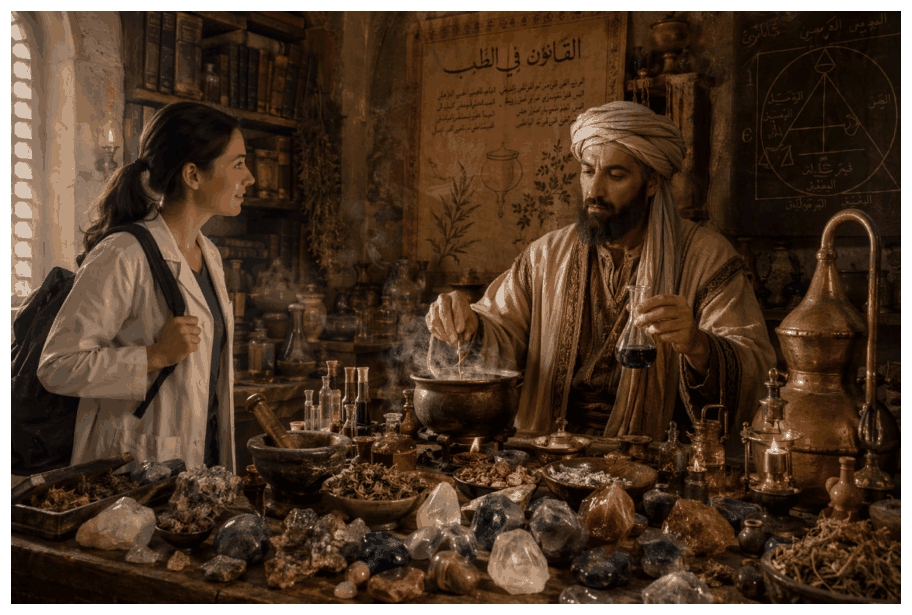
A chemist found herself in the 11th Century, where she met the renowned physician Avicenna. In Avicenna's laboratory, she discovered a blue elixir and a yellow mysterious stone. She brought them back to 2026. Determined to uncover their composition, she began her research.
Part 1. The blue elixir
At first, the chemist compiled a table listing the names of the only four plants which she saw in Avicenna’s lab that could have been used to prepare the elixir, and the compounds that can be extracted from these plants.
| Plants | Compounds that can be extracted | ||
|---|---|---|---|
| Zingiber | 1 (\(\ce{C11H14O3}\)) | 2 (\(\ce{C10H18O}\)) | 3 (\(\ce{C10H18O}\)) |
| Hypericum | 4 (\(\ce{C6H12O}\)) | 5 (\(\ce{C10H12O2}\)) | 6 (\(\ce{C10H18O}\)) |
| Chamomilla | 7 (\(\ce{C14H16}\)) | 8 (\(\ce{C15H24}\)) | 3 (\(\ce{C10H18O}\)) |
| Artemisia | 9 (\(\ce{C10H16O}\)) | 10 (\(\ce{C10H18O}\)) | 3 (\(\ce{C10H18O}\)) |
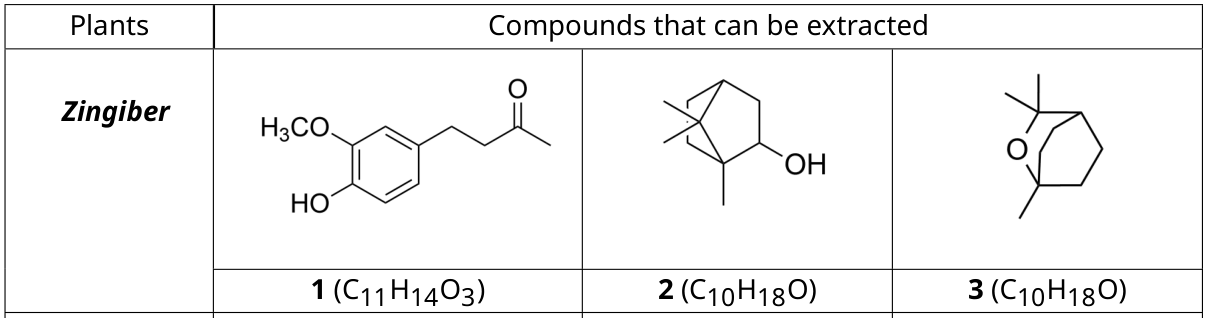

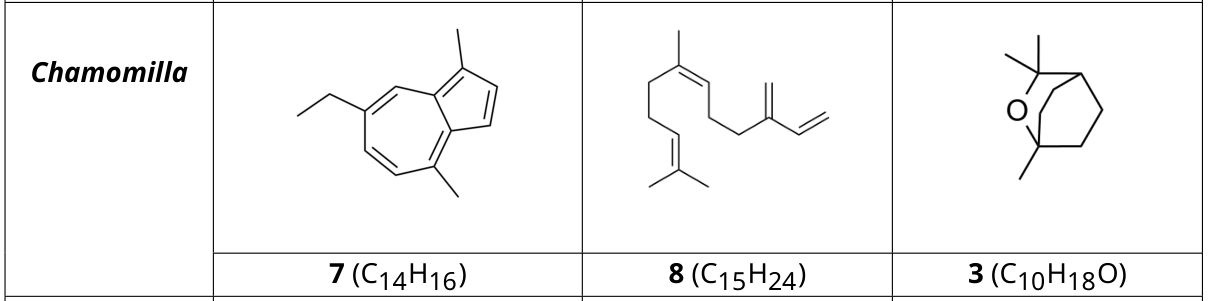
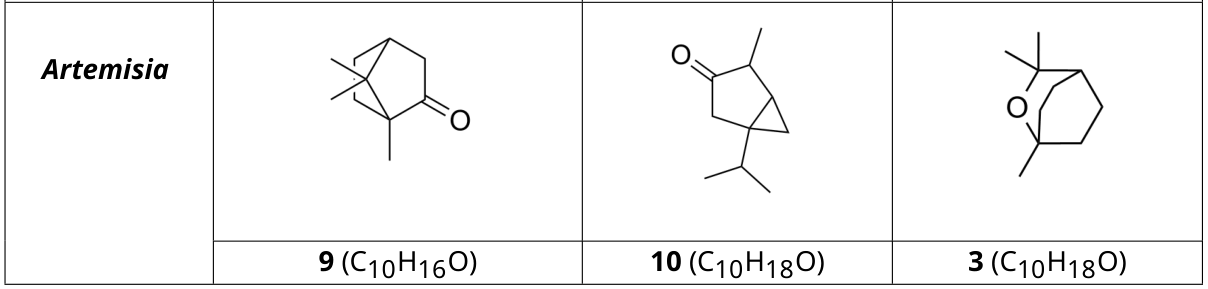
Using chromatography, she determined that the elixir consists of four different substances (X, Y, Z and W).
The chemist then discovered that X can isomerise into Y in an acidic medium and that Y has a plane of symmetry.
1.1 Identify X and Y. — 3.0 pt
Chromatography also revealed it was substance Z that gave the elixir its blue colour. Z is a derivative of the well-known substance A, which has two perpendicular planes of symmetry. When heated, A isomerises into aromatic compound B, which has three mutually perpendicular planes of symmetry. When substance Z is chlorinated, a pair of peaks with an intensity ratio of 3:1 is observed in the mass spectrum at \(m/z\) 218 and 220, respectively.
1.2 Identify Z and draw the structures of substances A and B. — 4.0 pt
The chemist extracted W from the elixir. When W was added to an aqueous \(\ce{Fe^3+}\) solution, a characteristic colour change was observed. Mass spectrometric analysis of W revealed the intensity ratio of \([\mathrm{M}]^+:[\mathrm{M}+1]^+=9:1\), where M is the molecular ion. Assume carbon consists exclusively of \(\ce{^{12}C}\) and \(\ce{^{13}C}\), the natural isotopic abundance of \(\ce{^{12}C}\) is 98.9%, and all other elements are monoisotopic.
1.3 Determine the number of carbon atoms (\(n\)) from the mass spec data and identify W. Show your calculations. — 3.0 pt
Part 2. The mysterious stone
Avicenna had told her the stone was a stoichiometric compound. She dissolved it in dilute nitric acid. After that, she adjusted the pH of the solution to ~4 and added \(\ce{NaF}\). This led to the formation of precipitate \(\mathbf{C}\cdot x\ce{H2O}\), which contained 39.16% water by mass. Anhydrous C reacts with an excess of \(\ce{NaF}\) to yield compound D, which contains 32.85% sodium and 12.85% of metal Q by mass, and is used in the industrial production of Q.
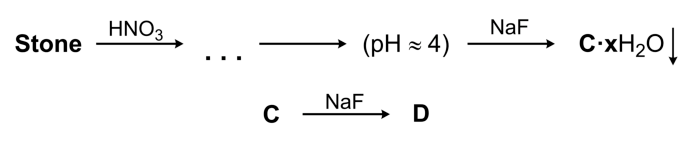
1.4 Identify metal Q and compounds \(\mathbf{C}\cdot x\ce{H2O}\) and D. — 4.0 pt
Avicenna told her that he found the stone in a coal deposit. The stone contains the anion of a highly symmetrical acid F. Reaction of F with \(\ce{P2O5}\) gives binary compound G, which contains 49.98% of oxygen by mass and has a three-fold symmetry axis. F can be prepared by oxidising compound E with potassium permanganate in an acidic solution. E contains 11.18% of hydrogen by mass and has a six-fold symmetry axis.
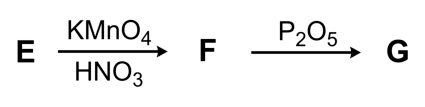
1.5 Draw the structures of E, F, and G. — 7.0 pt
Then, she analysed the stone thermogravimetrically in open air. A 10.00 g sample began to lose mass at approximately \(100\,^\circ\mathrm{C}\) and stopped at 5.75 g at \(200\,^\circ\mathrm{C}\). A second drop in mass was observed at \(400\,^\circ\mathrm{C}\), with a final mass of 1.50 g of compound H remaining constant at higher temperatures.
1.6 Determine the chemical formulae of the stone and compound H using thermogravimetric data. — 4.0 pt
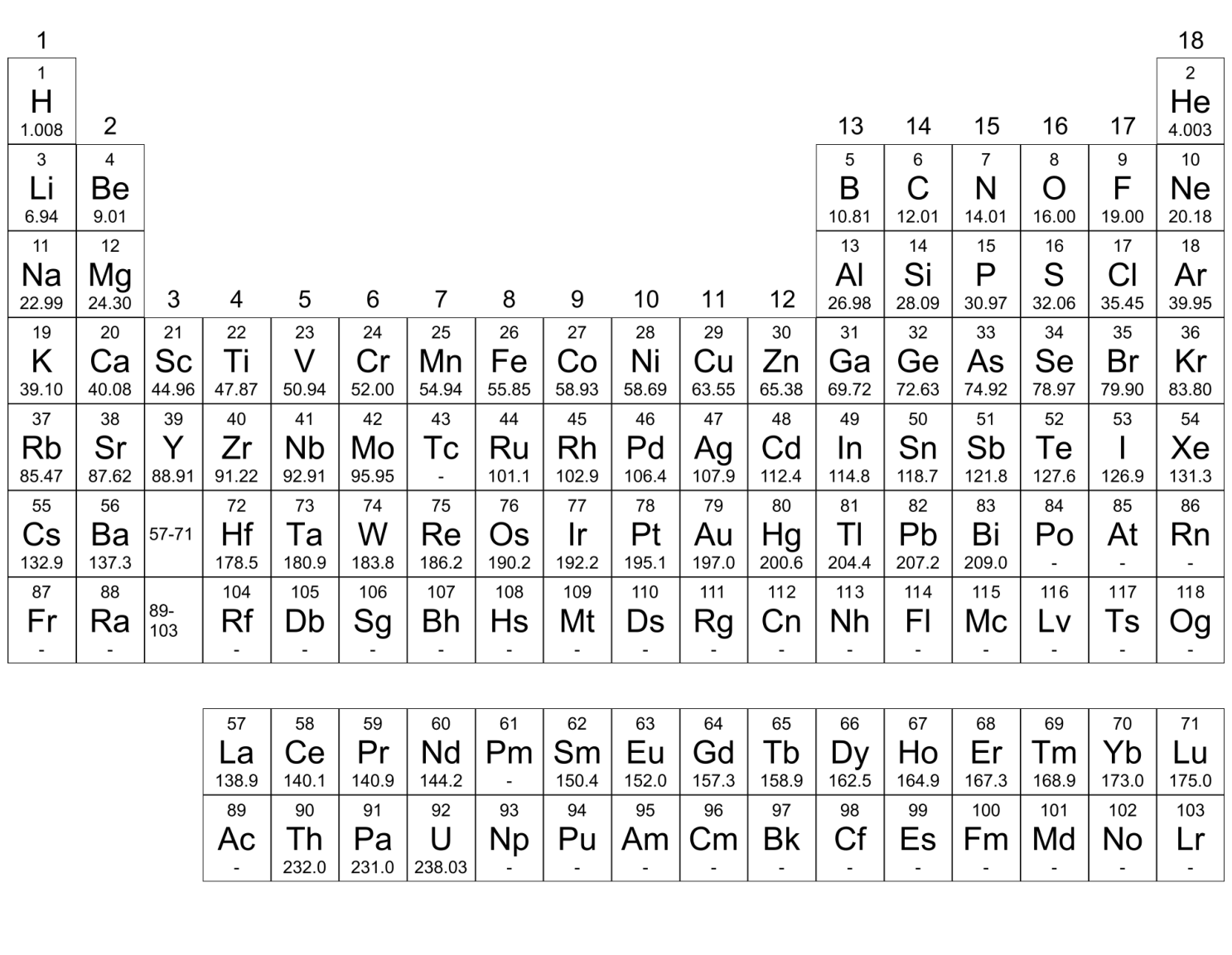
Periodic Table of Elements
Official English text of the problem.
Answers
- 1.1: X = 6, linalool; Y = 3, 1,8-cineole (eucalyptol).
- 1.2: Z = 7, chamazulene; A is azulene; B is naphthalene.
- 1.3: \(n=\boxed{10}\); W = 5, eugenol.
- 1.4: Q is aluminium; \(\mathbf{C}\cdot x\ce{H2O}=\boxed{\ce{AlF3.3H2O}}\), so \(x=3\); D is cryolite, \(\boxed{\ce{Na3AlF6}}\).
- 1.5: E is hexamethylbenzene, \(\ce{C12H18}\); F is mellitic acid, \(\ce{C6(COOH)6}\); G is mellitic trianhydride, \(\ce{C12O9}\).
- 1.6: The stone is mellite, \(\boxed{\ce{Al2[C6(COO)6].16H2O}}\); H is aluminium oxide, \(\boxed{\ce{Al2O3}}\).
Solution
1.1
X is compound 6, linalool, or 3,7-dimethylocta-1,6-dien-3-ol:
C=CC(C)(O)CCC=C(C)C
Y is compound 3, 1,8-cineole, also called eucalyptol:
CC12CCC(CC1)C(C)(C)O2
Linalool can undergo acid-catalysed rearrangement and cyclisation to 1,8-cineole. The net transformation conserves the molecular formula:
\[ \ce{C10H18O ->[H^+] C10H18O} \qquad(\mathbf X\longrightarrow\mathbf Y). \]
The acyclic diene alcohol becomes a saturated bicyclic ether: two double bonds are replaced by two rings.
In 1,8-cineole, a mirror plane contains the oxygen-containing bridge and the two bridgehead carbons, and exchanges the two equivalent carbon bridges. This satisfies the symmetry clue. Linalool’s configuration is unspecified in the supplied drawing, so its SMILES does not assign an enantiomer.
1.2
The required parent compound is A, azulene, \(\ce{C10H8}\):
C1=CC=C2C=CC=C2C=C1
Its structure consists of a five-membered ring fused to a seven-membered ring, with a delocalised aromatic \(10\pi\)-electron system. To draw it, show these two rings sharing one edge and five double bonds in a valid Kekulé arrangement.
Azulene has two perpendicular mirror planes: the molecular plane and a plane perpendicular to it that bisects both rings.
On heating, azulene isomerises to B, naphthalene, \(\ce{C10H8}\):
c1ccc2ccccc2c1
\[ \ce{C10H8 ->[\Delta] C10H8} \qquad(\mathbf A\longrightarrow\mathbf B). \]
Naphthalene consists of two fused six-membered aromatic rings. Its molecular plane and the two planes perpendicular to it through its long and short molecular axes are three mutually perpendicular mirror planes.
Thus the blue component is Z, compound 7, chamazulene, or 7-ethyl-1,4-dimethylazulene, \(\ce{C14H16}\):
CCC1=CC2=C(C)C=CC2=C(C)C=C1
The chlorination data independently confirm this identification. A molecular-ion pair separated by two mass units with approximately \(3:1\) intensities is characteristic of one chlorine atom, arising from \(\ce{^{35}Cl}\) and \(\ce{^{37}Cl}\).
Monochlorination by substitution gives:
\[ \ce{C14H16 + Cl2 -> C14H15Cl + HCl}. \]
The nominal masses of the two chlorine isotopologues are
\[ 14(12)+15(1)+35=218, \] \[ 14(12)+15(1)+37=220. \]
These are exactly the stated peaks. Their masses establish the chlorinated formula without requiring the chlorine substitution position.
1.3
Let
\[ p=P(\ce{^{12}C})=0.989,\qquad q=P(\ce{^{13}C})=0.011. \]
For a molecule containing \(n\) carbon atoms, the probabilities of containing no \(\ce{^{13}C}\) atoms and exactly one \(\ce{^{13}C}\) atom are
\[ P_0=p^n,\qquad P_1=nqp^{n-1}. \]
Therefore,
\[ \frac{I(M+1)}{I(M)} =\frac{P_1}{P_0} =n\frac{q}{p} =\frac{1}{9}. \]
Hence
\[ n=\frac{0.989}{9(0.011)} =9.9899\approx\boxed{10}. \]
The small departure from an integer reflects rounding of the supplied abundance and intensity ratio.
The characteristic colour with aqueous iron(III) identifies a phenolic group, through formation of coloured iron–phenolate complexes. Compounds 1 and 5 contain phenolic hydroxyl groups, but only 5 contains ten carbon atoms.
Thus W is compound 5, eugenol, or 2-methoxy-4-(prop-2-en-1-yl)phenol, \(\ce{C10H12O2}\):
COc1cc(CC=C)ccc1O
1.4
Compound D is a sodium–metal fluoride. Its fluorine mass percentage is
\[ w_{\mathrm F}=100.00-32.85-12.85=54.30\%. \]
For \(100.00\ \mathrm g\) of D,
\[ n_{\mathrm{Na}} =\frac{32.85\ \mathrm g}{22.99\ \mathrm{g\,mol^{-1}}} =1.4289\ \mathrm{mol}, \]
\[ n_{\mathrm F} =\frac{54.30\ \mathrm g}{19.00\ \mathrm{g\,mol^{-1}}} =2.8579\ \mathrm{mol}. \]
Thus \(\mathrm{Na:F}=1:2\). A formula written with one metal atom is consequently \(\ce{Na_aQF_{2a}}\), with the metal in oxidation state \(+a\). Its atomic molar mass must satisfy
\[ \frac{M_Q}{a} =\frac{12.85}{32.85}(22.99) =8.993\ \mathrm{g\,mol^{-1}}. \]
For \(a=3\), this gives \(M_Q=26.98\ \mathrm{g\,mol^{-1}}\), identifying aluminium.
Thus Q is aluminium, \(\ce{Al}\), SMILES [Al], and D is cryolite, sodium hexafluoroaluminate, \(\ce{Na3AlF6}\).
Its molar mass is
\[ M_D=3(22.99)+26.98+6(19.00) =209.95\ \mathrm{g\,mol^{-1}}. \]
The calculated percentages are
\[ w_{\mathrm{Na}}=\frac{68.97}{209.95}(100\%)=32.85\%, \qquad w_{\mathrm{Al}}=\frac{26.98}{209.95}(100\%)=12.85\%. \]
Cryolite is used as the molten electrolyte medium in aluminium production, agreeing with the industrial clue.
Its ionic-composition SMILES is:
[Na+].[Na+].[Na+].[Al+3].[F-].[F-].[F-].[F-].[F-].[F-]
Cryolite contains octahedral \(\ce{[AlF6]^3-}\) units. The disconnected SMILES records composition and charges, not this coordination geometry or the crystal lattice.
C is aluminium fluoride, \(\ce{AlF3}\):
[Al+3].[F-].[F-].[F-]
Since
\[ M_{\ce{AlF3}}=26.98+3(19.00)=83.98\ \mathrm{g\,mol^{-1}}, \]
the hydrate’s water fraction gives
\[ \frac{18.016x}{83.98+18.016x}=0.3916. \]
Therefore,
\[ x=\frac{0.3916(83.98)}{0.6084(18.016)} =3.0003\approx\boxed{3}. \]
The precipitate is aluminium fluoride trihydrate, \(\ce{AlF3.3H2O}\):
[Al+3].[F-].[F-].[F-].O.O.O
The relevant balanced reactions are
\[ \ce{Al^3+ + 3F- + 3H2O -> AlF3.3H2O(s)} \]
and
\[ \ce{AlF3 + 3NaF -> Na3AlF6}. \]
1.5
E is hexamethylbenzene, \(\ce{C12H18}\):
Cc1c(C)c(C)c(C)c(C)c1C
To draw E, place a methyl group on every carbon of a benzene ring. The six equivalent substituents give the required sixfold symmetry of the substitution pattern about an axis perpendicular to the ring.
Its hydrogen mass percentage is
\[ w_{\mathrm H} = \frac{18(1.008)} {12(12.01)+18(1.008)}(100\%) =11.1818\%\approx11.18\%. \]
Oxidation of all six benzylic methyl groups to carboxyl groups produces F, mellitic acid, or benzenehexacarboxylic acid, \(\ce{C6(COOH)6}\):
O=C(O)c1c(C(=O)O)c(C(=O)O)c(C(=O)O)c(C(=O)O)c1C(=O)O
To draw F, replace each methyl group in E by \(\ce{-COOH}\).
Each methyl carbon undergoes a six-electron oxidation, giving 36 electrons per molecule of E. The balanced oxidation half-reaction is
\[ \ce{C12H18 + 12H2O -> C12H6O12 + 36H+ + 36e-}. \]
Combining this with acidic permanganate reduction gives
\[ \ce{5C12H18 + 36MnO4- + 108H+ -> 5C12H6O12 + 36Mn^2+ + 84H2O}. \]
Dehydration of three adjacent pairs of carboxyl groups gives G, mellitic trianhydride, \(\ce{C12O9}\):
O=C1OC(=O)c2c1c1c(c3c2C(=O)OC3=O)C(=O)OC1=O
To draw G, retain the central benzene ring and form cyclic anhydrides from carboxyl pairs at positions \(1,2\), \(3,4\), and \(5,6\). Each pair becomes a five-membered ring containing the linkage \(\ce{-C(=O)-O-C(=O)-}\), fused to one edge of the benzene ring. Rotation by \(120^\circ\) exchanges the three anhydride rings, giving a threefold axis perpendicular to the central ring.
Formally, F loses three water molecules:
\[ \ce{C12H6O12 -> C12O9 + 3H2O}. \]
Including their uptake by the dehydrating agent, the net balance is
\[ \ce{C12H6O12 + P2O5 -> C12O9 + 2H3PO4}. \]
The oxygen percentage of G is
\[ w_{\mathrm O} = \frac{9(16.00)} {12(12.01)+9(16.00)}(100\%) =49.9792\%\approx49.98\%. \]
Thus both the elemental composition and symmetry agree.
1.6
Mellitic acid is hexabasic. Its fully deprotonated anion has charge \(6-\), so charge balance with aluminium(III) gives the anhydrous salt
\[ \ce{Al2[C6(COO)6]}=\ce{Al2C12O12}. \]
Its molar mass is
\[ M_{\text{anhydrous}} =2(26.98)+12(12.01)+12(16.00) =390.08\ \mathrm{g\,mol^{-1}}. \]
The first mass loss is dehydration:
\[ m_{\text{water}}=10.00-5.75=4.25\ \mathrm g, \]
\[ n_{\text{water}} =\frac{4.25}{18.016} =0.2359\ \mathrm{mol}. \]
The amount of anhydrous salt is
\[ n_{\text{salt}} =\frac{5.75}{390.08} =0.0147406\ \mathrm{mol}. \]
Therefore, the number of waters per formula unit is
\[ x=\frac{0.235901}{0.0147406} =16.0036\approx\boxed{16}. \]
The stone is consequently mellite, aluminium mellitate hexadecahydrate:
\[ \boxed{\ce{Al2[C6(COO)6].16H2O}}. \]
Its formula-unit composition SMILES is:
[Al+3].[Al+3].O=C([O-])c1c(C(=O)[O-])c(C(=O)[O-])c(C(=O)[O-])c(C(=O)[O-])c1C(=O)[O-].O.O.O.O.O.O.O.O.O.O.O.O.O.O.O.O
This notation gives the two aluminium ions, mellitate anion, and sixteen waters; it does not assign their solid-state coordination.
The dehydration equation is
\[ \ce{Al2C12O12.16H2O ->[\Delta] Al2C12O12 + 16H2O}. \]
In air, the organic anion is oxidised, leaving H, aluminium oxide, \(\ce{Al2O3}\):
[Al+3].[Al+3].[O-2].[O-2].[O-2]
The balanced oxidation is
\[ \ce{2Al2C12O12 + 15O2 ->[\Delta] 2Al2O3 + 24CO2}. \]
Thus
\[ M_{\ce{Al2O3}}=2(26.98)+3(16.00) =101.96\ \mathrm{g\,mol^{-1}}. \]
Using
\[ M_{\text{stone}}=390.08+16(18.016) =678.336\ \mathrm{g\,mol^{-1}}, \]
the two predicted residue masses from \(10.00\ \mathrm g\) are
\[ m_{\text{anhydrous}} =10.00\frac{390.08}{678.336} =5.7505\ \mathrm g \approx5.75\ \mathrm g, \]
\[ m_{\ce{Al2O3}} =10.00\frac{101.96}{678.336} =1.5031\ \mathrm g \approx1.50\ \mathrm g. \]
Both agree with the measured plateaus. The second mass loss is a net loss: oxygen enters from the air while carbon dioxide leaves.
The earlier dissolution in nitric acid is also consistent with this formula:
\[ \ce{Al2C12O12.16H2O + 6HNO3 -> 2Al(NO3)3 + C12H6O12 + 16H2O}. \]
The solution was checked against the official solution.
IChO 2026 · Theorieaufgabe 1
Eine Reise durch die Zeit: Die Geheimnisse Avicennas
T1. Eine Reise durch die Zeit: Die Geheimnisse Avicennas
7%
| 1.1 | 1.2 | 1.3 | 1.4 | 1.5 | 1.6 | \(\sum\) |
|---|---|---|---|---|---|---|
| 3 | 4 | 3 | 4 | 7 | 4 | 25 |
Eine Chemikerin fand sich im 11. Jahrhundert wieder, wo sie dem berühmten Arzt Avicenna begegnete. In Avicennas Labor entdeckte sie ein blaues Elixier und einen gelben geheimnisvollen Stein. Sie brachte beide mit zurück ins Jahr 2026. Entschlossen, ihre Zusammensetzung aufzuklären, begann sie mit ihren Untersuchungen.
Teil 1. Das blaue Elixier
Zunächst stellte die Chemikerin eine Tabelle mit den Namen der einzigen vier Pflanzen zusammen, die sie in Avicennas Labor gesehen hatte und die zur Herstellung des Elixiers hätten verwendet werden können, sowie mit den Verbindungen, die sich aus diesen Pflanzen extrahieren lassen.
| Pflanzen | Extrahierbare Verbindungen | ||
|---|---|---|---|
| Zingiber | 1 (\(\ce{C11H14O3}\)) | 2 (\(\ce{C10H18O}\)) | 3 (\(\ce{C10H18O}\)) |
| Hypericum | 4 (\(\ce{C6H12O}\)) | 5 (\(\ce{C10H12O2}\)) | 6 (\(\ce{C10H18O}\)) |
| Chamomilla | 7 (\(\ce{C14H16}\)) | 8 (\(\ce{C15H24}\)) | 3 (\(\ce{C10H18O}\)) |
| Artemisia | 9 (\(\ce{C10H16O}\)) | 10 (\(\ce{C10H18O}\)) | 3 (\(\ce{C10H18O}\)) |
Mithilfe der Chromatographie stellte sie fest, dass das Elixier aus vier verschiedenen Stoffen (X, Y, Z und W) besteht.
Anschließend entdeckte die Chemikerin, dass X in saurem Medium zu Y isomerisieren kann und dass Y eine Symmetrieebene besitzt.
1.1 Identifizieren Sie X und Y. — 3.0 Pkt.
Die Chromatographie zeigte außerdem, dass der Stoff Z dem Elixier seine blaue Farbe verlieh. Z ist ein Derivat des wohlbekannten Stoffes A, der zwei senkrecht zueinander stehende Symmetrieebenen besitzt. Beim Erhitzen isomerisiert A zur aromatischen Verbindung B, die drei paarweise senkrecht zueinander stehende Symmetrieebenen besitzt. Bei der Chlorierung des Stoffes Z wird im Massenspektrum ein Peakpaar bei \(m/z\) 218 bzw. 220 mit einem Intensitätsverhältnis von 3:1 beobachtet.
1.2 Identifizieren Sie Z und zeichnen Sie die Strukturen der Stoffe A und B. — 4.0 Pkt.
Die Chemikerin extrahierte W aus dem Elixier. Als W zu einer wässrigen \(\ce{Fe^3+}\)-Lösung gegeben wurde, beobachtete sie eine charakteristische Farbänderung. Die massenspektrometrische Analyse von W ergab das Intensitätsverhältnis \([\mathrm{M}]^+:[\mathrm{M}+1]^+=9:1\), wobei M das Molekülion ist. Nehmen Sie an, dass Kohlenstoff ausschließlich aus \(\ce{^{12}C}\) und \(\ce{^{13}C}\) besteht, die natürliche Isotopenhäufigkeit von \(\ce{^{12}C}\) 98.9% beträgt und alle anderen Elemente monoisotopisch sind.
1.3 Bestimmen Sie die Anzahl der Kohlenstoffatome (\(n\)) anhand der massenspektrometrischen Daten und identifizieren Sie W. Geben Sie Ihre Berechnungen an. — 3.0 Pkt.
Teil 2. Der geheimnisvolle Stein
Avicenna hatte ihr erzählt, dass der Stein eine stöchiometrische Verbindung sei. Sie löste ihn in verdünnter Salpetersäure. Danach stellte sie den pH-Wert der Lösung auf ~4 ein und gab \(\ce{NaF}\) hinzu. Dies führte zur Bildung des Niederschlags \(\mathbf{C}\cdot x\ce{H2O}\), dessen Wassergehalt 39.16 Massenprozent betrug. Wasserfreies C reagiert mit einem Überschuss an \(\ce{NaF}\) zur Verbindung D, die 32.85 Massenprozent Natrium und 12.85 Massenprozent des Metalls Q enthält und bei der industriellen Herstellung von Q verwendet wird.
1.4 Identifizieren Sie das Metall Q und die Verbindungen \(\mathbf{C}\cdot x\ce{H2O}\) und D. — 4.0 Pkt.
Avicenna erzählte ihr, dass er den Stein in einer Kohlelagerstätte gefunden hatte. Der Stein enthält das Anion einer hochsymmetrischen Säure F. Die Reaktion von F mit \(\ce{P2O5}\) ergibt die binäre Verbindung G, die 49.98 Massenprozent Sauerstoff enthält und eine dreizählige Symmetrieachse besitzt. F lässt sich durch Oxidation der Verbindung E mit Kaliumpermanganat in saurer Lösung herstellen. E enthält 11.18 Massenprozent Wasserstoff und besitzt eine sechszählige Symmetrieachse.
1.5 Zeichnen Sie die Strukturen von E, F und G. — 7.0 Pkt.
Anschließend analysierte sie den Stein thermogravimetrisch an der Luft. Eine Probe von 10.00 g begann bei etwa \(100\,^\circ\mathrm{C}\) an Masse zu verlieren und erreichte bei \(200\,^\circ\mathrm{C}\) eine konstante Masse von 5.75 g. Ein zweiter Massenverlust wurde bei \(400\,^\circ\mathrm{C}\) beobachtet; dabei verblieb eine Endmasse von 1.50 g der Verbindung H, die bei höheren Temperaturen konstant blieb.
1.6 Bestimmen Sie mithilfe der thermogravimetrischen Daten die chemischen Formeln des Steins und der Verbindung H. — 4.0 Pkt.
Periodensystem der Elemente
Aufgabentext aus dem offiziellen englischen Text übersetzt.
Antworten
- 1.1: X = 6, Linalool; Y = 3, 1,8-Cineol (Eucalyptol).
- 1.2: Z = 7, Chamazulen; A ist Azulen; B ist Naphthalin.
- 1.3: \(n=\boxed{10}\); W = 5, Eugenol.
- 1.4: Q ist Aluminium; \(\mathbf{C}\cdot x\ce{H2O}=\boxed{\ce{AlF3.3H2O}}\), also \(x=3\); D ist Kryolith, \(\boxed{\ce{Na3AlF6}}\).
- 1.5: E ist Hexamethylbenzol, \(\ce{C12H18}\); F ist Mellitsäure, \(\ce{C6(COOH)6}\); G ist Mellitsäuretrianhydrid, \(\ce{C12O9}\).
- 1.6: Der Stein ist Mellit, \(\boxed{\ce{Al2[C6(COO)6].16H2O}}\); H ist Aluminiumoxid, \(\boxed{\ce{Al2O3}}\).
Lösung
1.1
X ist Verbindung 6, Linalool, oder 3,7-Dimethylocta-1,6-dien-3-ol:
C=CC(C)(O)CCC=C(C)C
Y ist Verbindung 3, 1,8-Cineol, auch Eucalyptol genannt:
CC12CCC(CC1)C(C)(C)O2
Linalool kann durch säurekatalysierte Umlagerung und Cyclisierung in 1,8-Cineol übergehen. Bei der Gesamtumwandlung bleibt die Summenformel erhalten:
\[ \ce{C10H18O ->[H^+] C10H18O} \qquad(\mathbf X\longrightarrow\mathbf Y). \]
Der acyclische Dienalkohol wird zu einem gesättigten bicyclischen Ether: Zwei Doppelbindungen werden durch zwei Ringe ersetzt.
In 1,8-Cineol enthält eine Spiegelebene die sauerstoffhaltige Brücke und die beiden Brückenkopf-Kohlenstoffatome und führt die beiden äquivalenten Kohlenstoffbrücken ineinander über. Damit ist der Hinweis auf die Symmetrie erfüllt. Die Konfiguration von Linalool ist in der vorgegebenen Zeichnung nicht angegeben, daher legt seine SMILES-Zeichenfolge kein Enantiomer fest.
1.2
Die gesuchte Stammverbindung ist A, Azulen, \(\ce{C10H8}\):
C1=CC=C2C=CC=C2C=C1
Seine Struktur besteht aus einem Fünfring, der mit einem Siebenring anelliert ist, mit einem delokalisierten aromatischen \(10\pi\)-Elektronensystem. Zeichnen Sie diese beiden Ringe mit einer gemeinsamen Kante und fünf Doppelbindungen in einer gültigen Kekulé-Anordnung.
Azulen besitzt zwei senkrecht zueinander stehende Spiegelebenen: die Molekülebene und eine dazu senkrechte Ebene, die beide Ringe halbiert.
Beim Erhitzen isomerisiert Azulen zu B, Naphthalin, \(\ce{C10H8}\):
c1ccc2ccccc2c1
\[ \ce{C10H8 ->[\Delta] C10H8} \qquad(\mathbf A\longrightarrow\mathbf B). \]
Naphthalin besteht aus zwei anellierten aromatischen Sechsringen. Seine Molekülebene und die beiden dazu senkrechten Ebenen durch die lange bzw. kurze Molekülachse bilden drei paarweise senkrecht zueinander stehende Spiegelebenen.
Somit ist die blaue Komponente Z, Verbindung 7, Chamazulen, oder 7-Ethyl-1,4-dimethylazulen, \(\ce{C14H16}\):
CCC1=CC2=C(C)C=CC2=C(C)C=C1
Die Daten zur Chlorierung bestätigen diese Identifizierung unabhängig davon. Ein Molekülionen-Peakpaar mit einem Abstand von zwei Masseneinheiten und einem Intensitätsverhältnis von ungefähr \(3:1\) ist charakteristisch für ein Chloratom und entsteht durch \(\ce{^{35}Cl}\) und \(\ce{^{37}Cl}\).
Die Monochlorierung durch Substitution ergibt:
\[ \ce{C14H16 + Cl2 -> C14H15Cl + HCl}. \]
Die Nominalmassen der beiden Chlor-Isotopologen betragen
\[ 14(12)+15(1)+35=218, \] \[ 14(12)+15(1)+37=220. \]
Dies entspricht genau den angegebenen Peaks. Ihre Massen legen die Formel der chlorierten Verbindung fest, ohne dass die Position des Chlorsubstituenten bekannt sein muss.
1.3
Es seien
\[ p=P(\ce{^{12}C})=0.989,\qquad q=P(\ce{^{13}C})=0.011. \]
Für ein Molekül mit \(n\) Kohlenstoffatomen betragen die Wahrscheinlichkeiten, kein \(\ce{^{13}C}\)-Atom bzw. genau ein \(\ce{^{13}C}\)-Atom zu enthalten,
\[ P_0=p^n,\qquad P_1=nqp^{n-1}. \]
Daher gilt
\[ \frac{I(M+1)}{I(M)} =\frac{P_1}{P_0} =n\frac{q}{p} =\frac{1}{9}. \]
Somit folgt
\[ n=\frac{0.989}{9(0.011)} =9.9899\approx\boxed{10}. \]
Die geringe Abweichung von einer ganzen Zahl ergibt sich aus der Rundung der angegebenen Isotopenhäufigkeit und des Intensitätsverhältnisses.
Die charakteristische Färbung mit Eisen(III) in wässriger Lösung weist durch die Bildung farbiger Eisen-Phenolat-Komplexe eine phenolische Gruppe nach. Die Verbindungen 1 und 5 enthalten phenolische Hydroxygruppen, aber nur 5 enthält zehn Kohlenstoffatome.
Somit ist W Verbindung 5, Eugenol, oder 2-Methoxy-4-(prop-2-en-1-yl)phenol, \(\ce{C10H12O2}\):
COc1cc(CC=C)ccc1O
1.4
Verbindung D ist ein Natrium-Metall-Fluorid. Ihr Fluor-Massenanteil beträgt
\[ w_{\mathrm F}=100.00-32.85-12.85=54.30\%. \]
Für \(100.00\ \mathrm g\) von D gilt
\[ n_{\mathrm{Na}} =\frac{32.85\ \mathrm g}{22.99\ \mathrm{g\,mol^{-1}}} =1.4289\ \mathrm{mol}, \]
\[ n_{\mathrm F} =\frac{54.30\ \mathrm g}{19.00\ \mathrm{g\,mol^{-1}}} =2.8579\ \mathrm{mol}. \]
Somit ist \(\mathrm{Na:F}=1:2\). Eine auf ein Metallatom bezogene Formel lautet folglich \(\ce{Na_aQF_{2a}}\), wobei das Metall die Oxidationsstufe \(+a\) besitzt. Seine molare Atommasse muss die folgende Beziehung erfüllen:
\[ \frac{M_Q}{a} =\frac{12.85}{32.85}(22.99) =8.993\ \mathrm{g\,mol^{-1}}. \]
Für \(a=3\) ergibt sich \(M_Q=26.98\ \mathrm{g\,mol^{-1}}\), womit Aluminium identifiziert ist.
Somit ist Q Aluminium, \(\ce{Al}\), SMILES [Al], und D ist Kryolith, Natriumhexafluoroaluminat, \(\ce{Na3AlF6}\).
Seine molare Masse beträgt
\[ M_D=3(22.99)+26.98+6(19.00) =209.95\ \mathrm{g\,mol^{-1}}. \]
Die berechneten prozentualen Massenanteile sind
\[ w_{\mathrm{Na}}=\frac{68.97}{209.95}(100\%)=32.85\%, \qquad w_{\mathrm{Al}}=\frac{26.98}{209.95}(100\%)=12.85\%. \]
Kryolith wird bei der Aluminiumherstellung als geschmolzenes Elektrolytmedium verwendet, was mit dem Hinweis auf die industrielle Verwendung übereinstimmt.
Seine SMILES-Darstellung der Ionenzusammensetzung lautet:
[Na+].[Na+].[Na+].[Al+3].[F-].[F-].[F-].[F-].[F-].[F-]
Kryolith enthält oktaedrische \(\ce{[AlF6]^3-}\)-Einheiten. Die SMILES-Darstellung mit unverbundenen Komponenten erfasst Zusammensetzung und Ladungen, nicht jedoch diese Koordinationsgeometrie oder das Kristallgitter.
C ist Aluminiumfluorid, \(\ce{AlF3}\):
[Al+3].[F-].[F-].[F-]
Da
\[ M_{\ce{AlF3}}=26.98+3(19.00)=83.98\ \mathrm{g\,mol^{-1}}, \]
ergibt sich aus dem Wasseranteil des Hydrats
\[ \frac{18.016x}{83.98+18.016x}=0.3916. \]
Daraus folgt
\[ x=\frac{0.3916(83.98)}{0.6084(18.016)} =3.0003\approx\boxed{3}. \]
Der Niederschlag ist Aluminiumfluorid-Trihydrat, \(\ce{AlF3.3H2O}\):
[Al+3].[F-].[F-].[F-].O.O.O
Die zugehörigen ausgeglichenen Reaktionsgleichungen lauten
\[ \ce{Al^3+ + 3F- + 3H2O -> AlF3.3H2O(s)} \]
und
\[ \ce{AlF3 + 3NaF -> Na3AlF6}. \]
1.5
E ist Hexamethylbenzol, \(\ce{C12H18}\):
Cc1c(C)c(C)c(C)c(C)c1C
Zeichnen Sie E, indem Sie an jedes Kohlenstoffatom eines Benzolrings eine Methylgruppe setzen. Die sechs äquivalenten Substituenten ergeben die geforderte sechszählige Symmetrie des Substitutionsmusters um eine Achse senkrecht zum Ring.
Sein Wasserstoff-Massenanteil beträgt
\[ w_{\mathrm H} = \frac{18(1.008)} {12(12.01)+18(1.008)}(100\%) =11.1818\%\approx11.18\%. \]
Die Oxidation aller sechs benzylischen Methylgruppen zu Carboxylgruppen ergibt F, Mellitsäure, oder Benzolhexacarbonsäure, \(\ce{C6(COOH)6}\):
O=C(O)c1c(C(=O)O)c(C(=O)O)c(C(=O)O)c(C(=O)O)c1C(=O)O
Um F zu zeichnen, ersetzen Sie jede Methylgruppe in E durch \(\ce{-COOH}\).
Jedes Methyl-Kohlenstoffatom gibt bei der Oxidation sechs Elektronen ab, insgesamt also 36 Elektronen pro Molekül E. Die ausgeglichene Oxidations-Teilgleichung lautet
\[ \ce{C12H18 + 12H2O -> C12H6O12 + 36H+ + 36e-}. \]
Die Kombination mit der Reduktion von Permanganat in saurer Lösung ergibt
\[ \ce{5C12H18 + 36MnO4- + 108H+ -> 5C12H6O12 + 36Mn^2+ + 84H2O}. \]
Die Dehydratisierung dreier Paare benachbarter Carboxylgruppen ergibt G, Mellitsäuretrianhydrid, \(\ce{C12O9}\):
O=C1OC(=O)c2c1c1c(c3c2C(=O)OC3=O)C(=O)OC1=O
Um G zu zeichnen, behalten Sie den zentralen Benzolring bei und bilden Sie cyclische Anhydride aus den Carboxylgruppenpaaren an den Positionen \(1,2\), \(3,4\) und \(5,6\). Jedes Paar wird zu einem Fünfring mit der Verknüpfung \(\ce{-C(=O)-O-C(=O)-}\), der an eine Kante des Benzolrings anelliert ist. Eine Drehung um \(120^\circ\) führt die drei Anhydridringe ineinander über, sodass eine dreizählige Achse senkrecht zum zentralen Ring vorliegt.
Formal verliert F drei Wassermoleküle:
\[ \ce{C12H6O12 -> C12O9 + 3H2O}. \]
Unter Einbeziehung ihrer Aufnahme durch das Dehydratisierungsmittel lautet die Gesamtbilanz
\[ \ce{C12H6O12 + P2O5 -> C12O9 + 2H3PO4}. \]
Der Sauerstoff-Massenanteil von G beträgt
\[ w_{\mathrm O} = \frac{9(16.00)} {12(12.01)+9(16.00)}(100\%) =49.9792\%\approx49.98\%. \]
Damit stimmen sowohl die Elementzusammensetzung als auch die Symmetrie überein.
1.6
Mellitsäure ist sechsbasig. Ihr vollständig deprotoniertes Anion hat die Ladung \(6-\), sodass der Ladungsausgleich mit Aluminium(III) das folgende wasserfreie Salz ergibt:
\[ \ce{Al2[C6(COO)6]}=\ce{Al2C12O12}. \]
Seine molare Masse beträgt
\[ M_{\text{wasserfrei}} =2(26.98)+12(12.01)+12(16.00) =390.08\ \mathrm{g\,mol^{-1}}. \]
Der erste Massenverlust ist eine Dehydratisierung:
\[ m_{\text{Wasser}}=10.00-5.75=4.25\ \mathrm g, \]
\[ n_{\text{Wasser}} =\frac{4.25}{18.016} =0.2359\ \mathrm{mol}. \]
Die Stoffmenge des wasserfreien Salzes beträgt
\[ n_{\text{Salz}} =\frac{5.75}{390.08} =0.0147406\ \mathrm{mol}. \]
Daher beträgt die Anzahl der Wassermoleküle pro Formeleinheit
\[ x=\frac{0.235901}{0.0147406} =16.0036\approx\boxed{16}. \]
Der Stein ist folglich Mellit, Aluminiummellitat-Hexadecahydrat:
\[ \boxed{\ce{Al2[C6(COO)6].16H2O}}. \]
Die SMILES-Darstellung der Zusammensetzung seiner Formeleinheit lautet:
[Al+3].[Al+3].O=C([O-])c1c(C(=O)[O-])c(C(=O)[O-])c(C(=O)[O-])c(C(=O)[O-])c1C(=O)[O-].O.O.O.O.O.O.O.O.O.O.O.O.O.O.O.O
Diese Schreibweise gibt die beiden Aluminiumionen, das Mellitat-Anion und die sechzehn Wassermoleküle an; sie legt deren Koordination im Festkörper nicht fest.
Die Dehydratisierungsgleichung lautet
\[ \ce{Al2C12O12.16H2O ->[\Delta] Al2C12O12 + 16H2O}. \]
An der Luft wird das organische Anion oxidiert, wobei H, Aluminiumoxid, \(\ce{Al2O3}\), zurückbleibt:
[Al+3].[Al+3].[O-2].[O-2].[O-2]
Die ausgeglichene Oxidationsgleichung lautet
\[ \ce{2Al2C12O12 + 15O2 ->[\Delta] 2Al2O3 + 24CO2}. \]
Somit gilt
\[ M_{\ce{Al2O3}}=2(26.98)+3(16.00) =101.96\ \mathrm{g\,mol^{-1}}. \]
Mit
\[ M_{\text{Stein}}=390.08+16(18.016) =678.336\ \mathrm{g\,mol^{-1}}, \]
ergeben sich aus \(10.00\ \mathrm g\) die beiden vorhergesagten Rückstandsmassen
\[ m_{\text{wasserfrei}} =10.00\frac{390.08}{678.336} =5.7505\ \mathrm g \approx5.75\ \mathrm g, \]
\[ m_{\ce{Al2O3}} =10.00\frac{101.96}{678.336} =1.5031\ \mathrm g \approx1.50\ \mathrm g. \]
Beide stimmen mit den gemessenen Plateaus überein. Der zweite Massenverlust ist ein Nettoverlust: Sauerstoff wird aus der Luft aufgenommen, während Kohlenstoffdioxid entweicht.
Auch das zuvor beschriebene Auflösen in Salpetersäure steht mit dieser Formel im Einklang:
\[ \ce{Al2C12O12.16H2O + 6HNO3 -> 2Al(NO3)3 + C12H6O12 + 16H2O}. \]
Die Lösung wurde mit der offiziellen Lösung abgeglichen.
IChO 2026 · Teori sorusu 1
Zamanda bir yolculuk: Avicenna'nın sırları
T1. Zamanda bir yolculuk: Avicenna'nın sırları
7%
| 1.1 | 1.2 | 1.3 | 1.4 | 1.5 | 1.6 | \(\sum\) |
|---|---|---|---|---|---|---|
| 3 | 4 | 3 | 4 | 7 | 4 | 25 |
Bir kimyager kendini 11. yüzyılda buldu ve burada ünlü hekim Avicenna ile tanıştı. Avicenna'nın laboratuvarında mavi bir iksir ve sarı, gizemli bir taş keşfetti. Bunları 2026 yılına geri getirdi. Bileşimlerini ortaya çıkarmaya kararlı olan kimyager, araştırmasına başladı.
Bölüm 1. Mavi iksir
Kimyager ilk olarak, Avicenna'nın laboratuvarında gördüğü ve iksirin hazırlanmasında kullanılmış olabilecek yalnızca dört bitkinin adlarını ve bu bitkilerden özütlenebilen bileşikleri listeleyen bir tablo hazırladı.
| Bitkiler | Özütlenebilen bileşikler | ||
|---|---|---|---|
| Zingiber | 1 (\(\ce{C11H14O3}\)) | 2 (\(\ce{C10H18O}\)) | 3 (\(\ce{C10H18O}\)) |
| Hypericum | 4 (\(\ce{C6H12O}\)) | 5 (\(\ce{C10H12O2}\)) | 6 (\(\ce{C10H18O}\)) |
| Chamomilla | 7 (\(\ce{C14H16}\)) | 8 (\(\ce{C15H24}\)) | 3 (\(\ce{C10H18O}\)) |
| Artemisia | 9 (\(\ce{C10H16O}\)) | 10 (\(\ce{C10H18O}\)) | 3 (\(\ce{C10H18O}\)) |
Kromatografi kullanarak iksirin dört farklı maddeden (X, Y, Z ve W) oluştuğunu belirledi.
Kimyager daha sonra X'in asidik ortamda izomerleşerek Y'ye dönüşebildiğini ve Y'nin bir simetri düzlemine sahip olduğunu keşfetti.
1.1 X ve Y'yi belirleyiniz. — 3.0 puan
Kromatografi ayrıca iksire mavi rengini veren maddenin Z olduğunu ortaya koydu. Z, birbirine dik iki simetri düzlemine sahip, iyi bilinen A maddesinin bir türevidir. A, ısıtıldığında, birbirine dik üç simetri düzlemine sahip aromatik B bileşiğine izomerleşir. Z maddesi klorlandığında, kütle spektrumunda sırasıyla \(m/z\) 218 ve 220'de, şiddet oranları 3:1 olan bir pik çifti gözlenir.
1.2 Z'yi belirleyiniz ve A ve B maddelerinin yapılarını çiziniz. — 4.0 puan
Kimyager iksirden W'yi özütledi. W, sulu bir \(\ce{Fe^3+}\) çözeltisine eklendiğinde karakteristik bir renk değişimi gözlendi. W'nin kütle spektrometrik analizi, M moleküler iyon olmak üzere, şiddet oranının \([\mathrm{M}]^+:[\mathrm{M}+1]^+=9:1\) olduğunu ortaya koydu. Karbonun yalnızca \(\ce{^{12}C}\) ve \(\ce{^{13}C}\)'ten oluştuğunu, \(\ce{^{12}C}\)'nin doğal izotop bolluğunun 98.9% olduğunu ve diğer tüm elementlerin tek izotoplu olduğunu varsayınız.
1.3 Kütle spektrumu verilerinden karbon atomlarının sayısını (\(n\)) belirleyiniz ve W'yi tanımlayınız. Hesaplamalarınızı gösteriniz. — 3.0 puan
Bölüm 2. Gizemli taş
Avicenna, kimyagere taşın stokiyometrik bir bileşik olduğunu söylemişti. Kimyager taşı seyreltik nitrik asitte çözdü. Ardından çözeltinin pH'ını ~4'e ayarladı ve \(\ce{NaF}\) ekledi. Bunun sonucunda, kütlece 39.16% su içeren \(\mathbf{C}\cdot x\ce{H2O}\) çökeltisi oluştu. Susuz C, aşırı miktarda \(\ce{NaF}\) ile tepkimeye girerek kütlece 32.85% sodyum ve 12.85% Q metali içeren ve Q'nun endüstriyel üretiminde kullanılan D bileşiğini oluşturur.
1.4 Q metalini ve \(\mathbf{C}\cdot x\ce{H2O}\) ve D bileşiklerini belirleyiniz. — 4.0 puan
Avicenna, kimyagere taşı bir kömür yatağında bulduğunu söyledi. Taş, yüksek simetriye sahip bir F asidinin anyonunu içerir. F'nin \(\ce{P2O5}\) ile tepkimesi, kütlece 49.98% oksijen içeren ve üç katlı bir simetri eksenine sahip olan ikili G bileşiğini verir. F, E bileşiğinin asidik çözeltide potasyum permanganat ile yükseltgenmesiyle hazırlanabilir. E, kütlece 11.18% hidrojen içerir ve altı katlı bir simetri eksenine sahiptir.
1.5 E, F ve G'nin yapılarını çiziniz. — 7.0 puan
Kimyager daha sonra taşı açık havada termogravimetrik olarak analiz etti. 10.00 g'lık bir örnek yaklaşık \(100\,^\circ\mathrm{C}\)'de kütle kaybetmeye başladı ve \(200\,^\circ\mathrm{C}\)'de kütlesi 5.75 g'a düşerek sabit kaldı. \(400\,^\circ\mathrm{C}\)'de ikinci bir kütle azalması gözlendi; geriye kalan H bileşiğinin 1.50 g'lık son kütlesi daha yüksek sıcaklıklarda sabit kaldı.
1.6 Termogravimetrik verileri kullanarak taşın ve H bileşiğinin kimyasal formüllerini belirleyiniz. — 4.0 puan
Elementlerin Periyodik Tablosu
Soru metni resmi İngilizce metinden çevrilmiştir.
Cevaplar
- 1.1: X = 6, linalool; Y = 3, 1,8-sineol (ökaliptol).
- 1.2: Z = 7, kamazulen; A azulendir; B naftalindir.
- 1.3: \(n=\boxed{10}\); W = 5, öjenol.
- 1.4: Q alüminyumdur; \(\mathbf{C}\cdot x\ce{H2O}=\boxed{\ce{AlF3.3H2O}}\), dolayısıyla \(x=3\); D kriyolittir, \(\boxed{\ce{Na3AlF6}}\).
- 1.5: E heksametilbenzendir, \(\ce{C12H18}\); F mellitik asittir, \(\ce{C6(COOH)6}\); G mellitik trianhidrittir, \(\ce{C12O9}\).
- 1.6: Taş mellittir, \(\boxed{\ce{Al2[C6(COO)6].16H2O}}\); H alüminyum oksittir, \(\boxed{\ce{Al2O3}}\).
Çözüm
1.1
X, 6 bileşiği olan linalooldür; diğer adıyla 3,7-dimetilokta-1,6-dien-3-ol:
C=CC(C)(O)CCC=C(C)C
Y, 3 bileşiği olan 1,8-sineoldür; ökaliptol olarak da adlandırılır:
CC12CCC(CC1)C(C)(C)O2
Linalool, asit katalizli yeniden düzenlenme ve halkalaşma geçirerek 1,8-sineole dönüşebilir. Net dönüşümde molekül formülü korunur:
\[ \ce{C10H18O ->[H^+] C10H18O} \qquad(\mathbf X\longrightarrow\mathbf Y). \]
Açık zincirli dien alkol, doymuş bisiklik bir etere dönüşür: iki çift bağın yerini iki halka alır.
1,8-sineolde bir ayna düzlemi, oksijen içeren köprüyü ve iki köprübaşı karbonunu içerir ve eşdeğer iki karbon köprüsünü birbirine dönüştürür. Bu, simetri ipucunu karşılar. Verilen çizimde linaloolün konfigürasyonu belirtilmediğinden, SMILES gösterimi belirli bir enantiyomer tanımlamaz.
1.2
Aranan ana bileşik A, azulen, \(\ce{C10H8}\)'dir:
C1=CC=C2C=CC=C2C=C1
Yapısı, yedi üyeli bir halkayla kaynaşmış beş üyeli bir halkadan oluşur ve delokalize aromatik bir \(10\pi\)-elektron sistemine sahiptir. Yapıyı çizmek için bu iki halkayı bir kenarı ortak olacak şekilde gösteriniz ve beş çift bağı geçerli bir Kekulé düzeninde yerleştiriniz.
Azulenin birbirine dik iki ayna düzlemi vardır: molekül düzlemi ve buna dik olup her iki halkayı da iki eş parçaya bölen bir düzlem.
Azulen ısıtıldığında B, naftalin, \(\ce{C10H8}\)'e izomerleşir:
c1ccc2ccccc2c1
\[ \ce{C10H8 ->[\Delta] C10H8} \qquad(\mathbf A\longrightarrow\mathbf B). \]
Naftalin, kaynaşmış iki altı üyeli aromatik halkadan oluşur. Molekül düzlemi ile bu düzleme dik olan ve molekülün uzun ve kısa eksenlerinden geçen iki düzlem, birbirine dik üç ayna düzlemini oluşturur.
Dolayısıyla mavi bileşen Z, 7 bileşiği olan kamazulen, diğer adıyla 7-etil-1,4-dimetilazulen, \(\ce{C14H16}\)'dır:
CCC1=CC2=C(C)C=CC2=C(C)C=C1
Klorlama verileri bu tanımlamayı bağımsız olarak doğrular. Aralarında iki kütle birimi fark bulunan ve şiddetleri yaklaşık \(3:1\) oranında olan bir moleküler iyon çifti, \(\ce{^{35}Cl}\) ve \(\ce{^{37}Cl}\)'den kaynaklanır ve tek bir klor atomu için karakteristiktir.
Yer değiştirme yoluyla monoklorlama şu sonucu verir:
\[ \ce{C14H16 + Cl2 -> C14H15Cl + HCl}. \]
İki klor izotopoloğunun nominal kütleleri şöyledir:
\[ 14(12)+15(1)+35=218, \] \[ 14(12)+15(1)+37=220. \]
Bunlar tam olarak belirtilen piklerdir. Kütleleri, klorun hangi konuma yerleştiğinin bilinmesini gerektirmeden klorlanmış bileşiğin formülünü belirler.
1.3
Şöyle tanımlayalım:
\[ p=P(\ce{^{12}C})=0.989,\qquad q=P(\ce{^{13}C})=0.011. \]
\(n\) karbon atomu içeren bir molekülün hiç \(\ce{^{13}C}\) atomu içermeme ve tam olarak bir \(\ce{^{13}C}\) atomu içerme olasılıkları şöyledir:
\[ P_0=p^n,\qquad P_1=nqp^{n-1}. \]
Dolayısıyla,
\[ \frac{I(M+1)}{I(M)} =\frac{P_1}{P_0} =n\frac{q}{p} =\frac{1}{9}. \]
Buradan
\[ n=\frac{0.989}{9(0.011)} =9.9899\approx\boxed{10}. \]
Tam sayıdan küçük sapma, verilen bolluk ve şiddet oranının yuvarlanmış olmasından kaynaklanır.
Sulu demir(III) ile oluşan karakteristik renk, renkli demir–fenolat komplekslerinin oluşumu yoluyla bir fenolik grubun varlığını gösterir. 1 ve 5 bileşikleri fenolik hidroksil grupları içerir, ancak yalnızca 5 on karbon atomu içerir.
Dolayısıyla W, 5 bileşiği olan öjenol, diğer adıyla 2-metoksi-4-(prop-2-en-1-il)fenol, \(\ce{C10H12O2}\)'dir:
COc1cc(CC=C)ccc1O
1.4
D bileşiği bir sodyum–metal florürdür. Florun kütlece yüzdesi şöyledir:
\[ w_{\mathrm F}=100.00-32.85-12.85=54.30\%. \]
\(100.00\ \mathrm g\) D için,
\[ n_{\mathrm{Na}} =\frac{32.85\ \mathrm g}{22.99\ \mathrm{g\,mol^{-1}}} =1.4289\ \mathrm{mol}, \]
\[ n_{\mathrm F} =\frac{54.30\ \mathrm g}{19.00\ \mathrm{g\,mol^{-1}}} =2.8579\ \mathrm{mol}. \]
Dolayısıyla \(\mathrm{Na:F}=1:2\)'dir. Buna göre, bir metal atomu ile yazılan formül \(\ce{Na_aQF_{2a}}\) olur ve metalin yükseltgenme basamağı \(+a\)'dır. Metalin atomik molar kütlesi şu bağıntıyı sağlamalıdır:
\[ \frac{M_Q}{a} =\frac{12.85}{32.85}(22.99) =8.993\ \mathrm{g\,mol^{-1}}. \]
\(a=3\) için bu bağıntı \(M_Q=26.98\ \mathrm{g\,mol^{-1}}\) verir ve böylece metalin alüminyum olduğu belirlenir.
Dolayısıyla Q alüminyumdur, \(\ce{Al}\), SMILES gösterimi [Al]; D ise kriyolittir, sodyum heksafloroalüminat, \(\ce{Na3AlF6}\).
Molar kütlesi şöyledir:
\[ M_D=3(22.99)+26.98+6(19.00) =209.95\ \mathrm{g\,mol^{-1}}. \]
Hesaplanan yüzdeler şöyledir:
\[ w_{\mathrm{Na}}=\frac{68.97}{209.95}(100\%)=32.85\%, \qquad w_{\mathrm{Al}}=\frac{26.98}{209.95}(100\%)=12.85\%. \]
Kriyolit, alüminyum üretiminde erimiş elektrolit ortamı olarak kullanılır; bu da endüstriyel kullanıma ilişkin ipucuyla uyumludur.
İyonik bileşimini gösteren SMILES ifadesi şöyledir:
[Na+].[Na+].[Na+].[Al+3].[F-].[F-].[F-].[F-].[F-].[F-]
Kriyolit, oktahedral \(\ce{[AlF6]^3-}\) birimleri içerir. İyonların birbirine bağlanmadan verildiği SMILES gösterimi bileşimi ve yükleri belirtir; bu koordinasyon geometrisini veya kristal örgüyü göstermez.
C alüminyum florürdür, \(\ce{AlF3}\):
[Al+3].[F-].[F-].[F-]
\[ M_{\ce{AlF3}}=26.98+3(19.00)=83.98\ \mathrm{g\,mol^{-1}}, \]
olduğundan, hidratın su kesrinden şu bağıntı elde edilir:
\[ \frac{18.016x}{83.98+18.016x}=0.3916. \]
Dolayısıyla,
\[ x=\frac{0.3916(83.98)}{0.6084(18.016)} =3.0003\approx\boxed{3}. \]
Çökelti alüminyum florür trihidrattır, \(\ce{AlF3.3H2O}\):
[Al+3].[F-].[F-].[F-].O.O.O
İlgili denkleştirilmiş tepkimeler şöyledir:
\[ \ce{Al^3+ + 3F- + 3H2O -> AlF3.3H2O(s)} \]
ve
\[ \ce{AlF3 + 3NaF -> Na3AlF6}. \]
1.5
E heksametilbenzendir, \(\ce{C12H18}\):
Cc1c(C)c(C)c(C)c(C)c1C
E'yi çizmek için benzen halkasının her karbonuna bir metil grubu yerleştiriniz. Altı eşdeğer sübstitüent, sübstitüsyon düzenine halka düzlemine dik bir eksen etrafında gerekli altı katlı simetriyi kazandırır.
Hidrojenin kütlece yüzdesi şöyledir:
\[ w_{\mathrm H} = \frac{18(1.008)} {12(12.01)+18(1.008)}(100\%) =11.1818\%\approx11.18\%. \]
Benzilik konumdaki altı metil grubunun tümünün karboksil gruplarına yükseltgenmesiyle F, mellitik asit, diğer adıyla benzenheksakarboksilik asit, \(\ce{C6(COOH)6}\) oluşur:
O=C(O)c1c(C(=O)O)c(C(=O)O)c(C(=O)O)c(C(=O)O)c1C(=O)O
F'yi çizmek için E'deki her metil grubunu \(\ce{-COOH}\) ile değiştiriniz.
Her metil karbonu altı elektronluk bir yükseltgenme geçirir; böylece E molekülü başına 36 elektron verilir. Denkleştirilmiş yükseltgenme yarı tepkimesi şöyledir:
\[ \ce{C12H18 + 12H2O -> C12H6O12 + 36H+ + 36e-}. \]
Bu yarı tepkime, asidik ortamda permanganatın indirgenmesiyle birleştirildiğinde şu tepkime elde edilir:
\[ \ce{5C12H18 + 36MnO4- + 108H+ -> 5C12H6O12 + 36Mn^2+ + 84H2O}. \]
Üç komşu karboksil grubu çiftinin dehidrasyonu G, mellitik trianhidrit, \(\ce{C12O9}\)'u verir:
O=C1OC(=O)c2c1c1c(c3c2C(=O)OC3=O)C(=O)OC1=O
G'yi çizmek için merkezdeki benzen halkasını koruyunuz ve \(1,2\), \(3,4\) ve \(5,6\) konumlarındaki karboksil çiftlerinden halkalı anhidritler oluşturunuz. Her çift, \(\ce{-C(=O)-O-C(=O)-}\) bağlantısını içeren ve benzen halkasının bir kenarına kaynaşmış beş üyeli bir halkaya dönüşür. \(120^\circ\)'lik dönme, üç anhidrit halkasını birbirine dönüştürür ve merkezdeki halkaya dik üç katlı bir eksen ortaya çıkarır.
Biçimsel olarak F, üç su molekülü kaybeder:
\[ \ce{C12H6O12 -> C12O9 + 3H2O}. \]
Bu su moleküllerinin su çekici madde tarafından alınması da hesaba katıldığında net denklem şöyledir:
\[ \ce{C12H6O12 + P2O5 -> C12O9 + 2H3PO4}. \]
G'nin oksijen yüzdesi şöyledir:
\[ w_{\mathrm O} = \frac{9(16.00)} {12(12.01)+9(16.00)}(100\%) =49.9792\%\approx49.98\%. \]
Böylece hem element bileşimi hem de simetri verilenlerle uyumludur.
1.6
Mellitik asit altı proton verebilen bir asittir. Tüm protonlarını kaybetmiş anyonunun yükü \(6-\) olduğundan, alüminyum(III) ile yük dengesi şu susuz tuzu verir:
\[ \ce{Al2[C6(COO)6]}=\ce{Al2C12O12}. \]
Molar kütlesi şöyledir:
\[ M_{\text{susuz}} =2(26.98)+12(12.01)+12(16.00) =390.08\ \mathrm{g\,mol^{-1}}. \]
İlk kütle kaybı dehidrasyondur:
\[ m_{\text{su}}=10.00-5.75=4.25\ \mathrm g, \]
\[ n_{\text{su}} =\frac{4.25}{18.016} =0.2359\ \mathrm{mol}. \]
Susuz tuzun madde miktarı şöyledir:
\[ n_{\text{tuz}} =\frac{5.75}{390.08} =0.0147406\ \mathrm{mol}. \]
Dolayısıyla formül birimi başına su molekülü sayısı şöyledir:
\[ x=\frac{0.235901}{0.0147406} =16.0036\approx\boxed{16}. \]
Buna göre taş, alüminyum mellitat heksadekahidrat olan mellittir:
\[ \boxed{\ce{Al2[C6(COO)6].16H2O}}. \]
Formül biriminin bileşimini gösteren SMILES ifadesi şöyledir:
[Al+3].[Al+3].O=C([O-])c1c(C(=O)[O-])c(C(=O)[O-])c(C(=O)[O-])c(C(=O)[O-])c1C(=O)[O-].O.O.O.O.O.O.O.O.O.O.O.O.O.O.O.O
Bu gösterim iki alüminyum iyonunu, mellitat anyonunu ve on altı su molekülünü verir; bunların katı hâldeki koordinasyonunu tanımlamaz.
Dehidrasyon denklemi şöyledir:
\[ \ce{Al2C12O12.16H2O ->[\Delta] Al2C12O12 + 16H2O}. \]
Havada organik anyon yükseltgenir ve geriye H, alüminyum oksit, \(\ce{Al2O3}\) kalır:
[Al+3].[Al+3].[O-2].[O-2].[O-2]
Denkleştirilmiş yükseltgenme tepkimesi şöyledir:
\[ \ce{2Al2C12O12 + 15O2 ->[\Delta] 2Al2O3 + 24CO2}. \]
Dolayısıyla
\[ M_{\ce{Al2O3}}=2(26.98)+3(16.00) =101.96\ \mathrm{g\,mol^{-1}}. \]
\[ M_{\text{taş}}=390.08+16(18.016) =678.336\ \mathrm{g\,mol^{-1}}, \]
kullanılarak, \(10.00\ \mathrm g\) örnekten elde edilmesi beklenen iki kalıntı kütlesi şöyle bulunur:
\[ m_{\text{susuz}} =10.00\frac{390.08}{678.336} =5.7505\ \mathrm g \approx5.75\ \mathrm g, \]
\[ m_{\ce{Al2O3}} =10.00\frac{101.96}{678.336} =1.5031\ \mathrm g \approx1.50\ \mathrm g. \]
Her ikisi de ölçülen platolarla uyumludur. İkinci kütle kaybı net bir kayıptır: karbondioksit çıkarken havadan oksijen alınır.
Daha önce nitrik asitte gerçekleşen çözünme de bu formülle tutarlıdır:
\[ \ce{Al2C12O12.16H2O + 6HNO3 -> 2Al(NO3)3 + C12H6O12 + 16H2O}. \]
Çözüm, resmi çözümle karşılaştırılarak kontrol edildi.
IChO 2026 · Problema teórico 1
Un viaje a través del tiempo: Los secretos de Avicenna
T1. Un viaje a través del tiempo: Los secretos de Avicenna
7%
| 1.1 | 1.2 | 1.3 | 1.4 | 1.5 | 1.6 | \(\sum\) |
|---|---|---|---|---|---|---|
| 3 | 4 | 3 | 4 | 7 | 4 | 25 |
Una química se encontró en el siglo XI, donde conoció al célebre médico Avicenna. En el laboratorio de Avicenna, descubrió un elixir azul y una misteriosa piedra amarilla. Los trajo consigo de vuelta a 2026. Decidida a descubrir su composición, comenzó su investigación.
Parte 1. El elixir azul
En primer lugar, la química elaboró una tabla con los nombres de las únicas cuatro plantas que vio en el laboratorio de Avicenna que podrían haberse utilizado para preparar el elixir, y los compuestos que pueden extraerse de estas plantas.
| Plantas | Compuestos que pueden extraerse | ||
|---|---|---|---|
| Zingiber | 1 (\(\ce{C11H14O3}\)) | 2 (\(\ce{C10H18O}\)) | 3 (\(\ce{C10H18O}\)) |
| Hypericum | 4 (\(\ce{C6H12O}\)) | 5 (\(\ce{C10H12O2}\)) | 6 (\(\ce{C10H18O}\)) |
| Chamomilla | 7 (\(\ce{C14H16}\)) | 8 (\(\ce{C15H24}\)) | 3 (\(\ce{C10H18O}\)) |
| Artemisia | 9 (\(\ce{C10H16O}\)) | 10 (\(\ce{C10H18O}\)) | 3 (\(\ce{C10H18O}\)) |
Mediante cromatografía, determinó que el elixir consta de cuatro sustancias diferentes (X, Y, Z y W).
La química descubrió entonces que X puede isomerizarse a Y en un medio ácido y que Y tiene un plano de simetría.
1.1 Identifique X e Y. — 3.0 pt
La cromatografía también reveló que era la sustancia Z la que confería al elixir su color azul. Z es un derivado de la conocida sustancia A, que tiene dos planos de simetría perpendiculares. Al calentarse, A se isomeriza al compuesto aromático B, que tiene tres planos de simetría mutuamente perpendiculares. Cuando se clora la sustancia Z, se observa en el espectro de masas un par de picos con una relación de intensidades de 3:1 a \(m/z\) 218 y 220, respectivamente.
1.2 Identifique Z y dibuje las estructuras de las sustancias A y B. — 4.0 pt
La química extrajo W del elixir. Al añadir W a una disolución acuosa de \(\ce{Fe^3+}\), se observó un cambio de color característico. El análisis de W por espectrometría de masas reveló una relación de intensidades de \([\mathrm{M}]^+:[\mathrm{M}+1]^+=9:1\), donde M es el ion molecular. Suponga que el carbono consta exclusivamente de \(\ce{^{12}C}\) y \(\ce{^{13}C}\), que la abundancia isotópica natural de \(\ce{^{12}C}\) es del 98.9% y que todos los demás elementos son monoisotópicos.
1.3 Determine el número de átomos de carbono (\(n\)) a partir de los datos de espectrometría de masas e identifique W. Muestre sus cálculos. — 3.0 pt
Parte 2. La piedra misteriosa
Avicenna le había dicho que la piedra era un compuesto estequiométrico. La disolvió en ácido nítrico diluido. Después, ajustó el pH de la disolución a ~4 y añadió \(\ce{NaF}\). Esto dio lugar a la formación del precipitado \(\mathbf{C}\cdot x\ce{H2O}\), que contenía un 39.16% de agua en masa. C anhidro reacciona con un exceso de \(\ce{NaF}\) para dar el compuesto D, que contiene un 32.85% de sodio y un 12.85% del metal Q en masa, y se utiliza en la producción industrial de Q.
1.4 Identifique el metal Q y los compuestos \(\mathbf{C}\cdot x\ce{H2O}\) y D. — 4.0 pt
Avicenna le dijo que había encontrado la piedra en un yacimiento de carbón. La piedra contiene el anión de un ácido F muy simétrico. La reacción de F con \(\ce{P2O5}\) da el compuesto binario G, que contiene un 49.98% de oxígeno en masa y tiene un eje de simetría de orden tres. F puede prepararse oxidando el compuesto E con permanganato de potasio en disolución ácida. E contiene un 11.18% de hidrógeno en masa y tiene un eje de simetría de orden seis.
1.5 Dibuje las estructuras de E, F y G. — 7.0 pt
A continuación, analizó la piedra mediante termogravimetría al aire. Una muestra de 10.00 g comenzó a perder masa a aproximadamente \(100\,^\circ\mathrm{C}\) y dejó de perderla al alcanzar 5.75 g a \(200\,^\circ\mathrm{C}\). Se observó una segunda disminución de masa a \(400\,^\circ\mathrm{C}\), con una masa final de 1.50 g del compuesto H que permaneció constante a temperaturas superiores.
1.6 Determine las fórmulas químicas de la piedra y del compuesto H utilizando los datos termogravimétricos. — 4.0 pt
Tabla periódica de los elementos
Enunciado traducido del texto oficial en inglés.
Respuestas
- 1.1: X = 6, linalol; Y = 3, 1,8-cineol (eucaliptol).
- 1.2: Z = 7, camazuleno; A es azuleno; B es naftaleno.
- 1.3: \(n=\boxed{10}\); W = 5, eugenol.
- 1.4: Q es aluminio; \(\mathbf{C}\cdot x\ce{H2O}=\boxed{\ce{AlF3.3H2O}}\), por lo que \(x=3\); D es criolita, \(\boxed{\ce{Na3AlF6}}\).
- 1.5: E es hexametilbenceno, \(\ce{C12H18}\); F es ácido melítico, \(\ce{C6(COOH)6}\); G es trianhídrido melítico, \(\ce{C12O9}\).
- 1.6: La piedra es melita, \(\boxed{\ce{Al2[C6(COO)6].16H2O}}\); H es óxido de aluminio, \(\boxed{\ce{Al2O3}}\).
Solución
1.1
X es el compuesto 6, linalol, o 3,7-dimetilocta-1,6-dien-3-ol:
C=CC(C)(O)CCC=C(C)C
Y es el compuesto 3, 1,8-cineol, también llamado eucaliptol:
CC12CCC(CC1)C(C)(C)O2
El linalol puede experimentar un reordenamiento y una ciclación catalizados por ácido para formar 1,8-cineol. La transformación neta conserva la fórmula molecular:
\[ \ce{C10H18O ->[H^+] C10H18O} \qquad(\mathbf X\longrightarrow\mathbf Y). \]
El alcohol diénico acíclico se convierte en un éter bicíclico saturado: dos dobles enlaces son sustituidos por dos anillos.
En el 1,8-cineol, un plano de simetría contiene el puente que incluye el oxígeno y los dos carbonos cabeza de puente, e intercambia los dos puentes carbonados equivalentes. Esto satisface la pista relativa a la simetría. La configuración del linalol no está especificada en el dibujo proporcionado, por lo que su SMILES no asigna un enantiómero.
1.2
El compuesto precursor requerido es A, azuleno, \(\ce{C10H8}\):
C1=CC=C2C=CC=C2C=C1
Su estructura consta de un anillo de cinco miembros fusionado con un anillo de siete miembros, con un sistema aromático deslocalizado de \(10\pi\) electrones. Para dibujarlo, represente estos dos anillos compartiendo una arista y cinco dobles enlaces en una disposición de Kekulé válida.
El azuleno tiene dos planos de simetría perpendiculares: el plano molecular y un plano perpendicular a él que biseca ambos anillos.
Al calentarse, el azuleno se isomeriza a B, naftaleno, \(\ce{C10H8}\):
c1ccc2ccccc2c1
\[ \ce{C10H8 ->[\Delta] C10H8} \qquad(\mathbf A\longrightarrow\mathbf B). \]
El naftaleno consta de dos anillos aromáticos de seis miembros fusionados. Su plano molecular y los dos planos perpendiculares a él que pasan por sus ejes moleculares largo y corto constituyen tres planos de simetría mutuamente perpendiculares.
Por tanto, el componente azul es Z, compuesto 7, camazuleno, o 7-etil-1,4-dimetilazuleno, \(\ce{C14H16}\):
CCC1=CC2=C(C)C=CC2=C(C)C=C1
Los datos de cloración confirman de manera independiente esta identificación. Un par de picos del ion molecular separados por dos unidades de masa y con intensidades de aproximadamente \(3:1\) es característico de un átomo de cloro, debido a \(\ce{^{35}Cl}\) y \(\ce{^{37}Cl}\).
La monocloración por sustitución da:
\[ \ce{C14H16 + Cl2 -> C14H15Cl + HCl}. \]
Las masas nominales de los dos isotopólogos del cloro son
\[ 14(12)+15(1)+35=218, \] \[ 14(12)+15(1)+37=220. \]
Estos son exactamente los picos indicados. Sus masas permiten establecer la fórmula del compuesto clorado sin necesidad de conocer la posición de sustitución del cloro.
1.3
Sean
\[ p=P(\ce{^{12}C})=0.989,\qquad q=P(\ce{^{13}C})=0.011. \]
Para una molécula que contiene \(n\) átomos de carbono, las probabilidades de no contener ningún átomo de \(\ce{^{13}C}\) y de contener exactamente un átomo de \(\ce{^{13}C}\) son
\[ P_0=p^n,\qquad P_1=nqp^{n-1}. \]
Por tanto,
\[ \frac{I(M+1)}{I(M)} =\frac{P_1}{P_0} =n\frac{q}{p} =\frac{1}{9}. \]
De ahí que
\[ n=\frac{0.989}{9(0.011)} =9.9899\approx\boxed{10}. \]
La pequeña desviación respecto de un número entero refleja el redondeo de la abundancia y de la relación de intensidades proporcionadas.
El color característico con hierro(III) acuoso identifica un grupo fenólico, mediante la formación de complejos coloreados de hierro–fenolato. Los compuestos 1 y 5 contienen grupos hidroxilo fenólicos, pero solo 5 contiene diez átomos de carbono.
Por tanto, W es el compuesto 5, eugenol, o 2-metoxi-4-(prop-2-en-1-il)fenol, \(\ce{C10H12O2}\):
COc1cc(CC=C)ccc1O
1.4
El compuesto D es un fluoruro de sodio y un metal. Su porcentaje en masa de flúor es
\[ w_{\mathrm F}=100.00-32.85-12.85=54.30\%. \]
Para \(100.00\ \mathrm g\) de D,
\[ n_{\mathrm{Na}} =\frac{32.85\ \mathrm g}{22.99\ \mathrm{g\,mol^{-1}}} =1.4289\ \mathrm{mol}, \]
\[ n_{\mathrm F} =\frac{54.30\ \mathrm g}{19.00\ \mathrm{g\,mol^{-1}}} =2.8579\ \mathrm{mol}. \]
Por tanto, \(\mathrm{Na:F}=1:2\). En consecuencia, una fórmula escrita con un átomo de metal es \(\ce{Na_aQF_{2a}}\), con el metal en estado de oxidación \(+a\). Su masa molar atómica debe satisfacer
\[ \frac{M_Q}{a} =\frac{12.85}{32.85}(22.99) =8.993\ \mathrm{g\,mol^{-1}}. \]
Para \(a=3\), esto da \(M_Q=26.98\ \mathrm{g\,mol^{-1}}\), lo que identifica al aluminio.
Por tanto, Q es aluminio, \(\ce{Al}\), SMILES [Al], y D es criolita, hexafluoroaluminato de sodio, \(\ce{Na3AlF6}\).
Su masa molar es
\[ M_D=3(22.99)+26.98+6(19.00) =209.95\ \mathrm{g\,mol^{-1}}. \]
Los porcentajes calculados son
\[ w_{\mathrm{Na}}=\frac{68.97}{209.95}(100\%)=32.85\%, \qquad w_{\mathrm{Al}}=\frac{26.98}{209.95}(100\%)=12.85\%. \]
La criolita se utiliza como medio electrolítico fundido en la producción de aluminio, lo que concuerda con la pista industrial.
Su SMILES de composición iónica es:
[Na+].[Na+].[Na+].[Al+3].[F-].[F-].[F-].[F-].[F-].[F-]
La criolita contiene unidades octaédricas de \(\ce{[AlF6]^3-}\). El SMILES con componentes desconectados registra la composición y las cargas, no esta geometría de coordinación ni la red cristalina.
C es fluoruro de aluminio, \(\ce{AlF3}\):
[Al+3].[F-].[F-].[F-]
Dado que
\[ M_{\ce{AlF3}}=26.98+3(19.00)=83.98\ \mathrm{g\,mol^{-1}}, \]
la fracción de agua del hidrato da
\[ \frac{18.016x}{83.98+18.016x}=0.3916. \]
Por tanto,
\[ x=\frac{0.3916(83.98)}{0.6084(18.016)} =3.0003\approx\boxed{3}. \]
El precipitado es fluoruro de aluminio trihidratado, \(\ce{AlF3.3H2O}\):
[Al+3].[F-].[F-].[F-].O.O.O
Las reacciones ajustadas pertinentes son
\[ \ce{Al^3+ + 3F- + 3H2O -> AlF3.3H2O(s)} \]
y
\[ \ce{AlF3 + 3NaF -> Na3AlF6}. \]
1.5
E es hexametilbenceno, \(\ce{C12H18}\):
Cc1c(C)c(C)c(C)c(C)c1C
Para dibujar E, coloque un grupo metilo en cada carbono de un anillo de benceno. Los seis sustituyentes equivalentes confieren al patrón de sustitución la simetría de orden seis requerida respecto de un eje perpendicular al anillo.
Su porcentaje en masa de hidrógeno es
\[ w_{\mathrm H} = \frac{18(1.008)} {12(12.01)+18(1.008)}(100\%) =11.1818\%\approx11.18\%. \]
La oxidación de los seis grupos metilo bencílicos a grupos carboxilo produce F, ácido melítico, o ácido bencenohexacarboxílico, \(\ce{C6(COOH)6}\):
O=C(O)c1c(C(=O)O)c(C(=O)O)c(C(=O)O)c(C(=O)O)c1C(=O)O
Para dibujar F, sustituya cada grupo metilo de E por \(\ce{-COOH}\).
Cada carbono de un grupo metilo experimenta una oxidación de seis electrones, lo que da 36 electrones por molécula de E. La semirreacción de oxidación ajustada es
\[ \ce{C12H18 + 12H2O -> C12H6O12 + 36H+ + 36e-}. \]
Al combinarla con la reducción del permanganato en medio ácido se obtiene
\[ \ce{5C12H18 + 36MnO4- + 108H+ -> 5C12H6O12 + 36Mn^2+ + 84H2O}. \]
La deshidratación de tres pares de grupos carboxilo adyacentes da G, trianhídrido melítico, \(\ce{C12O9}\):
O=C1OC(=O)c2c1c1c(c3c2C(=O)OC3=O)C(=O)OC1=O
Para dibujar G, conserve el anillo central de benceno y forme anhídridos cíclicos a partir de los pares de grupos carboxilo en las posiciones \(1,2\), \(3,4\) y \(5,6\). Cada par se convierte en un anillo de cinco miembros que contiene el enlace \(\ce{-C(=O)-O-C(=O)-}\), fusionado con una arista del anillo de benceno. Una rotación de \(120^\circ\) intercambia los tres anillos de anhídrido, lo que da un eje de orden tres perpendicular al anillo central.
Formalmente, F pierde tres moléculas de agua:
\[ \ce{C12H6O12 -> C12O9 + 3H2O}. \]
Si se incluye la captación de estas por el agente deshidratante, el balance neto es
\[ \ce{C12H6O12 + P2O5 -> C12O9 + 2H3PO4}. \]
El porcentaje de oxígeno de G es
\[ w_{\mathrm O} = \frac{9(16.00)} {12(12.01)+9(16.00)}(100\%) =49.9792\%\approx49.98\%. \]
Por tanto, tanto la composición elemental como la simetría concuerdan.
1.6
El ácido melítico es hexabásico. Su anión completamente desprotonado tiene carga \(6-\), por lo que el balance de cargas con aluminio(III) da la sal anhidra
\[ \ce{Al2[C6(COO)6]}=\ce{Al2C12O12}. \]
Su masa molar es
\[ M_{\text{anhidra}} =2(26.98)+12(12.01)+12(16.00) =390.08\ \mathrm{g\,mol^{-1}}. \]
La primera pérdida de masa corresponde a la deshidratación:
\[ m_{\text{agua}}=10.00-5.75=4.25\ \mathrm g, \]
\[ n_{\text{agua}} =\frac{4.25}{18.016} =0.2359\ \mathrm{mol}. \]
La cantidad de sal anhidra es
\[ n_{\text{sal}} =\frac{5.75}{390.08} =0.0147406\ \mathrm{mol}. \]
Por tanto, el número de moléculas de agua por unidad fórmula es
\[ x=\frac{0.235901}{0.0147406} =16.0036\approx\boxed{16}. \]
En consecuencia, la piedra es melita, melitato de aluminio hexadecahidratado:
\[ \boxed{\ce{Al2[C6(COO)6].16H2O}}. \]
Su SMILES de composición de la unidad fórmula es:
[Al+3].[Al+3].O=C([O-])c1c(C(=O)[O-])c(C(=O)[O-])c(C(=O)[O-])c(C(=O)[O-])c1C(=O)[O-].O.O.O.O.O.O.O.O.O.O.O.O.O.O.O.O
Esta notación indica los dos iones de aluminio, el anión melitato y las dieciséis moléculas de agua; no asigna su coordinación en estado sólido.
La ecuación de deshidratación es
\[ \ce{Al2C12O12.16H2O ->[\Delta] Al2C12O12 + 16H2O}. \]
En presencia de aire, el anión orgánico se oxida y deja H, óxido de aluminio, \(\ce{Al2O3}\):
[Al+3].[Al+3].[O-2].[O-2].[O-2]
La oxidación ajustada es
\[ \ce{2Al2C12O12 + 15O2 ->[\Delta] 2Al2O3 + 24CO2}. \]
Por tanto,
\[ M_{\ce{Al2O3}}=2(26.98)+3(16.00) =101.96\ \mathrm{g\,mol^{-1}}. \]
Utilizando
\[ M_{\text{piedra}}=390.08+16(18.016) =678.336\ \mathrm{g\,mol^{-1}}, \]
las dos masas de residuo previstas a partir de \(10.00\ \mathrm g\) son
\[ m_{\text{anhidra}} =10.00\frac{390.08}{678.336} =5.7505\ \mathrm g \approx5.75\ \mathrm g, \]
\[ m_{\ce{Al2O3}} =10.00\frac{101.96}{678.336} =1.5031\ \mathrm g \approx1.50\ \mathrm g. \]
Ambas concuerdan con las mesetas medidas. La segunda pérdida de masa es una pérdida neta: entra oxígeno del aire mientras sale dióxido de carbono.
La disolución previa en ácido nítrico también es coherente con esta fórmula:
\[ \ce{Al2C12O12.16H2O + 6HNO3 -> 2Al(NO3)3 + C12H6O12 + 16H2O}. \]
La solución se comprobó con la solución oficial.
IChO 2026 · 理论题 1
穿越时空之旅:阿维森纳的秘密
T1. 穿越时空之旅:阿维森纳的秘密
7%
| 1.1 | 1.2 | 1.3 | 1.4 | 1.5 | 1.6 | \(\sum\) |
|---|---|---|---|---|---|---|
| 3 | 4 | 3 | 4 | 7 | 4 | 25 |
一位化学家发现自己来到了 11 世纪,并在那里遇见了著名医师阿维森纳。在阿维森纳的实验室里,她发现了一种蓝色药剂和一块黄色的神秘石头。她将它们带回了 2026 年。为了揭开它们的组成之谜,她开始了研究。
第 1 部分. 蓝色药剂
首先,这位化学家编制了一张表,列出了她在阿维森纳的实验室里见到的、仅有的四种可能用于配制该药剂的植物名称,以及可从这些植物中提取的化合物。
| 植物 | 可提取的化合物 | ||
|---|---|---|---|
| 姜属 | 1 (\(\ce{C11H14O3}\)) | 2 (\(\ce{C10H18O}\)) | 3 (\(\ce{C10H18O}\)) |
| 金丝桃属 | 4 (\(\ce{C6H12O}\)) | 5 (\(\ce{C10H12O2}\)) | 6 (\(\ce{C10H18O}\)) |
| 母菊属 | 7 (\(\ce{C14H16}\)) | 8 (\(\ce{C15H24}\)) | 3 (\(\ce{C10H18O}\)) |
| 蒿属 | 9 (\(\ce{C10H16O}\)) | 10 (\(\ce{C10H18O}\)) | 3 (\(\ce{C10H18O}\)) |
通过色谱分析,她确定该药剂由四种不同的物质(X、Y、Z 和 W)组成。
随后,这位化学家发现,X 在酸性介质中可异构化为 Y,且 Y 具有一个对称面。
1.1 确定 X 和 Y。— 3.0 分
色谱分析还表明,使药剂呈蓝色的是物质 Z。Z 是一种熟知的物质 A 的衍生物,A 具有两个相互垂直的对称面。加热时,A 异构化为芳香族化合物 B,后者具有三个两两垂直的对称面。对物质 Z 进行氯化后,在质谱中分别于 \(m/z\) 218 和 220 处观察到一对强度比为 3:1 的峰。
1.2 确定 Z,并画出物质 A 和 B 的结构。— 4.0 分
这位化学家从药剂中提取出了 W。将 W 加入 \(\ce{Fe^3+}\) 水溶液时,观察到了特征性的颜色变化。对 W 的质谱分析显示,峰强度比为 \([\mathrm{M}]^+:[\mathrm{M}+1]^+=9:1\),其中 M 为分子离子。假设碳仅由 \(\ce{^{12}C}\) 和 \(\ce{^{13}C}\) 组成,\(\ce{^{12}C}\) 的天然同位素丰度为 98.9%,其他所有元素均为单一同位素。
1.3 根据质谱数据确定碳原子数(\(n\)),并确定 W。写出计算过程。— 3.0 分
第 2 部分. 神秘的石头
阿维森纳曾告诉她,这块石头是一种化学计量化合物。她将其溶于稀硝酸中。随后,她将溶液的 pH 调节至约 4,并加入 \(\ce{NaF}\)。这使溶液中生成了沉淀 \(\mathbf{C}\cdot x\ce{H2O}\),其中水的质量分数为 39.16%。无水 C 与过量 \(\ce{NaF}\) 反应生成化合物 D,其中钠和金属 Q 的质量分数分别为 32.85% 和 12.85%,且 D 用于 Q 的工业生产。
1.4 确定金属 Q 以及化合物 \(\mathbf{C}\cdot x\ce{H2O}\) 和 D。— 4.0 分
阿维森纳告诉她,他是在一处煤矿床中发现这块石头的。这块石头含有一种高度对称的酸 F 的阴离子。F 与 \(\ce{P2O5}\) 反应生成二元化合物 G,其中氧的质量分数为 49.98%,且具有一条三重对称轴。用高锰酸钾在酸性溶液中氧化化合物 E,可以制得 F。E 中氢的质量分数为 11.18%,且具有一条六重对称轴。
1.5 画出 E、F 和 G 的结构。— 7.0 分
接着,她在空气中对这块石头进行了热重分析。一份 10.00 g 的样品在约 \(100\,^\circ\mathrm{C}\) 时开始失重,到 \(200\,^\circ\mathrm{C}\) 时质量降至 5.75 g 后停止下降。在 \(400\,^\circ\mathrm{C}\) 时观察到第二次失重,最终留下 1.50 g 化合物 H,在更高温度下其质量保持不变。
1.6 利用热重分析数据确定石头和化合物 H 的化学式。— 4.0 分
元素周期表
题目译自官方英文原文。
答案
- 1.1: X = 6,芳樟醇;Y = 3,1,8-桉叶素(桉油精)。
- 1.2: Z = 7,母菊薁;A 为薁;B 为萘。
- 1.3: \(n=\boxed{10}\);W = 5,丁香酚。
- 1.4: Q 为铝;\(\mathbf{C}\cdot x\ce{H2O}=\boxed{\ce{AlF3.3H2O}}\),因此 \(x=3\);D 为冰晶石,\(\boxed{\ce{Na3AlF6}}\)。
- 1.5: E 为六甲基苯,\(\ce{C12H18}\);F 为苯六甲酸,\(\ce{C6(COOH)6}\);G 为苯六甲酸三酐,\(\ce{C12O9}\)。
- 1.6: 这块石头是蜜蜡石,\(\boxed{\ce{Al2[C6(COO)6].16H2O}}\);H 为氧化铝,\(\boxed{\ce{Al2O3}}\)。
解答
1.1
X 是化合物 6,即芳樟醇,又称 3,7-二甲基-1,6-辛二烯-3-醇:
C=CC(C)(O)CCC=C(C)C
Y 是化合物 3,即 1,8-桉叶素,又称桉油精:
CC12CCC(CC1)C(C)(C)O2
芳樟醇可发生酸催化的重排和环化,生成 1,8-桉叶素。整个转化过程中分子式保持不变:
\[ \ce{C10H18O ->[H^+] C10H18O} \qquad(\mathbf X\longrightarrow\mathbf Y). \]
无环二烯醇转变为饱和双环醚:两个双键被两个环取代。
在 1,8-桉叶素中,一个镜面包含含氧桥和两个桥头碳原子,并将两个等价的碳桥相互映射。这符合题目给出的对称性线索。所给结构图未指定芳樟醇的构型,因此其 SMILES 未指定某一对映异构体。
1.2
所求母体化合物为 A,即薁,\(\ce{C10H8}\):
C1=CC=C2C=CC=C2C=C1
其结构由一个五元环与一个七元环稠合而成,具有离域的芳香性 \(10\pi\) 电子体系。绘制结构时,应画出这两个共用一条边的环,并按一种有效的凯库勒式排列五个双键。
薁具有两个相互垂直的镜面:分子平面,以及垂直于分子平面并将两个环分别等分的平面。
加热时,薁异构化为 B,即萘,\(\ce{C10H8}\):
c1ccc2ccccc2c1
\[ \ce{C10H8 ->[\Delta] C10H8} \qquad(\mathbf A\longrightarrow\mathbf B). \]
萘由两个稠合的六元芳香环组成。其分子平面,以及分别通过分子长轴和短轴且垂直于分子平面的两个平面,构成三个两两垂直的镜面。
因此,蓝色组分是 Z,即化合物 7,母菊薁,又称 7-乙基-1,4-二甲基薁,\(\ce{C14H16}\):
CCC1=CC2=C(C)C=CC2=C(C)C=C1
氯化数据独立地证实了这一鉴定结果。相隔两个质量单位且强度比约为 \(3:1\) 的一对分子离子峰,是含有一个氯原子的特征,分别源于 \(\ce{^{35}Cl}\) 和 \(\ce{^{37}Cl}\)。
通过取代反应进行一氯化,得到:
\[ \ce{C14H16 + Cl2 -> C14H15Cl + HCl}. \]
这两种氯同位素分子的标称质量分别为
\[ 14(12)+15(1)+35=218, \] \[ 14(12)+15(1)+37=220. \]
这与题述峰完全一致。由这些质量即可确定氯化产物的分子式,无须确定氯的取代位置。
1.3
设
\[ p=P(\ce{^{12}C})=0.989,\qquad q=P(\ce{^{13}C})=0.011. \]
对于含有 \(n\) 个碳原子的分子,不含 \(\ce{^{13}C}\) 原子和恰含一个 \(\ce{^{13}C}\) 原子的概率分别为
\[ P_0=p^n,\qquad P_1=nqp^{n-1}. \]
因此,
\[ \frac{I(M+1)}{I(M)} =\frac{P_1}{P_0} =n\frac{q}{p} =\frac{1}{9}. \]
故
\[ n=\frac{0.989}{9(0.011)} =9.9899\approx\boxed{10}. \]
计算结果与整数的微小偏差来自所给丰度和强度比的舍入。
与铁(III)水溶液产生特征颜色,表明存在酚基,其原因是形成了有色的铁–酚盐配合物。化合物 1 和 5 均含有酚羟基,但只有 5 含有十个碳原子。
因此,W 是化合物 5,即丁香酚,又称 2-甲氧基-4-(丙-2-烯-1-基)苯酚,\(\ce{C10H12O2}\):
COc1cc(CC=C)ccc1O
1.4
化合物 D 是一种钠–金属氟化物。其中氟的质量分数为
\[ w_{\mathrm F}=100.00-32.85-12.85=54.30\%. \]
对于 \(100.00\ \mathrm g\) 的 D,
\[ n_{\mathrm{Na}} =\frac{32.85\ \mathrm g}{22.99\ \mathrm{g\,mol^{-1}}} =1.4289\ \mathrm{mol}, \]
\[ n_{\mathrm F} =\frac{54.30\ \mathrm g}{19.00\ \mathrm{g\,mol^{-1}}} =2.8579\ \mathrm{mol}. \]
因此,\(\mathrm{Na:F}=1:2\)。所以,按含一个金属原子写出的化学式为 \(\ce{Na_aQF_{2a}}\),其中金属的氧化态为 \(+a\)。该金属原子的摩尔质量必须满足
\[ \frac{M_Q}{a} =\frac{12.85}{32.85}(22.99) =8.993\ \mathrm{g\,mol^{-1}}. \]
当 \(a=3\) 时,得到 \(M_Q=26.98\ \mathrm{g\,mol^{-1}}\),由此确定该金属为铝。
因此,Q 是铝,\(\ce{Al}\),其 SMILES 为 [Al];D 是冰晶石,即六氟合铝酸钠,\(\ce{Na3AlF6}\)。
其摩尔质量为
\[ M_D=3(22.99)+26.98+6(19.00) =209.95\ \mathrm{g\,mol^{-1}}. \]
计算得到的质量分数为
\[ w_{\mathrm{Na}}=\frac{68.97}{209.95}(100\%)=32.85\%, \qquad w_{\mathrm{Al}}=\frac{26.98}{209.95}(100\%)=12.85\%. \]
冰晶石在铝的生产中用作熔融电解质介质,与题目给出的工业用途线索一致。
表示其离子组成的 SMILES 为:
[Na+].[Na+].[Na+].[Al+3].[F-].[F-].[F-].[F-].[F-].[F-]
冰晶石含有八面体形的 \(\ce{[AlF6]^3-}\) 单元。这种以点分隔的 SMILES 记录的是组成和电荷,并不表示其配位几何构型或晶格。
C 是氟化铝,\(\ce{AlF3}\):
[Al+3].[F-].[F-].[F-]
由于
\[ M_{\ce{AlF3}}=26.98+3(19.00)=83.98\ \mathrm{g\,mol^{-1}}, \]
由水合物中水的质量分数可得
\[ \frac{18.016x}{83.98+18.016x}=0.3916. \]
因此,
\[ x=\frac{0.3916(83.98)}{0.6084(18.016)} =3.0003\approx\boxed{3}. \]
该沉淀是三水合氟化铝,\(\ce{AlF3.3H2O}\):
[Al+3].[F-].[F-].[F-].O.O.O
相关的配平反应方程式为
\[ \ce{Al^3+ + 3F- + 3H2O -> AlF3.3H2O(s)} \]
和
\[ \ce{AlF3 + 3NaF -> Na3AlF6}. \]
1.5
E 是六甲基苯,\(\ce{C12H18}\):
Cc1c(C)c(C)c(C)c(C)c1C
绘制 E 时,在苯环的每个碳原子上连接一个甲基。这六个等价的取代基使取代模式绕垂直于环平面的轴具有所要求的六重对称性。
其中氢的质量分数为
\[ w_{\mathrm H} = \frac{18(1.008)} {12(12.01)+18(1.008)}(100\%) =11.1818\%\approx11.18\%. \]
将全部六个苄位甲基氧化为羧基,得到 F,即苯六甲酸,又称苯六羧酸,\(\ce{C6(COOH)6}\):
O=C(O)c1c(C(=O)O)c(C(=O)O)c(C(=O)O)c(C(=O)O)c1C(=O)O
绘制 F 时,将 E 中的每个甲基替换为 \(\ce{-COOH}\)。
每个甲基碳原子发生失去六个电子的氧化反应,因此每个 E 分子共失去 36 个电子。配平后的氧化半反应为
\[ \ce{C12H18 + 12H2O -> C12H6O12 + 36H+ + 36e-}. \]
将其与酸性条件下高锰酸根的还原半反应合并,得到
\[ \ce{5C12H18 + 36MnO4- + 108H+ -> 5C12H6O12 + 36Mn^2+ + 84H2O}. \]
三对相邻羧基脱水,生成 G,即苯六甲酸三酐,\(\ce{C12O9}\):
O=C1OC(=O)c2c1c1c(c3c2C(=O)OC3=O)C(=O)OC1=O
绘制 G 时,保留中央苯环,并使位于 \(1,2\)、\(3,4\) 和 \(5,6\) 位的各对羧基分别形成环状酸酐。每一对羧基形成一个含有 \(\ce{-C(=O)-O-C(=O)-}\) 连接片段的五元环,并与苯环的一条边稠合。旋转 \(120^\circ\) 可使三个酸酐环相互重合,因此存在一条垂直于中央环平面的三重对称轴。
从形式上看,F 失去三个水分子:
\[ \ce{C12H6O12 -> C12O9 + 3H2O}. \]
将脱水剂吸收这些水的过程计入后,配平的总反应为
\[ \ce{C12H6O12 + P2O5 -> C12O9 + 2H3PO4}. \]
G 中氧的质量分数为
\[ w_{\mathrm O} = \frac{9(16.00)} {12(12.01)+9(16.00)}(100\%) =49.9792\%\approx49.98\%. \]
因此,元素组成和对称性均与题意相符。
1.6
苯六甲酸是六元酸。其完全去质子化的阴离子带有 \(6-\) 电荷,因此根据其与铝(III)之间的电荷平衡,得到无水盐
\[ \ce{Al2[C6(COO)6]}=\ce{Al2C12O12}. \]
其摩尔质量为
\[ M_{\text{无水盐}} =2(26.98)+12(12.01)+12(16.00) =390.08\ \mathrm{g\,mol^{-1}}. \]
第一次失重对应脱水过程:
\[ m_{\text{水}}=10.00-5.75=4.25\ \mathrm g, \]
\[ n_{\text{水}} =\frac{4.25}{18.016} =0.2359\ \mathrm{mol}. \]
无水盐的物质的量为
\[ n_{\text{盐}} =\frac{5.75}{390.08} =0.0147406\ \mathrm{mol}. \]
因此,每个化学式单元中水分子的数目为
\[ x=\frac{0.235901}{0.0147406} =16.0036\approx\boxed{16}. \]
所以,这块石头是蜜蜡石,即十六水合苯六甲酸铝:
\[ \boxed{\ce{Al2[C6(COO)6].16H2O}}. \]
表示其化学式单元组成的 SMILES 为:
[Al+3].[Al+3].O=C([O-])c1c(C(=O)[O-])c(C(=O)[O-])c(C(=O)[O-])c(C(=O)[O-])c1C(=O)[O-].O.O.O.O.O.O.O.O.O.O.O.O.O.O.O.O
这一表示法给出了两个铝离子、苯六甲酸根阴离子和十六个水分子,但并未指定它们在固态中的配位方式。
脱水方程式为
\[ \ce{Al2C12O12.16H2O ->[\Delta] Al2C12O12 + 16H2O}. \]
在空气中,有机阴离子被氧化,留下 H,即氧化铝,\(\ce{Al2O3}\):
[Al+3].[Al+3].[O-2].[O-2].[O-2]
配平的氧化反应为
\[ \ce{2Al2C12O12 + 15O2 ->[\Delta] 2Al2O3 + 24CO2}. \]
因此,
\[ M_{\ce{Al2O3}}=2(26.98)+3(16.00) =101.96\ \mathrm{g\,mol^{-1}}. \]
利用
\[ M_{\text{石头}}=390.08+16(18.016) =678.336\ \mathrm{g\,mol^{-1}}, \]
可预测 \(10.00\ \mathrm g\) 样品在两个阶段的残留物质量分别为
\[ m_{\text{无水盐}} =10.00\frac{390.08}{678.336} =5.7505\ \mathrm g \approx5.75\ \mathrm g, \]
\[ m_{\ce{Al2O3}} =10.00\frac{101.96}{678.336} =1.5031\ \mathrm g \approx1.50\ \mathrm g. \]
两者均与实测平台质量一致。第二次失重是净质量损失:氧气从空气中进入,而二氧化碳逸出。
此前在硝酸中的溶解过程也与这一化学式一致:
\[ \ce{Al2C12O12.16H2O + 6HNO3 -> 2Al(NO3)3 + C12H6O12 + 16H2O}. \]
解答已与官方解答核对。
IChO 2026 · Теоретическая задача 1
Путешествие во времени: тайны Авиценны
T1. Путешествие во времени: тайны Авиценны
7%
| 1.1 | 1.2 | 1.3 | 1.4 | 1.5 | 1.6 | \(\sum\) |
|---|---|---|---|---|---|---|
| 3 | 4 | 3 | 4 | 7 | 4 | 25 |
Женщина-химик оказалась в XI веке, где встретила знаменитого врача Авиценну. В лаборатории Авиценны она обнаружила синий эликсир и загадочный жёлтый камень. Она привезла их с собой в 2026 год. Решив выяснить их состав, она приступила к исследованию.
Часть 1. Синий эликсир
Сначала химик составила таблицу с названиями всего четырёх растений, которые она видела в лаборатории Авиценны и которые могли использоваться для приготовления эликсира, а также соединениями, которые можно выделить из этих растений.
| Растения | Соединения, которые можно выделить | ||
|---|---|---|---|
| Zingiber | 1 (\(\ce{C11H14O3}\)) | 2 (\(\ce{C10H18O}\)) | 3 (\(\ce{C10H18O}\)) |
| Hypericum | 4 (\(\ce{C6H12O}\)) | 5 (\(\ce{C10H12O2}\)) | 6 (\(\ce{C10H18O}\)) |
| Chamomilla | 7 (\(\ce{C14H16}\)) | 8 (\(\ce{C15H24}\)) | 3 (\(\ce{C10H18O}\)) |
| Artemisia | 9 (\(\ce{C10H16O}\)) | 10 (\(\ce{C10H18O}\)) | 3 (\(\ce{C10H18O}\)) |
С помощью хроматографии она установила, что эликсир состоит из четырёх различных веществ (X, Y, Z и W).
Затем химик обнаружила, что X может изомеризоваться в Y в кислой среде и что Y имеет плоскость симметрии.
1.1 Определите X и Y. — 3.0 балла
Хроматография также показала, что именно вещество Z придаёт эликсиру синюю окраску. Z является производным хорошо известного вещества A, имеющего две перпендикулярные плоскости симметрии. При нагревании A изомеризуется в ароматическое соединение B, имеющее три взаимно перпендикулярные плоскости симметрии. При хлорировании вещества Z в масс-спектре наблюдается пара пиков при \(m/z\) 218 и 220 соответственно с отношением интенсивностей 3:1.
1.2 Определите Z и изобразите структуры веществ A и B. — 4.0 балла
Химик выделила W из эликсира. При добавлении W к водному раствору \(\ce{Fe^3+}\) наблюдалось характерное изменение окраски. Масс-спектрометрический анализ W показал отношение интенсивностей \([\mathrm{M}]^+:[\mathrm{M}+1]^+=9:1\), где M — молекулярный ион. Считайте, что углерод состоит исключительно из \(\ce{^{12}C}\) и \(\ce{^{13}C}\), природная изотопная распространённость \(\ce{^{12}C}\) составляет 98.9%, а все остальные элементы моноизотопны.
1.3 Определите число атомов углерода (\(n\)) по масс-спектрометрическим данным и установите вещество W. Приведите расчёты. — 3.0 балла
Часть 2. Загадочный камень
Авиценна сказал ей, что камень представляет собой соединение стехиометрического состава. Она растворила его в разбавленной азотной кислоте. Затем она довела pH раствора до ~4 и добавила \(\ce{NaF}\). Это привело к образованию осадка \(\mathbf{C}\cdot x\ce{H2O}\), содержавшего 39.16% воды по массе. Безводное вещество C реагирует с избытком \(\ce{NaF}\) с образованием соединения D, которое содержит 32.85% натрия и 12.85% металла Q по массе и используется в промышленном производстве Q.
1.4 Определите металл Q и соединения \(\mathbf{C}\cdot x\ce{H2O}\) и D. — 4.0 балла
Авиценна рассказал ей, что нашёл камень в угольном месторождении. Камень содержит анион высокосимметричной кислоты F. Реакция F с \(\ce{P2O5}\) приводит к образованию бинарного соединения G, которое содержит 49.98% кислорода по массе и имеет ось симметрии третьего порядка. F можно получить окислением соединения E перманганатом калия в кислом растворе. E содержит 11.18% водорода по массе и имеет ось симметрии шестого порядка.
1.5 Изобразите структуры E, F и G. — 7.0 балла
Затем она провела термогравиметрический анализ камня на открытом воздухе. Образец массой 10.00 г начал терять массу примерно при \(100\,^\circ\mathrm{C}\), а при \(200\,^\circ\mathrm{C}\) его масса стабилизировалась на уровне 5.75 г. Второе уменьшение массы наблюдалось при \(400\,^\circ\mathrm{C}\); конечная масса соединения H составила 1.50 г и оставалась постоянной при более высоких температурах.
1.6 Определите химические формулы камня и соединения H, используя термогравиметрические данные. — 4.0 балла
Периодическая система элементов
Условие переведено с официального английского текста.
Ответы
- 1.1: X = 6, линалоол; Y = 3, 1,8-цинеол (эвкалиптол).
- 1.2: Z = 7, хамазулен; A — азулен; B — нафталин.
- 1.3: \(n=\boxed{10}\); W = 5, эвгенол.
- 1.4: Q — алюминий; \(\mathbf{C}\cdot x\ce{H2O}=\boxed{\ce{AlF3.3H2O}}\), поэтому \(x=3\); D — криолит, \(\boxed{\ce{Na3AlF6}}\).
- 1.5: E — гексаметилбензол, \(\ce{C12H18}\); F — меллитовая кислота, \(\ce{C6(COOH)6}\); G — триангидрид меллитовой кислоты, \(\ce{C12O9}\).
- 1.6: Камень — меллит, \(\boxed{\ce{Al2[C6(COO)6].16H2O}}\); H — оксид алюминия, \(\boxed{\ce{Al2O3}}\).
Решение
1.1
X — соединение 6, линалоол, или 3,7-диметилокта-1,6-диен-3-ол:
C=CC(C)(O)CCC=C(C)C
Y — соединение 3, 1,8-цинеол, также называемый эвкалиптолом:
CC12CCC(CC1)C(C)(C)O2
Линалоол может подвергаться катализируемым кислотой перегруппировке и циклизации с образованием 1,8-цинеола. В результате превращения молекулярная формула сохраняется:
\[ \ce{C10H18O ->[H^+] C10H18O} \qquad(\mathbf X\longrightarrow\mathbf Y). \]
Ациклический диеновый спирт превращается в насыщенный бициклический простой эфир: две двойные связи заменяются двумя циклами.
В 1,8-цинеоле плоскость зеркальной симметрии проходит через кислородсодержащий мостик и два узловых атома углерода и переводит два эквивалентных углеродных мостика друг в друга. Это соответствует указанию о симметрии. Конфигурация линалоола на приведённом рисунке не указана, поэтому его запись SMILES не задаёт конкретный энантиомер.
1.2
Искомое исходное соединение — A, азулен, \(\ce{C10H8}\):
C1=CC=C2C=CC=C2C=C1
Его структура состоит из пятичленного кольца, конденсированного с семичленным, и содержит делокализованную ароматическую \(10\pi\)-электронную систему. Чтобы изобразить её, нарисуйте эти два кольца с одним общим ребром и пятью двойными связями, расположенными в соответствии с допустимой структурой Кекуле.
Азулен имеет две перпендикулярные плоскости зеркальной симметрии: плоскость молекулы и перпендикулярную ей плоскость, делящую оба кольца пополам.
При нагревании азулен изомеризуется в B, нафталин, \(\ce{C10H8}\):
c1ccc2ccccc2c1
\[ \ce{C10H8 ->[\Delta] C10H8} \qquad(\mathbf A\longrightarrow\mathbf B). \]
Нафталин состоит из двух конденсированных шестичленных ароматических колец. Плоскость его молекулы и две перпендикулярные ей плоскости, проходящие через длинную и короткую оси молекулы, образуют три взаимно перпендикулярные плоскости зеркальной симметрии.
Таким образом, синий компонент — Z, соединение 7, хамазулен, или 7-этил-1,4-диметилазулен, \(\ce{C14H16}\):
CCC1=CC2=C(C)C=CC2=C(C)C=C1
Данные о хлорировании независимо подтверждают эту идентификацию. Пара пиков молекулярного иона, разделённых двумя единицами массы, с отношением интенсивностей примерно \(3:1\) характерна для одного атома хлора и обусловлена изотопами \(\ce{^{35}Cl}\) и \(\ce{^{37}Cl}\).
Монохлорирование по реакции замещения даёт:
\[ \ce{C14H16 + Cl2 -> C14H15Cl + HCl}. \]
Номинальные массы двух изотопологов, различающихся изотопом хлора, равны
\[ 14(12)+15(1)+35=218, \] \[ 14(12)+15(1)+37=220. \]
Это в точности соответствует указанным пикам. Их массы позволяют установить формулу хлорированного соединения без определения положения атома хлора.
1.3
Пусть
\[ p=P(\ce{^{12}C})=0.989,\qquad q=P(\ce{^{13}C})=0.011. \]
Для молекулы, содержащей \(n\) атомов углерода, вероятности отсутствия атомов \(\ce{^{13}C}\) и наличия ровно одного атома \(\ce{^{13}C}\) равны
\[ P_0=p^n,\qquad P_1=nqp^{n-1}. \]
Следовательно,
\[ \frac{I(M+1)}{I(M)} =\frac{P_1}{P_0} =n\frac{q}{p} =\frac{1}{9}. \]
Отсюда
\[ n=\frac{0.989}{9(0.011)} =9.9899\approx\boxed{10}. \]
Небольшое отклонение от целого числа обусловлено округлением приведённых значений изотопной распространённости и отношения интенсивностей.
Характерная окраска в водном растворе железа(III) указывает на наличие фенольной группы, поскольку образуются окрашенные фенолятные комплексы железа. Соединения 1 и 5 содержат фенольные гидроксильные группы, но только 5 содержит десять атомов углерода.
Таким образом, W — соединение 5, эвгенол, или 2-метокси-4-(проп-2-ен-1-ил)фенол, \(\ce{C10H12O2}\):
COc1cc(CC=C)ccc1O
1.4
Соединение D представляет собой фторид натрия и металла. Массовая доля фтора в процентах равна
\[ w_{\mathrm F}=100.00-32.85-12.85=54.30\%. \]
Для \(100.00\ \mathrm g\) вещества D
\[ n_{\mathrm{Na}} =\frac{32.85\ \mathrm g}{22.99\ \mathrm{g\,mol^{-1}}} =1.4289\ \mathrm{mol}, \]
\[ n_{\mathrm F} =\frac{54.30\ \mathrm g}{19.00\ \mathrm{g\,mol^{-1}}} =2.8579\ \mathrm{mol}. \]
Таким образом, \(\mathrm{Na:F}=1:2\). Следовательно, формула, записанная в расчёте на один атом металла, имеет вид \(\ce{Na_aQF_{2a}}\), причём степень окисления металла равна \(+a\). Его атомная молярная масса должна удовлетворять соотношению
\[ \frac{M_Q}{a} =\frac{12.85}{32.85}(22.99) =8.993\ \mathrm{g\,mol^{-1}}. \]
При \(a=3\) получаем \(M_Q=26.98\ \mathrm{g\,mol^{-1}}\), что соответствует алюминию.
Таким образом, Q — алюминий, \(\ce{Al}\), SMILES [Al], а D — криолит, гексафторалюминат натрия, \(\ce{Na3AlF6}\).
Его молярная масса равна
\[ M_D=3(22.99)+26.98+6(19.00) =209.95\ \mathrm{g\,mol^{-1}}. \]
Рассчитанные массовые доли в процентах составляют
\[ w_{\mathrm{Na}}=\frac{68.97}{209.95}(100\%)=32.85\%, \qquad w_{\mathrm{Al}}=\frac{26.98}{209.95}(100\%)=12.85\%. \]
Криолит используется в качестве среды расплавленного электролита при производстве алюминия, что соответствует указанию о промышленном применении.
Его запись SMILES, отражающая ионный состав:
[Na+].[Na+].[Na+].[Al+3].[F-].[F-].[F-].[F-].[F-].[F-]
Криолит содержит октаэдрические структурные единицы \(\ce{[AlF6]^3-}\). Запись SMILES с несвязанными компонентами отражает состав и заряды, но не эту координационную геометрию или кристаллическую решётку.
C — фторид алюминия, \(\ce{AlF3}\):
[Al+3].[F-].[F-].[F-]
Поскольку
\[ M_{\ce{AlF3}}=26.98+3(19.00)=83.98\ \mathrm{g\,mol^{-1}}, \]
из массовой доли воды в гидрате получаем
\[ \frac{18.016x}{83.98+18.016x}=0.3916. \]
Следовательно,
\[ x=\frac{0.3916(83.98)}{0.6084(18.016)} =3.0003\approx\boxed{3}. \]
Осадок представляет собой тригидрат фторида алюминия, \(\ce{AlF3.3H2O}\):
[Al+3].[F-].[F-].[F-].O.O.O
Соответствующие уравнения реакций с расставленными коэффициентами:
\[ \ce{Al^3+ + 3F- + 3H2O -> AlF3.3H2O(s)} \]
и
\[ \ce{AlF3 + 3NaF -> Na3AlF6}. \]
1.5
E — гексаметилбензол, \(\ce{C12H18}\):
Cc1c(C)c(C)c(C)c(C)c1C
Чтобы изобразить E, поместите метильную группу при каждом атоме углерода бензольного кольца. Шесть эквивалентных заместителей обеспечивают требуемую симметрию расположения заместителей относительно оси шестого порядка, перпендикулярной кольцу.
Массовая доля водорода в процентах равна
\[ w_{\mathrm H} = \frac{18(1.008)} {12(12.01)+18(1.008)}(100\%) =11.1818\%\approx11.18\%. \]
Окисление всех шести метильных групп в бензильных положениях до карбоксильных групп даёт F, меллитовую кислоту, или бензолгексакарбоновую кислоту, \(\ce{C6(COOH)6}\):
O=C(O)c1c(C(=O)O)c(C(=O)O)c(C(=O)O)c(C(=O)O)c1C(=O)O
Чтобы изобразить F, замените каждую метильную группу в E на \(\ce{-COOH}\).
Каждый атом углерода метильной группы претерпевает шестиэлектронное окисление, что даёт 36 электронов на молекулу E. Уравнение полуреакции окисления с расставленными коэффициентами:
\[ \ce{C12H18 + 12H2O -> C12H6O12 + 36H+ + 36e-}. \]
Объединяя его с полуреакцией восстановления перманганата в кислой среде, получаем
\[ \ce{5C12H18 + 36MnO4- + 108H+ -> 5C12H6O12 + 36Mn^2+ + 84H2O}. \]
Дегидратация трёх пар соседних карбоксильных групп даёт G, триангидрид меллитовой кислоты, \(\ce{C12O9}\):
O=C1OC(=O)c2c1c1c(c3c2C(=O)OC3=O)C(=O)OC1=O
Чтобы изобразить G, сохраните центральное бензольное кольцо и образуйте циклические ангидриды из пар карбоксильных групп в положениях \(1,2\), \(3,4\) и \(5,6\). Каждая пара превращается в пятичленное кольцо, содержащее фрагмент \(\ce{-C(=O)-O-C(=O)-}\) и конденсированное по одному ребру с бензольным кольцом. Поворот на \(120^\circ\) переводит три ангидридных кольца друг в друга, что даёт ось третьего порядка, перпендикулярную центральному кольцу.
Формально F теряет три молекулы воды:
\[ \ce{C12H6O12 -> C12O9 + 3H2O}. \]
С учётом их поглощения водоотнимающим реагентом суммарное уравнение имеет вид
\[ \ce{C12H6O12 + P2O5 -> C12O9 + 2H3PO4}. \]
Массовая доля кислорода в G в процентах равна
\[ w_{\mathrm O} = \frac{9(16.00)} {12(12.01)+9(16.00)}(100\%) =49.9792\%\approx49.98\%. \]
Таким образом, и элементный состав, и симметрия соответствуют условию.
1.6
Меллитовая кислота шестиосновна. Её полностью депротонированный анион имеет заряд \(6-\), поэтому из условия электронейтральности с алюминием(III) получаем безводную соль
\[ \ce{Al2[C6(COO)6]}=\ce{Al2C12O12}. \]
Её молярная масса равна
\[ M_{\text{безводной соли}} =2(26.98)+12(12.01)+12(16.00) =390.08\ \mathrm{g\,mol^{-1}}. \]
Первая потеря массы соответствует дегидратации:
\[ m_{\text{воды}}=10.00-5.75=4.25\ \mathrm g, \]
\[ n_{\text{воды}} =\frac{4.25}{18.016} =0.2359\ \mathrm{mol}. \]
Количество безводной соли равно
\[ n_{\text{соли}} =\frac{5.75}{390.08} =0.0147406\ \mathrm{mol}. \]
Следовательно, число молекул воды на формульную единицу составляет
\[ x=\frac{0.235901}{0.0147406} =16.0036\approx\boxed{16}. \]
Таким образом, камень — меллит, гексадекагидрат меллитата алюминия:
\[ \boxed{\ce{Al2[C6(COO)6].16H2O}}. \]
Его запись SMILES, отражающая состав формульной единицы:
[Al+3].[Al+3].O=C([O-])c1c(C(=O)[O-])c(C(=O)[O-])c(C(=O)[O-])c(C(=O)[O-])c1C(=O)[O-].O.O.O.O.O.O.O.O.O.O.O.O.O.O.O.O
Эта запись указывает два иона алюминия, меллитат-анион и шестнадцать молекул воды; она не задаёт их координацию в твёрдом состоянии.
Уравнение дегидратации:
\[ \ce{Al2C12O12.16H2O ->[\Delta] Al2C12O12 + 16H2O}. \]
На воздухе органический анион окисляется, оставляя H, оксид алюминия, \(\ce{Al2O3}\):
[Al+3].[Al+3].[O-2].[O-2].[O-2]
Уравнение окисления с расставленными коэффициентами:
\[ \ce{2Al2C12O12 + 15O2 ->[\Delta] 2Al2O3 + 24CO2}. \]
Таким образом,
\[ M_{\ce{Al2O3}}=2(26.98)+3(16.00) =101.96\ \mathrm{g\,mol^{-1}}. \]
Используя
\[ M_{\text{камня}}=390.08+16(18.016) =678.336\ \mathrm{g\,mol^{-1}}, \]
получаем две расчётные массы остатков из \(10.00\ \mathrm g\) образца:
\[ m_{\text{безводной соли}} =10.00\frac{390.08}{678.336} =5.7505\ \mathrm g \approx5.75\ \mathrm g, \]
\[ m_{\ce{Al2O3}} =10.00\frac{101.96}{678.336} =1.5031\ \mathrm g \approx1.50\ \mathrm g. \]
Обе массы согласуются с измеренными значениями на плато. Вторая потеря массы является суммарной: кислород поступает из воздуха, а углекислый газ выделяется.
Рассмотренное ранее растворение в азотной кислоте также согласуется с этой формулой:
\[ \ce{Al2C12O12.16H2O + 6HNO3 -> 2Al(NO3)3 + C12H6O12 + 16H2O}. \]
Решение проверено по официальному решению.
IChO 2026 · مسألة نظرية 1
رحلة عبر الزمن: أسرار ابن سينا
T1. رحلة عبر الزمن: أسرار ابن سينا
7%
| 1.1 | 1.2 | 1.3 | 1.4 | 1.5 | 1.6 | \(\sum\) |
|---|---|---|---|---|---|---|
| 3 | 4 | 3 | 4 | 7 | 4 | 25 |
وجدت كيميائية نفسها في القرن الحادي عشر، حيث التقت بالطبيب الشهير ابن سينا. وفي مختبر ابن سينا، اكتشفت إكسيرًا أزرق وحجرًا أصفر غامضًا. فأعادتهما معها إلى عام 2026. وعقدت العزم على كشف تركيبهما، فبدأت أبحاثها.
الجزء 1. الإكسير الأزرق
في البداية، أعدّت الكيميائية جدولًا يضم أسماء النباتات الأربعة الوحيدة التي رأتها في مختبر ابن سينا والتي كان من الممكن استخدامها لتحضير الإكسير، والمركبات التي يمكن استخلاصها من هذه النباتات.
| النباتات | المركبات التي يمكن استخلاصها | ||
|---|---|---|---|
| Zingiber | 1 (\(\ce{C11H14O3}\)) | 2 (\(\ce{C10H18O}\)) | 3 (\(\ce{C10H18O}\)) |
| Hypericum | 4 (\(\ce{C6H12O}\)) | 5 (\(\ce{C10H12O2}\)) | 6 (\(\ce{C10H18O}\)) |
| Chamomilla | 7 (\(\ce{C14H16}\)) | 8 (\(\ce{C15H24}\)) | 3 (\(\ce{C10H18O}\)) |
| Artemisia | 9 (\(\ce{C10H16O}\)) | 10 (\(\ce{C10H18O}\)) | 3 (\(\ce{C10H18O}\)) |
باستخدام الاستشراب، تبيّن لها أن الإكسير يتكون من أربع مواد مختلفة (X, Y, Z وW).
ثم اكتشفت الكيميائية أن X يمكن أن يتماكب إلى Y في وسط حمضي، وأن Y له مستوى تناظر.
1.1 حدّد X وY. — 3.0 نقطة
كشف الاستشراب أيضًا أن المادة Z هي التي أكسبت الإكسير لونه الأزرق. والمادة Z مشتق من المادة المعروفة A، التي لها مستويا تناظر متعامدان. وعند التسخين، تتماكب A إلى المركب العطري B، الذي له ثلاثة مستويات تناظر متعامدة بعضها على بعض. وعند كلورة المادة Z، يُلاحظ في طيف الكتلة زوج من القمم بنسبة شدة 3:1 عند \(m/z\) 218 و220، على الترتيب.
1.2 حدّد Z وارسم بنيتي المادتين A وB. — 4.0 نقطة
استخلصت الكيميائية W من الإكسير. وعند إضافة W إلى محلول مائي من \(\ce{Fe^3+}\)، لوحظ تغير مميز في اللون. وكشف تحليل W بمطيافية الكتلة أن نسبة الشدة هي \([\mathrm{M}]^+:[\mathrm{M}+1]^+=9:1\)، حيث M هو الأيون الجزيئي. افترض أن الكربون يتكون حصريًا من \(\ce{^{12}C}\) و\(\ce{^{13}C}\)، وأن الوفرة النظيرية الطبيعية لـ\(\ce{^{12}C}\) تساوي 98.9%، وأن جميع العناصر الأخرى أحادية النظير.
1.3 حدّد عدد ذرات الكربون (\(n\)) من بيانات طيف الكتلة، وحدّد W. أظهر حساباتك. — 3.0 نقطة
الجزء 2. الحجر الغامض
كان ابن سينا قد أخبرها أن الحجر مركب ذو تركيب ستوكيومتري. أذابته في حمض النتريك المخفف. وبعد ذلك، ضبطت الأس الهيدروجيني للمحلول عند ~4 وأضافت \(\ce{NaF}\). فأدى ذلك إلى تكوّن راسب \(\mathbf{C}\cdot x\ce{H2O}\)، يحتوي على 39.16% ماء بالكتلة. ويتفاعل C اللامائي مع فائض من \(\ce{NaF}\) ليعطي المركب D، الذي يحتوي على 32.85% صوديوم و12.85% من الفلز Q بالكتلة، ويُستخدم في الإنتاج الصناعي لـQ.
1.4 حدّد الفلز Q والمركبين \(\mathbf{C}\cdot x\ce{H2O}\) وD. — 4.0 نقطة
أخبرها ابن سينا بأنه وجد الحجر في مكمن للفحم. ويحتوي الحجر على أنيون حمض عالي التناظر F. ويعطي تفاعل F مع \(\ce{P2O5}\) المركب الثنائي G، الذي يحتوي على 49.98% أكسجين بالكتلة، وله محور تناظر ثلاثي الرتبة. ويمكن تحضير F بأكسدة المركب E ببرمنغنات البوتاسيوم في محلول حمضي. ويحتوي E على 11.18% هيدروجين بالكتلة، وله محور تناظر سداسي الرتبة.
1.5 ارسم بنى E وF وG. — 7.0 نقطة
ثم أجرت تحليلًا وزنيًا حراريًا لـالحجر في الهواء الطلق. بدأت عينة كتلتها 10.00 g بفقدان الكتلة عند نحو \(100\,^\circ\mathrm{C}\)، وتوقف الفقد عند كتلة 5.75 g عند \(200\,^\circ\mathrm{C}\). ولوحظ انخفاض ثانٍ في الكتلة عند \(400\,^\circ\mathrm{C}\)، وكانت الكتلة النهائية 1.50 g من المركب H، وظلت ثابتة عند درجات الحرارة الأعلى.
1.6 حدّد الصيغتين الكيميائيتين للحجر والمركب H باستخدام بيانات التحليل الوزني الحراري. — 4.0 نقطة
الجدول الدوري للعناصر
نص المسألة مترجم عن النص الإنجليزي الرسمي.
الإجابات
- 1.1: X = 6، لينالول؛ Y = 3، 1,8-سينيول (يوكاليبتول).
- 1.2: Z = 7، كامازولين؛ A هو الأزولين؛ B هو النفثالين.
- 1.3: \(n=\boxed{10}\)؛ W = 5، أوجينول.
- 1.4: Q هو الألومنيوم؛ \(\mathbf{C}\cdot x\ce{H2O}=\boxed{\ce{AlF3.3H2O}}\)، ومن ثم \(x=3\)؛ D هو الكريوليت، \(\boxed{\ce{Na3AlF6}}\).
- 1.5: E هو سداسي ميثيل البنزين، \(\ce{C12H18}\)؛ F هو حمض الميليتيك، \(\ce{C6(COOH)6}\)؛ G هو ثلاثي أنهيدريد حمض الميليتيك، \(\ce{C12O9}\).
- 1.6: الحجر هو الميليت، \(\boxed{\ce{Al2[C6(COO)6].16H2O}}\)؛ H هو أكسيد الألومنيوم، \(\boxed{\ce{Al2O3}}\).
الحل
1.1
X هو المركب 6، اللينالول، أو 3,7-ثنائي ميثيل أوكتا-1,6-ديين-3-ول:
C=CC(C)(O)CCC=C(C)C
Y هو المركب 3، 1,8-سينيول، ويُسمى أيضًا اليوكاليبتول:
CC12CCC(CC1)C(C)(C)O2
يمكن أن يخضع اللينالول لإعادة ترتيب وتحلّق محفَّزين بحمض ليتحول إلى 1,8-سينيول. ويحافظ التحول الإجمالي على الصيغة الجزيئية:
\[ \ce{C10H18O ->[H^+] C10H18O} \qquad(\mathbf X\longrightarrow\mathbf Y). \]
يتحول الكحول الدييني غير الحلقي إلى إيثر مشبع ثنائي الحلقة: تُستبدل رابطتان مزدوجتان بحلقتين.
في 1,8-سينيول، يمر مستوى مرآتي بالجسر المحتوي على الأكسجين وذرتَي الكربون عند رأسَي الجسر، ويبادل بين الجسرين الكربونيين المتكافئين. وهذا يحقق قرينة التناظر. ولم يُحدَّد التشكيل الفراغي للينالول في الرسم المعطى، لذا لا يحدد تمثيله بصيغة SMILES متماكبًا مرآتيًا بعينه.
1.2
المركب الأم المطلوب هو A، الأزولين، \(\ce{C10H8}\):
C1=CC=C2C=CC=C2C=C1
تتكون بنيته من حلقة خماسية الأعضاء مندمجة مع حلقة سباعية الأعضاء، وله نظام عطري غير متموضع يضم \(10\pi\) إلكترونات. ولرسمه، أظهر هاتين الحلقتين مشتركتين في ضلع واحد، وخمس روابط مزدوجة في ترتيب صحيح من ترتيبات كيكوله.
للأزولين مستويان مرآتيان متعامدان: المستوى الجزيئي، ومستوى عمودي عليه ينصّف كلتا الحلقتين.
عند التسخين، يتماكب الأزولين إلى B، النفثالين، \(\ce{C10H8}\):
c1ccc2ccccc2c1
\[ \ce{C10H8 ->[\Delta] C10H8} \qquad(\mathbf A\longrightarrow\mathbf B). \]
يتكون النفثالين من حلقتين عطريتين سداسيتَي الأعضاء مندمجتين. ويشكّل مستواه الجزيئي والمستويان العموديان عليه والماران بمحورَيه الجزيئيين الطويل والقصير ثلاثة مستويات مرآتية متعامدة بعضها على بعض.
إذن، المكوّن الأزرق هو Z، المركب 7، الكامازولين، أو 7-إيثيل-1,4-ثنائي ميثيل أزولين، \(\ce{C14H16}\):
CCC1=CC2=C(C)C=CC2=C(C)C=C1
تؤكد بيانات الكلورة هذا التعيين بصورة مستقلة. فوجود زوج من قمم الأيون الجزيئي تفصل بينهما وحدتا كتلة، وبنسبة شدة تقارب \(3:1\)، سمة مميزة لوجود ذرة كلور واحدة، وينشأ عن \(\ce{^{35}Cl}\) و\(\ce{^{37}Cl}\).
تعطي الكلورة الأحادية بالاستبدال:
\[ \ce{C14H16 + Cl2 -> C14H15Cl + HCl}. \]
الكتلتان الاسميتان للجزيئين المختلفين في نظير الكلور هما
\[ 14(12)+15(1)+35=218, \] \[ 14(12)+15(1)+37=220. \]
وهما تطابقان تمامًا القمتين المذكورتين. وتثبت كتلتاهما صيغة المركب المكلور دون الحاجة إلى تحديد موضع استبدال الكلور.
1.3
لنضع
\[ p=P(\ce{^{12}C})=0.989,\qquad q=P(\ce{^{13}C})=0.011. \]
بالنسبة إلى جزيء يحتوي على \(n\) ذرة كربون، فإن احتمالَي عدم احتوائه على أي ذرة \(\ce{^{13}C}\)، واحتوائه على ذرة \(\ce{^{13}C}\) واحدة بالضبط هما
\[ P_0=p^n,\qquad P_1=nqp^{n-1}. \]
وعليه،
\[ \frac{I(M+1)}{I(M)} =\frac{P_1}{P_0} =n\frac{q}{p} =\frac{1}{9}. \]
ومن ثم
\[ n=\frac{0.989}{9(0.011)} =9.9899\approx\boxed{10}. \]
يعكس الانحراف الطفيف عن عدد صحيح تقريبَ قيمتَي الوفرة ونسبة الشدة المعطاتين.
يدل اللون المميز مع الحديد(III) في محلول مائي على وجود مجموعة فينولية، نتيجة تكوّن معقدات حديد–فينولات ملونة. ويحتوي المركبان 1 و5 على مجموعات هيدروكسيل فينولية، لكن 5 وحده يحتوي على عشر ذرات كربون.
إذن، W هو المركب 5، الأوجينول، أو 2-ميثوكسي-4-(بروب-2-ين-1-يل)فينول، \(\ce{C10H12O2}\):
COc1cc(CC=C)ccc1O
1.4
المركب D فلوريد للصوديوم وفلز آخر. والنسبة المئوية الكتلية للفلور فيه هي
\[ w_{\mathrm F}=100.00-32.85-12.85=54.30\%. \]
لكمية مقدارها \(100.00\ \mathrm g\) من D،
\[ n_{\mathrm{Na}} =\frac{32.85\ \mathrm g}{22.99\ \mathrm{g\,mol^{-1}}} =1.4289\ \mathrm{mol}, \]
\[ n_{\mathrm F} =\frac{54.30\ \mathrm g}{19.00\ \mathrm{g\,mol^{-1}}} =2.8579\ \mathrm{mol}. \]
إذن \(\mathrm{Na:F}=1:2\). ومن ثم، فإن الصيغة المكتوبة على أساس ذرة فلز واحدة هي \(\ce{Na_aQF_{2a}}\)، ويكون الفلز في حالة الأكسدة \(+a\). ويجب أن تحقق كتلته المولية الذرية العلاقة
\[ \frac{M_Q}{a} =\frac{12.85}{32.85}(22.99) =8.993\ \mathrm{g\,mol^{-1}}. \]
عند \(a=3\)، نحصل على \(M_Q=26.98\ \mathrm{g\,mol^{-1}}\)، مما يحدد الفلز بأنه الألومنيوم.
إذن Q هو الألومنيوم، \(\ce{Al}\)، وتمثيله بصيغة SMILES هو [Al]، وD هو الكريوليت، سداسي فلورو ألومينات الصوديوم، \(\ce{Na3AlF6}\).
كتلته المولية هي
\[ M_D=3(22.99)+26.98+6(19.00) =209.95\ \mathrm{g\,mol^{-1}}. \]
النسب المئوية المحسوبة هي
\[ w_{\mathrm{Na}}=\frac{68.97}{209.95}(100\%)=32.85\%, \qquad w_{\mathrm{Al}}=\frac{26.98}{209.95}(100\%)=12.85\%. \]
يُستخدم الكريوليت بوصفه وسطًا إلكتروليتيًا منصهرًا في إنتاج الألومنيوم، وهو ما يتفق مع القرينة الصناعية.
تمثيل تركيبه الأيوني بصيغة SMILES هو:
[Na+].[Na+].[Na+].[Al+3].[F-].[F-].[F-].[F-].[F-].[F-]
يحتوي الكريوليت على وحدات \(\ce{[AlF6]^3-}\) ثمانية السطوح. ويسجل تمثيل SMILES المنفصل التركيب والشحنات، ولا يصف هذه الهندسة التناسقية أو الشبكة البلورية.
C هو فلوريد الألومنيوم، \(\ce{AlF3}\):
[Al+3].[F-].[F-].[F-]
بما أن
\[ M_{\ce{AlF3}}=26.98+3(19.00)=83.98\ \mathrm{g\,mol^{-1}}, \]
فإن الكسر الكتلي للماء في المركب المائي يعطي
\[ \frac{18.016x}{83.98+18.016x}=0.3916. \]
وعليه،
\[ x=\frac{0.3916(83.98)}{0.6084(18.016)} =3.0003\approx\boxed{3}. \]
الراسب هو فلوريد الألومنيوم ثلاثي الهيدرات، \(\ce{AlF3.3H2O}\):
[Al+3].[F-].[F-].[F-].O.O.O
التفاعلان الموزونان ذوا الصلة هما
\[ \ce{Al^3+ + 3F- + 3H2O -> AlF3.3H2O(s)} \]
و
\[ \ce{AlF3 + 3NaF -> Na3AlF6}. \]
1.5
E هو سداسي ميثيل البنزين، \(\ce{C12H18}\):
Cc1c(C)c(C)c(C)c(C)c1C
لرسم E، ضع مجموعة ميثيل على كل ذرة كربون في حلقة بنزين. وتمنح المستبدلات الستة المتكافئة نمطَ الاستبدال التناظرَ السداسي المطلوب حول محور عمودي على الحلقة.
النسبة المئوية الكتلية للهيدروجين فيه هي
\[ w_{\mathrm H} = \frac{18(1.008)} {12(12.01)+18(1.008)}(100\%) =11.1818\%\approx11.18\%. \]
تؤدي أكسدة مجموعات الميثيل البنزيلية الست جميعها إلى مجموعات كربوكسيل إلى إنتاج F، حمض الميليتيك، أو حمض البنزين سداسي الكربوكسيليك، \(\ce{C6(COOH)6}\):
O=C(O)c1c(C(=O)O)c(C(=O)O)c(C(=O)O)c(C(=O)O)c1C(=O)O
لرسم F، استبدل بكل مجموعة ميثيل في E مجموعة \(\ce{-COOH}\).
تخضع كل ذرة كربون في مجموعة ميثيل لأكسدة تفقد فيها ستة إلكترونات، أي 36 إلكترونًا لكل جزيء من E. ونصف تفاعل الأكسدة الموزون هو
\[ \ce{C12H18 + 12H2O -> C12H6O12 + 36H+ + 36e-}. \]
بجمعه مع اختزال البرمنغنات في وسط حمضي نحصل على
\[ \ce{5C12H18 + 36MnO4- + 108H+ -> 5C12H6O12 + 36Mn^2+ + 84H2O}. \]
يؤدي نزع الماء من ثلاثة أزواج من مجموعات الكربوكسيل المتجاورة إلى تكوين G، ثلاثي أنهيدريد حمض الميليتيك، \(\ce{C12O9}\):
O=C1OC(=O)c2c1c1c(c3c2C(=O)OC3=O)C(=O)OC1=O
لرسم G، احتفظ بحلقة البنزين المركزية، وكوّن أنهيدريدات حلقية من أزواج مجموعات الكربوكسيل عند المواضع \(1,2\) و\(3,4\) و\(5,6\). ويتحول كل زوج إلى حلقة خماسية الأعضاء تحتوي على الوصلة \(\ce{-C(=O)-O-C(=O)-}\)، وتندمج مع أحد أضلاع حلقة البنزين. ويبادل الدوران بزاوية \(120^\circ\) بين حلقات الأنهيدريد الثلاث، مما يعطي محورًا ثلاثي الرتبة عموديًا على الحلقة المركزية.
من الناحية الصورية، يفقد F ثلاثة جزيئات ماء:
\[ \ce{C12H6O12 -> C12O9 + 3H2O}. \]
وبإدراج استهلاك العامل النازع للماء لهذه الجزيئات، تكون المعادلة الإجمالية الموزونة
\[ \ce{C12H6O12 + P2O5 -> C12O9 + 2H3PO4}. \]
النسبة المئوية للأكسجين في G هي
\[ w_{\mathrm O} = \frac{9(16.00)} {12(12.01)+9(16.00)}(100\%) =49.9792\%\approx49.98\%. \]
إذن يتفق كل من التركيب العنصري والتناظر مع المعطيات.
1.6
حمض الميليتيك سداسي القاعدية. ويحمل أنيونه المنزوع البروتونات بالكامل شحنة \(6-\)، لذا يعطي توازن الشحنات مع الألومنيوم(III) الملح اللامائي
\[ \ce{Al2[C6(COO)6]}=\ce{Al2C12O12}. \]
كتلته المولية هي
\[ M_{\text{اللامائي}} =2(26.98)+12(12.01)+12(16.00) =390.08\ \mathrm{g\,mol^{-1}}. \]
الفقد الأول في الكتلة هو نزع الماء:
\[ m_{\text{الماء}}=10.00-5.75=4.25\ \mathrm g, \]
\[ n_{\text{الماء}} =\frac{4.25}{18.016} =0.2359\ \mathrm{mol}. \]
كمية مادة الملح اللامائي هي
\[ n_{\text{الملح}} =\frac{5.75}{390.08} =0.0147406\ \mathrm{mol}. \]
وعليه، فإن عدد جزيئات الماء لكل وحدة صيغة هو
\[ x=\frac{0.235901}{0.0147406} =16.0036\approx\boxed{16}. \]
وبالتالي فإن الحجر هو الميليت، ميليتات الألومنيوم سداسي عشر الهيدرات:
\[ \boxed{\ce{Al2[C6(COO)6].16H2O}}. \]
تمثيل تركيب وحدة صيغته بصيغة SMILES هو:
[Al+3].[Al+3].O=C([O-])c1c(C(=O)[O-])c(C(=O)[O-])c(C(=O)[O-])c(C(=O)[O-])c1C(=O)[O-].O.O.O.O.O.O.O.O.O.O.O.O.O.O.O.O
يعطي هذا الترميز أيونَي الألومنيوم وأنيون الميليتات وستة عشر جزيء ماء؛ ولا يحدد تناسقها في الحالة الصلبة.
معادلة نزع الماء هي
\[ \ce{Al2C12O12.16H2O ->[\Delta] Al2C12O12 + 16H2O}. \]
في الهواء، يتأكسد الأنيون العضوي، تاركًا H، أكسيد الألومنيوم، \(\ce{Al2O3}\):
[Al+3].[Al+3].[O-2].[O-2].[O-2]
معادلة الأكسدة الموزونة هي
\[ \ce{2Al2C12O12 + 15O2 ->[\Delta] 2Al2O3 + 24CO2}. \]
إذن
\[ M_{\ce{Al2O3}}=2(26.98)+3(16.00) =101.96\ \mathrm{g\,mol^{-1}}. \]
باستخدام
\[ M_{\text{الحجر}}=390.08+16(18.016) =678.336\ \mathrm{g\,mol^{-1}}, \]
تكون كتلتَا المتبقي المتوقعتان من \(10.00\ \mathrm g\) هما
\[ m_{\text{اللامائي}} =10.00\frac{390.08}{678.336} =5.7505\ \mathrm g \approx5.75\ \mathrm g, \]
\[ m_{\ce{Al2O3}} =10.00\frac{101.96}{678.336} =1.5031\ \mathrm g \approx1.50\ \mathrm g. \]
تتفق كلتاهما مع مستويَي ثبات الكتلة المقاسَين. والفقد الثاني في الكتلة هو فقد صافٍ: يدخل الأكسجين من الهواء بينما يغادر ثاني أكسيد الكربون.
ويتفق الانحلال السابق في حمض النتريك أيضًا مع هذه الصيغة:
\[ \ce{Al2C12O12.16H2O + 6HNO3 -> 2Al(NO3)3 + C12H6O12 + 16H2O}. \]
تمت مراجعة الحل بمقارنته بالحل الرسمي.