International Chemistry Olympiad
IChO 2024
Riyadh, Saudi Arabia · 9 theory problems with complete solutions
Problem 1: Ammonia
The Haber–Bosch process to produce ammonia from nitrogen and hydrogen is one of the most impactful industrial processes in history and estimated to sustain around half of today’s population. The process typically occurs at constant temperature and pressure, 400 °C and 100 bar, respectively. Equilibrium between the reactants and the product is established over Fe-based catalysts in the reactor.
The standard gas phase thermochemistry data of \(\ce{N2}\), \(\ce{H2}\), and \(\ce{NH3}\) are shown below. Assume the enthalpy and entropy of the reaction are temperature independent.
\(\ce{N2(g)}\) \(\ce{H2(g)}\) \(\ce{NH3(g)}\) \(\Delta_f H^\circ/(\mathrm{kJ\,mol^{-1}})\) 0 0 −45.9 \(S^\circ/(\mathrm{J\,mol^{-1}\,K^{-1}})\) 191.6 130.7 192.8 1.1 — 7 pt
Find the molar nitrogen conversion (in percent) to ammonia under the production conditions from a stoichiometric mixture of nitrogen and hydrogen. Show your calculations for partial credit. If you cannot find a result, use 66% in subsequent calculations.
One of the reactants in the Haber–Bosch process is hydrogen, mainly produced by steam reforming of methane. The two-step process starts with \(\ce{CH4}\) reacting with water to produce \(\ce{H2}\) and \(\ce{CO}\). In a subsequent step, \(\ce{CO}\) reacts with water to form \(\ce{CO2}\) and additional hydrogen.
1.2 — 2 pt
Write the overall reaction equation for the combined process. Give the mass of \(\ce{CO2}\) produced in the reaction per 1.0 kg of \(\ce{H2}\) (\(m_{\ce{CO2}}\)).
In reality, 7.0 kg of carbon dioxide is produced for each 1.0 kg of hydrogen in steam reforming. The generated ammonia is classified based on \(\ce{CO2}\) management. For "gray" ammonia, the \(\ce{CO2}\) is released in the atmosphere; for "blue" ammonia, it is captured and stored. "Green" ammonia is made from hydrogen produced without carbon emissions.
1.3 — 3 pt
Calculate the mass of the carbon dioxide (\(m_{\ce{CO2},\,\mathrm{blue}}\)) that needs to be captured to produce 40,000 kg of “blue” ammonia. Assume that carbon dioxide only comes from a real steam reforming process. Assume further that the ammonia is produced at equilibrium from a stoichiometric mixture of nitrogen and hydrogen.
Using cheap renewable hydrogen, the prospect of converting it with captured \(\ce{CO2}\) into methanol appears promising. However, in this procedure, there is a competing reaction that produces \(\ce{CO}\):
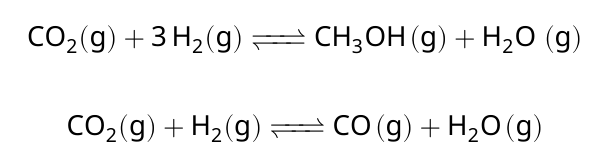
Into a reactor maintained at 250 °C and 50 bar, a mixture containing \(\ce{CO2}:\ce{H2}\) in a molar ratio of \(1:4\) is fed. It has been found that the \(\ce{CO2}\) conversion is 30% and the \(\ce{H2}\) conversion is 18.5% when these two reactions are at equilibrium. No other processes need to be considered.
1.4 — 5 pt
Calculate the thermodynamic equilibrium constants (at 250 °C) of the two reactions.
Heterogeneous copper-containing catalysts are commonly used for \(\ce{CO2}\) hydrogenation. Two specific, Cu-containing catalysts (\(A\) and \(B\)) showed promise for converting \(\ce{CO2}\) to methanol. These catalysts differ not only in their catalytic rates, but also in surface area, Cu content, and Cu dispersion (the ratio of surface Cu to the total Cu in the catalyst).
Cu dispersion is important, because only Cu species at the surface are active in \(\ce{CO2}\) hydrogenation. Under this assumption, 1 mole of active sites corresponds to 1 mole of surface Cu. The efficiency of these active sites is shown by their turnover frequencies (TOF, moles of product formed per moles of active site in a given time).
The table below reports the performance (reported as mass of produced methanol per total catalyst mass in a given time) and the specific surface areas of the two catalysts. The Cu content and dispersion of the catalysts was also measured and reported as follows:
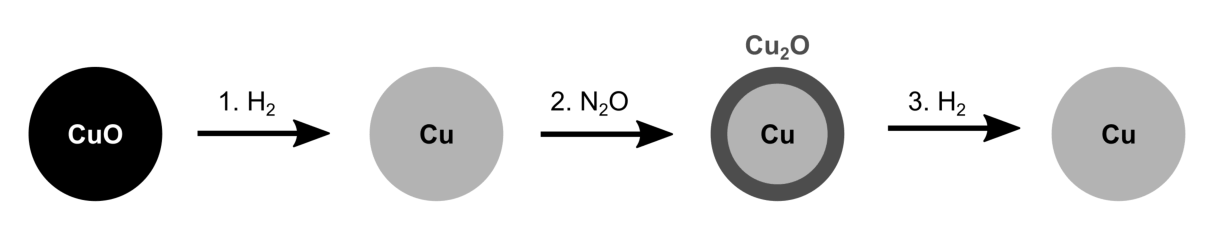
- At the start, all the copper in the catalysts (oxidized beforehand) is present as Cu(II); that was fully reduced to Cu(0) with hydrogen. No other species in the catalysts reacted with hydrogen besides copper oxides.
- \(\ce{N2O}\) was introduced to the reduced samples at room temperature. At this temperature, \(\ce{N2O}\) only oxidizes active surface sites to Cu(I).
- The Cu(I) active surface sites were reduced again to Cu(0) with hydrogen.
Catalyst performance \((\mathrm{g}_{\mathrm{MeOH}}\,\mathrm{g}_{\mathrm{cat}}^{-1}\,\mathrm{h}^{-1})\) Specific surface area \((\mathrm{m^2}\,\mathrm{g}_{\mathrm{cat}}^{-1})\) \(\ce{H2}\) consumed in step 1 \((\mathrm{mmol}\,\mathrm{g}_{\mathrm{cat}}^{-1})\) \(\ce{H2}\) consumed in step 3 \((\mathrm{mmol}\,\mathrm{g}_{\mathrm{cat}}^{-1})\) Catalyst \(A\) 0.80 100 5.0 0.30 Catalyst \(B\) 0.90 120 4.0 0.70 1.5 — 3 pt
Find the methanol production rate per total mass of Cu (in \(\mathrm{g}_{\mathrm{MeOH}}\,\mathrm{g}_{\mathrm{Cu}}^{-1}\,\mathrm{h}^{-1}\)) for catalysts \(A\) and \(B\).
1.6 — 3 pt
Find the TOF (in \(\mathrm{h}^{-1}\)) for catalysts \(A\) and \(B\).
If you cannot find results, use \(\mathit{TOF}_{\mathrm{Catalyst}\ A}=100\ \mathrm{h}^{-1}\) and \(\mathit{TOF}_{\mathrm{Catalyst}\ B}=1\ \mathrm{h}^{-1}\) in subsequent calculations.
1.7 — 1 pt
Indicate the correct statement on the answer sheet.
a. Catalyst \(A\) has more efficient active sites.
b. Catalyst \(B\) has more efficient active sites.
c. The two catalysts have active sites with the same efficiency.Avogadro constant: \(N_A=6.022\cdot10^{23}\ \mathrm{mol^{-1}}\) Gas constant: \(R=8.314\ \mathrm{J\,mol^{-1}\,K^{-1}}\) Ionic product of water at 298.15 K: \(K_w=10^{-14}\) Zero of the Celsius scale: \(0\,^\circ\mathrm{C}=273.15\ \mathrm{K}\) Faraday constant: \(F=96485\ \mathrm{C\,mol^{-1}}\) Planck constant: \(h=6.626\cdot10^{-34}\ \mathrm{J\,s}\) Speed of light: \(c=2.998\cdot10^8\ \mathrm{m\,s^{-1}}\) Standard pressure: \(p^\circ=1\cdot10^5\ \mathrm{Pa}=1\ \mathrm{bar}\) Ideal gas law: \(pV=nRT\) Beer-Lambert law: \(A=\log\left(\frac{I_0}{I}\right)=\varepsilon\cdot l\cdot c\) Enthalpy: \(H=U+pV\) Gibbs energy: \(G=H-TS\) \(\Delta_rG^\circ=-RT\ln K=-nFE^\circ_{\mathrm{cell}}\) Henderson-Hasselbalch equation: \(\mathrm{pH}=\mathrm{p}K_a+\log\left(\frac{[\ce{A-}]}{[\ce{HA}]}\right)\) Arrhenius equation: \(k=A\exp\left(-\frac{E_A}{RT}\right)\) Zeroth order integrated rate law: \([\ce{A}]=[\ce{A}]_0-kt\) Surface of a sphere: \(A=4\pi R^2\) First order integrated rate law: \(\ln[\ce{A}]=\ln[\ce{A}]_0-kt\) Volume of a sphere: \(V=\frac{4\pi}{3}R^3\) \(\displaystyle\sum_{k=0}^{\infty}ar^k=\frac{a}{1-r}\quad\text{for }\lvert r\rvert<1\) Periodic table
Official English text of the problem.
Problem 2: Electronic nose
Resistive gas sensors, especially those using semiconducting metal oxides (SMOX), are becoming increasingly popular. They can detect tiny amounts of impurities, are small and stable, and are easy to make and use. These features make SMOX sensors stand out among the many types of gas sensors that work on different physical and chemical principles.
The mixed oxide X that has the normal spinel crystal structure, \(\ce{A^{2+}B2^{3+}O4^{2-}}\), is an example of one of these SMOX materials. X can be obtained by decomposition of the crystalline hydrated metal oxalate \(\ce{ZC2O4}\cdot k\ce{H2O}\) of metal Z on air. When heated to \(140\,^\circ\mathrm{C}\), the crystalline hydrate loses 19.7% of its mass. Further heating in air leads to the formation of 2.407 g of black colored X at \(500\,^\circ\mathrm{C}\) and \(3.8\,\mathrm{dm^3}\) of carbon dioxide at 101325 Pa.
2.1 Determine the formula of X and the value of \(k\) in \(\ce{ZC2O4}\cdot k\ce{H2O}\). 4 pt
In the spinel structures oxygen atoms form a face centered cubic (FCC) lattice. In normal spinels the \(\ce{A^{2+}}\) cations occupy part of the tetrahedral, and the \(\ce{B^{3+}}\) cations occupy part of the octahedral lattice sites.
2.2 Calculate the percentage of the tetrahedral sites that is occupied in the case of a normal spinel \(\ce{A^{2+}B2^{3+}O4^{2-}}\). 2 pt
In addition to the normal spinels, the \(\ce{MM'2O4}\) general formula also describes the inverse and the mixed spinel structures. Here \(\ce{M}\) are the tetrahedrally coordinated, \(\ce{M'}\) the octahedrally coordinated cations, but contrary to normal spinels, particular cations are not restricted to a single lattice site. A characteristic of the inverse spinel structures is that the electron configuration of the \(\ce{M'}\) site cations is \(d^0\), \(d^5\) or \(d^{10}\).
2.3 Select on the answer sheet two of the given formulas, which correspond to the structure of inverse spinel: \(\ce{Fe3O4}\), \(\ce{NiFe2O4}\), \(\ce{Mn3O4}\), \(\ce{FeCr2O4}\). 1 pt
Semiconductors are materials whose orbitals contain a small excess or deficit of electrons, leading to negative or positive charges (holes), respectively. These charges can move through the semiconductor and allow it to conduct electricity. Chemical reactions can increase or decrease the charge on a semiconductor, altering its conductivity.
X is an example of a semiconductor where electricity is carried by positive charges (holes). For a resistive gas sensor based on X, the resistance \(R\) is measured over time \(t\), while passing a gas over the sensor. This allows redox reactions to occur between the gas and the semiconductor surface, which will change the resistance of the sensor depending on the donor/acceptor properties of the gas. Figure 1 shows the two different types of signal obtained this way.
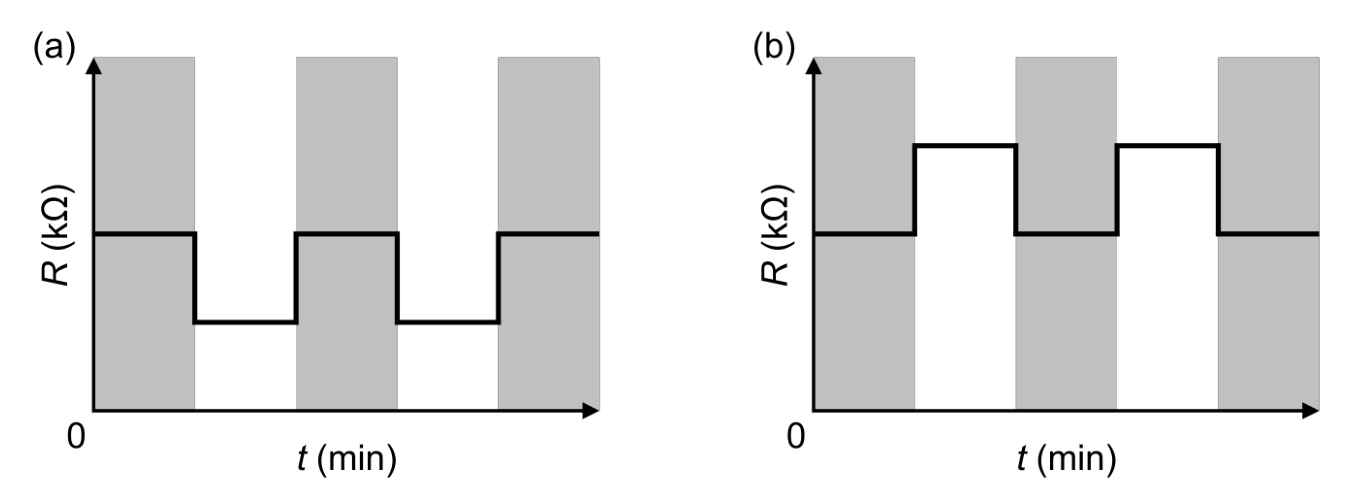
Figure 1: plot of resistance against time for two possible signal types, (a) and (b).
Grey bars = air, white bars = air + analyte gas.
2.4 Correlate the signal type (a or b) obtained from the X based sensor with the analyte gases (\(\ce{H2S}\), \(\ce{O3}\), \(\ce{NO2}\), \(\ce{NH3}\)) during their detection at low concentrations. 2 pt
The dependence of the specific conductivity (\(\sigma\)) of X on temperature is described by the Arrhenius law: \(\sigma(T)=\sigma_0\exp(-E_a/(RT))\), where \(E_a\) is the activation energy of conductivity. Three types of conductivity can be distinguished in different temperature ranges:
Ionization (I): 444–570 K, Impurity (II): 585–765 K, and Intrinsic (III): 800–905 K.
The sketch below illustrates the conductivity-temperature relation for the three temperature ranges.
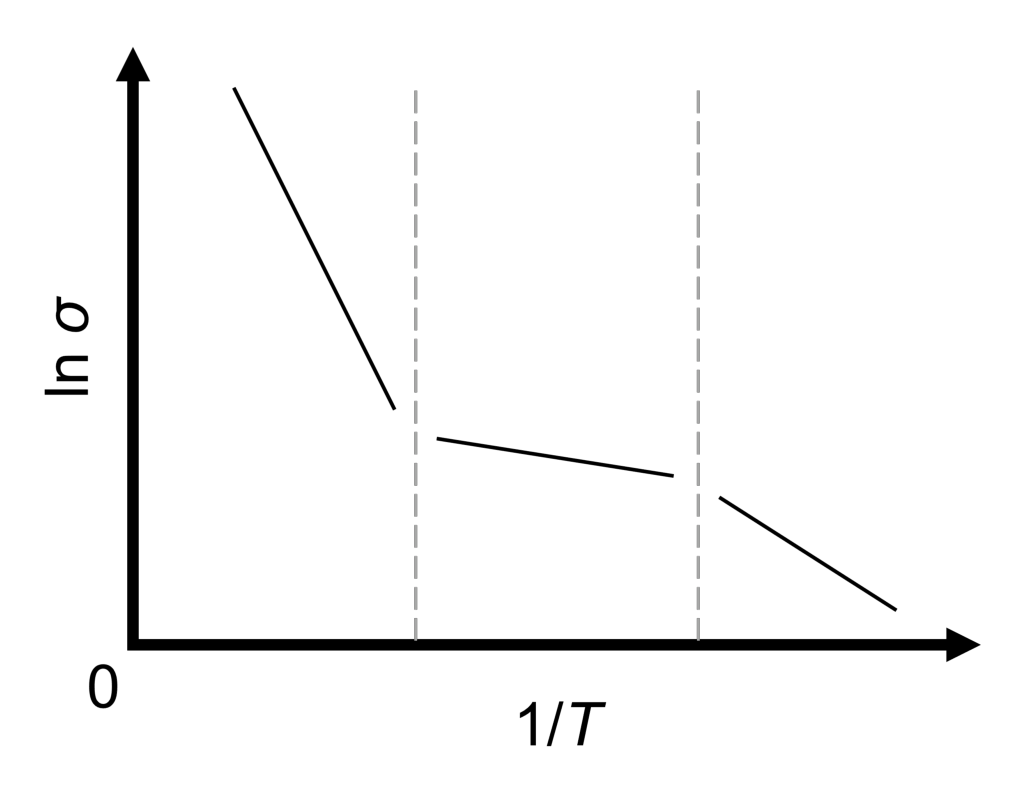
2.5 Based on the sketch above, order the activation energies associated with the different conductivity types, \(E_a(I)\), \(E_a(II)\), and \(E_a(III)\), from largest to smallest. 3 pt
Avogadro constant: \(N_A=6.022\cdot10^{23}\,\mathrm{mol^{-1}}\) Gas constant: \(R=8.314\,\mathrm{J\,mol^{-1}\,K^{-1}}\) Ionic product of water at 298.15 K: \(K_w=10^{-14}\) Zero of the Celsius scale: \(0\,^\circ\mathrm{C}=273.15\,\mathrm{K}\) Faraday constant: \(F=96485\,\mathrm{C\,mol^{-1}}\) Planck constant: \(h=6.626\cdot10^{-34}\,\mathrm{J\,s}\) Speed of light: \(c=2.998\cdot10^8\,\mathrm{m\,s^{-1}}\) Standard pressure: \(p^\circ=1\cdot10^5\,\mathrm{Pa}=1\,\mathrm{bar}\) Ideal gas law: \(pV=nRT\) Beer-Lambert law: \(A=\log\left(\frac{I_0}{I}\right)=\varepsilon\cdot l\cdot c\) Enthalpy: \(H=U+pV\) Gibbs energy: \(G=H-TS\) \(\Delta_rG^\circ=-RT\ln K=-nFE^\circ_{\mathrm{cell}}\) Henderson-Hasselbalch equation: \(\mathrm{pH}=\mathrm{p}K_a+\log\left(\frac{[\ce{A-}]}{[\ce{HA}]}\right)\) Arrhenius equation: \(k=A\exp\left(-\frac{E_A}{RT}\right)\) Zeroth order integrated rate law: \([\ce{A}]=[\ce{A}]_0-kt\) Surface of a sphere: \(A=4\pi R^2\) First order integrated rate law: \(\ln[\ce{A}]=\ln[\ce{A}]_0-kt\) Volume of a sphere: \(V=\frac{4\pi}{3}R^3\) \(\displaystyle\sum_{k=0}^{\infty}ar^k=\frac{a}{1-r}\quad\text{for }\lvert r\rvert<1\) Periodic table
Official English text of the problem.
Problem 3: Tyrosinase
The enzyme tyrosine 3-monooxygenase has an important biological role because it catalyzes the initial and rate-limiting step in the biosynthesis of the neurotransmitter dopamine. In this first step, L-DOPA is produced from the amino acid L-tyrosine (Tyr) in the presence of dissolved oxygen, tetrahydrofolic acid and ferrous ions. In a subsequent step, another enzyme transforms L-DOPA into dopamine.
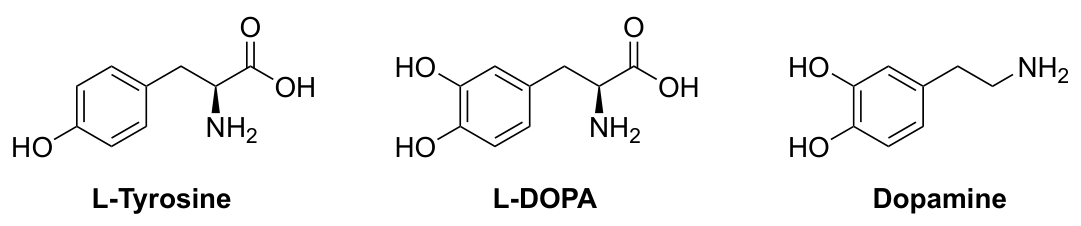
The activity of the tyrosine 3-monooxygenase enzyme is described well by the simplest model of enzyme action, the Michaelis-Menten equation. This gives the rate of the formation (\(r\)) of L-DOPA as a function of the enzyme (E) and substrate Tyr (S) concentrations as follows:
\[ r=\frac{k[E][S]}{K_{\mathrm M}+[S]} \]
The following values of enzymatic turnover frequency (\(k=250\ \mathrm{min^{-1}}\)) and Michaelis constant (\(K_{\mathrm M}=0.49\ \mathrm{mmol\,dm^{-3}}\)) can be used in this task when needed.
Catechol (1,2-dihydroxybenzene) inactivates the enzyme tyrosine 3-monooxygenase irreversibly by turning it into an inactive form. When a carefully purified sample of catechol is mixed with the enzyme with the exclusion of dissolved oxygen, no change is seen at all. So the reaction of catechol with dissolved oxygen, which produces o-quinone, must be important.
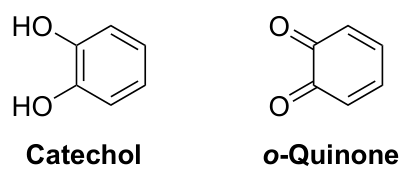
This process can be studied in the absence of the enzyme. A test experiment in a reactor not in contact with ambient air at \(37\,^\circ\mathrm C\) and at pH 7.5 gave the following kinetic data:
time (min) catechol concentration (\(\mathrm{mmol\,dm^{-3}}\)) oxygen concentration (\(\mathrm{mmol\,dm^{-3}}\)) o-quinone concentration (\(\mu\mathrm{mol\,dm^{-3}}\)) 0 2.00 0.200 0 20.0 1.97 0.170 30 40.0 1.94 0.140 60 60.0 1.91 0.111 89 80.0 1.88 0.083 117 100.0 1.85 0.054 146 3.1 — 5.0 pt
Identify the only by-product (which is not one of the molecules shown in the table above) and write the balanced equation of the process with molecular formulas based on the kinetic data.
3.2 — 2.0 pt
Calculate the initial rate (\(r_0\)) of o-quinone formation in this experiment with an appropriate unit.
The rate law of the process was determined by varying the initial concentrations of the reactants. Changing the oxygen concentration did not influence the initial rate of the process. Using different catechol concentrations gave the following initial rates for o-quinone formation:
catechol concentration (\(\mathrm{mmol\,dm^{-3}}\)) initial rate of o-quinone formation (\(\mu\mathrm{mol\,dm^{-3}\,min^{-1}}\)) 1.0 0.75 4.0 3.0 6.0 4.5 8.0 6.0 10.0 7.5 3.3 — 5.0 pt
Determine the rate law of the reaction between catechol and oxygen producing o-quinone. Calculate the rate constant of this process (\(k_{\mathrm{catechol}}\)) with an appropriate unit.
In separate experiments, it was confirmed that neither o-quinone, nor the by-product inactivates the enzyme alone, nor even in combination.
An experiment in which the enzyme is reacted with catechol in the presence of dissolved oxygen did show inactivation, though.
The experiment was done in an open vessel so that any oxygen consumed in the process could be continuously replenished from air. The initial concentration of the enzyme was \(4.2\ \mathrm{nmol\,dm^{-3}}\), the initial concentration of catechol was \(2.00\ \mathrm{mmol\,dm^{-3}}\) at \(37\,^\circ\mathrm C\) and at pH 7.5.
Samples were taken regularly from the enzyme-catechol reaction mixture, and the activity of the enzyme was assayed by adding L-tyrosine, tetrahydrofolic acid and ferrous ions. During the enzyme activity measurements, the concentration of added L-tyrosine was \(10.0\ \mathrm{mmol\,dm^{-3}}\) and the concentration of L-DOPA in each assay sample was measured after 2.0 minutes. The following results were obtained:
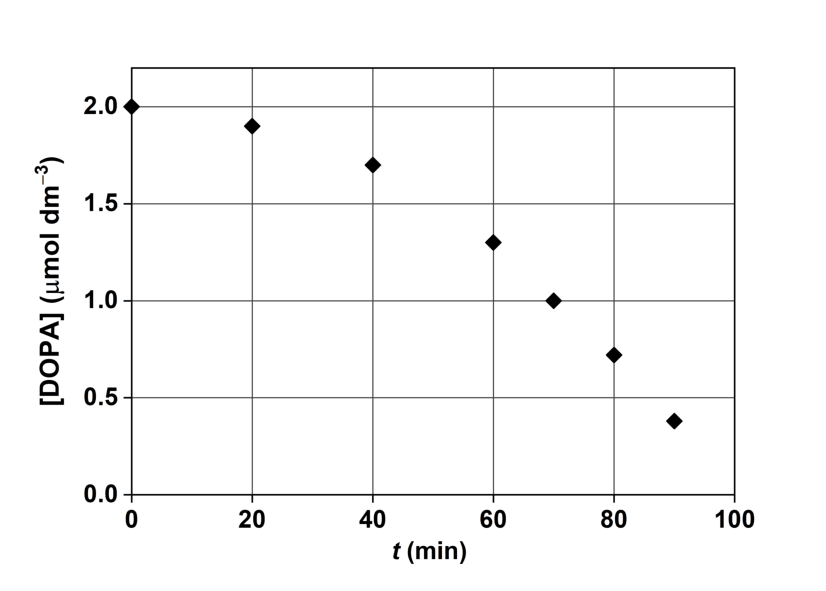
inactivation reaction time \(t\) (min) L-DOPA concentration after 2.0 minutes from the start of the assay \([\mathrm{DOPA}]\) (\(\mu\mathrm{mol\,dm^{-3}}\)) 0 2.0 20.0 1.9 40.0 1.7 60.0 1.3 70.0 1.00 80.0 0.72 90.0 0.38 3.4 — 4.0 pt
Derive a formula that allows you to calculate the actual concentration of active enzyme (\([E]\)) from the data of these experiments in terms of \(k\) (\(=250\ \mathrm{min^{-1}}\)), \(K_{\mathrm M}\) (\(=0.49\ \mathrm{mmol\,dm^{-3}}\)), and/or reagent concentrations.
The change in the active enzyme concentration as a function of time is well described by a parabola (\([E]=[E]_0-k_{\mathrm{obs}}t^2\)), where \(k_{\mathrm{obs}}\) is an observed rate constant (i.e. one that can be written later as a combination of elementary rate constants and initial concentrations), and \([E]_0\) is the initial concentration of the enzyme.
3.5 — 3.0 pt
Give the value of \(k_{\mathrm{obs}}\) with an appropriate unit.
3.6 — 3.0 pt
Determine the first half-life of the enzyme inactivation reaction. Derive a formula that gives the first half-life as a function of the initial enzyme concentration and of \(k_{\mathrm{obs}}\).
The first half-lives for enzyme inactivation were determined using other initial catechol concentrations. The dependences of active enzyme concentrations on time were very well described by parabolas in these cases as well.
catechol concentration (\(\mathrm{mmol\,dm^{-3}}\)) first half-life (min) 1.0 140 4.0 35 6.0 23 8.0 17.5 10.0 14 3.7 — 6.0 pt
Derive a rate equation of the enzyme inactivation process consistent with all the experimental observations.
3.8 — 3.0 pt
What are the reactants of the rate determining step for the enzyme inactivation process? Select the ONLY correct option on the answer sheet.
A) \(\ce{\text{catechol} + O2 ->} \ldots\)
B) \(\ce{\text{catechol} + \text{o-quinone} ->} \ldots\)
C) \(\ce{\text{o-quinone} + O2 ->} \ldots\)
D) \(\ce{\text{enzyme} + 2 \text{catechol} ->} \ldots\)
E) \(\ce{\text{enzyme} + O2 ->} \ldots\)
F) \(\ce{2 \text{catechol} + O2 ->} \ldots\)
G) \(\ce{\text{enzyme} + \text{catechol} ->} \ldots\)
H) \(\ce{\text{enzyme} + \text{by-product} ->} \ldots\)Official English text of the problem.
Problem 4: Potassium
Elementary potassium was the first metal synthesized by electrolysis (1807). Humphry Davy used voltaic cells and electrodes immersed into molten \(\ce{KOH}\).
4.1 Give balanced equations for the processes taking place on the cathode (1) and the anode (2). 2 pt
It is little known that only a year after Davy, French chemists have produced potassium in a chemical reduction. One of the methods involved a mixture of potassium carbonate and finely powdered carbon. This mixture was heated to very high temperatures in a gun barrel. Carbon monoxide and potassium vapors were leaving the end of the barrel, where the metal could be condensed to a solid.
4.2 Write down the balanced equation for the reaction giving only these two products. 1 pt
The chemical production of potassium had a low yield. Depending on the circumstances, a considerable amount of reddish paste was left behind in the gun barrel. Gmelin isolated an interesting compound (X) from this residue in 1825 by recrystallization in water. The exact structure of the byproduct X was determined more than one and a half century later.
X is a hydrated salt (2 mol water : 1 mol of salt) forming golden yellow crystals. Its anion has an exceptionally symmetric (shown by vibrational spectra) and stable planar cyclic structure.
The diprotic acid (Y) that can be formed from the salt X has surprisingly (at least to the superficial observer) low \(\mathrm{p}K_a\) values: 0.8 and 2.2.
4.3 Give the pH where 95% of all dissolved acid Y is in the neutral acid form. 3 pt
4.4 Calculate the pH of a \(0.01\ \mathrm{mol\,dm^{-3}}\) solution of the salt X in pure water. 4 pt
The key step in the structure identification of X was the treatment of the anhydrous salt with methyl iodide. The salt reacted with two equivalents of methyl iodide. The somewhat volatile compound that was obtained had a molar mass of \(170.12\ \mathrm{g/mol}\) (measured in a mass spectrometer).
A number of analogous salts were also identified in the mixture in smaller quantities. The appropriate potassium salts when treated with two equivalent of \(\ce{MeI}\) gave derivatives with molar masses of: \(142.11\ \mathrm{g/mol}\), \(114.10\ \mathrm{g/mol}\), \(198.13\ \mathrm{g/mol}\).
4.5 Give the empirical formula of Gmelin’s compound X. 4 pt
4.6 Draw the structure of the free acid Y. 3 pt
The extraordinary stability of the series of anions in the salts analogous to X can be attributed to electron delocalization.
4.7 Draw one resonance structure with a significant contribution for the anion in each of the four salts. 4 pt
Avogadro constant: \(N_A=6.022\cdot10^{23}\ \mathrm{mol^{-1}}\) Gas constant: \(R=8.314\ \mathrm{J\,mol^{-1}\,K^{-1}}\) Ionic product of water at 298.15 K: \(K_w=10^{-14}\) Zero of the Celsius scale: \(0^\circ\mathrm{C}=273.15\ \mathrm{K}\) Faraday constant: \(F=96485\ \mathrm{C\,mol^{-1}}\) Planck constant: \(h=6.626\cdot10^{-34}\ \mathrm{J\,s}\) Speed of light: \(c=2.998\cdot10^8\ \mathrm{m\,s^{-1}}\) Standard pressure: \(p^\circ=1\cdot10^5\ \mathrm{Pa}=1\ \mathrm{bar}\) Ideal gas law: \(pV=nRT\) Beer-Lambert law: \(A=\log\left(\frac{I_0}{I}\right)=\varepsilon\cdot l\cdot c\) Enthalpy: \(H=U+pV\) Gibbs energy: \(G=H-TS\) \(\Delta_rG^\circ=-RT\ln K=-nFE^\circ_{\mathrm{cell}}\) Henderson-Hasselbalch equation: \(\mathrm{pH}=\mathrm{p}K_a+\log\left(\frac{[\ce{A-}]}{[\ce{HA}]}\right)\) Arrhenius equation: \(k=A\exp\left(-\frac{E_A}{RT}\right)\) Zeroth order integrated rate law: \([\ce{A}]=[\ce{A}]_0-kt\) Surface of a sphere: \(A=4\pi R^2\) First order integrated rate law: \(\ln[\ce{A}]=\ln[\ce{A}]_0-kt\) Volume of a sphere: \(V=\frac{4\pi}{3}R^3\) \(\displaystyle\sum_{k=0}^{\infty}ar^k=\frac{a}{1-r}\quad\text{for }\lvert r\rvert<1\) Periodic table
Official English text of the problem.
Problem 5: Unknown
Metal containing salt A can be prepared in a simple exchange reaction when the cold, saturated aqueous solutions of the two distinctly colored compounds, B and C are mixed in stoichiometric ratio. 10.00 g B in solution mixed with the solution of 12.86 g C, and immediately cooled to \(2\,^\circ\mathrm{C}\) will give 4.90 g solid A. The yield of A is 32.6 %.
To determine the composition of A, first iodometry is performed. A known mass of A is added to a titration flask, acidified with sulfuric acid, then \(\ce{KI}\) is added in excess and there is a precipitate formation. After a few minutes, sodium citrate solution is added until the solution is free of precipitate. The citrate ions form a strong complex with a metal ion present in the mixture, reversing completely the reaction leading to the precipitate. The resulting mixture is titrated with sodium thiosulfate solution (Titration I via reaction 1). To the blue titrated solution another portion of sulfuric acid (significantly more than the initial amount) is added to protonate the citrate. The previous solid precipitate is formed once again [reaction 2]. The mixture is titrated with the same thiosulfate solution (titration II via reaction 1).
The average volumes for 100.0 mg A with \(5.000\cdot10^{-2}\ \mathrm{mol\,dm^{-3}}\) thiosulfate are \(54.12\ \mathrm{cm^3}\) in Titration I and \(5.41\ \mathrm{cm^3}\) in Titration II.
When the aqueous solution of A is heated, the blue precipitate D can be observed [reaction 3]. Compound E can be crystallized from the liquid above D. The low temperature during the synthesis of A is important to avoid contamination by E.
5.1 Write balanced equations for reactions [1] and [2]. 4.0 pt
The thermal decomposition of A was studied in detail. When pure A is slowly heated, already at around \(75\,^\circ\mathrm{C}\) it explodes. When the compound is dispersed in aluminium oxide and the mixture is heated, then the matrix absorbs the excess heat, and the explosion can be avoided. Two decomposition steps can be observed. In the first step (at \(65\,^\circ\mathrm{C}\)) in addition to the 14.1 % mass decrease, a two-component solid residue forms [reaction 4]. The components of this residue can be easily separated, as F is well soluble in water, while G does not dissolve at all. The F:G mass ratio is 1.00 : 2.97. On further heating, F decomposes without a solid residue [reaction 5]. That means pure G is the final solid decomposition product of A. G contains two other elements in addition to 27.0 wt% oxygen. One of the two components of the gas mixture forming in the first decomposition step can be easily quantitated if it is absorbed in acid solution.
Some hints
- Compound A decomposes without releasing oxygen.
- Compound A contains two different metals.
- Compounds A and B both contain a complex ion.
- C is a well-known compound for any chemistry student.
- Compound F does not contain any metal.
5.2 Give chemical formulae of A—G. You don’t have to show your calculations, but if your compounds are incorrect you may gain partial marks from correct calculations. 28.0 pt
5.3 Write balanced equations for reactions [3]—[5]. 12.0 pt
Periodic table
Official English text of the problem.
Problem 6: Penicillin
Penicillins are a group of antibiotics that have played a crucial role in medicine since their discovery.
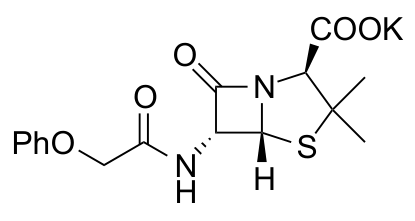
Penicillin VK
6.1. Mark the stereogenic carbon centers on the structure of Penicillin VK on the answer sheet. Write the corresponding \(R/S\) stereodescriptors next to the centers on the answer sheet. 6 pt
6.2. Give the total number of possible stereoisomers of Penicillin VK. 2 pt
One of the many synthetic methods to obtain Penicillin VK starts from the amino acid valine, as shown in the scheme on the next page of this problem.
Hints:
- Among other signals, the \({}^{1}\mathrm{H}\)NMR spectrum of compound A contains two signals that each integrate to 3H. Both of these signals are doublets.
- Compounds A and D are open-chain compounds, while B and E each have a five membered ring (in addition to any rings in the PhthN-group).
- Brucine is used for chiral resolution.
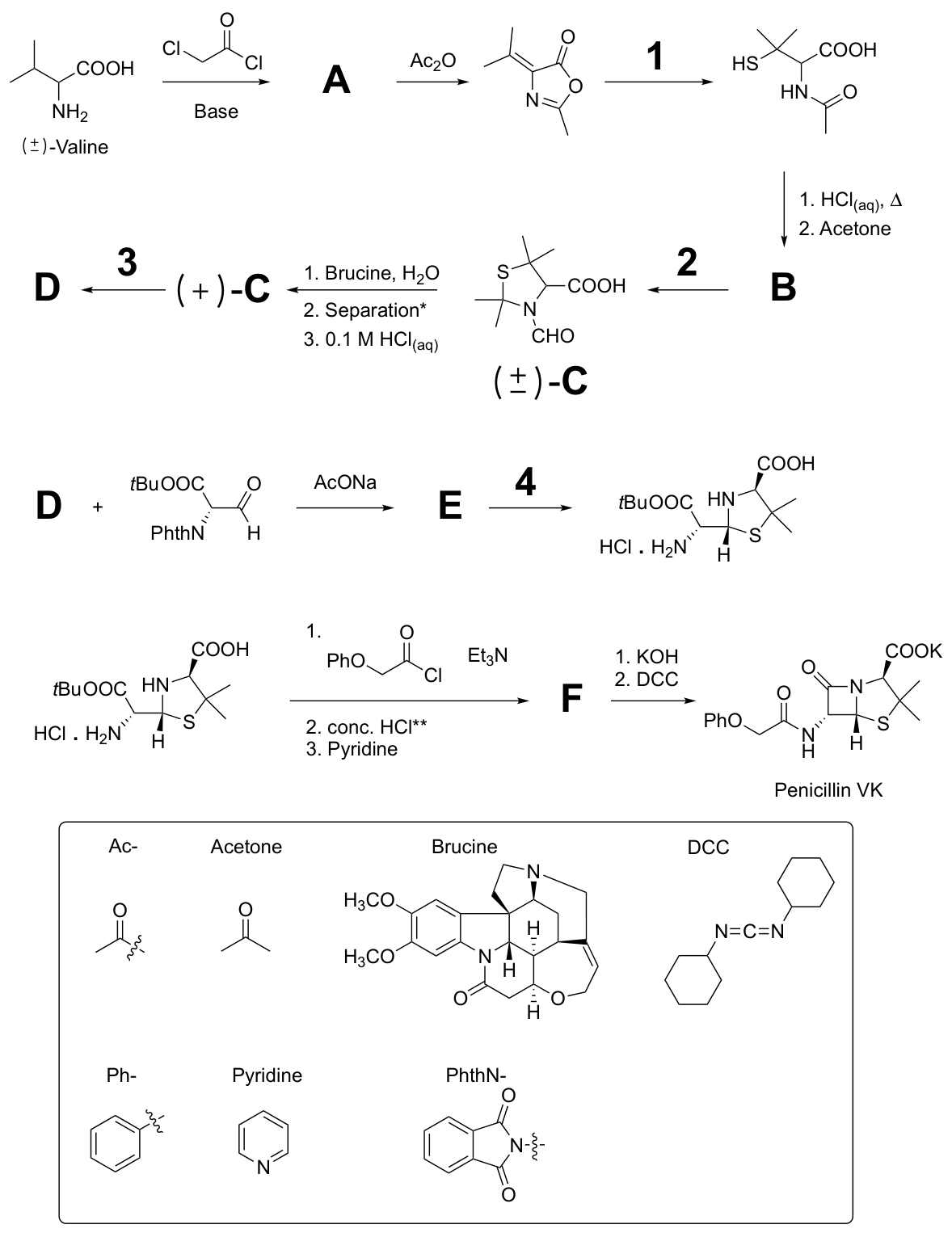
*Please note that in the formation of (+)-C, the word "Separation" means separation.
**Conc. HCl means concentrated HCl.
6.3. Choose the suitable reagent for the numbered steps \((1–4)\) on the answer sheet. 8 pt
a) \(2\,\mathrm{M}\) \(\ce{HCl_{(aq)}}\)
b) \(\ce{SO3, H2SO4}\)
c) \(\ce{NaOH_{(aq)}}\)
d) \(\ce{HCO2H, Ac2O}\)
e) i) \(\ce{N2H4}\) ii) \(\ce{HCl_{(aq)}, AcOH}\)
f) i) \(\ce{H2S, Na, CH3OH}\) ii) \(\ce{H2O}\)
6.4. Draw the structures of A, B, (+)-C, D, E and F on the answer sheet. Show the stereostructure using wedge–dash notation (

) when relevant. 18 pt
6.5. Select the role of acetone in the step leading to B on the answer sheet. 2 pt
a) solvent
b) catalyst
c) electrophile
d) nucleophile
6.6. Select the role of DCC in the step leading from F to Penicillin VK on the answer sheet. 2 pt
a) oxidizing reagent
b) catalyst
c) coupling reagent
d) radical initiator
Official English text of the problem.
Problem 7: SABIC
The Saudi Basic Industries Corporation (SABIC) was established in the mid-1970s as part of Saudi Arabia's plan to diversify its economy. Today, SABIC is a global chemical giant, producing 69 million tons of products annually.
Part A
SABIC's own unique ethene oligomerization technology (oligomers are polymers with few monomer units) produces linear alpha olefins (1-alkenes), which are used in numerous industrial applications.
Linear alpha olefins are produced by catalytic oligomerization of ethene, resulting in a range of chain lengths with a distribution. Different catalysts can yield various distributions of products.
In the geometric or Schulz–Flory distribution, each oligomer fraction is related to the previous fraction by the equation, \(T_{n+1}=\alpha T_n\), where \(T_n\) represents the molar amount of the oligomer with \(n\) ethene units, and \(\alpha\) is a constant called the probability of chain propagation. Ethene, the monomer is not a member of the series (\(n\geq2\)).
One catalytic oligomerization process can be described by a relatively simple mechanism:
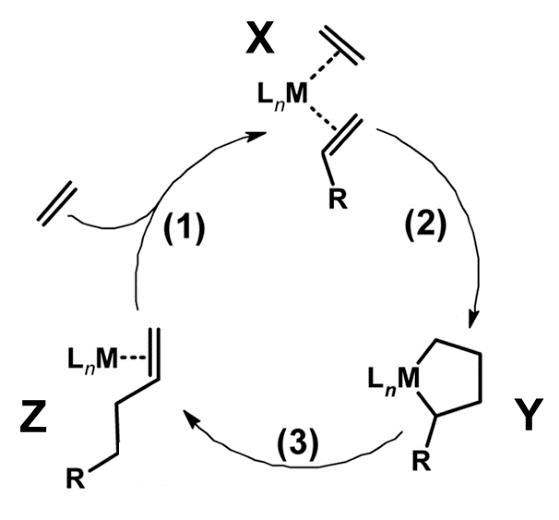
Although this mechanism is not a classical chain reaction because the final product is not produced within the cycle, the usual kinetic treatment of chain reactions can be applied to it. The three processes shown (1–3) are all chain propagation steps. R is lengthened by each cycle.
All three reactions are first order with respect to the chain carriers. For ethene, use an unknown order \(\rho\), to be determined later.
7.1 Write the rate equations for reactions 1–3 using \(k_1\), \(k_2\), and \(k_3\) as the corresponding rate constants, which are independent of the carbon chain length. 1 pt
Chain termination step, producing the oligomers, is a first order reaction competing with reaction 1.
7.2 Write i) the chemical equation and ii) rate equation of termination. Use \(k_t\) as the corresponding rate constant. 2 pt
7.3 Find the value of \(\rho\) which ensures that the product mixture of olefins shows the required ratio of products in accordance with the Schulz–Flory distribution when the reaction is run in a closed system. Derive a formula for this case that gives \(\alpha\) as the function of rate constants. 4 pt
Aluminum alkyls are used as co-catalysts in the ethene oligomerization process. It was found that they also catalyzed the Friedel–Crafts alkylation of the aromatic solvents used for the oligomerization.
In a typical oligomerization reaction, an alkylated aromatic compound Q was isolated from the complex reaction mixture of ethene oligomerization in toluene as solvent. The alkylated aromatic compound Q has the molecular formula \(\ce{C11H16}\) and its \(\ce{^1H}\) NMR spectrum contains the following peaks.
\(\ce{^1H}\) NMR of Q: \(\delta\) 0.9 (\(t\), 3H); 1.35 (\(m\), 2H); 1.59 (\(m\), 2H); 2.34 (\(s\), 3H), 2.60 (\(t\), 2H); 7.18 (\(d\), 2H); 7.22 (\(d\), 2H).
7.4 Draw the structure of Q. 3 pt
Part B
Vitrimers are adaptive polymers with "reversible" covalent bonds, allowing shape-changing and self-healing under specific conditions. This subtask explores the principles of vitrimer chemistry, an important topic in SABIC's polymer research.
A recently elucidated fast and reversible reaction involving dioxaborolanes can serve as the chemical background for such an adaptable polymer network. The two dioxaborolanes below were prepared by the reaction of phenylboronic acid with 1,2-butanediol and 3,5-dimethylphenylboronic acid with 1,2-propanediol, respectively.
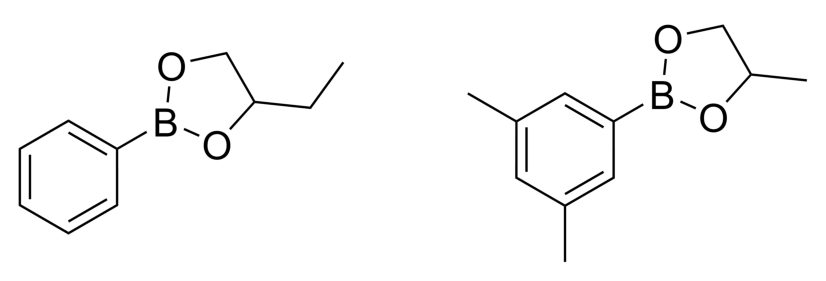
They participate in a model metathesis (exchange) reaction. The two carefully purified compounds were mixed in the absence of solvent and the mixture was kept at \(60\,^\circ\mathrm{C}\) for two hours. Interestingly, the gas chromatograms of the mixture at the start and at the end of the incubation period showed only the peaks below, with equimolar quantities of the components. The peaks in this system separate in a way that correlates with molar mass: compounds with lower mass appear at earlier elution times.

No catalyst, water, diol or acid was detectable in the mixture.
7.5 Draw the compounds associated with peaks I–IV in the chromatogram. 2 pt
Linking functional units to a polymer chain is known as grafting, and the functional units are referred to as grafting agents. In this case, the dioxaborolane units are linked to the polymer chains by maleimide groups via a radical process, in which one maleimide group is coupling to the polymer chain at a random carbon atom. The scheme below introduces a flexible synthesis route towards the dioxaborolane maleimide grafting agent used in the vitrimers.
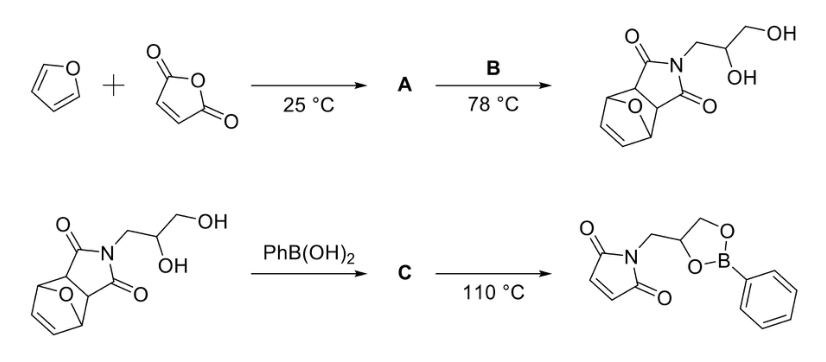
7.6 Draw the structures of A–C. 3 pt
7.7 Select on the answer sheet which reagent(s) and/or condition is/are appropriate for linking the dioxaborolane maleimide units to polyethylene. 1 pt
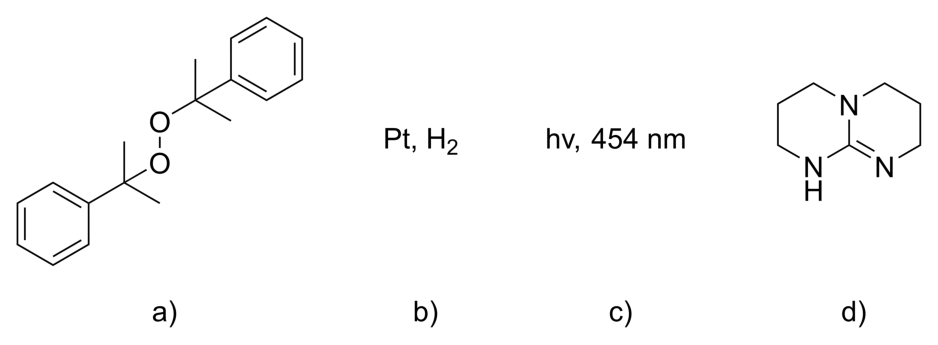
The vitrimer was prepared as follows:
- Polyethylene is grafted with dioxaborolane maleimide. Assume no side reactions between the dioxaborolane maleimide compounds.
- The reagents are removed from the macromolecules.
- Propanediol functionalized bis-dioxaborolane is added to enable crosslinking.
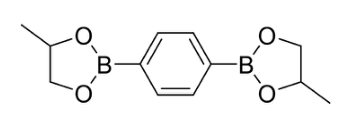
- The mixture is carefully heated for metathesis (exchange) reaction to take place.
To determine the extent of grafting and crosslinking in the vitrimer, infrared (IR) spectroscopy was used at room temperature where the metathesis reaction is extremely slow. Assume a homogeneous vitrimer.
- All of the small molecules are removed from the polymer.
- The IR spectrum of a thin polymer film is measured.
- IR spectrum contains absorption peaks that correspond to specific functional groups.
- The Beer–Lambert law can be used to quantify the concentration of these functional groups.
The provided data table gives the wavelengths, corresponding molar (related to the specified functional groups) absorption coefficients for relevant characteristic peaks together with the absorbances of the vitrimer sample.
Vibration wavenumber, with the functional group indicated Molar absorption coefficient, \(\epsilon\) \((\mathrm{dm^3\,mol^{-1}\,\mu m^{-1}})\) Sample absorbance at this wave number, \(A\) Imide group band at \(1710\ \mathrm{cm^{-1}}\) 2.67 0.451 Monosubstituted benzene ring band at \(1600\ \mathrm{cm^{-1}}\) 0.28 0.022 Disubstituted benzene ring band at \(1520\ \mathrm{cm^{-1}}\) 0.68 0.042 \(\ce{CH2}\) groups of polyethylene, band at \(1470\ \mathrm{cm^{-1}}\) 0.021 0.904 7.8 Calculate the grafting density (\(X_g\)) of polyethylene based on the measurements. That is the ratio of the grafted groups over the ethylene units. 3 pt
7.9 Calculate the percentage of the grafted groups that are not part of a crosslink (\(p_{nc}\)). 4 pt
Official English text of the problem.
Problem 8: Safflower
In Saudi culture, safflower drink is a traditional remedy used for its calming effects.
One ingredient with health benefits is kaempferol. The following scheme shows its total synthesis.
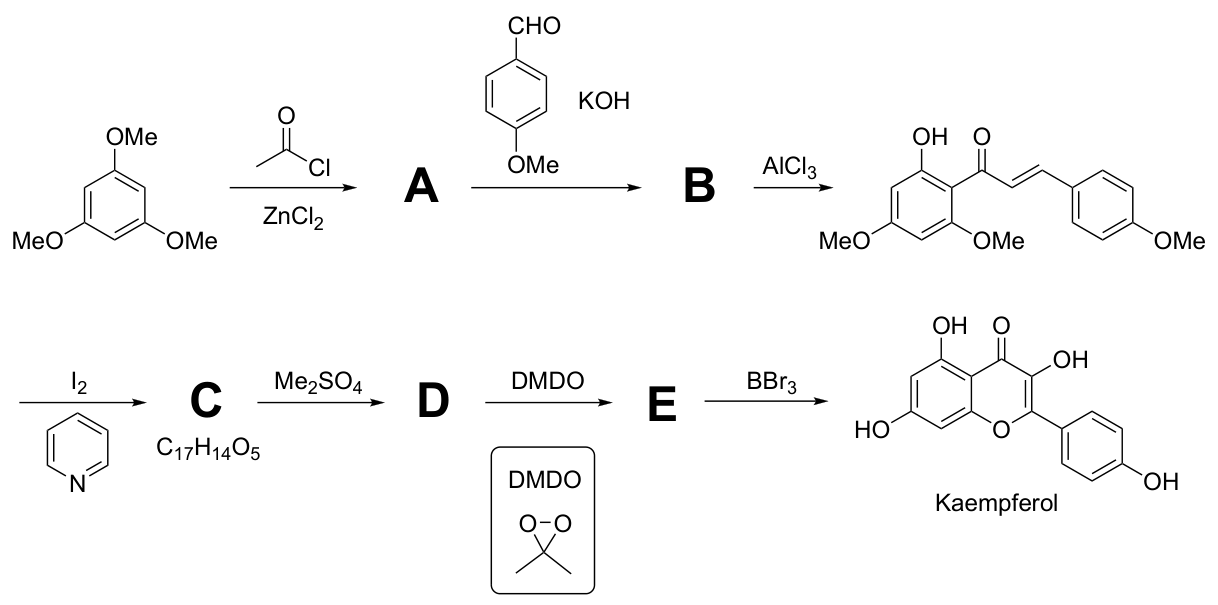
Hints:
- C has a tricyclic system. Also, it has the same number of hydroxyl groups as the compound preceding it.
- The step C to D is necessary to avoid any unwanted reactivity with DMDO.
- DMDO is a hydroxylating agent.
8.1. Draw the structures of compounds A–E. 15 pt
A unique pentacyclic indole alkaloid, serotobenine found in safflower has antimicrobial properties. Its total synthesis is shown below:
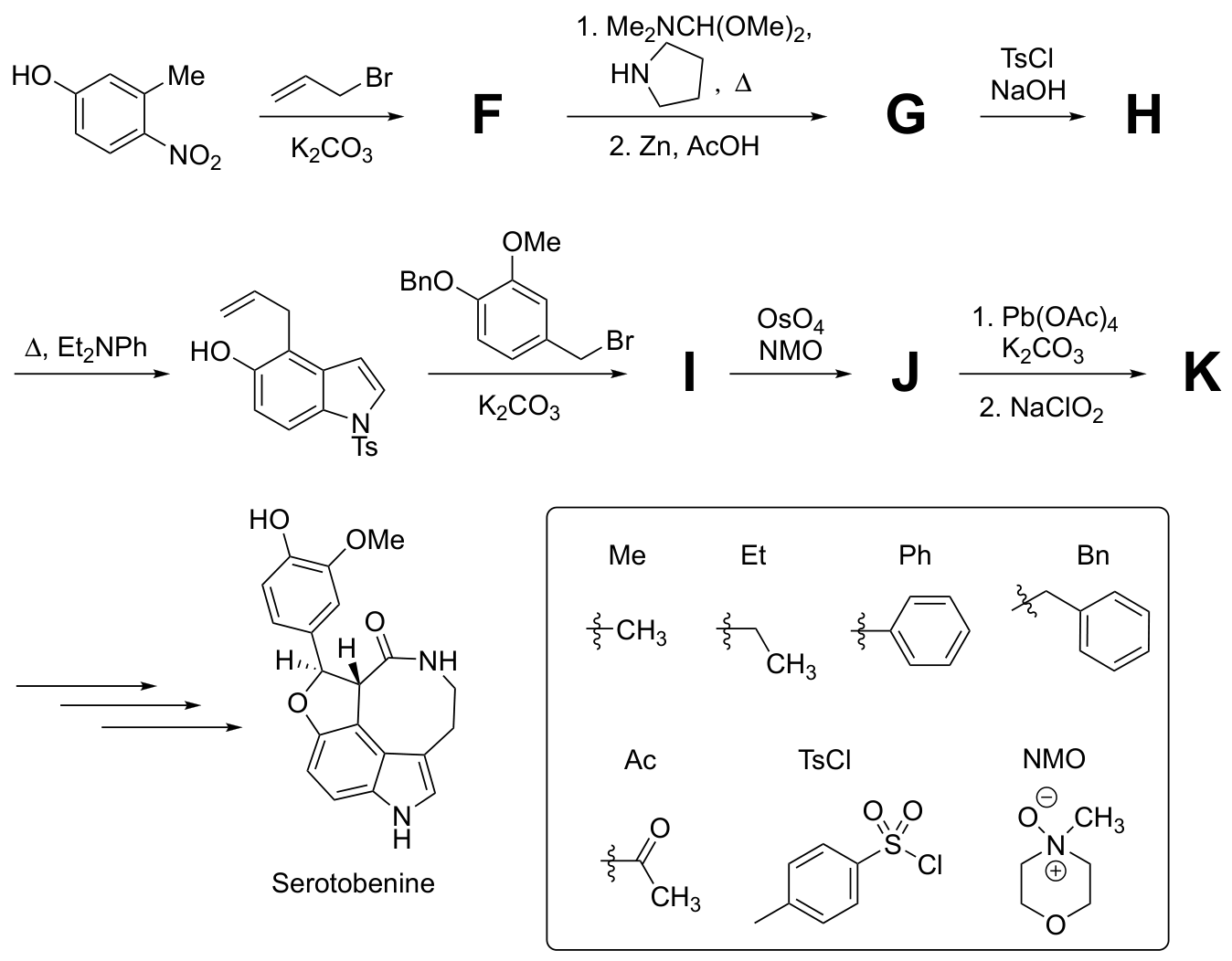
Hints:
- G is a bicyclic compound with one of the rings being a heterocycle.
- H isomerizes upon heating in the presence of the amine base.
- K is a product of an oxidative cleavage of the newly formed functional group in J. K has a \({}^{1}\mathrm{H}\) NMR signal at 12 ppm.
8.2. Draw the structures of compounds F–K. 18 pt
Carthamin gives safflower its red color.
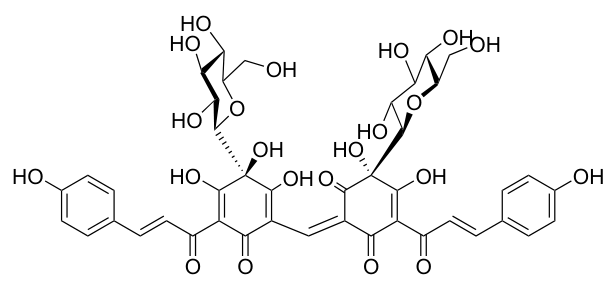
Carthamin
In the total synthesis of carthamin the assembly was tested on a model substrate L. Note that M resembles carthamin’s core structure.
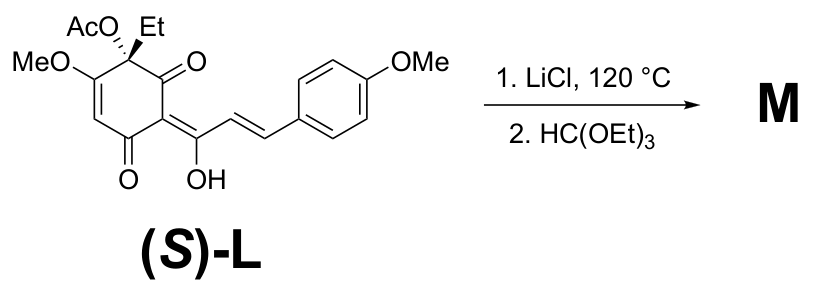
8.3. Draw the structure of compound M including its stereochemistry. (Hint: In methanol-\(d_4\) L has 11 and M has 10 distinct proton signals in their \({}^{1}\mathrm{H}\) NMR spectra). 5 pt
Official English text of the problem.
Problem 9: Porphyrin complexes
Part A. Metals in petroleum
Saudi Arabian petroleum, primarily hydrocarbons, contains elements like vanadium in porphyrin complexes, hinting at its biological origins.
Vanadium complex B is presumably formed in petroleum from chlorophyll according to the following scheme:
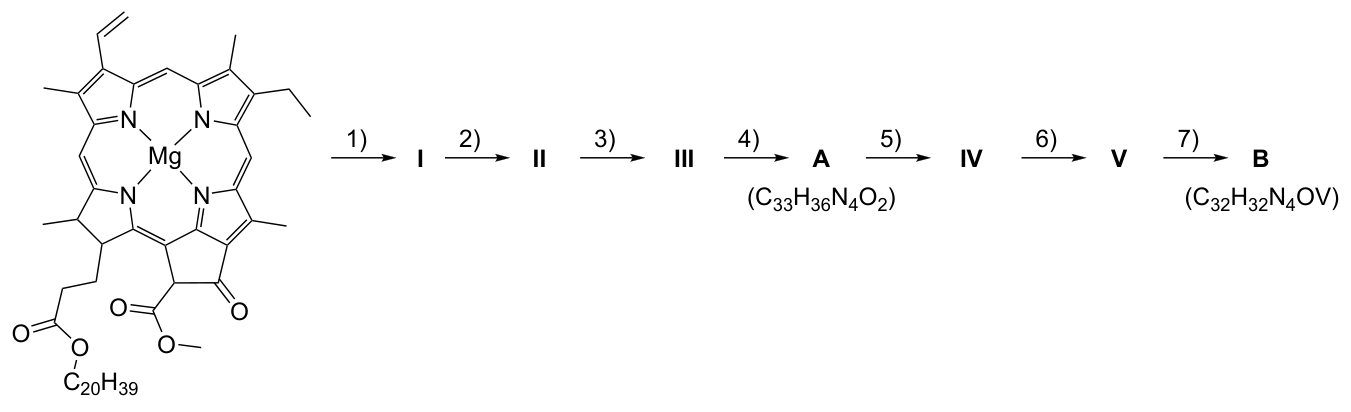
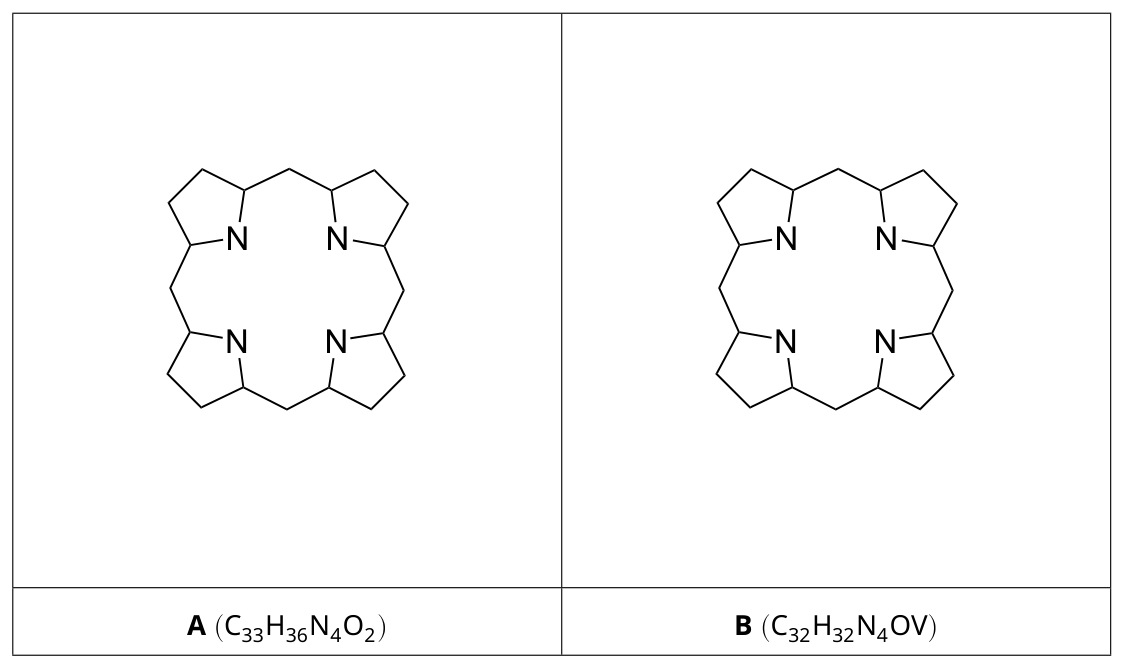
Step Name 1) Demetallization 2) Hydrolysis 3) Decarbomethoxylation 4) Reduction 5) Aromatization 6) Decarboxylation 7) Metal chelation 9.1 Assign the molecular formulae a–e (given in the answer sheet) to the intermediates I–V. 4.0 pt

9.2 Draw the structures of intermediate A and vanadium complex B using the pre-drawn framework of porphyrin. (If you need a new template to redraw your structure(s), please ask the supervisor.) 7.0 pt
9.3 Indicate the oxidation state of vanadium in B. 1.0 pt
Part B. Porphyrin non-metal complexes
Porphyrins are known to form chelate-type complexes not only with metals but also with some non-metals, for example, with boron and phosphorus. Octaethylporphyrin (\(\ce{H2OEP}\)) is often used to model natural porphyrins and to study porphyrin complexes. It has the following structure and can be represented as:
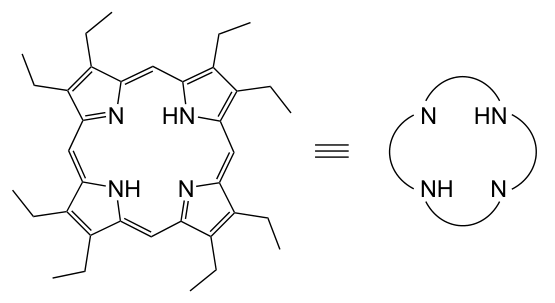
To produce dicationic planar boron porphyrin complex \(\ce{[X3]^2+}\), either \(\ce{BCl3}\) or another binary compound X1 can be used as a precursor:
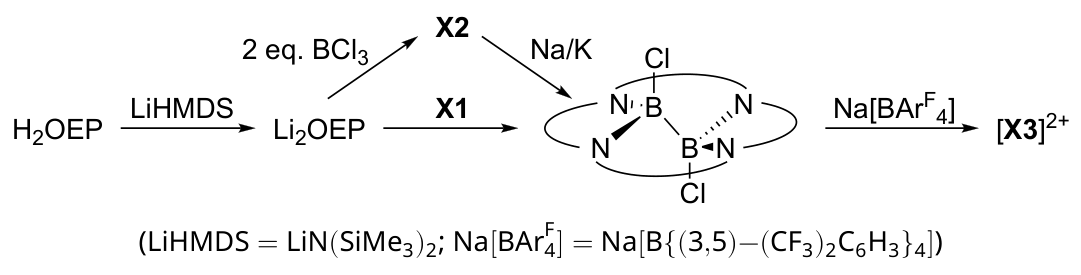
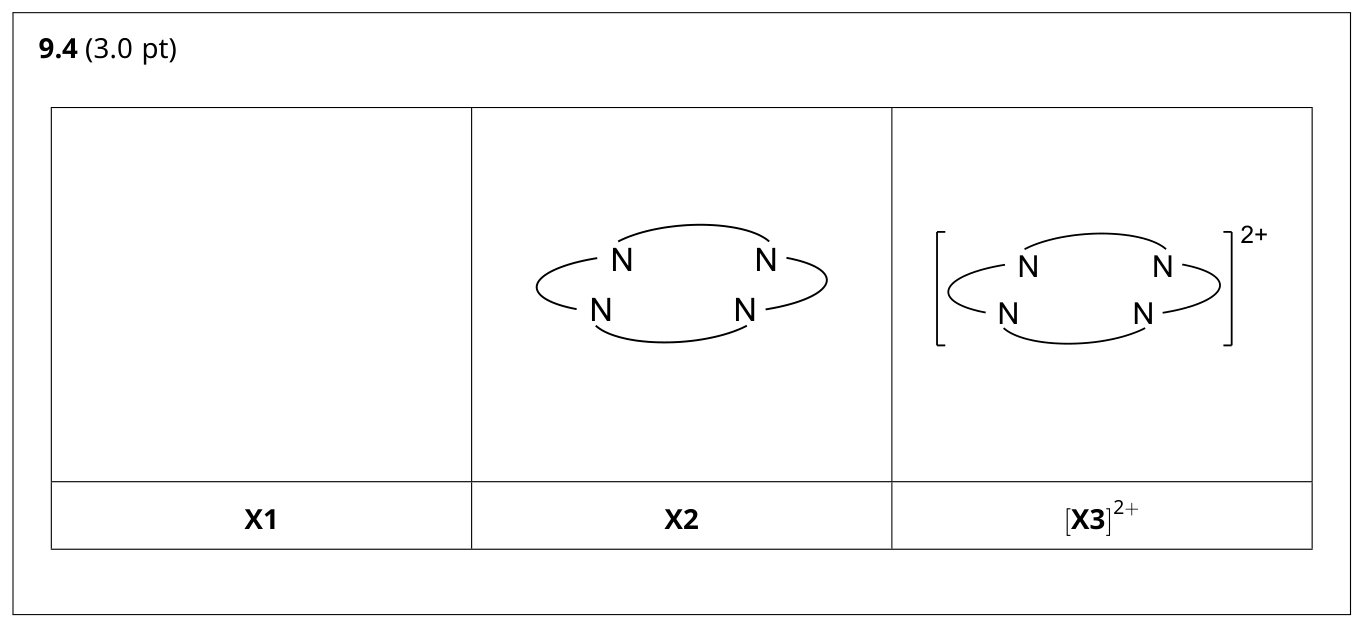
9.4 Draw the structures of X1, intermediate complex X2 and the product \(\ce{[X3]^2+}\). 3.0 pt
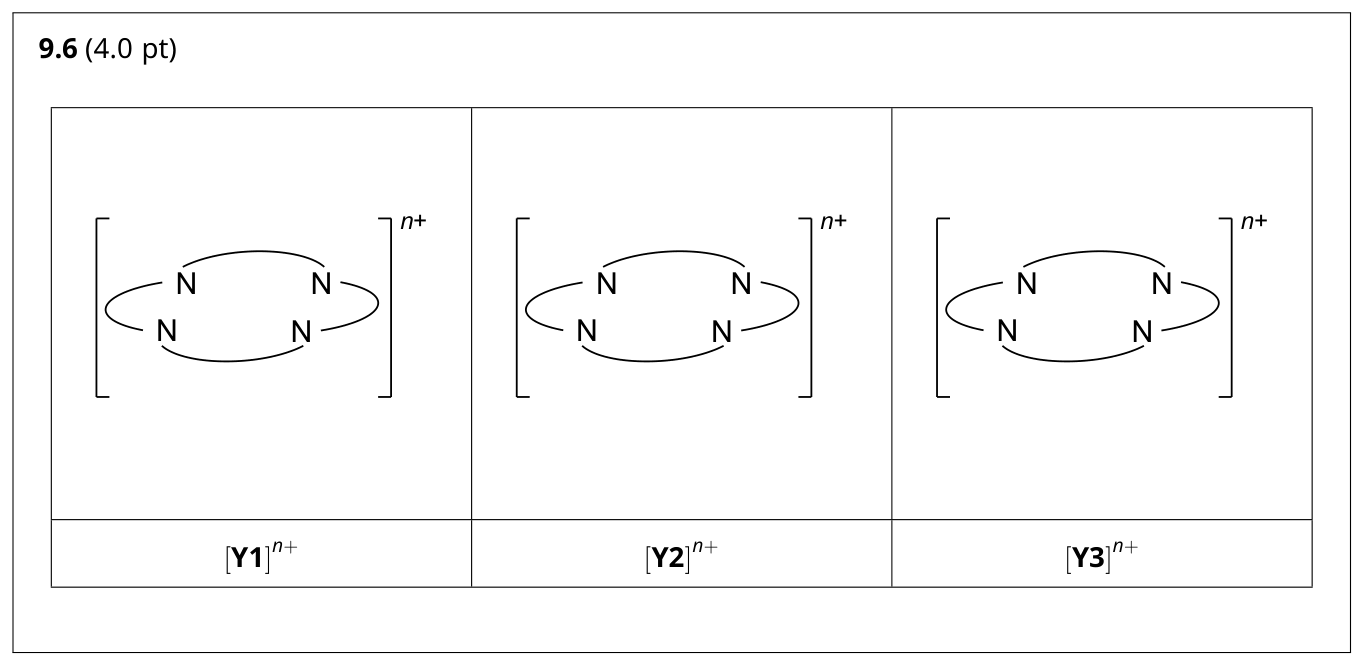
Phosphorus forms porphyrin cationic complexes \(\ce{[Y1]^{n+}}\), \(\ce{[Y2]^{n+}}\), and \(\ce{[Y3]^{n+}}\). The complex \(\ce{[Y3]^{n+}}\) has one less plane of symmetry compared to \(\ce{[Y1]^{n+}}\) and \(\ce{[Y2]^{n+}}\) (ignore ethyl substituents in OEP ligand when considering symmetry). Pyridine (Py) is used here as a basic solvent, “Hal” is one of the halogens: F, Cl, or Br:

9.5 Indicate: a) the charge “\(n+\)” of phosphorus porphyrin complexes; b) the number of planes of symmetry \(N(\sigma)\) that complex \(\ce{[Y1]^{n+}}\) has. 2.0 pt

9.6 Draw the structures of \(\ce{[Y1]^{n+}}\), \(\ce{[Y2]^{n+}}\), and \(\ce{[Y3]^{n+}}\). 4.0 pt
Part C. Porphyrin sandwiches
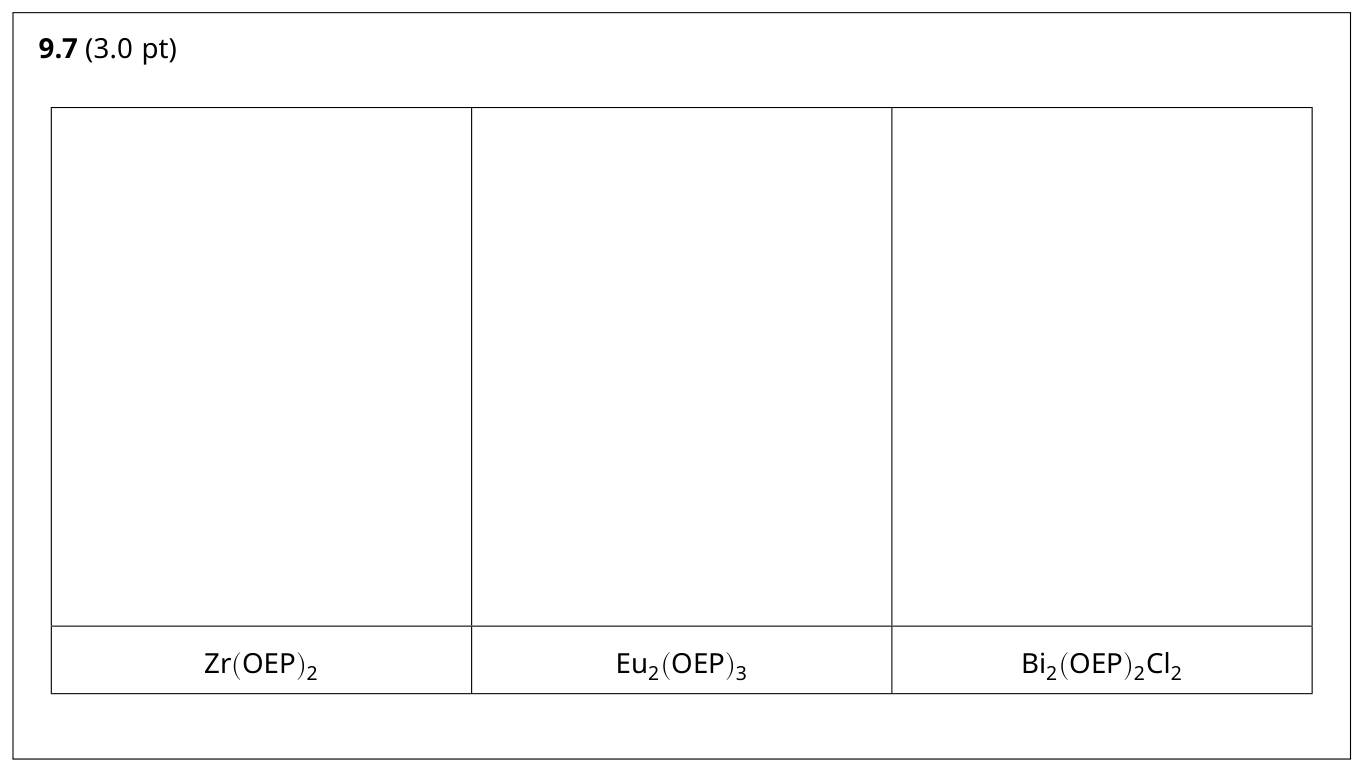
Porphyrin sandwich-type complexes form when there are several porphyrin rings aligned relative to each other. Examples are \(\ce{Zr(OEP)2}\), \(\ce{Eu2(OEP)3}\), \(\ce{Bi2(OEP)2Cl2}\) that have at least 3 planes of symmetry each. Note that the hole size in the OEP ligand is ca. \(4.0\ \text{Å}\), and the average metal–N distances in these complexes are \(2.4,\ 2.5,\ 2.3\ \text{Å}\), respectively.
9.7 Suggest the structures of \(\ce{Zr(OEP)2}\), \(\ce{Eu2(OEP)3}\), and \(\ce{Bi2(OEP)2Cl2}\). You may use a simplified representation of the OEP ligand. 3.0 pt
Another type of porphyrin sandwich-type complex is metal–porphyrin dimers with single or multiple metal–metal bonds. For example, \(\ce{[Ru(OEP)]2}\) has a Ru–Ru double bond (considering only d-electrons). Below is the molecular orbital diagram for an eclipsed dimer of the type \(\ce{[M(porphyrin)]2}\) (interaction between \(\mathrm d_{x^2-y^2}\) is not considered as these orbitals lie high in energy):
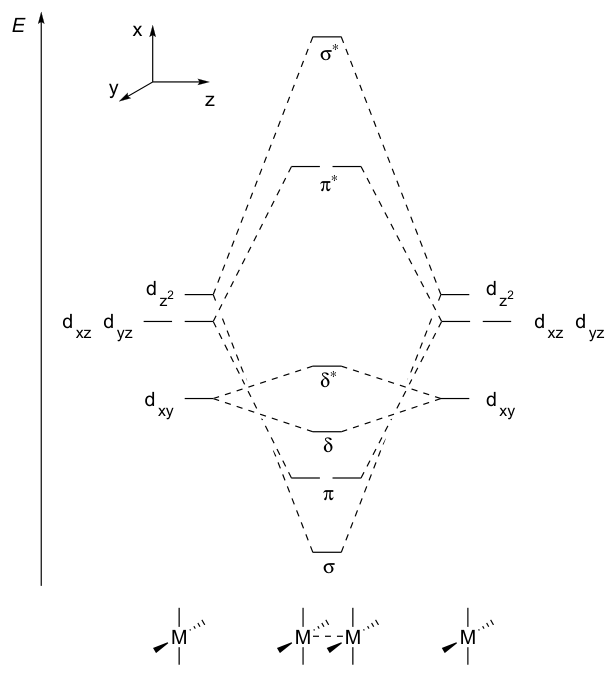
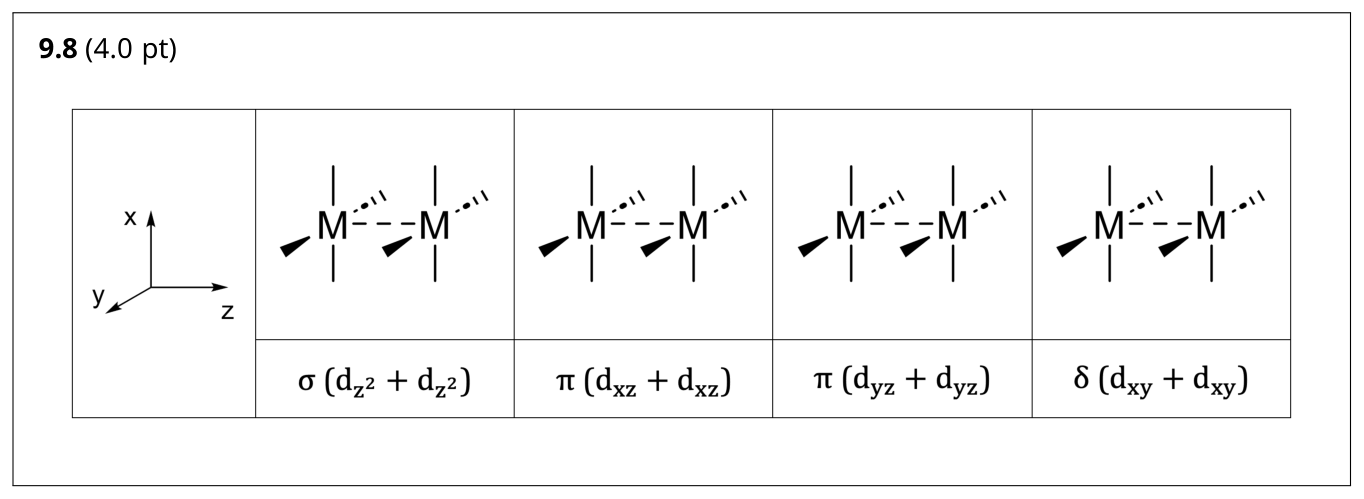
9.8 Draw the \(\sigma(\mathrm d_{z^2}+\mathrm d_{z^2})\), \(\pi(\mathrm d_{xz}+\mathrm d_{xz})\), \(\pi(\mathrm d_{yz}+\mathrm d_{yz})\), and \(\delta(\mathrm d_{xy}+\mathrm d_{xy})\) bonding orbitals according to the specified coordinate system. 4.0 pt
9.9 Calculate the metal–metal bond order in the following complexes in eclipsed conformation: \(\ce{[Mo(OEP)]2}\), \(\ce{[Ir(OEP)]2}\), \(\ce{[Re(OEP)]2^{+}}\). 3.0 pt

The eclipsed conformation is generally preferred for metal–porphyrin dimers with 7, 8, and 9 d-electrons. Otherwise, these complexes are more stable in a staggered conformation, where the porphyrin rings are rotated relative to each other by \(45^\circ\).
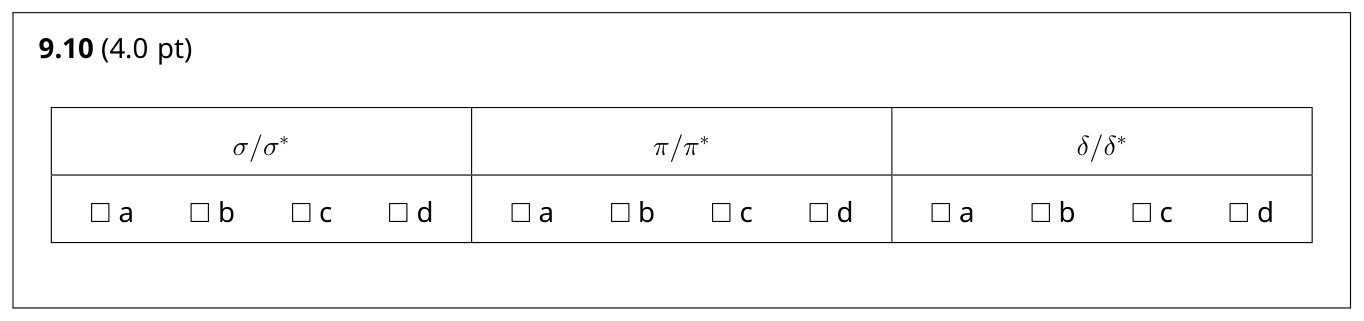
9.10 Select how the splitting (i.e., the energy between antibonding and bonding orbitals) changes for each type of orbital interaction during the conversion of eclipsed conformation into staggered:
a) increases;
b) remains unchanged;
c) decreases (not to zero);
d) decreases to zero.4.0 pt
Official English text of the problem.
Internationale Chemie-Olympiade
IChO 2024
Riad, Saudi-Arabien · 9 Theorieaufgaben mit vollständigen Lösungen
Aufgabe 1: Ammoniak
Das Haber–Bosch-Verfahren zur Herstellung von Ammoniak aus Stickstoff und Wasserstoff zählt zu den einflussreichsten industriellen Verfahren der Geschichte und sichert Schätzungen zufolge die Ernährung von etwa der Hälfte der heutigen Weltbevölkerung. Das Verfahren wird üblicherweise bei konstanter Temperatur und konstantem Druck von 400 °C bzw. 100 bar durchgeführt. Im Reaktor stellt sich an Katalysatoren auf Fe-Basis ein Gleichgewicht zwischen den Edukten und dem Produkt ein.
Die thermochemischen Standarddaten für die Gasphase von \(\ce{N2}\), \(\ce{H2}\) und \(\ce{NH3}\) sind unten angegeben. Nehmen Sie an, dass die Reaktionsenthalpie und die Reaktionsentropie temperaturunabhängig sind.
\(\ce{N2(g)}\) \(\ce{H2(g)}\) \(\ce{NH3(g)}\) \(\Delta_f H^\circ/(\mathrm{kJ\,mol^{-1}})\) 0 0 −45.9 \(S^\circ/(\mathrm{J\,mol^{-1}\,K^{-1}})\) 191.6 130.7 192.8 1.1 — 7 Punkte
Bestimmen Sie den molaren Umsatz von Stickstoff zu Ammoniak (in Prozent) unter den Produktionsbedingungen ausgehend von einem stöchiometrischen Gemisch aus Stickstoff und Wasserstoff. Geben Sie Ihren Rechenweg an, um Teilpunkte zu erhalten. Falls Sie kein Ergebnis erhalten, verwenden Sie in den folgenden Berechnungen 66%.
Eines der Edukte des Haber–Bosch-Verfahrens ist Wasserstoff, der hauptsächlich durch Dampfreformierung von Methan hergestellt wird. Das zweistufige Verfahren beginnt mit der Reaktion von \(\ce{CH4}\) mit Wasser zu \(\ce{H2}\) und \(\ce{CO}\). In einem anschließenden Schritt reagiert \(\ce{CO}\) mit Wasser zu \(\ce{CO2}\) und zusätzlichem Wasserstoff.
1.2 — 2 Punkte
Stellen Sie die Gesamtreaktionsgleichung für das kombinierte Verfahren auf. Geben Sie die Masse an \(\ce{CO2}\) an, die bei der Reaktion pro 1.0 kg \(\ce{H2}\) entsteht (\(m_{\ce{CO2}}\)).
In der Praxis entstehen bei der Dampfreformierung je 1.0 kg Wasserstoff 7.0 kg Kohlenstoffdioxid. Der erzeugte Ammoniak wird nach dem Umgang mit \(\ce{CO2}\) eingestuft. Bei „grauem“ Ammoniak wird das \(\ce{CO2}\) in die Atmosphäre freigesetzt; bei „blauem“ Ammoniak wird es abgeschieden und gespeichert. „Grüner“ Ammoniak wird aus Wasserstoff hergestellt, der ohne Kohlenstoffemissionen erzeugt wird.
1.3 — 3 Punkte
Berechnen Sie die Masse an Kohlenstoffdioxid (\(m_{\ce{CO2},\,\mathrm{blue}}\)), die zur Herstellung von 40,000 kg „blauem“ Ammoniak abgeschieden werden muss. Nehmen Sie an, dass das Kohlenstoffdioxid ausschließlich aus einem realen Dampfreformierungsprozess stammt. Nehmen Sie ferner an, dass der Ammoniak im Gleichgewicht aus einem stöchiometrischen Gemisch aus Stickstoff und Wasserstoff hergestellt wird.
Bei Verwendung von kostengünstigem erneuerbarem Wasserstoff erscheint dessen Umsetzung mit abgeschiedenem \(\ce{CO2}\) zu Methanol vielversprechend. Bei diesem Verfahren tritt jedoch eine konkurrierende Reaktion auf, bei der \(\ce{CO}\) entsteht:
In einen Reaktor, der bei 250 °C und 50 bar gehalten wird, wird ein Gemisch eingespeist, das \(\ce{CO2}:\ce{H2}\) im molaren Verhältnis \(1:4\) enthält. Es wurde festgestellt, dass der \(\ce{CO2}\)-Umsatz 30% und der \(\ce{H2}\)-Umsatz 18.5% beträgt, wenn sich diese beiden Reaktionen im Gleichgewicht befinden. Andere Prozesse müssen nicht berücksichtigt werden.
1.4 — 5 Punkte
Berechnen Sie die thermodynamischen Gleichgewichtskonstanten (bei 250 °C) der beiden Reaktionen.
Heterogene kupferhaltige Katalysatoren werden häufig zur Hydrierung von \(\ce{CO2}\) eingesetzt. Zwei bestimmte Cu-haltige Katalysatoren (\(A\) und \(B\)) erwiesen sich als vielversprechend für die Umwandlung von \(\ce{CO2}\) zu Methanol. Diese Katalysatoren unterscheiden sich nicht nur in ihren katalytischen Reaktionsgeschwindigkeiten, sondern auch in ihrer Oberfläche, ihrem Cu-Gehalt und ihrer Cu-Dispersion (dem Verhältnis des Oberflächen-Cu zum gesamten Cu im Katalysator).
Die Cu-Dispersion ist wichtig, weil nur Cu-Spezies an der Oberfläche bei der Hydrierung von \(\ce{CO2}\) aktiv sind. Unter dieser Annahme entspricht 1 Mol aktiver Zentren 1 Mol Oberflächen-Cu. Die Effizienz dieser aktiven Zentren wird durch ihre Umsatzfrequenzen (TOF, Mol gebildetes Produkt pro Mol aktiver Zentren in einer gegebenen Zeit) beschrieben.
Die folgende Tabelle gibt die Produktivität (angegeben als Masse des erzeugten Methanols pro Gesamtkatalysatormasse in einer gegebenen Zeit) und die spezifischen Oberflächen der beiden Katalysatoren an. Der Cu-Gehalt und die Dispersion der Katalysatoren wurden ebenfalls wie folgt gemessen und angegeben:
- Zu Beginn liegt das gesamte Kupfer in den zuvor oxidierten Katalysatoren als Cu(II) vor; dieses wurde mit Wasserstoff vollständig zu Cu(0) reduziert. Außer den Kupferoxiden reagierten keine anderen Spezies in den Katalysatoren mit Wasserstoff.
- Den reduzierten Proben wurde bei Raumtemperatur \(\ce{N2O}\) zugeführt. Bei dieser Temperatur oxidiert \(\ce{N2O}\) nur die aktiven Oberflächenzentren zu Cu(I).
- Die aktiven Cu(I)-Oberflächenzentren wurden mit Wasserstoff erneut zu Cu(0) reduziert.
Katalysatorproduktivität \((\mathrm{g}_{\mathrm{MeOH}}\,\mathrm{g}_{\mathrm{cat}}^{-1}\,\mathrm{h}^{-1})\) Spezifische Oberfläche \((\mathrm{m^2}\,\mathrm{g}_{\mathrm{cat}}^{-1})\) In Schritt 1 verbrauchter \(\ce{H2}\) \((\mathrm{mmol}\,\mathrm{g}_{\mathrm{cat}}^{-1})\) In Schritt 3 verbrauchter \(\ce{H2}\) \((\mathrm{mmol}\,\mathrm{g}_{\mathrm{cat}}^{-1})\) Katalysator \(A\) 0.80 100 5.0 0.30 Katalysator \(B\) 0.90 120 4.0 0.70 1.5 — 3 Punkte
Bestimmen Sie die Methanolproduktionsrate pro Gesamtmasse an Cu (in \(\mathrm{g}_{\mathrm{MeOH}}\,\mathrm{g}_{\mathrm{Cu}}^{-1}\,\mathrm{h}^{-1}\)) für die Katalysatoren \(A\) und \(B\).
1.6 — 3 Punkte
Bestimmen Sie die TOF (in \(\mathrm{h}^{-1}\)) für die Katalysatoren \(A\) und \(B\).
Falls Sie keine Ergebnisse erhalten, verwenden Sie in den folgenden Berechnungen \(\mathit{TOF}_{\mathrm{Catalyst}\ A}=100\ \mathrm{h}^{-1}\) und \(\mathit{TOF}_{\mathrm{Catalyst}\ B}=1\ \mathrm{h}^{-1}\).
1.7 — 1 Punkt
Kennzeichnen Sie die richtige Aussage auf dem Antwortblatt.
a. Katalysator \(A\) besitzt effizientere aktive Zentren.
b. Katalysator \(B\) besitzt effizientere aktive Zentren.
c. Die beiden Katalysatoren besitzen aktive Zentren mit gleicher Effizienz.Avogadro-Konstante: \(N_A=6.022\cdot10^{23}\ \mathrm{mol^{-1}}\) Gaskonstante: \(R=8.314\ \mathrm{J\,mol^{-1}\,K^{-1}}\) Ionenprodukt des Wassers bei 298.15 K: \(K_w=10^{-14}\) Nullpunkt der Celsius-Skala: \(0\,^\circ\mathrm{C}=273.15\ \mathrm{K}\) Faraday-Konstante: \(F=96485\ \mathrm{C\,mol^{-1}}\) Planck-Konstante: \(h=6.626\cdot10^{-34}\ \mathrm{J\,s}\) Lichtgeschwindigkeit: \(c=2.998\cdot10^8\ \mathrm{m\,s^{-1}}\) Standarddruck: \(p^\circ=1\cdot10^5\ \mathrm{Pa}=1\ \mathrm{bar}\) Ideale Gasgleichung: \(pV=nRT\) Lambert-Beer-Gesetz: \(A=\log\left(\frac{I_0}{I}\right)=\varepsilon\cdot l\cdot c\) Enthalpie: \(H=U+pV\) Gibbs-Energie: \(G=H-TS\) \(\Delta_rG^\circ=-RT\ln K=-nFE^\circ_{\mathrm{cell}}\) Henderson-Hasselbalch-Gleichung: \(\mathrm{pH}=\mathrm{p}K_a+\log\left(\frac{[\ce{A-}]}{[\ce{HA}]}\right)\) Arrhenius-Gleichung: \(k=A\exp\left(-\frac{E_A}{RT}\right)\) Integriertes Geschwindigkeitsgesetz nullter Ordnung: \([\ce{A}]=[\ce{A}]_0-kt\) Oberfläche einer Kugel: \(A=4\pi R^2\) Integriertes Geschwindigkeitsgesetz erster Ordnung: \(\ln[\ce{A}]=\ln[\ce{A}]_0-kt\) Volumen einer Kugel: \(V=\frac{4\pi}{3}R^3\) \(\displaystyle\sum_{k=0}^{\infty}ar^k=\frac{a}{1-r}\quad\text{für }\lvert r\rvert<1\) Periodensystem
Aufgabentext aus dem offiziellen englischen Text übersetzt.
Aufgabe 2: Elektronische Nase
Resistive Gassensoren, insbesondere solche auf der Basis halbleitender Metalloxide (SMOX), erfreuen sich zunehmender Beliebtheit. Sie können kleinste Mengen an Verunreinigungen nachweisen, sind klein und stabil und lassen sich leicht herstellen und verwenden. Diese Eigenschaften zeichnen SMOX-Sensoren unter den vielen Arten von Gassensoren aus, die auf unterschiedlichen physikalischen und chemischen Prinzipien beruhen.
Das Mischoxid X mit normaler Spinell-Kristallstruktur, \(\ce{A^{2+}B2^{3+}O4^{2-}}\), ist ein Beispiel für eines dieser SMOX-Materialien. X kann durch Zersetzung des kristallinen hydratisierten Metalloxalats \(\ce{ZC2O4}\cdot k\ce{H2O}\) des Metalls Z an der Luft erhalten werden. Beim Erhitzen auf \(140\,^\circ\mathrm{C}\) verliert das kristalline Hydrat 19.7% seiner Masse. Weiteres Erhitzen an der Luft führt bei \(500\,^\circ\mathrm{C}\) zur Bildung von 2.407 g schwarzem X und \(3.8\,\mathrm{dm^3}\) Kohlenstoffdioxid bei 101325 Pa.
2.1 Bestimmen Sie die Formel von X und den Wert von \(k\) in \(\ce{ZC2O4}\cdot k\ce{H2O}\). 4 Pkt.
In Spinellstrukturen bilden die Sauerstoffatome ein kubisch flächenzentriertes (FCC) Gitter. In normalen Spinellen besetzen die \(\ce{A^{2+}}\)-Kationen einen Teil der tetraedrischen und die \(\ce{B^{3+}}\)-Kationen einen Teil der oktaedrischen Gitterplätze.
2.2 Berechnen Sie den prozentualen Anteil der tetraedrischen Plätze, der bei einem normalen Spinell \(\ce{A^{2+}B2^{3+}O4^{2-}}\) besetzt ist. 2 Pkt.
Neben den normalen Spinellen beschreibt die allgemeine Formel \(\ce{MM'2O4}\) auch inverse und gemischte Spinellstrukturen. Dabei bezeichnet \(\ce{M}\) die tetraedrisch koordinierten und \(\ce{M'}\) die oktaedrisch koordinierten Kationen; im Gegensatz zu normalen Spinellen sind bestimmte Kationen jedoch nicht auf eine einzige Art von Gitterplatz beschränkt. Ein Merkmal inverser Spinellstrukturen ist, dass die Elektronenkonfiguration der Kationen auf den \(\ce{M'}\)-Plätzen \(d^0\), \(d^5\) oder \(d^{10}\) ist.
2.3 Wählen Sie auf dem Antwortbogen zwei der angegebenen Formeln aus, die der Struktur eines inversen Spinells entsprechen: \(\ce{Fe3O4}\), \(\ce{NiFe2O4}\), \(\ce{Mn3O4}\), \(\ce{FeCr2O4}\). 1 Pkt.
Halbleiter sind Materialien, deren Orbitale einen geringen Überschuss oder Mangel an Elektronen aufweisen, wodurch negative beziehungsweise positive Ladungen (Löcher) entstehen. Diese Ladungen können sich durch den Halbleiter bewegen und ermöglichen ihm, elektrischen Strom zu leiten. Chemische Reaktionen können die Ladung eines Halbleiters erhöhen oder verringern und dadurch seine Leitfähigkeit verändern.
X ist ein Beispiel für einen Halbleiter, in dem der elektrische Strom durch positive Ladungen (Löcher) getragen wird. Bei einem resistiven Gassensor auf der Basis von X wird der Widerstand \(R\) über die Zeit \(t\) gemessen, während ein Gas über den Sensor geleitet wird. Dadurch können Redoxreaktionen zwischen dem Gas und der Halbleiteroberfläche stattfinden, die den Widerstand des Sensors abhängig von den Donator-/Akzeptoreigenschaften des Gases verändern. Abbildung 1 zeigt die beiden unterschiedlichen Signaltypen, die auf diese Weise erhalten werden.
Abbildung 1: Auftragung des Widerstands gegen die Zeit für zwei mögliche Signaltypen, (a) und (b).
Graue Balken = Luft, weiße Balken = Luft + Analytgas.
2.4 Ordnen Sie den Analytgasen (\(\ce{H2S}\), \(\ce{O3}\), \(\ce{NO2}\), \(\ce{NH3}\)) den Signaltyp (a oder b) zu, der bei ihrem Nachweis in niedrigen Konzentrationen mit dem Sensor auf der Basis von X erhalten wird. 2 Pkt.
Die Temperaturabhängigkeit der spezifischen Leitfähigkeit (\(\sigma\)) von X wird durch das Arrhenius-Gesetz beschrieben: \(\sigma(T)=\sigma_0\exp(-E_a/(RT))\), wobei \(E_a\) die Aktivierungsenergie der Leitfähigkeit ist. In unterschiedlichen Temperaturbereichen lassen sich drei Arten der Leitfähigkeit unterscheiden:
Ionisation (I): 444–570 K, Störstellenleitung (II): 585–765 K und Eigenleitung (III): 800–905 K.
Die folgende Skizze veranschaulicht den Zusammenhang zwischen Leitfähigkeit und Temperatur für die drei Temperaturbereiche.
2.5 Ordnen Sie anhand der obigen Skizze die den verschiedenen Arten der Leitfähigkeit zugehörigen Aktivierungsenergien \(E_a(I)\), \(E_a(II)\) und \(E_a(III)\) von der größten zur kleinsten. 3 Pkt.
Avogadro-Konstante: \(N_A=6.022\cdot10^{23}\,\mathrm{mol^{-1}}\) Gaskonstante: \(R=8.314\,\mathrm{J\,mol^{-1}\,K^{-1}}\) Ionenprodukt des Wassers bei 298.15 K: \(K_w=10^{-14}\) Nullpunkt der Celsius-Skala: \(0\,^\circ\mathrm{C}=273.15\,\mathrm{K}\) Faraday-Konstante: \(F=96485\,\mathrm{C\,mol^{-1}}\) Planck-Konstante: \(h=6.626\cdot10^{-34}\,\mathrm{J\,s}\) Lichtgeschwindigkeit: \(c=2.998\cdot10^8\,\mathrm{m\,s^{-1}}\) Standarddruck: \(p^\circ=1\cdot10^5\,\mathrm{Pa}=1\,\mathrm{bar}\) Ideales Gasgesetz: \(pV=nRT\) Lambert-Beer-Gesetz: \(A=\log\left(\frac{I_0}{I}\right)=\varepsilon\cdot l\cdot c\) Enthalpie: \(H=U+pV\) Gibbs-Energie: \(G=H-TS\) \(\Delta_rG^\circ=-RT\ln K=-nFE^\circ_{\mathrm{cell}}\) Henderson-Hasselbalch-Gleichung: \(\mathrm{pH}=\mathrm{p}K_a+\log\left(\frac{[\ce{A-}]}{[\ce{HA}]}\right)\) Arrhenius-Gleichung: \(k=A\exp\left(-\frac{E_A}{RT}\right)\) Integriertes Geschwindigkeitsgesetz nullter Ordnung: \([\ce{A}]=[\ce{A}]_0-kt\) Oberfläche einer Kugel: \(A=4\pi R^2\) Integriertes Geschwindigkeitsgesetz erster Ordnung: \(\ln[\ce{A}]=\ln[\ce{A}]_0-kt\) Volumen einer Kugel: \(V=\frac{4\pi}{3}R^3\) \(\displaystyle\sum_{k=0}^{\infty}ar^k=\frac{a}{1-r}\quad\text{für }\lvert r\rvert<1\) Periodensystem
Aufgabentext aus dem offiziellen englischen Text übersetzt.
Aufgabe 3: Tyrosinase
Das Enzym Tyrosin-3-Monooxygenase spielt eine wichtige biologische Rolle, da es den ersten und geschwindigkeitsbestimmenden Schritt der Biosynthese des Neurotransmitters Dopamin katalysiert. In diesem ersten Schritt wird L-DOPA aus der Aminosäure L-Tyrosin (Tyr) in Gegenwart von gelöstem Sauerstoff, Tetrahydrofolsäure und Eisen(II)-Ionen gebildet. In einem nachfolgenden Schritt wandelt ein anderes Enzym L-DOPA in Dopamin um.
Die Aktivität des Enzyms Tyrosin-3-Monooxygenase wird durch das einfachste Modell der Enzymwirkung, die Michaelis-Menten-Gleichung, gut beschrieben. Diese gibt die Bildungsgeschwindigkeit (\(r\)) von L-DOPA in Abhängigkeit von den Konzentrationen des Enzyms (E) und des Substrats Tyr (S) wie folgt an:
\[ r=\frac{k[E][S]}{K_{\mathrm M}+[S]} \]
Die folgenden Werte der Wechselzahl (\(k=250\ \mathrm{min^{-1}}\)) und der Michaelis-Konstante (\(K_{\mathrm M}=0.49\ \mathrm{mmol\,dm^{-3}}\)) können bei Bedarf in dieser Aufgabe verwendet werden.
Brenzcatechin (1,2-Dihydroxybenzol) inaktiviert das Enzym Tyrosin-3-Monooxygenase irreversibel, indem es dieses in eine inaktive Form überführt. Wird eine sorgfältig gereinigte Probe von Brenzcatechin unter Ausschluss von gelöstem Sauerstoff mit dem Enzym gemischt, ist keinerlei Veränderung zu beobachten. Daher muss die Reaktion von Brenzcatechin mit gelöstem Sauerstoff, bei der o-Chinon entsteht, von Bedeutung sein.
Dieser Prozess kann in Abwesenheit des Enzyms untersucht werden. Ein Versuch in einem Reaktor ohne Kontakt zur Umgebungsluft bei \(37\,^\circ\mathrm C\) und pH 7.5 lieferte die folgenden kinetischen Daten:
Zeit (min) Brenzcatechinkonzentration (\(\mathrm{mmol\,dm^{-3}}\)) Sauerstoffkonzentration (\(\mathrm{mmol\,dm^{-3}}\)) o-Chinonkonzentration (\(\mu\mathrm{mol\,dm^{-3}}\)) 0 2.00 0.200 0 20.0 1.97 0.170 30 40.0 1.94 0.140 60 60.0 1.91 0.111 89 80.0 1.88 0.083 117 100.0 1.85 0.054 146 3.1 — 5.0 Pkt.
Identifizieren Sie das einzige Nebenprodukt (das keines der in der obigen Tabelle aufgeführten Moleküle ist) und stellen Sie anhand der kinetischen Daten die ausgeglichene Reaktionsgleichung mit Summenformeln auf.
3.2 — 2.0 Pkt.
Berechnen Sie die Anfangsgeschwindigkeit (\(r_0\)) der Bildung von o-Chinon in diesem Versuch und geben Sie eine geeignete Einheit an.
Das Geschwindigkeitsgesetz des Prozesses wurde durch Variation der Anfangskonzentrationen der Reaktanten bestimmt. Eine Änderung der Sauerstoffkonzentration hatte keinen Einfluss auf die Anfangsgeschwindigkeit des Prozesses. Bei verschiedenen Brenzcatechinkonzentrationen ergaben sich die folgenden Anfangsgeschwindigkeiten der Bildung von o-Chinon:
Brenzcatechinkonzentration (\(\mathrm{mmol\,dm^{-3}}\)) Anfangsgeschwindigkeit der Bildung von o-Chinon (\(\mu\mathrm{mol\,dm^{-3}\,min^{-1}}\)) 1.0 0.75 4.0 3.0 6.0 4.5 8.0 6.0 10.0 7.5 3.3 — 5.0 Pkt.
Bestimmen Sie das Geschwindigkeitsgesetz der Reaktion zwischen Brenzcatechin und Sauerstoff, bei der o-Chinon entsteht. Berechnen Sie die Geschwindigkeitskonstante dieses Prozesses (\(k_{\mathrm{catechol}}\)) und geben Sie eine geeignete Einheit an.
In getrennten Versuchen wurde bestätigt, dass weder o-Chinon noch das Nebenprodukt das Enzym allein oder auch in Kombination inaktivieren.
Ein Versuch, bei dem das Enzym in Gegenwart von gelöstem Sauerstoff mit Brenzcatechin zur Reaktion gebracht wird, zeigte hingegen eine Inaktivierung.
Der Versuch wurde in einem offenen Gefäß durchgeführt, sodass der im Prozess verbrauchte Sauerstoff kontinuierlich aus der Luft nachgeliefert werden konnte. Die Anfangskonzentration des Enzyms betrug \(4.2\ \mathrm{nmol\,dm^{-3}}\), die Anfangskonzentration von Brenzcatechin betrug \(2.00\ \mathrm{mmol\,dm^{-3}}\) bei \(37\,^\circ\mathrm C\) und pH 7.5.
Aus dem Enzym-Brenzcatechin-Reaktionsgemisch wurden regelmäßig Proben entnommen, und die Aktivität des Enzyms wurde durch Zugabe von L-Tyrosin, Tetrahydrofolsäure und Eisen(II)-Ionen bestimmt. Bei den Enzymaktivitätsmessungen betrug die Konzentration des zugesetzten L-Tyrosins \(10.0\ \mathrm{mmol\,dm^{-3}}\), und die Konzentration von L-DOPA wurde in jeder Messprobe nach 2.0 Minuten gemessen. Die folgenden Ergebnisse wurden erhalten:
Reaktionszeit der Inaktivierung \(t\) (min) L-DOPA-Konzentration 2.0 Minuten nach Beginn der Aktivitätsmessung \([\mathrm{DOPA}]\) (\(\mu\mathrm{mol\,dm^{-3}}\)) 0 2.0 20.0 1.9 40.0 1.7 60.0 1.3 70.0 1.00 80.0 0.72 90.0 0.38 3.4 — 4.0 Pkt.
Leiten Sie eine Formel her, mit der Sie die tatsächliche Konzentration an aktivem Enzym (\([E]\)) aus den Daten dieser Versuche in Abhängigkeit von \(k\) (\(=250\ \mathrm{min^{-1}}\)), \(K_{\mathrm M}\) (\(=0.49\ \mathrm{mmol\,dm^{-3}}\)) und/oder den Reagenzkonzentrationen berechnen können.
Die Änderung der Konzentration an aktivem Enzym in Abhängigkeit von der Zeit wird durch eine Parabel (\([E]=[E]_0-k_{\mathrm{obs}}t^2\)) gut beschrieben. Dabei ist \(k_{\mathrm{obs}}\) eine beobachtete Geschwindigkeitskonstante (d. h. eine Konstante, die später als Kombination von Geschwindigkeitskonstanten elementarer Reaktionsschritte und Anfangskonzentrationen geschrieben werden kann), und \([E]_0\) ist die Anfangskonzentration des Enzyms.
3.5 — 3.0 Pkt.
Geben Sie den Wert von \(k_{\mathrm{obs}}\) mit einer geeigneten Einheit an.
3.6 — 3.0 Pkt.
Bestimmen Sie die erste Halbwertszeit der Enzyminaktivierungsreaktion. Leiten Sie eine Formel her, die die erste Halbwertszeit in Abhängigkeit von der Anfangskonzentration des Enzyms und von \(k_{\mathrm{obs}}\) angibt.
Die ersten Halbwertszeiten der Enzyminaktivierung wurden auch bei anderen Anfangskonzentrationen von Brenzcatechin bestimmt. Die Zeitabhängigkeit der Konzentrationen an aktivem Enzym wurde auch in diesen Fällen sehr gut durch Parabeln beschrieben.
Brenzcatechinkonzentration (\(\mathrm{mmol\,dm^{-3}}\)) erste Halbwertszeit (min) 1.0 140 4.0 35 6.0 23 8.0 17.5 10.0 14 3.7 — 6.0 Pkt.
Leiten Sie eine Geschwindigkeitsgleichung für den Enzyminaktivierungsprozess her, die mit allen experimentellen Beobachtungen im Einklang steht.
3.8 — 3.0 Pkt.
Welche Reaktanten sind am geschwindigkeitsbestimmenden Schritt des Enzyminaktivierungsprozesses beteiligt? Wählen Sie die EINZIGE richtige Option auf dem Antwortblatt aus.
A) \(\ce{\text{Brenzcatechin} + O2 ->} \ldots\)
B) \(\ce{\text{Brenzcatechin} + \text{o-Chinon} ->} \ldots\)
C) \(\ce{\text{o-Chinon} + O2 ->} \ldots\)
D) \(\ce{\text{Enzym} + 2 \text{Brenzcatechin} ->} \ldots\)
E) \(\ce{\text{Enzym} + O2 ->} \ldots\)
F) \(\ce{2 \text{Brenzcatechin} + O2 ->} \ldots\)
G) \(\ce{\text{Enzym} + \text{Brenzcatechin} ->} \ldots\)
H) \(\ce{\text{Enzym} + \text{Nebenprodukt} ->} \ldots\)Aufgabentext aus dem offiziellen englischen Text übersetzt.
Aufgabe 4: Kalium
Elementares Kalium war das erste Metall, das durch Elektrolyse hergestellt wurde (1807). Humphry Davy verwendete voltaische Zellen und Elektroden, die in geschmolzenes \(\ce{KOH}\) eingetaucht waren.
4.1 Geben Sie ausgeglichene Gleichungen für die Vorgänge an der Kathode (1) und der Anode (2) an. 2 Pkt.
Es ist wenig bekannt, dass französische Chemiker bereits ein Jahr nach Davy Kalium durch chemische Reduktion herstellten. Bei einer der Methoden wurde ein Gemisch aus Kaliumcarbonat und fein pulverisiertem Kohlenstoff verwendet. Dieses Gemisch wurde in einem Gewehrlauf auf sehr hohe Temperaturen erhitzt. Kohlenstoffmonoxid und Kaliumdampf traten am Ende des Laufs aus, wo das Metall zu einem Feststoff kondensiert werden konnte.
4.2 Schreiben Sie die ausgeglichene Gleichung für die Reaktion auf, bei der ausschließlich diese beiden Produkte entstehen. 1 Pkt.
Die chemische Herstellung von Kalium hatte eine geringe Ausbeute. Je nach den Bedingungen blieb eine beträchtliche Menge einer rötlichen Paste im Gewehrlauf zurück. Gmelin isolierte 1825 aus diesem Rückstand durch Umkristallisieren aus Wasser eine interessante Verbindung (X). Die genaue Struktur des Nebenprodukts X wurde erst mehr als anderthalb Jahrhunderte später bestimmt.
X ist ein hydratisiertes Salz (2 mol Wasser : 1 mol Salz), das goldgelbe Kristalle bildet. Sein Anion besitzt eine außergewöhnlich symmetrische (wie Schwingungsspektren zeigen) und stabile, planare cyclische Struktur.
Die zweiprotonige Säure (Y), die aus dem Salz X gebildet werden kann, hat überraschend niedrige \(\mathrm{p}K_a\)-Werte (zumindest für den oberflächlichen Betrachter): 0.8 und 2.2.
4.3 Geben Sie den pH-Wert an, bei dem 95% der gesamten gelösten Säure Y in der neutralen Säureform vorliegen. 3 Pkt.
4.4 Berechnen Sie den pH-Wert einer \(0.01\ \mathrm{mol\,dm^{-3}}\) Lösung des Salzes X in reinem Wasser. 4 Pkt.
Der entscheidende Schritt bei der Strukturaufklärung von X war die Behandlung des wasserfreien Salzes mit Iodmethan. Das Salz reagierte mit zwei Äquivalenten Iodmethan. Die dabei erhaltene, etwas flüchtige Verbindung hatte eine molare Masse von \(170.12\ \mathrm{g/mol}\) (gemessen mit einem Massenspektrometer).
In dem Gemisch wurden außerdem mehrere analoge Salze in kleineren Mengen identifiziert. Die entsprechenden Kaliumsalze ergaben bei der Behandlung mit zwei Äquivalenten \(\ce{MeI}\) Derivate mit folgenden molaren Massen: \(142.11\ \mathrm{g/mol}\), \(114.10\ \mathrm{g/mol}\), \(198.13\ \mathrm{g/mol}\).
4.5 Geben Sie die Verhältnisformel von Gmelins Verbindung X an. 4 Pkt.
4.6 Zeichnen Sie die Struktur der freien Säure Y. 3 Pkt.
Die außergewöhnliche Stabilität der Reihe von Anionen in den zu X analogen Salzen lässt sich auf Elektronendelokalisierung zurückführen.
4.7 Zeichnen Sie für das Anion in jedem der vier Salze eine mesomere Grenzstruktur mit einem wesentlichen Beitrag. 4 Pkt.
Avogadro-Konstante: \(N_A=6.022\cdot10^{23}\ \mathrm{mol^{-1}}\) Gaskonstante: \(R=8.314\ \mathrm{J\,mol^{-1}\,K^{-1}}\) Ionenprodukt des Wassers bei 298.15 K: \(K_w=10^{-14}\) Nullpunkt der Celsius-Skala: \(0^\circ\mathrm{C}=273.15\ \mathrm{K}\) Faraday-Konstante: \(F=96485\ \mathrm{C\,mol^{-1}}\) Planck-Konstante: \(h=6.626\cdot10^{-34}\ \mathrm{J\,s}\) Lichtgeschwindigkeit: \(c=2.998\cdot10^8\ \mathrm{m\,s^{-1}}\) Standarddruck: \(p^\circ=1\cdot10^5\ \mathrm{Pa}=1\ \mathrm{bar}\) Ideale Gasgleichung: \(pV=nRT\) Lambert-Beer-Gesetz: \(A=\log\left(\frac{I_0}{I}\right)=\varepsilon\cdot l\cdot c\) Enthalpie: \(H=U+pV\) Gibbs-Energie: \(G=H-TS\) \(\Delta_rG^\circ=-RT\ln K=-nFE^\circ_{\mathrm{cell}}\) Henderson-Hasselbalch-Gleichung: \(\mathrm{pH}=\mathrm{p}K_a+\log\left(\frac{[\ce{A-}]}{[\ce{HA}]}\right)\) Arrhenius-Gleichung: \(k=A\exp\left(-\frac{E_A}{RT}\right)\) Integriertes Geschwindigkeitsgesetz nullter Ordnung: \([\ce{A}]=[\ce{A}]_0-kt\) Oberfläche einer Kugel: \(A=4\pi R^2\) Integriertes Geschwindigkeitsgesetz erster Ordnung: \(\ln[\ce{A}]=\ln[\ce{A}]_0-kt\) Volumen einer Kugel: \(V=\frac{4\pi}{3}R^3\) \(\displaystyle\sum_{k=0}^{\infty}ar^k=\frac{a}{1-r}\quad\text{für }\lvert r\rvert<1\) Periodensystem
Aufgabentext aus dem offiziellen englischen Text übersetzt.
Aufgabe 5: Unbekannt
Das metallhaltige Salz A lässt sich durch eine einfache Austauschreaktion herstellen, indem die kalten, gesättigten wässrigen Lösungen der beiden deutlich gefärbten Verbindungen B und C im stöchiometrischen Verhältnis gemischt werden. Werden 10.00 g B in Lösung mit der Lösung von 12.86 g C gemischt und sofort auf \(2\,^\circ\mathrm{C}\) abgekühlt, erhält man 4.90 g festes A. Die Ausbeute an A beträgt 32.6 %.
Zur Bestimmung der Zusammensetzung von A wird zunächst eine iodometrische Analyse durchgeführt. Eine bekannte Masse von A wird in einen Titrierkolben gegeben und mit Schwefelsäure angesäuert. Anschließend wird \(\ce{KI}\) im Überschuss zugesetzt, wobei sich ein Niederschlag bildet. Nach einigen Minuten wird Natriumcitratlösung zugegeben, bis die Lösung frei von Niederschlag ist. Die Citrationen bilden mit einem in der Mischung vorhandenen Metallion einen stabilen Komplex, wodurch die zur Niederschlagsbildung führende Reaktion vollständig umgekehrt wird. Die entstandene Mischung wird mit Natriumthiosulfatlösung titriert (Titration I über Reaktion 1). Zur blauen, titrierten Lösung wird eine weitere Portion Schwefelsäure (deutlich mehr als die anfängliche Menge) gegeben, um das Citrat zu protonieren. Der zuvor gebildete feste Niederschlag entsteht erneut [Reaktion 2]. Die Mischung wird mit derselben Thiosulfatlösung titriert (Titration II über Reaktion 1).
Die durchschnittlichen Verbrauchsvolumina für 100.0 mg A mit \(5.000\cdot10^{-2}\ \mathrm{mol\,dm^{-3}}\) Thiosulfat betragen \(54.12\ \mathrm{cm^3}\) bei Titration I und \(5.41\ \mathrm{cm^3}\) bei Titration II.
Beim Erhitzen der wässrigen Lösung von A lässt sich der blaue Niederschlag D beobachten [Reaktion 3]. Aus der Flüssigkeit über D kann die Verbindung E auskristallisiert werden. Die niedrige Temperatur während der Synthese von A ist wichtig, um eine Verunreinigung durch E zu vermeiden.
5.1 Geben Sie ausgeglichene Gleichungen für die Reaktionen [1] und [2] an. 4.0 Pkt.
Die thermische Zersetzung von A wurde eingehend untersucht. Wird reines A langsam erhitzt, explodiert es bereits bei etwa \(75\,^\circ\mathrm{C}\). Wird die Verbindung in Aluminiumoxid dispergiert und die Mischung erhitzt, nimmt die Matrix die überschüssige Wärme auf, sodass die Explosion vermieden werden kann. Zwei Zersetzungsschritte lassen sich beobachten. Im ersten Schritt (bei \(65\,^\circ\mathrm{C}\)) bildet sich unter einer Massenabnahme von 14.1 % ein aus zwei Komponenten bestehender fester Rückstand [Reaktion 4]. Die Komponenten dieses Rückstands lassen sich leicht trennen, da F gut wasserlöslich ist, während sich G überhaupt nicht löst. Das Massenverhältnis F:G beträgt 1.00 : 2.97. Bei weiterem Erhitzen zersetzt sich F ohne festen Rückstand [Reaktion 5]. Somit ist reines G das endgültige feste Zersetzungsprodukt von A. G enthält neben 27.0 Massen-% Sauerstoff zwei weitere Elemente. Eine der beiden Komponenten des im ersten Zersetzungsschritt entstehenden Gasgemischs lässt sich leicht quantitativ bestimmen, indem sie in einer sauren Lösung absorbiert wird.
Einige Hinweise
- Die Verbindung A zersetzt sich ohne Freisetzung von Sauerstoff.
- Die Verbindung A enthält zwei verschiedene Metalle.
- Die Verbindungen A und B enthalten beide ein Komplexion.
- C ist eine allen Chemiestudierenden wohlbekannte Verbindung.
- Die Verbindung F enthält kein Metall.
5.2 Geben Sie die chemischen Formeln von A—G an. Sie müssen Ihre Berechnungen nicht angeben. Falls Ihre Verbindungen jedoch falsch sind, können Sie für richtige Berechnungen Teilpunkte erhalten. 28.0 Pkt.
5.3 Geben Sie ausgeglichene Gleichungen für die Reaktionen [3]—[5] an. 12.0 Pkt.
Periodensystem
Aufgabentext aus dem offiziellen englischen Text übersetzt.
Aufgabe 6: Penicillin
Penicilline sind eine Gruppe von Antibiotika, die seit ihrer Entdeckung eine entscheidende Rolle in der Medizin spielen.
Penicillin VK
6.1. Markieren Sie die stereogenen Kohlenstoffzentren in der Struktur von Penicillin VK auf dem Antwortbogen. Schreiben Sie die entsprechenden \(R/S\)-Stereodeskriptoren neben die Zentren auf dem Antwortbogen. 6 Pkt.
6.2. Geben Sie die Gesamtzahl der möglichen Stereoisomere von Penicillin VK an. 2 Pkt.
Eine der vielen Synthesemethoden zur Herstellung von Penicillin VK geht von der Aminosäure Valin aus, wie im Schema auf der nächsten Seite dieser Aufgabe dargestellt.
Hinweise:
- Das \({}^{1}\mathrm{H}\)NMR-Spektrum der Verbindung A enthält neben anderen Signalen zwei Signale, deren Integrale jeweils 3H entsprechen. Beide Signale sind Dubletts.
- Die Verbindungen A und D sind offenkettige Verbindungen, während B und E jeweils einen fünfgliedrigen Ring besitzen (zusätzlich zu etwaigen Ringen in der PhthN-Gruppe).
- Brucin wird zur Racematspaltung verwendet.
*Bitte beachten Sie, dass bei der Bildung von (+)-C das Wort „Separation“ Trennung bedeutet.
**Conc. HCl bedeutet konzentrierte HCl.
6.3. Wählen Sie auf dem Antwortbogen das geeignete Reagenz für die nummerierten Schritte \((1–4)\) aus. 8 Pkt.
a) \(2\,\mathrm{M}\) \(\ce{HCl_{(aq)}}\)
b) \(\ce{SO3, H2SO4}\)
c) \(\ce{NaOH_{(aq)}}\)
d) \(\ce{HCO2H, Ac2O}\)
e) i) \(\ce{N2H4}\) ii) \(\ce{HCl_{(aq)}, AcOH}\)
f) i) \(\ce{H2S, Na, CH3OH}\) ii) \(\ce{H2O}\)
6.4. Zeichnen Sie die Strukturen von A, B, (+)-C, D, E und F auf den Antwortbogen. Stellen Sie die räumliche Struktur gegebenenfalls mithilfe der Keilstrichschreibweise (
) dar. 18 Pkt.
6.5. Wählen Sie auf dem Antwortbogen die Rolle von Aceton bei dem zu B führenden Schritt aus. 2 Pkt.
a) Lösungsmittel
b) Katalysator
c) Elektrophil
d) Nukleophil
6.6. Wählen Sie auf dem Antwortbogen die Rolle von DCC bei dem von F zu Penicillin VK führenden Schritt aus. 2 Pkt.
a) Oxidationsmittel
b) Katalysator
c) Kupplungsreagenz
d) Radikalinitiator
Aufgabentext aus dem offiziellen englischen Text übersetzt.
Aufgabe 7: SABIC
Die Saudi Basic Industries Corporation (SABIC) wurde Mitte der 1970er-Jahre im Rahmen des Plans Saudi-Arabiens zur Diversifizierung seiner Wirtschaft gegründet. Heute ist SABIC ein weltweit tätiger Chemieriese, der jährlich 69 Millionen Tonnen Produkte herstellt.
Teil A
Die eigene, einzigartige Technologie von SABIC zur Oligomerisierung von Ethen (Oligomere sind Polymere mit wenigen Monomereinheiten) liefert lineare Alpha-Olefine (1-Alkene), die in zahlreichen industriellen Anwendungen eingesetzt werden.
Lineare Alpha-Olefine werden durch katalytische Oligomerisierung von Ethen hergestellt, wobei verschiedene Kettenlängen mit einer bestimmten Verteilung entstehen. Unterschiedliche Katalysatoren können zu unterschiedlichen Produktverteilungen führen.
Bei der geometrischen oder Schulz–Flory-Verteilung ist jede Oligomerfraktion mit der vorhergehenden Fraktion durch die Gleichung \(T_{n+1}=\alpha T_n\) verknüpft, wobei \(T_n\) die Stoffmenge des Oligomers mit \(n\) Etheneinheiten bezeichnet und \(\alpha\) eine Konstante ist, die als Wahrscheinlichkeit des Kettenwachstums bezeichnet wird. Ethen, das Monomer, gehört nicht zu dieser Reihe (\(n\geq2\)).
Ein katalytischer Oligomerisierungsprozess lässt sich durch einen relativ einfachen Mechanismus beschreiben:
Obwohl dieser Mechanismus keine klassische Kettenreaktion ist, da das Endprodukt nicht innerhalb des Zyklus entsteht, lässt sich die übliche kinetische Behandlung von Kettenreaktionen darauf anwenden. Die drei dargestellten Prozesse (1–3) sind allesamt Kettenfortpflanzungsschritte. R wird mit jedem Zyklus verlängert.
Alle drei Reaktionen sind hinsichtlich der Kettenträger erster Ordnung. Verwenden Sie für Ethen eine unbekannte Reaktionsordnung \(\rho\), die später bestimmt werden soll.
7.1 Geben Sie die Geschwindigkeitsgleichungen für die Reaktionen 1–3 an und verwenden Sie dabei \(k_1\), \(k_2\) und \(k_3\) als die jeweiligen Geschwindigkeitskonstanten, die unabhängig von der Länge der Kohlenstoffkette sind. 1 Pkt.
Der Kettenabbruchschritt, bei dem die Oligomere entstehen, ist eine Reaktion erster Ordnung, die mit Reaktion 1 konkurriert.
7.2 Geben Sie i) die Reaktionsgleichung und ii) die Geschwindigkeitsgleichung des Kettenabbruchs an. Verwenden Sie \(k_t\) als zugehörige Geschwindigkeitskonstante. 2 Pkt.
7.3 Bestimmen Sie den Wert von \(\rho\), der sicherstellt, dass das Produktgemisch der Olefine das erforderliche Produktverhältnis gemäß der Schulz–Flory-Verteilung aufweist, wenn die Reaktion in einem geschlossenen System durchgeführt wird. Leiten Sie für diesen Fall eine Formel her, die \(\alpha\) als Funktion der Geschwindigkeitskonstanten angibt. 4 Pkt.
Aluminiumalkyle werden als Cokatalysatoren bei der Oligomerisierung von Ethen eingesetzt. Es wurde festgestellt, dass sie auch die Friedel–Crafts-Alkylierung der für die Oligomerisierung verwendeten aromatischen Lösungsmittel katalysieren.
Bei einer typischen Oligomerisierungsreaktion wurde eine alkylierte aromatische Verbindung Q aus dem komplexen Reaktionsgemisch der Ethenoligomerisierung mit Toluol als Lösungsmittel isoliert. Die alkylierte aromatische Verbindung Q hat die Summenformel \(\ce{C11H16}\), und ihr \(\ce{^1H}\)-NMR-Spektrum enthält die folgenden Signale.
\(\ce{^1H}\)-NMR von Q: \(\delta\) 0.9 (\(t\), 3H); 1.35 (\(m\), 2H); 1.59 (\(m\), 2H); 2.34 (\(s\), 3H), 2.60 (\(t\), 2H); 7.18 (\(d\), 2H); 7.22 (\(d\), 2H).
7.4 Zeichnen Sie die Struktur von Q. 3 Pkt.
Teil B
Vitrimere sind adaptive Polymere mit „reversiblen“ kovalenten Bindungen, die unter bestimmten Bedingungen Formänderungen und Selbstheilung ermöglichen. Diese Teilaufgabe untersucht die Grundlagen der Vitrimerchemie, ein wichtiges Thema in der Polymerforschung von SABIC.
Eine kürzlich aufgeklärte schnelle und reversible Reaktion unter Beteiligung von Dioxaborolanen kann als chemische Grundlage für ein solches anpassungsfähiges Polymernetzwerk dienen. Die beiden unten dargestellten Dioxaborolane wurden durch die Reaktion von Phenylboronsäure mit Butan-1,2-diol beziehungsweise von 3,5-Dimethylphenylboronsäure mit Propan-1,2-diol hergestellt.
Sie nehmen an einer Modell-Metathesereaktion (Austauschreaktion) teil. Die beiden sorgfältig gereinigten Verbindungen wurden ohne Lösungsmittel gemischt, und das Gemisch wurde zwei Stunden lang bei \(60\,^\circ\mathrm{C}\) gehalten. Interessanterweise zeigten die Gaschromatogramme des Gemisches zu Beginn und am Ende der Inkubationszeit nur die unten dargestellten Peaks, wobei die Komponenten in äquimolaren Mengen vorlagen. Die Peaks werden in diesem System so aufgetrennt, dass ihre Reihenfolge mit der molaren Masse korreliert: Verbindungen mit geringerer Masse erscheinen zu früheren Elutionszeiten.
Im Gemisch waren weder Katalysator noch Wasser, Diol oder Säure nachweisbar.
7.5 Zeichnen Sie die Verbindungen, die den Peaks I–IV im Chromatogramm zugeordnet sind. 2 Pkt.
Das Anknüpfen funktioneller Einheiten an eine Polymerkette wird als Pfropfen bezeichnet; die funktionellen Einheiten werden als Pfropfreagenzien bezeichnet. In diesem Fall werden die Dioxaborolaneinheiten über Maleimidgruppen durch einen radikalischen Prozess mit den Polymerketten verknüpft, wobei eine Maleimidgruppe an einem zufälligen Kohlenstoffatom an die Polymerkette ankoppelt. Das folgende Schema zeigt einen flexiblen Syntheseweg zu dem in den Vitrimeren verwendeten Dioxaborolan-Maleimid-Pfropfreagenz.
7.6 Zeichnen Sie die Strukturen von A–C. 3 Pkt.
7.7 Wählen Sie auf dem Antwortbogen aus, welche Reagenzien und/oder Bedingungen für die Verknüpfung der Dioxaborolan-Maleimid-Einheiten mit Polyethylen geeignet sind. 1 Pkt.
Das Vitrimer wurde wie folgt hergestellt:
- Polyethylen wird mit Dioxaborolan-Maleimid gepfropft. Nehmen Sie an, dass keine Nebenreaktionen zwischen den Dioxaborolan-Maleimid-Verbindungen stattfinden.
- Die Reagenzien werden von den Makromolekülen abgetrennt.
- Mit Propandiol funktionalisiertes Bis-Dioxaborolan wird zugesetzt, um eine Vernetzung zu ermöglichen.
- Das Gemisch wird vorsichtig erwärmt, damit die Metathesereaktion (Austauschreaktion) stattfindet.
Zur Bestimmung des Ausmaßes der Pfropfung und Vernetzung im Vitrimer wurde Infrarotspektroskopie (IR-Spektroskopie) bei Raumtemperatur eingesetzt, bei der die Metathesereaktion äußerst langsam abläuft. Nehmen Sie ein homogenes Vitrimer an.
- Alle kleinen Moleküle werden aus dem Polymer entfernt.
- Das IR-Spektrum eines dünnen Polymerfilms wird gemessen.
- Das IR-Spektrum enthält Absorptionsbanden, die bestimmten funktionellen Gruppen entsprechen.
- Mithilfe des Lambert–Beerschen Gesetzes lässt sich die Konzentration dieser funktionellen Gruppen quantitativ bestimmen.
Die bereitgestellte Datentabelle enthält die Wellenlängen, die zugehörigen molaren (auf die angegebenen funktionellen Gruppen bezogenen) Absorptionskoeffizienten relevanter charakteristischer Banden sowie die Extinktionen der Vitrimerprobe.
Schwingungswellenzahl mit Angabe der funktionellen Gruppe Molarer Absorptionskoeffizient, \(\epsilon\) \((\mathrm{dm^3\,mol^{-1}\,\mu m^{-1}})\) Extinktion der Probe bei dieser Wellenzahl, \(A\) Bande der Imidgruppe bei \(1710\ \mathrm{cm^{-1}}\) 2.67 0.451 Bande des monosubstituierten Benzolrings bei \(1600\ \mathrm{cm^{-1}}\) 0.28 0.022 Bande des disubstituierten Benzolrings bei \(1520\ \mathrm{cm^{-1}}\) 0.68 0.042 \(\ce{CH2}\)-Gruppen des Polyethylens, Bande bei \(1470\ \mathrm{cm^{-1}}\) 0.021 0.904 7.8 Berechnen Sie anhand der Messungen die Pfropfdichte (\(X_g\)) des Polyethylens. Dies ist das Verhältnis der aufgepfropften Gruppen zu den Ethyleneinheiten. 3 Pkt.
7.9 Berechnen Sie den prozentualen Anteil der aufgepfropften Gruppen, die nicht Bestandteil einer Vernetzungsbrücke sind (\(p_{nc}\)). 4 Pkt.
Aufgabentext aus dem offiziellen englischen Text übersetzt.
Aufgabe 8: Färberdistel
In der saudischen Kultur ist ein Getränk aus Färberdistel ein traditionelles Heilmittel, das wegen seiner beruhigenden Wirkung verwendet wird.
Ein Inhaltsstoff mit gesundheitsfördernden Eigenschaften ist Kämpferol. Das folgende Schema zeigt seine Totalsynthese.
Hinweise:
- C besitzt ein tricyclisches System. Außerdem hat es die gleiche Anzahl an Hydroxygruppen wie die ihm vorausgehende Verbindung.
- Der Schritt von C zu D ist notwendig, um unerwünschte Reaktionen mit DMDO zu vermeiden.
- DMDO ist ein Hydroxylierungsreagenz.
8.1. Zeichnen Sie die Strukturen der Verbindungen A–E. 15 Pkt.
Serotobenin, ein einzigartiges pentacyclisches Indolalkaloid, das in der Färberdistel vorkommt, besitzt antimikrobielle Eigenschaften. Seine Totalsynthese ist nachstehend dargestellt:
Hinweise:
- G ist eine bicyclische Verbindung, bei der einer der Ringe ein Heterocyclus ist.
- H isomerisiert beim Erhitzen in Gegenwart der Aminbase.
- K ist ein Produkt der oxidativen Spaltung der neu gebildeten funktionellen Gruppe in J. K weist in seinem \({}^{1}\mathrm{H}\)-NMR-Spektrum ein Signal bei 12 ppm auf.
8.2. Zeichnen Sie die Strukturen der Verbindungen F–K. 18 Pkt.
Carthamin verleiht der Färberdistel ihre rote Farbe.
Carthamin
Bei der Totalsynthese von Carthamin wurde der Aufbau an einem Modellsubstrat L erprobt. Beachten Sie, dass M dem Grundgerüst von Carthamin ähnelt.
8.3. Zeichnen Sie die Struktur der Verbindung M einschließlich ihrer Stereochemie. (Hinweis: In Methanol-\(d_4\) zeigt L 11 und M 10 unterschiedliche Protonensignale in den jeweiligen \({}^{1}\mathrm{H}\)-NMR-Spektren.) 5 Pkt.
Aufgabentext aus dem offiziellen englischen Text übersetzt.
Aufgabe 9: Porphyrinkomplexe
Teil A. Metalle im Erdöl
Saudi-arabisches Erdöl, das hauptsächlich aus Kohlenwasserstoffen besteht, enthält Elemente wie Vanadium in Porphyrinkomplexen, was auf seinen biologischen Ursprung hindeutet.
Der Vanadiumkomplex B entsteht im Erdöl vermutlich aus Chlorophyll gemäß dem folgenden Schema:
Schritt Bezeichnung 1) Demetallierung 2) Hydrolyse 3) Decarbomethoxylierung 4) Reduktion 5) Aromatisierung 6) Decarboxylierung 7) Metallchelatbildung 9.1 Ordnen Sie die Summenformeln a–e (auf dem Antwortblatt angegeben) den Zwischenprodukten I–V zu. 4.0 Pkt.
9.2 Zeichnen Sie die Strukturen des Zwischenprodukts A und des Vanadiumkomplexes B unter Verwendung des vorgegebenen Porphyringerüsts. (Falls Sie eine neue Vorlage benötigen, um Ihre Struktur(en) erneut zu zeichnen, wenden Sie sich bitte an die Aufsicht.) 7.0 Pkt.
9.3 Geben Sie die Oxidationsstufe des Vanadiums in B an. 1.0 Pkt.
Teil B. Porphyrinkomplexe mit Nichtmetallen
Porphyrine bilden bekanntermaßen nicht nur mit Metallen, sondern auch mit einigen Nichtmetallen, beispielsweise Bor und Phosphor, chelatartige Komplexe. Octaethylporphyrin (\(\ce{H2OEP}\)) wird häufig als Modell für natürliche Porphyrine und zur Untersuchung von Porphyrinkomplexen verwendet. Es hat die folgende Struktur und kann wie folgt dargestellt werden:
Zur Herstellung des dikationischen planaren Bor-Porphyrinkomplexes \(\ce{[X3]^2+}\) kann entweder \(\ce{BCl3}\) oder eine andere binäre Verbindung X1 als Ausgangsstoff verwendet werden:
9.4 Zeichnen Sie die Strukturen von X1, des intermediären Komplexes X2 und des Produkts \(\ce{[X3]^2+}\). 3.0 Pkt.
Phosphor bildet die kationischen Porphyrinkomplexe \(\ce{[Y1]^{n+}}\), \(\ce{[Y2]^{n+}}\) und \(\ce{[Y3]^{n+}}\). Der Komplex \(\ce{[Y3]^{n+}}\) besitzt eine Symmetrieebene weniger als \(\ce{[Y1]^{n+}}\) und \(\ce{[Y2]^{n+}}\) (vernachlässigen Sie bei der Symmetriebetrachtung die Ethylsubstituenten des OEP-Liganden). Pyridin (Py) wird hier als basisches Lösungsmittel verwendet; „Hal“ steht für eines der Halogene F, Cl oder Br:
9.5 Geben Sie an: a) die Ladung „\(n+\)“ der Phosphor-Porphyrinkomplexe; b) die Anzahl der Symmetrieebenen \(N(\sigma)\) des Komplexes \(\ce{[Y1]^{n+}}\). 2.0 Pkt.
9.6 Zeichnen Sie die Strukturen von \(\ce{[Y1]^{n+}}\), \(\ce{[Y2]^{n+}}\) und \(\ce{[Y3]^{n+}}\). 4.0 Pkt.
Teil C. Porphyrin-Sandwichkomplexe
Porphyrin-Sandwichkomplexe entstehen, wenn mehrere Porphyrinringe relativ zueinander ausgerichtet sind. Beispiele sind \(\ce{Zr(OEP)2}\), \(\ce{Eu2(OEP)3}\) und \(\ce{Bi2(OEP)2Cl2}\), die jeweils mindestens 3 Symmetrieebenen besitzen. Beachten Sie, dass die Größe der zentralen Öffnung im OEP-Liganden etwa \(4.0\ \text{Å}\) beträgt und die mittleren Metall–N-Abstände in diesen Komplexen \(2.4,\ 2.5,\ 2.3\ \text{Å}\) betragen, in dieser Reihenfolge.
9.7 Schlagen Sie die Strukturen von \(\ce{Zr(OEP)2}\), \(\ce{Eu2(OEP)3}\) und \(\ce{Bi2(OEP)2Cl2}\) vor. Sie dürfen eine vereinfachte Darstellung des OEP-Liganden verwenden. 3.0 Pkt.
Eine weitere Art von Porphyrin-Sandwichkomplexen sind Metall-Porphyrin-Dimere mit Metall–Metall-Einfach- oder Mehrfachbindungen. Beispielsweise besitzt \(\ce{[Ru(OEP)]2}\) eine Ru–Ru-Doppelbindung (bei ausschließlicher Berücksichtigung der d-Elektronen). Nachstehend ist das Molekülorbitaldiagramm für ein ekliptisches Dimer des Typs \(\ce{[M(porphyrin)]2}\) dargestellt (die Wechselwirkung zwischen \(\mathrm d_{x^2-y^2}\)-Orbitalen wird nicht berücksichtigt, da diese Orbitale energetisch hoch liegen):
9.8 Zeichnen Sie die bindenden Orbitale \(\sigma(\mathrm d_{z^2}+\mathrm d_{z^2})\), \(\pi(\mathrm d_{xz}+\mathrm d_{xz})\), \(\pi(\mathrm d_{yz}+\mathrm d_{yz})\) und \(\delta(\mathrm d_{xy}+\mathrm d_{xy})\) entsprechend dem angegebenen Koordinatensystem. 4.0 Pkt.
9.9 Berechnen Sie die Metall–Metall-Bindungsordnung in den folgenden Komplexen in ekliptischer Konformation: \(\ce{[Mo(OEP)]2}\), \(\ce{[Ir(OEP)]2}\), \(\ce{[Re(OEP)]2^{+}}\). 3.0 Pkt.
Bei Metall-Porphyrin-Dimeren mit 7, 8 und 9 d-Elektronen wird im Allgemeinen die ekliptische Konformation bevorzugt. Andernfalls sind diese Komplexe in einer gestaffelten Konformation stabiler, in der die Porphyrinringe relativ zueinander um \(45^\circ\) gedreht sind.
9.10 Wählen Sie für jede Art der Orbitalwechselwirkung aus, wie sich die Aufspaltung (d. h. die Energiedifferenz zwischen antibindenden und bindenden Orbitalen) beim Übergang von der ekliptischen zur gestaffelten Konformation verändert:
a) nimmt zu;
b) bleibt unverändert;
c) nimmt ab (nicht auf null);
d) nimmt auf null ab.4.0 Pkt.
Aufgabentext aus dem offiziellen englischen Text übersetzt.
Uluslararası Kimya Olimpiyatı
IChO 2024
Riyad, Suudi Arabistan · 9 teori sorusu, tam çözümleriyle
Soru 1: Amonyak
Azot ve hidrojenden amonyak üretmek için kullanılan Haber–Bosch prosesi, tarihteki en büyük etkiye sahip endüstriyel proseslerden biridir ve günümüz nüfusunun yaklaşık yarısının yaşamını sürdürmesini sağladığı tahmin edilmektedir. Proses genellikle sırasıyla 400 °C ve 100 bar olan sabit sıcaklık ve basınçta gerçekleştirilir. Reaktörde, Fe esaslı katalizörler üzerinde reaktanlar ile ürün arasında denge kurulur.
\(\ce{N2}\), \(\ce{H2}\) ve \(\ce{NH3}\) için standart gaz fazı termokimyasal verileri aşağıda verilmiştir. Tepkimenin entalpisinin ve entropisinin sıcaklıktan bağımsız olduğunu varsayınız.
\(\ce{N2(g)}\) \(\ce{H2(g)}\) \(\ce{NH3(g)}\) \(\Delta_f H^\circ/(\mathrm{kJ\,mol^{-1}})\) 0 0 −45.9 \(S^\circ/(\mathrm{J\,mol^{-1}\,K^{-1}})\) 191.6 130.7 192.8 1.1 — 7 puan
Stokiyometrik bir azot ve hidrojen karışımından, üretim koşullarında azotun amonyağa molar dönüşümünü (yüzde olarak) bulunuz. Kısmi puan alabilmek için hesaplamalarınızı gösteriniz. Bir sonuç bulamazsanız sonraki hesaplamalarda %66 kullanınız.
Haber–Bosch prosesindeki reaktanlardan biri, başlıca metanın buharla reformlanması yoluyla üretilen hidrojendir. İki basamaklı proses, \(\ce{CH4}\)'ün suyla tepkimeye girerek \(\ce{H2}\) ve \(\ce{CO}\) üretmesiyle başlar. Sonraki basamakta \(\ce{CO}\), suyla tepkimeye girerek \(\ce{CO2}\) ve ilave hidrojen oluşturur.
1.2 — 2 puan
Birleştirilmiş prosesin toplam tepkime denklemini yazınız. Tepkimede 1.0 kg \(\ce{H2}\) başına üretilen \(\ce{CO2}\)'nin kütlesini (\(m_{\ce{CO2}}\)) veriniz.
Gerçekte, buharla reformlamada her 1.0 kg hidrojen için 7.0 kg karbon dioksit üretilir. Üretilen amonyak, \(\ce{CO2}\) yönetimine göre sınıflandırılır. "Gri" amonyakta \(\ce{CO2}\) atmosfere salınır; "mavi" amonyakta ise yakalanıp depolanır. "Yeşil" amonyak, karbon emisyonu olmadan üretilen hidrojenden elde edilir.
1.3 — 3 puan
40,000 kg “mavi” amonyak üretmek için yakalanması gereken karbon dioksitin kütlesini (\(m_{\ce{CO2},\,\mathrm{blue}}\)) hesaplayınız. Karbon dioksitin yalnızca gerçek bir buharla reformlama prosesinden kaynaklandığını varsayınız. Ayrıca amonyağın, stokiyometrik bir azot ve hidrojen karışımından denge koşullarında üretildiğini varsayınız.
Ucuz yenilenebilir hidrojen kullanılarak, bu hidrojenin yakalanmış \(\ce{CO2}\) ile metanole dönüştürülmesi umut verici görünmektedir. Ancak bu işlemde \(\ce{CO}\) üreten rakip bir tepkime vardır:
250 °C ve 50 bar koşullarında tutulan bir reaktöre, molar \(\ce{CO2}:\ce{H2}\) oranı \(1:4\) olan bir karışım beslenir. Bu iki tepkime dengedeyken \(\ce{CO2}\) dönüşümünün %30 ve \(\ce{H2}\) dönüşümünün %18.5 olduğu bulunmuştur. Başka herhangi bir prosesin dikkate alınması gerekmemektedir.
1.4 — 5 puan
İki tepkimenin termodinamik denge sabitlerini (250 °C'de) hesaplayınız.
\(\ce{CO2}\) hidrojenasyonunda yaygın olarak bakır içeren heterojen katalizörler kullanılır. Cu içeren iki belirli katalizör (\(A\) ve \(B\)), \(\ce{CO2}\)'nin metanole dönüştürülmesinde umut verici sonuçlar göstermiştir. Bu katalizörler yalnızca katalitik hızları bakımından değil, yüzey alanları, Cu içerikleri ve Cu dispersiyonları (yüzeydeki Cu'nun katalizördeki toplam Cu'ya oranı) bakımından da farklılık gösterir.
Cu dispersiyonu önemlidir; çünkü \(\ce{CO2}\) hidrojenasyonunda yalnızca yüzeydeki Cu türleri aktiftir. Bu varsayım altında, 1 mol aktif merkez, yüzeydeki 1 mol Cu'ya karşılık gelir. Bu aktif merkezlerin etkinliği, çevrim frekanslarıyla (TOF, belirli bir sürede aktif merkezlerin molü başına oluşan ürünün molü) gösterilir.
Aşağıdaki tabloda, iki katalizörün performansları (belirli bir sürede toplam katalizör kütlesi başına üretilen metanolün kütlesi olarak verilmiştir) ve özgül yüzey alanları sunulmaktadır. Katalizörlerin Cu içerikleri ve dispersiyonları da aşağıdaki şekilde ölçülmüş ve raporlanmıştır:
- Başlangıçta, katalizörlerdeki (önceden yükseltgenmiş) bakırın tamamı Cu(II) olarak bulunur; bu bakır hidrojenle tamamen Cu(0)'a indirgenmiştir. Katalizörlerde bakır oksitler dışında hiçbir tür hidrojenle tepkimeye girmemiştir.
- İndirgenmiş numunelere oda sıcaklığında \(\ce{N2O}\) verilmiştir. Bu sıcaklıkta \(\ce{N2O}\), yalnızca aktif yüzey merkezlerini Cu(I)'e yükseltger.
- Cu(I) aktif yüzey merkezleri hidrojenle tekrar Cu(0)'a indirgenmiştir.
Katalizör performansı \((\mathrm{g}_{\mathrm{MeOH}}\,\mathrm{g}_{\mathrm{cat}}^{-1}\,\mathrm{h}^{-1})\) Özgül yüzey alanı \((\mathrm{m^2}\,\mathrm{g}_{\mathrm{cat}}^{-1})\) 1. basamakta tüketilen \(\ce{H2}\) \((\mathrm{mmol}\,\mathrm{g}_{\mathrm{cat}}^{-1})\) 3. basamakta tüketilen \(\ce{H2}\) \((\mathrm{mmol}\,\mathrm{g}_{\mathrm{cat}}^{-1})\) Katalizör \(A\) 0.80 100 5.0 0.30 Katalizör \(B\) 0.90 120 4.0 0.70 1.5 — 3 puan
\(A\) ve \(B\) katalizörleri için toplam Cu kütlesi başına metanol üretim hızını (\(\mathrm{g}_{\mathrm{MeOH}}\,\mathrm{g}_{\mathrm{Cu}}^{-1}\,\mathrm{h}^{-1}\) biriminde) bulunuz.
1.6 — 3 puan
\(A\) ve \(B\) katalizörleri için TOF değerlerini (\(\mathrm{h}^{-1}\) biriminde) bulunuz.
Sonuçları bulamazsanız sonraki hesaplamalarda \(\mathit{TOF}_{\mathrm{Catalyst}\ A}=100\ \mathrm{h}^{-1}\) ve \(\mathit{TOF}_{\mathrm{Catalyst}\ B}=1\ \mathrm{h}^{-1}\) kullanınız.
1.7 — 1 puan
Cevap kâğıdında doğru ifadeyi işaretleyiniz.
a. Katalizör \(A\)'nın aktif merkezleri daha etkindir.
b. Katalizör \(B\)'nin aktif merkezleri daha etkindir.
c. İki katalizörün aktif merkezleri aynı etkinliğe sahiptir.Avogadro sabiti: \(N_A=6.022\cdot10^{23}\ \mathrm{mol^{-1}}\) Gaz sabiti: \(R=8.314\ \mathrm{J\,mol^{-1}\,K^{-1}}\) Suyun 298.15 K'deki iyon çarpımı: \(K_w=10^{-14}\) Celsius ölçeğinin sıfır noktası: \(0\,^\circ\mathrm{C}=273.15\ \mathrm{K}\) Faraday sabiti: \(F=96485\ \mathrm{C\,mol^{-1}}\) Planck sabiti: \(h=6.626\cdot10^{-34}\ \mathrm{J\,s}\) Işık hızı: \(c=2.998\cdot10^8\ \mathrm{m\,s^{-1}}\) Standart basınç: \(p^\circ=1\cdot10^5\ \mathrm{Pa}=1\ \mathrm{bar}\) İdeal gaz yasası: \(pV=nRT\) Beer-Lambert yasası: \(A=\log\left(\frac{I_0}{I}\right)=\varepsilon\cdot l\cdot c\) Entalpi: \(H=U+pV\) Gibbs enerjisi: \(G=H-TS\) \(\Delta_rG^\circ=-RT\ln K=-nFE^\circ_{\mathrm{cell}}\) Henderson-Hasselbalch denklemi: \(\mathrm{pH}=\mathrm{p}K_a+\log\left(\frac{[\ce{A-}]}{[\ce{HA}]}\right)\) Arrhenius denklemi: \(k=A\exp\left(-\frac{E_A}{RT}\right)\) Sıfırıncı dereceden integre hız yasası: \([\ce{A}]=[\ce{A}]_0-kt\) Kürenin yüzey alanı: \(A=4\pi R^2\) Birinci dereceden integre hız yasası: \(\ln[\ce{A}]=\ln[\ce{A}]_0-kt\) Kürenin hacmi: \(V=\frac{4\pi}{3}R^3\) \(\displaystyle\sum_{k=0}^{\infty}ar^k=\frac{a}{1-r}\quad\text{koşuluyla }\lvert r\rvert<1\) Periyodik tablo
Soru metni resmi İngilizce metinden çevrilmiştir.
Soru 2: Elektronik burun
Direnç tipi gaz sensörleri, özellikle yarı iletken metal oksitleri (SMOX) kullananlar, giderek yaygınlaşmaktadır. Çok küçük miktarlardaki safsızlıkları algılayabilirler; küçük boyutlu ve kararlıdırlar, ayrıca üretimleri ve kullanımları kolaydır. Bu özellikler, SMOX sensörlerini farklı fiziksel ve kimyasal ilkelere göre çalışan çok sayıdaki gaz sensörü türü arasında öne çıkarır.
Normal spinel kristal yapısına, \(\ce{A^{2+}B2^{3+}O4^{2-}}\), sahip olan karma oksit X, bu SMOX malzemelerinden birine örnektir. X, Z metalinin kristal hâlindeki hidratlı metal oksalatının, \(\ce{ZC2O4}\cdot k\ce{H2O}\), havada bozunmasıyla elde edilebilir. Kristal hidrat, \(140\,^\circ\mathrm{C}\) sıcaklığa ısıtıldığında kütlesinin %19.7'sini kaybeder. Havada ısıtmaya devam edildiğinde, \(500\,^\circ\mathrm{C}\) sıcaklıkta 2.407 g siyah renkli X ve 101325 Pa basınçta \(3.8\,\mathrm{dm^3}\) karbon dioksit oluşur.
2.1 X'in formülünü ve \(\ce{ZC2O4}\cdot k\ce{H2O}\) bileşiğindeki \(k\) değerini belirleyiniz. 4 puan
Spinel yapılarında oksijen atomları yüzey merkezli kübik (FCC) bir örgü oluşturur. Normal spinellerde \(\ce{A^{2+}}\) katyonları tetrahedral örgü konumlarının bir bölümünü, \(\ce{B^{3+}}\) katyonları ise oktahedral örgü konumlarının bir bölümünü işgal eder.
2.2 Normal bir \(\ce{A^{2+}B2^{3+}O4^{2-}}\) spinelinde tetrahedral konumların yüzde kaçının dolu olduğunu hesaplayınız. 2 puan
\(\ce{MM'2O4}\) genel formülü, normal spinellerin yanı sıra ters ve karma spinel yapılarını da tanımlar. Burada \(\ce{M}\) tetrahedral koordinasyonlu, \(\ce{M'}\) ise oktahedral koordinasyonlu katyonlardır; ancak normal spinellerin aksine, belirli katyonlar tek bir örgü konumuyla sınırlı değildir. Ters spinel yapılarının bir özelliği, \(\ce{M'}\) konumundaki katyonların elektron diziliminin \(d^0\), \(d^5\) veya \(d^{10}\) olmasıdır.
2.3 Verilen formüllerden ters spinel yapısına karşılık gelen ikisini cevap kâğıdında seçiniz: \(\ce{Fe3O4}\), \(\ce{NiFe2O4}\), \(\ce{Mn3O4}\), \(\ce{FeCr2O4}\). 1 puan
Yarı iletkenler, orbitallerinde az miktarda elektron fazlalığı veya eksikliği bulunan ve bunun sonucunda sırasıyla negatif veya pozitif yüklerin (deşiklerin) ortaya çıktığı malzemelerdir. Bu yükler yarı iletkenin içinde hareket ederek elektrik iletimini sağlar. Kimyasal tepkimeler, yarı iletkendeki yükü artırıp azaltarak iletkenliğini değiştirebilir.
X, elektriğin pozitif yükler (deşikler) tarafından taşındığı bir yarı iletkene örnektir. X esaslı bir direnç tipi gaz sensöründe, sensörün üzerinden bir gaz geçirilirken direnç \(R\), zaman \(t\) boyunca ölçülür. Böylece gaz ile yarı iletken yüzeyi arasında redoks tepkimeleri gerçekleşebilir; bu tepkimeler, gazın elektron verici/alıcı özelliklerine bağlı olarak sensörün direncini değiştirir. Şekil 1, bu yolla elde edilen iki farklı sinyal türünü göstermektedir.
Şekil 1: Olası iki sinyal türü (a) ve (b) için direncin zamana karşı grafiği.
Gri şeritler = hava, beyaz şeritler = hava + analit gazı.
2.4 X esaslı sensörden elde edilen sinyal türünü (a veya b), düşük derişimlerde algılanmaları sırasında analit gazlarıyla (\(\ce{H2S}\), \(\ce{O3}\), \(\ce{NO2}\), \(\ce{NH3}\)) eşleştiriniz. 2 puan
X'in öz iletkenliğinin (\(\sigma\)) sıcaklığa bağlılığı Arrhenius yasasıyla ifade edilir: \(\sigma(T)=\sigma_0\exp(-E_a/(RT))\). Burada \(E_a\), iletkenliğin aktivasyon enerjisidir. Farklı sıcaklık aralıklarında üç iletkenlik türü ayırt edilebilir:
İyonlaşma (I): 444–570 K, Safsızlık (II): 585–765 K ve Öz (III): 800–905 K.
Aşağıdaki şematik grafik, üç sıcaklık aralığı için iletkenlik-sıcaklık ilişkisini göstermektedir.
2.5 Yukarıdaki şematik grafiğe dayanarak, farklı iletkenlik türleriyle ilişkili aktivasyon enerjilerini, \(E_a(I)\), \(E_a(II)\) ve \(E_a(III)\), büyükten küçüğe sıralayınız. 3 puan
Avogadro sabiti: \(N_A=6.022\cdot10^{23}\,\mathrm{mol^{-1}}\) Gaz sabiti: \(R=8.314\,\mathrm{J\,mol^{-1}\,K^{-1}}\) Suyun 298.15 K'deki iyon çarpımı: \(K_w=10^{-14}\) Celsius ölçeğinin sıfır noktası: \(0\,^\circ\mathrm{C}=273.15\,\mathrm{K}\) Faraday sabiti: \(F=96485\,\mathrm{C\,mol^{-1}}\) Planck sabiti: \(h=6.626\cdot10^{-34}\,\mathrm{J\,s}\) Işık hızı: \(c=2.998\cdot10^8\,\mathrm{m\,s^{-1}}\) Standart basınç: \(p^\circ=1\cdot10^5\,\mathrm{Pa}=1\,\mathrm{bar}\) İdeal gaz yasası: \(pV=nRT\) Beer-Lambert yasası: \(A=\log\left(\frac{I_0}{I}\right)=\varepsilon\cdot l\cdot c\) Entalpi: \(H=U+pV\) Gibbs enerjisi: \(G=H-TS\) \(\Delta_rG^\circ=-RT\ln K=-nFE^\circ_{\mathrm{cell}}\) Henderson-Hasselbalch denklemi: \(\mathrm{pH}=\mathrm{p}K_a+\log\left(\frac{[\ce{A-}]}{[\ce{HA}]}\right)\) Arrhenius denklemi: \(k=A\exp\left(-\frac{E_A}{RT}\right)\) Sıfırıncı dereceden tümleşik hız yasası: \([\ce{A}]=[\ce{A}]_0-kt\) Kürenin yüzey alanı: \(A=4\pi R^2\) Birinci dereceden tümleşik hız yasası: \(\ln[\ce{A}]=\ln[\ce{A}]_0-kt\) Kürenin hacmi: \(V=\frac{4\pi}{3}R^3\) \(\displaystyle\sum_{k=0}^{\infty}ar^k=\frac{a}{1-r}\quad\text{şu koşulda: }\lvert r\rvert<1\) Periyodik tablo
Soru metni resmi İngilizce metinden çevrilmiştir.
Soru 3: Tirozinaz
Tirozin 3-monooksijenaz enzimi, nörotransmitter dopaminin biyosentezindeki ilk ve hız sınırlayıcı basamağı katalizlediği için önemli bir biyolojik role sahiptir. Bu ilk basamakta, çözünmüş oksijen, tetrahidrofolik asit ve demir(II) iyonları varlığında L-tirozin (Tyr) amino asidinden L-DOPA üretilir. Sonraki bir basamakta başka bir enzim, L-DOPA'yı dopamine dönüştürür.
Tirozin 3-monooksijenaz enziminin aktivitesi, enzim etkisinin en basit modeli olan Michaelis-Menten denklemiyle iyi bir şekilde açıklanır. Bu denklem, L-DOPA oluşum hızını (\(r\)), enzim (E) ve substrat Tyr (S) derişimlerinin bir fonksiyonu olarak aşağıdaki şekilde verir:
\[ r=\frac{k[E][S]}{K_{\mathrm M}+[S]} \]
Bu soruda gerektiğinde enzimatik çevrim frekansı (\(k=250\ \mathrm{min^{-1}}\)) ve Michaelis sabiti (\(K_{\mathrm M}=0.49\ \mathrm{mmol\,dm^{-3}}\)) için verilen bu değerler kullanılabilir.
Katekol (1,2-dihidroksibenzen), tirozin 3-monooksijenaz enzimini inaktif bir forma dönüştürerek geri dönüşümsüz biçimde inaktive eder. Özenle saflaştırılmış bir katekol örneği, çözünmüş oksijenin bulunmadığı koşullarda enzimle karıştırıldığında hiçbir değişiklik gözlenmez. Dolayısıyla katekolün çözünmüş oksijenle tepkimeye girerek o-kinon oluşturması önemli olmalıdır.
Bu süreç, enzim yokluğunda incelenebilir. Ortam havasıyla temas etmeyen bir reaktörde, \(37\,^\circ\mathrm C\) sıcaklıkta ve pH 7.5'te yapılan bir deneme deneyinde aşağıdaki kinetik veriler elde edilmiştir:
zaman (min) katekol derişimi (\(\mathrm{mmol\,dm^{-3}}\)) oksijen derişimi (\(\mathrm{mmol\,dm^{-3}}\)) o-kinon derişimi (\(\mu\mathrm{mol\,dm^{-3}}\)) 0 2.00 0.200 0 20.0 1.97 0.170 30 40.0 1.94 0.140 60 60.0 1.91 0.111 89 80.0 1.88 0.083 117 100.0 1.85 0.054 146 3.1 — 5.0 puan
Tek yan ürünü (yukarıdaki tabloda gösterilen moleküllerden biri değildir) belirleyiniz ve kinetik verilere dayanarak sürecin denkleştirilmiş tepkime denklemini molekül formülleriyle yazınız.
3.2 — 2.0 puan
Bu deneyde o-kinon oluşumunun başlangıç hızını (\(r_0\)) uygun bir birimle hesaplayınız.
Sürecin hız yasası, reaktanların başlangıç derişimleri değiştirilerek belirlenmiştir. Oksijen derişiminin değiştirilmesi sürecin başlangıç hızını etkilememiştir. Farklı katekol derişimleri kullanıldığında o-kinon oluşumu için aşağıdaki başlangıç hızları elde edilmiştir:
katekol derişimi (\(\mathrm{mmol\,dm^{-3}}\)) o-kinon oluşumunun başlangıç hızı (\(\mu\mathrm{mol\,dm^{-3}\,min^{-1}}\)) 1.0 0.75 4.0 3.0 6.0 4.5 8.0 6.0 10.0 7.5 3.3 — 5.0 puan
Katekol ile oksijen arasında gerçekleşen ve o-kinon üreten tepkimenin hız yasasını belirleyiniz. Bu sürecin hız sabitini (\(k_{\mathrm{catechol}}\)) uygun bir birimle hesaplayınız.
Ayrı deneylerde, ne o-kinonun ne de yan ürünün tek başına veya birlikte enzimi inaktive ettiği doğrulanmıştır.
Bununla birlikte, enzimin çözünmüş oksijen varlığında katekolle tepkimeye sokulduğu bir deneyde inaktivasyon gözlenmiştir.
Deney, süreçte tüketilen oksijenin havadan sürekli olarak yenilenebilmesi için açık bir kapta yapılmıştır. \(37\,^\circ\mathrm C\) sıcaklıkta ve pH 7.5'te enzimin başlangıç derişimi \(4.2\ \mathrm{nmol\,dm^{-3}}\), katekolün başlangıç derişimi ise \(2.00\ \mathrm{mmol\,dm^{-3}}\) olmuştur.
Enzim-katekol tepkime karışımından düzenli olarak örnekler alınmış ve L-tirozin, tetrahidrofolik asit ve demir(II) iyonları eklenerek enzim aktivitesi tayin edilmiştir. Enzim aktivitesi ölçümleri sırasında eklenen L-tirozinin derişimi \(10.0\ \mathrm{mmol\,dm^{-3}}\) olmuş ve her bir tayin örneğindeki L-DOPA derişimi 2.0 dakika sonra ölçülmüştür. Aşağıdaki sonuçlar elde edilmiştir:
inaktivasyon tepkimesi süresi \(t\) (min) tayinin başlangıcından 2.0 dakika sonraki L-DOPA derişimi \([\mathrm{DOPA}]\) (\(\mu\mathrm{mol\,dm^{-3}}\)) 0 2.0 20.0 1.9 40.0 1.7 60.0 1.3 70.0 1.00 80.0 0.72 90.0 0.38 3.4 — 4.0 puan
Bu deneylerin verilerinden, \(k\) (\(=250\ \mathrm{min^{-1}}\)), \(K_{\mathrm M}\) (\(=0.49\ \mathrm{mmol\,dm^{-3}}\)) ve/veya reaktif derişimleri cinsinden aktif enzimin o andaki derişimini (\([E]\)) hesaplamanızı sağlayan bir formül türetiniz.
Aktif enzim derişiminin zamana bağlı değişimi bir parabolle (\([E]=[E]_0-k_{\mathrm{obs}}t^2\)) iyi bir şekilde açıklanır; burada \(k_{\mathrm{obs}}\) gözlenen bir hız sabitidir (yani daha sonra elementer hız sabitleri ile başlangıç derişimlerinin bir birleşimi olarak yazılabilen bir sabit) ve \([E]_0\) enzimin başlangıç derişimidir.
3.5 — 3.0 puan
\(k_{\mathrm{obs}}\) değerini uygun bir birimle veriniz.
3.6 — 3.0 puan
Enzim inaktivasyonu tepkimesinin ilk yarı ömrünü belirleyiniz. İlk yarı ömrü, başlangıç enzim derişiminin ve \(k_{\mathrm{obs}}\)'un bir fonksiyonu olarak veren bir formül türetiniz.
Enzim inaktivasyonunun ilk yarı ömürleri, başka başlangıç katekol derişimleri kullanılarak belirlenmiştir. Bu durumlarda da aktif enzim derişimlerinin zamana bağımlılığı parabollerle çok iyi açıklanmıştır.
katekol derişimi (\(\mathrm{mmol\,dm^{-3}}\)) ilk yarı ömür (min) 1.0 140 4.0 35 6.0 23 8.0 17.5 10.0 14 3.7 — 6.0 puan
Enzim inaktivasyonu süreci için tüm deneysel gözlemlerle tutarlı bir hız denklemi türetiniz.
3.8 — 3.0 puan
Enzim inaktivasyonu sürecinin hız belirleyici basamağının reaktanları nelerdir? Cevap kâğıdında doğru olan TEK seçeneği işaretleyiniz.
A) \(\ce{\text{katekol} + O2 ->} \ldots\)
B) \(\ce{\text{katekol} + \text{o-kinon} ->} \ldots\)
C) \(\ce{\text{o-kinon} + O2 ->} \ldots\)
D) \(\ce{\text{enzim} + 2 \text{katekol} ->} \ldots\)
E) \(\ce{\text{enzim} + O2 ->} \ldots\)
F) \(\ce{2 \text{katekol} + O2 ->} \ldots\)
G) \(\ce{\text{enzim} + \text{katekol} ->} \ldots\)
H) \(\ce{\text{enzim} + \text{yan ürün} ->} \ldots\)Soru metni resmi İngilizce metinden çevrilmiştir.
Soru 4: Potasyum
Elementel potasyum, elektroliz yoluyla sentezlenen ilk metaldir (1807). Humphry Davy, volta pilleri ve erimiş \(\ce{KOH}\) içine daldırılmış elektrotlar kullanmıştır.
4.1 Katotta (1) ve anotta (2) gerçekleşen süreçlerin denkleştirilmiş tepkime denklemlerini veriniz. 2 puan
Davy'den yalnızca bir yıl sonra Fransız kimyacıların kimyasal indirgeme yoluyla potasyum ürettikleri pek bilinmez. Yöntemlerden birinde potasyum karbonat ile ince toz hâline getirilmiş karbon karışımı kullanılmıştır. Bu karışım, bir tüfek namlusunda çok yüksek sıcaklıklara ısıtılmıştır. Karbon monoksit ve potasyum buharları namlunun ucundan çıkmış ve metal burada katı hâlde yoğunlaştırılabilmiştir.
4.2 Yalnızca bu iki ürünü veren tepkimenin denkleştirilmiş denklemini yazınız. 1 puan
Potasyumun kimyasal yolla üretiminin verimi düşüktü. Koşullara bağlı olarak, tüfek namlusunda önemli miktarda kırmızımsı bir macun kalıyordu. Gmelin, 1825 yılında suda yeniden kristallendirme yoluyla bu kalıntıdan ilginç bir bileşik (X) izole etmiştir. Yan ürün X'in kesin yapısı, bir buçuk yüzyıldan daha uzun bir süre sonra belirlenmiştir.
X, altın sarısı kristaller oluşturan hidratlı bir tuzdur (2 mol su : 1 mol tuz). Anyonu, olağanüstü derecede simetrik (titreşim spektrumlarıyla gösterilmiştir) ve kararlı, düzlemsel halkalı bir yapıya sahiptir.
X tuzundan elde edilebilen diprotik asidin (Y) \(\mathrm{p}K_a\) değerleri şaşırtıcı derecede (en azından yüzeysel bir gözlemci için) düşüktür: 0.8 ve 2.2.
4.3 Çözünmüş Y asidinin tamamının %95'inin nötr asit biçiminde bulunduğu pH değerini veriniz. 3 puan
4.4 X tuzunun saf sudaki \(0.01\ \mathrm{mol\,dm^{-3}}\) derişimli çözeltisinin pH değerini hesaplayınız. 4 puan
X'in yapısının belirlenmesindeki temel adım, susuz tuzun metil iyodür ile muamele edilmesiydi. Tuz, iki eşdeğer metil iyodür ile tepkimeye girmiştir. Elde edilen, bir ölçüde uçucu olan bileşiğin molar kütlesi \(170.12\ \mathrm{g/mol}\) olarak bulunmuştur (kütle spektrometresiyle ölçülmüştür).
Karışımda daha az miktarlarda bulunan bir dizi benzer tuz da belirlenmiştir. İlgili potasyum tuzları iki eşdeğer \(\ce{MeI}\) ile muamele edildiğinde molar kütleleri \(142.11\ \mathrm{g/mol}\), \(114.10\ \mathrm{g/mol}\), \(198.13\ \mathrm{g/mol}\) olan türevler vermiştir.
4.5 Gmelin'in X bileşiğinin basit formülünü veriniz. 4 puan
4.6 Serbest Y asidinin yapısını çiziniz. 3 puan
X'e benzer tuzlardaki anyon dizisinin olağanüstü kararlılığı, elektron delokalizasyonuna bağlanabilir.
4.7 Dört tuzun her birindeki anyon için önemli katkı sağlayan bir rezonans yapısı çiziniz. 4 puan
Avogadro sabiti: \(N_A=6.022\cdot10^{23}\ \mathrm{mol^{-1}}\) Gaz sabiti: \(R=8.314\ \mathrm{J\,mol^{-1}\,K^{-1}}\) Suyun 298.15 K'deki iyonlar çarpımı: \(K_w=10^{-14}\) Celsius ölçeğinin sıfır noktası: \(0^\circ\mathrm{C}=273.15\ \mathrm{K}\) Faraday sabiti: \(F=96485\ \mathrm{C\,mol^{-1}}\) Planck sabiti: \(h=6.626\cdot10^{-34}\ \mathrm{J\,s}\) Işık hızı: \(c=2.998\cdot10^8\ \mathrm{m\,s^{-1}}\) Standart basınç: \(p^\circ=1\cdot10^5\ \mathrm{Pa}=1\ \mathrm{bar}\) İdeal gaz yasası: \(pV=nRT\) Beer-Lambert yasası: \(A=\log\left(\frac{I_0}{I}\right)=\varepsilon\cdot l\cdot c\) Entalpi: \(H=U+pV\) Gibbs enerjisi: \(G=H-TS\) \(\Delta_rG^\circ=-RT\ln K=-nFE^\circ_{\mathrm{cell}}\) Henderson-Hasselbalch denklemi: \(\mathrm{pH}=\mathrm{p}K_a+\log\left(\frac{[\ce{A-}]}{[\ce{HA}]}\right)\) Arrhenius denklemi: \(k=A\exp\left(-\frac{E_A}{RT}\right)\) Sıfırıncı dereceden tepkime için integre hız yasası: \([\ce{A}]=[\ce{A}]_0-kt\) Kürenin yüzey alanı: \(A=4\pi R^2\) Birinci dereceden tepkime için integre hız yasası: \(\ln[\ce{A}]=\ln[\ce{A}]_0-kt\) Kürenin hacmi: \(V=\frac{4\pi}{3}R^3\) \(\displaystyle\sum_{k=0}^{\infty}ar^k=\frac{a}{1-r}\quad\text{şu koşulla: }\lvert r\rvert<1\) Periyodik tablo
Soru metni resmi İngilizce metinden çevrilmiştir.
Soru 5: Bilinmeyen
Metal içeren A tuzu, birbirinden belirgin biçimde farklı renklerdeki B ve C bileşiklerinin soğuk, doygun sulu çözeltileri stokiyometrik oranda karıştırıldığında basit bir yer değiştirme tepkimesiyle hazırlanabilir. Çözeltideki 10.00 g B, 12.86 g C içeren çözeltiyle karıştırılıp hemen \(2\,^\circ\mathrm{C}\)'ye soğutulduğunda 4.90 g katı A elde edilir. A'nın verimi %32.6'dır.
A'nın bileşimini belirlemek için önce iyodometri uygulanır. Bilinen bir kütlede A, titrasyon erlenine konur, sülfürik asitle asitlendirilir, ardından fazla miktarda \(\ce{KI}\) eklenir ve çökelek oluşur. Birkaç dakika sonra, çözeltide çökelek kalmayıncaya kadar sodyum sitrat çözeltisi eklenir. Sitrat iyonları, karışımda bulunan bir metal iyonuyla güçlü bir kompleks oluşturarak çökelek oluşumuna yol açan tepkimeyi tamamen tersine çevirir. Elde edilen karışım, sodyum tiyosülfat çözeltisiyle titre edilir (tepkime 1 yoluyla Titrasyon I). Titre edilmiş mavi çözeltiye, sitratı protonlamak için bir miktar daha sülfürik asit (başlangıçtaki miktardan belirgin ölçüde fazla) eklenir. Önceki katı çökelek yeniden oluşur [tepkime 2]. Karışım aynı tiyosülfat çözeltisiyle titre edilir (tepkime 1 yoluyla Titrasyon II).
100.0 mg A için \(5.000\cdot10^{-2}\ \mathrm{mol\,dm^{-3}}\) tiyosülfat ile elde edilen ortalama hacimler, Titrasyon I'de \(54.12\ \mathrm{cm^3}\) ve Titrasyon II'de \(5.41\ \mathrm{cm^3}\)'tür.
A'nın sulu çözeltisi ısıtıldığında mavi D çökeleği gözlenebilir [tepkime 3]. D'nin üzerindeki sıvıdan E bileşiği kristallendirilebilir. A'nın sentezi sırasında sıcaklığın düşük tutulması, ürünün E ile kirlenmesini önlemek açısından önemlidir.
5.1 [1] ve [2] tepkimelerinin denkleştirilmiş denklemlerini yazınız. 4.0 puan
A'nın ısıl bozunması ayrıntılı olarak incelenmiştir. Saf A yavaşça ısıtıldığında, daha \(75\,^\circ\mathrm{C}\) civarında patlar. Bileşik alüminyum oksit içinde dağıtılıp karışım ısıtıldığında ise matris fazla ısıyı soğurur ve patlama önlenebilir. İki bozunma basamağı gözlenebilir. İlk basamakta (\(65\,^\circ\mathrm{C}\)'de), %14.1'lik kütle azalmasına ek olarak iki bileşenli bir katı kalıntı oluşur [tepkime 4]. F suda iyi çözünürken G hiç çözünmediği için bu kalıntının bileşenleri kolayca ayrılabilir. F:G kütle oranı 1.00 : 2.97'dir. Isıtmaya devam edildiğinde F, katı kalıntı bırakmadan bozunur [tepkime 5]. Bu, A'nın son katı bozunma ürününün saf G olduğu anlamına gelir. G, kütlece %27.0 oksijenin yanı sıra iki başka element içerir. İlk bozunma basamağında oluşan gaz karışımının iki bileşeninden birinin miktarı, asit çözeltisinde soğurulması durumunda kolayca belirlenebilir.
Bazı ipuçları
- A bileşiği oksijen açığa çıkarmadan bozunur.
- A bileşiği iki farklı metal içerir.
- A ve B bileşiklerinin her ikisi de bir kompleks iyon içerir.
- C, her kimya öğrencisinin iyi bildiği bir bileşiktir.
- F bileşiği hiç metal içermez.
5.2 A—G'nin kimyasal formüllerini veriniz. Hesaplamalarınızı göstermek zorunda değilsiniz; ancak bileşikleriniz yanlışsa doğru hesaplamalardan kısmi puan alabilirsiniz. 28.0 puan
5.3 [3]—[5] tepkimelerinin denkleştirilmiş denklemlerini yazınız. 12.0 puan
Periyodik tablo
Soru metni resmi İngilizce metinden çevrilmiştir.
Soru 6: Penisilin
Penisilinler, keşfedilmelerinden bu yana tıpta çok önemli bir rol oynayan bir antibiyotik grubudur.
Penisilin VK
6.1. Cevap kâğıdındaki Penisilin VK yapısı üzerinde stereojenik karbon merkezlerini işaretleyiniz. Cevap kâğıdında merkezlerin yanına karşılık gelen \(R/S\) stereotanımlayıcılarını yazınız. 6 puan
6.2. Penisilin VK'nin olası stereoizomerlerinin toplam sayısını veriniz. 2 puan
Penisilin VK elde etmek için kullanılan çok sayıda sentez yönteminden biri, bu sorunun sonraki sayfasındaki şemada gösterildiği gibi valin amino asidiyle başlar.
İpuçları:
- A bileşiğinin \({}^{1}\mathrm{H}\)NMR spektrumu, diğer sinyallerin yanı sıra, her birinin integrali 3H'ye karşılık gelen iki sinyal içerir. Bu sinyallerin her ikisi de dublettir.
- A ve D bileşikleri açık zincirli bileşiklerdir; B ve E bileşiklerinin her biri ise (PhthN grubundaki halkalara ek olarak) beş üyeli bir halka içerir.
- Brusin, kiral rezolüsyon için kullanılır.
*(+)-C oluşumunda, "Separation" sözcüğünün ayırma anlamına geldiğine dikkat ediniz.
**Conc. HCl, derişik HCl anlamına gelir.
6.3. Cevap kâğıdında, numaralandırılmış \((1–4)\) basamaklar için uygun reaktifi seçiniz. 8 puan
a) \(2\,\mathrm{M}\) \(\ce{HCl_{(aq)}}\)
b) \(\ce{SO3, H2SO4}\)
c) \(\ce{NaOH_{(aq)}}\)
d) \(\ce{HCO2H, Ac2O}\)
e) i) \(\ce{N2H4}\) ii) \(\ce{HCl_{(aq)}, AcOH}\)
f) i) \(\ce{H2S, Na, CH3OH}\) ii) \(\ce{H2O}\)
6.4. Cevap kâğıdına A, B, (+)-C, D, E ve F yapılarının çizimlerini yapınız. Uygun olduğunda kama–kesik çizgi gösterimini (
) kullanarak stereoyapıyı gösteriniz. 18 puan
6.5. Cevap kâğıdında, B'ye giden basamakta asetonun rolünü seçiniz. 2 puan
a) çözücü
b) katalizör
c) elektrofil
d) nükleofil
6.6. Cevap kâğıdında, F'den Penisilin VK'ye giden basamakta DCC'nin rolünü seçiniz. 2 puan
a) yükseltgen reaktif
b) katalizör
c) kenetleme reaktifi
d) radikal başlatıcı
Soru metni resmi İngilizce metinden çevrilmiştir.
Soru 7: SABIC
Saudi Basic Industries Corporation (SABIC), Suudi Arabistan'ın ekonomisini çeşitlendirme planının bir parçası olarak 1970'lerin ortalarında kuruldu. Günümüzde SABIC, yılda 69 milyon ton ürün üreten küresel bir kimya devidir.
Bölüm A
SABIC'in kendine özgü eten oligomerleştirme teknolojisi (oligomerler, az sayıda monomer birimi içeren polimerlerdir), çok sayıda endüstriyel uygulamada kullanılan doğrusal alfa olefinler (1-alkenler) üretir.
Doğrusal alfa olefinler, etenin katalitik oligomerleştirilmesiyle üretilir; bunun sonucunda, belirli bir dağılıma sahip farklı zincir uzunlukları elde edilir. Farklı katalizörler, farklı ürün dağılımları verebilir.
Geometrik dağılımda veya Schulz–Flory dağılımında, her oligomer fraksiyonu bir önceki fraksiyonla \(T_{n+1}=\alpha T_n\) denklemiyle ilişkilidir; burada \(T_n\), \(n\) eten birimi içeren oligomerin molar miktarını, \(\alpha\) ise zincir ilerleme olasılığı olarak adlandırılan bir sabiti temsil eder. Monomer olan eten, serinin bir üyesi değildir (\(n\geq2\)).
Bir katalitik oligomerleştirme süreci, nispeten basit bir mekanizmayla açıklanabilir:
Son ürün döngü içinde oluşmadığı için bu mekanizma klasik bir zincir tepkimesi olmasa da zincir tepkimelerinin alışılmış kinetik yaklaşımı buna uygulanabilir. Gösterilen üç sürecin (1–3) tümü zincir ilerleme basamaklarıdır. R, her döngüde uzar.
Üç tepkimenin tümü, zincir taşıyıcılarına göre birinci derecedendir. Eten için, daha sonra belirlenecek olan bilinmeyen bir \(\rho\) derecesi kullanın.
7.1 Karşılık gelen hız sabitleri olarak karbon zincirinin uzunluğundan bağımsız olan \(k_1\), \(k_2\) ve \(k_3\)'ü kullanarak 1–3 tepkimelerinin hız denklemlerini yazın. 1 puan
Oligomerleri oluşturan zincir sonlanma basamağı, 1 tepkimesiyle yarışan birinci dereceden bir tepkimedir.
7.2 Sonlanmanın i) kimyasal denklemini ve ii) hız denklemini yazın. Karşılık gelen hız sabiti olarak \(k_t\)'yi kullanın. 2 puan
7.3 Tepkime kapalı bir sistemde yürütüldüğünde olefin ürün karışımının Schulz–Flory dağılımına uygun olarak gerekli ürün oranını göstermesini sağlayan \(\rho\) değerini bulun. Bu durum için \(\alpha\)'yı hız sabitlerinin fonksiyonu olarak veren bir formül türetin. 4 puan
Alüminyum alkiller, eten oligomerleştirme sürecinde yardımcı katalizör olarak kullanılır. Bunların, oligomerleştirmede kullanılan aromatik çözücülerin Friedel–Crafts alkillemesini de katalizledikleri bulunmuştur.
Tipik bir oligomerleştirme tepkimesinde, çözücü olarak toluen kullanılan eten oligomerleştirmesinin karmaşık tepkime karışımından alkillenmiş bir aromatik bileşik olan Q izole edilmiştir. Alkillenmiş aromatik Q bileşiğinin molekül formülü \(\ce{C11H16}\)'dır ve \(\ce{^1H}\) NMR spektrumu aşağıdaki pikleri içerir.
Q'nun \(\ce{^1H}\) NMR spektrumu: \(\delta\) 0.9 (\(t\), 3H); 1.35 (\(m\), 2H); 1.59 (\(m\), 2H); 2.34 (\(s\), 3H), 2.60 (\(t\), 2H); 7.18 (\(d\), 2H); 7.22 (\(d\), 2H).
7.4 Q'nun yapısını çizin. 3 puan
Bölüm B
Vitrimerler, belirli koşullarda şekil değiştirmeye ve kendini onarmaya olanak tanıyan, "tersinir" kovalent bağlara sahip uyarlanabilir polimerlerdir. Bu alt soru, SABIC'in polimer araştırmalarında önemli bir konu olan vitrimer kimyasının ilkelerini ele almaktadır.
Dioksaborolanların yer aldığı, yakın zamanda aydınlatılmış hızlı ve tersinir bir tepkime, böyle uyarlanabilir bir polimer ağının kimyasal temelini oluşturabilir. Aşağıdaki iki dioksaborolan, sırasıyla fenilboronik asidin 1,2-bütandiol ile ve 3,5-dimetilfenilboronik asidin 1,2-propandiol ile tepkimesinden hazırlanmıştır.
Bu bileşikler, bir model metatez (değişim) tepkimesine katılır. Özenle saflaştırılmış iki bileşik, çözücü olmadan karıştırılmış ve karışım iki saat boyunca \(60\,^\circ\mathrm{C}\)'de tutulmuştur. İlginç bir şekilde, bekletme süresinin başında ve sonunda karışımın gaz kromatogramları, bileşenlerin eşmolar miktarlarına karşılık gelen yalnızca aşağıdaki pikleri göstermiştir. Bu sistemde pikler, molar kütleyle ilişkili olacak şekilde ayrılır: daha düşük kütleli bileşikler, daha erken elüsyon sürelerinde görülür.
Karışımda katalizör, su, diol veya asit saptanmamıştır.
7.5 Kromatogramdaki I–IV piklerine karşılık gelen bileşikleri çizin. 2 puan
İşlevsel birimlerin bir polimer zincirine bağlanması aşılama olarak bilinir ve bu işlevsel birimler aşılama ajanları olarak adlandırılır. Bu durumda dioksaborolan birimleri, bir maleimid grubunun polimer zincirindeki rastgele bir karbon atomuna bağlandığı radikal bir süreç yoluyla, maleimid grupları üzerinden polimer zincirlerine bağlanır. Aşağıdaki şema, vitrimerlerde kullanılan dioksaborolan maleimid aşılama ajanına yönelik esnek bir sentez yolu sunmaktadır.
7.6 A–C'nin yapılarını çizin. 3 puan
7.7 Dioksaborolan maleimid birimlerini polietilene bağlamak için uygun olan reaktif(ler)i ve/veya koşulu cevap kâğıdında seçin. 1 puan
Vitrimer aşağıdaki şekilde hazırlanmıştır:
- Polietilen, dioksaborolan maleimid ile aşılanır. Dioksaborolan maleimid bileşikleri arasında yan tepkime olmadığını varsayın.
- Reaktifler makromoleküllerden uzaklaştırılır.
- Çapraz bağlanmayı sağlamak için propandiol ile işlevselleştirilmiş bis-dioksaborolan eklenir.
- Metatez (değişim) tepkimesinin gerçekleşmesi için karışım dikkatlice ısıtılır.
Vitrimerdeki aşılama ve çapraz bağlanma derecesini belirlemek için, metatez tepkimesinin son derece yavaş olduğu oda sıcaklığında kızılötesi (IR) spektroskopisi kullanılmıştır. Vitrimerin homojen olduğunu varsayın.
- Küçük moleküllerin tümü polimerden uzaklaştırılır.
- İnce bir polimer filmin IR spektrumu ölçülür.
- IR spektrumu, belirli işlevsel gruplara karşılık gelen soğurma pikleri içerir.
- Bu işlevsel grupların derişimlerini nicel olarak belirlemek için Beer–Lambert yasası kullanılabilir.
Verilen veri tablosu, ilgili karakteristik piklerin dalga boylarını ve bunlara karşılık gelen molar (belirtilen işlevsel gruplara ilişkin) soğurma katsayılarını, vitrimer örneğinin absorbanslarıyla birlikte vermektedir.
İşlevsel grup belirtilerek verilen titreşim dalga sayısı Molar soğurma katsayısı, \(\epsilon\) \((\mathrm{dm^3\,mol^{-1}\,\mu m^{-1}})\) Bu dalga sayısında örneğin absorbansı, \(A\) \(1710\ \mathrm{cm^{-1}}\)'deki imid grubu bandı 2.67 0.451 \(1600\ \mathrm{cm^{-1}}\)'deki monosübstitüe benzen halkası bandı 0.28 0.022 \(1520\ \mathrm{cm^{-1}}\)'deki disübstitüe benzen halkası bandı 0.68 0.042 Polietilenin \(\ce{CH2}\) grupları, \(1470\ \mathrm{cm^{-1}}\)'deki bant 0.021 0.904 7.8 Ölçümlere dayanarak polietilenin aşılama yoğunluğunu (\(X_g\)) hesaplayın. Bu, aşılanmış grupların etilen birimlerine oranıdır. 3 puan
7.9 Aşılanmış grupların bir çapraz bağın parçası olmayanlarının yüzdesini (\(p_{nc}\)) hesaplayın. 4 puan
Soru metni resmi İngilizce metinden çevrilmiştir.
Soru 8: Aspir
Suudi kültüründe aspir içeceği, sakinleştirici etkileri nedeniyle kullanılan geleneksel bir şifa kaynağıdır.
Sağlığa yararlı bileşenlerinden biri kemferoldür. Aşağıdaki şema, bu bileşiğin total sentezini göstermektedir.
İpuçları:
- C, üç halkalı bir sisteme sahiptir. Ayrıca, kendisinden önceki bileşikle aynı sayıda hidroksil grubuna sahiptir.
- C'den D'ye geçiş basamağı, DMDO ile istenmeyen herhangi bir tepkimeyi önlemek için gereklidir.
- DMDO bir hidroksilleme reaktifidir.
8.1. A–E bileşiklerinin yapılarını çiziniz. 15 puan
Aspirde bulunan, kendine özgü beş halkalı bir indol alkaloidi olan serotobenin, antimikrobiyal özelliklere sahiptir. Total sentezi aşağıda gösterilmiştir:
İpuçları:
- G, halkalarından biri heterohalka olan iki halkalı bir bileşiktir.
- H, amin bazı varlığında ısıtıldığında izomerleşir.
- K, J'de yeni oluşan fonksiyonel grubun yükseltgenerek parçalanmasının bir ürünüdür. K, 12 ppm'de bir \({}^{1}\mathrm{H}\) NMR sinyali verir.
8.2. F–K bileşiklerinin yapılarını çiziniz. 18 puan
Kartamin, aspire kırmızı rengini verir.
Kartamin
Kartaminin total sentezinde, yapının birleştirilmesi bir model substrat olan L üzerinde denenmiştir. M'nin kartaminin çekirdek yapısına benzediğine dikkat ediniz.
8.3. M bileşiğinin yapısını stereokimyasını da içerecek şekilde çiziniz. (İpucu: Metanol-\(d_4\) içinde alınan \({}^{1}\mathrm{H}\) NMR spektrumlarında L 11, M ise 10 farklı proton sinyali verir). 5 puan
Soru metni resmi İngilizce metinden çevrilmiştir.
Soru 9: Porfirin kompleksleri
Bölüm A. Petroldeki metaller
Başlıca hidrokarbonlardan oluşan Suudi Arabistan petrolü, porfirin kompleksleri içinde vanadyum gibi elementler içerir; bu da petrolün biyolojik kökenine işaret eder.
Vanadyum kompleksi B'nin petrolde klorofilden aşağıdaki şemaya göre oluştuğu düşünülmektedir:
Basamak Adı 1) Demetalasyon 2) Hidroliz 3) Dekarbometoksilasyon 4) İndirgenme 5) Aromatizasyon 6) Dekarboksilasyon 7) Metal şelasyonu 9.1 a–e molekül formüllerini (cevap kâğıdında verilmiştir) I–V ara ürünleriyle eşleştiriniz. 4.0 puan
9.2 Önceden çizilmiş porfirin iskeletini kullanarak A ara ürününün ve vanadyum kompleksi B'nin yapılarını çiziniz. (Yapınızı/yapılarınızı yeniden çizmek için yeni bir şablona ihtiyacınız olursa lütfen gözetmenden isteyiniz.) 7.0 puan
9.3 B'deki vanadyumun yükseltgenme basamağını belirtiniz. 1.0 puan
Bölüm B. Porfirinin ametal kompleksleri
Porfirinlerin yalnızca metallerle değil, bor ve fosfor gibi bazı ametallerle de şelat tipi kompleksler oluşturduğu bilinmektedir. Oktaetilporfirin (\(\ce{H2OEP}\)), doğal porfirinleri modellemek ve porfirin komplekslerini incelemek için sıklıkla kullanılır. Aşağıdaki yapıya sahiptir ve şu şekilde gösterilebilir:
İki pozitif yüklü düzlemsel bor porfirin kompleksi \(\ce{[X3]^2+}\)'yi elde etmek için öncül olarak ya \(\ce{BCl3}\) ya da başka bir ikili bileşik olan X1 kullanılabilir:
9.4 X1'in, ara kompleks X2'nin ve ürün \(\ce{[X3]^2+}\)'nin yapılarını çiziniz. 3.0 puan
Fosfor, \(\ce{[Y1]^{n+}}\), \(\ce{[Y2]^{n+}}\) ve \(\ce{[Y3]^{n+}}\) katyonik porfirin komplekslerini oluşturur. \(\ce{[Y3]^{n+}}\) kompleksinin simetri düzlemi sayısı, \(\ce{[Y1]^{n+}}\) ve \(\ce{[Y2]^{n+}}\) komplekslerininkinden bir eksiktir (simetriyi değerlendirirken OEP ligandındaki etil sübstitüentlerini göz ardı ediniz). Burada piridin (Py) bazik çözücü olarak kullanılır; “Hal”, F, Cl veya Br halojenlerinden biridir:
9.5 Şunları belirtiniz: a) fosfor porfirin komplekslerinin “\(n+\)” yükü; b) \(\ce{[Y1]^{n+}}\) kompleksinin sahip olduğu simetri düzlemlerinin sayısı \(N(\sigma)\). 2.0 puan
9.6 \(\ce{[Y1]^{n+}}\), \(\ce{[Y2]^{n+}}\) ve \(\ce{[Y3]^{n+}}\)'nin yapılarını çiziniz. 4.0 puan
Bölüm C. Porfirin sandviçleri
Porfirin sandviç tipi kompleksler, birden fazla porfirin halkasının birbirine göre hizalanmasıyla oluşur. Her biri en az 3 simetri düzlemine sahip olan \(\ce{Zr(OEP)2}\), \(\ce{Eu2(OEP)3}\) ve \(\ce{Bi2(OEP)2Cl2}\) bunlara örnektir. OEP ligandındaki boşluğun boyutunun yaklaşık \(4.0\ \text{Å}\) ve bu komplekslerdeki ortalama metal–N uzaklıklarının sırasıyla \(2.4,\ 2.5,\ 2.3\ \text{Å}\) olduğunu dikkate alınız.
9.7 \(\ce{Zr(OEP)2}\), \(\ce{Eu2(OEP)3}\) ve \(\ce{Bi2(OEP)2Cl2}\) için yapılar öneriniz. OEP ligandının basitleştirilmiş bir gösterimini kullanabilirsiniz. 3.0 puan
Porfirin sandviç tipi komplekslerin bir başka türü, tekli veya çoklu metal–metal bağları içeren metal–porfirin dimerleridir. Örneğin \(\ce{[Ru(OEP)]2}\), bir Ru–Ru çift bağına sahiptir (yalnızca d elektronları dikkate alındığında). Aşağıda \(\ce{[M(porphyrin)]2}\) tipindeki örtüşük bir dimerin moleküler orbital diyagramı verilmiştir (\(\mathrm d_{x^2-y^2}\) orbitalleri yüksek enerjili olduğundan bunlar arasındaki etkileşim dikkate alınmamıştır):
9.8 \(\sigma(\mathrm d_{z^2}+\mathrm d_{z^2})\), \(\pi(\mathrm d_{xz}+\mathrm d_{xz})\), \(\pi(\mathrm d_{yz}+\mathrm d_{yz})\) ve \(\delta(\mathrm d_{xy}+\mathrm d_{xy})\) bağ orbitallerini belirtilen koordinat sistemine göre çiziniz. 4.0 puan
9.9 Örtüşük konformasyondaki şu komplekslerin metal–metal bağ mertebelerini hesaplayınız: \(\ce{[Mo(OEP)]2}\), \(\ce{[Ir(OEP)]2}\), \(\ce{[Re(OEP)]2^{+}}\). 3.0 puan
7, 8 ve 9 d elektronu içeren metal–porfirin dimerlerinde genellikle örtüşük konformasyon tercih edilir. Diğer durumlarda bu kompleksler, porfirin halkalarının birbirine göre \(45^\circ\) döndüğü çapraz konformasyonda daha kararlıdır.
9.10 Örtüşük konformasyonun çapraz konformasyona dönüşümü sırasında her bir orbital etkileşimi türü için yarılmanın (yani karşı bağ ve bağ orbitalleri arasındaki enerji farkının) nasıl değiştiğini seçiniz:
a) artar;
b) değişmez;
c) azalır (sıfıra inmez);
d) sıfıra iner.4.0 puan
Soru metni resmi İngilizce metinden çevrilmiştir.
Olimpiada Internacional de Química
IChO 2024
Riad, Arabia Saudí · 9 problemas teóricos con soluciones completas
Problema 1: Amoníaco
El proceso Haber–Bosch para producir amoníaco a partir de nitrógeno e hidrógeno es uno de los procesos industriales de mayor impacto de la historia y se estima que permite alimentar a aproximadamente la mitad de la población actual. El proceso suele llevarse a cabo a temperatura y presión constantes, de 400 °C y 100 bar, respectivamente. El equilibrio entre los reactivos y el producto se establece sobre catalizadores basados en Fe en el reactor.
Los datos termoquímicos estándar en fase gaseosa de \(\ce{N2}\), \(\ce{H2}\) y \(\ce{NH3}\) se muestran a continuación. Suponga que la entalpía y la entropía de la reacción son independientes de la temperatura.
\(\ce{N2(g)}\) \(\ce{H2(g)}\) \(\ce{NH3(g)}\) \(\Delta_f H^\circ/(\mathrm{kJ\,mol^{-1}})\) 0 0 −45.9 \(S^\circ/(\mathrm{J\,mol^{-1}\,K^{-1}})\) 191.6 130.7 192.8 1.1 — 7 pt
Determine la conversión molar de nitrógeno (en porcentaje) en amoníaco en las condiciones de producción a partir de una mezcla estequiométrica de nitrógeno e hidrógeno. Muestre sus cálculos para obtener puntuación parcial. Si no obtiene un resultado, utilice 66% en los cálculos posteriores.
Uno de los reactivos del proceso Haber–Bosch es el hidrógeno, que se produce principalmente mediante el reformado de metano con vapor de agua. El proceso, que consta de dos etapas, comienza con la reacción de \(\ce{CH4}\) con agua para producir \(\ce{H2}\) y \(\ce{CO}\). En una etapa posterior, el \(\ce{CO}\) reacciona con agua para formar \(\ce{CO2}\) e hidrógeno adicional.
1.2 — 2 pt
Escriba la ecuación de la reacción global del proceso combinado. Indique la masa de \(\ce{CO2}\) producida en la reacción por cada 1.0 kg de \(\ce{H2}\) (\(m_{\ce{CO2}}\)).
En la práctica, el reformado con vapor de agua produce 7.0 kg de dióxido de carbono por cada 1.0 kg de hidrógeno. El amoníaco generado se clasifica según la gestión del \(\ce{CO2}\). En el caso del amoníaco «gris», el \(\ce{CO2}\) se libera a la atmósfera; en el caso del amoníaco «azul», se captura y almacena. El amoníaco «verde» se obtiene a partir de hidrógeno producido sin emisiones de carbono.
1.3 — 3 pt
Calcule la masa de dióxido de carbono (\(m_{\ce{CO2},\,\mathrm{blue}}\)) que debe capturarse para producir 40,000 kg de amoníaco «azul». Suponga que el dióxido de carbono procede únicamente de un proceso real de reformado con vapor de agua. Suponga además que el amoníaco se produce en el equilibrio a partir de una mezcla estequiométrica de nitrógeno e hidrógeno.
La posibilidad de convertir hidrógeno renovable de bajo coste en metanol mediante su reacción con \(\ce{CO2}\) capturado resulta prometedora. Sin embargo, en este procedimiento hay una reacción competitiva que produce \(\ce{CO}\):
Se introduce en un reactor mantenido a 250 °C y 50 bar una mezcla que contiene \(\ce{CO2}:\ce{H2}\) en una proporción molar de \(1:4\). Se ha observado que la conversión de \(\ce{CO2}\) es del 30% y la de \(\ce{H2}\) es del 18.5% cuando estas dos reacciones están en equilibrio. No es necesario considerar ningún otro proceso.
1.4 — 5 pt
Calcule las constantes de equilibrio termodinámicas (a 250 °C) de las dos reacciones.
Los catalizadores heterogéneos que contienen cobre se utilizan habitualmente para la hidrogenación de \(\ce{CO2}\). Dos catalizadores específicos que contienen Cu (\(A\) y \(B\)) mostraron resultados prometedores para convertir \(\ce{CO2}\) en metanol. Estos catalizadores difieren no solo en sus velocidades catalíticas, sino también en su superficie, su contenido de Cu y su dispersión de Cu (la relación entre el Cu superficial y el Cu total del catalizador).
La dispersión de Cu es importante, porque solo las especies de Cu presentes en la superficie son activas en la hidrogenación de \(\ce{CO2}\). Bajo este supuesto, 1 mol de sitios activos corresponde a 1 mol de Cu superficial. La eficiencia de estos sitios activos se expresa mediante sus frecuencias de recambio (TOF, moles de producto formado por mol de sitios activos en un tiempo determinado).
La tabla siguiente presenta la productividad (expresada como masa de metanol producido por masa total de catalizador en un tiempo determinado) y las superficies específicas de los dos catalizadores. El contenido y la dispersión de Cu de los catalizadores también se midieron y se presentan a continuación:
- Al comienzo, todo el cobre de los catalizadores (previamente oxidados) está presente como Cu(II); este se redujo por completo a Cu(0) con hidrógeno. Ninguna otra especie de los catalizadores reaccionó con el hidrógeno, aparte de los óxidos de cobre.
- Se introdujo \(\ce{N2O}\) en las muestras reducidas a temperatura ambiente. A esta temperatura, el \(\ce{N2O}\) solo oxida los sitios activos superficiales a Cu(I).
- Los sitios activos superficiales de Cu(I) se redujeron de nuevo a Cu(0) con hidrógeno.
Productividad del catalizador \((\mathrm{g}_{\mathrm{MeOH}}\,\mathrm{g}_{\mathrm{cat}}^{-1}\,\mathrm{h}^{-1})\) Superficie específica \((\mathrm{m^2}\,\mathrm{g}_{\mathrm{cat}}^{-1})\) \(\ce{H2}\) consumido en la etapa 1 \((\mathrm{mmol}\,\mathrm{g}_{\mathrm{cat}}^{-1})\) \(\ce{H2}\) consumido en la etapa 3 \((\mathrm{mmol}\,\mathrm{g}_{\mathrm{cat}}^{-1})\) Catalizador \(A\) 0.80 100 5.0 0.30 Catalizador \(B\) 0.90 120 4.0 0.70 1.5 — 3 pt
Determine la velocidad de producción de metanol por masa total de Cu (en \(\mathrm{g}_{\mathrm{MeOH}}\,\mathrm{g}_{\mathrm{Cu}}^{-1}\,\mathrm{h}^{-1}\)) para los catalizadores \(A\) y \(B\).
1.6 — 3 pt
Determine la TOF (en \(\mathrm{h}^{-1}\)) para los catalizadores \(A\) y \(B\).
Si no obtiene resultados, utilice \(\mathit{TOF}_{\mathrm{Catalyst}\ A}=100\ \mathrm{h}^{-1}\) y \(\mathit{TOF}_{\mathrm{Catalyst}\ B}=1\ \mathrm{h}^{-1}\) en los cálculos posteriores.
1.7 — 1 pt
Indique la afirmación correcta en la hoja de respuestas.
a. El catalizador \(A\) tiene sitios activos más eficientes.
b. El catalizador \(B\) tiene sitios activos más eficientes.
c. Los dos catalizadores tienen sitios activos con la misma eficiencia.Constante de Avogadro: \(N_A=6.022\cdot10^{23}\ \mathrm{mol^{-1}}\) Constante de los gases: \(R=8.314\ \mathrm{J\,mol^{-1}\,K^{-1}}\) Producto iónico del agua a 298.15 K: \(K_w=10^{-14}\) Cero de la escala Celsius: \(0\,^\circ\mathrm{C}=273.15\ \mathrm{K}\) Constante de Faraday: \(F=96485\ \mathrm{C\,mol^{-1}}\) Constante de Planck: \(h=6.626\cdot10^{-34}\ \mathrm{J\,s}\) Velocidad de la luz: \(c=2.998\cdot10^8\ \mathrm{m\,s^{-1}}\) Presión estándar: \(p^\circ=1\cdot10^5\ \mathrm{Pa}=1\ \mathrm{bar}\) Ley de los gases ideales: \(pV=nRT\) Ley de Beer-Lambert: \(A=\log\left(\frac{I_0}{I}\right)=\varepsilon\cdot l\cdot c\) Entalpía: \(H=U+pV\) Energía de Gibbs: \(G=H-TS\) \(\Delta_rG^\circ=-RT\ln K=-nFE^\circ_{\mathrm{cell}}\) Ecuación de Henderson-Hasselbalch: \(\mathrm{pH}=\mathrm{p}K_a+\log\left(\frac{[\ce{A-}]}{[\ce{HA}]}\right)\) Ecuación de Arrhenius: \(k=A\exp\left(-\frac{E_A}{RT}\right)\) Ley de velocidad integrada de orden cero: \([\ce{A}]=[\ce{A}]_0-kt\) Superficie de una esfera: \(A=4\pi R^2\) Ley de velocidad integrada de primer orden: \(\ln[\ce{A}]=\ln[\ce{A}]_0-kt\) Volumen de una esfera: \(V=\frac{4\pi}{3}R^3\) \(\displaystyle\sum_{k=0}^{\infty}ar^k=\frac{a}{1-r}\quad\text{para }\lvert r\rvert<1\) Tabla periódica
Enunciado traducido del texto oficial en inglés.
Problema 2: Nariz electrónica
Los sensores resistivos de gases, especialmente los que utilizan óxidos metálicos semiconductores (SMOX), son cada vez más populares. Pueden detectar cantidades ínfimas de impurezas, son pequeños y estables, y son fáciles de fabricar y utilizar. Estas características hacen que los sensores SMOX destaquen entre los numerosos tipos de sensores de gases que funcionan según distintos principios físicos y químicos.
El óxido mixto X, que presenta la estructura cristalina de espinela normal, \(\ce{A^{2+}B2^{3+}O4^{2-}}\), es un ejemplo de estos materiales SMOX. X puede obtenerse mediante la descomposición en aire del oxalato metálico hidratado cristalino \(\ce{ZC2O4}\cdot k\ce{H2O}\) del metal Z. Al calentarse a \(140\,^\circ\mathrm{C}\), el hidrato cristalino pierde el 19.7% de su masa. El calentamiento posterior en aire da lugar a la formación de 2.407 g de X de color negro a \(500\,^\circ\mathrm{C}\) y de \(3.8\,\mathrm{dm^3}\) de dióxido de carbono a 101325 Pa.
2.1 Determine la fórmula de X y el valor de \(k\) en \(\ce{ZC2O4}\cdot k\ce{H2O}\). 4 pt
En las estructuras de espinela, los átomos de oxígeno forman una red cúbica centrada en las caras (FCC). En las espinelas normales, los cationes \(\ce{A^{2+}}\) ocupan parte de los sitios tetraédricos de la red, y los cationes \(\ce{B^{3+}}\) ocupan parte de los sitios octaédricos.
2.2 Calcule el porcentaje de los sitios tetraédricos que está ocupado en el caso de una espinela normal \(\ce{A^{2+}B2^{3+}O4^{2-}}\). 2 pt
Además de las espinelas normales, la fórmula general \(\ce{MM'2O4}\) también describe las estructuras de espinela inversa y mixta. Aquí, \(\ce{M}\) representa los cationes con coordinación tetraédrica y \(\ce{M'}\) los cationes con coordinación octaédrica, pero, a diferencia de las espinelas normales, cada tipo de catión no está restringido a un único sitio de la red. Una característica de las estructuras de espinela inversa es que la configuración electrónica de los cationes de los sitios \(\ce{M'}\) es \(d^0\), \(d^5\) o \(d^{10}\).
2.3 Seleccione en la hoja de respuestas dos de las fórmulas dadas que correspondan a la estructura de espinela inversa: \(\ce{Fe3O4}\), \(\ce{NiFe2O4}\), \(\ce{Mn3O4}\), \(\ce{FeCr2O4}\). 1 pt
Los semiconductores son materiales cuyos orbitales contienen un pequeño exceso o déficit de electrones, lo que da lugar a cargas negativas o positivas (huecos), respectivamente. Estas cargas pueden desplazarse a través del semiconductor y permitir que conduzca la electricidad. Las reacciones químicas pueden aumentar o disminuir la carga de un semiconductor, modificando su conductividad.
X es un ejemplo de semiconductor en el que la electricidad es transportada por cargas positivas (huecos). En un sensor resistivo de gases basado en X, se mide la resistencia \(R\) a lo largo del tiempo \(t\), mientras se hace pasar un gas sobre el sensor. Esto permite que se produzcan reacciones redox entre el gas y la superficie del semiconductor, que modificarán la resistencia del sensor en función de las propiedades donadoras o aceptoras del gas. La Figura 1 muestra los dos tipos distintos de señal obtenidos de esta manera.
Figura 1: gráfica de la resistencia frente al tiempo para dos tipos posibles de señal, (a) y (b).
Barras grises = aire, barras blancas = aire + gas analito.
2.4 Relacione el tipo de señal (a o b) obtenido con el sensor basado en X con los gases analitos (\(\ce{H2S}\), \(\ce{O3}\), \(\ce{NO2}\), \(\ce{NH3}\)) durante su detección a bajas concentraciones. 2 pt
La dependencia de la conductividad específica (\(\sigma\)) de X con la temperatura se describe mediante la ley de Arrhenius: \(\sigma(T)=\sigma_0\exp(-E_a/(RT))\), donde \(E_a\) es la energía de activación de la conductividad. Se pueden distinguir tres tipos de conductividad en distintos intervalos de temperatura:
Ionización (I): 444–570 K, Impurezas (II): 585–765 K e Intrínseca (III): 800–905 K.
El esquema siguiente ilustra la relación entre la conductividad y la temperatura para los tres intervalos de temperatura.
2.5 A partir del esquema anterior, ordene de mayor a menor las energías de activación asociadas a los distintos tipos de conductividad, \(E_a(I)\), \(E_a(II)\) y \(E_a(III)\). 3 pt
Constante de Avogadro: \(N_A=6.022\cdot10^{23}\,\mathrm{mol^{-1}}\) Constante de los gases: \(R=8.314\,\mathrm{J\,mol^{-1}\,K^{-1}}\) Producto iónico del agua a 298.15 K: \(K_w=10^{-14}\) Cero de la escala Celsius: \(0\,^\circ\mathrm{C}=273.15\,\mathrm{K}\) Constante de Faraday: \(F=96485\,\mathrm{C\,mol^{-1}}\) Constante de Planck: \(h=6.626\cdot10^{-34}\,\mathrm{J\,s}\) Velocidad de la luz: \(c=2.998\cdot10^8\,\mathrm{m\,s^{-1}}\) Presión estándar: \(p^\circ=1\cdot10^5\,\mathrm{Pa}=1\,\mathrm{bar}\) Ley de los gases ideales: \(pV=nRT\) Ley de Beer-Lambert: \(A=\log\left(\frac{I_0}{I}\right)=\varepsilon\cdot l\cdot c\) Entalpía: \(H=U+pV\) Energía de Gibbs: \(G=H-TS\) \(\Delta_rG^\circ=-RT\ln K=-nFE^\circ_{\mathrm{cell}}\) Ecuación de Henderson-Hasselbalch: \(\mathrm{pH}=\mathrm{p}K_a+\log\left(\frac{[\ce{A-}]}{[\ce{HA}]}\right)\) Ecuación de Arrhenius: \(k=A\exp\left(-\frac{E_A}{RT}\right)\) Ley de velocidad integrada de orden cero: \([\ce{A}]=[\ce{A}]_0-kt\) Superficie de una esfera: \(A=4\pi R^2\) Ley de velocidad integrada de primer orden: \(\ln[\ce{A}]=\ln[\ce{A}]_0-kt\) Volumen de una esfera: \(V=\frac{4\pi}{3}R^3\) \(\displaystyle\sum_{k=0}^{\infty}ar^k=\frac{a}{1-r}\quad\text{para }\lvert r\rvert<1\) Tabla periódica
Enunciado traducido del texto oficial en inglés.
Problema 3: Tirosinasa
La enzima tirosina 3-monooxigenasa desempeña una función biológica importante porque cataliza la etapa inicial y limitante de la velocidad en la biosíntesis del neurotransmisor dopamina. En esta primera etapa, se produce L-DOPA a partir del aminoácido L-tirosina (Tyr) en presencia de oxígeno disuelto, ácido tetrahidrofólico e iones ferrosos. En una etapa posterior, otra enzima transforma la L-DOPA en dopamina.
La actividad de la enzima tirosina 3-monooxigenasa se describe bien mediante el modelo más sencillo de acción enzimática, la ecuación de Michaelis-Menten. Esta expresa la velocidad de formación (\(r\)) de L-DOPA en función de las concentraciones de enzima (E) y del sustrato Tyr (S) de la siguiente manera:
\[ r=\frac{k[E][S]}{K_{\mathrm M}+[S]} \]
En esta tarea pueden utilizarse, cuando sea necesario, los siguientes valores de la frecuencia de recambio enzimático (\(k=250\ \mathrm{min^{-1}}\)) y de la constante de Michaelis (\(K_{\mathrm M}=0.49\ \mathrm{mmol\,dm^{-3}}\)).
El catecol (1,2-dihidroxibenceno) inactiva irreversiblemente la enzima tirosina 3-monooxigenasa al convertirla en una forma inactiva. Cuando se mezcla una muestra de catecol cuidadosamente purificada con la enzima en ausencia de oxígeno disuelto, no se observa ningún cambio. Por tanto, la reacción del catecol con el oxígeno disuelto, que produce o-quinona, debe ser importante.
Este proceso puede estudiarse en ausencia de la enzima. Un experimento de prueba en un reactor sin contacto con el aire ambiente a \(37\,^\circ\mathrm C\) y a pH 7.5 proporcionó los siguientes datos cinéticos:
tiempo (min) concentración de catecol (\(\mathrm{mmol\,dm^{-3}}\)) concentración de oxígeno (\(\mathrm{mmol\,dm^{-3}}\)) concentración de o-quinona (\(\mu\mathrm{mol\,dm^{-3}}\)) 0 2.00 0.200 0 20.0 1.97 0.170 30 40.0 1.94 0.140 60 60.0 1.91 0.111 89 80.0 1.88 0.083 117 100.0 1.85 0.054 146 3.1 — 5.0 pt
Identifique el único subproducto (que no es ninguna de las moléculas mostradas en la tabla anterior) y escriba la ecuación ajustada del proceso con fórmulas moleculares a partir de los datos cinéticos.
3.2 — 2.0 pt
Calcule la velocidad inicial (\(r_0\)) de formación de o-quinona en este experimento con una unidad apropiada.
La ley de velocidad del proceso se determinó variando las concentraciones iniciales de los reactivos. La modificación de la concentración de oxígeno no influyó en la velocidad inicial del proceso. Al utilizar distintas concentraciones de catecol se obtuvieron las siguientes velocidades iniciales de formación de o-quinona:
concentración de catecol (\(\mathrm{mmol\,dm^{-3}}\)) velocidad inicial de formación de o-quinona (\(\mu\mathrm{mol\,dm^{-3}\,min^{-1}}\)) 1.0 0.75 4.0 3.0 6.0 4.5 8.0 6.0 10.0 7.5 3.3 — 5.0 pt
Determine la ley de velocidad de la reacción entre el catecol y el oxígeno que produce o-quinona. Calcule la constante de velocidad de este proceso (\(k_{\mathrm{catechol}}\)) con una unidad apropiada.
En experimentos separados, se confirmó que ni la o-quinona ni el subproducto inactivan la enzima por sí solos, ni siquiera en combinación.
Sin embargo, un experimento en el que se hace reaccionar la enzima con catecol en presencia de oxígeno disuelto sí mostró inactivación.
El experimento se realizó en un recipiente abierto para que el oxígeno consumido en el proceso pudiera reponerse continuamente a partir del aire. La concentración inicial de la enzima era de \(4.2\ \mathrm{nmol\,dm^{-3}}\), y la concentración inicial de catecol era de \(2.00\ \mathrm{mmol\,dm^{-3}}\), a \(37\,^\circ\mathrm C\) y a pH 7.5.
Se tomaron muestras periódicamente de la mezcla de reacción enzima-catecol y se determinó la actividad de la enzima mediante la adición de L-tirosina, ácido tetrahidrofólico e iones ferrosos. Durante las mediciones de actividad enzimática, la concentración de L-tirosina añadida era de \(10.0\ \mathrm{mmol\,dm^{-3}}\) y se midió la concentración de L-DOPA en cada muestra de ensayo al cabo de 2.0 minutos. Se obtuvieron los siguientes resultados:
tiempo de reacción de inactivación \(t\) (min) concentración de L-DOPA transcurridos 2.0 minutos desde el inicio del ensayo \([\mathrm{DOPA}]\) (\(\mu\mathrm{mol\,dm^{-3}}\)) 0 2.0 20.0 1.9 40.0 1.7 60.0 1.3 70.0 1.00 80.0 0.72 90.0 0.38 3.4 — 4.0 pt
Deduzca una fórmula que permita calcular la concentración real de enzima activa (\([E]\)) a partir de los datos de estos experimentos en función de \(k\) (\(=250\ \mathrm{min^{-1}}\)), \(K_{\mathrm M}\) (\(=0.49\ \mathrm{mmol\,dm^{-3}}\)) y/o de las concentraciones de los reactivos.
La variación de la concentración de enzima activa en función del tiempo se describe bien mediante una parábola (\([E]=[E]_0-k_{\mathrm{obs}}t^2\)), donde \(k_{\mathrm{obs}}\) es una constante de velocidad observada (es decir, una que puede expresarse posteriormente como una combinación de constantes de velocidad elementales y concentraciones iniciales), y \([E]_0\) es la concentración inicial de la enzima.
3.5 — 3.0 pt
Indique el valor de \(k_{\mathrm{obs}}\) con una unidad apropiada.
3.6 — 3.0 pt
Determine el primer tiempo de semirreacción de la reacción de inactivación enzimática. Deduzca una fórmula que exprese el primer tiempo de semirreacción en función de la concentración inicial de enzima y de \(k_{\mathrm{obs}}\).
Se determinaron los primeros tiempos de semirreacción de la inactivación enzimática utilizando otras concentraciones iniciales de catecol. En estos casos, la dependencia de las concentraciones de enzima activa con el tiempo también se describía muy bien mediante parábolas.
concentración de catecol (\(\mathrm{mmol\,dm^{-3}}\)) primer tiempo de semirreacción (min) 1.0 140 4.0 35 6.0 23 8.0 17.5 10.0 14 3.7 — 6.0 pt
Deduzca una ecuación de velocidad del proceso de inactivación enzimática compatible con todas las observaciones experimentales.
3.8 — 3.0 pt
¿Cuáles son los reactivos de la etapa determinante de la velocidad del proceso de inactivación enzimática? Seleccione la ÚNICA opción correcta en la hoja de respuestas.
A) \(\ce{\text{catecol} + O2 ->} \ldots\)
B) \(\ce{\text{catecol} + \text{o-quinona} ->} \ldots\)
C) \(\ce{\text{o-quinona} + O2 ->} \ldots\)
D) \(\ce{\text{enzima} + 2 \text{catecol} ->} \ldots\)
E) \(\ce{\text{enzima} + O2 ->} \ldots\)
F) \(\ce{2 \text{catecol} + O2 ->} \ldots\)
G) \(\ce{\text{enzima} + \text{catecol} ->} \ldots\)
H) \(\ce{\text{enzima} + \text{subproducto} ->} \ldots\)Enunciado traducido del texto oficial en inglés.
Problema 4: Potasio
El potasio elemental fue el primer metal sintetizado mediante electrólisis (1807). Humphry Davy utilizó pilas voltaicas y electrodos sumergidos en \(\ce{KOH}\) fundido.
4.1 Indique las ecuaciones ajustadas de los procesos que tienen lugar en el cátodo (1) y en el ánodo (2). 2 pt
Es poco conocido que, tan solo un año después de Davy, unos químicos franceses produjeron potasio mediante una reducción química. Uno de los métodos empleaba una mezcla de carbonato de potasio y carbono finamente pulverizado. Esta mezcla se calentaba a temperaturas muy elevadas en el cañón de un arma de fuego. Por el extremo del cañón salían monóxido de carbono y vapores de potasio, y allí el metal podía condensarse en forma sólida.
4.2 Escriba la ecuación ajustada de la reacción que da únicamente estos dos productos. 1 pt
La producción química de potasio tenía un rendimiento bajo. Según las circunstancias, quedaba una cantidad considerable de pasta rojiza en el cañón del arma. En 1825, Gmelin aisló de este residuo un compuesto interesante (X) mediante recristalización en agua. La estructura exacta del subproducto X se determinó más de un siglo y medio después.
X es una sal hidratada (2 mol de agua : 1 mol de sal) que forma cristales de color amarillo dorado. Su anión tiene una estructura cíclica plana excepcionalmente simétrica (como muestran los espectros vibracionales) y estable.
El ácido diprótico (Y) que puede formarse a partir de la sal X tiene valores de \(\mathrm{p}K_a\) sorprendentemente bajos (al menos para un observador superficial): 0.8 y 2.2.
4.3 Indique el pH al que el 95% de todo el ácido Y disuelto se encuentra en la forma de ácido neutro. 3 pt
4.4 Calcule el pH de una disolución de la sal X de \(0.01\ \mathrm{mol\,dm^{-3}}\) en agua pura. 4 pt
La etapa clave en la identificación de la estructura de X fue el tratamiento de la sal anhidra con yoduro de metilo. La sal reaccionó con dos equivalentes de yoduro de metilo. El compuesto algo volátil que se obtuvo tenía una masa molar de \(170.12\ \mathrm{g/mol}\) (medida en un espectrómetro de masas).
También se identificaron varias sales análogas en la mezcla, en cantidades menores. Las correspondientes sales de potasio, al tratarse con dos equivalentes de \(\ce{MeI}\), dieron derivados con masas molares de: \(142.11\ \mathrm{g/mol}\), \(114.10\ \mathrm{g/mol}\), \(198.13\ \mathrm{g/mol}\).
4.5 Indique la fórmula empírica del compuesto X de Gmelin. 4 pt
4.6 Dibuje la estructura del ácido libre Y. 3 pt
La extraordinaria estabilidad de la serie de aniones de las sales análogas a X puede atribuirse a la deslocalización electrónica.
4.7 Dibuje una estructura de resonancia con una contribución significativa para el anión de cada una de las cuatro sales. 4 pt
Constante de Avogadro: \(N_A=6.022\cdot10^{23}\ \mathrm{mol^{-1}}\) Constante de los gases: \(R=8.314\ \mathrm{J\,mol^{-1}\,K^{-1}}\) Producto iónico del agua a 298.15 K: \(K_w=10^{-14}\) Cero de la escala Celsius: \(0^\circ\mathrm{C}=273.15\ \mathrm{K}\) Constante de Faraday: \(F=96485\ \mathrm{C\,mol^{-1}}\) Constante de Planck: \(h=6.626\cdot10^{-34}\ \mathrm{J\,s}\) Velocidad de la luz: \(c=2.998\cdot10^8\ \mathrm{m\,s^{-1}}\) Presión estándar: \(p^\circ=1\cdot10^5\ \mathrm{Pa}=1\ \mathrm{bar}\) Ley de los gases ideales: \(pV=nRT\) Ley de Beer-Lambert: \(A=\log\left(\frac{I_0}{I}\right)=\varepsilon\cdot l\cdot c\) Entalpía: \(H=U+pV\) Energía de Gibbs: \(G=H-TS\) \(\Delta_rG^\circ=-RT\ln K=-nFE^\circ_{\mathrm{cell}}\) Ecuación de Henderson-Hasselbalch: \(\mathrm{pH}=\mathrm{p}K_a+\log\left(\frac{[\ce{A-}]}{[\ce{HA}]}\right)\) Ecuación de Arrhenius: \(k=A\exp\left(-\frac{E_A}{RT}\right)\) Ley integrada de velocidad de orden cero: \([\ce{A}]=[\ce{A}]_0-kt\) Superficie de una esfera: \(A=4\pi R^2\) Ley integrada de velocidad de primer orden: \(\ln[\ce{A}]=\ln[\ce{A}]_0-kt\) Volumen de una esfera: \(V=\frac{4\pi}{3}R^3\) \(\displaystyle\sum_{k=0}^{\infty}ar^k=\frac{a}{1-r}\quad\text{para }\lvert r\rvert<1\) Tabla periódica
Enunciado traducido del texto oficial en inglés.
Problema 5: Desconocido
La sal A, que contiene metales, puede prepararse mediante una sencilla reacción de intercambio al mezclar en proporción estequiométrica las disoluciones acuosas saturadas y frías de dos compuestos de colores claramente distintos, B y C. Al mezclar una disolución de 10.00 g de B con una disolución de 12.86 g de C y enfriar inmediatamente a \(2\,^\circ\mathrm{C}\), se obtienen 4.90 g de A sólido. El rendimiento de A es del 32.6 %.
Para determinar la composición de A, primero se realiza una yodometría. Se añade una masa conocida de A a un matraz de valoración, se acidifica con ácido sulfúrico y, a continuación, se añade \(\ce{KI}\) en exceso, con lo que se forma un precipitado. Tras unos minutos, se añade una disolución de citrato de sodio hasta que la disolución queda libre de precipitado. Los iones citrato forman un complejo estable con un ion metálico presente en la mezcla, invirtiendo por completo la reacción que da lugar al precipitado. La mezcla resultante se valora con una disolución de tiosulfato de sodio (valoración I mediante la reacción 1). A la disolución azul ya valorada se le añade otra porción de ácido sulfúrico (considerablemente mayor que la cantidad inicial) para protonar el citrato. El precipitado sólido anterior se forma de nuevo [reacción 2]. La mezcla se valora con la misma disolución de tiosulfato (valoración II mediante la reacción 1).
Los volúmenes medios para 100.0 mg de A con tiosulfato \(5.000\cdot10^{-2}\ \mathrm{mol\,dm^{-3}}\) son \(54.12\ \mathrm{cm^3}\) en la valoración I y \(5.41\ \mathrm{cm^3}\) en la valoración II.
Cuando se calienta la disolución acuosa de A, se observa el precipitado azul D [reacción 3]. El compuesto E puede cristalizarse a partir del líquido sobrenadante de D. La baja temperatura durante la síntesis de A es importante para evitar la contaminación con E.
5.1 Escriba las ecuaciones ajustadas de las reacciones [1] y [2]. 4.0 pt
La descomposición térmica de A se estudió en detalle. Cuando se calienta lentamente A puro, explota ya alrededor de \(75\,^\circ\mathrm{C}\). Si el compuesto se dispersa en óxido de aluminio y se calienta la mezcla, la matriz absorbe el exceso de calor y puede evitarse la explosión. Se observan dos etapas de descomposición. En la primera etapa (a \(65\,^\circ\mathrm{C}\)), además de una pérdida de masa del 14.1 %, se forma un residuo sólido de dos componentes [reacción 4]. Los componentes de este residuo pueden separarse fácilmente, ya que F es muy soluble en agua, mientras que G no se disuelve en absoluto. La relación de masas F:G es 1.00 : 2.97. Al seguir calentando, F se descompone sin dejar residuo sólido [reacción 5]. Esto significa que G puro es el producto sólido final de la descomposición de A. G contiene otros dos elementos, además de un 27.0 % en masa de oxígeno. Uno de los dos componentes de la mezcla gaseosa formada en la primera etapa de descomposición puede cuantificarse fácilmente si se absorbe en una disolución ácida.
Algunas pistas
- El compuesto A se descompone sin liberar oxígeno.
- El compuesto A contiene dos metales diferentes.
- Tanto el compuesto A como el B contienen un ion complejo.
- C es un compuesto bien conocido por cualquier estudiante de química.
- El compuesto F no contiene ningún metal.
5.2 Indique las fórmulas químicas de A—G. No es necesario mostrar los cálculos, pero, si los compuestos que propone son incorrectos, puede obtener puntuación parcial por los cálculos correctos. 28.0 pt
5.3 Escriba las ecuaciones ajustadas de las reacciones [3]—[5]. 12.0 pt
Tabla periódica
Enunciado traducido del texto oficial en inglés.
Problema 6: Penicilina
Las penicilinas son un grupo de antibióticos que han desempeñado un papel crucial en la medicina desde su descubrimiento.
Penicilina VK
6.1. Marque los centros de carbono estereogénicos en la estructura de la penicilina VK en la hoja de respuestas. Escriba los estereodescriptores \(R/S\) correspondientes junto a los centros en la hoja de respuestas. 6 pt
6.2. Indique el número total de estereoisómeros posibles de la penicilina VK. 2 pt
Uno de los numerosos métodos de síntesis para obtener penicilina VK parte del aminoácido valina, como se muestra en el esquema de la página siguiente de este problema.
Pistas:
- Entre otras señales, el espectro de RMN de \({}^{1}\mathrm{H}\) del compuesto A contiene dos señales que integran para 3H cada una. Ambas señales son dobletes.
- Los compuestos A y D son compuestos de cadena abierta, mientras que B y E tienen cada uno un anillo de cinco miembros (además de los anillos del grupo PhthN).
- La brucina se utiliza para la resolución quiral.
*Tenga en cuenta que, en la formación de (+)-C, la palabra «Separation» significa separación.
**Conc. HCl significa HCl concentrado.
6.3. Elija el reactivo adecuado para las etapas numeradas \((1–4)\) en la hoja de respuestas. 8 pt
a) \(2\,\mathrm{M}\) \(\ce{HCl_{(aq)}}\)
b) \(\ce{SO3, H2SO4}\)
c) \(\ce{NaOH_{(aq)}}\)
d) \(\ce{HCO2H, Ac2O}\)
e) i) \(\ce{N2H4}\) ii) \(\ce{HCl_{(aq)}, AcOH}\)
f) i) \(\ce{H2S, Na, CH3OH}\) ii) \(\ce{H2O}\)
6.4. Dibuje las estructuras de A, B, (+)-C, D, E y F en la hoja de respuestas. Muestre la estructura estereoquímica mediante la notación de cuñas sólidas y discontinuas (
) cuando corresponda. 18 pt
6.5. Seleccione la función de la acetona en la etapa que conduce a B en la hoja de respuestas. 2 pt
a) disolvente
b) catalizador
c) electrófilo
d) nucleófilo
6.6. Seleccione la función de la DCC en la etapa que conduce de F a la penicilina VK en la hoja de respuestas. 2 pt
a) reactivo oxidante
b) catalizador
c) reactivo de acoplamiento
d) iniciador radicalario
Enunciado traducido del texto oficial en inglés.
Problema 7: SABIC
La Saudi Basic Industries Corporation (SABIC) se fundó a mediados de la década de 1970 como parte del plan de Arabia Saudí para diversificar su economía. En la actualidad, SABIC es un gigante químico mundial que produce 69 millones de toneladas de productos al año.
Parte A
La tecnología exclusiva de oligomerización del eteno de SABIC (los oligómeros son polímeros con pocas unidades monoméricas) produce alfa-olefinas lineales (1-alquenos), que se utilizan en numerosas aplicaciones industriales.
Las alfa-olefinas lineales se producen mediante la oligomerización catalítica del eteno, que da lugar a una gama de longitudes de cadena con una determinada distribución. Distintos catalizadores pueden dar lugar a diversas distribuciones de productos.
En la distribución geométrica o de Schulz–Flory, cada fracción de oligómero está relacionada con la fracción anterior mediante la ecuación \(T_{n+1}=\alpha T_n\), donde \(T_n\) representa la cantidad molar del oligómero con \(n\) unidades de eteno, y \(\alpha\) es una constante denominada probabilidad de propagación de la cadena. El eteno, que es el monómero, no forma parte de la serie (\(n\geq2\)).
Un proceso de oligomerización catalítica puede describirse mediante un mecanismo relativamente sencillo:
Aunque este mecanismo no es una reacción en cadena clásica, porque el producto final no se produce dentro del ciclo, se le puede aplicar el tratamiento cinético habitual de las reacciones en cadena. Los tres procesos mostrados (1–3) son etapas de propagación de la cadena. R se alarga en cada ciclo.
Las tres reacciones son de primer orden respecto a los portadores de cadena. Para el eteno, utilice un orden desconocido \(\rho\), que se determinará más adelante.
7.1 Escriba las ecuaciones de velocidad de las reacciones 1–3 utilizando \(k_1\), \(k_2\) y \(k_3\) como las constantes de velocidad correspondientes, que son independientes de la longitud de la cadena carbonada. 1 punto
La etapa de terminación de la cadena, que produce los oligómeros, es una reacción de primer orden que compite con la reacción 1.
7.2 Escriba i) la ecuación química y ii) la ecuación de velocidad de la terminación. Utilice \(k_t\) como la constante de velocidad correspondiente. 2 puntos
7.3 Determine el valor de \(\rho\) que garantiza que la mezcla de olefinas producida presente la proporción requerida de productos de acuerdo con la distribución de Schulz–Flory cuando la reacción se lleva a cabo en un sistema cerrado. Deduzca una fórmula para este caso que exprese \(\alpha\) en función de las constantes de velocidad. 4 puntos
Los alquilos de aluminio se utilizan como cocatalizadores en el proceso de oligomerización del eteno. Se descubrió que también catalizaban la alquilación de Friedel–Crafts de los disolventes aromáticos utilizados para la oligomerización.
En una reacción de oligomerización típica, se aisló un compuesto aromático alquilado Q de la compleja mezcla de reacción de la oligomerización del eteno en tolueno como disolvente. El compuesto aromático alquilado Q tiene la fórmula molecular \(\ce{C11H16}\) y su espectro de RMN de \(\ce{^1H}\) contiene las siguientes señales.
RMN de \(\ce{^1H}\) de Q: \(\delta\) 0.9 (\(t\), 3H); 1.35 (\(m\), 2H); 1.59 (\(m\), 2H); 2.34 (\(s\), 3H), 2.60 (\(t\), 2H); 7.18 (\(d\), 2H); 7.22 (\(d\), 2H).
7.4 Dibuje la estructura de Q. 3 puntos
Parte B
Los vitrímeros son polímeros adaptables con enlaces covalentes «reversibles», que permiten cambios de forma y autorreparación en condiciones específicas. Este apartado explora los principios de la química de los vitrímeros, un tema importante en la investigación de polímeros de SABIC.
Una reacción rápida y reversible recientemente esclarecida en la que intervienen dioxaborolanos puede servir de base química para una red polimérica adaptable de este tipo. Los dos dioxaborolanos que se muestran a continuación se prepararon mediante la reacción del ácido fenilborónico con butano-1,2-diol y del ácido 3,5-dimetilfenilborónico con propano-1,2-diol, respectivamente.
Participan en una reacción modelo de metátesis (intercambio). Los dos compuestos, cuidadosamente purificados, se mezclaron en ausencia de disolvente y la mezcla se mantuvo a \(60\,^\circ\mathrm{C}\) durante dos horas. Curiosamente, los cromatogramas de gases de la mezcla al principio y al final del período de incubación mostraron únicamente los picos que se indican a continuación, con cantidades equimolares de los componentes. En este sistema, los picos se separan de una manera que se correlaciona con la masa molar: los compuestos de masa menor aparecen a tiempos de elución más cortos.
No se detectó catalizador, agua, diol ni ácido en la mezcla.
7.5 Dibuje los compuestos asociados a los picos I–IV del cromatograma. 2 puntos
La unión de unidades funcionales a una cadena polimérica se conoce como injerto, y las unidades funcionales se denominan agentes de injerto. En este caso, las unidades de dioxaborolano se unen a las cadenas poliméricas mediante grupos maleimida a través de un proceso radicalario, en el que un grupo maleimida se acopla a la cadena polimérica en un átomo de carbono al azar. El esquema siguiente presenta una ruta de síntesis flexible para obtener el agente de injerto de maleimida con dioxaborolano utilizado en los vitrímeros.
7.6 Dibuje las estructuras de A–C. 3 puntos
7.7 Seleccione en la hoja de respuestas qué reactivo(s) y/o condición son apropiados para unir las unidades de maleimida con dioxaborolano al polietileno. 1 punto
El vitrímero se preparó de la siguiente manera:
- Se injerta el polietileno con maleimida con dioxaborolano. Suponga que no hay reacciones secundarias entre los compuestos de maleimida con dioxaborolano.
- Se eliminan los reactivos de las macromoléculas.
- Se añade bis-dioxaborolano funcionalizado con propanodiol para permitir la reticulación.
- La mezcla se calienta cuidadosamente para que tenga lugar la reacción de metátesis (intercambio).
Para determinar el grado de injerto y de reticulación del vitrímero, se utilizó espectroscopia infrarroja (IR) a temperatura ambiente, a la que la reacción de metátesis es extremadamente lenta. Suponga que el vitrímero es homogéneo.
- Se eliminan todas las moléculas pequeñas del polímero.
- Se mide el espectro IR de una película delgada del polímero.
- El espectro IR contiene picos de absorción que corresponden a grupos funcionales específicos.
- La ley de Beer–Lambert puede utilizarse para cuantificar la concentración de estos grupos funcionales.
La tabla de datos proporcionada indica las longitudes de onda y los correspondientes coeficientes de absorción molar (referidos a los grupos funcionales especificados) de los picos característicos pertinentes, junto con las absorbancias de la muestra de vitrímero.
Número de onda de vibración, con indicación del grupo funcional Coeficiente de absorción molar, \(\epsilon\) \((\mathrm{dm^3\,mol^{-1}\,\mu m^{-1}})\) Absorbancia de la muestra a este número de onda, \(A\) Banda del grupo imida a \(1710\ \mathrm{cm^{-1}}\) 2.67 0.451 Banda del anillo de benceno monosustituido a \(1600\ \mathrm{cm^{-1}}\) 0.28 0.022 Banda del anillo de benceno disustituido a \(1520\ \mathrm{cm^{-1}}\) 0.68 0.042 Grupos \(\ce{CH2}\) del polietileno, banda a \(1470\ \mathrm{cm^{-1}}\) 0.021 0.904 7.8 Calcule la densidad de injerto (\(X_g\)) del polietileno a partir de las medidas. Se trata de la relación entre los grupos injertados y las unidades de etileno. 3 puntos
7.9 Calcule el porcentaje de grupos injertados que no forman parte de un enlace de reticulación (\(p_{nc}\)). 4 puntos
Enunciado traducido del texto oficial en inglés.
Problema 8: Cártamo
En la cultura saudí, la bebida de cártamo es un remedio tradicional utilizado por sus efectos calmantes.
Uno de los componentes con beneficios para la salud es el kaempferol. El siguiente esquema muestra su síntesis total.
Pistas:
- C tiene un sistema tricíclico. Además, tiene el mismo número de grupos hidroxilo que el compuesto que lo precede.
- El paso de C a D es necesario para evitar cualquier reactividad no deseada con el DMDO.
- El DMDO es un agente hidroxilante.
8.1. Dibuje las estructuras de los compuestos A–E. 15 pt
La serotobenina, un singular alcaloide indólico pentacíclico presente en el cártamo, tiene propiedades antimicrobianas. Su síntesis total se muestra a continuación:
Pistas:
- G es un compuesto bicíclico en el que uno de los anillos es un heterociclo.
- H se isomeriza al calentarlo en presencia de la base amínica.
- K es un producto de la escisión oxidativa del grupo funcional recién formado en J. K presenta una señal de RMN de \({}^{1}\mathrm{H}\) a 12 ppm.
8.2. Dibuje las estructuras de los compuestos F–K. 18 pt
La cartamina confiere al cártamo su color rojo.
Cartamina
En la síntesis total de la cartamina, el ensamblaje se ensayó con un sustrato modelo L. Observe que M se asemeja a la estructura central de la cartamina.
8.3. Dibuje la estructura del compuesto M, incluida su estereoquímica. (Pista: En metanol-\(d_4\), L presenta 11 señales de protones distintas y M presenta 10 en sus espectros de RMN de \({}^{1}\mathrm{H}\)). 5 pt
Enunciado traducido del texto oficial en inglés.
Problema 9: Complejos de porfirina
Parte A. Metales en el petróleo
El petróleo de Arabia Saudí, compuesto principalmente por hidrocarburos, contiene elementos como el vanadio en complejos de porfirina, lo que apunta a su origen biológico.
Se supone que el complejo de vanadio B se forma en el petróleo a partir de la clorofila según el siguiente esquema:
Etapa Nombre 1) Desmetalación 2) Hidrólisis 3) Descarbometoxilación 4) Reducción 5) Aromatización 6) Descarboxilación 7) Quelación metálica 9.1 Asigne las fórmulas moleculares a–e (indicadas en la hoja de respuestas) a los intermedios I–V. 4.0 pt
9.2 Dibuje las estructuras del intermedio A y del complejo de vanadio B utilizando el esqueleto de porfirina ya dibujado. (Si necesita una plantilla nueva para volver a dibujar su(s) estructura(s), solicítela al supervisor.) 7.0 pt
9.3 Indique el estado de oxidación del vanadio en B. 1.0 pt
Parte B. Complejos de porfirina con no metales
Se sabe que las porfirinas forman complejos de tipo quelato no solo con metales, sino también con algunos no metales, por ejemplo, con boro y fósforo. La octaetilporfirina (\(\ce{H2OEP}\)) se utiliza a menudo como modelo de las porfirinas naturales y para estudiar los complejos de porfirina. Tiene la siguiente estructura y puede representarse como:
Para producir el complejo plano dicatiónico de porfirina con boro \(\ce{[X3]^2+}\), puede utilizarse como precursor tanto \(\ce{BCl3}\) como otro compuesto binario X1:
9.4 Dibuje las estructuras de X1, del complejo intermedio X2 y del producto \(\ce{[X3]^2+}\). 3.0 pt
El fósforo forma los complejos catiónicos de porfirina \(\ce{[Y1]^{n+}}\), \(\ce{[Y2]^{n+}}\) y \(\ce{[Y3]^{n+}}\). El complejo \(\ce{[Y3]^{n+}}\) tiene un plano de simetría menos que \(\ce{[Y1]^{n+}}\) y \(\ce{[Y2]^{n+}}\) (ignore los sustituyentes etilo del ligando OEP al considerar la simetría). Aquí se utiliza piridina (Py) como disolvente básico; «Hal» es uno de los halógenos: F, Cl o Br:
9.5 Indique: a) la carga «\(n+\)» de los complejos de porfirina con fósforo; b) el número de planos de simetría \(N(\sigma)\) que tiene el complejo \(\ce{[Y1]^{n+}}\). 2.0 pt
9.6 Dibuje las estructuras de \(\ce{[Y1]^{n+}}\), \(\ce{[Y2]^{n+}}\) y \(\ce{[Y3]^{n+}}\). 4.0 pt
Parte C. Sándwiches de porfirina
Los complejos de porfirina de tipo sándwich se forman cuando hay varios anillos de porfirina alineados entre sí. Algunos ejemplos son \(\ce{Zr(OEP)2}\), \(\ce{Eu2(OEP)3}\) y \(\ce{Bi2(OEP)2Cl2}\), cada uno de los cuales tiene al menos 3 planos de simetría. Tenga en cuenta que el tamaño de la cavidad del ligando OEP es de aproximadamente \(4.0\ \text{Å}\), y que las distancias medias metal–N en estos complejos son \(2.4,\ 2.5,\ 2.3\ \text{Å}\), respectivamente.
9.7 Proponga las estructuras de \(\ce{Zr(OEP)2}\), \(\ce{Eu2(OEP)3}\) y \(\ce{Bi2(OEP)2Cl2}\). Puede utilizar una representación simplificada del ligando OEP. 3.0 pt
Otro tipo de complejo de porfirina de tipo sándwich lo constituyen los dímeros metal–porfirina con enlaces metal–metal simples o múltiples. Por ejemplo, \(\ce{[Ru(OEP)]2}\) tiene un enlace doble Ru–Ru (considerando únicamente los electrones d). A continuación se muestra el diagrama de orbitales moleculares de un dímero eclipsado del tipo \(\ce{[M(porphyrin)]2}\) (no se considera la interacción entre los orbitales \(\mathrm d_{x^2-y^2}\), ya que estos tienen una energía elevada):
9.8 Dibuje los orbitales enlazantes \(\sigma(\mathrm d_{z^2}+\mathrm d_{z^2})\), \(\pi(\mathrm d_{xz}+\mathrm d_{xz})\), \(\pi(\mathrm d_{yz}+\mathrm d_{yz})\) y \(\delta(\mathrm d_{xy}+\mathrm d_{xy})\) de acuerdo con el sistema de coordenadas especificado. 4.0 pt
9.9 Calcule el orden de enlace metal–metal en los siguientes complejos en conformación eclipsada: \(\ce{[Mo(OEP)]2}\), \(\ce{[Ir(OEP)]2}\), \(\ce{[Re(OEP)]2^{+}}\). 3.0 pt
La conformación eclipsada suele ser la preferida para los dímeros metal–porfirina con 7, 8 y 9 electrones d. En los demás casos, estos complejos son más estables en una conformación alternada, en la que los anillos de porfirina están girados \(45^\circ\) uno respecto al otro.
9.10 Seleccione cómo cambia el desdoblamiento (es decir, la diferencia de energía entre los orbitales antienlazantes y enlazantes) para cada tipo de interacción orbital durante la conversión de la conformación eclipsada en alternada:
a) aumenta;
b) permanece inalterado;
c) disminuye (sin llegar a cero);
d) disminuye hasta cero.4.0 pt
Enunciado traducido del texto oficial en inglés.
国际化学奥林匹克
IChO 2024
沙特阿拉伯利雅得 · 9 道理论题及完整解答
题目 1:氨
哈伯–博施法以氮气和氢气为原料生产氨,是历史上影响最为深远的工业过程之一,据估计,它维系着当今世界约一半人口的生存。该过程通常在恒定的温度和压力下进行,分别为 400 °C 和 100 bar。在反应器中,反应物与产物在铁基催化剂上达到平衡。
\(\ce{N2}\)、\(\ce{H2}\) 和 \(\ce{NH3}\) 的标准气相热化学数据如下。假设反应的焓变和熵变与温度无关。
\(\ce{N2(g)}\) \(\ce{H2(g)}\) \(\ce{NH3(g)}\) \(\Delta_f H^\circ/(\mathrm{kJ\,mol^{-1}})\) 0 0 −45.9 \(S^\circ/(\mathrm{J\,mol^{-1}\,K^{-1}})\) 191.6 130.7 192.8 1.1 — 7 分
求出在上述生产条件下,以按化学计量比混合的氮气和氢气为原料时,氮气转化为氨的摩尔转化率(以百分数表示)。请写出计算过程,以便获得部分分数。若无法求得结果,请在后续计算中使用 66%。
哈伯–博施法的反应物之一是氢气,主要通过甲烷的蒸汽重整制得。这一过程分为两步,首先由 \(\ce{CH4}\) 与水反应,生成 \(\ce{H2}\) 和 \(\ce{CO}\)。随后,\(\ce{CO}\) 与水反应,生成 \(\ce{CO2}\) 和更多的氢气。
1.2 — 2 分
写出这两个步骤合并后的总反应方程式。给出该反应中每生产 1.0 kg \(\ce{H2}\) 所产生的 \(\ce{CO2}\) 的质量(\(m_{\ce{CO2}}\))。
实际上,在蒸汽重整过程中,每生产 1.0 kg 氢气会产生 7.0 kg 二氧化碳。根据 \(\ce{CO2}\) 的处理方式,所生产的氨可分为不同类别。对于“灰氨”,\(\ce{CO2}\) 被排放到大气中;对于“蓝氨”,\(\ce{CO2}\) 被捕集并封存。“绿氨”则由生产过程中不产生碳排放的氢气制得。
1.3 — 3 分
计算生产 40,000 kg“蓝氨”需要捕集的二氧化碳质量(\(m_{\ce{CO2},\,\mathrm{blue}}\))。假设二氧化碳仅来源于实际的蒸汽重整过程。进一步假设氨由按化学计量比混合的氮气和氢气反应至平衡制得。
利用廉价的可再生氢气,使其与捕集的 \(\ce{CO2}\) 反应转化为甲醇,似乎具有良好的前景。然而,在这一过程中,还存在生成 \(\ce{CO}\) 的竞争反应:
将 \(\ce{CO2}:\ce{H2}\) 摩尔比为 \(1:4\) 的混合气体通入保持在 250 °C 和 50 bar 的反应器中。研究发现,当这两个反应达到平衡时,\(\ce{CO2}\) 的转化率为 30%,\(\ce{H2}\) 的转化率为 18.5%。无需考虑其他过程。
1.4 — 5 分
计算这两个反应在 250 °C 下的热力学平衡常数。
含铜多相催化剂常用于 \(\ce{CO2}\) 加氢。两种特定的含 Cu 催化剂(\(A\) 和 \(B\))在将 \(\ce{CO2}\) 转化为甲醇方面表现出应用潜力。这些催化剂不仅催化反应速率不同,而且表面积、Cu 含量和 Cu 分散度(催化剂中表面 Cu 与总 Cu 的比值)也不同。
Cu 分散度很重要,因为只有表面的 Cu 物种对 \(\ce{CO2}\) 加氢具有催化活性。在这一假设下,1 摩尔活性位点对应于 1 摩尔表面 Cu。这些活性位点的效率用其转换频率(TOF,单位时间内每摩尔活性位点所生成产物的摩尔数)表示。
下表列出了两种催化剂的性能(以单位时间内每单位催化剂总质量所生成的甲醇质量表示)和比表面积。催化剂的 Cu 含量和分散度也按以下步骤进行了测定:
- 起初,催化剂中的所有铜(事先已氧化)均以 Cu(II) 形式存在;用氢气将其完全还原为 Cu(0)。除铜的氧化物外,催化剂中的其他物种均不与氢气反应。
- 在室温下向还原后的样品中通入 \(\ce{N2O}\)。在此温度下,\(\ce{N2O}\) 仅将表面活性位点氧化为 Cu(I)。
- 再用氢气将 Cu(I) 表面活性位点还原为 Cu(0)。
催化剂性能 \((\mathrm{g}_{\mathrm{MeOH}}\,\mathrm{g}_{\mathrm{cat}}^{-1}\,\mathrm{h}^{-1})\) 比表面积 \((\mathrm{m^2}\,\mathrm{g}_{\mathrm{cat}}^{-1})\) 步骤 1 中消耗的 \(\ce{H2}\) \((\mathrm{mmol}\,\mathrm{g}_{\mathrm{cat}}^{-1})\) 步骤 3 中消耗的 \(\ce{H2}\) \((\mathrm{mmol}\,\mathrm{g}_{\mathrm{cat}}^{-1})\) 催化剂 \(A\) 0.80 100 5.0 0.30 催化剂 \(B\) 0.90 120 4.0 0.70 1.5 — 3 分
求出催化剂 \(A\) 和 \(B\) 按 Cu 总质量计的甲醇生成速率(单位为 \(\mathrm{g}_{\mathrm{MeOH}}\,\mathrm{g}_{\mathrm{Cu}}^{-1}\,\mathrm{h}^{-1}\))。
1.6 — 3 分
求出催化剂 \(A\) 和 \(B\) 的 TOF(单位为 \(\mathrm{h}^{-1}\))。
若无法求得结果,请在后续计算中使用 \(\mathit{TOF}_{\mathrm{Catalyst}\ A}=100\ \mathrm{h}^{-1}\) 和 \(\mathit{TOF}_{\mathrm{Catalyst}\ B}=1\ \mathrm{h}^{-1}\)。
1.7 — 1 分
在答题纸上指出正确的陈述。
a. 催化剂 \(A\) 的活性位点效率更高。
b. 催化剂 \(B\) 的活性位点效率更高。
c. 两种催化剂的活性位点效率相同。阿伏伽德罗常数: \(N_A=6.022\cdot10^{23}\ \mathrm{mol^{-1}}\) 气体常数: \(R=8.314\ \mathrm{J\,mol^{-1}\,K^{-1}}\) 298.15 K 时水的离子积: \(K_w=10^{-14}\) 摄氏温标的零点: \(0\,^\circ\mathrm{C}=273.15\ \mathrm{K}\) 法拉第常数: \(F=96485\ \mathrm{C\,mol^{-1}}\) 普朗克常数: \(h=6.626\cdot10^{-34}\ \mathrm{J\,s}\) 光速: \(c=2.998\cdot10^8\ \mathrm{m\,s^{-1}}\) 标准压力: \(p^\circ=1\cdot10^5\ \mathrm{Pa}=1\ \mathrm{bar}\) 理想气体状态方程: \(pV=nRT\) 朗伯–比尔定律: \(A=\log\left(\frac{I_0}{I}\right)=\varepsilon\cdot l\cdot c\) 焓: \(H=U+pV\) 吉布斯能: \(G=H-TS\) \(\Delta_rG^\circ=-RT\ln K=-nFE^\circ_{\mathrm{cell}}\) 亨德森–哈塞尔巴尔赫方程: \(\mathrm{pH}=\mathrm{p}K_a+\log\left(\frac{[\ce{A-}]}{[\ce{HA}]}\right)\) 阿伦尼乌斯方程: \(k=A\exp\left(-\frac{E_A}{RT}\right)\) 零级反应积分速率方程: \([\ce{A}]=[\ce{A}]_0-kt\) 球的表面积: \(A=4\pi R^2\) 一级反应积分速率方程: \(\ln[\ce{A}]=\ln[\ce{A}]_0-kt\) 球的体积: \(V=\frac{4\pi}{3}R^3\) \(\displaystyle\sum_{k=0}^{\infty}ar^k=\frac{a}{1-r}\quad\text{当 }\lvert r\rvert<1\) 元素周期表
题目译自官方英文原文。
题目 2:电子鼻
电阻式气体传感器,尤其是采用半导体金属氧化物(SMOX)的传感器,正得到越来越广泛的应用。它们能够检测微量杂质,体积小、稳定性好,而且易于制造和使用。这些特点使 SMOX 传感器在基于各种不同物理和化学原理工作的众多气体传感器中脱颖而出。
具有正尖晶石晶体结构 \(\ce{A^{2+}B2^{3+}O4^{2-}}\) 的混合氧化物 X 就是这类 SMOX 材料的一个例子。将金属 Z 的结晶水合草酸盐 \(\ce{ZC2O4}\cdot k\ce{H2O}\) 在空气中分解,即可得到 X。加热至 \(140\,^\circ\mathrm{C}\) 时,该结晶水合物失去其质量的 19.7%。在空气中继续加热,在 \(500\,^\circ\mathrm{C}\) 时生成 2.407 g 黑色的 X,以及在 101325 Pa 下体积为 \(3.8\,\mathrm{dm^3}\) 的二氧化碳。
2.1 确定 X 的化学式以及 \(\ce{ZC2O4}\cdot k\ce{H2O}\) 中 \(k\) 的值。4 分
在尖晶石结构中,氧原子形成面心立方(FCC)晶格。在正尖晶石中,\(\ce{A^{2+}}\) 阳离子占据部分四面体晶格位点,\(\ce{B^{3+}}\) 阳离子占据部分八面体晶格位点。
2.2 计算正尖晶石 \(\ce{A^{2+}B2^{3+}O4^{2-}}\) 中被占据的四面体位点所占的百分比。2 分
除正尖晶石外,通式 \(\ce{MM'2O4}\) 也可用于描述反尖晶石和混合尖晶石结构。这里,\(\ce{M}\) 为四面体配位的阳离子,\(\ce{M'}\) 为八面体配位的阳离子;但与正尖晶石不同,特定的阳离子并不局限于一种晶格位点。反尖晶石结构的一个特征是,\(\ce{M'}\) 位点上阳离子的电子组态为 \(d^0\)、\(d^5\) 或 \(d^{10}\)。
2.3 在答题纸上,从给出的化学式中选出两个具有反尖晶石结构的化学式:\(\ce{Fe3O4}\)、\(\ce{NiFe2O4}\)、\(\ce{Mn3O4}\)、\(\ce{FeCr2O4}\)。1 分
半导体是轨道中存在少量过剩电子或电子缺失的材料,分别由此产生负电荷或正电荷(空穴)。这些电荷可以在半导体中移动,使其能够导电。化学反应可以增加或减少半导体上的电荷,从而改变其电导率。
X 是一种由正电荷(空穴)传导电流的半导体。对于基于 X 的电阻式气体传感器,在让气体流经传感器的同时,测量电阻 \(R\) 随时间 \(t\) 的变化。这样,气体与半导体表面之间便可发生氧化还原反应,并根据气体的电子给体或受体性质改变传感器的电阻。图 1 展示了以这种方式得到的两种不同类型的信号。
图 1:两种可能的信号类型 (a) 和 (b) 的电阻随时间变化曲线。
灰色条带 = 空气,白色条带 = 空气 + 待测气体。
2.4 将基于 X 的传感器在检测低浓度待测气体(\(\ce{H2S}\)、\(\ce{O3}\)、\(\ce{NO2}\)、\(\ce{NH3}\))时得到的信号类型(a 或 b)与相应气体对应起来。2 分
X 的电导率(\(\sigma\))与温度的关系由阿伦尼乌斯定律描述:\(\sigma(T)=\sigma_0\exp(-E_a/(RT))\),其中 \(E_a\) 为导电活化能。在不同温度范围内,可区分出三种导电类型:
电离导电(I):444–570 K,杂质导电(II):585–765 K,以及本征导电(III):800–905 K。
下方示意图展示了这三个温度范围内电导率与温度的关系。
2.5 根据上方示意图,将不同导电类型对应的活化能 \(E_a(I)\)、\(E_a(II)\) 和 \(E_a(III)\) 按从大到小的顺序排列。3 分
阿伏伽德罗常数: \(N_A=6.022\cdot10^{23}\,\mathrm{mol^{-1}}\) 气体常数: \(R=8.314\,\mathrm{J\,mol^{-1}\,K^{-1}}\) 298.15 K 时水的离子积: \(K_w=10^{-14}\) 摄氏温标的零点: \(0\,^\circ\mathrm{C}=273.15\,\mathrm{K}\) 法拉第常数: \(F=96485\,\mathrm{C\,mol^{-1}}\) 普朗克常数: \(h=6.626\cdot10^{-34}\,\mathrm{J\,s}\) 光速: \(c=2.998\cdot10^8\,\mathrm{m\,s^{-1}}\) 标准压力: \(p^\circ=1\cdot10^5\,\mathrm{Pa}=1\,\mathrm{bar}\) 理想气体状态方程: \(pV=nRT\) 比尔–朗伯定律: \(A=\log\left(\frac{I_0}{I}\right)=\varepsilon\cdot l\cdot c\) 焓: \(H=U+pV\) 吉布斯能: \(G=H-TS\) \(\Delta_rG^\circ=-RT\ln K=-nFE^\circ_{\mathrm{cell}}\) 亨德森–哈塞尔巴尔赫方程: \(\mathrm{pH}=\mathrm{p}K_a+\log\left(\frac{[\ce{A-}]}{[\ce{HA}]}\right)\) 阿伦尼乌斯方程: \(k=A\exp\left(-\frac{E_A}{RT}\right)\) 零级反应积分速率方程: \([\ce{A}]=[\ce{A}]_0-kt\) 球的表面积: \(A=4\pi R^2\) 一级反应积分速率方程: \(\ln[\ce{A}]=\ln[\ce{A}]_0-kt\) 球的体积: \(V=\frac{4\pi}{3}R^3\) \(\displaystyle\sum_{k=0}^{\infty}ar^k=\frac{a}{1-r}\quad\text{当 }\lvert r\rvert<1\) 元素周期表
题目译自官方英文原文。
题目 3:酪氨酸酶
酪氨酸 3-单加氧酶具有重要的生物学作用,因为它催化神经递质多巴胺生物合成过程中的第一步反应,而这一步也是限速步骤。在这第一步中,在溶解氧、四氢叶酸和亚铁离子存在的条件下,氨基酸 L-酪氨酸(Tyr)转化为 L-DOPA。在随后的步骤中,另一种酶将 L-DOPA 转化为多巴胺。
最简单的酶作用模型——米氏方程,能够很好地描述酪氨酸 3-单加氧酶的活性。该方程给出了 L-DOPA 的生成速率(\(r\))与酶(E)及底物 Tyr(S)浓度之间的关系,如下所示:
\[ r=\frac{k[E][S]}{K_{\mathrm M}+[S]} \]
本题中需要时可使用以下酶催化转换频率(\(k=250\ \mathrm{min^{-1}}\))和米氏常数(\(K_{\mathrm M}=0.49\ \mathrm{mmol\,dm^{-3}}\))的数值。
邻苯二酚(1,2-二羟基苯)可将酪氨酸 3-单加氧酶转化为无活性形式,使其不可逆失活。当精心纯化的邻苯二酚样品在排除溶解氧的条件下与该酶混合时,完全观察不到变化。因此,邻苯二酚与溶解氧反应生成邻苯醌的过程必定起着重要作用。
可以在无酶的条件下研究这一过程。在不与外界空气接触的反应器中,于 \(37\,^\circ\mathrm C\)、pH 7.5 条件下进行的一次试验得到了以下动力学数据:
时间(min) 邻苯二酚浓度(\(\mathrm{mmol\,dm^{-3}}\)) 氧气浓度(\(\mathrm{mmol\,dm^{-3}}\)) 邻苯醌浓度(\(\mu\mathrm{mol\,dm^{-3}}\)) 0 2.00 0.200 0 20.0 1.97 0.170 30 40.0 1.94 0.140 60 60.0 1.91 0.111 89 80.0 1.88 0.083 117 100.0 1.85 0.054 146 3.1 — 5.0 分
确定唯一的副产物(它不是上表所列的任何一种分子),并根据动力学数据,用分子式写出该过程的配平反应方程式。
3.2 — 2.0 分
计算本实验中邻苯醌生成的初始速率(\(r_0\)),并给出适当的单位。
通过改变反应物的初始浓度,确定了该过程的速率方程。改变氧气浓度不影响该过程的初始速率。使用不同的邻苯二酚浓度,得到了以下邻苯醌生成的初始速率:
邻苯二酚浓度(\(\mathrm{mmol\,dm^{-3}}\)) 邻苯醌生成的初始速率(\(\mu\mathrm{mol\,dm^{-3}\,min^{-1}}\)) 1.0 0.75 4.0 3.0 6.0 4.5 8.0 6.0 10.0 7.5 3.3 — 5.0 分
确定邻苯二酚与氧气反应生成邻苯醌的速率方程。计算该过程的速率常数(\(k_{\mathrm{catechol}}\)),并给出适当的单位。
另外的实验确认,无论是邻苯醌还是该副产物,单独存在时都不能使酶失活,即使两者共同存在也不能使酶失活。
然而,在溶解氧存在的条件下使酶与邻苯二酚反应的实验中,确实观察到了失活现象。
该实验在敞口容器中进行,以便过程中消耗的氧气能够不断从空气中得到补充。在 \(37\,^\circ\mathrm C\)、pH 7.5 条件下,酶的初始浓度为 \(4.2\ \mathrm{nmol\,dm^{-3}}\),邻苯二酚的初始浓度为 \(2.00\ \mathrm{mmol\,dm^{-3}}\)。
定期从酶与邻苯二酚的反应混合物中取样,并通过加入 L-酪氨酸、四氢叶酸和亚铁离子来测定酶活性。在酶活性测定过程中,所加入的 L-酪氨酸浓度为 \(10.0\ \mathrm{mmol\,dm^{-3}}\),并在 2.0 分钟后测量每份测定样品中的 L-DOPA 浓度。得到了以下结果:
失活反应时间 \(t\)(min) 活性测定开始 2.0 分钟后的 L-DOPA 浓度 \([\mathrm{DOPA}]\)(\(\mu\mathrm{mol\,dm^{-3}}\)) 0 2.0 20.0 1.9 40.0 1.7 60.0 1.3 70.0 1.00 80.0 0.72 90.0 0.38 3.4 — 4.0 分
推导一个公式,使你能够根据这些实验的数据,利用 \(k\)(\(=250\ \mathrm{min^{-1}}\))、\(K_{\mathrm M}\)(\(=0.49\ \mathrm{mmol\,dm^{-3}}\))和/或试剂浓度,计算活性酶的实际浓度(\([E]\))。
活性酶浓度随时间的变化可以用抛物线(\([E]=[E]_0-k_{\mathrm{obs}}t^2\))很好地描述,其中 \(k_{\mathrm{obs}}\) 为表观速率常数(即随后可表示为基元反应速率常数与初始浓度的组合的常数),\([E]_0\) 为酶的初始浓度。
3.5 — 3.0 分
给出 \(k_{\mathrm{obs}}\) 的数值及适当的单位。
3.6 — 3.0 分
确定酶失活反应的第一个半衰期。推导第一个半衰期与酶的初始浓度及 \(k_{\mathrm{obs}}\) 之间关系的公式。
使用其他邻苯二酚初始浓度测定了酶失活的第一个半衰期。在这些情况下,活性酶浓度随时间的变化也都能用抛物线很好地描述。
邻苯二酚浓度(\(\mathrm{mmol\,dm^{-3}}\)) 第一个半衰期(min) 1.0 140 4.0 35 6.0 23 8.0 17.5 10.0 14 3.7 — 6.0 分
推导一个与所有实验观察结果相符的酶失活过程的速率方程。
3.8 — 3.0 分
酶失活过程决速步骤的反应物是什么?在答题纸上选择唯一正确的选项。
A) \(\ce{\text{邻苯二酚} + O2 ->} \ldots\)
B) \(\ce{\text{邻苯二酚} + \text{邻苯醌} ->} \ldots\)
C) \(\ce{\text{邻苯醌} + O2 ->} \ldots\)
D) \(\ce{\text{酶} + 2 \text{邻苯二酚} ->} \ldots\)
E) \(\ce{\text{酶} + O2 ->} \ldots\)
F) \(\ce{2 \text{邻苯二酚} + O2 ->} \ldots\)
G) \(\ce{\text{酶} + \text{邻苯二酚} ->} \ldots\)
H) \(\ce{\text{酶} + \text{副产物} ->} \ldots\)题目译自官方英文原文。
题目 4:钾
单质钾是第一个通过电解制得的金属(1807 年)。Humphry Davy 使用伏打电池,并将电极浸入熔融的 \(\ce{KOH}\) 中。
4.1 写出阴极 (1) 和阳极 (2) 上所发生过程的配平反应方程式。2 分
鲜为人知的是,仅在 Davy 制得钾一年后,法国化学家就通过化学还原制得了钾。其中一种方法是将碳酸钾与细粉状碳混合,在枪管中将混合物加热至极高温度。一氧化碳和钾蒸气从枪管末端逸出,金属钾可在此处凝结成固体。
4.2 写出仅生成上述两种产物的配平反应方程式。1 分
化学法制钾的产率很低。视具体条件而定,枪管内会残留相当多的微红色糊状物。1825 年,Gmelin 通过在水中重结晶,从这种残留物中分离出一种有趣的化合物(X)。直到一个半世纪之后,这种副产物 X 的确切结构才得以确定。
X 是一种水合盐(2 mol 水 : 1 mol 盐),形成金黄色晶体。其阴离子具有高度对称(由振动光谱证实)且稳定的平面环状结构。
由盐 X 可生成的二元酸(Y)具有出人意料地低的 \(\mathrm{p}K_a\) 值:0.8 和 2.2(至少在仅作表面观察的人看来如此)。
4.3 给出溶解的酸 Y 中有 95% 以中性酸形式存在时的 pH。3 分
4.4 计算盐 X 在纯水中形成的 \(0.01\ \mathrm{mol\,dm^{-3}}\) 溶液的 pH。4 分
确定 X 结构的关键步骤是用碘甲烷处理无水盐。该盐与两当量的碘甲烷反应,所得化合物具有一定挥发性,其摩尔质量为 \(170.12\ \mathrm{g/mol}\)(用质谱仪测得)。
在混合物中还鉴定出少量的多种类似盐。相应的钾盐经两当量的 \(\ce{MeI}\) 处理后,生成的衍生物的摩尔质量分别为:\(142.11\ \mathrm{g/mol}\)、\(114.10\ \mathrm{g/mol}\)、\(198.13\ \mathrm{g/mol}\)。
4.5 给出 Gmelin 所得化合物 X 的实验式。4 分
4.6 画出游离酸 Y 的结构。3 分
与 X 类似的盐中,这一系列阴离子的非凡稳定性可归因于电子离域。
4.7 为这四种盐中的每一种阴离子各画出一个贡献显著的共振式。4 分
阿伏伽德罗常数: \(N_A=6.022\cdot10^{23}\ \mathrm{mol^{-1}}\) 气体常数: \(R=8.314\ \mathrm{J\,mol^{-1}\,K^{-1}}\) 298.15 K 时水的离子积: \(K_w=10^{-14}\) 摄氏温标的零点: \(0^\circ\mathrm{C}=273.15\ \mathrm{K}\) 法拉第常数: \(F=96485\ \mathrm{C\,mol^{-1}}\) 普朗克常数: \(h=6.626\cdot10^{-34}\ \mathrm{J\,s}\) 光速: \(c=2.998\cdot10^8\ \mathrm{m\,s^{-1}}\) 标准压力: \(p^\circ=1\cdot10^5\ \mathrm{Pa}=1\ \mathrm{bar}\) 理想气体状态方程: \(pV=nRT\) 朗伯–比尔定律: \(A=\log\left(\frac{I_0}{I}\right)=\varepsilon\cdot l\cdot c\) 焓: \(H=U+pV\) 吉布斯能: \(G=H-TS\) \(\Delta_rG^\circ=-RT\ln K=-nFE^\circ_{\mathrm{cell}}\) 亨德森–哈塞尔巴尔赫方程: \(\mathrm{pH}=\mathrm{p}K_a+\log\left(\frac{[\ce{A-}]}{[\ce{HA}]}\right)\) 阿伦尼乌斯方程: \(k=A\exp\left(-\frac{E_A}{RT}\right)\) 零级反应积分速率方程: \([\ce{A}]=[\ce{A}]_0-kt\) 球的表面积: \(A=4\pi R^2\) 一级反应积分速率方程: \(\ln[\ce{A}]=\ln[\ce{A}]_0-kt\) 球的体积: \(V=\frac{4\pi}{3}R^3\) \(\displaystyle\sum_{k=0}^{\infty}ar^k=\frac{a}{1-r}\quad\text{当 }\lvert r\rvert<1\) 元素周期表
题目译自官方英文原文。
题目 5:未知物
将两种颜色明显不同的化合物 B 和 C 的冷饱和水溶液按化学计量比混合,即可通过简单的复分解反应制得含金属的盐 A。将含有 10.00 g B 的溶液与含有 12.86 g C 的溶液混合,并立即冷却至 \(2\,^\circ\mathrm{C}\),可得到 4.90 g 固体 A。A 的产率为 32.6 %。
为确定 A 的组成,首先进行碘量法分析。将已知质量的 A 加入滴定瓶中,用硫酸酸化,再加入过量的 \(\ce{KI}\),此时有沉淀生成。几分钟后,加入柠檬酸钠溶液,直至溶液中的沉淀完全消失。柠檬酸根离子与混合物中存在的一种金属离子形成稳定的配合物,使生成沉淀的反应完全逆向进行。用硫代硫酸钠溶液滴定所得混合物(滴定 I,通过反应 1)。向滴定后的蓝色溶液中再加入一份硫酸(用量显著多于最初的用量),使柠檬酸根质子化。先前的固体沉淀再次生成[反应 2]。用同一硫代硫酸钠溶液滴定该混合物(滴定 II,通过反应 1)。
对于 100.0 mg A,使用 \(5.000\cdot10^{-2}\ \mathrm{mol\,dm^{-3}}\) 的硫代硫酸盐溶液滴定时,滴定 I 和滴定 II 的平均消耗体积分别为 \(54.12\ \mathrm{cm^3}\) 和 \(5.41\ \mathrm{cm^3}\)。
加热 A 的水溶液时,可观察到蓝色沉淀 D[反应 3]。化合物 E 可从 D 上方的液体中结晶析出。合成 A 时保持低温十分重要,可避免 E 混入。
5.1 写出反应 [1] 和 [2] 的配平方程式。 4.0 分
研究人员详细研究了 A 的热分解。缓慢加热纯 A 时,温度仅达到约 \(75\,^\circ\mathrm{C}\) 就会发生爆炸。若将该化合物分散在氧化铝中,再加热混合物,基质便会吸收多余的热量,从而避免爆炸。可观察到两个分解阶段。第一阶段(在 \(65\,^\circ\mathrm{C}\) 时)除质量减少 14.1 % 外,还会形成含两种组分的固体残留物[反应 4]。该残留物的组分很容易分离,因为 F 易溶于水,而 G 完全不溶于水。F:G 的质量比为 1.00 : 2.97。继续加热时,F 分解,不留下固体残留物[反应 5]。这意味着纯 G 是 A 最终的固体分解产物。G 中氧的质量分数为 27.0 wt%,此外还含有另外两种元素。第一分解阶段形成的气体混合物含有两种组分,其中一种可通过用酸性溶液吸收而方便地进行定量测定。
一些提示
- 化合物 A 分解时不释放氧气。
- 化合物 A 含有两种不同的金属。
- 化合物 A 和 B 均含有配离子。
- C 是任何化学学生都熟悉的化合物。
- 化合物 F 不含任何金属。
5.2 给出 A—G 的化学式。 无须展示计算过程,但若所给化合物不正确,正确的计算过程仍可能获得部分分数。28.0 分
5.3 写出反应 [3]—[5] 的配平方程式。 12.0 分
元素周期表
题目译自官方英文原文。
题目 6:青霉素
青霉素是一类抗生素,自发现以来一直在医学中发挥着至关重要的作用。
青霉素 VK
6.1. 在答题纸上的青霉素 VK 结构中标出成手性碳中心。在答题纸上各中心旁写出相应的 \(R/S\) 立体描述符。6 分
6.2. 给出青霉素 VK 可能具有的立体异构体总数。2 分
合成青霉素 VK 的方法有很多,其中一种以氨基酸缬氨酸为起始原料,如本题下一页的反应路线所示。
提示:
- 化合物 A 的 \({}^{1}\mathrm{H}\)NMR 谱中,除其他信号外,还有两个积分均为 3H 的信号。这两个信号均为二重峰。
- 化合物 A 和 D 为开链化合物,而 B 和 E 各含有一个五元环(不计 PhthN 基团中的环)。
- 马钱子碱用于手性拆分。
*请注意,在形成 (+)-C 的过程中,“Separation”一词表示分离。
**Conc. HCl 表示浓 HCl。
6.3. 在答题纸上为编号步骤 \((1–4)\) 选择合适的试剂。8 分
a) \(2\,\mathrm{M}\) \(\ce{HCl_{(aq)}}\)
b) \(\ce{SO3, H2SO4}\)
c) \(\ce{NaOH_{(aq)}}\)
d) \(\ce{HCO2H, Ac2O}\)
e) i) \(\ce{N2H4}\) ii) \(\ce{HCl_{(aq)}, AcOH}\)
f) i) \(\ce{H2S, Na, CH3OH}\) ii) \(\ce{H2O}\)
6.4. 在答题纸上画出 A、B、(+)-C、D、E 和 F 的结构。在适用时,用楔线式(
)表示立体结构。18 分
6.5. 在答题纸上选择丙酮在生成 B 的步骤中的作用。2 分
a) 溶剂
b) 催化剂
c) 亲电试剂
d) 亲核试剂
6.6. 在答题纸上选择 DCC 在由 F 生成青霉素 VK 的步骤中的作用。2 分
a) 氧化剂
b) 催化剂
c) 偶联试剂
d) 自由基引发剂
题目译自官方英文原文。
题目 7:SABIC
沙特基础工业公司(SABIC)成立于20世纪70年代中期,是沙特阿拉伯经济多元化计划的一部分。如今,SABIC 已成为全球化工巨头,年产各类产品6900万吨。
部分 A
SABIC 自有的独特乙烯齐聚技术(低聚物是仅含少量单体单元的聚合物)可生产直链 α-烯烃(1-烯烃),这类化合物具有广泛的工业用途。
直链 α-烯烃通过乙烯的催化齐聚反应制得,所得产物具有不同的链长,并呈一定的分布。不同催化剂可使产物呈现不同的分布。
在几何分布(即 Schulz–Flory 分布)中,每一种低聚物的量与前一种低聚物的量满足关系式 \(T_{n+1}=\alpha T_n\),其中 \(T_n\) 表示含有 \(n\) 个乙烯单元的低聚物的物质的量,\(\alpha\) 是一个常数,称为链增长概率。单体乙烯不属于该系列(\(n\geq2\))。
一种催化齐聚过程可用相对简单的机理描述:
虽然这一机理并非经典的链反应,因为最终产物并不是在循环内生成的,但仍可对其应用链反应的常规动力学处理方法。图中所示的三个过程 (1–3) 均为链增长步骤。每经历一个循环,R 就增长一次。
这三个反应对链载体均为一级反应。对于乙烯,采用未知的反应级数 \(\rho\),其值将在后面确定。
7.1 以 \(k_1\)、\(k_2\) 和 \(k_3\) 分别作为相应的速率常数,写出反应 1–3 的速率方程。这些速率常数与碳链长度无关。1 分
生成低聚物的链终止步骤是一个与反应 1 竞争的一级反应。
7.2 写出终止步骤的 i) 化学方程式和 ii) 速率方程。以 \(k_t\) 作为相应的速率常数。2 分
7.3 求出 \(\rho\) 的值,使反应在封闭体系中进行时,烯烃产物混合物中各产物的比例符合 Schulz–Flory 分布。推导在此情况下 \(\alpha\) 与各速率常数之间的关系式。4 分
烷基铝在乙烯齐聚过程中用作助催化剂。研究发现,它们还会催化齐聚反应所用芳香族溶剂的 Friedel–Crafts 烷基化反应。
在一次典型的齐聚反应中,从以甲苯为溶剂进行乙烯齐聚所得到的复杂反应混合物中,分离出一种烷基化芳香族化合物 Q。该烷基化芳香族化合物 Q 的分子式为 \(\ce{C11H16}\),其 \(\ce{^1H}\) NMR 谱包含以下信号峰。
Q 的 \(\ce{^1H}\) NMR:\(\delta\) 0.9(\(t\),3H);1.35(\(m\),2H);1.59(\(m\),2H);2.34(\(s\),3H),2.60(\(t\),2H);7.18(\(d\),2H);7.22(\(d\),2H)。
7.4 画出 Q 的结构。3 分
部分 B
类玻璃高分子是一类具有“可逆”共价键的适应性聚合物,能够在特定条件下改变形状并实现自修复。本部分探讨类玻璃高分子化学的原理,这是 SABIC 聚合物研究中的一个重要课题。
最近阐明的一种涉及二氧杂硼杂环戊烷的快速可逆反应,可作为此类适应性聚合物网络的化学基础。下列两种二氧杂硼杂环戊烷分别由苯硼酸与1,2-丁二醇、3,5-二甲基苯硼酸与1,2-丙二醇反应制得。
它们参与一个模型复分解(交换)反应。将经过仔细纯化的这两种化合物在无溶剂条件下混合,并将混合物在 \(60\,^\circ\mathrm{C}\) 下保持两小时。有趣的是,在保温开始和结束时,混合物的气相色谱图均只出现下列色谱峰,各组分的物质的量相等。该体系中各峰的分离顺序与摩尔质量有关:质量较小的化合物在较早的洗脱时间出现。
混合物中未检测到催化剂、水、二醇或酸。
7.5 画出色谱图中峰 I–IV 对应的化合物。2 分
将功能单元连接到聚合物链上的过程称为接枝,这些功能单元称为接枝剂。在本例中,二氧杂硼杂环戊烷单元通过马来酰亚胺基团,经自由基过程连接到聚合物链上;在这一过程中,一个马来酰亚胺基团与聚合物链上随机的一个碳原子偶联。下列反应方案介绍了一条灵活的合成路线,用于制备类玻璃高分子所使用的二氧杂硼杂环戊烷马来酰亚胺接枝剂。
7.6 画出 A–C 的结构。3 分
7.7 在答题纸上选择适合将二氧杂硼杂环戊烷马来酰亚胺单元连接到聚乙烯上的试剂和/或条件。1 分
类玻璃高分子的制备过程如下:
- 将二氧杂硼杂环戊烷马来酰亚胺接枝到聚乙烯上。假设二氧杂硼杂环戊烷马来酰亚胺化合物之间不发生副反应。
- 从大分子中除去试剂。
- 加入丙二醇官能化的双二氧杂硼杂环戊烷,以实现交联。
- 小心加热混合物,使复分解(交换)反应发生。
为了确定类玻璃高分子的接枝程度和交联程度,在室温下采用红外(IR)光谱法进行测定;在该温度下,复分解反应极其缓慢。假设类玻璃高分子是均匀的。
- 从聚合物中除去所有小分子。
- 测量聚合物薄膜的 IR 光谱。
- IR 光谱包含与特定官能团对应的吸收峰。
- 可利用 Beer–Lambert 定律定量测定这些官能团的浓度。
所给数据表列出了相关特征峰的波长、相应的摩尔吸收系数(以指定的官能团计),以及类玻璃高分子样品的吸光度。
振动波数及对应的官能团 摩尔吸收系数,\(\epsilon\) \((\mathrm{dm^3\,mol^{-1}\,\mu m^{-1}})\) 样品在该波数处的吸光度,\(A\) 酰亚胺基团在 \(1710\ \mathrm{cm^{-1}}\) 处的吸收带 2.67 0.451 单取代苯环在 \(1600\ \mathrm{cm^{-1}}\) 处的吸收带 0.28 0.022 二取代苯环在 \(1520\ \mathrm{cm^{-1}}\) 处的吸收带 0.68 0.042 聚乙烯的 \(\ce{CH2}\) 基团在 \(1470\ \mathrm{cm^{-1}}\) 处的吸收带 0.021 0.904 7.8 根据测量结果,计算聚乙烯的接枝密度(\(X_g\)),即接枝基团数与乙烯单元数之比。3 分
7.9 计算接枝基团中不参与交联的基团所占的百分比(\(p_{nc}\))。4 分
题目译自官方英文原文。
题目 8:红花
在沙特文化中,红花饮料是一种传统疗方,因其镇静作用而被使用。
其中一种有益健康的成分是山柰酚。下列反应路线展示了它的全合成。
提示:
- C 具有三环体系。此外,它所含羟基的数目与其前一步的化合物相同。
- 从 C 到 D 的步骤是必要的,可避免与 DMDO 发生任何不希望发生的反应。
- DMDO 是一种羟基化试剂。
8.1. 画出化合物 A–E 的结构。 15 分
红花中发现的一种独特的五环吲哚生物碱——红花碱,具有抗微生物活性。其全合成路线如下所示:
提示:
- G 是一种双环化合物,其中一个环是杂环。
- H 在胺碱存在下加热时发生异构化。
- K 是 J 中新形成的官能团经氧化断裂得到的产物。K 的 \({}^{1}\mathrm{H}\) NMR 谱在 12 ppm 处有一个信号。
8.2. 画出化合物 F–K 的结构。 18 分
红花红色素赋予红花红色。
红花红色素
在红花红色素的全合成中,使用模型底物 L 对组装过程进行了验证。注意,M 与红花红色素的核心结构相似。
8.3. 画出化合物 M 的结构,包括其立体化学。(提示:在甲醇-\(d_4\) 中,L 和 M 的 \({}^{1}\mathrm{H}\) NMR 谱分别有 11 个和 10 个不同的质子信号。) 5 分
题目译自官方英文原文。
题目 9:卟啉配合物
部分 A. 石油中的金属
沙特阿拉伯石油主要由烃类组成,其中含有以卟啉配合物形式存在的钒等元素,这暗示了石油的生物成因。
推测石油中的钒配合物 B 由叶绿素按下列路线形成:
步骤 名称 1) 脱金属 2) 水解 3) 脱甲氧羰基 4) 还原 5) 芳构化 6) 脱羧 7) 金属螯合 9.1 将分子式 a–e(见答题纸)与中间体 I–V 对应。4.0 分
9.2 利用预先画好的卟啉骨架,画出中间体 A 和钒配合物 B 的结构。(如果需要新模板来重画结构,请向监考人员索取。) 7.0 分
9.3 指出 B 中钒的氧化态。1.0 分
部分 B. 卟啉的非金属配合物
已知卟啉不仅能与金属形成螯合型配合物,还能与一些非金属(例如硼和磷)形成此类配合物。八乙基卟啉(\(\ce{H2OEP}\))常用于模拟天然卟啉及研究卟啉配合物。其结构如下,也可简记为:
要制备平面的硼卟啉二价阳离子配合物 \(\ce{[X3]^2+}\),可使用 \(\ce{BCl3}\) 或另一种二元化合物 X1 作为前体:
9.4 画出 X1、中间体配合物 X2 和产物 \(\ce{[X3]^2+}\) 的结构。3.0 分
磷可形成卟啉阳离子配合物 \(\ce{[Y1]^{n+}}\)、\(\ce{[Y2]^{n+}}\) 和 \(\ce{[Y3]^{n+}}\)。配合物 \(\ce{[Y3]^{n+}}\) 比 \(\ce{[Y1]^{n+}}\) 和 \(\ce{[Y2]^{n+}}\) 少一个对称面(考虑对称性时,忽略 OEP 配体上的乙基取代基)。此处以吡啶(Py)作为碱性溶剂,“Hal”表示卤素 F、Cl 或 Br 中的一种:
9.5 指出:a) 磷卟啉配合物的电荷“\(n+\)”;b) 配合物 \(\ce{[Y1]^{n+}}\) 的对称面数目 \(N(\sigma)\)。2.0 分
9.6 画出 \(\ce{[Y1]^{n+}}\)、\(\ce{[Y2]^{n+}}\) 和 \(\ce{[Y3]^{n+}}\) 的结构。4.0 分
部分 C. 卟啉夹心配合物
当多个卟啉环以一定的相对取向排列时,可形成卟啉夹心型配合物。例如 \(\ce{Zr(OEP)2}\)、\(\ce{Eu2(OEP)3}\) 和 \(\ce{Bi2(OEP)2Cl2}\),它们各自至少有 3 个对称面。注意,OEP 配体的孔径约为 \(4.0\ \text{Å}\),这些配合物中的平均金属–N 距离分别为 \(2.4,\ 2.5,\ 2.3\ \text{Å}\)。
9.7 提出 \(\ce{Zr(OEP)2}\)、\(\ce{Eu2(OEP)3}\) 和 \(\ce{Bi2(OEP)2Cl2}\) 的可能结构。可以使用 OEP 配体的简化表示。3.0 分
另一类卟啉夹心型配合物是具有金属–金属单键或多重键的金属–卟啉二聚体。例如,\(\ce{[Ru(OEP)]2}\) 具有 Ru–Ru 双键(仅考虑 d 电子)。下图为 \(\ce{[M(porphyrin)]2}\) 型重叠式二聚体的分子轨道图(不考虑 \(\mathrm d_{x^2-y^2}\) 之间的相互作用,因为这些轨道的能量较高):
9.8 按照指定的坐标系,画出 \(\sigma(\mathrm d_{z^2}+\mathrm d_{z^2})\)、\(\pi(\mathrm d_{xz}+\mathrm d_{xz})\)、\(\pi(\mathrm d_{yz}+\mathrm d_{yz})\) 和 \(\delta(\mathrm d_{xy}+\mathrm d_{xy})\) 成键轨道。4.0 分
9.9 计算下列配合物在重叠式构象下的金属–金属键级:\(\ce{[Mo(OEP)]2}\)、\(\ce{[Ir(OEP)]2}\)、\(\ce{[Re(OEP)]2^{+}}\)。3.0 分
具有 7、8 或 9 个 d 电子的金属–卟啉二聚体通常更倾向于采用重叠式构象。其他情况下,这些配合物的交错式构象更稳定;在交错式构象中,卟啉环相对转动了 \(45^\circ\)。
9.10 选择从重叠式构象转变为交错式构象时,各类轨道相互作用的分裂(即反键轨道与成键轨道之间的能量差)如何变化:
a) 增大;
b) 保持不变;
c) 减小(但不降至零);
d) 减小至零。4.0 分
题目译自官方英文原文。
Международная химическая олимпиада
IChO 2024
Эр-Рияд, Саудовская Аравия · 9 теоретических задач с полными решениями
Задача 1: Аммиак
Процесс Габера — Боша, в котором аммиак получают из азота и водорода, — один из наиболее значимых промышленных процессов в истории; по оценкам, он обеспечивает существование примерно половины современного населения Земли. Процесс обычно проводят при постоянных температуре и давлении, равных соответственно 400 °C и 100 бар. Равновесие между реагентами и продуктом устанавливается в реакторе на катализаторах на основе Fe.
Ниже приведены стандартные термохимические данные для \(\ce{N2}\), \(\ce{H2}\) и \(\ce{NH3}\) в газовой фазе. Считайте, что энтальпия и энтропия реакции не зависят от температуры.
\(\ce{N2(g)}\) \(\ce{H2(g)}\) \(\ce{NH3(g)}\) \(\Delta_f H^\circ/(\mathrm{kJ\,mol^{-1}})\) 0 0 −45.9 \(S^\circ/(\mathrm{J\,mol^{-1}\,K^{-1}})\) 191.6 130.7 192.8 1.1 — 7 баллов
Найдите молярную степень превращения азота (в процентах) в аммиак в условиях производства из стехиометрической смеси азота и водорода. Приведите расчёты, чтобы получить баллы за частичное решение. Если вам не удалось получить результат, используйте 66% в последующих расчётах.
Один из реагентов в процессе Габера — Боша — водород, который получают главным образом паровой конверсией метана. Этот двухстадийный процесс начинается с реакции \(\ce{CH4}\) с водой с образованием \(\ce{H2}\) и \(\ce{CO}\). На следующей стадии \(\ce{CO}\) реагирует с водой с образованием \(\ce{CO2}\) и дополнительного количества водорода.
1.2 — 2 балла
Запишите суммарное уравнение реакции для объединённого процесса. Укажите массу \(\ce{CO2}\), образующегося в реакции на 1.0 кг \(\ce{H2}\) (\(m_{\ce{CO2}}\)).
На практике при паровой конверсии на каждые 1.0 кг водорода образуется 7.0 кг диоксида углерода. Получаемый аммиак классифицируют в зависимости от обращения с \(\ce{CO2}\). При производстве «серого» аммиака \(\ce{CO2}\) выбрасывают в атмосферу; при производстве «голубого» аммиака его улавливают и хранят. «Зелёный» аммиак получают из водорода, произведённого без выбросов углерода.
1.3 — 3 балла
Рассчитайте массу диоксида углерода (\(m_{\ce{CO2},\,\mathrm{blue}}\)), которую необходимо уловить для производства 40,000 кг «голубого» аммиака. Считайте, что единственным источником диоксида углерода является реальный процесс паровой конверсии. Также считайте, что аммиак получают при равновесии из стехиометрической смеси азота и водорода.
При использовании дешёвого водорода из возобновляемых источников перспективным представляется его превращение совместно с уловленным \(\ce{CO2}\) в метанол. Однако при этом протекает конкурирующая реакция с образованием \(\ce{CO}\):
В реактор, в котором поддерживают температуру 250 °C и давление 50 бар, подают смесь с молярным соотношением \(\ce{CO2}:\ce{H2}\), равным \(1:4\). Установлено, что при достижении равновесия этих двух реакций степень превращения \(\ce{CO2}\) составляет 30%, а степень превращения \(\ce{H2}\) — 18.5%. Другие процессы учитывать не требуется.
1.4 — 5 баллов
Рассчитайте термодинамические константы равновесия (при 250 °C) обеих реакций.
Для гидрирования \(\ce{CO2}\) обычно используют гетерогенные медьсодержащие катализаторы. Два конкретных катализатора, содержащих Cu (\(A\) и \(B\)), показали перспективность для превращения \(\ce{CO2}\) в метанол. Эти катализаторы различаются не только скоростью катализируемой реакции, но и площадью поверхности, содержанием Cu и дисперсностью Cu (отношением количества поверхностной Cu к общему количеству Cu в катализаторе).
Дисперсность Cu важна, поскольку только частицы Cu на поверхности активны в гидрировании \(\ce{CO2}\). При таком предположении 1 моль активных центров соответствует 1 молю поверхностной Cu. Эффективность этих активных центров характеризуется частотой оборотов (TOF, количеством молей образовавшегося продукта на моль активных центров за определённое время).
В таблице ниже приведены производительность (выраженная как масса полученного метанола на общую массу катализатора за определённое время) и удельная площадь поверхности двух катализаторов. Содержание и дисперсность Cu в катализаторах также определяли следующим образом:
- Вначале вся медь в катализаторах (предварительно окисленных) находилась в виде Cu(II); её полностью восстановили водородом до Cu(0). Никакие другие компоненты катализаторов, кроме оксидов меди, с водородом не реагировали.
- К восстановленным образцам при комнатной температуре подвели \(\ce{N2O}\). При этой температуре \(\ce{N2O}\) окисляет до Cu(I) только активные поверхностные центры.
- Активные поверхностные центры Cu(I) вновь восстановили водородом до Cu(0).
Производительность катализатора \((\mathrm{g}_{\mathrm{MeOH}}\,\mathrm{g}_{\mathrm{cat}}^{-1}\,\mathrm{h}^{-1})\) Удельная площадь поверхности \((\mathrm{m^2}\,\mathrm{g}_{\mathrm{cat}}^{-1})\) Расход \(\ce{H2}\) на стадии 1 \((\mathrm{mmol}\,\mathrm{g}_{\mathrm{cat}}^{-1})\) Расход \(\ce{H2}\) на стадии 3 \((\mathrm{mmol}\,\mathrm{g}_{\mathrm{cat}}^{-1})\) Катализатор \(A\) 0.80 100 5.0 0.30 Катализатор \(B\) 0.90 120 4.0 0.70 1.5 — 3 балла
Найдите скорость образования метанола в расчёте на общую массу Cu (в \(\mathrm{g}_{\mathrm{MeOH}}\,\mathrm{g}_{\mathrm{Cu}}^{-1}\,\mathrm{h}^{-1}\)) для катализаторов \(A\) и \(B\).
1.6 — 3 балла
Найдите TOF (в \(\mathrm{h}^{-1}\)) для катализаторов \(A\) и \(B\).
Если вам не удалось получить результаты, используйте \(\mathit{TOF}_{\mathrm{Catalyst}\ A}=100\ \mathrm{h}^{-1}\) и \(\mathit{TOF}_{\mathrm{Catalyst}\ B}=1\ \mathrm{h}^{-1}\) в последующих расчётах.
1.7 — 1 балл
Укажите верное утверждение в листе ответов.
a. Катализатор \(A\) имеет более эффективные активные центры.
b. Катализатор \(B\) имеет более эффективные активные центры.
c. Оба катализатора имеют активные центры с одинаковой эффективностью.Постоянная Авогадро: \(N_A=6.022\cdot10^{23}\ \mathrm{mol^{-1}}\) Газовая постоянная: \(R=8.314\ \mathrm{J\,mol^{-1}\,K^{-1}}\) Ионное произведение воды при 298.15 K: \(K_w=10^{-14}\) Нуль шкалы Цельсия: \(0\,^\circ\mathrm{C}=273.15\ \mathrm{K}\) Постоянная Фарадея: \(F=96485\ \mathrm{C\,mol^{-1}}\) Постоянная Планка: \(h=6.626\cdot10^{-34}\ \mathrm{J\,s}\) Скорость света: \(c=2.998\cdot10^8\ \mathrm{m\,s^{-1}}\) Стандартное давление: \(p^\circ=1\cdot10^5\ \mathrm{Pa}=1\ \mathrm{bar}\) Уравнение состояния идеального газа: \(pV=nRT\) Закон Бугера — Ламберта — Бера: \(A=\log\left(\frac{I_0}{I}\right)=\varepsilon\cdot l\cdot c\) Энтальпия: \(H=U+pV\) Энергия Гиббса: \(G=H-TS\) \(\Delta_rG^\circ=-RT\ln K=-nFE^\circ_{\mathrm{cell}}\) Уравнение Гендерсона — Хассельбаха: \(\mathrm{pH}=\mathrm{p}K_a+\log\left(\frac{[\ce{A-}]}{[\ce{HA}]}\right)\) Уравнение Аррениуса: \(k=A\exp\left(-\frac{E_A}{RT}\right)\) Интегральное кинетическое уравнение реакции нулевого порядка: \([\ce{A}]=[\ce{A}]_0-kt\) Площадь поверхности сферы: \(A=4\pi R^2\) Интегральное кинетическое уравнение реакции первого порядка: \(\ln[\ce{A}]=\ln[\ce{A}]_0-kt\) Объём шара: \(V=\frac{4\pi}{3}R^3\) \(\displaystyle\sum_{k=0}^{\infty}ar^k=\frac{a}{1-r}\quad\text{при }\lvert r\rvert<1\) Периодическая таблица
Условие переведено с официального английского текста.
Задача 2: Электронный нос
Резистивные газовые сенсоры, особенно на основе полупроводниковых оксидов металлов (SMOX), приобретают всё большую популярность. Они способны обнаруживать следовые количества примесей, имеют малые размеры и высокую стабильность, просты в изготовлении и использовании. Эти особенности выделяют сенсоры SMOX среди множества типов газовых сенсоров, работающих на различных физических и химических принципах.
Смешанный оксид X, имеющий кристаллическую структуру нормальной шпинели, \(\ce{A^{2+}B2^{3+}O4^{2-}}\), является одним из примеров таких материалов SMOX. X можно получить разложением на воздухе кристаллогидрата оксалата металла Z \(\ce{ZC2O4}\cdot k\ce{H2O}\). При нагревании до \(140\,^\circ\mathrm{C}\) кристаллогидрат теряет 19.7% своей массы. Дальнейшее нагревание на воздухе приводит к образованию 2.407 г чёрного X при \(500\,^\circ\mathrm{C}\) и \(3.8\,\mathrm{dm^3}\) углекислого газа при 101325 Па.
2.1 Определите формулу X и значение \(k\) в \(\ce{ZC2O4}\cdot k\ce{H2O}\). 4 балла
В структурах шпинели атомы кислорода образуют гранецентрированную кубическую (ГЦК) решётку. В нормальных шпинелях катионы \(\ce{A^{2+}}\) занимают часть тетраэдрических, а катионы \(\ce{B^{3+}}\) — часть октаэдрических позиций решётки.
2.2 Рассчитайте, какой процент тетраэдрических позиций занят в нормальной шпинели \(\ce{A^{2+}B2^{3+}O4^{2-}}\). 2 балла
Помимо нормальных шпинелей, общая формула \(\ce{MM'2O4}\) описывает также структуры обращённых и смешанных шпинелей. Здесь \(\ce{M}\) — катионы с тетраэдрической координацией, а \(\ce{M'}\) — с октаэдрической, однако, в отличие от нормальных шпинелей, катионы определённого вида не ограничены одним типом позиций решётки. Характерной особенностью структур обращённой шпинели является то, что электронная конфигурация катионов в позициях \(\ce{M'}\) — \(d^0\), \(d^5\) или \(d^{10}\).
2.3 Выберите в листе ответов две из приведённых формул, которые соответствуют структуре обращённой шпинели: \(\ce{Fe3O4}\), \(\ce{NiFe2O4}\), \(\ce{Mn3O4}\), \(\ce{FeCr2O4}\). 1 балл
Полупроводники — это материалы, на орбиталях которых имеется небольшой избыток или недостаток электронов, приводящий к возникновению соответственно отрицательных или положительных зарядов (дырок). Эти заряды могут перемещаться в полупроводнике, обеспечивая проведение электрического тока. Химические реакции могут увеличивать или уменьшать заряд полупроводника, изменяя его проводимость.
X является примером полупроводника, в котором электрический ток переносится положительными зарядами (дырками). Для резистивного газового сенсора на основе X измеряют сопротивление \(R\) в зависимости от времени \(t\), пропуская газ над сенсором. При этом между газом и поверхностью полупроводника могут протекать окислительно-восстановительные реакции, изменяющие сопротивление сенсора в зависимости от донорных или акцепторных свойств газа. На рисунке 1 показаны два различных типа сигналов, получаемых таким образом.
Рисунок 1: зависимость сопротивления от времени для двух возможных типов сигналов, (a) и (b).
Серые полосы = воздух, белые полосы = воздух + определяемый газ.
2.4 Сопоставьте тип сигнала (a или b), получаемого от сенсора на основе X, с определяемыми газами (\(\ce{H2S}\), \(\ce{O3}\), \(\ce{NO2}\), \(\ce{NH3}\)) при их обнаружении в низких концентрациях. 2 балла
Зависимость удельной электропроводности (\(\sigma\)) X от температуры описывается законом Аррениуса: \(\sigma(T)=\sigma_0\exp(-E_a/(RT))\), где \(E_a\) — энергия активации электропроводности. В различных температурных диапазонах можно выделить три типа электропроводности:
Ионизационная (I): 444–570 K, примесная (II): 585–765 K и собственная (III): 800–905 K.
На приведённом ниже схематическом графике показана зависимость электропроводности от температуры в трёх температурных диапазонах.
2.5 На основании приведённого выше графика расположите энергии активации, соответствующие различным типам электропроводности, \(E_a(I)\), \(E_a(II)\) и \(E_a(III)\), в порядке убывания. 3 балла
Постоянная Авогадро: \(N_A=6.022\cdot10^{23}\,\mathrm{mol^{-1}}\) Газовая постоянная: \(R=8.314\,\mathrm{J\,mol^{-1}\,K^{-1}}\) Ионное произведение воды при 298.15 K: \(K_w=10^{-14}\) Нуль шкалы Цельсия: \(0\,^\circ\mathrm{C}=273.15\,\mathrm{K}\) Постоянная Фарадея: \(F=96485\,\mathrm{C\,mol^{-1}}\) Постоянная Планка: \(h=6.626\cdot10^{-34}\,\mathrm{J\,s}\) Скорость света: \(c=2.998\cdot10^8\,\mathrm{m\,s^{-1}}\) Стандартное давление: \(p^\circ=1\cdot10^5\,\mathrm{Pa}=1\,\mathrm{bar}\) Уравнение состояния идеального газа: \(pV=nRT\) Закон Бугера — Ламберта — Бера: \(A=\log\left(\frac{I_0}{I}\right)=\varepsilon\cdot l\cdot c\) Энтальпия: \(H=U+pV\) Энергия Гиббса: \(G=H-TS\) \(\Delta_rG^\circ=-RT\ln K=-nFE^\circ_{\mathrm{cell}}\) Уравнение Гендерсона — Хассельбаха: \(\mathrm{pH}=\mathrm{p}K_a+\log\left(\frac{[\ce{A-}]}{[\ce{HA}]}\right)\) Уравнение Аррениуса: \(k=A\exp\left(-\frac{E_A}{RT}\right)\) Интегральное кинетическое уравнение реакции нулевого порядка: \([\ce{A}]=[\ce{A}]_0-kt\) Площадь поверхности сферы: \(A=4\pi R^2\) Интегральное кинетическое уравнение реакции первого порядка: \(\ln[\ce{A}]=\ln[\ce{A}]_0-kt\) Объём шара: \(V=\frac{4\pi}{3}R^3\) \(\displaystyle\sum_{k=0}^{\infty}ar^k=\frac{a}{1-r}\quad\text{при }\lvert r\rvert<1\) Периодическая таблица
Условие переведено с официального английского текста.
Задача 3: Тирозиназа
Фермент тирозин-3-монооксигеназа играет важную биологическую роль, поскольку катализирует начальную, лимитирующую стадию биосинтеза нейромедиатора дофамина. На этой первой стадии из аминокислоты L-тирозина (Tyr) в присутствии растворённого кислорода, тетрагидрофолиевой кислоты и ионов железа(II) образуется L-ДОФА. На следующей стадии другой фермент превращает L-ДОФА в дофамин.
Активность фермента тирозин-3-монооксигеназы хорошо описывается простейшей моделью ферментативного действия — уравнением Михаэлиса—Ментен. Оно выражает скорость образования (\(r\)) L-ДОФА как функцию концентраций фермента (E) и субстрата Tyr (S) следующим образом:
\[ r=\frac{k[E][S]}{K_{\mathrm M}+[S]} \]
При необходимости в этой задаче можно использовать следующие значения числа оборотов фермента (\(k=250\ \mathrm{min^{-1}}\)) и константы Михаэлиса (\(K_{\mathrm M}=0.49\ \mathrm{mmol\,dm^{-3}}\)).
Пирокатехин (1,2-дигидроксибензол) необратимо инактивирует фермент тирозин-3-монооксигеназу, переводя его в неактивную форму. При смешивании тщательно очищенного образца пирокатехина с ферментом в отсутствие растворённого кислорода никаких изменений не наблюдается. Следовательно, существенную роль должна играть реакция пирокатехина с растворённым кислородом, в результате которой образуется о-хинон.
Этот процесс можно исследовать в отсутствие фермента. В пробном опыте в реакторе, не сообщающемся с атмосферным воздухом, при \(37\,^\circ\mathrm C\) и pH 7.5 были получены следующие кинетические данные:
время (мин) концентрация пирокатехина (\(\mathrm{mmol\,dm^{-3}}\)) концентрация кислорода (\(\mathrm{mmol\,dm^{-3}}\)) концентрация о-хинона (\(\mu\mathrm{mol\,dm^{-3}}\)) 0 2.00 0.200 0 20.0 1.97 0.170 30 40.0 1.94 0.140 60 60.0 1.91 0.111 89 80.0 1.88 0.083 117 100.0 1.85 0.054 146 3.1 — 5.0 балла
Определите единственный побочный продукт (не являющийся ни одной из молекул, приведённых в таблице выше) и на основании кинетических данных запишите уравнение процесса с расставленными коэффициентами, используя молекулярные формулы.
3.2 — 2.0 балла
Рассчитайте начальную скорость (\(r_0\)) образования о-хинона в этом опыте и укажите соответствующую единицу измерения.
Кинетическое уравнение процесса определяли, варьируя начальные концентрации реагентов. Изменение концентрации кислорода не влияло на начальную скорость процесса. При различных концентрациях пирокатехина были получены следующие начальные скорости образования о-хинона:
концентрация пирокатехина (\(\mathrm{mmol\,dm^{-3}}\)) начальная скорость образования о-хинона (\(\mu\mathrm{mol\,dm^{-3}\,min^{-1}}\)) 1.0 0.75 4.0 3.0 6.0 4.5 8.0 6.0 10.0 7.5 3.3 — 5.0 балла
Определите кинетическое уравнение реакции между пирокатехином и кислородом с образованием о-хинона. Рассчитайте константу скорости этого процесса (\(k_{\mathrm{catechol}}\)) и укажите соответствующую единицу измерения.
В отдельных опытах было подтверждено, что ни о-хинон, ни побочный продукт не инактивируют фермент ни по отдельности, ни даже совместно.
Однако в опыте, в котором фермент взаимодействовал с пирокатехином в присутствии растворённого кислорода, инактивация наблюдалась.
Опыт проводили в открытом сосуде, чтобы кислород, расходуемый в процессе, мог непрерывно восполняться из воздуха. Начальная концентрация фермента составляла \(4.2\ \mathrm{nmol\,dm^{-3}}\), начальная концентрация пирокатехина — \(2.00\ \mathrm{mmol\,dm^{-3}}\), температура — \(37\,^\circ\mathrm C\), а pH — 7.5.
Из реакционной смеси фермента и пирокатехина регулярно отбирали пробы и определяли активность фермента, добавляя L-тирозин, тетрагидрофолиевую кислоту и ионы железа(II). При измерении активности фермента концентрация добавленного L-тирозина составляла \(10.0\ \mathrm{mmol\,dm^{-3}}\), а концентрацию L-ДОФА в каждой анализируемой пробе измеряли через 2.0 минуты. Были получены следующие результаты:
время реакции инактивации \(t\) (мин) концентрация L-ДОФА через 2.0 минуты после начала определения активности \([\mathrm{DOPA}]\) (\(\mu\mathrm{mol\,dm^{-3}}\)) 0 2.0 20.0 1.9 40.0 1.7 60.0 1.3 70.0 1.00 80.0 0.72 90.0 0.38 3.4 — 4.0 балла
Выведите формулу, позволяющую рассчитать текущую концентрацию активного фермента (\([E]\)) по данным этих опытов через \(k\) (\(=250\ \mathrm{min^{-1}}\)), \(K_{\mathrm M}\) (\(=0.49\ \mathrm{mmol\,dm^{-3}}\)) и/или концентрации реагентов.
Зависимость концентрации активного фермента от времени хорошо описывается параболой (\([E]=[E]_0-k_{\mathrm{obs}}t^2\)), где \(k_{\mathrm{obs}}\) — наблюдаемая константа скорости (то есть константа, которую впоследствии можно выразить через константы скоростей элементарных стадий и начальные концентрации), а \([E]_0\) — начальная концентрация фермента.
3.5 — 3.0 балла
Укажите значение \(k_{\mathrm{obs}}\) с соответствующей единицей измерения.
3.6 — 3.0 балла
Определите первый период полупревращения в реакции инактивации фермента. Выведите формулу, выражающую первый период полупревращения как функцию начальной концентрации фермента и \(k_{\mathrm{obs}}\).
Первые периоды полупревращения при инактивации фермента были определены и при других начальных концентрациях пирокатехина. В этих случаях зависимости концентраций активного фермента от времени также очень хорошо описывались параболами.
концентрация пирокатехина (\(\mathrm{mmol\,dm^{-3}}\)) первый период полупревращения (мин) 1.0 140 4.0 35 6.0 23 8.0 17.5 10.0 14 3.7 — 6.0 балла
Выведите кинетическое уравнение процесса инактивации фермента, согласующееся со всеми экспериментальными наблюдениями.
3.8 — 3.0 балла
Какие реагенты участвуют в лимитирующей стадии процесса инактивации фермента? Выберите ЕДИНСТВЕННЫЙ правильный вариант в листе ответов.
A) \(\ce{\text{пирокатехин} + O2 ->} \ldots\)
B) \(\ce{\text{пирокатехин} + \text{о-хинон} ->} \ldots\)
C) \(\ce{\text{о-хинон} + O2 ->} \ldots\)
D) \(\ce{\text{фермент} + 2 \text{пирокатехин} ->} \ldots\)
E) \(\ce{\text{фермент} + O2 ->} \ldots\)
F) \(\ce{2 \text{пирокатехин} + O2 ->} \ldots\)
G) \(\ce{\text{фермент} + \text{пирокатехин} ->} \ldots\)
H) \(\ce{\text{фермент} + \text{побочный продукт} ->} \ldots\)Условие переведено с официального английского текста.
Задача 4: Калий
Калий стал первым металлом, полученным электролизом (1807). Гемфри Дэви использовал гальванические элементы и электроды, погружённые в расплав \(\ce{KOH}\).
4.1 Приведите уравнения процессов, протекающих на катоде (1) и аноде (2), с расставленными коэффициентами. 2 балла
Малоизвестно, что всего через год после Дэви французские химики получили калий химическим восстановлением. В одном из методов использовали смесь карбоната калия и тонкоизмельчённого углерода. Эту смесь нагревали до очень высоких температур в ружейном стволе. Из конца ствола выходили монооксид углерода и пары калия; там металл можно было сконденсировать в твёрдом виде.
4.2 Запишите уравнение реакции, в которой образуются только эти два продукта, с расставленными коэффициентами. 1 балл
Химический способ получения калия давал низкий выход. В зависимости от условий в ружейном стволе оставалось значительное количество красноватой пасты. В 1825 году Гмелин выделил из этого остатка интересное соединение (X) путём перекристаллизации из воды. Точная структура побочного продукта X была установлена более чем полтора века спустя.
X — кристаллогидрат соли (2 моль воды : 1 моль соли), образующий золотисто-жёлтые кристаллы. Его анион имеет исключительно симметричную (что подтверждается колебательными спектрами) и устойчивую плоскую циклическую структуру.
Двухосновная кислота (Y), которую можно получить из соли X, имеет удивительно низкие (по крайней мере, на первый взгляд) значения \(\mathrm{p}K_a\): 0.8 и 2.2.
4.3 Укажите pH, при котором 95% всей растворённой кислоты Y находится в нейтральной кислотной форме. 3 балла
4.4 Рассчитайте pH раствора соли X с концентрацией \(0.01\ \mathrm{mol\,dm^{-3}}\) в чистой воде. 4 балла
Ключевым этапом установления структуры X стала обработка безводной соли иодметаном. Соль реагировала с двумя эквивалентами иодметана. Полученное соединение, обладавшее некоторой летучестью, имело молярную массу \(170.12\ \mathrm{g/mol}\) (измеренную с помощью масс-спектрометра).
В смеси также был обнаружен ряд аналогичных солей в меньших количествах. Соответствующие калиевые соли при обработке двумя эквивалентами \(\ce{MeI}\) давали производные с молярными массами: \(142.11\ \mathrm{g/mol}\), \(114.10\ \mathrm{g/mol}\), \(198.13\ \mathrm{g/mol}\).
4.5 Приведите простейшую формулу соединения Гмелина X. 4 балла
4.6 Изобразите структуру свободной кислоты Y. 3 балла
Необычайную устойчивость ряда анионов в солях, аналогичных X, можно объяснить делокализацией электронов.
4.7 Изобразите по одной резонансной структуре, вносящей существенный вклад, для аниона каждой из четырёх солей. 4 балла
Постоянная Авогадро: \(N_A=6.022\cdot10^{23}\ \mathrm{mol^{-1}}\) Газовая постоянная: \(R=8.314\ \mathrm{J\,mol^{-1}\,K^{-1}}\) Ионное произведение воды при 298.15 K: \(K_w=10^{-14}\) Нуль шкалы Цельсия: \(0^\circ\mathrm{C}=273.15\ \mathrm{K}\) Постоянная Фарадея: \(F=96485\ \mathrm{C\,mol^{-1}}\) Постоянная Планка: \(h=6.626\cdot10^{-34}\ \mathrm{J\,s}\) Скорость света: \(c=2.998\cdot10^8\ \mathrm{m\,s^{-1}}\) Стандартное давление: \(p^\circ=1\cdot10^5\ \mathrm{Pa}=1\ \mathrm{bar}\) Уравнение состояния идеального газа: \(pV=nRT\) Закон Бугера — Ламберта — Бера: \(A=\log\left(\frac{I_0}{I}\right)=\varepsilon\cdot l\cdot c\) Энтальпия: \(H=U+pV\) Энергия Гиббса: \(G=H-TS\) \(\Delta_rG^\circ=-RT\ln K=-nFE^\circ_{\mathrm{cell}}\) Уравнение Гендерсона — Хассельбаха: \(\mathrm{pH}=\mathrm{p}K_a+\log\left(\frac{[\ce{A-}]}{[\ce{HA}]}\right)\) Уравнение Аррениуса: \(k=A\exp\left(-\frac{E_A}{RT}\right)\) Интегральное кинетическое уравнение реакции нулевого порядка: \([\ce{A}]=[\ce{A}]_0-kt\) Площадь поверхности сферы: \(A=4\pi R^2\) Интегральное кинетическое уравнение реакции первого порядка: \(\ln[\ce{A}]=\ln[\ce{A}]_0-kt\) Объём шара: \(V=\frac{4\pi}{3}R^3\) \(\displaystyle\sum_{k=0}^{\infty}ar^k=\frac{a}{1-r}\quad\text{при }\lvert r\rvert<1\) Периодическая таблица
Условие переведено с официального английского текста.
Задача 5: Неизвестное
Соль A, содержащую металл, можно получить простой реакцией обмена при смешивании холодных насыщенных водных растворов двух соединений с отчётливо различающейся окраской, B и C, в стехиометрическом соотношении. Если смешать раствор, содержащий 10.00 г B, с раствором, содержащим 12.86 г C, и немедленно охладить до \(2\,^\circ\mathrm{C}\), получится 4.90 г твёрдого вещества A. Выход A составляет 32.6 %.
Для определения состава A сначала проводят йодометрическое титрование. Известную массу A помещают в колбу для титрования, подкисляют серной кислотой, затем добавляют избыток \(\ce{KI}\), при этом образуется осадок. Через несколько минут добавляют раствор цитрата натрия до полного растворения осадка. Цитрат-ионы образуют прочный комплекс с присутствующим в смеси ионом металла, полностью обращая реакцию, приводящую к образованию осадка. Полученную смесь титруют раствором тиосульфата натрия (титрование I по реакции 1). К синему раствору после титрования добавляют ещё одну порцию серной кислоты (значительно больше первоначального количества), чтобы протонировать цитрат. Снова образуется прежний твёрдый осадок [реакция 2]. Смесь титруют тем же раствором тиосульфата (титрование II по реакции 1).
Средние объёмы раствора тиосульфата с концентрацией \(5.000\cdot10^{-2}\ \mathrm{mol\,dm^{-3}}\), затраченные на 100.0 мг A, составляют \(54.12\ \mathrm{cm^3}\) при титровании I и \(5.41\ \mathrm{cm^3}\) при титровании II.
При нагревании водного раствора A наблюдается образование голубого осадка D [реакция 3]. Из жидкости над осадком D можно выкристаллизовать соединение E. Низкая температура при синтезе A важна для предотвращения загрязнения соединением E.
5.1 Напишите уравнения реакций [1] и [2], расставив коэффициенты. 4.0 балла
Термическое разложение A было подробно изучено. При медленном нагревании чистое вещество A взрывается уже примерно при \(75\,^\circ\mathrm{C}\). Если соединение диспергировать в оксиде алюминия и нагревать смесь, матрица поглощает избыточное тепло, и взрыва можно избежать. Наблюдаются две стадии разложения. На первой стадии (при \(65\,^\circ\mathrm{C}\)) наряду с уменьшением массы на 14.1 % образуется двухкомпонентный твёрдый остаток [реакция 4]. Компоненты этого остатка легко разделить, поскольку F хорошо растворяется в воде, а G совершенно не растворяется. Массовое соотношение F:G составляет 1.00 : 2.97. При дальнейшем нагревании F разлагается без твёрдого остатка [реакция 5]. Это означает, что чистое вещество G является конечным твёрдым продуктом разложения A. Помимо 27.0 масс.% кислорода, G содержит ещё два элемента. Один из двух компонентов газовой смеси, образующейся на первой стадии разложения, можно легко определить количественно, поглотив его раствором кислоты.
Несколько подсказок
- Соединение A разлагается без выделения кислорода.
- Соединение A содержит два разных металла.
- Соединения A и B оба содержат комплексный ион.
- C — соединение, хорошо известное любому изучающему химию.
- Соединение F не содержит металлов.
5.2 Приведите химические формулы A—G. Показывать расчёты не обязательно, однако, если соединения определены неверно, за правильные расчёты можно получить часть баллов. 28.0 балла
5.3 Напишите уравнения реакций [3]—[5], расставив коэффициенты. 12.0 балла
Периодическая таблица
Условие переведено с официального английского текста.
Задача 6: Пенициллин
Пенициллины — группа антибиотиков, которые со времени своего открытия играют важнейшую роль в медицине.
Пенициллин VK
6.1. Отметьте стереогенные атомы углерода в структуре пенициллина VK на листе ответов. Напишите соответствующие стереодескрипторы \(R/S\) рядом с этими центрами на листе ответов. 6 баллов
6.2. Укажите общее число возможных стереоизомеров пенициллина VK. 2 балла
Один из многочисленных методов синтеза пенициллина VK начинается с аминокислоты валина, как показано на схеме на следующей странице этой задачи.
Подсказки:
- Среди прочих сигналов спектр ЯМР \({}^{1}\mathrm{H}\) соединения A содержит два сигнала, каждый из которых имеет интегральную интенсивность 3H. Оба этих сигнала являются дублетами.
- Соединения A и D имеют открытую цепь, тогда как B и E содержат по одному пятичленному циклу (помимо циклов в группе PhthN).
- Бруцин используют для разделения рацемата на энантиомеры.
*Обратите внимание: при получении (+)-C слово «Separation» означает разделение.
**Conc. HCl означает концентрированную HCl.
6.3. Выберите подходящий реагент для пронумерованных стадий \((1–4)\) на листе ответов. 8 баллов
a) \(2\,\mathrm{M}\) \(\ce{HCl_{(aq)}}\)
b) \(\ce{SO3, H2SO4}\)
c) \(\ce{NaOH_{(aq)}}\)
d) \(\ce{HCO2H, Ac2O}\)
e) i) \(\ce{N2H4}\) ii) \(\ce{HCl_{(aq)}, AcOH}\)
f) i) \(\ce{H2S, Na, CH3OH}\) ii) \(\ce{H2O}\)
6.4. Изобразите структуры A, B, (+)-C, D, E и F на листе ответов. Покажите пространственное строение с помощью клиновидных и штриховых связей (
), где это необходимо. 18 баллов
6.5. Выберите роль ацетона на стадии получения B на листе ответов. 2 балла
a) растворитель
b) катализатор
c) электрофил
d) нуклеофил
6.6. Выберите роль DCC на стадии превращения F в пенициллин VK на листе ответов. 2 балла
a) окислитель
b) катализатор
c) конденсирующий реагент
d) инициатор радикальных реакций
Условие переведено с официального английского текста.
Задача 7: SABIC
Саудовская корпорация базовых отраслей промышленности (SABIC) была основана в середине 1970-х годов в рамках плана Саудовской Аравии по диверсификации экономики. Сегодня SABIC — мировой химический гигант, ежегодно производящий 69 миллионов тонн продукции.
Часть A
Собственная уникальная технология олигомеризации этена компании SABIC (олигомеры — это полимеры с небольшим числом мономерных звеньев) позволяет получать линейные альфа-олефины (1-алкены), которые широко применяются в промышленности.
Линейные альфа-олефины получают каталитической олигомеризацией этена, в результате которой образуются цепи различной длины с определённым распределением. Разные катализаторы могут давать различные распределения продуктов.
При геометрическом распределении, или распределении Шульца–Флори, каждая олигомерная фракция связана с предыдущей уравнением \(T_{n+1}=\alpha T_n\), где \(T_n\) обозначает количество вещества олигомера с \(n\) звеньями этена, а \(\alpha\) — константа, называемая вероятностью роста цепи. Мономер этен не входит в этот ряд (\(n\geq2\)).
Один из процессов каталитической олигомеризации можно описать относительно простым механизмом:
Хотя этот механизм не является классической цепной реакцией, поскольку конечный продукт образуется вне цикла, к нему можно применить обычное кинетическое описание цепных реакций. Все три показанных процесса (1–3) являются стадиями роста цепи. С каждым циклом R удлиняется.
Все три реакции имеют первый порядок по носителям цепи. По этену используйте неизвестный порядок \(\rho\), который будет определён позднее.
7.1 Запишите уравнения скоростей реакций 1–3, используя \(k_1\), \(k_2\) и \(k_3\) в качестве соответствующих констант скорости, не зависящих от длины углеродной цепи. 1 балл
Стадия обрыва цепи, на которой образуются олигомеры, представляет собой реакцию первого порядка, конкурирующую с реакцией 1.
7.2 Запишите i) химическое уравнение и ii) уравнение скорости обрыва цепи. Используйте \(k_t\) в качестве соответствующей константы скорости. 2 балла
7.3 Найдите значение \(\rho\), при котором смесь получаемых олефинов имеет требуемое соотношение продуктов согласно распределению Шульца–Флори, если реакция протекает в закрытой системе. Выведите для этого случая формулу, выражающую \(\alpha\) как функцию констант скорости. 4 балла
Алкильные соединения алюминия используются в качестве сокатализаторов в процессе олигомеризации этена. Было обнаружено, что они также катализируют алкилирование по Фриделю–Крафтсу ароматических растворителей, используемых для олигомеризации.
В типичной реакции олигомеризации из сложной реакционной смеси, полученной при олигомеризации этена в толуоле в качестве растворителя, было выделено алкилированное ароматическое соединение Q. Алкилированное ароматическое соединение Q имеет молекулярную формулу \(\ce{C11H16}\), а его спектр ЯМР \(\ce{^1H}\) содержит следующие сигналы.
ЯМР \(\ce{^1H}\) соединения Q: \(\delta\) 0.9 (\(t\), 3H); 1.35 (\(m\), 2H); 1.59 (\(m\), 2H); 2.34 (\(s\), 3H), 2.60 (\(t\), 2H); 7.18 (\(d\), 2H); 7.22 (\(d\), 2H).
7.4 Изобразите структуру Q. 3 балла
Часть B
Витримеры — это адаптивные полимеры с «обратимыми» ковалентными связями, позволяющими им изменять форму и самовосстанавливаться при определённых условиях. В этой части задачи рассматриваются принципы химии витримеров — важного направления исследований полимеров в SABIC.
Недавно изученная быстрая обратимая реакция с участием диоксабороланов может служить химической основой такой адаптивной полимерной сетки. Два приведённых ниже диоксаборолана были получены реакцией фенилбороновой кислоты с 1,2-бутандиолом и 3,5-диметилфенилбороновой кислоты с 1,2-пропандиолом соответственно.
Они участвуют в модельной реакции метатезиса (обмена). Два тщательно очищенных соединения смешали без растворителя и выдерживали смесь при \(60\,^\circ\mathrm{C}\) в течение двух часов. Интересно, что на газовых хроматограммах смеси в начале и в конце выдерживания наблюдались только приведённые ниже пики, соответствующие эквимолярным количествам компонентов. Пики в этой системе разделяются в соответствии с молярной массой: соединения с меньшей массой имеют меньшее время элюирования.
В смеси не удалось обнаружить ни катализатора, ни воды, ни диола, ни кислоты.
7.5 Изобразите соединения, соответствующие пикам I–IV на хроматограмме. 2 балла
Присоединение функциональных фрагментов к полимерной цепи называется прививкой, а сами функциональные фрагменты называют прививочными агентами. В данном случае диоксаборолановые фрагменты присоединяются к полимерным цепям посредством малеимидных групп в ходе радикального процесса, при котором одна малеимидная группа связывается со случайным атомом углерода полимерной цепи. Приведённая ниже схема представляет гибкий путь синтеза диоксабороланового малеимидного прививочного агента, используемого в витримерах.
7.6 Изобразите структуры A–C. 3 балла
7.7 Выберите в бланке ответов реагент(ы) и/или условие, подходящие для присоединения диоксаборолановых малеимидных фрагментов к полиэтилену. 1 балл
Витример получали следующим образом:
- К полиэтилену прививают диоксаборолановый малеимид. Считайте, что побочные реакции между соединениями диоксабороланового малеимида отсутствуют.
- Макромолекулы очищают от реагентов.
- Для образования сшивок добавляют бис-диоксаборолан, функционализированный пропандиолом.
- Смесь осторожно нагревают для протекания реакции метатезиса (обмена).
Для определения степени прививки и сшивки в витримере использовали инфракрасную (ИК) спектроскопию при комнатной температуре, при которой реакция метатезиса протекает крайне медленно. Считайте витример однородным.
- Из полимера удаляют все низкомолекулярные соединения.
- Регистрируют ИК-спектр тонкой полимерной плёнки.
- ИК-спектр содержит полосы поглощения, соответствующие определённым функциональным группам.
- Для количественного определения концентрации этих функциональных групп можно использовать закон Бугера–Ламберта–Бера.
В приведённой таблице указаны длины волн, соответствующие молярные коэффициенты поглощения (отнесённые к указанным функциональным группам) для характерных полос, представляющих интерес, а также оптические плотности образца витримера.
Волновое число колебания с указанием функциональной группы Молярный коэффициент поглощения, \(\epsilon\) \((\mathrm{dm^3\,mol^{-1}\,\mu m^{-1}})\) Оптическая плотность образца при данном волновом числе, \(A\) Полоса имидной группы при \(1710\ \mathrm{cm^{-1}}\) 2.67 0.451 Полоса монозамещённого бензольного кольца при \(1600\ \mathrm{cm^{-1}}\) 0.28 0.022 Полоса дизамещённого бензольного кольца при \(1520\ \mathrm{cm^{-1}}\) 0.68 0.042 Группы \(\ce{CH2}\) полиэтилена, полоса при \(1470\ \mathrm{cm^{-1}}\) 0.021 0.904 7.8 Рассчитайте плотность прививки (\(X_g\)) полиэтилена по результатам измерений. Это отношение числа привитых групп к числу этиленовых звеньев. 3 балла
7.9 Рассчитайте процент привитых групп, которые не входят в состав сшивки (\(p_{nc}\)). 4 балла
Условие переведено с официального английского текста.
Задача 8: Сафлор
В саудовской культуре напиток из сафлора — традиционное средство, применяемое благодаря его успокаивающему действию.
Один из компонентов, обладающих полезными для здоровья свойствами, — кемпферол. На следующей схеме представлен его полный синтез.
Подсказки:
- C содержит трициклическую систему. Кроме того, в нём столько же гидроксильных групп, сколько в предшествующем ему соединении.
- Стадия превращения C в D необходима для предотвращения нежелательных реакций с DMDO.
- DMDO — гидроксилирующий реагент.
8.1. Изобразите структуры соединений A–E. 15 баллов
Уникальный пентациклический индольный алкалоид серотобенин, содержащийся в сафлоре, обладает антимикробными свойствами. Его полный синтез представлен ниже:
Подсказки:
- G — бициклическое соединение, одно из колец которого является гетероциклом.
- H изомеризуется при нагревании в присутствии аминного основания.
- K — продукт окислительного расщепления функциональной группы, вновь образовавшейся в J. В спектре ЯМР \({}^{1}\mathrm{H}\) соединения K имеется сигнал при 12 м. д.
8.2. Изобразите структуры соединений F–K. 18 баллов
Картамин придаёт сафлору красный цвет.
Картамин
При разработке полного синтеза картамина сборку молекулы проверяли на модельном субстрате L. Обратите внимание, что M напоминает основную структурную часть молекулы картамина.
8.3. Изобразите структуру соединения M с указанием его стереохимии. (Подсказка: в метаноле-\(d_4\) в спектрах ЯМР \({}^{1}\mathrm{H}\) соединений L и M наблюдаются соответственно 11 и 10 различных протонных сигналов). 5 баллов
Условие переведено с официального английского текста.
Задача 9: Порфириновые комплексы
Часть A. Металлы в нефти
Нефть Саудовской Аравии, состоящая преимущественно из углеводородов, содержит такие элементы, как ванадий, в составе порфириновых комплексов, что указывает на её биологическое происхождение.
Предполагается, что ванадиевый комплекс B образуется в нефти из хлорофилла по следующей схеме:
Стадия Название 1) Деметаллирование 2) Гидролиз 3) Декарбометоксилирование 4) Восстановление 5) Ароматизация 6) Декарбоксилирование 7) Хелатирование металла 9.1 Установите соответствие между молекулярными формулами a–e (приведёнными в листе ответов) и промежуточными соединениями I–V. 4.0 балла
9.2 Изобразите структуры промежуточного соединения A и ванадиевого комплекса B, используя заранее нарисованный порфириновый каркас. (Если вам нужен новый шаблон, чтобы перерисовать структуру (структуры), обратитесь к наблюдателю.) 7.0 балла
9.3 Укажите степень окисления ванадия в B. 1.0 балл
Часть B. Порфириновые комплексы неметаллов
Известно, что порфирины образуют комплексы хелатного типа не только с металлами, но и с некоторыми неметаллами, например с бором и фосфором. Октаэтилпорфирин (\(\ce{H2OEP}\)) часто используют для моделирования природных порфиринов и изучения порфириновых комплексов. Он имеет следующую структуру и может быть представлен следующим образом:
Для получения плоского дикатионного порфиринового комплекса бора \(\ce{[X3]^2+}\) в качестве исходного вещества можно использовать как \(\ce{BCl3}\), так и другое бинарное соединение X1:
9.4 Изобразите структуры X1, промежуточного комплекса X2 и продукта \(\ce{[X3]^2+}\). 3.0 балла
Фосфор образует катионные порфириновые комплексы \(\ce{[Y1]^{n+}}\), \(\ce{[Y2]^{n+}}\) и \(\ce{[Y3]^{n+}}\). У комплекса \(\ce{[Y3]^{n+}}\) на одну плоскость симметрии меньше, чем у \(\ce{[Y1]^{n+}}\) и \(\ce{[Y2]^{n+}}\) (при рассмотрении симметрии не учитывайте этильные заместители в лиганде OEP). Пиридин (Py) здесь используется в качестве основного растворителя, а «Hal» обозначает один из галогенов: F, Cl или Br:
9.5 Укажите: a) заряд «\(n+\)» порфириновых комплексов фосфора; b) число плоскостей симметрии \(N(\sigma)\) комплекса \(\ce{[Y1]^{n+}}\). 2.0 балла
9.6 Изобразите структуры \(\ce{[Y1]^{n+}}\), \(\ce{[Y2]^{n+}}\) и \(\ce{[Y3]^{n+}}\). 4.0 балла
Часть C. Порфириновые сэндвичи
Порфириновые комплексы сэндвичевого типа образуются, когда несколько порфириновых колец располагаются одно над другим. Примерами служат \(\ce{Zr(OEP)2}\), \(\ce{Eu2(OEP)3}\), \(\ce{Bi2(OEP)2Cl2}\), каждый из которых имеет не менее 3 плоскостей симметрии. Обратите внимание, что размер полости в лиганде OEP составляет приблизительно \(4.0\ \text{Å}\), а средние расстояния металл–N в этих комплексах равны соответственно \(2.4,\ 2.5,\ 2.3\ \text{Å}\).
9.7 Предложите структуры \(\ce{Zr(OEP)2}\), \(\ce{Eu2(OEP)3}\) и \(\ce{Bi2(OEP)2Cl2}\). Вы можете использовать упрощённое изображение лиганда OEP. 3.0 балла
Другой разновидностью порфириновых комплексов сэндвичевого типа являются димеры металлопорфиринов с одинарными или кратными связями металл–металл. Например, \(\ce{[Ru(OEP)]2}\) имеет двойную связь Ru–Ru (если учитывать только d-электроны). Ниже приведена диаграмма молекулярных орбиталей для димера типа \(\ce{[M(porphyrin)]2}\) в заслонённой конформации (взаимодействие между \(\mathrm d_{x^2-y^2}\) не учитывается, поскольку эти орбитали имеют высокую энергию):
9.8 Изобразите связывающие орбитали \(\sigma(\mathrm d_{z^2}+\mathrm d_{z^2})\), \(\pi(\mathrm d_{xz}+\mathrm d_{xz})\), \(\pi(\mathrm d_{yz}+\mathrm d_{yz})\) и \(\delta(\mathrm d_{xy}+\mathrm d_{xy})\) в соответствии с указанной системой координат. 4.0 балла
9.9 Рассчитайте порядок связи металл–металл в следующих комплексах в заслонённой конформации: \(\ce{[Mo(OEP)]2}\), \(\ce{[Ir(OEP)]2}\), \(\ce{[Re(OEP)]2^{+}}\). 3.0 балла
Заслонённая конформация обычно предпочтительна для димеров металлопорфиринов с 7, 8 и 9 d-электронами. В остальных случаях эти комплексы более устойчивы в заторможенной конформации, в которой порфириновые кольца повёрнуты друг относительно друга на \(45^\circ\).
9.10 Выберите, как изменяется расщепление (то есть разность энергий разрыхляющей и связывающей орбиталей) для каждого типа орбитального взаимодействия при переходе из заслонённой конформации в заторможенную:
a) увеличивается;
b) остаётся неизменным;
c) уменьшается (не до нуля);
d) уменьшается до нуля.4.0 балла
Условие переведено с официального английского текста.
الأولمبياد الدولي للكيمياء
IChO 2024
الرياض، المملكة العربية السعودية · 9 مسائل نظرية مع حلول كاملة
المسألة 1: الأمونيا
تُعدّ عملية هابر–بوش لإنتاج الأمونيا من النيتروجين والهيدروجين من أكثر العمليات الصناعية تأثيرًا في التاريخ، ويُقدَّر أنها تسهم في إعالة نحو نصف سكان العالم اليوم. وتُجرى هذه العملية عادةً عند درجة حرارة وضغط ثابتين، هما 400 °C و100 bar، على الترتيب. ويتحقق الاتزان بين المتفاعلات والناتج على حفازات أساسها Fe داخل المفاعل.
ترد أدناه البيانات الثرموكيميائية القياسية في الطور الغازي لكلٍّ من \(\ce{N2}\) و\(\ce{H2}\) و\(\ce{NH3}\). افترض أن إنثالبي التفاعل وإنتروبيته لا يعتمدان على درجة الحرارة.
\(\ce{N2(g)}\) \(\ce{H2(g)}\) \(\ce{NH3(g)}\) \(\Delta_f H^\circ/(\mathrm{kJ\,mol^{-1}})\) 0 0 −45.9 \(S^\circ/(\mathrm{J\,mol^{-1}\,K^{-1}})\) 191.6 130.7 192.8 1.1 — 7 درجات
أوجد نسبة التحول المولي للنيتروجين إلى أمونيا (بالنسبة المئوية) في ظروف الإنتاج، انطلاقًا من مزيج ستوكيومتري من النيتروجين والهيدروجين. بيّن حساباتك للحصول على درجات جزئية. إذا لم تتمكن من إيجاد نتيجة، فاستخدم 66% في الحسابات اللاحقة.
الهيدروجين أحد المتفاعلات في عملية هابر–بوش، ويُنتَج أساسًا بالإصلاح البخاري للميثان. تبدأ هذه العملية، المؤلفة من خطوتين، بتفاعل \(\ce{CH4}\) مع الماء لإنتاج \(\ce{H2}\) و\(\ce{CO}\). وفي خطوة لاحقة، يتفاعل \(\ce{CO}\) مع الماء لتكوين \(\ce{CO2}\) وكمية إضافية من الهيدروجين.
1.2 — درجتان
اكتب معادلة التفاعل الإجمالية للعملية المجمَّعة. حدّد كتلة \(\ce{CO2}\) الناتجة في التفاعل لكل 1.0 kg من \(\ce{H2}\) (\(m_{\ce{CO2}}\)).
في الواقع، ينتج 7.0 kg من ثاني أكسيد الكربون لكل 1.0 kg من الهيدروجين في الإصلاح البخاري. وتُصنَّف الأمونيا الناتجة وفقًا لكيفية التعامل مع \(\ce{CO2}\). ففي حالة الأمونيا «الرمادية»، يُطلَق \(\ce{CO2}\) إلى الغلاف الجوي؛ أما في حالة الأمونيا «الزرقاء»، فيُحتجَز ويُخزَّن. وتُصنَع الأمونيا «الخضراء» من هيدروجين يُنتَج دون انبعاثات كربونية.
1.3 — 3 درجات
احسب كتلة ثاني أكسيد الكربون (\(m_{\ce{CO2},\,\mathrm{blue}}\)) التي يجب احتجازها لإنتاج 40,000 kg من الأمونيا «الزرقاء». افترض أن ثاني أكسيد الكربون يأتي فقط من عملية إصلاح بخاري فعلية. وافترض أيضًا أن الأمونيا تُنتَج عند الاتزان من مزيج ستوكيومتري من النيتروجين والهيدروجين.
عند استخدام هيدروجين متجدد منخفض التكلفة، تبدو آفاق تحويله مع \(\ce{CO2}\) المحتجَز إلى ميثانول واعدة. إلا أن هذه العملية تتضمن تفاعلًا منافسًا يُنتج \(\ce{CO}\):
يُغذَّى مفاعل محفوظ عند 250 °C و50 bar بمزيج يحتوي على \(\ce{CO2}:\ce{H2}\) بنسبة مولية مقدارها \(1:4\). وقد وُجد أن نسبة تحول \(\ce{CO2}\) تبلغ 30% ونسبة تحول \(\ce{H2}\) تبلغ 18.5% عندما يكون هذان التفاعلان عند الاتزان. ولا يلزم أخذ أي عمليات أخرى في الحسبان.
1.4 — 5 درجات
احسب ثابتي الاتزان الديناميكي الحراري (عند 250 °C) للتفاعلين.
تُستخدَم الحفازات غير المتجانسة المحتوية على النحاس عادةً لهدرجة \(\ce{CO2}\). وقد أظهر حفازان محددان يحتويان على Cu (\(A\) و\(B\)) نتائج واعدة في تحويل \(\ce{CO2}\) إلى ميثانول. ولا يختلف هذان الحفازان في معدلات التحفيز فحسب، بل أيضًا في مساحة السطح، ومحتوى Cu، وتشتت Cu (نسبة Cu السطحي إلى إجمالي Cu في الحفاز).
يُعدّ تشتت Cu مهمًا لأن أنواع Cu الموجودة على السطح وحدها هي الفعالة في هدرجة \(\ce{CO2}\). وبناءً على هذا الافتراض، يقابل مول واحد من المواقع الفعالة مولًا واحدًا من Cu السطحي. وتُعبَّر عن كفاءة هذه المواقع الفعالة بترددات الدوران التحفيزي (TOF، عدد مولات الناتج المتكوِّنة لكل عدد مولات المواقع الفعالة خلال زمن معين).
يعرض الجدول أدناه أداء الحفازين (معبَّرًا عنه بكتلة الميثانول الناتج لكل كتلة كلية من الحفاز خلال زمن معين) ومساحتي سطحيهما النوعيتين. كما قيس محتوى Cu وتشتته في الحفازين وسُجِّلا على النحو الآتي:
- في البداية، يكون كل النحاس في الحفازين (اللذين أُكسدا مسبقًا) موجودًا في صورة Cu(II)؛ وقد اختُزل بالكامل إلى Cu(0) باستخدام الهيدروجين. ولم تتفاعل أي أنواع أخرى في الحفازين مع الهيدروجين باستثناء أكاسيد النحاس.
- أُدخل \(\ce{N2O}\) إلى العينات المختزلة عند درجة حرارة الغرفة. وعند هذه الدرجة، يؤكسد \(\ce{N2O}\) المواقع السطحية الفعالة وحدها إلى Cu(I).
- اختُزلت المواقع السطحية الفعالة من Cu(I) مجددًا إلى Cu(0) باستخدام الهيدروجين.
أداء الحفاز \((\mathrm{g}_{\mathrm{MeOH}}\,\mathrm{g}_{\mathrm{cat}}^{-1}\,\mathrm{h}^{-1})\) مساحة السطح النوعية \((\mathrm{m^2}\,\mathrm{g}_{\mathrm{cat}}^{-1})\) \(\ce{H2}\) المستهلَك في الخطوة 1 \((\mathrm{mmol}\,\mathrm{g}_{\mathrm{cat}}^{-1})\) \(\ce{H2}\) المستهلَك في الخطوة 3 \((\mathrm{mmol}\,\mathrm{g}_{\mathrm{cat}}^{-1})\) الحفاز \(A\) 0.80 100 5.0 0.30 الحفاز \(B\) 0.90 120 4.0 0.70 1.5 — 3 درجات
أوجد معدل إنتاج الميثانول لكل كتلة كلية من Cu (بوحدة \(\mathrm{g}_{\mathrm{MeOH}}\,\mathrm{g}_{\mathrm{Cu}}^{-1}\,\mathrm{h}^{-1}\)) للحفازين \(A\) و\(B\).
1.6 — 3 درجات
أوجد TOF (بوحدة \(\mathrm{h}^{-1}\)) للحفازين \(A\) و\(B\).
إذا لم تتمكن من إيجاد نتائج، فاستخدم \(\mathit{TOF}_{\mathrm{Catalyst}\ A}=100\ \mathrm{h}^{-1}\) و\(\mathit{TOF}_{\mathrm{Catalyst}\ B}=1\ \mathrm{h}^{-1}\) في الحسابات اللاحقة.
1.7 — درجة واحدة
حدّد العبارة الصحيحة في ورقة الإجابة.
a. يمتلك الحفاز \(A\) مواقع فعالة أكثر كفاءة.
b. يمتلك الحفاز \(B\) مواقع فعالة أكثر كفاءة.
c. يمتلك الحفازان مواقع فعالة ذات كفاءة متساوية.ثابت أفوجادرو: \(N_A=6.022\cdot10^{23}\ \mathrm{mol^{-1}}\) ثابت الغازات: \(R=8.314\ \mathrm{J\,mol^{-1}\,K^{-1}}\) الحاصل الأيوني للماء عند 298.15 K: \(K_w=10^{-14}\) صفر مقياس سلسيوس: \(0\,^\circ\mathrm{C}=273.15\ \mathrm{K}\) ثابت فاراداي: \(F=96485\ \mathrm{C\,mol^{-1}}\) ثابت بلانك: \(h=6.626\cdot10^{-34}\ \mathrm{J\,s}\) سرعة الضوء: \(c=2.998\cdot10^8\ \mathrm{m\,s^{-1}}\) الضغط القياسي: \(p^\circ=1\cdot10^5\ \mathrm{Pa}=1\ \mathrm{bar}\) قانون الغاز المثالي: \(pV=nRT\) قانون بير–لامبرت: \(A=\log\left(\frac{I_0}{I}\right)=\varepsilon\cdot l\cdot c\) الإنثالبي: \(H=U+pV\) طاقة غيبس: \(G=H-TS\) \(\Delta_rG^\circ=-RT\ln K=-nFE^\circ_{\mathrm{cell}}\) معادلة هندرسون–هاسلبالخ: \(\mathrm{pH}=\mathrm{p}K_a+\log\left(\frac{[\ce{A-}]}{[\ce{HA}]}\right)\) معادلة أرهينيوس: \(k=A\exp\left(-\frac{E_A}{RT}\right)\) قانون السرعة المتكامل للرتبة الصفرية: \([\ce{A}]=[\ce{A}]_0-kt\) مساحة سطح الكرة: \(A=4\pi R^2\) قانون السرعة المتكامل للرتبة الأولى: \(\ln[\ce{A}]=\ln[\ce{A}]_0-kt\) حجم الكرة: \(V=\frac{4\pi}{3}R^3\) \(\displaystyle\sum_{k=0}^{\infty}ar^k=\frac{a}{1-r}\quad\text{عندما }\lvert r\rvert<1\) الجدول الدوري
نص المسألة مترجم عن النص الإنجليزي الرسمي.
المسألة 2: الأنف الإلكتروني
تزداد شعبية مستشعرات الغازات المقاومة، ولا سيما تلك التي تستخدم أكاسيد الفلزات شبه الموصلة (SMOX). فهي قادرة على كشف كميات ضئيلة من الشوائب، وصغيرة الحجم ومستقرة، ويسهل تصنيعها واستخدامها. وهذه الخصائص تجعل مستشعرات SMOX متميزة بين الأنواع العديدة من مستشعرات الغازات التي تعمل وفق مبادئ فيزيائية وكيميائية مختلفة.
يمثل الأكسيد المختلط X، الذي يمتلك البنية البلورية للإسبينل العادي، \(\ce{A^{2+}B2^{3+}O4^{2-}}\)، مثالًا على إحدى مواد SMOX هذه. ويمكن الحصول على X بتحلل أكسالات الفلز Z المميهة البلورية \(\ce{ZC2O4}\cdot k\ce{H2O}\) في الهواء. وعند تسخين الهيدرات البلورية إلى \(140\,^\circ\mathrm{C}\)، فإنها تفقد 19.7% من كتلتها. ويؤدي استمرار التسخين في الهواء إلى تكوّن 2.407 g من X الأسود اللون عند \(500\,^\circ\mathrm{C}\)، و\(3.8\,\mathrm{dm^3}\) من ثنائي أكسيد الكربون عند ضغط 101325 Pa.
2.1 حدّد صيغة X وقيمة \(k\) في \(\ce{ZC2O4}\cdot k\ce{H2O}\). 4 نقاط
في بنى الإسبينل، تشكّل ذرات الأكسجين شبكة مكعبة متمركزة الوجوه (FCC). وفي الإسبينلات العادية، تشغل كاتيونات \(\ce{A^{2+}}\) جزءًا من المواقع الشبكية رباعية السطوح، وتشغل كاتيونات \(\ce{B^{3+}}\) جزءًا من المواقع الشبكية ثمانية السطوح.
2.2 احسب النسبة المئوية للمواقع رباعية السطوح المشغولة في حالة إسبينل عادي \(\ce{A^{2+}B2^{3+}O4^{2-}}\). نقطتان
إضافة إلى الإسبينلات العادية، تصف الصيغة العامة \(\ce{MM'2O4}\) أيضًا بنى الإسبينل المعكوس والمختلط. وهنا تمثل \(\ce{M}\) الكاتيونات ذات التناسق رباعي السطوح، وتمثل \(\ce{M'}\) الكاتيونات ذات التناسق ثماني السطوح، ولكن، خلافًا للإسبينلات العادية، لا تقتصر كاتيونات بعينها على موقع شبكي واحد. ومن خصائص بنى الإسبينل المعكوس أن التوزيع الإلكتروني لكاتيونات المواقع \(\ce{M'}\) هو \(d^0\) أو \(d^5\) أو \(d^{10}\).
2.3 اختر في ورقة الإجابة صيغتين من الصيغ المعطاة تتوافقان مع بنية الإسبينل المعكوس: \(\ce{Fe3O4}\)، \(\ce{NiFe2O4}\)، \(\ce{Mn3O4}\)، \(\ce{FeCr2O4}\). نقطة واحدة
أشباه الموصلات مواد تحتوي مداراتها على فائض صغير أو نقص صغير من الإلكترونات، مما يؤدي إلى شحنات سالبة أو موجبة (فجوات)، على الترتيب. ويمكن لهذه الشحنات أن تتحرك عبر شبه الموصل وتتيح له توصيل الكهرباء. ويمكن للتفاعلات الكيميائية أن تزيد الشحنة على شبه الموصل أو تقللها، فتغيّر موصليته.
يمثل X مثالًا على شبه موصل تحمل فيه الشحنات الموجبة (الفجوات) التيار الكهربائي. وفي مستشعر غازات مقاوم قائم على X، تُقاس المقاومة \(R\) مع الزمن \(t\)، أثناء تمرير غاز فوق المستشعر. ويتيح ذلك حدوث تفاعلات أكسدة واختزال بين الغاز وسطح شبه الموصل، فتتغير مقاومة المستشعر تبعًا لخصائص الغاز المانحة أو المستقبلة للإلكترونات. يبيّن الشكل 1 نوعي الإشارة المختلفين اللذين يُحصل عليهما بهذه الطريقة.
الشكل 1: رسم بياني للمقاومة بدلالة الزمن لنوعين محتملين من الإشارات، (a) و(b).
الأشرطة الرمادية = هواء، والأشرطة البيضاء = هواء + الغاز المراد تحليله.
2.4 اربط نوع الإشارة (a أو b) الناتجة من المستشعر القائم على X بالغازات المراد تحليلها (\(\ce{H2S}\)، \(\ce{O3}\)، \(\ce{NO2}\)، \(\ce{NH3}\)) أثناء الكشف عنها بتراكيز منخفضة. نقطتان
يصف قانون أرهينيوس اعتماد الموصلية النوعية (\(\sigma\)) للمادة X على درجة الحرارة: \(\sigma(T)=\sigma_0\exp(-E_a/(RT))\)، حيث تمثل \(E_a\) طاقة تنشيط التوصيل. ويمكن تمييز ثلاثة أنواع من التوصيل في نطاقات مختلفة من درجات الحرارة:
التأين (I): 444–570 K، والشوائب (II): 585–765 K، والتوصيل الذاتي (III): 800–905 K.
يوضح الرسم التخطيطي أدناه العلاقة بين الموصلية ودرجة الحرارة في نطاقات درجات الحرارة الثلاثة.
2.5 استنادًا إلى الرسم التخطيطي أعلاه، رتّب طاقات التنشيط المرتبطة بأنواع التوصيل المختلفة، \(E_a(I)\) و\(E_a(II)\) و\(E_a(III)\)، من الأكبر إلى الأصغر. 3 نقاط
ثابت أفوغادرو: \(N_A=6.022\cdot10^{23}\,\mathrm{mol^{-1}}\) ثابت الغازات: \(R=8.314\,\mathrm{J\,mol^{-1}\,K^{-1}}\) الحاصل الأيوني للماء عند 298.15 K: \(K_w=10^{-14}\) صفر المقياس المئوي: \(0\,^\circ\mathrm{C}=273.15\,\mathrm{K}\) ثابت فاراداي: \(F=96485\,\mathrm{C\,mol^{-1}}\) ثابت بلانك: \(h=6.626\cdot10^{-34}\,\mathrm{J\,s}\) سرعة الضوء: \(c=2.998\cdot10^8\,\mathrm{m\,s^{-1}}\) الضغط القياسي: \(p^\circ=1\cdot10^5\,\mathrm{Pa}=1\,\mathrm{bar}\) قانون الغاز المثالي: \(pV=nRT\) قانون بير–لامبرت: \(A=\log\left(\frac{I_0}{I}\right)=\varepsilon\cdot l\cdot c\) الإنثالبي: \(H=U+pV\) طاقة غيبس: \(G=H-TS\) \(\Delta_rG^\circ=-RT\ln K=-nFE^\circ_{\mathrm{cell}}\) معادلة هندرسون–هاسلبالخ: \(\mathrm{pH}=\mathrm{p}K_a+\log\left(\frac{[\ce{A-}]}{[\ce{HA}]}\right)\) معادلة أرهينيوس: \(k=A\exp\left(-\frac{E_A}{RT}\right)\) قانون السرعة المتكامل للرتبة الصفرية: \([\ce{A}]=[\ce{A}]_0-kt\) مساحة سطح الكرة: \(A=4\pi R^2\) قانون السرعة المتكامل للرتبة الأولى: \(\ln[\ce{A}]=\ln[\ce{A}]_0-kt\) حجم الكرة: \(V=\frac{4\pi}{3}R^3\) \(\displaystyle\sum_{k=0}^{\infty}ar^k=\frac{a}{1-r}\quad\text{عندما }\lvert r\rvert<1\) الجدول الدوري
نص المسألة مترجم عن النص الإنجليزي الرسمي.
المسألة 3: التيروزيناز
يؤدي إنزيم التيروزين 3-أحادي الأكسجيناز دورًا بيولوجيًا مهمًا لأنه يحفّز الخطوة الأولى والمحدِّدة للسرعة في التخليق الحيوي للناقل العصبي الدوبامين. في هذه الخطوة الأولى، يُنتَج L-DOPA من الحمض الأميني L-تيروزين (Tyr) بوجود الأكسجين المذاب وحمض رباعي هيدروفوليك وأيونات الحديد الثنائي. وفي خطوة لاحقة، يحوّل إنزيم آخر L-DOPA إلى دوبامين.
يُوصَف نشاط إنزيم التيروزين 3-أحادي الأكسجيناز وصفًا جيدًا بأبسط نموذج لعمل الإنزيمات، وهو معادلة ميكايليس–منتن. وتعطي هذه المعادلة سرعة تكوّن (\(r\)) L-DOPA بدلالة تركيزَي الإنزيم (E) والركيزة Tyr (S) كما يأتي:
\[ r=\frac{k[E][S]}{K_{\mathrm M}+[S]} \]
يمكن استخدام القيم الآتية لتردد الدوران التحفيزي للإنزيم (\(k=250\ \mathrm{min^{-1}}\)) وثابت ميكايليس (\(K_{\mathrm M}=0.49\ \mathrm{mmol\,dm^{-3}}\)) في هذه المسألة عند الحاجة.
يُعطِّل الكاتيكول (1,2-ثنائي هيدروكسي بنزين) إنزيم التيروزين 3-أحادي الأكسجيناز بصورة غير عكوسة بتحويله إلى صورة غير نشطة. وعند مزج عينة من الكاتيكول منقّاة بعناية مع الإنزيم في غياب الأكسجين المذاب، لا يُلاحَظ أي تغير على الإطلاق. ولذلك، لا بد أن يكون لتفاعل الكاتيكول مع الأكسجين المذاب، الذي يُنتج o-كينون، أهمية في ذلك.
يمكن دراسة هذه العملية في غياب الإنزيم. وقد أعطت تجربة اختبارية في مفاعل غير متصل بالهواء المحيط، عند \(37\,^\circ\mathrm C\) وعند pH يساوي 7.5، البيانات الحركية الآتية:
الزمن (min) تركيز الكاتيكول (\(\mathrm{mmol\,dm^{-3}}\)) تركيز الأكسجين (\(\mathrm{mmol\,dm^{-3}}\)) تركيز o-كينون (\(\mu\mathrm{mol\,dm^{-3}}\)) 0 2.00 0.200 0 20.0 1.97 0.170 30 40.0 1.94 0.140 60 60.0 1.91 0.111 89 80.0 1.88 0.083 117 100.0 1.85 0.054 146 3.1 — 5.0 نقاط
حدِّد الناتج الثانوي الوحيد (وهو ليس أحد الجزيئات المبينة في الجدول أعلاه)، واكتب المعادلة الموزونة للعملية باستخدام الصيغ الجزيئية، استنادًا إلى البيانات الحركية.
3.2 — 2.0 نقطتان
احسب السرعة الابتدائية (\(r_0\)) لتكوّن o-كينون في هذه التجربة، بوحدة مناسبة.
حُدِّد قانون سرعة العملية بتغيير التراكيز الابتدائية للمتفاعلات. ولم يؤثر تغيير تركيز الأكسجين في السرعة الابتدائية للعملية. وأعطى استخدام تراكيز مختلفة من الكاتيكول السرعات الابتدائية الآتية لتكوّن o-كينون:
تركيز الكاتيكول (\(\mathrm{mmol\,dm^{-3}}\)) السرعة الابتدائية لتكوّن o-كينون (\(\mu\mathrm{mol\,dm^{-3}\,min^{-1}}\)) 1.0 0.75 4.0 3.0 6.0 4.5 8.0 6.0 10.0 7.5 3.3 — 5.0 نقاط
حدِّد قانون سرعة التفاعل بين الكاتيكول والأكسجين الذي يُنتج o-كينون. احسب ثابت سرعة هذه العملية (\(k_{\mathrm{catechol}}\)) بوحدة مناسبة.
في تجارب منفصلة، تأكّد أن لا o-كينون ولا الناتج الثانوي يُعطِّل الإنزيم بمفرده، ولا حتى عند اجتماعهما معًا.
لكن تجربة جرى فيها تفاعل الإنزيم مع الكاتيكول بوجود الأكسجين المذاب أظهرت حدوث التعطيل.
أُجريت التجربة في وعاء مفتوح بحيث يمكن تعويض أي أكسجين يُستهلك في العملية باستمرار من الهواء. وكان التركيز الابتدائي للإنزيم \(4.2\ \mathrm{nmol\,dm^{-3}}\)، والتركيز الابتدائي للكاتيكول \(2.00\ \mathrm{mmol\,dm^{-3}}\)، عند \(37\,^\circ\mathrm C\) وعند pH يساوي 7.5.
أُخذت عينات بانتظام من مزيج تفاعل الإنزيم والكاتيكول، وقيس نشاط الإنزيم بإضافة L-تيروزين وحمض رباعي هيدروفوليك وأيونات الحديد الثنائي. وأثناء قياسات نشاط الإنزيم، كان تركيز L-تيروزين المضاف \(10.0\ \mathrm{mmol\,dm^{-3}}\)، وقيس تركيز L-DOPA في كل عينة من عينات اختبار النشاط بعد 2.0 دقيقة. وحُصل على النتائج الآتية:
زمن تفاعل التعطيل \(t\) (min) تركيز L-DOPA بعد 2.0 دقيقة من بدء اختبار النشاط \([\mathrm{DOPA}]\) (\(\mu\mathrm{mol\,dm^{-3}}\)) 0 2.0 20.0 1.9 40.0 1.7 60.0 1.3 70.0 1.00 80.0 0.72 90.0 0.38 3.4 — 4.0 نقاط
اشتقّ صيغة تتيح لك حساب التركيز الفعلي للإنزيم النشط (\([E]\)) من بيانات هذه التجارب بدلالة \(k\) (\(=250\ \mathrm{min^{-1}}\))، و\(K_{\mathrm M}\) (\(=0.49\ \mathrm{mmol\,dm^{-3}}\))، و/أو تراكيز الكواشف.
يُوصَف تغير تركيز الإنزيم النشط بدلالة الزمن وصفًا جيدًا بقطع مكافئ (\([E]=[E]_0-k_{\mathrm{obs}}t^2\))، حيث \(k_{\mathrm{obs}}\) ثابت سرعة مرصود (أي ثابت يمكن كتابته لاحقًا على هيئة تركيب من ثوابت سرعات الخطوات الأولية والتراكيز الابتدائية)، و\([E]_0\) هو التركيز الابتدائي للإنزيم.
3.5 — 3.0 نقاط
أعطِ قيمة \(k_{\mathrm{obs}}\) بوحدة مناسبة.
3.6 — 3.0 نقاط
حدِّد عمر النصف الأول لتفاعل تعطيل الإنزيم. اشتقّ صيغة تعطي عمر النصف الأول بدلالة التركيز الابتدائي للإنزيم و\(k_{\mathrm{obs}}\).
حُدِّدت أعمار النصف الأولى لتعطيل الإنزيم باستخدام تراكيز ابتدائية أخرى من الكاتيكول. وكانت تبعية تراكيز الإنزيم النشط للزمن موصوفة جيدًا جدًا بقطوع مكافئة في هذه الحالات أيضًا.
تركيز الكاتيكول (\(\mathrm{mmol\,dm^{-3}}\)) عمر النصف الأول (min) 1.0 140 4.0 35 6.0 23 8.0 17.5 10.0 14 3.7 — 6.0 نقاط
اشتقّ معادلة سرعة لعملية تعطيل الإنزيم تتفق مع جميع الملاحظات التجريبية.
3.8 — 3.0 نقاط
ما المتفاعلات في الخطوة المحدِّدة للسرعة في عملية تعطيل الإنزيم؟ اختر الخيار الصحيح الوحيد في ورقة الإجابة.
A) \(\ce{\text{كاتيكول} + O2 ->} \ldots\)
B) \(\ce{\text{كاتيكول} + \text{o-كينون} ->} \ldots\)
C) \(\ce{\text{o-كينون} + O2 ->} \ldots\)
D) \(\ce{\text{إنزيم} + 2 \text{كاتيكول} ->} \ldots\)
E) \(\ce{\text{إنزيم} + O2 ->} \ldots\)
F) \(\ce{2 \text{كاتيكول} + O2 ->} \ldots\)
G) \(\ce{\text{إنزيم} + \text{كاتيكول} ->} \ldots\)
H) \(\ce{\text{إنزيم} + \text{ناتج ثانوي} ->} \ldots\)نص المسألة مترجم عن النص الإنجليزي الرسمي.
المسألة 4: البوتاسيوم
كان البوتاسيوم العنصري أول فلز يُحضَّر بالتحليل الكهربائي (1807). استخدم همفري ديفي خلايا فولتية وأقطابًا مغمورة في مصهور \(\ce{KOH}\).
4.1 أعطِ المعادلتين الموزونتين للعمليتين اللتين تحدثان عند المهبط (1) والمصعد (2). درجتان
قلّما يُعرف أن كيميائيين فرنسيين أنتجوا البوتاسيوم بالاختزال الكيميائي بعد ديفي بعام واحد فقط. تضمنت إحدى الطرق استخدام مزيج من كربونات البوتاسيوم والكربون المسحوق ناعمًا. سُخّن هذا المزيج إلى درجات حرارة مرتفعة جدًا في سبطانة بندقية. وكان أحادي أكسيد الكربون وأبخرة البوتاسيوم يخرجان من طرف السبطانة، حيث أمكن تكثيف الفلز إلى مادة صلبة.
4.2 اكتب المعادلة الموزونة للتفاعل الذي يعطي هذين الناتجين فقط. درجة واحدة
كان مردود الإنتاج الكيميائي للبوتاسيوم منخفضًا. وتبعًا للظروف، كانت تبقى كمية كبيرة من عجينة مائلة إلى الحمرة في سبطانة البندقية. عزل غميلين مركبًا مثيرًا للاهتمام (X) من هذه البقايا عام 1825 بإعادة التبلور في الماء. ولم تُحدَّد البنية الدقيقة للناتج الثانوي X إلا بعد أكثر من قرن ونصف.
X ملح مميَّه (2 مول ماء : 1 مول من الملح) يُكوِّن بلورات صفراء ذهبية. ولأنيونه بنية حلقية مستوية مستقرة ذات تناظر استثنائي (تُظهره الأطياف الاهتزازية).
للحمض ثنائي البروتون (Y) الذي يمكن تكوينه من الملح X قيمتان منخفضتان على نحو مفاجئ (على الأقل لمن ينظر إلى الأمر نظرة سطحية) لـ \(\mathrm{p}K_a\)، هما: 0.8 و2.2.
4.3 أعطِ قيمة pH التي يكون عندها 95% من مجمل الحمض Y المذاب في صورة الحمض المتعادل. 3 درجات
4.4 احسب قيمة pH لمحلول من الملح X تركيزه \(0.01\ \mathrm{mol\,dm^{-3}}\) في الماء النقي. 4 درجات
كانت الخطوة الأساسية في تعيين بنية X هي معالجة الملح اللامائي بيوديد الميثيل. تفاعل الملح مع مكافئين من يوديد الميثيل. وكانت الكتلة المولية للمركب المتطاير إلى حد ما الذي حُصل عليه \(170.12\ \mathrm{g/mol}\) (قِيست بمطياف الكتلة).
عُثر أيضًا في المزيج على عدد من الأملاح المماثلة بكميات أقل. وأعطت أملاح البوتاسيوم المعنية، عند معالجتها بمكافئين من \(\ce{MeI}\)، مشتقات كتلها المولية: \(142.11\ \mathrm{g/mol}\)، \(114.10\ \mathrm{g/mol}\)، \(198.13\ \mathrm{g/mol}\).
4.5 أعطِ الصيغة الأولية لمركب غميلين X. 4 درجات
4.6 ارسم بنية الحمض الحر Y. 3 درجات
يمكن أن يُعزى الثبات الاستثنائي لسلسلة الأنيونات في الأملاح المماثلة لـ X إلى عدم تمركز الإلكترونات.
4.7 ارسم بنية رنين واحدة ذات إسهام كبير للأنيون في كل من الأملاح الأربعة. 4 درجات
ثابت أفوغادرو: \(N_A=6.022\cdot10^{23}\ \mathrm{mol^{-1}}\) ثابت الغازات: \(R=8.314\ \mathrm{J\,mol^{-1}\,K^{-1}}\) الحاصل الأيوني للماء عند 298.15 K: \(K_w=10^{-14}\) صفر مقياس سلسيوس: \(0^\circ\mathrm{C}=273.15\ \mathrm{K}\) ثابت فاراداي: \(F=96485\ \mathrm{C\,mol^{-1}}\) ثابت بلانك: \(h=6.626\cdot10^{-34}\ \mathrm{J\,s}\) سرعة الضوء: \(c=2.998\cdot10^8\ \mathrm{m\,s^{-1}}\) الضغط القياسي: \(p^\circ=1\cdot10^5\ \mathrm{Pa}=1\ \mathrm{bar}\) قانون الغاز المثالي: \(pV=nRT\) قانون بير–لامبرت: \(A=\log\left(\frac{I_0}{I}\right)=\varepsilon\cdot l\cdot c\) الإنثالبي: \(H=U+pV\) طاقة غيبس: \(G=H-TS\) \(\Delta_rG^\circ=-RT\ln K=-nFE^\circ_{\mathrm{cell}}\) معادلة هندرسون–هاسلبالخ: \(\mathrm{pH}=\mathrm{p}K_a+\log\left(\frac{[\ce{A-}]}{[\ce{HA}]}\right)\) معادلة أرهينيوس: \(k=A\exp\left(-\frac{E_A}{RT}\right)\) قانون السرعة المتكامل للرتبة الصفرية: \([\ce{A}]=[\ce{A}]_0-kt\) مساحة سطح الكرة: \(A=4\pi R^2\) قانون السرعة المتكامل للرتبة الأولى: \(\ln[\ce{A}]=\ln[\ce{A}]_0-kt\) حجم الكرة: \(V=\frac{4\pi}{3}R^3\) \(\displaystyle\sum_{k=0}^{\infty}ar^k=\frac{a}{1-r}\quad\text{عندما }\lvert r\rvert<1\) الجدول الدوري
نص المسألة مترجم عن النص الإنجليزي الرسمي.
المسألة 5: المجهول
يمكن تحضير الملح المحتوي على فلز A بتفاعل تبادل بسيط عند مزج المحلولين المائيين المشبعين الباردين للمركبين ذوي اللونين المتميزين B وC بنسبة ستوكيومترية. إن مزج محلول يحتوي على 10.00 g من B بمحلول يحتوي على 12.86 g من C، ثم تبريده فورًا إلى \(2\,^\circ\mathrm{C}\)، يعطي 4.90 g من المادة الصلبة A. ويبلغ مردود A مقدار 32.6 %.
لتحديد تركيب A، تُجرى أولًا معايرة يودومترية. تُضاف كتلة معلومة من A إلى دورق معايرة، ويُحمَّض المزيج بحمض الكبريتيك، ثم تُضاف كمية فائضة من \(\ce{KI}\) فيتكوّن راسب. وبعد بضع دقائق، يُضاف محلول سترات الصوديوم حتى يخلو المحلول من الراسب. تكوّن أيونات السترات معقّدًا قويًا مع أحد أيونات الفلزات الموجودة في المزيج، مما يعكس تمامًا التفاعل المؤدي إلى تكوّن الراسب. يُعايَر المزيج الناتج بمحلول ثيوكبريتات الصوديوم (المعايرة I وفق التفاعل 1). وتُضاف إلى المحلول الأزرق الذي تمت معايرته كمية أخرى من حمض الكبريتيك (أكبر بكثير من الكمية الأولية) لبروتنة السترات. ويتكوّن الراسب الصلب السابق مرة أخرى [التفاعل 2]. يُعايَر المزيج بمحلول الثيوكبريتات نفسه (المعايرة II وفق التفاعل 1).
متوسطا الحجم اللازمين لمعايرة 100.0 mg من A بمحلول ثيوكبريتات تركيزه \(5.000\cdot10^{-2}\ \mathrm{mol\,dm^{-3}}\) هما \(54.12\ \mathrm{cm^3}\) في المعايرة I و\(5.41\ \mathrm{cm^3}\) في المعايرة II.
عند تسخين المحلول المائي للمركب A، يمكن ملاحظة الراسب الأزرق D [التفاعل 3]. ويمكن بلورة المركب E من السائل الموجود فوق D. وتكمن أهمية درجة الحرارة المنخفضة أثناء تحضير A في تجنّب تلوثه بالمركب E.
5.1 اكتب معادلتين موزونتين للتفاعلين [1] و[2]. 4.0 نقطة
دُرس التحلل الحراري للمركب A بالتفصيل. فعند تسخين A النقي ببطء، ينفجر عند درجة حرارة لا تتجاوز نحو \(75\,^\circ\mathrm{C}\). وعند تشتيت المركب في أكسيد الألومنيوم وتسخين المزيج، تمتص المادة الحاضنة الحرارة الزائدة، ويمكن تجنّب الانفجار. ويمكن ملاحظة مرحلتين للتحلل. في المرحلة الأولى (عند \(65\,^\circ\mathrm{C}\))، تتكوّن بقية صلبة ذات مكوّنين، إلى جانب انخفاض الكتلة بنسبة 14.1 % [التفاعل 4]. ويمكن فصل مكوّني هذه البقية بسهولة، إذ إن F جيد الذوبان في الماء، بينما لا يذوب G إطلاقًا. وتبلغ النسبة الكتلية F:G مقدار 1.00 : 2.97. وعند مواصلة التسخين، يتحلل F دون أن يترك بقية صلبة [التفاعل 5]. وهذا يعني أن G النقي هو الناتج الصلب النهائي لتحلل A. يحتوي G على عنصرين آخرين بالإضافة إلى الأكسجين الذي تبلغ نسبته الكتلية 27.0 %. ويمكن تعيين كمية أحد مكوّني المزيج الغازي المتكوّن في مرحلة التحلل الأولى بسهولة إذا امتُصّ في محلول حمضي.
بعض التلميحات
- يتحلل المركب A دون إطلاق الأكسجين.
- يحتوي المركب A على فلزين مختلفين.
- يحتوي كلٌّ من المركبين A وB على أيون معقّد.
- يُعدّ C مركبًا معروفًا لأي طالب كيمياء.
- لا يحتوي المركب F على أي فلز.
5.2 أعطِ الصيغ الكيميائية للمركبات A—G. ليس عليك إظهار حساباتك، ولكن إذا كانت المركبات التي حددتها غير صحيحة، فقد تحصل على درجات جزئية مقابل الحسابات الصحيحة. 28.0 نقطة
5.3 اكتب معادلات موزونة للتفاعلات [3]—[5]. 12.0 نقطة
الجدول الدوري
نص المسألة مترجم عن النص الإنجليزي الرسمي.
المسألة 6: البنسلين
البنسلينات مجموعة من المضادات الحيوية أدّت دورًا بالغ الأهمية في الطب منذ اكتشافها.
البنسلين VK
6.1. حدّد المراكز الكربونية المولِّدة للتصاوغ الفراغي على بنية البنسلين VK في ورقة الإجابة. اكتب الواصفات الفراغية \(R/S\) الموافقة بجوار المراكز في ورقة الإجابة. 6 درجات
6.2. اذكر العدد الكلي للمتصاوغات الفراغية الممكنة للبنسلين VK. درجتان
تبدأ إحدى طرائق الاصطناع العديدة للحصول على البنسلين VK من الحمض الأميني فالين، كما هو موضّح في المخطط في الصفحة التالية من هذه المسألة.
تلميحات:
- يتضمن طيف الرنين المغناطيسي النووي \({}^{1}\mathrm{H}\)NMR للمركب A، من بين إشارات أخرى، إشارتين يكافئ تكامل كلٍّ منهما 3H. وكلتا الإشارتين مزدوجتان.
- المركبان A وD مركبان مفتوحا السلسلة، في حين يحتوي كل من B وE على حلقة خماسية الأعضاء (إضافة إلى أي حلقات في مجموعة PhthN).
- يُستخدم البروسين لفصل المتصاوغات المرآتية.
*يُرجى ملاحظة أنه عند تكوين (+)-C، تعني كلمة «Separation» الفصل.
**تعني Conc. HCl حمض HCl المركّز.
6.3. اختر الكاشف المناسب للخطوات المرقّمة \((1–4)\) في ورقة الإجابة. 8 درجات
a) \(2\,\mathrm{M}\) \(\ce{HCl_{(aq)}}\)
b) \(\ce{SO3, H2SO4}\)
c) \(\ce{NaOH_{(aq)}}\)
d) \(\ce{HCO2H, Ac2O}\)
e) i) \(\ce{N2H4}\) ii) \(\ce{HCl_{(aq)}, AcOH}\)
f) i) \(\ce{H2S, Na, CH3OH}\) ii) \(\ce{H2O}\)
6.4. ارسم بُنى A, B, (+)-C, D, E وF في ورقة الإجابة. وضّح البنية الفراغية باستخدام ترميز الروابط الإسفينية والمتقطّعة (
) حيثما كان ذلك مناسبًا. 18 درجة
6.5. اختر دور الأسيتون في الخطوة المؤدية إلى B في ورقة الإجابة. درجتان
a) مذيب
b) حفّاز
c) محبّ للإلكترونات
d) محبّ للنواة
6.6. اختر دور DCC في الخطوة المؤدية من F إلى البنسلين VK في ورقة الإجابة. درجتان
a) كاشف مؤكسِد
b) حفّاز
c) كاشف اقتران
d) بادئ جذري
نص المسألة مترجم عن النص الإنجليزي الرسمي.
المسألة 7: SABIC
تأسست الشركة السعودية للصناعات الأساسية (SABIC) في منتصف سبعينيات القرن العشرين في إطار خطة المملكة العربية السعودية لتنويع اقتصادها. واليوم، تُعدّ SABIC عملاقًا عالميًا في الصناعات الكيميائية، إذ تنتج 69 مليون طن من المنتجات سنويًا.
الجزء A
تنتج تقنية SABIC الخاصة والفريدة لبلمرة الإيثين إلى قليلات الوحدات (قليلات الوحدات هي بوليمرات تحتوي على عدد قليل من وحدات المونومر) أوليفينات ألفا الخطية (1-ألكينات)، التي تُستخدم في تطبيقات صناعية عديدة.
تُنتَج أوليفينات ألفا الخطية بالبلمرة الحفزية للإيثين إلى قليلات الوحدات، مما ينتج عنه نطاق من أطوال السلاسل وفق توزيع معين. ويمكن أن تعطي الحفازات المختلفة توزيعات متنوعة للنواتج.
في التوزيع الهندسي، أو توزيع شولتس–فلوري، يرتبط كل جزء من قليلات الوحدات بالجزء السابق وفق المعادلة \(T_{n+1}=\alpha T_n\)، حيث يمثل \(T_n\) الكمية المولية لقليل الوحدات الذي يحتوي على \(n\) وحدات إيثين، و\(\alpha\) ثابت يُسمّى احتمال نمو السلسلة. ولا يُعدّ الإيثين، وهو المونومر، عضوًا في هذه المتسلسلة (\(n\geq2\)).
يمكن وصف إحدى عمليات البلمرة الحفزية إلى قليلات الوحدات بآلية بسيطة نسبيًا:
على الرغم من أن هذه الآلية ليست تفاعلًا متسلسلًا تقليديًا، لأن الناتج النهائي لا يتكوّن داخل الدورة، فإن المعالجة الحركية المعتادة للتفاعلات المتسلسلة يمكن تطبيقها عليها. والعمليات الثلاث الموضّحة (1–3) كلّها خطوات لنمو السلسلة. وتزداد R طولًا مع كل دورة.
التفاعلات الثلاثة جميعها من الرتبة الأولى بالنسبة إلى حوامل السلسلة. أما بالنسبة إلى الإيثين، فاستخدم رتبة مجهولة \(\rho\)، تُحدَّد لاحقًا.
7.1 اكتب معادلات السرعة للتفاعلات 1–3 باستخدام \(k_1\) و\(k_2\) و\(k_3\) بوصفها ثوابت السرعة المقابلة، وهي مستقلة عن طول السلسلة الكربونية. 1 نقطة
خطوة إنهاء السلسلة، التي تنتج قليلات الوحدات، هي تفاعل من الرتبة الأولى ينافس التفاعل 1.
7.2 اكتب i) المعادلة الكيميائية وii) معادلة سرعة الإنهاء. استخدم \(k_t\) بوصفه ثابت السرعة المقابل. 2 نقطتان
7.3 أوجد قيمة \(\rho\) التي تضمن أن يُظهر مزيج نواتج الأوليفينات النسبة المطلوبة بين النواتج وفق توزيع شولتس–فلوري عند إجراء التفاعل في نظام مغلق. اشتقّ صيغة لهذه الحالة تعطي \(\alpha\) بدلالة ثوابت السرعة. 4 نقاط
تُستخدم ألكيلات الألومنيوم حفازات مساعدة في عملية بلمرة الإيثين إلى قليلات الوحدات. وقد وُجد أنها تحفّز أيضًا ألكلة فريدل–كرافتس للمذيبات العطرية المستخدمة في هذه البلمرة.
في تفاعل نموذجي للبلمرة إلى قليلات الوحدات، عُزل مركب عطري مؤلكل Q من المزيج التفاعلي المعقّد لبلمرة الإيثين إلى قليلات الوحدات باستخدام التولوين مذيبًا. وللمركب العطري المؤلكل Q الصيغة الجزيئية \(\ce{C11H16}\)، ويحتوي طيف الرنين المغناطيسي النووي لـ\(\ce{^1H}\) الخاص به على القمم الآتية.
طيف الرنين المغناطيسي النووي لـ\(\ce{^1H}\) للمركب Q: \(\delta\) 0.9 (\(t\)، 3H)؛ 1.35 (\(m\)، 2H)؛ 1.59 (\(m\)، 2H)؛ 2.34 (\(s\)، 3H)، 2.60 (\(t\)، 2H)؛ 7.18 (\(d\)، 2H)؛ 7.22 (\(d\)، 2H).
7.4 ارسم بنية Q. 3 نقاط
الجزء B
الفيتريمرات بوليمرات قابلة للتكيّف ذات روابط تساهمية «عكوسة»، مما يتيح تغيير شكلها والتئامها ذاتيًا في ظروف محددة. يستكشف هذا الجزء مبادئ كيمياء الفيتريمرات، وهي موضوع مهم في أبحاث SABIC المتعلقة بالبوليمرات.
يمكن لتفاعل سريع وعكوس يشارك فيه الديوكسابورولان، وقد كُشف عنه مؤخرًا، أن يشكّل الأساس الكيميائي لشبكة بوليمرية قابلة للتكيّف من هذا النوع. حُضّر مركبا الديوكسابورولان أدناه بتفاعل حمض فينيل البورونيك مع بوتان-1,2-ديول، وحمض 3,5-ثنائي ميثيل فينيل البورونيك مع بروبان-1,2-ديول، على الترتيب.
يشارك المركبان في تفاعل نموذجي للتبادل. مُزج المركبان المنقّيان بعناية في غياب المذيب، وحُفظ المزيج عند \(60\,^\circ\mathrm{C}\) لمدة ساعتين. ومن المثير للاهتمام أن مخططي الاستشراب الغازي للمزيج في بداية فترة الحضانة ونهايتها أظهرا القمم أدناه فقط، مع كميات متساوية المولات من المكوّنات. تنفصل القمم في هذا النظام على نحو يرتبط بالكتلة المولية: فالمركبات ذات الكتلة الأقل تظهر عند أزمنة شطف أبكر.
لم يُكشف في المزيج عن أي حفاز أو ماء أو ديول أو حمض.
7.5 ارسم المركبات المقابلة للقمم I–IV في مخطط الاستشراب. 2 نقطتان
يُعرف ربط وحدات وظيفية بسلسلة بوليمرية بالتطعيم، وتُسمّى الوحدات الوظيفية عوامل التطعيم. في هذه الحالة، تُربط وحدات الديوكسابورولان بالسلاسل البوليمرية بواسطة مجموعات الماليميد عبر عملية جذرية، تقترن فيها مجموعة ماليميد واحدة بالسلسلة البوليمرية عند ذرة كربون عشوائية. يوضّح المخطط أدناه مسارًا مرنًا لاصطناع عامل التطعيم ديوكسابورولان ماليميد المستخدم في الفيتريمرات.
7.6 ارسم بُنى A–C. 3 نقاط
7.7 حدّد في ورقة الإجابة الكاشف أو الكواشف و/أو الشرط الملائم لربط وحدات ديوكسابورولان ماليميد بـالبولي إيثيلين. 1 نقطة
حُضّر الفيتريمر كما يأتي:
- يُطعَّم البولي إيثيلين بديوكسابورولان ماليميد. افترض عدم حدوث تفاعلات جانبية بين مركبات ديوكسابورولان ماليميد.
- تُزال الكواشف من الجزيئات الضخمة.
- يُضاف ثنائي الديوكسابورولان المعدّل وظيفيًا بالبروبانديول لإتاحة التشابك.
- يُسخّن المزيج بعناية لإجراء تفاعل التبادل.
لتحديد مدى التطعيم والتشابك في الفيتريمر، استُخدم التحليل الطيفي بالأشعة تحت الحمراء (IR) عند درجة حرارة الغرفة، حيث يكون تفاعل التبادل بطيئًا للغاية. افترض أن الفيتريمر متجانس.
- تُزال جميع الجزيئات الصغيرة من البوليمر.
- يُقاس طيف الأشعة تحت الحمراء لغشاء بوليمري رقيق.
- يحتوي طيف الأشعة تحت الحمراء على قمم امتصاص تقابل مجموعات وظيفية محددة.
- يمكن استخدام قانون بير–لامبرت لتحديد تراكيز هذه المجموعات الوظيفية كميًا.
يعطي جدول البيانات المقدّم الأطوال الموجية ومعاملات الامتصاص المولية المقابلة (المنسوبة إلى المجموعات الوظيفية المحددة) للقمم المميزة ذات الصلة، إلى جانب قيم امتصاصية عينة الفيتريمر.
العدد الموجي للاهتزاز، مع بيان المجموعة الوظيفية معامل الامتصاص المولي، \(\epsilon\) \((\mathrm{dm^3\,mol^{-1}\,\mu m^{-1}})\) امتصاصية العينة عند هذا العدد الموجي، \(A\) حزمة مجموعة الإيميد عند \(1710\ \mathrm{cm^{-1}}\) 2.67 0.451 حزمة حلقة البنزين أحادية الاستبدال عند \(1600\ \mathrm{cm^{-1}}\) 0.28 0.022 حزمة حلقة البنزين ثنائية الاستبدال عند \(1520\ \mathrm{cm^{-1}}\) 0.68 0.042 مجموعات \(\ce{CH2}\) في البولي إيثيلين، حزمة عند \(1470\ \mathrm{cm^{-1}}\) 0.021 0.904 7.8 احسب كثافة التطعيم (\(X_g\)) للبولي إيثيلين استنادًا إلى القياسات. وهي نسبة المجموعات المطعَّمة إلى وحدات الإيثيلين. 3 نقاط
7.9 احسب النسبة المئوية للمجموعات المطعَّمة التي لا تشكّل جزءًا من رابطة تشابك (\(p_{nc}\)). 4 نقاط
نص المسألة مترجم عن النص الإنجليزي الرسمي.
المسألة 8: العصفر
في الثقافة السعودية، يُستخدم مشروب العصفر علاجًا تقليديًا لما له من تأثيرات مهدئة.
من مكوّناته ذات الفوائد الصحية الكامبفيرول. يوضّح المخطط الآتي اصطناعه الكلي.
تلميحات:
- يحتوي C على نظام ثلاثي الحلقات. كما يحتوي على العدد نفسه من مجموعات الهيدروكسيل الذي يحتوي عليه المركّب السابق له.
- الخطوة من C إلى D ضرورية لتجنّب أي تفاعلية غير مرغوبة مع DMDO.
- DMDO عامل هيدروكسلة.
8.1. ارسم بُنى المركّبات A–E. 15 نقطة
السيروتوبينين، وهو قلويد إندولي فريد خماسي الحلقات موجود في العصفر، له خصائص مضادة للميكروبات. ويُعرض اصطناعه الكلي أدناه:
تلميحات:
- G مركّب ثنائي الحلقات، إحدى حلقتيه غير متجانسة.
- يخضع H للتصاوغ عند تسخينه بوجود القاعدة الأمينية.
- K ناتج انشطار تأكسدي للمجموعة الوظيفية المتشكّلة حديثًا في J. وللمركّب K إشارة في طيف الرنين المغناطيسي النووي \({}^{1}\mathrm{H}\) عند 12 ppm.
8.2. ارسم بُنى المركّبات F–K. 18 نقطة
يمنح الكارثامين العصفر لونه الأحمر.
الكارثامين
في الاصطناع الكلي للكارثامين، اختُبرت عملية التجميع على ركيزة نموذجية L. لاحظ أن M يشبه البنية الأساسية للكارثامين.
8.3. ارسم بنية المركّب M، بما في ذلك كيمياؤه الفراغية. (تلميح: في الميثانول-\(d_4\)، تظهر للمركّب L 11 إشارة بروتونية متميزة، وللمركّب M 10 إشارات بروتونية متميزة في طيفَي الرنين المغناطيسي النووي \({}^{1}\mathrm{H}\) لهما). 5 نقاط
نص المسألة مترجم عن النص الإنجليزي الرسمي.
المسألة 9: معقّدات البورفيرين
الجزء A. الفلزات في النفط
يحتوي النفط السعودي، الذي يتكوّن أساسًا من الهيدروكربونات، على عناصر مثل الفاناديوم في معقّدات بورفيرينية، مما يشير إلى أصوله الحيوية.
يُفترض أن معقّد الفاناديوم B يتكوّن في النفط من الكلوروفيل وفقًا للمخطط الآتي:
الخطوة الاسم 1) نزع الفلز 2) التحلّل المائي 3) نزع مجموعة الميثوكسي كربونيل 4) الاختزال 5) الأرمتة 6) نزع الكربوكسيل 7) تكوين معقّد مخلبي مع الفلز 9.1 أسند الصيغ الجزيئية a–e (المعطاة في ورقة الإجابة) إلى المركّبات الوسيطة I–V. 4.0 نقاط
9.2 ارسم بنيتي المركّب الوسيط A ومعقّد الفاناديوم B باستخدام هيكل البورفيرين المرسوم مسبقًا. (إذا احتجت إلى قالب جديد لإعادة رسم بنيتك أو بُناك، فيُرجى طلبه من المشرف.) 7.0 نقاط
9.3 حدّد حالة أكسدة الفاناديوم في B. 1.0 نقطة
الجزء B. معقّدات البورفيرين مع اللافلزات
من المعروف أن البورفيرينات تكوّن معقّدات من النوع المخلبي ليس مع الفلزات فحسب، بل مع بعض اللافلزات أيضًا، مثل البورون والفوسفور. يُستخدم ثماني إيثيل البورفيرين (\(\ce{H2OEP}\)) كثيرًا لنمذجة البورفيرينات الطبيعية ولدراسة معقّدات البورفيرين. وله البنية الآتية ويمكن تمثيله كما يأتي:
لإنتاج معقّد بورفيرين البورون المستوي ثنائي الشحنة الموجبة \(\ce{[X3]^2+}\)، يمكن استخدام إمّا \(\ce{BCl3}\) أو مركّب ثنائي آخر X1 بوصفه مادة بادئة:
9.4 ارسم بُنى X1 والمعقّد الوسيط X2 والناتج \(\ce{[X3]^2+}\). 3.0 نقاط
يكوّن الفوسفور معقّدات بورفيرينية كاتيونية \(\ce{[Y1]^{n+}}\) و\(\ce{[Y2]^{n+}}\) و\(\ce{[Y3]^{n+}}\). للمعقّد \(\ce{[Y3]^{n+}}\) مستوى تناظر أقل بواحد مقارنةً بكلٍّ من \(\ce{[Y1]^{n+}}\) و\(\ce{[Y2]^{n+}}\) (تجاهل مستبدلات الإيثيل في ربيطة OEP عند دراسة التناظر). يُستخدم البيريدين (Py) هنا مذيبًا قاعديًا، و«Hal» أحد الهالوجينات: F أو Cl أو Br:
9.5 حدّد: a) الشحنة «\(n+\)» لمعقّدات بورفيرين الفوسفور؛ b) عدد مستويات التناظر \(N(\sigma)\) التي يمتلكها المعقّد \(\ce{[Y1]^{n+}}\). 2.0 نقطتان
9.6 ارسم بُنى \(\ce{[Y1]^{n+}}\) و\(\ce{[Y2]^{n+}}\) و\(\ce{[Y3]^{n+}}\). 4.0 نقاط
الجزء C. معقّدات البورفيرين الشطيرية
تتكوّن معقّدات البورفيرين من النوع الشطيري عندما تصطف عدة حلقات بورفيرين بعضها بالنسبة إلى بعض. ومن أمثلتها \(\ce{Zr(OEP)2}\) و\(\ce{Eu2(OEP)3}\) و\(\ce{Bi2(OEP)2Cl2}\)، التي يمتلك كلٌّ منها 3 مستويات تناظر على الأقل. لاحظ أن حجم الفجوة في ربيطة OEP يبلغ نحو \(4.0\ \text{Å}\)، وأن متوسطات مسافات الفلز–N في هذه المعقّدات هي \(2.4,\ 2.5,\ 2.3\ \text{Å}\)، على الترتيب.
9.7 اقترح بُنى \(\ce{Zr(OEP)2}\) و\(\ce{Eu2(OEP)3}\) و\(\ce{Bi2(OEP)2Cl2}\). يمكنك استخدام تمثيل مبسّط لربيطة OEP. 3.0 نقاط
نوع آخر من معقّدات البورفيرين الشطيرية هو ثنائيات الفلز–بورفيرين ذات الروابط الأحادية أو المتعددة بين الفلزات. فعلى سبيل المثال، يمتلك \(\ce{[Ru(OEP)]2}\) رابطة مزدوجة Ru–Ru (عند أخذ إلكترونات d وحدها في الحسبان). فيما يأتي مخطّط المدارات الجزيئية لثنائي في التشكل المحجوب من النوع \(\ce{[M(porphyrin)]2}\) (لا يؤخذ التآثر بين مدارات \(\mathrm d_{x^2-y^2}\) في الحسبان لأن طاقة هذه المدارات مرتفعة):
9.8 ارسم المدارات الرابطة \(\sigma(\mathrm d_{z^2}+\mathrm d_{z^2})\) و\(\pi(\mathrm d_{xz}+\mathrm d_{xz})\) و\(\pi(\mathrm d_{yz}+\mathrm d_{yz})\) و\(\delta(\mathrm d_{xy}+\mathrm d_{xy})\) وفقًا لنظام الإحداثيات المحدّد. 4.0 نقاط
9.9 احسب رتبة الرابطة بين الفلزّين في المعقّدات الآتية في التشكل المحجوب: \(\ce{[Mo(OEP)]2}\) و\(\ce{[Ir(OEP)]2}\) و\(\ce{[Re(OEP)]2^{+}}\). 3.0 نقاط
يُفضَّل التشكل المحجوب عمومًا لثنائيات الفلز–بورفيرين التي تحتوي على 7 أو 8 أو 9 إلكترونات d. وفي غير ذلك، تكون هذه المعقّدات أكثر استقرارًا في التشكل المتناوب، حيث تدور حلقات البورفيرين بعضها بالنسبة إلى بعض بمقدار \(45^\circ\).
9.10 اختر كيفية تغيّر الانشقاق (أي فرق الطاقة بين المدارات المضادة للرابطة والمدارات الرابطة) لكل نوع من التآثر المداري أثناء التحوّل من التشكل المحجوب إلى التشكل المتناوب:
a) يزداد؛
b) يبقى دون تغيير؛
c) ينخفض (ولكن لا يصل إلى الصفر)؛
d) ينخفض إلى الصفر.4.0 نقاط
نص المسألة مترجم عن النص الإنجليزي الرسمي.