IChO 2024 · Theory problem 7
SABIC
The Saudi Basic Industries Corporation (SABIC) was established in the mid-1970s as part of Saudi Arabia's plan to diversify its economy. Today, SABIC is a global chemical giant, producing 69 million tons of products annually.
Part A
SABIC's own unique ethene oligomerization technology (oligomers are polymers with few monomer units) produces linear alpha olefins (1-alkenes), which are used in numerous industrial applications.
Linear alpha olefins are produced by catalytic oligomerization of ethene, resulting in a range of chain lengths with a distribution. Different catalysts can yield various distributions of products.
In the geometric or Schulz–Flory distribution, each oligomer fraction is related to the previous fraction by the equation, \(T_{n+1}=\alpha T_n\), where \(T_n\) represents the molar amount of the oligomer with \(n\) ethene units, and \(\alpha\) is a constant called the probability of chain propagation. Ethene, the monomer is not a member of the series (\(n\geq2\)).
One catalytic oligomerization process can be described by a relatively simple mechanism:
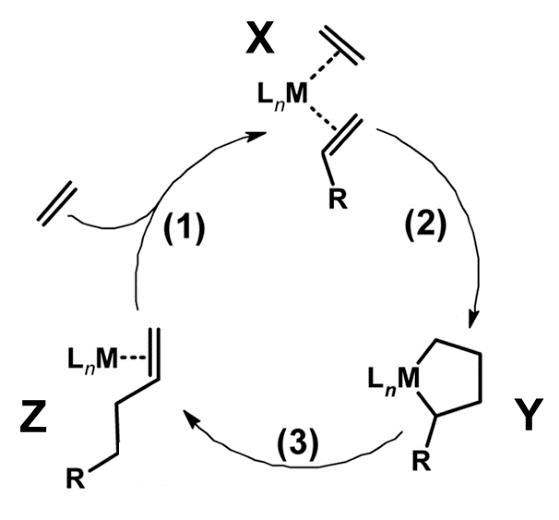
Although this mechanism is not a classical chain reaction because the final product is not produced within the cycle, the usual kinetic treatment of chain reactions can be applied to it. The three processes shown (1–3) are all chain propagation steps. R is lengthened by each cycle.
All three reactions are first order with respect to the chain carriers. For ethene, use an unknown order \(\rho\), to be determined later.
7.1 Write the rate equations for reactions 1–3 using \(k_1\), \(k_2\), and \(k_3\) as the corresponding rate constants, which are independent of the carbon chain length. 1 pt
Chain termination step, producing the oligomers, is a first order reaction competing with reaction 1.
7.2 Write i) the chemical equation and ii) rate equation of termination. Use \(k_t\) as the corresponding rate constant. 2 pt
7.3 Find the value of \(\rho\) which ensures that the product mixture of olefins shows the required ratio of products in accordance with the Schulz–Flory distribution when the reaction is run in a closed system. Derive a formula for this case that gives \(\alpha\) as the function of rate constants. 4 pt
Aluminum alkyls are used as co-catalysts in the ethene oligomerization process. It was found that they also catalyzed the Friedel–Crafts alkylation of the aromatic solvents used for the oligomerization.
In a typical oligomerization reaction, an alkylated aromatic compound Q was isolated from the complex reaction mixture of ethene oligomerization in toluene as solvent. The alkylated aromatic compound Q has the molecular formula \(\ce{C11H16}\) and its \(\ce{^1H}\) NMR spectrum contains the following peaks.
\(\ce{^1H}\) NMR of Q: \(\delta\) 0.9 (\(t\), 3H); 1.35 (\(m\), 2H); 1.59 (\(m\), 2H); 2.34 (\(s\), 3H), 2.60 (\(t\), 2H); 7.18 (\(d\), 2H); 7.22 (\(d\), 2H).
7.4 Draw the structure of Q. 3 pt
Part B
Vitrimers are adaptive polymers with "reversible" covalent bonds, allowing shape-changing and self-healing under specific conditions. This subtask explores the principles of vitrimer chemistry, an important topic in SABIC's polymer research.
A recently elucidated fast and reversible reaction involving dioxaborolanes can serve as the chemical background for such an adaptable polymer network. The two dioxaborolanes below were prepared by the reaction of phenylboronic acid with 1,2-butanediol and 3,5-dimethylphenylboronic acid with 1,2-propanediol, respectively.
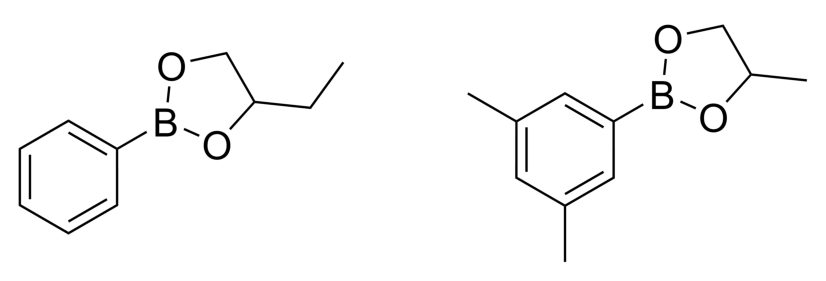
They participate in a model metathesis (exchange) reaction. The two carefully purified compounds were mixed in the absence of solvent and the mixture was kept at \(60\,^\circ\mathrm{C}\) for two hours. Interestingly, the gas chromatograms of the mixture at the start and at the end of the incubation period showed only the peaks below, with equimolar quantities of the components. The peaks in this system separate in a way that correlates with molar mass: compounds with lower mass appear at earlier elution times.

No catalyst, water, diol or acid was detectable in the mixture.
7.5 Draw the compounds associated with peaks I–IV in the chromatogram. 2 pt
Linking functional units to a polymer chain is known as grafting, and the functional units are referred to as grafting agents. In this case, the dioxaborolane units are linked to the polymer chains by maleimide groups via a radical process, in which one maleimide group is coupling to the polymer chain at a random carbon atom. The scheme below introduces a flexible synthesis route towards the dioxaborolane maleimide grafting agent used in the vitrimers.
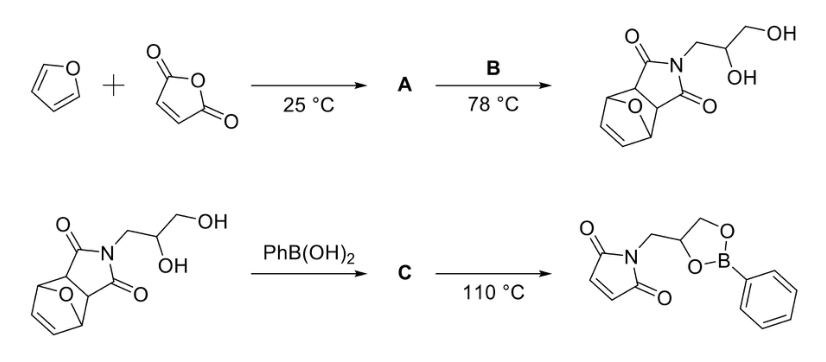
7.6 Draw the structures of A–C. 3 pt
7.7 Select on the answer sheet which reagent(s) and/or condition is/are appropriate for linking the dioxaborolane maleimide units to polyethylene. 1 pt
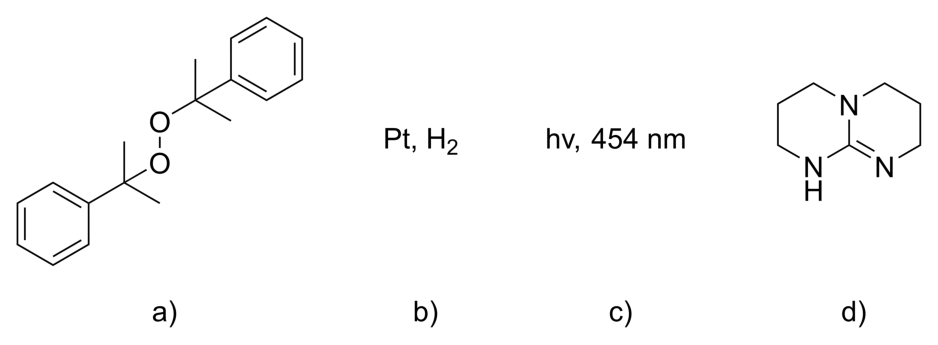
The vitrimer was prepared as follows:
- Polyethylene is grafted with dioxaborolane maleimide. Assume no side reactions between the dioxaborolane maleimide compounds.
- The reagents are removed from the macromolecules.
- Propanediol functionalized bis-dioxaborolane is added to enable crosslinking.
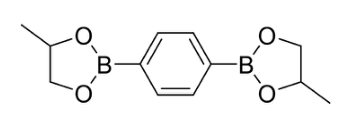
- The mixture is carefully heated for metathesis (exchange) reaction to take place.
To determine the extent of grafting and crosslinking in the vitrimer, infrared (IR) spectroscopy was used at room temperature where the metathesis reaction is extremely slow. Assume a homogeneous vitrimer.
- All of the small molecules are removed from the polymer.
- The IR spectrum of a thin polymer film is measured.
- IR spectrum contains absorption peaks that correspond to specific functional groups.
- The Beer–Lambert law can be used to quantify the concentration of these functional groups.
The provided data table gives the wavelengths, corresponding molar (related to the specified functional groups) absorption coefficients for relevant characteristic peaks together with the absorbances of the vitrimer sample.
| Vibration wavenumber, with the functional group indicated | Molar absorption coefficient, \(\epsilon\) \((\mathrm{dm^3\,mol^{-1}\,\mu m^{-1}})\) | Sample absorbance at this wave number, \(A\) |
|---|---|---|
| Imide group band at \(1710\ \mathrm{cm^{-1}}\) | 2.67 | 0.451 |
| Monosubstituted benzene ring band at \(1600\ \mathrm{cm^{-1}}\) | 0.28 | 0.022 |
| Disubstituted benzene ring band at \(1520\ \mathrm{cm^{-1}}\) | 0.68 | 0.042 |
| \(\ce{CH2}\) groups of polyethylene, band at \(1470\ \mathrm{cm^{-1}}\) | 0.021 | 0.904 |
7.8 Calculate the grafting density (\(X_g\)) of polyethylene based on the measurements. That is the ratio of the grafted groups over the ethylene units. 3 pt
7.9 Calculate the percentage of the grafted groups that are not part of a crosslink (\(p_{nc}\)). 4 pt
Official English text of the problem.
Answers
-
7.1 \[ \boxed{v_1=k_1[Z][\ce{C2H4}]^\rho,\qquad v_2=k_2[X],\qquad v_3=k_3[Y].} \]
-
7.2 \[ \boxed{\ce{Z -> L_nM + CH2=CHCH2CH2R}},\qquad \boxed{v_t=k_t[Z].} \] The released product is a linear terminal alkene, generic SMILES
C=CCC[*], where*represents R. -
7.3 \[ \boxed{\rho=0,\qquad \alpha=\frac{k_1}{k_1+k_t}.} \]
-
7.4 Q is 1-butyl-4-methylbenzene, also called \(p\)-\(n\)-butyltoluene:
CCCCc1ccc(C)cc1. -
7.5 The compounds, in increasing elution time, are:
I: 4-methyl-2-phenyl-1,3,2-dioxaborolane: CC1COB(c2ccccc2)O1.
II: 4-ethyl-2-phenyl-1,3,2-dioxaborolane: CCC1COB(c2ccccc2)O1.
III: 2-(3,5-dimethylphenyl)-4-methyl-1,3,2-dioxaborolane: CC1COB(c2cc(C)cc(C)c2)O1.
IV: 2-(3,5-dimethylphenyl)-4-ethyl-1,3,2-dioxaborolane: CCC1COB(c2cc(C)cc(C)c2)O1.
- 7.6
A: The furan–maleic anhydride Diels–Alder adduct, represented as exo-7-oxabicyclo[2.2.1]hept-5-ene-2,3-dicarboxylic anhydride:
O=C1OC(=O)[C@H]2[C@@H]1[C@@H]1C=C[C@H]2O1.
B: 3-Aminopropane-1,2-diol: NCC(O)CO.
C: Furan-protected N-[(2-phenyl-1,3,2-dioxaborolan-4-yl)methyl]maleimide, retaining the bicyclic core of A:
O=C1N(CC2COB(c3ccccc3)O2)C(=O)[C@H]2[C@@H]1[C@@H]1C=C[C@H]2O1.
-
7.7 Select a only, dicumyl peroxide:
CC(C)(OOC(C)(C)c1ccccc1)c1ccccc1. -
7.8 \[ \boxed{X_g\approx7.8\times10^{-3}=0.78\%.} \]
-
7.9 \[ \boxed{p_{nc}\approx66\%} \] (the nominal calculation gives \(66.2\%\)).
Solution
7.1 — Propagation rate equations
Ethene, SMILES C=C, enters in reaction 1, where it reacts with chain carrier Z. Reactions 2 and 3 convert X into Y and Y into Z, respectively, without consuming additional free ethene.
Consequently,
\[ v_1=k_1[Z][\ce{C2H4}]^\rho,\qquad v_2=k_2[X],\qquad v_3=k_3[Y]. \]
For rates expressed in \(\mathrm{mol\,dm^{-3}\,s^{-1}}\), \(k_2\) and \(k_3\) have units \(\mathrm{s^{-1}}\), while \(k_1\) has units \[ (\mathrm{mol\,dm^{-3}})^{-\rho}\mathrm{s^{-1}}. \]
7.2 — Termination
Termination competes with ethene capture by Z. It therefore releases the terminal alkene already coordinated to the metal:
\[ \ce{Z ->[k_t] L_nM + CH2=CHCH2CH2R}. \]
This is dissociation: no atoms are added or removed. The released linear terminal alkene has generic SMILES C=CCC[*], with * representing R.
In Z, the alkene is coordinated through its double bond, conventionally described as \(\eta^2\) coordination. Ordinary molecular SMILES does not show this coordination adequately, and the unspecified metal–ligand fragment \(\ce{L_nM}\) has no unique molecular SMILES.
Since termination is first order,
\[ v_t=k_t[Z], \]
where \(k_t\) has units \(\mathrm{s^{-1}}\).
7.3 — Condition for the Schulz–Flory distribution
At each visit to Z, a chain can either propagate through reaction 1 or terminate. Its probability of propagation is therefore
\[ \alpha =\frac{v_1}{v_1+v_t} =\frac{k_1[\ce{C2H4}]^\rho} {k_1[\ce{C2H4}]^\rho+k_t}. \]
If this probability is constant, producing an oligomer with one additional ethene unit requires one additional successful propagation. Thus,
\[ T_{n+1}=\alpha T_n, \]
and, starting with the smallest oligomer at \(n=2\),
\[ T_n=T_2\alpha^{n-2}. \]
In a closed system, ethene concentration decreases as the reaction proceeds. For positive propagation and termination rate constants, the branching probability above is independent of this changing concentration only when
\[ \boxed{\rho=0}. \]
It then becomes
\[ \boxed{\alpha=\frac{k_1}{k_1+k_t}}. \]
The constants \(k_2\) and \(k_3\) determine how quickly the chain passes through X and Y. They do not affect the propagation-versus-termination choice, because neither of those intermediates has a competing termination step in the given mechanism.
7.4 — Identification of Q
For \(\ce{C11H16}\), the degree of unsaturation is
\[ \mathrm{DBE}=\frac{2(11)+2-16}{2}=4, \]
consistent with one benzene ring.
The NMR assignments are:
| Signal | Assignment |
|---|---|
| \(\delta 0.9\), triplet, 3H | Terminal methyl of an \(n\)-butyl group |
| \(\delta 1.35\), multiplet, 2H | Butyl methylene next to the terminal methyl |
| \(\delta 1.59\), multiplet, 2H | Middle methylene nearer the aromatic ring |
| \(\delta 2.34\), singlet, 3H | Methyl directly attached to the aromatic ring |
| \(\delta 2.60\), triplet, 2H | Benzylic methylene of the \(n\)-butyl group |
| \(\delta 7.18\) and \(7.22\), two doublets, 2H each | Two equivalent pairs of aromatic hydrogens in a para-disubstituted ring |
Therefore, draw a benzene ring bearing methyl and straight-chain butyl groups at opposite positions:
\[ \boxed{\text{Q = 1-butyl-4-methylbenzene}} \]
SMILES: CCCCc1ccc(C)cc1.
7.5 — Assignment of chromatographic peaks
The exchange reaction produces all four combinations of the two arylboron groups and the two diol residues. Each product retains a five-membered dioxaborolane ring.
| Peak | Aryl group attached to boron | Diol-derived substituent on the ring | Molecular formula |
|---|---|---|---|
| I | Phenyl | Methyl | \(\ce{C9H11BO2}\) |
| II | Phenyl | Ethyl | \(\ce{C10H13BO2}\) |
| III | 3,5-Dimethylphenyl | Methyl | \(\ce{C11H15BO2}\) |
| IV | 3,5-Dimethylphenyl | Ethyl | \(\ce{C12H17BO2}\) |
Their names and SMILES are given in Answers 7.5. To draw each structure, place the stated aryl group on boron and the methyl or ethyl substituent on one carbon of the five-membered ring.
Successive formulas in the table differ by \(\ce{CH2}\), so their molar masses increase in exactly the order I–IV. This establishes the elution order using the problem’s stated mass–retention relationship.
The starting materials are II and III; exchange produces I and IV:
\[ \ce{II + III <=> I + IV}. \]
No water, free diol, or free acid is required in this net exchange.
The configurations of the diol-derived stereocentres are not specified in the question; they are therefore left unspecified in the SMILES.
7.6 — Structures A–C
A: Diels–Alder protection. Furan, c1ccoc1, reacts as the diene with maleic anhydride, O=C1OC(=O)C=C1. The cycloaddition gives the oxygen-bridged bicyclic anhydride A:
\[ \ce{C4H4O + C4H2O3 -> C8H6O4}. \]
Draw the bicyclic skeleton shown in the subsequent protected imide, but with the imide nitrogen replaced by the anhydride oxygen. Retain the oxygen bridge, the remaining carbon–carbon double bond, and the cis relationship inherited from maleic anhydride.
The exo representation used here is:
O=C1OC(=O)[C@H]2[C@@H]1[C@@H]1C=C[C@H]2O1.
B: Introduction of the amino diol. The product shown after the \(78\,^\circ\mathrm{C}\) step has an imide nitrogen bearing the side chain \(\ce{-CH2CH(OH)CH2OH}\). Therefore B must be 3-aminopropane-1,2-diol, NCC(O)CO.
Its amino group opens the anhydride; subsequent dehydration forms the imide:
\[ \ce{C8H6O4 + C3H9NO2 -> C11H13NO5 + H2O}. \]
The protected hydroxy imide is furan-protected N-(2,3-dihydroxypropyl)maleimide:
O=C1N(CC(O)CO)C(=O)[C@H]2[C@@H]1[C@@H]1C=C[C@H]2O1.
The coproduct is water, O.
C: Formation of the cyclic boronic ester. Phenylboronic acid, OB(O)c1ccccc1, condenses with the two adjacent hydroxyl groups, eliminating two molecules of water:
\[ \ce{C11H13NO5 + C6H7BO2 -> C17H16BNO5 + 2 H2O}. \]
Thus C is furan-protected N-[(2-phenyl-1,3,2-dioxaborolan-4-yl)methyl]maleimide:
O=C1N(CC2COB(c3ccccc3)O2)C(=O)[C@H]2[C@@H]1[C@@H]1C=C[C@H]2O1.
To draw C, leave the protected imide unchanged and join its two side-chain oxygen atoms to a common boron atom bearing phenyl. This closes the five-membered dioxaborolane ring.
Finally, heating to \(110\,^\circ\mathrm{C}\) causes a retro-Diels–Alder reaction:
\[ \ce{C17H16BNO5 -> C13H12BNO4 + C4H4O}. \]
The products are furan and the required grafting agent, N-[(2-phenyl-1,3,2-dioxaborolan-4-yl)methyl]maleimide:
O=C1N(CC2COB(c3ccccc3)O2)C(=O)C=C1.
7.7 — Radical grafting onto polyethylene
Select a only.
Dicumyl peroxide, CC(C)(OOC(C)(C)c1ccccc1)c1ccccc1, undergoes homolytic cleavage of its peroxide bond on heating. The resulting radicals can abstract hydrogen from polyethylene, generating a polymer radical. Addition of that radical across the maleimide double bond creates the bond connecting the grafting agent to the polymer.
The other choices do not supply the required grafting process:
- b: Platinum,
[Pt], with dihydrogen,[H][H], provides hydrogenation conditions. - c: Light at \(454\ \mathrm{nm}\), without a suitable photoinitiating system, does not provide the required radical initiation.
- d: The bicyclic guanidine base TBD, 1,5,7-triazabicyclo[4.4.0]dec-5-ene,
C1CN2CCCN=C2NC1, is not an appropriate initiator for this radical grafting.
7.8 — Grafting density
The Beer–Lambert law is
\[ A=\epsilon c\ell, \]
where \(c\) is in \(\mathrm{mol\,dm^{-3}}\) and film thickness \(\ell\) is in \(\mu\mathrm m\). Consequently, \(A/\epsilon=c\ell\), and the common thickness cancels from concentration ratios.
Each graft contains one imide group. The coefficient is specified per imide group, so its two carbonyl groups must not be counted separately.
For the grafts,
\[ c_g\ell=\frac{0.451}{2.67} =0.168914\ \mathrm{mol\,dm^{-3}}\,\mu\mathrm m. \]
For polyethylene methylene groups,
\[ c_{\ce{CH2}}\ell=\frac{0.904}{0.021} =43.0476\ \mathrm{mol\,dm^{-3}}\,\mu\mathrm m. \]
Each ethylene repeat contains two backbone carbon atoms, represented by the polyethylene repeat fragment [*]CC[*]. Using two methylene groups per repeat,
\[ X_g =\frac{c_g}{c_{\ce{CH2}}/2} =\frac{2(0.451/2.67)}{0.904/0.021} =0.00784777. \]
Thus,
\[ \boxed{X_g\approx7.8\times10^{-3}=0.78\%}. \]
The small correction for conversion of one backbone methylene into a methine per graft gives
\[ X_g=\frac{2c_g}{c_{\ce{CH2}}+c_g}=0.00781709, \]
which rounds to the same result.
7.9 — Grafts that are not part of a crosslink
The added crosslinker is 1,4-bis(4-methyl-1,3,2-dioxaborolan-2-yl)benzene:
CC1COB(c2ccc(B3OCC(C)O3)cc2)O1.
A retained crosslinker can be attached to either one graft or two grafts. Only the latter forms a bridge between grafts. Crosslinkers attached to no grafts are small molecules and have been removed.
Let:
- \(g\): total concentration of grafts, measured through imide groups;
- \(m\): concentration of monosubstituted benzene rings;
- \(d\): concentration of disubstituted benzene rings;
- \(s\): concentration of crosslinker molecules attached to one graft;
- \(b\): concentration of crosslinker molecules attached to two grafts.
Each remaining monosubstituted benzene ring belongs to an original phenylboronate attached to one graft. Each retained disubstituted ring belongs to one crosslinker molecule. Therefore,
\[ g=m+s+2b,\qquad d=s+b. \]
Solving,
\[ b=g-m-d,\qquad s=2d-g+m. \]
The non-crosslinked grafts comprise those retaining their original phenylboronate and those attached to a singly attached crosslinker:
\[ g_{nc}=m+s=2m+2d-g. \]
The measured quantities are
\[ \begin{aligned} g\ell&=\frac{0.451}{2.67}=0.168914,\\ m\ell&=\frac{0.022}{0.28}=0.0785714,\\ d\ell&=\frac{0.042}{0.68}=0.0617647, \end{aligned} \]
all in \(\mathrm{mol\,dm^{-3}}\,\mu\mathrm m\).
These give
\[ b\ell=0.0285777,\qquad s\ell=0.0331870. \]
Hence,
\[ \begin{aligned} p_{nc} &=100\frac{m+s}{g}\\ &=100\left[ \frac{2(0.022/0.28)+2(0.042/0.68)} {0.451/2.67}-1 \right]\\ &=66.16\ldots\%. \end{aligned} \]
Therefore,
\[ \boxed{p_{nc}\approx66\%}. \]
Counting only the monosubstituted benzene groups would miss the grafts bearing singly attached crosslinker molecules.
The solution was checked against the official solution.
IChO 2024 · Theorieaufgabe 7
SABIC
Die Saudi Basic Industries Corporation (SABIC) wurde Mitte der 1970er-Jahre im Rahmen des Plans Saudi-Arabiens zur Diversifizierung seiner Wirtschaft gegründet. Heute ist SABIC ein weltweit tätiger Chemieriese, der jährlich 69 Millionen Tonnen Produkte herstellt.
Teil A
Die eigene, einzigartige Technologie von SABIC zur Oligomerisierung von Ethen (Oligomere sind Polymere mit wenigen Monomereinheiten) liefert lineare Alpha-Olefine (1-Alkene), die in zahlreichen industriellen Anwendungen eingesetzt werden.
Lineare Alpha-Olefine werden durch katalytische Oligomerisierung von Ethen hergestellt, wobei verschiedene Kettenlängen mit einer bestimmten Verteilung entstehen. Unterschiedliche Katalysatoren können zu unterschiedlichen Produktverteilungen führen.
Bei der geometrischen oder Schulz–Flory-Verteilung ist jede Oligomerfraktion mit der vorhergehenden Fraktion durch die Gleichung \(T_{n+1}=\alpha T_n\) verknüpft, wobei \(T_n\) die Stoffmenge des Oligomers mit \(n\) Etheneinheiten bezeichnet und \(\alpha\) eine Konstante ist, die als Wahrscheinlichkeit des Kettenwachstums bezeichnet wird. Ethen, das Monomer, gehört nicht zu dieser Reihe (\(n\geq2\)).
Ein katalytischer Oligomerisierungsprozess lässt sich durch einen relativ einfachen Mechanismus beschreiben:
Obwohl dieser Mechanismus keine klassische Kettenreaktion ist, da das Endprodukt nicht innerhalb des Zyklus entsteht, lässt sich die übliche kinetische Behandlung von Kettenreaktionen darauf anwenden. Die drei dargestellten Prozesse (1–3) sind allesamt Kettenfortpflanzungsschritte. R wird mit jedem Zyklus verlängert.
Alle drei Reaktionen sind hinsichtlich der Kettenträger erster Ordnung. Verwenden Sie für Ethen eine unbekannte Reaktionsordnung \(\rho\), die später bestimmt werden soll.
7.1 Geben Sie die Geschwindigkeitsgleichungen für die Reaktionen 1–3 an und verwenden Sie dabei \(k_1\), \(k_2\) und \(k_3\) als die jeweiligen Geschwindigkeitskonstanten, die unabhängig von der Länge der Kohlenstoffkette sind. 1 Pkt.
Der Kettenabbruchschritt, bei dem die Oligomere entstehen, ist eine Reaktion erster Ordnung, die mit Reaktion 1 konkurriert.
7.2 Geben Sie i) die Reaktionsgleichung und ii) die Geschwindigkeitsgleichung des Kettenabbruchs an. Verwenden Sie \(k_t\) als zugehörige Geschwindigkeitskonstante. 2 Pkt.
7.3 Bestimmen Sie den Wert von \(\rho\), der sicherstellt, dass das Produktgemisch der Olefine das erforderliche Produktverhältnis gemäß der Schulz–Flory-Verteilung aufweist, wenn die Reaktion in einem geschlossenen System durchgeführt wird. Leiten Sie für diesen Fall eine Formel her, die \(\alpha\) als Funktion der Geschwindigkeitskonstanten angibt. 4 Pkt.
Aluminiumalkyle werden als Cokatalysatoren bei der Oligomerisierung von Ethen eingesetzt. Es wurde festgestellt, dass sie auch die Friedel–Crafts-Alkylierung der für die Oligomerisierung verwendeten aromatischen Lösungsmittel katalysieren.
Bei einer typischen Oligomerisierungsreaktion wurde eine alkylierte aromatische Verbindung Q aus dem komplexen Reaktionsgemisch der Ethenoligomerisierung mit Toluol als Lösungsmittel isoliert. Die alkylierte aromatische Verbindung Q hat die Summenformel \(\ce{C11H16}\), und ihr \(\ce{^1H}\)-NMR-Spektrum enthält die folgenden Signale.
\(\ce{^1H}\)-NMR von Q: \(\delta\) 0.9 (\(t\), 3H); 1.35 (\(m\), 2H); 1.59 (\(m\), 2H); 2.34 (\(s\), 3H), 2.60 (\(t\), 2H); 7.18 (\(d\), 2H); 7.22 (\(d\), 2H).
7.4 Zeichnen Sie die Struktur von Q. 3 Pkt.
Teil B
Vitrimere sind adaptive Polymere mit „reversiblen“ kovalenten Bindungen, die unter bestimmten Bedingungen Formänderungen und Selbstheilung ermöglichen. Diese Teilaufgabe untersucht die Grundlagen der Vitrimerchemie, ein wichtiges Thema in der Polymerforschung von SABIC.
Eine kürzlich aufgeklärte schnelle und reversible Reaktion unter Beteiligung von Dioxaborolanen kann als chemische Grundlage für ein solches anpassungsfähiges Polymernetzwerk dienen. Die beiden unten dargestellten Dioxaborolane wurden durch die Reaktion von Phenylboronsäure mit Butan-1,2-diol beziehungsweise von 3,5-Dimethylphenylboronsäure mit Propan-1,2-diol hergestellt.
Sie nehmen an einer Modell-Metathesereaktion (Austauschreaktion) teil. Die beiden sorgfältig gereinigten Verbindungen wurden ohne Lösungsmittel gemischt, und das Gemisch wurde zwei Stunden lang bei \(60\,^\circ\mathrm{C}\) gehalten. Interessanterweise zeigten die Gaschromatogramme des Gemisches zu Beginn und am Ende der Inkubationszeit nur die unten dargestellten Peaks, wobei die Komponenten in äquimolaren Mengen vorlagen. Die Peaks werden in diesem System so aufgetrennt, dass ihre Reihenfolge mit der molaren Masse korreliert: Verbindungen mit geringerer Masse erscheinen zu früheren Elutionszeiten.
Im Gemisch waren weder Katalysator noch Wasser, Diol oder Säure nachweisbar.
7.5 Zeichnen Sie die Verbindungen, die den Peaks I–IV im Chromatogramm zugeordnet sind. 2 Pkt.
Das Anknüpfen funktioneller Einheiten an eine Polymerkette wird als Pfropfen bezeichnet; die funktionellen Einheiten werden als Pfropfreagenzien bezeichnet. In diesem Fall werden die Dioxaborolaneinheiten über Maleimidgruppen durch einen radikalischen Prozess mit den Polymerketten verknüpft, wobei eine Maleimidgruppe an einem zufälligen Kohlenstoffatom an die Polymerkette ankoppelt. Das folgende Schema zeigt einen flexiblen Syntheseweg zu dem in den Vitrimeren verwendeten Dioxaborolan-Maleimid-Pfropfreagenz.
7.6 Zeichnen Sie die Strukturen von A–C. 3 Pkt.
7.7 Wählen Sie auf dem Antwortbogen aus, welche Reagenzien und/oder Bedingungen für die Verknüpfung der Dioxaborolan-Maleimid-Einheiten mit Polyethylen geeignet sind. 1 Pkt.
Das Vitrimer wurde wie folgt hergestellt:
- Polyethylen wird mit Dioxaborolan-Maleimid gepfropft. Nehmen Sie an, dass keine Nebenreaktionen zwischen den Dioxaborolan-Maleimid-Verbindungen stattfinden.
- Die Reagenzien werden von den Makromolekülen abgetrennt.
- Mit Propandiol funktionalisiertes Bis-Dioxaborolan wird zugesetzt, um eine Vernetzung zu ermöglichen.
- Das Gemisch wird vorsichtig erwärmt, damit die Metathesereaktion (Austauschreaktion) stattfindet.
Zur Bestimmung des Ausmaßes der Pfropfung und Vernetzung im Vitrimer wurde Infrarotspektroskopie (IR-Spektroskopie) bei Raumtemperatur eingesetzt, bei der die Metathesereaktion äußerst langsam abläuft. Nehmen Sie ein homogenes Vitrimer an.
- Alle kleinen Moleküle werden aus dem Polymer entfernt.
- Das IR-Spektrum eines dünnen Polymerfilms wird gemessen.
- Das IR-Spektrum enthält Absorptionsbanden, die bestimmten funktionellen Gruppen entsprechen.
- Mithilfe des Lambert–Beerschen Gesetzes lässt sich die Konzentration dieser funktionellen Gruppen quantitativ bestimmen.
Die bereitgestellte Datentabelle enthält die Wellenlängen, die zugehörigen molaren (auf die angegebenen funktionellen Gruppen bezogenen) Absorptionskoeffizienten relevanter charakteristischer Banden sowie die Extinktionen der Vitrimerprobe.
| Schwingungswellenzahl mit Angabe der funktionellen Gruppe | Molarer Absorptionskoeffizient, \(\epsilon\) \((\mathrm{dm^3\,mol^{-1}\,\mu m^{-1}})\) | Extinktion der Probe bei dieser Wellenzahl, \(A\) |
|---|---|---|
| Bande der Imidgruppe bei \(1710\ \mathrm{cm^{-1}}\) | 2.67 | 0.451 |
| Bande des monosubstituierten Benzolrings bei \(1600\ \mathrm{cm^{-1}}\) | 0.28 | 0.022 |
| Bande des disubstituierten Benzolrings bei \(1520\ \mathrm{cm^{-1}}\) | 0.68 | 0.042 |
| \(\ce{CH2}\)-Gruppen des Polyethylens, Bande bei \(1470\ \mathrm{cm^{-1}}\) | 0.021 | 0.904 |
7.8 Berechnen Sie anhand der Messungen die Pfropfdichte (\(X_g\)) des Polyethylens. Dies ist das Verhältnis der aufgepfropften Gruppen zu den Ethyleneinheiten. 3 Pkt.
7.9 Berechnen Sie den prozentualen Anteil der aufgepfropften Gruppen, die nicht Bestandteil einer Vernetzungsbrücke sind (\(p_{nc}\)). 4 Pkt.
Aufgabentext aus dem offiziellen englischen Text übersetzt.
Antworten
-
7.1 \[ \boxed{v_1=k_1[Z][\ce{C2H4}]^\rho,\qquad v_2=k_2[X],\qquad v_3=k_3[Y].} \]
-
7.2 \[ \boxed{\ce{Z -> L_nM + CH2=CHCH2CH2R}},\qquad \boxed{v_t=k_t[Z].} \] Das freigesetzte Produkt ist ein lineares terminales Alken mit dem allgemeinen SMILES
C=CCC[*], wobei*für R steht. -
7.3 \[ \boxed{\rho=0,\qquad \alpha=\frac{k_1}{k_1+k_t}.} \]
-
7.4 Q ist 1-Butyl-4-methylbenzol, auch \(p\)-\(n\)-Butyltoluol genannt:
CCCCc1ccc(C)cc1. -
7.5 Die Verbindungen sind in der Reihenfolge zunehmender Elutionszeit:
I: 4-Methyl-2-phenyl-1,3,2-dioxaborolan: CC1COB(c2ccccc2)O1.
II: 4-Ethyl-2-phenyl-1,3,2-dioxaborolan: CCC1COB(c2ccccc2)O1.
III: 2-(3,5-Dimethylphenyl)-4-methyl-1,3,2-dioxaborolan: CC1COB(c2cc(C)cc(C)c2)O1.
IV: 2-(3,5-Dimethylphenyl)-4-ethyl-1,3,2-dioxaborolan: CCC1COB(c2cc(C)cc(C)c2)O1.
- 7.6
A: Das Diels–Alder-Addukt aus Furan und Maleinsäureanhydrid, dargestellt als exo-7-Oxabicyclo[2.2.1]hept-5-en-2,3-dicarbonsäureanhydrid:
O=C1OC(=O)[C@H]2[C@@H]1[C@@H]1C=C[C@H]2O1.
B: 3-Aminopropan-1,2-diol: NCC(O)CO.
C: Furangeschütztes N-[(2-Phenyl-1,3,2-dioxaborolan-4-yl)methyl]maleimid, unter Beibehaltung des bicyclischen Grundgerüsts von A:
O=C1N(CC2COB(c3ccccc3)O2)C(=O)[C@H]2[C@@H]1[C@@H]1C=C[C@H]2O1.
-
7.7 Wählen Sie nur a, Dicumylperoxid:
CC(C)(OOC(C)(C)c1ccccc1)c1ccccc1. -
7.8 \[ \boxed{X_g\approx7.8\times10^{-3}=0.78\%.} \]
-
7.9 \[ \boxed{p_{nc}\approx66\%} \] (die Berechnung mit den angegebenen Werten ergibt \(66.2\%\)).
Lösung
7.1 — Geschwindigkeitsgleichungen der Kettenfortpflanzung
Ethen, SMILES C=C, tritt in Reaktion 1 ein, in der es mit dem Kettenträger Z reagiert. Die Reaktionen 2 und 3 wandeln X in Y beziehungsweise Y in Z um, ohne zusätzliches freies Ethen zu verbrauchen.
Folglich gilt:
\[ v_1=k_1[Z][\ce{C2H4}]^\rho,\qquad v_2=k_2[X],\qquad v_3=k_3[Y]. \]
Für Reaktionsgeschwindigkeiten in \(\mathrm{mol\,dm^{-3}\,s^{-1}}\) haben \(k_2\) und \(k_3\) die Einheit \(\mathrm{s^{-1}}\), während \(k_1\) die Einheit \[ (\mathrm{mol\,dm^{-3}})^{-\rho}\mathrm{s^{-1}} \] hat.
7.2 — Kettenabbruch
Der Kettenabbruch konkurriert mit der Aufnahme von Ethen durch Z. Dabei wird daher das bereits an das Metall koordinierte terminale Alken freigesetzt:
\[ \ce{Z ->[k_t] L_nM + CH2=CHCH2CH2R}. \]
Dies ist eine Dissoziation: Es werden keine Atome hinzugefügt oder entfernt. Das freigesetzte lineare terminale Alken hat den allgemeinen SMILES C=CCC[*], wobei * für R steht.
In Z ist das Alken über seine Doppelbindung koordiniert, was üblicherweise als \(\eta^2\)-Koordination beschrieben wird. Gewöhnliche molekulare SMILES geben diese Koordination nicht angemessen wieder, und für das nicht näher spezifizierte Metall-Ligand-Fragment \(\ce{L_nM}\) gibt es keinen eindeutigen molekularen SMILES.
Da der Kettenabbruch erster Ordnung ist, gilt
\[ v_t=k_t[Z], \]
wobei \(k_t\) die Einheit \(\mathrm{s^{-1}}\) hat.
7.3 — Bedingung für die Schulz–Flory-Verteilung
Bei jedem Erreichen von Z kann eine Kette entweder durch Reaktion 1 weiterwachsen oder abbrechen. Ihre Wahrscheinlichkeit für die Kettenfortpflanzung beträgt daher
\[ \alpha =\frac{v_1}{v_1+v_t} =\frac{k_1[\ce{C2H4}]^\rho} {k_1[\ce{C2H4}]^\rho+k_t}. \]
Wenn diese Wahrscheinlichkeit konstant ist, erfordert die Bildung eines Oligomers mit einer zusätzlichen Etheneinheit einen weiteren erfolgreichen Kettenfortpflanzungsschritt. Somit gilt
\[ T_{n+1}=\alpha T_n, \]
und ausgehend vom kleinsten Oligomer bei \(n=2\)
\[ T_n=T_2\alpha^{n-2}. \]
In einem geschlossenen System nimmt die Ethenkonzentration im Verlauf der Reaktion ab. Bei positiven Geschwindigkeitskonstanten für Kettenfortpflanzung und Kettenabbruch ist die obige Verzweigungswahrscheinlichkeit nur dann unabhängig von dieser sich ändernden Konzentration, wenn
\[ \boxed{\rho=0}. \]
Sie wird dann zu
\[ \boxed{\alpha=\frac{k_1}{k_1+k_t}}. \]
Die Konstanten \(k_2\) und \(k_3\) bestimmen, wie schnell die Kette X und Y durchläuft. Sie beeinflussen die Entscheidung zwischen Kettenfortpflanzung und Kettenabbruch nicht, da keines dieser Intermediate im angegebenen Mechanismus einen konkurrierenden Kettenabbruchschritt aufweist.
7.4 — Identifizierung von Q
Für \(\ce{C11H16}\) beträgt der Doppelbindungsäquivalentwert
\[ \mathrm{DBE}=\frac{2(11)+2-16}{2}=4, \]
was mit einem Benzolring vereinbar ist.
Die Zuordnungen der NMR-Signale sind:
| Signal | Zuordnung |
|---|---|
| \(\delta 0.9\), Triplett, 3H | Endständige Methylgruppe einer \(n\)-Butylgruppe |
| \(\delta 1.35\), Multiplett, 2H | Methylengruppe der Butylgruppe neben der endständigen Methylgruppe |
| \(\delta 1.59\), Multiplett, 2H | Mittlere Methylengruppe näher am aromatischen Ring |
| \(\delta 2.34\), Singulett, 3H | Direkt an den aromatischen Ring gebundene Methylgruppe |
| \(\delta 2.60\), Triplett, 2H | Benzylische Methylengruppe der \(n\)-Butylgruppe |
| \(\delta 7.18\) und \(7.22\), zwei Dubletts, jeweils 2H | Zwei äquivalente Paare aromatischer Wasserstoffatome in einem para-disubstituierten Ring |
Zeichnen Sie daher einen Benzolring, der an gegenüberliegenden Positionen eine Methylgruppe und eine unverzweigte Butylgruppe trägt:
\[ \boxed{\text{Q = 1-Butyl-4-methylbenzol}} \]
SMILES: CCCCc1ccc(C)cc1.
7.5 — Zuordnung der chromatographischen Peaks
Die Austauschreaktion liefert alle vier Kombinationen der beiden Arylborgruppen und der beiden Diolreste. Jedes Produkt behält einen fünfgliedrigen Dioxaborolanring bei.
| Peak | An Bor gebundene Arylgruppe | Vom Diol stammender Substituent am Ring | Summenformel |
|---|---|---|---|
| I | Phenyl | Methyl | \(\ce{C9H11BO2}\) |
| II | Phenyl | Ethyl | \(\ce{C10H13BO2}\) |
| III | 3,5-Dimethylphenyl | Methyl | \(\ce{C11H15BO2}\) |
| IV | 3,5-Dimethylphenyl | Ethyl | \(\ce{C12H17BO2}\) |
Ihre Namen und SMILES sind unter Antworten 7.5 angegeben. Zum Zeichnen der jeweiligen Struktur bringen Sie die angegebene Arylgruppe am Boratom und den Methyl- oder Ethylsubstituenten an einem Kohlenstoffatom des fünfgliedrigen Rings an.
Aufeinanderfolgende Summenformeln in der Tabelle unterscheiden sich um \(\ce{CH2}\), sodass ihre molaren Massen genau in der Reihenfolge I–IV zunehmen. Damit ergibt sich die Elutionsreihenfolge aus dem in der Aufgabe angegebenen Zusammenhang zwischen Masse und Retention.
Die Ausgangsstoffe sind II und III; durch den Austausch entstehen I und IV:
\[ \ce{II + III <=> I + IV}. \]
Für diesen Netto-Austausch werden weder Wasser noch freies Diol oder freie Säure benötigt.
Die Konfigurationen der vom Diol stammenden Stereozentren sind in der Aufgabenstellung nicht angegeben; sie bleiben daher auch in den SMILES unspezifiziert.
7.6 — Strukturen A–C
A: Diels–Alder-Schutzreaktion. Furan, c1ccoc1, reagiert als Dien mit Maleinsäureanhydrid, O=C1OC(=O)C=C1. Die Cycloaddition liefert das sauerstoffverbrückte bicyclische Anhydrid A:
\[ \ce{C4H4O + C4H2O3 -> C8H6O4}. \]
Zeichnen Sie das bicyclische Grundgerüst des nachfolgend dargestellten geschützten Imids, ersetzen Sie jedoch den Imidstickstoff durch den Anhydridsauerstoff. Behalten Sie die Sauerstoffbrücke, die verbleibende Kohlenstoff-Kohlenstoff-Doppelbindung und die vom Maleinsäureanhydrid übernommene cis-Anordnung bei.
Die hier verwendete exo-Darstellung lautet:
O=C1OC(=O)[C@H]2[C@@H]1[C@@H]1C=C[C@H]2O1.
B: Einführung des Aminodiols. Das nach dem Schritt bei \(78\,^\circ\mathrm{C}\) dargestellte Produkt besitzt einen Imidstickstoff, der die Seitenkette \(\ce{-CH2CH(OH)CH2OH}\) trägt. Daher muss B 3-Aminopropan-1,2-diol, NCC(O)CO, sein.
Seine Aminogruppe öffnet das Anhydrid; durch anschließende Wasserabspaltung entsteht das Imid:
\[ \ce{C8H6O4 + C3H9NO2 -> C11H13NO5 + H2O}. \]
Das geschützte Hydroxyimid ist furangeschütztes N-(2,3-Dihydroxypropyl)maleimid:
O=C1N(CC(O)CO)C(=O)[C@H]2[C@@H]1[C@@H]1C=C[C@H]2O1.
Das Koppelprodukt ist Wasser, O.
C: Bildung des cyclischen Boronsäureesters. Phenylboronsäure, OB(O)c1ccccc1, kondensiert mit den beiden benachbarten Hydroxygruppen unter Abspaltung von zwei Wassermolekülen:
\[ \ce{C11H13NO5 + C6H7BO2 -> C17H16BNO5 + 2 H2O}. \]
Somit ist C furangeschütztes N-[(2-Phenyl-1,3,2-dioxaborolan-4-yl)methyl]maleimid:
O=C1N(CC2COB(c3ccccc3)O2)C(=O)[C@H]2[C@@H]1[C@@H]1C=C[C@H]2O1.
Um C zu zeichnen, lassen Sie das geschützte Imid unverändert und verbinden Sie die beiden Sauerstoffatome seiner Seitenkette mit einem gemeinsamen Boratom, das eine Phenylgruppe trägt. Dadurch wird der fünfgliedrige Dioxaborolanring geschlossen.
Abschließend bewirkt das Erhitzen auf \(110\,^\circ\mathrm{C}\) eine retro-Diels–Alder-Reaktion:
\[ \ce{C17H16BNO5 -> C13H12BNO4 + C4H4O}. \]
Die Produkte sind Furan und das benötigte Pfropfreagenz, N-[(2-Phenyl-1,3,2-dioxaborolan-4-yl)methyl]maleimid:
O=C1N(CC2COB(c3ccccc3)O2)C(=O)C=C1.
7.7 — Radikalische Pfropfung auf Polyethylen
Wählen Sie nur a.
Dicumylperoxid, CC(C)(OOC(C)(C)c1ccccc1)c1ccccc1, wird beim Erhitzen an seiner Peroxidbindung homolytisch gespalten. Die entstehenden Radikale können Wasserstoff von Polyethylen abstrahieren und dadurch ein Polymerradikal erzeugen. Die Addition dieses Radikals an die Maleimid-Doppelbindung erzeugt die Bindung, die das Pfropfreagenz mit dem Polymer verknüpft.
Die anderen Auswahlmöglichkeiten ermöglichen den erforderlichen Pfropfprozess nicht:
- b: Platin,
[Pt], mit molekularem Wasserstoff,[H][H], stellt Hydrierungsbedingungen bereit. - c: Licht mit einer Wellenlänge von \(454\ \mathrm{nm}\) bewirkt ohne ein geeignetes Photoinitiatorsystem nicht die erforderliche radikalische Initiierung.
- d: Die bicyclische Guanidinbase TBD, 1,5,7-Triazabicyclo[4.4.0]dec-5-en,
C1CN2CCCN=C2NC1, ist kein geeigneter Initiator für diese radikalische Pfropfung.
7.8 — Pfropfdichte
Das Lambert–Beersche Gesetz lautet
\[ A=\epsilon c\ell, \]
wobei \(c\) in \(\mathrm{mol\,dm^{-3}}\) und die Filmdicke \(\ell\) in \(\mu\mathrm m\) angegeben werden. Folglich gilt \(A/\epsilon=c\ell\), und die gemeinsame Dicke kürzt sich in Konzentrationsverhältnissen heraus.
Jede aufgepfropfte Gruppe enthält eine Imidgruppe. Der Koeffizient ist pro Imidgruppe angegeben, daher dürfen ihre beiden Carbonylgruppen nicht getrennt gezählt werden.
Für die aufgepfropften Gruppen gilt
\[ c_g\ell=\frac{0.451}{2.67} =0.168914\ \mathrm{mol\,dm^{-3}}\,\mu\mathrm m. \]
Für die Methylengruppen des Polyethylens gilt
\[ c_{\ce{CH2}}\ell=\frac{0.904}{0.021} =43.0476\ \mathrm{mol\,dm^{-3}}\,\mu\mathrm m. \]
Jede Ethylen-Wiederholungseinheit enthält zwei Kohlenstoffatome des Polymerrückgrats, dargestellt durch das Polyethylen-Wiederholungsfragment [*]CC[*]. Mit zwei Methylengruppen pro Wiederholungseinheit ergibt sich
\[ X_g =\frac{c_g}{c_{\ce{CH2}}/2} =\frac{2(0.451/2.67)}{0.904/0.021} =0.00784777. \]
Somit gilt
\[ \boxed{X_g\approx7.8\times10^{-3}=0.78\%}. \]
Die kleine Korrektur für die Umwandlung einer Methylengruppe des Polymerrückgrats in eine Methingruppe pro aufgepfropfter Gruppe ergibt
\[ X_g=\frac{2c_g}{c_{\ce{CH2}}+c_g}=0.00781709, \]
was gerundet dasselbe Ergebnis liefert.
7.9 — Aufgepfropfte Gruppen, die nicht Bestandteil einer Vernetzungsbrücke sind
Der zugesetzte Vernetzer ist 1,4-Bis(4-methyl-1,3,2-dioxaborolan-2-yl)benzol:
CC1COB(c2ccc(B3OCC(C)O3)cc2)O1.
Ein im Polymer verbleibender Vernetzer kann entweder an eine aufgepfropfte Gruppe oder an zwei aufgepfropfte Gruppen gebunden sein. Nur im letzteren Fall bildet er eine Brücke zwischen aufgepfropften Gruppen. Vernetzer, die an keine aufgepfropfte Gruppe gebunden sind, sind kleine Moleküle und wurden entfernt.
Es sei:
- \(g\): Gesamtkonzentration der aufgepfropften Gruppen, gemessen über die Imidgruppen;
- \(m\): Konzentration der monosubstituierten Benzolringe;
- \(d\): Konzentration der disubstituierten Benzolringe;
- \(s\): Konzentration der an eine aufgepfropfte Gruppe gebundenen Vernetzermoleküle;
- \(b\): Konzentration der an zwei aufgepfropfte Gruppen gebundenen Vernetzermoleküle.
Jeder verbleibende monosubstituierte Benzolring gehört zu einem ursprünglichen Phenylboronat, das an eine aufgepfropfte Gruppe gebunden ist. Jeder verbleibende disubstituierte Ring gehört zu einem Vernetzermolekül. Daher gilt
\[ g=m+s+2b,\qquad d=s+b. \]
Auflösen ergibt
\[ b=g-m-d,\qquad s=2d-g+m. \]
Die nicht vernetzten aufgepfropften Gruppen umfassen diejenigen, die ihr ursprüngliches Phenylboronat behalten haben, sowie diejenigen, die an einen nur einseitig gebundenen Vernetzer gebunden sind:
\[ g_{nc}=m+s=2m+2d-g. \]
Die gemessenen Größen sind
\[ \begin{aligned} g\ell&=\frac{0.451}{2.67}=0.168914,\\ m\ell&=\frac{0.022}{0.28}=0.0785714,\\ d\ell&=\frac{0.042}{0.68}=0.0617647, \end{aligned} \]
alle in \(\mathrm{mol\,dm^{-3}}\,\mu\mathrm m\).
Daraus ergeben sich
\[ b\ell=0.0285777,\qquad s\ell=0.0331870. \]
Damit folgt
\[ \begin{aligned} p_{nc} &=100\frac{m+s}{g}\\ &=100\left[ \frac{2(0.022/0.28)+2(0.042/0.68)} {0.451/2.67}-1 \right]\\ &=66.16\ldots\%. \end{aligned} \]
Somit gilt
\[ \boxed{p_{nc}\approx66\%}. \]
Würde man nur die monosubstituierten Benzolgruppen zählen, blieben die aufgepfropften Gruppen mit nur einseitig gebundenen Vernetzermolekülen unberücksichtigt.
Die Lösung wurde mit der offiziellen Lösung abgeglichen.
IChO 2024 · Teori sorusu 7
SABIC
Saudi Basic Industries Corporation (SABIC), Suudi Arabistan'ın ekonomisini çeşitlendirme planının bir parçası olarak 1970'lerin ortalarında kuruldu. Günümüzde SABIC, yılda 69 milyon ton ürün üreten küresel bir kimya devidir.
Bölüm A
SABIC'in kendine özgü eten oligomerleştirme teknolojisi (oligomerler, az sayıda monomer birimi içeren polimerlerdir), çok sayıda endüstriyel uygulamada kullanılan doğrusal alfa olefinler (1-alkenler) üretir.
Doğrusal alfa olefinler, etenin katalitik oligomerleştirilmesiyle üretilir; bunun sonucunda, belirli bir dağılıma sahip farklı zincir uzunlukları elde edilir. Farklı katalizörler, farklı ürün dağılımları verebilir.
Geometrik dağılımda veya Schulz–Flory dağılımında, her oligomer fraksiyonu bir önceki fraksiyonla \(T_{n+1}=\alpha T_n\) denklemiyle ilişkilidir; burada \(T_n\), \(n\) eten birimi içeren oligomerin molar miktarını, \(\alpha\) ise zincir ilerleme olasılığı olarak adlandırılan bir sabiti temsil eder. Monomer olan eten, serinin bir üyesi değildir (\(n\geq2\)).
Bir katalitik oligomerleştirme süreci, nispeten basit bir mekanizmayla açıklanabilir:
Son ürün döngü içinde oluşmadığı için bu mekanizma klasik bir zincir tepkimesi olmasa da zincir tepkimelerinin alışılmış kinetik yaklaşımı buna uygulanabilir. Gösterilen üç sürecin (1–3) tümü zincir ilerleme basamaklarıdır. R, her döngüde uzar.
Üç tepkimenin tümü, zincir taşıyıcılarına göre birinci derecedendir. Eten için, daha sonra belirlenecek olan bilinmeyen bir \(\rho\) derecesi kullanın.
7.1 Karşılık gelen hız sabitleri olarak karbon zincirinin uzunluğundan bağımsız olan \(k_1\), \(k_2\) ve \(k_3\)'ü kullanarak 1–3 tepkimelerinin hız denklemlerini yazın. 1 puan
Oligomerleri oluşturan zincir sonlanma basamağı, 1 tepkimesiyle yarışan birinci dereceden bir tepkimedir.
7.2 Sonlanmanın i) kimyasal denklemini ve ii) hız denklemini yazın. Karşılık gelen hız sabiti olarak \(k_t\)'yi kullanın. 2 puan
7.3 Tepkime kapalı bir sistemde yürütüldüğünde olefin ürün karışımının Schulz–Flory dağılımına uygun olarak gerekli ürün oranını göstermesini sağlayan \(\rho\) değerini bulun. Bu durum için \(\alpha\)'yı hız sabitlerinin fonksiyonu olarak veren bir formül türetin. 4 puan
Alüminyum alkiller, eten oligomerleştirme sürecinde yardımcı katalizör olarak kullanılır. Bunların, oligomerleştirmede kullanılan aromatik çözücülerin Friedel–Crafts alkillemesini de katalizledikleri bulunmuştur.
Tipik bir oligomerleştirme tepkimesinde, çözücü olarak toluen kullanılan eten oligomerleştirmesinin karmaşık tepkime karışımından alkillenmiş bir aromatik bileşik olan Q izole edilmiştir. Alkillenmiş aromatik Q bileşiğinin molekül formülü \(\ce{C11H16}\)'dır ve \(\ce{^1H}\) NMR spektrumu aşağıdaki pikleri içerir.
Q'nun \(\ce{^1H}\) NMR spektrumu: \(\delta\) 0.9 (\(t\), 3H); 1.35 (\(m\), 2H); 1.59 (\(m\), 2H); 2.34 (\(s\), 3H), 2.60 (\(t\), 2H); 7.18 (\(d\), 2H); 7.22 (\(d\), 2H).
7.4 Q'nun yapısını çizin. 3 puan
Bölüm B
Vitrimerler, belirli koşullarda şekil değiştirmeye ve kendini onarmaya olanak tanıyan, "tersinir" kovalent bağlara sahip uyarlanabilir polimerlerdir. Bu alt soru, SABIC'in polimer araştırmalarında önemli bir konu olan vitrimer kimyasının ilkelerini ele almaktadır.
Dioksaborolanların yer aldığı, yakın zamanda aydınlatılmış hızlı ve tersinir bir tepkime, böyle uyarlanabilir bir polimer ağının kimyasal temelini oluşturabilir. Aşağıdaki iki dioksaborolan, sırasıyla fenilboronik asidin 1,2-bütandiol ile ve 3,5-dimetilfenilboronik asidin 1,2-propandiol ile tepkimesinden hazırlanmıştır.
Bu bileşikler, bir model metatez (değişim) tepkimesine katılır. Özenle saflaştırılmış iki bileşik, çözücü olmadan karıştırılmış ve karışım iki saat boyunca \(60\,^\circ\mathrm{C}\)'de tutulmuştur. İlginç bir şekilde, bekletme süresinin başında ve sonunda karışımın gaz kromatogramları, bileşenlerin eşmolar miktarlarına karşılık gelen yalnızca aşağıdaki pikleri göstermiştir. Bu sistemde pikler, molar kütleyle ilişkili olacak şekilde ayrılır: daha düşük kütleli bileşikler, daha erken elüsyon sürelerinde görülür.
Karışımda katalizör, su, diol veya asit saptanmamıştır.
7.5 Kromatogramdaki I–IV piklerine karşılık gelen bileşikleri çizin. 2 puan
İşlevsel birimlerin bir polimer zincirine bağlanması aşılama olarak bilinir ve bu işlevsel birimler aşılama ajanları olarak adlandırılır. Bu durumda dioksaborolan birimleri, bir maleimid grubunun polimer zincirindeki rastgele bir karbon atomuna bağlandığı radikal bir süreç yoluyla, maleimid grupları üzerinden polimer zincirlerine bağlanır. Aşağıdaki şema, vitrimerlerde kullanılan dioksaborolan maleimid aşılama ajanına yönelik esnek bir sentez yolu sunmaktadır.
7.6 A–C'nin yapılarını çizin. 3 puan
7.7 Dioksaborolan maleimid birimlerini polietilene bağlamak için uygun olan reaktif(ler)i ve/veya koşulu cevap kâğıdında seçin. 1 puan
Vitrimer aşağıdaki şekilde hazırlanmıştır:
- Polietilen, dioksaborolan maleimid ile aşılanır. Dioksaborolan maleimid bileşikleri arasında yan tepkime olmadığını varsayın.
- Reaktifler makromoleküllerden uzaklaştırılır.
- Çapraz bağlanmayı sağlamak için propandiol ile işlevselleştirilmiş bis-dioksaborolan eklenir.
- Metatez (değişim) tepkimesinin gerçekleşmesi için karışım dikkatlice ısıtılır.
Vitrimerdeki aşılama ve çapraz bağlanma derecesini belirlemek için, metatez tepkimesinin son derece yavaş olduğu oda sıcaklığında kızılötesi (IR) spektroskopisi kullanılmıştır. Vitrimerin homojen olduğunu varsayın.
- Küçük moleküllerin tümü polimerden uzaklaştırılır.
- İnce bir polimer filmin IR spektrumu ölçülür.
- IR spektrumu, belirli işlevsel gruplara karşılık gelen soğurma pikleri içerir.
- Bu işlevsel grupların derişimlerini nicel olarak belirlemek için Beer–Lambert yasası kullanılabilir.
Verilen veri tablosu, ilgili karakteristik piklerin dalga boylarını ve bunlara karşılık gelen molar (belirtilen işlevsel gruplara ilişkin) soğurma katsayılarını, vitrimer örneğinin absorbanslarıyla birlikte vermektedir.
| İşlevsel grup belirtilerek verilen titreşim dalga sayısı | Molar soğurma katsayısı, \(\epsilon\) \((\mathrm{dm^3\,mol^{-1}\,\mu m^{-1}})\) | Bu dalga sayısında örneğin absorbansı, \(A\) |
|---|---|---|
| \(1710\ \mathrm{cm^{-1}}\)'deki imid grubu bandı | 2.67 | 0.451 |
| \(1600\ \mathrm{cm^{-1}}\)'deki monosübstitüe benzen halkası bandı | 0.28 | 0.022 |
| \(1520\ \mathrm{cm^{-1}}\)'deki disübstitüe benzen halkası bandı | 0.68 | 0.042 |
| Polietilenin \(\ce{CH2}\) grupları, \(1470\ \mathrm{cm^{-1}}\)'deki bant | 0.021 | 0.904 |
7.8 Ölçümlere dayanarak polietilenin aşılama yoğunluğunu (\(X_g\)) hesaplayın. Bu, aşılanmış grupların etilen birimlerine oranıdır. 3 puan
7.9 Aşılanmış grupların bir çapraz bağın parçası olmayanlarının yüzdesini (\(p_{nc}\)) hesaplayın. 4 puan
Soru metni resmi İngilizce metinden çevrilmiştir.
Cevaplar
-
7.1 \[ \boxed{v_1=k_1[Z][\ce{C2H4}]^\rho,\qquad v_2=k_2[X],\qquad v_3=k_3[Y].} \]
-
7.2 \[ \boxed{\ce{Z -> L_nM + CH2=CHCH2CH2R}},\qquad \boxed{v_t=k_t[Z].} \] Serbest kalan ürün, genel SMILES gösterimi
C=CCC[*]olan doğrusal bir uç alkendir; burada*, R'yi temsil eder. -
7.3 \[ \boxed{\rho=0,\qquad \alpha=\frac{k_1}{k_1+k_t}.} \]
-
7.4 Q, 1-butil-4-metilbenzendir; \(p\)-\(n\)-butiltoluen olarak da adlandırılır:
CCCCc1ccc(C)cc1. -
7.5 Artan elüsyon süresine göre bileşikler şunlardır:
I: 4-metil-2-fenil-1,3,2-dioksaborolan: CC1COB(c2ccccc2)O1.
II: 4-etil-2-fenil-1,3,2-dioksaborolan: CCC1COB(c2ccccc2)O1.
III: 2-(3,5-dimetilfenil)-4-metil-1,3,2-dioksaborolan: CC1COB(c2cc(C)cc(C)c2)O1.
IV: 2-(3,5-dimetilfenil)-4-etil-1,3,2-dioksaborolan: CCC1COB(c2cc(C)cc(C)c2)O1.
- 7.6
A: ekzo-7-oksabisiklo[2.2.1]hept-5-en-2,3-dikarboksilik anhidrit olarak gösterilen furan–maleik anhidrit Diels–Alder katılma ürünü:
O=C1OC(=O)[C@H]2[C@@H]1[C@@H]1C=C[C@H]2O1.
B: 3-Aminopropan-1,2-diol: NCC(O)CO.
C: A'nın bisiklik çekirdeğini koruyan furan ile korunmuş N-[(2-fenil-1,3,2-dioksaborolan-4-il)metil]maleimid:
O=C1N(CC2COB(c3ccccc3)O2)C(=O)[C@H]2[C@@H]1[C@@H]1C=C[C@H]2O1.
-
7.7 Yalnızca a'yı, dikümil peroksiti seçin:
CC(C)(OOC(C)(C)c1ccccc1)c1ccccc1. -
7.8 \[ \boxed{X_g\approx7.8\times10^{-3}=0.78\%.} \]
-
7.9 \[ \boxed{p_{nc}\approx66\%} \] (nominal hesaplama \(66.2\%\) verir).
Çözüm
7.1 — İlerleme hız denklemleri
SMILES gösterimi C=C olan eten, zincir taşıyıcı Z ile tepkimeye girdiği 1. tepkimede sürece katılır. 2. ve 3. tepkimeler, ilave serbest eten tüketmeden sırasıyla X'i Y'ye ve Y'yi Z'ye dönüştürür.
Dolayısıyla,
\[ v_1=k_1[Z][\ce{C2H4}]^\rho,\qquad v_2=k_2[X],\qquad v_3=k_3[Y]. \]
Hızlar \(\mathrm{mol\,dm^{-3}\,s^{-1}}\) cinsinden ifade edildiğinde, \(k_2\) ve \(k_3\)'ün birimi \(\mathrm{s^{-1}}\) iken \(k_1\)'in birimi şöyledir: \[ (\mathrm{mol\,dm^{-3}})^{-\rho}\mathrm{s^{-1}}. \]
7.2 — Sonlanma
Sonlanma, Z'nin eteni yakalamasıyla yarışır. Bu nedenle, metale zaten koordine olmuş uç alkeni serbest bırakır:
\[ \ce{Z ->[k_t] L_nM + CH2=CHCH2CH2R}. \]
Bu bir ayrışmadır: hiçbir atom eklenmez veya uzaklaştırılmaz. Serbest kalan doğrusal uç alkenin genel SMILES gösterimi C=CCC[*]'dır; burada *, R'yi temsil eder.
Z'de alken, geleneksel olarak \(\eta^2\) koordinasyonu şeklinde tanımlanan biçimde, çift bağı üzerinden koordine olur. Sıradan moleküler SMILES gösterimi bu koordinasyonu yeterince göstermez ve ayrıntıları belirtilmemiş metal–ligand parçası \(\ce{L_nM}\) için tek bir moleküler SMILES gösterimi yoktur.
Sonlanma birinci dereceden olduğundan,
\[ v_t=k_t[Z], \]
burada \(k_t\)'nin birimi \(\mathrm{s^{-1}}\)'dir.
7.3 — Schulz–Flory dağılımı için koşul
Z'ye her gelişinde bir zincir, ya 1. tepkime yoluyla ilerleyebilir ya da sonlanabilir. Bu nedenle ilerleme olasılığı
\[ \alpha =\frac{v_1}{v_1+v_t} =\frac{k_1[\ce{C2H4}]^\rho} {k_1[\ce{C2H4}]^\rho+k_t}. \]
Bu olasılık sabitse, bir fazla eten birimi içeren bir oligomerin oluşması, bir ek başarılı ilerleme gerektirir. Dolayısıyla,
\[ T_{n+1}=\alpha T_n, \]
ve \(n=2\)'deki en küçük oligomerden başlayarak,
\[ T_n=T_2\alpha^{n-2}. \]
Kapalı bir sistemde, tepkime ilerledikçe eten derişimi azalır. İlerleme ve sonlanma hız sabitleri pozitif olduğunda, yukarıdaki yol ayrımındaki olasılık bu değişen derişimden yalnızca şu koşulda bağımsızdır:
\[ \boxed{\rho=0}. \]
Bu durumda olasılık şu hâle gelir:
\[ \boxed{\alpha=\frac{k_1}{k_1+k_t}}. \]
\(k_2\) ve \(k_3\) sabitleri, zincirin X ve Y üzerinden ne kadar hızlı geçtiğini belirler. Verilen mekanizmada bu ara türlerin hiçbirinde yarışan bir sonlanma basamağı bulunmadığı için, ilerleme ile sonlanma arasındaki seçimi etkilemezler.
7.4 — Q'nun belirlenmesi
\(\ce{C11H16}\) için doymamışlık derecesi
\[ \mathrm{DBE}=\frac{2(11)+2-16}{2}=4, \]
olup bir benzen halkasıyla uyumludur.
NMR sinyallerinin atamaları şöyledir:
| Sinyal | Atama |
|---|---|
| \(\delta 0.9\), triplet, 3H | Bir \(n\)-butil grubunun uç metili |
| \(\delta 1.35\), multiplet, 2H | Butil grubunun uç metile komşu metileni |
| \(\delta 1.59\), multiplet, 2H | Aromatik halkaya daha yakın olan orta metilen |
| \(\delta 2.34\), singlet, 3H | Aromatik halkaya doğrudan bağlı metil |
| \(\delta 2.60\), triplet, 2H | \(n\)-Butil grubunun benzilik metileni |
| \(\delta 7.18\) ve \(7.22\), her biri 2H olan iki dublet | para-Disübstitüe bir halkadaki iki eşdeğer aromatik hidrojen çifti |
Bu nedenle, karşılıklı konumlarda metil ve düz zincirli butil grupları taşıyan bir benzen halkası çizin:
\[ \boxed{\text{Q = 1-butil-4-metilbenzen}} \]
SMILES: CCCCc1ccc(C)cc1.
7.5 — Kromatografik piklerin atanması
Değişim tepkimesi, iki arilbor grubunun ve iki diol kalıntısının dört olası birleşiminin tümünü oluşturur. Her ürün, beş üyeli bir dioksaborolan halkasını korur.
| Pik | Bora bağlı aril grubu | Halkadaki diolden türeyen sübstitüent | Molekül formülü |
|---|---|---|---|
| I | Fenil | Metil | \(\ce{C9H11BO2}\) |
| II | Fenil | Etil | \(\ce{C10H13BO2}\) |
| III | 3,5-Dimetilfenil | Metil | \(\ce{C11H15BO2}\) |
| IV | 3,5-Dimetilfenil | Etil | \(\ce{C12H17BO2}\) |
Bileşiklerin adları ve SMILES gösterimleri Cevaplar 7.5'te verilmiştir. Her bir yapıyı çizmek için, belirtilen aril grubunu bora, metil veya etil sübstitüentini ise beş üyeli halkanın bir karbonuna yerleştirin.
Tablodaki ardışık formüller arasında \(\ce{CH2}\) farkı vardır; dolayısıyla molar kütleleri tam olarak I–IV sırasıyla artar. Böylece, soruda belirtilen kütle–alıkonma ilişkisi kullanılarak elüsyon sırası belirlenir.
Başlangıç maddeleri II ve III'tür; değişim sonucunda I ve IV oluşur:
\[ \ce{II + III <=> I + IV}. \]
Bu net değişim için su, serbest diol veya serbest asit gerekmez.
Diolden türeyen stereomerkezlerin konfigürasyonları soruda belirtilmemiştir; bu nedenle SMILES gösterimlerinde de belirtilmemiştir.
7.6 — A–C yapıları
A: Diels–Alder ile koruma. Furan, c1ccoc1, dien olarak maleik anhidritle, O=C1OC(=O)C=C1, tepkimeye girer. Siklokatılma, oksijen köprülü bisiklik anhidrit A'yı verir:
\[ \ce{C4H4O + C4H2O3 -> C8H6O4}. \]
Sonraki korunmuş imidde gösterilen bisiklik iskeleti, imid azotu yerine anhidrit oksijeni gelecek şekilde çizin. Oksijen köprüsünü, kalan karbon–karbon çift bağını ve maleik anhidritten gelen cis ilişkisini koruyun.
Burada kullanılan ekzo gösterim şöyledir:
O=C1OC(=O)[C@H]2[C@@H]1[C@@H]1C=C[C@H]2O1.
B: Amino diolün yapıya katılması. \(78\,^\circ\mathrm{C}\) basamağından sonra gösterilen üründe, \(\ce{-CH2CH(OH)CH2OH}\) yan zincirini taşıyan bir imid azotu bulunur. Bu nedenle B, 3-aminopropan-1,2-diol, NCC(O)CO, olmalıdır.
Amino grubu anhidrit halkasını açar; ardından gerçekleşen su ayrılması imidi oluşturur:
\[ \ce{C8H6O4 + C3H9NO2 -> C11H13NO5 + H2O}. \]
Korunmuş hidroksi imid, furan ile korunmuş N-(2,3-dihidroksipropil)maleimiddir:
O=C1N(CC(O)CO)C(=O)[C@H]2[C@@H]1[C@@H]1C=C[C@H]2O1.
Birlikte oluşan ürün sudur, O.
C: Halkalı boronik esterin oluşumu. Fenilboronik asit, OB(O)c1ccccc1, iki komşu hidroksil grubuyla kondenzasyona girer ve iki su molekülü ayrılır:
\[ \ce{C11H13NO5 + C6H7BO2 -> C17H16BNO5 + 2 H2O}. \]
Dolayısıyla C, furan ile korunmuş N-[(2-fenil-1,3,2-dioksaborolan-4-il)metil]maleimiddir:
O=C1N(CC2COB(c3ccccc3)O2)C(=O)[C@H]2[C@@H]1[C@@H]1C=C[C@H]2O1.
C'yi çizmek için korunmuş imidi değiştirmeden bırakın ve yan zincirindeki iki oksijen atomunu, fenil taşıyan ortak bir bor atomuna bağlayın. Böylece beş üyeli dioksaborolan halkası kapanır.
Son olarak, \(110\,^\circ\mathrm{C}\)'ye ısıtma bir retro-Diels–Alder tepkimesine yol açar:
\[ \ce{C17H16BNO5 -> C13H12BNO4 + C4H4O}. \]
Ürünler furan ve gerekli aşılama ajanı olan N-[(2-fenil-1,3,2-dioksaborolan-4-il)metil]maleimiddir:
O=C1N(CC2COB(c3ccccc3)O2)C(=O)C=C1.
7.7 — Polietilene radikal aşılama
Yalnızca a'yı seçin.
Dikümil peroksit, CC(C)(OOC(C)(C)c1ccccc1)c1ccccc1, ısıtıldığında peroksit bağında homolitik bağ kopmasına uğrar. Oluşan radikaller, polietilenden hidrojen kopararak bir polimer radikali oluşturabilir. Bu radikalin maleimid çift bağına katılması, aşılama ajanını polimere bağlayan bağı oluşturur.
Diğer seçenekler, gerekli aşılama sürecini sağlamaz:
- b: Dihidrojen,
[H][H], ile birlikte platin,[Pt], hidrojenleme koşullarını sağlar. - c: Uygun bir fotobaşlatıcı sistem olmadan \(454\ \mathrm{nm}\) dalga boyundaki ışık, gerekli radikal başlatmayı sağlamaz.
- d: Bisiklik guanidin bazı TBD, 1,5,7-triazabisiklo[4.4.0]dek-5-en,
C1CN2CCCN=C2NC1, bu radikal aşılama için uygun bir başlatıcı değildir.
7.8 — Aşılama yoğunluğu
Beer–Lambert yasası
\[ A=\epsilon c\ell, \]
şeklindedir; burada \(c\), \(\mathrm{mol\,dm^{-3}}\) cinsinden, film kalınlığı \(\ell\) ise \(\mu\mathrm m\) cinsindendir. Dolayısıyla \(A/\epsilon=c\ell\) olur ve ortak kalınlık, derişim oranlarında sadeleşir.
Her aşı grubu bir imid grubu içerir. Katsayı, imid grubu başına belirtilmiştir; bu nedenle imid grubunun iki karbonil grubu ayrı ayrı sayılmamalıdır.
Aşı grupları için,
\[ c_g\ell=\frac{0.451}{2.67} =0.168914\ \mathrm{mol\,dm^{-3}}\,\mu\mathrm m. \]
Polietilenin metilen grupları için,
\[ c_{\ce{CH2}}\ell=\frac{0.904}{0.021} =43.0476\ \mathrm{mol\,dm^{-3}}\,\mu\mathrm m. \]
Her etilen tekrar birimi, polietilen tekrar parçası [*]CC[*] ile gösterilen iki ana zincir karbon atomu içerir. Tekrar birimi başına iki metilen grubu kullanılarak,
\[ X_g =\frac{c_g}{c_{\ce{CH2}}/2} =\frac{2(0.451/2.67)}{0.904/0.021} =0.00784777. \]
Böylece,
\[ \boxed{X_g\approx7.8\times10^{-3}=0.78\%}. \]
Her aşı grubu başına ana zincirdeki bir metilenin metine dönüşmesini hesaba katan küçük düzeltme,
\[ X_g=\frac{2c_g}{c_{\ce{CH2}}+c_g}=0.00781709, \]
sonucunu verir; bu değer de yuvarlandığında aynı sonucu verir.
7.9 — Bir çapraz bağın parçası olmayan aşı grupları
Eklenen çapraz bağlayıcı, 1,4-bis(4-metil-1,3,2-dioksaborolan-2-il)benzendir:
CC1COB(c2ccc(B3OCC(C)O3)cc2)O1.
Polimerde kalan bir çapraz bağlayıcı, bir aşı grubuna veya iki aşı grubuna bağlı olabilir. Yalnızca ikinci durum, aşı grupları arasında bir köprü oluşturur. Hiçbir aşı grubuna bağlı olmayan çapraz bağlayıcılar küçük moleküllerdir ve uzaklaştırılmıştır.
Şu tanımları yapalım:
- \(g\): imid grupları üzerinden ölçülen toplam aşı grubu derişimi;
- \(m\): monosübstitüe benzen halkalarının derişimi;
- \(d\): disübstitüe benzen halkalarının derişimi;
- \(s\): bir aşı grubuna bağlı çapraz bağlayıcı moleküllerinin derişimi;
- \(b\): iki aşı grubuna bağlı çapraz bağlayıcı moleküllerinin derişimi.
Kalan her monosübstitüe benzen halkası, bir aşı grubuna bağlı başlangıçtaki bir fenilboronata aittir. Polimerde kalan her disübstitüe halka, bir çapraz bağlayıcı molekülüne aittir. Dolayısıyla,
\[ g=m+s+2b,\qquad d=s+b. \]
Çözüldüğünde,
\[ b=g-m-d,\qquad s=2d-g+m. \]
Çapraz bağlanmamış aşı grupları, başlangıçtaki fenilboronatını koruyan gruplar ile yalnızca bir aşı grubuna bağlı olan bir çapraz bağlayıcıya bağlı gruplardan oluşur:
\[ g_{nc}=m+s=2m+2d-g. \]
Ölçülen büyüklükler
\[ \begin{aligned} g\ell&=\frac{0.451}{2.67}=0.168914,\\ m\ell&=\frac{0.022}{0.28}=0.0785714,\\ d\ell&=\frac{0.042}{0.68}=0.0617647, \end{aligned} \]
olup tümü \(\mathrm{mol\,dm^{-3}}\,\mu\mathrm m\) cinsindendir.
Bunlar şu değerleri verir:
\[ b\ell=0.0285777,\qquad s\ell=0.0331870. \]
Buna göre,
\[ \begin{aligned} p_{nc} &=100\frac{m+s}{g}\\ &=100\left[ \frac{2(0.022/0.28)+2(0.042/0.68)} {0.451/2.67}-1 \right]\\ &=66.16\ldots\%. \end{aligned} \]
Dolayısıyla,
\[ \boxed{p_{nc}\approx66\%}. \]
Yalnızca monosübstitüe benzen gruplarını saymak, tek bir aşı grubuna bağlı çapraz bağlayıcı moleküllerini taşıyan aşı gruplarını gözden kaçırır.
Çözüm, resmi çözümle karşılaştırılarak kontrol edildi.
IChO 2024 · Problema teórico 7
SABIC
La Saudi Basic Industries Corporation (SABIC) se fundó a mediados de la década de 1970 como parte del plan de Arabia Saudí para diversificar su economía. En la actualidad, SABIC es un gigante químico mundial que produce 69 millones de toneladas de productos al año.
Parte A
La tecnología exclusiva de oligomerización del eteno de SABIC (los oligómeros son polímeros con pocas unidades monoméricas) produce alfa-olefinas lineales (1-alquenos), que se utilizan en numerosas aplicaciones industriales.
Las alfa-olefinas lineales se producen mediante la oligomerización catalítica del eteno, que da lugar a una gama de longitudes de cadena con una determinada distribución. Distintos catalizadores pueden dar lugar a diversas distribuciones de productos.
En la distribución geométrica o de Schulz–Flory, cada fracción de oligómero está relacionada con la fracción anterior mediante la ecuación \(T_{n+1}=\alpha T_n\), donde \(T_n\) representa la cantidad molar del oligómero con \(n\) unidades de eteno, y \(\alpha\) es una constante denominada probabilidad de propagación de la cadena. El eteno, que es el monómero, no forma parte de la serie (\(n\geq2\)).
Un proceso de oligomerización catalítica puede describirse mediante un mecanismo relativamente sencillo:
Aunque este mecanismo no es una reacción en cadena clásica, porque el producto final no se produce dentro del ciclo, se le puede aplicar el tratamiento cinético habitual de las reacciones en cadena. Los tres procesos mostrados (1–3) son etapas de propagación de la cadena. R se alarga en cada ciclo.
Las tres reacciones son de primer orden respecto a los portadores de cadena. Para el eteno, utilice un orden desconocido \(\rho\), que se determinará más adelante.
7.1 Escriba las ecuaciones de velocidad de las reacciones 1–3 utilizando \(k_1\), \(k_2\) y \(k_3\) como las constantes de velocidad correspondientes, que son independientes de la longitud de la cadena carbonada. 1 punto
La etapa de terminación de la cadena, que produce los oligómeros, es una reacción de primer orden que compite con la reacción 1.
7.2 Escriba i) la ecuación química y ii) la ecuación de velocidad de la terminación. Utilice \(k_t\) como la constante de velocidad correspondiente. 2 puntos
7.3 Determine el valor de \(\rho\) que garantiza que la mezcla de olefinas producida presente la proporción requerida de productos de acuerdo con la distribución de Schulz–Flory cuando la reacción se lleva a cabo en un sistema cerrado. Deduzca una fórmula para este caso que exprese \(\alpha\) en función de las constantes de velocidad. 4 puntos
Los alquilos de aluminio se utilizan como cocatalizadores en el proceso de oligomerización del eteno. Se descubrió que también catalizaban la alquilación de Friedel–Crafts de los disolventes aromáticos utilizados para la oligomerización.
En una reacción de oligomerización típica, se aisló un compuesto aromático alquilado Q de la compleja mezcla de reacción de la oligomerización del eteno en tolueno como disolvente. El compuesto aromático alquilado Q tiene la fórmula molecular \(\ce{C11H16}\) y su espectro de RMN de \(\ce{^1H}\) contiene las siguientes señales.
RMN de \(\ce{^1H}\) de Q: \(\delta\) 0.9 (\(t\), 3H); 1.35 (\(m\), 2H); 1.59 (\(m\), 2H); 2.34 (\(s\), 3H), 2.60 (\(t\), 2H); 7.18 (\(d\), 2H); 7.22 (\(d\), 2H).
7.4 Dibuje la estructura de Q. 3 puntos
Parte B
Los vitrímeros son polímeros adaptables con enlaces covalentes «reversibles», que permiten cambios de forma y autorreparación en condiciones específicas. Este apartado explora los principios de la química de los vitrímeros, un tema importante en la investigación de polímeros de SABIC.
Una reacción rápida y reversible recientemente esclarecida en la que intervienen dioxaborolanos puede servir de base química para una red polimérica adaptable de este tipo. Los dos dioxaborolanos que se muestran a continuación se prepararon mediante la reacción del ácido fenilborónico con butano-1,2-diol y del ácido 3,5-dimetilfenilborónico con propano-1,2-diol, respectivamente.
Participan en una reacción modelo de metátesis (intercambio). Los dos compuestos, cuidadosamente purificados, se mezclaron en ausencia de disolvente y la mezcla se mantuvo a \(60\,^\circ\mathrm{C}\) durante dos horas. Curiosamente, los cromatogramas de gases de la mezcla al principio y al final del período de incubación mostraron únicamente los picos que se indican a continuación, con cantidades equimolares de los componentes. En este sistema, los picos se separan de una manera que se correlaciona con la masa molar: los compuestos de masa menor aparecen a tiempos de elución más cortos.
No se detectó catalizador, agua, diol ni ácido en la mezcla.
7.5 Dibuje los compuestos asociados a los picos I–IV del cromatograma. 2 puntos
La unión de unidades funcionales a una cadena polimérica se conoce como injerto, y las unidades funcionales se denominan agentes de injerto. En este caso, las unidades de dioxaborolano se unen a las cadenas poliméricas mediante grupos maleimida a través de un proceso radicalario, en el que un grupo maleimida se acopla a la cadena polimérica en un átomo de carbono al azar. El esquema siguiente presenta una ruta de síntesis flexible para obtener el agente de injerto de maleimida con dioxaborolano utilizado en los vitrímeros.
7.6 Dibuje las estructuras de A–C. 3 puntos
7.7 Seleccione en la hoja de respuestas qué reactivo(s) y/o condición son apropiados para unir las unidades de maleimida con dioxaborolano al polietileno. 1 punto
El vitrímero se preparó de la siguiente manera:
- Se injerta el polietileno con maleimida con dioxaborolano. Suponga que no hay reacciones secundarias entre los compuestos de maleimida con dioxaborolano.
- Se eliminan los reactivos de las macromoléculas.
- Se añade bis-dioxaborolano funcionalizado con propanodiol para permitir la reticulación.
- La mezcla se calienta cuidadosamente para que tenga lugar la reacción de metátesis (intercambio).
Para determinar el grado de injerto y de reticulación del vitrímero, se utilizó espectroscopia infrarroja (IR) a temperatura ambiente, a la que la reacción de metátesis es extremadamente lenta. Suponga que el vitrímero es homogéneo.
- Se eliminan todas las moléculas pequeñas del polímero.
- Se mide el espectro IR de una película delgada del polímero.
- El espectro IR contiene picos de absorción que corresponden a grupos funcionales específicos.
- La ley de Beer–Lambert puede utilizarse para cuantificar la concentración de estos grupos funcionales.
La tabla de datos proporcionada indica las longitudes de onda y los correspondientes coeficientes de absorción molar (referidos a los grupos funcionales especificados) de los picos característicos pertinentes, junto con las absorbancias de la muestra de vitrímero.
| Número de onda de vibración, con indicación del grupo funcional | Coeficiente de absorción molar, \(\epsilon\) \((\mathrm{dm^3\,mol^{-1}\,\mu m^{-1}})\) | Absorbancia de la muestra a este número de onda, \(A\) |
|---|---|---|
| Banda del grupo imida a \(1710\ \mathrm{cm^{-1}}\) | 2.67 | 0.451 |
| Banda del anillo de benceno monosustituido a \(1600\ \mathrm{cm^{-1}}\) | 0.28 | 0.022 |
| Banda del anillo de benceno disustituido a \(1520\ \mathrm{cm^{-1}}\) | 0.68 | 0.042 |
| Grupos \(\ce{CH2}\) del polietileno, banda a \(1470\ \mathrm{cm^{-1}}\) | 0.021 | 0.904 |
7.8 Calcule la densidad de injerto (\(X_g\)) del polietileno a partir de las medidas. Se trata de la relación entre los grupos injertados y las unidades de etileno. 3 puntos
7.9 Calcule el porcentaje de grupos injertados que no forman parte de un enlace de reticulación (\(p_{nc}\)). 4 puntos
Enunciado traducido del texto oficial en inglés.
Respuestas
-
7.1 \[ \boxed{v_1=k_1[Z][\ce{C2H4}]^\rho,\qquad v_2=k_2[X],\qquad v_3=k_3[Y].} \]
-
7.2 \[ \boxed{\ce{Z -> L_nM + CH2=CHCH2CH2R}},\qquad \boxed{v_t=k_t[Z].} \] El producto liberado es un alqueno terminal lineal, con SMILES genérico
C=CCC[*], donde*representa R. -
7.3 \[ \boxed{\rho=0,\qquad \alpha=\frac{k_1}{k_1+k_t}.} \]
-
7.4 Q es 1-butil-4-metilbenceno, también llamado \(p\)-\(n\)-butiltolueno:
CCCCc1ccc(C)cc1. -
7.5 Los compuestos, por orden creciente de tiempo de elución, son:
I: 4-metil-2-fenil-1,3,2-dioxaborolano: CC1COB(c2ccccc2)O1.
II: 4-etil-2-fenil-1,3,2-dioxaborolano: CCC1COB(c2ccccc2)O1.
III: 2-(3,5-dimetilfenil)-4-metil-1,3,2-dioxaborolano: CC1COB(c2cc(C)cc(C)c2)O1.
IV: 2-(3,5-dimetilfenil)-4-etil-1,3,2-dioxaborolano: CCC1COB(c2cc(C)cc(C)c2)O1.
- 7.6
A: El aducto de Diels–Alder de furano y anhídrido maleico, representado como anhídrido exo-7-oxabiciclo[2.2.1]hept-5-eno-2,3-dicarboxílico:
O=C1OC(=O)[C@H]2[C@@H]1[C@@H]1C=C[C@H]2O1.
B: 3-Aminopropano-1,2-diol: NCC(O)CO.
C: N-[(2-fenil-1,3,2-dioxaborolan-4-il)metil]maleimida protegida con furano, que conserva el núcleo bicíclico de A:
O=C1N(CC2COB(c3ccccc3)O2)C(=O)[C@H]2[C@@H]1[C@@H]1C=C[C@H]2O1.
-
7.7 Seleccione solo a, peróxido de dicumilo:
CC(C)(OOC(C)(C)c1ccccc1)c1ccccc1. -
7.8 \[ \boxed{X_g\approx7.8\times10^{-3}=0.78\%.} \]
-
7.9 \[ \boxed{p_{nc}\approx66\%} \] (el cálculo nominal da \(66.2\%\)).
Solución
7.1 — Ecuaciones de velocidad de propagación
El eteno, SMILES C=C, interviene en la reacción 1, donde reacciona con el portador de cadena Z. Las reacciones 2 y 3 convierten X en Y e Y en Z, respectivamente, sin consumir eteno libre adicional.
Por consiguiente,
\[ v_1=k_1[Z][\ce{C2H4}]^\rho,\qquad v_2=k_2[X],\qquad v_3=k_3[Y]. \]
Para velocidades expresadas en \(\mathrm{mol\,dm^{-3}\,s^{-1}}\), \(k_2\) y \(k_3\) tienen unidades de \(\mathrm{s^{-1}}\), mientras que \(k_1\) tiene unidades de \[ (\mathrm{mol\,dm^{-3}})^{-\rho}\mathrm{s^{-1}}. \]
7.2 — Terminación
La terminación compite con la captura de eteno por Z. Por lo tanto, libera el alqueno terminal que ya está coordinado al metal:
\[ \ce{Z ->[k_t] L_nM + CH2=CHCH2CH2R}. \]
Se trata de una disociación: no se añaden ni se eliminan átomos. El alqueno terminal lineal liberado tiene el SMILES genérico C=CCC[*], donde * representa R.
En Z, el alqueno está coordinado a través de su doble enlace, lo que convencionalmente se describe como coordinación \(\eta^2\). La notación SMILES molecular habitual no representa adecuadamente esta coordinación, y el fragmento metal–ligando no especificado \(\ce{L_nM}\) no tiene un SMILES molecular único.
Como la terminación es de primer orden,
\[ v_t=k_t[Z], \]
donde \(k_t\) tiene unidades de \(\mathrm{s^{-1}}\).
7.3 — Condición para la distribución de Schulz–Flory
Cada vez que alcanza Z, una cadena puede propagarse mediante la reacción 1 o terminar. Por tanto, su probabilidad de propagación es
\[ \alpha =\frac{v_1}{v_1+v_t} =\frac{k_1[\ce{C2H4}]^\rho} {k_1[\ce{C2H4}]^\rho+k_t}. \]
Si esta probabilidad es constante, producir un oligómero con una unidad adicional de eteno requiere una propagación exitosa adicional. Así,
\[ T_{n+1}=\alpha T_n, \]
y, empezando por el oligómero más pequeño, con \(n=2\),
\[ T_n=T_2\alpha^{n-2}. \]
En un sistema cerrado, la concentración de eteno disminuye a medida que avanza la reacción. Para constantes de velocidad de propagación y terminación positivas, la probabilidad anterior de seguir la vía de propagación es independiente de esta concentración variable únicamente cuando
\[ \boxed{\rho=0}. \]
Entonces se convierte en
\[ \boxed{\alpha=\frac{k_1}{k_1+k_t}}. \]
Las constantes \(k_2\) y \(k_3\) determinan la rapidez con la que la cadena pasa por X e Y. No afectan a la elección entre propagación y terminación, porque ninguno de esos intermedios tiene una etapa de terminación competitiva en el mecanismo dado.
7.4 — Identificación de Q
Para \(\ce{C11H16}\), el grado de insaturación es
\[ \mathrm{DBE}=\frac{2(11)+2-16}{2}=4, \]
lo que es compatible con un anillo de benceno.
Las asignaciones de RMN son:
| Señal | Asignación |
|---|---|
| \(\delta 0.9\), triplete, 3H | Metilo terminal de un grupo \(n\)-butilo |
| \(\delta 1.35\), multiplete, 2H | Metileno del butilo adyacente al metilo terminal |
| \(\delta 1.59\), multiplete, 2H | Metileno intermedio más cercano al anillo aromático |
| \(\delta 2.34\), singlete, 3H | Metilo unido directamente al anillo aromático |
| \(\delta 2.60\), triplete, 2H | Metileno bencílico del grupo \(n\)-butilo |
| \(\delta 7.18\) y \(7.22\), dos dobletes, 2H cada uno | Dos pares equivalentes de hidrógenos aromáticos en un anillo para-disustituido |
Por tanto, dibuje un anillo de benceno con grupos metilo y butilo de cadena lineal en posiciones opuestas:
\[ \boxed{\text{Q = 1-butil-4-metilbenceno}} \]
SMILES: CCCCc1ccc(C)cc1.
7.5 — Asignación de los picos cromatográficos
La reacción de intercambio produce las cuatro combinaciones de los dos grupos arilboro y los dos residuos de diol. Cada producto conserva un anillo de dioxaborolano de cinco miembros.
| Pico | Grupo arilo unido al boro | Sustituyente del anillo derivado del diol | Fórmula molecular |
|---|---|---|---|
| I | Fenilo | Metilo | \(\ce{C9H11BO2}\) |
| II | Fenilo | Etilo | \(\ce{C10H13BO2}\) |
| III | 3,5-Dimetilfenilo | Metilo | \(\ce{C11H15BO2}\) |
| IV | 3,5-Dimetilfenilo | Etilo | \(\ce{C12H17BO2}\) |
Sus nombres y SMILES se indican en Respuestas 7.5. Para dibujar cada estructura, coloque el grupo arilo indicado sobre el boro y el sustituyente metilo o etilo sobre uno de los carbonos del anillo de cinco miembros.
Las fórmulas sucesivas de la tabla difieren en \(\ce{CH2}\), por lo que sus masas molares aumentan exactamente en el orden I–IV. Esto establece el orden de elución mediante la relación entre masa y retención indicada en el enunciado.
Los materiales de partida son II y III; el intercambio produce I y IV:
\[ \ce{II + III <=> I + IV}. \]
Este intercambio neto no requiere agua, diol libre ni ácido libre.
Las configuraciones de los estereocentros derivados de los dioles no se especifican en la pregunta; por tanto, se dejan sin especificar en los SMILES.
7.6 — Estructuras A–C
A: Protección mediante Diels–Alder. El furano, c1ccoc1, reacciona como dieno con el anhídrido maleico, O=C1OC(=O)C=C1. La cicloadición da lugar al anhídrido bicíclico A con un puente de oxígeno:
\[ \ce{C4H4O + C4H2O3 -> C8H6O4}. \]
Dibuje el esqueleto bicíclico que se muestra en la imida protegida posterior, pero sustituyendo el nitrógeno de la imida por el oxígeno del anhídrido. Conserve el puente de oxígeno, el doble enlace carbono–carbono restante y la relación cis heredada del anhídrido maleico.
La representación exo utilizada aquí es:
O=C1OC(=O)[C@H]2[C@@H]1[C@@H]1C=C[C@H]2O1.
B: Introducción del aminodiol. El producto mostrado tras la etapa a \(78\,^\circ\mathrm{C}\) tiene un nitrógeno de imida con la cadena lateral \(\ce{-CH2CH(OH)CH2OH}\). Por tanto, B debe ser 3-aminopropano-1,2-diol, NCC(O)CO.
Su grupo amino abre el anhídrido; la deshidratación posterior forma la imida:
\[ \ce{C8H6O4 + C3H9NO2 -> C11H13NO5 + H2O}. \]
La hidroxiimida protegida es N-(2,3-dihidroxipropil)maleimida protegida con furano:
O=C1N(CC(O)CO)C(=O)[C@H]2[C@@H]1[C@@H]1C=C[C@H]2O1.
El coproducto es agua, O.
C: Formación del éster borónico cíclico. El ácido fenilborónico, OB(O)c1ccccc1, se condensa con los dos grupos hidroxilo adyacentes, eliminando dos moléculas de agua:
\[ \ce{C11H13NO5 + C6H7BO2 -> C17H16BNO5 + 2 H2O}. \]
Así, C es N-[(2-fenil-1,3,2-dioxaborolan-4-il)metil]maleimida protegida con furano:
O=C1N(CC2COB(c3ccccc3)O2)C(=O)[C@H]2[C@@H]1[C@@H]1C=C[C@H]2O1.
Para dibujar C, deje la imida protegida sin cambios y una los dos átomos de oxígeno de su cadena lateral a un mismo átomo de boro que lleve un grupo fenilo. Esto cierra el anillo de dioxaborolano de cinco miembros.
Por último, el calentamiento a \(110\,^\circ\mathrm{C}\) provoca una reacción retro-Diels–Alder:
\[ \ce{C17H16BNO5 -> C13H12BNO4 + C4H4O}. \]
Los productos son furano y el agente de injerto requerido, N-[(2-fenil-1,3,2-dioxaborolan-4-il)metil]maleimida:
O=C1N(CC2COB(c3ccccc3)O2)C(=O)C=C1.
7.7 — Injerto radicalario sobre polietileno
Seleccione solo a.
El peróxido de dicumilo, CC(C)(OOC(C)(C)c1ccccc1)c1ccccc1, experimenta una ruptura homolítica de su enlace peróxido al calentarse. Los radicales resultantes pueden abstraer hidrógeno del polietileno, generando un radical polimérico. La adición de ese radical al doble enlace de la maleimida crea el enlace que une el agente de injerto al polímero.
Las otras opciones no permiten el proceso de injerto requerido:
- b: El platino,
[Pt], con dihidrógeno,[H][H], proporciona condiciones de hidrogenación. - c: La luz a \(454\ \mathrm{nm}\), sin un sistema fotoiniciador adecuado, no proporciona la iniciación radicalaria requerida.
- d: La base guanidínica bicíclica TBD, 1,5,7-triazabiciclo[4.4.0]dec-5-eno,
C1CN2CCCN=C2NC1, no es un iniciador apropiado para este injerto radicalario.
7.8 — Densidad de injerto
La ley de Beer–Lambert es
\[ A=\epsilon c\ell, \]
donde \(c\) se expresa en \(\mathrm{mol\,dm^{-3}}\) y el espesor de la película \(\ell\) se expresa en \(\mu\mathrm m\). Por consiguiente, \(A/\epsilon=c\ell\), y el espesor común se cancela en los cocientes de concentraciones.
Cada injerto contiene un grupo imida. El coeficiente se especifica por grupo imida, por lo que sus dos grupos carbonilo no deben contarse por separado.
Para los injertos,
\[ c_g\ell=\frac{0.451}{2.67} =0.168914\ \mathrm{mol\,dm^{-3}}\,\mu\mathrm m. \]
Para los grupos metileno del polietileno,
\[ c_{\ce{CH2}}\ell=\frac{0.904}{0.021} =43.0476\ \mathrm{mol\,dm^{-3}}\,\mu\mathrm m. \]
Cada unidad repetitiva de etileno contiene dos átomos de carbono de la cadena principal, representados por el fragmento repetitivo del polietileno [*]CC[*]. Utilizando dos grupos metileno por unidad repetitiva,
\[ X_g =\frac{c_g}{c_{\ce{CH2}}/2} =\frac{2(0.451/2.67)}{0.904/0.021} =0.00784777. \]
Así,
\[ \boxed{X_g\approx7.8\times10^{-3}=0.78\%}. \]
La pequeña corrección por la conversión de un metileno de la cadena principal en un metino por cada injerto da
\[ X_g=\frac{2c_g}{c_{\ce{CH2}}+c_g}=0.00781709, \]
que se redondea al mismo resultado.
7.9 — Injertos que no forman parte de un enlace de reticulación
El reticulante añadido es 1,4-bis(4-metil-1,3,2-dioxaborolan-2-il)benceno:
CC1COB(c2ccc(B3OCC(C)O3)cc2)O1.
Un reticulante retenido puede estar unido a un injerto o a dos injertos. Solo el segundo caso forma un puente entre injertos. Los reticulantes que no están unidos a ningún injerto son moléculas pequeñas y se han eliminado.
Sean:
- \(g\): concentración total de injertos, medida a través de los grupos imida;
- \(m\): concentración de anillos de benceno monosustituidos;
- \(d\): concentración de anillos de benceno disustituidos;
- \(s\): concentración de moléculas de reticulante unidas a un injerto;
- \(b\): concentración de moléculas de reticulante unidas a dos injertos.
Cada anillo de benceno monosustituido restante pertenece a un fenilboronato original unido a un injerto. Cada anillo disustituido retenido pertenece a una molécula de reticulante. Por tanto,
\[ g=m+s+2b,\qquad d=s+b. \]
Resolviendo,
\[ b=g-m-d,\qquad s=2d-g+m. \]
Los injertos no reticulados comprenden los que conservan su fenilboronato original y los que están unidos a un reticulante unido a un solo injerto:
\[ g_{nc}=m+s=2m+2d-g. \]
Las magnitudes medidas son
\[ \begin{aligned} g\ell&=\frac{0.451}{2.67}=0.168914,\\ m\ell&=\frac{0.022}{0.28}=0.0785714,\\ d\ell&=\frac{0.042}{0.68}=0.0617647, \end{aligned} \]
todas en \(\mathrm{mol\,dm^{-3}}\,\mu\mathrm m\).
Estas dan
\[ b\ell=0.0285777,\qquad s\ell=0.0331870. \]
Por tanto,
\[ \begin{aligned} p_{nc} &=100\frac{m+s}{g}\\ &=100\left[ \frac{2(0.022/0.28)+2(0.042/0.68)} {0.451/2.67}-1 \right]\\ &=66.16\ldots\%. \end{aligned} \]
En consecuencia,
\[ \boxed{p_{nc}\approx66\%}. \]
Contar únicamente los grupos de benceno monosustituidos omitiría los injertos que llevan moléculas de reticulante unidas a un solo injerto.
La solución se comprobó con la solución oficial.
IChO 2024 · 理论题 7
SABIC
沙特基础工业公司(SABIC)成立于20世纪70年代中期,是沙特阿拉伯经济多元化计划的一部分。如今,SABIC 已成为全球化工巨头,年产各类产品6900万吨。
部分 A
SABIC 自有的独特乙烯齐聚技术(低聚物是仅含少量单体单元的聚合物)可生产直链 α-烯烃(1-烯烃),这类化合物具有广泛的工业用途。
直链 α-烯烃通过乙烯的催化齐聚反应制得,所得产物具有不同的链长,并呈一定的分布。不同催化剂可使产物呈现不同的分布。
在几何分布(即 Schulz–Flory 分布)中,每一种低聚物的量与前一种低聚物的量满足关系式 \(T_{n+1}=\alpha T_n\),其中 \(T_n\) 表示含有 \(n\) 个乙烯单元的低聚物的物质的量,\(\alpha\) 是一个常数,称为链增长概率。单体乙烯不属于该系列(\(n\geq2\))。
一种催化齐聚过程可用相对简单的机理描述:
虽然这一机理并非经典的链反应,因为最终产物并不是在循环内生成的,但仍可对其应用链反应的常规动力学处理方法。图中所示的三个过程 (1–3) 均为链增长步骤。每经历一个循环,R 就增长一次。
这三个反应对链载体均为一级反应。对于乙烯,采用未知的反应级数 \(\rho\),其值将在后面确定。
7.1 以 \(k_1\)、\(k_2\) 和 \(k_3\) 分别作为相应的速率常数,写出反应 1–3 的速率方程。这些速率常数与碳链长度无关。1 分
生成低聚物的链终止步骤是一个与反应 1 竞争的一级反应。
7.2 写出终止步骤的 i) 化学方程式和 ii) 速率方程。以 \(k_t\) 作为相应的速率常数。2 分
7.3 求出 \(\rho\) 的值,使反应在封闭体系中进行时,烯烃产物混合物中各产物的比例符合 Schulz–Flory 分布。推导在此情况下 \(\alpha\) 与各速率常数之间的关系式。4 分
烷基铝在乙烯齐聚过程中用作助催化剂。研究发现,它们还会催化齐聚反应所用芳香族溶剂的 Friedel–Crafts 烷基化反应。
在一次典型的齐聚反应中,从以甲苯为溶剂进行乙烯齐聚所得到的复杂反应混合物中,分离出一种烷基化芳香族化合物 Q。该烷基化芳香族化合物 Q 的分子式为 \(\ce{C11H16}\),其 \(\ce{^1H}\) NMR 谱包含以下信号峰。
Q 的 \(\ce{^1H}\) NMR:\(\delta\) 0.9(\(t\),3H);1.35(\(m\),2H);1.59(\(m\),2H);2.34(\(s\),3H),2.60(\(t\),2H);7.18(\(d\),2H);7.22(\(d\),2H)。
7.4 画出 Q 的结构。3 分
部分 B
类玻璃高分子是一类具有“可逆”共价键的适应性聚合物,能够在特定条件下改变形状并实现自修复。本部分探讨类玻璃高分子化学的原理,这是 SABIC 聚合物研究中的一个重要课题。
最近阐明的一种涉及二氧杂硼杂环戊烷的快速可逆反应,可作为此类适应性聚合物网络的化学基础。下列两种二氧杂硼杂环戊烷分别由苯硼酸与1,2-丁二醇、3,5-二甲基苯硼酸与1,2-丙二醇反应制得。
它们参与一个模型复分解(交换)反应。将经过仔细纯化的这两种化合物在无溶剂条件下混合,并将混合物在 \(60\,^\circ\mathrm{C}\) 下保持两小时。有趣的是,在保温开始和结束时,混合物的气相色谱图均只出现下列色谱峰,各组分的物质的量相等。该体系中各峰的分离顺序与摩尔质量有关:质量较小的化合物在较早的洗脱时间出现。
混合物中未检测到催化剂、水、二醇或酸。
7.5 画出色谱图中峰 I–IV 对应的化合物。2 分
将功能单元连接到聚合物链上的过程称为接枝,这些功能单元称为接枝剂。在本例中,二氧杂硼杂环戊烷单元通过马来酰亚胺基团,经自由基过程连接到聚合物链上;在这一过程中,一个马来酰亚胺基团与聚合物链上随机的一个碳原子偶联。下列反应方案介绍了一条灵活的合成路线,用于制备类玻璃高分子所使用的二氧杂硼杂环戊烷马来酰亚胺接枝剂。
7.6 画出 A–C 的结构。3 分
7.7 在答题纸上选择适合将二氧杂硼杂环戊烷马来酰亚胺单元连接到聚乙烯上的试剂和/或条件。1 分
类玻璃高分子的制备过程如下:
- 将二氧杂硼杂环戊烷马来酰亚胺接枝到聚乙烯上。假设二氧杂硼杂环戊烷马来酰亚胺化合物之间不发生副反应。
- 从大分子中除去试剂。
- 加入丙二醇官能化的双二氧杂硼杂环戊烷,以实现交联。
- 小心加热混合物,使复分解(交换)反应发生。
为了确定类玻璃高分子的接枝程度和交联程度,在室温下采用红外(IR)光谱法进行测定;在该温度下,复分解反应极其缓慢。假设类玻璃高分子是均匀的。
- 从聚合物中除去所有小分子。
- 测量聚合物薄膜的 IR 光谱。
- IR 光谱包含与特定官能团对应的吸收峰。
- 可利用 Beer–Lambert 定律定量测定这些官能团的浓度。
所给数据表列出了相关特征峰的波长、相应的摩尔吸收系数(以指定的官能团计),以及类玻璃高分子样品的吸光度。
| 振动波数及对应的官能团 | 摩尔吸收系数,\(\epsilon\) \((\mathrm{dm^3\,mol^{-1}\,\mu m^{-1}})\) | 样品在该波数处的吸光度,\(A\) |
|---|---|---|
| 酰亚胺基团在 \(1710\ \mathrm{cm^{-1}}\) 处的吸收带 | 2.67 | 0.451 |
| 单取代苯环在 \(1600\ \mathrm{cm^{-1}}\) 处的吸收带 | 0.28 | 0.022 |
| 二取代苯环在 \(1520\ \mathrm{cm^{-1}}\) 处的吸收带 | 0.68 | 0.042 |
| 聚乙烯的 \(\ce{CH2}\) 基团在 \(1470\ \mathrm{cm^{-1}}\) 处的吸收带 | 0.021 | 0.904 |
7.8 根据测量结果,计算聚乙烯的接枝密度(\(X_g\)),即接枝基团数与乙烯单元数之比。3 分
7.9 计算接枝基团中不参与交联的基团所占的百分比(\(p_{nc}\))。4 分
题目译自官方英文原文。
答案
-
7.1 \[ \boxed{v_1=k_1[Z][\ce{C2H4}]^\rho,\qquad v_2=k_2[X],\qquad v_3=k_3[Y].} \]
-
7.2 \[ \boxed{\ce{Z -> L_nM + CH2=CHCH2CH2R}},\qquad \boxed{v_t=k_t[Z].} \] 释放的产物是直链端烯烃,其通用 SMILES 为
C=CCC[*],其中*表示 R。 -
7.3 \[ \boxed{\rho=0,\qquad \alpha=\frac{k_1}{k_1+k_t}.} \]
-
7.4 Q 为 1-丁基-4-甲基苯,也称为 \(p\)-\(n\)-丁基甲苯:
CCCCc1ccc(C)cc1。 -
7.5 按洗脱时间递增的顺序,各化合物为:
I: 4-甲基-2-苯基-1,3,2-二氧杂硼杂环戊烷:CC1COB(c2ccccc2)O1。
II: 4-乙基-2-苯基-1,3,2-二氧杂硼杂环戊烷:CCC1COB(c2ccccc2)O1。
III: 2-(3,5-二甲基苯基)-4-甲基-1,3,2-二氧杂硼杂环戊烷:CC1COB(c2cc(C)cc(C)c2)O1。
IV: 2-(3,5-二甲基苯基)-4-乙基-1,3,2-二氧杂硼杂环戊烷:CCC1COB(c2cc(C)cc(C)c2)O1。
- 7.6
A: 呋喃与马来酸酐的 Diels–Alder 加成产物,表示为外型-7-氧杂双环[2.2.1]庚-5-烯-2,3-二甲酸酐:
O=C1OC(=O)[C@H]2[C@@H]1[C@@H]1C=C[C@H]2O1。
B: 3-氨基丙烷-1,2-二醇:NCC(O)CO。
C: 呋喃保护的 N-[(2-苯基-1,3,2-二氧杂硼杂环戊烷-4-基)甲基]马来酰亚胺,保留了 A 的双环核心结构:
O=C1N(CC2COB(c3ccccc3)O2)C(=O)[C@H]2[C@@H]1[C@@H]1C=C[C@H]2O1。
-
7.7 仅选择 a,即过氧化二异丙苯:
CC(C)(OOC(C)(C)c1ccccc1)c1ccccc1。 -
7.8 \[ \boxed{X_g\approx7.8\times10^{-3}=0.78\%.} \]
-
7.9 \[ \boxed{p_{nc}\approx66\%} \] (按给定数值计算得到 \(66.2\%\))。
解答
7.1 — 链增长速率方程
乙烯的 SMILES 为 C=C,它在反应 1 中参与反应,与链载体 Z 反应。反应 2 和 3 分别将 X 转化为 Y、将 Y 转化为 Z,而不消耗额外的游离乙烯。
因此,
\[ v_1=k_1[Z][\ce{C2H4}]^\rho,\qquad v_2=k_2[X],\qquad v_3=k_3[Y]. \]
当速率以 \(\mathrm{mol\,dm^{-3}\,s^{-1}}\) 表示时,\(k_2\) 和 \(k_3\) 的单位为 \(\mathrm{s^{-1}}\),而 \(k_1\) 的单位为 \[ (\mathrm{mol\,dm^{-3}})^{-\rho}\mathrm{s^{-1}}. \]
7.2 — 链终止
链终止与 Z 捕获乙烯的过程相竞争。因此,终止步骤释放的是已经与金属配位的端烯烃:
\[ \ce{Z ->[k_t] L_nM + CH2=CHCH2CH2R}. \]
这是一个解离过程:没有增加或移除任何原子。释放的直链端烯烃的通用 SMILES 为 C=CCC[*],其中 * 表示 R。
在 Z 中,烯烃通过其双键配位,通常称为 \(\eta^2\) 配位。普通的分子 SMILES 无法充分表示这种配位方式,而且未具体指定的金属–配体片段 \(\ce{L_nM}\) 也没有唯一的分子 SMILES。
由于链终止为一级反应,
\[ v_t=k_t[Z], \]
其中 \(k_t\) 的单位为 \(\mathrm{s^{-1}}\)。
7.3 — 满足 Schulz–Flory 分布的条件
每次到达 Z 时,链都可以通过反应 1 继续增长,也可以终止。因此,其链增长概率为
\[ \alpha =\frac{v_1}{v_1+v_t} =\frac{k_1[\ce{C2H4}]^\rho} {k_1[\ce{C2H4}]^\rho+k_t}. \]
如果这一概率保持不变,则生成多含一个乙烯单元的低聚物,需要多经历一次成功的链增长。因此,
\[ T_{n+1}=\alpha T_n, \]
从 \(n=2\) 时最小的低聚物开始,有
\[ T_n=T_2\alpha^{n-2}. \]
在封闭体系中,乙烯浓度随反应进行而降低。当链增长和链终止的速率常数均为正值时,只有在下列条件下,上述分支概率才与不断变化的乙烯浓度无关:
\[ \boxed{\rho=0}. \]
此时,该概率变为
\[ \boxed{\alpha=\frac{k_1}{k_1+k_t}}. \]
常数 \(k_2\) 和 \(k_3\) 决定链通过 X 和 Y 的快慢。它们不影响链增长与链终止之间的选择,因为在给定机理中,这两种中间体均不存在与之竞争的链终止步骤。
7.4 — Q 的鉴定
对于 \(\ce{C11H16}\),不饱和度为
\[ \mathrm{DBE}=\frac{2(11)+2-16}{2}=4, \]
与含有一个苯环相符。
NMR 信号的归属如下:
| 信号 | 归属 |
|---|---|
| \(\delta 0.9\),三重峰,3H | \(n\)-丁基的末端甲基 |
| \(\delta 1.35\),多重峰,2H | 丁基中与末端甲基相邻的亚甲基 |
| \(\delta 1.59\),多重峰,2H | 较靠近芳环的中间亚甲基 |
| \(\delta 2.34\),单峰,3H | 直接连接在芳环上的甲基 |
| \(\delta 2.60\),三重峰,2H | \(n\)-丁基中位于苄位的亚甲基 |
| \(\delta 7.18\) 和 \(7.22\),两个二重峰,各为2H | 对位二取代苯环上两对等价的芳香氢 |
因此,应画出一个在相对位置分别连有甲基和直链丁基的苯环:
\[ \boxed{\text{Q = 1-丁基-4-甲基苯}} \]
SMILES:CCCCc1ccc(C)cc1。
7.5 — 色谱峰的归属
交换反应生成两种芳基硼基团与两种二醇残基的全部四种组合。每种产物均保留一个五元二氧杂硼杂环戊烷环。
| 峰 | 与硼相连的芳基 | 环上源自二醇的取代基 | 分子式 |
|---|---|---|---|
| I | 苯基 | 甲基 | \(\ce{C9H11BO2}\) |
| II | 苯基 | 乙基 | \(\ce{C10H13BO2}\) |
| III | 3,5-二甲基苯基 | 甲基 | \(\ce{C11H15BO2}\) |
| IV | 3,5-二甲基苯基 | 乙基 | \(\ce{C12H17BO2}\) |
它们的名称和 SMILES 已列于答案 7.5。画出各结构时,将所列芳基连接到硼原子上,并将甲基或乙基取代基连接到五元环的一个碳原子上。
表中相邻的分子式相差一个 \(\ce{CH2}\),因此摩尔质量恰好按 I–IV 的顺序递增。根据题目给出的质量与保留时间的关系,即可确定这一洗脱顺序。
起始物为 II 和 III;交换反应生成 I 和 IV:
\[ \ce{II + III <=> I + IV}. \]
这一净交换反应不需要水、游离二醇或游离酸。
题目未指定源自二醇的立体中心的构型,因此在 SMILES 中也不指定这些构型。
7.6 — A–C 的结构
A:Diels–Alder 保护。 呋喃 c1ccoc1 作为二烯,与马来酸酐 O=C1OC(=O)C=C1 反应。该环加成反应生成具有氧桥的双环酸酐 A:
\[ \ce{C4H4O + C4H2O3 -> C8H6O4}. \]
画出后续受保护酰亚胺中所示的双环骨架,但将酰亚胺氮原子替换为酸酐氧原子。保留氧桥、剩余的碳碳双键,以及由马来酸酐保留下来的顺式关系。
此处采用的外型结构表示为:
O=C1OC(=O)[C@H]2[C@@H]1[C@@H]1C=C[C@H]2O1。
B:引入氨基二醇。 图中 \(78\,^\circ\mathrm{C}\) 步骤后的产物,其酰亚胺氮原子上连有侧链 \(\ce{-CH2CH(OH)CH2OH}\)。因此,B 必须为 3-氨基丙烷-1,2-二醇,NCC(O)CO。
其氨基使酸酐开环,随后脱水形成酰亚胺:
\[ \ce{C8H6O4 + C3H9NO2 -> C11H13NO5 + H2O}. \]
该受保护的羟基酰亚胺为呋喃保护的 N-(2,3-二羟基丙基)马来酰亚胺:
O=C1N(CC(O)CO)C(=O)[C@H]2[C@@H]1[C@@H]1C=C[C@H]2O1。
副产物为水,O。
C:形成环状硼酸酯。 苯硼酸 OB(O)c1ccccc1 与两个相邻的羟基缩合,脱去两分子水:
\[ \ce{C11H13NO5 + C6H7BO2 -> C17H16BNO5 + 2 H2O}. \]
因此,C 为呋喃保护的 N-[(2-苯基-1,3,2-二氧杂硼杂环戊烷-4-基)甲基]马来酰亚胺:
O=C1N(CC2COB(c3ccccc3)O2)C(=O)[C@H]2[C@@H]1[C@@H]1C=C[C@H]2O1。
画出 C 时,保持受保护的酰亚胺部分不变,将其侧链上的两个氧原子连接到同一个带有苯基的硼原子上。这样便闭合形成五元二氧杂硼杂环戊烷环。
最后,加热至 \(110\,^\circ\mathrm{C}\) 会发生逆 Diels–Alder 反应:
\[ \ce{C17H16BNO5 -> C13H12BNO4 + C4H4O}. \]
产物为呋喃以及所需的接枝剂 N-[(2-苯基-1,3,2-二氧杂硼杂环戊烷-4-基)甲基]马来酰亚胺:
O=C1N(CC2COB(c3ccccc3)O2)C(=O)C=C1。
7.7 — 聚乙烯的自由基接枝
仅选择 a。
过氧化二异丙苯 CC(C)(OOC(C)(C)c1ccccc1)c1ccccc1 受热时,其过氧键发生均裂。生成的自由基能够从聚乙烯中夺取氢原子,产生聚合物自由基。该自由基对马来酰亚胺双键的加成形成将接枝剂与聚合物连接起来的化学键。
其他选项不能实现所需的接枝过程:
- b: 铂
[Pt]与氢气[H][H]提供的是加氢条件。 - c: 在没有合适光引发体系的情况下,\(454\ \mathrm{nm}\) 的光不能提供所需的自由基引发作用。
- d: 双环胍碱 TBD,即1,5,7-三氮杂双环[4.4.0]癸-5-烯,
C1CN2CCCN=C2NC1,不适合作为这种自由基接枝反应的引发剂。
7.8 — 接枝密度
Beer–Lambert 定律为
\[ A=\epsilon c\ell, \]
其中 \(c\) 的单位为 \(\mathrm{mol\,dm^{-3}}\),薄膜厚度 \(\ell\) 的单位为 \(\mu\mathrm m\)。因此,\(A/\epsilon=c\ell\),在计算浓度比时,相同的厚度因子会约去。
每个接枝基团含有一个酰亚胺基团。吸收系数是按每个酰亚胺基团给出的,因此不能将其中的两个羰基分别计数。
对于接枝基团,
\[ c_g\ell=\frac{0.451}{2.67} =0.168914\ \mathrm{mol\,dm^{-3}}\,\mu\mathrm m. \]
对于聚乙烯中的亚甲基,
\[ c_{\ce{CH2}}\ell=\frac{0.904}{0.021} =43.0476\ \mathrm{mol\,dm^{-3}}\,\mu\mathrm m. \]
每个乙烯重复单元含有两个主链碳原子,可用聚乙烯重复片段 [*]CC[*] 表示。按每个重复单元含有两个亚甲基计算,
\[ X_g =\frac{c_g}{c_{\ce{CH2}}/2} =\frac{2(0.451/2.67)}{0.904/0.021} =0.00784777. \]
因此,
\[ \boxed{X_g\approx7.8\times10^{-3}=0.78\%}. \]
若对每接枝一个基团就有一个主链亚甲基转化为次甲基这一变化作微小修正,则得到
\[ X_g=\frac{2c_g}{c_{\ce{CH2}}+c_g}=0.00781709, \]
舍入后仍得到相同结果。
7.9 — 不参与交联的接枝基团
所加入的交联剂为 1,4-双(4-甲基-1,3,2-二氧杂硼杂环戊烷-2-基)苯:
CC1COB(c2ccc(B3OCC(C)O3)cc2)O1。
保留下来的交联剂可以连接一个接枝基团,也可以连接两个接枝基团。只有后一种情况才会在接枝基团之间形成桥连。未连接任何接枝基团的交联剂属于小分子,已被除去。
设:
- \(g\):通过酰亚胺基团测得的接枝基团总浓度;
- \(m\):单取代苯环的浓度;
- \(d\):二取代苯环的浓度;
- \(s\):连接一个接枝基团的交联剂分子的浓度;
- \(b\):连接两个接枝基团的交联剂分子的浓度。
每个剩余的单取代苯环均属于一个与接枝基团相连的原有苯硼酸酯基团。每个保留下来的二取代苯环均属于一个交联剂分子。因此,
\[ g=m+s+2b,\qquad d=s+b. \]
解得,
\[ b=g-m-d,\qquad s=2d-g+m. \]
未交联的接枝基团包括仍保留原有苯硼酸酯基团的接枝基团,以及与仅连接一个接枝基团的交联剂相连的接枝基团:
\[ g_{nc}=m+s=2m+2d-g. \]
测得的各量为
\[ \begin{aligned} g\ell&=\frac{0.451}{2.67}=0.168914,\\ m\ell&=\frac{0.022}{0.28}=0.0785714,\\ d\ell&=\frac{0.042}{0.68}=0.0617647, \end{aligned} \]
单位均为 \(\mathrm{mol\,dm^{-3}}\,\mu\mathrm m\)。
由此得到
\[ b\ell=0.0285777,\qquad s\ell=0.0331870. \]
因此,
\[ \begin{aligned} p_{nc} &=100\frac{m+s}{g}\\ &=100\left[ \frac{2(0.022/0.28)+2(0.042/0.68)} {0.451/2.67}-1 \right]\\ &=66.16\ldots\%. \end{aligned} \]
所以,
\[ \boxed{p_{nc}\approx66\%}. \]
若只计数单取代苯环,就会漏掉那些连有仅与一个接枝基团相连的交联剂分子的接枝基团。
解答已与官方解答核对。
IChO 2024 · Теоретическая задача 7
SABIC
Саудовская корпорация базовых отраслей промышленности (SABIC) была основана в середине 1970-х годов в рамках плана Саудовской Аравии по диверсификации экономики. Сегодня SABIC — мировой химический гигант, ежегодно производящий 69 миллионов тонн продукции.
Часть A
Собственная уникальная технология олигомеризации этена компании SABIC (олигомеры — это полимеры с небольшим числом мономерных звеньев) позволяет получать линейные альфа-олефины (1-алкены), которые широко применяются в промышленности.
Линейные альфа-олефины получают каталитической олигомеризацией этена, в результате которой образуются цепи различной длины с определённым распределением. Разные катализаторы могут давать различные распределения продуктов.
При геометрическом распределении, или распределении Шульца–Флори, каждая олигомерная фракция связана с предыдущей уравнением \(T_{n+1}=\alpha T_n\), где \(T_n\) обозначает количество вещества олигомера с \(n\) звеньями этена, а \(\alpha\) — константа, называемая вероятностью роста цепи. Мономер этен не входит в этот ряд (\(n\geq2\)).
Один из процессов каталитической олигомеризации можно описать относительно простым механизмом:
Хотя этот механизм не является классической цепной реакцией, поскольку конечный продукт образуется вне цикла, к нему можно применить обычное кинетическое описание цепных реакций. Все три показанных процесса (1–3) являются стадиями роста цепи. С каждым циклом R удлиняется.
Все три реакции имеют первый порядок по носителям цепи. По этену используйте неизвестный порядок \(\rho\), который будет определён позднее.
7.1 Запишите уравнения скоростей реакций 1–3, используя \(k_1\), \(k_2\) и \(k_3\) в качестве соответствующих констант скорости, не зависящих от длины углеродной цепи. 1 балл
Стадия обрыва цепи, на которой образуются олигомеры, представляет собой реакцию первого порядка, конкурирующую с реакцией 1.
7.2 Запишите i) химическое уравнение и ii) уравнение скорости обрыва цепи. Используйте \(k_t\) в качестве соответствующей константы скорости. 2 балла
7.3 Найдите значение \(\rho\), при котором смесь получаемых олефинов имеет требуемое соотношение продуктов согласно распределению Шульца–Флори, если реакция протекает в закрытой системе. Выведите для этого случая формулу, выражающую \(\alpha\) как функцию констант скорости. 4 балла
Алкильные соединения алюминия используются в качестве сокатализаторов в процессе олигомеризации этена. Было обнаружено, что они также катализируют алкилирование по Фриделю–Крафтсу ароматических растворителей, используемых для олигомеризации.
В типичной реакции олигомеризации из сложной реакционной смеси, полученной при олигомеризации этена в толуоле в качестве растворителя, было выделено алкилированное ароматическое соединение Q. Алкилированное ароматическое соединение Q имеет молекулярную формулу \(\ce{C11H16}\), а его спектр ЯМР \(\ce{^1H}\) содержит следующие сигналы.
ЯМР \(\ce{^1H}\) соединения Q: \(\delta\) 0.9 (\(t\), 3H); 1.35 (\(m\), 2H); 1.59 (\(m\), 2H); 2.34 (\(s\), 3H), 2.60 (\(t\), 2H); 7.18 (\(d\), 2H); 7.22 (\(d\), 2H).
7.4 Изобразите структуру Q. 3 балла
Часть B
Витримеры — это адаптивные полимеры с «обратимыми» ковалентными связями, позволяющими им изменять форму и самовосстанавливаться при определённых условиях. В этой части задачи рассматриваются принципы химии витримеров — важного направления исследований полимеров в SABIC.
Недавно изученная быстрая обратимая реакция с участием диоксабороланов может служить химической основой такой адаптивной полимерной сетки. Два приведённых ниже диоксаборолана были получены реакцией фенилбороновой кислоты с 1,2-бутандиолом и 3,5-диметилфенилбороновой кислоты с 1,2-пропандиолом соответственно.
Они участвуют в модельной реакции метатезиса (обмена). Два тщательно очищенных соединения смешали без растворителя и выдерживали смесь при \(60\,^\circ\mathrm{C}\) в течение двух часов. Интересно, что на газовых хроматограммах смеси в начале и в конце выдерживания наблюдались только приведённые ниже пики, соответствующие эквимолярным количествам компонентов. Пики в этой системе разделяются в соответствии с молярной массой: соединения с меньшей массой имеют меньшее время элюирования.
В смеси не удалось обнаружить ни катализатора, ни воды, ни диола, ни кислоты.
7.5 Изобразите соединения, соответствующие пикам I–IV на хроматограмме. 2 балла
Присоединение функциональных фрагментов к полимерной цепи называется прививкой, а сами функциональные фрагменты называют прививочными агентами. В данном случае диоксаборолановые фрагменты присоединяются к полимерным цепям посредством малеимидных групп в ходе радикального процесса, при котором одна малеимидная группа связывается со случайным атомом углерода полимерной цепи. Приведённая ниже схема представляет гибкий путь синтеза диоксабороланового малеимидного прививочного агента, используемого в витримерах.
7.6 Изобразите структуры A–C. 3 балла
7.7 Выберите в бланке ответов реагент(ы) и/или условие, подходящие для присоединения диоксаборолановых малеимидных фрагментов к полиэтилену. 1 балл
Витример получали следующим образом:
- К полиэтилену прививают диоксаборолановый малеимид. Считайте, что побочные реакции между соединениями диоксабороланового малеимида отсутствуют.
- Макромолекулы очищают от реагентов.
- Для образования сшивок добавляют бис-диоксаборолан, функционализированный пропандиолом.
- Смесь осторожно нагревают для протекания реакции метатезиса (обмена).
Для определения степени прививки и сшивки в витримере использовали инфракрасную (ИК) спектроскопию при комнатной температуре, при которой реакция метатезиса протекает крайне медленно. Считайте витример однородным.
- Из полимера удаляют все низкомолекулярные соединения.
- Регистрируют ИК-спектр тонкой полимерной плёнки.
- ИК-спектр содержит полосы поглощения, соответствующие определённым функциональным группам.
- Для количественного определения концентрации этих функциональных групп можно использовать закон Бугера–Ламберта–Бера.
В приведённой таблице указаны длины волн, соответствующие молярные коэффициенты поглощения (отнесённые к указанным функциональным группам) для характерных полос, представляющих интерес, а также оптические плотности образца витримера.
| Волновое число колебания с указанием функциональной группы | Молярный коэффициент поглощения, \(\epsilon\) \((\mathrm{dm^3\,mol^{-1}\,\mu m^{-1}})\) | Оптическая плотность образца при данном волновом числе, \(A\) |
|---|---|---|
| Полоса имидной группы при \(1710\ \mathrm{cm^{-1}}\) | 2.67 | 0.451 |
| Полоса монозамещённого бензольного кольца при \(1600\ \mathrm{cm^{-1}}\) | 0.28 | 0.022 |
| Полоса дизамещённого бензольного кольца при \(1520\ \mathrm{cm^{-1}}\) | 0.68 | 0.042 |
| Группы \(\ce{CH2}\) полиэтилена, полоса при \(1470\ \mathrm{cm^{-1}}\) | 0.021 | 0.904 |
7.8 Рассчитайте плотность прививки (\(X_g\)) полиэтилена по результатам измерений. Это отношение числа привитых групп к числу этиленовых звеньев. 3 балла
7.9 Рассчитайте процент привитых групп, которые не входят в состав сшивки (\(p_{nc}\)). 4 балла
Условие переведено с официального английского текста.
Ответы
-
7.1 \[ \boxed{v_1=k_1[Z][\ce{C2H4}]^\rho,\qquad v_2=k_2[X],\qquad v_3=k_3[Y].} \]
-
7.2 \[ \boxed{\ce{Z -> L_nM + CH2=CHCH2CH2R}},\qquad \boxed{v_t=k_t[Z].} \] Высвобождающийся продукт — линейный терминальный алкен с общей записью SMILES
C=CCC[*], где*обозначает R. -
7.3 \[ \boxed{\rho=0,\qquad \alpha=\frac{k_1}{k_1+k_t}.} \]
-
7.4 Q — это 1-бутил-4-метилбензол, также называемый \(p\)-\(n\)-бутилтолуолом:
CCCCc1ccc(C)cc1. -
7.5 Соединения в порядке увеличения времени элюирования:
I: 4-метил-2-фенил-1,3,2-диоксаборолан: CC1COB(c2ccccc2)O1.
II: 4-этил-2-фенил-1,3,2-диоксаборолан: CCC1COB(c2ccccc2)O1.
III: 2-(3,5-диметилфенил)-4-метил-1,3,2-диоксаборолан: CC1COB(c2cc(C)cc(C)c2)O1.
IV: 2-(3,5-диметилфенил)-4-этил-1,3,2-диоксаборолан: CCC1COB(c2cc(C)cc(C)c2)O1.
- 7.6
A: Аддукт фурана и малеинового ангидрида, получаемый по реакции Дильса–Альдера и представленный как ангидрид экзо-7-оксабицикло[2.2.1]гепт-5-ен-2,3-дикарбоновой кислоты:
O=C1OC(=O)[C@H]2[C@@H]1[C@@H]1C=C[C@H]2O1.
B: 3-Аминопропан-1,2-диол: NCC(O)CO.
C: Защищённый фураном N-[(2-фенил-1,3,2-диоксаборолан-4-ил)метил]малеимид, сохраняющий бициклический скелет A:
O=C1N(CC2COB(c3ccccc3)O2)C(=O)[C@H]2[C@@H]1[C@@H]1C=C[C@H]2O1.
-
7.7 Выберите только a, пероксид дикумила:
CC(C)(OOC(C)(C)c1ccccc1)c1ccccc1. -
7.8 \[ \boxed{X_g\approx7.8\times10^{-3}=0.78\%.} \]
-
7.9 \[ \boxed{p_{nc}\approx66\%} \] (расчёт по номинальным значениям даёт \(66.2\%\)).
Решение
7.1 — Уравнения скоростей роста цепи
Этен, SMILES C=C, вступает в реакцию 1, где он реагирует с носителем цепи Z. Реакции 2 и 3 превращают X в Y и Y в Z соответственно без расходования дополнительного свободного этена.
Следовательно,
\[ v_1=k_1[Z][\ce{C2H4}]^\rho,\qquad v_2=k_2[X],\qquad v_3=k_3[Y]. \]
Если скорости выражены в \(\mathrm{mol\,dm^{-3}\,s^{-1}}\), то \(k_2\) и \(k_3\) имеют единицы измерения \(\mathrm{s^{-1}}\), а \(k_1\) имеет единицы измерения \[ (\mathrm{mol\,dm^{-3}})^{-\rho}\mathrm{s^{-1}}. \]
7.2 — Обрыв цепи
Обрыв цепи конкурирует с захватом этена частицей Z. Поэтому при нём высвобождается терминальный алкен, уже координированный с металлом:
\[ \ce{Z ->[k_t] L_nM + CH2=CHCH2CH2R}. \]
Это диссоциация: атомы не добавляются и не удаляются. Высвобождающийся линейный терминальный алкен имеет общую запись SMILES C=CCC[*], где * обозначает R.
В Z алкен координирован через двойную связь, что обычно описывается как \(\eta^2\)-координация. Обычная молекулярная запись SMILES не отображает эту координацию надлежащим образом, а неуточнённый металлолигандный фрагмент \(\ce{L_nM}\) не имеет единственной молекулярной записи SMILES.
Поскольку обрыв цепи имеет первый порядок,
\[ v_t=k_t[Z], \]
где \(k_t\) имеет единицы измерения \(\mathrm{s^{-1}}\).
7.3 — Условие распределения Шульца–Флори
При каждом прохождении через Z цепь может либо продолжить рост по реакции 1, либо оборваться. Поэтому вероятность её роста равна
\[ \alpha =\frac{v_1}{v_1+v_t} =\frac{k_1[\ce{C2H4}]^\rho} {k_1[\ce{C2H4}]^\rho+k_t}. \]
Если эта вероятность постоянна, для образования олигомера с одним дополнительным звеном этена требуется ещё один успешный акт роста цепи. Таким образом,
\[ T_{n+1}=\alpha T_n, \]
и, начиная с наименьшего олигомера при \(n=2\),
\[ T_n=T_2\alpha^{n-2}. \]
В закрытой системе концентрация этена уменьшается по мере протекания реакции. При положительных константах скорости роста и обрыва цепи приведённая выше вероятность выбора пути не зависит от этой изменяющейся концентрации только при
\[ \boxed{\rho=0}. \]
Тогда она принимает вид
\[ \boxed{\alpha=\frac{k_1}{k_1+k_t}}. \]
Константы \(k_2\) и \(k_3\) определяют, насколько быстро цепь проходит через X и Y. Они не влияют на выбор между ростом и обрывом цепи, поскольку ни у одного из этих промежуточных соединений в данном механизме нет конкурирующей стадии обрыва цепи.
7.4 — Идентификация Q
Для \(\ce{C11H16}\) степень ненасыщенности равна
\[ \mathrm{DBE}=\frac{2(11)+2-16}{2}=4, \]
что соответствует одному бензольному кольцу.
Отнесение сигналов ЯМР:
| Сигнал | Отнесение |
|---|---|
| \(\delta 0.9\), триплет, 3H | Концевая метильная группа \(n\)-бутильной группы |
| \(\delta 1.35\), мультиплет, 2H | Метиленовая группа бутильного фрагмента рядом с концевой метильной группой |
| \(\delta 1.59\), мультиплет, 2H | Внутренняя метиленовая группа, расположенная ближе к ароматическому кольцу |
| \(\delta 2.34\), синглет, 3H | Метильная группа, непосредственно связанная с ароматическим кольцом |
| \(\delta 2.60\), триплет, 2H | Бензильная метиленовая группа \(n\)-бутильной группы |
| \(\delta 7.18\) и \(7.22\), два дублета, по 2H каждый | Две эквивалентные пары ароматических атомов водорода в пара-дизамещённом кольце |
Следовательно, следует изобразить бензольное кольцо с метильной и неразветвлённой бутильной группами в противоположных положениях:
\[ \boxed{\text{Q = 1-бутил-4-метилбензол}} \]
SMILES: CCCCc1ccc(C)cc1.
7.5 — Отнесение хроматографических пиков
В результате реакции обмена образуются все четыре сочетания двух арилборных групп и двух диольных остатков. Каждый продукт сохраняет пятичленное диоксаборолановое кольцо.
| Пик | Арильная группа, связанная с бором | Заместитель в кольце, происходящий из диола | Молекулярная формула |
|---|---|---|---|
| I | Фенил | Метил | \(\ce{C9H11BO2}\) |
| II | Фенил | Этил | \(\ce{C10H13BO2}\) |
| III | 3,5-Диметилфенил | Метил | \(\ce{C11H15BO2}\) |
| IV | 3,5-Диметилфенил | Этил | \(\ce{C12H17BO2}\) |
Их названия и записи SMILES приведены в разделе Ответы 7.5. Чтобы изобразить каждую структуру, присоедините указанную арильную группу к бору, а метильный или этильный заместитель — к одному из атомов углерода пятичленного кольца.
Последовательные формулы в таблице отличаются на \(\ce{CH2}\), поэтому их молярные массы возрастают именно в порядке I–IV. Это устанавливает порядок элюирования на основании указанной в условии зависимости удерживания от массы.
Исходные вещества — II и III; при обмене образуются I и IV:
\[ \ce{II + III <=> I + IV}. \]
Для этого суммарного процесса обмена не требуются ни вода, ни свободный диол, ни свободная кислота.
Конфигурации стереоцентров, происходящих из диолов, в условии не заданы; поэтому они также не указаны в записях SMILES.
7.6 — Структуры A–C
A: Защита по реакции Дильса–Альдера. Фуран, c1ccoc1, реагирует в качестве диена с малеиновым ангидридом, O=C1OC(=O)C=C1. Циклоприсоединение приводит к бициклическому ангидриду A с кислородным мостиком:
\[ \ce{C4H4O + C4H2O3 -> C8H6O4}. \]
Изобразите бициклический скелет, показанный в последующем защищённом имиде, но замените имидный атом азота ангидридным атомом кислорода. Сохраните кислородный мостик, оставшуюся двойную связь углерод–углерод и цис-расположение, унаследованное от малеинового ангидрида.
Используемое здесь представление экзо-изомера:
O=C1OC(=O)[C@H]2[C@@H]1[C@@H]1C=C[C@H]2O1.
B: Введение аминодиола. У продукта, показанного после стадии при \(78\,^\circ\mathrm{C}\), имидный атом азота несёт боковую цепь \(\ce{-CH2CH(OH)CH2OH}\). Следовательно, B должен быть 3-аминопропан-1,2-диолом, NCC(O)CO.
Его аминогруппа раскрывает ангидридный цикл; последующая дегидратация приводит к образованию имида:
\[ \ce{C8H6O4 + C3H9NO2 -> C11H13NO5 + H2O}. \]
Защищённый гидроксиимид — это защищённый фураном N-(2,3-дигидроксипропил)малеимид:
O=C1N(CC(O)CO)C(=O)[C@H]2[C@@H]1[C@@H]1C=C[C@H]2O1.
Сопутствующий продукт — вода, O.
C: Образование циклического эфира бороновой кислоты. Фенилбороновая кислота, OB(O)c1ccccc1, конденсируется с двумя соседними гидроксильными группами с отщеплением двух молекул воды:
\[ \ce{C11H13NO5 + C6H7BO2 -> C17H16BNO5 + 2 H2O}. \]
Таким образом, C — это защищённый фураном N-[(2-фенил-1,3,2-диоксаборолан-4-ил)метил]малеимид:
O=C1N(CC2COB(c3ccccc3)O2)C(=O)[C@H]2[C@@H]1[C@@H]1C=C[C@H]2O1.
Чтобы изобразить C, оставьте защищённый имид без изменений и соедините два атома кислорода его боковой цепи с одним общим атомом бора, несущим фенильную группу. При этом замыкается пятичленное диоксаборолановое кольцо.
Наконец, нагревание до \(110\,^\circ\mathrm{C}\) вызывает ретрореакцию Дильса–Альдера:
\[ \ce{C17H16BNO5 -> C13H12BNO4 + C4H4O}. \]
Продуктами являются фуран и требуемый прививочный агент, N-[(2-фенил-1,3,2-диоксаборолан-4-ил)метил]малеимид:
O=C1N(CC2COB(c3ccccc3)O2)C(=O)C=C1.
7.7 — Радикальная прививка к полиэтилену
Выберите только a.
Пероксид дикумила, CC(C)(OOC(C)(C)c1ccccc1)c1ccccc1, при нагревании подвергается гомолитическому расщеплению пероксидной связи. Образующиеся радикалы могут отрывать водород от полиэтилена, образуя полимерный радикал. Присоединение этого радикала по двойной связи малеимида создаёт связь между прививочным агентом и полимером.
Остальные варианты не обеспечивают требуемого процесса прививки:
- b: Платина,
[Pt], совместно с молекулярным водородом,[H][H], создаёт условия для гидрирования. - c: Свет с длиной волны \(454\ \mathrm{nm}\) без подходящей фотоинициирующей системы не обеспечивает требуемого радикального инициирования.
- d: Бициклическое гуанидиновое основание TBD, 1,5,7-триазабицикло[4.4.0]дец-5-ен,
C1CN2CCCN=C2NC1, не является подходящим инициатором этой радикальной прививки.
7.8 — Плотность прививки
Закон Бугера–Ламберта–Бера имеет вид
\[ A=\epsilon c\ell, \]
где \(c\) выражена в \(\mathrm{mol\,dm^{-3}}\), а толщина плёнки \(\ell\) — в \(\mu\mathrm m\). Следовательно, \(A/\epsilon=c\ell\), и общая толщина сокращается в отношениях концентраций.
Каждый привитый фрагмент содержит одну имидную группу. Коэффициент указан в расчёте на имидную группу, поэтому две её карбонильные группы не следует учитывать по отдельности.
Для привитых фрагментов
\[ c_g\ell=\frac{0.451}{2.67} =0.168914\ \mathrm{mol\,dm^{-3}}\,\mu\mathrm m. \]
Для метиленовых групп полиэтилена
\[ c_{\ce{CH2}}\ell=\frac{0.904}{0.021} =43.0476\ \mathrm{mol\,dm^{-3}}\,\mu\mathrm m. \]
Каждое повторяющееся этиленовое звено содержит два атома углерода основной цепи и представляется фрагментом повторяющегося звена полиэтилена [*]CC[*]. Принимая по две метиленовые группы на звено, получаем
\[ X_g =\frac{c_g}{c_{\ce{CH2}}/2} =\frac{2(0.451/2.67)}{0.904/0.021} =0.00784777. \]
Таким образом,
\[ \boxed{X_g\approx7.8\times10^{-3}=0.78\%}. \]
Небольшая поправка на превращение одной метиленовой группы основной цепи в метиновую на каждый привитый фрагмент даёт
\[ X_g=\frac{2c_g}{c_{\ce{CH2}}+c_g}=0.00781709, \]
что при округлении даёт тот же результат.
7.9 — Привитые фрагменты, не входящие в состав сшивки
Добавленный сшивающий агент — 1,4-бис(4-метил-1,3,2-диоксаборолан-2-ил)бензол:
CC1COB(c2ccc(B3OCC(C)O3)cc2)O1.
Оставшаяся в полимере молекула сшивающего агента может быть присоединена либо к одному привитому фрагменту, либо к двум привитым фрагментам. Только во втором случае она образует мостик между привитыми фрагментами. Молекулы сшивающего агента, не присоединённые ни к одному привитому фрагменту, являются низкомолекулярными соединениями и были удалены.
Обозначим:
- \(g\): общая концентрация привитых фрагментов, измеряемая по имидным группам;
- \(m\): концентрация монозамещённых бензольных колец;
- \(d\): концентрация дизамещённых бензольных колец;
- \(s\): концентрация молекул сшивающего агента, присоединённых к одному привитому фрагменту;
- \(b\): концентрация молекул сшивающего агента, присоединённых к двум привитым фрагментам.
Каждое оставшееся монозамещённое бензольное кольцо принадлежит исходному фенилборонатному фрагменту, связанному с одним привитым фрагментом. Каждое оставшееся дизамещённое кольцо принадлежит одной молекуле сшивающего агента. Следовательно,
\[ g=m+s+2b,\qquad d=s+b. \]
Решая систему, получаем
\[ b=g-m-d,\qquad s=2d-g+m. \]
К несшитым привитым фрагментам относятся фрагменты, сохраняющие исходную фенилборонатную группу, и фрагменты, связанные с молекулой сшивающего агента, присоединённой только одним концом:
\[ g_{nc}=m+s=2m+2d-g. \]
Измеренные величины равны
\[ \begin{aligned} g\ell&=\frac{0.451}{2.67}=0.168914,\\ m\ell&=\frac{0.022}{0.28}=0.0785714,\\ d\ell&=\frac{0.042}{0.68}=0.0617647, \end{aligned} \]
все в \(\mathrm{mol\,dm^{-3}}\,\mu\mathrm m\).
Отсюда получаем
\[ b\ell=0.0285777,\qquad s\ell=0.0331870. \]
Следовательно,
\[ \begin{aligned} p_{nc} &=100\frac{m+s}{g}\\ &=100\left[ \frac{2(0.022/0.28)+2(0.042/0.68)} {0.451/2.67}-1 \right]\\ &=66.16\ldots\%. \end{aligned} \]
Таким образом,
\[ \boxed{p_{nc}\approx66\%}. \]
Если учитывать только монозамещённые бензольные группы, будут упущены привитые фрагменты, несущие молекулы сшивающего агента, присоединённые только одним концом.
Решение проверено по официальному решению.
IChO 2024 · مسألة نظرية 7
SABIC
تأسست الشركة السعودية للصناعات الأساسية (SABIC) في منتصف سبعينيات القرن العشرين في إطار خطة المملكة العربية السعودية لتنويع اقتصادها. واليوم، تُعدّ SABIC عملاقًا عالميًا في الصناعات الكيميائية، إذ تنتج 69 مليون طن من المنتجات سنويًا.
الجزء A
تنتج تقنية SABIC الخاصة والفريدة لبلمرة الإيثين إلى قليلات الوحدات (قليلات الوحدات هي بوليمرات تحتوي على عدد قليل من وحدات المونومر) أوليفينات ألفا الخطية (1-ألكينات)، التي تُستخدم في تطبيقات صناعية عديدة.
تُنتَج أوليفينات ألفا الخطية بالبلمرة الحفزية للإيثين إلى قليلات الوحدات، مما ينتج عنه نطاق من أطوال السلاسل وفق توزيع معين. ويمكن أن تعطي الحفازات المختلفة توزيعات متنوعة للنواتج.
في التوزيع الهندسي، أو توزيع شولتس–فلوري، يرتبط كل جزء من قليلات الوحدات بالجزء السابق وفق المعادلة \(T_{n+1}=\alpha T_n\)، حيث يمثل \(T_n\) الكمية المولية لقليل الوحدات الذي يحتوي على \(n\) وحدات إيثين، و\(\alpha\) ثابت يُسمّى احتمال نمو السلسلة. ولا يُعدّ الإيثين، وهو المونومر، عضوًا في هذه المتسلسلة (\(n\geq2\)).
يمكن وصف إحدى عمليات البلمرة الحفزية إلى قليلات الوحدات بآلية بسيطة نسبيًا:
على الرغم من أن هذه الآلية ليست تفاعلًا متسلسلًا تقليديًا، لأن الناتج النهائي لا يتكوّن داخل الدورة، فإن المعالجة الحركية المعتادة للتفاعلات المتسلسلة يمكن تطبيقها عليها. والعمليات الثلاث الموضّحة (1–3) كلّها خطوات لنمو السلسلة. وتزداد R طولًا مع كل دورة.
التفاعلات الثلاثة جميعها من الرتبة الأولى بالنسبة إلى حوامل السلسلة. أما بالنسبة إلى الإيثين، فاستخدم رتبة مجهولة \(\rho\)، تُحدَّد لاحقًا.
7.1 اكتب معادلات السرعة للتفاعلات 1–3 باستخدام \(k_1\) و\(k_2\) و\(k_3\) بوصفها ثوابت السرعة المقابلة، وهي مستقلة عن طول السلسلة الكربونية. 1 نقطة
خطوة إنهاء السلسلة، التي تنتج قليلات الوحدات، هي تفاعل من الرتبة الأولى ينافس التفاعل 1.
7.2 اكتب i) المعادلة الكيميائية وii) معادلة سرعة الإنهاء. استخدم \(k_t\) بوصفه ثابت السرعة المقابل. 2 نقطتان
7.3 أوجد قيمة \(\rho\) التي تضمن أن يُظهر مزيج نواتج الأوليفينات النسبة المطلوبة بين النواتج وفق توزيع شولتس–فلوري عند إجراء التفاعل في نظام مغلق. اشتقّ صيغة لهذه الحالة تعطي \(\alpha\) بدلالة ثوابت السرعة. 4 نقاط
تُستخدم ألكيلات الألومنيوم حفازات مساعدة في عملية بلمرة الإيثين إلى قليلات الوحدات. وقد وُجد أنها تحفّز أيضًا ألكلة فريدل–كرافتس للمذيبات العطرية المستخدمة في هذه البلمرة.
في تفاعل نموذجي للبلمرة إلى قليلات الوحدات، عُزل مركب عطري مؤلكل Q من المزيج التفاعلي المعقّد لبلمرة الإيثين إلى قليلات الوحدات باستخدام التولوين مذيبًا. وللمركب العطري المؤلكل Q الصيغة الجزيئية \(\ce{C11H16}\)، ويحتوي طيف الرنين المغناطيسي النووي لـ\(\ce{^1H}\) الخاص به على القمم الآتية.
طيف الرنين المغناطيسي النووي لـ\(\ce{^1H}\) للمركب Q: \(\delta\) 0.9 (\(t\)، 3H)؛ 1.35 (\(m\)، 2H)؛ 1.59 (\(m\)، 2H)؛ 2.34 (\(s\)، 3H)، 2.60 (\(t\)، 2H)؛ 7.18 (\(d\)، 2H)؛ 7.22 (\(d\)، 2H).
7.4 ارسم بنية Q. 3 نقاط
الجزء B
الفيتريمرات بوليمرات قابلة للتكيّف ذات روابط تساهمية «عكوسة»، مما يتيح تغيير شكلها والتئامها ذاتيًا في ظروف محددة. يستكشف هذا الجزء مبادئ كيمياء الفيتريمرات، وهي موضوع مهم في أبحاث SABIC المتعلقة بالبوليمرات.
يمكن لتفاعل سريع وعكوس يشارك فيه الديوكسابورولان، وقد كُشف عنه مؤخرًا، أن يشكّل الأساس الكيميائي لشبكة بوليمرية قابلة للتكيّف من هذا النوع. حُضّر مركبا الديوكسابورولان أدناه بتفاعل حمض فينيل البورونيك مع بوتان-1,2-ديول، وحمض 3,5-ثنائي ميثيل فينيل البورونيك مع بروبان-1,2-ديول، على الترتيب.
يشارك المركبان في تفاعل نموذجي للتبادل. مُزج المركبان المنقّيان بعناية في غياب المذيب، وحُفظ المزيج عند \(60\,^\circ\mathrm{C}\) لمدة ساعتين. ومن المثير للاهتمام أن مخططي الاستشراب الغازي للمزيج في بداية فترة الحضانة ونهايتها أظهرا القمم أدناه فقط، مع كميات متساوية المولات من المكوّنات. تنفصل القمم في هذا النظام على نحو يرتبط بالكتلة المولية: فالمركبات ذات الكتلة الأقل تظهر عند أزمنة شطف أبكر.
لم يُكشف في المزيج عن أي حفاز أو ماء أو ديول أو حمض.
7.5 ارسم المركبات المقابلة للقمم I–IV في مخطط الاستشراب. 2 نقطتان
يُعرف ربط وحدات وظيفية بسلسلة بوليمرية بالتطعيم، وتُسمّى الوحدات الوظيفية عوامل التطعيم. في هذه الحالة، تُربط وحدات الديوكسابورولان بالسلاسل البوليمرية بواسطة مجموعات الماليميد عبر عملية جذرية، تقترن فيها مجموعة ماليميد واحدة بالسلسلة البوليمرية عند ذرة كربون عشوائية. يوضّح المخطط أدناه مسارًا مرنًا لاصطناع عامل التطعيم ديوكسابورولان ماليميد المستخدم في الفيتريمرات.
7.6 ارسم بُنى A–C. 3 نقاط
7.7 حدّد في ورقة الإجابة الكاشف أو الكواشف و/أو الشرط الملائم لربط وحدات ديوكسابورولان ماليميد بـالبولي إيثيلين. 1 نقطة
حُضّر الفيتريمر كما يأتي:
- يُطعَّم البولي إيثيلين بديوكسابورولان ماليميد. افترض عدم حدوث تفاعلات جانبية بين مركبات ديوكسابورولان ماليميد.
- تُزال الكواشف من الجزيئات الضخمة.
- يُضاف ثنائي الديوكسابورولان المعدّل وظيفيًا بالبروبانديول لإتاحة التشابك.
- يُسخّن المزيج بعناية لإجراء تفاعل التبادل.
لتحديد مدى التطعيم والتشابك في الفيتريمر، استُخدم التحليل الطيفي بالأشعة تحت الحمراء (IR) عند درجة حرارة الغرفة، حيث يكون تفاعل التبادل بطيئًا للغاية. افترض أن الفيتريمر متجانس.
- تُزال جميع الجزيئات الصغيرة من البوليمر.
- يُقاس طيف الأشعة تحت الحمراء لغشاء بوليمري رقيق.
- يحتوي طيف الأشعة تحت الحمراء على قمم امتصاص تقابل مجموعات وظيفية محددة.
- يمكن استخدام قانون بير–لامبرت لتحديد تراكيز هذه المجموعات الوظيفية كميًا.
يعطي جدول البيانات المقدّم الأطوال الموجية ومعاملات الامتصاص المولية المقابلة (المنسوبة إلى المجموعات الوظيفية المحددة) للقمم المميزة ذات الصلة، إلى جانب قيم امتصاصية عينة الفيتريمر.
| العدد الموجي للاهتزاز، مع بيان المجموعة الوظيفية | معامل الامتصاص المولي، \(\epsilon\) \((\mathrm{dm^3\,mol^{-1}\,\mu m^{-1}})\) | امتصاصية العينة عند هذا العدد الموجي، \(A\) |
|---|---|---|
| حزمة مجموعة الإيميد عند \(1710\ \mathrm{cm^{-1}}\) | 2.67 | 0.451 |
| حزمة حلقة البنزين أحادية الاستبدال عند \(1600\ \mathrm{cm^{-1}}\) | 0.28 | 0.022 |
| حزمة حلقة البنزين ثنائية الاستبدال عند \(1520\ \mathrm{cm^{-1}}\) | 0.68 | 0.042 |
| مجموعات \(\ce{CH2}\) في البولي إيثيلين، حزمة عند \(1470\ \mathrm{cm^{-1}}\) | 0.021 | 0.904 |
7.8 احسب كثافة التطعيم (\(X_g\)) للبولي إيثيلين استنادًا إلى القياسات. وهي نسبة المجموعات المطعَّمة إلى وحدات الإيثيلين. 3 نقاط
7.9 احسب النسبة المئوية للمجموعات المطعَّمة التي لا تشكّل جزءًا من رابطة تشابك (\(p_{nc}\)). 4 نقاط
نص المسألة مترجم عن النص الإنجليزي الرسمي.
الإجابات
-
7.1 \[ \boxed{v_1=k_1[Z][\ce{C2H4}]^\rho,\qquad v_2=k_2[X],\qquad v_3=k_3[Y].} \]
-
7.2 \[ \boxed{\ce{Z -> L_nM + CH2=CHCH2CH2R}},\qquad \boxed{v_t=k_t[Z].} \] الناتج المتحرر ألكين طرفي خطي، وتمثيله العام بصيغة SMILES هو
C=CCC[*]، حيث تمثل*المجموعة R. -
7.3 \[ \boxed{\rho=0,\qquad \alpha=\frac{k_1}{k_1+k_t}.} \]
-
7.4 المركب Q هو 1-بوتيل-4-ميثيل بنزين، ويُسمّى أيضًا \(p\)-\(n\)-بوتيل تولوين:
CCCCc1ccc(C)cc1. -
7.5 المركبات، بترتيب تزايد زمن الشطف، هي:
I: 4-ميثيل-2-فينيل-1,3,2-ديوكسابورولان: CC1COB(c2ccccc2)O1.
II: 4-إيثيل-2-فينيل-1,3,2-ديوكسابورولان: CCC1COB(c2ccccc2)O1.
III: 2-(3,5-ثنائي ميثيل فينيل)-4-ميثيل-1,3,2-ديوكسابورولان: CC1COB(c2cc(C)cc(C)c2)O1.
IV: 2-(3,5-ثنائي ميثيل فينيل)-4-إيثيل-1,3,2-ديوكسابورولان: CCC1COB(c2cc(C)cc(C)c2)O1.
- 7.6
A: ناتج إضافة ديلز–ألدر للفوران وأنهيدريد المالييك، الممثّل بالصيغة أنهيدريد إكسو-7-أوكسابيسيكلو[2.2.1]هبت-5-ين-2,3-ثنائي الكربوكسيليك:
O=C1OC(=O)[C@H]2[C@@H]1[C@@H]1C=C[C@H]2O1.
B: 3-أمينوبروبان-1,2-ديول: NCC(O)CO.
C: N-[(2-فينيل-1,3,2-ديوكسابورولان-4-يل)ميثيل]ماليميد المحمي بالفوران، مع الاحتفاظ بالهيكل ثنائي الحلقة للمركب A:
O=C1N(CC2COB(c3ccccc3)O2)C(=O)[C@H]2[C@@H]1[C@@H]1C=C[C@H]2O1.
-
7.7 اختر a فقط، بيروكسيد ثنائي الكوميل:
CC(C)(OOC(C)(C)c1ccccc1)c1ccccc1. -
7.8 \[ \boxed{X_g\approx7.8\times10^{-3}=0.78\%.} \]
-
7.9 \[ \boxed{p_{nc}\approx66\%} \] (يعطي الحساب الاسمي \(66.2\%\)).
الحل
7.1 — معادلات سرعة النمو
يدخل الإيثين، الذي تُمثّله صيغة SMILES C=C، في التفاعل 1، حيث يتفاعل مع حامل السلسلة Z. ويحوّل التفاعلان 2 و3 المركب X إلى Y والمركب Y إلى Z، على الترتيب، دون استهلاك إيثين حر إضافي.
وعليه،
\[ v_1=k_1[Z][\ce{C2H4}]^\rho,\qquad v_2=k_2[X],\qquad v_3=k_3[Y]. \]
عند التعبير عن السرعات بوحدة \(\mathrm{mol\,dm^{-3}\,s^{-1}}\)، تكون وحدة كلّ من \(k_2\) و\(k_3\) هي \(\mathrm{s^{-1}}\)، بينما تكون وحدة \(k_1\) \[ (\mathrm{mol\,dm^{-3}})^{-\rho}\mathrm{s^{-1}}. \]
7.2 — الإنهاء
ينافس الإنهاء التقاط الإيثين بواسطة Z. ولذلك فهو يحرّر الألكين الطرفي المتناسق بالفعل مع الفلز:
\[ \ce{Z ->[k_t] L_nM + CH2=CHCH2CH2R}. \]
هذه عملية تفكّك: لا تُضاف فيها ذرات ولا تُزال. وللألكين الطرفي الخطي المتحرر تمثيل عام بصيغة SMILES هو C=CCC[*]، حيث تمثل * المجموعة R.
في Z، يتناسق الألكين عبر رابطته المزدوجة، وهو ما يوصف اصطلاحًا بأنه تناسق \(\eta^2\). ولا تُظهر صيغة SMILES الجزيئية العادية هذا التناسق على نحو كافٍ، كما أن الجزء غير المحدد المكوّن من الفلز والربيطات \(\ce{L_nM}\) ليس له تمثيل جزيئي وحيد بصيغة SMILES.
بما أن الإنهاء من الرتبة الأولى،
\[ v_t=k_t[Z], \]
حيث تكون وحدة \(k_t\) هي \(\mathrm{s^{-1}}\).
7.3 — شرط توزيع شولتس–فلوري
في كل مرة تصل فيها السلسلة إلى Z، يمكن أن تنمو عبر التفاعل 1 أو أن تنتهي. ولذلك فإن احتمال نموها هو
\[ \alpha =\frac{v_1}{v_1+v_t} =\frac{k_1[\ce{C2H4}]^\rho} {k_1[\ce{C2H4}]^\rho+k_t}. \]
إذا كان هذا الاحتمال ثابتًا، فإن إنتاج قليل وحدات يحتوي على وحدة إيثين إضافية واحدة يتطلب خطوة نمو ناجحة إضافية واحدة. ومن ثم،
\[ T_{n+1}=\alpha T_n, \]
وبالبدء بأصغر قليل وحدات عند \(n=2\)،
\[ T_n=T_2\alpha^{n-2}. \]
في نظام مغلق، ينخفض تركيز الإيثين مع تقدّم التفاعل. وعندما تكون ثوابت سرعة النمو والإنهاء موجبة، لا يكون احتمال اختيار المسار أعلاه مستقلًا عن هذا التركيز المتغيّر إلا عندما
\[ \boxed{\rho=0}. \]
وعندئذ يصبح
\[ \boxed{\alpha=\frac{k_1}{k_1+k_t}}. \]
يحدّد الثابتان \(k_2\) و\(k_3\) مدى سرعة مرور السلسلة عبر X وY. ولا يؤثران في الاختيار بين النمو والإنهاء، لأن أيًا من هذين الوسيطين لا يملك خطوة إنهاء منافسة في الآلية المعطاة.
7.4 — تحديد هوية Q
بالنسبة إلى \(\ce{C11H16}\)، تكون درجة عدم الإشباع
\[ \mathrm{DBE}=\frac{2(11)+2-16}{2}=4, \]
وهو ما يتوافق مع وجود حلقة بنزين واحدة.
إسنادات إشارات الرنين المغناطيسي النووي هي:
| الإشارة | الإسناد |
|---|---|
| \(\delta 0.9\)، ثلاثية، 3H | الميثيل الطرفي لمجموعة \(n\)-بوتيل |
| \(\delta 1.35\)، متعددة، 2H | ميثيلين البوتيل المجاور للميثيل الطرفي |
| \(\delta 1.59\)، متعددة، 2H | الميثيلين الأوسط الأقرب إلى الحلقة العطرية |
| \(\delta 2.34\)، أحادية، 3H | ميثيل مرتبط مباشرة بالحلقة العطرية |
| \(\delta 2.60\)، ثلاثية، 2H | الميثيلين البنزيلي لمجموعة \(n\)-بوتيل |
| \(\delta 7.18\) و\(7.22\)، إشارتان ثنائيتان، 2H لكل منهما | زوجان متكافئان من ذرات الهيدروجين العطرية في حلقة ثنائية الاستبدال في موضعي بارا |
لذلك، ارسم حلقة بنزين تحمل مجموعتي ميثيل وبوتيل مستقيم السلسلة في موضعين متقابلين:
\[ \boxed{\text{Q = 1-بوتيل-4-ميثيل بنزين}} \]
صيغة SMILES: CCCCc1ccc(C)cc1.
7.5 — إسناد قمم الاستشراب
ينتج تفاعل التبادل جميع التوليفات الأربع بين مجموعتي الأريل المرتبطتين بالبورون وبقيّتي الديول. ويحتفظ كل ناتج بحلقة ديوكسابورولان خماسية الأعضاء.
| القمة | مجموعة الأريل المرتبطة بالبورون | المستبدل المشتق من الديول على الحلقة | الصيغة الجزيئية |
|---|---|---|---|
| I | فينيل | ميثيل | \(\ce{C9H11BO2}\) |
| II | فينيل | إيثيل | \(\ce{C10H13BO2}\) |
| III | 3,5-ثنائي ميثيل فينيل | ميثيل | \(\ce{C11H15BO2}\) |
| IV | 3,5-ثنائي ميثيل فينيل | إيثيل | \(\ce{C12H17BO2}\) |
ترد أسماؤها وصيغ SMILES الخاصة بها في الإجابات 7.5. لرسم كل بنية، ضع مجموعة الأريل المذكورة على البورون، ومستبدل الميثيل أو الإيثيل على إحدى ذرات الكربون في الحلقة خماسية الأعضاء.
تختلف الصيغ المتتالية في الجدول بمقدار \(\ce{CH2}\)، ولذلك تزداد كتلها المولية بالترتيب I–IV تمامًا. وهذا يحدّد ترتيب الشطف باستخدام العلاقة بين الكتلة والاحتجاز المذكورة في المسألة.
المادتان الابتدائيتان هما II وIII؛ وينتج التبادل I وIV:
\[ \ce{II + III <=> I + IV}. \]
لا يتطلب هذا التبادل الصافي ماءً أو ديولًا حرًا أو حمضًا حرًا.
لم تُحدّد في السؤال التشكيلات الفراغية للمراكز الفراغية المشتقة من الديول؛ ولذلك تُركت غير محددة في صيغ SMILES.
7.6 — بُنى A–C
A: الحماية بتفاعل ديلز–ألدر. يتفاعل الفوران، c1ccoc1، بوصفه الدايين مع أنهيدريد المالييك، O=C1OC(=O)C=C1. وتعطي الإضافة الحلقية الأنهيدريد ثنائي الحلقة ذا الجسر الأكسجيني A:
\[ \ce{C4H4O + C4H2O3 -> C8H6O4}. \]
ارسم الهيكل ثنائي الحلقة الموضّح في الإيميد المحمي اللاحق، ولكن مع استبدال نيتروجين الإيميد بأكسجين الأنهيدريد. احتفظ بالجسر الأكسجيني، وبالرابطة المزدوجة المتبقية بين ذرتي الكربون، وبالعلاقة المقرونة (سيس) الموروثة من أنهيدريد المالييك.
تمثيل إكسو المستخدم هنا هو:
O=C1OC(=O)[C@H]2[C@@H]1[C@@H]1C=C[C@H]2O1.
B: إدخال الأمينوديول. يحتوي الناتج الموضّح بعد خطوة \(78\,^\circ\mathrm{C}\) على ذرة نيتروجين إيميد تحمل السلسلة الجانبية \(\ce{-CH2CH(OH)CH2OH}\). ولذلك لا بد أن يكون B هو 3-أمينوبروبان-1,2-ديول، NCC(O)CO.
تفتح مجموعة الأمين فيه حلقة الأنهيدريد؛ ثم يُشكّل نزع الماء اللاحق الإيميد:
\[ \ce{C8H6O4 + C3H9NO2 -> C11H13NO5 + H2O}. \]
الإيميد الهيدروكسيلي المحمي هو N-(2,3-ثنائي هيدروكسي بروبيل)ماليميد المحمي بالفوران:
O=C1N(CC(O)CO)C(=O)[C@H]2[C@@H]1[C@@H]1C=C[C@H]2O1.
الناتج المرافق هو الماء، O.
C: تكوين إستر البورونيك الحلقي. يتكاثف حمض فينيل البورونيك، OB(O)c1ccccc1، مع مجموعتي الهيدروكسيل المتجاورتين، مع طرح جزيئين من الماء:
\[ \ce{C11H13NO5 + C6H7BO2 -> C17H16BNO5 + 2 H2O}. \]
إذن C هو N-[(2-فينيل-1,3,2-ديوكسابورولان-4-يل)ميثيل]ماليميد المحمي بالفوران:
O=C1N(CC2COB(c3ccccc3)O2)C(=O)[C@H]2[C@@H]1[C@@H]1C=C[C@H]2O1.
لرسم C، أبقِ الإيميد المحمي دون تغيير، واربط ذرتي الأكسجين في سلسلته الجانبية بذرة بورون مشتركة تحمل مجموعة فينيل. وهذا يغلق حلقة الديوكسابورولان خماسية الأعضاء.
أخيرًا، يؤدي التسخين إلى \(110\,^\circ\mathrm{C}\) إلى حدوث تفاعل ديلز–ألدر العكسي:
\[ \ce{C17H16BNO5 -> C13H12BNO4 + C4H4O}. \]
الناتجان هما الفوران وعامل التطعيم المطلوب، N-[(2-فينيل-1,3,2-ديوكسابورولان-4-يل)ميثيل]ماليميد:
O=C1N(CC2COB(c3ccccc3)O2)C(=O)C=C1.
7.7 — التطعيم الجذري على البولي إيثيلين
اختر a فقط.
يتعرض بيروكسيد ثنائي الكوميل، CC(C)(OOC(C)(C)c1ccccc1)c1ccccc1، لانشطار متماثل لرابطته البيروكسيدية عند التسخين. ويمكن للجذور الناتجة أن تنتزع الهيدروجين من البولي إيثيلين، مولّدةً جذرًا بوليمريًا. وتُنشئ إضافة ذلك الجذر عبر الرابطة المزدوجة في الماليميد الرابطة التي تصل عامل التطعيم بالبوليمر.
لا توفّر الخيارات الأخرى عملية التطعيم المطلوبة:
- b: يوفّر البلاتين،
[Pt]، مع ثنائي الهيدروجين،[H][H]، ظروف الهدرجة. - c: لا يوفّر الضوء عند \(454\ \mathrm{nm}\)، دون نظام بدء ضوئي ملائم، البدء الجذري المطلوب.
- d: قاعدة الغوانيدين ثنائية الحلقة TBD، 1,5,7-تريازابيسيكلو[4.4.0]ديس-5-ين،
C1CN2CCCN=C2NC1، ليست بادئًا ملائمًا لهذا التطعيم الجذري.
7.8 — كثافة التطعيم
قانون بير–لامبرت هو
\[ A=\epsilon c\ell, \]
حيث يُعبَّر عن \(c\) بوحدة \(\mathrm{mol\,dm^{-3}}\)، وعن سُمك الغشاء \(\ell\) بوحدة \(\mu\mathrm m\). وعليه، فإن \(A/\epsilon=c\ell\)، ويُختزل السُّمك المشترك من نسب التراكيز.
تحتوي كل مجموعة مطعَّمة على مجموعة إيميد واحدة. والمعامل محدّد لكل مجموعة إيميد، لذا يجب عدم عدّ مجموعتي الكربونيل فيها كلًّا على حدة.
بالنسبة إلى المجموعات المطعَّمة،
\[ c_g\ell=\frac{0.451}{2.67} =0.168914\ \mathrm{mol\,dm^{-3}}\,\mu\mathrm m. \]
وبالنسبة إلى مجموعات الميثيلين في البولي إيثيلين،
\[ c_{\ce{CH2}}\ell=\frac{0.904}{0.021} =43.0476\ \mathrm{mol\,dm^{-3}}\,\mu\mathrm m. \]
تحتوي كل وحدة إيثيلين متكررة على ذرتي كربون في السلسلة الرئيسية، ويمثّلها جزء وحدة التكرار للبولي إيثيلين [*]CC[*]. وباستخدام مجموعتي ميثيلين لكل وحدة تكرار،
\[ X_g =\frac{c_g}{c_{\ce{CH2}}/2} =\frac{2(0.451/2.67)}{0.904/0.021} =0.00784777. \]
ومن ثم،
\[ \boxed{X_g\approx7.8\times10^{-3}=0.78\%}. \]
يعطي التصحيح الطفيف لتحوّل مجموعة ميثيلين واحدة في السلسلة الرئيسية إلى مجموعة ميثين لكل مجموعة مطعَّمة
\[ X_g=\frac{2c_g}{c_{\ce{CH2}}+c_g}=0.00781709, \]
وهي قيمة تُقرَّب إلى النتيجة نفسها.
7.9 — المجموعات المطعَّمة التي لا تشكّل جزءًا من رابطة تشابك
عامل التشابك المضاف هو 1,4-ثنائي(4-ميثيل-1,3,2-ديوكسابورولان-2-يل)بنزين:
CC1COB(c2ccc(B3OCC(C)O3)cc2)O1.
يمكن لعامل التشابك المحتفَظ به أن يرتبط إما بـمجموعة مطعَّمة واحدة أو بـمجموعتين مطعَّمتين. والحالة الأخيرة فقط هي التي تُشكّل جسرًا بين المجموعات المطعَّمة. أما عوامل التشابك غير المرتبطة بأي مجموعة مطعَّمة فهي جزيئات صغيرة وقد أُزيلت.
لتكن:
- \(g\): التركيز الكلي للمجموعات المطعَّمة، المقاس من خلال مجموعات الإيميد؛
- \(m\): تركيز حلقات البنزين أحادية الاستبدال؛
- \(d\): تركيز حلقات البنزين ثنائية الاستبدال؛
- \(s\): تركيز جزيئات عامل التشابك المرتبطة بمجموعة مطعَّمة واحدة؛
- \(b\): تركيز جزيئات عامل التشابك المرتبطة بمجموعتين مطعَّمتين.
تنتمي كل حلقة بنزين أحادية الاستبدال متبقية إلى فينيل بورونات أصلية مرتبطة بمجموعة مطعَّمة واحدة. وتنتمي كل حلقة ثنائية الاستبدال محتفَظ بها إلى جزيء واحد من عامل التشابك. لذلك،
\[ g=m+s+2b,\qquad d=s+b. \]
وبالحل،
\[ b=g-m-d,\qquad s=2d-g+m. \]
تشمل المجموعات المطعَّمة غير المتشابكة تلك التي تحتفظ بفينيل البورونات الأصلية فيها، وتلك المرتبطة بعامل تشابك متصل بمجموعة مطعَّمة واحدة فقط:
\[ g_{nc}=m+s=2m+2d-g. \]
الكميات المقاسة هي
\[ \begin{aligned} g\ell&=\frac{0.451}{2.67}=0.168914,\\ m\ell&=\frac{0.022}{0.28}=0.0785714,\\ d\ell&=\frac{0.042}{0.68}=0.0617647, \end{aligned} \]
وجميعها بوحدة \(\mathrm{mol\,dm^{-3}}\,\mu\mathrm m\).
وتعطي هذه القيم
\[ b\ell=0.0285777,\qquad s\ell=0.0331870. \]
ومن ثم،
\[ \begin{aligned} p_{nc} &=100\frac{m+s}{g}\\ &=100\left[ \frac{2(0.022/0.28)+2(0.042/0.68)} {0.451/2.67}-1 \right]\\ &=66.16\ldots\%. \end{aligned} \]
لذلك،
\[ \boxed{p_{nc}\approx66\%}. \]
إن عدّ مجموعات البنزين أحادية الاستبدال وحدها من شأنه أن يُغفل المجموعات المطعَّمة التي تحمل جزيئات عامل تشابك مرتبطة بمجموعة مطعَّمة واحدة فقط.
تمت مراجعة الحل بمقارنته بالحل الرسمي.